From the FasterSkier archive — posts syndicated from athletes’ and coaches’ own blogs between 2004 and 2012, kept online as published. Current coverage is at fasterskier.com.

Tag: Jessie Diggins

  • Alison Mackie Is Chasing the Speed She Doesn’t Have Yet

    Alison Mackie Is Chasing the Speed She Doesn’t Have Yet

    This article was made possible through the generous support of our voluntary subscribers. If you value coverage like this, please support FasterSkier with a voluntary subscription.
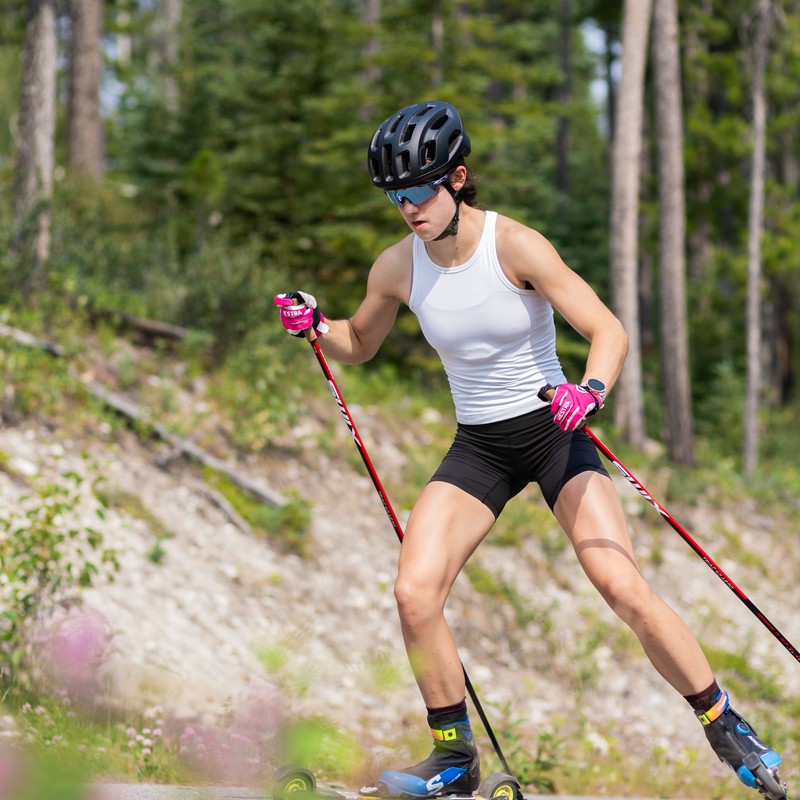
    Alison Mackie skate rollerskiing uphill on a paved forest road in a white training top and black helmet.
    Alison Mackie rollerskiing during summer training in July. She trains with the Alberta World Cup Academy in Canmore, Alberta. (Photo: Nathaniel Mah)

    For Alison Mackie, the 2024 Junior World Championships in Planica never really started.

    She had arrived in Slovenia with reason to expect something. A year earlier, at 17, she had finished 13th in the 20 k at the junior championships in Whistler, British Columbia, on home snow, in exactly the kind of long, grinding distance race that suits her. In Planica she missed the qualification in the opening sprint, fell ill, and watched the rest of the week from a hotel room. She was not on the tracks when her Canadian teammates made history either: Sonjaa Schmidt won the U23 sprint, and Canada won the U23 relay.

    Back at her base in Canmore, Alberta, at the end of that season, Mackie and her coaches set a target for the next one. Top five at the 2025 Junior World Championships in Schilpario, Italy.

    Privately, she wanted more than that.
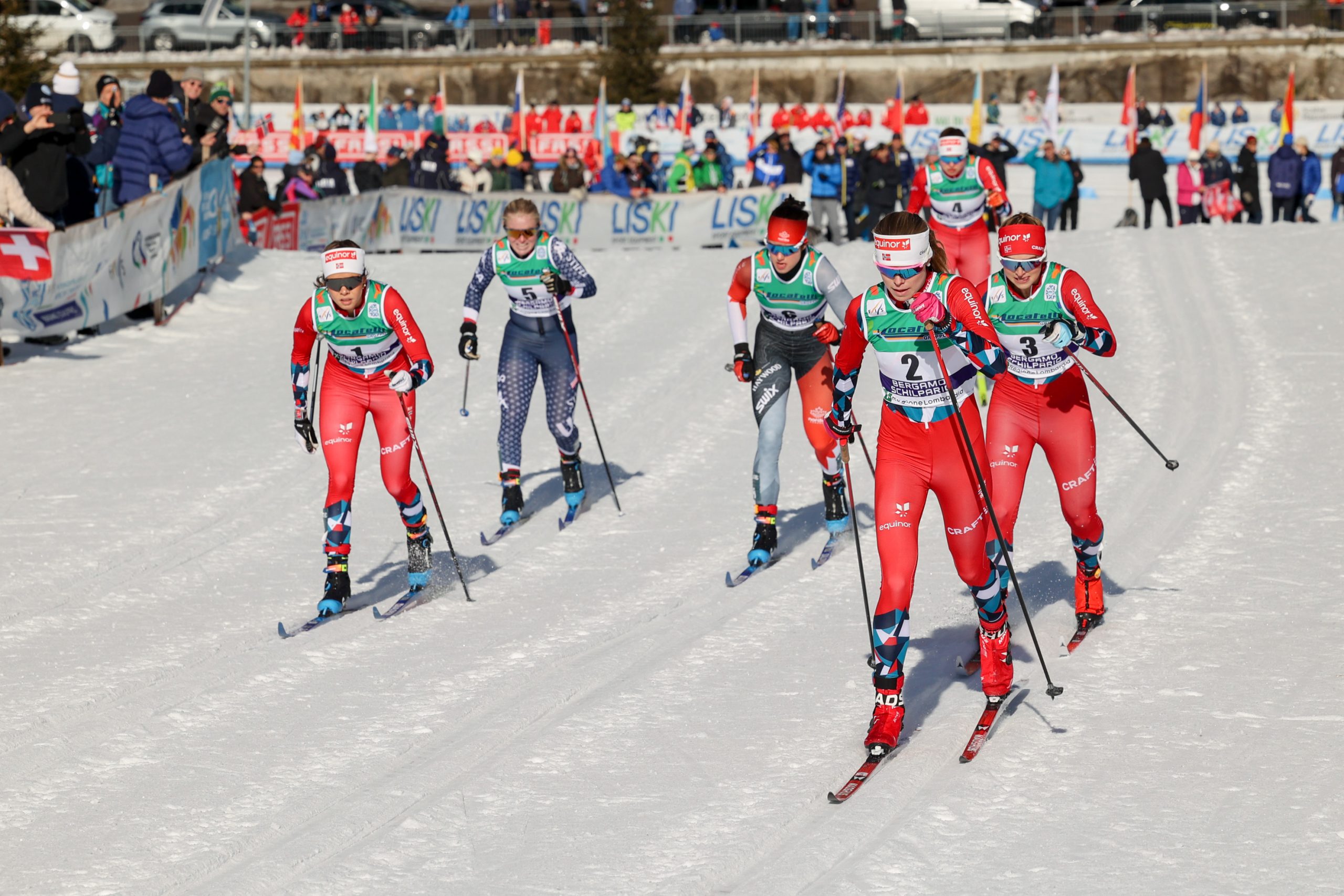
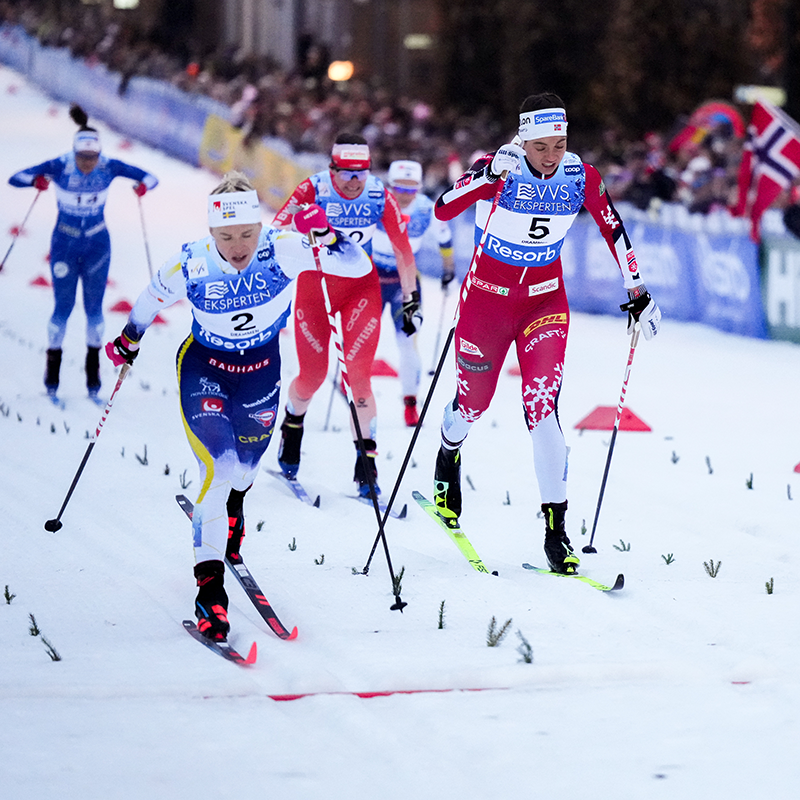
    Alison Mackie in bib 6 racing a classic sprint heat alongside Sammy Smith and four Norwegians.
    Mackie in bib 6 during the classic sprint at the 2025 Junior World Championships in Schilpario, where she finished fourth. Two bronze medals followed in the distance races. (Photo: Newspower.it)

    A Comeback in Schilpario

    “Yes, Junior World Championships in Schilpario were the main focus of my season that year,” Mackie said. “I trained specifically for that event to get my best shape there. But I wouldn’t say revenge, instead a kind of comeback because the year before in Planica I was pretty disappointed because I haven’t had the opportunity to race being sick.”

    On the Italian tracks she won bronze in the 20 k mass start classic, then bronze again two days later in the 10 k interval start skate. She was fourth in the classic sprint. They were the first junior world championship medals won by a Canadian woman since 1989.

    “I wanted a top five, and I finished with three top fours, including two medals,” she said. “The preparation we had put in proved to be correct, and I had a lot of confidence before starting the championships because I felt really good in the previous months leading up to my arrival in Italy.”
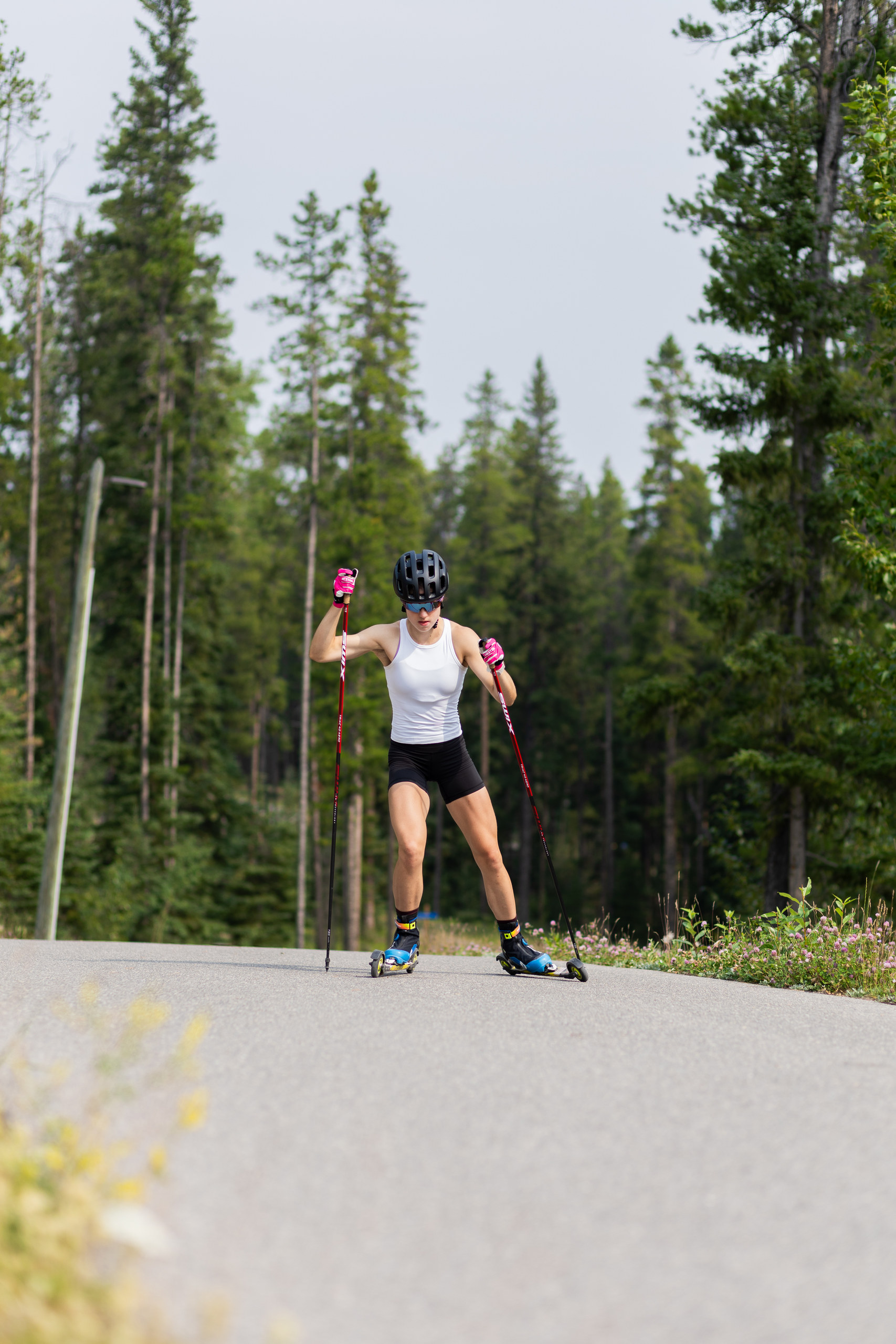
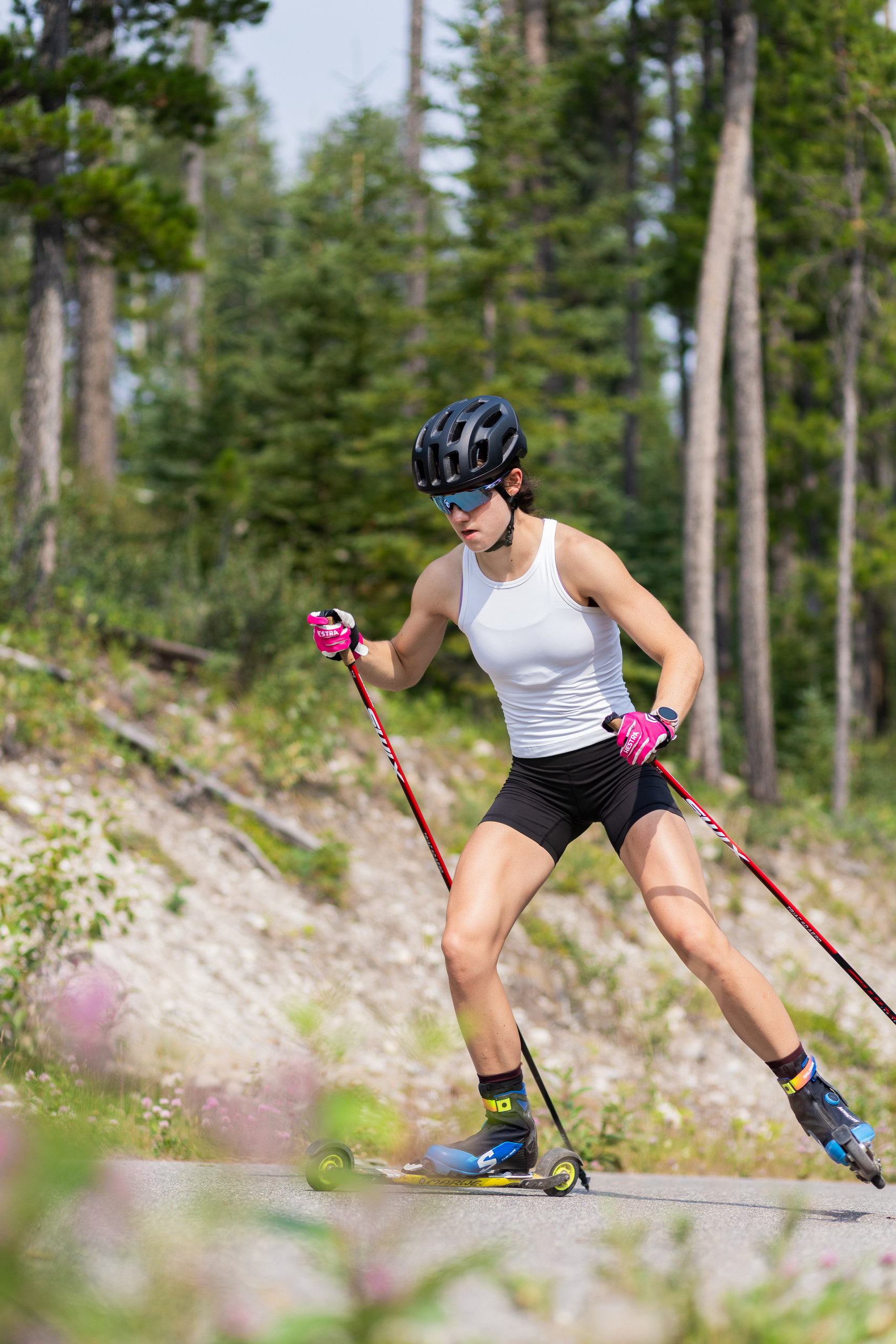
    Alison Mackie rollerskiing toward the camera on a paved road lined with evergreens.
    Mackie on a summer rollerski session in July. She started racing in Alberta as a teenager and won her first national title at 16. (Photo: Nathaniel Mah)

    Put on Skis Before She Could Walk

    Mackie was born in Montreal and raised in Edmonton, and she is 20 years old. Her mother, Jennifer, is a pediatrician. Her father, Andrew, is a pediatric cardiologist. Both of them ski, and both of them had her on skis before she has any memory of it.

    “My parents put me on ski as soon as I could walk,” she said. “So skiing accompanied all my childhood. Then I took real ski lessons and I started doing racing in my region of Alberta during my teenage times. That’s till Covid period arrived and with the restrictions I had nothing else to do others than training. But anyway, I really enjoyed myself during that period, developing my technique with my coaches at Edmonton ski club and when Covid finished my very first race that I won was our National title in March 2022 as a 16 year old.”

    Canada is known around the world as the home of ice hockey. Why did you choose cross-country skiing over hockey, freestyle, or swimming, following Summer McIntosh’s footsteps for example?

    “In parallel with cross-country skiing, I did a lot of other sports like cross-country track and field, rock climbing, mountain biking, swimming, soccer and in all of these sports I wasn’t as super competitive as I was in cross-country skiing. I did that only for fun as an opportunity to stay healthy during summer period. Cross-country skiing has been to me the only sport I competed at my best in my early ages and my favourite discipline. That’s why I chose it.”

    That first national title, won in Whistler in March 2022, is the race she keeps coming back to.

    “Yes, that race in Whistler BC was one of the first big races after the Covid pandemic,” she said. “I trained a lot during that period and didn’t have the opportunity to race and see my level, and when I went to my first National Championships and won the first race, it was a special moment and made me realize that I wanted to keep pursuing cross-country skiing for even better results and seeing how far I could get.”
    Alison Mackie racing the Olympic 10 k freestyle in Tesero, panned against a packed grandstand.
    Mackie racing to eighth in the Olympic 10 k freestyle in Tesero on Feb. 12, the best Olympic cross-country result by a Canadian woman. (Photo: Vanzetta/NordicFocus)

    Eighth at the Olympics

    The line has run one direction since. Two bronze medals at Junior Worlds. Her first World Cup top 10s, in Toblach and Val di Fiemme. Eighth in the 10 k free at the Milano Cortina Olympics in her first senior season. Gold in the 20 k mass start free at the U23 World Championships in Lillehammer in March. And at the end of that season, on 548 points, the FIS U23 overall World Cup title, the first won by a Canadian woman, with the finals held at Lake Placid.

    At the Milano Cortina Olympics you finished eighth in the 10 k free, after your first World Cup top 10s in Toblach and Val di Fiemme. What do you remember from those two weeks in Italy?

    “It was super cool being part of that multi sport event that the Olympic Games represent. It was my dream since I was a child watching Olympics on TV and having the opportunity to compete in high level in this huge event was really special to me. Definitely they have been long two weeks, also overwhelming at the time, but made me really happy how I performed overall and the 8th place I got in 10km skating has definitely been the highlight without any doubt. Entering the top 10 has been quite a surprise to me in that moment, because there were all the best skiers at the starting line. But now looking back at all the hard work I did during the whole season and the good results I got before that race in both World Cup and in under 23 World Championships, I wouldn’t say it was a huge surprise for me. Probably demanding Val di Fiemme’s track suited me very well, given that I finished as well 8th in Tour de Ski’s Cermis climb the month before.”

    What is the current situation in Canada for cross-country skiing, in terms of ski club membership, visibility in the national media, and financial support?

    “I would say the current cross-country skiing community in Canada is pretty small, if compared to other European power nations, but strong and with lots of passion in developing our discipline. There are a lot of young skiers coming up and I think it is very exciting for the great results to come in the future. Our National sports organization here in Canada are working really hard to make sure our National team can get all the support we need in order to achieve some World Cup podium with both boys and girls team during the seasons to come.”
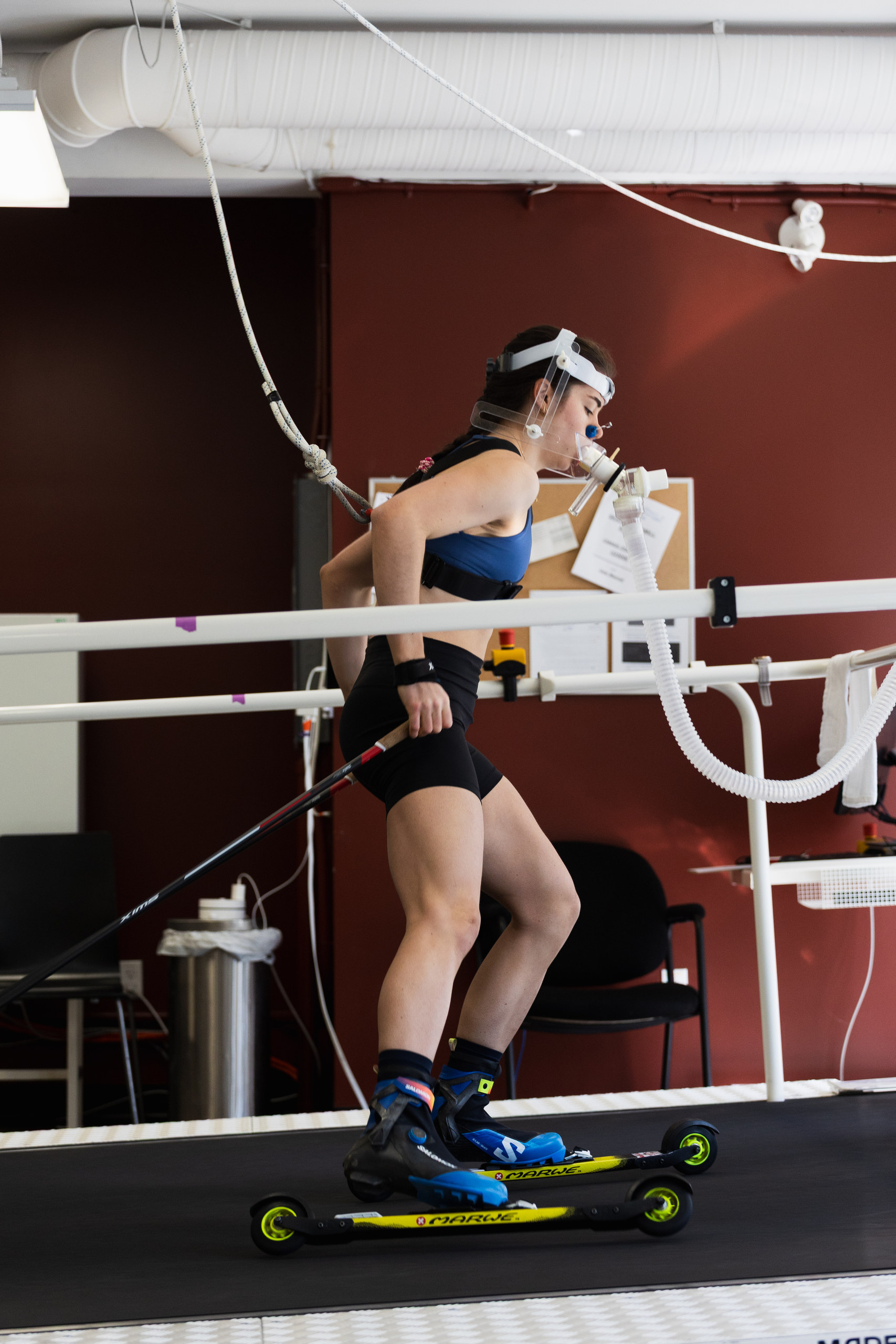
    Alison Mackie skate rollerskiing on a laboratory treadmill while wearing a metabolic mask.
    Mackie on the treadmill during a lab test in May. Distance racing is her strength, and finding speed is the summer’s assignment. (Photo: Nathaniel Mah)

    Distance Strength, Sprint Homework

    Describe yourself as a cross-country skier. What are your characteristics, your strengths, and the areas you are working on for the coming seasons?

    “I describe myself as a pretty strong skier in distance races, while I struggle a bit in sprint not to get through the top 30 and consequently not play the sprint finals, that is an element that I am working on in next seasons,” she said. “Between classic and skate I have found more success in free technique in the past seasons, but I enjoy training both classic and skate equally. Distance races are definitely my strength but I am working to improve my speed skiing as well so I could become a really strong overall skier in order, in the future, to fight for a higher overall spot in World Cup.”

    And the criticism you get from your coaches?

    “More than critics I would call special feedback from my coaches. Because sometimes I have a tendency to train too much and too hard that I need. That is something I am working on this summer, knowing when to push my body and when to give the correct time to rest and recover.”

    The World Cup calendar keeps skiers from outside Europe away from home for close to five months a season. How hard is that for you?

    “Personally I have spent on the road, following World Cup calendar, the past two seasons, but not the full European calendar. I really enjoy travelling and being on the road, so I don’t think it is a huge struggle for me. It is tough to not see friends and family for a long time but I am really lucky that I had friends and family came and watched me on tracks while I was in Europe a couple of time during season. Next season it will be quite different for me, because I am transitioning to attend the University of Utah so I will leave World Cup a bit because I do need to go to class and represent the University of Utah in North America as well.”
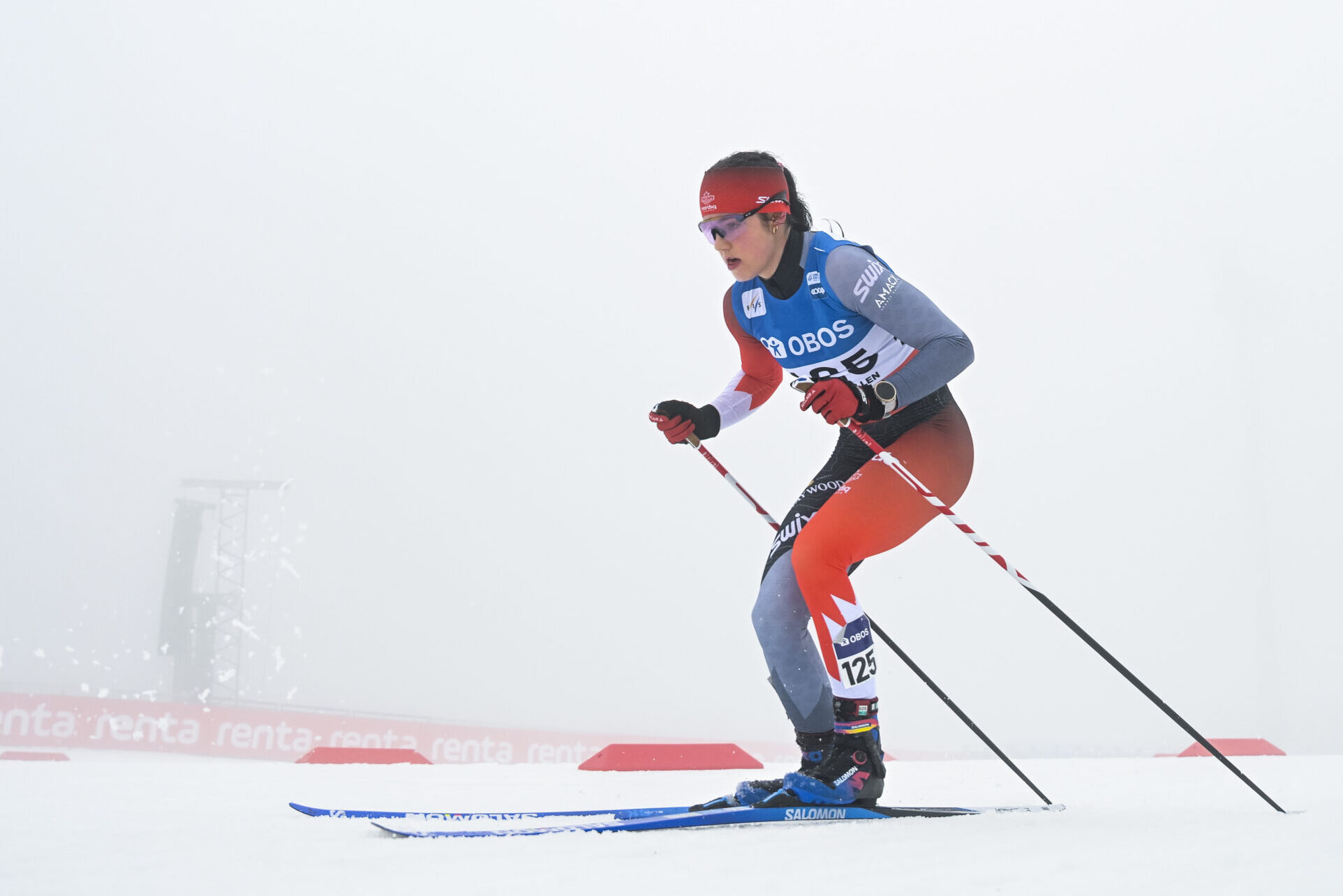
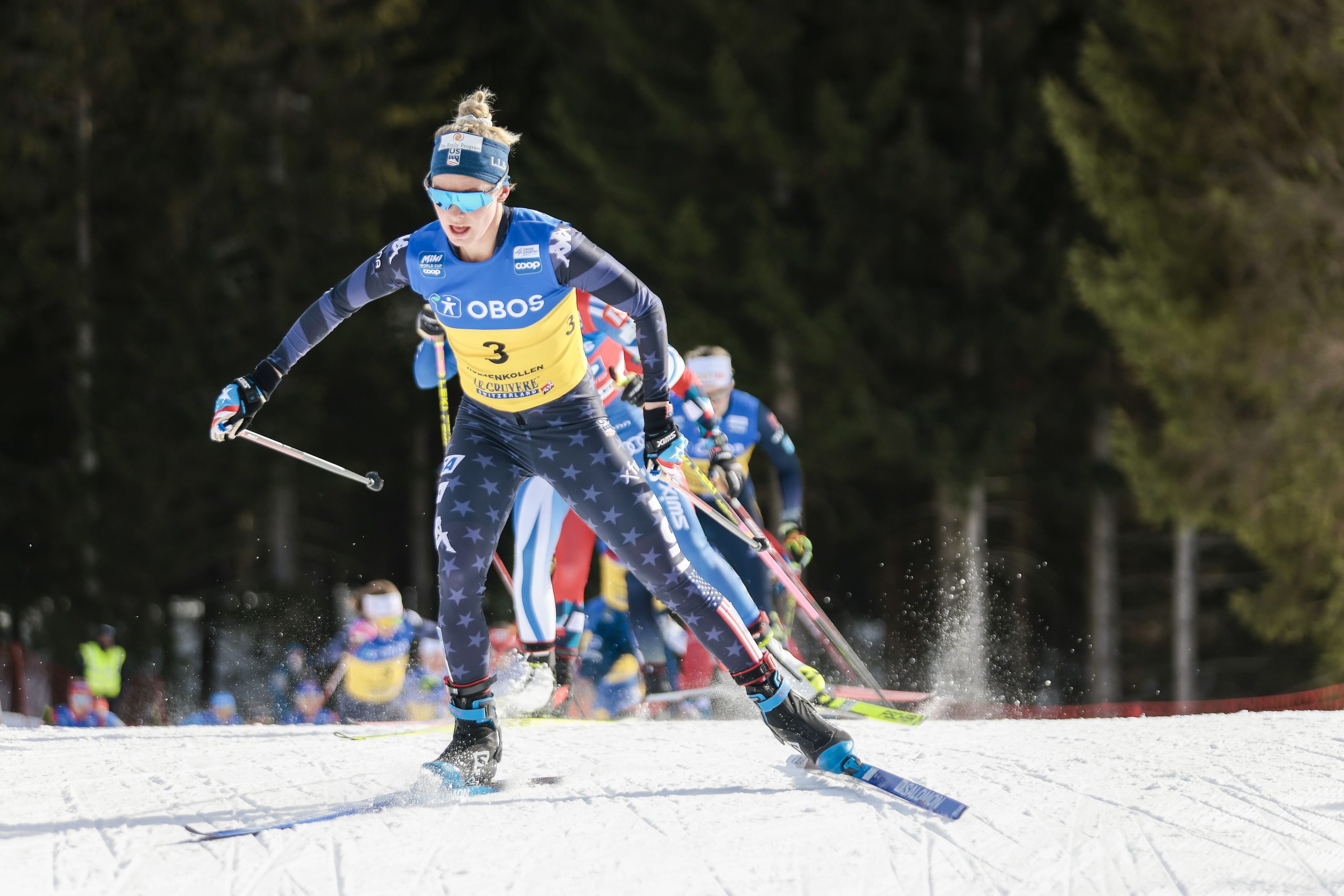
    Alison Mackie skiing in a Canadian race suit through fog at Holmenkollen.
    Mackie at the Holmenkollen World Cup in March, a week before the tour reached Lake Placid. (Photo: Authamayou/NordicFocus)

    A Winter Without Diggins

    The World Cup went to Minneapolis in the last two seasons, and Lake Placid hosted the finals in March in front of enormous crowds. Why not race in North America more often?

    “We do have actually Canmore scheduled for World Cup 2028, but realistically there are not so many resources for cross-country skiing in North America,” Mackie said. “It takes a lot of money and human power for the organization and preparation of those races. Of course, it will be amazing to have more opportunities to race in North America in the future but I have to be realistic and understand that organizing an event here in Canada, for example every four years, require lots of efforts and preparations from the local organization. Maybe we need more venues in North America that we currently have that are able to bring here World Cup events. I admit with huge pleasure that in the past seasons both Minneapolis and Lake Placid events showed how strong local communities are in terms of support and enthusiasm for cross-country skiing and those events have been a great boost for our discipline in North America, especially between young kids.”

    After fifteen seasons, this will be the first World Cup winter without Jessie Diggins, who clinched one more crystal globe in Lake Placid in March before retiring. Will she be missed outside the U.S. team as well? Did you ever get advice from her?

    “I definitely think Jessie’s presence will be missed in World Cup. Not only inside USA Team. I think she has always been a positive skier and a really amazing role model in so many ways. And 100% her presence, her ambitious way of racing and unique skiing spirit will be missed. That will definitely change some racing tactics as well. I had the opportunity to train together with Jessie in New Zealand last summer and it was a pretty cool experience and I wish all the best in her future.”
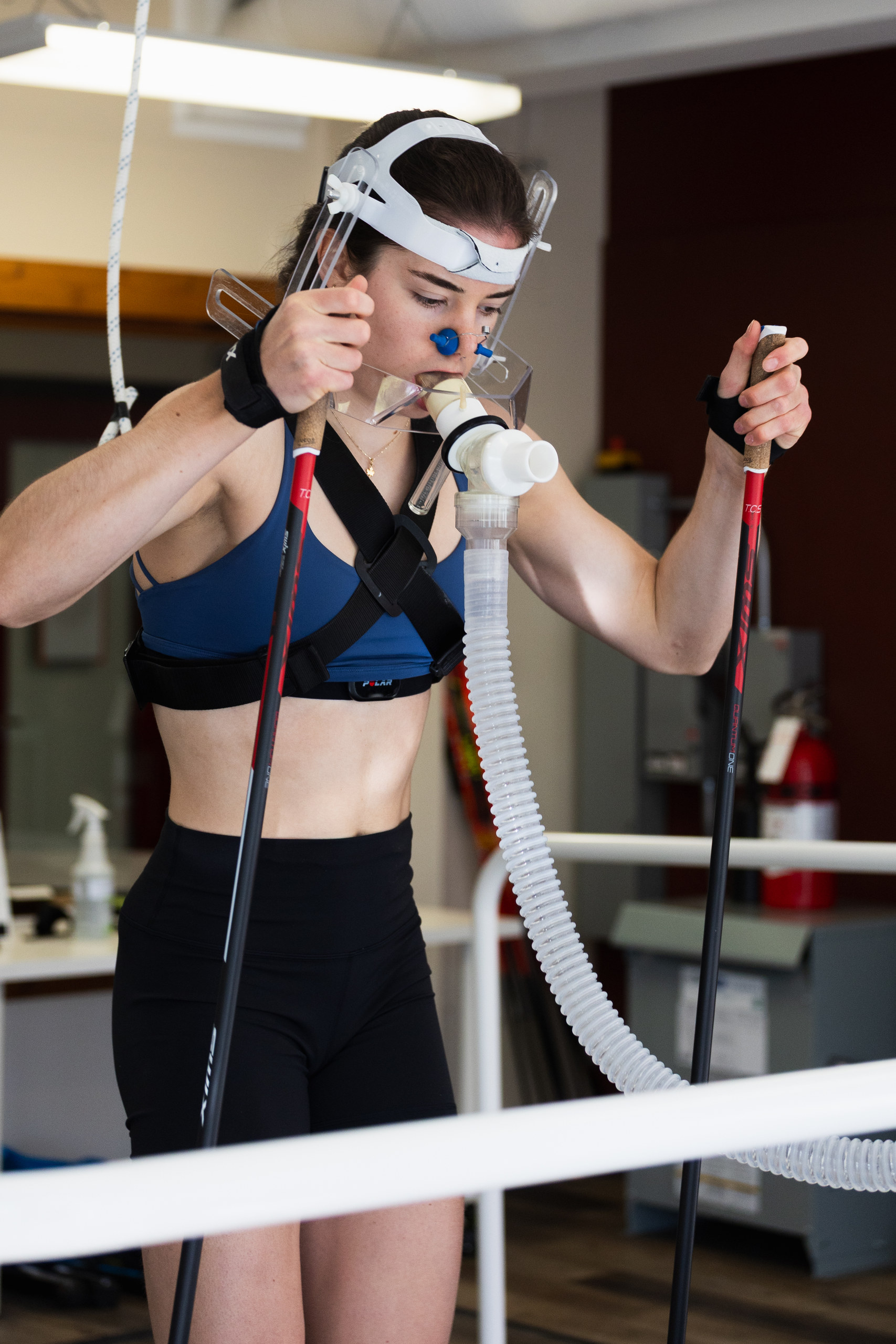
    Alison Mackie adjusting a metabolic testing mask while holding ski poles in a testing lab.
    Mackie fitting a metabolic mask before a treadmill test in May. She trains in Canmore and will study medical engineering at the University of Utah this year. (Photo: Nathaniel Mah)

    Canmore, Utah, and Life Off the Snow

    How is the Canadian team organized, and how is training divided between the women and the men at camps and at home?

    “I think Canadian skiing is gonna take a really exciting trajectory. I am really excited to work with our new Swedish coach Stefan Thomson over the next seasons but also in our group here in Canmore we have Norwegian Tormod Vatten as our assistant coach and with them we have a really strong support staff. For the Canadian National Team over the next seasons is going to be really exciting seeing where we all can go in World Cup and I am really proud to be part of this young but strong group of skiers that our Nordiq Canada are building now, under the [leadership] of former Olympic champion Beckie Scott and our amazing ski communities.”

    How do you manage your studies, at Queen’s University until last year and now at the University of Utah, with training and racing that run through most of the academic year?

    “I just make sure that I manage my schedule accordingly to have enough time for both my trainings and school throughout my day. I think having something other than skiing to focus on is really important for me. I was an online student at Queen’s University over the past two years and now I am transitioning to the University of Utah studying medical engineering. I think it is important the communication with the professors, making sure they know that my situation is a little bit different if compared to normal students, due to the fact that my training sessions, travels and races during winter season take my mind. But despite that my goal is to give my full focus during hours in classrooms too.”

    What kind of person are you away from cross-country skiing? Your personality, your interests, what you do on days off from training and racing?

    “Outside of cross-country skiing I am a pretty introvert person. I try to keep things on my own. I like studying and I really enjoy sewing clothes in my free time. I truly also love to learn new things and that is why I am excited to attend the University of Utah this year. I also love to spend time in the mountains nearby Edmonton where I grew up and in Canmore where I train myself with Alberta World Cup Academy and where I graduated in High school. Hiking, Mountain biking, running and skiing, of course, are my favourite activity when I can spend my time outside in the lush Canadian Nature.”

    In 10 to 15 years, at the end of your career, you will be proud of yourself if what?

    “I think, regardless of what I achieve in my future, I will be extremely proud of my career in addition to what I already accomplished. But really, my goal is just to ski because I love it and see where I can get of myself and also trying to inspire other young skiers. I think that there are a lot of young skiers in Canada right now, who have the potential to be amazing athletes. I really want to inspire them, showing them that anything is possible, it doesn’t matter what country you are from or how old you are. So regardless of what I achieve over the rest of my career I will always be proud of what I have already achieved.”

    Paolo Romanò is a freelance reporter based in Italy who covers cross-country skiing and Nordic combined.

    Help Support Our Coverage!

    If you value the thoughtful work and access FasterSkier provides, please consider becoming a Voluntary Subscriber. Your support directly fuels our work to cover the people, places, and moments that make our sport special.

    Join the FasterSkier community!
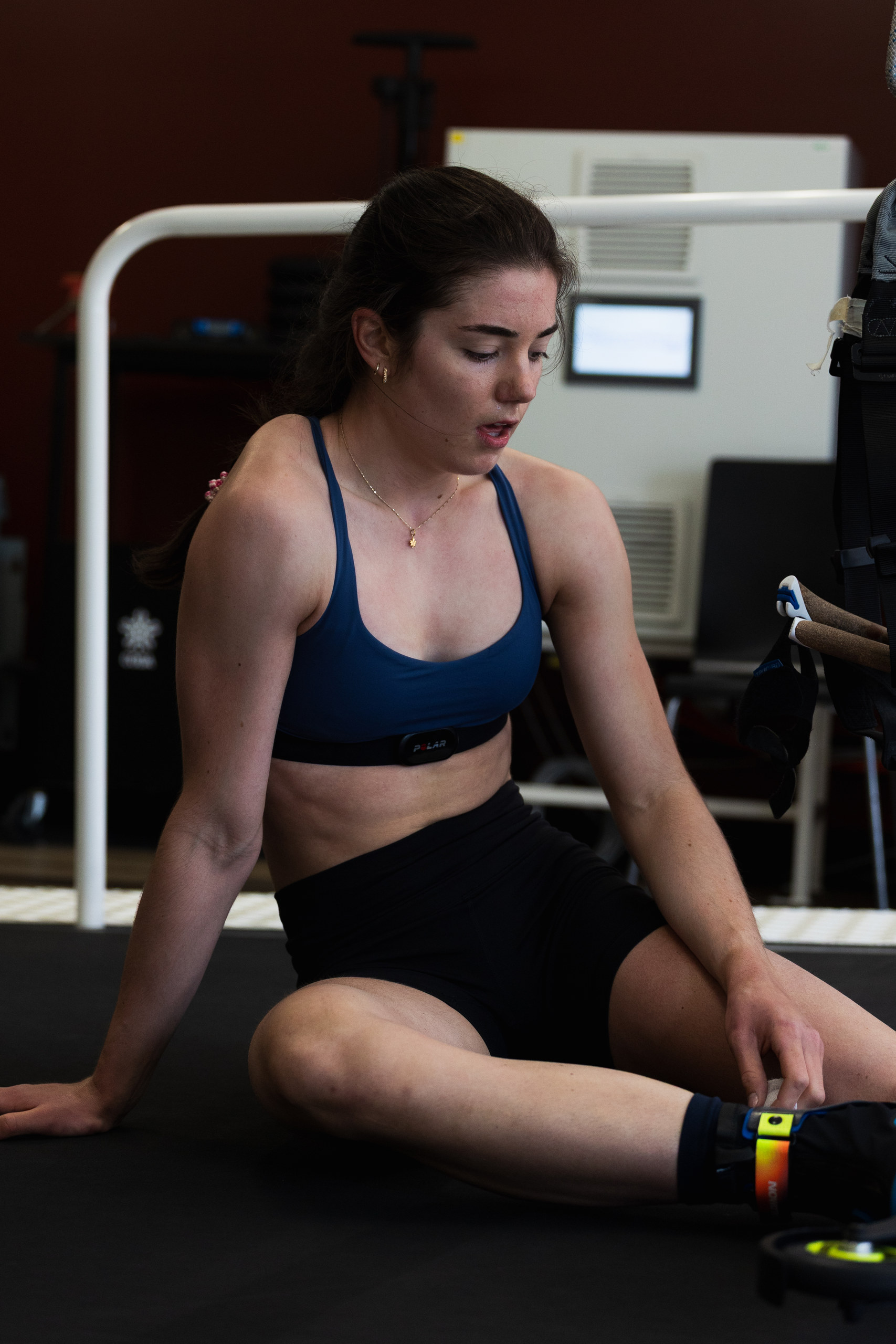
     

    Alison Mackie sitting on a laboratory floor catching her breath and unstrapping a sensor from her leg.
    Mackie catching her breath after a lab test in May. She races her first season for the University of Utah this winter. (Photo: Nathaniel Mah)
  • ‘We have no films to our name’: Lars and Torsten Brinkema on how Threshold got made

    ‘We have no films to our name’: Lars and Torsten Brinkema on how Threshold got made

    This article was made possible through the generous support of our voluntary subscribers. If you value coverage like this, please support FasterSkier with a voluntary subscription.

    Torsten and Lars Brinkema were two brothers from Minneapolis with a GoPro, a film school semester between them and no feature credits at all when they talked their way into a U.S. Cross-Country Ski Team camp in Bend, Oregon, in the summer of 2023. They spent the following World Cup season inside the team, paid their own way through it, and came home with roughly 500 hours of footage. What they cut it into is Threshold, the documentary about Jessie Diggins and her eating disorder that premiered on Peacock in February and is now available to rent in the United States and Canada.

    Earlier this month we published head coach Matt Whitcomb’s account of that winter and what the team changed because of it. This is the other half: the brothers’ own version, recorded before the rental release. Torsten is 26 and lives in Brooklyn. Lars is 23 and splits his time between Minneapolis and Los Angeles. They are still working as a duo.

    Below is a transcript of the Brinkemas’ conversation with FasterSkier. It has been lightly edited and condensed for clarity. LB is Lars Brinkema, TB is Torsten Brinkema, MV is Matthew Voisin.

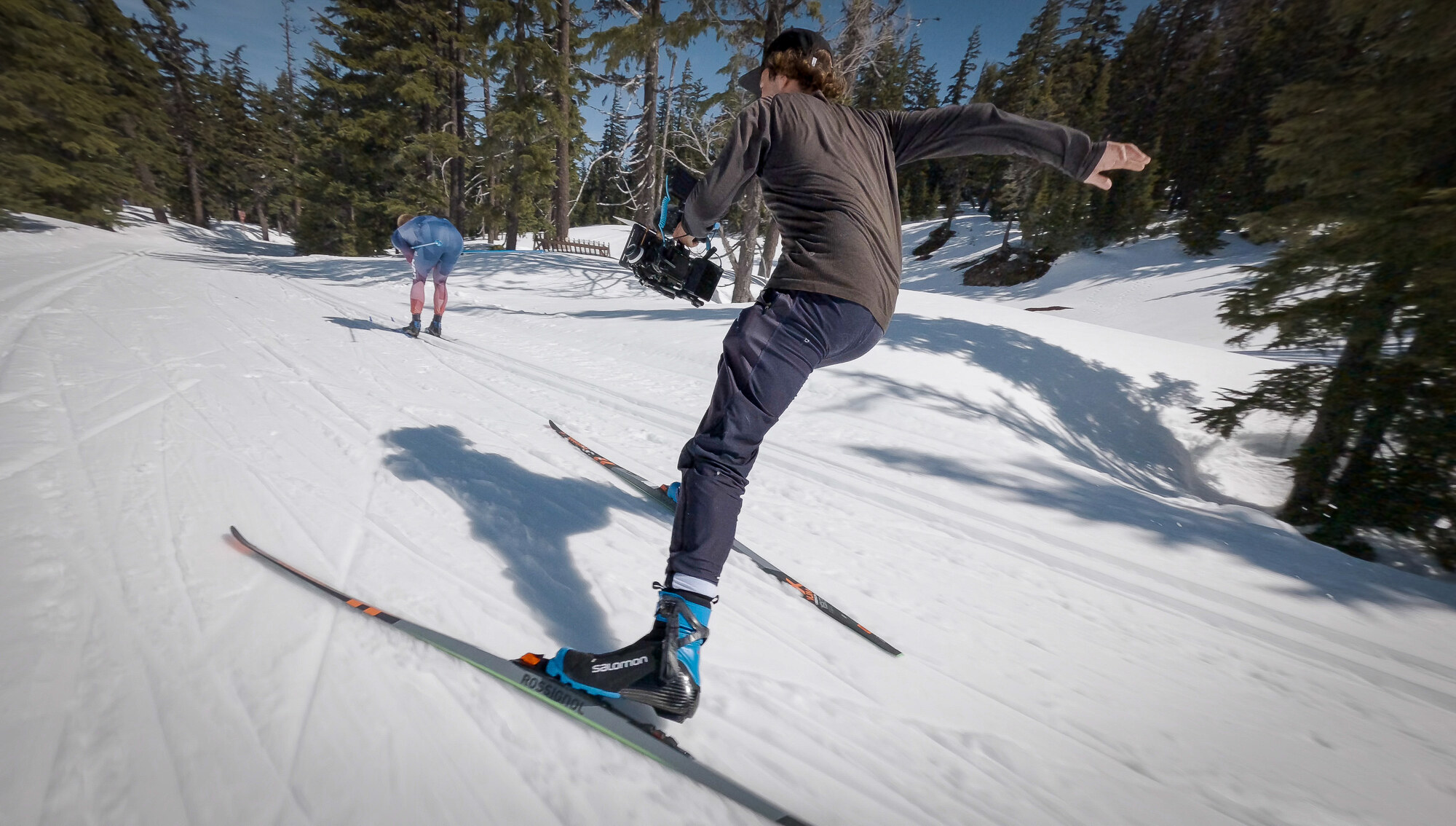
    A filmmaker mid-stride on cross country skis carrying a cinema camera rig, with an athlete skiing ahead of him on a groomed snow trail.
    Lars Brinkema filming on snow at a U.S. Ski Team camp in Bend, Oregon, chasing Jack Young up the trail. The brothers had done the workouts themselves, which is the reason the team let them near one. (Photo: Patrick Conroy)

    MV: I would love to back up a little and just hear about you two as young guys, how this all manifested.

    LB: To start at the very beginning, Torsten and I were both born in Minneapolis and grew up in that whole Minneapolis ski world. We had skis on right when we started walking. So we really grew up in the same community that Jessie had grown up in, and she was kind of just this idol that we looked up to. We both remember where we were when we were watching that gold medal race in Pyeongchang. And then fast-forward to when we were getting older, just always carrying cameras around, usually a small GoPro on our ski trips. Torsten ended up skiing for Colby College, and that is where he met Ben Ogden, racing against him on the collegiate circuit.

    TB: I got my ass kicked by Ben in most of the EISA college races. But I was always interested in shooting a lot of ski trips. I left school trying to figure out how to put those two pieces together, because I knew I was not good enough to be a professional skier, but I also wanted to capture the sport that I loved so much. It took a year of trial and error doing gigs for outdoor brands and whatnot.

    Then, when we figured out the World Cup was coming to Minneapolis, I talked with the Loppet Foundation, which is the club Lars and I grew up skiing for. I was kind of like, listen, do you guys need any promotional materials? People should be getting excited for this event that is happening at Wirth Park. I convinced them on a shoestring budget to send me to Holmenkollen in the spring of 2023. I stayed with a family friend out there, reconnected with Ben, and met a lot of the other skiers on the team. I think they were kind of surprised to have an American photographer out there with them, just because they are not getting much coverage once they leave. Ben was sort of like, we have to figure out how you guys can stick around with the team a little bit longer. It was just me at this point, but Lars was in film school. So Ben pitched Matt Whitcomb that he should invite us to their Bend, Oregon camp.

    MV: What did you think you were making at that point?

    TB: Lars and I basically bought cinema cameras and showed up at camp. We were definitely inspired by a lot of other sports documentaries at the time, niche sports finding success in that genre, people going, oh my god, look at Formula One, I have never heard of this sport before but I am really loving the series. And we were like, we could probably do something like that with skiing. Make it look really cool.

    I think the team was happy to see filmmakers who could not get in the way of their workouts. Jessie had experiences in the past with a brand interrupting an interval session, asking her to do another interval. This is just something that would never even cross Lars and my mind, to alter the workout, because we know how intense they are. We know the workouts. We have done them before. So we were kind of flies on the wall, and I think that proved our ability both as skiers and as filmmakers, to be in that documentary position and not get in the way.

    MV: What were you envisioning before it started to become more about the eating disorder and the mental health challenges?

    LB: Just bringing this sport that we grew up in and that we loved to the masses. We had seen smaller endurance sports, whether it was a YouTube channel or on Netflix, sports that we loved but not a lot of people in the U.S. tracked. And there was always this element to the successful films about sports that was more the human side of the story. We approached it very open-ended. We kept those options really open for a majority of our filming. We were still capturing when we went on the World Cup, talking to European athletes, we had some fun conversations with Klaebo on camera. We just spent every waking moment following different stories.

    I would say we were definitely, kind of subconsciously, following Jessie’s story more than others, and that just developed over the time of filming. Not until the editing process is when it really shaped. We had 500 hours of footage, so many different interviews with so many different athletes, doctors, staff on the U.S. team. And as we started to screen rough cuts to film industry people around Los Angeles and New York, we were getting so much feedback that Jessie’s story was the most resonant of all of them.

    MV: You have 500 hours, and then at some point you have to make the decision that almost all of it is hitting the cutting room floor. How do you feel your way through that?

    TB: Having an editor who had never cross-country skied before was totally instrumental in figuring out what would resonate with the wider audience we knew we had to appeal to. And there are also those moments where Lars and I were deep in the Arctic Circle, freezing our butts off, trying to get a time-lapse of the northern lights, out there for two hours and so attached to this one shot that we worked so hard for. I remember being in the cutting room and him saying, it is not serving the story, you have to cut it. Those were the things that were so hard to let go of.

    And of course all these other stories, U.S. Ski Team members, Klaebo, Emma Ribom, Pellegrino, people that we really looked up to, and all of their stories deserve to be told. But at the end of the day, when you have this Jessie story that is so compelling, you cannot really deviate from it if you want to give her story the time it deserves. At the industry screenings, Lars and I walked in with a lot of questions about what would resonate with a non-skier audience, and people just kept saying, Jessie, Jessie, we want more Jessie.

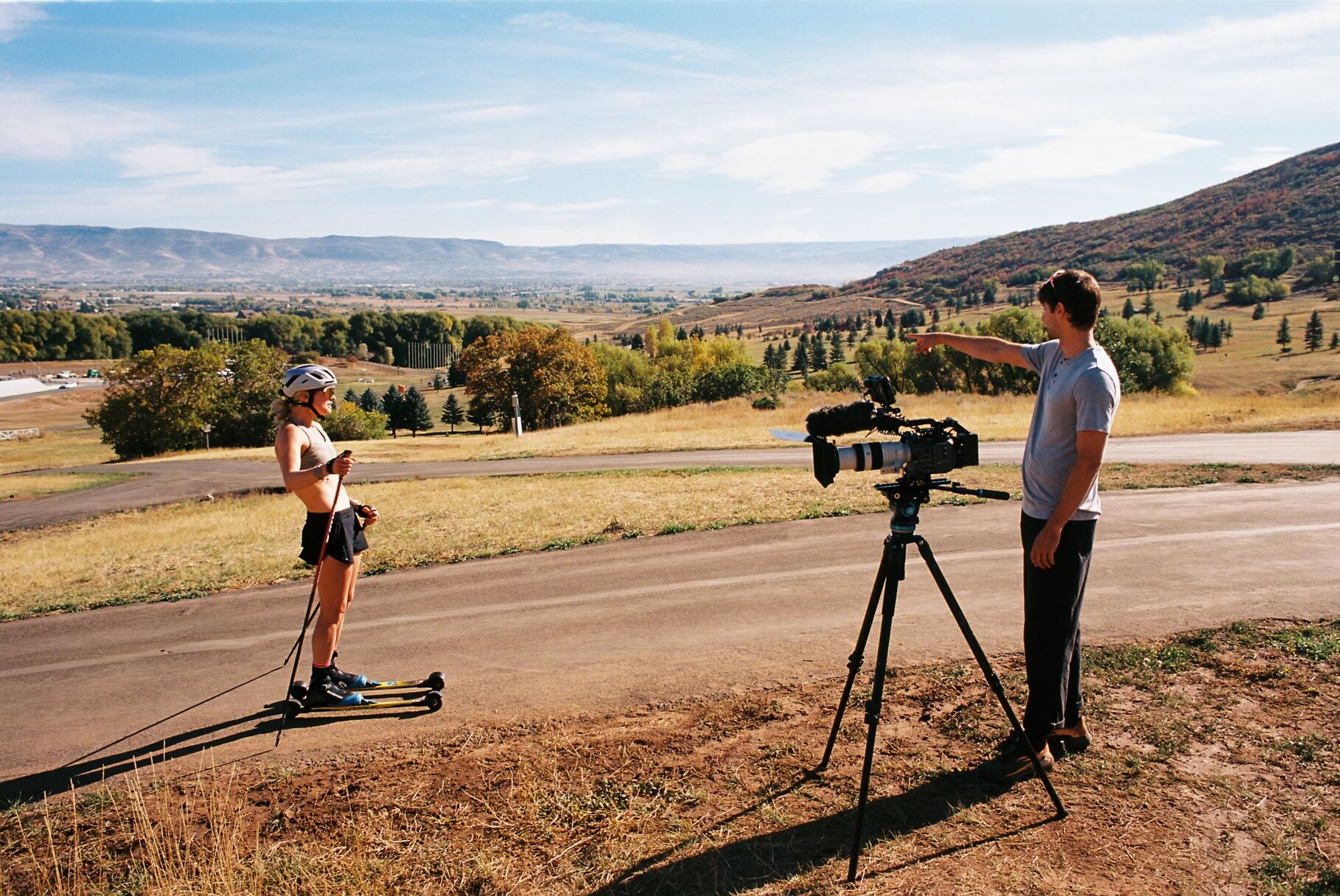
    A skier on roller skis stands on a paved path while a filmmaker directs from behind a tripod-mounted cinema camera, with a wide valley behind them.
    Jessie Diggins and Torsten Brinkema at the team’s Park City camp, in the open-ended stretch of filming before anyone knew what the story was. (Photo: Willie Maahs)

    MV: How did you get hooked up with Patrick Dempsey?

    LB: It was about six months into filming, right after the Tour de Ski, at a camp between that and the next World Cup stop. Growing up in the Midwest, we did not have any connections to the whole Hollywood world, but we definitely needed to find someone to help us get a foot in the door. So we asked Jessie if she had anyone in her directory who worked in that space. She remembered that Patrick had supported the ski team, and she was able to just send him an Instagram DM. He responded right away and said to send Torsten to his house in Maine. A couple of months later we showed up at his doorstep and pitched him on the idea. He had grown up cross-country skiing in his backyard in Maine, so he is very connected to the sport and a huge Jessie fan.

    MV: Jessie is big, but Dempsey is on another level. What was that like?

    TB: It was pretty wild. We knew this was a ticket for us into a new world that we had always hoped to get the keys to. And credit to him for inviting us over, because the roadblock we hit at every stage of this process is that we have no films to our name. We have a couple of short projects that nobody has seen. So we are asking someone with the credits that he has to trust us with nothing to see for it. Obviously Jessie’s word goes a long way with him. We had to swallow our awe of him and realize this was a huge opportunity, and tell him what we really believed: that there was a story in those 500 hours. At that point we had not really cut anything. He became a very important part of shaping it down to what it became in the end.

    MV: What other filmmakers have inspired you? What did you grow up watching?

    LB: One huge one was Jimmy Chin, especially with Free Solo. That may have been the first ever documentary I saw in a theater. This niche sport was brought to a thousand theaters across the country… such a huge story and such an interesting character. That was one of the times we were like, wow, we could bring a sport that we love to the big screen in an impactful way.

    TB: To add to that, I remember, I think it was actually while we were filming on the season, I saw a really old Herzog documentary from the 1970s called The Great Ecstasy of Woodcarver Steiner. Herzog was in his late twenties, early thirties, and he dedicated basically a whole year to following the ski jumping circuit, when it was at that really gnarly phase of people pushing the boundaries on these jumps, ending up jumping all the way to the flats, a whole bunch of drama between the jumpers and the officials. The fact that he was caught up in this story when he was around our age, and it felt like we were doing a similar thing, dropping everything to follow this circuit in unfamiliar landscapes. That just felt like, wow, if one of these great documentarians dropped everything for a ski documentary, we must be doing something right.

    MV: It is expensive to travel around Europe for a whole season, and the ski team is pretty transparent that their budget is tight. How did you make those numbers work?

    LB: We definitely had to pay our whole way through that season. There was not support from the ski team, in that they did bring us on, we were marked as members of the team crew, so we got our bibs and access to the races. But we basically had the ski team and Jessie help us find people who in the past had supported the ski team. It is not funded by the government; the ski team lives off these people who donate. So we went through their list of people who were instrumental in making sure the ski team could have success, people who paid for the wax van they use to this day. Over the course of filming we were always having to fundraise more and more money.

    Later on, when we were fine-tuning the edits, there were still a lot of payments to be made. We talked to Jessie’s sponsor, the Emily Program. That was a really cool opportunity, because now they are supporting the film, but they are also bringing it around the country to treatment centers and educational screenings.

    MV: You set out to tell a fun story and ended up helping people with something that is a real medical issue. Do you take a beat to think about that?

    TB: That is kind of the goal right now. We had a release with Peacock, which in a way felt like being viewed by this Olympic ski audience, but not everyone in the U.S. has Peacock, so right now we are figuring out how we can reach the people we did not reach in that initial release. For sure our target audience is this young group of impressionable people who are growing up either struggling with this disorder or who have people around them who have struggled with mental health. We have heard from people who have never skied before who say they were so moved by Jessie’s story. That is the biggest compliment we can get.

    It is a really hard thing to do, for her to pass one of the hardest years of her life on to us, filmmakers who had never made a film before, to then put out to the world. I remember when we showed her one of the rough cuts. She told us that this is the story her 18-year-old self desperately needed to hear. When we got her blessing, and when she said that, we took it and we ran with it, because we knew we could have that impact on countless other people who were struggling. That was a huge motivator for us.

    A filmmaker sits on a rocky summit behind a tripod-mounted cinema camera with a long telephoto lens, snow-streaked mountains behind him.
    Torsten Brinkema on a summit in the White Mountains of New Hampshire in April 2024. This one never made the film either. (Photo: Brinkema Brothers)

    MV: Can you give me a specific memory from being in Europe?

    TB: Mine jumps to not a specific story, but this life on the road, which was so crazy for Lars and me. It was crazy to see the athletes, but also the staff who have done this year in, year out. It really is a wild lifestyle, packing up and going to a hotel room in the middle of nowhere in Finland, where there is light for five hours out of the day, then getting up and packing up and going to the next location in Sweden. The dedication these crews have is crazy, away from their families, away from the normal comforts of living in the States, and the fact that they repeat it every year.

    We pretty much joined every training session and filmed as much as we could, then charged the cameras and packed all the footage onto a hard drive. I always loved those nights when we were really tired, it is super dark out, there is nothing to do, and we would walk over to the wax truck and see what those guys were up to. It was always something fun. They are always blasting music, maybe having a shot of Jägermeister. I think they liked having us around because we were these young people who were totally oblivious to the waxing scene, so we could pick on whoever was not busy at the time. They had been living this life for five, ten years, and Oleg has been around, I do not want to quote how many. These guys are putting everything on the line and being away from their families to make the fastest skis in the world.

    MV: You mentioned the cameras. What was the gear you used to capture these moments?

    TB: We were rocking two Sony cameras, the FX6 and the FX3. That was a progression from, honestly, GoPros. Lars and I just loved being able to carry a camera that would not get in the way of anything, which was so important. We did a 20-mile run with Zanden, Gus, Luke and JC in Alaska, and we carried both our cameras and the drone in a backpack. We always wanted to be able to carry everything we had with only a backpack. That was the goal. In the winter we did a ton of skiing without poles, carrying those cameras, setting up a shot for a while and then skiing alongside people and trying to get it.

    The drone was another really key part of the setup, because it let us get beautiful shots of people when we could not keep up with them, which was most of the time. We could only set up these flyby shots for a 20-second clip before they sped past us. We are super proud of those shots, because it took thousands of them to get the five or six that appear in the movie of Jessie flying by in a training session. We also had to figure out how to make the cameras work in the cold, which was something we had not really experienced before. It involved a lot of hand warmers and duct tape, but we eventually figured out a system that worked even at minus five in Finland.

    MV: I have used hand warmers to keep my batteries warm too, but what is the duct tape for?

    TB: Taping the hand warmers to the battery on the camera, right on the part of the camera where the battery is.

    LB: We would have extra ones in our jacket pocket or in our pants, trying to keep them close to body heat so we could swap them out.

    MV: Lars, what stands out for you?

    LB: Just seeing the sport in Scandinavia was this insane experience. I remember the first Holmenkollen that we followed. I am sad it did not make the movie, but it was absolute mayhem. More people than are in the stadium for the Super Bowl. A hundred some thousand people in the woods watching these skiers who are going by maybe once every 20 minutes. It was not for a sprint, it was not for high impact crashes, it was just to watch these skiers go by, and they were so into it. I remember the big races in the U.S., high school meets, maybe the state meet, have a lot of people out there watching. But seeing all the young fans in Scandinavia watching this sport and being so jazzed up about it, maybe drinking a little too much during the race, it was such a cool experience that you do not get in the U.S.

    TB: It was crazy to experience that and compare it to Minneapolis. We had plenty of those fan experiences, not to the scale of Holmenkollen, seeing the Swedes, seeing the Finnish people. But then coming back to Minneapolis, everyone who was there, most of them traveling long distances, doing crazy things to be there to watch the sport they had been waiting so long to see. That was insane in its own right, because here we are almost matching the energy of Holmenkollen on the trails Lars and I grew up skiing on. We learned how to ski on the 5k Wirth course.

    Then I did a warm-up lap with Jessie before the 10k, and I started crying skiing down the sledding hill, because it was insane. The people, the roar of the crowd, traveling with her as she went around that loop. I feel like we were so blessed to be able to have that finish the movie, because it really felt like a homecoming for Jessie, and a realization of the legacy she has left, both in Minnesota and in the ski world.

    Jessie Diggins laughs on a warm-up lap while a filmmaker in a media bib skis alongside her carrying a camera, a blurred crowd behind them.
    Torsten Brinkema, left, on the warm-up lap with Jessie Diggins before the 10-kilometer freestyle at Theodore Wirth Park in Minneapolis, February 2024. (Photo: Dustin Satloff)

    MV: What is something you are each really proud of?

    LB: Just coming into the film with such an open idea about what it could be, and that every step of the way we had trust in each other that we were going to make this happen and get it to a large audience. As Tor mentioned, we stepped into a really hard time in documentaries to get one out into the world and make an impact through film. I think we just trusted at every step of the process that we were going to figure this out. Being able to do that and show it in person in Lake Placid and Minneapolis has been such an incredible experience.

    TB: Going off of that, it felt like we were in such a unique position to tell this story. I am so proud of those POV shots we got on skis with the athletes. Again, that is the one percent of all the shots we did. But it is a crazy feeling, in a really crowded documentary landscape, to be one of a handful of people in the U.S., maybe even in the world, who can hold a cinema camera while going 30 miles an hour and pull focus and get that shot. It felt like a really proud moment just being like, wow, these turned out, and they are going to make it a better film, because you sort of feel like you are skiing with them.

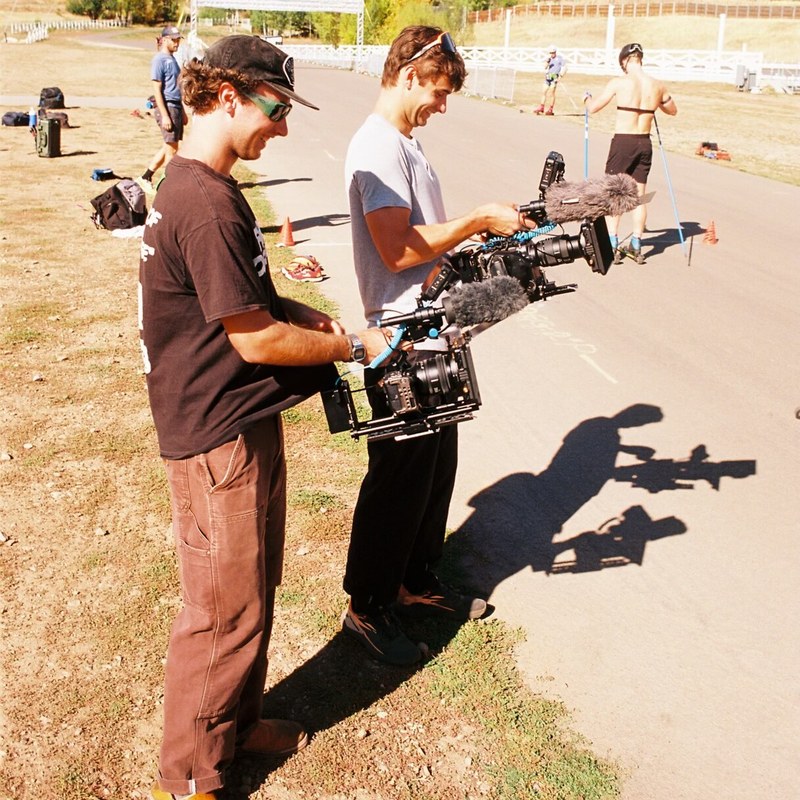
    Two filmmakers stand in profile at the edge of a paved roller ski loop, each holding a cinema camera with a microphone mounted on top.
    Lars, left, and Torsten Brinkema working the roller ski loop at the Park City camp, with the two Sony bodies that shot the season. (Photo: Willie Maahs)

    MV: What was it like working with FIS? Those rights can be really muddy.

    TB: It was definitely a headache to navigate Infront, basically a huge Italian conglomerate that controls a lot of these rights. We had a lot of negotiation with them, because we did want the context of the broadcast footage to feed into the intensity of the race segments. We wanted the tracker of kilometers to go. We wanted Chad and Kikkan announcing, which is so special and I think really leads the film in a way, because Lars and I never really wanted our voices narrating any of this. So we relied on the broadcast to be that context and the hype. It was an absolute pain in the ass, and that is kind of all that I will say.

    MV: What is next?

    LB: In line with Threshold, it was really special to bring something that is a subject matter so personal to us, skiing and mental health. So I think we will continue to create stories that are close to home. We are working on a film that will be set in Minnesota. It was such an incredible experience to show our city and our race course on the big screen.

    TB: We are excited to push our own limits again, and I think this round that will be writing a script, so not a documentary for the next one. But we still definitely want to work together, because having this balance of brother filmmakers, we rely on each other for the things we do not know or that we are not good at. Again, feeling that itch to both tell a story about home and push our comfort zones, which this project definitely did.


    Where to watch: Threshold is available to rent on Apple TV, Amazon Prime Video and YouTube in the United States and Canada. It premiered on Peacock in February, and a European release is planned for later this year.


    Help Support Our Coverage!

    If you value the thoughtful work and access FasterSkier provides, please consider becoming a Voluntary Subscriber. Your support directly fuels our work to cover the people, places, and moments that make our sport special.

    Join the FasterSkier community!
     

    A filmmaker sitting in the snow holding a tall glass pyramid trophy, with race sponsor banners behind him.
    Torsten Brinkema at the foot of the Alpe Cermis final climb in Val di Fiemme, holding Jessie Diggins’ Tour de Ski trophy in January 2024. (Photo: Leann Bentley)
  • What the U.S. Ski Team Changed After Threshold

    What the U.S. Ski Team Changed After Threshold

    This article was made possible through the generous support of our voluntary subscribers. If you value coverage like this, please support FasterSkier with a voluntary subscription.

    When I asked Matt Whitcomb what surprised him about Threshold, the head coach of the Stifel U.S. Cross-Country Ski Team started by admitting he was tempted to make something up.

    “This is the hardest question for me to answer, … but I haven’t watched it. I know it’s life-changing, but I don’t want to go back to that winter,” Whitcomb said. “I did my best as a coach, we all did, and it wasn’t good enough, and I’ve come to terms with my personal experience with it all.”

    The winter in question is 2023-24, the season Torsten and Lars Brinkema spent inside the American team with two Sony cinema cameras, a drone, and no feature film credits between them. What came out of it is a documentary about Jessie Diggins and her eating disorder that premiered on Peacock in February and, as of last Friday, is available to rent on Apple TV, Amazon Prime Video and YouTube in the United States and Canada. A European release is planned for later this year.

    Whitcomb is the person who let the cameras in. He is also, by his own account, the film’s loudest advocate.

    “I know from the response that the film is excellent, and I know it’s changing people’s lives and is being featured in college curricula. I recommend it to everyone I speak to,” he said. “I’m very proud of Torsten and Lars and am grateful for the film. I support it completely.”

    A filmmaker on cross country skis carries a cinema camera rig on a groomed snow trail while an athlete skis ahead of him.
    Lars Brinkema skiing with a cinema camera at a U.S. Ski Team camp in Bend, Oregon, chasing Jack Young on the trail. The brothers had done these workouts themselves, which is why it never occurred to them to ask an athlete to run one again for a better take. (Photo: Patrick Conroy)

    “A couple of brothers got a camera for Christmas”

    His first answer was no.

    “I figured a couple of brothers got a camera for Christmas, had a couple beers, and then came up with a fun way to spend a year,” Whitcomb said. “I normally would’ve erred on the safe side and told them to take a hike, but Ben doesn’t toss around ideas lightly and so I followed up to hear more.”

    Ben is Ben Ogden, who raced against Torsten in college on the EISA circuit and had watched him work at the World Cup in Norway that spring. Torsten had gotten there on a shoestring, having talked the Loppet Foundation, the Minneapolis club he and Lars grew up in, into sending him to shoot promotional material ahead of the 2024 World Cup at Theodore Wirth Park.

    “I think they were kind of surprised to have an American photographer out there with them,” Torsten said, “just because they aren’t getting much coverage once they leave.”

    Ogden pitched Whitcomb on inviting the brothers to the team’s Bend, Oregon camp that summer. The brothers bought cinema cameras and showed up.

    What they had in mind at that point was not a film about an eating disorder. It was a film about a sport nobody in America watches, made in the shape of the niche-sport documentaries that had broken through elsewhere.

    “We could probably do something like that with skiing,” Torsten said of the pitch they were making to themselves. “Make it look really cool.”

    They had one asset that mattered more than the cameras, which is that they were skiers. Diggins had been through the alternative, brand shoots that treated an interval session as something you could run again for a better take.

    “This is just something that would never even cross Lars and my mind, to alter the workout, because we know how intense they are,” Torsten said. “We know the workouts. We’ve done them before.”

    Two young filmmakers stand side by side on a paved roller ski loop holding cinema cameras, with autumn hills behind them.
    Lars, left, and Torsten Brinkema at the U.S. Ski Team’s Park City camp. On the road the athletes called them Larry and Toasty. (Photo: Willie Maahs)

    Toasty, Larry, and a problem with FIS

    Whitcomb’s worry was culture, which he describes as something you protect rather than something you have.

    The brothers had promised the arrangement would run both ways, that athletes would get usable footage of themselves out of it, and Whitcomb says they delivered. They also collected nicknames. Torsten became Toasty. Lars became Larry, or Lawrence in formal settings.

    “These guys were ghosts at times where they would disappear for the day and nobody would see them,” Whitcomb said. “And then we’d see them at dinner and they’d be showing athletes their incredible footage of the team training or racing together.”

    They washed dishes. They helped with wax testing. Whitcomb says everyone came to regard them as an addition to the team environment rather than a cost of doing business.

    It was not frictionless. At the first race of the season in Finland, Whitcomb watched one of the brothers get chewed out in the finish area by a FIS official for filming in a zone reserved for the television production company. Later, on course in Toblach, he got a text from FIS with a screenshot attached.

    “Larry running through the pines, keeping pace in his flatbrim hat and knit sweater, filming the lead pack. He was prominently within the TV feed,” Whitcomb said. “They asked if I could kindly remove him from the world feed. And you know what happened? Nothing. These guys said they were sorry and got a hand slap in each instance. Everyone likes them. They say things like thank you and sorry.”

    The rights question got more expensive than a hand slap when it came time to actually build the film. The brothers wanted broadcast footage in the race sequences, the kilometer counters and the commentary, partly because they had decided early that they would never narrate the film themselves. That meant negotiating with Infront, which controls FIS media rights.

    “It was an absolute pain in the ass, and that’s kind of all that I’ll say,” Torsten said. “Very expensive.”

    The money came from nowhere institutional. The brothers paid their own way through the season and kept fundraising as they went, working through the list of private donors who already keep the U.S. team on the road. The Emily Program, which sponsors Diggins, came in later during the edit and is now bringing the film into treatment centers and educational screenings.

    The Hollywood end of it started with a question the brothers asked Diggins at a training camp between the Tour de Ski and the next World Cup stop. They had no connections in that world and needed someone who did. Did she know anybody.

    She remembered that Patrick Dempsey had supported the ski team before, and sent him an Instagram message. He answered immediately and told her to send Torsten to his house in Maine, where Dempsey grew up skiing. A couple of months later Torsten showed up at the door and pitched him.

    “We have no films to our name. We have a couple short projects that nobody has seen,” Torsten said. “And so we’re asking someone with the credits that he has to trust us with nothing to see for it.”

    Dempsey signed on as an executive producer and, by the brothers’ account, became a real voice in shaping the cut. Whitcomb offers it as a character reference. “I mean, Patrick Dempsey signed on with these guys. That should tell you something.”

    Two filmmakers set up cameras on a patio to interview a skier seated in a chair with mountains in the background.
    Filming an interview with Johannes Høsflot Klæbo in Park City in October 2023. The brothers came home from the season with roughly 500 hours of footage and interviews across several national teams. (Photo: Daniel Sannum Lauten)

    The pivot happened the following summer

    This is the part Whitcomb wanted on the record, because he thinks people have the sequence backward.

    “From the start, this movie was meant to highlight the entire team, and not just Jessie,” he said. “Months after the winter concluded, I think the Brinkema brothers realized that the film needed to hone in on the topic of mental health to have a clear storyline. I understood and supported that pivot, but the point is that the winter filming was not targeted at just Jessie. That filming happened the next summer.”

    The brothers describe the same thing from inside the edit. They came home with roughly 500 hours of footage and interviews with athletes across several national teams, including Johannes Høsflot Klæbo, Emma Ribom and Federico Pellegrino. Their editor, Yaniv Elani, had never cross-country skied, which they now regard as the reason the film works.

    Elani is also the one who made them cut the northern lights. The brothers had stood out in the Arctic Circle for two hours in the cold to get a time lapse they were proud of.

    “It’s not serving the story. You got to cut it,” Torsten remembers him saying.

    Then came the screenings for film industry people in Los Angeles and New York, where the brothers went in hoping to learn what a non-skiing audience would care about.

    “People just kept saying, Jessie, Jessie, we want more Jessie,” Torsten said.

    A coach stands in green summer woods facing a filmmaker who is holding a camera in the foreground.
    Matt Whitcomb during an interview with the Brinkema brothers in Burke, Vermont. “We missed the mark on supportive team culture as an entire team,” he said of the winter the film covers. (Photo: Brinkema Brothers)

    “Our culture was at a 15 or 20-year low that winter”

    Whitcomb does not soften the season the film covers.

    “For anyone who has seen the movie, I think it’s no secret that our culture was at a 15 or 20-year low that winter. We had major struggles,” he said. He has thought about whether the presence of a film crew contributed to that, and concluded it did not.

    He is also insistent that the winter was not one athlete’s crisis with everyone else watching. “It was one of the hardest times for several other athletes and coaches, too. This wasn’t just a Jessie issue. We missed the mark on supportive team culture as an entire team.”

    Asked how he handled protecting Diggins against letting the story be told honestly, he rejected the premise.

    “I never felt like I had to protect Jessie from the film. She was a part of the team-wide decision to allow the Brinkema brothers into the team for the year, and that was the main gate we kept,” he said. When the brothers asked him whether they could film something sensitive, a one-on-one meeting for instance, he sent them back to the athlete. “I would usually just tell them to ask Jessie what she was comfortable with.”

    He watched her closely all the same, and says that had nothing to do with coaching. “That’s just because she’s a close friend, and friends look out for each other. But I had 100% trust in these guys, which is saying something because Lars was 19.”

    A filmmaker and a team communications manager pose together in a sunny finish area, raising ski poles overhead.
    Torsten Brinkema and Leann Bentley at the World Cup finals in Falun, Sweden, in March 2024. Bentley handles press for the cross-country and Para Nordic teams and appears in the film mostly doing her job in the background of somebody else’s scene. (Photo: Brinkema Brothers)

    The person in the hotel room

    Leann Bentley is the U.S. Ski & Snowboard communications manager who handles press for the cross country and Para Nordic teams, and she is in the film, mostly doing her job in the background of somebody else’s scene.

    She was in the room when the coaching staff decided whether to say yes, and she remembers it being straightforward. Here were two people willing to spend a year telling a story she could not tell herself, and one of them had raced against these athletes in college.

    The question she was asked for this story was how she decided where to draw the line once the film’s center became Diggins’ mental health. Her answer was that the question does not describe what happened.

    “Short answer, no, I never had to tell them no,” Bentley said. “Long answer is I of course will always protect my athletes. But at the same time, they’re protecting themselves. And throughout this entire process, Jessie was protecting herself. She knew what she wanted to give, and she knew maybe what she didn’t, but she was in charge of it from the very start. And so were all the athletes.”

    The scene she keeps coming back to is a hotel room in Ruka before the press conference where Diggins told the assembled media she was dealing with her eating disorder again. Bentley says it was one of the most heavily attended press conferences she has run with her.

    “There was a scene where I told her that it’s okay to be vulnerable. And I don’t remember saying that to her,” she said. “It really goes to show that when I work with these athletes, I’m working with them as people, and I’m really glad that came across in the film.”

    Most of her season is not spent in hotel rooms in Finland. It is spent in Salt Lake City, awake in the middle of the night, watching the same feed as everybody else and then turning it into the clips and quotes that hundreds of thousands of people see, for twelve teams and more than 240 athletes.

    Asked what the film got right about the parts of team life that press coverage never reaches, she was blunt about why the question has an easy answer.

    “It got everything right because it was showing exactly what was happening,” Bentley said. Athletes race for a few minutes at a time, a few times a weekend. The rest of it is chess and cards and laundry and going for a run. “I don’t think a lot of people understand that being a professional athlete, you train so hard mentally and physically for what you do on the weekends during a race. And then that race ends and you have, I don’t know, ten more hours of the day left.”

    Both she and the brothers land in the same place when asked for a favorite corner of that life, which is the wax truck, known on the road as Yolanda. Torsten’s version involves showing up on dark nights with nothing to do, music playing, occasionally a shot of Jägermeister, and a group of technicians who had been living this way for a decade or more and had stories nobody had ever asked them for.

    I interviewed the American wax techs last winter in the lead-up to the Olympics, and they remain the most enjoyable conversations I have had for this site, so I will just agree with him.

    Two filmmakers with cameras stand on a paved loop while a coach talks with two athletes on roller skis.
    Torsten Brinkema, left, and Lars Brinkema, right, filming Jessie Diggins, coach Jason Cork and Renae Anderson during a roller ski session at the Park City camp. (Photo: Willie Maahs)

    What actually changed

    The most concrete thing to come out of that winter is not on screen.

    Whitcomb describes an Athlete Wellness Passport, a monitoring system covering roughly eight health areas for every athlete on the team, men and women, including bone density, blood panels, caloric balance assessment, menstrual health and a mental health questionnaire. The team dietitian tracks each category for each athlete, and a licensed professional is brought in when a category calls for it.

    “It’s a safety net for the whole team,” he said.

    What that system did not have in 2023-24 was a ceiling.

    “What we were missing in the winter of 2023-24 was a plan for what happens when an athlete’s issue, like an eating disorder, advances beyond the qualifications of our professionals,” Whitcomb said. “In this case, we needed an eating disorder specialist MD on call, and we didn’t have one. We’ve debriefed on the experience extensively and have brought in the person we wish we already had in place going into that winter.”

    For coaches who watch the film and want something to do on Monday, his answer starts with an assumption rather than a policy.

    “If you coach a team of athletes, you likely coach some athletes who struggle with disordered eating, and you may never know who they are,” he said. He has had male and female athletes tell him about it years after they finished competing.

    On his team the practical version is a conversation about meals, held once a year, in which everyone agrees to treat mealtime as a place where safety matters more than opinions.

    “Everyone’s plate looks different, and everyone’s dietary needs and goals are different, and many of us are insecure, so the environment is ripe to be judgy and toxic,” Whitcomb said. “Talking it out isn’t perfect, but it helps.”

    He got there by getting it wrong first, and he tells that story without cushioning it.

    “As a young coach I used to think I could talk openly with athletes about their challenges with eating, body image, and weight. Then I learned from a parent that a comment I made to them regarding weight was harmful. Yeah, I know, duh. But I was 23 and some of you are now, too.”

    His correction was to stop talking about any of it and refer everything to professionals, which he now says was better but too absolute. The current version is that he will talk with an athlete who wants to talk, if the trust is there, while being honest about where his expertise ends and activating someone qualified.

    Three people stand in front of a cinema screen taking questions from a seated audience in a darkened theater.
    Lars Brinkema, Torsten Brinkema and Andrew Peterson take questions after a private screening of Threshold in Minneapolis in January. Diggins has asked teams to treat the film as “a visual book club.” (Photo: Sawyer Brice)

    What Diggins wants out of it

    Diggins raced her last World Cup in Lake Placid in March. She did not do a new interview for this piece, but she wrote at length on Instagram when the film went back out on Friday, and the argument she made was that the documentary is not really about her.

    Her request to teams, high school through professional, was that they treat it as “a visual book club.” Watch it, then talk about it. What pressure does this sport put on you. What kind of team do you want to be. And for coaches, find out now where you would send an athlete who comes to you, before one does.

    She also made a point the film cannot make on its own, which is that the recovery in it happened in hundreds of hours of therapy and clinical work that were never filmed and could not have been.

    Two filmmakers in Team USA bibs stand with their arms around a skier wearing the yellow overall World Cup leader bib.
    Torsten Brinkema, left, Jessie Diggins and Lars Brinkema in the finish area in Falun, Sweden, in March 2024, after Diggins wrapped up the overall World Cup title. (Photo: Modica/NordicFocus)

    When the film premiered in February, she put the goal simply in a U.S. Ski & Snowboard release: “I wanted to help others feel less alone.”

    The brothers are working on a scripted film now, set in Minnesota, still as a duo.

    Whitcomb, meanwhile, is not planning to watch. He described where the last two years have left him without much interest in tidying it up.

    “We’ve made improvements to our system because of lessons from that winter, and we became better coaches and teammates. I’m moving forward as an improved coach.”

    And then the part that sounded most like a coaching philosophy: “Your coaches and staff must truly care about the human condition. That’s your foundation. Get rid of the ones who don’t and add more who do.”

    Where to watch: Threshold is available to rent on Apple TV, Amazon Prime Video and YouTube in the United States and Canada. It premiered on Peacock in February, and a European release is planned for later this year.


    Help Support Our Coverage!

    If you value the thoughtful work and access FasterSkier provides, please consider becoming a Voluntary Subscriber. Your support directly fuels our work to cover the people, places, and moments that make our sport special.

    Join the FasterSkier community!
     

  • A Side Quest to Broken Arrow Put Kendall Kramer on Another Team USA

    A Side Quest to Broken Arrow Put Kendall Kramer on Another Team USA

    This article was made possible through the generous support of our voluntary subscribers. If you value coverage like this, please support FasterSkier with a voluntary subscription.

    Cross-country skiers rarely travel light. For the Broken Arrow Skyrace, however, Kendall Kramer’s entire racing kit amounted to one pair of shoes and one outfit, both tucked into a carry-on. But after a winter ruled by equipment and logistics, simplicity was part of the point.

    The self-funded trip to California with her mother was supposed to be, in Kramer’s words, “a fun little side quest.” She had watched Jessie Diggins race at Broken Arrow in previous summers and submitted an elite application in February, when the event was already sold out. If the organizers accepted her, Kramer decided, she would take it as a sign to go. They did, and four months later the side quest sent her home with a place on another U.S. national team.

    Kramer completed the June 19 Ascent in 48 minutes, 14 seconds, finishing 11th among women in an international field and fourth in the separate USATF Uphill Mountain Running Championships. The latter result earned the 2026 Olympian one of four women’s spots on the U.S. team headed to the World Mountain Running Association (WMRA) World Cup Finale in Quebec this October.

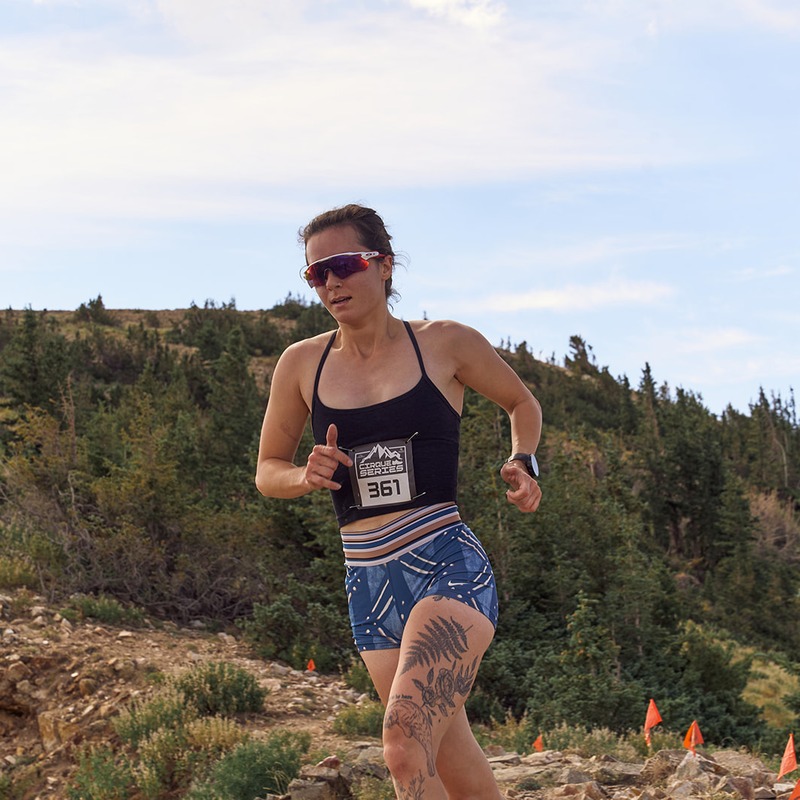
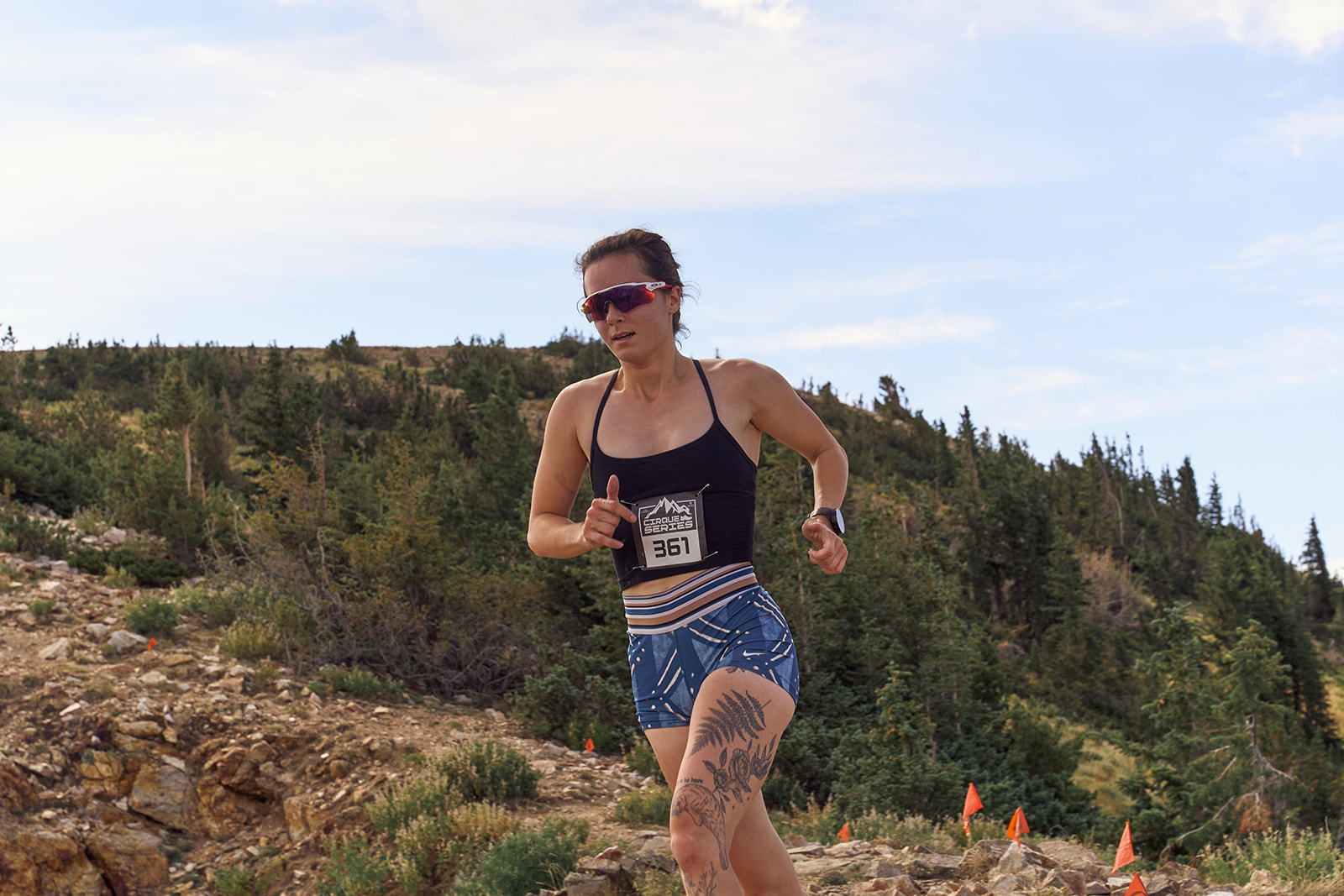
    Kendall Kramer running uphill on a rocky mountain course wearing race bib 361.
    Kramer climbing at the Cirque Series race at Alta, Utah, in 2025. Summer mountain races have been part of her calendar for years. (Photo: Austin Elliott Photography)

    A Race Within the Race

    The Broken Arrow Ascent rises 2,840 feet over 3.61 miles at Palisades Tahoe, ending near 9,000 feet on Washeshu Peak. The course offered Kramer a familiar kind of discomfort. Skiers spend plenty of summer training sessions running uphill, and she has raced mountains throughout her life in Alaska. She was also drawn to an uphill-only event, where she could attack the climb without risking the pounding, falls and injuries that can accompany a technical descent.

    The altitude complicated the effort. An ascent race can feel like a sprint, Kramer said, because its short length allows runners to push rather than settle into prolonged power hiking. Near 9,000 feet, that approach requires more restraint. Still, years of ski racing and training at elevation gave her a sense of how to manage those obstacles.

    Kramer had entered with a tangible goal: finish in the top 10 and earn prize money. The field was strong enough that doing so, she felt, would also establish her among other serious mountain runners.

    She started picking off competitors as the course climbed and found another surge near the end, when a cluster of women remained within reach. Kramer lost track of her exact position amid the passes but knew she was close. She crossed two seconds behind 10th place.

    “I was like, ‘Oh darn,’” Kramer said. “At least it was a good effort race.”

    Weeks earlier, the elite runners had been told that the Ascent would double as the USATF uphill championship and a qualifier for the World Cup Finale. Kramer bought a USATF membership and entered that competition, too, mostly because there was no reason not to. She skimmed the qualification information without giving it much thought.

    “This field is crazy,” she remembered thinking. “That’s not really going to be me.”

    After the race, Kramer and her mother began walking from the summit toward the tram. She checked the overall results first. Then she noticed a separate view for the USATF championship, which removed athletes who were not entered in the national race. Kramer had nearly forgotten about the competition within the competition.

    Her name was listed in fourth, and the top four qualified.

    “I totally didn’t factor myself into that,” Kramer said. “It was definitely a surprise. I was really proud that I could make a team like that.”

    Kramer may not have expected the qualification, but it drew on years spent building the aerobic engine and uphill strength that mountain racing rewards. She simply had not imagined that an ability maintained partly for balance and enjoyment would carry her onto another international team.

    A young Kendall Kramer running a road race alongside an adult runner wearing a race bib.
    Kramer came to athletics through running before she found skiing. Both of her parents are runners. (Courtesy photo)

    A Runner First

    Running has never felt like a secondary sport to Kramer, even as skiing became her profession.

    “Running was always my main sport, in the sense that that’s what I got into when I got into athletics,” she said.

    Both of her parents are runners, and running shaped the athletic culture of her family in Fairbanks. She tried soccer and baseball, but she liked the directness of a sport in which her work and her result felt closely connected. Skiing came later because, as she put it, it was “what all the cool kids did.”

    The two sports eventually became inseparable. At the University of Alaska Fairbanks, Kramer competed in both throughout college. She won three straight Great Northwest Athletic Conference cross-country titles and finished second at the 2024 NCAA Division II Cross-Country Championships. Four months later, in the final ski race of her collegiate career, she won the 20-kilometer freestyle at the NCAA Skiing Championships.

    Kramer’s skiing has since reached a new level. She made her Olympic debut in Italy in February and placed ninth in the World Cup skiathlon in Falun in March, her first top-10 World Cup result. Yet running still supplies something that skiing cannot.

    “If I didn’t have it, I wouldn’t be able to handle all of the skiing that I do,” Kramer said. “I like feeling like I have another athletic outlet to keep me happy, because skiing can be fleeting and have all sorts of disappointments with equipment and stuff. Running feels more in control.”

    That control is physical, but it is also logistical. A ski race can hinge on wax, snow, weather and the work of moving equipment from one place to another. Running asks much less before the gun goes off. On a running trip, Kramer said, there is more space to enjoy the people and the place around the competition.

    “It feels like it adds to your life,” she said. “It’s so manageable.”

    The harder question came when her college cross-country career ended. Kramer loved the sport’s courses, team culture and changing terrain, but there is no obvious post-collegiate version of NCAA cross-country. Track and road racing did not offer the same pull, and she was not ready to build her running life around marathons on pavement.

    Mountain racing offered another route. In Alaska, it had never felt like a separate niche so much as part of the local calendar. Races such as Mount Marathon and the Cirque Series became summer traditions, with familiar faces returning to familiar mountains each year. Two weeks after Broken Arrow, Kramer placed seventh at Mount Marathon in 52:53.

    “I loved running cross-country and being in the woods and going along a course that has different aspects,” Kramer said. “You have an uphill and downhill, and you have to change, just like skiing.”

    Mountain racing preserved the parts of running Kramer loved and opened a path to international competition she never expected to enter.

    Kendall Kramer racing the World Cup skiathlon at Falun, Sweden.
    Kramer on her way to a career-best ninth in the World Cup skiathlon in Falun, Sweden, in March. She argues that summer racing is part of what makes winter results like that possible. (Photo: Authamayou/NordicFocus)

    Keeping a Pulse on Racing

    For Kramer, racing in the summer is not a diversion from ski training. It is one of the ways she makes that training more useful.

    An occasional race does interrupt a perfectly planned week. She may back off for a few days beforehand, then need time to recover afterward. Some skiers see that as lost volume. Kramer believes the costs are outweighed by the chance to revisit sensations that ordinary training cannot reproduce.

    “Racing is very different from training,” she said. “At least I think so, and I think it should be different from training.”

    Kramer likes to race roughly once a month during the offseason. Each start provides a checkpoint on her fitness, pacing and ability to summon focus when a result matters. Those reminders make the first ski races of winter feel less abrupt; she arrives with recent evidence of how her body and mind respond in competition.

    Races also make weaknesses harder to ignore. A disappointing moment can become the direction for the next training block rather than a problem discovered after the ski season begins.

    “Sometimes you don’t get an idea of where you’re lacking and where your strengths are if you don’t tap into that throughout the summer,” Kramer said.

    At Broken Arrow, the crossover was all around her. Olympic ski mountaineer Anna Gibson won the Ascent and the U.S. uphill title in 43:15. Diggins completed all three races, a total of 75 kilometers with more than 16,000 feet of climbing, and finished fourth in the Triple Crown standings. Sophia Laukli has built an elite trail-running career alongside cross-country skiing, winning the 2023 Golden Trail World Series. In August, Gibson placed sixth among women at Switzerland’s Sierre-Zinal, while the recently retired Diggins finished 37th.

    Those examples helped Kramer recognize that mountain running can be more than incidental cross-training. The sport has international races, sponsors and prize money, particularly in Europe. Its U.S. elite pool remains relatively small, and a skier who already possesses a strong aerobic base can become competitive quickly. That does not make the crossover effortless.

    “I’m not going to act like I’m couch-to-mountain-running,” she said. “I’m definitely trying, and I’m also not downplaying the girls who do train for it. But I am saying that ski training works for it, and getting fit in general works for it.”

    The larger benefit may be less measurable than fitness. Elite skiers live by periodized plans: intervals on one day, over-distance training on another, each block designed to build toward winter. Kramer believes athletes can become so protective of that structure that they miss the value of occasionally disrupting it.

    “People are really scared to break away from that,” she said. “But I think you can be a really adaptable athlete and build skills that a regimented training plan can never get you.”

    Her confidence in that approach has been earned over years of combining running and skiing without sacrificing results in either. That history has also built trust with her coaches. An unplanned race or an imperfect training week does not look like recklessness when the larger pattern shows that she understands how to make the two sports work together.

    The mental return matters as much as the physiological one. A summer race provides the competitive charge that long weeks of training can lack and asks an athlete to solve problems in real time: exactly what winter racing eventually demands.

    Kendall Kramer in a running vest above an alpine lake in the Alaska mountains.
    Kramer on a run in the Alaska mountains. Her next start comes Oct. 10 at Mont-Sainte-Anne in Quebec. (Courtesy photo)

    The Next Side Quest

    Kramer’s next test comes Oct. 10 at Mont-Sainte-Anne in Quebec, where the circuit will make its first visit to Canada. The current course listing calls for five kilometers and roughly 800 meters of climbing. It will begin far below the altitude Kramer encountered at Broken Arrow, removing one variable while preserving a steep uphill challenge.

    She wants to finish in the top 10. Broken Arrow showed that she can stay close to that range in a deep international field, and the chance to race without a near-9,000-foot finish has left her curious about what more she can do.

    Beyond Quebec, Kramer would consider mountain races in Europe if a sponsor or U.S. team opportunity made the travel possible. She is not mapping out a second full professional calendar yet. The appeal lies partly in leaving room for opportunities to appear, then being fit and adaptable enough to take them.

    “I would love to look back and see that I took those opportunities,” Kramer said. “Running has never hurt me in the past. I’ve always been able to juggle both.”

    Kramer does not argue that every skier should copy her schedule. She wants more athletes to leave room for the experiences that may not fit perfectly into a training plan but help them handle everything racing asks of them.

    “It can make you a better skier in ways that maybe aren’t the best training on paper,” Kramer said. “But it makes you a good athlete, which comes in handy when you least expect it.”

    At Broken Arrow, that lesson was waiting in a second set of results she had nearly forgotten to check.

    Help Support Our Coverage!

    If you value the thoughtful work and access FasterSkier provides, please consider becoming a Voluntary Subscriber. Your support directly fuels our work to cover the people, places, and moments that make our sport special.

    Join the FasterSkier community!
     

    Kendall Kramer racing cross-country in an Alaska Fairbanks singlet, number 24, past a course flag line.
    Kramer racing cross-country for Alaska Fairbanks. She won three straight GNAC titles and finished second at the 2024 NCAA Division II championships. (Courtesy photo)
  • National Nordic Foundation Launches 2026 Summer Auction

    National Nordic Foundation Launches 2026 Summer Auction

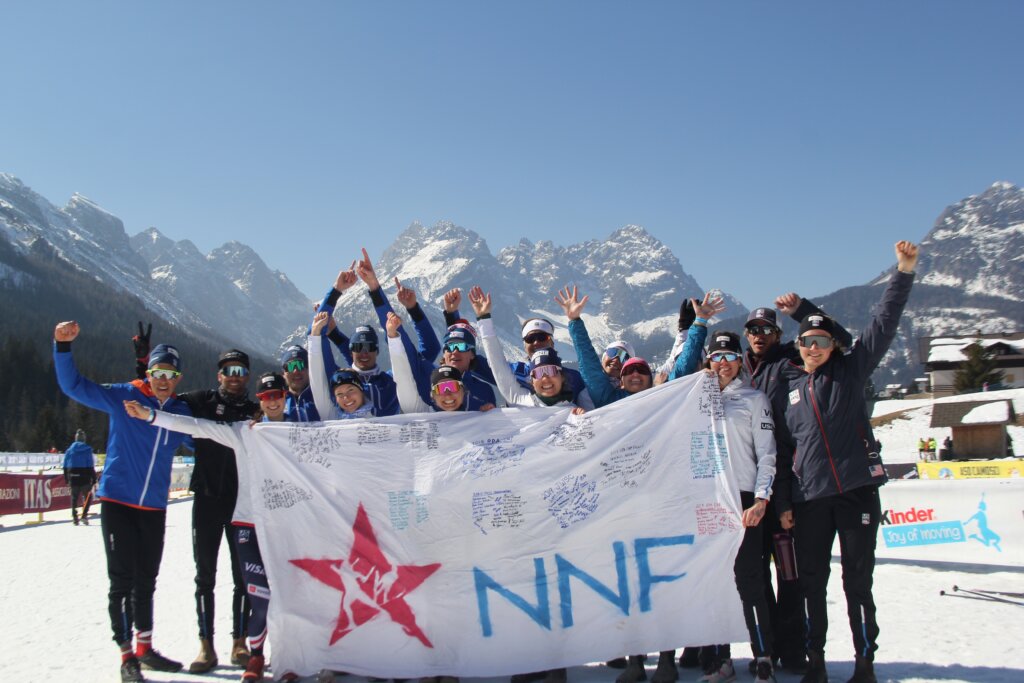
    The National Nordic Foundation (NNF) has kicked off its annual Summer Auction, running through July 13, with a fundraising goal of $30,000 to support grassroots Nordic ski development across the country. As of this week, the auction had already raised roughly $8,700 toward that target.

    The online silent auction features a mix of gear, experiences, and unique memorabilia, including a fan bib signed by Jessie Diggins, an entry into the Alley Loop 42k, a training and technique video call with Kristen Bourne, and an autographed soccer ball from Sammy Smith, among other items still open for bidding.

    Proceeds support NNF’s mission of centralizing funding and energy behind Nordic sport, connecting donors with athletes and programs at every level of the pipeline. Skiing fans can browse items and place bids at www.32auctions.com/NNFSummerAuction2026 before the auction closes on July 13.

  • Sundling Victory, Diggins Victory Lap

    Sundling Victory, Diggins Victory Lap

    This coverage is made possible through the generous support of Marty and Kathy Hall and A Hall Mark of Excellence Award. To learn more about A Hall Mark of Excellence Award, or to learn how you can support FasterSkier’s coverage, please contact info@fasterskier.com.

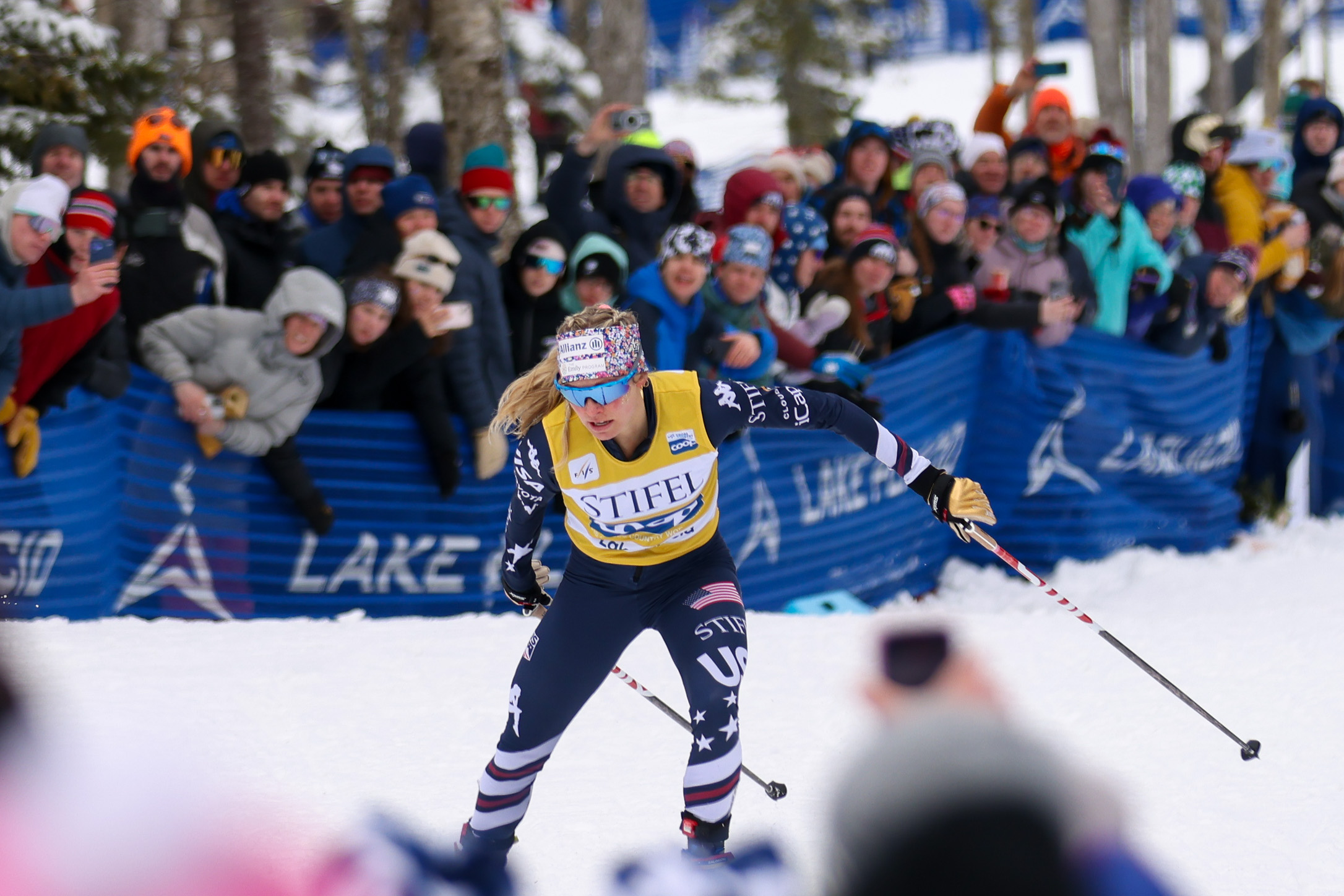
    Jessie Diggins (USA) celebrates an entire career as she crosses the finish line of the 20 k Mass Start in Lake Placid. Thousands of fans in attendance celebrated with her. (Photo:  Thibaut/NordicFocus)

    While the men’s 20 k Mass Start Freestyle (raced earlier in the day) was the source of anticipation and intrigue, the Women’s 20 k was more likely to become a glorious victory lap. At the very beginning of the 2025-2026 season, Jessie Diggins had announced that this season would be her last. The most decorated American cross-country skier—and the winner of three World Cup Overall Crystal Globes—would hang up her skis after the final race in March in Lake Placid. Back then, that final day was still many months and many miles away. Today, Diggins toed the starting line for the beginning of these final kilometers. The staging of a glorious victory lap was entirely  appropriate, and Diggins would make it one whether she won the day’s race, or not. That’s how she’s raced her entire career: joy in the competition, celebration in the victory, satisfaction in the effort, gratitude for the team. She’s left us breathless as many times as she has exhausted herself at finish lines, her effort as pure as the snow into which she has toppled after victories and defeats, alike. Her total effort and utter devotion could never have been in doubt. We have loved watching her give it all. Today, in Lake Placid, we were given one last precious opportunity to do so.

    How ironic, then, that nature chose to rain, literally, on this parade. Spring conditions in the Adirondack Mountains are notoriously capricious. Lake Placid sits at the highest elevation of any village in the east, and the combination of elevation and proximity to both the Great Lakes and the Atlantic coast makes it a place for weathers to converge, for clouds to gather, where the mountains wear late-season robes of white, where the skies deliver showers of snow—and of rain. We’re often reminded that cross-county skiing is a winter sport—and racing through difficult conditions is the expectation, not the exception. So if there’s a victory lap to undertake, then a full-on storm of freezing rain seems like an appropriate way to do it.

    Heidi Weng (NOR) and Frida Karlsson (SWE) provided the pace for much of the 20 k Mass Start in Lake Placid, but they didn’t manage to drop the most dangerous sprinter, eventual race winner, Jonna Sundling (SWE). (Photo: Thibaut/NordicFocus)
    20 k Mass Start

    Fans knew who to watch: Frida Karlsson, Heidi Weng, and Diggins. And Diggins has a strategy that she folows in mass-start events: allow others to set the pace on uphills, even letting herself get gapped, only to close those gaps on subsequent downhills. When she uses that strategy, she keeps herself in contention for as long as possible.

    At the 8 kilometer mark, those contenders remained together, and were in the company of numerous others who could play a part in the strategy of tis race. Astrid Oeyre Slind has begun to find the form that eluded her in Milano-Cortina,and Linn Svahn and Jonna Sundling lurked in the lead pack, hoping to be there at the end where their lightning-fast sprints could perhaps snatch victory from the distance specialists.

    Karlsson set the pace in the early kilometers, but not at the uber-speed that has often been seen in women’s racing over the past few seasons. Weng came forward to take over the pace-making just prior to the bonus points line at 9 kilometers, moving Karlsson back into the pack where she is far less comfortable. So uncomfortable, in fact, that Karlsson immediately ran headlong into an unexpectedly fallen Slind. Both of them ended up in a tangle as Weng and the leaders glided away. Weng captured the bonus points that she needed to maintain her position on the podium of the Distance competition. Weng continued to push the pace, but all the logical contenders seemed capable of preventing her from breaking away.

    Diggins moved to the lead at the 12 kilometer mark, using her fast skis and descending ability to glide to the front before powering up a mid-lap hill. Karlsson (who had weaved her way back to the lead) took up a position at Diggins’ shoulder. These two—along with Weng and Slind—would do their best to undo the strengths of the sprinters in the kilometers that remained. But with Diggins, Sundling, and Svahn still in contention, Karlsson and Weng were leaving things a bit late.

    Karlsson, Weng, Diggins, and Sundling came through in order at the final bonus points line, seemingly less interested in those points than they were in positioning themselves for all that was likely to transpire in the final two kilometers. At the top of the final uphill, Norwegian Karoline Groetting surged to the lead. She was pursued by Karlsson and Weng, with Sundling and Diggins just behind. One kilometer to go, one major downhill to navigate . . .

    Years ago—at the beginning of what was to become an historic career—a young and impetuous Jessie Diggins was often seen to lose control on downhills. She would ultimately overcome that limitation, becoming one of the best and most daring downhillers on the World Cup scene. Today in Lake Placid, though, Diggins’ past caught up with her. Every competitor would be exhausted at this point in a 20 k race, and maintaining control on any fast, winding downhill would be tremendously difficult. As the leaders descended a steep lefthand curve, Sundling picked an outside line that was especially fast. The video replay shows Diggins seeming to notice Sundling’s acceleration. The shift in Diggins’ posture made it clear that she felt the need to accelerate a bit, herself, but the extra step she took shifted her weight to the tails of her skis. Just like that, Diggins went down. Less than a kilometer from the end of the race—just minutes from the end of an astounding career—Diggins fell from contention. Not one to lie in the snow feeling sorry for herself while a race is going on, Diggins sprung to her feet and took off in pursuit of the leaders. Her race for today’s podium may have been over, but Diggins was far from being done with the racing. If only one kilometer remained in her career, Diggins intended to race her heart out over that final kilometer.

    Jonna Sundling (SWE) was the skier everyone else in the field was most determined to drop. They didn’t . . . (Photo: Thibaut/NordicFocus)

    At the front, Sundling’s daring downhill move had produced the speed she needed, and she stormed off the front followed only by the other best sprinter, Svahn. Weng was game in giving chase, but she had no chance of catching the two Swedish speedsters. Sundling first, Svahn second, Weng third. Diggins would recover from her tumble on the turn to finish 12th.

    The last fifteen years have represented a golden age in women’s cross-country skiing, and there is one skier, in particular, whose career has spanned those years: Jessie Diggins. From the dominance of Justina Kowalczyk, to the excellence of Marit Bjoergen, to the determination of Charlotte Kalla, to the brilliance of Therese Johaug, to the spotlight she shares with the truly dominant team of Swedes, Diggins has born witness to the best this sport has had to offer. From them, she learned her craft. With them, she elevated a sport and thrilled an audience. The sport will miss her exuberance and her joy, her silliness and her seriousness. Thank you, Jessie, Diggins, for doing your best, for leaving it all out on the course, and for taking us all with you on this glorious victory lap.

    World Cup Final Women’s 20 k Mass Start RESULTS

    Love Stories Like This? Help Keep Them Coming.

    Feature stories like this one take time, access, and care to produce. If you value thoughtful storytelling and independent ski journalism, please consider becoming a Voluntary Subscriber. Your support directly fuels the work we do to cover the people, places, and moments that make our sport special.

    Join the FasterSkier community!
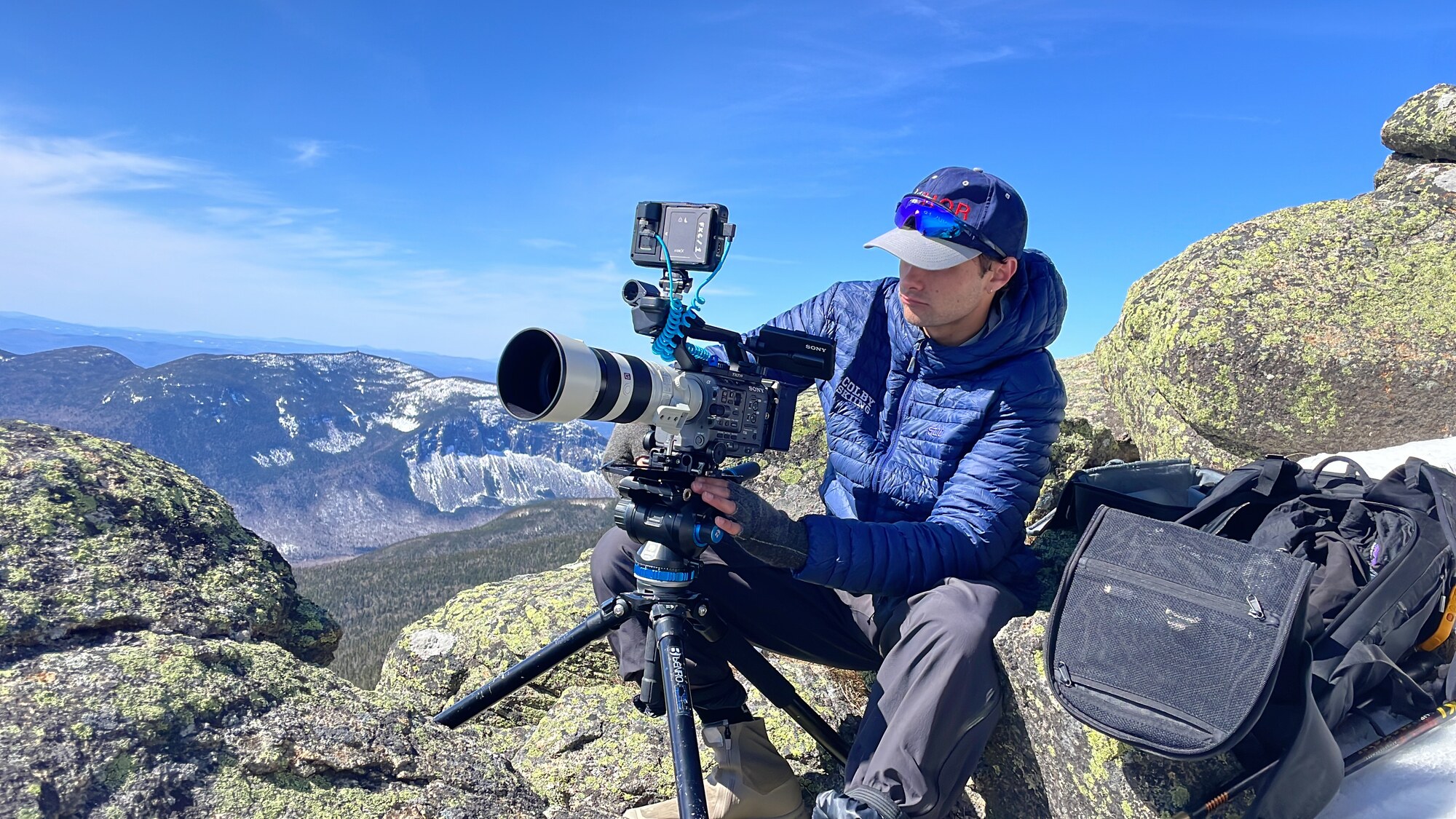
    Jessie Diggins (USA): exuberance and joy, silliness and seriousness. (Photo: Modica/NordicFocus)
  • No One Lives Here,” They Said. Then 10,000 Plus Fans Showed Up in Lake Placid

    No One Lives Here,” They Said. Then 10,000 Plus Fans Showed Up in Lake Placid

    This coverage is made possible through the generous support of Marty and Kathy Hall and A Hall Mark of Excellence Award. To learn more about A Hall Mark of Excellence Award, or to learn how you can support FasterSkier’s coverage, please contact info@fasterskier.com.

    Jessie Diggins during the quarterfinals of the Freestyle Sprint on Saturday in Lake Placid, New York, USA. (Photo: Voisin / FasterSkier)

    Lake Placid, N.Y. — The French coaches had questions. Two days before racing began at Mount Van Hoevenberg, they were standing in Saranac Lake — 55 degrees, windy, woods in every direction — wondering who exactly was going to show up to watch cross-country skiing in the middle of the Adirondacks.

    By Saturday, an estimated — rumored to be fair — 14,000 people had answered.

    Today, as Jessie Diggins lines up for the 20-kilometer mass start freestyle, the final race of her career, this corner of upstate New York will try to top itself one more time.

    Screaming fans, chainsaws, flags, signs, and glitter all over the course in Lake Placid, New York, USA. (Photo: Voisin / FasterSkier)
    A Weekend That Kept Building

    The first sign that Lake Placid was going to be different came Friday, and it wasn’t entirely smooth. With an initial estimate of 10,000 fans on Friday, the transportation system to and from Van Hoevenberg buckled under the demand. Some fans waited over two hours to get to the venue.

    Diggins finished fifth and clinched her fourth career overall Crystal Globe — her third in a row. She told reporters afterward that the crowd was so loud she couldn’t hear herself breathe. Johannes Høsflot Klæbo returned to win the men’s 10k, leading a Norwegian sweep of the top five.

    ORDA adjusted to the shuttle demand on the fly, pulling in school buses from across the region to shuttle people up the mountain, and by the time Saturday got started, things felt even bigger at the venue. The sprint course was packed — 14,000 fans by some estimates — as Sweden’s Linn Svahn dominated the women’s sprint and Maja Dahlqvist locked up the sprint Crystal Globe. And Federico Pellegrino, in his own final World Cup sprint, scripted the perfect ending with a masterful win — a retirement farewell that carried echoes of what’s coming today for Diggins.

    US Head Coach, Matt Whitcomb, after the races yesterday in Lake Placid was really happy because the standout performance was not one of his athletes, but instead the North American ski community that showed up in droves and created an electric atmosphere. (Photo: Voisin / FasterSkier)
    “Only Holmenkollen and Minneapolis”

    U.S. Ski Team head coach Matt Whitcomb has been on the World Cup circuit for years. He said the only events throughout his career that have ever rivaled the atmosphere here this weekend in Lake Placid are the Holmenkollen in Oslo — the sport’s grand prix if you will — and Minneapolis two years ago.

    That’s the company Lake Placid is keeping. And for those who were in Minneapolis, the comparison lands. Diggins said earlier this week that Minneapolis was the most special day of her career.

    “It was the most I’ve ever cried,” she said at Wednesday’s press conference. “I got to race in front of some of my grandparents who haven’t been able to travel overseas. They got to see me race for the very first time in a World Cup. And having so many friends and family and getting to share the thing that I love doing with them — that is the most incredible thing ever.”

    She paused, then added: “I think this weekend’s probably going to join that.”

    College skiers from all over the Northeast came in force to the trailside in Lake Placid, New York, for the races this weekend. (Photo: Voisin / FasterSkier)
    The Scene on the Ground

    What the numbers don’t capture is the texture. Young kids running around the venue in their NNF fan bibs — the ones with athletes’ faces printed on them — clutching Sharpies, hoping to meet their heroes. Fans who drove and flew from Vermont, from Alaska, from Minnesota, who planned vacations around this weekend months ago. The school buses that became part of the story, ferrying the faithful up the mountain road when the original plan couldn’t hold.

    This is what U.S. cross-country skiing looks like when it gets the stage. Not a packed NFL stadium or a sellout basketball arena — but thousands of people standing in the woods, screaming themselves hoarse for athletes from every country, because they love this sport and they know how rare these weekends are.

    The fans — especial the college skiers — made it sound like the race was happening in Davos, Switzerland with the chainsaws out on course. (Photo: Voisin / FasterSkier)
    One More Race

    Diggins has spent this weekend doing exactly what she said she would — being present, soaking it in, putting on a show. She clinched the Crystal Globe on Friday. She raced the sprint on Saturday. And now there’s one more.

    At Wednesday’s press conference, she talked about the way her mindset around suffering has evolved — how she’s learned to see the pain cave not as something to dread but as confirmation that she’s doing what she came to do.

    “This is what 100 percent feels like,” she said. “And sometimes this is what it looks like, and it’s some ugly scene, but that’s okay. It just has to be all heart and all effort, and that’s what I have to give in that moment.”

    She also made one thing clear about the team she’s leaving behind: “The team is going to be just fine without me. And I feel like that’s how I know I did my job.”

    Then, with a smile: “I’m excited to be a fan on the other side of the fence and get to cheer for them.”

    Today, in just ten minutes, Jessie Diggins will clip into her bindings for the last time as a World Cup racer. The 20-kilometer Mass Start Freestyle.

    And based on everything this weekend has shown us, “no one” will be watching.


    Love Stories Like This? Help Keep Them Coming.

    Feature stories like this one take time, access, and care to produce. If you value thoughtful storytelling and independent ski journalism, please consider becoming a Voluntary Subscriber. Your support directly fuels the work we do to cover the people, places, and moments that make our sport special.

    Join the FasterSkier community!
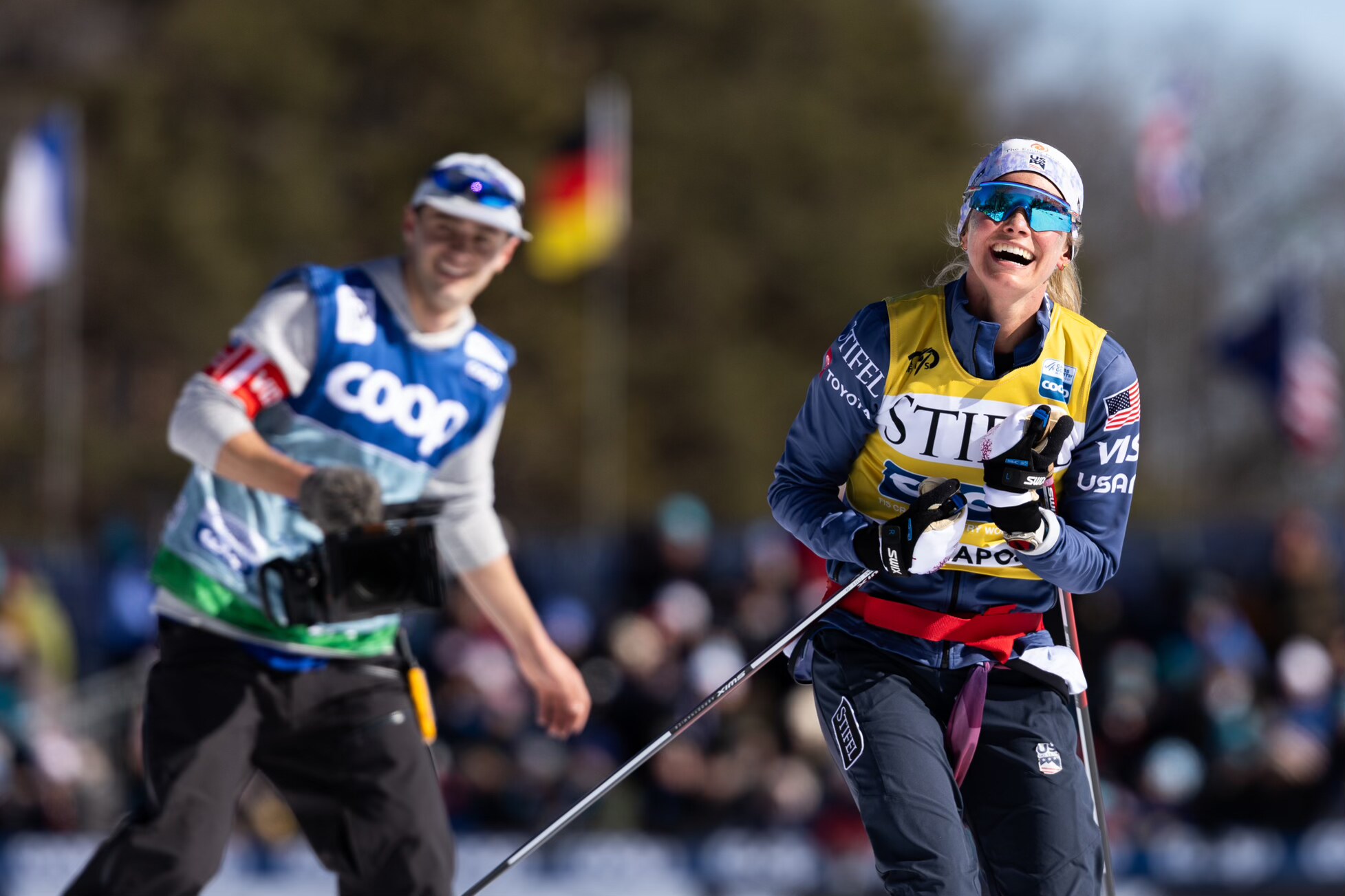
     

    When the sun finally came out the crowd got especially excited. (Photo: Voisin / FasterSkier)
  • The Case for More American World Cups

    The Case for More American World Cups

    This coverage is made possible through the generous support of Marty and Kathy Hall and A Hall Mark of Excellence Award. To learn more about A Hall Mark of Excellence Award, or to learn how you can support FasterSkier’s coverage, please contact info@fasterskier.com.

    Johannes Hoesflot Klaebo (NOR) back in action and lifted by the roar of American ski fans during the World Cup 10 k Classic in Lake Placid, New York. (Photo: Dils / FasterSkier)

    LAKE PLACID, NEW YORK — Ten kilometers into the second World Cup on American soil in as many decades, and the verdict is already clear: We need more racing in the United States.

    That’s the message panted into my microphone by every athlete in the Mix Zone; shouted over the undulating din by every supporter I spoke with on the ice-lacquered walkways lacing Mt. Van Hoevenberg. And it’s the irresistible outcome of the turnout this afternoon in Lake Placid — with a crowd that came out in droves for Diggins, the Schumacher-Ogden’s Silver Medal Squad, and a host of homegrown heroes; that braved five inches of wet, driving snow; and that stayed to see Jessie clinch the Overall Crystal Globe, a reconstituted Klæbo overtake Amundsen in the Distance standings, and to welcome the world’s best to the conclusion of the 2025-26 season.

    The reaction to racing in the United States in 2023 was overwhelmingly positive – and, it had seemed, sui generis. With four snowmaking venues spread across the Twin Cities, along with the (purportedly) highest concentration of cross-country skiers outside of Oslo, the energy that embraced Jessie Diggins in her home state and buried a generation of “almosts” for the U.S. Men’s Team in the snow and mud at Theodore Wirth could have been lightning in a bottle.

    Jessie Diggins (USA) racing on home soil in Minneapolis and did so again in Lake Placid as she concludes her storied World Cup career. (Photo: Modica/NordicFocus)

    I will admit my own skepticism that Lake Placid could field the fans, or the volume, of spectators to match Minneapolis. Perhaps my flight into Saranac Lake Regional Airport on Wednesday morning was my first evidence of error. Of seven passengers bobbing our way through the cloud-laden Adirondacks, four were here for the World Cup: Charlie, from Seattle; Billy (as in, Demong, the Nordic Combined gold medalist) and his son, from Salt Lake City; and myself, from D.C. Bussing to the venue the next day, I’m seated with a dozen of University of Minnesota alumni – they’ve taken off of work, graduate school, and medical school to spectate. “I’m excited just to see the number of people out cheering,” Alex Gude, who organized the trip, tells me. “I think one of the best parts about Minneapolis is just seeing the community come together, and now, away from home, we’re seeing another whole ski community come out and cheer.”

    And, indeed, they are – from across the United States, from across New England, from across the Canadian border, and from right here in Lake Placid. Once we disembark, I wade through the corn snow and the first of many falling flakes to Mt. Van Hoevenberg’s sprawling Nordic Center, where the racecourse coils around the podium and snakes below the pedestrian bridge. Patricia Damp is herding thirteen might-be-members of the local ski community across the bridge; she’s a third-grade teacher here in Lake Placid, chaperoning a class field trip to the World Cup Finals.

    Are the kids already Diggins die-hards, Ogden acolytes, Gus bus-riders? Not really, Patricia tells me. The class “was out here a couple months ago, cross-country skiing. We get to do the Olympic venues. We were at the museum a month ago. We have a friend who we watched ski jump. So, we’re very Olympic-oriented, and today we’re just out here to support the athletes and get some autographs.” Her students back her up. “We’re excited to get the players’ signatures,” Riley tells me. And while Declan is “excited to see the racers,” there’s no-one in particular he’s cheering for.

    Gus Schumacher (USA) during the Men’s 10 k Classic in Lake Placid, New York. (Photo: Dils / FasterSkier)

    From the mouths of children, our first – and perhaps strongest – argument for future American World Cups. The glitter-dusted kids in fan club bibs, wielding cardboard-cutout faces as large as they are, make for compelling pictures and undeniable evidence of Team USA’s impact on its next generation. But racing in the United States creates opportunities to draw an entirely new cohort of young people into the cross-country skiing community – kids who may have never tried skiing before; who may not have heard of Kikkan or Klæbo ; and whose parents certainly are not waking up before sunrise to livestream Ruka, Falun or Holmenkollen. They will not see themselves in this sport until they see this sport. What better way to do so than on a Friday field trip with Mrs. Damp?

    After bidding them good luck with the signature-hunting, it’s not an easy task to wade against the current of the rest of the Lake Placid Class of 2035. Also threading his way through the third-graders is Niklas Dyrhaug, immediately recognizable even five years into retirement from World Cup racing. He’s on the other side of the v-boards this weekend, broadcasting for Norwegian television. In his first sentence, he tells me: “We are enjoying being back in the U.S. In my opinion, we should be here every year.” He’s not surprised by the number of spectators, either. “Everybody who knows the U.S. crowd knows they are really enthusiastic . . . We know the tradition, the culture, and Lake Placid’s place in that history. So, personally, I’m not that surprised. It’s really cool that we’re back here.”

    That’s the sentiment just after Coaster Hill, some four kilometers into the racecourse, where Norwegian national team coach Eirik Myhr Nossum prowls the striding zone. Being back in the United States is “awesome, it’s amazing. I think we should be here every year, because you guys show up; you guys cheer for everyone, and it’s always fun to be in the U.S. and to be overseas to compete.”

    And it’s the sentiment at the finish line.

    Harald Oestberg Amundsen (NOR) after the 10 k Classic in Lake Placid, New York. (Photo: Thibaut/NordicFocus)

    Harald Amundsen (NOR) tells me, “In the outer part of the track, there were so many people I couldn’t hear my own thinking. That’s a really good thing.” Even before he arrived at the venue, “We had a run this morning in the city. Everyone was screaming at us, ‘Good luck!’ It’s a really nice atmosphere.”

    For Elia Barp (ITA), conditions were “very tough because it was really slow with this new snow, but it was fun racing for me. So I enjoyed it – at least I tried to enjoy it – it was a pack of people screaming my name so that gave me even more motivation, and was fun . . . I loved racing two years ago in Minneapolis, and here it’s packed with people, even with the snowfall, so thank you to everyone for coming. It’s really good to race here.”

    Mika Vermeulen (AUT) admits, “Honestly, this is probably the worst race I’ve done in a long time. But I don’t think I’ve ever had so much fun out on the track . . . on top there, out in the forest, I just heard, ‘MI-KA, MI-KA,’ the whole time. It was insane. I had a bad race and a lot of fun.”

    As for how he feels about returning to the United States: “Great, great, actually—and feeling a bit frustrated, because it just gets me pissed that we race these [bad] courses in Europe all the time, over and over and over again, and we have these freaking jewels out here which we never use. It’s crazy. I want to go to the U.S. every year for at least a whole period. It’s called the World Cup. It’s not called the European Cup, right?”

    Fans all over the course with custom gear showing their fandom. (Photo: Dils / FasterSkier)

    Klæbo’s opinion is a bit more measured – perhaps because he has more microphones hovering around his face. “I heard some rumors that it was supposed to be quite well [attended], and when I searched up Lake Placid and read a little bit about the place, I understood there’s not that many people living [here], but when you see how many people are here, I was pretty shocked.”

    A second argument, then, in favor of World Cup racing in this country: the athletes love it. They embrace not just the energy, but the venues that push the World Cup beyond the geographic and cultural confines of Transalpine Europe.

    Benjamin Dohlby (USA) at the finish of the Men’s 10 k Classic in Lake Placid. (Photo: Thibaut/NordicFocus)

    For the closing statement, Ben Dohlby is among the last athletes I interview. This is Ben’s first World Cup start; a junior at University of Alaska-Fairbanks, he was 3rd in the American Birkebeiner in February. How does it feel to be making his first professional start in the United States?

    “It was crazy. I went out so hard. The fans were so loud that I didn’t feel anything, and then I felt it all and got so tired – but it was awesome; a great atmosphere.” It wasn’t too long ago that Ben was skiing laps around the glazed kilometer of manmade snow at Lapham Peak State Park in Delafied, Wisconsin; now he’s here. To his former teammates, to other up and coming skiers, and to novices across similar ribbons of snow in Wisconsin, Michigan, and Minnesota, his message is simple: “Follow your dreams and you can make it happen.”

    Most of the fans hiked up on the course, but the stadium filled up as the day went on. (Photo: Dils / FasterSkier)

    That, then, is our concluding point: More World Cup starts on American soil means more starting berths for American skiers, and more chances for our most talented young skiers to make it to the starting line. We should savor the privilege of, as a host nation, pitting our athletes against the most accomplished figures in the sport, dreaming that a World Cup podium, an Olympic medal, could be in their future. When a lifetime of discipline and preparation meets the opportunity of a lifetime, the promise of Lake Placid – that miracles can happen – becomes deliverable.

    I will leave the invariable complex problems of bidding, organizing, and logistically managing future events to far wiser pundits. But, in the meantime, the verdict is clear: FIS, U.S. Ski & Snowboard, and the American Nordic community should be eager, and determined, to have them here.


    Love Stories Like This? Help Keep Them Coming.

    Feature stories like this one take time, access, and care to produce. If you value thoughtful storytelling and independent ski journalism, please consider becoming a Voluntary Subscriber. Your support directly fuels the work we do to cover the people, places, and moments that make our sport special.

  • Svahn Goes the Distance, Diggins Clinches Crystal Globe

    Svahn Goes the Distance, Diggins Clinches Crystal Globe

    This coverage is made possible through the generous support of Marty and Kathy Hall and A Hall Mark of Excellence Award. To learn more about A Hall Mark of Excellence Award, or to learn how you can support FasterSkier’s coverage, please contact info@fasterskier.com.

    Linn Svahn (SWE) showed that she is no one-dimensional sprinter, holding off the season’s dominant Distance skier —Swedish teammate, Frida Karlsson—for the win in the FIS World Cup Final 10 k Classic Interval Start in Lake Placid. (Photo: Modica/NordicFocus)

    FasterSkier’s reporters watch every single race of the World Cup and Olympic season, so we have our own ideas regarding what may happen on any given race-day. We’ve followed who has been progressing up the standings, who has been fading, who has been injured or ill and how their recovery has progressed. And we follow the amazing and durable actions of Jessie Diggins (USA) who has competed in every single race of the season (That’s right, isn’t it? Someone check the record . . .). Alone among all World Cup competitors, Diggins continues to devote herself to performing at the highest levels on every available race day. If she’s tired, she deals with it. If she gets sick, she overcomes it. If she’s injured, she races through it. If there’s a start line and a finish line, drawn on the snow Diggins is racing. While it may be argued that she might’ve performed even better if she took a day off from time to time, evidently it’s impossible for her to just sit out those race opportunities. And Diggins is also one of only two skiers in the world (along with Johannes Hoesflot Klaebo) who has an honest chance to win on any given day, regardless of distance or discipline. And the reward for such devotion and fortitude?

    All eyes were on Jessie Diggins (USA) whose career is winding down to retirement, but not before another excellent top-five performance in the 10 k Classic, and the clinching of another World Cup Crystal Globe. (Photo:  Thibaut/NordicFocus)

    Any day’s race coverage begins with a check of the start list; that’s how we see the first inclinations of how the story might unfold. Here’s the context of today’s 10 k Classic Interval Start: perennial contenders, Ebba Andersson (SWE) and Kerttu Niskanen (FIN) have chosen to stay home home, Krista Parmakoski (FIN) retired at eh Holmenkollen finish line, and Dariya Nepryaeva (AIN) wasn’t allowed into the country (no American visas issued to Russian citizens) . . . The rest of the contenders appeared to be present. Among the logical contenders within the women’s field were those whose performances shined brightest this season, but whose illnesses and injuries kept them from contention in the year-long FIS World Cup competitions. Frida Karlsson (SWE) is undoubtedly the fastest skier in the world today as she proved repeatedly in the Olympic Winter Games and the recent Holmenkolen 50 k. She is joined by a list of other Distance contenders including Heidi Weng (NOR), Astrid Oeyre Slind (NOR) Karoline Simpson-Larson (NOR), Jonna Sundling (SWE), Moa Ilar (SWE), and Olympic Sprint champion Linn Svahn (SWE).

    Host-nation USA was allowed additional entries. In addition to the much-anticipated participation of Diggins, the American roster included Emma Reeder, Alayna Sonnesyn, Katey Houser, Renae Anderson, Emma Albrecht, Samantha Smith, Novie McCabe, Kendall Kramer, and Rosie Brennan.

    “It’s really awesome to know how many people care about skiing in America,” Kramer said in response to the crowds of eager spectators gather around the course. “It’s heart warming!”

    “I love racing at home!” said Brennan. “It’s so awesome. I had many moments when I was second-guessing myself out there. then Id get to a hill and everyone was going nuts, yelling my name, and I was like ‘Okay, I got this! I got this!”  ‘

    “Honestly, I don’t care about the results,” beamed Diggins after the finish. “I just wanted to enjoy the crowd, and feel the love and the excitement, and just go as hard as I could! Laying in the snow there at the end, I was like ‘That was one of the best 10ks of my life.’”

    In the end, it was Svahn winning a back-and-forth battle with her good friend, Karlsson. Sweden would top the podium, but Heidi Weng would prove the best of the rest, finishing 22 seconds behind the winner. Diggins would battle through the falling snow to secure a fifth place finish in the final interval start race of her career.

    Frida Karlsson (SWE) surged to a mid-race lead, but it was not enough to overcome the momentum of her teammate, Linn Svahn. (Photo: Modica/NordicFocus)
    Not Yet Spring

    While the field—and the spectators—may have been hoping for sunny and mild spring conditions. Wouldn’t that have been nice? But Lake Placid sits at an elevation of 2200 feet—quite high for the east coast—and spring is notoriously late to arrive in these Adirondack mountains. Race day dawned with dense cloud and swirling snow, conditions that seemed likely to challenge ski technicians and skiers, alike.

    The 10 k Classic would be skied over two five kilometer laps climbing immediately from the stadium into the woods. Svahn was the revelation among early starters, totally gapping the rest of the field at all early check points. At the halfway mark of the race, Svahn led all earlier starters by nearly a minute! Later starters among the top seed would begin whittling into Svahn’s times, but even Karlsson would trail by eleven seconds at the first checkpoint, with her teammate, Sundling, another five seconds behind.

    Diggins started in bib 58. She would trail Svahn by 23 seconds at the first checkpoint (13 seconds behind Karlsson, 10 seconds behind Slind). The contenders’ splits were bunched near the front, but it was definitely Svahn who appeared strongest. Svahn continued to hold that lead over Karlsson at the 3.8 kilometer checkpoint, by which time Diggins had managed to take six seconds out of Svahn’s lead.

    Svahn would surge again in the middle kilometers to put another six seconds into Diggins, but the splits identified the next serious challenger as Slind pulled within just a few seconds. And that’s when Karlsson made her move, pulling even with Svahn at 6.7 kilometers. Had Svahn gone out too fast?

    Svahn has won 14 Sprint races in her career, but it is less known that she’s also won three Distance races. She is certainly no slouch when it comes to long events, and she obviously possess great endurance ability. That’s what she must’ve drawn upon in the later kilometers as—despite the charge from Karlsson—Svahn would finish in a dominant 29:04, surging to the victory by 1.4 seconds to claim the first Individual Start Distance victory of her career.

    Diggins would thrill her fans with another gutsy performance, giving her all—as she has always been known to do—in finishing fifth on the day. She extended her lead in the Overall World Cup standings over her closest rival, Sweden’s Moa Ilar, virtually closing out that competition for the fourth time in Diggins’ illustrious career.

    World Cup Final Women’s 10 k Classic RESULTS

    Love Stories Like This? Help Keep Them Coming.

    Feature stories like this one take time, access, and care to produce. If you value thoughtful storytelling and independent ski journalism, please consider becoming a Voluntary Subscriber. Your support directly fuels the work we do to cover the people, places, and moments that make our sport special.

    Join the FasterSkier community!
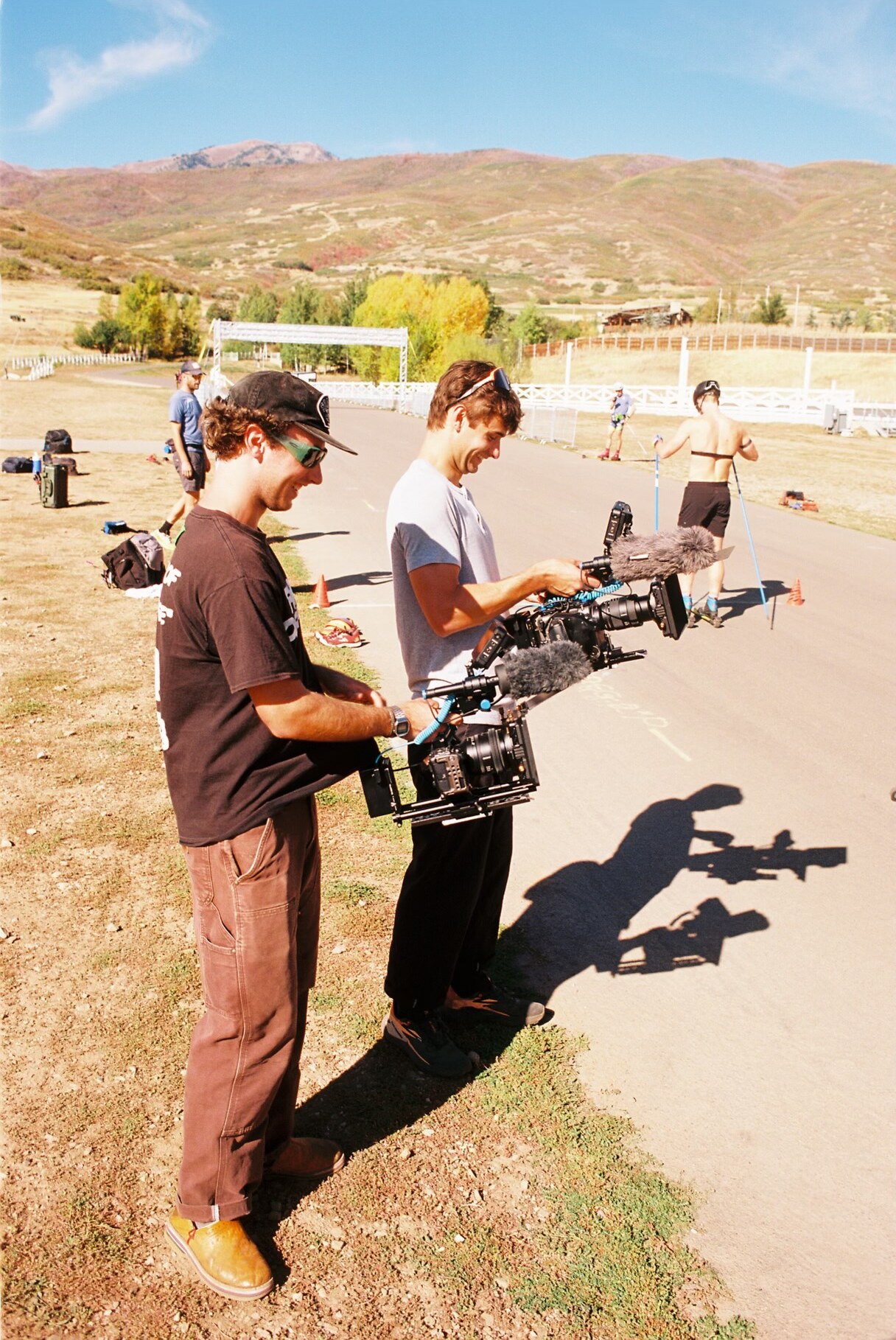
    Frida Karlsson (SWE) gave it her all in Lake Placid, only to fall just short of the performance of her good friend, Linn Svahn. (Photo: Thibaut/NordicFocus)

    World Cup racing continues from Lake Placid this weekend:

    Saturday, March 21

    10:30 am | Women’s Sprint Qualification Free

    11:05 am | Men’s Sprint Qualification Free

    1:00 pm | Women’s Sprint Final Free

    1:00 pm | Men’s Sprint Final Free

    Sunday, March 22

    12:30 pm | Men’s 20km Mass Start Free

    2:30 pm | Women’s 20km Mass Start Free

    4:30 pm | ONE LAST LAP w/Jessie Diggins & the Retiring Stars

  • Glitter, Knitting, and a Phone Call from Bill Koch: The U.S. Ski Team Is Ready for Lake Placid

    Glitter, Knitting, and a Phone Call from Bill Koch: The U.S. Ski Team Is Ready for Lake Placid

    This coverage is made possible through the generous support of Marty and Kathy Hall and A Hall Mark of Excellence Award. To learn more about A Hall Mark of Excellence Award, or to learn how you can support FasterSkier’s coverage, please contact info@fasterskier.com.

    Jessie Diggins answering questions at the press conference before the World Cup in Lake Placid, New York. (Photo: Voisin/FasterSkier)

    Lake Placid, N.Y. — The eve of the World Cup finals at Mount Van Hoevenberg brought press conferences, sound checks that went sideways, and three American skiers who couldn’t stop making each other smile.

    Jessie Diggins, Ben Ogden, and Gus Schumacher sat side by side Wednesday afternoon — the same trio that has turned the 2025-26 season into something U.S. cross-country skiing has never seen before. Between them: Olympic medals, historic podiums, a 50-year drought shattered, and one very good birthday cake.

    But with three races left and Diggins’s retirement looming, the mood wasn’t heavy. It was loose, funny, and deeply human — exactly the way this team tends to do things.

    “Probably Glitter”

    Asked to define her legacy heading into her final World Cup weekend, Diggins did what Diggins does: she went somewhere unexpected.

    “I think I define my legacy honestly, completely outside race results,” she said. “I am more proud of the things I have done off the course. I think my legacy is going to be in my advocacy and the way that I have spoken about mental health and eating disorders specifically, and the way I’ve tried to make really hard conversations less hard for people to have.”

    She pointed to her work with Protect Our Winters and Share Winter, to the energy she’s poured into the team’s culture over the years. And then she landed the dismount.

    “And probably glitter. I think there’s a lot more glitter in ski races now, and that’s always a great thing — as long as it’s biodegradable.”

    Diggins has spent the season saying goodbye in pieces — a little cry leaving training camp in Bend, quiet moments at each World Cup stop. She knows what’s probably coming Sunday.

    “I suspect it’s probably going to hit like a dump truck on Sunday, and there’s probably going to be a lot of tears.”

    But she’s ready. And what she’s ready for is maybe the most Jessie Diggins thing of all: she sees ski racing as performance art, and she wants her final show to leave people wanting to go run up a mountain or sign their family up for ski lessons.

    “I realized that I can do that moving forward, but just with my story and with my words, and I don’t have to push my body so hard, but I can still leave people inspired and motivated.”

    In the meantime, she’s looking forward to being able to wash her clothes when they’re dirty, cook whatever she wants, and bake cookies on the weekend instead of training and racing all day.

    Ben Ogden answering questions at the press conference before the World Cup in Lake Placid, New York. (Photo: Voisin/FasterSkier)
    “Your Life Is Not Going to Be the Same”

    Ben Ogden grew up in Landgrove, Vermont. American skiing legend Bill Koch lived close by in Peru, Vermont. Same zip code, as Ogden puts it — “not so different.”

    Fifty years separated Koch’s 1976 Olympic medal from Ogden’s silver this season, and when Ogden finally got on the phone with his neighbor and mentor after breaking the drought, Koch didn’t mince words.

    “Bill just sort of said, ‘Hey, congratulations, and your life is not going to be the same from this point forward.’ And that was kind of crazy to hear.”

    Ogden hopes to see Koch at the races this weekend. And racing at Van Hoevenberg carries its own weight for him — not just because of Koch, but because of his father, who was deeply embedded in the New England ski racing community.

    “I think it’s really hard for me to come race in the U.S. and look around and not just, like, constantly think about him, because this was his scene,” Ogden said, his voice softening. “He would have been in such paradise on the side of the trail here in Lake Placid. And I’ll be thinking about him a lot this weekend, for sure.”

    This is technically Ogden’s first home World Cup — he was sick for Minneapolis — and it’s hitting him right. He grew up racing the NYSEF Festival series at Lake Placid, bringing crews of Vermont kids over for slushy late-season races.

    “It’s not my home, but it feels like it.”

    Gus Schumacher answering questions at the press conference before the World Cup in Lake Placid, New York. (Photo: Voisin/FasterSkier)
    Aspirations, Not Goals

    Gus Schumacher has been doing some linguistic rebranding.

    “I’ve been calling them aspirations for a few years now,” he said of his season targets, “because I feel like the pressure of goals was kind of weird for me.”

    The distinction matters to Schumacher. He sets plenty of small goals — the daily, tactical kind — but the big ones, like winning an Olympic medal or finishing in the top 10 of the overall World Cup standings, he holds more loosely. They’re aspirations: things he wants, things he’ll chase, but things he won’t let crush him if they don’t happen.

    “Those are things I want to do, but if they don’t happen, it won’t be because I didn’t try.”

    He accomplished the Olympic medal. He entered this final weekend ranked sixth in the world, with a top-10 finish still in play. And he’s approaching Lake Placid the same way he approached Minneapolis, where he won his first World Cup in front of a hometown crowd: just be happy to be racing, and feed off the energy.

    “Already today, it was really cool to have people cheering us on in the race prep, which doesn’t really happen much on the World Cup ever.”

    Schumacher also dropped maybe the best origin story of the press conference: the formative moment that lit a fire under his career was Luke Jaeger beating him at an Anchorage cup race.

    “That kind of put a fire under my belly to really start training, because I didn’t want him beating me anymore.”

    The Knitting Club, the Water Pump, and the Greenhouse

    The press conference’s best stretch might have been when someone asked the athletes how they decompress.

    Schumacher keeps it clean: headphones, 10 to 20 deep breaths — four seconds in, eight seconds out. Standard operating procedure.

    Ogden? He knits. And he’s not shy about it.

    “After races, I’ve been doing a lot of knitting and stuff like that. Helps me just relax really quick.” After the season, it’s bigger projects: car work. “You can feel like you’re the king of the world after a couple medals, but go and try and replace a water pump on a Forerunner, and that’ll make you feel completely incompetent.”

    Diggins revealed there was a full-on knitting club on the team this winter. Her own reset button is simpler: she calls her husband.

    “He’s my absolute center of my world. The race could have been amazing, and it could have been also completely horrible. And we’re just talking about what I want to do with the garden, and how I want to start a greenhouse. And he’s like, ‘Uh huh, yeah, sure, I’ll support you in that.’”

    One More Thing

    Almost as a throwaway, Ogden mentioned that Andy Newell — “the original Nordic ski backflip guy” — is in Lake Placid this weekend. And Ogden himself has had a backflip dialed since he was 17.

    “I’m hoping on Sunday we can kick up a little ski jump. I’m looking to take another one Sunday afternoon. So stay tuned.”

    Three races to go. A retirement to honor. A culture to celebrate. And maybe a backflip.

    It’s going to be a weekend.


    Love Stories Like This? Help Keep Them Coming.

    Feature stories like this one take time, access, and care to produce. If you value thoughtful storytelling and independent ski journalism, please consider becoming a Voluntary Subscriber. Your support directly fuels the work we do to cover the people, places, and moments that make our sport special.

    Join the FasterSkier community!
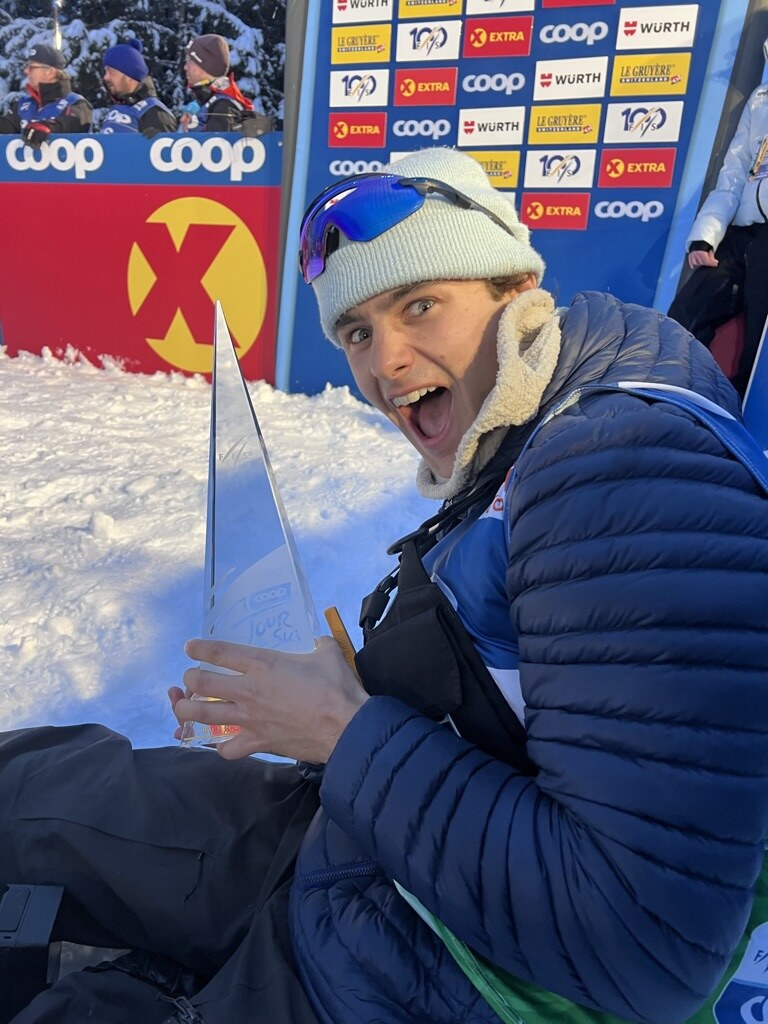
     

  • Jessie Diggins Teaches Us How to Endure

    Jessie Diggins Teaches Us How to Endure

    Jessie Diggins (USA) has inspired fans of all ages across the world. This weekend, many of them will gather along the race course, on her home snow, to say thank you. (Photo: Vanzetta/NordicFocus)

    This Sunday, a lesser-heralded chapter of American history will close when Jessie Diggins enters her final World Cup event. She will leave the sport at the absolute top of her game, for the fourth time as the overall Crystal Globe winner, having slogged it out over a season that began the day after Thanksgiving above the Arctic Circle in Finland and will end 33 races later right here in Lake Placid, NY. She is the only skier, male or female, to compete in every single individual competition this year, from sub-three-minute sprints to two-plus hour marathons, before throngs of beer-guzzling fans in the sun and to empty Teutonic stadiums in the spritzing January rain.

    During the run-up to the Milan Olympics, she briefly returned to the national zeitgeist, hyped for her ability to dig into the pain cave, and seen writhing on the ground beyond the finish line, a paroxysm of gasping. A high school student of mine had seen the feature on her in the New York Times, and a room of young athletes in Greenwich, CT — alien to Nordic ski culture — spent the full English class discussing the efficacy of pushing one’s limits. People around the once skilliterate Westchester County even started making the connection of why I’d named my dog “Diggins.”

    Diggins Donahue (Photo: Timothy Donahue)

    During her first Olympic race this year, Diggins crashed in traffic on the slushy snow and bruised her ribs. So naturally, five days later, she gritted her way to a bronze in the 10-kilometer freestyle and to 5th in the 50-kilometer classic on the final day of the Games. But just a week after this, when the collective gaze had drifted from the luge and returned to the Epstein files, she came improbably, from back in the field to within 0.1 second of winning a 20-kilometer in Falun. I watched this tuck-skate drag race with my daughter, who has a Diggins poster on her wall, and we screamed so loud the neighbors asked if everything was okay.

    Against the slow off-gassing of rage coming across the airwaves — the sex trafficking, the elementary school bombing, the painful erosion of dignity and competence — Diggins has given us an important antidote all these years. In early 2021, when insurrectionists were sprawling their feet and flag across Nancy Pelosi’s office, Diggins was on her way to winning her first Tour de Ski. I remember the Alpe Cermis climb, when she crested into view in her red, white, and blue race suit, and thinking that she, too, is a compatriot. This past January, when her native Minnesota had become an epic fury, she won her third Tour de Ski title and was entering her fourth Olympics. She wrote, “For everyone out there caring for others, protecting their neighbors, and meeting people with love — every single step is for you. YOU are the ones who make me proud to carry the flag, and I hope I can bring you joy over these next few weeks.”

    Jessie Diggins (l) and Kikkan Randall soak up their win in the women's freestyle team sprint on Wednesday at the 2018 Olympics in PyeongChang, South Korea. (Photo: FIS Cross Country/Twitter)
    Jessica Diggins (USA), and Kikkan Randall (USA), (l-r) win America’s first cross-country Olympic gold in the women’s team sprint at the 2018 Pyeongchang (KOR) Olympics Pyeongchang. (Photo: Fischer/NordicFocus)

    When she won Olympic gold with Kikkan in 2018, she was suddenly in the spotlight. Unfamiliar territory for our stoic sport whose only other American medalist to that point was Bill Koch, who won silver a half-century prior, and retreated into the moss of Vermont. But she was on the Wheaties box, and on commercials for Chipotle, Salesforce, Deliotte, and Toyota. She gave countless Swift-like appearances to throngs of impressionable youth; she lobbied in Washington D.C. for climate change reform. They found out her team nickname was “Sparkle Chipmunk,” and her pre-race glitter applications became her meme. She choreographed music videos; she shared homemade baked goods during the five-month-long European exodus. And she infected a hunger-based confidence that vaulted our underfunded, lowly squad to rival the Scandinavian powerhouses. Proclaimed as “the face of American skiing” and “America’s sweetheart,” she shouldered all this as she simultaneously maintained the fitness to train and race to her own world-best standards.

    But as she reveals in the excellent, newly-released documentary about her called “Threshold” (with screenings all weekend at Lake Placid’s Palace Theater), the pressure of doing this day-in, day-out, for six solid years, got to her. As she tells the movie camera, it reacquainted her with senior year of high school: “I was trying to go 100 percent into every single corner of my life because I couldn’t sit still with the feeling that I was not enough.” In 2023, she relapsed with her eating disorder. In the film, she narrates this journey with a raw earnestness that, like her approach to skiing itself, cuts right to the marrow. “I’m willing to put my story on the line to help change this,” she says.

    Jessie Diggins (CXC) on her way to first place at US Nationals in Rumford, Maine. (Photo: Hallie Herz)

    Those of us who recall her first U.S. National title, back in 2011, among the paper mill aromas of Rumford, ME, fold this into our meta-narrative of triumph over challenge. Where others stand tall and firm on their skis, like maestros conducting their symphonies, Diggins hides none of the pain. Her head bobs, her shoulders undulate, her breathing seems louder than anyone else’s. She’s dropped off the back of the pack and yet somehow, she finds something. She’s not done. Here comes Diggins! If she can do it, I can do it.

    This winter, I was particularly attuned to Diggins because, after two partial knee replacements, I was trying to claw my way back into competitive skiing. There were no Toyota endorsements at stake for me, but it was enough to re-connect with the core of this sport. Yes, it’s a beautifully nurturing, soul-susurrating exercise, but climbing up a hill deep into a race, it’s really just about holding off an explosion. The lack of oxygen excites my imagination and it’s all I can do to stay quiet and suppress the inevitable voices saying no, it’s too hard, this guy ahead of me is probably a wonderful father, it’s ok.

    Who can say for sure what’s inside the mind of Diggins as she enters this state, this tribute of her current to her source that she has alchemized into fist-pumping, tear-jerking frenzy? But I know that the highlight reels she has brought us over her 15-year career – breaking a pole and scrambling with one arm to her first World Championship gold in 2013, finishing gloveless with a bloody face in 2023 (after another pole incident) and still earning silver, collapsing the day after food poisoning to win silver in the 2022 Olympics – this is something that should give the nation pride. She tells us, “I want to cross that finish line and I want to be so tired that I can’t even stand up, so that I know I gave everything in my heart toward my very best effort.” And she speaks with her actions.

    We project our own wish fulfillment onto our heroes, and for the run of her career, with its 365 World Cup starts — more than anyone in history — Diggins has sturdily and gracefully absorbed our collective desires. Now she is leaving on her terms, from the top step of so many podiums, a master of her time.

    The Donahue daughters have been inspired by Diggins their entire lives — and they’ll be on-site for one last weekend of racing, sending her off with the skier’s signature heart and a glorious sunset on an amazing career. (Photo: Timothy Donahue)

    Love Stories Like This? Help Keep Them Coming.

    Feature stories like this one take time, access, and care to produce. If you value thoughtful storytelling and independent ski journalism, please consider becoming a Voluntary Subscriber. Your support directly fuels the work we do to cover the people, places, and moments that make our sport special.

    Join the FasterSkier community!


  • Klaebo Is Coming to Lake Placid

    Klaebo Is Coming to Lake Placid

    This coverage is made possible through the generous support of Marty and Kathy Hall and A Hall Mark of Excellence Award. To learn more about A Hall Mark of Excellence Award, or to learn how you can support FasterSkier’s coverage, please contact info@fasterskier.com.

    Johannes Hoesflot Klaebo (NOR) took all six gold medals awarded in men’s cross-country skiing at the Olympics last month. (Photo: Barbieri/NordicFocus)

    Johannes Hoesflot Klaebo made the call late Tuesday night… he’s racing.

    According to the Scandinavian press, Klaebo departed Oslo’s Gardermoen airport at 6:25 Wednesday morning, beginning a roughly 20-hour journey to Lake Placid, where he’ll arrive about a day and a half before Friday’s 10-kilometer classic interval start. The Norwegian Ski Federation confirmed the news in a press release on Wednesday morning.

    “I can see this isn’t going to be an optimal buildup, both with the long travel and not being able to adjust to the time difference,” Klaebo said. “But I want to be part of the World Cup finale in the USA.”

    The decision came after Klaebo did a training session on Tuesday morning in Trondheim and responded well. National team doctor Ove Feragen gave him the green light.

    Ben Ogden (USA) checks on Johannes Hoesflot Klaebo (NOR) after their crash eliminated them from the race in Drammen, Norway. (Photo: Nordnes/NordicFocus)

    “After the fall during the sprint in Drammen, and some quiet days at home, Johannes has gradually resumed training and normal activity,” Feragen said. “He has responded well to this, without any recurring symptoms after the fall. After observation and further examinations, we have concluded that he is fit to compete.”

    Klaebo has been sidelined since March 12, when American Ben Ogden fell across the Norwegian’s skis during Classic Sprint semifinals in Drammen, Norway. The resulting crash sent Klaebo’s head into the hard-packed snow. He was diagnosed with a mild concussion, withdrew from the Holmenkollen 50k, and scrapped a planned media tour in New York City that included sit-downs with CNN, NBC, the New York Times, and the Wall Street Journal.

    Now the question shifts from whether Klaebo will race to how much he’ll race. He’s not committing to the full program.

    Harald Oestberg Amundsen (NOR), Johannes Hoesflot Klaebo (NOR), and Martin Loewstroem Nyenget (NOR), (l-r) share the Skiathlon podium in Falun, Sweden, on March 1st, 2026. (Photo: Thibaut/NordicFocus.)

    “My expectations for performance are not sky-high,” Klaebo said. “I’ll do my best despite a poor buildup and potential jet lag. Whether I race one, two, or three events in Lake Placid, I’ll decide once I get to the USA and get skis on my feet.”

    The stakes are real despite the measured tone. Klaebo has already clinched the overall World Cup — his sixth, tying Bjoern Daehlie — and the sprint globe. But he trails Harald Oestberg Amundsen by three points in the distance standings after missing the Holmenkollen 50k. Two distance events remain: Friday’s 10 k Classic and Sunday’s 20k Freestyle Mass Start. A clean sweep of the overall, sprint, and distance globes would be a first in Klaebo’s career.

    “For cross-country skiing, it’s especially important to have World Cups in the USA,” Klaebo said. “I’ve been looking forward to this finale for a long time.”

    Racing begins Friday at Mt. Van Hoevenberg. Klaebo will be on the start line — jet lag and all.


    Love Stories Like This? Help Keep Them Coming.

    Feature stories like this one take time, access, and care to produce. If you value thoughtful storytelling and independent ski journalism, please consider becoming a Voluntary Subscriber. Your support directly fuels the work we do to cover the people, places, and moments that make our sport special.

    Join the FasterSkier community!


    Ben Ogden (USA) and Johannes Hoesflot Klaebo (NOR), along with Oskar Opstad Vike (NOR), (l-r) on the Olympic sprint podium last month.  It should be made clear that Ogden and Klaebo have a strong respect for one another, to say the least. (Photo: Vanzetta/NordicFocus)
  • What to Do in Lake Placid When You’re Not Watching World Cup Racing

    What to Do in Lake Placid When You’re Not Watching World Cup Racing

    You’ve got your tickets. You know the race schedule. You’re making the trip to Mt. Van Hoevenberg for the first World Cup finals ever held on American soil. But the racing doesn’t fill every hour of the day, and Lake Placid is the kind of town that rewards a little wandering. Over the last 15 years, my family and I have spent a lot of time in Lake Placid, and here’s what we’d suggest for filling in the gaps — whether you’re traveling solo, with a crew, or with kids in tow.

    Fuel up

    Start the morning at Big Mountain Deli & Crêperie on Main Street. They’ve got 46 sandwiches named after Adirondack high peaks, plus breakfast burritos, crepes, and all the espresso drinks you need to survive a cold morning in the stadium. A word of advice: order online in advance. The line moves faster if your food is already being made. Note that they’re closed on Wednesdays, so plan accordingly if you’re arriving midweek.

    If you’d rather sit down and take your time, The Breakfast Club is just up the street and serves a proper breakfast and lunch with views of Mirror Lake. The portions are generous, the pancakes are legit, and if you’ve got kids, the hot cocoa is a guaranteed win. They open at 8 a.m. daily and close at 1, so don’t dawdle.

    Lunch and dinner

    For a real meal, Lisa G’s is our pick. It’s a short drive from Main Street on Sentinel Road, with a menu that leans American but doesn’t phone it in — think elevated pub food with creative wings, excellent fish and chips, and a solid beer list. They serve lunch on Fridays through Sundays starting at 11:30, and dinner Thursday through Monday. Closed Tuesdays and Wednesdays, so keep that in mind for early-week arrivals.

    For something more upscale, the Mirror Lake Inn is one of the classic Adirondack properties — a lakefront resort with a polished dining room and views to match. And if you want something a bit more casual but still special, check out The Cottage, also on the Mirror Lake Inn grounds. It’s a cozy spot right on the water where you can grab dinner or a drink in an old gondola. It’s open Tuesday through Sunday — closed Mondays.

    If you’re looking for a spot that can handle a crowd, Dancing Bears at the High Peaks Resort is worth a look. It’s at the far end of Main Street and has plenty of space — which matters on a weekend like this one, when every restaurant in town is going to be slammed. We’re fans of the food here, especially the salmon. It’s a reliable pick when other spots have a 45-minute wait.

    Breweries

    Lake Placid has two breweries worth your time, and both serve food if you’re looking to make a full stop of it.

    Lake Placid Pub & Brewery has been an institution on Mirror Lake Drive for years. The beer list is deep, the vibe is pub-casual with college banners lining the walls, and the upstairs bar is a solid spot to post up after a day at the races. They’re open daily from 11:30 a.m. (noon on Sundays) and stay open late — midnight on weeknights, 2 a.m. on Fridays and Saturdays. If you can only try one drink, ask about the Smoked Berry Old Fashioned.

    Big Slide Brewery & Public House is out on Cascade Road, about a five-minute drive from downtown and right near the Olympic Jumping Complex — which makes it an obvious stop if you’re heading to the Skirious Problems live recording Saturday evening. The beer ranges from fruit-forward lighter options to solid IPAs and porters, and the food holds its own. The burgers are good, the pizza is legit, and the buffalo wings have a bit of a cult following. They’ve also got outdoor seating with fire pits and Adirondack chairs if the weather cooperates. Open daily from 11:30 a.m. (10 a.m. on Sundays).

    Catch some NCAA March Madness

    The World Cup finals land smack in the middle of the NCAA basketball tournament, and if you need a screen and a cold beer between race sessions, Lake Placid has you covered. Wiseguys Sports Bar & Grill on School Street is the classic move — TVs everywhere, good wings, no pretense. They’re open Wednesday through Sunday. Players Waterfront Eatery on Main Street is another solid option with screens and lakeside seating if the weather cooperates.

    Stroll and Explore Main Street

    Don’t underestimate a good Main Street stroll. Lake Placid’s downtown is walkable and full of shops worth ducking into.

    Saratoga Olive Oil Company is one of those places you walk into out of curiosity and end up spending way longer than you planned. They’ve got dozens of flavored olive oils and balsamic vinegars you can taste — some combinations will surprise you, and it’s a genuinely fun challenge for your taste buds. Great for picking up a gift or just entertaining yourself for half an hour.

    The Maple Shop is exactly what it sounds like — a deep dive into maple syrup and all things maple. But it’s more interesting than you might expect. They carry different varieties and grades, and tasting your way through the range is a quick education in how much variation there is in something most people think of as one flavor.

    Adirondack Popcorn Co rounds out the Main Street tasting tour. They specialize in creative popcorn flavors — some classic, some funky — and it’s the kind of snack you can grab and take with you to the races or back to wherever you’re staying.

    Get Outside

    You’re in the Adirondacks. Get some fresh air.

    Though having recently CLOSED at the end of the 2026 season, Olympic Speed Skating Oval is open for public skating and is one of the few outdoor refrigerated ovals in the country. If the oval’s schedule doesn’t line up with yours, Mirror Lake itself often has a maintained skating area — check conditions locally when you arrive.

    Get out on the Ironman Lake Placid course on Mirror Lake Drive — hopefully it won’t be raining — like IMLP Champion Trevor Foley. (Photo: Voisin / FasterSkier)

    For our money, no trip to Lake Placid is complete without a walk or jog around Mirror Lake. The loop is about 2.7 miles on a paved path, it’s flat and accessible, and the residential architecture along the shoreline is worth the trip on its own — beautiful old Adirondack homes mixed in with classic lake houses, all set against the mountains. It’s a perfect way to shake out your legs before or after a day in the stadium.

    If you’re looking for something a bit more rugged, there are dozens of short hikes in the area, but be warned: this time of year, trail conditions are unpredictable. You might hit packed snow, mud, ice, or all three in the span of a quarter mile. Bring traction devices if you have them, and dress for the mess. Cobble Hill is a nice short option with a rewarding view at the top — nothing too long or steep, but enough to feel like you earned it.

    Need to get out for a Nordic Ski

    If you’re itching to actually ski while you’re up here, your options may be limited. Mt. Van Hoevenberg’s trails will almost certainly be closed to the public during the World Cup weekend. But if you’re willing to make the drive, the Paul Smith’s College VIC in Paul Smiths — about 30 minutes north of Lake Placid — is a strong option. We checked in with Paul Smith’s head Nordic coach Matt Dougherty, who had his team out on the trails Wednesday morning for biathlon practice. “It was actually fantastic,” Dougherty told FasterSkier. “Conditions will reflect the temperatures — normal spring skiing.” Most trails are open and being groomed daily with the college’s PB 100, though a few trails that got washed out last week are closed for the season. The VIC maintains over 25 miles of trails, including more than 10 kilometers of FIS-homologated courses and 25 kilometers of skate skiing. The system benefits from heavier snowfall than other parts of the region, which tends to keep trails skiable even when conditions elsewhere are lean. Trail conditions are updated on their Nordic Pulse page. The VIC’s winter season runs through April 1.

    Saturday Evening at the Jumps

    After the sprint finals wrap up on Saturday, head over to the Olympic Jumping Complex on Cascade Road for a live recording of the Skirious Problems podcast at 6:00 p.m. Hosts Mika Vermeulen and James Clugnet will be joined by Ben Ogden, Frida Karlsson, and Federico Pellegrino. It’s free, but organizers are suggesting it may already have sold out — check the World Cup Finals event page for the link. After that, the Palace Theatre downtown is screening Threshold at 7:00 p.m.

    Family-friendly fun

    The Lake Placid Toboggan Chute on Mirror Lake is one of those only-in-Lake-Placid experiences — a 30-foot wooden tower that launches you and a toboggan out across the frozen lake. Warmer spring temperatures have caused the chute’s closing for this season, but it’s typically open Friday evening and Saturday and Sunday during the day. Lines can build, but it’s worth the wait.

    If you’re already out at Mt. Van Hoevenberg, the Hi Notch Indoor Climbing center is right inside the Mountain Pass Lodge. It will be CLOSED during the FIS World Cup finals, but other days you’ll find a 30-foot top rope wall with over 1,500 square feet of climbing space, plus bouldering and traverse walls. All gear is provided, and instructors are on hand during daytime sessions. It could be busy this weekend, given the crowds, but it’s a great option for families or anyone who needs to burn off some energy between races.

    If you’ve got a free morning or want a half-day excursion, the Wild Center in Tupper Lake is about 45 minutes west and worth every mile. It’s a natural history museum with live animals, hands-on exhibits, and the Wild Walk — a series of treetop bridges with panoramic views of the Adirondacks. It’s open Friday through Sunday, so you could pair it with a race day or build it into your travel schedule. Just know you’ll have to choose between the Wild Center and a morning at Van Hoevenberg if you’re trying to do both.

    Closer to town, the Palace Theatre on Main Street is a beautifully maintained old single-screen movie house — a perfect way to wind down after a long day in the cold. And if your group wants something more active, Lake Placid Lanes (also known as Big Z’s) has bowling, arcade games, shuffleboard, darts, and a full bar. Reservations are recommended, especially on weekends — this place fills up.

    Lake Placid has been hosting the world’s best winter athletes since 1932. The town knows how to do this. Get out there and enjoy it.

  • Karlsson Leads Swedish Sweep Through Holmenkollen Fog

    Karlsson Leads Swedish Sweep Through Holmenkollen Fog

    This coverage is made possible through the generous support of Marty and Kathy Hall and A Hall Mark of Excellence Award. To learn more about A Hall Mark of Excellence Award, or to learn how you can support FasterSkier’s coverage, please contact info@fasterskier.com.

    Frida Karlsson (SWE) claimed her third Holmenkollen win, her second at the 50 kilometer distance. (Photo: Authamayou/NordicFocus)

    The prize for winning Oslo’s Holmenkollen 50 k is lifelong bragging rights. Such is the nature of the prestige afforded this event within the Nordic ski community. Norwegian fans, especially, remember certain years, certain races, certain rivalries; especially those that are memorable for the racing conditions that challenged the athletes. Fans are likely to remember this 2026 edition, and the thick, stubborn fog that enveloped the racers throughout the 50 kilometer distance. Stadium announcers regularly reminded the audience that racers were entering the stadium . . . otherwise, fans might not have known. The fog may have appeared thicker and soupier through the lens of broadcast cameras, but it’s certain that the fog hung close to the ground, obscuring skiers’ views of the course, of the crowds, and of their competitors. Perhaps that had something to do with the more measured pace the leaders selected. By the halfway point of the race, the entire women’s field was still together (not at all the normally expected state of affairs in women’s mass-start Distance racing). The regular cast of contenders remained at the front—Frida Karlsson (SWE), Ebba Andersson (SWE), Heidi Weng (NOR), Astrid Oeyre Slind (NOR), Jonna Sundling (SWE), and Jessie Diggins (USA)—but none of them seemed eager to race off alone.

    Karlsson would emerge from the fog first, crossing the finish line all alone to claim her third Holmenkollen race, and her third at the 50 kilometer distance. Behind Karlsson, her Swedish teammates—Linn Svahn and Jonna Sundling—would sprint across the line in second and third, just ahead of Heidi Weng (NOR), Nora Sanness (NOR) and Jessie Diggins (USA).

    “It’s such a magic day for our team,” beamed Karlsson. “It’s our first “triple” in the distance, and it’s sick!”

    Alison Mackie (CAN) followed up a win at the U23 World Championships with a 14h place debut in the Holmenkollen 50 k. (Photo: Authamayou/NordicFocus)

    Canada’s Alison Mackie remained in the top 10 through the halfway mark, and continued to make her presence felt throughout the 50 kilometer distance. . A young skier with a bright future, Mackie was certainly making he most of her first Holmenkollen. She would finish the day in 14th, sandwiched between established distance-racing stars Kristin Austgulen Fosnaes NOR) and Astrid Oeyre Slind (NOR).

    Kendall Kramer (USA started 45th (out of 50 starters), but in the close company of the 46th starter, Delphine Claudel (FRA), a world class Freestyle competitor. If they could work together, they could make up many places in a hurry. By the five kilometer mark, Claudel had managed to work her way all the way up to the front . . . but Kramer was nowhere to be seen. Claudel would hang on to finish 28th. Kramer would cross the line 41st.

    Clearly the best . . . Frida Karlsson (SWE) raced away from her rivals, exiting the fog to claim victory in Holmenkollen’s historic 50 k Freestyle.  (Photo: Authamayou/NordicFocus)
    Holmenkollen 50 k Freestyle

    The Holmenkollen 50 k consists of six laps of an 8.3 kilometer loop, demanding 1000 feet of climbing per lap. And this day in Oslo, race organizers elected to stage the race in a manner that put both the women’s field and the men’s field on the course at the same time, albeit separated by half a lap’s distance. The men’s field would come through at the end of the bonus points at 19.6 kilometers just before the women started, providing a head start of approximately a four kilometers. Stragglers from the men’s field would ultimately be caught by the women. Likewise, stragglers from the men’s field would later be caught by the women. In the thick fog that hovered over the course during today’s race, there was plenty of opportunity for mild confusion.

    Karlsson Weng, Andersson, and Slind would ease to the front, providing the early pace, but not going straight to the accelerator as they might have done on a normal day. Behind them, another predictable tier of racers followed, including Nepryaeva, Sundling, and Diggins. The men’s field had already passed through 20 kilometers in a massive, cohesive unit. It was possible that the bizarre conditions on the day would influence the women’s field to do the same.

    Diggins won the bonus points at the three kilometer check point, gaining another 12 points over her closest rival in the chase for the Crystal Globe, Moa Ilar (SWE). Diggins would again remain ahead of Ilar at the 11.3 bonus points line. Diggins would collect eight points by crossing the line fourth.

    Just before the end of the second lap, Slind stumbled and fell. She would need to spend extra energy to rejoin the leaders, if she was even able to. The field would slow a bit in the feed zone, but Slind would still have a gap of nearly eight seconds to make up . . . and Weng, Andersson, Karlsson, and Diggins continued to make the pace at the front.

    Karlsson upped the pace as they approached the 27.9 bonus points line, gapping he rest of the field in the company of Weng and Karoline Groetting (NOR). Diggins led the rest just nine seconds behind, but it seemed that a gap was forming. Diggins would use the technical downhills of the Holmenkollen course to rejoin the leaders, though she also dragged other sprinters forward. With twenty kilometers remaining, the leaders had yet to get rid of Sundling and her Swedish teammate, Olympic Sprint champion, Linn Svahn. Karlsson and Weng would’ve known that their chances of victory relied on their ability to drop those sprinters. All the leaders opted to switch skis at the end of the lap. They would all be on new skis for the final two laps.

    Karlsson used the first uphill of the fifth lap to break away. She was followed briefly by Groetting, bu by the top of the slope, Karlsson was away, disappearing into the fog at the front. Groetting would dangle alone in the fog ahead of a chase group led by Svahn. Diggins would continue to bob at the back—on again, off again—repeatedly showing her ability to close gaps and make up ground.

    With 12 kilometers to go, Karlsson was away, in full flight, and powering through the fog. Her lead would continue to grow: ten seconds, 15 seconds, 30 seconds, ultimately extending to nearly two minutes. The solo chaser, Groetting, would be caught by the chase group that now consisted of six: Weng, Svahn, Sundling, Groetting, Nora Sanness (NOR), and Diggins. Diggins may be leading the World Cup Distance standings, but Karlsson was continuing to prove that she is the premier Distance skier in the world.

    Linn Svahn (SWE), Frida Karlsson (SWE), Jonna Sundling (SWE) made up what Karlsson described as “Our first triple” in World Cup Distance podiums. (Photo: Authamayou/NordicFocus)

    Karlsson would ski the last lap alone to claim her second Holmenkollen 50 k victory. The chase group would decide the podium with a sprint to the line, in which Svahn would outsprint Sundling. Weng would cross fourth, ahead of Sanness and Diggins.

    Karlsson had shown the potential to exit the recent Olympic Games in possession of four gold medals . . . her performances would deliver only two (the Skiathlon, and the 10 k Freestyle). After the disastrous tumble of Ebba Andersson in the Team Relay (which allowed Norway to steal away the gold medal), and Karlsson’s own illness that kept her from competing in the 50 k, Karlsson appeared still to have something to prove when she toed the Holmenkollen starting line in Oslo. She would ski away from the rest of the best, stamping her authority on this historic race and claiming the sort of lifelong bragging rights that only the Holmenkollen can provide.

    Holmenkollen Women’s 50 k Freestyle RESULTS

    Love Stories Like This? Help Keep Them Coming.

    Feature stories like this one take time, access, and care to produce. If you value thoughtful storytelling and independent ski journalism, please consider becoming a Voluntary Subscriber. Your support directly fuels the work we do to cover the people, places, and moments that make our sport special.

    Join the FasterSkier community!
    Good luck finding the finish line . . . Linn Svahn (SWE) and Jonna Sundling (SWE) race through Holmenkollen’s thick fog toward the Swedish flag held aloft by race winner, Frida Karlsson (SWE). (Photo: Authamayou/NordicFocus)


  • Sundling Seizes Drammen, Denying Skistad on Home Snow

    Sundling Seizes Drammen, Denying Skistad on Home Snow

    This coverage is made possible through the generous support of Marty and Kathy Hall and A Hall Mark of Excellence Award. To learn more about A Hall Mark of Excellence Award, or to learn how you can support FasterSkier’s coverage, please contact info@fasterskier.com.

    The women’s sprint final comes into the finish in Drammen, Norway with: Laura Gimmler (GER), Ane Appelkvist Stenseth (NOR), Jonna Sundling (SWE), Nadine Faehndrich (SUI), Johanna Hagstroem (SWE), and Kristine Stavaas Skistad (NOR), (l-r). (Photo: Nordnes/NordicFocus)

    The snow was trucked in, the rock band was playing near the finish, and Norwegian children cheered from second-story windows along the course. On a rare midweek World Cup race day in Drammen — a small city just southwest of Oslo where the sprint course loops through the streets, wraps around an old fountain, and finishes on the snow-covered steps of an iconic church — Jonna Sundling of Sweden took home another World Cup sprint victory.

    Sundling won the women’s classic sprint, going stride for stride with Norway’s Kristine Stavaas Skistad before pulling away in the final meters. Switzerland’s Nadine Faehndrich, racing her final classic sprint before retirement, earned the bronze.

    It was Sundling’s fifth individual World Cup victory of the season and the latest chapter in an intensifying rivalry with Skistad that has captivated ski fans, especially Scandinavian ones, for the last few seasons. From the World Championship final in Trondheim last year to the Olympic final in Milano Cortina, Sundling, with the rest of the Swedish sprinters, and Skistad have been locked in a tactical chess match. On Thursday in Drammen, it was Sundling who played the final move.

    Quarterfinal number one heads up the first climb with: Barbora Antosova (CZE), Mathilde Myhrvold (NOR), Jessie Diggins (USA), Melissa Gal (FRA), (l-r). (Photo: Nordnes/NordicFocus)
    Qualification and Quarterfinals

    Sweden’s Linn Svahn, the reigning Olympic sprint champion, posted the fastest qualification time at 2:41.87 — nearly three seconds clear of Sundling’s 2:44.39. But qualification speed, as World Cup sprinting always reminds us, is only the entry ticket.

    Two Americans advanced to the heats. Jessie Diggins, the overall World Cup leader wearing the yellow bib in what she called a “full circle moment,” qualified 17th in 2:50.91. Rosie Brennan, seeded 28th, also made the top 30.

    Diggins chose Quarterfinal 1 alongside Sundling and Skistad — a loaded heat. Skistad took the win with Sundling second via a photo finish, just 0.18 seconds separating them. Diggins fought hard for third, advancing as a lucky loser after finishing just 0.22 seconds behind Sundling.

    Rosie Brennan (USA) said after the race, “Drammen is one of my favorite races, it’s a fun course and always has a lively atmosphere.” (Photo: Nordnes/NordicFocus)

    Brennan’s day ended in the quarterfinals. Racing in Heat 3, she bobbled heading into the downhill and lost the draft, which was a costly moment on a course where the slipstream effect was enormous all afternoon. She finished fifth in her heat.

    “I was happy to get a chance in the rounds, but the conditions were very tough,” Brennan said. “They salted the course, and it was skiing great in the qualifier and then got really icy for the rounds. Anyway, I bobbled into the downhill and lost the draft and then just don’t have the power I need to pass that many people up the finish stretch, so I was disappointed to not be more in the mix.”

    Meanwhile, Svahn survived a scare of her own… as her quarterfinal rounded the fountain that anchors the bottom of the course behind the start gates, five of the six athletes ended up in a pile and Svahn seemingly had the most bodies and equipment to navigate as she got back out on the course, but somehow recovered to advance. The Olympic champion’s troubles, however, were only beginning.

    Maja Dahlqvist (SWE) and Jessie Diggins (USA), (l-r) during the second semifinal. (Photo: Nordnes/NordicFocus)
    Semifinals

    The two semifinals told entirely different stories, and the contrast between them shaped the final.

    In Semifinal 1, Skistad took the win with Sundling second, just 0.20 seconds back. Both advanced automatically. Behind them, Svahn finished third and would not advance.

    Semifinal 2 was a different race entirely. Johanna Hagstroem and Ane Appelkvist Stenseth pushed the pace from the gun, stringing the field out over the first climb. But on the long downhill, the draft did its work. Faehndrich and Laura Gimmler of Germany surged past, using the slipstream to slingshot into the lead.

    Nadine Faehndrich (SUI), who is planning to retire after the season, found a little extra Drammen magic today as she finished on the podium in third. (Photo: Nordnes/NordicFocus)

    Faehndrich won the heat decisively. Gimmler was second. The fast overall times meant Hagstroem would advance along with Stenseth, who just out-lunged Diggins for fourth and the second lucky loser position.

    For Diggins, the day ended in 10th. But she left Drammen at peace.

    “This was really cool because the Drammen area was my first ever World Cup start and it was a skate sprint,” Diggins said. “So it’s kind of a very full circle moment to close it out with a classic sprint here as the last classic sprint of my career.”

    She had tried something new in the heats, sitting in the draft instead of going to the front, a departure from her usual aggressive approach. “Normally, because literal strength is not my strength, I usually just try to go really, really hot and try to go off the front,” she said. “I was like, nope, I don’t think that’s gonna work for me here with the crazy draft and slingshot effect. I was taking a lot of notes in warm-up, and in the quarterfinal, I had the smallest tuck of my life. It was just really fun to try to believe in myself as more of a pure sprinter and to try to be a little more tactical.”

    She acknowledged she ran out of power in the semifinal, but had no regrets. “I still felt like I executed my plan to the best of my ability, and that’s always a cool feeling.”

    Jonna Sundling (SWE) crosses the finish line just ahead of Kristine Stavaas Skistad (NOR) for the win in Drammen, Norway. (Photo: Nordnes/NordicFocus)
    The Final

    Six women lined up for the final: Sundling and Hagstroem for Sweden, Skistad and Stenseth for Norway, Faehndrich for Switzerland, and Gimmler for Germany. Svahn and Maja Dahlqvist, the Olympic gold and bronze medalists in the sprint classic, were both absent.

    On the opening climb, Skistad sat behind Sundling in a familiar posture — patient, conserving, waiting for the right moment. As Kikkan Randall mentioned on the broadcast, Skistad almost never leads into a downhill. She baited Gimmler into taking the front position, then tucked into her slipstream.

    Coming off the descent and around the final hairpin, Faehndrich made her bid, surging past Gimmler and into third. But the race was between the two women everyone expected.

    Sundling and Skistad skied side by side on the final climb, and what followed was a scene that encapsulated their rivalry. Stride for stride, shoulder to shoulder, neither yielding a centimeter. Sundling’s transition from double pole to striding was fractionally sharper — she carried more momentum through the final meters — and she crossed the line with a small advantage.

    “It is usually very tight in Drammen, but today it was extremely tight,” Sundling said on air afterward. “Till the last meter. I was like, okay, I need to continue all the way over the finish line. It was tough, but I’m happy that I was the first person over the line.”

    For Faehndrich, the bronze was a fitting farewell. The 30-year-old Swiss racer, who announced her retirement this season, now sits third in the sprint World Cup standings at 700 points — just behind Hagstroem (708) and within striking distance of leader Dahlqvist (720) heading into the final sprint of the season in Lake Placid next weekend.

    Jessie Diggins (USA) gave her fans something to cheer about during her quarterfinal when she charged to the finish line. (Photo: Nordnes/NordicFocus)
    Looking Ahead

    Diggins continues to lead the overall World Cup standings with 1,961 points, 275 points ahead of Sweden’s Moa Ilar, a margin that appears insurmountable with four races remaining. The distance globe, too, seems firmly in her grasp. But the sprint crystal globe race is wide open: Dahlqvist, Hagstroem, and Faehndrich are separated by just 20 points at the top of the standings, and the final sprint in Lake Placid could decide everything.

    For Diggins, there’s another milestone ahead — she’s only a few nights away from sleeping in her own bed before racing in front of an American crowd at the World Cup Finals. “Very, very, very excited about that,” she said.

    The World Cup moves to the historic Holmenkollen venue in Oslo on Saturday for the Women’s 50 k Freestyle Mass Start, before the season concludes in Lake Placid, New York, March 20-22.


    Drammen Women’s Classic Sprint QUALIFICATION RESULTS

    Drammen Women’s Classic Sprint FINAL RESULTS


    Love Stories Like This? Help Keep Them Coming.

    Feature stories like this one take time, access, and care to produce. If you value thoughtful storytelling and independent ski journalism, please consider becoming a Voluntary Subscriber. Your support directly fuels the work we do to cover the people, places, and moments that make our sport special.

    Join the FasterSkier community!


    Kristine Stavaas Skistad (NOR), Jonna Sundling (SWE), and Nadine Faehndrich (SUI), (l-r) share the Classic Sprint podium in Drammen, Norway. (Photo: Nordnes/NordicFocus)
  • Colin Rodgers and the Culture of SMS T2

    Colin Rodgers and the Culture of SMS T2

    This article was made possible through the generous support of our voluntary subscribers. If you value coverage like this, please support FasterSkier with a voluntary subscription.

    The first time I saw Colin Rodgers, he was climbing onto a podium in the basement of a hotel in Biwabik, Minnesota. I honestly can’t remember the name of the hotel, but I can remember the rooms, the enormous lobby complete with an indoor minigolf course, and the basement where the awards were taking place. It was Junior Nationals, 1997, and he’d just won the opening U16 race. We were there with the New England contingent. They held the awards in this low-ceilinged basement room, and although he wasn’t the tallest of boys, his blonde hair almost touched the ceiling tiles. Colin went to Holderness School in New Hampshire, and as I looked up at his smiling face, it was obvious that he was the kind of kid who was going somewhere.

    A few years later, I was watching him again, but this time from behind as he skied away from me up one of the small climbs on Woodpecker during the 3 x 5 k Classic Relay at the Williams College Carnival. Colin raced for Middlebury, and I raced for UNH, and at carnivals, he’d ski away from me. That was the deal. He was always a step, or a lot more, ahead.

    We caught up over Zoom last week. Colin was in a hotel room in Falun, Sweden, traveling with the U.S. Ski Team on the World Cup circuit. I was sitting on a rocking chair in the foyer of our local dentist’s office while my boys were inside getting their teeth cleaned. That’s how FasterSkier interviews happen sometimes.

    Colin Rodgers (SVSEF) – 4th Place

    Since his competitive career ended, Colin has given himself fully to coaching. First with the SVSEF Gold Team, who he had raced for at the end of his career, and later junior skiers at Green Mountain Valley School, where he spent nine years. And now, as head coach of the SMS T2 Team at Stratton Mountain School in Vermont, he works with some of the best cross-country skiers in the world.

    The team this year included Jessie Diggins, Ben Ogden, Julia Kern, and Canadian skier Remi Drolet, as well as collegiate skiers Fin Bailey and Jack Lange. Of the professional skiers, three of them finished in the top six at the Olympics. All four were in the top 20. Ben Ogden came home with two silver medals and ended a 50-year Olympic medal drought for American men in cross-country skiing. And Jessie Diggins, who is currently wrapping up a career that is the best of any American skier ever, added a bronze medal to her collection.

    Colin still seemed a little stunned by it all when we spoke.

    “We were so far beyond wherever I thought we were going to be,” he said. “I had a good feeling about this year. But for Ben to take home two silvers, and Jesse a bronze, and Remi to be in the top 20 and really help Canada with a historic relay finish, and Julia in the top six. It’s stuff that I could never believe was truly going to happen. And here we are talking about it.”

    SMS T2’s Rémi Drolet, Ben Ogden, Julia Kern, Jessie Diggins, and coach Colin Rodgers. (Photo: courtesy photo)

    Colin grew up in Westford, Vermont. His father was the program director for the U.S. Biathlon team from 1984 to 1988, which brought the family to northern Vermont. His parents built a house in Westford that year and never left.

    He went to Holderness, then Middlebury, and after college, he headed to the Maine Winter Sports Center, where coaches like Jens Johansson, Eli Brown and Will Sweetser were building something in the northern reaches of the state. From there, he moved to Sun Valley, Idaho, where he joined the SVSEF Gold Team and kept racing.

    Colin was good. He raced on the World Cup. But the jump he’d always hoped to make didn’t quite happen.

    “I think as a nation now, we’re so much more educated,” he said. “I had amazing coaches. But we were just kind of, maybe sometimes trying too hard.”

    He talked about spending time in Scandinavia and being around athletes who were significantly better than him. What he noticed wasn’t that they worked harder. It was that they were smarter about the work.

    “I probably trained at level two way too much of the time,” he said. “Especially being a little more anaerobic and linked to the sprint side. I really needed to be doing the easy training even easier.”

    He paused.

    “When it’s time to go, you’ve got to let the dog run,” he said, quoting his old Middlebury coach Terry Aldrich. “And that was the exact opposite. Like, now it’s time to really peak, and you let it loose.”

    I told him I’d heard a version of that from the other direction. When I was coaching, I used to tell my kids about Matt Whitcomb, who had been a teammate of Rodgers at Middlebury, previewing a course at Junior Nationals and telling the athletes they had to “walk the f-ing dog.” Every time they got to a climb, they were pulling back on the leash. Walking the dog.

    Two coaches. Related metaphor. Opposite leash relationships. That’s about as clean a summary of training philosophy as you’ll find in this sport. Keep the dog relaxed in training often, until it is time to let it run when it matters.

    Matt Gelso on the finishing stretch with coach Colin Rodgers encouraging in West Yellowstone (Photo: Toko)

    Before Stratton, the coaching experience that shaped Colin most was the time he spent around Rick Kapala at Sun Valley.

    Kapala ran the Sun Valley Education Foundation for nearly 30 years and built a program Colin still talks about with real admiration.

    “It was serious training, but it was also really creative,” Colin said. “You’d go out for long mountain adventures, do different kinds of workouts. It kept people engaged.”

    That stuck with him. When he moved to GMVS to coach high school athletes, he kept coming back to a simple question.

    “What would make me really want to go to practice today?”

    He laughed when he said it.

    “It sounds basic. But it actually matters a lot. If people don’t want to be there, something’s probably off.”

    He talked about his coaching years at GMVS and how, for him, the job was about getting kids to believe in what they could do.

    “When kids are in high school, they’re questioning everything. How they look, how they’re growing. And you’re just like, no, dude, this is fun. This can be a real blast. And believe. Like, damn, I can do a good job at this. If I’m doing this every day, I might as well be good at it, right?”

    He spent nine years doing that work. And then the SMS T2 job came along.

    “It was an opportunity there’s no way I was going to pass up,” he said. “It’s changed my life. Literally.”

    The program at Stratton operates under a mission statement crafted by Colin’s predecessor, Sverre Caldwell: international excellence and local inspiration.

    Colin said that phrase was part of what sold him on the job.

    “It’s everything I believe in. We’re trying to be the best we can be, win races, kick ass internationally. But then also, along the way, inspire the next generation of skiers coming up.”

    At Stratton, those two things aren’t separate. The T2 athletes train on the same roads and trails as the younger skiers in the school’s Nordic program. When Stratton kids show up for a summer or fall practice, and the older athletes are there, everyone just funnels in together and heads out.

    “It doesn’t even need to be talked about, really,” Colin said. “It’s just showing up, doing the work. This is how it’s done. And if you keep working really hard for a long time, you’re probably going to get really good too.”

    He brought up the chain of inspiration that runs through American skiing. Jessie Diggins was inspired by Kikkan Randall, by Andy Newell, by Simi Hamilton. Kern was inspired by Diggins.

    “When you get motivated by somebody who’s special and inspiring to you, if you have some talent and the fire to go for it, you realize you can chase that person. And then it’s like, oh, I can maybe be them. And then it’s like, oh, maybe I can be better than them.”

    One of the more interesting aspects of Colin’s role at SMS T2 is that he’s not the only coach in the picture. Not even close.

    Kristen Bourne and Colin Rodgers out for a run during the OD run at Park City camp, 2025. (Photo: Matt Whitcomb)

    Diggins works primarily with Jason Cork on the U.S. Ski Team staff. Ogden’s training has long been guided by Patrick Weaver, his college coach at UVM. Kern has a deep relationship with Kristen Bourne, who is also a national team coach. Drolet works with Dave Wood, a former coach of the Canadian national team. And Bailey goes to UVM and skis for Weaver, while Lange goes to Dartmouth and is coached by Brayton Osgood.

    Colin sees his job as connecting the dots.

    “Each athlete comes in with their own support network,” he said. “Jason has been working with Jesse forever. Ben has a really close connection with Weave. And I’ve been able to learn a lot from Patrick about how Ben ticks.”

    He was honest about what that requires.

    “When you step into a role like this, you have to check your ego,” he said. “It’s not about being the only voice in the room. It’s about helping the athlete succeed.”

    What he brings is proximity. He sees the athletes more frequently than some of their other coaches, especially during training blocks in Vermont. He can offer technique advice, fill gaps when someone else isn’t available, and keep everyone communicating.

    “I think one of my strengths is the ability to connect people,” he said. “And to connect with people.”

    Colin has watched American skiing grow up. When he was racing, relatively few American men were competitive at the highest levels. The development pathways weren’t as clear. The coaching wasn’t as sophisticated.

    “We’re closer as a nation now to what it means to go to that next level,” he said. “We know what to do. As coaches, we’re totally clued in on this systematic, long-term idea of how to periodize correctly, and also how to make it fun.”

    Colin Rodgers, Jessie Diggins and Julia Kern. (Photo: courtesy photo)

    He pointed to results at every level. At the time we spoke, American athletes were fighting with the best in the world at the World Junior Championships. On the World Cup, Diggins, Kern, and Ogden, along with the APU-based skiers, are proving it can happen at the very top.

    “A lot of people have helped build this,” he said. “It’s not just one program or one coach.”

    But the jump from junior skiing to the World Cup is still enormous. And programs like SMS T2 exist to help athletes survive that transition.

    “Having environments where athletes can develop during that stage is really important,” he said. “The gap is huge.”

    Before we wrapped up, I asked Colin what success looks like for him five years from now.

    He went big picture with a slightly longer lens. The 2034 Olympics will be in Salt Lake City. There’s a generation of young American skiers who have already raced at Soldier Hollow, the Nordic venue, during their youth careers. Now they’re looking ahead to competing on home soil.

    “We’re working towards 2034,” he said. “And we want to be successful there. If we stay on this trajectory, we can have medals. That’s our ultimate goal.”

    Within Stratton, he wants to grow the team thoughtfully. This year was lean, focused on supporting the Olympic athletes. Going forward, he wants to build back toward four or five athletes on each side, men and women, plus NCAA skiers.

    “We have to do it the right way,” he said. “We don’t want to take on too many people too fast.”

    Jessie Diggins (USA), whose World Cup career will conclude in a week and a half, celebrates her bronze medal in the Olympic 10 k Freestyle in Tesero, Italy. (Photo: Vanzetta/NordicFocus)

    He’s also thinking about the athletes who won’t be there. Jessie Diggins is retiring. That will leave a void at SMS T2 and on the World Cup, where Colin noted she currently sits at 380 career starts, more than any other skier.

    “Jesse’s going to go on and do a lot of really cool things and still inspire the next generation in new ways,” he said. “And then there’s going to be up-and-comers who are going to step up and be inspired by everything she’s done, and by everything Ben and Julia and Remy are already doing.”

    International excellence. Local inspiration. It’s a simple mission. But Colin Rodgers has spent a career learning that the simple things are usually the ones that matter most.

    He’s been chasing the highest levels of this sport since he was 15 years old, standing on a podium in a hotel basement in Minnesota. The path just looks different now.


    Help Support Our Olympic Coverage!

    If you value the thoughtful work and access FasterSkier provides, please consider becoming a Voluntary Subscriber. Your support directly fuels our work to cover the people, places, and moments that make our sport special.

    Join the FasterSkier community!


    Rémi Drolet and Colin Rodgers. (Photo: courtesy photo)
  • Diggins Podiums in Lahti as Karlsson Wins 10 k Classic

    Diggins Podiums in Lahti as Karlsson Wins 10 k Classic

    This coverage is made possible through the generous support of Marty and Kathy Hall and A Hall Mark of Excellence Award. To learn more about A Hall Mark of Excellence Award, or to learn how you can support FasterSkier’s coverage, please contact info@fasterskier.com.

    Jessie Diggins (USA) on her way to third place in the 10 k Classic Individual Start in Lahti, Finland. (Photo: Authamayou/NordicFocus)

    As Jessie Diggins climbed the final hills in Lahti on Sunday, she could hear something unusual rising above the crowd noise. Scattered along the course were hand-made signs held by Finnish fans and young skiers. Many carried the same simple message: “Thank you, Jessie.”

    For Diggins, racing through what has increasingly become a farewell tour of World Cup venues that have defined her career, the moment carried emotional weight. Lahti has not always been a place where the American felt the course played to her strengths, particularly in classic technique. But on Sunday, she delivered one of her most meaningful performances there, skiing to third place in the women’s 10-kilometer classic interval start.

    “There were so many people out on the course with signs saying ‘Thank you, Jessie,’ and it was really emotional in the best way,” Diggins said afterward. “It was incredibly touching. Seeing all the little kids in glitter after the race was just really special.”

    Frida Karlsson (SWE) on her way to the 10 k Classic win in Lahti, Finland. (Photo: Authamayou/NordicFocus)

    Sweden’s Frida Karlsson powered to the victory in 25:57.6, edging teammate Linn Svahn by just over four seconds. Diggins followed in third, 6.2 seconds behind the winner, securing the 90th World Cup podium of her career — a milestone that came in her 375th World Cup start.

    The podium also represented a breakthrough for Diggins in a discipline she has spent years working on. Despite her long list of accomplishments, Sunday marked her first World Cup podium in a standalone 10-kilometer classic interval start.

    “The Lahti course hasn’t always suited my strengths in classic skiing,” Diggins said. “So it felt really cool to pull it together a bit more today.”

    The result allowed Diggins to maintain control of both major season-long competitions. With only three World Cup stops remaining this winter, she continues to lead Sweden’s Moa Ilar by 264 points in the Overall World Cup standings and by 188 points in the Distance standings, positioning herself strongly in the race for the sport’s coveted crystal globes.

    Moa Ilar (SWE) and Linn Svahn (SWE), (l-r) reflecting at the finish. (Photo: Authamayou/NordicFocus)
    Svahn Sets the Early Benchmark, Karlsson Finishes the Job

    With the interval format — one athlete starting every 30 seconds — stretching the field across the Lahti course, the first major time to chase appeared almost immediately.

    Sweden’s Linn Svahn, starting with bib 5, was among the earliest contenders onto the course and quickly posted the fastest times through the early checkpoints. Known primarily as one of the World Cup’s dominant sprinters, Svahn skied aggressively over the opening kilometers and established the benchmark that much of the field would spend the next hour chasing.

    Her time held atop the standings as racer after racer attempted to match it.

    Later in the race, however, another Swede began to close the gap. Frida Karlsson, wearing bib 40, remained within seconds of Svahn through the intermediate checkpoints before edging ahead in the final kilometers.

    “I was just trying to stay in my own skiing,” Karlsson said afterward. “I heard it was between me and Linn, and I was super excited to get that fight.”

    Karlsson ultimately crossed the line in 25:57.6, securing the victory by 4.1 seconds over her teammate.

    The win came after a brief illness, which prevented her from competing in the Olympic 50 k, but Karlsson said she was eager to keep racing despite the setback.

    “I was sick after the Olympics, but I was really excited to keep racing and just do what I know best,” she said. “So I’m super glad to be here.”

    Diggins, starting shortly after Karlsson, kept herself in contention throughout the race, skiing within striking distance of the Swedish pair at each checkpoint before finishing 6.2 seconds back in third place.

    Linn Svahn (SWE) on her way to second place. (Photo: Authamayou/NordicFocus)
    Three Different Approaches to the Same Race

    The split times revealed three distinct pacing strategies among the podium finishers.

    Svahn, starting fifth, set the tone early. She posted the fastest time through the opening 1.1 kilometers and maintained the lead at the 3.4-kilometer checkpoint, immediately putting pressure on the rest of the field as they left the start gate.

    Karlsson, starting later in bib 40, remained just seconds behind through the early checkpoints, skiing a controlled opening before gradually closing the gap. By the middle of the race, she had moved into contention, and over the final kilometers, she proved strongest of all, ultimately pulling ahead to secure the victory.

    Diggins, meanwhile, delivered perhaps the most evenly paced effort of the three. She remained within striking distance of the leaders at every checkpoint — fifth at 1.1 kilometers, third by 3.4 kilometers, and still in podium position through the final lap.

    That steadiness proved decisive in the final standings. While the two Swedes battled for the win, Diggins’ consistent pace allowed her to secure third place and another important podium in the fight for the season-long crystal globes.

    Jessie Diggins (USA) sprints for the finish line. (Photo: Authamayou/NordicFocus)
    Diggins’ Classic Progress

    Diggins’ podium also reinforced one of the season’s quieter developments: the continued evolution of her classic technique.

    For much of her career, the American’s greatest moments have come in skating events, where her aggressive pacing and powerful finishing speed often prove decisive. But this season she has shown remarkable consistency in classic distance races, finishing in the top ten in every classic distance event on the World Cup calendar.

    Conditions in Lahti — warming temperatures and increasingly soft tracks — placed an additional premium on ski preparation, something Diggins was quick to acknowledge after the race.

    “I had great skis, which is a huge part of the equation, especially when the conditions get slushy,” Diggins said. “This podium really belongs to the team. I’m so grateful for all the hard work they put in.”

    Rosie Brennan (USA) on her way to 12th place. (Photo: Authamayou/NordicFocus)
    Brennan Continues Return to Form

    A bit further down the results list, fellow American Rosie Brennan continued a gradual return toward form after a long battle with illness that has affected much of her season.

    Brennan finished 12th (+38.6) in Lahti, a result that reflected both solid skiing and a cautious approach early in the race.

    “This whole process has really been a game of time,” Brennan said. “There have been many moments when I’ve wondered if I’ll ever feel normal again in my life. But the last three days are the most normal I’ve felt racing since December 2024.”

    The Lahti course, known for its steep climbs and technical demands, offered a test of efficiency in classic technique — a challenge Brennan felt she handled well.

    “Lahti requires really good technical skiing,” she said. “I felt like if I could relax and focus on my classic technique, that would give me the best chance.”

    Kendall Kramer (USA) working her way up one of the many Lahti climbs. (Photo: Authamayou/NordicFocus)
    Kramer Finds Lessons in the Lahti Hills

    For American Kendall Kramer — 42nd in 27:40.8 (+1:43.2) — the Lahti race presented a different kind of challenge: starting first.

    Wearing bib 1, Kramer had the advantage of pristine tracks before the course began to break down as temperatures warmed. But the early start also meant racing without reference splits from the rest of the field.

    “I was actually okay starting with bib 1 today, given the state of the tracks,” Kramer said. “They tend to break down as the race goes on, and the corners can get icy, so it was nice to have cleaner conditions early.”

    Without other athletes on course to gauge pacing against, Kramer said the race became more about skiing freely and trusting her own effort.

    “Racing without reference splits definitely makes pacing tougher, but at the same time it lets you ski freely and focus on your own race.”

    The steep Lahti climbs also highlighted the technical demands of classic skiing at the World Cup level.

    “The punchy hills were fun because I could really bound up them, which is something I haven’t done much in World Cup racing so far,” Kramer said. “But the sections where it turns into pure power striding showed me I still have a lot to work on.”

    Despite the challenges, Kramer described the experience as valuable for understanding the technical standards required to compete consistently at the highest level.

    “I’ve learned so much from racing here this season,” she said. “At the World Cup, every strength and every weakness gets highlighted, and that really helps show what to work on heading into the summer.”

    Julia Kern (USA) catches a rest from both the climbs and the sunlight. (Photo: Authamayou/NordicFocus)
    Kern Heading Home Early to Recover

    Julia Kern, who finished 51st — 28:11.4 (+2:13.8) — today, said she will return home early from the World Cup circuit as she continues working through health issues that have lingered since the Olympic races.

    “I’ve been battling my body on various fronts since the Olympics,” Kern said in a team media statement. “One of my strengths is showing up and continuing to try and believe despite the challenges, while also being patient and smart.”

    Kern added that she will take additional time to recover while seeking answers about her condition, with hopes of returning to competition at the Stifel World Cup Finals in Lake Placid later this month.

    “Right now, my body needs more time to recover and is in search of answers, so I’m headed home early with the hopes of being in a place to race in Lake Placid.”

    Lauren Jortberg (USA) and Katherine Weaver (CAN), (l-r) charge for the line. (Photo: Authamayou/NordicFocus)
    Jortberg Gets a Front-Row Look at Karlsson’s Pace

    For American Lauren Jortberg — 55th in 28:32.7 (+2:35.1) — the Lahti race offered a unique opportunity to measure herself against one of the sport’s best.

    Early in the race, Jortberg found herself skiing behind Sweden’s Frida Karlsson for several kilometers as the eventual winner was completing her second lap while Jortberg was still on her first.

    “I skied with Frida for about three kilometers, which was really cool,” Jortberg said. “She’s obviously a beast, and it was cool to hang with her and get a taste of what that pace actually feels like.”

    Jortberg said the experience offered valuable insight into the demands of racing a 10-kilometer interval start at the World Cup level, where pacing often means pushing near maximum effort from the start.

    “Ten-k pacing on the World Cup is basically as hard as you can go the whole way,” she said. “It’s about learning how to navigate that kind of effort and still ski your own race.”

    She added that the race reinforced both the progress she has made in classic technique and the areas she hopes to continue developing as she gains more experience at the international level.

    “I’m really proud of how my classic skiing is coming along,” Jortberg said. “There’s still a lot to work on, but it was definitely a good first start in a distance race.”

    Jortberg said she hopes to carry the fitness and lessons from Lahti into the next stop on the World Cup circuit in Drammen, Norway.

    Emma Albrecht (USA) giving it everything she can all the way to the finish. (Photo: Authamayou/NordicFocus)
    Albrecht Sees the Margins Up Close

    Further back in the start order, fellow American Emma Albrecht — 58th in 28:50.7 (+2:53.1) — experienced firsthand just how tight the margins can be in World Cup distance racing.

    “The tight margins were shown by skiers finishing at similar times,” Albrcht said after the race. “For me, I was not passed, and I did not pass anyone. Which meant the skiers in front and behind me were skiing at a similar pace to me.”

    Like Kramer, Albrecht said the steep Lahti climbs emphasized the technical demands of classic technique, particularly the efficiency required to stride uphill without losing grip.

    “The uphill sections are the most technical and demanding here,” she said. “The climbs in Lahti are steep, and striding up efficiently requires really good technique to avoid slipping.”

    For Albrecht, the race served as a clear reminder of the areas she hopes to refine moving forward.

    “One of my biggest takeaways is that I want to keep working on my striding technique and get better at adjusting my tempo based on the terrain.”

    Dariya Nepryaeva (AIN) and Novie Mccabe (USA), (l-r) come to the line. (Photo: Authamayou/NordicFocus)
    Other North Americans in the Field

    Novie McCabe raced her way to 43rd in 27:45.0 (+1:47.4) in the 64-skier field.

    For Canada, Jasmine Drolet led the team in 41st place with a time of 27:39.8 (+1:42.2). Liliane Gagnon finished 46th in 27:56.4 (+1:58.8), and Katherine Weaver placed 59th in 29:00.9 (+3:03.3). Teammate Olivia Bouffard-Nesbitt, who had been listed on the start sheet, did not start the race.

    Take a bow, Jessie Diggins (USA) . (Photo: Authamayou/NordicFocus)
    The Season’s Final Push

    Sunday’s race in Lahti brought us even closer to the end of the season, now with only two sprint races and three distance races remaining until the sport’s biggest prizes will ultimately be decided.

    For Diggins, the third-place finish represented more than another podium in an already historic career. It also reinforced the remarkable consistency that has defined her season. With top-10 finishes in every classic distance race this winter, she has transformed what was once considered a relative weakness into one of the foundations of her bid for both the Overall and Distance crystal globes.

    Three stops remain on the calendar: the classic city sprint in Drammen, Norway, the iconic 50-kilometer race at Holmenkollen in Oslo, and the Stifel World Cup Finals in Lake Placid, New York.

    For Diggins, those races now carry both competitive stakes and emotional significance. As the American continues what has increasingly felt like a farewell tour across the World Cup circuit, the crowds that gathered along the Lahti course on Sunday offered a glimpse of how much her career has meant to fans of the sport, not just in the United States, but all around the world.

    And as Diggins pushed across the final climbs toward the stadium — signs waving, glitter-clad children cheering from the side of the course — she did what she has done so often over the past decade: she kept fighting for every second and left everything she had, once again, on the course.

    Lahti Women’s 10 k Classic RESULTS


    Love Stories Like This? Help Keep Them Coming.

    Feature stories like this one take time, access, and care to produce. If you value thoughtful storytelling and independent ski journalism, please consider becoming a Voluntary Subscriber. Your support directly fuels the work we do to cover the people, places, and moments that make our sport special.

    Join the FasterSkier community!


    Linn Svahn (SWE), Frida Karlsson (SWE), and Jessie Diggins (USA), (l-r) share the 10 k Classic podium in Lahti, Finland. (Photo: Authamayou/NordicFocus)
  • Sundling Returns to Win Lahti Sprint as Crystal Globe Battle Tightens

    Sundling Returns to Win Lahti Sprint as Crystal Globe Battle Tightens

    This coverage is made possible through the generous support of Marty and Kathy Hall and A Hall Mark of Excellence Award. To learn more about A Hall Mark of Excellence Award, or to learn how you can support FasterSkier’s coverage, please contact info@fasterskier.com.

    Jonna Sundling (SWE) during qualification in Lahti, Finland. (Photo: Authamayou/NordicFocus)

    The World Cup season returned to Finland this weekend, closing a circle that began more than three months ago in Ruka. In the time since Olympic teams were selected, dreams realized or deferred, experience forged, and farewells offered week after week as the long winter wears on. If the stakes in Lahti feel slightly lower than they did earlier in the season, they are tightening in another way — especially in the races for the Crystal Globes.

    With only a handful of races remaining in the season, the women’s Freestyle Sprint offered more than just another podium. The fight for both the Sprint Crystal Globe and the Overall Crystal Globe continues to tighten.

    In tricky conditions, Sweden’s Jonna Sundling emerged as the day’s winner, navigating the heats with authority before closing out the final to claim victory.

    “I think all day it’s been difficult with the conditions because it seems so nice, but when you ski it’s like icing underneath,” Sundling said in a post-race interview with FIS on the broadcast. “There were some challenges with the skiing, but I’m glad that I could ski as I did today and go all the way.”

    The victory marked a strong return for Sundling, who said she had recently been dealing with a cold and missed racing in Falun before arriving in Lahti.

    One of the most interesting moments of the women’s race came when Kristine Stavaas Skistad (NOR) was disqualified during the semifinals for what appeared to be a very minor incident.  She received a yellow card for the incident, and because she was already carrying one from a previous violation, she was disqualified. (Photo: Authamayou/NordicFocus)
    A Tactical Sprint Course

    The Lahti freestyle sprint course rewarded patience as much as power. After the individual qualification round, the top 30 athletes advanced into the head-to-head heats — five quarterfinals of six athletes each, with the top two finishers and the two fastest “lucky losers” advancing to the semifinals.

    From there, the field narrowed again: two semifinal heats would determine the six skiers racing for the win.

    While the course appeared straightforward on paper, athletes quickly discovered the conditions made positioning critical. The climb before the final hairpin offered one of the few reliable passing opportunities before the long run to the finish, which saw the race often gather back together around the final corner before the finishing stretch. And throughout the heats, several favorites discovered how narrow the margin for error could be.

    Maja Dahlqvist (SWE) got out well, but was unable to advance from the quarterfinals. (Photo: Authamayou/NordicFocus)
    Globe Leaders Falter

    Two of the athletes who have dominated the sprint standings this season — Maja Dahlqvist (Sweden) and Nadine Fähndrich (Switzerland) — both saw their days end earlier than expected, failing to advance beyond the quarterfinals.

    Their early exits added intrigue to the sprint globe race as the season heads toward its final stretch.

    Meanwhile, Sundling continued to build momentum, advancing smoothly through her heats despite the difficult snow conditions.

    “I’m super motivated,” Sundling said of the final weeks of the season in the broadcast interview. “It’s my favorite time of the year.”

    Hilla Niemela (FIN), Johanna Hagstroem (SWE), and Jessie Diggins (USA) (l-r) charge up the opening climb of the Freestyle Sprint in Lahti, Finland. (Photo: Authamayou/NordicFocus)
    Diggins Attacks, But Falls Short

    For the United States, Jessie Diggins came closest to advancing deep into the rounds.

    In her quarterfinal, Diggins launched a decisive move on the final climb, surging to the front of the group in an effort to create separation before the tight hairpin turn at the top of the hill. Over the crest, she continued the attack, aggressively no-pole skating the downhill in an attempt to open a gap.

    For a moment, the tactic appeared to work.

    But the chasing group quickly organized behind her, the draft pulling them back together on the descent into the stadium. Sweden’s Johanna Hagström surged in the final meters, lunging at the line to edge Diggins and end the American’s day in the quarterfinal.

    Diggins said the Lahti crowd helped make the experience memorable.

    “It was so cool to hear the crowd roaring. There were so many people out, really filling the stadium and along the course. It’s just a very cool environment. It was sunny and beautiful, which made it really fun.

    “I was really happy with my energy today. I feel like I skied a pretty good race and did everything I could. But again this year, I feel like I just don’t quite have that ultimate power, especially in the finishing stretch.

    “I’m excited for tomorrow and just excited to be finishing out my last stretch here in Europe. That feels really special. It’s kind of cool to take a moment to reflect on my many years spent on the road in Europe. That chapter is coming to a close now, which is really cool and really special. I’m just grateful thinking back on all the memories over all the different years.”

    Rosie Brennan (USA) fighting to maintain contact with the group as Gina Del Rio (AND) takes the opening climb out fast during their quarterfinal. (Photo: Authamayou/NordicFocus)
    Brennan Knocked Out in Quarterfinal*

    Veteran American Rosie Brennan also reached the quarterfinals but was unable to advance.

    Lauren Jortberg (USA) on her way to 37th place in qualification in Lahti, Finland. (Photo: Authamayou/NordicFocus)
    Jortberg Reflects on Qualification Miss

    For Lauren Jortberg, the Lahti sprint was a reminder of how thin the margins can be in World Cup qualification.

    Jortberg finished 37th in the qualification, just outside the top-30 cutoff needed to advance to the heats. After the race, she said the conditions on the Lahti course made it difficult to find the right balance between glide and stability.

    “There was kind of an ice sheet underneath with some sugar on top,” Jortberg told FasterSkier after the race. “So it was hard to find skis that were running really well while also being able to push off and plant well. It made the skiing a little tricky, but that’s pretty typical for what we’ve seen in Lahti the last few years.”

    Jortberg also felt she left something on the course in terms of pacing.

    “I think I just didn’t pace it very well,” she said. “I probably paced it too much. I didn’t really finish feeling that tired, so that was a bit of a bummer.”

    Part of that caution, she explained, stemmed from having dealt with illness in the days leading into the race.

    “I had been sick the last week, so I think I held back a little bit,” Jortberg said. “That’s frustrating because I felt really good and I think I could have been competitive today.”

    Even so, Jortberg said the past months of racing have helped build confidence as she continues gaining experience on the World Cup circuit.

    “One of the big takeaways from these World Cup weekends is that when I can put down a really solid qualifier, I’m very much in the mix,” she said. “Even though today wasn’t a great qualifier, I wasn’t that far out of the heats, so I think that’s something I can take confidence from going into the next few weekends.”

    Julia Kern (USA) during qualification. (Photo: Authamayou/NordicFocus)
    Julia Kern Trying to Get Back to Form*

    Julia Kern, returning to racing after illness following the Olympic Games, placed 44th in the qualification round.

    Albrecht Gaining World Cup Experience

    Emma Albrecht, competing in her fourth World Cup weekend, finished 48th in the qualification round in Lahti as she continues gaining experience at the highest level of the sport.

    Albrecht said one of the biggest adjustments to racing on the World Cup has been the razor-thin margins in sprint qualification.

    Emma Albrecht (USA) gaining experience during the qualification in Lahti, Finland. (Photo: Authamayou/NordicFocus)

    “The biggest adjustment to racing at this level is how tight the race margins are,” Albrecht told FasterSkier after the race via email. “The U.S. SuperTour field is obviously not as competitive, and it has been a shift — especially in sprinting — to have to have a fast qualifier. You are no longer guaranteed to make heats.”

    The Lahti sprint course also served as a reminder of the confidence and technical skills required to compete in crowded sprint fields.

    “Today’s qualification reminded me to take up space on the course and not be afraid of a little hop skate,” she said.

    Even with the challenges, Albrecht said the experience is fueling motivation heading into the offseason.

    “This weekend is making me very excited for summer training,” she said. “A field as deep as this really highlights weaknesses on course. I would love to become a more efficient jump skater and be more confident in my high-speed V2. I’m definitely walking away with a lot of motivation to improve.”

    Liliane Gagnon (CAN) charges up the first climb during her quarterfinal, where she narrowly missed advancing to the semifinals. (Photo: Authamayou/NordicFocus)
    Canadian Results

    Canada’s top performance came from Liliane Gagnon, who finished third in her quarterfinal — just short of advancing to the semifinals.

    Teammates Olivia Bouffard-Nesbitt and Katherine Weaver placed 43rd and 46th, respectively, in qualification.

    Jonna Sundling (SWE) celebrates the win while Coletta Rydzek (GER) and Johanna Hagstroem (SWE) lunge for third behind her. (Photo: Authamayou/NordicFocus)
    The Season’s Final Push

    With only a handful of races remaining on the World Cup calendar, the results in Lahti could prove important in shaping the final standings.

    For Sundling, the victory served as both a return to form and a statement heading into the closing weeks of the season.

    “I’m looking forward to the rest of the season,” she said.

    For others — particularly those chasing the Crystal Globes — the margin for error continues to shrink.

    And with more racing still ahead in Lahti this weekend, the battle for the season-long trophies is far from settled.


    Lahti Women’s Freestyle Sprint QUALIFICATION RESULTS

    Lahti Women’s Freestyle Sprint FINAL RESULTS


    *We hope to add more quotes above from athletes if we hear back from them, but wanted to get this race report posted in a timely fashion.


    Love Stories Like This? Help Keep Them Coming.

    Feature stories like this one take time, access, and care to produce. If you value thoughtful storytelling and independent ski journalism, please consider becoming a Voluntary Subscriber. Your support directly fuels the work we do to cover the people, places, and moments that make our sport special.

    Join the FasterSkier community!


    Linn Svahn (SWE), Jonna Sundling (SWE), and Coletta Rydzek (GER), (l-r) share the Freestyle Sprint podium in Lahti, Finland. (Photo: Authamayou/NordicFocus)
  • A Different Skiathlon—Weng Bests Diggins by .1

    A Different Skiathlon—Weng Bests Diggins by .1

    This coverage is made possible through the generous support of Marty and Kathy Hall and A Hall Mark of Excellence Award. To learn more about A Hall Mark of Excellence Award, or to learn how you can support FasterSkier’s coverage, please contact info@fasterskier.com.

    Jessie Diggins (USA), Frida Karlsson (SWE), Heidi Weng (NOR) in a finish for the ages . . . Falun’s 2 x 10 k Skiathlon came down to a three-skier drag race. (Photo: Authamayou/NordicFocus)

    Cross-country ski racing fans know how the Women’s field races—flat out, wire to wire, merciless. That’s what made Falun’s 2 x 10 k Skiathlon look like an indicator of just how challenging and exhausting last week’s Olympic races must’ve been. The predicted contenders were together at the front, but the pace was unexpectedly conservative.

    “When Karlsson is ‘on,’ she goes for it,” said on-screen commentator, Kikkan Randall. But Frida Karlsson (SWE) wasn’t going for it. She skied to the front of the Skiathlon field numerous times, but never seeming to have an intention to truly press the issue, or to attempt to break away. Fans will remember that Karlsson fell ill during the Olympic Games (after gold medals in both teh Skiathlon and the 10 k Freestyle), eventually choosing not to start the 50 k Classic where she had been the odds-on favorite to take gold. That race was only one week ago, so if Karlsson was then too sick to ski, it’s not inconceivable that she might still be feeling the effects of that sickness. Usually, Karlsson would race from the gun. Not today . . .

    In a race that was oddly lacking for fireworks, the three prime contenders still managed to separate themselves from the rest of the field . . . but not from each other. Twenty kilometers of measured racing came down to a three-way sprint in a crowded finishing straightaway. With 50 meters remaining, Karlsson, Jessie Diggins (USA), and Heidi Weng (NOR) sprinted in a three-abreast dead heat, a drag race that was ultimately won by the narrowest of margins by a resurgent Weng. Diggins would finish a breathtaking .1 seconds behind, with Karlsson less than a second behind her.

    Canadian skiers posted impressive finishes with Liliane Gagnon 17th, Alison Mackie 20th, Jasmine Drolet 37th, and Olivia Bouffard Nesbitt 41st.

    Kendall Kramer (USA) has come out of the Olympic Games with new condifence and refined fitness. She skied to a career-best ninth place finish in Falun’s World Cup Skiathlon. (Photo:  Authamayou/NordicFocus)

    Just behind the lead group, Kendall Kramer (USA), would post a career-best placing, skiing forward from her #35 starting position to finish the day in ninth. Other American finishers included Hailey Swirbul 33rd, Rosie Brennan 35th, Novie McCabe 42nd, and Emma Albrecht 44th.

    “I must have gotten a 50k fitness boost they talk about!” said Kramer. “This felt like the easiest race all season, and I could go faster at every point, felt in control and like I had more and more energy. I got a lot of semi-altitude training done during the Olympics and have just been enjoying skiing around since then! Usually, I falter off during the spring due to a long XC running season before Nordic starts, so without that this year, things look a little different with trajectory.”

    Heidi Weng (NOR) has always been a contender, and often finishes on the World Cup podium, but she hadn’t had a World Cup win in four years. Falun’s Skiathlon delivered her some long-awaited redemption. (Photo: Authamayou/NordicFocus)
    Classic Leg

    Falun’s racing conditions would be challenging for ski technicians: 1.2 degrees Celsius (just over 34 degrees Fahrenheit) with very high humidity. Snow had fallen earlier in the day, so a nightmare wax-scenario was a very real possibility. And struggling through the ten kilometer Classic leg can prove disastrous. Randall mentioned the difficulty of preparing skis for the day’s conditions. “Many of the skiers had brought both pairs of skis to the start line . . . deciding which way to go,” she commented. Having been in that position, herself, during her long and storied World Cup career, Randall described the situation as “nerve wracking.”

    Karlsson, Weng, Simpson-Larsen, and Diggins al seemed to be in possession of expertly prepared skis; they went to the front to begin making pace. Moa Ilar (SWE)—Diggins’ primary challenger in the season-long World Cup standings—appeared to struggle initially as her skis proved slick on the uphills.

    Mackie latched on to the tail of the chase group as well, though she appeared to be struggling bravely with slippery skis. Early in the race, Kramer maneuvered through the field to overcome her early start position, skiing forward into a chase group that hovered ten seconds behind the leaders.

    “I had perfect skis in Classic—kick every step and shooting ahead on the downhills,” said Kramer. “So I was granted some standing up rest time. I could double pole more than other girls were doing and that saved me a lot of leg energy. A good classic day does not always happen for me, but when I get the perfect kick (thank you, Per-Erik!!!) classic is very comfortable for me. When I am sloppy, I can’t hang with the pack at the start and am out of it from the beginning. I was happy to actually execute my fitness and stay with the leaders from the start and hang on from there- I’m learning in World Cup mass starts, if you’re not in it from the start (sprinting off the line), you’re out of it, so that was knowledge I carried with me here!”

    As the pace settled, Diggins appeared confident, Weng appeared determined, Karlsson appeared tentative. Diggins would win top bonus points (15) at the 5.4 kilometer bonus sprint. Her closest World Cup rival, Moa Ilar, was eighth, earning three points. After ten kilometers of racing, the leading three would approach the ski exchange together. Diggins entered the ski exchange in front, but a bit of extra fiddling with her pole straps cost her time. She would start the skate leg near the back of the ten-skier lead group.

    Kramer’s high start number meant her ski exchange gate was far down the line from the leaders (and off camera). Throughout the Classic leg, she had continued to press forward through the field, moving up to eighth place on the course and re-establishing contact with the lead pack. A slower exchange left her off the back of the lead group as the skate leg began. Still, Kramer’s position was only 11 seconds behind the leaders.

    Frida Karlsson (SWE), led much of the day, but she was never able to deliver the sizzling agression that often accompanies her mass-start efforts. (Photo: Authamayou/NordicFocus)
    Freestyle Leg

    The skate loop would include Falun’s infamous climb, the Mördarbacken. Karlsson went to the front up the climb, followed by Weng. Diggins seemed content to remain within the lead group while her rivals did the work. Having been gapped slightly after the ski exchange, Kramer settled into a three-person chase group with Maia Dahlqvist (SWE) and Nora Saness (NOR).

    Another bonus sprint was offered at the 14 kilometer mark. And the slower pace had allowed Ilar to rejoin the lead group along with Daria Nepryaeva (AIN). Ilar would finish third at the bonus, earning 12 points. But she would make up no distance on Diggins who crossed first to earn 15 points.

    The slower pace of the day had also allowed another dark horse to sneak into contention. With five kilometers to go, the leaders became aware of the presence of Olympic Sprint champion, Linn Svahn (SWE) wearing bib 32. Always a capable Distance skier throughout her career, Svahn is enjoying a period of great form in these days following the Olympics. If the leaders failed to drop Svahn before the finishing straightaway, she would definitely steal the whole race.

    Karlsson had not skied like herself this day, but when she saw Svahn in the lead pack, something seemed to click. Straight to the front went Karlsson. But it was a counter-attack by Weng that truly animated the race. Up a steep climb, Weng raised her tempo and established a bit of a gap over Karlsson. Behind them, Diggins tried to limit the damage in third, followed by a wobbling Nepryaeva and a game Svahn who appeared calm in her willingness to let a gap develop. Nobody panicked yet, but Weng had made her intentions clear. With four kilometers to go, she was committed to the finish line.

    Diggins is a seasoned and experienced racer with enough mass-start races under her belt to know that gaps can be overcome by skiers who resist panicking on the parts of the course that are their weakness, and taking advantage of those parts of the course that are their strengths. For Diggins, her strength is found in the downhills where she is often able to close gaps. She knew she might still have a chacne to bridge up to Weng and Karlsson. With three kilometers remaining, Diggins regained contact.

    Weng continued applying pressure, with the top three establishing a considerable gap ahead of Svahn. Within the final two kilometers, Karlsson again moved to the the front. She would know that her career results placed her no better than third among the sprint abilities of this lead group. Either she would drop Weng and Diggins, or one of them would snatch victory from her.

    The final kilometer of the Freestyle loop re-traces the finish of Falun’s Sprint course, where it’s well known that leading over the final hill can be disastrous. Falun’s infamous draft favors those who follow up the hill and slingshot down the other side. Karlsson continued to insist on leading, though all three contenders seemed to stall at the top of the final uphill where Karlsson had still not managed to gap Weng, and while Diggins struggled she did not lose contact. With the Sprint-draft downhill ahead of her, Karlsson was in an unenviable position. She managed to maintain her position at the front as the trio entered the finishing straightaway. Fortunately, that straightaway was groomed three skiers wide, as the leaders charged toward the line three abreast. With 20 exhausting kilometers already in tehir arms and legs, the sprint would be as much about resolve as it was about sprint ability. Karlsson took the middle, Diggins eased past her on skier’s right, but it was Weng on the left who proved to have the most energy remaining. Four years removed from her last individual World Cup victory, Weng raised her arms in victory, elation, and relief. Diggins would cross just .1 seconds behind her, and less than a second ahead of a totally spent Karlsson.

    Svahn would finish fourth, 11 seconds behind, just ahead of Nepryaeva. Kramer would conclude her day in ninth place, posting the best finish of her young World Cup career.

    Diggins continued to extend her lead in the race for the 2026 Overall World Cup Crystal Globe, a competition that will be decided—and a trophy that will be awarded—at the season-concluding races a few weeks from now in Lake Placid, New York.

    Falun Women’s Skiathlon Sprint RESULTS

    Love Stories Like This? Help Keep Them Coming.

    Feature stories like this one take time, access, and care to produce. If you value thoughtful storytelling and independent ski journalism, please consider becoming a Voluntary Subscriber. Your support directly fuels the work we do to cover the people, places, and moments that make our sport special.

    Join the FasterSkier community!
    The cost of doing business: athletic carnage among podium finishers at the finish line of the Women’s 2 x 10 k Skiathlon in Falun. (Photo: FasterSkier screenshot)


  • US Ski Team Announces World Cup Period 4 Starters

    US Ski Team Announces World Cup Period 4 Starters

    Dear Cross Country Community,

    We are pleased to announce the Team for Period 4 (Falun, Lahti, Drammen, & Oslo) of the 2025-26 World Cup season:

    Falun Sprint F & Lahti Sprint F

    Men

    Zach Jayne                                Objective          25-26 Overall SuperTour Leader

    Ben Ogden                                Objective          5th 25-26 Sprint World Cup

    Gus Schumacher                       Objective          21st 25-26 Sprint World Cup

    Jack Young                                Objective          26th 25-26 Sprint World Cup

    JC Schoonmaker                        Objective          28th 25-26 Sprint World Cup

    Kevin Bolger                             Discretion         15th Toblach Sprint F

    Zanden McMullen                     Discretion         20th Oberhof Sprint F

    Zak Ketterson                           Alternate          18th Val di Fiemme TDS Sprint C

    Michael Earnhart                      Alternate          35th Oberhof Sprint F


    Women

    Hailey Swirbul                           Objective          25-26 Overall SuperTour Leader

    Jessie Diggins                            Objective          25-26 Overall World Cup Leader

    Julia Kern                                  Objective          22nd 25-26 Sprint World Cup

    Sammy Smith                            Discretion         12th Oberhof Sprint F

    Lauren Jortberg                        Discretion         26th Oberhof Sprint F

    Alayna Sonnesyn                       Discretion         27th Davos Sprint F

    Rosie Brennan                          Discretion         15th Ruka Sprint C

    Ava Thurston                            Discretion         4th US Nationals Sprint F Qualification

    Emma Albrecht                         Alternate          5th US Nationals Sprint F Qualification

    Gus Schumacher (USA) charges up one of the hills on the sprint course at the base of the Mördarbacken during the 20 k Freestyle Mass Start in Falun, Sweden last season. (Photo: NordicFocus)

    Falun 20 km Skiathlon

    Men

    Zach Jayne                                Objective          25-26 Overall SuperTour Leader

    Gus Schumacher                       Objective          18th Distance World Cup

    Zak Ketterson                           Objective          26th Distance World Cup

    John Hagenbuch                       Discretion         14th OWG 10 km F

    Zanden McMullen                     Discretion         18th Oberhof 10 km C

    Ben Ogden                                Discretion         20th Toblach 5 km F

    Hunter Wonders                       Discretion         24th Oberhof 10 km C

    Luke Jager                                Alternate          29th Oberhof 10 km C

    JC Schoonmaker                        Alternate          29th Toblach 5 km F


    Women

    Hailey Swirbul                           Objective          25-26 Overall SuperTour Leader

    Jessie Diggins                            Objective          25-26 Overall World Cup Leader

    Julia Kern                                  Discretion         10th Toblach 5 km F

    Novie McCabe                          Discretion         22nd Goms 20 km C

    Rosie Brennan                          Discretion         24th Ruka 10 km C

    Luci Anderson                           Discretion         25th Davos 10 km F

    Kendall Kramer                         Discretion         27th Goms 20 km C

    Alayna Sonnesyn                       Discretion         27th Ruka 20 km F

    Jessie Diggins on her way to winning both the FIS Overall and Distance Crystal Globes in Lahti, Finland last season. (Photo: NordicFocus)

    Lahti 10 C

    Men

    Zach Jayne                                Objective          25-26 Overall SuperTour Leader

    Gus Schumacher                       Objective          18th Distance World Cup

    Zak Ketterson                           Objective          26th Distance World Cup

    Zanden McMullen                     Discretion         18th Oberhof 10 km C

    Hunter Wonders                       Discretion         24th Oberhof 10 km C

    Luke Jager                                Discretion         29th Oberhof 10 km C

    Ben Ogden                                Discretion         29th Toblach 20 km C

    John Hagenbuch                       Alternate          14th OWG 10 km F

    JC Schoonmaker                        Alternate          29th Toblach 5 km F

    Reid Goble                                Alternate          1st Wirth SuperTour 10 km C


    Women

    Hailey Swirbul                           Objective          25-26 Overall SuperTour Leader

    Jessie Diggins                            Objective          25-26 Overall World Cup Leader

    Julia Kern                                  Discretion         16th Goms 20 km C

    Novie McCabe                          Discretion         22nd Goms 20 km C

    Rosie Brennan                          Discretion         24th Ruka 10 km C

    Kendall Kramer                         Discretion         27th Goms 20 km C

    Sammy Smith                            Discretion         3rd US Nationals 10 km C

    Ava Thurston                            Discretion         4th US Nationals 10 km C

    Emma Albrecht                         Alternate          1st Wirth SuperTour 10 km C

    Alayna Sonnesyn                       Alternate          2nd Wirth SuperTour 10 km C

    Lauren Jortberg                        Alternate          2nd Anchorge SuperTour 10 km C

    Samantha Smith (USA) racing the individual World Cup sprint in Drammen (NOR) in 2024. (Photo: Modica/NordicFocus)

    Drammen Sprint C

    Men

    Zach Jayne                                Objective          25-26 Overall SuperTour Leader

    Ben Ogden                                Objective          5th 25-26 Sprint World Cup

    Gus Schumacher                       Objective          21st 25-26 Sprint World Cup

    Jack Young                                Objective          26th 25-26 Sprint World Cup

    JC Schoonmaker                        Objective          28th 25-26 Sprint World Cup

    Zak Ketterson                           Discretion         18th Val di Fiemme TDS Sprint C

    John Schwinghamer                  Discretion         1st US Nationals Sprint C Qualification

    Kevin Bolger                             Alternate          15th Toblach Sprint F

    Zanden McMullen                     Alternate          20th Oberhof Sprint F


    Women

    Hailey Swirbul                           Objective          25-26 Overall SuperTour Leader

    Jessie Diggins                            Objective          25-26 Overall World Cup Leader

    Julia Kern                                  Objective          22nd 25-26 Sprint World Cup

    Rosie Brennan                          Discretion         15th Ruka Sprint C

    Sammy Smith                            Discretion         19th OWG Sprint C

    Lauren Jortberg                        Discretion         30th OWG Sprint C

    Alayna Sonnesyn                       Discretion         27th Davos Sprint F

    Ava Thurston                            Discretion         3rd US Nationals Sprint C Qualification

    Erin Bianco                               Alternate          4th US Nationals Sprint C Qualification

    Jessie Diggins (USA) on her way to a podium finish during the first women’s 50k version of the famed Holmenkollen in Oslo (NOR) in 2023. (Photo: NordicFocus)

    Holmenkollen 50 km F Mass 

    Men

    Zach Jayne                                Objective          25-26 Overall SuperTour Leader

    Gus Schumacher                       Objective          18th Distance World Cup

    Zak Ketterson                           Objective          26th Distance World Cup

    John Hagenbuch                       Discretion         14th OWG 10 km F

    Ben Ogden                                Discretion         20th Toblach 5 km F

    JC Schoonmaker                        Discretion         29th Toblach 5 km F

    Zanden McMullen                     Discretion         18th Oberhof 10 km C

    Brian Bushey                             Alternate          4th US Nationals 20 km F

    Hunter Wonders                       Alternate          24th Oberhof 10 km C


    Women

    Hailey Swirbul                           Objective          25-26 Overall SuperTour Leader

    Jessie Diggins                            Objective          25-26 Overall World Cup Leader

    Julia Kern                                  Discretion         10th Toblach 5 km F

    Luci Anderson                           Discretion         25th Davos 10 km F

    Alayna Sonnesyn                       Discretion         27th Ruka 20 km F

    Novie McCabe                          Discretion         22nd Goms 20 km C

    Rosie Brennan                          Discretion         24th Ruka 10 km C

    Kendall Kramer                         Discretion         27th Goms 20 km C


    The above discretionary selections were nominated by a 15-person working group that included:

    James Southam                         Athlete Rep

    Ida Sargent                               Athlete Rep

    Perry Thomas                           Mansfield Pro Nordic Team

    Chad Salmela                            Team Birkie

    Andy Newell                             Bridger Ski Foundation

    Erik Flora                                  Alaska Pacific University

    Pepa Miloucheva                      Craftsbury GRP

    Colin Rodgers                            SMS T2

    Peter Holmes                            SVSEF Gold Team

    Sophie Caldwell                        Aspen Valley Ski and Snowboard Club

    Eliška Albrigtsen                        Denver University

    Chris Grover                             USST

    Matt Whitcomb                        USST

    Jason Cork                                USST

    Kristen Bourne                          USST


    The nominations were then approved by a discretionary selection review group comprised of:


    Tyler Kornfield                          U.S. Ski & Snowboard Athlete Rep

    Anouk Patty                              U.S. Ski & Snowboard Chief of Sport

    Bryan Fish                                 U.S. Ski & Snowboard Development Director


    The above discretionary selection process will be repeated for each period of World Cup this coming season.  As always, if you have questions or concerns about this process, feel free to contact me directly.


    Sincerely,


    Chris Grover

    Cross Country Program Director, U.S. Ski Team

    chris.grover@usskiandsnowboard.org