From the FasterSkier archive — posts syndicated from athletes’ and coaches’ own blogs between 2004 and 2012, kept online as published. Current coverage is at fasterskier.com.
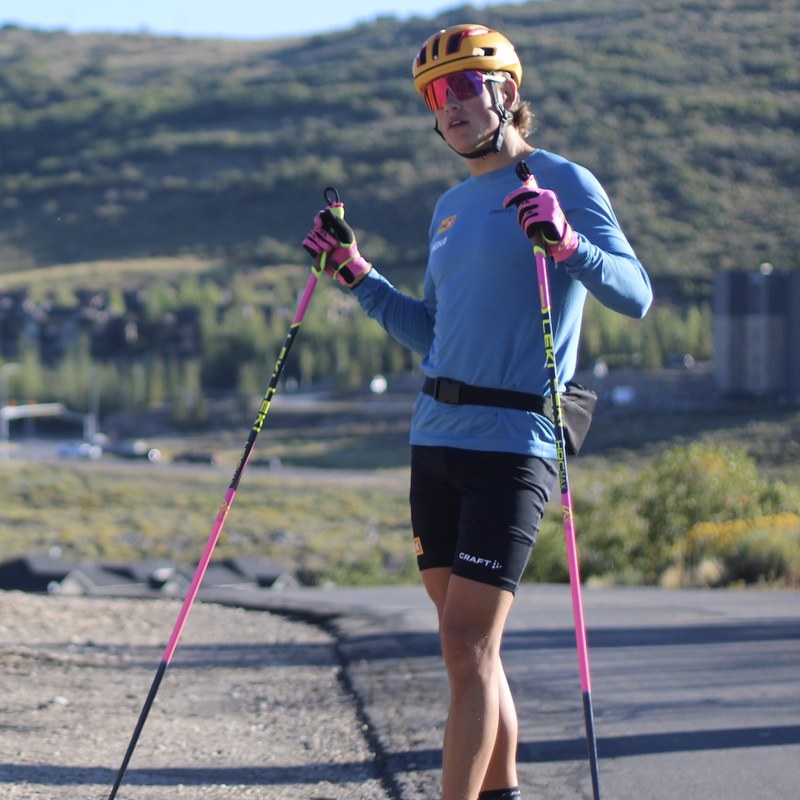
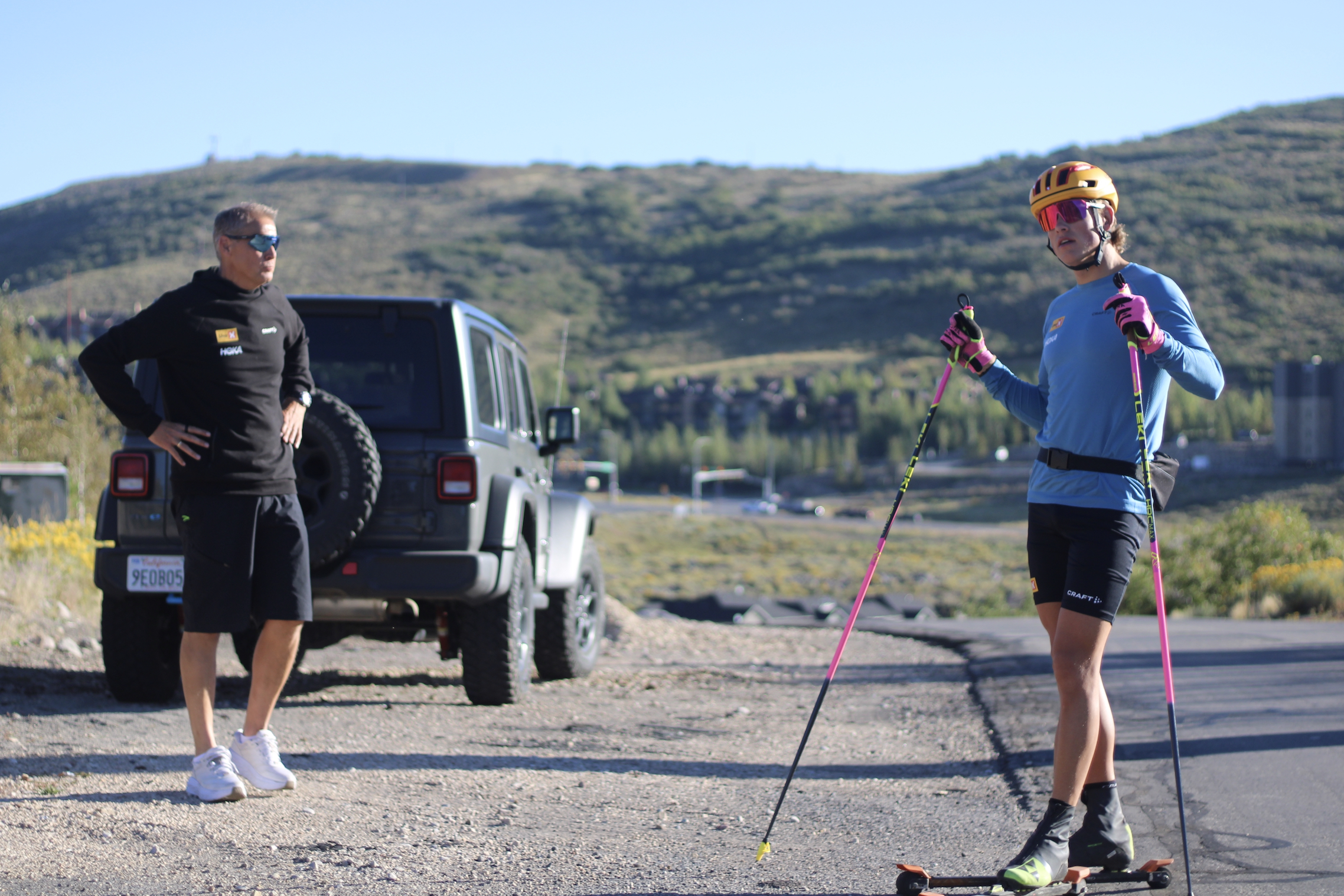
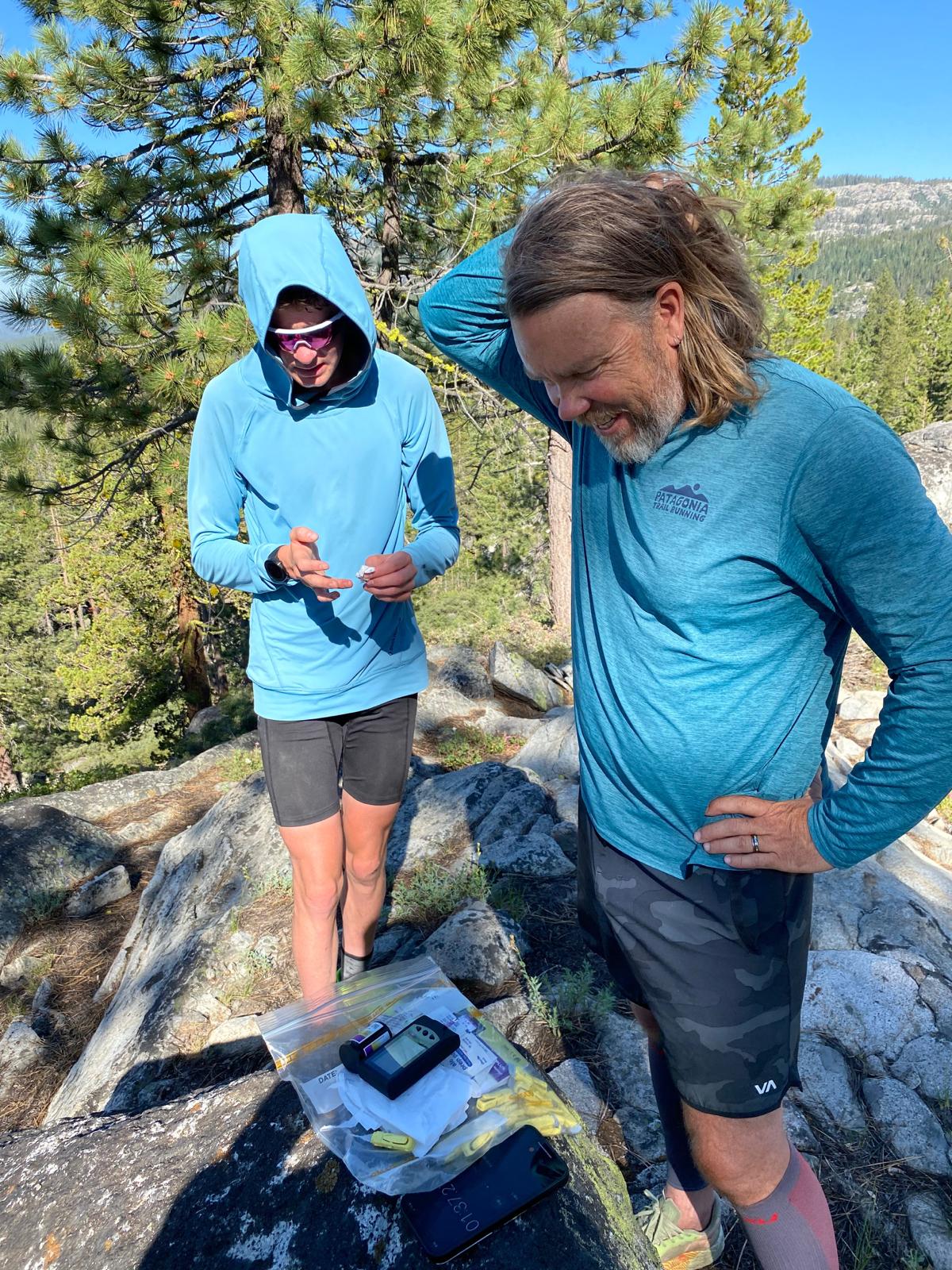
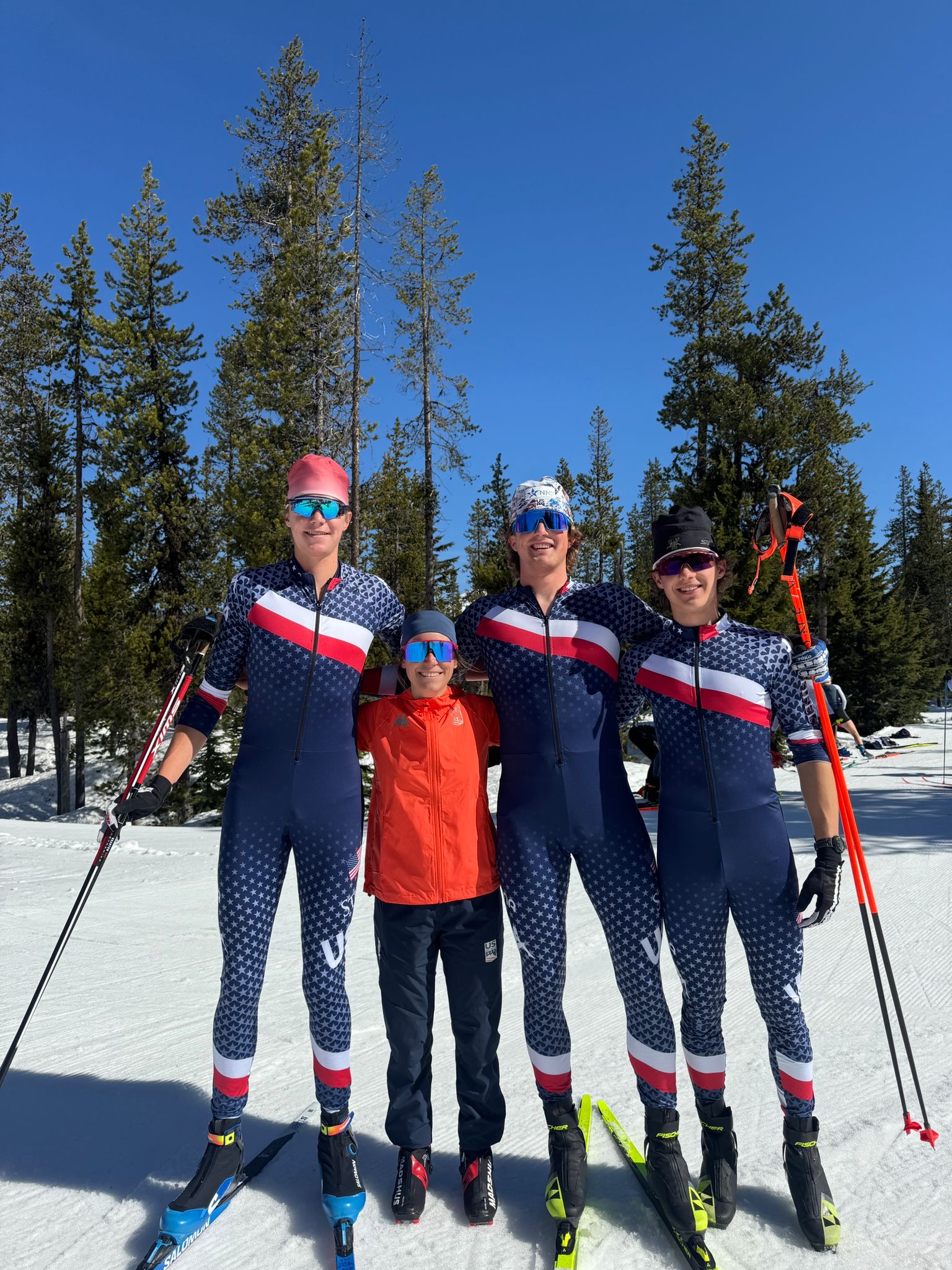
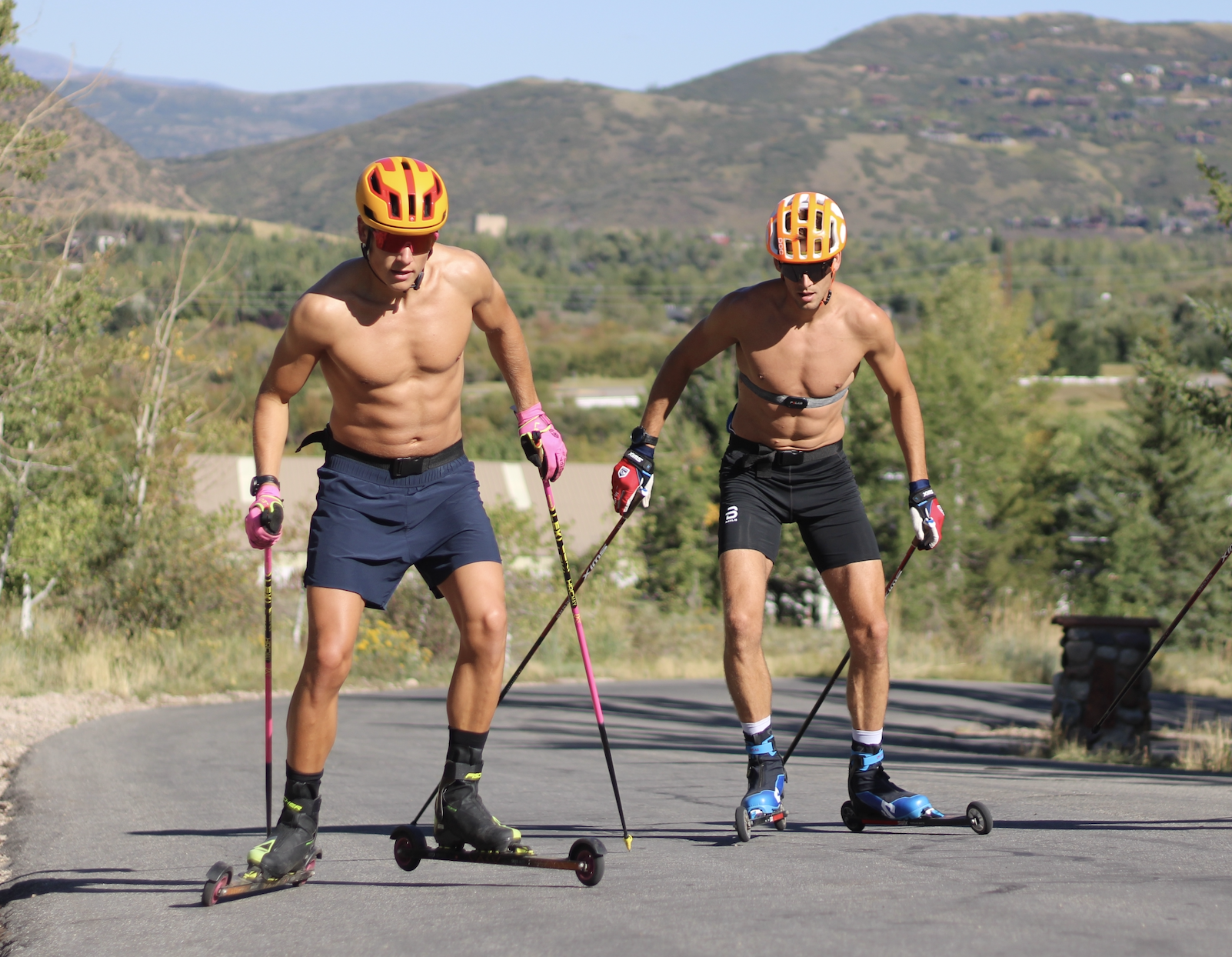
Johannes Høsflot Klæbo and his father, Haakon, during a water break on a rollerski workout in Park City, Utah, in September 2023. (Photo: Nathaniel Herz)
After more than 50 years in endurance sports as an athlete and coach, I recognize many of today’s training debates. We were asking versions of the same questions decades ago: How much training is enough? How hard should it be? When should we increase the load, and when should we allow more recovery? My answers have changed. The biggest change has been how much authority I give the training plan compared with the athlete’s response to it. I still believe in consistent work, appropriate volume, controlled intensity, and patience. But I have become much more willing to change the prescription as I learn how the athlete responds.
I believe it is important for coaches and athletes to build the training process on their own experience. Too many follow current trends, which in the last decade or two have shifted more than they did in the previous 30 years. That deserves recognition and some thought. Modifying what an athlete has done successfully over a few years is a fine and reasonable way to go. Wholesale changes create unknowns that make it impossible to assess what has worked.
What we know to be true, and what experience has demonstrated, should remain the foundation of how athletes train. Consistency is key, training at an appropriate volume load is critical, good control of training intensity should be a primary focus, and being patient and allowing the athlete time and room to adapt is most important.
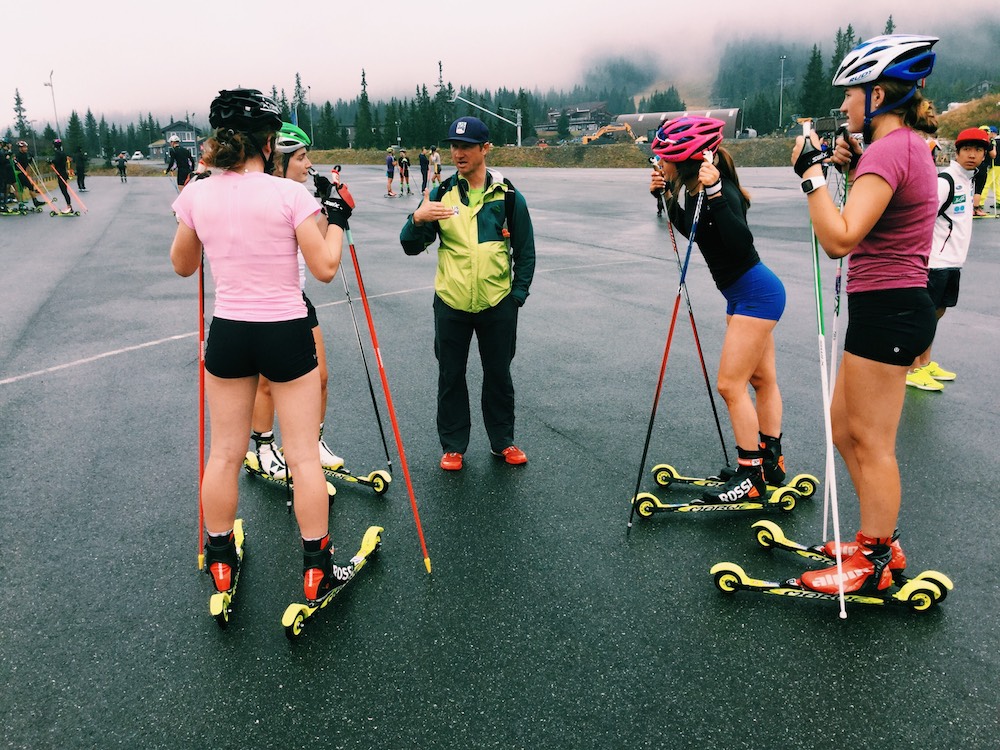
Coach Bryan Fish, in the yellow jacket, works with American athletes at the International Junior Camp in Sjusjøen, Norway, in 2018. How an athlete arrives on a given day can matter more than what the plan says. (Photo: Maria Stuber)
Twenty Years of HRV
Perhaps the most important change I have considered and implemented for anyone I coach is not being a slave to the training plan. I was one of the early adopters of heart rate variability (HRV), some 20 years ago. HRV is a tool I find most valuable in guiding training and in giving athletes the time and space to recover and adapt to it. Of course, following experience and science, I have modified how I analyze HRV over two decades, but the core value is still there. In my experience, HRV helps us refine training so we can give athletes what they need on a given day or week.
Maybe in another decade something better will come along to help with this assessment, and we should be open to that. But we should not throw out something that has demonstrable value.
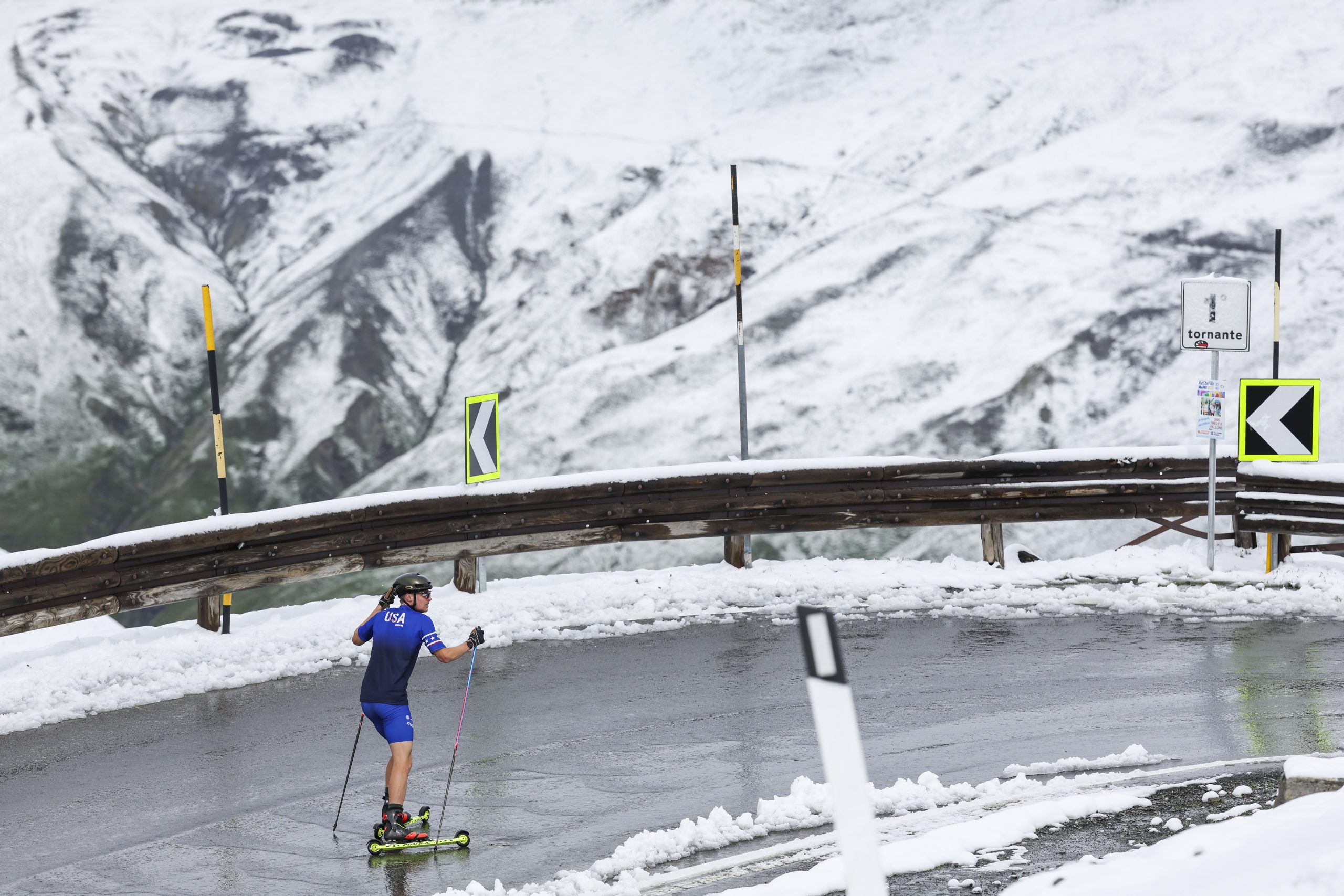
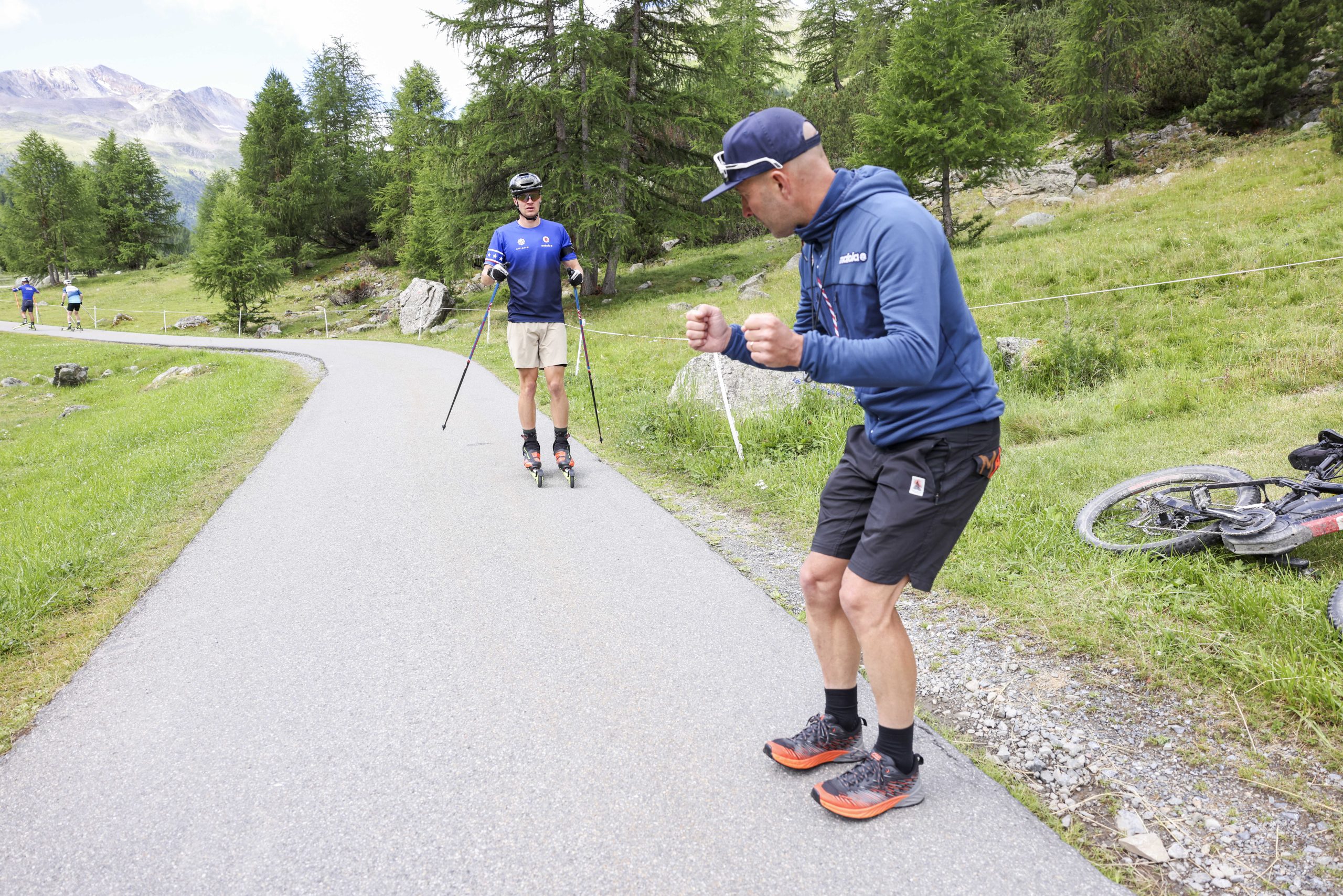
U.S. biathlete Campbell Wright climbs the Stelvio Pass during a summer training block based in Livigno, Italy, in July 2025, with fresh snow along the road. (Photo: NordicFocus)
A Flatter Ramp
Another big change I have made over the past 10 to 15 years is to the periodized training models we follow. When I was competing, we started the year in May at, say, 50 hours, and we progressively built that load month over month to 100 to 120 hours in November. During the later years of my career and into my early coaching years, I remember talking with coaches, physiologists and other athletes about this process. I simply did not see how 50 hours created adaptation that allowed for 60 hours, and how that training load allowed for 70 hours, and so on. It just did not make sense to me. Of course, it took some years to break out of that cultural mode and truly shift how we plan and implement training.
Now I fully believe in a far less aggressive ramp rate: starting the year at higher volume and staying consistent week to week and month to month. Over the course of the year, we can actually do more training with less shock and stress to the system, and with more consistent development. The theory that we need to increase the load week to week and month to month to add stress so we can adapt is, frankly, BS as I see it now. Training compounds week to week, month to month and year to year with consistency.
Simply put, under any model we should strive for consistent implementation, and we should not increase the load until, and only until, we have plateaued and fully adapted to the current load. Being consistent at the correct loads will let us do more training over a year, or over multiple years, than striving for a month-over-month increase.
It is easy to admire a big week or block of training and be impressed. But one big week or block tells us little more than what the athlete did. It does not tell us whether that training was sustainable, consistent, or actually created beneficial adaptation. The athlete who trains consistently day after day, week after week, month over month and year over year receives far less attention, but is the one building a sustainable base of fitness and performance.
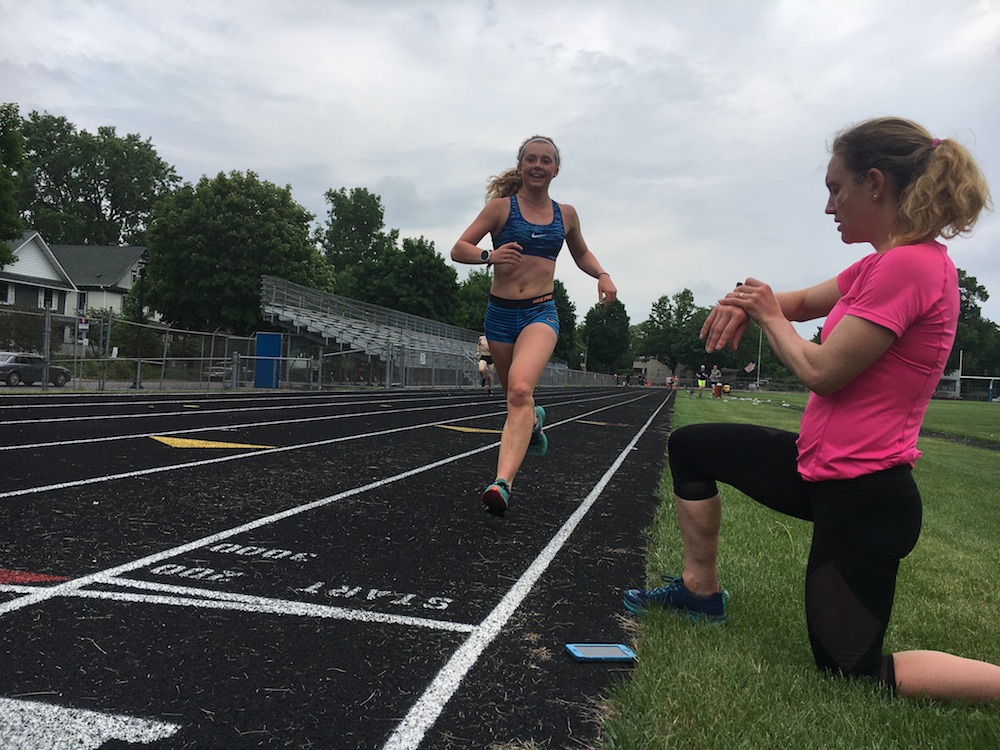
Coach Caitlin Gregg times Loppet Nordic Racing junior Sarah Olsen during a track time trial in the spring of 2018. (Courtesy photo)
The Questions I Ask
So both how I assess training load and recovery with HRV, and how I plan training around consistent loads, have completely changed how I evaluate training decisions. Sometimes the right decision is to add more training load. Often it is not. Other times it is to repeat a sustainable load so the athlete can stay consistent and adapt to it.
I always ask the question: If we do workout X today, or load X this week, how will it affect the athlete next week or next month? We also need to ask what we are trying to improve, what dose we need to improve it, and how we will know if it improved.
Ian Torchia leads L3 intervals with the Stratton Mountain School team in June 2018, with U.S. Ski Team head coach, Matt Whitcomb, following on a bike. (Photo: Pat O’Brien)
Old Becomes New Again
Then we must address the recent trends, and perhaps not so recent, in high-intensity training. In the mid-to-late ’80s and into the ’90s, high doses of threshold training were the “thing.” Then, in the late ’90s and early 2000s, VO2max blocks became the next “thing,” and after that it was back to VO2max workouts in a somewhat more controlled fashion. Now, over the last five or so years, based on the training of a speed skater and some Norwegian triathletes, we are back to so-called threshold and subthreshold training.
In essence, all things old become new again. What is missing from the trends is not the actual training; for some athletes it may well be the correct pathway. What is missing is an assessment of what limits the athlete’s performance. Without judging the merits of either high-intensity methodology, some athletes may need more focus on VO2max work, and others may well benefit from threshold-type workouts. In the simplest terms, an athlete with a very high fractional utilization may benefit more from a higher volume of threshold work, while those who do not have a well-developed aerobic capacity may benefit more from VO2max-type work. For elite athletes with a very high fractional utilization, threshold-type training probably also creates a signal to improve VO2max, or the speed at VO2max, because the intensity is relatively in the same zone.
Regardless of the type of high-intensity training an athlete is doing, we should be most focused on assessing and measuring how efficiently they are moving, their speed, and their durability to sustain that speed. Because no matter what the training methodology is, if you are not consistently improving performance, the training is not working.
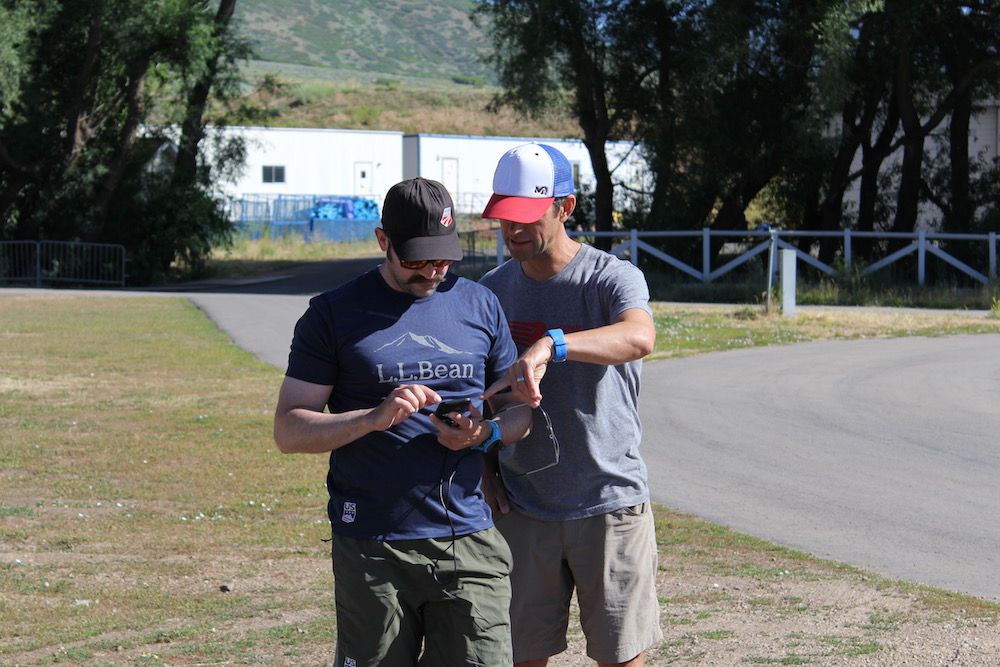
U.S. Ski Team coaches Jason Cork and Chris Grover go over the details for a distance time trial at Soldier Hollow in Midway, Utah, in 2017. (Photo: Pat O’Brien)
The Plan Is a Snapshot
The most basic element, and the one most coaches spend hours and hours on, is the training plan. We plan periodized models of increasing training volume, and when and how to implement high-intensity training. We plan when to do races or time trials, when to focus on speed training, and how to fit in strength training and other aspects of performance. Yeah, that is all well and good, but it is mostly an exercise in futility. In my opinion, the training plan was valuable on the day it was written, based on where the athlete was at that snapshot in time. Once a plan is in place, there is a temptation, if not a certainty, that the athlete will do everything in their control to carry it out regardless of how they are feeling or what they need right now.
I did this for years. I spent hours developing an individual plan and expected the athlete to carry it out as some kind of infallible document. That is not how the body works. Nowadays I still write year plans, but with far less detail on hours and specifics, and more explanation of what we want to accomplish in each period rather than details of volume and periodization. I want the plan to create an environment with flexibility, where we use the data, and how the athletes are feeling and adapting, to adjust the day-to-day training.
After more than 50 years, I still believe in the value of consistent training, appropriate volume, controlled intensity, and patience. What has changed is how I decide what an athlete needs and how willing I am to revise that decision.
I once spent more time asking whether the athlete had completed the plan. Today, I spend more time asking whether the training is producing the response we intended, whether the athlete is absorbing it, and what that tells us about the next step.
I expect some of my thinking will continue to change. Experience gives me a foundation, but it also gives me reasons to keep asking questions. The responsibility I have as a coach is to pay attention, assess honestly, and act on what I learn, even when that means changing a plan I believed in when I wrote it.
Help Support Our Coverage!
If you value the thoughtful work and access FasterSkier provides, please consider becoming a Voluntary Subscriber. Your support directly fuels our work to cover the people, places, and moments that make our sport special.
Hailey Swirbul during an intensity session at a U.S. Ski Team camp in Park City, Utah, in October 2018. The same pace can cost an athlete very different amounts from one day to the next. (Photo: Matt Whitcomb)
In my last article on training zones, published on FasterSkier, I tried to describe the challenges we face when we don’t use a common language. There is a lot of talk on social media about Zone 2 training, while most of us in the cross-country ski world understand this same training intensity as Zone 1. Others challenge the use of heart rate to set zones at all. These discussions are great, because they push all of us to better explain our beliefs and how we got there.
Today I want to share why I think heart rate is, for most athletes, a useful, available indicator of cardiovascular stress, even though it doesn’t necessarily capture the complete cost of exercise. I often hear that heart rate is too variable: heat and other environmental conditions can change it; fueling, hydration and fatigue can affect it; it doesn’t stay the same at the same workload (pace or power); and it doesn’t react quickly enough during hard efforts. All of which has some truth to it!
Hannah Halvorsen (left) ski bounding in Park City, Utah, in June 2016. Heat, altitude, fueling and fatigue all change what a given pace costs, and heart rate reflects that cost. (Photo: Bryan Fish)
Cost or Pace?
But let’s break it down. For all endurance work, from easy endurance work below 72 percent of maximum heart rate up to high-intensity work at 95 percent of maximum heart rate, heart rate is an indicator of the physiological demand and strain associated with producing energy. So when it is said that we should use other metrics to implement and track training because of these variations, I say, really? Shouldn’t we train day in and day out based on how the body responds to those external conditions? The same pace, power, speed or workload can carry widely different physiological demands on any given day. So what are we trying to train: the metabolic cost, or the speed, power or pace we can maintain? I would argue both, but in very different circumstances.
I should note that while I use percentages of maximum heart rate to discuss training, that doesn’t mean percentages of maximum heart rate are the best way to determine training zones. It is not a bad method if you test for maximum heart rate, but there may be better ways to use actual performance data to set training zones.
David Norris and Scott Patterson during a set of pre-race classic intervals. Outside of heart rate and perceived effort, few training metrics get measured every day. (Photo: Tom Horrocks)
Every Metric Moves
Then there are those who say we should use lactate, heart rate variability (HRV), rating of perceived exertion (RPE), ventilation, respiratory exchange ratio (RER) and other metrics that change with improved fitness. In fact, those may be better or similar metrics. The problem is that, except for RPE, they are not typically measured daily, so coaches don’t see how much they can vary from one day to the next. Any measure requires context to understand its daily variation. Why? Because the body changes every day in response to life and training stressors.
All of these measures require context, consistent testing protocols and an understanding of their day-to-day variability to be effective. The bottom line is that we need metrics that can be measured daily to understand how athletes are responding and adapting to training. When we are doing aerobic endurance training, often described as Zone 2 and, in the ski world, as Zone 1, the oxygen cost is reasonably reflected in heart rate during exercise.
Certainly, the metabolic cost of training changes from day to day with internal and environmental factors, which can require a higher heart rate to produce the same energy output. We also see heart-rate drift during these workouts: at the same pace or power, heart rate climbs. My response is, OK, this represents an increase in internal cost, and we should definitely respond to it. No metric is perfect, but heart rate captures an important and significant part of the internal strain of training.
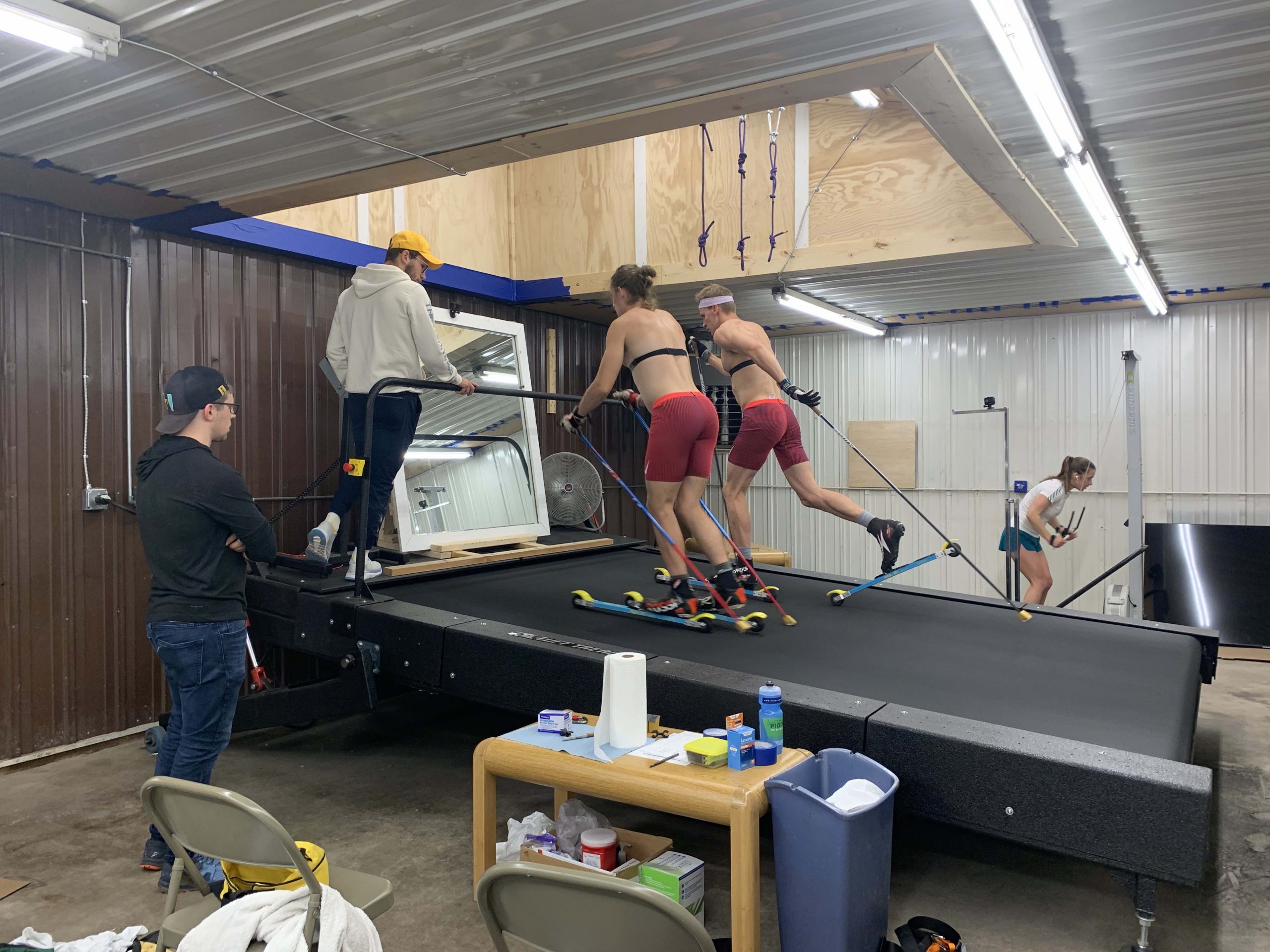
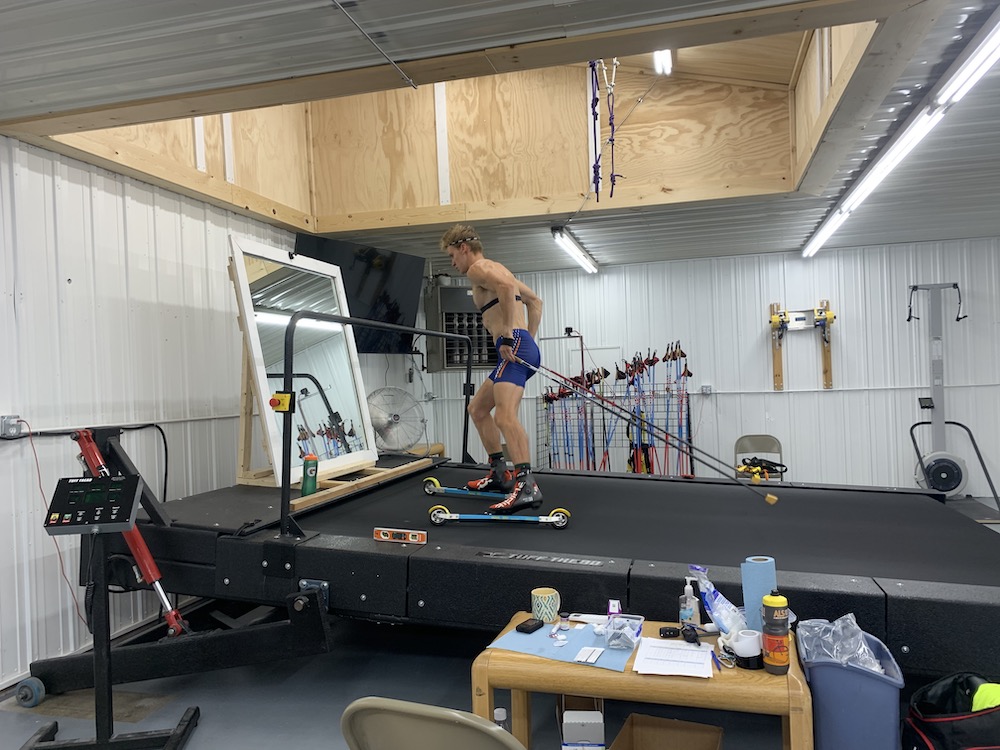
Team Birkie’s Xavier Mansfield (left) and Zak Ketterson share a rollerski treadmill in 2021 while coaches Leo Hipp and Jeremy Hecker give feedback. A lab number is a snapshot unless it is measured often enough to show its own daily variation. (Courtesy photo)
Variation You Never See
To those who say other measures (ventilation, HRV, lactate levels, respiratory exchange ratio, respiration and others) are more accurate, OK. But without seeing how those measures change from day to day, you have no idea of the variation. People use lactate to guide training, for example, and the same goes for newer measures of muscle oxygen saturation and ventilation. They often set training zones at arbitrary levels, or from equally arbitrary estimates based on a visual read of a lactate curve, then assign work based on those values. But if lactate is not measured often during daily training, you have no idea how consistent those values are, or how they vary in response to the same factors that affect heart rate. From my observations, all of those metrics vary as much as heart rate.
No matter how we cut it, none of these measures is as precise as we like to think, because the body changes and responds daily to stress and external factors. And yes, what we are after is a measure we can observe every day. So let’s recognize the facts. Heart rate represents the internal cost of work. Sure, there are daily variations. But over time, and with context, we can understand those changes.
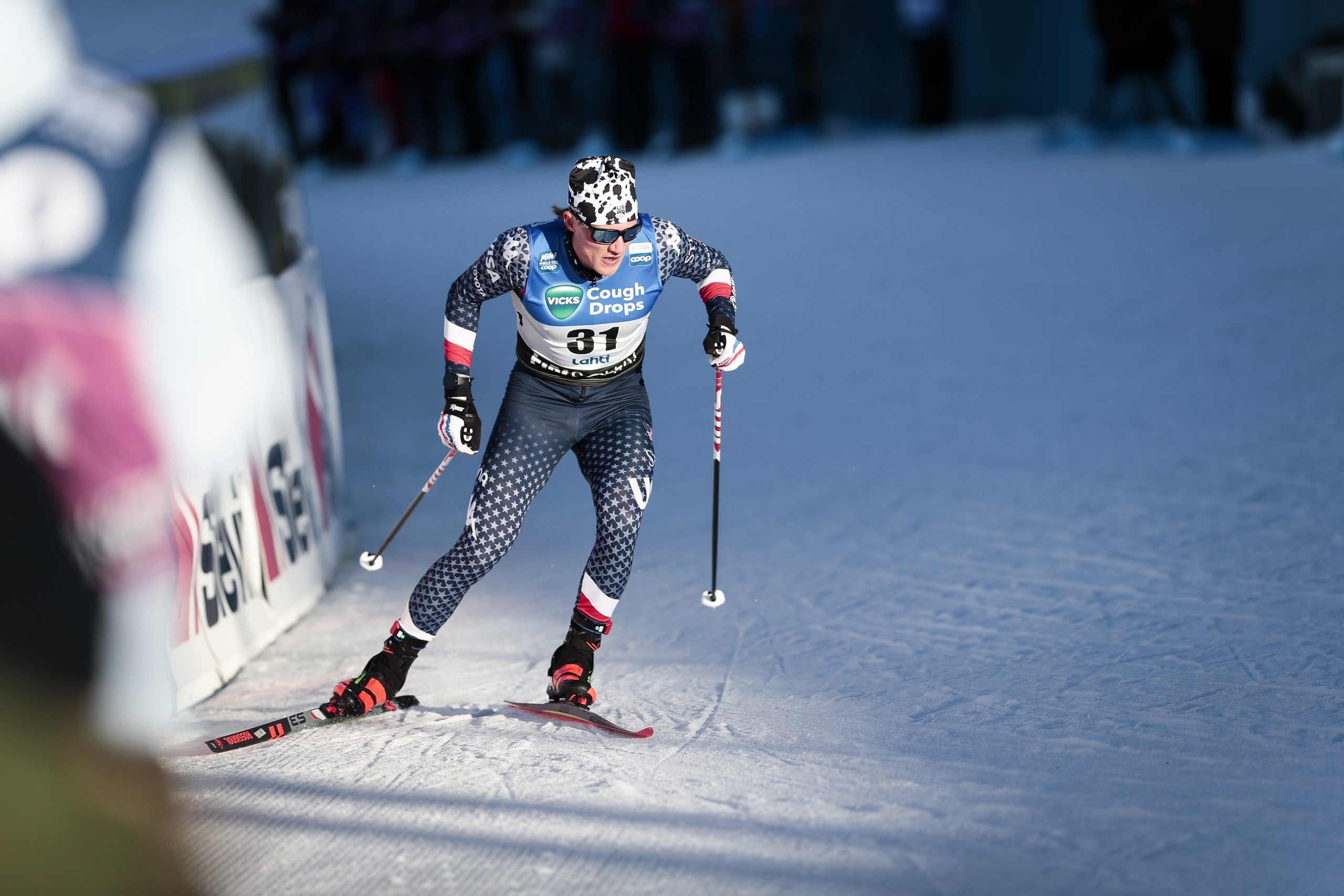
Kendall Kramer (right) in the 10 k classic at the Lahti World Cup on March 8, 2026, an interval-start race she finished in 27:40.8. Galanes puts races of 15 to 30 minutes in the middle of Zone 4. (Photo: Authamayou/NordicFocus)
How I Set Zones
So this is how I use training zones. First, I use the zones as a tool to implement and assess the effects of training on each individual. Those assessments help us determine whether the zones and the training are effective. I believe training zones provide a reasonable method that will work for most athletes and doesn’t require regular lactate or lab testing or other expensive equipment.
So what do I do? I don’t do regular lab testing, because the athletes I coach live all over the country and many don’t have access to or opportunities for it. It is also quite expensive, and most importantly, I have often seen over the years that what we learn in a lab setting doesn’t correlate with what we see in training.
I do a six-minute test, which, according to research by Véronique Billat, corresponds to the pace at which VO2max is achieved. I use the average heart rate of the last two to three minutes of the test, and I assume that to be about 94 to 95 percent of maximum heart rate. Yes, I assume! But the six-minute test also gives me a repeatable field performance and a high heart-rate observation. I use it to inform my initial estimates, not as a direct measurement of VO2max pace or maximum heart rate. The point is to establish workable ranges, observe how the athlete responds and revise them when the evidence warrants it.
I also look at racing and high-intensity workout performance. Short races of 10 to 15 minutes should be in the top range of Zone 4. Races of 15 to 30 minutes should be in the mid-range of Zone 4, and races of 45 to 60 minutes in the low to mid-levels of Zone 4.
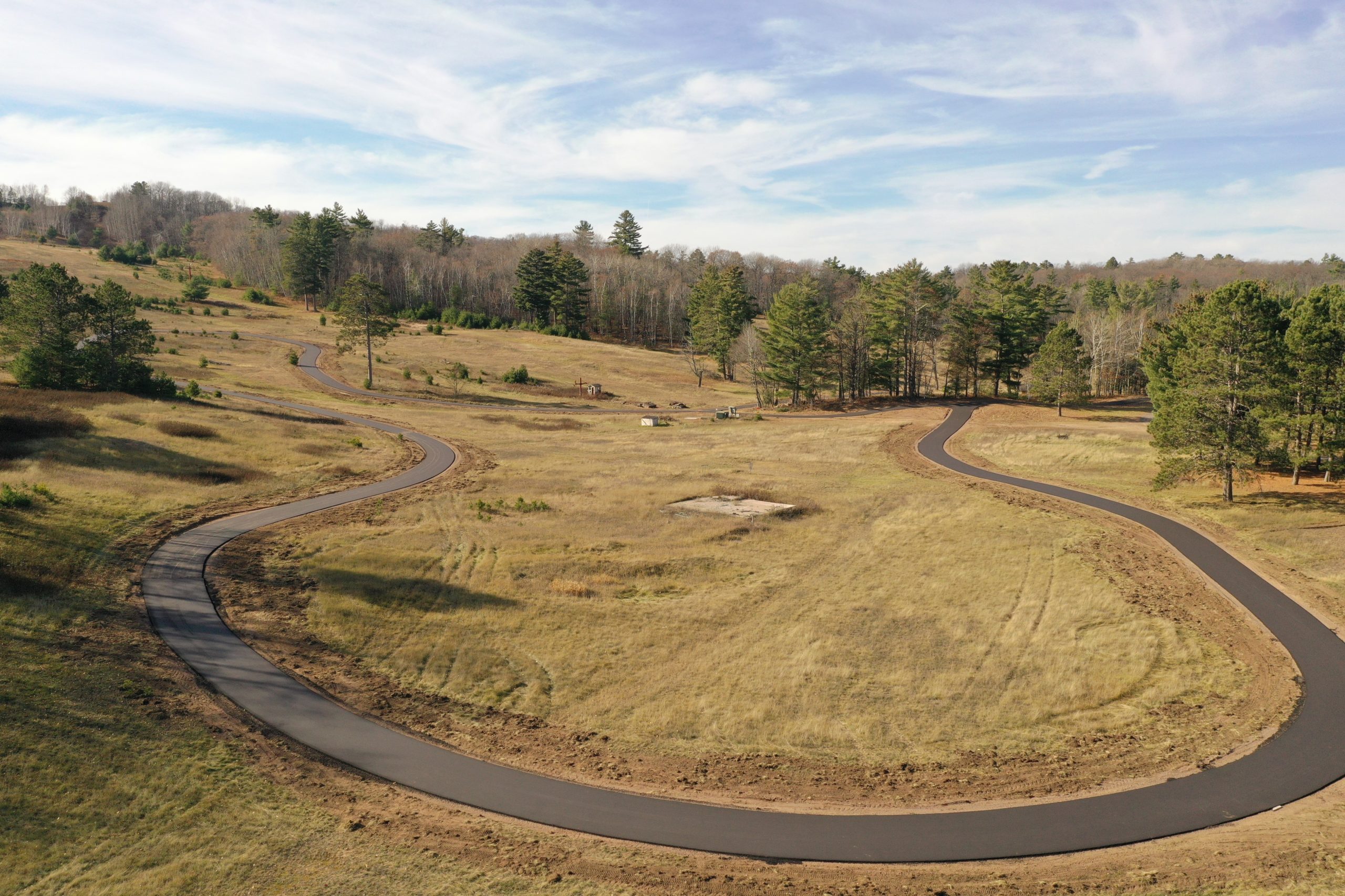
The 5-kilometer paved rollerski loop at the base of Mt. Telemark, outside Cable, Wisconsin, when it was laid in 2023. A fixed loop like this is all a Zone 1 check needs: 45 to 60 minutes of laps, with lactate and heart rate taken after each one. (Photo: American Birkebeiner Ski Foundation)
Checking Zone 1
To confirm the accuracy of Zone 1, I have athletes do 45 to 60 minutes of work on a standard loop of about 15 to 20 minutes, and we take lactate measurements after each loop. If lactate and heart rate remain stable, we know the endurance Zone 1 training is in the correct range. A stable lactate response suggests that the intensity is easy enough, but it does not necessarily identify the first lactate threshold, or LT1.
We need to understand that no method of determining training zones is precise. The body just doesn’t operate that way. For any training adaptation there is an optimal point of adaptation, but also a much broader range in which the adaptation occurs. So the objective when implementing training is to be as close to the optimal point as possible. But knowing where that is day in and day out is impossible, so being within a reasonable range is the goal.
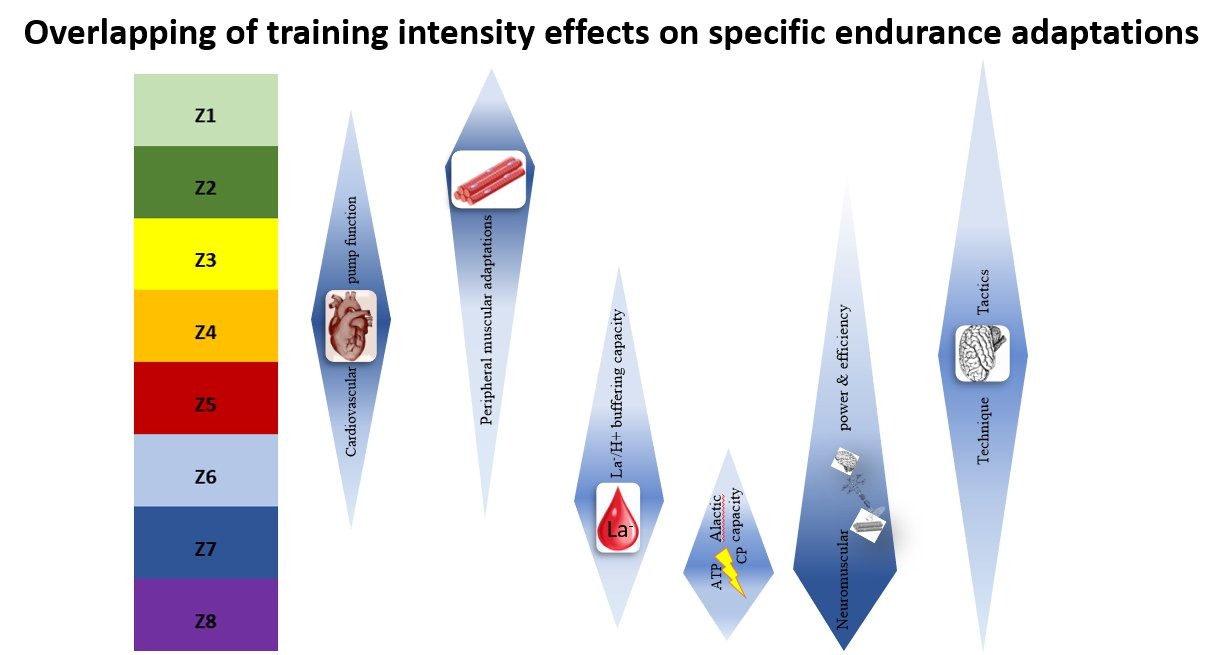
Every adaptation has an intensity where it responds best and a much wider range where it still responds. (Figure: redrawn from Olympiatoppen educational material, 2020)
Close Enough
My conclusion is that using field-testing measures along with training and race performance data to support training-zone determination is adequate, and it allows us to build ranges that can move as fitness changes. There are no ideal “thresholds” or clear metabolic points we can use to determine training zones. LT1 and the second lactate threshold, LT2, are useful reference points, but different protocols and definitions can produce different estimates for the same athlete.
Other thresholds, determined by heart rate variability, DFA alpha1, respiration and muscle oxygen, may prove useful in the future, but so far they have not been fully validated and likewise cannot identify clear physiological thresholds.
So we are left with what is practical and available to developing and recreational athletes. Let’s get close enough, control training effectively and learn what works based on the data for each athlete. Heart-rate metrics fit that need best.
We can debate exactly where one training zone ends and another begins, but no test gives us a number that will describe an athlete perfectly every day. For the athletes I coach, heart rate gives us a practical place to start and a way to follow their response over time. I use field tests and race results to establish working ranges, then look at heart rate alongside pace, perceived effort, conditions and, when available, lactate. If those observations no longer agree, I revisit the zones.
The goal is not to defend a particular method or number on a chart. It is to help an athlete do the work as intended on a given day, learn from the response and make a better decision the next time. That is where training zones earn their value.
Help Support Our Coverage!
If you value the thoughtful work and access FasterSkier provides, please consider becoming a Voluntary Subscriber. Your support directly fuels our work to cover the people, places, and moments that make our sport special.
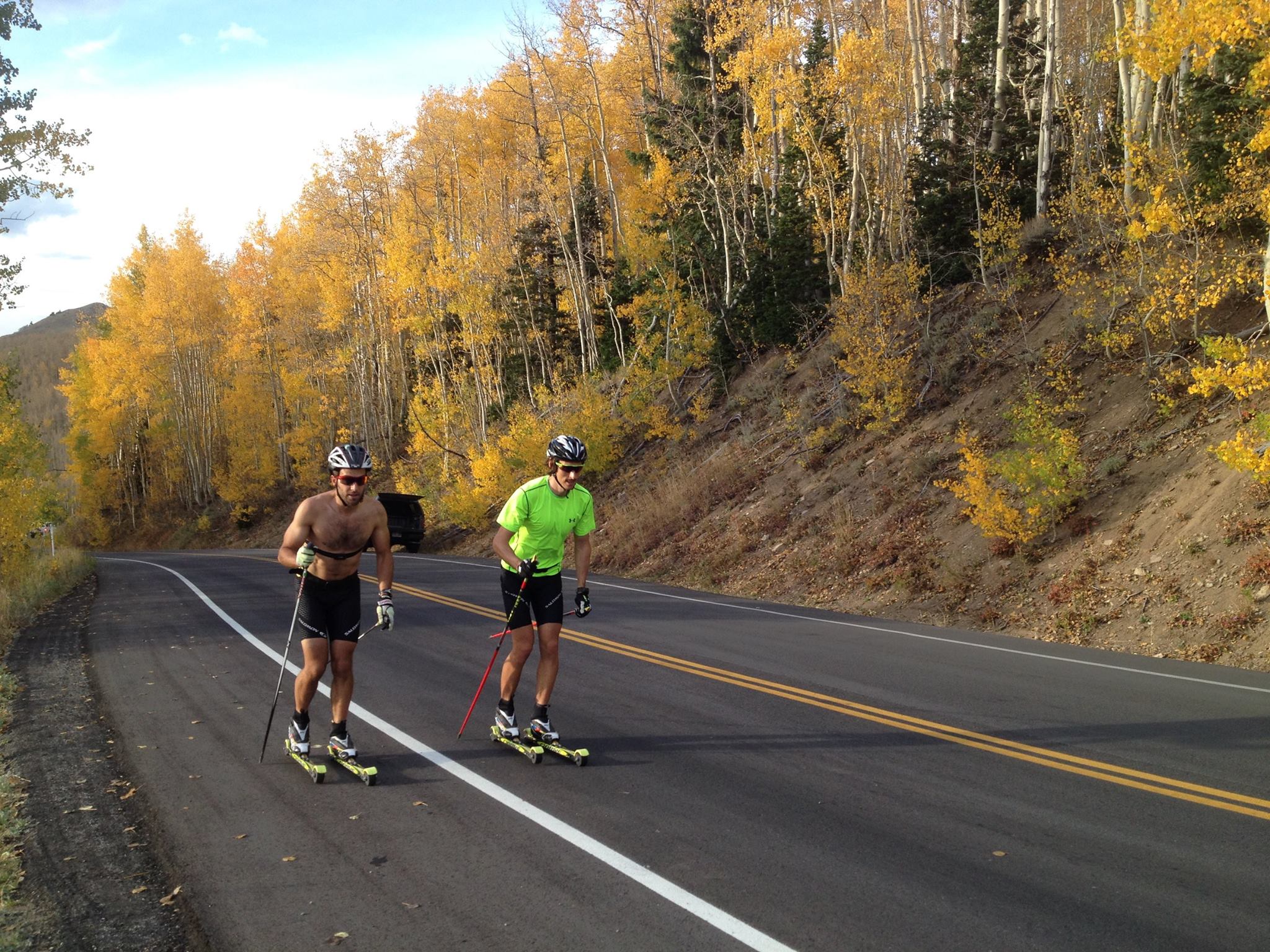
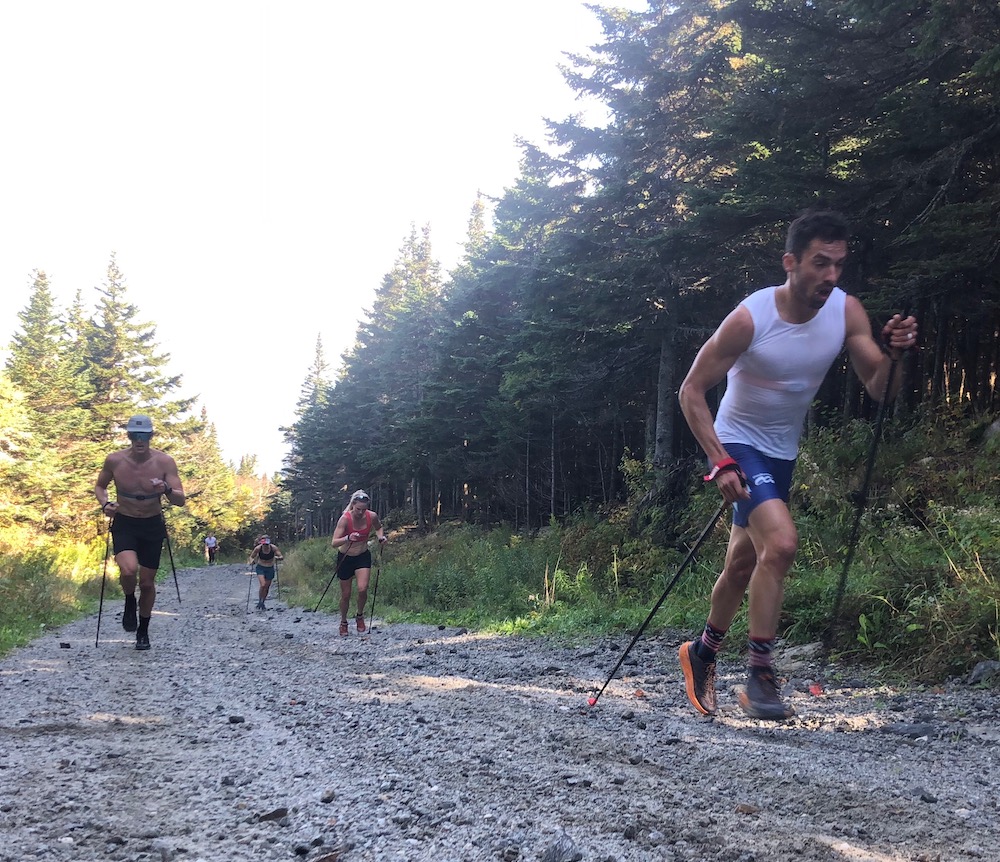
Canadian biathletes Brendan Green and Scott Perras rollerskiing up Guardsman Pass above Park City, Utah, during a fall 2015 camp. (Photo: Matthias Ahrens)
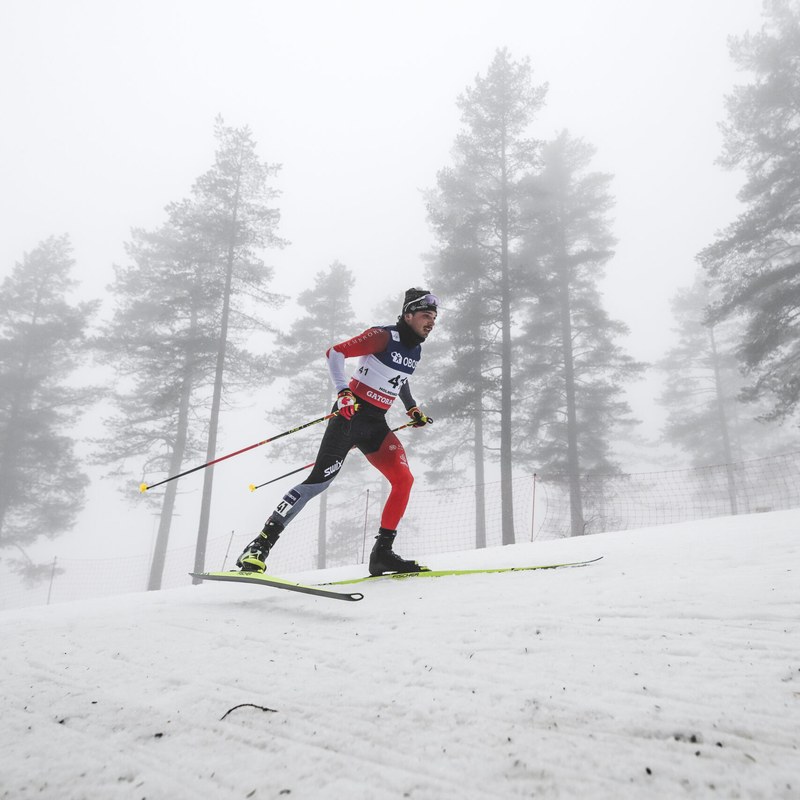
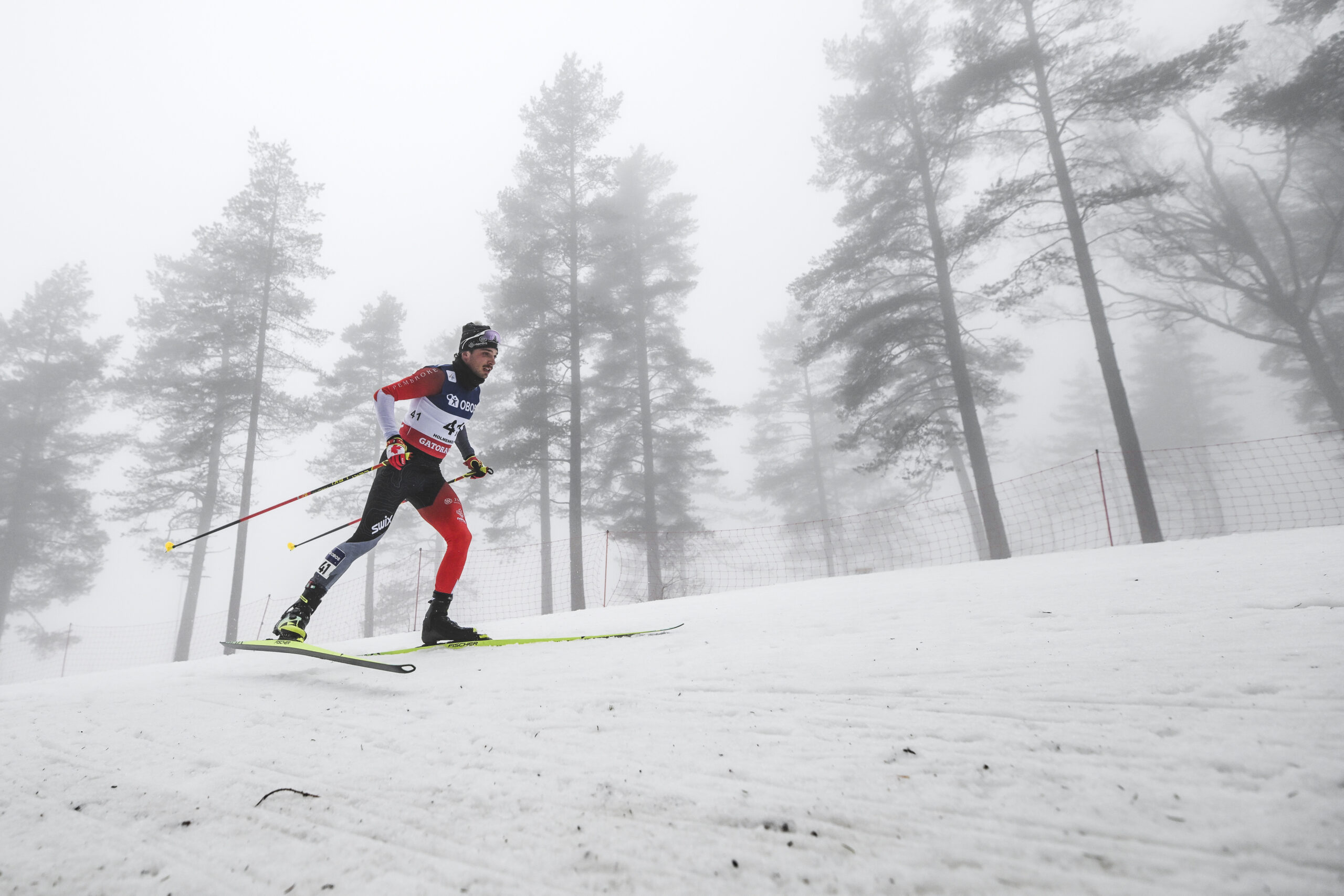
Thomas Stephen of Canada in the fog at the Oslo World Cup mass start in March 2026. One coach’s Zone 2 can be another’s Zone 1, and the label means little until you know what it is anchored to. (Photo: Authamayou/NordicFocus)
Over the last decade I have often thought that we need to find a better way to define training zones. I have assessed every model under the sun and even tried to create some new ones. From a metabolic perspective, three-zone models probably make the most sense, because physiological anchors form the transition points, even though some of those anchors, lactate threshold among them, are questionable. Then there are five- and seven-zone models. Which are best, and which are most accurate? The answer is probably none of them. They all have limitations, and there really is not a better method.
Some coaches set training zones from maximal heart rate. Others use lactate measures referenced to heart rate, pace or power, and still others use gas analysis (ventilation, VO2, RER and so on). Whatever the method, the important point is how the zones are used and implemented in training. While there may be a valid physiological basis for training zones, their primary use is to quantify training as planned and as performed. That is how we assess which methods of training have worked for the individual athlete.
Julia Kern racing the 10 k freestyle at the Trondheim World Cup in December 2025. A higher heart rate at a standard effort can reflect heat, glycogen depletion or fatigue, and all of those should change the day’s training. (Photo: Modica/NordicFocus)
Heart Rate Holds Up
Many coaches and even physiologists claim that heart rate is too variable to be used reliably for training control. Of course it is variable. Physiology varies daily with fatigue, recovery, hydration, glycogen status and more. In my experience, heart rate is no more variable than any other metric we use. We just don’t recognize the variation in the others, because it is not practical to measure them every day. Human physiology is complex, and in general heart rate reflects the current status of an athlete’s physiology. Under any system, it is important to train at a level that reflects the individual’s physiology and condition on that day. Heart rate is as good as anything for that, and I would argue better, because the daily variation is easy to assess.
Heart rate is inexpensive, practical and physiologically informative. A higher heart rate at a standard workload can reflect warm weather, glycogen depletion or general fatigue, all of which matter when adjusting the day’s training. A lower heart rate at a standard workload often reflects improved fitness, though occasionally it can also reflect fatigue and increased parasympathetic drive of the autonomic nervous system.
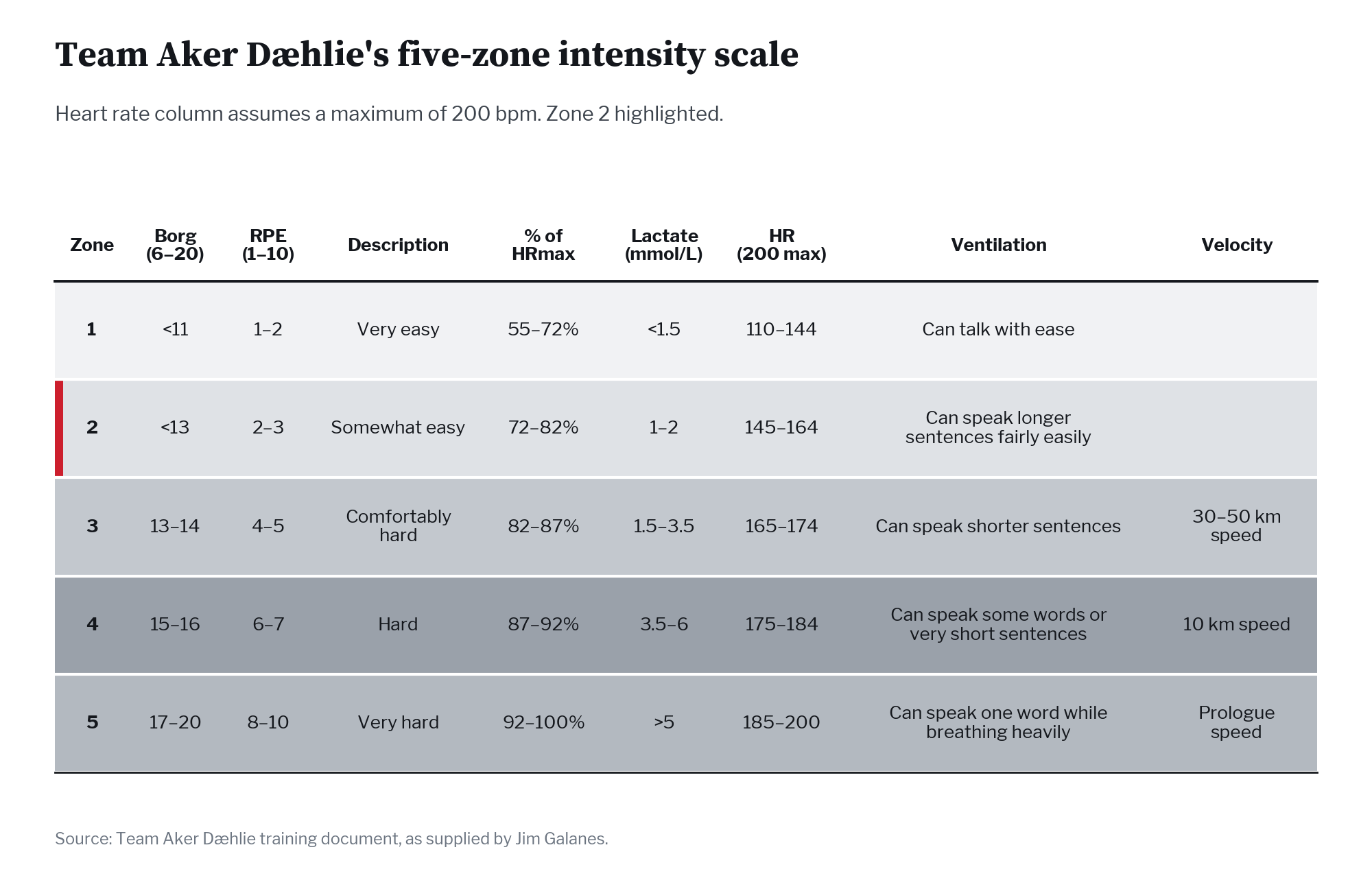
Team Aker Dæhlie’s five-zone scale. Its Zone 2 runs from 1 to 2 mmol/L of lactate, overlapping Zone 1, which sits below 1.5. (Chart: FasterSkier)
Whose Zone 2?
One example is a document published a few years ago by Team Aker Dæhlie in Norway, which laid out a slightly different training zone model than I was used to seeing out of Norway. Given the popularity of Zone 2 training, I believe it is important to understand how the proponents of a particular system of training define and use their zones.
In the Aker Dæhlie system there is significant overlap between Zones 1 and 2 in terms of lactate, with Zone 1 below 1.5 mmol/L and Zone 2 at 1 to 2 mmol/L, while the heart rate ranges are what I consider consistent with how most training zones are delineated. The implication of that lactate range is that lactate is highly variable and not the same between individuals. From the published document we can see that their Zone 2 does not fit what some may consider Zone 2. It fits how I would describe Zone 1: endurance training not to exceed 70 to 75 percent of maximal heart rate. We need to realize that lactate may vary greatly from day to day and can’t be viewed as a hard and fast anchor for a specific training zone.
Listening to many podcasts and reading many articles and publications, I hear people discuss training zones as if they were talking about the same thing. Most often they are not. The recent popularity of Zone 2 training is a good example: what Iñigo San Millán means by Zone 2, many of the common five-zone models would define as Zone 1.
So if you want to use and reference the Aker Dæhlie zone system, you should also be aware of this statement about Zone 2 in their published document:
Zone 2: Semi-hard long sessions with a heart rate at around 140-155 bpm and with lactate up to 2 mmol/L, is considered intensity 2 training. Scholars debate over the importance of this training. In our experience, this training costs more than it is worth, and should therefore not be prioritized. L2 can work well to learn/automate correct technique. Again, evaluate cost vs benefit! Typical length of a session is 1 to 3 hours of continuous activity.
Zones 3, 4 and 5 are close to how many would describe training in those ranges, although Zone 3 here may sit a bit lower than it is often described. But the Aker Dæhlie team is primarily a long-distance team, and we don’t know whether they use different zone ranges for World Cup skiers, or whether World Cup skiers do more of their intensive training in Zone 4.
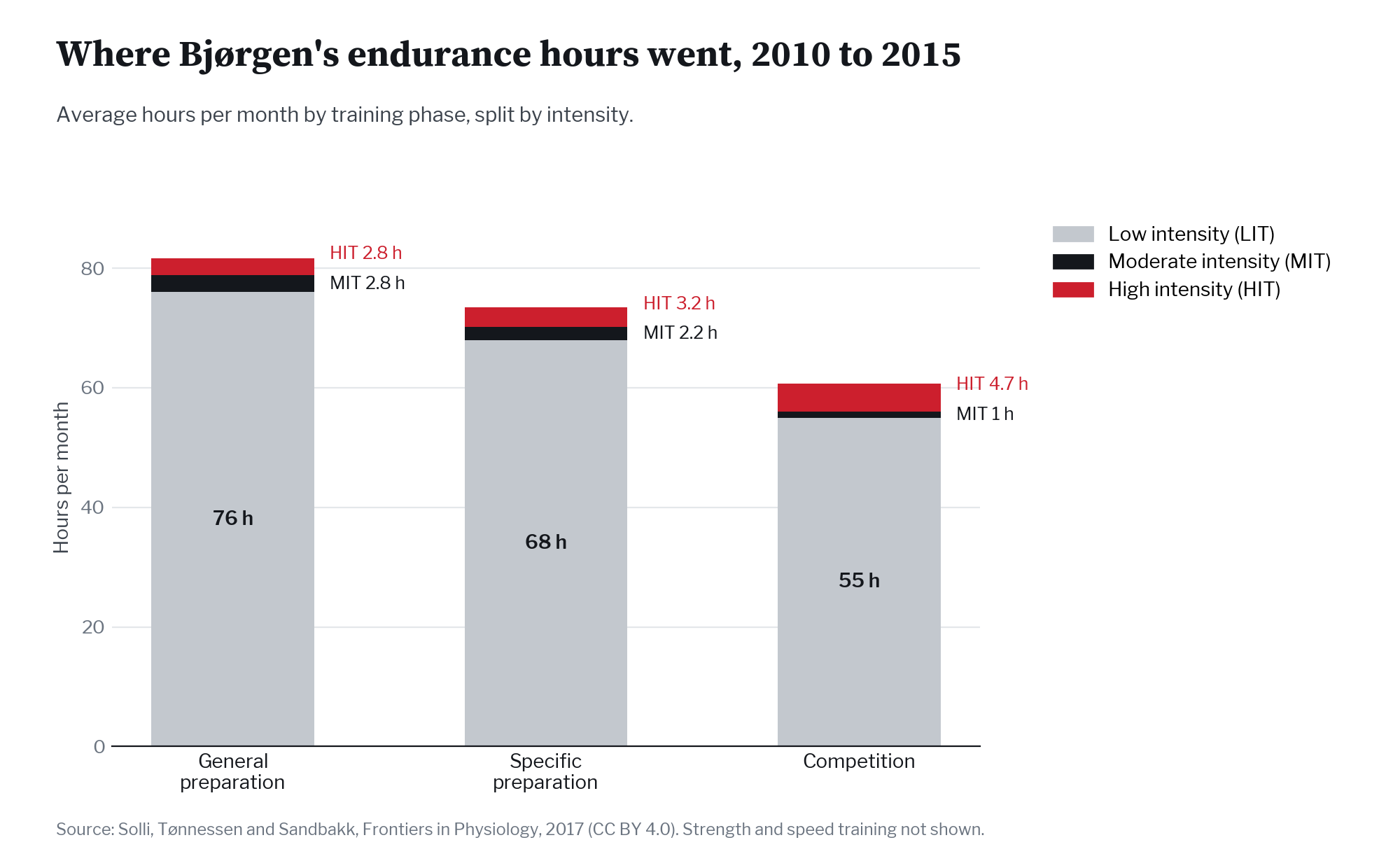
Marit Bjørgen’s average monthly endurance hours by phase during her most successful seasons. (Chart: FasterSkier. Data: Solli, Tønnessen and Sandbakk, Frontiers in Physiology, 2017)
How Bjørgen Trained
A chart like the one above is often used to illustrate how one of the best female cross-country skiers ever trained during her most successful years. The data comes from an extensive study of Marit Bjørgen’s training.
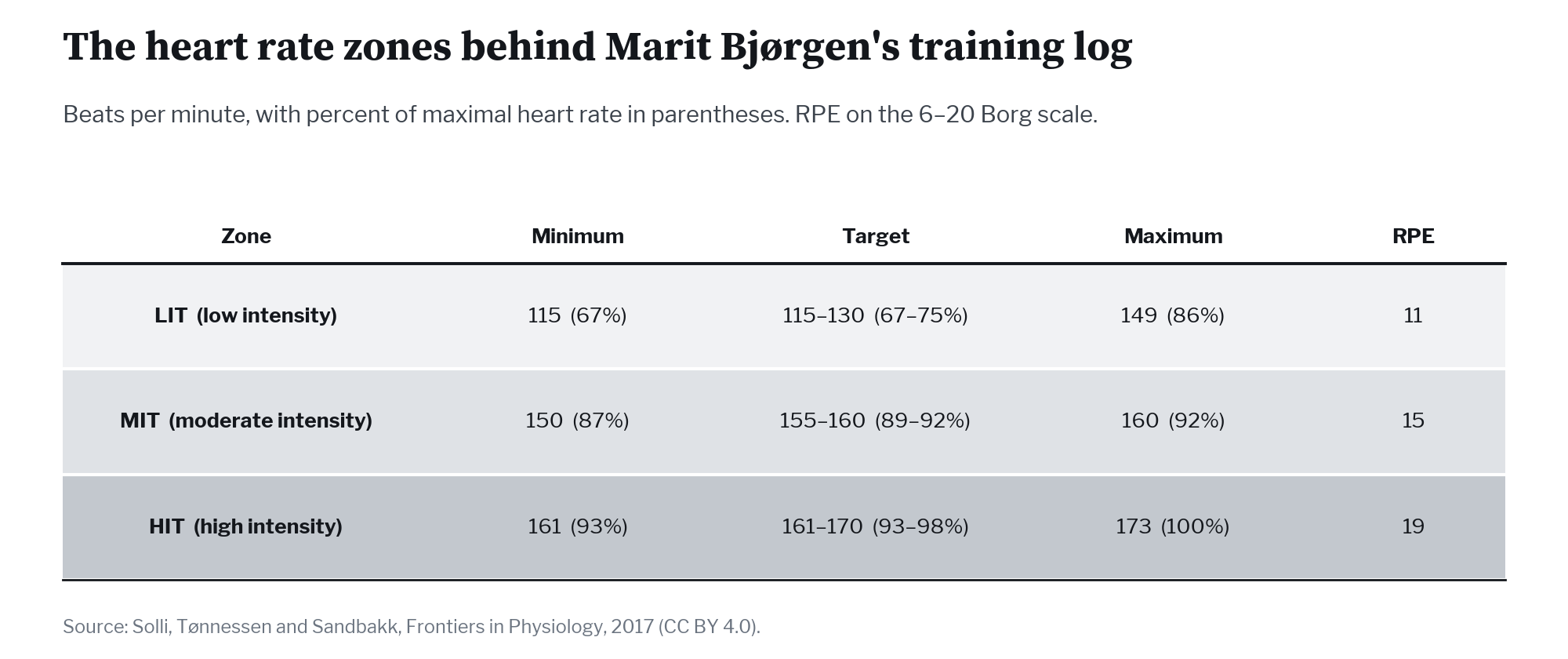
The zones used to classify Bjørgen’s training. The top of the low-intensity target and the bottom of the moderate-intensity target sit 25 beats apart. (Chart: FasterSkier. Data: Solli, Tønnessen and Sandbakk, Frontiers in Physiology, 2017)
A 25-Beat Gap
To provide context, these are the zones used to define this athlete’s low-intensity (LIT), moderate-intensity (MIT) and high-intensity (HIT) training. The low-intensity target is where we might expect it, at 67 to 75 percent of maximal heart rate. However, there is a large gap, some 25 beats per minute, between the low- and moderate-intensity targets, with the MIT target at 89 to 92 percent of maximal heart rate. That MIT zone is quite different from what is described in the Aker Dæhlie document.
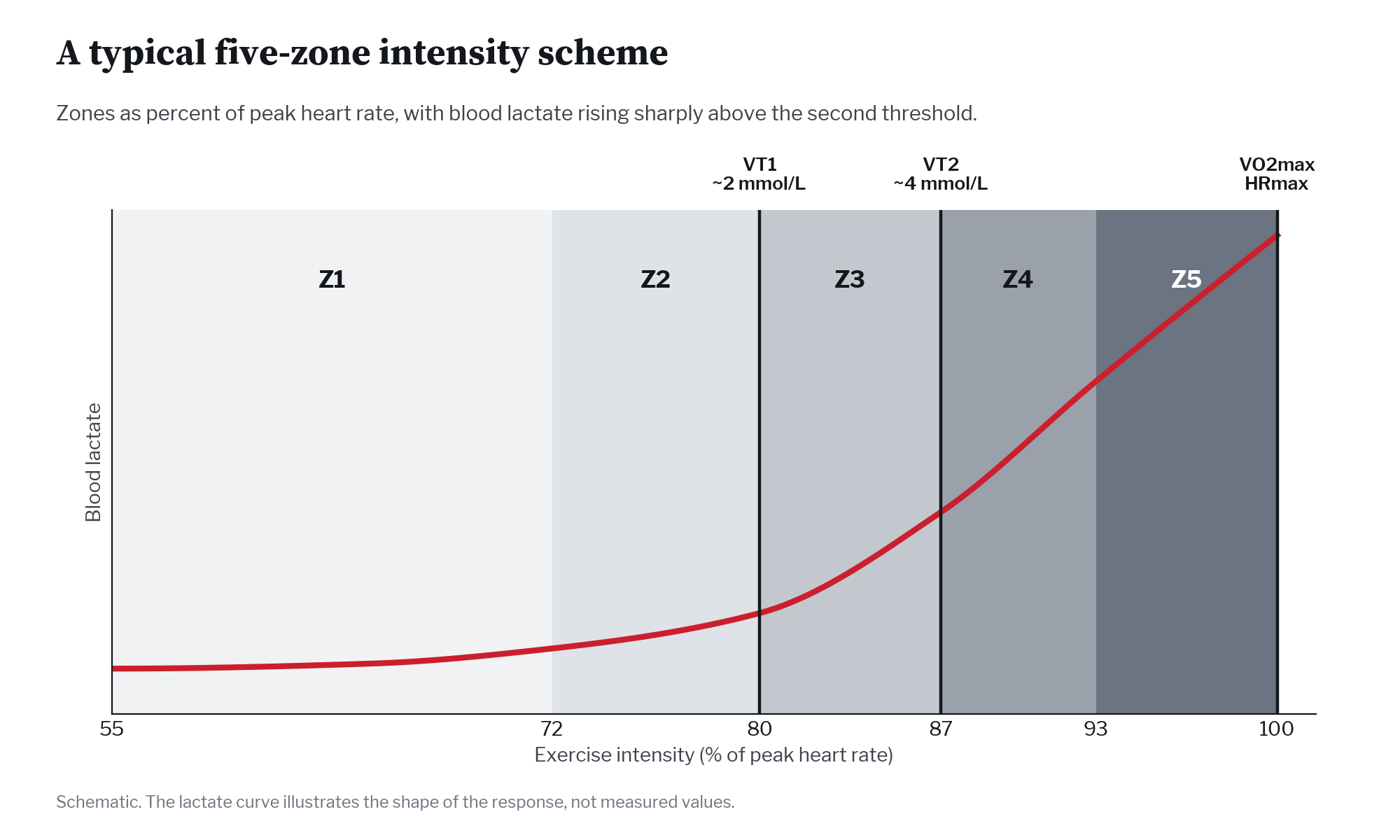
A typical five-zone scheme places the first ventilatory threshold at about 80 percent of peak heart rate. For most athletes, Galanes argues, it sits lower. (Chart: FasterSkier)
Another Common Model
Here is another example, much like the zone table published by Aker Dæhlie. It is a good theoretical model, but again I would suggest that endurance training above 75 percent of maximal heart rate is unnecessary, and the cost-benefit assessment does not suggest a benefit. We also see that LT1/VT1 is probably not at 80 percent of maximal heart rate for most athletes.
Each adaptation has an intensity where it responds best, but none of them stops at a zone boundary. (Figure: redrawn from Olympiatoppen educational material, 2020)
Zones Overlap
Most of us consider training zones hard and fast, but that is not the case. The chart above illustrates the possible range of metabolic and neuromuscular benefits of different training intensities. I believe the reason to use zones and monitor training is to ensure effective training adaptation. That is why I say that endurance training at more than 70 to 75 percent of maximal heart rate does not have a positive cost-benefit. As recovery time increases, adaptation slows, and the time to readiness for the next hard session can be extended.
The chart is an excellent depiction of how adaptations overlap across training intensities. Each metabolic and neuromuscular adaptation has a theoretical optimal range, but the adaptations still occur well outside those ranges.
A lactate test in the middle of a hill-bounding session, with coach Will Sweetser and Quinn Holan. If you use lactate, spot-check often enough to learn your own daily variation. (Courtesy photo)
My Advice
When analyzing what others say or publish, look closely and question what their training zones are based on. You must be speaking the same language before implementing any changes.
Pick a training zone model that makes sense to you. If you are going to use lactate, you must do frequent spot checks so you understand your individual daily variation. You absolutely cannot rely on a one-off test to make training decisions.
Use new and emerging technology, such as respiration and muscle oxygen monitoring, only after validating its consistency and variability.
Don’t jump from trend to trend. There are a lot of them out there. Learn from what has worked, and weigh emerging science against experience. Remaining current does not mean trend-hopping to stay relevant on social media.
Be clear on terminology. The same term can mean very different things to different scientists and coaches.
Use a couple of tests that produce meaningful data and inform training decisions. Collecting more data does not make for better programs.
For most people, perhaps everyone, percentage of maximal heart rate is a practical way to determine training zones.
Help Support Our Coverage!
If you value the thoughtful work and access FasterSkier provides, please consider becoming a Voluntary Subscriber. Your support directly fuels our work to cover the people, places, and moments that make our sport special.
Kate Oldham racing the 10 k freestyle at the Trondheim World Cup in December 2025. Races of 5 to 15 kilometers, Jim Galanes points out, are not raced at threshold. (Photo: Modica/NordicFocus)
For the last couple of decades, the priority for high-intensity training has shifted from threshold, to VO2max, and now back to threshold again. Nowadays threshold training is increasingly presented as the ideal endurance training intensity. The suggestion is a high aerobic stimulus at a low recovery cost, repeatable and sustainable. VO2max is often portrayed as the opposite: a very high stimulus, high stress, very high fatigue, and something to be used carefully, if at all. Folks, we have seen this story before, in the threshold boom of the mid to late ’90s.
From some perspectives this may be intuitively correct and perhaps logical. If we compare one minute of threshold work to one minute at VO2max intensity, the VO2max work is more demanding. That is a no-brainer. There is more carbohydrate use, higher oxygen demand, higher lactate production, greater perceived exertion and generally a greater physiological disturbance. But is that the way training really works? We build training plans around individual workouts and daily and weekly loads, not per minute of high-intensity training.
For example, we might plan 5 x 4 minutes at VO2max intensity, or 20 minutes of total work. Or it might be 4 x 10 minutes at threshold, or 40 minutes of total work. When we look at the load of the whole session, things become far less clear. Both types of training produce similar adaptations, although the adaptive signal from the higher-intensity work is much stronger, and there is little evidence that a threshold session creates less recovery demand than an appropriately controlled VO2max session.
This is really the point I want to make. We need to stop confusing intensity with training load, and, perhaps more important, we need to stop confusing training load with the recovery timeline. They are related, but they are not the same thing.
As I have written before, threshold is a moving target, and defining it is problematic. There are perhaps a dozen or more methods used to determine threshold, and they can produce very different speeds, heart rates, power outputs and lactate values. Some athletes are working just above LT1 and calling it threshold. Others are working around 4 mmol, and others are using ventilatory threshold, critical power, some percentage of race pace, or simply an intensity that feels controlled and hard. So when people say “threshold training,” I am not sure we are even talking about the same thing. That alone should make us careful about assigning a fixed physiological cost or benefit to threshold training.
The generally accepted training model is usually described like this: easy endurance training provides a relatively small stimulus at a relatively low cost, so we need a lot of it. Threshold gives us a much larger aerobic stimulus, still at a manageable recovery cost. VO2max gives us a very large stimulus, but at a very high recovery cost. Again, that makes intuitive sense, but is it true when we compare realistic sessions? I am not convinced it is. In fact, I am certain it is not.
If we think of training load in simple terms, it is a combination of intensity and duration. Higher intensity produces greater load per minute, while longer duration produces more total load. A 3-hour easy workout, for example, produces a bigger training load than a 75-minute workout with 5 x 4 minutes of VO2max intervals. This is obvious, but somehow we often forget it when discussing threshold and VO2max training.
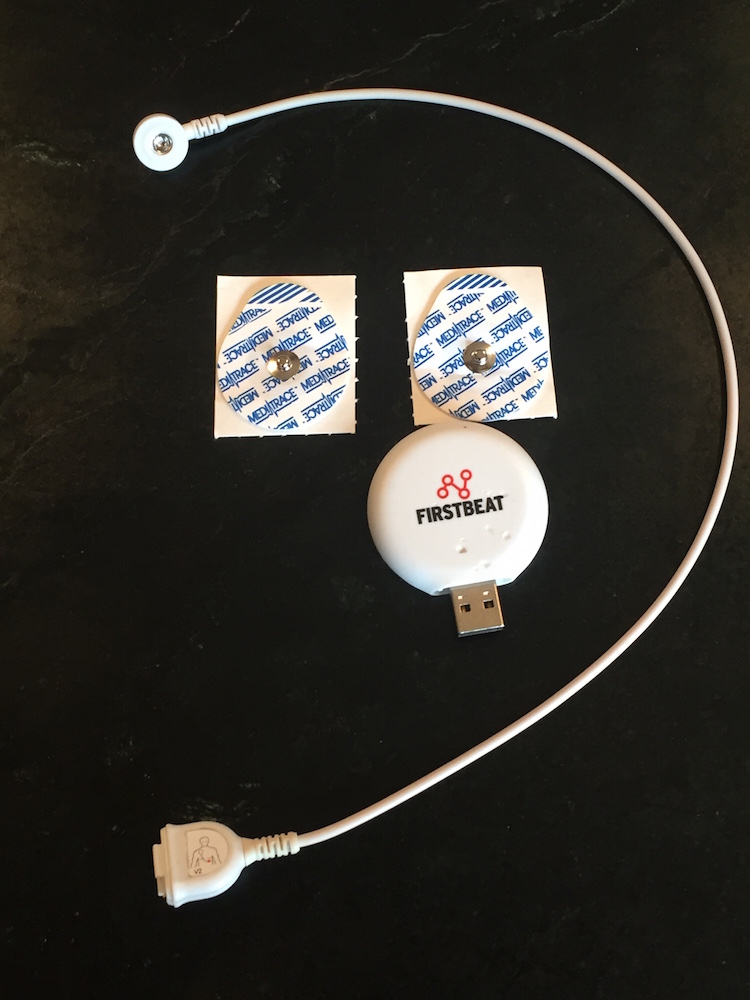
Take a typical VO2max workout of five by four minutes, 20 minutes of work. Using Firstbeat’s TRIMP model, that might create about 55 to 60 TRIMP. Now take a threshold workout of four by ten minutes, 40 minutes of work. That might generate something in the 95 to 100 TRIMP range. With Firstbeat we can also look at EPOC as an estimate of the disturbance of homeostasis. Again, these are estimates and certainly not perfect measures, but 20 minutes at around 90 percent of VO2max might produce an EPOC of around 175 ml/kg, while 40 minutes at around 85 percent might produce an EPOC of 225 ml/kg. Once again the threshold workout produces a significantly higher stress load.
I don’t want to get hung up on whether those exact Firstbeat numbers are accurate, because that is not really the point. The point is that it is entirely possible for the lower-intensity session to produce the larger total load, and that should not surprise anyone, because it is twice as long.
The same thing happens if we use session RPE. Twenty minutes of VO2max work at an RPE of 9 gives us 180 AU (arbitrary units), while forty minutes of threshold at an RPE of 6 gives us 240 AU. Again, the threshold session creates the larger estimated training load. That does not prove threshold is more stressful or that it takes longer to recover from. TRIMP and session RPE are measures or estimates of training load, not measurements of recovery time.
We have at least three different things being discussed as if they were the same: the intensity of the exercise, the total load of the workout, and how long it takes the athlete to recover. A VO2max interval clearly creates greater physiological disturbance per minute. A longer threshold session may create a greater total training load. Neither one, by itself, tells us which athlete will be better recovered 24 or 48 hours later.
High cost per minute is not the same thing as high cost per session, and high session load is not necessarily the same thing as longer recovery.
Otto Invenius, Campbell Wright, Maxime Germain and Adam Runnalls climbing the Stelvio Pass on rollerskis above Livigno, Italy, in July 2025. The adaptations from threshold and VO2max work overlap far more than the zone names suggest. (Photo: Manzoni/NordicFocus)
What Are We Actually Trying to Adapt?
The other issue is that we spend far too much time talking about training zones and not enough time talking about desired adaptations. What adaptations are we trying to create? That should come first.
VO2max training provides a very strong aerobic stimulus at near-maximal oxidative capacity. It can increase maximal cardiac output, improve oxygen transport, create very high muscular oxygen demand and expose the athlete to speeds and power outputs similar to race demands. Threshold training lets us accumulate a large amount of work at a high aerobic fractional utilization. It can improve sustainable speed or power, oxidative capacity at that intensity, and the ability to maintain a high percentage of maximal aerobic power for a longer period of time.
These adaptations overlap a great deal. I sometimes hear people talk as if threshold develops lactate clearance and the muscles’ ability to sustain work, while VO2max develops the central cardiovascular system. But VO2max training creates a large muscular stimulus as well. ATP turnover is very high, calcium flux is high, metabolic disturbance is high, and the signaling associated with mitochondrial biogenesis is substantial. VO2max training is not simply “central cardiovascular training.” It also provides a significant peripheral training stimulus.
Threshold training obviously produces a similar but slightly smaller mitochondrial and muscular signal for adaptation. But I think its real advantage may be something much simpler. Because the intensity is lower, we can normally do considerably more of it. That allows us to accumulate a large amount of work at a high aerobic fractional utilization, with substantial muscular recruitment and a large amount of sport-specific work.
That may be threshold training’s most important characteristic. Not that it creates some unique physiological adaptation unavailable at other intensities, but that it allows us to accumulate considerably more work while still creating a high oxidative demand.
This can be particularly important for an athlete who already has a high VO2max and whose limitation is the fraction of that VO2max that can be sustained. If fractional utilization is relatively low, increasing sustainable aerobic power may be far more important than trying to push VO2max another few percent. For that athlete, a greater amount of threshold work may make very good sense.
But that is an argument based on the needs of the athlete, not an argument that threshold is inherently a better training intensity or that we recover from it more quickly.
Lactate clearance and resynthesis is another area where I think training discussions have become confused. We often hear that threshold training is necessary because the athlete needs to train to “clear lactate.” I have always had a problem with this explanation, because it is neither accurate nor scientifically valid. Remember, it is lactate we are talking about, not lactic acid, as many refer to it.
Lactate is not a waste product that suddenly appears at threshold and then needs to be removed. It is being produced, transported and oxidized all the time, at all intensities, and it is an important fuel. Endurance training improves the ability to transport and oxidize lactate, but there is no reason to believe this only happens at threshold. High-intensity interval training also improves lactate transport and can move lactate threshold substantially.
VO2max intervals also create very high lactate production and turnover. So if we are looking at the lactate shuttle, why would it only, or even preferentially, adapt when lactate is sitting around 2, 3 or 4 mmol? That doesn’t make much physiological sense to me. Producing higher levels of lactate will stimulate resynthesis.
The same is true for mitochondrial biogenesis, oxidative enzymes and capillarization. We cannot neatly assign these adaptations to one training zone, because there is considerable overlap between endurance, threshold and high-intensity training.
That doesn’t mean all intensities are the same. They clearly aren’t. It means we should be careful about inventing unique adaptations for a training zone simply because we have given that zone a name. Threshold training is not the only method, or even the optimal method, to improve lactate oxidation and resynthesis.
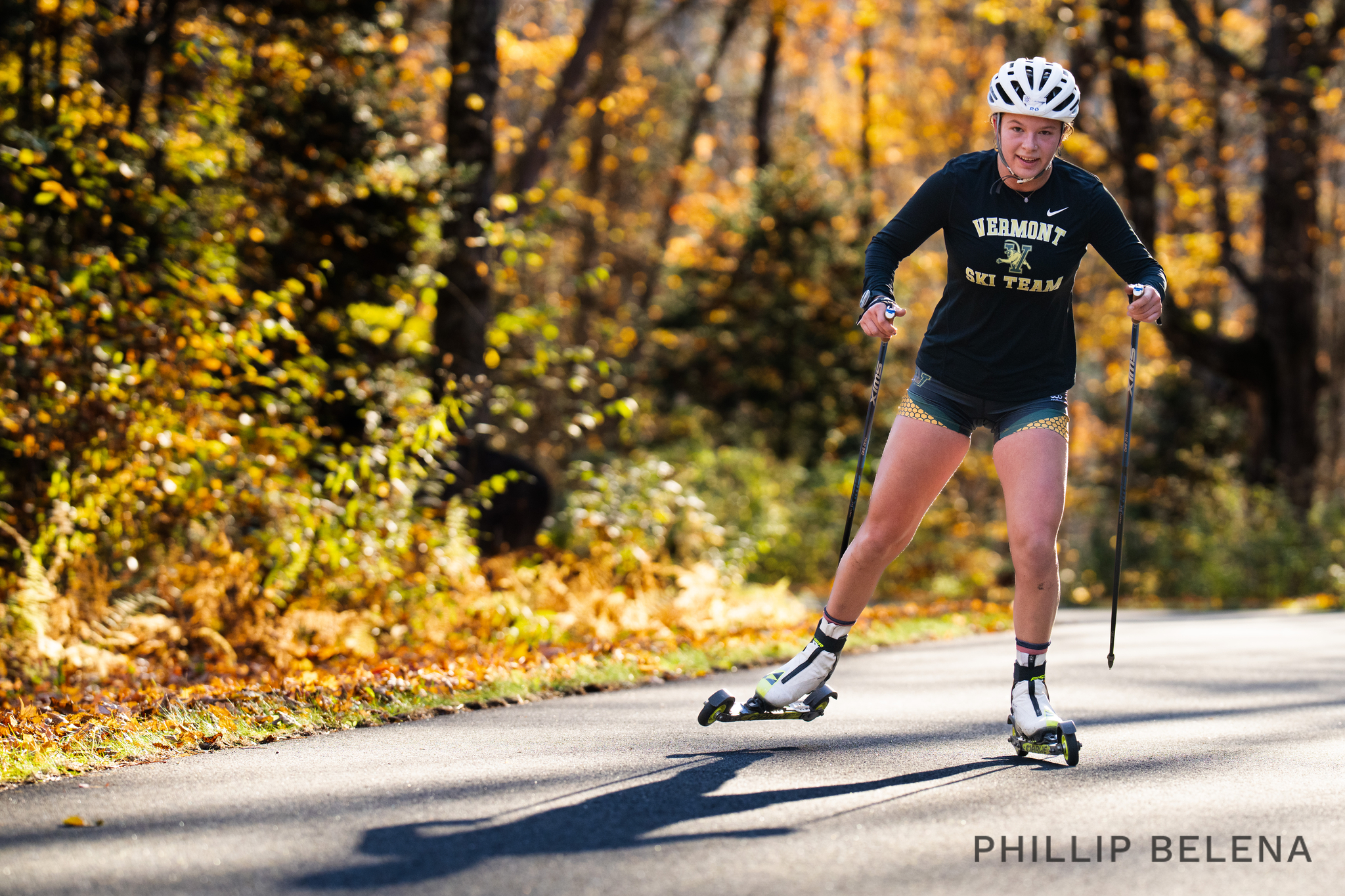
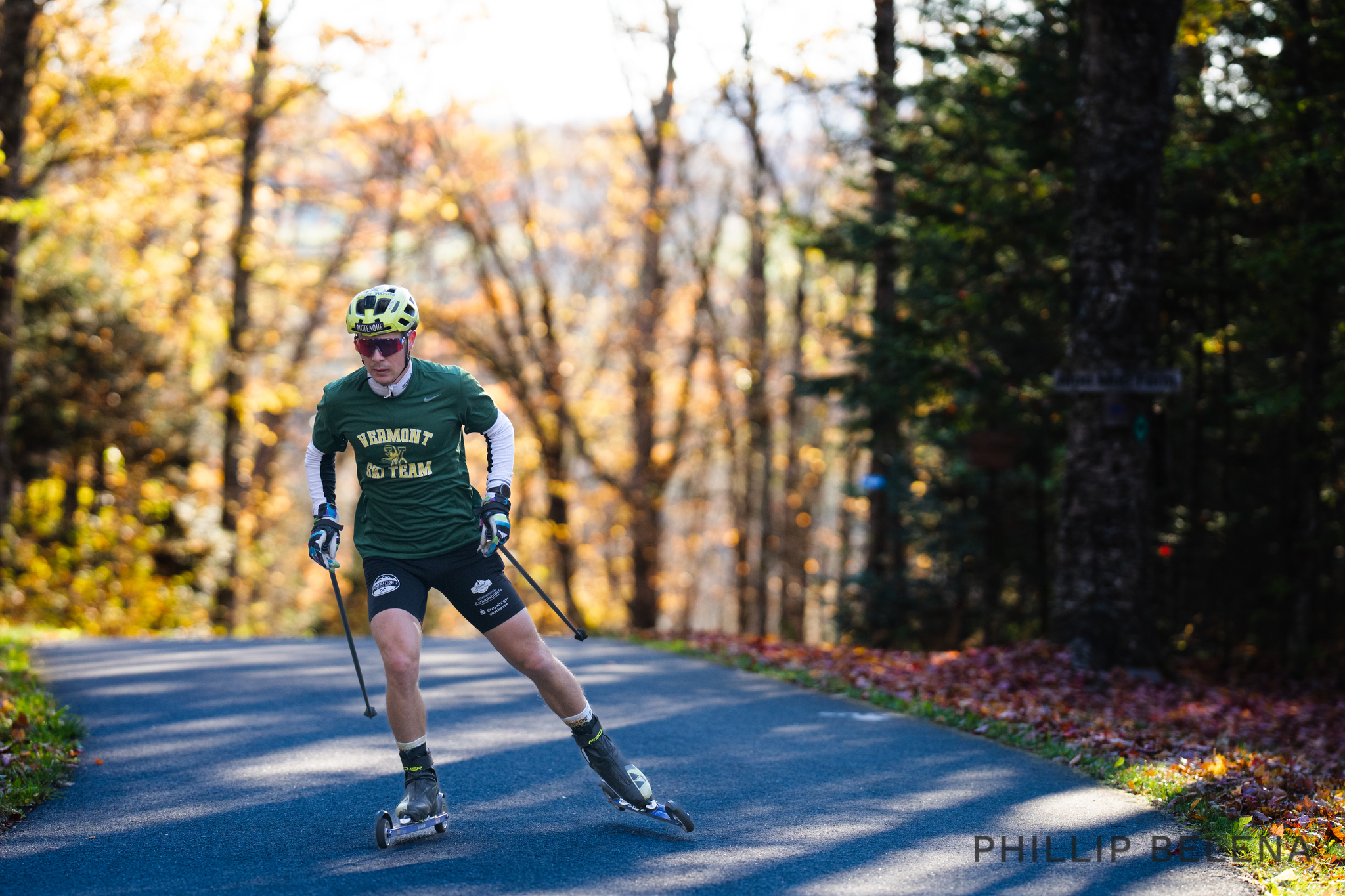
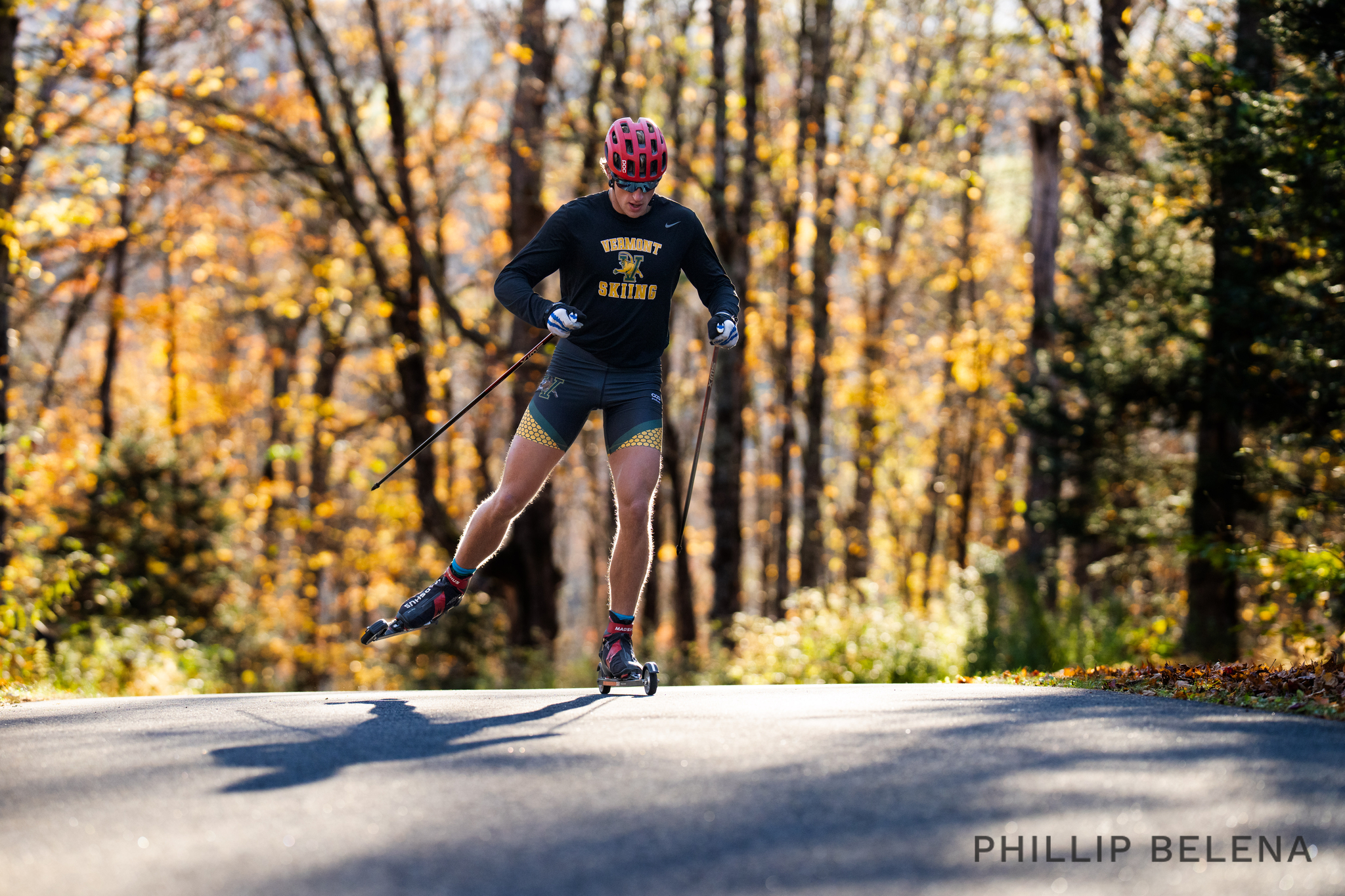
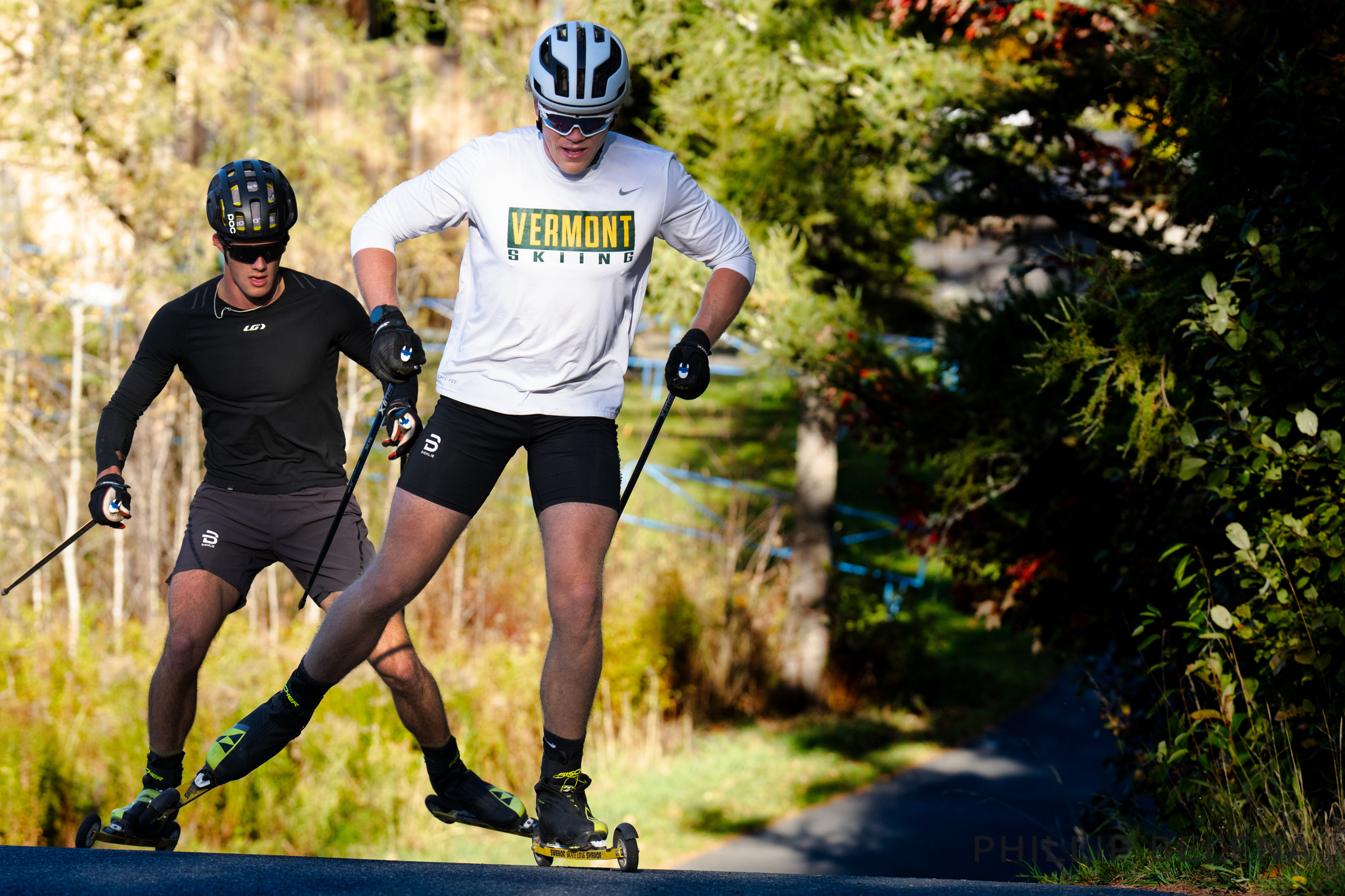
A University of Vermont skier on rollerskis at Craftsbury Outdoor Center in October 2025. Autonomic, glycogen, muscular and mechanical recovery all run on different clocks. (Photo: Phillip Belena/EISA)
What Is Recovery?
Another problem in this discussion is recovery. People will say that threshold is easier to recover from. Maybe, but recover from what? Autonomic disturbance, glycogen depletion, neuromuscular fatigue, muscle damage, mechanical load, dehydration or psychological fatigue? These are not the same thing, and they do not necessarily recover at the same rate. A 2-hour run and a 2-hour rollerski at the same intensity, for example, carry very different mechanical loads to recover from.
HRV may tell us something about autonomic recovery, which should also reflect other aspects of recovery but does not specifically measure them. Resting heart rate can tell us something, but again not everything. Blood lactate tells us something about what is happening during and immediately after the workout, but remarkably little about whether the athlete is going to train well 24 or 48 hours later. Creatine kinase may tell us something about muscle damage, but there is huge individual variation. So when we talk about recovery cost as if it were one number, I think we are being too simplistic.
This is also why I don’t think we can simply use TRIMP, EPOC, duration, distance or session RPE to say one workout takes longer to recover from than another. They can give us useful information about internal load or physiological disturbance, but they are not recovery measurements. Ultimately, recovery must be considered in terms of which physiological systems were stressed and, more practically, what the athlete can do in the days immediately after a hard workout.
Carbohydrate use is another good example. VO2max exercise clearly has a higher rate of carbohydrate use per minute than threshold exercise. But once again, the session matters more than the minute. Twenty minutes at VO2max intensity may have a very high glycogen cost per minute. Forty, fifty or sixty minutes at threshold has a somewhat lower rate, but it is sustained for two or three times as long. We cannot automatically assume that the shorter VO2max workout creates greater total glycogen depletion.
This becomes particularly important when athletes are doing regular quality sessions. If glycogen restoration is an important part of recovery, a long threshold session may impose a very substantial recovery requirement despite producing lower lactate concentrations and feeling much more controlled. An athlete does not have to be lying on the ground after a workout for that workout to have been expensive to recover from.
That is one of the problems I see with the idea that threshold can be repeated frequently simply because lactate is controlled. Low lactate does not necessarily mean low glycogen use, low muscular load or rapid recovery. If we keep extending the duration of the threshold work, at some point the additional work has a cost.
Which brings us to what I think is probably the most meaningful recovery measure, and one that is surprisingly rarely studied: can the athlete perform the next important training session at the expected level?
Lucas Wilmot, Kristen Bourne, Murphy Kimball and Tabor Greenberg after their first L3 intervals at a 2025 camp in Bend, Oregon. (Photo: Leann Bentley)
An Interesting Study
One of the more interesting comparisons was made by Seiler, Haugen and Kuffel with highly trained runners. On one occasion the athletes did a threshold session of around 30 minutes between the first and second ventilatory thresholds, and on another, six three-minute intervals at around 95 to 96 percent of VO2max. I would point out that 95 to 96 percent of VO2max is already hard, and above what I would normally call a controlled VO2max session.
The differences between the workouts were substantial. Lactate during the threshold session was around 2.7 mmol, while during the VO2max intervals it was around 7.1. Perceived exertion was also much higher during the VO2max workout. By almost any acute measure the VO2max workout looked harder, so we might reasonably expect recovery to take longer. But HRV recovery following the two sessions was remarkably similar.
Now, this study does not fully answer the question. The threshold work was only around 30 minutes, HRV measures one part of recovery, and there are all kinds of differences between athletes. But it does challenge an assumption that I think is important. Greater acute metabolic disturbance does not necessarily mean longer recovery, but the dose does.
It also raises what I think is an even more interesting question. What would have happened if the threshold session had contained 40 or 50 minutes of work rather than 30? That would be much closer to the threshold sessions many trained endurance athletes are actually doing.
U.S. Biathlon coach Armin Auchentaller with Campbell Wright during summer training in Livigno, Italy, in July 2025. A controlled VO2max session is about time at high oxygen uptake, not about producing as much lactate as possible. (Photo: Manzoni/NordicFocus)
Control of VO2max Training
There is another issue here that I think is important. A lot of people seem to think VO2max training means going as hard as possible. It doesn’t, at least not the way I see it and use it.
If I give an athlete 5 x 4 minutes of VO2max work, I am not asking them to race every interval or see how much lactate they can produce. I am trying to get them to accumulate time at a very high oxygen uptake, typically around 90 to 95 percent of maximal heart rate and VO2max.
If the objective is a cardiovascular and oxidative stimulus, we need sufficient intensity to drive oxygen consumption toward a very high fractional utilization of VO2max. For many athletes, something in the range of 90 to 95 percent of VO2max may be enough to accomplish that. Once we have produced the stimulus we are looking for, going harder does not necessarily make the workout better.
This becomes important when we compare threshold and VO2max training. If someone compares a carefully controlled threshold session with a set of VO2max intervals performed as hard as possible, then of course the VO2max workout is going to look very stressful. But that may simply be a badly controlled VO2max workout.
A well-controlled VO2max session and an all-out interval session are not the same workout, just as a controlled threshold session and a threshold session that slowly turns into a race are not the same workout. Anyone who has coached for very long has seen both.
A University of Vermont skier on the rollerski track at Craftsbury in October 2025. Forty minutes at threshold is a lot of work, and so is fifty, and so is sixty. (Photo: Phillip Belena/EISA)
What Is Threshold’s Real Advantage?
In my view, the strongest argument for threshold training is not that it produces some special adaptation, but that athletes can accumulate a lot of high-quality aerobic work. Forty minutes at threshold is a lot of work. Fifty minutes is a lot of work. Sixty minutes is a lot of work. For an elite endurance athlete doing a very large total training volume, that may be exactly what is needed, provided the athlete can recover from the overall workload of the training period.
Threshold gives us a way to accumulate a substantial amount of work at high oxidative fractional utilization, with considerable muscular recruitment and a lot of sport-specific work. For an athlete with a high VO2max who needs to improve fractional utilization or sustainable aerobic power, this can be valuable.
I think this is where some of the current discussion around threshold becomes problematic. Because it is controlled, because lactate is relatively low, and because the athlete is not destroyed afterward, threshold starts to be treated almost like endurance training. It isn’t. It is still hard training, and if you do enough of it, it carries a substantial training load and potentially a substantial recovery cost.
The question is not simply whether forty or fifty minutes at threshold creates more adaptation than twenty minutes of VO2max work. It probably creates more of some kinds of stimulus simply because we are doing so much more work. The more useful question is whether the additional adaptation we get from that extra work is worth the additional load and recovery cost.
Kevin Bolger in the fog at the Oslo World Cup mass start in March 2026. The first question is what adaptation an athlete needs. The second is the smallest dose that will produce it. (Photo: Authamayou/NordicFocus)
Are We Asking the Wrong Question?
The debate is usually framed as threshold versus VO2max. Which is better? I don’t think that is the right question. The first question should be what adaptation this athlete needs. The second, and I think this is more important, is what is the smallest dose capable of producing that adaptation? It isn’t necessarily 40, 50 or 60 minutes. The third is what effect that dose will have on the training the athlete can perform over the next several days.
We tend to assume that if some training is good, more of it must create a greater adaptation. Up to a point that is probably true. But the objective of training is not to produce the largest possible stimulus in every workout. It is to produce enough stimulus to create the adaptation while still being able to absorb the rest of the training.
If an athlete has a relatively low VO2max and that is limiting performance, perhaps 15 or 20 minutes of controlled VO2max training gives us exactly the stimulus needed. If that is enough to stimulate the adaptation, why do 50 minutes of threshold just because threshold is currently popular?
On the other hand, if an athlete already has a very high VO2max but relatively poor fractional utilization, and cannot sustain a high percentage of it, then perhaps a larger volume of threshold work is exactly what is required. In that case the ability to accumulate 40 or 50 minutes at high aerobic flux may be the important stimulus.
NENSA athletes rollerskiing together in Craftsbury, Vermont. A workout can look great on paper and still be the wrong choice if it costs the next two days. (Photo: Chris City)
The Training Week Matters More Than the Workout
I also think we make a mistake when we look at workouts in isolation. A workout can look great on paper and still be a poor training choice, because the real issue is not simply what happened during those 60 or 90 minutes. It is what that workout allows us to do over the next several days.
Suppose a threshold workout produces 10 percent less adaptive stimulus than a VO2max session but allows the athlete to train substantially better over the following two days. Threshold may clearly have the better stimulus-to-recovery ratio and therefore be the better choice.
But reverse the situation. Suppose 20 minutes of well-controlled VO2max work produces the adaptation we want and the athlete is ready to train normally the next day, while 40 or 60 minutes of threshold creates substantial glycogen depletion and muscular fatigue. In that circumstance, the shorter VO2max workout may have the better stimulus-to-recovery ratio.
We shouldn’t decide the answer beforehand simply because one workout carries the label “threshold” and the other “VO2max.” Threshold is not automatically low cost, and VO2max is not automatically high cost. The dose matters, the athlete matters, the training done before the session matters, what needs to be done after the session matters, and the total training week matters.
Therese Johaug racing the mass start at the Lahti World Cup in March 2025. Even races of up to 90 minutes, Galanes says, are often skied well above threshold. (Photo: Thibaut/NordicFocus)
Dose, Adaptation and Recovery
I am certainly not arguing against threshold training. Rather, I am arguing that the dose needs to be controlled relative to the individual athlete, and that the time to recover is not what is often suggested. I use threshold with athletes who need it, and it can be effective. But I do think we need to be more careful about how it is being presented. It is not automatically what every athlete needs.
Threshold and VO2max training have different characteristics, but their physiological adaptations overlap substantially. VO2max training provides a very large physiological stimulus in a relatively short period of time and appears particularly useful when maximal aerobic capacity is what we are trying to improve. Threshold allows us to accumulate considerably more work at a high aerobic output and can be extremely effective when sustainable aerobic power or fractional utilization is the limitation.
Both can be valuable, and both can be overdone.
In my experience, especially over the last decade, I have seen far more athletes become flat, stale, overtrained or simply stagnant from doing too much threshold training than from doing properly controlled VO2max work. Usually it comes from doing too big a volume of threshold work, too often. That doesn’t mean threshold is bad. It means threshold must be appropriately prescribed and dosed.
I also think the very large amounts of threshold work we sometimes see promoted are primarily appropriate for highly trained elite athletes who are also doing very large overall training volumes and have spent years developing that volume. I would be much more cautious applying the same model to younger athletes, developing athletes, masters athletes, or anyone doing a much smaller overall training volume.
There is another point that seems to get lost. Athletes racing 5, 10 and 15-kilometer events are not racing those events at threshold. I have decades of data showing that even in races of up to 90 minutes, fractional utilization can be well above threshold. The shorter races are at a very high intensity, in what is defined as the VO2max zone. At some point we need to train that capacity directly. Doing more threshold work because it is supposedly lower cost does not eliminate the need to train at race-relevant intensity.
In the end, I think we need to get away from ranking training zones as good, bad, safe or dangerous, and think more in terms of dose, desired adaptation and recovery. What are we trying to adapt, what dose is needed to produce that adaptation (often less than we think), and what does that dose cost us in terms of the training that follows?
The most valuable workout is not necessarily the one that creates the greatest immediate physiological disturbance, nor is it necessarily the one that accumulates the most minutes around some predetermined lactate value. It is the workout that provides enough stimulus to produce the adaptation we are looking for while preserving the athlete’s ability to absorb the rest of the training program.
In the end, that is the balance we are trying to find.
Help Support Our Coverage!
If you value the thoughtful work and access FasterSkier provides, please consider becoming a Voluntary Subscriber. Your support directly fuels our work to cover the people, places, and moments that make our sport special.
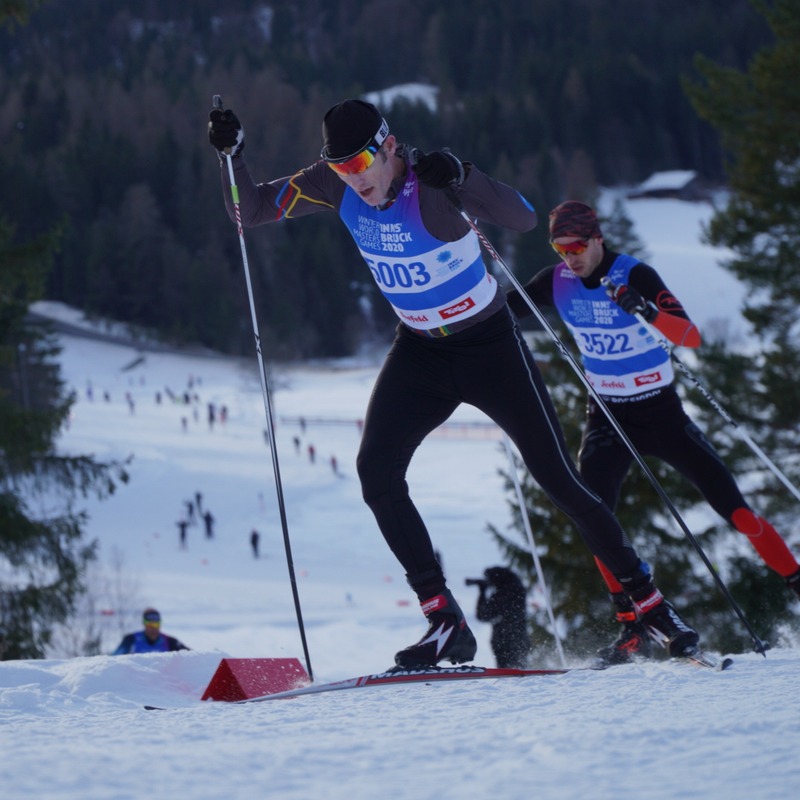
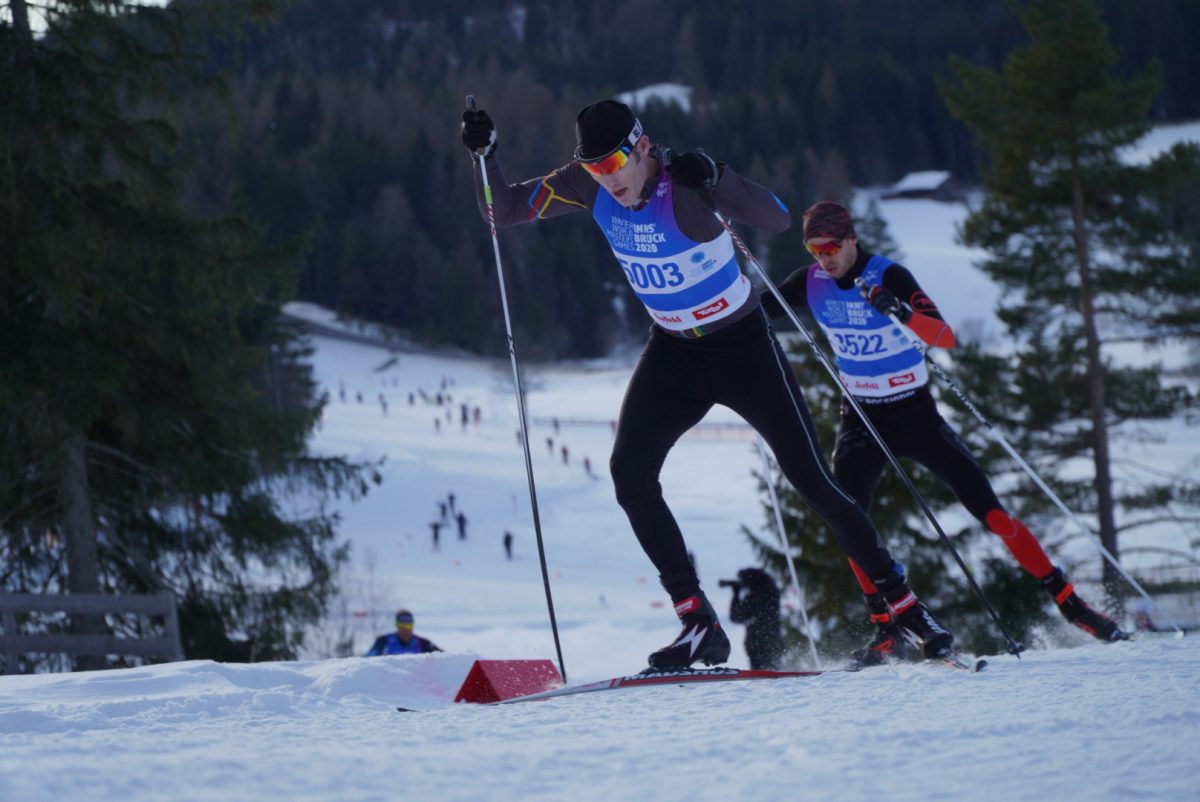
Tim Donahue racing at the 2020 Winter World Masters Games in Seefeld, Austria. Jim Galanes argues that the training masters skiers cut first is often the training that protects what aging takes away fastest. (Photo: Garrott Kuzzy / Lumi Experiences)
There are two common problems I see in the masters athletes I consult with or coach. The first is the same problem we see with athletes of all ages: they tend to train “half hard” every day. Half hard, Zone 1 quickly drifts into Zone 2 or 3. The second is more specific to masters athletes. They try to follow a training plan that is basically a dumbed-down version of an elite athlete’s program.
The first problem is relatively straightforward to address. Determine appropriate training zones and control the intensity of training more accurately.
The second is more complicated. We need to determine the volume of training an athlete can recover from, adapt to and maintain consistently. Then we need to organize that training around the physiological capacities that are most likely to decline as we age.
There is truth behind the conventional advice given to masters athletes. Recovery does change with age. Simply repeating the training we did at 25 or 30, or copying the program of an elite athlete, is never the best approach at 50, 60 or 70.
But there is a problem with how we sometimes respond to that reality. Many of the training components we tend to remove as athletes age are exactly the components that address the physiological capacities declining most rapidly.
The challenge of training as a masters skier isn’t simply figuring out how to recover better. It is figuring out how to provide enough training stimulus to maintain and improve the capacities that are naturally declining with age while still recovering sufficiently to adapt to the volume of training.
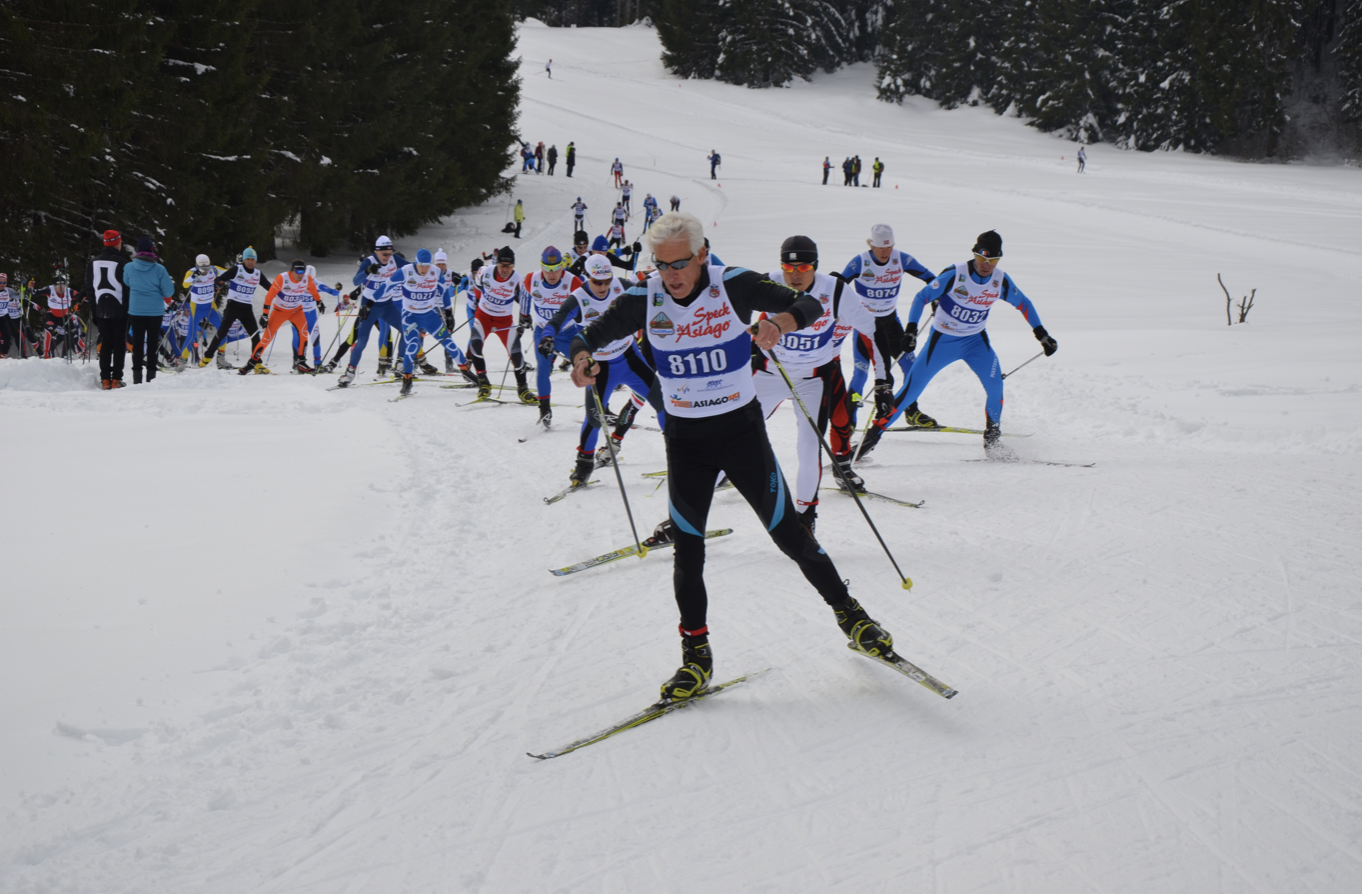
A masters field on the climb at the 2014 Masters World Championship in Asiago, Italy. Endurance performance declines with age, but the individual components of performance do not decline at the same rate. (Courtesy photo)
What Actually Changes with Age?
We know endurance performance declines with age, but the individual components of performance do not decline at the same rate.
One of the largest physiological changes is generally VO2max. Maximum heart rate declines. Muscle mass and maximal strength decline, both of which are important to maintaining aerobic capacity and skiing performance. Type II muscle fibers and explosive power become increasingly difficult to maintain.
Meanwhile, exercise economy and the ability to sustain a relatively high percentage of VO2max can be reasonably well maintained in highly trained older athletes. That should tell us something about training.
If these capacities decline at different rates, it doesn’t make much sense to treat them equally in training.
There is a temptation as we age to gravitate toward the training we tolerate best. The problem is that the capacities we tolerate best may also be the capacities we are already preserving reasonably well.
Training should not simply reflect what aging makes easiest to do. It must continue to address what aging is taking away. If VO2max, strength and power are among the capacities most vulnerable to aging, eliminating high-intensity and strength training in the name of increasing recovery may solve one problem while creating another.
Ahvo Taipale during a Vakava training session. Consistently accumulated aerobic volume remains one of the primary drivers of endurance adaptation, and one of the best defenses a masters skier has. (Photo: Finn Sisu)
Maintain the Aerobic Volume
There has been considerable emphasis in endurance training recently on large volumes of low-intensity training combined with substantial amounts of threshold and sub-threshold work.
There are good reasons for that approach, particularly among highly trained elite athletes. But simply transferring that model to masters athletes can overlook the capacities most threatened by aging, particularly VO2max, strength and power.
So how much Zone 1? How much threshold? How much VO2max?
Those are important questions, but they can obscure something more fundamental.
Consistently accumulated training volume remains one of the primary drivers of endurance adaptation. Masters athletes sometimes respond to aging by progressively reducing volume and attempting to compensate with intensity. There are limits to that strategy.
Mitochondrial development, capillarization, fat oxidation, durability and the ability to maintain performance over long races are built largely through accumulated aerobic work. A two-hour easy ski is not interchangeable with a hard interval workout simply because the interval session produces more acute physiological stress.
For a masters skier who has trained for decades, maintaining as much sustainable aerobic volume as possible may therefore be one of the most important defenses against declining endurance capacity.
The key words are sustainable and consistent training.
The volume has to be performed at the right intensity. It has to be something we can recover from day after day and, most importantly, adapt to over weeks and months.
As we have written previously, occasional hero weeks followed by heavy fatigue and a subsequent reduction in training for recovery are less effective than weeks and months of consistent training at a sustainable level.
UVM’s Fin Bailey drives up a climb on the Craftsbury Outdoor Center track. The answer to aging is not necessarily more high-intensity training, but keeping the frequency of the stimulus while controlling the dose. (Photo: Phillip Belena)
Don’t Abandon Intensity
The opposite mistake is maintaining plenty of volume while gradually eliminating the hard training. This is understandable, particularly for those who enjoy the “half hard” training.
When we stop performing high-intensity training consistently, we lose some of our adaptation to that capacity. Every subsequent interval workout or race is then harder than it used to be, and recovery takes longer, because we have eroded that capacity. That can reinforce the idea that high intensity itself is the problem.
But VO2max is also one of the physiological qualities most strongly affected by aging. So the training stimulus we may most need to maintain becomes increasingly difficult to perform and recover from. The answer isn’t necessarily more high-intensity training. It is maintaining the frequency of the stimulus while controlling the dose.
That may mean less high-intensity work in an individual session, but performing it consistently throughout the year. Fifteen to twenty productive minutes near VO2max may provide a better stimulus than turning every interval workout into a contest to see how much we can do. For many masters skiers, one or two genuinely hard aerobic sessions every seven to ten days may accomplish more than two or three mediocre high-intensity sessions every week.
The appropriate frequency depends on training history, age, fitness and recovery ability, not on a predetermined seven-day formula.
Gunnar Knapp finishes the Engadin Skimarathon. Threshold and sub-threshold training allow considerably more work to be accumulated at a high aerobic rate. (Photo: Garrott Kuzzy / Lumi Experiences)
Threshold Has a Different Job
Threshold training shouldn’t simply become the safer substitute for VO2max training. It is not. In fact, the metabolic and neuromuscular cost of a typical threshold session may be greater than that of a typical controlled VO2max session.
VO2max training provides a powerful stimulus to central aerobic capacity, cardiac output and the ability to deliver and utilize large amounts of oxygen. Threshold and sub-threshold training allow considerably more work to be accumulated at a high aerobic rate while developing the ability to sustain that rate economically.
One of the important considerations in deciding how much emphasis to place on each is fractional utilization: the percentage of VO2max an athlete can sustain for a prolonged period. An athlete with a relatively low VO2max but already high fractional utilization may gain relatively little by continually emphasizing the quality that is already strong while allowing the aerobic ceiling above it to decline.
Conversely, an athlete with a large aerobic capacity but relatively poor ability to sustain a high percentage of it may have considerably more to gain from threshold and sub-threshold training.
This becomes particularly important in highly trained skiers. The speeds elite skiers can maintain at threshold or just below it can be quite close to actual race velocities. That speed and the muscular demands associated with sustaining it are part of what makes the training effective.
For cross-country skiers, both qualities matter.
A skier may have an excellent VO2max but lack the muscular endurance to translate that capacity into sustained double poling or climbing. Another skier may have excellent threshold durability but gradually lose the aerobic ceiling above it.
The question isn’t whether threshold or VO2max training is better. The question is which physiological limitation we are trying to change.
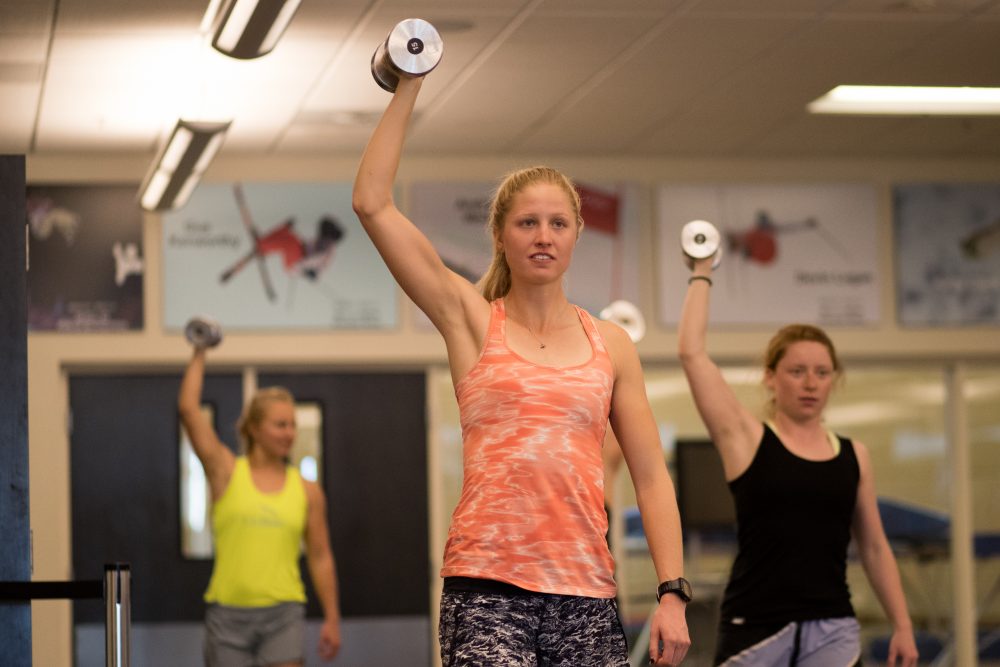
Hailey Swirbul during a strength session at a U.S. Ski Team camp in Park City, Utah. Research in cross-country skiers has shown that maximal-strength training can improve double-poling performance and economy. (Photo: Reese Brown)
Strength Becomes More Important, Not Less
Perhaps the clearest change in training priorities with age should be strength.
Cross-country skiing has become increasingly dependent on upper-body force, whole-body strength and power. At the same time, aging progressively reduces muscle mass, maximal strength and particularly fast-twitch muscle function.
Research in cross-country skiers has shown that maximal-strength training can improve double-poling performance and economy. One likely explanation is relatively simple. If every pole stroke represents a smaller percentage of your maximum force, repeatedly producing that force becomes less metabolically costly.
For masters skiers, developing and preserving maximal strength is particularly valuable because it provides reserve capacity. The goal is maintaining the ability to produce force.
That generally suggests relatively heavy resistance, good technique, low-to-moderate repetition ranges and sufficient recovery, rather than endless circuits of light weights.
Ian Torchia, right, leads bounding intervals up Stratton Mountain. Power tends to decline particularly rapidly with age, and short, fast work preserves it without requiring a large amount of metabolic stress. (Photo: Courtesy Stratton Mountain School)
Power Is the Forgotten Quality
Strength and power are not identical. Strength is how much force we can produce. Power is how fast we can produce it. Power tends to decline particularly rapidly with age.
Acceleration over the top of a hill, changing gears on a climb, responding to an attack, generating force quickly through the poles and maintaining technique at race speed all depend on the ability to produce force quickly.
Masters athletes therefore shouldn’t eliminate every fast movement from training. Short hill accelerations, controlled bounding, short ski sprints and explosive strength exercises can provide a neuromuscular stimulus without requiring a large amount of metabolic stress.
The dosage doesn’t need to be large. What matters is the peak stimulus.
But, as with nearly every aspect of training, consistency matters.
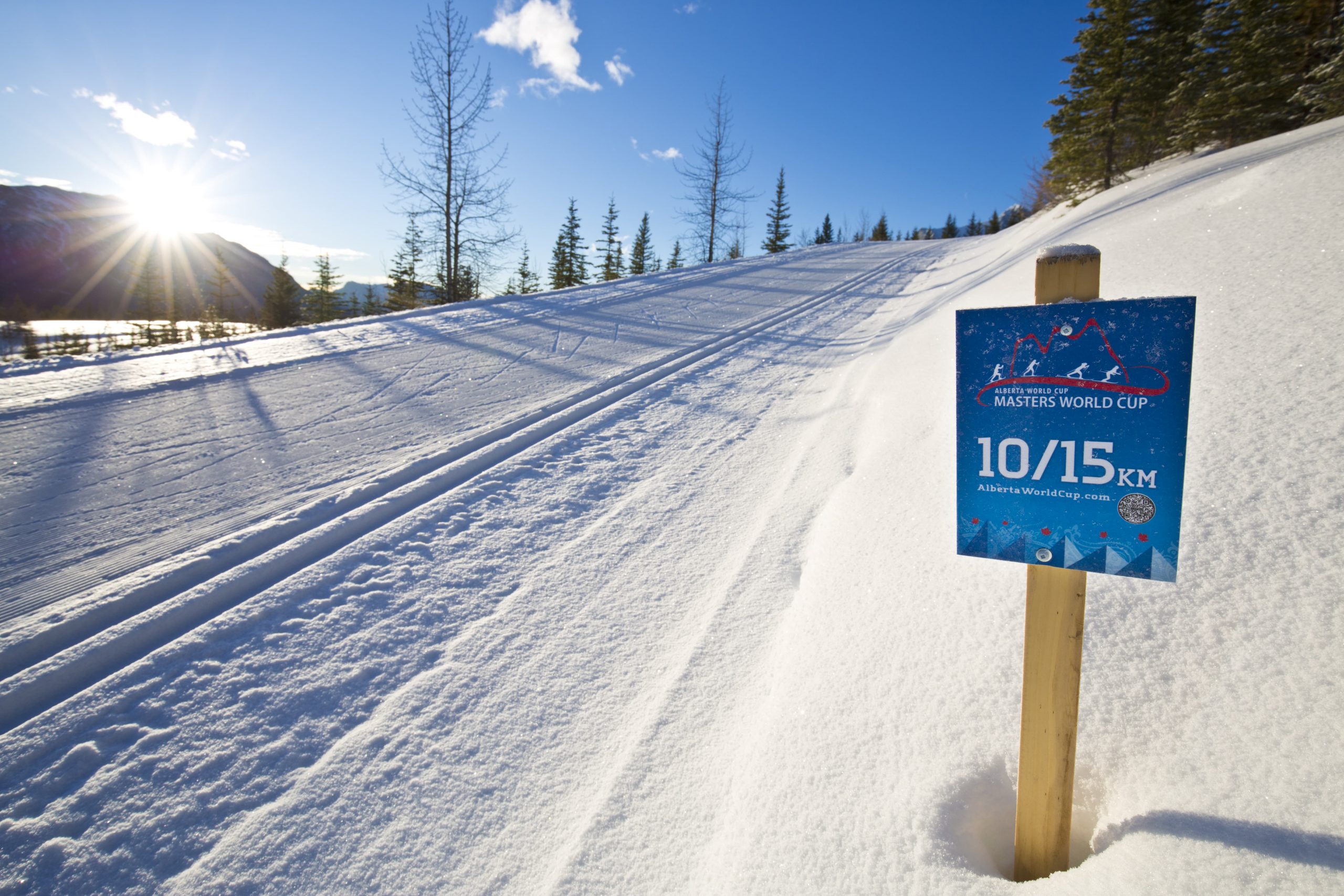
Fresh tracks on the Masters World Cup course in Alberta. Recovery is essential because adaptation occurs between workouts, but maximizing recovery is not the goal. (Photo: GibsonPictures)
Recovery Serves Adaptation
This brings us back to recovery. Recovery is essential because adaptation occurs between workouts. But maximizing recovery is not the goal of an athlete.
Maximizing adaptation is.
The masters athlete must solve a more complicated equation:
Stimulus + Recovery = Adaptation
Too much stimulus accumulated over days and weeks and we fail to recover sufficiently. Without recovery, we fail to adapt. The common theme in underperformance and overtraining is accumulating fatigue and a failure to adapt.
Sometimes the better solution is reorganizing the training. Instead of a pattern of hard, hard, easy, hard, easy, hard, exhausted, rest over seven days, a masters skier might organize training so the important sessions are separated sufficiently to perform them well and adapt to them.
The objective isn’t necessarily fewer quality sessions over the course of a month. It is enough recovery between those sessions to allow the athlete to absorb them.
The coaches behind the masters performance group at Crested Butte Nordic in Colorado: from left, Rachel Bachman Perkins, Murray Banks, Cam Smith and Woody Martineau. Fitness is not created by individual workouts. (Courtesy photo)
Consistency Beats Heroic Training
For masters athletes, we need to adjust our perspective. Fitness is not created by individual workouts. It is created by the consistent implementation of easy endurance work, high-intensity aerobic training, strength, power and appropriate recovery.
One big interval session does relatively little. One big training week does relatively little. Forty or fifty good weeks stacked together can produce remarkable fitness.
That changes the definition of a successful workout.
The question is no longer: How much training can I survive today?
It becomes: What training can I absorb today that allows me to continue training tomorrow, next week and next month?
That doesn’t mean avoiding hard work. It means implementing both easy and hard training in a way that provides adequate space for recovery and adaptation.
Murray Banks at the Alley Loop in Crested Butte, Colorado. Chronological age alone doesn’t tell us enough: training history, injury history, available time, sleep, nutrition and life stress all matter. (Photo: Xavier Fane / Crested Butte Nordic)
The Masters Training Equation
Training, of necessity, must be individualized for athletes of every age. A highly trained 60-year-old with forty years of endurance training may tolerate workloads that would overwhelm a recreational 45-year-old who started skiing five years ago.
Chronological age alone doesn’t tell us enough. Training history, injury history, available time, sleep, nutrition, life stress and individual recovery all matter. But the physiological objectives remain surprisingly familiar.
Maintain aerobic volume.
Maintain VO2max.
Develop threshold and muscular endurance.
Preserve maximal strength.
Preserve power.
Maintain ski-specific technique and economy.
Then organize recovery around accomplishing those objectives. That is fundamentally different from starting with recovery and removing training until the athlete can tolerate what remains.
Masters athletes don’t need a watered-down version of elite training. Nor do they simply need more recovery. They need training organized around the physiological capacities most threatened by aging, with enough stimulus to preserve and improve those capacities and enough recovery to adapt to that stimulus.
Aging changes how we assemble the training. It doesn’t change what makes an endurance athlete fast.
The great opportunity of masters sport is discovering how much performance we can preserve, and in many cases still improve, by continuing to give the body both the stimulus and the time and space it needs to adapt.
Help Support Our Coverage!
If you value the thoughtful work and access FasterSkier provides, please consider becoming a Voluntary Subscriber. Your support directly fuels our work to cover the people, places, and moments that make our sport special.
Wilmington, Vermont’s Luke Rizio rollerskiing with the University of Vermont at Craftsbury last fall. Jim Galanes argues that a training year should change the dose of each quality, never remove one of them entirely. (Photo: Phillip Belena/EISA)
One of the biggest misconceptions in endurance training is that we should train one physiological capacity at a time. The traditional model usually follows the same progression. First build an aerobic base, lots of easy endurance training. Then add “threshold” training in the middle of the summer. Then, as we move into the pre-competition period, shift the emphasis toward VO2max and race specific intensity.
The emphasis certainly should change throughout the season. But this approach often leads coaches and athletes to unintentionally neglect important physiological systems for weeks or even months. The problem is that the human body doesn’t work that way.
Aerobic performance is not determined by one physiological system. It emerges from the interaction of multiple systems, each supporting the development of the others. When one begins to decline, it limits the effectiveness of the entire system.
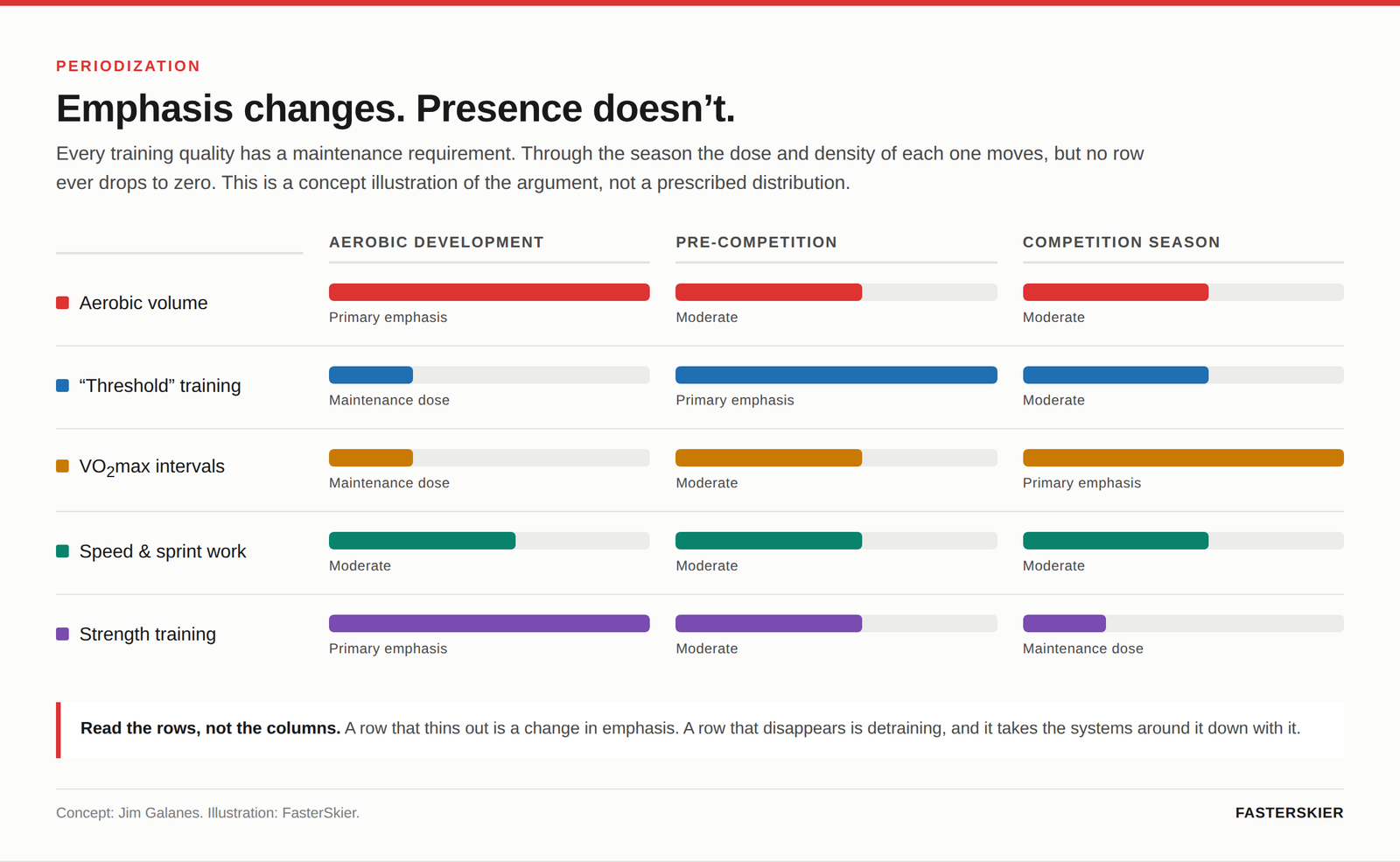
The goal of periodization is not to sequentially build individual physiological systems. It is to continually maintain every important system while changing the emphasis toward the adaptations that offer the greatest opportunity for improvement.
Every Workout Sends a Different Signal
Training isn’t simply stress. Every workout sends a unique physiological signal for adaptation.
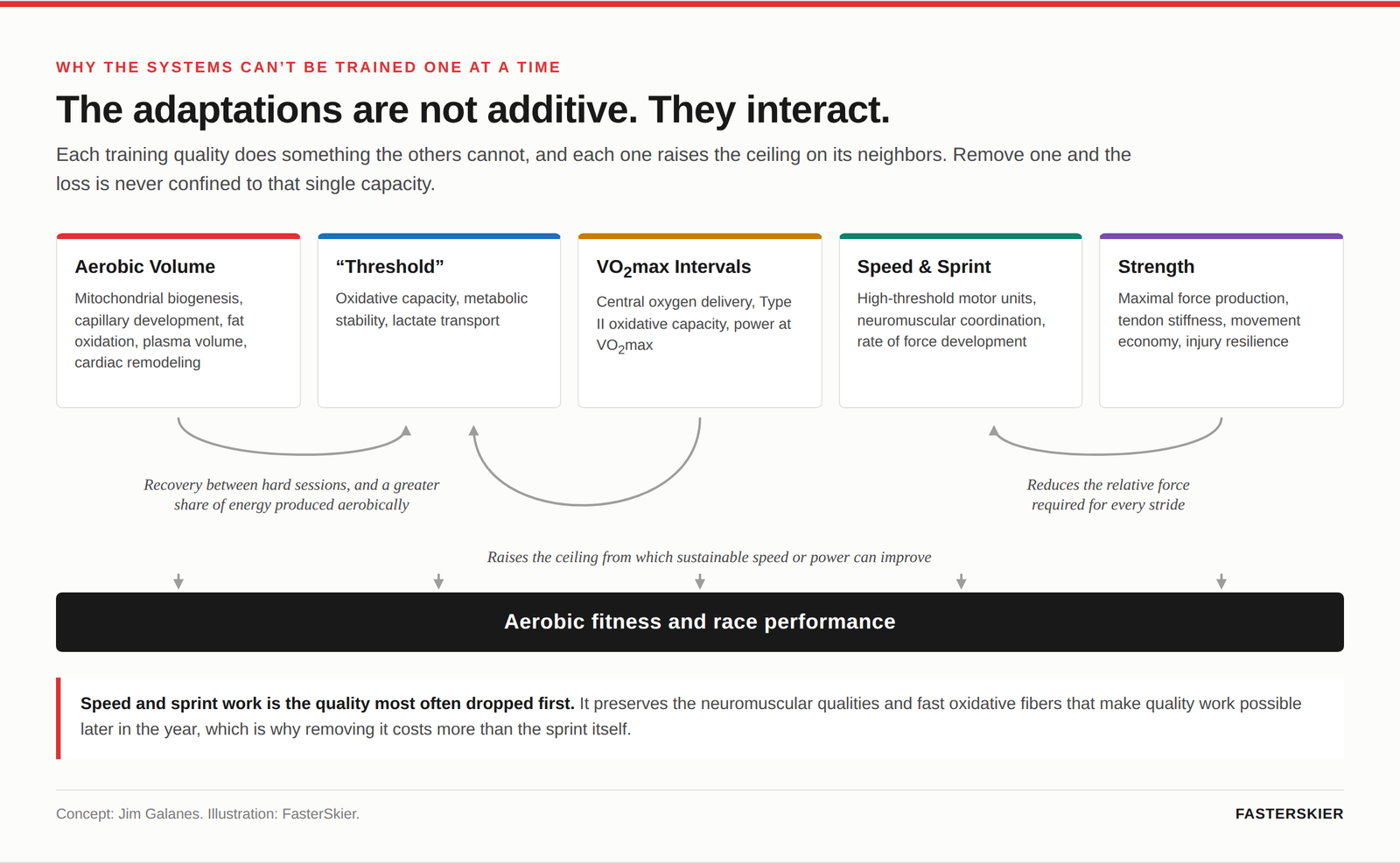
Long aerobic training stimulates mitochondrial biogenesis, capillary development, fat oxidation, plasma volume expansion, and cardiac remodeling.
“Threshold” training improves the ability to sustain a high fraction of aerobic power by increasing oxidative capacity, metabolic stability, and lactate transport. It should be noted, in spite of the current buzz, that “threshold” training is not a magic solution. Some athletes may need a heavier focus on VO2max training. Usually “threshold” type training is best for those doing high volumes and with an already high fractional utilization.
(Note: while I use the common term “threshold” here, there is ample evidence that no threshold actually exists and that it is a vastly misleading term. There is also no consensus on what this so-called threshold is. Depending on which of the many methods you use to define it, the speed or intensity at these various definitions can differ by 40 to 50 percent.)
VO2max intervals place the greatest demand on oxygen delivery, stimulating central cardiovascular adaptations while also improving mitochondrial function, the oxidative capacity of Type II fibers, lactate transport, and the speed or power that can be sustained at VO2max.
Sprint training recruits high-threshold motor units, preserves neuromuscular coordination, maintains the oxidative capacity of fast-twitch fibers, and develops the ability to rapidly produce force.
Strength training increases maximal force production, improves movement economy, enhances tendon stiffness, and helps reduce injury risk.
These are not interchangeable adaptations. Each contributes something different to developing aerobic fitness and performance.
The Systems Support Each Other
These systems work synergistically. The mistake is assuming the adaptations are simply additive. They are not. They interact, and the combined effect on aerobic fitness is larger than the sum of the parts.
A larger aerobic system allows the athlete to recover more quickly between hard sessions and to produce an increasing proportion of energy aerobically.
Better “threshold” capacity allows more quality work to be performed with less fatigue. Greater maximal aerobic power raises the ceiling from which “threshold” speed or power can improve.
Improved strength reduces the relative force required for every stride.
Sprint training preserves the neuromuscular qualities that improve efficiency even during submaximal exercise. At every intensity, we can move faster and more efficiently.
Aerobic volume, “threshold” work, VO2max intervals, speed and strength each do something the others cannot, and each raises the ceiling on its neighbors. (Illustration: FasterSkier)
What Happens When One System Is Ignored?
Every physiological adaptation has a maintenance requirement. Remove the stimulus long enough and that adaptation begins to decline. An athlete who abandons speed training gradually loses neuromuscular recruitment and maximal power. An athlete who eliminates heavy strength training slowly loses force production and movement economy.
When an athlete reduces aerobic endurance training, they don’t simply lose endurance. They lose the physiological foundation that supports every other adaptation.
An athlete who removes VO2max work for extended periods may maintain excellent endurance while gradually losing the central cardiovascular adaptations that support maximal aerobic performance.
These changes are rarely dramatic at first. What we see instead are the symptoms of overtraining. Performance in training declines. Interval sessions become harder. Race pace plateaus or drops.
Many coaches respond by adding more volume or more intensity. Neither is the likely answer. The solution is to restore the balance between the physiological systems that support performance.
Through the training year the dose and density of each quality moves, but no quality drops to zero. Concept illustration of Galanes’ argument, not a prescribed distribution. (Illustration: FasterSkier)University of Vermont skiers work up a climb during a fall dryland session at Craftsbury, Vermont. (Photo: Phillip Belena/EISA)
Why High-Intensity Training Belongs in the Base Period
One of the most common statements heard during base training is: “We shouldn’t do any hard training yet.”
Current evidence suggests otherwise. High-intensity training during the base period is not about maximizing anaerobic fitness. It is about maintaining the physiological systems that complement the full development of aerobic capacity.
Appropriately dosed high-intensity training helps preserve central cardiovascular function, maintains high-threshold motor unit recruitment, supports the oxidative capacity of fast-twitch muscle fibers, reinforces movement economy at higher speeds, and prepares the athlete for the demands of future training. Just as importantly, these adaptations support aerobic development rather than detract from it.
A stronger cardiovascular system allows greater oxygen delivery during long aerobic sessions. Maintaining fast oxidative fibers improves the ability to perform “threshold” work later in the season. Preserving movement economy reduces the energy cost of every stride. Maintaining maximal aerobic capacity raises the ceiling from which “threshold” performance can continue to improve.
High intensity doesn’t compete with aerobic development when it is properly dosed. It enhances it. This is why elite endurance athletes rarely eliminate intensity completely. They change the dose and the density. Not the presence.
I often hear athletes say their first interval session or time trial in late July felt terribly slow, or metabolically challenged. Of course it did. That should come as no surprise. If high-intensity work has been absent for weeks or months, the physiological systems required to perform it have detrained. The athlete now has to rebuild those systems before meaningful race-specific adaptations can occur.
Emphasis Is Not Elimination
This doesn’t mean every quality deserves equal attention every week. Training emphasis should absolutely change throughout the year. An aerobic development phase should contain more aerobic volume. The pre-competition period should emphasize “threshold” and race-specific intensity. The competition season should prioritize race performance and recovery.
But changing emphasis is very different from abandoning a physiological system. Even during an aerobic block, athletes should continue performing some high-intensity work, sprint training, and strength training.
During race season, aerobic volume remains essential. While emphasizing VO2max development, “threshold” training still supports the ability to perform quality work.
The dose and density change. The physiological adaptation remains.
There Is No Optimal Intensity Distribution
One of the most common questions in endurance sports is: “What is the optimal training intensity distribution?”
The question assumes there is one correct percentage of easy, “threshold”, and hard training. There isn’t. The optimal distribution depends on the athlete’s training background and on which physiological system currently limits performance. Those limiting factors change throughout an athlete’s development.
Early in a career, building aerobic capacity may deserve the greatest emphasis. Later, improving sustainable race pace may become the priority. Still later, improving neuromuscular power, force production, or movement economy may produce the greatest gains.
As those priorities change, training distribution changes with them. Not because the principles change. Because the athlete changes.
The coach’s responsibility is to continually adjust aerobic volume, “threshold” training, VO2max work, sprint training, and strength training so that each enhances the adaptations produced by the others while minimizing interference.
There is no universal training formula. There is only the continual process of identifying the athlete’s current limiter, maintaining every important physiological system, and emphasizing the adaptations that will produce the greatest improvement.
Great coaching is not about prescribing the perfect intensity distribution. It is about continually identifying the athlete’s current physiological limiter while maintaining every system that supports performance. As the athlete changes, the emphasis changes, but the physiology never disappears.
Help Support Our Coverage!
FasterSkier is independent, reader supported, and free to read. If coaching and training coverage like this is worth something to you, a voluntary subscription keeps it coming.
UVM coach Patrick Weaver talks with first year Hanna Koch of St. Paul, Minnesota, during a fall session at Craftsbury. Identifying an athlete’s current limiter, Galanes writes, is the coach’s central job. (Photo: Phillip Belena/EISA)
This is a follow-up to my last article, Speed Creates the Load, Not Intensity. Before going further, it helps to define terms. Intensity is reflected in the heart rate response. Load is the physiological stress that drives adaptation. This piece takes a different angle, using high-intensity workouts and race heart rates to assess fitness and monitor for overtraining.
Over the last two decades, much of my coaching has involved working with athletes who are underperforming, overtrained, or struggling to regain fitness. When the data is available, one of the first things I examine is the relationship between training intensity and speed across the season. I am looking for improvements in efficiency, but I am also paying close attention to what happens during races and hard workouts.
Race data is almost always the most revealing.
I recently reviewed the training of a top domestic athlete whose sustainable race heart rate fell by roughly 10 to 15 beats per minute between November and March. Why? Given the time of year, that should immediately raise concerns. A substantial decline in sustainable race heart rate during the competitive season rarely points to improved fitness. More often, it is a warning sign that the athlete is carrying excessive fatigue, is no longer capable of producing the same muscular power, or has entered a state of overtraining.
An illustrative competitive season. Sustainable race heart rate slides 13 bpm from November to March. With no gain in speed to explain it, that slide reads as a fatigue signal, not a fitness one. (Chart: FasterSkier)
A reduced race heart rate means less cardiac output unless stroke volume increases enough to compensate. In well-trained athletes, that compensation is usually very small. The result is less oxygen delivered to the working muscles, reduced oxidative metabolism, slower lactate clearance, diminished phosphocreatine resynthesis between surges, and ultimately a reduced ability to sustain high race speeds. In simple terms, the athlete cannot create the same physiological demand because the muscles are no longer capable of producing the same amount of work.
When a Lower Race Heart Rate Reflects Improved Fitness
A declining race heart rate is often misunderstood. Some physiologists and coaches suggest it reflects improved cardiovascular function. That can be true, but only if performance has clearly improved.
The critical question is simple: is the athlete racing faster?
If an athlete is producing greater speed or power at a lower heart rate, several physiological adaptations have likely occurred:
Greater stroke volume. The heart pumps more blood with each beat, allowing similar cardiac output with fewer beats.
Improved movement economy. Better technique and neuromuscular coordination reduce the oxygen cost of movement.
Greater peripheral adaptations. Increased mitochondrial density, capillary density, and oxidative enzyme activity improve oxygen extraction and utilization.
If these adaptations have occurred to a meaningful degree, performance should improve. The athlete should be racing faster while holding a similar physiological level, not racing at a lower heart rate.
In my experience, I have never seen an athlete race at a substantially lower heart rate because they became fitter or more economical. The improvement almost always shows up as increased speed or power, not as a dramatically reduced race heart rate. If race performance is unchanged, or worse, declining, a lower heart rate is unlikely to be explained by improved fitness.
This distinction matters because many coaches correctly recognize that heart rate decreases at submaximal workloads as fitness improves. That is exactly what we expect during aerobic training. Racing is different. At maximal or near-maximal effort, the goal is to maximize performance, and that rarely shows up as a lower heart rate.
Is Stroke Volume Really the Explanation?
Stroke volume is frequently cited as the reason trained athletes can race with lower heart rates. While that explanation sounds plausible, it probably accounts for only a negligible part of what we observe during maximal competition.
In trained endurance athletes:
Stroke volume reaches near-maximal values at roughly 40 to 60 percent of VO2max.
Beyond that intensity, further increases in cardiac output come primarily from increases in heart rate.
Stroke volume changes relatively little in already well-trained athletes.
Stroke volume reaches near-maximal values at roughly 40 to 60 percent of VO2max. At race intensity, it has little room left to climb, so a falling race heart rate is unlikely to be explained by rising stroke volume. (Chart: FasterSkier)
So if an athlete’s sustainable race heart rate falls from 185 to 175, it is unlikely that stroke volume has increased enough to fully maintain cardiac output. The science does not support that explanation in most well-trained athletes. Something else is going on, and extended fatigue, maladaptive training, and long-term overload are the likely causes.
The Muscles Drive the Heart
One concept that is often overlooked in endurance physiology is that heart rate responds to muscular work. It does not create it. The muscles generate the metabolic demand and the cardiovascular system responds. If neuromuscular power production declines, metabolic demand falls. The heart no longer needs to pump as rapidly because the muscles are not asking for the same amount of oxygen. This aligns closely with a concept I first wrote about nearly twenty years ago and returned to in my previous article:
Speed creates the load, not intensity.
The muscles create the demand. The heart responds. When an athlete loses the ability to generate force, speed, and power, race heart rate falls as a consequence. The cardiovascular system may be functioning normally. It simply is not being driven to the same level because the neuromuscular system has become fatigued.
When a Lower Race Heart Rate Is a Warning Sign
A falling heart rate is one of the earliest objective signs that an athlete may be accumulating excessive fatigue. When athletes become excessively fatigued, they often lose the ability to recruit muscle fibers effectively and sustain race-specific power. Because muscular demand falls, heart rate falls with it.
Rather than interpreting the lower heart rate as improved efficiency, coaches should ask whether the athlete is still capable of producing the same speed or power.
Warning signs include:
Sustainable race heart rate declines progressively over a few weeks to months. Monitoring heart rate helps catch this early, so training can be adjusted before it becomes a bigger problem.
Race performance stagnates or deteriorates despite similar perceived effort.
Legs feel flat and heavy, as if they never really warm up.
The athlete cannot respond to the demands of uphills or changes in pace.
Heart rate remains well below normal race values even during maximal effort.
Recovery between hard sessions becomes progressively slower.
Easy training may still feel normal while racing and high-intensity training become increasingly difficult.
This pattern is often described as parasympathetic overreaching, although terminology varies. Regardless of the label, suppression of maximal or sustainable race heart rate by 5 to 15 beats per minute over weeks should never be ignored. It frequently reflects excessive cumulative training load, inadequate recovery, or overtraining. Waiting until performance completely collapses is waiting too long. In many athletes, a declining race heart rate is one of the first objective indicators that recovery and adaptation to previous training were insufficient.
Coaches sometimes celebrate lower lactate values as improved aerobic fitness. During excessive fatigue, however, reduced lactate production often reflects reduced muscle recruitment rather than improved metabolic efficiency. The athlete cannot produce enough power to generate high lactate concentrations.
Chronically low glycogen availability, whether from excessive training or inadequate carbohydrate intake, can also suppress race heart rate and lactate. The athlete cannot generate the metabolic demand required to reach previous racing intensities.
The heart is reactive, not proactive. It responds to the metabolic demand created by the working muscles. When the muscles cannot produce force because of fatigue, the cardiovascular system has less work to do. A lower heart rate is therefore often the consequence of reduced performance, not the cause.
Why Elite Athletes Rarely Race at Maximal Heart Rate
Elite endurance athletes rarely spend an entire race at maximal heart rate. As performance improves, limitations increasingly shift away from the cardiovascular system and toward the muscles’ ability to generate force repeatedly while resisting fatigue.
Improvements in neuromuscular power, economy, and fatigue resistance allow athletes to sustain higher speeds without requiring proportionally higher heart rates.
As athletes become capable of producing greater speed and power, they generate a larger physiological stimulus. The cardiovascular system responds to that demand, but it is the neuromuscular system that ultimately determines how much work can be produced.
Practical Coaching Implications
Heart rate should never be interpreted in isolation. Always evaluate it alongside speed, power, performance, and perceived effort.
Reading race heart rate against performance. Green is adaptation, amber is a flag to investigate, red is accumulated fatigue until proven otherwise. (Chart: FasterSkier)
Similar heart rate plus faster performance equals positive adaptation, improved economy, and greater efficiency.
Lower heart rate plus unchanged performance equals the early stage of maladaptation to training loads.
Lower heart rate plus slower performance equals a clear indication of accumulated fatigue, inadequate recovery, illness, low energy availability, or excessive training load.
Normal heart rate plus declining performance equals a reason to consider environmental conditions, glycogen availability, illness, altitude, or reduced movement economy.
Over the course of a successful season, athletes should become capable of producing greater speed and power while maintaining similar race heart rates. When race heart rate falls substantially without a corresponding improvement in performance, assume fatigue before assuming fitness. That mindset will keep many coaches from overlooking one of the earliest objective signs of excessive training stress.
A lower heart rate should never be viewed as evidence of improved fitness on its own. If an athlete is racing faster, producing more power, and performing better, a modest reduction in heart rate may simply reflect positive adaptation. But when race heart rate falls while performance stagnates or declines, resist the temptation to credit what may actually be the earliest objective sign of excessive fatigue. The goal is to catch a falling heart rate during hard efforts early and adjust training as soon as possible. Weeks or months of inaction will greatly increase recovery time and cost additional effective training time.
Help Support Our Coverage!
If you value the thoughtful work and access FasterSkier provides, please consider becoming a Voluntary Subscriber. Your support directly fuels our work to cover the people, places, and moments that make our sport special.
I originally wrote the following article in 2004. Twenty-two years later, I believe it remains just as relevant. To me it illustrates that while we tend to assume training has changed a great deal, in many ways it has stayed much the same. I have rewritten it here to improve clarity without changing the content.
UVM’s Fin Bailey drives up a climb on the Craftsbury Outdoor Center track last fall, generating speed through clean extension rather than grinding against the grade. (Photo: Phillip Belena)
The development of basic speed, neuromuscular power, and speed endurance is critical for high-level cross-country skiing performance. I would also argue that, once an athlete reaches a certain level of aerobic development, future improvements in aerobic capacity may become limited if the athlete cannot produce enough power to generate a sufficient training stimulus.
This article presents a concept that has influenced my coaching for many years: before continually increasing the external loads, volume, and intensity of training, athletes must first develop the ability to produce greater speed and power.
Training loads can be increased in two ways. The first is externally, by making the terrain more difficult or increasing resistance. The second is internally, by improving neuromuscular function so the athlete is capable of producing more power and therefore greater speed.
My experience has been that increasing external loads without first improving power production often yields little improvement in performance and, in some cases, little measurable gain in aerobic development. Athletes simply work harder while producing little additional external work.
We have all seen unfit or less-developed athletes walk up a steep hill while reaching near maximal heart rates. We have observed this repeatedly in junior skiers. Simply walking, skiing, or running uphill slowly can produce extremely high heart rates. Does this indicate inadequate aerobic capacity or inadequate power production? The answer is usually a combination of both.
However, in athletes whose performances have plateaued despite years of increasing training volume and intensity, this question deserves closer examination. Many continue to produce high heart rates while moving slowly. In these athletes, the limiting factor may not be the cardiovascular system itself, but rather an inability to produce enough power to create a greater demand on the aerobic capacity.
For this reason, I believe that early in an athlete’s development, and often early in each training year, speed, movement quality, efficiency, and neuromuscular power should receive significant emphasis. These qualities should not replace aerobic training, but they should develop alongside it. Improving an athlete’s ability to produce power increases the speed at which aerobic training can be performed and therefore increases the potential aerobic training stimulus.
Our observations over many years have consistently shown that athletes lacking sufficient power gradually slow during uphill skiing, running, or bounding intervals while heart rate continues to rise. The internal effort increases even as external work declines.
We have also observed athletes become overtrained despite carefully planned training programs. In many cases the common factors were excessive metabolic cost of endurance training, elevated lactate concentrations at relatively modest speeds, deteriorating movement quality, and inefficient power production.
Again, I believe the underlying issue is often inadequate neuromuscular function.
When athletes cannot produce power efficiently, every uphill carries a large metabolic cost. Heart rate and blood lactate increase rapidly even though speed remains relatively low. The athlete experiences considerable physiological stress without generating the external workload necessary to increase adaptation.
For one summer training period we emphasized extensive speed and neuromuscular training. Several athletes improved their maximal treadmill workload by as much as seven percent during a graded treadmill protocol. At the same time, blood lactate concentrations were lower at each workload stage.
Zak Ketterson doing work on the rollerski treadmill. (photo: courtesy Team Birkie)
These findings do not prove that VO2max increased. However, they strongly suggest improvements in movement economy, neuromuscular power, and the athlete’s ability to express aerobic capacity. The athletes could sustain greater workloads at the same relative physiological cost.
Although the sample size was too small to draw firm scientific conclusions, the observations were both encouraging and consistent with our coaching experience.
One useful coaching tool has been estimating the oxygen demand of uphill terrain using the Balke or ACSM treadmill equations. While these equations were developed for walking and running, not roller skiing or ski-specific movements, they provide a reasonable estimate of the external workload required to climb terrain of a given grade and speed.
Using these estimates, I evaluated athletes on both a maximal 500-meter uphill test and a 3,000-meter uphill test conducted on the same hill. Our top male skiers consistently sustained estimated oxygen demands of approximately 70 to 72 ml·kg⁻¹·min⁻¹ during the 3,000-meter effort. During the 500-meter test, estimated oxygen demands ranged from approximately 83 to over 90 ml·kg⁻¹·min⁻¹. These values represent estimated metabolic demand rather than directly measured oxygen consumption.
The athletes who consistently produced the highest estimated workload during the 500-meter test were also our best performers. The shorter test reflected the athlete’s ability to produce high neuromuscular power. The longer test reflected how much of that capacity could be sustained aerobically.
During summer testing, the best athletes generally sustained only about 80 to 85 percent of their maximal estimated workload during the longer effort, leaving room for further improvement as fitness and skiing specificity increased during the competitive season.
Several practical conclusions emerged from these observations.
Ian Torchia, far right, leads bounding intervals up Stratton Mountain in summer 2021. Ski bounding remains one of the most direct ways to build the neuromuscular power Galanes describes, with the athlete loading and driving off each step. (photo: courtesy SMS)
Maximal power production establishes the athlete’s aerobic potential.
The estimated workload achieved during the 500-meter test reflects the athlete’s ability to produce power. If this value is too low, it becomes increasingly difficult to create a training stimulus large enough to maximize aerobic development, because the athlete cannot sustain sufficient speed.
Small differences between maximal and sustainable power may indicate a different limitation.
If the athlete’s maximal 500-meter workload is only slightly greater than the workload sustained over longer efforts, further improvements in aerobic capacity may be limited until maximal power production improves.
Lower-level athletes often need speed before more intensity or volume.
Many developing athletes have maximal power values only five to ten percent higher than their longer uphill performances. These athletes often benefit more from improving neuromuscular function, movement quality, and speed than from simply adding more difficult interval training.
Hard uphill intervals are not always the answer.
If athletes lack sufficient power to increase speed, making the terrain steeper or simply asking them to work harder often produces more fatigue than adaptation. Increasing the load without increasing movement quality seldom solves the underlying problem.
Sustainable aerobic power is not enough.
Athletes capable of sustaining a very high percentage of their aerobic capacity but possessing relatively low maximal power often plateau. They may already be performing close to their physiological ceiling and will likely require improvements in neuromuscular power before further performance gains occur.
Youth skiers during a Skinouk Roller Ski Race. Galanes argues these athletes often gain more from speed and movement quality than from steeper terrain or harder intervals.
Speed should create the load.
Uphill training remains essential in cross-country skiing. However, I believe the primary driver of training should be generated through efficient movement rather than terrain alone.
Whether athletes are performing distance training or intervals, movement should remain clean, crisp, coordinated, and quick. If technique deteriorates and speed slows simply because the terrain is harder, the athlete is no longer training optimal movement. They are merely increasing physiological stress.
Ultimately, endurance performance depends upon the interaction between physiology and movement. The aerobic system can only respond to the workload the neuromuscular system is capable of producing.
For that reason, coaches should devote as much attention to developing speed, power, and movement quality as they do to increasing training volume and intensity. In the long term, improving an athlete’s ability to generate external workload may be one of the most effective ways to unlock further aerobic development and higher performance.
Help Support Our Coverage!
If you value the thoughtful work and access FasterSkier provides, please consider becoming a Voluntary Subscriber. Your support directly fuels our work to cover the people, places, and moments that make our sport special.
UVM’s Benon Brattebo rollerskiing on the Craftsbury Outdoor Center track last fall. Galanes argues that speed and neuromuscular power, not just harder terrain, should create the training load. (Photo: Phillip Belena)
Most athletes view the warm-up as preparation for the hard part of the workout. The reality is that the warm-up is often one of the most important parts of the session, because it largely determines the physiological response that follows.
The purpose of a warm-up is not simply to get moving. It is to bring the body’s physiology to a level where the intended training stimulus can be achieved while controlling the overall stress of the workout. In endurance training, particularly during high-intensity work, the warm-up is often the difference between controlling the metabolic response and being controlled by it.
Athletes frequently start sessions too hard. They feel fresh, see a target pace or power on their watch, and immediately try to hit it. The problem is that physiology is not yet prepared to support that workload. Oxygen delivery, muscle temperature, enzyme activity, and substrate utilization are all operating below the levels required for efficient steady-state exercise. The result is often a disproportionate metabolic response.
The Oxygen Deficit Problem
At the start of exercise, energy demand rises immediately, but aerobic energy production takes time to catch up. During this period, often referred to as the oxygen deficit, a greater percentage of the required energy must come from glycolytic pathways.
This can be particularly problematic during races and maximal efforts. If the physiology, especially the oxygen transport system, has not been properly activated, lactate oxidation and resynthesis can be compromised. Lactate accumulates more rapidly, metabolic stress rises, and performance can suffer.
The same thing often happens during training. If an athlete begins too aggressively, glycolytic energy production rises rapidly before the aerobic system is fully engaged. Lactate accumulation increases, and the athlete spends much of the workout trying to recover from a metabolic disturbance that was largely created during the opening minutes of the session. Many workouts intended to be primarily aerobic become moderately glycolytic before the real work has even started.
Jack Young hits some big lactate numbers during a hard training session. (Photo: Courtesy Photo)
Lactate Is Often Controlled Before the Main Set Begins
Coaches frequently focus on pace, power, heart rate, or lactate during the interval portion of a workout. In reality, much of the metabolic profile of those intervals may have been determined during the first 10 to 20 minutes of the session.
A gradual warm-up allows oxygen delivery and utilization to increase progressively. Muscle blood flow improves. Mitochondrial respiration accelerates. Oxygen kinetics improve. The contribution from anaerobic glycolysis declines relative to the overall energy demand.
As a result, when the athlete begins the primary workload, lactate appearance and clearance are better balanced, and the body’s ability to oxidize lactate is already functioning at a high level. This creates a fundamentally different physiological environment.
When I was racing bikes, particularly time trials and hill climbs where the energy demand was high from the very start, I found that the longer the easy portion of the warm-up, often 45 to 60 minutes, the better I could tolerate high intensity immediately. The effort felt more controlled, and the metabolic response was far more predictable.
Two athletes may perform the same interval session at the same power output. The athlete who started gradually may stabilize at a lower blood lactate concentration and experience less metabolic strain than the athlete who rushed into the session. The difference is not fitness. The difference may simply be the quality of the warm-up.
Pellegrino embraces the crowd ahead of Sprint qualifying in Lake Placid. “The energies I got in the Final were coming from the warmup lap, where I stopped in the middle of the climb, crying.” (Photo: Thibaut/NordicFocus.)
Warm-Up as a Tool for Intensity Control
One of the most overlooked benefits of a proper warm-up is improved intensity control. For athletes who struggle to control intensity during endurance workouts, paying close attention to the first 20 to 30 minutes of the session can have measurable benefits.
When athletes begin too fast, they often overshoot the desired intensity. Lactate rises quickly. Respiration and ventilation climb above normal. We have measured lactate during training and repeatedly seen athletes who start too hard spend the next 30 to 45 minutes of the workout significantly slower, simply to bring lactate back down to the intended level.
A gradual progression gives the athlete time to monitor how the body is responding. Heart rate rises progressively, respiration remains controlled, and the athlete gains a much clearer picture of the true physiological response to the workload.
This is particularly important during high-intensity training, where small differences in workload can create large differences in metabolic response. The goal is not simply to reach the target workload. The goal is to arrive there with the physiology prepared to support it aerobically.
The Better the Athlete, the More Deliberate the Warm-Up
Elite endurance athletes often appear to spend an excessive amount of time warming up. They do it because they understand physiology. As aerobic capacity increases, athletes become increasingly sensitive to small changes in metabolic stress. A controlled rise in workload allows them to achieve higher-quality training and produce more predictable physiological responses.
The warm-up is no longer separate from the workout. It becomes part of the workout itself.
Jessie Diggins (neon orange shorts) helps lead her Stratton Mountain School teammates through A-skip drills during a “power warmup” at the base of Stratton Mountain in 2018. (Photo: Pat O’Brien)
Practical Application
For most endurance sessions, particularly aerobic training, athletes should think of the opening 20 to 30 minutes as a transition period rather than part of the main workload.
Start below the intended training intensity. Allow heart rate, oxygen consumption, and respiration to rise gradually. Resist the temptation to immediately achieve target pace or power. The objective is to create the physiological conditions that allow the workout to accomplish its intended purpose.
Final Thoughts
The warm-up is often viewed as preparation for the workout. In reality, it is the first opportunity to influence the metabolic response of the entire session. A gradual start reduces the oxygen deficit, limits unnecessary lactate accumulation, improves intensity control, and creates a more stable aerobic environment for the work that follows.
Athletes often focus on the intervals, the pace, the power, and the volume. Yet the quality of those elements may depend heavily on what happened during the first few minutes of the workout.
Sometimes the most important part of the session is not the hardest part. It is how you begin.
Help Support Our Coverage!
If you value the thoughtful work and access FasterSkier provides, please consider becoming a Voluntary Subscriber. Your support directly fuels our work to cover the people, places, and moments that make our sport special.
Masters’ athletes are often told to “train smarter, not harder,” or the current version: “Go easy on the endurance sessions so you can go hard on the intense sessions.” Those phrases get repeated so often they’ve lost context and meaning. But there is a real physiological reason training for masters’ skiers must be approached differently than training for younger athletes.
The challenge is not simply age itself. The challenge is balancing adaptation with recovery while preserving capacity, durability, consistency, and motivation over many years of training. Older athletes can still improve significantly. Aerobic capacity can improve. Sustainable race pace can improve. Technique can improve substantially. Strength and power can improve. What changes is the recovery required to create adaptation and the recognition that the margin for error narrows considerably compared to when we were younger.
Daniel Schwenk on his way to 9th place in the Men’s Masters’ division of the Climb to the Castle. (Photo: Nancie Battaglia)
The Biggest Mistakes
Many masters athletes carry over the same training structure they used decades earlier, too moderate intensity (Zone 2 and 3 in most 5-zone models), hard sessions stacked too closely together, insufficient recovery between demanding workouts, and not enough attention to technique, strength, mobility, and durability.
The results are absolutely predictable: chronic fatigue, declining velocity or pace in the hard sessions, stagnate or declining performance in spite of continued training, and simply a loss of motivation to train. Ironically, many master’s athletes are functionally overtrained, despite the reluctance in some circles to even use that term.
Recovery and Adaptation Become a Primary Training Variable
As we age, there is a clear reduction in recovery capacity due to reduced anabolic hormone response, decreased muscle protein synthesis, accumulated fatigue, and often greater life stress outside of training.
None of this means that masters athletes cannot train hard. They absolutely can, and should. Maintaining aerobic capacity and muscular strength is strongly associated with health, function, and longevity. But masters’ athletes generally cannot stack hard sessions with the same frequency as younger athletes without compromising recovery and adaptation.
For most skiers I have coached or consulted with, the question should not be, How much can I train? The better question is: How much can I recover from and adapt to consistently over the weeks and months ahead? That distinction is perhaps the most important one.
Tim Donahue mid-race during the 2020 Winter World Masters Games in Seefeld, AUT. (Photo: Garrott Kuzzy / Lumi Experiences)
Consistency Beats Hero Workouts
The most successful athletes at any level are usually not the ones doing the biggest “hero” sessions. They are the ones who maintain consistent training and compound it week after week, month after month, and year after year.
A training model built around sustainability always outperforms the commonly programmed “ramp” approach, where volume and/or intensity continually increase week to week and month to month. The assumption that training load must constantly rise in the short term, to add stress and create more adaptation to improve, is scientifically unsupported and not common practice among athletes who perform well over the long term.
That means, fewer very hard sessions typically 1–2 every 7–10 days, endurance sessions performed at the correct intensity, usually easier than most athletes think, 1–2 true rest or recovery days per week, not “easy training” or so-called recovery workouts, but actual rest, consistent sleep and nutritional fueling, and proper control and management of both low and high-intensity sessions.
One of the biggest contradictions in master’s training is that many athletes improve when they reduce training load. That does not necessarily mean less training volume. More often, it means better control of intensity and reduced accumulated stress.
Masters World Championship, Asiago, Italy, 2014
Intensity Still Matters
One of the common mistakes today, especially with the influence of social media and the one-sided promotion of Zone 2 and threshold training, is the assumption that aerobic improvement comes only from easy or moderate training.
To improve aerobic function, we still need hard training. High-intensity work improves mitochondrial function, increases oxidative capacity in high-threshold motor units, recruits more muscle fibers, and improves high-end aerobic power. The key is proper control of the dose and intensity.
An elite athlete may tolerate three demanding intensity sessions per week plus strength work. That rarely works for most masters athletes. Many would benefit more from one VO2max session and one maximal steady-state session every 7–10 days, combined with two strength sessions and additional speed- and technique-focused work embedded within basic endurance training. While I really dislike rules of thumb or guidelines in a general sense, I feel using the 80/20 rule is a good starting point. Often confused with the duration or mileage of training. It is not that. The 80/20 guide is 80 percent of the total workouts in a week or a month are easy endurance-based, and 20 percent of the workouts are hard. If one applies this measure to the duration of training, I guarantee over-training.
Help Support Our Coverage!
If you value the thoughtful work and access FasterSkier provides, please consider becoming a Voluntary Subscriber. Your support directly fuels our work to cover the people, places, and moments that make our sport special.
Ben Ogden (USA) celebrates as he crosses the finish line with an Olympic silver medal, the first medal for the U.S. men in the sport in fifty years. (Photo: Vanzetta/NordicFocus)
This essay by Jim Galanes was written on the evening of the Olympic Men’s Classic Sprint in Val di Fiemme, when Ben Ogden won silver to become the first American man in 50 years to medal in an Olympic cross-country skiing event. It was drafted from the race course that same night and is being published now, several weeks later, as a reflection from someone who has witnessed multiple generations of American skiing.
~ ~ ~ ~ ~
A friend texted and reminded me as we were standing on the course for the sprint race, in Val di Fiemme, that it had been 50 years and five days since Bill Koch won his silver medal in Seefeld, Austria, at the 1976 Olympics.
I was at those Games as a Nordic Combined skier, 20 years old learning the sport, I was trail side 4-5 kilometers from the finish cheering Bill on. In fact, I got so caught up in the moment that I nearly missed my own ski jumping training window and had to hustle back to squeeze in my final practice jumps before competition. Bill’s performance mattered, not just for the result, but for what it signaled about what American skiers could do on the world stage.
Fast forward five decades (and five days), and I found myself in a remarkably similar position, but as a spectator, back on course, watching Ben Ogden put together what I believe was the most complete race of his career , tactically, psychologically, and physiologically, on the same Val di Fiemme tracks that have tested athletes for the past 30 years.
Johannes Hoesflot Klaebo (NOR) and Ben Ogden (USA), (l-r) crest the final climb before descending into the finish during the semifinals. (Photo: Barbieri/NordicFocus)
Let’s be clear. Racing against Johannes Høsflot Klaebo is a different challenge altogether. He is, quite simply, the dominant sprinter of this era. Everyone knows that. But if there is someone willing to challenge him, to pressure him early rather than concede, Ben is one of the few with the courage and competitive instinct to do it.
Ben has always been an aggressive racer. We’ve all seen the pattern before, going out hard, sometimes, too hard in qualification or early rounds, only to lose just enough capacity to not be a factor when it matters most. That’s not an athletic flaw. It’s the learning curve of a young athlete figuring out how to apply fitness in international competition.
This time was different.
With an early start in qualification, Ben laid down a fast, aggressive time that held up until Klaebo edged it. What stood out wasn’t just the speed; it was the control, the discipline, and the focus. Ben skied the lower sections with restraint, clearly managing energy so he could handle the Zorzi climb effectively and carry speed over the top. From our vantage point near the finish, you could see those who had overcooked that climb and the early sections of the course. Those athletes crested without momentum, struggled to accelerate on the descent, and had difficulty navigating the soft, wet corner into the finishing straight.
Ben didn’t have that problem.
We couldn’t see the full climb directly, but the stadium screen told the story. He attacked decisively, created separation, and more importantly, did it without being frantic or over his limits. Still, the coach in me wondered whether that effort would cost him later. History makes me cautious.
As the rounds progressed, it was obvious the conditions were deteriorating. The snow got slower each heat. Times drifted up significantly, and the race began to perhaps reward athletes with deeper aerobic reserves and better efficiency rather than pure power. In softer conditions, maintaining effective kick can become a limiter. Some athletes compensated with excessive upper-body work. Ben, by contrast, maintained clean mechanics and consistent pressure and pace through the race
In the semifinal, Johannes Hoesflot Klaebo (NOR) was first across the line, while Ben Ogden (USA) was outlunged by Lauri Vuorinen (FIN) and needed a lucky loser spot to advance to the finals. (Photo: Vanzetta/NordicFocus)
In the semifinal, we positioned ourselves on the first uphill. Klaebo and Ogden came through side by side. Partway up, Klaebo glanced over, the kind of look experienced racers give when they recognize a real contender, as if to say OK-lets go. The front group, Klaebo, Ogden, and Vuorinen, quickly separated from the field. No one could break it open on the final climb, and it came down to the finishing sprint, where Ben placed third and advanced as a lucky loser out of the faster semifinal.
Not dramatic. Just composed. Exactly what he had to do.
By the final, the track had slowed even more. Once again, Ben committed from the gun, but not recklessly. On the Zorzi climb, he and Klaebo distanced the rest of the field, turning the race into a two-man contest for gold and silver. Over the final roller, Klaebo made the decisive move, a couple of double poles, as he has done here numerous times, and created the separation he needed. Ben held second convincingly ahead of a very strong Norwegian contingent.
Here’s my takeaway.
Ben has adjusted tactically. But this wasn’t just better tactics. This was the performance of an athlete who arrived. The fitness is there. The psychological composure is there. The tactical judgment has caught up to his physiology. At the end of the race he was spent as he should have been. That wasn’t miscalculation; that was full commitment.
Ben Ogden (USA) celebrates on the podium with his Olympic silver medal. (Photo: Vanzetta/NordicFocus)
Fifty years ago, Bill Koch’s medal showed that an American could belong at the front of international cross-country skiing. Performances like this suggest we are entering another period where that idea is no longer an exception.
On the men’s side, athletes like Ogden, Gus Schumacher, Ketterson, Wonders, McMullen, and Schoonmaker, the talent is real. The depth of talent is unquestionable. The question is no longer whether they can compete. The question, as always in endurance sport, is whether they can improve their consistency of their performance, continue to build, stay healthy, and keep progressing.
That part never gets easier. We can do it if we can continue to support and improve the club programs that have developed these athletes.
Jim Galanes, Peter Davis, and Peter’s granddaughter. (Photo: Joyce Allgier)
As a side note, this is the first Olympics I have been to since 1994, more than 30 years. It has sort of been like old home week, bumping into friends who had just skied in the World Masters in Sampada, Italy. Spending an hour with Rick Kapala in the food court line while discussing many of what we both see we need to work on to the keep the sport progressing. Connecting briefly with former Olympians Judy Rabinowitz, Trina Hosmer, and her husband Dave, old ski and bike riding friends from Stowe. On the last day, I was also able to meet with Peter “Giant” Davis and his wife, Nancy, on the side of the trail. Peter was an athlete on the US Ski Team in the 70’s, a coach at Telemark Academy, and later at the Lyndon Nordic Ski Center. The first residential programs for junior cross-country skiers in the country.
Gus Schumacher fans. (Photo: Joyce Allgier)
We also enjoyed meeting some of Gus Schumacher’s friends, family, parents, and others. It is fun to see so many old soldiers of the sport still around and enjoying the time watching U.S. skiers compete on the world stage. It was great to see and know so many other US ski fans who were there that I did not get to see personally. Most of all, having a young APU skier who I had never met come up and thank me for founding the APU program that is giving her the opportunity to pursue her dreams. The success we are seeing today and what we need to do in the future is built upon an understanding of what we have done in the past and a clear vision of what we need to do in the future to move forward.
Picture of Vermonter Bill Koch celebrating his winning the FIS Overall WC crown with a very happy coach, the late Mike Gallagher. A very special moment. (Photo and caption courtesy of Peter Graves)
A clear vision of the future should require an understanding of where we have come from, and what we have done in the past. It is interesting that some of those who have been influential in the past are still engaged in the sport. Maybe a curse of old age, or maybe relevant, that we see the past as a building block for the future. As I look back in my lifetime in the sport, understanding where we are today would not have been possible without the likes of John Caldwell, Sven Wiik, two of the earliest coaches in the sport who helped create coaching for aspiring athletes. Athletes, like Gray, Gallagher, Rockwell and Elliot who laid the foundation in international competition and inspired my generation. The Southern Vermont quad of Koch, Caldwell, Galanes and Dunklee took the next steps, along with women like Spencer, Owen, and Rabinowitz. The next generation of athletes like Kemppel, Bauer, Freeman, and Randall, who, despite a multitude of challenges and inadequate support from the US Ski Team, produced some excellent results.
In 1996 I established Gold 2002 program in Anchorage, later I brought into APU to become APU Nordic Ski Center. I established this program to create a better (a different) or alternative pathway that would provide athletes with full-time coaching and a base level of support to keep athletes skiing after college or have an alternative pathway to the NCAA route. Many more of these so-called pro teams followed in the coming years. We now have strong club programs in every region of the country. Those programs have been critically important to the success we have enjoyed over the last decade or so. We need to support and help those programs to continue to improve and expand so we can have even more athletes ready to perform when they step on the World Cup and Olympic stage. Perhaps the biggest hurdle these days. It is possible that we just need to find the best pathway to make the next steps in developing athletes.
Help Support Our Olympic Coverage!
If you value the thoughtful work and access FasterSkier provides, please consider becoming a Voluntary Subscriber. Your support directly fuels our work to cover the people, places, and moments that make our sport special.
Ben Ogden (USA), Johannes Hoesflot Klaebo (NOR), and Oskar Opstad Vike (NOR), (l-r) share the 2026 Olympic Winter Games Classic Sprint podium in Tesero, Italy. (Photo: Vanzetta/NordicFocus)
This article was made possible through the generous support of our voluntary subscribers. If you would like to see more articles like this one, please support FasterSkier with a voluntary subscription.
Mid-season rest and recovery allowed Gus Schumacher (USA) to correct a 2025 World Cup season that had begun to appear shaky. He returned to Europe from Alaska, and immediately began seeing positive results. (Photo: Modica/NordicFocus)
Over the past three decades of coaching—monitoring dozens of athletes and using tools like Firstbeat analytics to track training load and recovery—I’ve developed my training theory that I call “continual improvement.” Some exercise physiologists, sport scientists, and coaches question whether this is even possible. Others are intrigued by the concept. I always encourage people to step back and really consider the training process; if the training load is appropriate, and skill development is in line with the athlete’s current capacity, shouldn’t we expect measurable, consistent improvement? If not, how long should we wait for improvement to appear.
There are many training theories out there, but few are supported by peer-reviewed evidence or extensive field experience. Early in my career, I followed many of those traditional models. Eventually, through trial, error, and study I learned they simply didn’t work in a positive and predictable manner. We must remember many of those periodized models that came from systems with widespread doping. Recovery and adaptation weren’t natural; they were pharmaceutically enhanced recovery and adaptation to training. These old models promoted, building volume and/or intensity week after week, month after month, with occasional recovery weeks, followed by a magic taper before competition. These load patterns rarely work in isolation, at least not without assuring recovery and adaptation occur prior to increasing training loads. Often no improvement occurs because the athlete is in a chronically suppressed state from training stress and absence of recovery. Without ongoing adaptation and recovery, you’re not building fitness; you’re digging a hole.
The best model for each athlete is an individual program’s training loads that are known to be well tolerated and systematically developed from that point. That means we assess the loads, the dose and density of endurance and high intensity workouts, and build from that point. Consistency without setbacks is the key: doing enough to improve fitness, and not more.
Improvement in fitness and performance should be observable within a specific phase, over a week, ten days, two weeks, or a three-week cycle. Day-to-day performance will naturally vary, but the overall trend should be upward. The training data should show it.
This idea of continual improvement is especially true for junior athletes. Their natural growth, building muscle, maturing, and developing neuromuscular coordination, already contributes to improvement. When appropriate training is layered on top of that, performance should consistently progress. If you’re seeing flat or declining performance in a young athlete over a few weeks or a month of training, something is off. It’s a strong indicator that the balance between training load, recovery, and adaptation is broken.
Some people claim I don’t believe in hard training or high volumes, or that I think you can “rest your way” to better performance. Full stop: that’s simply not true. Continual improvement requires doing enough, right now, to stimulate adaptation. And as fitness improves, the training load needs to increase, systematically, to continue improving. Yes, high-level athletes will need large volumes and high intensities to reach their goals. But there is no set number of hours that defines success. We can’t rely on charts or someone else’s model to determine how much training a given athlete needs at a certain age.
This obsession with “X hours per year” misses the point. One hour of high-quality, well-targeted training can do more than several hours of junk. By junk I mean training that is not implemented with purpose and to derive a specific adaptation. What matters most is how your training is implemented, controlling the proper intensity and recovery. As I’ve said in my prior piece on HRV, the key is balance: between stress and recovery, load and adaptation. Top athletes train a lot, yet performance isn’t caused by the volume alone. It’s caused by adaptation to training over time.
Make no mistake: over a span of 6 to 10 years, athletes will need to accumulate a lot of training. But the driver of performance isn’t the hours it’s the ongoing process of load, recovery, and improved physiological function. Too much, and you risk overtraining with no gain. Too little, and you lose fitness.
Sophia Laukli and Novie McCabe on a run last year in Alaska. (Photo: Novie McCabe)
Stress and Recovery
Training is built on two pillars: stress and recovery. Recovery is what leads to adaptation. Using Firstbeat HRV data, we can see how training suppresses the parasympathetic nervous system (PNS) and activates the sympathetic (SNS). Recovery flips that equation—PNS activity increases, SNS withdraws. With basic HR monitoring, we can see how the body responds to training and make better decisions.
Training stress and recovery should lead to improved physiological function over short cycles. Ideally, you want to stress the system, recover within a few days, and then hit a new level of performance. If an athlete stays fatigued for too long, you start losing the benefit of that training. The clearest example is junior athletes who do a massive high-intensity workout or long session at a camp that far exceeds what they’re ready for. Recovery drags on, and they gain very little. The load was too much, the adaptation too slow, and the opportunity lost.
Every training period should leave the athlete fitter, stronger, and better prepared. In my experience, if you don’t see measurable improvement in 2–3 weeks, something’s wrong. Recovery, adaptation, and performance should always be rising. If they’re not, increasing load won’t help—it will only lead to overtraining.
Overtraining
Let me be clear on how I define overtraining: it’s when the training load exceeds the athlete’s ability to recover and adapt. Whether or not clinical markers are present, if performance is flat or declining, the athlete is not adapting. That’s overtraining. The label doesn’t matter; the outcome does.
Some question my use of the term “overtraining” because it lacks a strict clinical diagnosis. But in practical terms, it’s easy to see. With HRV, the maladaptive patterns are obvious. And in my experience, over the last 20+ years, most athletes I’ve coached or monitored have shown signs of chronic overtraining. In nearly every case, recovery, correct training, and a gradual rebuild of intensity in time restored their performance.
We should approach training with the mindset that we are always building, always aiming for our next best. Each session, each week, should nudge us forward. Even the hardest workouts should be followed by recovery and a higher level of performance. Ideally, we’re never more than a week or ten days away from our current best level. From there, we build toward our major competitive goals.
Key Takeaways
Train only enough to stimulate improvement.
Keep load, stress, and recovery in balance.
Increase weekly loads only after measurable adaptation.
Progressively increase both session duration and high-intensity load.
Overtraining is real—especially from too much intensity or volume without adequate preparation.
You should see measurable improvement in fitness and performance every 2–3 weeks, at minimum.
For much of the last 30 years, the late Dr Jim Stray-Gundersen and I have been studying how we quantify training load. In the mid-90s, we met Dr. Erik Bannister at the American College of Sports Medicine (ACSM) Conference in Orlando, Florida. Dr Bannister developed the Training Impulse (TRIMP) system, which is still used today as part of many online training platforms. While the system is not perfect, it provides a better measure of training load than hours, mileage, or pace/power. In all my coaching work, I use TRIMPs as the primary metric to quantify the training loads and plan for progression of training.
JC Schoonmaker and Luke Jager training in Anchorage, Alaska. (Photo: Brinkema Brothers)
Progressive overload appears to be a common theme in endurance training. But what is progressive overload? Despite many thousands of papers and articles related to progressive overload in endurance training on academic and coaching websites, I have found little to no research that specifically addresses the role of progressive overload—or ramp rate—in a structured, evidence-based way for endurance athletes. A general Google search reveals a multitude of articles explaining the theory of progressive overload, but few, if any, studies that scientifically validate its practical application in endurance sport.
Let me be clear: I do not question the need to increase training loads over years of athletic development. The evidence supports that long-term progressive training is necessary. What I do question is how we approach load distribution across a training year. Over my 50+ years of involvement in high-level training, the principle of overload has always been present. But we need to ask ourselves:
What exactly is “overload?”
How is it measured?
And if we can define and measure it, is it truly effective?
Supercompensation Theory
This discussion also overlaps with the Supercompensation Theory, another widely accepted concept that, like progressive overload, lacks robust research. In my experience, progressive overload often leads to overtraining rather than performance gains. Rather than thinking about the theory of progressive overload or Supercompensation we ought to think of training as a compounding effect on fitness. In other words the consistency of well executed training sessions is most important.
What Load Are We Increasing?
The first question is: What type of load are we trying to progress?
Is it speed, pace, or power (external load)?
Is it internal physiological strain (e.g., O2 utilization, energy metabolism, heart rate, perceived exertion)?
Is it time or distance spent training?
The second question: Is increasing the load actually necessary to stimulate adaptation, or can consistent training yield gains through chronic exposure to stimulus? And third: If progressive overload is valid, how do we determine when and how to increase load—through volume, intensity, frequency, or something else?
Most coaches base progression on hours trained or distance covered. But those alone fail to define true training loads because they omit intensity, pace, or power—an essential component. The question I pose is: If training is working as planned, the speed/pace or power we can maintain at a given intensity should consistently improve. Is that not the ideal way to increase the load and fitness?
TRIMP and Load Monitoring
For the purpose of this discussion, I will use TRIMP (Training Impulse) as a reference. While TRIMP has a known bias toward duration over intensity, it still offers a consistent comparative metric. However, even TRIMP doesn’t fully capture external load (e.g., power output).
Take this example: if I ride my bike for two hours a day, 5–6 days a week, over three months, will my fitness plateau? Experience says no. In fact, I’ve observed that optimal acute training loads should hover around 1.2 times an athlete’s current chronic load, with weekly ranges from 0.9 to 1.2. Loads exceeding this often hinder adaptation. A recent paper by Sandbakken from Norway suggests a very similar loading pattern. Of course, there will be races and peak sessions that occasionally fall outside this range, but most training should stay within it.
Dispelling the Myth of “Replicating the Event”
Some believe that to prepare for long endurances event, we must replicate its demands in training. But as Inigo San Millán has stated, training just above baseline lactate levels saturates the mitochondria and stimulates adaptation effectively. This means we are stressing that energy system maximally improvements can occur without massive load increases, what I call the compounding effect of training.
The SMST2 squad led by Jessie Diggins pushes the pace in a double pole interval workout during a fall 2019 training camp in Lake Placid, NY. (Photo: Matt Whitcomb)
Sustainable Progression Over Aggressive Ramping
This is not to minimize volume; we know it must increase over years to maximize potential. However, the rate of increase must be sustainable. Traditional models often ramp from, say, 50–60 hours/month in May to 100–120 hours/month in November—expecting a magical performance gain in racing season. This assumes each month provides sufficient adaptation to support the next. My experience says otherwise. The performance gains were often unsustainable and unpredictable.
Let’s consider a typical monthly ramp of 50 hours:
Week 1: 11.25 hours
Week 2: 13.25 hours
Week 3: 15.25 hours
Week 4 (recovery): 10.25 hours
This assumes athletes can adapt weekly to rising loads—something I strongly question. While the body adapts quickly to an appropriate load, that doesn’t mean it can adapt to increased loads every seven days.
Real-World Data: A More Effective Model
I’ve observed many athletes, especially skiers, push ramp rates aggressively—often at camps. They train 30–40% more load than usual. But based on HRV data, by the time they recover from these camps, much of the benefit is lost. This will be especially problematic for junior skiers who have not yet had the years of aerobic training and the ability to adapt to these big loads is a serious challenge.
In contrast, consider the case of a successful master’s cross-country skier:
Training load increased from 500 to 600 TRIMP/week over a full year (~20% increase).
That equates to ~10 TRIMP per week, or just 8 minutes of easy training or 2 minutes of high-intensity work—virtually nothing.
Yet their performance and testing data steadily improved throughout the season.
In the following year, this athlete started at 600 TRIMP/week and progressed to 700–750 TRIMP/week, building on last year’s base. Because recovery was well managed, no long offseason break was needed. HRV data (RMSSD) stayed in a tight normal range throughout the season, except for two brief illness-related dips—indicating effective recovery and adaptation.
I’ve observed this same pattern in cross-country skiers, national champion mountain bikers, and high-level triathletes.
Johannes Klæbo and Kevin Bolger rollerski together during an easy workout Saturday, September 16, 2023, in Park City. (Nathaniel Herz/FasterSkier)
Elite-Level Patterns
This trend is supported by data from elite Scandinavian cross-country skiers. These athletes train 80–100 hours per month with very small month-to-month variation. The goal for most skiers is to have 100-120 high intensity sessions per year. So, the high-intensity sessions are a consistent part of the plan, with total training load increases coming primarily from slight upticks in intensity—not volume.
Conclusion
Based on what I’ve experienced and observed, I question the necessity of aggressive ramp rates, especially in terms of volume and distance. With effective training, performance improves in pace, speed, or power at a gradual rate. That itself represents a form of ramping—but one that’s based on output, not input, and one that’s sustainable.
Jim Galanes, a legend in American cross-country skiing, will begin contributing articles, commentary, and analysis for FasterSkier. Galanes offers coaching services through his business, EPOC Performance Training. (Courtesy photo)
Coach, competitor, correspondent, commentator—Jim Galanes has spent a lifetime on cross country skis, always serving as a keen observer of our sport. A three-time Olympian in both Cross-Country and Nordic Combined, Jim has tested the theories, initiated the instruction, assessed the results. Now, FasterSkier is thrilled to announce that Jim joins our staff of writers and contributors, adding his unique and time-tested insights to the editorial offerings of this publication.
FasterSkier recently sat down with Jim to discuss his insights—and his hopes—for the sport of cross-country skiing.
Jim Galanes—“Over the last couple years, I’ve begun to feel a responsibility to involve myself in some of these issues around Junior development,” said Galanes. “For too long, we’ve not been willing to have productive discussions on those issues. It’s time . . .”
A three-time Olympian with a long and distinguished international racing résumé, Jim Galanes feels that communication and open dialogue can improve the development of skiers at all levels. (Courtesy photo)
FS—What are the issues you think that are important to consider in junior development right now?
Jim Galanes—The biggest issue I see is this: skier development needs to take place slowly. This goes back to my first days in coaching when I certainly made mistakes. We found talented kids at 13, 14, 15 years old, and we tried to rush them along. So now we have a long track record of burning out or losing a lot of these talented, eager kids.
Between my 30 years in Alaska and time in New England, I see a common theme. I tried to count them; I think I got up to around 100 athletes that I identified who were we’re kind of tagged as “the next great thing” at 13, 14, 15 years old. Maybe only one or two of them really survived in the sport.
FS—How do you think the other athletes might’ve been better served, programmatically? What mistakes do you think might’ve been made?
Jim Galanes—Well, I can only base it on what I’ve done and what I’ve seen. I think when you get somebody with talent, they’re often 13 or 14 years old. They’re typically really motivated, and they end up training with the older age groups. I think they just get pushed along, and their bodies (or their minds) aren’t ready for that type of training. They end up washing out; their best years are really U16. Maybe they make it a year or two into the U18 age group, but eventually their peers catch up with them. Ultimately, most of them quit skiing and move on.
FS—How much of that do you think is a natural progression and how much of it do you think is systematic? Sometimes, you’re dealing with a young skier and they’re just physically more mature than their peers. And as you say, their peers eventually catch up. How much of that skier fading from the sport is just the disappointment of being caught, and how much of it do you think it is a systematic failure?
Jim Galanes—I think a lot of it is a systematic failure. From what I’ve witnessed, we have an innate desire to accelerate their training and their development. I’ve seen it here in Colorado over the last decade that I’ve been here. Just in our county, alone, I can identify plenty of young skiers who dominated the U16 age groups, but they really couldn’t even go on and ski in college.
I’d made those mistakes when I was just getting into coaching. I coached a few other kids in Alaska, and even with the best intentions, we were doing things at 13, 14 years old that we just shouldn’t have been doing: too much distance, too much high intensity training, not enough focus on just having fun and skiing technically well. I think that that initial phase of their development was just too much.
Specialization isn’t a bad thing in and of itself. It’s just how you how you approach it and some kids at 13-14 might be ready to. I still see it written up that athletes need so many hours (of specific nordic training) to be successful. And you gotta start those hours when you’re 13 14 years old. That’s a damaging philosophy: I downplay the hours approach the training a lot because I think it’s it’s a trap. What we’re looking for is to improve fitness and build from where the athlete is not trying to throw them into 500 hours at 14 or 15 years old just because that’s what it says on some chart. And I always tell people “An hour’s not an hour.” Measuring training by hours is only legitimate if the athlete has total control over their own intensity. And coaching 13 14 year-olds, we find that they don’t have training zones. They don’t have intensity control. Coaches advise Level 1, Level 2, and young athletes simply blow right through. I’ve done a lot of work over that particular issue in the last 10 or 15 years, and through a lot of athletes I’ve worked with. I start digging in into their training and I see things like 75 % 80% of their workouts they hit “threshold” (not a term I like using very often, but one that describes the problem). And they maintain those higher intensities all the time, just cranking it out. I don’t think we’re teaching kids how to train! My Focus on the sport these days is I’ve got athletes from 14 years old up to 80 years old, and I think a lot of times with training we miss the mark and don’t play the long game.
Galanes back in his own racing days, blazing the trails at Telemark, Wisconsin. (Courtesy photo)
FS—And skiing at world class levels has definitely become a long game, with the careers of professional skiers extending well into their 30’s. Do you think that young athletes habitually over-intensifying their training runs counter to the controlled environment that top athletes are following today?
Jim Galanes—I look back at my own training and the days that I should’ve been going low intensity. I would go in the mountains up in Alaska and run for four or five hours at significantly too high intensity, and doing it chronically! What we experienced was a brief period—two to three weeks in early December—when we’d go to the early races and excellent and then we’d be crap for four or five or six weeks. I think Bill Koch was probably the only one who was smarter than the rest of us when it came to that. Just the way we trained led to very inconsistent or unpredictable performance. I think now we know that long range performance requires better control in the implementation of workouts, and better nutrition, and better recovery, and better understanding. I think the training process hasn’t changed that much, but the understanding of how to do it has improved a lot.
FS—How do you think your perspective as a lifetime participant and contributor and observer of the sport? There’s a perspective gained by someone—like yourself—who has watched the sport from your angle. How would you describe that? Where is the value in listening to those who molded the sport in an earlier era?
Jim Galanes—You know, I’m sure a lot of people would wish I just go away and stop talking, but I think what I experienced both as an athlete and in my early years of coaching is really framed how I think now. Whether it’s in social media poster or personal communication, I always tell people that more isn’t always better. I’m kind of anti-volume: what’s important in creating training volume is how we build up to that volume and how we manage it over the long game.
And that that that’s the biggest hurdle I’ve seen with coaching juniors. I can go back to when I was at Stratton Mountain School in the 90’s, or when I started the Goal 2002 APU program in Anchorage. Those were the things we were really trying to do for these young athletes so that they could go out and train at that level, and have it be productive training.
For me, the best training is learning good technique and really refining it. I tell people it took me 10 years to really learn how to ski efficiently and effectively. We need to teach young skiers good ski technique across the intensity domain; it’s really important that they learn they can ski with the proper movements and sound technique at that low intensity. You know, I honestly don’t know how other coaches are approaching it. Regardless, I feel like this is one of the shortcomings in American skiing in spite of mandating educational requirements for ski coaches. I don’t think we have a good handle on sharing information in this country
FS—Well, writing for FasterSkier may become a way to do that. And, fortunately, yours is a name that people should know and respect. They should appreciate that yours is a perspective that’s valid. You’re not someone who’s an unknown quantity and there’s a good reason for the community to listen to and consider what you have to say. So I think this is a great opportunity to do that.
Jim Galanes—I mean, hopefully we can create a dialogue; that’s a good thing. I think that’s what we need in sports. In the 80’s, when Torbjorn Karlsson first came to the US to coach the US ski team, he started showing me all this information that (Norwegian coaches) were sharing back then. That was kind of the bread and butter information that US skiers had, and good results eventually followed. Then Nikolai Anikin came to the country with the Soviet methods, and John Underwood came back from master’s degree work in Finland with the Finnish approach. But we still don’t have a good mechanism in this country to share information! In Summit County, Colorado, we started having kind of weekly coaches’ coffee once every two weeks just to talk about stuff. What are we learning? What are we seeing? What are we thinking we could do differently or should be done differently? I think that’s where the true learning comes from.
The first American World Cup, Telemark Wisconsin, December 1978. Jim Galanes is third row, sixth from left. (Courtesy photo)
FS—Does it sometimes seem like the American system is holding back information, or enforcing a kind of coaching indoctrination around watered-down or over-simplified philosophies?
Jim Galanes—Well, I know more about how the Norwegians the Swedes the Finns design their programs than I know about the US Ski Team. I’ve got friends and coaching friends in all those Scandinavian countries, and we openly discuss what they’re doing, what works, what didn’t work, and what comes next. I’m familiar with how those countries are training and what their philosophies are because I engage in discussions with those countries. I haven’t found the US system to be nearly as open. Maybe that’s because I haven’t shelled out the money to go through the American coaches’ education system. I don’t know, I feel like that that kind of information ought to be free and available. We should be talking about it all the time, not just at occasional coaching seminars where we watch PowerPoint presentations and roller ski around a parking lot.
I’ve written a lot about our sport—and tried to have discussions in person and in social media—and a lot of the time I haven’t presented it in the best way. It can be received as, “There goes Jim again, telling people what they ought to be doing.” When my real motivation is “Let’s talk about these issues, shoot holes in my arguments, demonstrate to me where I’m wrong or where my reasoning is flawed.” That sort of interaction helps us all learn because we have these dialogues about opposing points of view. And I think that’s the best coaches’ education. I’ve learned more by sitting with my old friends, having conversations, having them challenge my understanding of physiology and forcing me to learn.
FS—Obviously, multiple and diverse voices could add to those discussions if logical venues can be found to voice them. So it’ll be great to have your input and your voice added to FasterSkier. I’m sure that our readers are gonna love it.
Jim Galanes—Well, we’ll find out! At least we’ll know that we’re all talking about a sport we love.
Kikkan Randall (l) and Jessie Diggins listening to the U.S. national anthem after being awarded their 2018 Olympic gold medals from the freestyle team sprint in PyeongChang, South Korea. (Photo: FlyingPointRoad)
Kikkan Randall competed in her first World Cup race in 2001, and her last in 2018. In between, she won 14 World Cup races, three Sprint Cup Crystal Globes, three World Championships medals, and one Olympic gold medal accompanied by one very enthusiastic broadcast call from Chad Salmela. She appeared in television ads, received the Skis to the City from the mayor of Anchorage, and had an ice-cream flavor named after her. And long before she brought cross-country skiing to the attention of The New York Times and The Guardian, she was mentioned on FasterSkier over 2,000 times. (The first-ever hit on this site seems to date to November 2002, a two-paragraph recap of the West Yellowstone sprint. Other podium finishers included Brooke Baughman for the women, and Lars Flora and then-junior skier Andy Newell for the men.)
This is presumably not Randall’s final appearance in FasterSkier; if nothing else, tune in next week for Part 2 of this interview. But it may be one of the last times she talks with FasterSkier while she still appears on the “current World Cup athletes” page of the International Ski Federation (FIS) site.
Note: The following story is based on an in-person interview with Randall in late April. FasterSkier’s narrative is in bold; everything else is a direct quote from Randall.
Let’s go back to the beginning, way back. Randall has said that she was all of five years old when, sitting in her grandparents’ living room, she “decided right then and there I wanted to go to the Olympics.”
But where does that drive come from? What makes a kindergartener form such a belief, even one with Olympian role models within the family? (Randall’s aunt and uncle, Betsy and Chris Haines, were American nordic Olympians in 1976 and 1980.) To answer this question, Randall goes even farther back, to 1983, to a time when the infant who would one day become the world’s fastest woman on skis was experiencing the first tantalizing glimpses of mobility on her hands and knees.
I gotta think there’s some innate thing in my personality that orients me [toward being that driven]. My parents have a story of being at a picnic when I was just learning to crawl and putting me down on the grass, and there was a playground about 200 feet away. And I just started crawling toward the playground. And my parents were like, Well, we’re going to see how far she goes, expecting that I’d get a little ways and then look back.
And I never looked back. I went all the way to the playground. And at another point, some woman from the picnic went over and picked me up, and was like, ‘I can’t believe you’re letting this kid go off.’ And my parents were like, ‘We just wanted to see how far she would go.’
Kikkan Randall (bib 136) runs in a community race in Anchorage, Alaska, in the mid-1980s. (Photo: KTVA 11 screenshot)
So there’s obviously something, I think in my personality, that makes me want to go after what I want. But I also grew up with amazing role models. I mean, within my own family, my aunt and uncle went to the Olympics, so I already had a great example of what the Olympics was, how possible it was. And then my parents, who always supported me, told me to chase after what I wanted to do, to not really put limits on it, and then allowed me to kind of chase after what I was interested in.
But then instilling along the way that once you commit to something, you do it and you don’t give up, and the most important thing is giving your best and all those things.
And then growing up in a place like Anchorage, where I grew up doing all these different activities, and around people where as a girl I never felt like I had less opportunity, that there was anything less possible. If anything, because I saw so many strong women athletes around me, I wanted to be a strong woman athlete myself, and set an example for others. So when no American woman had won a medal, it’s like, Well, we need a women’s medal. We gotta be on par with the men.
So really, just a great supportive environment and always just a drive. And always a lot of self-confidence. I’m not sure where that came from, exactly, I think I just developed that over time, but that really helped, too.
To find the first FIS race of Randall’s career, it helps to set the FIS database to show 100 results per page. And even then, you have to click through to the sixth page of results to find the beginning. That’s right: Randall competed in, loosely defined, nearly 600 FIS races in her career (counting sprint qualification and finals results separately, as the database does).
The first-ever FIS race was a 15-kilometer interval start classic race at U.S. Nationals held at “Wasatch State Park,” better known as 2002 Winter Olympics site Soldier Hollow. It was January 10, 2000. The Y2K Bug had thankfully not caused the world to end 10 days earlier. The Billboard Hot 100 number one song was “Smooth,” by Santana. AltaVista, valued at roughly $2.3 billion, was the dominant internet search engine, though challenges from an ascendant young company named Google were on the horizon.
From left to right: Nina Kemppel, Jim Stray-Gundersen and John Farra gathering with Team USA for Opening Ceremony at the 1992 Olympics in Albertville, France. (Photo: Peter Hale)
Randall had just turned 17 years old. She was in her junior year of high school, and had never raced this distance before. Nonetheless, she finished 12th out of 59 FIS finishers.
The podium in this race was made up of Beckie Scott, Nina Kemppel and Rebecca Quinn (now Dussault). Kemppel was born in 1970, and once raced against Nancy Fiddler. Other finishers in this race were born in the 1960s. Every finisher had a FIS number that starts with a 1. Randall’s been doing this for a long time.
Randall is handed a results sheet that dates from the Clinton administration, and is asked if she remembers anything about this race. The reminiscences immediately begin.
Oh yeah, my first time at senior nationals. It was my first 15 k ever. And I started second to last. And because I had never raced 15 k before, and it was individual start, I was quite intimidated. And it was one 15 k loop; that was one of the last times they had such a long loop.
It was a classic race, and I remember skiing up the first k, and noticing that there were chunks missing from the track. It happened to be one of those conditions where, right around freezing, are you klister, are you hardwax? And the reason why there were chunks missing is because people are icing so bad that they would have to stop.
And so, I was just like, Oh man, am I going to survive this 15 k? And I skied around, and thankfully we got the skis pretty well; I never had any major icing issues. And at points I lost kick, but I made it through. It was a pretty exciting first experience, and then I was pretty amazed to finish so well. [Randall came down to earth slightly in her second-ever FIS race, a 5 k skate two days later, finishing 48th.]
Fast forward just over a year later, to January 2001, when Soldier Hollow was again the setting for Randall’s first-ever World Cup race, a skate sprint. Czech skier Kateřina Neumannová had the fastest time in qualifying; Norway’s Bente Skari won the final.
Randall notched a 24th in qualifying, which at the time left her eight spots out of making the heats. She was the third American in the 53-racer field, behind Kemppel in 17th and Tessa Benoit in 20th. Benoit’s final entry in the FIS database is from 2002. Again, Randall has been doing this for a long time.
Randall is once again handed a printout of the results sheet, and asked what she remembers.
I scored World Cup points, and that was pretty exciting. And that’s when they only took the top-16 into the finals [of a sprint race]. So I was pretty happy with 24th; of course I wanted to be in the heats. I do remember that as my first World Cup. But it’s crazy that it was 17 years ago.
[A reporter notes, upon looking at the results, that Randall’s competitors in this race included Ukrainian skier Irina Terelia, who was born in 1966 and is now 52 years old.]
Norway’s Bente Skari (l) and Mathias Fredriksson of Sweden with their crystal globes after winning the 2003 Overall World Cup. (Photo: Flickr Creative Commons)
Wow. I mean, what’s pretty impressive, though, is like these were some of the biggest names that I grew up hearing about in the sport, that I got to race against. So I remember getting Bente Skari’s autograph, Stefania Belmondo’s autograph, like on my hat at this World Cup. So, pretty fun. And all of a sudden people are looking at the results listing [and seeing Randall’s 1982 birth year] going, ‘Oh my god, ’82, that’s so old.’
While the first World Cup race, at age 18, proved an auspicious beginning, there was nonetheless a learning curve involved in making the jump to international competition. Randall’s second-ever World Cup start, a classic team sprint at Torino four years later in January 2005, was respectable enough; she and teammate Wendy Wagner went out in the semifinals, but avoided placing last by finishing 12th out of 14 teams.
But the following month brought the third World Cup start and first World Cup distance race of Randall’s career, a 10 k interval start freestyle in Reit im Winkl, Germany. Randall was one of two Americans in the race, along with Rebecca Dussault. Randall started with bib 6 in a field of 70, reflecting FIS distance points that were not particularly low. (Marit Bjørgen started last.) Randall finished 70th out of 70, dead last, behind athletes from China, Japan and Lithuania. She was 80 seconds back from 68th place, and nearly 5 minutes back from the winner over 10 k. It was a 154-point FIS result. “It was a rough day for the North American teams,” FasterSkier observed.
It was raining.
So even Randall has finished a race dead last, and questioned herself along the way. (As the saying goes, DFL is better than DNF. But the latter status prevailed at World Championships later that month; Randall did not get the chance to anchor the women’s 4 x 5 k relay team when the Americans were lapped and pulled from the course during the third lap of four. The American women are now consistent relay podium threats. Randall’s been doing this a long time.)
Randall is asked what her thought process was at the time – not what she thinks now, 13 years later, when success was eventually achieved and her whole career can now retrospectively follow a ready narrative arc of struggle and redemption, with Olympic gold as the final chapter. But rather what she thought then, when there was no U.S. women’s ski team, and she was spending her winters going back and forth between North America and Europe, working to build a path that didn’t really exist yet.
Initially it was fine to get those kinds of results, because I had this approach that, OK, well, I’m gaining experience, I’ve still got more training to do, and I am going to get there someday. But then after you’d been around it a little while, it did feel hard, and that result in Germany, finishing last… I mean, I remember just being kind of in a really miserable state at that point and just – I was missing home, I wasn’t enjoying the racing, I fought with myself that whole race to keep myself from quitting. And just wondering if this is what I really wanted to continue doing.
But thankfully, within all those kind of tough results, there were always a couple of high points that encouraged me that I was making the right progress. And I think that progress is what just kind of kept me going, OK, let’s see this out a little bit longer, let’s go a little bit more.
And I was really enjoying the lifestyle of it, I was able to start getting sponsors, which allowed me to make it a lifestyle, so it wasn’t a complete sacrifice. I was doing school along the way. It took a lot of convincing of my grandfather over the years, that this was a worthwhile pursuit, because he was supportive of me making the Olympics, but then once I did it was more like, ‘You’ve made the Olympics, now it’s time to finish your degree and become a professional.’ And I had to keep saying, ‘No, I think I can be good at this, I want to keep trying.’
Randall, in her second Olympics, just before the finishing stretch of the classic sprint at the 2010 Winter Games in Vancouver, British Columbia.
And I kept pushing the ski team to develop more of a woman’s team. And I would say — I always had this 10-year projection, which was going to be like the Vancouver Olympics — that by Vancouver, I want to be in a position to win a medal. And even when it was just a few years away, and I still wasn’t even that close, somehow I was able to just stay patient and stay motivated and keep going.And I really think, being able to just pull out those small successes – I kept this Excel spreadsheet of my FIS points of races, and I would put in the FIS points that I got, the time back from the leader, comments about the race. And at the end of every season I could see, like, well maybe the results weren’t that spectacular, but I’m progressing, I’m moving forward. So I used things like that also, to just kind of help keep me pushing forward.
And I just also had this – I don’t know where I got it from, but just kind of this thinking that it was all building. That every year you train, the platform gets stronger and you keep going. And at some point you do hit a tipping point, and you start to break through. And that was so true.
“I just had this thinking that it was all building. That every year you train, the platform gets stronger, and you keep going. And at some point you do hit a tipping point, and you start to break through. And that was so true.”
I would say, prior to 2006, I was starting to wonder, but then in 2006 I had that breakthrough that then carried me another few years before the next breakthrough, and then it just kind of kept going. And now the younger athletes that are coming in – well, we just have such a better system, a better understanding, just the confidence that it’s possible. So I feel like the athletes now don’t have to go through it quite like I did, and have to really go, ‘Can I do this?’
But I had to remind a lot of these girls when they first came on the scene, when they would get their high-flying result and then go back to being in the fifties or whatever, and going, ‘Ah, you know, I’m not successful.’ It’s like, ‘No, this is a long game, and just be focused on making steady progress, and you’ll get there.’ And they have.
Despite this perspective gained through experience, Randall largely demurs when asked now what advice she would impart to a mid-2000s Young Kikkan. Rather, she suggests that the journey itself was important, and that the need to experiment along the way to figure out what worked best helped her with the rest of her career.
We’ve obviously learned a lot now about what’s possible in the realms of training, and kind of what types of training and what experience is the most important, and maybe I knew some of it early on, but a lot of it was experimentation. I maybe could have put myself in a position to be more successful earlier in my career had we known then what we know now – but at the same time, I think it was so important for me to go through that experimentation, and it really maybe helped with the longevity of my career, to have been able to do it this long.
So I would love to go back and have a conversation with Young Kikkan, and just get to hear firsthand the ambition and the thought of what was it gonna be like back then, because you kind of lose that exact memory of what you were feeling back then over the years. But I just think it’s so cool that, despite not knowing, I just had all those ideas, and it would just be so fun to see that now. But I don’t know that I would have a lot of advice, other than just, ‘go for it.’
Randall is asked what she is proudest of, other than results, as she looks back on her career. She immediately identifies as the highlight her role as one of many in contributing to a culture shift in American skiing.
(Randall is perhaps being somewhat modest here; it has been the thesis of several publications, including FasterSkier, Outside Magazine, and Peggy Shinn’s new book, that, while Matt Whitcomb’s coaching was certainly important in bringing about this change, it was Randall’s consistent drive that singlehandedly elevated the level of American skiing, raising expectations and creating a path for others to follow.)
I’m proudest of the culture shift that I think we created in American skiing. The women’s team gets kind of the most attention, and what we’ve been able to do with that, just raising the level of every single person on the team, to a point where we are just so competitive internationally now.
I’m not going to take total credit for that, because I think there were a lot of important things that came together, and Matt Whitcomb’s leadership has been super important in that, but playing a role in helping make that happen is a super-special part of it for me.
Matt Whitcomb with Sadie Bjornsen and Sophie Caldwell in Seefeld, Austria, this winter. (Photo: Garrott Kuzzy / LumiExperiences.com)
And then also seeing the effect it’s had for all of our young skiers – like I said, they’re coming into a world now where just their confidence is so much higher, our understanding of the training is so much better, our support system in Europe and all that’s really well developed. And just kind of helping build that – beyond just the results, I’ve always been interested in how to make our sport better, and so being able to do some leadership on the FIS Athlete Commission, being able to work together with our coaching staff, the U.S. Ski Team staff, to develop more resources, and just make it a better system overall.
And I think that’s why, coming into this fifth Olympics, while I was excited to have another shot at a medal, the medal was not the end goal. It was more about, like, Hey, look how far we’ve come. I could feel incredibly proud of that, I get to be a part of this one more time. So just remembering to take it all in and enjoy it, because it’s almost over.
[Randall is asked whether that, perhaps counterintuitively, made it easier to win a medal.]
Probably, yeah. Because in Sochi, in contrast, I was under so much pressure, both from outside expectations and also from myself, that I was figuring out how to manage it for the first time. I had no one to look to to figure out how to do it, you know, we didn’t have a system created to deal with it. And it was all about the medal, and only about the medal. So this time it was just, like, Yeah, there’s a shot at a medal, we know it’s a possibility, but I’m just happy to be here, and going to take every chance I get to race and make the most of it. And no matter what happens, I can end my career feeling really good about it.
Randall is asked the obvious follow-up question: what she is proudest of from her career among the category of results. Tellingly, her answer to this question is one-half the length of the non-results question that preceded it, and is similarly focused on team accomplishments over individual accolades.
Randall (l) and Bjornsen (second from r) on the podium after taking silver in the World Cup team sprint in Düsseldorf, Germany, in December 2011. (Photo: Kieran Jones)
I mean, that first relay in Gällivare, in 2012 – that one stands out as just such an amazing memory, just because of watching all the team members come together, and what that meant for everybody, and following it up in Lillehammer a year later with another relay podium, those were amazing. Starting to get on the team-sprint podium with Jessie and Sadie, because Sadie and I got on the podium in Düsseldorf, I think in 2011. It’s always the team things that come to mind.
I mean, the individual things were really exciting there for a while, like winning a World Cup, winning the World Championships medal, but the team events have taken precedence far beyond that. So the gold medal from Val di Fiemme five years ago has really been the highlight, and now we just get to add an Olympic gold medal to it.
Speaking of team events, and of gold-medal success, it is worth noting that both international championship golds, Val di Fiemme and PyeongChang, came in team sprints. The symbolism is obvious, almost too perfect for a team that has elevated team above all else. Randall is asked what it means that both those medals came in team events.
I think it’s a greater accomplishment than any individual medal we could have won, because it takes developing a team to be able to make that happen. And our approach on the U.S. Ski Team has always been that there’s such a team aspect. We all just celebrate and know just how much effort it takes from so many individuals to come together. It’s not just the athletes, it’s the coaching staff, it’s the technical staff, it’s the club systems that are supporting us all along. So to win a medal in a team event is just so validating and appropriate because it just represents the work that has collectively happened to bring that medal forward.
And the individual results have been fun too, but like I said, it just means so much more. And it’s so fun to go through the process of winning a championship like that, and you get to share it with somebody. You know, you get to go through, ‘Oh my god, can you believe we’re doing this?’ And you get to be up there, and holding the flag together, and sharing the story from multiple points of view. So I think it’s the best we could have had, because now that can go out and inspire a continuation of this culture we’ve kind of created.
It’s so fun to see your teammates succeed and do well, whether it’s an individual or when we collectively come together and do well. And in cases when I’ve been on the sidelines, been not on the team, and just going out and cheering my teammates on.
And that was what was so amazing about our Olympic gold in PyeongChang is that our entire team was lined up along the fence there. And any one of those girls could have been in our place. It was a really tough decision to decide who the team was going to be, and so the fact that they came out and supported us so hard, when I know it was tough for some of them to not be on the team, but they were able – they knew what an important part they played in making that medal happen, and they were there to celebrate with us. And that just means the world to Jessie and myself.
And finally, speaking of teams, Randall is asked what her domestic team, Alaska Pacific University Nordic Ski Center, has meant to her and her career. The answer reveals the perhaps unexpected role that an Anchorage estate planning attorney played in the development of domestic and international cross-country skiing over the past 20 years… if Randall’s mother had been working somewhere else in spring 1999, then Erik Flora’s program might not have sent 10 athletes to PyeongChang in spring 2018.
It’s fun to look back and think about the fork in the road essentially that I was at at the end of my sophomore year [of high school]. Because up until that point I was on the running track. I wanted to run NCAA Division I, and I was training every December for Foot Locker U.S. Nationals, and it was at the end of my sophomore year that my running coach was moving out of town, and therefore I needed a new training group in the summer.
And it just so happened that my mom was working as an attorney with Trigg Davis, who had happened to become friends with Jim Galanes, and knew that Jim was starting a new program. And he said, ‘Hey, I think Kikkan should meet Jim,’ and then Jim ended up hiring Frode Lillefjell, who was fresh off of his NCAA career, to help start this new program. I was going to join [Alaska] Winter Stars, and I ended up joining APU instead.
Kikkan Randall during a high-school track race in Anchorage, Alaska, in the 1990s. (Photo: KTVA 11 screenshot)
And right away, Frode was a coach that just made you feel like anything was possible and just taught us – it was my first time ever rollerskiing, and he made us doublepole only that first summer, which crushed me at the beginning, but then I got really strong.
Right away, too, Jim was just like, ‘You know, I think U.S. skiers can be successful, but I think we’re going about it in the wrong way. When skiers do NCAA, they just can’t train enough, and we think if you stay in an environment where you can focus on – where training and race experience is the number one goal, and then you fill in school where it fits, we think this can be a new model that can be successful.’
And so, by chance, kind of getting hooked into that system, and then when I graduated from high school, my first goal was to make the Olympics, and then I was going to go to school somewhere else. And then Jim and the coaches at the time were like, ‘Why don’t you consider taking classes at APU, and doing things here?’ And I entertained that idea, and started some classes here in the fall, and within a couple months I realized what a perfect fit it was for me. Because I was interested in the international track. Even though there was no path of success, I just felt like, ‘That’s what I want to try to chase, but I love that I can go to school along the way.’
And so getting pulled into that, and then really being in a such supportive environment, where I had coaching day to day, I had training partners, I had access to the glacier, I had early skiing in the fall, late skiing in the spring, and I got to do it all where I grew up. So I had this amazing support system already in place.
And there was a lot of work that Jim did early on behind the scenes, when the U.S. Ski Team was excited about my results, and wanted me to come and live in Park City, and Jim said, ‘No. She’s got a great system up here, we’re going to keep her here where we know things are working.’ And he advocated and provided that support, and I was able to continue here.
And then when Erik took over the program in 2006, we just kind of kept that going forward. And I’ve always loved the idea of being a part of a team and a club that I can be with when I’m training, and then there was kind of this seamless transition to then go be a part of the national team, and be able to pursue those kinds of races, but always have this connection to APU.
And I’ve loved that it’s – it’s not just a 10-member Elite Team, it’s a community program. I’ve always enjoyed the Masters in the program, who really took the financial burden of supporting the program early on, and still contribute so much. And then of course I was part of the Junior program, which has then developed even further down [to the Devos], and knowing that those kids now get to be in a great program that then has a connection to what’s possible. So it’s been cool, and I’ve been happy to see the program really just develop and flourish, because I just really believed in the concept of it from the start.
Coming next week: ‘The Exit Interview (Part II): Looking Forward’
* * *
Disclosure: The author is an Alaska Pacific University masters skier who grew up in Anchorage in the same generation as Randall; they skied together in Anchorage Junior Nordic in the early 1990s.
If you want to be as cool and go as fast as Tad Elliott, you need to first buy a bad-ass El Camino and then next get a Suunto Ambit 3 heart rate monitor and Firstbeat HRV software.
This review of the Firstbeat heartbeat analysis system originally appeared on SlowTwitch.com, a publication targeted for triathletes (see Part I, II and III). This version has been added to and updated specifically for nordic skiers.
He says they’ve already got one…
Monitoring training load is the Holy Grail of endurance athletics. Any good coach will always be looking at how to optimize training load, and essentially every competitive athlete from the first time they toe the line will wonder how to best balance intensity, volume and recovery. Throw in the added and significant stressors of work, school and social obligations and this already complicated equation becomes even more involved.
As the world becomes increasingly digital and the science more precise, the last few years have brought a number of different technologies to the plate that look to better quantify training and recovery. Heart rate monitors have been a staple of endurance training for over three decades. With the increased prevalence of smart phones and their ever increasing functionality, the ability to collect data has never been greater. Even more recently, a speciality market of “fitness trackers” has emerged with devices 100 percent dedicated to tracking movement, heart rates and a variety of other metrics. Several of the big players like Apple have gone a step further (no pun intended) and incorporated these features into everyday wrist watches, so finding ways to clutter your hard drive and mind with biometric data is now easier than ever.
One area which is ironically much less clear however, is the overall effectiveness and utility of all of these devices. Your functional threshold power (FTP) on the bike is 407 watts? Great. Now what? I didn’t win bike races by having a better FTP than the other riders, I won races by getting to the finish line first. Same deal with heart rate. Now before all of you data geeks fire off an angry email that these metrics are tools to help better guide athletes to the podium, I agree with you, but what if there was something that allowed you to quantify both work and recovery? Something that provided insight into not just the physiological stresses of training but also in activities of daily living (ADL). There is. And it is called Firstbeat.
The Firstbeat system can be used with a traditional heart rate monitor chest strap or specially dedicated chest sensors as pictured.
HRV
The Firstbeat system (FB) is a member of a class of devices that monitor heart rate variability (HRV). In simple terms, HRV, as the name implies, is the difference in the intervals between heart beats. Different devices approach this situation differently, but in essence, Firstbeat uses a mathematical algorithm to compare heart rate, interval regularity, maximum heart rate and VO2 to calculate a few different output and recovery metrics.
How it works
One sport early to adopt HRV monitoring is nordic skiing. Three-time Olympian and former U.S, Ski Team coach Jim Galanes, offered his history with the device.
“Tina Hoffman, who was a coach at University of Alaska, Anchorage, showed this to me about eight years ago, so I’ve been studying this system for quite a while,” Galanes, who co-owns Galanes Sports Systems and handles the distribution, sales and service for Firstbeat products, explained on the phone. “The more I used it, the more convinced I became that it is a very effective tool and by far the best one out there. I’ve become so convinced of its effectiveness that starting four years ago, I won’t coach anyone who won’t use it; it is that powerful. It is the single best way to making training decisions.”
Zach Caldwell, coach of several members of the U.S. Ski Team, has been working with the system for a few years and provided a more in-depth explanation of the underlying science. “Your heart rate is governed by your central nervous system (CNS) through two central pathways in your autonomic nervous system: your sympathetic nervous system and your parasympathetic nervous system” Caldwell said on the phone. “Your sympathetic nervous system is what governs your ‘Fight or flight’ response, in common parlance. This is a stress response. It elevates your heart rate and creates a signal that makes the beat to beat interval very regular.”
Caldwell continued, “The second component, your parasympathetic nervous system, which governs rest and relaxation. The influence of the parasympathetic nervous system is to lower and create less regularity between heart beats. By looking at an individual’s heart rate (HR) variability in comparison their own baseline, you can make a statement about the prevalence of a sympathetic response, which is an indication of stress. In short, by using the Firstbeat system we can see how your body is responding to stress. It is a fairly direct measurement. I am not a scientist or a doctor, so while I have reviewed some of the literature, I can’t speak to the experimental design, but my read of the science is that there is ample support for the efficacy of utilization of heart rate measurements of indications of CNS function. CNS pathways are integral for heart rate regulation, so this is very pertinent for sports. Their appears to be very good science and very good efficacy of that science toward athletics.”
Galanes agreed, “A great deal of research, thought and testing has gone into this system: is the result of life work of Heikki Rusko, one of the best sports science researchers in the world, so the system is very well grounded in science, as the research that went into validating the system spanned over 15 years. From this perspective, unlike a lot of systems that are out there, this has gone through rigors scientific validation, both for monitoring training and recovery.”
The key, according to Galanes, isn’t just what the Firstbeat system measures, but what it does with it.
“There are a lot of systems out there that collect data, whether it is a regular heart rate monitor, power meter, Strava, Fitbits, whatever, but there is very little analysis that goes on with that data. Using HRV and the Firstbeat software to look at training load and recovery has become the gold standard. Power and HR are certainly useful, but alone they are not good measures of the disturbance of homeostasis on the body and that’s what training and recovery are all about.” For those interested in a much more in-depth presentation of actual data fields and a more detailed explanation and description of the software, check out this webinar: https://www.firstbeat.com/en/webinars/training-load-recovery-monitoring-in-professional-xc-skiing/
Why Use It
“Coaches and athletes are all very concerned with stress and recovery,” said Caldwell. “Previously I don’t think we have done a very good job at looking at this holistically, so while we looked at rest, we didn’t look at enough factors. The ability to examine and even quantify the role of stress both independent and related to training load is very powerful. This is particularly important for self-coached athletes, for as athletes, we tend to be good at lying to ourselves. Athletes are delusional. We take a lot of information on board and we interpret it based on what we want the outcomes to be. I see it all of the time. I can tell if an athlete is tired and I think even that athlete knows it, but when you ask them, they say they’re fine, in particular at the elite level. I work with over-motivated athletes who want to be able to do more. This isn’t a tool to tell you to take it easy, rather it is a tool to help you make better choices.”
Erika Flora, head coach of the Alaska Pacific University (APU) elite team, agreed. “It can be a good tool if used correctly and in combination with other indicators, in particular feel — I am a big believer in teaching athletes ‘feel,’ ” he said during an in-person interview. “HRV is not an absolute indicator, but it is definitely useful, as sometimes motivation overrides good judgment.”
The 24-Hour Athlete
So often the motivation to try harder is bundled into the four hours of training each day and the other 20 hours in the day are ignored, or at least not optimized,” theorized Caldwell. “If your job has had you running around all day, it may actually be counter-productive to do the interval session you had scheduled. This system is a tremendous help in monitoring your overall stress and adaptation. Careful and correct interpretation of this data can create what I call ‘better 24-hour athletes’.”
Caldwell continued, “One of the major things we want from training is to see a positive response. It sounds so basic, but I see so many good athletes mess this up. We want training to make you stronger. You do a hard training session, we hope that this will make you better, that’s the goal. It’s easy to skip the part where we ask, ‘Is this really going to make me better? If so, when?’ This is a tool to help answer the question. I am unconvinced by things for which I don’t see evidence. I see lots of people doing lots of hard work, but I don’t always see benefits. Why? Training should work. As a coach, if an athlete is not getting better, I want to know why. Why are they not responding positively to training? If we’re counting totally on self-reporting, well, that doesn’t work very well. Most of the good athletes I know have a very good way of coloring their own training. You can beat them into the ground with tests, but that also has its limitations and is disruptive. What if you had a tool that could quantify all of these factors. What if you knew who had good sleep and recovery? This tool does all of that.”
How to use it
Essentially the Firstbeat system measures two primary factors: training load and recovery. The two are obviously related, but can also be uniquely independent. Training load is monitored through a combination of factors, in particular, Excess Post-exercise Oxygen Consumption (EPOC). Measuring EPOC offers several advantages over measuring power or heart rate alone.
“EPOC is very interesting in that it helps you understand the load that you feel when you’re training is cumulative, not instantaneous,” noted Caldwell. “The cool thing about EPOC is that it looks at accumulation of effort over time. The best athletes have a great sense of how to keep things ‘easy’ — their HR can drift up a bit, but they can feel the recovery. What I see in less accomplished athletes is that they religiously follow the HR monitor, so sessions designed to be easy oftentimes aren’t so. Typically amateurs overdo it on easy days and under train on hard days. Using EPOC to help monitor this is huge.”
“Granted, my case is somewhat unique,” Caldwell continued, “as I exclusively coach elite skiers, so EPOC scores are useful, but the recovery thing is even more useful for me. The recovery score is great because it utilizes HRV as a real-time score. The recovery score is an indication both of the level of recovery and the level of fitness. You can’t rest your way to a great recovery score any more than you can rest your way to a great performance. Your peak recovery scores come in relation to your peak training loads and your best management of the recovery process, so it’s not just rest – paradoxically it is also training load.”
Galanes followed up on this thought: “This system is based on understanding each individual’s unique physiology. To use this system optimally, you need to start out and do some testing programs on things like max HR and help determine max VO2. So you need to do a six-minute max test. This helps set a good benchmark for all of the data. This is key, as you need good data going into the system at the start. Once you have this, all you need to do is start training and understand the simple observations of EPOC. The information you get from the system gives you the tools to quantify the training load but also ask the questions about how to modify training to improve overall capacity and performance. The human body is always in flux: it is always adapting to load, so the body is not the same day in and day out and FB is one of the best systems to quantify these changes and better define these different states of readiness.”
Over-The-Hill Gang
One group Galanes believes benefits the most from HRV monitoring is masters athletes. “Recovery profiles for masters athletes are very, very different than young, elite athletes. As we age, there is a whole different training process that needs to occur. Ned Overend, Joe Friel and others are making some good observations on this. Since we all age differently, FB is one of the best possible tools to assess each individuals response in training and recovery. The real value at looking at EPOC is to help you understand if you’re getting the desired effect of your training. If you go too hard, you are compromising something later in the training process. It really helps clarify the focus and the implications of the training. It is the most incredible training tool that has come along in my training and coaching lifetime.”
Optimal Usage
As a frequent traveler to both Europe and high elevation (sleeping at 7,200 feet, training between 6,700-10,400 feet), being able to measure the “stress” and overall physiological impact of traveling to and training at these sites have proven to be incredibly valuable. Sure, any idiot knows that they’re tired when they get off the plane after a nine-hour flight, but what does this really mean in terms of training? Should you even train right off the plane or take a nap instead? If you do go, how long and hard should you go? Firstbeat can help answer all of those questions. And that’s just the tip of the iceberg.
Anyone who knows me knows that I lead a very unusual life. I spend more time on airplanes than many people do in bed. I have a large animal rescue and much to the amusement of my vet and farrier, I often ride my mountain bike to my farm to administer vaccines to the animals while wearing a full cycling kit (apparently this isn’t all that common). I also regularly work on three continents, ski home from work in the dark and a bunch of other stuff too strange to print, so I think most would agree that I am clearly an outlier on the curve in many ways and in many things. Now, having said that, while my stressors may be different from yours, my guess is that each and every reader out there has lots of other demands for their time outside of training and lots of factors that impede recovery, some unique to them, others not. Sure, most of these stressors most likely don’t involve giving vaccines to donkeys or having the entire U.S. Ski Team’s jump skis lost in Japan, but I have yet to meet the person who claims their job is easy, who gets all of the sleep that they’d like and who does not have any worries or responsibilities. So just how much is your stupid job, long commute or inability to attract a member of the opposite sex affecting your training? More than you might expect.
Sure, most of these stressors most likely don’t involve giving vaccines to donkeys or having the entire U.S. Ski Team’s jump skis lost in Japan, but I have yet to meet the person who claims their job is easy, who gets all of the sleep that they’d like and who does not have any worries or responsibilities.
“The thing that the most interesting about it is that it provides hard data on feedback that helps us modify our behaviors in ways that are otherwise difficult,” claimed Caldwell. “I first started using Firstbeat when I was traveling in Europe. I found that I was getting high EPOC scores on runs that I thought were easy. As soon as I recognized the stress from the long travel and adapted my training, I got better EPOC scores and felt an immediate fitness bounce. Don’t get me wrong, it took me years to learn this lesson and I had to learn it the hard way. Generally us old dudes go out and hammer. Most masters skiers train like they’re going to win World Cups. That’s just wrong. We’re exercising our fantasies, not reality. This system helps stop that and allows you to train smart. It can both slow you down and speed you up, which is an important mix. Generally our instincts don’t always line up with the true need of the situation and figuring out how to keep this in check is very, very important.”
U.S. Ski Team member Noah Hoffman with his Suunto Ambit heart rate monitor, compatible with Firstbeat technology.
One of the elite athletes that Caldwell coaches on the U.S. Ski Team is Noah Hoffman. Hoffman’s perspective is interesting in that he is exclusively focused on outcomes, not on any of the theory or science behind the system.
“I don’t really look at the numbers; I rely on Zach for that. All I know is that it helps me a great deal,” Hoffman said during an in-person interview. “I’ve been using the system for a while and I love it. It gives me piece of mind when I’m going into a big training block that I can handle the training load. I know I’m not going to drive myself to oblivion. It’s also very valuable if you start to feel rundown from travel or illness, as it gives you good feedback on just how much you should back off or push through.”
Another elite skier to use the system is Sophie Caldwell, winner of a World Cup this year. “I’ve only been using it for about a year, but I love it,” she said on the phone. “When I see my recovery trending downward, I can catch it early, which is so key. It’s also been very interesting to see which workouts take more out of me. I’ve noticed things like if I’m in Level 1, I can go forever, but as soon as I start going into Level 2, there is a much bigger cost there. I know this is very different for different people, so this allows both the athletes and the coaches to see that different workouts affect different people in different ways. Liz Stephen [U.S. Ski Team teammate) and I are both coached my Matt [Whitcomb] and we’re amazed when we compare data on how different workouts effect us. I find this fascinating and it clearly shows how important individualized monitoring is for athletes. If Liz and I were attempting to follow the same program, it wouldn’t work well for either of us. So thanks to the data and insight we’ve gotten from the system, we’ve all learned a lot about ourselves and training.”
Without a doubt the most ringing endorsement came from Tad Elliott, who had a history of illness and overtraining. “Firstbeat saved my career. I was so sick and struggling so much with how to carefully and gradually return to full activity, I never could have made the comeback that I did without Firstbeat. It is that important to me. Now, my case may be a bit extreme, but it is most certainly very useful for all endurance athletes, in particular busy ones.”
Weaknesses
Is this system perfect? Of course not. Firstly, to achieve nighttime recovery data, here’s a shocker, you have to wear something when you sleep. Firstbeat gives you two options: your traditional HR monitor chest strap or specially dedicated chest sensors.
The HR monitor chest strap is easier, cheaper and I suppose looks less weird (though a word to the wise: prepare yourself for lots of comments/questions from your significant other). The disadvantage is that this setup is more prone to error. The chest sensor option is very, very accurate, but not only do you have to buy electrode patches (cheap, but a PITA to remember to bring on trips and re-order) you also look like you are undergoing screening for the Mercury space program every night as you prepare for bed. The system provides uber-accurate measurements, but sadly I found it to also be a bit wonky. If you do not upload the data every few days, you experience the dreaded “system crash and freeze” therein losing all of your data. This is not an issue if you stay on top of your uploads, but it seems as though this should work better for a system of its price. Sleeping with either contraption is a bit of an adjustment, but thankfully FBD is a good sleeper and after a few nights I don’t even notice either option. Your mileage may vary.
Several high-level skiers show off their Suunto Ambit heart rate monitors:(clockwise, from upper left) Italian nordic combined skier Samuel Costa, Steamboat Springs Winter Sports club alumn and current CU skier Lucy Newman, Swiss nordic combined skier Tim Hug, and 2014 Olympic silver medalist Akito Watabe of Japan. (All photos: FBD)
The system requirements claim that it can work with several different heart rate monitors, but everyone I’ve spoken to uses a Suunto Ambit 2 or 3, myself included. I found the Suunto to be superior to the Garmin even as a stand-alone HR monitor, so using it for FB was an easy transition. And I’m not alone — look on the wrists of many a World Cup skier and you’ll see a Suunto, so I don’t view this as a negative, but knowing that you may need to also buy a new watch is an important consideration for budget and ROI. Then there’s the issue of the software not running on Mac. This can easily be overcome by installing an emulator, but again, it seems like software of this price should be Mac compatible.
On a more macro level, “power user” (see what I did there?) Zach Caldwell offered a few more criticisms, “Overall the software could be a bit more user friendly. There is a lot going on, which is a good thing, but this means that it can take some time to understand how to correctly interpret the data. Perhaps more importantly, it is a speedometer. It tells you how fast you’re going. It does not tell you how fast you should be going. This is not a weakness, but rather a common misperception of the utility of the device. It is a fantastic device, but all users and potential users need to be aware of what is actual does and does not do.”
Galanes seconded this observation, “People make the mistake of buying the software, installing it, going for a run, then looking for something magical. It doesn’t work that way. You need to establish a baseline for recovery, do some VO2 tests and begin to look for trends. It takes a few weeks before the data will start to be meaningful and you need to understand how to properly interpret it, but once you have all of that down, it’s the best thing out there by a long shot. If you can work with a qualified coach who has experience with the system, that’s the best of both worlds.”
“People make the mistake of buying the software, installing it, going for a run, then looking for something magical. It doesn’t work that way. You need to establish a baseline for recovery, do some VO2 tests and begin to look for trends…” — Jim Galanes, Olympian, former U.S. Ski Team coach and current Firstbeat rep, on Firstbeat system
Flora also believes that metrics such as heart rate, lactate, etc., need to taken in context and used as a part of the “big picture”. “HRV can help athletes see trends and match up with what they’re feeling, which is very important, but using it as a main driver can be complicated,” he said. “I am a big believer in athletes learning how to understand what’s happening with them.”
Biggest Takeaways
“I’ve been around sport for a long time,” said Caldwell, “first as an athlete and then as a coach and one of the biggest things that I see while advising my athletes is just how hard it is to coach yourself. I include myself in this, too: my personal instincts for training are terrible. Every basic instinct I have is to run myself into the ground. I always thought I just wasn’t tough enough, but in reality the problem was that I was way too impatient and way too stupid. I wanted to go faster right away and I didn’t want to listen to my body. I know this is not just me either, so being able to quantify some of these issues helps me have a good discussion with athletes in a very non-threatening way, which is important.”
“One of the biggest things that I’ve learned is just how right coaches are,” Hoffman said. “As athletes we always hear about the importance of rest and recovery, but we you can look at the data right on the screen about how your behavior impacted your ability to train, that is much more powerful than anything a coach can say.”
Fellow U.S. Ski Team member Sophie Caldwell agreed, “I’ve become a lot more aware of my recovery and the impact that different workouts has on recovery. It makes me think a lot more about how important recovery is for success. It’s forced me to pay more attention to all of the other parts in my day and that’s a good thing, a very good thing. I’ve been using it for almost a year, and while I’m not at the point where I rely on it 100 percent, it is very helpful to see my trends. Sometimes it shows that I’m getting into a bit of a hole and this helps me stay in front of it. I also use it to ramp things up if it looks like I can handle more load. I can probably do a pretty good job guessing, but I certainly would have missed it a few times and it is in those instances that it is particularly helpful. My overall experience is very positive.”
Hoffman continued, “One of the first things that I did when I started using the system was I collected data for 24 hours/day for 6 weeks. What we learned with this is that my activity through the day correlated much more highly than I believe earlier to my nighttime recovery scores. Some of the coaches had told me that they thought I was being too active in between training sessions and that’s exactly what we found. It was also surprising the types of things that disrupted recovery. I’m a competitive guy and it turns out that even board games elevate my stress levels enough to impede recovery. I never would have guessed this. It’s also important to note that while we have prioritized recovery in our use of the system, I definitely do use it for training and racing, in particular for things like pacing. It helps you verify what you think you already know in terms of feel. I look at it as a great safety net.”
Applicability for Age-Groupers
So is this just a tool for the over-80 VO2 crowd with Olympic aspirations? Hardly. In fact, given the complexity of training for any race while working full time, this system is probably even more applicable to age-group athletes. “It’s probably more important that people who aren’t full-time athletes use this system,” noted Hoffman. “It’s WAY harder to balance your training load that manages your energy appropriately, as non-professional skiers have so many other distractions. I can at least try to devote most of my energy to training, so it’s easier to recover and not overdo it, but for people who have lots going on, it would be incredibly valuable. It is an important guide to help you train effectively with everything else that you have to do.”
Zach Caldwell agreed: “If you use a system like Firstbeat to measure stress load external to exercise output, you’re nailing things down from both sides. Neurological state and physiological cost and that’s a great thing. Human performances lives in the gap between input and output. If you’re only quantifying one or the other, you’re opening yourself up for surprises on race day, I don’t care what sport you’re in.”
Parting shots
In this day and age of the “shallow reader,” this article was long, perhaps too long for the taste of many, but there’s a lot going on here and I felt it was important to accurately describe the power and limitations of this very exciting technology from multiple perspectives. How you proceed from here is up to you, but to help perhaps guide some of your next steps, I asked some of the people the most familiar with the system for their advice to those considering taking the plunge.
“Jump in with patience,” advised Zach Caldwell. “Definitely do it, but go in with realistic expectations. The system won’t pay dividends in the first week, but if you are patient for three months, you absolutely will not be disappointed. But you need to be committed: three months of wearing this thing to bed. Training with it every day. Doing baseline and follow-up testing. Learning how to interpret the results. But if you are consistent and patient, you will learn a lot. It is an incredibly valuable tool when used correctly.”
Galanes went one step further, “Balancing endurance and intensity training is not easy and finding that line without the insight that the system provides in very, very difficult. FB gives you access to much better data and a much bigger picture. It is going to change your paradigm on what is optimal training and it is going to change how you view endurance training, all in a very positive way, but you need to be sure you are using the system correctly. If you do, you will feel better and you will perform better.”
Elliott added, “If you’re juggling work, family, illness or any other stressor, I strongly encourage everyone to use it. I never could have made it back to the top level with the data I got from the system and I know it will help most, if not all athletes.”
“I’ve had a very positive experiences with it,” said Sophie Caldwell, “so I absolutely advise people to use it, but start out cautiously. Track your training and sleep, but don’t rely 100 percent on this system. You need a baseline, but the more time you spend with it, the more you learn to correlate how you feel with what the data is showing, which makes you even more comfortable with it and able to count it on even more. It’s not the only tool that I use, but I sure am glad that I have it.”
Hoffman summarized the whole process nicely and offered solid advice, “Take it slow at first. Firstbeat tells you a lot, so it can be a bit overwhelming. Take your time, learn what the numbers mean or find someone who does and be patient. It takes a while to understand how this is all relevant to you, so don’t get overwhelmed by it. Stick with it, though, and you’ll be glad that you did. You will learn a lot and you’ll be a better, happier athlete.”
For more information on Firstbeat technologies and pricing information, visit Firstbeat.com.
Jim Galanes (left) and Audun Endestad, two of the best skiers in U.S. history, racing head-to-head in the 1980’s. (Courtesy photo)
This profile is part of a ‘Where Are They Now’ series, made possible through the generous support of Fischer Sports. Learn more about their products at www.fischersports.com.
Despite getting his start as an athlete in Brattleboro, Vermont, moving back to the Green Mountain State wasn’t specifically on Jim Galanes’ list of things to do in the coming years.
Yet that’s exactly what the three-time Olympian has found himself doing, after expressing an interest in a job with Graham and Mila Lonetto at Edgewise Ski Service in Stowe. Turns out, it was a perfect fit.
“I had been talking to the folks here at Edgewise for a couple of months,” Galanes said in a phone call last week. “I came back and interviewed with them and talked some more, and I just felt really comfortable with Graham and Mila, and I really like their business model and their philosophy. I thought it was a great opportunity for me.”
In taking over as manager of the stonegrinding operations for both nordic and alpine skiing, Galanes is at the same time returning to the ski industry seven years after leaving his position as head of the Alaska Pacific University (APU) program and taking on something new. Among his tasks is to develop the smaller nordic side of the business operation, which means settling back into the community and connections that he enjoyed for so many years. And through his experience as an athlete and a coach, he has tested a lot of grinds, and even did some of his own on machines around the country.
But helping to develop a grind system? That’s new.
“Back when grinding first really started to come into the sport, I worked a lot with Nat Brown on testing his grinds that he was doing,” Galanes says. “He was really the first guy in the country set up to do strictly cross country grinds. I’ve had a lot of experience preparing skis and testing grinds, and it will be fun to develop our own system of grinds here.”
There’s no reason to think the results won’t be excellent: besides the Lonettos’ expertise in stonegrinding for alpine skis, there’s the persistent drive for excellence that Galanes has shown throughout every aspect of his career. For instance, he started his athletic career by winning three national titles in nordic combined and two World Cups. Most people would consider that pretty satisfying.
Not Galanes. Instead of resting on his laurels, he switched sports.
“That was real easy,” he laughs, recalling his decision back in 1979, when he was 23 years old, to focus only on cross country skiing. “Jumping was really hard, and hard for me to perform consistently… I was successful at times, but it wasn’t the consistency of success that I was looking for. My cross country skiing was continuing to improve, and that made it an obvious decision to me.”
Back then, nordic combined was “old school.” Galanes trained mostly as a cross country skier, and the national team didn’t always have a coach, much less a specific jumping coach. So the switch was easy, and he joined a men’s team that was the best the U.S. has ever seen. Bill Koch had won his silver medal in the previous Olympics; Tim Caldwell, Dan Simoneau, and Audun Endestad were at or coming into the peak of their careers.
In that competitive atmosphere Galanes thrived, winning ten national titles, competing in two more Olympics (he already had one under his belt as a combined skier), and collecting a top finish of fourth place in the final World Cup race in Russia in 1984. Historically, he’s among the best skiers the U.S. has ever seen.
His individual finishes were his first big contribution to American skiing: the results by American men from that era still inspire racers today. Current star Kikkan Randall, who has now won two international Sprint Cup titles, calls Galanes’ era of racing “the last Golden Era.” It’s a reminder of what is possible, even as Americans and Canadians still seem to reach new heights every year.
But Galanes didn’t just want that success for himself and his teammates; he wanted it to continue. And so his second contribution, and most would agree an equally huge one, is through coaching and vision. After heading the U.S. Ski Team women’s squad and the Stratton Mountain School for a few years each, Galanes went on to found APU, introducing the club system that currently sustains elite skiing in an era of meager budgets from the U.S. Ski and Snowboard Association.
Up To Alaska…
In 1995, Galanes was in Anchorage, Alaska, where he started APU and called it Gold 2002.
“I really believed, at least when we started that, maybe a gold in 2002 was a little bit of a reach, but I really believed we could step up to the level of being competitive,” Galanes says.
Today, APU is a behemoth of American skiing. Then, there was nothing like it: skiers at every age and level, multiple training groups, racers who attended U.S. Ski Team camps, athletes who were taking college classes but were not competing on the NCAA circuit – all under one club umbrella.
Kikkan Randall winning 2013 SuperTour Finals for APU, the club that has supported her throughout her career. Photo: Mark Nadell/MacBeth Graphics.
“It came from a fundamental belief, and I still believe this, that the U.S. Ski Team can’t be everything to everyone,” Galanes says. “You can’t have a coaching program and a high-level training program just at the time when you’re at camps with the U.S. Ski Team, and then be on your own. My vision was to have a high-level program that was community-based, that the community supported and was behind and felt part of. I thought that was really critical to long-term success and more importantly, sustainability of the program.”
Hence, the many levels of skiing. In the beginning Galanes was coaching two or three, sometimes even four, training sessions per day.
At that point, Randall was a sophomore in high school, focusing on running. When her coach left town, she needed a new training group, and a family friend mentioned that two guys – Galanes and Frode Lillefjell – were starting a junior program at APU.
“Within a few weeks I was hooked, and I changed my focus from running to skiing,” Randall wrote in an e-mail this weekend. “So it was rather serendipitous that this new junior ski program was starting up at the time when I was looking for a training group! … I always found Jim’s technique advice to be helpful and easy to understand. He was actually quite a good motivator out on course as well.”
She has raced in the APU suit in domestic races ever since, and says that Galanes “certainly has been a very influential part of my career.”
Furthermore, developing from a junior to a senior, a World Cup skier to then a World Cup winner, was easy for her at APU.
“I was able to take classes during the training season and then have opportunities to race internationally at the developmentally appropriate stages (World Juniors, U23’s, OPA Cup),” she wrote. “I always had the club team support and daily training sessions when I was at home, race support domestically and then the U.S. Ski Team camp and competition opportunities on top of that.”
She thought about taking a year to do NCAA racing, but decided against it.
“Jim’s opinion was that many of our talented U.S. skiers lost too much ground to their counterparts in the rest of the world while racing in the NCAA system,” she wrote. “He felt it was imperative to train at a high level right out of high school and fit in school around the training… Jim and Frode believed it was possible to reach international success, it was just going to take a different approach then most of our US skiers had been taking. I agreed with them and together that is what we set out to do.”
But while Randall remembers her development being smooth – the hardest thing, she wrote, was to have patience and remember that it as many small steps that would take her to the top – Galanes had a few things to add on that subject. Eschewing the NCAA option for older juniors and skiers in their mid-20’s was not always a popular strategy, and APU also did not always receive full support from the U.S. Ski Team, despite earning Olympic nominations for several athletes.
“It was challenging at times – about the same time I founded the APU program, the U.S. Ski Team was to loosely support club programs,” Galanes says. “But then a couple years into that they went to a highly centralized focus, trying to strongly encourage people to relocate to Park City, which for a variety of reasons didn’t make a lot of sense to me. I felt it was detrimental.”
Luckily things loosened up again, and the national team now relies on clubs like APU and praises them for their work in athlete development. Galanes’ idea was that when athletes went home from their U.S. Ski Team training camps, they should have reliable, high-level coaching and training partners. The national team more or less requires that of its athletes at this point.
“In the last five, six, seven years, their collaboration with the regional programs and clubs is what has led to the success,” Galanes opines. “It has been key. Those are the coaches who are working with those athletes and developing those athletes, and they know best… I think that the sustainability and the success that we have now is focused on those programs and more of them around the country. I hope we can keep it going.”
Galanes does not believe that the American ski community has reached the saturation point for these sorts of clubs. But to fill all the “pockets of interest” isn’t easy, as a few startup elite squads have discovered in the last few years.
“I don’t think you can hatch a plan or craft a program proposal and go out and shop it around, and try to get the funding up front,” he asserts. “Funding follows success of the program and support from the community where the program is based. So you’ve got to bootstrap those programs for a little while to get to the point where you can enjoy the funding…. it was extremely tough.”
… And Back to Vermont
After 2006, Galanes stepped away from the APU club that he had founded. It has, of course, continued to thrive: four of eleven current U.S. Ski Team members are APU athletes, and this spring head coach Erik Flora became the first nordic coach to win the U.S. Ski and Snowboard Association’s Coach of they Year Award.
Galanes is happy to see that success. For himself, though, instead of seeking another coaching job, he pursued life outside of skiing.
“I spent basically 32 years doing nothing but focused on high-level skiing,” Galanes says. “I felt it was time to do something different, learn a different area professionally, and move on.”
Galanes back in his own racing days. Courtesy photo.
He worked for an engineering firm in Anchorage, and then moved to Sun Valley, Idaho, for a stint. Of course, he wasn’t completely gone from the ski world; he continued to do a bit of consulting, personal coaching, and advertised a masters training group in Sun Valley. “I keep up to date,” he says.
But the job at Edgewise is by far the most decisive step back towards the sport that Galanes has taken since leaving APU. And he seems excited to join Graham Lonetto, a former serviceman for the U.S. alpine team.
“They have an amazing setup here and some great equipment that not many shops in the country have,” Galanes says. “We’re a race shop, we’re focused on high-level performance skis. Whether that is for a masters skier or a U.S. Ski Teamer, we’re going to be targeting that whole market.”
But he also has some more specific ideas of how Edgewise can best help the nordic community.
“The goal is going to be to keep it simple and focus on coming up with some good, broad-range grinds,” Galanes explains. “When people get so specialized, you have to have many pairs of skis to match to the snow conditions. Not a lot of the customer base that we’ll be working with, college skiers or ski academies or masters, have that big a fleet of skis… A kid with two pairs of skis can’t have a narrow-range grind.”
In either the super-specific or broad-range realm, he’ll have competition. Stowe is just two hours from Putney, Vermont, and Caldwell Sport. If a stonegrinder can be famous in this country, then Zach Caldwell certainly is, and Galanes is setting up shop in his backyard.
So what, says Galanes.
“First of all, Zach is a good friend of mine, and he has been a key advisor for me as I’ve moved into this role,” he explains. “I’ve talked to him quite a bit, and he has a wonderful attitude about it. You know, competition is good, and it’s going to force everyone to do a better job and the winners are going to be the skiers.”
There’s good reason to think that local skiers might win for other reasons, too. If Randall’s testimonials say anything at all about Galanes, it’s that any ski community is lucky to have him.
“Jim is incredibly passionate about cross country ski racing and has such a deep bank of experience from being an elite racer himself during the last golden era of U.S. cross country skiing, plus having coached so many top U.S. skiers,” she wrote. “He is very good at thinking and analyzing and conceptualizing.”
So is a return to coaching a possibility? Not right now, Galanes says. He’s too busy settling into a new town and a new job. But in the future, he certainly hopes so.
“I think I’m good at coming in and offering perspectives on technique, and how to implement technical changes, and how I see things,” he says. “I’d like to do some of that, go in and talk to coaches and athletes about how I see technique. I think that could benefit programs and people quite a bit.”