From the FasterSkier archive — posts syndicated from athletes’ and coaches’ own blogs between 2004 and 2012, kept online as published. Current coverage is at fasterskier.com.
Sweden's Emil Jönsson in action in Stage 1 of the 2012 Tour de Ski.
OBERHOF, Germany – Emil Jönsson is neither black nor 6’5”, but athletically, he’s cross-country skiing’s Usain Bolt—the sport’s fastest man in a drag race.
Since last March, though, the World Cup circuit has been suffering from an acute absence of the Swedish speed-demon, with a hamstring injury and a cold limiting Jönsson to a single sprint start before the 2012 Tour de Ski.
As evidenced by his podium finish in that race in Davos, Switzerland, and by his 16th place in Thursday’s Tour prologue here, Jönsson is back, and the rest of the World Cup field should pay attention: A quirk of his injury allowed him to bulk up on training throughout his recovery, and both Jönsson and his Swedish coach are expecting big things in the second half of the season.
“The summer training was until now,” Jönsson said after Thursday’s race. “I got a really good training period.”
Jönsson in the middle of the prologue.
Jönsson said he “snapped, a little bit,” his hamstring during a camp in Italy back in October, which prevented him from training or racing at top speed for two months.
But the problem didn’t stop him from working out at an easier pace, and as a result, Jönsson said, he was training all the way through his recovery.
Adding insult, or illness, to injury, he caught a cold after racing in Davos, which kept him from entering the last World Cup sprint in Slovenia before the Christmas break.
The cold was another “little setback,” but Jönsson said it wasn’t too much of a problem, since it mostly affected him during the holiday.
“We were celebrating and having a good time anyways,” he said. “You always, in every season, get an illness, so that’s the life of a skier.”
While his start to the season has been halting, Jönsson was still looking on the bright side: he said that he’ll now be fresher for racing at the end of the year. With his leg healed, he’s looking at the Tour de Ski as a way to sharpen his body.
“I have to compete, compete, compete up to speed a little bit,” he said. “So the Tour is perfect for me.”
After Jönsson notched some breakout results in distance races last season, Swedish Head Coach Joakim Abrahamsson said that the 26-year-old could be a dark horse in Friday’s handicap-start classic race, and for the rest of the Tour, since all the extra training has taken his fitness to new heights.
On Friday, Jönsson will start in the middle of a huge pack chasing leaders Petter Northug (NOR), Dario Cologna (SUI), and Maurice Manificat (FRA). With fresh snow likely to force the men into a big pack, the Swede could be a threat if the race comes down to a sprint finish.
“It looks very interesting for him this weekend,” Abrahamsson said. “I think he’s in pretty good shape.”
The Swedes were visibly disappointed after their 30K pursuit in Holmenkollen Sunday, which landed them a 6th, 16th, 20th and 29th place. The Swedes missed the wax and missed the train. In a mass start pursuit, it’s all about being with the train when it leaves.
Johan Olsson (in front) on the skate leg of the 30K pursuit. (Photo: Inge Scheve)
The Swedes had prepared to repeat Thursday’s sprint success and crash the Norwegians’ party and add insult to injury by doing so on their home turf in Holmenkollen. But while all the Swedes said they felt good and everything was pointing in the direction of another good day on the course, their skis seemed to be waxed with glue.
“If you don’t have the speed in your skis, you just don’t hang,” said Johan Olsson, who said they simply got dropped.
“I thought my skis were really good for about half of both the classic and skate leg, then it felt like I was skiing over hydraulic oil or intense dirt or something. When they surged you had to work so hard,” Olsson said, explaining that the drag drained the team of the energy they needed to stay with the surges in the field.
Daniel Rickardsson did a heroic attempt at surging on the 2nd lap of the classic leg. He was quickly caught. (Photo: Inge Scheve)
The surge that died
Daniel Richardsson’s strategy was to get up ahead and pull early, and he did a heroic attempt at six kilometers into the classic leg, but when you have to work even on the downhills, it gets challenging in a hurry.
“I wanted to go up and pull, and on the second lap (of the classic) I did, but it got really tough and hard,” he explained.
Anders Södergren also had something to prove in the 30K, and wanted to get out there. His classic skis were better than his skate skis, and that made for a monster hard finish.
“Its’ frustrating. Physically I am there and I’m already looking at the next race,” Södergren said after his race.
Carefully tested
Olsson and the rest of the team spent considerable time testing skis before the race.
“I spent maybe an hour just with my wax tech this morning, and the skis felt good then, but it wasn’t before the second half of the leg that they started dragging, and that makes it hard to know when you test,” Olsson said.
“Waxing can be really frustrating. But it’s a part of the sport, and on days when you have brutally killer skis, there is nothing that’s more fun than that,” he said.
“But in this field the margins are so small, it’s win or lose. Some have good skis, the Norwegians did today and we didn’t have the speed when they surged,” he said, adding that he’s already thinking ahead.
“They wax and test here every day of the year and that’s obviously an advantage. Oslo has that humid sea air, we don’t have that anywhere, we can’t just go to Gothenburg to test skis. But when the Worlds are in Falun (in 2015), then we’ll have the advantage,” Olsson concluded.
Take stock tonight
Coach Joakim Abrahamsson confirmed that the pursuit didn’t pan out as planned.
“This was not what we hoped for. They were all physically in shape, but they only had good skis for half of the leg,” Abrahamsson said, noting that he doesn’t want to blame the wax techs.
“We’ll have to analyze this later, the boys are still hot and don’t feel satisfied.”
Petter Northug (NOR) won his first gold medal for the 2011 World Championships – Norway’s third gold. Maxim Vylegzhanin (RUS) and Ilia Chernousov (RUS) were second and third respectively, all after Alex Harvey (CAN) had taken the lead at 18 kilometers, which he held until the 26.5K mark. Hellner looked like he was in contention for a medal for the last two kilometers, but got dropped on the final descent into the stadium and had no chance to close the gap with his skis lacking the glide of his competitors.
“This could have ended really awful. I am shocked and scared,” Anders Södergren told the Swedish newspaper Sportbladet.
The cop, who was not in uniform and not on duty, argued that the Swedes were violating the Austrian traffic codes that outlaw roller skiing on public roads.
Sportbladet’s reporter on location said that the team had completed about half of their workout when the incident occurred. Suddenly, Marcus Hellner and Johan Olsson, who were leading the group, made a sharp turn to find out why their teammates were slowing down. They had done so because a man had entered into the busy road and started yelling at them. Södergren was right behind his teammate Jens Eriksson.
“You can’t stop in 15 feet; we were doing at least 30 kilometers per hour. So when we got close, the guy pushed Jens in the side. Jens fell into me and I fell into the guy’s car, which he had parked in the middle of the walking trail. No sane person would push another person like that,” Södergren told Sportbladet.
Demanded an Explanation
The Swedish skiers were angry at the off-duty officer. Hellner yelled at him, and the cop yelled back.
“The worst part is that he lied. He said we ran into him,” Södergren said, after he had collected himself from the initial shock.
Sportbladet’s reporter attempted to speak with the officer, who refused to give his name.
“I was just defending myself. They came straight at me, I was simply shielding myself. The pedestrian path is for foot traffic. I am not here on duty, but as a private person, and I was just parked to talk with a coworker,” said the man, who was very agitated. Apparently, roller skiers must have irritated the officer for a long time. He said they’ve had problems with roller skiers for 30 years, and he emphasized that roller skiing on public roads is illegal in Ramsau.
Rarely Enforced
The Swedish national team is well aware of the law that outlaws roller skiing on public roads, but nearly all the athletes in Ramsau roller ski on the roads. According to Swedish national team coach Joakim Abrahamsson, the cops rarely enforce the rule. “We all know it’s not allowed, but this kind of behavior is ridiculous, regardless,” Södergren told Sportbladet.
Södergren dislocated his shoulder in the incident, and Eriksson suffered some scrapes. However, the entire team was shaken up from the episode.
From Langd.se, October 16, 2010. By Kjell Erik Kristiansen, translation by Inge Scheve
Marcus Hellner (SWE) at the finish of the men's 30k pursuit
With temperatures at Whistler Olympic Park over 50 degrees on Saturday, it was easily warm enough for a bike race. And that was basically what spectators got, as the racing, the strategy, and the cast of characters in the men’s 30 k pursuit could have been lifted straight out of a Tour de France stage.
On the shoulders of his Swedish teammates, Marcus Hellner played the role of Lance Armstrong, outkicking a four-strong bunch in the final sprint for gold. He took the win over Germany’s Tobias Angerer, with another Swede, Johan Olsson, taking bronze.
Hellner (l) and Tobias Angerer (GER, r) at the finish
“They played their cards perfectly,” said Canadian Alex Harvey, one of the victims of Hellner and Olsson’s tactical brilliance.
The pursuit features two successive 15 k legs—first classic, then freestyle technique. Today, it was only the freestyle that mattered.
Despite the best efforts of Lukas Bauer (CZE) to break things open in the classic leg, the first half of the race was typically tepid. The Czech athlete made a couple of efforts to get off the front, but a slippery pair of skis and an attentive pack held him back.
Not until after the gear exchange did things start to get interesting. After a pack of 25 skied in for the switch to skate equipment, Olsson seized an opportunity, attacking when he noticed he was the first man to ski out of the stadium.
While Olsson posed a serious threat, having collected three World Cup podiums over the last year, nobody bothered to respond to the move. With his Swedish teammates patrolling the front of the group behind, Olsson’s gap grew over the next few laps to as much as 25 seconds.
“When we saw that Johan was getting a gap…me and Anders [Soedergren] tried to keep the pace down a little bit,” Hellner said.
Of the skiers behind the wall of white suits, some, like Alexander Legkov (RUS), were stymied by the Swedish tactics. He complained that Hellner and Soedgergren cut him off as he tried to move up.
Others, like Harvey, were already stretched to the breaking point.
“Personally, I couldn’t do anything—I was on the limit,” he said. “I was not in a position to give chase today.”
With the kilometers to the finish ticking down and Olsson’s gap holding, Legkov tried to convince the rest of the group to work with him to wrest the race from the Swedes’ grasp. But he said afterwards that Bauer and the others wouldn’t cooperate.
A poor sprinter, Legkov was running out of time. With just a couple of kilometers left, the Russian decided that he could wait no longer, coming around the Swedes and upping the pace to a level only that only Hellner, Angerer, and Petter Northug (NOR)could match.
It seemed like things were unfolding for Northug to take a trademark sprint victory out of the small group. But with less than two kilometers to go, he tried to slot into position in front of Hellner, and inadvertently put himself where there was no room. The Norwegian emerged from the snarl with a broken pole, losing contact with the leaders. He faded and trailed in for 11th.
Hellner said that he tried to move out of Northug’s way, but that he was too tired to be able to react quickly enough to avoid a collision. Still, Hellner was surprised Northug was unable to recover from the incident, given that he got a new pole quickly and the pace “wasn’t so hard.”
Alexander Legkov (RUS) tries to close the gap to Johan Olsson
As Northug fell back, the chasers were eating into Olsson’s gap, thanks to the efforts of Legkov. But the Russian still had some baggage with him, in the form of Hellner and Angerer. As the trio began climbing their way up the last rise, they edged closer and closer to Olsson. Midway up, Legkov they finally pulled even.
“At first, I thought it was all over, because I didn’t know, really, what speed they would catch up,” Olsson said. “I realized as Legkov came up beside me that it wasn’t so bad.”
Knowing that it would be tough to hold off the chasers for the full 15 k skate leg, Olsson said he had been conscious to leave some gas for the sprint by backing off on the flat section before the final climb. So instead of dropping anchor when the three chasers finally reeled him in, Olsson was able to match the pace.
Johan Olsson (SWE) during his solo move
“I saved a little energy,” he said.
The four crested the hill as a group, but once they made it around the corner into the stadium, Hellner’s “lust for revenge”–which he said he’d felt after his bitter fourth place in Monday’s 15 k freestyle—finally took over. With clear track in front of him, he dropped the hammer, pulling away to take the win by a wide margin.
The rest of the podium was decided on the backstretch, as Angerer pulled ahead of Olsson, who in turn held off Legkov. The Russian just didn’t have the speed to be competitive in the sprint, and he said afterwards that he probably should have started the chase earlier, which would have given him more time to break the group apart before the finish.
Swedish Head Coach Joakim Abrahamsson told FasterSkier that he knew he had two chances for podiums today in Hellner and Olsson. With Soedergren in the mix as well, the team has cards to play when the pace is high from the gun, or when it comes down to a sprint finish.
“You have Anders and Johan who want to go to very hard for the whole time, and Marcus, who gladly can let it go a little bit softer in the classic style…and rely on his very high speed in the end,” Abrahamsson said.
He said that the team didn’t plan out any specific tactics before the race, but that they obviously cooperated once Olsson’s move started to play out.
“It was teamwork,” said Emil Jonsson, one of the Swedish sprinters, who watched the race from the sidelines. “It was a perfect race for Sweden.”
—Topher Sabot contributed reporting
The Swedes celebrating after Hellner's gold and Olsson's bronze
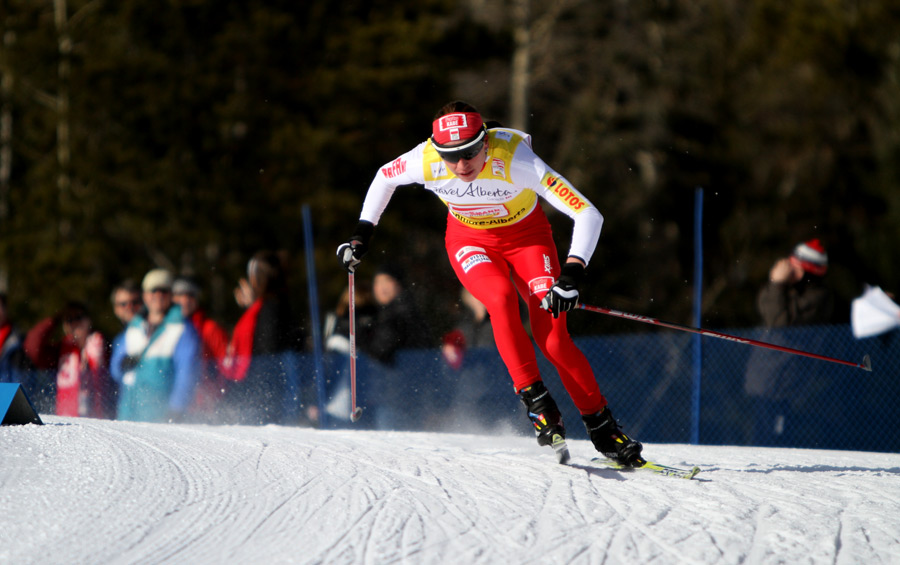
Justyna Kowalczyk (POL) has been training five to six hours a day for the past few weeks
For the last few weeks, Justyna Kowalczyk of Poland has been training five to six hours a day.
Seriously. We asked her four times, just to be sure. Granted, she said that only three to four of those hours were skiing—the rest were in the gym. But it’s still a lot of volume in advance of a World Cup.
Kowalczyk’s approach to her training underscores athletes’ varying strategies during this final period leading up to the 2010 Olympics in Whistler. Some see the World Cup races in Canmore as a throwaway—just a small stepping stone on the path to a medal—but for others, it’s the last opportunity to test out the motor in a competitive field, and to make some final adjustments.
A good chunk of the World Cup field is racing in Canmore, but of those, very few are shooting to have their best results here. And others, like the Norwegian Olympic team, decided to skip the races altogether, opting instead for an altitude camp in Sun Valley, Idaho.
“Less distraction, less traveling—we just want to make sure that we have all the power for the Olympics,” said Vidar Lofshus, one of the coaches of the Norwegian B-team competing in Canmore.
Lofshus said the elevation in Sun Valley was significantly greater than that in Canmore, and that the Norwegian athletes want to stay at that higher altitude for as long as possible. And avoiding the additional travel, too, puts the team at a lower risk of getting sick.
In addition to the Norwegians, the other conspicuous absences include the Estonians, the Czechs, the French men, and the Finnish women.
Of those athletes that have chosen to race here, most are still at the tail end of some big training blocks.
Their plans are tailored towards a peak at the Olympic events that take place in a couple of weeks, and the athletes won’t put too much stock in their results here.
“”I’m pretty wasted….It beat me up badly,” said Canadian Devon Kershaw, referring to his last three weeks of training. He said before Friday’s race that he expected very little to show for his efforts, and that indeed was the case, as he struggled to 37th in the 15k skate.
But according to coaches, the Canmore races are close enough to the Olympic venue that it’s still worth the trip for a chance to test the legs, especially given the reliable conditions with the man-made snow here.
“It’s the last chance before the Olympics to have a competition on a high level…and to get in the normal rhythm,” said Jochen Behle, the coach of the German national team. “Therefore we do the races.”
For some countries with large Olympic teams, like Germany’s, coaches will be parsing the results from Canmore to guide their selection of starters for the first races in Whistler.
René Sommerfeldt's (GER) 11th place finish today could impact his plans for the 2010 Olympics
Behle said that he will be looking at them carefully—especially since Friday’s distance skate races will be replicated at the Games in just ten days.
The two efforts should also provide a good gauge for coaches to judge how the last month of training has affected each skier.
“After this race, then we know if we must go a little bit harder with some training, or if we have to be a little bit softer—exactly where are the athletes standing?” said Joakim Abrahamsson, the Swedish head coach. “From now on until the Olympics, you can only make little small changes, but it can be very important.”
Abrahamsson said that his staff would be shooting video out on course this weekend, which will be used to help athletes make some last refinements with their technique.