Tag: Joan Smith

  • Silver in Presque Isle: Dunklee Gets Her Due in Home World Cup

    Silver in Presque Isle: Dunklee Gets Her Due in Home World Cup

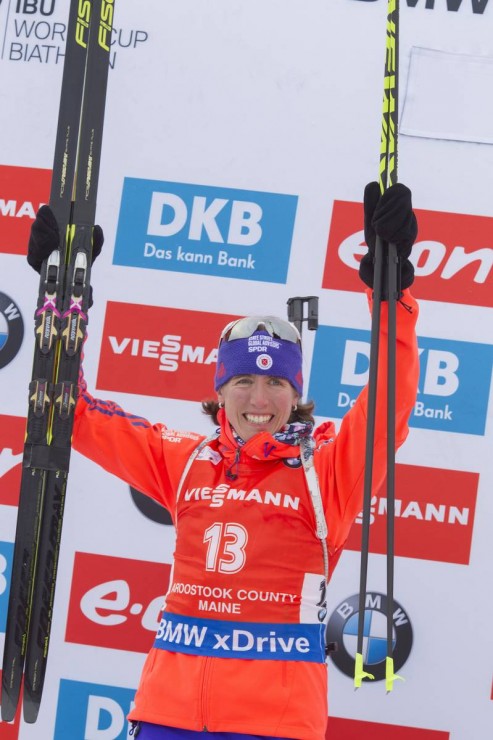
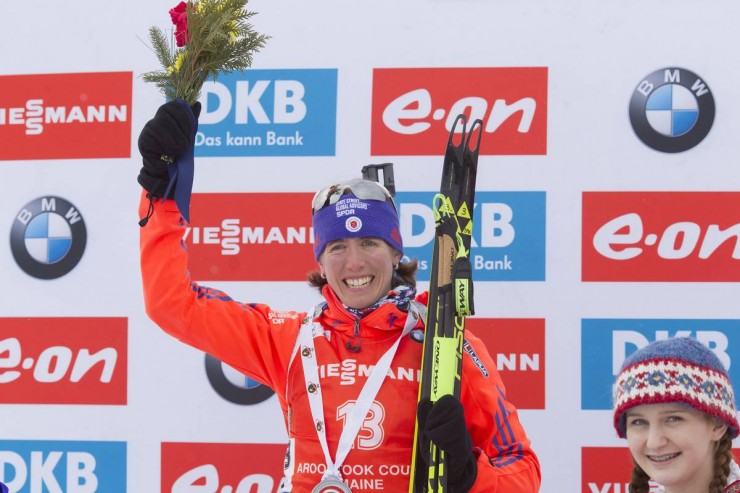
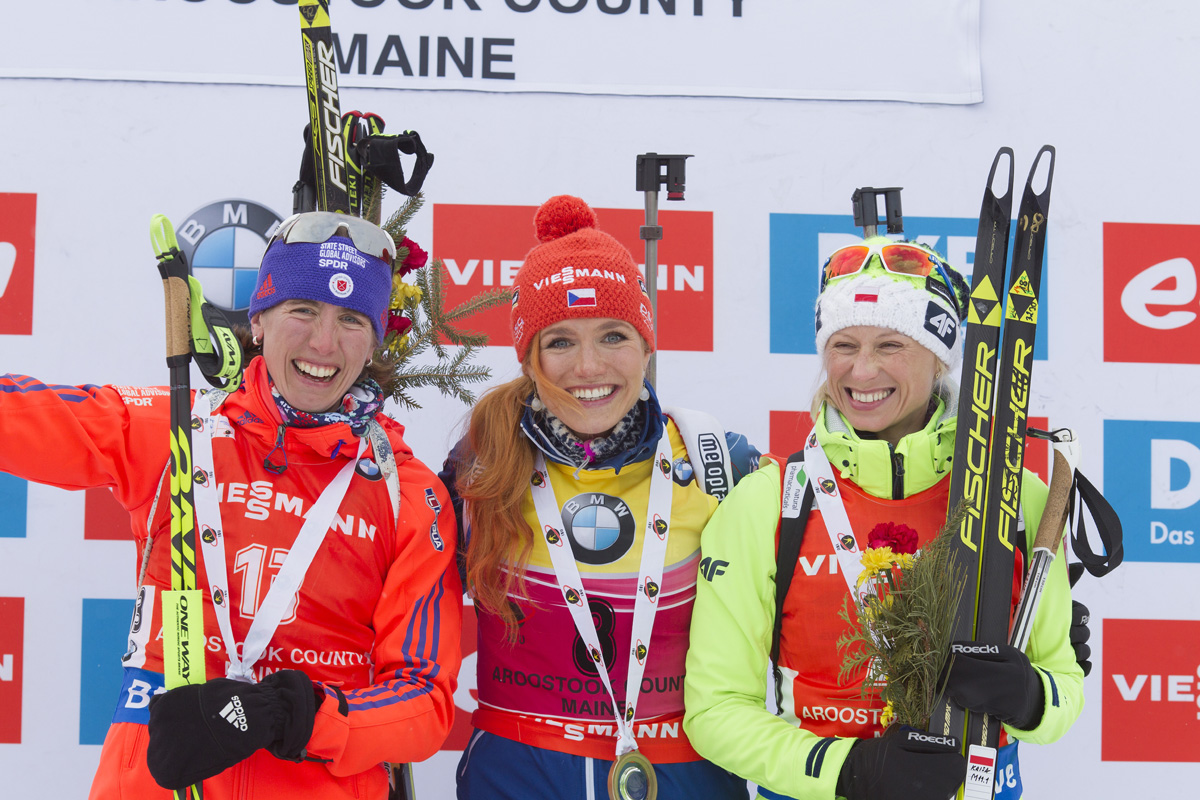
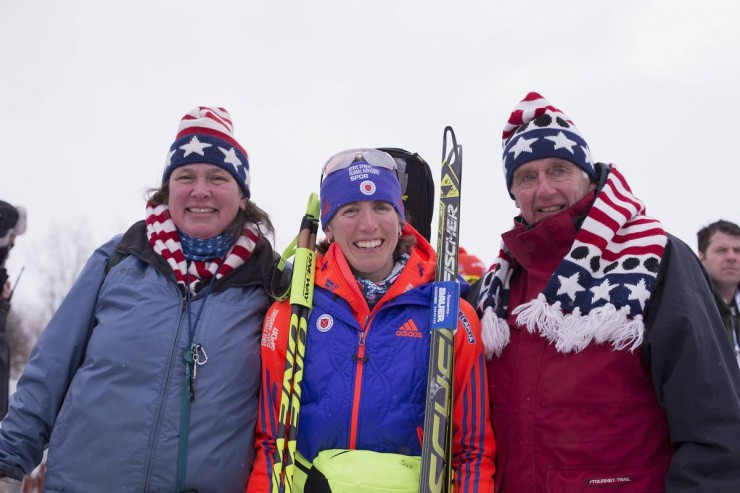
    American Susan Dunklee (l) after achieving her best IBU World Cup finish in second place on Thursday and tying the best World Cup result by a U.S. biathlete. She finished second to Czech Gabriela Soukalova (c), and Poland's Krystyna Guzik placed third (r) in the 7.5 k sprint in Presque Isle, Maine. It was the first IBU World Cup held in the U.S. since 2011 in Presque Isle. (Photo: Fischer/NordicFocus)
    American Susan Dunklee (l) after achieving her best IBU World Cup finish in second place on Thursday and tying the best World Cup result by a U.S. biathlete. She finished second to Czech Gabriela Soukalova (c), and Poland’s Krystyna Guzik placed third (r) in the women’s 7.5 k sprint in Presque Isle, Maine. It was the first IBU World Cup held in the U.S. since 2011. (Photo: Fischer/NordicFocus)

    Gazing out at the crowd, standing on the second step of the podium on Thursday, Susan Dunklee recognized dozens of faces: family, friends, people from her home base in Craftsbury, Vt., US Biathlon board members, colleagues from the Lake Placid Olympic Training Center, not to mention her team and support staff.

    It had all the makings of a local-race feel, except for the implications of a World Cup podium — and the flashing lights, silver medal and media attention that came with it.

    Two days before her 30th birthday, Dunklee had the best race of her career. The 13th starter, she raced to second in the women’s 7.5-kilometer sprint on the first day of the IBU World Cup in Presque Isle, Maine, finishing 17.8 seconds behind Gabriela Soukalova of the Czech Republic, the winner in 20:02.2 and overall World Cup leader.

    Nearly 400 miles and a seven-hour drive from her hometown of Barton, Vt., Presque Isle is less than a half an hour away from Canada. Yet in her first U.S. World Cup, and the first World Cup in the states since it was last held in Presque Isle in 2011, Dunklee felt somewhat at home.

    “To be able to have a best result on home soil and we only have a North American World Cup every five years, I couldn’t ask for anything better,” Dunklee said on the phone after the race. “It’s just phenomenal.”

    In order to achieve her best World Cup result by one place (she finished third in a sprint two seasons ago in Oslo, Norway), Dunklee rekindled her joy in both the sport and Presque Isle’s course specifically, putting herself in a happy place she had been struggling to find in the last week.

    “Last week was a little tough for me,” Dunklee said of the last World Cup in Canmore, Alberta. “I felt like I was going through the motions but not really feeling hungry for it.”

    That changed on the final day of racing there, when she skied the first leg of the U.S. mixed relay, which went on to place fourth for the team’s best-ever finish in the event. Being within two seconds of a podium recharged her and reminded her to stay the course.

    “Coming here I was like, ‘OK, there’s going to be random things that happen that are going to throw me off, but I’m just going to take the positive things that I can and use those to my advantage,’” Dunklee said.

    On the team’s first training day in Maine on Tuesday, she skied the Presque Isle World Cup course for the first time. Dunklee had previously raced a NorAm there in 2009, but missed out on the 2011 Presque Isle World Cup as the team’s fifth woman at the time, when it only took four.

    That was frustrating, she said, but she moved on from it — taking advantage of an opportunity instead in Ruhpolding, Germany, where she raced and previewed the course a year out from 2012 Ruhpolding World Championships. There, a year later at her first World Championships, she broke through in fifth in the 15 k individual.
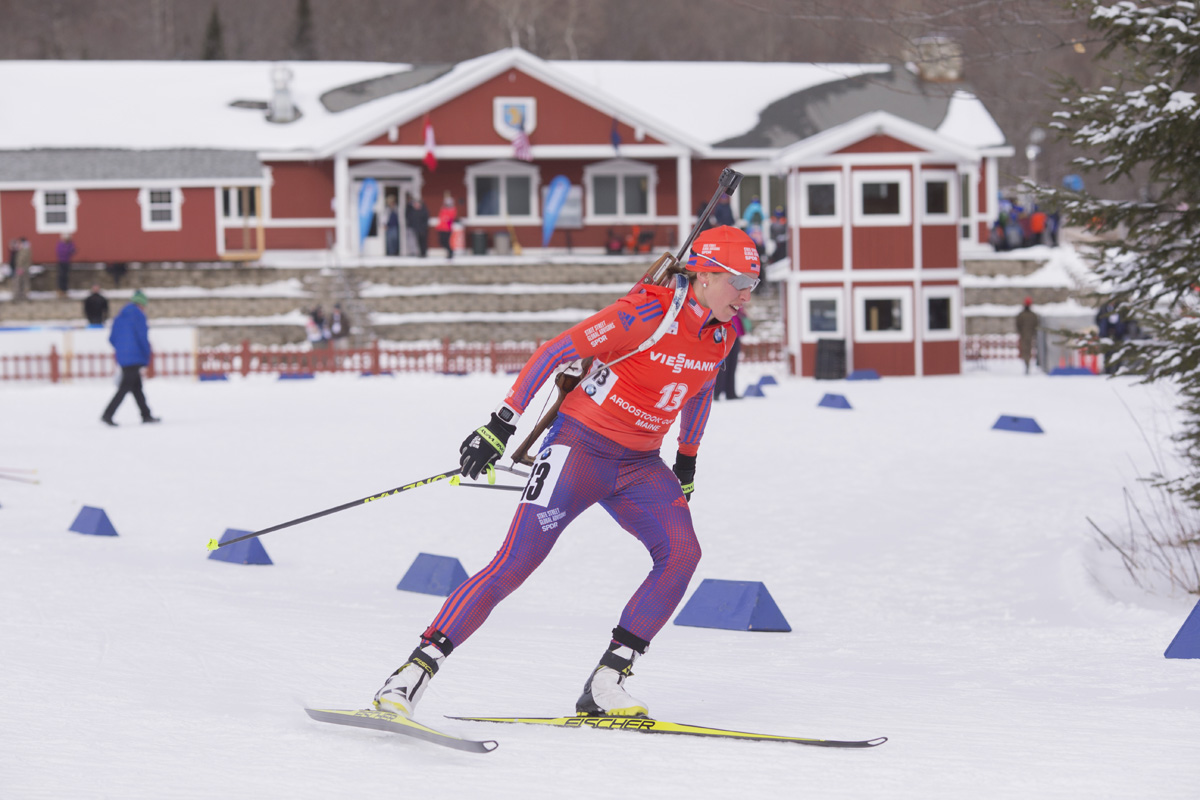
    Susan Dunklee (US Biathlon) racing to a career-best second on Thursday in the women's 7.5 k sprint at the IBU World Cup in Presque Isle, Maine. (Photo: Fischer/NordicFocus)
    Susan Dunklee (US Biathlon) racing to a career-best second on Thursday in the women’s 7.5 k sprint at the IBU World Cup in Presque Isle, Maine. (Photo: Fischer/NordicFocus)

    Memories aside, Dunklee was excited about what she saw in Presque Isle earlier this week.

    “I skied the course and I’m like, wow … this is a John Morton course. This is what I grew up skiing on and this is what I’m good at,” she recalled. “This is what I’m going to thrive on. I love the ups and downs, the steep climbs, the roller-coaster flow, and that’s what really set the tone right away.”

    On Thursday, it was cold in northern Maine, but busloads of schoolchildren came out for the first of four days of World Cup racing. Dunklee wasn’t in her home state, but with everyone speaking English and cheering “USA!” out on the course, it was the closest she had felt to being there.

    “The community is extremely welcoming and they go out of their way to accommodate us and make us feel like home,” Dunklee explained.

    She started behind Soukalova, an early leader with perfect shooting in both her prone and standing stages. No sooner had Finland’s Kaisa Mäkäräinen in bib 6 finished and taken the lead from Czech Veronika Vitkova (the second starter) by 20 seconds, Soukalova in bib 8 charged across the finish line moments later, 24.5 seconds faster than Mäkäräinen to take hold of first place.

    The day was young, but most of the top-ranked skiers were on course at the beginning of the 88-woman field. Dunklee followed Soukalova out, cleaning prone as well to take the lead by 0.8 seconds after the first shooting.

    Her shooting didn’t feel automatic, Dunklee recalled. That wasn’t necessarily a good thing, but it wasn’t bad, either.

    “I was very aware of each shot I was taking; it wasn’t flowing automatically like it usually does, and usually you want that automatic flow in a race,” she explained. “Instead I had all these thoughts going through my head, but what was great about today is I was able to take those thoughts and just say, ‘It’s OK that I’m distracted. I’m going to put that thought aside and go back to what I’m focused on right now in the present moment.’ ”

    She had similar feelings earlier this year in Ruhpolding, where she placed sixth in the mass start. Recognizing this, she resolved to keep calm.

    On the second shooting stage — standing — Dunklee cleaned again and left the range with 9.3 seconds to make up on Soukalova.
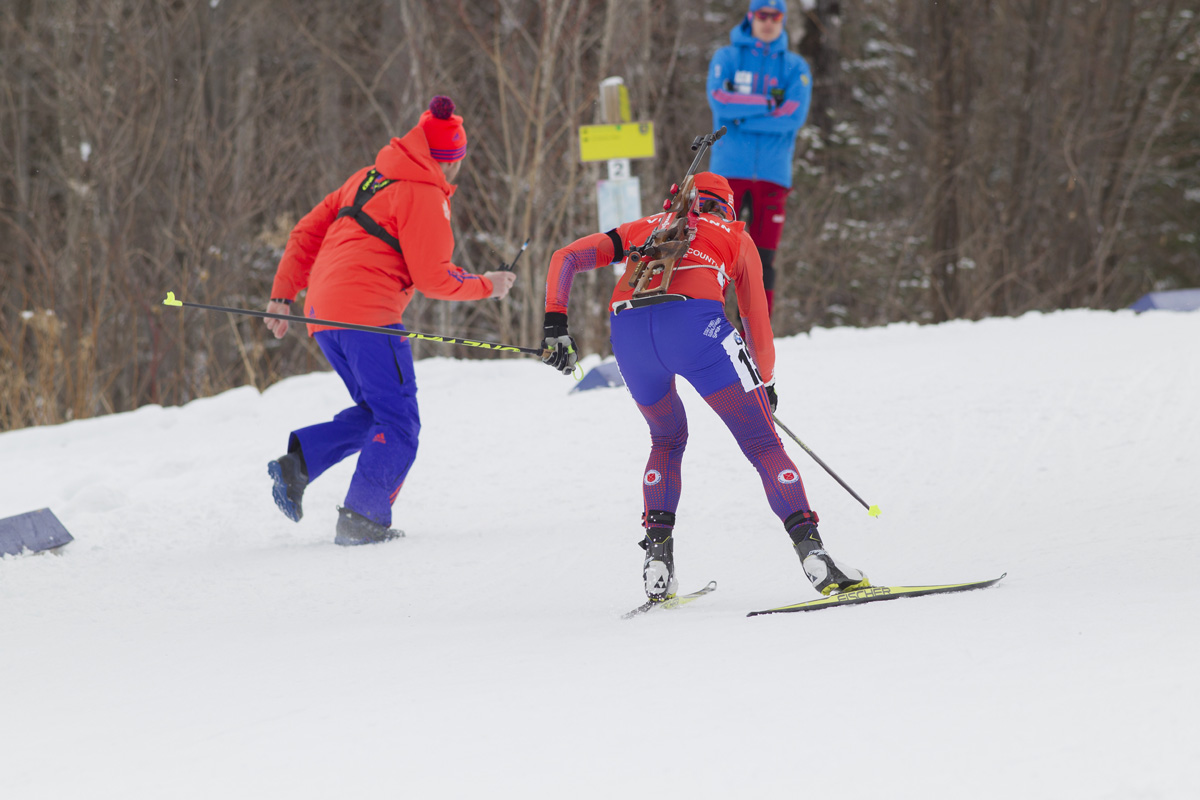
    A US Biathlon staff member (l) cheers on Susan Dunklee (r) as she races to a career-best second place in the 7.5 k sprint on Thursday at the IBU World Cup in Presque Isle, Maine. (Photo: Fischer/NordicFocus)
    A US Biathlon staff member (l) cheers on Susan Dunklee (r) as she races to a career-best second place in the 7.5 k sprint on Thursday at the IBU World Cup in Presque Isle, Maine. (Photo: Fischer/NordicFocus)

    What came to mind then? “You still need to fight like hell,” she recalled. “When you’re having that sort of race, you don’t want to lose a second anywhere … I’ve just got to fight for the next seven minutes or whatever it takes.”

    With 1 k remaining, she was 17.6 seconds off Soukalova’s time. Half a kilometer later, Soukalova still held her ground, 17.4 seconds ahead. By the finish, Dunklee was 17.8 seconds back in second, and she wasn’t even sure she was second — but she smiled at the cameras anyway.

    “I knew I probably had one of my best races in my life and I’d done it at home and my parents were there,” she said. “I just felt really good about my performance. I was really happy.”

    US Biathlon Women’s Coach Jonne Kähkönen knew she was on track for a career best.

    “I knew that if she would clean the race today, she would be fighting for the podium, even if there were a few fast athletes starting behind her,” he said on the phone. “Not nervous, but just wanted to wait and see what the later starters would do.”

    France’s Marie Dorin Habert presented the most immediate threat. After starting 24th and cleaning prone, Dorin Habert left the range in first, 4 seconds ahead of Dunklee. However, during her second stage, she missed one standing shot. The penalty loop put her in fourth, 25.5 seconds behind Soukalova and 16.2 seconds behind Dunklee, with one loop to go.

    Meanwhile, Poland’s Krystyna Guzik had started 20th and cleaned both stages to leave the range for the last time in third, trailing Dunklee by 4.4 seconds. She couldn’t catch the American on the final loop and finished 1.3 seconds behind her in third.

    For Guzik, it was her second sprint podium in two weeks.

    “Shooting is so hard; it is not sure that every day I will shoot well,” she said in a post-race press conference. “I thought that this was a new day and do my best to shoot well and run fast. I just could not catch Susan; she was too fast on the last loop. For me, the last loop today was really hard.”

    Ultimately, the three podium finishers were the only ones in the top eight to shoot clean. Soukalova had the fifth-fastest overall course time, Dunklee’s course time ranked 12th and Guzik’s 15th.
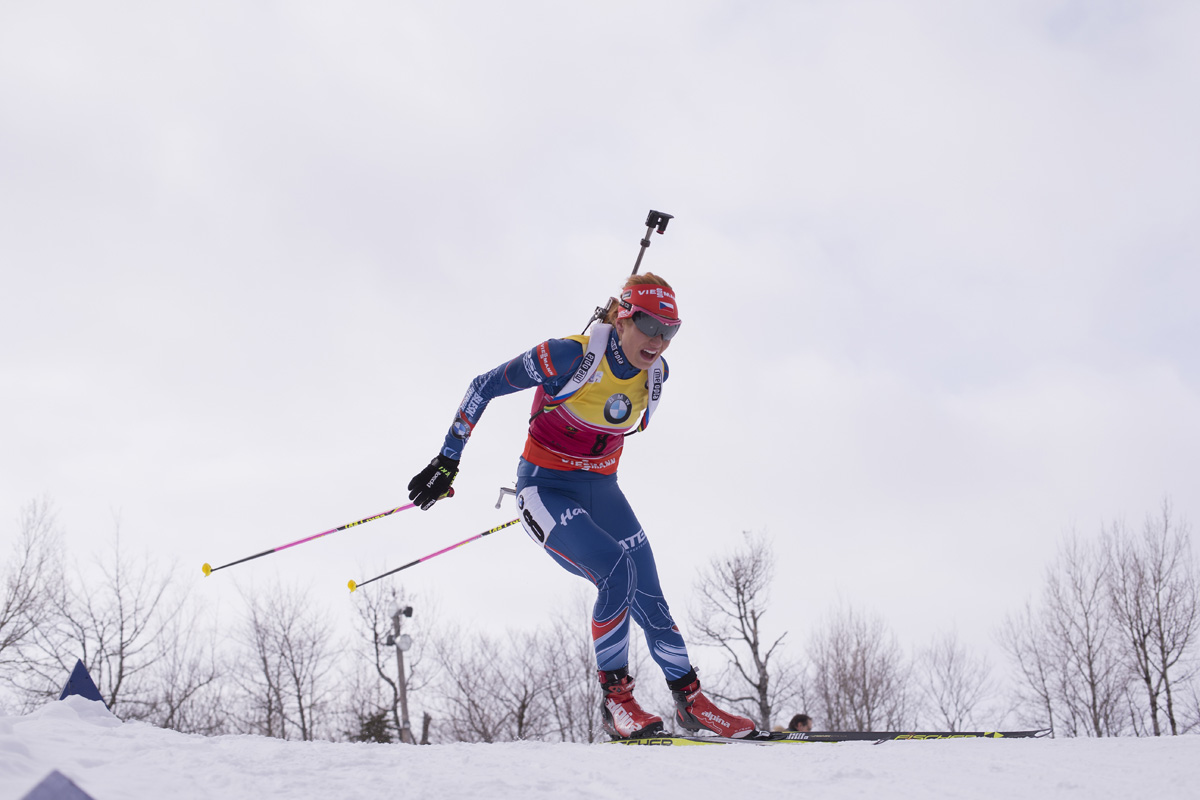
    Overall World Cup leader Gabriela Soukalova of the Czech Republic racing to a 17.8-second win (over American Susan Dunklee) in the women's sprint on Thursday at the IBU World Cup in Presque Isle, Maine. (Phot: Fischer/NordicFocus)
    Overall World Cup leader Gabriela Soukalova of the Czech Republic racing to a 17.8-second win (over American Susan Dunklee) in the women’s sprint on Thursday at the IBU World Cup in Presque Isle, Maine. (Phot: Fischer/NordicFocus)

    “I have to say everything was perfect,” Soukalova said in the press conference. “I started to feel a little tired after the long trip from Canada, but I started to feel good after the start. … We had good service, good skis today so I am very satisfied with this result.”

    Dorin Habert crossed the line in fourth, 20.5 seconds behind Soukalova and 1.4 behind Guzik, bumping Mäkäräinen, with a single standing miss, into fifth.

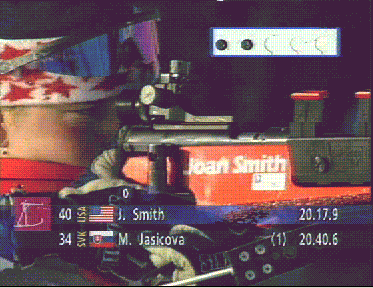
    The top five would stand, and Dunklee would tie the best result by a U.S. biathlete (male or female) joining the ranks of Joan Smith (1994) and Anna Sonnerup (1991).

    Current men’s team member, Tim Burke placed second in two World Cup races in 2009/2010 and earned silver at 2013 World Championships. Before him, Josh Thompson also took silver at 1987 World Championships.

    “What a great day for with 6 athletes in the top 30 and on the podium! #homecourseadvantage!” Burke tweeted on Thursday, after he, Sean Doherty and Lowell Bailey placed in the top 20 in the men’s sprint. Dunklee, Hannah Dreissigacker and Clare Egan finished in the top 32 of the women’s race.

    “Today Susan cemented her place as a world class biathlete,” US Biathlon President and CEO Max Cobb wrote in an email. “It was a historic performance, matching the best World Cup finish by an American.”

    “You spend years and years working on this, trying to perfect things,” Dunklee explained. “And at first progress is pretty good, you make big gains pretty fast, and then to get that last one percent or so of performance, it just takes so much more work.”

    You need that 1 percent, she added.

    “There’s times where you work your way at something for months and you just don’t make progress on it or you even go backwards because you’re trying so hard, she continued. “I don’t know, somehow things came together and I’m just amazed. It’s exciting.”

    ‘A Culmination of a Whole Lot of Effort’

    What is it about progress, or maybe more specifically about biathlon, in which someone like Dunklee can turn a last-place finish in Canmore’s mass start, complete with a “dirty” stage (five missed targets), around less than a week later with a silver-medal performance?

    “We’ve talked about this actually a couple of times over the season,” Kähkönen said of Dunklee’s ability to overcome adversity and less-than-desirable results. “It’s been a little up and down. We’ve been trying to track down in the training log if we can find some reasoning behind it and be able to narrow it down better in the future as well. But now it looks like everything is on track in terms of the physical training.”
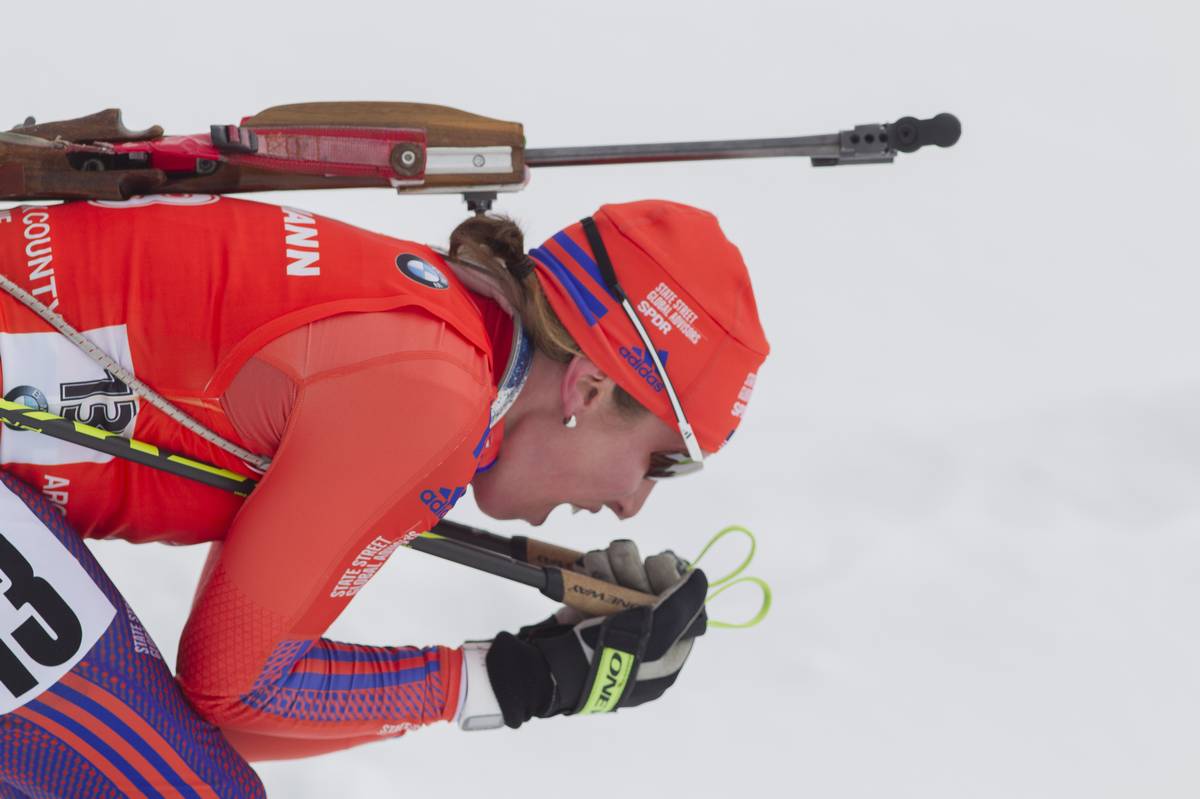
    Susan Dunklee (US Biathlon) racing to a career-best and historic second place in the women's sprint at the IBU World Cup in Presque Isle, Maine. (Photo: USBA/NordicFocus)
    Susan Dunklee (US Biathlon) racing to a career-best and historic second place in the women’s sprint at the IBU World Cup in Presque Isle, Maine. (Photo: USBA/NordicFocus)

    In the last World Cup before World Championships in Oslo in early March, Dunklee said the timing of this result was “perfect.”

    “I think Susan, ever since last week, she was able to put distractions on the side and focus on what matters,” Kähkönen said.

    “In order to have my best performances in biathlon or anything in life, to be a person that takes joy out of life … I really have to find what I love about it,” Dunklee explained. “… I think that hunger is honestly my most valuable asset as an athlete.”

    Looking ahead to the rest of the races in Presque Isle, Dunklee had fewer than 24 hours to absorb what she’d done on Thursday and prepare for Friday’s pursuit. At 1:10 p.m. Eastern time, Soukalova will start the 10 k pursuit first. Dunklee will head out 18 seconds later in second, and Guzik 1 second after Dunklee in third. Dorin Habert will follow, 3 seconds after Dunklee.

    “I’ve got the best setup I’ve ever had before going into a pursuit,” Dunklee explained. “Starting pretty close behind the leader, and that’s another wonderful opportunity to have a great result. I’m going to enjoy tonight and celebrate a bit, but at the same time I’m going to try to wind down a bit, have a little Susan-time to myself and get some good sleep tonight because I really want to see what I can do tomorrow.”

    Asked about the task of refocusing after a result like Thursday’s, Kähkönen said that’s the key to consistent top results.

    “With this schedule, we just don’t have the luxury of getting stuck on the current or especially the past,” he said. “You just need to stay focused on what’s coming up next.”

    But Thursday was a pretty incredible day to be part of US Biathlon, in the same state (albeit 270 miles away) as its headquarters in New Gloucester, Maine.

    “It’s unbelievable,” Kähkönen said. “Just to be able to grab the podium on the home soil, home World Cup, even if it’s not the hometown, but there’s a lot of friends and family and fans that are great support. The local community is just awesome, so it means the world to us.”

    “It’s not just my success,” Dunklee stated. “It’s a culmination of a whole lot of effort over lots of years by this whole group of people who care a lot about our team.”

    Dreissigacker 27th, Egan 32nd, Kocher 42nd

    Joining Dunklee in the pursuit will be two other U.S. women and one Canadian. Dunklee’s teammate on the national team as well as Craftsbury Green Racing Project, Hannah Dreissigacker placed 27th for her fourth-best sprint result, finishing 1:33.7 behind Soukalova with a single prone penalty.
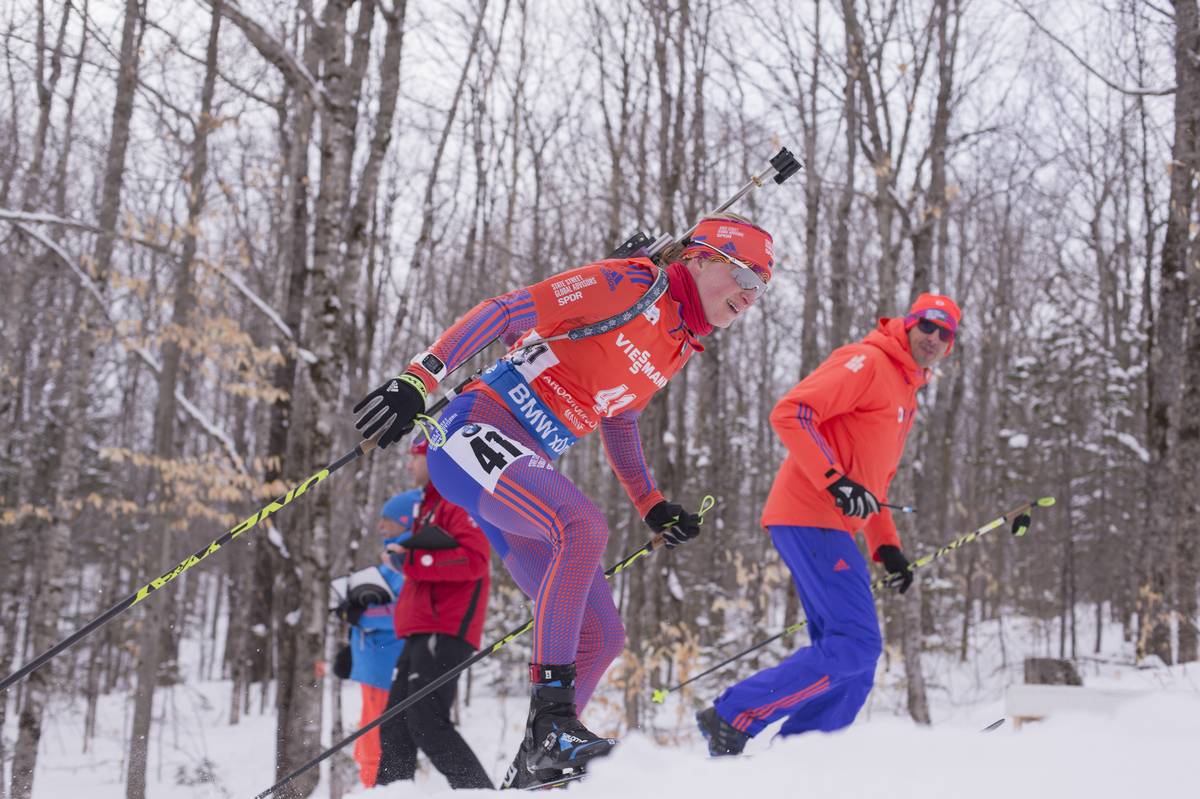
    Hannah Dreissigacker (US Biathlon) racing to 27th in the women's 7.5 k sprint at the IBU World Cup on Thursday in Presque Isle, Maine. (Photo: USBA/NordicFocus)
    Hannah Dreissigacker (US Biathlon) racing to 27th in the women’s 7.5 k sprint at the IBU World Cup on Thursday in Presque Isle, Maine. (Photo: USBA/NordicFocus)

    “I was really happy to clean standing — I am normally a better prone shooter than standing, but I knew that I had to clean standing if I wanted to really do well,” Dreissigacker, the 41st starter, wrote in an email. “I’m very happy that I was able to concentrate for all of the shots and make it happen.

    “It felt really special to have my family here, and so many other Americans out there cheering for us,” she wrote. “I actually started just after I heard on the loud speaker that Susan had cleaned.  So then she came around the building and headed out on her last lap just a bit behind me.  That was a fun lap — I was excited for her, and also all of the staff and fans were out there cheering so hard for her and I could tell that she was gaining on me, and also that she was probably going to podium.  I felt like we were doing that lap together, though she only caught me at the very end.”

    Also for the U.S., Clare Egan finished 32nd (+1:38.5) with one standing penalty. The 56th starter, Egan looked to be in contention for a top 20 after cleaning prone, but slipped into 28th after standing.
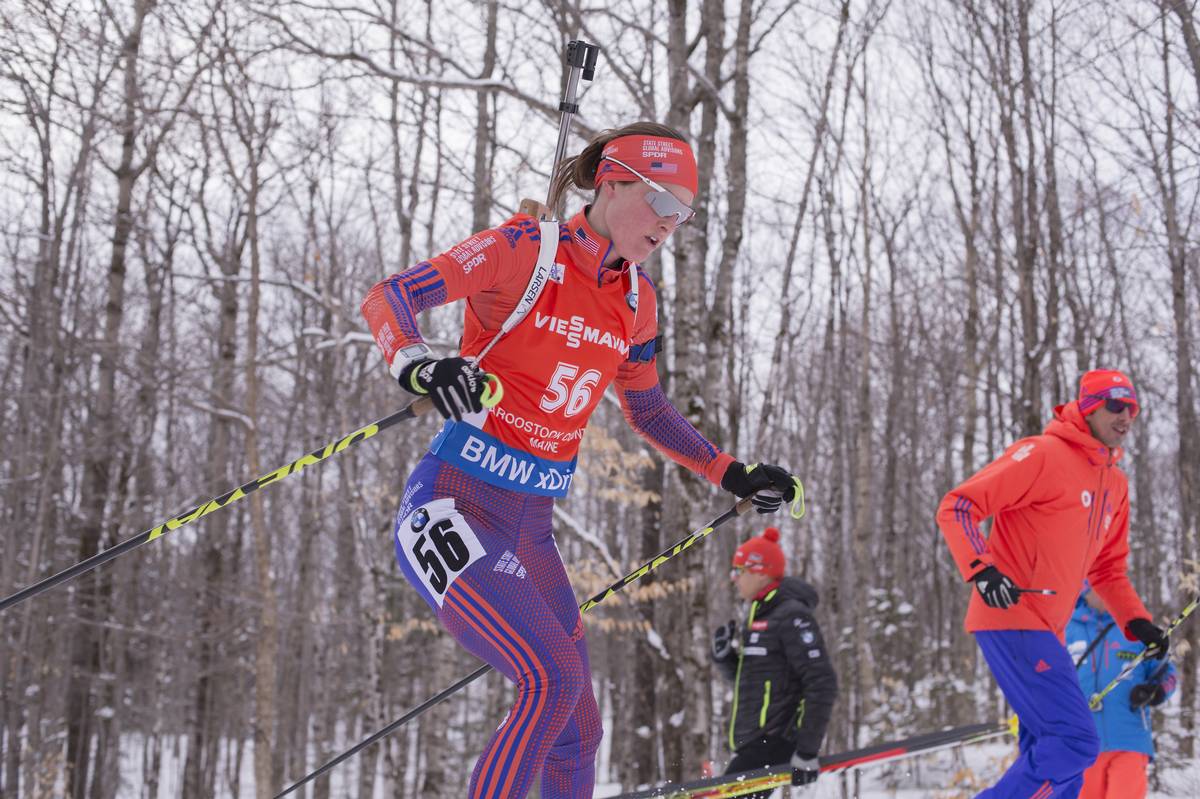
    Clare Egan (US Biathlon) racing to 32nd, her second-best IBU World Cup result, in the women's 7.5 k sprint on Thursday in Presque Isle, Maine. (Photo: USBA/NordicFocus)
    Clare Egan (US Biathlon) racing to 32nd, her second-best IBU World Cup result, in the women’s 7.5 k sprint on Thursday in Presque Isle, Maine. (Photo: USBA/NordicFocus)

    “I was thankful to clean prone because it put a little less pressure on the standing, which is the harder discipline for me,” Egan wrote in an email. “I was very shaky in standing and I had to stop and reset my position after missing my 3rd shot, but that worked and I hit the last two.

    “This is my 2nd best result ever and by far my best result since World Cup 1,” she explained. “My ski speed took a major hit in December but I am now recovered to where I think I should be so that is a huge relief. I had a top-30 ski time today and 90% shooting so that is an almost perfect day.”

    Originally from Cape Elizabeth, Maine (and a teammate of Dunklee and Dreissigacker at Craftsbury), Egan described the experience of racing in her home state.

    “My parents, my teammates’ families, and some USOC staff and USBA board members are here,” she wrote. “I heard my name all along the course from voices both familiar and unknown– and that was a first.”

    Friday will be Egan’s second time racing a World Cup pursuit.
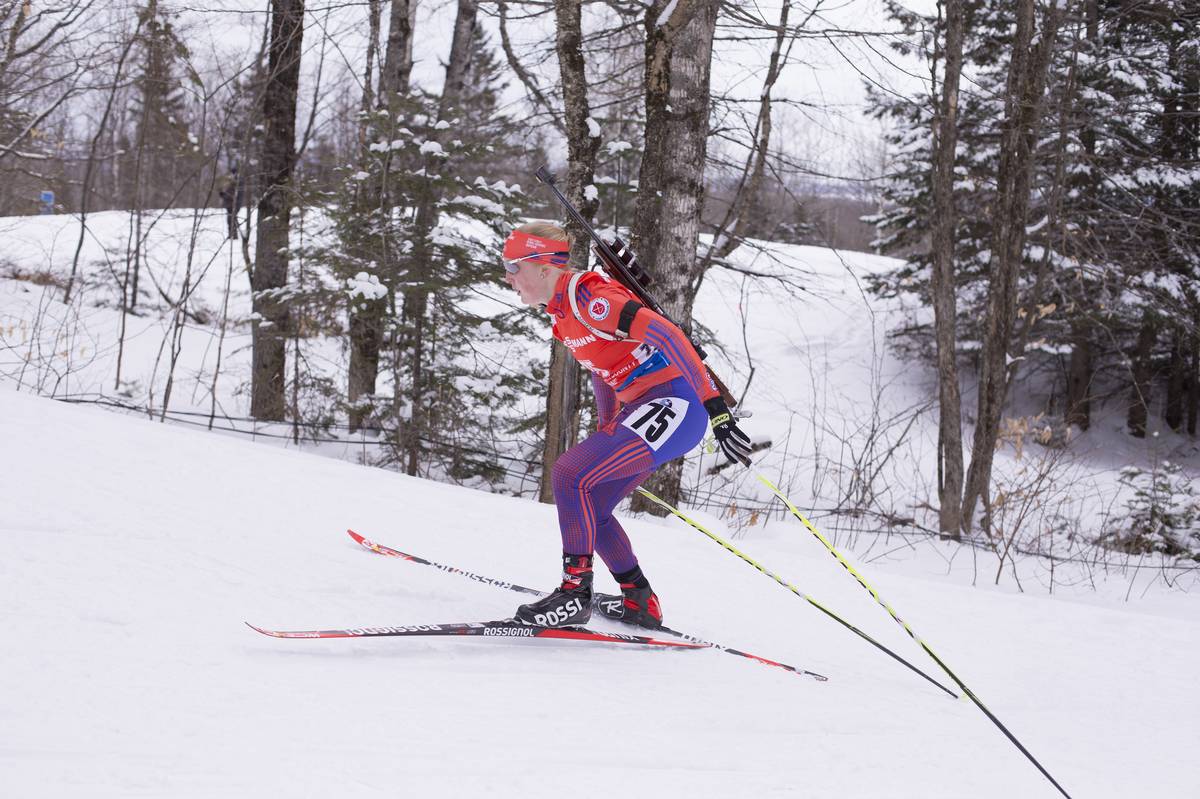
    Maddie Phaneuf (US Biathlon) on her way to 65th in the second individual IBU World Cup of her career on Thursday in Presque Isle, Maine. (Photo: USBA/NordicFocus)
    Maddie Phaneuf (US Biathlon) on her way to 65th in the second individual IBU World Cup of her career on Thursday in Presque Isle, Maine. (Photo: USBA/NordicFocus)

    The fourth U.S. woman, 20-year-old Maddie Phaneuf, in her second individual World Cup race, placed 65th (for her best result by 28 places) with a clean prone and two standing penalties.

    “My goal was to shoot well and ski strong … which I didn’t feel I reached fully,” Phaneuf wrote. “I felt pretty good on the skis, but not nearly as strong as I was in Romania.”

    Late last month in Cheile Gradistei, Romania, Phaneuf notched three top 10’s at IBU Junior World Championships.

    “My result-goal was to make the Pursuit, which I just missed,” she wrote of Thursday’s World Cup race, in which she needed a top 60 to advance to the pursuit. “But I’m still happy with the result and know that I have the potential to achieve more.”

    On behalf of her team, Dreissigacker noted, “Our skis were phenomenal today. Our wax techs definitely deserve a share of the credit for the great day that we had as a team.”

    The top Canadian, Zina Kocher placed 42nd (+2:02.0) with three misses (2+1). Overall, she had the 20th-fastest course time.

    “I was focused on having consistent solid performances this week in order to qualify for World Champs,” Kocher wrote in an email. “Knowing that it is a trials situation though does bring a bit more nerves into the equation.

    “I had thought I had focused on attacking from the start, however looking at the breakdown in ski speeds, looks more like I went out for a casual ski lap 1, & lap 3 an explosion went off,” she wrote of her course times, which ranked 54th on the first loop, then 46th on the second, and finally, third on the last loop. “I’d say I’m happy with 3rd fastest last lap but will work on a more aggressive warm up for the next sprint or relay I do to make sure I’m starting out a bit quicker!”

    Also for Canada, Emma Lunder placed 68th with two penalties (1+1), Audrey Vaillancourt was 80th with four misses (2+2) and Erin Yungblut 87th in her World Cup debut, also with four penalties (1+3).

    Note: In the men’s 10 k sprint, Sean Doherty led the U.S. in 13th (0+1), Lowell Bailey was 15th (0+1) and Tim Burke 20th (1+1).

    “The men were just really consistent,” Kähkönen said. “Everybody close together and just the whole field for the top athletes, so it puts them into a very good place looking ahead for tomorrow’s pursuit race. Hopefully Susan’s podium will give them another push.”

    Stay tuned for a separate report on the men’s race.

    Watch the men’s and women’s pursuits live on Eurovision (Friday at 11:30 a.m. and 1:30 p.m. EDT)

    Women’s sprint results | Pursuit start list
  • Where Are They Now: Joan Miller

    Where Are They Now: Joan Miller

    Joan Miller, then Smith, competing in the 1994 Lillehammer Olympics. It was there that she finished 14th in the 15 k, a record that still holds today as the best American finish in women’s Olympic biathlon.


    This profile is part of a ‘Where Are They Now’ series, made possible through the generous support of Fischer Sports. Learn more about their products at www.fischersports.com.


    The day Joan Miller took to the starting line of the 7.5 k at the Albertville Olympics, history was being made. The year was 1992, and it was the first year women’s biathlon was being included in the Games. Despite training on the national biathlon team for seven years, this was the first time Miller (then Smith) and every other female biathlete in the world had been given the chance to compete on the world’s biggest athletic stage.

    “They used to tell me when I was younger, ‘Some day you’ll go to the Olympics,’” Miller told the New York Times at the ‘92 trials. “Now I can say it.”

    It’s at once a familiar and completely foreign concept: there was a time as recently as the 90s when women didn’t have every opportunity men did to compete at the Olympics. I was four years old in 1992, only a few years away from my first soccer team and indoctrination into the Title IX notion that anything boys could do girls could do, too. And yet today’s female ski jumpers know exactly what exclusion feels like, having only just been granted a spot on the Olympic playbill for 2014.

    All photos courtesy of Joan Miller.

    Speaking over the phone from her home in Vermont nearly twenty years later, Miller recalled the emotion of finally making it to the Olympic starting line after dedicating her life to biathlon. It was bittersweet, as many of her teammates had aged out of the sport before the opportunity finally came.

    “To see ’88 slip by for them was really — they just knew realistically, how can they hang on from ’88 to ’92 and try to make it? And here they’d been hoping that ’88 would be the year for them,” Miller said.

    As the youngest woman on the team for many years, Miller had been the team protégé. She was not yet out of high school when she was first named to the U.S. biathlon team and competed against athletes who’d been involved in the sport for longer than she’d even been on skis.

    “My learning curve was extremely fast because I was surrounded by women who’d been doing it for so long,” Miller said. “You learn from other people’s mistakes and successes, and you grow from that… You grow up fast.”

    And so as a 24-year-old Miller stood waiting to begin her first Olympic race, she was mindful of both the task in front of her and of the friends and teammates who’d helped her get there.

    “To make it in ’92, it was pretty incredible to think, ‘OK I’ve finally made it;’ knowing a lot of that group that had hung on and wasn’t able to make it. They set the foundation — it was huge,” she said.

    It is gratifying to hear an Olympian talk about her inspiration with such humility. Perhaps this is because I, in turn, had idolized Miller growing up. We graduated from the same small high school in upstate New York; had both learned to ski in the same park. Though our time in Honeoye Falls was separated by two decades, Miller was my hero because of this shared origin — with it, she’d become an Olympian.

    I’d almost forgotten what that youthful idolization felt like, but it came right back when I dialed Miller’s phone number last fall. I’d met her on the ski trails once in grade school; had shaken her hand, taken a photo. Olympians inhabit a unique place in the imaginations of the young; there is nothing nobler in the eyes of a nine-year-old than complete dedication to the pursuit of athletic glory for flag and country.

    My expectations for our conversation now were perhaps impossibly high. I began, nervously, with a confession:

    “I don’t know if I mentioned this earlier, but I did a report on you for school in fourth grade.”

    Miller laughed. “They pay you in fourth grade?”

    Even through the phone, Miller’s warmth and humor was evident. I was lucky, I knew; here I was speaking to a childhood hero and she was every bit as charming as I’d always imagined.

    * * *

    Our conversation began with a look back at her career. Our hometown connection was cool, but Miller’s significance lies in the groundbreaking results she produced for U.S. biathlon. In her 1992 Olympic debut, she filled the first line in the womens’ record books with a 21st-place in the 7.5 k. Two years later in Lillehammer she finished 24th in the sprint and 14th in the 15 k — the best result at the time for an American biathlete, man or woman, at the Olympics, ever.

    That feat alone is impressive, but the more remarkable thing about that 15 k is how close it came to landing Miller on the medal stand. Her splits halfway through the race had her hanging with the leaders. When she skied past her coach, Walter Pichler, and into the shooting range he deliberately didn’t give her this information so as not to jinx what might be the race of her life.

    Miller kayaking in Alaska.

    “He didn’t want me to mentally not be able to handle that, he knew what to say to me to keep it so I wouldn’t get hyped up,” Miller remembers. But she could tell by the way her brother was cheering that she was having a good one.

    “I was racing so hard, feeling so good and pretty much hitting my peak. I was pushing the envelope,” Miller said. “If I’d taken five more seconds coming into the range…”

    Five more seconds and who knows? In the middle of a race it’s impossible to tell which five seconds will end up making all the difference. Miller came into the range for the standing position and on one shot pulled ever so slightly on her rifle as she pulled the trigger. When the bullet reached the targets, it split in two; some of it hit the target, and some did not.

    “When it hits those rims, it can literally split the bullet in half… It’s called a split bullet, and it happens quite a bit,” Miller said. “Lots of the time you just follow through to the next target; you think it hits, it feels good.”

    Though Miller thought she’d hit the target, the judges reviewed the race video and determined it to be a miss. The taped delayed broadcast of the race that played in the U.S that evening claimed a malfunctioning target had cost Miller a medal — this was the story I vaguely recalled — but Miller dismissed it.

    “It’s me that missed the shot,” she said matter-of-factly.

    But the story was half right. She missed three targets in all, and one more successful shot would have gotten her silver.

    Though it could have been so much more, the performance was still the best of Miller’s career. And as any biathlete will tell you, it’s not enough to have a good day on skis alone. The targets are there for a reason; skiing and shooting have to come together at the same time.

    “The two disciplines are two opposites,” Miller said. “To perform well in both at the same time, that’s the art of the sport.”

    She doesn’t speak as if she still replays those moments in her head. To this day, fourteenth place remains the best-ever American women’s finish at the Olympics. Miller occasionally talks about this when she touches base with the current team.

    “We joke about it,” she said. “‘You gotta bust this record, ‘cause it’s been standing too long!’”

    As if in answer, Susan Dunklee set an American record of her own this winter with an historic fifth-place finish at world championships in Ruhpolding, Germany. Sochi is seventeen short months away.

    * * *

    Just as there’s more to a career than the Olympics, there’s more to Miller than biathlon. She continued competing internationally through 1998, but was sidelined by the flu during the Nagano trials that year. Soon afterwards she moved to the Kenai Peninsula in Alaska with her husband, Allan, to finish her degree in recreation education and start raising a family.

    The Miller family. (L to R: Xander, Allan, Sasha, Joan and Mackenzie.)

    She remained involved in biathlon as a coach for area elementary and middle school students, and led the effort to set up a local biathlon venue and club from scratch. Miller attempted to model the Kenai Peninsula Biathlon Club after the relaxed environment in which she herself first learned how to shoot and ski in New York.

    “That was the level I started at and I saw how productive it was, starting low-key at this club,” Miller said. “That was what I tried to create in Alaska.”

    This cycle of giving back is one of the greatest examples of the power of the modern Olympic movement. That athletes at the top of their game will inspire is almost a given from the moment they don their nation’s colors; it’s the ones who go out of their way to engage kids in sports that have a real impact on the world beyond the playing field.

    By the time Miller got to the giving-back phase of her career, the world of biathlon, of skiing, and of sports in general were vastly different than the one she grew up in. Where she was once one of the few developing female biathletes in the country, she was now introducing the sport to a sizeable group of kids in just one small town in Alaska.

    Technique was also more established. When Miller was in high school it was the 1980s, and skating was still trickling across the Atlantic by word-of-mouth. At the development level, friends relied on friends who’d seen Europeans ski with their boards in a V, and she’d excelled early on largely because someone had been there to show her the finer points. Twenty years later there were instructional videos and better equipment that helped bring everyone closer to the same page.

    Perhaps most significantly, it was no longer some great stretch of the imagination for one of the girls she was coaching to dream of being an Olympic champion someday.

    * * *

    At the time of our conversation, Miller had moved on from Alaska and from coaching. She currently lives in Shelburne, Vermont, where she moved with her family in 2010. She is forty-five and her children, Xander, Mackenzie and Sasha, are of the ages to have a dozen after-school activities to be shuttled to every day.

    Xander and Mackenzie Miller enjoying the powder on downhill skis.

    Miller laughs when she describes her present primary occupation: “I call it a domestic engineer… Landscaping is my training now. We’re putting a hockey rink in the front yard; the kids are getting excited.”

    Xander, her eldest, is 14 years old, and Miller has been careful in introducing her own kids to sports, making sure not to let her competitive past place undue pressure on them.

    “I’ve been real gentle,” she said. “I think, as they’ve gotten older they’ve figured out what I’ve done, the level it was at. Now they understand what the Olympics are.”

    Her two sons are more at home on a hockey rink than on a racecourse, but Miller says the athletic arena has often been the setting where she passes the lessons she’s learned from biathlon onto them.

    “With my oldest, when we talk sports, when it’s just — getting prepared for a game, or shaking off teammates and not letting things bug you, he knows I understand that, and he can gain from that,” she said.

    “It’s neat to bring those things that they learn to what they try to do with the teams they’re involved in. The people dynamics, the relationships that you try to build. Yeah, not everyone will be your best bud but they could be a great teammate and you can have a great team, and you need to learn to accept each other’s little quirks, their differences… That’s neat to see as he’s getting older, and I think it’ll be similar when my other kids get older as well.”

    When you talk to a former professional athlete about what she’s done since leaving competition, you want her to say, with perfect eloquence, how sport forever changed her. You want the narrative arc of her athletic trajectory to mean so much, to somehow represent something about her life beyond the racecourse.

    I’m not sure if I found this perfect symbolism in one short phone call, if such a thing exists, but Miller said something touching when we were talking about her kids. When her family moved back east and began settling into their new house, Miller and her husband wanted to help make Vermont feel like home. They let Xander, Mackenzie and Sasha pick out their own bedroom décor from a collection of familiar photos and mementos from their old home in Alaska: Miller’s photography of Alaskan wildlife, items from Allan’s travels and, of course, memorabilia from the Olympics.

    “We said to them, ‘Why don’t you pick through what you want for your room here in Vermont,’” Miller said. One chose photos of a trip from Antarctica, another went for pictures of a kayaking expedition. And the oldest, Xander, went for pictures of his mom in the Olympics.

    “It was neat to see what they gravitated to — ‘Mom, is it OK if I…?’ So half the bedroom has my Olympic photos.”

    That room sounds familiar.