From the FasterSkier archive — posts syndicated from athletes’ and coaches’ own blogs between 2004 and 2012, kept online as published. Current coverage is at fasterskier.com.
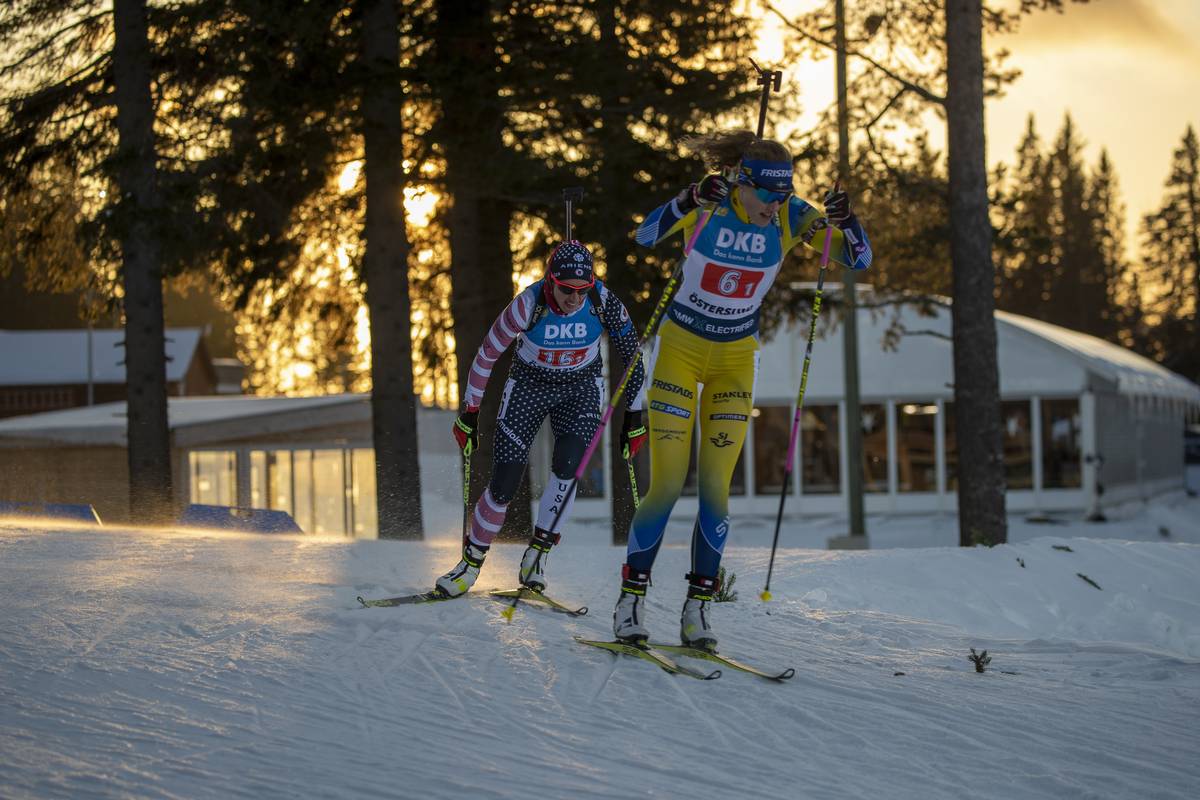
Sweden’s Hanna Öberg leads Susan Dunklee of the U.S. during the 2019 IBU World Cup single mixed relay in Ӧstersund, Sweden. (Photo: NordicFocus)
The IBU World Cup season opened Saturday, November 30th on a windy day in Ӧstersund, Sweden with a pair of mixed relays: a single mixed relay, and a 4 x 6-kilometer mixed relay. The following day, athletes competed in a sprint, 10 k for the men and 7.5 k for the women.
In the single mixed relay, the U.S. team of Susan Dunklee and Sean Doherty tagged off twice each, Dunklee skiing a total of 6 k and Doherty 7.5. Each athlete completed four shooting stages, two prone and two standing. Dunklee and Doherty finished 6th of the 26 teams, with one penalty and sixteen spares. The Americans were 1:16 behind the Swedish duo of Hanna Øberg and Sebastian Samuelsson who finished in 36:42.1 with two penalties and eleven spares.
Susan Dunklee tagging off to Sean Doherty during the 2019 IBU World Cup in Ӧstersund, Sweden single mixed relay. (Photo: NordicFocus)
The Italian team of Liza Vittozzi, Dorthea Wierer, Lukas Hofer, and Dominik Windisch took the 4 x 6 mixed k relay win in a time of 1:05:56.1, holding off their Norwegian pursuers by a narrow margin of 4.1 seconds. The Italians had the best shooting record on the day with nine spares.
Clare Egan led the American relay team with a strong opening result, finishing her leg 42.2 seconds behind the leader with no penalties or spares. Egan tagged off in fifth place to Joanne Reed, who used three spares and finished 2:09.9 back. Leif Nordgren skied third for the U.S. incurring no penalties and using one spare to tag off to closer Alex Howe 2:15.1 behind the Italians. Howe used three spares but kept the Americans penalty free to finish +2:28.1.
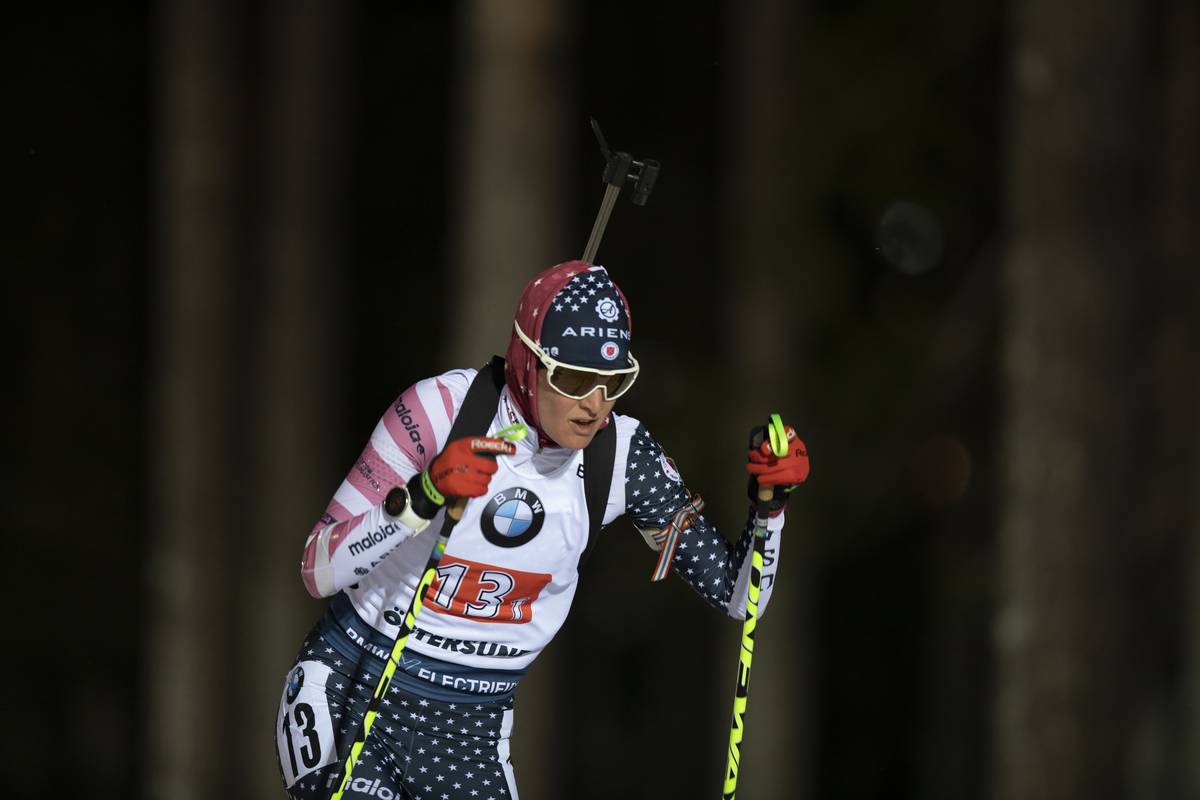
Clare Egan during the 2019 IBU World Cup mixed relay in Ӧstersund, Sweden. (Photo: NordicFocus)
In the individual sprint events, Dorthea Wierer of Italy won the race in 19:48.5 with no penalties and one spare.
Susan Dunklee was the top performer for the US, finishing 32nd (+1:23.8; 0, 2), with Clare Egan close behind in 38th (1:32.4; 1, 1). Emily Dressigacker finished 77th (+2:52.9; 0, 1), Joanne Reid 84th (+3:10.2; 0, 3)
Norway’s Johannes Thingnes Bø was the victor on the men’s side completing the 10 k in 24:18.3 with one penalty and no spares.
Lief Nordgren was the top ranked American, finishing 62nd (+2:18.5; 2, 1), followed by Sean Doherty in 68th (+2:29.0; 0, 2). Alex Howe placed 104th (+3:52.6; 1, 3) and Travis Cooper 108th (+5:38.0; 3, 3).
Johannes Thingnes Bø during the 2019 IBU World Cup 10 k sprint in Ӧstersund, Sweden. Bø won the race while his brother, Tarjei, placed second. (Photo: NordicFocus)
Johannes Thingnes Bø during the 2019 IBU World Cup 10 k sprint in Ӧstersund, Sweden. (Photo: NordicFocus)
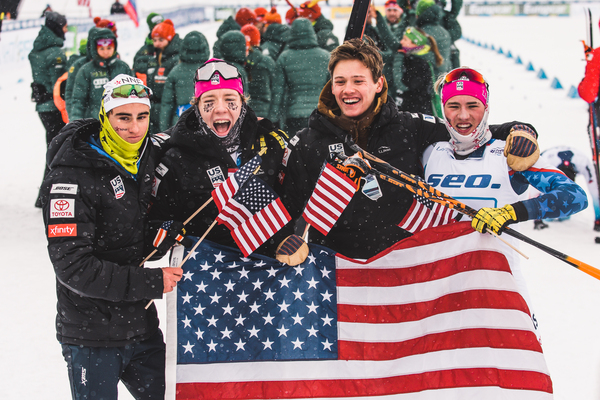
The U20 World Juniors 4 x 5 k relay first place team from the U.S, (l-r) Johnny Hagenbuch, Ben Ogden, Luke Jager, and Gus Schumacher. (Photo: JWSC2019 / Mikaela Takala)
2019 U23 World Ski Championships in Lahti, Finland 4 x 3 k and 4x 5 k relay
In a historic first for the U.S., the U20 men’s team won the 4 x 5-kilometer relay today in Lahti, Finland at the 2019 World Junior Ski Championships. Luke Jager skied the first classic leg for the U.S., Ben Ogden skied the second classic, Johnny Hagenbuch skied the first initial skate leg and Gus Schumacher raced the anchor leg.
The foursome won in a time of 45:34.7 minutes, and beat second-place Russia by 3.8 seconds.
Russia’s team was comprised of Egor Trefilov, Andrey Kuznetsov, Yaroslav Egoshin, and Alexander Terentev.
Germany’s team of Jakob Milz, Florian Knopf, Anian Sossau, and Friedrich Moch took third finishing 6.3 seconds behind.
For Canada, Remi Drolet , Sam Hendry, Xavier McKeever, and Thomas Stephen skied to 11th (+2:29.7).
In the 4 x 3.3 k U20 women’s race, Norway’s Kristin Austgulen Fosnaes, Astrid Stav, Helene Marie Fossesholm, and Kristine Stavås Skistad won at the line in 35:24.7 minutes.
Russia’s Anastasia Faleeva, Kristina Kuskova, Veronika Stepanova, and Anna Grukhvina were a close second, stopping the clock 1.0 seconds back.
Louise Lindström, Frida Karlsson, Tilde Baangman, and Lin Svahn for Sweden placed third (+33.3).
The U.S. team of Mara McCollor, Kendall Kramer, Sydney Palmer-Leger and Novie McCabe skied to fourth place, 40.5 seconds back.
For Canada, Anne-Marie Petitclerc, Jasmine Drolet, Anna Pryce, and Molly Miller placed 11th, 3:01.4 minutes behind.
FIS Cross Country World Cup Ulricehamn, Sweden 10/15 k freestyle
In what is his skiing canvas, the 15 k freestyle, France’s thirty-two-year-old Maurice Manificat won his first World Cup of the season in Ulricehamn, Sweden today in 34:55.4 minutes. It was a tight race in that Norway’s Simen Hegstad Krüger Simen Hegstad Krüger who placed second finished 1.1 seconds back. Teammate Didrik Tønseth was third (+8.7).
Canada’s Alex Harvey was the best placed North American in ninth (+31.4). Lenny Valjas skied to 57th (+2:32.1), and Bob Thompson 77th (+4:16.6).
For the U.S., Scott Patterson finished 35th (+1:26.5), David Norris 53rd (+2:11.3), Ben Lustgarten 64th (+3:04.7).
Norway’s Therese Johaug kept her distance win streak alive at eight wins in eight starts on the World Cup this season. She won the women’s 10 k skate race in 25:48.2 minutes, with teammate Astrid Uhrenholdt Jacobsen in second, 22.8 seconds back. Third place went to Sweden’s Ebba Andersson, 24.9 seconds behind.
The U.S. Ski Team’s Jessie Diggins skied to fourth place (+38.3), while teammate Sadie Bjornsen was 15th (+1:25.1). Caitlin Paterson (CGRP) had her best World Cup result of the season, skiing to 23rd (+1:49.9). Rosie Brennan (APU) placed 28th (+2:03.2), and Rosie Frankowski 42nd (+2:28.0).
Dahria Beatty was the only Canadian entered. She finished 56th (+3:54.7).
In the women’s 10 k pursuit, Italy’s Dorothea Wierer won in a time of 29:20.1 after skiing two penalties (1+0+0+1). Second place went to Germany’s Laura Dahlmeier, who finished 6.0 seconds after Wierer after one missed shot (0+0+1+0). Saturday’s third place went to another Italian, Lisa Vittozzi, who finished 16.2 seconds behind the winner after tying Wierer’s shooting score.
Clare Egan led the way for the U.S., racing to 11th (+1:31.9) after skiing two penalties (0+0+0+2).
“I’m really happy with my race today,” Egan wrote in an email. “The wind and altitude are always a challenge here, but I took my time on the range and capitalized on the fast glide of my skis to save energy on course. I made a costly and dumb mistake on my last shot but still came away with my second-best career result. I’ll take what I learned from today and go for it again tomorrow in the mass start! Can’t wait!”
Joanna Reid was the next American to finish, placing 29th (+2:55.2) after three missed shots (1+0+0+2).
For Canada, Rosanna Crawford finished 34th (+3:30.8) after skiing five penalties (2+1+1+1) and her teammate Megan Bankes finished 39th (+3:37.1) with five misses (1+0+3+1). Also skiing for Canada, Sarah Beaudry placed 46th (+5:07.5), also with five penalties (4+0+1+0).
In the men’s 12.5 k pursuit, Norway’s Johannes Thingnes Bø
won in a time of 31:33.7 after skiing three penalties (1+1+0+1). France’s Antonin Guigonnat raced to second place, 34.8 seconds behind with one missed shot (0+0+1+0). The third and final podium spot on Saturday went to France’s Quentin Fillon Maillet, who skied two penalties (1+0+0+1) and finished 40.6 seconds back from the winning time.
Sean Doherty for the U.S. placed 47th (+4:39.1, 3+2+1+0). Jake Brown was lapped and was not given an official time.
For Canada, Jules Burnotte skied to 54th (+5:42.8, 1+3+1+1), and Scott Gow 55th (+6:39.7, 4+0+2+3).
Canada’s Antoine Briand (CNEPH) was the fastest qualifier on the day in 3:14.71 minutes and won the men’s final. Dominique Moncion-Groulx (Nakkertok) placed second in the final, with Ben Saxton (SMS T2) in third.
Saxton was the second fastest qualifier, with Oliver Hamel (CNEPH) third fastest.
For the women, Sophie Caldwell (USST/SMS T2) scorched the qualifier in 3:40.44 minutes with Jessica Yeaton (APU/Australian National Team) qualifying in second (3:50.49). Dartmouth’s Katharine Ogden qualified third (3:51.79).
Caldwell went on to win the final in 3:37.06, with Yeaton in second and Kelsey Phinney (SMS T2) in third.
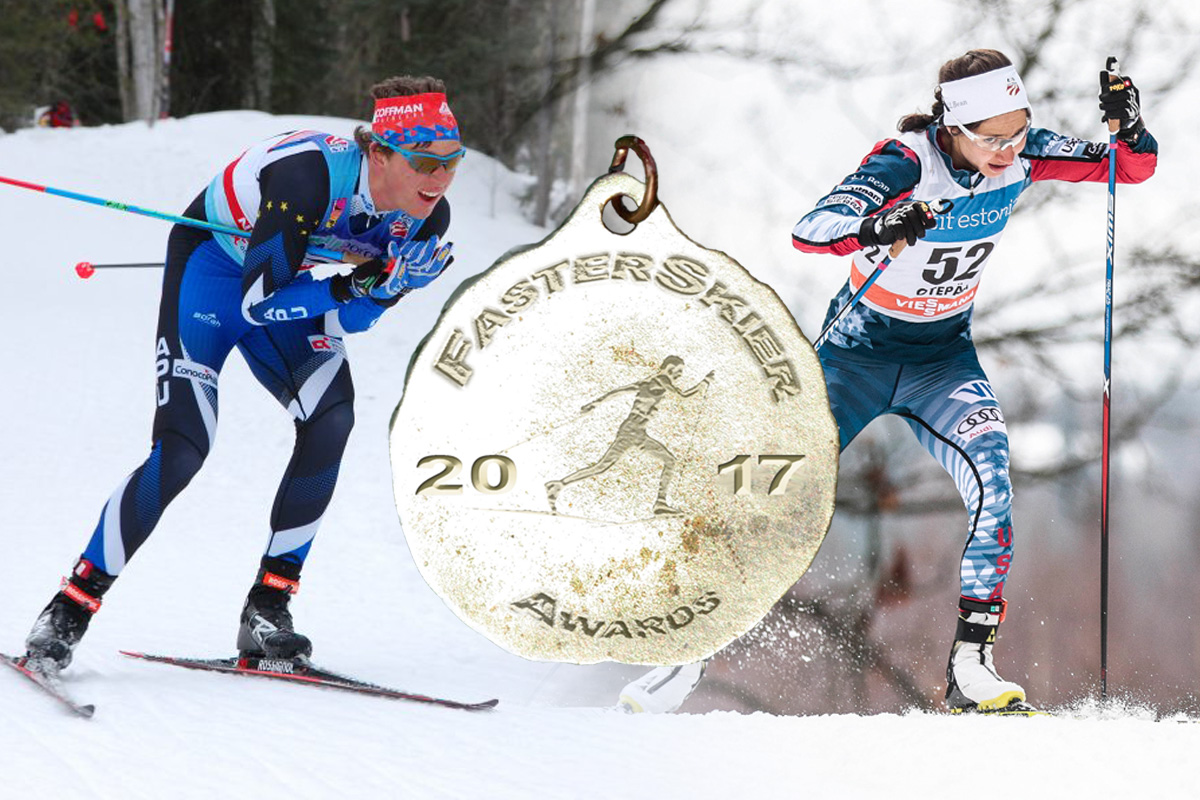
APU’s Scott Patterson (Photo: Max Kaufman) and Chelsea Holmes (Photo: Fischer/Nordic Focus) are FasterSkier’s U.S. Breakthrough Skiers of the Year.
With the 2016/2017 season officially in the rearview, FasterSkier is excited to unveil its annual award winners for this past winter. Votes stem from the FS staff, scattered across the U.S., Canada, and Europe, and while not scientific, they are intended to reflect a broader sense of the season in review. This set of honors goes to breakthrough U.S. skiers.
Domestically and internationally, the U.S. women have been on a tear. And waking up on winter weekend mornings, most fans of the sport scroll to the top of the World Cup results list looking for U.S. podiums. Breaking into that scene can be tough with both a top-loaded international women’s program and several skiers based stateside ready to make the European jump.
Chelsea Holmes (r) with her Alaska Pacific University (APU) coach Erik Flora after she placed a career-best 13th in the women’s 30 k freestyle mass start at 2017 World Championships in Lahti, Finland. (Photo: John Lazenby/Lazenbyphoto.com)
“Peak when it matters and ski like you mean it,” may as well have been 30-year-old Chelsea Holmes’s mantra this year. The Alaska Pacific University (APU) skier and Girdwood, Alaska, native won the overall SuperTour (granting her World Cup starts for next year’s first World Cup period), and won the U.S. nationals 20 k classic mass start in January at Soldier Hollow (SoHo) near Midway, Utah. Three days before that, Holmes initially made her championship presence felt as she placed second in the 10 k skate at nationals, finishing just 2.2 seconds behind the winner, Caitlin Gregg (Team Gregg).
En route to her 20 k classic win, Holmes pushed hard from the start and withered chasers, including U.S. Ski D-Team member Katharine Ogden, who ultimately placed second.
Along SoHo’s terraced trails, Holmes’s blue-and-white APU suit remained in front, charging. After the race, Holmes was asked if she was concerned about bonking late in the race, a possible consequence of her steamrolling pace.
“It’s a waste to think about that,” Holmes said. “If I blow up, I blow up. I have to believe that I blow up less than everyone else.”
Those are the words of an athlete peaking and knowing full well they should have the confidence to take the “I might blow up” risk. Those risks brought reward: Holmes was named to the U.S. team for 2017 World Championships in Lahti, Finland.
Actually racing in Lahti was another story. Regarding the World Championships selection criteria, U.S. Ski Team (USST) Head Coach Chris Grover explained that selection would partially be based on “who we would start in which races in Lahti, because we absolutely want to fill every start spot, and we want to be able to have an alternate there in most cases as well, and that makes for some tough choices. Who’s skiing well domestically, who’s skiing well on the World Cup; it’s occasionally challenging to figure out which athletes are faster when they have the Atlantic Ocean between them.”
Holmes did get a Lahti start. But that start wasn’t guaranteed. Jessie Diggins (USST) was slated to start, as was Gregg, both former World Championship medalists. According to Grover, the remaining spot was offered to Sadie Bjornsen (USST) and then Kikkan Randall (USST), both of whom declined.
Score one for Holmes. On a tough Lahti course, Holmes looked like a 30 k start shoe-in. She finished 13th in the World Championships 30 k freestyle mass start, 1 minute and 28 seconds behind the winner, Norway’s Marit Bjørgen. It was her first top-20 result in a World Cup level race, in her World Championships debut.
Scott Patterson, Alaska Pacific University
Like his APU teammate, Holmes, Patterson also won the overall SuperTour and will be offered U.S. starts for Period 1 of the 2017/2018 World Cup.
Patterson’s breakout season was more of a prolonged emergence than a “here I am” statement. Certainly he was for real early on, but so were a dozen other skiers. In late November, he won a season-opening 10 k classic International Ski Federation (FIS) race in West Yellowstone, Mont.
A week later, the 25 year old from Anchorage, Alaska, placed third in the SuperTour’s opening distance, a 15 k classic also in West Yellowstone. Patterson followed that up with a win in the 15 k freestyle at the Sovereign Lake NorAm in British Columbia.
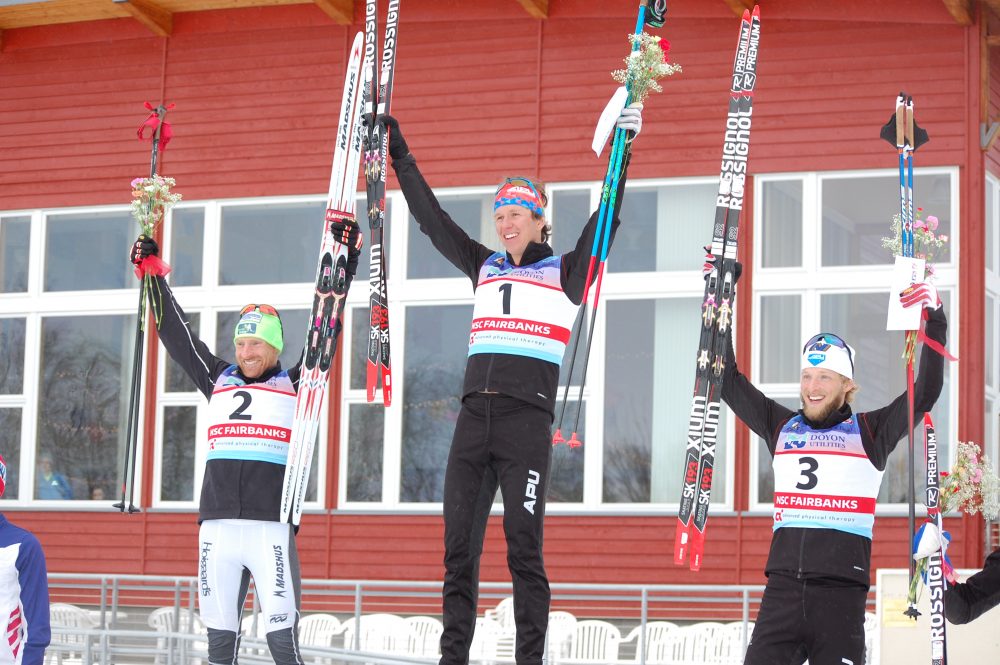
Scott Patterson (1) atop the men’s 50 k freestyle podium at 2017 U.S. Distance Nationals in Fairbanks Alaska. Patterson (APU) placed first, Brian Gregg (Team Gregg) second, and Eric Packer (APU) was third. (Photo:Max Kaufman)
That’s a pattern and the beginnings of a breakout.
Patterson entered U.S. nationals in SoHo with low energy. Although his results were solid, they did not earn him a World Champs selection. His best result was a fourth place in the 30 k classic.
The week after World Championships, Patterson once again tackled a time-zone shift and Holmenkollen’s hefty course in Oslo, Norway. He emerged as the top American, once again in the points, placing 28th in the 50 k classic mass start.
Officially, we’ll call that a breakthrough, a big one.
Patterson maintained his form for the remainder of the season, proving in the domestic distance events he’ll willingly set the tempo and position himself for more international opportunities.
At the recently concluded U.S. Distance Nationals in Fairbanks, Alaska, Patterson took the crown in the 50 k freestyle mass start. He started the season-ending SuperTour Finals series with a win in the 20k skiathlon.
APU Head Coach Erik Flora noted both Patterson and Holmes were deserving of their 2016/2017 achievements.
“It was good to see Chelsea and Scott have strong international results this season,” Flora wrote in an email. “With more World Cup experience I see both being able to climb even further up the results. It is extremely hard to travel from the US to the Scandinavian or European World Cups and produce good results in only a few weekends of racing. The results are a testament to their hard work and dedication, plus it shows the level and depth in US skiing is continuing to build. All good things for the future.”
“In the mountains somewhere, smiling at the sky. It’s actually pretty rare for me to know what I’m doing next month, let alone five years from now.”
Certainly five years is a long way out, but the Colorado-based skier should be myopic when it comes to the next few years. She’ll most likely be traveling the World Cup.
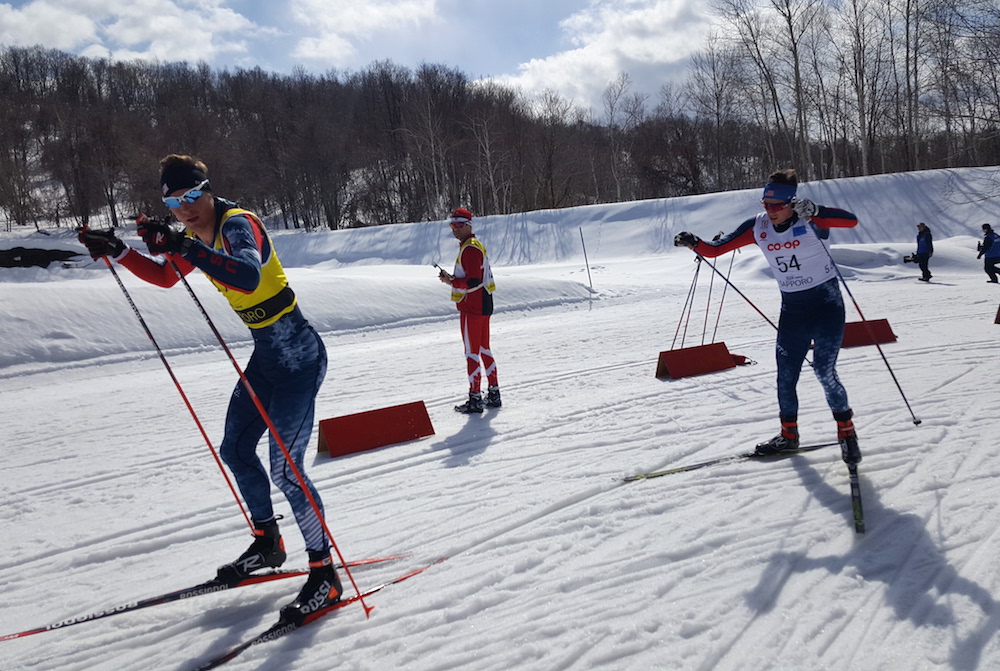
Jake Adicoff (r) and his guide Sawyer Kesselheim (l) racing at IPC World Cup Finals last month in Sapporo, Japan. (Photo: US Paralympics Nordic)
Jake Adicoff, 21, is a visually impaired skier on the U.S. Paralympics Nordic B-team. He finished the season ranked fourth in the International Paralympic Committee (IPC) Nordic Skiing World Cup standings.
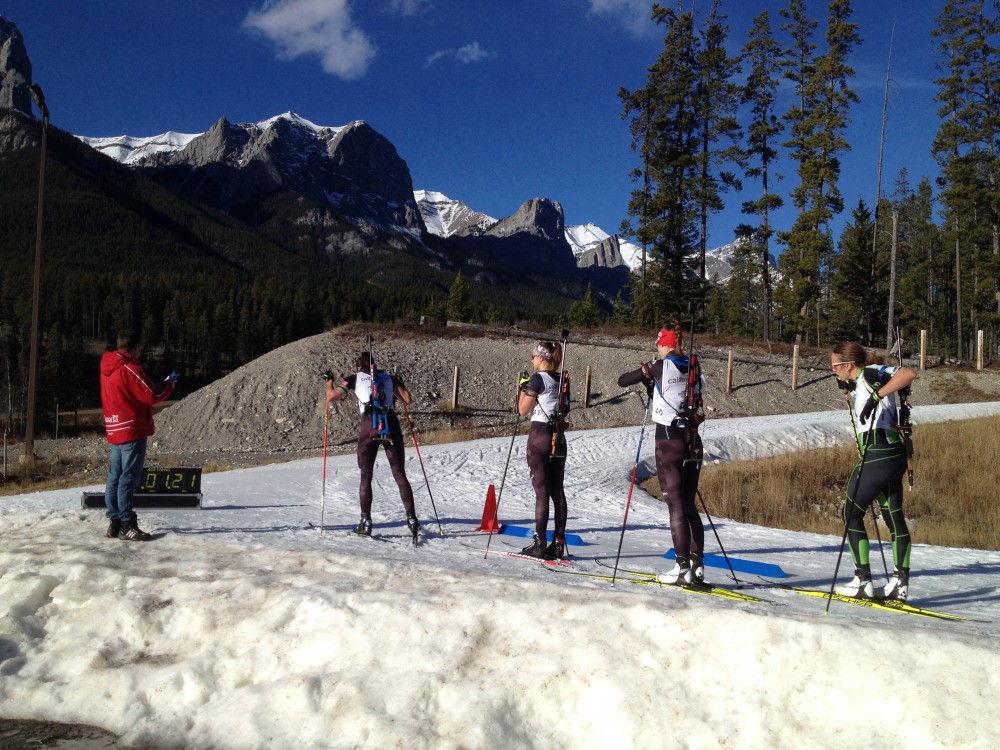
Left to right: Biathlon Canada’s Rosanna Crawford, Julia Ransom, Megan Tandy, and US Biathlon’s Susan Dunklee at the start of the women’s 7.5 k sprint on Wednesday, Nov. 9, at this year’s Biathlon Canada team selection time trial races at Frozen Thunder in Canmore, Alberta. (Photo: Matthias Ahrens)
(Note: Biathlon Canada’s World Cup team trials wrapped up last Thursday, but selections had not been publicized as of Monday. Stay tuned for the final team selection details.)
While pushing past the overgrown, browning grass lining the Canmore Nordic Centre’s shooting range last Wednesday, Rosanna Crawford could feel the pressure.
Not pressure to qualify for a team, pressure to prove she deserved her preselected spot on Biathlon Canada’s A (officially “Eh!”) squad.
The 28-year-old team veteran did just that by the end of Biathlon Canada’s two-day team selection races, which ran this year from Wednesday, Nov. 9 to Thursday, Nov. 10 at Frozen Thunder in Canmore, Alberta. Crawford took the wins in both women’s sprint events. However, even after winning Wednesday’s 7.5-kilometer sprint by more than 30 seconds, Crawford wanted more from her shooting after she missed three shots (2+1).
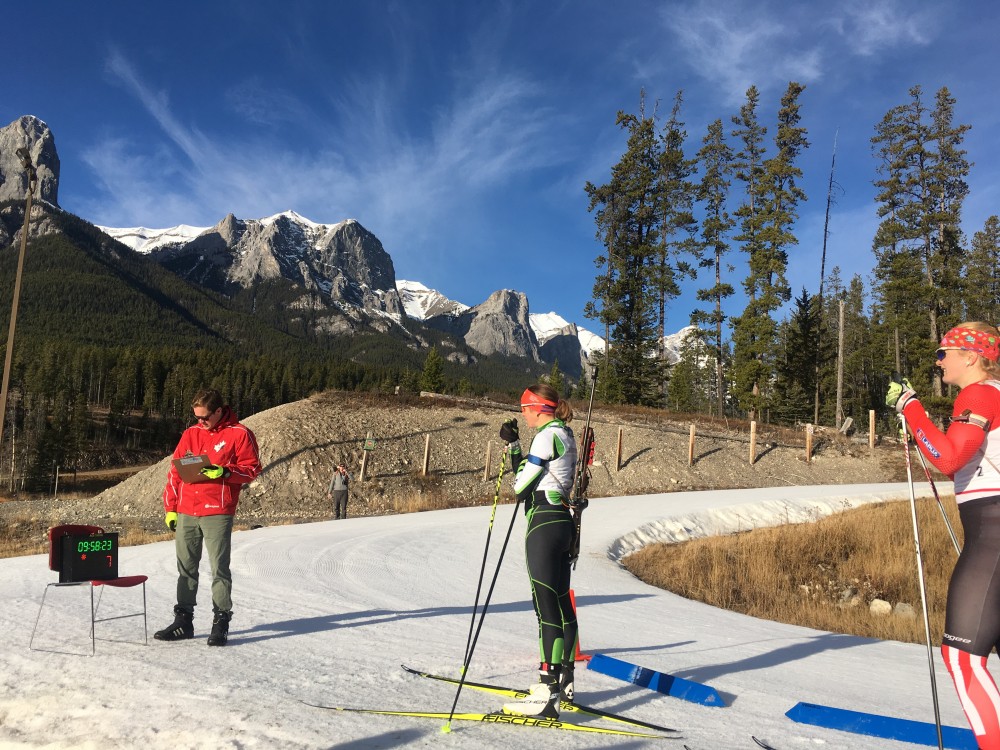
Biathlon Canada High Performance Director Eric de Nys (l) with US Biathlon’s Susan Dunklee (c) and Biathlon Canada’s Sarah Beaudry (r) at the start of the women’s 7.5 k sprint on Thursday, Nov. 10, at this year’s Biathlon Canada team selection time trial races at Frozen Thunder in Canmore, Alberta. (Photo: Matthias Ahrens)
“With being pre-qualified you always want to prove that you deserve to be pre-selected,” Crawford wrote in an email on Wednesday. “I had high focus and expectations for shooting and am really disappointed with 3 misses, that won’t do on the World Cup. I have been training quite a bit leading into these races, so I am looking at it as a good chance to practice pushing hard while tired and shooting well. Today was a mentally and physically draining race, but conditions that we might encounter in the winter.”
Crawford explained that Wednesday’s conditions were particularly challenging, with a fair amount of wind and temps hovering above 16 degrees Celsius, turning the 2.6 k race loop into slush.
“It was quite windy and not really consistent which definitely hurt people on the range,” Crawford wrote. “My race started off with a good first lap and then it turned into a slow crawl by the finish, it just got slower and slower as the sun beat down on the tracks. We did the same race [format] on November 4th which took 21 minutes, and today [Wednesday] was 27 minutes!”
US Biathlon national-team members Joanne Reid and Susan Dunklee also competed in Wednesday’s competition, finishing second and third, respectively. Reid clocked in 34.4 seconds back from Crawford’s time with three misses (1+2) and Dunklee also finished with three misses (2+1), 35.5 seconds behind Crawford. Reid explained that for the U.S. women, competing in the time trial provided an opportunity to fine tune their racing prior to the official start of the IBU World Cup season.
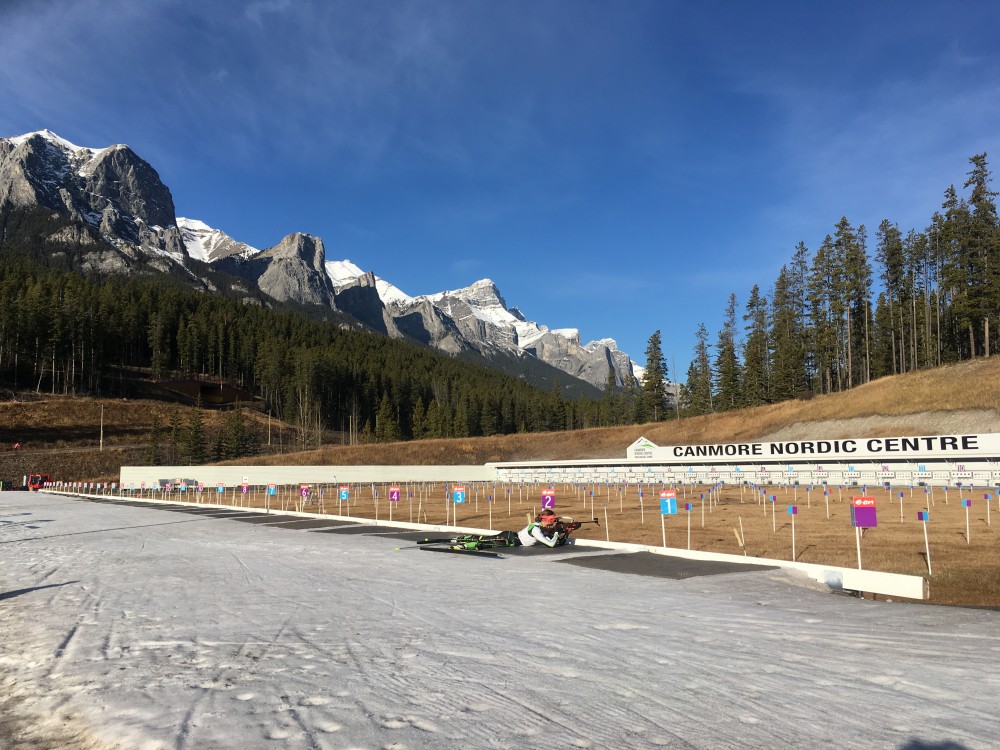
US Biathlon’s Susan Dunklee shooting prone during the women’s 7.5 k sprint on Thursday, Nov. 10, at this year’s Biathlon Canada team selection time trial races at Frozen Thunder in Canmore, Alberta. (Photo: Matthias Ahrens)
“Since our trials races are over and the women’s team is already selected, there is no results pressure for us. Instead we are focusing on getting all the pieces together to launch into a successful first period of the World Cup,” Reid wrote of herself, Dunklee and Clare Egan, all on the U.S. women’s biathlon team, in an email on Wednesday. “All three of us are still adapting to some changes, different trigger weights, entirely new actions, sight risers, that sort of thing, so these time trials were just about practicing these new developments in a race environment.”
In Thursday’s women’s 7.5 k sprint, Crawford repeated with another victory, completing the course in a time of 22:08.2 with three misses (2+1). While desiring better shooting, Crawford remained optimistic about being able to hone in on her accuracy within the next few weeks.
“Today was a lot better than yesterday, I think it went below freezing and conditions stayed pretty hard and consistent through the women’s race,” Crawford wrote in an email on Thursday. “Still really frustrated with my shooting, prone has actually been quite good this summer and fall, so not sure what has changed. But I’ve got 3 weeks to get things back to normal, and feel confident that things will be better come the race season.”
Finishing 3.5 seconds off the winning time, after cleaning prone but missing two standing shots (0+2), was Crawford’s teammate Julia Ransom in second place. Following Ransom, 8.2 seconds back from Crawford with one miss (0+1), was Megan Tandy (also of Biathlon Canada) in third.
In the men’s 10 k sprint, Volodymyr Siemakov of Ukraine took first on Wednesday, finishing the 10 k in a time of 28:36.0 with one miss (1+0). Finishing 4.5 seconds behind Siemakov in second after shooting clean was US Biathlon’s Lowell Bailey. In an email, Bailey explained that even with temperatures better saved for summer, Wednesday’s race was a good start to his on-snow season.
“I think of these competitions as a ‘test-run’ for the upcoming world cup,” Bailey wrote on Thursday. “These races are a good chance to try out all of the new elements I’ve been working on throughout the training year. After two races, I’ll analyze the weak points of those performances and focus my energy on those areas in the lead-up to Östersund.”
In third, 8.9 seconds behind Siemakov was another Ukrainian skier, Artem Pryma, with two missed shots (0+2).
Canada’s top man on Wednesday was Biathlon Canada’s Scott Gow in sixth, 45.5 seconds behind Siemakov with one miss (0+1). Gow indicated that given Wednesday’s conditions, he was satisfied with his performance and the direction his summer and fall training have taken him prior to the start of the ski season.
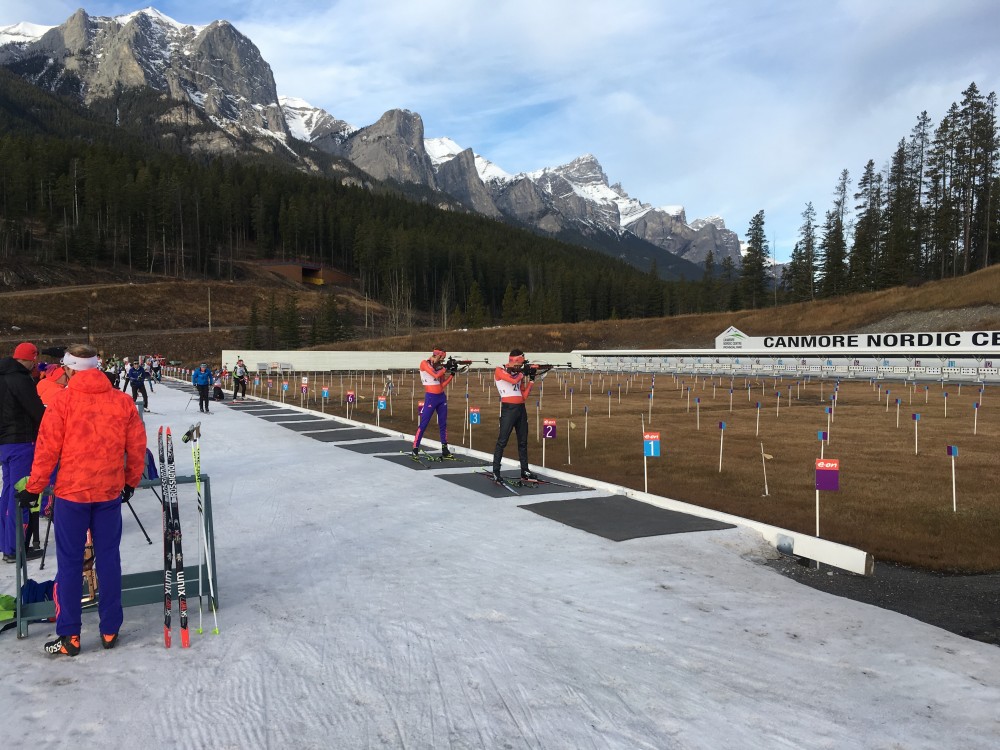
US Biathlon’s Tim Burke and Leif Nordgren zeroing their rifles prior to the start of the men’s 10 k sprint on Thursday, Nov. 10 at this year’s Biathlon Canada team selection time trial races at Frozen Thunder in Canmore, Alberta. (Photo: Matthias Ahrens)
“It was a very warm morning with very slushy, slow snow so it was a challenge to push through and stay motivated,” Gow wrote in an email on Wednesday. “It was also tricky wind conditions during zero, and there were gusts of wind during the race. Being able to shoot 90% and suffer through the skiing was a big plus for my confidence…I don’t think I will change very much heading into the next few weeks. I’m happy with my prep and performances at this point and I don’t want to mess with a good thing.”
Gow was also the leading Canadian man on Thursday, placing third, 1 minute and 8.6 seconds behind US Biathlon’s Tim Burke, who won in 24:38.9. Burke shot clean, while Gow had four misses (0+2+2+0). Finishing in second again was Bailey with two misses (1+0+1+0), 44.5 seconds behind Burke.
“It was great to start the winter season off with two races in Canmore, but I am definitely not reading too much into the results,” Burke wrote in an email on Friday. “Most athletes are training through these races and everyone is in different stages of preparation for the season. I am happy with my execution on the shooting range [Thursday]. The conditions were a bit tricky, with some wind gusts, so I was happy with a clean race. ”
Gow explained that, as an athlete who is already prequalified for Canada’s World Cup team, the races offered him the chance to experiment with his racing tactics prior to the start of another season.
“I didn’t have to worry about the pressure of needing to perform and instead could focus on using these races as a tune-up,” Gow wrote. “My main goals were to push the ski speed and race right near the line where I am almost out of control, but also be able to come in to the range with a clear mental focus. I accomplished that [Wednesday], which makes me happy … I was definitely able to push the ski speed again [Thursday] … Now the key is to maintain confidence without becoming too over confident.”