

Tag: Joanne Thompson

  • Carrabre Launches Bid for IBU Presidency

    Carrabre Launches Bid for IBU Presidency

    Dr. Jim Carrabre. IBU file photo.
    Dr. Jim Carrabre. IBU file photo.

    Dr. Jim Carrabre, a former Canadian biathlete who is the International Biathlon Union’s Vice President for Medical Issues, is launching a bid for the federation’s presidency. He is running against Anders Besseberg, a Norwegian who has been President since 1993.

    Transparency and good governance are two main themes of Carrabre’s platform, he said in an interview earlier this week from Saint Paul, Minnesota, where he is a partner at a medical clinic.

    “We need to bring biathlon into the modern world from a management point of view, and structurally and with transparency and everything else,” Carrabre said.

    Carrabre is being supported by Biathlon Canada. National federations must officially nominate any members who run for IBU positions, but according to Biathlon Canada Executive Director Joanne Thomson, her organization’s support for Carrabre’s bid is more than a mere formality.

    Carrabre has been a longtime member of Biathlon Canada, beginning as one of its founders and continuing to be “involved in the federation in a number of levels, mostly from the athlete development and coaching side,” Thomson said.

    “His interest is, and always has been, in ensuring fairness in the sport,” she explained. “From his position as VP for Medical Issues, he has been a big proponent of antidoping as a fundamental basis for our sport. That says the type of person that he is – one who wants to make sure that there is integrity, fairness, and inclusion to all the federations. I’m not saying that there’s not, currently, but that’s something he would want to continue to do.”

    One major issue for Carrabre is how the federation is handling doping cases. A longtime antidoping advocate who has also held positions at the World Anti-Doping Agency (WADA) and the International Olympic Committee (IOC), including overseeing testing in nordic sports for the Salt Lake City Organizing Committee at the 2002 Olympics, Carrabre has become increasingly frustrated at the IBU’s approach.

    Two recent examples are an Executive Board decision to discontinue blood testing at the Olympic Games, for which he says he was not consulted; and the slow pace at which sanctions against Russian biathletes Irina Starykh and Ekaterina Iourieva are proceeding. Carrabre claims that others within the federation have been withholding information from him.

    “Information is not getting disseminated, things are taking way longer than they should, and I don’t know why,” Carrabre said. “I keep asking for the results back, and I’m being told that the hearing panel is still looking at it. But it’s a straightforward case. A and B samples are confirmed. It should be a slam dunk. The only thing I can think of is that they’re trying to delay a decision on the punishment for Russia for political reasons.”

    While antidoping work has been a hallmark of his career, however, it is not the only issue that Carrabre cares about in the world of biathlon. A former Canadian national team member himself, he would like to oversee the further development of the sport globally.

    “I’d like to try to make our weaker nations stronger, and even to make our stronger nations stronger,” Carrabre said. “There’s ways we can do this. You look at the FIFA World Cup right now, look at how soccer has expanded. The U.S. team is doing so well when it wasn’t much of a sport here for many years. It’s a so-called weaker nation, and now they’re almost winning their pool. We should see that from a lot of nations in biathlon.”

    Thomson believed that this might be a topic of interest to many potential voters at the IBU’s Congress this fall (it is scheduled for Kiev, Ukraine, in September, but the location may change).

    “The IBU has done well at expanding it beyond Europe, into Asia and North America,” she explained. “And supporting development into South America… and has done a ton of great work with television and have great relationships with their TV partners. But there’s still work to do for us in North America to get more exposure through TV and increase the culture of the sport, and there are probably other areas of the world that are in the same situation.”

    Regardless of the current state of an organization, good or bad, Thompson believes that competition for leadership roles can bring creativity and stimulate discussion of important issues.

    Carrabre noted a “complacency” from traditionally strong biathlon nations, and urged that a change of perspective and creative thinking would allow less-traditional teams to succeed – which in turn should push the big teams to get even stronger.

    “I was a biathlete before I was a doctor,” Carrabre said. “[People] only know me from my antidoping work, but I’m a founding member of Biathlon Canada. I had one of the first two small-bore rifles that came to Canada, I got one and took it to Western Canada to help develop biathlon. I’ve been involved as an athlete, as a coach, and as an official. I developed the athlete development model in Canada for biathlon. I developed the coaching model. I’m a national-level coach in biathlon. So, you know, I have a lot of understand of the sport from many different areas.”

    Carrabre guessed that there would be several main arguments against his run for president. First of all, he has never been a secretary general, a traditional grooming-ground for higher positions. His experience in Biathlon Canada and on the Executive Board ought to be considered, he suggested.

    “I know more about the sport than most secretary generals,” he said. “I’ve been in the sport for 30 years.”

    Secondly, he was unsure whether Europeans would support a North American presidency, in part because the IBU office is in Salzburg, Austria. In this day and age, however, Carrabre asserted that this should be a non-issue.

    “We could move the office to North America,” he said. “No, I’m joking. But look at videoconferencing – I can be on a videoconference in 30 seconds. I can do that daily. You don’t need to be somewhere. And if I have to be there, I can be there within 12 hours. I’m busy, I’m a doctor, but I’m working 3-4 days a week because I’m a senior partner in my group, so I have a lot of flexibility. I can travel when I want to.”

    Finally, Carrabre said that he would like to see a different atmosphere on the Executive Board, and that he would work to create this.

    “At the Executive Board level, a lot of members have World Cups which depend on IBU, and they’re basically threatened that if they don’t toe the line they’re going to lose that,” he explained. “People have so much self-interest in the way that they vote that it’s not in the best interest of biathlon. Maybe it would be good to try to have a board that’s a little less dependent on the IBU, that has no conflict of interest. That’s not good for the sport.”
  • Québec Biathlon National Team Center to Close, Paquet’s Position Eliminated

    Québec Biathlon National Team Center to Close, Paquet’s Position Eliminated

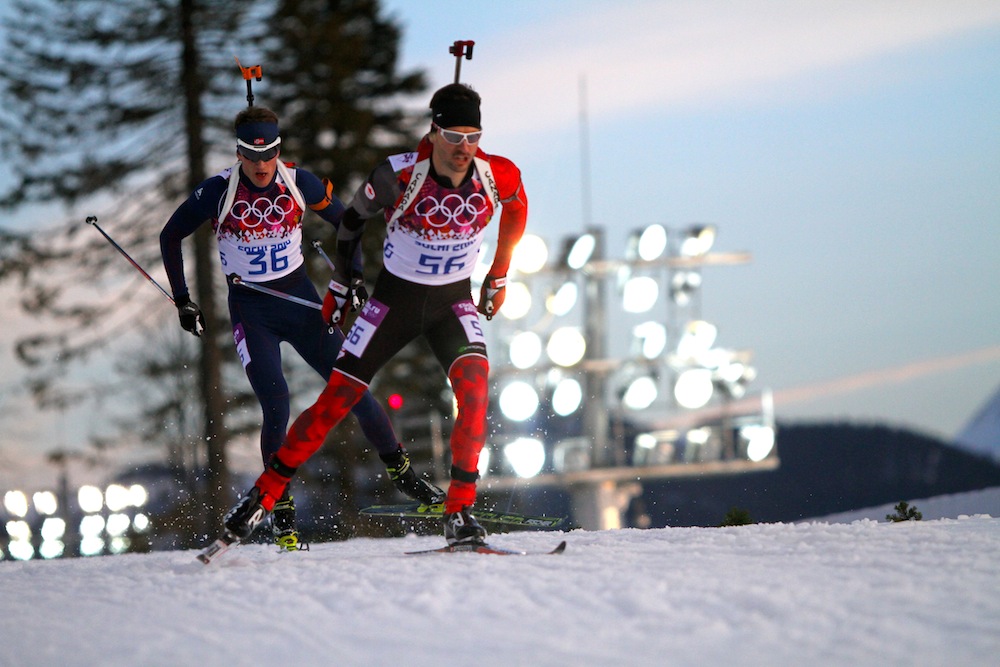
    Jean Philippe Le Guellec of Canada headed in for fifth place in the 10 k sprint at the Olympic Games in Sochi, Russia, this winter. His longtime coach and training center have both been defunded by Biathlon Canada.
    Jean Philippe Le Guellec of Canada headed in for fifth place in the 10 k sprint at the Olympic Games in Sochi, Russia, this winter. His longtime coach and training center have both been defunded by Biathlon Canada.

    Biathlon Canada is closing its Eastern training center at Valcartier and has so far not renewed the contract of Jean Paquet, a coach with the team since 2007.

    During the Sochi Olympics Paquet speculated that he might not have a job after this season. Biathlon Canada High Performance Director Chris Lindsay confirmed last week that the position Paquet formerly held has been eliminated, although Paquet did not respond to repeated requests for comment (Edit: he now has; see the interview here).

    “Following our high performance plan, the program that we had been running under Jean Paquet will no longer continue,” Lindsay said. “With JP [Le Guellec]’s retirement, and with only one Québec athlete making any of our national team criteria, we do not feel that we can justify, unfortunately, having a full-time coaching position there.”

    While Lindsay said that the board of directors and Executive Director Joanne Thompson had been involved in the decision, Thompson declined to comment, writing in an e-mail that decisions on staffing and training centres wouldn’t be finalized until after April 28th.

    However, national team head coach Matthias Ahrens also confirmed the changes.

    “It is correct that the Jean’s National Team Coach position was not renewed based on that we closed the National Training Centre in Quebec which was primarily based on Jean Phillipe LeGuellec who retired this season,” Ahrens wrote in an e-mail.

    According to Lindsay, Biathlon Canada will at the moment function with two coaches, a reduction from the three-man staff of last season. Matthias Ahrens will remain head coach and Roddy Ward will stay as an assistant coach. As with all things Canada, funding relies on Own the Podium, a non-profit which allocates money based on its assessment of a sport’s medal potential.

    “We find out our 2014-15 funding levels this summer, and we are hopeful that OTP will see the benefits of a third coach in the program,” Lindsay later wrote in an e-mail, although he did not elaborate on whether that would be Paquet.

    Paquet’s Work

    Paquet led the training group of senior Québec athletes out of the Centre d’Excellence Myriam Bédard, in Valcartier. The site also houses Québec’s provincial team of junior biathletes and seniors who are not part of the national team, coached by Martin Tremblay.

    Paquet is perhaps best known for his role as the day-to-day coach of Jean Philippe Le Guellec, who owns Canada’s best Olympic finishes by a man with sixth place in Vancouver and fifth place in Sochi. Le Guellec was close to doing even better, but while leading the 2014 Olympic pursuit he crashed on a dangerous corner and broke a ski. He had long planned to retire after the Sochi Games.

    “In the last two years, we covered immense ground to be able to achieve the best performances possible at the Games,” Le Guellec, who had not heard about Paquet’s contract, wrote in an email. “We literally worked on many aspects even up until the last day before the first race. With the way that I was able to ski along the fastest in the world and outshoot the field in many races, it felt like I was at the top of my game.”

    Two other mainstays of Québec biathlon, 2010 Olympian Marc-Andre Bédard and Claude Godbout, did not meet national team criteria after this season. Their plans are not yet concrete, but Bédard told FasterSkier earlier this spring that “we still want to race and we plan on doing a different approach this year, we’ll both do what we want more then what we’re suppose to, so that might be interesting.”

    That leaves Audrey Vaillancourt as the lone Québec athlete on the national team. The Open European Champion at 15 k this season, Vaillancourt wrote in an e-mail from Peru, where she’s spending her spring break from training, that she was unsure what was happening with the Québec center.

    “I don’t know all that much about the ‘official’ status of the training center for next year, but I know for sure that it won’t affect the support I get since my provincial coach/team will still be training there, and I will also spend a lot of time in Canmore with the rest of the national team,” she wrote.

    Vaillancourt and Le Guellec were recently honored as Biathlon Canada’s Athletes of the Year.

    Meanwhile, Paquet – an eight-time World Championships competitor and 1992 Olympian – was nominated for Gala Sports Québec’s international coach of the year award, up against cross country ski coach Louis Bouchard and canoe/kayak coach Frédéric Jobin.

    That underlies the respect he has earned for his athletes’ performances, which Le Guellec elaborated on.

    “Jean retired from racing in 2005,” he explained. “I could imagine making the leap to coaching World Cup athletes is quite the learning curve when he took us up in 2007. He’s very reserved, so he never was one to speak from a first person point of view, or to impose his own point of view as being gospel truth, which I really respect. But I have no doubt a lot of his own experience and learning as an athlete was transferred to his teachings as a coach. I would say he definitely had a big role in my approach to training and psychology of training.”

    Centralization Push

    According to Lindsay, the loss of Paquet’s position is due at least in part to OTP.

    “Jean’s position was funded by OTP for the sole purpose of coaching JP,” Lindsay wrote in an email. “With JP retiring the funding has ended.”

    However, Lindsay also told FasterSkier that closing the Québec training center (and with it Paquet’s position) was not a financial decision.

    “I would characterize this as a performance-based decision,” he said. “We have been over the past two seasons working at centralizing our training system as much as possible in order to provide the best opportunities for success for our athletes, and a significant part of that has been trying to get as many of the athletes centralized as we possibly can.”

    One of the hallmarks of Lindsay’s tenure has been the push for centralization: having all of the country’s athletes together in one place, in this case Canmore, and on one training program. He says is the best ways to make a small group of geographically disparate athletes faster.

    “We’re not dealing with a huge number of athletes period, so having all of our national team athletes together and able to train together on a daily basis, we feel is an important part of continuing to provide a challenging environment,” he said.

    But for Le Guellec, Paquet may have provided some of that fire.

    “He was always slightly more demanding towards me than I was with myself,” Le Guellec wrote. “Which simply showed he really believed in my ability. Being able to see that shared ambition year in and year out really helped me grow … He’s really helped me work even harder and harden up!”

    Lindsay said he believes in the value of a daily group training sessions for athletes at the international competition level – and that group, he finds, may no longer exist in Québec.

    Lindsay said that the organization’s high performance plans for the last two years have been moving in the direction of eliminating the Valcartier center. Some resources, like electronics and equipment, will be transferred to Tremblay’s provincial team, where Vaillancourt will train when she’s away from Canmore and which supports a strong junior community.

    “If we were in a situation where we were in, say, central Europe, we would have the ability to meet up with other athletes on a regular basis, and unfortunately this just doesn’t happen,” Lindsay said. “Centralization can provide that. And the choice of Canmore as the place to do that is pretty easy.”

    Le Guellec does not agrees that centralization is the right approach.

    “Biathlon Canada approached me a few times to move out West,” Le Guellec wrote. “I had already bought a house with my -[future] wife at the time and I wasn’t going anywhere after making that commitment … Too many variables outside of training environment have to be also considered and [I feel] to not consider them is short sighted on the elements that create the big picture. Which is why I chose to train at home.”

    However, there may yet be a role for Paquet with the organization next year. For instance, Paquet was a mainstay on the World Cup circuit, and may be able to gain a position as a coach there if not as a coach of a daily training group. Lindsay wrote that the goal was to have two coaches at each weekend of racing, but that Ahrens and Ward should not have to attend every race through the entire grueling World Cup season and that the organization would be looking for “relief” coaches.

    “Since he was a valued staff member on our World Cup tours, we still hope to have him as a contracted coach on the IBU Cup and some World Cup tours,” Ahrens said of his longtime co-coach on the circuit.

    Le Guellec, for one, also hopes that Paquet can find another meaningul role in the organization.

    “That is really a shame to put someone like him aside,” Le Guellec wrote. “It’s not like we have tons of resources of his level in Canada. Although, this could also be of his own decision. In which case, I feel the same way, but I also respect his decision.”