On Tuesday, Biathlon Canada published its final roster for the first trimester of the International Biathlon Union (IBU) World Cup, IBU Cup and Jr. IBU Cup. Below is the official announcement:
Team Announcement Trimester #1
World Cup, IBU Cup, and Jr. IBU Cup
The following athletes are nominated to the World Cup, IBU Cup and Jr. IBU Cup Teams for Trimester 1 in accordance with the National Team Program:
World Cups #1,#2, #3
Ostersund, SWE, Pokljuka, SLO, Nove Mesto, CZE
Coaches: Matthias Ahrens, Roddy Ward, Joar Himle
Service Team: Raphael Grosset, Pavel Stolba, Martin Struna
MEN
1. Nathan Smith (National Eh! Squad/Foothills Nordic)
2. Brendan Green (National Eh! Squad/Hay River Nordic)
3. Scott Gow (National Eh! Squad/Rocky Mountain Racers)
4. Christian Gow (National Eh! Squad/ Rocky Mountain Racers)
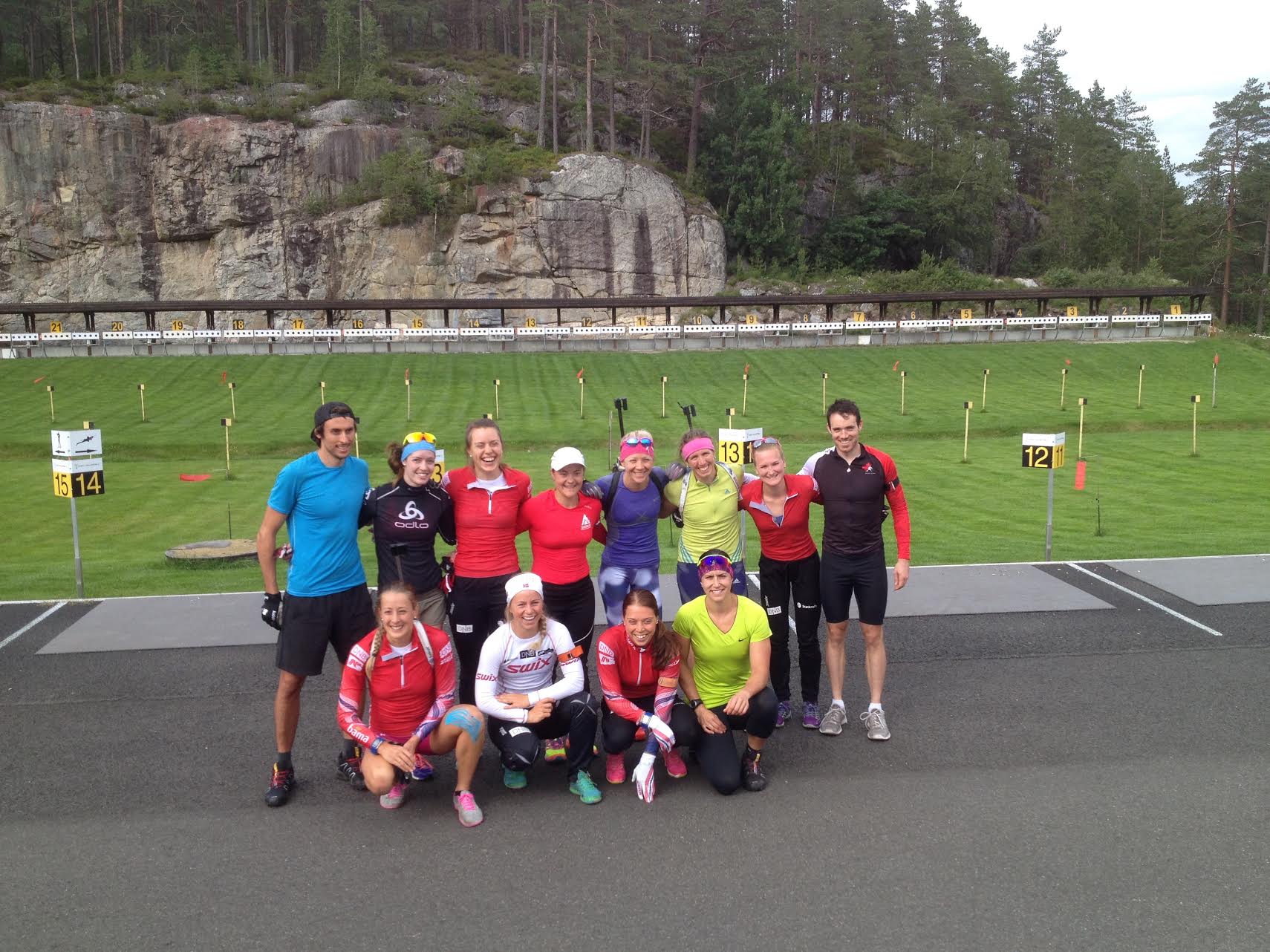
The “International Biathlon Team” camp in front of the 30-point range at the sports school in Sirdal, Norway, with (front left to right) Norway’s Fanny Welle-Strand Horn, Tiril Eckhoff, and Elise Ringen, and Canada’s Rosanna Crawford, and (back left to right) Canada’s Brendan Green and Megan Heinicke, Norway’s Sinnøve Solemdal, Russia’s Ekatarina Yurlova, Finland’s Kaisa Mäkäräinen, American Susan Dunklee, Norway’s Marte Olsbu, and Canada’s Nathan Smith. (Photo: Matthias Ahrens)
It all started two years ago when Biathlon Canada’s head coach Matthias Ahrens struck up a conversation with highland-cow farmer Frode Oftedal at the World Cup in Oslo, Norway. There, Oftedal, also a biathlon enthusiast, invited the Canadians to come to Sirdal, Norway, for a training camp with the French team. The French biathletes had been returning to the sports school there to train since 2002 — because of Oftedal.
For Canada, the possibility became reality this spring when Ahrens asked Norwegian biathlon coach Arne Idland whether his A-team athletes (Rosanna Crawford, Megan Heinicke, Brendan Green, and Nathan Smith) could participate in the Blink rollerski festival in August. They could, and would, but before that, why not arrange a shooting camp with Norwegian personal shooting coach Joar Himle? Last year, the Canadians held a camp with Himle’s expertise at home in Canmore, Alberta. This time, they’d continue learning from him in Norway.
Three non-Canadians — Russia’s 2015 world champion Ekaterina “Katja” Yurlova, Finland’s Kaisa Mäkäräinen and American Susan Dunklee — caught wind of the camp and asked Himle if they could join, Ahrens explained in an email.
Of course they could, and the self-proclaimed International Biathlon Team was born. In the last few months before the nine-day camp in late July, Ahrens contacted the participants from various nations — including Norway and France — to coordinate workouts.
“At the end of the year World Cup party in Khanty-Mansiysk, I met Joar Himle,” Dunklee explained in an email. “He mentioned that he might put together an international women’s shooting training camp this summer around the Blink Festival. I was immediately interested.”
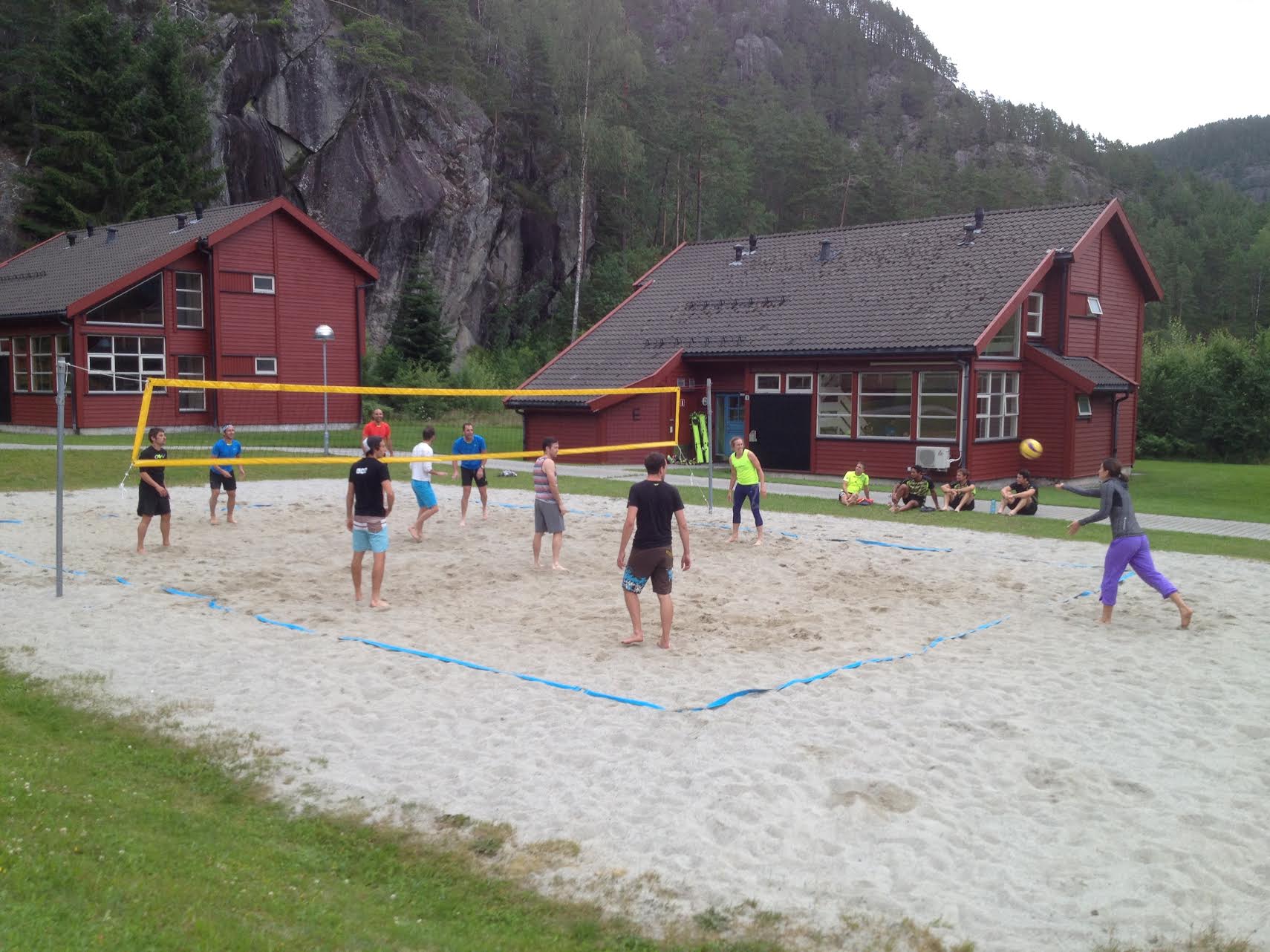
The “International Biathlon Team” enjoys some leisure time during a volleyball match at the sports school in Sirdal, Norway. (Photo: Matthias Ahrens)
Tonstad, the site of the Sirdal sports school where the athletes would stay and train, was just a short drive from Sandnes, where Blink is held annually. For Dunklee and other Blink participants, such as Crawford, Heinicke, Green, and Smith, that made it an easy choice for a training venue before Blink.
“Shooting has traditionally been my weaker link as a biathlete and my major focus for this training season,” Dunklee explained. “I spent the spring brainstorming how to speed up my shooting times with the US coaches and sports psychologist and we have taken satisfying steps already. We decided it might also be beneficial for me to cast the net a little wider too. Joar’s camp worked very well with the timing of the Blink Festival, which I was already planning to race, and our team’s Europe camp. I heard that some top World Cup athletes were planning to attend. It sounded like an opportunity worth trying out.”
Meanwhile in late July, the rest of the US Biathlon A-team, except Lowell Bailey, who got married July 11, attended a training camp in Östersund, Sweden.
“This part of the camp we are focusing on specific biathlon training,” U.S. women’s coach Jonne Kähkönen explained in an email. “There’s a really good roller loop at the stadium and a full range that typically has varying winds — no change this time, so good wind practice. We have already had a couple of sessions with some Swedish athletes joining in to mix it up and provide additional challenge on the head to head stuff at the range.”
They planned to stay there until Aug. 3, when Dunklee, Bailey and Leif Nordgren would rejoin the team after Blink for a week at the ski tunnel in Torsby, Sweden.
“Next week in Torsby the biggest focus is on the skiing and technique work,” Kähkönen said of the second part of their European camp.
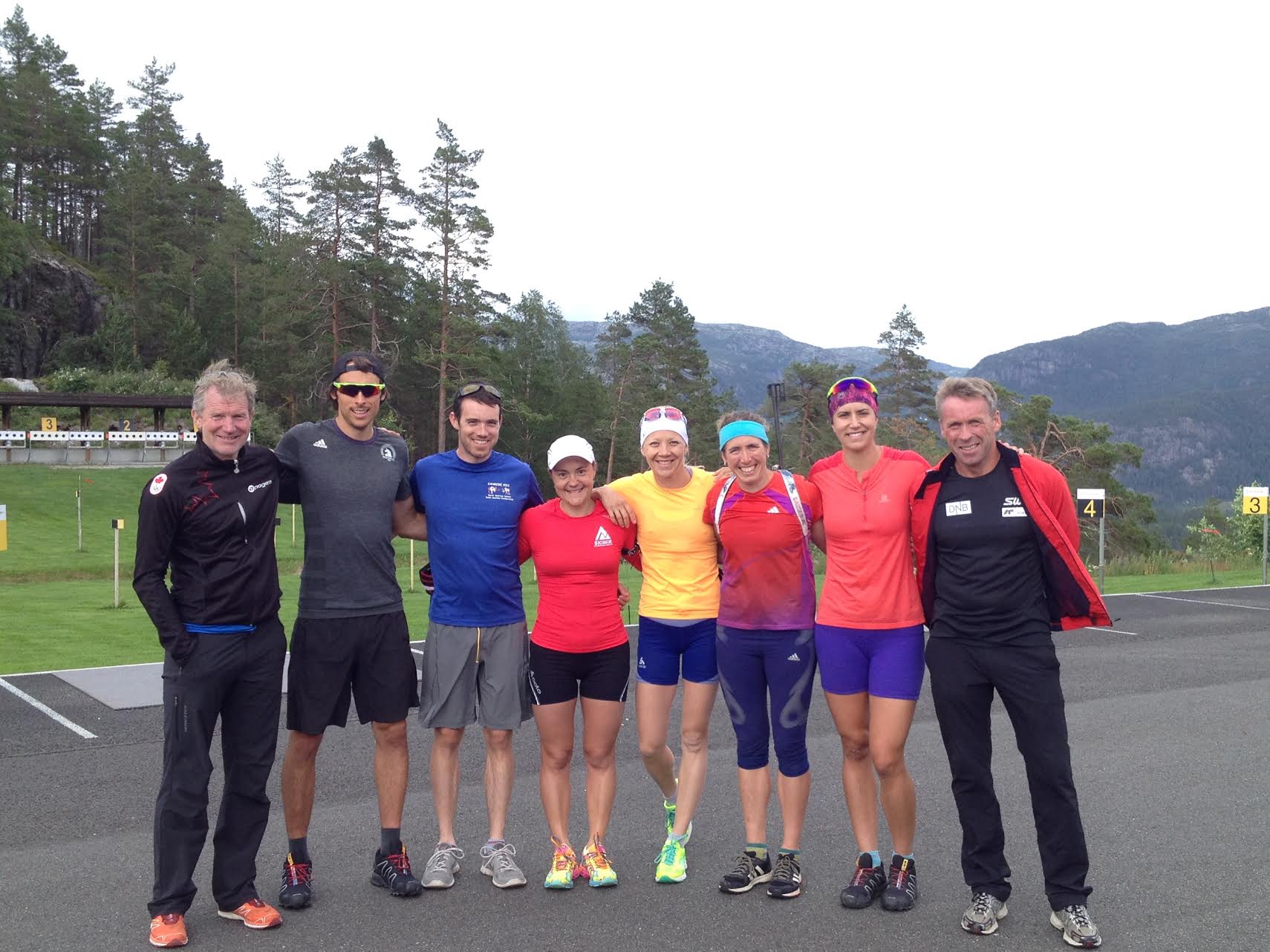
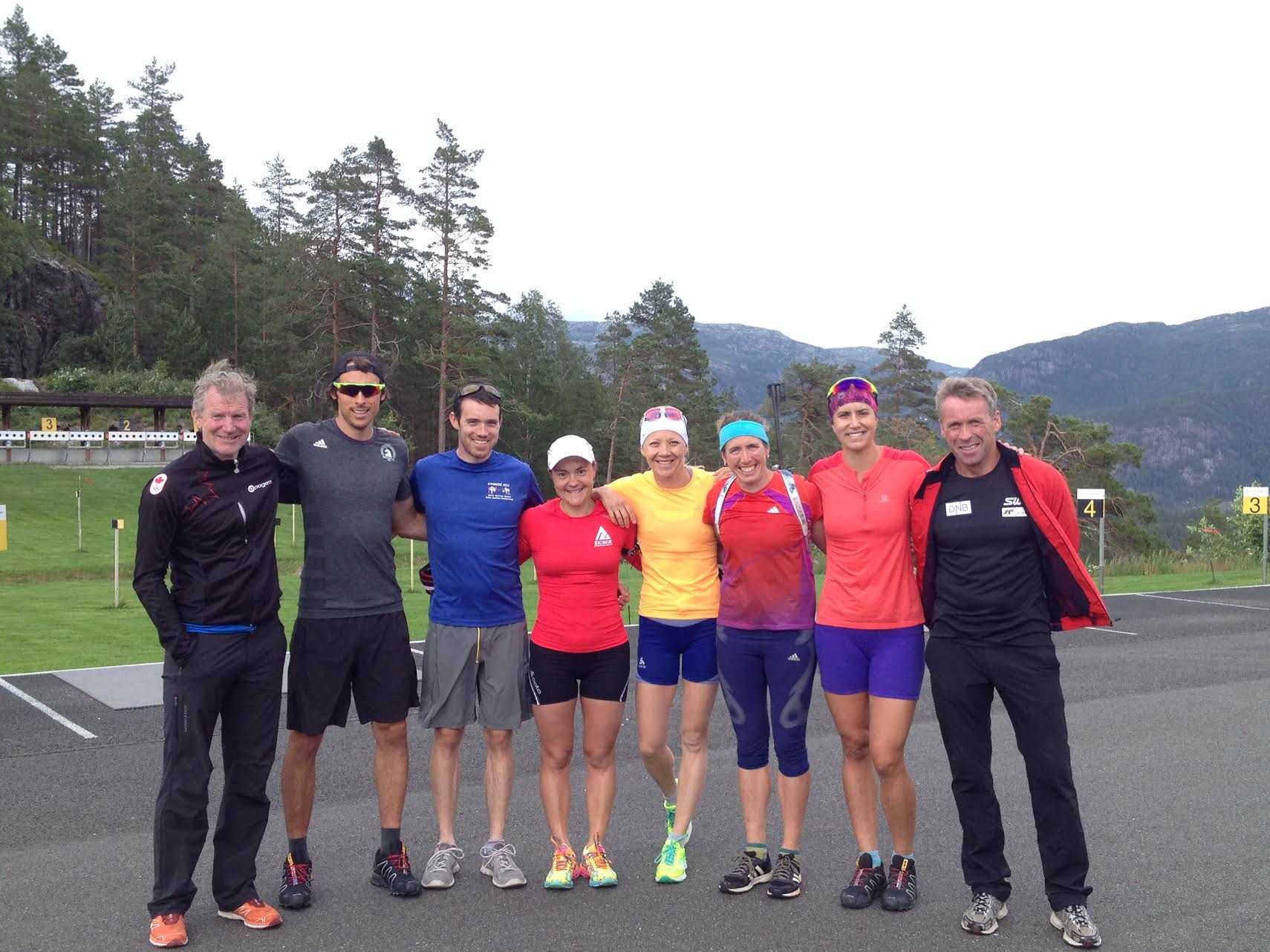
The Sirdal training camp crew (from left to right): Biathlon Canada Head Coach Matthias Ahrens, Brendan Green, Nathan Smith, Katja Yurlova, Kaisa Makarainen, Susan Dunklee, Rosanna Crawford, and Norwegian personal shooting coach Joar Himle. (Photo: Matthias Ahrens)
In Sirdal, Canada brought its A-team, including Crawford and Heinicke, to work out with Yurlova, Mäkäräinen and Dunklee. Smith and Green coordinated sessions with some of the French men.
“We’ve been having discussions together as a group about different aspects of the shooting process,” Dunklee wrote. “Joar believes in the value of athletes taking ownership of their own training and in the value of learning from other people’s approaches. We have also benefited from sharing the range here with the French and Norwegian women’s teams and collaborating on a few workouts.”
“It’s been great getting to chat with other athletes at meals and see what they’ve been up to during the summer,” Crawford wrote in an email.
She explained that all of the morning workouts included everyone —“Kaisa, Katja, Susan, Megan and the boys,” while afternoon training was a bit more individualized. They worked on shooting twice a day with Himle, including some shooting drills with the French team one day and the Norwegian women another afternoon.
“We also got to go for a great classic ski with some of the Norwegian women,” Crawford wrote. “It’s a pretty impressive group of people with 3 of them having WCH medals!”
On Wednesday, the group parted ways, with several athletes heading to Sandnes for the Blink races from Thursday to Saturday. Afterward, the Canadian A-team will venture to Oslo for three days to train on the 2016 IBU World Championships course. Then Ahrens and Smith will return to Canmore, and Crawford and Green will venture to Östersund for a few more days of training.
“Our B-team is in Canmore and will go up to the Haig glacier next week before they leave for [the North American Summer Championships in] Jericho [Vermont] and the races there,” Ahrens explained. “Otherwise we are mainly training in Canmore until we go for a 2 week camp in Park City in the last week of September, first week of October.”
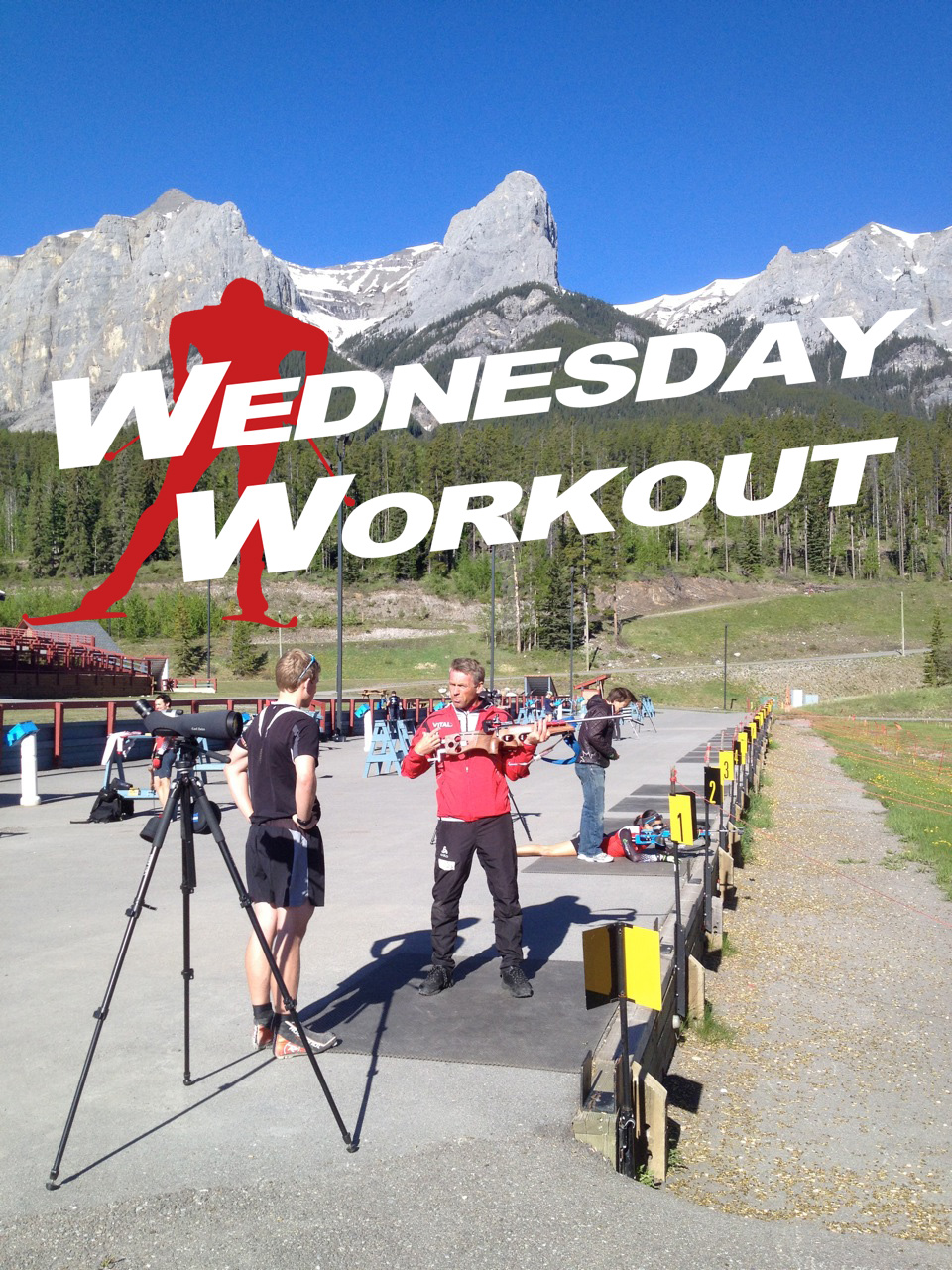
Joar Himle, a personal shooting coach from Norway, demonstrates shooting technique with Canada’s Scott Gow (l) during a shooting camp from June 8-14 in Canmore, Alberta. (Photo: Matthias Ahrens)
There’s nothing wrong with getting a little outside perspective — at least that’s how Biathlon Canada’s national-team head coach Matthias Ahrens and his staff sees it.
Ahrens explained in an email that he’s been trying for years to bring experts from around the world to observe his team and help enhance its athletes’ skiing and/or shooting. He finally pinned down Norwegian shooting coach Joar Himle, and from June 8-14, Himle worked with the Canadians at a shooting camp in Canmore, Alberta.
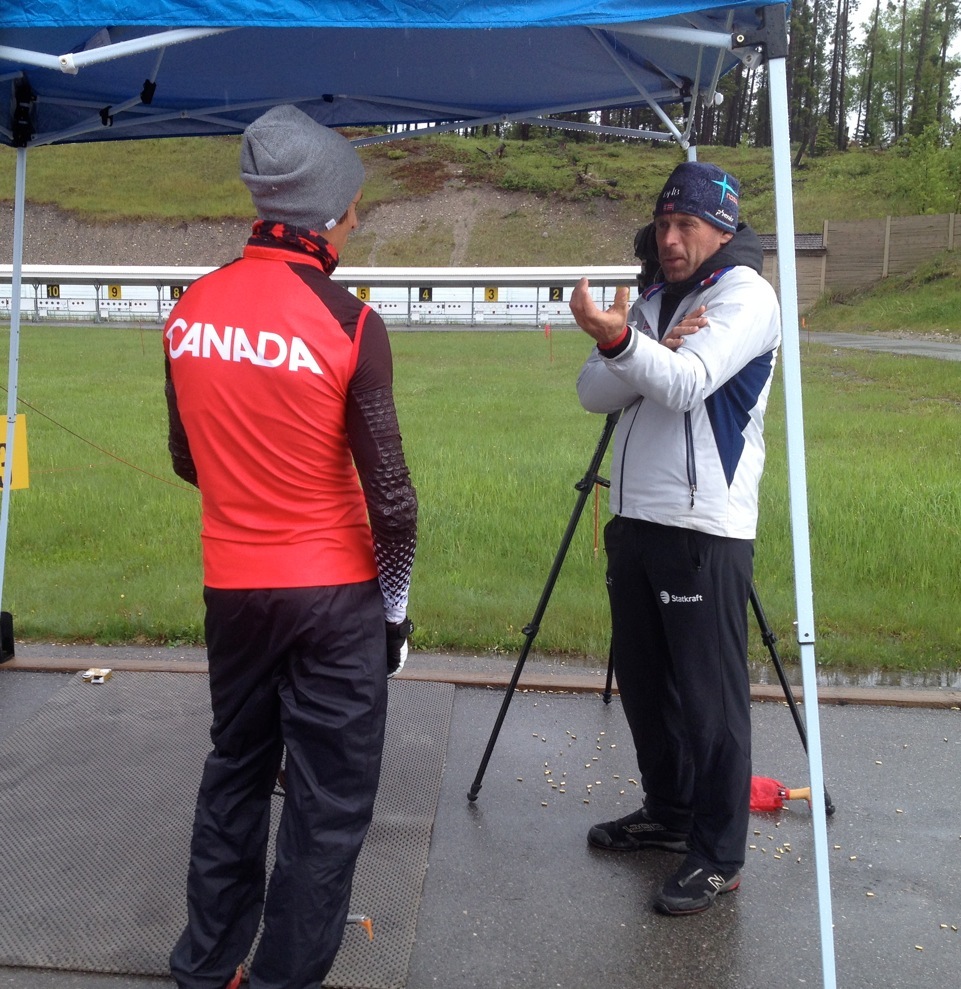
Joar Himle, a personal shooting coach from Norway, converses with Canada’s Brendan Green during a shooting camp in June in Canmore, Alberta. Himle worked with the team as a guest coach. (Photo: Matthias Ahrens)
With experience coaching Olympic gold medalists like Ole Einar Bjørndalen and Halvard Hanevold, Himle was also the Norwegian team’s shooting coach until 2011. He currently works contractually for the national team as well as other athletes, including Germany’s Miriam Gössner.
And while Biathlon Canada works with in-house specialists on a daily basis, including physiologists and physiotherapists, “over the past few seasons we have also brought in more outside expertise for shorter periods of time,” coach Roddy Ward wrote on his blog.
“We have had a ski technique specialist and a functional movement and technique specialist, both from Sweden,” Ward wrote. “Recently, we brought in a shooting specialist from Norway. Each time I have been impressed and satisfied with what our team has got out of this work and I have grown to really appreciate bringing in someone new to work with the team.”
“It has been very educational and motivational for our athletes but also us coaches,” Ahrens noted. “Sometimes it is even not anything new than what we already are coaching but it might be presented in a different way and therefore clicks with the athlete. But it also gives us some insight how other Nations train and where our strength or shortfalls are.”
“Biathlon Canada has been great that they don’t let their ego get in the way of making us better athletes,” national-team member Rosanna Crawford wrote in an email. “We know that there are other countries who are better and stronger than us and if we can work with them then that will make us stronger and better!”
Crawford explained that the shooting camp with Himle involved mostly one-on-one consultations, along with a couple of group sessions.
“I worked on positional stuff in prone mostly and each athlete had things they wanted to work on,” she wrote. “He was great to work with and you never felt stupid asking him questions about shooting.”
One drill Crawford found “both interesting and frustrating” was a shooting exercise done at the end of a shooting-specific workout. It’s simple enough: shoot ’til you miss.
Take a box of 50 bullets and try to hit every single shot. “You can start over if you don’t make it past 15 hits, but after that as soon as you miss you’re done,” she wrote. “I really feel like I learned a lot and am exciting to implement theses changes into training!”
Do 50 shots for prone and then 50 shots for standing.
In all the Canadian team fired about 220 to 240 bullets during that drill and was on the range for about an hour.
“After we were done we had strength that day, so went to the gym to warm up as soon as you finished,” she added.
And while Himle has gone back to Norway, the team can continue to pick up new tips from Swiss biathletes Benjamin Weger, Ivan Joller and Serafin Wiestner — who are training in Canmore for three weeks.
All three men competed at the 2014 Sochi Olympics. Weger, 24, has notched multiple World Cup podiums in his career and made two Olympics and three World Championships. Joller, 30, competed at five World Championships and Wiestner, 23, represented Switzerland at four consecutive Youth/Junior World Championships.