Do you know what a Growth Mindset is? How would you rate your growth mindset? Do you use it in all the areas in which you’re trying to grow?
The more I coach, the more I think that a lot of our problems as athletes and humans begins with how much we believe we can change, and whether or not we believe we have power over those changes. The belief that you can change is the essence of a growth mindset. Without the idea that we can improve, why try? Without the confidence that we can create change, why bother?
Some of the fascinating work presented by Dr. Carol Dweck in the video above shows the differences in growth vs. fixed mindset in young students only by how the adults in the teachers communicated with the students. The simple phrase “you worked so hard” vs. “you are so smart” had a significant impact on how well the students performed in subsequent tests (if you don’t know what I mean, go watch the video). We know that language matters.
What we often are less aware of is how much our language affects us. Your brain has loops and scripts running through it all the time, much of it semi-behind the scenes. We’re often too distracted to notice, let alone change some of this language. If a couple of small words between teacher and student can make a big difference, the hundreds and thousands of words that we think and say to ourselves each day make an even more significant difference.
The first step is starting to recognize when you’re using fixed-mindset language. Only after you begin to NOTICE when you say fixed things can you begin to reprogram some of those scripts to reinforce your growth mindset.
Here are a few things I want you to do as homework:
I want you to notice when you say self-limiting (fixed mindset) things “I am X,” or “I’m not Y.” In Dweck’s original studies, the simple phrase “you are smart” actually had a very NEGATIVE impact because “smart” means fixed. What fixed things do you say to yourself? Create a system for noticing; for example, you could write them down in your phone every time. Then at the end of the day, see how often you say those things.
Take note of the subject of your limiting thoughts. Do you say more fixed things about your body? Or your intelligence? Or your emotional control? Observing fixed thoughts will inform areas on which you should focus.
Once you have started to recognize these thoughts and phrases regularly, you can catch yourself in the middle of them and change the ending. Something as simple as “I’m not fast…*catch yourself thinking it*…YET” can be very powerful in the long term. Or you can stop, catch yourself, and say the non-limiting version. “I’m not good at this” can be replaced with “I’m a beginner at this.”
Importantly, make sure you notice the negative AND THE POSITIVE tenses. “I am” can be almost as toxic in the long term as the short term, as it’s a fixed belief that you will hold to even TIGHTER.
Joe Howdyshell holds a MS in Exercise Physiology from the University of Wyoming and is the founder of Summit Endurance Academy in Breckenridge, CO. Matti Rowe contributed to this article. He is a former nordic skier for St. Olaf College and coaches with Summit Endurance Academy.
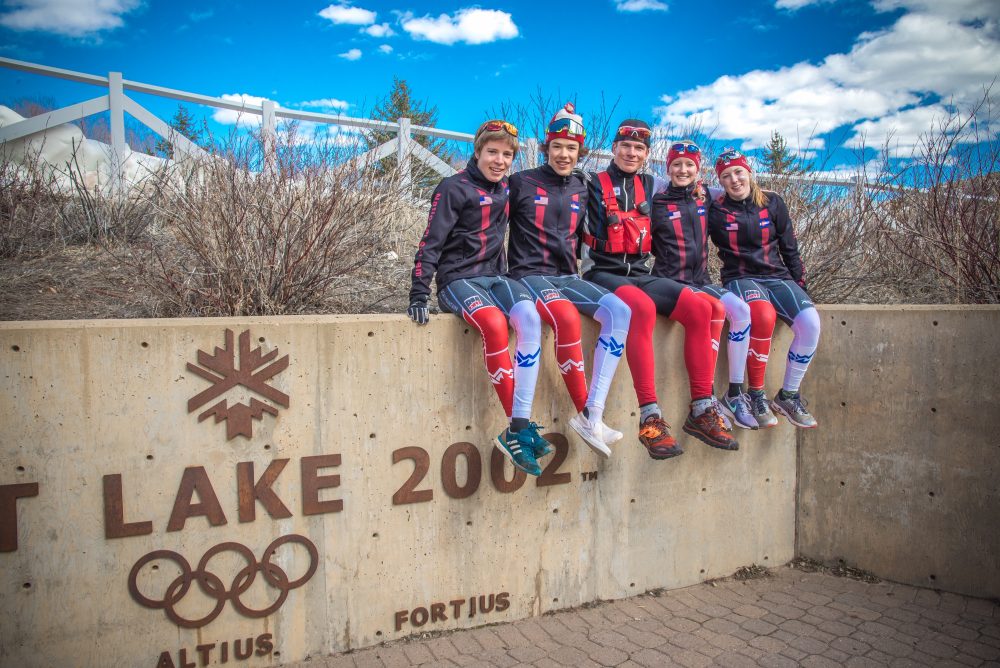
BNJRT athletes with coach Adam St. Pierre at JNs in Soldier Hollow 2018. From left to right, Carson Williams, Michael Pickner, Adam St. Pierre, Bettina Burgess, and Ellie Smith. (Photo: David Pickner)
It is well known that XC ski racers have to be incredibly “fit” to be competitive. But how do we measure “fitness”? For decades, we’ve known that a high VO2max is necessary to be a competitive ski racer. Training to improve VO2max involves a large volume of training at a low intensity and a comparatively smaller volume of training at a very high intensity. Over the past 20 years, changes in equipment technology, course preparation, and a change in race formats from primarily individual start events to a mix of individual starts and head to head racing have necessitated a change in our view of “fitness.” It’s no longer all about VO2max.
This spring Thomas Losnegard wrote a review titled “Energy system contribution during competitive cross-country skiing” in the European Journal of Applied Physiology. In this review, Thomas compares the energy demands of skiing to other sports and summarizes the available research into what type of “fitness” is necessary to compete in modern XC skiing. Before I dive into a summary of the review article, I think it’s important to explain metabolism in a nutshell, so I’ll borrow an analogy from my friend and colleague Joe Howdyshell of the Summit Endurance Academy – The Financial Analogy:
Your body has 3 pathways for generating energy in the form of ATP. ATP powers all muscle contractions.
The Phosphagen system, also known as ATP/CP. CP stands for Creatine Phosphate. Your body stores enough energy to power exercise for up to 15-20 seconds… with training you can increase this to maybe 25-30 seconds of stored energy in the muscles. Think of the phosphagen system as the cash in your wallet.
The anaerobic system, also known as non-oxidative or glycolytic systems, is the conversion of Glucose to Lactate. This process does not require oxygen and hence is not measured by VO2max testing. It is quick to produce energy (not as quick as the phospagen system) to meet the demands of training and racing. Think of the anaerobic system as your credit card.
The aerobic system produces the bulk of energy for events lasting longer than 2-3 minutes. Think of the aerobic system as your bank account, with your paycheck deposited regularly by your employer. You could perhaps think of recovery as your employer in this analogy… recovery puts the money back in the bank!
You can train to increase the size of your wallet. You can train to lower the interest rate on your credit card. And you can train to get a bigger paycheck! During an XC ski race. You are constantly balancing the cash in your wallet (ATP/CP) and the amount of debt you can take on (glycolytic) with the amount in your bank account (aerobic). You have to use the aerobic system to pay off the credit card and put cash back in your wallet before you have to pay too much interest.
Here are my most important take-home points from Losnegard’s review:
In XC skiing, there are large variances in speed, power output, and mechanics over the course of a race. The most similar physiological analog to XC ski racing would be short track XC-mountain biking. To adequately prepare for XC ski racing, we must first look into the specific demands of ski races. In the review, Losnegard cites research stating that elite level 10 or 15 km distance races may last 25-35 minutes, of which about 50% of time is spent going uphill, with 25% of time spent on the flats, and 25% on downhills. However, the time spent in any one type of terrain is usually no more than 10 to 35 seconds at a time; sometimes longer, but rarely much over one minute. This means that while racing, skiers must constantly be assessing speed and changing between techniques and sub-techniques approximately 25 times per km in order to maintain the highest speed possible around the course.
In uphill terrain, a skier may work at 120-160% of VO2max for short periods of time, followed by periods of lower VO2max to recover. As you likely know, VO2max is the maximal amount of oxygen the body can use during exercise. It seems odd that an athlete can work at greater than 100% of VO2max. This does not mean they are using more oxygen, it means that anaerobic (aka non-oxidative) metabolism is contributing to the workload. Think of workload as speed in a given terrain and conditions. At workloads above VO2max, a significant amount of energy is derived from anaerobic metabolism. This results in an oxygen deficit. Oxygen deficit is essentially, how much energy had to be produced by anaerobic methods to sustain the workload. Oxygen deficit is difficult to measure and quantify. Typically, exercise at high intensities resulting in oxygen deficit results in the production of Lactate, so the measurement of blood lactate can be used to estimate the extent of oxygen deficit (higher blood lactate levels indicate a greater oxygen deficit incurred).
In general, sprint skiers have a higher anaerobic capacity than distance skiers. This is directly correlated to the fact that sprint specialists tend to have a higher muscle mass than distance skiers. Elite men typically have a 10-30% greater anaerobic capacity than women, largely correlated to women typically having less muscle mass than men. The performance difference between men and women is greatest in techniques relying largely on upper body (e.g. double poling and V2) and least in techniques that are not as upper body dependent (e.g. striding and V1).
The contributions of the arms to XC skiing are obvious, but how training of the upper body impacts performance is not fully understood. Arms generally constitute a much smaller muscle mass than legs. Muscles in the arms have a lower oxidative capacity than leg muscles, even in elite XC skiers. During double poling, the arms release lactate into the blood, where the legs are actually a net importer of lactate- meaning the arms are utilizing a higher percentage of anaerobic metabolism thus producing lactate that must leave the muscle, while the legs are working at an intensity where they are capable of taking lactate from the blood and utilizing it for energy through aerobic pathways. At high intensities in double poling, the energy contribution from the arms plateaus, and any further increase in intensity must come from the legs which increase power output leading to greater vertical changes in the center of mass in order to increase speed (you jump onto your poles more at higher intensities).
It appears that pole contact time may be the ultimate limiter of energy input and thereby speed in flat terrain. With this in mind, training at high speeds to minimize pole contact time (the amount of time the poles are in contact with the ground) may be of great benefit.
Now for my interpretations and some practical implications.
In order to repeatedly perform at workloads above VO2max, an athlete must have a high level of aerobic fitness in order to recover from efforts and regenerate stores of ATP/CP during the short periods between supra-VO2max efforts. Instead of looking at increasing VO2max as the ultimate goal of training, perhaps training to increase an athletes’ maximal accumulated oxygen deficit would yield better results.
The Principle of Specificity is a foundation of exercise physiology. Essentially, you can improve only what you train. It is important that we as coaches (and parents, and skiers), recognize the energy demands of XC ski racing and train our athletes (and ourselves) appropriately. We need to design workouts that mimic the demands of racing to prepare our athletes to race. We need to train to move fast in a variety of terrain utilizing both techniques (skate and classic) and all sub-techniques (herringbone, double pole, striding, V2, V1, etc.)
We need to look at skiing as a non-steady state exercise. There are few instances in ski racing where a skier can grind away for 3-15 minutes at a steady effort/intensity, so why do many coaches (myself included) tend to focus training on this type of workout? Instead, a focus on workouts that mimic the actual demands of XC ski racing- 10-60 sec maximal efforts with 5-30 sec of recovery, may lead to better results in XC ski racing.
Here are my practical recommendations based on this review article and the research summarized in it:
Train to the demands of your event. While workouts like 4 by 10 min L3 certainly improve lactate threshold and VO2max, a workout like 4 by 10 min of 45 sec fast/15 sec recovery may achieve similar aerobic gains and allow for faster movements and greater anaerobic contribution during the workout, perhaps making it more similar to racing. See below for some possible workout progressions. Also, the training necessary for a Wave 1 Birkie skier is different from a Wave 8 Birkie skier which is different from a junior which is different from a World Cup athlete. Identify the demands of your event(s) and target your training towards them.
Include “gear shifts” in intervals. Most intervals should include some portion uphill, but not all. Have you ever heard “transitions are important”? Practice them at speed!
Use ski specific modalities for high intensity work- bounding/ski walking, rollerskiing, or (obviously) on-snow. Intervals on bike or swimming are good for fitness, but not nearly as specific as similar workouts in ski specific modalities, especially given the increased utilization of upper body power.
Train fast movements. Athletes need to be able to move quickly and apply power quickly in racing. In order to do this in races, we need to do it in training. Incorporate short sprints, explosive strength training, and plyometrics into your training. Andy Newell has some great video resources on his website( www.nordicteamsolutions.com ) that can be modified for any level of athlete!
Here is a progression of workouts you may find beneficial to add to your training. These workouts should be done on skis, rollerskis, or bounding/running with poles. Each workout is preceded by a 20-25-ish min warm-up consisting of:
5 min easy, 3 min L3/Threshold, 2 min easy, 2 min L4, 2 min easy, 1 min L5, 5-10 min easy. In an ideal world, this warm-up would be preceded by some mobility and light plyometric work!
Each Main Set consists of 12-20 min of total “on” time, all “on” time is done at sprint race pace/effort. HR will not be useful in guiding the intervals because they are so short, though looking at HR recovery between intervals and the response of HR to the workouts over time can be interesting). I also prefer to have a timer of some sort so you don’t have to look at your watch to know when to start and stop:
24 by 30/30 (24 min, 12 min on time)
5 by 6 by 30/30 w/ 4 min between sets (46 min, 15 min on time)
5 by 8 by 30/30 w/ 4 min between sets (56 min, 20 min on time)
30 by 30/30 (30 min, 15 min on time)
21 by 40/20 (20 min, 14 min on time)
5 by 6 by 40/20 w/ 4 min between sets (46 min, 20 min on time)
5 by 6 by 40/20 w/ 2 min between sets (38 min, 20 min on time)
30 by 40/20 (30 min, 20 min on time)
15 by 45/15 (15 min, 12 min on time)
3 sets of 8 by 45/15 w/ 4 min between sets (32 min, 18 min on time
3 by 10 by 45/15 w/ 5 min between sets (40 min, 22.5 min on time)
20 by 45/15 (20 min, 15 min on time)
12 by 60/30 (18 min, 12 min on time)
4 sets of 4 by 60/30 w/ 2 min between sets (30 min, 16 min on time)
5 sets of 4 by 60/30 w/ 4 min between sets (36 min, 20 min on the time)
20 by 60/30 (30 min, 20 min on time)
10 by 30/30, 5 min easy, 8 by 40/20, 4 min easy, 6 by 45/15 (33 min, 15.5 min on time)
End each workout with a 5-20 min cool-down
I recommend doing one session like this every other week in the summer, one per week in the fall, and one-two per week in the winter (depending on race schedule). For skiers living/training at altitude, it may be necessary to increase the rest between intervals to ensure that the short “on” periods are of sufficient quality to train really quick and powerful movements.
I’d like to give thanks to a few friends and colleagues who aided in the editing of this article: Corrine Malcolm, Duncan Callahan, and Joe Howdyshell.
Adam St. Pierre (left) and former Bowdoin skier and BNJRT coach Sam Shaheen at the start of the 2019 American Birkie. (Photo: courtesy Adam St. Pierre)
Adam St.Pierre is a New Englander who learned all about Exercise Science in grad school then found his way to the Rocky Mountains to coach XC skiing in Boulder, Colorado- where the running trails are plentiful and the snow is just a short drive up a canyon.
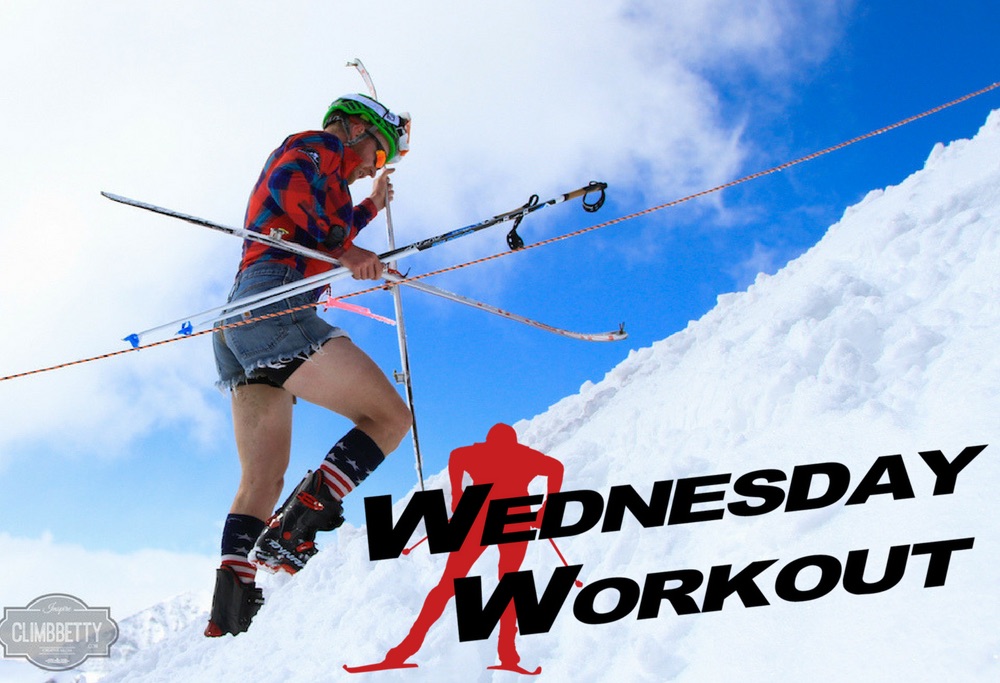
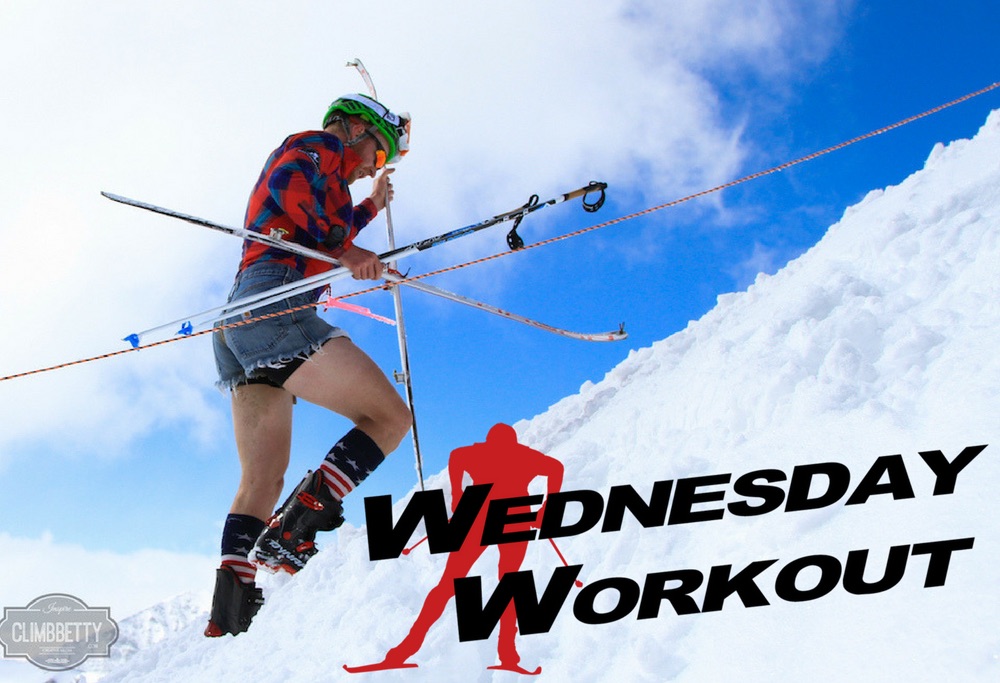
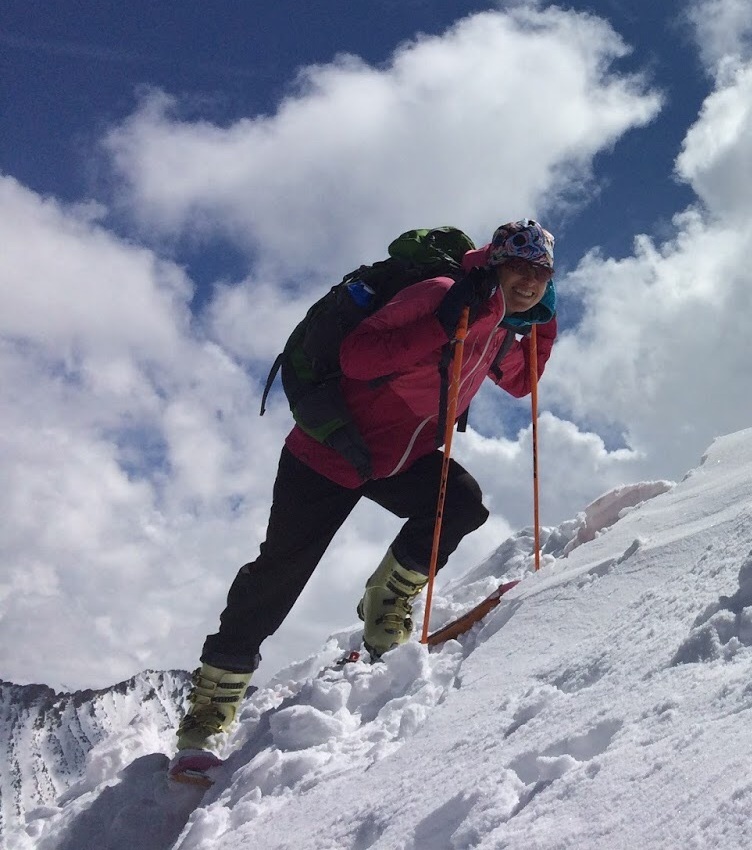
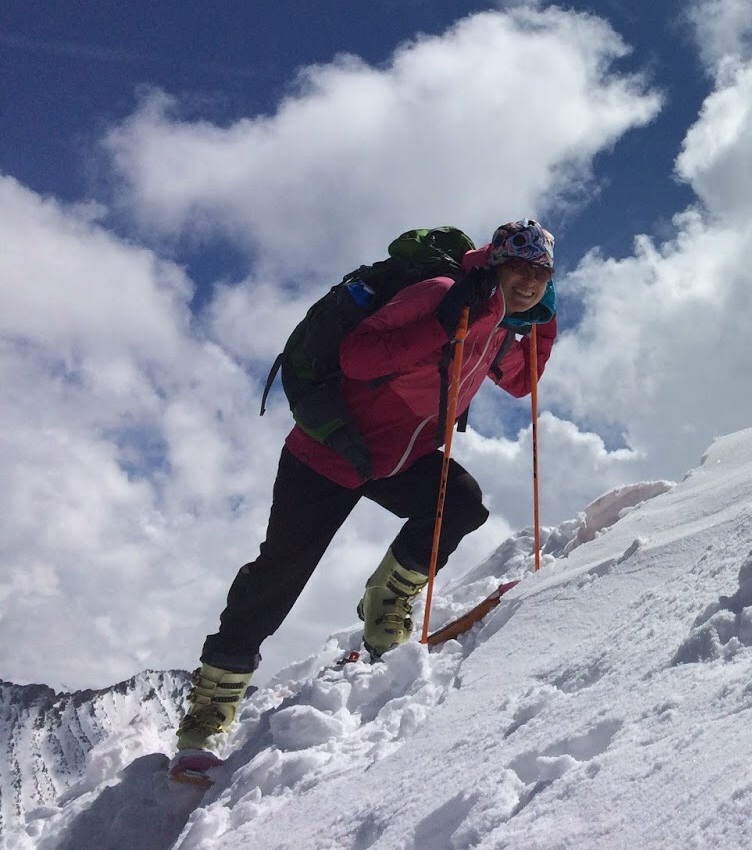
Summit Endurance Academy coach/owner Joe Howdyshell getting vertical with his skinny skis. (Photo: Climbbetty.com)
You name it and Joe Howdyshell, director and founder of Summit Endurance Academy in Frisco, Colo., has probably coached it. From skiers to cyclists to ski mountaineers, Howdyshell’s repertoire extends beyond endurance athletes. His experience with a wide range of outdoor-sport enthusiasts made him a prime candidate for one of our weekly workouts. Here he provides a workout he has all of his endurance athletes do, regardless of sport, throughout the year at the end of their recovery weeks.
***
With the utterance of endurance athlete, a certain individual often comes to mind. The cross-country skier clamoring over boulders during a three-hour hike. The road cyclist grinding up the final hill of a four hour ride. The Ironman competitor, finishing up a 2.4-mile swim with more than a century bike ride and marathon run left to go.
Many make the list. What about the motocross biker drifting a machine operated hunk of metal around a dirt course? Or the extreme-obstacle-course racer army-crawling under a stretch of barbed wire? Some would say they don’t fall under the same category.
But 33-year-old Joe Howdyshell, founder and director of Summit Endurance Academy (SEA) in the Colorado Rockies, has a different point of view. He sees these individuals as one in the same. From the athlete he coaches who is currently climbing Everest, to the professional Spartan racer under his advisory, to the motocross racer he provides training plans to, all fall under the umbrella of endurance athlete.
Joe Howdyshell of Summit Endurance Academy (Photo: Erin Gigliello)
The key is how one defines endurance and athlete. For Howdyshell and SEA — a training program he started in 2013 that offers coaching and training advice to its members –endurance is defined “as any effort lasting longer than two minutes (this includes crashing time)” and an athlete as “anyone who is trying to systematically improve performance or capacity.”
If anything, the definition attracts a wide span of participants. At present, Howdyshell has 50 athletes following his training philosophy, 19 of which are Summit County locals. The other 31 athletes he works with hail from various states and countries, including New York, California, Washington, Utah, Vermont, Wyoming, Arizona, New Zealand, Spain, and Ecuador. Many fit the more traditional sense of endurance athlete, such as distance cyclists, skiers, and runners, and others less so.
“It doesn’t really matter to me how fast they are, if they’re willing to dedicate to the process, then I’m all about working with them and figuring out ways to help them,” Howdyshell said on the phone last month. “So the guy who’s a motocross racer, he’s like, ‘Yeah, I’ll wear a heart-rate monitor every time I’m on the track or every time I’m at the gym.’
“We looked at his heart-rate profile when he’s in a motocross race, and he’s pegged it for 185 for 15-20 minutes,” Howdyshell continued. “So the cardiovascular demands are insane. By collecting data and being communicative, together we can develop a strategy to make him faster.”
As Howdyshell continues his professional work with athletes, he also continues to expand his realm of expertise. He began coaching professionally in 2005, and for almost a year now, has served as the head coach for the U.S. Ski Mountaineering national team.
An average workweek for Howdyshell entails 40-60 hours for the SEA and another four to five hours for his national team coaching duties. His introduction to the U.S. Ski Mountaineering position and sport itself was in large part due to his background in cross-country skiing: he’s been nordic skiing since the age of 12, and he was previously head coach of the Summit Nordic Ski Club prior to founding SEA.
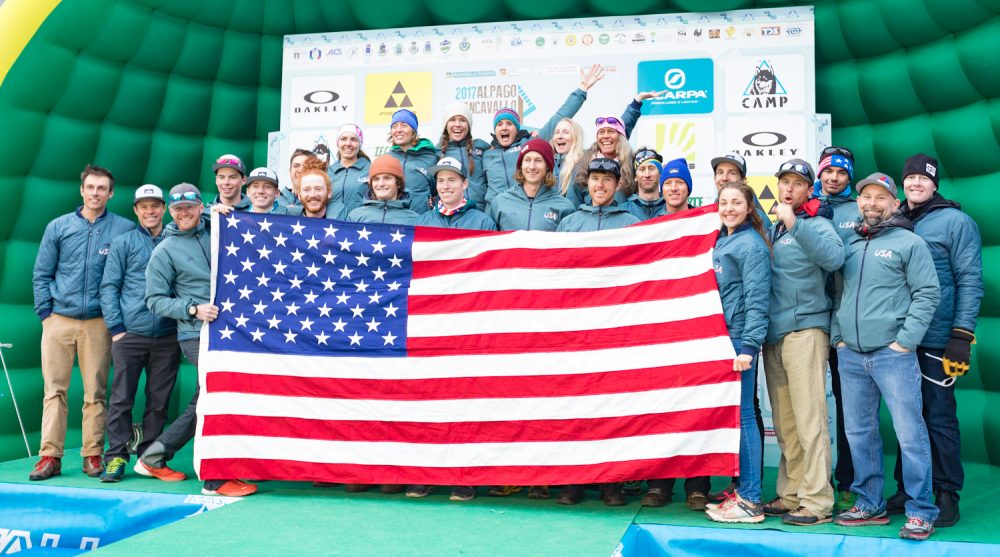
Coach Joe Howdyshell (third from left, holding flag) with the U.S. Ski Mountaineering national team in Italy. (Photo: Mike Smiley)
“I was the head coach of the Summit Nordic Ski Club for a number of years and I had all these crazy friends and a lot of the parents who would go skinning,” said Howdyshell, who also has a degree in exercise science. “I was like, ‘What the hell is that?’ … then I did it a few times and friends were like, ‘Hey, you gotta try this ski-mo race thing, so I started doing that. … Then, since there aren’t many coaches in the sport in the U.S., [becoming the national-team head coach] kind of happened naturally.”
Regardless of which athlete he’s working with, there’s one workout he has each of them do. On the Thursday of a recovery week, whether in-season or off, he has his athletes complete a 20/40 workout: 20 seconds of on-time, followed by 40 seconds off. Each athlete repeats these 20/40s for five minutes, followed by five minutes easy. The set is then repeated two more times. The workout is intended to help athletes safely return to interval training. To an extent, his workout epitomizes what he hopes SEA embodies: demonstrating a way to bring on the “bad ass” without burning out the engine.
“One of the big things that and I’m still trying to figure out how to say is that idea of what is bad ass,” he said. “Knowing when to work hard and when to just relax. Part of [SEA] is trying to teach people that you can get very, very, very fit if you take the time and you dedicate and you work hard when you need to and you don’t when you don’t need to. …. Training doesn’t have to be a monkish isolated journey that only involves hail. You should be able to have a beer after your workout. I think that too often we see a separation between the people who take it too serious and then people who don’t take it seriously at all. … For me, spreading that message that you can be fast and have fun at the same time, that’s kind of my key goal.”
The Workout: 20/40 recovery
Purpose: Remind the body what intervals feel like without overtaxing the system; on-time should not be max pace.
“Typically I’ll do a rest week every third or fourth week and that’ll be a day off, a day easy, a day off, a day easy, and then I kind of get them back into the training mode with 20/40s,” Howdyshell explained.
For XC skiers, he recommends doing the workout on rollerskis or running.
Ideal time: Thursday of a rest week (rest week usually includes two days off and two days easy in four days for his athletes). Can be done year-round.
Warmup: 15 minutes progressive
5 minutes: Go from the bottom of Level 1 to the top of Level 2
5 minutes: Done at 10-15 beats below Level 3
5 minutes: Back to Level 1
The set: 20/40s (x 3)
20 seconds on and 40 seconds off for 5 minutes
5 minutes easy
Repeat two more times
(Note: Howdyshell recommends using 2- or 3-kilometer race pace for on-time effort)
Cool down: 15-20 minutes easy
Total time: 60-65 minutes
Howdyshell’s Top-3 Suggestions:
Staying on track sometimes means holding back. The 20 seconds of on-time should not all be done at a full-out sprint. Instead, goal pace should be around 2-3 k race pace. “I’ve had athletes come back and be like, ‘That was so hard,’ and I’m like, ‘Did you hit each one of them as hard as you possibly could?’, ‘Yeah I did,’ ‘Well, that’s exactly what I told you not to do.’ ”
The workout won’t feel the way you want.“Especially if you’re coming off of an extended rest block, you’re going to feel sh*tty,” he said. “And that’s exactly what the workout is for; it’s a bridge to get you out of your body thinking that, after a few days of rest, your body is in couch-potato mode, which is good, it needs to be, but you’re not going to feel amazing right off the bat.”
Make right with your warmup. After an extended period of recovery time, jumping into intensity without a good warmup isn’t always fair to you or your body. “It’s kind of easy to get antsy after a few days of not training too much and jump into the higher intensity too fast,” he said. “Make sure you don’t shortchange the warm up.”
Liz Stephen (U.S. Ski Team) on a backcountry ski tour in Colorado in April 2016. (Photo: sophiecaldwell.blogspot.com)
Liz Stephen has made a name for herself as one of the best uphill climbers in the world on the cross-country World Cup circuit, frequently achieving her best performances of the season in the final stage of the Tour de Ski up the grueling Alpe Cermis climb on a ski slope in Italy. She placed second for the time of day up the climb again this year, her fourth time to do so.
“I want to win this thing before I retire,” Stephen told FasterSkier in January. “So we’ll see, maybe a little extra training for it specifically next year.”
FasterSkier recently learned that the 30-year-old Vermont native, who was introduced to cross-country as a young alpine skier at Burke Mountain Academy, plans to take her uphill climbing skills and indomitable fighting spirit to the next step. After next season (2017/2018) and the 2018 Winter Olympics in PyeongChang, South Korea, Stephen plans to professionally take up the sport of ski mountaineering.
Despite the fact that ski mountaineering (“skimo” for short) sprung out of cross-country skiing, the race formats and equipment slightly differ between the two sports.
“Individual” skimo races can last one to three hours and include up to 2,000 meters of total climb, multiple ascents and off-piste descents in difficult terrain, as well as steep sections where the skis have to be carried in a rucksack harness on the back. There are also fast-paced sprint races lasting just around three minutes on a ski slope, and long-distance team races with a partner as well as relays.
“I just love the concept of that sport. It looks so hard but also so much fun,” Stephen said after being glued to the online broadcasts of 2017 Ski Mountaineering World Championships in Piancavallo, Italy. “They only ski steep uphills for hours, which is just my thing, and while the downhill sections are a bit scary I can finally put my high-school background in alpine skiing from Burke to good use.”
The skis used for skimo are wider and heavier than cross-country skis and have steel edges, but the boots and skis are lighter than the ones mostly used in alpine skiing. While skiers can use any technique, there frequently are no tracks, so the typical climbing style looks similar to diagonal classic cross-country skiing. On the steep ascents racers don’t use kick wax, but synthetic “skins”, before taking them off for the downhill sections, often just stuffing them under their spandex race suits for re-use on the next ascent. They also wear helmets for protection.
Stephen, who still regularly goes alpine and backcountry skiing in the offseason for fun, said she especially looks forward to the team events and a discipline called “The Vertical”, a format usually “carried out on well packed snow with the whole race taking place with skins under the skis in a single, long ascent,” according to the International Ski Mountaineering Federation (ISMF).
A separate entity from the International Ski Federation (FIS), the ISMF has professionalized the recreational sport of skimo with regular World Cup tour and biannual World Championships. The races are becoming increasingly popular in central and western European countries bordering the Alps, such as Italy, France, Spain, Switzerland, and Germany. And the sport has also been gaining traction in North America.
One of the most prominent athletes in skimo is Spain’s Kilian Jornet Burgada, an elite skier and mountain runner who became known in the U.S. to a wider audience when he won the 2015 Mount Marathon race in Anchorage, Alaska, in a record time. A year later, Alaskan elite cross-country skier David Norris broke that record.
Skimo is not yet an Olympic sport, but the ISMF is hoping to soon make it one, with a potential demonstration to the International Olympic Committee (IOC) as soon as the 2018 PyeongChang Olympics.
At those Games, Stephen still plans to compete in cross-country, targeting individual races as well as a medal in the women’s relay.
“I feel like I won gold already with this team,” Stephen told FasterSkier in an interview during the Nordic World Championships this season in Lahti, Finland. “I think it is more about these friendships and these inspiring teammates that I am around every day. They are why I ski, and I couldn’t be happier to just be a part of the team.”
This time next year, Stephen will be making the transition to a new team and a new sport. While she said she’ll miss her friends, she said training solo won’t be a problem as she’s done that for years based out of Park City during the offseason.
In the ISMF World Cup’s overall rankings, there aren’t any senior U.S. skiers currently in the top 30. However, the U.S. team did post multiple top-15 results at this year’s World Championships, and 15-year-old Quinn Simmons of Durango, Colo., even earned a bronze medal in the cadet (youth) sprint race.
“There’s definitely going to be a learning curve for Liz, like quickly skinning the skis without any help from ski techs, or carrying them over steep sections using ropes and crampons,” U.S. senior national team coach Joe “Pale Thunder” Howdyshell said on the phone. According to his bio, he’s a self-described “jorts-wearing, whiskey-drinking, creative-swearing badass coach.”
“But she seems like a hard-working, passionate athlete, and given her enormous endurance and experience as an alpine racer, I know she’ll be a huge asset to our skimo family,” Howdyshell continued.
And at the ripe age of 31 next year, she’ll be one of the younger ones on the U.S. senior women’s team, most of which is over the age of 30.
“I am so fired up about PyeongChang and going out on the highest note possible,” Stephen said of her cross-country career. “Then onto higher mountains and hopefully, even bigger things.”
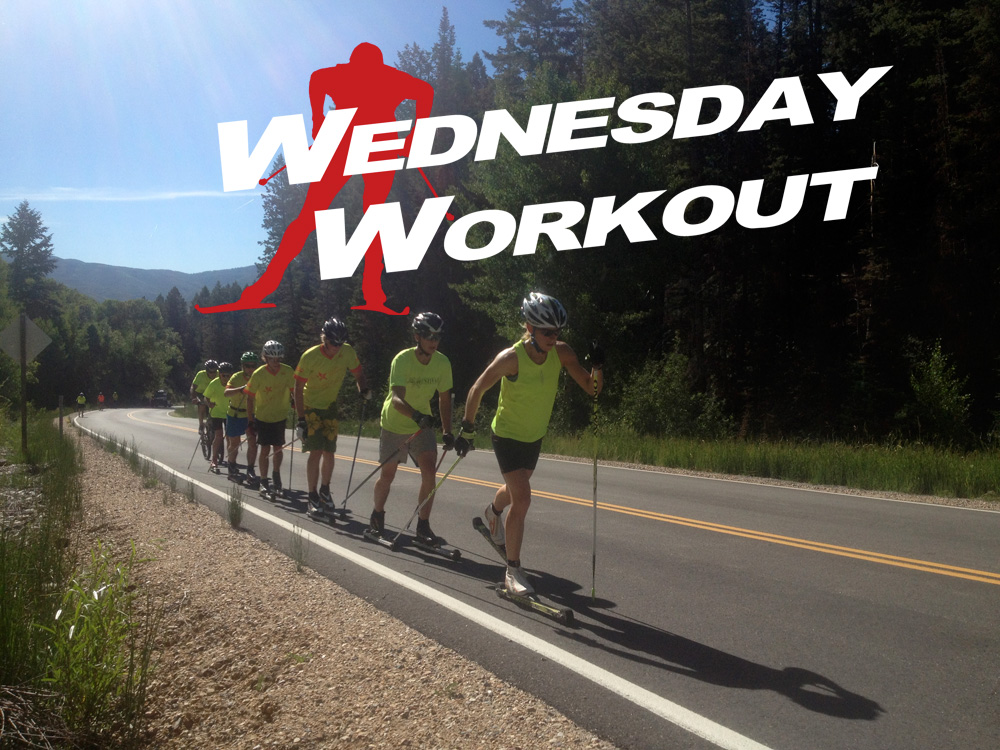
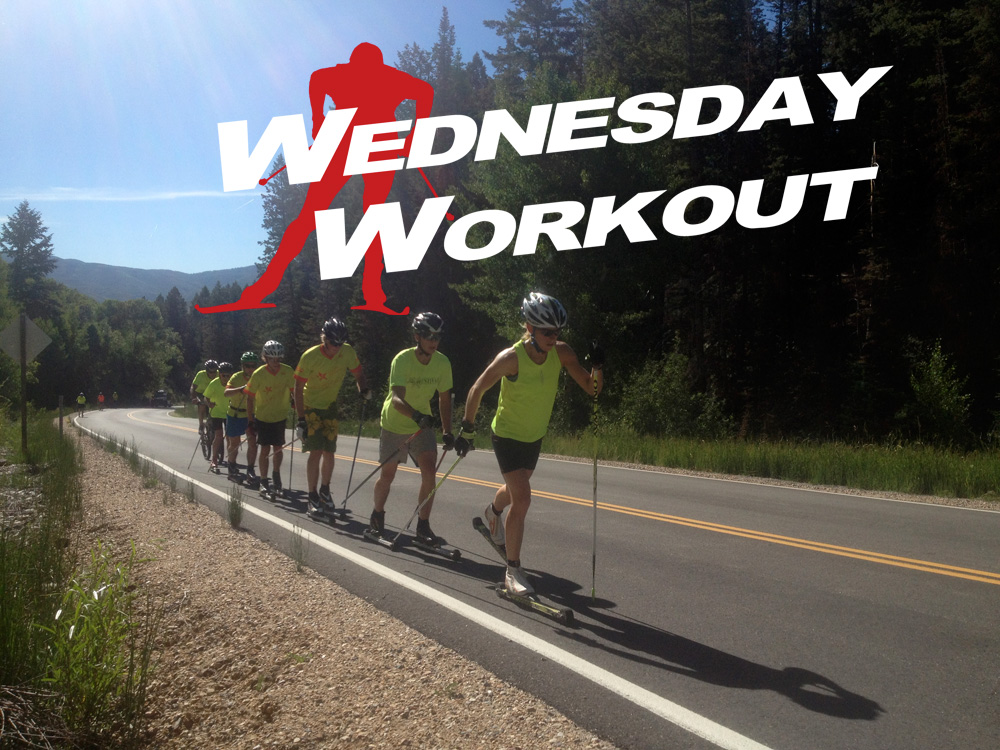
Edit: U.S. Ski Team member Liz Stephen leads athletes in a classic rollerski workout at last year’s Western REG Camp. (Photo: Joe Howdyshell)
This week’s Wednesday Workout comes from Joe Howdyshell, executive director of the Summit Endurance Foundation and former coach of the Summit Nordic Ski Club (SNSC) in Frisco, Colo. Throughout his four years with SNSC, Howdyshell coached athletes to 17 top-10 Junior Nationals finishes, one Junior World Championships qualification, and one U18 Trip qualification.
***
It should always be our goal to turn technique into habit. This allows the athlete to worry about terrain and tactics during racing instead of getting lost in thoughts of “Forward hips” and “High hands.” However, an athlete first needs to start with a thought that their technique isn’t as good as they want, and then work on performing the skill correctly (note: I define a skill as “a particular ability.” You can have a bad skill).
In order to form a habit, you need a skill. In order to have a skill, you need a thought.
In endurance sports, we spend a looooooot of time on habits. A two hour workout will quickly turn any skill into a habit. We also tend to work straight from thought to habit by giving 1-2 cues for a long workout.
Today we’re going to work on the bridge between thoughts and skills, AKA skill acquisition. Since we spend so much time turning skills into habits, we want to make sure we’re starting with good skills!
Whether you are a beginner skier focused on skill acquisition, or a seasoned pro focused on refining habits, going back to the basics and touching on the thought/skill gap goes a long way.
Before the workout:
1. Sit down with your coach and talk about your technique weaknesses. Develop your thoughts on what parts of your technique need to be better.
2. Develop a set of drills to challenge those weaknesses, and learn/refine skills. No need to reinvent the wheel, there are lots of great drills out there, from the old US Ski Team Technique DVD, to the new CXC Academy videos.
3. Perform drills before EVERY rollerski!
The Basic Workout:
1. Equipment check: Drills tend to be dynamic, explosive, boundary pushing workouts, and an equipment malfunction can end in a painful lesson.
2. Short warmup/play/agility. About 5 minutes.
3. Pick 3-5 drills to perform. Such drills include:
Single sticking
Tricep double poling
Running on rollerskis
No-pole balancing
2 V2 (two pole plants per glide while skating)
4. Set 2 cones 50 meters apart.
5. Perform drill from cone to cone, ski back to beginning, and repeat 3-5 times, with 3-5 drills. Should take less than 5 minutes, but if done before every rollerski workout, it will make a big difference!
UPDATE: While it’s important to create drills for individual athlete weaknesses, here is an example to get things started:
There are two main movements that I start with. The first I call the “dip,” which is a small downward movement before any kick (classic or skate). If I see that an athlete is not dipping, I introduce drills that encourage them to become overly dynamic, so that they feel what a dip feels like. These drills would include any kinds of jumping or skipping, as you can’t perform either of those without having vertically dynamic hips. The second movement I look for is the same thing in the upper body. At the Summit Nordic Ski Club we used to call it the “hulk smash.” This is simply the body loading the arms before the power is applied. It can be seen by a very small EXTENSION of the shoulder joint just before flexion. This is one of the harder ones to see, but is absolutely critical to upper body power. Again, if I see an athlete who isn’t properly loading their poles, I introduce drills to exaggerate the loading. One of my favorites is the “head down” drill, where the athlete is directed to lead the pole plant with their head (and thus shoulders), and swing the hands through last, creating a crack-the-whip movement.
By focusing on perfecting skills EVERY DAY, we can ensure that the habits learned during long focused practice are the BEST habits for ski racing!
(Note: The previous photo caption erroneously stated the athletes in the photo were from the Summit Endurance Academy.)
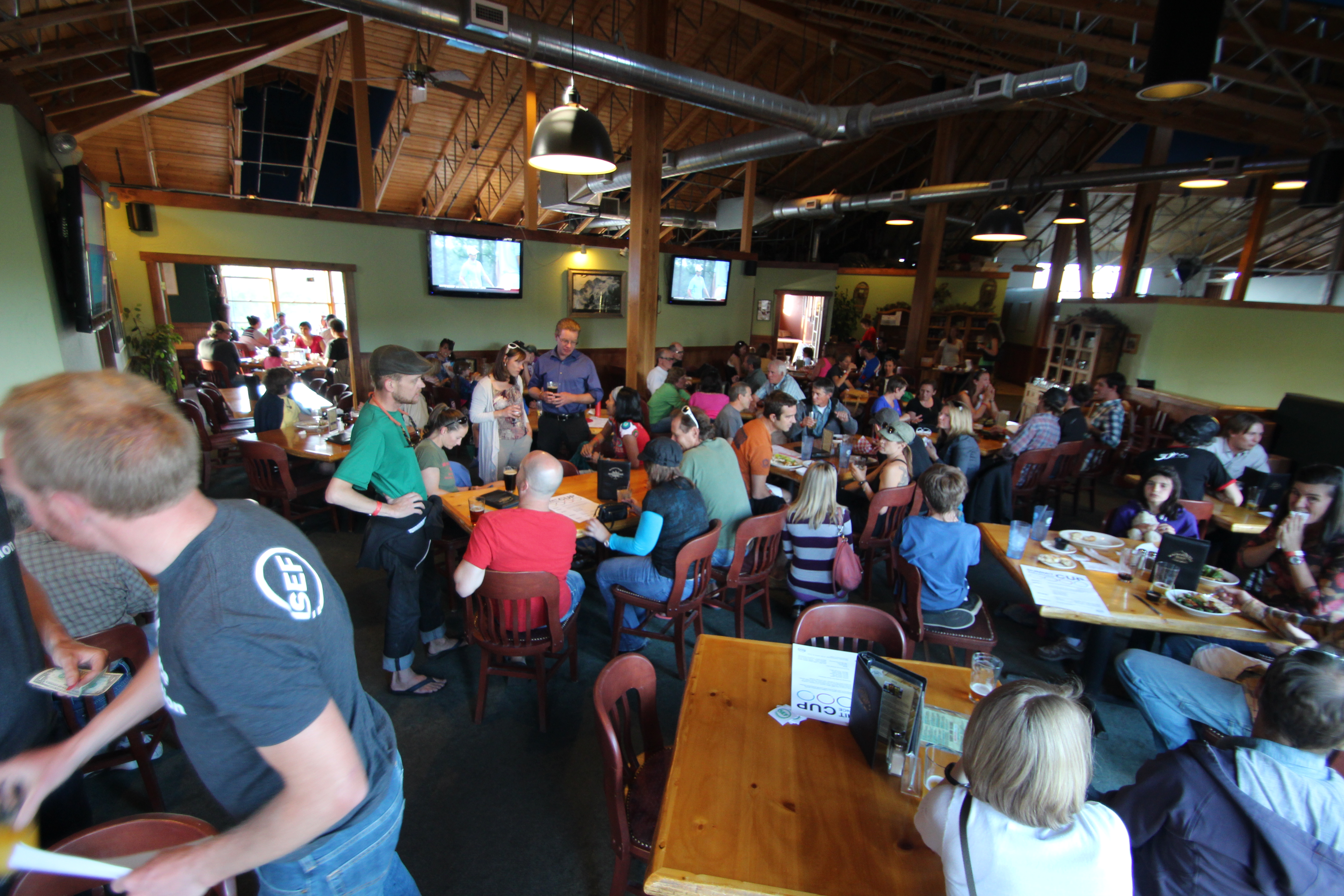
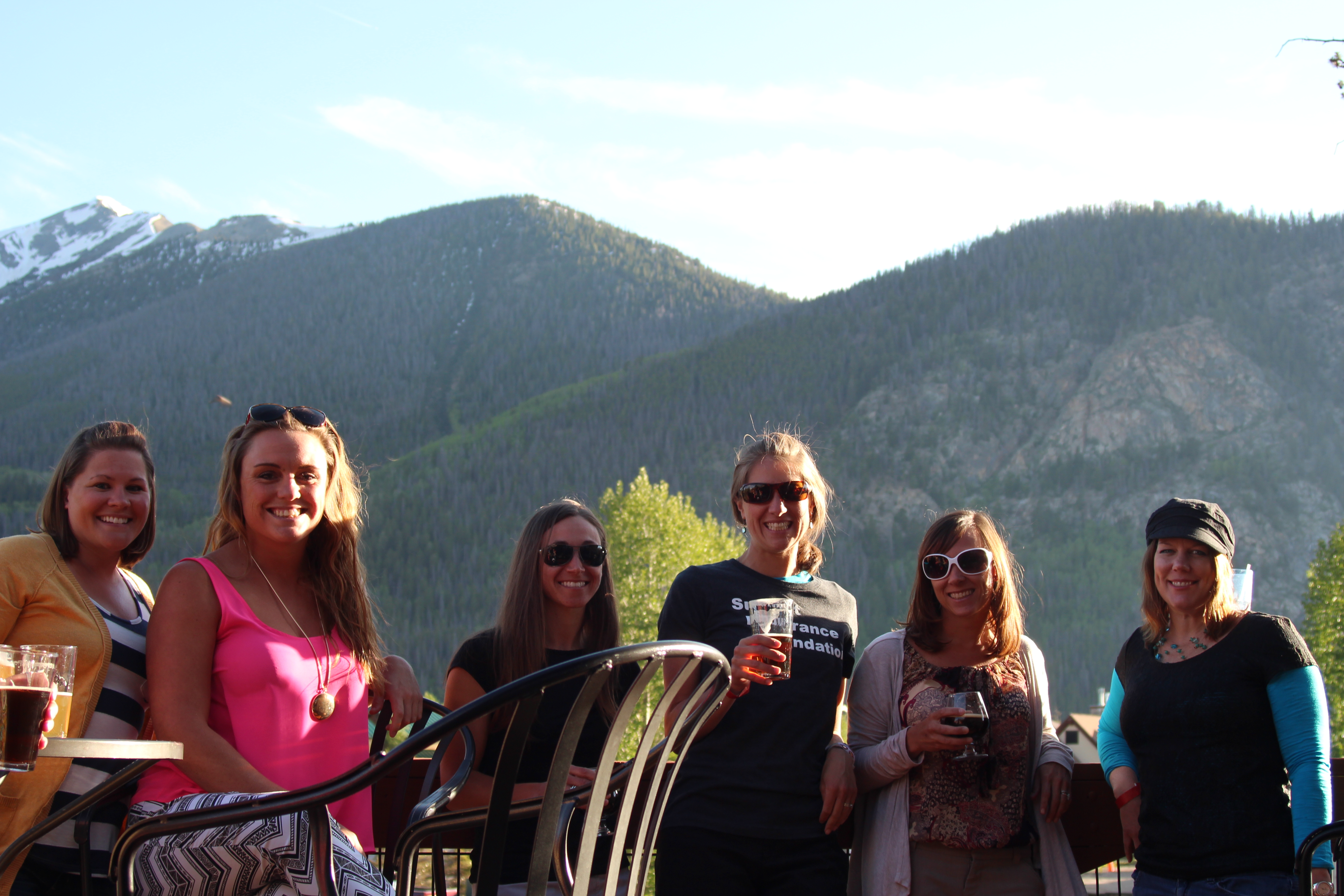
A crowd of supporters gather at the Summit Endurance Foundation Kickoff Party June 12 at the Backcountry Brewery in Frisco, Colo. to support the Foundation’s aim to financially aid young endurance athletes in Summit County. (Photo: Matt Dunkerly)
The story is one known all too well. A friend, a relative, an acquaintance who is interested in joining the nordic-ski community becomes daunted by the costs of training, equipment, travel and racing and thus is forced to stop pursuing the sport.
It’s a problem that plagues ski clubs across the country. The costs not only impact an individuals ability to engage in the sport, but also inhibit the growth and development of cross country skiing at a national level. Even with aggressive fundraising by local organizations and some funding from the U.S. Ski and Snowboard Association (USSA), the support is often not enough.
What if it didn’t have to be that way?
The Summit Endurance Foundation is attempting to answer this question by entering uncharted territory. Led by Executive Director Joe Howdyshell, former head coach of the Summit Nordic Ski Club in Summit County, Colo., the organization is making an effort to not only financially support young cross country skiers, but also other youth endurance athletes such as runners and bikers. The new and innovative strategy was one that Howdyshell developed as he saw the need grow in his community.
An endurance athlete since the age of 14, Howdyshell participated in cross country skiing and running both in high school and in college at West Point Military Academy and the University of Wyoming. For the last four years, he has been the head coach and program director of Summit Nordic.
During his time as a coach, he noticed a trend amongst his youth athletes. “I kept seeing athletes either missing opportunities or being held back because of a lack of funding, or not even getting into the sport at all because their families couldn’t afford it,” Howdyshell said in a phone interview.
Like many across the country, Howdyshell was frustrated with the trend and decided to look at why there was no support system in place. Through his experience in endurance sports he came to the conclusion that many small clubs, whether focused on running, skiing, or biking, have limited resources to raise enough money to cover the costs of participation, especially when these costs continue to rise.
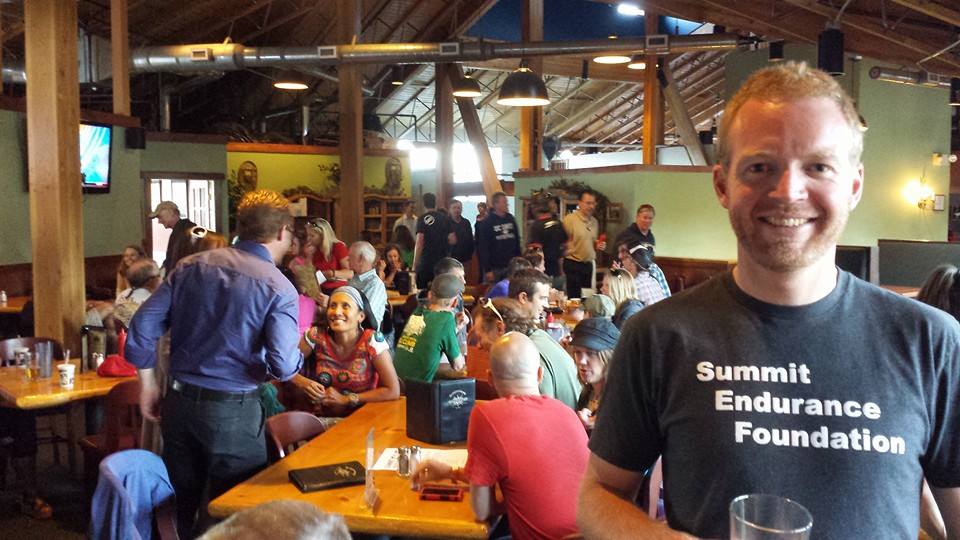
Joe Howdyshell (l) at the Summit Endurance Foundation Kickoff Party June 12 in Frisco, Colo. Howdyshell is the Foundation’s Executive Director and full-time fundraiser. (Photo: Kathryn Grohusky)
“I’ve been a part of several organizations where the parent volunteers are running the club. They work their butts off to make sure their bases are covered,” he said. “They just can’t possibly hope to have enough time to run an organization or fundraise enough to offer 100% scholarships and get equipment for low income families or to be able to send a small business owner’s kid to junior nationals.”
In order to combat the challenges clubs face when raising money, Howdyshell hatched a plan that involved the creation of a foundation that was not sport specific, but rather focused on fundraising for athletes that had one thing in common: endurance.
“Most places try to bring people together through a winter-sports club, and very few places have brought people together through endurance sports,” Howdyshell explained. “The athletes are more similar. Your summer mountain bikers are going to be much more similar to your winter cross country skiers. We think of it as trying to build a community of people who like to breath hard.”
While a small group of organizations, like the Summit Endurance Academy (owned and coached by Howdyshell) or the Bend Endurance Academy in Bend, Ore., have instituted a similar philosophy of creating a community of endurance sports, the emphasis has rarely been on fundraising, Howdyshell said.
The Summit Endurance Foundation aims to build a community of endurance athletes in the mountains of Colorado while also trying to ensure that anyone who wants to train and compete can do so without having to worry about finances.
The Foundation has a three-pronged approach in order to accomplish its goals. By having a full-time fundraiser in Howdyshell, the Foundation can hit a larger geographic area. While many clubs stick to their small communities, the Foundation has the resources to branch out and send Howdyshell to surrounding communities in Colorado and neighboring cities such as Denver.
The second unique aspect of the program offers is its ability to fundraise for a variety of sports that have much in common, rather than a single sport. The Foundation will focus on cross country skiing, distance running, distance biking, and ski mountaineering.
“There are more people who are interested in those sports: there is a bigger pool of donors, a bigger pool of grants, and a bigger pool of supporters in general.”
Finally, by focusing on fundraising the Summit Endurance Foundation can diversify it’s sources of revenue, Howdyshell explained. Traditionally, most clubs rely on a combination of events and grants. With the Foundation, he hopes to see revenue come in from such techniques, but also from corporate sponsorships and big-money investors.
“They [philanthropists] don’t want to give $25 dollars, they want to give $5,000 a year for five years because they believe in the cause,” he said.
By increasing it’s geographical footprint, increasing the fundraising scope by increasing support, and by having a diverse fundraising model the Summit Endurance Foundation believes that it can provide $150,000 in scholarships in the next three years.
Aside from its monetary goals, the Foundation hopes make sure that it can steadily increase participation in endurance programs.
Supporters of the Summit Endurance Foundation gather at the organizations kickoff event June 12 in Frisco, Colo. The event had over 75 attendees and raised over $2,000. (Photo: Matt Dunkerly)
“For the first three years the biggest goal is that no youth-endurance athlete misses an opportunity due to financial limitations. We want to see more kids getting into sports, excelling in these endurance sports. We want to develop the model, because there is not really anyone doing it this way.”
Once the model is developed Howdyshell sees the organization going in several possible directions. One direction would be to extend the scope of the Foundation to encompass the rest of Colorado. Another path the organization could take would be to focus on more athletes in Summit County and become the Summit Sports Foundation.
The need for an organization like the Summit Endurance Foundation highlights what many might consider a weakness in the American nordic-skiing community. With limited support from national organizations like USSA for smaller club programs, many have claimed that the lack of national financial support has made skiing a sport for society’s well-off.
The Summit Endurance Academy’s new financial model may be a future path for local clubs, with endurance sports joining forces to fund their athletes and rallying around their shared values.
“The athletes are different, the parents are different, the values are different [than other sports]. That’s not to say that either one of them is good or bad. They are just different,” Howdyshell said. “In my eyes it makes much more sense to align sports that are going to have the same participants and a lot of the same values through a local endurance foundation.”
Whether or not Howdyshell’s fundraising model will be a success remains to be seen. However, the Foundation has already had a promising start with its first event.
The Summit Endurance Foundation Community Kickoff Party, which took place June 12 in Frisco, Colo., had over 75 attendees and raised over $2,000 for the new organization. Money, however, was not the main goal of the event.
“Most importantly we wanted to develop this core group of supporters that can help us at events, who can talk us up to friends, and who can build our presence through the coming years,” Howdyshell said.
According to Howdyshell, the Summit Endurance Foundation hopes to fund over 200 athletes a year beginning in 2016.

 Do you know what a Growth Mindset is? How would you rate your growth mindset? Do you use it in all the areas in which you’re trying to grow?