Tag: Johan Olsson

  • Olsson, Jauhojärvi, Bauer Retire, Among Others

    Olsson, Jauhojärvi, Bauer Retire, Among Others

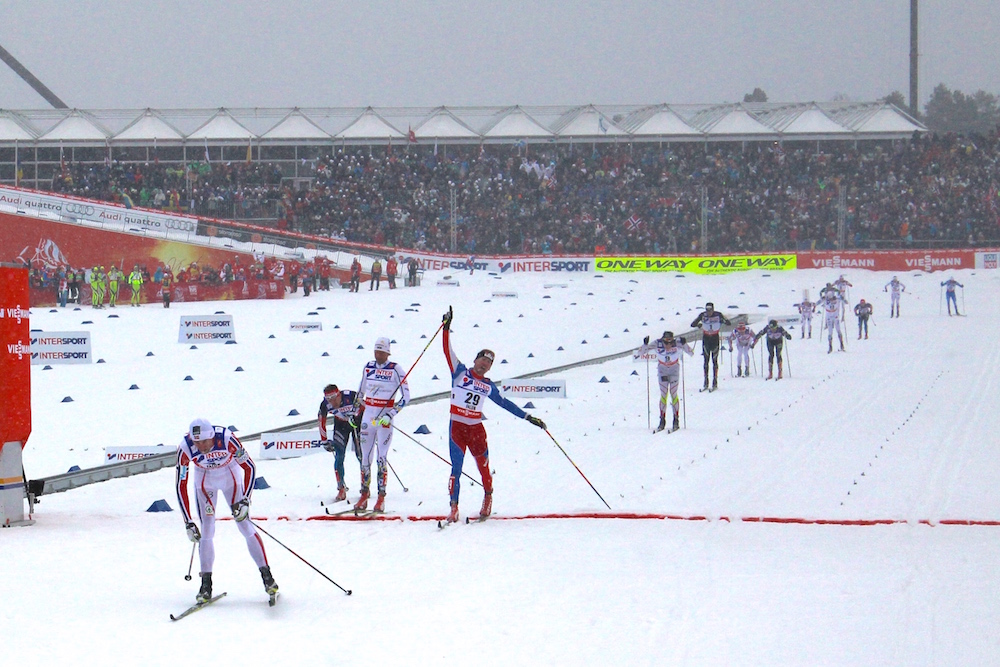
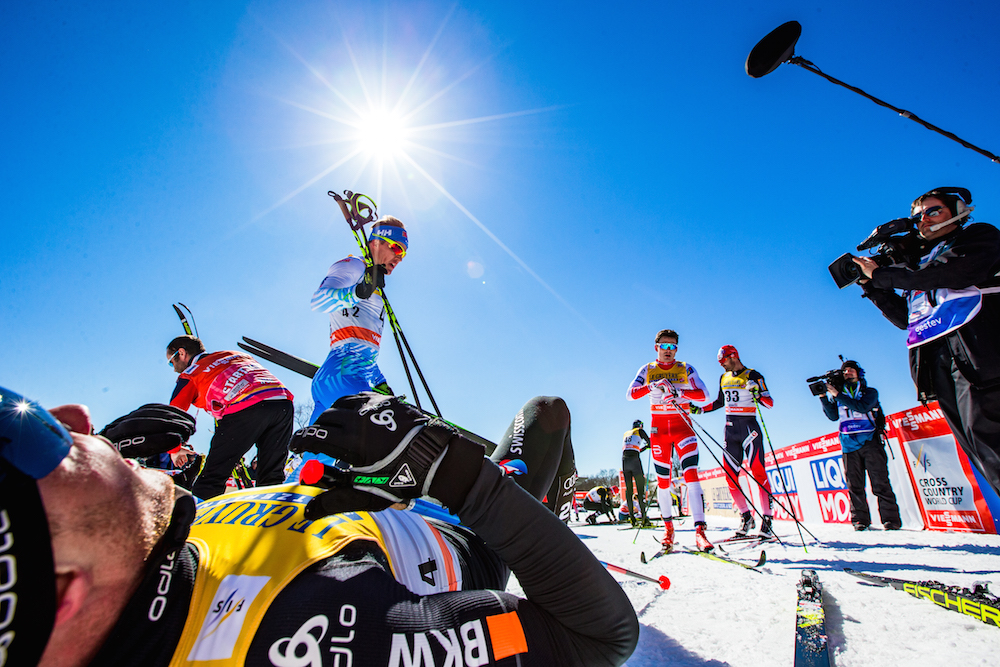
    Finland’s Sami Jauhojärvi (in blue and white) walking out of the finish area after the men’s 15 k classic mass start at World Cup Finals in Quebec City. Also pictured: Switzerland’s Dario Cologna (on the ground), and Norway’s Finn Hågen Krogh and Hans Christer Holund (33). Jauhojärvi finished 11th on the day and ultimately placed 16th overall in the World Cup Finals mini tour to end his World Cup career.

    Coming off the 2016/2017 season and less than a year out from the 2018 Winter Olympics in PyeongChang, South Korea, several international cross-country skiers and biathletes have announced their retirements. Among them are Sweden’s Johan Olsson, Finland’s Sami Jauhojärvi and the Czech Republic’s Lukáš Bauer, all of which earned medals at Olympics and/or World Championships.

    Sami Jauhojärvi
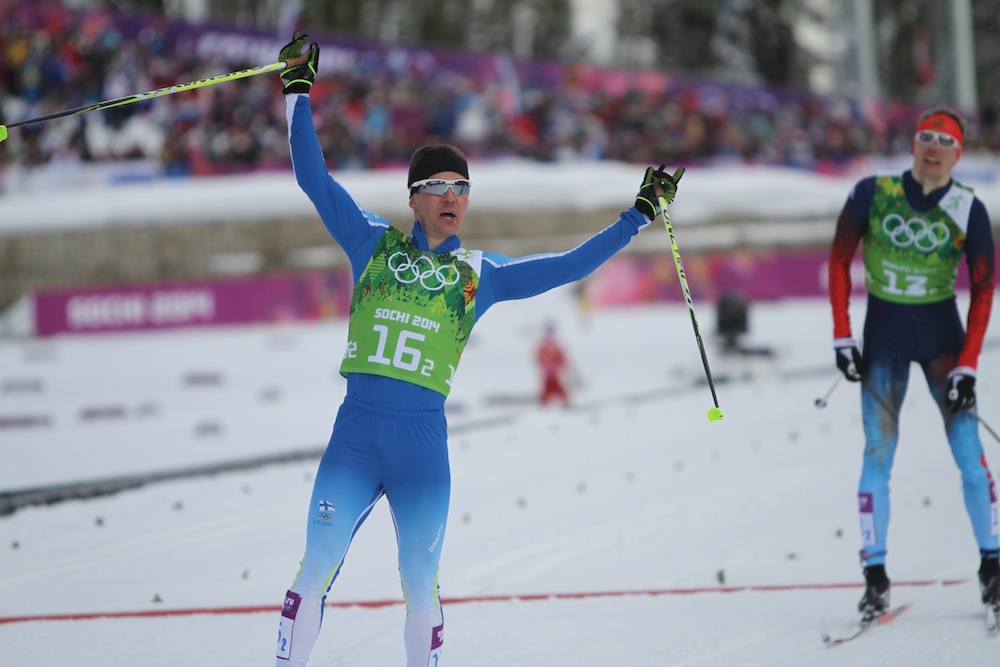
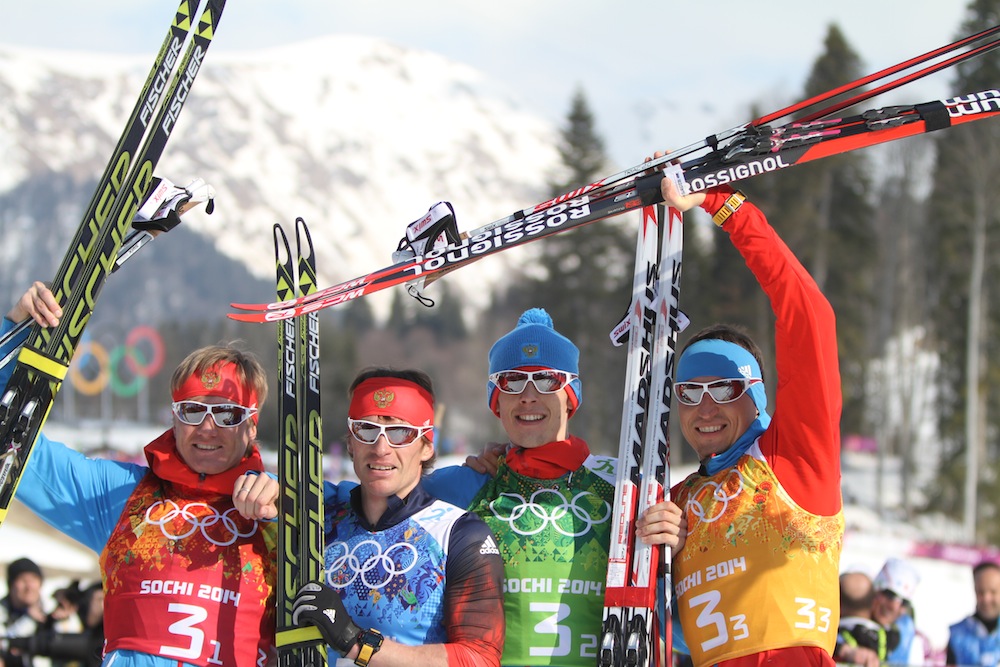
    Finland’s Sami Jauhojärvi anchors his team to gold in the men’s classic team sprint, ahead of Russia’s Nikita Kriukov, at the 2014 Sochi Olympics

    Earlier this month, Jauhojärvi, 35, publicly stated that he would be hanging up his race skis, ending his season with a third-place finish in the 50-kilometer freestyle at Finnish nationals.

    Jauhojärvi, who turns 36 in early May, competed at eight World Championships and three Olympics, winning gold with teammate Iivo Niskanen in the men’s classic team sprint at the 2014 Olympics in Sochi, Russia. He started racing World Cups 16 years ago, served on the athletes’ commission for the International Ski Federation (FIS) from 2009 to 2013 and racked up three bronze medals at World Championships. His latest bronze came in the classic team sprint (again with Niskanen) at this year’s 2017 World Championships at home in Lahti, Finland.

    “I’m not tired of skiing, but at some point it just happens that competitive instincts begin to fade,” Jauhojärvi told InsideTheGames. “By training I could be pushing my limits for a few more years, but my competition mind is done. … I do not think any more about fighting for gold medals at future Olympics.”

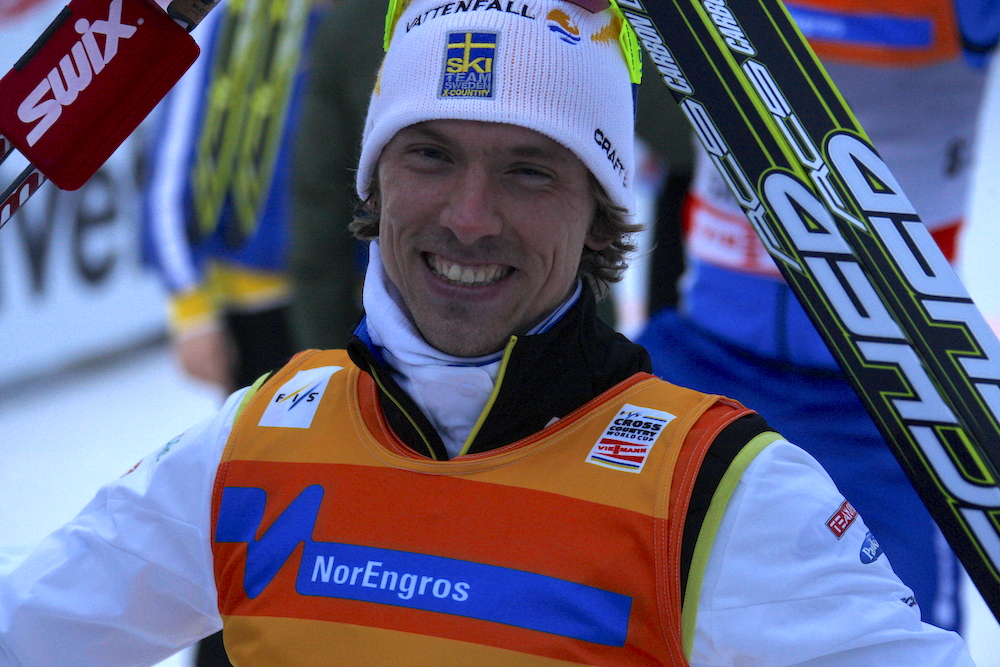
    Johan Olsson
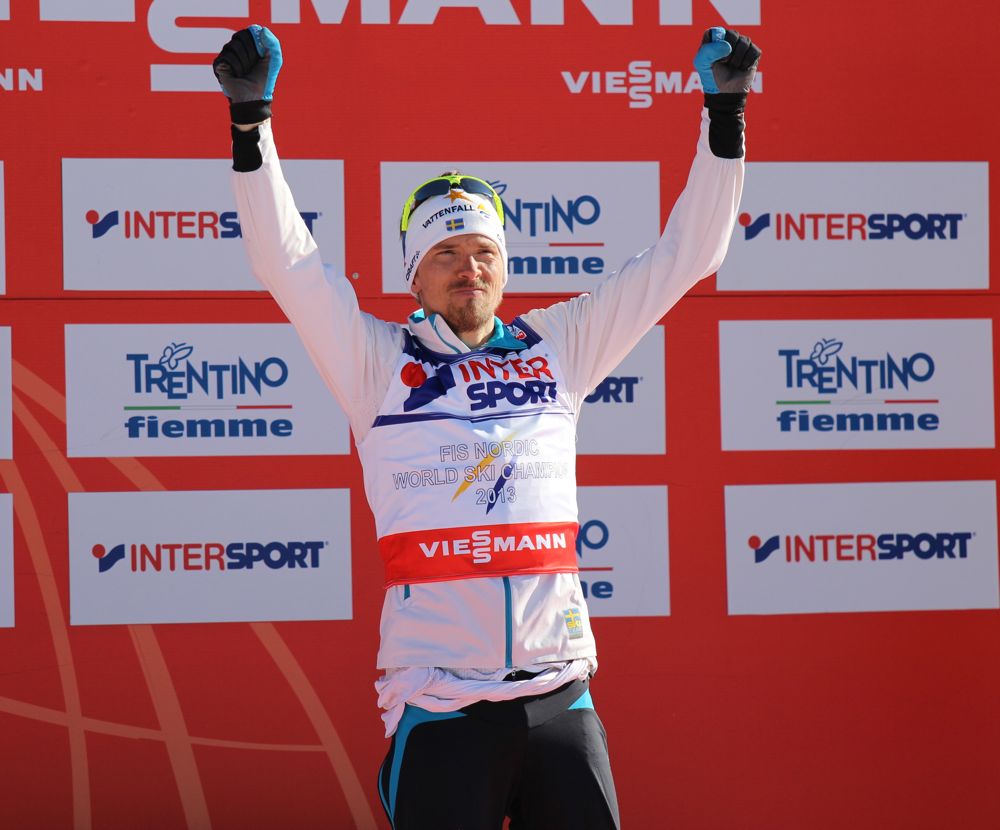
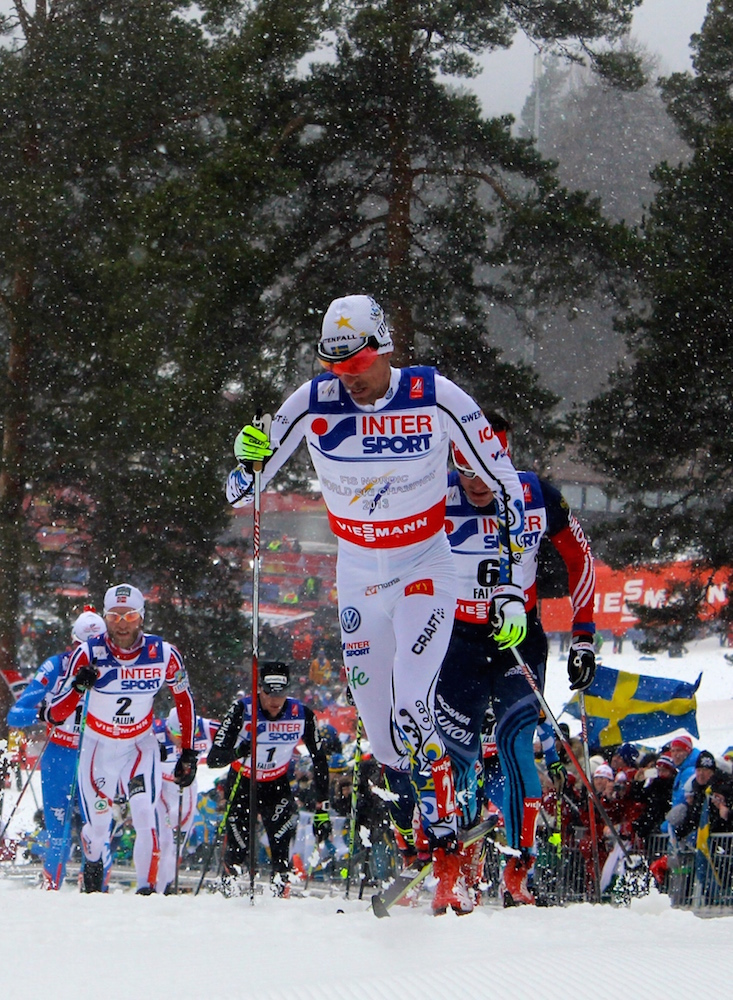
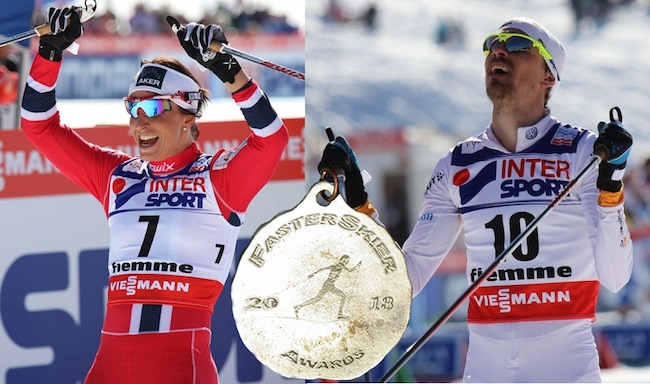
    Sweden’s Johan Olsson celebrating his first individual World Championships gold in the 50 k classic mass start in 2013 in Val di Fiemme, Italy.

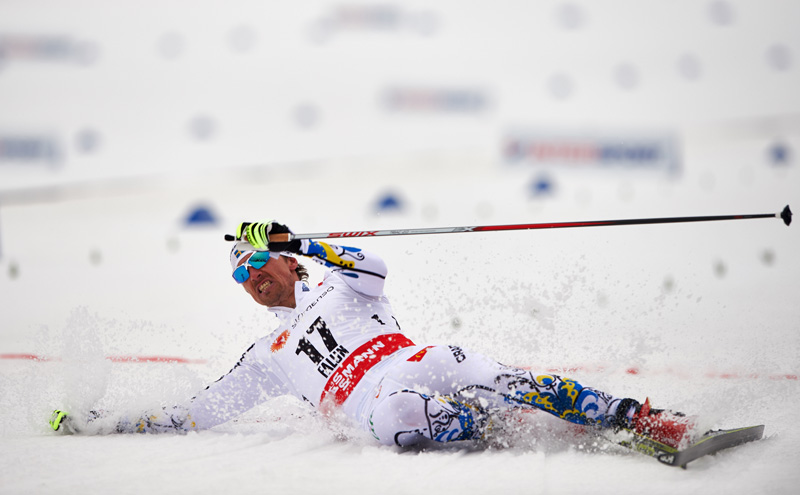
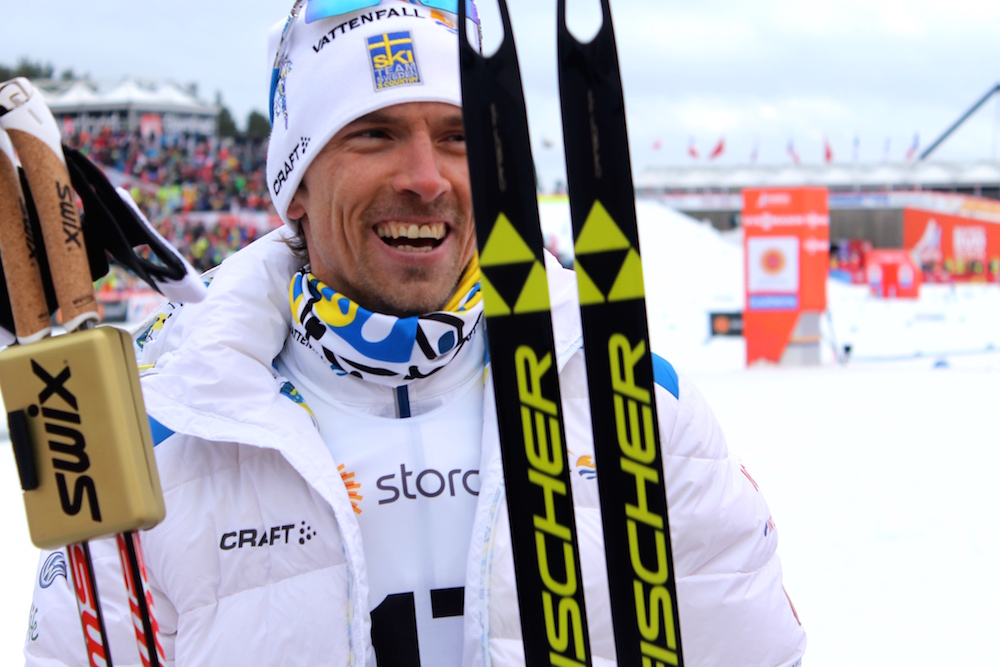
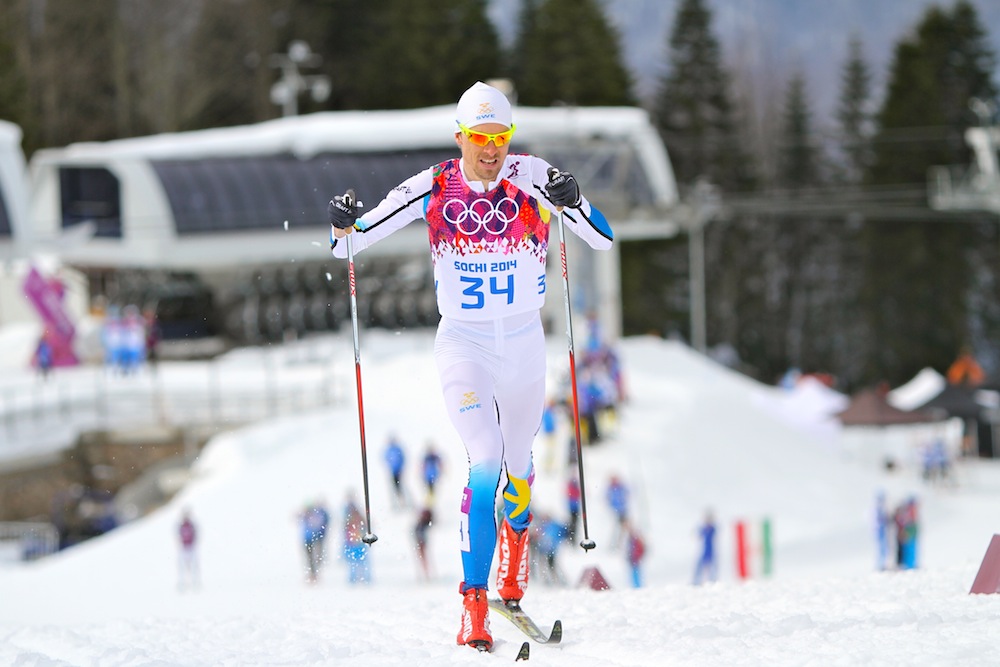
    Sweden’s 37-year-old Olsson, who has also spent the last 16 years on the circuit, is also calling it a career, according to FIS. He amassed 14 world championships-caliber medals (eight at World Championships medals and six at the Olympics), making him one of the most successful Swedish skiers of all time, behind Gunde Svan and Sixten Jernberg, who each tallied 17.

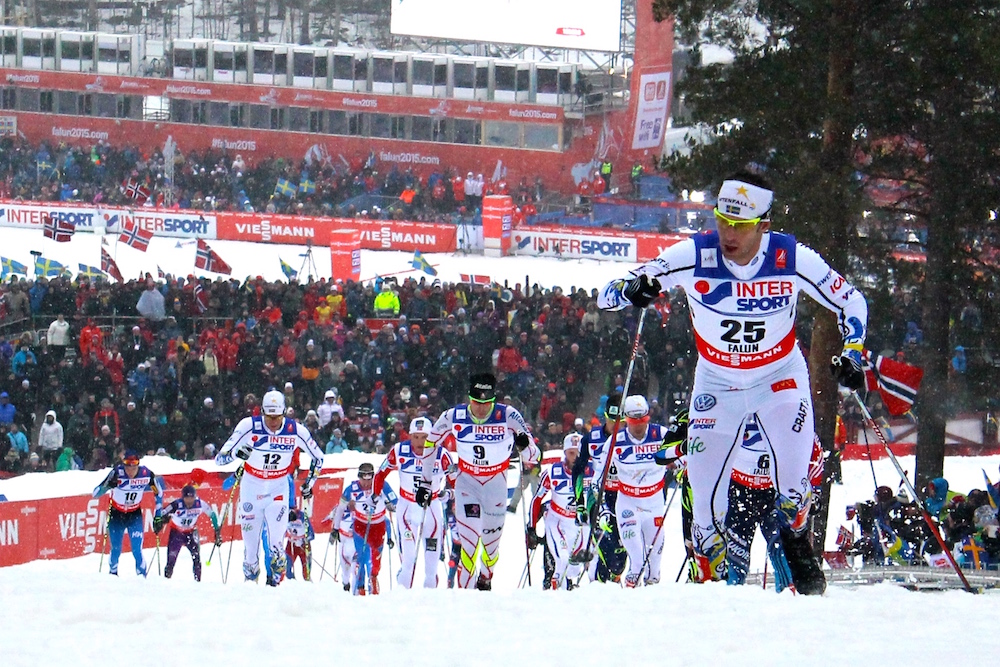
    Four of Olsson’s medals were gold: he was part of the Swedish men’s 4 x 10 k relay that won at both the 2010 Olympics in Vancouver, B.C., and 2014 Sochi Games. Individually, he won the 50 k classic mass start at 2013 World Championships and 15 k freestyle individual start at 2015 World Championships on home soil in Falun, Sweden.

    Olsson cited wanting to be more present for his family, which includes his two daughters (ages 5 and 2).

    “I have had an ambition to become the world’s best skier and have had the consequences for it,” he told Expressen, according to a loose translation. “… When that burden grows bigger than the joy to keep on, it’s time to stop.

    “I have spent 15 years trying to realize my sporting dreams,” he explained. “Now I will be able to realize completely different dreams, and I will be able to be a much more present dad.”

    Olsson has been working with Swedish public television, SVT, and has expressed his desire to stay involved with skiing to build interest in the sport.

    “The question is how to make me on television,” he said of his TV career. “My paradise at the end of a race has been to stand in the interview zone and chat most of all, even though I finished 35th. Would there be enough time on television?”

    Lukáš Bauer
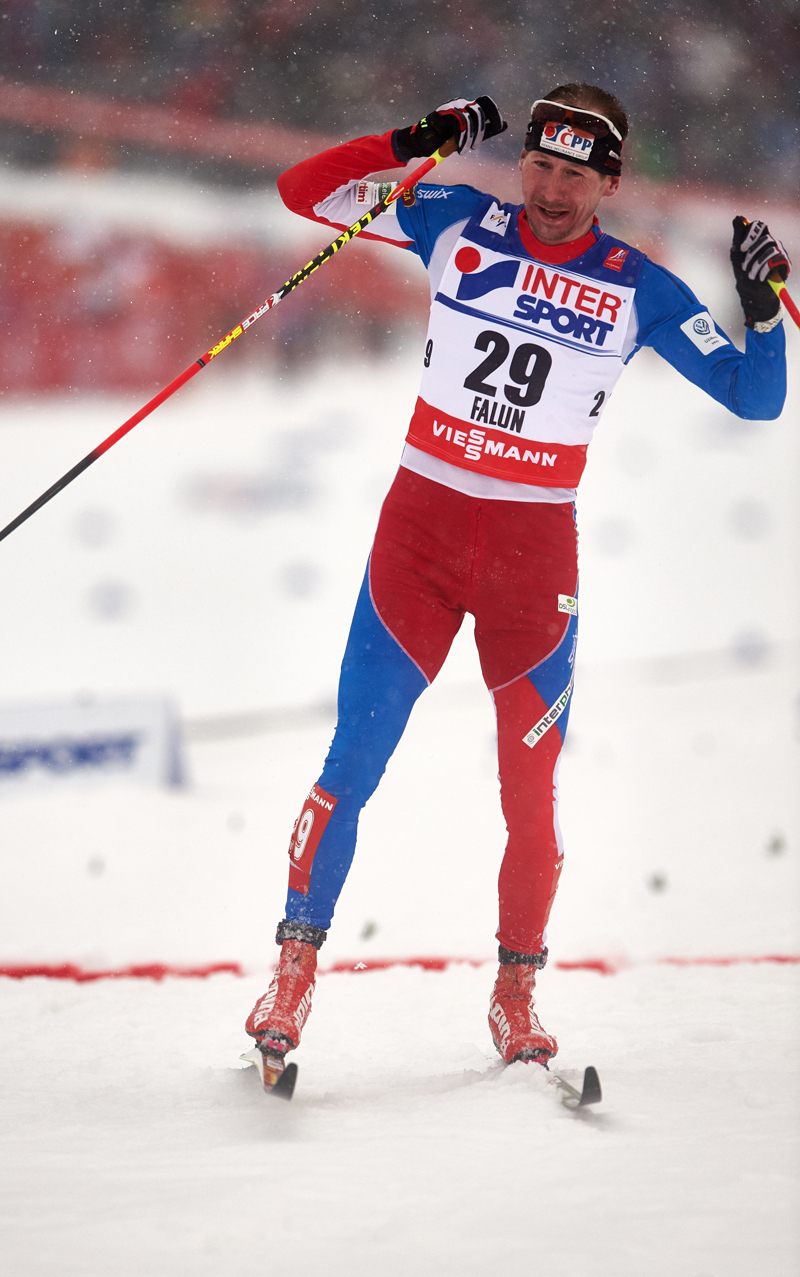
    Lukas Bauer celebrates silver in the 50 k classic at 2015 World Championships in Falun, Sweden. (Photo: Fischer/NordicFocus)

    Before the start of this past season, Bauer, 39, publicly stated it would be his last. But the decision became solidified after he finished 19th in the 15 k classic at 2017 Lahti World Championships.

    “A result that has disappointed me, after which I spent two and a half hours in the rain reminiscing of it,” he said, according to Neveitalia. “On other occasions I would have said, ‘I can redeem myself the next time,’ but not in this case because I just decided to quit.”

    He finished the season and his career out in the Lahti 4 x 10 k relay, in which the Czech men’s team placed 11th.

    The Czech Republic’s most successful cross-country skier, Bauer was the 2007/2008 Overall World Cup champion. He competed at five Olympics and 11 World Championships over 19 World Cup seasons, winning 18 World Cup races and the Tour de Ski twice, in 2008 and 2010. At the Olympics, he has a silver and two bronze medals. At World Championships, he is a two-time individual silver medalist — most recently placing second at 2015 Falun worlds in the 50 k classic mass start.

    Like Olsson, he also has two children.

    “I do not retire for a matter purely tied to my performance,” Bauer said. “If I wanted to prepare myself and I would be honored to participate in the upcoming Olympic Games, but the reality is I do not care. At home I have a wife and two children. It’s time to concentrate more on them than on sports goals. Without their support, I would never have obtained anything I collected in my career, to which I look with pride and satisfaction.”

    But he’s not completely done with skiing and plans to continue racing marathons.

    “Now I will focus on managing my team [Team Pioneer Investments] in long-distance races and I will also try to compete as much as possible, as long as the doctor will allow me,” Bauer said.

    Martin Johansson

    Sweden’s Martin Johansson, 32, is leaving elite skiing as a national A-team member who transitioned to cross-country in 2010. The move came after he won two gold medals at orienteering World Championships in 2009, but was seriously injured when he was impaled by a branch, according to Nordic Magazine. In six seasons thereafter, his career best in cross-country was fifth place in a 10 k freestyle in 2015 in Kuusamo, Finland, and he finished this year with a third-place finish in the 50 k freestyle at Swedish nationals, after which he announced his retirement on social media. Johansson competed at the last two World Championships.

    Fanny Horn Birkeland
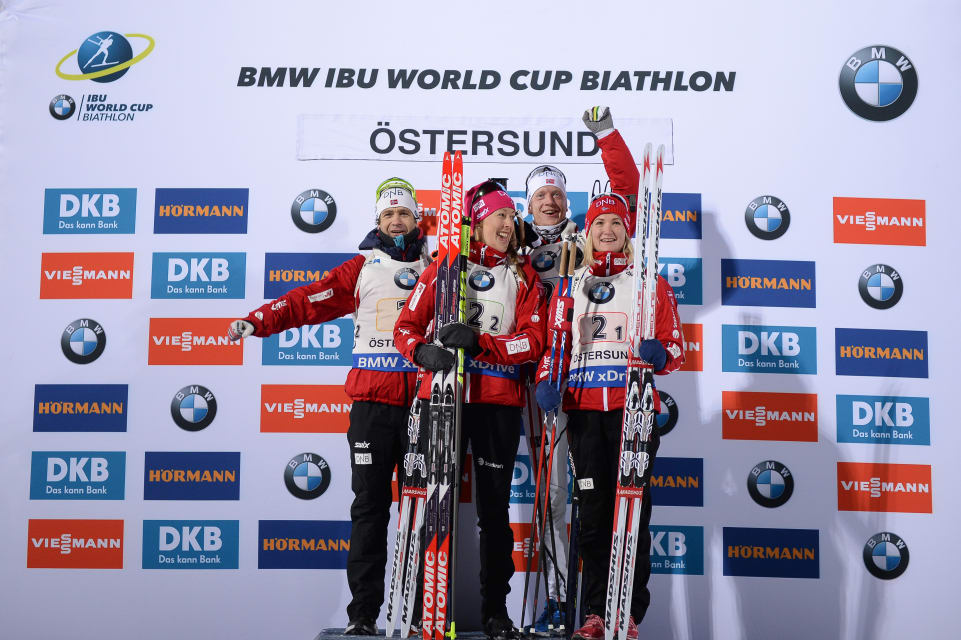
    (l-r) Norway’s Ole Einar Bjørndalen, Fanny Horn Birkeland, Johannes Thingnes Bø, and Marte Olsbu on the podium after winning the first race of the 2016/2017 biathlon World Cup season, a mixed relay in Ostersund, Sweden. (Photo: IBU)

    Norwegian biathlete Fanny Horn Birkeland announced her retirement during the last International Biathlon Union (IBU) World Cup weekend of the season. At 29, she has competed at the sport’s highest level for the last seven years, been on more than half a dozen winning relay teams, and won a 2015 World Cup sprint in Ruhpolding, Germany.

    “My plan was to go until the Olympics next year, but my form has not been so good,” Birkeland told the IBU. “I did everything to reach my goals, but still I had some trouble to make it to the top in my competitions. It is hard to put so much work into it every day and not get any results that I want. Twenty-nine is not so old, but I have been in this game for some time and it feels right now.

    “The highlight of my career was my win in the Ruhpolding sprint in 2015,” she added. “It was unreal … that was my day to get the opportunity to be on top of the podium. I wanted to do it again, but I never managed it.”

    Her husband, Lars Birkeland, also competes for the Norwegian biathlon team. “We helped each other a lot to get where we are now,” she said.

    Éva Tófalvi

    Romania’s Éva Tófalvi, 38, is also moving on from her career as a World Cup biathlete after competing at five Olympics, where her best result was 11th in a 15 k individual race at the 1998 Games in Nagano, Japan. She won an individual World Cup race during the 2008/2009 season after originally placing second (the winner, Russia’s Albina Akhatova, was disqualified for doping), making her the first Romanian biathlete to win a World Cup.
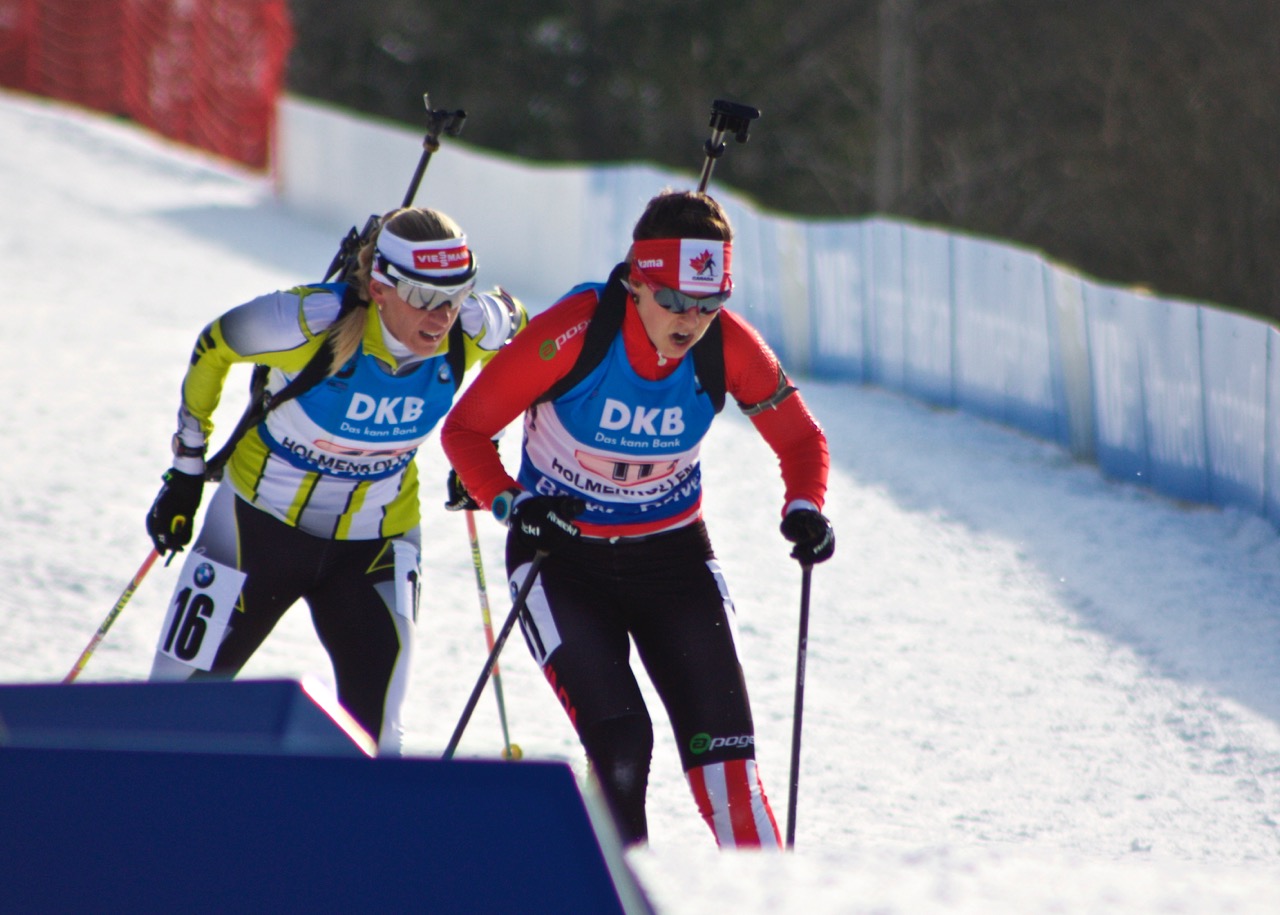
    Canada’s Julia Ransom (r) skiing with Romania’s Eva Tofalvi during the first leg of the 4 x 6 k relay at 2016 IBU World Championships in Oslo, Norway. (Photo: JoJo Baldus)

    In an interview with the IBU, Tófalvi said she wanted to wanted to focus on her personal life.

    “I am not a 100 percent sure, but I feel like it is the moment to settle down and start a family,” she said. “I know the Olympics are behind the corner, but I do not think I can invest the energy which is needed for such an event.

    “Winning World Cup is probably the most incredible memory I will ever carry,” she continued. “It is not just because of the win, but the work I know I had to put to get it. Even back then I did not have a real team behind me. My skis were not as good and I had no doctors, trainers and coaches with me like it was for bigger teams, like Norway. Winning in Hochfilzen was really special because of that, because it felt like a good prize for having had to work double as much as most to make up for what I couldn’t have.”

    Despite being left-handed, she had to learn to shoot using her right hand because Romania only had right-handed rifles.

    “In 20 years so much has changed in biathlon,” she said. “Now everything is much more professional and everyone is more focused on their careers. I think we were taking everything more lightheartedly back then. I now see girls that were born around the years I was making my debut in  he World Cup, and they are so determined that they achieve what before we would do at a much older age.”

  • Down to the Wire: Norwegian Men Win Lahti Relay with Russia Nipping at Their Heels

    Down to the Wire: Norwegian Men Win Lahti Relay with Russia Nipping at Their Heels

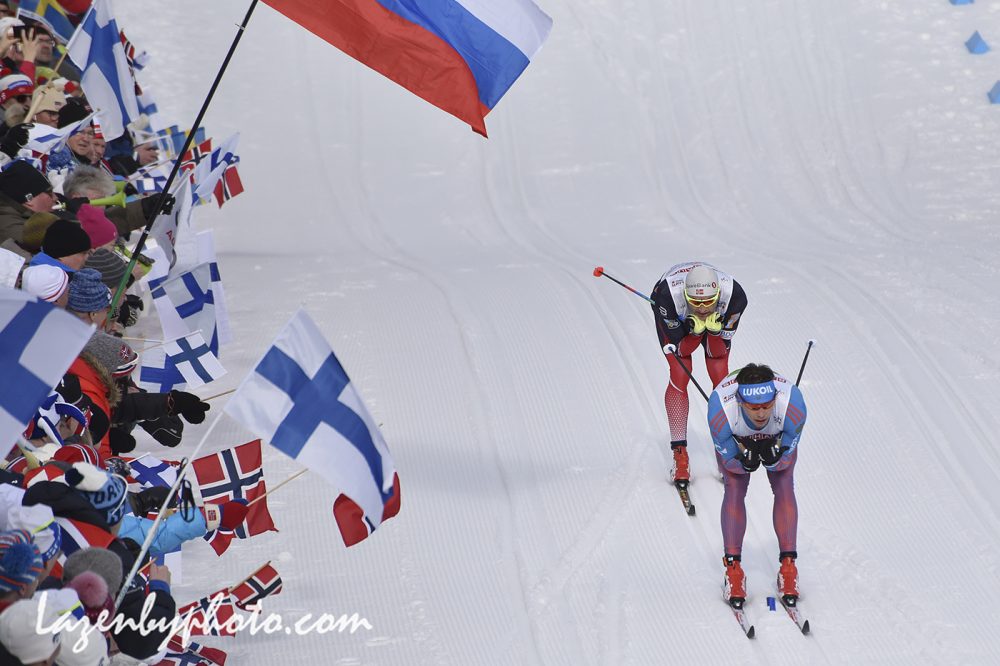
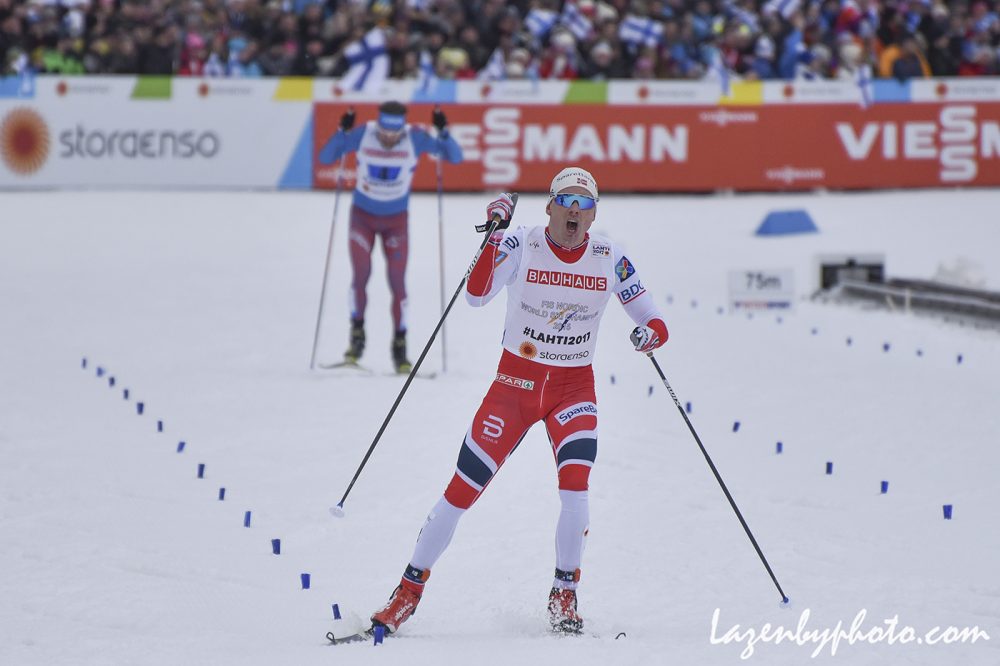
    Norway’s Finn Hågen Krogh with the victory stoke as he wins the 4 x 10 k relay at the 2017 Nordic World Championships in Lahti, Finland, by 4.6 seconds over Russia’s Sergey Ustiugov (behind). (Photo: John Lazenby/Lazenbyphoto.com)

    LAHTI, Finland — There were three medals up for grabs during Friday’s 4 x 10-kilometer relay at 2017 Nordic World Championships on Friday. Yet after the scramble leg, two distinct races: Norway and Russia’s dance for gold, and what eventually became a four-way tango between Finland, Sweden, Switzerland, and Germany for bronze and silver.

    Russia’s Andrey Larkov and Norway’s Didrik Tønseth first strung out and then smoked the field late in their leg. By the tag to their second-leg skiers, Norway and Russia were twenty seconds up.

    Russia’s Alexander Bessmertnykh leads Norway’s Niklas Dyrhaug as they sustain the break during the second leg of the 4 x 10 k relay at the 2017 Nordic World Championships in Lahti, Finland. (Photo: John Lazenby/Lazenbyphoto.com)

    That margin grew to thirty seconds, as Russia’s Alexander Bessmertnykh and Niklas Dyrhaug finished Leg 2 and the transition to skating began.

    Coming in just a half a minute later in third place, was Finland’s Iivo Niskanen, giving the fans a premature taste of the podium.

    Racing the third leg was Norwegian Martin Johnsrud Sundby. Russia tried to match the Norway’s trump card with Alexey Chervotkin. The 21-year-old Chervotkin skied the third leg for Russia in both team relays that took place this season: the first in Nove Mesto, Czech Republic, the other in La Clusaz, France, where the team placed second both times to Norway.

    However, the World Championship leg was the first time Chervotkin matched up against Sundby this year.

    Late in the leg, it was unclear what Sundby’s strategy would be as the young Russian shadowed the 32-year-old Sundby move for move. With Sergey Ustiugov up for the Russians in the anchor leg against Norway’s Finn Hågen Krogh, many armchair-relay strategists would have thought the Norwegian’s line up ploy was a dud.

    Not until 1.2 kilometers left in the leg did Sundby make a sufficient gap. At that point, the time spread from silver to gold was only eleven seconds. Not exactly a huge buffer for Krogh.

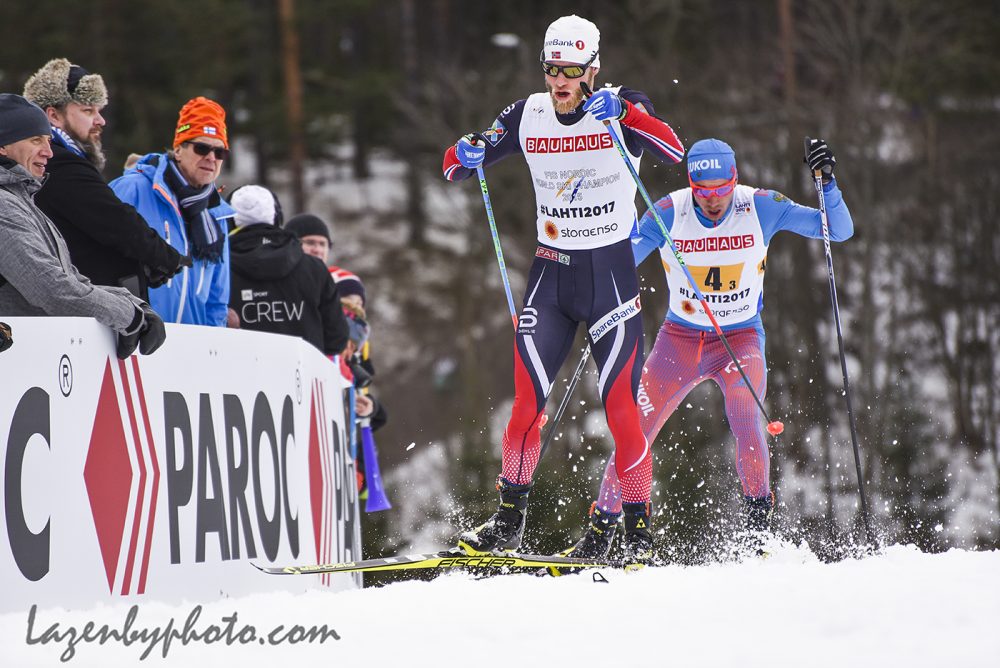
    Norway’s Martin Johnsrud Sundby, marked by Russia’s Alexey Chervotkin (4), during a critical third leg of the 4 x 10 k relay at the 2017 Nordic World Championships in Lahti, Finland. (Photo: John Lazenby/lazenbyphoto.com)

    By Sundby’s tag to the anchor skier, he had gifted Krogh a 17.7-second margin for error. The rhetorical question at the start of the fourth leg: when will Ustiugov catch Krogh?

    “He’s the worst the worst guy you can have in back of you,” Krogh said during a press conference, referring to Ustiugov. “He made the race tough for me.”
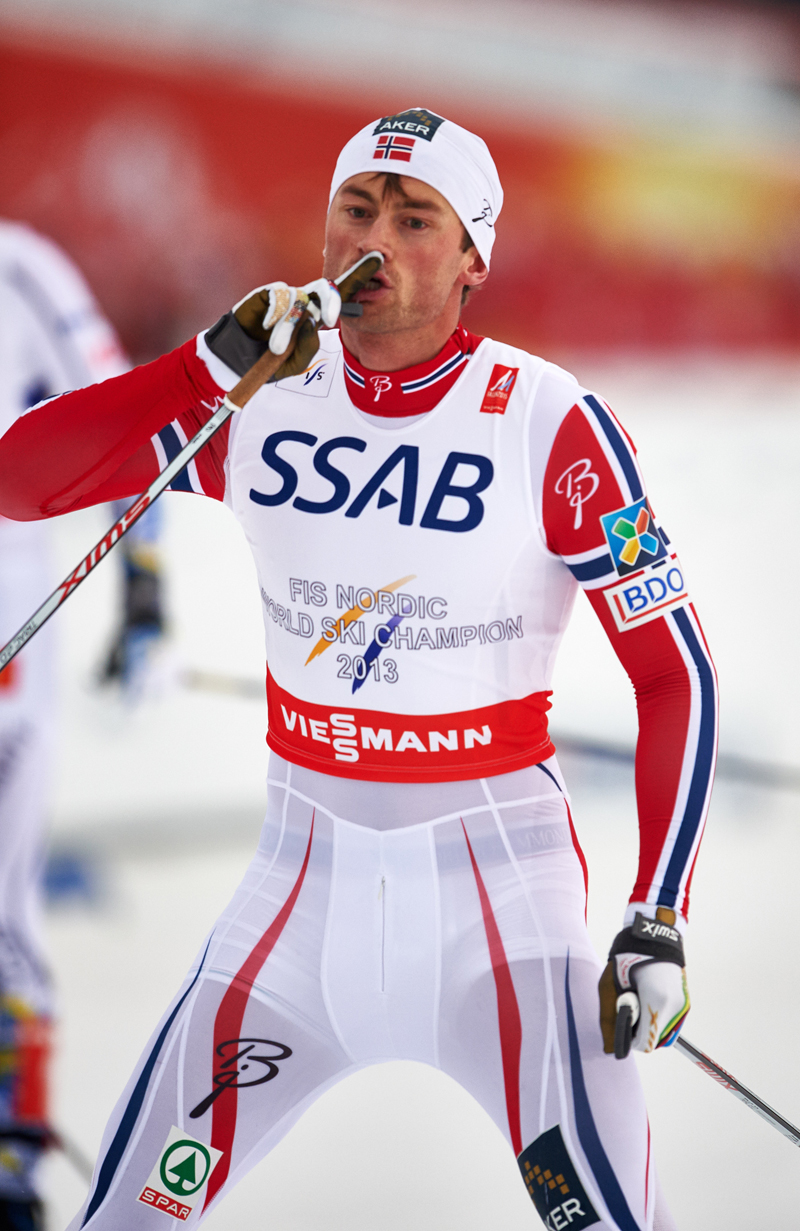
    At 1.3 k into that fourth leg, Ustiugov was 8.8 seconds back. In another 1.2 kilometers, it ballooned again to 11.6 seconds, and then it contracted again to 5 seconds with 3.8 k to go. But until the finishing stretch, when Krogh rounded the final turn with a 100-meter lead on the Russian, was Norway a sure win.

    Krogh crossed first in a time of 1:37:20.1 hours for the ninth-consecutive Norwegian championship 4 x 10 k relay gold. Finishing 4.6 seconds later in second place was Russia’s Ustiugov.

    “It’s not just for us, it’s the whole team,” Sundby said during a press conference of their ninth world-champs relay gold. “It’s for the waxers, it’s for the trainers. When you go the relay for the Norwegian team, you feel you’re going for your country. So it’s a massive victory for us.”
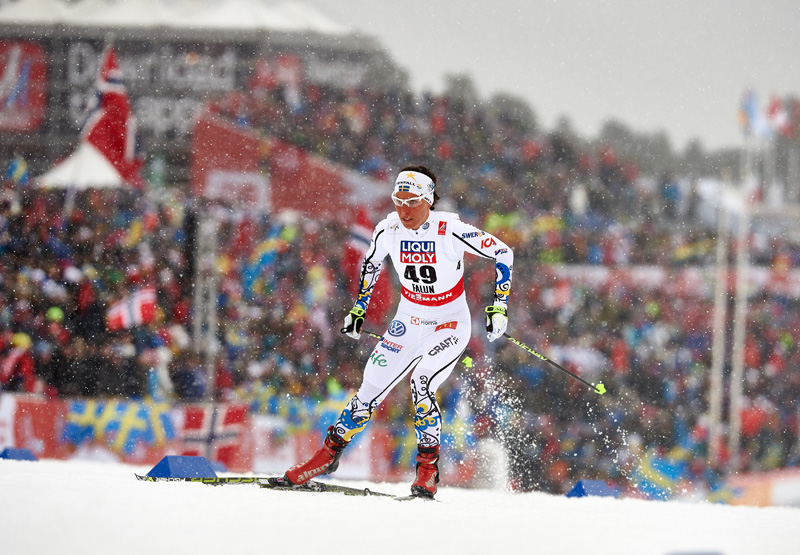
    What kept the capacity crowd engaged was not so much the battle for gold and silver, but the fate of the on-again, off-again Finns.

    Let’s back up to when Niskanen tagged off to Finnish skier Lari Lehtonen for the first freestyle leg. At that point, the Finns were in third, a solid 15 seconds ahead of France in fourth place, 32 seconds ahead of Switzerland in fifth, roughly 55 seconds ahead of Germany in sixth, and almost a minute ahead of Sweden in seventh.

    We are individual athletes, and you have to focus on your own leg,” Sweden’s Johan Olsson said after the race. “Both me and Daniel [Rickardsson] thought the medal chance was over when we had done two legs.”

    The first sign that something was awry for the Finns was a restless home crowd. What may have been perceived as a plush-time cushion for Lehtonen was in fact cardboard thin.

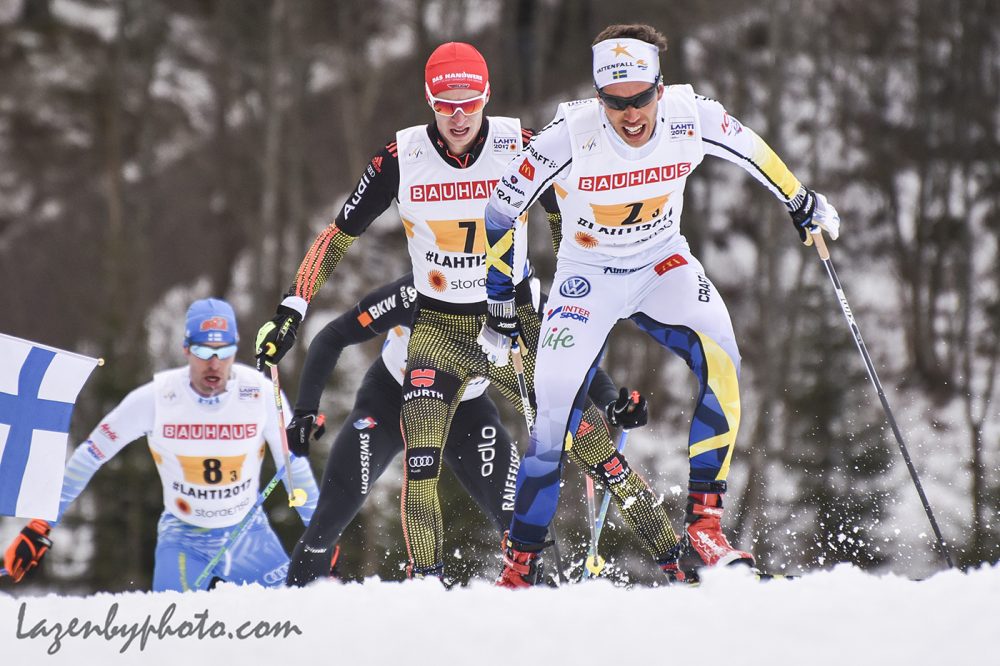
    Sweden’s Marcus Hellner (r) leads Germany’s Florian Notz (7), Switzerland’s Dario Cologna (behind Notz), and Finland’s Lari Lehtonen (8) during the men’s 4 x 10 k relay at the 2017 Nordic World Championships on Friday in Lahti, Finland. (Photo: John Lazenby/Lazenbyphoto.com)

    Sweden’s Marcus Hellner and Switzerland’s Dario Cologna were on the hunt. Seemingly an afterthought, Hellner skied the fastest third leg, animating the race for bronze by pulling Sweden back into contention.

    These four teams — Finland, Germany, Switzerland, and Sweden — stuck together through the exchange into the fourth leg until the last headwall climb, called Indian Hill.

    It was then that Finland’s Matti Heikkinen hop-stepped around Germany and Switzerland, bringing Sweden’s Calle Halfvarsson with him.

    “I know that Matti will go on the last uphill and it was good game for me to go after him,” Halfvarsson said during the press conference.

    The two appeared to have dropped Switzerland’s Curdin Perl, until Perl miraculously slotted behind the Finn-Swede duo. Finland entered the final 100-meter stretch in a sprint for bronze.

    One errant pole plant as Heikkinen ramped up his gear, causing him to fall to the ground was Finland’s loss and Sweden’s gain. Halfvarsson crossed third for Sweden (+2:31.8) and Perl fourth for Switzerland (+2:32), and Finland ultimately crossed fifth (+2:42.4).

    (Story continues below)

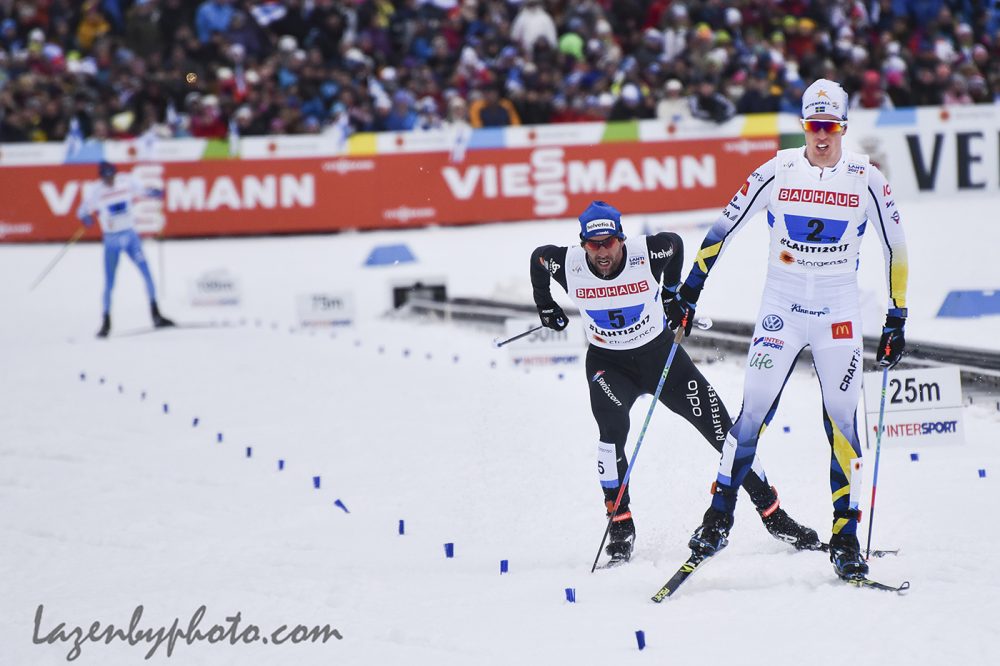
    Sweden’s Calle Halfvarsson (2) crossing the line in third place, ahead of Switzerland’s Curdin Perl (5) in fourth at the finish of the men’s 4 x 10 k relay at the 2017 Nordic World Championships in Lahti, Finland. Finland’s Matti Heikkinen (far left) is seen after righting himself due to a errant pole plant. (Photo: John Lazenby/Lazenbyphoto.com)

    The U.S. fielded a team comprised of Kyle Bratrud, Erik Bjornsen, Tad Elliott, and Simi Hamilton. Bratrud scrambled the first classic leg for the Americans, handing off to Bjornsen in 11th, 1:28.2 minutes behind the leader.

    “I was definitely more nervous for this one because I was starting,” Bratrud said afterward.

    While this is the second World Championships for Bratrud, a 24-year-old member of the Central Cross Country (CXC) Team, Friday was the first time he raced the scramble leg in a relay — he raced the third leg for the U.S. in the 2015 world champs 4 x 10 k relay in Falun, Sweden. Though he eventually lost contact with the front group, Bratrud was happy he was able to hold on for as long as he did, even if it caused him a yellow card for a technique violation.

    “It was nice to at least see the front before they really picked up the pace,” Bratrud said.

    “Props to Kyle on the yellow card,” Elliott wrote in an email. “Scrappy out there.”

    Tad Elliott racing the third leg of the U.S. men’s 4 x 10 k relay at the 2017 Nordic World Championships on Friday in Lahti, Finland. (Photo: John Lazenby/Lazenbyphoto.com)

    While Bratrud had company for approximately one lap, Bjornsen raced completely alone.

    “It’s not the position you necessarily want to be in, but took it for what it was worth and tried to charge up to the group in front of me, which was [the Czech Republic’s Lukas] Bauer and [Germany’s Jonas Dobler],” Bjornsen said.

    “But I mean…they were moving fast,” the 25-year-old U.S. Ski Team member added. “I tried to mentally just keep pushing, but it’s tough to be out there by yourself. I felt pretty good, it’s just a different type of race.”

    Bjornsen tagged to Elliott, for the Americans’ first freestyle leg. He skied the eighth-fastest third leg, 1:47 behind Hellner.

    “I was also getting great splits from the coaches on making ground on the group in front of me,” Elliott wrote.”I wanted to catch them, I just didn’t really get there for Simi to save it all for his sprint. Simi skied one hell of a leg.”

    Elliott handed off to Hamilton, the anchor leg for the U.S.

    “By the time he tagged off to me, I think I was 10 or 15 seconds from [the Czech Republic, Kazakhstan and Italian teams],” Hamilton recalled. “They fortunately started pretty conservatively, which was nice for me.”

    Those three teams were in fact 16 seconds ahead of Hamilton. He eventually closed that distance, putting the U.S. in contention for a top 10.

    “I wanted to start fast and see if I could make up some time on them,” Hamilton siad. “And I did, I ended up catching them by the top of the climb after the tunnel. So I was psyched about that.”

    However, when Hamilton came through for his fourth and final lap, the hill-laden course had taken a toll on his legs. He finished in 10th (+5:31.3), just half a second ahead of the Czech Republic’s Petr Knop in 11th (+5:31.8).

    Canada’s Alex Harvey racing the third leg of the men’s 4 x 10 k relay at the 2017 Nordic World Championships on Friday in Lahti, Finland. (Photo: John Lazenby/Lazenbyphoto.com)

    “That last lap my legs were definitely feeling it a little bit and those guys are all really good climbers,” Hamilton said. “I couldn’t quite make the moves that I wanted to in the last kilometer because I was a little whupped by then … but I was still able to pick off Czech Republic at the finish. Maybe not the best day for us, but still a day that we were fighting.”

    Canada’s team of Graeme Killick, Devon Kershaw, Alex Harvey and Lenny Valjas finished 12th, after being lapped and thus pulled from the race on Valjas’s final leg.

    In January of this year, Canada raced to a historic third place at the Ulricehamn World Cup relay in Sweden.

    “It just wasn’t our day,” said a dignified Valjas after Friday’s relay. “We’re all in shape, it’s just none of us were on our A-game today and that’s what it takes to be fighting in this.”

    Results

    — Harald Zimmer and Chelsea Little contributed

    Erik Bjornsen (U.S. Ski Team) racing the second leg of the men’s 4 x 10-kilometer relay at the 2017 Nordic World Championships on Friday in Lahti, Finland. (Photo: John Lazenby/Lazenbyphoto.com)
  • Friday Rundown: Bailey 2nd in PyeongChang; Lahti Relay & NoCo Team Sprint (Updated)

    Friday Rundown: Bailey 2nd in PyeongChang; Lahti Relay & NoCo Team Sprint (Updated)

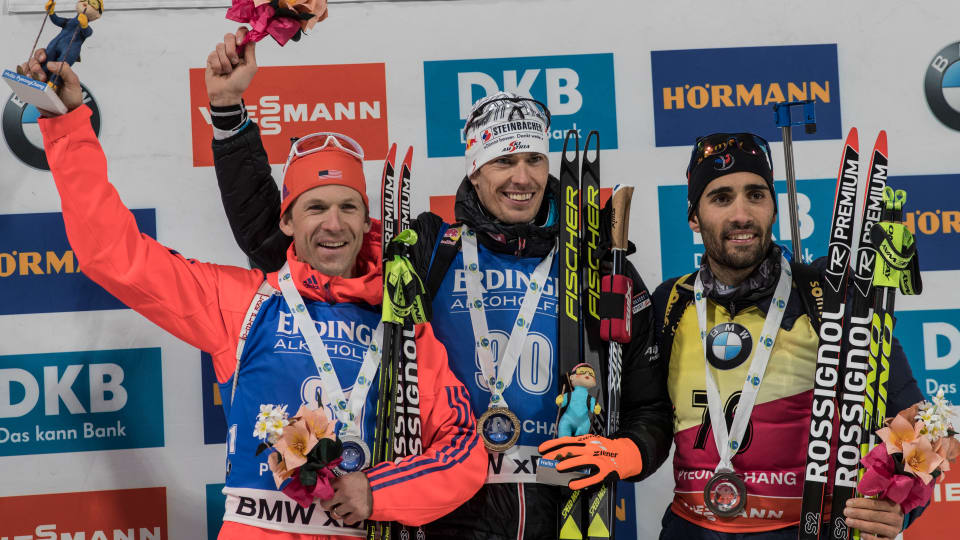
    The men’s 10 k sprint podium at Friday’s IBU World Cup in PyeongChang, South Korea, with Austria’s Julian Eberhard (c) in first, American Lowell Bailey (l) in second, and France’s Martin Fourcade (r) in third. (Photo: IBU)

    IBU World Cup (PyeongChang, South Korea): Men’s 10 k sprint

    US Biathlon’s Lowell Bailey kept his clean-shooting streak alive with another one of his personal best results on Friday, racing to second in the men’s 10-kilometer sprint at the International Biathlon Union (IBU) World Cup in PyeongChang, South Korea.

    Bailey started 81st and hit all 10 targets in the two-stage race to cross the finish line in first, 4.7 seconds ahead of France’s Martin Fourcade, who locked up the 2016/2017 overall World Cup title with an eventual third-place finish on Friday.

    An even later starter in bib 90, Austria’s Julian Eberhard rocketed to his third-career World Cup victory (and second win this season), cleaning both stages and topping Bailey’s time by 40.7 seconds. That bumped Bailey to second place and Fourcade to third, for Bailey’s second World Cup podium this season (including his win in the 20 k individual at IBU World Championships).

    In the last five non-relay races, including four at World Championships, Bailey has not placed outside the top six. And in all of those races, he’s only had one miss.

    Bailey is up to ninth in the World Cup Total Score standings. Fourcade ran away with the season-long title in first, now that he’s 360 points ahead of Russia’s Anton Shipulin in second.

    While Eberhard and Bailey shot clean on Friday, Fourcade missed two — one on each stage (1+1) — but made up for it with the fastest course time. Eberhard had the second-fastest course time and fastest shooting time of the 102-man field.

    Austria nearly had two on the podium with Dominik Landertinger finishing fourth (+48.1), 2.7 seconds out of third, with clean shooting.

    Three Canadians finished in the top 60 to qualify for Saturday’s pursuit, with Scott Gow in 27th (+1:40.3) with two penalties (1+1), Brendan Green following in 28th (+1:42.1) with one miss (0+1) for his first individual top 30 of the season, and Christian Gow in 56th (+2.33.6) with two prone penalties (2+0). Nathan Smith finished 88th (+3:32.5) with two standing misses (0+2) in his first World Cup race since early December, and Macx Davies finished 98th (+4:20.2) with four penalties (3+1).

    For the U.S., Leif Nordgren placed 37th (+2:03.7) with two misses (1+1) to qualify for the pursuit, along with Bailey. Sean Doherty was 80th (+3:13.3) with two penalties (1+1) and Paul Schommer 101st (+4:38.1) with five misses (3+2).

    Results

    ***

    FIS Nordic World Championships (Lahti, Finland): Nordic Combined 2 x 7.5 k team sprint

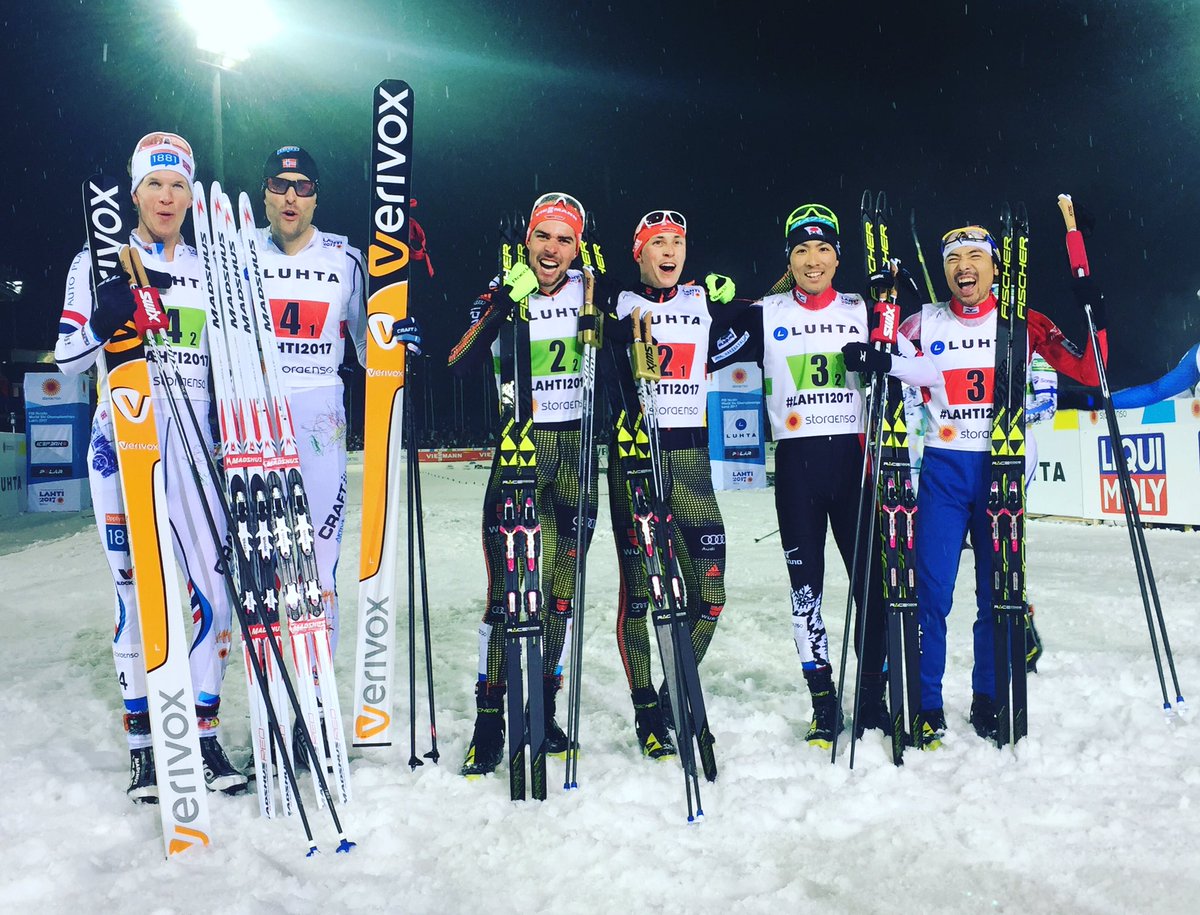
    The nordic combined 2 x 7.5 k team sprint podium on Friday at 2017 Nordic World Championships in Lahti, Finland, with Germany’s Johannes Rydzek and Eric Frenzel in first (c), Norway’s Magnus Moan and Magnus Krog in second (l) and Japan’s Yoshito and Akito Watabe in third (r). (Photo: FIS Nordic Combined/Twitter)

    [UPDATED] Johannes Rydzek and Team Germany completed the World Championships sweep on Friday, with Rydzek teaming up with Eric Frenzel to win the final nordic-combined competition of 2017 Nordic World Championships in Lahti, Finland: the 2 x 7.5-kilometer team sprint.

    Rydzek won all four NoCo competitions over the past week, including two individual events and two team events.

    On Friday, he and Frenzel, the defending World Cup champion, jumped to second and started the 2 x 7.5 k cross-country race 16 seconds behind France’s Maxime Laheurte and François Braud, who jumped to first. The Frenchmen both posted jumps of 125 meters for a total of 264.2 points. Frenzel and Rydzek, meanwhile, scored 256.1 points after jumps of 125.5 and 122 meters.

    The Germans pulled off a 1-second win over Norway, finishing in 28:45.8 minutes, while Norway’s Magnus Moan and Magnus Krog claimed silver after starting the ski race in fourth, 24 seconds behind France. Together, the Norwegians posted the fastest course time, and Moan skied the fastest 7.5 k (13:53).

    “It’s still unbelievable,” Rydzek told German broadcaster ARD. “The race today was so suspenseful again, down to the last curve with the lapped athlete [Russia]. I knew that I am very fast on the homestretch, and had explicitly looked at that section before the race. Eric did a great job today, and despite all circumstances pointing against us we managed to do it again today. Just cool to be back on the top of the podium with Eric.”

    Just a couple hundred meters before the finish, Rydzek used the moment when they approached the lapped Russian athlete to slingshot between him and Krog and gained a decisive edge.

    “I was scared of that situation with the lapped athlete, because that was really close,” Frenzel told ARD. “I thought, ‘What is he doing out there?’ But in the end you can rely on Johannes to solve that like a world champion, that was top.

    “We knew ahead of time that Lahti suits us well, that we can be good here if the conditions work out,” he added. “So we are very happy to be able to go home with so many medals.”

    Japan took the final spot on the podium after brothers Yoshito and Akito Watabe jumped to third, started 18 seconds after France, and held their position to finish for third place, 10.2 seconds after Germany.

    Austria’s Wilhelm Denifl and Bernhard Gruber missed bronze by half a second in fourth (+10.7) after starting in fifth, and France ended up fifth (+11.5).

    Nearly a minute later, Italy placed sixth (+1:10.6) and Finland seventh (+1:10.7). The Czech Republic followed in eighth (+1:26.4), and the U.S. was ninth (+1:48.1) with Bryan and Taylor Fletcher after starting 12th and 2:08 out of first. The Fletcher brothers recorded the second-fastest course time out of 14 teams.

    “Taylor did a good job stepping up in competition and it gave me motivation to step up as well,” Bryan said, according to a U.S. Ski Team press release. “Unfortunately I wanted it a little too much and didn’t have the jump I am capable of.

    “The races went well but we were just too far back,” he continued. “We had the second fastest time as a team overall, which is solid and continually shows our strength on that side of the sport.”

    Final results | Jumping

    ***

    FIS Nordic World Championships (Lahti, Finland): Men’s 4 x 10 k relay

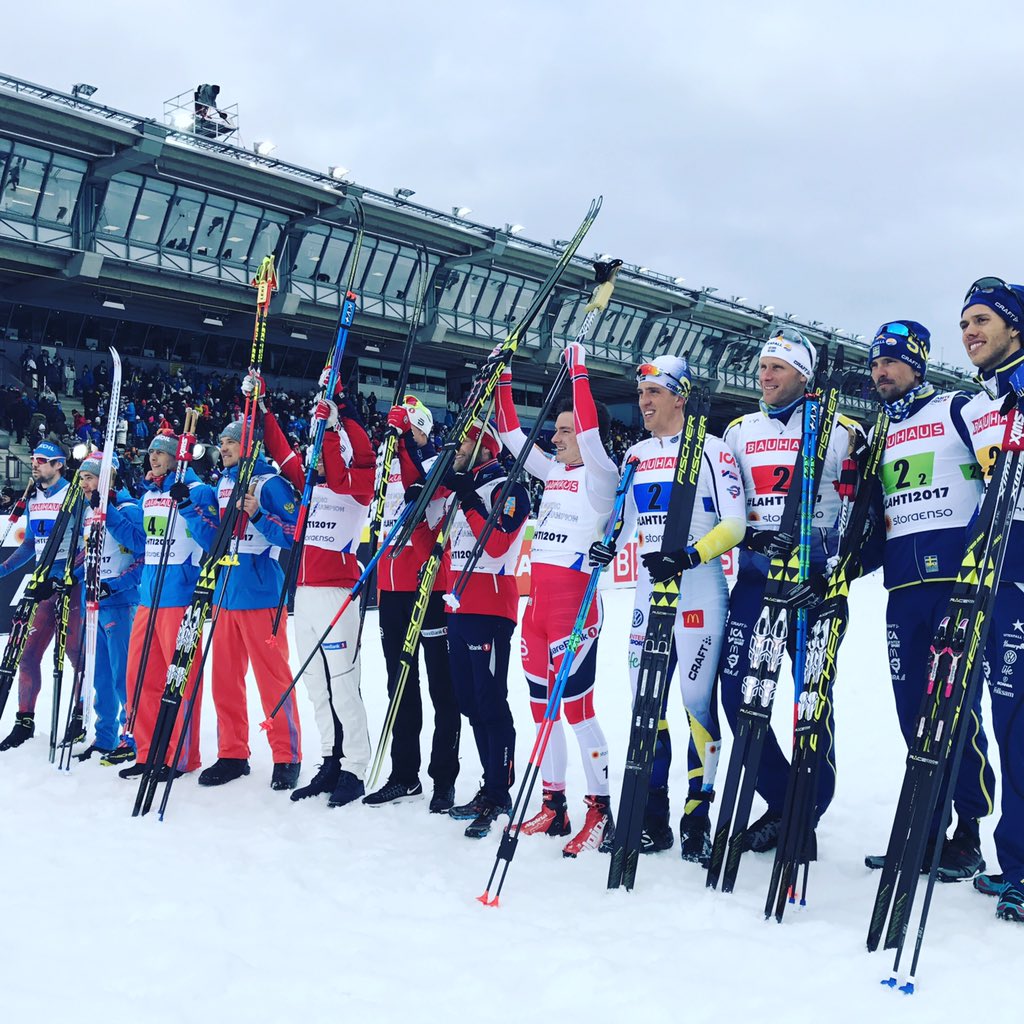
    The men’s 4 x 10 k relay podium at 2017 Nordic World Championships, with Norway (c) in first, Russia (l) in second, and Sweden (r) in third. (Photo: FIS Cross-Country/Twitter)

    The men’s 4 x 10-kilometer relay as the last team event of 2017 Nordic World Championships came down to a two-way battle for gold between none other than Norway and Russia on Friday in Lahti, Finland,

    The two teams skied in either first or second throughout the four-leg race, with Russia’s Andrey Larkov tagging Alexander Bessmertnykh 2.9 seconds ahead of Norway’s first leg Didrik Tønseth, then Bessmertnykh coming through the second exchange just half a second ahead of Norway’s Niklas Dyrhaug.

    Behind them, Finland skied alone in third place at the race’s halfway point, but was ultimately swallowed by the chase pack on the third leg.

    On that third leg, Norway’s Martin Johnsrud Sundby worked hard to drop Russia’s Alexey Chervotkin, and eventually did so, coming through the final exchange 17.7 seconds ahead. That gave Norway’s anchor Finn Hågen Krogh just enough of a gap on Russia’s Sergey Ustiugov, and he was able to hold off Ustiugov by 4.6 seconds at the finish to give Norway the gold in 1:37:20.1 hours.

    Russia claimed silver and Sweden outlasted Switzerland for bronze after Calle Halfvarsson attacked in the final kilometer to drop Finland’s Matti Heikkinen and Germany’s Lucas Bögl. Halfvarsson finished 2:31.8 minutes out of first, and just 0.2 seconds ahead of Switzerland’s Curdin Perl for third place for Sweden (which included teammates Daniel Rickardsson, Johan Olsson and Marcus Hellner).

    Switzerland was fourth (+2:32) with Jason Rueesch, Jonas Baumann, Dario Cologna and Perl, Finland fifth (+2:42.4) with Sami Jauhojärvi, Niskanen, Lari Lehtonen, and Heikkinen, and Germany sixth (+2:42.8) with Thomas Bing, Jonas Dobler, Florian Notz, and Bögl.

    France finished seventh (+3:52), Italy eighth (+5:29.8), Kazakhstan ninth (+5:30.6), and the U.S. 10th (+5:31.3). The U.S. team (Kyle Bratrud, Erik Bjornsen, Tad Elliott, Simi Hamilton) skied in 11th for most of the race before Hamilton moved them up to 10th with the sixth-fastest anchor leg.

    Canada (Graeme Killick, Devon Kershaw, Alex Harvey, Len Valjas) ended up 12th after being lapped on the last leg. In 14th at the first exchange, Kershaw moved them up to 13th, then Harvey put them in 12th with one leg to go.

    Results

  • Under 23 Questions with Paddy Caldwell

    American Paddy Caldwell (SMS/USST) racing to 20th in the men's classic sprint qualifier on Tuesday at U23 World Championships at Soldier Hollow in Midway, Utah. He went on to place fourth in his quarterfinal for 18th overall, his best sprint result at U23 Worlds. (Photo: FlyingPointRoad.com)
    American Paddy Caldwell (SMS/USST) racing to 20th in the men’s classic sprint qualifier on Tuesday at U23 World Championships at Soldier Hollow in Midway, Utah. He went on to place fourth in his quarterfinal for 18th overall, his best sprint result at U23 Worlds. (Photo: FlyingPointRoad.com)

    In an effort to showcase the North Americans competing at this week’s International Ski Federation (FIS) 2017 USANA Nordic Junior World Championships and U23 Cross Country World Championships at Soldier Hollow in Midway, Utah, we asked those qualifying athletes several questions about themselves — actually, we had them fill in the blanks. Here we have 22-year-old Paddy Caldwell, of the Stratton Mountain School (SMS) Elite Team/U.S. Ski Team D-team, representing the U.S. at his third U23 Worlds.

    On Thursday, Caldwell raced to a career-best ninth in the men’s 15 k freestyle, his first top 10 at U23 Worlds. He finished 18th in Tuesday’s classic sprint for his best-ever sprint at U23s.

    ***

    “My full name is Patrick Fitzgerald Waters Caldwell, but you can call me Paddy. I was born in Lebanon, N.H., raised in Lyme, N.H., and one thing you should know about my hometown is it was founded in 1761.

    I started cross-country skiing when I was two or three, thanks to Mom and Dad. I currently train in Stratton, Vt., with SMS Elite Team.

    Paddy Caldwell (20), of the Stratton Mountain School and U.S. Ski Team D-team, racing in the quarterfinals men's classic sprint at 2017 U23 World Championships on Tuesday at Soldier Hollow in Midway, Utah. He finished 18th on the day for his best sprint result in three U23 Worlds. (Photo: FlyingPointRoad.com)
    Paddy Caldwell (20), of the Stratton Mountain School and U.S. Ski Team D-team, racing in the quarterfinals men’s classic sprint at 2017 U23 World Championships on Tuesday at Soldier Hollow in Midway, Utah. He finished 18th on the day for his best sprint result in three U23 Worlds. (Photo: FlyingPointRoad.com)

    If I’m not skiing, you might find me studying at Dartmouth College. If I had to pick a favorite book, it would be ‘Unbroken.’

    One of the things I’m most excited about for U23/Junior Worlds at Soldier Hollow is the new courses at SoHo. One race I’m especially targeting there is the 30km Skiathlon.

    The best advice anyone ever gave me about skiing or racing was ‘you gotta love it!’

    One of the best race memories I have is the mixed Biathlon/ Cross Country, Men/Women team relay in Seefeld, Austria.

    If I could meet one World Cup skier, it would be Johan Olsson.

    If I don’t end up being a professional skier, I’ll probably still be chasing snow.

    I’m missing zero days of school to be here…

    You can follow me on Instagram @paddy_caldwell.”

  • Sunday Rundown: Ulricehamn, Antholz, Chaux-Neuve, Whistler, & Truckee (Updated x3)

    Sunday Rundown: Ulricehamn, Antholz, Chaux-Neuve, Whistler, & Truckee (Updated x3)

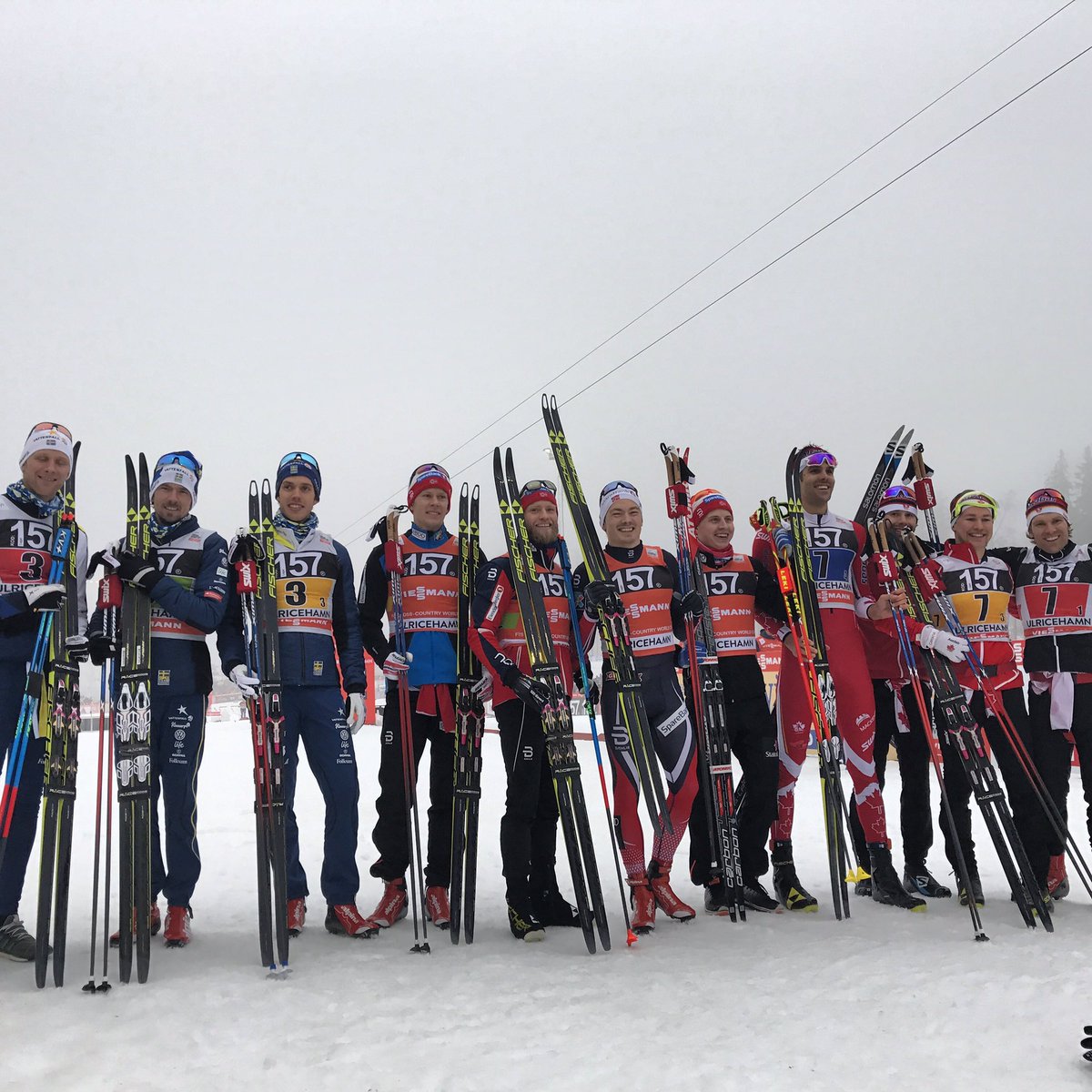
    The men's 4 x 7.5 k relay podium at the World Cup in Ulricehamn, Sweden, with Norway (c) in first, Sweden (l) in second, and Canada (r) with with its best-ever men's relay in third. (Photo: FIS Cross Country/Twitter)
    The men’s 4 x 7.5 k relay podium at the World Cup in Ulricehamn, Sweden, with Norway (c) in first, Sweden (l) in second, and Canada (r) with with its best-ever men’s relay in third. (Photo: FIS Cross Country/Twitter)

    FIS Cross-Country World Cup (Ulricehamn, Sweden): 4 x 5 k and 4 x 7.5 k Relays

    Men’s report | Women’s report

    Norway notched back-to-back team victories in the women’s and men’s relays on Sunday at the World Cup in Ulricehamn, Sweden, with Finn Hågen Krogh securing a win in the men’s 4 x 7.5 k relay by 0.5 seconds over Sweden’s Calle Halfvarsson and Canada’s Lenny Valjas. With two kilometers remaining, nine teams were within 3.8 seconds of first. Krogh outlasted both Halfvarsson and Valjas in the finishing stretch, as Sweden placed second and Canada third for its best-ever relay result, according to a Cross Country Canada press release, besting its fifth-place finish from 2012 (with then-anchor Ivan Babikov, now a Canadian World Cup coach).

    Krogh teamed up with Simen Hegstad Krüger, Martin Johnsrud Sundby and Anders Gløersen and finished in 1:06:47.5, while Sweden placed second with Daniel Rickardsson, Johan Olsson, Marcus Hellner, and Halfvarsson.

    For Canada, with Devon Kershaw, Alex Harvey, Knute Johnsgaard, and Valjas, it was Harvey’s third-straight World Cup podium, Valjas’s second-straight team-event podium, and national U25 Team member Johnsgaard’s first podium.

    “I have been waiting my whole career for this,” Kershaw said, according to a FIS press release. “All the guys did a great job today.”

    The U.S. placed 10th (+1:16.5) with Andy Newell, Erik Bjornsen, Noah Hoffman, and Simi Hamilton.

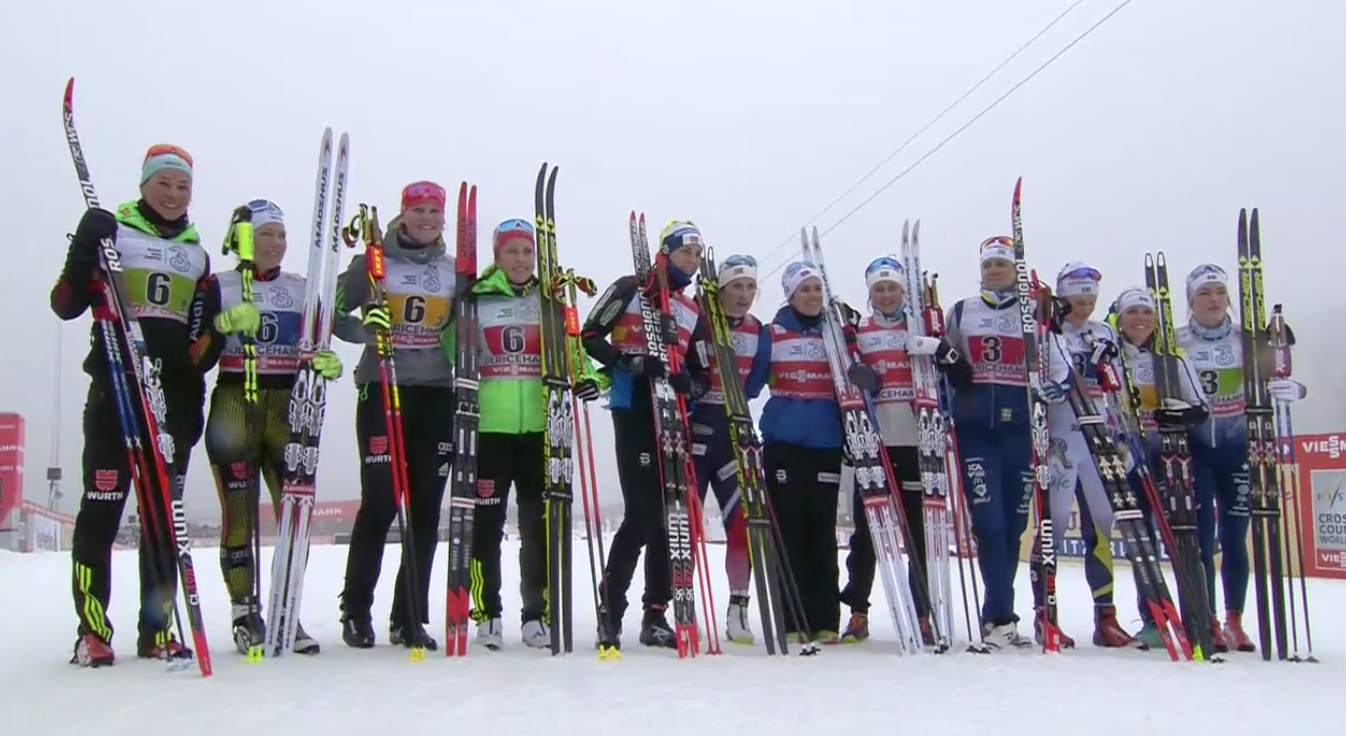
    The Norwegian women's team (center) won the 4 x 5 k World Cup cross-country relay in Ulricehamn, Sweden, by 8.8 seconds over Germany (left), with home team Sweden (right) edging the United States for third.
    The Norwegian women’s team (center) won the 4 x 5 k World Cup cross-country relay in Ulricehamn, Sweden, by 8.8 seconds over Germany (left), with home team Sweden (right) edging the United States for third.

    Earlier on Sunday, the women’s 4 x 5 k relay didn’t break apart until the second leg, but Norway still proved its dominance over the ski world with a win to start the day.

    After the group of Ingvild Flugstad Østberg and Lotta Udnes Weng (Norway), Ida Ingemarsdotter (Sweden), and Anamarija Lampic (Slovenia) more or less stayed together on the first relay leg, Heidi Weng made a break for it, giving Norway a 16.8-second lead at the second tag. The Norwegian team never looked back and after the race Weng and teammates Østberg, Astrid Jacobsen, and Marit Bjørgen were able to climb to the top step of the podium.

    The race for second place, though, wasn’t resolved until the finish line. Sweden, Slovenia, Norway’s second team, the United States, and Germany were all in contention at various points in the race.

    On the last leg, Jessie Diggins of the U.S., Sandra Ringwald of Germany, and Hanna Falk of Sweden battled it out, dropping Kari Øyre Slind of Norway. The three shot to the finish line together, with Diggins stuck behind the other two. Ringwald eventually won the sprint finish by 0.2 seconds over Falk, with Diggins another 0.2 seconds back in fourth.

    That gave Ringwald, Katharina HennigStefanie Boehler, and Victoria Carl a second-place result, one of Germany’s best since taking silver at the 2010 Olympics. (The team won bronze at the 2014 Olympics.)

    Ingemarsdotter, Falk, Charlotte Kalla, and Sofia Henriksson took the third step of the podium. Rosie BrennanSadie BjornsenLiz Stephen, and Diggins were left to settle for fourth.

    The second U.S. team, of Kikkan RandallIda SargentSophie Caldwell, and SuperTour leader Liz Guiney finished 12th after skiing in 8th and 9th earlier in the race.

    Results: MenWomen

    ***

    IBU World Cup (Antholz, Italy): Men’s mass start and women’s relay

    Men’s mass start reportWomen’s relay report

    ***

    NorAm Western Canadian Championships (Whistler, B.C.): Relays

    [UPDATED] This season brought a changeup to the Western Canadian Championships with a three-person relay event in response to athletes’ request to add “fun” events to the NorAm series.

    While 146 teams finished in 17 categories, it was Ontario winning the open men’s 3 x 7.5 k in 50:32.9 (Bob Thompson, Jack Carlyle and Andy Shields) and B.C. dominating the open women’s 3 x 5 k in 41:09.47 with three juniors (Katie Weaver, Anna Goodwin and Hannah Mehain).

    The masters men and juvenile girls categories included the most teams, with 15 and 14, respectively.

    Results


    FIS Nordic Combined World Cup (Chaux-Neuve, France): Individual large hill/10 k

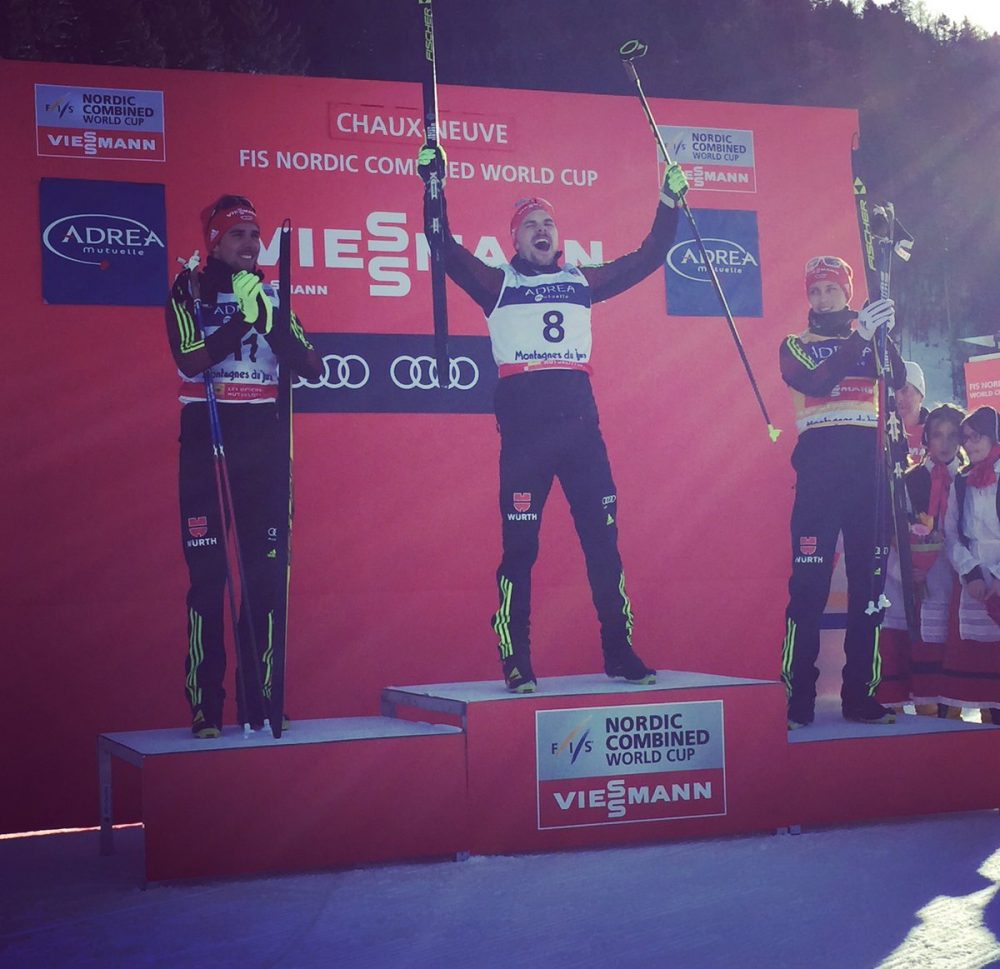
    Sunday's Nordic Combined World Cup podium in Chaux-Neuve, France, with German winner Fabian Rießle (c), German runner-up Johannes Rydzek (l), and Germany's Eric Frenzel (r) in third. (Photo: FIS Nordic Combined/Twitter)
    Sunday’s Nordic Combined World Cup podium in Chaux-Neuve, France, with German winner Fabian Rießle (c), German runner-up Johannes Rydzek (l), and Germany’s Eric Frenzel (r) in third. (Photo: FIS Nordic Combined/Twitter)

    On Sunday, after the large hill jump and 10 k ski, Germany swept the podium in the second event of the NoCo World Cup in Chaux-Neuve, France. Fabian Rießle placed first in 22:44, and his German teammates Johannes Rydzek skied to second only 2.2 seconds back, and Saturday’s winner Eric Frenzel was third (+7.9).

    (Frenzel leads the NoCo World Cup, Rydzek is second overall, Rießle is third.)

    Norway’s Jarl Magnus Riiber flew the farthest with 139.8 points. Franz-Josef Rehrl from Austria jumped to second with 135.7 points while his teammate Bernhard Gruber jumped to third with 131.7 points.

    Magnus faded to 23rd (+47.5) in the 10 k ski. Rehrl started 15 seconds back from Magnus and placed 17th overall (+31.5). Gruber maintained a top-ten, placing 9th (+13.5), after starting 32 seconds behind first place jumper Magnus.

    While the top three jumpers all dropped back in the ski, it was a day of catch up for the German’s after the jumping portion.

    Rießle ranked eigth after the jump and earned 128.7 points, he began the ski 0:44 back. Rydzek placed 11th in the jump with 126.9 points, while Frenzel jumped to fourth with 131.4 points.

    The only U.S. skier entered in Sunday’s event was Ben Berend. The U.S. Nordic Combined skier jumped to 13th with 126.8 points — starting the ski 0:52 behind Magnus. Yet Berend couldn’t capitalize on his strong jump, he dropped to 37th (+2:06) after the ski.

    The Nordic Combined World Cup continues next Friday in Seefeld, Austria.

    Results

    U.S. SuperTour (Truckee, Calif.): 10 k/5 k free 

    Events cancelled due to weather.

  • Sunday Rundown: Ruka, Östersund, Pontresina & Beitostølen (Updated x6)

    Sunday Rundown: Ruka, Östersund, Pontresina & Beitostølen (Updated x6)

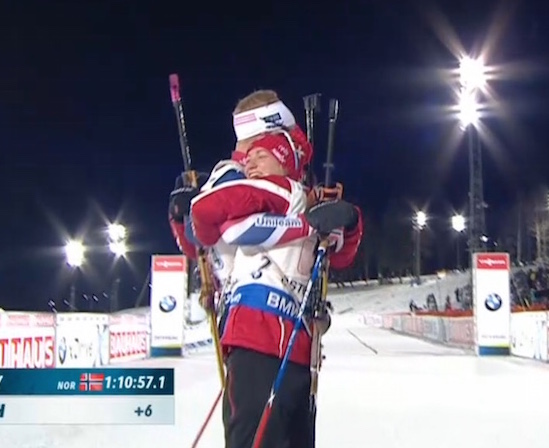
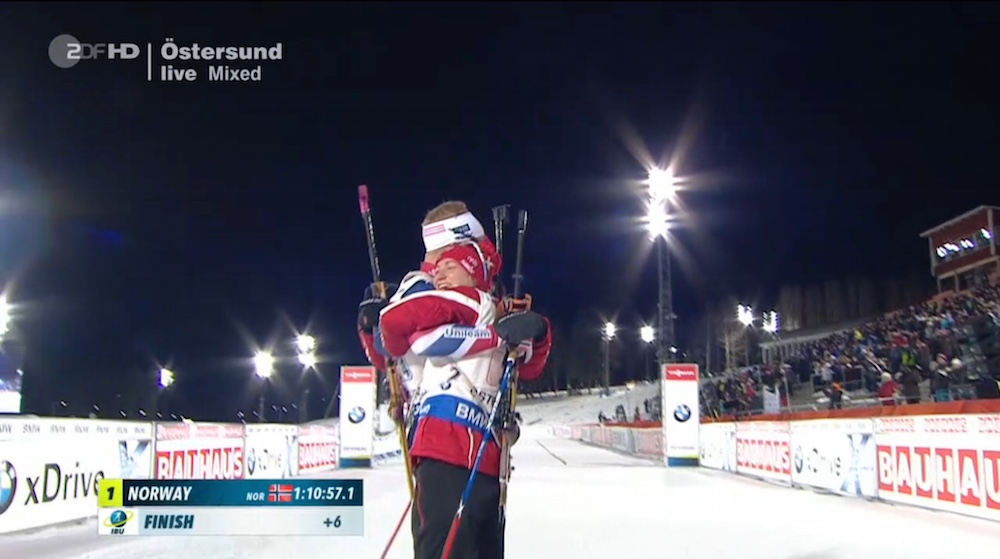
    The Norwegian mixed relay team celebrates after its win in the first IBU World Cup race of the 2016/2017 season on Sunday in Östersund, Sweden. (Photo: ZDF screen shot)
    Two members of the Norwegian mixed relay, Johannes Bø and Marte Olsbu, celebrate their win in the first IBU World Cup race of the 2016/2017 season on Sunday in Östersund, Sweden. (Photo: ZDF screen shot)

    Welcome to The Rundown, your quick primer of need-to-know information about the day’s racing. We’ll be updating this digest as the day goes on with additional results, photos and quotes. The Rundown is NOT a race report; stay tuned for complete race reports later today with interviews from the day’s top racers.

    ***

    IBU Cup in Beitostølen: 7.5/10 k sprints

    [UPDATE] With the second set of men’s and women’s sprints canceled Saturday and moved to Sunday in Beitostølen, Norway, the first IBU Cup relays of the season were bumped off the schedule, and no North Americans competed on Sunday. (American Russell Currier placed 44th in the IBU Cup sprint on Friday.)

    In the women’s 7.5 k sprint, Marketa Davidova of the Czech Republic pulled out a 3.6-second win over Germany’s Nadine Horchler, and Germany had two on the podium with former cross-country skier Denise Herrmann in third (+29.9). Davidova hit 9 out of 10 targets (1+0) en route to the victory in 24:18.3. Horchler missed just one target as well (0+1) and Herrmann (who won the IBU Cup women’s sprint two days earlier) had three penalties (1+2) but skied fast enough for the podium.

    In the men’s 10 k sprint, Russia’s Matvey Eliseev edged his teammate Dmitry Malyshko by just 3.2 seconds for the win in 26:16.8. More than a minute later, Norway’s Henrik L’Abee-Lund placed third (+1:15.9) with four penalties (1+3). Both Eliseev and Malyshko had one miss apiece, with Eliseev missing one in prone (1+0) and Malyshko missing one standing (0+1).

    The next IBU Cup is set for Dec. 6-11 in Ridnaun, Italy.

    Sunday’s sprint results: womenmen

    Friday’s sprint results: women | men

    ***

    IBU World Cup in Östersund: Mixed and Single Mixed Relays

    Single Mixed Relay report | Mixed Relay report

    The first race if the International Biathlon Union (IBU) World Cup season went to Norway, which won Sunday’s co-ed mixed relay (2 x 6 k + 2 x 7.5 k) by nearly 34 seconds over Germany in Östersund, Sweden.

    The Norwegian team of Marte Olsbu, Fanny Horn Birkeland, Ole Einar Bjørndalen, and Johannes Thingnes Bø used a total of six spare rounds to get to the finish line first in 1:10.57.1.

    Germany, with Franziska Hildebrand, Laura Dahlmeier, Benedikt Doll, and Arnd Peiffer, used the same amount of total spares for second place (+33.7), and both teams avoided the penalty loop.

    Italy took third (+44.2), with Lisa Vittozzi, Dorothea Wierer, Lukas Hofer, and Dominik Windisch using a combined 12 spares and having one penalty loop during Hofer’s standing stage.

    The Italians narrowly held off Russia (Olga Podchufarova, Tatiana Akimova, Maxim Tsvetkov, Anton Shipulin) by 0.3 seconds for the final spot the podium.

    France placed fifth (+1:13.3), Sweden was sixth (+1:20.9), the Czech Republic seventh (+1:20.9), and the U.S. eighth (+2:38.5).

    Susan Dunklee started first for the Americans using three spares to clean (0+1, 0+2), then tagging off to Clare Egan, who didn’t need any spares for prone, but had to use all three and skied two penalty loops in standing. Lowell Bailey used just two spares (0+1, 0+1), and Tim Burke locked up eighth for the team with a flawless prone and three spares in standing (0+0, 0+3). In all the team used 13 spares and had two penalty loops.

    Of 24 teams in the race, Canada (Julia Ransom, Megan Tandy, Scott Gow, and Brendan Green) was among the four that were lapped. In seven out of eight stages, the team combined for 11 spares and two penalties.

    Results: Mixed relay | (Single mixed relay, see race report)

    ***

    FIS Nordic Combined World Cup in Ruka: Individual Large Hill/10 k

    Germany’s 24-year-old Johannes Rydzek celebrating his first of two wins on Saturday at the Ruka Nordic Combined World Cup in Kuusamo, Finland. He now has eighth career individual World Cup victories. (Photo: FIS)
    Germany’s 24-year-old Johannes Rydzek celebrating his first of two wins on Saturday at the Ruka Nordic Combined World Cup in Kuusamo, Finland. He now has eighth career individual World Cup victories. (Photo: FIS/NordicFocus)

    Germany’s Johannes Rydzek can do the Usain-Bolt-victory stance all the way to the next Nordic Combined World Cup after winning the first two competitions of the 2016/2017 season, with another individual large hill/10 k win on Sunday in Kuusamo, Finland.

    After winning by 34 seconds over his teammate Eric Frenzel on Saturday, Rydzek took a 14.7-second win over Wilhelm Denifl of Austria, while Japan’s Akito Watabe was just 0.3 seconds back in third.

    Rydzek posted the fifth-best jump after Norway’s Jarl Magnus Riiber, Watabe, Denifl, and Austria’s Mario Seidl, respectively. Rydzek started the 10 k Gundersen 1:04 minutes after Riiber and posted the seventh-fastest course time to capture first. Riiber slipped to 10th (+1:07.5) at the finish, with the 37th-ranked course time of 42 in the cross-country race.

    Of note, Frenzel improved from 27th in the jump to 17th (+1:32.4) at the finish with the second-fastest course time.

    Bryan Fletcher was one of two Americans in the race, finishing 31st (+3:40.7). His jump ranked 40th, but he skied the fourth-fastest course time to pick off nine places. Taylor Fletcher placed 40th (+6:24.4), improving slightly from 43rd in the jump.

    The Nordic Combined World Cup now moves to Lillehammer, Norway, for a team and two individual competitions Dec. 2-4.

    Final results

    ***

    Visma Ski Classics Prologue in Pontresina: 8 k Classic

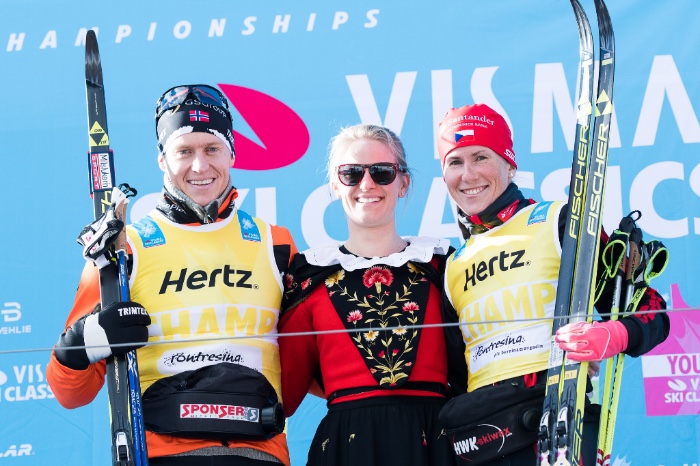
    Petter Eliassen of Team Leaseplan Go (left) and Katerina Smutna of Team Santander (right) celebrate after winning the Visma Ski Classics 8 k prologue in Pontresina, Switzerland. (Photo: Visma Ski Classics)
    Petter Eliassen of Team Leaseplan Go (left) and Katerina Smutna of Team Santander (right) celebrate after winning the Visma Ski Classics 8 k prologue in Pontresina, Switzerland. (Photo: Visma Ski Classics)

    The Visma Ski Classics series started off in Pontresina, Switzerland, with 8-kilometer time trials for both men and women.

    In the women’s race, an individual interval start seeded last to first, Kristin Antonsen of Team Synnfjell set an early best mark. But as the previous season’s top women hit the course times began to come down, and the race ended as a battle between Britta Johansson Norgren of Team Lager 157 and Katerina Smutna of Team Santander. Smutna ended up with the win by just 0.66 seconds over Johansson Norgren, with Sara Lindborg of Team Serneke third (+20.66).

    The men’s race was a team interval start, with the teams separated by five minutes and with skiers at 15 second intervals within that span. Last year’s Visma Ski Classics Champion, Petter Eliassen of Team Leaseplan Go, came out on top with a time of 19:42.66. Bastien Poirrier of Team Gel Interim Rossignol was second (+8.53), leading five members of his new France-based team into the top ten and turning heads along the way. Morten Eide Pedersen of Team BN Bank was third (+15.80).

    Results

    ***

    FIS Cross-Country World Cup in Ruka: 10/15 k Classic

    Women’s report | Men’s report

    Twenty-four-year-old Finnish A-teamer Iivo Niskanen notched his second-career World Cup victory the men’s 15-kilometer classic on Sunday, Day 2 of the Ruka World Cup in Kuusamo, Finland.

    The men's podium in Sunday's 15 k classic at the Ruka World Cup in Kuusamo, Finland: with Finnish winner Iivo Niskanen (c) and Norway's Emil Iversen (l) in second and Martin Johnsrud Sundby (r) in third. (Photo: NBC Sports screen shot)
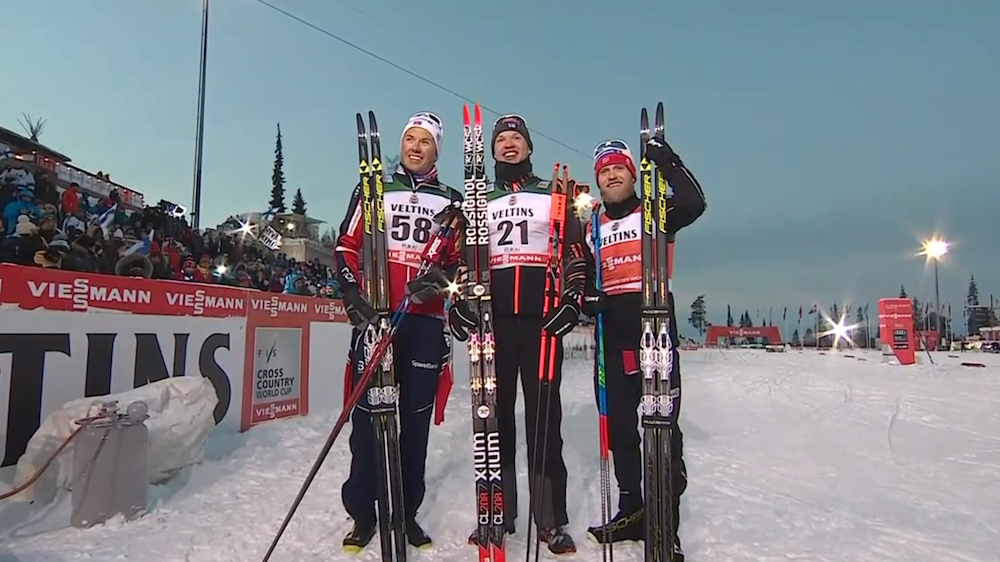
    The men’s podium in Sunday’s 15 k classic at the Ruka World Cup in Kuusamo, Finland: with Finnish winner Iivo Niskanen (c) and Norway’s Emil Iversen (l) in second and Martin Johnsrud Sundby (r) in third. (Photo: NBC Sports screen shot)

    Niskanen started 21st of more than 90 in the men’s field and finished in 35:27.6, which stood as the fastest time all day. After the finish, he paced between the leader’s chair and the finishing pen, even jogging around the stadium and course. But every time he looked the Finnish crowd, he was all smiles.

    Niskanen held off three Norwegians in the top four, with Emil Iversen 10.2 seconds behind him in second, Martin Johnsrud Sundby 11.2 seconds back in third, and Didrik Tønseth missing the podium by about six seconds and tying Sweden’s Johan Olsson for fourth (+17.0). Norway’s Finn Hågen Krogh placed sixth (+18.3), Sweden’s Calle Halfvarsson was seventh (+21.2), Russia’s Alexander Bessmertnykh was eighth (+24.3), Finland’s Matti Heikkinen ninth (+32.0), and Great Britain’s Andrew Musgrave 10th (+33.8).

    Canada’s Alex Harvey was close behind in 11th (+35), and was the lone North American man in the points on Sunday. His teammate Devon Kershaw missed the top 30 by 4.5 seconds in 33rd (+1:23.4).

    Erik Bjornsen led the U.S. men in 41st (+1:37.2). Canada’s Graeme Killick was 53rd (+2:12.9), American Noah Hoffman was 64th (+2:42.6). For Canada, Len Valjas was 76th (+3:19.8), Jess Cockney 78th (+3:26), Knute Johnsgaard 85th (+3:53.4), and Andy Shields 91st (+4:26.1), and for the U.S., Eric Packer 87th (+4:01) and Andy Newell 88th (+4:17.4) out of 96.

    In the women’s 10 k classic earlier in the day, Marit Bjørgen of Norway picked up her first win of the season, a 4.6-second win over Finland’s Krista Parmakoski.

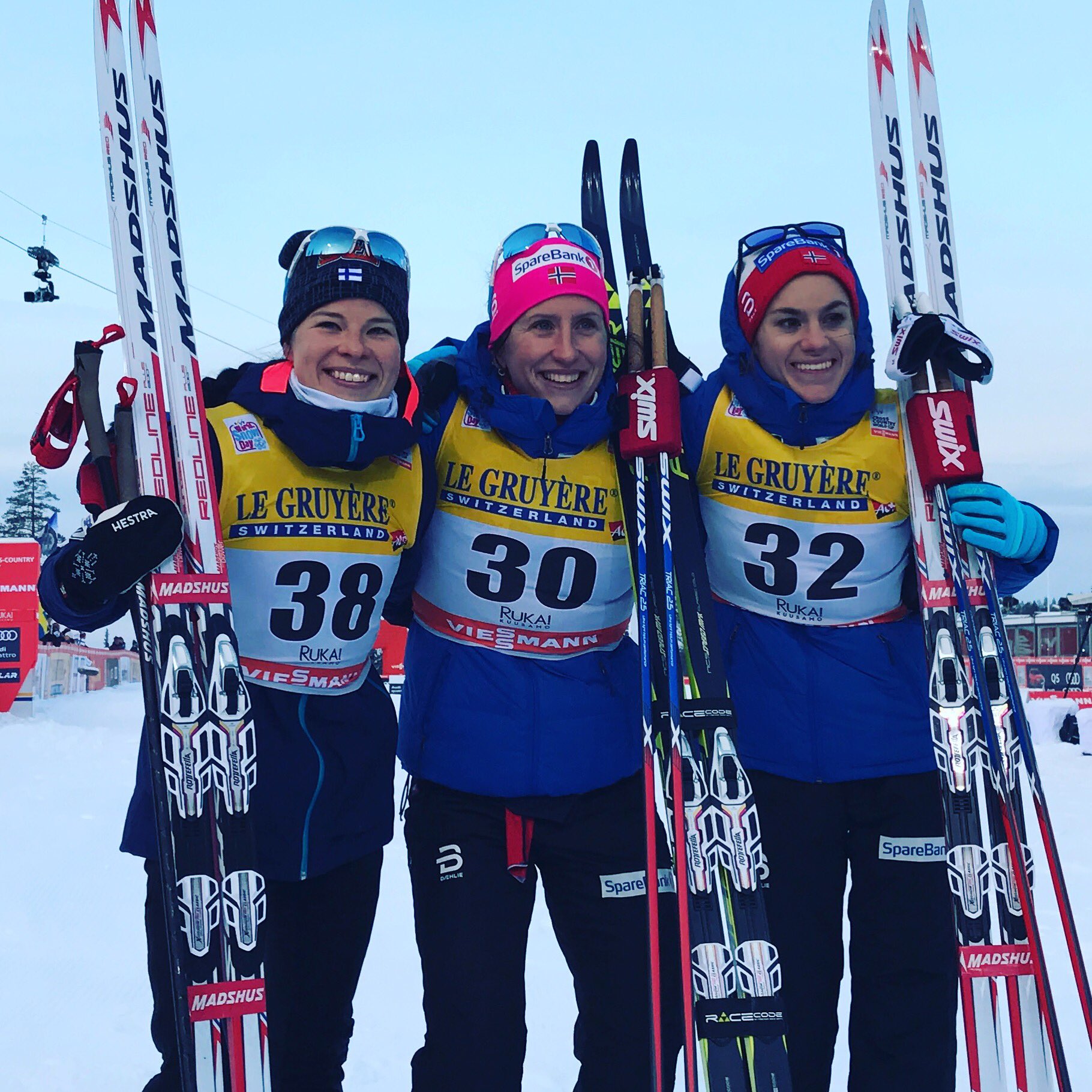
    Marit Bjørgen of Norway (center) collected her first World Cup win of the season in the 10 k classic in Ruka, Finland, ahead of Finland's Krista Parmakoski (left) and Norway's Heidi Weng (right). (Photo: FIS Cross Country/Twitter)
    Marit Bjørgen of Norway (center) collected her first World Cup win of the season in the 10 k classic in Ruka, Finland, ahead of Finland’s Krista Parmakoski (left) and Norway’s Heidi Weng (right). (Photo: FIS Cross Country/Twitter)

    It is the 103rd World Cup win for the 36-year-old Bjørgen, who took last season off to have a baby. Norway followed up Bjørgen’s win with third and fourth place finishes by Heidi Weng (+12.7) and Ingvild Flugstad Ørtberg (+36.8).

    Parmakoski also led a good day for the Finnish team, with Laura Mononen coming in seventh (+50.0). She was just behind sixth-place Nicole Fessel of Germany (+42.4).

    Jessie Diggins led the U.S. women’s team with a 13th-place finish (+1:09.0), one of her best distance classic races ever outside of Tour and mini-tour stages. Sadie Bjornsen followed in 17th (+1.14.9), and 2016 SuperTour champion Caitlin Patterson of the Craftsbury Green Racing Project scored points in 28th (+1:45.4). The U.S. Ski Team rounded out its results with Rosie Brennan 39th (+2:22.2), Kikkan Randall 43rd (+2:29.7), Ida Sargent 44th (+2:30.4), and Sophie Caldwell 61st (+3:13.4)

    Cendrine Browne and Emily Nishikawa slotted into 58th and 59th for Canada, +3:04.8 and +3:07.1, respectively. Dahria Beatty finished 74th (+3:54.4).

  • Kalla Leaves Swedish National Team to Train Alone; Richardsson and Olsson Are Back

    Kalla Leaves Swedish National Team to Train Alone; Richardsson and Olsson Are Back

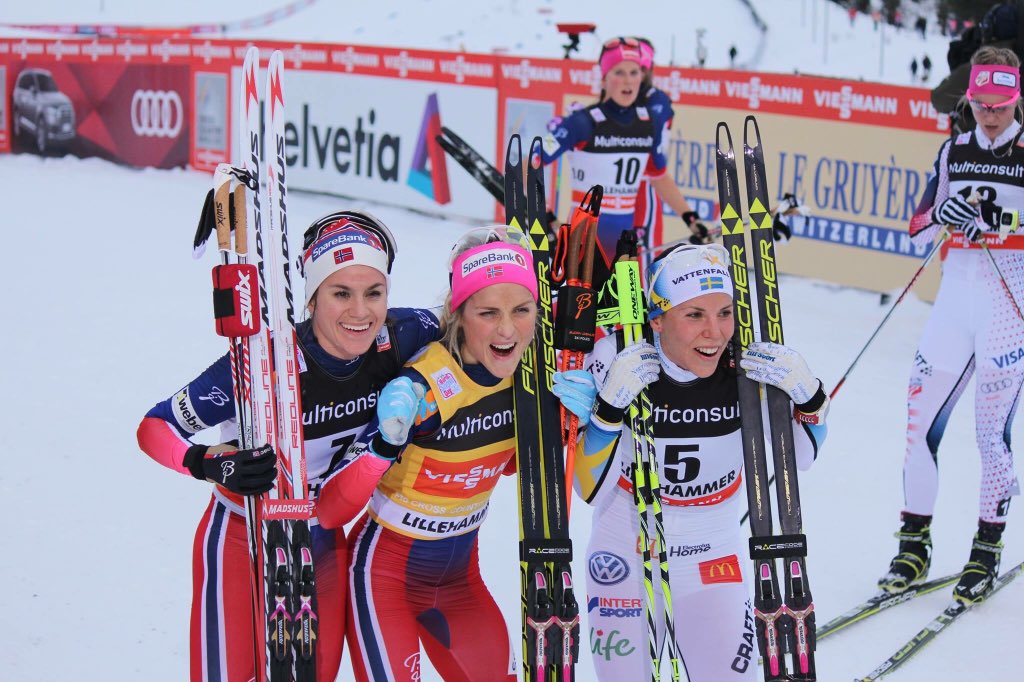
    The women's World Cup 15 k skiathlon podium in Lillehammer, Norway, with Norway's Therese Johaug (c) in first and Heidi Weng (l) in second, and Sweden's Charlotte Kalla (5) in third. It was one of just two podiums for Kalla this season. (Photo: WorldCup Lillehammer/Twitter)
    The women’s World Cup 15 k skiathlon podium in Lillehammer, Norway, with Norway’s Therese Johaug (c) in first and Heidi Weng (l) in second, and Sweden’s Charlotte Kalla (5) in third. It was one of just two podiums for Kalla this season. (Photo: WorldCup Lillehammer/Twitter)

    Swedish ski star Charlotte Kalla looked back at her disappointing 2016 season and decided: something had to change.

    The 28-year-old has decided to leave the Swedish national team and train on her own with a personal coach.

    “I think that currently I have a [great] trainer, and the results of our collaboration can be so much better if I have the opportunity to meet with [him] for monitoring, planning, engineering work and other things,” she told Radiosporten, according to a translation.

    Although Norwegian superstar Petter Northug has done the same thing in the past, Kalla’s move is new for Sweden. She is still focusing on World Cup racing and in particular 2017 World Championships, to held in Lahti, Finland, in just nine months time. For that, she will need to be nominated and supported by the national team, but she doesn’t plan to work within their training program in the off-season.

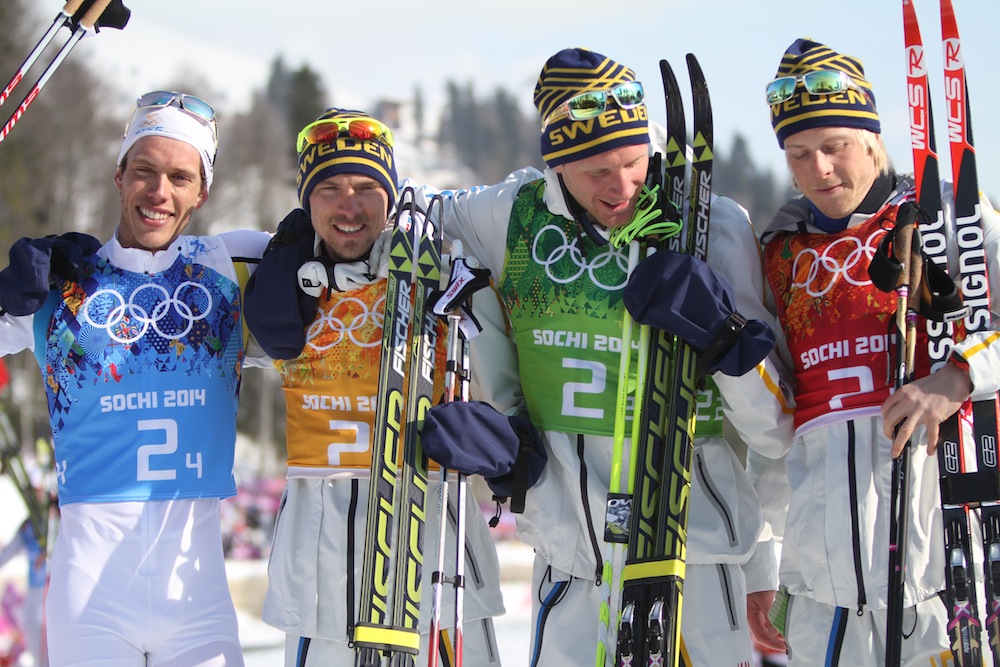
    Switching out? Johan Olsson and Daniel Richardsson (second and third from left) will rejoin the national team after a year on the outside. They were part of the Swedish men's team that defended their gold medal from the 2010 Olympics to win the 4 x 10 k relay in commanding fashion at the 2014 Sochi Games. From left to right: Marcus Hellner, Olsson, Richardsson, and Lars Nelson.
    Switching out? Johan Olsson and Daniel Richardsson (second and third from left) will rejoin the national team after a year on the outside. They were part of the Swedish men’s team that defended their gold medal from the 2010 Olympics to win the 4 x 10 k relay in commanding fashion at the 2014 Sochi Games. From left to right: Marcus Hellner, Olsson, Richardsson, and Lars Nelson.

    Several high-profile athletes left the Swedish national team last season, including World Champion Johan Olsson and fellow Olympic gold medalist Daniel Richardsson. Richardsson joined a Ski Classics team, Team Exspirit, and focused on long-distance racing while still jumping in three World Cup competitions this year; he also won Swedish National Championships in the 15 k classic.

    Olsson did not compete at all this year due in part to injuries, but said in early April that he was motivated for the Lahti World Championships and perhaps even the 2018 Olympics. Both men have now rejoined the national team.

    “We are thrilled to have Johan and Daniel back on the team after a year in which they invested in long-distance races,” team director Johan Sares said in a press release. “At the same time, we support Charlotte, who feels the need to test her own setup. We respect it and wish her a warm welcome back in the white suit for the World Cup opener in Ruka, Finland, in November.”

    So it’s clear that in Sweden leaving the national team does not prevent an athlete from later rejoining, or from getting race support at international competitions. But Kalla is trying to do something different than either Olsson or Richardsson: focus 100% on the World Cup, but on her own terms.

    “There has been much consideration, but in the end I made a decision that feels very right to me,” Kalla told Radiosporten.

    Charlotte Kalla of Sweden skiing to a monster win in the 10 k skate at 2015 World Championships on home turf in Falun, Sweden. (Photo: Fischer/NordicFocus.com)
    Charlotte Kalla skiing to a monster win in the 10 k skate at 2015 World Championships on home turf in Falun, Sweden. (Photo: Fischer/NordicFocus.com)

    Ingesson is a former skier himself, and a relay medalist from 2001 World Championships. He coached the women’s national team at one point and is now the sports director for Piteå Elit, which Kalla joined in 2012.

    Kalla explained that she wanted for a long time to work more closely with Ingesson, but it was difficult to schedule. He now has been promised more time off from his regular job, which means more collaboration with Kalla.

    An Olympic gold medalist and World Champion, Kalla has 47 World Cup podiums to her name but snagged just two last season, and not a single win. Nevertheless, she ended up fifth in the overall World Cup rankings at the end of the 2016 season.

    “Now I have a freedom to follow what I believe in and do training based on the needs I see,” she told Swedish newspaper Dagens Nyheter. “We will initiate an intro camp with Piteå Elit on Friday in Saxnäs, and then Magnus and I will sit down and make arrangements in more detail.”

    Kalla was coming off of a strong season in 2015, where she won the World Championships 10 k skate on home turf in Falun, Sweden, in one of the most impressive performances of the season.

    But instead of using that success as a springboard, Kalla struggled this season.

    “I was gassed at pretty much the beginning of last summer,” she told Dagens Nyheter. “I had signals that I was tired, but was in good shape around the first competitions. After that it was not as good as my ambitions were. But I’ve learned a lot. I was disappointed with the results, but satisfied with the performance, because I did not give up.”

    Some of it was just bad luck, like in the Tour de Ski, where she crashed several times including one particularly rough fall in Oberstdorf, Germany, thanks to sloppy skiing by Poland’s Justyna Kowalczyk.

    Shifting away from the national team will be a challenge, she admits, even if it may have benefits.

    “The main obstacle has been the social aspect,” she told Dagens Nyheter. “I thrive in the national team group with everything that happens around training sessions, to be able to laugh, cry and dream together.”

    In Norway, Northug’s decision to leave the national team was a testy one, and not all team staff were thrilled with it.

    Thus Vidar Løfshus, the head of the Norwegian national team, was skeptical of Kalla’s decision.

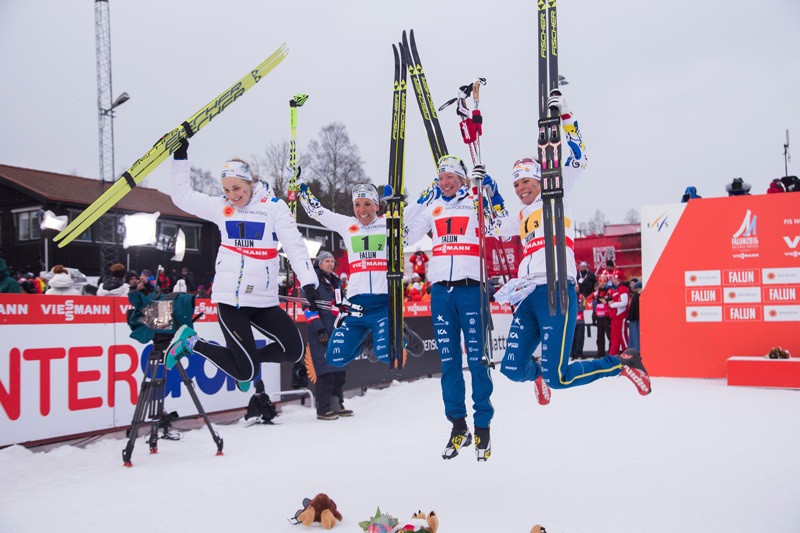
    Stina Nilsson, Charlotte Kalla), Sofia Bleckur, and Maria Rydqvist (l-r) jump after placing second in the women's 4 x 5 k relay at the 2015 FIS Nordic World Ski Championships. (Photo: Fischer/NordicFocus)
    Stina Nilsson, Charlotte Kalla), Sofia Bleckur, and Maria Rydqvist (l-r) jump after placing second in the women’s 4 x 5 k relay at the 2015 FIS Nordic World Ski Championships. (Photo: Fischer/NordicFocus)

    “Oh, it’s not good,” he told Swedish tabloid Expressen. “We in Norway firmly believe in the national team model. We have already had a debate about Petter Northug, who opted out of the Norwegian national team. We believe of course that it is one of the reasons that we are as good as we are, that we have a strong national team model…. Throughout the summer and fall, she will be missing in the Swedish team. This is where the strong team created. Cohesion, team spirit. And yes, according to me it is the strong training groups that create success.”

    Swedish team staff weren’t as negative, or at least they chose their words more carefully.

    “I respect her decision, then it is naturally sad that she will not be with us,” head coach Rikard Grip told Expressen. “But I have to say the respect and understanding that she wants to try something new… The most important thing is that Charlotte has the motivation and drive. What avenues you choose to go, it is difficult to judge about. Now she has chosen this path. All the details we need to sit down calmly and talk about. We have a good intention to have a good dialogue. Charlotte will be with us in the winter, we need to look at how we solve it in the best way. But I can not answer exactly how it will look.”

    “The downside for our part, is that team loses its power,” new national team coach Ole Morten Iversen told Norway’s NRK broadcaster. “Had she been on the team, she would have been given new impetus that had changed the situation properly. I’ve tried, but it has not been enough- but I completely understand that she feels the need to do something new after having her head against the wall for a while.”

  • Ski Classics Opens with Doubleheader in Italy 

    Ski Classics Opens with Doubleheader in Italy 

    Last year's Team Tempo Prologue in Livigno, Italy, which Team Coop won. This year, the team prologue will again open the Ski Classics series in Livigno on Saturday, followed by the shortened La Sgambeda classic race on Sunday. (Photo: Visma Ski Classics)
    Last year’s Team Tempo Prologue in Livigno, Italy, which Team Coop (in bib 1) won. This year, the team prologue will again open the Ski Classics series in Livigno on Saturday, followed by the shortened La Sgambeda classic race on Sunday. (Photo: Visma Ski Classics)

    The 2016 Ski Classics kicks off with a doubleheader in Italy on Saturday and Sunday, and the marathon regulars are chomping at the bit to get started with the long-distance race series.

    The 15-kilometer Proteam Prologue in Livigno, Italy, on Saturday opens the show for the marathon series, now called the Visma Ski Classics (with a new title sponsor in place of Swix), which has been extended to nine venues this season.

    Seraina Boner of Switzerland and Team Coop/Exspirit after winning the 2014 La Sgambeda in Italy last season. (Photo: Ski Classics)
    Seraina Boner of Team Coop (now called Team Exspirit) after winning the 2014 La Sgambeda in Italy last season. (Photo: Ski Classics)

    On the women’s side, last season’s Ski Classics champion Katerina Smutna of the Czech Republic will be on the start line for the first races this weekend, but she will face plenty of competition. Team Exspirit’s Seraina Boner of Switzerland is eager to take back the overall title, which she has earned three times (2011, 2013 and 2014), beginning with La Sgambeda.

    Poland’s World Cup star and the queen of the FIS Tour de Ski, Justyna Kowalczyk, will be doing several of the Ski Classics long-distance events this season with the Norwegian Team Santander headed by the Aukland brothers. And Britta Johansson Norgren of Sweden, who was on the podium at several of the Ski Classics events last season, is one to keep an eye on. Last season, she raced with the all women’s team Ski Pro Am, and this year she is a part of Sweden’s Lager 157 Ski Team, with teammates such as three-time Vasaloppet champion Jörgen Brink of Sweden.

    Among the men, 2015 Ski Classics overall champion Petter Eliassen of Norway makes his season debut in Italy this weekend. He will have to fend off a large and deep field of competitors such as Norway’s 43-year-old marathon veteran Anders Aukland and his Santander teammates, including younger brother Jørgen Aukland, and former World Cup skiers Tord Asle Gjerdalen of Norway and Johan Olsson of Sweden.

    Norwegian stayers such as Johan Kjölstad, Øystein Pettersen, Eldar Rønning, and John Kristian Dahl of Team United Bakeries, as well as Ski Classics veterans of Team Exspirit, including Daniel Richardsson, Anders Södergren and Jimmie Johnsson of Sweden and Norway’s Morten Eide Pedersen, will certainly do their best to make it a tough season opener from Day 1.

    Two unique competitions in Livigno

    The Prologue, in which the teams must field at least three racers to compete, was added last year, and is a team effort where the third person’s time determines the team result. The next day, on Sunday, the skiers embark on the first distance event, the now-24-kilometer classic technique La Sgambeda.

    Team Santander's Anders Aukland (c) after winning the 2014 La Sgambeda in Livigno, Italy. Johan Kjølstad  (l) and Øystein Pettersen (r) both of Team United Bakeries, placed second and third, respectively.  (Photo: Ski Classics)
    Team Santander’s Anders Aukland (c) after winning the 2014 La Sgambeda in Livigno, Italy. Johan Kjølstad (l) and Øystein Pettersen (r) both of Team United Bakeries, placed second and third, respectively. (Photo: Ski Classics)

    Team Exspirit (previously known as Team Coop) won the prologue last year and is aiming to defend the title this year.

    “We have had great preparations here in Livigno, skiing on the race course and acclimatizing to the high altitude,” team member Jimmie Johnsson said in a press release on Friday. “Of course, we’re aiming to defend our victory and we’re faster this season than ever before.”

    Team Exspirit’s Seraina Boner won La Sgambeda last year after breaking away from the field on the hard climb at the turning point of the course. This year, the course is shortened to from 35 k to 24 k due to lack of snow and is also flatter. While Boner prefers more elevation gain, she was still optimistic before the race.

    “The tougher course fits me better than the flatter one we have now,” she said. “But I will do my best, and I am really excited to finally start the long distance season together with my teammates.”

    While the Team Prologue is only open to professional teams registered with the 2016 Ski Classics, La Sgambeda on Sunday is open to amateurs and pros alike.

    Saturday’s Prologue will be held on the original course, but due to lack of snow in Livigno, the classic marathon on Sunday will be run on 6 k loops.

    “Last season, seven of the nine Ski Classics events had to change their courses due to weather issues,” Ski Classics CEO David Nilsson in a press release earlier this week. “We can just cross our fingers that the political leaders at the environmental summit in Paris this week are able to make the right decision.”

    For the 2016 season, there are 28 pro teams registered for the Ski Classics series.

    After the season opener in Italy, the Ski Classics takes a break until the Jizerská Padesatka in Liberec, Czech Republic, on January 10, 2016. The race series concludes April 2 with Årefjällsloppet in Sweden as the season finale, as it has been for years. New this year is the Toblach/Dobbiaco Cortina, a 50 k classic race in Italy on Feb. 13.

    Vasaloppet matters most

    For Madshus racer John Kristian Dahl of Norway, who won the Vasaloppet two years ago, the 90 k race from Sälen to Mora in Sweden is the main goal for the 2016 season.

    “It’s the longest and one of the oldest races in the circuit, and very special with the flats. That package makes it very unique, and difficult to win, too. In our world, it’s the championships in marathon skiing, and I’m happy that we have it every year,” Dahl said in an interview with Ski Classics earlier this fall.

    Live streaming in English

    In order for fans to follow the action live, Visma Ski Classics has launched the Live Streaming “Season Pass” available with English commentary on the app or the Tour Live Center at Visma skiclassics.com.

    2016 Ski Classics Schedule

    1. Dec. 5, 2015: Proteam Tempo Prologue, 15 k classic, Italy
    2. Dec. 6, 2015: La Sgambeda, 24 k classic, Italy
    3. Jan. 10, 2016: Jizerská Padesatka, 50 k classic, Czech Republic
    4. Jan. 23, 2016: La Diagonela, 65 k classic, Switzerland
    5. Jan. 31, 2016: Marcialonga, 70 k classic, Italy
    6. Feb. 7, 2016: König Ludwig Lauf, 50 k classic, Germany
    7. Feb. 13, 2016: Toblach/Dobbiaco Cortina, 50 k classic, Italy
    8. March 6, 2016: Vasaloppet, 90 k classic, Sweden
    9. March 19, 2016: Birkebeinerrennet, 54 k classic, Norway
    10. April 2, 2016: Årefjällsloppet, 65 k classic, Sweden

    For race recaps, follow FasterSkier’s marathon blog.

  • Norway, Sweden Announce 2015/2016 National Teams

    Norway, Sweden Announce 2015/2016 National Teams

    Marit Bjørgen won the overall FIS World Cup title for the fourth time in 2014-2015, also taking home the Sprint Cup and Distance Cup globes. She will headline the Norwegian National Team in the 2015/2016 season. (Photo: Fischer/NordicFocus.com)
    Marit Bjørgen won the overall FIS World Cup title for the fourth time in 2014-2015, also taking home the Sprint Cup and Distance Cup globes. She will headline the Norwegian National Team in the 2015/2016 season. (Photo: Fischer/NordicFocus.com)

    Both Norway and Sweden announced their National Team picks for the 2015/2016 season Friday. The respective teams of the two rivals will see few changes in the upcoming year as both hope to either maintain or improve their team successes.

    The Norwegians have nominated the majority of the 2014/2015 team, which won the year’s Nation’s Cup with 17,225 points – 11,364 points over the Russian Federation in second place. Headlining the women’s team is Marit Bjørgen who won her fourth overall World Cup title this year. The 35-year-old recently announced that she would continue to race the World Cup circuit, despite some uncertainty immediately after the season’s end.

    I have used the spring to think a little, and I am now sure that I’m a hundred percent ready to put down the work needed to continue my career,” she told Norwegian broadcaster NRK, according to a translation.

    Missing from the women’s team roster are Celine Brun-Lie and Kristen Størmer Steira who both announced their retirements in recent weeks. Replacing the two will be Kari Vikagen Gjeitnes and Ragnhild Haga. Haga finished fifth overall in the World Cup standings and fourth overall in the 2015 Tour de Ski.

    FIS nordic world ski championships, cross-country, 4x10km men, Falun (SWE)
    Petter Northug silences his critics after out-sprinting Sweden’s Calle Halfvarson in the 4 x 10 k relay at the 2015 World Championships. (Photo: Fischer/Nordic Focus)

    The Norwegian men will be led by Martin Sundby, who won his second-straight overall World Cup title in 2014/2015. Sundby had a strong start to the season but was unable to demonstrate his top form at the 2015 World Championships in Falun due to illness.

    Norwegian superstar Petter Northug was notably left off the list due to his contract with the grocery store chain Coop and its team. While there is little information as to negotiations between Northug and the Norwegian National Team, Northug’s manager, Are Sørum Langås, recently said that the four-time 2015 World Championships gold medalist had a plan for the season that would satisfy his needs.

    The men’s sprint team remains identical to the 2014/2015 season. Hans Christer Holunder and Niklas Dyrhaug are the only additions to the all around team.

    According to Head Coach Vidar Løfshus, selection for the team began during the 2015 World Championships and that they aimed to have the team feature roughly 25 skiers. Friday’s announcement names 24 skiers to the team.

    “The challenge has been to put together the best training groups in the men. We have spent time discussing and thinking to managed and achieve the best ability. It is about finding out that training program tailored to each athlete best,” Løfshus explained to FIS.

    Norwegian National Team:

    Ladies

    Marit Bjørgen,  Rognes IL
    Maiken Caspersen Falla,  Gjerdrum IL
    Kari Vikhagen Gjeitnes,  Henning Skilag
    Ragnhild Haga,  Åsen IL
    Martine Ek Hagen,  IL i BUL
    Kathrine Rolsted Harsem,  IL Varden
    Astrid UhrenholdtJacobsen,  IL Heming
    Therese Johaug,  Nansen IL
    Heidi Weng,  IL i BUL
    Ingvild Flugstad Østberg,  Gjøvik Skiklubb

    Men allround

    Niklas Dyrhaug,  Tydal IL
    Pål Golberg,  Gol IL
    Hans Christer Holund,  Lyn Ski
    Chris Jespersen,  IL Korlevoll-Odda
    Sjur Røthe,  Voss IL
    Martin Johnsrud Sundby,  Røa IL
    Simen Andreas Sveen,  Ring IL
    Didrik Tønseth,  Byåsen IL

    Men sprint

    Eirik Brandsdal,  Kjelsås IL
    Sondre Turvoll Fossli,  Hokksund IL
    Anders Gløersen,  Rustad Il
    Ola Vigen Hattestad,  Ørje IL
    Finn Hågen Krogh,  Tverrelvdalen IL
    Tomas Northug,   Strindheim IL

    Sweden's Charlotte Kalla racing to her first-career individual gold at 2015 World Championships in Falun, Sweden. Kalla won the 10 k freestyle by 41 seconds over silver medalist Jessie Diggins. (Photo: Fischer/NordicFocus)
    Sweden’s Charlotte Kalla racing to her first-career individual gold at 2015 World Championships in Falun, Sweden. Kalla won the 10 k freestyle by 41 seconds over silver medalist Jessie Diggins. (Photo: Fischer/NordicFocus)

    Sweden

    The Swedish National team also announced its National Team Friday. While the team did not have the success it aimed for in the 2014/2015 season it achieved third overall in the Nation’s Cup standings behind Norway and Russia.

    Four-time 2015 World Championships medalist Charlotte Kalla will return as the team’s most anticipated skier. Sprinting star Stina Nilsson will also remain in the team’s rank to much fanfare.

    Johan Olsson, Daniel Richardson and Lars Nelson will not return to the National Team in the 2015/2016 season. Olsson won the 15 k freestyle and earned two other podiums at the 2015 World Championships with a second in the 4 x 10 k relay and third in the 50 k classic.

    According to Swedish National Team Head Coach Rikard Grip, his women are especially strong this year. He explained that the coaching staff aimed to create a team centered around maintaining the team’s status as one of the world’s best.

    “We want to improve the quality of sprint training sessions and create opportunities for more and tougher challenges in racing similar situations, man to man and woman against woman,” Grip said to FIS.

    Swedish National Team 

    Ladies

    Charlotte Kalla, Piteå Elit
    Anna Haag, IFK Mora SK
    Ida Ingemarsdotter, Åsarna IK
    Emma Wikén, Åsarna IK
    Maria Rydqvist, Älvdalens IF
    Stina Nilsson, IFK Mora SK
    Sofia Bleckur, IFK Mora SK
    Magdalena Pajala (sprint), Piteå Elit
    Jennie Öberg (sprint), Piteå Elit
    Hanna Falk (sprint), Ulricehamns IF

    Men
    Calle Halfvarsson, Falun-Borlänge SK
    Martin Johansson, IFK Mora SK
    Anders Svanebo, Stockviks SF
    Marcus Hellner, Gellivare Skidallians
    Simon Andersson, Falun-Borlänge SK
    Emil Jönsson (sprint), IFK Mora SK
    Teodor Peterson (sprint), IFK Umeå
    Johan Edin (sprint), IFK Mora SK

    Development teams

    Ladies
    Hanna Erikson, Åsarna IK
    Anna Dyvik, Falun-Borlänge SK
    Sofia Henriksson, Piteå Elit
    Jonna Sundling, IFK Umeå
    Evelina Settlin, Hudiksvalls IF
    Linn Sömskar (sprint), IFK Umeå
    Maja Dahlqvist (sprint), Falun-Borlänge SK
    Maria Nordström (sprint), Ulricehamns IF

    Men
    Jens Burman, Åsarna IK
    Marcus Ruus, Åsarna IK
    Simon Lagesson, Åsarna IK
    Axel Ekström, Garphyttans IF
    Oscar Svensson, Falun-Borlänge SK
    Carl Quicklund (sprint), Östersunds SK
    Jesper Modin (sprint), Piteå Elit
    Simon Persson (sprint), IFK Umeå
    Anton Lindblad, Sollefteå Skidor (sprint)
    Erik Silfver (sprint), IFK Umeå
    Gustav Nordström (sprint), Borås SK

  • Classic Northug: Norwegian Appears from Nowhere to Claim Victory in World Champs 50 k

    Classic Northug: Norwegian Appears from Nowhere to Claim Victory in World Champs 50 k

    Petter Northug catches his breath after wining the 50 k classic mass start at the 2015 FIS Nordic World Championships in Falun, Sweden. Behind him, Czech skier Lukas Bauer celebrates second as Johan Olsson crosses in third and Maxim Vylegzhanin finishes fourth.
    Petter Northug catches his breath after wining the 50 k classic mass start at the 2015 FIS Nordic World Championships in Falun, Sweden. Behind him, Czech skier Lukas Bauer celebrates second as Johan Olsson crosses in third and Maxim Vylegzhanin finishes fourth.

    FasterSkier’s coverage of the 2015 FIS Nordic World Ski Championships in Falun, Sweden, is brought to you by the generous support of L.L. Bean, now featuring a complete line of Kikkan Randall training wear.

    FALUN, Sweden — Good things comes to those who wait. If you’re Petter Northug, that good thing just happens to be a gold medal.

    Northug patiently waited until the final meters of the men’s 50 k classic mass start to win his fourth gold medal of the 2015 FIS Nordic World Ski Championships. Before the last kilometer, the Norwegian hadn’t skied above 10th position and fell as far as 48th at 5 k into the race. Nevertheless, he overcame a flying Lucas Bauer and determined Johan Olsson of Sweden in the final meters to cross the line with a time of 2:26:02.1. Bauer trailed by 1.7 seconds to take the silver while Olsson finished 2.0 seconds back for third in the snowy and soft conditions.

    The start of Sunday’s race began like most others in Falun – there was a light snow that fell on a roaring crowd of over 30,000, and conditions seemed to be stable. That soon changed as the snow developed into thick, wet flakes that piled on the tracks. With temperatures in the upper 30s, the course began to crumble as over 50 skiers took to the trails. By the end of the near two-and-a-half hour race, volunteers were forced to shovel meter-deep slush from multiple points on the trail.

    “It was very tough. I think one of the deepest conditions that I’ve ever skied,” Bauer, a veteran World Cup skier from the Czech Republic, said after his second place finish. “It was tough for everbody, it doesn’t matter if you ask first or last.”

    Despite the conditions, Northug’s three Norwegian teammates – Martin Johnsrud Sundby, Didrik Tønseth, and Niklas Dyrhaug –  commanded the race from the start as a pack of over 40 skiers developed in the early kilometers. Sundby sat out the Championships’ earlier races due to illness, and the 50 k was his first race since his recovery. Behind the Norwegians were Olsson, top-ranked Dario Cologna of Switzerland, and Alex Harvey of Canada.

    Throughout the first laps of the course – which consisted of subsequent blue and red 5 k laps that were combined to total five loops of 10 k – the leaders changed frequently and the large pack remained intact. At one point Harvey, fellow Canadian Ivan Babikov, American Noah Hoffman, and Great Britain’s Andrew Musgrave occupied the the top four spots as they crossed the 7.8 k mark.

    While Hoffman and Musgrave would soon fall from far from the lead, their Canadian counterparts did not. After the pack completed the first 10 k loop of the day, Olsson took the lead with the aim of increasing the speed of the pack. He said after the race that the slower the pace went the worse the outcome would be for both he and his teammates.

    Olsson chasing Tonseth 19 k
    Johan Olsson at the 19 k mark in the 50 k at the 2015 FIS Nordic World Ski Championships in Falun, Sweden. The Swede finished third overall after a sprint finish with Petter Northug and Lukas Bauer.

    At the front, Olsson began his lead before 10 k to just after the 20 k mark. The Swede gave a famous performance in the 2013 World Championships 50 k where he broke away at 11 k to take the victory by 12.9 seconds. Olsson said he was unable to give a similar performance due to the conditions, where falling snow and a rapidly deteriorating course resulted in slow skiing regardless of the effort. Deciding to sit back and conserve energy, the 34-year-old, sat back to let Dyrhaug take the lead before 25 k.

    “I had to take a little bit of rest when I realized that there was no use to make a large part of the work when I had been much in front for 25 kilometers,” Olsson said of his relinquished lead.

    Dyrhaug opened up a gap, which at one point neared 10 seconds. He was then replaced by an unlikely leader – Babikov.  The Canadian, who’s traditionally excelled in freestyle, skied up the hills focused on his own pace. At times he would turn around, see he was leading by several seconds, and take a break till the pack caught up.

    Babikov’s lead lasted for less than 5 k as Olsson’s teammate, Anders Södergren, took charge, hoping to push the pace and spread out the leaders. At one point Soedergren led by over 18 seconds, but his lead was chipped away by Russia’s Maxim Vylegzhanin and France’s Maurice Manificat as the snow and lack of a draft hampered his progress. The two skiers caught the Swede and and eventually overcame him after 40 k.

    “To go in the front, it turned me up,” Södergren said to FasterSkier about his lead. “I felt really strong with good stick on the skis. It was hard to be in the front with the snowfall. I was never tired but it was better to go back into the group.”

    Sodergren leading 39 k
    Södergren leads the pack at 39 k in the men’s 50 k classic at the 2015 FIS Nordic World Ski Championships in Falun, Sweden.

    With just 5 k to go Manificat and Vylegzhanin were leading the charge through the stadium, unaware of a fateful choice made behind them. Bauer, who had been in and out of the top 10 for the majority of the race decided to take his second ski exchange before the final lap of the race. It was a risky move as the Czech skier lost precious time before entering his final 5 k.

    “The first plan was [to change at] 15 then 35 but the reality was 25 and after 45 k. I think almost everyone went for exchange after 35 k and I decide in the moment that no, I would not change the skis because I had quite good skis,” Bauer said in a press conference. He explained that after 35 k he struggled to keep up with the pack because his skis were slow on the downhills. While he was able to maintain his position, he knew something had to change.

    With his second ski exchange at 45 k, the 37-year-old tackled the last climbs and curving downhills with gusto, and it was soon obvious he made the right choice.

    “I think it was quite big advantage for 5 k,” he said. According to Bauer, he knew that his finishing sprint wasn’t as strong as his competitors and needed an advantage in the last lap. Better skis were the solution.

    Moving up through the pack, Bauer eventually reached the front to ski with Vylegzhanin in the final hills of the course before the stadium. The two were joined by Olsson who lost ground on the climbs but recovered time on the downhill into the stadium.

    Bauer finish
    Lukas Bauer of the Czech Republic rests after the finish of the 50 k classic mass start at the 2015 FIS Nordic World Ski Championships in Falun, Sweden. He finished second on the day.

    Behind them, Northug was making moves of his own. Leaving his steady 10th-place position, the Norwegian began to overcome skier by skier on the final two hills. Joined by Harvey, the two entered the stadium in fourth and fifth position.

    As they began to tackle the short incline on the stadium’s short horseshoe hill Northug gave a running sprint to overcome a several second deficit and make contact with Olsson, Vylegzhanin, and Bauer.

    The four entered the stadium and jostled for position. Northug stepped out of the tracks to find the faster snow between Vylegzhanin and Bauer and began to double pole with impressive intensity. Squeezing by the skiers, he inched ahead and crossed the finish line in first.

    Behind him, Bauer held on to second while Olsson barely passed the Russian, whose speed deteriorated after he decided to stay in the slower tracks. Harvey, who was unable to respond to Northug, crossed the line in fifth, 6.0 seconds back.

    “It is difficult for me to describe this. I’m just tired, empty of emotion and in a separate world,” Northug said after his sensational finish.

    The victory was Northug’s fourth at the 2015 World Championships and his 13th overall. The gold medal is also his fourth in the 50 k, with additional wins at the 2009 and 2011 Championships and the 2010 Olympics. The number ties Swedish skier Sixten Jernberg who won two World Championship titles in 1958 and 1962 in addition to the 1956 and 1964 Olympic titles.

    According to Northug, there was no particular part of Sunday’s 50 k that necessarily suited him. He explained in a press conference that his plan was to remain in the middle of the pack until the final 10 k, and then make his way towards the front.

    Northug shakes Keishin Yoshida's hand after race
    Petter Northug talks with Japan’s Keishin Yoshida after the 50 k classic at the 2015 FIS Nordic World Ski Championships in Falun, Sweden. Yoshida finished 16th while Northug won.

    After his finish, Northug told NRK Sport that one of his favorite parts about racing is the actual finish, especially in a long 50 k.

    “It is a great relief to go in the finish. The feeling of crossing the finish line first is indescribable. That is what we train for, and that is what we hope to replicate in Championships,” he said. “I have had the opportunity several times here in Falun. It is the feeling that is difficult to describe. It is so good that you do everything you can to get it back.”

    Northug has faced a turbulent year after crashing a car in May and subsequently being charged with intoxicated driving. The Norwegian rarely mentions his thoughts surrounding the incident, but said to NRK that Sunday’s win was the high of two extremes in the past year. He explained that his complete focus on training in the 2015 season has been essential to his four victories in Sweden.

    “There are two extremes, from being completely down to win four gold in a World Championships” he said. “The road has been long, it has been a lot of training, many tough sessions. But the plan we put in May has been solid. It has been very quality of what we have done and that is why I have been in such good shape that I’ve been in this Championship.”

    Unlike Northug, the second place finisher from the Czech Republic hasn’t seen a World Championships podium in many years. Bauer’s only other time on the podium was at the Liberec Worlds in 2009 where he finished second in the 15 k classic. When asked to describe what the podium meant to him, Bauer described it with one word: satisfaction.

    “It’s very nice to have again a medal in World Championships,” he siad. “I said to Johan [Olsson] that I forgot what to do in the prize giving ceremony and everything. It was a long time ago and it’s nice to return.”

    Olsson, on the other hand, is no stranger to the 2015 World Championships podium. Prior to Sunday he won the 15 k freestyle and took silver in the 4 x 10 k relay. The 50 k bronze completed the medal trifecta at the World Championships. Despite his accomplishments, Olsson said he had higher expectations for the 50 k.

    “Third place was not exactly what I had hoped for, but I will of course be happy about the medal. I too had a little bit of luck to clinch the bronze,” he said.

    Olsson attributed much of Sweden’s success at the Championships to the national team coach, Rikard Grip. The Swedish medalist explained that Grip created an atmosphere where teammates pooled their knowledge for the betterment of each skier. He also credited the mixture of skiers on the team, saying, “there’s a mix between young, offensive thinking and some old guy that has a lot of experience” in reference to himself.

    Results

  • Harvey Jockeys for Position, Finishes Fifth in Final 50 k Push at World Championships

    Harvey Jockeys for Position, Finishes Fifth in Final 50 k Push at World Championships

    Canada's Alex Harvey leads Russia's Maxim Vylegzhanin (4) and the Czech Republic's Lukas Bauer (29) up a steep hill around 29 k in the men's 50 k classic mass start at 2015 World Championships in Falun, Sweden.
    Canada’s Alex Harvey (l)  leads Russia’s Maxim Vylegzhanin (4) and the Czech Republic’s Lukas Bauer (29) up a steep hill around 29 k in the men’s 50 k classic mass start at 2015 World Championships in Falun, Sweden.

    FasterSkier’s coverage of the 2015 FIS Nordic World Ski Championships in Falun, Sweden, is brought to you by the generous support of L.L. Bean, now featuring a complete line of Kikkan Randall training wear.

    FALUN, Sweden — After two medals at the 2015 FIS Nordic World Ski Championships, it was easy for Alex Harvey to think what could have been in the moments after the men’s 50-kilometer classic mass start on Sunday.

    He had just been recognized at a snowy medals ceremony, held in the center of the stadium on the final day of Falun’s World Championships. But instead of a gold, silver or bronze, the 26-year-old Canadian received a wooden horse.

    Fifth wasn’t what he had gone into the race hoping for, and had he made a few different decisions during it, Harvey couldn’t help but speculate he would have been in podium contention by the finish.

    “I should have adapted my strategy better in the race and not try to go for the breaks,” Harvey said, noting the snowfall and choppy conditions made it nearly impossible to ski away from the group. “It is my best championship ever so I am really happy, but today, it felt like I could have got a bit better.”

    Conditions were as slow as they get on Sunday, once again a few degrees above freezing and with wet snowfall — which came down heavily at times during the race — that made the salted course even softer.

    “It was one of the slowest 50 k’s in modern history,” Harvey said, referring to the winning time of 2 hours, 26 minutes. “It was slow everywhere.”

    “Some places it was perfect, really nice, and some places it was just mashed potatoes,” said his teammate, Ivan Babikov. “Couldn’t ski, couldn’t walk it, especially at the beginning of [each] lap, it was really bad. … The last uphill was the worst … just going in knee-deep slush.”

    Canada's Graeme Killick skiing with eventual winner, Petter Northug of Norway (r), around 14 k of the men's 50 k classic mass start at 2015 World Championships. Killick went on to place 19th for a career-best international result.
    Canada’s Graeme Killick skiing with eventual winner, Petter Northug of Norway (r), around 14 k of the men’s 50 k classic mass start at 2015 World Championships. Killick went on to place 19th for a career-best international result.

    Canada’s third man in the race, 26-year-old Graeme Killick, found the hardest part to be the initial ascent out of the stadium.

    “It was so loose, you felt like you needed a canoe to get through [it],” Killick said.

    Harvey, Babikov and Killick all put themselves squarely in the lead pack out of the start. At 3.3 k, Harvey and Babikov were in the top seven, within 2.4 seconds of the leader (Norway’s Didrik Tønseth at the time). Upon returning to the stadium at 5 k, Harvey and Babikov skied together in seventh and eighth, still 2.4 seconds back, while Killick was another eight seconds behind in 30th.

    After topping the biggest climb on the course, affectionately known as Mördarbacken, Babikov and Harvey led the 49-man pack with American Noah Hoffman and Great Britain’s Andrew Musgrave just behind them. There, at 7.8 k, Killick was 2.4 seconds back in 13th.

    “When you’re going easy, you might as well be in the front, because then that’s when everybody’s sketchy on the downhills,” Harvey explained. “There’s guys who are not going easy just to follow that pace, and they’re sketch on the downhills. So when the pace is that slow, it’s good to be at the front.”

    At the bottom of the course at 10 k, Babikov was still in the lead, just ahead of Hoffman and Finland’s Matti Heikkinen, as well as Sweden’s defending 50 k world champion, Johan Olsson. Over the next 10-plus kilometers, Olsson took control up front, sharing the workload with competitors like Heikkinen, Tønseth and Russia’s Maxim Vylegzhanin.

    But the Swede never made the move that Harvey, for one, was waiting for.

    “Everybody thought Olsson would try to break away,” Harvey recalled. “He was trying — he would open 15-second gaps and stuff, but it would always come back on the downhill.

    “I should have read the situation better and adapted the plan more than I did,” he added. “I knew Olsson was in good shape and really motivated, but with the snow falling there was … no point trying to break away. [I] spent a lot of energy there.”

    Norway’s Niklas Dyrhaug and Sweden’s Anders Södergren spent some time in the limelight leading for much of the third of five 10 k complete laps.

    At 27.8 k, once again at the top of Mördarbacken, Harvey led again, ahead of Vylegzhanin and the Czech Republic’s Lukas Bauer, while Olsson hung in seventh, 5 seconds behind. Killick and Babikov were about 12 seconds back in the top 30.

    At 30 k, Olsson left the stadium first, 0.9 seconds ahead of Vylegzhanin and 1.5 seconds ahead of Kazakhstan’s Alexey Poltoranin in third, while Harvey skied 1.9 seconds back in fourth. Babikov was within four seconds of the lead in sixth, and Killick was just 6.2 seconds back in eighth.

    “Our skis were just amazing,” Killick said. “You can feel better than what you’re actually at so I was keeping that in mind, just trying to stay as relaxed as possible and even if I felt like I could be skiing right up at the front, just trying to stay relaxed in the top 15 there and not overdoing it on the steeps and using the skis on the downhills to get back in there.”

    Ivan Babikov (20) leads Canadian teammate Alex Harvey (l) up Little Mördarbacken around 34 k into the men's 50 k classic mass start at 2015 World Championships in Falun, Sweden.
    Ivan Babikov (20) leads Canadian teammate Alex Harvey (l) up Little Mördarbacken around 34 k into the men’s 50 k classic mass start at 2015 World Championships in Falun, Sweden.

    Team tactics weren’t a part of the plan, according to Canadian National Team Head Coach Justin Wadsworth. But with three men in the lead pack, it made the race a lot more fun for the Canadians.

    “It’s always easier to ski with your teammates,” Wadsworth said. “When they could do that, they were taking advantage of it. Everybody had good skis and you kind of feel a little something extra when you see your whole team up there in the front of the race for most of the race.”

    Like everyone else in the race, Harvey and Killick changed their skis twice, but Babikov was one of two skiers out of 45 finishers that switched just once (Japan’s Hiroyuki Miyazawa was the other).

    “I couldn’t believe that my skis were so good,” Babikov recalled.

    One reporter thought he saw him laughing at one point.

    “I was just smiling,” Babikov said. “I was enjoying myself.”

    Around 34 k, Babikov went several meters off the front of the pack while Harvey and the rest of the group followed up Lille “Little” Mordarbacken. Both he and Harvey said the pace was slow at the time — Harvey described it as Zone 2 — and at the tops of a series of hills, Babikov glanced back, stopped and waited for everyone else to catch up.

    “I didn’t realize I had a gap,” Babikov said. “It was maybe a bit foolish, but I had no idea. It was not my intention to drop the pack, I was just trying to keep the pace up [the hill] the same.”

    “I couldn’t believe that my skis were so good … I was just smiling. I was enjoying myself.” — Ivan Babikov, Canadian World Cup Team member, after leading several parts of the 2015 World Championships 50 k classic mass start

    At 35 k, Babikov and Killick blew past the pit stop to leave the stadium in first and third, respectively, with Bauer between them. Harvey opted to use his second available ski change and emerged from the stadium in 13th, 16 seconds back. Just over a kilometer later, Harvey was back in sixth, 12 seconds behind Södergren, who by then had opened up a nine-second gap on Olsson in second.

    “We said change if your skis don’t feel good; we kind of gave him the option,” Wadsworth explained. “Killick kept going and Babs kept going, but Harvey changed, and you never know, maybe that was the right [decision].”

    Ivan Babikov (Canada) leading around 34 k into the men's 50 k classic mass start at 2015 World Championships in Falun, Sweden. He went on to place 30th.
    Ivan Babikov (Canada) leading around 34 k into the men’s 50 k classic mass start at 2015 World Championships in Falun, Sweden. He went on to place 30th.

    About a kilometer later, on the far side of the course, someone skied over Babikov’s pole and broke it, Babikov said. He dropped to 24th, nearly 28 seconds out.

    “I fell out of the group; it took some energy to get back,” Babikov said. “Maybe that cost me.”

    By 40 k, the pack had pulled Södergren back in, with France’s Maurice Manificat, Vylegzhanin and Harvey leading the effort. Killick hung in 21st, 36 seconds back, and Babikov was in 27th, nearly 50 seconds out of first.

    “It was really good for two-thirds [of the race],” Babikov said. “Last 10 k, that was really rough, I started cramping everywhere. I couldn’t even sit down on the downhill.”

    Throughout the final 10 k, the pace picked up considerably, with Harvey pushing to keep himself in the medal hunt while skiing in the top 10.

    “He looked strong, but the pace was going hard and I could tell he was trying to position himself, but not quite getting into the top four,” Wadsworth said.

    That is, until he put himself in fifth by passing Switzerland’s Dario Cologna in the stadium before the finish. Coming off a high-speed downhill, he used his momentum to slip past Cologna and stay ahead of him on the final rise and curving descent toward the finishing straight.

    “With five k to go, or by the top of Mördarbacken, I started getting low-energy levels,” Harvey said. “I was still in contention on the [final steep uphill] and then I was completely spent. … There was just four guys ahead of me by [the last rise], so I was still within reach of the podium, but I couldn’t move. I couldn’t make any speed.”

    Canada's Alex Harvey (9) works within a chase pack around 39 k with Russia's Maxim Vylegzhanin (6), France's Maurice Manificat (7), and Sweden's Johan Olsson (r) during the men's 50 k classic mass start at 2015 World Championships in Falun, Sweden.
    Canada’s Alex Harvey (9) works within a chase pack around 39 k with Russia’s Maxim Vylegzhanin (6), France’s Maurice Manificat (7), and Sweden’s Johan Olsson (r) during the men’s 50 k classic mass start at 2015 World Championships in Falun, Sweden.

    He finished 6 seconds after Norwegian winner Petter Northug, while Bauer took silver, 1.7 seconds back, and Olsson edged Vylegzhanin for third by 0.8 seconds. Harvey finished 3.2 seconds later in fifth.

    “I didn’t have anything left,” he said.

    Killick placed 19th (+1:44.1) for his best international result after placing 28th in the 50 k freestyle mass start at the Olympics last year. With that performance in mind, he said he aimed for a top 30 on Sunday.

    “I was just hoping I would hang in there and not cramp on the last few laps,” Killick said. “[When it comes to] 50 k’s, it seems like they’re really hit and miss for me. Domestically I’ve struggled to get top 15, but internationally, my best results have been in the 50. If I’m in shape, they can go really well, but I would say the focus for me [at World Championships] was the pursuit [skiathlon], which I didn’t end up doing because I got sick in Östersund two weeks ago. When that was out, the 50 became the main focus.”

    He said the fans lining the course, which included his parents and girlfriend, helped motivate him in the tough conditions.

    Graeme Killick, of the Canadian Development B-team, after finishing a career-best 19th in the 50 k classic mass start at 2015 World Championships in Falun, Sweden.
    Graeme Killick, of the Canadian Development B-team, after finishing a career-best 19th in the 50 k classic mass start at 2015 World Championships in Falun, Sweden.

    “Just the whole way up Mördarbacken, they’re cheering you the whole way,” he said. “It gives you the little bit extra to get up the hard hill like that.”

    Reflecting on his season so far and first World Championships, Killick, a Canadian National Development B-team member, said he was excited about his prospects.

    “This year I was able to start on the World Cup for the first time in my career and spend a significant portion of the year over here,” he said. “Just seeing the level and seeing how these guys train and race I think has given me a lot of ideas for next year. I’m really excited to try to take the next step and become a contender here on the World Cup.”

    Babikov finished 30th (+3:48.4), and he said he was pleased with his effort, all things considered.

    Canada's Alex Harvey after finishing fifth in the 50 k classic mass start at 2015 World Championships in Falun, Sweden.
    Canada’s Alex Harvey after finishing fifth in the 50 k classic mass start at 2015 World Championships in Falun, Sweden.

    “It was a bit too much for me at the end, just a bit of the on-and-off pace, and that’s what put me under,” he explained. “I used what I had today. I gave my 110-percent for sure.”

    With three men competing out of a possible four (Kershaw had to skip the one race he planned to compete in at World Championships after being diagnosed with walking pneumonia), Wadsworth spoke positively about their results.

    “They all skied pretty strong, and fifth place is not bad,” Wadsworth said. “We were obviously hoping for a medal, but it’s been a good championships.”

    For most everyone on the team, he said the results met or exceeded expectations. And it took a total team effort, from the wax technicians, who “nailed the skis so many times in a row” to Cross Country Canada’s high-performance director Tom Holland “running around the grocery store, buying food for our cook,” Wadsworth said.

    “We brought a strong team that came here and all did well,” he said. “That’s awesome. That’s what we’re looking for.”

    Results

  • Northug Sticks It to Halfvarsson, Edges Swede for Norwegian Relay Win at Worlds

    Northug Sticks It to Halfvarsson, Edges Swede for Norwegian Relay Win at Worlds

    Sweden's Calle Halfvarsson leads Norway's Petter Northug (c) and France's Adrien Backscheider on the second-to-last major hill on the last lap of the men's 4 x 10 k relay at 2015 World Championships in Falun, Sweden. Northug went on to edge Halfvarsson by 0.6 seconds for gold, Sweden took silver and France was 8.9 seconds back for bronze.
    Sweden’s Calle Halfvarsson leads Norway’s Petter Northug (c) and France’s Adrien Backscheider on the second-to-last major hill on the last lap of the men’s 4 x 10 k relay at 2015 World Championships in Falun, Sweden. Northug went on to edge Halfvarsson by 0.6 seconds for gold, Sweden took silver and France was 8.9 seconds back for bronze.

    FasterSkier’s coverage of the 2015 FIS Nordic World Ski Championships in Falun, Sweden, is brought to you by the generous support of L.L. Bean, now featuring a complete line of Kikkan Randall training wear.

    FALUN, Sweden — All of Calle Halfvarsson’s trash talking gave Petter Northug something to get fired up about in the last couple hundred meters of the men’s 4 x 10-kilometer relay at FIS Nordic World Ski Championships on Friday.

    Trailing Halfvarsson down into the stadium and leading up to the final rise before the finish, Northug rode on the tails of the Swede and blew past him on the climb, before giving him the ultimate run on the descent toward the finish.

    There, Northug, who had already racked up two golds at these championships (in the classic sprint and freestyle team sprint), V2-ed like a madman to keep the slightest edge on Halfvarsson over the finishing flat. The Norwegian did so, and Halfvarsson let up about 20 meters before the line to accept his defeat.

    It’s a lesson as old as time: talk smack and be ready to deal with the repercussions. Halfvarsson had to settle for silver when he was leading the fight for gold, and then watch Northug shush him at the finish.

    That’s right, Northug, the now 12-time world champion (with two Olympic golds as well), put his finger to his lips after crossing the line, looking at cameras rather than back at Halfvarsson to send a message to the Swede.

    The French men's relay team (right) skied the entire World Championships 4 x 10 k with the Norwegians (center) and Swedes, proving something to themselves and the ski world: they belong as championships medalists. (Photo: Falun2015.com/Flickr)
    The French men’s relay team (right) skied the entire World Championships 4 x 10 k with the Norwegians (center) and Swedes, proving something to themselves and the ski world: they belong as championships medalists. (Photo: Falun2015.com/Flickr)

    “When Calle crosses the finish line, [I wanted to] make it hurt so much that he takes [it] with him for a lifetime,” the 29-year-old Northug told NRK, according to a translation, after sealing the win for Norway in 1:34.18.5, six-tenths of a second ahead of Sweden.

    So what exactly did Halfvarsson do to get him so riled? A year ago, he said he would beat Northug in a finishing sprint on home soil in Sweden. Unfortunately for Halfvarsson, in front of more than 41,000 spectators in Sweden on Friday, it didn’t happen.

    The Swede led much of the last lap, countering Northug’s attack on the second-to-last major climb on the 2.5 k freestyle course while France’s Adrien Backscheider clung to the duo as well.

    The three had skied on their own, a healthy distance away from Russia in fourth, since the end of the second classic leg. Sweden’s Johan Olsson had brought the team from seventh and 20 seconds out to first, ahead of France’s Maurice Manificat and Norway’s Didrik Tønseth, by the halfway point amid heavily falling snow — which lightened up considerably for the first skate leg.

    “It was really nice to be able to exchange first,” Olsson said in a press conference, after tagging Swedish teammate Marcus Hellner with a 6.7-second lead on France’s third skier, Robin Duvillard. “I was a little bit worried before the race. Yesterday I didn’t recover so much after the 15 k race. Of course I’m really satisfied with my race and the other guys as well.”

    After catching the leaders, Johan Olsson of Sweden (right) skied through to the lead on the second leg of the men's 4 x 10 k relay in Falun, Sweden. Here he's shown leading the third of four laps with Norway's Didrik Tønseth (l) and Russia's Maxim Vylegzhanin (behind Olsson).
    After catching the leaders, Johan Olsson of Sweden (1) skied through to the lead on the second leg of the men’s 4 x 10 k relay in Falun, Sweden. Here he’s shown leading the third of four laps with Norway’s Didrik Tønseth (left) and Russia’s Alexander Bessmertnykh (2), and Maurice Manificat of France (3).

    A two-time world champion, Olsson won Wednesday’s 15 k freestyle individual start by 17.8 seconds over Manificat in second, and Norway’s Anders Gløerssen took bronze, 19.2 seconds behind.

    On Friday, Gløerssen skied the third leg for Norway, heading out 14.1 seconds after Hellner, and over the course of his four 2.5 k laps, he lifted Norway to first.

    “I tried to set my own pace in the start and when I went out on the second lap, I was closing a little bit so I tried to speed up and close the gap,” Gløerssen said in the conference. “When I joined with the teams in front, I was a little bit tired so I tried to calm down. In the end i made a little attack just to see what happened.”

    The result was Norway leading France by 3.8 seconds to start the last leg. Hellner tagged Halfvarsson in third, 6.4 seconds out of first.

    “I think [Olsson] did a fantastic job and I was really satisfied with that gap, but I tried really hard but I wasn’t so strong today,” Hellner said. “The other guys were stronger and I lost some seconds to them.”

    With one last skate leg to go, Northug led Halfvarsson and Backscheider out of the stadium. The Frenchman put himself in first for the first of two steeper climbs, both of which were used on the championships sprint courses, while Halfvarsson and Northug followed closely in second and third.

    Meanwhile, Russia’s Evgeniy Belov pushed to catch the leaders, after his teammate Alexander Bessmertnykh brought his team from sixth to fourth on the second classic leg. Bessmertnykh finished his leg 32.4 seconds out of first and 18.3 seconds behind third. Alexander Legkov kept the Russians in fourth, tagging Belov about 40 seconds out of the mix.

    From there, Belov — who ended up skiing the fastest anchor leg — cut the deficit in half early. Behind him, Italy’s Federico Pellegrino, Switzerland’s Toni Livers and the Czech Republic’s Petr Knop contended within a chase group. Germany’s Tim Tscharnke and Finland’s Ville Nousiainen skied together in eighth and ninth, and Simi Hamilton of the U.S. initially led Canada’s Lenny Valjas on the first of their fourth laps together in 10th and 11th.

    Adrien Backscheider attacks around 3 1/2 k into his 10 k skate leg as the anchor for France in the men's 4 x 10 k relay at 2015 World Championships in Falun, Sweden. He went on to place third behind Norway's Petter Northug and Sweden's Marcus Hellner, respectively.
    Adrien Backscheider attacks around 3 1/2 k into his 10 k skate leg as the anchor for France in the men’s 4 x 10 k relay at 2015 World Championships in Falun, Sweden. He went on to place third behind Norway’s Petter Northug and Sweden’s Marcus Hellner, respectively.

    About 3 1/2 k into the final 10 k leg, Backscheider decided to push the pace to ensure a medal. Russia was closing, or so he thought, and he didn’t want Belov to get anywhere near the top three.

    “I started in second position and I just skied to make the gap with the Russian guy,” Backscheider told FasterSkier.

    A 22-year-old bronze medalist from this year’s U23 World Championships, Backscheider’s timing wasn’t exactly spot on. While he slightly increased the distance to Belov to 26.7 seconds at 5 k and was seven seconds ahead of Halfvarsson and Northug at the halfway point, the Swede and Norwegian pulled him back in by the third lap.

    On that same lap, Livers and Pellegrino two minutes behind the leaders dropped Knop, while Tscharnke and Nousiainen, Valjas and Hamilton, continued to ski in their own mini groups within the top 11.

    With just over a kilometer to go, Northug upped the ante and tried to pass Halfvarsson on the first, longer climb. Halfvarsson stayed in front of him, while Backscheider matched them stride for stride in third over the top.

    Not long after on the next steep uphill, Halfvarsson took his turn — looking at Northug and attacking at the base. Northug stuck on him, tucking behind him in second, while Backscheider hung on at the back.

    “I didn’t want to be in front in the sprint hill; I wanted to stay in second, conserve power and I also didn’t want to [ski into] the wind,” Northug said in the press conference. “The last 150 meters was not that good, but I think it was pretty difficult today because it was really icy [in the finishing stretch].”

    Racers had a mix of conditions, from light to heavy snow to in the classic portion, to hardly any precipitation for the skate legs. Organizers salted both courses beforehand to cope with the above-freezing temperatures and near-100-percent humidity, which has made the track increasingly soft throughout the week.

    While most of the skate course was breaking down, the finishing straight was fast and hard-packed. There, Northug and Halfvarsson focused on skiing fast while staying on their feet.

    “The most important thing is to cross the finish in first,” Northug said after racking up his fifth World Championships relay gold.

    “You never know what’s going to happen in a relay, but we had a better chance this year on the last leg than in Sochi,” he added, referring to last year’s Sochi Olympics, in which the Norwegian men placed fourth behind Sweden, Russia and France, respectively. “It feels good to be back on top again. … It’s a lot of pressure on the Norwegian team before a relay. We knew before the championships that only gold makes the Norwegians satisfied.”

    The defending Olympic relay champions, which came 0.6 seconds short of gold on Friday, Sweden took silver with essentially the same four-man lineup (except Halfvarsson in place of Lars Nelson, who scrambled for the team in Sochi).

    Daniel Richardsson of Sweden and Niklas Dyrhaug of Norway leading the men's 4 x 10 k relay in Falun, Sweden.
    Daniel Richardsson of Sweden and Niklas Dyrhaug of Norway leading the men’s 4 x 10 k relay in Falun, Sweden.

    This time around, Richardsson led Swedes out instead, finishing his first leg in seventh behind Canada’s Alex Harvey in first, Finland’s Sami Jauhojaervi in second and Kazakhstan’s Alexey Poltoranin in third. Norway’s Niklas Dyrhaug tagged in fourth, followed by Germany’s Johas Dobler and Russia’s Maxim Vylegzhanin, respectively.

    While the top six were within 5 seconds of one another at the first exchange, Richardsson was 20.5 seconds back in seventh. (France’s Jean-Marc Gaillard was another 0.7 seconds back in ninth, behind Italy’s Francesco de Fabiani in eighth.)

    “Yesterday I was a little bit worried that we wouldn’t take a medal at all,” Olsson said. “We know that Norway is the team to beat, and with Petter as the last leg, he’s almost Mr. One-Hundred Percent at the finish. … We’re satisfied with the medal, but of course we would be more satisfied with the gold.”

    For Halfvarsson, it was personally his first medal of his home championships. Two years ago at World Championships in Val di Fiemme, Italy, the Swedish men’s relay — with the same team and order — placed second to Norway by 1.2 seconds.

    After Friday’s race, Halfvarsson realized his mistake.

    “[Northug] came into my draft behind and got better speed and knew exactly how he’d run into the [downhill corner before the finish],” Halfvarsson told HD.se, according to a translation.

    “I had trouble keeping track of where he was, then suddenly he just takes off. It might have been better to get in back of him before the stadium.”

    He acknowledged that Northug was stronger, as did Backscheider, who finished 8.9 seconds back in third for bronze for France.

    “The finish was hard — I need more experience to have a better finish,” Backscheider said at the press conference.

    Regardless, France was pleased to repeat its bronze medal following the 2014 Olympics.

    “We believed that it is possible,” Manificat said in the conference. “Championships is always a surprise, but we fight for this and … it’s really perfect.”

    Russia's Evgeniy Belov in fourth tries to close the gap to the top three, on his first of four laps in the men's 4 x 10 k relay at 2015 World Championships in Falun, Sweden.
    Russia’s Evgeniy Belov in fourth tries to close the gap to the top three, on his first of four laps in the men’s 4 x 10 k relay at 2015 World Championships in Falun, Sweden.

    Belov finished fourth for Russia, 31 seconds after Norway, and Livers skied away from Pellegrino to finish fifth for Switzerland, 2:03 behind Norway and 24.2 seconds ahead of Italy in sixth.

    Tscharnke and Nousiainen raced to a photo finish for seventh, in which Germany had the edge, while the Czech Republic placed ninth 5.6 seconds later.

    Canada’s Valjas held off Hamilton by 1.4 seconds for 10th (+3:03.5).

    Norway’s prime minister, Erna Solberg, attended the race and personally congratulated her nation’s four-man team after the finish.

    “I enjoyed it very much,” she told FasterSkier. “But it became a bit too exciting. I always want them to have a bigger lead in the last part, but of course Petter Northug is like this. He keeps it until the last 200 meters. … He always makes me nervous.”

    Results

  • Olsson Completes ‘Mission Impossible’ with 15 k Victory at World Championships

    Olsson Completes ‘Mission Impossible’ with 15 k Victory at World Championships

    France's Maurice Manificat (l), Sweden's Johan Olsson (c) and Norway's Anders Gløersen (r) in Wednesday's 15 k freestyle podium at the 2015 FIS Nordic World Ski Championships in Falun, Sweden. Olsson won the race by 17.8 seconds over Manificat. Gløersen finished third, 19.2 seconds back. (Photo: Falun 2015)
    France’s Maurice Manificat (l), Sweden’s Johan Olsson (c) and Norway’s Anders Gløersen (r) in Wednesday’s 15 k freestyle podium at the 2015 FIS Nordic World Ski Championships in Falun, Sweden. Olsson won the race by 17.8 seconds over Manificat. Gløersen finished third, 19.2 seconds back. (Photo: Falun 2015)

    FasterSkier’s coverage of the 2015 FIS Nordic World Ski Championships in Falun, Sweden, is brought to you by the generous support of L.L. Bean, now featuring a complete line of Kikkan Randall training wear.

    FALUN, Sweden — It was a self-described ‘mission impossible’ for Johan Olsson at the 2015 FIS Nordic World Ski Championships. The 34-year-old, who plans to retire after the 2015 season, barely raced in the year prior to the championships due to illness. When he wasn’t bedridden, the Swede was separated from his family and wondering whether he should have retired a year earlier.

    It appears his mission impossible wasn’t unattainable, after the Swedish skier coasted to victory in Wednesday’s 15 k freestyle individual start with a time of 35:01.6. Olsson won by a large margin, finishing 17.8 seconds ahead of Frenchman Maurice Manificat. Anders Gløerson placed third and crossed the line 19.2 seconds behind the Swede.

    An early starter in bib 17, Olsson realized that conditions would deteriorate as skiers traversed the 7.5 k loop and planned accordingly. He skied the first lap aggressively to take advantage of the fast conditions while they lasted. While his loop was the second-fastest by 0.3 seconds behind Manificat, Olsson excelled through the deepening snow to post the fastest finishing time. He remained in the leader’s chair for the rest of the competition, watching skiers fail to best his winning effort.

    Johan Olsson of Sweden collapses after posting the best time in Tuesday's 15 k freestyle at the 205 FIS Nordic World Ski Championships in Falun, Sweden (Photo: Fischer/Nordic Focus)
    Johan Olsson of Sweden collapses after posting the best time in Tuesday’s 15 k freestyle at the 205 FIS Nordic World Ski Championships in Falun, Sweden (Photo: Fischer/Nordic Focus)

    “I knew I had done a really good race – perhaps the best skating race of my life” Olsson told the press after his finish. “I was able to push very hard all through the race. I was trying to be very aggressive in the beginning to get a good first lap as my starting number at 17 would be an advantage in these conditions to go quite early.”

    Olsson credited much of his performance to a strong Swedish wax team that provided him with “the best skis in the field.” He said that half of his medal belonged to his personal wax technician, who also serviced the skis teammate Charlotte Kalla used in Tuesday’s 10 k victory.

    Olsson has stepped away from World Cup competition in recent years to focus on championship events. He started no World Cup competitions in 2014, and his only race of 2015 was the recent Östersund 15 k where finished fifth. The Swede’s strategy appears to have worked, especially given his championship results from the past three years. In the 2013 World Championships he was second in the 15 k freestyle and first in the 50 k classic. At the 2014 Olympics he was second in the 15 k classic.

    “When you have a goal and a mission that’s really impossible, that’s what gets me going,”Johan Olsson  

    “I don’t think anyone has invested so heavily in the World Championships as I have,” he explained. “I have left the World Cup behind me completely and had a clear plan for the World Championships.”

    Even with a reduced racing schedule, Olsson’s path to success hasn’t been easy.

    Johan Olsson of Sweden smiles after his win in the 10 k freestyle at the 2015 FIS Nordic World Ski Championships in Falun, Sweden.
    Johan Olsson of Sweden smiles after his win in the 15 k freestyle at the 2015 FIS Nordic World Ski Championships in Falun, Sweden.

    The world champion lost a month of training in December when he succumbed to a strong virus that left him bedridden. At the time, he believed his last year of racing might have been for nothing.

    “When i was sick, I was wondering why did I continue one more year,” he said. “I was trying to do some mission impossible for the championships. Of course as an athlete you don’t belive in yourself when you can’t train and can’t do anything.”

    Despite the low moral, Olsson continued to build fitness with his sights set on the Championships in Falun. After his recovery he trained roughly 100 hours in January and skied over 300 k in just 15 days. The training came at a price, however, as Olsson was unable to see his two children – who were in attendance at Wednesday’s race – for seven weeks prior to the Championships in Falun.

    “From the new year, no one has put in as much effort as I have done,” he said in a press conference. “I haven’t seen my kids for seven weeks and that is quite strainful to have two small kids at home and not see them. Every night you think is it worth it to be away from your kids.”

    Olsson added that while the decision to be apart from his family was difficult, it was days like Wednesday that he and his wife “are pretty convinced that it was worth it.”

    “When you have a goal and a mission that’s really impossible, that’s what gets me going,” he said.

    In second, Manificat earned the first French medal at a cross country World Championships event in 10 years since Vincent Vittoz was crowned victor in the 2005 30 k pursuit. He is now one of only four French men to claim a medal at Worlds.

    Maurice Manificat realizes his podium placement after the finish of the 10 k freestyle at the 2015 FIS Nordic World Championships in Falun, Sweden. He finished second to earn the first World Championships medal for France in 10 years.
    Maurice Manificat realizes his podium placement after the finish of the 15 k freestyle at the 2015 FIS Nordic World Championships in Falun, Sweden. He finished second to earn the first World Championships medal for France in 10 years.

    Manificat entered Wednesday’s race with confidence – he hasn’t finished lower than eighth in a 15 k freestyle event in the 2015 season. At the pre-World Championships 15 k freestyle in Östersund, he also placed second.

    As one of the day’s late starters in Bib 63, Manificat skied through the worst of the wet, soft snow. While it made the race more difficult, he explained that he excels in such conditions.

    “The last lap, the snow was softer maybe. But I like the soft snow and it is no problem” he said to the press. “I felt difficulty so I knew it would be difficult to keep the medal. But I believed it until the end and I did it to the finish line.”

    Gløersen also faced a soft course, and explained he believed results were fair to all starters.

    “There was good glide in the the snow,” he said. “You have to fight harder the whole way around and try to think too much about the feeling and think about the results to motivate myself to stay in the race.”

    Gløersen is one of Norway’s best sprinters, but has demonstrated a shift to distance skiing in the 2015 season. In December, he won the Davos 15 k freestyle. He explained he didn’t want to enter Wednesday’s race with high expectations because of his inexperience in distance racing.

    Anders Gløersen of Norway en route to his third place finish in Wednesday's 15 k freestyle at the 2015 FIS Nordic World Ski Championships in Falun, Sweden. (Photo: Fischer/Nordic Focus)
    Anders Gløersen of Norway en route to his third place finish in Wednesday’s 15 k freestyle at the 2015 FIS Nordic World Ski Championships in Falun, Sweden. (Photo: Fischer/Nordic Focus)

    “It’s been my goal this entire season to qualify for the team for the 15 k here. In my head I’ve been preparing to fight for a medal, so for me it’s not surprising,” he said. “I may be a little reluctant to say that I thought I could get a medal. I’ve been a sprinter for now six, seven years on the World Cup, so for me to just suddenly start focusing on the 15 k to say I was going for a medal was a bit too high. I‘m just really happy to achieve my goal today.”

    Gløersen’s result comes on the heels of a difficult waxing day for the Norwegian women. In Tuesday’s 10 k the team’s best finish was 22nd, with previous favorites like Marit Bjørgen finishing outside the top-30.

    There was no such trouble for Norway in Wednesday’s 15 k, as Gløersen said his skis were gliding well. Norwegian men’s coach Trond Nystad echoed Gløersen saying, “the skis seemed to have worked and they seemed to be a lot better than yesterday.”

    With four in the top-nine, Nystad explained the Norwegian national team was pleased with the day’s results given the level of competition.

    “We knew it was going to be hard to get a medal,” he told FasterSkier. “The men’s race is pretty tight so one second back or one second forward can mean one or two places. We were in the medals so we were psyched. We were actually pretty happy that we did well as a team.”

    The only Norwegian result outside the top-10 was from Petter Northug who finished his day in 62nd. Northug has already been crowned world championships twice in Falun, with wins in the classic sprint and team sprint. According to Nystad, Northug wasn’t feeling well and decided to “tour” so that he could rest for the upcoming relay and 50 k classic mass start.

    Racing at the 2015 FIS Nordic World Ski Championships in Falun, Sweden continues Thursday with the women’s 4 x 5 k relay.

    Results

  • Krogh Comes Up Big with Second-Straight Win, First Distance Victory in Östersund World Cup

    Krogh Comes Up Big with Second-Straight Win, First Distance Victory in Östersund World Cup

    Norway's Finn Hågen Krogh in the leader's chair during the men's World Cup 15 k freestyle on Sunday on Ostersund, Sweden. Krogh won by 13.5 seconds for his second-straight win of the weekend. (Photo: FIS Cross Country/Instagram)
    Norway’s Finn Hågen Krogh gives a thumbs up in the leader’s chair during the men’s World Cup 15 k freestyle on Sunday on Ostersund, Sweden. Krogh won by 13.5 seconds for his second-straight win of the weekend. (Photo: FIS Cross Country/Twitter)

    Finn Hågen Krogh’s only 24 years old and he’s been on the World Cup circuit since 2011, yet he’s one of those names we’ve been hearing a lot of lately.

    Finn Hågen Krogh (c) of Norway after winning his the World Cup classic sprint on Saturday in Ostersund, Sweden, ahead of Canada's Alex Harvey (l) in second and fellow Norwegian Timo Andre Bakken (r) in third. Krogh went on to win Sunday's 15 k skate as well. (Photo: Fischer/NordicFocus)
    Finn Hågen Krogh (c) of Norway after winning his the World Cup classic sprint on Saturday in Ostersund, Sweden, ahead of Canada’s Alex Harvey (l) in second and fellow Norwegian Timo Andre Bakken (r) in third. Krogh went on to win Sunday’s 15 k skate as well. (Photo: Fischer/NordicFocus)

    This weekend, the Norwegian made headlines twice at the Östersund World Cup, winning both individual races with the classic sprint on Saturday and the 15-kilometer freestyle on Sunday.

    But perhaps the bigger news is that Krogh — the Sprint World Cup leader — isn’t really known as a distance guy, and Sunday marked his first World Cup distance win.

    “He’s Norway’s strongest skier now,” Sweden’s Calle Halfvarsson said an interview with NRK, according to a translation. “I’ve been waiting for this and am not surprised. He has been good a long time, but now he has really turned [the corner].”

    According to Krogh, who won a freestyle sprint in Davos, Switzerland, and made the podium in four individual World Cup races in December, this was all part of his plan. He skipped the Tour de Ski, then placed second in the freestyle team sprint his first weekend back racing in Otepää, Estonia, with teammate Anders Gløerssen.

    Krogh then sat out the World Cup in Rybinsk, Russia, and just under a month later, he was back on top in the last World Cups before World Championships begin this week in Falun, Sweden.

    “The plan has worked well so far,” Krogh told NRK.

    “I’m in good shape and had little gunpowder in the end,” he added, referring to his second-straight World Cup win on Sunday.

    On a hilly three-lap course in Östersund, Krogh made yet another calculated approach and started conservatively, posting the eventual 17th-ranked time through the 1.8 k checkpoint. However, by 8.3 k, he was where he needed to be, in second, 8.4 seconds behind Norway’s Hans Christer Holund, who led through those timing points.

    Holund, 26, thrust himself into the spotlight with some of the fastest splits all day, overtaking Swede Johan Olsson’s time by 18.3 seconds at 8.3 k. Holund started 30th and Krogh went out 49th on a minus-4-degree Celsius afternoon (25 degrees Fahrenheit), and Krogh gradually picked away time at the gutsy Norwegian.

    At 5 k, Krogh was up to third, 9.7 seconds behind Holund and France’s Robin Duvillard in bib 45, respectively.

    Holund powered through the finish to take the lead by 48.4 seconds over Lukas Bauer of the Czech Republic, who had previously topped Sweden’s Martin Johansson. Seconds earlier, Johansson in bib 25 unseated Japan’s Keishin Yoshida in bib 24 before Yoshida had the chance to enjoy the leader’s chair.

    Holund remained in the hot spot for some time, as Olsson came up 6.4 seconds short to initially finish second after him. Meanwhile, Krogh took control at 11.8 k, clocking through 3.2 seconds faster than Holund. At the final 13.3 k checkpoint, Krogh had increased his lead to 7.6 seconds over Holund.

    He finished 19.7 seconds ahead to bump Holund to second. After starting 61st, Sweden’s Marcus Hellner came through with the second-fastest time, 18.9 seconds after Krogh and 0.8 seconds ahead of Holund. Then it was France’s Maurice Manificat who pushed hard in the last several kilometers for second, coming up 13.5 seconds short of Krogh but finishing second overall.

    Hellner ended up third and Holund narrowly missed the podium in fourth.

    “I didn’t expect that I could win today,” Krogh told FIS after the race. “I just focused on my race plan and tried to ski fast at the end of the race and it worked. … I felt a little tired from yesterday’s sprint but I was prepared to race both races this weekend so I could show how good my shape is.

    “I hope it’s enough now for a start at the World Championships,” he added.

    Manificat started 71st and was able to see both Krogh and Martin Johnsrud Sundby, the overall World Cup leader from Norway, at different parts of the race, which he explained helped.

    “I knew I was having a great race,” he told FIS after achieving his first non-stage World Cup podium since December 2013.

    At 1.8 k, Manificat’s time ranked seventh, and he was up to third, 3.5 seconds behind Krogh by 8.3 k. With just over three kilometers to go, he remained in third, 1.2 seconds behind Holund and 4.4 seconds back from Krogh, and he was up to second, 5 seconds back, by 13.3 k.

    “I really like this course. The climbs are very natural and it feels like a real track in the forest,” he said. “The spectators were great along the course. I think I saw a jacuzzi.”

    One of the local favorites, Hellner paced himself from the 10th-fastest split at 1.8 k to sixth fastest at 13.3 k. With a strong last kilometer and a half, he secured his first podium of the season.

    “It’s always nice to race in Sweden,” he told FIS. “You can feel the energy from the crowd and it’s nice to be on the podium here. It is good for the confidence heading to Falun.”

    Hellner added that he plans to race the skiathlon, 15 k freestyle and team relay at World Championships.

    “I am not sure I will do any other races as I haven’t been able to race too much this season without getting tired,” the 29 year old said. “So I will focus on those.”

    Two Swedes finished in the top five with Olsson in fifth (+26.1). Norway’s Didrik Tønseth and Niklas Dyrhaug finished sixth (+28.5) and seventh (+29.2), respectively, and Duvillard ended up eighth (+29.7) after fading to 17th at 8.3 k. Russia’s Alexander Legkov took ninth (+32.1), and Chris Andre Jespersen was the fifth Norwegian in the top 10 in 10th (+34.9).

    Two other Norwegians finished just outside the top 10 with Gløerssen in 11th (+35.2) and Sundby in 12th (+39.3). Switzerland’s Dario Cologna placed 13th (+42.1), and early podium contender Andrey Larkov of Russia was 14th (+43.6). Great Britain’s Andrew Musgrave was 15th (+44.6), 0.3 seconds ahead of Norway’s Petter Northug in 16th.

    Halfvarsson finished 21st (+1:00.3), Bauer 22nd (+1:08.1), Norway’s Sjur Røthe 23rd (+1:09.1), Johansson 24th (+1:09.7), and Yoshida 25th (+1:11.2).

    Results

  • Biathlete Lindström Tops Swedish Ski Field in Bruks 15 k; Kalla Dominant in 52-Second Win

    Biathlete Lindström Tops Swedish Ski Field in Bruks 15 k; Kalla Dominant in 52-Second Win

    Frederik Lindström racing at a biathlon World Cup in 2012. Today, he raced without a rifle on his back for the first time in six years - and came out on top. Photo: Fischer/nordicfocus.com.
    Frederik Lindström racing at a biathlon World Cup in 2012. Today, he raced without a rifle on his back for the first time in six years – and came out on top. Photo: Fischer/nordicfocus.com.

    Yesterday it was 0.4 seconds, today 0.7 – Calle Halfvarsson just can’t seem to pull out a win in Bruksvallarna, though he can get darn close.

    In Saturday’s 15 k freestyle competition in the Swedish mountains, Halfvarsson was left in second place behind Fredrik Lindström, a World Championships medalist from Sweden’s biathlon team.

    “I’m not surprised that Fredrik was so fast,” Halfvarsson told Swedish newspaper Aftonbladet. “He was second behind me once at a junior championships in Falun. He’s really good at skating… he would not be bad to have on a relay team.”

    Lindström said that it was his first cross country race since he was a junior (in fact, his first FIS race since that 2008 championships in Falun).

    “I’m in a bit of a shock actually,” he told Swedish newspaper Expressen, according to a translation. “It felt good to race…. but yes, it feels weird.”

    Because he had no FIS points, Lindström had an early seed in the race. Some concluded must have been an advantage before the hundreds of racers skied over and degraded the snow. But Johan Olsson, yesterday’s winner in the 10 k classic, disagreed.

    “One should not take anything away from him,” he told Aftonbladet. “I have been honestly beaten today.”

    For Lindström, entering the competition was part of a deliberate strategy to prepare for this year’s biathlon season. He is in an unusual position in that Sweden’s two other stars, Olympic gold medalist Björn Ferry and two-time World Championships medalist Carl Johan Bergman, both retired at the end of last season.

    Thus Lindström, despite being only 25 years old, finds himself as the most veteran member of his team and lost valuable training and race partners.

    Tackling the ski field, he hopes, will make up for this in some sense.

    “I was keen to do my best,” he told Expressen. “What I’ve had as a goal is to take the best shooters’ help and improve my shooting, and take the best skiers to improve my skiing.”

    Yet he was humble, if teasing, when communicating with fans before the race.

    “If you have nothing planned today, then I think you should watch the ski races in Bruksvallarna,” he tweeted.

    Others were confident of his success: Ferry said that if Lindström didn’t make the top five, he’d eat his own hat.

    Daniel Richardsson finished third, +6.0, with Martin Johansson and Olsson fourth and fifth, +20.7 and +22.0, respectively. Petr Novak of the Czech Republic was the only non-Swede to break into the top ten, finishing ninth.

    Canadian Paralympic gold medalist Brian McKeever placed 45th, +2:33.

    In the women’s 10 k freestyle, Charlotte Kalla came back from a big win in the 5 k classic with another victory, this time by 52 seconds over Maria Rydqvist. Anna Haag placed third for the second day in a row; former Colorado University standout Maria Graefnings placed fifth, just 15 seconds off the podium.

    “I’m pretty confident in what I can do here,” Kalla told Aftonbladet. “But I had to work harder today. Yesterday was easier.

    Racing continues in Bruksvallarna tomorrow with classic sprints.

    Results: men & women

  • Drama in Bruksvallarna: Olsson Capitalizes on Announcer Error; Jönsson and Haag Swap Chips

    Drama in Bruksvallarna: Olsson Capitalizes on Announcer Error; Jönsson and Haag Swap Chips

    Sweden's Johan Olsson three years ago at the 2011 World Cup opener in Sjusjøen, Norway. (Photo: Inge Scheve)
    Sweden’s Johan Olsson three years ago at the 2011 World Cup opener in Sjusjøen, Norway. (Photo: Inge Scheve)

    The first race of the season is a good one to get the kinks out. You don’t have to tell that to a few top contenders in Friday’s International Ski Federation (FIS) races in Bruksvallarna, Sweden.

    Not only did Johan Olsson snatch the victory by less than half a second in a season-opening 10-kilometer classic race, but husband-wife duo Emil Jönsson and Anna Haag swapped timing chips and caused a lot of commotion in the timing shack.

    Calle Halfvarsson dominated the men’s 10-kilometer classic race, but lost out on first by four-tenths of a second. The stadium announcer, Kjell-Erik Eriksson, took the blame.

    “As a speaker, I generally have a good handle on everybody’s times,” Eriksson wrote on his website, Sweski.com.

    Swede's Calle Halfvarsson (front) edges Italy's Federico Pellegrino for the win in the individual skate sprint at the 2013/2014 Tour de Ski in Oberhof, Germany. (Photo: Felgenhauer/NordicFocus)
    Swede’s Calle Halfvarsson (front) edges Italy’s Federico Pellegrino for the win in the individual skate sprint at the 2013/2014 Tour de Ski in Oberhof, Germany. In a 2014/2015 opening FIS Race on Friday in Bruksvallarna, Halfvarsson missed out on first by 0.4 seconds. (Photo: Felgenhauer/NordicFocus)

    “I was sure Calle was going to win when he came into the stadium. At the last turn, he was clearly in the lead. Johan Olsson was 11 seconds behind, and at one point he was 18 seconds behind. That’s why I called out Calle as the winner as early as the start of the final straight stretch,” he explained.

    “Calle wanted to give the spectators a little extra, he slowed down and just rolled across the finish, but that cost him the victory. Johan Olsson raced the last straight stretch as if it was an individual sprint race, and he won by less than half a second. … I take the blame for that, if it helps people sleep better tonight.”

    Halfvarsson, 25, assumed full responsibility, telling Aftonbladet that it was “ridiculous” of himself. “It’s my fault,” he said, according to a translation.

    “I was leading by 20 seconds and thought I could [lollygag] towards the finish. I thought I’d be cool and it was a bit cocky to slide into the finish,” he said.

    Olsson, 34, said he felt a little sorry for Halfvarsson.

    “I was in the stadium when I heard that Kjell-Erik said Calle stopped [skiing],” he told SportExpressen. “So I realized that I could pick on him with a hefty spurt.”

    He added that he was a bit surprised with his result.

    “It feels really nice,” he said, according to a translation. “You can ask my teammates — they know I have not been in shape. It’s almost as if I was starting to wonder if I did something wrong. But when the bib number goes on … it felt a lot better.”

    Friday’s winner in Beitostølen, Martin Johnsrud Sundby had this to say in response to Olsson’s supposed poor form: “Has Johan Olsson ever claimed to be feel fit and prepared ahead of a race? WTF,” Sundby he told SportExpressen. “The day he does, the rest of us might as well not even bother to start.”

    Sweden swept the top 18 with Lars Nelsson finishing third, 22.5 seconds behind Olsson and 22.1 behind Halfvarsson. Daniel Richardsson was another 5.6 seconds back in fourth and Jesper Modin took fifth, 7.9 seconds later.

    “Has Johan Olsson ever claimed to be feel fit and prepared ahead of a race? WTF. The day he does, the rest of us might as well not even bother to start.” — Norway’s Martin Johnsrud Sundby, reacting to Olsson’s statement after his Bruksvallarna win, after Sundby won Friday’s FIS opener in Beitostølen, Norway

    ***

    Emil Jonsson and Anna Haag trying the Americans' strength plan in the summer of 2011. (Photo: Kikkan Randall/Liz Stephen)
    Emil Jonsson and Anna Haag trying the Americans’ strength plan in the summer of 2011. (Photo: Kikkan Randall/Liz Stephen)

    Apparently Jönsson and Haag are so connected that they even share timing chips, causing a major mixup for the timing crew.

    Jönsson had marked the chips with each their names, but he inadvertently switched the chips so that they had the wrong name. Haag discovered the mistake after finishing and was mostly just happy not to get DQed. However, she got no splits skiing with Jönsson chip, Eriksson noted. Jönsson was not listed as starting or finishing — but the results did not indicate a disqualification, either.

    Haag ended up third in the women’s 5 k classic, 50.4 seconds behind Swedish national teammate Charlotte Kalla — the winner in 16:04.4 — and 13.4 seconds back from 20-year-old runner-up Sophia Henriksson.

    Kalla, who strained a back muscle a few weeks ago, said she wasn’t sure how she’d fare heading into Friday’s race.

    She was pleased with her result.

    “It feels great to start off the season in this way,” Kalla told Aftonbladet.

    Sofia Henriksson sheds tears at the finish of last year's Tjejvasan, an annual all-female event in Sweden, which she won. (Photo: Hälsningar Adam)
    Sofia Henriksson sheds tears at the finish of last year’s Tjejvasan, an annual all-female event in Sweden, after skiing in the lead pack but missing a top finish because of a pileup. (Photo: Adam Alexander Johansson)

    “Today I felt like I got the answer I hoped for,” she added, according to a rough translation. “I thought it went well in skiing. I had good skis and took hold. I knew that there were some parts where you can earn on kick-double poling so I tried to find the pressure there too. It’s one of my strengths.”

    A first-year senior with Piteå Elit, Henriksson found herself surprised with her performance.

    “I knew that I can go well in a classic race, but not quite this good,” she told Skidzonen.

    “I didn’t have much courage, but I bet it all and it went really well,” she added. “It is important to get the confidence directly and of course fun with this kind of start.”

    A 17-year-old junior, Sweden’s Ebba Andersson also surprised in 10th.

    Sweden filled the top five with Emma Wiken in fourth, 51.1 behind Kalla, and Sara Lindborg in fifth (+53.4). Switzerland’s Seraina Boner was sixth.

    ***

  • Sweden Sweeps Sochi Olympic Relays; Russia Gets First XC Medal of 2014 Games

    Sweden Sweeps Sochi Olympic Relays; Russia Gets First XC Medal of 2014 Games


    Sweden's Marcus Hellner jumps out of his skis after anchoring his country to victory in the men's 4x10 relay at the Sochi Olympics.
    Sweden’s Marcus Hellner jumps out of his skis after anchoring his country to victory in the men’s 4×10 relay at the Sochi Olympics.

    FasterSkier’s coverage is made possible through the generous support of Rudy Project.

    SOCHI, Russia — All the buzz about the Laura Cross-Country Ski & Biathlon Center at the 2014 Olympics the last few days has been about how bad Norway’s skis have been — in both nordic and biathlon.

    On the flip side, not many asked the Swedes why they were finding success on the warm and slushy snow, that is until Sunday.

    After becoming the first country to win both the women’s and men’s Olympic relays in 42 years (the Soviet Union was the last nation to do so in 1972), the question became why are the Swedish cross-country skiers so fast.

    The oldest guy on Sweden’s 4 x 10-kilometer relay team, 34-year-old Johan Olsson replied that it was in large part thanks to their skis.

    Hellner skiing in Sunday's relay.
    Hellner skiing in Sunday’s relay.

    “I think the biggest reason is, of course, this kind of conditions here in Sochi,” the team’s third leg and three-time Olympian said in a post-race press conference. “Very, very warm conditions that make the waxing very tough that make big differences between the skis and technical teams. We have really succeeded here with the skis and that’s the part of the sport that gives us the speed that we’re standing on.”

    On Sunday, official race temperatures were listed just above 40 degrees Fahrenheit, but with intense sun shining brightly on the venue and its 3.3 k men’s course, it felt a lot warmer.

    The course had been salted and re-salted over the last few races, with warmer temperatures near 60 degrees late last week. Sunday was cooler but still a waxing nightmare for some trying to find the optimal skis for the first two classic legs.

    Sweden found it, and the rest was literally history.

    The defending men’s Olympic relay champions from 2010, Sweden repeated the feat of winning back-t0-back men’s relays like it did in 1984 and 1988. Sunday’s team skied away from Finland, Russia and France to do so, dropping Norway as well early in the race.

    Marcus Hellner anchored the win with a comfortable-enough gap to take a small plastic flag from his teammate Anders Södergren, who helped Sweden win gold in the last Olympic relay, at the top of the last climb before the finish. Hellner, who also anchored the 2010 team, waved it proudly as he skated into the stadium and finished without anyone else around him in 1:28.42.

    Reaching down to eject himself from his skis, Hellner, 28, ran toward his teammates to celebrate his third Olympic gold. Maxim Vylegzhanin secured silver for Russia, 27.3 seconds later, outlasting France’s Ivan Perrillat Boiteux by 4.6 seconds to the finish.

    For France, it was their nation’s 100th medal in the Olympics and their second-ever medal in cross-country (following Roddy Darragon’s silver in the 2006 Olympic sprint). For Sweden, it was another gold for three of the four original teammates from 2010,

    The french relay skiers celebrate their bronze medal in the men's relay.
    The french relay skiers celebrate their bronze medal in the men’s relay.

    including Daniel Richardsson.

    “It means a lot, especially in Sweden, the relays are really prestigious to win because it’s the team,” Olsson said. “We see also that our waxing team, they’re even more happy when the relay goes well. I think we should just focus on enjoying this moment … It’s a big thing to win on the most important day for the whole team.”

    The victory came even after the team’s newest addition, Lars Nelson, 28, fell early in the first 3.3 k lap of the race. In 12th of 16 teams halfway through the lap at 1.7 k, Nelson was up to fourth by the time he passed through the stadium.

    “Lars lost his ski, but after that, I saw him in the front of the pack and I saw that it was no problem for him,” said Richardsson, who shared the podium with Olsson two days earlier in the 15 k classic individual start. Olsson had placed second to Switzerland’s Dario Cologna, and Richardsson notched bronze.

    His teammate looked comfortable and “really strong,” he recalled.

    By the end of the first classic leg, Nelson tagged Richardsson in first, 0.3 seconds ahead of Finland’s Sami Jauhojärvi in second. Jean Marc Gaillard led off France in third, 9.6 seconds behind Nelson at the end of the first 10 k leg.

    The top three had already gapped the field by nearly 12 seconds, as Curdin Perl led the chase for Switzerland, tagging off to Jonas Baumann in fourth. Another 3.5 seconds bad, Dietmar Nöckler put Italy in contention in fifth, Eldar Rønning tagged Norway close behind in sixth and Russia’s Dmitriy Japarov came through the exchange within a second later in eighth.

    “Nelson impressed most,” Södergren told Aftonbladet, according to a translation. “It was most unexpected that he would try to [lead] in the first leg.”

    Yet Nelson not only fought his way back to the front of the 16-team pack on the second lap, but he tried to string out the group in doing so.

    “It was so impressive what he did,” Sweden’s Sara Lindborg said.

    The tactic worked as Finland’s Iivo Niskanen remained the only one capable of sticking with Richardsson on the second lap. The two tagged off together, 17.3 seconds ahead of Lukas Bauer in third.

    Russia's Alexander Legkov entering the stadium on the third leg of the relay.
    Russia’s Alexander Legkov entering the stadium on the third leg of the relay.

    Bauer had a race of his own to get from seventh to third, picking off Italy’s Giorgio di Centa first, then Norway’s Chris Andre Jespersen. By his second lap, Bauer was up to fourth after passing Russia’s Alexander Bessmertnykh and leading him into the lap lanes. For the final time around the 3.3 k loop, the Czech focused on catching Maurice Manificat — the Frenchman who had stuck with the two leaders before falling 11 seconds off the pace by 8.3 k.

    “I saw him, that he’s losing and he’s very, very tired,” Bauer said. “I was maybe 10 seconds behind him. He was my motivation to overpass him for sure. When I overpassed him it was long moment because I had no energy.”

    “First I had in my mind that I’d ask him, ‘How is it going?’ Because my feeling was, this will kill him and after that I will have no problem,” he added. “But I have no chance to breath enough to ask him and after that I was focused only on last uphill.”

    Manificat finished 6.3 seconds later to send his teammate, Robin Duvillard in fourth. Bessmertnykh put Russia in fifth, another 17.7 seconds back and di Centa tagged Italy in sixth, just 0.4 seconds behind Russia.

    Meanwhile, the Norwegians had slipped to ninth, nearly 1:03 behind Sweden. Germany’s Axel Teichmann led Switzerland’s Baumann into the lap lanes in seventh and eighth, respectively, 55 seconds after Richardsson and 7 seconds ahead of Jespersen.

    From there on out, Olsson started to put the hurt on — like he’s been known to do (see: 2013 World Championships 50 k).

    Halfway through the first skate leg, the Swede skied away from Finland’s 26-year-old Lari Lehtonen over the top of the course. Seven seconds behind at 5 k, Lehtonen slipped to more than 22 seconds back at the end of the second lap — with saliva streaming out of his mouth as he ascended the last hill.

    With one lap to go in the third leg, Olsson continued to widen the gap and the Finn became a victim of a hard-charging chase pack. France’s Duvillard caught him first at the top of the climb out of the stadium, then Martin Jaks of the Czech Republic. Along with Russia’s Alexander Legkov and Norway’s Martin Johnsrud Sundby, the group skied right through him.

    Legkov continued to work his way up to second, ahead of Duvillard and Jaks, and came through the exchange 14.3 seconds after Olsson. Duvillard tagged another 4.3 seconds back in third, 23.5 seconds ahead of Italy in fourth.

    Suddenly, Russia had become a medal contender after skiing in fifth — and leading the largest chase pack — for the better part of the

    Russian team staff cheer on Maxim Vylegzhanin, the country's anchor.
    Russian team staff cheer on Maxim Vylegzhanin, the country’s anchor.

    race. Legkov clocked the fastest third leg to do so, and the Russian fans started to go wild as they lined the course with flags, noisemakers, and an amplified version of “Rus-y-ya!”

    Also Hellner set out less than 15 seconds ahead of Vylegzhanin, the tension began to build. Would he be able to hold the gap over the next three laps on an ever-softening course?

    By the end of the first loop, the answer became pretty clear. Hellner was extending his lead over not only Russia, but France as well, with Perrillat Boiteux more than 30 seconds back in third.

    Less than 2 k later, Hellner was 30 seconds ahead of Legkov and had a nearly 40-second margin with one lap to go. Meanwhile, Perrillat Boiteux struggled to hang onto bronze with Norway’s Petter Northug gaining from behind. Northug had gone from sixth to fifth with the third-fastest anchor leg.

    But France held on, finishing 31.9 seconds behind Sweden and 37.8 ahead of Norway in fourth (+1:09.7).

    Hellner skied up the last killer climb without anyone testing his grit, glancing back near the top then grabbing the flag from his teammate.

    “I was really focused during the whole leg and I tried to not think so much about the gold,” Hellner said. “I suppose it was when I saw Anders with the flag that I was absolutely sure and I could enjoy on my way down to the stadium and enjoy the teammates that I have.”

    At the finish, they all celebrated together: another gold for Sweden in one of their most successful Olympics to date.

    “I tried to make some good-looking show there at the end,” Hellner told Aftonbladet, with a laugh. “I did not fall.”

    Russia captured its first medal in eight races at its own Olympics, and President Vladimir Putin was in the stands to watch it happen. Bessmertnykh said the team wasn’t aware of his presence until after the race.

    “When I finished my lap, I looked at the [big] screen — I saw him close up on the screen,” he said through a translator. “We were not warned about it. Certainly we were really pleased the Russian president wanted to watch our competition so we are really grateful to him.”

    The Russians celebrate their silver medal.
    The Russians celebrate their silver medal.

    Legkov said the day turned out exactly as he had envisioned it — with a medal — even after breaking a pole early in his skate leg.

    “I was really anxious after that,” Legkov said through a translator. “That’s why my responsibilities grew even harder.”

    Vylegzhanin had initially tried to catch Hellner on the first lap, but once he was halfway though the second loop, he reevaluated.

    “After that it was a tactical struggle,” Vylegzhanin said through a translator. “I started fighting for second place.”

    France was all smiles after the race with its first-ever relay medal. Gaillard said it was especially meaningful after so much speculation and pressure from the media to win medals, and with most of its hopes pinned on biathlon and nordic combined.

    “There wasn’t much talk about the cross-country team,” he said. “We are all friends … and for us, for the French sport, this is a great day for skiing.”

    “I’ve never cried from joy before,” Manificat tweeted on Sunday night, according to a translation. “This relay medal is the best thing our team has ever done!”

    — Nat Herz contributed reporting

    Results

    A group of dejected Norwegians watching the men's relay.
    A group of dejected Norwegians watching the men’s relay.
  • Cologna Tops a Patched-Up Podium in Olympic 15 k Classic

    Cologna Tops a Patched-Up Podium in Olympic 15 k Classic

    Dario Cologna hugs a member of his team, after the Swiss skier won Friday's 15 k classic individual start at the 2014 Winter Olympics in Sochi, Russia.
    Dario Cologna hugs a member of his team, after the Swiss skier won Friday’s 15 k classic individual start at the 2014 Winter Olympics in Sochi, Russia.

    FasterSkier’s coverage is made possible through the generous support of Rudy Project.

    SOCHI, Russia — Leading into the Olympics here, Swiss cross-country skier Dario Cologna had raced just twice at an international level this season, an ankle injury putting off his start to the season until mid-January. He’s still walking with a slight limp.

    Sweden’s Johan Olsson was doing only a little better. He has been plagued by a rib injury and illness, and has entered just three international events this year, all in December. Until Friday, he hadn’t raced in two months.

    And while Olsson’s teammate Daniel Richardsson had been racing all season, he’d been at far from his best form, after tearing a ligament in his knee over the summer in a car accident that killed one of his friends.

    Nonetheless, in Friday’s 15-kilometer classic race, all three managed to beat out the 84 other competitors, most of whom had had the whole season to prepare at full strength.

    Cologna demolished the field, finishing in 38-and-a-half minutes to win his second gold of the games, and the third of his career. Olsson was 30 seconds behind, and Richardsson another 10 seconds back to round out a patched-up podium.

    “It was not easy, but we made the best of the situation,” Cologna said, referring to the performances of the top three. “It’s quite special.”

    Sweden's Johan Olsson racing to second place in the 15 k at the Olympics in Sochi.
    Sweden’s Johan Olsson racing to second place in the 15 k at the Olympics in Sochi.

    How did these three convalescent competitors ski away from the rest? The explanation wasn’t immediately clear, but several factors appeared to be involved.

    Among them were the conditions. After several consecutive days of temperatures far above freezing, the men were again skiing on a soft, sloppy mess of a course on an uncomfortably warm day—so warm, in fact, that Norway’s Chris Jespersen raced in tights that had been cut off at the thigh.

    Patrik Noak, the Swiss team’s doctor, thought that the heat favored Cologna, since the mushy track didn’t provide a firm surface that his competitors could better kick from, with their ankles at full strength.

    “These weather conditions, for him, are perfect. Because the snow is really deep, and you have to be really strong in the upper body,” Noak said.

    There was also the lack of expectations—Cologna has already won a gold medal at the Olympics here, and hopes were not especially high for the two Swedes in Sochi, given their starts to the season.

    “That’s just an advantage for them—they had no pressure beforehand, and they can do what they were planning to do,” Fredrik Aukland, Cologna’s coach, said in an interview.

    They didn’t have to worry about being in shape for races earlier in the season, either, Aukland added, which allowed them to aim solely at the games.

    “They had to have focus only on the Olympics,” he said.

    Sweden's Daniel Richardsson skiing to a bronze medal in Friday's 15 k classic at the Olympics in Sochi
    Sweden’s Daniel Richardsson skiing to a bronze medal in Friday’s 15 k classic at the Olympics in Sochi

    That was not the case for their competitors like Norway’s Martin Johnsrud Sundby, the World Cup leader and Tour de Ski winner, who was supposed to contend for a medal on Friday.

    Instead, he finished more than a minute and a half behind, telling Norwegian broadcaster NRK that he was “fucking disappointed.”
    “The body does not work,” he said. “I’m not even close to being close.”

    Olsson had the advantage of skiing some of the race with Cologna, who caught him “like a rocket,” Olsson told Aftonbladet, a Swedish newspaper.

    “If you stay behind him, you can win a medal,” Olsson said he told himself.

    That turned out to be true. Cologna had opened the individual-start race at a slower pace, knowing that the warm temperatures, and

    a course that climbed more than 1,500 vertical feet, would require him to save some energy for the last five-kilometer lap.

    He was even with Olsson and a Russian skier through five kilometers, and actually trailed the Finnish skier who ultimately placed fourth.

    But just over halfway through the race, Cologna had taken the lead, and then with Olsson in tow, he roared to the finish.

    So did Richardsson, who was in sitting in fourth place with just half a kilometer to go, but got some information that helped him claw back a couple of seconds over that distance from Iivo Niskanen, the Finnish skier, who was ultimately displaced from the podium by a fraction of a second.

    “I heard that Iivo was really tired at the end, and that was the thing that improved my power,” Richardsson said. “I did everything on the last uphill and into the finish, and I managed 0.2 seconds, and I’m really happy.”

    The race was also a triumph for Cologna, who had to have surgery in November to repair a torn ligament.

    Dario Cologna racing to his second gold of the 2014 Olympics in Friday's 15 k classic individual start.
    Dario Cologna racing to his second gold of the 2014 Olympics in Friday’s 15 k classic individual start.

    The surgeon, Noak said, was a foot specialist who’s also an avid participant in the sport of orienteering; the procedure was a new method called a tightrope—a band that held together Cologna’s tibia and fibula, Noak said.

    During his recovery, Cologna trained by double-poling from a chair affixed to a pair of skis, and kept his legs active on a special treadmill that allowed him to run while only bearing 20 percent of his weight.

    Nonetheless, Noak said: “We were a little bit afraid that the time was really a little bit too short.”

    Now, Cologna said during the post-race press conference, “I am here with two medals, and it’s unbelievable.”

    It’s unclear whether Cologna will race in the men’s relay on Sunday, but he said he’ll definitely compete in the team sprint later in the Games, with his brother Gianluca.

    “That will be something that’s very special,” Cologna said.

    Then, there’s the last event—the 50-kilometer skate race, which Aukland, Cologna’s coach, said was a big goal.

    “That’s been a long time, his dream: to win the 50 k,” Aukland said.

    Asked whether Cologna might inflict another injury on himself before the next set of championships, given the results this time around, Aukland paused, then answered.

    “Maybe that’s a good idea,” he said.

    — Alex Matthews contributed reporting

    Results

  • Underdog Norwegians Podium in Lillehammer 15 k: Golberg Wins First World Cup, Tønseth Third

    Underdog Norwegians Podium in Lillehammer 15 k: Golberg Wins First World Cup, Tønseth Third

    Norway's Pål Golberg (c), shortly after winning his first World Cup in the 15 k classic individual start in Lillehammer, Norway, with teammate Didrik Tønseth (l) and Alexey Poltoranin (KAZ). Poltoranin took second and Tønseth notched his first World Cup podium in third.
    Norway’s Pal Golberg (c), shortly after winning his first World Cup in the 15 k classic individual start in Lillehammer, Norway, with teammate Didrik Tønseth (l) and Alexey Poltoranin (KAZ). Poltoranin took second and Tønseth notched his first World Cup podium in third.

    Out of 85 starters in the men’s 15-kilometer classic individual start in Lillehammer, Norway, 17 were Norwegian. More than half of that 20 percent included international household names, and the lesser-known few were also vying for Olympic team spots, making the stakes even higher.

    Without even factoring in odds, there was a pretty good chance a Norwegian was going to win Saturday’s World Cup race.

    As the skiers ticked off the laps – three times around Lillehammer’s hilly course – it became a question of who would take the big prize.

    Initially, Russia appeared on top with Stanislav Volzhentsev, the sixth starter, logging the fastest time through 2.1 k.  Thirty starters later, Sweden’s Johan Olsson bested Volzhentsev’s intermediate time by more than a second, and a few minutes later Norwegian Petter Northug came through even faster – by 3.2 seconds – in bib 46.

    Petter Northug prematurely shrugs off Norway's seventh-straight men's relay title at World Championships on Friday in Val di Fiemme, Italy. He beat Sweden's Calle Halfvarsson (second from l), Russia's Sergey Ustiugov (third) and David Hofer of Italy in fourth for his second gold of the week. (Photo: Fiemme2013)
    Petter Northug shrugging off Norway’s seventh-straight men’s relay title at 2013 World Championships in Val di Fiemme, Italy. He beat Sweden’s Calle Halfvarsson (second from l), Russia’s Sergey Ustiugov (third) and David Hofer of Italy in fourth. (Photo: Fiemme2013)

    But it was only two kilometers into a 15 k race, and there were lot of dangerous starters remaining.

    Pål Golberg started 64th and didn’t draw attention too early. With the seventh-fastest time two kilometers in, he was nearly nine seconds behind Sweden’s Calle Halfvarsson (who had topped Northug’s time by six seconds).

    At the 5 k mark, Halfvarsson was still the fastest, but Golberg — best known as a sprinter — was making up ground, cutting the deficit to 3.8 seconds. Northug remained in second, and appeared on par to put down one of his late-kicking, dominant performances.

    Less than kilometer later, just a third of the way through the race, the 23-year-old Golberg took the lead. He led Halfvarsson by a second, as well as Norway’s Chris Andre Jespersen, Didrik Tønseth and Martin Johnsrud Sundby, who were all within two seconds of one another in third through fifth. Northug was 11 seconds out in 12th, and suddenly the race had started.

    “I wanted to be patient in the first lap. I knew I could ski fast but I held back at the beginning,” Golberg told reporters after. “In the other two laps I felt like I could keep the pace up. The course seemed to be really hard during training, but today with the speed, it did not feel that tough.”

    Golberg held on, just ahead of 22-year-old Tønseth and Halfvarsson, who trailed by about a second. Chasing him from behind, Sweden’s Marcus Hellner and Russia’s Alexander Legkov ranked third and fourth, respectively, just 3 ½ seconds back..

    With 5 k to go, Golberg began his ascent toward the podium putting 8 seconds into Tønseth, 9.8 seconds into Olsson, and ultimately 10.3 seconds up on Legkov.

    He finished in 35 minutes flat, knocking Kazakhstan’s Alexey Poltoranin from the leader’s chair by 14.2 seconds. Hovering around the top 10 for most of the race, Poltoranin came on strong late to edge Tønseth, the previous race leader who ended up third, by 1.3 seconds.

    Sitting in the hot seat bundled up and appearing slightly nervous, Golberg watched as others pushed to beat his time. Hellner finished 20.2 seconds back in fourth, and Legkov double poled hard off the final descent into the stadium, ultimately finishing 22.2 seconds out in sixth. (Olsson ended up fifth, 21.4 seconds out of first.)

    Norway's Pål Golberg smiles while sitting in the leader's chair on Saturday, after watching Russian Alexander Legkov finish 22.2 seconds off his winning time in the 15 k classic individual start at the Lillehammer World Cup.
    Norway’s Pål Golberg smiles from the leader’s chair on Saturday, after watching Russian Alexander Legkov finish 22.2 seconds off his winning time of 35:00 in the 15 k classic individual start at the Lillehammer World Cup.

    As Legkov crossed the line, Golberg smiled. Not long after, Sundby as the final starter finished 24.9 seconds back in seventh. Following in eighth was Jespersen (+31.8), Northug placed ninth (+40.7), and Sweden’s Daniel Richardsson took 10th (+42.3).

    Immediately congratulated by his teammates on his first World Cup win, Golberg smiled even more. He had placed third in World Cup individual sprints and second in the 2013 World Cup Finals freestyle prologue, but never this. When he spoke to reporters, he wiped away tears.

    “I’m a little shaky right now,” Golberg told NRK, according to a translation. “I cry both when things are going well and when things go bad.”

    At the 2013 World Championships in February, Golberg collapsed in the team sprint, blacking out and taking him and his teammate, Northug, out of contention.

    After Saturday’s race, Northug praised his teammate.

    “He had a very good start to the season and … is a person who can do well at both distance and sprint,” Northug told NRK. “It’s that kind of [skiers] we need.”

    Norway’s second man and third-place finisher, Tønseth impressed with his first World Cup podium – and he didn’t even realize he made it. He was late to the flower ceremony as a result.

    “I had looked a bit on a TV, and realized that my time was good,” Tønseth told NRK. “But I did not think it would be so good.”

    Regardless, Norwegian men’s coach Trond Nystad was pleased.

    “It’s impressive and fun for them,” he said.

    Results

  • Outstanding at World Champs, Olsson, Bjørgen Earn International Performance of the Year

    Outstanding at World Champs, Olsson, Bjørgen Earn International Performance of the Year

    Bjoergen Olsson

    When it came to picking this past season’s International Performance of the Year, Johan Olsson was a no brainer. We’ve still got his theme song stuck in our heads (“Johan Olsson, Johan Olsson, olé, olé, olé!”), which proud Swedish supporters sang as they wove through the stadium in Val di Fiemme, Italy, hoisting huge flags bearing Olsson’s name and face.

    One of their own, 32-year-old Olsson, had finally secured gold in the 50-kilometer classic mass start on the last day of World Championships after Sweden tallied six silvers in Val di Fiemme. And he did so in temperatures near 55 degrees Fahrenheit after breaking away around 11 k. He led for much of the race after that, then dropped his only contender, Switzerland’s Dario Cologna, with about 30 k remaining.

    Sweden's Johan Olsson (r) leads Dario Cologna of Switzerland early in Sunday's 50 k classic mass start at the 2013 World Championships in Val di Fiemme, Italy. Cologna crashed on a downhill around 21 k, and Olsson skied away for the win.
    Sweden’s Johan Olsson (r) leads Dario Cologna of Switzerland early in the 50 k classic at the 2013 World Championships in Val di Fiemme, Italy. Cologna crashed on a downhill around 21 k, and Olsson skied away for the win.

    Cologna worked within a chase group mostly led by Russia’s Alexander Legkov, but to no avail. Olsson was long gone, only letting Swedish teammate Daniel Richardsson to come within 12 seconds of him. Richardsson didn’t change skis before the last lap and made up time initially, but it cost him in the end.

    Meanwhile, Olsson said he kept his head down and mind blank, focusing on himself. He cruised toward the finish uncontested, beating Cologna by nearly 13 seconds.

    “I think the 50 k is the finest thing you can win in the World Championships,” Olsson said at the time, after having already notched two silvers in Val di Fiemme in the relay and 15 k freestyle. For the 2010 Olympic relay champ, it was his first World Championships gold.

    “I think still my performance today means more than the gold medal, what I did out there, that I could go solo and just finish first,” he added.

    It certainly wasn’t the first time he had broken away in a distance race and held his own in impressive fashion (see Johnny Klister’s recap of his 30 k Olympic bronze-medal performance), but his timing was impeccable.

    “I think it almost is the greatest 50-kilometer achievement what we’ve seen today,” Norwegian team director Vidar Løfshus told NRK, according to a translation. “When you go [30 k] in front of this slush, as it says something about that man there.”


    Women’s International Performance of the Year:

    Marit Bjørgen getting instructions from her coach before the last lap of the 30 k classic, when the race was down to three.
    Marit Bjørgen getting instructions from her coach before the last lap of the 30 k classic, when the race was down to three.

    That would be Marit Bjørgen in the 30 k classic mass start at World Championships. The Norwegian nordic queen captured her 12th World Championships gold and fourth of the week in the final women’s race in Val di Fiemme, outsprinting Polish rival Justyna Kowalczyk to do so.

    With about a 45-second lead on the chase pack, Bjørgen, Kowalczyk and Norway’s Therese Johaug skied relatively conservatively on the last of six laps. Everyone was waiting, and few knew when either of the three would make a move. Bjørgen and Johaug stuck behind Kowalczyk, who upped the pace with two climbs remaining, but the attack was unsuccessful and Bjørgen skied alongside Kowalczyk on the downhill.

    There, with less than a kilometer remaining, the Norwegian attacked. Johaug slipped behind while struggling with her kick, while the Bjørgen and Kowalczyk battled for first. Bjørgen drafted Kowalczyk into the stadium and accelerated past her, winning by 3.7 seconds. Johaug finished third, 5 seconds behind Kowalczyk.

    Bjørgen collapsed at the finish, soaking up the victory she had trained all season for after a heart arrhythmia derailed her Tour de Ski plans and chances of claiming the overall World Cup. Johaug immediately rushed to her side, crouching over Bjørgen to congratulate her.

    “I think the other girls on the team knew that this was one of my biggest goals this season,” Bjørgen said at a post-race press conference. The last time Bjørgen won gold in the 30 k was at the 2005 World Championships in Oberstdorf, Germany.

    “They were really happy for me and we are really happy for the whole team that we have been so good in this World Championships,” she added.

    Norway won a total of 16 medals in Val di Fiemme, with four of golds coming from Bjørgen and Johaug posting another win in the 15 k freestyle.


    Honorable mentions:

    • Petter Northug | World Championships 15 k freestyle individual start

    And we thought Northug needed external motivation. The 27-year-old Norwegian proved otherwise at the 2013 World Championships in Val di Fiemme, Italy, claiming his first gold of the week and eighth world title in a staggered start, no less.

    He won the 15 k freestyle in 34:37, nearly 12 seconds faster than silver medalist Johan Olsson and 22.3 seconds ahead of Norwegian teammate Tord Asle Gjerdalen in third.

    “Today is a day you dream of when you’re an athlete,” Northug said afterward. “You wake up, you feel that you have a lot of power, you want to compete, you want to give your all and also when you then win, it’s amazing.”

    • Alexander Legkov | Tour de Ski

    This guy successfully dethroned three-time Tour de Ski winner Dario Cologna of Switzerland (who won in 2009, 2011 and 2012), and became the first Russian to win the multi-stage race.

    At 29, Legkov has topped the podium plenty of times on the World Cup, but never before in the Tour, in which he placed second in its inaugural year in 2007. Legkov outlasted Cologna, Norwegian Petter Northug and Russia’s Maxim Vylegzhanin, all of which started within 16 seconds of one another, to win the final climb up Alpe Cermis in Val di Fiemme, Italy. he beat Cologna by 19 seconds, and Legkov V2ed over the top.

    “This is a great day for me,” Legkov told reporters. “It’s the biggest win of my career.”

    • Therese Johaug | Holmenkollen World Cup 30 k

    While one of her toughest competitors, Norwegian teammate Marit Bjørgen, wasn’t present for the 30 k freestyle mass start in Holmenkollen, Norway, Johaug put out a performance that would’ve been tough for anyone to beat on even their best day.

    The 24-year-old trounced the field in the famous World Cup distance race, repeating her win at Holmenkollen in 2010 and winning the 2012 edition by nearly 47 seconds over Justyna Kowalczyk of Poland. Taking a page out of Johan Olsson’s book (see male performance of the year), she left the pack at 7 k and skied the remaining 23 k on her own.

    “It was a perfect day for me,” Johaug told NRK. “When I heard I was 90 seconds ahead, I thought something really would have to happen for me to lose the victory.”

    Her biggest struggle came about a kilometer before the finish, where she accepted a large flag and had to carry it over one final bump into the stadium

    “I did not quite know how to get up the hill with the flag and one stick,” she said.

    ***

    See also: