I love the annual series FasterSkier does profiling each nation that scored nation’s cup points in the days before the World Cup begins. Usually by the time they reach Norway and Russia, I’m actually less interested, but the first week or so is a fun ride through nations with tiny, little known programs.
First up was Spain, featuring Laura Orgue. The correctly note that she’s basically the only real prospect they have, and thankfully she’s not terribly old (~25). What can happen a lot with these tiny ski programs (or even medium sized ones, really, like the US) is they latch onto a decent skier and basically ride them into their 40′s. However, looking at Orgue’s last few seasons, I’m a little concerned:
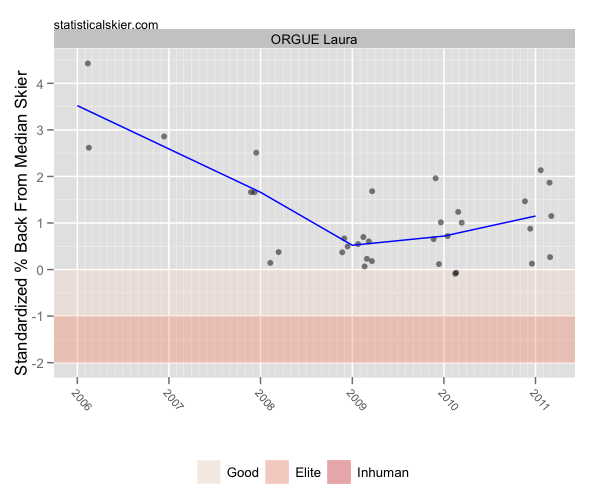
No one’s pretending that Orgue has been anything other than a middle of the pack type of distance skier, but I’m worried that her results have plateaued a bit, perhaps even tailing off last season. In my experience looking at skier’s results, after the early rapid improvement, they often hit a plateau. But each year they spend stuck at that level decreases the chances that they’ll start improving again. The clock is ticking, so to speak.
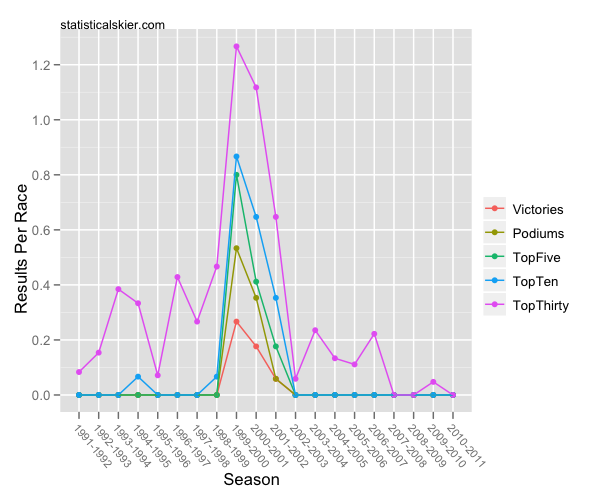
As for the men, the FasterSkier profile if anything underplays the comical contrast of with and without Johann Mühlegg:
These are the number of results at each level per WC race that season.
I love the annual series FasterSkier does profiling each nation that scored nation’s cup points in the days before the World Cup begins. Usually by the time they reach Norway and Russia, I’m actually less interested, but the first week or so is a fun ride through nations with tiny, little known programs.
First up was Spain, featuring Laura Orgue. The correctly note that she’s basically the only real prospect they have, and thankfully she’s not terribly old (~25). What can happen a lot with these tiny ski programs (or even medium sized ones, really, like the US) is they latch onto a decent skier and basically ride them into their 40′s. However, looking at Orgue’s last few seasons, I’m a little concerned:
No one’s pretending that Orgue has been anything other than a middle of the pack type of distance skier, but I’m worried that her results have plateaued a bit, perhaps even tailing off last season. In my experience looking at skier’s results, after the early rapid improvement, they often hit a plateau. But each year they spend stuck at that level decreases the chances that they’ll start improving again. The clock is ticking, so to speak.
As for the men, the FasterSkier profile if anything underplays the comical contrast of with and without Johann Mühlegg:
These are the number of results at each level per WC race that season.
I love the annual series FasterSkier does profiling each nation that scored nation’s cup points in the days before the World Cup begins. Usually by the time they reach Norway and Russia, I’m actually less interested, but the first week or so is a fun ride through nations with tiny, little known programs.
First up was Spain, featuring Laura Orgue. The correctly note that she’s basically the only real prospect they have, and thankfully she’s not terribly old (~25). What can happen a lot with these tiny ski programs (or even medium sized ones, really, like the US) is they latch onto a decent skier and basically ride them into their 40′s. However, looking at Orgue’s last few seasons, I’m a little concerned:
No one’s pretending that Orgue has been anything other than a middle of the pack type of distance skier, but I’m worried that her results have plateaued a bit, perhaps even tailing off last season. In my experience looking at skier’s results, after the early rapid improvement, they often hit a plateau. But each year they spend stuck at that level decreases the chances that they’ll start improving again. The clock is ticking, so to speak.
As for the men, the FasterSkier profile if anything underplays the comical contrast of with and without Johann Mühlegg:
These are the number of results at each level per WC race that season.
“I prepare myself for racing on the course, Bjoergen prepares herself in the pharmacy,” Justyna Kowalczyk of Poland said, and opened a can of worms.
The asthma medicine debate is heating up. But the debate is hardly news in the world of cross-country skiing – it’s a repeat topic.
Marit Bjoergen earned a bronze medal at the 10K freestyle event at the 2010 Olympics. (Photo: Inge Scheve)
Cross-country skiers are more disposed to develop asthma and upper respiratory infections than most other segments of the population. Skiers push their bodies to the max in frigid conditions and travel extensively – often across several continents, different altitudes, climates and time zones. It is hardly surprising that some of these individuals need asthma medicine in order to be able to compete at all. This is why the doping rules have a Therapeutic Use Exemption (TUE) clause that allows athletes to use the medicines they need. Without these TUE rules, several athletes would be unable to compete in their sports at the elite international level.
Marit Bjoergen (NOR) is not the only elite skier who needs asthma medicines. The list is long. Former Norwegian national racer Terje Langli, who won the 10K at the 1991 World Championships in Val Di Fiemme, suffered from quite severe asthma, and would have been unable to compete without medicine. The same is true for a number of Swedish cross-country stars, both current and over the years. You can’t simply say that asthma medicine equals doping.
Completely different
Doping is something entirely different. For instance, when Johann Muehlegg and a couple of Russian women injected themselves with EPO or other drugs during the 2002 Olympics in Salt Lake City, it was done with the intention to cheat. None of them had any documented medical conditions that warranted TUEs for the substances they were taking. They were using these drugs to gain advantages on the course and improve their performance, and they used banned substances that are proven to increase performance.
The asthma medicines that have been the subject of controversy are not performance-enhancing. The athletes use these drugs to achieve normal function, and to enable them to train and compete at the same level as healthy athletes.
The TUE system is based on trust. No athlete is allowed to use medicine without special dispensation. There is tight control with all drugs, and the athletes’ physicians have to report any prescriptions to the International Ski Federation. Cycling operates with a similar system: all riders have a medical passport that lists any and all medicines that they’re cleared to take.
Too many sick skiers?
Another concern, which surfaced in the 1990s, is whether an elevated amount of the very best elite skiers have asthma.
That is an entirely different question, although an important and appropriate one. If the proportion of elite skiers who have asthma severely differs from that of the general population, there might be reason to examine whether the criteria for diagnosing asthma are accurate. However, you have to trust that the anti-doping system is designed to only allow TUEs to those athletes who absolutely need those medicines. If you don’t or won’t trust the rules, then the whole meaning of sports is gone.
From www.langd.se, November 8, 2010. By Kjell Erik Kristiansen, translation by Inge Scheve, FasterSkier.
 No one’s pretending that Orgue has been anything other than a middle of the pack type of distance skier, but I’m worried that her results have plateaued a bit, perhaps even tailing off last season. In my experience looking at skier’s results, after the early rapid improvement, they often hit a plateau. But each year they spend stuck at that level decreases the chances that they’ll start improving again. The clock is ticking, so to speak.
 These are the number of results at each level per WC race that season.
