Tag: Johann Mühlegg

  • Nearly a Decade Later, Hoffmann’s Ban Prompts Thoughts

    Two years ago, Austrian cross-country skier Christian Hoffmann removed himself from the international-racing scene by retiring. That didn’t keep him out of headlines.

    On Monday, Austria’s anti-doping agency, NADA, handed the world champion a six-year ban from the sport. The decision was retroactive from 2009, in which Hoffman had been suspended two years for being associated with a Vienna blood bank, Humanplasma.

    NADA most recently found the 36-year-old Hoffmann guilty of having his blood taken for doping purposes at the Vienna lab between 2003 and 2006, and tagged on a ban of four years for co-owning a centrifuge for blood enrichment.

    Hoffmann’s lawyer, Hans-Moritz Pott, told reporters they would fiercely fight the verdict. He reiterated that Hoffmann never tested positive for a banned substance, and said they would appeal the case to an independent arbitration committee, and ultimately, the Supreme Court of the civil-court system.

    “Not one violation of the rules has been proven,” Pott told the Austria Press Agency. “(Hoffmann) says has he has competed cleanly for 23 years and he can’t let them do this to him.”

    After prosecutors insisted they wanted to keep Hoffmann from competing in the 2014 Olympics, Hoffmann told the Upper Austrian News they had been trying to take him down for years.

    “They wanted to make sure that I never absolve (to) race,” Hoffmann said, according to a translation. He has not indicated he would like to make a comeback.

    In 1999, Hoffmann was part of Austria’s world-championship winning relay. He took gold at the 2002 Salt Lake Olympics in the 30 k, after the initial winner, Johann Mühlegg of Spain, failed a doping test.

    Ten Austrian cross-country skiers were tested at the Salt Lake Games for using illegal substances, but all tested negative. Hoffman’s former coach, Walter Mayer, received a 15-month jail term in August for his connection to doping activities.

    Hoffmann and teammate Roland Diethart, who received a lifelong Olympic ban after Turin (2006), were supposed to appear at the Mayer’s hearing. They did not show up, along with biathlete Wolfgang Perner, who was also banned from the Olympics.

    A former ski official, Johannes Obererlacher, claimed to have walked in on Mayer while he was giving Hoffmann a blood transfusion at the 2002 Games. The International Olympic Committee questioned Hoffmann and cleared him of the accusation, the AFP reported.

    Most known for his Olympic medal, Hoffmann anchored the Austrian men’s relay that edged the Americans for fourth by six-tenths of a second. Carl Swenson raced him to the finish.

    In February 2002, Swenson told ESPN he was excited to hang with Hoffmann and test him in the final stretch.

    “I wish I had a little fresher legs. I think I could have pushed him all the way to the finish,” he said.

    Now a member of the U.S. Anti-Doping Agency, Swenson is committed to cleaning up the sport. While the USADA board member couldn’t comment on behalf of the agency, he offered his reaction to Hoffmann’s ban in an email.

    “It’s good news when a doper gets caught,” Swenson wrote. “It’s sad to think of the people that were cheated out of a better result.

    “There will always be racers who try to cheat, personally I don’t give much thought to what they got away with,” he added. “I get some satisfaction knowing that every cheater walks away worried that he will be exposed one day.”

    So far, Hoffmann spent some $14,000 euros — about $18,800 dollars — on legal fees. His attorney said the money didn’t matter.

    “We benefit from everything, even if the costs are huge,” Pott said.

    Finances may not be a concern for Hoffmann, who shared the cost of a $100,500 blood centrifuge. Athletes testified he lent the centrifuge to them, which is a criminal offense under Austrian anti-doping laws.

    Based on his offenses, the NADA Law Commission gave Hoffmann the minimum sentence of four years. He could have received a life in jail.

    In a press release, the Law Commission stated its decision considered World Anti-Doping Agency standards. Citing WADA code, the Austrian disciplinary commission decided not to cancel all of Hoffmann’s results.

    Tracing the first “material time” in which Hoffmann’s performance was affected and voiding his results accordingly would be “an impermissible double possible punishment,” the NADA press release stated.

    The head coach of Canada’s national cross-country ski team, Justin Wadsworth was also on the American’s fifth-place relay at the 2002 Games. He thought the Austrian’s ban was a bit comical, considering Hoffmann retired from the sport in 2009.

    “We knew he was doping,” Wadsworth wrote in an email. “I mean we had no hard evidence as athletes, but we knew it that same way we knew Mühlegg and others were doping as well.”

    Around that time, several cross-country skiers were convicted. In 2001, six Finish skiers were caught using a banned substance: Jari Isometsa, Harri Kirvesniemi, Janne Immonen, Myka Myllyla, Milla Jauho, and Virpi Kuitunen.

    “It sucked then, and it still sucks now,” Wadsworth wrote. “It really takes the purity and beauty of sport and diminishes it to the greed and other things in life that plague our society today.

    “I guess as a clean athlete you must ski for the love of the sport and let the chips fall where they may,” he wrote. “I take pleasure watching clean athletes win today, because I know there’s still doping going on, and when you can win clean there’s another reason to celebrate.”

    A current U.S. Ski Team member, Kris Freeman competed on the men’s relay in his first Olympics in 2002.

    “Everyone who watched Hoffmann ski knew he was doped to the gills,” Freeman wrote in an email. “(The ban) should have been handed down a decade ago.”

    He pointed to the case of Estonia’s Andrus Veerpalu, who retired from the sport in January and received a three-year ban for doping in August. The International Ski Federation (FIS) decided to bar the 40-year-old from competing until Feb. 23, 2014, the last day of the Sochi Winter Olympics.

    “(The FIS) waited until one of their stars was effectively retired before handing down a statement punishment,” Freeman wrote.

    Until a cheating star is penalized in his or her prime, Freeman said he wouldn’t be satisfied.

    Because the FIS wasn’t involved in Hoffmann’s case, Sarah Fussek, assistant to the secretary general, couldn’t comment on specifics. She wrote in an email there was no indication the FIS would be involved in an appeal.

    While Hoffmann’s case wasn’t final, Fussek wrote it could not be compared to others, but she referenced a few instances in which an athlete never failed a drug test yet was convicted. In 2011, the FIS handed Nikolay Pankratov (RUS) a two-year ban for possessing drug-injecting equipment. Denis Vorobiev (BLR) received a similar ban in 2005 when human growth hormone was found in his waist bag.

    Swenson wrote that “more sophisticated dopers” often caught with evidence besides a positive drug test.

    “The more difficult it becomes to dope, the more people must be involved, and the more likely that someone will talk,” he wrote. “I don’t know the specifics of this case, but it sounds like expensive equipment, technicians and doctors must have been involved. That is hard to hide.”
  • 23 Teams in 23 Days: Team 23 – Spain

    23 Teams in 23 Days: Team 23 – Spain

    The World Cup season is bearing down on us with the finishing straight speed of Petter Northug and the hill-climbing mastery of Therese Johaug – but are you prepared for the explosion of elite cross country skiing talent?

    The water-cooler chat is heating up (okay, well maybe just here at FasterSkier) and you need talking points!

    Who is this Finn Hagen Krogh guy? What kind of car is Anna Haag driving? Is Justyna Kowalczyk really going to race all those World Cup weekends again? Have the Italians embraced the youth movement? Are there still Russian skiers testing positive for/on/returning from doping bans? Will Dario Cologna bounce back from a sub-par World Championships and stick it to his Scandinavian rivals in a year with no major Championships? Has Andy Newell cut his hair? (For the record, the answer to the last one is yes.)

    Here’s your chance to find out!

    FasterSkier is proud to present its exclusive second-annual World Cup preview series – 23 Teams in 23 Days, a collection of articles in which each team that scored points on the Nations Cup last season will be profiled.

    The format remains the same as last year – if your nation scored a World Cup point, you get featured! We provide a short run down of how each nation performed last season, notable happenings in the off season, and factors to consider for the coming season. Finally, we make a debatably-expert pundit’s prediction on a possible point of interest to watch for this coming World Cup season. Feel free to weigh in with your own thoughts or opinions!

    Spain

    2009-2010 Nations Cup Ranking: 21st (33 pts)

    2010-2011 Nations Cup Ranking: 23rd (2 pts)

    Men: N/A

    Women: 22nd (2 pts)

    2011/2012 World Cup Team

    Men

    Vincenc Villarubla

    Diego Ruiz

    Javier Gutierrez

    Ioseba Rojo

    Imanol Rojo

    Women

    Laura Orgue

    What You May Have Missed Last Season

    Aside from the oft-referenced Johann Muehlegg disaster (who wasn’t really Spanish, let’s be honest) Spain has never really made a splash on the World Cup.

    And last season was no different – Spain had the dubious honor of being the last team on the Nations Cup ranking.

    Spain’s two points were courtesy of one woman – Laura Orgue.

    At 25, Orgue has been trying to break through on the World Cup for the last few seasons, and has been making small gains each season. She collected a second place in an Alpen Cup 15 k pursuit last season, and finished third in the 10 k at German Nationals. On top of that, she had a host of top 10 results on the second-tier circuit.

    Last season her whopping two World Cup points came from a 15 k freestyle in La Clusaz, France, where she crossed the line 29th. She was also the Spanish National Champion for the second year in a row.

    While Orgue was picking up points, the Spanish men were struggling, scoring a grand total of zero. This may not come as a huge surprise, but they have had a solid if not flashy group of skiers grinding out a few points (last year, 33) year in, year out. Between Diego Ruiz, Vincenc Vilarrubla, and up-and-comer Javier Gutierrez, they are usually able to notch one or two finishes in the points, however last season they were shut out.

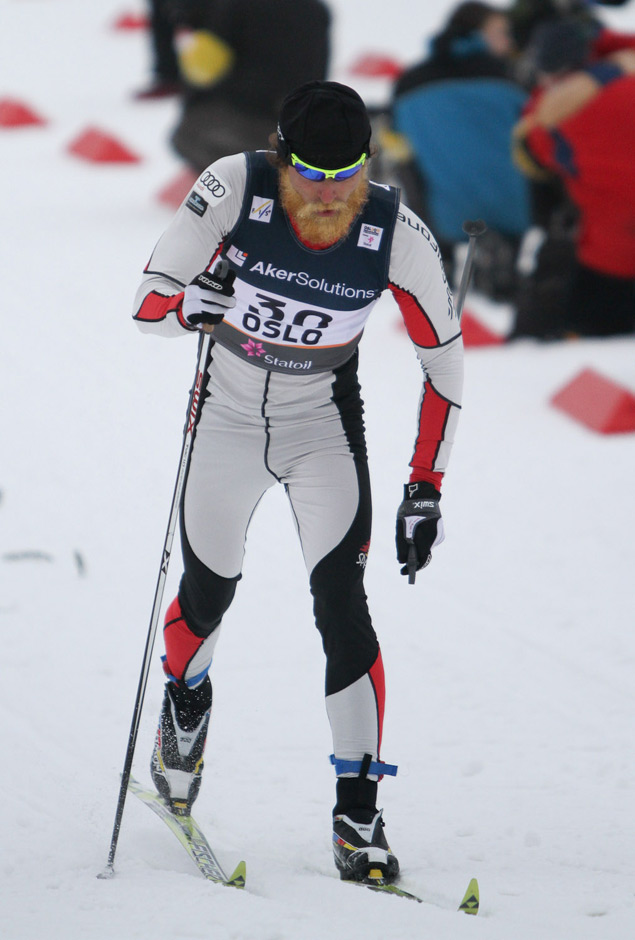
    Villarubla may not have been Spain's fastest skier, but he won the inter-team beard growing contest handily. (Photo: Topher Sabot)

    What You Need To Know for This Season

    The American women don’t have a monopoly on mountain running; Orgue was named to the Santiavieri Saloman Outdoor Team this summer (links may require translation), and then became Spanish National Champion in mountain running.

    The men’s team, which has long been anchored by Ruiz, Vilarrubla and Javier Gutierrez is in a bit of a decline.

    Ruiz has been a regular on the Spanish National Team since 1998, when he started his first World Cup. However, at 35 years old, he seems to be targeting marathon ski racing events over the World Cup. He’s still active on the National Team, and also became the Spanish National Rollerski Champion this past fall.

    Vilarrubla, at 31, had a sub-par World Cup season, never finishing in the top 40. His younger teammate Gutierrez, who is just 26, has significantly more potential, however he lacked of World Cup and Alpen Cup success last season, which does not bode well.

    The other new blood in the system is 24 year old Ioseba Rojo and his 22 year old brother Imanol Rojo. After back to back trips to World Under 23 Championships, the elder Rojo made some noise at Spanish Nationals, mixing it up with his older countrymen. However, seeing as his best placing at U23’s was 45th, it’s unlikely he will be mixing it up at the top level on the World Cup this season.

    The younger Rojo is in a similar boat – his best chance for success will come at U23’s, rather than on the World Cup circuit.

    Who You Should Watch

    Once again, it’s Orgue or bust. The young woman still has potential – at U-23 World Championships in 2009 she won the bronze medal in the 10 k freestyle, ahead of Liz Stephen and Morgan Arritola, among others.

    She just doesn’t have a lot of domestic competition, as she won the 5 k at Spanish Nationals by nearly two minutes, and the 10 k by over four minutes. In four starts on the World Cup last year, she finished 29th once and finished in the top 50 two other times. If she manages to squeeze into the top 30 in a few more distance World Cups, which is not an unreasonable expectation, it will be a success for her and Spain.

  • Team 21: Spain

    Team 21: Spain

    Spain

    Nations Cup Ranking: 21st (33 pts)

    Men: 18th (33 pts)

    Women: N/A

    2010/2011 World Cup Team (Best estimate)

    Men

    Vincenc Villarula

    Diego Ruiz

    Women

    Laura Orgue

    What You May Have Missed Last Season:

    On the World Cup, the Spanish were incredibly quiet most of the year. But like a couple of teams (see Canada, Sweden), they had a proportionally  impressive Olympics. Vincenc Villarula finished in 31,  a heart-breaking .1 behind Jean-Marc Gaillard and a top 30 placing. Meanwhile in her three races, Laura Orgue bagged placings of 38, 27 and 36. As for the ageless Diego Ruiz,  he didn’t have such a hot Olympics, but seeing as the 33 year old is now a three-time Olympian, we’ll cut him some slack.

    On the plus side, the team has benefited from not having a complete nut-job skiing for them, as Johann Muehlegg apparently was.

    What You Should Know For This Season

    Spain has been hurting on the World Cup ever since Johann Muehlegg took an FIS-enforced break from the sport after his little incident with something called ‘darbepoetin’ at the Salt Lake City Games. While Muehlegg is German-born, he waved the Spanish flag while winning in Salt Lake in 2002 by over two minutes with brutal technique, in one of the ugliest ski suits ever seen on a race course. Check out those sparkly arm pieces. He later tested positive and had to return his medals.

    Should have been pretty obvious to just about everyone…

    Who You Should Watch

    Laura Orgue has been knocking on the door of the top-30 for the last couple of years. She finished in the top-40 in all three Olympic races, which could mean the 24-year old could squeeze off a few points. At least in distance races, she could become a points-getter – her sprinting could be generously listed as ‘needs improvement’.

    Laura Orgue