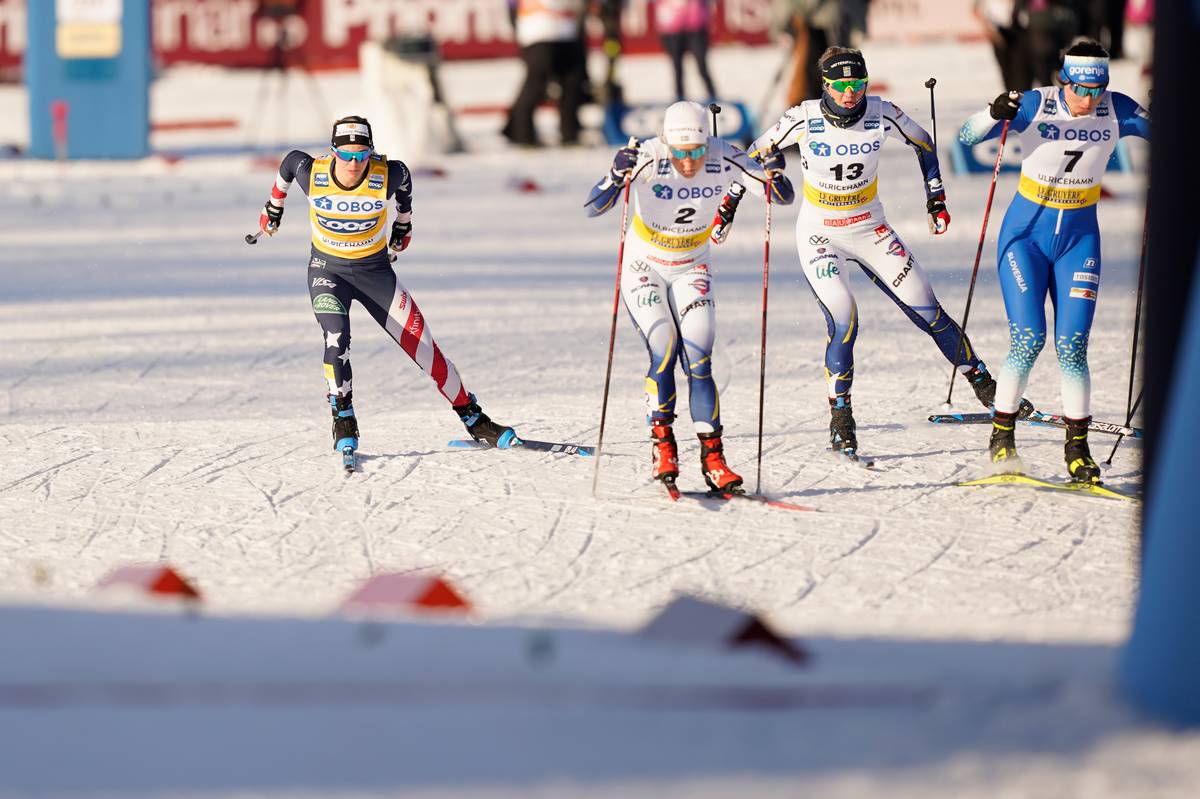
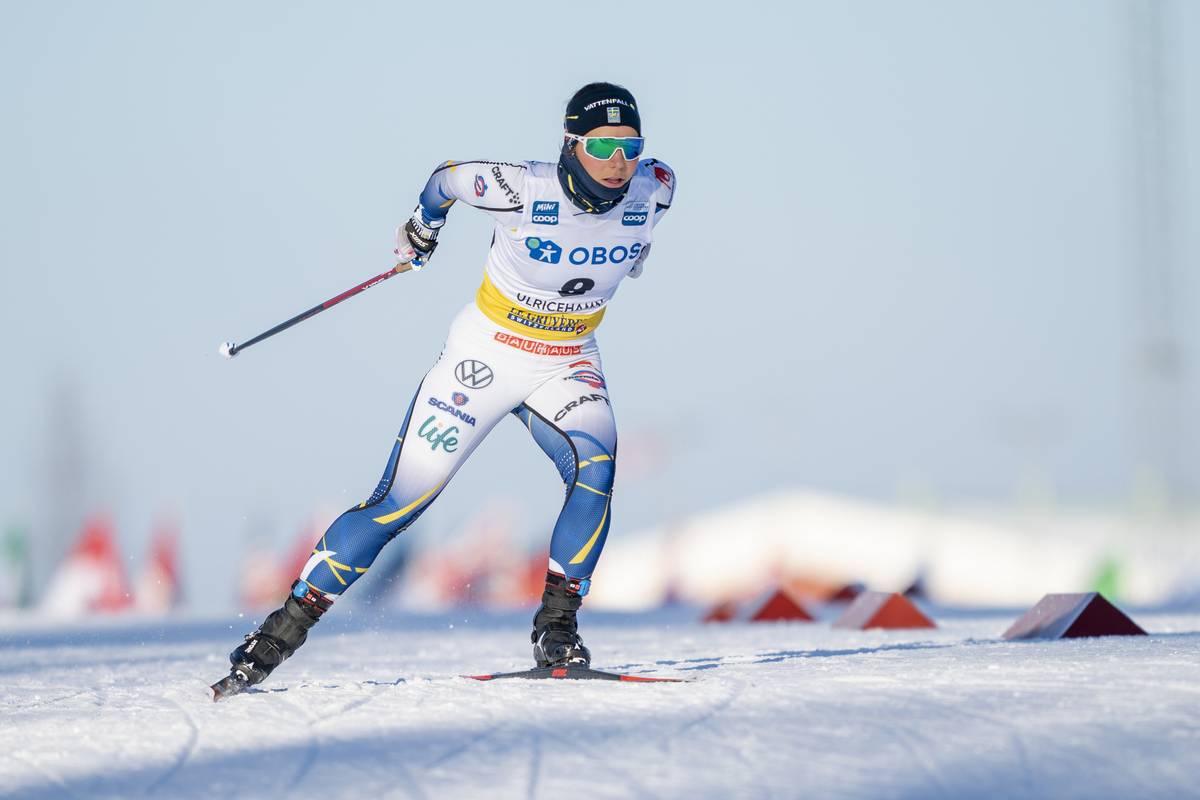
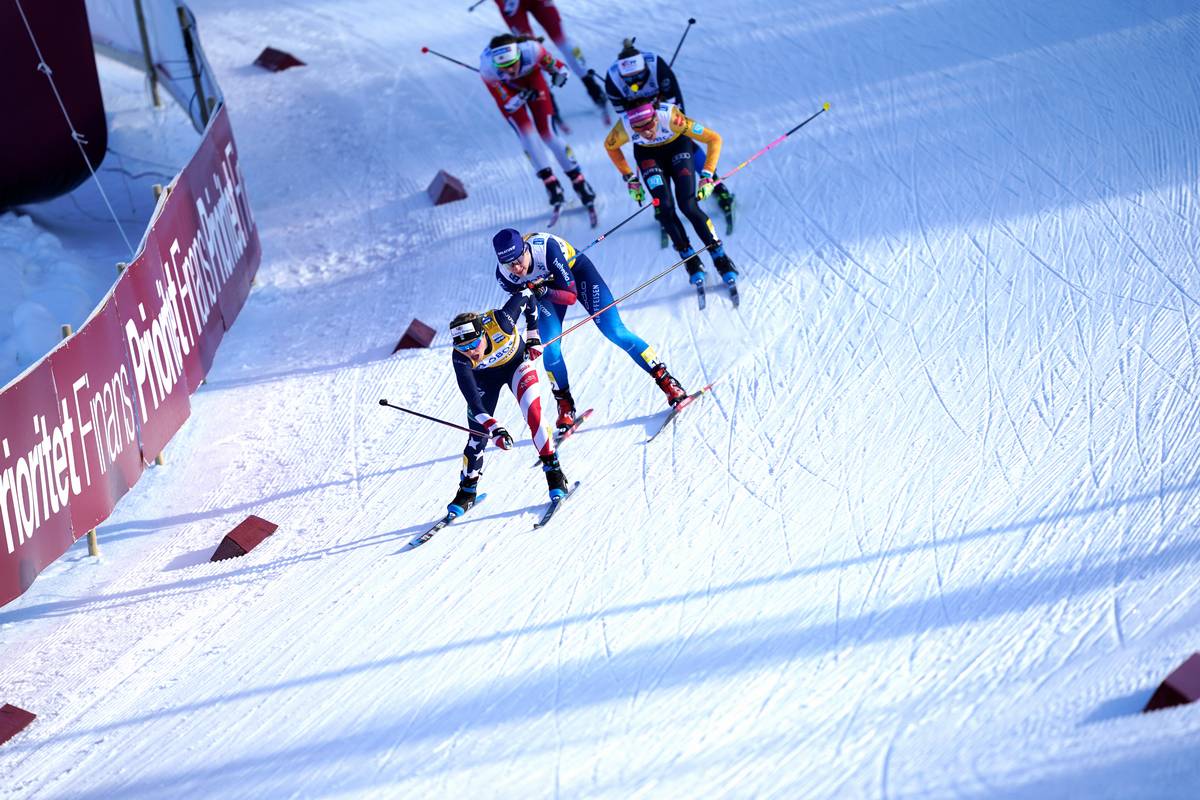
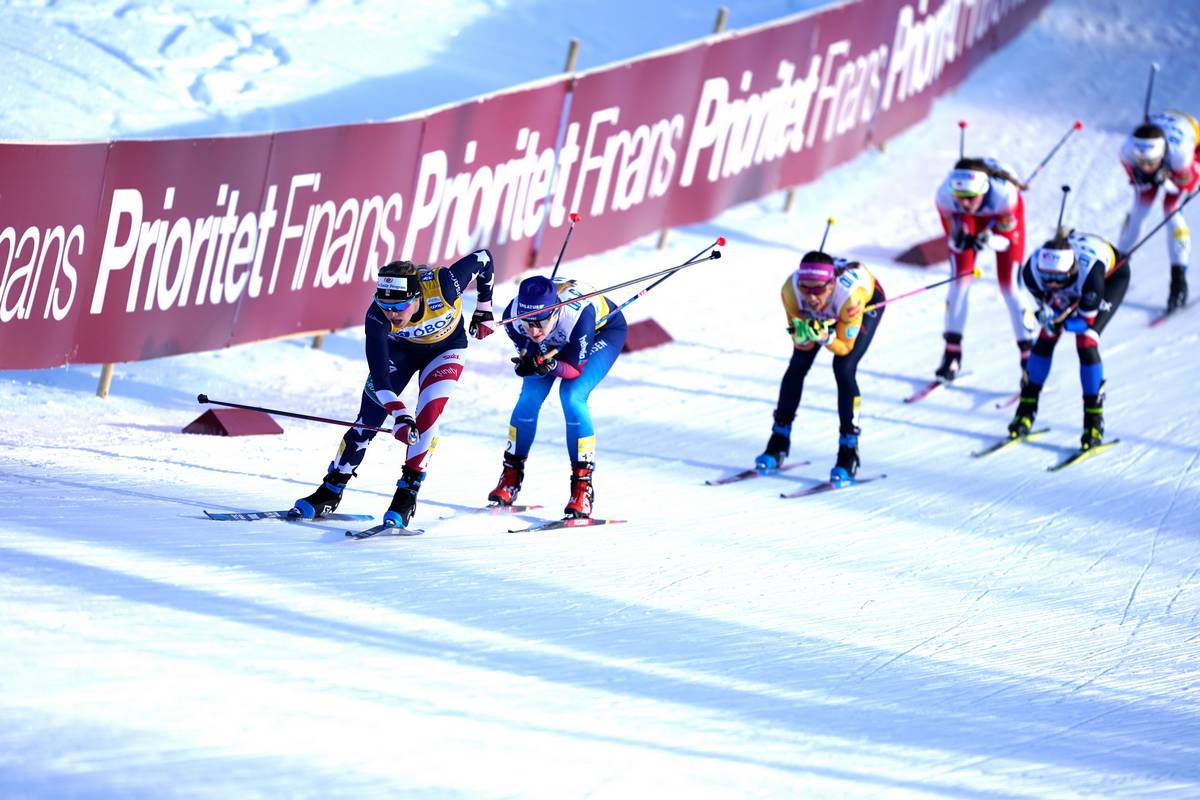
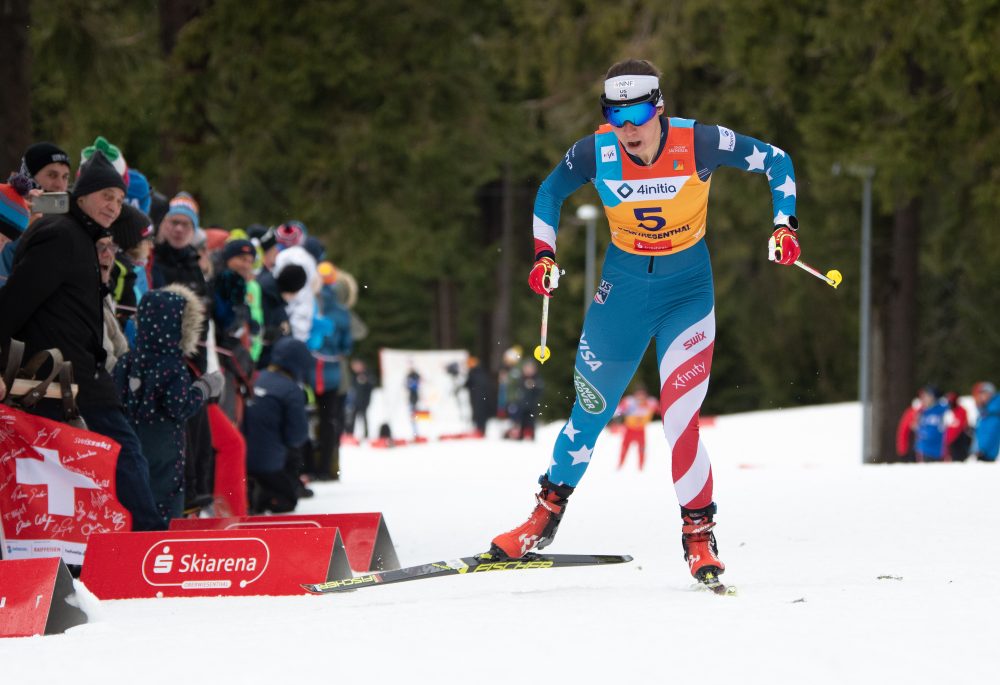
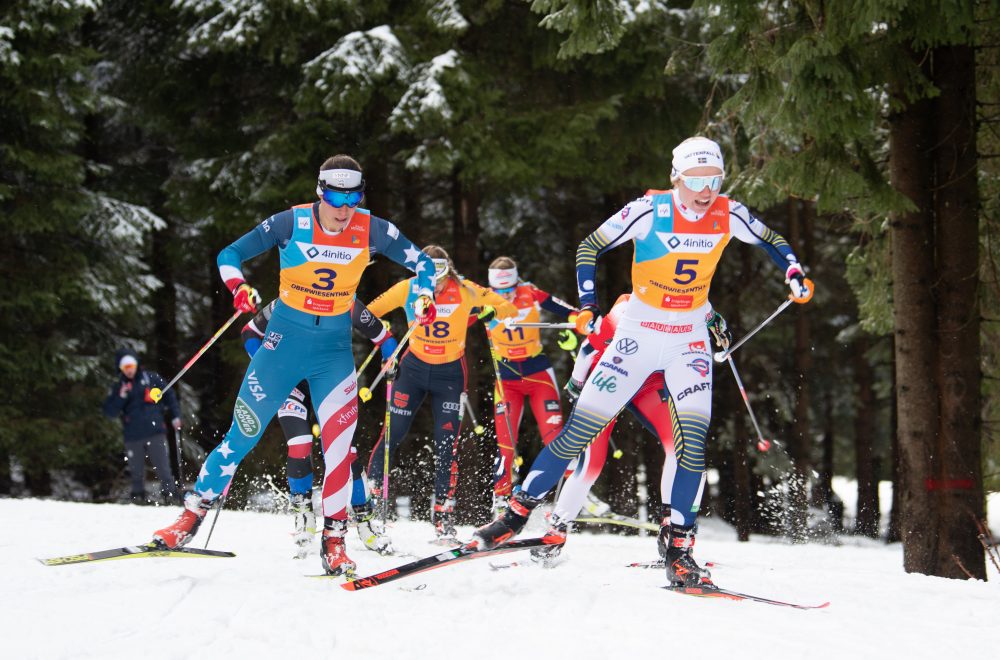
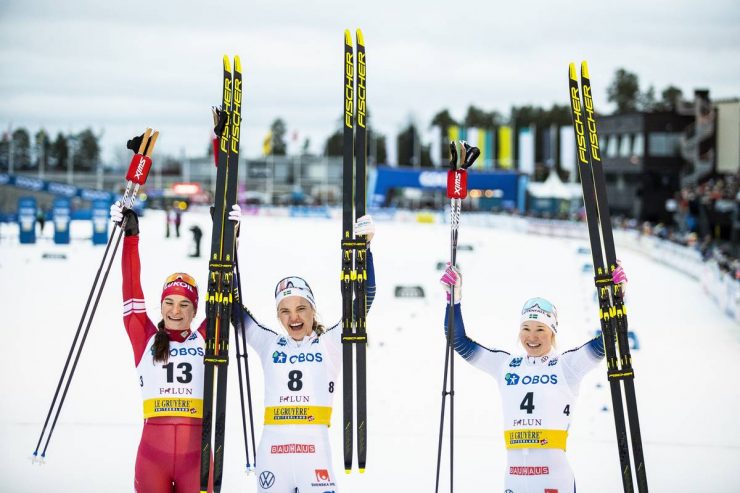
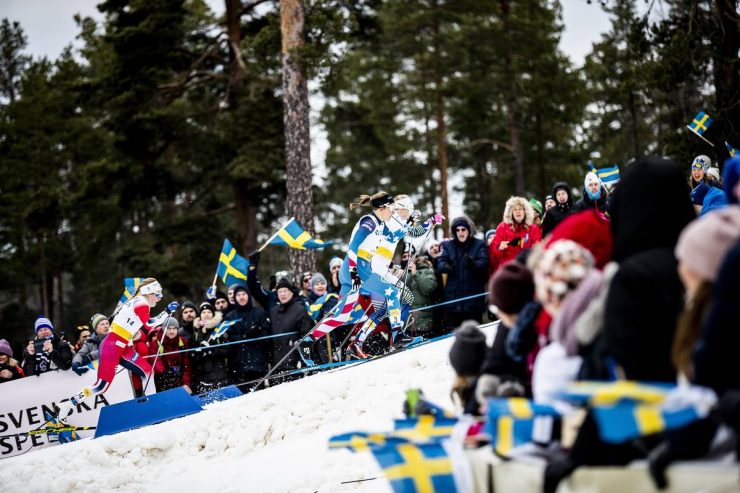
Tag: Johanna Hagstrøm

  • Sundling Returns to Win Lahti Sprint as Crystal Globe Battle Tightens

    Sundling Returns to Win Lahti Sprint as Crystal Globe Battle Tightens

    This coverage is made possible through the generous support of Marty and Kathy Hall and A Hall Mark of Excellence Award. To learn more about A Hall Mark of Excellence Award, or to learn how you can support FasterSkier’s coverage, please contact info@fasterskier.com.

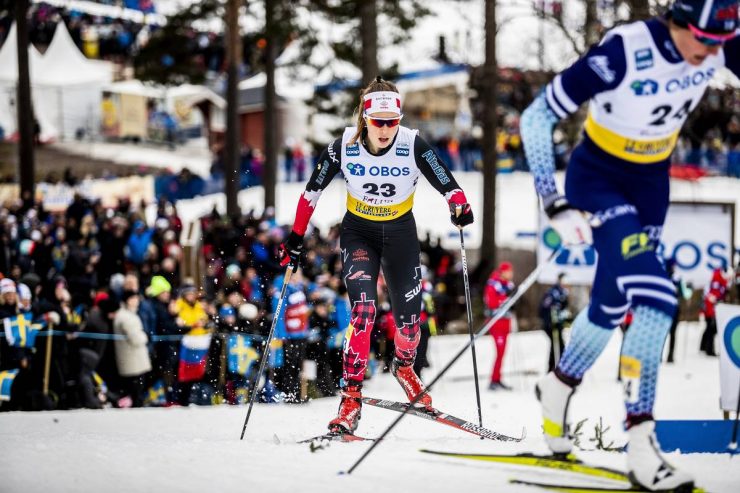
    Jonna Sundling (SWE) during qualification in Lahti, Finland. (Photo: Authamayou/NordicFocus)

    The World Cup season returned to Finland this weekend, closing a circle that began more than three months ago in Ruka. In the time since Olympic teams were selected, dreams realized or deferred, experience forged, and farewells offered week after week as the long winter wears on. If the stakes in Lahti feel slightly lower than they did earlier in the season, they are tightening in another way — especially in the races for the Crystal Globes.

    With only a handful of races remaining in the season, the women’s Freestyle Sprint offered more than just another podium. The fight for both the Sprint Crystal Globe and the Overall Crystal Globe continues to tighten.

    In tricky conditions, Sweden’s Jonna Sundling emerged as the day’s winner, navigating the heats with authority before closing out the final to claim victory.

    “I think all day it’s been difficult with the conditions because it seems so nice, but when you ski it’s like icing underneath,” Sundling said in a post-race interview with FIS on the broadcast. “There were some challenges with the skiing, but I’m glad that I could ski as I did today and go all the way.”

    The victory marked a strong return for Sundling, who said she had recently been dealing with a cold and missed racing in Falun before arriving in Lahti.

    One of the most interesting moments of the women’s race came when Kristine Stavaas Skistad (NOR) was disqualified during the semifinals for what appeared to be a very minor incident.  She received a yellow card for the incident, and because she was already carrying one from a previous violation, she was disqualified. (Photo: Authamayou/NordicFocus)
    A Tactical Sprint Course

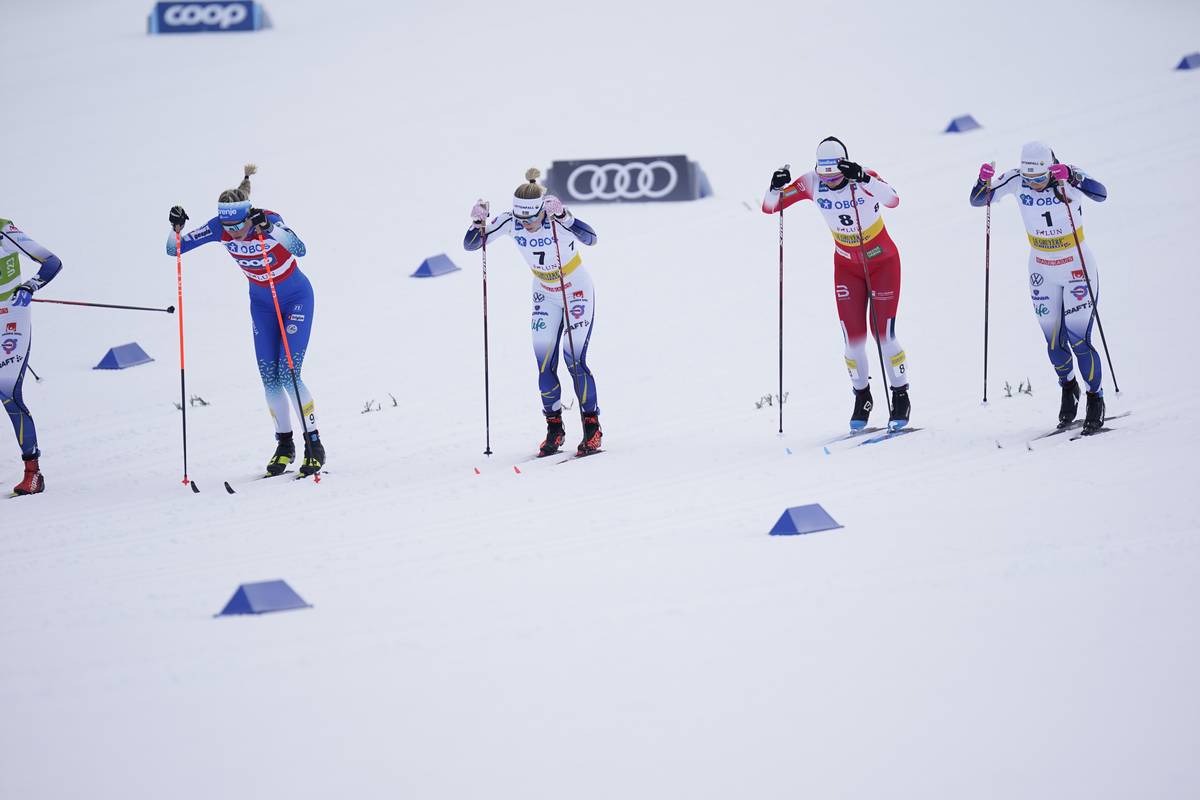
    The Lahti freestyle sprint course rewarded patience as much as power. After the individual qualification round, the top 30 athletes advanced into the head-to-head heats — five quarterfinals of six athletes each, with the top two finishers and the two fastest “lucky losers” advancing to the semifinals.

    From there, the field narrowed again: two semifinal heats would determine the six skiers racing for the win.

    While the course appeared straightforward on paper, athletes quickly discovered the conditions made positioning critical. The climb before the final hairpin offered one of the few reliable passing opportunities before the long run to the finish, which saw the race often gather back together around the final corner before the finishing stretch. And throughout the heats, several favorites discovered how narrow the margin for error could be.

    Maja Dahlqvist (SWE) got out well, but was unable to advance from the quarterfinals. (Photo: Authamayou/NordicFocus)
    Globe Leaders Falter

    Two of the athletes who have dominated the sprint standings this season — Maja Dahlqvist (Sweden) and Nadine Fähndrich (Switzerland) — both saw their days end earlier than expected, failing to advance beyond the quarterfinals.

    Their early exits added intrigue to the sprint globe race as the season heads toward its final stretch.

    Meanwhile, Sundling continued to build momentum, advancing smoothly through her heats despite the difficult snow conditions.

    “I’m super motivated,” Sundling said of the final weeks of the season in the broadcast interview. “It’s my favorite time of the year.”

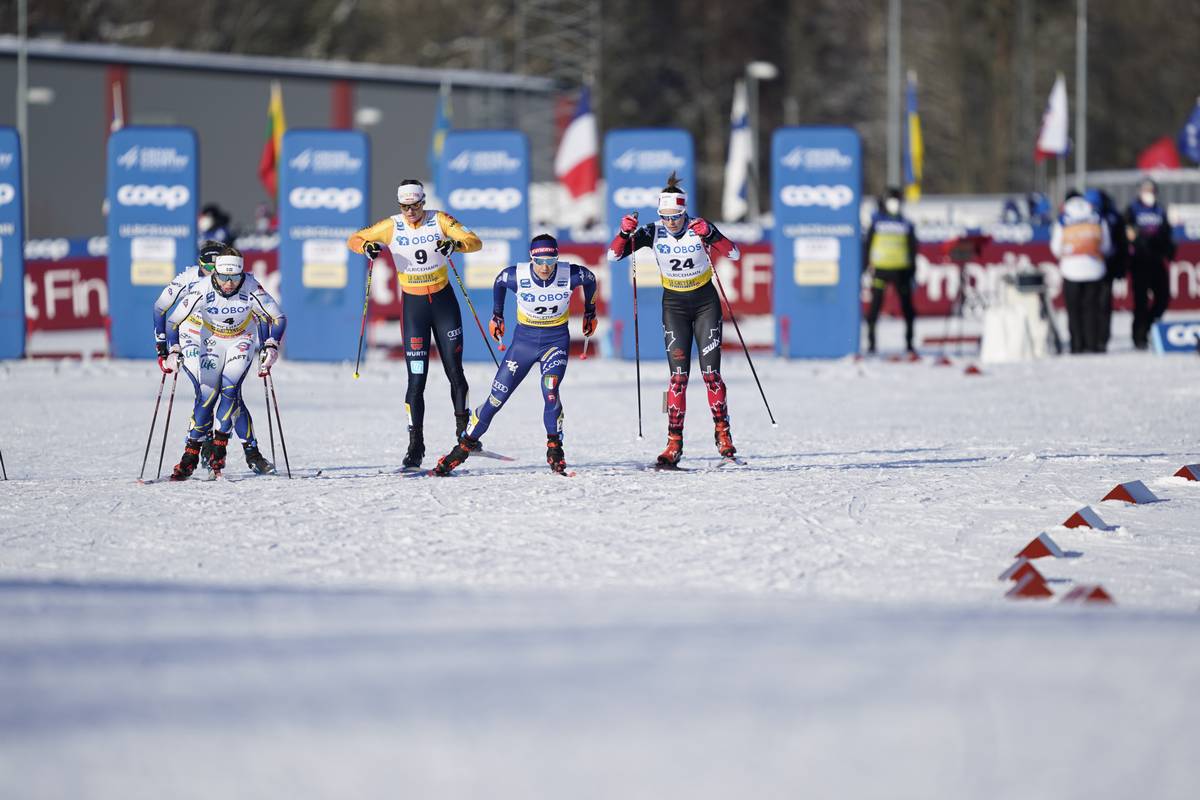
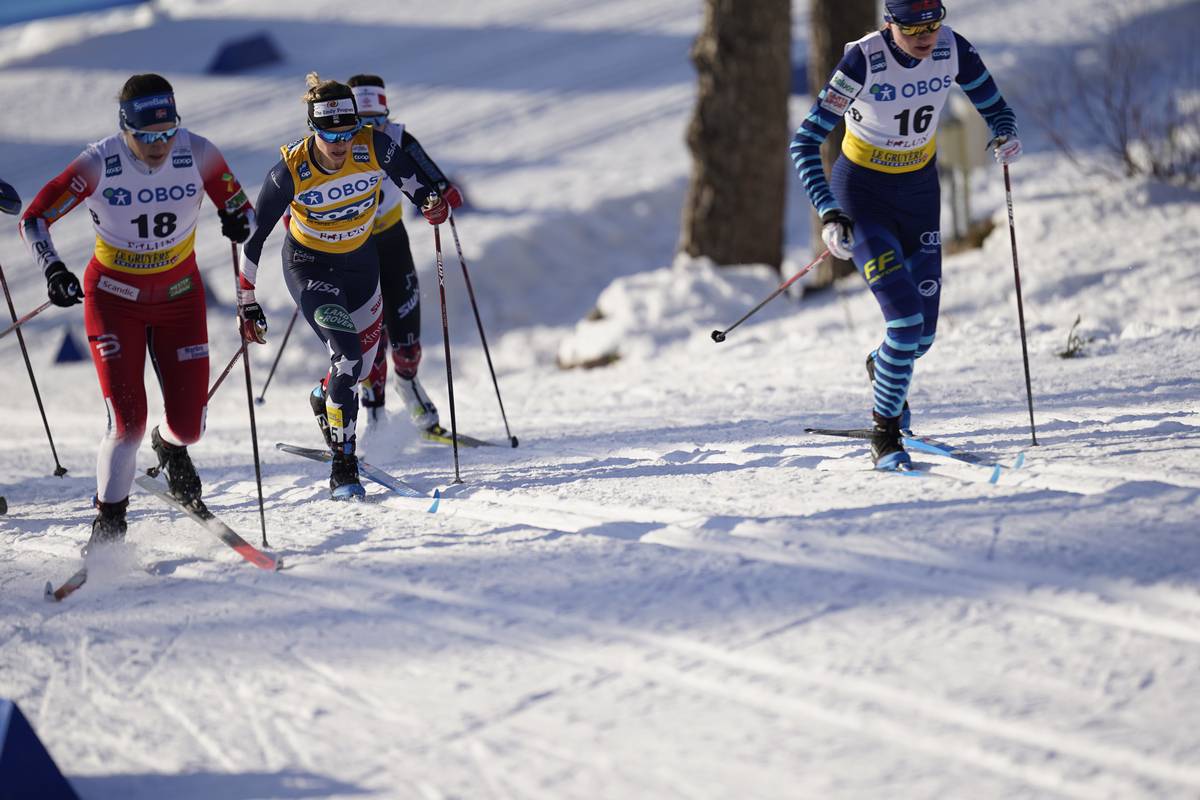
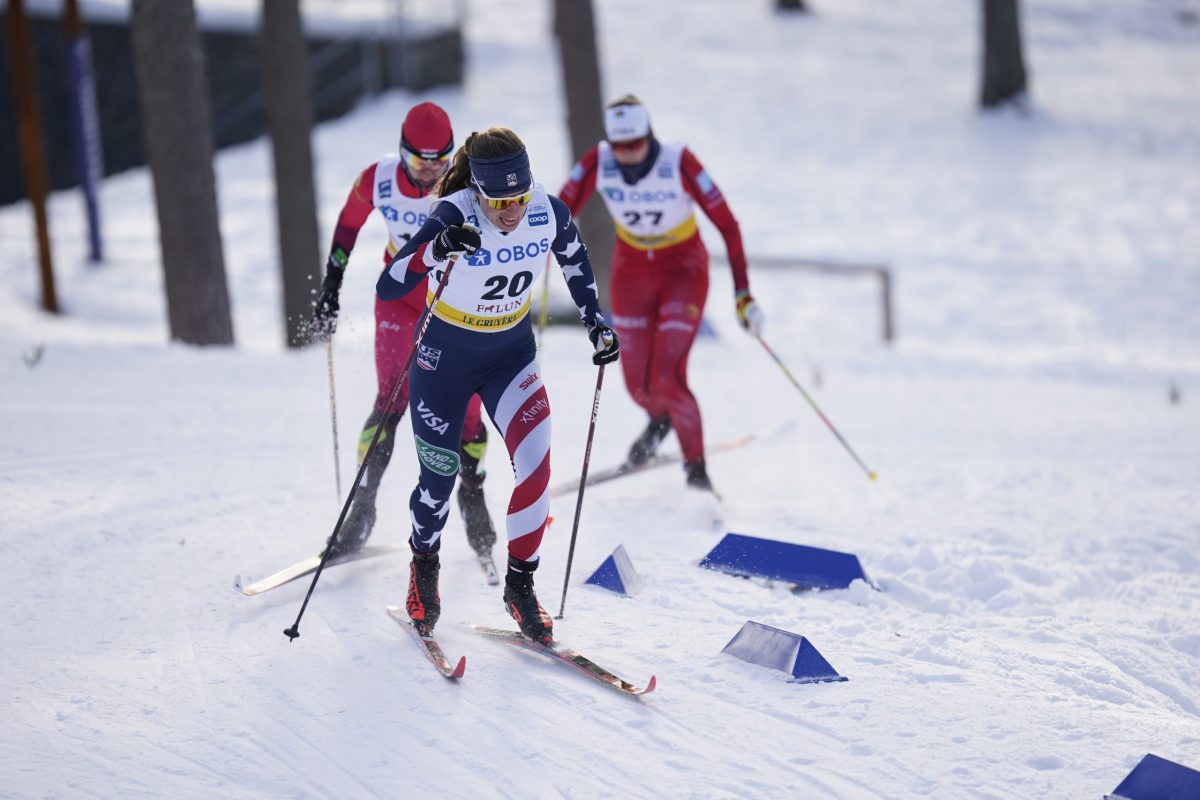
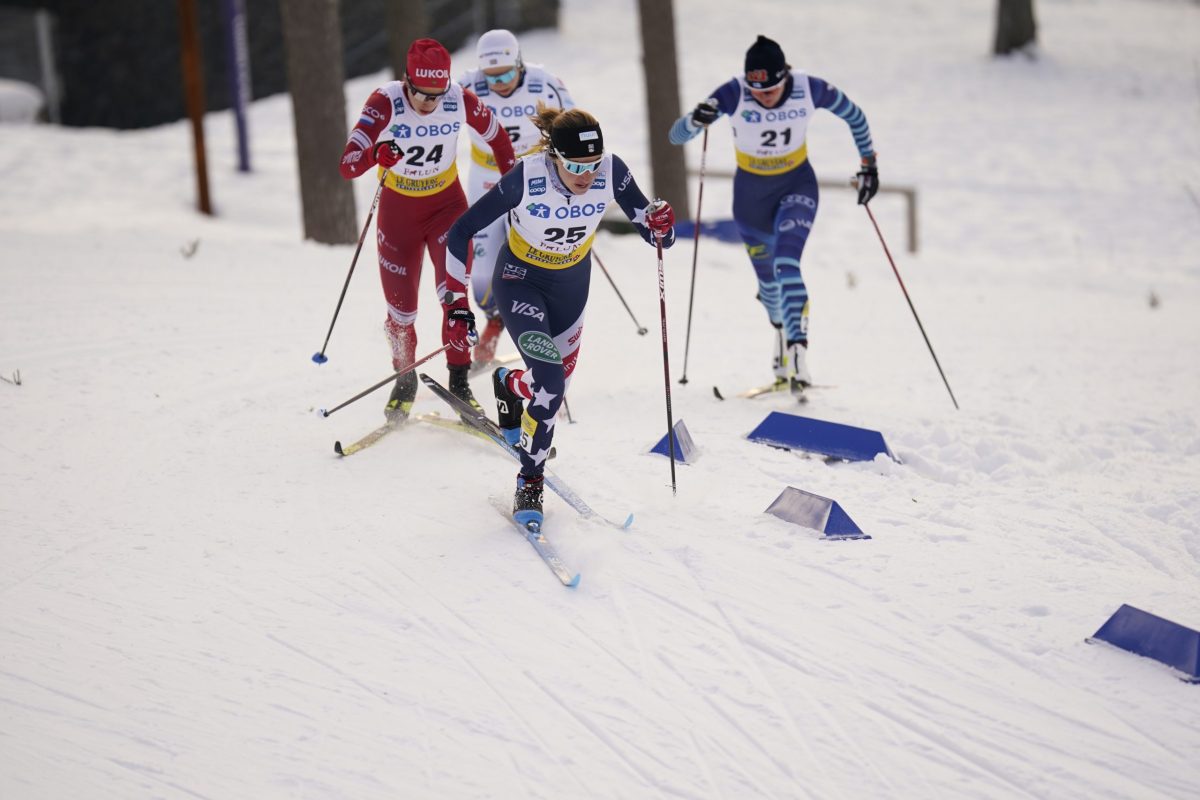
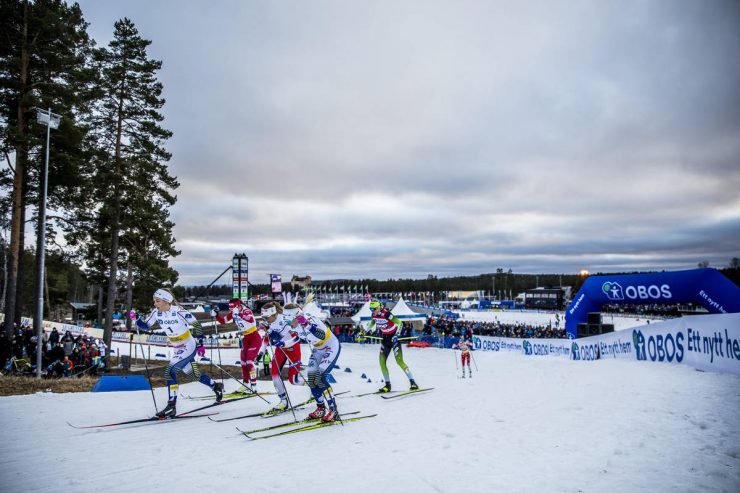
    Hilla Niemela (FIN), Johanna Hagstroem (SWE), and Jessie Diggins (USA) (l-r) charge up the opening climb of the Freestyle Sprint in Lahti, Finland. (Photo: Authamayou/NordicFocus)
    Diggins Attacks, But Falls Short

    For the United States, Jessie Diggins came closest to advancing deep into the rounds.

    In her quarterfinal, Diggins launched a decisive move on the final climb, surging to the front of the group in an effort to create separation before the tight hairpin turn at the top of the hill. Over the crest, she continued the attack, aggressively no-pole skating the downhill in an attempt to open a gap.

    For a moment, the tactic appeared to work.

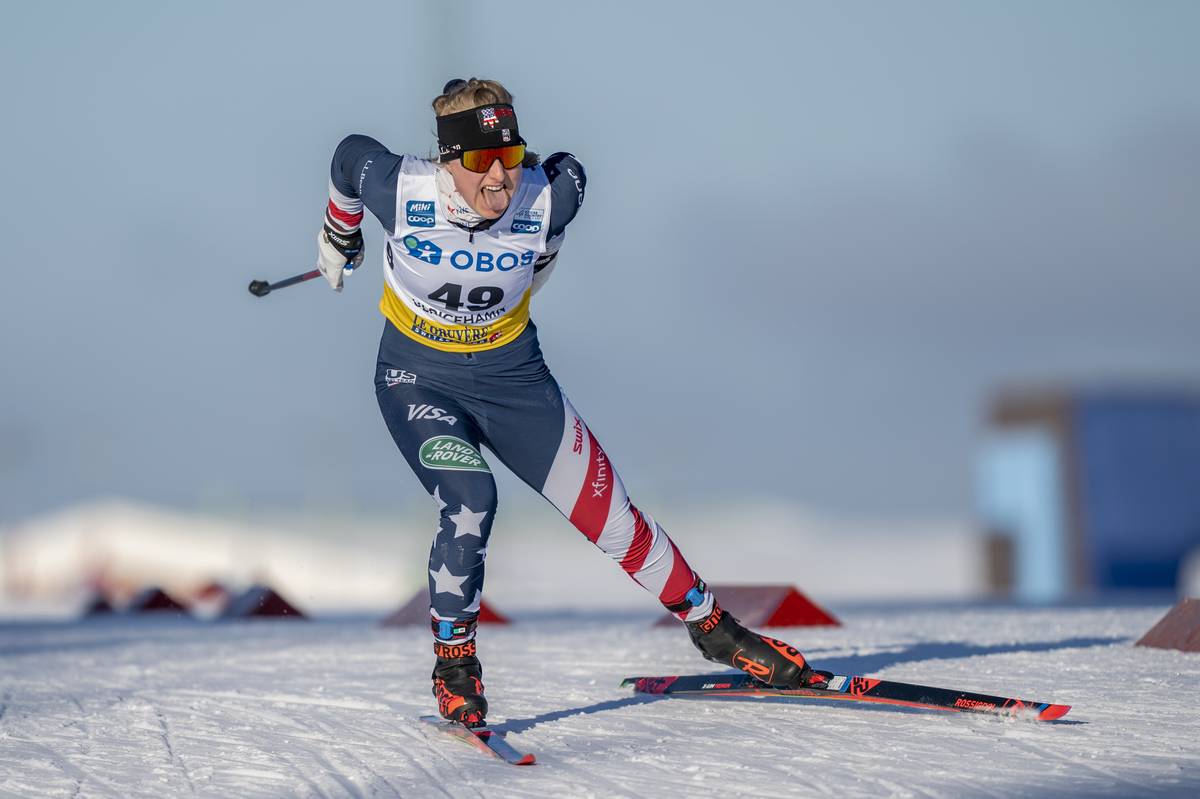
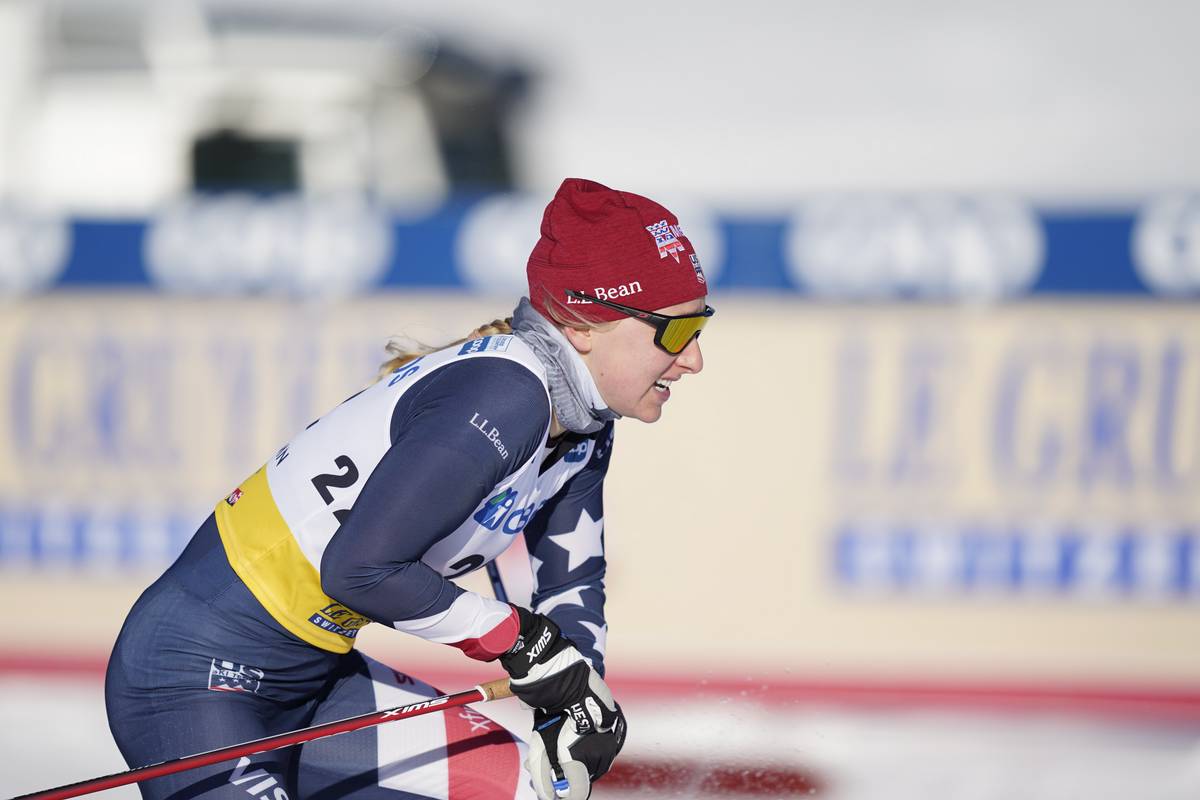
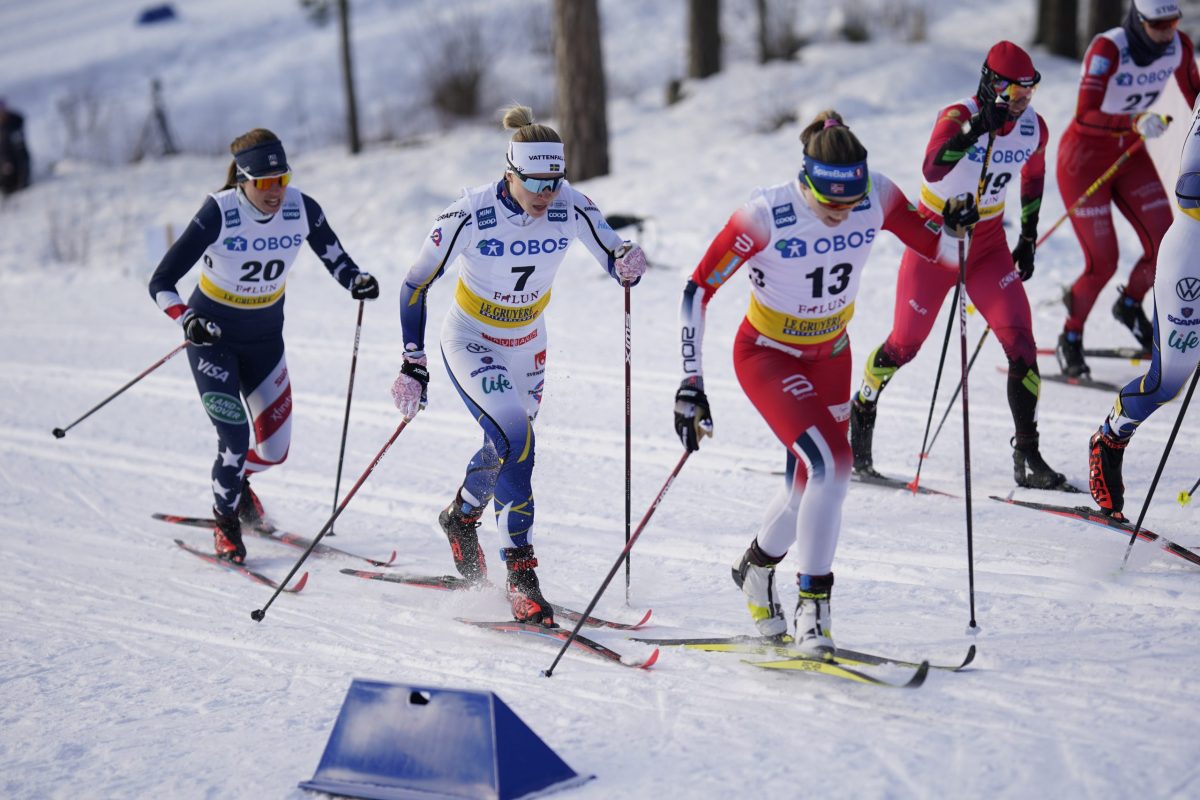
    But the chasing group quickly organized behind her, the draft pulling them back together on the descent into the stadium. Sweden’s Johanna Hagström surged in the final meters, lunging at the line to edge Diggins and end the American’s day in the quarterfinal.

    Diggins said the Lahti crowd helped make the experience memorable.

    “It was so cool to hear the crowd roaring. There were so many people out, really filling the stadium and along the course. It’s just a very cool environment. It was sunny and beautiful, which made it really fun.

    “I was really happy with my energy today. I feel like I skied a pretty good race and did everything I could. But again this year, I feel like I just don’t quite have that ultimate power, especially in the finishing stretch.

    “I’m excited for tomorrow and just excited to be finishing out my last stretch here in Europe. That feels really special. It’s kind of cool to take a moment to reflect on my many years spent on the road in Europe. That chapter is coming to a close now, which is really cool and really special. I’m just grateful thinking back on all the memories over all the different years.”

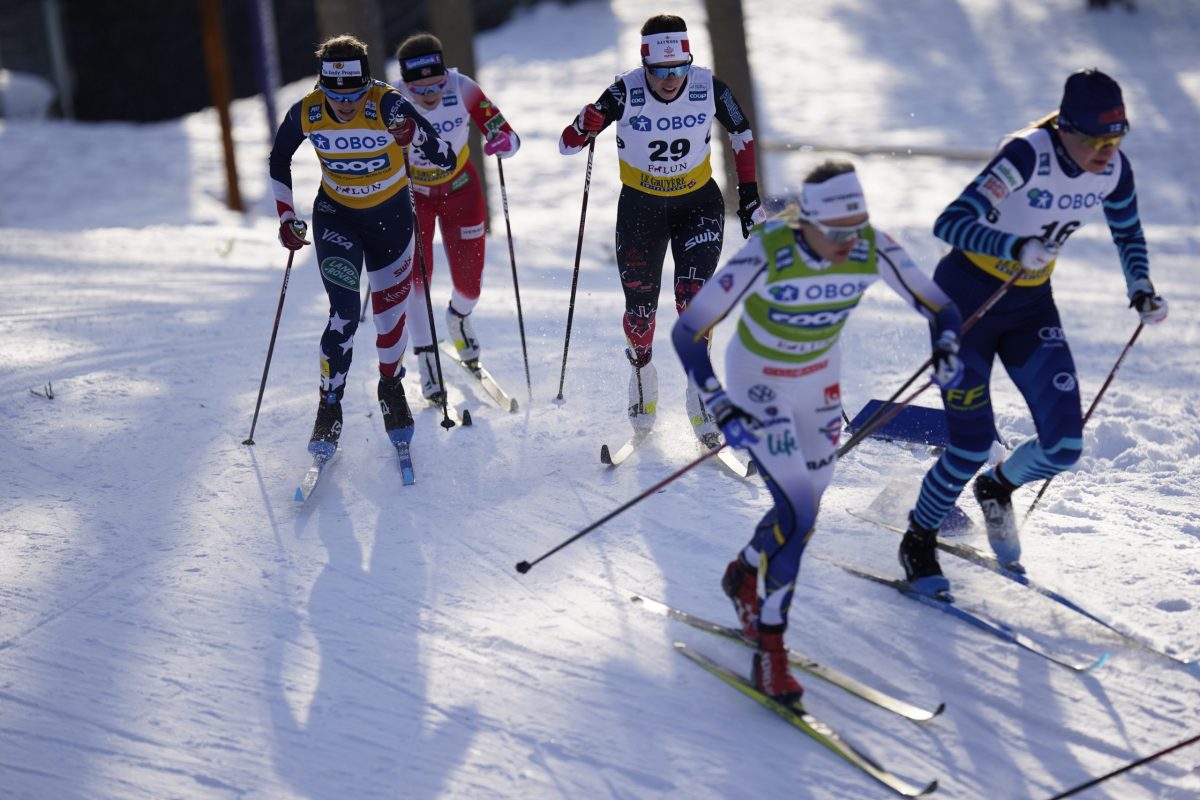
    Rosie Brennan (USA) fighting to maintain contact with the group as Gina Del Rio (AND) takes the opening climb out fast during their quarterfinal. (Photo: Authamayou/NordicFocus)
    Brennan Knocked Out in Quarterfinal*

    Veteran American Rosie Brennan also reached the quarterfinals but was unable to advance.

    Lauren Jortberg (USA) on her way to 37th place in qualification in Lahti, Finland. (Photo: Authamayou/NordicFocus)
    Jortberg Reflects on Qualification Miss

    For Lauren Jortberg, the Lahti sprint was a reminder of how thin the margins can be in World Cup qualification.

    Jortberg finished 37th in the qualification, just outside the top-30 cutoff needed to advance to the heats. After the race, she said the conditions on the Lahti course made it difficult to find the right balance between glide and stability.

    “There was kind of an ice sheet underneath with some sugar on top,” Jortberg told FasterSkier after the race. “So it was hard to find skis that were running really well while also being able to push off and plant well. It made the skiing a little tricky, but that’s pretty typical for what we’ve seen in Lahti the last few years.”

    Jortberg also felt she left something on the course in terms of pacing.

    “I think I just didn’t pace it very well,” she said. “I probably paced it too much. I didn’t really finish feeling that tired, so that was a bit of a bummer.”

    Part of that caution, she explained, stemmed from having dealt with illness in the days leading into the race.

    “I had been sick the last week, so I think I held back a little bit,” Jortberg said. “That’s frustrating because I felt really good and I think I could have been competitive today.”

    Even so, Jortberg said the past months of racing have helped build confidence as she continues gaining experience on the World Cup circuit.

    “One of the big takeaways from these World Cup weekends is that when I can put down a really solid qualifier, I’m very much in the mix,” she said. “Even though today wasn’t a great qualifier, I wasn’t that far out of the heats, so I think that’s something I can take confidence from going into the next few weekends.”

    Julia Kern (USA) during qualification. (Photo: Authamayou/NordicFocus)
    Julia Kern Trying to Get Back to Form*

    Julia Kern, returning to racing after illness following the Olympic Games, placed 44th in the qualification round.

    Albrecht Gaining World Cup Experience

    Emma Albrecht, competing in her fourth World Cup weekend, finished 48th in the qualification round in Lahti as she continues gaining experience at the highest level of the sport.

    Albrecht said one of the biggest adjustments to racing on the World Cup has been the razor-thin margins in sprint qualification.

    Emma Albrecht (USA) gaining experience during the qualification in Lahti, Finland. (Photo: Authamayou/NordicFocus)

    “The biggest adjustment to racing at this level is how tight the race margins are,” Albrecht told FasterSkier after the race via email. “The U.S. SuperTour field is obviously not as competitive, and it has been a shift — especially in sprinting — to have to have a fast qualifier. You are no longer guaranteed to make heats.”

    The Lahti sprint course also served as a reminder of the confidence and technical skills required to compete in crowded sprint fields.

    “Today’s qualification reminded me to take up space on the course and not be afraid of a little hop skate,” she said.

    Even with the challenges, Albrecht said the experience is fueling motivation heading into the offseason.

    “This weekend is making me very excited for summer training,” she said. “A field as deep as this really highlights weaknesses on course. I would love to become a more efficient jump skater and be more confident in my high-speed V2. I’m definitely walking away with a lot of motivation to improve.”

    Liliane Gagnon (CAN) charges up the first climb during her quarterfinal, where she narrowly missed advancing to the semifinals. (Photo: Authamayou/NordicFocus)
    Canadian Results

    Canada’s top performance came from Liliane Gagnon, who finished third in her quarterfinal — just short of advancing to the semifinals.

    Teammates Olivia Bouffard-Nesbitt and Katherine Weaver placed 43rd and 46th, respectively, in qualification.

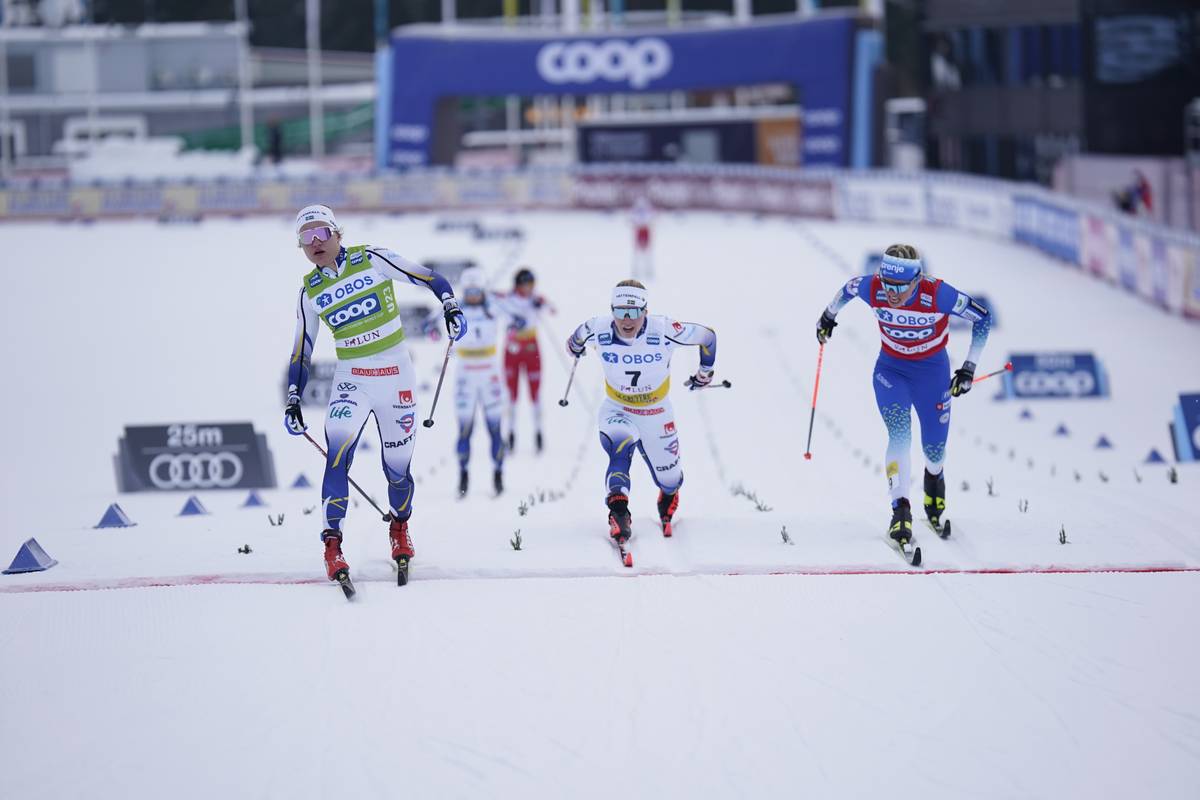
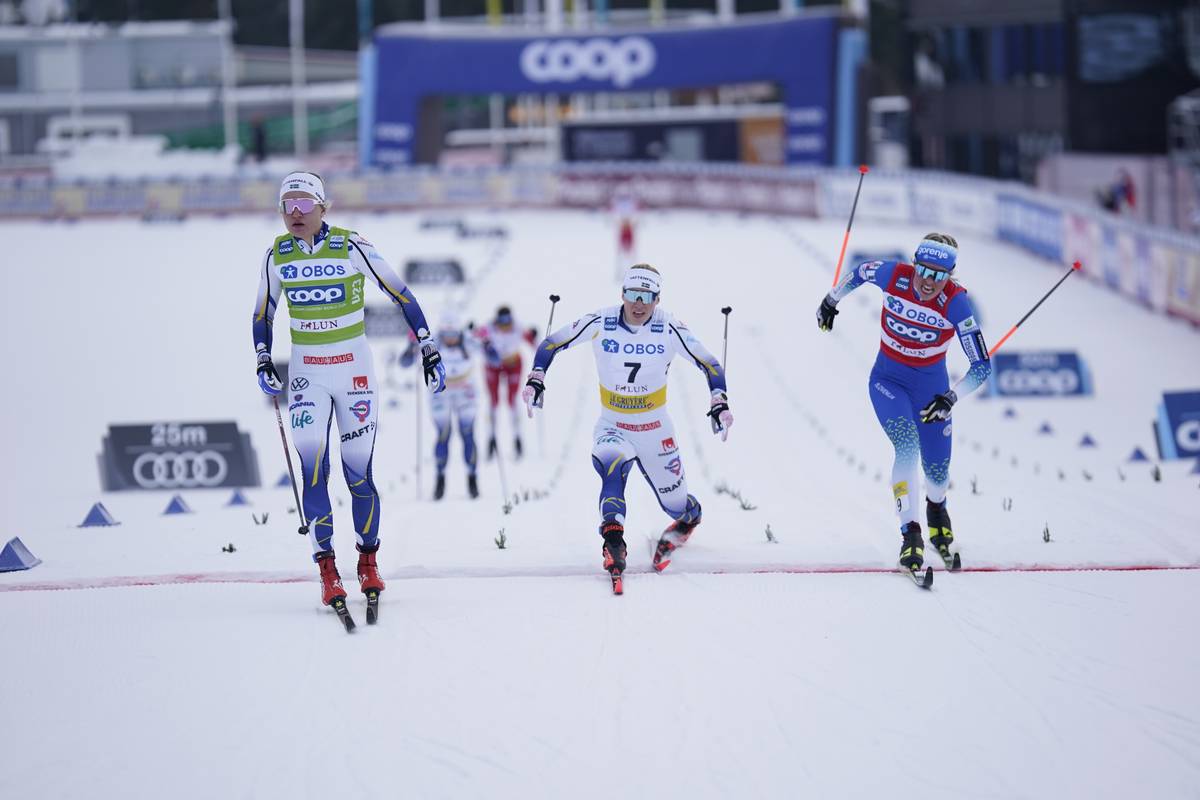
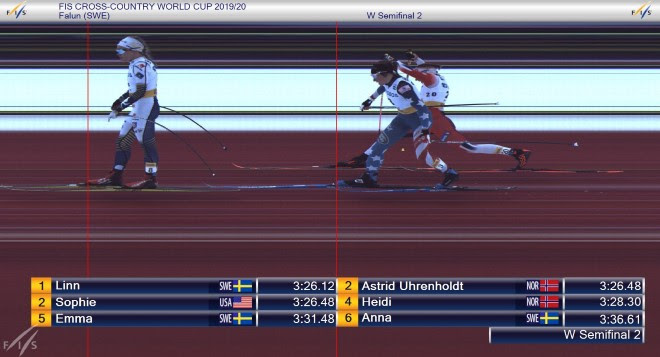
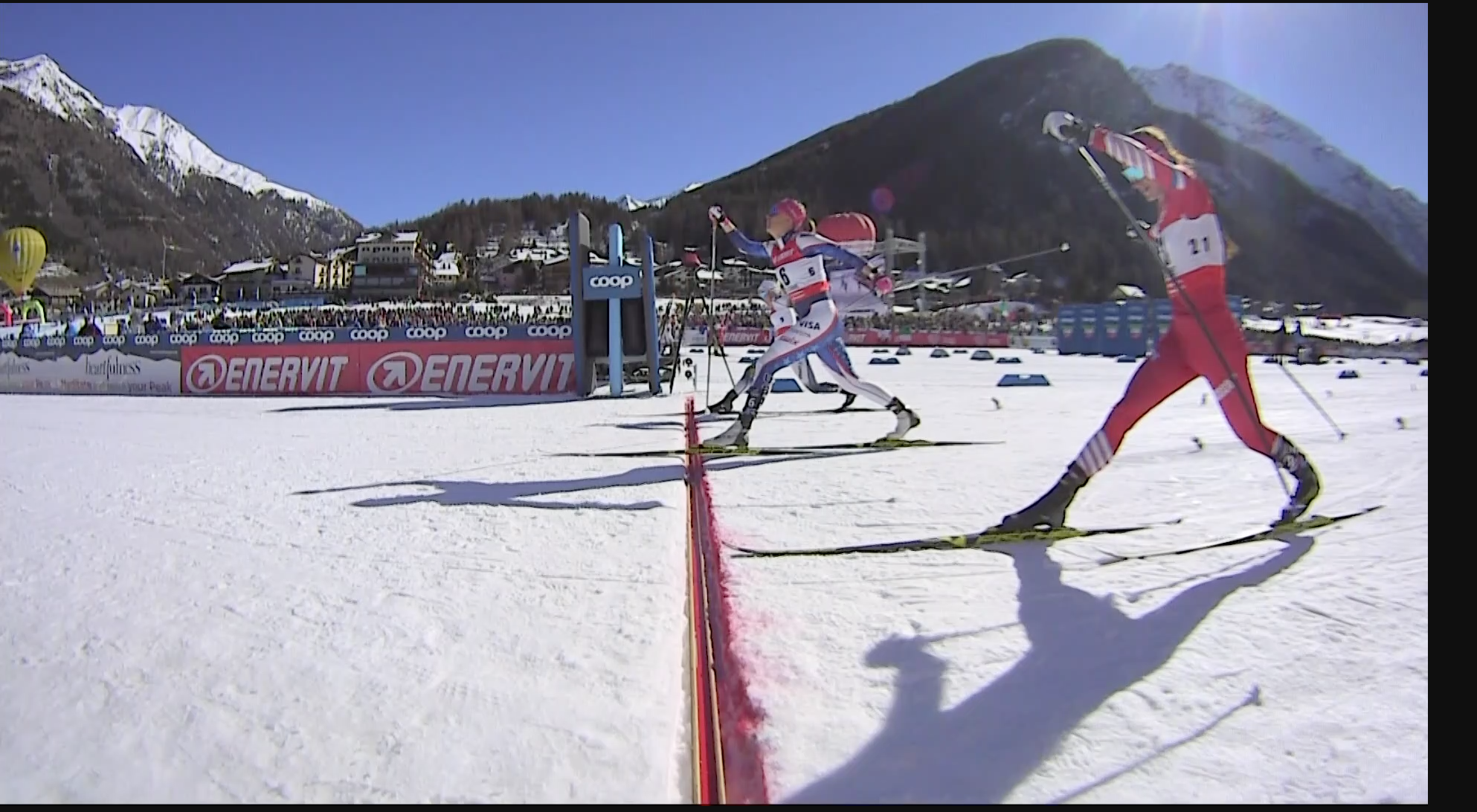
    Jonna Sundling (SWE) celebrates the win while Coletta Rydzek (GER) and Johanna Hagstroem (SWE) lunge for third behind her. (Photo: Authamayou/NordicFocus)
    The Season’s Final Push

    With only a handful of races remaining on the World Cup calendar, the results in Lahti could prove important in shaping the final standings.

    For Sundling, the victory served as both a return to form and a statement heading into the closing weeks of the season.

    “I’m looking forward to the rest of the season,” she said.

    For others — particularly those chasing the Crystal Globes — the margin for error continues to shrink.

    And with more racing still ahead in Lahti this weekend, the battle for the season-long trophies is far from settled.


    Lahti Women’s Freestyle Sprint QUALIFICATION RESULTS

    Lahti Women’s Freestyle Sprint FINAL RESULTS


    *We hope to add more quotes above from athletes if we hear back from them, but wanted to get this race report posted in a timely fashion.


    Love Stories Like This? Help Keep Them Coming.

    Feature stories like this one take time, access, and care to produce. If you value thoughtful storytelling and independent ski journalism, please consider becoming a Voluntary Subscriber. Your support directly fuels the work we do to cover the people, places, and moments that make our sport special.

    Join the FasterSkier community!


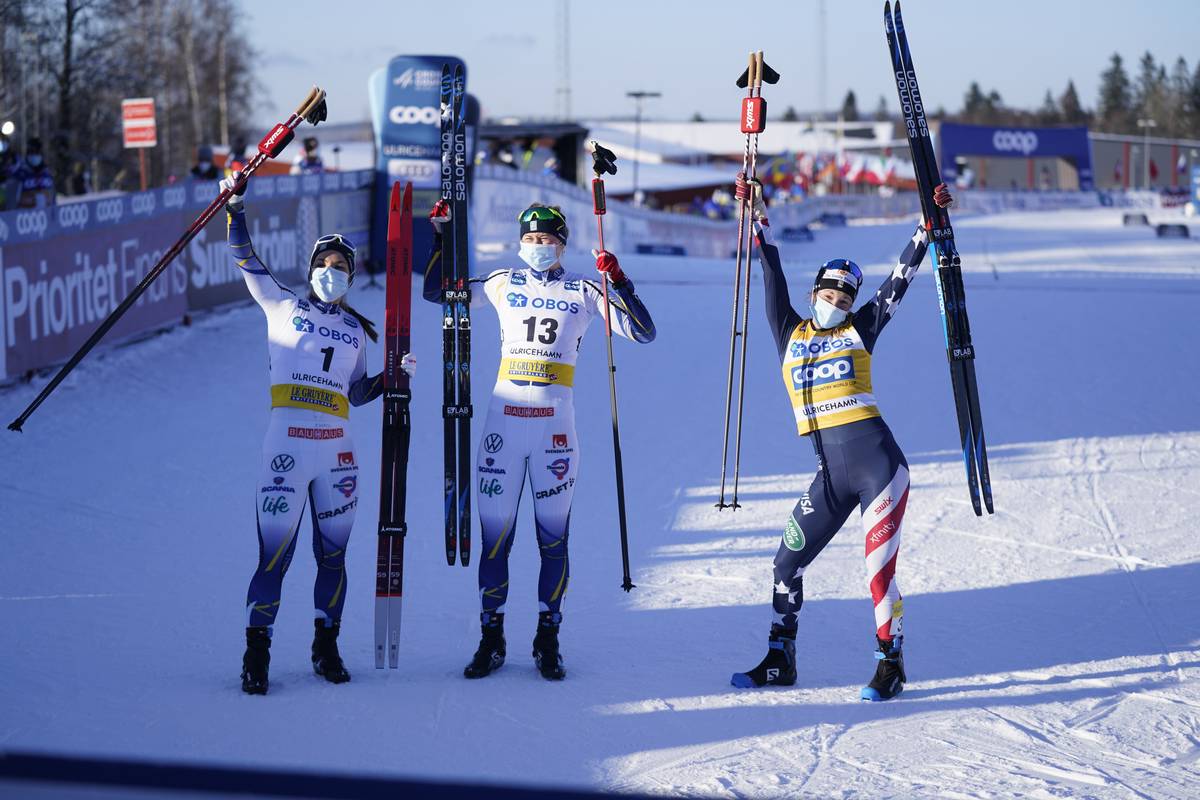
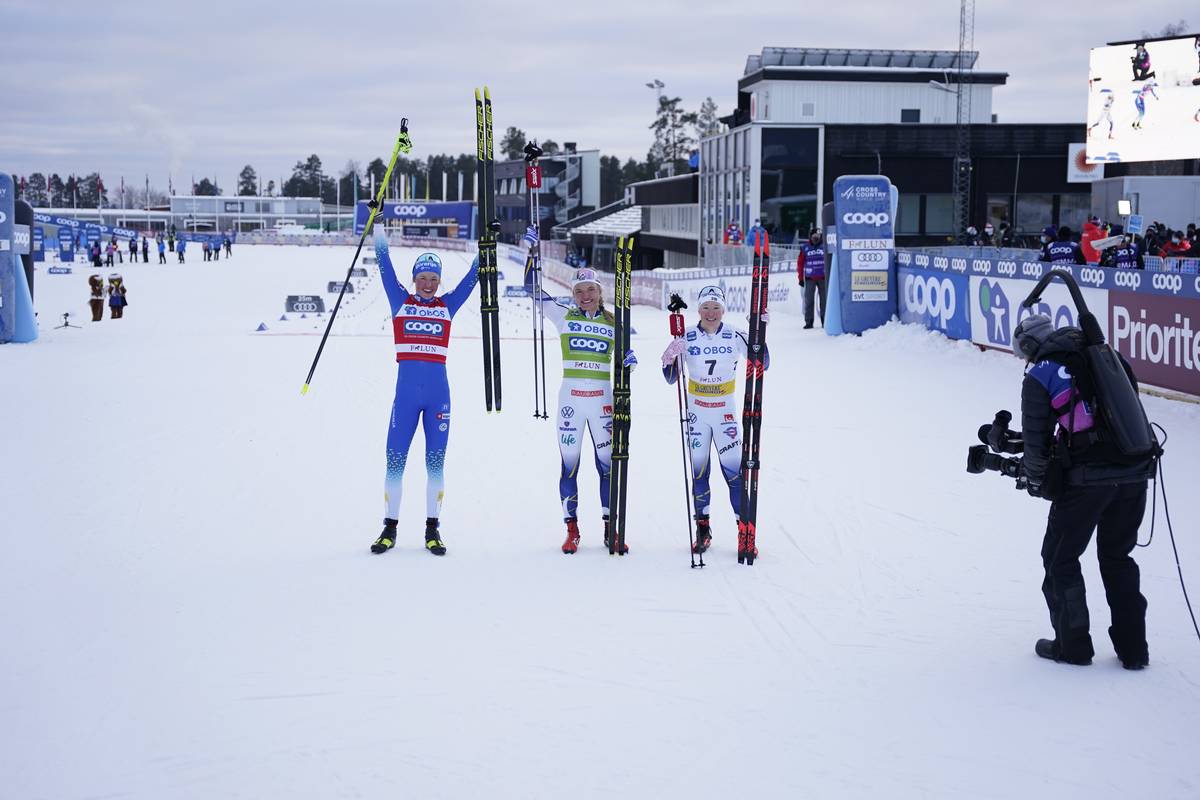
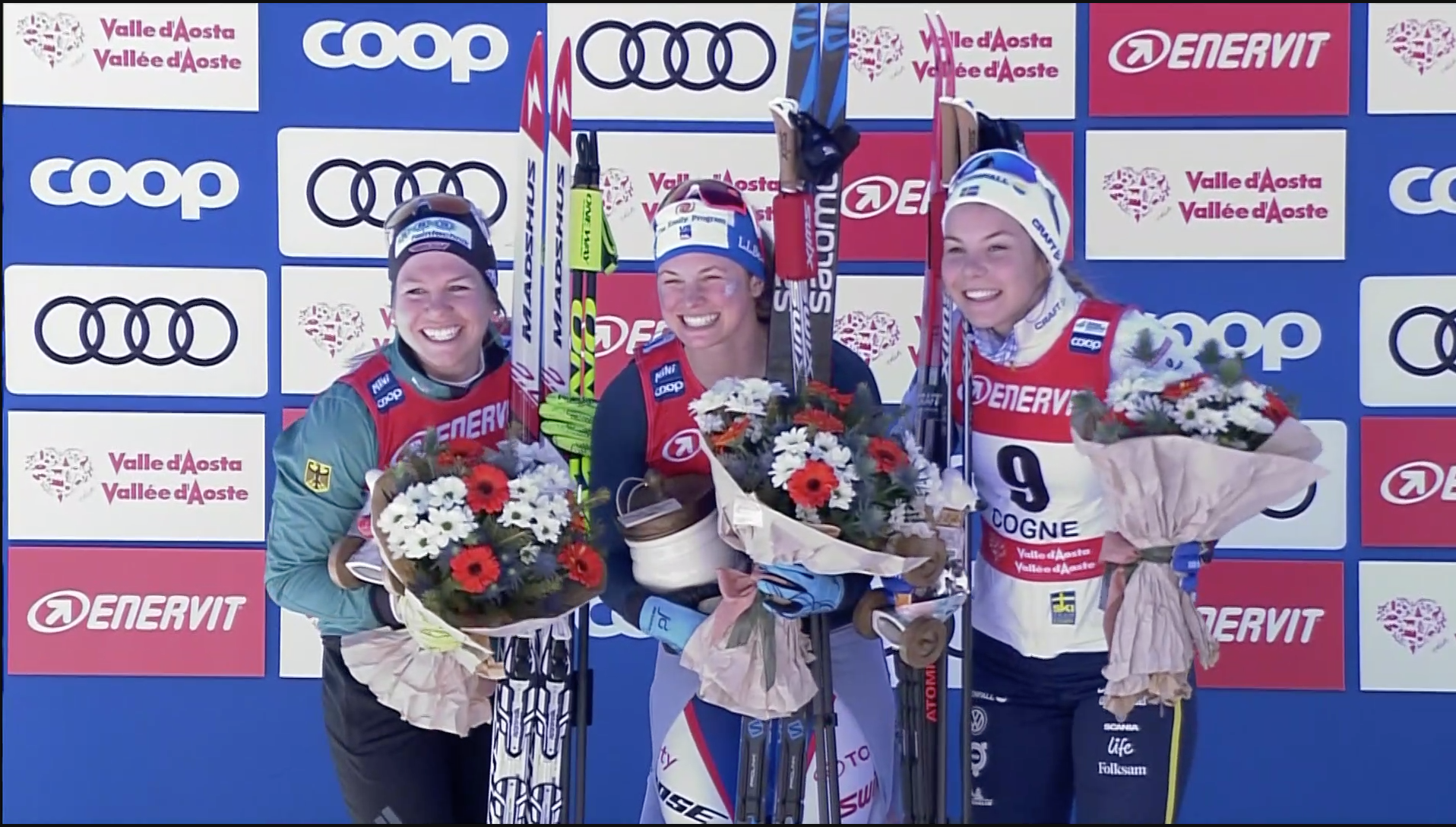
    Linn Svahn (SWE), Jonna Sundling (SWE), and Coletta Rydzek (GER), (l-r) share the Freestyle Sprint podium in Lahti, Finland. (Photo: Authamayou/NordicFocus)
  • The Devon Kershaw Show: A breakout McWeekend in Ruka, and much more from Finland

    The Devon Kershaw Show: A breakout McWeekend in Ruka, and much more from Finland

    Devon has a cold, but don’t let that deter you — he perseveres, and we welcome special guess Zanden McMullen after his breakout weekend in Ruka. We’ve got recaps of the astonishingly entertaining racing in Finland, plus bonus discussion of sponsorship feuds and other news.

    Send us your questions, comments, fan mail and hate mail: nat@fasterskier.com and devon@fasterskier.com. We’ll be back after Lillehammer.


  • Dahlqvist Wins Ulricehamn’s Skate Sprint: Diggins Third, Scooping up More Points Towards the World Cup Overall

    Dahlqvist Wins Ulricehamn’s Skate Sprint: Diggins Third, Scooping up More Points Towards the World Cup Overall

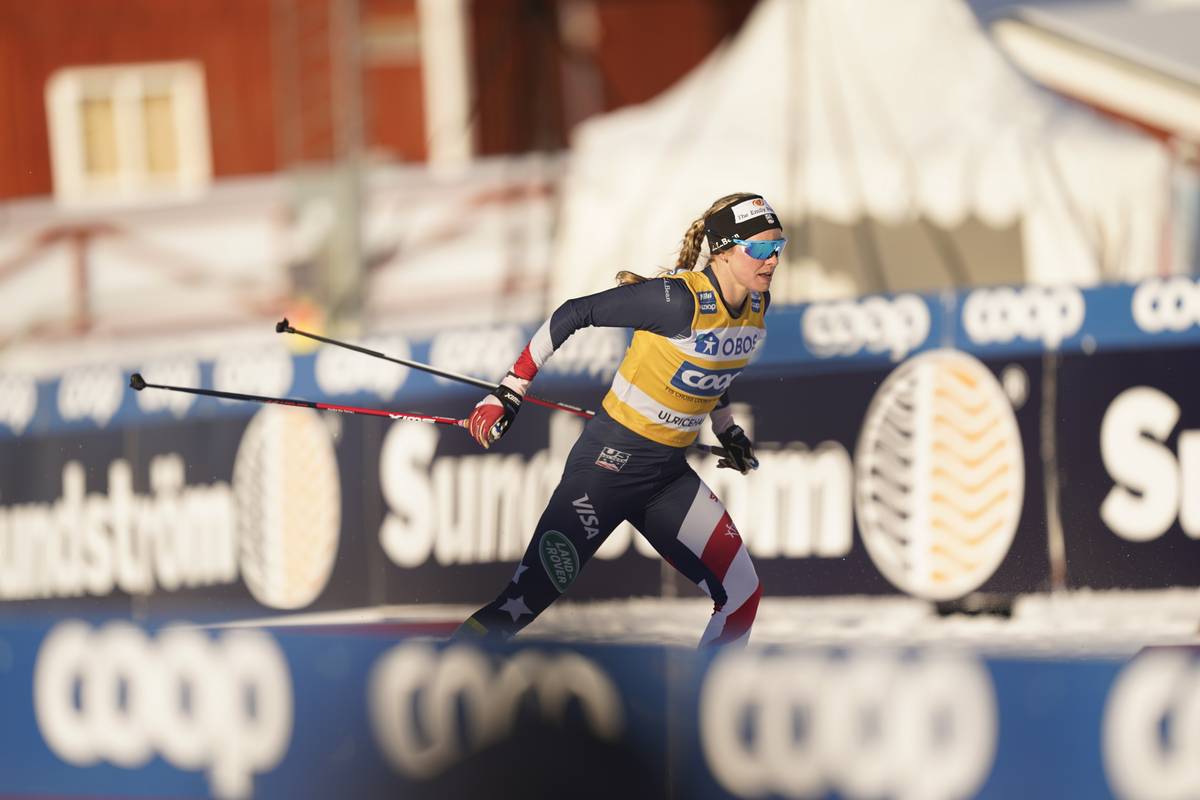
    Jessie Diggins (USA) looks for position during the start of the women’s final. (Photo: NordcFocus)

    The day was cloudless and cold in Ulricehamn, Sweden for the women’s 1.6-kilometer freestyle sprint. As has come to be expected of the Swedish women, they were clutch from the beginning on this course which favored sprint endurance, as the race time times pushed near the 3:30 mark for many. To put this into context, December’s skate sprint in Davos, won by American Rosie Brennan, had the fastest qualifying time, also from Brennan, of 2:40.03.

    Sweden’s Johanna Hagström (22) who trains in Ulricehamn was the fastest qualifier completing the 1.6 k course in 3:23.80. Hanna Falk, who is returning from a long recovery from a back injury was second (+1.12). Falk missed the entire 2019-2020 season. Jessie Diggins of the U.S. Ski Team was the top North American qualifier in third (+2.02).

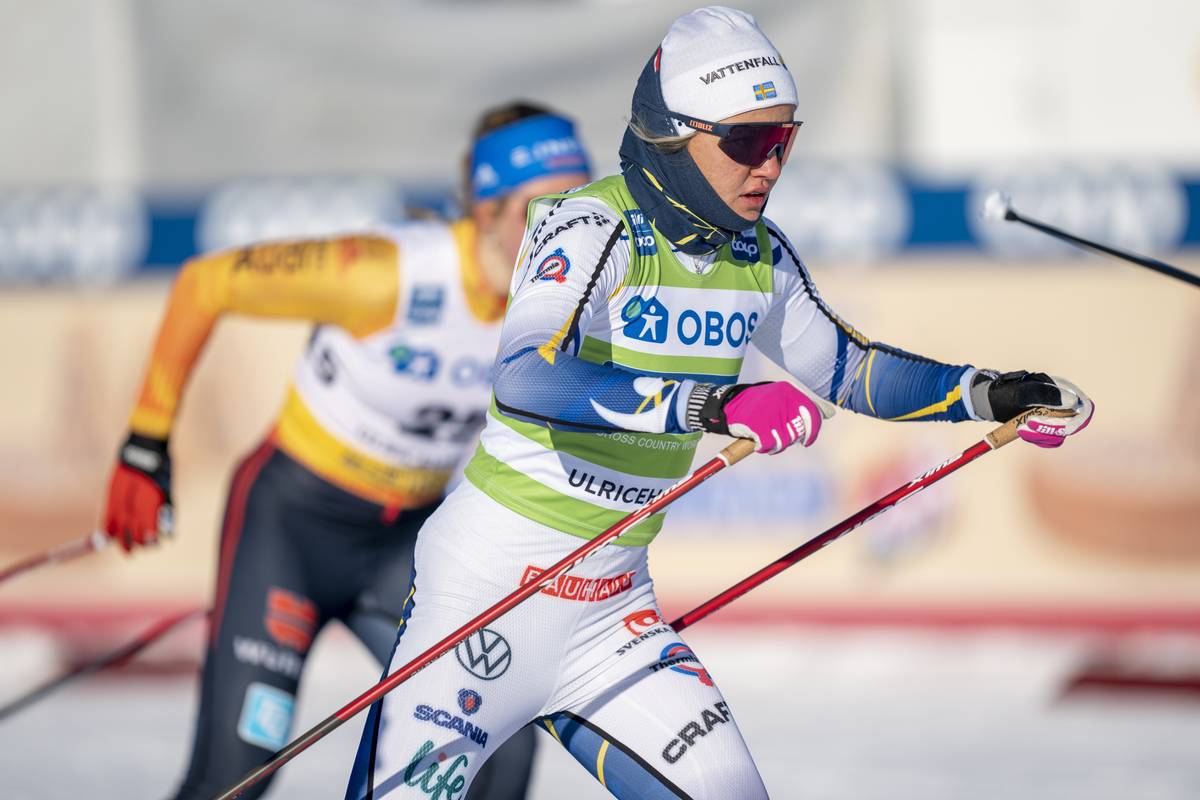
    Johanna Hagström of Sweden during the skate sprint qualifier in Ulricehamn Sweden. Hagström was the fastest qualifier. (Photo: Nordic Focus)

    Also qualifying for the U.S. were Sadie Bjornsen in 16th (+6.83), and Hannah Halvorsen 22nd (+8.12). Canada’s lone qualifier was Maya MacIsaac-Jones in 24th (+8.36).

    Diggins, who leads the World Cup overall, raced the second heat and shot to the front early. Leading wire to wire, she pressed every inch of the course, winning in 3:25.18, in what was the fastest quarter-final by three seconds.

    In the first semi, Diggins was matched up against Swedes Maja Dahlqvist, Jonna Sundling, and Falk. Thirty seconds into the race, Diggins was in a familiar spot — working from the front. This time around, this was no wire to wire act for Diggins. She was shadowed early by Swiss skier Nadine Faehndrich, and later on by the Swedes. Roughly 2:25 into the race, Diggins led into a right-hand corner. Sundling skated the double poled for a smidge of sunlight on the inside, then tripped up and fell. Diggins was slowed momentarily by the scrub of speed as she brushed Sundling and nearly fell. Diggins, however, remained on her feet. Sundling righted herself after a moment on the ground, caught the pack of skiers, and by the final straight was steamrolling for a place in the finals. Dahlqvist won the semi in 3:21.39, with Sundling amazingly slotting into second (+0.44), with Falk and Diggins third and fourth, respectively. Both advanced to the finals as Lucky Losers.

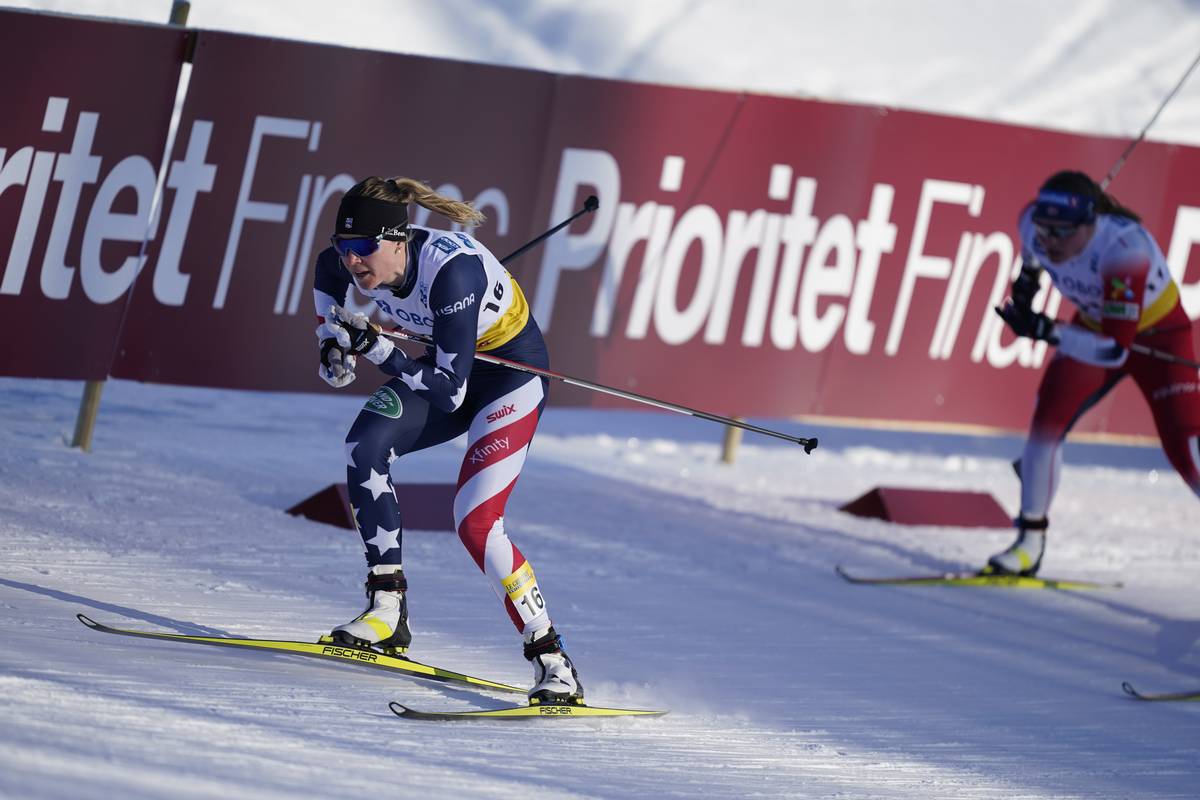
    Jessie Diggins racing her quarterfinal in Ulricehamn, Sweden. (Photo: NordicFocus)
    Jessie Diggins strategized to race in the front during her quarterfinal and semi in Ulricehamn, Sweden. (Photo: NordcFocus)

    The women’s final was loaded with four Swedes: Dahlqvist, Hagström, Sundling, and Falk, along with Eva Urvec of Slovenia, and Diggins. The narrative was spicy from the start. Sundling appeared to catch an edge moments after the start lanes opened up. She spun around, snapped a pole, as the five other skiers advanced unimpeded. (She soon received a new pole and was able to latch back onto the group later in the race.)

    Diggins’ tactics were more reserved. She did not work the course from the front but was positioned near the back as the race advanced. At 2:00 minutes, Dahlqvist led the line of skiers – who were tightly ordered in a line. There were no breakaways – only close-quarter sprinting as the skiers entered the finish straight. Diggins came in with considerable finish speed as did the three Swedes flanking around her.

    Dahlqvist won the race to the line in 3:20.59, Hagström was second (+.30), Diggins third (+0.39), Falk fourth ().72). Urevc came in fifth (+1.13), and Sundling, who never truly recovered from two falls in as many sprints, was sixth (+1.74).

    Maja Dahlqvist (bib 13) and Johanna Hagström, both of Sweden power down the homestretch. (Photo: NordcFocus)

    At 26, this was Dahlqvist’s first career individual World Cup win. She has five team sprints wins on the World Cup. For Hagström, this was her second consecutive weekend as the top qualifier. Last weekend in Falun, a classic sprint, she qualified first. This was Hagström’s second World Cup podium, she placed third in the Cogne, Italy skate sprint in 2019. In Falun, last weekend, she was just off the podium placing fourth overall.

    Johanna Hagström  (SWE), Maja Dahlqvist (SWE) and Jessie Diggins (USA) celebrate being on the podium in Ulricehamn, Sweden. (Photo: NordcFocus)

    Saturday marked the 10th career World Cup sprint podium for Diggins – her seventh in skate technique. The 60 points she earned Saturday, placed her in control in terms of the World Cup overall. She leads Russia’s Yulia Stupak, who has not contested the last two races, by 303 points. Rosie Brennan (also not in attendance in Ulricehamn) is third overall, trailing Diggins by 355 points.

    Jessie Diggins wearing the yellow bib in Ulricehamn, Sweden as the leader of the World Cup overall. (Photo: NordicFocus)

    With the World Cup overall in her sights, Diggins, in a post-race interview said she is strategizing towards winning, but also maximizing her efforts when it comes to securing valuable points for the overall.

    Post-race interview with Jessie Diggins.

    “If you were in the front, even if you had a poor finishing lane, you were almost guaranteeing you were going to move on because it is just so hard for people to get around you,” Diggins said about her race day tactics. Advancing in Ulricehamn was as much a calculus of chasing a podium as it was placing her in contention for overall points.

    “I am and I think that is something I have learned is that it is OK to state, that you have a really big audacious goal, and it is OK to want to go after it,” said Diggins when asked if she was outright seeking the overall Crystal Globe. “In the last couple of weeks I got together with the coaches, and I was like alright we are going after this, we are going to do this as my season goal.”

    Sweden’s Linn Svahn here in Ulricehamn. Svahn fell in her quarterfinal and placed 26th overall. (Photo: NordicFocus)

    One name missing from the semis and finals was Linn Svahn of Sweden. She has come to embody Sweden’s dominance in women’s sprinting.

    In a quarterfinal to watch featuring Svahn and Hagström, Hagström took control of the pacing with the five others in her draft. While tightly packed near the 2:08 mark, Svahn, who was skiing in third behind Magni Smedaas of Norway, lost her footing and fell. Svahn eventually crossed the line in sixth to place 26th overall.


    Sadie Maubet Bjornsen (USA) during her quarterfinal and on her way to 15th place on the day. (Photo: NordcFocus)

    Maubet Bjornsen raced in the third quarterfinal where she placed third and did not advance. She was 15th overall in her third World Cup race of the season.

    U.S. skier Hannah Halvorsen earned her second career WorldCup points. She raced in the first quarterfinal where she placed fifth after snapping a pole early in the heat.

    “I collided with the German Victoria Carl heading out of the start as we both fought to get in a good position as the trail narrowed,” Halvorsen explained. “Her ski hit my pole and it snapped right away. Fortunately, I was able to free skate and hang on to the back of the group until I could get a spare.”

    She matched a career-best 23rd overall, she was 23rd earlier this season in Dresden, Germany’s skate sprint.

    Hannah Halvorsen (USA) does her best Air Jordan impersonation during qualification where she posted the 22nd fastest time. (Photo: NordcFocus)
    In her quarterfinal, Hannah Halvorsen snapped a pole early, to finish 23rd overall. (Photo: NordcFocus)

    Also in the first quarterfinal was Canada’s MacIsaac-Jones (25) who placed fourth. MacIssac-Jones earned a career-high mark 18th overall place – her third time in the World Cup points.

    “I’m very happy with the day,” MacIsaac-Jones emailed. “This was a very tactical course, so I stayed relaxed and worked to establish a good position without wasting too much energy off the start. I messed up in the last few hundred meters which is frustrating, but in general, it felt great to be in the mix and fighting to win.

    “The momentum on our women’s team just keeps building – we’ve worked hard to support each other these past few years, and I think the increased level we are consistently showing on the World Cup reflects that. Being in this environment where we are all setting ambitious goals for ourselves and pushing each other to improve helped me turn it around after last weekend.”

    Jonna Sundling (SWE), Victoria Carl (GER), Greta Laurent (ITA), Maya Macisaac-Jones (CAN), (l-r) racing in Ulricehamn, Sweden. (Photo: NordicFocus)

    Canada’s Dahria Beatty was just outside the points ending her day in 32nd, with teammate Cendrine Browne 37th, Katherine Stewart-Jone 42nd, and Laura Leclair 44th. Fifty-seven skiers began the qualifier.

    For the remaining Americans, Julia Kern finished in 38th, Sophie Caldwell-Hamilton 40th, and Alayna Sonnesyn 43rd.

    Post-race interview with With Matt Whitcomb discussing the women’s and men’s racing.

    Women’s Sprint Results | World Cup Overall

  • Svahn Strikes Again in Falun; Diggins 8th

    Svahn Strikes Again in Falun; Diggins 8th

    Rosie Brennan charges up the first and longest climb on the sprint tracks in Falun, Sweden. (Photo: NordicFocus)

    This World Cup coverage is made possible through the generous support of Marty and Kathy Hall and their A Hall Mark of Excellence Award. To learn more about A Hall Mark of Excellence Award or to learn how you can support FasterSkier’s coverage please contact info@fasterskier.com. 

    If you had any question about the strength and depth of the Swedish sprint team, look no further than the qualification list from today’s classic sprint in Falun. Led by Johanna Hagström with a time of 3:14.18, Sweden put six women in the top-10. This number was repeated in the semi-final, leading into a half-Swedish final round on home soil.

    The sprint tracks featured the longest climb first, followed by a spiraling curve to send the women up the second climb. A sharp left turn and a roller brought the athletes back toward the stadium and into the final stretch. As the heats unfolded, this looked like a series of uphill sprints out of the track, some furious double poling, and some powerful cornering. 

    The profile of the sprint tracks in Falun, Sweden. (Photo: https://skidspelen.se/)

    Of the Americans in the heats, Jessie Diggins was the top qualifier in 15th, with Rosie Brennan 20th and Sophie Caldwell Hamilton, back from her mid-season Vermont training camp, in 25th. 

    During the first heat of the quarters, Diggins looked confident in her tactics, sitting in the middle of the pack. Making assertive moves to seize optimal tracks, she swung wide in the final curve to set herself up to capitalize on her double pole as she sprinted her way from fourth to first. Diggins ceded time at the line to Sweden’s Linn Svahn to finish comfortably in second. 

    Jessie Diggins skis to 8th in the classic sprint in Falun, Sweden. (Photo: NordicFocus)

    Racing in the first heat of the semis, Diggins looked to be employing a similar tactic of patiently waiting to pounce in the back half of the loop. Heading up the second climb in the 5th spot, she began to hammer, but by that time, Svahn and Norway’s Tiril Udnes Weng had created a small gap she could not close. Challenging Anna Dyvik of Sweden, Diggins powered over the final roller and worked her double pole, but was unable to make up any ground and finished 4th. 

    This ended Diggin’s day, putting her in 8th place overall.

    “Whew, today was exhausting!” wrote Diggins after the race. “I think all the all-out efforts in the cold finally started to catch up to me, as I was definitely getting pretty tired in my semifinal. But I was really proud of how I skied today – especially in really tricky kicking conditions with steep hills and tracks that were deteriorating, and a ton of herringbone out there! It’s a very encouraging step forward in my classic technical skiing. We also had great skis which is always important!”
    Advancing from the second heat of the semis, Slovenia’s Anamarija Lampic took the lead to pull the group through a fast heat. A few meters back, Sweden’s Jonna Sundling edged out Ane Appelkvist Stenseth and fellow Swede Hagström in a tight finish, which allowed all three women to advance to the final. 

    Poling in sync, the final round of the classic sprint in Falun takes to the tracks. (Photo: NordicFocus)

    Let’s regroup. Three Swedes, two Norwegians, and one Slovenian in the final: Svahn, Sundling, Hagström of Sweden; Weng, Stenseth of Norway; and Lampic of Slovenia. The two semifinal leaders, Svahn and Lampic, pushed the pace from the front, up and over the two significant climbs. Sitting in a tuck to conserve energy for a final sprint over the roller and toward the lanes, Svahn was on the tails of Lampic, with Sundling just behind. The Swedes gained ground over the roller, setting up an exciting race down the finish lanes.

    Anamarija Lampic and Linn Svahn push the pace during the final round of the classic sprint in Falun, Sweden. (Photo: NordicFocus)

    With the line just moments away, Svahn simply attacked the ground with her double pole, pulling ahead for a back-to-back win in Falun. 

    Just behind, Lampic and Sundling were virtually tied as they crossed the line in a photo finish. Though times were the same to the hundredth of a second, Lampic was declared second and Sundling third.

    Linn Svahn takes back-to-back wins in Falun, while Anamarija Lampic and Jonna Sundling slide in for the remaining podium spots. (Photo: NordicFocus)
    Anamarija Lampic (SLO) edges out Jonna Sundling (SWE) for second place in the classic sprint in Falun, Sweden. (Photo: NordicFocus)

    “I’ve been feeling a little bit tired since yesterday’s race, but it’s so fun to compete in Falun. I really enjoy racing on a home course, so it was a good day,” Svahn told FIS at the finish. 

    Despite her age, this is 21-year-old Svahn’s 7th individual win in a World Cup sprint, split almost equally between skate and classic. It is also her second consecutive classic sprint victory on the Falun tracks, as she stood atop the podium in February 2020, also alongside Sundling third place. 

    The women’s classic sprint podium in Falun. Linn Svahn nailed her second consecutive win on the course, with Anamarija Lampic (SLO) second, and Jonna Sundling (SWE) third. (Photo: NordicFocus)

    Svahn was also asked about the close finish and whether she was sure of her win in the moment.

    “I’m never sure of a victory until I pass the finish line first, but it’s cool to see how many strong girls we are competing in sprint races. I think the levels are really high now and it’s tough to win each race, but I’m really glad I managed to do that today, especially in a classic sprint, because it’s my goal this year.”

    Looking back, Brennan raced in heat 4 of the quarter finals, where she finished 4th, unable to advance. This left Brennan in 19th overall.

    Powering uphill, Rosie Brennan skis her way to 4th in her quarterfinal in Falun, Sweden. (Photo: NordicFocus)

    After a conservative start, Caldwell Hamilton skied her way into 2nd position at the top of the intermediate climb. Looking strong as she transitioned from double pole into diagonal stride over the last roller, she held her position around the final curve and into the finish lanes. Swinging around her and quickly closing the gap with her double pole, Sweden’s Hanna Falk overtook the American in the final meters. As the second heat ended up the fastest, Caldwell Hamilton was not able to advance and ended her day in 16th.

    “Today was a really solid race for me,” wrote Caldwell Hamilton in a post-race email. “It wasn’t my best, but it was my first time skiing the heats in a classic sprint this year (actually probably in 11 months) and after a qualifier that felt so-so, I was happy with how I skied my quarter. Falun is a very tough course with some big climbs and technical downhills, but I like those features in a classic course.”
    Sophie Caldwell Hamilton crests the intermediate climb on the sprint tracks in Falun, Sweden. (Photo: NordicFocus)
    “After the first few races of the tour, I took the opportunity to spend a few weeks at home in Vermont during a time where I wouldn’t be missing many sprints,” Caldwell Hamilton continued. “It was such a nice break and I had skiing at the nordic center our neighbors own, Wild Wings, that I could ski to from my house, so I was a pretty happy camper to just spend some time at home doing some solid training and taking a break from the World Cup scene. Now I feel mentally and physically recharged and ready to take on the last couple months of the season! My qualifier today felt a little like I hadn’t done an effort like that in awhile, but I think every race effort will help make that feel a little more normal.”
    Jessie Diggins and Canada’s Katherine Stewart-Jones (bib 29) climb side by side during the first heat of the quarterfinals in the classic sprint in Falun, Sweden. (Photo: NordicFocus)

    After qualifying in 29th, Canada’s Katherine Stewart-Jones landed in the first heat of the quarterfinals with Diggins. Stewart-Jones held strong with the lead group through the second climb, but fell off the pace to finish last in the heat, just behind Norway’s Anna Svendsen. Stewart-Jones was 30th in the final results.

    Outside the rounds, Julia Kern qualified in 35th (+12.95), Hannah Halvorsen 56th (+22.59), and Alayna Sonnesyn 65th (+30.2).

    Maya Macisaac-Jones (CAN) races to 54th in the qualifier of the Falun, Sweden classic sprint. (Photo: NordicFocus)

    Racing for Canada, Dahria Beatty qualified 48th (+17.29), Maya Macisaac-Jones 54th (+21.77), and Laura Leclair 58th (+24.77). 

    Qualification | Final Results 


  • Julia Kern Third in World U23 Skate Sprint (With Audio Interview)

    Julia Kern Third in World U23 Skate Sprint (With Audio Interview)

    The U23 World’s skate sprint podium: Johanna Hagström (SWE) second, Emma Ribom (SWE) first, and Julia Kern (USA) third (l-r). (Photo: Doug Stephen)

    Racing continued amidst a snowstorm in Oberwiesenthal, Germany in today’s U23 1.2-kilometer freestyle sprint event. Coming down lightly at some times and in heavy bursts at others, the precipitation accumulated on the tracks creating some excitement in the form of repeated starts and untimely crashes. 

    Two Americans qualified on the women’s side, with Julia Kern (USST/SMST2) near the top in third, exactly 1 second behind the top racer, Sweden’s Johanna Hagström. Hailey Swirbul (USST/SMST2) was the next qualifier in 21st (+7.80). 

    Julia Kern during the U23 skate sprint qualification. (Photo: Doug Stephen)

    Post-race interview with Julia Kern

    Outside the top-30, Amanda Kautzer (US Biathlon/Michigan Tech) finished 40th (+17.25) and her collegiate teammate Sarah Goble finished 47th (+23.16).

    For Canada, Laura LeClair was the top qualifier in 27th (+13.66). Hannah Mehain was next in 36th (+16.20), followed by Annika Richardson in 39th (+16.39), and Laurence Dumais in 43rd (+19.19). 

    Swirbul raced in the first heat of the quarter-final and finished fifth, ending her day in 22nd, and Leclair finished fourth in the second heat for 20th overall. 

    Snow began to fall heavily as Kern raced in the final heat of the quarters, obscuring racers from view in the live feed. Kern took the lead in the second half of her round, pushing through the final meters for the win.  

    Her semi looked markedly similar, and she advanced to the final with ease. 

    Julia Kern (bib 3) with the day’s eventual winner, Emma Ribom (bib 5), during their semifinal. (Photo: Doug Stephen)

    In the final, Emma Ribom and Hagström, both of Sweden, controlled from the outset. At 1:10, Kern was stuck fifth in the line of six skiers. Kern remained boxed out, coming up and over the climb at 2:10. V2ing into the long final straight, Kern found open real estate to her left, where she was able to surge into third place across the line. 

    Ribom won in 2:36.77, with Hagström in second (+0.54). Kern was 1.14 seconds back in securing third place. Ribom most recently placed ninth overall on the World Cup’s Ski Tour 2020. At twenty-one-years-old, Hagström already has a World Cup podium on her resume: A third place in last season’s skate sprint in Cogne, Italy. 

    Emma Ribom (bib 5) hungry to the finish, with Kern powering into third. (Photo: Doug Stephen)

    Kern who has become a regular U.S. Ski Team athlete on the World Cup, earned another World Junior/U23 medal. She first earned bronze in 2017 on the junior 4 x 3.3. K relay team. 

    Women’s Qualification | Final

    Julia Kern post-third place at U23 Worlds. (Photo: Doug Stephen)
  • Sweden’s Svahn Takes the Win on Home Soil; Caldwell 7th in Seven Person Final

    Sweden’s Svahn Takes the Win on Home Soil; Caldwell 7th in Seven Person Final

    The women’s podium in Falun, Sweden. Linn Svahn (SWE) took the win ahead of Natalia Nepryaeva (RUS) and Jonna Sundling (SWE). (Photo: NordicFocus)

    Not the backdrop one might expect from Scandiavia in mid-winter, rather, green grass, bare ski jumps, and a ribbon of snow were found in Falun, Sweden. However, what was lacking in snow was made up for by a densely packed crowd of cheering fans, erupting as athletes flew by in the women’s classic sprint.

    An occurrence that might meet our expectations is that the Swedish women showed up on home turf. Johanna Hagström won the qualifier in 3:15.96, followed by Anna Dyvik. Sweden also took 4th, 5th, 8th, 9th, and 10th. Yes, seven of the top ten qualifiers were from Sweden. Only Sophie Caldwell, Ane Appelkvist Stenseth of Norway, and Anamarija Lampic of Slovenia in 3rd, 6th, and 7th, respectively, were the outliers from other nations. 

    Sophie Caldwell chases Anna Svendsen (NOR) and Jonna Sundling (SWE) during the quarterfinal of the classic sprint in Falun. (Photo: NordicFocus)

    Five of the seven continued on to the semifinals, along with four Norwegians who weren’t going to back down easily. To round out the remaining three nations, Sophie Caldwell advanced to the semis as a lucky loser after a photo finish with Sweden’s Jonna Sundling in the first heat, which was won by Russia’s Natalia Nepraeva. Lampic moved on by taking second in the next heat. 

    Fast racing in the semi-final of the 2020 classic sprint in Falun, Sweden. (Photo: NordicFocus)

    The intensity ramped up in the stacked first heat of the semi: Nepryaeva, Lampic, Hagström, Jonna Sundling (SWE), Maiken Caspersen Falla (NOR), and — perhaps unexpected in a sprint semi — Therese Johaug. Nepryaeva led the charge with Sundling and Hagström. The pack took the troublesome corner fast, but the women kept their composure, with Nepraeva shooting out of the turn with high speed. She held the lead all the way into the stadium as a group of Lampic, Sundling, and Falla duked it out for the remaining spots in the final. 

    In the final sprint, Lampic and Sundling created a gap to Falla, surging to a photo finish. Lampic took second, Sundling third, and Falla crossed a second behind in fourth. As the pace was hot, all four women moved on. 

    Sophie Caldwell matches Sweden’s Jonna Sundling stride for stride up the climb in Falun. (Photo: NordicFocus)

    For Caldwell, the next round was spicy. With a misstep on a punchy climb, Sweden’s Anna Divyk dropped to her knee, catching Caldwell’s arm and pole with hers and robbing some of the American’s momentum. Climbing halfway, Caldwell was trapped on the inside of a left turn. Skis were stepped on, racers were slipping, but she made it through. Calm and collected, she dropped into a tuck and glided into third as they headed for the final climb. 

    Attacking the double pole sprint down the straightaway, Caldwell challenged Norway’s Astrid Jacobsen for the second guaranteed spot in the final. Caldwell threw her boot early, with Jacobsen’s foot matching hers at the line for a photo finish. After review, the two could not be differentiated. It was declared a perfect tie, down to the hundredth. Though their times were too slow for a lucky loser, both women advanced, making it a final of seven women. 

    Captured. A perfect tie between Sophie Caldwell and Astrid Jacobsen during the semifinal of the classic sprint in Falun. (Photo: Screenshot FIS-ski.com)

    Six women across, with the second lucky loser, Falla, in the second row behind Svahn. And off they went.

    The two Swedes, Svahn and Sundling, led the charge into the first climb, Lampic occupying the outside lane. Around the sweeping turn they went unscathed, Sundling continued to push the pace up the next climb, with Lampic losing grip alongside her. The lead group was four deep in the final climb and into the downhill towards the stadium. 

    Three across, Svahn, Sundling, and Nepryaeva powered down the final stretch as the crowds leaned in with bated breath. In the final meters, Svahn crept just ahead of the other two, throwing her boot for the win in 3:23.54. At her heel, the boots of Sundling and Nepryaeva slid across in a photo finish. It was deemed that the Russian was 0.02 seconds ahead of the Swede, taking the second spot on the podium. Both women were within a tenth of a second of Svahn.

    “It’s fantastic. I wanted to win so, so much today,” gushed an out of breath Svahn during her interview with FIS. “I pushed so hard on the final, and managed to win. Before the start, I saw Maiken behind me and I thought, ‘What is happening?’ So it was special, but so nice to compete in my hometown and to win. And to get Jonna on the podium as well, we are a strong team.”

    A unique statistic, Svahn is the second woman to win three individual World Cup sprints before her 21st birthday, which she celebrates in September. 

    Lampic took the fourth spot in the final (+0.93), followed by Falla in fifth (+3.70). Jacobsen and Caldwell had fallen off the pace by the halfway mark. They finished sixth (+7.00)  and seventh (+8.46), respectively. 

    After the race, Caldwell discussed her three week training block in Seefeld, Austria, interrupted by the races in Oberstdorf, Germany, where she finished fourth. She also spoke to the tangle with Divyk and how she stayed relaxed in order to ski the downhill well in order to reconnect with the group. She also discussed the evolution of her career and the effect of her plans to head back to Vermont after the FIS Ski Tour, missing the city sprints in Drammen, Norway to focus on the sprints in Quebec and Minneapolis.

    Post-race interview with Sophie Caldwell.

    Three victories before her 21st birthday, Linn Svahn strikes again in Falun, Sweden. (Photo: NordicFocus)

    Three other Americans headed into the heats with Caldwell. Sadie Maubet Bjornsen qualified in 11th. Racing in the 4th heat, Maubet Bjornsen tucked into the middle of the group. As they reached the swooping icy found along the downhill halfway, the women began pumping the brakes to stay upright, and Maubet Bjornsen was nearly slingshot off course into the banner lining the outer edge of the turn. She regained her composure and made it through the remaining turns with more speed. However, she was not able to catch the leaders and finished 4th in the heat, 17th overall.

    “I always struggle a bit in these conditions, so I didn’t have a star performance, but felt proud that I fought back even after coming dangerously close to falling on the fast, crazy corner,” Maubet Bjornsen emailed after the race. “At one point I feel like I skied the side of the fence, so I sure hope Bode Miller was watching me try to reinact his famous move!

    “Despite a 17th place classic sprint, I am still believing in my body’s ability to feel sharper and shaper going into the Tour de 2020. Sometimes when I have been training at altitude, it takes my muscles a bit to get firing on high speed. The Swedes sure managed to find that speed today, so I will have to kick it into gear quickly to keep up! I look forward to another wild ride tomorrow for the 10k mass start. My goal is to stay on my feet, and find some of my gears that I know are in there!”

    Jessie Diggins fights through the quarter final of the classic sprint in Falun, Sweden. (Photo: NordicFocus)

    Jessie Diggins was the next American qualifier in 25th. She too finished 4th in her heat, ending the day in 20th. In a post-race call, Matt Whitcomb explained that Diggins was fighting a “tweaked neck”, but with the help of Zuzanna Rogers, the team therapist, it is showing improvement.

    Whitcomb provided further insight into Diggins’ day, her likelihood to rebound tomorrow, and how the course and conditions affect the type of athlete that can excel on the tracks of Falun.

    Post-race interview with Matt Whitcomb.

    Hailey Swirbul qualified just behind Diggins in 28th for her third set of World Cup points. She landed in the top-30 on both days in Davos, Switzerland. Swirbul raced in the first heat with Caldwell, where she finished 5th in the heat and 25th for the day. 

    Hailey Swirbul charges the hill for the 28th fastest qualifying time in Falun, Sweden. (Photo: NordicFocus)

    “I am learning so much with every World Cup race this season,” wrote Swirbul in a post-race email. “I thought my skis and support were great today on the tricky course. It was sweet to race in a heat with Sophie and learn from the best in the world up those climbs! I hope to get another opportunity to mix it up in the heats soon.”

    Outside the points, Alayna Sonnesyn qualified in 46th (+23.45), followed by Caitlin Patterson in 47th (+23.50). 

    For Canada, Maya Macisaac-Jones qualified in 23rd and raced in the fifth heat, which was won by Svahn. She was fifth in the heat, ending her day in 24th.

    Canada’s Maya Macisaac-Jones chases Katri Lylynpera (FIN) during the quarterfinal of the classic sprint in Falun. (Photo: NordicFocus)

    Also bearing the maple leaf, Dahria Beatty qualified in 37th (+17.03), followed by Cendrine Browne in 43rd (+22.96), and Katherine Weaver in 48th (+23.62). 


    Qualification | Final Results

  • Diggins Wins Cogne Sprint; U.S. Puts 6 Women in Top 30

    Diggins Wins Cogne Sprint; U.S. Puts 6 Women in Top 30

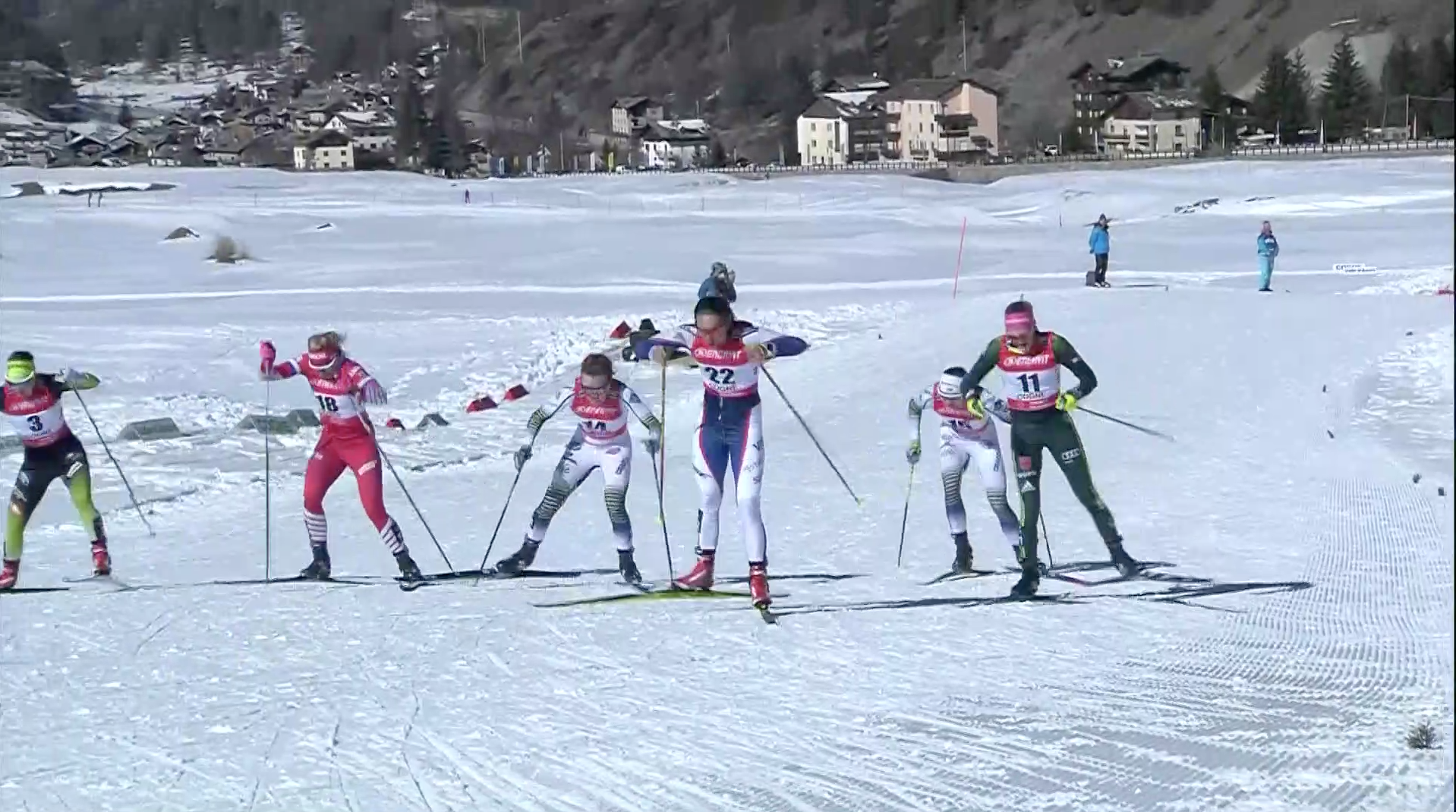
    left to right Sandra Ringwald (GER), Jessie Diggins (USA), and Johanna Hagström (SWE). (Photo:Screenshot)

    Until the very end of Saturday’s 1.6-kilometer freestyle sprint race in Cogne, Italy, American Jessie Diggins had those watching on the edge of their seats. She advanced as the lucky loser in her quarterfinal and then once again in her semi final, before winning the final in a lunge to the line.

    “Man I am glad they do lucky  losers here!” Diggins told the International Ski Federation after winning Saturday’s sprint. “It’s so fun to be in Italy, I love it here, your pasta is the best! Thank you guys for cheering so loud, this was a lot of fun!”

    Diggins started the day by qualifying in seventh, 5.18 seconds off of the fastest qualifying time of 3:37.06 posted by Switzerland’s Nadine Fähndrich. She was then slotted into the first quarterfinal along with Germany’s Sandra Ringwald, Norwegians Ane Appelkvist Stenseth and Anna Svendsen, Russia’s Natalia Nepryaeva, and Diggin’s U.S. Ski Team teammate, Ida Sargent. Diggins crossed her quarterfinal in fourth, behind Ringwald in first, Nepryaeva in second and Appelkvist Stenseth in third. The fast times in Quarterfinal 1 produced two lucky losers: Appelkvist Stenseth and Diggins. She had secured a spot in the semis. 

    Matched up against U.S. teammate, Sadie Bjornsen in Semi final 1, Diggins crossed third behind Ringwald in second and Bjornsen first. The fast times, however, once again worked in favor of Diggins and she advanced to the finals as a lucky loser.

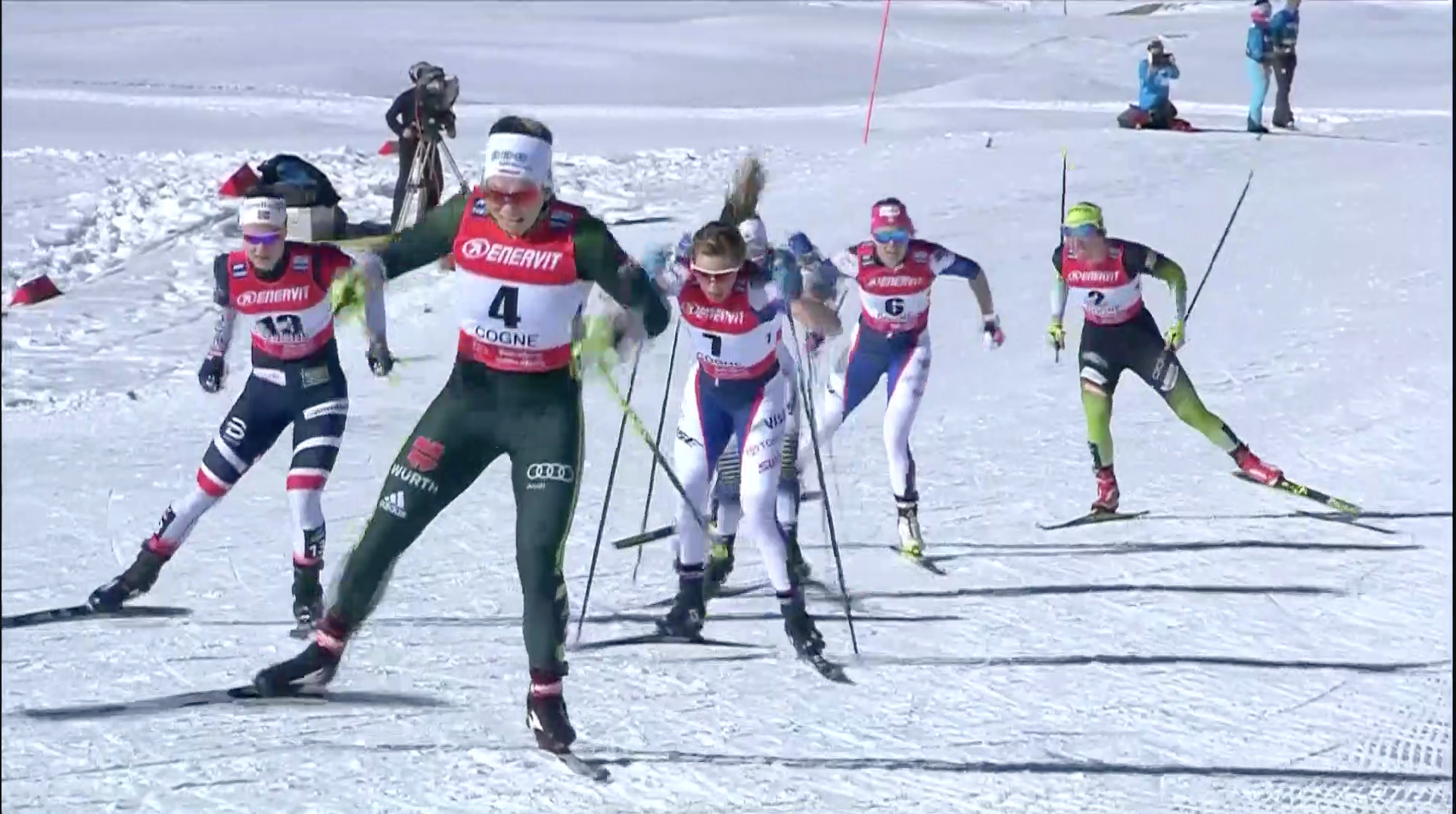
    During the final, it appeared Germany’s Sandra Ringwald was on her way to the win. She made her move in the course’s major climb, gapping the field by a little more than a meter. Chasing her down were Diggins, Appelkvist Stenseth and Sweden’s Johanna Hagström. By the last hiccup of a hill before the finishing stretch, however, Diggins was closing in. With 100-meters to go she trailed the German, but by less than half a meter. The two lunged for the line, with Diggins bringing in the win. This is the first individual World Cup sprint victory for Diggins, and her first win of the 2018/2019 ski season. 

     “Honestly, there have been lots of ups and downs this year,” Diggins told FIS after her win. “I’ve been sick a lot, there has been a lot of doubt, and sometime losing my self-confidence. So it’s good to remember you don’t know what’s going to happen until the last 100-meters of any race, and you just have to believe in yourself and keep pushing the whole way.”

    Finishing in second place overall, 0.11 seconds behind Diggins was Ringwald. After qualifying in fourth, the German skied smooth and strong, winning her quarterfinal and crossing second in her semi final. Her second place finish in the final is her first individual World Cup podium–in 2017 she earned a second place with Team Germany in the 4 x 5 k relay in Ulricehamn and in 2016, she and Hanna Kolb, who retired this spring, partnered up to take third in the Planica Team Sprint. 

    Sandra Ringwald (4) leading the pack, but Diggins (7) is close behind. (Photo: NBC Screenshot)

    Following Ringwald, Sweden’s Johanna Hagström, crossed third on Saturday, 0.86 seconds back from Diggins. After qualifying ninth, Hagström crossed her quarterfinal in second. She went on to snag a lucky loser spot from her semi final to advance to the final. This is also her first individual World Cup podium finish. 

    Racer’s enjoyed blue skies and warm temperatures in Cogne on Saturday. When prompted about the course conditions Diggins told FasterSkier during a phone conversation that “It was incredibly hot, everyone was making fun of me because I was rubbing handfuls of snow over my neck and my arms, I was so hot, it was ridiculous out there, it felt like skiing in April, so sunny and gorgeous.”

    These warm temperatures made for changing snow conditions, but according to Diggins, the USST wax technicians had no problem keeping up.

    “Halfway through rounds we switched skis and switched structure, and they kept keeping up as the course was breaking down in the sun, and that was really impressive,” Diggins said. “With a long gliding downhill, you needed the speed today. My Salomon boards were smoking today, and I really needed that in the finishing stretch.”

    “I’m just really grateful to them for all the hard work that they are always doing, you don’t see it on the TV, but you know there is a huge team of people there, just working so hard, and definitely skiing way more the we are,” Diggins added.

    The next American finisher was Bjornsen who ended the day in fifth, 2.32 seconds behind her teammate Diggins. With World Championships taking place in Seefeld, Austria next week, a few U.S. skiers chose to sit out last weekend’s World Cup races in Lahti, Finland and partake instead in a training camp in Davos, Switzerland. Due to that camp, Bjornsen indicated during a phone conversation with FasterSkier that she “didn’t really know what to expect today.”

    Sadie Bjornsen (USA) lunging for the win in her quarterfinal, against Johanna Hagestrøm (SWE) and Yulia Belorukova (RUS). (Photo: NBC Screenshot).

    “I’m definitely starting to feel a bit better than I have for a while, so I was encouraged by that,” Bjornsen said. “I was pleasantly surprised to find quite good feelings today, so that’s really nice right before World Champs.”

    Prior to Saturday, Bjornsen explained  that her race strategy was to lead as little as possible during the heats. However, that changed, she said, after she saw her teammates Diggins and Sophie Caldwell ski their quarterfinals. also talked

    “It looked so stressful to me to try to make moves, so I ditched my plan and decided I was going to go back to my leading plan and I’m really happy I did,” Bjornsen said. 

    “In the semifinal, I tried a new tactic to try to stay in the front, but maybe not the front-front because we had a stacked semifinal and that also worked quite well, and I saw that I had some extra power in that final uphill so when I finished my semi I was like ‘oh man, I can win today, I feel amazing!’” she said.

    By the final, however, Bjornsen’s energy  reserves were burning low.

    “Going into the finals, I could feel right away a little bit of a power outage, but when I went over the top of the climb, I was like ‘the race is not over until it’s over so I’m going to keep fighting because I know I can be strong until the last uphill,’” she said.

    In the final uphill Norway’s Appelkvist Stenseth maneuvered in front of Bjornsen, breaking her momentum. 

    “Getting stopped like that and having to go again, I didn’t have that final gear to do that,” Bjornsen said. 

    Following the two women in the final, the U.S. had four more top 30 results, with Julia Kern placing just outside the top ten in 11th, Sophie Caldwell 17th, Ida Sargent 24th and Rosie Brennan 27th.

    Racing in Quarterfinal 4, Kern was up against Germany’s Laura Gimmler, Sweden’s Linn Sömskar and Moa Lundgren Russia’s Tatiana Aleshina and Slovenia’s Alenka Cebasek. In the first climb, Kern charged to the front and kept the front charging pace through skied into second place during her quarterfinal. In the second semi final, Kern crossed sixth to place 11th overall. 

    “I was in the fourth quarterfinal so I was able to watch the heats before me on the jumbotron and get advice from my teammates who raced in the earlier heats. We noticed that people were getting boxed in so my tactic was to ski as close to the front as possible. I ended up leading my quarterfinal, similar to what Sadie’s tactic ended up being in her quarterfinal.”

    Prior to Saturday’s finish, Kern’s career best World Cup result came in the Dresden city sprint this year where she finished 19th. 

    Julia Kern (22) taking the lead before the first climb during her quarterfinal. (Photo: NBC Screenshot).

    Caldwell crossed fourth in her quarterfinals and did not advance to the semis. Brennan and Sargent also did not advance past the quarterfinals.

    “I love racing in Italy!” Brennan wrote in an email to FasterSkier. “It’s beautiful here and the courses are quite different from many other World Cup courses so it’s been a great change of pace.”

    Brennan was one U.S. athlete who chose to sit out last weekend’s World Cup races in order to complete the Davos training camp.

    “I had a great training camp in Davos and am feeling much better so I was optimistic for today’s race.” Brennan said. “The qualifier went well and I’m always excited to get a shot at the heats. I did a really poor job of skiing to my strengths in my heat and struggled a bit with my skis so I am disappointed in how things went there. I am excited to see where my distance shape is tomorrow!”

    Also skiing for the U.S., Kelsey Phinney finished in 33rd, 1.03 seconds outside of qualification.

    Four Canadian women raced on Saturday, with Dahria Beatty leading the way in 38th. The next Canadian finisher after Beatty was Cendrine Browne in 48th, followed by Maya Macisaac-Jones 49th and Katherine Stewart-Jones 51st.

    Results: Women’s Qualifier | Final

  • Saturday Rundown: Relay Silver for U.S. Men; Loomis 4th; Plus Hakuba & Gatineau

    Saturday Rundown: Relay Silver for U.S. Men; Loomis 4th; Plus Hakuba & Gatineau

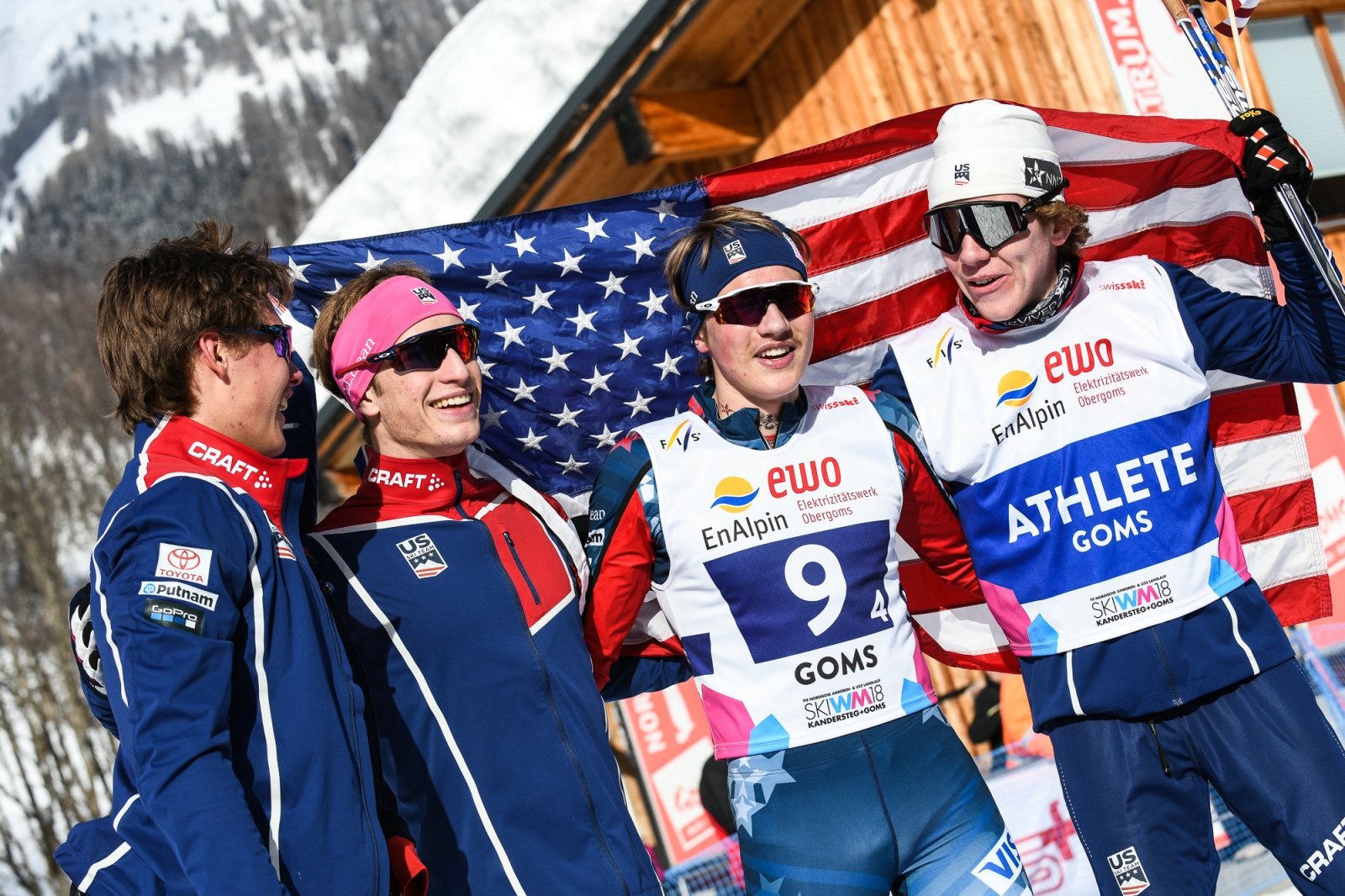
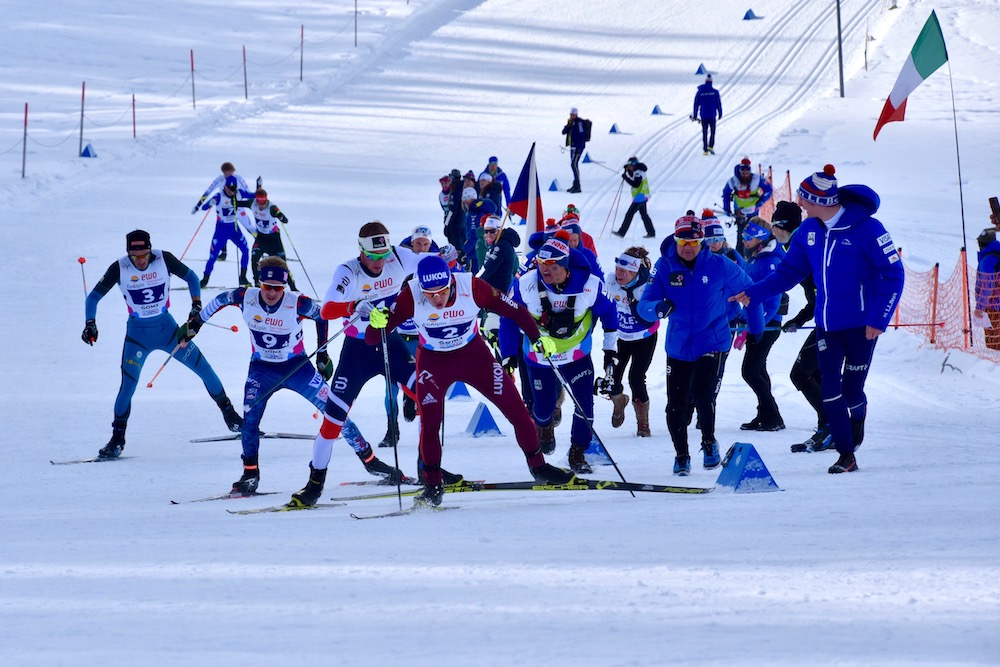
    The U.S. men’s silver-medal relay at 2018 Junior World Championships in Goms, Switzerland, with (from left to right) Luke Jager, Hunter Wonders, Gus Schumacher, and Ben Ogden. (Photo: JWSC2018.ch)

    (Note: This article has been updated to include comments from Americans Ben Loomis, Luke Jager and Gus Schumacher.)

    Junior World Championships (Goms, Switzerland): Men’s and women’s relays

    Two individual medals and a relay podium. That’s how the U.S. team fared this week at Junior World Championships in terms of a medal count, but the significance of its breakthroughs go way beyond the hardware.

    Hailey Swirbul became the most successful American nordic skier at Junior World Championships with a silver and a bronze in the two women’s distance races. Then, on Saturday, the U.S. men took their turn in the spotlight, racing to second and almost first in the 4 x 5-kilometer relay for the best relay finish by an American team at Junior Worlds. Last year, the U.S. women placed third at 2017 Junior Worlds at Soldier Hollow in Midway, Utah.

    Luke Jager started the team off on Saturday as the first classic leg, putting the U.S. men in sixth at the first exchange, 14 seconds behind Sweden in first.

    While Sweden dropped to second on the next leg, the U.S. continued to move up, with Ben Ogden racing to fourth, 8.5 seconds out of first, behind Norway, Russia and France, respectively.

    On the first freestyle leg, Hunter Wonders held the U.S. in fourth and tagged anchor Gus Schumacher in fourth, 31.3 seconds out of first. Norway continued to lead with France, and Russia skied about 5 seconds back in third with 5 k to go.

    Schumacher then skied the fastest anchor leg to race up to second, passing France and finally Russia in the finishing straight, as he crossed the line 2.2 seconds behind Norway’s Jørgen Lippert — who eased up in the finish and secured the Norwegian gold with a total time of 50:04.2 minutes.

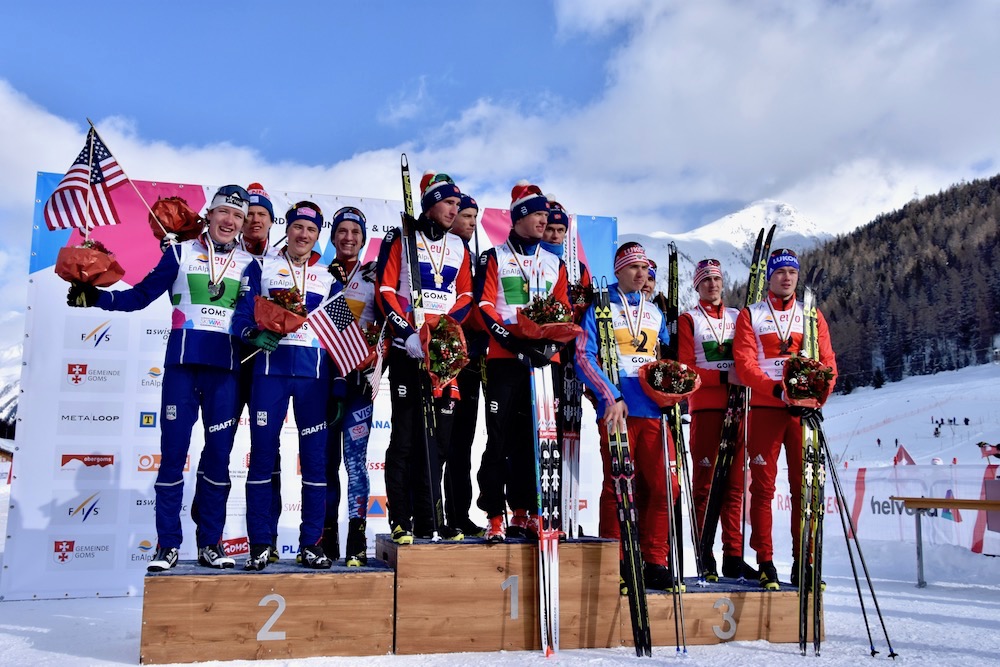
    The men’s 4 x 5 k relay podium at 2018 Junior World Championships with Norway (c) in first, the U.S. (l) in second (Ben Ogden, Luke Jager, Gus Schumacher, Hunter Wonders), and Russia (r) in third. (Photo: Julia Kern)

    The U.S. placed second, 3.3 seconds ahead of Russia in third (+5.5), and France finished fourth (+29.6).

    Norway’s winning team included two men who won individual golds this week, Harald Østberg Amundsen (in the 20 k skiathlon) and Jon Rolf Skamo Hope (10 k classic), as well as Håvard Moseby and Lippert (who took bronze in two races).

    Russia’s team was made up of Kirill Kilivnyuk, Sergey Ardashev, Yaroslav Rybochkin, and Alexander Terentev. Team France was Camille Laude, Hugo Lapels, Tom Mancini, and Pierre Tichit.

    Canada placed 11th (+3:12.8) with Antoine Cyr, Ritchie Graham, Felix Longpre, and Etienne Hebert. Sixteen teams contested the men’s relay on the final day of Junior Worlds in Goms.

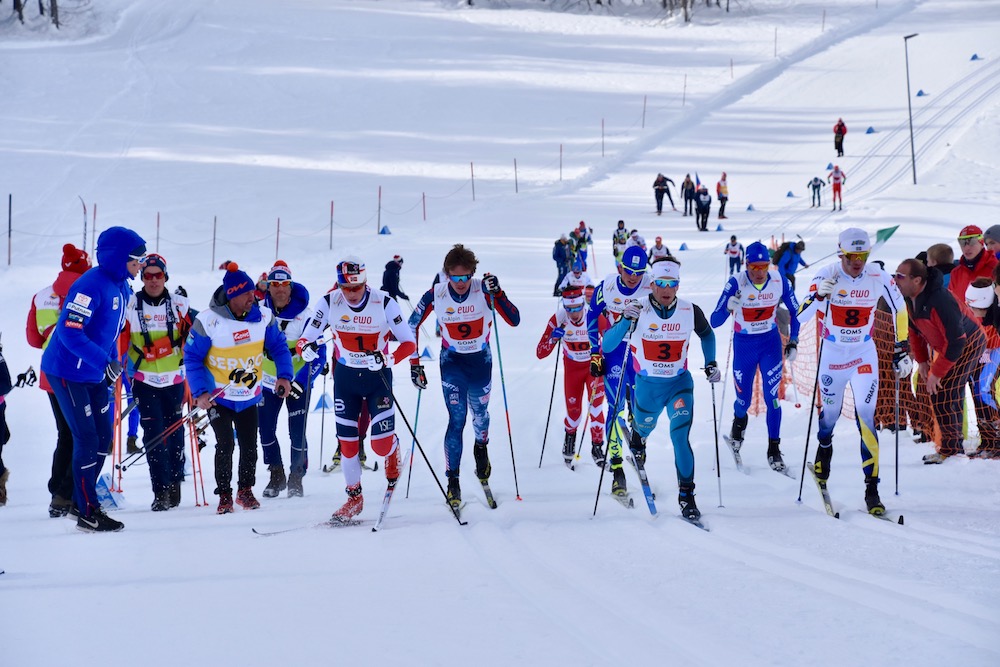
    American Luke Jager (9) skiing with Norway’s Harald Østberg Amundsen (1), France’s Camille Laude (3), and Sweden’s Jacob Nystedt (8) during the first leg of the men’s 4 x 5 k relay on Saturday at 2018 Junior World Championships in Goms, Switzerland. (Photo: Julia Kern)

    In an email, Jager, who turned 18 last month, explained that he was grateful for the opportunity to race at his first Junior Worlds.

    “I barely qualified for this trip after a tough week in Anchorage so my options for starts were super limited,” Jager wrote. “I got the sprint start last week which was pretty horrendous and then a guaranteed spot on the relay team. So I had the whole week to prepare and rest. Watching the boys all week we realized that a medal could be possible and we started targeting that super closely.”

    But over the last week, Jager hadn’t been feeling well.

    “I was feeling really really bad in the days following the sprint and could barely get out and ski for 60 minutes each day,” he recalled. “I had actually told [U.S. Ski Team Development Coach Bryan] Fish that if I continued to feel as bad as I had been I was gonna sit out the relay. But I started feeling better and better throughout the week and was feeling really good this morning.”

    He had previously asked Fish if he could ski the scramble leg.

    “Bryan was stoked about it too so that decision was easy,” Jager explained. “This group of dudes is perfect for each leg of a relay so we barely even needed to discuss order. I am definitely a stronger classic skier so I was stoked to be able to get some redemption for my poor form in the last month.”

    Schumacher, 17, explained he found out the relay order on Friday night and “really started to get excited about it,” he wrote in an email. “We had some foreign friends say that they thought we could do well so that really helped confidence.”

    From the gun, Jager expected a fast pace and pushed to put himself in the lead group while trying to conserve energy and avoid any tangles He locked onto Norway’s Amundsen and by the last climb on the second lap, found that the group was beginning to string out.

    “I was thankfully able to hold on just enough to maintain connection with the leaders and put Ben in a position where he could do his thing,” Jager wrote. “I would have liked to be a little further up in the group when I tagged off to Ben but the Swedes’ first skier had done so much damage in the last minutes that we were all in single file and pretty much in survival mode up the last climb.”

    Russia’s Alexander Terentev leading Norway’s Jørgen Lippert, American Gus Schumacher (9), and France’s Pierre Tichit (3) up a climb in the final leg of the men’s 4 x 5 k relay at 2018 Junior World Championships in Goms, Switzerland. (Photo: Julia Kern)

    Fast-forward to Schumacher getting tagged in fourth in the final exchange, 31.5 seconds behind Norway in first, 30.9 seconds behind France in second, and 26.2 seconds behind Russia in third. Despite the gap, he believed he could close it.

    “I definitely thought those three were in reach, and I wanted to catch them, if for no other reason than to keep clear of 5th and 6th,” Schumacher wrote. “I focused on really holding steady for the first 2k, then starting to push more, and I was able to catch that lead pack and then recover with them for the last sprint, which did end up really hurting.”

    While he had distanced himself from France and secured third by the final hill, he hadn’t anticipated catching Russia or Norway.

    “By the time I got through the downhill corner, however, I was closing fast on the Russian and realized I was right there,” Schumacher wrote. “I popped around the last corner and was almost even with Russia, then after a few seconds of sprinting I pulled ahead and he slowed down and I knew I had it.”

    While Jager explained he’s not one to get very nervous about racing, Saturday was completely different.

    “… Watching the rest of the race progress was one of the most nerve wracking experiences of my life,” he wrote. “When Hunter tagged off to Gus I knew we were really really gonna be in the fight for a medal. I’ve been racing Gus for most of my life and I know when that kid is gonna throw down and produce a miracle and I could see it…

    “This is something this group of guys has been dreaming of and training for for a really long time now,” he added. “To be able to watch that dream come into fruition today was indescribable. Probably the best day of my life since Cole Morgan added me on Snapchat. We came here this year to show the world that US skiing is the real deal and that we’re here to stay and I think we did that. To be able to be a piece of that history was an honor.”

    “Experiencing the podium here has been so cool,” Schumacher wrote. “I thought it was possible, but actually getting it feels amazing. This whole trip has been really cool even without this success, it’s such an amazing place and the team is tight. I think individually I anticipated results maybe a little better, but this seems about right, and as a team I think we all surprised ourselves. Together we can make some big waves.”

    Germany Wins Women’s Relay; U.S. 8th

    In the women’s 4 x 3.3 k relay earlier on Saturday, Germany took the win by 8.6 seconds over Russia with a winning time of 39:17.4. Sweden finished third, 47.5 seconds out of first.

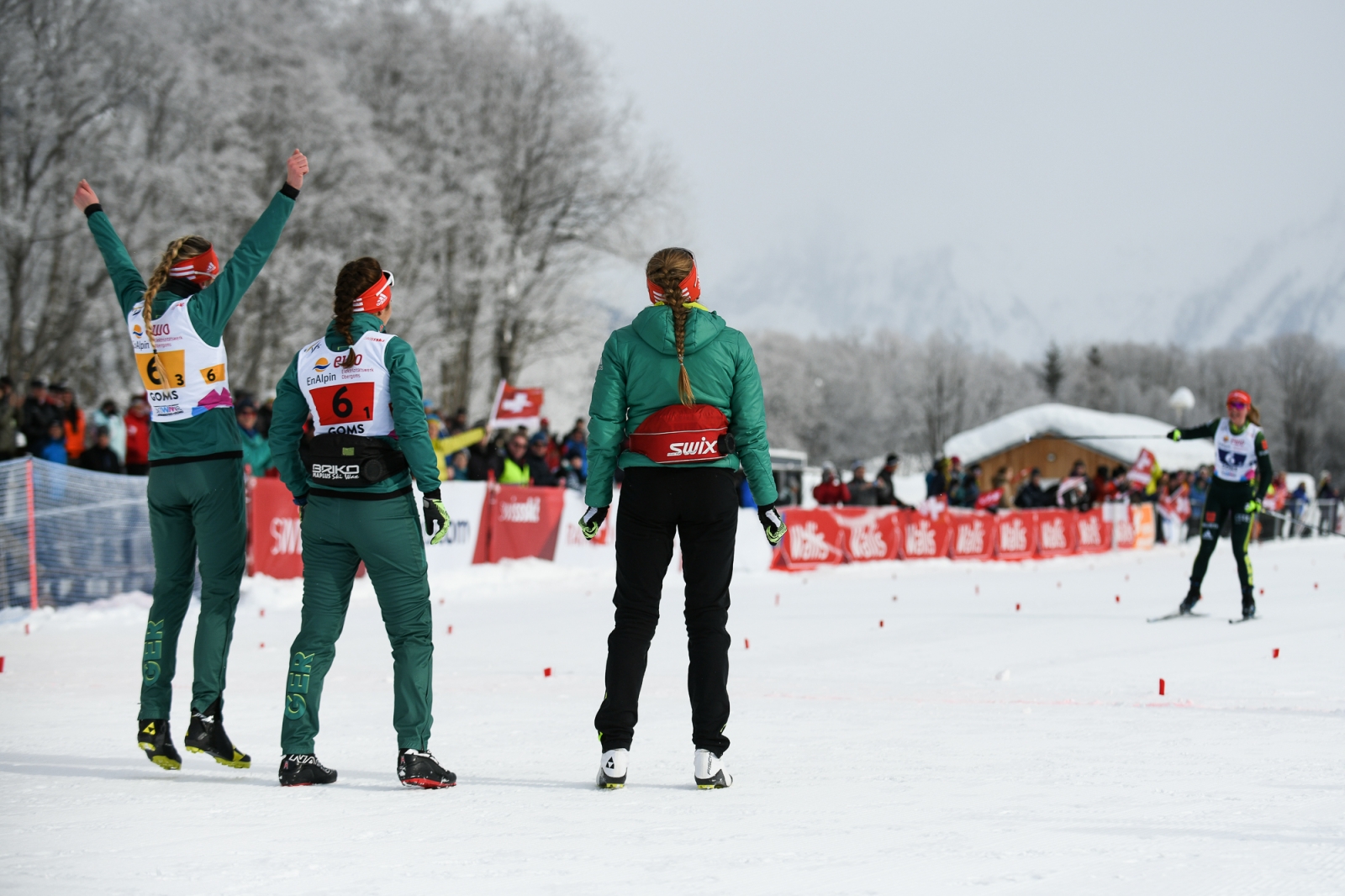
    Germany’s Alexandra Danner, Celine Mayer and Lisa Lohmann await their teammate Anna-Maria Dietz at the finish of the women’s 4 x 3.3 k relay on Saturday at 2018 Junior World Championships in Goms, Switzerland. Germany placed first and Russia finished second, 8.6 seconds later. (Photo: JWSC2018.ch)

    Germany (Alexandra Danner, Celine Mayer, Lisa Lohmann, Anna-Maria Dietz) improved from third on the first leg, to second on the second and third legs, and final first on Dietz’s anchor leg.

    Russia (Polina Nekrasova, Hristina Matsokina, Nina Dubotolkina, Maya Yakunina) led the race from the first through the third and final exchange, before slipping to second at the finish.

    Sweden (Tua Dahlgren, Frida Karlsson, Alicia Persson, Johanna Hagström) rebounded from 13th and more than a minute and a half back at the first exchange to tag in fourth and 28 seconds out of first thanks to Karlsson’s fastest second-leg time. By the final exchange, they were up to third and they held that position to the finish.

    The U.S. women’s 4 x 3.3 k relay at 2018 Junior World Championships, with (from left to right) Hailey Swirbul, Kathleen O’Connell, Hannah Halvorsen, and Molly Gellert. They placed eighth on Saturday. (Photo: Julia Kern)

    The U.S. placed eighth (+1:08.1) with Kathleen O’Connell, Swirbul, Molly Gellert, and Hannah Halvorsen. After O’Connell put them in eighth and about a minute back on the first leg, Swirbul skied them up to sixth with the second-fastest second leg, 30.1 seconds out of first. Gellert held onto that position on the first skate leg, but Halvorsen slipped two places on the anchor leg to finish eighth.

    Canada finished 15th (+4:47.8) out of 16 teams with Hannah Mehain, Natalie Hynes, Annika Richardson, and Alexandra Racine.

    Results: Men | Women

    ***

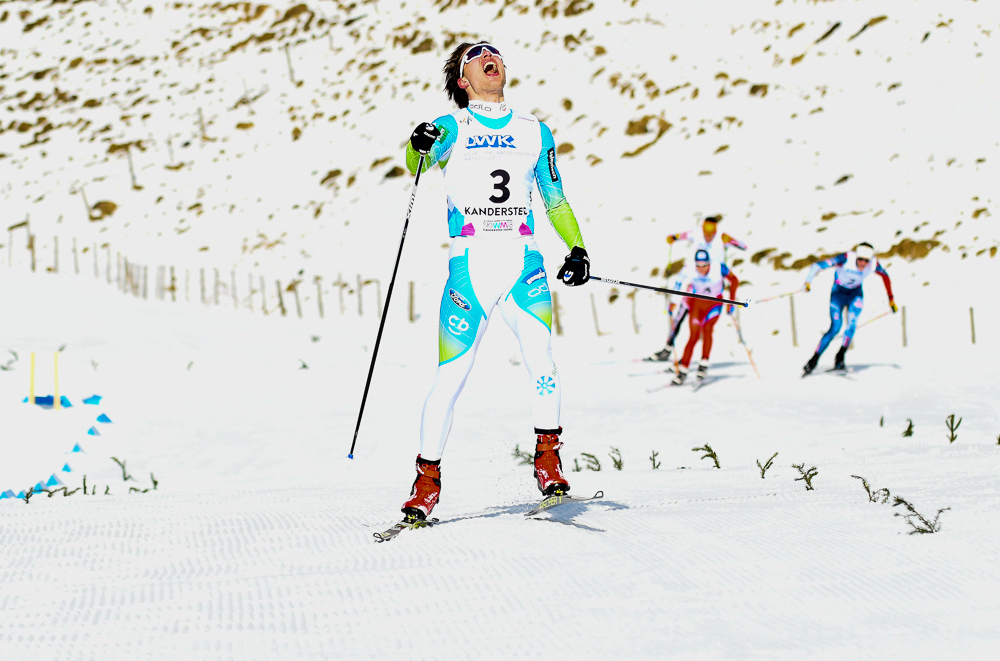
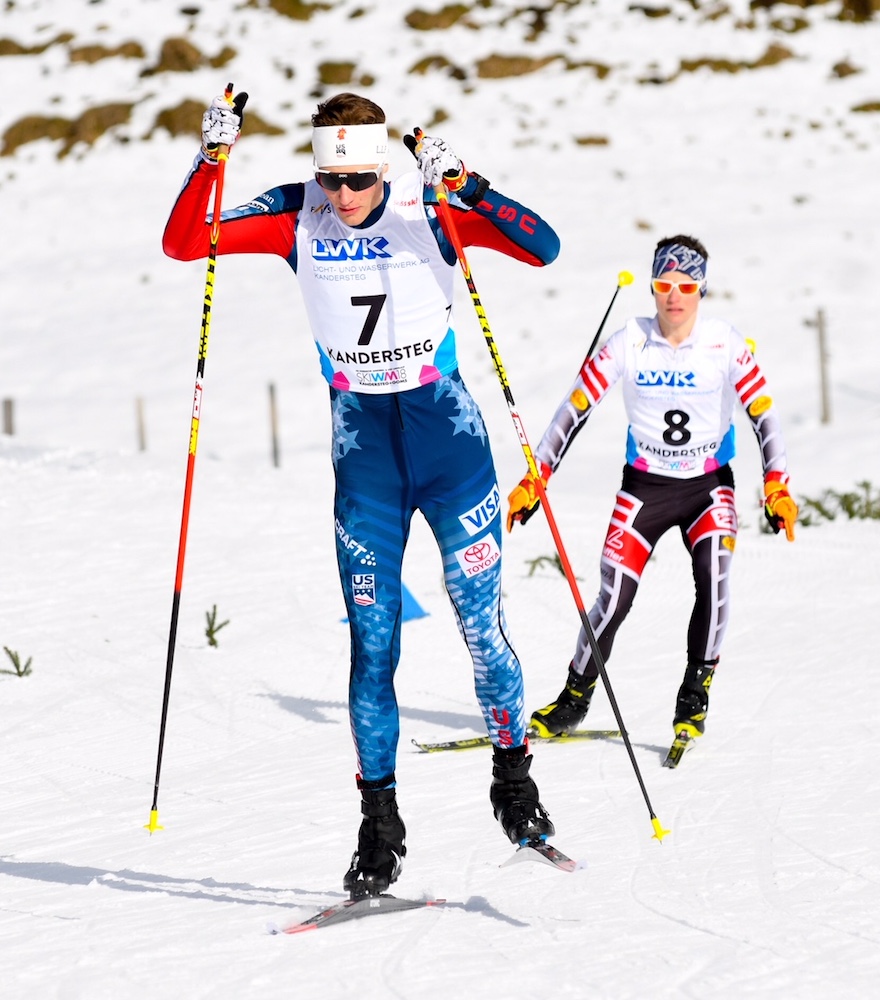
    Slovenia’s Vid Vrhovnik (3) celebrates his win in the last nordic-combined competition of 2018 Junior World Championships, the individual normal hill/5 k, on Saturday in Kandersteg, Switzerland, while the Czech Republic’s Jan Vytrval, Austria’s Dominik Terzer and American Ben Loomis (r) battle for second. (Photo: JWSC2018.ch)

    Nordic Combined Junior World Championships (Kandersteg, Switzerland): Normal hill/5 k Gundersen

    In the final nordic-combined competition of Junior Worlds, American Ben Loomis nearly notched his second podium of the week, missing it by one-tenth of a second in fourth place.

    American Ben Loomis (7) leads Austria’s Johannes Lamparter during Saturday’s 5 k at 2018 Nordic Combined Junior World Championships in Kandersteg, Switzerland. Loomis went on to place fourth and Lamparter finished eighth. (Photo: Romina Eggert)

    Slovenia’s 18-year-old Vid Vrhovnik won the individual normal hill/5 k Gundersen by 4.9 seconds over Austria’s Dominik Terzer. After posting the third-best jump on the 106-meter hill, Vrhovnik started the 5 k race 6 seconds behind Germany’s Luis Lehnert in first. Terzer jumped to second and started just 4 seconds behind, while the Czech Republic’s Jan Vytrval jumped to fourth and started 10 seconds back. Loomis jumped to seventh (just as he did on Tuesday before racing to third place) and started 27 seconds out of first.

    “I was happy with my jump being closer in time to the front,” Loomis wrote in an email about his his jump, which put him about 10 seconds closer to the leaders than on Tuesday. “I didn’t feel quite as lucky with the wind. I was hoping to jump around the top 5, but 7th, only 27sec back was good, too.”

    Over the two-lap 5 k, Vrhovnik battled with Terzer, while Lehnert slipped to seventh at the finish, 23.5 seconds behind. The Slovenian took the win by nearly five seconds over Terzer in 11:28.8, and Vytrval outlunged Loomis for third place (+5.4). Loomis placed fourth (+5.5), well ahead of Norway’s Einar Lurås Oftebro in fifth (+18.4).

    Ben Loomis (USA Nordic) on the last day of 2018 Nordic Combined Junior World Championships in Kandersteg, Switzerland. He jumped to seventh and moved up to fourth in the 5 k. (Photo: Romina Eggert)

    “I was able to catch places 3-6 on the first lap and ski with them through the beginning of the second lap,” Loomis wrote. “Towards the end of second lap I closed down on second place (Jan Vytral) with Dominik Terzer. On the last corner we packed up in positions 2-4.

    “The finish started with a sharp downhill corner followed by a quick stretch less than 100 meters,” he continued. “I came into the finishing lanes in second but unfortunately took the wrong line and was passed by Dominik and never quite caught Jan in front of me.”

    While he had been hoping for another podium, Loomis acknowledged that he was pleased to ski the fastest race time and “be battling at the front”.

    “Overall I am leaving Switzerland with my goals accomplished and feeling satisfied,” he wrote. “It would have been nice to walk away with a double podium but I am still very happy with how to week went. This week has been a huge confidence booster going into the Olympics next week. I am very excited to represent my country and enjoy my time at the games. I am looking to have fun, take in experience and not overthink the results.”

    Also for the U.S., Stephen Schumann placed 18th (+1:18.6), up one place from 19th in the jump, Jared Shumate finished 40th (+3:05.7), up from 48th in the jump, and Tucker Hoefler was 55th (+5:50.5), after jumping to 55th.

    Results: Jumping | Final

    ***

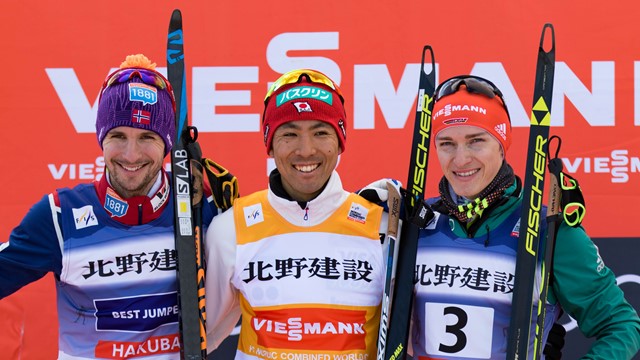
    The podium at Saturday’s Nordic Combined World Cup in Hakuba, Japan, with Japan’s Akito Watabe (c) in first, Norway’s Jan Schmid (l) in second and Germany’s Manuel Faißt (r) in third. (Photo: FIS/Flawia Krawczyk)

    Nordic Combined World Cup (Hakuba, Japan): Large hill/10 k Gundersen

    Many of the winter-sports World Cups were off this weekend before the Olympics start in earnest a week from today in PyeongChang, South Korea, but not nordic combined, which had a World Cup stop in Hakuba, Japan.

    There, local hero Akito Watabe took the win in 24:14.6 minutes, a whopping 1:12.6 minutes clear of Norway’s Jan Schmid in second. Germany’s Manuel Faißt placed third, 1:22 back, and Estonia’s Kristjan Ilves finished 52 seconds later in fourth (+2:14).

    The lone American competing in Saturday’s 10 k Gundersen, Ben Berend achieved his first individual World Cup top 30, placing 23rd (+4:31.7) after jumping to 16th on Hakuba’s 134-meter large hill.

    Watabe led from the beginning of the day after jumping to first, ahead of Ilves in second, Faißt in third, and Schmid in fourth. Watabe started the 10 k with a 16-second head start on Ilves, while Faisst started 52 seconds out of first and Schmid started 1:08 behind.

    Berend started the 10 k with a 2:36 deficit to first, with five others within 10 seconds of him. His teammate Adam Loomis did not start the 10 k after jumping to 38th.

    Another individual large hill/10 k Gundersen will be held on Sunday in Hakuba. The first nordic combined competition in PyeongChang, the individual normal hill/10 k, is set for Wednesday, Feb. 14.

    Results: Jumping | Final 

    ***

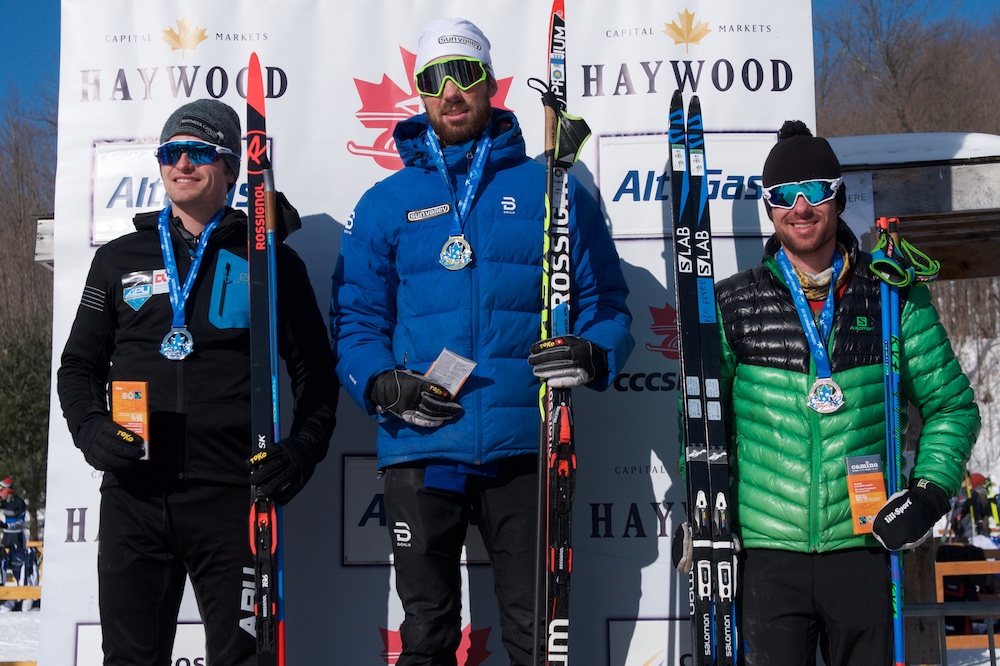
    The men’s 15 k freestyle podium at 2018 Eastern Canadian Championships in Gatineau, Quebec, with Jack Hegman (c) in first, David Norris (l) in second and Tad Elliott (r) in third. (Photo: Rob Smith)

    NorAm Eastern Canadian Championships (Gatineau, Quebec): 10/15 k freestyle

    Americans swept the podium in both the men’s and women’s freestyle individual starts on Saturday at Eastern Canadian Championships in races that count toward both NorAm and SuperTour standings.

    According to unofficial results, Jack Hegman, of the Sun Valley Ski Education Foundation (SVSEF), won the men’s 15 k by 9.1 seconds over David Norris, of Alaska Pacific University (APU), in 35:44.9. Tad Elliott (Ski Club Vail) placed third (+38.7) just ahead of the top Canadian, Jack Carlyle, of the Alberta World Cup Academy (AWCA), in fourth (+41.7).

    The U.S. occupied eight of the top 10 in the men’s race, with Kevin Bolger (SVSEF) in fifth (+45.0), Ben Lustgarten, of the Craftsbury Green Racing Project (CGRP) in sixth (+52.3), Brian Gregg (Team Gregg/LNR/CXC) in seventh (+57.0), Rogan Brown (SVSEF) in eighth (+58.1), Canada’s Scott Hill (Barrie Cross Country) in ninth (+1:14.7), and Eric Packer (APU) in 10th (+1:18.6).

    The women’s 10 k freestyle podium at 2018 Eastern Canadian Championships in Gatineau, Quebec, with Rosie Frankowski (c) in first, Becca Rorabaugh (l) in second and Erika Flowers (r) in third. (Photo: Rob Smith)

    After placing second in a 10 k freestyle at last weekend’s SuperTour in Craftsbury, Vermont, Rosie Frankowski (APU) won the women’s 10 k freestyle on Saturday in Gatineau by more than 30 seconds in 27:07.3. Her teammate Becca Rorabaugh (who won the Craftsbury 10 k skate as well as Friday’s classic sprint in Gatineau) placed second (+37.1) on Saturday, and Erika Flowers placed third (+1:26.4) for the third-straight race.

    Frédérique Vézina, of the Pierre-Harvey National Training Centre, led the Canadians in fourth (+1:46.2), while America Liz Guiney (CGRP) placed fifth (+1:52.2), and Olivia Bouffard-Nesbitt (Rocky Mountain Racers) finished sixth (+1:56.4).

    Also in the top 10, Kaitlynn Miller (CGRP) placed seventh (+1:57.8), Felicia Geisor (CXC Team) was eighth (+2:18.5), Zoë Williams (Carleton University) ninth (+2:39.6) and Annika Hicks (AWCA) 10th (+2:43.4).

    Eastern Canadian Championships conclude Sunday with 10/15 k classic pursuits at the Nakkertok Nordic Ski Centre.

    Results

  • Caught in the Middle, Ben Loomis Holds On for YOG Silver; Halvorsen Sixth

    Caught in the Middle, Ben Loomis Holds On for YOG Silver; Halvorsen Sixth

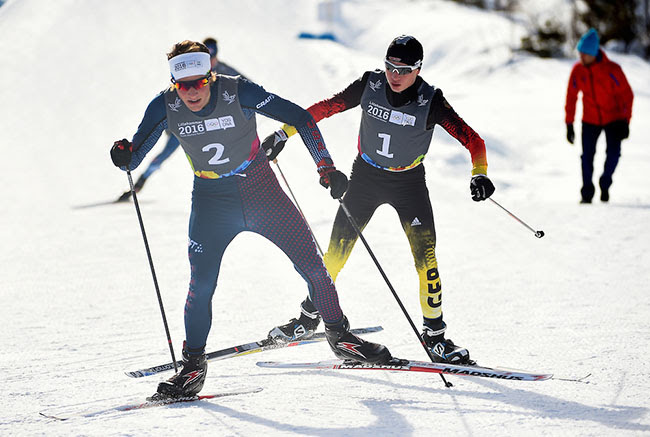
    American Ben Loomis (2) leads Germany's Tim Kopp (1) during the Nordic Combined Men's Individual Gundersen NH/5 k cross-country race at Birkebeineren Cross-Country Stadium at the 2016 Youth Olympic Games in Lillehammer Norway. Loomis went on to place second behind Kopp. (Photo: Thomas Lovelock for YIS/IOC)
    American Ben Loomis (2) leads Germany’s Tim Kopp (1) during Tuesday’s Nordic Combined Men’s Individual Gundersen NH/5 k cross-country race at Birkebeineren Cross-Country Stadium at the 2016 Youth Olympic Games in Lillehammer Norway. Loomis went on to place second behind Kopp. (Photo: Thomas Lovelock for YIS/IOC)

    (Note: This article has been updated to include comments from Hannah Halvorsen.)

    Ben Loomis sounded a little subdued on the phone Tuesday. Maybe he was still absorbing his silver-medal performance at Youth Olympic Games (YOG) in Lillehammer, Norway. Or it could be that he’s 17 years old.

    “The only thing I can compare it to was I had a fourth-place finish in international competition this year,” Loomis, a U.S. Nordic Combined skier told FasterSkier after placing second in his first competition at YOG, the normal hill/5-kilometer Gundersen start.

    Two months ago, he missed the podium by 4.3 seconds at the Continental Cup in Park City, Utah, finishing fourth behind two Austrians (David Pommer and Armin Bauer) and U.S. World Cup skier Taylor Fletcher, who placed second. All three were at least five years older than Loomis, of Eau Claire, Wis.

    “That was kind of the big stepping stone for me, but this was also something new,” Loomis said of Tuesday’s YOG competition. “But way more exciting than anything else I’ve ever experienced.”

    At the Youth Olympics, competitors are younger than 18, and nations can enter a maximum of two athletes per gender per sport.

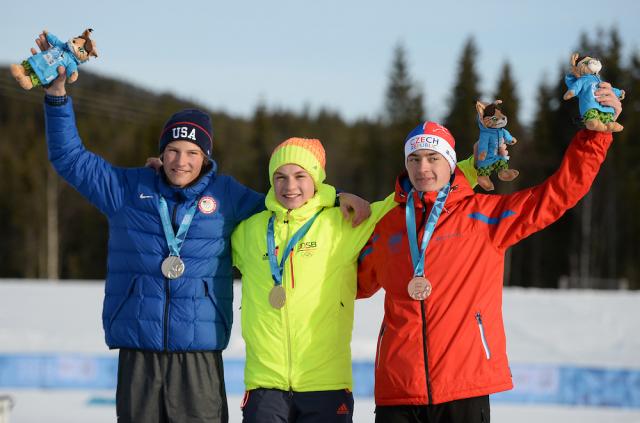
    American Ben Loomis (left) standing with podium finishers, Germany's Tim Kopp, the winner, and the Czech Republic’s Ondrej Pazout in third. (Photo: YIS/IOC-Thomas Lovelock)
    American Ben Loomis (left) standing with podium finishers, German winner Tim Kopp (c) and the Czech Republic’s Ondrej Pazout in third. (Photo: YIS/IOC-Thomas Lovelock)

    After posting the second-best jump on the 100-meter hill, Loomis started the 5 k cross-country race 8 seconds behind Germany’s Tim Kopp, the jump leader. Kopp held off Loomis by 5.2 seconds for the win in 13:31.4, and Loomis remained 2.7 seconds ahead of third place, Ondrej Pazout of the Czech Republic, at the finish.

    “I had probably my best jump all week in the competition,” Loomis said. “I just tried to catch the guy in front of me pretty quickly and I did that. I was able to ski with him for pretty much the entire race, but then there was also the third place guy who I knew was a fast skier. He caught us about half way through the race. So all three of us skied until almost the finish and then the Germany kid was able to pull away about half a kilometer before the finish.

    “I tried my hardest, but I just couldn’t stay with the first-place guy,” he continued. “But I was able to maintain second.”

    According to Adam St.Pierre, the U.S. cross-country coach at YOG, Loomis looked “relaxed” while skiing with Kopp.

    “The Czech athlete caught them at around 2.7km,” St.Pierre wrote. “The trio skied together for the rest of the race with the German making a decisive move at 4.5km … Ben had been planning to make his move on this hill too, but the German beat him to it! Ben covered the move, but was slightly gapped, but he got a gap on 3rd and skied in for silver!”

    After first meeting Loomis this week, St.Pierre explained that he wasn’t responsible for his success beyond helping wax his skis. Blake Hughes is the U.S. jumping coach at YOG.

    On Thursday, Loomis will team up with the two American ski jumpers (Casey Larson and Logan Sankey) in the ski jumping/nordic combined mixed team event, where three jumps on the 100-meter hill are scored as a unit. Then on Saturday, he’ll participate in the “nordic team relay” as both a jumper and a skier.

    “The two American jumpers and myself jump and then I’ll race and the two cross country skiers will race as well,” Loomis explained.

    “The relay start will be staggered based on the jumping results and we’ll ski a 3 by 3.3km relay with the Nordic Combiner [Loomis] and the male and female XC skiers [Hunter Wonders and Hannah Halvorsen] — all skate,” St.Pierre elaborated.

    After Youth Olympics, Loomis is headed to Nordic Combined Junior World Championships in Romania.

    “That’s a big deal as well,” he said. “I think I really surprised myself with showing how well I can perform. It just really gave me a lot of confidence going into the next competitions…”

    Results: Nordic Combined

    ***

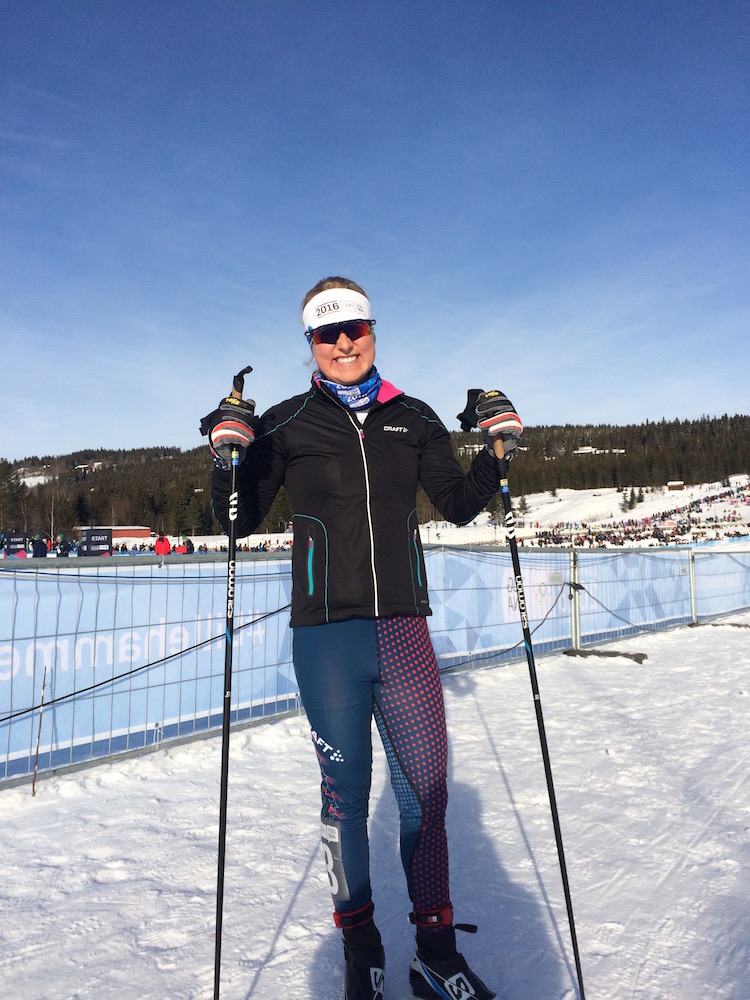
    Hunter Wonders (l) and Hannah Halvorsen (r) are the two cross-country skiers representing the U.S. at the 2016 Youth Olympic Games in Lillehammer, Norway. (Photo: Adam St.Pierre)
    Hunter Wonders (l) and Hannah Halvorsen (r) are the two cross-country skiers representing the U.S. at the 2016 Youth Olympic Games in Lillehammer, Norway. (Photo: Adam St.Pierre)

    Also on Tuesday, Hannah Halvorsen of Sugar Bowl Academy near Truckee, Calif., placed sixth in the cross-country classic sprint final. She had qualified in 13th, then went on to win her quarterfinal, and place third in her semifinal, 1.53 seconds behind Russia’s Yuliya Petrova, who won that semifinal. Moa Lundgren of Sweden automatically advanced in second and Halvorsen reached the final as a lucky loser.

    American Hannah Halvorsen between rounds at the Youth Olympic Games classic sprint in Lillehammer, Norway. She went on to place sixth in the final. (Photo: Adam St.Pierre)
    American Hannah Halvorsen between rounds at the Youth Olympic Games classic sprint in Lillehammer, Norway. She went on to place sixth in the final. (Photo: Adam St.Pierre)

    Sweden’s Johanna Hagström won the final in 3:19.55, Petrova placed second (+2.4), and Norway’s Martine Engebretsen was third (+3.27). Lundgren finished fourth (+6.44), Laura Chamiot Maitral of France (+8.84) was fifth and Halvorsen sixth (+13.65).

    “I was surprised to make it through as a lucky loser when I saw that our semi final heat was a couple seconds slower, so I was really excited,” Halvorsen wrote in an email. “I lost contact with the top girls by the first hill and started to move back throughout the heat despite putting in my best fight to the end.”

    “Hannah skied well today,” St.Pierre observed. “She felt a little flat for the XC Cross on Saturday, but had her normal energy today.”

    On Saturday, Halvorsen, who turns 18 on Friday, placed 13th in the YOG opening event: the ski cross sprint.

    “Although the skier cross was a fun experience, it was nice to be back in a race I knew well,” Halvorsen wrote. “I skied [Tuesday’s] qualifier a little tense, but it was a good signifier that I was feeling good and my fitness was there. This made me feel confident going into the heats.”

    “She looked very strong in her quarterfinal,” St. Pierre wrote. “The course started with a big climb, which Hannah was able to ski very relaxed. … The decisive moves were typically made on the second major climb of the course. Hannah made some tactical errors on this climb in her semifinal, switching tracks cost her some momentum over the top. But she finished out the semi strong, earning a lucky loser spot with her 3rd place finish.

    “I wish I would’ve given her just a little more kick for the final,” he added. “She battled and ended up 6th on the day, happy but hungry for more!”

    Canada’s Annika Richardsson finished 33rd in the qualifier, missing the top 30 needed to advance to the heats by 1.4 seconds.

    In the men’s classic sprint, Hunter Wonders qualified 29th and placed 15th overall. He missed advancing to the semifinals after placing third behind Adam Matous of the Czech Republic in a photo finish for second. The two finished 0.11 seconds behind Norway’s Thomas Helland Larsen, who won the heat in 3:04.54, but only Matous moved on with Larsen.

    “He was in fourth on the last downhill but the Russian skier ahead of him fell,” St. Pierre wrote of Yaroslav Rybochikin, who finished sixth in that quarterfinal. “Hunter avoided the fall and closed on 1st and 2nd just getting out-lunged.”

    Larsen went on to win the final in 2:55.39, Korea’s Magnus Kim placed second (+0.33) and Vebjørn Hegdal of Norway was third (+1.1).

    Like his Canadian counterpart, Levi Nadlersmith finished 33rd in the men’s race, 0.74 seconds out of qualifying.

    Racing continues tomorrow with the biathlon single mixed relay at 4:50 a.m. Eastern time.

    Results: Women | Men | Complete results

  • Bumps, Jumps, XC Cross, and Biathlon: YOG Weekend Roundup

    Bumps, Jumps, XC Cross, and Biathlon: YOG Weekend Roundup

    (Above: Complete race video of inaugural Cross-Country Cross event at the 2016 Youth Olympic Games. To view on YouTube, click here.)

    Bumps? Jumps? An uphill and downhill slalom? While racing through an obstacle course on skis is challenging enough on its own, competitors at the 2016 Youth Olympic Games (YOG) in Lillehammer, Norway, maneuvered around obstructions and other racers as well last Saturday, Feb. 13, for the opening event: the Cross-Country Cross (XCX) 1.4-kilometer freestyle sprint.

    Beyond ‘bumps,’ the YOG’s first-race event competition also differed in sprint brackets. After racing a qualifier, the top-30 athletes advanced to one of three semifinals.

    The top two finishers in each semifinal then automatically advanced to the sprint final. The sprint final totaled 10 skiers: the two winners from each semi-final, as well as two lucky losers from the two fastest semifinals.

    The Cross-Country Cross (XCX) course at the 2016 Youth Olympic Games
    The Cross-Country Cross (XCX) course at the 2016 Youth Olympic Games

    Once on course, four 1.5-meter high ‘bumps’ greeted the athletes a little over 100-meters from the start. Competitors then cruised into a sharp lefthand turn, followed by a sharp righthand turn through a part of the course called ‘The Snake.’

    After The Snake, skiers tackled the course’s first major climb. In the following descent, racers spent some hang time while passing over a 1-meter high drop.

    With increased speed, competitors soared into the second major incline on course, as well as another series of three 1.5-meter high rollers and a 0.5-meter high drop.

    The next course challenge tested athlete’s coordination and balance during an alternating ‘bumps’ section. The section prompted many skiers to take on a classic striding arm and leg swing movement.

    After a tight hairpin turn, athletes then worked their climbing strength and stamina in an uphill slalom. Immediately upon cresting the top of the incline, competitors descended into a downhill slalom.

    With no major climbs left, racers worked their way over another jump and one final set of 0.4-meter high rollers before the flat 100-meter sprint to the finish.

    Sweden’s Moa Lundgren proved most adept on course. She remained unchallenged by any competitor all day, winning the qualifier in 3:27.59, as well as her semifinal and eventually the final in a time of 3:26.36.

    Finishing 1.7 seconds behind Lundgren was Swedish teammate, Johanna Hagstrøm.

    Rounding out the women’s top three was French skier Laura Chamiot-Maitral who crossed 3.21 seconds after Lundgrun.

    Hannah Halvorsen (Far West/Sugar Bowl Academy) qualified 10th in the first-ever Cross-Country Cross event at the 2016 Youth Olympic Games in Lillehammer, Norway. (Photo: Far West/Facebook)
    Hannah Halvorsen (Far West/Sugar Bowl Academy) qualified 10th in the first-ever Cross-Country Cross event at the 2016 Youth Olympic Games in Lillehammer, Norway. (Photo: Far West/Facebook)

    Two North Americans competed in Saturday’s XCX event for the first time, American Hannah Halvorsen and Canada’s Annika Richardson.

    Halvorsen qualified in 10th, 16.45 seconds back from Lundgren. She then advanced to semifinal 3, where she raced in third behind Chamiot-Maitral and Germany’s Anna-Maria Dietze until the uphill slalom.

    Losing steam during the climb, Halvorsen moved into fourth, while China’s Chi Chunxue cranked her way into third. Hot on Halvorsen’s heels through the slalom gates was Russia’s Yuliya Petrova.

    As the women came through the final bumps, Halvorsen moved to the outside right and Petrova gained momentum in the middle lane.

    Halvorsen finished the heat in fifth, 1.7 seconds off of earning a lucky loser spot and advancing to the final, and 3.7 seconds off the heat winner Maitral-Chamiot (3:36.20).

    After qualifying in 25th (+26.3), Richardson advanced to the first semifinal where she finished in ninth, 19.7 seconds back from her heat’s winner, Lundgrun.

    Canadian wax technicians Mike Mappin (l) and Camille Cheskey (r) hard at work during the during the 2016 Winter Youth Olympic Games on Feb. 10 in Lillehammer Norway. (Photo: Jon Buckle for YIS/IOC)
    Canadian wax technicians Mike Mappin (l) and Camille Cheskey (r) hard at work during the during the 2016 Winter Youth Olympic Games on Feb. 10 in Lillehammer Norway. (Photo: Jon Buckle for YIS/IOC)

    “It went really really well all things considered,” Richardson said in an interview with Cross Country Canada.

    “Definitely a lot of stuff I can work on with the technical aspects of the course, but I felt really strong in the last half of my heat going up the hill. I’m just really grateful to be here and be experiencing all the Olympic spirit,” she added.

    Women’s results

    ***

    In the men’s event, Korea’s Magnus Kim topped the results. He won the qualifier in a time of 3:01.45, his semifinal and eventually the final in 2:59.56.

    In second place, 1.17 seconds off of Kim was Norwegian skier Thomas Helland Larson.

    Rounding out the men’s top three was Lauri Mannila of Finland, finishing 2.28 seconds behind Kim.

    Canadian skier Levi Nadlersmith and American Hunter Wonders nabbed the last two qualifying spots in 29th and 30th, respectively.

    Wonders advanced to the first semifinal, where he finished ninth, 8.8 seconds behind the heat’s winner, Kim.

    In his first international race ever, Nadlersmith also finished in ninth (+16.51) in the second semifinal.

    “I felt really strong climbing a the top of the course,” Nadlersmith told Cross Country Canada.

    “Going down into the last corner I had a weird line and I guess someone stumbled in front of me, so I had to do a quick maneuver to go around them. Then kind of after that I felt good, but lost a bit of my steam going over the last hill. I think for the most part I felt really good,” he added.

    Men’s results

    ***

    Day 2: Biathlon Begins

    While some were shooting cupid’s arrows on Sunday, Feb. 14, biathlon competitors at the YOG shot targets. The second day of events included the men’s 7.5 k and women’s 6 k biathlon sprints at the Birkeneineren Biathlon Stadium.

    On the men’s side, Emilien Claude of France won the event in a time of 19:01.5 after shooting clean during both the prone and standing stages.

    “In lap three, in my head it was ‘maybe I win, maybe second’,” Claude said, according to an Inside the Games press release. “But when I finished and saw that I was first, I thought, ‘Wow.’ ”

    Taking the second place silver medal, 7.1 seconds back, was Norway’s Sivert Guttorm Bakken, who missed one shot prone and one standing.

    Third place and the bronze medal went to Russian racer Egor Tutmin. Tutmin skied the first of the three 2.5 k laps the fastest and shot clean during the prone stage. However, after two penalties standing, he finished 18.0 seconds back from the race winner’s time.

    Two Canadians competed in Sunday’s event, including Ben Churchill and Leo Grandbois.

    Churchill finished in 17th overall (+1:35.5) with one penalty (1+0). Grandbois placed 22nd (+1:58.6) after missing two shots during the standing stage.

    The American men also had two competitors in Sunday’s 7.5 k sprint, Vasek Cervenka and Eli Nielsen.

    Cervenka was the first American across the line in 36th place (+2:50.7) after skiing four penalties (1+3). Nielsen finished one minute and 7.4 seconds after Cervenka in 46th, (+3:58.1) after a total of six penalties (2+4).

    Canada's Gillian Gowling receives a pole during the women's 6 k sprint at the Youth Olympic Games on Sunday in Lillehammer, Norway. (Photo: Lillehammer 2016 Olympic Games/Facebook)
    Canada’s Gillian Gowling receives a pole during the women’s 6 k sprint at the Youth Olympic Games on Sunday in Lillehammer, Norway. (Photo: Lillehammer 2016 Olympic Games/Facebook)

    With perfect shooting on Sunday, Germany’s Juliane Fruehwirt won the women’s 6 k sprint event, covering the 3 x 2 k course in a time of 18:23.5.

    Norwegian skier Marthe Krakstad Johansen was the next closest contender for the gold medal. After missing one shot standing, Johansen finished in second place, 5.6 seconds behind Fruehwirt’s time.

    Rounding out the women’s podium finishers on Sunday was bronze medalist Arina Pantova of Kazakhstan. After two penalties (1+1), Pantova completed the course 17.1 seconds behind Fruehwirt.

    American Amanda Kautzer cracked the top 10 on Sunday and finished in 10th overall (+58.9) after skiing two penalties (1+1). U.S. skier Chloe Levins missed the top 20 by 1.7 seconds, and finished in 22nd overall with a clean round of prone shooting, but two standing penalties.

    After cleaning both the prone and standing stages, Canada’s Gillian Gowling finished 30th (+2:27.8). Her Canadian teammate, Tekarra Banser finished 14.4 seconds later  in 35th (2:42.2) after two penalties (0+2).

    Results: Men | Women

    ***

    Chloe Levins shoots clean and races to a fourth place overall in the women's 7.5 k pursuit at the Youth Olympic Games on Monday in Lillehammer, Norway. (Photo: US Biathlon/Twitter)
    Chloe Levins shoots clean and races to a historic fourth place for the U.S. in the women’s 7.5 k pursuit at the Youth Olympic Games on Monday in Lillehammer, Norway. (Photo: US Biathlon/Twitter)

    Day 3: Levins Just Outside of the Medals, Fourth in Pursuit

    Monday marked the third day of the YOG and the second set of biathlon races with the 7.5 /10 k pursuits.

    The women’s 7.5 k pursuit event saw Ukraine’s Khrystyna Dmytrenko at the top of Monday’s podium.

    Starting 26 seconds back from Sunday’s race winner, Dmytrenko missed two shots during her first stage of prone shooting and then cleaned the rest of her shots to finish the 5 x 1.5 k course in a time of 25:12.9.

    In a photo finish, Norway’s Johansen bested France’s Lou Jeanmonnot Laurent by one tenth of a second. Johansen finished 7.5 seconds behind Dmytreno after skiing four penalties (2+0+1+1). Jeanmonnot Laurent finished 7.6 seconds off of Dymtrenko’s time after missing two shots standing (0+0+1+1).

    With perfect shooting, American Chloe Levins finished in fourth overall (+34.7), just outside of medal contention.

    “The pursuit in Lillehammer today was a dream,” Levins said according to a US Biathlon press release. “As Susan [Dunklee] said earlier in the season, every race is a team effort. We had great skis and excellent conditions for today’s race. My race was made on the shooting range. Of course, it is bittersweet to be close to the podium in 4th position, but I shot clean and skied well, so it is an incredibly satisfying result.”

    Read more about Levins’ historic result here

    American Amanda Kautzer finished in 27th (+4:04.2) with a total of eight penalties (3+2+1+2). Canada’s Banser finished in 35th (+ 5:43.6) after missing five shots (1+0+2+2) and her teammate Gowling placed 45th (+9:45.30) after missing six shots ( 1+1+2+2).

    After winning Sunday’s sprint, France’s Claude was the first skier on the Birkebeineren Biathlon Stadium’s 5 x 2 k course.

    Norway's Sivert Guttorm Bakken after winning the men's 10 k biathlon pursuit at the Youth Olympic Games on Monday in Lillehammer, Norway. (Photo: Lillehammer 2016 Olympic Games/Facebook)
    Norway’s Sivert Guttorm Bakken after winning the men’s 10 k biathlon pursuit at the Youth Olympic Games on Monday in Lillehammer, Norway. (Photo: Lillehammer 2016 Olympic Games/Facebook)

    Starting 7.0 seconds later was Monday’s eventual race winner and Sunday’s silver medalist, Bakken of Norway. Bakken missed four shots (1+1+1+1), but ultimately came away with the 10 k pursuit win in a time of 28:10.7.

    Moving up to second place after Sunday’s event was Russia’s Tutmin. With an extra penalty (0+1+3+1), Tutman completed the course one minute and 10.7 seconds behind Bakken’s time.

    Taking the event’s bronze medal was Said Karimulla Khalili of Russia. Khalili shot the same as Bakken and finished 1:17.7 behind the race winner.

    With two penalties (0+0+1+1), Canada’s Churchill crept into the top 10, finishing in 10th overall (+2:49.1). Cervanka of the U.S. improved his result from Sunday to 20th overall (+3:54.2) after missing just one standing shot.

    “Vasek also made a great comeback with 95 percent shooting score and a good skiing performance,” U.S. coach Jean Paquet said in a US Biathlon press release.

    “He looked more at ease on the skis and liked the fight on the course. He gained 16 positions by shooting well on the shooting range.”

    The next North American was Canada’s Grandbois, who placed 25th (+4:40.7)after skiing five penalties (1+0+1+3).

    In 46th was Nielsen of the U.S. (+8:13.4) with six penalties (0+2+2+2).

    Results: Women | Men