From the FasterSkier archive — posts syndicated from athletes’ and coaches’ own blogs between 2004 and 2012, kept online as published. Current coverage is at fasterskier.com.
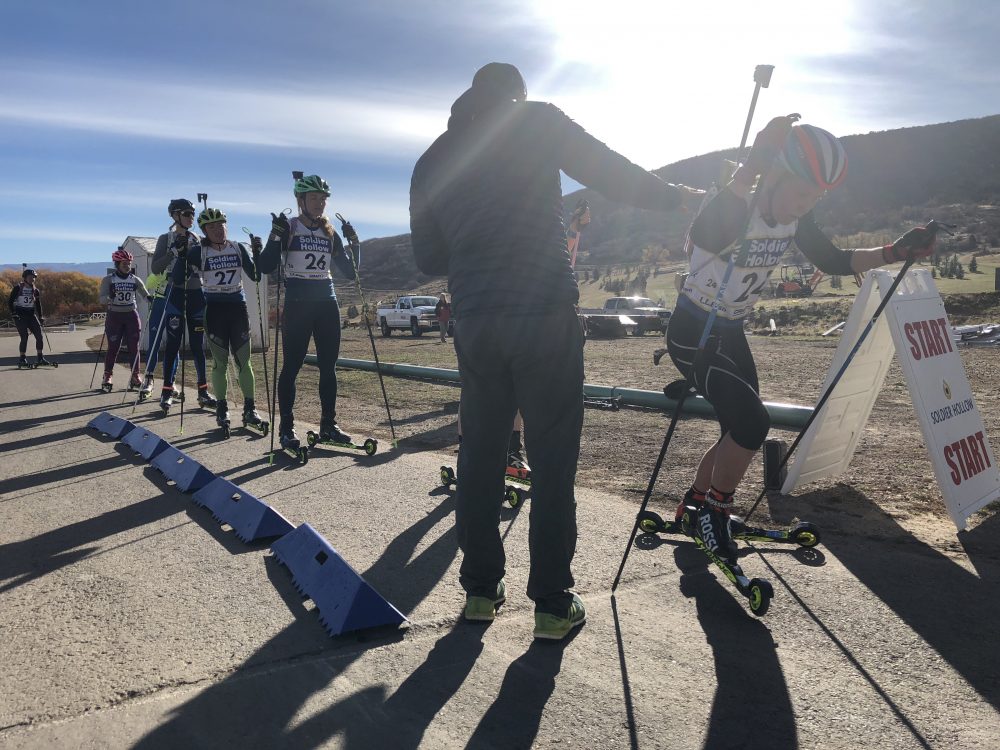
Kelsey Dickinson (24) gets on course for the women’s 7.5-kilometer biathlon sprint for USBA SoHo trials on Tuesday, Oct. 30. Emily Dreissigacker (26) and Hallie Grossman (27) look on. (Photo US Biathlon)
On Wednesday, 12 biathletes competed in the senior women’s 7.5-kilometer sprint, with veteran Susan Dunklee once again coming out on top. Dunklee completed the course in a time of 22:23, after missing two shots, one prone and one standing.
The next closest competitor to Dunklee was Johanna Talihärm, who tied Dunklee’s shooting score and finished 55 seconds back from the winning time for second place. Talihärm is originally from Estonia and is currently a senior at Montana State University.
Rounding out the podium was Craftsbury Green Racing Project and former Bates College skier, Hallie Grossman in third. Grossman cleaned her prone stage and missed one standing shot, finishing 1:12 seconds back from Dunklee.
Emily Dreissigacker, who had placed third in yesterday’s sprint, finished in fifth (+1:49) on Wednesday after two missed prone shots and one missed standing. Clare Egan, another top three finisher in Tuesday’s race, placed sixth (+2:01) in Wednesday’s sprint with 2 missed prone shots and 3 missed standing. In fourth (+1:32) on Wednesday was Deedra Irwin of Wisconsin Biathlon.
In the men’s 10 k sprint, Leif Nordgren claimed first in a time of 26:21 after one missed prone shot and one missed standing. Finishing 12 seconds behind Nordgren was Sean Doherty in second. Doherty missed two prone and cleaned standing. Rounding out Wednesday’s top three was Jake Brown, who cleaned standing and missed one prone shot, finishing two seconds out of second place and 14 seconds back from the winner.
A junior men’s and junior women’s sprint was held, with Lexie Madigan (Sugar Bowl Academy) taking the women’s win in a time of 16:46 and Eli Neilsen (MSU/Methow Valley Ski Club) claiming the men’s in a time of 19:25.
Athletes have a rest day on Thursday before returning to the venue on Friday for a mass start.
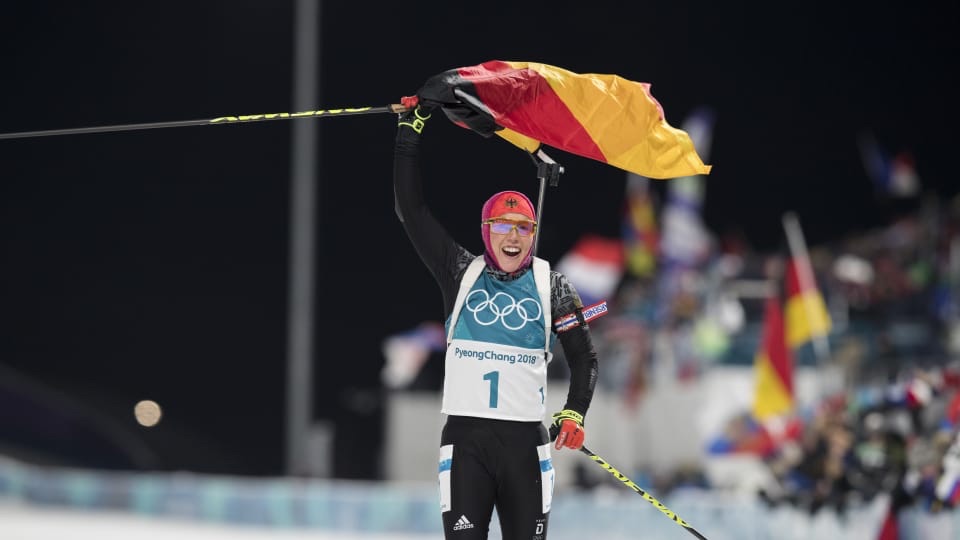
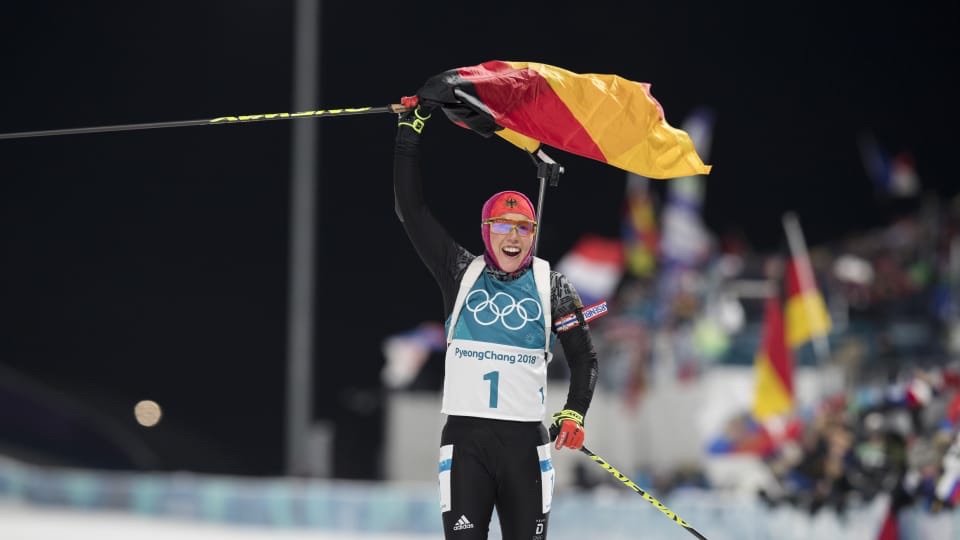
Gold medalist Laura Dahlmeier of Germany celebrates waiving a national flag as she crosses the line first in the women’s 10-kilometer pursuit at the 2018 Olympic Winter Games in PyeongChang, South Korea. (Photo: IBU/Biathlonworld)
It was almost another start-to-finish victory at the Olympic Winter Games in PyeongChang for the current golden girl of biathlon, Germany’s Laura Dahlmeier. But it came with a painful price to pay.
After starting the women’s 10-kilometer pursuit on Monday evening local time in freezing temperatures and with a 24-second lead following her sprint victory, Dahlmeier began the race intensely focused, again cleaning the first prone stage.
But this time she was not uncontested.
After starting in 13th position and almost a minute back to begin the pursuit, Slovakia’s Anastasiya Kuzmina, who’s currently second in the World Cup Total Score standings, caught up to Dahlmeier after both had incurred one penalty in the second prone shooting and avoided more by performing multiple adjustments on their rifle sights to deal with gusts of wind.
After closing a nine-second gap, Kuzmina passed her rival on the next loop. But Dahlmeier did not seem to mind someone else helping her to set the pace in once again difficult conditions on the course and range (the race jury reportedly debated a potential postponement), and tucked behind Kuzmina to wait for her next chance in the standing shooting. There Dahlmeier cleaned again, leaving the range with a 38-second lead after Kuzmina had to twice ski through the penalty lap, but still retained second place as the closest pursuer.
“On the third loop we raced together, and on the uphill part Anastasiya was really strong and I just wanted to follow her and we had a good speed together,” Dahlmeier later recounted at the post-race press conference. “And at the shooting range, I felt really comfortable. I know about my good standing shooting, and I just looked to my targets and wanted to hit the middle and it worked … During the last years I could improve my shooting in wind situations, but I didn’t especially train wind situations [for PyeongChang].”
“Laura is a very hard opponent to beat,” Kuzmina said at the press conference, via a translator. “She is able to fully focus on the shooting and she is able to shoot very good also in the strong wind, so you can fight with her on the skis of course, but you need to shoot very good to beat her.”
In her final shooting stage, Dahlmeier again cleaned all targets and left the range with a 55-second lead on Kuzmina, with France’s Anaïs Bescond right behind the Slovakian.
“If I would already think that I might miss a target when approaching the range for the fourth time, I believe that would be the wrong mindset. I just tried to concentrate on myself, on my own targets,” Dahlmeier told German broadcaster ZDF when questioned about the final shooting, when she probably could have afforded to compensate for one penalty lap. “I have proven often enough that I can hit [when it matters], in training we simulate that every day. And I just firmly believed that it will work out again today. And it did, so I am very grateful for that.”
With such a comfortable lead, nobody could challenge her anymore on the final loop. On the finishing stretch Dahlmeier had enough time to reach for a German flag handed to her from the stands, before crossing the line in a time of 30:35.3 minutes, with one penalty (0+1+0+0).
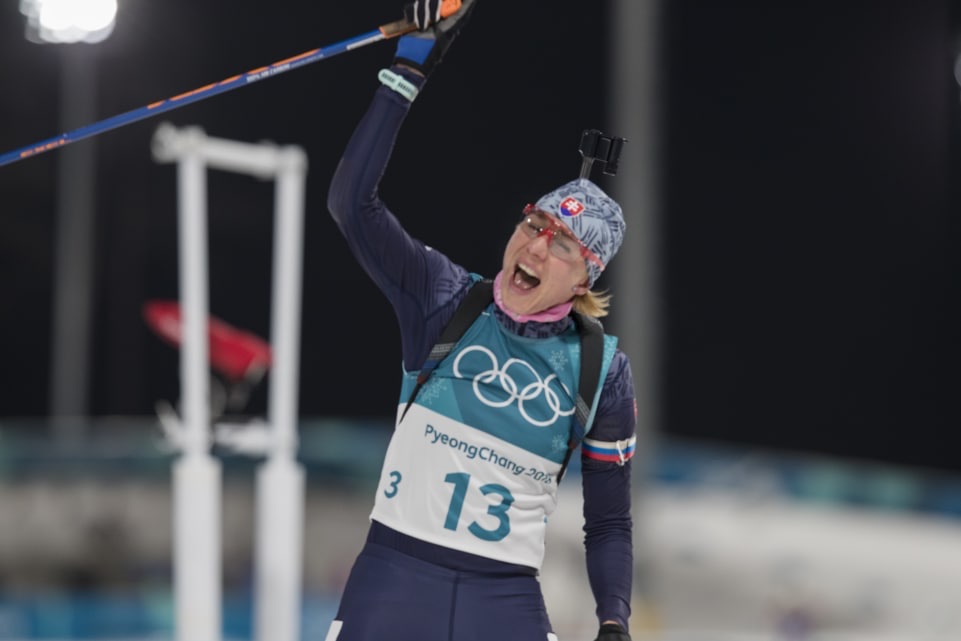
Anastasiya Kuzmina of Slovakia celebrates after crossing the finish line in second place in the women’s 10-kilometer pursuit at the 2018 Winter Games in PyeongChang, South Korea. (Photo: IBU/ Biathlonworld)
Fighting for the positions on the podium behind her, Kuzmina crossed the line 29.4 seconds back to claim the silver medal, winning the finishing sprint against Bescond, who had to settle for bronze (+29.6).
Bescond moved up from a 19th starting position largely thanks to her 19-for-20 shooting with just one penalty lap (0+0+1+0), though she also skied the fifth-best overall course time, while Kuzmina overcame four misses (0+1+2+1) with the fastest course time of the day, just as she had done in the sprint.
Almost another minute back, fourth place went to sprint silver medalist Marte Olsbu of Norway (+1:07.3, four penalties), fifth to Hanna Öberg of Sweden (+1:08.9, three penalties), and sixth to Dahlmeier’s teammate Denise Herrmann (+1:19.4, two penalties), who improved from starting in 21st position. Sprint bronze medalist Veronika Vitková of the Czech Republic fell back to seventh (+1:37.3, three penalties).
Going to the stands a few minutes after reaching the finish, Kuzmina hugged her friends and relatives, including her husband and a teary eyed woman (presumably her mother) who was wearing a sports jacket embroidered with Russian emblems. Herself a mother of two, Kuzmina is the older sister of Russian star biathlete Anton Shipulin, who was not invited by the International Olympic Committee (IOC) to compete as part of the neutral Olympic Athletes from Russia team in PyeongChang. An appeal to the Court of Arbitration for Sports (CAS) was denied just hours before the Opening Ceremony. Kuzmina has been racing for Slovakia since 2008, only competing for Russia at two Junior World Championships and never at senior-level championships.
“I am missing my brother. I hoped to the last moment that he will be able to compete here,” Kuzmina said about the topic when asked about it in the press conference, via a translator. “I don’t want to talk a lot about this issue. I am really sorry about what happened and that my brother is not here. I am here to fight for medals for my entire family. I won the one medal, and I want to win another medal for my brother.”
Kuzmina, 33, is an Olympic gold medalist in the sprint and silver medalist in the pursuit at the 2010 Olympics in Vancouver, British Columbia, and sprint gold medalist from 2014 in Sochi, Russia.
“This is a very special feeling to have the third medal from the third Olympics in a row,” Kuzmina explained. “Almost everybody who talked to me was [expecting] that I could win the sprint here, because I won the sprint in Vancouver and Sochi as well. That didn’t happen, but I am very glad that I managed to defend the silver medal in this event like in Vancouver eight years ago.”
For the 30-year-old Bescond it was her first medal at Olympic Winter Games, after she narrowly missed out four years ago in Sochi with two fifth places in the sprint and individual.
At 2016 World Championships she had taken silver in the 15 k individual in Oslo, Norway, and she’s also earned six medals with French relay teams. But last season was a down year where she started just one race at 2017 World Championships in Hochfilzen, Austria, and finished outside the top 50 before she rebounded with a third place in the pursuit at the World Cup test event last year in PyeongChang.
“Of course it was never granted that I make the podium,” Bescond said in the press conference, via a translation. “It was very difficult for me not being able to do the World Championships [in Hochfilzen]. This year I really wanted to perform very well, and the Olympic Games is the best thing you could think of, the Holy Grail. So I did think about last year this time, and I was very happy to have a very good race.”
“Laura really dominates our sport, but there a lot of good athletes out there,” Bescond stated when asked how her opponent could be beaten at these Olympics. “They are strong, they got lots of qualities, what you need to do is be faster on the skis and shoot better and faster, that’s it.”
Sounds easy enough.
But if her opponents couldn’t quite yet do it in the pursuit on Monday, the weather conditions and all the increased attention on Dahlmeier, who usually guards her private life closely, pushed her to her limits.
“I am extremely happy that everything worked out so well again today,” Dahlmeier told German broadcaster ZDF right after the race. “I tried to be fully focused on the shootings, on the course I didn’t feel quite as relaxed. On the one hand the conditions were very demanding, and the past two days have taken a toll on me with a lot of media appointments, a lot of additional stuff. At the moment I am feeling quite well, but of course it is cold and when the fingers thaw up, maybe some viewers know it, that hurts quite a bit.”
Soon after, Dahlmeier was no longer in the mood to celebrate, as she had fully exhausted herself for the victory. And her frozen fingers exposed to the cold in thin race gloves now seemingly really hurt, even though in the press conference before she had claimed that “I always spend a lot of time in the mountains and there it’s normal to have wind and cold temperatures, so perhaps I am a little bit used to it.”
“Primarily it was the cold. She is in extreme pain,” Stefan Schwarzbach, a manager and speaker for the German Ski Federation, later told ZDF after she had to cancel a planned studio appearance. “So when [her hands] thawed up she really had tears in her eyes, it was painful to watch. After the doping control she put herself to rest, she is just completely finished.”
At last year’s World Championships in Hochfilzen, where she won five medals, she physically collapsed after two races to the point that the German team doctor did not want her to start the mass start. In the end her stubbornness prevailed, and she also won that race overtaking American Susan Dunklee on the final lap.
“We already know that from last year, we just have to be careful with the sum of the exertions in competition,” Schwarzbach said. “And I believe the spectators will be accepting if she reduces the media work a little bit, and then hopefully can stand at the start line for the individual with full strength. … She will be all right, but we will reduce her program to what is necessary, even if it would have been nice to celebrate the second gold medal.”
North Americans Moving On Up
Canada’s Rosanna Crawford finished 19th in the pursuit as the best North American, moving up from 53rd at the start, based on her sprint result, to finish 19th (+2:27.7) for her best individual result at her third Olympics.
Canada’s Rosanna Crawford (22) during the women’s 7.5 k sprint on Saturday, Feb. 10 at the 2018 Olympics in PyeongChang, South Korea. She finished 53rd then went on to place 19th in the pursuit on Monday. (Photo: FlyingPointRoad)
On the range, Crawford managed to cope well with the windy conditions, shooting 18-for-20 with one miss in each of her standing stages (0+0+1+1). In an interview with FasterSkier after, she said she would have liked to avoid one mistake she made in the final shooting.
“[The wind] seems to have been more consistent,” Crawford said. “My zeroing went really well, I had my sights, I knew exactly where they were and what corrections I would need to make. So prone I was really confident. … In my last standing I didn’t mean to pull the trigger on my first shot, so that was a bit of a disappointment.”
She enjoyed her race despite the harsh weather and demanding tracks, skiing the 19th-ranked overall course time.
“For sure I love the 2k [pursuit loop] here,” Crawford said. “I [also] was 19th with 18-for-20 last year at the World Cup here. Yeah, the 2 k is so much fun. You just have to grit your teeth up that hill and then just rip along the top and back down to the range, and I love it so much. My skis were amazing. Our techs did such a good job. So I just had some fun out there today.”
Asked how she got into a better mindset following the sprint, Crawford said she called her older sister, a 2006 Olympic gold medalist in cross-country skiing.
“I had some really good chats with my sister Chandra,” Crawford said. “She’s a huge motivator for me and my biggest cheerleader now. She really just talked some sense into me to not be so down on myself after the sprint, so that was really helpful.”
Julia Ransom (Biathlon Canada) during the women’s 7.5 k sprint at her Olympic debut in PyeongChang, South Korea. She finished 40th then went on to place 28th in the pursuit on Monday. (Photo: FlyingPointRoad)
Teammate Julia Ransom also improved from her sprint position, moving up by 12 places to finish in 28th place (+3:03.0) with one miss in her last standing stage. She was one of just six women on Monday who shot 19-for-20, with no one shooting clean.
“I had some really solid shooting today hitting my first 15, missing my 18th or 17th shot,” Ransom recounted after the race. “I am a confident shooter in the wind, I know corrections fairly well, and I think you just have to make good shots and that’s all you can hope for”
On the course she skied the 44th-best course time after a faster first loop.
“My legs were not feeling as good as I was hoping they’d be, so I was really happy to keep it together in the range and just slowly work my way up and ski with the other girls,” Ransom concluded.
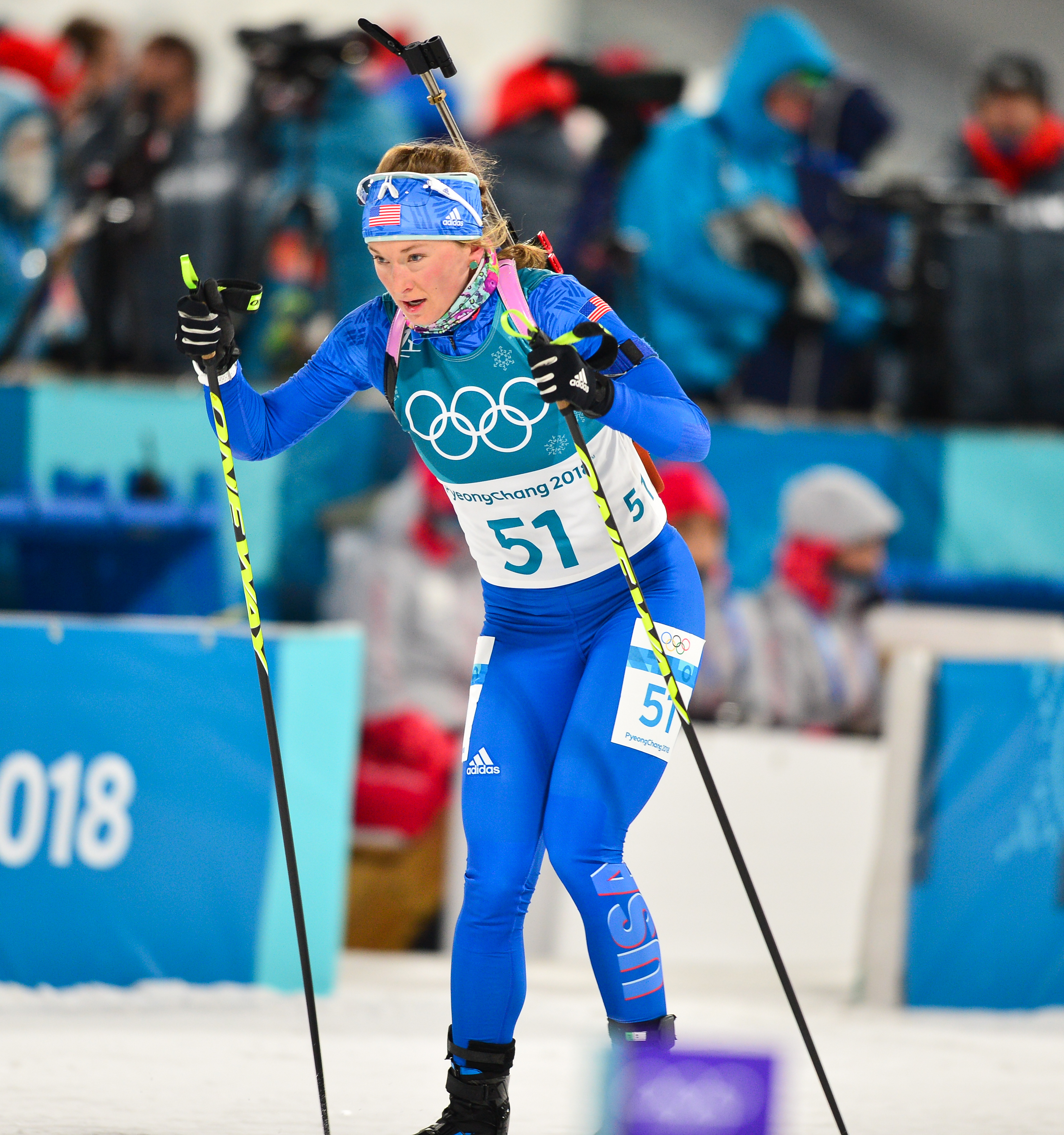
American Emily Dreissigacker racing to 47th in the women’s 10 k pursuit at the 2018 Olympics in PyeongChang, South Korea. (Photo: Ross Burton/US Biathlon)
Emily Dreissigacker, the lone American to qualify for the women’s pursuit, improved by four positions after starting in 51st to finish 47th (+5:01.4) with four penalties (0+1+1+2).
That was another improvement on her personal best at the World Cup-level, which she achieved in Saturday’s sprint. Before these Olympics, Dreissigacker’s best result on the International Biathlon Union (IBU) World Cup had been 56th place in a pursuit in Antholz, Italy, last month.
On the course she recorded the 54th course time, steadily holding her position on the three loops between the shooting stages.
“I think the skiing felt a little better than the sprint two days ago,” Dreissigacker said after. “Getting to ski with people is always really fun, and my skis were amazingly fast.”
Just like Crawford, she also preferred the loop the pursuit was raced on over other courses in PyeongChang.
“I really like the 2 k course,” Dreissigacker said. “You climb up and then you come back down, which is something that I really like. I think mentally especially, I’m like ‘All right, gotta get to the top of this hill and then I have time to recover,’ which is nice.”
“I really just like to try to keep things simple,” she said of her shooting performance and approach to the wind-exposed range. “Just relax, if the wind comes up just wait for it to pass or if it’s not going to pass take some clicks. I really think the simpler you can keep it the better.”
“The wind can be a little tricky,” she told US Biathlon, according to a press release. “In my first standing stage, actually, I had to wait out a pretty big gust of wind. All the people around me were waiting, too, and we’re all just standing there waiting for it to die. That’s kind of just how it is. You have to be able to deal with that … be able to wait and not freak out.”
Canada’s Emma Lunder finished 53rd (+6:16.8) after starting 54th then shooting four penalties (0+1+1+2).
“It was not great,” Lunder reflected. “Started out with shooting OK, unfortunately missed two in my last standing and just did not have it in the legs today, so the skiing was a big struggle.”
While not completely satisfied with her race performance, the 26-year-old Lunder said she was making the most out of her first Olympic experience.
“The whole time I was just trying to remind myself, I am at the Olympics, racing my first Olympics. It’s such a cool atmosphere, so even if the race isn’t going as well as I would like I am still pretty happy to be here,” Lunder explained. “The racing doesn’t feel different from a World Cup. It’s being at the Athlete’s Village with athletes from every sport all over the world, the best in the world, that’s been pretty special. I have [met] quite a few people who I never thought I would meet, so I have just been trying to take it all in and also try to perform as well as I can.”
Asked how she is dealing with the cold conditions and prepares for her upcoming races, Lunder added, “I would say a lot of it is energy management. When it’s this cold out I find I am a lot more tired, burning more calories just from shivering. So we have a therapist here with us. I will see her for some treatment, just take a bit of time to lay in bed and watch some movies, do whatever I can to rest up a little bit.”
The fourth Canadian, Megan Tandy, did not start,as she’s working to kick a cold in time for the next race on Wednesday.
“Disappointing news, but it is for the best,” Tandy wrote in an Instagram post before the race. “I have decided not to start the 10km Pursuit tonight in order to get healthy for our upcoming Individual Race. I will be cheering on my girls from bed, I know they can rock this stadium tonight.”
Estonia’s Johanna Talihärm, who skis collegiately for Montana State University and last year split her training time between Bozeman, Montana, and Estonia, finished 26th (+2:59.4) with another strong performance after a career-best 22nd place in the sprint. She incurred four penalties (0+1+2+1), and skied the 27th-ranked course time.
The biathlon competitions in PyeongChang continue on Wednesday with the women’s 15-kilometer individual and Thursday with the men’s 20-kilometer individual race.
Keep calm and be the best: one missed shot early on did not keep France’s Martin Fourcade from defending his Olympic gold medal in the men’s biathlon pursuit. (Photo: FlyingPointRoad)
“Use this rage as energy!” Martin Fourcadewrote on Instagram after finishing eighth in the men’s 10-kilometer sprint on Sunday.
Um, yeah. The French biathlon star defended his gold medal from the 2014 Olympic pursuit with just one missed shot in Monday’s 12.5 k competition, taking the lead after the third shooting stage and never giving it back. He finished with a comfortable enough margin to grab the French flag and take his time waving it down the finishing straight.
A large pack of chasers were all in contention for second place coming into the final shooting stage, but of them all only Benedikt Doll of Germany and Sebastian Samuelsson of Sweden cleaned their targets. Samuelsson took his time to do so, and left the range with a nearly eight-second deficit on Doll. But he gradually worked his way up to the German on the trails, before putting in a spurt on one of the last small uphills on the course. The 20-year-old Swede managed to hold his lead on the swooping downhills into the stadium and not get consumed by the draft effect, and celebrated crossing the line in second place. Samuelsson’s previous best result was 13th place in a World Cup. It is Sweden’s first Olympic biathlon medal since 2010.
Tarjei Bø of Norway finished fourth (+1:02.6) after missing three shots; all the medalists had only a single penalty apiece. Germany’s Simon Schempp was fifth (+1:02.7), also with three penalties, and Switzerland’s Benjamin Weger finished sixth with two missed shots (+1:03.1), narrowly edging France’s Simon Desthieux (+1:03.7).
For the U.S., Tim Burke finished 17th (+2:19.6) with just two missed shots after starting in 47th position after a disappointing sprint race. Lowell Bailey placed32nd (+3:51.6) with five penalties — all in standing — and Leif Nordgren 50th (+5:48.7), also with five missed shots.
For Canada, Nathan Smith finished 54th (+6:06.5) with four missed shots.
With just one missed shot, Germany’s Laura Dahlmeier took her second gold medal of this young Olympic Games when she won the 10 k biathlon pursuit by 29.4 seconds. Dahlmeier finished no better than 13th in the 2014 Olympics — where she was only 20 years old – but four more years of experience have made her nearly unbeatable, if last year’s triple gold haul from World Championships serves as a basis for comparison. But even if she only nets these two golds, she has already made history: no other woman has ever won both the sprint and the pursuit at the same Olympic Games.
Dahlmeier started in bib 1 but the other medalists used stellar performances to move up after disappointing sprint races. Anastasiya Kuzmina of Slovakia edged France’s Anais Bescond by just 0.2 seconds to take silver. Kuzmina had started in bib 13 and won her medal despite four missed shots – she had the fastest course time of the whole field – while Bescond had started 19th but had hit all but one of her targets.
Fourth place went to the sprint silver medalist Marte Olsbu of Norway (+1:07.3), fifth to Hanna Öberg of Sweden (+1:08.9), and sixth to Denise Herrman of Germany (+1:19.4).
Rosanna Crawford of Canada started 53rd after a tough sprint race, but shot 18/20 and moved up to 19th place (+2:27.7), the best Olympic result of her career.
Montana State University student Johanna Talihärm, representing Estonia, missed four shots to finish 26th (+2:59.4). Just behind her was Canada’s Julia Ransom in 28th (+3:03.0) with one missed shot.
The lone American in the race, Emily Dreissigacker, set a new career best with 47th place (+5:01.4), and Canada’s Emma Lunder finished 53rd (+6:16.8). Teammate Megan Tandy did not start.
Germany’s Laura Dahlmeier racing to her first Olympic gold (and first Olympic medal) on Saturday in the women’s 7.5 k sprint, the first biathlon race of the 2018 Winter Olympics in PyeongChang, South Korea. (Photo: FlyingPointRoad)
(Note: This article has been updated to include comments from Canada’s Julia Ransom.)
“Perfectionist” is a term the coaches of Germany’s Laura Dahlmeier often use to describe her.
On Saturday, this quality helped Dahlmeier to brave difficult wind conditions on her way to winning the gold medal in the women’s 7.5-kilometer sprint that opened the biathlon competitions at the 2018 Winter Olympics in PyeongChang, South Korea, ahead of Norway’s Marte Olsbu in second and the Czech Republic’s Veronika Vítková in third place.
“A childhood dream is coming true,” Dahlmeier told German broadcaster ZDF after the race, according to a translation. “I have always imagined this, that some day I would stand at the very top at the Olympics, that I could win a gold medal. And somehow exactly that happened to work out today. I am incredibly grateful and proud. It’s an amazing feeling, and I don’t think I have fully realized it yet.”
On the shooting range, Dahlmeier twice adjusted her rifle’s sights in the prone stage to successfully cope with changing winds. Coming into the standing stage, she hit three targets in rhythm, then waited for what seemed like excruciating seconds for a gust to pass, before triggering her fourth and fifth shots. Both targets flipped over to white.
She had taken so long that she only recorded the 76th-ranked shooting time in this stage in the field of 87 athletes, 22 seconds off the pace and almost as long as the time it takes to ski a penalty lap. But that she had hit all shots mattered the most. Only two other athletes managed to clean all 10 targets on Saturday.
Dahlmeier followed that up by skiing the fastest course time on the final loop, and fourth-best overall. She crossed the finish line in a time of 21:06.2 minutes, lunging to not squander even a tenth of a second more, before pounding her chest and raising her arms in jubilation, knowing the time she had set would be hard to beat. Indeed her mark could not be improved again by any athlete starting later.
“I believe if you want to win a race like this one, that doesn’t happen by chance,” Dahlmeier told ZDF. “A lot goes into that. It’s true, I really had to work for it in the race today. But also the team around me, what they had to work during the last days, weeks, months, years, that is embodied by today’s result. It’s just beautiful that I was allowed to fulfill that dream today.”
Olsbu claimed the silver medal, 24.2 seconds back with one penalty in her prone shooting stage and just 1.6 seconds ahead of Vítková on the bronze podium spot, who had missed one target in the standing stage.
France’s Marie Dorin Habert placed fourth (+33.1) with one penalty in prone, while Dahlmeier’s teammate Vanessa Hinz was fifth (+40.3), losing out on a potential medal when she missed the last shot of her competition. Several other favorites struggled with the wind conditions and incurred a number of penalties.
For the two runner-ups, winning a medal at the Olympics was also a dream come true.
“Of course I am happy, it was my best race ever,” first-time Olympian Olsbu, 27, said when asked in the press conference if she was satisfied with the silver medal. “It was difficult on the shooting range today because it was so windy, but I just stuck to my plan. And I was so happy when I crossed the finish line. … That was a dream from when I started in biathlon. Of course [compatriot] Ole Einar Bjørndalen was my hero when I was a child, and I was hoping that one day I will do the same. I don’t know what to say, it is just amazing and today I am sitting here with an Olympic medal.”
“Yeah, it was my dream too, like for Marte, and I am happy that my dream is here,” Vítková, 29, said of her first individual Olympic medal in her third Winter Games.
Starting early in bib 12, Vítková initially appeared dissatisfied when she crossed the finish line and saw that she had not managed to beat Olsbu’s time, after the Norwegian had finished the race just one bib ahead. The Czech feared more athletes would finish ahead of her and still push her several positions down, but aside from Dahlmeier starting in bib 23, no one managed to do that.
So at the “flower ceremony” in the arena, where the podium finishers each received a stuffed animal as their prize (a snow-white tiger called Soohorang that is the official mascot of the 2018 Winter Olympics), Vítková was beaming just like her two peers. The Olympic medals will be awarded in an separate ceremony later.
“I am very happy, because this medal is my first ‘big’ medal in an individual race,” Vítková explained at the press conference. “I had a [silver] medal from the Olympic Games in Sochi, but it was a mixed relay medal. And now I have MY medal!”
Last season, Dahlmeier set a record by winning five events at a single International Biathlon Union (IBU) World Championships, taking gold in every race but the sprint (where she placed second) in Hochfilzen, Austria. But winning the gold medal in PyeongChang was indeed the fulfillment of a lifelong dream. As an elementary school student, Dahlmeier reportedly had written two career goals into a class book: Olympic champion in biathlon and becoming the manager of an Alpine Club hut, since mountaineering continues to be her other big passion. One down, one to go.
“Today was a victory Laura had to work very hard for, that wasn’t automatic,” German women’s national team coach Gerald Hönig told ZDF, according to a translation. “My highest respect for how she withstood the conditions today. How she repeatedly had to make the right decisions by herself on the course and on the range in order to be successful. She did that great, and she is outshining a great overall team result.”
In 2014 at her first Olympics in Sochi, Russia, the biathlon competitions for Dahlmeier, who was 20 at the time, and the rest of the German women’s team had started off as disappointing with no individual medals, and then descended into turmoil when on the eve of the women’s relay, the doping case of Evi Sachenbacher-Stehle due to a tainted food supplement came to light (her suspension later was reduced to six months) and the team again failed to reach the podium.
“For our team this medal is particularly important,” Hönig said. “We still have the defeats of Sochi somewhere in the back of our minds. Well, I particularly do, so for me this is a gigantic moment. I believe having a medal in the very first race here makes the tasks that lie ahead much easier … It’s the prerogative of young athletes like Laura to chalk that off faster, but I have repeatedly thought about these days in Sochi … Laura showed coolness today, but also executed everything she had worked for in training.”
Dahlmeier, now 24, became the second German athlete to win a gold medal at the Winter Olympics in the women’s sprint, after Kati Wilhelm claimed the title at the 2002 Games in Salt Lake City, Utah.
Mixed Day for North American Starters
Canada’s Julia Ransom was the best North American in the sprint, finishing in 40th place (+2:08.8) after she shot fast and accurately, incurring just one penalty in her standing stage.
Julia Ransom (Biathlon Canada) racing to 40th in the women’s 7.5 k sprint at her Olympic debut in PyeongChang, South Korea. (Photo: FlyingPointRoad)
On the course she skied the 68th-ranked time of the day, consistently losing about 45 seconds on each loop to the blazing pace set by Slovakia’s defending Olympic sprint champion and current World Cup Sprint standings leader Anastasiya Kuzmina, who ended up 13th place with three penalties (2+1).
For Ransom it was her first start in an Olympic race, building on three appearances at Biathlon World Championships.
“It was amazing to start the race today,” Ransom wrote in an email to FasterSkier. “Some of my family were in the stands and the others had woken up early in Canada to catch it. Definitely feeling the love!”
She described the conditions as “windy with some extremely strong gusts,” Ransom wrote. “I noticed it more out on course than in the range. I was quite happy with my shooting today, but unfortunately my legs were just cooked (for whatever reason)! However, I think this was a good leg blowout, and after some rest, I’ll be ready for the pursuit!”
All four Canadian women that contested Saturday’s sprint finished in the top 60 to qualify for Monday’s pursuit, with Rosanna Crawford next in line in 53rd (+2:23.0) after shooting three penalties (1+2).
Canada’s Rosanna Crawford (22) racing to 53rd in the women’s 7.5 k sprint on Saturday at the 2018 Olympics in PyeongChang, South Korea. (Photo: FlyingPointRoad)
“It was really tough,” Crawford told FasterSkier in the mixed zone after the race when asked about the conditions. “The wind made it hard for shooting and on the course, all of a sudden these gusts would come and blow your poles right out from underneath you. In prone, I made a correction and missed my first shot which shouldn’t have happened, and in standing I overheld [the rifle] for my second miss so I’m pretty disappointed.”
Starting fairly early in bib 22, the race was still going on at the time of her interview, so Crawford feared she might miss the cutoff for the pursuit. At least that did not happen.
“The sprint sets you up for the rest of the week, for two weeks, so I’m pretty bummed,” she continued. “I’m still looking forward to the relays, so that’s definitely positive. It’s just so unfortunate that the sprint dictates the other individual races, other than the 15-kilometer [individual race]. Hopefully I’ll qualify for the pursuit and can go out there and fight again. I love the 2 k course here, so I’m really looking forward to it.”
In her third Olympics, Crawford skied the 44th-ranked course time of the day.
Canada’s Emma Lunder racing to 54th in her Olympic debut on Saturday in the women’s 7.5 k sprint in PyeongChang, South Korea. (Photo: FlyingPointRoad)
Just behind her, Emma Lunder in her Olympic debut placed 54th (+2:24.2) with two misses in the standing stage (0+2). Her course time ranked 65th.
Megan Tandy, in her third Olympics, finished 57th (+2:36.6) with a penalty in each stage (1+1). She skied the 69th-ranked course time.
“Although I am somewhat disappointed with today’s result (57th with 2 misses and heavy legs) I am thinking positive,” Tandy wrote on Instagram on Saturday. “8 years ago I was the only woman to qualify for the pursuit, this Olympics all 4 of us will be putting up a fight.”
(Note: FS missed interviewing Ransom, Lunder and Tandy in the mixed zone, and with the race in the evening local time they could not be reached for comments at press time.)
In her first Olympic race and on her first year with the senior women’s team, Team USA’s Emily Dreissigacker was the top American 51st place (+2:21.0) after shooting 9-for-10.
American Emily Dreissigacker racing to 51st in the women’s 7..5 k sprint on Saturday at the 2018 Olympics in PyeongChang, South Korea. It was her career-best result at the World Cup level. (Photo: FlyingPointRoad)
“I did I shot zero plus one [0+1], so I’m pretty happy with that,” Dreissigacker told FasterSkier after the race. “The wind was a little tricky out there. I was just trying to stay calm and think about what I could control…. Happy to make the pursuit!
“It was kind of gusty and changing a lot,” she commented on the conditions. “Like on prone, I got a little lucky, the wind was pretty much what I had zeroed in [target practice], which was still pretty windy, but at least was consistent. Then in standing, I mean, it definitely wasn’t terrible, but I could feel the wind pushing my barrel around a little bit.”
Dreissigacker’s course time ranked 74th overall and she slipped 10 places on the final loop.
“I definitely died a little bit on the last lap,” she said. “I think the hills are hard. … You’re not really recovering [anywhere] before you climb back up to come back down into the stadium.”
Previously Dreissigacker’s best result on the IBU World Cup in a sprint had been a 59th place at last month’s race in Antholz, Italy, followed by a 56th place in the pursuit.
For the rest of the US Biathlon women, things did not work out as well as they had hoped on Saturday.
Clare Egan (US Biathlon) racing to 61st in the women’s 7.5 k sprint at the 2018 Olympics in PyeongChang, South Korea. (Photo: FlyingPointRoad)
Also starting in her first Olympic race, Clare Egan just missed the cutoff for the pursuit race in 61st place (+2:45.4) with three penalties (1+2), only two seconds behind Emilia Yordanova of Bulgaria.
“Honestly as I was warming today it felt like I was warming up today for any other race, which I think is a good thing,” Egan told FasterSkier after. “I knew I was ready to go today and I was excited to do what I’ve been training to do and become an Olympian.”
But then her race began with a mishap on the course.
“I fell on the first loop at the bottom of the big hill, which is kind of a nightmare. I haven’t fallen in a couple years probably, but I don’t know, it just happened,” Egan said. “Weird things happen in big races I guess, but besides that I am really pleased with my skiing considering I was really sick in our pre-Olympic training camp.”
Skiing only the 71st course time on the first loop due to the fall, her pace improved from there, capped by the 30th-ranked time on the final loop (57th overall).
“I’m really happy with the prone,” she said of her shooting performance. “It was really tricky shooting today, windy, missed one but I am very satisfied with that. Standing I started out really solid, had three good hits and felt good about what I was doing and then I misfired actually. My bullet didn’t eject and I wish I had refocused better after that. I had to kind of pick the bullet out and I didn’t reset adequately. So then I missed my last two shots and I am not happy about that, but it was sort of a mediocre race overall.”
Team veteran Susan Dunklee incurred an uncharacteristic five penalties (1+4) to finish in 66th position (+3:06.9).
Starting early in the race in bib 6, she could be seen on the broadcast making a wind adaptation in the prone stage after missing her fourth shot, then went on to hit the last one having to ski once around the 150-meter penalty lap.
She came back on the course with what would later be the 28th-ranked split time, but in the standing stage, things then turned south and with four additional penalty laps, she could not make up the deficit.
“I’ve had better days,” the 2017 World Championships silver medalist told FasterSkier after the race. “I missed five shots. You can’t be anywhere close to where you need to be with 50-percent shooting. It’s very frustrating. You work for four years and you have big dreams, you see what’s possible, and it all comes down to one of these races like this and the sprint is so important for the rest of the races here. You really have to have a good sprint to qualify for the pursuit, to qualify for the mass start, so I’m really bummed about that, that’s for sure.”
Unlike her teammates, Dunklee skipped Friday’s Opening Ceremony of the Winter Olympics while “fighting off a small cold,” according to a US Biathlon Instagram post.
She skied the 42nd course time of the day and didn’t want to blame her misses all on the weather conditions.
“The conditions are actually really nice,” she said. “It’s a little bit cold but not so cold as it was when we first got here. You can feel your fingers, which is really nice. Seems like it’s fair. You’ve got really hard-packed good tracks.
“I think I’m going to have to figure out how to allow myself to be disappointed for another hour or so, get it out of the system a little bit and then put it behind me and move on,” Dunklee concluded.
Joanne Reid (US Biathlon) racing to 86th in the women’s 7.5 k sprint at the 2018 Olympics in PyeongChang, South Korea. (Photo: FlyingPointRoad)
Also in her first Olympic race, the fourth U.S. starter Joanne Reid finished 86th (+5:12.6) with seven penalties (4+3), though she explained it wasn’t due to any race jitters already having competed in front of far bigger crowds on the World Cup before.
“I try and approach every race the same,” Reid told FasterSkier. “Same warm up. Same mentality. Just go out there and hope you hit your targets which didn’t really work out for me today.”
She skied the 67th-ranked race time of the day overall.
“It’s much worse on the cross-country side,” she said of the biathlon course and range conditions. “Everything is real open [to wind] over there. We have only the stadium area and the range [that] gets all the wind, but on the backside it’s pretty good, it’s sheltered. It’s actually really fun, it’s really ripping, it’s up and down with some swoopy corners.”
Reid explained that for her standing shooting she had planned to use the wind cover from a hill on the far left side of the range, as many athletes like Dahlmeier had also done, but that was not possible when she came in to her shooting stage as all those lane positions were occupied.
“Definitely in standing the farther lanes have less wind and when I came there was no farther lane,” Reid said. “It was 30, 29, 28, 27, 26 were all full and then big gusts coming in and that was pretty brutal. Then the longer you stand the more your muscles shake, so you know, that’s life.”
Career Best for Johanna Talihärm
Unlike for most of the North Americans except Dreissigacker, for Estonia’s Johanna Talihärm it was a career-best race in her second Olympics, finishing 22nd (+1:20.8) with one penalty (0+1).
The resident of Bozeman, Montana, is well known on the U.S. collegiate cross-country skiing circuit as a Montana State University junior and a second-team All-American at last year’s NCAA Skiing Championships.
This January leading up to the Olympics, she competed in cross-country races at the U.S. Cross Country Championships in Anchorage, Alaska, and in West Yellowstone, Montana.
Her previous best result on the IBU World Cup was a 29th place in a pursuit race in Hochfilzen earlier this season.
In the PyeongChang women’s sprint, she was the lone racers for Estonia. In Sochi, she finished 48th in the sprint for her best individual result and placed 16th in the women’s relay.
The biathlon competitions in PyeongChang continue on Sunday with the the men’s 10-kilometer sprint, followed by the women’s and men’s pursuit on Monday.
The start of the women’s 15 k skiathlon on Saturday, Day 1 of the 2018 Winter Olympics, with (front row, from left to right) Austria’s Teresa Stadlober, Norway’s Ingvild Flugstad Østberg, Norway’s Heidi Weng, American Jessie Diggins, and Sweden’s Charlotte Kalla leading out of the stadium in PyeongChang, South Korea. (Photo: FlyingPointRoad)
The 2018 Winter Games kicked off Saturday with the women’s 15-kilometer skiathlon, which saw Sweden’s Charlotte Kalla take her second-career individual Olympic gold (third including relays) and first individual gold in eight years. Not far behind her, American Jessie Diggins achieved the best Olympic result for an American woman in cross-country skiing.
After Kalla established herself as a leader early in the opening 7.5 k classic leg, the Swede spent much of the race working with her teammate Ebba Andersson to counter any type of attack from the Norwegians, specifically Marit Bjørgen.
On rock-solid classic conditions in PyeongChang, Bjørgen led the second half of the classic leg up until the ski exchange, where she entered the “pit stop” first, just ahead of Kalla in second. Norway’s Heidi Weng was in third at the time and swapped into her skate gear fastest, leaving the exchange about 28 seconds later in first. Her Norwegian teammate Ingvild Flugstad Østberg followed her in second and Bjørgen emerged in third, just ahead of Kalla in fourth.
Meanwhile, Diggins skied consistently in the top 10 and within about four seconds of the lead throughout the classic leg, entering the exchange in 13th and leaving in ninth, 5.4 seconds after Weng.
While Kalla took the lead early in that first skate lap, Switzerland’s Nathalie von Siebenthal made a move into first on a climb just before 9.75 k, while Bjørgen kept her close. Andersson continued to keep herself in the mix, skiing in third, just ahead of Kalla in fourth and Finland’s Krista Pärmäkoski in fifth. Diggins slotted behind two Norwegians, Østberg and Weng, while Austria’s Teresa Stadlober followed. At 9.75 k, 11 women were within 6 seconds of first.
Bjørgen reclaimed the lead shortly thereafter, but Kalla made her game-changing move on a climb about 34 minutes into the race, just before the 12.5 k checkpoint. There, the Swede had begun to gap the pack and was 5.5 seconds ahead of Bjørgen in second. Andersson remained in third, 5.9 seconds back, just ahead of von Siebenthal, Pärmäkoski, and Stadlober. Diggins in seventh pushed to keep herself in the chase group and was able to with about 2.5 to go.
One kilometer later, Kalla was nearly 10 seconds clear of Bjørgen, as well as Andersson and Pärmäkoski. The Finn moved ahead of Andersson on one of the last climbs to put herself in third as they headed down and back toward the stadium.
Sweden’s Charlotte Kalla celebrates her victory in the women’s 15 k skiathlon on Saturday at the 2018 Olympics in PyeongChang, South Korea, and her first individual Olympic gold medal in eight years. She beat Norway’s Marit Bjørgen (behind) by nearly eight seconds. (Photo: FlyingPointRoad)
All alone, Kalla skied to the win in 40:44.9 minutes, what Bjørgen distanced herself from third place and claimed second, 7.8 seconds later. Pärmäkoski took the bronze medal in third (+10.1), less than a second ahead of Andersson in fourth (+10.9). Kalla’s previous Olympic gold medals came individually in the 10 k freestyle at the 2010 Games in Whistler, British Columbia, and with her team in 2014 in the women’s 4 x 5 k relay in Sochi, Russia.
Diggins finished fifth (+14.7) for a new all-time best for a female American cross-country skier at the Olympics (after Sophie Caldwell placed sixth in the sprint at the 2014 Games), about three seconds ahead of von Siebenthal in sixth (+17.6). Stadlober placed seventh (+26.6), Russia’s Natalia Nepryaeva was eighth (+33.0), Weng was ninth (+40.7), Sweden’s Stina Nilsson 10th (+48.9), and Østberg 11th (+58.3).
In her first Olympics, Canada’s Cendrine Browne (Canadian U25 Team) led her team in 33rd (+3:17.0), ahead of American Caitlin Patterson (also in her first Olympics) in 34th (+3:30.0).
U.S. Ski Team member Kikkan Randall placed 40th (+4:02.3), Canadian World Cup Team member Emily Nishikawa finished 44th (
+4:31.7), Canada’s Anne-Marie Comeau was 48th (+4:57.9), Australia’s Jessica Yeaton (who trains with Alaska Pacific University) was 50th (+4:59.9), Canada’s Dahria Beatty 52nd (+5:32.4), and American Rosie Brennan 58th (+6:51.1).
The men’s 30 k skiathlon is the next cross-country event on the schedule in PyeongChang, set for Sunday at 1:15 a.m. Eastern Standard Time.
Germany’s Laura Dahlmeier racing to her first Olympic gold (and first Olympic medal) on Saturday in the women’s 7.5 k sprint, the first biathlon race of the 2018 Winter Olympics in PyeongChang, South Korea. (Photo: FlyingPointRoad)
2018 Winter Olympics (PyeongChang, South Korea): Biathlon women’s 7.5 k sprint
While most others struggled on the range in the first biathlon race of the 2018 Olympics, Germany’s Laura Dahlmeier held steady and shot clean, then posted the winning time in the women’s 7.5 k sprint on a windy Saturday evening in PyeongChang.
The 23rd starter (out of 87 finishers), Dahlmeier had to wait a long time for her gold medal to be confirmed, but she had done it, winning with a time of 21:06.2 minutes for her first Olympic medal. She has seven gold medals from World Championships but this was her first at her second Olympics. And on Saturday, she was one of just two women in the top 20 to hit all 10 targets in the two-stage race. Russia’s Tatiana Akimova was the other and she finished 20th.
The 24-year-old Dahlmeier bested the time of Norway’s Marte Olsbu, who started 11th and had a single miss in prone (1+0), by 24.2 seconds. Olsbu’s time was good enough for second, just ahead of the Czech Republic’s Veronika Vítková, who started right behind her in bib 12, in third place (+25.8). Vítková also had to ski one penalty lap after a standing miss (0+1). For Olsbu, 27, this is her first Olympics. For Vítková, 29, it was her first individual medal in three Olympic Games.
France’s Marie Dorin Habert missed the podium by 7.3 seconds in fourth (+33.1), after one prone penalty (1+0). Germany had two in the top five with Vanessa Hinz in fifth (+40.3) with one miss, Italy’s Lisa Vittozzi was sixth (+40.5) with one miss, Sweden’s Hanna Öberg seventh (+40.8) with one miss, Switzerland’s Irene Cadurisch eighth (+45.5) with one miss, Belarus’s Darya Domracheva ninth (+46.2) with two penalties, and France’s Justine Braisaz 10th (+47.9) with two penalties as well.
Julia Ransom (Biathlon Canada) racing to 40th in the women’s 7.5 k sprint at her Olympic debut in PyeongChang, South Korea. (Photo: FlyingPointRoad)
Canada’s Julia Ransom was the top North American in 40th (+2:08.8) with one standing penalty (0+1). Canada had all four women finish in the top 60 (thus qualifying for Monday’s pursuit) with Rosanna Crawford in 53rd (+2:23.0) with three misses (1+2), Emma Lunder in 54th (+2:24.2) with two standing misses (0+2), and Megan Tandy in 57th (+2:36.6) with a penalty in each stage (1+1).
One American finished in the top 60 to qualify for the pursuit: Emily Dreissigacker, in her first Olympics, in 51st (+2:21.0), after shooting 9-for-10 (0+1). Clare Egan just missed the cutoff in 61st (+2:45.4) with three misses (1+2), Susan Dunklee fell out of contention with five misses (1+4) to finish 66th (+3:06.9), and Joanne Reid finished 86th (+5:12.6) with seven penalties (+3:06.9).
Estonia’s Johanna Talihärm, a Montana State University student who lives in Bozeman, finished 22nd (+1:20.8) with one miss (0+1) for her best individual result at her second Olympics.
The men’s 10 k sprint takes place Sunday in PyeongChang at 6:15 a.m. EST.
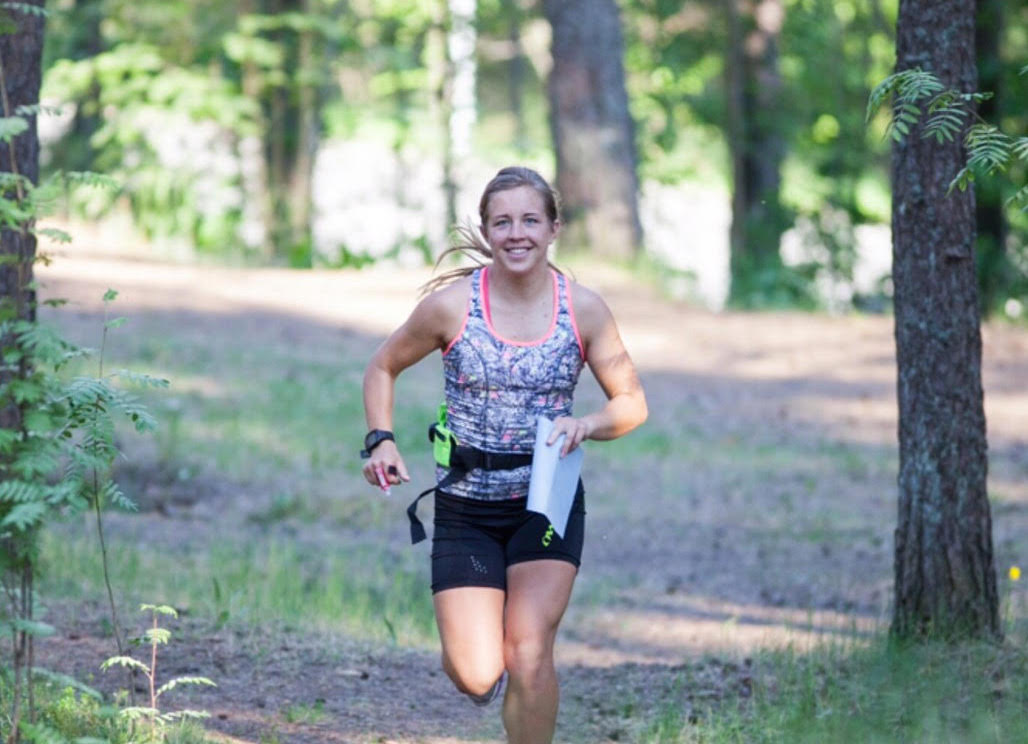
Montana State University skier and Estonian national-team biathlete Johanna Talihärm running outside of Tallinn. (Courtesy photo)
After spending last summer training in the U.S. with the Craftsbury Outdoor Center’s U23/collegiate summer training group, this year Johanna Talihärm decided to go home to Estonia.
The FIS Cross-County World Cup swings by Otepää periodically (as does the Continental Cup circuit and biathlon’s IBU Cup series), but Talihärm is originally from Tallinn, Estonia’s capital and a World Heritage Site. That’s the atmosphere she moved back to for the summer — which she said had both pros and cons.
“It is easier at home, because of no extra travel and friends and family nearby,” Talihärm, who turns 24 later this month, wrote in an email. “Other than that I would say Craftsbury was perfect. There’s an amazing and super strong group of girls to train with, biathlon and nordic girls and guys training together, an awesome nature-preserving environment and just a beautiful place.”
https://www.instagram.com/p/BUcroSMDjTt/
The Montana State University (MSU) skier finished seventh in the 15-kilometer freestyle at NCAA Skiing Championships in March, improving on her previous best finish of 13th. She and Annika Miller were the team’s only nordic All-Americans this year.
Johanna Talihärm training on the shooting range in Otepää, Estonia. (Photo: Detlef Eckert/Courtesy of Johanna Talihärm)
A few weeks earlier, Talihärm had been at IBU World Championships in Hochfilzen, Austria, representing Estonia on biathlon’s biggest stage. She placed 57th in the 15 k individual, a result about which she said at the time, “it was all right.” Talihärm, Estonia’s top finisher at those Championships, is planning to go to the 2018 Olympics.
Over the summer, she’s focusing on aspects of training that can help both her biathlon career and her college skiing.
“I would say that my general goal is to get stronger and ski faster, and all the training I do benefits both, my biathlon and college racing,” she said. “Shooting has given me a lot of mental strength and an ability to concentrate that benefits skiing, too.”
Over email, Talihärm explained what summer training is like in Estonia.
FasterSkier: Where are you based this summer? Is this the same area you grew up in, or is your training base away from your family home?
Johanna Talihärm: I live in Tallinn, the capital of Estonia, which is in the north, but spend a lot of time training three hours away in Otepää which has a world class training center with two shooting ranges and good rollerksiing opportunities. Also as Estonia is very flat, Otepää has some hills to train on, to switch it up from completely flat Tallinn.
FS: Do you have a team that you are training with, or are most of your training sessions alone? Are there a lot of other athletes and teams using the same area/facilities?
JT: I train with the biathlon national team, but most of them are located in Otepää. I train mostly alone when I’m at home.
More work on the shooting range. (Courtesy photo)
A lot of teams come to Otepää for their summer training. The Russian ski team is there with almost all teams (juniors, men, women, para, local club teams and even some youth groups), Ukrainian women’s biathlon team was there last week, also [Slovenian World Champion] Jakov Fak, some Russian biathletes are coming (for example Anton Shipulin), Kazakhstan has been there in the past, and also Estonian nordic skiers and athletes from neighboring countries like Latvia, Lithuania and Finland.
FS: When you are planning your summer training and thinking of what you need to work on for the upcoming season, how do you coordinate between your various coaches about how to design training?
JT: I follow my national team plan when I’m in a training camp with them, MSU training when in school, and I fill up the time in between myself to make it all work. I have to credit the coaching education I got from my sports high school and coaches seminars by Estonian federations for the ability to make educated choices about my training.
FS: What’s the hardest workout you have done so far this summer?
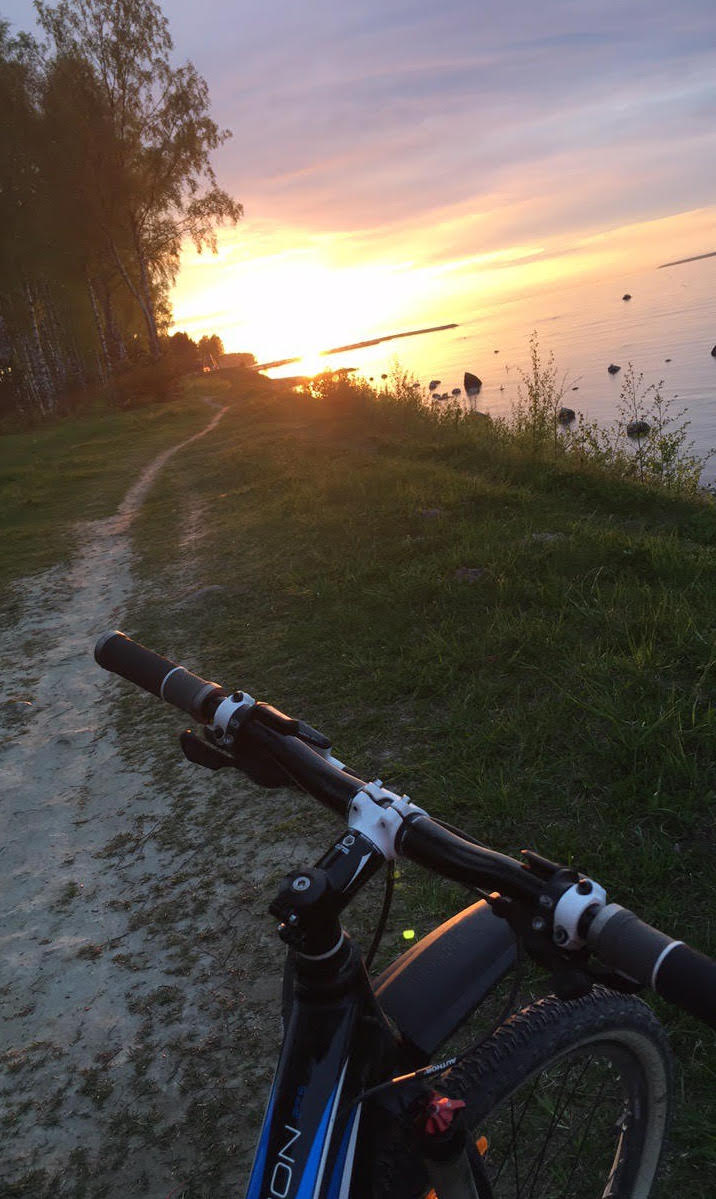
A photo from an evening bike ride along the coast in Tallinn. (Courtesy photo)
JT: Probably a long lonely run in the rain at home. Not the hardest physically, but definitely mentally.
FS: Are there any absolute favorite places to run or bike or rollerski? Where are you always excited to do a workout?
JT: I’m always excited to work out in a new place. I love exploring new trails in my hometown Tallinn, especially the ones right by the coast. I’ve been there so often that I never expect to find anything new, so the joy is even bigger when that happens.
FS: Maybe related, is your area set up best for some parts of training? Are there excellent hills for intervals, or great places to do long workouts without being repetitive, or what do you think is the best aspect training-wise?
JT: I think my hometown is not the best place to train for skiing in the long term, but it has amazing long paved loops ideal for rollerskiing.
FS: What do you do when you are not training? Do you need to have a job?
JT: I have an internship in Tallinn this summer.
FS: How was your spring — did you get to do a good start to training while you finished up school?
JT: I was pretty wiped out by the load from school, training, racing and travel, so I took a little extra time to recover. I was careful with the intensity at first, but in general I don’t think it will make a big difference in the long run.
FS: What is the best part of Estonian summer, aside from training?
JT: Being able to see everyone, not having to do all my tasks at home in one or two weeks, no packing nor long travel, various bodies of water to swim in, familiar food and warm and long summer days.
Talihärm taking a swim in the lake next to the shooting range in Otepää. (Courtesy photo)
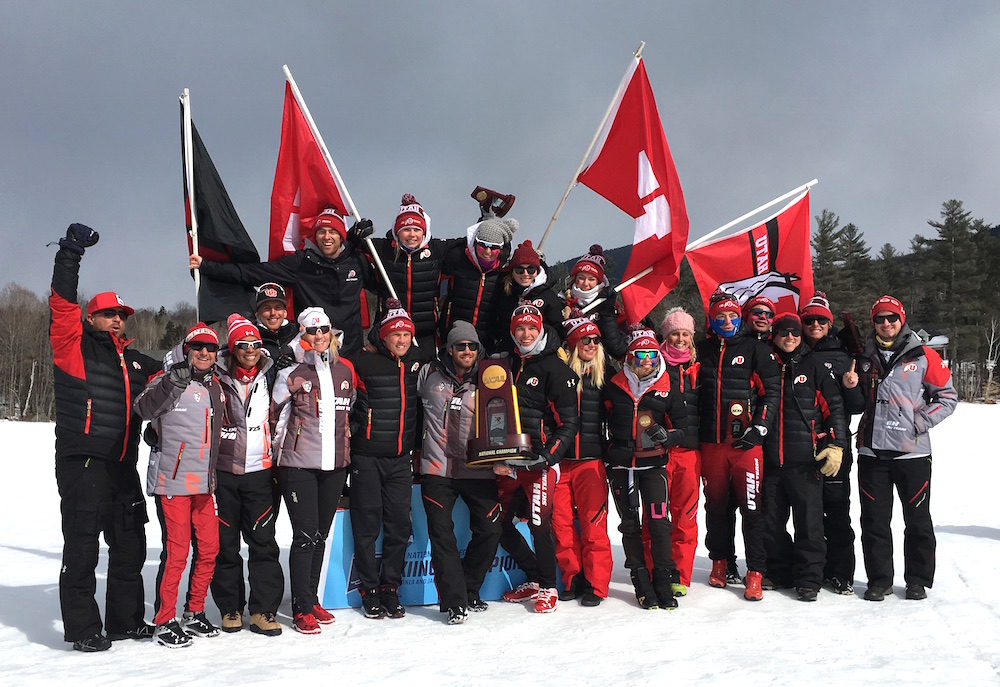
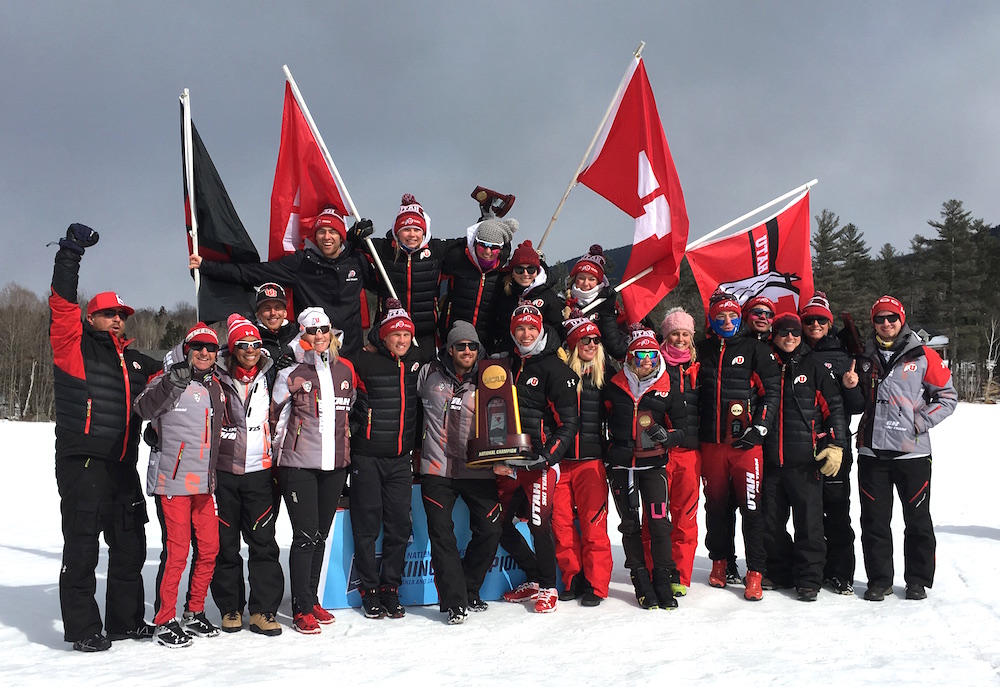
The University of Utah ski team celebrating its first NCAA title since 2003 on Saturday at 2017 NCAA Skiing Championships in Jackson, N.H. (Photo: Jason Clay/Colorado)
NCAA Skiing Championships (Jackson, N.H.): 15/20 k freestyle mass starts
On the final day of the National Collegiate Athletic Association (NCAA) Skiing Championships in northern New Hampshire, the University of Utah pulled out a 16.5-point victory over the University of Colorado-Boulder (and finished 17.5 points ahead of the University of Denver) in the team standings, and the two previous NCAA champions from Thursday’s 5/10 k classic races, Martin Bergström and Petra Hyncicova, achieved their second-straight titles in as many nordic races this week.
On a frigid Saturday morning in Jackson, N.H., with temperatures just below zero Fahrenheit for the start of the men’s 20 k freestyle mass start, Bergström, a Utah freshman from Sweden, outlasted the University of Colorado’s (CU) Mads Ek Strøm, a Norwegian senior and two-time 2016 NCAA champion, by 0.5 seconds to win his second-straight race in 46:02.8 minutes. Moritz Madlener, a German senior at Denver University (DU), placed third (+0.6). Just behind him CU’s Petter Reistad, of Norway, finished fourth (+1.2), and Dartmouth College’s Fabian Stocek, of the Czech Republic, placed fifth (+1.9).
While temperatures warmed up to about 1 degree for the women’s 15 k freestyle mass start and the wind picked up to about 15-20 miles per hour, the women raced three laps around the Jackson Ski Touring Center’s race loop and navigated even faster downhills that caused a few crashes.
Hyncicova used her love for downhills and skate races to capture her second consecutive NCAA title, breaking away with University of Vermont (UVM) junior Alayna Sonnesyn on the second lap. The Czech Republic native and CU junior attacked on the A-climb at the top of the course and won by 21.1 seconds in 39:21.6. Sonnesyn, of Minnesota, bested her third place from Thursday’s 5 k with a second-place finish on Saturday. CU’s Christina Rolandsen, of Norway, finished third (+38.9), ahead of Idaho native Anika Miller of Montana State University (MSU) in fourth (+44.0).
Utah took fifth and sixth with Merete Myrseth (+1:01.5) and Guro Jordheim (+1:16.1), and had two other men in the top 10 (Martin Mikkelsen in 8th and Kevin Bolger in 10th) to achieve the alpine-nordic team title.
In the women’s race, the Utes were the only team with all three women in the top 14, with Natalia Müller in 14th (+1:32.1).
“The turning point of today is when Guro broke a pole, and she was back in the 20’s, and she and Natalia were skiing together,” Utah Director of Skiing Kevin Sweeney said, according to a team press release. “We told them that they had to go and they busted out and made a big move. The men’s results were tremendous, but whether or not we were going to win was based on those guys making the move. It was exceptional athleticism and gutsy performances.”
The NCAA team title was the 11th for Utah and its first since 2003.
“I am stunned with the win today,” Sweeney added. “In all my years of coaching, it was one of the most challenging four days of competition. I say that because the weather was incredibly cold and windy, and challenging from both a waxing perspective, as well as visibility and conditions. I know all the teams had to deal with it, but it really beat us up. It took a lot of perseverance and gutsy performances for us to win. We struggled a little bit in the slalom, but they were going for it and came up short.
“We’ve been crunching numbers and have been able to beat Denver and Colorado by about 30 points on a really good showing during the RMISA season, but didn’t know if we could do it in the championships,” he continued. “Bergström was skiing at a whole new level this week, and Mikkelsen had stepped it up, and I knew Kevin Bolger could get top 10. I was also confident in the women, who have been skiing awesome, so I felt good there. It’s awesome to be able to take this new trophy back to our new ski building.”
As for those earning All-American status on Saturday with a top-10 finish, Utah had five (Bergström 1st, Myrseth 5th, Jordheim 6th, Mikkelsen 8th, Bolger 10th), Colorado had four (Hyncincova 1st, Strøm 2nd, Rolandsen 3rd, Reistad 4th), Denver had two (Madlener, Dag Frode Trollebø 7th), MSU had two (Miller 4th, Johanna Talihärm 7th), Dartmouth had two (Stocek 5th, Luke Brown 9th), UVM had one (Sonnesyn 2nd), Northern Michigan University (NMU) had one (Adam Martin 5th), the University of Alaska-Fairbanks (UAF) had one (Sarissa Lammers 8th), UNH had one (Lizzie Gill 9th), and Bowdoin had one (Hannah Miller 10th).
Stay tuned for a more in-depth report with quotes and photos from Saturday’s skate mass starts.
USSA Cross Country Junior Championships (Lake Placid, N.Y.): Freestyle team relays
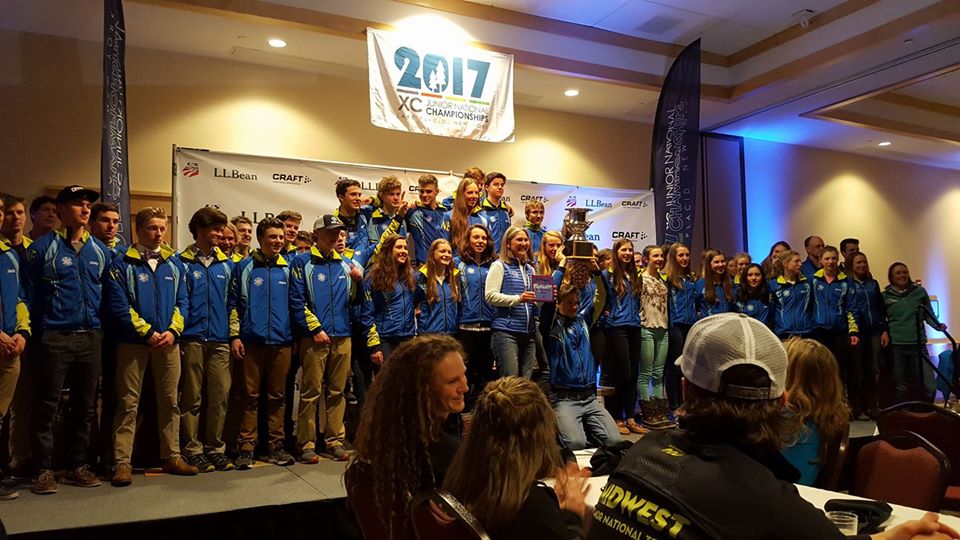
The 2017 U.S. Junior Nationals Alaska Cup winners, New England, at the awards ceremony on Saturday in Lake Placid, N.Y. (Photo: XCJuniorNationals2017/Facebook)
[UPDATED] For the final day of 2017 U.S. Junior Nationals in Lake Placid, N.Y., regional divisions formed three-racer teams for the U16, U18 and U20 freestyle relays.
Intermountain swept the U16 team events with Lane Myshrall, Skylar Patten and Johnny Hagenbuch winning the U16 boys’ relay by 3.6 seconds over the Midwest’s James Schneider, Alexander Nameth and Peter Moore in 23:00.4 minutes. Another 1.1 seconds back, Alaska reached the podium in third (+4.7) with Eli Hermann, Zander McMullen and George Cvancara.
Intermountain’s U16 girls’ team of Sarah Morgan, Annabel Hagen and Sydney Palmer-Leger posted a 53.7-second victory over New England’s Charlotte Ogden, Anna Lehmann and Abigail Streinz, winning in 26:21.4. The Pacific Northwest finished 18.1 seconds later in third place (+1:29.9) with Fiona Max, Gretta Scholz and Annie McColgan.
Alaska won the U18 boys’ relay with Luke Jager, Canyon Tobin and Gus Schumacher finishing in 21:42.9, 7.5 seconds ahead of New England’s Elliot Ketchel, Adam Glueck and Ben Ogden in second. The Midwest’s Anders Sonnesyn, Patrick Acton and Luc Golin rounded out the podium in third (+22.2).
Rocky Mountain topped the U18 girls’ relay with Katja Freeburn, Ezra Smith and Maddie Donovan crossing first in 25:47.3. Just 5.8 seconds back, Intermountain’s Brooke Dunnagan, Anna Gibson and Sofia Schomento placed second, and the Midwest secured third (+16.7) with Margaret McCollor, Luci Anderson and Anja Maijala.
The U20 men’s relay title went to New England, with Kam Husain, Koby Gordon and Daniel Streinz pulling out a 1.3-second win over Alaska’s Tracen Knopp, Logan Mowrey and Hunter Wonders in 21:53.1. Intermountain followed in third (+8.8) with Eli Jensen, Peter Wolter and Nathan Wells.
The Midwest came up big in the U20 women’s relay, with Abby Jarzin, Hannah Rudd and Margie Freed finishing 10.1 seconds ahead of New England’s Alexandra Lawson, Mary Kretchmer and Mackenzie Rizio in 25:41.4. Another 1.1 seconds back, Intermountain’s Leah Lange, Maddie Morgan and Marin Coletta placed third (+11.2).
New England won the Alaska Cup with 325 points, the same point total as Intermountain in second. Alaska placed third in the overall team competition with 295 points, just five points ahead of the Midwest in fourth.
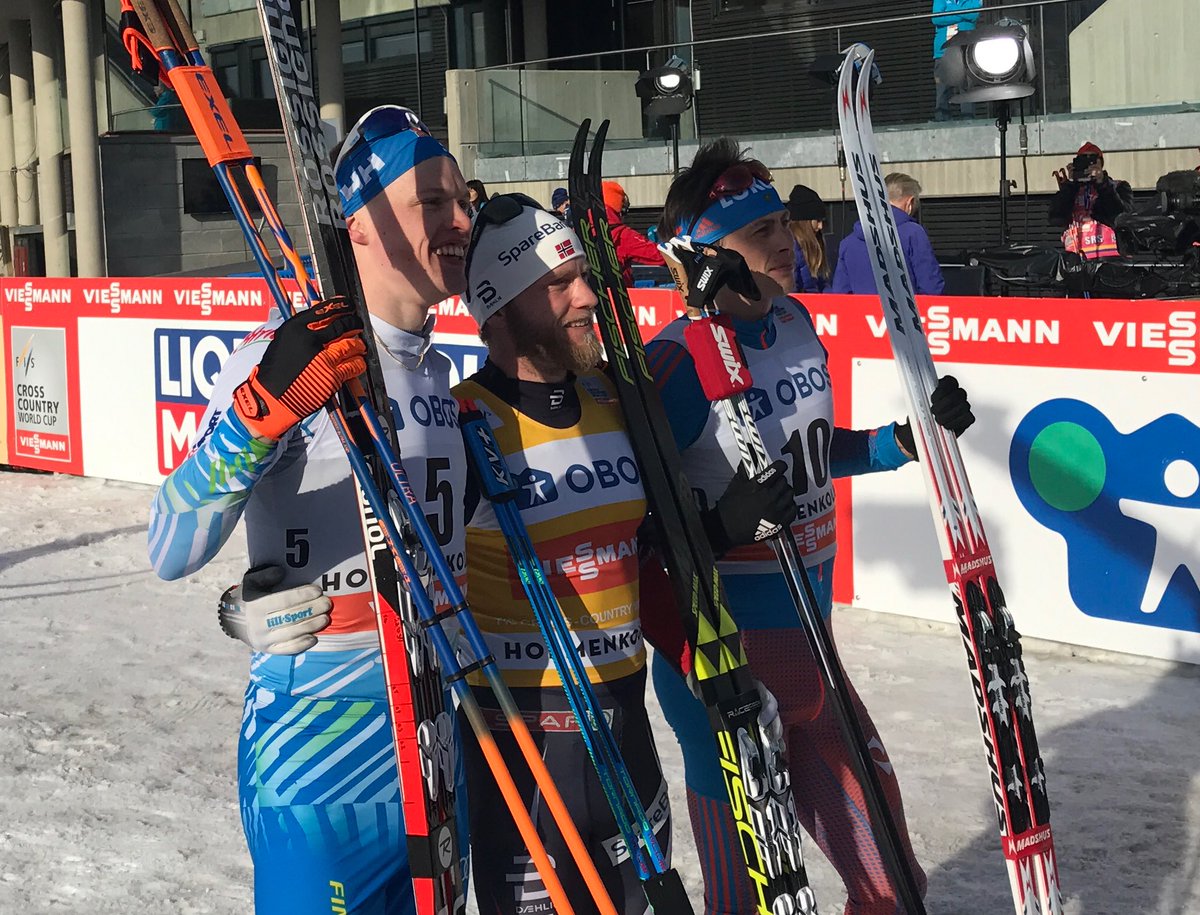
Left to right: Finland’s Iivo Niskanen, Norway’s Martin Johnsrud Sundby and Russia’s Alexander Bessmertnykh after placing second, first and third, respectively, in the Holmenkollen World Cup men’s 50 k classic mass start on Saturday in Oslo, Norway. (Photo: FIS Cross-Country/Twitter)
In a historic Holmenkollen, Norway’s Martin Johnsrud Sundby took his second 50 k win in a row, claiming this year’s title in a time of 2:02:59.7 (he won last year’s Holmenkollen in a time of 2:08:41.9).Sundby is now the only male skier towin two consecutive World Cup Holmenkollen 50 k competitions.
Crossing behind Sundby in second was Finland’s Iivo Niskanen, 9.9 seconds back from the race winner’s time. In a three-way photo finish, Russian Alexander Bessmertnykh bestedNorwegians Niklas Dryhaug, and Sjur Røthe in the lunge to the line, with Bessmertnykh taking third (+1:15.2), Røthe fourth (+1:15.2) and Dryhaug fifth (+1:15.2).
Canada’s Alex Harvey was just two tenths of a second behind the three-way lunge, finishing in sixth (+1:15.4). Norway’s Christer Hans Holund crossed 2.2 seconds later in seventh (+1:17.2). Three more Russians rounded out the top ten, with Sergey Ustiugov finishing in eighth (+2:35.0), Andrey Larkov two tenths of a second behind in ninth (+2:35.2) and Sergey Turyshev in tenth (+2:42.2).
The top U.S. skier for the day was Scott Patterson (Alaska Pacific University), earning World Cup points in 28th (+7:18.8). Canada’s Devon Kershaw crossed 33rd (+2:11:59.1) and American David Norris (Alaska Pacific University) finished 35th (+9:56.4).
Two more Americans competed in Saturday’s Holmenkollen, with Noah Hoffman finishing in 38th (+11:02.6) and Ben Lustgarten 46th (+18:44.7). Canadian Russell Kennedy was the final North American to finish in 47th (+20:16.3).
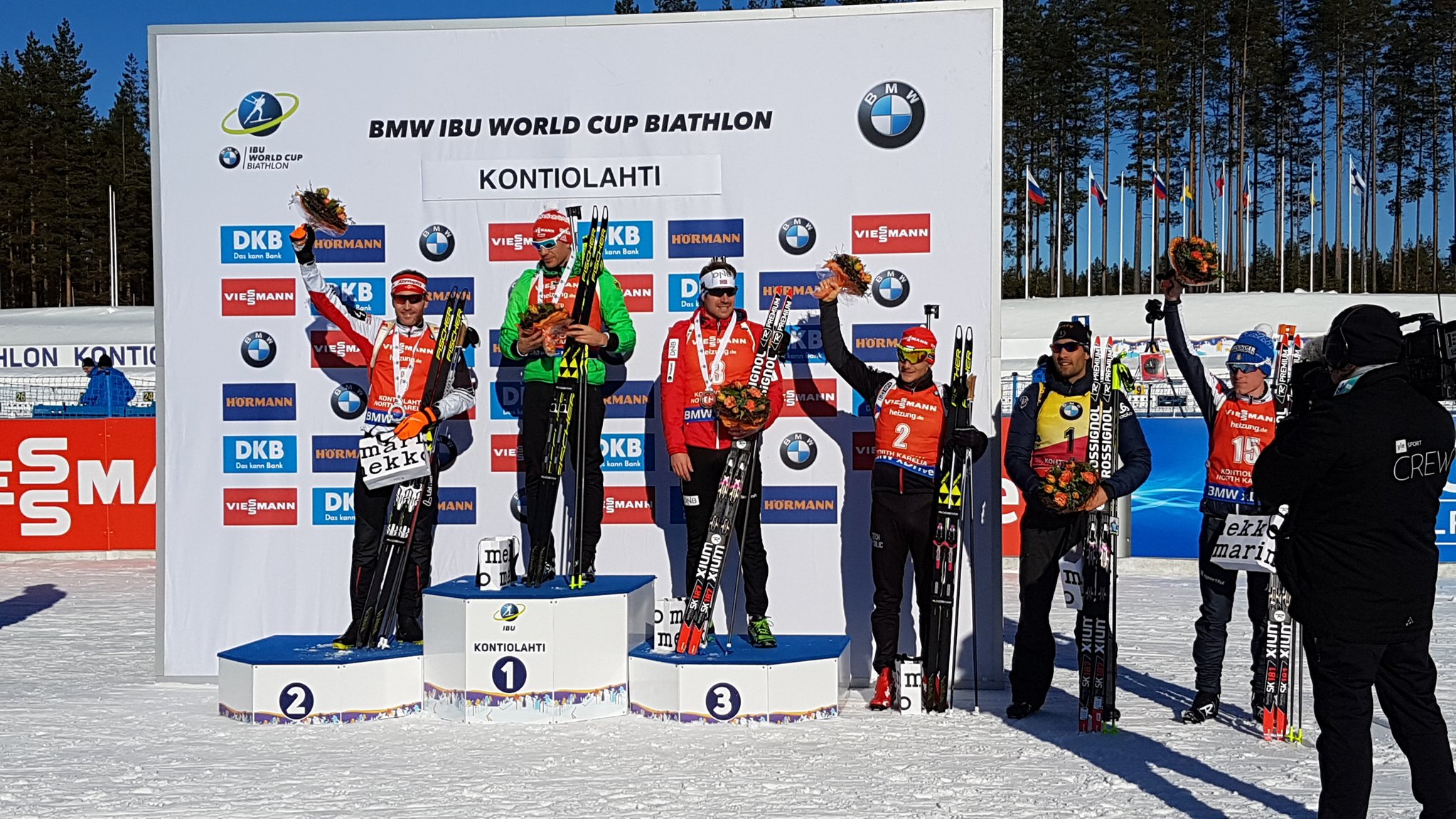
The IBU World Cup men’s podium after the 12.5 k pursuit in Kontiolahti, Finland, where Arnd Peiffer of Germany outsprinted Simon Eder of Austria for the win. (Photo: IBU/Twitter)
After one day knocked down to the second spot of the podium, it was back to the usual winning ways for Germany’s Laura Dahlmeier in the 10 k pursuit. Dahlmeier caught Norway’s Tiril Eckhoff, who won Friday’s sprint, early in the race after Eckhoff had one penalty in the first prone and second-starter Dahlmeier cleaned. While Eckhoff picked up five more penalties as the race went on, finishing 15th (+1:12.0), Dahlmeier had just one – and cleaned when it counted, on the final shoot with France’s Marie Dorin Habert and the Czech Republic’s Gabriela Koukalova right there with her. Dorin Habert missed one shot and held on to second place (+16.5) despite the penalty loop, while Italy’s Lisa Vittozi picked up her first individual podium in third (+19.9).
The win secured the overall World Cup title for Dahlmeier, her first. “That makes me really speechless,” she told Germany’s ARD broadcaster. “This is an amazing moment.”
Susan Dunklee collected four penalties and dropped from fifth place to 14th (+1:02.8) for the United States. Teammates Clare Egan and Joanne Reid finished 45th (+3:24.7) and 52nd (+4:07.0), respectively.
For Canada, Julia Ransom finished 53rd with three penalties (+4:14.0) and Emma Lunder 58th with four missed shots (+6:20.7).
Earlier in the day, Martin Fourcade had started the men’s race in bib one and set out to win the men’s 12.5 k pursuit, but was undone by four errors on the shooting range. No matter: the French biathlete still picked up the World Cup crystal globe for the pursuit discipline after finishing fifth (+25.5 seconds) and now he’s skipping tomorrow’s mixed relays to go be with his wife, who is about to have their second child.
Capitalizing on Fourcade’s errors were a group of chasers, among whom Arnd Peiffer of Germany managed to shoot 20-for-20. The race came down to a sprint finish between him and Simon Eder of Austria; Peiffer took a 0.3-second win for his eighth career victory. Emil Hegle Svendsen of Norway finished third, +2.3 seconds, and Andrej Moravec of the Czech Republic fourth, +9.8.
Besides Peiffer, the only other man in the field to shoot clean was Sean Doherty of the United States. That allowed Doherty to jump from 44th at the start to a season-best 18th (+1:19.5) at the finish, the top result for the American team. Lowell Bailey finished 27th (+1:57.2) and Leif Nordgren 43rd (+3:24.4) with three and four penalties, respectively.
Christian Gow led Canada with just one penalty and a 37th-place finish (+2:36.0), a big improvement from his 50th-place starting position. Brendan Green placed 50th with three penalties (+4:47.3).