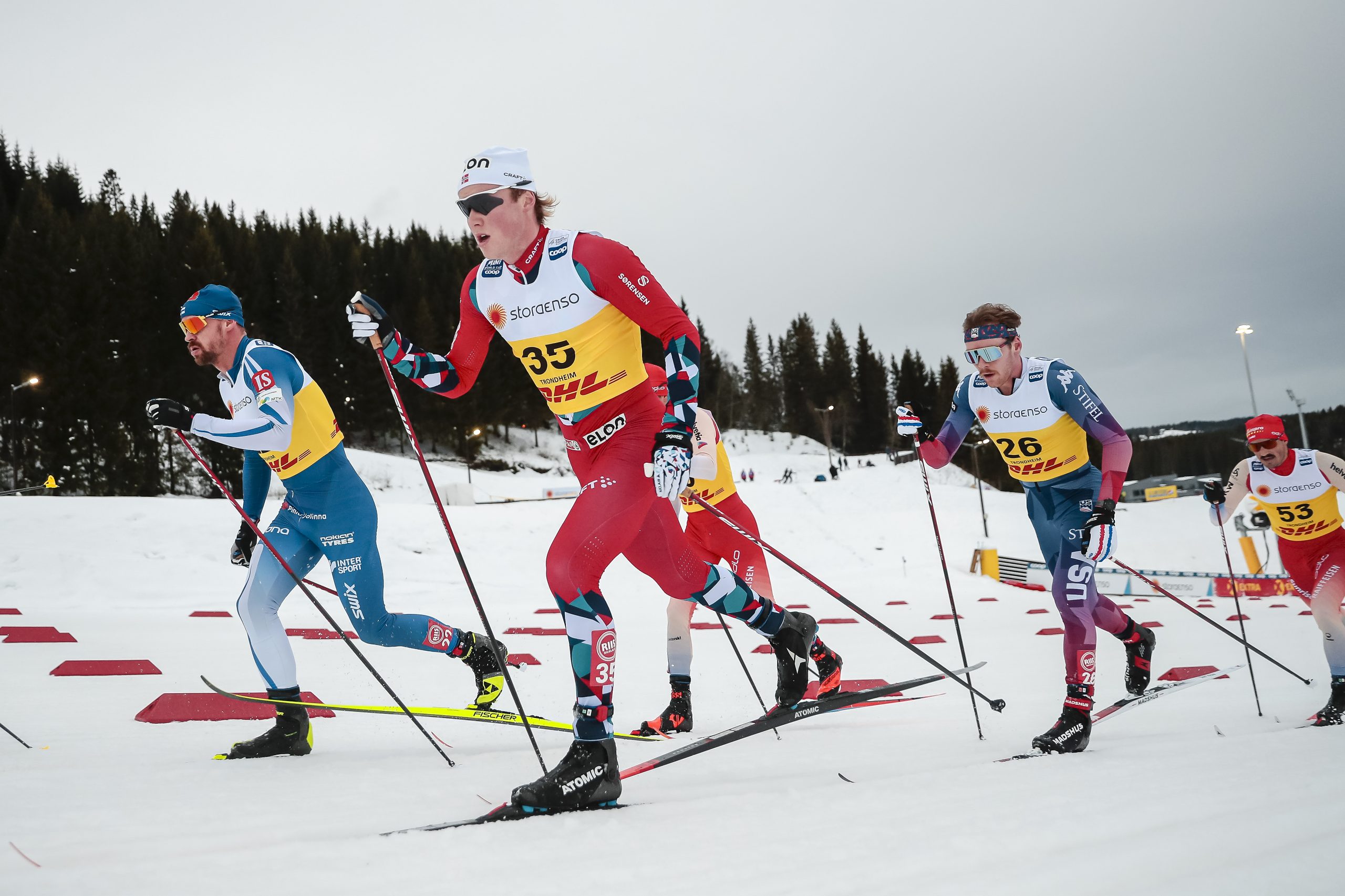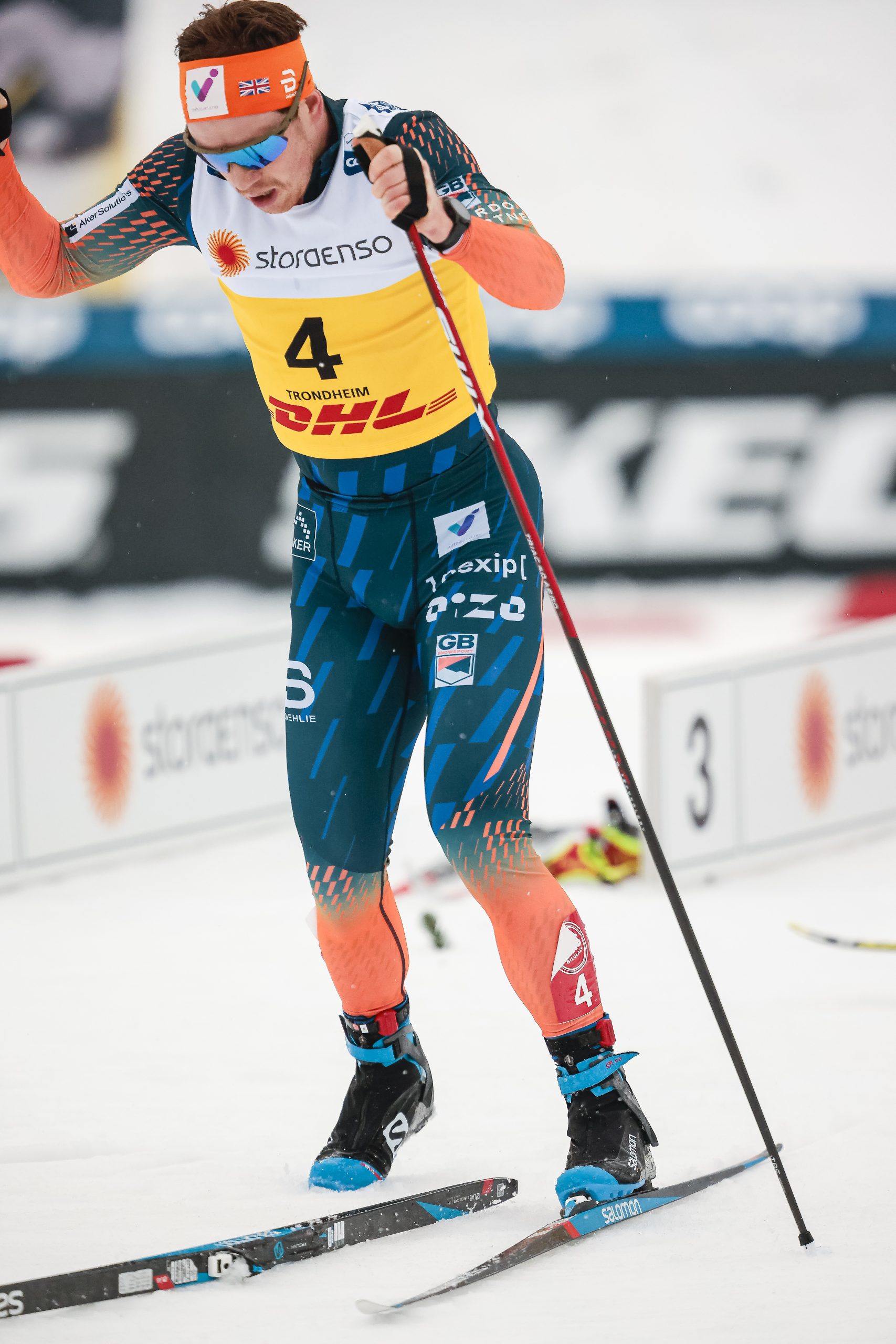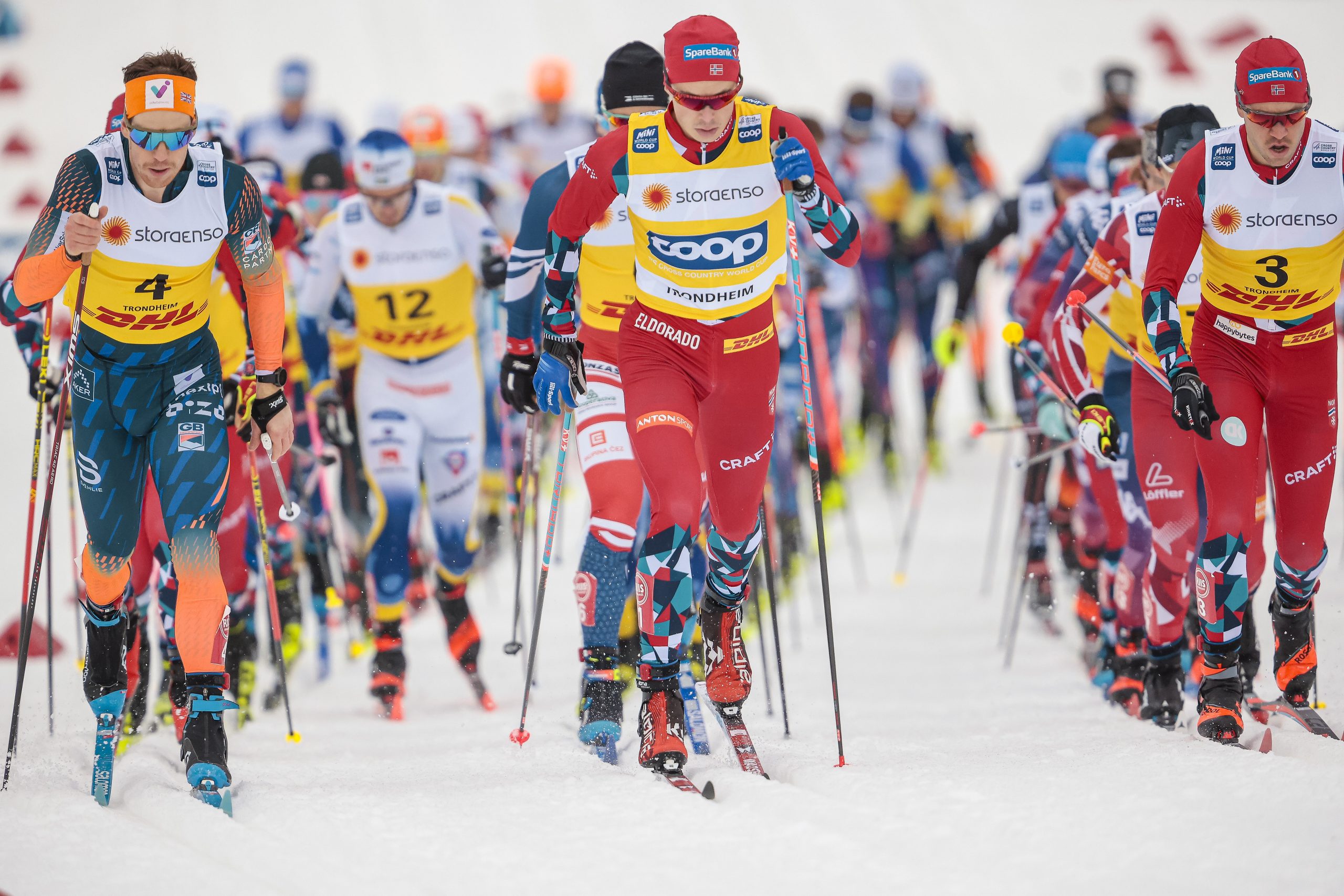

Tag: Johannes Hoesflot Klaeb

  • Klaebo Rules 20 k Mass Start. Schumacher-Patterson Top Twenty

    Klaebo Rules 20 k Mass Start. Schumacher-Patterson Top Twenty

    This coverage is made possible through the generous support of Marty and Kathy Hall and A Hall Mark of Excellence Award. To learn more about A Hall Mark of Excellence Award, or to learn how you can support FasterSkier’s coverage, please contact info@fasterskier.com.

    As the eyes of cross-country World Cup competitors begin to turn their gaze toward North America, one task remained for them before they could begin to focus on packing their bags for the long journey west. That task was the 20 k Mass Start Freestyle contested today in Goms, Switzerland. In the men’s competition, none of the leaders could afford to look too far down the road. Harald Oestberg Amundsen (NOR) still led the Overall Crystal Globe competition by 201 points over Erik Valnes (NOR) going into today’s race. And while it’s a sizeable lead, he certainly wasn’t in the position to put things on cruise control just yet.  Valnes wasn’t racing today, but always lurking was the ever-present Johannes Hoesflot Klaebo (NOR) who, after an up and down season marred by illness, was looking to reassert his dominance on the World Cup scene.
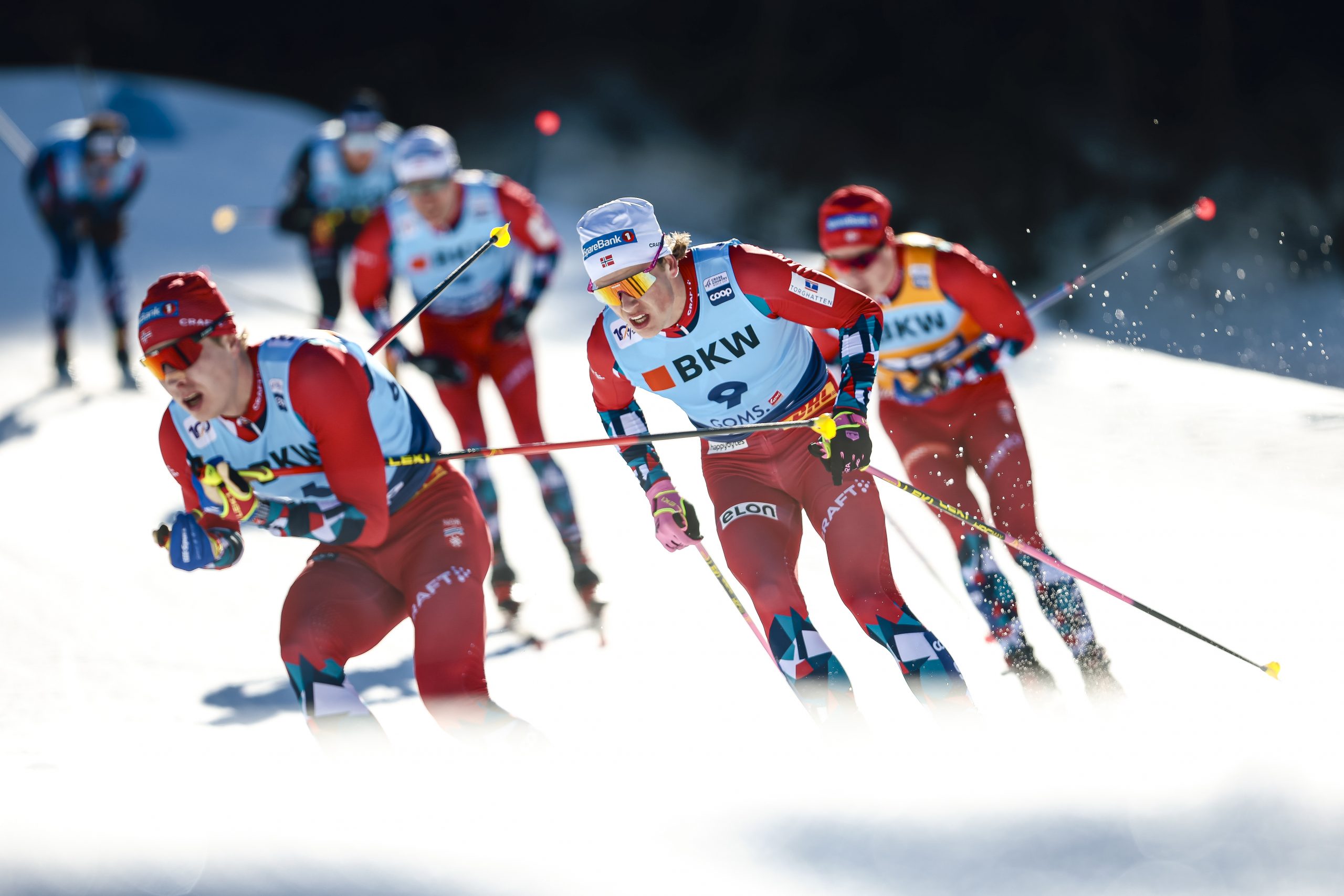
    Ever the master technician, Johannes Hoesflot Klaebo (NOR) (number nine) was able to reassert his dominance today. (Photo: NordicFocus)

    The race for the Distance Championship has some interesting twists and turns going on. Amundsen also leads that competition, but his lead was only 78 points over Paal Goldberg (NOR). More intriguing is that Andrew Musgrave (GBR) was in third place in the Distance Cup, but his lead was only one point over Hugo Lapalus (FRA). A podium finish in any of the Cups for Musgrave would be a huge feather in his cap, but he would need to be extra vigilant to try to fend off the surging Lapalus.

    For the Americans, it was time to sharpen the sword and get ready to come home in good form. The regular duo of Ben Ogden and Gus Schumacher would be joined by Scott Patterson, Peter Wolter, Zak Ketterson, and Kevin Bolger for the final tune-up before the return to North America.

    Mass Start Freestyle races can be very tactical affairs; racers will often remain grouped in a moderately-paced pack for much of the race. FIS has tried to reduce this strategy by introducing bonus points into distance races. In today’s race, there were bonus points at 9.5 and 14.5 kilometers. First place at a bonus section gains a racer an additional 15 points toward the Distance and Overall standings. Musgrave or Lapalus might try and steal a page from Jessie Diggins’ playbook in the Oberhof 20-kilometer race and push hard at the bonus section sprints.

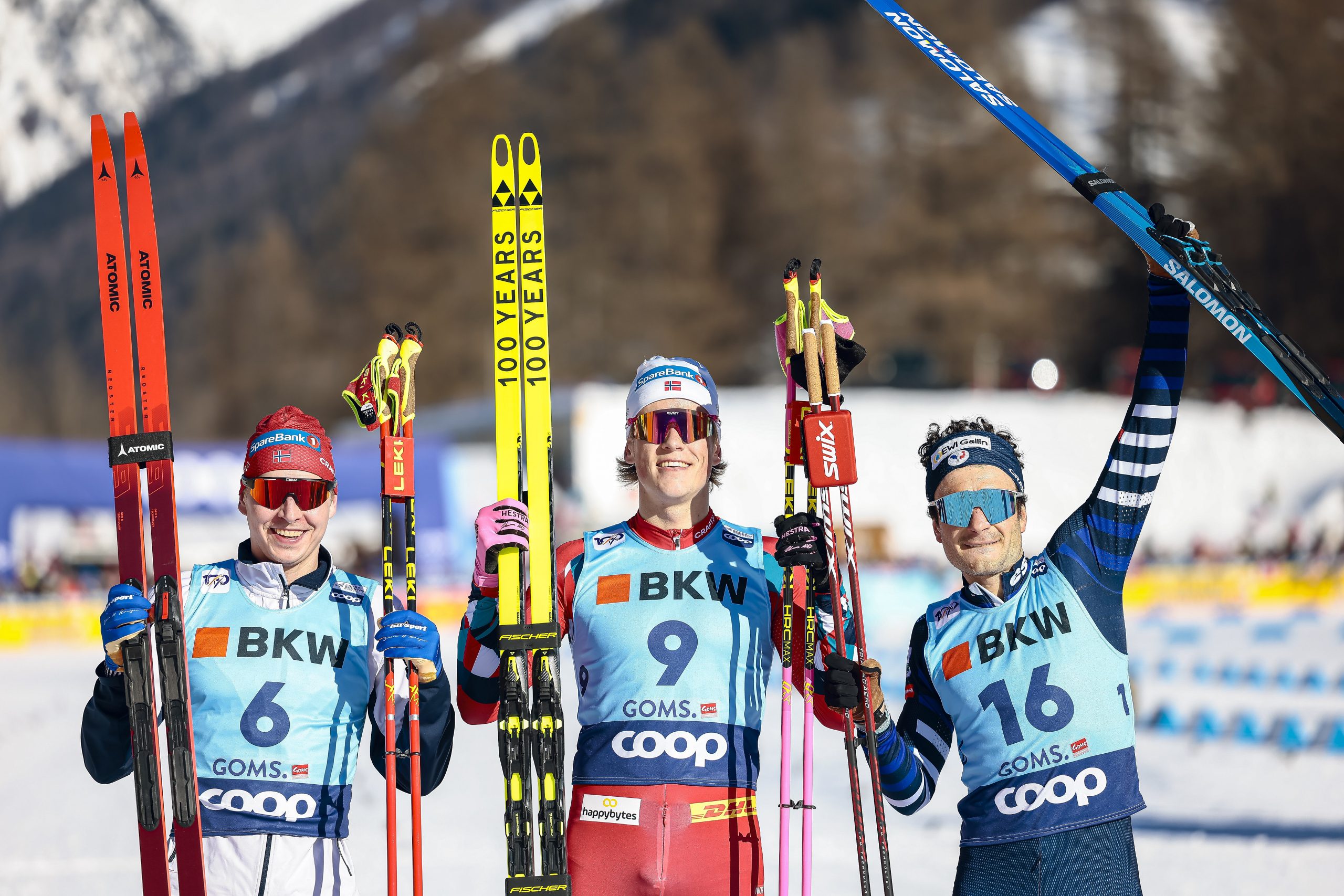
    There was a little bit of rain overnight in Goms that froze and made the conditions fast as it mixed into the snow. Today, FIS didn’t have to worry about skiers dawdling on the course. The finishing times revealed just how fast the conditions were, and how willing racers were to take advantage of the conditions as Klaebo claimed victory in a time of 39:25—for a race of 20 kilometers! Klaebo’s countryman, Simen Hegstad Krueger, was second, with Jules Lapierre (FRA) taking third. Amundsen was able to protect his Cup standings by finishing fourth. Musgrave finished 12th and his podium rival Lapalus was 13th, allowing Musgrave to maintain his slim margin in the Distance competition. But now there were four skiers within 16 points of him; Klaebo is one of them.
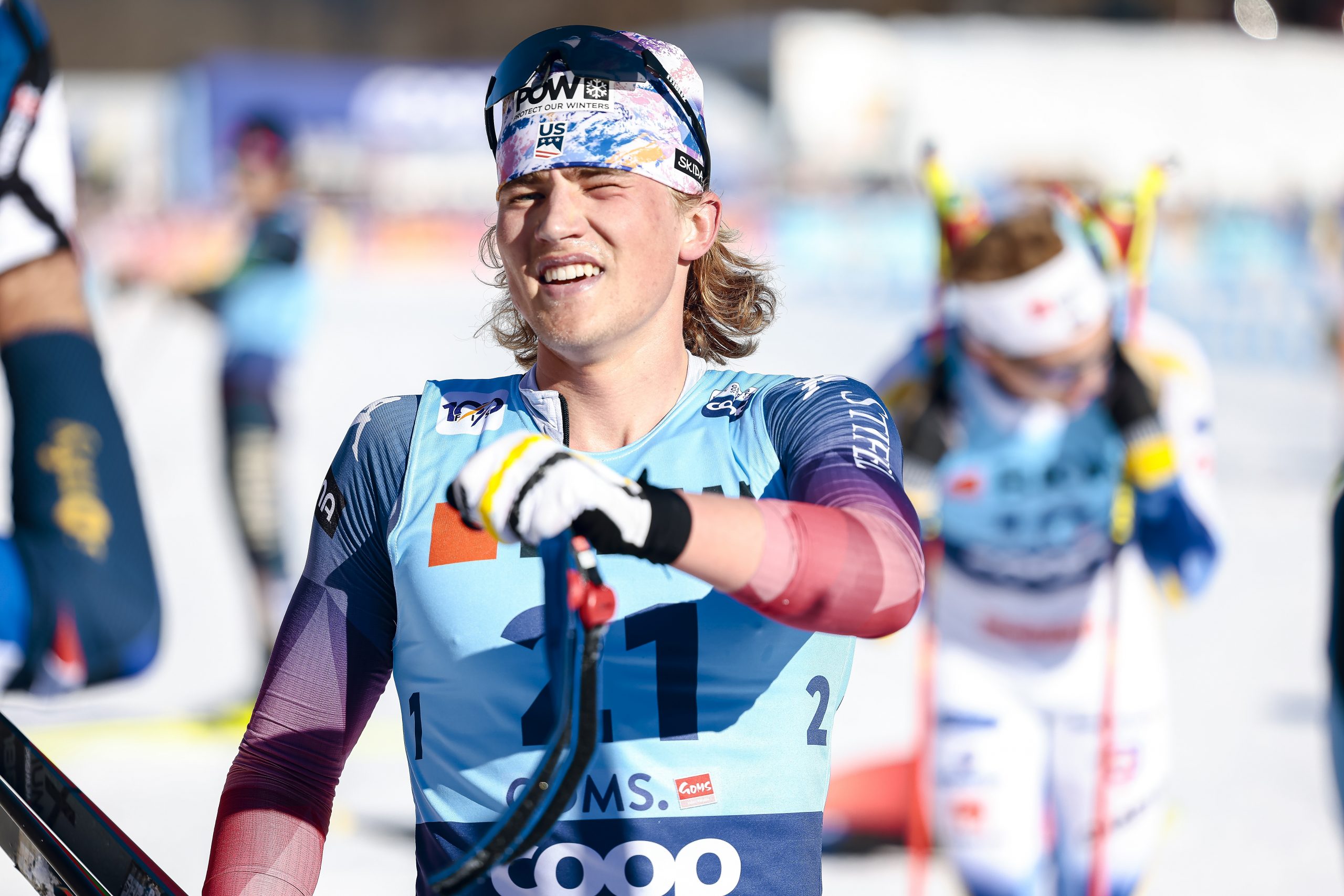
    Gus Schumacher (USA) was the top American finisher: 14th, only 12 seconds from the podium. (Photo: NordicFocus)

    After the race Klaebo, said that “it was fun and [I] felt really strong.” When asked about his chances for the Overall Cup, he admitted that he was too far back to contend for the Overall competition but was happy to be feeling good again, feeling normal, and going to Canada with a good feeling.

    The top American was Gus Schumacher in 14th place in a time of 39:49. He was followed by Patterson in 18th, Ogden 35th, Bolger 42nd, Ketterson 43rd, and Wolter 49th.

    Antoine Cyr was the top Canadian, only 37 seconds off the lead in 22nd. Sasha Masson finished 36th, Xavier McKeever 55th, Thomas Stephen 57th, and Derek Deuling 61st. Max Hollmann did not finish.

    After the race, Schumacher revealed that his strategy was “to try to relax in the pack as long as possible so I could have the energy to move up when it got hard. . . . Also, I wanted to ski the downhills well to take places where it was a bit easier. Honestly, I struggled to maintain a good position in the first couple of laps, so that part didn’t go super well, but I had energy when it started to string out and made those said ‘money moves’ into some bonus points.”

    Men’s 20 k Freestyle Mass Start

    Amundsen and Musgrave went to the front early and set a quick pace. Skiers stayed together in one large pack, spreading out as they proceeded down the first technical downhill turn. Even though the skiers looked relaxed, the conditions made the pace fast as everyone was clearly working hard through the tight, high-speed corners.

    At 4.5 kilometers, Friedrich Moch (GER) pushed to the front keeping the pace brisk and didn’t give the group a chance to let up.
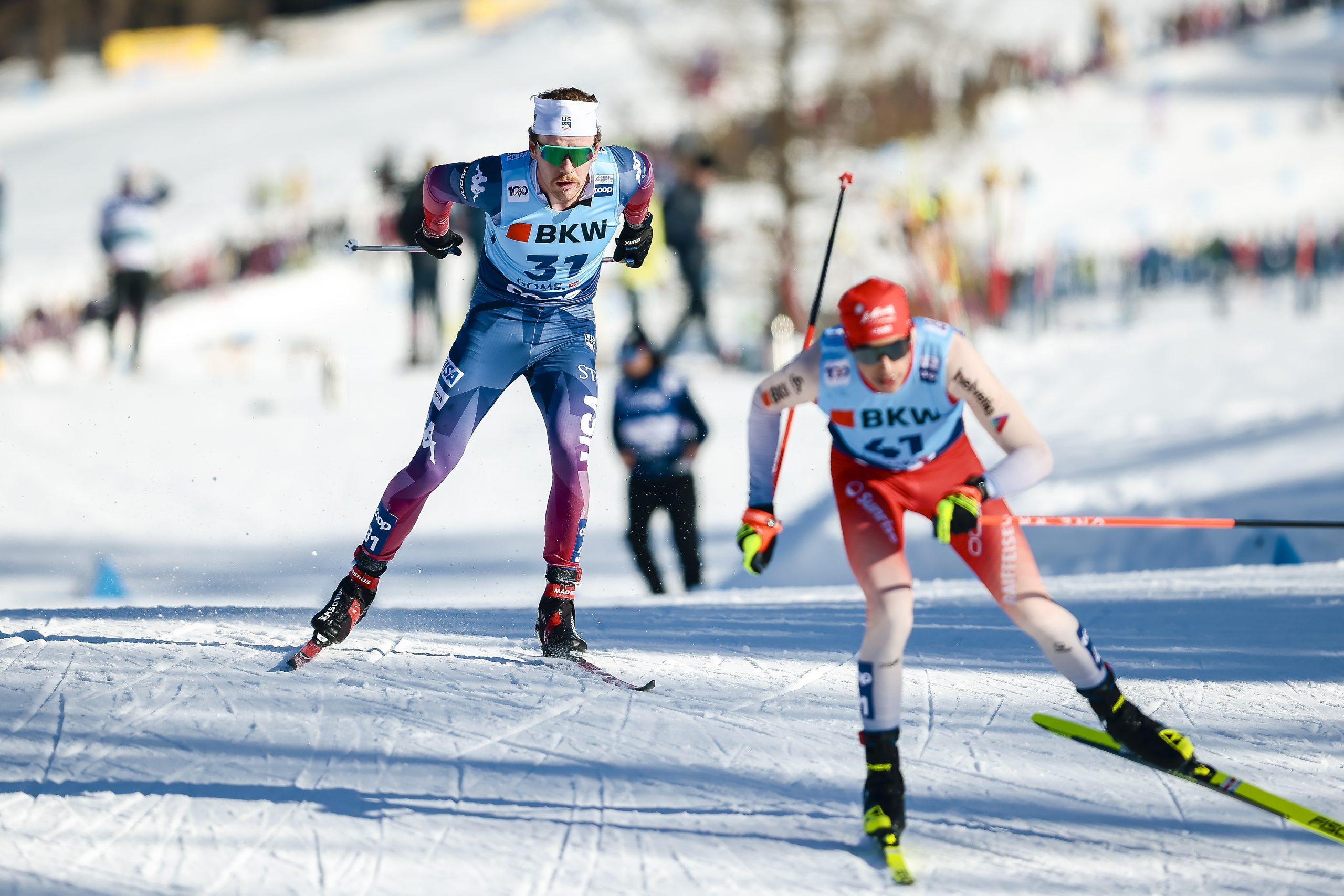
    Ben Ogden (USA) (number 31) had a good start but couldn’t quite keep up with the fast pace. Ogden would finish 35th. (Photo: NordicFocus)

    Ben Ogden had been pushed down to 23rd but was only six seconds off the lead as all of the top skiers were fighting for position.  The racers continued in one large pack with Amundsen never straying far from the front. But the standings were a little deceptive as only 14 seconds separated first from 44th.

    The speeds were fast as skiers struggled to stay on the marked course as they worked through the fast tight corners. As the pack approached the first time bonus, the pace quickened even more and the pack spread out. Klaebo then did what he does best: put in a quick sprint to head to the front, easily taking the winner’s 15 bonus points.

    After the fight for bonus points was over, Musgrave went back into the lead. All of the jockeying back and forth for points had little additional effect on spreading out the field. There were still 39 skiers within 16 seconds of the lead.

    At the next bonus section Klaebo again went to the front to claim the full 15 points. As it turned out, it was Klaebo, not Musgrave who would utilize the bonus points tactic. As Klaebo surged, he was joined by Schumacher who took a run to the front crossing the bonus line sixth. Beda Klee (SUI) was also cheered on by the hometown crowd as he shot into the lead for a brief time after the bonus sprint.
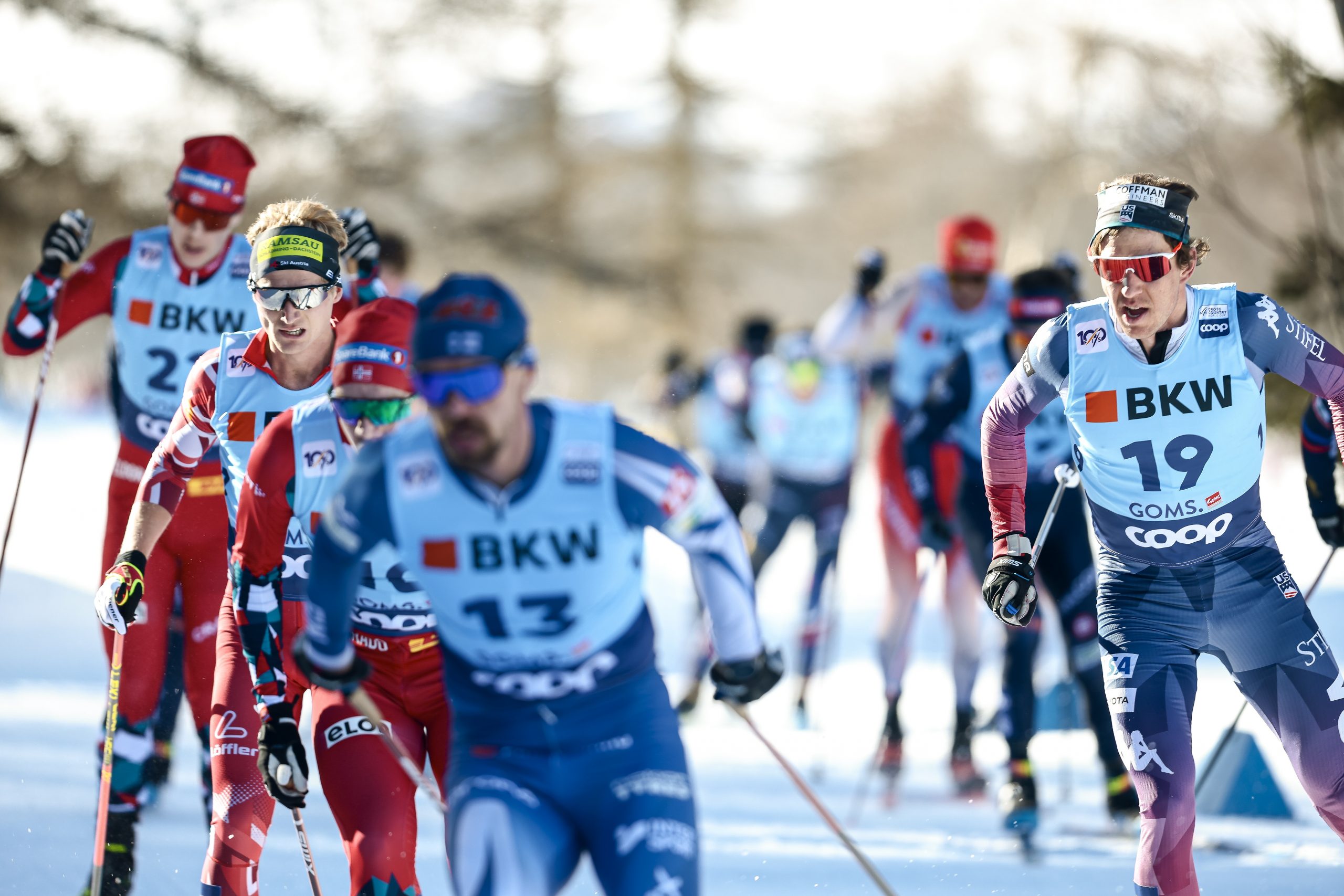
    Scott Patterson (USA) (number 19) had a strong day finishing 18th. (Photo: NordicFocus)

    At 16 kilometers the intensity ratcheted up as skiers without a big finishing sprint knew that they would need to create a gap to have a chance at the finish. Joining that group was Scott Patterson who had moved up to 15th, still only ten seconds off the lead. Patterson had been looking to rebound after what he called “a tough weekend in Oberhof.”

    “I tried to ski smooth but stay near the front,” Patterson said. “That worked well until the leaders started really pushing the last lap. I didn’t quite have the speed and energy but [I’m] still quite satisfied with a strong result to finish off this European block.”

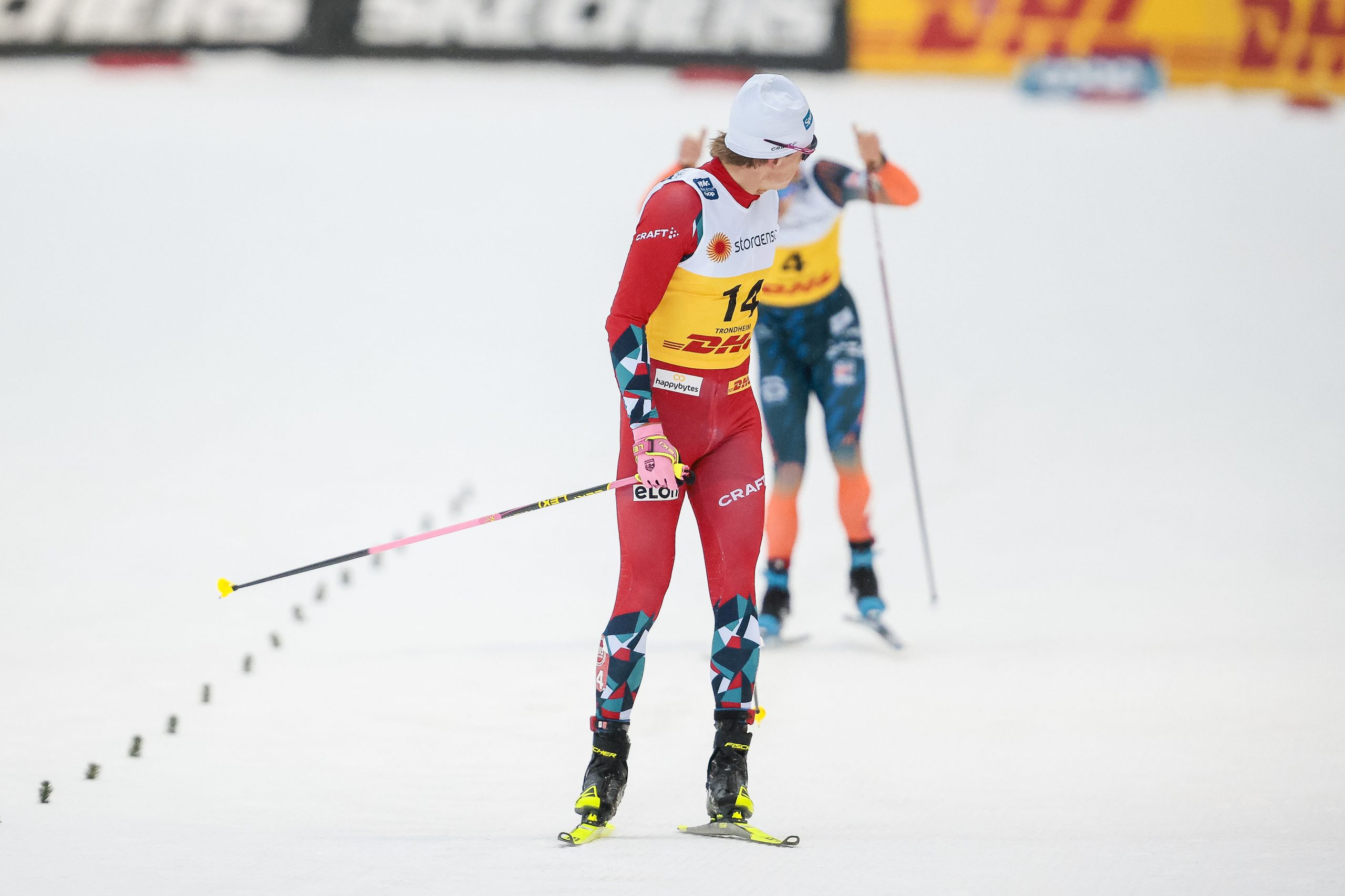
    As the intensity continued to increase, Krueger, Amundsen, Klaebo, and Golberg began to assert their dominance. They quickly broke the lead pack into a group of six skiers that included Jules Lapierre (FRA) who was coming off his recent triumph up Alpe Cermis in the Tour de Ski. It was then Krueger and Klaebo who went to the front, and the pair separated from the lead pack. As the duo hit the final kilometers, they skied in tandem with Krueger taking the lead and Klaebo marking his every move. Going into the final hill before the stadium, Krueger desperately tried to make a break, but couldn’t separate himself from Klaebo. Klaebo never panicked and stayed on Krueger’s tails the entire way. Entering the stadium Klaebo switched on the after-burners; in a flash he was past Krueger. Klaebo had put on such a quick intense burst that he was able to slow down at the finish and take a look around to enjoy the sights.
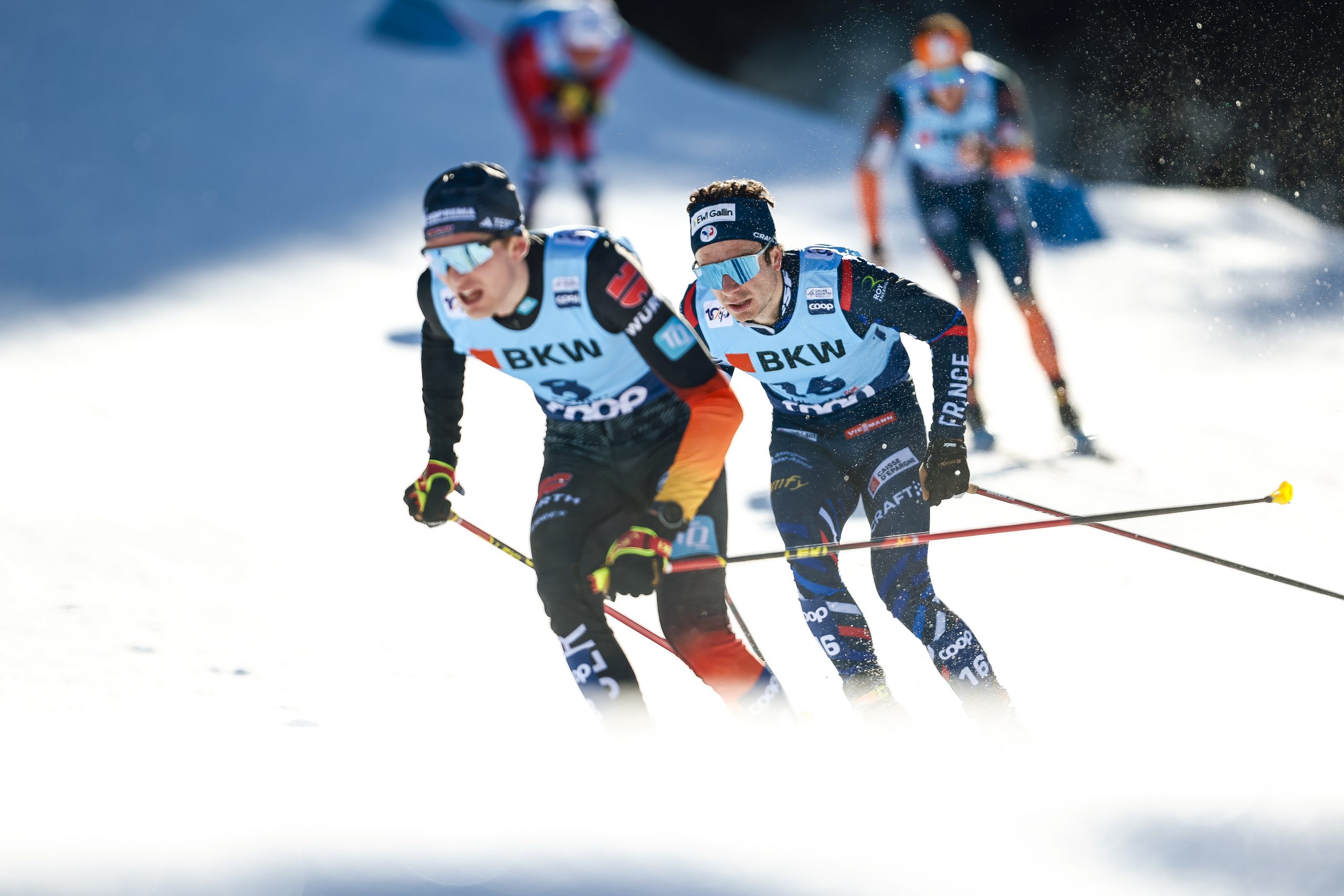
    Jules Lapierre (FRA) (number16) continued to roll, having won the Alpe Cermis climb in the Tour de Ski, and taking third in today’s race. (Photo: NordicFocus)

    While the two Norwegians were battling for the victory, Jules Lapierre (FRA) had moved to the front of the chase group and held on to finish third.

    Schumacher finished strong to claim 14th, but the placing was a little deceptive as he was only 12 seconds off the podium.

    Klaebo’s finishing time of 39:25 was testimony to the fast conditions, and to the willingness of the racers to take advantage of the speedy course and keep the pace fast the entire way.

    Next stops on the World Cup: Canmore, Alberta, followed by Minneapolis, Minnesota. Be sure to continue to visit FasterSkier for our in-depth coverage as the world of cross -country skiing comes to North America.

    20 k Freestyle Mass Start RESULTS
    World Cup Standings

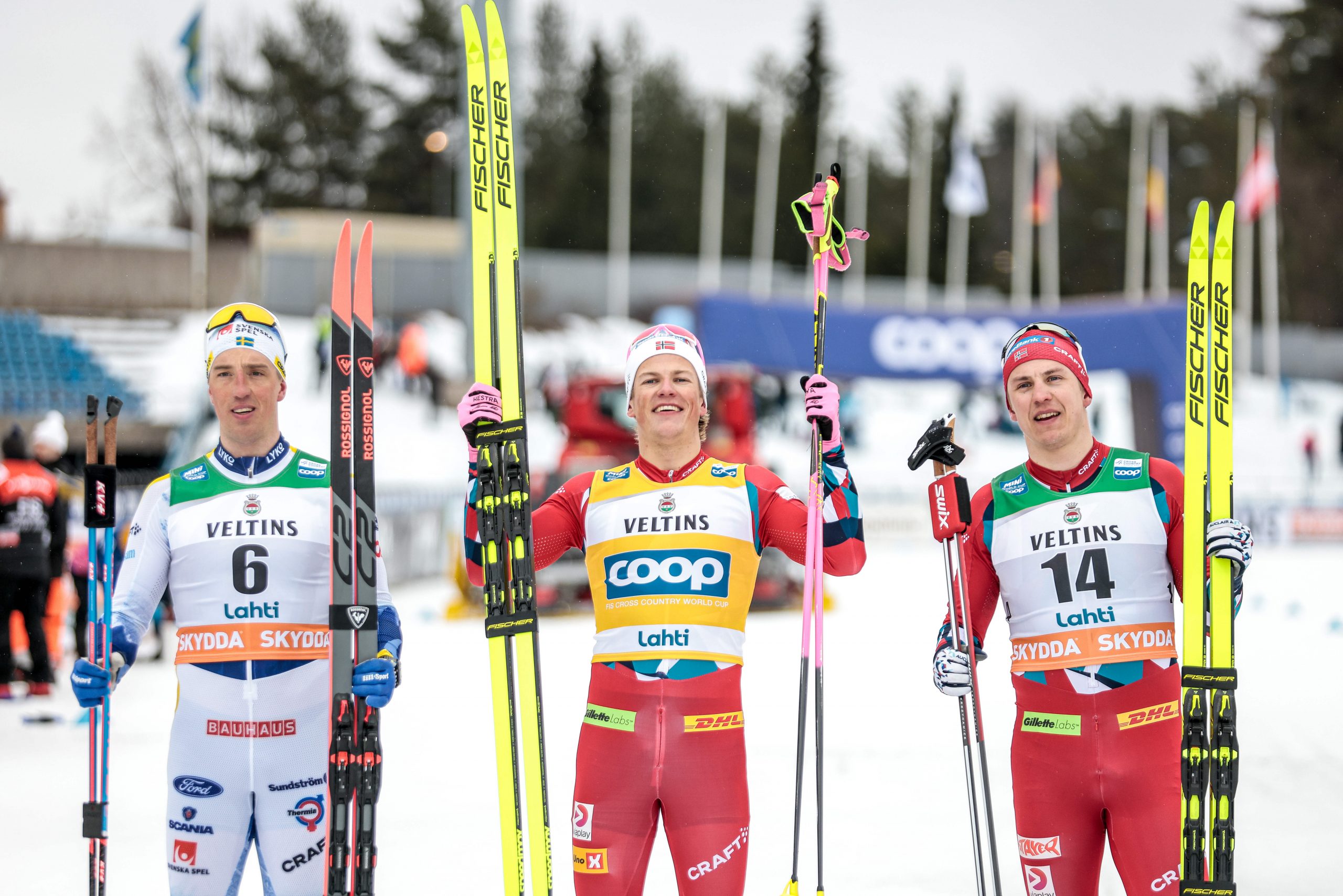
    Simen Hegstad Krueger (NOR), Johannes Hoesflot Klaebo (NOR), Jules Lapierre (FRA), (l-r) were the Goms podium finishers. (Photo: NordicFocus)
  • Klaebo: the Second Most Dominant Norwegian

    Klaebo: the Second Most Dominant Norwegian

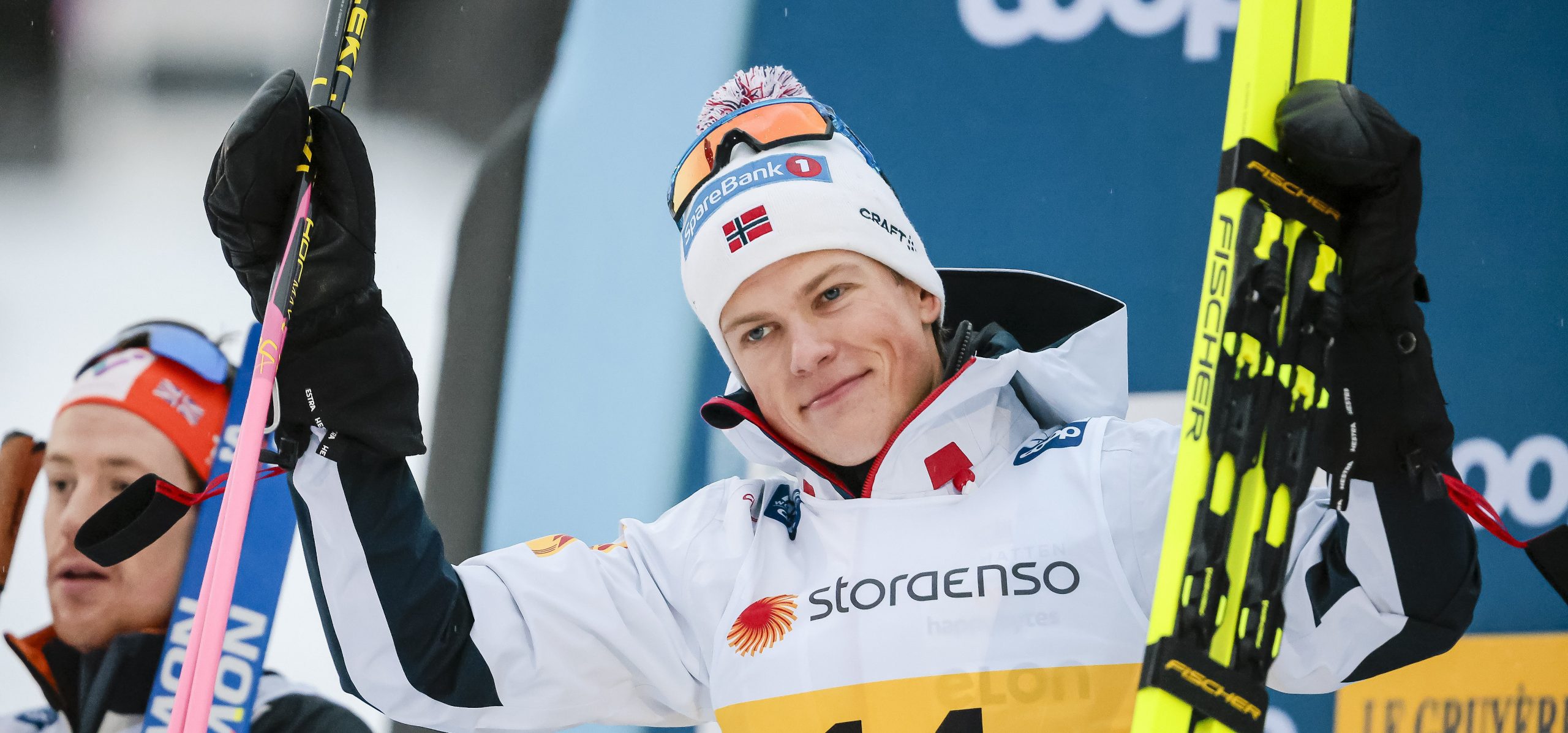
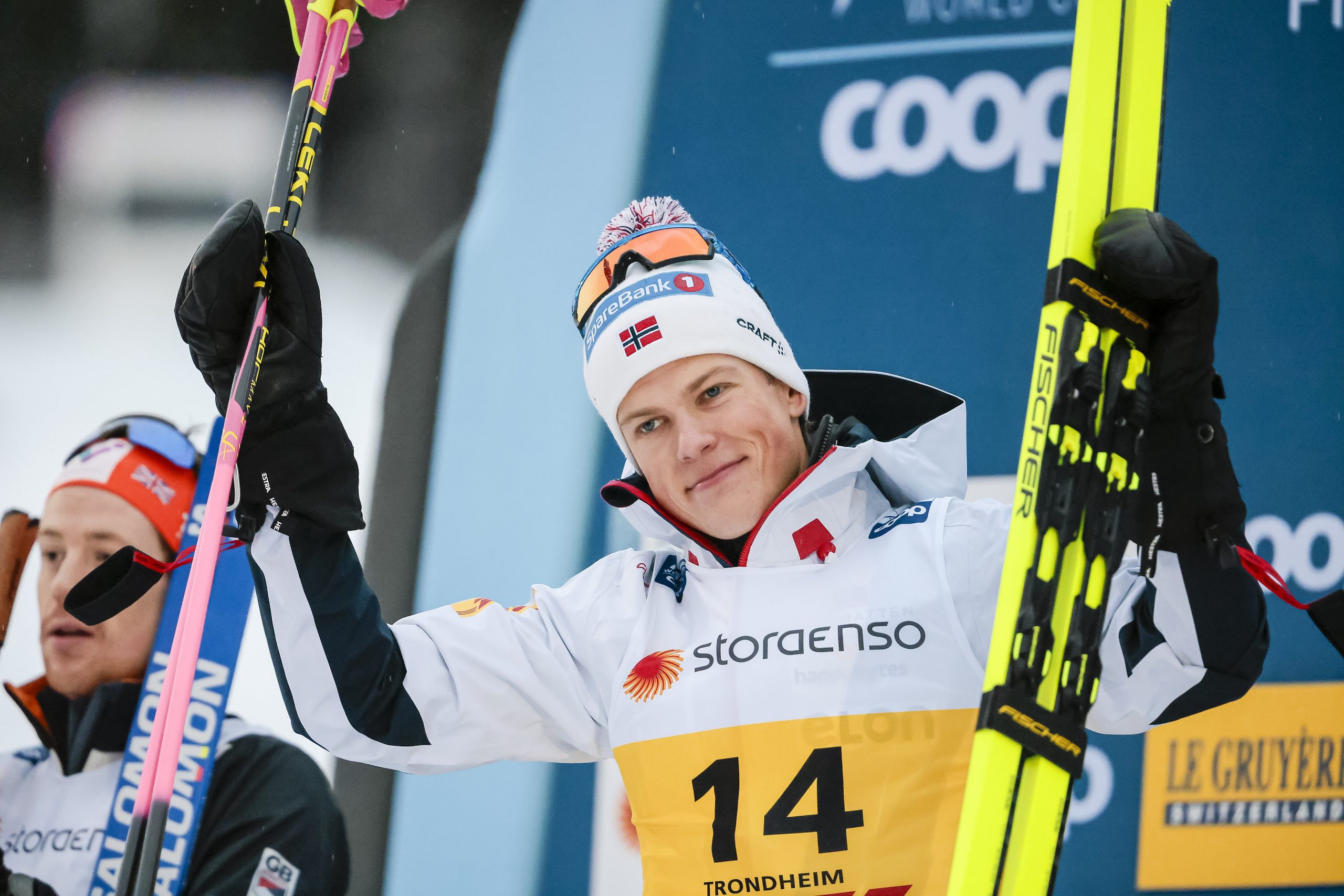
    Johannes Hoesflot Klaebo (NOR) swept all three days of World Cup events in Trondhiem, but he still has much more to prove until he’s as dominant as his countryman, chess master Magnus Carlsen. (Photo: NordicFocus)

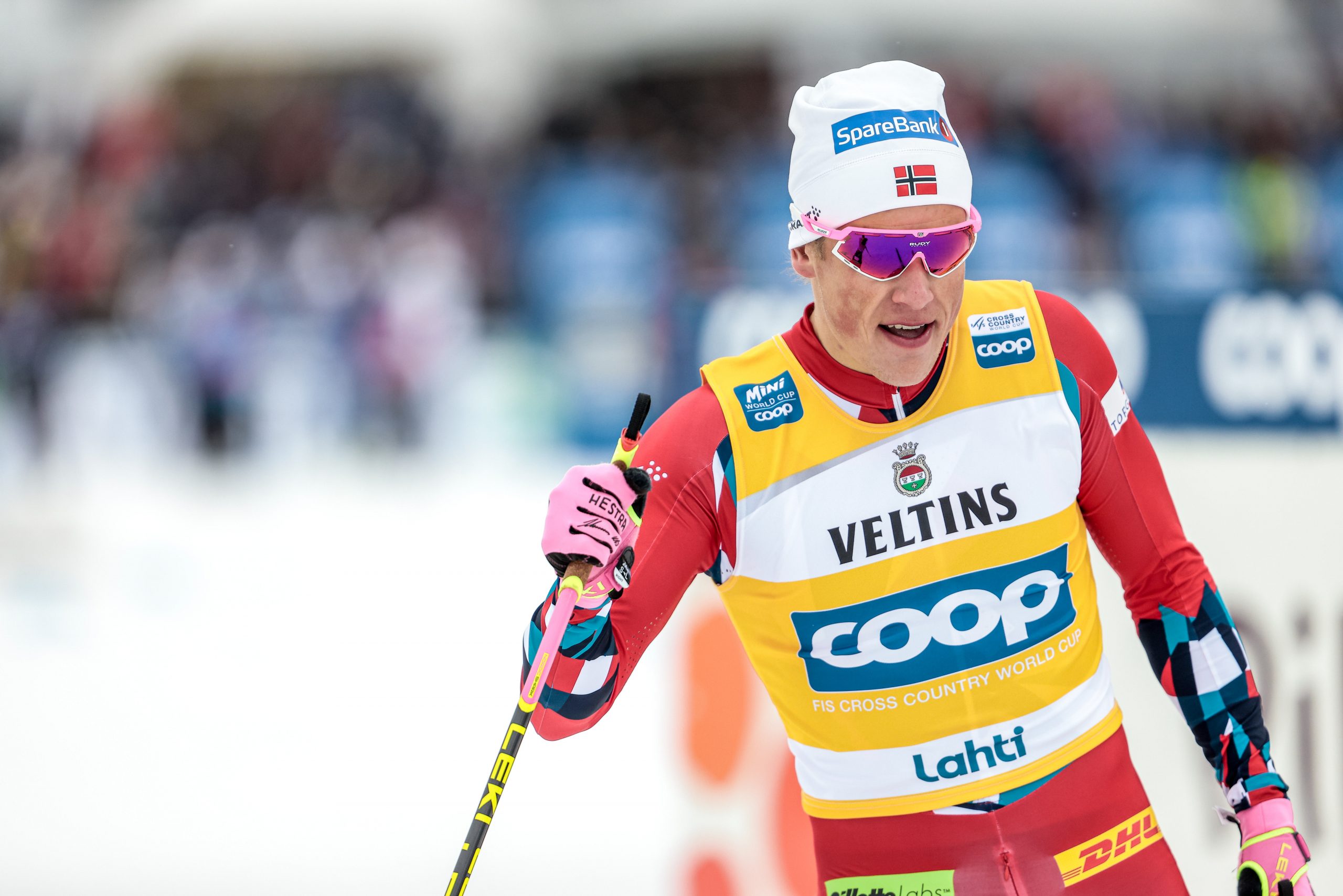
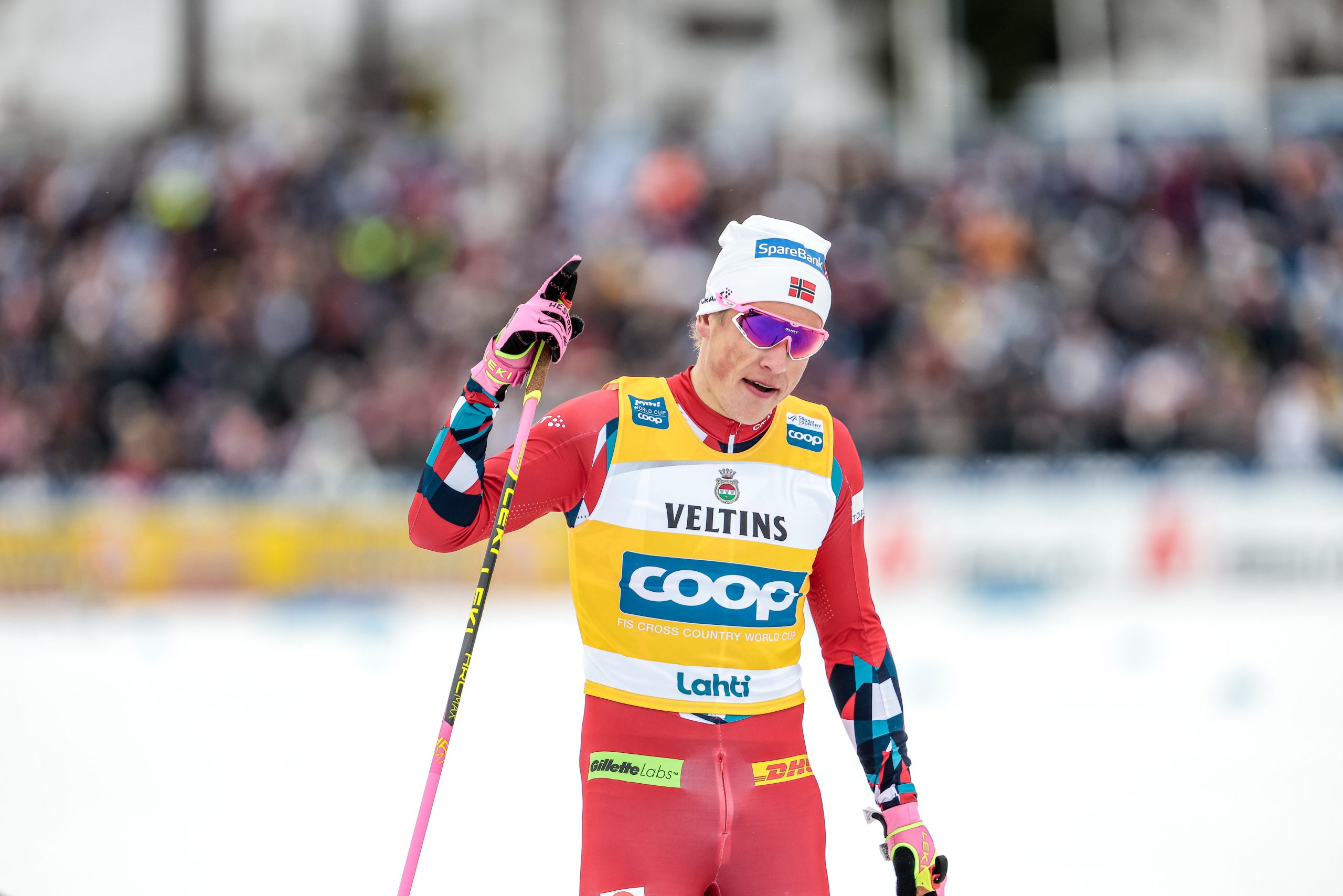
    Johannes Hoesflot Klaebo (NOR) is back on a roll. After a short hiatus from domination— due to illness— he has returned to form. He seems to be back to the point where any race in which he is entered, he is automatically the favorite. Klaebo won every race last weekend in Trondheim, a Sprint, a Skiathlon, and a Classic race.

    There is another Norwegian who carries those same kinds of outsized expectations in another sport which has nothing to do with snow; and as the dominant competitor he has a lot in common with Klaebo. Not only do both of their names come up quickly in G.O.A.T (greatest of all time) conversations, but their dominating style has completely changed their sports.

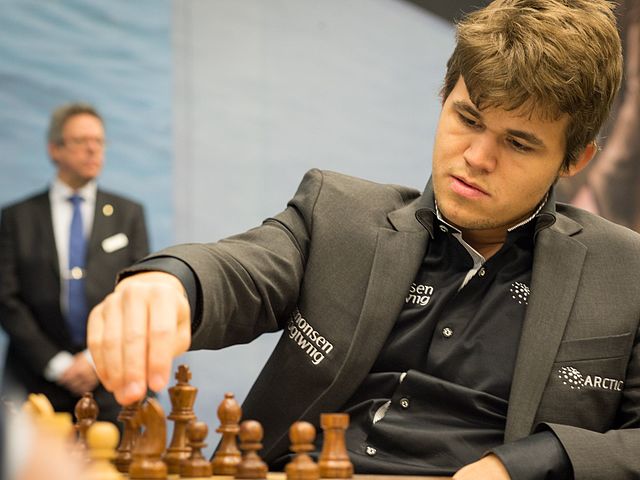
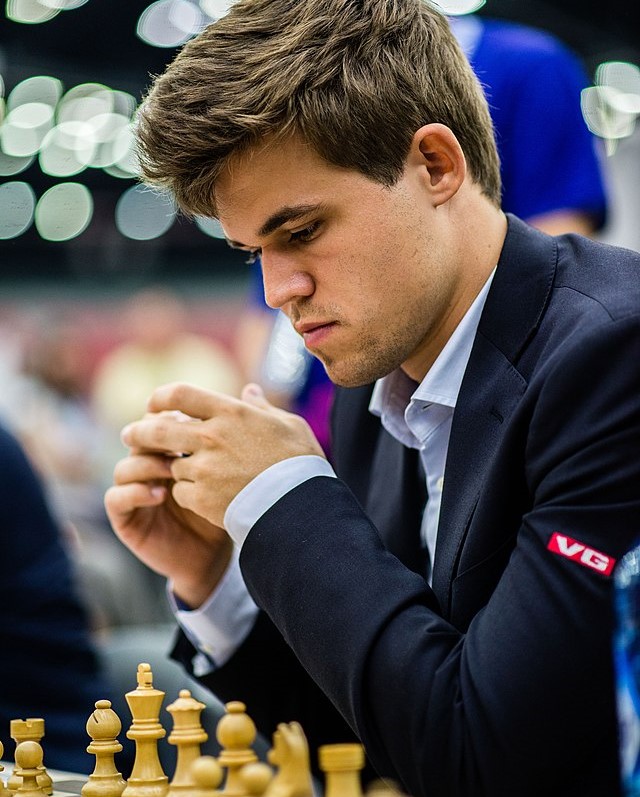
    Magnus Carlsen (NOR) shares Norwegian and world headlines with Klaebo, but Carlsen is better known world-wide and has a streak of domination which Klaebo can’t match. (Photo: Wiki Commons)

    Magnus Carlsen (NOR) is the five-time World Chess Champion, arguably more dominant than Klaebo is in the sport of cross country skiing, and probably even more famous in their home country. The only reason Carlsen is not currently the World Classical chess champion is that he chose not to play in this year’s tournament. After winning five years in a row, he was bored and basically unmotivated to gear up for a sixth go at it.

    Like skiing, chess has several different disciplines. The World Championships use the Classical rules (long games, commonly exceeding five hours). Blitz and Rapid are chess’ equivalent to Sprint racing. Carlsen is the reigning six-time World Blitz champion, and the four-time reigning Rapid Champion. Carlsen also had an unprecedented undefeated streak of 125 games in a row. A streak which Klaebo can’t come close to matching.

    Chess—like cross-country—has a ranking system based on points. Carlsen has held the number one position since 2011; a reign at the top which exceeds even Klaebo’s long reign.

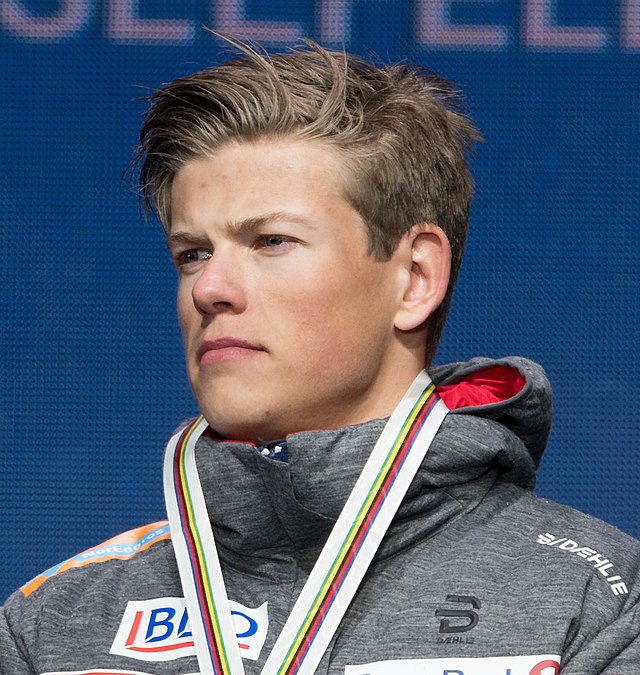
    Klaebo is the dominant skier of his generation. G.O.A.T status remains to be seen. (Photo: NordicFocus)

    So, who is more dominant in their discipline? Well, the numbers lean toward Carlsen.

    Carlsen holds the highest rating in chess history of 2882 and is usually the only player rated above 2800 in Classical chess at any given time (There was great fanfare in the chess-world when Fabiano Caruana of the United States recently joined the plus 2800 club with a ranking of 2804). The 2800 ranking is a chess milestone: it’s like 60 home runs in a baseball season, rushing for 2,000 yards in a football season, or winning overall Crystal Globes in cross-country skiing for consecutive years. Very few people have done it.

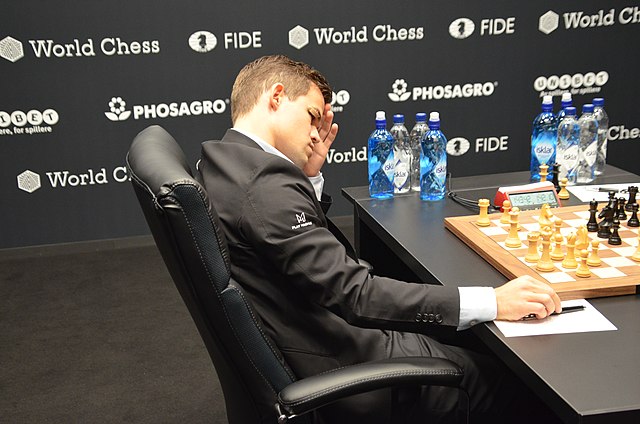
    The World Chess Championship is best of 14 games plus possible tie-breakers. With games routinely exceeding five hours, it’s an exhausting format. As exhausting as the Tour de Ski? Perhaps at a different level. (Photo Wiki Commons)

    There is something in chess known as the “Magnus effect.” This term describes a situation when Carlsen makes an objectively bad move, but his opponent is afraid to take advantage of it because he thinks it’s a trap. The underlying premise is that Carlsen is so good that there must be a reason for an apparent miscue; he couldn’t “just make a mistake.” This sounds a lot like the many times competitors have been so intimidated by lining up with Klaebo that they have bungled their own strategy or made an unforced error because they were worried about what Klaebo was going to do.

    Who is more famous worldwide? Social media metrics suggest that the advantage clearly goes to Carlsen. Klaebo has 123,000 subscribers on his YouTube Channel and about 437,000 Instagram followers. Carlsen has a pop-star level 1.12 million YouTube subscribers, and 1.3 million Instagram followers. Even biathlon superstar Dorothea Wierer only has 612,000 followers. Advantage Carlsen.

    The pressure to win every match is immense. For Carlsen, it comes with the territory of being the highest ranked player ever. (Photo: Wiki Commons)

    Commentators are often impressed by Klaebo finding a line during a race that no other racer has taken. Likewise, Carlsen will often use openings that are rarely chosen. He does so not necessarily for a tactical advantage, but just to keep things interesting.

    When Carlsen sits down at a chess board, he is expected to win. If he doesn’t, it makes world news in chess . . . just like when Klaebo doesn’t win a Sprint. The two men are very much alike in their domination of their chosen pursuits. Carlsen has said, “Not winning a tournament is not an option for me.”

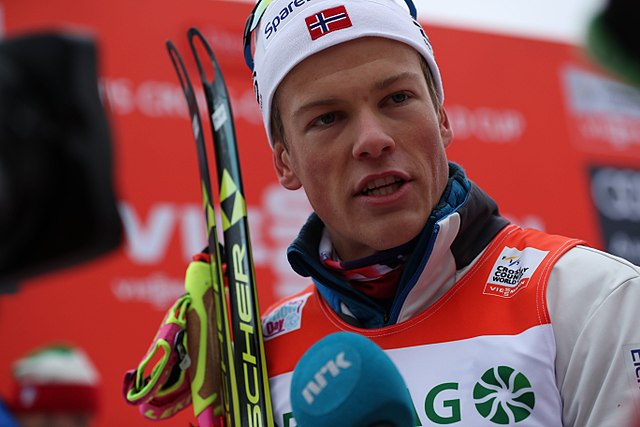
    Johannes Hoesflot Klaebo at one of his many post race interviews. (Photo: NordicFocus)

    Norway is a relatively small country: population 5.5 million, roughly the same as South Carolina. Not to throw shade on the Palmetto State, but you don’t hear about multiple South Carolinians obtaining global domination in their sports.

    When looking to explain how Norway has accomplished this, it’s easy to dismiss the cross-country success as a mix of access to snow, a national ethos of embracing outdoor activity, and being a wealthy country. But what’s the explanation for chess domination? It’s not exactly in keeping with the stereotypical view of the rugged outdoor Norwegian. Is there something in Norwegian water? Is there some kind of hyper-competitive Norwegian gene? Who knows, but there might be some lessons the rest of the world can learn from Norway. In the meantime, while the rest of the world tries to figure it out, Klaebo and Carlsen can have their own competition about who is the most dominant Norwegian in their sport. As of now, Klaebo is in the unusual position of having a little catching up to do.

  • Musgrave! Brit Takes Second in Trondheim Skiathlon

    Musgrave! Brit Takes Second in Trondheim Skiathlon

    This coverage is made possible through the generous support of Marty and Kathy Hall and A Hall Mark of Excellence Award. To learn more about A Hall Mark of Excellence Award, or to learn how you can support FasterSkier’s coverage, please contact info@fasterskier.com.

    On Saturday in Trondheim, Norway, the first Skiathlon of the year was held. Competitors skied a 10 kilometer Classic leg followed by a 10 kilometer Freestyle leg. In the men’s race, the prevailing question was which Norwegian would win? The last time a non-Norwegian male won a distance World Cup competition was 24 races ago going back to February 2022. The Norwegian winning streak has gained a kind of life of its own with spectators and pundits wondering when, and if, it will end. The other big question was how would Joannes Hosflot Klaebo (NOR) perform? When there’s a Sprint race, everyone expects Klaebo to win—a distance race— not so much. This year his best distance finish was seventh place. His Skiathlon performances have been erratic. The last time he raced a Skiathlon in the World cup, he failed to finish. However, he did have a second place finish in the World Championships last year. So, the range of predictions were quite diverse.

    The weather was a factor with mist and temperatures in the mid-40s leading to klister becoming the only option for the Classic leg. The weather notwithstanding, form was maintained today as Klaebo took the top spot on the podium. A non-Norwegian was able to fight to the podium with Andrew Musgrave (GBR) taking second. Didrik Toenseth (NOR) was third.

    Andrew Musgrave (GBR) was able to overcome a bad ski exchange to pull out a second place finish. (Photo: NordicFocus)

    The Americans threw everything they could at the race, fielding seven skiers: the second largest representation by country in the race— behind only Norway. The top American finisher was Ben Ogden in 17th, 1:30 off the lead. Gus Schumacher was 32nd, Scott Patterson, 41st, Zanden McMullen, 45th, JC Schoonmaker, 50th, Luke Jager, 52nd, and John Steel Hagenbuch 56th.

    The top Canadian finisher was Antoine Cyr in 21st. He was followed by Olivier Leveille in 43rd.

    Ben Ogden (USA) (bib 26) was the top American, finishing 17th (Photo: NordicFocus)
    Men’s 20 k Skiathlon

    The men began at a somewhat aggressive pace with Andrew Musgrave (GBR) and Johannes Hoesflot Klaebo (NOR) setting the early pace. Very early on it was clear that some racers were going to have a long day, having missed the kick wax. U.S. coach Chris Grover was able to add some insight into the kick wax scenario.  “We had gotten some rain and things were beginning to transform,” he said. “It was tricky because there was a colder snowpack underneath. The guys ran into some klisters that were icing and some that were going pretty good, so hats off to the service team. It was an absolutely huge day for the service team in terms of ski preparation.”

    At a relatively early point, 2.1 kilometers into the race, the pack began to get strung out a little, Calle Halfvarsson (SWE) moved to the front with Klaebo. Halfvarsson would make himself a presence toward the front for much of the race.

    The course had several spots where World Cup overall bonus points were awarded. Klaebo pushed to the front to take the lead at the first bonus point marker at 3.9 kilometers, which put the rest of the field under additional stress. Awarding bonus points seemed to have had its desired effect of keeping the field motivated to race hard the entire way.

    After the bonus point sprint, things settled back down a little and Musgrave went back to the lead. Musgrave has definitely become a fan favorite over the years having taken on the role of the plucky underdog. But today, he was determined to prove that he was more than that. At 4.7 kilometers he had pushed to the front and looked very strong. At this point the top American was Ben Ogden in 17th.

    Ogden continued to hang with the main pack, and at 7.2 kilometers he was only nine seconds off the leaders. But at the front it was Klaebo and Musgrave continuing to force the pace jockeying back and forth for the lead. The hard pace continued to string out the field even further. At this point, other than Musgrave, the only non-Norwegians at the front were Halfvrasson and Jens Burman (SWE). Ogden was still going strong, hanging with the lead pack.

    When the skiers were a kilometer from the ski exchange the leaders turned up the pace even more. Klaebo clearly wanted to lead entering the stadium ski exchange. As they entered the stadium, there was a group of about 14 skiers in the lead, with Klaebo going to the front of the pack. Klaebo was first out of the ski exchange along with about half a dozen countrymen. Ogden was in 18th, 21.5 seconds off the lead.

    Andrew Musgrave (GBR) lost valuable time in the ski exchange when he couldn’t get his boot into the binding. However, he refused to let that stop him on his march to the podium. (Photo: NordicFocus)

    Musgrave had a troublesome ski exchange, and it almost cost him dearly. He fumbled the switch from Classic to Skate skis struggling to get his foot into the binding. This cost him precious seconds. The lead group left the ski exchange without him.

    Grover provided some insight to FasterSkier about how the new fluoro rules could cause ski exchange problems. He said that, “the Skate skis can be placed in the transition up to ten minutes before the start of the Skate leg. In the past, athletes placed their own Skate skis in their pits for the exchange, and now coaches or technicians do that after they’ve already started.” He pointed out that this could lead to unintended consequences, “it’s the first time [Musgrave] hasn’t placed his own skis in the exchange. Athletes have different styles in how they set up their skis, whether they straddle one of them and they move right to right, or they come in and they straddle both on the outside and jump to the Skate skis on the inside.” There is time to practice the transition, but it’s a format the athletes don’t often encounter. Also, it’s a challenge for smaller staffed teams like Great Britain. Grover noted that the U.S. has the resources to fine tune the transition to a great extent. He said that, the American athletes coordinate with their coaches ahead of the race. “Last night, we had a fun homework assignment during the team meeting. Everyone who was racing drew a diagram of how they like their skis positioned. Jason Cork processed everybody’s [preferences], so it was in one place digitally. So we had a digital file of how every athlete wanted their pit set up.” He observed that smaller teams might not have the resources to prepare in such detail.

    Freestyle Leg

    Musgrave’s troubles meant that he had come out of the ski exchange ten seconds off  Klaebo’s lead, and was forced back to the second chase group. By the time the leaders reached the 12.1 kilometer mark, it was a red Norwegian wave with Klaebo and Didrik Toenseth (NOR) leading. Burman and Halfvarsson were still in the top ten to break up the sea of red uniforms. The early pace had definitely taken its toll. The group of fourteen skiers was now down to eight with Toenseth and Klaebo setting the pace at the front. Musgrave had used the two kilometers since the ski exchange wisely and done an admirable job of working his way back to join the lead group, but he had clearly expended a lot of energy doing so.

    Johannes Hoesflot Klaebo (NOR) stayed near the front the entire race. He didn’t take any chances as he surged at the finish and had enough time to look over his shoulder and wave to the crowd. (Photo: NordicFocus)

    At 13.3 kilometers a small crack in Norway’s armor began to show as Burman and Halfvarsson were skiing fourth and fifth, refusing to let the Norwegians completely dominate. Musgrave had efficiently clawed his way back into contact with the lead group and was gathering himself as the Norwegians continued to set the pace at the front. Ogden was still skiing well, in 20th, but only 42 seconds off the front.

    Musgrave continued to push and at 15.4 kilometers had worked to put himself into the lead. It was an impressive comeback for the British skier as he had worked hard to overcome his earlier mistake. He was now working with Klaebo and Toenseth to keep the speed high. At 16 kilometers there was another bonus sprint which increased the tempo again. Now the pack had broken into a group of five: three Norewegians, plus Musgrave and Halfvarsson.

    With 3.3 kilometers left, Harald Oestberg Amundsen (NOR) went to the front, knowing that he had to establish a gap over Klaebo to have a chance at the finish. The back and forth was relentless with Musgrave then moving to the lead with the three Norwegians on his tail. Halfvarsson had been gapped and couldn’t keep with the group, though he gamely tried to rejoin it. It was now the three Norwegians at 18 kilometers chasing Musgrave!

    With one kilometer left, the back and forth continued with Klaebo moving to the front. It was still the three Norwegians and Musgrave. Simen Hegstad Krueger (NOR) and Klaebo now traded places at the front with all four skiers forming one pack. In the final climb leading into the stadium it was three skiers spread across the front; Musgrave, Klaebo, and Krueger. All the racers knew that unless they had a gap on Klaebo their chances were slim in a sprint finish. Coming into the stadium Klaebo put in one of his trademark moves and tried to bury the field using the big downhill into the stadium to create a gap. As usual, his strategy was successful and he created separation between himself and the other contenders. On the final turn, Musgrave went wide and lost some speed. It probably didn’t matter as Klaebo had established a big enough lead to wave to the crowd as he crossed the finish. Musgrave had been able to fight forward for second place, with Toenseth taking third. It was a dramatic finish that thrilled the local crowd and kept Norway’s winning streak intact. But Musgrave had proven that there was at least an opportunity for a non-Norwegian to fight for the top spot.

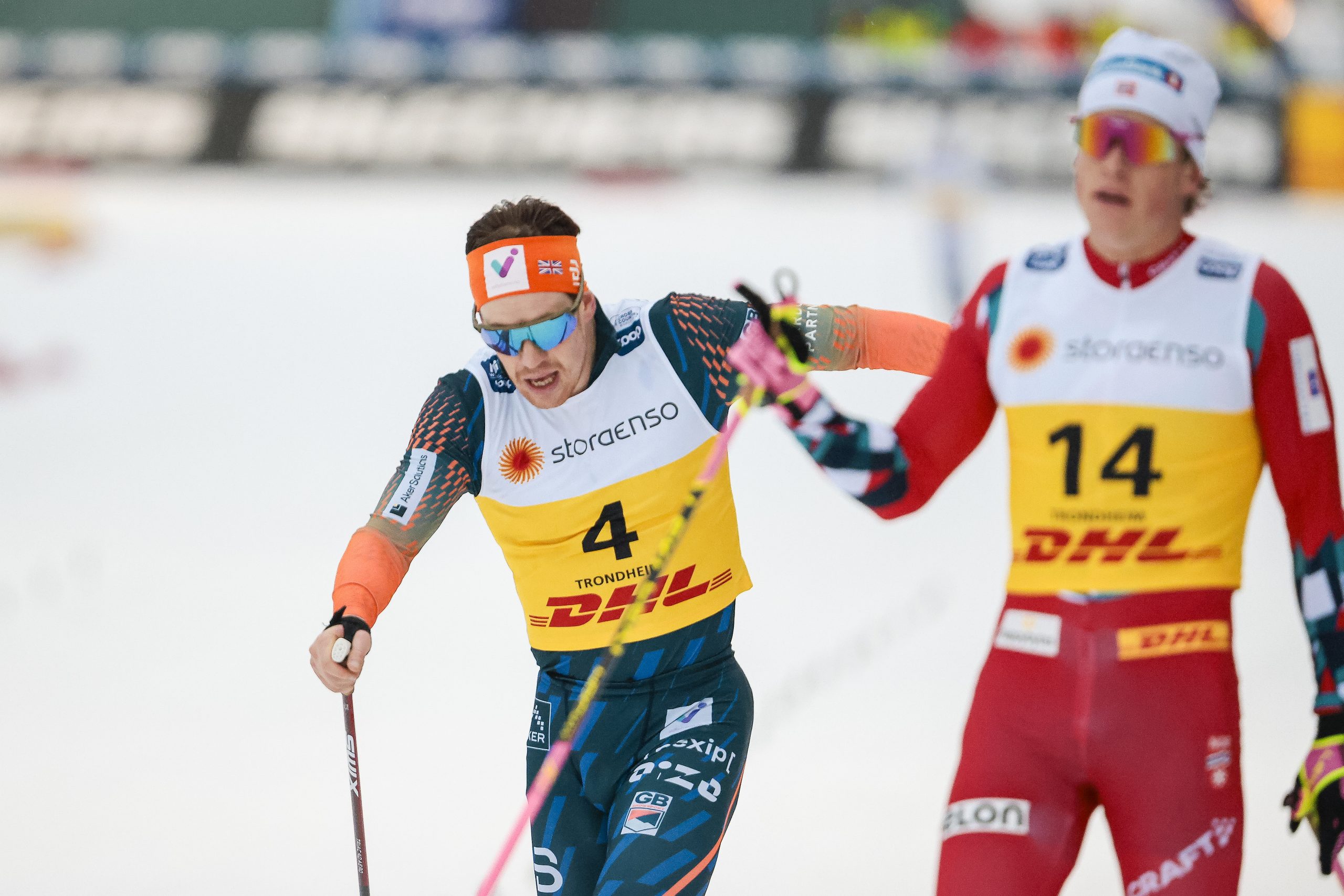
    Andrew Musgrave (GBR)(number four) turned what could have been a disastrous ski exchange into a glorious podium finish. (Photo: NordicFocus)

    Ogden’s sixteenth place was the highlight for team USA. It was a very exciting race; as the Skiathlon often is. The hometown crowd came away pleased, and the Americans saw promise in it’s future with Ogden continuing to ski well.

    Disaster during the race was barely averted when climate protesters attempted to string a barrier across the course. “On the Classsic loop, a couple of guys tried to stretch a chain or a wire across the course, but luckily some locals tackled them, American coaches told FasterSkier. “I’m very sympathetic to climate change, but I’m also sympathetic to the athletes having a safe competition and being able to compete . . . “They tried to interrupt it just as the skiers were about to get to that point, and the protesters were pushed aside, so it didn’t impede the race.” It was a close call for skiers, and FIS will have to do something to address this situation.

    Men’s 20 k Skiathlon RESULTS


  • Great Day for USA! Schoonmaker Podiums in Classic Sprint, Ogden Fourth

    Great Day for USA! Schoonmaker Podiums in Classic Sprint, Ogden Fourth

    This coverage is made possible through the generous support of Marty and Kathy Hall and A Hall Mark of Excellence Award. To learn more about A Hall Mark of Excellence Award, or to learn how you can support FasterSkier’s coverage, please contact info@fasterskier.com.

    In what has already been an action packed season; it’s hard to believe that this is only week three of the World Cup season. This weekend’s venue is Oestersund, Sweden where the Classic Sprint competitions were held. The question going into the men’s race was whether Johannes Hoesflot Klaebo’s (NOR) return to the World Cup circuit, after a brief hiatus to deal with Covid, would also mark his return to Sprint domination. Two weeks ago, in Ruka, he finished third in the Classic Sprint—his worst Sprint finish since 2018—a red flag that something wasn’t right.

    JC Schoonmaker (USA) had a breakout day reaching the podium for the first time. The American took third place. (Photo: NordicFocus)

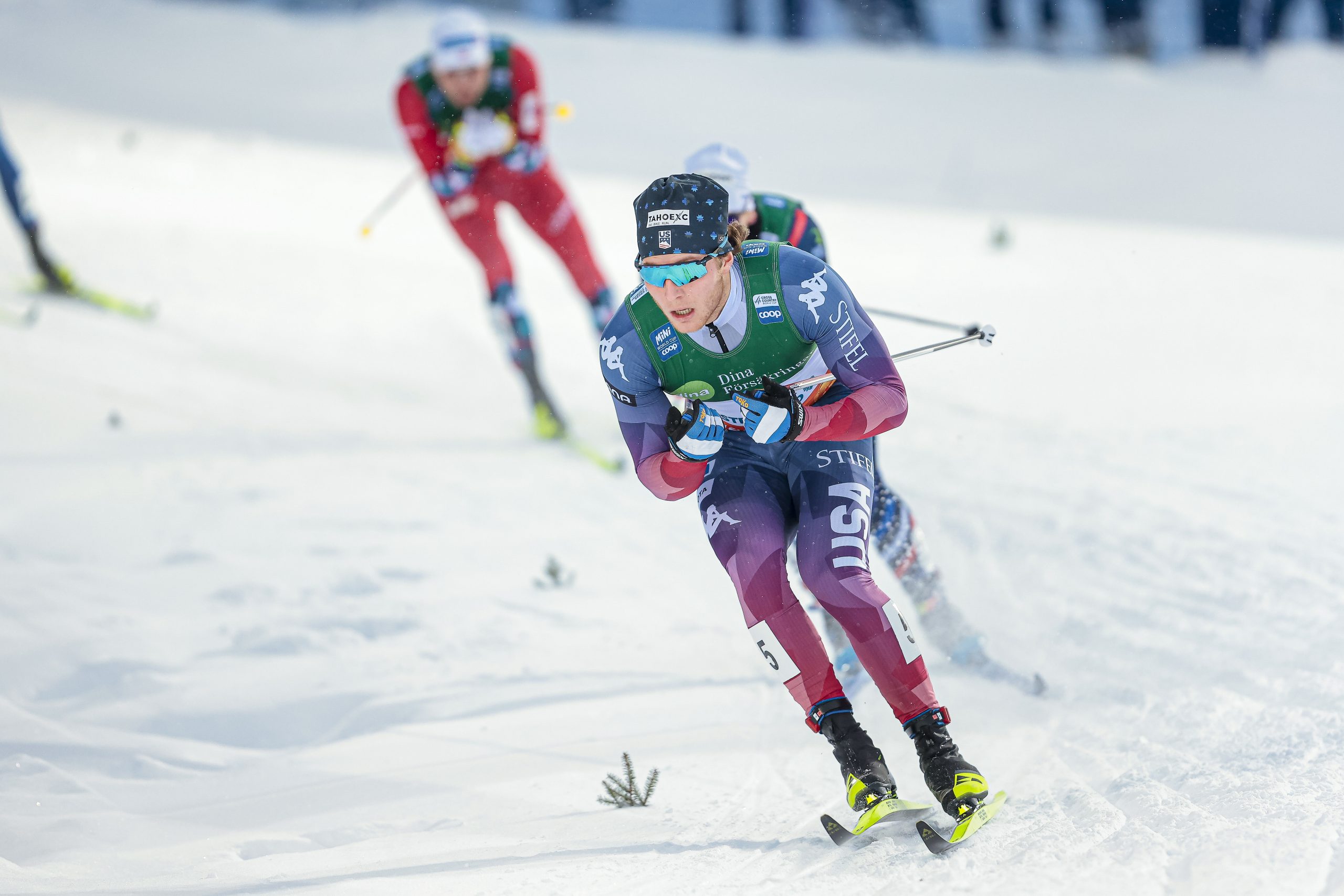
    America’s hopes were riding on Ben Ogden and JC Schoonmaker. Ogden had finished 11th in the Classic Sprint two weeks ago, and hopes for him were high. Ogden has thrilled fans with many exciting races, but team USA was hoping that he would be able to find a way to the final round. To do that, he would need to break through a field with eight Norwegian contenders having advanced beyond the qualifying round. JC Schoonmaker would also carry the American hopes into the finals.

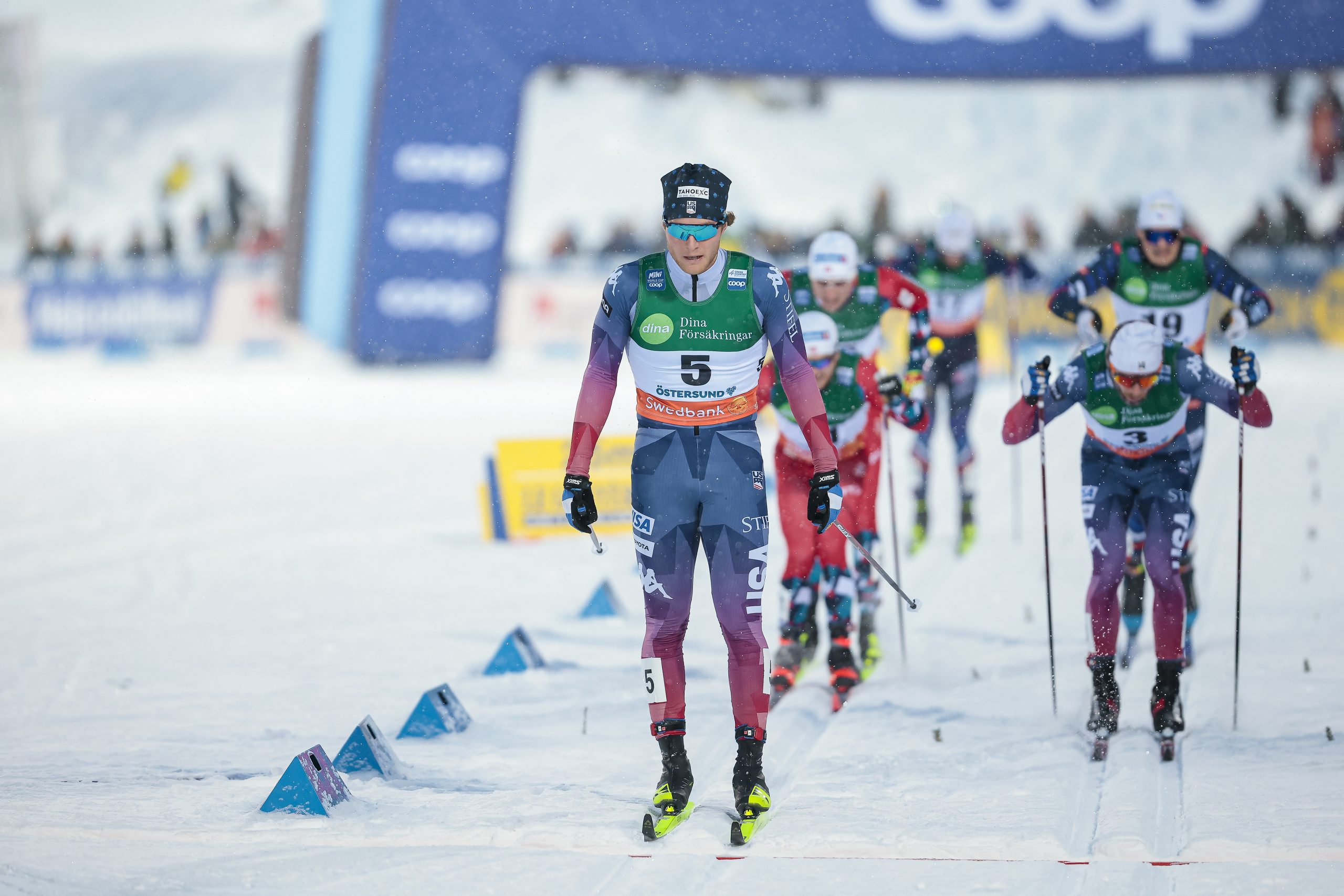
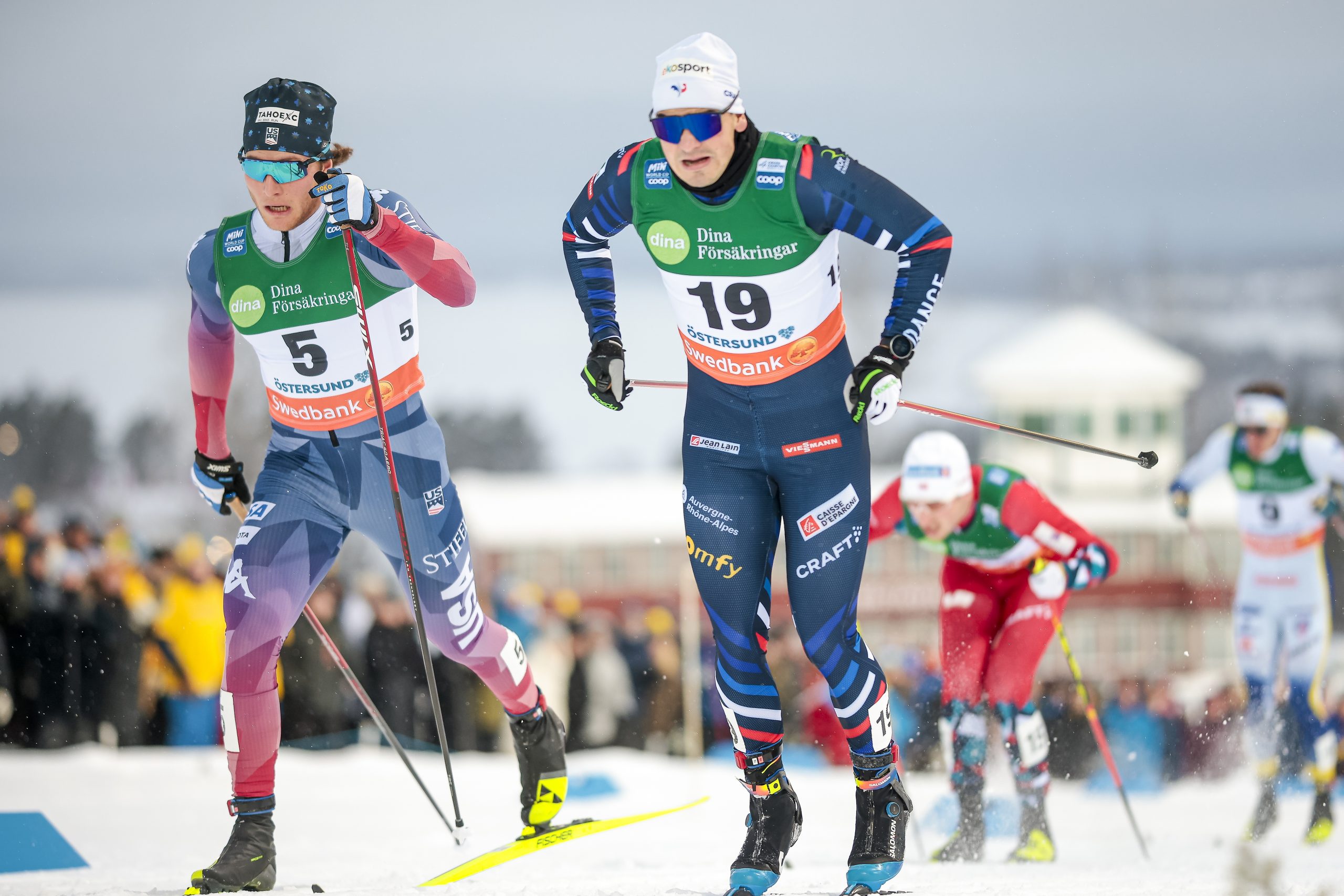
    It ended up being a great day for team USA. In the finals it was Klaebo first, Erik Valnes (NOR) in second and JC Schoonmaker (USA) taking third with his first ever World Cup podium. Ben Ogden finished fourth. Other American finishers were Gus Schumacher 39th, Zanden McMullen 43rd, Luke Jager 52nd, Kevin Bolger 59th, and Will Koch 68th.

    The top Canadian finisher was Antoine Cyr in 16th. Other Canadian finishers were Xavier McKeever 43rd, and Leo Grandbois 65th.

    Men’s Classic Sprint

    Two Americans qualified for the heats: Ben Ogden, who was third in the qualifiers drew the fifth heat, with JC Schoonmaker, who was fifth in the qualifiers, drawing the fourth heat.

    JC Schoonmaker (USA) was dominant in the heats—winning his semifinal and finishing in a photo-finish to take second in his quarterfinal. (Photo: NordicFocus)
    Sprint Quarterfinals

    The questions about Klaebo would be addressed in the first heat, where he was up against countryman, Valnes. Iivo Niskanen (FIN) set the early pace trying to take advantage of his expert Classic technique, but he couldn’t hold off the hard-charging Norwegians. At the finish, Valnes and Klaebo broke away from the field taking 1-2. At this point, it appeared that Klaebo was back in form. Not that he needed it, but Klaebo might have had a little extra incentive today. If he won, he would break the tie he was in with Marit Bjorgen (NOR) for the most individual World Cup Sprint wins.

    In the second heat, the hometown crowd was treated to a thrill as two Swedes dominated with Calle Halfvarsson and Oskar Svensson taking first and second.

    The third heat saw the lone Canadian qualifier, Antoine Cyr, jump out with the leaders. He hung with the front pack throughout the race, and at the end of the heat finished third and held a position as a lucky loser which might have allowed him to advance; however, other racers later supplanted him, and he ended up finishing 16th.

    JC Schoonmaker (USA) and Jules Chappaz (FRA) (right) dueled in the quarterfinal. (Photo: NordicFocus)

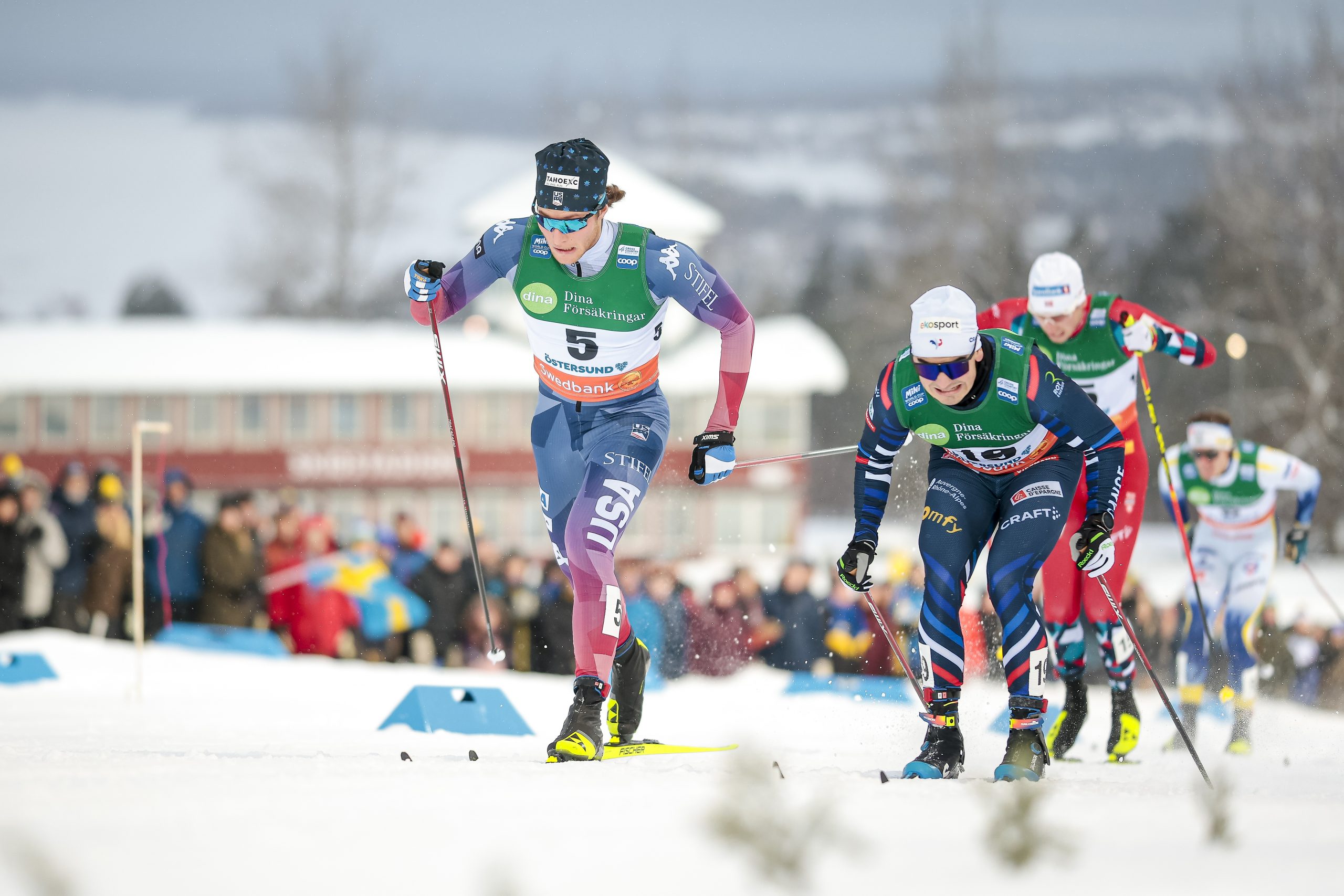
    The fourth heat was a thriller as Schoonmaker took the lead from the start, the rest of the field filing in right behind him. Schoonmaker continued to press from the front the entire way and began to split the field, but at the two minute mark the Frenchman Jules Chappaz took the lead with Schoonmaker now second and Norwegian Even Northug closing on him. The three battled it out at the finish. It was Schoonmaker putting in a tremendous double pole burst at the end, finishing in a photo finish with Northug. Northug took the photo for first, but Schoonmaker’s second place finish would move him forward. Chappaz held on for a lucky loser position.

    Ben Ogden (USA) (far right), needed some last second heroics to advance out of his quarterfinal (Photo: NordicFocus)

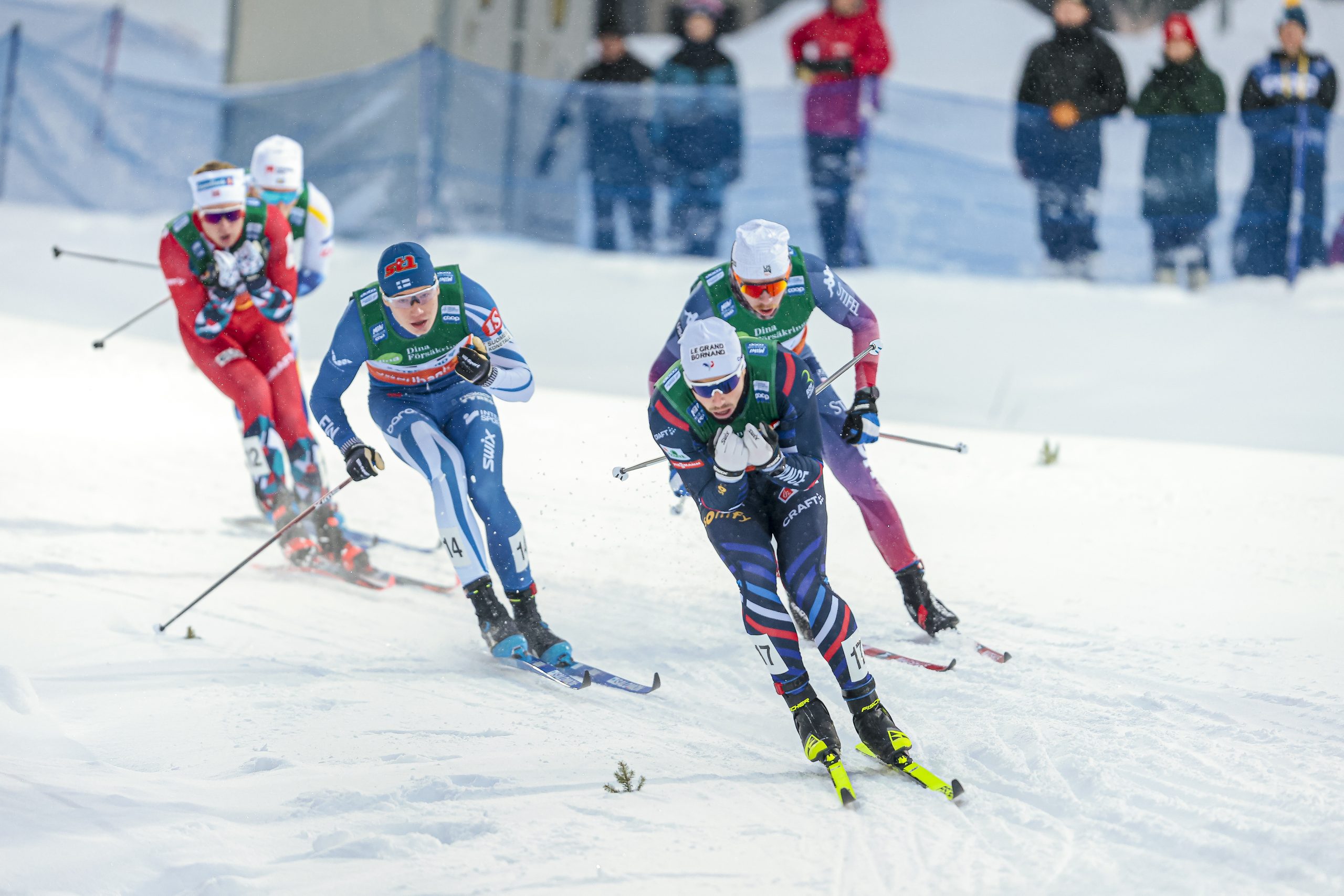
    The final heat featured American Ben Ogden. He replicated what seemed to be the American strategy today by going to the front quickly. Veteran Lucas Chanavat (FRA) was able to push the pace and Ogden could not hang with the group as he began to drift and was fourth two minutes into the race. At this point, two racers went down, thinning the field. Marcus Grate (SWE) dropped out with an injury, and Niilo Moilanen (FIN) got tangled, fell, and was dropped. This provided the breathing room Ogden needed; when it looked like Ogden wasn’t going to advance, he was able to pick his way through the crowd, put on a quick burst and found the finish line first. It was an inspiring comeback.

    Two Americans would advance to the semi-finals in a Classic Sprint. An historic event for team USA.

    James Clinton Schoonmaker (USA) brought his racing to a new level, and with it, a podium finish. (Photo: NordicFocus)
    Sprint Semifinals

    Klaebo landed in the first semi-final with two other Norwegians and three Swedes. Klaebo went right to the front along with countryman Erik Valnes. It was a very moderate pace for the first half of the race when Klaebo then decided to push the pace by maximizing his speed on the downhills. He put in a quick turn of pace and was quickly able to gap the field. Klaebo appeared to be his old self easily winning the race. Valnes finished second.

    Both Americans were in the second heat and faced a very challenging field of Northug, Haavard Taugboel (NOR), Chanavat, and Jules Chappaz (FRA). Two Americans, two Norwegians, and two Frenchmen.

    Ogden went to the lead early along with Schoonmaker. It was Americans 1-2 early on as they established a bit of a gap on the field. Schoonmaker continued to press and was able to maintain the lead. Ogden then found himself trapped in a corner but was able to push his way through the field. Schoonmaker continued to push and finished first in dominating fashion. Ogden was able to hang on for second. It was team USA 1-2 in the semifinal!

    Happy finishers, as Klaebo was able to put his health woes behind him and reasserted his position as the most dominant sprinter of all time. JC Schoonmaker (USA), Johannes Hoesflot Klaebo (NOR), Erik Valnes (NOR) (l-r). (Photo: NordicFocus)
    Sprint Final

    In the Sprint final, Schoonmaker and Ogden would face all Norwegians with Klaebo leading the way, along with Taugboel, Valnes, and Northug.

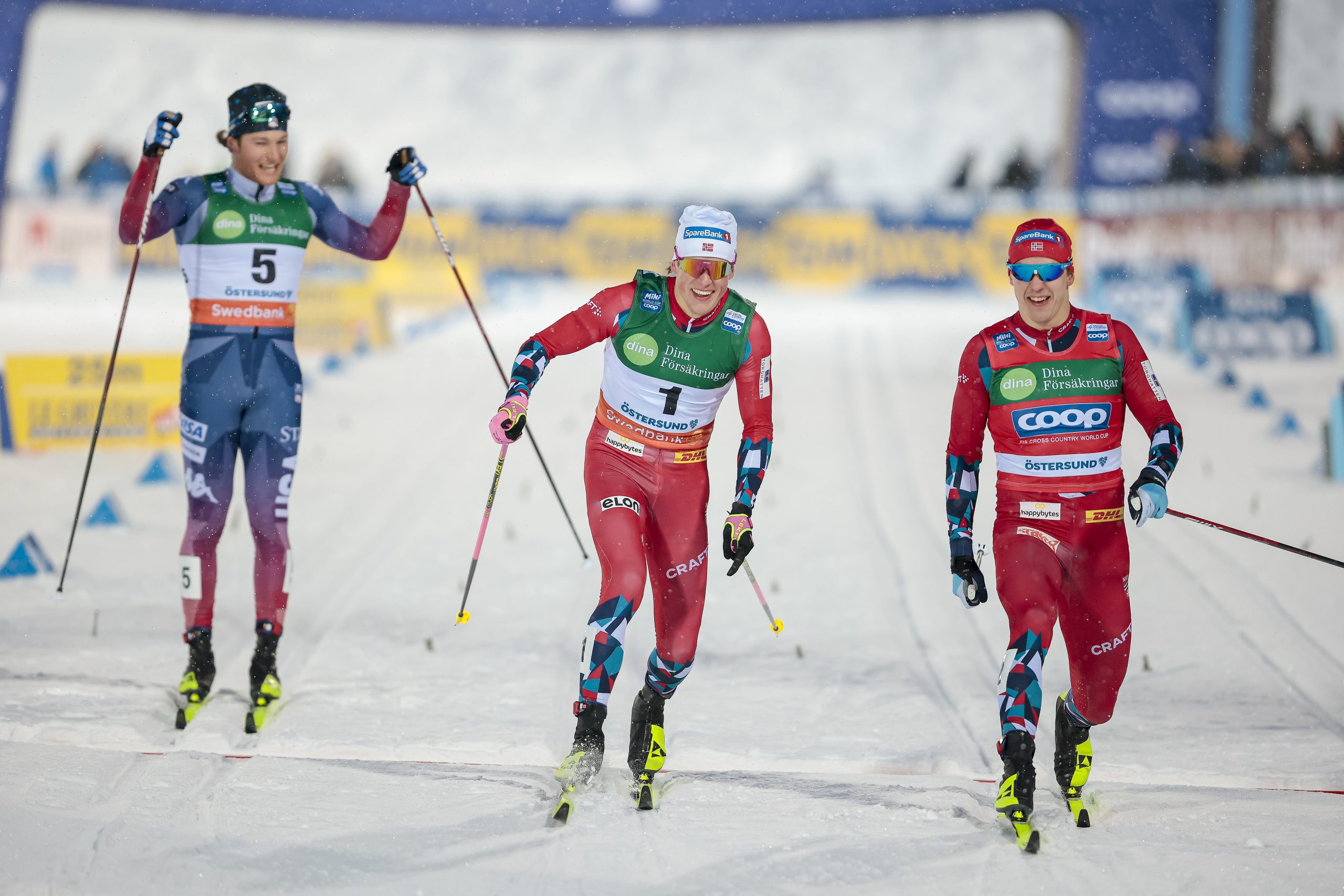
    Once again Klaebo went right to the front, but Schoonmaker was right behind him looking for an opening in which to pass. Ogden pressed forward coming up from the outside and joined the skiers at the front. Schoonmaker continued to push and at the 1:30 mark was ahead of Klaebo and punishing the field. Schoonmaker and Klaebo continued to fight hard for the lead. But Klaebo did what he does best: put in a burst and surge ahead of everyone. Schoonmaker was still holding on for a podium when Valnes passed him near the finish.

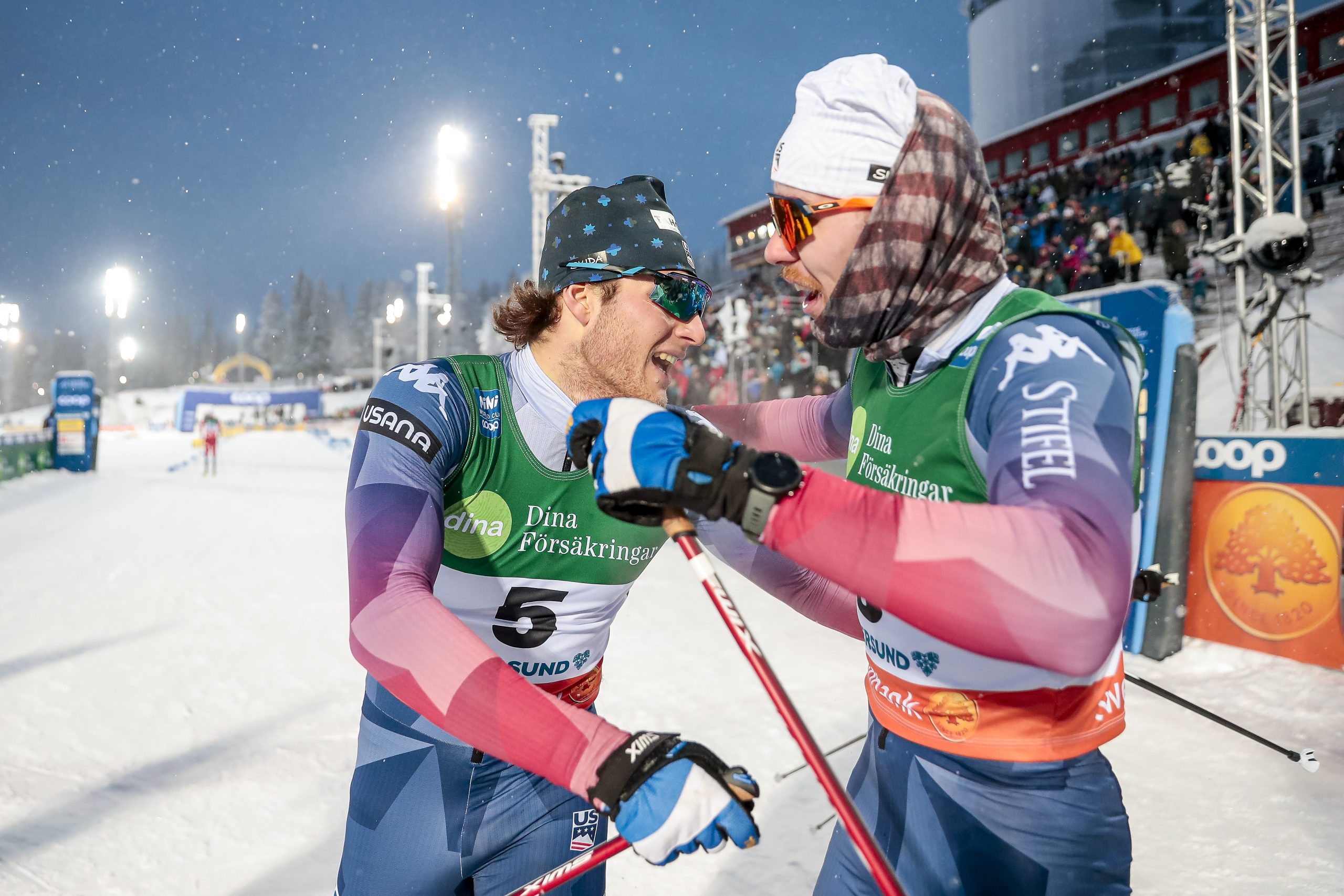
    JC Schoonmaker (USA) and Ben Ogden (USA) congratulate each other after an epic day at the Classic Sprints. (Photo: NordicFocus)

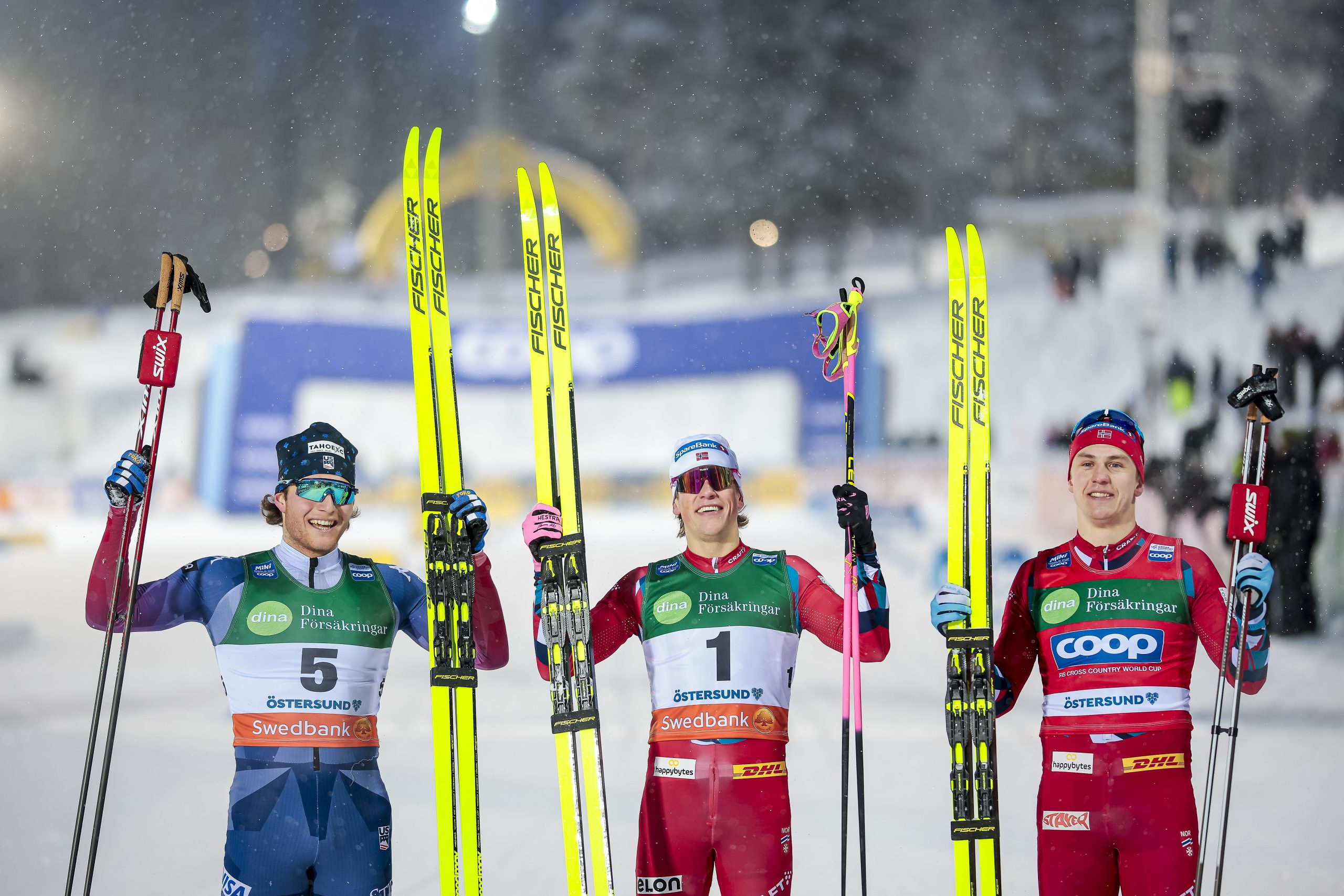
    Klaebo put the hurt on the field and was able to then coast to first. He erased any doubts that he was back in vintage Klaebo form. Valnes held on to second with Schoonmaker taking third. Ogden continued to ski strong and held on to fourth. It was a thrilling, emotional, and historic race for team USA.

    Regarding his first podium, Schoonmaker said that, “[it] just means so much to me that it’s hard to even describe. It’s been a dream of mine for a long time, so to get up there today and have Ben really close right with me is just such a sweet feeling.”

    Schoonmaker commented on his Classic Sprint success that, “I feel like I am probably a bit stronger in Classic than Skate right now, but also it’s hard to say considering we haven’t had a skate sprint yet this year.” He continued that, [I] definitely feel confident in both after a good race today and feeling like I’m in good shape at the moment.”

    He continued that the historic nature of having two Americans in a Classic final wasn’t lost on him; “Ben and I have both been looking to make it to the final now for a while and both of us getting it done on the same day is a dream scenario. I’ve been excited for U.S. skiing and U.S. men’s skiing for a while now but today has really stoked the flame and I feel more motivated to keep it up and more proud to be a part of it than ever before.”

    Ben Ogden also had opinions on today’s top finishes. He said, “I think it goes to show that Americans are so much stronger together. Today I never would have made it as far as I did if JC wasn’t there and I bet he feels the same. It was a truly spectacular day and it will make us want to do it all again that much more.”

    The performance inspired the entire team. Jessie Diggins said that, “those boys brought me to tears … that was amazing, they’ve worked so hard for so long, they’ve kept believing. To see JC get his first career podium … I’m going to remember that forever. I couldn’t possibly be more proud of both of them.”

    Check back with FasterSkier throughout the day as this story will be updated with quotes and comments from Team USA athletes and staff.

    Men’s Sprint RESULTS

    It was a breakout day for team USA with Schoonmaker finding the podium. James Clinton Schoonmaker (USA), Johannes Hoesflot Klaebo (NOR), Erik Valnes (NOR), (l-r) (Photo: NordicFocus)
  • In the Pink: Klaebo Secures World Cup Sprint Crystal Globe

    In the Pink: Klaebo Secures World Cup Sprint Crystal Globe

    This World Cup coverage is made possible through the generous support of Marty and Kathy Hall and A Hall Mark of Excellence Award. To learn more about A Hall Mark of Excellence Award, or to learn how you can support FasterSkier’s coverage, please contact info@fasterskier.com

    Number one, indeed. The World Cup Sprint performances of Johannes Hoesflot Klaebo leave little doubt. Photo: Modica/NordicFocus)

    By this time in his storied and much-decorated career, Johannes Hoesflot Klaebo (NOR) definitely knows his way around a bottle of champagne. Given enough time on World Cup podiums (as Klaebo has had), an athlete will come to master the sharp-ended wire frame, the peelable foil cover, the strategic shake, the effective cork leverage, the spray-inducing thumb position. Klaebo has it down . . . in Lahti, he had his bottle primed, opened, aimed, and sprayed before the other athletes on the World Cup Sprint Crystal Globe podium—Lucas Chanavat (FRA) and Even Northug (NOR)—had even finished picking at the foil. As has so often been the case in Klaebo’s World Cup sprint career, the other guys really never stood a chance.

    On Saturday, Lahti, Finland played host to the final FIS World Cup Sprint; a day when the women’s Sprint crown was decided by the narrowest of margins while the men’s Crystal Globe was awarded to an athlete who won by a mile. At only 26 years of age, Klaebo delivered his 10th Individual Sprint victory of the season, and his 67th career World Cup victory in 126 starts—an almost unheard of level of dominance and consistency. This weekend, he’ll collect both the Sprint and Overall crystal Globes after a season in which he was a contender for the podium each time he toed a starting line. It’s been a long journey, and one that FIS’ point-awarding policies seemed intended to make far more difficult for him that it turned out to be. Even the necessity of racing practically every event on the World Cup calendar could not wear him down.

    “I’m looking forward to get done now,” Klaebo admitted in post-race interviews. “It will be great to finish the season now, and have some days off.”

    Ben Ogden (USA) leads Ville Ahonen (FIN) and Harald Oestberg Amundsen (NOR) in their World Cup Sprint quarterfinal. Ogden qualified seventh, and would finish 13th on the day, securing his 10th place position in the season-long World Cup Sprint standings.

    Ben Ogden (USA) finished 13th on the day, having led in his quarterfinal, but not at the frenetic pace he’d shown in heats earlier in the season. Ogden avoided a fall by Niilo Moilanen (FIN) on the course’s crucial downhill hairpin, but mistimed his lunge at the finish line where he was overtaken by Simone Mocellini (ITA) for the second automatic qualifying spot. Ogden’s finishing time would not be fast enough to earn a lucky loser spot.

    Other American finishers included Zak Ketterson 28th, JC Schoonmaker 33rd, Kevin Bolger 48th, and Luke Jager 58th. Canadian finishers included Antoine Cyr 23rd, Graham Ritchie 42nd, Xavier McKeever 50th, and Russell Kennedy 67th.

    Men’s Individual Classic Sprint

    Wet crystalline snow made Lahti’s sprint course very fast, but treacherously variable. Surface irregularities—combined with the necessary finesse of klister skiing—proved to be a consistent and frustrating challenge for many racers. Lots of skiing outside the tracks, lots of tripping over klister, lots of embarrassing falls—some of the world’s best sprinters tripping onto their faces, flopping onto their backs—especially in the variable snow of the crucial hairpin turn. A day with snow conditions like these—one in which so many of the racers were choosing to ski outside the classic tracks—also provided far more potential for yellow cards; there were a remarkable number of them, resulting in the rarity of two disqualifications—Simone Mocellini (ITA) and Edvin Anger (SWE)—in the semifinals.

    Lahti’s sprint course is one in which so much speed can be found in the finishing features, including the slipstream downhill to a righthand hairpin where so much of the action—and so many of the mishaps—takes place. Calle Halfvarsson (SWE) dove to the inside line on the hairpin in his quarterfinal (after having looked flat and disinterested for much of the heat), and managed to make it work. Jules Chappaz (FRA) chose the inside line, and fell in avoiding a tangle (though he’d pop up to finish third in his quarterfinal). Sindre Bjoernestad Skar (NOR) fell in the hairpin, but recovered in time to finish second in his quarterfinal. As usual, Klaebo followed no one else’s example, generally choosing the extra-wide line around the hairpin, allowing him to maintain speed that others had scrubbed.

    “[It’s] really far from the top all the way to the finish area,” Klaebo said, describing Lahti’s sprint course. “[There are] a lot of tactical aspects of it.”

    The speed Klaebo maintains always seems crucial to his success, and his tactical acumen—combined with his nimbleness and vision—makes him almost unbeatable. Tellingly, the few other racers who attempted Klaebo’s line foundered in soft snow and ended up on their backsides. As we’ve come to understand, only Klaebo can do what Klaebo does.

    Even among fields of crowded, competitive, jostling sprinters, Johannes Hoesflot Klaebo (NOR) often finds himself alone. (Photo: Modica/NordicFocus)

    In the final—five Norwegians and one lone Swede (Halfvarsson)—Klaebo led down the final downhill, his fast skis preventing other skiers from finding his slipstream and allowing him to pull clear of Halfvarsson before the crucial hairpin. Erik Valnes (NOR), Harald Oestberg Amundsen (NOR), and Even Northug (NOR) all  struggled through the crowded inside line on the hairpin, their battle for third nearly undoing them all. Halfvarsson steered clear of trouble and maintained his momentum. Klaebo’s oft-chosen wide line allowed him to carry speed down the final slope, and his unmatched double poling down the finishing stretch made the result a foregone conclusion. Halfvarsson’s own strong finish allowed him to remain ahead of Valnes who would cross the line in third.

    While the presentation of awards during the earlier Women’s Sprint Crystal Globe ceremony proved to be a somewhat confusing affair (even for the winners), the Men’s ceremony proved to be a more organized process leading to the predictable champagne-bottle battle. Again, no contest: Klaebo was spraying down his rivals before they’d even managed to make a move. He’d also been wise enough to hand off the precious Crystal Globe (perhaps the most fragile—and inexplicably top heavy—trophy in all of sport) before the champagne shenanigans began. Klaebo spends more time on podiums than anyone else; it comes as no surprise that his performance there would be flawless, as well.

    Men’s Classic Sprint QUALIFYING

    Men’s Classic Sprint RESULTS

    2023 FIS World Cup Sprint FINAL STANDINGS

    Calle Halfvarsson (SWE), Johannes Hoesflot Klaebo (NOR), Erik Valnes (NOR) celebrate at the finish line of the FIS World Cup Individual Sprint in Lahti, Finland. (Photo:  Modica/NordicFocus)