From the FasterSkier archive — posts syndicated from athletes’ and coaches’ own blogs between 2004 and 2012, kept online as published. Current coverage is at fasterskier.com.
This coverage is made possible through the generous support of Marty and Kathy Hall and A Hall Mark of Excellence Award. To learn more about A Hall Mark of Excellence Award, or to learn how you can support FasterSkier’s coverage, please contact info@fasterskier.com.
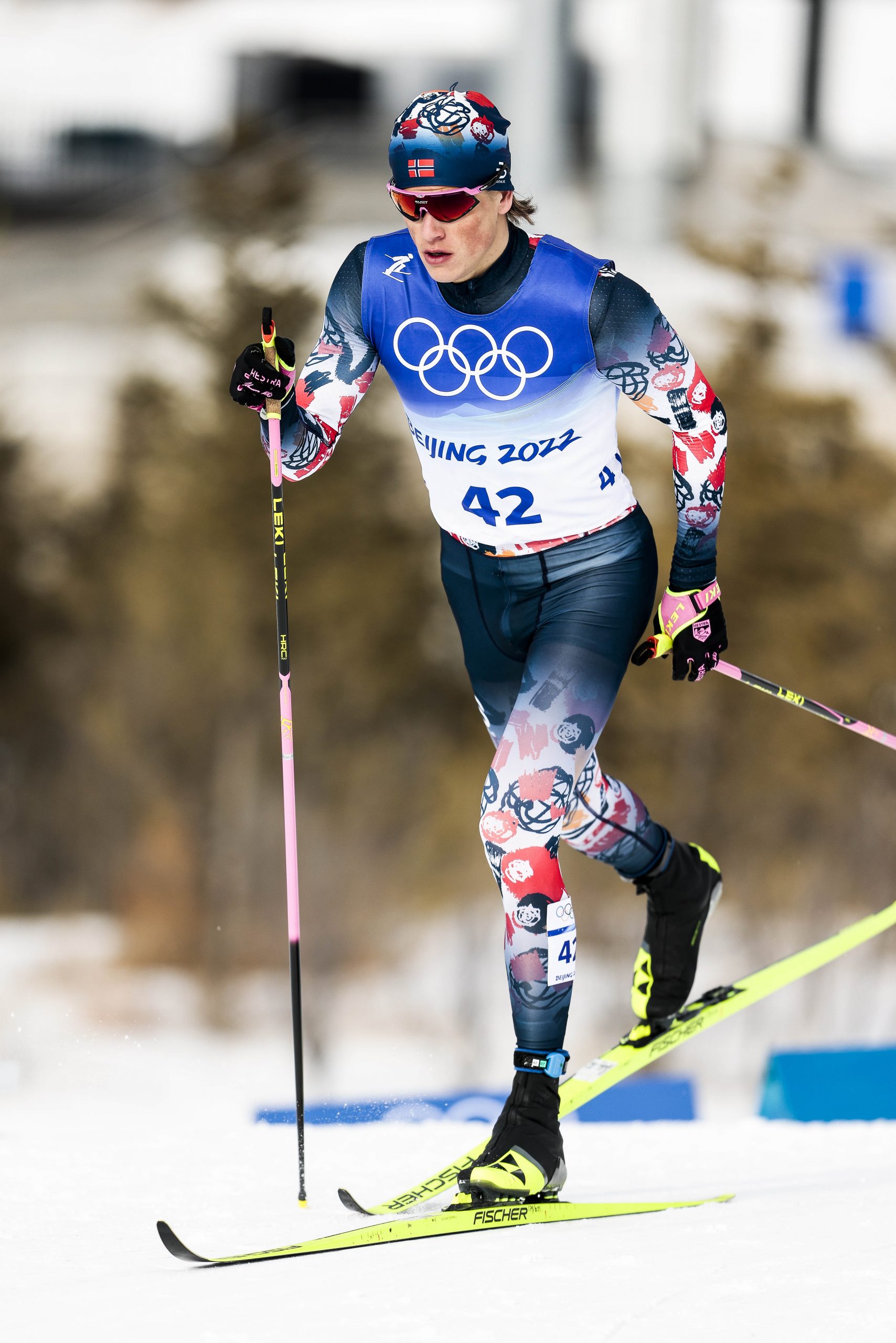
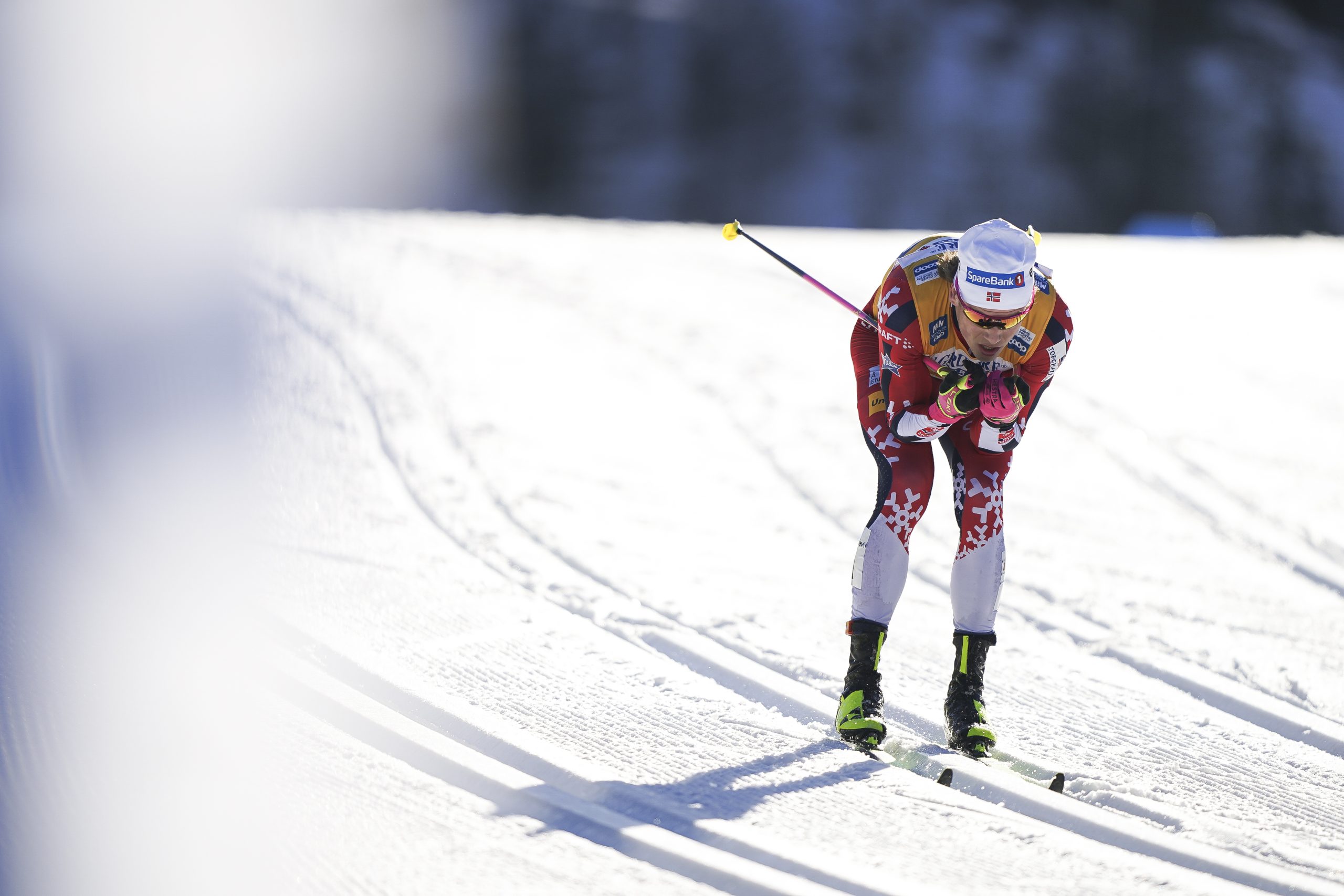
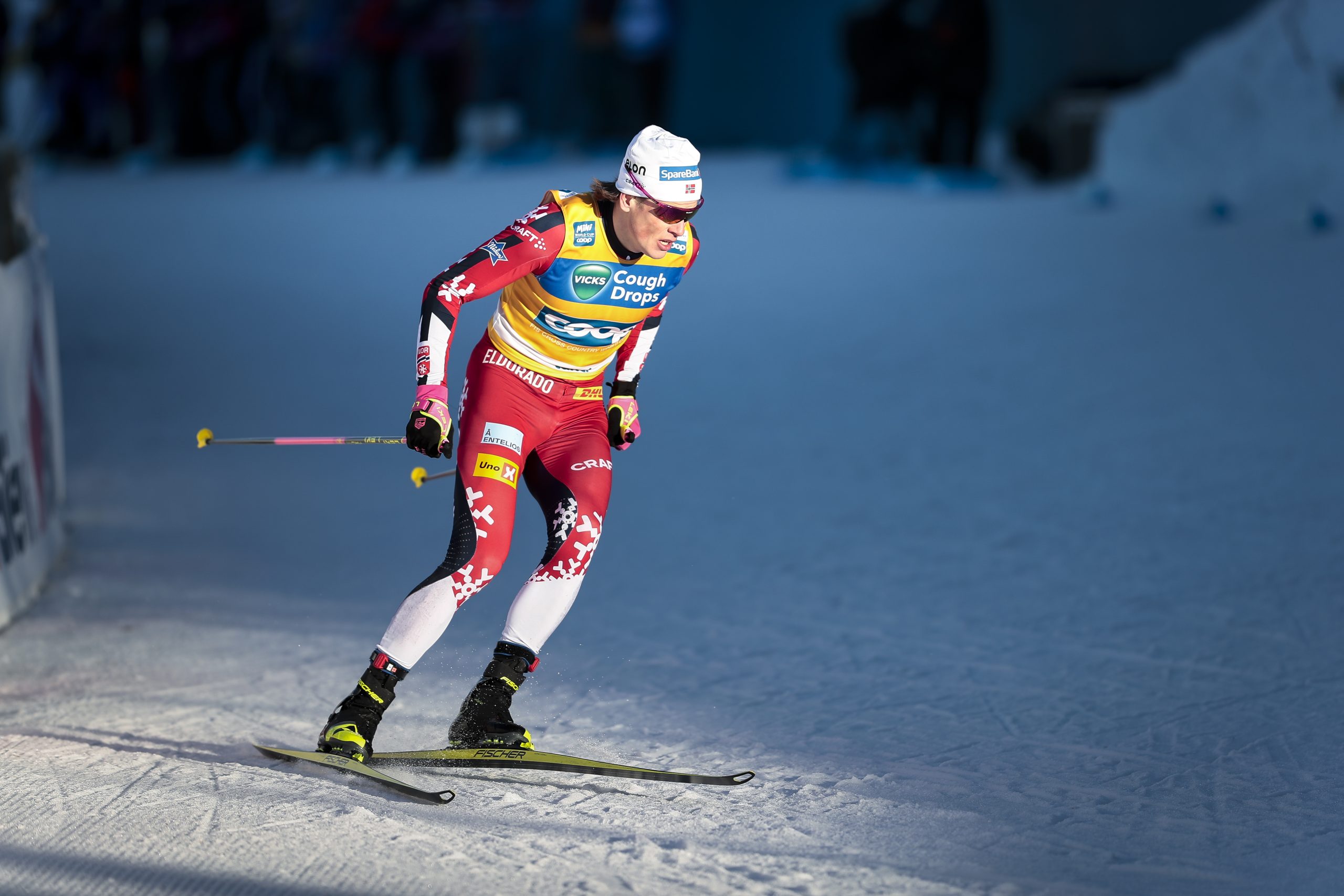
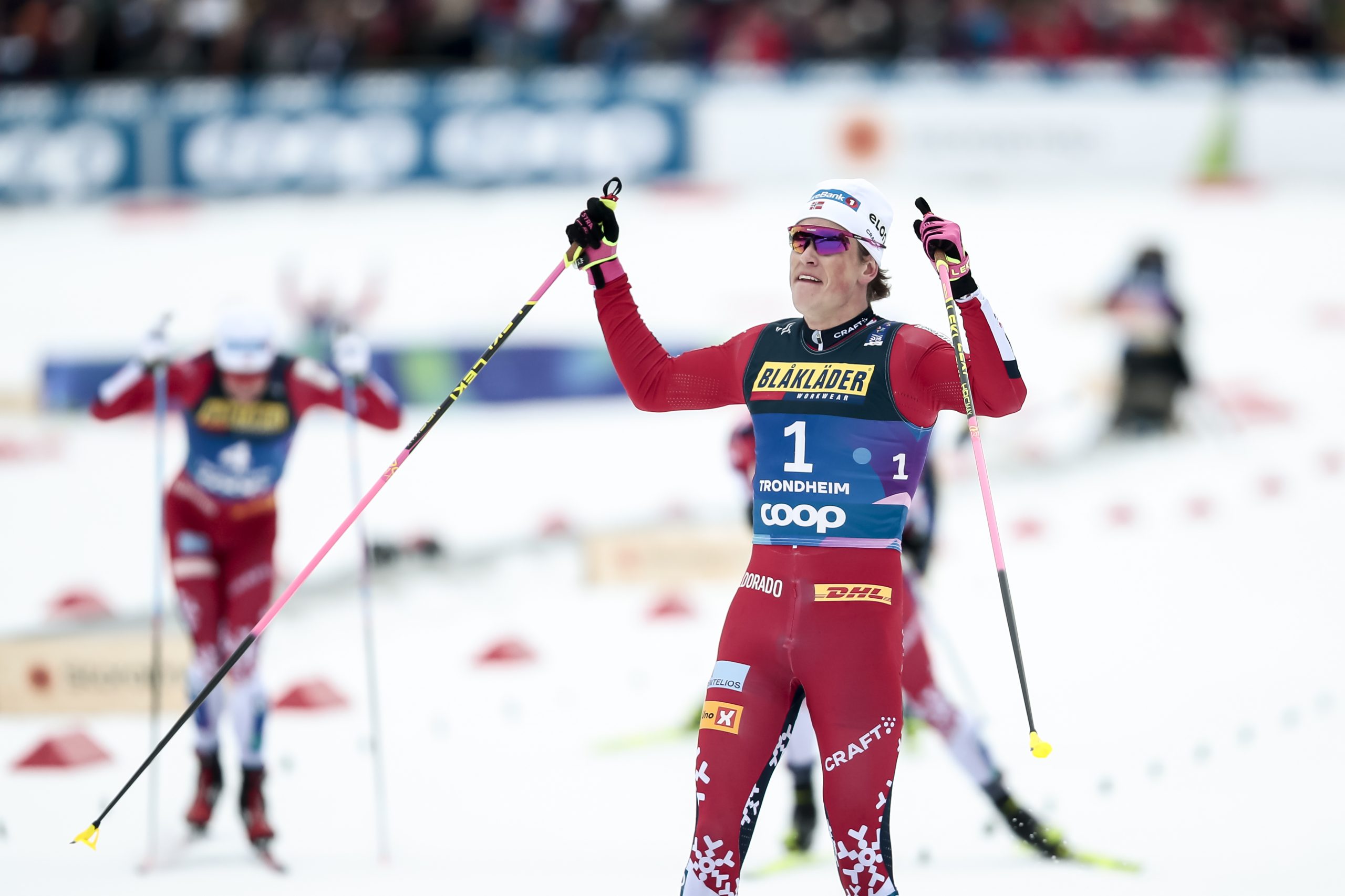
World Cup Sprinting can be a bit of a blur, but it’s typically easy to spot Johannes Hoesflot Klaebo (NOR) in his yellow World Cup leader’s bib. As many expected, Klaebo would finish the day with the win in Toblach. Photo: Vanzetta/NordicFocus)
Federico Pellegrino (ITA) has been a longtime rival, but always in silver medal position. Erik Valnes (NOR) has been a consistent challenger, but only found his way to the front once. Alexander Bolshunov (RUS) snatched an opportunistic Sprint win in Ruka a few years ago, but Bolshunov’s career seems to have ended with Russia’s ban from World Cup competition. Edvin Anger (SWE) declared himself the heir apparent, but he’s never been able to prove it. And Lucas Chanavat built a career on latching his ski tips to tails of Johannes Hoesflot Klaebo (NOR). One time—just two weeks ago in Davos—Chanavat managed to finish in front. But it was more an aberration than a changing of the guard.
If Klaebo needed a wake-up call, he got one in Davos where he failed to advance beyond a World Cup Sprint quarterfinal for only the second time in his unbelievable career. And the only other time he failed to advance? That was in his very first World cup start all those years ago in 2015. Since that inauspicious debut, he’s been all but unbeatable. It’s not exactly been an uninterrupted string of wins, but it has been a long and unprecedented display of dominance that appeared likely to continue through the Olympic Winter Games next month in Val di Fiemme. It appeared likely until two weeks ago in Davos, that is . . .
In Davos, it wasn’t as though any single skier managed to solve, undo, and finally dethrone Klaebo. But Klaebo’s unbelievable string of World Cup Sprint wins ended, nonetheless. He got uncharacteristically boxed in during his quarterfinal, slipped (and nearly fell) in the final turn before the finish, and found himself fourth in the heat and 17th on the day—not exactly Klaebo-like finishing numbers. Just like that, the amazing Klaebo-streak had ended.
In Toblach this morning, it appeared that Klaebo had shaken off the dust of his Davos failure, and was prepared to reassert himself in World Cup Sprinting. He made sure to ski at the front, setting a fast pace in both his quarterfinal and semifinal but in a manner that did not show his true dominance. In the final, he rocketed away from his rivals on the final uphill, and coasted across the line unchallenged by his podium mates, Lars Heggen (NOR) and Oskar Oppstad Vike (NOR). That’s the tactic we recognize; that’s the result we expect.
Lucas Chanavat (FRA) took the win two weeks ago in Davos. He appeared less sharp in Toblach, finish the day in fifth. (Photo: Vanzetta/NordicFocus)
Sprint Heats
It began as a big day for the Americans with four skiers qualifying for the heats. The day’s second fastest qualifier, Schumacher would advance into the semifinal, ultimately finishing 11th. Ben Ogden would finish the day 13th, Kevin Bolger 15th, Jack Young 19th.
Schumacher advanced into the semifinal by driving the pace in his heat. He was joined at the front by Benjamin Moser (AUT) who added to the pace , and managing to gap perennial challenger, Erik Valnes (NOR) in the process. Schumacher held on for second in the heat, good enough to advance to the semifinal. Valnes would find himself dodging fallen skiers on the final uphill, and would finish behind Schumacher in third (though not fast enough to advance as a lucky loser).
Ogden and Young both chose the third quarterfinal heat, where they would find themselves lined up alongside Harald Oestberg Amundsen (NOR) and Valerio Grond (SUI). The heat was led out quickly by eventual winners Grond and Amundsen. Ogden and Young worked gamely to match the leaders’ pace, ultimately finishing third and fourth in the heat. their times were not fast enough to claim lucky loser positions.
Like his American teammates, Bolger found himself outside the advancing standard, finishing his quarterfinal heat a closely contested fourth.
Klaebo has been beaten in Sprints before—often due to his own carelessness. He was beaten straight-up by Erik Valnes (NOR) in Ruka a couple of years ago, and he was famously pipped at the line by Alexander Bolshunov (RUS). But to see Klaebo flushed out of a quarterfinal, fans will need to flip results pages back through the years all the way to Klaebo’s very first World Cup start. Rarely has the World Cup field seen Klaebo running scared, but in the quarterfinal in Val di Fiemme he appeared to be leaving nothing to chance. Klaebo led from the gun, powering up every uphill, and easily keeping all his rivals at bay.
Sprint Semifinals
Klaebo, Chanavat, Anger, Pellegrino, Valerio Grond (SUI), and Janik Riebli (SUI) lined up in a star-studded semifinal. Klaebo shot forward to control the pace, Pellegrino settled into the middle, Chanavat trailed. Klaebo would lead through the line, but did not show enough speed to definitively drop Grond and Chanavat who followed him across the line.
The second semifinal was defined by the presence of four Norwegian race suits, led out by Ansgar Evenson. Schumacher found himself left behind at the start; he would bide his time at the rear of the pack, looking for an opening that never materialized. From a crowd of Norwegians vying at the front, Vike and Heggen emerged to advance to the final.
Johannes Hoesflot Klaebo (NOR) reasserted his dominance in Toblach during Stage 1 of the 2026 tour de Ski. (Photo: Modica/NordicFocus)
Sprint Final
Klaebo, Grond, Heggen, Chanavat, Riebli, and Heggen, and Vike lined up at the start of the Sprint final. Klaebo went straight to the front—perhaps reluctant to let himself fall into contact with lesser mortals in the middle of the pack. Chanavat dropped straight to the rear, seemingly eschewing his follow-Klaebo tactics from so many heats and finals past. Chanavat would drive forward on the uphill, to which Klaebo responded with a strong acceleration that served to keep Vike in his place. On the final uphill, the skiing world returned to normal—Klaebo streaked away, establishing a gap he would hold easily through the finish. His unmatchable effort gapped Vike, and snapped the string to Chanavat who would fade to fifth. Klaebo was back atop the podium again, followed by Heggen and Vike.
Though it’s not very often that Klaebo shows his cards—or his emotions—it was apparent that he raced today harboring unwelcome memories of his recent failure in Davos.
“I’ve been thinking about this race now the whole Christmas,” said Klaebo in post-race interviews. “It’s good to finally be back on the top again.”
Two weeks ago, Klaebo’s defeat in Davos felt more like a blip than a changing of the guard. In Toblach, today, Klaebo proved he still has the speed, and the tactics, and the pedigree to dominate World Cup Sprinting.
Steps in the right direction: Lars Heggen (NOR) and Oskar Opstad Vike (NOR) edge dcloser to Olympic selection with their podium performances in today’s World Cup Freestyle Sprint in Toblach. (Photo: Modica/NordicFocus)
Love Stories Like This? Help Keep Them Coming.
Feature stories like this one take time, access, and care to produce. If you value thoughtful storytelling and independent ski journalism, please consider becoming a Voluntary Subscriber. Your support directly fuels the work we do to cover the people, places, and moments that make our sport special.
This coverage is made possible through the generous support of Marty and Kathy Hall and A Hall Mark of Excellence Award. To learn more about A Hall Mark of Excellence Award, or to learn how you can support FasterSkier’s coverage, please contact info@fasterskier.com.
The lights come on early in Davos, not because they are needed, but because Davos wants them on. By mid-afternoon, the valley is already sliding toward dusk, the alpine light thinning and flattening, and the sprint venue leans into the moment the way it always has: music turned up, cowbells ringing with a little extra insistence, flames licking the edges of the course like stage cues. The effect is deliberate. This is not cross-country skiing as a quiet endurance ritual in the woods; this is cross-country skiing as spectacle.
“Davos deliberately designs this event to feel like a rock concert,” U.S. head coach Matt Whitcomb said afterward. “They race at night, they bring in fire and lighting and music, and because it’s a two-lap course, you see the athletes twice as much. They invest in the experience, and it pays off.”
Jack Young (USA) on his way to a fast qualification in Davos (SUI). (Photo: Modica/NordicFocus)
On Saturday night, it paid off in a men’s freestyle sprint that delivered one of the most compelling American performances in years. Jack Young finished fourth, Ben Ogden fifth — the first time two American men had made a World Cup sprint final together in Davos — on a night when the script cracked open early and never fully resealed. Johannes Høsflot Klæbo was gone before the semifinals. A notoriously slick downhill corner became the day’s silent antagonist. And by the time Lucas Chanavat lunged across the line to win by three hundredths of a second, the story had already shifted: the U.S. men were no longer visitors to the sprint final. They were participants, with opinions about how it might have ended differently.
For Young, the fourth-place finish marked his first World Cup sprint final — a breakthrough that felt less like a surprise than a confirmation. “This result means so, so much,” he said. “It really feels like proof that I can make it to the top in this sport. If I’d told myself three years ago that I’d finish fourth in a World Cup sprint, I would have thought I was insane.”
Ben Ogden (USA) during qualification in Davos (SUI). (Photo: Modica/NordicFocus)
A course that punishes impatience
Davos is not a long sprint, but it is not a forgiving one. Two laps of just under 600 meters pack in a decisive climb, sustained skating tempo, and — this year especially — a downhill corner that demanded respect. The snow was entirely man-made, hard and fast, and as the temperature dropped through the evening, it glazed into ice. Athletes began to talk about the corner not as a feature, but as a test.
“That bottom corner was particularly dicey this year,” Whitcomb said. “Man-made snow turns to ice quickly, and that corner claimed a lot of people over the last couple of days.”
Ben Ogden felt it more than once. “That last corner was really the focus,” he said. “I fell there yesterday, JC fell there in practice, and I stumbled twice in the final and ended up against the boards. It was unfortunate, but every year you learn a little more about how the ice forms there.”
The corner changed the race’s outcome. The first time through, athletes skied it conservatively, prioritizing stability over speed. The second time, with fatigue setting in and the finish looming, choices became riskier — and more consequential.
Janik Riebli (SUI), Jack Young (USA), and Lars Heggen (NOR), (l-r) during the heats in Davos (SUI). (Photo: Vanzetta/NordicFocus)
Qualifying hints, early shocks
The qualifying round suggested a familiar hierarchy, but with enough irregularities to hint that Davos might misbehave. Lucas Chanavat of France was fastest, Ben Ogden second, Klæbo third. Jack Young qualified sixth — an excellent position that put him squarely in control of his bracket.
“That’s one of the best qualifying results we’ve ever had on the U.S. team,” Whitcomb said. “Qualifying in the top ten gives you options. It lets you race offensively instead of defensively.”
Klæbo’s day began to unravel in the quarterfinals. Boxed in and forced wide through the downhill, he finished fourth in his heat and failed to advance. His 16-race sprint win streak ended not with drama, but with traffic — a reminder that sprinting, for all its stars, is still governed by physics and positioning.
Ogden and Young both advanced cleanly. Ogden won his quarterfinal with authority. Young skied his with the composure of someone who knew exactly what he needed to do — no more, no less.
Ben Ogden (USA) and the US Ski Team had a lot to celebrate in Davos (SUI). (Photo: Modica/NordicFocus)
Semifinals: the Americans arrive together
By the semifinals, the noise in Davos had sharpened. Chanavat advanced. Ogden advanced. And then Young did, stepping into his first World Cup sprint final with the kind of quiet efficiency that suggested the moment had not surprised him.
“To be honest, the first thing that went through my mind standing on the start line was how tired I was,” Young said. “But I reminded myself that anything can happen in a sprint final. I don’t train just for qualifiers and quarters — I train for the full day. It was time to execute.”
For Ogden, the significance of sharing the moment wasn’t lost. “Racing with Jack today was awesome,” he said. “He has this infectious confidence, especially here in Davos. Last year we were in the semifinals together, and this year we were in the final together. That’s a big step.”
Whitcomb saw it as more than a statistical milestone. “To put two guys into the men’s final is a dream,” he said. “When athletes finish a race seeing the podium and knowing they can be on it, that’s when things start to get dangerous — in a good way.”
Jack Young (USA) had every right to be celebrated after his breakout race today in Davos (SUI). (Photo: Modica/NordicFocus)
The final: margins measured in inches
The men’s final unfolded at full speed. Chanavat and Federico Pellegrino established themselves early, both reading the race the way veterans do — not forcing it, but shaping it. Oskar Opstad Vike of Norway positioned himself patiently, waiting for the moment when commitment would matter.
Ogden and Young stayed connected. Coming into the final corner, Ogden had position. Young had momentum.
“I was really gunning for that podium,” Ogden said. “I felt like I was pretty close. With fewer stumbles and maybe a little better positioning, I think I could have made it happen.”
The corner had other plans. Ogden’s line took him over the ice and was forced wide, momentarily pinned against the boards. Young exited cleaner, carrying speed into the finishing straight.
Chanavat and Pellegrino lunged together at the line, Chanavat winning by three hundredths of a second. Vike took third. Young crossed fourth, Ogden fifth — separated from the podium by seconds, but not by belief.
“I finally feel like I can truly compete at the top,” Young said. “That’s a special feeling.”
Results — Men’s Sprint Freestyle, Davos
Lucas Chanavat (France)
Federico Pellegrino (Italy)
Oskar Opstad Vike (Norway)
Jack Young (USA)
Ben Ogden (USA)
Edvin Anger (Sweden)
Notables: Johannes Høsflot Klæbo (Norway), 17th, and JC Schoonmaker (USA), 27th.
It has been a tough trail back to the top step on the podium for Lucas Chanavat (FRA) so he was extremely excited to be standing on it today in Davos (SUI). (Photo: Vanzetta/NordicFocus)
What Davos leaves behind
Davos has always been good at revealing things. It reveals how athletes handle altitude, manage nerves, and respond when a race refuses to go according to plan. On Saturday night, it revealed something else: American depth at the sharp end of a sprint final.
Young talked about the atmosphere as something that lifts him. “With all the energy, it’s easy to trick yourself into thinking you’re walking into a big arena,” he said. Ogden talked about validation — not just from results, but from proximity. “My target in these races is the podium,” he said. “It feels good to know I’m getting closer.”
Whitcomb, standing back from it all, saw the longer arc. “We’re in a really good place with these guys,” he said. “There’s a lot more to come.”
The flames went out eventually. The music faded. Davos returned to being a quiet alpine town under an early winter night. But for the American men — and for two Vermonters who now know exactly what a World Cup sprint final feels like in tandem — something lingered.
Feature stories like this one take time, access, and care to produce. If you value thoughtful storytelling and independent ski journalism, please consider becoming a Voluntary Subscriber. Your support directly fuels the work we do to cover the people, places, and moments that make our sport special.
This coverage is made possible through the generous support of Marty and Kathy Hall and A Hall Mark of Excellence Award. To learn more about A Hall Mark of Excellence Award, or to learn how you can support FasterSkier’s coverage, please contact info@fasterskier.com.
“I’ll tell you; I never get no respect.” That was the lament of the immensely popular comedian Rodney Dangerfield, the loveable schlub who became an American icon by continually reminding everyone how unloved he was, while he simultaneously went on to become a huge success. The FIS (International Ski Federation) Team Sprint race format is kind of the Rodney Dangerfield of the ski world. Mention it to the average ski fan and they usually get about as excited as hearing about soybean futures—unless of course your team is winning a medal. Some of this is no doubt due to the complex qualifying and race structure. But if you take a look at when international cross-country skiing competitions occur, you would think that the Team Sprint is the belle of the ball. It’s been in every winter Olympics since 2006 and every World Championship since 2005. But during the regular season, it’s the first race many skiers are likely to opt out of and today was no exception. In the high altitude of Davos, Switzerland, it was the time for the Team Sprint to get its moment in the regular season spotlight, as the men and women competed for team honors in the Freestyle technique in this cross-country hybrid event.
Astrid Oeyre Slind (NOR), Jasmin Kahara (FIN), Maja Dahlqvist (SWE), Iris De Martin Pinter (ITA), Laura Gimmler (GER), Anja Weber (SUI), (l-r) fight for position in the women’s Team Sprint. (Photo: NordicFocus)
In the women’s event the story was that there was no American team entered. Given how much emphasis the team places on the Nation’s Cup battle, the no show was a little surprising. But it’s a long season— in an Olympic year— and there’s only so much energy to go around, but it did feel a bit like a Dangerfield moment. While the American women rested, it was time for other nations to take their shot. After Sweden’s Sprint podium sweep last week in Trondheim, Norway, it felt like the Swedes were the prohibitive favorites, especially with Maja Dahlqvist and Jonna Sundling headlining Sweden I into the qualifying round.
On the men’s side, the only question going into the race was how many of its stars, if any, would Norway rest. Given their early season dominance, they were clearly favored to win. In the qualifying rounds when Johannes Klaebo and Erik Valnes were on the start list for Norway I, and Harald Oestberg Amundsen and Oskar Vike, were manning Norway II, it looked a little bit like mission impossible for the rest of the men.
But one of the reasons that the Team Sprint has its appeal is that in the tight quarters with multiple exchanges and skiers packed so closely together, anything can—and often does—happen.
Men’s Team Sprint
Men’s Team Sprint Qualification
In the least surprising development of the day, Norway I led by Klaebo and Valnes qualified first, and Norway II led by Amundsen and Vike was second. In third place, 2.4 seconds off the lead was the Italian duo of Elia Barp, and Federico Pellegrino.
Team USA’s chances ended when Ben Ogden crashed in the qualifier. (Photo: NordicFocus)
The only American team—which consisted of Ben Ogden and JC Schoonmaker—finished 18th place, which wasn’t good enough to qualify. After Ogden crashed and broke a pole in his qualifier, the American hopes for making the finals were dashed. Gus Schumacher didn’t race due to illness and took the day off to recuperate for the rest of the weekend. Because of this, Schoonmaker was moved into USA I and this resulted in no USA II being available.
Men’s Team Sprint Final
At the start Valnes shot to the lead and looked determined to set a brisk pace. An early crash by Barp pushed Italy I to the back and meant Pellegrino would have his work cut out for him. At the first exchange the field was still tightly bunched with Norway I and Sweden II going to the front. Halfway through this leg there was another crash as Sweden I’s Edvin Anger crashed in one of the icy turns. At this point Klaebo—who was unaware of the carnage behind him— decided to open up some navigating space around him and turned up the pace.
As Klaebo handed off on the second leg, Norway I was in the lead. The field was slightly broken up by another collision in the middle of the pack. But nothing deterred the Norwegians as Valnes continued to keep the Norwegians out front. He handed off to Klaebo who was now shadowed by the rest of the field. Anton Grahn of Sweden II was gamely hanging with Klaebo at the front, while in the middle of the field there were two more crashes as skiers tumbled throughout the slick course.
It was no surprise when Norway I, led by Johannes Klaebo (NOR) went to the lead and won the race. (Photo: NordicFocus)
At the next exchange it was still Norway I and II at the front as Valnes and Amundsen began to press hard with Johan Haeggstroem of Sweden hanging with the Norwegians at the front. But Valnes soon found another gear and established some separation of the field. He was able to hand off to Klaebo with a slight lead over his teammate with Sweden I and Switzerland I close behind. Klaebo and Vike were out front while Sweden I’s Anger hung tight with Klaebo. Into the final hill Klaebo found the gear that only he has and created a large gap on the field.
Federico Pellegrino (ITA) did a great job closing the gap after his teammates crash to secure second for Italy. (Photo: NordicFocus)
Amazingly Pellegrino had managed to overcome the early deficit created by his teammate’s crash and was now battling Anger for second. Pellegrino was able to secure second place with Sweden I finishing third. In a huge surprise Norway II had dropped down to seventh place at the finish.
After the race Klaebo said he wasn’t aware of the crashes behind him but wanted to be out front regardless. As usual, his race strategy worked perfectly even if at the time he couldn’t fully appreciate its effect.
Federico Pellegrino (ITA), Elia Barp (ITA), Johannes Hoesflot Klaebo (NOR), Erik Valnes (NOR), Johan Haeggstroem (SWE), Edvin Anger (SWE), (l-r) (Photo: NordicFocus)
Women’s Team Sprint
Women’s Team Sprint Qualification
There were no surprises in the top two qualifying spots as Sweden I consisting of Dahlqvist and Sundling finished first with Sweden II’s Emma Ribom and Linn Svahn qualifying second. Germany’s team I of Laura Gimmler and Coletta Rydzek took the third qualifying spot, and Norway II consisting of Astrid Oeyre Slind and Mathilde Myhrvold settled for qualifying fourth.
Women’s Team Sprint Final
Lap one of the women’s race was a tightly packed affair with Switzerland getting to the exchange first, but there hadn’t been any real separation as Fabienne Alder (SUI) went out first in her leg of the lap, but was quickly absorbed by the field with Sweden I and II going to the front of the pack.
Jonna Sundling (SWE) created a big lead as she eased across the finish line for the victory. (Photo: NordicFocus)
At the second exchange Kristine Stavaas Skistad of Norway I snuck to the front and was the first to hand off to her teammate Kristin Fosnaes. At this point there still hadn’t been much separation with Dahlqvist now pushing the tempo.
At the start of the third exchange the Swedes were beginning to assert themselves and Sundling and Svahn pushed to the front as the field began to string out.
Kristin Austgulen Fosnaes (NOR), Kristine Stavaas Skistad (NOR), (l-r) hand off in the Team Sprint. (Photo: NordicFocus)
On the final leg Slind went to the front with the two Swedes going with her. Dahlqvist and Slind began to push hard as Germany and Switzerland hung with them.
As the final exchange approached, Dahlqvist had gapped the field giving Sundling about a three second advantage over Norway I and Norway II, as Sweden II struggled to keep with the pace. Sundling had a large lead of almost six seconds as the skiers entered the finish area with Norway I and II working hard to try to stay on the podium. Sundling was unchallenged as she entered the stadium and coasted to the finish. Norway I and II fought for second place with Norway II edging out Norway I. Germany I finished fourth. In the biggest surprise of the day, Sweden II finished in fifth.
Astrid Oeyre Slind (NOR), Mathilde Myhrvold (NOR), (l-r) beat expectations and finished second. (Photo: NordicFocus)
After the race Dahlqvist commented on the difficulty of coping with the altitude, and both racers stated that they were pleased with their efforts.
Astrid Oeyre Slind (NOR), Mathilde Myhrvold (NOR), (l-r) – FIS world cup cross-country, team sprint, Davos (SUI). (Photo: NordicFocus)
Love Stories Like This? Help Keep Them Coming.
Feature stories like this one take time, access, and care to produce. If you value thoughtful storytelling and independent ski journalism, please consider becoming a Voluntary Subscriber. Your support directly fuels the work we do to cover the people, places, and moments that make our sport special.
This coverage is made possible through the generous support of Marty and Kathy Hall and A Hall Mark of Excellence Award. To learn more about A Hall Mark of Excellence Award, or to learn how you can support FasterSkier’s coverage, please contact info@fasterskier.com.
The men’s 20-kilometer Skiathlon at Granåsen never felt like an ordinary World Cup. From the moment the athletes stepped into the start pen, there was a tension in the air that didn’t match an early-December race. The stadium filled slowly; the fog sat low; the snow clung wetly to the klister underfoot. Yet the energy was unmistakable. It felt charged, anticipatory, almost uneasy.
You could see it most clearly in the uniforms. Twelve Norwegians stood in the field of 91, and every one of them carried something heavier than usual race nerves. This wasn’t just about points. It wasn’t just about winning. It wasn’t even about bragging rights.
Today, for Norway, was about the Olympics.
Earlier that morning, Austria’s Mika Vermeulen summed it up bluntly when asked what he expected:
“The Norwegians need to go fast to qualify for the Olympics.”
It was the truth that everyone else was dancing around.
On paper, this was a World Cup Skiathlon. On snow, it became something else entirely: an unofficial Olympic sorting ceremony, shaped by weeks of controversy, public criticism, and a federation under scrutiny.
The start of the Men’s 20 k Skiathlon Trondheim (NOR). (Photo: Modica/NordicFocus)
A Race Run Under a Shadow
The tension surrounding this race didn’t begin in Trondheim. It started with a roster decision — or, in the eyes of many Norwegians, an omission. Emil Iversen, the veteran racer with a World Championship gold and a decade of elite podiums behind him, was left off the opening World Cup weekend in Ruka.
The decision rippled across Norwegian media.
The loudest voice belonged to Johannes Høsflot Klæbo.
In a widely circulated VG article, Klæbo called the decision “dårlig håndverk” — poor workmanship — and argued that if the goal was to send the fastest athletes, Iversen had earned his seat on the plane.
“If you are good enough, you should get to go,” he told VG.
Former national-team director Espen Bjervig fired back in Stavanger Aftenblad, criticizing both Klæbo and Iversen for speaking publicly about selection practices, arguing that it “creates noise and negativity.”
Suddenly, what is typically a quiet, internal Norwegian debate had spilled into full public view. Selection wasn’t just a technical matter — it was a national storyline.
And this Skiathlon, the only one before the Olympics, sat squarely in the center of that storm.
Iivo Niskanen made his way to the front during the classic leg, but ultimately faded to 25th place on the day. (Photo: Modica/NordicFocus)
The Classic Leg: A Tense, Measured Beginning
When the field set off into the opening 10 k of classic skiing, the pace was high but controlled. Nobody wanted to take on the risk of an early break. The lead shifted lightly — Finland’s Iivo Niskanen testing, Norway’s Martin Loewstroem Nyenget responding — but the main pack stayed dense, the elastic never stretching too far.
What stood out was not who led, but how closely the Norwegians watched one another. Every surge drew an immediate answer. Every gap in the pack was filled. There was a vigilance to their movements: unspoken, but unmistakable.
Behind them, American Gus Schumacher skied with patience, always hovering near the front third, avoiding trouble. Ben Ogden played the elastic back-and-forth of the pack, feeling the surging, slowing, and reshuffling that characterizes Skiathlon racing.
Nothing broke the race open. But everything pointed toward what was coming.
Emil Iversen (#37, white hat), Zanden McMullen (#26 USA), Andrew Musgrave (GBR), Gus Schumacher (#18 USA) and Ben Ogden (#24 USA) navigate the pack during the classic leg. (Photo: Modica/NordicFocus)
The Transition: When the Real Race Began
At the stadium, skis were neatly arranged in assigned pens; in the grandstand, the crowd pressed forward on their seats, and the atmosphere shifted. The transition from classic to skate is always an inflection point in a Skiathlon. But today’s felt like the release of a held breath.
As athletes stepped out of classic skis and into skate gear, the pace vaulted. The race’s character changed instantly — no longer steady, but sharp. No longer patient, but aggressive.
Within seconds of leaving the exchange zone, the field stretched into a long, thin line—athletes who had looked comfortable in the first half suddenly fought to hold contact. The front swallowed the course in powerful V2 tempo, and what had been a race of restraint transformed into a race of revelation.
From this point on, the Skiathlon resembled more of a Norwegian internal selection trial than a World Cup.
With Johannes Hoesflot Klaebo (NOR) and Emil Iversen (NOR) at the front, Federico Pellegrino (ITA), Elia Barp (ITA), (l-r) and the rest of the lead pack try to match pace during the initial kilometers of the skate leg. (Photo: Modica/NordicFocus)
The Skate Leg: Norway Sorts Itself Out
With 10 kilometers to go, the lead group had thinned to about twenty athletes. By the next climb, it was closer to fifteen. And among those fifteen were eleven Norwegians — each racing not only the field but each other.
Every shift in tempo felt deliberate.
Every climb tested hierarchy.
Every acceleration seemed to ask a quiet question:
If this is for a trip to Milan–Cortina, who survives?
Nyenget pushed the climbs with authority. Harald Østberg Amundsen pressed from the front like a man intent on staking a claim. Mattis Stenshagen floated with the leaders, unfazed by the fire around him. And somewhere in that pack, Emil Iversen — overlooked just one week earlier — had battled from the 37th starting position and was skiing with a visible urgency, a visible hunger.
The pace was unrelenting. When Andrew Musgrave surged near 15 km, the field snapped back immediately. No one would be allowed to disrupt the internal Norwegian calculus.
This was not a race that welcomed outsiders.
Behind them, Schumacher held position just beyond the front group, skiing an intelligent and confident race on a day that didn’t cater to anyone not wearing red. Ogden fought through the volatility of the middle pack as the front repeatedly drove the pace into the threshold.
Ben Ogden (USA) finding his skate legs in his first freestyle race of the season during the 20 k Skiathlon in Trondheim (NOR). (Photo: Modica/NordicFocus)
American Reactions: Schumacher and Ogden Describe the Chaos
Schumacher, who had circled this Skiathlon as a key Olympic-learning opportunity, said the day unfolded exactly as he expected:
“I’m still kind of building into the season… but I’ve got some good skiathlon experience, and they don’t feel so crazy now. Treat it like a race, try to do my best, and definitely learn some stuff.”
He found those lessons quickly — particularly in the transition to skate:
“The pace was definitely hot… right out of the start of the skate, they went hard. A lot of those fitness guys are trying to put some distance to the faster people. It’s tough on this course. I felt ready for it, but struggled a little bit with the skis. They were digging too much in the hills.”
And he could feel the intensity radiating from the Norwegians:
“It absolutely was their Olympic trial. There’s definitely some intensity from their side. A lot of those guys are really nervous — and to be honest, they don’t seem to be having that much fun right now. It’s a tough fight for those four spots.”
Ogden, who finished 35th, echoed the shock of the pace — especially coming off a demanding classic leg:
“The pace today was probably the hardest thing for me. The classic was just so fast… and I haven’t skated a lot this year. It came after the world’s hardest 10k classic.”
He battled through the skate leg, trying to recalibrate on the fly:
“I don’t think I skated very well. I didn’t push into the downhills very well, and I was just tired. You can go hard in the classic and still be competitive in the skate, but you have to be a little more tactical.”
And, like Schumacher, he found himself needing to rewrite his goals mid-race:
“Reevaluating your plan on the fly is always the hardest part. Once your plan falls apart, it’s easy to lose a little bit of grit mentally. Today, the goal just became to hang onto the back and try to beat a couple of them.”
Maybe it isn’t in focus, but what is clear is Harald Oestberg Amundsen (NOR), Mattis Stenshagen (NOR), Johannes Hoesflot Klaebo (NOR), Emil Iversen (NOR), Jan Thomas Jenssen (NOR), Erik Valnes (NOR), Martin Loewstroem Nyenget (NOR), (l-r) all charging up the final climb of the 20 k Skiathlon in Tronheim, Norway. (Photo: Modica/NordicFocus)
The Final Kilometers: A Reckoning on the Last Climb
With three kilometers left, the stadium roar began to build. The final climb hovered ahead — long, grinding, decisive. The pack tightened—the Norwegian national and club team suits clustered near the front. And then the sorting began in earnest.
Amundsen drove up the hill with power.
Klæbo hovered, always exactly where he needed to be.
And Iversen — the man left off the Ruka start list — refused to yield a single meter, emerging along the outside edge of the trail toward the front of the pack.
The race crested the final hill, swept through the big left turn, and spilled into the descent where Skiathlon medals — and today, Olympic dreams — are so often decided.
Klæbo did what only Klæbo does: timed the moment flawlessly, slid into open snow, and glided away with the control and confidence that has defined his career. Behind him, Amundsen locked up second.
But all eyes were on third.
There, straining every muscle, skiing with unmistakable desperation and defiance, was Emil Iversen.
He crossed the line in third place — a podium on the only Skiathlon before the Olympics.
For him, it was not just a race result.
It was a reclamation.
Johannes Hoesflot Klaebo (NOR) leads a Norwegian train down the home stretch. (Photo: Thibaut/NordicFocus)
A Sweep That Spoke Volumes
Norway swept the top eight.
The best non-Norwegian — the always-impressive Mika Vermeulen — finished ninth.
The top nine were separated by five seconds.
The top fifteen by fifteen seconds.
It was depth displayed as dominance, and dominance displayed as a message.
For Klæbo, the picture is clear.
For Amundsen, clearer still.
For Stenshagen, it was a breakthrough.
And for Iversen, it was a revival that carried the weight of the last two weeks on its shoulders.
For the American men, Schumacher’s 21st showed consistency and smart racing in a field that spent much of the day executing internal warfare—Ogden’s 35th offered lessons in reading a volatile race and surviving wave after wave of pace changes.
Harald Oestberg Amundsen (NOR), Johannes Hoesflot Klaebo (NOR), Emil Iversen (NOR), (l-r) take the Skiathlon podium in Trondheim (NOR). (Photo: Thibaut/NordicFocus)
What This Means for the Olympic Picture
Klæbo, with a smirk on his face, didn’t hesitate after the race:
“I think I made the team now for sure.”
He wasn’t wrong.
Amundsen likely solidified his place as well.
Stenshagen made himself hard to ignore.
And Iversen forced the federation to confront the conversation it had hoped to avoid.
Performance is supposed to matter.
And Iversen delivered the clearest performance of anyone not named Klæbo.
In the eyes of fans, teammates, and media, he didn’t just earn consideration — he demanded it.
Emil Iversen may be the happiest person in Trondheim (NOR) today. (Photo: Thibaut/NordicFocus)
A World Cup in Name Only
As the sun faded over Granåsen and crews raked the sugary snow from the corners, it became apparent that what we had just witnessed was something far larger than a World Cup.
This race was a referendum on form.
A public test of internal politics.
A stage where the world’s strongest skiing nation sorted itself out in real time.
The stadium announcer called it the men’s 20 k Skiathlon.
But everyone who watched, coached, raced, or cheered knew better.
This was the reckoning.
This was the day Norway began choosing its Olympic distance team.
Feature stories like this one take time, access, and care to produce. If you value thoughtful storytelling and independent ski journalism, please consider becoming a Voluntary Subscriber. Your support directly fuels the work we do to cover the people, places, and moments that make our sport special.
Emil Iversen (NOR) was so happy to be back on the World Cup podium, but clearly his smiles were about something even bigger. (Photo: Thibaut/NordicFocus)
This coverage is made possible through the generous support of Marty and Kathy Hall and A Hall Mark of Excellence Award. To learn more about A Hall Mark of Excellence Award, or to learn how you can support FasterSkier’s coverage, please contact info@fasterskier.com.
Erik Valnes (NOR) and Johannes Hoesflot Klaebo (NOR), (l-r) crest the final climb before descending into the stadium during the World Cup Classic Sprint in Trondheim (NOR). (Photo: Modica/NordicFocus)
Johannes Høsflot Klaebo’s 100th World Cup win did not arrive with the roar he’d grown used to on this course.
Granåsen last March had been a cauldron—tens of thousands of fans in plastic ponchos, rain pouring sideways, the World Championships turning Trondheim into a temporary capital of the sport. Eight months later, on the first Friday of December, the same stadium felt smaller. The sky was already dim by early afternoon, the floodlights casting a clean, blue-white glare across sugary tracks. The weather had finally cooperated—no rain, firm snow, kick wax that actually bit—but the crowd was thin enough that you could hear individual cowbells and specific voices when the finalists swung into the stadium.
Still, the stakes were anything but small. Norway flooded the start list with a full Nations-Group, 12 men in red suits, all chasing the same thing: an Olympic ticket to Milano–Cortina. Russia’s return to the World Cup had been confirmed in principle earlier in the week, adding long-term uncertainty to an already cutthroat season, but there were no Russian suits on the start line in Trondheim.
And in the middle of it all, on the same course where he’d taken six gold medals at Worlds, Klaebo lined up for a classic sprint with 99 World Cup victories to his name and the chance to round the number off in his own backyard.
By the end of the afternoon, the number would be 100. The route there was messier—and more revealing—than the record book will show.
Ben Ogden (USA) on his way to posting the fastest qualification time. (Photo: Modica/NordicFocus)
A qualifier that flipped the script
The first jolt of the day came from the American side of the results sheet.
Ben Ogden, the 25-year-old Vermonter who has been quietly (and sometimes not so quietly) remaking the U.S. men’s sprint profile, didn’t just survive the qualification round—he beat the entire Norwegian armada on their home snow. Ogden set the fastest time of the morning, ahead of Johannes Hoesflot Klaebo in second and a 19-year-old Swede, Alvar Myhlback, in third.
For U.S. head coach Matt Whitcomb, the signal was as much about skis and process as it was about the scoreboard.
Norway had sent out its complete Nations-Group—extra men beyond the regular quota—12 in total, and every one of them qualified for the heats. To outski so many Norwegians in a Norwegian sprint, Whitcomb later pointed out, is not an accident. It takes real form and excellent skis.
Ogden’s own description of the qualifier sounded almost deliberately un-dramatic, as if he were trying to file the moment under “routine” before the day had even finished.
“They all feel the same for me, for the most part,” he said afterward. “I definitely knew I was having a good one, skiing pretty fast, but you never know till you cross the finish line. In the middle of the race, I don’t think about that too much—I just sort of think about the next hurdle… At the bottom of the hill, I think about getting to the top, at the top, I think about pushing hard into the downhill, and on the downhill, I think about skiing the corner at the bottom of the hill well. That’s kind of the way it goes mentally for me. I definitely felt good, felt strong. I just felt like I could push and push and push and still have some energy, so it’s a good feeling for sure.”
Behind him, the margins were tight everywhere. Gus Schumacher and Jack Young both hovered just outside the top 30; Kevin Bolger lurked not far behind.
JC Schoonmaker, representing APU and still the same powerful sprinter who has lived on the brink of significant breakthroughs for several seasons, slid into the heats in 24th.
If Ogden’s run lit the American side of the results board, Myhlback’s qualification told a different kind of story—a long-distance skier breaking into the sprint world by almost ignoring one of its foundational assumptions.
Alvar Myhlback (SWE) double poling the qualification (and heats) on skate skis in Trondheim (NOR). (Photo: Modica/NordicFocus)
The double-poling kid from Bjursås
On the face of it, a 1.4-kilometer classic sprint in Trondheim is not where you’d expect to see the aftershocks of Vasaloppet.
Myhlback, a 19-year-old Swede from Bjursås, arrived in Trondheim already something of a legend in a different corner of the sport. In March, he had become the youngest winner in the hundred-year history of the Vasaloppet, staving off the best of the Ski Classics field over 90 kilometers of classic racing and double-poling his way under the blue arch in Mora.
His recent résumé reads like a long-distance syllabus: victories at Vasaloppet, the Klarälvsloppet, Alliansloppet, and the Blink Classics roller-ski race, all in the three-hour-plus universe of Ski Classics racing.
Yet in Trondheim, he and the coaches around him made a choice that felt deeply rooted in that marathon background. While almost the entire field stuck to traditional classic setups—grip wax underfoot, long diagonal-stride climbs—Myhlback rolled to the start on skate skis, no kick wax, no plan to stride. His day would be decided on pure upper-body power and glide.
He stuck with that choice all afternoon. In qualification, he was third, just 0.24 seconds behind Klaebo and less than half a second behind Ogden, double-poling up the long climb where others were striding. In the heats, he doubled down, literally: double-poling on skate skis in a classic sprint, in a World Cup final, on a course where the kicks of Norwegian diagonal stride have defined the past decade.
That he advanced at all would have been a story. That he finished the day on his first World Cup podium, sandwiched between Oskar Opstad Vike (second place) and Lars Heggen (fourth place) in a final dominated by Norwegians, turned it into something else.
It also sharpened an old talking point: Norway’s legendary wax trucks versus a kid who effectively opted out of grip wax altogether, trusting that his marathon-honed double-poling engine could hang on a course built for diagonal stride.
Oskar Opstad Vike (NOR), JC Schoonmaker (USA), Amund August Korsaeth (NOR), Alvar Myhlback (SWE), (l-r) during their quarterfinal. (Photo: Modica/NordicFocus)
The corner that wouldn’t let go
If qualification belonged to Ogden and the chemistry of Norwegian wax trucks, the afternoon’s defining feature was a corner—and the way it kept finding Americans.
Granåsen’s men’s sprint course climbs from the start to a right-hand turn that looks elementary on a map and on television. It’s not an overtly decisive feature: no off-camber sweeping change of direction, no opportunities for bold attacks, just too early on the course to gain a significant advantage. Yet, over and over again, as head coach Matt Whitcomb later put it, “that corner“ has become a problem spot.
In the men’s quarterfinals, Schoonmaker arrived there in a good spot, charging with what Whitcomb described as “gas to burn.“
Then he tangled with Italy’s Simone Mocellini at the top of the climb, went down, and his day ended with a broken pole and a replay that U.S. coaches will be watching for years.
“Today was definitely a step in the right direction,“ Schoonmaker wrote afterward. “It builds some confidence for the next races and for the season. I feel good and feel like I’m skiing pretty well, but it’s just not quite coming together the way I would like. I’m happy with the spot I’m in at the moment.”
Italy’s Simone Mocellini and JC Schoonmaker (USA) crest the final climb before descending into the stadium, but they were out of contention to advance. (Photo: Modica/NordicFocus)
In an Olympic year, that kind of tempered optimism reads differently. Under the U.S. selection procedures for Milano–Cortina, an individual top-eight finish in one of the Olympic events—sprint classic, 10 k skate, 20 k skiathlon, 50 k classic—can lock in an athlete’s nomination through objective criteria. For sprinters like Schoonmaker and Ogden, these early-season classics are more than just race days; they’re auditions with permanent consequences.
Ogden’s quarterfinal, by contrast, looked like the blueprint for surviving that fraught middle of the course. He surged early, stretched his heat into a line, and controlled the race in a way that kept him clear of chaos. He won his quarter almost casually, looking like a man who had solved Granåsen’s puzzle.
Then the semifinal brought him back to the same corner.
Ogden selected quarterfinal five—the last men’s heat in the rotation, the one where recovery time before the semifinal is shortest. By the time he lined up again, he could feel the effort in his arms; the plan, he said, was to sit in the pack early and save his move for the big climb.
Instead, the day tightened around a single moment.
“In the semifinal, I was kind of feeling the quarterfinal in my arms a little bit,“ he said. “So I thought, all right, I’ll just sort of sit in the pack here and wait until that big climb and try and do what I do on that. But I kind of paid the price early on, getting tangled up in that corner. I don’t think Harald [Østberg Amundsen] obstructed me or anything of the sort—he just happened to step on my tip. And when that happens, people who have ski raced will know that your ski comes to a stop, and you can’t really move it. And then that kind of caused me to get spun around, and we both went down.”
Harald Oestberg Amundsen (NOR) and Ben Ogden (USA), (l-r) cross the line in their semifinal heat after the two tangled on the courses first corner. (Photo: Modica/NordicFocus)
“Definitely [a] frustrating way to end the day, especially when I was feeling so good. But these things happen. And there’s always tomorrow.”
Whitcomb, who has coached through more sprint generations than most of the field has been alive for, sounded almost exasperated with that stretch of trail.
“This is probably the most competitive sprint we’ll race all year, until Drammen,“ he said, noting that every team—not just Norway—is living with Olympic selection pressure this winter. “For us, that corner is not an important part of the race, but it keeps becoming one… It’s a place where you should be skiing stable, defending your space, not trying to drop into the stadium with maximum speed.“
The Americans, in other words, left Trondheim with film to study as much as with results to celebrate. Ogden’s ninth-place finish—best in the U.S. men’s camp and agonizingly close to that top-eight Olympic criterion—is both a milestone and a marker.
Alvar Myhlback (SWE), Lars Heggen (NOR), Johannes Hoesflot Klaebo (NOR), (l-r) battle down the finish stretch of the individual classic World Cup sprint final in Trondheim (NOR). (Photo: Modica/NordicFocus)
Five Norwegians, one Swede, and a milestone
By the time the men’s final lined up, the race had distilled into a different kind of pressure.
Norway had put five men into the last six: Klaebo, Oskar Opstad Vike, Erik Valnes, Lars Heggen, and Ansgar Evensen. The lone non-Norwegian was Myhlback, the kid on skate skis, bib 3 set alongside four pairs of Fischer classic boards and one more pair of Atomics.
On paper, the stakes were layered. For Klaebo, it was win number 100 and the chance to keep an almost absurd streak alive: seven straight wins in Granåsen sprints, counting Worlds.
For Vike and Evensen—both already rising up the sprint standings—a podium here, in the hardest sprint of the season and on home snow, would strengthen an Olympic case in front of national coaches who did not have unlimited roster spots to hand out. Under IOC rules, each nation can take a maximum of eight men and eight women in cross-country; FIS allows only four athletes per gender per event.
From the gun, it was clear this would not be one of Klaebo’s processions.
Vike drove the pace early, taking the field up the major climb and over the top with a small gap. Heggen, just 20 and already a three-time junior world champion, looked at home in the front half of the pack. Valnes hovered near Klaebo, doing what he has done for seasons now: protecting his status as Norway’s most consistently useful classic sprinter.
Klaebo, for once, did not look invincible on the climb. He came over the top under pressure, with Vike controlling the line, and Myhlback momentarily buried deeper in the pack.
Then, on the descent back into the stadium, the familiar pattern snapped back into place.
Whitcomb described what happened there with a kind of forensic appreciation: “Klaebo’s signature move, popping out of his tuck to give two short, almost invisible pushes, gaining just enough speed to own the entry into the turn.”
From there, the physics feels pre-written: better speed into the corner means better speed out of it, and better speed out of it means that when the straightaway arrives, the race belongs to him.
Vike held on for a second. Behind them, Myhlback produced one last, pulsing double-pole assault, hauling himself from sixth off the final corner past Heggen and Valnes to grab third—the lone white and blue Swedish suit in a sea of red, and his first World Cup podium.
The official result sheet will show a clean column of numbers: Klaebo first in 2:59.89, Vike +0.31, Myhlback +0.34, Heggen, Valnes, andEvensen rounding out the six. The messy part—the decisions that got them there—was already being replayed on screens in wax trucks and team vans before the snow had stopped squeaking.
Johannes Hoesflot Klaebo (NOR) celebrates his 100th World Cup victory in front of his home crowd in Trondheim (NOR). (Photo: Modica/NordicFocus)
“Number 100. I’m taking it here.”
When the stadium interviewer finally put a microphone in front of Johannes Hoesflot Klaebo, the question almost wrote itself: had he, as some had suggested, deliberately eased off in last weekend’s distance race in Ruka to engineer his 100th win on home snow?
Klaebo, grinning, swatted the idea away.
“Number 100. I’m taking it here,“ he said. “To take it and to also do it in a sprint—it’s special… I wish I could say that. But no, I didn’t. I just feel like it was a perfect place, and doing this at the start of the weekend is really good. Now we can really just enjoy the weekend and hopefully some more good racing the next couple of days.“
At 29, he is now the first man to reach 100 World Cup wins and only the second athlete overall, joining fellow Norwegian Marit Bjørgen, who finished her career with 114.
Whitcomb, who has been on the circuit for the entirety of Klaebo’s rise, sounded as if he were still trying to convince himself the story was real.
“It almost doesn’t seem like a true story,“ he said. “Given that he won every race at World Championships in his backyard, given that he won his 100th World Cup in his backyard… and yet he does it. And that’s, I guess, the point of this whole thing.“
Today’s win, he noted, was not a walkover. Klaebo was genuinely under pressure on the climb. He had to make the pass on the descent. For an athlete whose dominance can sometimes feel inevitable, that mattered—it turned the milestone into a race rather than a coronation.
Johannes Hoesflot Klaebo (NOR) jumps for joy after his 100th career World Cup victory. (Photo: Modica/NordicFocus)
Norway’s sprint cauldron—and everyone else inside it
For the Norwegian men’s team, Trondheim’s result sheet reads less like a celebration and more like a spreadsheet.
The host nation deployed its full quota: twelve athletes, all of whom qualified into the top 30.
Seven Norwegians made the semifinals. Five made the final. The internal competition for Olympic places—which Norwegian media routinely describe as more cutthroat than the Games themselves—tightened another notch.
Evensen, who podiumed in Ruka and again came close here, is building what looks suspiciously like a “you can’t leave me home“ dossier. Vike’s second place gives him a marker race in front of home coaches. Heggen, not long removed from the junior ranks, now has “World Cup final in Trondheim“ on his resumé. Valnes remains what he has been for several years: the quiet constant, who makes every relay debate harder.
All of it plays out under the exact challenging numbers that govern every other nation: eight men, eight women total; four start spots per event. In a year when Russia’s gradual reintroduction will eventually change World Cup standings, and when nations like Sweden are suddenly finding new men’s sprint stars in unlikely places, no Norwegian result feels expendable.
For the Americans, the lens is different but just as sharp. U.S. selection procedures put heavy weight on top-eight finishes in events that mirror the Olympic schedule; Ogden’s ninth today falls just outside that automatic tier but lands him firmly in the heart of the conversation as the season unfolds. Schoonmaker’s “step in the right direction,“ as he put it, is also a reminder that sometimes the key line on a selection sheet is not a single result but a trend—of qualification, of speed, of that “look in his eyes“ Whitcomb referenced.
And somewhere beyond the World Cup bubble, Myhlback’s coaches and sponsors in the Ski Classics universe are waking up to a fact they probably already suspected: the kid who won Vasaloppet isn’t only a marathoner. His decision to show up in Trondheim, on skate skis, for a classic sprint, and walk away with a podium is going to complicate every conversation about where he belongs.
Ben Ogden (USA) although a tangle during the first corner of the semifinals left him wondering what might have been there was a lot of positives today for Ogden in Trondheim (NOR). (Photo: Modica/NordicFocus)
A quieter Granåsen, and a long season ahead
As the stadium emptied on Friday evening, Granåsen sounded more like a training venue than a World Championships site: a few kids sliding around on the outrun, the soft hiss of sprinters cooling down, coaches trudging back to wax trucks under a sky already leaning toward night.
Inside those trucks and team rooms, the day’s big moments were already being analyzed into data points. For Klaebo, the milestone win will sit at the top of his personal mythology, another chapter in the story of a hometown kid who has somehow bent the sport around his own arc. For Norwegians like Vike, Evensen, Heggen, and Valnes, the Trondheim sprint will live on as Exhibit A, B, C, and D in Olympic selection debates that will stretch deep into January.
For Ogden and Schoonmaker, the corner that took them down will become homework—grainy replay clips, course maps, and, eventually, new lines in the U.S. sprint “playbook“ the team keeps for every World Cup venue.
And for Alvar Myhlback, who insists he is still a long-distance skier first, Trondheim may end up feeling like an interruption: a single day on a familiar course in Norway when he parked the marathon skis, rolled out on skate boards, and proved that his double-poling engine works just fine in the cramped, chaotic, oxygen-starved world of classic sprinting.
The World Cup moves on quickly—20k skiathlons on Saturday, 10k skate starts on Sunday, Davos and the Tour de Ski looming just ahead. But for one early-winter afternoon in Trondheim, on a course that is beginning to feel like the sport’s central stage, the story belonged to a corner, a kid on skate skis, and a 29-year-old Norwegian who somehow made history again in his own backyard.
Feature stories like this one take time, access, and care to produce. If you value thoughtful storytelling and independent ski journalism, please consider becoming a Voluntary Subscriber. Your support directly fuels the work we do to cover the people, places, and moments that make our sport special.
Oskar Opstad Vike (NOR), Johannes Hoesflot Klaebo (NOR), Alvar Myhlback (SWE), (l-r) take the individual classic sprint podium in Trondheim (NOR) – Klaebo’s 100th World Cup victory. (Photo: Modica/NordicFocus)
This coverage is made possible through the generous support of Marty and Kathy Hall and A Hall Mark of Excellence Award. To learn more about A Hall Mark of Excellence Award, or to learn how you can support FasterSkier’s coverage, please contact info@fasterskier.com.
Norway’s Erik Valnes (13) may be the second best Sprinter of in the history of cross-country skiing . . . which means he has almost no chance of winning. His countryman, Johannes Hoesflot Klaebo (red bib), is the reason why. (Photo: Modica/NordicFocus)
“The last uphill is where you really need to be fast,” said Johannes Hoesflot Klaebo (NOR) in interviews after his victory in today’s Classic Sprint in Ruka. “I felt like we had good skis today, and I felt quite motivated after yesterday.”
Yeah, that’s not what the field hopes for—Klaebo showing up on Sprint day with extra motivation from having finished only second the day before. His fast skis the field knows about. His tremendous speed they all acknowledge. His tactical acumen is glaringly obvious. And on top of that he shows up motivated. Well, that’s just great . .. what the heck is everyone else supposed to do?
On World Cup Sprint days, the entire cross-country skiing world thinks Klaebo is going to win. Even those fans who desperately hope that Klaebo won’t win think he’s going to win. So, when he does, it really comes as no surprise. It looks like Klaebo always has a plan; in a fashion that must infuriate his rivals, Klaebo’s plan regularly varies from heat to heat. It always looks like he’s living out a race plan that he conjured up in his head, then willed into reality. Of course he stays out of trouble, of course he glides to the front, of course he accelerates up the final hill, of course he moves easily while everyone else flails. Of course he has a plan, and of course it works. Everybody else looks like they’re just responding to what happens around them.
And what Klaebo is able to do is not easy, no matter how easy he makes it look. Sometimes, a skier just has more speed than anyone else. But, that fast skier also needs to be able to produce that kind of speed four times: qualifying, quarterfinal, semifinal, and final. So, Sprinting is an endurance event, too. And that’s just one of the many variables that mix the pot when it comes to the results on any World Cup Sprint day.
Ben Ogden (USA) continues to show good speed, and great consistency in qualifying. (Photo: Modica/NordicFocus.)
“Sometimes, you just need a couple of rounds just to get your body ready for this all-out effort,” said on-air commentator, Kikkan Randall. But most skiers don’t get a couple of rounds. For most, qualifying is a mystery, and the heats are just a few short minutes, flashing by in an instant, illustrated by the rapidly disappearing backsides of the true contenders. And that sort of speed is what separates contenders from also-rans.
As expected, Klaebo has that sort of speed. On Saturday in Ruka, it carried him to victory again, ahead of his countrymen Erik Valnes and Ansgar Evensen. Behind them, two Americans qualified into the heats (Ben Ogden 16th and Gus Schumacher 28th), with Ogden advancing into the semifinals where he would finish sixth in the heat, and 12th on the day. Kevin Bolger, JC Schoonmaker, and Jack Young failed to qualify for the heats.
“My big goals for the season are not in Ruka—not even in Period 1, said Ogden. “I wouldn’t say it’s ever too early to be fast—it’s always nice to be fast—but I didn’t come into these races expecting to be the sharpest fastest version of myself. ”
Classic Sprint
When asked about his plan for the sprint heats, Janik Riebli (SUI) raised his eyebrows hopefully. “We’ll make our best, what we can,” Riebli said. “We trained really well this summer, but we have no idea where we stand. So, we will see.” Riebli’s response could have been echoed by almost everyone in the field. No one really haas any idea how things are going to go. No one but Klaebo, that is . . .
37 degrees Fahrenheit, wet snow and high humidity—Randall reminded viewers that qualifying times were considerably slower than a year ago. Those conditions seemed likely to affect the strategies in today’s Classic Sprint, and to favor those skiers who possessed the fastest skis. The preparation of ski bases is crucial, and Norway spends more effort and more money on ski technology than any other nation. And it’s well known that Klaebo’s skis are the fastest in the world. Terrific—the fastest guy gets the advantage of racing on the fastest skis. What is everybody else supposed to do?
Ruka’s Sprint course is brutally simple: a few early rises, a hairpin lefthand turn just prior to the important downhill, and a final uphill that’s crucial. Klaebo has always shown his superiority here. Whether he enters the final hill in front or in the back, it’s likely that he’ll be leading at the top.
Jules Chappaz (FRA) raced with style, creativity, and panache. He would advance from the semifinal as a lucky loser, and finish the day in fourth place. (Photo: Modica/NordicFocus)
Quarterfinals
Schumacher found himself in a stacked heat, facing Klaebo and Valnes. Klaebo delivered a preview of things to come—he started slowly, sitting coyly at the back through the first turn, then simply glided forward on miraculous skis to take up a controlling position at the front. He would run matter-of-factly up the consequential hill with Valnes on his heels. Schumacher looked like his skis were both slow and slippery. His day would end with fifth in the quarterfinal.
Edvin Anger (SWE) won the Classic Sprint that Klaebo skipped last year, though in Ruka’s quarterfinal his skis looked as slow as the skis among his Swedish teammates in the earlier women’s field. Anger would fade on the uphill and finish his day with fifth place in the quarterfinal. Ben Ogden took advantage of the scramble on the uphill, driving over the top in the lead and finishing just behind Oskar Opstad Vike (NOR) to advance to the semifinal round.
Jules Chappaz (FRA) showed some ingenuity in his quarterfinal, veering hard left across the final uphill to find better traction in the less-compacted snow along the edge of the course. His tactic took him into the lead, and into the semifinal.
Emil Liekari (FIN) had been the day’s second-fastest qualifier. He stormed up the final hill—efficiently gapping Harald Oestberg Amundsen (NOR) and gliding easily into the semifinal. Liekari’s speed made it look like he might be able to challenge Klaebo . . . but Liekari’s strategy had been revealed.
Semifinals
Ogden found himself facing four daunting Norwegians: Klaebo, Valnes, Northug, and Vike. The pace was high, and Klaebo’s ability even higher. He glided away from the field on the downhill, and was never really challenged again. Ogden may have had a plan to sit in, to pick his way through the field, to scamper up the hill . . . but he never got the chance. The Norwegians finished the heat 1, 2, 3, 4; all of them ultimately advancing to the Sprint Final.
Semifinal 2 was a tactical affair in which Liekari found himself pushed to the front, but perhaps too late to utilize the sort of speed that had gotten him this far. Liekari’s Finnish teammate, Vuorinen, powered his way to the front and into the final, followed by Ansgar Evensen. Just behind them, Chappaz was producing more zig-zag miracles on the final uphill, tactics that earned him the last lucky loser spot in the final.
Men’s Sprint Final
Klaebo skied the final from the middle of the field, following closely behind Valnes who closed the gap on early leader, Evensen. When he needed it, Klaebo simply stepped out to the left side of the track (which he had not utilized in earlier heats) and drifted forward into the lead. He entered the final uphill with momentum, with skill, with speed, with endurance, with tactical acumen, and with the fastest skis in the world. At this point, everyone else was racing for second . . . and they knew it, too.
Valnes is a sturdy contender—and he did his best to challenge Klaebo on the uphill—but Klaebo has almost never been overtaken once he edges to the front of a finishing straightaway. He would not be challenged at the line, coasting across for what commentators identified as his 99th individual World Cup victory. There’s never been a skier like this.
On any Sprint day, Klaebo’s victory seems a foregone conclusion. Valnes is one of the greatest and most consistent sprinters in the history of the sport. Yet, against Klaebo, it appears that Valnes doesn’t stand a chance. As for the rest of the field, contenders arise from time to time—Anger, Chanavat, Pellegrino—but they often lose their way in the scramble that occurs just behind Klaebo’s tails. No one has figured out a way to undo him . . . no one has even come close.
Ogden was reliably insightful in his post-race interview. “At the end of the day, everybody just does everything they can to do the best that they can, “Ogden said. “Klaebo has won a lot of sprints—he’s just on another level. He put on a bit of a clinic today. I don’t think that anyone is giving up hope that they can ever beat him, but he’s better on the hill, better on the double pole, better on the downhills. What are we gonna do? We can make a plan to beat him, but he’s just better. That’s not to say that things can’t change. There’s plenty of guys out there—I hope, myself included—that can give him a challenge, but today was not that day.”
99 individual World Cup wins . . . and counting. Johannes Hoesflot Klaebo (NOR) continued his domination in Ruka, Finland. (Photo: Modica/NordicFocus)
Love Stories Like This? Help Keep Them Coming.
Feature interviews like this one take time, access, and care to produce. If you value thoughtful storytelling and independent ski journalism, please consider becoming a Voluntary Subscriber. Your support directly fuels the work we do to cover the people, places, and moments that make our sport special.
This article was made possible through the generous support of our voluntary subscribers. If you would like to see more articles like this one, please support FasterSkier with a voluntary subscription.
Johannes Høsflot Klæbo (NOR) has the potential for six medals in the Olympic Winter Games of Milano-Cortina, a feat that would tie him for the second most medals of any Winter Olympic athlete. (Photo: NordicFocus)
Johannes Hoesflot Klaebo faces a bizarre dilemma of the sort experienced only by stars and legends: either he authors another miracle in 2026—making lightning strike a second time—or he disappoints the whole sporting world. Those are Klaebo’s options as he looks forward to the Olympic Winter Games in February of 2026. After performances like the ones he delivered last season in Trondheim’s World Championships—six races, six gold medals—his options are being reduced to either miracles or disappointments. It’s particularly ironic that Klaebo could spend two weeks at the Olympic venue in Val di Fiemme, win three gold medals (Classic Sprint, Team Sprint, and Team Relay) as he is heavily favored to do, and still go home a failure in the eyes of journalists, fans, and countrymen. Well, once you win everything, everyone expects you to always win everything. No pressure, Johannes . . .
A year ago—as he looked forward to a season that would culminate in the World Championships in his hometown of Trondheim—one of Klaebo’s primary goals may have been to silence critics who pointed to his repeated failures to win distance races at major championships. Well, in Trondheim, he won the 20 k Skiathlon (with ease), then the 10 k Classic (in the absence of Finland’s Iivo Niskanen), then the 50 k (again, with ease). Just for good measure, he also won each of the events that he was absolutely expected to win (Freestyle Sprint, Team Sprint, and Team Relay). Critics were silenced, indeed. And Klaebo found himself hailed as the “best ever” in the sport of cross-country skiing. But what sort of encore is available after a performance like that? Only to do it all again . . . everything else falls short.
In Trondheim, Johannes Hoesflot Klaebo (NOR) made cross-country skiing history. In 2026, the only way his Olympic campaign may be considered a total success is if he does it again. (Photo: Modica/NordicFocus)
Other notable athletes have successfully faced similarly historic Olympic challenges/opportunities. Entering the Olympic Games of Munich in 1972, it was predicted that Mark Spitz would win seven gold medals: he did. In Beijing 2008, Michael Phelps was expected to win eight gold medals: he did. The 1980 Olympic Winter Games of Lake Placid, delivered a five gold medal performance from Eric Heiden (victories that experts had predicted). Perhaps it’s Heiden, the American speedskater, whose situation is most similar to Klaebo’s. Heiden was a media sensation. He appeared on the cover of Time magazine; he graced the cover of Sports Illustrated. Heiden had barely lost a race in two years, including winning the All Around World Championship and Sprint World Championships for three years in a row while repeatedly winning all four races at each championship. Everyone expected Heiden to win five gold medals—that was every single gold medal that was available in Olympic speedskating in 1980—covering every distance from the 500 meter sprint to the 10,000 meter marathon. The uniform sponsor of Heiden’s US Speedskating Team even went so far as to provide gold racing suits for the Olympic Winter Games in Lake Placid.
Eric Heiden in 1980. Even Heiden’s magazine covers are now collectors’ items.
Heiden had already proven himself capable of sweeping all the races. He’d done it before. Klaebo has too. But there is a subtle difference. Heiden ruled his sport during an era when training was still basically instinctive (unlike the scientific, closely-monitored training systems employed by Klaebo’s rivals in their desire to topple him from the podium). 1980’s training programs were old-fashioned suffer-fests in which those athletes most able to withstand the stresses of training (and over-training) were those who succeeded. No one checked pulses, no one referred to lactate levels, no one ever considered that they might over-train. They all just went hard every day. Heiden’s Coach, Dianne Holum (herself an Olympic Champion) freely distributed Heiden’s training program to his rivals. Perhaps it was an act of simple collegiality in a small and friendly sport. Or perhaps she just wasn’t worried that anyone else could do what Heiden could do. As it turns out, they all tried to copy Heiden and it backfired. When the 1980 Olympics began, Heiden’s rivals were exhausted, over-trained, athletically flat. Heiden himself, was typically blasé about the situation. On the morning of the 10,000 meter (his fifth event), with Olympic immortality on the line, he overslept, choked down a bowl of corn flakes, dashed to the rink, and set a world record. No one was really gunning for Heiden: he already had them all beat. Klaebo’s situation is different: everyone is gunning for him.
Johannes Høsflot Klæbo (NOR) striding to his second medal of the 2022 Beijing Olympic games, winning bronze in the 15 k Classic. (Photo: NordicFocus)
Klaebo is perched atop his sport at a time when cross-country skiing has never been more competitive. Even so, he spent the 2025 season winning at will, racking up victories, medals, and championships like there was almost no one else in the field. Certainly his Sprint dominance is unchallenged. In Trondheim, he proved equally invulnerable in distance races. In 2026, the Olympic Winter Games will give him a chance to re-assert that dominance. Spitz did it; Phelps did it; Heiden did it. And the media will say Klaebo can do it. Only two things are certain: he will try, and we will watch. If all goes well for Klaebo, then history will mark the moments.
This coverage is made possible through the generous support of Marty and Kathy Hall and A Hall Mark of Excellence Award. To learn more about A Hall Mark of Excellence Award, or to learn how you can support FasterSkier’s coverage, please contact info@fasterskier.com.
No questions remain about the abilities and skills of Johannes Hoesflot Klaebo (NOR). In the world of cross-country skiing, he stands alone. (Photo: Thibaut/NordicFocus)
A few weeks ago, Norwegian commentator (and Ski Hall of Famer) Petter Northug criticized his countrymen for failing to attack Johannes Hoesflot Klaebo (NOR) more aggressively in a mass start distance race. Northug is likely to lob those same criticisms at the contenders in today’s field after a fast-paced but decidedly undramatic 50 k Classic Mass Start. With only a few kilometers remaining, finally Andreas Fjorden Ree (NOR) went to the front, hoping to detach Klaebo and give himself a chance at the podium—or the win. But if the attack doesn’t sink Klaebo, then everyone else is pretty much sunk. Two kilometers to go, and Klaebo was back on the front. Krueger attempted to attack on the final uphill, but what Klaebo really seemed to want is someone to lead at this point so that he can slingshot around them on the final downhill. Thanks for your assistance, Mr. Krueger . . .
Klaebo coasted to the win ahead of Martin Loewstroem Nyenget (NOR) and Krueger whose placing would be more than sufficient to earn him the Distance Crystal Globe.
Everybody wanted to win this one . . . the World Cup 50 k is an event that’s staged only rarely (usually at Holmenkollen and in the World Cup finale) and winning a major international race of this distance is all about bragging rights. It’s a race that is on the schedule at every Olympics and World Championships, but not very many other times. And this particular 50 k is in Classic technique. Everybody wanted to win this one.
Johannes Hoesflot Klaebo (NOR) remained near the front through the entire 50 kilometer distance in the FIS World Cup season finale in Lahti, Finland. (Photo: Thibaut/NordicFocus)
Men’s 50 k Classic
While Johannes Hoesflot Klaebo wrapped up the Sprint and Overall Crystal Globes last week, the Distance Globe was still to be decided when today’s race began. Krueger led by more than 100 points, but he was not the only contender today in Lahti. Paal Golberg (the 2023 World Champion at 50 k) announced his retirement prior to the race; he was likely to be inspired by his own legacy. Iivo Niskanen is a Classic technique specialist; he was likely to be driven forward by the urgings of the eager Finnish crowd. William Poromaa (SWE) was a medalist at the recent World Championshp 50 k; he would be keenly interested in upgrading.
Paal Golberg (NOR) announced his retirement just prior to the beginning of today’s 50 k Classic race. His ninth place finish was a fine way to conclude a distinguished career. (Photo: Thibaut/NordicFocus)
One way or another, the men’s race was unlikely to unfold in a manner similar to the earlier women’s race (in which Therese Johaug simply skied away from everyone). No single male racer was sufficiently stronger than the rest to simply ski away, and one of the primary contenders—Klaebo—was more of a sprinter. It would be up to him to keep the pace moderate. It would be up to everyone else to drop him (just ask Petter Northug).
Klaebo and Poromaa set the pace in the first lap, with all other contenders staying within striking distance. A 15-man front group began to form, one that also included Gus Schumacher (USA) Olivier Leveille (CAN), and Niskanen. Leveille found himself gapped by 15 kilometers, but Schumacher and Niskanen continued to occupy positions in a lead group that had been whittled down to eight.
At the end of Lap 3, Ree stumbled on the last turn before the stadium, creating a split in the lead group. Klaebo and Nyenget drifted off the front, followed by Poromaa and Krueger. Schumacher and Friederich Moch (GER) struggled to regain contact. Niskanen stopped to change skis, leaving him off the back and all alone. He’d hope that his new, faster skis would enable him to catch up.
Schumacher dropped off the pace at the mid-point of the race where he was caught by the newly replenished skis of Niskanen. Many of the contenders in the seven-man lead group would soon be stopping for fresh skis. When they did, Niskanen would likely hit the gas in an attempt to gap them all.
At the end of Lap 4, all the leaders stopped for new skis . . . all except Niskanen, that is. He skied on alone, determined to gap the group while he could. Poromaa led the chaseers out of the exchange, but they’d all ceded 10 seconds to Niskanen. Moments later, Schumacher stopped for new skis, as well, hoping that the change would allow him to re-establish contact with the leaders.
As the race entered the final kilometers, it was all Norway. (Photo: Thibaut/NordicFocus)
Niskanen made the chasers pursue him for a bit, but ultimately chose to sit up to conserve his energy. Seven leaders back together again with 20 kilometers still to race, but in the closing kilometers it was Norway—Nyenget, Jrueger, Ree, and Klaebo—who moved to the front. Everybody must’ve been tired, because everyone knew they needed to shed Klaebo, but no one moved to attack. When Klaebo went to the front just before the final downhill hairpin turn, the race was pretty much over. His fast skis gave him extra meters on the final slope, and he coasted across the finish line with room to spare. Behind him came Nyenget and Krueger who would finish his season with a well-earned Distance Crystal Globe.
“I think I will need some time this spring to process what really happened during this season” said Klaebo. “But it’s a perfect way to finish up here with a 50 k as well.”
Only a few weeks ago, questions continued to swirl regarding Klaebo’s struggles to win major international Distance races. After the World Championship 10 k, after the World Championship Skiathlon, after the World Championship 50 k, and after today’s marathon conclusion to the World Cup season, it seems like those questions can finally stop swirling.
“Celebrate,” said Klaebo in post-race interviews. “That’s gonna be my plan!”
Johannes Hoesflot Klaebo (NOR), Simen Hegstad Krueger (NOR), Martin Loewstroem Nyenget (NOR), and Andreas Fjorden Ree (NOR) carried Norway’s colors all the way to the finish line of the 50 k Classic in Lahti, Finland. (Photo: Thibaut/NordicFocus)
This coverage is made possible through the generous support of Marty and Kathy Hall and A Hall Mark of Excellence Award. To learn more about A Hall Mark of Excellence Award, or to learn how you can support FasterSkier’s coverage, please contact info@fasterskier.com.
With his win in Lahti’s World Cup Sprint Finale, Johannes Hoesflot Klaebo (NOR) remained undefeated in World Cup Sprint competition in 2024-2025. (Photo: Modica/NordicFocus)
Johannes Hoesflot Klaebo (NOR) had business to attend to, and a Crystal Globe to claim. He couldn’t afford to waste time worrying about races to come. He had today’s race to deal with . . . not that there was really very much need for worrying.
Harald Oestberg Amundsen (NOR) had different priorities, and a different schedule to follow. Oestberg decided to skip this race . . . even though he’s been a solid contender in all recent World Cup Sprints. His absence may be the story of the weekend. He was signed up, on the starting list, on site for warmup on the afternoon of the race . . . but he decided to give it a pass. Prior to today’s races, the ever-informed Norwegian ski-media had nothing to say about Amundsen’s decision to drop out; presumably a decision made rather late in the process rather than a pre-race strategy. Amundsen may be feeling a bit tired (who could blame him?), he may be feeling a bit sick (skiers are always at risk of picking up whatever’s going around) . . . or he may be cleverly sand-bagging, hoping that another exhausting round of Sprint qualifiers, heats, and finals (coming hot on the heels of Talinn’s Sprint just two days ago) will finally take the sting out of Klaebo before Sunday’s 50 k World Cup finale. Winning any 50 k always provides prodigious bragging rights. Who could blame Amundsen for grabbing any possible advantage leading up to the contesting of the season’s final gem? With 200 points being available in Sunday’s 50 k, Amundsen would still have a chance of snatching the World Cup Distance title from his teammate, Simen Hegstad Krueger. Maybe best to sit out today’s Sprint competition . . .
Ultimately, Klaebo would claim his 58th World Cup Sprint victory—his 16th in a row—ahead of Jules Chappaz (FRA). The win also gave Klaebo the win in the season-long World Cup Sprint competition, for which he was awarded the Sprint Crystal Globe.
“My goal for today was to secure the Sprint Globe,” said Klaebo in post-race interviews. “So that was nice.”
An hour after the conclusion of the race, FIS had still not announced third place; questions continued to swirl (and juries continued to deliberate) as to who would be awarded the final place on the podium: Valerio Grond (SUI) or Federico Pellegrino (ITA). Their tangle in the homestretch—resulting in Grond’s dramatic belly flop and headlong slide across the finish line—looked like it might result in a Pellegrino disqualification. In the end, the jury decided that the contact between the two had been inadvertent; Pellegrino was allowed to keep his position on the podium.
Ben Ogden (USA) maintained his consistent prologue strategies, qualifying 15th. “I really keep (the qualifier) as an all out effort,” said Ogden. “But I certainly have less emphasis on it than previous years. It’s important not to get complacent, but I often don’t feel as though the true race starts until the quarter final these days.”
Gus Schumacher (USA) was one of four Americans who advanced out of qualifying. Schumacher would ski well all the way through the semifinals, finishing 12th on the day. (Photo: Modica/NordicFocus)
Ogden would be eliminated in his quarterfinal, but his teammates would race deep into the semifinals and beyond. Ogden’s American teammates crowded the final qualifying placings with Gus Schumacher 26th, Jack Young 27th, JC Schoonmaker 29th, and Kevin Bolger 30th. Schoonmaker would ride savvy tactics all the way to the Sprint Final, where he would finish sixth.
Canadians would not advance beyond qualifying with Xavier McKeever 37th, Pierre Grall-Johnson 40th, Sasha Masson 62nd, Thomas Stephen 63rd, and Graham Ritchie 68th.
Men’s Freestyle Sprint
Despite having won every Sprint event he’s entered this year—and appearing virtually unbeatable—Klaebo entered the World Cup Final Freestyle Sprint with a lead of only 75 points over his countryman, Erik Valnes, and 111 points over Sweden’s Edvin Anger. Frankly, anything could happen on a day when the award for wining was 200 points (double that of any regular-season World Cup race).
Schumacher, Young, and Schoonmaker filled the America-rich first quarterfinal. But it was Klaebo whose sprinting was likely to draw the attention of the crowd. Lucas Chanavat drove to the front as he so often does, with Klaebo dropping back into a tactical position. Klaebo is supremely confident in his tactics, in his ability to get through a crowd, and the otherworldly glide of his skis . . . but he had volunteered to ski behind a comparatively inexperienced group of young Americans. Getting through this crowd could be tricky. It was Schumacher who determined the strategy, making the Sprint into an endurance test as he drove to the front on the first significant hill. Klaebo easily maneuvered past the rest and went straight to Schumacher’s tails. The sprinters—Chanavat, Young, and Schoonmaker—quickly found themselves in a bit of trouble, though Chanavat managed to force his way back to the front. He led down the final slope to the finish, followed by Klaebo who took the faster outside line for the win. Behind him, Schoonmaker and Schumacher fought it out with Chanavat, with both Americans edging out the Frenchman.
Ogden went to the front of the third quarterfinal ahead of Erik Valnes (NOR) and Noee Neff (SUI). Jules Chappaz (FRA) drove to the front to keep the pace high, while Ogden chose a fast line around the hairpin turn on the final climb. Ogden was overtaken on the final downhill by the faster skis of Valnes who would surge forward to the quarterfinal win. Ogden would finish fourth in the heat, ending his day in ???
Schoonmaker and Schumacher would find themselves outmaneuvered in the semifinal behind Klaebo, Valerio Grond (NOR) and Valnes. Schoonmaker managed to sneak through for fourth in the heat, ultimately advancing to the final as a lucky loser.
JC Schoonmaker (USA) shadowed Johannes Hoesflot Klaebo (NOR) in the Sprint Final, but found himself pinched in the final hairpin turn. He would finish the day in sixth. (Photo: Modica/NordicFocus)
Men’s Sprint Final
Klaebo is less likely to fiddle around with from-the-back tactics in a Sprint final; he kept himself near the front in the opening meters, letting his rivals sort out positioning behind him. Schoonmaker tucked in quickly behind Klaebo to put himself in contention just ahdad of Valnes. Klaebo led up the final hill, only to find himself edged out by the inside line of Grond. But Grond’s skis are no match for Klaebo’s especially when the Norwegian is allowed to take his favorite outside line into the finish. Chappaz followed Klaebo’s line to grab second while Pellegrino secured yet another podium finish ahead of the headlong dive of Grond. Schoonmaker’s early pace would cost him, as he found himself outmaneuvered at the consequential hairpin, ultimately fading to sixth.
This coverage is made possible through the generous support of Marty and Kathy Hall and A Hall Mark of Excellence Award. To learn more about A Hall Mark of Excellence Award, or to learn how you can support FasterSkier’s coverage, please contact info@fasterskier.com.
When it comes to World Cup Sprinting, Johannes Hoesflot Klaebo (NOR) continues to show that he possesses more than one way to win. (Photo: Modica/NordicFocus)
As the FIS World Cup makes a popular stop in Talinn, Estonia, a bit of a geography review might be in order . . . Talinn is the capital of Estonia, situated directly south across the Gulf of Finland from Helsinki. Like the rest of the Baltic region, Estonia endures long, dark winters . . . seasons that have inspired a bright tradition of cross country skiing. In the Soviet era, Estonia was not an independent republic; many Estonian skiing stars ended up being compelled to represent the Soviet Union. It was not until the early 2000’s that Estonian skiers—like the great Kristina Smigun and Andreas Veerpalu—began claiming medals on World Championship and Olympic stages.
Now a member of NATO, Estonia is something of a thorn in the side of neighboring Russia with whom it shares a tense 300 kilometer border. The parliamentary government of Estonia has continued to support the government and people of Ukraine, while openly opposing Russian aggressions. Estonia doesn’t occupy an easy neighborhood. Things could get rough around here. Consider, for instance, the far less consequential—but still volatile—nature of World Cup Freestyle Sprints: this is the kind of close-quarters event in which bumps and falls can decide things. There’s been talk of late of Johannes Hoesflot Klaebo (NOR) being vulnerable, as though this may be the time to take advantage of his post-World Championships fatigue. But if third place in the most recent World Cup 10 k Freestyle is their supposed indication of “vulnerable,” then Klaebo’s rivals may be barking up the wrong tree. If anything, he’s probably stronger today than at most points in his career. And it’s unlikely that any of his speed—or any of his tactical acumen—is lacking. When considering today’s Klaebo, the best way to beat him is probably to knock him down. You may get disqualified (you should get disqualified), but for the first Sprint in a long time, someone other than Klaebo would win.
And who would be most likely to interfere with Klaebo’s ongoing victory lap? Qiang Wang (CHN)? James Clugnet (GBR)? Edvin Anger (SWE)? Those are skiers who’ve been known to be a bit erratic in Sprint heats, to clog up the lanes, to make unexpected moves in the pack. But at least two of those skiers will have their hands full just maneuvering through qualifying. If Alexander Bolshunov (RUS) and his teammates were here, we might see a different story. The Russians were never afraid of skiing close, of rubbing shoulders, of mixing it up. In the absence of those bad boys, Klaebo has effectively skied inside a protective bubble. Lucas Chanavat (FRA), Federico Pellegrino (ITA), Richard Jouve (FRA), Erik Valnes (NOR), Even Northug (NOR): all of them habitually give him space, all of them defer to him tactically. No pushing, no shoving, no pole snapping, no ski stepping. Granted, Klaebo has an uncanny ability to ski in close quarters, and to escape unscathed. But in the few times in his career that he’s been bumped and jostled, he has shown that he really doesn’t like it. Well, Klaebo’s rivals are unlikely to perform flying tackles in today’s Sprint heats, so over the course of the next week, Klaebo is probably going to wrap up the Sprint Crystal Globe . . . but it doesn’t mean nobody is going to put a body on the guy. If there were ever a time to practice next year’s tactics, today might be that day.
No Canadian skiers advanced beyond qualifying in Talinn, where Sasha Masson finished 44th, Pierre Grall-Johnson 47th, Graham Ritchie 63rd.
Among Americans, Ben Ogden qualified 8th, Gus Schumacher 11th, and Jack Young 26th. Behind them in qualifying were JC Schoonmaker 42nd, and Kevin Bolger 51st. In the end, Ogden would finish 7th, Schumacher 16th, Young 19th.
“Love the city sprint. It’s fun!” said Young in pre-race interviews. When asked about his strategy for the heats, he was typically direct. “Get out front, and try to hold it!”
American, Ben Ogden (8) continues to be a reliable Sprint contender, but making it to a Men’s Sprint Final is a tall order, indeed. Ogden would finish the day in seventh. (Photo: Modica/NordicFocus)
Talinn Freestyle Sprint
Tonight’s World Cup Freestyle Sprint was conducted on a strip of man-made white weaving through the unseasonable green of Talinn’s parklike, mid-city setting—two laps of a boomerang shaped course that offered only one significant (but short) hill. It’s a course designed for blazing speed, with advantages being earned by those who can navigate the tight final corner in tonight’s soft snow.
The practice in Talinn (both in 2023, and today as well) remains that all skiers and teams agree to utilize identical wax and ski preparation, all to be applied under the supervision of FIS. If some nations have enjoyed certain advantages on other World Cup days, today was intended to be the equalizer. As it turned out, this wax parity may have narrowed Klaebo’s margin of victory in qualifying (he led by less than half a second), but it didn’t seem to make a bit of difference in the overall results. The fastest skiers remained the fastest (though it’s broadly acknowledged that many of those skiers maintain certain performance advantages inherent in the manufacturer’s skis made available to them). Regardless, Klaebo has won the last three times a World Cup Sprint has been contested in Talinn: 2017, 2019, and 2023. Today, he was joined in Quarterfinal 1 by Chanavat and Northug, both of them seemingly relying on Klaebo to produce a fairly fast heat that would keep the pretenders at bay. Klaebo had only to choose an inside line on the final corner to secure the heat victory, followed across the line by Chanavat.
Pellegrino and Amundsen advanced out of Quarterfinal 2; Young never got his chance to lead, but he would surge late in the second lap to finish fourth in his quarterfinal. Young would wait to see if his time would hold up as a lucky loser, but would later be supplanted by faster finishers.
Schumacher followed the pace of Valnes and Renaud Jay (FRA) in the third quarterfinal. Schumacher would finish fourth, but would not claim a lucky loser spot.
Ogden followed the pace of Ansgar Evensen (NOR) in his quarterfinal, and defended his position behind a blazing pass orchestrated by Jules Chappaz (FRA). Ogden would earn an automatic qualifying spot in the semifinal ahead of Evensen and Noe Naeff (SUI).
Anger and Remi Bourdin (FRA) advanced out of the last quarterfinal.
Men’s Sprint Semifinal
The first semifinal was stacked: Klaebo, Chanavat, Pellegrino, Valnes, Amundsen. Klaebo knew that Semifinal 1 was no time to fiddle around. He got quickly to the front, and clogged the track with Chanavat who was followed by Valnes and Pellegrino, effectively preventing the faster pace that might’ve been preferred by Amundsen. Klaebo set himself up behind Chanavat on the final downhill, executing a perfet slingshot pass into the final corner (followed by a very sneaky and explosive move from Pellegrino). Chanavat bobbled on the final turn, and ultimately flopped backwards in the finishing straightaway. Valnes and Amundsen advanced as lucky losers.
Unfortunately for Ogden, there just isn’t much space available in World Cup Sprint Finals. Talinn’s Sprint Qualifying was led by Sprint notables such as Klaebo, Chanavat, Pellegrino, Valnes, Amundsen, and Anger (with Switzerland’s Janik Riebli thrown in for good measure). Ogden’s eighth place qualifying effort is a terrific result, but for Ogden to do better than eighth, either someone ahead of him needed to falter, or Ogden, himself, needed to upset the status quo apple cart. He’s given it a try in the past . . .
Ogden found himself in the less-stacked semifinal where Anger led out strongly, followed by Ogden and Chappaz. Anger opened the door for Ogden on the uphill, but the American wouldn’t take the bait, leaving Anger dangling uncomfortably at the front (where he did not want to be). Down the final hill, Chappaz executed a pass on Ogden who was late to twist the throttle on the final lefthand turn. Anger would hold on to finish first, followed by Chappaz who weaved brilliantly down the homestretch to leave Ogden with yet another almost-Final. Ogden’s third place time was not fast enough to advance to the final as a lucky loser.
Harald Oestberg Amundsen (NOR), Johannes Hoesflot Klaebo (NOR), Jules Chappaz (FRA), and Federico Pellegrino (ITA) drive to the Freestyle Sprint finish line in Talinn, Estonia. Klaebo would claim the 103rd victory of his historic World Cup career. (Photo: Modica/NordicFocus)
Sprint Final
Nobody had bumped Klaebo yet. No on had pushed him, no one had stepped on him, no one had even been anywhere near him . . . and Klaebo had definitely shown that he knew the fastest line around this Talinn City Sprint course. In the Final, Chappaz went straight to the front position (the crowd must be getting accustomed to having a Frenchman in front); Klaebo went with him—course blocked, pace managed. Pellegrino, Amundsen, and Valnes would be forced to work from the back, again. Anger followed close behind Klaebo, perhaps contemplating the flying tackle. Instead, he drove up the outside and put himself into the lead. On the next sweeping turn, anger pushed Klaebo wide, but the Norwegian deftly avoided the lateral sweep of the Swede’s skis, holding his position and (somehow) never managing to lose any speed.
The second time up the hill Klaebo found himself trapped behind Anger as Chappaz drove up the inside. The crowd was about to see what Klaebo would do to extricate himself from a crowded mess. At the top of the hill, Anger moved inside to match Chappaz. . . but that left a sliver of space for Klaebo on the outside. He used that line to set up a pass on the final downhill, but the outside line was tighter than he thought; Klaebo was forced to stand up a bit. He’d need to rely on his closing speed to catch Chappaz from a disadvantageous outside. That’s when the stars have often aligned for Klaebo in th past . . . in Talinn, they did so yet again. Is Chappaz the nicest guy on the World Cup circuit? Or did he feel the need to close down the lines of other skiers racing up the inside? Either way, he opened the door for Klaebo, who came charging through for the win. Chappaz only faltered the slightest bit, but ultimately found himself in a silver medal tie with a hard-charging Amundsen.
There had been some jostling and some elbow-rubbing, but all entirely within the rules. And Klaebo had shown that he’s perfectly capable of winning this way, too.
“It is always tight here,” said Klaebo. “I feel like it’s a difficult track, but it’s also a lot of fun . . . We all want to do more of these city sprints; hopefully, in the future, we’ll continue to do this.”
FasterSkier’s coverage of this week’s FIS World Championships stands as a proud tribute to an icon of American Skiing, Marty Hall, who has generously supported our coverage of international cross country ski events. To learn more about Marty and Kathy Hall’s A Hall Mark of Excellence Award, please contact info@fasterskier.com. We’ll miss you, Marty.
An athlete for the ages: Johannes Hoesflot Klaebo (NOR) won all six races at the 2025 World Championships in Trondheim, Norway. (Photo: Modica/NordicFocus)
Some day in the future, some other skier will do what Johannes Hoesflot Klaebo just did . . . and when they do, that skier will be hailed as the greatest skier of all time. Until then, that label should only be applied to Johannes Hoesflot Klaebo: all six World Championship events, all six World Championship gold medals. Sprint, Skiathlon, Team Sprint, 10 k Classic, Team Relay, and 50 k Freestyle: Klaebo spent a glorious week with his superiority on magnificent display in front of a thrilled and vociferous hometown crowd. In the final marathon event of these championships, Klaebo withstood the hottest pace and sternest attacks of his rivals and teammates; none were able to crack him. He faced a final push from William Poromaa (SWE), but in the end, no one had an answer for Klaebo’s finishing sprint. He rushed down the final straightaway, finishing with enough of a gap to pause in apparent disbelief as he crossed the line for his sixth win in Trondheim, his boldest step into true skiing immortality. It was an incredible thing to behold.
Klaebo seems to have thought so, too . . .
“It’s crazy,” he said in post-race interviews. “This is way more than I expected or dreamed of. It’s unbelievable.”
Injury, illness, exhaustion, tactical errors, training mistakes, equipment failure, effects of climate: that’s only the beginning of a list of things that could have interrupted Klaebo’s unlikely path to the winning of six gold medals at these World Championships. Not only would Klaebo be required to make a lengthy series of perfect steps on this journey, but the stars would need to align above him as well. When an athlete is the very best his sport has ever seen, the otherwise rare alignment of stars begins to seem commonplace.
“I’ve been working so hard to just be here and be in my best shape,” he said. “Managing that—and winning six out of six here—it’s just crazy. I don’t have any words.”
If anyone continued to wonder whether Klaebo is the best cross country skier of all time, all those questions were answered today in Trondheim.
A crowd estimated to exceed 100,000 cheered on the efforts of William Poromaa (SWE), Remi Lindholm (FIN), and Johannes Hoesflot Klaebo (NOR) in the Men’s 50 k Freestyle in Trondheim. (Photo: Modica/NordicFocus)
Men’s 50 k Freestyle
Sun in the sky, shadows on the snow—after a week of coastal Norway’s fiercest atmospheric offerings, a Trondheim morning finally dawned clear. Time to race, time to fly, time to make history. What Johannes Hoesflot Klaebo (NOR) wanted to do today in Trondheim—cross the finish line first in the World Championship 50 k—he’d already done four years ago in Oberstdorf, Germany. Of course, diehard ski fans will remember how, on that day, he was disqualified for obstructing Alexander Bolshunov (RUS) in the final meters of that race. Emil Iversen (NOR) was awarded the gold medal; Bolshunov (who suffered a broken pole in the conflagration) crossed the line behind Iversen for silver. Klaebo’s team protested the jury decision; a protest that was dutifully looked into and officially denied. It was a regrettable mess—one that Klaebo seems eager (albeit discreetly) to rectify. Klaebo almost shook this 50 k monkey off his back two years ago in Planica, Slovenia with his silver medal performance behind his countryman, Paal Golberg, a podium appearance that would’ve been a career-defining achievement for any mere mortal. But Klaebo is no mere mortal, and his résumé won’t be complete with any medal other than gold. And if he can’t get back his DQ’d 50 k win from Oberstdorf, then he’ll just have to settle for a win in 2025 in Trondheim.
Klaebo also seems eager (albeit discreetly) to establish another record that no other skier—man or woman—has approached. Winning today’s 50 k would award Klaebo his sixth gold medal of these World Championships. Only the legendary Yelena Valbe (RUS) had ever swept a World Championship event card; that was in 1997 (also hosted in Trondheim) when she won all five events . With the 2025 World Championships being six events (five of which Klaebo has already won), Klaebo has the opportunity to set a new standard, while also becoming only the second man to win both the Sprint and 50 k events (after his countryman, Petter Northug).
Only a day ago, Klaebo cheekily predicted that the 50 k would be won in a sprint by Sweden’s Willim Poromaa. It may be that Klaebo was simply messing with the media (in response to a direct request for a prediction), or it may have been that he was trying to deflect attention from his own presence in the field. Granted, it would be convenient for Klaebo if he were able to go unnoticed for at least a few of the upcoming 50 kilometers. Good luck with that, Johannes . . .
But Klaebo’s rivals weren’t willing to award him a sixth gold medal just yet. There were 50 grueling kilometers to race, and a whole host of contenders who would like nothing better than to spoil Klaebo’s date with destiny. Many of those contenders would be Klaebo’s own Norwegian teammates.
Harald Oestberg Amundsen (NOR) led for much of the 50 k freestyle in Trondheim, hoping to expose chinks in the armor of Johannes Hoesflot Klaebo (NOR). Significantly—and historically—Klaebo never cracked. (Photo: Modica/NordicFocus)
The course in Trondheim—six laps of an 8.3 kilometer loop—offered slow conditions and variable snow. Klaebo, Simen Hegstad Krueger, Martin Loewstroem Nyenget, and Harald Oestberg Amundsen led the field out of the stadium. By 15 kilometers, the field had begun to dwindle as the pacings of Mika Vermeulen (AUT) and Poromaa whittled the lead group down to 20. Gus Schumacher (USA) and Kevin Bolger (USA) found themselves on the wrong side of the gap. Even the defending World Champion—Paal Golberg (NOR)—was struggling visibly at the back of the lead group. Krueger came to the front to keep the pace from fading, along with Vermeulen and Remi Lindholm (FIN) while Klaebo continued to pick a line that differed from the leaders, consistently picking the shady side of the track. If Klaebo needed to make a move forward, he’d put himself in position with open ground to cross.
The field went through the halfway mark with none of the leaders changing skis, forging ahead into the remaining kilometers as Andrew Musgrave (GBR) and Hugo Lapalus (FRA) began to wobble. Amundsen pressed the pace, followed by his Norwegian teammates and Sweden’s Poromaa. That became the five-man lead group, and the pace ratcheted up to a degree that made it all but impossible for anyone else to come across the gap. Musgrave gave chase, but Team Norway was on the throttle.
All the leaders stopped for a ski exchange at 33 kilometers. Five contenders at the front; two laps to go. No real “attack” had come yet, though it should come soon. Merely keeping the pace high just isn’t enough. Noted commentator, Northug, had criticized the World Championship field earlier in the week for failing to attack Klaebo during the mass start Skiathlon. With 10 kilometers remaining in today’s 50 k, the pace-makers had still not succeeded in shedding Klaebo. Amundsen continued to set the pace at the front while Klaebo continued to measure his effort, weaving through the other skiers to maintain a defensible position. He dropped back slightly from time to time, but his always-efficient technique made it difficult to determine whether or not he was near a breaking point.
One lap to go—8.3 kilometers—and the leaders knew they had only one more chance to shed Klaebo on the climb. Northug would’ve called for a decisive move: shed the sprinter, or deliver him the gold medal. Northug should know: he was the kind of sprinter who sat in and sprinted to wins in numerous Distance races. Having spent a few kilometers on Klaebo’s tails, Krueger finally pushed to the front to see if he could make something happen.
Ski racing at these distances is a cruel machine. Up the final hill, Amundsen was the first to crack. Klaebo maneuvered around him, setting off in pursuit of Krueger, Nyenget, and Poromaa. Four men for the medals . . .
Klaebo glided to the front to clog the course on a short, steep pitch of mashed-potato-snow only a few kilometers from the finish line. The other leaders were forced to find wider lines around him, led by Nyenget who showed his hand perhaps earlier than he would’ve hoped. Nyenget’s effort quickly devolved into disaster as he tumbled in soft snow on the final pass through the stadium. Just like that, Nyenget was out of contention. Klaebo, Poromaa, and Krueger skied on without him.
William Poromaa (SWE) celebrates his silver medal performance in the 50 k Freestyle Mass Start at the FIS World Championships. (Photo: Modica/NordicFocus)
In the half lap remaining, Krueger and Poromaa repeatedly surged to the front only to find themselves overtaken by Klaebo who once again clogged the trail on the uphills. Poromaa made it to the very top of the final lap with the lead, but his efforts had never managed to shake Klaebo. Klaebo may have “predicted” that Poromaa would win this 50 k by a boot throw . . . but it’s obvious that Klaebo never believed his own prediction. This is the best sprinter in the world. If the field fails to drop him, then he wins. The crowd knows this, Poromaa knows this, Klaebo knows this. And all were witness to perhaps the greatest win in the history of the sport as Klaebo skipped around Poromaa on the final downhill, eased his way around the treacherous finishing curve one last time, and briefly unleashed his famous finishing kick. A roar rose from the crowd, Kings and princesses rose to their feet, an entire nation held its breath, and history played out before them.
Some day in the future, some other skier will do what Johannes Klaebo has just done. Until then . . .
“I feel like I say this every single race here,” said Klaebo. “This has been the best day so far.”
There may never be a better one. If ever there is, it’s likely that Johannes Hoesflot Klaebo will be the one to orchestrate it.
2025 World Championship 50 k Men’s Mass Start Freestyle RESULTS
Ecstatic disbelief at the finish line in Trondheim. Johannes Hoesflot Klaebo (NOR) reflects on his historic sixth victory at the 2025 World Championships. (Photo: Modica/NordicFocus)
This reporting costs money. Please support this coverage with a voluntary subscription (below) so FasterSkier can provide this level of access to the sport we all love year-round.
This reporting costs money. Please support this coverage with a voluntary subscription (below) so FasterSkier can provide this level of access to the sport we all love year-round.
FasterSkier’s coverage of this week’s FIS World Championships stands as a proud tribute to an icon of American Skiing, Marty Hall who has generously supported our coverage of international cross country ski events. To learn more about Marty and Kathy Hall’s A Hall Mark of Excellence Award, please contact info@fasterskier.com. We’ll miss you, Marty.
Johannes Hoesflot Klaebo (NOR) admits that he has a “home town advantage” in the variable coastal weather conditions typical of Trondheim. He proved it again with a win in the World Championship 10 k Classic Interval Start. (Photo: Thibaut/NordicFocus)
Trondheim’s changeable weather changed again as skiers awoke to snow swirling in the morning sky, filling the tracks of the 10 kilometer Classic course. One degree Fahrenheit, snow falling steadily: fearsome conditions on a most important day. The forecast was that snow could turn to rain as the day progressed: clumpy snow, sloppy tracks, gritty competition, a hard-man’s race. Skiers would be pleading for grip, praying for glide.
All the entrants in today’s World Championship 10 k Classic Interval Start had expected to be chasing Iivo Niskanen (FIN). Time and again, Niskanen has proven himself to be the foremost practitioner of Classic technique, and he definitely would’ve been the odds-on favorite to claim gold in Trondheim. But competitive sport is a funny thing, especially those sports focusing on uber-strenuous endurance training and competition, and taking place in mid-winter. They don’t call it “cold and flu season” for nothing . . .
Iivo Niskanen dropped out of the 2025 World Championships in Trondheim due to a bout of the flu that has been lingering since his victory in the 10 k Classic in Falun, Sweden. His recovery was not complete in time for Sunday’s Skiathlon in Trondheim. Now, Niskanen has withdrawn from all events in this year’s championships, including today’s 10 k Classic. It was about to become a whole new race.
And the snow continued falling, sending wax technicians into a panicked frenzy. Those ski-nations blessed with fat budgets and hulking wax trailers have plenty of experience in such challenging conditions, giving their athletes a distinct advantage over lesser-prepared teams. On the other hand, the search for that extra smidgen of speed has seen nations like Norway and Sweden blow the wax on important days in the past, ending the careers of coaches in a number of infamous incidents. There was a lot at stake in Trondheim.
“This is the weather we are used to in Trondheim, so a little bit of a home advantage today,” said Klaebo after the race. When asked what he thought about the day’s conditions when he first looked at the sky this morning, Klaebo grinned. “Holy $#&%! that’s what I was thinking this morning. But I think the conditions were a little bit better than expected, I think they have done an amazing job, and I think it was an exciting race to watch, as well.”
Klaebo has good reason to be both satisfied and confident, as he delivered another win for Norway in the 10 k Classic Interval Start. Norway filled the podium with Erik Valnes in second, and Harald Oestberg Amundsen third.
Gus Schumacher (USA) continues to prove his potential among top finishers in world Championship and World Cup races. His 13th place led all North Americans in the 10 k Classic. (Photo: Modica/NordicFocus)
Team USA has committed considerable resources to waxing and base prep, but they’ve also missed the boat in that department through each of the first few races at these championships. American skis have dragged, American skiers have slipped, but Gus Schumacher seems always to find a way to produce fine results. In the 10 k Interval Start, he once again proved his ability to pace well and race bravely, finishing 13th. He was followed by Zak Ketterson 27th, Zanden McMullen 40th, Ben Ogden 47th.
Ketterson commented on the conditions: “When it’s 32 degrees and snowing, it’s Zero skis. When they’re good it’s like the simplest of conditions. If you have one or two pairs and they’re both bad, it’s like “that’s that.”
“Ending up 13th on a tricky day and tricky conditions,” commented Schumacher. ” It’s pretty sweet to not be satisfied with 13th . . . knowing that there’s more in the tank!”
Canadian, Antoine Cyr, also continued his string of impressive finishes, starting fast on the day and holding on to cross the line in 18th. Olivier Leveille was the next Canadian in 38th, followed by Max Hollmann in 43rd.
Achbadrakh Batmunkh (MGL) was one of the many skiers from lesser-known national teams who qualified to race the 10 k Classic Interval Start at the World Championships in Trondheim. (Photo: Thibaut/NordicFocus)
10 k Classic
World Championship and Olympic events are staged following rather different standards and practices, including shuffling the starting order of interval start races so that top-seeded skiers will have skiers from lower seeds sprinkled among them. On Tuesday in Trondheim, the 10 k Classic Interval Start will include numerous skiers whose only participation in international racing will be these championships. And they will be right in the middle of things (rather being lumped in an inexperienced bunch at the very end of all starters).
The 55th starter on the day will be Achbadrakh Batmunkh of Mongolia, followed closely (and almost immediately) by the hyper-speed racing advance of Johannes Hoesflot Klaebo. I wish we could be standing trailside when Klaebo makes that pass. Might he say something to Batmunkh? Some kind encouragement? Some expression of polite camaraderie? Fans of Nordic skiing will remember the immortal Norwegian champion, Bjorn Daehlie, standing at the finish line of the 1988 Olympic 10 k Classic in Nagano to greet the final finisher (Kenya’s Philip Boit). We always hope our heroes will be so magnanimous.
But there are races to win in Trondheim, and Klaebo must sense that his chances have improved markedly with the withdrawal of his most excellent Finnish rival. But Klaebo isn’t the only one hoping to claim gold at the end of these ten kilometers.
The first two kilometers climb steeply and steadily, a challenging beginning to a race that requires skiers to start fast. Racing 10 k is risky business, as described by former World Cup champion, Martin Jonsrud Sundby (NOR): “All in all, the biggest climb is from the start,” he said. “And from there, it’s much downhill. A few less demanding climbs. High speeds, but not the most demanding parts.”
“For sure, after lapping (after 5 k) when you are going out on the second lap you have to do this uphill once more,” Sundby continued. “From 6 k up to 7 k, I think that’s the most crucial part.”
At the 3.2 kilometer checkpoint, Ketterson led the first 40 starters. It. looked like Team USA might have had greater success in ski prep today in Trondheim. Then bib 40, Antoine Cyr, narrowly topped Ketterson at the 3.2 kilometer mark. It looked like North American teams had gotten things right.
“It was good, especially my first lap (when) I was getting race leader splits,” said Ketterson. “Looking at the end, I wish I would’ve summoned more effort at the end . . . It maybe looks like I took it out too hard. On the second lap I started to feel like I bogged down . . . I’m pretty happy with it.”
Wearing bib 56, Klaebo would start just a few places behind his teammate, Martin Loewstroem Nyenget (one of the strongest Classic performers on the World Cup tour this season). Klaebo would have the advantage of split times being relayed to him at multiple points along the course.
Valnes was back in the racing after having missed the Sprint and Skiathlon with a nagging back injury. He wasted no time, laying down the fastest spilt times at two kilometers. Then the Norwegian crowd watched the arrival of Edvin Anger (SWE), the rangy U23 leader who has shown a willingness to race aggressively. He began topping the early time checks, threatening to upset Norway’s best-laid plans. Anger and Klaebo would trade leads through the next few splits: 5 k, 5.9 k. But at 7 k, Klaebo began inexorably to pull away. Klaebo’s choice to start slower and build his speed seemed to be proving the smartest strategy. Valnes, Nyenget, and Amundsen also slotted in front of Anger at 7 kilometers. Norway was on the rise.
Wearing bib 46, Anger crossed the line with a considerable gap over all earlier starters, but Norway was bearing down on him. Nyenget, Klaebo, Valnes, and Amundsen wore bibs 54, 56, 58, and 60 . . . and Klaebo was inside the final kilometer, breaking out his once-famous high-running “moose step” up the final hill.
Anger would claim fourth, ahead of a despondent Nyenget who caught an edge and fell on the tight corner just before the final downhill to the finish. Nyenget was up quickly, but his momentum had been spoiled. He would finish fifth, .2 seconds behind Anger, and 2.6 seconds behind third place, Amundsen.
In post-race interviews, Klaebo was asked if he had any message for the Swedish men—or the Swedish fans—regarding the dominance of Norwegian skiers on World Championship podiums thus far. He didn’t take the bait . . .
“I think Edvin (Anger) was doing a good race today,” said Klaebo. “He is for sure gonna be tough tomorrow. Hopefully we’ll see some Swedish color further up on the list as well. All of us want to have them up there to fight for podiums . . . I hope it’s gonna be some cool fights the next couple of days.”
Klaebo would take the lead at the finish, standing 14.2 seconds ahead of Anger. The Swede greeted Klaebo politely in the finish area where both awaited the finishes of Valnes and Amundsen.
Erik Valnes (NOR) returned from a recent back injury to claim his first World Championship Distance medal in the 10 k Classic, though the cost of doing so was evident in his collapse just after the finish line. (Photo: Modica/NordicFocus)
Valnes powered up the finishing straightaway, plowing through the accumulated snow in an excruciating surge to the line. But he was 8.2 seconds too late to claim the win. Klaebo would remain in the leader’s chair, with Anger dropping to fourth after the arrival of third place Amundsen.
The defending World Champion, Simen Hegstad Krueger (NOR), finished an eyebrow-raising 46th. He may have suffered the very worst day of his career, or he may have seen the handwriting on the wall in the early splits, and decided to shut down his effort to better preserve his chances in the 50 k Mass Start later this week.
The very best skiers often find the ways needed to claim victory on the biggest stages. There is no bigger stage for them than the World Championships in Trondheim where, this week, Klaebo is proving himself to be the very best.
“We had amazing skis, and my body feels pretty good,” said Klaebo in post-race interviews. “I felt like I have gotten in good shape for this championship. Just can’t wait for the race again tomorrow.”
It’s beginning to look like an all-Klaebo World Championship week—and in Klaebo’s hometown—but let’s let him enjoy this hard-won Distance racing victory before we begin counting up the additional medals he could still claim in days to come.
Norway celebrates in Trondheim as Erik Valnes (NOR), Johannes Hoesflot Klaebo (NOR), Harald Oestberg Amundsen (NOR), (l-r) claimed the podium spots in the 10 k Classic Interval Start. (Photo: Modica/NordicFocus)
This reporting costs money. Please support this coverage with a voluntary subscription (below) so FasterSkier can provide this level of access to the sport we all love year-round.
FasterSkier’s FIS World Championships coverage stands as a proud tribute to American Skiing Icon Marty Hall, who (with his wife, Kathy Hall, and their A Hall Mark of Excellence Award) has supported our coverage of international cross-country ski events. Learn more about A Hall Mark of Excellence Award at info@fasterskier.com. We’ll miss you, Marty.
Another mission accomplished: Johannes Hoesflot Klaebo (NOR) triumphs in the World Championship 20 k Skiathlon in his hometown of Trondheim, Norway. (Photo: Modica/NordicFocus)
Simen Hegstad Krueger (NOR) has won this race before . . . but his victory in the 2023 World Championships was contested over a distance of 30 kilometers rather than today’s 20 kilometers. Still, Krueger was definitely one to watch, as on-air commentators mentioned that he has medaled in 10 of the 11 World Championship and Olympic events that he has entered. That’s almost unbelievable!
Krueger had history on his side, but his Norwegian teammate—Johannes Hoesflot Klaebo—was less interested in mere history, and more interested in lasting immortality. Klaebo had never won a World Championship or Olympic Distance race. Two days ago—after his victory in the Freestyle Sprint—he advised fans to watch today’s Skiathlon. This was his chance to complete skiing’s most notable résumé.
The 20 k Skiathlon is an event designed to crown the world’s best all-around skier . . . sort of. That “crowning” only proves evenly prioritized (between Classic and Freestyle) if the field races the 10 k Classic portion with the same aggression and gusto with which they race the 10 k Freestyle portion. But for the best Classic skier’s efforts to prove truly significant, that skier would need to go from the gun, dropping the field in the Classic leg, then hold off the charging skaters in the Freestyle leg. That’s just not how it usually happens. That’s certainly not how it was likely to happen with the world’s best Classic skier—Finland’s Iivo Niskanen—absent from the field (presuming saving his energy for the 10 k Classic Interval Start to be contested later this week). Everyone in the field knew the challenge: drop Klaebo, or watch him sprint away with the championship.
Norwegian fans turned out in the tens of thousands for the World Championships on home soil at Trondheim, hometown of the day’s winner, Johannes Hoesflot Klaebo. (Photo: Modica/NordicFocus)
Four Norwegians started in the top five—Krueger, Johannes Hoesflot Klaebo, Harald Oestberg Amundsen, and Martin Loestroem Nyenget—bracketing the lone Frenchman, Hugo Lapalus. Always one to animate the races he enters, Lapalus appeared eager to press the issue.
“It will be amazing today,” said Lapalus in pre-race interviews. “(I’ll try) to stay in the lead group throughout the race, maybe push hard in the last lap in skating. I will see!”
“I love this feeling in the stadium,” Lapalus continued. “It’s just amazing, a country of cross country skiing, I think it will be amazing in my first World Championship in Norway.”
Even in his pre-race interview, Amundsen remained patient and calculating: . “We’ll see if Simen—or someone else—puts the pace up on the skating part,” he said. “But I have to keep calm and wait a bit, I think, and hopefully I have good legs so I can pick up the pace during the skate part. If not, I have a good sprint, so we’ll see.”
We did see . . . and what we witnessed was Klaebo erasing from his record the one thing that had been missing for so long: a Distance gold medal at a World Chmapionship.
“It feels amazing,” said Klaebo in post-reace interviews. “It was about time, I guess. I’ve been working quite hard for this. I mean, I’ve been close a few times, Finally now and I can say I stand on the top of the podium . . . It’s probably more emotional for me, this one, than the Sprint. This tastes good.”
Gus Schuacher (USA) delivered another brilliant performance in a highly competitive field with his ninth place finish. Schumacher proved to be the only North American who remained in contention as Kevin Bolger finished 31st, Zak Ketterson 41st, and Zanden McMulen 46th. Among Canadians, Olivier Leveille was 34th, Antoine Cyr 40th, Xavier McKeever 45th, and Max Hollman 63rd.
Martin Loewstroem Nyenget (NOR), Johannes Hoesflot Klaebo (NOR), and Harald Oestberg Amundsen (NOR) measured the pace in the Classic half of the 20 k Skiathlon at the World Championships in Trondheim. (Photo: Modica/NordicFocus)
20 k Skiathlon
The first Distance race on Trondheim’s World Championship schedule would be contested across three laps of a 3.3 kilometer Classic loop, followed by three times around a different 3.3 kilometer Freestyle loop. With temperatures in coastal Trondheim approaching 40 degrees Fahrenheit, ski prep would prove crucial. As the race unfolded, kick wax did not appear to be a limiting factor. Not much slipping was evident in the early kilometers, and very little herringbone technique was employed. The Classic half of the race would be one decidedly affected by glide. Special ski selections, magical base-grinds: who would be doing the least work and benefitting most from fast skis in the first half?
Klaebo led the field through the stadium after lap 1, and again after lap 2 with all the prime contenders—Amundsen, Lapalus, Nyenget, Krueger—in his proximity. A loose group of 15 began steadily to pull away with Schumacher comfortably positioned in that group. Exiting the stadium for the final Classic lap, Nyenget began to press the issue, followed by Klaebo, Lapalus, Amundsen, and an invigorated Federico Pellegrino who appeared to be riding a wave of energy from his recent silver medal in the Freestyoe Sprint. Krueger dropped back a few seconds, but did not appear to be struggling. The lead group was whittled down to twelve with Schumacher still in contact.
Nyenget led into the stadium at the end of the 10 k Classic leg, closely followed by Lapalus and Klaebo. Speed in transition would set the stage for the effort all skiers would be forced to commit in the Freestyle leg. Lapalus blazed through the ski transition, exiting the stadium ahead of his teammate, Mathis Desloges. The other contenders remained hot on their heels. Pellegrino lost a few seconds, while Krueger returned to a higher position. The skate leg . . . game on.
Simen Hegstad Krueger (NOR) was a pre-race favorite in the World Championship 20 k Skiathlon. But you can’t win a mass start event unless you can drop Johannes Hoesflot Klaebo (NOR). (Photo: Modica/NordicFocus)
Jensen, Krueger, Desloges, Nyenget, and Klaebo led the field through the checkpoint at 13 kilometers. As the course tipped up (onto the Sprint course used just two days ago) Nyenget forced his way to the front. Lapalus and Desloges closed the gap, pulling Klaebo and Nyenget through the stadium at the end of the first Skate lap. Shumacher remained in contact with the 13-man lead group, as did Pellegrino.
At 15.3 kilometers, Andrew Musgrave (GBR) emerged at the front. Krueger accepted the help, but the pace may have slowed a bit, allowing the leaders to regroup. Most eyes remained on Klaebo, lurking two seconds back. As they entered the stadium for the beginning of the final lap, Musgrave was followed by Pellegrino and Klaebo. If Krueger were to have any chance of dropping the sprinters, he’d have only 3.3 kilometers in which to do it. The field knew the situation—either find a way to drop the sprinters, or they would certainly dominate the finishing sprint.
With half a lap to go, the field briefly re-entered the stadium where Klaebo nearly tangled with Musgrave as the Norwegian’s famously-fast skis ran up on his rivals tails. A short loop took the pack out of the crowd’s view while the sprinters continued to jockey for position before the final climb and descent to the finish line. As he had in Thursday’s Freestyle Sprint, Klaebo eased to the inside around the tight turn at the top of the final downhill. All contenders were present in what would, again, prove to be a wax-race to the final righthand turn. That’s a good situation if you’re the man from Trondheim, seeking his first Distance Championship in front of his home crowd, and on the world’s fastest skis. Klaebo was not to be denied, sprinting around the final corner (ahead of the pushing and shoving of his medal-hungry Norwegian teammates, Nyenget and Jenssen), increasing his advantage all the way to his long-awaited finish line. Behind him, a scramble of sprinters jabbed their ski tips across the line in a four-man photo-finish, with medals being claimed by Nyenget (silver) and Amundsen (bronze). Jenssen fell back into fourth, Pellegrino fifth. Schumacher picked off two spots in the final meters to finish ninth.
The career of Johannes Hoesflot Klaebo is such that it is very difficult for him to deliver any more “firsts.” But today, in his hometown of Trondheim, Klaebo was able to add another significant bit to his already-crowded résumé. No longer would he be the unbeatable sprinter who couldn’t win the Distance race. With this Distance championship safely in his pocket, Klaebo moved one step closer to claiming for himself the level of immortality that much of the skiing world already grants him.
“I feel like people have been speaking more about it than I have,” Klaebo recalled. “Being able to do it here, in front of the home crowd, couldn’t be a better place to do it. I’m just super satisfied and happy.”
And, in Trondheim’s World Championships, there are still four more races to go.
Martin Loewstroem Nyenget (NOR), Johannes Hoesflot Klaebo (NOR), Harald Oestberg Amundsen (NOR) acknowledge the cheering of 30,000 ski-crazed fans assembled on the trails and in the stadium at Trondheim. (Photo: Modica/NordicFocus)
FasterSkier’s coverage of this week’s FIS World Championships stands as a proud tribute to American Skiing Icon Marty Hall, who (with his wife, Kathy Hall, and their A Hall Mark of Excellence Award) has generously supported our coverage of international cross-country ski events. To learn more about A Hall Mark of Excellence Award, please contact info@fasterskier.com. We’ll miss you, Marty.
Johannes Hoesflot Klaebo (NOR) won bronze in the Individual Sprint way back in 2017 in Lahti, Finland (where he also placed fourth in the Team Sprint). In each of the three FIS World Championships since then (2019, 2021, 2023), he’s won gold in both Sprint events as well as gold in the Team Relay (for a total of nine gold medals at World Championships). Combined with his silver and bronze medals at various championships, Klaebo enters Trondheim tied with Petter Northug (NOR) for most gold medals by a male skier in World Championship history and tied with the immortal Bjorn Daehlie NOR) for most total medals (12). With a win in the Sprint, Klaebo would distance himself from every other skier in history . . . but this isn’t even the medal Klaebo’s eventual immortality demands.
Johannes Hoesflot Klaebo (NOR) racing on his home snow, on his home trails in front of the home crowd in Trondheim, Norway for the opening race of the 2025 FIS Cross-Country Ski World Championhips. (Photo: NordicFocus)
Imagine this sort of pressure: you’ve won Sprint, Team Sprint, and Relay for the last few World Championships and Olympics, so naturally you’re expected to win those again. Three more gold medals—the sort of haul that grants Nordic skiing immortality to any who could achieve it—yet that’s not nearly enough to satisfy your fans and countrymen. Klaebo is constantly reminded that he’s never won an individual Distance medal at World Championship or Olympic events (though he came breathtakingly close when he crossed the finish line first in the 2021 World Championships 50 k Mass Start, only to be disqualified for interfering with Alexander Bolshunov (RUS) in the final meters). Klaebo has won plenty of individual World Cup races—interval starts, skiathlons, mass starts, pursuits—but he’s never been able to deliver an individual distance win on the very biggest stages. Trondheim is his hometown; he’s determined to do better here, even to the point that an Individual Distance medal may be even more important to him than the Sprint, the Team Sprint, or the Relay. But, to be honest, failing to win any of those would be a bitter disappointment and would certainly supply the gold-hungry Norwegian media with ammunition to lob at him from yet another angle. The only way for Klaebo to win, is to win.
Federico Pellegrino (ITA), and Johannes Hoesflot Klaebo (NOR), (l-r) enter the homestretch during the finals of the freestyle sprint. (Photo: NordicFocus)
And win he did—showing the easiest speed, the greatest endurance, the most clever tactics, and the fastest skis. Klaebo drove up the final hill, rocketed down the other side, negotiated the final slush-filled turn, and cruised up the finishing straightaway ahead of an ecstatic Federico Pellegrino (ITA) and Lauri Vuorinen (FIN).
“It was a lot of nerves, that’s for sure,” Klaebo said. “I’m just glad we’re done with it now, to be honest. So, I’m really satisfied. Tussen Takk, Trondheim!”
All four Americans—Ben Ogden, Gus Schumacher, JC Schoonmaker, Jack Young—qualified for quarterfinal heats amid Trondheim’s deafening atmosphere that Ogden, described as crazy. “Norway knows how to throw a ski race, I’ll tell you that.” Ogden grinned. “I was nervous for this one, so I’m happy to be getting going. I’m gonna try and ski smart, ski hard, leave it all out there.”
Ben Ogden (USA, during the quarterfinals) drove the pace during his semifinal heat with the hope of setting a fast enough time that four athletes would qualify from the second heat to advance to the final. Thanks to Ogden, that is just what happened, but unfortunately, he ran out of gas with mere meters to go, ultimately crossing the line in sixth place in his heat and 12th place overall. (Photo: NordicFocus)
Ogden and Schumacher raced a tactical quarterfinal (won by Northug), with Ogden managing to win the boot throw at the line for the final qualifying spot. Schumacher never managed to develop the speed necessary to contend in the heat. He’d finish 27th on the day.
JC Schoonmaker and Jack Young finished fourth and fifth in their quarterfinal. They’d finish the day in 15th and 18th, respectively.
Among Canadians, Pierre Grall-Johnson was 36th, Graham Ritchie 48th, Xavier McKeever 51st, and Sasha Masson 54th.
JC Schoonmaker (USA) put it out there to finish the individual sprint in 15th place at the World Championships in Trondheim (NOR). (Photo: NordicFocus)
Men’s Sprint
FasterSkier’s Devon Kershaw considered the Trondheim Sprint course in pre-race interviews, describing Klaebo’s chances of mastering it. “An athlete like Klaebo, for example, has every tool in the toolbox,” Kershaw said. “I don’t think it really matters; there’s no real crucial point. But, of course, this big right-hander into the finishing stretch is incredibly crucial. You have to carry a lot of speed and stay on your feet. It’s going to be an exciting competition.”
Joining Klaebo on the Norwegian Sprint team were Matz William-Jenssen, Even Northug, Haavard Solaas Taugboel, and Ansgar Evensen. Erik Valnes (NOR) finished second in the most recent World Cup Sprint and stands second in the season-long World Cup Sprint standings, but withdrew with a back injury prior to the start of competition in Trondheim. Everybody else was here, all the hungriest World Cup contenders—the French, the Swedes, the Germans, the Italians, the Finns, the Austrians, the Americans—but it definitely looked to be Norway’s finishing order to sort out. There were six spots available in the Sprint Final, five Norwegians entered, and only three medals to hand out. Something had to give.
Johannes Hoesflot Klaebo (NOR) charging up the climb in front of the home fans. (Photo: NordicFocus)
As it turned out, what gave—at least a little bit—was Norway. Valnes’s withdrawal put Jenssen in the lineup, but Jenssen got tangled in his quarterfinal and was eliminated. Taugboel skied a lackluster quarterfinal without ever being a factor. Northug was able to advance through the quarterfinal, but only by making a Kamikaze dive into the final right-hand turn before the finishing straight.
Predictably, Klaebo cruised brilliantly through his quarterfinal heat, showing the savvy tactics and fast skis that have always epitomized his Sprint performances. Pellegrino had a difficult time weaving his way through his quarterfinal but showed his blazing speed in the finishing straightaway to win the heat and advance to the semifinals. Edvin Anger (SWE) entered the World Championships ranked third in World Cup Sprint standings, but he raced carelessly in the quarterfinals and only advanced to the semifinal as a lucky loser.
Federico Pellegrino (ITA), pulling away from Even Northug (NOR) and Richard Jouve (FRA) on the home stretch of their semifinal, found the fitness of years past today in Trondheim. (Photo: NordicFocus)
Semifinal
Semifinal 1 featured Pellegrino facing Klaebo, Northug, and Anger (who had only narrowly avoided elimination in the quarterfinals). Klaebo skied flawlessly, conserving energy as he cruised to a semifinal win ahead of Pellegrino. Jules Chappaz (FRA) claimed a lucky loser spot. Northug struggled to fifth while Anger—who never looked sharp—ended his day sixth in the semifinal.
Ogden moved toward the lead of Semifinal 2, where he was joined by Lucas Chanavat (FRA). Ogden opened up the pace on the significant uphill section, only to find his skis overtaken on the final downhill by Lauri Vuorinen (FIN) and Chanavat. An errant pole plant in the final straight dropped Ogden to sixth while Vuorinen and Chanavat advanced.
Ben Ogden (USA) struggled to keep his balance down the final hundred meters after pushing the pace so hard earlier in the semifinal. Ultimately Ogden would finish in 12th place overall. (Photo: NordicFocus)
Men’s Sprint Final
It must have felt a bit strange to Klaebo, being the only Norwegian in the Sprint Final. If it bothered him at all, he didn’t show it. Choosing the far-left start position all day, Klaebo moved quickly to the front in order to control the early pace. Pellegrino matched his speed, with Chanavat following. The fatigue of the day seemed to take its toll on the racers, as what appeared to be a moderate pace still managed to stretch out the field. Klaebo coasted to the front on every downhill, followed by a stubbornly determined Pellegrino. They crested the final uphill in that order, using the subsequent downhill to repeatedly check the positioning of their pursuers. Klaebo crossed the finish, punching the air to celebrate his first gold of these championships. But it appeared that the greatest elation at the finish line belonged to Pellegrino, who seemed almost overcome by his silver medal effort. Vuorinen outsprinted Chappaz for third.
Federico Pellegrino (ITA) may have been the happiest person in Trondheim, Norway after finishing the individual sprint in second place. (Photo: NordicFocus)
The ovation of the Norwegian crowd lasted long after the skiers had crossed the line . . . and there are still plenty of races yet to run.
“I’m out of words,” Klaebo said. “I mean, look at the spectators . . . it’s way different from what we are used to. This is how we do it in Trondheim . . . It’s amazing.”
Projecting toward the upcoming Skiathlon—and the possibility of ending his own World Championship distance-racing drought—Klaebo said, “Come back on Saturday. It’s gonna be fun.”
FIS World Championships Men’s Freestyle Sprint RESULTS
Federico Pellegrino (ITA), Johannes Hoesflot Klaebo (NOR) and Lauri Vuorinen (FIN) (l-r) take the Freestyle Sprint podium at the 2025 FIS Cross-Country Ski World Championships in Trondheim (NOR). (Photo: NordicFocus)
Our ski boots on the ground coverage was provided by Nat Herz, Stuart Harden, and Aidan O’Connell.
This reporting costs money. Please support this coverage with a voluntary subscription (below) so FasterSkier can provide this level of access to the sport we all love year-round.
This reporting costs money. Please support this coverage with a voluntary subscription (below) so FasterSkier can provide this level of access to the sport we all love year-round.
This coverage is made possible through the generous support of Marty and Kathy Hall and A Hall Mark of Excellence Award. To learn more about A Hall Mark of Excellence Award, or to learn how you can support FasterSkier’s coverage, please contact info@fasterskier.com.
Erik Valnes (NOR) continues to show up, continues to contend. In Falun, he finished a solid second behind his countryman, Johannes Hoesflot Klaebo. (Photo: Authamayou/NordicFocus)
Erik Valnes (NOR) might be the most durable skier of his generation: seemingly never sick, hardly ever injured, lined up at just about every World Cup event on every available weekend, and always in contention for the podium. It’s just Valnes’ misfortune to have been born into the same generation as Johannes Hoesflot Klaebo (NOR), perhaps the greatest technician and tactician the sport has ever known. Klaebo may not share Valnes durability—he’s often sidelined by illness—but Klaebo is a safe bet to win any Sprint competition he lines up for. Even so, Klaebo certainly remembers the very short list of names of those who have beaten him in head-to-head sprints . . . and Valnes is one of those few.
In Falun, Klaebo (1st) and Valnes (2nd) continued to represent the Norwegian cream that rises to the top of so many World Cup Nordic events. They were joined on the podium by their young teammate, Oskar Opstad Vike, claiming a podium position in only his 13th WorldCup start.
Murphy Kimball (USA) showed his speed with a 22nd place qualifying run, though he ran into an even hotter pace in his quarterfinal. He’s a young skier with more opportunities to learn the complex strategies of World Cup Sprinting. (Photo: Modica/NordicFocus)
Four Americans advanced out of qualifying in Falun: Zak Ketterson 11th, JC Schoonmaker 15th, Murphy Kimball 22nd, and Kevin Bolger 28th. Each of those Americans would see their days end in quarterfinal heats with Bolger 19th, Ketterson 22nd, Schoonmaker 23rd, and Kimball 28th. Among other Americans, Luke Jager qualified 41st and Zanden McMullen 52nd.
“The qualifier effort is a big toll on the body,” said Kimball, “But I think almost everyone in the field has to go all out to not only make heats but also to secure FIS points. One of the things I’m happy about is my consistency in qualification so far on World Cup. I’m usually around 8-9 seconds back from the leaders and today that was enough to get into heats.”
“In the heat today I noticed it was faster than a non-World Cup competition,” Kimball continued. “Especially when the heat starts pressing it’s another gear that I haven’t seen in most other competitions. This sprint heat was like all others, so I stay focused on the same things and tried not to let the more aggressive World Cup racing push me around too much!”
Xavier McKeever was the sole Canadian qualifier (30th). He would finish the day in 20th. Among other Canadians, Graham Ritchie would finish 47th, Pierre Grall-Johnson 51st, Antoine Cyr 55th, and Julian Smith 61st.
Falun Classic Sprint
Klaebo led out Quarterfinal 1, albeit slowly. So much so that Valnes found his path clogged with other skiers. Eventually, such a slow pace will push someone to the front; Bolger was the one to take the bait, surging to the front where he inadvertently offered Klaebo a healthy draft on the final downhill. Klaebo and Valnes advanced with ease.
Winner of the Classic Sprint in Les Rousses earlier this season (during Klaebo’s absence), Anger led Quarterfinal 2 in definitive fashion though with what seemed like a LOT of skate strokes over the tops of the hills. He’d win the heat ahead of Jules Chappaz (FRA). Kimball—the 22nd qualifier—discovered the difficulties and challenges of World Cup racing as he struggled with the technical nature of the winding downhill sections of Falun’s Sprint course. He would finish the day in 28th.
Chanavat appeared unprepared and clumsy out of the starting gate in Quarterfinal 3, but he would recover on the downhill sections of the course avoiding a costly tangle on a subsequent uphill that ended the day for Benjamin Moser (AUT) and George Ersson (SWE). Chanavat would qualify second behind Vike.
Ketterson rocketed off the front in Quarterfinal 4, only to be swallowed up by the faster skis of Even Northug (NOR), Joni Maki (FIN), and lucky loser Pellegrino. Ketterson would fade to fifth, ultimately finishing the day in 22nd.
Schoonmaker planted his pole on top of his own ski, taking himself out of contention in the day’s last quarterfinal. Jiri Tuz (CZE) would coast to the heat win, ahead of Miha Simenc (SLO).
In Falun’s World Cup Classic Sprint, Sweden’s Edvin Anger (background) played right into the hands of Team Norway as Johannes Hoesflot Klaebo and Erik Valnes advanced easily out of the semifinals. (Photo: Modica/NordicFocus)
Semifinal 1
The day’s headliners—and top three qualifiers—lined up for Semifinal 1. Klaebo , Valnes, and Anger continue to have scores to settle, though it’s definitely Klaebo with the most experience, the most solid tactics, and the reputation that can effectively bend the interplay of a semifinal heat to suit his will. Anger found himself at the front early on, and Klaebo maintained a position at his hip, though being unwilling to take the lead. On the final downhill, Anger found himself quite publicly de-pantsed by the superior tactics and faster skis of a host of Norwegians as Klaebo led Valnes and Vike across the line. In a final indignity, Anger was also outsprinted for fourth place (and the final lucky loser position) by France’s Jules Chappaz.
Lucas Chanavat (FRA) seemed to have his tactics in line, but he lacked the power and speed fans are accustomed to seeing in his World Cup Sprints. (Photo: Modica/NordicFocus)
Semifinal 2
Chanavat would start with greater intent in Semifinal 2, following Tuz and Even Northug (NOR) up the first steep pitch. But Chanavat’s tempo appeared flat down the homestretch. Not only did he fail to catch Tuz and Northug, he was also passed by Pellegrino and Joni Maki (FIN), though neither would be fast enough to claim a lucky loser position.
Oskar Opstad Vike (NOR)—at 21, a fresh-faced youngster climbing onto a Norway-dominated Sprint podium. Might he be the next big thing? (Photo: Modica/NordicFocus)
Sprint Final
Vike (the 21 year old Norwegian) and Tuz (the 20 year old Czech interloper) had both shown great speed all day. Unfortunately, that potentially set them up for harsh schoolings by seasoned veterans like Klaebo and Valnes (who would be only too happy to let spirited, young greyhounds set the pace in the final). Appearing a bit fatigued from his semifinal effort, Tuz never got the chance to lead as Klaebo (always one to mix up his tactics) powered convincingly to the front. All Klaebo needed was a willing patsy to fall for the trick—someone eager to take the lead at exactly the right/wrong moment. Enter the young and ambitious teammate, Oskar Opstad Vike who shot to the front at precisely the moment Klaebo needed him to. The schooling was about to begin . . .
Klaebo suffered a brief and uncharacteristic stumble on the course’s sweeping downhill, but recovered in time to maintain his position ahead of Valnes. Ultimately, Klaebo would employ his understanding of fast lines—and his own fast skis—to pass Vike on the final downhill, though only after another oddly clumsy step in his high-speed lane change (a missed Classic track and an inadvertent skate stroke that may cost him a yellow card). Valnes would see the opening that Klaebo’s misstep created, but Klaebo was not to be overcome in the final meters. Valnes would cross the line second ahead of Vike whose bold and impetuous tactics delivered him a third place finish.
Klaebo has been absent from World Cup activities for a while, but he seemed excited—and relieved—to be back. “Having eight days on the couch, so it’s good to be back racing again,” he said. “(Today’s win) helps, for sure . . . I feel like I needed this one.”
Erik Valnes (NOR), Johannes Hoesflot Klaebo (NOR), and OskarOpstad Vike (NOR): another All Red podium in the Men’s Classic Sprint in Falun, Sweden. (Photo: Modica/NordicFocus)
This coverage is made possible through the generous support of Marty and Kathy Hall and A Hall Mark of Excellence Award. To learn more about A Hall Mark of Excellence Award, or to learn how you can support FasterSkier’s coverage, please contact info@fasterskier.com.
Crossing the lake in St. Moritz. Plenty of contenders, only one winner. Clement Parisse (FRA), Federico Pellegrino (ITA), Iver Tildheim Andersen (NOR), Edvin Anger (SWE), Jens Burman (SWE), Iivo Niskanen (FIN), Gus Schumacher (USA), Paal Golberg (NOR), Paolo Ventura (ITA), Mika Vermeulen (AUT)—but it was Norway’s Johannes Hoesflot Klaebo (far right) who would take the win. (Photo: Authamayou/NordicFocus)
We feel like we know what World Cup skiing looks like—then FIS schedules a Mass Start race that begins in St. Moritz, and we watch a pack of racers V2-Alternate across the opening kilometers of a dead-flat landscape. It looked a bit like old days at the American Birkebeiner on occasions when that race started on the frozen Lake Hayward. In St. Moritz, so little action was expected in the early kilometers of racing that FIS did not even provide a time-check until the 6.5 kilometer mark, at which point the field was still bunched together. They remained mostly together until the final kilometers where Norway re-exerted its dominance, taking the top seven spots.
Johannes Hoesflot Klaebo out-dueled a lead pack of his countrymen to claim the victory. He was followed across the line by his countrymen, Iver Tildheim Andersen and Didrik Toenseth.
Zak Ketterson was the top American, finishing 30th. Behind him, Zanden McMullen was 32nd, Hunter Wonders 44th, Gus Schumacher 49th, Walker Hall 51st, and Luke Jager 65th.
Among Canadians, Thomas Stephen was 22nd, Olivier Leveille 25th, Sasha Masson 28th, Remi Drolet 35th.
A long, flat start across Lake St. Moritz made the World Cup 20 k Mass Start resemble notable ski marathons. The pace wouldn’t really heat up until the final kilometers. (Photo: Authamayou/NordicFocus)
20 k Mass Start
Six inches of new snow fell overnight, covering Engadin in a soft blanket of white. Course workers worked to clear new snow from the course right up until start time, though the race seemed likely to be affected by softer-than-normal conditions. Engadin’s Mass Start course is a point-to-point tour—a 9 kilometer section starting on the frozen lake surface at the nearby Olympic Village of St. Moritz, followed by three 3.7 kilometer laps around Engadin. Things definitely were not off to a fast start . . .
A V2 Alternate stroke is one that’s efficiently employed by skilled recreationalists and age-group racers as they happily traverse flatter sections of terrain. For World Cup competitors, though, it’s simply an indication that not much is happening. The course is just too flat, so they’ll mark time until the track tilts up and things begin to happen. The only other time World Cup viewers see a race look like this is in the opening kilometers of the Alpe Cermis stage at the Tour de Ski. Even then, not much really happens until the six kilometer mark when the climbing begins. Don’t be misled: the racers in the 20 k Mass Start in Engadin were flying. It’s just that they were all flying at a pace that was fairly sustainable . . . for them, anyway.
Predictably, it was at 6.5 kilometers (the first time check) where the accelerations began. Under the shadow of Engadin’s landmark castle—and with hills on the race course just ahead of them—the contenders began to take things more seriously. Andersen moved to the front and pushed the pace, stringing the field out behind him. The new pace revealed that the slower early kilometers had allowed a re-shuffling of the original start positions. The front of the field was now populated by numerous Austrian, Swiss, Czech, and French race suits, including that of Victor Lavera (FRA) who moved forward to push the pace.
By this point in the racing—with high-stress challenges having only just begun—American racers were already dangling and in danger of being dropped. While Ketterson maintained his position in the top 20, other Americans appeared to be struggling. Gus Schumacher was only recently returned from a trip back to Alaska where he recuperated from recent illness. He, in particular, appeared slow to re-adjust to the pace of a World Cup field.
Often at the front, Norway’s Johannes Hoesflot Klaebo (right) controlled the pace throughout much of the day. (Photo: Authamayou/NordicFocus)
Whenever the pace was not to his liking, Klaebo moved to the front. Sometimes just to measure the pace, other times to slow things down. Either way, Klaebo was taking charge of the race, and the rest of the field was letting him do it. If the brazenly outspoken Swede, Edvin Anger, had intended to assert himself in this race, he wasn’t showing it yet . . . but a yet-to-be-dropped sprinter is always a dangerous racer. Norway was likely to keep the pace high enough to keep Anger in his place.
There were bonus points available at 15.8 kilometers, though none of the racers noticed it much. Klaebo happened to be at the front when they crossed the line, but there was no sprint to challenge him. Everyone seemed silently to acknowledge that it was only the finish line that mattered today, and they’d sort that out in the kilometers to come.
Team France—here represented by Clement Parisse, Jules Lapierre, and Hugo Lapalus—seems determined to insert themselves into the action. They get closer every week . . . (Photo: Authamayou/NordicFocus)
With three kilometers to go, Toenseth drove to the front to animate the long drive to the finish line. He was shadowed by Klaebo and Andersen, and that trio began to distance itself a bit from the lead group. On-air commentators continued to suggest that there was some sort of “Norwegian plan” to work together and establish breakaways. From the appearance of things on the race course, though, it seemed more likely that the Norwegians were simply better skiers possessed of better skis; they gravitated to the front as the pace ratcheted up, accompanied by a few game Frenchmen (Jules Lapierre, Clement Parisse, and Hugo Lapalus) who appear determined to insert their team into actions typically dominated by Norway.
Time and time again, Klaebo has established himself as the formeost sprinter in the sport of cross country skiing. Really, the only hope for Andersen and Toenseth was that Klaebo might be exhausted from winning yesterday’s sprints (not unthinkable—Sprints are indeed a long and exhausting day) so that they could drop him before the finish line. The distance-guy’s job is to drop the sprinter. The sprinter’s job is to sit in and sprint. That’s just the law of the jungle. Sometimes it goes one way; sometimes, it goes the other. Regardless, the members of the now-breakaway group (Andersen, Toenseth, and Klaebo) were definitely not working together to maintain an advantage over the field—they could care less about those other guys. Andersen was trying to shake Klaebo, Klaebo was trying to hang on, and Toenseth was hoping to pluck the win if the other two beat each other up sufficiently. Law of the jungle, indeed . . .
Fastest guy, fastest skis: Johannes Hoesflot Klaebo cruises to the victory in Engadin’s World Cup 20 k Freestyle Mass Start. (Photo: Authamayou/NordicFocus)
But how do you beat the fastest guy skiing on the fastest skis? In the end, Klaebo—the best sprinter—didn’t even need to sprint. He simply glided past Andersen on the final downhill slope, and eased his way across the finish line. It’s not that Klaebo’s skis are motorized or voo-dooed or somehow magically endowed. Sure, Fischer has a vested interest in making sure Klaebo receives the very fastest skis that roll off the assembly line, but it’s Klaebo’s own innate sense of the sensitive millimeters where edges and bases meet the snow that allows him consistently to pull more speed out of his skis. In Engadin, he did it again—making it look easy, making it look a bit unfair—and all Andersen and Toenseth could do was tuck and watch.
There will certainly be more World Cup days to come when the field will find Klaebo flat, when the distance will find Klaebo exhausted or ill, when the snow will find Klaebo’s wax to be less than perfect. But right now Klaebo reigns supreme. Everyone else is left to circle days on the World Championship calendar in the hope that Klaebo’s current peak won’t extend quite that far. Klaebo is imminently beatable; his rivals just need to be ready on the day that his vulnerability floats to the surface.
Iver Tildheim Andersen (NOR), Johannes Hoesflot Klaebo (NOR), and Didrik Toenseth (NOR) led a seven-deep Norwegian sweep in the 20 k Mass Start in Engadin, Switzerland. (Photo: Authamayou/NordicFocus)

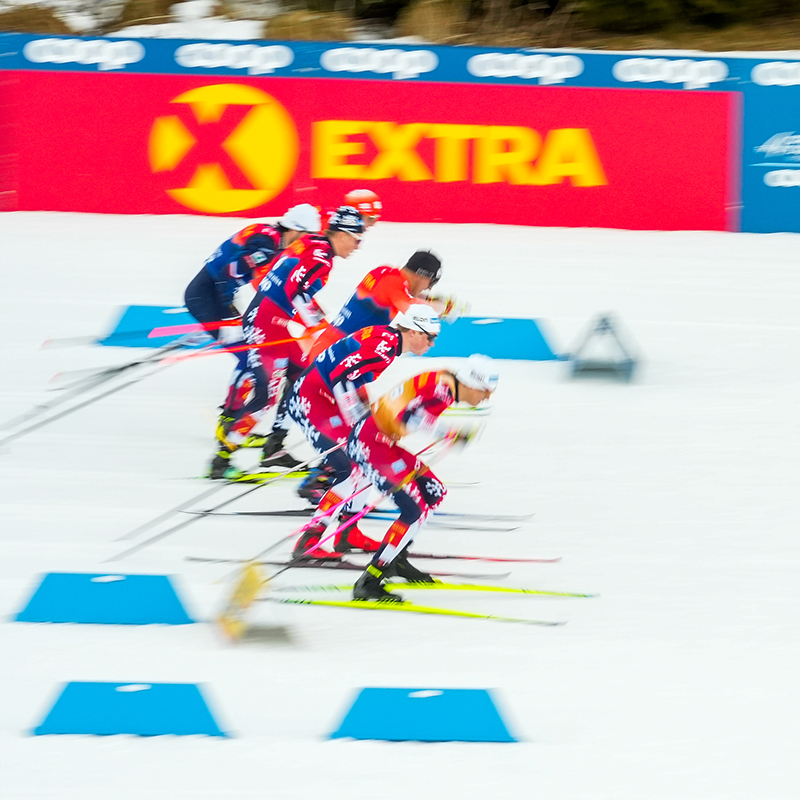
 This coverage is made possible through the generous support of Marty and Kathy Hall and A Hall Mark of Excellence Award. To learn more about A Hall Mark of Excellence Award, or to learn how you can support FasterSkier’s coverage, please contact info@fasterskier.com.