From the FasterSkier archive — posts syndicated from athletes’ and coaches’ own blogs between 2004 and 2012, kept online as published. Current coverage is at fasterskier.com.

Tag: Johannes Hoesflot Klaebo

  • The Boys are Back—Klaebo Schools Anger in Engadin Freestyle Sprint

    This coverage is made possible through the generous support of Marty and Kathy Hall and A Hall Mark of Excellence Award. To learn more about A Hall Mark of Excellence Award, or to learn how you can support FasterSkier’s coverage, please contact info@fasterskier.com.

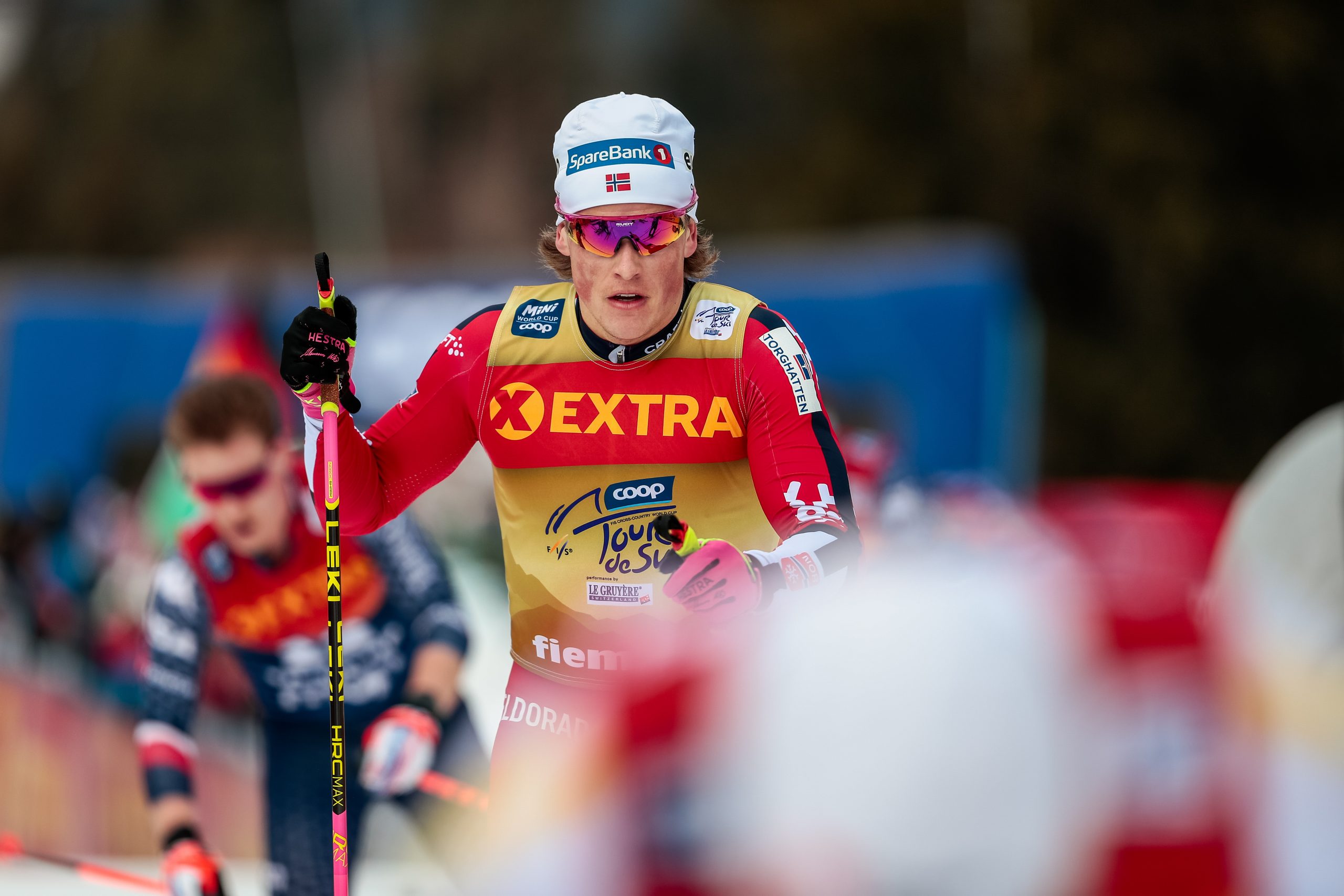
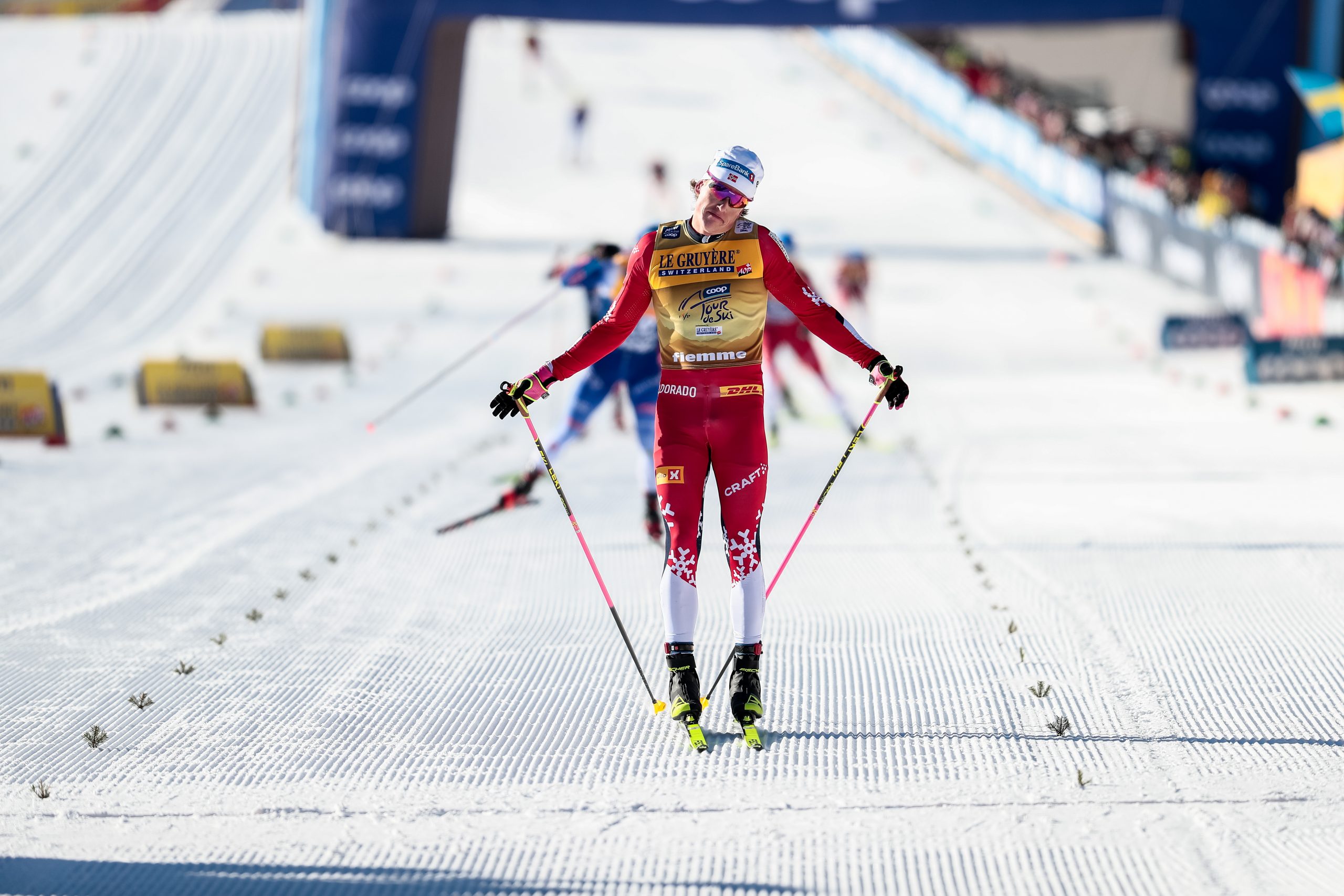
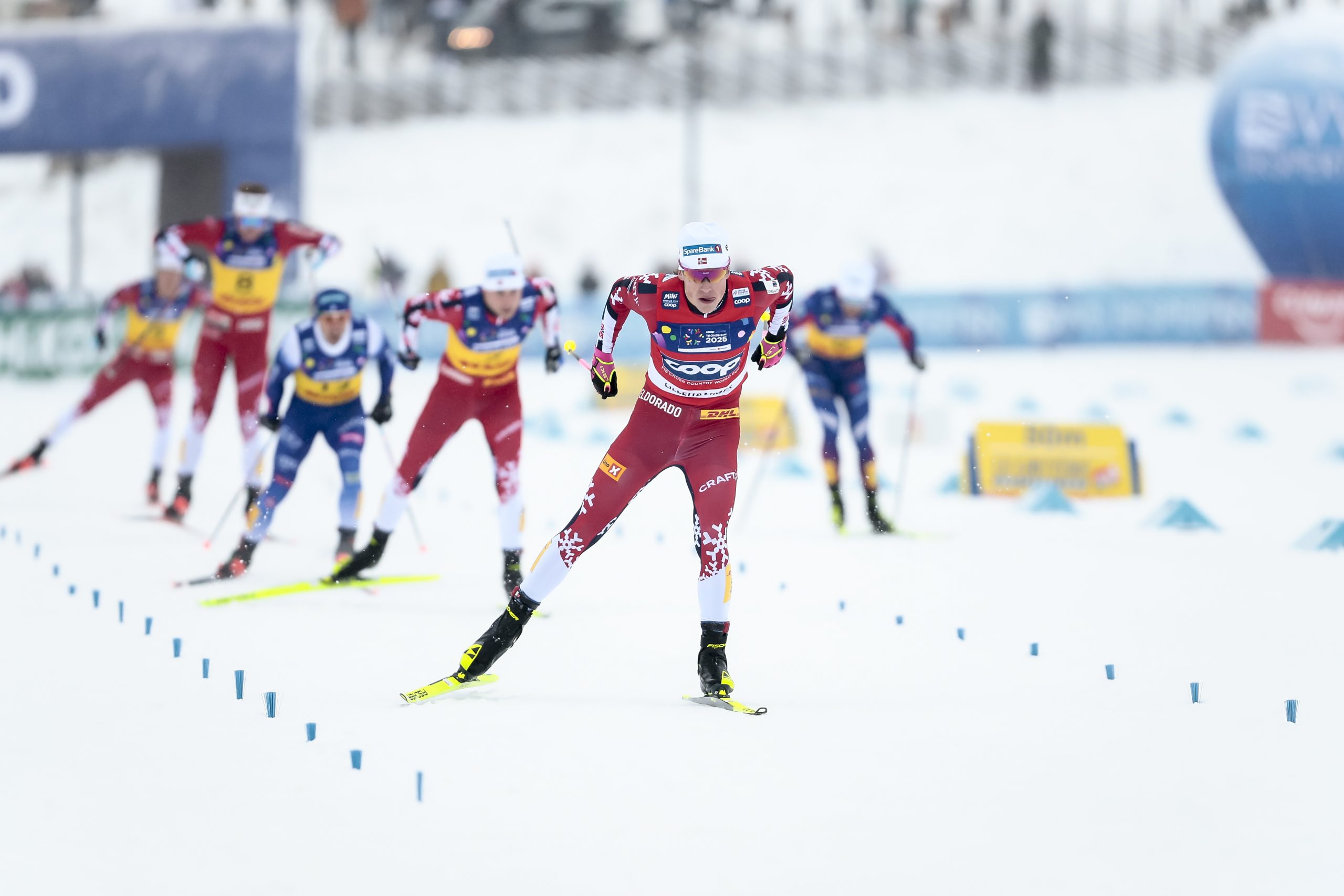
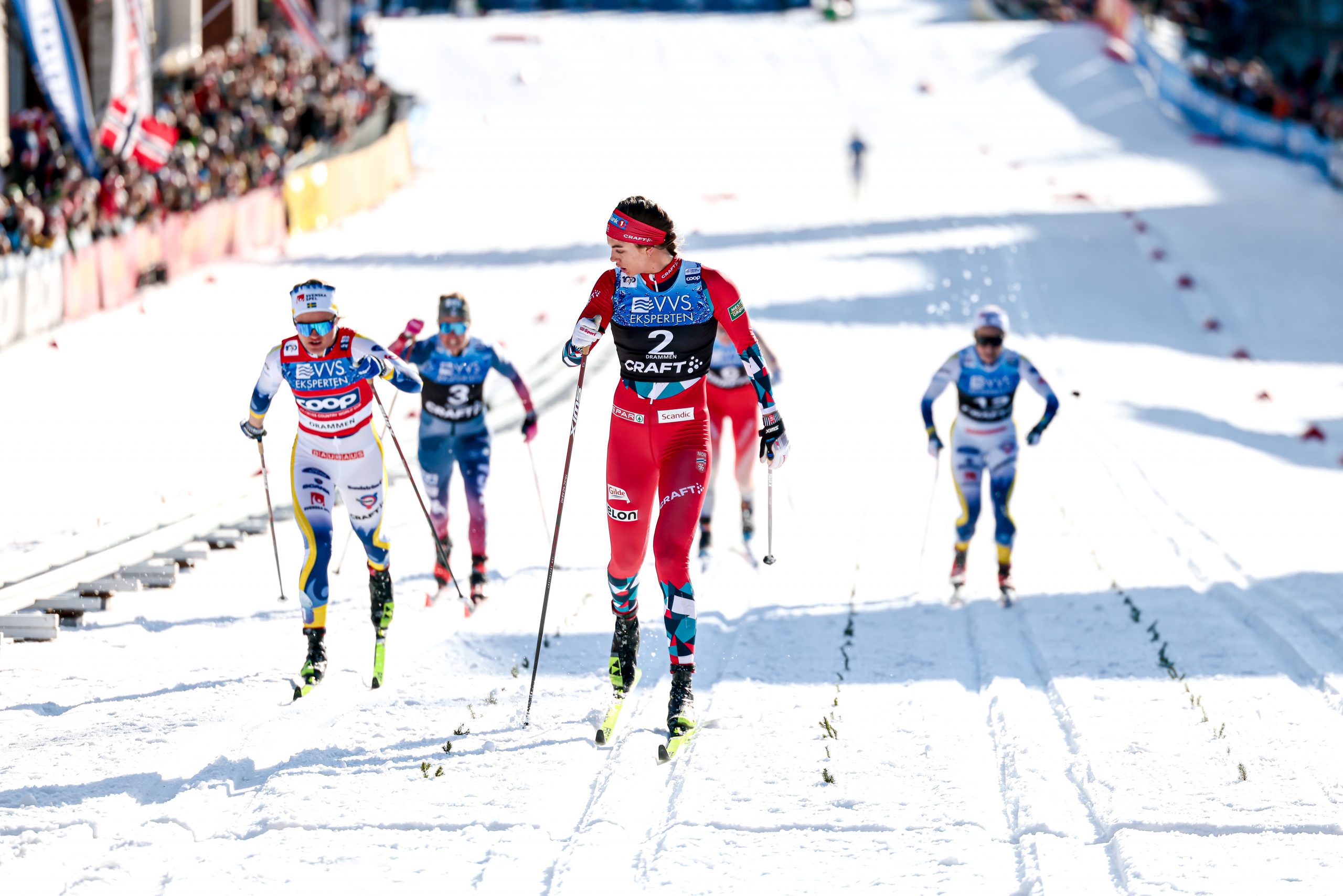
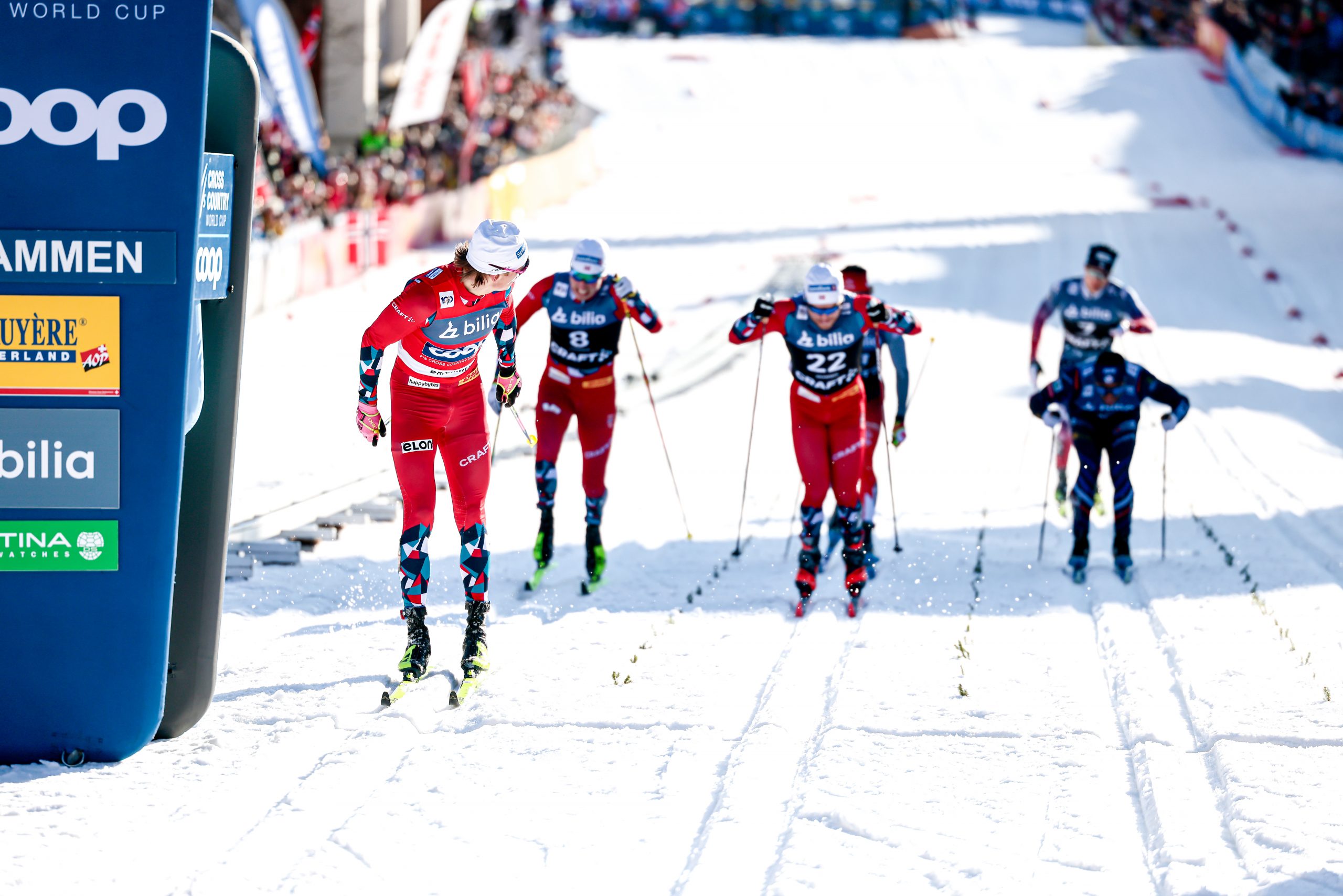
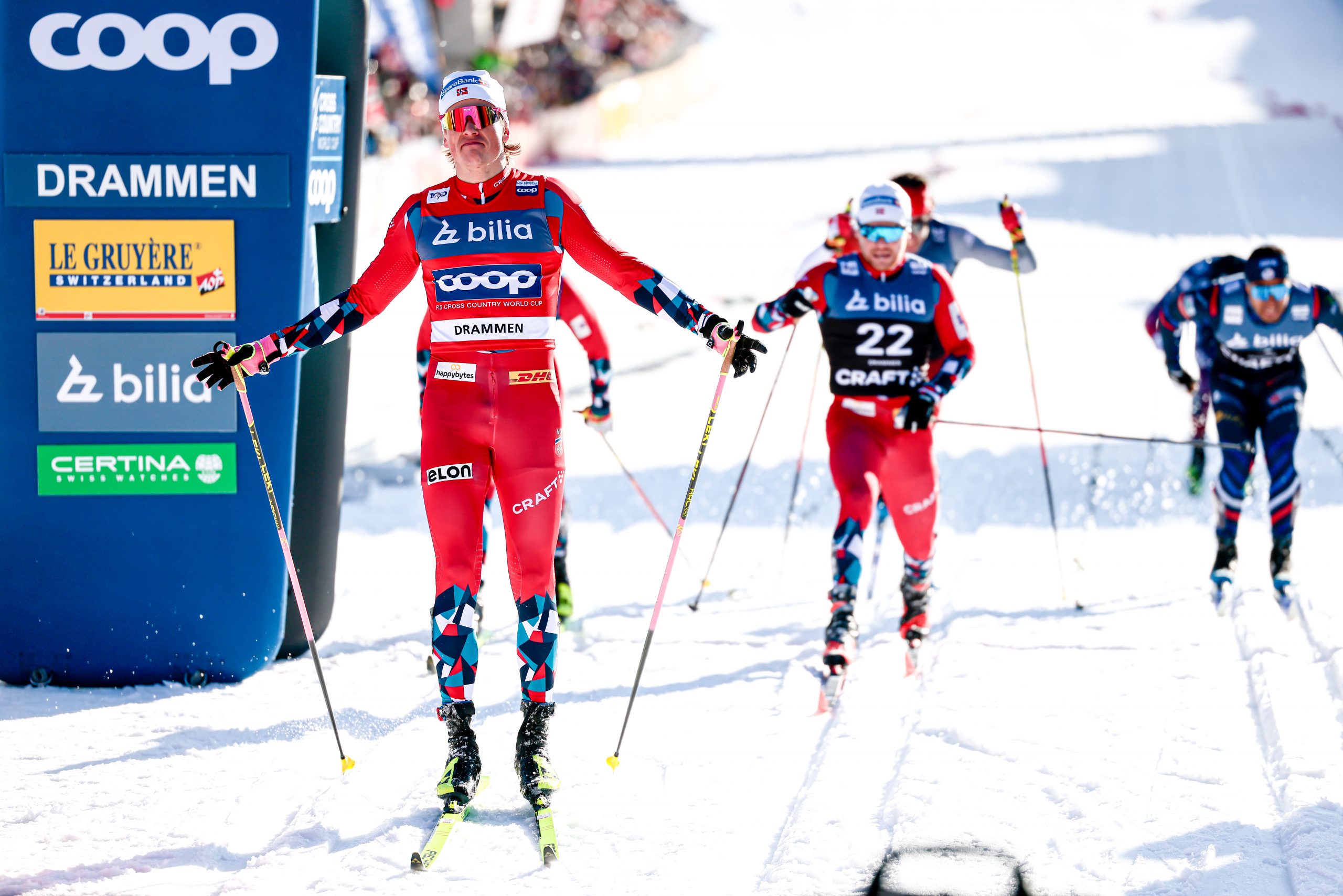
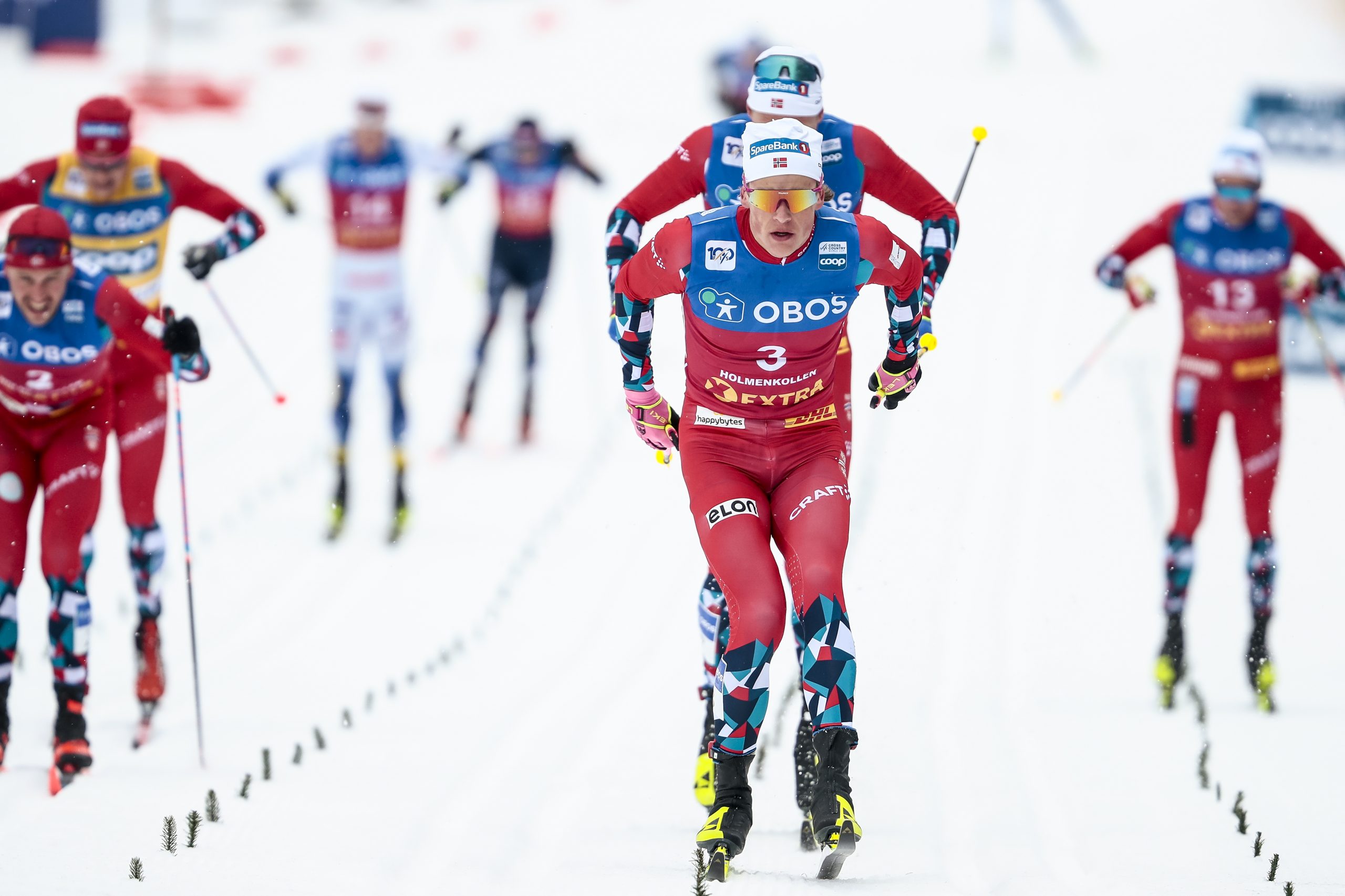
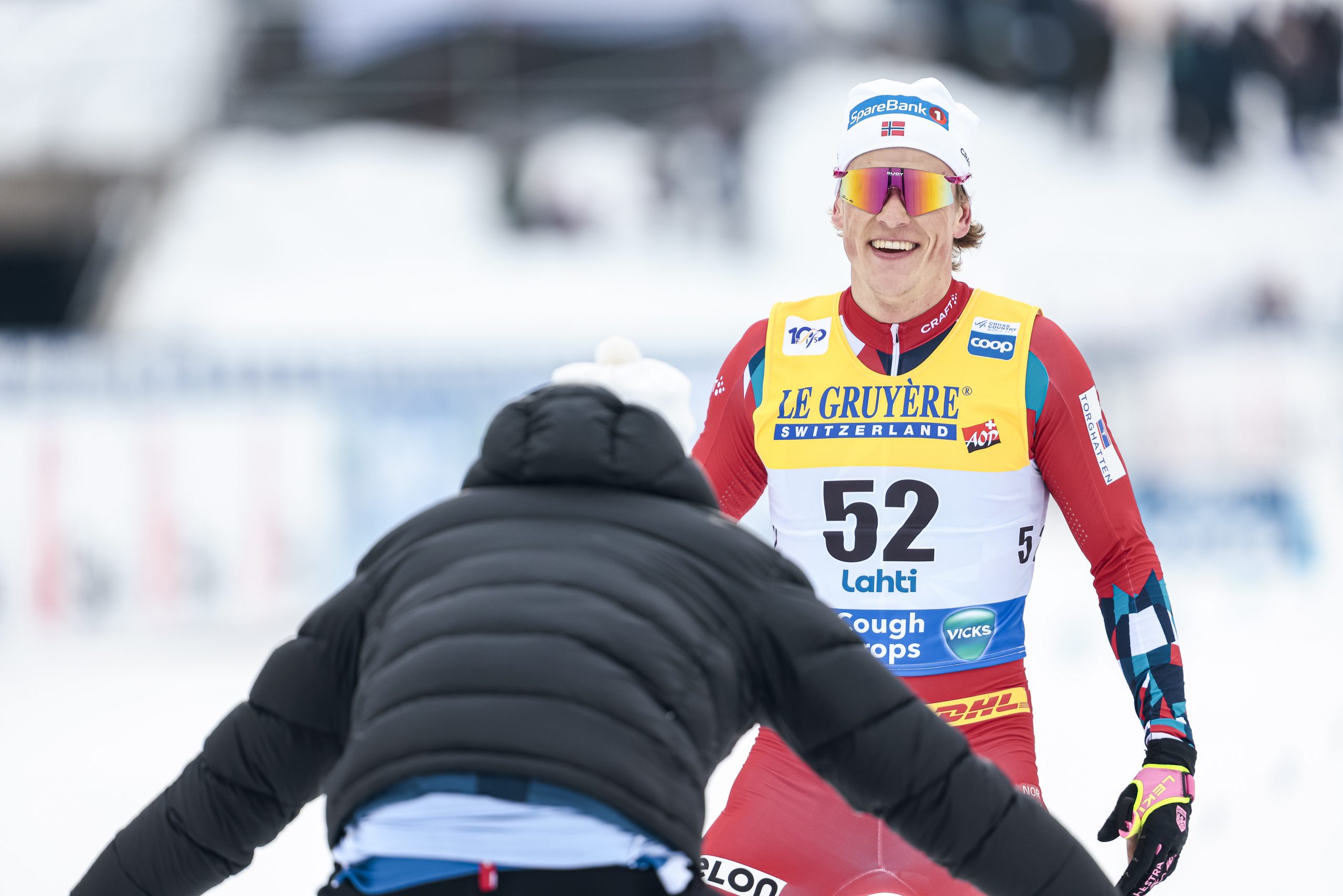
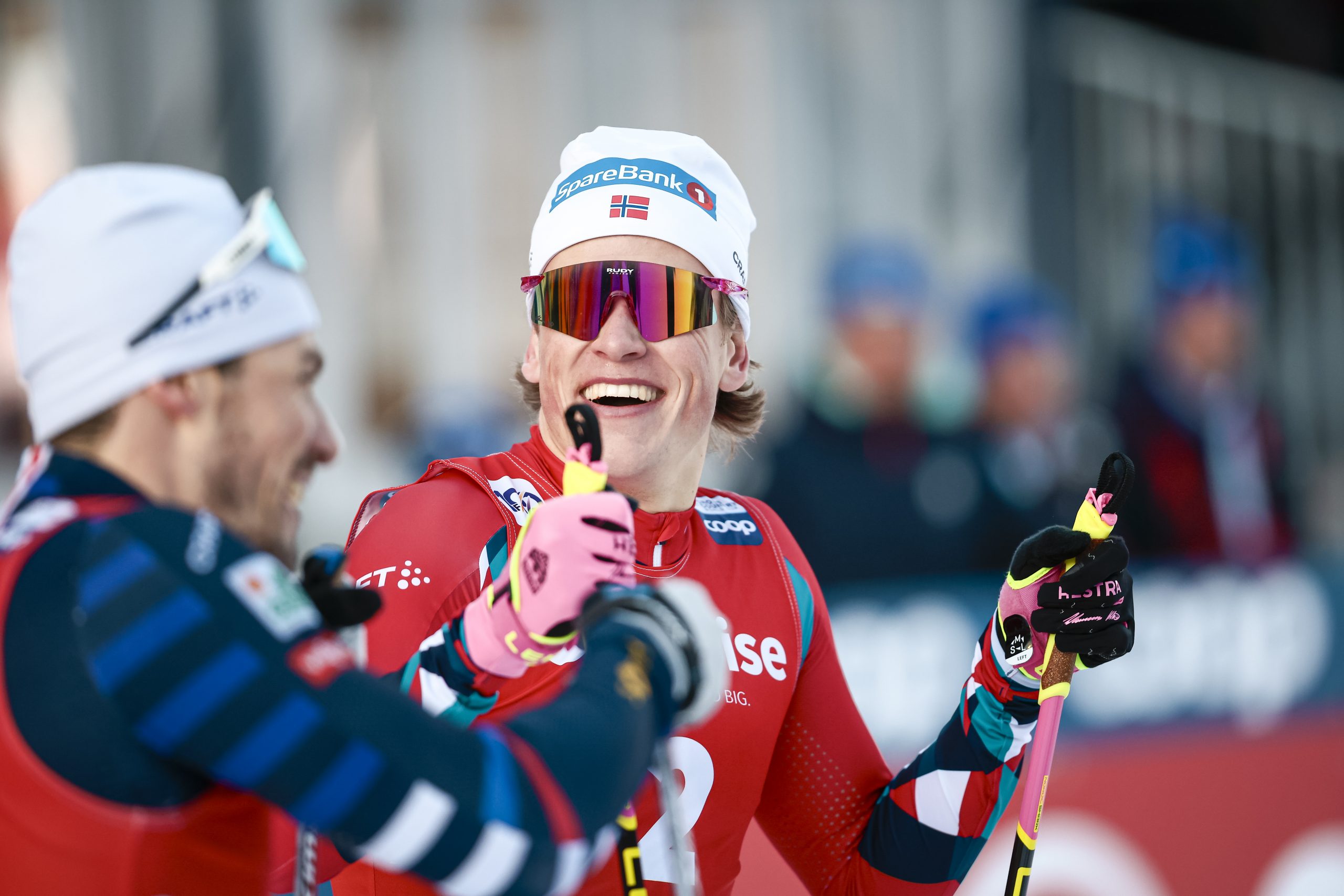
    Johannes Hoesflot  Klaebo (NOR) is BACK, and with plenty of time to ease up in the finishing straightaway, perhaps a reminder to the young upstart, Edvin Anger (SWE), of just who the boss really is. (Photo: Authamayou/NordicFocus)[/
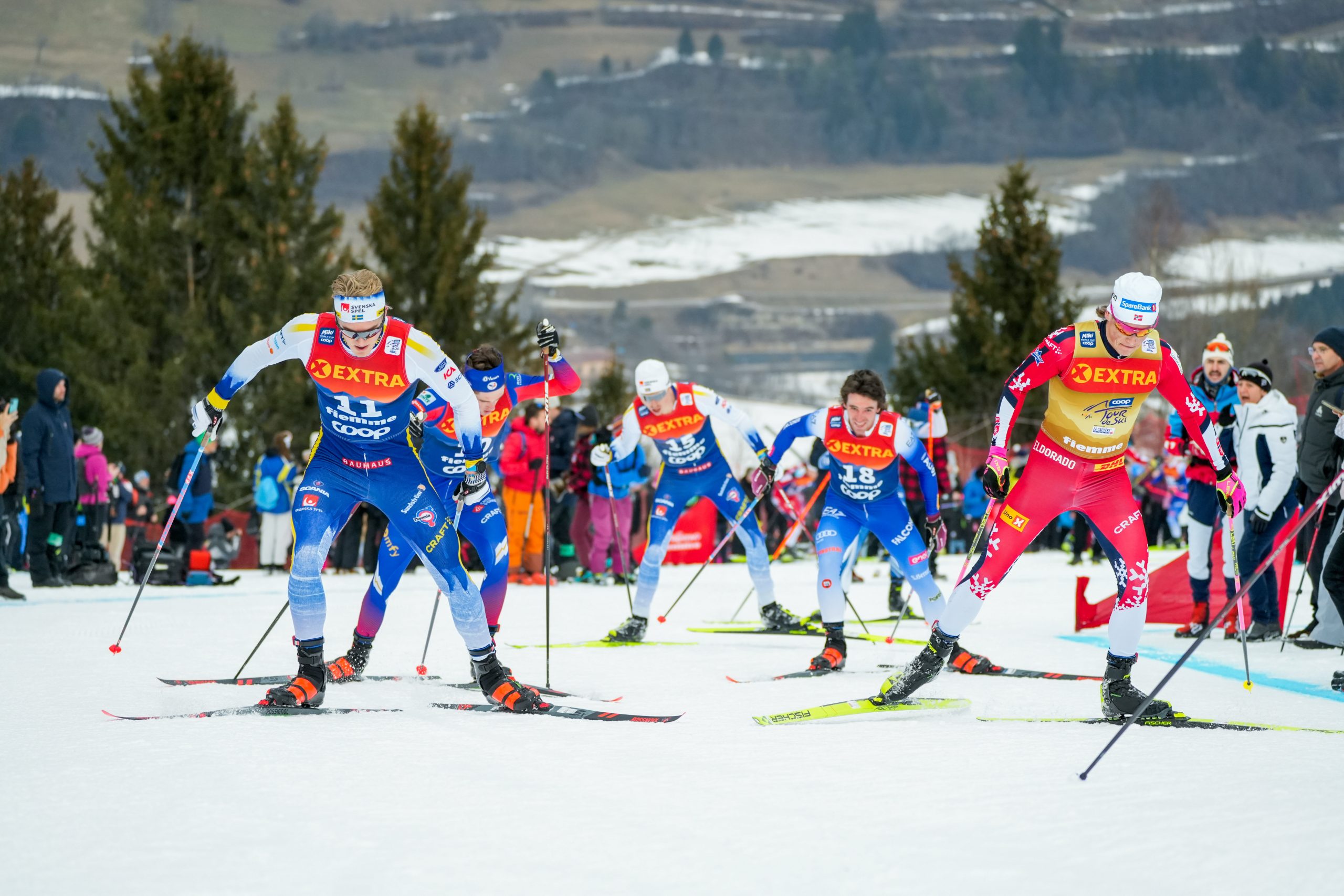
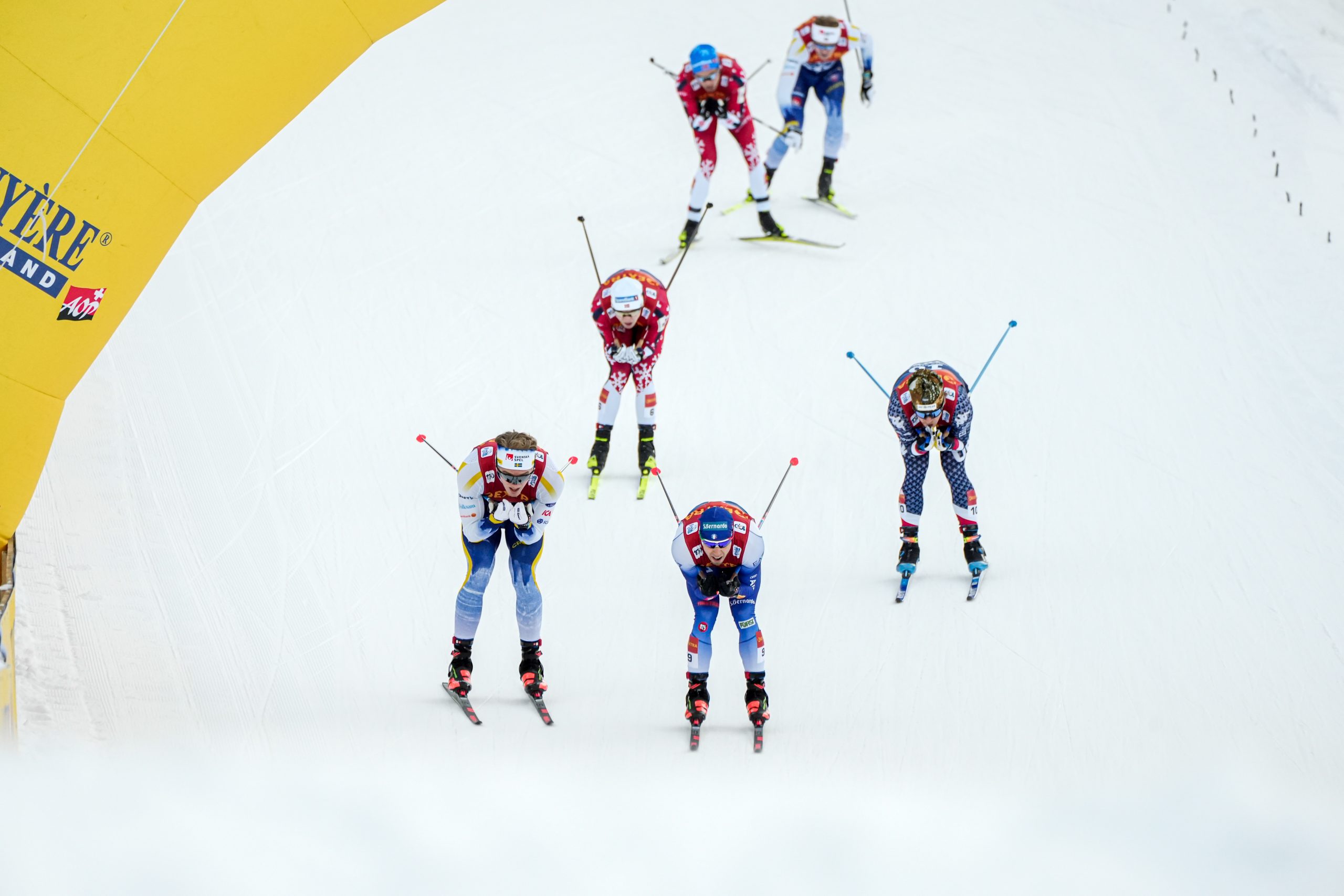
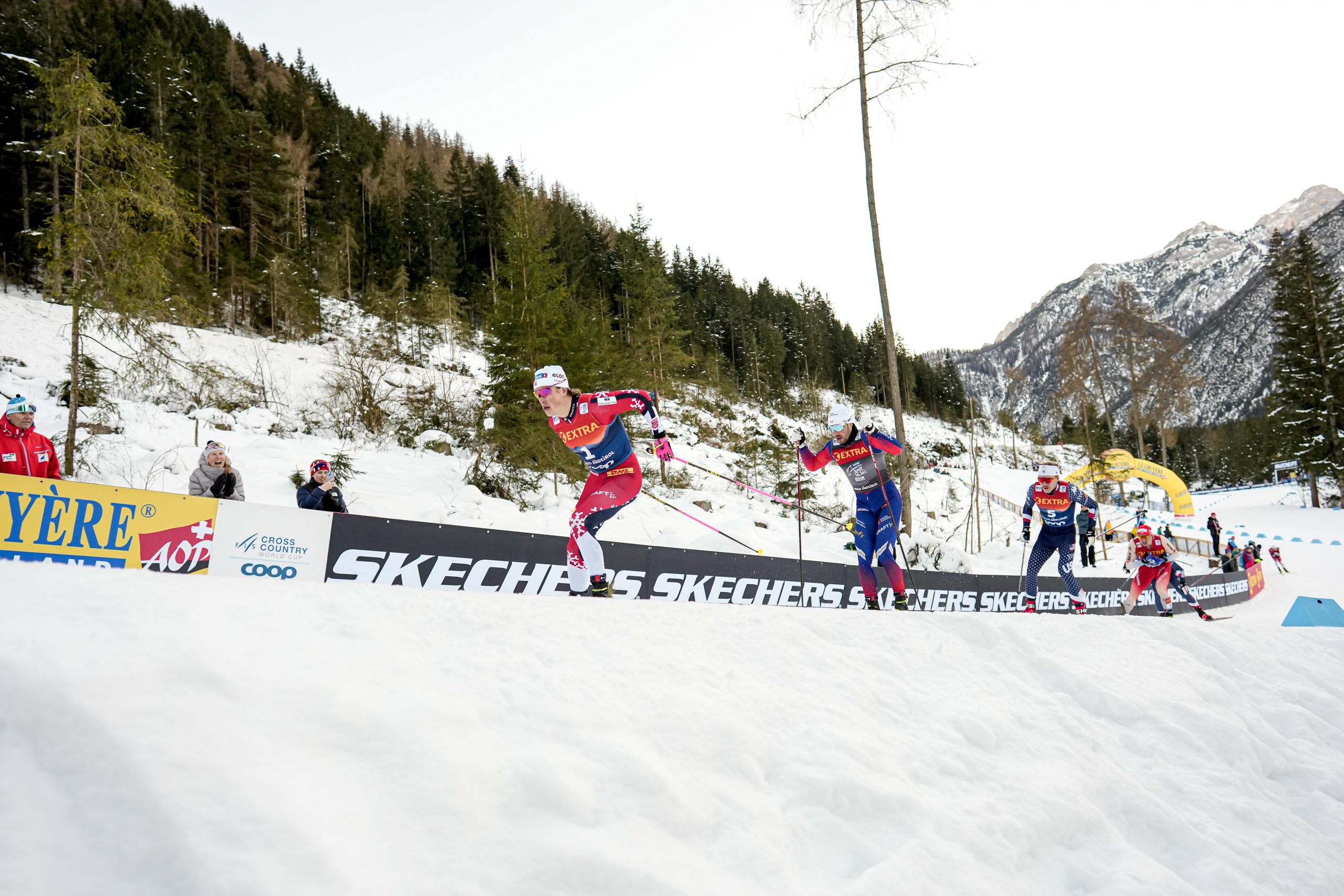
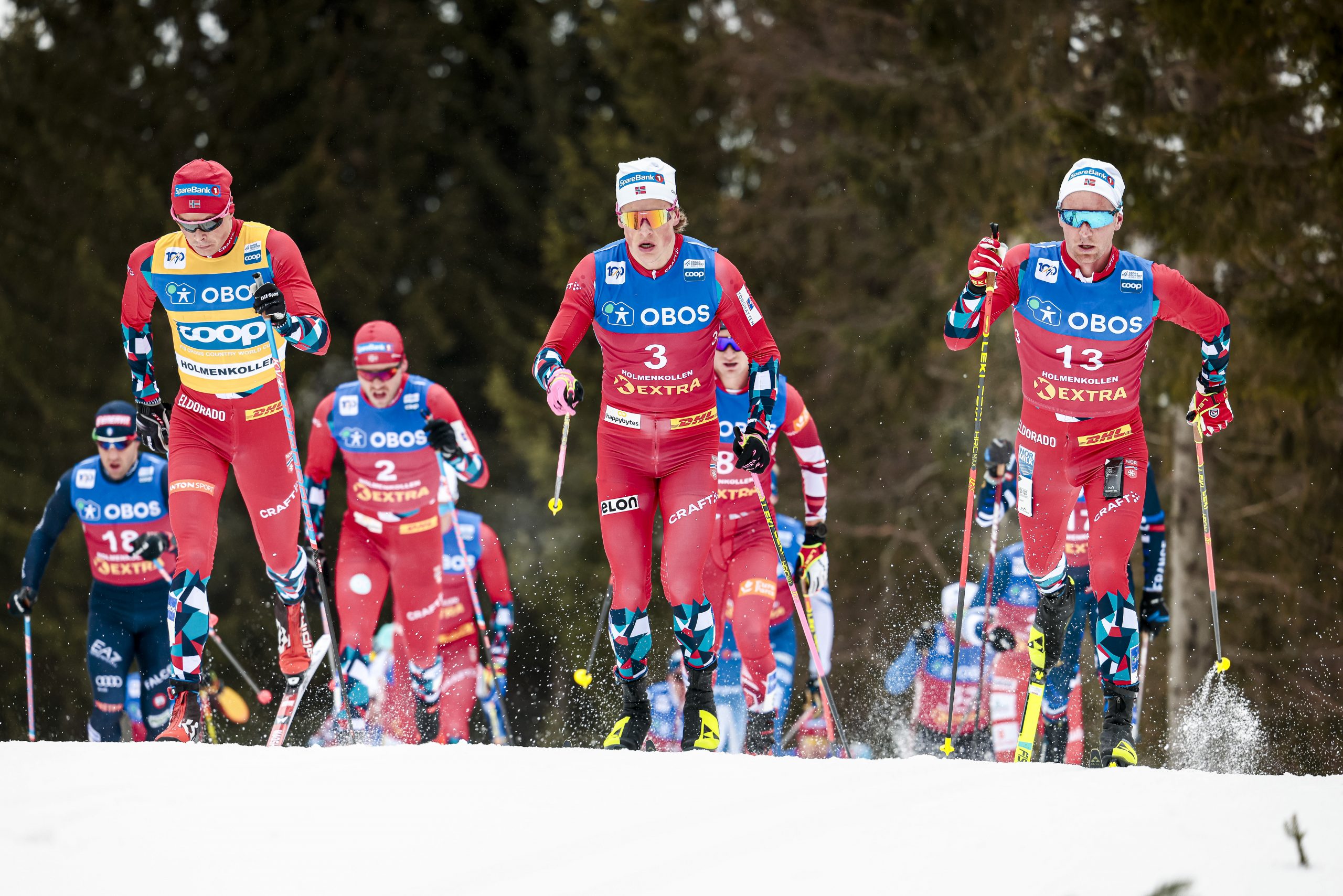
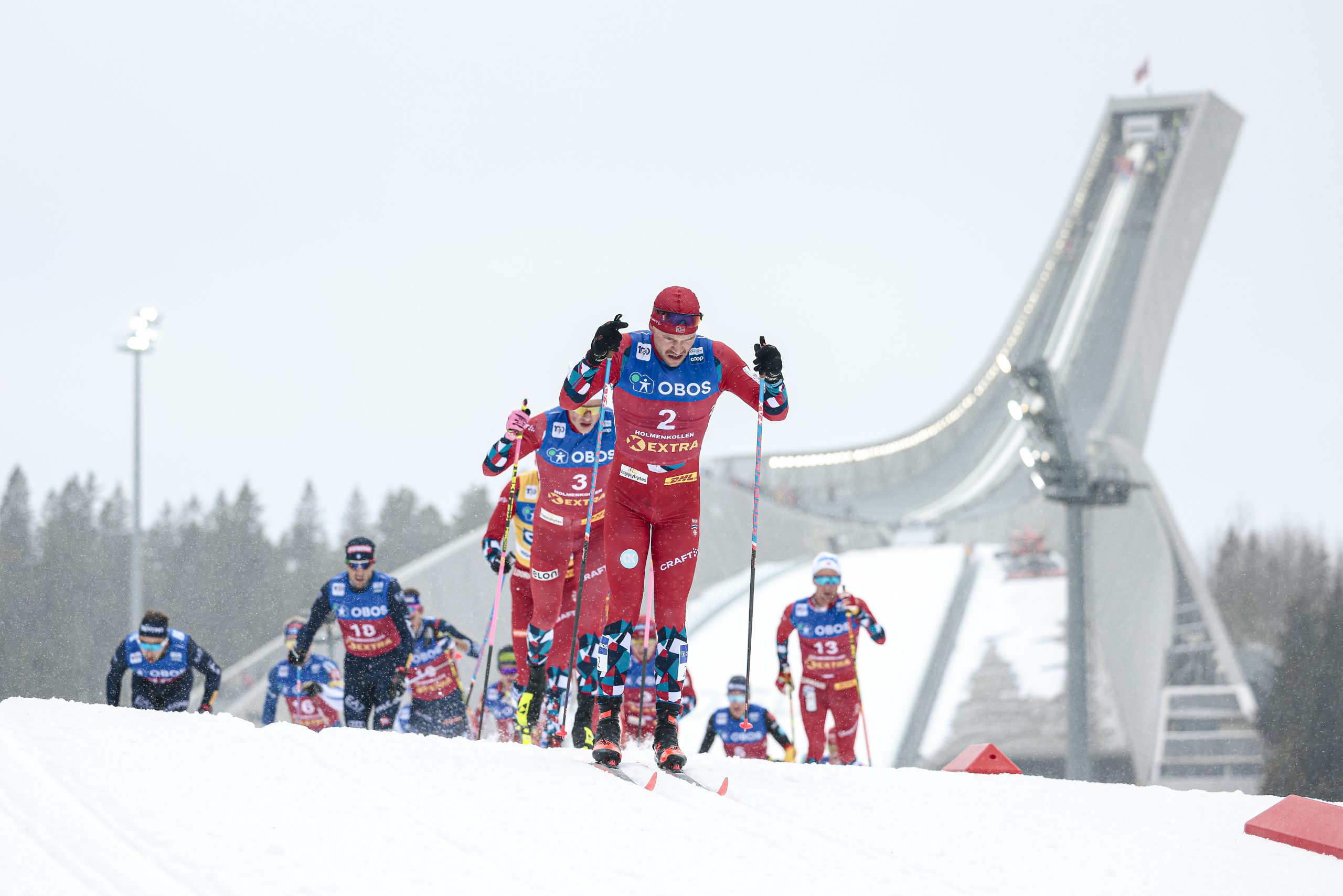
    You just can’t believe how fast . . . when skiers at the front of a World Cup Sprint field hit the gas, the top end speed they reach is simply astounding—fast enough that skiers at the trailing end of the pack are rocked back on their heels, having neither technique tricks nor fitness solutions to deal with the radical increase in pace. It’s simply bizarre to see those skiers in the back half of the Sprint field—world-class skiers, all—reduced to flailing ski-kids when the pace really ratchets up. That’s what happens at Engadin, Switzerland on a Sprint course that only offers speed. Not much in the way of interesting features or novel course challenges, not much in the way of variety or tactic: Engadin’s Sprint course is a wide-open, wind-swept strip of groomed corduroy that weaves through open, unprotected territory. On a sunny day with temperatures hovering just above freezing, what the Engadin course offers is speed. And nearly every heat winner seemed to rely on at-the-front speed in order to advance.

    Predictably, the only skier doing things a different way was Klaebo . . .

    Johannes Hoesflot Klaebo is back in the mix. After a few weeks off (during which he skipped numerous World Cup starts and the Norwegian National Championships), Klaebo returns to the World Cup tour, hoping to respond to recent claims voiced by Edvin Anger (SWE) that he (Anger) would’ve beaten Klaebo in last week’s Classic Sprint in Les Rousses, France. If Klaebo reads the reports in ski-media, he might’ve arrived in Engadin determined to make Anger eat those words.

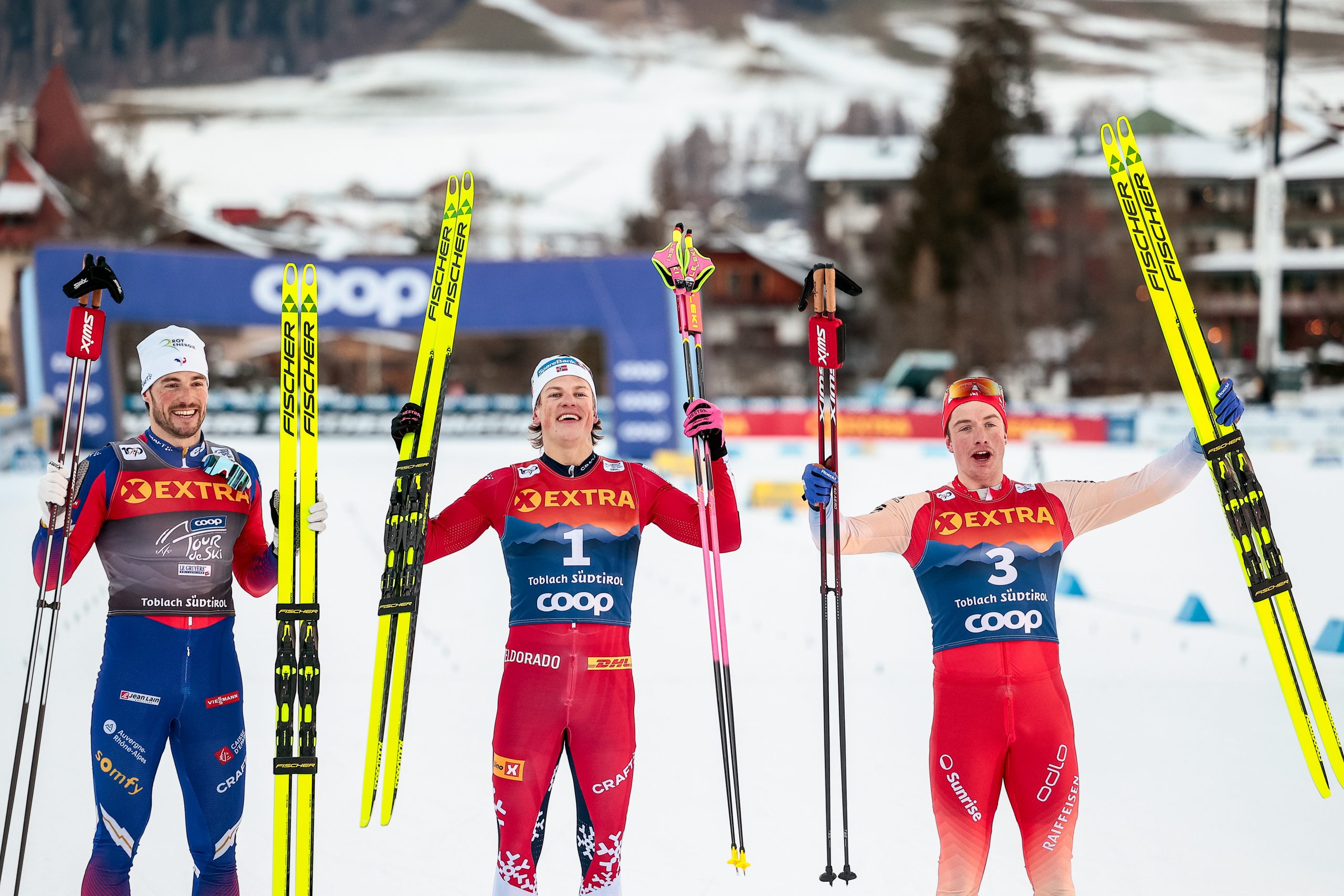
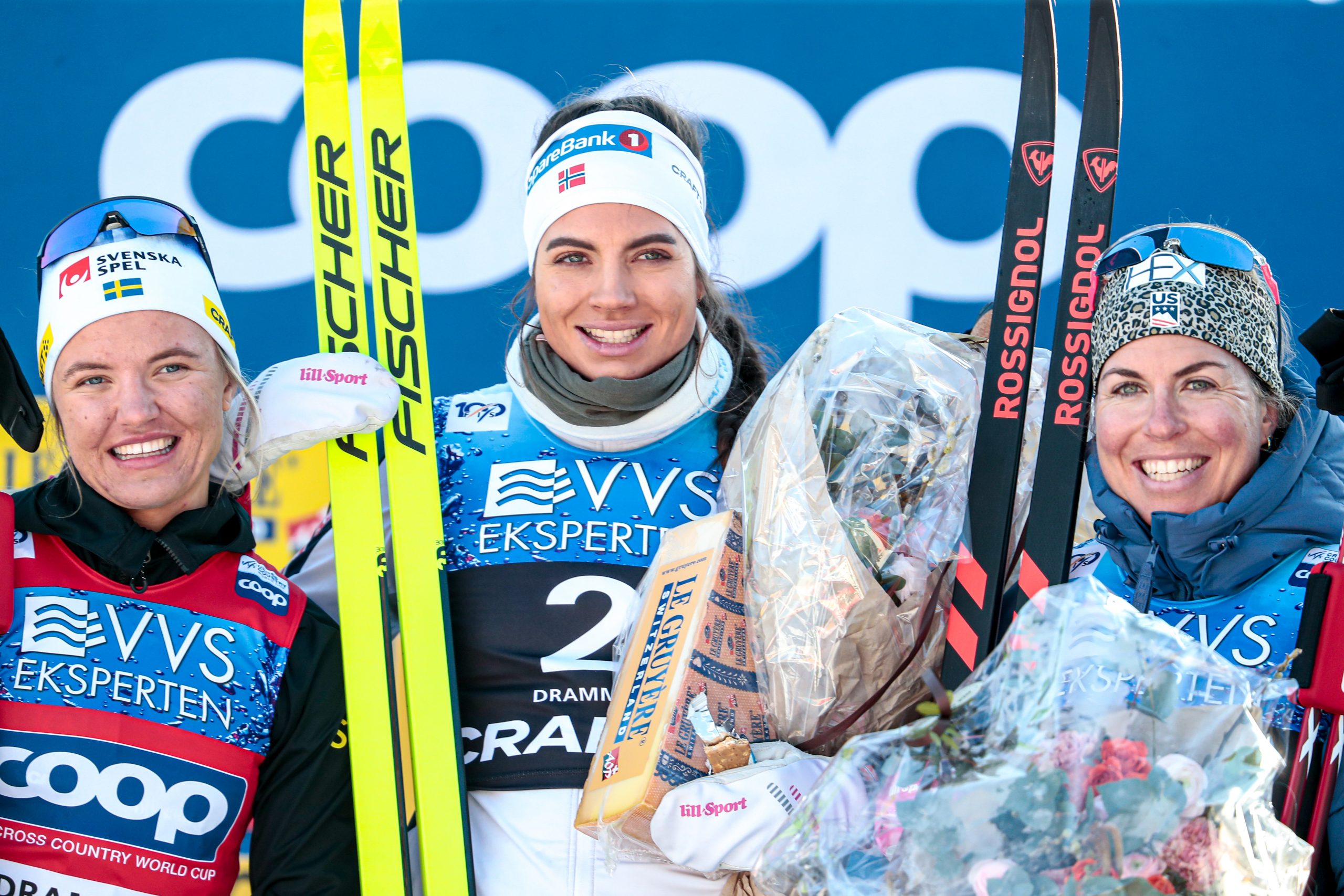
    In the end, Anger did show that he possesses tremendous speed, but nothing like the speed that’s available to Klaebo who coasted easily across the line for his 100th individual World Cup win. Anger scuttled home in second place ahead of Klaebo’s off-season training partner, Lucas Chanavat (FRA).

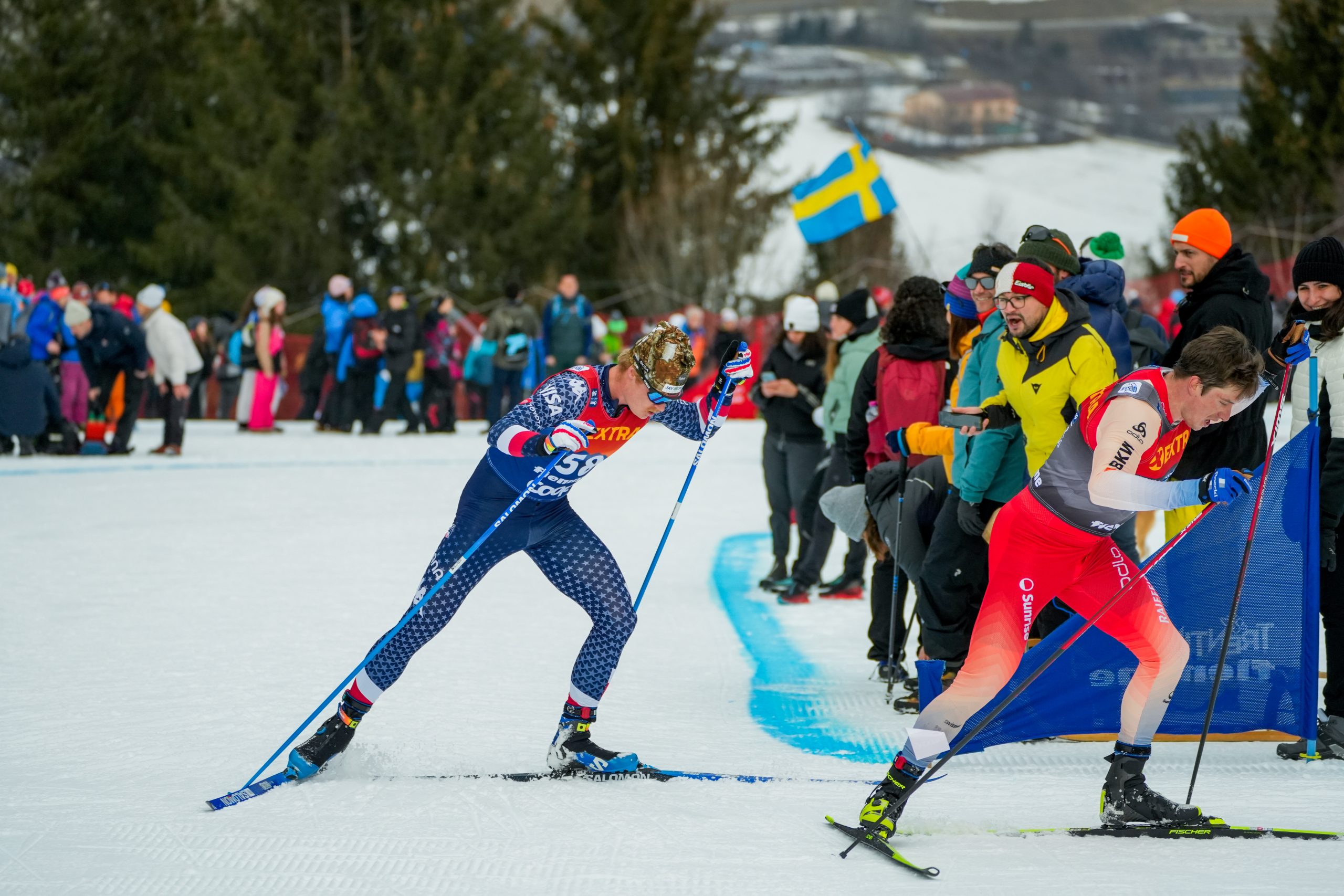
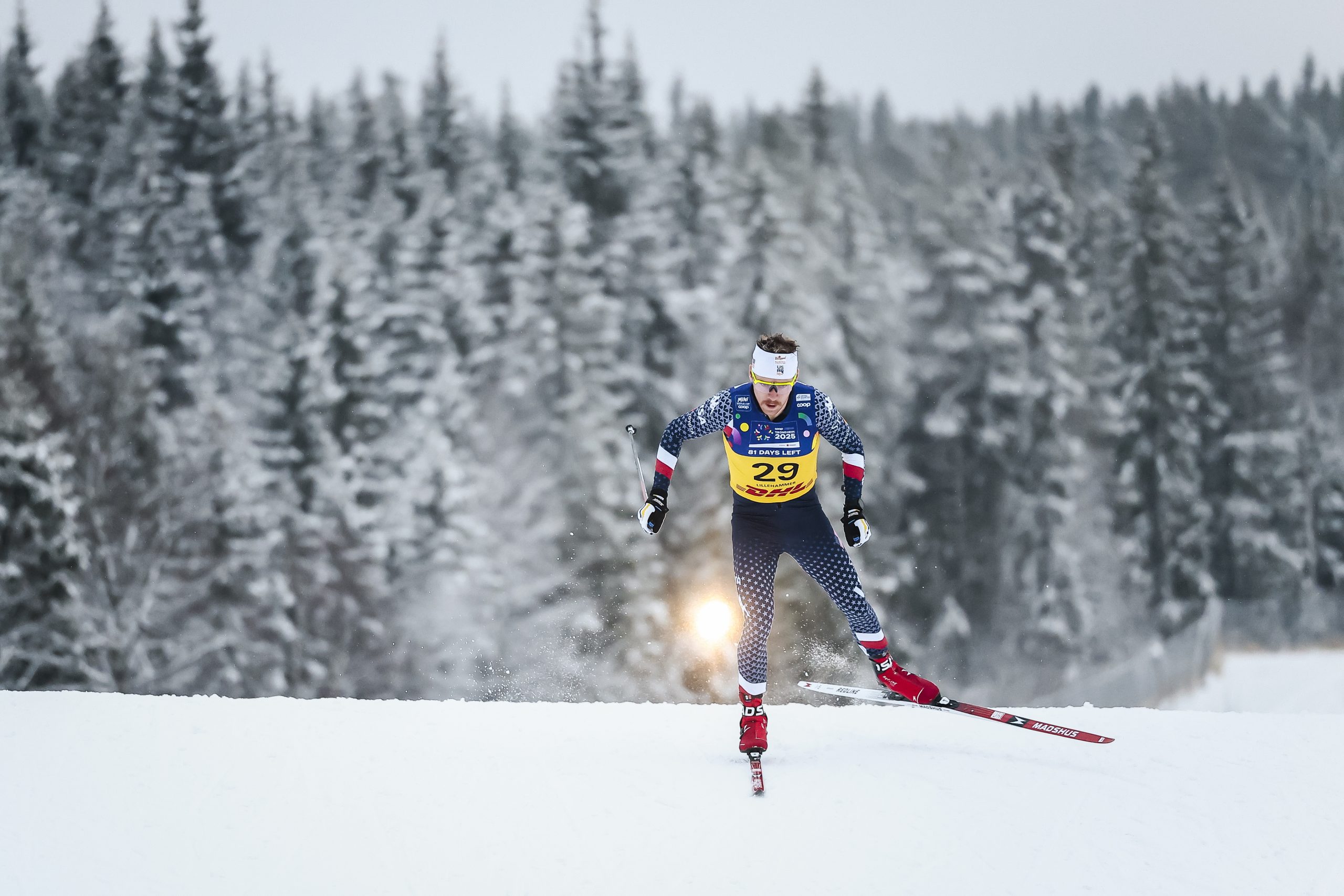
    Leading a world-class pack at the beginning of his quarterfinal heat, Jack Young (USA) would come to learn what World Cup Sprint speed really means. Young would find himself overtaken in the second half of his heat, finishing 25th on the day. (Photo: Authamayou/NordicFocus)

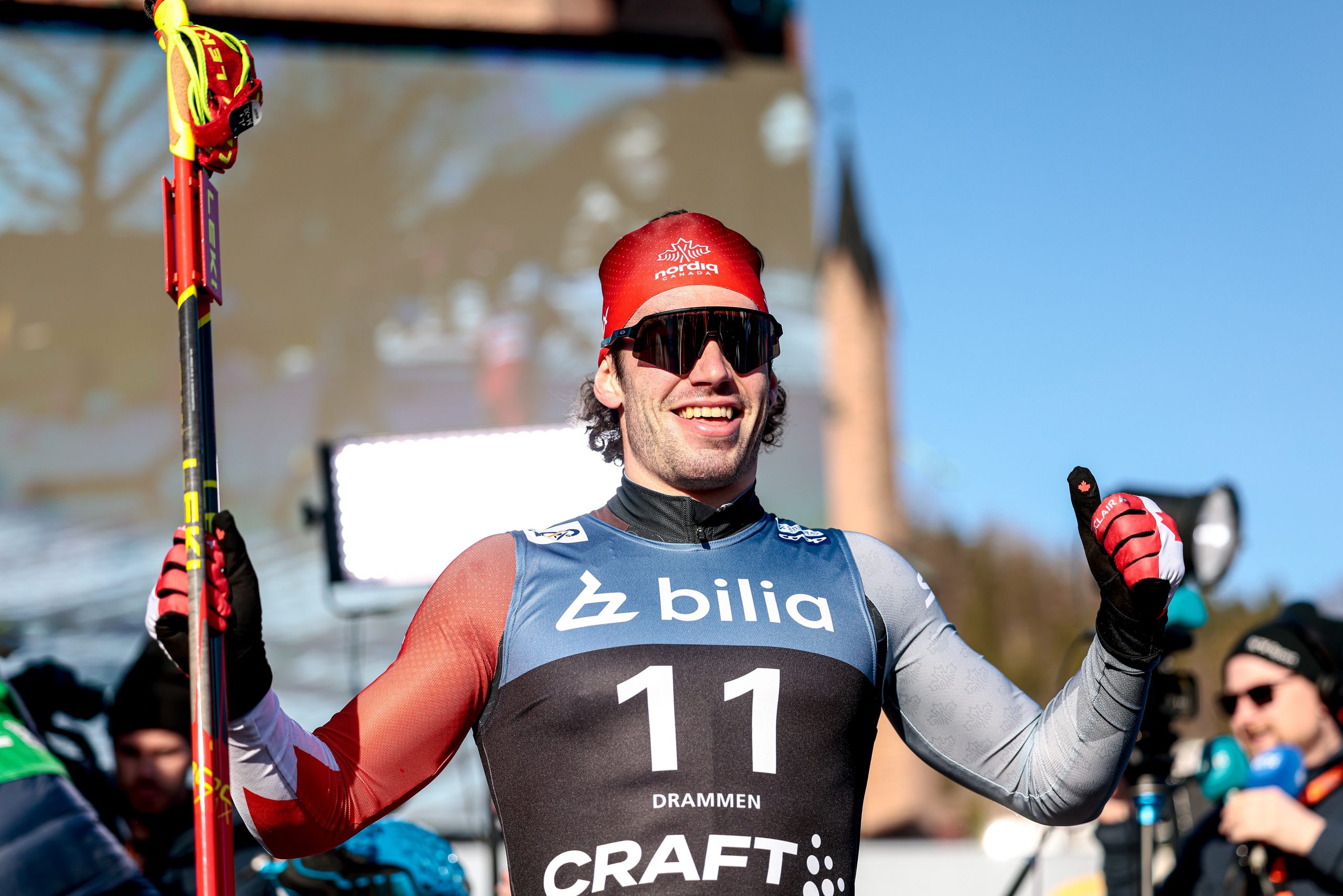
    Among Americans, Ben Ogden qualified 11th, though he would exit after a tangle in the semifinal left him sixth. He would finish the day in 12th. JC Schoonmaker qualified 26th and finished third in his quarterfinal, good for 15th on the day. Jack Young qualified 28th, then learned a lesson in World Cup Sprint speeds as his from-the-front tactic in his quarterfinal was overhauled by faster, more experienced sprinters. Young would end the day in 25th.

    Other Americans included Gus Schumacher in 45th, Kimball Murphy 46th, and Zanden McMullen 62nd. Canadian finishers included Sasha Masson 36th, Pierre Grall-Johnson 61st, Julian Smith 66th.

    In addition to Klaebo, the entry list this weekend in Engadin included a number of other lesser known Norwegian compound-names: Oskar Opstad-Vike, Aleksander Elde Holmboe, and Sindre Bjoernestad Skar. Questions still lingers as to whether those were the young guns who popped a good one at Norwegian Nationals, OR that the Norwegian federation is trying them on for size. With two spots still  up for grabs in the selection of Norwegian Sprint slots for February’s World Championships, the results from Engadin’s Freestyle Sprint would mean everything to Norway’s quickest sprinters.

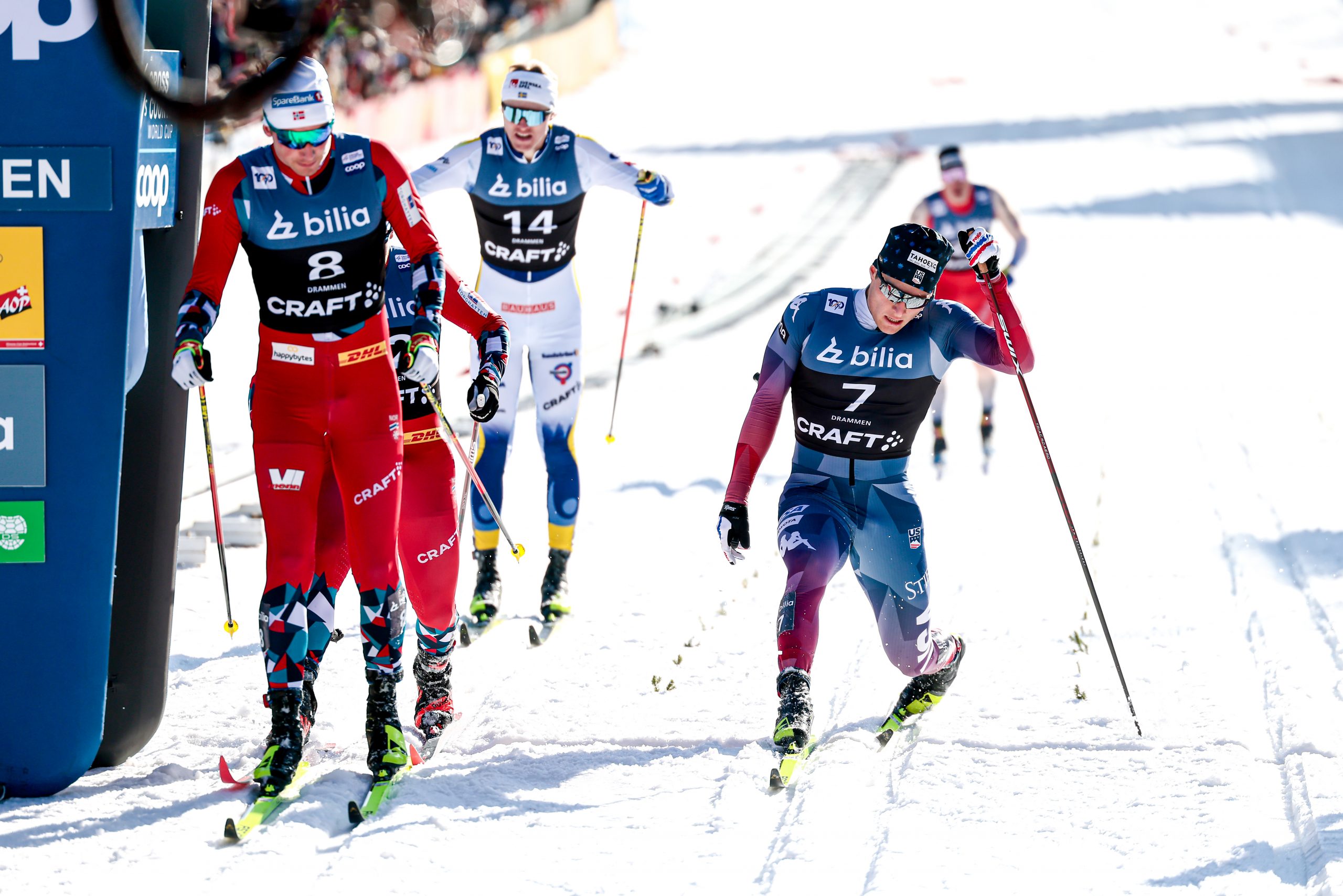
    Norway’s Haavard Solaas Taugboel—leading Richard Jouve (FRA) and Janik Riebli (SUI)—would advance to the Final in Engadin’s Freestyle Sprint, perhaps earning his place on the Norwegian Sprint team for the World Championships in Trondheim next month. (Photo: Authamayou/NordicFocus)

    Among more familiar names, Haavard Solaas Taugboel was back in the Norwegian Sprint lineup. Having not yet secured his start position in the upcoming Trondheim World Championships, Taugboel had much to lose, much to gain. Likewise, Even Northug was entered. He’d hoped to win an easy one a week ago in Les Rousses (where a World Cup win would have likely punched his ticket to Trondheim), only to have that low-hanging fruit snatched by Edvin Anger (SWE). In Engadin, Northug would flounder again, qualifying 48th and failing to advance to the Quarterfinal.

    Perhaps the names most conspicuous by their absence were of those Norwegian all-’rounders who also excel in Sprint competitions: Paal Golberg, Harald Oestberg Amundsen, Erik Valnes. All three have been known to give Klaebo a run for his money, but their federation seems determined to save those skiers for Distance efforts. The story today seemed likely to be a grudge-fueled contest between Klaebo and Anger.

    Engadin Freestyle Sprint

    A sunny morning in Engadin also dawned very windy, with a steady stream of air pushing across the flat valley and broad frozen lake around Engadin. It seemed to all observers that the wind would become a factor in the tactics and the outcome of today’s events. Altitude would also play a role as Engadin—at an elevation of 1800 meters (nearly 6,000 feet)— is the highest stop on the 2025 World Cup Tour. Sprinting is a long day, and the rest periods get shorter and shorter as the day progresses. Speed isn’t ever enough: sprinters need to get to the final knowing they can deal with anything. The veterans are always the ones who prove most capable in that regard.

    Quarterfinal 1 featured Klaebo, Lucas Chanavat (FRA), and American qualifier, Young. Young drove the early pace while Klaebo dropped quickly off the back. Klaebo’s relaxed start turned into a more familiar strategy as he easily made up three spots on the first uphill, sliding into a third place position with headwind descents just ahead. As they hit the serious headwind, Klaebo maneuvered out from behind Chanavat, and shot past Young into the lead. Klaebo and Chanavat would advance while Young faded to fifth in the heat, finishing the day in  25th.

    Ben Ogden (USA) skied tactically in his quarterfinal to advance behind Edvin Anger (SWE). Ogden would finish 12th on the day. (Photo: ,Authamayou/NordicFocus)

    Quarterfinal 2 was a somewhat more tactical affair, led out by Anger who was closely followed by Ogden. Those two would keep their spots through the finish line, moving on to the semifinal round.

    JC Schoonmaker found himself pinched in early going of Quarterfinal 3, but managed to work his way to the outside in the final turn. He exited the turn in third, gaining speed all the way up the finishing straight, but the man he needed to catch was the legendary Federico Pellegrino. Pellegrino would remain second, advancing to the Semifinals behind heat winner Valerio Grond. Schoonmaker would finish the day in 15th.

    Schoonmaker was introspective when considering how close he was to advancing: “I think making up that gap to Pellegrino is all tactics for me.,” said Schoonmaker. “It comes down to having a better position rounding the corner into the finish which goes all the way back to being more aggressive in the early and middle parts of the race. To me it’s much less about the .3 seconds behind but the position. .3 seconds can feel quite close when you say it like that, but when you put it in terms of actually passing someone and gaining the position to move on, it’s much more difficult especially when it’s a fast and short finish like today. So for me I feel like I really need to work on my positioning and strategy throughout the heat to be ahead of a guy like Pellegrino heading into the finish rather than trying to overtake him.”

    Taugboel’s future would play out in Quarterfinal 4, where he demonstrated his agility in lifting a ski tip over one of the corner-marking v-boards as Janik Riebli (SUI) crowded him to the inside. That little loss of speed may have cost Taugboel: he moved Riebli back toward the middle for the finishing sprint, inadvertantly opening up the inside lane where Richard Jouve (FRA) used his exceptional finishing speed to grab the last automatic qualifying spot. Taugboel’s day—and likely his chances for a spot on Norway’s World Championship team—would have ended with a third place finish, but Taugboel’s finishing time was fast enough to secure a lucky loser spot.

    Sprint Semifinals

    Klaebo opened Semifinal 1 with just enough drive to push Riebli and Anger to the lead. That’s where Klaebo wanted them to be, and they totally fell for it. Ogden and Chanavat (who would typically go to the front, himself) cleverly slotted in right behind Klaebo. Anger moved to protect the inside line causing Klaebo to short-step through a corner (perhaps the closest Klaebo has come to getting tangled in a Sprint heat). Anger would remain the frontrunner through the finish line just ahead of Klaebo. Though if Anger thought this same strategy would bring him victory in the final . . .

    Oskar  Svensson (SWE) drove the pace in Semifinal 2, but would find himself pvertaken by those who took advantage of his draft. He would finish the day ninth. (Photo: Authamayou/NordicFocus)

    Jouve went straight to the front of Semifinal 2 (totally changing his own tactics from the Quarterfinal), but it was Oskar Svensson (SWE) who made the pace through the middle of the heat. Taugboel lurked just behind Jouve, hoping to follow him through to the Final, but the mercurial Jouve would begin to fade mid-lap, and Taugboel was forced into the lead. Around the final turn, Taugboel dragged most of his pursuers through the fading Svensson. Only Pellegrino was able to find an outside line that propelled him to the Semifinal victory ahead of Taugboel (whose advancement to the final might earn him the Trondheim starting spot to which he aspired).

    Valerio  Grond (SUI), Johannes Hoesflot  Klaebo (NOR), Lucas  Chanavat (FRA), Edvin  Anger (SWE), sprint past Engadin’s landmark castle in the Final of the FIS World Cup Freestyle Sprint. Klaebo would overtake Anger for the win. (Photo: Authamayou/NordicFocus)
    Sprint Final

    Klaebo allowed Anger to win their semifinal matchup; perhaps he had been sandbagging in order to make Anger believe that his own speed would be sufficient? The Sprint Final would reveal the truth.

    Chanavat finally acted like Chanavat, storming directly to the front, daring others to follow. Klaebo started only fast enough to claim a space ahead of Pellegrino. There Klaebo could see and control the race. When Chanavat bobbled on the first uphill, Anger found himself in the lead. Klaebo followed in second, shadowed by the every-crafty Pellegrino. All three seemed to have the positions they wanted, though only Klaebo seemed to know how things would turn out.

    Following a wider, faster line into the lead with 200 meters to go, finally, Klaebo let his skis run on a line that pulled him up alongside Anger. If Anger thought he possessed the speed to beat Klaebo, this would be the place to show it. Nope . . .

    Exiting the final turn, Klaebo kicked into a higher gear for only a few deft skate strokes, then shut down his own effort to coast up the finishing straight. With forty meters still to race, he turned around to assess Anger, who’s finishing efforts would avail him not. Klaebo’s gesture appeared less as taunting and more as a demonstration of dominance, an insistence for the sort of respect that perhaps Klaebo feels was lacking in Anger’s comments to the media last week. Or maybe it’s just a Norway/Sweden thing . . .

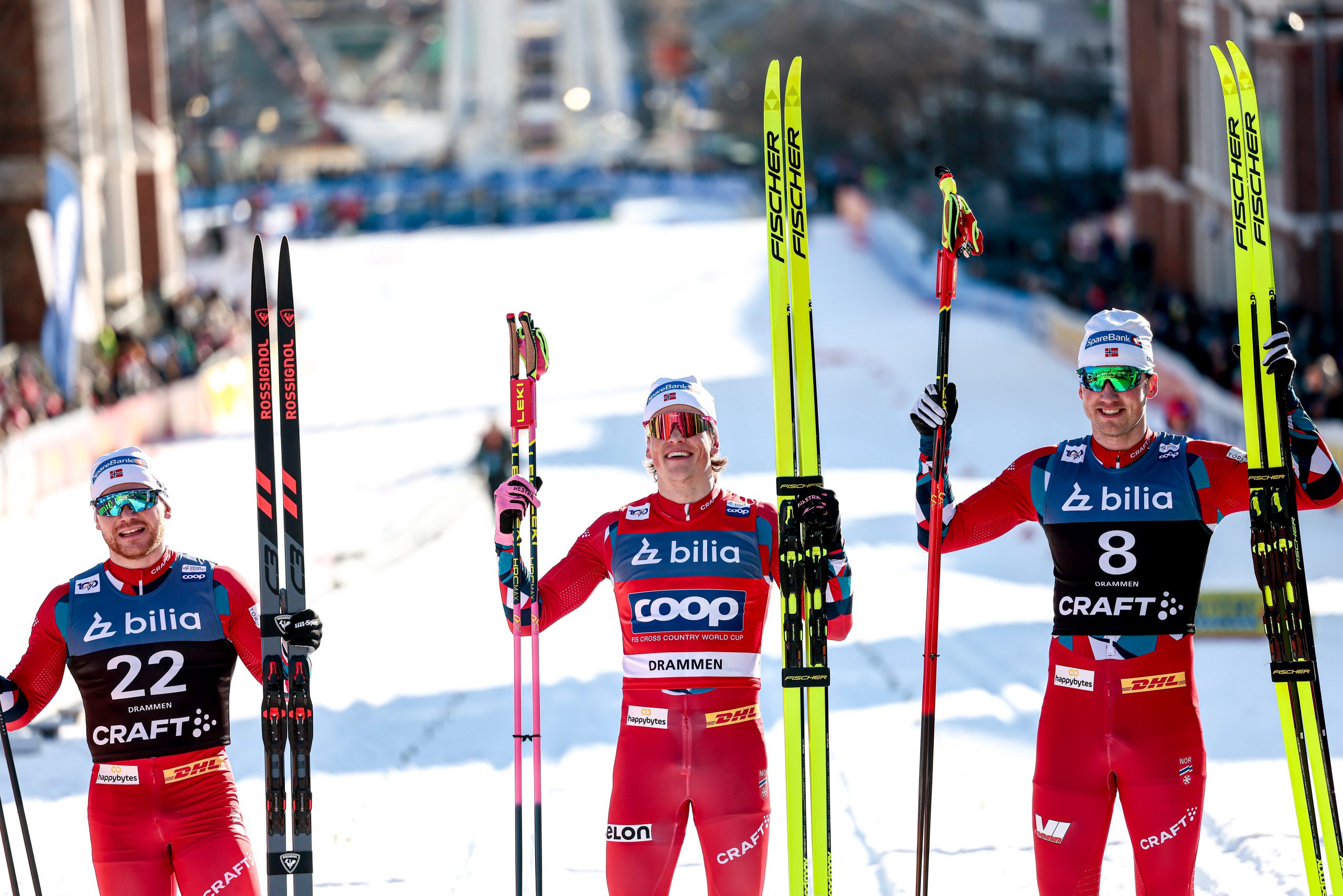
    Pellegrino was third across the line, but was later relegated to last (sixth) in the Final heat standings for having bumped Valerio Grond (SUI) in the Final. Chanavat would be elevated to third place.

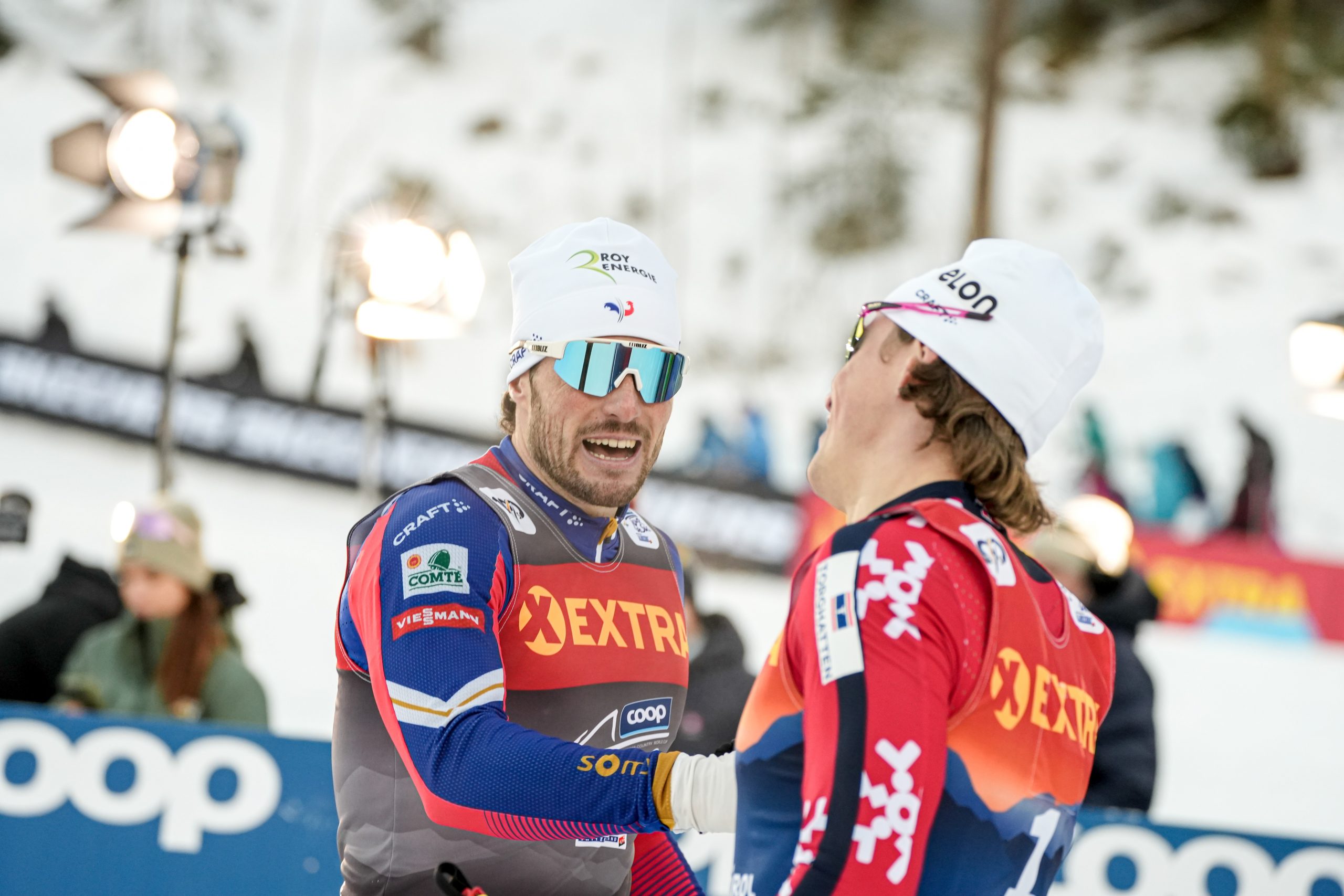
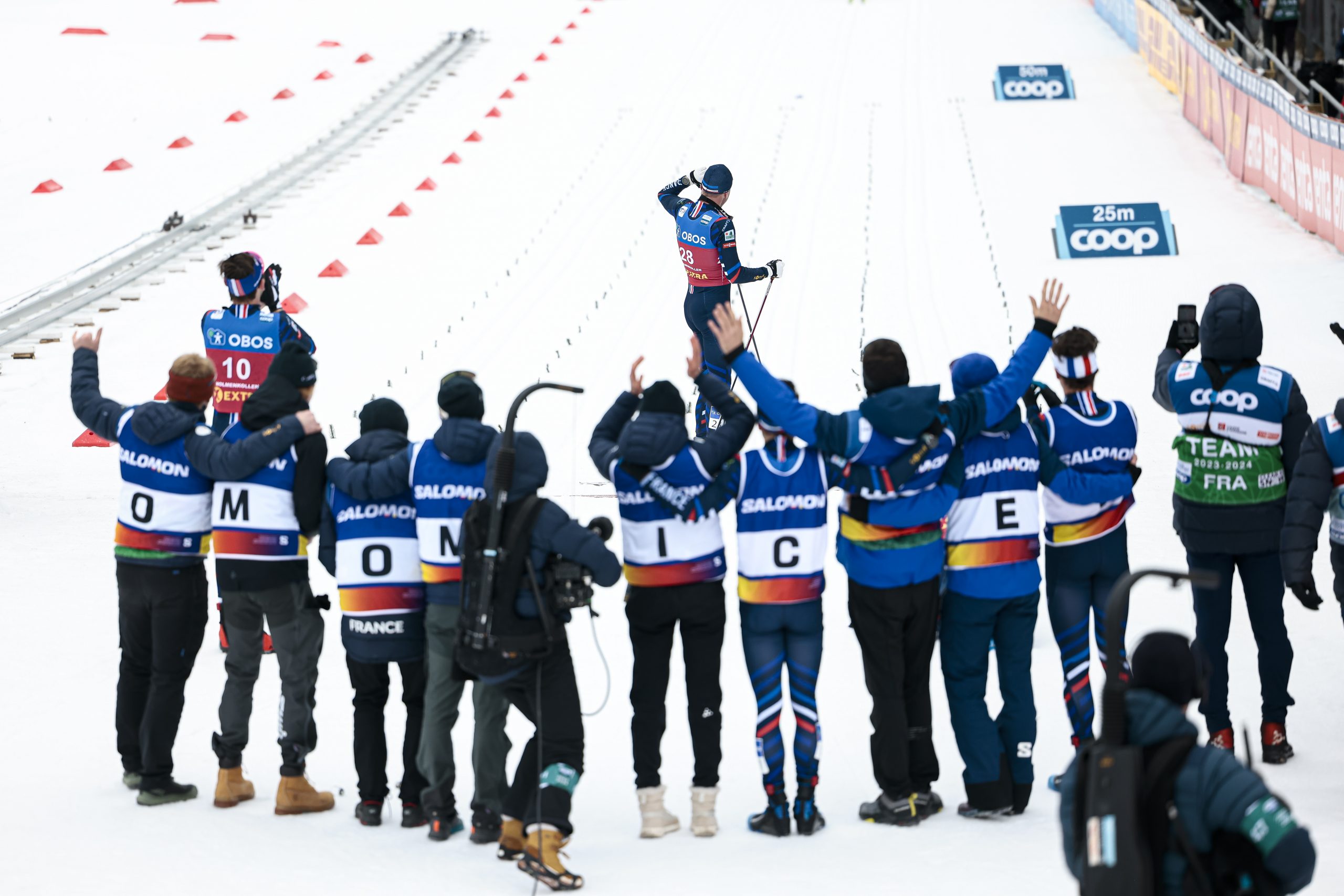
    Regardless, the Engadin Freestyle Sprint demonstrated the continuing dominance of the old contrasting with the glimmering potential of the new, even in such tightly-packed, elbow-rubbing conditions. Training partners, Klaebo and Chanavat shared a post-race moment in the finish area, sharing stories from the race like a typical pair of post-race age-groupers. “Poles everywhere, skis everywhere,” said Klaebo. “But I feel like that’s what happens in these kinds of courses.”

    One thing’s for sure: Klaebo is definitely an authority in what happens in these kinds of races.

    Men’s Freestyle Sprint RESULTS

    Men’s Freestyle Sprint QUALIFYING

  • Kreuger Flies up Alpe Cermis, Klaebo Wins Tour de Ski

    Kreuger Flies up Alpe Cermis, Klaebo Wins Tour de Ski

    This coverage is made possible through the generous support of Marty and Kathy Hall and A Hall Mark of Excellence Award. To learn more about A Hall Mark of Excellence Award, or to learn how you can support FasterSkier’s coverage, please contact info@fasterskier.com.

    Stage 7, final climb of the Alpe Cermis: Johannes Hoesflot Klaebo (NOR) only had to keep his rivals in sight in order to claim overall victory in the 2025 Topur de Ski. (Photo: Modica/NordicFocus)

    Johannes Hoesflot Klaebo doesn’t like this hill . . . he’s a sprinter, after all: he powers up short, punchy hills on his way to shrug-punctuated finish lines. That’s the way World Cups are won in the 21st century. But immortality—the kind to which Klaebo aspires—is purchased at a rather higher price, one that is paid with Olympic medals, on World Championship podiums, and atop Val di Fiemme’s Alpe Cermis. The Tour de Ski concluded on that lofty summit today, and Klaebo appeared determined to do his best in securing another bit of history.

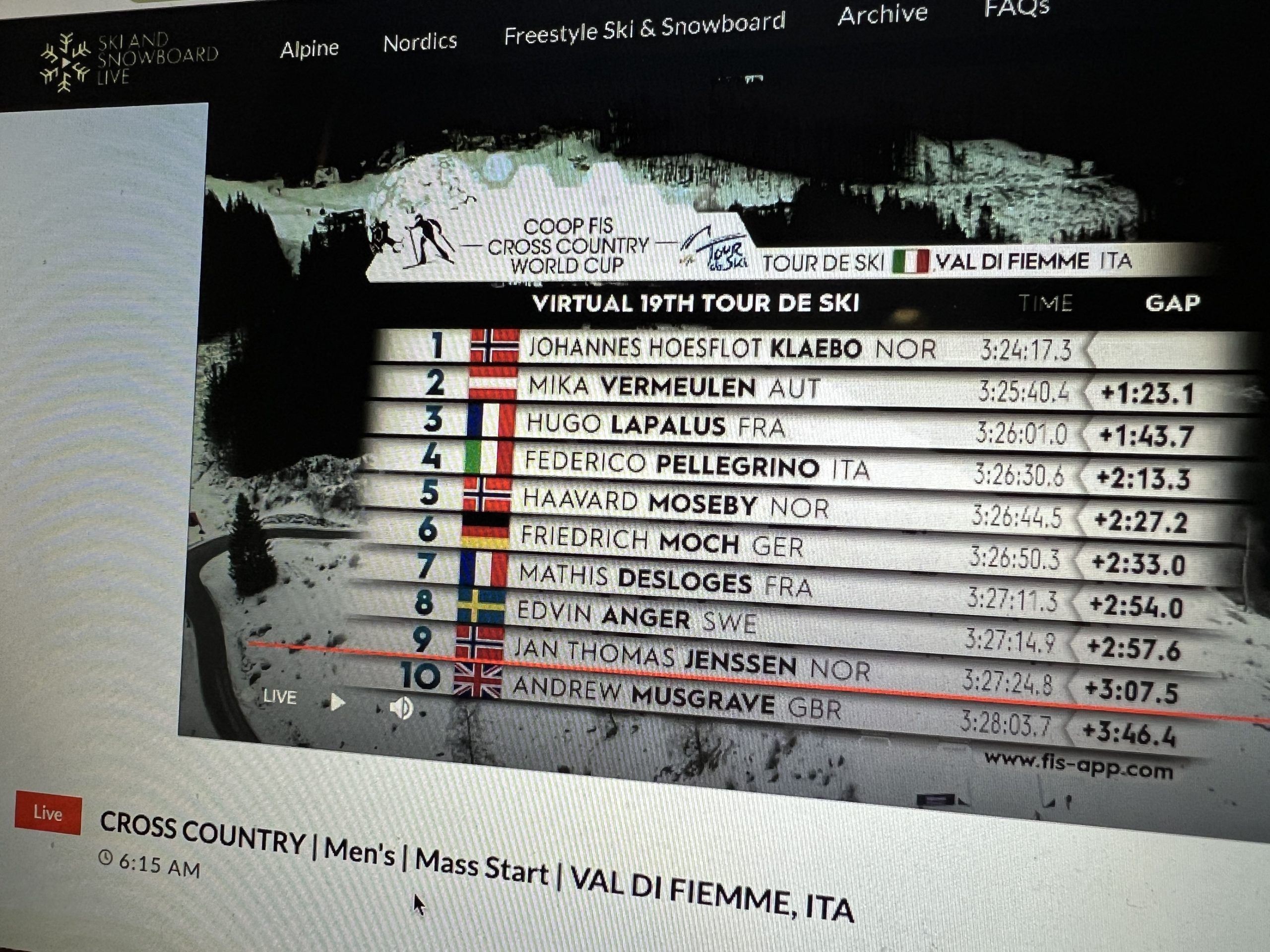
    Though other climbers ruled the stage, Klaebo measured his effort up the climb to claim his fourth Tour de Ski overall victory (tying the record of the immortal Dario Cologna). Klaebo finished only 18th on the day’s stage, but managed to preserve a 1:23 overall margin over Mika Vermeulen (AUT), and 1:43 over third place, Friederich Moch (GER).

    Sprinters climb too: Jack Young (USA) (climbing alongside TDS Sprint Bib winner, Switzerland’s Janik Riebli) appeared determined to add an overall finish in the 2025 Tour de Ski to his growing race record. (Photo: Vanzetta/NordicFocus)

    Zanden McMullen and Ben Ogden crossed the line 19th and 20th, only seconds behind Klaebo. Other North American Finishers included Canadas’ Antoine Cyr in 23rd and Olivier Leveille 29th, and American Jack Young in 53rd.

    In other remarkable sprinter-news, Federico Pellegrino (ITA) climbed the Alpe Cermis in seventh place, good enough to finish fourth overall, just 2:13 behind Klaebo in the final standings.

    Johannes Hoesflot Klaebo (NOR) (climbing with Sweden’s Edvin Anger) measured his effort throughout the day, preserving his lead over his closest rivals and claiming the win in the 2025 Tour de Ski. (Photo: Vanzetta/NordicFocus)
    Climbing the Alpe Cermis

    Tour de Ski overall standings at the beginning of stage 7 looked like this:

    1. Johannes Høsflot Klæbo (NOR) 2:50:24
    2. Erik Valnes (NOR) +2:18
    3. Haavard Moseby (NOR) +2:29
    4. Mika Vermeulen (AUT) +2:29
    5. Hugo Lapalus (FRA) +2:44
    6. Federico Pellegrino (ITA) +2:56
    7. Jan Thomas Jenssen (NOR) +2:59
    8. Andreas Fjorden Ree (NOR) +3:04
    9. Mathis Desloges (FRA) +3:12
    10. Edvin Anger (SWE) +3:17

    Klaebo had a large cushion to preserve. He wouldn’t need to contend for the win on Alpe Cermis; he’d need only to monitor his rivals and concentrate on damage control.

    In Stage 7, the tracks of the earliest kilometers are three-skiers wide, so there is less positioning to worry about, less jostling, less urgency. Until the six kilometer mark, the course is basically flat, following the course of Italy’s famed Marcia Longa marathon race. The final four kilometers, though, are decidedly different, climbing up the slopes of the Alpe Cermis Alpine ski area. Sprint points were offered at six kilometers (at the base of the climb) where Jannik Riebli confirmed his defense of the silver Sprint bib. That contest concluded, the race could begin in earnest.

    Leading his rivals by nearly three minutes in the overall standings, Klaebo remained at or near the front as the course ran along the river at the bottom of the valley. Once the course turned uphill, the climbers moved to the front. Mika Vermeulen led the bottom slopes (the steepest on the mountain at 28%) followed by Simen Hegstad Kreuger. Klaebo did his best to mark their accelerations.

    Halfway up the climb, the pace was made by Kreuger, followed by Vermeulen and Hugo Lapalus (FRA). Krueger began the day 7:10 behind Klaebo, so he did not represent a serious threat. Vermeulen had begun the day at 2:29 back, Lapalus at 2:44. Both seemed focused on the final podium, but neither seemed poised to challenge Klaebo for the overall win.

    Kreuger continued pushing the pace, followed only by Vermeulen. The race for the stage win was down to two men as Lapalus and Friederich Moch (GER) had fallen off the pace. For Klaebo, it was a case of doing his work while making sure not to go too hard. Climbing the Alpe would be difficult enough for a sprinter like Klaebo, but if he overextended, he could blow up and lose it all.

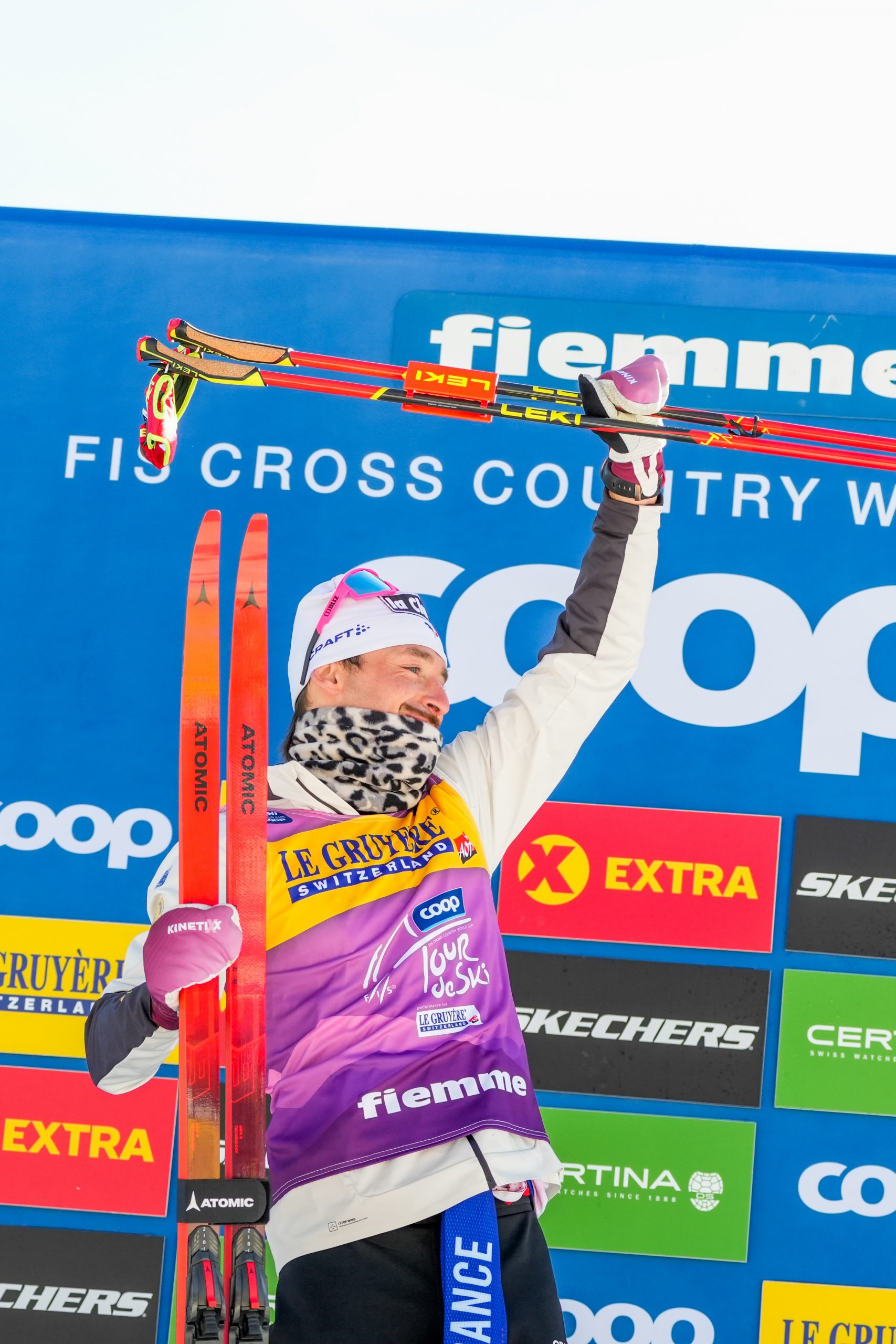
    Hugo Lapalus (FRA) celebrates claiming the Climbers Bib in the 2025 Tour de Ski. (Photo:  Modica/NordicFocus)

    After his initial time-losses on the lower slopes, Klaebo held the gap some 90 seconds behind Kreuger who would cross the finish line in 32: 39. Vermeulen finished seven seconds later, followed closely by Moch in third. Lapalus finished fourth to cement his hold on the Climber’s bib. Shepherded by his teamate, Haavard Moseby, Klaebo crossed the line in 18th place, 1:13 behind the winner—good enough to seal up the Tour de Ski overall win. His 18th place preserved a winning margin of 1:23 over Vermeulen.

    With the mid-Tour withdrawal of Harald Oestberg Amundsen, Klaebo’s win in the Tour de Ski makes it very unlikely that anyone else could overtake him in the chase for the FIS World Cup overall championship. While Klaebo’s primary focus probably remains the individual events at the World Championships later this season in Trondheim, he is sure to be satisfied with his hold on the Crystal Globe. That’s another piece of history—another source of legacy—that Klaebo has certainly earned . . . even on humbling days like the ones when he has climbed the Alpe Cermis.

    Mika Vermeulen (AUT), Johannes Hoesflot Klaebo (NOR), Hugo Lapalus (FRA), (l-r) top the podium in the 2025 Tour de Ski. (Photo: Vanzetta/NordicFocus)

    Alpe Cermis Freestyle 10 k RESULTS


    Final standings in the 2025 Tour de Ski. (Photo: FasterSkier)
  • Klaebo Controls 20 k Skiathlon

    Klaebo Controls 20 k Skiathlon

    This coverage is made possible through the generous support of Marty and Kathy Hall and A Hall Mark of Excellence Award. To learn more about A Hall Mark of Excellence Award, or to learn how you can support FasterSkier’s coverage, please contact info@fasterskier.com.

    Austria’s Mika Vermeulen (6) pushed the pace throughout the 20 k Skiathlon, moving into second place overall in the 2025 Tour de Ski with only one stage remaining. Sweden’s Edvin Anger (4) would begin the day in second place, but would ultimately drop from contention. (Photo: Vanzetta/NordicFocus)

    The 2024-2025 Tour de Ski has already been a long, challenging adventure, and the end of the tour (tomorrow atop Alpe Cermis) offers a unique and daunting set of challenges. While Stage 6 of the Tour offered a glimpse of what will be the venue for the 2026 Olympic Skiathlon, today’s race in Val di Fiemme bore little direct comparison to the action likely to take place a year from now. Today’s race was complicated by the exhaustion of five prior days of racing, the absence of numerous contenders who dropped out earlier in the event, ongoing competitions in the Sprint and Climber’s jerseys, and the need to conserve energy for tomorrow’s climb. Next year’s Olympic event will be a no-holds-barred free-for-all. Today’s Skiathlon in Stage 6 of the Tour de Ski was a decidedly more measured and conservative affair.

    Johannes Hoesflot Klaebo (NOR) entered the day enjoying a lead of 1:35 over Edvin Anger (SWE), and 2:11 over Erik Valnes (NOR), neither of whom appeared likely to pose a truly menacing threat on tomorrow’s climb of the the Alpe Cermis. In preparing for today’s Skiathlon, it seemed Klaebo’s task would be to monitor his rivals, limit his losses, and conserve energy for Sunday’s final climb (which is known to be one of his least favorite racing tests of each World Cup season).

    Johannes Hoesflot Klaebo (NOR) would control the pace through the closing laps of the Val di Fiemme Skiathlon, coasting across the line comfortably ahead of his rivals. (Photo:  Modica/NordicFocus)

    Today in Val di Fiemme, Klaebo would control the race from the front throughout the final laps, sprinting up the last hill to establish a gap he would carry across the finish line comfortably ahead of Federico Pellegrino (ITA) in second and Jan Thomas Jensen (NOR) in third. Antoine Cyr (CAN) would finish 16th, just ahead of Zanden McMullen in 17th.

    Other North American finishers included Ben Ogden 21st, Olivier Leveille 24th, and Jack Young 53rd.

    20 k Skiathlon

    Jannik Riebli (wearing the U23 jersey) and Britain’s Andrew Musgrave (wearing the climber’s jersey) would join the leaders in the front row at the starting line of the Skiathlon. American Ben Ogden would begin the day in 14th, a disappointing position when compared to his high-water mark of third place a few days ago, but otherwise a bright spot in his career as a distance skier and all-around threat. Canadian, Antoine Cyr, would begin the day in 22nd.

    Snow temperatures of -10.5 degrees celsius made for fair waxing conditions in this early morning start, allowing the 61-man field to remain together through the first of six 3.3 kilometer laps.Mika Vermeulen (AUT) moved to the front at the end of Lap 2, followed by Valnes. They would provide much of the pace-setting in the Classic laps.

    Hugo Lapalus (FRA) took over the Climber’s jersey during the Skiathlon, and appears to have energy to spare for tomorrow’s final ascent of Alpe Cermis. (Photo: Vanzetta/NordicFocus)

    The ski exchange at the halfway point saw few changes to the overall standings, though Hugo Lapalus (FRA) had surged to overtake Musgrave for the lead in the Climber’s jersey. Klaebo and Valnes led the field into the exchange, while Friederich Moch (GER) was the fastest in the equipment swap, exiting the exchange zone just ahead of Vermeulen and Klaebo.

    The Freestyle course was identical to the Classic course, though the positioning of a lane of Classic tracks rendered the skate course rather narrow. Some racers attempted to make progress by passing in the Classic lanes, but for the most part the narrowed lane allowed Klaebo to sit at the front where he controlled the pace through the early part of the Freestyle laps.

    Nineteen racers comprised the final selection, though that group continued to string out behind the pace making of Vermeulen. McMullen and Cyr held on gamely to the tail end of the group as Vermeulen (determined to take time out of Anger who continued to fade) continued to push the pace.

    Federico Pellegrino (ITA) orchestrated a marvelous second place finish with a well-timed sprint up the final hill of the 20 k Skiathlon in Val di Fiemme. (Photo:  Modica/NordicFocus)

    Klaebo, Lapalus, and Moch led the field through the beginning of the final lap as a resurgent Musgrave pressed the pace. In the end, Klaebo would surge up the final hill, followed by Pellegrino and Jensen. Coasting across the finish line well clear of his rivals, Klaebo extended his lead in the overall Tour standings. Valnes now trails by 2:18, followed by Haavard Moseby and Vermeulen tied at 2:29 back, and Lapalus at 2:44. Anger dropped to 10th overall, followed by Musgrave in 11th.

    Men’s 20 k Skiathlon RESULTS

    Federico Pellegrino (ITA), Johannes Hoesflot Klaebo (NOR), and Jan Thomas Jenssen (NOR), (l-r) share the podium after the 20 k Skiathlon in Val di Fiemme (ITA). (Photo:  Vanzetta/NordicFocus)
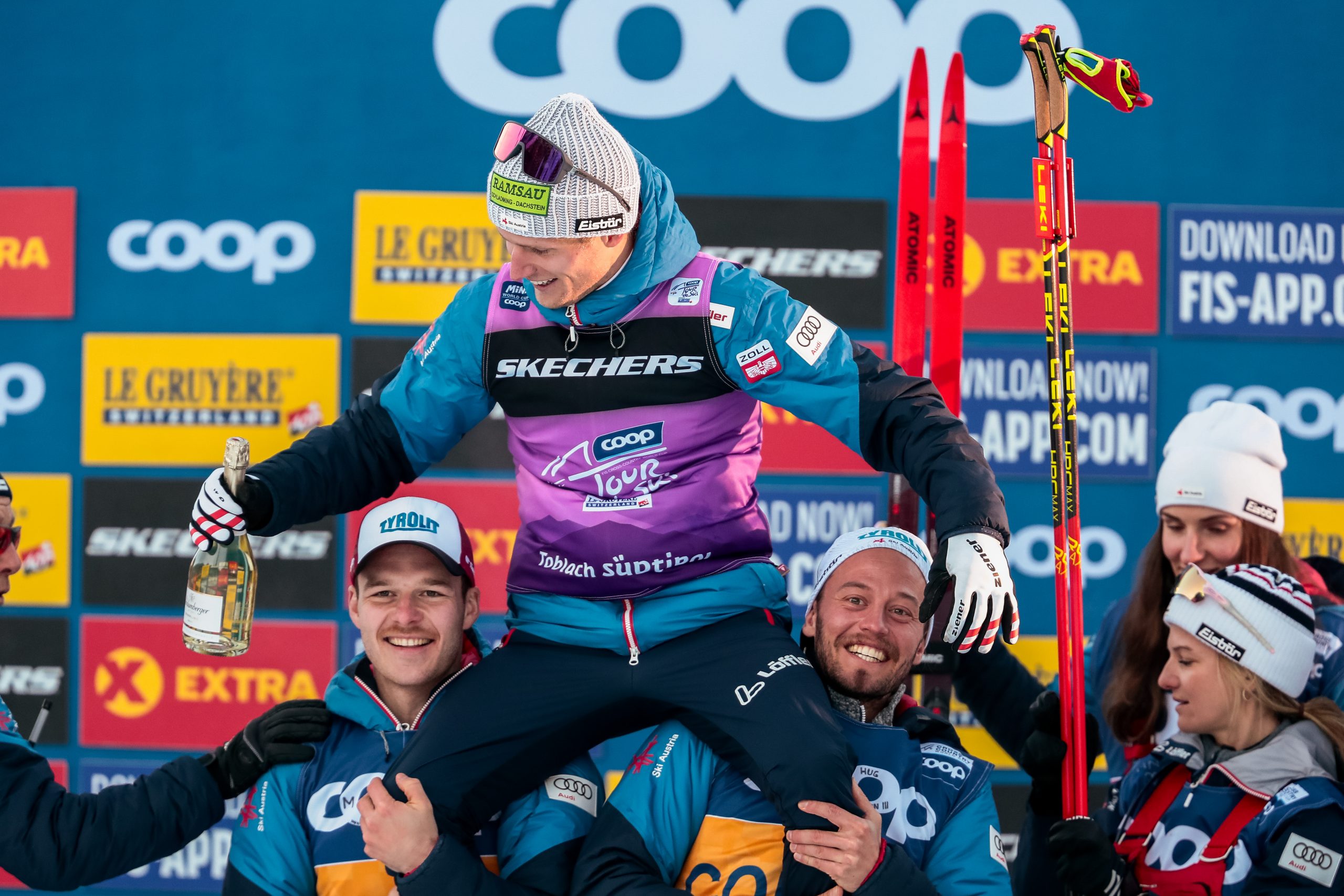
  • Klaebo Controls Bonus-Heavy Toblach Mass Start, Schumacher Seventh

    Klaebo Controls Bonus-Heavy Toblach Mass Start, Schumacher Seventh

    This coverage is made possible through the generous support of Marty and Kathy Hall and A Hall Mark of Excellence Award. To learn more about A Hall Mark of Excellence Award, or to learn how you can support FasterSkier’s coverage, please contact info@fasterskier.com.

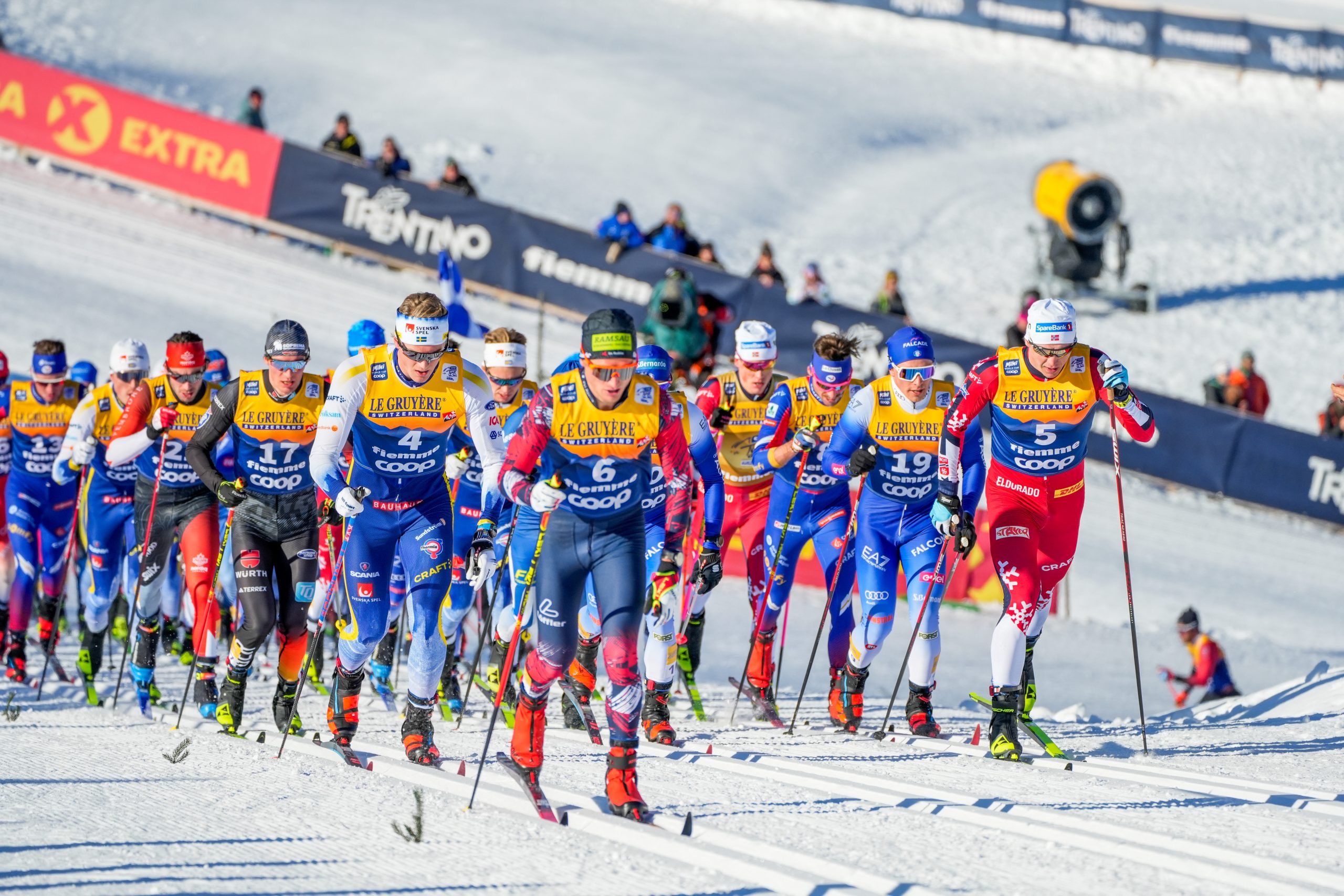
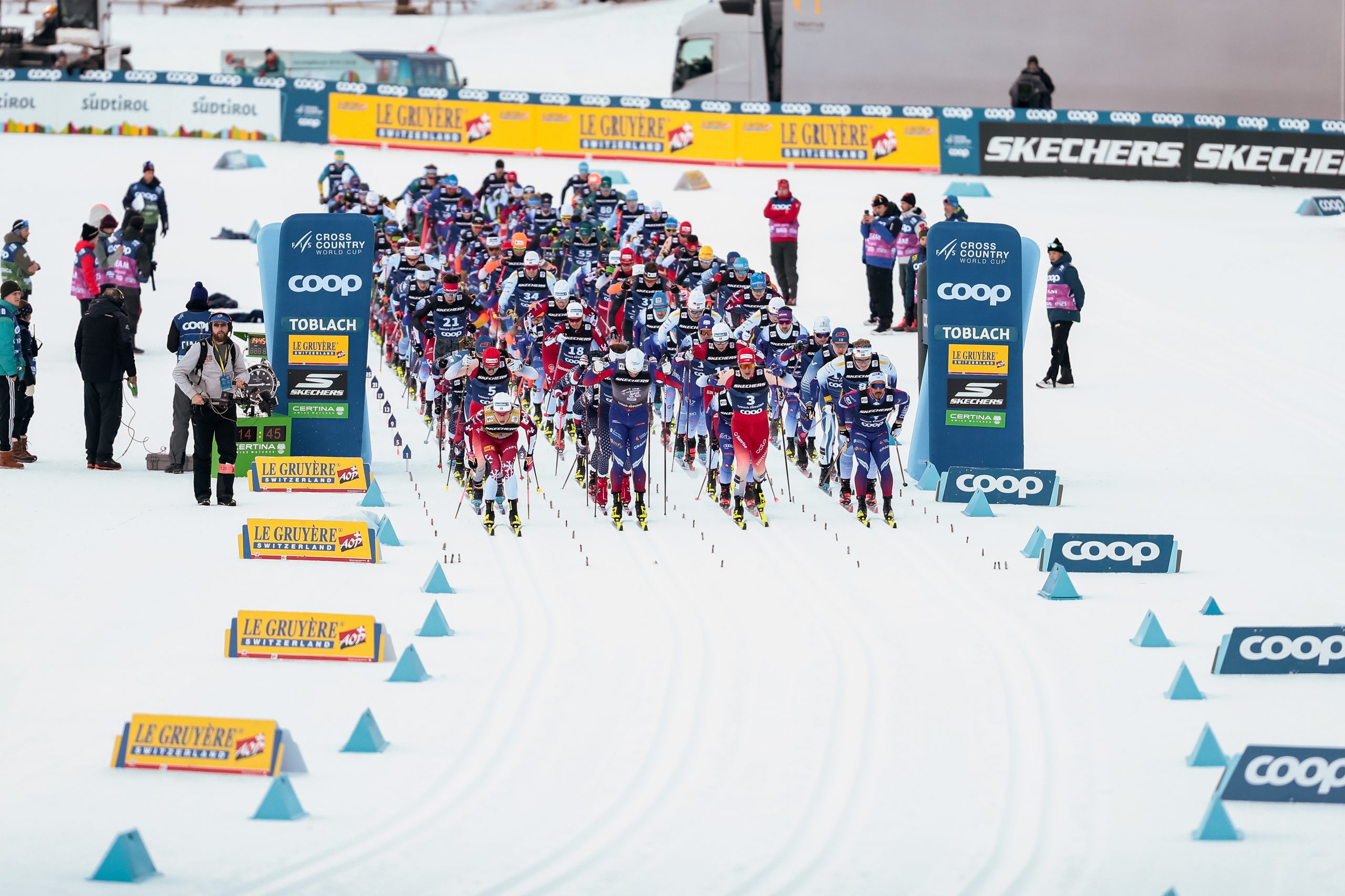
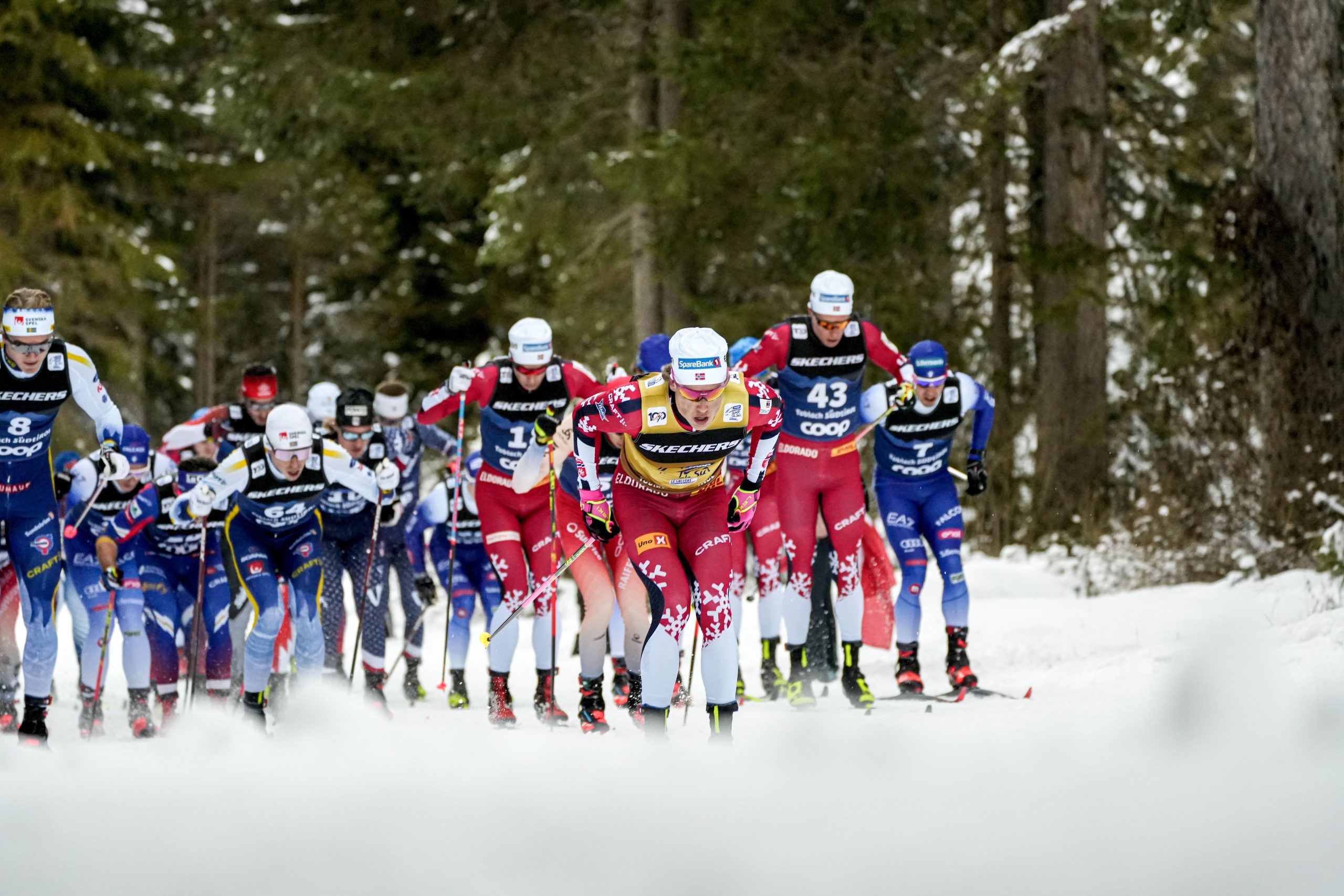
    Johannes Hoesflot Klaebo (NOR), Lucas Chanavat (FRA), Janik Riebli (SUI), Richard Jouve (FRA) lead a 95-man field out of the starting area in Stage 2 of the 2025 Tour de Ski in Toblach, Italy. (Photo: Modica/NordicFocus)

    Mass Start Nordic racing ain’t fair—it just can’t be. The Classic track in Toblach, Italy is only four skiers wide, so many mass-start racers will find themselves off the back as soon as the starter’s pistol fires. For those positioned mid-pack, the early kilometers of any mass-start race will be a series of fate-defying moves in attempts to press forward, to make up a few valuable places, to keep from getting skis run over, to keep from getting poles snapped. Starting in the middle of the pack is a daunting prospect, a penalty of sorts for having failed to rank high enough to earn an up-front start position. That’s how heavily yesterday’s Sprint competition affected today’s Classic Mass Start.

    Following fine finishes in Tour de Ski’s first Sprint stage, two Americans began the day in top ten start positions: Ben Ogden 6th and Gus Schumacher 10th. JC Schoonmaker and Jack Young also earned top 20 start positions by their terrific performances in the prior day’s sprints. Stars and Stripes racing suits would be in contending positions when the moves started happening.

    “I don’t think we have too much of a team plan,” Schumacher said in pre-race interviews. “Just race our own races and do the best we can.”

    “Go with the leaders as long as possible,” Schumacher said. “And make something happen in the end, hopefully.”

    Andrew Musgrave (GBR) summed up the aspirations of many: “Plan A is to get to the front without using too much energy.”

    In the end Tour Leader (and yesterday’s Sprint winner), Klaebo, managed to work his strategy to perfection, hanging around near the front to orchestrate a perfect sprint at the finish. Erik Valnes (NOR) skied across the line on Klaebo’s tails, followed by Haavard Moseby in third.

    American start positions translated into good finishes as well: Schumacher skied with the leaders throughout the race, sprinting to a thoroughly credible seventh. Behind him, Zanden continued to add to his great early-season finishes in 17th, Ogden 26th, Schoonmaker 46th, and Young 84th. Among Canadians, Antoine Cyr skied terrifically, keeping himself in contention throughout the final lap and sprinting in the final group to finish ninth. Olivier Leveille was the other Canadian finisher in 52nd.

    Johannes Hoesflot Klaebo (NOR) managed the pace of the 15 k Mass Start, staying at or near the front and sprinting to the win. (Photo: Vanzetta/NordicFocus)
    Men’s 15 k Mass Start

    Toblach featured hard tracks (very muchto the racers’ liking), but fairly warm temperatures: +5 degrees celsius on a course that would wind four times around a 3.5 kilometer loop.

    A massive field of 95 men was led out of the stadium by Klaebo (whose initial pace was conspicuously hot). Things quickly began to stretch out, the fast pace giving skiers more room to maneuver but making it decidedly more difficult to move up. Classic specialists and overall challengers (like Amundsen and Nyenget) who had failed to excel in yesterday’s sprint would be forced to burn energy in maneuvering to the front. Amundsen is cagey and capable, and he managed to work his way to the front by the end of Lap 1.

    Mika Vermeulen (AUT) celebrates earning the inaugural Climber’s Bib during the Toblach Mass Start Classic in Stage 2 of the Tour de Ski. (Photo: Modica/NordicFocus)

    A Climber’s Bib has been incorporated into the Tour de Ski awards this season, so the field had three mid-race opportunities to sprint for Climber’s points. The Tour continues to offer a Sprinter’s Bib, as well, so Toblach’s 15 kilometer course was regularly interrupted by point-grabbing opportunities for the greedy and the opportunistic. Klaebo took the first Sprint points just to let everyone know that he wasn’t willing to surrender anything.

    Keeping it fun, keeping it light: Ben Ogden (USA) was greeted on course by his own unofficial fan club, complete with revving chainsaw. (Photo: Vanzetta/NordicFocus)

    Ogden moved to the front—and thirty meters off the front—at the one kilometer mark of the race, leaving commentators wondering what he was up to. FasterSkier was later able to discover that Ogden’s race-leading tactic was in response to the presence of the unofficial “Ben Ogden Fan Club” comprised mostly of former teammates from the University fo Vermont. Accompanied by the sound of a chainsaw revving in the background, Ogden strided happily forward to greet the cheering throng who gather at one event each season to bring a bit of Collegiate Ski Carnival energy to the sometimes staid World Cup.

    Mass start races offer opportunities for various skiers to affect the pace, especially when there are point bonuses available: Mika Vermeulen (AUT), Hugo Lapalus (FRA), and Amundsen seemed determined to test Klaebo; he allowed occasional gaps to develop on the uphills, but always managed to close them on subsequent downhills. Amundsen continued pressing the issue on numerous climbs, increasing the pace in the Classic tracks while Klaebo was forced to herringbone outside the tracks. In the past few seasons, Klaebo hasn’t often been seen using his early-career signature “moose step” technique, but he incorporated it numerous times in Toblach to counter the attacks of his countrymen. Evidently, Klaebo had opted for less kick wax on this day, making sure that his skis would be fastest on descents and in the anticipated double-pole finish.

    And as the pace continued to heat up in the final lap, Cyr began asserting himself among the leaders. He remained in the mix as the field approached the final two uphills where Klaebo simply strided away to a gap that he could easily defend down the final slope and into the finishing straightaway. On-screen commentators excitedly announced that Klaebo was chased across the finish line by Amundsen, but it was actually Valnes who stayed on Klaebo’s tails down the finishing straight. Valnes may not be a contender in the TDS overall standings (the finishing climb up Alpe Cermis is definitely not for Valnes), but he skied bravely and intelligently today in Toblach to snatch a podium finish.

    For his own part, Amundsen did finish strongly (sixth) to announce his intention to defend his 2024 Tour de Ski title, but it was Klaebo who lengthened his lead at this point in the Tour. Two more distance races follow today’s race, so the battle between Amundsen and Klaebo seems likely to continue all the way to the summit of Alpe Cermis.

    Men’s 15 k Mass Start RESULTS

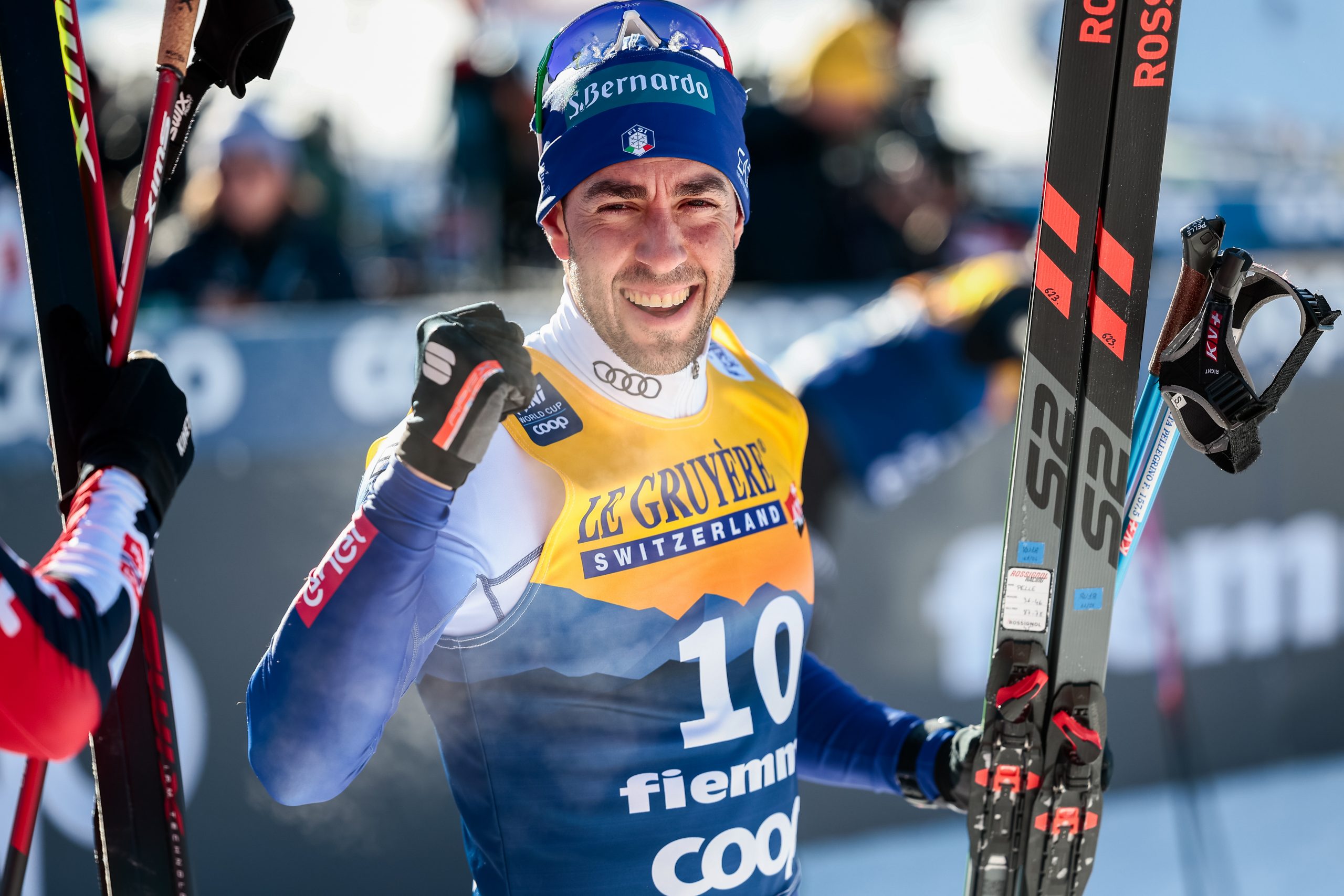
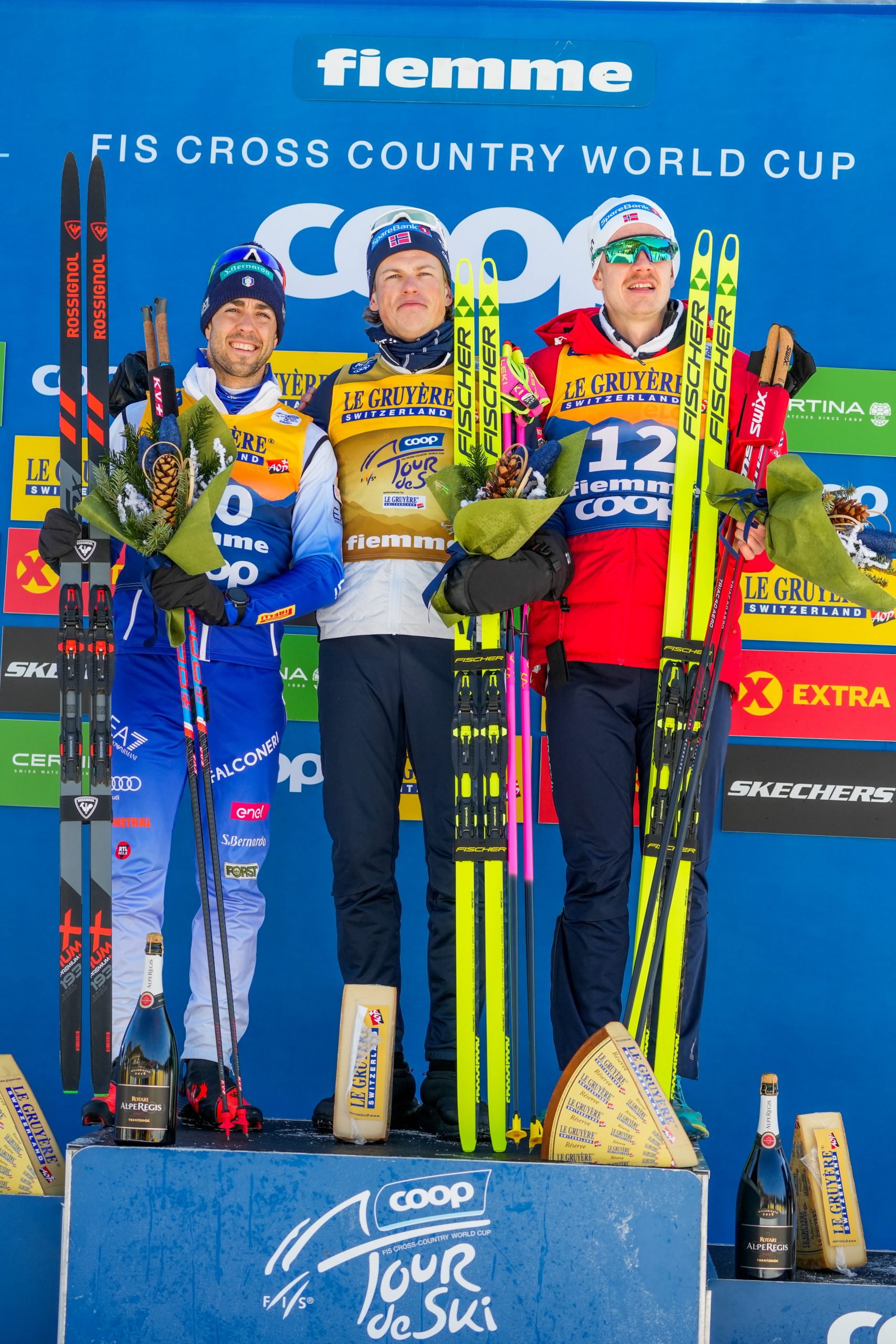
    Erik Valnes (NOR), Johannes Hoesflot Klaebo (NOR), and Haavard Moseby (NOR) on the podium of the Men’s 15 k Mass Start Classic in Toblach, Italy. (Photo: Vanzetta/NordicFocus)
  • Ogden Battles Through Broken Pole in Final As Klaebo Wins Tour de Ski Stage 1

    Ogden Battles Through Broken Pole in Final As Klaebo Wins Tour de Ski Stage 1

    The 19th edition of the Tour de Ski is here once again! While many athletes have taken a conservative start to the season, skipping early races to focus on preparations for the World Championships in Trondheim later this winter, the excitement for the Tour remains high. With seven stages packed into just nine days — and rest days on Monday and Thursday — the Tour has historically seen relatively few skiers complete the entire event. However, many of the sport’s top athletes hope to compete all the way through, chasing bonus points and the opportunity to solidify their positions as World Cup leaders in this important week of racing.

    The Tour kicks off in Toblach, Italy, with a skate sprint as the opening event. The first four races will take place in Toblach before athletes transition to Val di Fiemme for the final three races on Friday, Saturday, and Sunday, marking the Tour’s conclusion.

    This course demands sharp strategy, precise lines, and well-timed pacing to finish in the front of each heat. Athletes must not only position themselves effectively on the uphills but also navigate the downhills skillfully, taking optimal lines to slingshot themselves around both the trail’s corners and their competitors. Completing two laps on this challenging course requires a careful balance of power and tactics. With the finishing stretch emerging from a downhill turn, positioning becomes crucial long before the finish line itself.

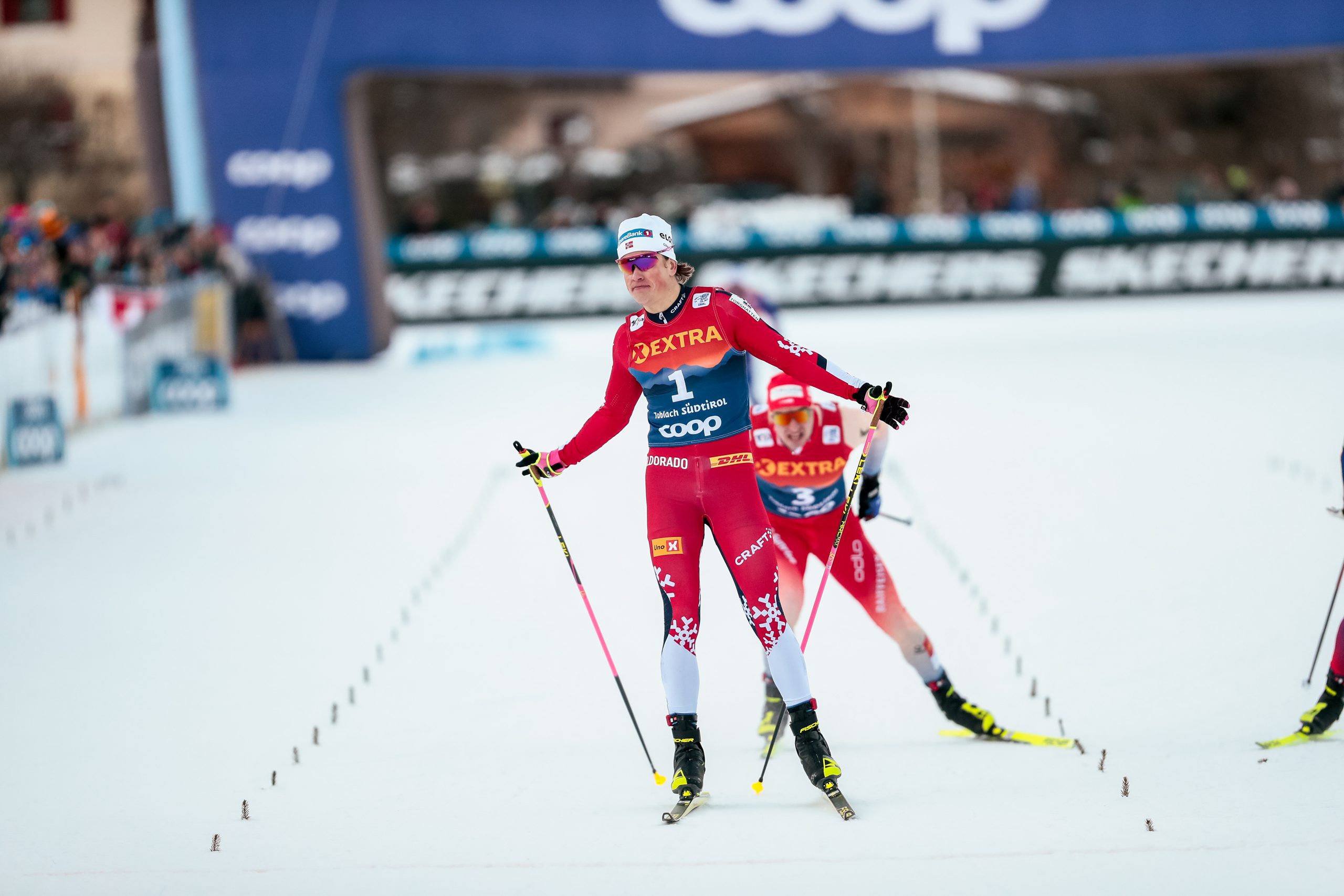
    Johannes Hoesflot Klaebo (NOR) with his trademark coast into the finish of the individual freestyle sprint in Toblach (ITA). (Photo: NordicFocus)

    The heats followed a familiar marching pattern to those we’ve already seen this season: with Johannes Hoesflot Klaebo (NOR) and Lucas Chanavat (FRA) skiing synchronously at the start of each heat to control pacing and claim podium positions together. Janik Riebli (SUI) followed closely behind, slipping into the final as a lucky loser, with the road paved to a podium position after competitors Ben Ogden (USA) broke a pole and Valerio Grond (SUI) slipped during the final ascent. Klaebo earned, in what appeared to be an easy win, his 95th sprint victory. “In the end, I’m really satisfied, and it’s the perfect way to start the tour,” he said upon finishing the race. 

    Four Americans advanced to the heats, with Ogden finishing 6th, Gus Schumacher, 10th, JC Schoonmaker, 14th, and Jack Young, 17th. Zanden McMullen just barely missed qualification, finishing 36th. On the Canadian side, Antoine Cyr (56th) and Olivier Leveille (60th) completed the race but did not qualify for the heats.


    Men’s Sprint Quarterfinals

    In the first heat, Klaebo and Chanavat dominated from the start, skiing side by side in a controlled performance that seemed almost choreographed, easily securing their spots in the semifinal heats. Other athletes vied for these positions, Emil Danielsson (SWE) tried to pass through the middle of Klaebo and Chanavat, who accelerated and maintained their position in front. French skier Remi Bourdin also approached the pair in front over the final ascent around two minutes into the race, though could not surpass Chanavat and finished third in the heat. 

    In the second quarterfinal heat, Ogden battled Riebli head-to-head for the leader position, both holding off sprint specialist Richard Jouve (FRA). The two exchanged leads throughout the race, with Ogden making a decisive move around the inside of the final turn. This maneuver set him up for a clear finishing sprint, allowing both Ogden and Riebli to advance together to the semifinals.

    Schumacher took an early lead in the third heat, facing challenges from Niilo Moilanen (FIN) and Davide Graz (ITA). After a minute and a half, Schumacher was able to solidify himself in front, accelerating through the descent to establish a small gap ahead of the field. His competition narrowed again in the final stretch, though Schumacher maintained his position in front to advance to the semifinals alongside Moilanen. Meanwhile, Evan Northug’s race took an unfortunate turn as he broke a pole just out of the gate, forcing him to pull to the side of the trail and effectively ending his chances of progressing. Currently ranked 3rd in the overall sprint standings, Northug is a strong sprinter, but this setback could jeopardize his Tour prospects, especially given his relatively weaker performances in distance disciplines.

    Federico Pellegrino (ITA), front, Edvin Anger (SWE), left, and Jack Young (USA), right, lead their quarterfinal heat. (Photo: NordicFocus)

    Young battled against Federico Pellegrino (ITA), 12 years his senior, in the fourth quarterfinal together with strong sprinters Edvin Anger (SWE) and Erik Valnes (NOR). Valnes established an early lead out of the start, joined by Pellegrino. Midway through the race, Anger accelerated into the lead, but the top three continued to trade positions as the heat progressed. Young stayed right in the mix, maintaining a strong position near the front of the pack.

    “I started as hard as I could and put myself in position near the front of the heat. After that, there wasn’t much I could do to get around Pellegrino or Anger,” Young explained. After being boxed out in the inside of the finishing stretch, Young’s chance of qualification was low but chances at a lucky loser position seemed high, ultimately missing qualification by 0.3 seconds. “The only thing I’m wondering about is whether I could have swung out wide on the turn into the finish instead of checking my speed to get the inside,” Young reflected after the race, “that could have given me the three-tenths necessary to get a lucky loser spot.” 

    Finally, Valerio Grond controlled the pace of quarterfinal five through much of the race, battling closely against Finland’s Lauri Vourinen. Italy’s Giovanni Ticco briefly challenged Grond for the lead initially but soon fell back, ultimately finishing last in the heat. Meanwhile, Schoonmaker stayed in the middle of the pack, focusing on “bringing good momentum into hills,” and positioning himself strategically to contest the leaders in the final sprint. Although he crossed the line in third, initially appearing poised to advance to the semifinals as a lucky loser, subtle time adjustments narrowly eliminated him from contention.


    Men’s Sprint Semifinals
    Johannes Hoesflot Klaebo (NOR), Lucas Chanavat (FRA), and Ben Ogden (USA) racing out of the stadium. (Photo: NordicFocus)

    A quick look at the start list made it evident which semifinal was likely to produce the fastest times—and from which the lucky losers would emerge. Klaebo and Chanavat were set to face off again in the first heat, joined by Ogden, Riebli, and Valnes, all formidable sprinters capable of pushing Klaebo to reconsider his race strategy.

    The heat unfolded precisely as would be expected, mirroring the quarterfinals.  Klaebo and Chanavat led the pack side by side, skillfully controlling the pace around the course before Klaebo pulled ahead to take first at the line. Ogden positioned himself right behind them, confident that the speed of this heat would give him a chance at entering the final as a lucky loser. Ogden raced confidently and quickly, taking tight lines around the course and crossing the finish line in third, just behind Chanavat in second. The real drama came down to Ogden and Riebli, sprinting neck and neck to the finish, successfully securing lucky loser positions.

    The second semifinal lacked a clear favorite, leaving the top two positions wide open for the competitors to claim. Richard Jouve and Federico Pellegrino both have a strong history in skate sprints, while Valerio Grond has recently delivered impressive results in the freestyle sprint discipline. Meanwhile, Anger, Vuorinen, and Moilanen have consistently been contenders in sprint finals this season.

    Ultimately, this semifinal—perhaps aware that the lucky loser spots had already been secured by the first heat—turned out to be one of the slowest of the day. With six skilled sprinters, strategic positioning within the pack became the decisive factor in determining who would advance. Grond skied steadily from the start, moving into the lead later in the short race. In a close finish, Jouve narrowly edged out Pellegrino to claim the second qualifying spot for the final.


    Men’s Sprint Final

    Again, Klaebo and Chanavat took an early lead, executing their well-rehearsed, almost synchronized strategy to control the pace of the heat before battling it out at the finish line—a contest Klaebo typically wins.

    While their dominance played out as expected, the race for the top three positions took an unexpected turn. Ogden broke a pole early on, losing contact with the leaders as they rounded the first corner. Moments later, Grond’s skis slipped on the uphill through the stadium, causing him to fall and take Jouve down with him. With three competitors effectively out of contention, Klaebo and Chanavat remained unchallenged at the front while Riebli skied through the chaos to contend for the third podium position. 

    Johannes Hoesflot Klaebo (NOR), right, and Lucas Chanavat (FRA), left, congratulating each other after the races. (Photo: NordicFocus)

    Ogden recounted the chaotic events of the final to FasterSkier after the race. “I was trying to weasel in behind Lucas [Chanavat], and someone behind me wasn’t thrilled about that,” Ogden reported, describing the battle for position that ultimately led to his pole snapping. “I was kinda able to ski with one pole, but then the exchange was incredibly hectic, and I tripped myself twice, and there was little to no hope after that.” Once Grond fell too, the two of them competed head to head for the remaining positions. 

    Despite the disappointing result, Ogden found pride in his approach to the heats. “I’m most proud of my confidence today in the heats,” he shared. “I was more nervous today than I’ve been for a while because I’ve got some memories.” He was referring to his breakthrough performance last season, which included his first-ever sprint podium on the Toblach course. “I feel like I handled it really well—skied smart and never got too frantic. It’s an unfortunate way to end after all that work, but what can you do? It’s part of the deal.”

    As for Klaebo, his victory came as no surprise, continuing his dominance in sprint racing this season. While another win may feel routine for the seasoned sprinter, Klaebo expressed excitement with his performance. “In the end, I’m really satisfied. It’s the perfect way to start the Tour,” he said with a smile. 

    With only Stage 1 of the Tour completed, Ogden is focused on the long week ahead. “My goals are to manage my energy as best as I can and make it all the way to the end!” he said, with his eyes on the Leader Bib. For now, fans can expect him to prioritize recovery, fueling for the upcoming races, and finding lighthearted distractions like browsing “clapped Jaguars and Porsches on eBay” to unwind between events.

    Men’s Freestyle Sprint Results

    Tour de Ski Overall Standings

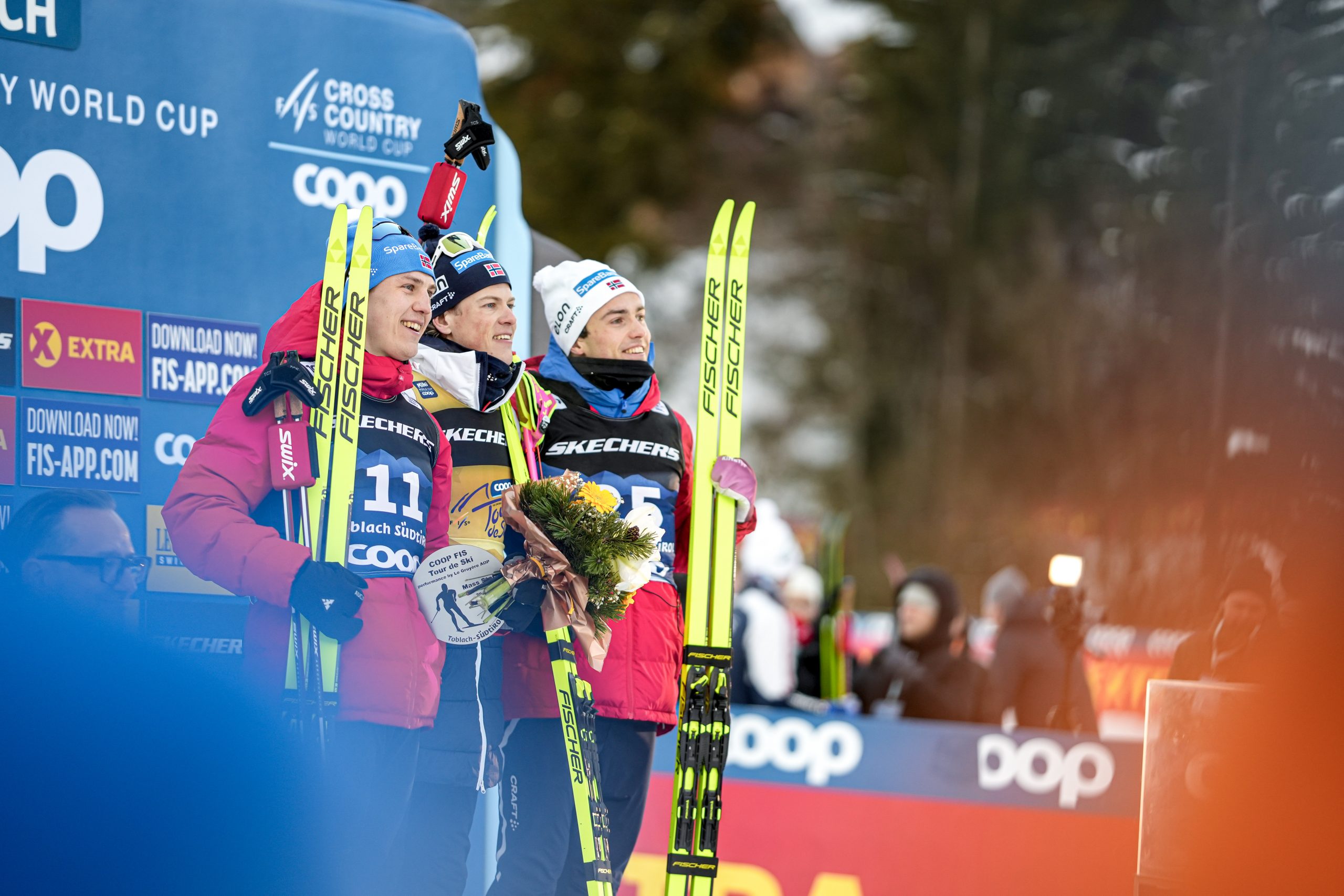
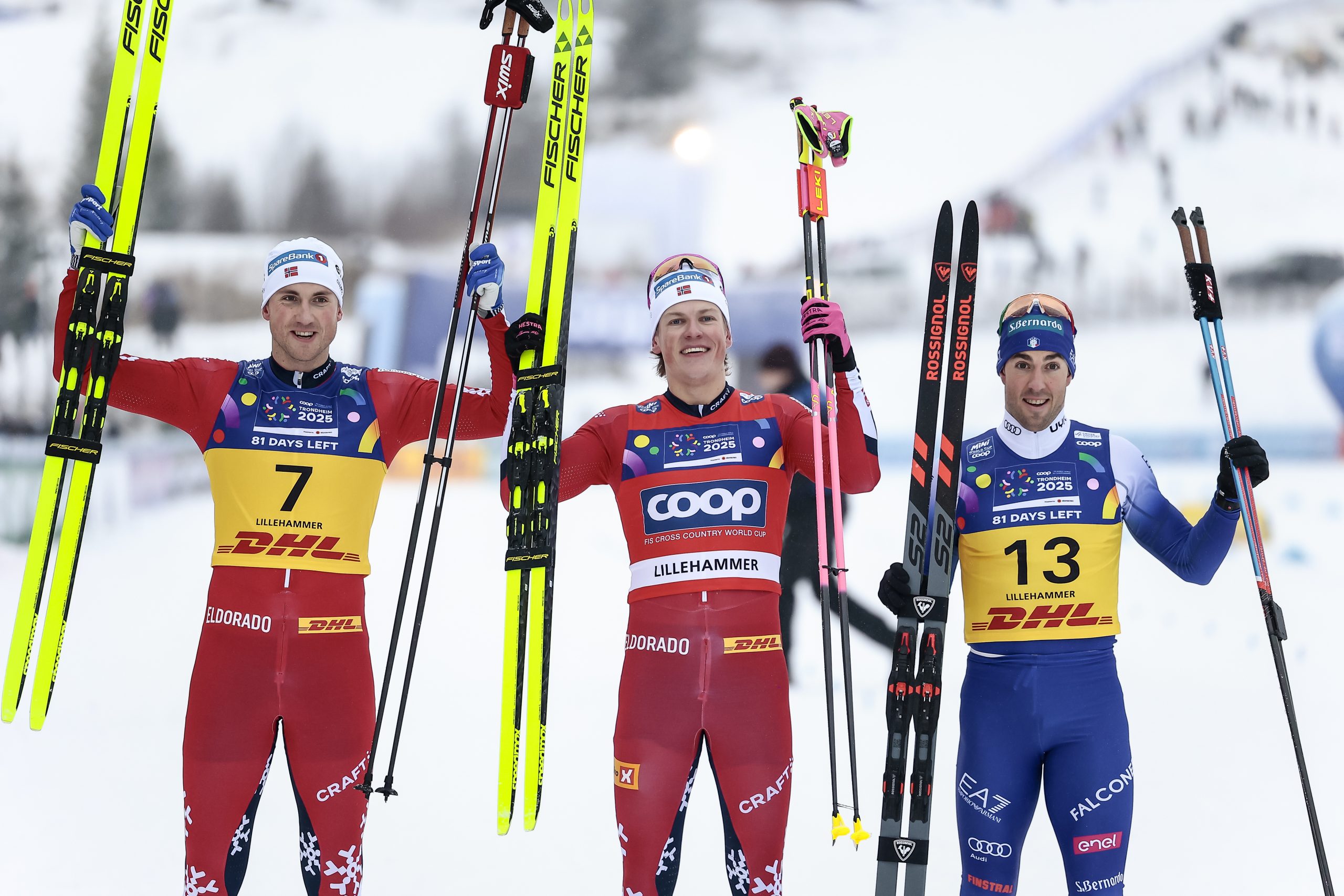
    Lucas Chanavat (FRA), Johannes Hoesflot Klaebo (NOR), Janik Riebli (SUI) topped the podium in Toblach Tour de Ski Stage 1. (Photo: NordicFocus)


  • Ogden Top Qualifier in Lillehammer Sprint, Klaebo Remains Wondrously Predictable

    Ogden Top Qualifier in Lillehammer Sprint, Klaebo Remains Wondrously Predictable

    This coverage is made possible through the generous support of Marty and Kathy Hall and A Hall Mark of Excellence Award. To learn more about A Hall Mark of Excellence Award, or to learn how you can support FasterSkier’s coverage, please contact info@fasterskier.com.

    Ben Ogden (USA) had his 2024 World Cup campaign interrupted by illness. Ever since, he’s been working to return to world-class form. His win in the Sprint Qualifier in Lillehammer may be an indication that he’s finally back where he belongs. (Photo: Modica/NordicFocus)

    The World Cup cross country season is a long and winding road—few athletes experience seasons that end the way they began. American, Ben Ogden, had his 2024 World Cup campaign interrupted by mononucleosis that ended his season and prevented him from participating in the memorable Minneapolis World Cup races. Not only did much of 2024 prove to be a disappointment for Ogden, it also forced him into a long off-season of recovery and re-start. It hasn’t been known how successful Ogden’s recovery has been, and his first weeks in the 2024-2025 World Cup season offered both hope and doubt. Today in Lillehammmer, he received the first indications that he may have done things right. Ogden was simply superb in Sprint Qualifying, posting the fastest time of all skiers (2:34.33), a half second ahead of the usually-untouchable Klaebo, and 2+ seconds ahead of everyone else. Ogden would find himself boxed in in his quarterfinal heat, and would finish the day in 17th.

    “Today, I really had my eye on the semifinal and the final (foolishly),” said Ogden. “So I tried to be tactical in the quarterfinal and save as much energy as I could. That’ll teach me!”

    Colby College’s Sprint specialist, Jack Young (USA), also advanced to the quarterfinal round, qualifying 25th. He would finish the day in 25th.

    “Except for a two week camp in Park City, I have been in Waterville (Maine) training with my teammates at Colby,” said Young. ” . . . “I knew my training had been good al fall, so I wasn’t too concerned about not having put on a bib yet this year. Sure, it would be nice for my first race of the year not to be one of my most important, but at the end of the day, it’s pretty cool to be able to train all fall with the clear goal of performing at a Period 1 World Cup.”

    Among other Americans, Gus Schumacher was just outside the qualifying standard in 31st, ahead of JC Schoonmaker (39th), Kevin Bolger (45th), Zak Ketterson (47th), Michael Earnhart (51st). Canadians in qualifying included Pierre Grall-Johnson (58th), Sasha Masson (62nd), Xavier McKeever, (66th), Antoine Cyr (71st).

    Notably, Spaniard, Jaume Puyeo, qualified third. He would face off against Klaebo in Quarterfinal 1, and ultimately finished the day in 21st.

    Johannes Hoesflot Klaebo (NOR) is accustomed to having no one in front of him at World Cup Sprint finish lines. His day in Lillehammer was more of the same as he coasted to another remarkable Sprint win, the 51st of his career. (Photo: NordicFocus)

    When Johannes Hoesflot Klaebo wakes up fresh and well rested on the morning of a World Cup Sprint; that’s usually going to be a problem for every one else. I mean, the guy already has enough advantages: blazing speed, unmatched tactical acumen, the fastest skis in the world, and the tendency of the rest of the World Cup field to let him do pretty much whatever he wants. When’s the last time anyone cut this guy off? When’s the last time someone sent him a good forearm shiver in the final turn? Where’s Alexander Bolshunov when you need him?

    Klaebo does make World Cup Sprinting interesting, but it’s the kind of interesting that’s about “How will he manage to win again this time?” The result itself is kind of a foregone conclusion. He’s gonna win, right? He’s gonna accelerate at the top of a mid-course hill, rocket down the backside, controlling the pace from the front and putting daylight between himself and his glide-challenged rivals. Then he’s going to switch on skiing’s hottest afterburners up the final hill and leave everybody scrambling in his wake. By the time he gets to the final turn, he’ll be pretty much alone and unchallenged. He’s gonna bow to the crowd as he eases down the finishing straightaway. We’ve seen this movie before.

    And that’s exactly how things turned out . . . The second and third positions on any World Cup Sprint podium tend to shuffle from week to week—occupied in Lillehammer by Even Northug (NOR) in second and Federico Pellegrino (ITA) third—but the top step seems reserved for Klaebo.

    Klaebo sat out the final race in Ruka a week ago, as well as yesterday’s 10 k Freestyle. “I’ve been a little bit sick since Ruka,” Klaebo said. “Didn’t get to go last Sunday and needed to wait one extra day. I’m glad I did that. So, It’s good to be back again, and hopefully now we can give full speed fo the rest of the season.”

    World Cup Sprint veteran, Federico Pellegrino (ITA), called on his experience, his tactics, and his speed to advance cleverly through the heats. He would finish the day in third behind Even Northug (NOR) in second, and the day’s winner, Johannes Hoesflot Klaebo (NOR). (Photo: Modica/NordicFocus)
    Freestyle Sprint Quarterfinal

    The Lillehammer Sprint course is not as straightforward as others on the World Cup circuit. It’s final uphill is less close to the finish, and somehow seems to offer less of a draft-effect on its downhill side. With fewer advantages and disadvantages to be found on the course, it can take afew rounds for racers to sort out the proper strategies.

    Quarterfinal 1 seemed to be a puzzle being solved in real time. Klaebo started slowly, at the rear of the six-man field, allowing Valerio Grond to set the early pace. While Klaebo is known for weaving with ease through Sprint fields, on this day he seemed to possess a bit less vision. Klaebo appeared to play a bit of field-clogging stop-and-start on the final uphill—though after Janik Riebli (SUI) stepped on Klaebo’s pole near the summit, Klaebo seemed less likely to employ that tactic again. While he would glide forward to a photo finish with Grond—and automatic qualification into the semifinals—Klaebo did not look as though he’d established the tactics he’d likely incorporate in the semifinals and beyond.

    Lucas Chanavat (FRA) and Even Northug (NOR) lunged for the automatic qualifying standard in Quarterfinal 2, but their heat proved to be fast enough that both would advance to semifinals.

    Quarterfinal 3 was marked by the weaving journey of perennial Sprint contender, Erik Valnes (NOR), who struggled to find clear lines and open lanes. Valnes was forced wide in the finishing straightaway, only managing to get to the front in the final meters. He would advance to the semifinal just ahead of Federico Pellegrino (ITA).

    Ogden lined up smiling in Quarterfinal 4 wearing the #1 bib of the day’s top qualifier. He eased to the front of what appeared to be a slow, tactical heat, the pace of which would not heat up before the final uphill. Ogden held a place near the front over the top of the hill, but found himself outmaneuvered on the descent. Boxed in down the finishing straightaway, Ogden found himself with literally no where to go, tripping and crashing across the finish line in an awkward jumble of skiers, skis, and poles. He would finish the quarterfinal in fourth place, and be done for the day. Matz William Jenssen (NOR) and Benjamin Moser (AUT) would advance out of Quarterfinal 4.

    “Certainly feeling good about the qualifier today,” said Ogden. “I was a little worried after Ruka and not racing for so long. I think today is a good reminder that it takes time to transition to snow, and I need to be patient. But things are coming.”

    Defending his World Cup Overall Leader’s bib, Harald Oestberg Amundsen advanced out of Quarterfinal 5, along with Alexander Elde Holmboe (NOR) whose twin brother, Nicolai Elde Holmboe (NOR) had earlier advanced as the winner of Quarterfinal 2.

    Lucas Chanavat (FRA) spent much of his offseason training in the company of his friend, Johannes Hoesflot Klaebo (NOR). A sprinter who relies on raw speed and power, Chanavat advanced well through the heats, but ran out of steam in the final. He would finish the day in fifth. (Photo: © Modica/NordicFocus)
    Freestyle Sprint Semifinal

    Semifinal 1 offered a packed lineup, including N. Holmboe, Valnes, Klaebo, and Chanavat. Having been dissatisfied with his quarterfinal tactics, Klaebo went immediately to the front with N. Holmboe. Valnes moved forward mid-race, boxing in Holmboe and Chanavat. Chanavat worked his way free to lead up the significant hill, showing his power as the only skier on the day to V2 all the way over the top. Klaebo staying close at his heels as Valnes and Holmboe faded. Klaebo would incorporate his signature slingshot acceleration in the final straightaway to cross the line first while Chanavat held on for second. Finishing a close third behind Chanavat, Valnes would advance as a lucky loser.

    Amundsen would lead a fast-paced Semifinal 2, but he would fade from contention in the final meters. Jenssen would win the heat ahead of a hard-charging Pellegrino in the faster of the two semifinals. Northug and A. Holmboe would advance as lucky losers.

    Freestyle Sprint final

    Klaebo moved quickly to the front of the final, followed closely by Chanavat. If klaebo had fiddled around with other tactics in earlier heats, he was having none of that in the final. Controlling the race from the front, Klaebo stormed up the final uphill to create a gap over Pellegrino, one he never surrendered all the way to the finish line. Pellegrino would finish third, after being overtaken by Northug in the closing meters for the second spot on the Lillehammer podium.

    Klaebo’s 51st career World Cup Sprint win ended up looking eerily similar to most of the prior 50. No struggles, no mistakes, no surprises: Klaebo simply has more sprint to give, more tactics from which to draw, more speed when it counts. He also has the abilities and physiological qualities of an all ’rounder, his endurance allowing him to continue his domination into the later rounds of a Sprint day while his fast-twitch rivals tend to fade. Until someone solves the Klaebo puzzle, we may be watching repeat-race-scenarios for quite some time to come.

    Lillehammer Men’s Freestyle Sprint RESULTS

    Lillehammer Men’s Freestyle Sprint QUALIFYING
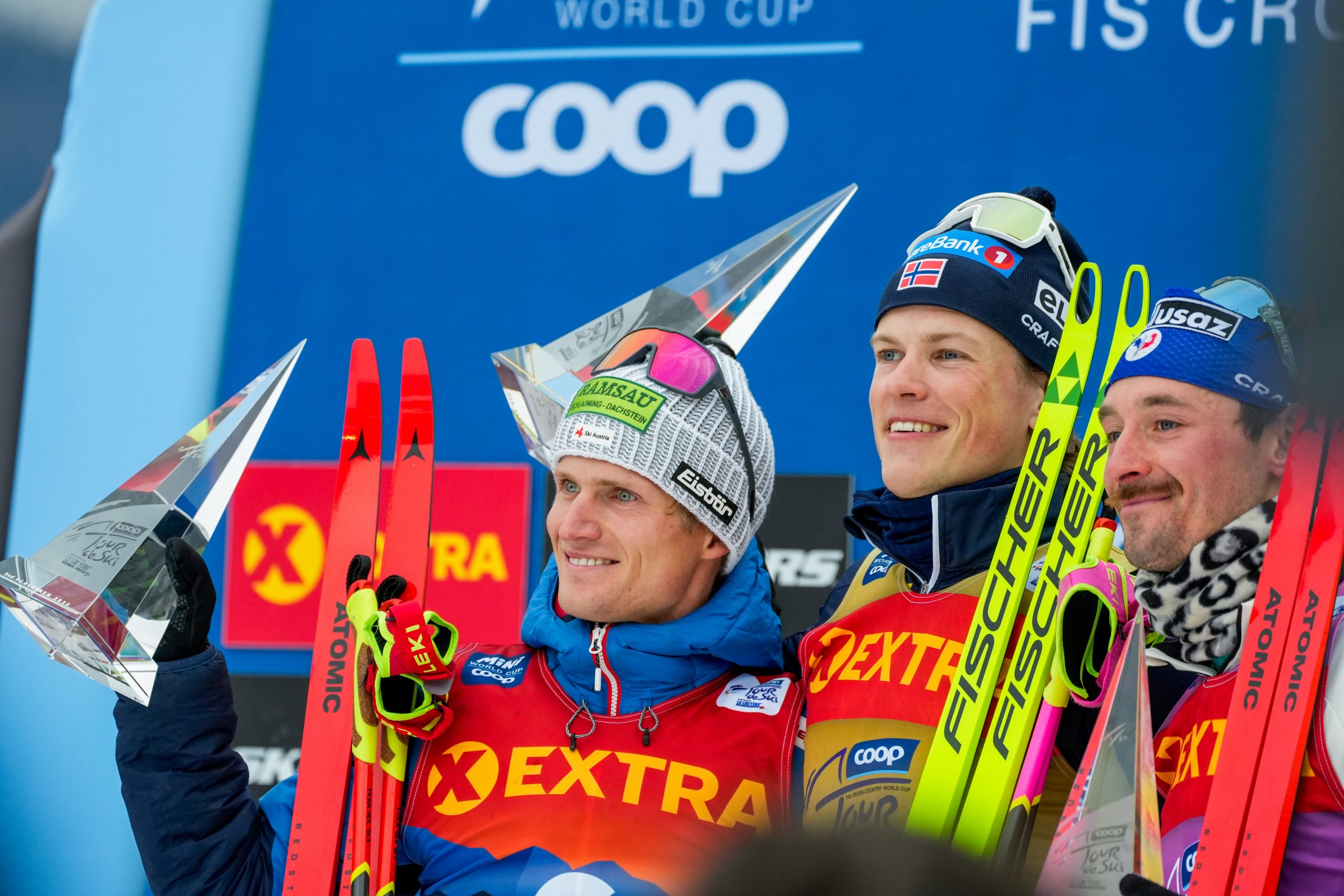

    The podium of the Men’s Freestyle Sprint in Lillehammer, Norway: Even Northug (NOR), Johannes Hoesflot Klaebo (NOR), Federico Pellegrino (ITA), (l-r). (Photo: Modica/NordicFocus).
  • Niskanen Secures Victory at Home as Ruka Launches World Cup Season

    Niskanen Secures Victory at Home as Ruka Launches World Cup Season

    This coverage is made possible through the generous support of Marty and Kathy Hall and A Hall Mark of Excellence Award. To learn more about A Hall Mark of Excellence Award, or to learn how you can support FasterSkier’s coverage, please contact info@fasterskier.com.

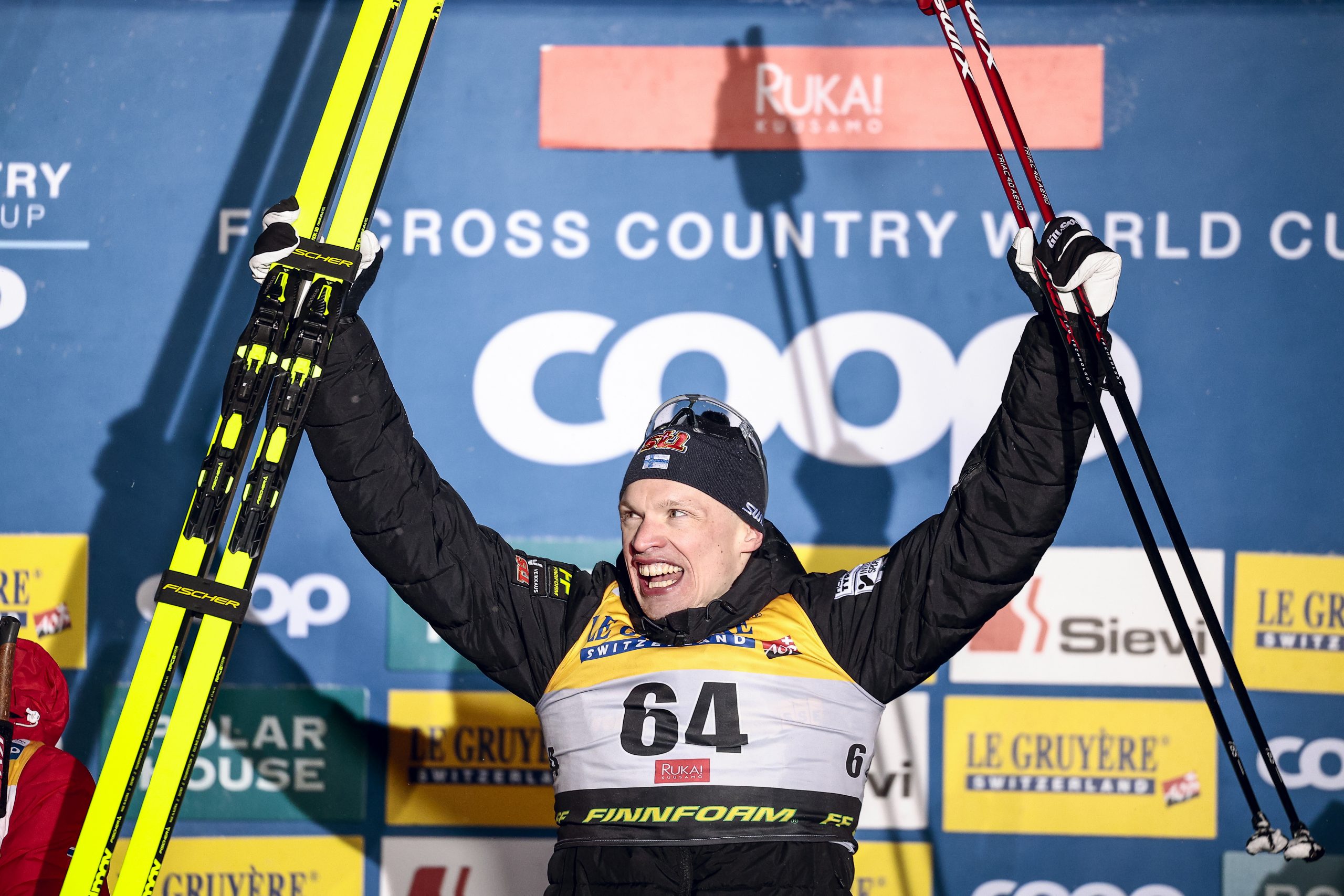
    Finland’s Classic skiing legend, Iivo Niskanen, raced to a victory in the men’s 10 k Classic Interval Start in Ruka, leading the field by 12 seconds into the finish (Photo: NordicFocus)

    Ruka, Finland is an area known for challenging race courses and rapidly changing conditions. As the women’s field wrapped up the morning race, the men took on the course under snowfall and near-freezing temperatures. With dusk settling in and the stadium lights casting a glow over the trails, it was a classic start to the World Cup season in Ruka. For the wax technicians, the unexpected snowfall added extra complexity to the afternoon’s preparations. With no precipitation predicted, technicians battled the fresh snow and near-freezing temperatures to craft a kick that would allow athletes to stride on Ruka’s infamous climbs. The loose snow on the uphills forced racers into herringbone, a technique that saps energy and momentum, while the choppy surface caused slips and stumbles as skiers fought to maintain their rhythm.

    The biggest question of the day: could Finland’s Iivo Niskanen finally outpace Norway’s Martin Loewstroem Nyenget in their highly anticipated battle after a close finish in last year’s event?

    It turns out he could. Niskanen claimed the top spot on the podium, delivering a thrilling victory for his home crowd by more than 12 seconds. He was followed by Norwegians Harald Oestberg Amundsen in second, and Nyenget in third, with just two seconds separating the teammates. This pair fought for the podium positions alongside other Norwegian teammates with similar splits over the course of the race. 

    North American skiers also celebrated strong results today: Gus Schumacher finished 18th, Ben Odgen, 29th, Zanden McMullen, 30th, Zak Ketterson, 36th, Hunter Wonders, 48th, and Michael Earnhart, 57th. 

    The two Canadian athletes, Xavier McKeever and Max Hollmann, finished 32nd and 50th, respectively. 


    Men’s 10 k Classic Interval Start

    Home-country favorite and distance specialist, Niskanen, claimed the victory, delivering a commanding performance before a crowd of his boisterous countrymen. Starting mid-pack, Niskanen quickly established his dominance, leading the field by the 1.5 k check. He extended his advantage to 5.1 seconds at 3.1 k, 10 seconds at 5 k, and maintained a steady pace to finish 12.5 seconds ahead of Amundsen in second place. Amundsen was a favorite for the podium, defending his overall World Cup win last season. Niskanen crossed the line beaming, pounding his hands in celebration toward the crowd, clearly thrilled with his victory on familiar terrain. Nyenget claimed third place, finishing just two seconds behind Amundsen after delivering a strong performance in the early stages of the race.

    A strong group of Norwegians competed for the following positions, coming in with similar splits throughout the race. This group included medalists Amudsen and Nyenget, as well as their teammates Erik Valnes, Johannes Hoesflot Klaebo, and Andres Fjorden Ree. Ree dropped back after 5 k and Simon Hegstad Kreuger caught up to the pace set by his teammates around 6 k. Just seconds behind this pack of six Norwegians was Jens Burman (SWE), a strong mid-distance skier who has seen success in this discipline before. 

    Johannes Hoesflot Klaebo (NOR) skied to fourth place in the 10 k classic in Ruka, 28 seconds off the winning time. (Photo: NordicFocus)

    Klaebo was favored to contend for the win after his dominance late last season, though finished 28 seconds behind Niskanen in fourth place today. While this might seem surprising, it’s not an uncharacteristic early season result for Klaebo, who placed 14th in this race last year before dominating the second half of the season. If he has taken a similar strategy this year, we might expect Klaebo to start challenging the top of the distance podium positions by the start of January. 

    The American men also saw progress compared to their results in last year’s Ruka 10 k classic. Schumacher delivered a strong 18th place performance, improving on last year’s 22nd place in this race with one of his best-ever finishes in this discipline, second only to his 15th-place results in Toblach (2023–24) and Oberstdorf (2022–23). “I’m always thinking about technique and I feel like that leads to slight improvements over the long term, Schumacher said. “I think that idea of slight improvements over long term is what gets me here today.” 

    Gus Schumacher (USA) raced to 18th place in Ruka, an improvement over last year’s 22nd place finish. (Photo: NordicFocus)

    Ogden, who is returning to the circuit after his previous season was cut short by mononucleosis, showed he’s back in form. “I worked on pacing in workouts,” Ogden noted regarding his transition back to the race circuit. “While today wasn’t perfect, I feel like It wasn’t bad by my standards, especially for not racing in a while. Excited to see how this can develop and make me faster over the next few months.” After finishing 39th in Ruka last year, Ogden opened this season with a strong 29th place finish today—a promising ten-spot improvement that bodes well for the upcoming season.

    “It’s so fun being back with everyone, team USA and beyond,” Ogden shared following his race. “Cross country skiing is a small community and sometimes I don’t appreciate how awesome everyone from all the nations are until I have to leave them for a while. Congratulating everyone after the races and getting fired up is just so fun.”

    Coach Matt Whitcomb is pleased with the team’s results.“We’re in a pretty good spot right now,” Whitcomb shared. “Very representative of a team that’s going to have a great season and isn’t quite sharp yet. So we all feel good about it.” 

    Be sure to follow the action in tomorrow’s skate sprint and Sunday’s 20 k skate, as the Americans continue to build strength and momentum heading into the rest of the season.

    RESULTS Men’s 10 k Classic Interval Start

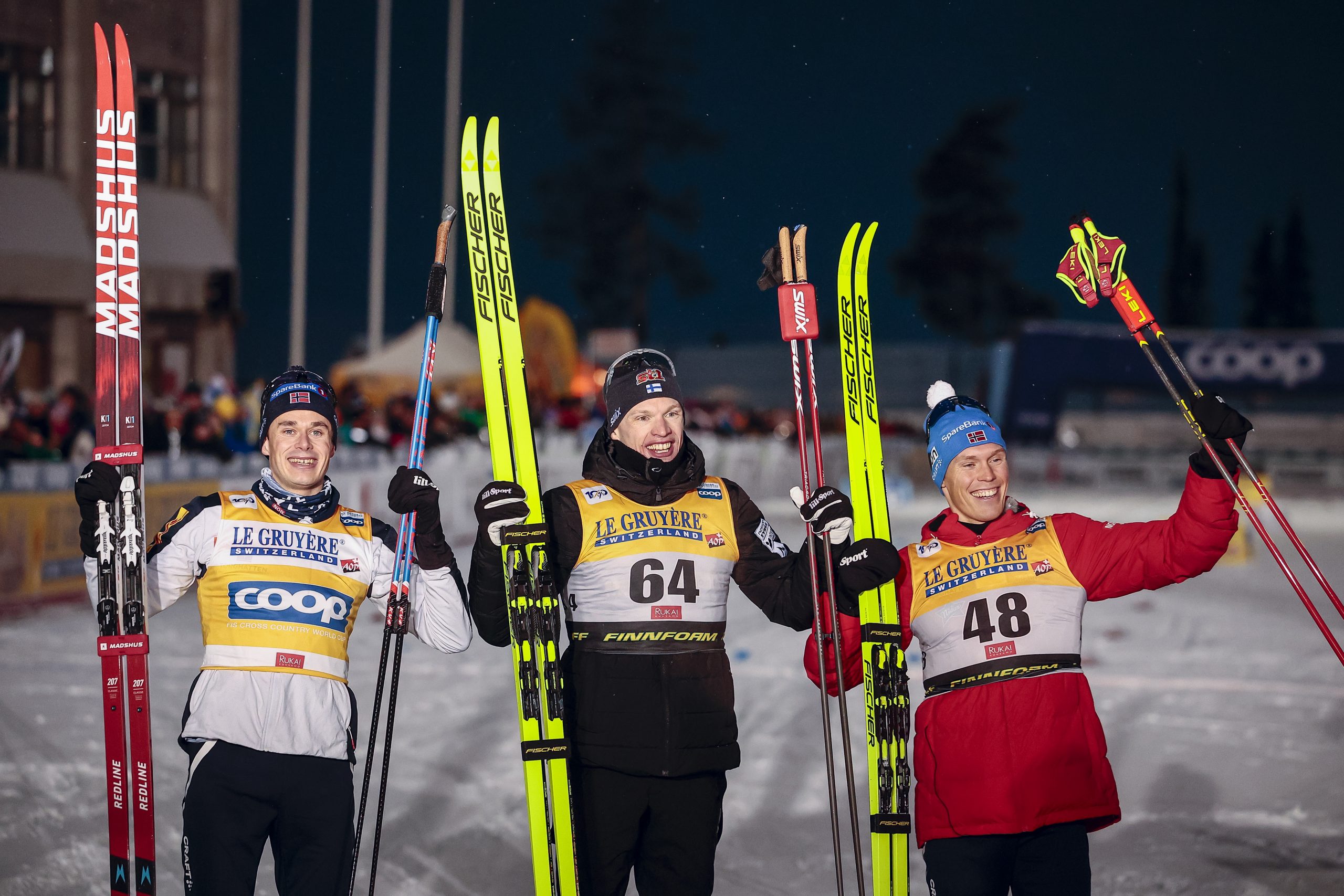
    Harald Oestberg Amundsen (NOR), Iivo Niskanen (FIN), and Martin Loewstroem Nyenget (NOR) topped the podium in the Ruka men’s 10 k Classic.  (Photo: NordicFocus)
    Harald Oestberg Amundsen (NOR), Iivo Niskanen (FIN), and Martin Loewstroem Nyenget (NOR) topped the podium in the Ruka men’s 10 k Classic. (Photo: NordicFocus)
  • Hollywood Calling: Klaebo Takes On a New Role

    Hollywood Calling: Klaebo Takes On a New Role

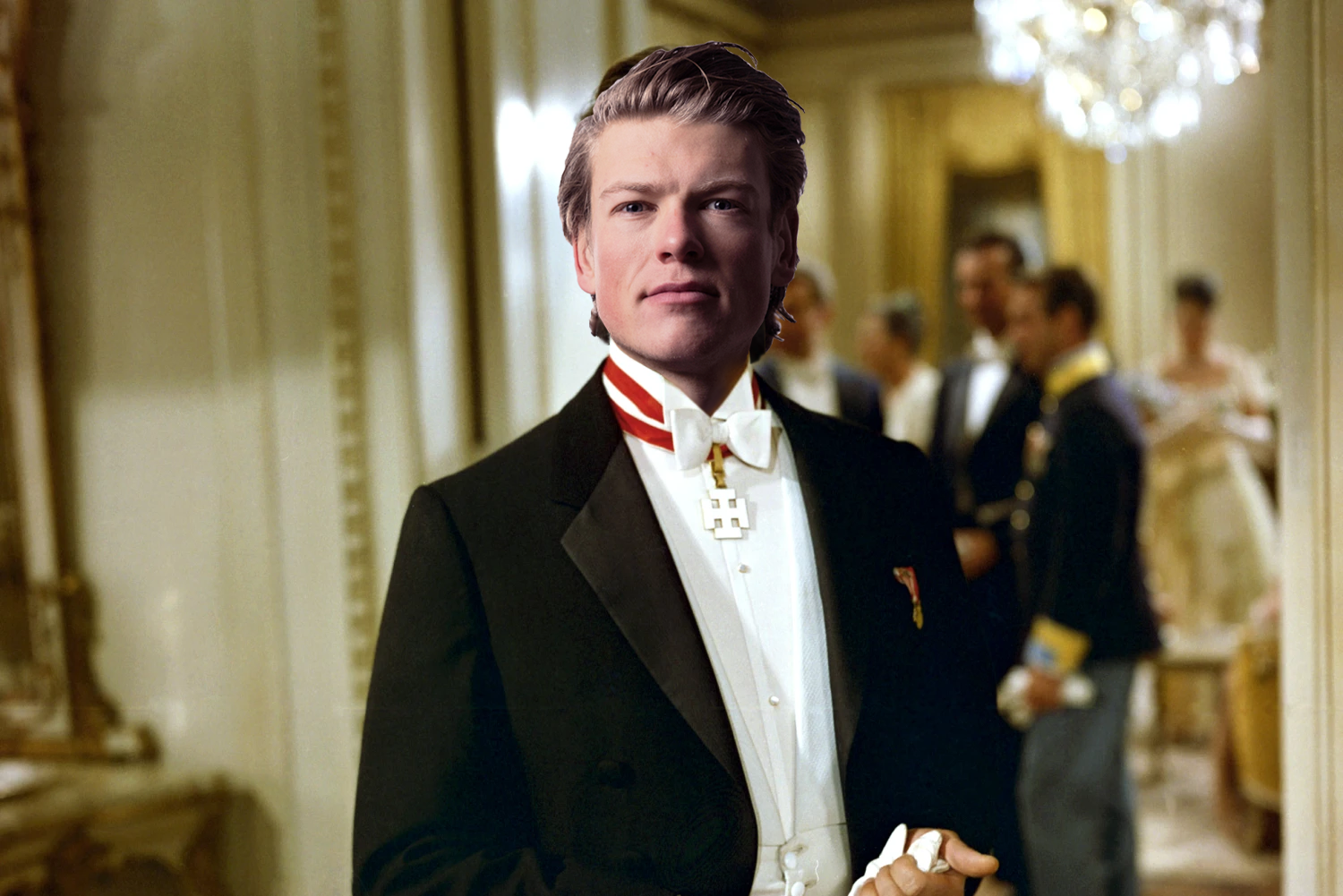
    In a move likely to anger movie purists everywhere, it was announced late this weekend that a long awaited sequel to the cherished classic The Sound of Music is in the works. Why is this relevant to a ski racing magazine? Because none other than Johannes Hoesflot Klaebo has been announced as the choice to play the lead of Captain von Trapp. “It seemed like a natural fit for us,” said Charles Diller, President of Touchstone Pictures, the production company tasked with daunting job of producing the remake.

    Johannes Hoesflot Klaebo (NOR) is a man of many talents. Could he soon  be holding an Academy Award in addition to a Crystal Globe? (Photo: NordicFocus)

    “We were kicking a lot of names around,” said Diller. “I think many people know that the von Trapp family settled in America after their escape from Austria. They opened a famous cross-country ski resort—the Trapp Family Lodge—that has been enjoyed by generations of cross-country skiing enthusiasts. We wanted someone who could convincingly carry the role of a leading man but was also believable in the role as an avid skier. We thought about Iivo Niskanen, Alexander Bolshunov, Petter Northug. They’ve all got the thick accent, the piercing eyes, the classic skiing chops . . . but none of those guys can sing!”

    A chance encounter in Park City led to a whole new world of opportunity for Klaebo. (Photo: Nathaniel Herz/FasterSkier)

    Diller continued that “I skied cross-country at Middlebury College and had hoped that I could someday meet Klaebo. I happen to have a condo in Park City, Utah and had a chance encounter with Klaebo through a mutual friend when Klaebo was training there. We met up for a cup of coffee and had a very enjoyable conversation about lots of things—skiing and non-skiing. I mentioned in passing that we were developing the sequel and asked him who he thought would be a good leading man. I already had in mind someone athletic, and a retired skier seemed like the perfect fit. I never in a million years expected what happened next. He told me that he was actually a very good singer, thought he could pull it off, and that he needed a good diversion from his training. At first, I thought he was joking, but right there in the coffee shop he knocked out a few bars of Edelweiss. I was blown away—almost moved to tears. I offered him the role on the spot. He’s got the physical presence, and the singing ability. I think the world will be shocked by how good he is going to be; he’s got a real shot at winning a Crystal Globe and Academy Award in the same year!”

    Christopher Plummer and Julie Andrews made movie magic. Will Klaebo and Lady Gaga be able to do the same? (Photo: Wikimedia Commons)

    “We’re going to keep the accurate history of Captain von Trapp as an Austrian and Klaebo certainly can pass for that. His accent may not be perfect, but he will certainly be more authentic than Christopher Plummer ever was. Not to knock Chris, he was a tremendous legendary actor and a singular talent, but they weren’t really too concerned about authenticity in the original. Our story is going to be truer to actual events: grittier, bolder. It’s important for us to have someone who is convincing physically.”

    The von Trapps built a cross-country lodge in Vermont. The Klaebo starring remake will explore that part of their lives. (Photo: Wikimedia Commons)

    “Klaebo’s presence will allow us to pursue the storyline beyond the von Trapp’s time in Austria (that portrayed in The Sound of Music) into their challenges building a cross-country ski resort near Stowe, Vermont. It’s a part of the story I’m excited to share with people. And who better than Johannes Klaebo to depict cross-country skiing on the silver screen!”

    Klaebo is already an entrepreneur, so expanding into the movies shouldn’t be that much of a reach. His hair care product company is already successful, and the Norwegian clearly has a long term plan for life after skiing.

    Is Lady Gaga asking for trouble to try and be compared to Julie Andrews? (Photo: Wikimedia Commons/Royal Variety Performance 2016)

    Touchstone also has the details worked out for who will be put in the unenviable position of replacing Julie Andrews in the role of Maria von Trapp. Diller acknowledged that they are in final talks with Lady Gaga to play the key role. “She already proved herself as a real screen presence in A Star is Born. I think she would be a tremendous Maria. We have an agreement in principle and just have to work out details. I think the on-screen pairing of Klaebo with Lady Gaga will be an unimaginably great experience for audiences. I’m thinking Bogart-and-Bacall level of chemistry.”

    Klaebo (lead skier) has done some of his best work in the mountains. Now it will just be mountain-work of a different kind. (Photo: NordicFocus)

    The first draft of the script is already done, and filming is expected to begin next summer on location in Austria and Norway. It will be significantly modernized to address more realistic themes than the original ever could. “Lady Gaga will bring a smoldering sensuality to Maria that was never possible in the original. Klaebo and Gaga are both open to doing unclothed scenes, but we haven’t worked out the details on that yet. If you think about it, the physicality between Maria and Captain von Trapp was never explored in the original, so this is something we feel audiences will appreciate. It will bring emotional tension and a contemporary feel to the entire production.”

    “I can share with you that there is a very different ending in store for Rolfe— the delivery boy who betrayed the von Trapps. He will meet a very spectacular and fitting demise. This is not going to be a G-rated film.  We’re guessing that it will be rated PG-13, maybe R, but we think the contemporary themes will be an upgrade that the story richly deserves.”

    The real Maria von Trapp only faintly resembled Julie Andrews, so maybe Gaga can pull it off. (Photo: Wikimedia Commons)

    For those who are surprised by Klaebo’s singing abilities, they shouldn’t be. “I’ve been singing since I was a young boy,” said Klaebo. “I grew up with music in the house and had considered a career in music before my skiing career ever began. I used to sing at family gatherings all the time. In fact, at one point I was a strong candidate for the Eurovision contest, but I gave it up once I became serious about skiing. It’s not a big stretch for me, I often sing to myself on long training skis. There are a couple of other guys on the Norwegian team who are also musically talented. Amundsen plays a great stand-up bass, and Even Northug has an awesome countertenor like you wouldn’t believe. At one point we were thinking of putting together a group called the Klister Connection, or Klisterfools, but it just never came together. We were all too busy, I really regret that not happening.”

    Klaebo may have to bare a little more than he does on a summer roller ski to suit some of the film’s scenes. (Photo: Nathaniel Herz/ FasterSkier)

    The idea of baring it all on the screen doesn’t faze Klaebo. “If it’s integral to the story line I’m ok with it. I’m really looking forward to this next step in my career and especially doing scenes with Lady Gaga; clothes on or not. She’s pretty awesome.”

    Ski fans can’t wait to see how Klaebo turns out as Captain von Trapp; as usual, it’s never a good move to bet against him.

    Lady Gaga and Johannes Klaebo hope to make beautiful music, and acting together. (Photo: Wikimedia Commons)

    Klaebo’s leap to the big screen is exciting news. For players seeking a similarly thrilling experience, a casino without Spelpaus provides freedom in gaming without the self-exclusion constraints of Spelpaus.

    This article was written and published April 1, 2024. (Happy April Fool’s Day) 

  • Klaebo Captures Falun 20 k, Amundsen Hoists the Globe

    Klaebo Captures Falun 20 k, Amundsen Hoists the Globe

    This coverage is made possible through the generous support of Marty and Kathy Hall and A Hall Mark of Excellence Award. To learn more about A Hall Mark of Excellence Award, or to learn how you can support FasterSkier’s coverage, please contact info@fasterskier.com.

    Gjoeran Tefre (NOR), Johannes Hoesflot Klaebo (NOR), and Martin Loewstroem Nyenget (NOR): another all-red Norwegian podium in the 2024 World Cup finale in Falun, Sweden. (Photo:  Modica/NordicFocus

    The 2023-2024 FIS World Cup season ends as it began—an all-Norwegian podium. After 20 kilometers of Mass Start Freestyle racing, the race was decided among a crowd of red race suits as Johannes Hoesflot Klaebo sprinted to first, followed by Gjoeran Tefre second, and Martin Loewstroem Nyenget third.

    It’s been a season defined by the accomplishments of Klaebo (with 16 individual race wins and the Sprint Globe), but concluding with the awarding of the World Cup Overall Crystal Globe to Klaebo’s teammate, Harald Oestberg Amundsen (who also won the Distance Globe). And few teams in the world of sport dominate their discipline quite like the Norwegian men’s team does in cross-country skiing.

    Klaebo missed nine race starts this season (due to illness), including the entirety of the points-rich Tour de Ski. Still, of the 24 races he entered, he won 15—an extraordinary level of consistency, excellence, and dominance. Regardless, the lead built in the World Cup Overall standings by Harald Oestberg Amundsen (NOR) was such that Klaebo would have needed to win Falun’s 20 k Freestyle—and win all the bonus points—while Amundsen finishing far down in the standings. Coming into today’s race, Klaebo trailed Amundsen by `112 points. With maximum of only 130 points available in todays race (100 for the win, 30 bonus points), Klaebo would have needed to run the table AND have Amundsen basically fall off the edge of the map. While the likelihood of a Klaebo win was fairly high, the odds of Amundsen performing so poorly were quite low.

    Making his first World Cup start since 2023, Gjoeran Tefre (NOR) demonstrated the true depth of Norwegian skiing in finishing a close second behind Johannes Hoesflot Klaebo (NOR). (Photo: Modica/NordicFocus)
    20 k Freestyle Mass Start

    A massive men’s field—94 starters—lined up to challenge Falun’s four-lap course. Unlike the Women’s 20 k Freestyle Mass Start (contested earlier in the day) that began with a full-gas effort from eventual race winner, Jessie Diggins (USA), Klaebo and Amundsen led the field out of the stadium at a moderate pace.

    Scott Patterson (USA), Gus Schumacher (USA), and Zanden McMullen (USA) came through early checkpoints in the top twenty among a solidly packed lead group. Leading through the middle kilometers of the race, Mika Vermeulen (AUT) took the first bonus points followed by Klaebo and Amundsen. Soon after, Hugo Lapalus (FRA), Jens Burman (SWE), and Friedrich Moch (GER) moved toward the front to assist Vermeulen in making the pace in front of a train of red-clad Norwegians.

    Harald Oestberg Amundsen (NOR) raced in the lead group all day, keeping an eye on his rivals, and defending his lead in the World Cup Overal standings. (Photo: Modica/NordicFocus)

    Amundsen spent his race situated between fifth and tenth positions, a place unlikely to jeopardize his Overall standing while allowing him to keep an eye on other contenders in front of him. Ultimately, Amundsen began to show signs of fatigue at the rear of the 16-man lead group as a steady, regular increase of pace eventually began whittling away the contenders with every rise in elevation and increase in speed. Pace was made in the final lap by Iver Tildheim Andersson (NOR) and Gjoeran Tefre (NOR) (winner of the recent Norwegian National Championships 10 k), in the company of Klaebo and Vermeulen. With one kilometer remaining, Martin Loewstroem Nyenget (NOR) drove to the front to challenge Klaebo. But, as he has done so many times before, Klaebo powered into the lead down the final descent into the stadium. Tefre followed closely—and gave good chase down the finishing straightaway—but Klaebo was simply not to be denied, crossing the line for his seventh straight World Cup victory.

    “Since Oberhof it’s been really amazing,” said Klaebo in post-race interviews. “So it’s good to finish up this way.”

    Nyenget held on for third. Amundsen secured his World Cup Overall championship with a 17th place finish, only ten seconds behind the winner.

    Schumacher and Patterson finished in the lead pack, 12th and 15th, respectively. Other American finishers included McMullen 27th, Kevin Bolger 44th, Zak Ketterson 45th, Peter Wolter 60th, Michael Earnhart 79th. Among Canadians, Antoine Cyr was 26th, Sam Hendry 39th, Xavier McKeever 68th, Sasha Masson 73rd, Pierre Grall-Johnson, 85th.

    Scott Patterson (USA) concluded his distinguished World Cup career with a 12th place finish, only 9.1 seconds behind the winner. (Photo: Modica/NordicFocus)

    After eight World Cup seasons, the Falun 20 k represented the final race of Scott Patterson’s (USA) distinguished career, one highlighted by eighth and 11th place finishes in the Olympics, and a top-ten finish in the World Championships 50 k.

    Men’s 20 k Freestyle Mass Start RESULTS

  • Klaebo Tops Niskanen in 10 k Classic Duel

    Klaebo Tops Niskanen in 10 k Classic Duel

    This coverage is made possible through the generous support of Marty and Kathy Hall and A Hall Mark of Excellence Award. To learn more about A Hall Mark of Excellence Award, or to learn how you can support FasterSkier’s coverage, please contact info@fasterskier.com.

    Iivo Niskanen (FIN) and Johannes Hoesflot Klaebo (NOR) at the finish line of Falun’s World Cup 10 k Classic in which Klaebo claimed his 15th victory of the 2023-2024 World Cup season. (Photo: Modica/NordicFocus)

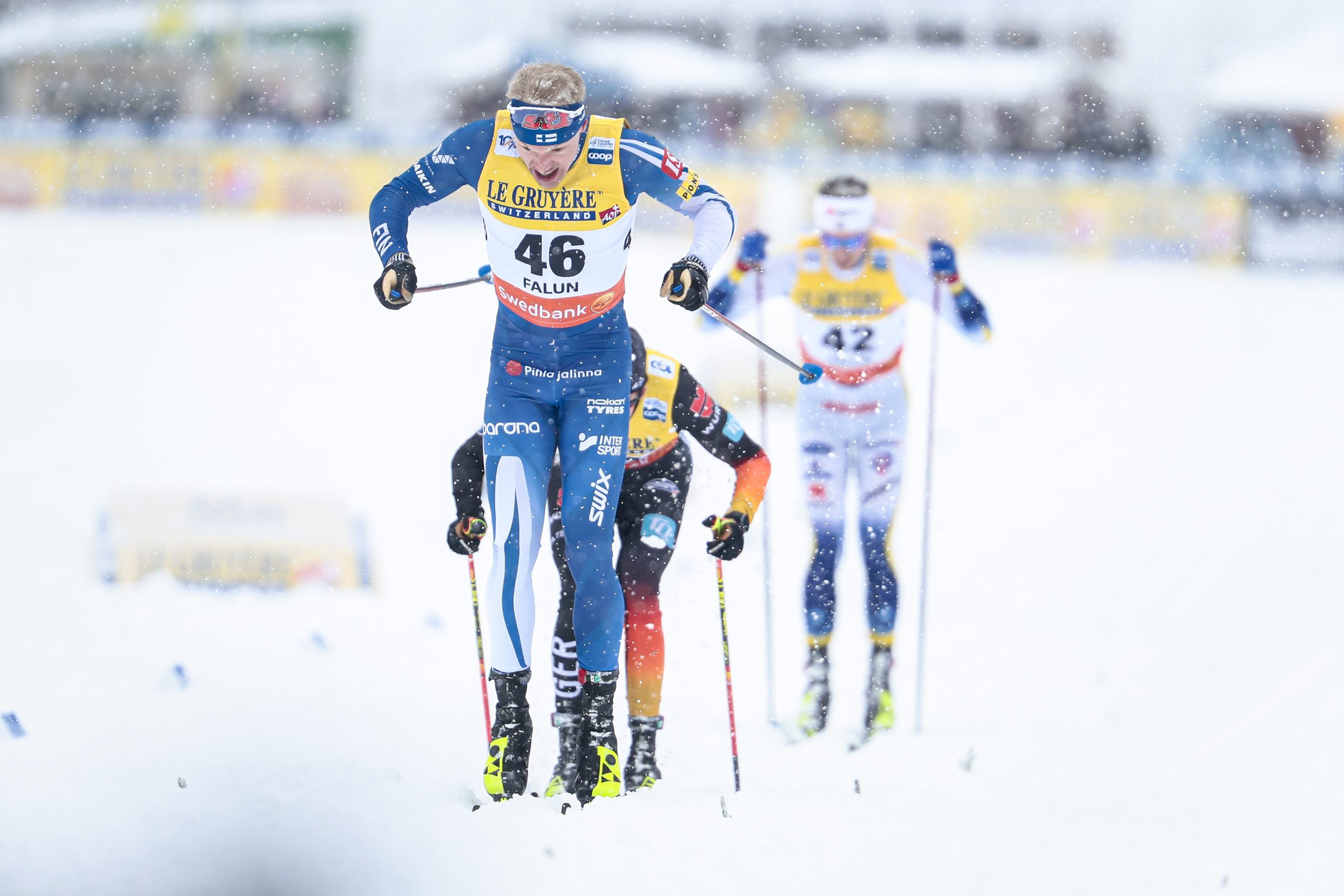
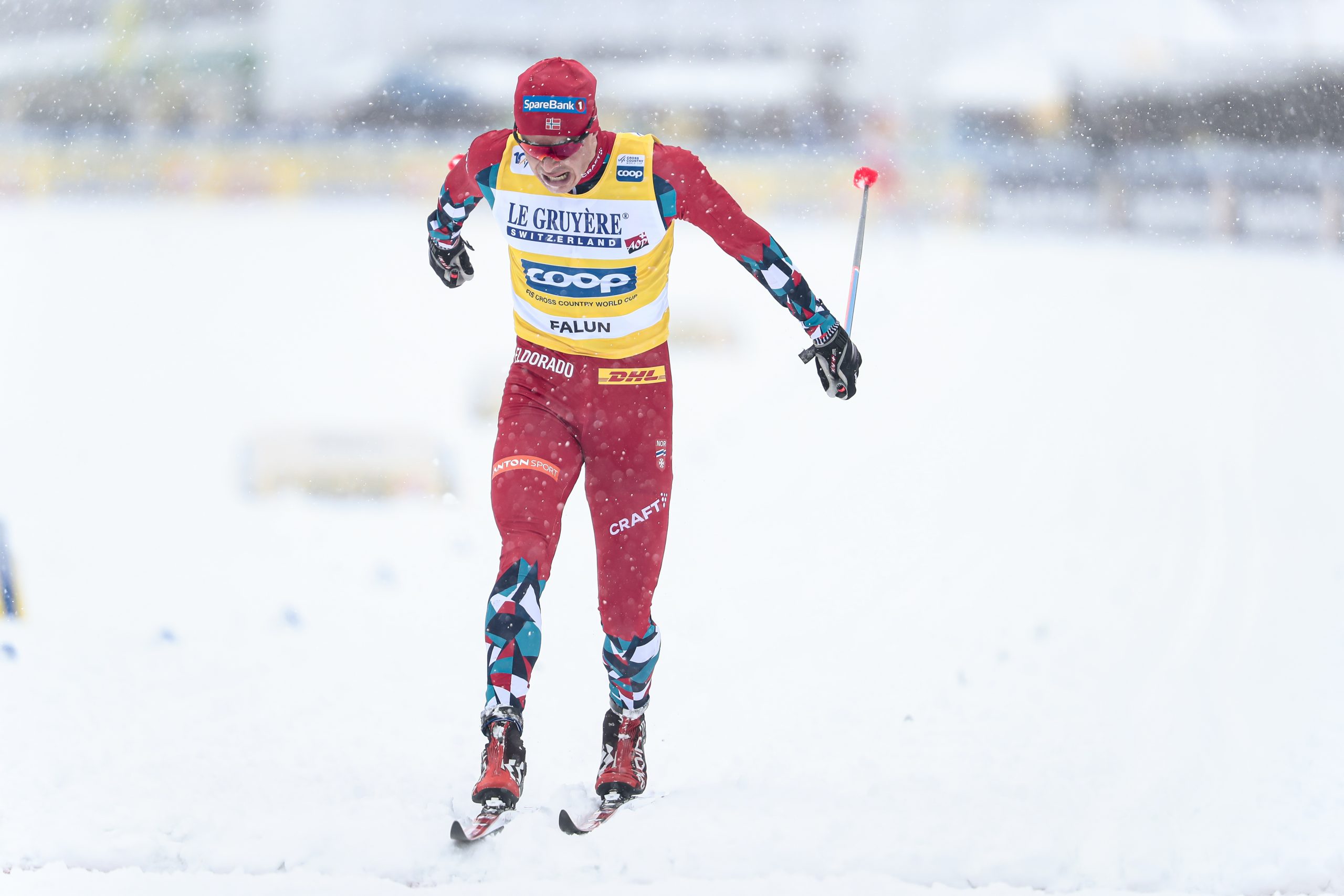
    The guy is just unbelievable . . . on a day when steady snow fall, swirling winds, and temperatures just above freezing would seem to allow fewer racing advantages for Johannes Hoesflot Klaebo (NOR), still he bested the best Classic skier in the world—Iivo Niskanen (FIN)—in a 10 k Classic Individual Start. Coasting to a 22 second win over Niskanen and Martin Loewstroem Nyenget (NOR), Klaebo delivered the 15th individual World Cup win of his 2023-2024 season, and the 83rd win of his remarkable World Cup career.

    “With the snow and the conditions and everything, it was a really tough one,” said Klaebo in post-race comments. “The season so far has been really good. I’m looking forward to finishing it up tomorrow.”

    Finishing eighth on the day, Harald Oestberg Amundsen (NOR) succeeded in protecting his lead in the World Cup Overall standings. While Klaebo took back 31 points from Amundsen with today’s race victory, Amundsen has proven to be a master of damage control in recent races. Amundsen maintains a lead of 112 points—a comfortable gap ahead of Klaebo as they enter tomorrow’s final World Cup race of the season. In order to snatch the World Cup Overall title from Amundsen, Klaebo would need to win tomorrow’s 20 k Mass Start—AND win all the bonus points—while Amundsen would finish no better than 39th. Sport is a crazy environment, and the mathematics suggest that such a turnaround remains possible, though only if disaster strikes Amundsen. Even Klaebo is not likely to wish for that sort of conclusion.

    Antoine Cyr (CAN) skied to another impressive finish—11th place—in a breakthrough season. (Photo: Modica/NordicFocus)

    Canada’s Antoine Cyr delivered a tremendous 11th place finish in Falun. Other Canadian finishers included Xavier McKeever 45th, and Sam Hendry 66th. American finishers included Gus Schumacher 24th, Zanden McMullen 27th, Zak Ketterson 41st, Scott Patterson 68th, Peter Wolter 84th.

    Iivo Niskanen (FIN) was one of the leaders at every mid-race checkpoint, but his post-race comments implied that he may have chosen poorly when it came to skis for Falun’s tricky conditions. (Photo: Modica/NordicFocus)
    10 k Classic Individual Start

    The women’s race (earlier in the day) was skied on zeros (skis prepared by roughing up the kick zone with sandpaper). With similar conditions for the men’s race—temperatures near freezing, swirling winds, falling snow, and deteriorating tracks—the men’s teams seemed likely to make similar equipment choices.

    Niskanen had the disadvantage of the earliest start position among the contenders, so he was forced to go it alone—and on skis that he later described as having been the wrong choice. Klaebo, Niskanen, Martin Loewstroem Nyenget (NOR), and Henrik Doennestad (NOR) continued to top the mid-race checkpoint standings with Klaebo coming through third in the first few checkpoints, then establishing himself at the top of the leader board at 4.3 k. From then on, Klaebo would lead at all intermediate checkpoints, eventually coasting across the line for a 22 second win over runner-up Niskanen and third-place Nyenget.

    Canadian, Antoine Cyr, delivered a fine race result (11th), benefitting from the opportunity to follow eventual fifth place finisher, Henrik Doennestad (NOR). Cyr reset his own efforts as Doennestad passed, and tailed him gamely all the way through the finish line. It was brave, cagey racing on Cyr’s part.

    Harald Oestberg Amundsen (NOR) measured his efforts and controlled his pacing throughout the day, making sure that his World Cup Overall lead remained protected. (Photo: Modica/NordicFocus)

    Amundsen maintains a lead in the overall standings, so he is the skier in the field with much to lose. His expertly executed race could be seen in his chosen strategy: start slow, and gradually increase the pace. Amundsen’s checkpoint splits: 18th, 20th, 16th, 14th, 7th, 5th. It was evident that Amundsen managed his effort to make sure he would not blow up. How remarkable it is to watch athletes at the top of their game as they seek to measure their efforts and control circumstances.

    10 k Class Individual Start RESULTS

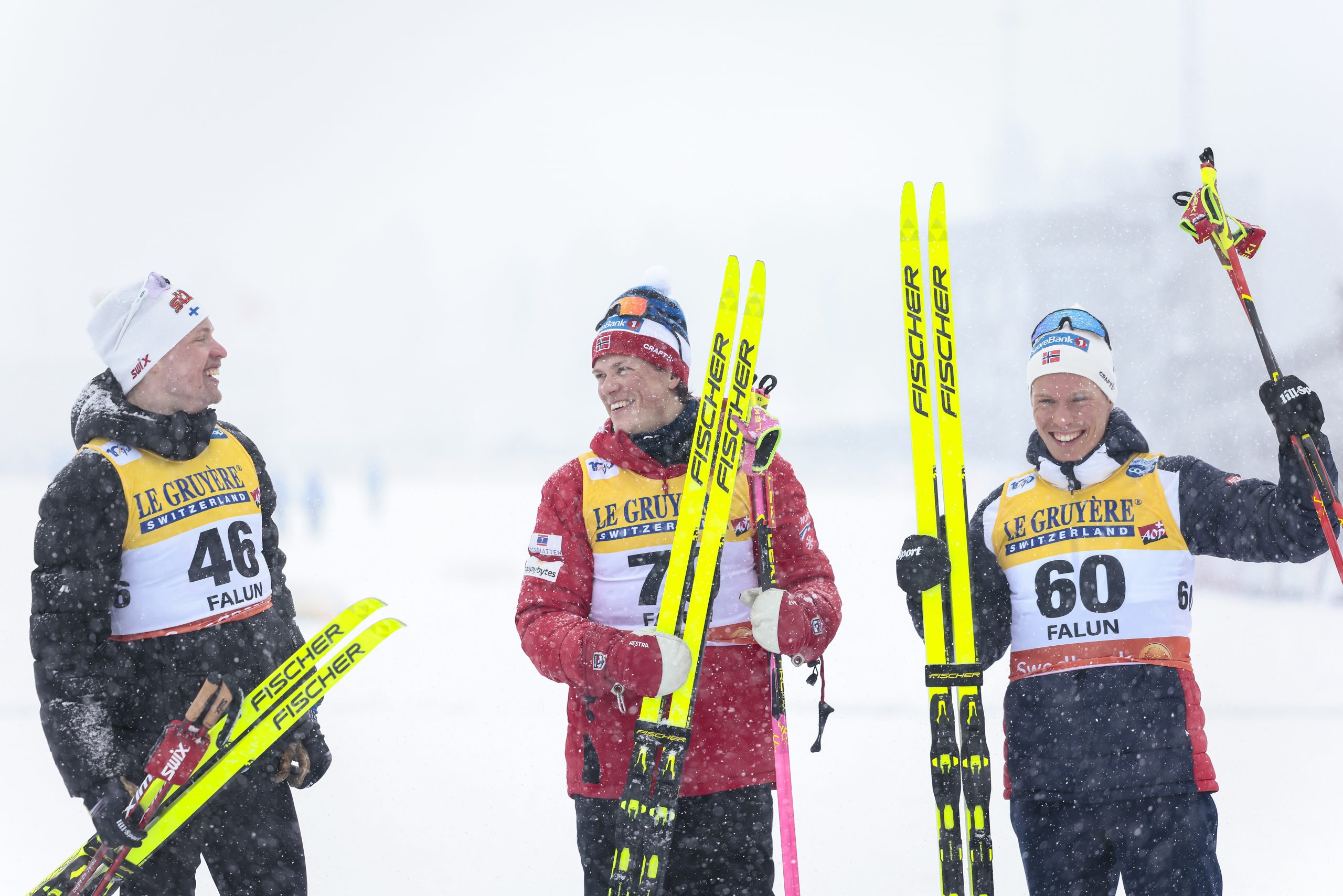
    Iivo Niskanen (FIN), Johannes Hoesflot Klaebo (NOR), Martin Loewstroem Nyenget (NOR), (l-r), the podium of the Men’s 10 k Classic Individual Start in Falun, Sweden.  (Photo: Modica/NordicFocus)
  • Klaebo-Skistad Win Falun Sprints. Svahn Closes in on Diggins

    Klaebo-Skistad Win Falun Sprints. Svahn Closes in on Diggins

    This coverage is made possible through the generous support of Marty and Kathy Hall and A Hall Mark of Excellence Award. To learn more about A Hall Mark of Excellence Award, or to learn how you can support FasterSkier’s coverage, please contact info@fasterskier.com.

    Jessie Diggins (USA) finished 18th in Falun’s Classic sprint. Her lead in the Overall competition is now only 41 points. (Photo: NordicFocus)

    It’s hard to believe, but this weekend in Falun, Sweden, marks the final weekend of competition in the FIS World Cup season. The strong showing by the American team in the first period of racing—and Jessie Diggins’ (USA) early domination of Distance racing and the Tour de Ski—seem like a lifetime ago. The results for the Women’s Overall Championship rest upon this weekend’s outcome in Falun.

    Diggins carried a 102 point lead in the Overall Crystal Globe competition into today’s Classic Sprint race. Chasing her was Linn Svahn (SWE), who secured the Sprint Crystal Globe Sprint championship last weekend in Drammen. While Diggins entered the race with the Overall lead—and would hope to preserve that lead going in tomorrow’s Classic 10-kilometer Individual Start—Svahn entered the weekend with the momentum, as she has been steadily chipping away at Diggins’ margin. But Svahn would need a strong showing today to keep her in the hunt for the Overall trophy.

    Linn Svahn (SWE) (r) did everything she needed to do today except beat Kristine Stavaas Skistad (NOR) (c). (Photo: NordicFocus)

    Securing the Sprint championship last weekend gave Svahn the freedom to throw caution to the wind if she so desired. She would also have the support of the home crowd as she tried to claw away at Diggins’ lead. Another factor in Svahn’s favor was that Sweden took full advantage of the host nation’s quota, fielding 12 skiers. Svahn would have lots of support on and off the snow. In a sense, she was playing with house money today: nothing to lose, everything to gain.

    The qualifying round went Svahn’s way as she finished second (earning 12 points). Diggins finished 21st and didn’t receive any points. Before the heats had even begun, Diggins’ lead was reduced to 90 points. Also qualifying and joining Diggins in the heats were teammates Julia Kern, and Rosie Brennan.

    But Diggins couldn’t manage to advance out of the quarterfinals and finished 18th. Kristine Stavaas Skistad (NOR) took the victory with Svahn finishing second and Jonna Sundling (SWE) finishing third. Svahn’s second place—combined with Diggins’ less-than-stellar 18th—was exactly what Svahn had needed to do to close the gap on Diggins.

    Jessie Diggins (USA) raced hard but seemed to have trouble with her kick wax. (Photo: NordicFocus)

    “My goals and priorities might be different than the ones other people have for me,” Diggins remarked after her quarterfinal heat. “Out of everything I can control, I’m proud of how I skied. Last year I probably wouldn’t have even qualified. I definitely need to get stronger at double pole.”

    “For me the most important thing is that I don’t let other people’s priorities take away my joy from ski racing,” said Diggins. “Sometimes that’s hard to do, and that’s what I’m focused on.”

    “I just told Linn good luck, cause she’s having a great year,” said Diggins. “I hope she has coaches and people in her life who say the things my coaches say to me. ‘We’re still going to love you if you’re dead last.’ I think that’s way more important. That’s how I cope.”

    After all of the mathematics were completed, Diggins still leads going into tomorrow’s Individual Start Classic race by a scant 41points. The stage has been set for what promises to be two tense days of racing.

    Rosie Brennan (USA) after her podium in Drammen was unable to advance out of the quarterfinals. (Photo: NordicFocus)

    Seven American women competed today. Other American finishers were Rosie Brennan 20th, Julia Kern 24th, Sammy Smith 39th, Erin Bianco 44th, Haley Brewster 51st, and Renae Anderson 54th. For Brewster, it was her first World Cup race outside of North America, and today marked Anderson’s second World Cup in Europe.

    For Canada, the top finisher was Sonjaa Schmidt in 45. Liliane Gagnon finished 48th.

    On the men’s side of the race, Johannes Hoesflot Klaebo (NOR) had wrapped up the Sprint Crystal Globe last week. Today’s race was a battle for second place in the Sprint competition with Erik Valnes (NOR) coming into the race holding a 35 point lead over Lucas Chanavat (FRA) for the second spot. With bonus points available for Sprint qualification, the race for second place was wide open.

    Klaebo once again demonstrated why he is the best Sprinter in history as he chose whatever tactics suited him in the heats, and easily captured first place in the final. Lauri Vuorinen (FIN) took second place for his first World Cup podium. Harald Oestberg Amundsen (NOR) was third.

    “It was a hard one,” Klaebo commented after the race. When asked about winning the Sprint competition he replied that, “the Crystal Globes are always part of the goals. This has been one of my best Sprint seasons in my career.”

    Valnes finished sixth and Chanavat finished tenth, meaning that the battle for second place in the Sprint standings went to Valnes with Chanavat settling for third.

    Seven American men raced in Falun, and three qualified for the heats. JC Schoonmaker was the top American man finishing ninth. Other American finishers were Gus Schumacher 19th, Zanden McMullen 20th, Zak Ketterson 53rd, Luke Jager 57th, Kevin Bolger 61st, and Michael Earnhart 64th.

    The top Canadian finisher was Antoine Cyr in 23rd. Other Canadian finishers were Xavier McKeever 29th, Sasha Masson 54th, and Pierre Grall-Johnson 59th.

    After the race, Schumacher commented on the warm course conditions.”It’s warm and they salted the course,” he said. “So it makes it harder. It’s honestly skiing pretty well, my skis are good, but it’s kind of funky.”

    Women’s Quarterfinals

    In the first heat, Sundling continued with her usual strategy of going quickly to the lead. She developed a huge gap on the field early while Skistad finished second. It was a repeat of a formula which has been witnessed often this season in the Sprints: Sundling going off like a rocket and Skistad doing only what she needs in order to advance.

    Svahn was in the second heat along with Brennan, Frida Karlsson (SWE) and Julie Myhre (NOR). Svahn went out to the lead in a controlled fashion along with Myhre and Johanna Matintalo (FIN). Svahn maintained her position at the front and easily won the heat. Brennan finished fourth and did not advance.

    With Svahn’s advance, the pressure was now on Diggins in the next heat to keep pace. Diggins would face off against Tiril Udnes Weng (NOR), Moa Lundgren (SWE) and Laura Gimmler (GER). Immediately after the start, Diggins was at the back of the pack but quickly moved up to the middle of the group. She was visibly slipping up the steep hills, and every slip cost her precious time sending her behind the leaders. But there appeared to be a glimmer of hope as after the biggest downhill she was able to move herself back into third place and used the draft to gain on the leaders. Diggins took an outside line into the final stretch and had an unobstructed path to the finish line, but she couldn’t keep up with the double pole pace. Finishing fourth, her day was over. No matter what happened next, her lead in the Overall competition would further erode as Svahn advanced.

    Julia Kern (USA) finished fifth in her quarterfinal. (Photo: NordicFocus)

    Julia Kern was in the fourth quarterfinal. She would face Emma Ribom (SWE) who had been disqualified in the last Sprint race for interference. Kern maintained pace with the lead group early and was fourth half-way through the race. But then Ribom took control of the race and went to the lead distancing herself from the field. She went into the stadium with a large lead and coasted to the finish. Kern finished fifth and would not advance. And just like that, the day was over for the American women.

    In the fifth heat, Maerta Rosenberg (SWE) went out to an early lead. The 21 year old raised the excitement level for the Swedish fans as they cheered a youngster trying to hold off a veteran World Cup field. The fairy tale ended in the stadium as the field swallowed up Rosenberg: she finished sixth. Desiree Steiner (SUI) and Coletta Rydzek (GER) took first and second.

    Women’s Semifinal

    Svahn was in the first semifinal where she was joined by Sundling, Gimmler, Skistad, Myhre, and Anna Svendsen (NOR). It was a very tough field for Svahn to try and advance through. Sundling and Skistad went out to the lead early, but Svahn quickly passed\ Skistad to move into second. It was a perilous position for Svahn who was in danger of being out-dueled at the finish by Skistad. As they entered the final stretch, all three skiers were together. Svahn was able to surge to the lead, and once again Skistad exerted the least amount of energy possible to eke out second place over Sundling. Svahn would advance to the finals and was now guaranteed to take a sizeable chunk out of Diggins’ lead.

    In the second semifinal Ribom took a commanding lead early and was never seriously challenged. Nadine Faehndrich (SUI) was able to join Ribom at the finish line for second. The two advanced to the finals with no one from the heat getting a lucky loser position.

    Kristine Stavaas Skistad (NOR) dominated the Sprints and literally silenced the Swedish crowd. (Photo: NordicFocus)
    Women’s Finals

    The women’s finals consisted of Svahn, Ribom, Skistad, Faehndrich, Sundling, and Gimmler. Entering the final, the question was would Skistad’s strategy of skiing conservatively in the heats pay dividends for her in the finals? In a total change of tactics, Skistad went into the lead early. Sundling tucked in behind her, then passed her on the first climb. Sundling was then joined by Svahn who also passed Skistad, and the three women quickly gapped the field. Sundling, Svahn and Skistad skied together in a trio into the final long downhill. Then Skistad was able to easily blast by the two Swedes and shot into the lead. She maintained her lead coming into the stadium and created a large gap, winning easily. As Skistad crossed the finish line she pressed her index finger to her mouth miming the “shush” gesture at the crowd. Svahn finished second to get the second most possible points out of the heats. For Svahn, it was mission accomplished; she is now within striking distance of Diggins.

    James Clinton Schoonmaker (USA) was the top American finisher. (Photo: NordicFocus)

    Men’s Quarterfinals

    Schumacher was in the first heat and was in the unenviable position of going up against Klaebo and Valnes. Anton Grahn (SWE), a 19 year old junior went to the front early, but the field was unconcerned by his outburst. Klaebo— as is usual for him— remained calm and pushed to the front group. Schumacher then contended for the lead, but as the group entered the stadium the Norwegians glided by him, and he dropped to third. Valnes won the heat with Klaebo finishing second. Schumacher finished fourth and would have to wait on a lucky loser spot.

    The men’s Overall leader, Amundsen, was in the second heat. He immediately went into the lead along with Vuorinen. The two took a large lead into the stadium and easily advanced. It was a fast heat which meant that Schumacher lost the lucky loser’s position.

    Schoonmaker was in the third heat. Halfway through, he moved to the front and pressed the pace as he was able to develop a large gap. As the field entered the final stretch they began to close on him. Schoonmaker was able to stay with the field as there was a three-way photo finish. After the review, Schoonmaker was awarded first place and he would automatically advance. Edvin Anger (SWE) took second. Schoonmaker would be the first American of the day to advance.

    Cyr was in the fourth heat alongside Federico Pellegrino (ITA), Even Northug (NOR), and Sivert Wiig (NOR). Wiig took the victory with Northug finishing second. Cyr would not advance.

    McMullen was in the fifth heat. In that race, Marcus Grate (SWE) and Emil Danielsson (SWE) immediately went to the lead. They were quickly joined by Ondrej Cerny (CZE). McMullen skied well tactically and went into the lead two-thirds through the race. He maintained the lead going into the stadium as a five way double pole sprint to the finish took place. In another photo-finish it was Cerny and Chanavat taking first and second. McMullen finished fourth and would not advance.

    Johannes Hoesflot Klaebo (NOR) took home the Sprint Crystal Globe after his performance on Friday in Falun. (Photo: NordicFocus)
    Men’s Semifinals

    Schoonmaker was in the first semifinal along with Klaebo, Valnes, and Amundsen. Amundsen went to the front early and kept the tempo very quick. Halfway through it was five skiers in a big pack with Amundsen leading it. Entering the final climb, Klaebo and Valnes blew past Amundsen. Klaebo took the lead and leisurely double poled across the finish line in first. Valnes was second. Amundsen and Vuorinen would wait for a lucky loser positions. Schoonmaker finished fifth and would not advance.

    In the second semifinal the field went out extremely leisurely in what quickly developed into a tactical race. Finally, more than halfway through, Chanavat put in a couple of quick strides to create a gap near the final stretch. But it was still a five-way grouping coming into the stadium. Johan Haeggstroem (SWE) and Northug advanced to the finals.

    Johannes Hoesflot Klaebo (NOR) waved to the fans through the fog. (Photo: NordicFocus)
    Men’s Finals

    Klaebo, Haeggstroem, Valnes, Northug, Amundsen, and Vuorinen were in the men’s finals, which saw a change of strategy from the heats. Klaebo and Amundsen went early to the front. Klaebo lead up the final climb as something unusual then happened—he had a slight slip. That minor miscue allowed Amundsen to shoot to the front. But Klaebo didn’t panic, he was able to pass his teammate on the final large downhill, put in an incredible turn of speed, and in seconds created a gigantic gap. He didn’t even have to kick or double pole for the last 20 meters of the race. It was a scene of complete domination. Klaebo easily took the win with Vuorinen finishing second for his first World Cup podium. Amundsen ended up third, providing an excellence defense of his lead over Klaebo in the World Cup overall points chase.

    Lauri Vuorinen (FIN), Johannes Hoesflot Klaebo (NOR), Harald Oestberg Amundsen (NOR), (l-r)

    MEN’S RESULTS

    WOMEN’S RESULTS


  • Brennan Third in Drammen, Cyr Takes Fourth, Schoonmaker Sixth

    Brennan Third in Drammen, Cyr Takes Fourth, Schoonmaker Sixth

    This coverage is made possible through the generous support of Marty and Kathy Hall and A Hall Mark of Excellence Award. To learn more about A Hall Mark of Excellence Award, or to learn how you can support FasterSkier’s coverage, please contact info@fasterskier.com.

    Rosie Brennan (USA) had a great day in Drammen, finishing third. (Photo: NordicFocus)

    The World Cup moved to its second to last venue today as racers competed in the Drammen, Norway, City Classic Sprints. Over the years, Drammen has taken on an aura all its own as it serves as a transition between the crushing Holmenkollen marathon and the final weekend of the race season. Drammen is unique in many ways. It happens inside the center of a city, it has a course which is considered very tight by World Cup Sprint standards, and it can often determine the winner of the Sprint Crystal Globe. Coming on Holmenkollen’s heels, it can also often have a start list where many of the top racers are absent.

    But today, most of the stars were present to shine as a great deal was at stake. Entering today’s race, Jessie Diggins had a 159 point lead in the Overall competition over Linn Svahn (SWE). With a potential of 115 points going to today’s winner, Diggins needed to avoid being shut out of the finals like she was just a little over a week ago in the Lahti Sprints. And, with three races coming up next weekend in Falun—offering a total of 345 points—it was critical for Diggins to continue to keep Svahn at bay.

    Jessie Diggins (USA) was able to make the heats, but Linn Svahn (SWE) continued to eat away at Diggins’ Overall lead. (Photo: NordicFocus)

    Svahn would not only be trying to gain ground on Diggins but also trying to also secure her Sprint title. Coming into the race she had a 178 point lead in the Sprint competition over Kristine Stavaas Skistad (NOR). A strong showing today could mathematically wrap up the Sprint crown. But also on Svahn’s to do list was to chip away at Diggins’ lead.

    But at the end of the day, the Diggins-Svahn battle was overshadowed by Rosie Brennan’s (USA) performance. Brennan was able to advance out of the quarterfinals—finishing second—move forward from the semifinals as a lucky loser, and ski a strong race in the finals to reach the podium and finish third. Finding triumph toward the season’s end was a sweet moment for Brennan who has been frustrated by her performances the last several weeks.

    “[I’m] honestly very surprised,” Brennan commented. “At the end of the season, everyone is on their last ropes, and you never know what the body is going to give you, I’m really happy, it was really nice to have a podium again.”

    She acknowledged the stress of racing so soon after Holmenkollen. “I was glad it was today and not yesterday,” Brennan said. “I felt really bad yesterday. I think that extra day helped compared to last year, but you just never know what the body will do. I really enjoy Drammen, I think it’s one of the best World Cups we do.”

    But the Diggins-Svahn dance continued to keep everyone’s attention. Svahn finished second today, while Diggins was unable to advance out of the quarterfinals—finishing 16th—after being impeded by Emma Ribom (SWE) in their heat. Svahn’s success and Diggin’s bad luck combined to further tighten the battle for the Overall Championship. Diggins’ lead was reduced to only 102 points. Ribom’s interference led to her disqualification which did provide some consolation for Diggins, moving her up in today’s results, and giving her an extra two points.

    “It was tough, my body felt really good,” Diggins said after the race. “Two things happened that were not great…I got trapped on the inside, it was frustrating, we weren’t going fast enough, and I knew it, I couldn’t get out. And I needed some better glide on the downhills. I did everything I could, but I think I need to have a stronger double pole and be more aggressive out of the start.”

    Svahn’s second place finish gave her a 176 point lead in the Sprint standings over Kristine Stavaas Skistad (NOR). With only 115 Sprint points left in the season, Svahn’s performance secured her Sprint Crystal Globe.

    On the men’s side, Johannes Hoesflot Klaebo (NOR) had a chance to wrap up his sixth Sprint crown. Going into the race he held a 141 point lead over teammate Erik Valnes (NOR). A win today would lock up the crown for Klaebo. After claiming a landmark victory last weekend in Holmenkollen, any other racer might have been questioned about how much fight he would have left in him only two days later. With Klaebo, none of the normal concerns seem to apply. So, as usual—and despite Sunday’s effort—he would be the prohibitive favorite. Klaebo qualified first, and went on to win the Sprints. Going into next weekend, he takes a 190 point lead over Valnes, and has mathematically sewn up the Sprint crown yet again. “I had so much fun, I love this race,” Klaebo said, but he is not optimistic about his chances in the Overall competition. “I think I’m a little too far back, so I’ll be super happy with today’s races.”

    North American men had a day to celebrate. While no North American men reached the podium, Antoine Cyr (CAN) finished fourth, and American J.C. Schoonmaker took sixth.

    “It feels great to be back in the finals,” Schoonmaker noted. “I would have loved to put up more of a fight in the end, but it’s some pretty fast guys in there and they don’t make it easy.”

    It was a thrilling day in Drammen, and with so much riding on today’s race the pressure was high and was only accentuated by the narrow Drammen course where things can quickly go sideways.

    Linn Svahn (SWE) and Kristine Stavaas Skistad (NOR), (l-r) would battle for first place all day. (Photo: NordicFocus)
    Drammen Women’s Quarterfinals

    Svahn served notice early that she was still in the hunt by qualifying first. Rosie Brennan also had a good qualifier, finishing third.

    Kern and Brennan were in the first quarterfinal together facing Skistad. In a difficult field, Brennan was able to advance by finishing second. Kern had to wait, having finished third, while her fate as a lucky loser was decided.

    Svahn chose the second heat and left little to chance as she went out early to win her heat. She had already achieved part of today’s goal by gaining 13 points on Diggins by qualifying first while Diggins qualified eighth. While Svahn had a lot of math on her mind, Skistad skied in total control, appearing to exert very little energy, to finish second in the heat.

    Julie Myhre (NOR), Katharina Hennig (GER), Lena Quintin (FRA), Jessie Diggins (USA), Anna Svendsen (NOR), Emma Ribom (SWE), (l-r) in the quarterfinals. Ribom was disqualified for impeding Diggins. (Photo: NordicFocus)

    As has been her strategy all season, Diggins elected to race in one of the last quarterfinals, choosing the fourth heat. Early on, Diggins sat comfortably in third place tucked in behind the two leaders. As the group came around the final turn into the finishing straightaway Diggins had dropped to fourth. She was never able to gain contact with the leaders Emma Ribom (SWE) and Julie Myhre (NOR) who finished first and second. Myhre had an impressive race after falling out of the starting gate and recovered to appear to take second.

    For Diggins, her day was over, and she would now have to wait and see how many more points Svahn could eat into her lead. But, after the heat was over Ribom was handed a yellow card and was disqualified from the race for obstructing Diggins. Ribom’s disqualification automatically advanced Diggins in the standings and gained her additional points, while Myhre was moved into first place. But Ribom’s disqualification didn’t allow for Diggins to advance to the next heat. Ribom would sit on the sidelines for the rest of the day, while Diggins had to watch and wonder about what might have been.

    Drammen Women’s Semifinals

    In the first heat Brennan faced off against Skistad, Svahn, and Frida Karlsson (SWE). Svahn was the first one to break from the field and take the lead, which hadn’t been a winning formula today. Skistad was right on Svahn’s ski tails, and was able to easily slingshot past Svahn, who then returned the favor by rebounding past Skistad. The pair crossed the line 1-2. Brennan finished fourth and would have to wait for a lucky loser position, which she ultimately won along with Karlsson.

    Kern was in the second semifinal with Nadine Faehndrich (SUI) and Johanna Hagstroem (SWE). Faehndrich and Hagstroem took the victory with Kern finishing third, but it wasn’t enough for her to advance as a lucky loser.

    Kristine Stavaas Skistad (NOR) (center) appeared to dispatch the competition with ease in Drammen. (Photo: NordicFocus)
    Drammen Women’s Final

    The women’s finals featured Svahn, Faehndrich, Skistad, Hagstroem, Karlsson, and Brennan. Skistad went out to the front early to set the tempo alongside Svahn. As Skistad slowed slightly, Svahn went to the front which tactically was not the best place to be. Svahn realized that, and then significantly slowed the pace. Faehndrich took advantage of the cat and mouse games to go to the front. However, her strategy didn’t work as Svahn and Skistad were able to slingshot past her. As they approached the finish, Skistad found an extra gear and easily pulled away from Svahn. During the back and forth, Brennan was able to fight her way to the front to finish third.

    Linn Svahn (SWE), Kristine Stavaas Skistad (NOR), Rosie Brennan (USA), (l-r) (Photo: NordicFocus)
    Drammen Men’s Quarterfinals

    The first men’s quarterfinals featured Klaebo and Zanden McMullen (USA). It was a fast heat as Edvin Anger (SWE) quickly jumped into the lead. But no one could keep pace with Klaebo who effortlessly double poled to the victory. McMullen finished fourth to for the moment, preserve a lucky loser opportunity.

    Another American Zak Ketterson was in the second heat. He would have a difficult task as he faced Frenchmen Richard Jouve and Lucas Chanavat. Ketterson gave American fans a thrill as he led for the first half of the race. But he couldn’t maintain the lead and it was Jouve and Sivert Wiig (NOR) who advanced.

    Antoine Cyr (CAN) finished fourth in the Drammen Sprints. (Photo: NordicFocus)

    The third heat saw two North Americans, Antoine Cyr (CAN), and JC Schoonmaker (USA) taking on Overall leader Harald Oestberg Amundsen (NOR). Amundsen immediately went to the front and established a large gap over the rest of the field. But the dynamics of the Drammen course worked against him as the pack was able to swallow him up. It was Ansgar Evensen (NOR) and Cyr taking the victory. Schoonmaker finished third and was now in the lucky loser position displacing McMullen.

    James Clinton Schoonmaker (USA) (right) finished sixth. (Photo: NordicFocus)
    Drammen Men’s Semifinals

    Klaebo was in the first semifinal alongside Richard Jouve (FRA), Erik Valnes (NOR), Evensen, Amundsen and Wiig. It was Klaebo and Jouve out front early with Klaebo clearly dominating. He once again easily went on to the victory with Jouve finishing second.

    Two North Americans—Schoonmaker and Cyr—were in the second semifinal. Haavard Solaas Taugboel (NOR) took the early lead. The race changed quickly when Valerio Grand (SUI) broke a pole and was pushed to the back near the beginning of the race. Even Northug (NOR) and Taugboel finished first and second. Cyr and Schoonmaker finished third and fourth, and both advanced as lucky losers.

    For Johannes Hoesflot Klaebo (NOR) things seemed effortless as he glanced back at the competition. (Photo: NordicFocus)
    Drammen Men’s Final

    The two North Americans in the finals—Schoonmaker and Cyr—would face Klaebo, Northug, Jouve, and Taugboel. Jouve went out to the lead early along with Klaebo, who took an unusual outside line. As Klaebo navigated along the outside, Schoonmaker was pushed to the back.

    Johannes Hoesflot Klaebo (NOR) had another day where everything he did seemed to work like magic. (Photo: NordicFocus)

    As the skiers came around the final hairpin turn Klaebo was in second, but in a sleight of hand he surged to the front and once again dispatched the competition without anyone seeming to understand exactly how he did it. Cyr went on to finish fourth while Schoonmaker was sixth.

    Drammen had lived up to its billing as the lead for the Overall championship between Diggins and Svahn tightened substantially. Sprint titles were determined, and North Americans had an outstanding day.

    Drammen Classic Sprint RESULTS MEN

    Drammen Classic Sprint RESULTS WOMEN

    Haavard Solaas Taugboel (NOR), Johannes Hoesflot Klaebo (NOR), Even Northug (NOR), (l-r) (Photo: NordicFocus)
  • Klaebo Finally Triumphs at Holmenkollen

    Klaebo Finally Triumphs at Holmenkollen

    This coverage is made possible through the generous support of Marty and Kathy Hall and A Hall Mark of Excellence Award. To learn more about A Hall Mark of Excellence Award, or to learn how you can support FasterSkier’s coverage, please contact info@fasterskier.com.

    Johannes Hoesflot Klaebo (NOR) controlled the pace through every one of Holmenkollen’s 50 kilometers, including the final few meters to the finish line. (Photo: Modica/NordicFocus)

    Years ago—when Johannes Hoesflot Klaebo (NOR) was still just a world Cup newbie—fans watched him trip over a klister-fed snow-snake on a Holmenkollen downhill, and go flipping ass over tea kettle. It’s the very last time most of us remember seeing him fall in a race. Since that day, he has been nearly infallible: winning World Cup Sprints at will, cherry-picking distance wins when courses and conditions suit him, collecting multiple medals at World Championships and Olympic Games, battling Russian superstars and winning a 50 k World Championship race (only to be stripped of the victory when a FIS jury decided he impeded Alexander Bolshunov), missing whole portions of seasons due to injury or illness, occasionally dominating the Tour de Ski, giving friendly and considerate interviews to reporters and the media, waiting through to the very end of a seemingly endless line of autograph seekers at the recent World Cup venue in Minneapolis, and winning more than half of the World Cup events he enters. Still, lots of ski-fans don’t like him (Russian ski-fans seem to openly despise him). Is the too-neatly coiffed hair? The casual ease with which he often dominates? The coy confidence in his post-race grin? The sprinter’s tactics he often employs? The equipment advantages he seems to enjoy? The resentment that his consistent success may inspire is kind of understandable . . . but any true ski fan should tip their hat to anyone who races with such skill and grace.

    Klaebo’s dominance—and ease, and confidence, and post-race grin—were on prominent display on Norwegian skiing’s biggest stage: the Holmenkollen 50 k Classic Mass Start. With Norwegian royalty in attendance—and in front of an estimated 100,000 cheering Norwegian fans—Klaebo sprinted to victory down the finishing straightaway ahead of teammates Martin Loestroem Nyenget, Paal Golberg, Harald Oestberg Amundsen, and Didrik Toenseth. Jens Burman (SWE) and Federico Pellegrino (ITA) broke up the Norwegian sweep in sixth and seventh, respectively . . . but the show on the big stage was definitely a Norwegian one.

    Canadian Antoine Cyr spent the entire day in the lead group, only being gapped in the final kilometers to finish a laudable 20th. His Canadian teammate, Sam Hendry, would finish 33rd.

    ADVERTISEMENT

    Americans enjoyed good finishes as well, especially considering the many extra Norwegian entrants (12, in all) who tend to crowd into the top places of any Norwegian-hosted World Cup distance race. Within that talent-laden field, Scott Patterson skied strongly to 25th and Gus Schumacher to 28th. Other American finishers included Zanden McMullen 45th, Michael Earnhart 50th, Peter Wolter 55th.

    “Holmenkollen is always one of my favorites on the World Cup,” said Patterson. “It’s the only time outside of world championships and Olympics that we get to race 50k. Going into a race over twice as long as anything else the season brings a different vibe. There’s more time to chill, build small packs, and move forward with second or even third winds. This year had all those features for me with strong feelings early and late but some weak points in the middle.”

    The history and tradition surrounding Holmenkollen is a story of its own, but the subtext of today’s race involved the scrutiny and intensity of the season-long race for the Overall Crystal Globe. Having won the points-rich Tour de Ski earlier in the season (when Klaebo was sidelined due to illness), Amundsen wears the yellow leaders bib. He entered the day buoyed by a lead of 236 points over Klaebo. With 500 points remaining available to anyone who can win-out at the end of the season (190 points available to the winner at Holmenkollen), Klaebo still has a chance to catch Amundsen. But Amundsen is unlikely to just disappear from the results sheet. Those circumstances set the stage for a critical race at Holmenkollen. Both men needed to do well, both men needed to not do poorly. Skiing across the finish line shoulder to shoulder would probably satisfy them both (compared to the disasters that might otherwise occur in a race of such distance and difficulty). How ironic it is that the goal of the day should be a 50 kilometer tie? Neither skier could afford to lose any ground, so they’d suffer through 2+ hours of grueling, hill-climbing, Classic-klister skiing in order to maintain the status quo. Either man had to know that there was little to gain, and many many kilometers of stressful, fast-paced racing across which to not gain it. World cup ski racing is cruel like that . . .

    Johannes Hoesflot Klaebo (NOR) stayed near the lead throughout a long day of racing at Holmenkollen, shadowed every step of the way by his rival and countryman, Harald Oestberg Amundsen (l). (Photo: Modica/NordicFocus)
    Holmenkollen 50 k

    The high hills above Oslo are home to Holmenkollen, Norway’s most famous Nordic ski complex. In the shadow of the facility’s towering ski jump, the trails of the Holmenkollen are laid out, six laps of 8.3 kilometers each, winding twice each lap through the packed stadium. Overcast skies and temperatures just below freezing greeted ski techs on race morning. The day would be ideal klister conditions; very fair racing was anticipated. Norwegian skiers have won 17 of the last 18 World Cup Classic distance races, and 12 Norwegians were included in the 57-man Holmenkollen field. Last year, Norwegians claimed the top ten finishing positions. Hometown fans were understandably confident.

    Amundsen (wearing the yellow bib of World Cup Overall Leader) and Klaebo lined up next to each other on the front row. The pace was measured and steady from the beginning, with the field remaining together through the first laps. Intermediate sprints were included each lap, with World Cup points awarded to the first ten crossing the line. Perhaps sensing the need to prevent Klaebo amassing bonus points, Amundsen sprinted forward to contest the first sprint. Klaebo held him off at the line with a masterful throw of the boot, and the field began quickly to settle back in to its early pace. That would be the pattern for much of the day as Klaebo would win five of the six bonus points sprints—typically just ahead of Amundsen. With them finishing 1-2 in nearly every sprint, Klaebo managed to pick up only a handful of points.

    Though certainly fast, the ongoing pace of the men’s field seemed civil and organized compared to the from-the-gun slugfest that epitomized yesterday’s women’s Holmenkollen race.  It wasn’t until 5.9 k that Iivo Niskanen (FIN) and Andrew Musgrave moved to the front, but the field stayed together and controlled through the first lap.

    Nyenget surged to the front forty minutes into the race just before the end of the second lap. His tempo seemed to imply the effort was serious, and Klaebo accelerated to mark the move at 16.6 kilometers. After passing through the stadium, a lead group of Nyenget, Klaebo, Niskanen, and Amundsen formed briefly. The contenders were definitely marking one another, and began to gap the field after the third bonus points sprint. The mini-break attracted the attention of Golberg and Friedrich Moch (GER), who moved themselves to within range of the leaders.

    The leaders also began engaging the strategy of double poling outside the set tracks, implying that their klister may have been icing up slightly. Each skier had the option of changing skis once on the day, and commentators began speculating that those changes could come sooner rather than later. Niskanen led the field through the end of lap 3, where all the primary contenders elected to switch skis. Among skiers in the lead group, only Lauri Lepisto (FIN) skied through without exchanging skis, rendering him the leader of the Holmenkollen, albeit briefly. The field soon came back together, and a group of twenty contenders (nine of whom were Norwegian) raced on with 25 kilometers still to go.

    Norwegians set the pace for most of the day at Holmenkollen. Crossing in front of Holmenkollen’s iconic ski jump, Paal Golberg (NOR) leads his countrymen, Johannes Hoesflot Klaebo and Harald Oestberg Amundsen. (Photo:  Modica/NordicFocus)

    Klaebo stayed ahead of Amundsen in each of the six bonus sprints (winning the first five, outright, only surrendering the final sprint to a surge from Jens Burman of Sweden). Following the final sprint, the lead group was reduced to ten: Niskanen, Klaebo, Amundsen, Golberg, Burman, Pellegrino, Poromaa, Scheley, Toenseth, and Nyenget). Klaebo led the group through the stadium with 3.5 kilometers remaining, displaying the tactics that have brought him so many wins. Klaebo entered the final straightaway in the lead—a position that offered very little chance for anyone to best him. Predictably, he held off his rivals to the line, finishing comfortably ahead of Nynget, Golberg, and Amundsen.

    “Finally I won a 50 k!” Klaebo said in post-race interviews, “which is something I’ve been waiting for for a bit.”

    With two sprints and two distance races remaining in the World Cup season, Klaebo will have chances to eat further into Amundsen’s lead. Likewise, Amundsen will have chances to defend that lead, a defense of which he appears entirely capable.

    Maurice Manificat (FRA) pauses to salute the cheering crowd at the finish line of Holmenkollen, the final race of his long and distinguished career. (Photo: Modica/NordicFocus)

    After a long and storied World Cup career, Maurice Magnificat (FRA) paused to salute the crowd just before the finish line, then stepped across into retirement. It was an emotional moment that the crowd stayed around to see, cheering loudly as Magnificat skied into the arms of teammates clad in special bibs spelling out “Merci Momo.”

    Holmenkollen 50 k Classic Mass Start RESULTS

    ADVERTISEMENT


  • Klaebo Crushes Finland’s Hopes, Defeats Niskanen at Home

    Klaebo Crushes Finland’s Hopes, Defeats Niskanen at Home

    This coverage is made possible through the generous support of Marty and Kathy Hall and A Hall Mark of Excellence Award. To learn more about A Hall Mark of Excellence Award, or to learn how you can support FasterSkier’s coverage, please contact info@fasterskier.com.

    Johannes Hoesflot Klaebo (NOR) and Iivo Niskanen (FIN) battled all day. In the end, Niskanen congratulated Klaebo on his victory at the finish. (Photo: NordicFocus)

    The World Cup entered its home stretch of the season with racing continuing in Lahti, Finland. Today, the racers competed in the 20 k Classic Individual Start. For the men, the Overall and Distance standings for the Crystal Globe are pretty much locked up with Harald Amundsen (NOR) having a whopping 330 point lead in the Distance competition, and a 175 point lead in the Overall.

    After an illness-plagued season, Johannes Hoesflot Klaebo (NOR) has finally regained control in the Sprint competition; now he was trying to secure third place on the Distance podium. Going into today’s race, he held a slim 12 point lead over countryman Simen Hegstad Krueger. Andrew Musgrave (GBR) has seen his podium chances slowly slipping away; at the start of today’s race he was 84 points off the podium.

    Zanden McMullen (USA) was the top American, finishing 23rd. (Photo: NordicFocus)

    Today would also serve as a final tune-up before next week’s big show when the World Cup returns to Oslo, Norway for the Holmenkollen 50 k Classic.

    For Americans hoping to continue the magic after Gus Schumacher’s breathtaking victory at the last World Cup stop in Minneapolis, they would be out of luck. Schumacher was a DNS, as was his teammate, Zak Ketterson. According to team spokespersons, “They both woke up not feeling fully healthy and decided to sit this race out.”

    Johannes Hoesflot Klaebo (NOR) was able to beat Iivo Niskanen (FIN) in Niskanen’s specialty, and on Niskanen’s home soil. (Photo: NordicFocus)

    Finnish fans were treated to both exhilaration and heartbreak as Klaebo and Iivo Niskanen (FIN) battled for supremacy throughout the day. It was Klaebo who was finally able to pull out the victory with Niskanen finishing second. Martin Loewstroem Nyengnet (NOR) was third.

    The top American finisher was Zanden McMullen who finished 23rd. Other American finishers were Scott Patterson 34th, Michael Earnhart 48th, Luke Jager 55th, and Peter Wolter 57th.

    Antoine Cyr had a good day for Canada, finishing 21st. He was the only Canadian who competed.

    Antoine Cyr (CAN) had another good day, finishing 21st. (Photo: NordicFocus)
    Men’s 20 k Classic Individual Start

    One of the early trends of today’s race was the challenge skiers faced with kick wax. Many skiers were slipping on Lahti’s hills as temperatures hovered just above freezing. Over the years, the Finns have proven to be masters of solving tricky wax conditions, especially on their home soil, and today was no exception as Iivo Niskanen took advantage of good skis and fan support to charge into the lead. Boisterous fan supported him as chants of “Iivo! Iivo!” swelled up from the crowd every time he passed by. Urged on by the hometown fans, Niskanen looked very good early and set the pace for everyone else to chase.

    Iivo Niskanen (FIN) put on a Classic technique clinic, but just couldn’t match Klaebo. (Photo: NordicFocus)

    As the race unfolded, the Finnish fans had reason to feel good: Niskanen was rolling. At 3.4-kilometers he was the leader after all the big names had come through the time check. But Niskanen could not take the luxury to enjoy the moment. Sitting behind him were the Norwegian quintet of Martin Loewstroem Nyenget, Paal Golberg, Klaebo, Amundsen, and Erik Valnes.

    And by the time skiers reached the 6.1-kilometer time check, Klaebo began to assert himself. Much to the dismay of the partisan fans, Klaebo had closed the gap on Niskanen and pulled to within .2 seconds of the Finn.

    The hopes of the Finnish fans began to suffer the same fate as so many who had seen their chances of victory broken by Klaebo. Just short of the half-way mark, at 9.1-kilometers Klaebo increased his tempo and took the lead by three seconds. Seeing their hopes slipping away, the home fans increased the intensity of their cheering and exhorted their favorite son. But the Klaebo freight train continued to gather steam as, despite the crowd’s exhortations, Niskanen’s grasp on the lead began to slip. By the 11.1-kilometer mark Klaebo’s advantage had swelled to 13 seconds.

    At 13.4-kilometers, it was clearly a two man race. Klaebo and Niskanen dueled while Nyenget was the next fastest, 34 seconds off the lead. Barring catastrophe, it would be Klaebo and Niskanen fighting for the top spot on the podium.

    Scott Patterson (USA) had a good day, finishing 34th. (Photo: NordicFocus)

    Klaebo skied like a man who would not be denied. At each time check he increased his lead slightly. By the time the leaders reached the 16-kilometer mark, Klaebo’s lead had swollen to over 21 seconds.

    In the final three kilometers, Niskanen threw everything he had at Klaebo. His face was clearly wracked in pain as he gave it his all to narrow the gap on Klaebo and satisfy the hometown crowd. His efforts were working on everyone in the field, except for Klaebo, whose lead increased to almost 20 seconds.

    As Niskanen crossed the finish, he had clearly given it everything, having totally dominated the entire field with the exception of one man: Klaebo. Standing at the finish line, Niskanen seemed resigned to second place knowing that Klaebo was still on course and was on a roll.

    As Klaebo passed the 18.4-kilometer mark, the effects of Niskanen’s last minute surge showed its effects, but barely. He had eaten into Klaebo’s lead slightly but the Norwegian still held a 20 second advantage. For all of Niskanen’s efforts, he had managed to only shave off about one second of Klaebo’s lead.

    As Klaebo approached the finish at 19.1-kilometers he continued to pour it on, reclaiming his lost second and establishing a 22 second lead. When he entered the stadium, Klaebo did not back off one bit. He continued to put the hammer down and double poled across the finish line beating Niskanen by 24 seconds.

    After the race Klaebo and Niskanen chatted amicably about double poling strategy. It was a nice showing of cross-country camaraderie in what would have been a storybook day for Niskanen if it hadn’t been for Klaebo’s presence. But Klaebo showed once again why he is the best at what he does.

    After the race, Klaebo commented how much he likes Lahti course. He noted the accomplishments of Niskanen and laid the groundwork for the anticipated upcoming battle next week against Niskanen in the Holmenkollen 50-kilometer Classic race.

    Men’s 20 k Classic Individual Start RESULTS

    Iivo Niskanen (FIN), Johannes Hoesflot Klaebo (NOR), Martin Loewstroem Nyenget (NOR), (l-r) on the World Cup 20 k Classic podium in Lahti, Finland.  (Photo: NordicFocus)
  • Minneapolis Delivers! Weekend Wrap-Up

    Minneapolis Delivers! Weekend Wrap-Up

    This coverage is made possible through the generous support of Marty and Kathy Hall and A Hall Mark of Excellence Award. To learn more about A Hall Mark of Excellence Award, or to learn how you can support FasterSkier’s coverage, please contact info@fasterskier.com.

    MINNEAPOLIS, MINNESOTA: After a glorious weekend that surpassed all expectations, it’s time to look back at some of the big picture takeaways from the weekend, and to remind our audience of some things that flew under the radar.

    An ocean of fans roar as Gus Schumacher (USA) storms his way around the Minneapolis course on Saturday. (Photo: NordicFocus)
    The Fans

    The unmistakable imprint on the Minneapolis World Cup was that of the fans. They were boisterous, colossal, and amazingly non-partisan. Every skier passing through the mixed zone from every country remarked that it was the loudest cheering they had ever heard, and most skiers acknowledged being cheered by name. It was uniformly skiers’ first response when asked what stood out to them on the course. A common refrain was that they couldn’t hear their own breathing. Even experienced veterans accustomed to the limelight—like Johannes Hoesflot Klaebo (NOR), and Harald Oestberg Amundsen (NOR)—remarked that not only had they never experienced anything like it, but that fans were cheering for everyone, not just the home team, and usually by name. Federico Pellegrino became emotional when describing fans cheering his name as he went by.

    Federico Pellegrino (ITA) claps back to the passionate Minneapolis fans. (Photo: NordicFocus)

    But make no mistake; when an American passed through the course—especially Jessie Diggins, and Gus Schumacher—the noise was deafening. Perhaps the only oversight the organizers made the entire weekend was the lack of a decibel meter on the video screen— like the ones they have in sports arenas. Whatever the decibel level is when noise equals the sound of a jet engine during take off; that’s what it would have been.

    Big names outside of skiing attended. Senator Amy Klobuchar spoke at the opening. Here she is subjected to intense questioning by FasterSkier. (Photo: Amy Kostrzewa/FasterSkier)
    The World Cup Attracts Big Names

    Senator Amy Klobuchar attended the opening ceremony. Freed from the constraints of politics, she freely answered questions about her thoughts on the event. The thing that stood out to her was, “our great spirit of volunteerism.” She continued that “because you can’t put something on, especially with the weather challenges we had, without great volunteers. We know how to do big events. We did the Super Bowl, and this is the Super Bowl of cross-country skiing, we’re excited to have everyone here.”  She also revealed that she started cross-country skiing at Theodore Wirth Park. She thought the hills were gigantic.

    The weekend wouldn’t have happened without over 700 volunteers who attended to every detail. Kristopher Gerber and Michele Caputo greeted fans as they entered the park. (Photo: Ken Roth/FasterSkier)
    The Volunteers

    Organizers from the Loppet Foundation orchestrated over 700 volunteers to pull off the event. There were people directing traffic and parking, helping photographers, screening secured areas, assisting skiers, collecting trash, and dozens of other assignments. Much of it wasn’t glamorous, but it all needed to be done. And it was done with smiling faces and cheer. “Minnesota nice” prevailed.

    Media chief Dan Ness (far right) had lots of professional help with his squad of volunteers. (Photo: Amy Kostrzewa/FasterSkier)
    Klaebo Is a Good Guy.

    How Johannes Klaebo manages his energy is one of the great mysteries of nature. He was at the venue early and stayed late until every media request and fan autograph had been fulfilled. On Saturday, he began to exit the athlete’s area late afternoon, long after most racers had departed, and long after the last race was completed. “I wish this could be part of the World Cup circuit every year because the atmosphere is amazing,” he said. “All the athletes are eager to have this part of the World Cup. Just warming up is so much fun; you can’t even hear your own breath. It doesn’t matter if you’re a Norwegian, Swedish, French, or an Italian guy; people were cheering for everyone!”

    Johannes Hoesflot Klaebo (NOR) exhibited limitless calm and patience while acknowledging fans and signing autographs. (Photo: Ken Roth/FasterSkier)

    He acknowledged the extraordinary demands upon his time, “Sprint days are really hard,”he said after finishing a long Sprint day. “I’ve been here since 8:45 this morning, and I still need to go through doping control. Before I’m back at the hotel, it will probably be 5:00. It takes a lot of time and energy, but it was so much fun racing. I think this is what cross-country skiing needs: what they have done here in Minneapolis is present cross-country skiing in a really cool way, which is really important.” That’s quite an endorsement from the best skier of his generation.

    The crowds waiting for Klaebo seemed endless. (Photo: Ken Roth/FasterSkier)

    As Klaebo left the athlete’s secured area there were literally hundreds, perhaps thousands, of fans forming a tunnel for him to pass through. As he waded into the crowd, he was greeted with the kind of fervor and enthusiasm normally reserved for rock stars or royalty. Each fan asked for his autograph. Every request was met with a congenial and unhurried demeanor as he tirelessly signed away without giving the slightest impression of being burdened. It was truly impressive and demonstrated a generous personality that cannot be faked. When a Norwegian coach was asked if this kind of reception was normal for Klaebo, he emphatically said “no, this is bigger than normal!”

    Klaebo stopped and spoke to the media along the way. He wasn’t rushed; he was cordial, and his answers were thoughtful responses not just canned jargon.

    His behavior immediately after races in the mixed zone was also impressive. After riding high from winning Saturday’s Sprints he still had the perspective to say that he said he would be cheering on Sunday for Jessie Diggins.

    Johannes Hoesflot Klaebo (NOR) said it was so loud he couldn’t hear himself breathing. (Photo: NordicFocus)

    On Sunday when he just missed the podium, and was clearly disappointed, he nonetheless spoke with every media representative who wanted to talk, and couldn’t stop talking about how happy he was for Gus Schumacher, even though it cost him his own presence on the podium. Klaebo interacts with people with a calm and focused attention that is quite amazing, exuding a thoughtful demeanor and presence which is hard to describe.

    Frida Karlsson (SWE) was smiling a lot and commented how much she enjoyed being in Minneapolis (Photo: NordicFocus)
    European Racers Were Gracious and Liked North America

    It was striking how generous most European skiers were with their time after races even if they hadn’t made the podium, and were tired and cold. All took the time to speak and most shared candid thoughts. Each and every one was awed by the crowd noise, was happy to be in America, and thought that World Cups should be held here more often. The Europeans were clearly happy to be here.

    Many admitted that they were skeptical in advance of the event, especially about the race venue. But once they skied the course and enjoyed the crowds, doubters were converted. They were enthusiastic about returning to Minneapolis soon.

    Andrew Musgrave (GBR) joined host Nat Herz for a live taping of the Devon Kershaw show. Gus Schumacher joined remotely. Hundreds filled the hall to hear Kershaw’s unbridled opinions and Musgrave’s entertaining quips. (Photo: Ken Roth/FasterSkier)
    People Like Andrew Musgrave: Go Figure

    On Sunday after the race, there was a party at Utepils, a local brewery, where a live recording of the Devon Kershaw show was held. The show was hosted by Nat Herz with Andrew Musgrave (GBR) as a special guest. Gus Schumacher also joined the recording via Zoom. The room was packed to capacity with fans waiting to hear Kershaw’s insights live, and Musgrave could have been auditioning for a guest spot on one of the late night talk shows. He’s a witty, amiable guy who clearly is always searching out a good time. He once said that maybe people like him because he’s from a non-traditional ski nation. But he’s selling himself short. People like him because he’s self-deprecating and just very likeable.

    Jessie Diggins (USA) had a lot to be happy about over the weekend. (Photo: NordicFocus)
    Diggins Looked Truly Happy

    From the pre-race press conference to her smile crossing the finish line, she was clearly happy to have reached the rewarding conclusion of a career long aspiration: hosting a World Cup event in her home state.

    The crowd was electric as one by one finishers failed to beat Gus Schumacher’s (USA) time. (Photo: NordicFocus)
    No One Predicted Gus Schumacher

    Of all the performances over the weekend, the one which easily stood out was that of 23 year old Gus Schumacher’s. The expectation coming into the weekend was that it was Diggins’ moment. But even Diggins readily acknowledged that the time belonged to Schumacher. On Sunday she said, “I’m so proud of Gus, I’m so happy for him. I’m not sharing the spotlight with him; it’s his. This is Gus’ day, and I want everyone to know that.”

    Prior to Sunday, Schumacher’s best World Cup Individual Distance performance had been in 2021 when he finished eighth in Val di Fiemme in a 15 k Mass Start Classic race. While all eyes had been focused on Diggins—and not to understate her performance—when an unexpected athlete gives the best performance of his life on the biggest stage and outdoes the best in the World: it is something special. If Diggins had taken first place Sunday it would have been wonderful, but not necessarily shocking. Schumacher’s performance left the crowd in a transcendent state of wonderful ecstatic shock and disbelief.

    It was a wild and wonderful weekend in Minneapolis. It was so successful that there might now be a dilemma. Will the International Ski Federation (FIS) try to recreate the magic by bringing the World Cup back to Minneapolis? Would Minneapolis want to host it again? It was a lot of work and gut-wrenching anxiety with the weather problems. But all of those questions can be answered later. For now, Minneapolis and the World Cup should sit back, relax, and take a victory lap.

    Kikkan Randall joined in on the action as adoring fans posed for pictures. (Photo: Ken Roth/FasterSkier)
  • Stifel Loppet Cup Sprints—Norway and Sweden Win, but It’s Definitely Jessie’s Victory

    Stifel Loppet Cup Sprints—Norway and Sweden Win, but It’s Definitely Jessie’s Victory

    This coverage is made possible through the generous support of Marty and Kathy Hall and A Hall Mark of Excellence Award. To learn more about A Hall Mark of Excellence Award, or to learn how you can support FasterSkier’s coverage, please contact info@fasterskier.com.

    Jessie Diggins (USA), smiling in the sunshine at the finish line of a Minnesota World Cup. That’s one she can check off the lifetime bucket list . . . (Photo:  Modica/NordicFocus)

    A week ago, golfers in shirtsleeves were playing the course that abuts Theodore Wirth Park in Minneapolis, Minnesota. A narrow white ribbon of just-skiable snow had been preserved on the course laid out for the upcoming Stifel Loppet Cup, but it seemed that the Twin Cities had already begun looking toward spring. There were serious concerns as to whether or not these marginal ski-conditions would hold, and the immediate future of America’s FIS World Cup events was in doubt . . . a dire outlook that had also begun putting America’s future as a viable World Cup destination in question. If Minneapolis’World Cup plans were to fail, then nordic skiing’s big show might never come back.

    And then winter seemed to remember that spring actually does not begin for many more weeks to come. Minnesota seemed to remember that it is actually situated way up north where snows fall and winters linger (though it remains among the southern-most of all cross-country World Cup destinations). Snowy magic arrived to save the day, and skiers awoke to a neatly-groomed world of purest white. A new six inches of snow fell over Wirth Park, making it look like the world-class cross-country skiing venue that it truly is. Game on, Minneapolis . . .

    Racing through the deafening cheers of a thundering American crowd was a “Holy $#!%” experience for Julia Kern (USA) and her American teammates. (Photo: Modica/NordicFocus)
    Sprint Qualifying

    Throughout the day, the real story in Minnea[olis was the crowd. “That was surreal,” said Jessie Diggins (USA). “It was already the best atmosphere we’ve had all season, and that was an hour before the qualifier! It was really overwhelming, because people showed up for this.”

    One of the high-profile motivators behind efforts to bring the World Cup to Minneapolis, Diggins appeared especially motivated in the Women’s Sprint Qualifying starting gate on Saturday morning. Always a quick qualifier, Diggins’ bottled up energy (a reliably potent race-weapon) bubbled to the surface, producing the second fastest qualifying time (sandwiched between fastest qualifier, Jonna Sundling (SWE) and World Cup Sprint leader, Linn Svahn (SWE).

    Three other Americans also qualified for the quarterfinals: still flying after her recent silver medal performance in the World Junior Championships Sprint, Sammy Smith laid down a hot qualifier to finish ninth. Close behind Smith were Rosie Brennan 12th, and Julia Kern 19th. Other American results in qualifying (and finishing results) included Erin Bianco 37th, Ava Thurston 40th, Haley Brewster 41st, Alayna Sonnesyn 44th, Renae Anderson 48th, Sydney Palmer-Leger 49th, Margie Freed 50th, and Michaela Keler-Miller 51st.

    The top Canadian qualifier was Katherine Stewart-Jones in 34th, followed by Tory Audet 43rd, Allison Mackey 46th, Amelia Wells 52nd, Alexandra Luxmoore 53rd, Anna Stewart 54th, Marie Molinaro 55th, Clara Hegan 58th.

    Gus Schumacher (USA) (center) races Anian Sossau (GER) (l) and Even Northug (NOR), (r) in their quarterfinal heat in front of Minneapolis’ cheering throng. (Photo: Modica/NordicFocus)

    In Men’s Sprint Qualifying there was one notable disappointment: the absence of American Ben Ogden who fell ill during the World Cup in Canmore, Alberta last week. Qualifying also delivered a few notable surprises. While Johannes Hoesflot Klaebo continued to rule the roost with the top qualifying time ahead of perennial Sprint contender Federico Pellegrino (ITA), a few of their high-speed rivals performed at lower levels than expected. World Cup Sprint leader, Erik Valnes (NOR) failed to qualify (32nd)—as did former World Cup Sprint champion, Richard Jouve (FRA) 40th—while Gus Schumacher (USA) qualified a tremendous fourth. Schumacher credited the home-crowd with much of his success:

    “It was hard to notice anything besides [the crowd noise]!” beamed Schumacher. “You gotta be going ‘Level 6,’ so it’s really helpful.”

    Three other Americans qualified for the quarterfinals: Zak Ketterson 14th, JC Schoonmaker 17th, Kevin Bolger 30th. Other Americans included Jack Young 33rd, John Steel Hagenbuch 37th, Will Koch 38th, Michael Earnhart 44th, Zanden McMullen 46th, Adam Witkowski 53rd, Walker Hall 67th.

    Among Canadians, Antoine Cyr advanced to the quarterfinals in 29th. Other Canadian final placings included Julien Smith 39th, Olivier Leveille 41st, Pierre Grall-Johnson 45th, Leo Grandbois 55th, Max Holman 57th,  Julien Locke 68th, Felix Olivier-Moreau 70th.

    Despite the many proud comments and optimistic predictions regarding the development of American skiing, Diggins proved to be the only American skier—woman or man—capable of advancing beyond the quarterfinals.

    Finally back in the Sprint Leader’s jersey after a season interrupted by illness, Johannes Hoesflot Klaebo (NOR) takes a happy victory lap in front of Minnesota’s appreciative crowd. (Photo: Modica/NordicFocus)
    Loppet Cup Freestyle Sprints

    In the Men’s Sprint semifinal Lucas Chanavat (FRA) took the pace out extraordinarily hard, followed by Haavard Solaas Taugboel (NOR) and Klaebo. Chanavat faded quickly and was overtaken by Taugboel, Klaebo, and Pellegrino. In the end, Klaebo did what he does so well, darting effortlessly into the lead just before the finishing straightaway, and coasting across the line for the win ahead of Pellegrino and Taugboel.

    In the final, Taugboel went straight to the front with Johannes Riebli (SUI) clogging Klaebo’s line briefly. Klaebo again allowed Taugboel the lead over the top of the second climb, seeming far more concerned with Pellegrino lurking in third. Klaebo knew where to engage the after-burners, and he shot into the lead at the head of the homestretch. He was followed across the line by Pellegrino and Taugboel.

    “It’s so much fun,” said Sprint winner, Johannes Hoesflot Klaebo (NOR). The course and all the people: it was so much fun to race out there. I wish this could be part of the World Cup circus every season. We need to come back here, that’s for sure. I’ll just cheer a little extra for [Jessie] tomorrow.”

    Jessie Diggins (USA)—and a cast of optimistic and ambitious Minnesota ski fans—dreamed this day into reality. (Photo: Modica/NordicFocus)
    Jessie . . .

    This Minnesota crowd had gathered here to see Jessie Diggins, an athlete who possesses the ability to smile broadly at the starting line. Diggins really does seem to enjoy what she does, and never has that been more apparent than when she was introduced to a roaring crowd for her Sprint quarterfinal. Diggins advanced beyond her quarterfinal by incorporating her usual strategy of leading from the front, punishing any pure sprinters with her injection of pace.

    Diggins repeated her strategy in the semifinal, storming to the line ahead of Maja Dahlqvist (SWE) and Emma Ribom (SWE), though it appeared she may have used a bit too much energy in the first two rounds. In the final, Diggins skied another solid race, but the real speed on the course belonged to the true sprinters—Sundling, Svahn, and Kristine Stavaas Skistad (NOR)—who finished first, second, and third. Diggins came across fourth to the company of the loudest crowd-roar of the day. The post-race celebration was another happy occasion, as the entire field went up and down the finishing straightaway on a victory lap in which Diggins beamed to the denizens of her home state, and German’s Victoria Carl (fifth place) attempted to high-five every single person in the crowd. Minneapolis had hosted a World Cup: total success.

    Women’s Freestyle Sprint RESULTS

    Men’s Freestyle Sprint RESULTS

    Top qualifier—and winner on the day—Jonna Sundling (SWE) played her strategy to perfection throughout the heats and the final—get the lead, keep the lead, drive the pace all the way to the line. (Photo: Modica/NordicFocus)
    Racing in the USA

    “I’ve never skied a race like this before,” grinned USA’s Jack Young. “You could feel the entire park willing you to ski faster. It was awesome!”

    “I couldn’t even feel how tired I was because I was in a tunnel of noise!” said USA’s Erin Bianco. “It was so sweet . . . it got me up that hill for sure!”

    “A little snow came the day that we arrived,” commented Andrew Musgrave (GBR). “It’s beautiful now; so different from anywhere else we race. ‘Minnesota Nice’ has definitely proven true so far!”

    “I had big emotions before the start,” said Federico Pellegrino (ITA). I almost cried with all these people knowing my name.”

    “No matter what happens out on course in the race itself, the fans are so amazing!” said Julia Kern. “I’ve cried so many times today out of sheer emotion . . . you just look around and you’re like, ‘Holy Shit! I’ve never experienced anything like this before!’ It’s more than I could’ve dreamed of.”

    Jessie Diggins (USA) individual sprint qualifying, Minneapolis, Minnesota. (Photo, Modica/NordicFocus)
  • Klaebo and Svahn Take Canmore Classic Sprint

    Klaebo and Svahn Take Canmore Classic Sprint

    This coverage is made possible through the generous support of Marty and Kathy Hall and A Hall Mark of Excellence Award. To learn more about A Hall Mark of Excellence Award, or to learn how you can support FasterSkier’s coverage, please contact info@fasterskier.com.

    It was a long double pole finish even for Johannes Hoesflot Klaebo (NOR) who answered many questions today. (Photo: NordicFocus)

    Today marked the conclusion of World Cup racing in Canmore. So far, the competition has been exciting and hard fought. The buildup to today’s races promised to mark an appropriate epilogue to the stay in Canada. On tap today were the Classic Sprints. Recent events have added some tension to today’s races for both the men and women.

    On the men’s side, the competition for the Sprint championship is still up for grabs. Erik Valnes (NOR) had a scant 14 point lead over Johannes Hoesflot Klaebo (NOR). Klaebo is fighting to regain his position atop the Sprint standings as he attempts to overcome an early season deficit created by illness. Normally, anyone holding such a slim lead over Klaebo would be expected to be ground into submission; as Klaebo normally does to Sprint competitors. However, after Sunday’s 20-kilometer Classic race, new doubt has again been cast over Klaebo’s invincibility. In that race, his countryman Paal Golberg decisively outsprinted Klaebo in a double pole duel at the finish. Was this a sign of more Klaebo weakness, or simply the result of a sprint coming at the end of a 20-kilometer race? This question brought an unusual tinge of anticipation to the often predictable men’s Sprint.

    Klaebo brought an early rebuke to his doubters by qualifying in first place for the heats. Valnes qualified second. By beating Valnes by one spot, Klaebo gained three points on his rival before the heats even began.

    American JC Schoonmaker had an impressive performance in the qualifying round finishing fourth. He would be joined in the Sprint heats by his teammates Zak Ketterson, Luke Jager, and Gus Schumacher. Four American men into Classic Sprints could already be viewed as a successful day.

    Team USA’s chances suffered a significant blow when Ben Ogden did not start after he woke up feeling poorly.

    The buzz over “this kiss, this kiss.” truly seems unstoppable. Kristine Stavaas Skistad (NOR) expresses her feelings to her Swedish neighbors in the previous Sprint. (Photo: NordicFocus)

    On the women’s side there has also been renewed vigor injected into the Sprint competition. The Swedish women have dominated the Sprints all season with Kristine Stavaas Skistad (NOR) being the only woman to consistently challenge the Swedes. However, taunts and social media barbs by Skistad have heightened the tension level. As she crossed the finish line first in Saturday’s Freestyle Sprint, Skistad turn and blew a mocking kiss to her Swedish counterparts.

    The Swedish skiers seemed content to let their performances do their talking for them. However, much of the cross-country world doesn’t feel the same way, and is now either viewing Skistad as a spicy warrior, or a poor sporting heel, depending upon your point of view— and probably just as importantly the color of your country’s flag. Rather than focusing on the air-kiss, Norwegian media is targeting the fact that after the race Maja Dahlqvist (SWE) was fined 250 Swiss Francs (about $285 USD) for not wearing proper identification. It would seem that coming to the New World has stoked some new fire into the old European powers’ cross-country competition rivalries.

    Somewhat lost in the Sprint border war was the fact that Jessie Diggins (USA) was only 25 points behind Skistad for second place in the Sprint competition. But they both trailed Linn Svahn (SWE) by a significant margin.

    The American squad sent three women into the heats: Diggins, Rosie Brennan, and Julia Kern.

    Olivia Bouffard-Nesbitt (CAN) had her best day ever in a Classic Sprint. (Photo: NordicFocus)

    Canada’s Olivia Bouffard-Nesbitt also qualified for the Sprints, the first time she has reached the heats in a World Cup Classic Sprint. “It feels amazing,” said Bouffard-Nesbitt. “This is where you want to be. Typically, I like to plan a lot for my races, but for this heat, I had to ski intuitively. I definitely made mistakes … such as going into the far right lane, which was silly, I was totally pinched. I made the mistake which a Canadian should never make and lead into the downhill.”

    In the women’s finals, Scandinavia got the matchup it was hoping for as Skistad reached the finals along with a quartet of Swedes. At the end of a furious race it was Linn Svahn (SWE) soundly defeating Skistad, who nipped Jonna Sundling (SWE) in a photo finish.

    The top American finisher was Julia Kern in 11th. She was followed by Rosie Brennan 16th, Jessie Diggins 17th, Renae Anderson 36th, Erin Bianco 38th,  Lauren Jortberg 43rd, Margie Freed 45th, Alexandra Lawson 46th, Alayna Sonnesyn 47th, Emma Albrecht 48th, Sydney Palmer-Leger 49th, and Michaela Keller-Miller 51st.

    The top Canadian was Olivia Bouffard-Nesbitt in 30th. Other Canadian finishers were Katherine Weaver 31st, Katherine Stewart Jones 42nd, Anna Parent 44th, Anna Stewart 50th, Elie-Anne Tremblay 52nd, and Maeve Macleod 53rd.

    In the men’s competition, questions about Klaebo’s status were somewhat answered as he took the victory. Richard Jouve (FRA) finished second and Valnes was third. Klaebo’s performance was enough to make the men’s Sprint competition as tight as it could be. After the race, Valnes led by only one point.

    James Clinton Schoonmaker (USA) was the top American finisher, in seventh. (Photo: NordicFocus)

    The top American was JC Schoonmaker in 7th. He was followed by Zak Ketterson 18th, Gus Schumacher 20th, Luke Jager 24th, Zanden McMullen 33rd, Kevin Bolger 35th, Michael Earnhart 42nd, Murphy Kimball 49th, Will Koch 50th, Logan Diekmann 52nd, Jack Young 56th, and Graham Houtsma 58th.

    The top Canadian man was Xavier McKeever in 19th. He was followed by Antoine Cyr 28th, Pierre Grall-Johnson 29th, Julian Smith 37th, Olivier Leveille 43rd, Ry Prior 47th, Julien Locke 53rd, Leo Grandbois 54th, Felix-Olivier Moreau 59th, Erikson Moore 60th, and Xavier Lefebvre 61st,

    Linn Svahn (SWE) couldn’t be matched in the double pole finish. (Photo: NordicFocus)
    Women’s Classic Sprints

    The first quarterfinal saw the matchup which many fans were looking forward to as Skistad went up against one of her Swedish rivals, Jonna Sundling. Sundling jumped to an early lead and quickly separated herself from the pack by a substantial amount, while Skistad held back. Sundling was trying to rule out a double pole duel at the finish with Skistad, which is exactly what she did, as Skistad held back and played it coyly, conserving energy for later races and finished second.

    Two more Swedes—Linn Svahn, the Sprint leader and Frida Karlsson—were in the second quarterfinal. Karlsson has found sudden Sprinting success this season. But Karlsson faded in the long finishing double pole sprint while Svahn and Victoria Carl (GER)  surged to advance.

    Julia Kern (USA) had the top finish for an American woman. (Photo: NordicFocus)

    Brennan and Kern were in the third quarterfinal. They were both pushed to the rear of the pack early on. In the long double pole sprint to the finish Kerttu Niskanen (FIN) took the win and Nadine Faehndrich (SUI) finished second. Julia Kern finished third and would have to wait on a lucky loser position. Brennan’s day would be done. After the race Brennan was asked how she was doing. “I’m fine,” she said, then added, “I’m not very happy with how it ended up. I didn’t have a good enough finish and that sucks. It came down to a sprint finish and I didn’t have it.” Brennan observed that the snow was, “very tricky. There are slow spots and fast spots and that makes it challenging.”

    In the fourth heat the entire pack of six racers entered the stadium together setting up a six-way double pole shootout. It was two Swedes, Dahlqvist (SWE) and Emma Ribom (SWE) who would advance.

    Diggins was in the fifth heat where she would face Johanna Hagstroem (SWE) and Heidi Weng (NOR). Diggins quickly did what she has been doing throughout the Sprint season and quickly went to the front and was followed by Laura Gimmler (GER) and Hagstroem. The three skiers formed a breakaway group and entered the stadium together with Diggins out front. Another long double pole fight ensued with Gimmler and Hagstroem outpacing Diggins who finished fourth. Diggins day was over, while Weng would advance as a lucky loser. The outcome meant that Kern would advance as a lucky loser.

    Jessie Diggins’ (USA) (far left) strategy of going out early in Sprints didn’t work on the long Canmore course. (Photo: NordicFocus)

    With an early departure Diggins had some extra time to chat with the media. After the race Diggins was asked about the constant post-race camera presence on her, especially after she collapses. “I’m unaware of its [the camera’s] presence until afterwards,” she said. “You’re most vulnerable self is being followed all the time. We’re obviously outdoors, so you have no privacy. On the one hand that’s cool…but at the same time when you need a second, you don’t have it . . . I have had to adjust to and get used to over the years because when you grow up as a cross-country skier in the U.S. you don’t expect to be in tabloids, or that part of my career path will involve people wanting my time and attention. It’s been something where I have to not be overwhelmed by it. I hope I’m doing an ok job. If I don’t interact with everyone it’s not because I don’t want to, it’s because I can’t.”

    Women’s Semifinals

    The first semifinal featured the only American to advance; Julia Kern. Skistad Svahn and Sundling were also in the heat. Skistad employed a different tactic and immediately went to the front with Sundling. She was not able to maintain that pace and was quickly eclipsed by Sundling and Svahn. Sundling put the pressure on from the front to try and put enough of a gap on Skistad to take away the draft advantage of the last hill. But Skistad was able to close the gap as they entered the stadium and put in a strong double pole effort to hold off Sundling. Svahn finished first. Kern finished sixth.

    The second semifinal was a very slow pace as racers jockeyed for position. No one wanted to lead into the final downhill, but someone had to, and it was Emma Ribom (SWE) who managed to hang on to the victory. Dahlqvist held on for second.

    The final set up for the match most European fans wanted; four Swedes versus Skistad.

    Kristine Stavaas Skistad (NOR) took second place by the narrowest of margins over Jonna Sundling (SWE). (Photo: Courtesy Skiandsnowboardlive.com)
    Women’s Finals

    The women’s finals consisted of Svahn, Ribom, Skistad, Dahlqvist, Sundling and Kerttu Niskanen (FIN). With the very long flat finishing stretch Sweden’s best hope in the final would be to go out fast and try to take the legs, and arms, out of Skistad. But Skistad was wise to the strategy and shot out from the start claiming the lead for herself, then was joined by Sundling and Svahn. Sundling pushed hard knowing that if she didn’t have a big gap over Skistad that she wouldn’t be able to keep up at the finish. But Skistad was able to catch the Swedes on the final downhill. Then Svahn put in a furiously powerful double pole stretch and pulled away from the field. Skistad out-lunged Sundling at the line in a photo-finish as she collapsed at the finish. No kisses were exchanged, but Sundling and Svahn came over to congratulate Skistad as she lay on the ground.

    After the race Svahn acknowledged that Sweden’s strategy was to go fast the entire way and she was clearly happy with her win. She seemed pleased with winning another Canmore cowboy hat. “I think I will be happier with this one,” she said, a playful reference to earlier the race where she had finished second.

    Men’s Classic Sprints

    Klaebo and Valnes were both in the first quarterfinal along with Schumacher, who hung with the leaders through most of the race. Klaebo led a double pole sprint to the finish line where Valnes accompanied him to advance. Schumacher finished fourth, which meant he could still move on if he could hold out for a lucky loser.

    The second heat had two Americans, JC Schoonmaker and Luke Jager. They were joined by another North American, Antoine Cyr (CAN). The hometown crowd inspired Cyr as he went to the front to try and gap the field. It was a risky move for Cyr since being in the lead has not worked well for most men on this course. On the downhill going into the finish, Cyr was passed by the field. Richard Jouve (FRA) and Even Northug (NOR) finished 1-2 with Schoonmaker third. He would now wait for a lucky loser spot after he had displaced his teammate Schumacher from lucky loser contention.

    No Americans were in the third heat, but two Canadians Pierre Grall-Johnson and 19 year old Xavier McKeever would take their shot. In a very tactical race, the Canadians could not overcome Mattis Stenshagen (NOR) and Lucas Chanavat (FRA) who finished first and second.

    In the fourth heat Calle Halfvarsson (SWE) and Lauri Vuorinen (FIN) took advantage of the large downhill leading into the stadium and skied a perfect tactical race to advance.

    Zak Ketterson (USA) was in the final heat. It would be a difficult challenge for Ketterson who was the slowest qualifier in this heat. Joni Maki (FIN) went out hard and tried to get a large enough lead to avoid being swallowed up by the draft on the final hill. His strategy worked as he crossed the finish line with his teammate Niilo Moilanen. Ketterson finished fourth and would not advance.

    Ketterson’s disappointment was Schoonmaker’s gain as he held on the advance as a lucky loser. He would be the only American man to advance.

    Men’s Semifinals

    Klaebo and Valnes were again paired together, this time in the semifinal. The duo set the tempo with Jouve tucking in behind them. In a fiercely contested finish Klaebo took the win with Jouve coming in second. Valnes would advance on a lucky loser position. Klaebo did not let up as he often does at the finish and looked like he had a message to send.

    JC Schoonmaker was in the second semifinal. Schoonmaker was quickly moved to the back of the field as Moilanen set a brisk pace at the front. In the final push Schoonmaker came from way back to finish fourth, but it wasn’t good enough for a lucky loser position. Vuorinen and Joni Maki (FIN) took the top spots.

    Men’s Finals

    In the finals it was Klaebo and Valnes going in as the favorites up against Jouve, Vuorinen, Maki and Calle Halfvarsson (SWE). Klaebo and Vuorinen went to the front with Klaebo pushing the pace. It looked like his strategy was to push the field the entire way and negate the finishing draft. But the field was able to hang with him and he had to let up as the pack was able to hang with him. The pace relaxed as the skiers positioned themselves coming into the final downhill. Klaebo went to the front again with Jouve keeping pace with him. But no one could match Klaebo’s double poling as Jouve finished second. Valnes finished third. While it wasn’t an easy victory for Klaebo, it did answer some of the questions about whether he was back.

    “After I saw Jouve’s skis on his side, I thought oh no, not again,” Klaebo said. “[I tried] to be in the front and push hard but missed on a pole plant and just tried to go forward.”

    It was a long and exciting day of Sprinting to conclude the World Cup in Canmore. Next stop; Minneapolis.

    Richard Jouve (FRA), Johannes Hoesflot Klaebo (NOR), Erik Valnes (NOR), (l-r) (Photo: NordicFocus)

    Women’s Results

    Men’s Results

    Men’s Sprint Standings

    Women’s Sprint Standings

    Kristine Stavaas Skistad (NOR), Linn Svahn (SWE), Jonna Sundling (SWE), (l-r) (Photo: NordicFocus)
  • Golberg Outsprints Klaebo in 20 k Classic. Schumacher Top American in 20th

    Golberg Outsprints Klaebo in 20 k Classic. Schumacher Top American in 20th

    This coverage is made possible through the generous support of Marty and Kathy Hall and A Hall Mark of Excellence Award. To learn more about A Hall Mark of Excellence Award, or to learn how you can support FasterSkier’s coverage, please contact info@fasterskier.com.

    After yesterday’s Sprints in Canmore, skiers today had their first opportunity to test their Classic legs when the 20 k Mass Start Classic was contested. Harald Oestberg Amundsen (NOR) has a commanding lead in both the Overall World Cup standings and the Distance competition. While Amundsen sits on top of the standings, a familiar contender—Johannes Hoesflot Klaebo (NOR)—has been clawing his way back up in the Distance standings and going into today was in fourth place behind countryman Simen Hegstad Krueger. While the Norwegians were battling for the top distance spots, North Americans were facing a different set of challenges.

    Gus Schumacher (USA) (right) was the top American finisher. (Photo: NordicFocus)

    Today there were 12 Americans and 12 Canadians in the men’s field. Having such large teams is a new challenge for either country’s organizations. And while it’s been exciting for the veterans and rookies, managing such large numbers has been daunting. For the Americans, the challenge would include an extra layer of complexity. Not only would the team have to prepare skis for 12 racers for each race—first for the women, and then for the men—they would also have to dial in kick zones for the Classic race: all while integrating 27 staff members into the process. Also complicating things is that the team is working out of a wax trailer instead of their usual wax truck. It’s a lot to manage in a short amount of time. But the presence of so many new skiers is having an impact. After the race Gus Schumacher observed about all the newcomers that, “it’s so cool to have a big group here, to see these young guys have some success.”

    David Norris (USA) had to overcome an early fall to finish 33rd. (Photo: NordicFocus)

    Things were further complicated when Scott Patterson (USA) did not start. He told FasterSkier’s Nat Herz that he had an incident this morning when he fell and hit his head. He may have had a mild concussion, so he decided to scratch from the race. Ben Ogden also chose not to start. So, before the race even began, team USA was down two racers.

    In a race full of back-and-forth lead changes, it was Paal Golberg (NOR) outsprinting Klaebo at the finish to take the victory. Mattis Stenshagen (NOR) finished third for his first World Cup individual podium.

    Paal Golberg (NOR) in a shocking finish outsprinted Johannes Hoesflot Klaebo (NOR) to take the victory. (Photo: NordicFocus)

    Gus Schumacher ended up being the top American in 20th place. The next American finisher was David Norris in 33rd who fell early in the race to disrupt his performance. He was followed by Hunter Wonders 34th, Zanden McMullen 36th, Luke Jager 43rd, Michael Earnhart 44th, Peter Wolter 45th, Will Koch 46th, Michigan native Reid Goble 50th, Braden Becker 53rd, and Graham Houtsma 56th.

    The top Canadian finisher was Antoine Cyr finishing 16th. Behind him were Samuel Gary Hendry 21st, Oliver Leveille 37th, Remi Drolet 42nd, Xavier McKeever 49th, Scott James Hill 52nd, Aidan Kirkham 55th, Eamon Wilson 57th, Micah Steinberg 58th, and Adam Heale 59th. Leo Grandbois and Felix-Olivier Moreau did not finish.

    Men’s 20 k Mass Start Classic

    Early on, it was Klaebo at the front setting the pace along with Erik Valnes (NOR) and Stenshagen. Martin Loewstroem Nyenget (NOR) was also at the front early keeping the pace honest. However, 4.2 kilometers into the race, the pack was still largely intact.

    As the competitors began their second lap, Nyenget was still out front pushing the pace. While the tempo wasn’t blistering fast, it was still a very legitimate pace. At 7.5 kilometers skiers taking on nourishment at an aid station consolidated the group even more. But there was a bonus sprint at 9.3 kilometers that was about to string out the field. Golberg, Klaebo and Mika Vermeulen (SUI) formed a wall at the front and controlled the group.

    A large nation’s quota provided a lot of fresh faces in Canmore for the USA and Canada. Scott James Hill (CAN), Reid Goble (USA), Niilo Moilanen (FIN), David Norris (USA), Will Koch (USA), Leo Grandbois (CAN), Florian Knopf (GER), (l-r) (Photo: NordicFocus)

    As the pack approached the bonus sprint, it was a mostly red Norwegian wave leading the charge when Klaebo shot to the front to take the most bonus points possible. But Amundsen and Valnes were right behind him, so Klaebo didn’t gain much ground on them in the Distance standings. The first non-Norwegian to take a bonus point was Thomas Maloney Westgaard of Ireland. After the sprint, Westgaard stayed with the leaders for a bit, but was unable to sustain the pace. The top American was Gus Schumacher in 27th, but he was only five seconds off the lead.

    With Johannes Hoesflot Klaebo (NOR) out front in the finishing stretch, the safe bet was that he would win. (Photo: NordicFocus)

    Then at 10.5 kilometers, Jens Burman (SWE) decided to make a solo break. Given the large hills, it was a bold move since good descenders could make up a lot of time on the downhills (as Jessie Diggins had proven decisively in the women’s race). With Golberg and Amundsen out front of the chase group, there was a question as to just how long they would let Burman venture out on his own.

    With seven kilometers to go, Burman was still skiing alone, but now only with a five second lead. With a full Norwegian platoon behind him, it seemed extremely unlikely that he would be able to maintain his solo break. Sure enough, in just a few seconds the Norwegian squad hauled him in; Burman’s energy expenditure had seemingly been wasted.

    The next bonus sprint less than two kilometers away; the pack began to position itself for the chase. To his credit, Burman had been able to stay at the front after the pack had captured him. His teammate, William Poromaa, then decided to push the pace and went to the front with Klaebo marking his every move.

    As they approached the bonus mark at 15.9 kilometers, the lead pack had been reduced to 18 skiers. The Norwegian leaders had seen enough, and the red wave shot to the front with Klaebo again taking the lead at the bonus section. After all the Swedish heroics, it was Norwegians taking the first six bonus spots.

    Andrew Musgrave (GBR) then took a pull at the front. It has been a tough journey to North America for the Briton, and he was now pushing all of his chips into the middle of the table. It looked like podium or bust for Musgrave.

    27 year old Mattis Stenshagen (NOR) got into the cowboy spirit of celebrating after finishing third and getting his first individual World Cup podium. (Photo: NordicFocus)

    With only 2.5 kilometers to go, Krueger, Musgrave, Klaebo were at the front with Golberg and Amundsen joining them to dominate the pace. With the long straight finish looming, the odds were good that unless the other skiers were able to dispatch Klaebo soon, that he would outsprint them at the finish. Entering the final uphill leading into the stadium, Klaebo shot to the front but was unable to sprint away from the field. After Klaebo’s break failed, there was a giant pack going into the finish of 15 men. Klaebo again went to the front taking a very wide angle going into the stadium. Golberg and Klaebo were positioned in the front and quickly broke out into a double poling duel. The expectation was that in a sprint to the finish it would always be Klaebo taking the victory. But Golberg was able to find a gear that Klaebo could not match and shockingly Golberg was able to out double pole Klaebo to take the victory. Stenshagen held on for third. Musgrave’s gamble didn’t pay out as he finished eighth. Musgrave always seems to be a crowd favorite. When asked why he replied, “it’s very strange that a lot of people like me.” He continued that “I think it’s nice having someone from a non-skiing nation that can be up there.” When Gus Schumacher overheard the comment he laughingly interjected that, “you’re basically Norwegian!” To which Musgrave good naturedly responded “that’s such a lie!”

    It was an energetic race with a surprise finish that no one, other than perhaps Golberg, would have predicted.

    After the race, Golberg said his plan was to stay in front all the way. “I’m really looking forward to putting on the cowboy hat,” he said. It was another all-podium Norwegian finish with Norwegian men taking seven of the top ten spots.

    Men’s 20 k Mass Start Classic RESULTS

    Norwegians seem to really enjoy the cowboy hats. Johannes Hoesflot Klaebo (NOR), Paal Golberg (NOR), Mattis Stenshagen (NOR), (l-r) (Photo: NordicFocus)
  • Svahn leads Sweden in Goms Sprints, Klaebo Lunges Past Chanavat

    Svahn leads Sweden in Goms Sprints, Klaebo Lunges Past Chanavat

    This coverage is made possible through the generous support of Marty and Kathy Hall and A Hall Mark of Excellence Award. To learn more about A Hall Mark of Excellence Award, or to learn how you can support FasterSkier’s coverage, please contact info@fasterskier.com.

    Johannes Hoesflot Klaebo (NOR) is all smiles again as he returned to the top of a World Cup  Sprint podium in Goms, Switzerland. (Photo: Modica/NordicFocus)

    Goms, Switzerland has never hosted a World Cup Sprint competition before, so prior experience would offer no tactical advantages to racers in today’s Freestyle Sprint. The playing field would be level, and everyone would be forced to develop a knowledge of the course—and strategies for taking advantage of its many twists and turns—together.

    Not a course that challenges racers with the thinner air of higher elevations (Davos, Switzerland, is 1,000 feet higher), Goms nevertheless offered considerable challenges including an unnaturally long flat section at the beginning, followed by steep climbs and technical descents featuring consequential ruts in soft snow. Compared to other World Cup Sprint courses, Goms also seemed quite short—the top women’s qualifier, Jonna Sundling (SWE) qualified in under three minutes. Though perhaps not quite as long as World Cup competitors are accustomed to, the Goms course succeeded in seriously challenging all who tested it.

    “The first uphill here feels forever,” said Johannes Hoesflot Klaebo (NOR) in post-race comments. And many skiers who spent too much energy pushing the pace or scrambling for position on that first hill would find themselves struggling, stumbling, or falling later in the race.

    Jessie Diggins (USA) continues to race impressively in Sprint competitions in her pursuit of the overall World Cup title. (Photo: Modica/NordicFocus)
    Women’s Freestyle Sprint

    The top American women—Rosie Brennan and Jessie Diggins—skipped the last two World Cup relays, choosing to prioritize their standings in the season-long race for the World Cup Crystal Globe. Diggins leads the chase for the overall title, while Brennan continues to hold her position in third (though the race for the podium is definitely tightening). Throughout the season, Diggins has added to her overall lead by earning numerous appearances in Sprint finals, strategically using her endurance to keep all heats fast and punishing. It’s allowed her to advance deep into semifinals and finals, and added points to her tally that other distance skiers have found themselves incapable of matching. In another nod to Diggins strategic prowess, she was able to claim top bonus points in both intermediate sprints in the recent World Cup 20 k Mass Start (on her way to a sixth place finish in the day’s results).

    World Cup Sprint leader, Linn Svahn (SWE), entered the Sprint in Goms having won the last three World Cup Sprints in a row. Sweden delivered five of the top six qualifiers (Jonna Sundling, Svann, Emma Ribom, Frida Karlsson, Johannna Hagstroem), a dominant blue and yellow front interrupted only by the presence of Victoria Carl (GER) in fifth.

    Diggins finished ninth in qualifying, and dominated her quarterfinal, a heat punctuated by an inadvertent pole-jab to the face of Frida Karlsson (SWE) in the free-skate section of the final downhill. Diggins is well known for her high-velocity freeskate, generating more speed than perhaps any other skier with this technique. Her power is reflected in the high and dynamic manner in which her poles drive behind her. Karlsson seemed to ignore that threat as she pulled up behind Diggins. Karlsson was lucky to have been wearing glasses, or the result could’ve been far more grim.

    In her semifinal, Diggins tangled skis with another racer on the final uphill. She would recover quickly, but could not regain the speed that had been lost. She would find herself eliminated, as the Goms course claimed one of the world’s best . . .

    “Today in the Sprint I definitely was struggling with the super-quick start, and the tactical nature of how the course was curving,” said Diggins. “I definitely got stuck and boxed-in in the semi, and wasn’t able to push the pace the way I needed to. And then getting tripped and falling was just the icing on the cake! But that happens in sprinting . . . and I was proud of myself for getting up right away and continuing to fight for it.”

    Samantha Smith (USA) qualified in 13th, a career best World Cup Sprint qualifying result. An untimely fall took her out of her quarterfinal, but her aggressive tactics hint at her potential in sprints to come. (Photo: Modica/NordicFocus)

    Sammy Smith (USA) delivered her best Sprint qualifier in 13th, but fell in her quarterfinal after having attempted to push the pace at the front. The Goms course claimed another contender . . .

    “Today I tried to get out faster and harder,” said Smith. “The trail was really wide as well which definitely helped and made it easier to move up. I will always try to get to the front and drive the pace if possible, but there are definitely a lot more things I need to learn and improve on before I can do that consistently!”

    Rosie Brennan qualified 17th, but did not advance beyond her quarterfinal. Among Canadians in qualifying, Lillian Gagnon finished 31st, Olivia Bouffard-Nesbitt 41st, Sonjaa Schmidt 43rd, Katherine Weaver 46th.

    Linn Svahn (SWE) won her fourth World Cup Sprint in a row on an unfamiliar course at Goms, Switzerland. After seasons of injury, disappointment, and recovery, Svahn once again stands firmly atop the World Cup Sprint standings. (Photo:Modica/NordicFocus)
    Women’s Final

    Shadows covered the course by the time of the Women’s and Men’s finals. Course conditions were likely to have changed, and downhill curves were likely to prove even more daunting. The Women’s final was comprised of five Swedes (Sundling, Svann, Ribom, Karlsson, Hagstroem) and hometown favorite, Nadine Faehndrich (SUI). Faehndrich found herself gapped on the first hill as Team Sweden stormed over the top, led by Svahn. Sundling would prove to be the most adept downhiller, but she stepped on her own pole in the subsequent uphill, and faded from contention. Svahn cruised easily across the line for the win. Sundling would recover to finish third behind Dahlqvist.

    Svahn leads the World Cup Sprint standings by 96 points over her teammate, Sundling. Diggins is tied for third with Kristina Stavaas Skistad (who did not compete in Goms this weekend).

    Johannes Hoesflot Klaebo (NOR) (#2) was content to shadow Lucas Chanavat (FRA) (#1) in the quarterfinal, in the semifinal, and in the final. Ultimately, Klaebo’s greater finishing speed delivered the victory. (Photo: Modica/NordicFocus)
    Men’s Freestyle Sprint

    World Cup Sprint leader, Erik Valnes (NOR), qualified seventh, while his rival in the World Cup overall title chase, Harald Oestberg Amundsen (NOR), qualified 13th. Though Valnes was passed over in Norwegian team selections for tomorrow’s 20 k Mass Start event, both he and Amundsen will continue contesting the on-going race for the Overall Crystal Globe.

    Klaebo finished an uncharacteristic seventh in last week’s Sprint competition in Oberhof, Germany. In a remarkable testament to Klaebo’s longtime Sprint dominance, that seventh place finish marked the first time that Klaebo had failed to make a Sprint final since 2018. After the Oberhof weekend, Klaebo commented that he was feeling better since his absence due to Covid, but he hoped that he would return to his best form in weeks to come. Both Klaebo and Chanavat advanced easily out of quarterfinal 1. Chanavat again made the pace in the semifinal (that he raced alongside Klaebo). Knowing that Chanavat would utilize this strategy (as he has in nearly every heat and final this season) Klaebo seemed content to shadow Chanavat, hiding his own plans and abilities for the head-to-head race with Chanavat that was sure to be contested in the final.

    Among American men, Gus Schumacher qualified 23rd, but would be eliminated in his quarterfinal. Kevin Bolger qualified 47th, with Peter Wolter 58th. Canadian finishers in Sprint qualifying included Antoine Cyr 35th, Xavier McKeever 49th, Sasha Mason 51st, Thomas Stephen 61st, Derek Dueling 62nd, Julien Locke 65th.

    JC Schoonmaker (USA) qualified an impressive seventh in the Freestyle Sprint in Goms, and was only narrowly outsprinted to advance beyond the semifinal. (Photo: Modica/NordicFocus)

    Ben Ogden (USA) qualified a career-best third behind Chanavat and Klaebo. JC Schoonmaker—who qualified seventh—made almost every tactical mistake he could make in his quarterfinal (pinched on inside lines, too soon to the V1 on uphills, pushed to the outside on the final bend), yet still managed to sprint past Johan Haeggstroem to claim the second qualifying spot.

    “There was one route around the course that was the fastest,” said Ogden. “If you weren’t in it at any point, you had to use extra energy. But, it is not so consequential. I think if you’re in the wrong lane up the hill or around the corner, I don’t think it makes that much a different but definitely can mentally be a boost to take a bad line and still get through.”

    Ogden and Schoonmaker lined up together for the Men’s second semifinal, a closely contested heat that saw considerable bumping and jostling. Richard Jouve forced an inside line in the penultimate righthand turn, subsequently side-swiping Ogden who fell and dropped from contention. Schoonmaker sprinted with Jouve for second. Schoonmaker narrowly lost the race to the line and was eliminated. The technical, tactical Goms course had claimed two more Americans.

    “To be close to the final is bittersweet,” said Schoonmaker. “But I also think it’s cool to realize that I’m at a point where getting knocked out on the semis comes with a little disappointment.”

    Johannes Hoesflot Klaebo (NOR) lunges to defeat Lucas Chanavat (FRA) at the finish line of the Freestyle Sprint in Goms, Switzerland. (Photo: Modica/NordicFocus)
    Men’s Final

    Three Norwegians (Klaebo, Valnes, Taugboel), two Frenchmen (Chanavat, Jouve), and hometown favorite, Valerio Grond (SUI). As expected, Chanavat led out the pace with Klaebo at his shoulder. Valerio Grond made a strong move up the first hill, tangling briefly with Klaebo before slotting in behind Chanavat. Grond would skid through the next downhill curve, allowing Klaebo to move past on the inside. Chanavat and Klaebo appeared relaxed down the final hill and across the flat before the final turn, neither one seeming to be in any hurry to unleash their finishing sprint. Ultimately, no one can generate more speed than Klaebo, who overtook Chanavat in the closing meters to return to the top of the World Cup Sprint podium. Chanavat crossed a tenth of a second later, followed closely by Taugboel. All day long, Chanavat had done things his way. But, at day’s end, it was Klaebo who restored the status quo, showing that on a World Cup Sprint course, the only true way is Klaebo’s.

    “Chanavat was really strong today,” Klaebo said in post-race interviews. “I felt like he was pushing hard the whole day. I’ve been competing against him since the quarterfinal, so now I’m really tired!”

    With his victory in the Freestyle Sprint, Klaebo claimed his 73rd win in 107 World Cup starts, an astonishing winning percentage of 68%!

    Women’s Freestyle Sprint RESULTS

    Men’s Freestyle Sprint RESULTS

    Maja Dahlqvist (SWE), Linn Svahn (SWE), Jonna Sundling (SWE) on the podium of the World Cup Freestyle Sprint in Goms, Switzerland. (Photo: Modica/NordicFocus)
  • Tour de Ski—Flipping the Script

    Tour de Ski—Flipping the Script

    Johannes Hoesflot Klaebo (NOR) announced that recent illness (flu) will keep him out of this year’s Tour de Ski. (Photo: Johanns Hoesflot Klaebo/Instagram)

    And—just like that—the script is flipped. Johannes Hoesflot Klaebo (NOR)—every bookmaker’s favorite to take the Overall and Sprint world Cup Crystal Globes in 2024—today announced that he WILL NOT participate in the 2024 Tour de Ski. This changes everything . . .

    Klaebo took to his Instagram page to make the announcement:

    One year ago—January 1, 2023—Johannes Hoesflot Klaebo (NOR) wore the TDS Leader’s Jersey in the Classic Pursuit at Val Mustair, Switzerland. There will be no Tour de Ski for Klaebo this year. (Photo: Modica/NordicFocus

    Often the highlight of the International Ski Federation (FIS) World Cup season, the Tour de Ski celebrates its 18th edition in 2024. Seven races staged over nine days—concluding with a grueling mass start climb of Val di Fiemme’s Alp Cermis—will test the world’s best cross country skiers in imaginative and relentless ways that epitomize multi-day racing. It’s a test that can make or break any skier’s year-long campaign.

    In seasons when Olympic or World Championship medals are on the line, any number of the world’s best skiers may choose to opt out of the Tour de Ski. It’s even been suggested that FIS consider not staging the Tour de Ski during those packed and consequential seasons (when only those vying for season-long World Cup titles will really benefit from points gathered at the TDS). It’s well known that the day-after-day stresses of TDS racing can undo athletes physically and mentally. But the World Cup Tour needs action, and competition, and broadcast opportunities, . . . and viewers. So, the Tour de Ski really is staged for us.

    As is the case through the entirety  of the FIS World Cup season, the Tour de Ski will be available for LIVE streaming on Ski and Snowboard Live. And FasterSkier will offer every-day coverage of the Tour de Ski, providing the accurate and insightful reporting that our readers have come to expect.

    Tour de Ski, 2024

    Men’s and Women’s fields will race identical distances and disciplines on each day of competition.

    December 30—Freestyle Sprint (Toblach, ITA)

    December 31—10 k Classic Interval Start (Toblach, ITA)

    January 1—25 k Freestyle Pursuit (Toblach, ITA)

    January 2—Rest Day

    January 3—Freestyle Sprint (Davos, SUI)

    January 4—20 k Classic Pursuit (Davos, SUI)

    January 5—Rest Day

    January 6—15 k Classic Mass Start (Val di Fiemme, ITA))

    January 7—10 k Freestyle Mass Start (Val di Fiemme/Alpe Cermis, ITA))


    Even though the World Cup points that Klaebo will miss collecting at the Tour de Ski will likely prevent him from claiming the Overall World Cup this season, he seemed fairly stoic about his situation. Again, his comments were posted to his personal Instagram page: