From the FasterSkier archive — posts syndicated from athletes’ and coaches’ own blogs between 2004 and 2012, kept online as published. Current coverage is at fasterskier.com.

Tag: Johannes Hoesflot Klaebo

  • World Cup:  Period I into Period II

    World Cup: Period I into Period II

    Editors note:  FasterSkier’s coverage of FIS Cross Country World Cup Period I has been a cooperative effort among three dedicated staff writers: Ben Theyerl, Ken Roth, and John Teaford. Many early mornings, many calls and texts, many quotes and comments, many unforgiving deadlines bring this reporting to FasterSkier’s readers. We hope their insights  have served to improve everyone’s enjoyment of the excellent racing witnessed in Period I, and that they can serve to prepare viewers for the excitement and intrigue of Period II, and beyond.
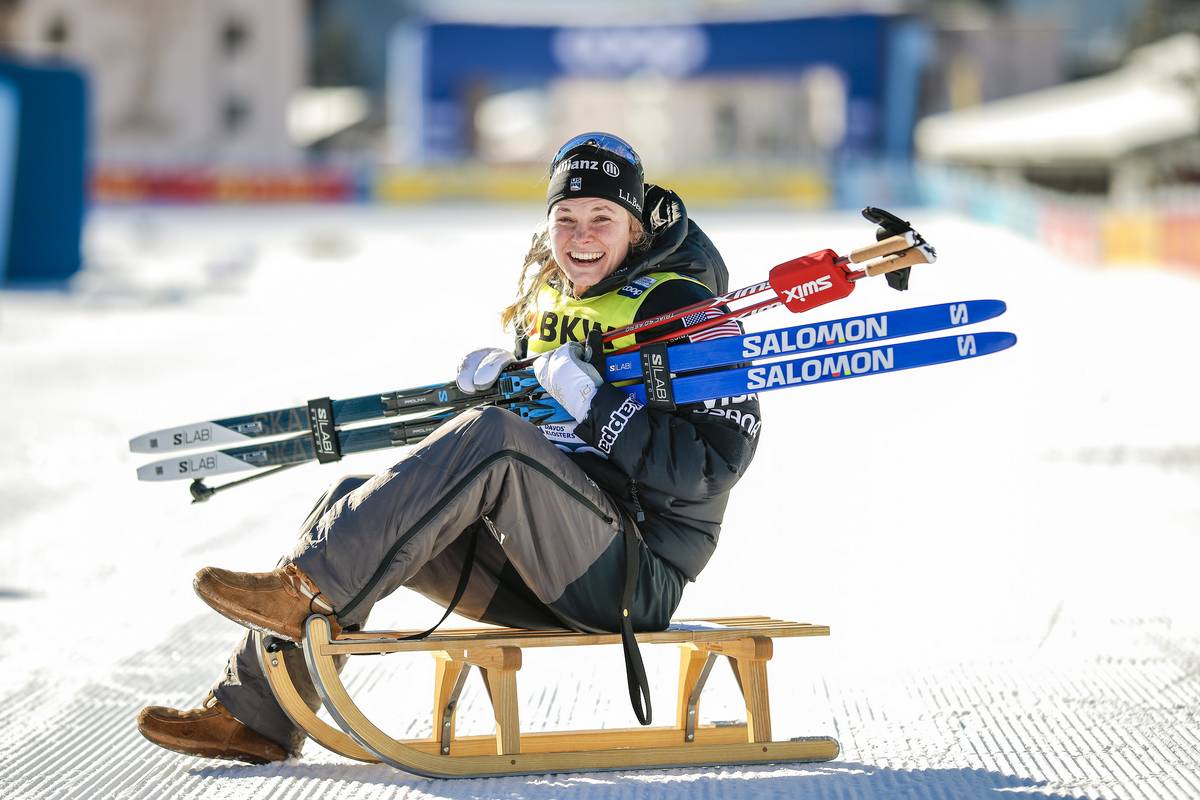
    Jessie Diggins’ (USA) recent World Cup win in Davos has her positioned as one of the favorites entering Period II’s Tour de Ski. (Photo: Nordic Focus)
    Ken Roth

    In the Women’s World Cup, Period I has been a tale of two halves. During the first two weeks, Sweden looked unbeatable. Then, a not-so-funny thing happened on the way to global domination: illness overtook team Sweden, and they only placed one skier on the podium in individual races each of the last two weekends. For most teams, those results would be pretty good; for the Swedish women it was disappointing.

    While Sweden was fading, the U.S. was surging. Jessie Diggins was transcendent in Davos, taking a first and a second. Rosie Brennan bounced back from illness to ski to third in a great 20-k freestyle race and showed unmatched grit. In retrospect, the single biggest factor of the first four weeks was the start list. I’m not throwing any shade on the Americans’ success, but many of the top skiers were absent the last two weeks, and a fair assessment must acknowledge that reality. The other reality is that you can only beat whoever shows up, and the American squad looked great doing just that.

    As the World Cup tour enters Period II, the Swedes may be anticipating a resurgence. Sweden’s Tour de Ski start list includes most of their superstars. The question is, will they remain healthy? The Swedes do themselves a real disservice when they fail to provide details about absences, as information vacuums often fill with speculation. This was especially evident with regard to Frida Karlsson whose absence from Davos raised questions about her health (which Team Sweden has identified as a concern in the past).

    Norway lists the three Wengs on its start list, so the competition will be stiff. Tiril Udnes Weng is skiing so balanced between distance and sprinting that, barring illness, she should be the Tour favorite. For the same reasons, you have to put Diggins into the mix.

    Another big question lingers around the U.S. squad:  will anyone emerge to supplement the 1-2 punch of Diggins-Brennan? Julia Kern has been right on the edge in sprints; my guess is she’ll be the next American to podium, while the women’s squad remains mostly unchanged for Period II. And FIS, your holiday present to the ski world can be to change the rules for mixed relays; and do it now. Allow teams to ski in any order they want and to submit their lineups just before the race starts (Full disclosure: I’m totally stealing this idea from the Devon Kershaw Show). Can you imagine an anchor leg with Jessie Diggins given a lead and trying to hold off Johannes Klaebo? I would pay real money to see that—and I suspect most of the cross-country fan world would too!
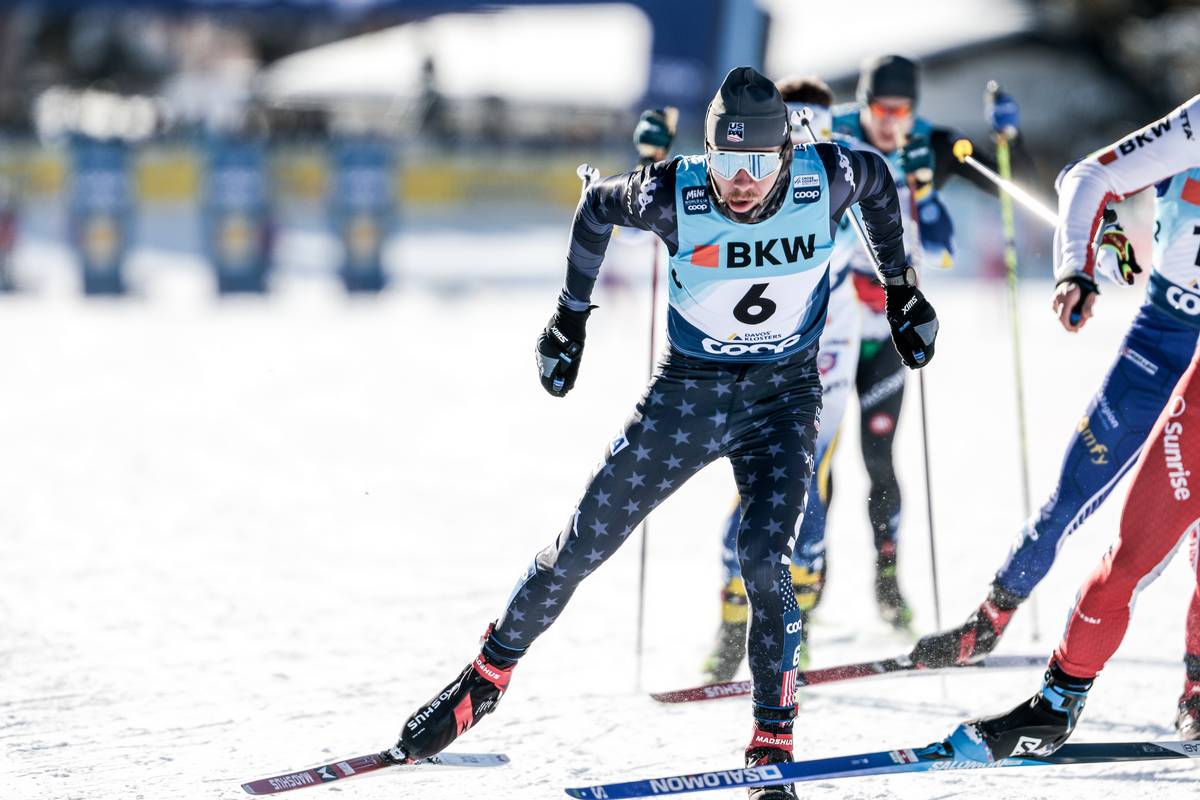
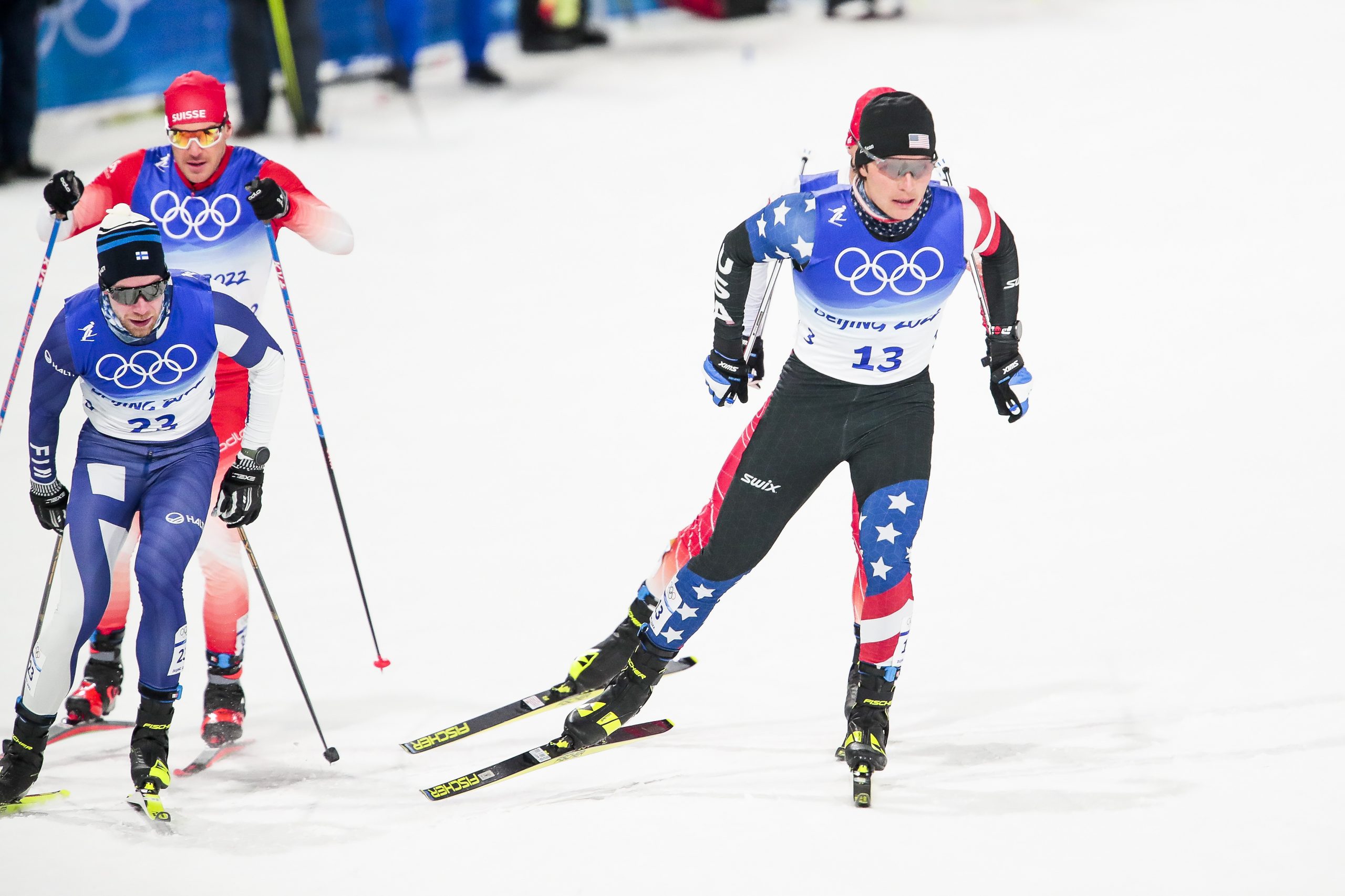
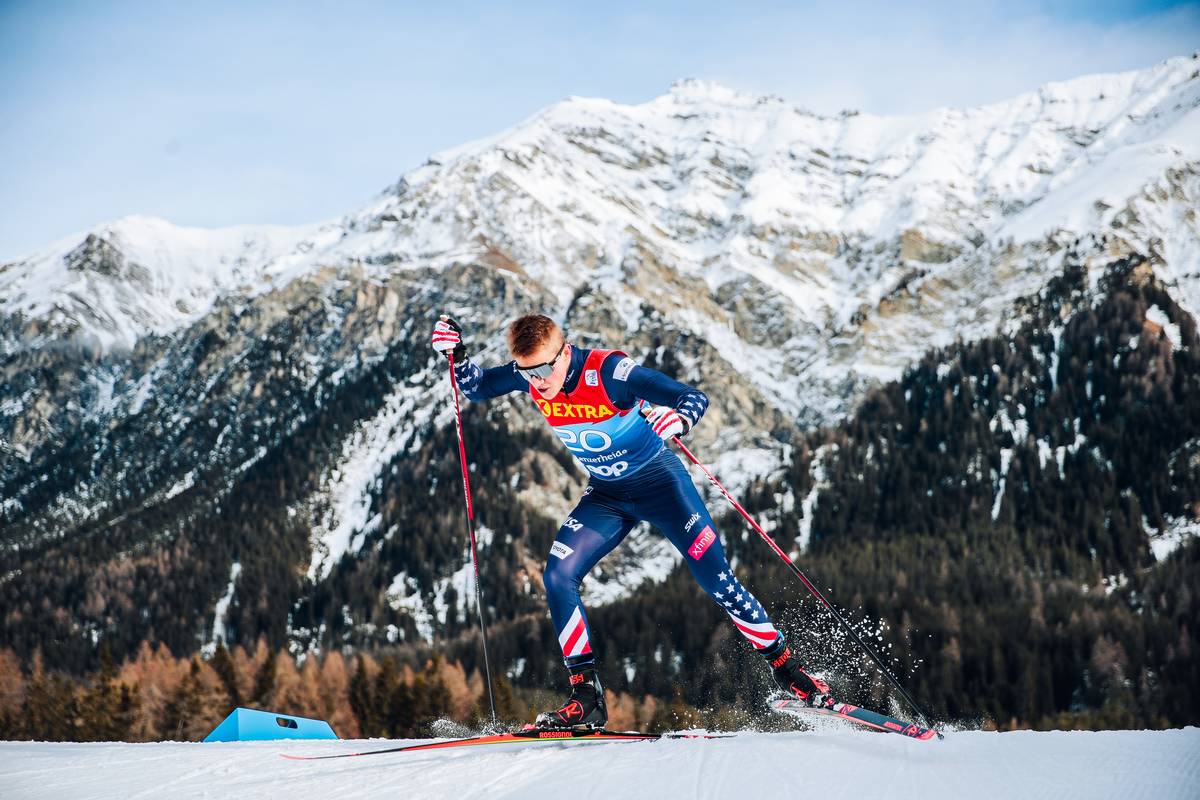
    Ben Ogden (USA) enters Period II with top North American finishes in both sprint and distance events. (Photo: Nordic Focus)
    Ben Theyerl

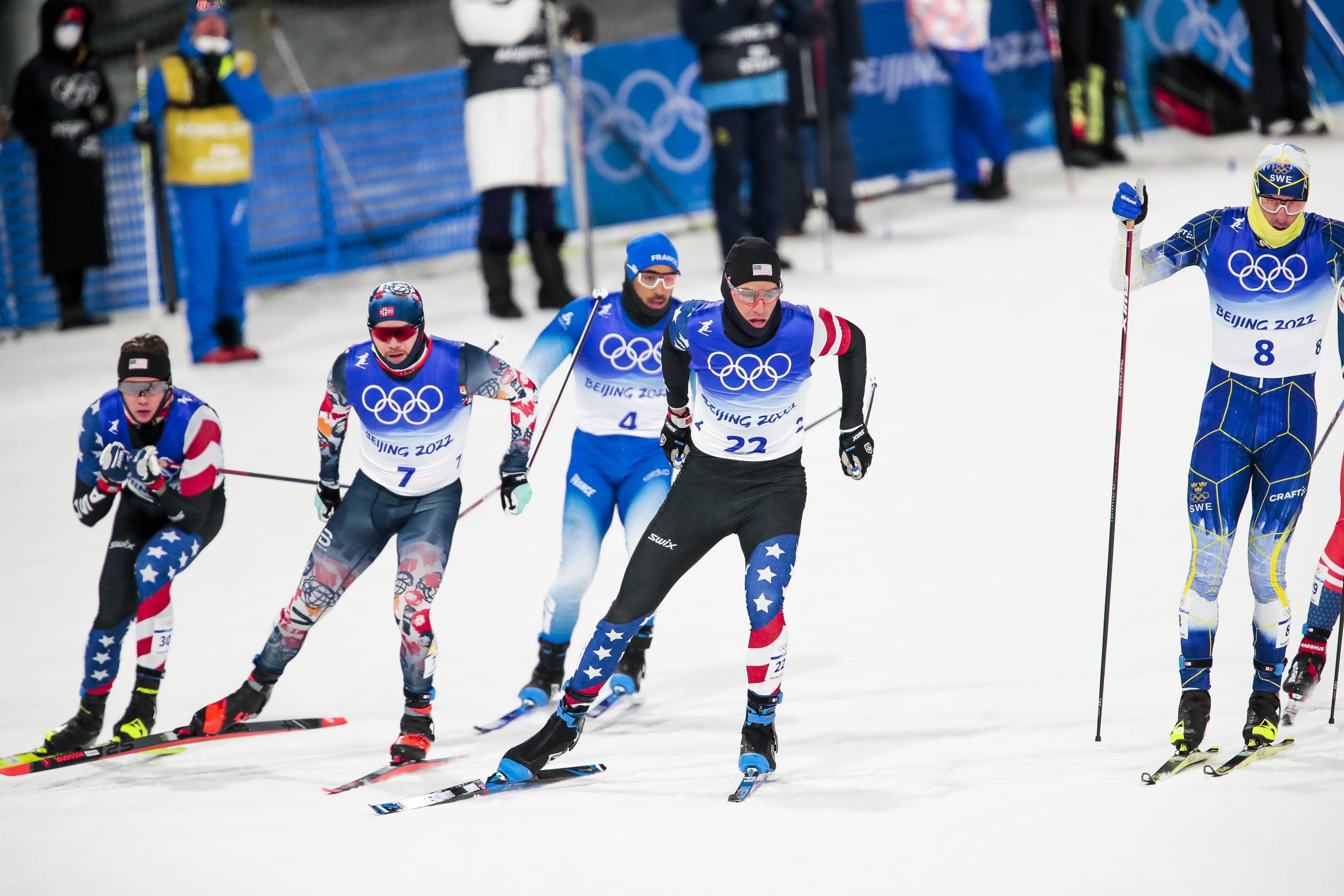
    In his comments to FasterSkier’s Nat Herz describing the Beijing Olympics 15 k Classic Individual Start, Ben Ogden said that when Johannes Hoesflot Klaebo passed him he “Wasn’t going at a totally inhuman pace. I think one day I’ll be able to ski a longer percentage of the race at that speed.” I don’t think we anticipated how close that hypothetical day might be. With Ogden coming within an inch of Sprint Finals in consecutive weeks in Lillehammer and Beitostolen (in both Classic and Skate, to boot), it’s clear the gap is shrinking. JC Schoonmaker in sprints, and Gus Schumacher in distance races, have both continued to show the potential of the “young Americans” who were introduced to ski fans with Junior World Championship medals in 2018, 2019, and 2020. As far as percentages go, they’re not quite 100% of the way to Klaebo-pace for an entire race, but they’re definitely getting closer. Are we at a point where we might see the return of an American male to the podium for the first time since Simi Hamilton in Toblach, 2017? Considering the auspicious steps taken by young American skiers so far this season, I wouldn’t rule that out in Period II.

    Finn O’Connell, Zak Ketterson, Hunter Wonders at the Tour de Ski: When I spoke to Finn O’Connell following his nomination to the US Ski Team last May, he said that one of his biggest successes last year was figuring out, “What [being] a professional skier looked like.” Along with teammates Zak Ketterson and Hunter Wonders, O’Connell is in the group who became professional skiers during the pandemic, and who have seen the early steps in their careers severely complicated by COVID’s impact. O’Connell, who had earned World Cup starts in 2020-2021, will step on to a World Cup start line for the first time at the Tour de Ski. Having the Tour de Ski be your first World Cup experience poses some unique, and demanding, challenges. O’Connell is likely to take cues from teammate Zak Ketterson who faced the same prospect just a year ago. When I spoke to him last May about hopping from the SuperTour to the World Cup for a week straight of racing, Ketterson said, “[The Tour de Ski is] overwhelming. Those first few races do feel different. It’s hard not to be super nervous, and you’re not really skiing like yourself.” That might sound daunting, but Ketterson also added that the Tour de Ski as an introduction to the World Cup, “Made the rest of races [on the World Cup last season] seem very chill by comparison.”

    That TDS-inspired confidence led to Ketterson being part of the American team that won the Team Relay in Falun last season, and has seen him settle into World Cup racing this season, highlighted by a 26th in the 10 k Classic in Lillehammer. He’ll now return to the Tour de Ski for a second time. Hunter Wonders and Finn O’Connell meanwhile, will start their first TDS with the same kind of trial that Ketterson had in his first Grand Tour-style race last year.
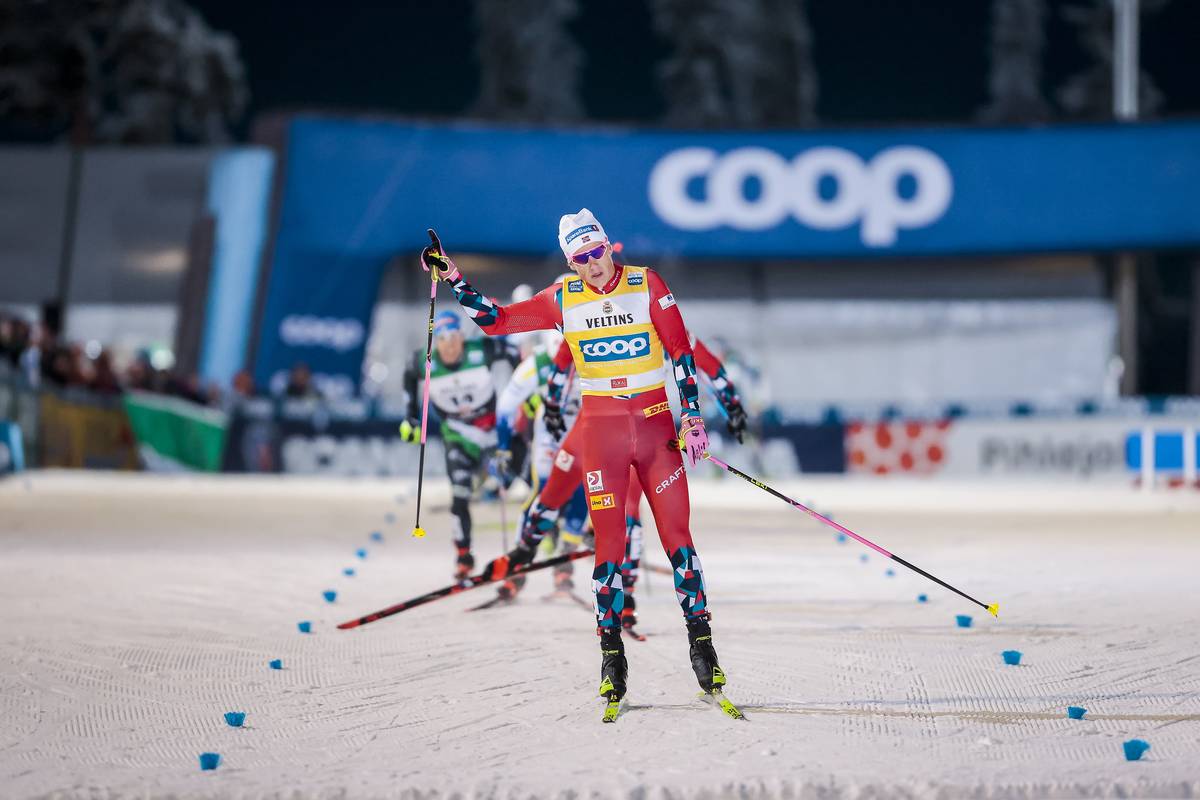
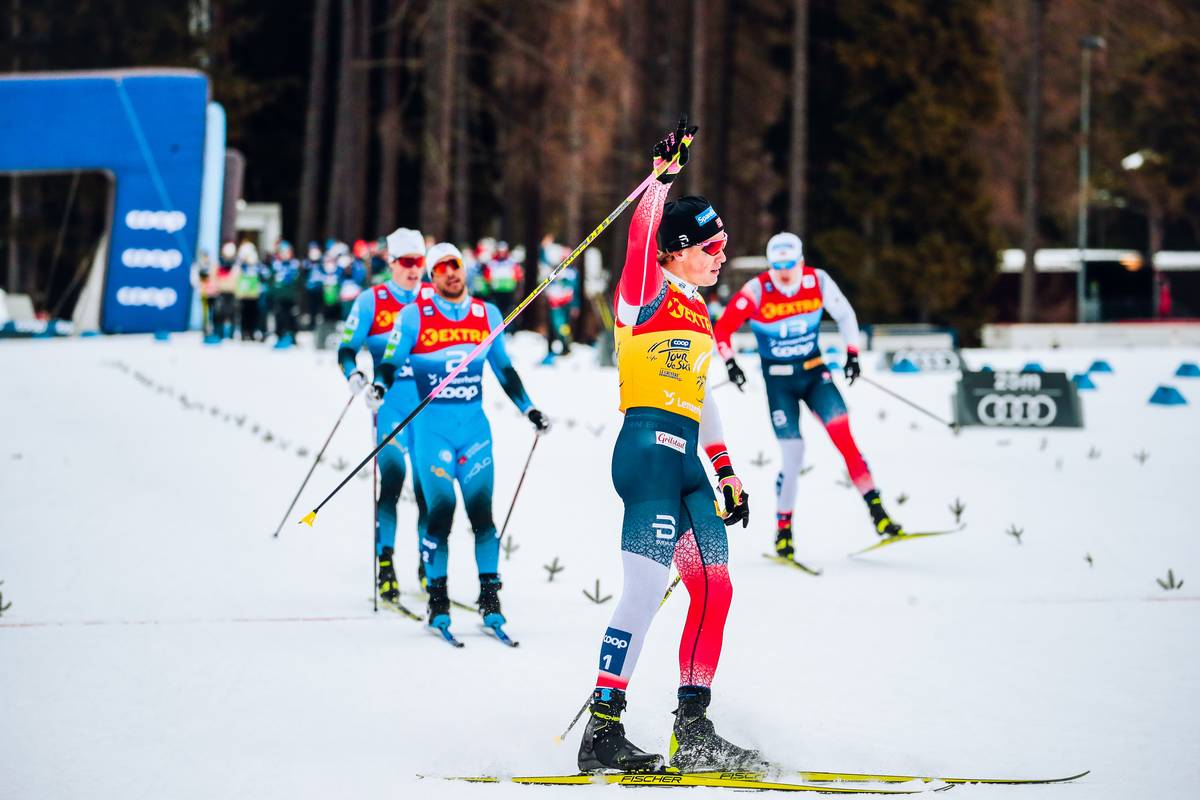
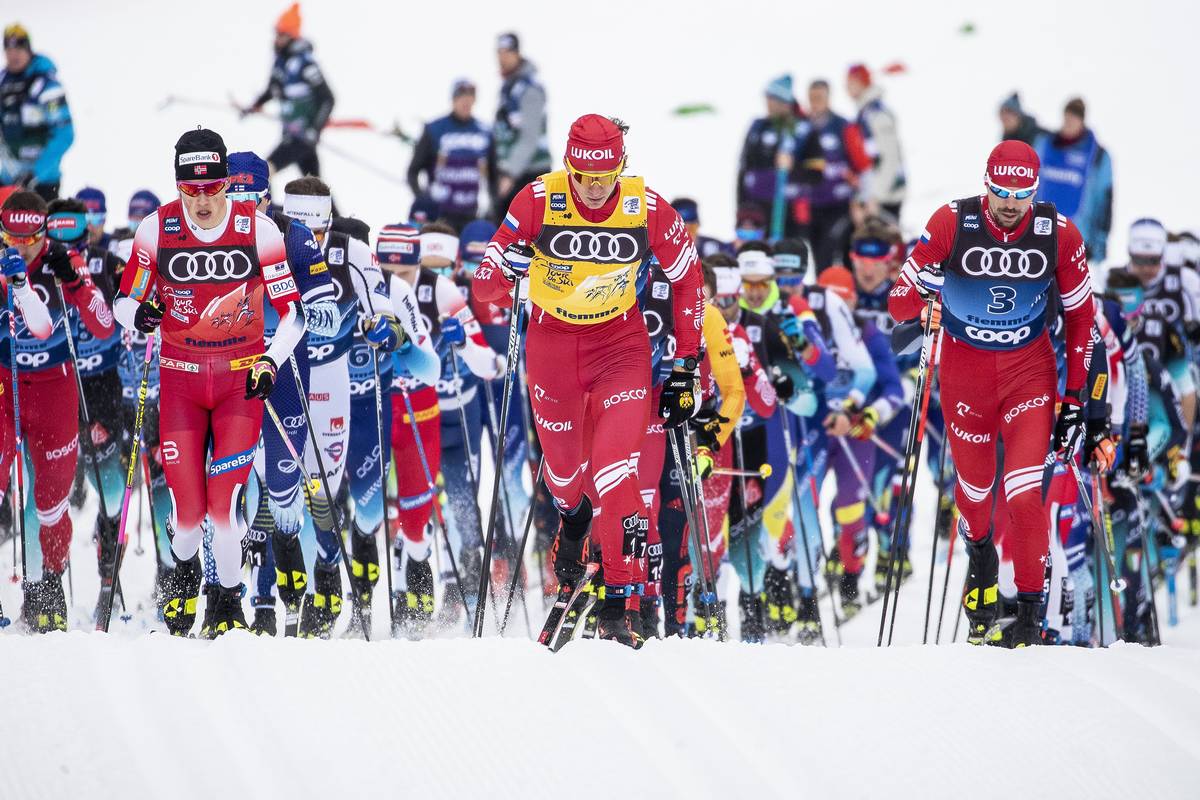
    Johannes Hoesflot Klaebo (NOR) crosses the finish-line in Ruka wearing the yellow Overall World Cup leader’s bib. He’ll hope that a winning effort at the Tour de Ski may allow him to be wearing that bib again at the end of the 2023 season. (Photo: Nordic Focus)
    John Teaford

    Two weeks ago, Johannes Hosfloet Klaebo claimed his pursuit of the overall World Cup crystal globe was over. It sounded as though he might just concentrate on World Cup sprint events and save his distance-skiing energy for this season’s FIS World Championships. Then the start list for the Tour de Ski came out:  Klaebo’s name is on the list. Game on . . .

    FasterSkier’s Ben Theryl recently wrote about changes to the World Cup point system, summing up the changes as, “A whole lot more points for a whole lot more skiers” resulting in top skiers needing to ski more races if they hope to do well in the race for the overall Crystal Globe. Exiting Period I, Klaebo and Paal Golberg are both on the Norwegian team for the Tour de Ski (TDS), and embroiled in a close, point-by-point battle for the Crystal Globe. If Klaebo succeeds in winning this year’s TDS, he could claw back the overall title, not by hundreds of points at a time, but by a grinding accumulation of points that could—to the FIS’ delight—make the battle for the Crystal Globe very exciting, indeed.


    American Team Selections for Period II (including the Tour de Ski) can be found in FasterSkier’s recent posting from US Ski and Snowboard.

  • What’s Up with World Cup Points this Season?

    What’s Up with World Cup Points this Season?

    The FIS instituted an overhaul of the points system used to determine the best individual skier in the World. We’re already seeing the consequences.

    Johannes Hoesflot Klaebo (NOR) crosses the finish line in Ruka, Finland while wearing the yellow Overall World Cup leaders bib. (Photo: NordicFocus).

    Johannes Hoesflot Klaebo had won all three races of the World Cup’s opening weekend races in Ruka. Any offseason doubts spurred by reports of his injuries or independent training practices went away. He was still the best skier in the world. Then, the following Friday in Lillehammer, illness forced Klaebo to sit out a 10 k skate race. His teammate Paal Golberg took over the World Cup overall lead with a 6th place finish. Klaebo returned the next day to handily win the sprint race:  usually, that would mean he would return to the top of the World Cup standings, and that he would start Sunday’s 20 k classic in the yellow overall leader’s bib (which he would likely continue wearing for weeks to come. Instead, Klaebo declared the season over. “I gave up the opportunity to win the World Cup overall when I did not start yesterday,” he remarked to Langrenn, in a statement that rightfully made headlines. When the next day’s race did come, Klaebo was nowhere to be found. Instead, the yellow leader’s bib went back to Golberg, where it remains.

    That Klaebo is the best male skier in the World is an easy conclusion to reach by watching any World Cup race in which he participates. Whether or not the World Cup points system is designed to objectively confirm that observation is a more complicated question, especially so since the International Ski Federation (FIS) instituted changes to its long-standing individual points system this season. Now three weeks into implementation, those systemic changes are resulting in more skiers earning more World Cup points. As a result, coaches and athletes are adjusting race plans, commentators are struggling to shake old habits, and the best skier in the world is apparently giving up on the whole thing. The rules of the game have changed, and it looks to be having an effect.

    Top 50 is the New Top 30: The Changes

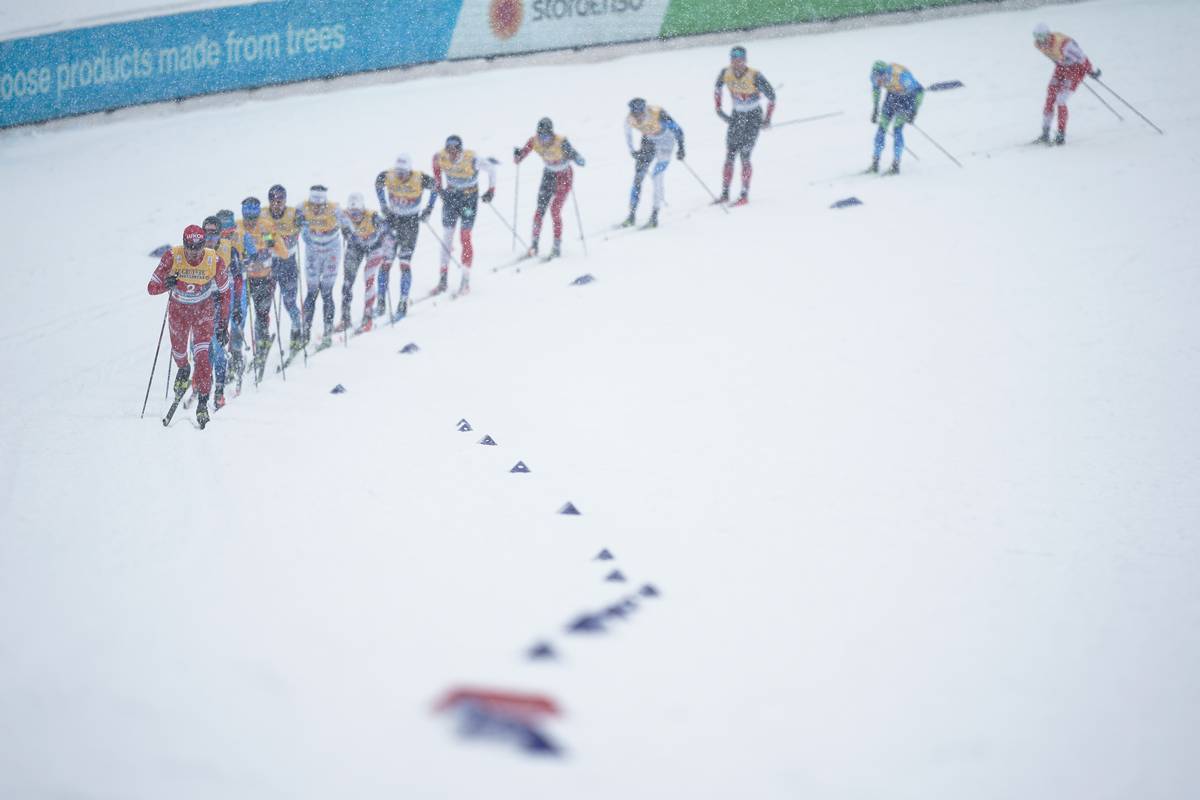
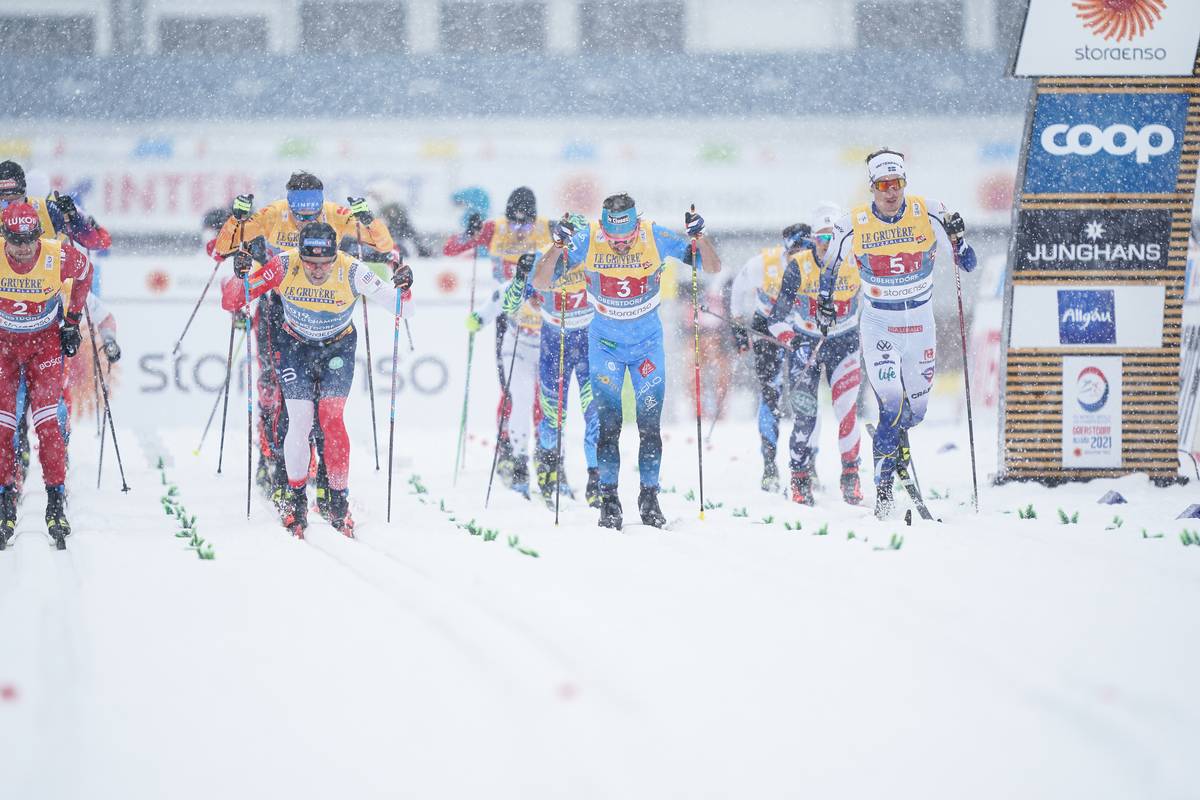
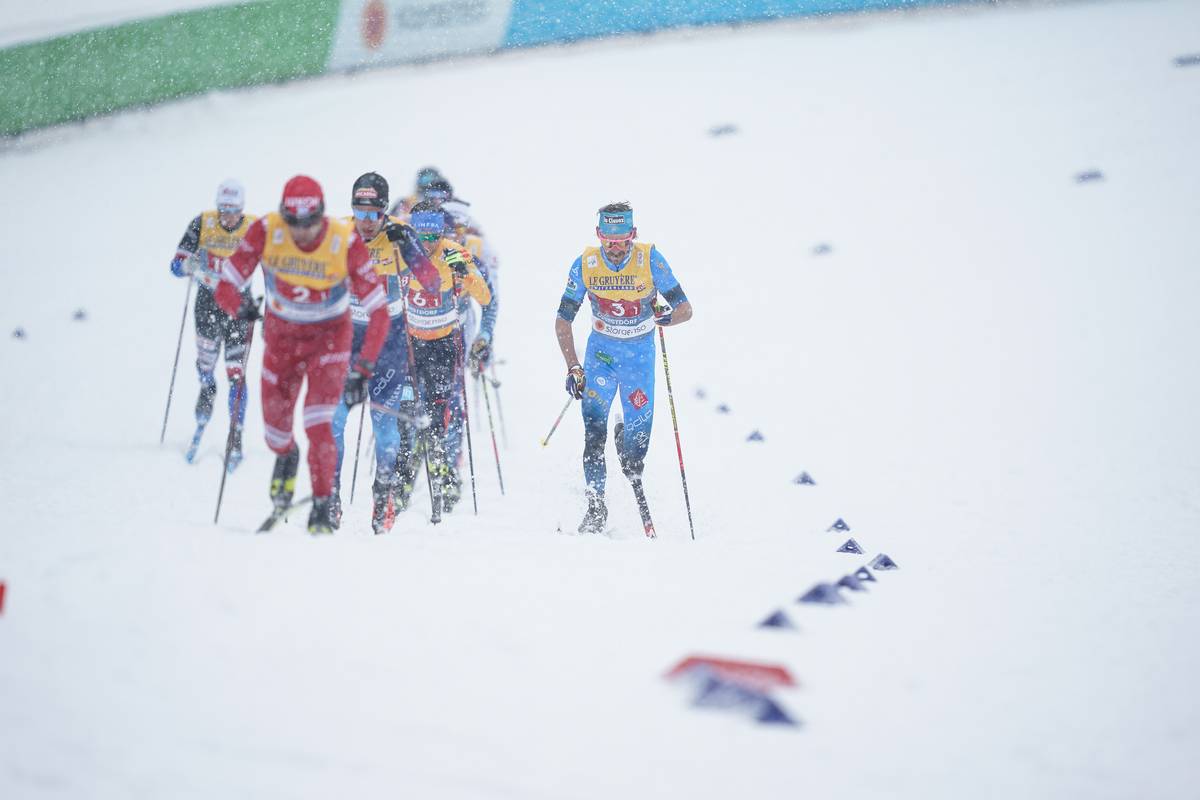
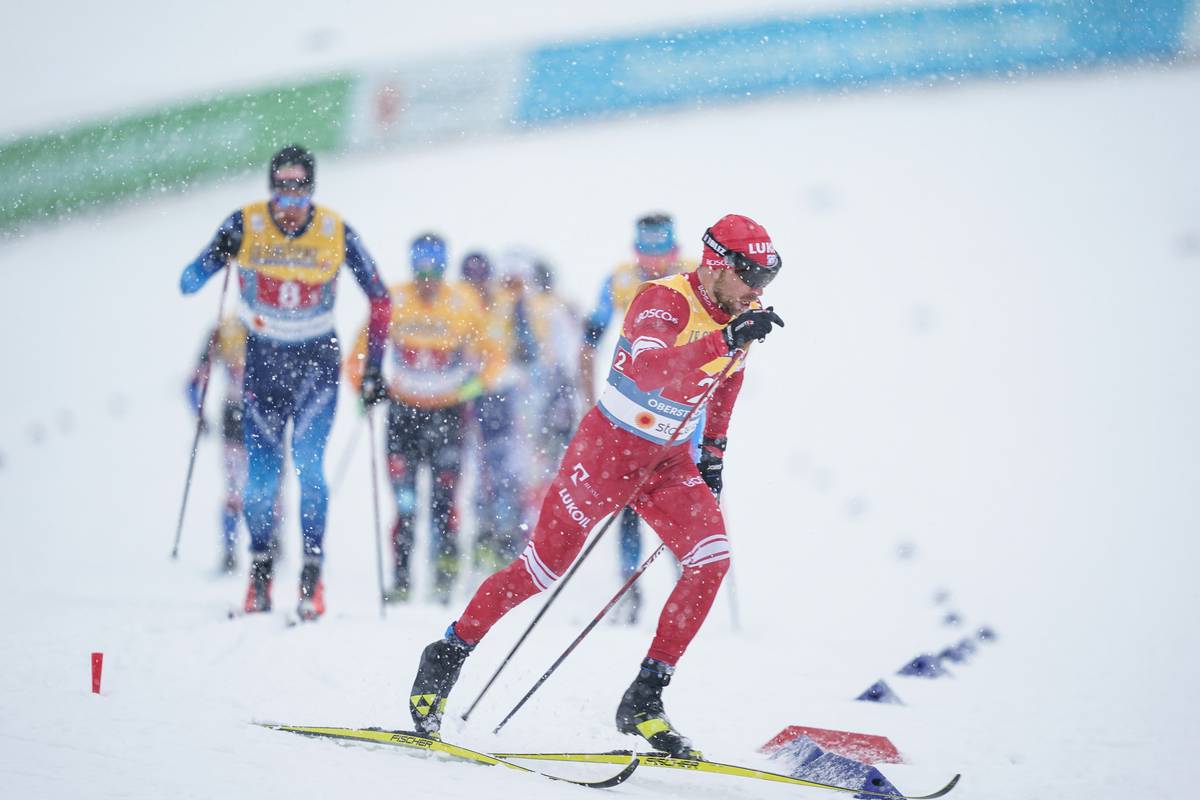
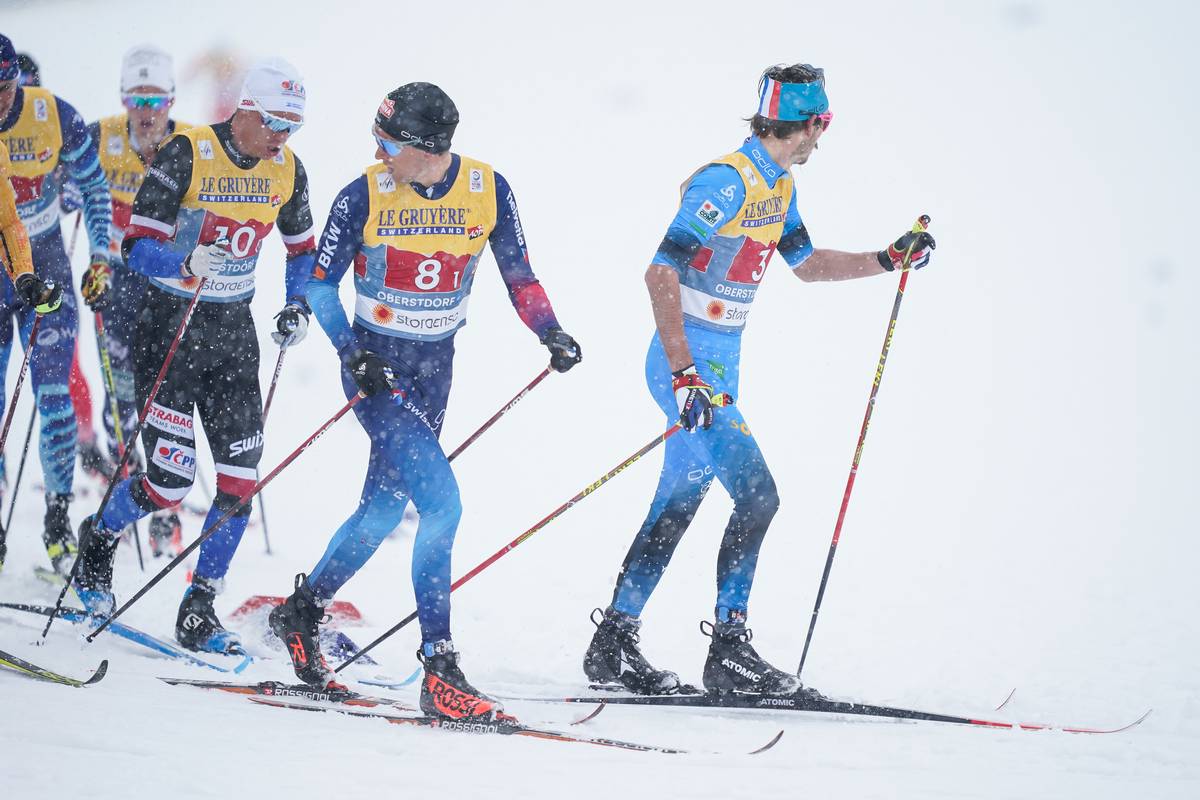
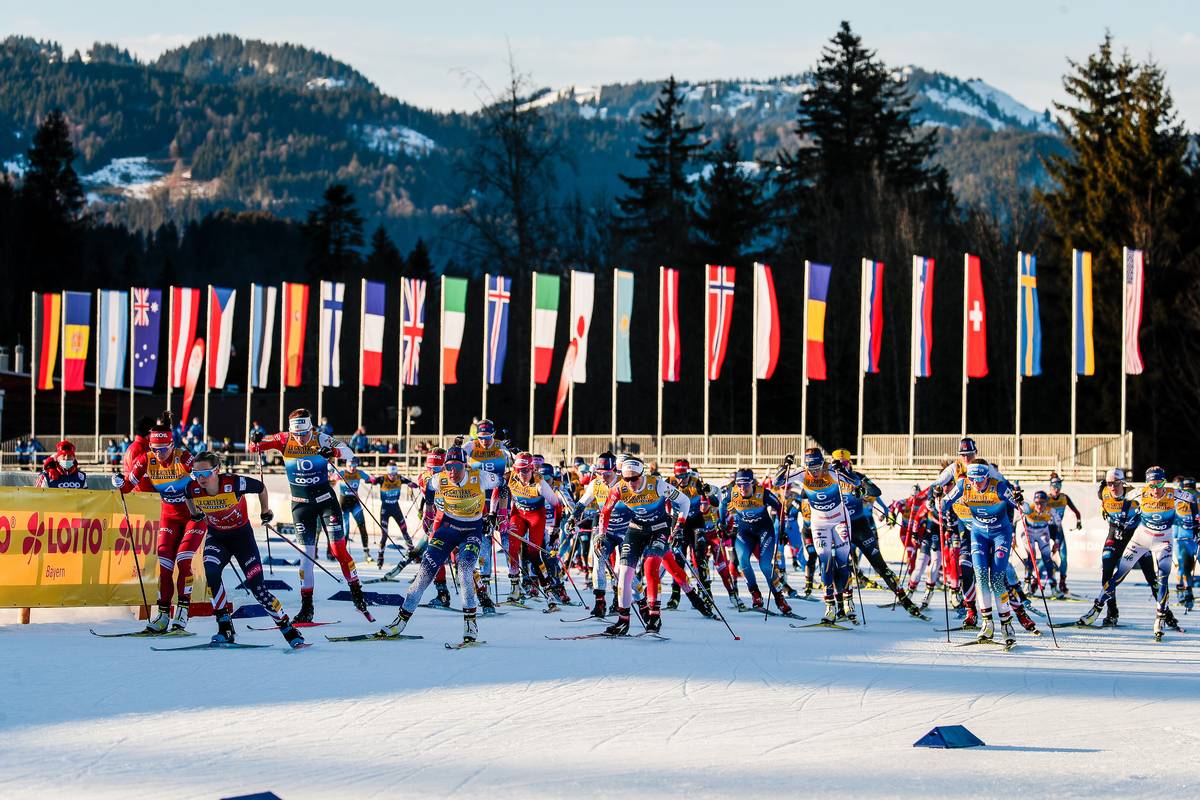
    The start of the women’s 10 k Freestyle Mass Start during Stage 3 of the 2021/22 Tour de Ski in Oberstdorf, Germany. (Photo: NordicFocus)

    In remarks following the 10 k classic in Beitostolen—where Jessie Diggins finished 6th and Rosie Brennan finished 8th—US Ski Team Head Coach Matt Whitcomb’s reflections focused on one number: “It’s easy to forget that just 15 years ago it was often that we would have zero people in the top 30 in distance, so this is a natural progression and an important thing to remember.”

    For years, “top 30” meant earning World Cup points. That level of finishing result became a signifier for a specific kind of success—gaining a foothold on the World Cup stage—and that expanded to serve as that same signifier at every stage of international skiing progress. In the United States, every collegiate circuit uses a version of the World Cup points system to 30th place for NCAA Championship qualification. Some regions use a version of the “top 30” system to determine selection for US Junior Nationals. The “top 30” system etched itself into the sport’s evolution too. When the sprint became an integral part of skiing in the early 2000s, there was no set number of competitors who would move on from qualifiers to heats . . . until, that is, the FIS decided on the top 30.

    “Top 30 is good.” That’s what skiing has told us for a long time. So what happens when that single World Cup point gets pushed out to the skier in 50th place? 

    Well, it looks something like this:

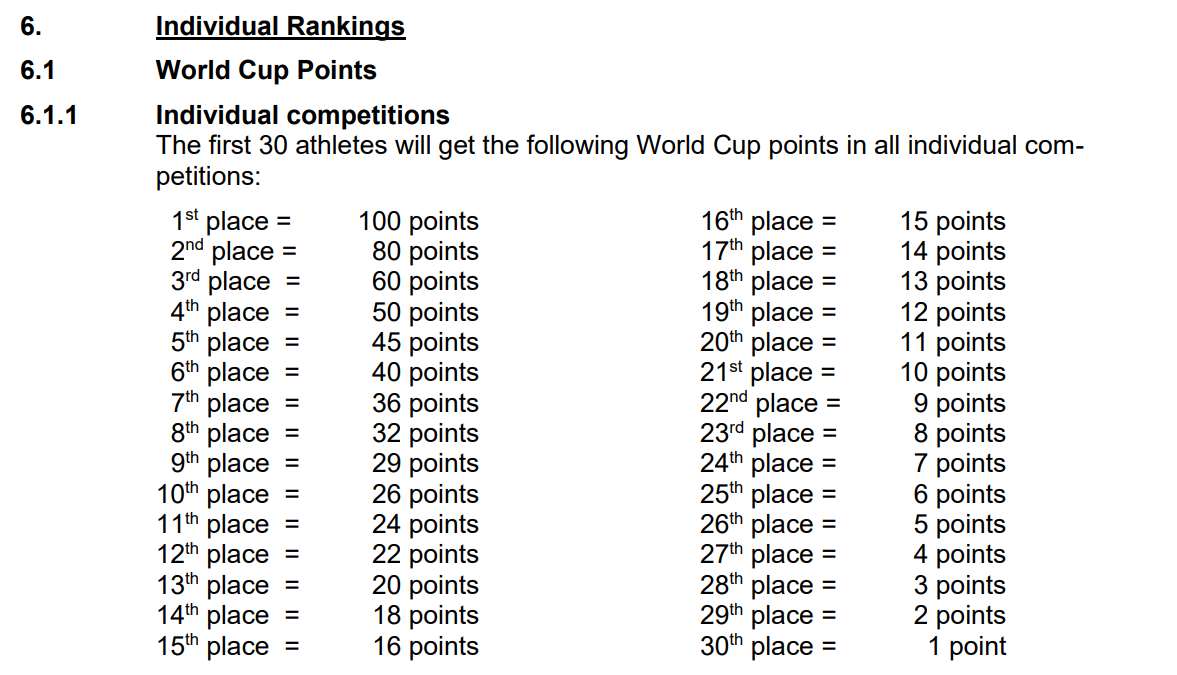
    The NEW FIS World Cup points system:
    (Photo: “Rules for the FIS Cross-Country World Cup 2022-23.” 2022. “International Ski Federation.”)
    The OLD FIS World Cup points system:
    (Photo: “Rules for the FIS Cross-Country World Cup 2021-22.” 2021. “International Ski Federation.”)

    In the NEW system, the points stretch further down the results, and the steps down are much, much, smaller.

    Points stretching further down the results will primarily have consequences for skiers seeking selection to the World Cup, rather than  the World Cup Overall competition itself. With the points stretching to 50th place (just short of the size of a usual World Cup field) there is now a more quantifiable way to compare developing skiers and assign discretionary starts for national ski federations. Whereas under the top 30 system, skiers outside of the points were at the whims of the sometimes wonky FIS points system, there is now a better chance to judge a skier’s potential on the World Cup based on their performance on the World Cup. 

    Smaller steps in points from 1st place (100 points) down is where the World Cup Overall competition really changes. See Table 1. below with the points awarded for 1st-5th place in the NEW system, and Table 2. with the points awarded for 1st-5th place in the OLD system, and the equivalent place-points total under the NEW system.

    Table 1. Place-points total for 1st-5th place, NEW system

    NEW System Place NEW System Points
    1st 100
    2nd 95
    3rd 90
    4th 85
    5th 80

    Table 2. Place-points total for 1st-5th place, and equivalent place-points total in NEW system

    OLD System Place OLD System World Cup Points NEW System place-points equivalent.
    1st 100 1st
    2nd 80 5th
    3rd 60 11th
    4th 50 16th

    5th

    45

    19th


    When it comes to points earned, getting 1st place just doesn’t matter as much as it used to. That key change is amplified when considering that FIS has made very slight changes to the system surrounding the individual points matrix awarded for each race.

    Bonus Points System Remains the Same

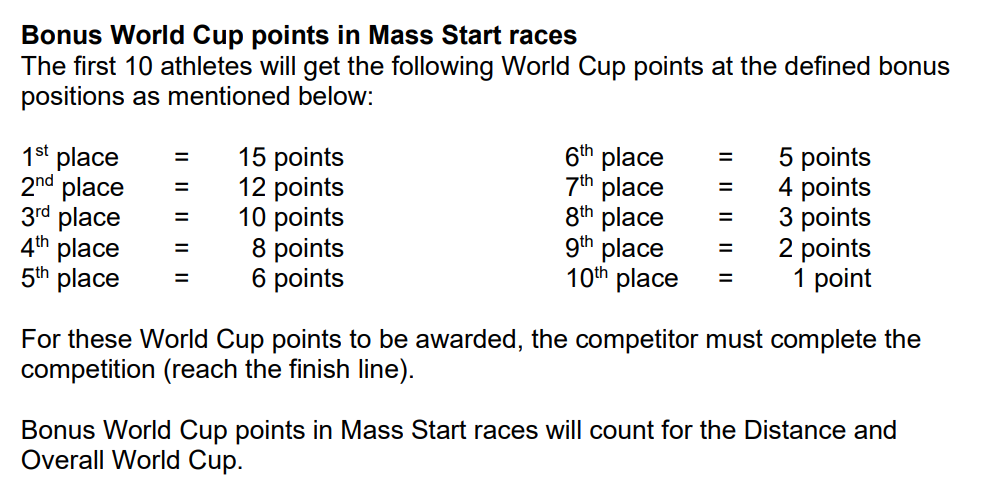
    In a bid to introduce more dynamic racing a few years ago, FIS introduced a bonus point system in which checkpoint bonuses became incentives for World Cup points. That system remains unchanged and is found here:

    (Photo: “Rules for the FIS Cross-Country World Cup 2022-23.” 2022. “International Ski Federation.”)

    Based on the points classifications found in cycling’s Grand Tours (the “Green Jersey,” for Tour de France fans), the bonus system was intended to introduce a series of points that skiers would tactically approach as intermediate sprints. The dynamics of ski races are very different from the dynamics of a cycling race, however, and in practice, the sight of skiers shuffling for a sprint in the middle of a distance race has been rare.

    Why? Unlike cycling, ski racers exhibit less obvious discrepancies between who is a great sprinter and who is a great distance competitor. In mass start ski races, it’s rare to see a breakaway that is not comprised of skiers who would also excel at distance racing. The bonus points, in reality, have almost always gone to top contenders for the race itself.

    The NEW points system seems to retroactively fit the existing bonus points system into this skiing reality. The consequences: in the OLD system, the 15 points for being 1st place through an intermediate checkpoint could almost never displace the points total for finishing 1st versus 2nd, or 2nd versus 3rd. In the NEW system though, with five points separating each of the first five places, winning the intermediate sprints could theoretically displace the 1st place finisher for the most points won on the day for a skier in 3rd or 4th place.

    Example: In a 20 k mass start, the skier who will eventually finish 3rd place controls the front of the race for the first 10 k, earning 30 bonus points for winning two bonus point checkpoints (15 points each). The skier who will eventually finish 1st place is further down the pack through the early part of the race, but still in the top 10 through the checkpoints. They are 10th through each bonus point checkpoint, earning 2 total bonus points, before making a push to win the race. The 1st place skier’s total points for the race: 100 (1st place) + 2 (bonus points) = 102 total points. The 3rd place skier’s: 90 (3rd place) + 30 (bonus points) = 120 points total.

    That may be unlikely, but it is at least now in the realm of possibility. Again, a whole lot more points for a whole lot more skiers.

    Other Tweaks: Relays and Tour de Ski Bonus

    There are two other notable tweaks in the new FIS system that pertain to specific events:

    The first is that team events no longer are scored for individual points. That has already proven consequential in the way that the only team event so far this season has been raced. For instance, Matt Whitcomb identified the fact that no points were up for grabs as having directly influenced his decision that Jessie Diggins sat out the 4 x 5 km Team Relay in Beitostolen. Similarly, neither current World Cup overall leaders—Paal Golberg (NOR) for the men, nor Tiril Udnes Weng (NOR) for the women—raced the relay. 

    The second change is less drastic, but will be significant when the World Cup turns to the Tour de Ski (TDS) in a few weeks. FIS reduced the points bonus for winning the overall classification at the TDS from 400 points to 300 points, and adjusted the points bonuses for lower placings accordingly. The reduced emphasis in points—and subsequent reductions in prize money per placing—could result in the Tour de Ski becoming a less significant part of the World Cup calendar than it has been in recent years.

    What It All Means

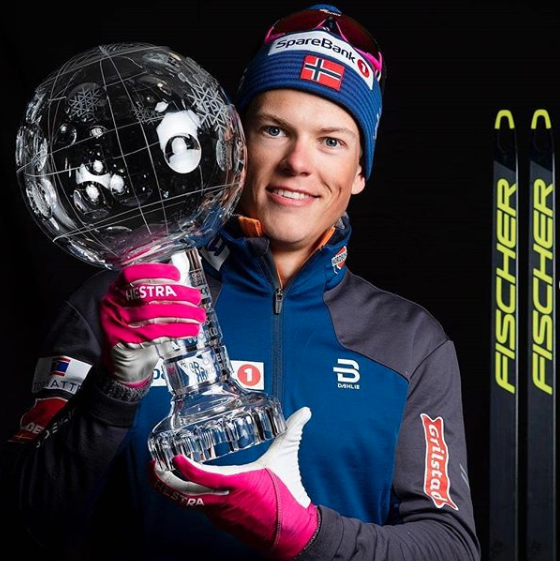
    Johannes Høsflot Klæbo poses with his crystal globe after winning the 2019 Overall World Cup title. (Photo: Nordic Focus)

    So, is Johannes Hoesflot Klaebo justified in his World Cup fatalism? The answer just might be that the FIS wants him to be. By pushing more points onto competitors who so often come 2nd, 3rd, or 4th place to the young Norwegian, they have created a new dynamic in this year’s bid for the Overall Crystal Globe. Consider the top two skiers in the current classification:

    Top Two Places of Men’s Overall World Cup Points after Three weeks of racing, OLD system vs. NEW system:

    1. Paal Golberg (NOR) – NEW system 756 points, OLD system 575 points, Net Change: +181 points.
    2. Johannes Hoesflot Klaebo – NEW system 430 points, OLD system 430 points, Net Change: 0 points.

    Klaebo’s points have not changed because the benchmark for the FIS points system has not changed. He has won every race he has entered, and 1st place is still worth 100 points (with 15 points for winning sprint qualifiers). Golberg, though, has benefitted from starting more races, and getting more points for being top 10, not top 1. It is a simple comparison, but it is also the only one that really, really matters for evaluating the change that the FIS wanted to make to the World Cup adopting the NEW system. The eventual winner of the Crystal Globe will now be determined by an incentive to do well in the races you start, and to start more races. Those are just the rules of the game; once the rules are understood, then it’s possible to understand what the new rules are incentivizing. FIS has followed that all the way through with its NEW point system, assuring that the season-long champion will be the skier who is most consistent and who competes most often. 

    As for us—the fans—is this the system by which we want our skiers rewarded? Should the best skier also have to be the most consistent? Should the strongest skier in a mass start go off the front early, or show their strategic aptitude by controlling a pack? Should skiers specialize in sprinting or distance? Should they continue to have to do well in both? And, of course, is the “top 50” the new “top 30?”

    New points systems instituted by FIS has ski fans, ski coaches, and skiers talking;  that new system also has the game being played differently on the World Cup tour this season.


    Resources:

    2021-22 FIS Rulebook containing the OLD system.

    2022-23 FIS Rulebook containing the NEW system.

  • Klaebo Sweeps Ruka World Cup Weekend

    Klaebo Sweeps Ruka World Cup Weekend

    A_Hall_Mark_of_Excellence_Award-logo-300.png (300×244)This World Cup coverage is made possible through the generous support of Marty and Kathy Hall and A Hall Mark of Excellence Award.  To learn more about A Hall Mark of Excellence Award or to learn how you can support FasterSkier’s coverage please contact info@fasterskier.com.
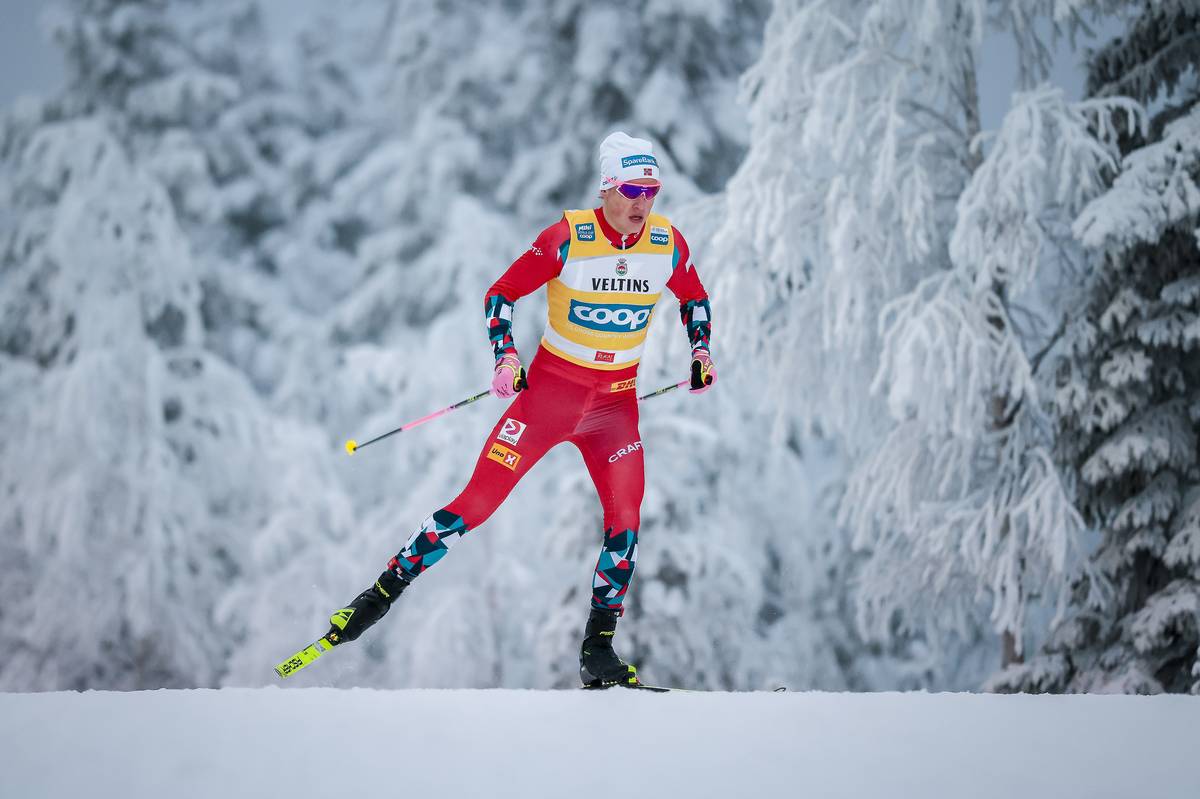
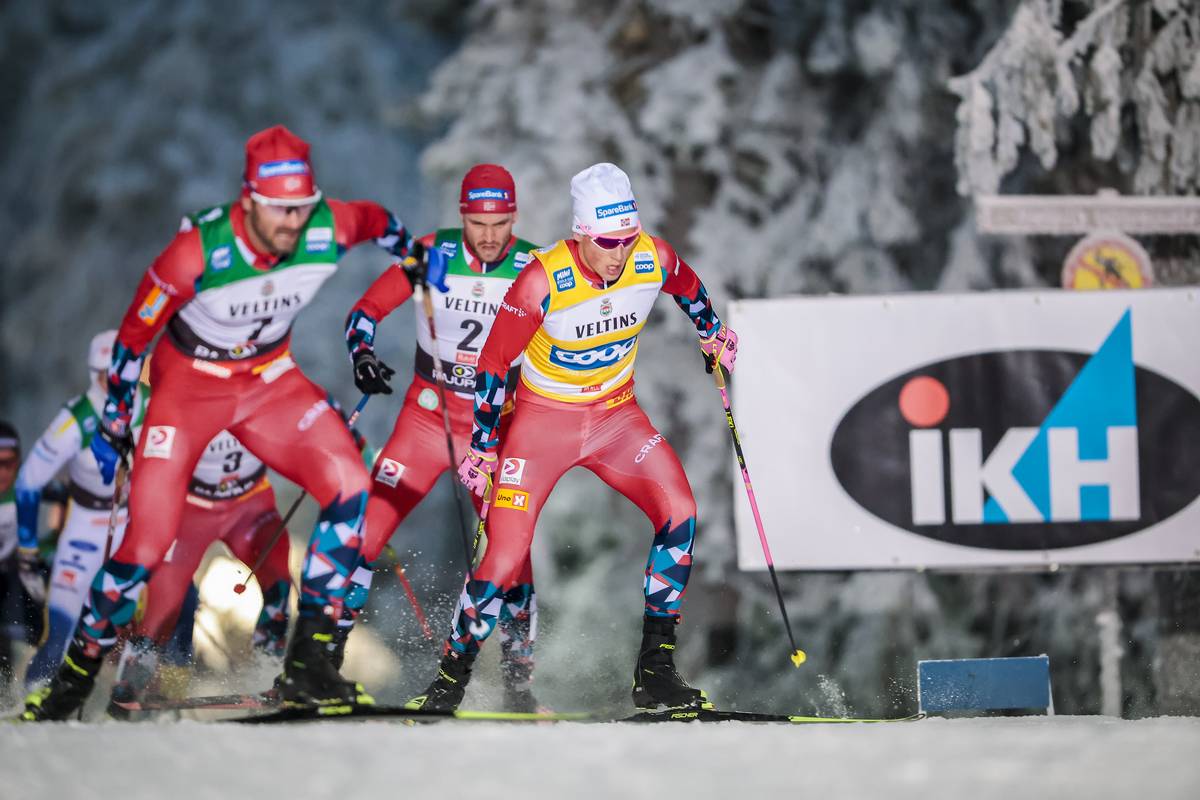
     

    Johannes Hoesflot Klaebo (NOR) cruising to victory in Sunday’s 20 K World Cup Freestyle Pursuit, and posting a clean sweep of sprint and distance events in the season’s first FIS World Cup weekend. (Photo: NordicFocus)

    Snow-covered Ruka, Finland set a wintry stage for the third day of World Cup cross-country racing, as the men’s field returned to the trails to contest a 20 k Freestyle Pursuit. Johannes Hoesflot Klaebo skied a smart, economical race to claim the victory (his third of the weekend), and was joined on the podium by Norwegian teammate Paal Golberg, and Italian sprint-specialist Federico Pellegrino (who advanced to bronze medal position upon the ultimate disqualification of Sweden’s Kalle Halfvarsson).

    Among North American finishers, Canadians Graham Ritchie and Oliver Leveille were 47th and 55th, respectively, while American finishers included Scott Patterson 14th, Hunter Wonders 30th, Zak Ketterson 32nd, Gus Schumacher 36th, and Ben Ogden 50th.

    In 2017, Klaebo swept the opening weekend of World Cup Races at Ruka on his way to an eventual 2018 Overall World Cup Championship It may not have been his goal to repeat such a sweep in 2022; nonetheless, Klaebo has silenced any who may have doubted his readiness for another season of dominance. At this early point in the season, Klaebo definitely looks like the skier to beat.

    On his way to victory in the Men’s 20 K Pursuit, Norway’s Johannes Hoesflot Klaebo (in yellow bib) consistently marked the pace-making efforts of his teammate, Han’s Christer Holund (on left). (Photo: NordicFocus)
    20 K Freestyle Pursuit

    Sunday’s Freestyle Pursuit incorporated start positions determined by finishing statistics in Saturday’s Individual Classic 10 k. Having won Saturday’s race, Klaebo started first with an advantage of twenty seconds over the second starter, Paal Golberg. As it turned out, a number of other starters—including some starting nearly a minute back—would play significant roles in today’s race.

    In the absence of Russian skiers, World Cup mass start races are likely to revolve around Klaebo. With any Klaebo-led pursuit race apt to evolve into a mass start strategy, it will always be unlikely that Klaebo—the world’s best sprinter—will volunteer do the lion’s share of the work. Predictably, while Klaebo’s pace was brisk at the beginning of Sunday’s race, he soon eased up and allowed himself to be caught by a charging chase pack led by Klaebo’s Norwegian teammate, Hans Christer Holund. The train of chasers behind Holund included Norwegians Martin Lowestroem Nyenget, Golberg, Erik Valnes, Emil Iverson, Mattis Stenshagen; Swedes Kalle Halfvarsson and William Poromaa; Pellegrino of Italy, Friedrich Moch of Germany, and the lone Brit, Andrew Musgrave. With Klaebo now skiing in the group—and Holund setting the tempo—this lead pack of a dozen proceeded to maintain a pace that effectively excluded all others from the race for medals.

    American skiers spent the early part of the race grouped in the 30’s, with Scott Patterson having moved up 20 places from his 51st place starting spot. Patterson would continue to ski strongly throughout the race, eventually forming a group of only four chasers closely pursuing the lead group. Patterson would ultimately finish the day in a remarkable 14th place, after having begun his race near the back of the pack.


    Hunter Wonders (USA) skied from an original 54th starting position to finish in the first chase group with a very impressive 30th place finish. (Photo: NordicFocus)

    Holund drove the pace through the halfway mark, knowing that Valnes, Golberg, Halfvarsson, Pellegrino—and of course Klaebo—all possessed far superior sprinting skills. Musgrave also pushed the pace through the later kilometers, but neither he nor Holund could break the other contenders—nor did they put a dent in Klaebo who seemed contained, confident, and relaxed throughout the race.

    With less than two kilometers to race, Klaebo moved to the front (shadowed by Pellegrino). Klaebo’s victories at Ruka have all been delivered by a surging attack on the final hill before the finish, and Sunday’s race proved no different. Klaebo led the pack into the bottom of the final hill, increasing his tempo and jump skating over the top of the hill with the other contenders faltering in his wake. Halfvarsson sought space far to the skier’s left, possibly even leaving the race course, though in a manner that did not seem to give him any advantage or to shorten his distance to the finish line. Ulitmately, both Halfvarsson’s skis veered outside the course markers for just a stride or two. In the eyes of the FIS jury, that small infraction was sufficient to merit his disqualification. Third place on the podium was awarded to Pellegrino who had started the race in the 14th position, and moved up to 3rd for what is likely to have been his first World Cup distance medal. In a post-race interview, and emotional Pellegrino spoke of goals well beyond what he had accomplished on this day: “The main goal this season will not be in sport, but with my wife at home.” Pellegrino and his wife are expecting their first child.

    Sunday’s Ruka World Cup Pursuit was an especially satisfying day for sprinter Federico Pellegrino (ITA), who notched his first World Cup Distance Race podium. (Photo: NordicFocus)

    20 K Freestyle Pursuit:  FULL RESULTS

  • Klæbo Comes to Soldier Hollow

    Klæbo Comes to Soldier Hollow

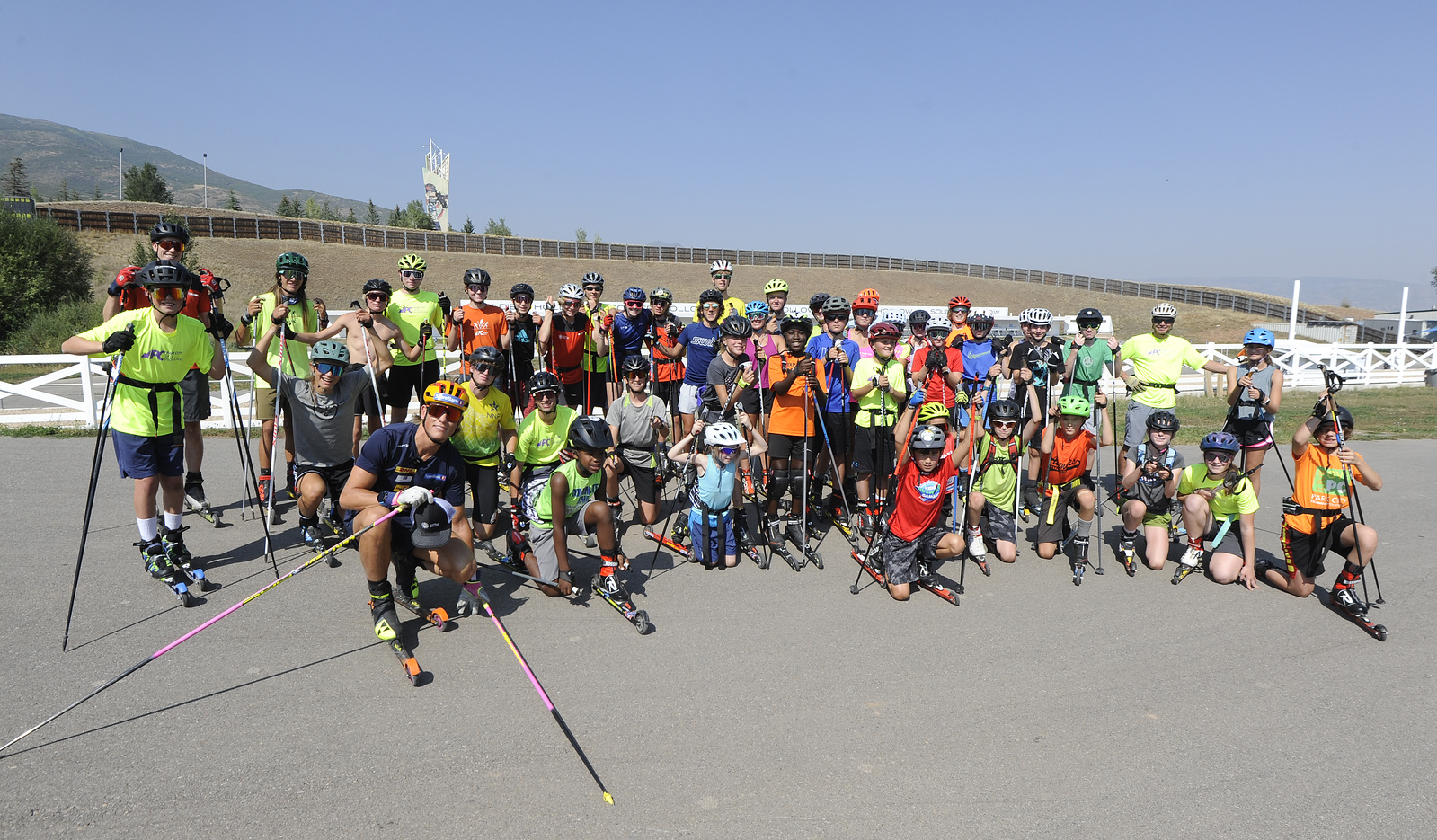
    Olympic champion Johannes Høsflot Klæbo of Norway receives an official Soldier Hollow cap from a young skier after conducting a clinic for local cross country ski racers at the Olympic venue of Soldier Hollow near Midway, Utah. (Photo: (c) 2022 Tom Kelly)

    Practice had ended for the Soldier Hollow Comp and Devo teams, but no one went to take their roller skis off. They were waiting for something that didn’t happen everyday; shortly, their patience was rewarded. The winningest male World Cup skier of all time—Olympic Champion, World Champion—glided around a gentle left-hand bend, dragged his wheels to a perfect stop in front of the crowd, picked up a microphone, and smiled a familiar smile: Johannes Høsflot Klæbo had arrived.

    Hosting the day, Tom Kelly asked the questions that each of us in the American ski community might ask if the best skier in the world showed up on our local trail system:

    For the kids:

    Tom Kelly (TK): What advice would you give to our [youth] skiers here today?

    Johannes Høsflot Klæbo (JK): The most important part is to have fun. That was my focus when I was that age, and all the way up until I was starting on the national team. For me also, I was small, like really small, so I tried to really work on my technique to make up for that.

    For the (slightly) older kids:

    TK: When you were young, which skiers were you looking up to?

    JK: The skier I was looking up to was Petter Northug. [I also looked up to] my grandfather – who [is] my coach, but also just there for me and still is here for me and I look up to him for that.

    And for the US Ski Community looking forward to the future:

    TK: What do you think about [Soldier Hollow] as a venue for the [2030 Winter Olympic games]?

    JK: “Yes definitely. This is a venue built for the Olympics and I remember watching some great races here in 2002. 2030 is eight years away, which, I guess I will try to keep [myself] going until then.”

    On this day, it became apparent that Soldier Hollow is part of Klæbo’s plan to keep himself going . . . but why Soldier Hollow? Why would Johannes Høsflot Klæbo feel the need for a change? He’s the central figure in ski-obsessed Norway; for Norwegians, Utah is practically the edge of the skiing universe, and Klæbo’s achievements wouldn’t imply the need for rethinking his usual plans and strategies. At the age of 25, he’s already amassed seven Olympic medals, eight World Championship medals, and 48 World Cup victories (more than any male skier in the sport’s history). Ironically, these achievements may be credited to Klæbo’s insistence on doing things his own way (not simply as a member of the Norwegian Ski Team). Klæbo’s athletic support system is almost exclusively his family: his Grandfather serves as his primary coach, and his brother plays an important role in managing everything that goes into being Johannes Høsflot Klæbo. When viewed in that light, it seems less unusual that Klæbo would choose to spend time training in a new environment, and under a new plan.

    Johannes Høsflot Klæbo holds up one of the 3 Olympic medals he won at last February’s Beijing Games. Klaebo has been in Park City, Utah this month, preparing for the upcoming World Cup season. (Photo: Nordic Focus).

    Klæbo is already experiencing a 2022-2023 season that differs from his normal program. His widely publicized mid-summer hamstring injury has necessitated changes to his usual training plan, including the incorporation of pool-therapy and swim-training to maintain fitness while he rehabs the injury. Fortunately, Klæbo seems to maintain a focus on skiing that is total. He likes to push, to experience the thrill of skiing fast, and to prove that he can go faster than anyone else. That persistent curiosity for the sport that is his profession seems to have motivated his trip to Utah. When Tom Kelly asked Klæbo what he knew about Soldier Hollow before showing up to train there last week he responded, “Honestly, I didn’t know much. I just wanted to try something new. [I] knew this was an Olympic venue with a good roller ski track, and I could see what skiing in America was like.”

    When details of Klæbo’s 2022-23 plans emerged in June, the key innovation those plans revealed was to institute a program of high-altitude training separate from the Norwegian national team. With training at Soldier Hollow (elevation 5,882ft/1792m) and Park City (elevation 7,000ft/2,134m), Utah is the first of four stays at altitude that Klæbo plans for a season that will also include Livigno, Italy; Davos, Switzerland; and an as-yet undetermined location prior to the World Championships next March in Planica, Slovenia (which will take place at an altitude of 3120ft/951m).

    Johannes Høsflot Klæbo pauses in his own training to lead drills for Soldier Hollow Comp and Devo team skiers. (Photo: (c) 2022 Tom Kelly).

    Altitude training camps have become commonplace additions to training plans for endurance athletes of all disciplines. The basic principle of altitude training takes advantage of the body’s ability to acclimatize to relatively low-oxygen environments by the production of more red blood cells to help supply the lungs with the oxygen (in-depth descriptions of altitude training philosophies can be found in this episode of the Devon Kershaw Show with Sports Scientist and Outside columnist Alex Hutchinson). With this consistent and well-established reliance on periods of high-altitude training, Soldier Hollow will be a key site for elite skiers from across the country, beginning with US Ski Team, US Biathlon Team, and a number of clubs convening on the Soldier Hollow loop for fall camps and the Schutzenski Roller Ski Festival (Oct.10th-16th).

    When Olympic champion Johannes Høsflot Klæbo picks up the microphone, skiers and ski fans are likely to listen closely. (Photo: (c) 2022 Tom Kelly).

    Klæbo’s decision to spend this month at Park City bodes well for the reputation of Soldier Hollow as an altitude training destination. That development—along with so much else happening in US skiing—is truly exciting. Klæbo’s appearance at Soldier Hollow provides credence:  when the best skier in the world chooses to train here, the rest of the skiing world is likely to follow. As Tom Kelly suggested to Klæbo on Saturday, perhaps this training approach will develop, “A few kids [from Park City] who will be here in 2030 to challenge you.”

    Klæbo’s appearance at Soldier Hollow is likely to focus the gaze of the international skiing community on this unique training venue. (Photo: (c) 2022 Tom Kelly).


  • Norway Pulls off a Historic Team Sprint Gold Repeat; Canadians in 5th and Americans in 9th for Strong Team Debut

    Norway Pulls off a Historic Team Sprint Gold Repeat; Canadians in 5th and Americans in 9th for Strong Team Debut

    This World Cup coverage is made possible through the generous support of Marty and Kathy Hall and the A Hall Mark of Excellence Award.  To learn more about A Hall Mark of Excellence Award or to learn how you can support FasterSkier’s coverage please contact info@fasterskier.com.


    The team sprint: it’s the youngest event on the Olympic program, having been contested only since the 2006 Torino Games. The event has since become a marquee event in the sport of cross country skiing.

    Holding it up as a marquee event, of course, is easier to say coming from the United States. If you tuned into the NBC broadcast, you got the delight of hearing 2018 team sprint gold medalist Kikkan Randall analyze the race where she won the US’s only gold medal in cross country skiing, while her teammate from that race, Jessie Diggins, worked to repeat the Olympic medal feat. 

    Yes, the team sprint was that race, and we could all revel in that memory as it played out in Zhangjiakou, China on Wednesday.

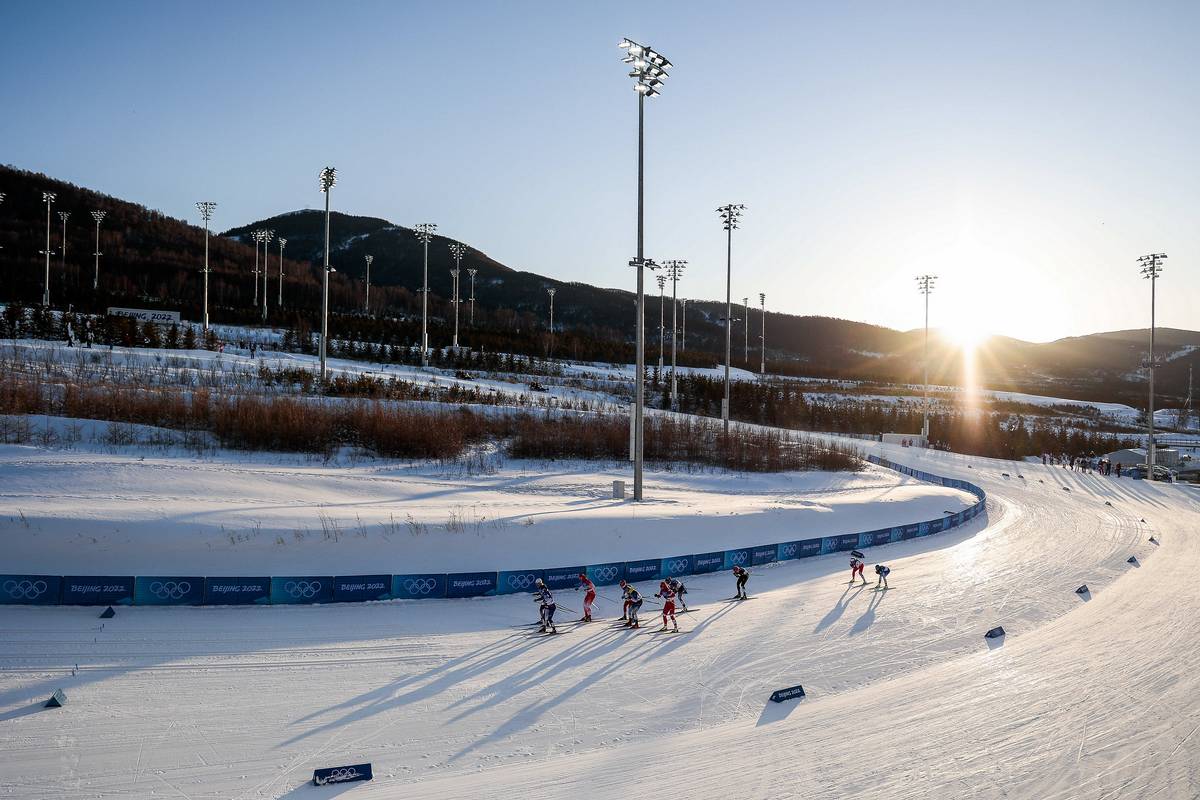
    Competitors surrounded by the colors of the sunset. (Photo: NordicFocus)

    Beyond that, though, no other event exemplifies the nuances involved in modern skiing like the team sprint. This is an event that pairs the specialists with the even-more specialized, and has an err of a nordic nerd’s daydream to the team-selection possibilities that arise from doing so.

    What if you lined up the two athletes who single-handedly changed a generation of skiers together under one flag? Well, they’d turn out to win gold in Pyeongchang 2018, like when Johannes Høsflot Klæbo and Martin Johnsrud Sundy were paired as team Norway. What if you repeated when Finland won gold in Sochi 2014, but this time Iivo Niskanen, who was then seemingly untouchable as a classic skier? Well, that one offers a bridge to what played out in Beijing 2022.

    Of course, hypotheticals joined up with storylines that didn’t need to be posed as a question today too. For the US men, this was the crystallized moment where one generation was handed off to another. Call to mind the US Olympic team sprint team anytime in the last eight years and it was the steadfast duo of Simi Hamilton and Erik Bjornsen. These men, now retired, were sixth in the team sprint in both the 2014 Olympics in Sochi and the 2018 Games in PyeongChang. Then, this morning, it was Ben Ogden and JC Schoonmaker, both born in 2000.

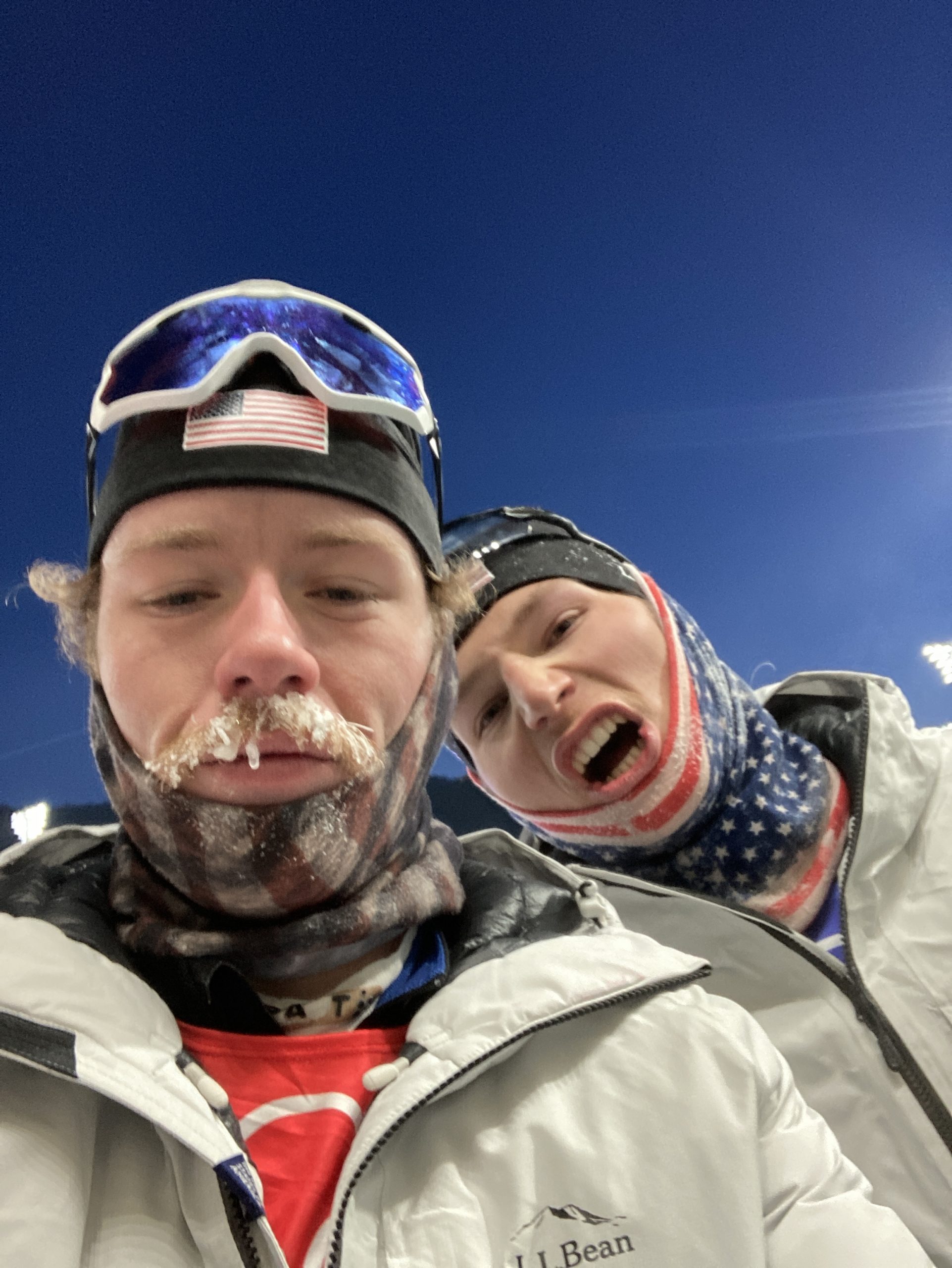
    The (frozen) fresh-faces of American skiing. Teammates Ben Ogden and JC Schoonmaker after completing the Team Sprint on Wednesday in Beijing. (Photo: Nat Hertz)

    The two made up a pairing that was more pure-sprint oriented than most of the competitors that were most closely watched going into today. The strategy for a few of the top teams, in particular, the Russian Olympic Committee and Finland, seemed to be pairing their top-class distance skier with a sprinting specialist.

    For the course in Beijing, it was a good strategy on paper. The 1.5-kilometer course, last seen in the individual sprint last week, had one tactical pressure point going into a downhill when it was raced as a single lap. When it was raced in a burst of three per skier with little rest in between, however, just how much the long, semi-gradual, uphills on this course made skiers work moved to the forefront. In the team sprint, having a skier who could stay with a sustained attack through multiple legs was an appealing prospect, especially when it was meant to set up for a punchy last climb that would no doubt give way to a mad dash for the finish.

    For two teams, Norway and the Russian Olympic Committee (ROC), that mad dash had been setting up since the first World Cup of the season, when 22-year-old Alexander Terentev (ROC) out-dueled sprint superstar Johannes Høsflot Klæbo (NOR) to challenge the latter’s classic sprinting dominance.

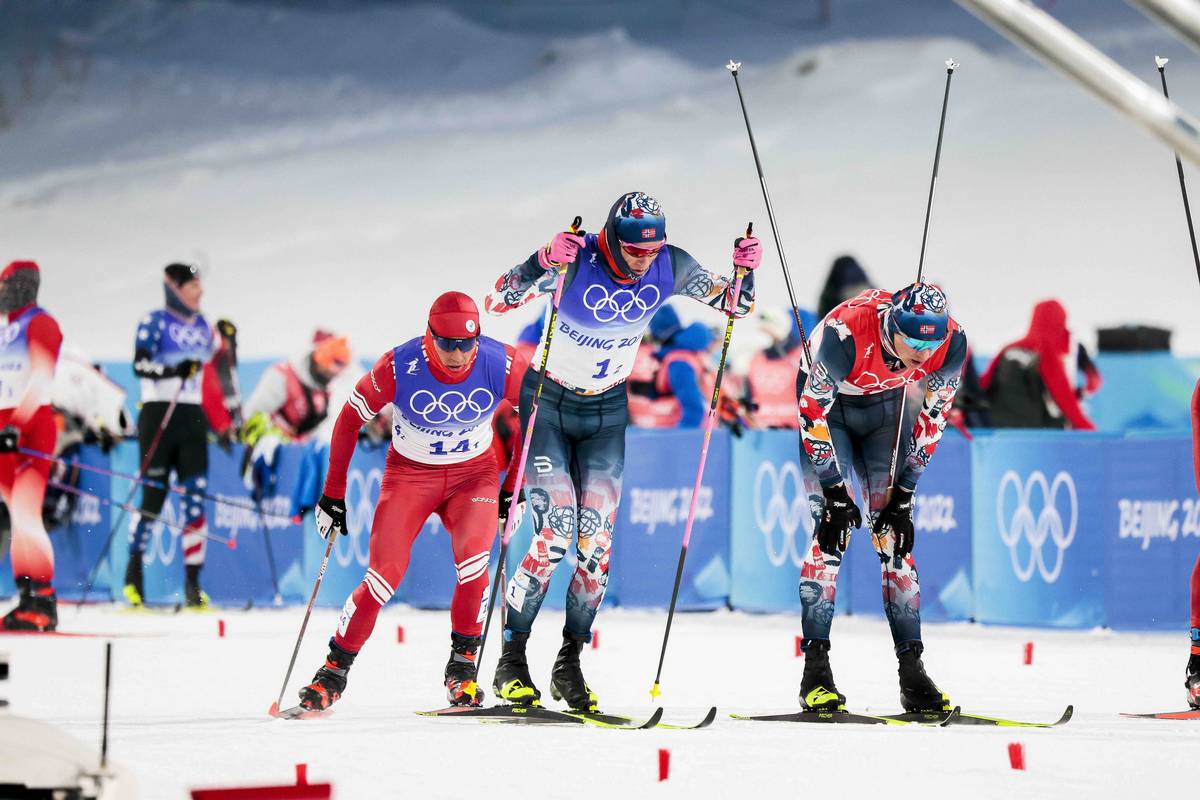
    Johannes Høsflot Klæbo (NOR) accelerates out of the exchange zone after receiving a tag from teammate Erik Valnes, followed by Alexander Bolshunov (ROC) on his way to tag teammate Alexander Terentev. (Photo: NordicFocus)

    They would both ski the anchor legs on their teams. Klæbo was paired with fellow sprinter Erik Valnes to make team Norway, while Terentev was paired with 30 k skiathlon gold medalist Alexander Bolshunov to make team ROC. Finland joined the intrigue, sending out 15 k classic gold medalist Iivo Niskanen in the first leg paired with the World Cup’s perennial “oh, that’s right he’s a great sprinter too!” Joni Maki as an anchor.

    As such, the teams in the final skied the first and second legs could roughly be divided into: leg 1 – the distance skiers and long-burn sprinters, and leg 2 – classic sprinting’s very best.

    The US had qualified for the final as the second lucky loser, finishing a messy semi-final that saw Ben Ogden break a pole and recover to finish 6th place (+4.43 off of heat winners Italy’s mark of 20:06.99). 

    “It was a hard semi-final, ours was fast and everyone was pushing. [The pole break] was one of many places where we used more energy than we had to today.” said Ogden in post-race interview with FasterSkier in the mixed zone.

    But as Ogden went out in the final, he seemed to settle in and leave the troubles of that semi-final behind. He looked comfortable in a pack that had settled on jockeying for position in the early part of the race, moving up to 4th place through the first exchange.

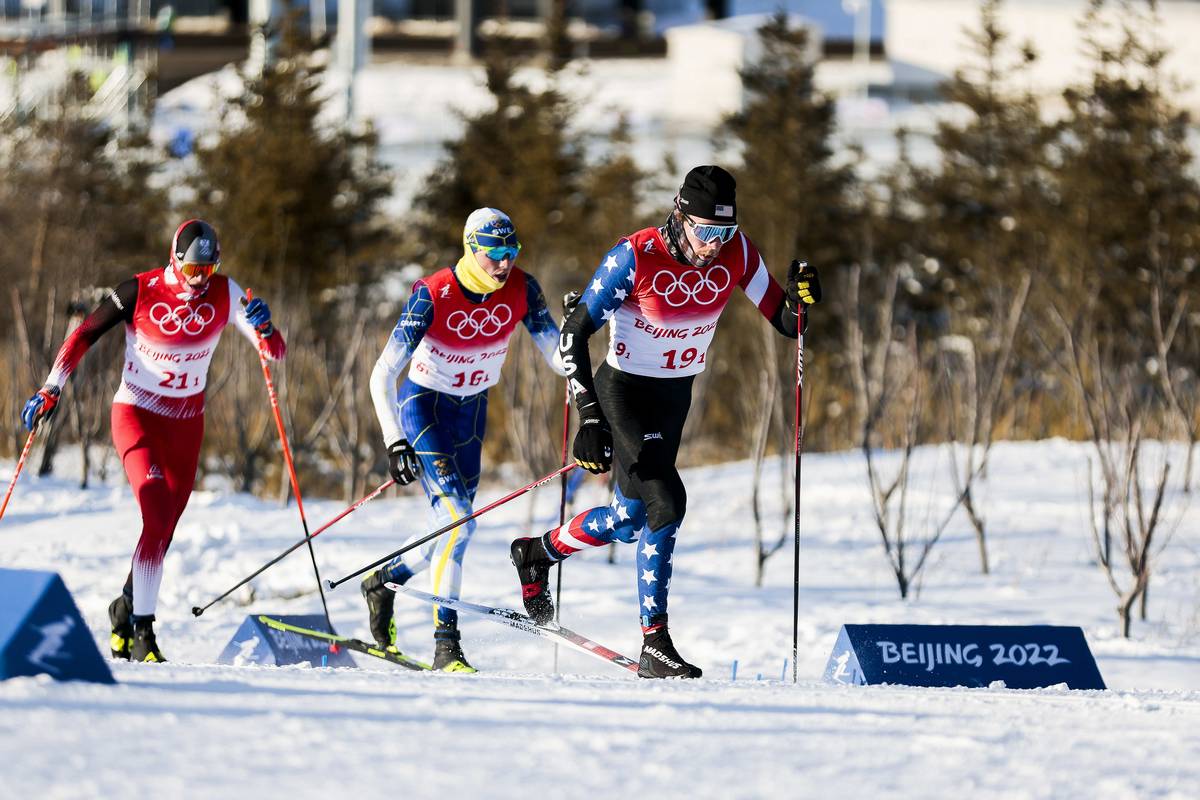
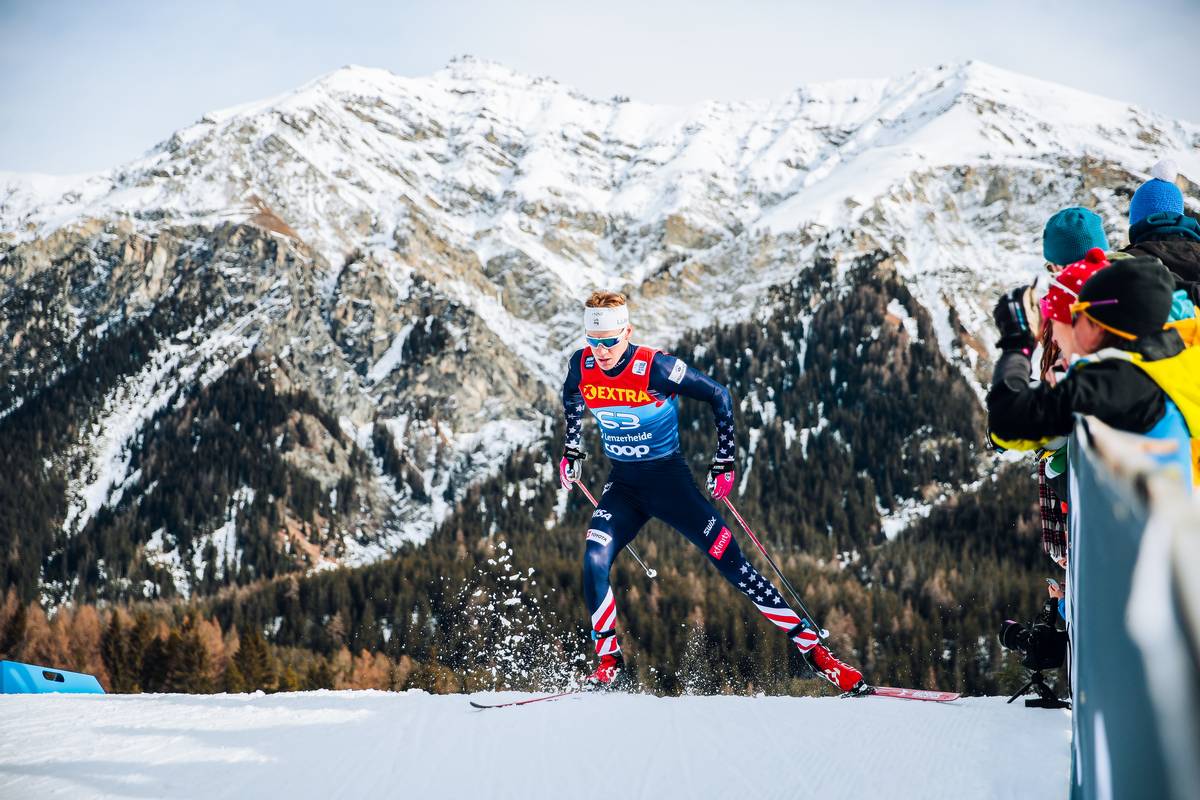
    Ben Ogden (USA) strides early in the the team sprint. (Photo: NordicFocus)

    The men’s field going out relatively slowly could be attributed to Norway’s Valnes. He seemed to comprehend that with his team as a pre-race favorite, the eyes of the pack were on the “What is that?” pattern of his suit. Valnes looked to lead the pack so-as only to try and lull it into complacency. It was a strategy that made sense, knowing he would be tagging off to the current fastest human on skis in a drag race, Klæbo.

    Alexander Bolshunov, though, called Valnes out on his bluff, making sure to pick up the pace just enough so that the pack would have to work throughout its first leg.

    So began the stalemate that would last for much of the early legs of the race. In the first exchange to the anchor-legs, Klæbo showed outward signs of his strength, and his desire to keep the pace right in the sweet spot where he could shoot around them in the end. JC Schoonmaker, meanwhile, remained placed right off the leaders, in the pack, moving through the course.

    The second showing of leg 1, including Valnes, Bolshunov, Niskanen, and Ogden saw Bolshunov push on the initial climb out of the stadium. Valnes covered the move, before the pack came together in the final climb into the stadium. The pressure, and the speed, had increased. Ben Ogden, though, had kept up with the pack, and came through the half-way mark with the Americans in 7th place (+4.4).

    Johannes Høsflot Klæbo (NOR), Richard Jouve (FRA), and Joni Maki (FIN) face off in the classic team sprint during the 2022 Olympic Winter Games. (Photo: NordicFocus)

    In their second laps, a lead group that included Terentev, Klæbo, Maki, and Schoonmaker, the pack began to take shape. The decisive move didn’t come from any of those skier’s mentioned, though, but instead from a familiar agitator in sprint heats on the World Cup. Moving up from behind the leaders, France’s Richard Jouve powered to the front of the pack on the first uphill, but was quickly matched by both Terentev and Klæbo. The duo, as they approached  the downhill, put in a burst of speed that hadn’t been seen on the course up to that point, and it was all it took for the pack to begin to thin.

    This was the move that saw the young American team begin to lose contact with the lead group. Schoonmaker later said that “the downhills felt tighter and more aggressive than some other World Cup sprints.”

    The Americans slipped to 9th place, and remained there for the rest of the day despite the early efforts of the duo to stay locked in and pushing all the way through.

    JC Schoonmaker races the classic team sprint final during the 2022 Olympic Winter Games. (Photo: NordicFocus)

    Meanwhile, at the front, the exchange to the final lap of the odd-leg skiers found Bolshunov once again putting in an attack on the uphill that led out of the stadium. The move indicated that the ROC had faith in the young Terentev as the anchor, but that chancing it with Klæbo still on deck was not the preferred option. Valnes took the ROC strategy off the table anyway, letting out a blistering counter-attack that showed his own strength and served to further separate the pack. When they came into the final climb into the stadium for the last exchange, it was just Norway, the ROC, and Finland who were in contention for the gold medal.

    Finland, in fact, was the first to the exchange. That came courtesy of Niskanen, who evaded the front of the pack for much of his race. The 15 k classic champion unleashed his diagonal stride on his final climb of the day, with both efficiency and power that exemplify optimal technique.

    The last lap, then, looked like a three-way pack of Finland, Norway, and the ROC, and, not far back and putting together an outstanding day, Canada (+9.7). The team of Graham Ritchie and Antoine Cyr had put in an unexpected and auspicious effort for the whole world to see.

    Johannes Høsflot Klæbo (NOR) leads the way to the line, with Joni Maki (FIN) and Alexander Terentev (ROC) behind for second and third. (Photo: NordicFocus)

    Still, the skiers to face off for medals remained; Joni Maki (FIN), Johannes Høsflot Klæbo (NOR), Alexander Terentev (ROC).

    The front three remained tight throughout the final lap. The pace was fast, but not fast enough to shake the familiar feeling that we’d been here, on this 1.5 k course, before, and it was a stage for which one player was ready to take the lead role: Klæbo.

    On the last hill, Klæbo went, and proved again that he was both a master of the art of sprint racing, and still indisputably its best practitioner. He, and Norway, would repeat as gold medalists in the team sprint in a time of 19:22.99.

    Johannes Høsflot Klæbo celebrates team sprint gold with teammate Erik Valnes. (Photo: NordicFocus)

    In comments to the press after, Klæbo said of repeating as a gold medalist, “I’m really proud, it’s special to do this together as a team. We won the team sprint in 2018, and doing it in a different way now, different style, with a different person, it’s special.”

    Behind him, Joni Maki made a late effort to pull in front of Terentev and deliver Finland, and his teammate Iivo Niskanen, back to the medal ceremony that they last attended for the team sprint in 2014 by finishing second (+2.46). Terentev finished third (+4.29), ensuring that the ROC (or, for these purposes, the Olympic delegation formerly known as Russia) continued its streak of never having finished outside of the medals in the team sprint at an Olympic Games.

    Graham Ritchie (CAN) double-poles toward the finish of the men’s team sprint. (Photo: NordicFocus)

    Sweden pulled back to fourth place (+15.06), and the surprise of the day was the young Canadian team of Ritchie and Cyr, both 23 years old, finishing in fifth place (+22.31). The Americans held the gap to +1:05.08, and finished in ninth.

    Ogden and Schoonmaker came away feeling optimistic on their first go-around at the Olympic team sprint, saying “It’s good. With some experience, we can be a lot better.” 

    Ben Ogden (USA) and James Clinton Schoonmaker (USA) at the finish of the team sprint. (Photo: NordicFocus)

    “Some more training under our belts will be a big game changer for us,” Schoonmaker continued, “[because] we’ve done zero team sprints [like this] with 3 laps. This is our first time skiing a real team sprint.” 

    Through its pushes-and-pulls, posturing and performances, the team sprint again proved to be a thrilling highlight of skiing. And with it completed, and a pair of gutsy performances turned in, it is possible to turn a glint of our attention today towards what the two young North American teams will do four years from now in Cortina, Italy. Really, it is just too easy to go there already, and let the Olympic dreams run wild.

    That of course though, would be premature. There’s as old-school a race as they come left in Beijing on Saturday, when the 50 k freestyle will be revived on the Olympic stage. The final men’s event promises to be as pleasant a distraction from future thoughts as there is in the world of skiing. So let’s enjoy.

    Finland, Norway and the Russian Olympic Committee on the men’s team sprint podium. (Photo: NordicFocus)

    Results: Semifinal A | Semifinal B | Final

  • Klæbo Defends Olympic Gold as Americans Soar to New Heights in the Freestyle Sprint

    Klæbo Defends Olympic Gold as Americans Soar to New Heights in the Freestyle Sprint

    This World Cup coverage is made possible through the generous support of Marty and Kathy Hall and the A Hall Mark of Excellence Award.  To learn more about A Hall Mark of Excellence Award or to learn how you can support FasterSkier’s coverage please contact info@fasterskier.com.
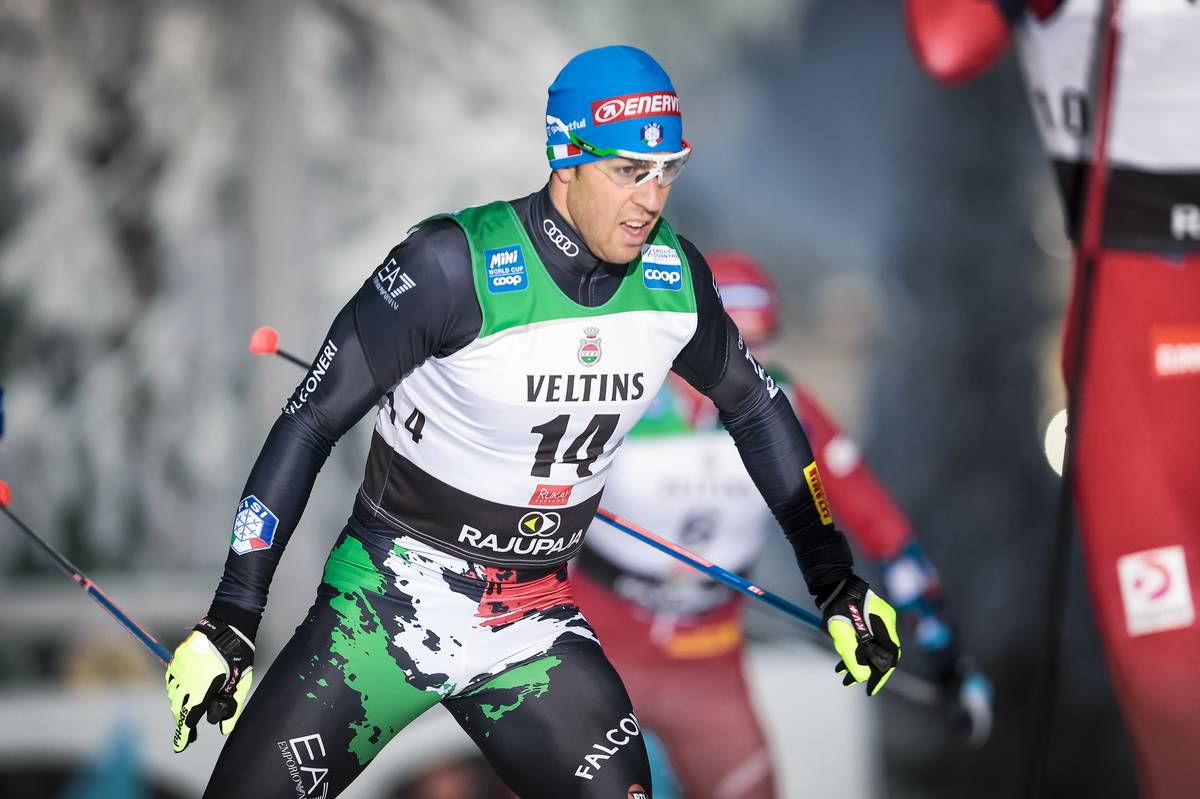
     

    During the American broadcast of the 30-kilometer Skiathlon on Sunday, NBC Analyst Chad Salmela made the comment that race represented the “old-school” of long-burn, grind-it-out ski racing. That length of ski race, updated only for the introduction of skating, has been a feature of Olympic competition since the 12th Olympiad held in 1956.

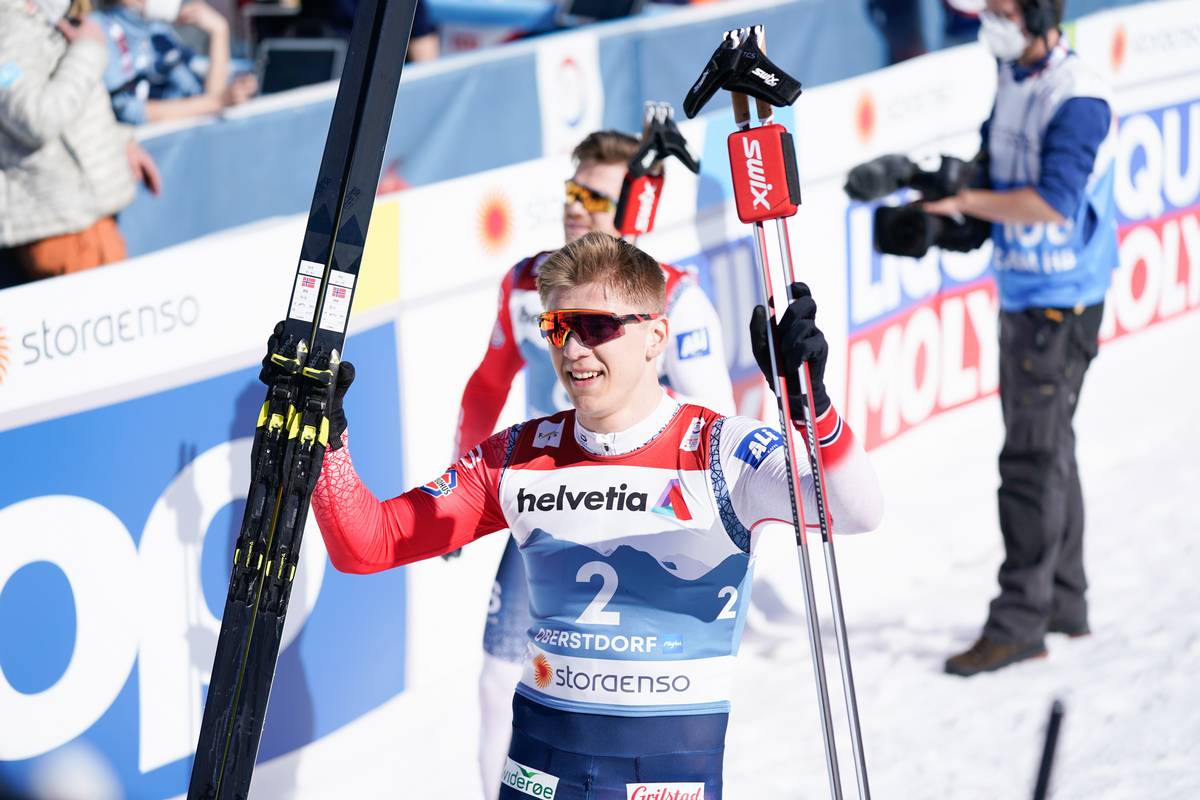
    In contrast, each one of the American skiers starting today was already born when the 1.5 km freestyle sprint became an Olympic event at the 2002 Salt Lake City games. In fact, only Kevin Bolger (born in 1993) can claim to have a living memory of that event. The other three – JC Schoonmaker, Ben Ogden, and Luke Jager – were all two years old when Tor Arne Hetland won gold at Soldier Hollow.  

    Luke Jager (USA) on his way to qualifying 30th in the Individual Sprint Qualifier in Beijing. (Photo: NordicFocus)

    In the intervening twenty years, those latter three were part of an American generation that came of age sprinting on the 2002 Soldier Hollow course, contesting junior and senior U.S. Nationals as they climbed through the ranks and quietly holding tight to their Olympic dreams. Meanwhile, the generation of skiers they looked up to were trailblazers, with sprinting their preferred in-road for American skiing on the Olympic stage. At the 2006 Torino games, Andrew Newell came through qualifiers in 2nd. Then Simi Hamilton became a consistent presence on the World Cup circuit, and qualified for heats in the last freestyle the Olympic sprint at the 2014 Sochi games. Eight years later in 2022, the kids had grown, and from Vermont hollows, Wisconsin Northwoods, the California snowfields, and the Alaskan frontier, had converged on a start-line in Beijing, ready to push for something new.

    After qualifying, they had already done it. The American men started four skiers for the individual sprint, and for the first time in Olympic history, each one of them made the heats. Leading the way was recently crowned U.S. sprint champion JC Schoonmaker, who finished in 13th, +6.12 seconds off of winner Lucas Chanavat (FRA), who clocked a 2:45.03 on the 1.5 k course. Ben Ogden finished in 19th (+7.18), Kevin Bolger was 22nd (+7.47), and Luke Jager rounded out the quarterfinal field in 30th (+9.41).

    Jager, in 30th, found himself right away in the unique challenges the Olympics can bring then, saying in an interview with FasterSkier that “There were seeded guys behind me and I knew I was right on the bubble [for qualifying]. I was getting interviewed by NBC and the whole time just wanting to reach down and check my phone.”

    In the end, he was through with his American teammates.

    Ben Ogden skis to 19th in qualification in the men’s individual freestyle sprint. (Photo: NordicFocus)

    They joined the established field that’s become familiar to those who follow the World Cup week-to-week, and for whom the individual sprint was a priority at these Games. That included defending individual sprint gold medalist Johannes Høsflot Klæbo (NOR), who qualified in 3rd (+1.71), defending silver medalist Federico Pellegrino (ITA) in 6th (+4.52), and the Russian Olympic Committee’s (ROC) own young star Alexander Terentev in 14th (+5.89). 

    The whole field would converge in the quarterfinals to race a 1.5 k course that raced as a “true sprint” as NBC Analyst and American gold medalist Kikkan Randall remarked on the American broadcast. Her remarks were apt; the course raced as a single-lap, taking three minutes for the majority of the field, on fully artificial snow. If you were looking for an archetype for what the “sprint-course” has developed into since the inception of the event at the 2002 Olympics, you’d have the one in Beijing. A first climb gave way to a downhill, which led to a long final climb, before skier’s took a sharp left turn into the final stadium stretch. The tactical pressure-point was the turn to go into the descent following the first-climb. If you went over with speed, the transition into the final hill could prove to be a decisive factor in a long-burn attack. If you followed, the draft could be just as important to launch a punchy sprint to move up the field on the last climb.

    That racers would see both approaches became apparent straight from the first quarterfinal, which featured Klæbo, Sergey Ustiugov (ROC), and Ben Ogden. Klæbo seemed to take the tactic of a long-burn attack on this course, which was helped along by a field that seemed set at every level today to try and force him out in front so as to catch his draft. He used the corner off of the first uphill to delay his burst of speed into the downhill just enough to surprise the field, and by the time he hit the final climb, he was in a comfortable position to win the heat.

    Ben Ogden crosses the finish-line in sprint heat action. Ogden would finish 12th, the best men’s individual sprint finish in US Olympic history. (Photo: NordicFocus)

    His burst of speed, though, had blown open the field behind him. Ben Ogden was caught out in 5th place going into the final corner. It turned out, in this particular case, to be a blessing. In front of him, Renaud Jay (FRA) stumbled over Anton Persson (SWE) (who was given a yellow-card for obstruction)  and caused a split-second hang up in the field with Oskar Svensson (SWE) that allowed Ogden to come into the finishing straight with a chance. He ended up taking it, finishing fourth place. Klæbo (2:51.57) had animated the quarterfinal, and the chase behind him yielded a fast heat. Ogden finished with a time of 2:53:00, good enough to warrant hope for a lucky loser spot into the semi-finals, but he would have to wait through four more heats to find out for certain.

    The third quarterfinal saw the next American action, with Kevin Bolger and JC Schoonmaker lining up against sprint stalwarts Richard Jouve (FRA) and Håvard Solås Taugbøl (NOR). Bolger, who is eight years senior to his fellow teammates, took a tactic in this race that suggested he understood the gravitas of the Olympics and how you race to stay in it. He led the pack out with gusto, trying to take the heat along with him.

    The field, however, seemed to have other ideas. Bolger said in an interview with FasterSkier that he “started V1-ing on the hill and I went ‘nope, not getting lucky loser, this is a different pace than the qualifier.” With those lucky loser spots most likely gone, the heat became a race for 1st and 2nd. Jouve and Taugbøl turned out to have the burst of speed needed in the end, with Bolger in 3rd. For the bleary-eyed among us back in the U.S., he provided the first glimmer of the American’s intrepidness on the day. For his part, Jager followed his older teammate, and his presence in 5th across the line was another reminder that that American spirit was found in spades on the day.

    Kevin Bolger (USA) and Luke Jager (USA) in quarterfinal action. Photo: NordicFocus.

    Jager pointed to how the Olympic experience was a unique one that he’ll hope to build on in an interview with FasterSkier, saying, “maybe it was the novelty, [but] to be perfectly honest my head wasn’t maybe in a great place to look towards advancing, but I think it’s one step at a time and I’m figuring out the right mindset to qualify consistently now and to advance. It was unlike anything else… it’s dark out and you need sunglasses, that’s awesome!”

    The fourth heat fleshed out the idea that Bolger had in the previous heat. The skiers went hard from the gun, knowing that if they could race a faster heat than the first quarterfinal, a 3rd or 4th in this heat could still keep their Olympic dreams alive. This was all complicated as Erik Valnes (NOR) pulled away to win the heat and a long sprint for second ensued. Pål Golberg (NOR) and Raimo Vignants (LAT) went down, and the sprint seemed to end up going for Chinese skier Qiang Wang, who hadn’t raced in the World Cup field since before the pandemic in 2019.

    Unofficial results showed that Valnes and Wang were through in 1st and 2nd, respectively. Results also showed that the quarterfinal had been the fastest heat of the day. Valnes finished in 2:49.31, with 3rd place Artem Maltsev (ROC) at 2:50.37 getting a lucky loser nod. The race jury quickly deliberated and disqualified (or officially, “ranked as last”) Wang, which meant that Maltsev was through to the semifinals on an automatic bid. That opened up one more lucky loser spot, and the next time on the list would prove to be a 2:53:00; belonging to Ben Ogden. He was through to the semifinals of the Olympic games.

    JC Schoonmaker (USA) races in the final quarterfinal on Tuesday in Beijing. Photo: NordicFocus.

    The last quarterfinal saw JC Schoonmaker narrowly lose out on a sprint to Alexander Terentev and Joni Mäki (FIN), after Schoonmaker led out the pack for the first part of the race.

    The men’s semifinals then, for the first time ever in an Olympic games, featured an American. And that American found himself in a who’s-who of heavyweights. The first semi-final lineup; Klæbo , Pellegrino, Jouve, Ustiugov, Chanavat, and Ben Ogden.

    Ben Ogden races the quarterfinal of the men’s freestyle sprint during the 2022 Beijing Olympic Winter Games. (Photo: NordicFocus)

    As the field climbed up the first hill, the skiers seemed set on fighting Klæbo tactics with Klæbo tactics. The race to get over the top was on.

    Richard Jouve ended up winning the fight to go into the downhill first, while Klæbo got caught at the back-end of a pack that remained tight. That included Ogden, who had weathered the storm to come into the final hill with the group. The transition into the final climb was furious, with Klæbo moving through the pack and bringing his rivals along with him. When they came into the final stretch, the field spread four wide and Klæbo, in shades of race nightmares past, looked to have eased up early, producing a four-way photo finish. Pellegrino and Klæbo ended up getting the nod to the finals in first and second, respectively.

    Ogden finished just off the sprint in 6th place (+1.24). His final placing of 12th is the best for an American man in an Olympic sprint. More than that though, he loomed in the background of a sprint of the world’s biggest names, appearing not as a straggler but as a shadow. The youngest in his semi-final field by 5 years, as he crossed the line, it seemed to be a reminder that the Americans are the ascendent force in sprint racing, with much more to learn, and to come, as they continue to gain experience at the Olympics.

    The second semi-final saw Artem Maltsev race with the same purpose he had struck out with in the quarterfinal. He seemed set on making sure that luck, in the lucky losers, would be with the second semi-final. After the first climb he had a gap that his teammate Alexander Terentev and Joni Mäki would claw back successfully in the lead-up to the stadium sprint, finishing 1st and 2nd, respectively. Maltsev and Oskar Svensson (SWE) were successful in their project of creating a fast heat though, and claimed the two lucky loser bids to the finals.

    The final then, had a field filled with shades of the last Olympic individual sprint. Klæbo had his chance to defend his medal. Pellegrino had his chance to one-up himself and claim gold in his stronger technique. Terentev, Mäki, Svensson, and Maltsev were all racing for their first Olympic medal of any sort.

    Sergey Ustiugov (ROC), Richard Jouve (FRA), Johannes Høsflot Klæbo (NOR), and Ben Ogden (USA) in semi-final heat 1. Klæbo and Ustiugov advanced to the final. (Photo: NordicFocus).

    There was again then, a guarantee for something new. A new medalist at the Olympic games. This was, though, still a sprint race of the world’s best. That meant the field knew who they didn’t want to have a positional advantage – Johannes Høsflot Klæbo. They skied wide, without much depth, to try and force him to the front. Through the first climb, they were successful. Klæbo though, one-upped them, again sneaking a move into the later part of the corner leading into the downhill, and catching the field just off-guard enough to give himself an advantage going into the final climb.

    Johannes Høsflot Klæbo (NOR) crosses in 1st to win gold in the men’s 1.5 k individual sprint. Federico Pellegrino (ITA) follows in 2nd place to claim silver. Photo: NordicFocus.

    There was no reeling him back. He came across the finish line an Olympic champion once again, defending his individual sprint medal and further building his case as one of the sport’s greats. Pellegrino pulled into the final climb and let out a final sprint that proved he is still Klæbo’s chief sprint competitor, four years on from establishing that fact in PyeongChang. The final step on the podium was occupied by Alexander Terentev, who, after a season in which he opened with a win, got to see his potential as an Olympic skier converted into kinetic possibility. He has one medal, and it would be a good bet that it won’t be long before he starts dreaming of the 1.5 k course that will be dreamt up for Milano-Cortina in 2026.

    Which, on the men’s side as a whole, is where many of us Americans are too. Even in these first few moments after their arrival on the Olympic stage, there is an err of possibility, energy, and optimism in the air about where this crop of skiers goes from here. We could get carried away and let that excitement uproot us from the source of that optimism in the first place. So before we look forward, let’s remember that the act of converting optimism into action is tenacity, and we can cherish Kevin Bolger, JC Schoonmaker, Luke Jager, and Ben Ogden giving us an image clad in stars and stripes of that here, today, in Beijing 2022.

    Men’s podium of the Olympic 1.5 k Individual Sprint in Beijing. Johannes Høsflot Klæbo (NOR) in 1st, Federico Pellegrino (ITA) in 2nd, Alexander Terentev (ROC) in 3rd. Photo: NordicFocus.

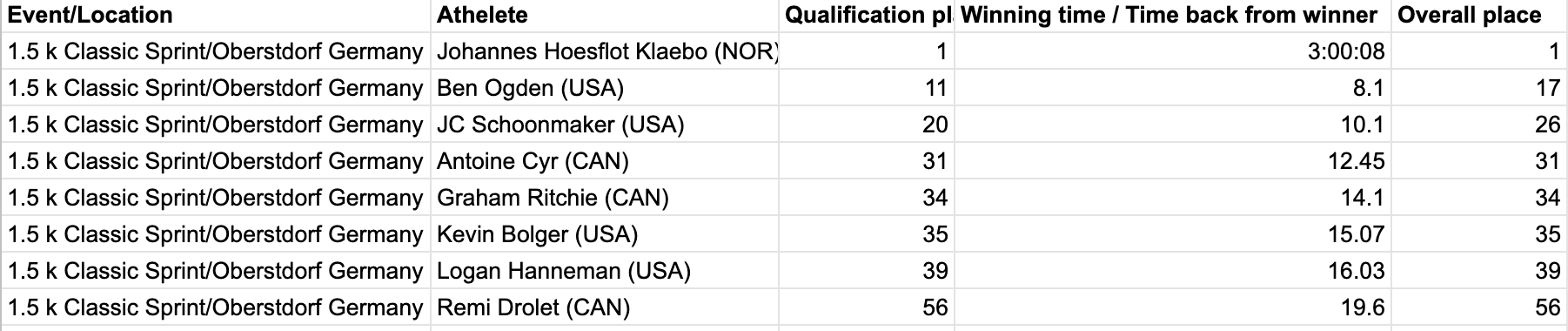
    The Canadians also put up a set of strong performances in the sprint qualifier. Graham Ritchie finished 34th (+10.01), just 0.6 seconds out of qualifying for heats. The results continued with Olivier Léveillé in 54th (+17.23), and Antoine Cyr in 56th (+17.56).

    Final Results:

    Qualifying | Finals

  • Klæbo Wins Second Tour de Ski; Røthe Reigns on Alpe Cermis, Ketterson 48th

    Klæbo Wins Second Tour de Ski; Røthe Reigns on Alpe Cermis, Ketterson 48th

    Hall and the A Hall Mark of Excellence Award.  To learn more about A Hall Mark of Excellence Award or to learn how you can support FasterSkier’s coverage please contact info@fasterskier.com.


    We began this year’s coverage of the Men’s Tour de Ski with a prelude from 5 time Tour de France champion Bernard Hinault. So let us begin this coda with him as well.

    On the cycling classic Paris-Roubaix, “the hell of the north” – famous for its cobblestones, and the mud, blood, sweat, and tears they bring – Hinault said in 1981, “[It’s] bulls**t.” He had just won the race.

    Johannes Høsflot Klæbo (NOR) may feel the same about a certain climb in Val di Fiemme, Italy he continues to find himself on year-after-year at the end of the Tour de Ski.

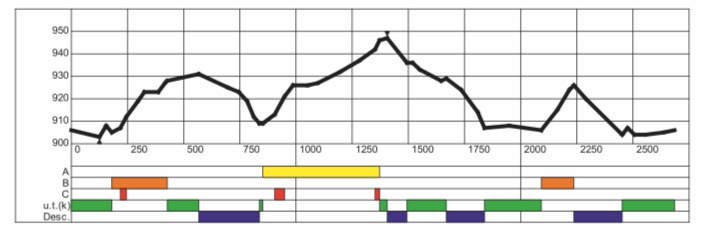
    The profile of the point-to-point hill climb up the Alpe Cermis, the capstone of the Tour de Ski. (Photo: Screenshot 2022 FIS Broadcast)

    Even among cross-country skiers and ski fans (admittedly, a Venn diagram that is nearly a singular circle), the final 10-kilometer stage of the Tour de Ski, and its roughly 3-kilometer, 28% gradient pitch-including climb up the Alpe Cermis, seems like a stupid proposition. We love skiing because it juxtaposes the brilliance and pure white benevolence of winter with the brutality, the pure push, the goddamn slog that fighting through it on a pair of skis can be. The Alpe – well – it piles onto the latter without balancing it with the former. We watch and look and say to ourselves why? But in piling on the pain, and the pure difficulty, the Alpe enters an uncanny valley as deep and awe-inspiring as its climb is high and mighty.

    In short, why the Alpe? It’s masochistic, and it’s the most beautiful race in the world.

    Johannes Høsflot Klæbo finished 5th in the Alpe Cermis hill climb to solidify his overall win in the 2021/22 Tour de Ski. (Photo: NordicFocus)

    You don’t have to look any further than Klæbo’s history on the climb to tell you so. The Norwegian, with an opportunity to surpass none other than Bjørn Dæhlie himself for career Individual World Cup wins with a win in today’s stage (as it stood before the start, the two were tied at 46 apiece), has had both triumph and tribulation on the Alpe in previous editions of the Tour. In his first climb up the Alpe 2018/19, he came across the line in first after a pursuit start, becoming the youngest ever winner of the Tour de Ski. In his last climb up the Alpe in 2019/2020, he lost a one second advantage he carried into the day, consequently losing the Tour to Alexander Bolshunov (RUS).

    This time around, his task was simpler. Instead of the 1 second advantage he had on Bolshunov in 19/20, he carried exactly two minutes over the Russian going into a mass start today. No need to be first to the top; all he would have to do was stick to the red suits of Alexander Bolshunov and his Russian teammates.

    When the field, which remained compact throughout the approach, hit the bottom of the Alpe Cermis, Klæbo was doing exactly that. Alexey Chervotkin (RUS) had led the pack through most of the first six k, which followed the flow of the river valley, with his fellow countrymen Bolshunov, Ivan Yakimushkin (RUS), and Denis Spitsov (RUS) close behind. Also slotted within the field was the only American left to start today’s race, Zak Ketterson.

    The animating move as the terrain kicked up, however, came from Iivo Niskanen (FIN), who went into the day in third place (+2:49) in the Tour standings, and was looking to maintain his place on the podium. 

    At the 7.5k checkpoint, Niskanen led a pack that resembled a cell in mitosis – stretched, but not yet split into packs with lives of their own. Less than a second behind him was a familiar sight, Sjur Røthe (NOR), who had previously won on the Alpe during his last ascent in 2019. Klæbo crossed the checkpoint in fifth place, with Bolshunov in sixth. Ketterson, meanwhile, was in the pack that followed – coming across in 26th place (+15.9).

    Sjur Røthe takes the win in Stage 6 of the 2021/22 Tour de Ski. (Photo: NordicFocus)

    The decisive pitch came shortly after the checkpoint. At a 26% section, Sjur Røthe’s attack was less a thrilling burst of energy than a confident crawl away from the pack. He created a gap, and looked to be set to face the last 1.6k of the climb alone.

    That was, of course, until another face familiar to the Alpe slowly crawled out of the pack too. Last year’s hill climb winner, Denis Spitsov (RUS), skied up to Røthe , setting up a two-way battle that had, as Røthe didn’t race the Tour last year, been two years in the making.

    The chase group that included Klæbo, Bolshunov, and Niskanen stayed together passed the 24% gradient. Niskanen, though, soon started to show signs that he was about to crack. When his V1 finally gave way to a coach’s skate, it was in one of the hairpins set-up to ease the gradient on the skiers. He brought, for a split second, the chase group to a complete pause. Bolshunov, who was the second skier behind Niskanen, was caught up for a moment, which allowed Klæbo to shoot to the outside and overtake both of them.

    Niskanen faded, but Bolshunov now had to expend energy to stay up with Klæbo, who some 1.2k out from the finishing line was showing a resolve on the Alpe that he hadn’t in his previous ascents.

    So it had broken into a race of sub-races. The lead group with Røthe and Spitsov, gunning for the stage win. The chase group, 20 seconds off, looking to decide the overall of this year’s Tour de Ski.

    Sjur Røthe (NOR) leads in the final kilometer of the Stage 6 hill climb ahead of Denis Spitsov (RUS). (Photo: NordicFocus)

    When the Alpe finally, impossibly, gave way to gradients that were in the single-digits, Røthe proved the Puncheur over Spitsov. His V1 gave way to a V2 that still somehow maintained some grace to it, and he came across the blue line painted in the snow at the top of the Alpe a champion again. Spitsov, not losing sight of the Røthe, crossed the line in second (+2.4).

    The chase group meanwhile, was now being led by two skiers wearing suits not seen near the front of a Men’s World Cup so far this season. Indeed, it was two young Germans, Friedrich Moch and Lucas Bögl, who were pulling Klæbo and Bolshunov through the final moments of this year’s Tour. When the terrain gave way, Moch took it one step farther, gapping the field to claim his first individual World Cup podium in 3rd place (+18.9), and becoming the first German man to podium at a World Cup since Tim Tscharnke in 2015 (also in Val Di Fiemme).

    Friedrich Moch (GER) climbs to third up the Alpe Cermis. (Photo: NordicFocus)

    Then, 15 seconds later, the Tour was decided. Klæbo came in 5th place on the day (+34.9), gaining 3 seconds on Bolshunov who came in 8th (+38.1). Niskanen’s aggressive racing too, turned out to re-work the podium. He finished 12th on the stage (+1:00.4), maintaining his position for a third place overall finish in the Tour.

    Iivo Niskanen (FIN) skiied his way to 3rd place overall in the Tour on the Hill Climb in Val Di Fiemme. (Photo: NordicFocus).

    The final standings for this year’s Tour de Ski then: Johannes Høsflot Klæbo with the win (2:24:56.0), Alexander Bolshunov in second (+2:03.2), and Iivo Niskanen third (+3:14.5).

    For Klæbo , it is his second overall Tour de Ski championship. He becomes only the 2nd Norwegian, after Martin Johnsrud Sundby, to win multiple Tours. He leaves tied with Bjørn Dæhlie on Individual World Cup stage wins. He also closes his most apparent weakness in the World Cup circuit, finishing 5th on the Alpe Cermis after previously never having breached the Top 10.

    And yet, as he said in an interview with FIS media: Klæbo is “glad it’s over. It will be nice to get some days off now and rest for the Olympics.”

    Johannes Hoesflot Klaebo (NOR) wins his 2nd Tour de Ski title (Photo: NordicFocus).

    What lessons do we take from this year’s Tour de Ski then? While it has waxed and waned in importance and depth in championship seasons, it is a barometer by which we can see the history and the achievement of the sport’s greatest skiers. There are World Championships and World Cups, but the Tour is the Tour. As we head towards the sport’s biggest stage in Beijing next month, this edition reminds us that we are witnessing something one-of-a-kind in a Norwegian, still young at 25, that is poised to re-write any notion of what is possible in this sport: Johannes Høsflot Klæbo. Against the toughest and most glorious test in skiing on the Alpe Cermis, he has finally passed.

    On his first climb up the Alpe, Zak Ketterson finished 48th (+3:01.3). He becomes the only American man to finish this year’s Tour de Ski, coming off the SuperTour in the U.S. to complete the sport’s most grueling test, and do so as his first World Cup starts no less. He finished 54th overall (+16:06.4).

    Zak Ketterson finishes his first climb up the Alpe Cermis, rounding out his first World Cup starts at the 2021/22 Tour de Ski. (Photo: NordicFocus)

    Results:
    Stage 6

    Tour de Ski Overall Standings: Cumulative Time | Points

  • Klæbo Takes the Win in Tour de Ski Stage 1 Freestyle Sprint; Ogden and Bolger Qualify Top 10; Three Americans in Heats

    Klæbo Takes the Win in Tour de Ski Stage 1 Freestyle Sprint; Ogden and Bolger Qualify Top 10; Three Americans in Heats

    This World Cup coverage is made possible through the generous support of Marty and Kathy Hall and the A Hall Mark of Excellence Award.  To learn more about A Hall Mark of Excellence Award or to learn how you can support FasterSkier’s coverage please contact info@fasterskier.com.


    To set the scene for the Tour de Ski, briefly turn to an episode from the event that inspired it. Cue “the Badger,” Bernard Hinault, who at the start of the 1985 Tour de France reduced the three week race down to one question: “Look at the results last year – Laurent Fignon first, me second and Greg Lemond third. Now Fignon won’t be there. What answer do you get?”

    The answer: Lemond and Hinault would battle as teammates in the greatest editions of the Tour de France ever in ‘85 and ‘86. In the end, Lemond “slayed the Badger,” besting Hinault to win the Tour in ‘86 and establish the Americans as winners at the Tour.

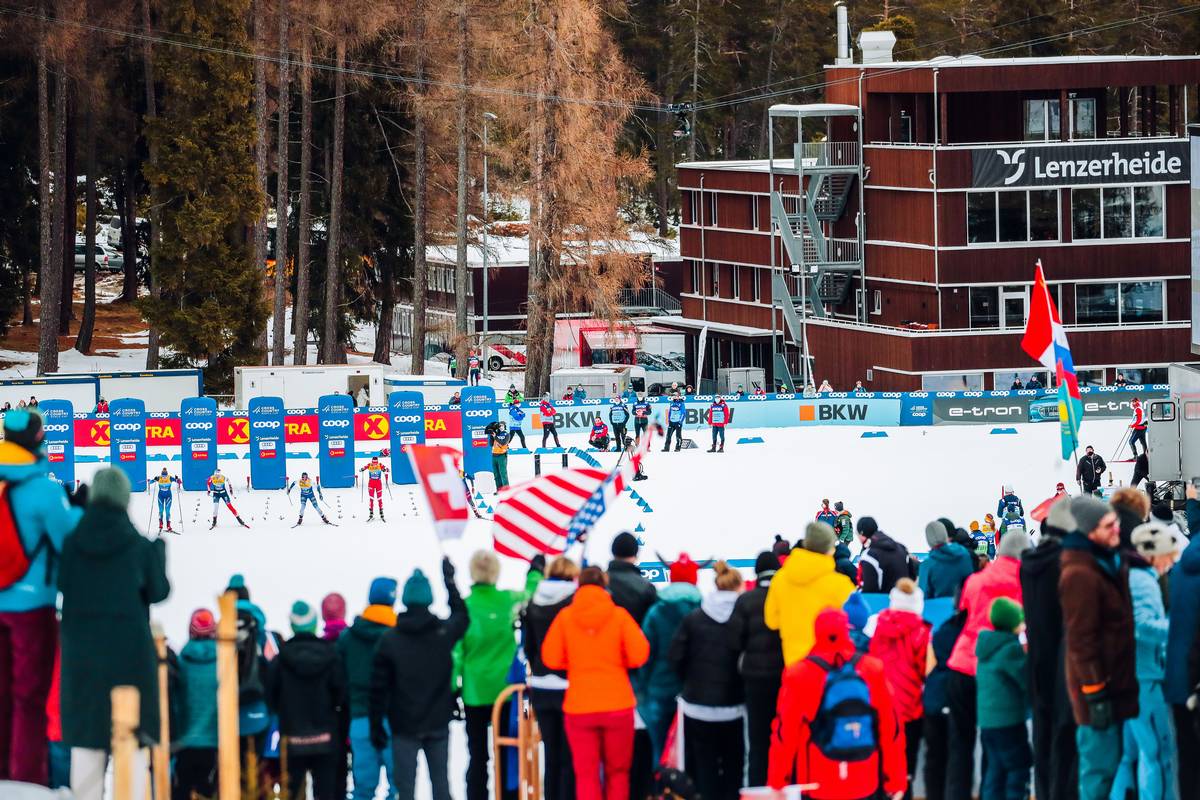
    An American flag flies in Lenzerheide as the Tour de Ski kicks off Stage 1. (Photo: NordicFocus)

    Switch seasons, sports, and circumstance and we can reduce this year’s Men’s Tour de Ski (TDS) to one question too: Look at the results last year – Alexander Bolshunov (RUS) first, Maurice Manificat (FRA) second, Denis Spitsov (RUS) third. Johannes Høesflot Klæbo (NOR) was not there. Now he is back. What answer do you get?

    The answer: Klæbo.

    In the first stage of this year’s Tour de Ski at Lenzerheide, the Overall and Sprint leader of the World Cup came into the freestyle sprint, and looked in control each time he headed out on the 1.5-kilometer course, winning the qualifier (2:36.66) before cruising through the quarterfinals and semi-finals to keep his yellow World Cup Sprint leader’s bib as he exited the final.

    But back-up, and you see another parallel to Lemond at cycling’s Tour, with today’s stage marking the ascendancy of the Americans. They put three in the top 30, with Ben Ogden finishing qualifying in 5th place (+5.81sec), Kevin Bolger in 9th place (+6.62), and Logan Hanneman in 30th (+9.78).

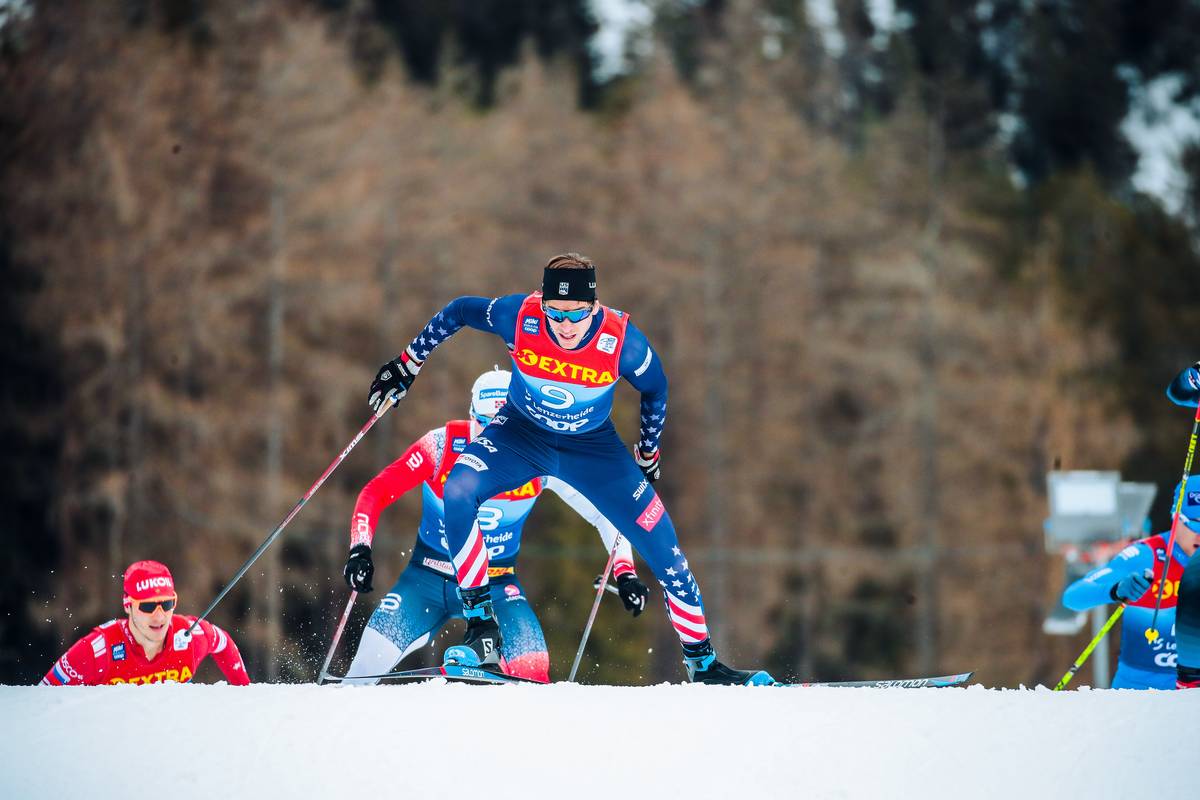
    Logan Hanneman skis through to the quarterfinals, finishing 30th in qualification. (Photo: NordicFocus)

    In the quarterfinals the first three heats were marked by somewhat conservative tactical posturing, with a field figuring out how to race the course at Lenzerheide after a two year absence. There was a good reason too. The two 750m laps are marked by a steep initial climb that after a turn gives way to a long downhill whose end is a sharp left into the stadium. That sharp left proved time and again to eliminate the gaps that attacking skiers tried to create on the first climb. It also led to opportunities to find a good position for the final sprint and pick up places in the field.

    That was how Klæbo looked to race the first quarterfinal of the day, following Lucas Chanavat (FRA) into the second downhill before launching to the outside to capture the heat in the final stretch. Logan Hanneman seemed to mirror Klæbo’s moves through the heat, tucking in behind him on the downhill the 2nd time but finding that he hadn’t pushed with the same energy, as he said in comments to Fasterskier: “Klaebo and Chanavat pushed harder than I did over the top of the climb on the second lap and all of the sudden then had some meters on me. It’s easy to think that others had faster skis than myself today since I got passed on the long downhill the second lap, but that probably only because I didn’t see what they were doing behind me. I am sure they skated harder than I did and built up more energy to come by me.” Hanneman finished the heat in 5th place.

    Kevin Bolger leading out his quarterfinal after qualifying 9th. Bolger finished the heat in 4th place, missing out on a lucky loser semi-final bid by just .76 seconds. (Photo: NordicFocus)

    Bolger and Ogden opted to race out of the 4th and 5th quarterfinal, respectively, being the top qualifier in each. In contrast to Hanneman’s approach, the two both went with the strategy of leading out the field and trying for the gap on the first downhill. Both Ogden and Bolger’s attacks had the effect of animating their heats, which led to full bore racing for the entirety of the 1.5k course and eventually faster times across the field.

    Their aggressive racing was foiled by the sharp left turn into the finishing straight, with the fields coming together and both Ogden and Bolger losing their position at the front of the field.

    Bolger came across the line of his heat in 4th place, but his move early on to set a fast pace for the heat paid off, temporarily earning him a lucky loser spot. After the 5th heat though, where Ogden finished in 5th, Bolger was knocked out of the final lucky loser spot by Alexander Terentev (RUS) by less than 0.8 seconds.

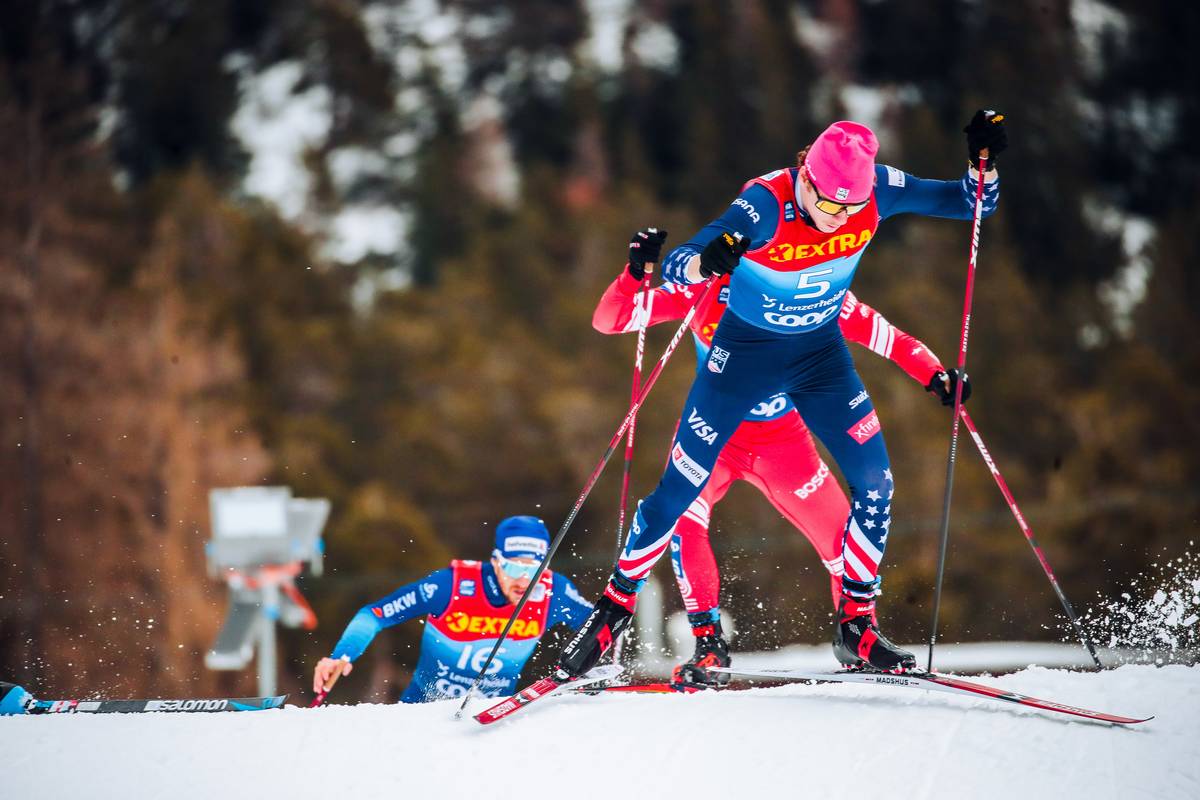
    Ben Ogden leads his heat over the first climb on course in Lenzerheide, SUI. Ogden qualified 5th. www.nordicfocus.com. (Photo: NordicFocus)

    Still, the Americans’ quarterfinal performances left them in a strong position to challenge for the points classification, which will now turn to intermediate sprint primes at various checkpoints within the next two stages’ distance races.

    It also left a semi-final field filled with familiar races from Tour de Ski’s past. Richard Jouve (FRA), Lucas Chanavat (FRA), and last year’s champion in the TDS Sprint Freestyle stage Fredrico Pellegrino (ITA). The younger sprinters who have featured on sprint podiums this season, Alexander Terentev (RUS) and Erik Valnes (NOR), were there too. Notably, last year’s Tour de Ski overall and points champion Alexander Bolshunov (RUS) was not, after being finishing 3rd place in his quarterfinal.

    And, of course, there was Klæbo.

    In the first-semi final, as the Frenchmen Jouve and Chanavat moved to the front of the pack at the beginning of the heat, Klæbo tucked in right behind them. As they came out of the first lap, Klæbo followed Pellegrino’s attack on the climb, but didn’t really look to make his move until the last downhill. Here he demonstrated an approach to the climb that was absent elsewhere in the men’s field the rest of the day, sprinting in a tuck skate to hit the apex of the final turn in a way that shut the door on the rest of the field. 

    Did he have the purest burst of speed on the finishing stretch? Probably. But it was already over before he hit that stretch, and he crossed comfortably in first place.

    Lucas Chavanat (FRA) leads Johannes Høesflot Klæbo into the downhill during their semi-final. www.nordicfocus.com. (Photo: NordicFocus)

    Chanavat and Jouve’s attacks early in the race had a similar effect on the semi-final as the Americans did in the quarterfinal. The first semi-final proved to be the faster field, and so Jouve (2nd), Chanavat (3rd), and Pellegrino (4th) all progressed to the final.

    There they were joined by two more Norwegians, Pål Golberg and Erik Valnes, who followed their countrymen’s lead in the second semi-final heat to out-sprint Renaud Jay (FRA).

    The final followed the pattern established in the previous round. Chanavat and Jouve seemed mindful that their chance to beat Klæbo most likely lied in a long-burn attack that saw him, Valnes and Golberg left out of the pack going into the second lap. Unfortunately, again, that attack met the long downhill sharp left turn.

    Klæbo seemed content to simply keep up with Pellegrino as he made a move on the final climb of the day, before sweeping to the outside and attacking the final downhill to leave the rest behind before that pesky left turn could shake-up the field again. He crossed in first place, with Jouve in 2nd (+.99) and Chanavat in 3rd (+1.26).

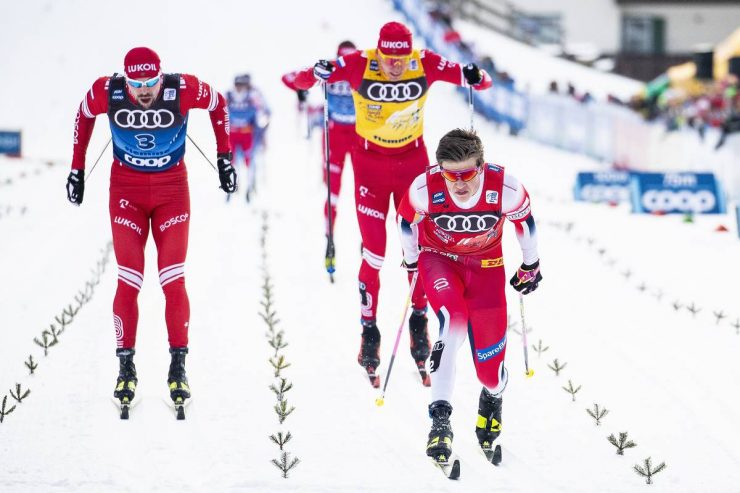
    Klaebo comes across the finishline 1st place, with Richard Jouve (FRA) and Lucas Chanavat in tow (FRA). (Photo: NordicFocus)

    With the win, he established himself on an early, but clear path, to retake the Tour’s Overall and Point classifications after missing last year. His win today also helped him move up the ranks in the Tour’s history, passing Dario Cologna and Martin Johnsrud Sundby’s 7 stage wins to move him into 3rd all-time with 8 – behind Sergey Ustiugov (9), and Petter Northug (13). He also extended his all-time individual sprint stage lead in TDS history to 5.

    So while we came into today’s stage with one question, we head towards tomorrow’s 15km with many. Just how much more history can Klæbo make? Will Bolshunov re-establish himself as a contender? And where do the American men go from here in this year’s Tour de Ski?

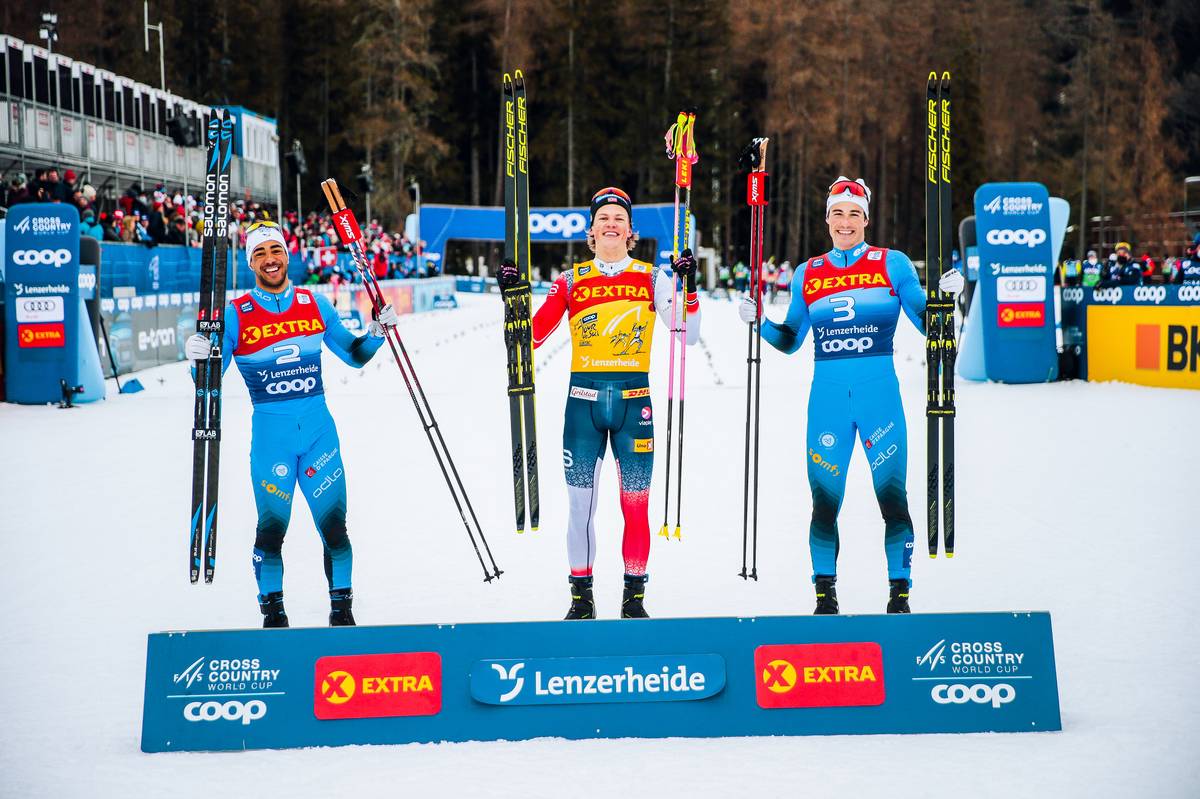
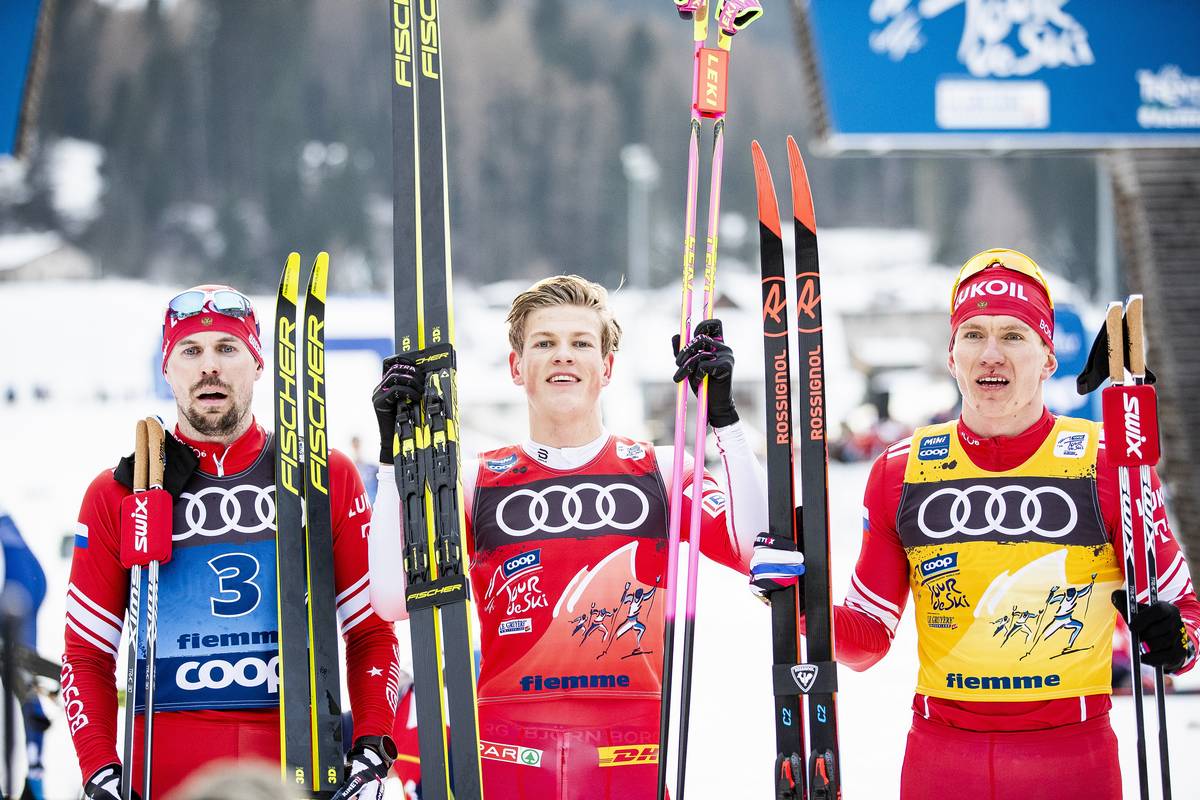
    Men’s podium in Lenzerheide after the first stage of the Tour de Ski. (Photo: NordicFocus)

    For now, the Yellow bib (“le bavoir juane” anyone?) remains on Klæbo’s shoulders, and our eyes on Lenzerheide tomorrow.

    Zak Ketterson comes over the climb in his World Cup debut. Ketterson finished 72nd on the day. (Photo: NordicFocus)

    After the semi and final rounds were decided, Bolger ended his day in 16th (+1.75), with Ogden in 21st (+1.94), and Hanneman in 25th (+5.70).

    The rest of the American men also showed strong results in the qualifier today. Luke Jager finished in 45th (+12.57), with Gus Schumacher in 55th (+13.95). Minnesota’s very own Zak Ketterson also made his World Cup debut, finishing in 72nd (+16.37) after qualifying for the Tour de Ski as the men’s SuperTour leader after racing Period 1 back in the States.

    On his race into the quarterfinals today, Logan Hanneman said “I’m feeling pretty good after today, but still longing for more. It has been a very slow and disappointing start to the season for me, for reasons I can’t explain. I am happy to be seeing progress in the right direction the last two sprints that I have done, but there is still a lot of work left to be done to reach my goals. I am looking forward to trying my hand at some distance races starting tomorrow!”

    Post-race interview with Matt Whitcomb on the course in Lenzerheide, which has suited Americans well over the years, along with additional comments on the men’s and women’s races.

    Gus Schumacher during qualifying in Lenzerheide during stage 1. Schumacher finished 55th. (Photo: NordicFocus)

    Results from Stage 1:

    Qualifier | Finals

  • Heavy Snow and a Heavy Klæbo Hop-Skate: Norway Beats Russia for Men’s Relay Win

    Heavy Snow and a Heavy Klæbo Hop-Skate: Norway Beats Russia for Men’s Relay Win

    A train, led by Alexey Chervotkin (RSF), winding through the snow. (Photo: NordicFocus)

    This World Championship coverage is made possible through the generous support of Marty and Kathy Hall and their A Hall Mark of Excellence Award. To learn more about A Hall Mark of Excellence Award or to learn how you can support FasterSkier’s coverage please contact info@fasterskier.com. 
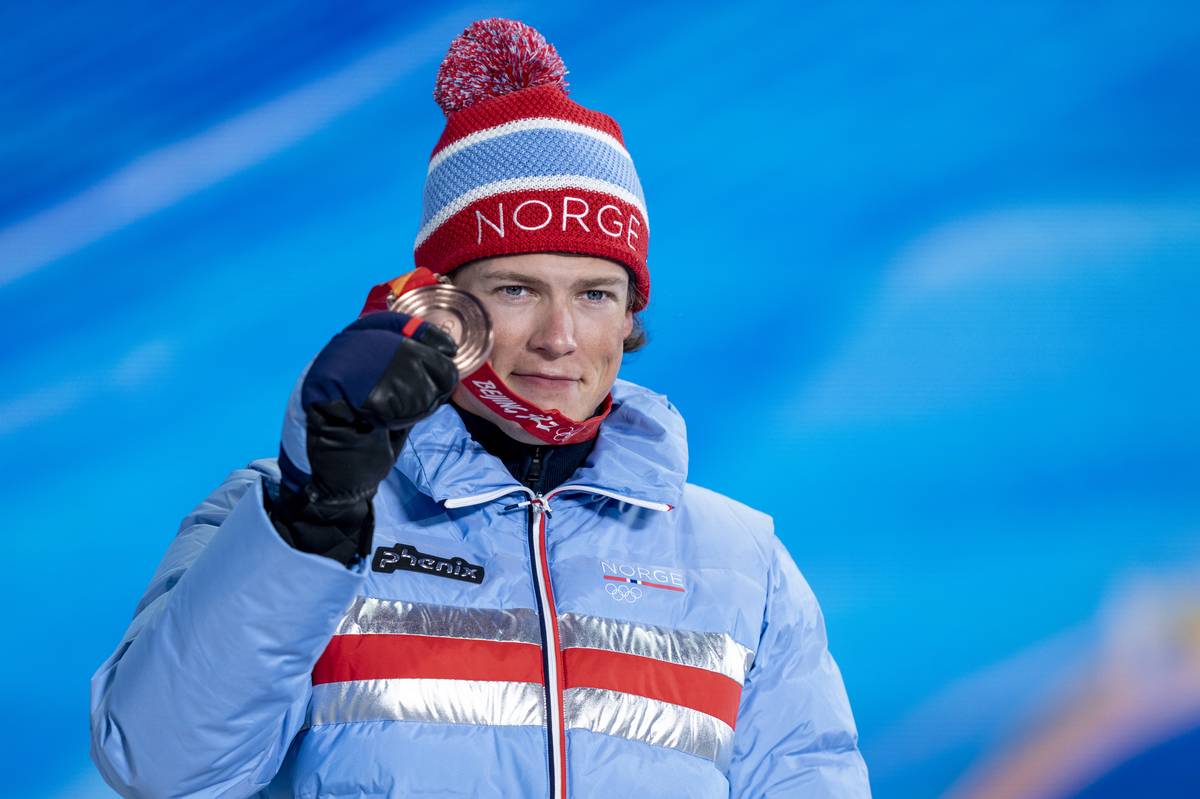
    After the tropical conditions of the past week, the men were greeted with heavy snowfall for Friday’s championship 4 x 10 k relay competition in Oberstdorf. Temperatures hovered around freezing and the snow fell thick and fast as the scramblers lined up at the start. Eighteen nations were represented at the start line with thirteen completing the whole race. 

    The start to a snowy 4 x 10 k relay at the 2021 World Championships. (Photo: NordicFocus)

    On paper Norway was the team to beat out on the track. Of the last 15 men’s relay titles at a World Championship, Norway has won all but one. The last time Norway failed to win the men’s relay was in 1999 when team Austria finished 0.2 seconds ahead of Norway. And in the end on Friday after striding and skating through fresh snow for 40 k, it was once again team Norway that crossed the line in first, but what a race it was to get them there. 

    Johannes Hoesflot Klaebo (NOR), Hans Christer Holund (NOR), Emil Iversen (NOR), Paal Golberg (NOR), (l-r) 2021 Relay World Champions. (Photo: NordicFocus)

    The team most likely to challenge Norway was Russia, or the Russian Ski Federation as they are represented at these championships. The bar was set from the beginning. Despite conditions not favoring an early breakaway, Alexey Chervotkin (RSF) made a move just 1.4 k off the start, putting distance between himself and the pack.

    Hugo Lapalus (FRA), out of the tracks, while Alexey Chervotkin drives the bus. on the scramble leg. (Photo: NordicFocus)
    Making a move that stuck on the first keg: Russia’s Alexey Chervotkin pushed over the top. (Photo: NordicFocus)

    At 4.7 k, Chervotkin had stretched his lead to +14.1 seconds and the group seemed largely unprepared to mount an organized counterattack. Perhaps expecting the Russian to fade or simply unable to respond, Norway’s Pål Goldberg remained tucked in the rear of the pack. At 6.6 k the margin was +33.6 to Russia. Save for Chervotkin’s effort out front, the pace remained World Cup-pedestrian. At one point, the skiers nearly halting completely at the crest of the sprint hill, playing chicken for who would descend first. Through 8 k the gap to Russia was nearly one minute.

    No man’s land, atop the climb, Michal Novak (CZE), Beda Klee (SUI), Hugo Lapalus (FRA), (l-r) bring the pace to a walk as no team wants to chase Russia down. (Photo: NoricFocus)

    Entering the first exchange the chase pack had split in two, with France leading and Norway off the back in 10th position. In a post-race interview Golberg said of his race, “it was a bit of a tough start. I chose a different choice [of ski] from the seventeen other skiers so that was really stupid but fortunately I have three skiers on my team that are better than everyone else here today so I’m really happy for them.” One of those skiers was Emil Iversen who took over for Norway on the second leg. His work linked Norway up with the rest of the chase pack, now being led by Iivo Niskanen of Finland. Ivan Yakimushkin had taken control for RSF, but already, with the hot pace set by Niskanen, the gap was down to +30.4 seconds to Norway. 


    Ivan Yakimushkin, Russia’s second leg skier, sensing the group led by Iivo Niskanen closing in on the second leg. (Photo: NordicFocus)

    At 13.3 k Niskanen, Iversen, and Dario Cologna of Switzerland were closing in on Yakimushkin. After 40 minutes on the clock they had overtaken the Russian. The pack now comprised six nations (France and Sweden also in contention), with team Canada drifting around eight seconds behind. Again on lap two through the stadium the pace slowed to a halt before the descent, unrelenting snow adding an extra challenge to the lead. 

    At the base of the Burgstall climb on his final lap, Iversen (NOR) made his move, directly shadowed by Niskanen (FIN). To the soundtrack of much excited shouting from the coaches, the pair closed in on the exchange zone, with Russia now off the back. 

    Iivo Niskanen of Finland doing the work to reel in Russia on the second leg of the 4 x 10 relay. (Photo: NordicFocus)

    Wednesday’s 15 k skate champion, Hans Christer Holund, contended the first skate leg for Norway. His lead over Russia being +23.6 seconds at the tag zone. Followed by Perttu Hyvarinen, Finland’s third leg, Holund broke trail out front through deep snow as behind him, Artem Maltsev for RSF turned on the burners, starting to forge the gap. At 23.3 k there was just six seconds between them and the Finn was fading fast. At 24.7 k Holund was alone out front, +12.1 ahead of RSF and Finland now in third. As the athletes battled through their last loop, the wheels seemed to come off for Maltsev (RSF) and Clement Parisse of France and Jens Burman of Sweden moved to the fore. 

    Norwegian work horse on the third leg: Hans Christer Holund. (Photo: NordicFocus)

    Into the final exchange Holund handed team anchor Johannes Høsflot Klæbo a +25.5 second lead over France and Sweden (virtually neck and neck), and a +35 second lead to Russia, for whom Alexander Bolshunov would be taking anchor. 

    Johannes Hoesflot Klæbo (NOR) biding his time for the final show-down. (Photo: NordicFocus)

    With Klæbo (NOR) out on his own in deep snow, Bolshunov was on the hunt. The ten second lead over Russia held by Sweden and France was immediately absorbed and once again there was a pack of five teams in contention behind Norway. At 31.4 k Bolshunov had only gained 0.5 seconds on Klæbo but that was soon to change. By 33.3 k he had broken away from the chase pack and was +15.8 behind. Each of the two athletes played to their respective strengths, Klæbo cruising easily while he waited for his ride to catch up and Bolshunov grinding away with metronomic consistency.

    Locked in for battle, Norway versus Russia to conclude the Men’s 4×10 k championship relay. (Photo: NordicFocus)

    By 34.7 k the duel was on – the world’s best playing hot and cold as they ticked away the kilometers toward the finish line. With Norway absent for much of the Wold Cup season, these two rivals have not had many head-to-head opportunities this year up until this moment. For his part, Bolshunov never moved to pull away from Klæbo who boasts a peerless finishing kick. Once atop the course’s final major run up the Burgstall climb, when Bolshunov had gained no ground, this chess march was all but done. 

    Klaebo (NOR) not giving an inch to Bolshunov (RSF). (Photo: NordicFocus)

    Entering the corner into the final sprint hill before the finish there was virtually no gap between the two skiers, though in reality the game had tipped in Norway’s favor. While Bolshunov may dominate the distance races, Klæbo remains king of the sprint and once he made his up-skate move, there was nothing the Russian could do. The decisive moment came half way up the hill as Klæbo catapulted himself away with an unmatched turn of pace, setting up for an easy cruise down the finish straight, sealing the deal on gold for Norway once again in a time of 1:52:39. Twelve seconds later, Bolshunov crossed the line, meaning silver for RSF. 

    The deal has been sealed, Johannes Hoesflot Klæbo (NOR) celebrates victory as a defeated Bolshunov (RSF) gives up before the line. (Photo: NordicFocus)

    Rewind a bit and the fight for bronze was unfolding on the Burgstall climb as Jules Lapierre of France made a break, gaining ten seconds of advantage over Sweden, Finland and Switzerland.

    Jules Lapierre (FRA) gets a boost after bringing home bronze for France. (Photo: NordicFocus)

    Though that advantage shrunk on the descent, it remained enough to give France third place, finishing + 1:12.6 behind Norway and four seconds ahead of Sweden in fourth. 

    No shortage of enthusiasm from team France after their third place finish. (Photo: NordicFocus)

    For team USA, David Norris raced the scramble, handing over to Scott Patterson in 11th position at the first exchange. 

    Scott Patterson for the U.S. settles into a pacing groove on the second leg of the 4 x 10 k relay. (Photo: NordicFocus)

    Patterson remained steady through his laps and tagged Simi Hamilton, still in 11th. Over the course of his 10 k, Hamilton gained one position and tagged Gus Schumacher in 10th place.

    “It was awesome,” Hamilton said of the racing and wild Oberstdorf weather. “It was, I mean a pretty crazy, bizarre, different weird day with the conditions. You know like, you never really know what to expect when you wake up and its basically 32 and dumping all day. It’s going to make for a pretty different race but I’m super proud of our team.

    “I think we put together just four really good consistent legs. Our skis were awesome, my boards were running really really well. The climb was tough for me, as kind of a “sprinter” when you mix in a four-minute climb its always tough for me but thankfully I was able to kind of rely on some good glide to recover from the top down to the stadium each time so that was great. But yeah, these boys are… it was maybe the most fun relay I’ve ever skied on, on the World Cup or World Championship just because, I don’t know we had a really good energy going today. We all came out and fought hard and I think this is the type of energy that you know eventually will land us on the podium. I won’t be on that team, but it’s cool to be a part of it. I’m stoked, it was a great way to end the championships for me and it was a fun day.”

    Simi Hamilton, leg three skier for the U.S. (Photo: NordicFocus)

    Schumacher and Friedrich Moch of Germany battled it out, the advantage ultimately going to Germany who finished in 7th, Schumacher crossing the line 8th for the United States. 

    Graham Ritchie (CAN) keeping Canada’s team in contact during the scramble leg. (Photo: NordicFocus)

    Team Canada, who posted a strong start by Graham Ritchie, ended the day in 10th place. Skiing leg two for Canada was Antoine Cyr, followed by Russell Kennedy with youngster Remi Drolet holding the anchor position. 

    In a snow globe, Russell Kennedy of Canada during leg three of the 4 x 10 k relay. (Photo: NordicFocus)

    This year’s World Championships conclude for the men on Sunday with a 50 k classic mass start event. 

    Results: Men’s 4×10 k Relay

  • Norwegian Triple Championship Podium with Klæbo Crowned the Winner; Ogden 17th for the US

    Norwegian Triple Championship Podium with Klæbo Crowned the Winner; Ogden 17th for the US

    Norsk triple. Johannes Høsflot Klæbo (left) raises his hands in victory as Valnes (middle) and Taugbøl (right) lunge for the line. (Photo: NordicFocus)

    This World Championship coverage is made possible through the generous support of Marty and Kathy Hall and their A Hall Mark of Excellence Award. To learn more about A Hall Mark of Excellence Award or to learn how you can support FasterSkier’s coverage please contact info@fasterskier.com.
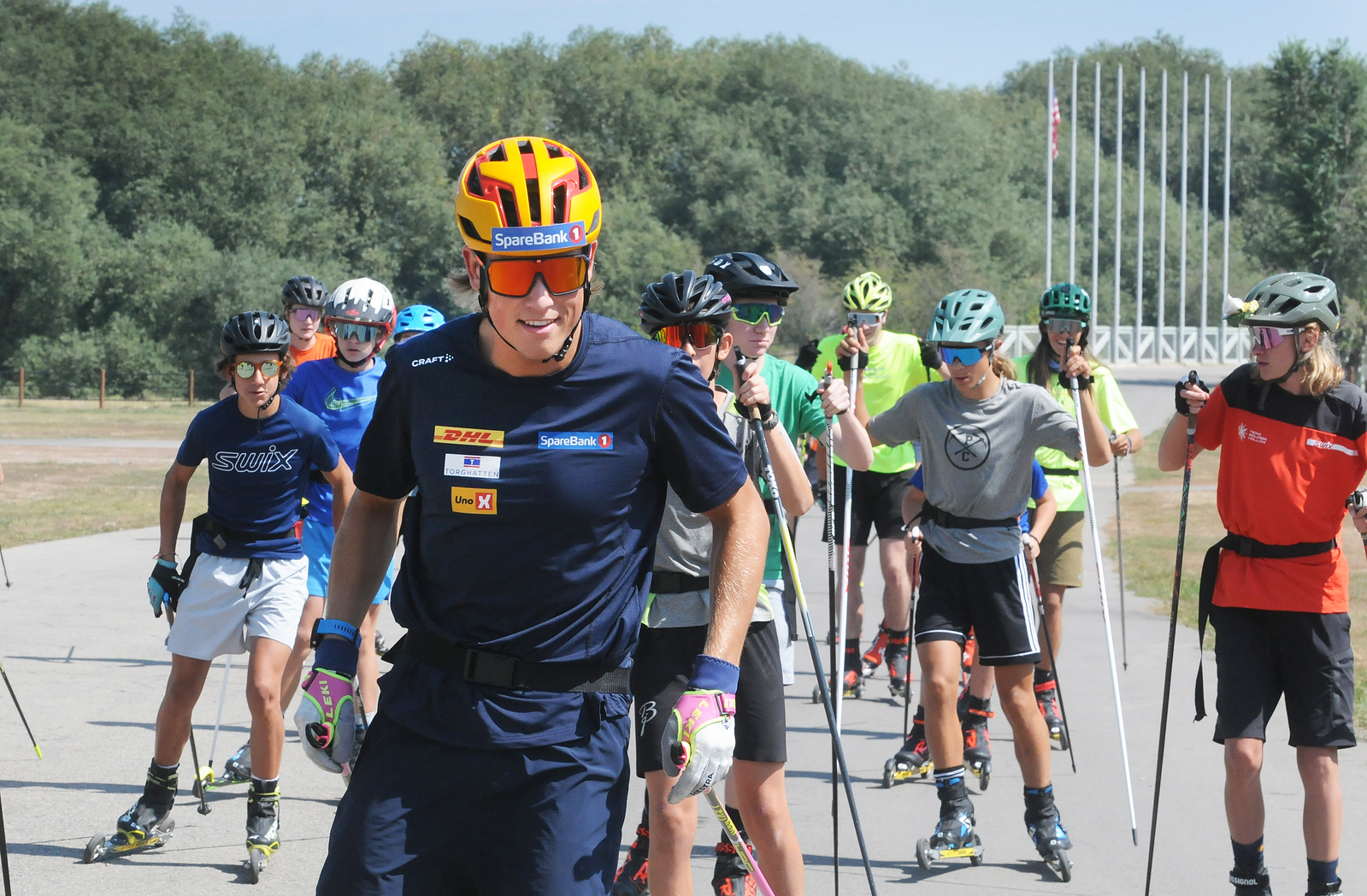
    Against the backdrop of hundreds of cardboard cut-out fans, the men battled for the first medals of the 2021 World Championships in Oberstdorf, Germany. Despite warming temperatures, conditions were firm and fast for the 1.5 k classic sprint, likely due to the application of salt to help with freezing. The course featured three climbs with the last being the most significant and sustained. 

    A smiling Klæbo after being the first athlete to complete back-to-back sprint victories at World Championships. (Photo: NordicFocus)

    From start to finish, the day belonged to Johannes Høsflot Klæbo who won the qualifier in a time of 3:00:08 and took his second consecutive sprint World Championships gold medal, becoming the first male athlete in history to repeat back to back sprint golds, winning the final in a time of 3:01.30. 

    As in the women’s race, the final hill proved to be the decisive factor throughout the quarterfinals and into the remaining rounds. The hill was no stride-fest, but instead a full-on sprint-run. Competing in Heat 1, Norwegians Erik Valnes and Klæbo easily gapped their competitors on the climb and advanced with ease.  

    The eventual 1-2 skiers charging. Valnes (bib 2) and Klæbo (left). (Photo: NordicFocus)
    Valnes (bib 2) and Klæbo (left) lead over the crest of the hill in their quarter-final heat. (Photo: NordicFocus)

    Racing in Heat 2 was J.C. Schoonmaker for the United States who qualified in 20th position. Schoonmaker came in 6th in his heat to finish 26th overall. After the race, Schoonmaker said, “I did not feel my best today but it was a solid result I think for my first World Champs, and I think I can walk away, I learned a lot and I think I am happy with it. But definitely saw it going better and I hoped it was going to go better. But, yeah I think it was overall still good.” 

    A sleeve-less JC Schoonmaker (USA) racing through warm temps in the quarter-final rounds. (Photo: NordicFocus)

    His teammate, Ben Ogden, qualified in 11th position and raced in the fifth quarterfinal. Ascending the final climb in that heat, Francesco De Fabiani of Italy found himself caught in the slush and went down, taking Cerny Ondrej of the Czech Republic down with him.

    Ondrej Cerny (CZE) taking the stumble. (Photo: NordicFocus)
    Ogden was able to move around the crash and capitalize. (Photo: NordicFocus)

    Ogden ended up fourth after a solid fight in his quarterfinal and 17th overall. In a post-race interview, Ogden said about his day, “It was good in general. The qualifier was really good. I was happy to be able to feel fast in that. And then in the heats were a little tricky, as they often are. Just remembering that this is only my second heat so far this year since World Juniors last year. I have a lot to learn and that was my first ever World Cup level heat. So, yeah, I am really excited with the whole day, and we will be looking forward to the skiathlon in a few days” 

    In the semi-final rounds, once again Klæbo and Valnes went one-two in the first semi. Given this was the faster semi, Alexander Bolshunov (representing the Russian Ski Federation at these championships) and Oskar Svensson of Sweden, also advanced from this heat as lucky losers. Coming from the second semi-final was Håvard Solås Taugboel of Norway and Sergey Ustiugov (RSF) who bested the likes of skate sprint legend Federico Pellegrino and steady sprint finalist Gleb Retivykh to advance to the final. 

    Bolshunov (RSF) and Valnes race against a picturesque backdrop through the sprint rounds (Photo: Nordic Focus)

    Preparing for one last round, the three Norwegians, two Russians, and lone Swede took their start positions, having shed hats and layers as the temperatures and efforts increased. Steady through the first part of the course, again the final climb marked a crucial moment. Taking the inside lane Klæbo stomped his way up the hill using his trademark technique. However, it was his teammate Valnes who was first over the crest. As they descended into the stadium Klæbo shot to the outside and took off. Valnes was left to fend-off his teammate Taugboel to secure second place while bronze went to Taugboel, making it a Norwegian triple. 

    Triple Norwegian podium for the first championship event of 2021 (Photo: NordicFocus)

    Speaking to FIS after the race Klæbo said, “I don’t know what to say. I’ve been so nervous the last couple of days. It’s been a really strange season with not so many competitions and I think we made some decisions that weren’t so good when we were sitting at home watching the Tour de Ski, but today it feels great and is a dream come true.” When asked about the conditions he replied, “I think it was a really tough day, the conditions were really good today, I think it was the right decision to salt it yesterday. It’s really hard out there when it’s so warm, and you are losing a lot of energy.”

    Klæbo congratulates a tired teammate, Valnes, after they finish 1-2 in the classic sprint. (Photo: NordicFocus)

    Klæbo came out of his first World Championships in 2019 with three gold medals after winning the individual sprint as well as the team sprint and relay event with teammates. After this victory on Thursday it seems like he is well on his way to another successful championship. For his teammate Valnes, this is his first time competing at World Championships. Valnes has made one other podium appearance this season when he won the classic sprint at the season opener in Ruka, Finland. This is also the first time at World Championships for Taugboel who has had three individual World Cup podiums throughout his career, all in sprint events. 

    Valnes after placing second in the classic sprint (Photo: Nordic Focus)

    Racing continues on Saturday with a 30 k skiathlon.

    Results: Men’s Final | Men’s Qualifier

  • Bolshunov Wins a Nail-Biter in Falun; Schumacher 9th and Patterson 15th (Updated)

    Bolshunov Wins a Nail-Biter in Falun; Schumacher 9th and Patterson 15th (Updated)

    The men’s 15 k skate podium from Falun, Sweden: Simen Hegstad Krüger (NOR) second, Alexander Bolshunov (RUS) first, and Sjur Røthe, (NOR) third, (l-r). (Photo: NordicFocus)

    This World Cup coverage is made possible through the generous support of Marty and Kathy Hall and their A Hall Mark of Excellence Award. To learn more about A Hall Mark of Excellence Award or to learn how you can support FasterSkier’s coverage please contact info@fasterskier.com.
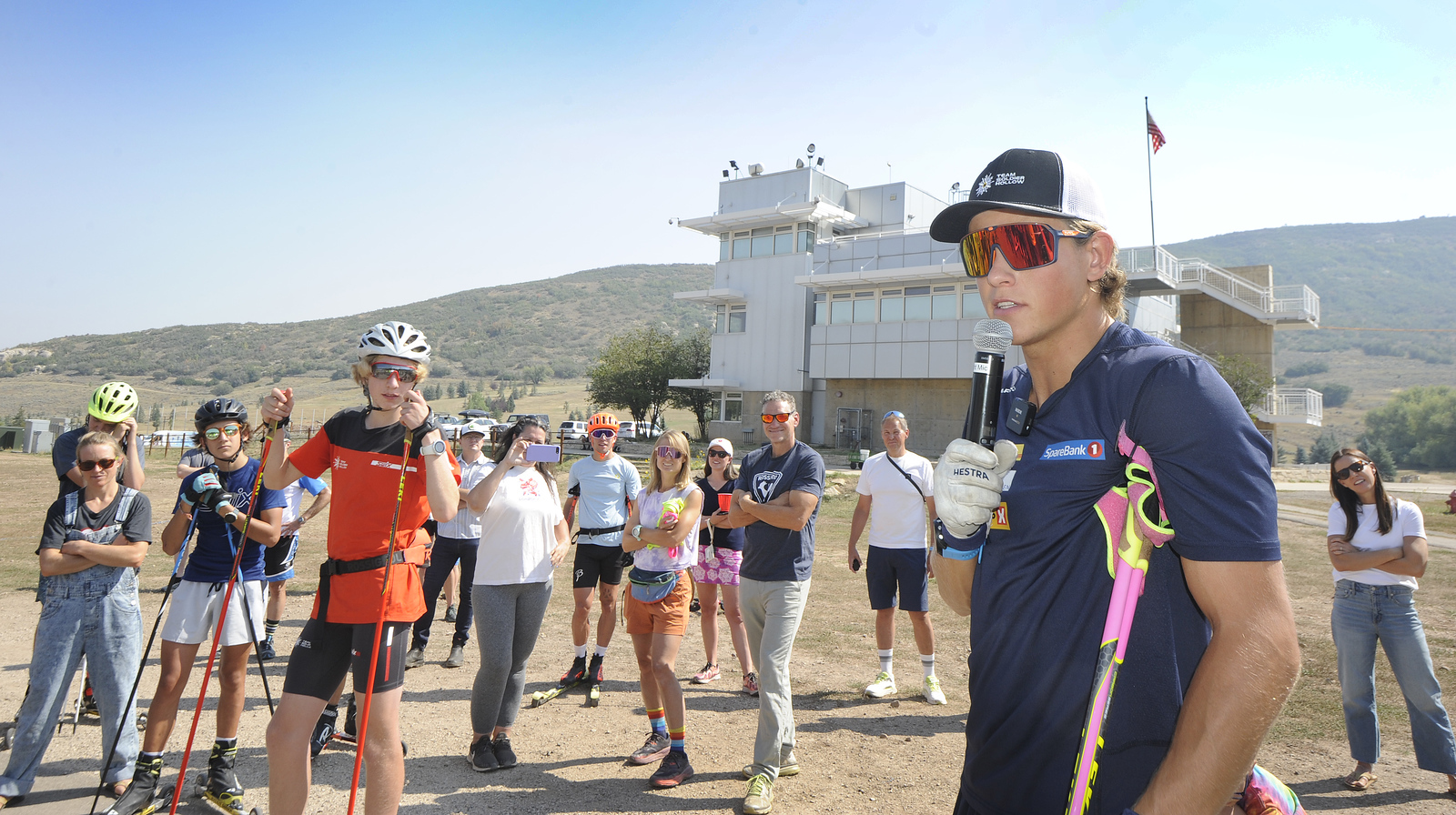
    Sunny skies and cold snow greeted the skiers for the start of the men’s 15 k individual freestyle on Friday, kicking off an extended weekend of racing in Falun, Sweden. With temperatures below 10°F (-14.1°C to be exact) the athletes were well bundled as they headed out of the start gate, one by one. Joni Mäki of Finland, perhaps better known now after his relay performance and ensuing run-in with Russia’s Alexander Bolshunov in Lahti last weekend, was the first starter in a field of 84. 

    Racing to yet another distance win, Russia’s Alexander Bolshunov squeaked out the 15 k victory in Falun, Sweden. (Photo: NordicFocus)

    Initially, it seemed as though it would be another runaway performance from Bolshunov. With the exception of the first split at 1.8 k (taken by Sergey Ustiugov of Russia), Bolshunov led with an ever-growing margin over the course of 15 kilometers. When he finished, wearing bib 41, he led by over a minute (-1:14.5), ahead of the young Norwegian, Harald Amundsen. Among those first 41 finishers was Johannes Høsflot Klæbo of Norway, who returned to the World Cup circuit a week later than his fellow countrymen. Today marked his first World Cup race since the season opener in Ruka, Finland, in November 2020. 

    In his first World Cup race since the Ruka series, which concluded in early December, Johannes Høsflot Klæbo of Norway placed seventh in the Falun 15 k skate. (Photo: NordicFocus)

    In a pre-race interview Klæbo said, “It’s great to be back and something I’ve been looking forward to for a long time now and to be back here in Falun, finally able to compete again, it’s something that I think will be really good… I think it will be really interesting, I’m going to do my best and go as fast as I can but there are a lot of strong guys here so it will be interesting.”

    When asked whether he had been following the races in his absence, Klæbo replied, “Yeah for sure I’ve been following it, every weekend. I love skiing so for sure I’ve been following and the guys look really strong so it’s sad to be at home and not to be able to compete. The guys look really strong so we’ll see how it goes for me.” 

    Klæbo began in bib number 39 and just before 12.8 k was caught by Bolshunov, who started two places behind. At the conclusion of the day, Klæbo placed seventh, +1:01.3 back from Bolshunov. 

    Norway’s Simen Hegstad Krüger toeing the line- he missed the win by 1.8 seconds on Friday. (Photo: NordicFocus)

    However, Bolshunov was not completely unchallenged. Further back in the field was a string of Norwegian starters who, spearheaded by Simen Hegstad Krüger, mounted an attack. At 6.8 k, Krüger was 6.5 seconds behind Bolshunov, and Sjur Røthe nine seconds behind the Russian. Jump forward to 11.3 k and Bolshunov had stretched the lead to +10.5 over Krüger while Røthe was down +23.9, having been overtaken by his teammate Hans Christer Holund.

    At 14.1 k, however, Bolshunov’s lead began a precipitous decline, as Krüger raced through +0.7 seconds behind. Despite his best efforts, however, the victory remained elusive for Krüger as Bolshunov came away with the win, yet again, in a time of 32:33.3. Røthe closed hard and regained time from Holund, sneaking into third place (+23.9).

    Sjur Røthe, on form, skiing to third overall in the Falun 15 k skate. (Photo: NordicFocus)

    After the race Bolshunov spoke through a translator, saying, “This is my third victory in a row in Falun for a skating race, so this place is lucky. Big thanks to the technicians and my team, I had really good skis today.”

    With such a dominant season thus far, Bolshunov is well on his way to taking the Overall Crystal Globe at the end of the season – he currently leads the standings with 1491 points, more than double that of the runner-up, Ivan Yakimushkin of Russia (720 points). When asked about this, Bolshunov responded, “[today’s victory] is really important because I have quite a secure lead in the overall, so I can add to it and that makes me relaxed and confident and I can focus on getting ready for World Champs.” 

    Scott Patterson for the U.S. remains on form skiing into 15th overall. (Photo: NordicFocus)

    The day’s most notable results came in the form of two Americans in the top 20. Scott Patterson, who started bib 2, paced well throughout the race and held the leader’s chair through the first 24 starters, until his teammate, Gus Schumacher, crossed the finish line –18.9 seconds ahead of him. In an email, Patterson wrote, “My thought for the race today was to really take advantage of the power V2 and gradual rolling terrain.  A lot of people look at Falun and see the Morderbaken as the key feature, but really there is a lot of time elsewhere on the course.  I also figured after last weekend returning to low altitude from our post tour time in Seiser Alm that I really wanted to push hard the whole course and not hold much back pacing early. In the end I think this worked out quite well and I felt that I was able to charge even the last time up Morderbaken.” 

    “The coaches tried to provide some good information from splits, but I knew as an early starter it was mostly about hammering and then hammering some more.  The big benefit of the early start was that I got to spend quite a bit of time in the leader’s chair at the finish.  It made it even better than when I finally was displaced it was by Gus.” Patterson finished in 15th, a season-best finish for him, one-upping his 16th place in Davos, Switzerland during the 15 k skate.

    Looking forward, Patterson wrote, “I’ve always been aiming for world champs as the focus of this season so it is good to be moving in the right direction.  I’m feeling pretty good about my skating and fitness right now, but I really want to have some good classic races and boost my confidence there.  My big goal for worlds is to get a top 10 in one of the individual distance races. I also am pretty excited that we seem to have a little momentum going for the guys team. It would be really sweet to throw down a good 4x10k relay.”
    Gus Schumacher racing into the top-10 in Falun’s 15 k skate. (Photo: NordicFocus)

    For Schumacher, today proved that his stellar performance in Val di Fiemme during the Tour de Ski, where he placed 8th, was no fluke. In a fully stacked field, Schumacher finished the day in 9th with a time of 33:50.7. Placing just behind him were a string of Russians, including Denis Spitsov, Evgeniy Belov, and Sergey Ustiugov. 

    Post race interview with Gus Schumacher:


    Simi Hamilton, in his first World Cup since the Tour de Ski, was just outside the points in 32nd. (Photo: NordicFocus)

    Also in the field for the Americans was Simi Hamilton, who placed 32nd having recently returned to the World Cup circuit after a brief break. David Norris placed 40th, Hunter Wonders was 52nd, and Kevin Bolger finished 61st. 

    Post-race interview with U.S. Head Coach Matt Whitcomb


    For the second weekend in a row, Russell Kennedy skied into the top-30, placing 29th on Friday in Falun. (Photo: NordicFocus)

    The Canadian men were led by Russell Kennedy who finished in 29th, matching his result from last week’s skiathlon in Lahti, Finland. Behind Kennedy, Philippe Boucher finished 58th, and Remi Drolet 63rd. 

    Racing continues tomorrow with a 15 k mass start.

    Results: Men’s 15 k

  • With the Stage 5 Win, Klæbo Lurks 16 Seconds Back in the Overall

    With the Stage 5 Win, Klæbo Lurks 16 Seconds Back in the Overall

    Three skiers atop the overall standings after Stage 4 set the tension for Stage 5 in Val di Fiemme, Italy: a 15-kilometer mass start classic race. Russia’s Alexander Bolshunov skied in the yellow leader’s bib while his teammate Sergey Ustiugov stood 16 seconds back in the overall. Johannes Høsflot Klæbo, Norway’s Tour de Ski (TdS) podium hope, lurked at 26 seconds back. 

    Alexander Bolshunov (RUS), Johannes Hoesflot Klaebo (NOR), Sergey Ustiugov (RUS), (l-r) early during Stage 5 of the TdS in Val di Fiemme, Italy. (Photo: NordicFocus)

    With a mass start format, the three contenders would play chess match skiing with a closing 1.5 k of turbocharged showmanship to determine the day’s winner. In between, as the 62 starters looped around the 2.5 k course which featured three climbs and an equal number of slick descents, the front pack never shattered. 

    Val di Fiemme 2.5 k course profile

    The men’s field remained roughly intact through 7.5 k. With an arbitrary cutoff of five seconds, 25 skiers came through within that time frame. Hans Christer Holund of Norway leading, Sebastian Eisenlauer of Germany in 25th. 

    One kilometer ahead, at the 8.5 k mark, sat the day’s only time bonus atop a climb — a finite opportunity for some to snag time and decrease a time deficit. 

    Holund accelerated, awakening the leaders as the time bonus mark closed in. With the front of the field finally getting strung out, and several Norwegians present to steal a bonus spot away from the Russians (they took four of the top five spots through the bonus mark), Klæbo made a move up the inside to grab the first place 15 second prize. Bolshunov came through in fourth for an eight second bonus, Ustiugov in ninth for two seconds. 

    Pål Golberg (NOR), leading Alexander Bolshunov (RUS), (l-r) during Stage 5 of the TdS in Val di Fiemme, Italy. (Photo: NordicFocus)

    Post time-bonus, the pace backed off. Until roughly 13 k, no skier in the front group made a discernible effort to separate. At 32:10, at the base of a climb, a mass of more than 20 skiers strode up led by Bolshunov in the yellow bib. It remained that way as the bell rang indicating the final lap. 

    Then the Russian charge began with Ustiugov’s double-pole push-and-punch through 13.9 k. On the course’s tricky descent that arcs left and loops back up for the decisive climb, Ustiugov was that Russian bear again. Unbridled and running, he was matched on the outside by an equally determined Klæbo. 

    Through the downhill, Klæbo proved to have slightly better glide as he slid past Ustiugov into the straightaway. There Klæbo is king. He won in 39:51.0, with Ustiugov 0.7 seconds back in second place. Bolshunov held tight for third (+1.0).  

    With the close pack racing and Klæbo’s sharp move for the max time bonus, Bolshunov still leads the overall. However, that lead stands at 16 seconds over Klæbo in second overall. Ustiugov sits in third, 21 seconds back.

    Two American men remain in the Tour. David Norris placed 38th (+1:41.9) on Stage 5. He tumbled on the second lap, but regained contact with the field. With two stages remaining, Norris is 36th overall. Teammate Logan Hanneman, a sprinter by trade, placed 59th (+4:49.8) on Friday.   

    David Norris of the U.S. is 36th overall after Stage 5 of the TdS, a 10 k mass start classic. Photo: NordicFocus)

    World Cup Coach Matt Whitcomb’s post-race comments on the men’s racing

    Tomorrow’s classic sprint remains a decisive day for Klæbo. Classic sprints and Klæbo most often mean one thing: a top step on the podium. And with that top step comes a 60 second time bonus. To stay in touch, Bolshunov and Ustiugov will need to make the six skier final. 

    Ah, the lovely tension of a close TdS. 

    Results | Overall standing after five stages

    The men’s TdS Stage 5 podium: Sergey Ustiugov (RUS) second, Johannes Høsflot Klæbo (NOR) first, and Alexander Bolshunov (RUS) third, (l-r). (Photo: NordicFocus)
  • Klæbo Claims First World Championship Title, Hamilton 9th Overall

    Klæbo Claims First World Championship Title, Hamilton 9th Overall

    Johannes Hoesflot Klæbo (NOR) winner of the men’s 1.6 k freestyle sprint at the 2019 World Championships in Seefeld, Austria. (Photo: John Lazenby/lazenbyphoto.com)

    It was a dramatic day at World Championships in Seefeld, Austria on Thursday. Norway’s Johannes Hoesflot Klæbo can now call himself a World Champion after a tactical and hard-fought victory in the 2019 World Championship 1.6-kilometer freestyle sprint. Federico Pellegrino of Italy won silver finishing 0.23 seconds behind Klæbo. Russian skier Gleb Retivykh placed third, 1.37 seconds back.

    Klæbo qualified fifth, then proceeded to win his quarterfinal and advance to the finals after placing second in his semifinal. This is where the day’s big drama played out.

    The semi was stacked: featuring Klæbo, Russia’s Sergey Ustiugov, and skate sprint crusher Federico Pellegrino of Italy. Atop the course’s first major climb at 1:38 minutes, the six skiers, led by Ustiugov came to a near standstill. The with a burst of V2, the Russian made his move, peeking under his legs to determine the damage as he descended.  Any lead Ustiugov gained had dissipated by the free-skating straight nearly 30 seconds later.

    When the distance back from Norway’s Johannes Hoesflot Klæbo is measured in meters – a win could be in play. Here Klæbo skis in his quarterfinal at the 2019 World Championships in Seefeld, Austria. (Photo: John Lazenby/lazenbyphoto.com)

    Coming into the tight right-hander that would swing skiers into the final climb, Klæbo slotted to the inside, his ski tail centimeters away from Ustiugov’s ski tip. The Russian stumbled slightly, as Klæbo kept his balance and V2 momentum — Ustiugov appeared to push off Klæbo’s back during the Norwegian’s move.

    Atop the final hill, Pellegrino sped down first with Klæbo in third and Ustiugov chasing. Pellegrino closed out the semifinal win as Klæbo placed second after an after-burner effort. As the skiers collected themselves after crossing the line, a visibly upset Ustiugov engaged Klæbo with several shoves in the finish pen. Ustiugov received a yellow card for pushing Klæbo during the race as well as a second yellow card for his unsportsmanlike conduct after the race. According to FIS and ICR 352.23, two yellow cards in one race results in a disqualification which is reflected in today’s results.  

    Klæbo described this event to the FIS reporter, “It was really strange, at the top [of the first hill] everyone was stopping and no one wanted to go first so we were just standing there and after some seconds, one person was going down and everyone was following him.”

    In the day’s sprint final, the podium places came down to the finishing stretch. Pellegrino’s raw speed was overcome by Klæbo just meters before the line. It was Klæbo’s first time competing at World Championships where he now compliments his three Olympic golds with a FIS championship medal. 

    From left to right, Federico Pellegrino (ITA) in second, Johannes Hoesflot Klæbo (NOR) in first, and Gleb Retivykh (RUS) third in Thursday’s World Championship skate sprint. (Photo: John Lazenby/lazenbyphoto.com)

    Pellegrino won last weekend’s World Cup in Cogne, Italy. As he remains on form, his second place today is his fourth World Championship medal. Pellegrino won both his quarterfinal and his semifinal. He won his quarterfinal easily, waiting until the last uphill to take the lead. As he gained distance on the final downhill he skied unchallenged across the finish line. He spent a good deal of his semifinal in the back of the pack, but he was able to maneuver his way towards the front right before the finish, and once again place first.

    For Retivykh, it was his first World Championship medal and his second individual sprint podium of the season. 

    Gleb Retivykh (RUS) celebrating his first World Championship podium finish. (Photo: John Lazenby/lazenbyphoto.com)

    Simi Hamilton was the best placed American in ninth overall. He qualified 11th and was fourth in his fast-paced quarterfinal. Hamilton snagged the second lucky loser position and moved onto the semis. He raced in the first dramatic semifinal with Klæbo and Pellegrino.

    Atop the first hill in his semi, Hamilton tangled with Pellegrino. Both skiers stayed on their feet, but Hamilton was unable to gain back his lost time as he placed sixth.

    “The quarter-finals were really tough, it was a fast heat,” Hamilton told FasterSkier in a call. “Viktor Thorn, I think because he had a really good qualifier, wanted to push the pace the whole time, so that made it really hard. But it also ensured that both lucky losers came from that heat. So I was really psyched about that. A top-10 at World Champs is a result you can be proud of. Obviously, I would have like to be in that final today, I think I’m still that caliber of skier but, it’s pretty cool being top-10, so I’m happy with today.”

    Simi Hamilton (USST) Skiing into 9th place overall in the World Championship skate sprint in Seefeld, Austria. (Photo: John Lazenby/lazenbyphoto.com)


    U.S. skier, Logan Hanneman (APU) qualified 20th today and finished sixth in his quarterfinal for 26th overall. It was Hanneman’s first World Championship start. At last weekend’s World Cup skate sprint, in Cogne, Italy Hanneman qualified 15th and placed 27th overall.  

    “The racing today was tough for sure,” Hanneman emailed. “I am sure that you have seen the course, but the guys course is very front-half heavy, with a large hill right out of the start. Last year when I raced the World Cup here, I found that I lost most of my time to the leaders from the start to the base of the large hill, so today in the qualifier my goal was to get to the hill as fast as possible, and then get up it. The rest of the course, I was just hanging out for dear life. I was so flooded!”

    Hanneman comes to this championship admittedly new to World Cup sprint heats.

    “It was only my second heat ever at the level, and the learning curve is steep,” he continued. “Obviously if I was faster and fitter, it wouldn’t be too much of an issue, but opportunities to pass are rare and come very quickly here, and I need to just be more confident in my abilities to take those windows.”

    Logan Hanneman of the U.S. skiing to 27th overall in Thursday’s skate sprint at the 2019 World Championships in Seefeld, Austria. (Photo: John Lazenby/lazenbyphoto.com)

    USST member, Kevin Bolger qualified 23rd today. He was in the first quarterfinal with Klæbo and Ustiugov where he placed fourth. Bolger finished 18th overall for his best result of the season.

    asthma inhalers online, zyrtec online

    “Great job by Logan and by Kevin in their first World Championship sprint heats,” U.S. Ski Team Head Coach told FasterSkier in a call. “Neither of those guys really have a lot experience yet skiing heats, they are at the place where they aren’t qualifying in the top part of the field yet either so it kind of makes sense that they are going to end up 5th or 6th in their heat until they can take another step forward in their qualification and also just build their experience and learn how to really ski in the heats with these guys.”

    Bolger told FasterSkier about his quarterfinal via email, “I picked Heat One because it looked like a A.) it would be a fast heat and B.) it looked like a competitive heat where the guys were going to ski and not play any games. Unfortunately, my time wasn’t fast enough to move on. Ustiugov made a move going up the first hill and I was wasn’t quite able to respond and get in the tail of it! But of course, I’m happy to have skied competitively with my heat!”

    U.S. skier Andy Newell was 41st in the qualifiers today. According to Grover, Newell is suffering from a back strain.

    “Newell has been struggling with a light strain to his back for a little bit here,” Grover said. “So I think if he had been healthy, he’s easily qualifying material. Then you go into a world championship field with only four starters from each nation, he would have easily made that. So bummed for Andy that he wasn’t 100% healthy and ready to really unleash it today, it would have been awesome to have four guys in there.”

    For Canada, Alex Harvey, who announced he will retire from the World Cup after the finals in Quebec this March, placed 16th overall.

    “It was a good start today and the body felt really good,” said Harvey in a Cross Country Canada press release. “I just wanted to come in today and get some good feelings heading into the rest of the championships. I did that so I’m happy.”

    Men’s Results

  • Klæbo Tied for Second-Most World Cup Sprint Wins; US Skiers Looking for More

    Klæbo Tied for Second-Most World Cup Sprint Wins; US Skiers Looking for More

    Johannes Høsflot Klæbo smiles after winning the 1.6-kilometer skate sprint in Lahti, Finland. Federico Pellegrino of Italy (l) took second, followed by Finn Hågen Krogh of Norway (r). (Photo: Screenshot Instagram @fiscrosscountry)

    After two weeks away from competition, athletes revved their engines in Lahti, Finland for an individual 1.6-kilometer freestyle sprint, one of the final stops on the way to the World Championships. After a string of what he deemed “bad luck” in the first sprint races of the season in Ruka and Lillehammer, Norway’s Johannes Høsflot Klæbo came into the weekend with momentum from winning the last four individual sprints. Klæbo also arrived in Lahti on the brink of what could be a historic milestone; a win could advance him from possessing the joint-third most victories, tied with his opponent Federico Pellegrino of Italy with 12 each, to the joint-second most, tied with Ola Vigen Hattestad of Norway who retired in 2016.

    As a penalty for obstruction kept him from advancing from the quarterfinals in Dresden, Pellegrino has not had an opportunity to move ahead of Klæbo since they last met in the final in Val Mustair during the Tour de Ski. In that event, Pellegrino challenged the Norwegian in both the semi and the final, but could not quite overtake him. Today in Lahti proved to play out in an eerily similar fashion. 

    Both men skied well in the qualifying round, with Klæbo taking the lead with a solid gap, finishing in 2:49.77, followed by his teammate Håvard Solås Taugbøl (+4.15), Joni Maeki of Finland in third (+4.35), Pellegrino in fourth (+4.36), and Finn Hågen Krogh of Norway in fifth (+4.40).

    Conditions in Lahti were reportedly fast and a bit wet. Temperatures hovered around freezing with some freezing rain lightly peppering the course throughout the day. This stability in the weather and on the tracks kept the playing field fair as the athletes sprinted through the heats.

    Emil Iversen of Norway charges on his way to second place in heat two of the semifinals of the 1.6-kilometer skate sprint in Lahti, Finland. (Photo: Instagram @langrennslandslaget Screenshot)

    In the quarterfinals, Klæbo and Pellegrino went one-two in heat one, advancing into the first heat of the semi-finals. This first semi proved to be the faster of the two. The Norwegian again took the win in 2:49.84, with his teammate Eirik Brandsdal close on his tails. Gleb Retivykh and Pellegrino, who finished in third and fourth, respectively, advanced as lucky losers. Less than one second separated the six men in the heat, and all of the men skied faster than those in the second heat.

    In the second semi-final heat, Krogh finished first in 2:50.98, followed by his teammate, Emil Iversen, making it a final of four Norwegians, an Italian, and a Russian.

    As the men charged out of the gate in the final round, Retivykh led the pack, with the other men jockeying for position behind him. Per usual, Klæbo began to surge on the climbs, using them as his opportunity to move to the front of the pack. The second half of the course featured a steady climb with a steeper punch at the end before sending the athletes down and around a turn into the stadium. On this climb, Klæbo set the pace, trying to slowly pull away from the group. But Pellegrino was not ready to let him go. The Italian crested the hill just behind and as the two men tucked into the downhill, a small gap was created before the next skier back.

    Norway’s Johannes Høsflot Klæbo attacks the final climb on his way to victory in the 1.6-kilometer skate sprint in Lahti, Finland. (Photo: Screenshot FIS/ARD Broadcast)

    Pellegrino tried to position himself on the inside of the final turn to get in front of his opponent, but he could not quite make his move. Klæbo was still in front heading into the final straight with Pellegrino nipping at his heels. Krough, who closed the gap they had created was also in the hunt, chasing the leaders to the line. The two kept the pressure on Klæbo, giving him no opportunity to risk his position with an early finish line celebration, but they were not able to surpass him.

    Klæbo earned his 13th World Cup Victory, stopping the clock at 2:52.06, his ninth win out of the last 13 individual sprint races. Pellegrino took second (+0.30), followed by Krogh in third (+0.61), Brandsdal in fourth (+1.31), Iversen in sixth (+1.75), and Retivykh in sixth (+2.08).

    Norway’s Johannes Høsflot Klæbo rounds the final turn ahead of Federico Pellegrino of Italy in the 1.6-kilometer skate sprint in Lahti, Finland. (Photo: Screenshot FIS/ARD Broadcast)

    No North American men qualified for the heats, which came as a surprise to both the athletes and the coaches. Logan Hanneman (APU) posted the fastest qualifying time for the U.S. placing 32nd overall after missing the heats by .22 seconds. Simi Hamilton (USST) finished 36th overall, and Erik Bjornsen (USST) 42nd.

    Evan Palmer-Charette was the lone Canadian entered; he placed 67th.

    “Definitely a bit of a puzzling qualifier for the guys,” said Matt Whitcomb in a call. “An impressive one out of Logan, but we know he can ski into the top-30 too. Erik and Logan and Simi all said they felt great. We are coming out of a training camp [in Vålådalen, Sweden] where it has been cold, and it is possible that we just need a little rest and a little racing and that will get things going.”

    Though he was offered starts in both Period 1 and 3, it is Hanneman’s first time racing internationally this season. The APU skier was the top qualifier in the 1.3 k skate at US Nationals, placing second in the final. He also took third in the final in the classic sprint. When Hanneman competed in the sprint in Lahti last March, he placed 49th overall.

    “Today was pretty good for me!” Hanneman wrote in an email. “Of course, being only .2 sec out from the heats hurts a little, but it was my career-best finish so that is a positive for sure. Looks like from the splits I was in 15th at 900m, which was nice to see since my goal was to take the first half out faster than I did last year. When I raced this course last year, I learned that it is a little tricky to make time back on these guys on the last hill… this year I learned that I can lose a lot of time to these guys on the last hill. Although today, with the fast conditions, the time spreads were really tight so it wasn’t too much time that I lost.”

    As illness kept him from racing in the city sprints in Dresden, it has been over a month since Hamilton last put on a race bib.

    “I wish I felt better about my day today,” Hamilton told FasterSkier in a call. “I’m still kind of baffled by how it went. I felt amazing and I felt like I skied the course better than I ever really have before and I’ve had some decent races here before. The conditions were great, our skis were awesome, I just don’t know what happened. The only thing I can think is that sometimes it takes me a little bit of racing and hard training to get that really good sprint gear going again, but I felt incredibly fit, I felt like I paced it really well, I was just really confused when I saw the qualifier results.”

    During his time away from the World Cup, Hamilton traveled back to the U.S. to spend some time back in Vermont, where on top of training, he proposed to his girlfriend, Sophie Caldwell. Hamilton returned to Europe two weeks ago to participate in the Vålådalen camp. While the camp went well for him, the aforementioned temperatures prevented Hamilton from putting in those hard training efforts, but there is still time before Seefeld to capitalize on his fitness.

    “It was incredibly cold, so we weren’t doing a lot of really hard intervals or hard training, but all the other indicators were really good during that camp,” he said. “Fortunately, this wasn’t the World Champs day, and that’s obviously the race that really counts. So we’ll just kind of tweak training a little bit, and hope for some better feelings for Cogne, and plan on feeling really good for the sprint in Seefeld.”

    Despite his disappointment in his own performance, the day had a silver lining for Hamilton, as Caldwell landed on the podium with a second place finish in the women’s 1.4k sprint.

    “I’m super psyched that Soph had such a great day – I’m just amazed by that,” he shared. “That she can fly back here to Europe two days ago, then put together a day like she did today… Whatever frustrations I had quickly evaporated with her day. I’m just so happy for her.”

    Hamilton has a second chance to find his top gears when racing continues tomorrow during the classic team sprint where he will line up with Bjornsen.

    “It’s pretty much my first classic race of the year,” Hamilton laughed. “The only other classic race I’ve done was in Lillehammer, the 15 k in the pursuit on the third day, so it will be interesting to see what happens, but I’m psyched.”

    The team sprint will be held on the same course as the individual race today, a change from past years of the Lahti Ski Games.  

    “They’re not using the old course, which I’m a little bit bummed about,” said Hamilton. “So we’ll have to see how the regular sprint course classic skis, which on the World Cup anyway, no one has classic sprinted on that loop. It should be exciting, it should be fun. Conditions look good for some fast Klister skiing, so hopefully, we don’t get too much snow overnight. But yeah, we’re psyched.”

    Men’s Qualification | Men’s Results

  • Klæbo Holds Off Ustiogov to Become the Youngest Winner of the Tour de Ski; Lustgarten 42nd

    Norway’s Johannes Høsflot Klæbo exhaustedly crosses the line at the top of Alpe Cermis in Stage 6 of the 2018/2019 Tour de Ski. (Photo: Instagram screenshot @johanneshk)

    “It was just full speed to the finish and I am not stopping until the finish line now,” Johannes Høsflot Klæbo told the International Ski Federation (FIS) after his victory in Stage 6.

    With the 45 bonus seconds he gathered from his win in both the overall event and the bonus sprint in yesterday’s 15-kilometer classic race, Klæbo entered the final Stage of the 2018/2019 Tour de Ski with a bit of insurance on his lead over Russia’s Sergey Ustiugov, who was ranked second in the overall standings after Stage 6. The Norwegian began the 9 k skate race to the top of the Alpe Cermis ski area 1:20.4 ahead of Ustiogov, meaning that so long as he could keep the Russian at bay through one last stage, the 22-year-old would seal the deal on an overall victory in his first ever Tour de Ski.

    Sergey Ustiugov of Russia (l) chases Norway’s Johannes Høsflot Klæbo up Alpe Cermis in Stage 6 of the 2018/2019 Tour de Ski. (Photo: FIS Screenshot)

    Giving his all in his final opportunity to surpass Klæbo in the Tour, Ustiugov fought hard throughout the race to close the gap between the Norwegian and himself. As the men worked their way up the steep serpentine track, Klæbo looked over his shoulder to see the Russian just one switchback below him.

    Klæbo is known for his ability to make powerful moves on hills during sprint races, sometimes making the other skiers look as though they are standing still. His dominance is so well known that the short steep climb on the sprint course during the Olympic Games in PyeongChang became dubbed the “Klæbo-bakken”. However, after seven races in nine days, Klæbo looked exhausted as the men neared the top of the climb, no longer the spry sprint phenom. Ustiugov maintained a faster tempo, gradually reeling the Norwegian in. With a grimace and a last look back, Klæbo collapsed across the line in a time of 32:51.3, just 16.7 seconds ahead of Ustiugov.
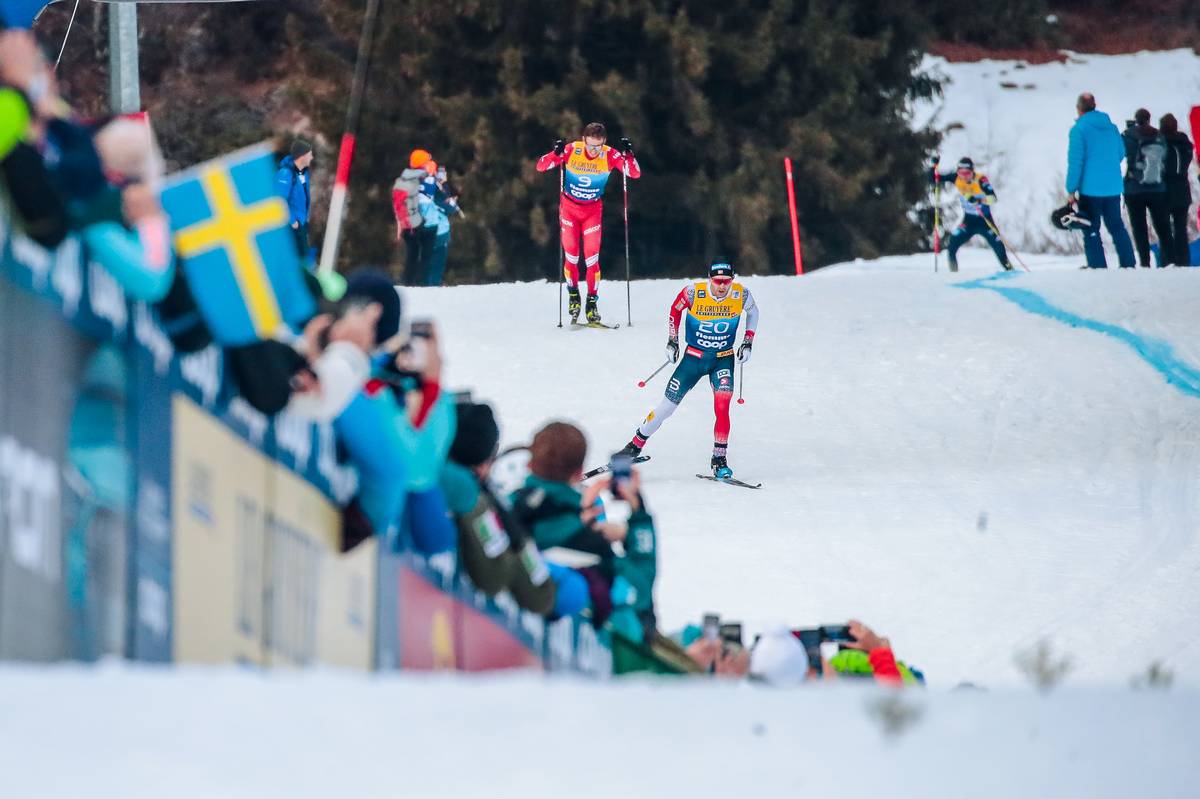
    Men’s podium of the 2018/2019 Tour de Ski. Norway’s Johannes Høsflot Klæbo took first after winning five out of the seven stages, followed by Russia’s Sergey Ustiugov (l) and Simen Hegstad Krüger (r), also of Norway. Photo: Screenshot Instagram @fiscrosscountry

    “It was really tough,” Klæbo told FIS. “I was really tired after yesterday. I heard all the way from the bottom that Sergey [Ustiogov] was going quite fast so I was just trying to push myself. It was really tough but quite good to be here first.

    “I saw him all the time, so it was really tough to just look back and see him getting closer and closer,” Klæbo continued. “It was really tough mentally, but it was really good to come to the top and look back and see that you have the gap that you needed.”

    Klæbo’s win made him the youngest ever male winner of the TdS, an honor previously held by Dario Cologna of Switzerland who won his first tour in 2009. Today was also his fifth stage win in this season’s Tour, tied for the most wins with Cologna and Norway’s recently retired champion, Petter Northug jr.

    “It means a lot, for sure,” Klæbo told Fischer. “PyeonghCang was maybe the biggest moment in my life, but this is a good number two. I really think this is a great start of 2019.”

    The implications of differences in start time are not as cut and dry when the gut punch of the hill climb is taken into consideration. A contingent of Norwegians lurked hungrily behind Alexander Bolshunov of Russia and Francesco de Fabiani of Italy, ranked third and fourth, respectively, entering the final stage. Simen Hegstad Krüger, Sjur Røthe, Martin Johnsrud Sundby, and Didrik Tønseth held positions five through eight, all within 1:45 minutes of Bolshunov.

    The pack worked together, slowly drawing de Fabiani into their sights. They passed him near the bottom of the climb. Their next target, Bolshunov, proved harder to catch. With less than 500-meters to go, Krüger skirted around the Russian on a switchback, clearly exhibiting more energy and a higher tempo. As the first Norwegian powered ahead, Røthe also surpassed the fading Bolshunov.

    In the end, Krüger maintained his energy to steal the third position on the podium, 48.8 seconds behind his teammate Klæbo. Røthe took fourth (+1:05.3), followed by Bolshunov in fifth (+1:26.6).

    The sole American to finish the Tour, Ben Lustgarten, finished 42nd (+15:54.5).

    “It can definitely eat you alive,” said Matt Whitcomb in a call. “I was really happy to see him it finish it because it devours a lot of people.”

  • Iversen Wins Tight Oberstdorf Mass Start; Canada’s Harvey 13th (updated)

    Iversen Wins Tight Oberstdorf Mass Start; Canada’s Harvey 13th (updated)

    The men’s podium from Stage 4 of the Tour de Ski, a 15 k classic mass start Emil Iversen (center) of Norway celebrates his victory atop the podium in in Oberstdorf, Germany. Francesco de Fabiani (L) of Italy took second, Norway’s Emile Iversen (c) placed first, Sergey Ustiugov (R) of Russia was third. (Photo: Fischer/Nordic Focus)

    Temperatures near freezing, high humidity, and snow falling heavily in large flakes – a trifecta that can be difficult for kick waxing – greeted racers in Oberstdorf, Germany during Stage 4 of the Tour de Ski. The 15-kilometer classic race marked the first mass start of the World Cup season giving the racers the opportunity to face off head to head. It was close quarters on the 2.5 k loop. With a string of Norwegians, including Johannes Høsflot Klæbo, the Tour leader after the first three stages, leading the pack, the men stayed tight – less than two seconds separated the top-10 at the 10 k mark. Less than four seconds separated the top-20.

    The start of the men’s Stage 4 of the Tour de Ski, a 15 k classic mass start. (Photo: Fischer/Nordic Focus)

    As the final 5 k began, skiers began to vie for the lead, spreading the pack out slightly from the front. With less than 1 k to go, no decisive moves had separated a clear winner from the pack.

    Cresting the top of a long climb, a small group emerged led by Sergey Ustiugov of Russia, who began the day ranked second overall in the Tour. A win would have earned him enough bonus seconds to move into first place. However, Francesco de Fabiani of Italy, Emil Iversen, and Sjur Røthe, both of Norway, clung to the Russian.

    As the skiers entered the final stretch, furiously double poling toward the line, Iversen emerged at the front. Stopping for a quick bow before his final pull, Iversen crossed the finish line just ahead of de Fabiani (+0.9), followed by Ustiugov (+2.0) who just bested Røthe (+2.1) at the line. Klæbo finished 9th (+5.6) maintaining his position as the overall Tour leader.

    “It was as usual here in Oberstdorf, it was chaos from the start to the finish line – but I like that,” Iversen told the International Ski Federation (FIS). (Last season, Oberstdorf’s TdS sprint races were canceled due to severe weather.)

    For Ustugov, his podium finish kept him in second overall, 15.1 seconds out of the lead. Iversen’s win today moved him into third place in the T9our standings — he now trails Klæbo by 31 seconds. Alexander Bolshunov of Russia holds the fourth position (+46.6), followed by Norway’s Sindre Bjørnestad Skar in fifth (+1:20.7). Looking for trustworthy online casino reviews, clear bonus comparisons, and payment options that actually work for international players? Independent roundups, licensing notes, payout-speed checks, and game-variety tests help cut through marketing noise so you can choose a safer table with confidence. Detailed comparisons live at casinoalternativen.com where operators are assessed on transparency, cashier reliability, and real player-facing criteria rather than ads alone.

    Canada’s Alex Harvey remained near the front of the race, crossing the line amidst a chase pack of five skiers. In a photo finish, Harvey finished 14th (+9.1) and was taken at the line by Norway’s Simen Hegstad Krüger who placed 13th. Also for Canada, Bob Thompson finished in 64th (+1:42.5), and Lenny Valjas 67th (+2:26.1).

    While normally thought of as a distance skier, Harvey has not had the results he had hoped for in World Cup distance races this season. 

    “I’m still hungry for better results, but the biggest positive for me was how I felt during the race,” said Harvey in a call. “It was the first distance race of the season where I was feeling strong and recovering well on the downhills, so I was able to have some fun skiing. All the other distance races this year I couldn’t find a good vibe, but today was good, so that’s the biggest positive.”

    Norway’s Emil Iversen amidst the snow dump as he poles into the finish to win Stage 4 of the Tour de Ski. (Photo: Fischer/Nordic Focus)

    According to Harvey, the heavy falling snow throughout the race played a role in keeping the race tight. In the end, first through 49th place were separated by only 14.9 seconds.

    “It snowed a lot, it snowed more and more as the race went on,” said Harvey. “The falling snow rate was getting higher and higher. Nobody could get away. The guy at the front would plow the way for everybody else, and we’d kind of ski in one line… Every lap was getting worse and worse. It was really fighting for position. Going hard on the climb was the best way to pass – normally it’s on the flats and the downhills where you can kind of find your way through, but it was single file on the flats and downhills, then there were more tracks that were skied in on the climb.

    “You had to fight for every inch, but I think I was okay until maybe the fifth lap where I drifted a bit too far behind. I tried to reposition myself at the beginning of the last lap, but in doing so I was skiing outside the race line, so plowing through a lot of snow there. I was able to get back close to the front but spent a lot of energy doing that and I just didn’t have much left on the final climb.”

    Waxing for the aforementioned trifecta of challenging weather conditions is far from straightforward. Finding a solution that provides good kick but does not allow the new sharp snow crystals to stick and slow down the ski can require trial and error. Harvey shared that the Canadian men chose to sandpaper their kick zones to create what are known as “harries” or “rub skis”. This strategy certainly paid off for Harvey.

    “I think we had some of the best skis in the field,” he said. “I was able to really relax on the flats when I was following, and the fast downhill into the stadium I was able to move up … then up the hill I was able to stay in the track for most of the way when a lot of the guys were start[ing] to run outside of the track, kind of herringboning or running Klæbo style. So I was really happy with my skis and I was able to make them work. Our guys did a really good job. We have a smaller waxing crew than a lot of other teams, but today they did a really good job and it was for sure a really stressful day, so kudos to those guys.”

    The only remaining U.S. skier, Ben Lustgarten (CGRP), finished 57th but hung tight in the field to finish only 38.7 seconds back.

    “The mass start was awesome and it didn’t seem like the leaders could get away due to conditions and course profile,” Lustgarten wrote in an email. “I started in the second to last row, so the back of the pack had a lot of stop and go on the first few climbs. My skis had amazing kick but iced up a bit over the climbs so I could run up all the hills and pass some guys, but would lose a spot or two on the descents. The fresh snow near the end made the unskied tracks much slower so passing on the flats was nearly impossible, so the accordion action on the climbs was when I needed to make my moves. I tried to conserve energy for the last lap but I was a bit more taxed than I thought and didn’t have much on the last climb.”

    “The U.S. Ski Team is supporting Ben through the Tour de Ski, and his race is the highlight of the day for us,” U.S. Ski Team Coach Matt Whitcomb told FasterSkier in a call. “He was tough out there in an Oberstdorf snowstorm, and finished 40 something seconds out of the lead, with a 19 point FIS race. This will help build back some confidence after a tough first three stages. We’re psyched for him.”

    Racing continues tomorrow in Oberstdorf for the men with the TdS Stage 5 15 k skate pursuit.

    Men’s Results | Overall Men’s TdS Standings After Four Stages

    – David Brown contributed

  • Bolshunov atop the Podium Again in Ruka; North Americans Feel Encouraged About the Season Ahead

    Bolshunov atop the Podium Again in Ruka; North Americans Feel Encouraged About the Season Ahead

    Men’s 2018 Podium for the Ruka 15k Classic. Russia’s Alexander Bolshunov (center) won, Norway’ Emil Iversen (left) was second, Swede Calle Halfvarsson (right) placed third. (Photo: Fischer/Nordic Focus)

    “I have no secrets,” Alexander Bolshunov told FIS in regard to his back-to-back wins in Kuusamo, Finland. On Saturday, the Russian had won a drag race with Norway’s superstar Johannes Hoesflot Klaebo during Saturday’s classic sprint. 

    Bolshunov had a commanding victory in Sunday’s 15-kilometer classic race. He stopped the clock with a winning time of 36:17.8 minutes. Early in the race, Bolshunov’s splits mirrored those of Norway’s Emil Iversen during which the two skiers’ times never deviated more than one second apart.

    Toe it! Norway’s Emil Iversen skis to second place in the 2018 men’s 15 k classic in Kuusamo, Finland. (Photo: Fischer/Nordic Focus)

    In his final two laps, Bolshunov began to pull away from the field, putting 19.6 seconds on the second place Iversen before the finish. Sweden’s Calle Halfvarsson took the third podium spot finishing 21.2 seconds back.

    In a press conference, Bolshunov was asked whether anyone could stop him this season. He responded through a translator, “ It’s just the start of the season. It would be good if no one would stop me but we’ll say about it later.”

    Iversen, who finished 9th in the World Cup standings last year said he was encouraged by his race today. “I have high expectations, I want to try to beat that result. Have to do good work all winter to do that, but good start for sure,” he said in the press conference.

    Last season’s overall World Cup winner, Johannes Hoesflot Klaebo, finished 9th (+47.6).

    Alex Harvey was the top North American skier finishing in 22nd (+1:13.9). Harvey had a strong start but slowly moved backward in the standings, which he attributes to poor early season pacing.

    “I started way too hard today for how early I am in the season,” Harvey said via Skype. “The first lap I was going great everywhere, then second lap just a bit lesser, third lap worse, fourth lap worse.”

    Despite a disappointing result on the day, Harvey is feeling positive about his racing in Kuusamo and is encouraged about his fitness at this point in the season.

    “I wasn’t expecting much from the sprint and the sprint was actually really good from me,” Harvey continued. “It’s actually a PB [a personal best] for me here in Kuusamo. Today, just a bit disappointing, but I really feel like the pace I kept to the split at the first 1.1 k – I was third – so that was way too fast for me. I’m not a quick starter on any given day, especially before Christmas I need to pace a bit better than that. So a bit disappointed with the distance pacing, but happily surprised about the sprint day.”

    Harvey placed eighth in Saturday’s classic sprint.

    In his first lap during Sunday’s 15 k classic, Harvey’s fast pace challenged Halfvarsson to push harder as well, which ended positively for the Swede. Harvey shared this as the highlight of his day, “I took Calle Halfvarsson to the podium today. … He lapped his second lap when I started so I caught him. … I was kind of disappointed in myself in the changing tent afterward and he came and just said ‘hey, thanks man, you brought on the podium today, so I have to thank you.’ So that was my highlight.”
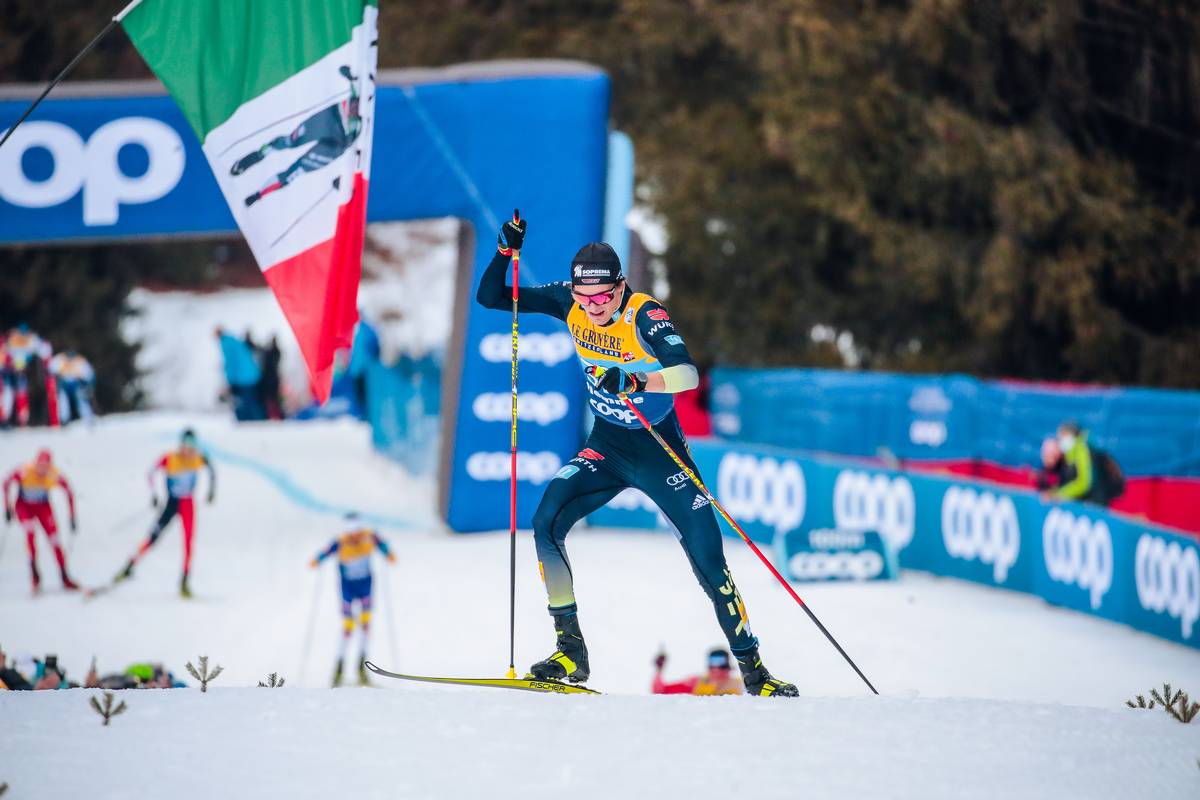
    Harvey also expressed his gratitude for the effort that went into creating the high-quality conditions expected at World Cup. This year has seen a lack of snow in Kuusamo. “It’s good to see that Ruka again did a really good job… they’ve had it rough this year, everywhere in Europe and in Scandinavia. I think they did a really good job managing to give us really good racing conditions for the weekend.”
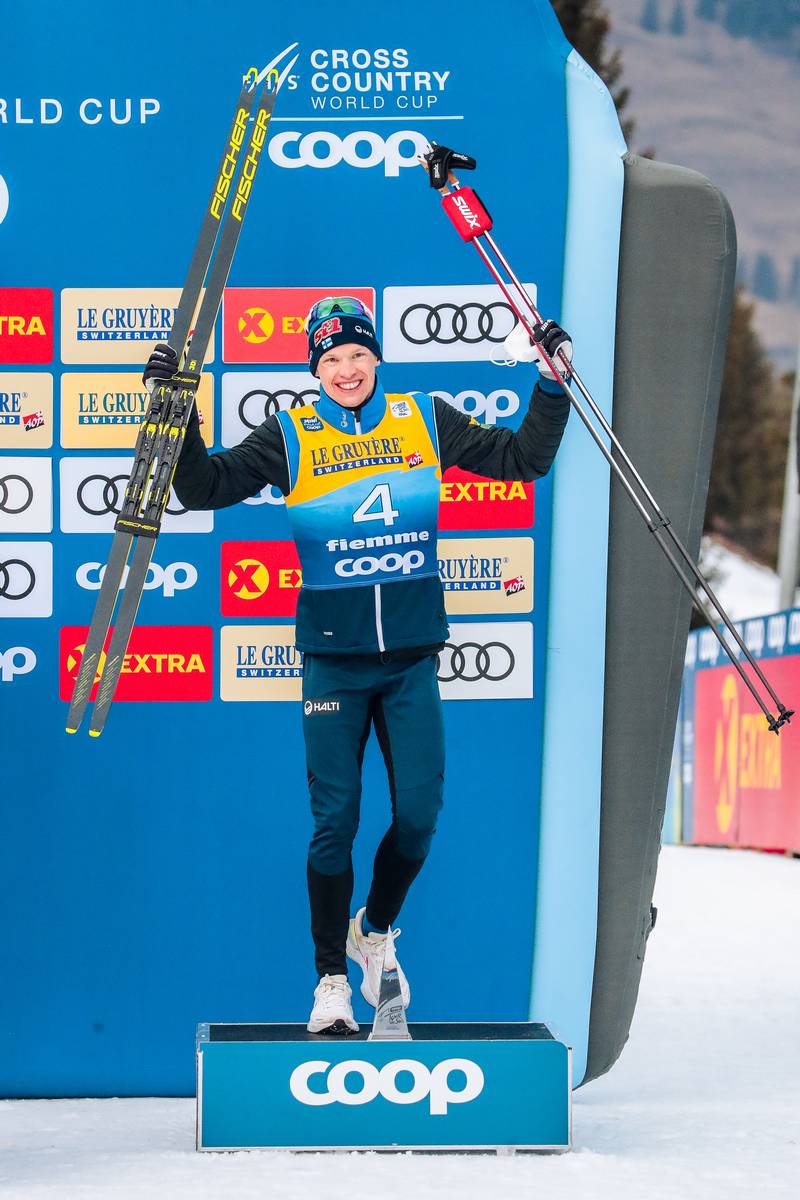
    Also for Canada, Russell Kennedy (TEAM R.A.D.) skied to 71st (+3:47.6), Andy Shields 82nd (+4:22.6), and, Julien Locke (CNST) 83rd (+4:32.3).

    Leading the U.S. men, Erik Bjornsen finished 31st (+1:50.0), just outside of the points. (The top-30 on the World Cup score points.) Bjornsen raced with consistent lap splits, maintaining a position between 29th and 34th at checkpoints throughout the race.

    “It wasn’t the start to the season that I had hoped for, but I don’t think it was too far off,” Bjornsen wrote in an email. “Today, I didn’t feel great. I felt a little stiff, never able to open up and glide out there. I’ve always found the snow to be a little tricky here in Ruka. Hopefully next weekend I’ll feel a little more snap in the body. The goal is to be consistently skiing in the points.”

    U.S. coach Matt Whitcomb was encouraged by Bjornsen’s effort.

    “I think he [Bjornsen] should feel good about skiing a really consistent race, being in the mix with some incredible skiers, and I thought he was attacking hard from lap one through four,” Whitcomb told FasterSkier in a phone call. “I think he’s in great shape.”

    U.S. Ski Team’s Kevin Bolger raced to 63rd during Sunday’s 15 k classic in Kuusamo, Finland. (Photo: Fischer/Nordic Focus)

    Next for American skiers was Adam Martin (CGRP) in 53rd, followed by Scott Patterson (USST) in 57th, David Norris (APU) in 59th, and Kevin Bolger (USST) in 63rd.

    Whitcomb added that if the team was looking for stronger results, they would have arrived in Kuusamo sooner so the skiers could adjust to the conditions and time-zone. “We showed up and there was a Russian team that had been already skiing for 2.5 weeks in Finland,” he said. “So, each week they spend on the ground is worth, just sort of an automatic 30 or 60 seconds, just in these early season weeks, where you get your feet under you. When you’re coming from a place that is as far away as Russia or the U.S. or Canada or Australia, it takes a long time to settle.”

    Whitcomb continued, “This year is better than any year that I’ve seen since 2006. And I think what the guys have really been missing over the years is some semblance of a stronger team, and they really have that now. So I think it’s gonna produce, with time, stronger results.”

    Men’s Results

  • Pellegrino Can’t Stop Klæbo in Davos; Hamilton Ninth in Skate Sprint

    Pellegrino Can’t Stop Klæbo in Davos; Hamilton Ninth in Skate Sprint

    Simi Hamilton of the U.S. Ski Team racing to ninth overall in Saturday’s World Cup freestyle sprint in Davos, Switzerland. (Photo: Reese Brown/U.S. Ski & Snowboard)

    DAVOS, Switzerland – Would Johannes Høsflot Klæbo cruise to win No. 6, a perfect World Cup record, in the skate sprint today, or could someone stop him?

    As qualifying finished, the quarterfinals passed, and the semifinals began on Saturday, it became clear that only one man had a chance: Federico Pellegrino, the Italian who won World Championships gold over Klæbo last season.

    Sergey Ustiugov, the Russian who would have challenged Klæbo last year, didn’t make the final. Neither did any of Klæbo’s Norwegian teammates. Sweden’s Teodor Peterson fell in his quarterfinal, Calle Halfvarsson was out sick this weekend and Emil Jönsson, the Swedish hero of old, didn’t make the heats.

    It was all down to Pellegrino, but in the final when Klæbo pulled away on the long straightaway through the stadium, the Italian’s most valliant efforts couldn’t quite keep pace.

    The young Norwegian instead claimed yet another win, and Pellegrino – charging in the finishing lanes as Klæbo slowed up and crossing the line just 1.80 seconds later – was second.

    The men’s skate sprint podium at Saturday’s World Cup in Davos, Switzerland, with Norway’s Johannes Høsflot Klæbo (c) in first, Italy’s Federico Pellegrino (l) in second and Russia’s Alexander Bolushunov (r) in third. (Photo: FIS Cross Country/Twitter)

    “I felt strong in the finals, and I got the luck I needed,” Klæbo told Norway’s NRK broadcaster. “In the prologue it was heavy, and I felt really stiff. But it’s nice to say that it was good at an altitude like this.”

    Indeed, Klæbo had worried that this race wouldn’t be like the five previous ones this year. Unlike some of his competitors, he rarely spends time at altitude. At 1,500 meters above sea level, Davos is one of the highest venues on the World Cup.

    “I have been to Sognefjellet some years in the summer, and that is 1,400 meters,” the 21 year old told NRK. “That’s high enough for a boy like me. And that’s my experience.”

    Meanwhile, Pellegrino, 27, returned to the podium for the first time this season after finishing fifth in the classic sprint in Kuusamo, Finland, and 19th in the classic sprint in Lillehammer, Norway.

    “It’s always good to be on the podium,” Pellegrino told FIS. “Johannes is in a great shape this year and it is very hard to beat him. Davos sprint is kind of my competition so for sure I wanted to win here. But I cannot be unhappy with second.”
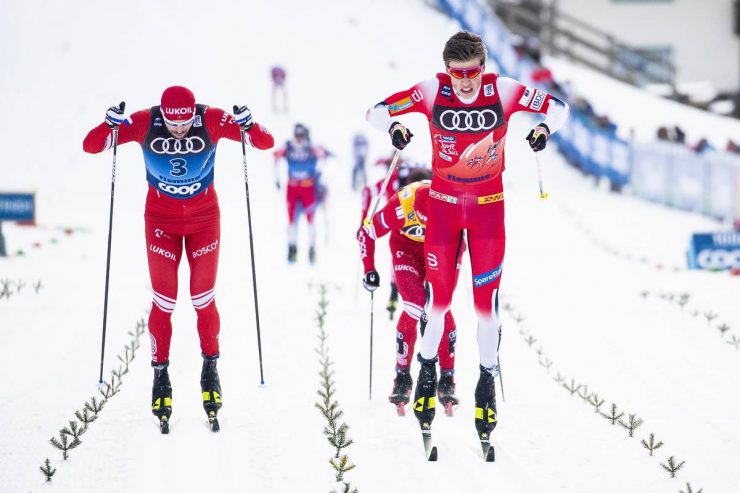
    Russia’s Alexander Bolshunov notched his third podium of the season in third place, 4.64 behind Klæbo. He now ranks second in the overall World Cup, just behind Klæbo. Both men are still in the under-23 age category, signaling a potential changing of the guard on the World Cup.

    “In the final, the pace in the first lap was not that high,” Bolshunov, 20, told FIS. “In the second lap, Johannes and Federico were pushing hard. I wanted to stay close to the leading group. When they broke away I did my best to finish in third place.”

    Finland’s Ristomatti Hakola finished fourth (+5.39), France’s Richard Jouve fifth (+8.65), and Russia’s Gleb Retivykh sixth (+18.34) in the final.

    On Sunday, the World Cup will see a new winner as Klæbo is sitting out the 15 k freestyle interval start.

    Hamilton Just Misses Final

    After missing last weekend’s World Cups due to illness, the U.S. Ski Team’s Simi Hamilton qualified in 12th in Davos on Saturday and skated his way to the semifinal, after Sweden’s Peterson, who had been leading his quarterfinal, crashed coming into the final turn. Hamilton put in a little hop to get around Peterson’s skis and cruised to second behind France’s Renaud Jay in first.

    In his semifinal, Hamilton couldn’t quite find room to make the right moves in a hectic heat. He finished fifth, 1.84 seconds behind Hakola who won that semifinal, and ended up ninth on the day.

    “There is so much position changing between the first and second lap, and it definitely gets jammed up in places,” Hamilton said after. “But it’s what makes it super exciting every year. I actually felt really good the last few days training, but I really had no expectations on how I was going to do just bouncing back from a pretty nasty sickness last week. So I was excited to ski in the semifinals and end up top 10 today. I was definitely running on fumes in that semifinal, but I am psyched about everything coming up. I’m healthy again and that really helps.”

    “Simi, you could see that he still doesn’t have full energy back from being ill, but the fitness is there,” U.S. Ski Team Head Coach Chris Grover said. “So when he gets a little bit more glycogen loaded onboard, he’s going to be good.”

    Hamilton’s semifinal was a very fast heat; both “lucky losers” to the final came from his semifinal. Both Klæbo and Pellegrino had been in the first semifinal, and blew it wide open. The second semifinal was more competitive – all six of the racers matched Klæbo’s time from the other heat – so one spot or 0.44 seconds faster would have put Hamilton in the final six.

    “When you get people like Klæbo skiing a heat, it tends to get a little more strung out,” Hamilton said. “I bet a lot of people though that both lucky losers would come out of the first semi, but I think sometimes its kind of opposite. The more homogeneous the heat is, it’s usually faster because you constantly getting people changing leads and drafting, and the momentum keeps getting pushed pushed pushed.”

    Hamilton had thought he just might be able to slingshot into the top four in the heat, and thus into the final, but it didn’t happen.

    “It’s kind of cool knowing that we skied a really fast heat,” he said. “I was a little bummed going into the 180-degree corner on the second lap — I felt like I still had decent position. I didn’t have a lot of energy left, but I thought, all right, if I can just get a really good draft on the downhill and stay smooth in the finish, there’s a good chance I could get third or fourth. But Jouve kind of cut in a little bit on the left and just pinched me. There is always going to be scrappy skiing, so that is what makes it fun.”

    Harvey, Newell Out in Quarterfinals

    Both Andy Newell of the U.S. and Alex Harvey of Canada made the quarterfinals but failed to advance, finishing 21st and 23rd, respectively, at the end of the day. Both finished fifth in their respective heats: Newell finished 2.44 seconds behind Klæbo, who won his quarterfinal, and Harvey was 1.14 seconds behind his quarterfinal’s winner, Retivykh.

    Andy Newell (U.S. Ski Team) racing in the quarterfinals of the World Cup men’s freestyle sprint in Davos, Switzerland. He finished fifth in the heat for 21st overall. (Photo: Reese Brown/U.S. Ski & Snowboard)

    “I felt good in qualification, felt good in the heat, too,” Newell said. “I was really wanting to go on the inside on that last corner like Pellegrino, but [Jovian Hediger] fell in front of me, so it was kind of a bummer, but I was feeling pretty good. It wasn’t a great result but … I think without getting pushed so wide on that last corner I could have had a better finish. So yeah, next week.”

    Harvey ended up being in the fastest quarterfinal, but he couldn’t manage to get one of the lucky loser spots, instead finishing just outside in fifth in his heat.

    While Newell said he wasn’t able to take the line he wanted, Harvey said he simply chose wrong, and that was probably the difference between making the semifinals and not.

    “In the finish I should have gone left of Jouve,” Harvey said. “I was on his left — I kind of slowed down and went on the inside, and that gave [Norway’s] Emil [Iversen] the slingshot, so looking back that was a mistake, because I knew it was a fast heat. We were going fast the whole way, so I knew that top three or even four had a good chance of being lucky losers. I should have carried my speed and then I would have blocked the lane for Emil, but I am happy. It is a really short sprint and my speed is coming up now, so it’s good moving forward.”

    Canada’s Alex Harvey leads Sweden’s Emil Johansson during their quarterfinal in the World Cup men’s freestyle sprint on Saturday in Davos, Switzerland. Harvey finished fifth in the heat and Johansson was sixth for 23rd and 29th overall, respectively. (Photo: Reese Brown/U.S. Ski & Snowboard)

    The Davos course is not one that has always showed Harvey a lot of love in the past, so that was another reason to be happy with 23rd place.

    “I haven’t qualified here in four or five years so, yeah, I was really happy with the qualifier,” he said. “It was still a good day – two and a half minutes is too short for me. I need three and a half. And altitude is always hard — I have never been top 10 in a distance race here, so I am not expecting too much tomorrow. I always struggle at altitude but I will still go do the best I can.”

    Also for Canada, Julien Locke came close to qualifying, finishing 36th and just 1.07 seconds out of the top 30. Russell Kennedy finished 48th (+9.39 out of first), Knute Johnsgaard 52nd (+10.35), Jesse Cockney 54th (+10.83), and Devon Kershaw 63rd (+11.78).

    Also for the U.S., Erik Bjornsen finished 58th in qualifying (+11.12) and Patrick Caldwell was 108th (+24.04) after crashing on a sharp corner.

    Results: Men’s final | Men’s qualifier

  • Day 1 in Lillehammer: Halfvarsson is for Real, Harvey Places 10th

    Day 1 in Lillehammer: Halfvarsson is for Real, Harvey Places 10th

    Calle Halfvarsson of Sweden en route to his first World Cup win in three years, with a victory in Thursday's classic sprint in Lillehammer, Norway. (Photo: Fischer/Nordic Focus)
    Calle Halfvarsson of Sweden en route to his first World Cup win in three years, with a victory in Friday’s classic sprint in Lillehammer, Norway. (Photo: Fischer/Nordic Focus)

    Blue skies. The low, northern-latitude light basking Lillehammer, Norway’s storied tracks in a sublime wintery hue.

    That was only the setting for Friday’s 1.5-kilometer men’s classic sprint, the first stage of a three-day mini tour. The bucolic dreaminess was jolted by snow spraying off the backs of skis as the men charged up and down the three-hilled Lillehammer course.

    Sweden’s Calle Halfvarsson came to Lillehammer wearing the yellow bib as the overall World Cup leader. By race the race’s end, with sprinters coming in and out of sub-Arctic shadow, Halfvarsson took the sprint win in 3:31.83, securing his early season grip on yellow. It was the Swede’s second podium in the season’s early chapters. He placed second in the World Cup’s opening day classic sprint in Kuusamo, Finland, last Saturday.

    “I felt strong in the prologue and in all the heats,” Halfvarsson said during the post-race press conference. “I decided to go out of the track on the last climb because I had a better grip there. I think I am headed in the right direction. We will see tomorrow how things are.”

    Halfvarsson shared the podium with Norway’s Emil Iversen in second (+0.12), and Swedish teammate Teodor Peterson in third (+0.54).

    Ninety-eight men began the mini tour, setting off one by one during Friday’s sprint qualifier. From that initial 98, the field was culled to 30 skiers in the heats, 12 in the semis, six in the finals. And then of course there was one.

    Halfvarsson began the day the same place he finished it: he was the first qualifier in 3:28.44. He moved through the rounds placing second in quarterfinal two, and first in semifinal one where he edged Peterson by 0.10 seconds.

    Peterson qualified fourth, nearly six seconds behind Halfvarsson. Peterson then finished second in both his quarter and semi to advance to the finals, eventually placing third. “I’m satisfied with it, third is better than fourth and I feel like I tried my best in the final 100 meters but it didn’t work, though I’m still satisfied with the performance,” Peterson said during the press conference.

    Iverson’s route to the podium began with a slightly slower turn of pace; he qualified 13th in 3:37.39. Like Peterson, he, too, finished second in his quarter and semifinal. During the final, Iversen appeared to have been dropped by Halfvarsson’s fast skis, strong surge on the final uphill, and his double pole fury. A full 10 meters appeared to separate the skiers coming into the home stretch.

    “I always hope for a win, but second place is a good way to start the mini tour in Lillehammer,” Iversen explained when asked about his result at the press conference. “Being the best Norwegian of the day means I did a good job. The final was really fast. I tried my best on the final uphill, but Calle gained some meters and it was enough for him to win.” 

    Whatever distance there was between the eventual winner and Iversen was quickly diminished. Slotted right behind Halfvarsson, in the same lane, Iversen charged — eventually skiing onto the Swede’s tails a few meters from the finish. Iversen’s lunge for second place was a snazzy move; he swerved out and around Halfvarsson.

    Iversen was unable to better position himself for the finish by moving into the adjoining lane; by doing so he would have obstructed Peterson and risked obstructing him. The takeaway from Iversen’s burly finish should be a big warning shot to potential rivals: the young Norwegian can close seemingly insurmountable gaps with a frenzied finishing move.

    Of note, Norway’s Pål Golberg moved through the rounds with ease. Qualifying third and winning out until the final, Golberg’s sixth-place finish was cemented as soon as the starter’s gun fired. He snapped a pole at the start and did not receive immediate assistance from a coach for a pole replacement.

    Valjas, Harvey, Bjornsen Qualify

    Len Valjas racing in last weekend's classic sprint at the opening World Cup in Kuusamo, Finland. He missed the heats after placing 54th in that qualifier, but raced to 19th in Friday's classic sprint qualifier in Lillehammer, Norway. (Photo: Fischer/NordicFocus)
    Canada’s Len Valjas racing in last weekend’s classic sprint at the opening World Cup in Kuusamo, Finland. He missed the heats after placing 54th in that qualifier, but raced to 19th in Friday’s classic sprint qualifier in Lillehammer, Norway, before finishing 13th on the day. (Photo: Fischer/NordicFocus)

    Twelve North American men began the day’s race. Of those, only Canada’s Len Valjas, Alex Harvey, and U.S. Ski Team member Erik Bjornsen qualified for the sprint rounds.

    Valjas placed 13th overall after qualifying 19th (+10.24).

    Matching strides with eventual quarterfinal five winner Norwegian, Petter Northug, and last week’s 15 k classic winner in Kuusamo, Finland’s Livo Niskanen, Valjas initially looked posed to advance.

    “I felt good warming up for the quarterfinal so yeah, I was hoping for a little bit more today,” Valjas told Cross Country Canada, according to a press release, after the race. “But I had a lot of fun out there. I was skiing in the front for most of [my quarterfinal]. I don’t know, I felt really good and just got kind of boxed in coming into the finishing straight, so I jumped between the tracks, and it was just not enough, I couldn’t, or I needed a little more room to pass one more guy.”

    Valjas skied to third in his heat, only 0.19 seconds from advancing.

    It wasn’t an either-or affair with the Canadians. With Valjas easily qualifying, perhaps some of the pressure was off Harvey. On the phone after the race, Harvey was relaxed. He finished 10th overall for his first top 10 of the season.

    “The first thing I said to my tech after the quarterfinal was that this was mission accomplished today,” Harvey said. “I think there’s always a big break between 13th and 12th place for the bonus seconds.”

    For the mini tour, the overall standings after Day 1 are determined by taking a skier’s qualifying time and subtracting a time bonuses associated with their finishing place in the sprint. Harvey sits in 12th heading into the second day of racing — he received 13 bonus seconds for placing 10th on the day.

    Although satisfied, Harvey’s day could possibly have been even bigger. During his semifinal, just starting up the last of the course’s three hills, sprint winner Halfvarsson nearly skied over the tips of Harvey’s skis as he switched into the Canadian’s lane.

    “I was in good position following [Russia’s Sergey] Ustiugov, and I kind of saw the way he skied in the quarterfinal, I knew he would attack over the last bump,” Harvey said of his strategy moments before the impending Halfvarsson lane switch. “I was able to sneak in right behind [Ustiugov], but then Calle, he kind of changed tracks … His tails were pretty much on my bindings, or just in front.”

    Harvey had to pull up and lost his momentum.

    In an instant a gap opened Harvey was unable to close. After the semi, the jury issued Halfvarsson a yellow card for the move. Audible over the television broadcast feed moments after crossing the line, was Halfvarsson’s apology to Harvey.

    “It’s part of the game, it’s sprinting, it’s always tight, so there’s no hard feelings for me and Calle,” Harvey said of the incident.

    Other Canadians contesting the race were Canadian World Cup Team member Devon Kershaw who placed 42nd, Knute Johnsgaard (U25 Team) 51st, Bob Thompson (NTDC Thunder Bay) 52nd, Graeme Killick (World Cup B-team) 71st, and Andy Shields (NTDC Thunder Bay) 90th.

    On the American side, Bjornsen was the final skier squeaking into the rounds, qualifying 30th (+12.61).

    His quarterfinal was stacked with Halfvarsson and Norway’s new sensation, Johannes Høsflot Klæbo: these two skiers ran away with the heat, crossing the line nearly eight seconds ahead of the next-best placed skier. Bjornsen placed sixth in the heat and finished 24th overall.

    “I’m happy about the race and I’m happy about qualifying from the prologue, which I thought was good,” Bjornsen told FasterSkier in the mixed zone following his elimination. “I felt good through the race and I got some good double poling done”

    (Article continues below)

    https://www.instagram.com/p/BNhCjL3hBKV/?taken-by=sbjornsen&hl=en

    According to International Ski Federation (FIS) records, this is the fourth time Bjornsen has qualified for sprint heats and his first ever in classic technique.

    Adding to the accolades, Bjornson’s teammate and older sister Sadie Bjornsen qualified first in Thursday’s women’s sprint.

    “That was really great, we were talking about the hashtag #bjornsenbookends,” U.S. Ski Team (USST) Women’s Coach Matt Whitcomb said over the phone. “It was the joke around our athlete cabin this afternoon between the rounds and the qualification. They were first and 30th so that was pretty neat.

    “Erik has not qualified for too many sprints, but to qualify specifically in Lillehammer, in the lion’s den is quite impressive,” Whitcomb added.

    Andy Newell (USST) placed 47th in the qualifier. Newell explained in an email that he’s on the mend after fighting an elbow infection and recent cold symptoms.

    “I’m doing ok, but yes I have been fighting a cold for the past few days,” Newell wrote. “I took the last two days off completely from skiing but woke up this morning feeling ok so I made the decision to race. Despite not having any cold symptoms it was obvious that my strength and speed weren’t where they should be. It’s been a rough start to the season so far with the elbow infection before week 1 and then with cold this week. I’m not sure what the rest of the weekend will bring for me, but getting back to 100% will be the priority.”

    For the men, the mini tour features a 10 k freestyle Saturday and concludes with a 15 k classic pursuit on Sunday.

    Newell’s teammate Simi Hamilton (USST) followed him in 48th on the day.  

    “Definitely not the day I wanted out there,” Hamilton wrote in an email. “I’m pretty bummed with how I felt during the qualification, especially since I got my energy back after being sick for all of last week. But I think my body is coming around from illness and I’ve never historically raced super fast or felt great during the very beginning of the season. So I have confidence in knowing that I will feel better and better as the race year goes on.”

    Hamilton did mention his skis were solid. But Hamilton’s response in the email had more to do with his respect for his U.S. skiing peers than dwelling on where he’d like to be.

    “Although I didn’t walk away from the venue today with the race I had wanted to have, I was psyched to see our girls lay down some really fast qualifiers and was proud to watch them fighting with everything they had in the heats,” Hamilton wrote. “But I think the person I’m most proud of today is Erik [Bjornsen]. He’s one of the best classic skiers I know, and works incredibly hard day in and day out, and he deserved to score his first ever classic sprint points today. To be able to do that in Norway is especially noteworthy. It’s incredibly difficult to walk into the lion’s den here, no matter what the race, and I think this is a sign of things to come this season for Erik.”

    Other Americans contesting the sprints were Alaska Pacific University (APU) skier Eric Packer in 76th and Noah Hoffman (USST) in 89th.

    Results: Final Mini-tour standings (after Day 1)