From the FasterSkier archive — posts syndicated from athletes’ and coaches’ own blogs between 2004 and 2012, kept online as published. Current coverage is at fasterskier.com.
Johannes Hoesflot Klaebo (NOR), Emil Iversen (NOR), and Martin Loewstroem Nyenget (NOR), (l-r) during the final kilometers of the Olympic 50 k classic. (Photo: Vanzetta/NordicFocus)
A review of a recently published paper from Norway, “Long-term development culture for sustainable Olympic success: Lessons learned from Norwegian cross-country skiing” by Jacob Walther and Øyvind Sandbakk, is worth the time.
We’ve all heard enough about Norway. But this one simply cuts through some misconceptions, and it is worth the time to review. It strips away the mythology and gets back to what actually drives development and ultimately elite performance. Norway isn’t operating with better information. They’re more disciplined about applying what most programs already understand, and more consistent about what they refuse to do.
The paper addresses this immediately and directly. There is no “Norwegian method.” No magic interval session. No secret intensity zone you can implement and expect results. What they have is a system. And more importantly, a system built around their culture.
We tend to frame their success in physiological and technical terms. It’s not physiology, technique, health management, or mental health; they are all part of it, but they don’t explain the system. Most programs know early specialization is risky and inaccurate. Most coaches understand long-term development and the need to build training slowly and in phases based on training age. The difference is that Norway holds the line on it.
The elements are not new. Delay early selection. Encourage multi-sport participation, and integrate sport science into daily coaching. Invest in coach education. Treat athlete health as part of development, not something that gets in the way of it. The result isn’t just better elite athletes. It’s broader mass participation, more informed training, and a deeper pool of athletes and families engaged in the sport.
Norway’s Johannes Høsflot Klæbo won his first World Cup at 20, in the men’s 1.6 k freestyle sprint in Otepää, Estonia, in 2017. (Photo: Fischer/NordicFocus)
The paper uses Johannes Høstflot Klæbo as a case study. At 15, he placed 101st at junior nationals. Years later, he’s the most decorated Winter Olympian of all time. That’s a compelling outcome. But the value isn’t the result. It’s what the system expects and allows.
In most programs, that athlete gets filtered out early. In Norway, they stay in longer. That’s the point. This isn’t about identifying talent earlier and directing resources and opportunities at those. It’s about not eliminating talent identification too soon. That requires patience, cooperation among club programs, trust in the system, and a willingness to ignore short-term validation.
That’s where the Norwegian model sets itself apart. The turning point came in the lead-up to the 1994 Winter Olympics. Norway didn’t discover new physiology or invent new training methods. They organized themselves differently. They centralized expertise, embedded sport science into coaching, collected experience and training data across all Olympic Sports, and aligned the ski federation from the national team down to the club level.
Olympiatoppen sits at the center, not as a lab removed from the field, but as part of the training process. It doesn’t drive the system, but it informs and shapes it. That balance matters. Norway didn’t just add sports scientists. They used sports science to improve coaching. At higher levels, many coaches are trained in exercise physiology. That reduces misinterpretation and creates consistency over time.
Long-term development in Norway isn’t a slogan. It is intentionally implemented. It follows physiology. Peak endurance performance arrives in the late 20s, after years of consistent training. They don’t challenge that reality; they built their whole system around that reality.
You see that athletes stay in the sport longer, as evidenced by high-level FIS races in Norway. Hundreds of skiers are over 25-30 years old. They build general capacity before narrowing focus. Skill development has time and the room to engrain. Training isn’t rushed. Volume and intensity progress over years, not seasons. Junior results are not used as a sorting mechanism.
And this is where most systems break down. They say development matters, so select early and train accordingly. In Norway, youth championships are not selection events. They are part of the development process. The culture reinforces it. Clubs and schools coordinate so athletes can participate in multiple sports. Athletes regularly move across multiple ski disciplines. The recruitment base stays broad, and the system stays resilient.
Norway hasn’t eliminated selection; they’ve delayed it and minimized its consequences. That distinction matters. What gets labeled as “talent” at 14–16 is often early maturation, better support, or more exposure, not long-term potential. Norway avoids that trap by not falling into it. While many other systems double down on it.
Another principle sits underneath all of this: athlete health, physical and mental, comes before results. Training is managed for long-term progression. Training loads increase gradually over the years. High intensity is controlled, and low intensity dominates most of the training. The goal is adaptation over time, not accumulation in the short term.
The paper also points to emerging pressure on this model. Rising costs, shifting societal trends, increasing early specialization, and changes in team structures all push against it. These aren’t theoretical concerns. There are real pressures that can erode the system if they’re not managed.
Harald Oestberg Amundsen (NOR), Johannes Hoesflot Klaebo (NOR), and Einar Hedegart (NOR), (l-r) share the 20 k Freestyle Mass Start podium at the final World Cup in Lake Placid (USA) to end the 2025/2026 season. (Photo: Modica/NordicFocus)
So what carries over?
We can’t copy Norway. That misses the point. The lesson is alignment. Align incentives with long-term outcomes. Integrate sports science into coaching to improve the coach’s work. Build systems that allow athletes time to develop. And hold the line when short-term pressure starts to dictate decisions.
Many countries can point to a standout athlete. But if success depends on outliers, unusual resilience, unusual support, unusual talent, you don’t have a system. You have anecdotes. Norway produces depth, that is, the expectation and the standard.
There’s no secret session here. What they’ve built is a system that connects coaching and science, commits to long-term development, creates space for late progression, and maintains consistency over time. Not what they’re doing this week or next week, but what the athletes are doing ten years from now.
Help Support Our Olympic Coverage!
If you value the thoughtful work and access FasterSkier provides, please consider becoming a Voluntary Subscriber. Your support directly fuels our work to cover the people, places, and moments that make our sport special.
This coverage is made possible through the generous support of Marty and Kathy Hall and A Hall Mark of Excellence Award. To learn more about A Hall Mark of Excellence Award, or to learn how you can support FasterSkier’s coverage, please contact info@fasterskier.com.
LAKE PLACID, New York (March 21) — As the snow settled on Lake Placid and clouds began to dissipate over Mt. Van Hoevenberg, a growing sense that something momentous could happen permeated the crowd assembling for the last Sprint of the 2025-26 World Cup.
That something unusual would happen was assured. With the Sprint Globe already secured to Johannes Høsflot Klæbo, the golden-haired juggernaut would not be on the starting line – opting instead to rest his legs, and head, in hopes of defending his 12-point lead over Harald Østberg Amundsen in the Distance standings. By default, then, someone other than Klæbo would stand atop Saturday’s podium – a rare occurrence in a season where the Norwegian had already won 8 of 11 Sprints in commanding fashion. (Two wins evaded Klæbo due to falls; the third because he did not start in Oberhof).
Who would take his place? Ben Ogden, the Northeast’s homegrown favorite and the Sprint silver medalist in Milano-Cortina? Gus Schumacher, Ogden’s partner in the Olympic Team Sprint? France’s embattled specialist, Lucas Chanavat, who appeared on track to rival Klæbo during the 2023-24 season, who had seized the opportunity – and the win – after Johannes’ bobble in Davos last December? Ansgar Evensen (NOR), who had done the same in Drammen?
Or, perhaps, it would be Federico Pellegrino (ITA) – the 35-year-old elder statesman of the league; making his 344th (and penultimate) World Cup start, eyeing an 18th and final Sprint victory?
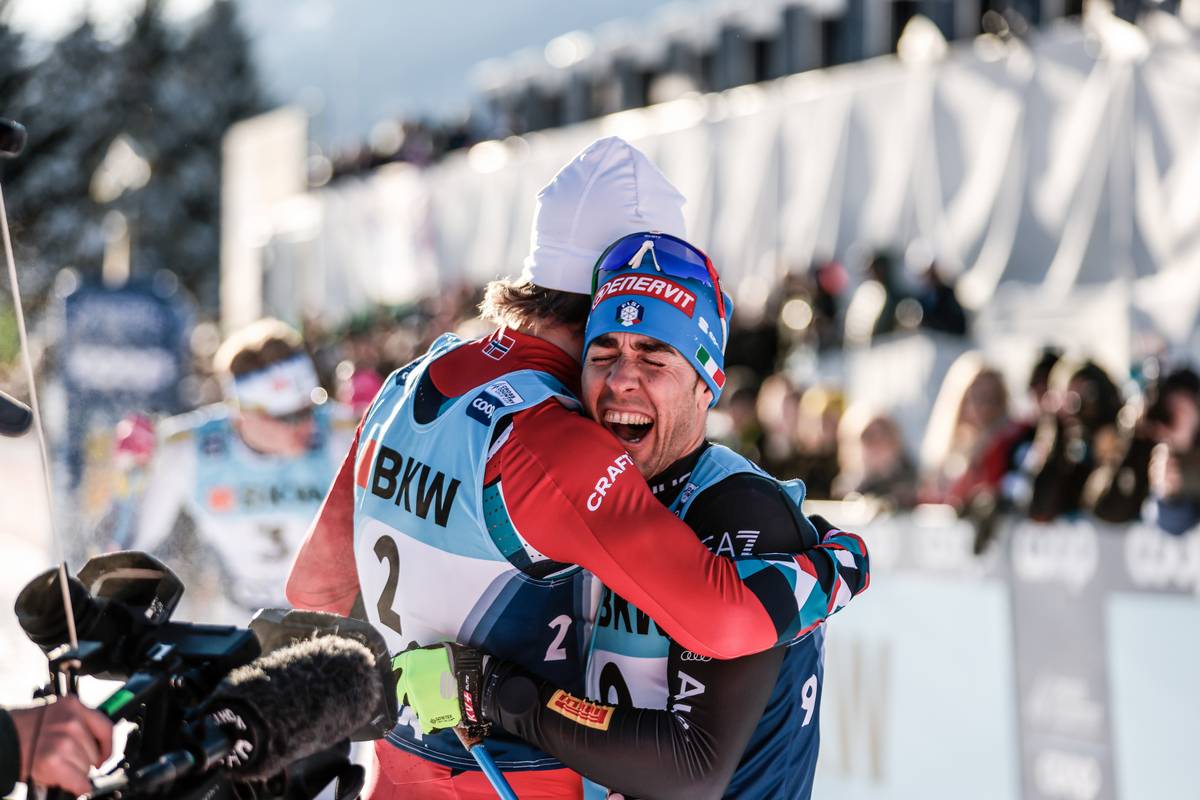
Johannes Hoesflot Klæbo (NOR) and Federico Pellegrino (ITA) after the finish of the Finals in Davos, 2022. Pellegrino bested Klæbo on the eve of the birth of his first child. (Photo: Nordic Focus)
It states the obvious to say that success in cross-country skiing is a matter of timing, and for “Chicco Pelle’s” 15 seasons, the timing had been just shy of right. The formative and final years of Pellegrino’s career were defined by the dominance of skiers other than he. Pellegrino made his World Cup debut in Drammen in March 2010, finishing 49th. The winner that day was Emil Joensson (SWE); runner-up was Petter Northug (NOR), then on his way to his first of two Overall Globes. These were the halcyon days in which Dario Cologna (CHE) descended from his Alpine fastness to rack up World Cup and Tour de Ski titles; when Northug, Joensson and Marcus Hellner (SWE) traded sprint victories and taunts in a bitter intra-Scandinavian rivalry. Pellegrino was 12th in his first World Championships Sprint (Oslo, 2011) and 11th at his first Olympic Sprint (Sochi, 2014).
While notching his debut victory in December, 2014 in the Davos Freestyle Sprint, Chicco’s break came in the 2015-16 season. He won 5 of 13 sprint races, becoming the first non-Scandinavian male to win the Sprint Globe. As Pellegrino hit his stride, Northug’s star was showing its first flickerings ahead of a dramatic waning, Joensson had entered the twilight of his career, and although Sergey Ustiugov (RUS) was approaching his own prime, the factious cast of World Cup sprinters was looking for a new leading man.
That man would not be Chicco. An upstart dramatist from Trondheim, Johannes Høsflot Klæbo, had arrived to script skiing’s long, and mind-bogglingly successful, next chapter. After making his debut in Drammen in 2016, Klæbo outscored Pellegrino in the 2016-17 Sprint standings, taking his first of 8 (and counting) Sprint Globes. The two went head to head at the 2017 World Championships in Lahti, Finland, where Pellegrino surged from behind to claim his first World Title ahead of a legendary lineup, including Ustiugov, Klæbo, and Northug, but this maiden gold would also be his last. In Pyeongchang the next year, the Olympic gold went to Klæbo; Chicco brought home silver.
The wins did keep coming for Chicco, including a tear of three consecutive Sprint victories and his second Sprint Globe in 2020-21. And, though they admittedly came in greater abundance to Klæbo (who, it should be noted, did not start in those races, or the 2020-21 Tour de Ski), it is rather glib to assert that Chicco’s career had slid “in[to] the shadow of” the Norwegian. Pellegrino bested Klæbo in Dresden and Lahti in the spring of 2018; in Lillehammer that winter; and in Davos in 2022. He was near-omnipresent on Sprint podiums and won his second Olympic silver in Beijing in 2022; moreover, he was among the very few men who could disrupt Klæbo’s dominance in the discipline, and the clear favorite when Johannes was absent.
But Pellegrino’s win in Davos in December 2022 marked the beginning of a long, and perhaps self-inflicted, World Cup drought. Chicco declared his intention to focus on distance races ahead of Milano-Cortina, and did indeed record four such podiums in classic, skate, and skiathlon formats, alongside a welter of Sprint podiums – including an ecstatic World Championships silver in Trondheim in 2025, and Olympic bronzes on home soil in the Team Sprint (alongside Elia Barp) and in the 4 x 7.5 k Relay (which he described as “the proudest day of [his] life!”) this February.
Elia Barp welcomes Federico Pellegrino to a bronze-medal finish in the Olympic Team Sprint in Milano-Cortina, February 18th, 2026. (Photo: Vanzetta/Barbieri/NordicFocus)
Outright wins, however, were not forthcoming. By the time March 21, 2026 arrived in Lake Placid, it had become Pellegrino’s last, best chance to secure one more Sprint victory.
Anticipation and emotions ran high. While Pellegrino had been impervious to the crowd in Friday’s 10 k Classic – earbuds deadening the world beyond his blue racing cap during warmups, and his face a deaf mask of exertion during the race – their excitement overwhelmed him on Saturday. During his first warmup lap, he skated calmly up the course’s A-Climb through a chorus of “CHI-CCO, CHI-CCO, CHI-CCO.” On his second, the frenzied chant began again, and the gravity of the impending race dragged him to a halt. His skis splayed wide against the pitch; he buried face in his hands. “The energies I got in the Final were coming from the warmup lap, where I stopped in the middle of the climb, crying,” Pellegrino told me at the finish line. “I think the public deserved this kind of show, and I deserved to finish my career, with a Sprint skate like this.”
Pellegrino embraces the crowd ahead of Sprint qualifying in Lake Placid. “The energies I got in the Final were coming from the warmup lap, where I stopped in the middle of the climb, crying.” (Photo: Thibaut/NordicFocus.)
To reach that final finish line, however, was a perilous journey.
After qualifying second, Pellegrino sidestepped two falls (the first from Jules Chappaz (FRA); the second from Elias Keck (GER)) in his Quarterfinal, moving from sixth to first in the course’s final descent and level hairpin. In Semifinal 1, he attempted to close on Lucas Chanavat (FRA) and Anton Grahn (SWE) through the crest of the A-Climb but couldn’t get by; pushed to the outside on the level hairpin, he was out-lunged by Lars Heggen (NOR) in the final meters, finishing third by 0.03.
While the Lucky Loser spot was Chicco’s to lose heading into Semifinal 2, Erik Johansson (SWE), Harald Amundsen (NOR), and Even Northug (NOR) lost time playing for a slipstream position as they approached the top of the A-Climb. Pellegrino was on to the final by a comfortable margin.
Lars Heggen (NOR) outlunges Federico Pellegrino (ITA) by 0.03 in Semifinal 1. Federico moved on to the Final as a Lucky Loser. (Photo: Thibaut/NordicFocus)
Once more around the track, and the day could be his. After being fourth out of the gate, he attacked from the outside on the B-Climb; breaking into an aggressive V-2 and taking Chanavat and Heggen by surprise, he moved into second behind Grahn. The pace increased again at the base of the A-Climb, but where Grahn and Chanavat’s broad frames moved up the hill in sweeping, powerful strokes, Pellegrino leapt into a furious V-1.
The move was decisive. To the adulation of the crowd, he opened a decisive gap through the crest of the climb. His lead only grew through the final descent into the level hairpin, but Chicco was taking no chances. While Grahn and Heggen grappled for second behind him, Pellegrino hammered to the line, threw his arms wide and his head back, roaring with the crowd.
An 18th victory and 46th career podium, clinched.
Federico Pellegrino secures his 18th and final World Cup victory. Lake Placid, March 21, 2026. (Photo: Thibaut/NordicFocus)
What had happened in the Semifinal, when this triumphant last dance had nearly evaded him by three hundredths of a second? And what had changed for the Final?
“I could not do what I did in the Final, because the energies of the other athletes were still quite big,” Chicco admitted our post-race interview. “About the last downhill, I was not the same as the others. I am not, I know, but I have some different qualities, and if I could get quite good gap in the top of the uphill, then I knew that I could keep it until I end. This is what I did. This is how I loved to win all along my career – not wait until the last meter, but trying before.”
“Sometimes it happened, mostly before Klæbo came,” he laughed. “But today I was there, and I studied the best tactics in the end . . . the public here in Lake Placid deserves this kind of show, and I think we are all happy now.”
And, this was nothing short of “the best way” to end his journey. “I could not do different. In the end, the last four years have been strange. I didn’t focus so much on sprinting; I tried to discover my body in different fields. Sometimes I got really great feelings and performances, but then, to come back here . . . and to win in that way, I could not do more.”
Pellegrino after his final win. “I think the public deserved this kind of show, and I deserved to finish my career, with a Sprint skate like this.” (Photo: Thibaut/NordicFocus)One more podium for Federico Pellegrino, alongside Lars Heggen (NOR) and Anton Grahn (SWE). (Photo: Thibaut/NordicFocus.)
In 15 seasons, Pellegrino proved himself to be far more than a runner-up to those Swedish and Norwegian titans who loomed large over his early and later years. He had taken the Sprint Globe from the Scandinavians for the first time; outsprinted Klæbo, Ustiugov, and Northug in Lahti; perpetually challenged – and occasionally beaten – the greatest athlete in the history of the sport; and secured Olympic medals on home soil, alongside a team of up-and-coming Italians ready and eager to fill his boots. “I’m really happy that he finished his career with probably one of the best weekends for him so far,” Elia Barp (ITA) told me on Sunday. “I’m very happy for him; I’m very happy for the team. I think we have proved that we are ready to race without him – not only me, but a few other young guys are ready to try to take victories next year . . . [He showed] that it is important to keep fighting and try to be a good overaller as he was in the last years. And, now we know that it’s possible; everyone is human as us, and we can do that.”
To Chicco’s fans, that determination – to grapple with giants; to reinvent himself; to seize the final, perfect timing and a final, perfect victory – defined his career. But for Pellegrino himself, “the biggest memories will not stay about the races, but much more about the hugs I got from the teammates, from the coaches, even outside of Italy, from my family, from the people that love me – and not only when things went well; even when things were not going so well. I think this is something that sport teaches us; that in the end, it’s only a cross-country ski race, and life is different. That’s it. The hugs are something I will remember for my entire life.”
Pellegrino, the most popular man at Zig Zag’s on Saturday, March 21. (Photo: Lily Den Hartog)
At Zig Zag’s Pub on Saturday night, Pellegrino told this reporter’s associate that his win vindicated his decision to retire. On Sunday, soaked with rain and champagne and tears after his last World Cup race, he reaffirmed it:
“That’s it. I tried to enjoy today as well . . . I tried to give my best, as always, and it was good after the finish line; under the rain, it was special. But with the teammates and coaches and waxers celebrating this moment, it was good for me.”
“Now, I really need to stay with my family. They deserve this, and I need to give them a lot of time.”
Love Stories Like This? Help Keep Them Coming.
Feature stories like this one take time, access, and care to produce. If you value thoughtful storytelling and independent ski journalism, please consider becoming a Voluntary Subscriber. Your support directly fuels the work we do to cover the people, places, and moments that make our sport special.
“Grazie Papao!!” Team Italy was waiting at the finish of the 20 k Skate with champagne and a tribute to Pellegrino’s children and wife, Greta Laurent (ITA, ret.). (Photo: Thibaut/NordicFocus)
We had to take a break after our three-week Olympic sprint, but we’re back to catch up on a couple of weeks of World Cup racing.
Devon and Nat take a quick run-through of events in Sweden, Finland and Norway. We’ll be back after the marathons at Holmenkollen.
Reach us at devon[at]fasterskier.com and nat[at]fasterskier.com.
A reminder: This is a homegrown podcast done by two guys working long hours and late nights. We also paid real money to be in Italy for the Olympics. If you can, support the show and FasterSkier’s ongoing coverage with a voluntary membership.
Help Support Our Olympic Coverage!
FasterSkier had our own Nat Herz on the ground at the Olympics, which, to be honest, was a very big financial lift for us. If you value the thoughtful work and access FasterSkier provides at championships like this one, please consider becoming a Voluntary Subscriber. Your support directly fuels the work we do to cover the people, places, and moments that make our sport special.
This coverage is made possible through the generous support of Marty and Kathy Hall and A Hall Mark of Excellence A Hall Mark of Excellence Award. To learn more about A Hall Mark of Excellence Award, or to learn how you can support FasterSkier’s coverage, please contact info@fasterskier.com.
The Men’s 20 k Skiathlon gets underway in Falun, Sweden. (Photo: Authamayou/NordicFocus)
With fresh snow overnight and temperatures hovering just above freezing, it was the kind of conditions that keep ski technicians guessing and athletes second-guessing. A week removed from the Olympics in Italy, the World Cup resumed for the second day with a 20-kilometer Skiathlon on a course that rewards patience and punishes weakness.
And while viewers looked on, whether to witness something historic or something new, Johannes Hoesflot Klaebo won again.
Klaebo covered the 10 k classic and 10 k freestyle in 48:41.8, edging teammate Harald Oestberg Amundsen by 0.7 seconds and Martin Loewstroem Nyenget by 0.8 seconds in a Norwegian podium sweep. The victory extended one of the most remarkable streaks in modern cross-country skiing and tightened his grip on the overall standings and, maybe more importantly for the remaining season-long narrative, extended his lead in the FIS distance ranking for the Distance Crystal Globe.
The race was familiar and predictable, with Nyenget driving much of the pace, Amundsen staying close, and Klaebo remaining measured in the pack. When the decisive move came in the final sprint, Klaebo, once again, not only had the answer, but made it look easy.
“This was a tough one,” Klaebo graciously said on the FIS broadcast after the race. “I think Martin was very strong today. I think he was in the front almost for 20 k.”
Martin Loewstroem Nyenget (NOR) leads, Andreas Fjorden Ree (NOR), Johannes Hoesflot Klaebo (NOR), Harald Oestberg Amundsen (NOR), and the rest of the field at a frenzied pace at the beginning of the Men’s 20 k Skiathlon in Falun, Sweden. (Photo: Thibaut/NordicFocus)
Classic Leg: Bonus points that created a breakaway
The men opened with three laps of the 3.4-kilometer red course, climbing the Mini Mördarbacken each time. Conditions sat just above freezing, with fresh snow complicating the classic wax call. Athletes chose between traditional kick wax and zero-skis, the latter relying on a texture sanded into a softer base material underfoot.
The pace was honest from the gun. At 5.4 kilometers, where bonus World Cup points were on offer, Nyenget and Klaebo pushed hard, with Klaebo claiming the maximum 15 bonus points, followed by Nyenget and Amundsen. That acceleration fractured the field.
A lead group of Norwegians formed with Nyenget, Amundsen, Klaebo, and Andreas Fjorden Ree. Arsi Ruuskanen of Finland and Savelii Korostelew, competing as a neutral athlete, also managed to maintain contact. Behind them, a gap had opened to a chase pack led by American Gus Schumacher.
By the end of the classic leg, the leaders had established a gap that would prove decisive.
Martin Loewstroem Nyenget (NOR) continued to set a fast pace at the front of the Men’s Skiathlon. (Photo: Authamayou/NordicFocus)
The Exchange and the Mördarbacken
Transitions in a Skiathlon are rarely glamorous or decisive, but a skier can lose contact with the lead if they don’t stay calm. Amundsen executed a clean ski exchange and briefly looked poised to dictate terms once the field switched to the blue 5-kilometer skate loop.
That loop includes the full Mördarbacken, a long, layered climb that television struggles to do justice. The ascent, which parallels the ski jumping landing hill, builds in segments, steepening before easing slightly when it cuts across the slope, then rising again one last time. It is not just a memorable climb in name, but once you have skied it, you will never forget the ‘Murder Hill.’
Nyenget continued to press the pace up front. Klaebo, as he often does, sat tucked in, attentive and measured.
On the first lap of the skate course, the lead group remained six, with the four Norwegians, Ruuskanen, and Korostelew. By the second ascent of Mördarbacken, it was effectively a three-Norwegian affair with Korostelew, Ree, and Ruuskanen fading slightly and fighting to limit losses and eventually finishing fourth, fifth, and sixth, respectively.
Behind them, the chase pack raced for seventh.
Martin Loewstroem Nyenget (NOR), Johannes Hoesflot Klaebo (NOR), and Harald Oestberg Amundsen (NOR), (l-r) crest the second to last climb. (Photo: Thibaut/NordicFocus)
The Finish
With less than a kilometer remaining, the three Norwegians — Klaebo, Amundsen, and Nyenget — remained locked together. Nyenget, who historically has the least sprint speed, had done the bulk of the visible work, setting the tempo on both classic and skate sections.
At the top of the final climb before descending into the stadium, the trio jockeyed for position, no one wanting to lead only to be overtaken by those in the draft. Nyenget took the lead, but was predictably passed by Klaebo on the far side of the stadium, and at the line, it unfolded as it so often does, Klaebo easing up to wave to the crowd with Amundsen outsprinting Nyenget behind him.
“It was very hard,” Klaebo said during his post-race interview with FIS on the broadcast. “But at the end, I managed to keep up with [Nyenget] and managed to do a good last sprint at the end.”
The margins were small. The pattern was not.
Klaebo now has 12 consecutive victories across World Cup and Olympic competition. The last race he entered without winning was the final climb of the Tour de Ski, where he managed his effort to secure the overall title rather than contest the stage.
“To be honest, I don’t think I have a goal anymore for this season,” he said. “I think the main goal is completed, and now I’m just going to enjoy the last races and see how it goes.”
Gus Schumacher (USA) seemed to do the majority of the work at the front of the chase pack. (Photo: Authamayou/NordicFocus)
Schumacher: Fast Skis, Hard Hills
Gus Schumacher finished seventh in 49:38.6, 56.8 seconds behind Klaebo and spent much of the day managing a gap that opened during the classic leg and never fully came back.
The decisive acceleration came when the Norwegians lifted the tempo in pursuit of bonus points. Schumacher felt it immediately.
“In the classic, when it got fast, my kick was not great, so it was hard to fight for anything,” he said. “I was kind of just getting up the hills, but the pace was fast the whole time.”
He believed the separation was coming regardless.
“I think that gap was going to open at some point, no matter what,” he said. “Just because of how they were skiing from the start, mostly Nyenget, I think.”
Schumacher was on zero skis for the classic portion.
“I was on zeros. I think most people were on zeros,” he said. “Some people looked good, and I don’t know, there’s some variation there for sure.”
On the flats, he felt competitive.
“The gliding sections were great for me. My skis were really fast,” he said. “But the hills were tough.”
After the exchange, Schumacher exited the stadium aggressively and led the chase group for stretches on the first lap of the skate course. The leaders, however, continued to gain time on the full ascent of Mördarbacken.
Asked to describe the climb, Schumacher was more measured than dramatic.
“Honestly, compared to a lot of the other climbs they do, I feel like it’s not horrible,” he said. “I enjoy it partly because it’s not insanely long and it’s got some steps to it.”
That does not mean it is easy.
“It definitely climbs pretty far and has some steep parts,” he said. “But as far as big climbs go, that’s one of my faves.”
What does it demand?
“Same as other climbs,” he said. “Just fitness, technique, poise… the whole deal.”
Kevin Bolger (USA) during the classic leg, on his way to 36th place on the day. (Photo: Authamayou/NordicFocus)
Bolger: Boxed In Early, Fighting Back Late
Kevin Bolger finished 36th in 51:12.8, but his race was shaped early.
“It’s always hard to feel the pace when you start mid to back of the field,” Bolger wrote in an email afterward. “I’ve always tried to just relax, let the stringing out happen, and take the gaps where they form and make some jumps.”
He later learned from Gus Schumacher that the leaders had opened aggressively from the gun.
“I heard they started quite hard,” Bolger said. “So I think it was just a hot pace from the start and things just naturally spread out.”
For Bolger, the defining moment came within the first lap of the classic leg.
“Unfortunately, I got stuck behind Andrew Musgrave and went from mid pack to last after the first lap,” he said. “So it was a lot of work to catch back up after that.”
In a Skiathlon, that kind of early compression can cost dearly. Once the field stretches, passing becomes energy-intensive, and the leaders ease the pace.
The waxing decision, at least, felt clear.
“Waking up and seeing the fresh snow and the temperature around zero, it was clear it was going to be zeros,” Bolger said. “But you never know what the techs are mixing up in the truck. As you run out to the start, you look around to see what other people have under their skis.”
Bolger chose zero skis and was confident in the call.
“I went with zeros, and I was very happy with that decision,” he said. “Tim Baucom and I did some good testing and landed on zeros because they were running the best for me, and I was super happy with that.”
By the time the race shifted to the skate leg, the front group was already out of reach. Still, Bolger felt he had something left.
“I was really happy with my classic leg,” he said. “Even with getting stuck early and having to work to catch back up, finishing that classic leg with the energy I had, I knew I could put together a good skate.”
The full Mördarbacken climb on the blue loop remained the critical point.
“I think everyone knows when that massive climb is in the mix, that’s a very critical part of the course and a tipping point for a lot of people,” Bolger said. “If I can get up that hill with the group, I’m in. Once there’s separation, the chances of that coming back are small.”
He described the climb bluntly.
“She starts pretty gradually, and you feel confident at the bottom,” he wrote. “But she turns boys into men real quick, or men into boys quick at the top.”
In soft conditions, with lactate building, the final pitch can expose anyone.
“It’s hard to keep the legs moving when the lactate’s flowing,” he said. “It’s really hard to describe it, but that’s the best way to say it.”
JC Schoonmaker (USA) finding joy in the distance racing as he builds fitness and experience with the longer races. (Photo: Thibaut/NordicFocus)
Schoonmaker: Finding Value in the Distance
JC Schoonmaker finished 58th in 52:40.4, but the placement did not tell the full story of his day.
“The longer distance was pretty tough, but also fun to do that kind of race again,” Schoonmaker wrote afterward. “Even though it was a tough day and not my best race, I find a lot more enjoyment in a 20 k like that, where I’m 60th or whatever, than a sprint qualifier where I’m 35th. Cool to push yourself and ski in a pack.”
Falun’s Skiathlon rewards positioning and sustained pace more than sharp accelerations. For Schoonmaker, the takeaway was direct.
“Today shows me that I probably need to have a bit more pace to be competitive in these longer races,” he said. “Just overall need to be fitter and stronger than I am right now.”
He felt competitive through the classic leg, especially in tricky waxing conditions hovering around freezing.
“The conditions were a bit tricky for sure,” he said. “Whenever zeroes are in the mix as well as wax, it can be a little stressful.”
Schoonmaker chose kick wax rather than zero skis, a minority decision in the field.
“I ended up going on wax, and I think I was probably one of the only guys in the field to do that, so I was a bit nervous at the start,” he said. “But they worked great for me, and I think I made the right call.”
The transition to skate proved costly.
“I felt more competitive in the classic leg, had a bit of a blow up as soon as we switched to skating, and found my flow after a bit, but just lost too much time right after the transition there,” he said.
Then came the full Mördarbacken climb, twice.
“The Mördarbacken is a tough one, I think mostly because it’s just so long,” Schoonmaker said. “It has a lot of grade fluctuations, which I think is cool in a hill and a bit of a grind, but I like the way it skis.”
Other American Finishers:
Hunter Wonders – 47th place
Zanden McMullen – 61st place
Antoine Cyr (CAN) on his way to a top ten. (Photo: Authamayou/NordicFocus)
Canada: Cyr Inside the Top Ten
Antoine Cyr led the Canadian contingent, finishing 10th. It was a controlled race from Cyr, who held position through the classic leg and limited losses on the climbs during the skate.
Other Canadian Finishers:
Olivier Leveille – 53rd place
Remi Drolet – 54th place
Max Hollmann – 55th place
Sasha Masson – 66th place
Johannes Hoesflot Klaebo (NOR) charges for the win once again at the end of the Men’s Skiathlon in Falun, Sweden. (Photo: Authamayou/NordicFocus)
The Larger Arc
Falun is more than just another stop as it will host the 2027 World Championships. It is also a venue that rewards discipline. The gradual terrain away from the stadium invites packs, and the big climbs around the ski jumping hill expose any fitness weaknesses.
For Klaebo, it was another example of restraint followed by precision.
He leads the overall standings. He leads the sprint standings. The distance standings remain mathematically contested, but days like this narrow the space for drama as we move towards the final races.
After sweeping the Olympics, one might have expected a pause, yet there has not been one.
In Falun, the snow was fresh, the wax calls uncertain, and the climbs unforgiving. The result, however, was familiar.
And with three weeks remaining before the World Cup finale in Lake Placid, what now remains is not a question of whether Klaebo has delivered a historic season, but how complete it might become.
Feature stories like this one take time, access, and care to produce. If you value thoughtful storytelling and independent ski journalism, please consider becoming a Voluntary Subscriber. Your support directly fuels the work we do to cover the people, places, and moments that make our sport special.
Norwegians Harald Oestberg Amundsen, Johannes Hoesflot Klaebo, and Martin Loewstroem Nyenget (l-r) share the Men’s 20 k Skiathlon podium in Falun, Sweden. (Photo: Authamayou/NordicFocus)
This coverage is made possible through the generous support of Marty and Kathy Hall and A Hall Mark of Excellence A Hall Mark of Excellence Award. To learn more about A Hall Mark of Excellence Award, or to learn how you can support FasterSkier’s coverage, please contact info@fasterskier.com.
Johannes Hoesflot Klaebo (NOR) continues his march on a most historic season in Falun, Sweden. (Photo: Authamayou/NordicFocus)
Six days after the Olympic flame dimmed in Italy, the World Cup caravan reassembled in Falun, Sweden, at the Lugnet cross-country ski center. The Mördarbacken — the famed “murder hill” — still looms over the stadium, waiting to torture the athletes tomorrow. The snow was fast, and the sport’s most dominant man arrived with something bordering on the unthinkable within reach.
Johannes Hoesflot Klaebo had already swept the Olympic program: six races, six gold medals. He had already conquered the Tour de Ski. He leads the sprint standings. He leads the distance standings. He leads the overall.
In Falun’s Freestyle Sprint, he resumed his campaign as if nothing had interrupted it.
And to no one’s surprise, Klaebo won again.
The victory — tactical, controlled, clinical — pushed his streak forward and kept alive the possibility of something the sport has never seen: a season in which one athlete claims the Olympic sweep, the Tour de Ski title, and all three FIS World Cup Crystal Globes.
“So interesting watching Klaebo,” FasterSkier’s John Teaford observed. “In the semi, he had Chanavat in front, so Klaebo went wide to force him into the lead. In the final, Chanavat was already there, so Klaebo took the inside to shut down Heggen. He’s racing, everyone else is just reacting.”
On a course where lane choice and downhill drafting often matter more than raw power, Klaebo once again skied as if he had solved the puzzle in advance.
Johannes Hoesflot Klaebo (NOR) gets his quarterfinal started. (Photo: Thibaut/NordicFocus)
The Course That Punishes Hesitation
Lugnet’s sprint track is deceptively compact — Klaebo won the qualification in 2:33.9 — but it rewards patience and punishes impatience. The downhill into the stadium is long enough to generate devastating draft effects; even if a skier has what seems like a wide enough margin out front, they often get swallowed up.
Lars Heggen, left off Norway’s Olympic team in favor of Oskar Opstad Vike, skied with visible urgency all afternoon. He had qualified 26th but surged through the rounds, eventually finishing second behind Klaebo in the final. Vike, the Olympic bronze medalist in the Classic Sprint, failed to advance to the finals.
In a Norwegian program that might be the deepest in skiing history, the margins remain ruthless, and the storyline between Vike and Heggen will continue throughout the rest of the season.
Gus Schumacher (USA) during qualification. (Photo: Thibaut/NordicFocus)
Schumacher: Six Olympic Races, Then a Movie Theater
If Klaebo’s season has been relentless, Gus Schumacher’s has seen both uncertainty and excellence. Schumacher was the only Olympic racer besides Klaebo to start all six events in Italy, culminating in the 50-kilometer classic last weekend.
His recovery plan for Falun?
“I was just chilling,” Schumacher said afterward. “I didn’t ski Sunday or Monday. Tuesday, I went skiing for a little bit, but I wasn’t too stressed about the training. The biggest thing was just not doing too much.”
He went to a movie theater on Tuesday night.
“Just kind of like doing sort of normal life things,” he said. “Helped with recovery for me.”
There was no urgency in his tone, no sense of chasing something lost. Instead, he described an emotional decompression that many Olympians quietly experience.
“All week it’s been a little low,” he admitted. “Today was just nice to go out and race.”
Schumacher advanced cleanly from his quarterfinal, but the semifinal unfolded differently. His start, he acknowledged, hasn’t been historically a strength.
“My start has never been that fast,” he said. “So for me to get into a top-four spot early on is hard. I was kind of relying on gaps to open up.”
But they didn’t.
“The pace was kind of too high, or it was too wide or both,” he said. “I really should have just pulled up a little bit, embrace sixth until the finish, and then gone fast there.”
He missed a lucky loser qualification by three-tenths of a second.
“I’m not super happy with it,” he said. “But the quarterfinal was nice.”
After the emotional volatility of the Games, including a crash in his opening race, a silver medal in the team sprint with Ben Ogden, Schumacher’s energy felt steadier in Falun.
“I wouldn’t say I’m digging deep,” he said. “I think I’m just enjoying the ride.”
After an Olympic training block, Jack Young (USA) is back racing on the World Cup in Falun, Sweden. (Photo: Thibaut/NordicFocus)
Young’s Gamble
Jack Young arrived in Sweden with a different story.
He made the Olympic team but did not earn one of the four U.S. sprint starts in Val di Fiemme. Rather than chase race sharpness, he chose volume.
“I trained very hard for the two weeks leading up to Falun,” Young wrote us in an email after the race. “The theory was that my speed was really good and I needed a fitness boost to finish out the season well.”
This may have been a bit of a risk, but one Young was willing to take.
“I’ve never trained even close to this much volume this close to a World Cup sprint,” he said. “But it seems to have paid off.”
He did not miss race intensity.
“In fact, the two weeks of training were some of my favorite weeks of the winter.”
Young benefited from Filip Skari’s disqualification after he received a second yellow card of the season in the quarterfinals, advancing to the semifinals. There, the course’s tactical nuance intervened.
“I wanted to ski the corner really well, exit with speed, and hopefully overtake Vike and Ersson right before the course kicks up again,” he said. “I had too much speed out of the corner and passed Vike too early and lost the draft.”
The mistake was microscopic, but the consequence decisive.
“Today was hectic but fun,” Young said. “Really cool sprint racing.”
If there was a change in him, it was mental.
“This was probably the most locked in I’ve been for a World Cup semifinal,” he said. “I was ready to really race with those guys and try to beat them.”
For a 23-year-old navigating the narrowest margins in sprint racing, that shift may matter as much as fitness.
Kevin Bolger, who narrowly missed Olympic selection, qualified for the heats but was eliminated in a stacked quarterfinal that included Klaebo. (Photo: Thibaut/NordicFocus)
Bolger’s Return
For Kevin Bolger, the weeks surrounding the Olympics were heavier. Bolger narrowly missed selection for Milan-Cortina, and the emotional toll was real.
“I mean — at the beginning, life sucked,” he said. “It feels like everything is against you and that I was wronged.”
He had been to the Olympics before — in Beijing — and that perspective helped, but it did not soften the blow.
“It still really sucked and hurt a lot,” he said.
Bolger’s response was simple: train.
“My motivation was training through that period and hopefully be able to attack these last World Cup weekends. And of course pour my energy into Maja and do what I could to help her get some medals.”
By the time Falun arrived and the World Cup season got restarted, Bolger felt ready. He knew his quarterfinal would be stacked — Johannes Klæbo among those in the heat — and expected the pace to be high.
“I was prepared for that,” he said. “I felt great and was mentally ready for the pace.”
But on a course like Falun — fast, tactical, draft-dependent — ski speed can decide everything.
“I don’t think I had the most competitive skis in my heat,” Bolger said. “So on a fast tactical course, it’s a bit of an uphill battle. I was hoping to catch the draft coming back to the stadium, but the skis didn’t seem to be running as I’d hoped. But that’s life, and we move on.”
Bolger did not struggle to keep pace with the athletes racing in Val di Fiemme.
“It’s not that hard,” he said. “I had a few weekends of racing to help keep the sharpness going and the shape. It always seems to get better when you can actually just get back into a good training routine. And right now I feel like I’m in a great place and just happy to be racing back in the heats.”
Johannes Hoesflot Klaebo (NOR) climbs one of the sprint course hills in front of the Swedish fans in Falun, Sweden. (Photo: Authamayou/NordicFocus)
The Stakes Beyond Saturday
Klaebo’s victory further tightened his grip on the sprint and overall standings.
The distance globe remains mathematically alive, though narrowing. The sprint globe appears close to decided, and the overall lead, barring collapse, is substantial.
What remains compelling is not merely whether Klaebo will win, but whether he will complete something approaching total seasonal dominance.
Johannes Hoesflot Klaebo (NOR) once again makes it look easy during his win in Falun, Sweden. (Photo: Authamayou/NordicFocus)
After the Olympics, and the understandable fatigue that would be a result of winning gold in all six races, you might expect Klaebo to take some time off from the World Cup… he did not.
Klaebo moves forward, and what awaits in Lake Placid, where fans will gather to celebrate the close of the season and Jessie Diggins’ final World Cup start, is the possibility of witnessing something the sport has never seen: a Tour de Ski title, an Olympic sweep, and three Crystal Globes claimed in a single winter.
In a season already defined by dominance, Klaebo is now skiing toward something that would endure long after the snow melts.
Feature stories like this one take time, access, and care to produce. If you value thoughtful storytelling and independent ski journalism, please consider becoming a Voluntary Subscriber. Your support directly fuels the work we do to cover the people, places, and moments that make our sport special.
Lars Heggen (NOR), Johannes Hoesflot Klaebo (NOR), and Benjamin Moser (AUT), (l-r) share the Freestyle Sprint podium in Falun, Sweden. (Photo: Authamayou/NordicFocus)
This coverage is made possible through the generous support of Marty and Kathy Hall and A Hall Mark of Excellence Award. To learn more about A Hall Mark of Excellence Award, or to learn how you can support FasterSkier’s coverage, please contact info@fasterskier.com.
The season has been long, and many World Cup competitors are struggling gamely to hold it together. Many surprising results and developments were witnessed in Lahti, Finland’s World Cup Freestyle Sprint, though top contenders—Johannes Hoesflot Klabo and Kristine Stavass Skistad—were able to achieve the victories. (Photo: Modica/NordicFocus)
The World Cup season has definitely gotten long, and the edges are beginning to fray. The FIS World Cup points system favors those who race the most, but the season is just too long, too challenging, and filled with too much travel for most skiers to make it cleanly and handsomely to the year’s end. Cross-country skiing is an exhausting sport—nowhere more so than for competitors in the FIS World Cup. Over the weekend at the Lahti Ski Games, some of the very best among World Cup contenders are beginning to appear a bit ragged.
With Jessie Diggins (USA) failing to qualify for the Sprint heats, Linn Svahn (SWE)—Digggins’ primary rival in the race for the season-long World Cup Overall crown—seemed poised to make up serious ground in their season-long race. Ironically, Svahn—who dominated Sprint events through the first half of the season—appeared decidedly un-sprinty today, finishing fourth; good enough to eat into Diggins’ points lead, but not with as big a bite as Svahn might’ve hoped.
“It’s not a secret that we missed the glide this weekend in a way that critically impacted results,” commented Diggins. “But it’s important to know that everyone is working their hardest, doing the best they can in each moment and ready to learn and improve. Today was heartbreaking in the moment for me, but also a chance to learn and improve on how to deal with a really tough day. My focus doesn’t change from how I handle a good day; I evaluate the race, take lessons and notes on it and then move forward.”
Hoping to translate her fast qualifying into additional points in the race for the Overall World Cup, Frida Karlsson (SWE) veered radically in the last turn before the finishing straight thus impeding Julia Kern (USA). As a result, Karlsson found herself disqualified from the quarterfinals. Kern’s quarterfinal result was moved up to third, though the time she lost behind Karlsson’s erratic maneuver may have prevented Kern from advancing as a lucky loser.
“What happened today has been happening a lot this season,” said Kern. “And it’s been super frustrating because the opportunity to advance can’t be given back. I know what I’m capable of, I know that my fitness and tactics are there, and I always try to ski a fair race. But in these situations, I can’t show that because I’ve been getting tangled up so often with certain athletes, making it impossible to advance. I think the Jury made the right decision today and that hopefully this sets a precedent for what is and is not clean and fair racing. I am believer that sprint racing should be aggressive and tactical, and yes, there will be crashes and tangles, but those are “race incidents” and part of racing. However, race incidents and deliberate maneuvers to obstruct other athletes are two separate things and I hope the Jury will continue to protect the fairness of the sport.”
Jonna Sundling (SWE) seemed determined to follow her race-from-the-front strategy that has seen her achieve remarkable success of late, but her Norwegian rival, Kristine Stavaas Skistad feasted on that strategy with a well-timed draft on the final downhill in their early heat—a strategy Skistad would continue to follow in the final, where she won easily over Maia Dahlqvist (SWE) in third and a remarkable Coletta Rydzek (GER) in second.
In the Men’s competition, Johannes Hoesflot Klaebo (NOR) and Lucas Chanavat (FRA) continued to prove that they possess more speed and tactical acumen than their rivals, finishing first and second on the day. Behind them came the career-best finish of third-place Valerio Grond (SUI).
Other regular Sprint contenders were not so fortunate. Erik Valnes (NOR) fought his way through a complex quarterfinal in which he had languished in the rear after an angry tangle with Michal Novak (CZE). Valnes has raced and raced and raced in pursuit of the Sprint and Overall rankings. It’s possilbe that such a come-from-behind necessity depleted Valnes, as he was eliminated in the subsequent semifinal. Though having possibly the best season of his career, Valnes continues to lose ground in both season-long contests.
Havaard Solaas Taugboel (NOR) became mired in mid-race crowding, finding himself eliminated in the quarterfinal. Federico Pellegrino (ITA) wove his way through a confusing semifinal to nip Joni Maki at the line; then Pellegrino seemed to have nothing left in the final. He finished fifth, again just ahead of Maki.
James Clinton Schoonmaker (USA) qualified 16th, and finished 13th on the day in Lahti. (Photo: Modica/NordicFocus)
Canadians qualified Sonjaa Schmidt (22nd) and Pierre Grall-Johnson (16th) into the quarterfinals, where each were narrowly eliminated. They would finish 19th and 14th, respectively. Americans qualified four into the quarterfinals (Julia Kern, Sammy Smith, Rosie Brennan, and JC Schoonmaker), though none found themselves able to advance. Even so, Americans can be proud of their results on the day: Schoonmaker earned the top result in 13th, Kern 16th, Smith 23rd and Brennan 25th.
“Today was tough!” said Brennan. “I was feeling the race from yesterday and we were definitely struggling with our skis on the salted snow. After a less than ideal week, I just wasn’t feeling my best self and I’m not good enough at sprinting to make it happen when I’m not at my best.”
On-air commentators remarked that American skiers appeared flat this weekend in Lahti, attributing it to recent trans-Atlantic travel and post-Minneapolis let-downs. The Americans do seem to be learning that the World Cup season is long . . . and that the season does not conclude after the echos of loud cheering have faded in Minneapolis.
“[I] made a mistake going into the last hill by not owning my space and I got kind of swarmed by the other guys,” said Schoonmaker. “That’s a little frustrating but hopefully can learn from it. The conditions on the course were great. The snow held up really well which was nice because I was definitely a little worried we were going to have a slush party out there.”
Kristine Stavaas Skistad (NOR) bested her Swedish rivals throughout the day in a show of dominance in Lahti’s World Cup Sprint Freestyle. (Photo: Modica/NordicFocus)
Women’s Freestyle Sprint
The Lahti Freestyle Sprint course curls its way around the base of Lahti’s famous ski jump, creating a course that is highly tactical: not conducive to aggressive pace setting, and rewarding those who can master the draft on the final downhill, and slingshot into the finishing straightaway. The first heat included Sundling, Skistad, Brennan, and Jasmi Jonssu (FIN). With Sundling in the lead, the heat was typically fast, though Skistad showed her understanding of the tactics by easil gliding up to Sundling in the draft provided by the final downhill.
The headline semifinal included Sundling, Svahn, and Skistad who again demonstrated her mastery of Lahti course tactics by gliding forward to pass the entire field, and coasting to the semifinal win. Surprisingly, both Svahn and Sundling skied poorly in the semifinal, but found themselves advancing as lucky losers.
Dahlqvist, Sundling, Svahn, Skistad, Joensuu, and Coletta Rydzek (GER) contested the Women’s Final in which Svahn went immediately to the front (the Swedes seemingly oblivious to the ins and outs of Lahti’s Sprint course tactics). Svahn was followed closely by Skistad, and trailed at a distance by Sundling who, uncharacteristically, sat at the rear of the field. The Swedes appeared to lack their usual speed and pop, finding themselves easily bested by Skistad who etablished a draft-thwarting gap on the final downhill, and coasted easily to the win. The Swedes also surrendered second place to a beaming Rydzek who achieved her first World Cup podium result. Dahlqvist captured third place, ahead of Svahn in fourth and Sundling in fifth.
The nature of Lahti’s course—favoring those who can accelerate quickly after the mid-course hairpin—made it appear unlikely that anyone would be able to best Klaebo. But Lahti’s Freestyle Sprint course is one that encourages alternative strategies, and many of those who are not as experienced may choose strategies that may confound those customarily found at the front. Klaebo found himself contesting a semifinal in which he was forced to race from the rear. Late in that heat, Chanavat chose a daring inside line on the final hairpin turn, skidding masterfully through the apex and stealing the lead for a moment before Klaebo shot past. The two dominant sprinters of the season advanced with counter-punching tactics and tremendous finishing speed.
Klaebo continues to be just plain amazing, having won the Team Sprint (with teammate, Paal Golberg) on Friday, then dominating the 20 k Classic Individual Start on Saturday (beating Classic specialist, Iivo Niskanen by 24 seconds). Then Klaebo shows up on Sunday showing absolutely no signs of fatigue to win the Freestyle Sprint. In the final, Klaebo baited Even Northug into taking the lead, then dusted him on the subsequent downhill to begin his surge to the finish line. Only Chanavat could come close to matching Klaebo’s speed as they coasted across the line first and second. Behind them, Valerio Grond (SUI) capped a career-best day by finishing third.
Team Switzerland piles on to the podium in celebration of Valerio Grond’s third place finish in the World Cup Freestyle Sprint in Lahti, Finland. (Photo: Modica/NordicFocus)
Welcome back to the Devon Kershaw show for our Tour de Ski stage 3 and 4 recap. We get into Frida Karlsson’s withdrawal from the tour after her egregious take-out of Jessie Diggins in Saturday’s classic sprint. We also cover Calle Halfvarsson and Joanna Hagström delivering for Sweden, Johannes Klæbo giving a couple of beat-downs, and Diggins’ come-from-behind win Friday.
We’ll be taping a mailbag episode next week — send us your questions at devon@fasterskier.com and nat@fasterskier.com. And happy new year.
Jessie Diggins goes down in her quarterfinal heat. Frida Karlsson (SWE) was penalized for obstruction, but the fall left Diggins in 3rd place overall in the Tour de Ski. (Photo: NordicFocus)
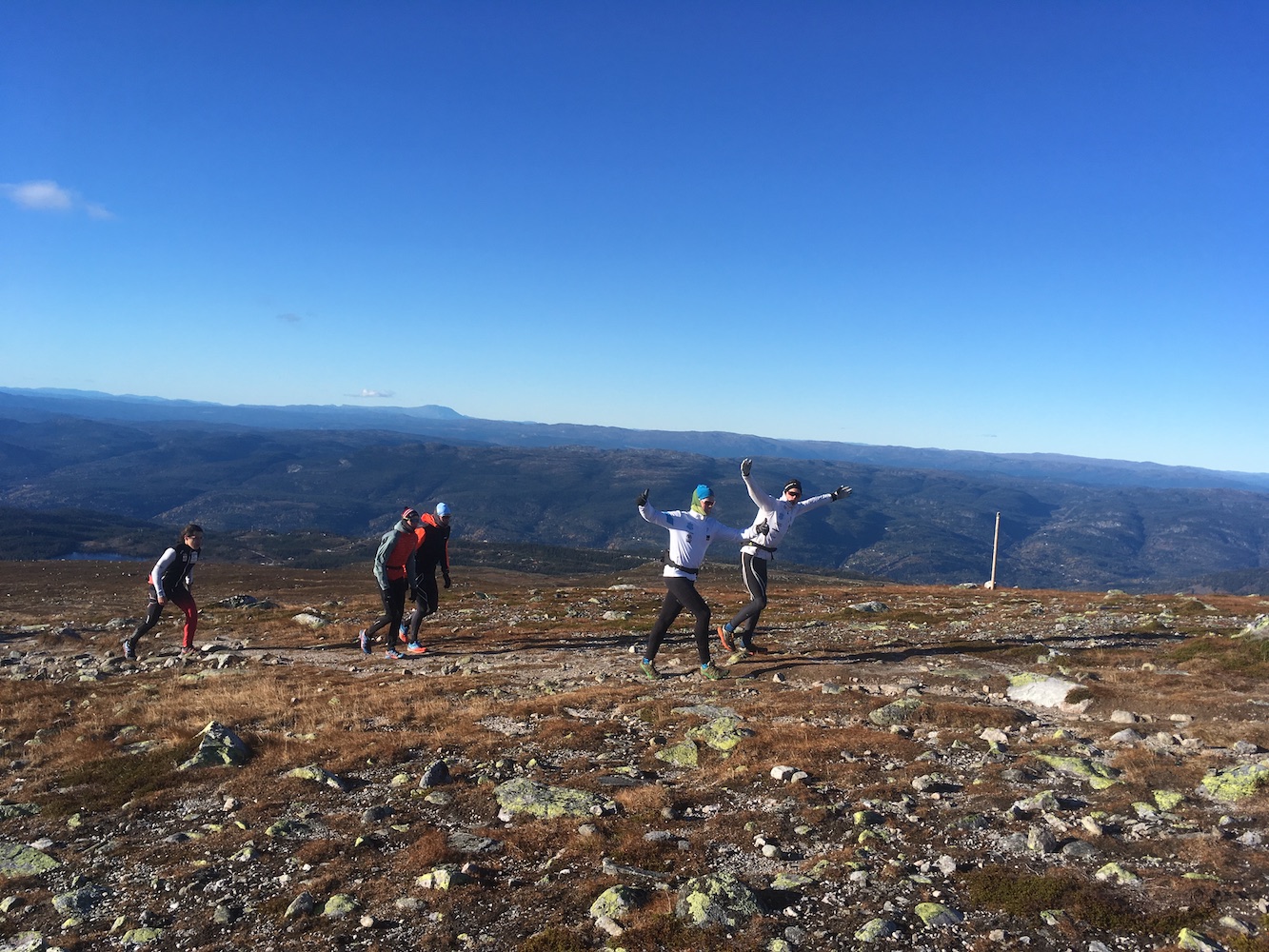
“Norwegian fjell running.” Team Asker doing some dryland mountain training during a training camp in Norefjell, Norway. (All photos: Maks Zechel)
Editor’s Note: The following is part of a series proposed by Maks Zechel, a 20-year-old Canadian cross-country skier embarking on his first season training abroad. In August, he recently made the big move to Norway, where he’ll be training and racing with Team Asker for the entire winter. Through these updates, Maks hopes to share his personal “observations, stories and lessons learned” to help close the gap between North American and Scandinavian nordic skiing. Previous posts: #1,#2,#3, #4, #5, and #6.
***
There is something about passion that drives people to push boundaries like nothing else. For many Canadians, this passion lies in hockey. If it’s January and you aren’t within walking distance of at least two outdoor hockey rinks, you probably don’t live in Canada.
I’ve never been a huge hockey fan, but regardless I still went through a phase as a 9 year old when I practised my stick-handling skills religiously, making marks against the garage door or the basement wall. Black marks and dented aluminum are the proud checkmarks of passionate Canadian youth (and the source of endless frustration for Canadian parents). Canadian hockey drives youth and even adults to fervently practice a sport that only a small percentage will ever play professionally. Even on a weekday night in the middle of winter, if you bring a stick and skates to any Canadian outdoor rink, you will be allowed to join a game of shinny. No matter your gender or age, whether you claim to have been a AAA hockey legend or have never skated before, whether your family has lived in Canada for generations or if you are a newly landed immigrant, Canadians are brought together by something that transcends sport.
National passion for a sport ensures that a large and diverse percentage of the population will actively pursue that activity in a multitude of ways. It encourages creativity and innovation. Similarly to hockey in Canada, albeit on a smaller scale, there are an astonishing number of Norwegian skiers who dedicate much of their time to just training and racing fast, even without sponsorships or national-team status.
This creates a field of close to 500 open men at the Norwegian national championships. In the 10-kilometer skate race at last year’s national championships, the top-100 racers were separated by 1:47.6 minutes, the top 200 by 2:33.2 minutes, and the top 300 by 3:31.7 minutes (note that the conditions were fast that day). The medal winners, and many of the skiers far off the podium, were World Cup, World Championship and Olympic medalists (Anders Gløersen won, Martin Johnsrud Sundby was second, Emil Iversen was 11th, Sjur Røthe was 32nd (full race results here). The depth of field at Norwegian and Scandinavian Cups and national-championships races rivals that of World Cup races, with many believing it to be more difficult to crack the top 30 in the aforementioned three than it is at most World Cups.
Team Asker skiers recover as they run down an alpine ski slope during 10- x 4-minute Zone 4 bounding intervals, with one minute rests in between, at a recent training camp in Norefjell, Norway.
The success that we see in the Norwegian senior ranks begins with Norway’s junior skiers, and I am lucky enough to be training partners with some of these top-level athletes. One of Team Asker’s most successful junior skiers, Harald, has two medals from last year’s Junior World Championships. To put his level of skiing into a senior-racing perspective, he was 26th in the previously mentioned 10 k race at the Norwegian nationals — as an 18 year old.
It can be deceptive to see skiers who still look quite young, but to know that they are already skiing fast enough to potentially crack the top 30 on a World Cup. I believe that much of this ability stems from the incredible amount of maturity in Norwegian junior racers, although not necessarily in the traditional sense. Not all of them are obsessive about the small things; I have seen top Norwegian skiers down two Cokes per day at training camps, eat Nutella for breakfast and stretch as little as possible. Their maturity becomes apparent in how they approach training and races, ready to learn to push their bodies in the best way that they can.
With more skiers, you see more body types and different minds. My teammates have told me to expect many funny styles of double poling when I race Norwegian and Scandinavian Cups this winter. Already at the junior level, skiers spend hours working on their double-pole technique, not just doing exactly what their coaches told them to do, but practising different movements and seeing how it works for them. Double poling is a simple motion, in theory, but with different body types you can have countless different styles of double poling that all produce the maximum amount of power for those individual skiers.
With Team Asker, we discuss technique with our coach and we do group-technique sessions, but then we are encouraged to try things out by ourselves and see how we can adapt those basics of power transfer to how our individual bodies work. The same goes with training plans. The spectrum of what type of training makes someone ski fast is all over the place, and that is something that many Norwegian skiers seem to accept. Some athletes on Team Asker disagree with certain things that our coach says, but they are not criticized for this and are supported in altering their training as they see fit, although they are encouraged to discuss why they are making these choices.
In Canada, I have often heard repeated “golden rules” to technique and training, things that are accepted by most coaches across the country. In Norway, I learn a new philosophy every time I speak to a different coach or athlete. For some skiers, it is important for them to train long and slowly in Zone 1 so that they have the energy to focus on interval workouts. Other skiers do short Zone 1 workouts, but push the workouts so that they are in high Zone 1 or low Zone 2, skiing closer to competition speed. Many skiers do sprints with every workout, even long runs, while others add sections of Zone 3 pickups in the middle of their easy workouts. I have a teammate who builds up to a period in the training season where he is doing 30 short sprints per day. I know Norwegian 16 year olds who are training more than 1,000 hours per year, but there are also World Cup skiers who are barely training 600 hours.
Team Asker finishing a combo rollerski/run workout at recent training camp in Norefjell, Norway.
Some people think that too much base training (slow Zone 1) is a waste of time, so they do the bare minimum that is required to be able to absorb intensity training and the long race season. Johannes Klæbo’s big breakthrough in the past couple of years is said to have come from an emphasis on strength and sprint training, while Petter Northug has long sworn by doing intervals in “myra” (spongy and uneven bog/marsh), but for some people, those same things will make little difference to their speed on snow. Talent may have helped them in the beginning, but whether it was Klæbo or Northug, they didn’t reach the top level through talent alone, but by perfecting all the things that make them fast.
There are skiers, some point to Therese Johaug, who many think could do almost any type of training, and they will be fast simply from general fitness, but for most people training is not so simple. Fortunately for us mortals there is no limit to what we can achieve, so long as we are willing to take chances and use our brains rather than just succumbing to that “training junkie gene” that so many skiers possess. Each one of us is so different, that it is not possible for us to do the same things and achieve the same results.
Over and over I have heard coaches and athletes, who go to Scandinavia for a few weeks to learn the “secrets” of the best skiers in the world, come back and confidently tell us Canadians that “they do the same training as us” and therefore we can be just as fast as them. I agree that we can be just as fast, but from my first three months in Norway, I can tell you that we do not train anything like the Norwegians. We may do similar bounding, rollerskiing and running workouts, but training in Norway is taken to the highest level by the competitive dialogue that takes place among young skiers, old skiers, back of the pack skiers, and top skiers. From my perspective, training innovation and experimentation doesn’t happen in North America on the same small scale level as it does in Norway.
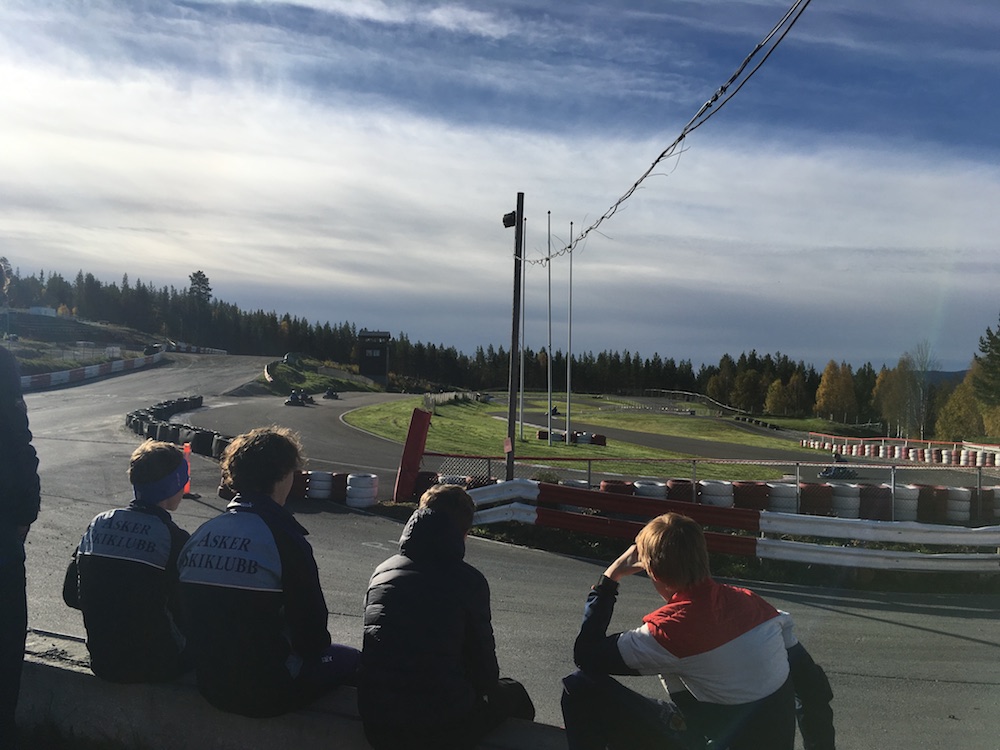
The go-kart track where Team Asker held “King’s Court” style rollerski skate sprints (8 x approximately 1:30 minutes) during a recent training camp in Norefjell, Norway.
In Canada we look to those that are better than us, whether they are national-team members or World Cup skiers, and try to copy them from afar. This puts us decades behind the competition. A lot of the technique innovations that we will see on the World Cup in the next two decades will have come from the Norwegian junior skiers of today, but by the time North American skiers take note of these changes, and adjust their training, the next generation of Norwegian juniors will already be working on the technique advances for the next decade.
When I first came to Norway, the first thing I did was try to copy how the best skiers on the team double poled. I copied them for 12 weeks, but every time I looked at video footage of myself, I still looked completely different. It wasn’t until my coach explained a miniscule timing difference to me that I understood what the others were doing differently. With the switch flicked, my double poling has improved because of things that I could not figure out just by watching others ski. It is this type of interaction, between skiers and coaches of all levels, that causes breakthroughs in technique. Not all club-level coaches in Norway look to the Norwegian national team for advice on all aspects of skiing. Many coaches disagree with the common consensus on technique and training, and this opens up the discussion which is so important to moving forward.
Most skiers love to talk about technique and the finer aspects of skiing, but when I was in Canada, I found these discussions usually revolved around what faster people were doing. In Norway I find myself having more discussions on what we individually think we should be doing, and even if someone is superior at a certain aspect of skiing, they are usually eager to try what someone else thinks might be better.
As “Mad-Eye Moody” from J.K. Rowling’s Harry Potter series would say, “Constant vigilance!” and adjustment are required in all aspects of our training if we want to succeed. We have to seek variation in training, and learn together to discover the things that make us go fast as individuals, or else we suffer individually under the repetition of uniform training that cannot meet all of our needs.
Norwegian Phrase of the Week:
Norwegian: “Jeg er ut å mate.”
Google Translate: “I’m out to feed.”
True meaning: “I am training a lot.” (slang)
Team Asker during a long run through the mountains at a recent training camp in Norefjell, Norway.
***
About Maks: Maks Zechel is a competitive cross-country skier who secretly wants to become a professional mile runner. He loves hiking and going on canoe trips with his family, as well as peanut butter cups in ice cream. Johan Olsson is his favourite skier and he hopes to race the Cortina-Toblach stage of the Tour de Ski one day. He enjoys writing about his experiences. Follow him on Instagram @makszechel.
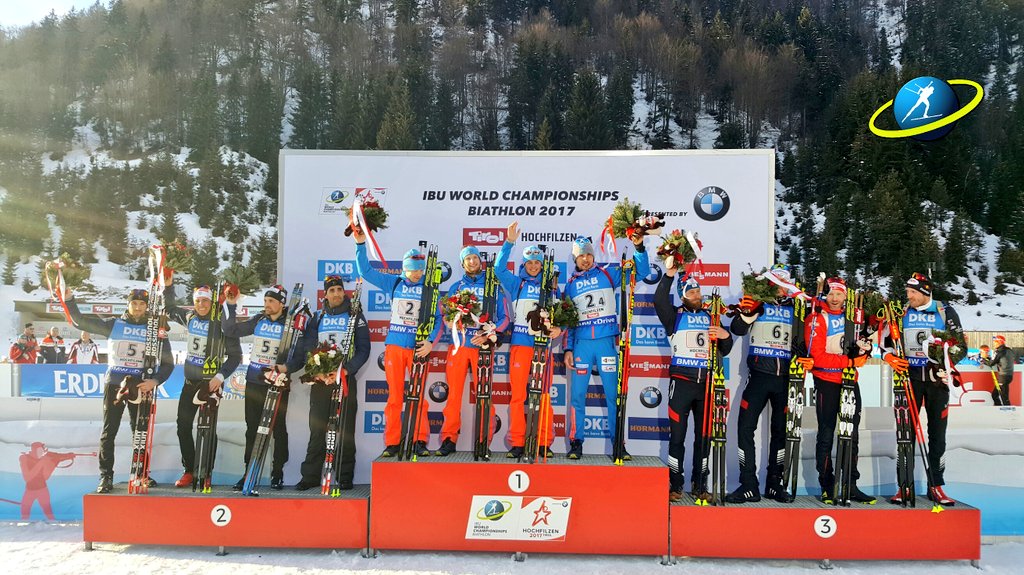
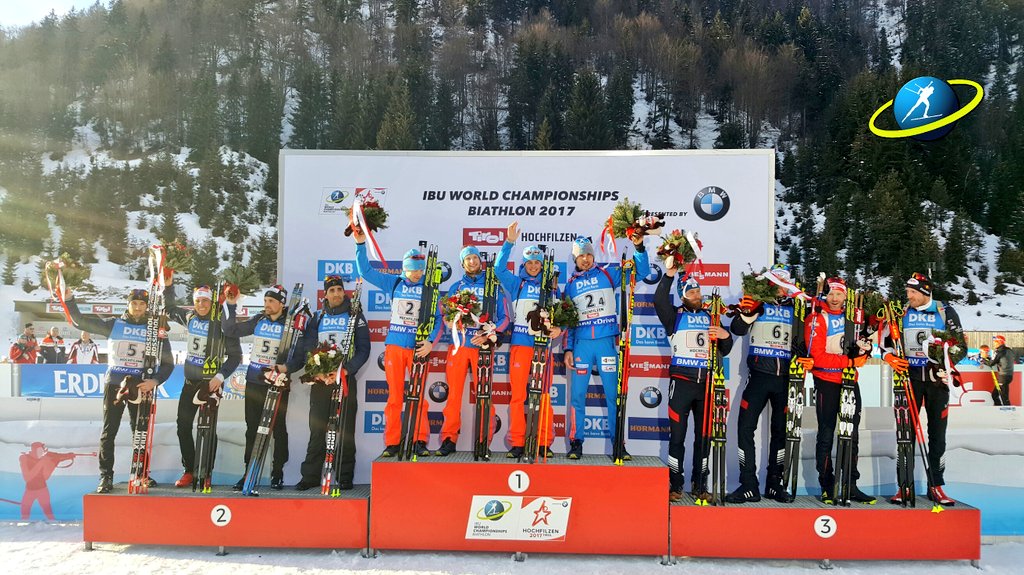
The men’s 4 x 7.5 k relay podium at 2017 IBU World Championships on Saturday in Hochfilzen, Austria, with Russia (c) in first, France (l) in second, and Austria (r) in third. (Photo: IBU World Champs/Twitter)
IBU World Championships (Hochfilzen, Austria): Men’s relay
[UPDATED] Russia’s four-man relay team hit nearly every target on Saturday, using a total of just three spares to clean 40 targets, and stayed out of the penalty loop to capture gold in the men’s 4 x 7.5-kilometer relay at the International Biathlon Union (IBU) World Championships in Hochfilzen, Austria.
It was the last team event and the second-to-last day of the championships, with the men’s and women’s elite mass starts remaining on Sunday. Anton Shipulin anchored the Russians to first, 5.8 seconds ahead of France’s Martin Fourcade, after Shipulin cleaned his prone stage and used one spare in standing to hold onto the lead his team built. Fourcade cleaned both stages to secure silver for his team, and Austria took bronze (+20.1) with anchor Dominik Landertinger.
After Russia’s Alexey Volkov used one spare in each of his shooting stages and came through the exchange in seventh, Maxim Tsvetkov and Anton Babikov both cleaned without any spares to bring the team into fourth, then first, respectively.
France’s first leg Jean-Guillaume Béatrix shot clean as well and tagged Quentin Fillon Maillet in second. Fillon Maillet then needed one spare in prone, but cleaned standing to take the lead, tagging Simon Desthieux in first. Desthieux used three spares in prone, but avoided the penalty lap before tagging Fourcade in third, 12 seconds behind Austria in second. Fourcade closed the gap and clinched second, and France combined for a total of just four spare rounds.
Austria achieved bronze in front of a home crowd with Daniel Mesotitsch, Julian Eberhard, Simon Eder, and Landertinger combining for 10 spares and no penalties.
Finishing 8.5 seconds after Austria, Germany placed fourth. Italy was a minute and a half out of first in fifth, Ukraine took sixth (+1:41.3), and the U.S. placed seventh (+1:50.5) with Lowell Bailey, Leif Nordgren, Tim Burke, and Sean Doherty. Bailey initially put the team in fourth at the first exchange, 12.4 seconds out of first, then Nordgren tagged Burke in sixth, 17 seconds behind. Burke used four spares to clean and tagged Doherty in seventh, about a minute back. The Americans used a total of eight spares but had no penalties.
Canada finished 13th (+3:35.5) with Christian Gow, Scott Gow, Macx Davies, and Brendan Green. They were 39 seconds out of first and in 12th place after Christian Gow’s first leg, then slipped to 14th before Davies moved them back into 12th by the last exchange. Canada had a total of 10 spares and zero penalties.
FIS Cross-Country World Cup (Otepää, Estonia): Freestyle sprint
In the last World Cup before the upcoming 2017 International Ski Federation (FIS) Nordic Ski World Championships next week in Lahti, Finland, five U.S. women qualified in the top 12 of the women’s 1.3-kilometer freestyle sprint, and Jessie Diggins reached the final on Saturday in Otepää, Estonia.
Diggins started the day by placing 12th in the qualifier, 3.93 seconds behind Sweden’s Stina Nilsson in first (and her U.S. teammates Kikkan Randall in third, Sophie Caldwell in fourth, and Ida Sargent in 10th) before winning her quarterfinal and semifinal. In the final, Diggins wad gapped by the leaders on the final climb and finished fifth (+6.82).
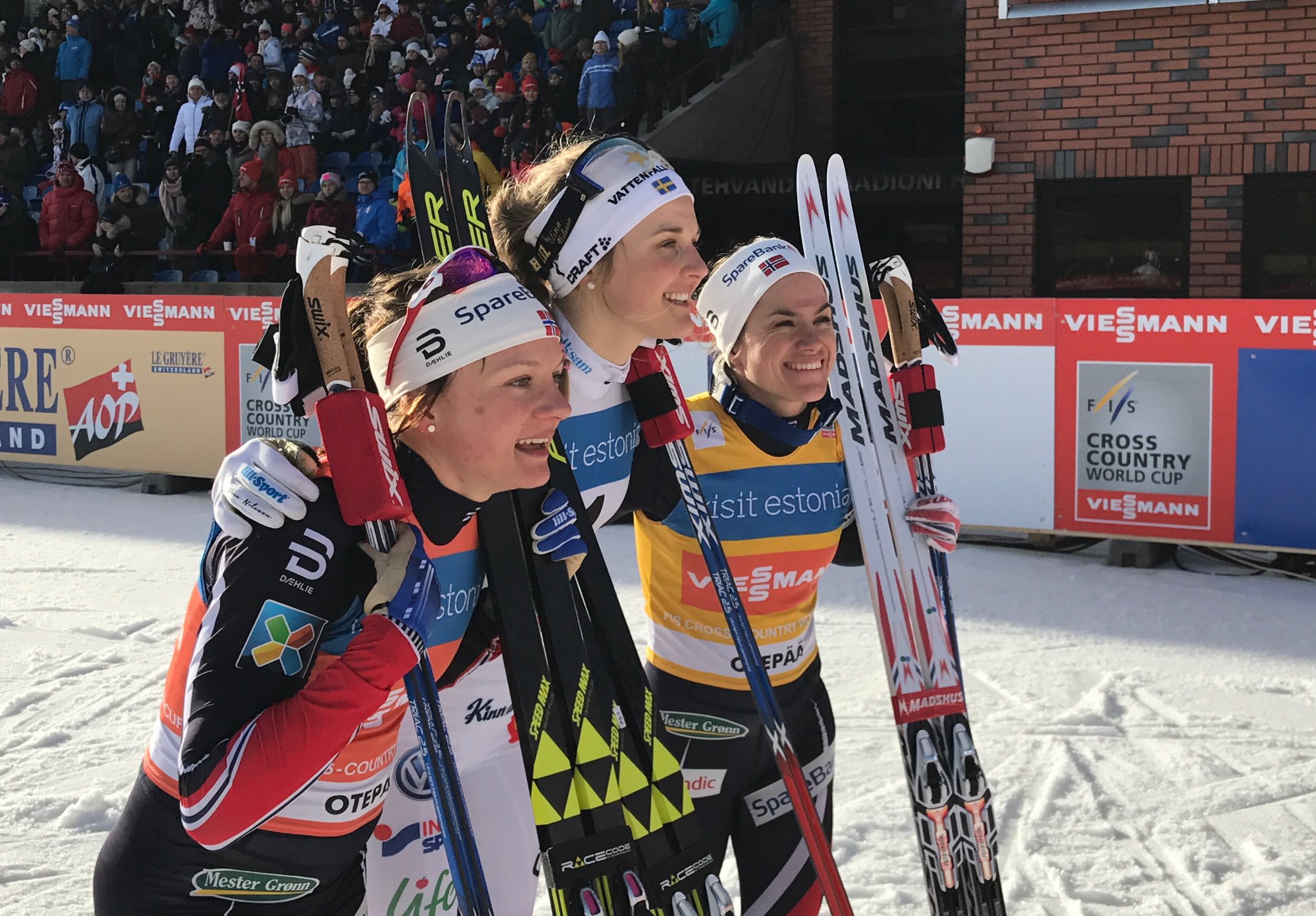
The women’s freestyle sprint podium at the Otepaa World Cup on Saturday in Estonia, with Swedish winner Stina Nilsson (c), Norway’s Maiken Caspersen Falla (l) in second and Heidi Weng (r) in third. (Photo: FIS Cross Country/Twitter)
Nilsson won the final in a time of 2:49.96 minutes, just ahead of Norway’s Maiken Caspersen Falla (+0.27) who lost her balance and her speed with it on the last corner. The two had broken away from third place and Nilsson led into the final straightaway and held Falla off for the win. Norway took second through fourth with Heidi Weng in third place (+3.75) and Astrid Uhrenholdt Jacobsen in fourth (+4.91).
Randall initially finished her quarterfinal in third position and would have been out, but advanced when Russia’s Natalia Matveeva was relegated to last for obstruction. In the same semifinal as Diggins, Randall fell cresting a small hill over a tunnel and finished fifth (+13.30) for ninth overall on the day.
Caldwellplaced second in her quarterfinal heat behind the day’s winner Nilsson, then stumbled halfway up a climb early in her semifinal, but stuck with the pack to finish fifth (+1.83) for 10th overall.
Sargent raced in the same quarterfinal as Falla and narrowly missed advancing to the semifinal in third place, fewer than 0.2 seconds behind Switzerland’s Laurien van der Graaff in second and 0.35 seconds behind Falla, who won that heat. Sargent placed 13th on the day.
Sadie Bjornsen qualified 25th and finished fourth (+2.82) in the same quarterfinal as Randall for the 25th overall.
Canada’s Dahria Beatty also qualified for the sprint heats in 30th place, and finished sixth in her quarterfinal for 29th overall.
Also for Canada, Cendrine Browne finished the qualification in 48th place and Katherine Stewart-Jones was one position behind in 49th.
Also for the U.S., distance specialists Chelsea Holmes and Rosie Brennan placed 58th and 60th, respectively.
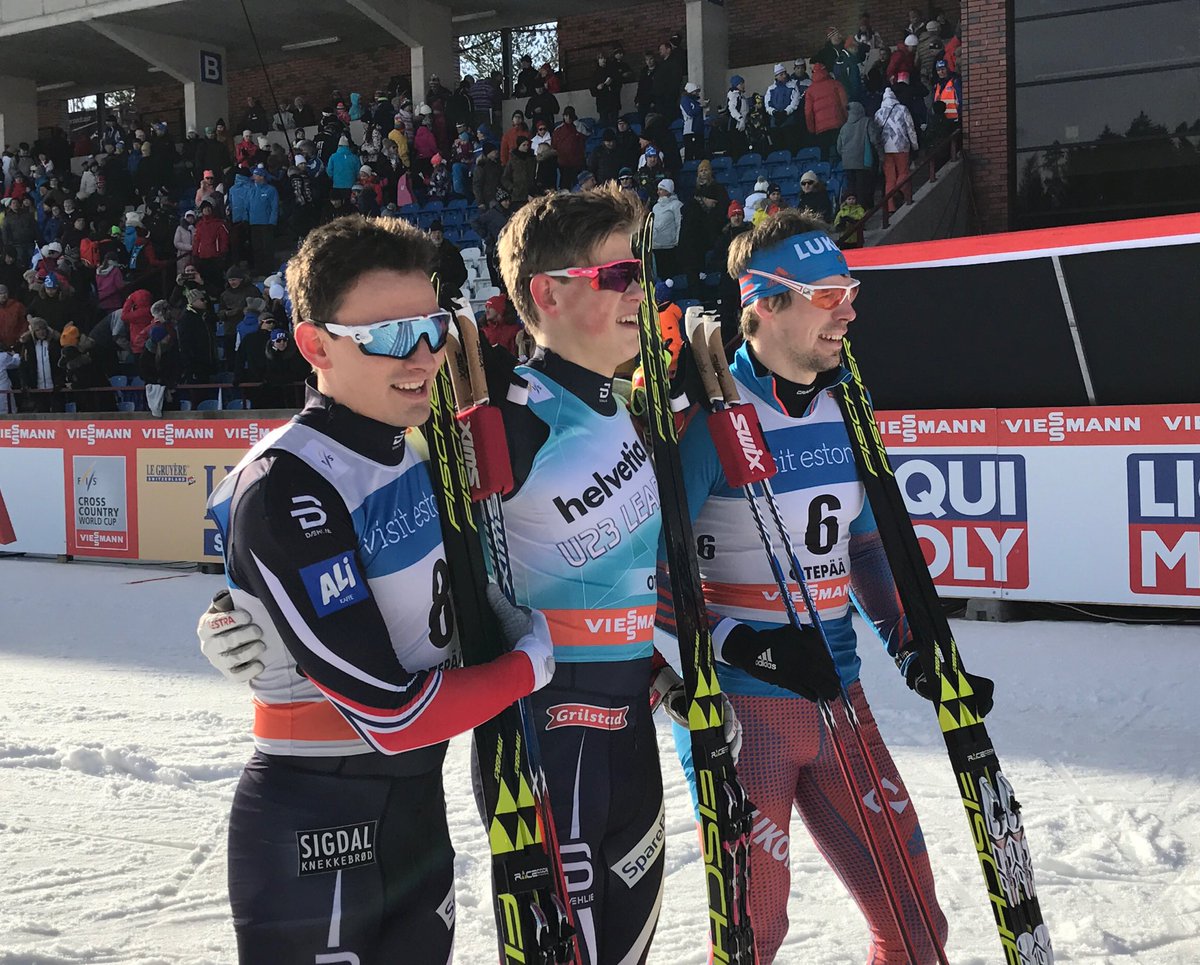
The men’s freestyle sprint podium on Saturday at the World Cup in Otepaa, Estonia, with Norway’s Johannes Høsflot Klæbo (c) taking his first World Cup win, Norway’s Finn Hågen Krogh (l) in second, and Russia’s Sergey Ustiugov (r) in third. (Photo: FIS Cross Country/Twitter)
In the men’s 1.6-kilometer sprint, Norway’s Johannes Høsflot Klæbo achieved the first World Cup victory of his career in a time of 3:06.53 minutes, holding onto a lead he had created with an attack right out of the start gate in the final. His teammate Finn Hågen Krogh placed second (+0.60), taking the inside lane in the last turn to push reigning Tour de Ski winner Sergey Ustiugov of Russia to third (+1.0).
For the North Americans, it was a day of narrow misses.
For the U.S., Simi Hamilton started his race day by qualifying in seventh position, and placed second in his quarterfinal. He then closely missed out on the final after placing fourth in his semifinal in a four-way sprint photo finish (+0.33), just 0.04 seconds behind the third place and lucky loser time of Norway’s Håvard Solås Taugbøl, who advanced. Hamilton ended the day in eighth overall.
Canadian World Cup Team member Alex Harvey snuck into the sprint heats in 29th place in the qualifier, then just missed out on advancing from his quarterfinal in a photo finish for second with Great Britain’s Andrew Young, who took it by 0.04 seconds. Harvey finished third in that heat, 0.6 behind Italy’s Federico Pellegrino, for 15th for the day. Young went on to finish sixth in his semifinal for 12th overall, and Pellegrino advanced as a lucky loser from the same semifinal and was fourth in the final (+4.77).
American Andy Newell qualified 16th and finished sixth (+1.89) in his quarterfinal for 27th overall.
Canada’s Len Valjas missed qualifying for the heats in 40th place, as did his teammate Devon Kershaw in 50th.
American Erik Bjornsen was 53rd, and for Canada, Jesse Cockney 54th and Knute Johnsgaard 56th. In his World Cup debut, Benjamin Lustgarten placed 64th in the qualifier.
Sweden’s Calle Halfvarsson racing to his first World Cup win in three years, ahead of Norway’s Emil Iversen in Friday’s 1.6 k classic sprint in Lillehammer, Norway. (Photo: Nordic Lillehammer/Twitter)
Welcome to The Rundown, your quick primer of need-to-know information about the day’s racing. We’ll be updating this digest as the day goes on with additional results, photos and quotes. The Rundown is NOT a race report; stay tuned for complete race reports later today with interviews from the day’s top racers.
***
FIS Cross-Country World Cup in Lillehammer: Classic sprint
For the second time in her career, Sadie Bjornsen of the U.S. Ski Team (USST) won a World Cup sprint qualifier on Friday, Day 1 of the first mini tour of the season in Lillehammer, Norway.
After turning 27 last week and finishing 17th in both races at the Ruka World Cup in Finland, Bjornsen put down the fastest qualifying time in the women’s 1.3-kilometer classic sprint, by 0.29 seconds over Norway’s Maiken Caspersen Falla, who qualified in second.
Four U.S. women made the heats, with Jessie Diggins qualifying ninth (+1.75), Sophie Caldwell in 10th (+2.01), and Ida Sargent in 26th (+6.17).
In the men’s 1.6 k classic sprint, Calle Halfvarsson of Sweden topped the qualifier, clocking in 0.14 seconds faster than Norway’s Johannes Klæbo in second. Last weekend’s sprint winner, Pål Golberg qualified third (+2.07), and two Canadians, Len Valjas and Alex Harvey qualified for the heats in 19th (+10.24) and 23rd (+10.92), respectively. American Erik Bjornsen (USST) nabbed the final qualifying spot in 30th (+12.61).
In the heats, the women’s third-fastest qualifier (who was third in the first two races of the season), Heidi Weng of Norway won her quarterfinal and semifinal and finally, the final, by 0.48 seconds over her teammate, Falla. (It was Falla’s second runner-up finish in as many classic sprints this season.)
Sweden’s Hanna Falk placed third, 1.06 seconds after Weng, and Norway’s Ingvild Flugstad Østberg finished fourth (+2.99). The fourth Norwegian in the women’s final, Anna Svendsen placed fifth (+6.27), and an early leader in the race, Yulia Belorukova of Russia faded to sixth (+16.75).
Meanwhile, Diggins led the U.S. women in 14th overall after all four did not advance to the semifinals. Diggins finished third in her quarterfinal, just 0.22 seconds behind Belorukova and 0.14 behind runner-up Kathrine Rolsted Harsem of Norway, respectively.
Bjornsen finished in, you guessed it, 17th for the third-straight race after placing fourth in that same quarterfinal, 0.82 seconds behind Belorukova.
Caldwell was 21st on the day after placing fifth in her quarterfinal, 3 seconds behind Falla, who won that heat. Sargent finished 28th overall after placing sixth in the first quarterfinal, 8.24 seconds behind Finnish winner Krista Parmakoski.
In the men’s heats, Halfvarsson took it all the way to the final, winning his first World Cup race in three years (since a skate sprint win in Oberhof, Germany, in December 2013). There, he beat out Norway’s Emil Iversen by 0.12 seconds at the line, and Sweden had two on the podium with Teodor Peterson in third (+0.54). Finland’s Iivo Niskanen placed fourth (+4.01), Sweden’s Emil Jönsson finished 42 seconds back in fifth, and Golberg crossed the line nearly 2 minutes after Halfvarsson in sixth.
Harvey notched his first top 10 of the season in 10th overall, after placing fifth in his semifinal. (Notably, the same semifinal where Halfvarsson received a yellow card for obstruction, but was allowed to start the final. Norway’s Finn Hågen Krogh and Sondre Turvoll Fossli were relegated to 29th and 30th, respectively, for technique infractions in the heats.)
Then there was Valjas, who led his quarterfinal until late, where Norway’s Martin Johnsrud Sundby initially picked up the pace and Petter Northug came from behind to win the heat. Just 0.05 seconds back, Niskanen took second and Valjas just missed out on advancing to the semifinal in third (+0.19). Overall, Valjas placed 13th for his best World Cup result since the Canmore classic sprint last year at the Ski Tour Canada (STC), where he placed 11th.
Bjornsen finished 24th (his best World Cup result since finishing 20th in the Quebec skate sprint at the STC) after placing fifth in his quarterfinal, 3.69 seconds behind Klaebo, who won that heat.
Also for the U.S., Rosie Brennan narrowly missed the heats in 34th, last season’s U.S. SuperTour leader Caitlin Patterson (Craftsbury GRP) placed 68th, and USST distance skier Liz Stephen was 70th in her first World Cup of the season.
In the men’s race, Canada’s Devon Kershaw missed qualifying in 42nd, Knute Johnsgaard was 51st, Bob Thompson 52nd, Graeme Killick 71st, and Andy Shields 90th.
U.S. sprinters Andy Newell and Simi Hamilton finished 47th and 48th, respectively. Last season’s SuperTour leader Eric Packer (APU) placed 76th, and Noah Hoffman (USST) 89th.
Canada had three women in the distance race, with Emily Nishikawa finishing 62nd, Dahria Beatty 66th, and Cendrine Browne 67th