
Tag: Johannes Thingnes Boe

  • France Tops 28 Nations in Single-Mixed Relay; USA Seventh

    France Tops 28 Nations in Single-Mixed Relay; USA Seventh

    FasterSkier’s Coverage of the Biathlon World Championships is made possible through the generous support of the Craftsbury Outdoor Center: New England’s finest snowmaking, world class race venues and touring trails, healthy food in abundance, comfortable accommodations at Craftsbury:  Sports, Sustainability, Stewardship.
     

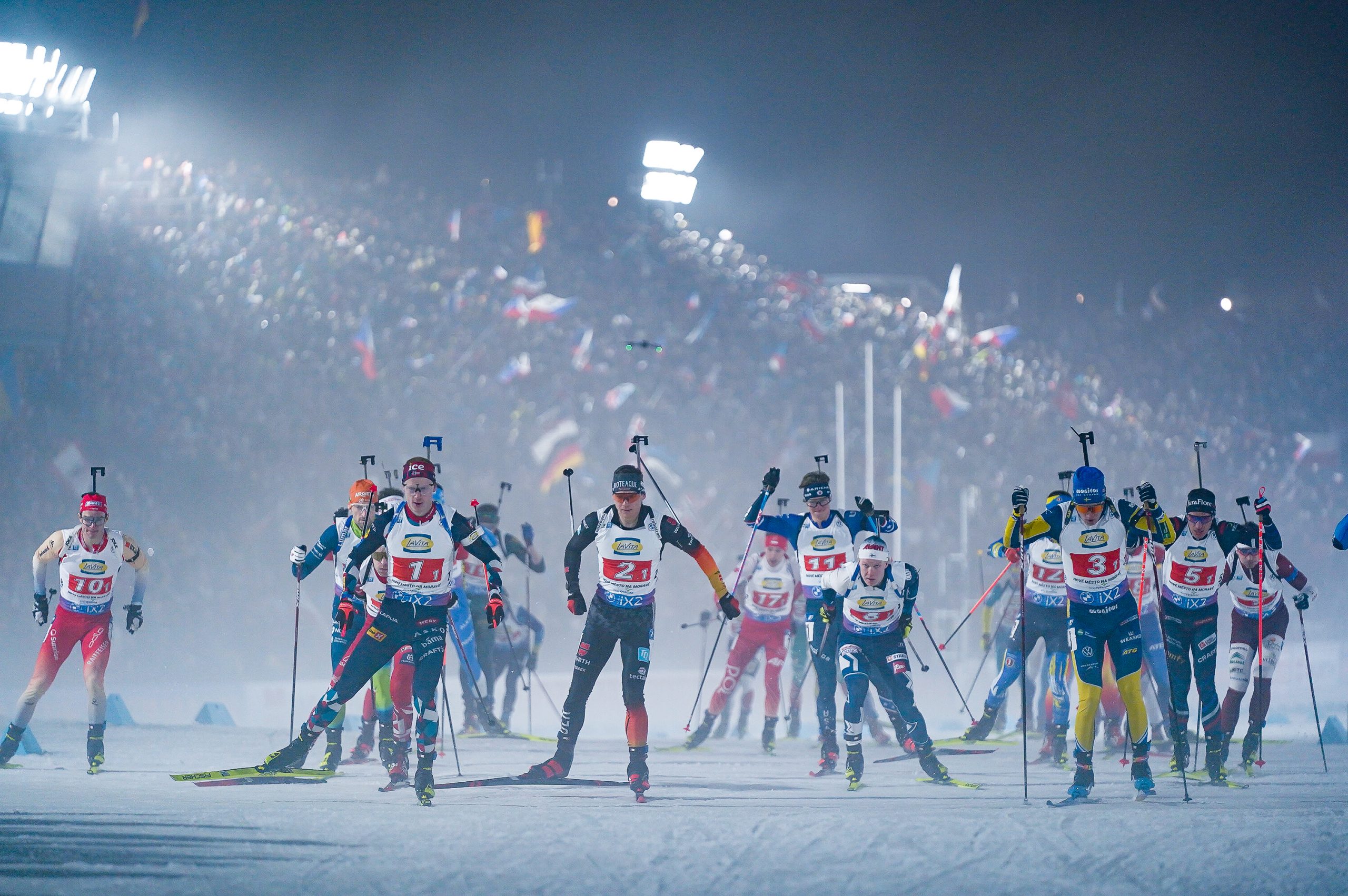
    The start of the Single-Mixed Relay in the Vysocina Arena in Nove Mesto na Morave, Czech Republic. (Photo: NordicFocus)

    Twenty-eight nations started the Single-Mixed Relay on Thursday at Biathlon World Championships in Nove Mesto na Morave, Czech Republic. After just over 35 minutes of fast and furious racing, France claimed the gold, last year’s bronze medalists from Italy the silver, and the defending champions of Norway the bronze.

    The Single-Mixed Relay combines the performances of one man and one woman who each ski two short biathlon races, tagging off in between. The importance of shooting speed and accuracy is magnified in this format because the ski loop is only 1.5 k; there is relatively little distance over which to recover lost time. As in all biathlon relays, athletes can use up to three spare rounds per stage to hit their five targets, but loading each spare takes precious time, and if targets remain un-hit, the penalty loop awaits. The event is a wildly unpredictable fan favorite.
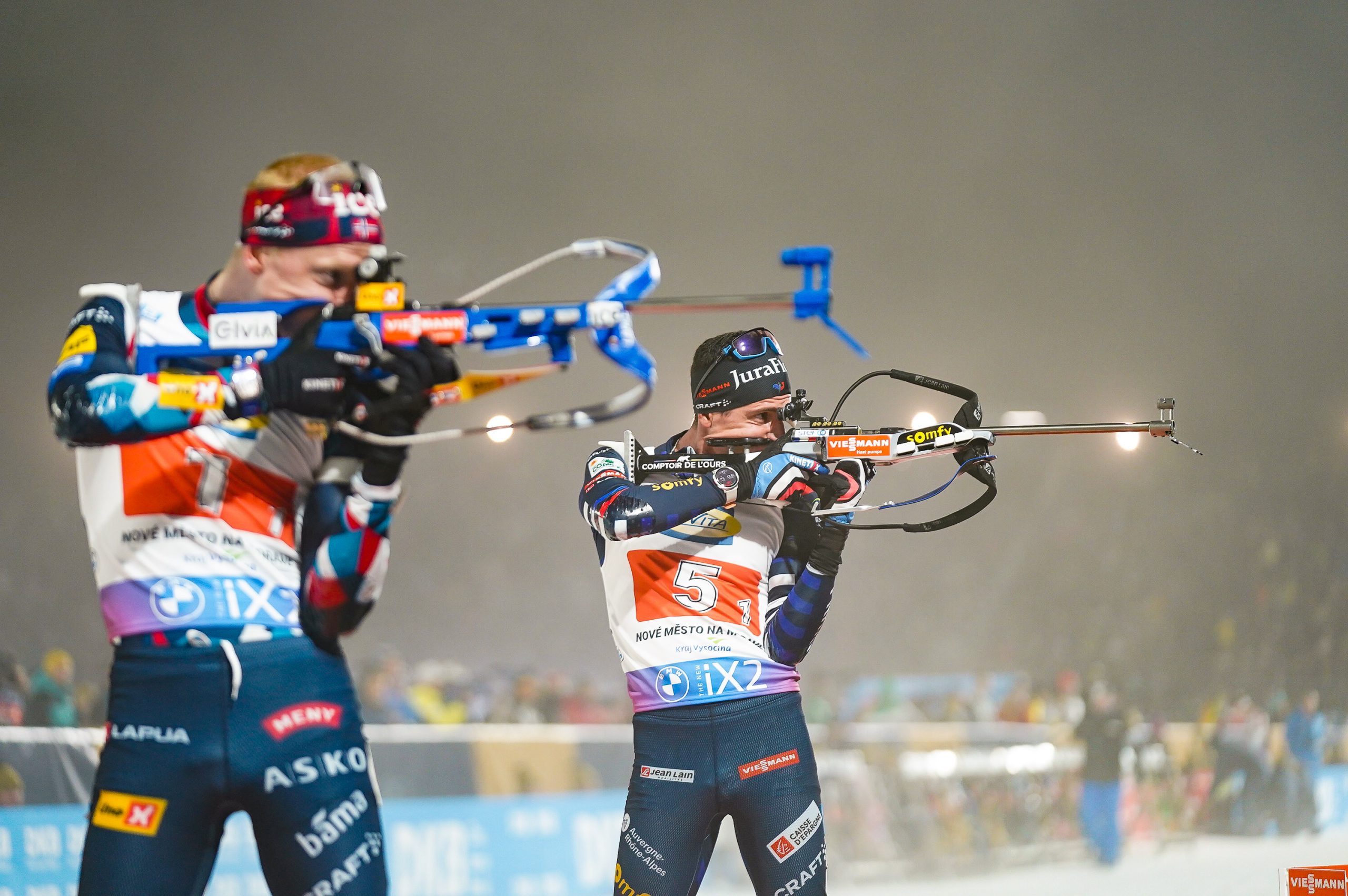
    Johannes Thingnes Boe (NOR) and Quentin Fillon Maillet (FRA) (l-r) shoot on lanes one and two in the Single-Mixed Relay. (Photo: NordicFocus)

    The field was stacked. Team Norway comprised the two current World Cup Overall leaders, Johannes Thinges Boe and Ingrid Tandrevold. But Tandrevold’s standing shooting has been hit or miss at World’s—more often miss than hit. For France, Lou Jeanmonnot got called up to race with Quentin Fillon Maillet. France’s top star, Julia Simon, decided to sit out and rest after winning three golds and a silver in the first four events of the Championships. But Jeanmonnot has been fantastic in her own right, finishing third, sixth, and seventh in the non-team competitions here in Nove Mesto. Italy put forward one of the strongest women in the field, Lisa Vittozzi, fresh off a victory in the 15 k Individual. Her partner, Tommaso Giacomel, has been 15th, 20th, and 45th in non-team competitions, combining reliable ski speed with less reliable shooting, but the same duo was a successful pairing in 2023 when they took bronze.
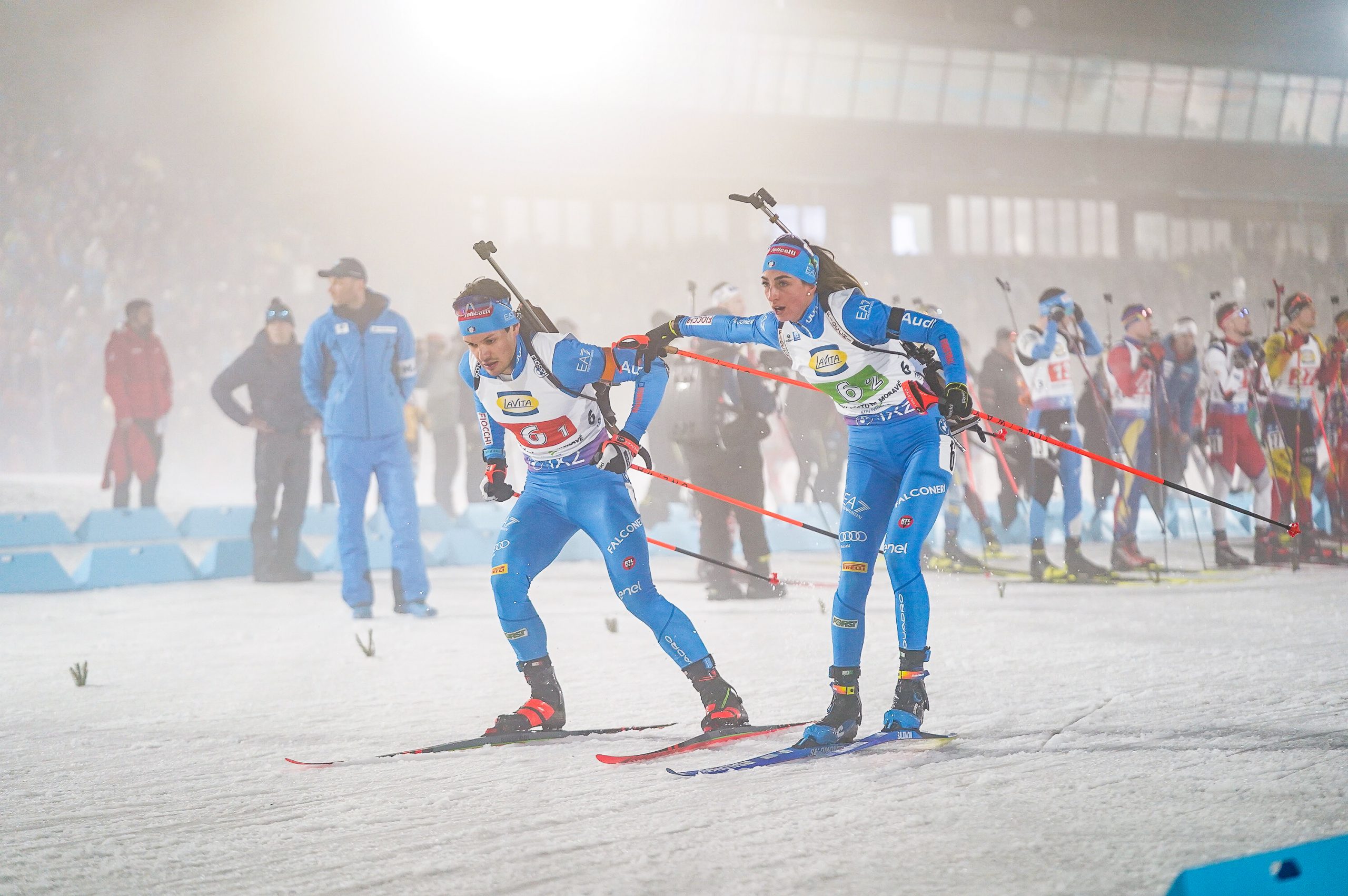
    2023 bronze medalists from Italy, Lisa Vittozzi and Tommaso Giacomel, paired up again to take silver in 2024 in the Single-Mixed Relay. (Photo: NordicFocus)

    Germany’s team combined the two most accurate shooters in the World Cup field. Sweden is always a threat, and Switzerland put forward two of the fastest shooters and the most likely person to demolish the last lap: Lena Haecki. For more discerning fans, the US was also a solid pick for the day: Campbell Wright and Deedra Irwin showed their potential in this event in January in Antholz, Italy, when they stayed in podium contention through the first half and eventually finished ninth in a very tight race, just 1:09 out of the lead.

    The lead constantly changes in the Single-Mixed Relay as the athletes make their way through a combined eight shooting stages and nine course loops. At the first exchange, France was in the lead but the eventual silver-medalists from Italy were down in 14th, with fourth place finishers Sweden following behind them in 15th. Wright shot 10/10 on the first leg to tag Irwin in fourth. At the second and third exchanges, France and Norway continued to trade the lead, while the US, Germany, Switzerland, and Finland shuffled around the next four places and Italy and Sweden gradually moved up.
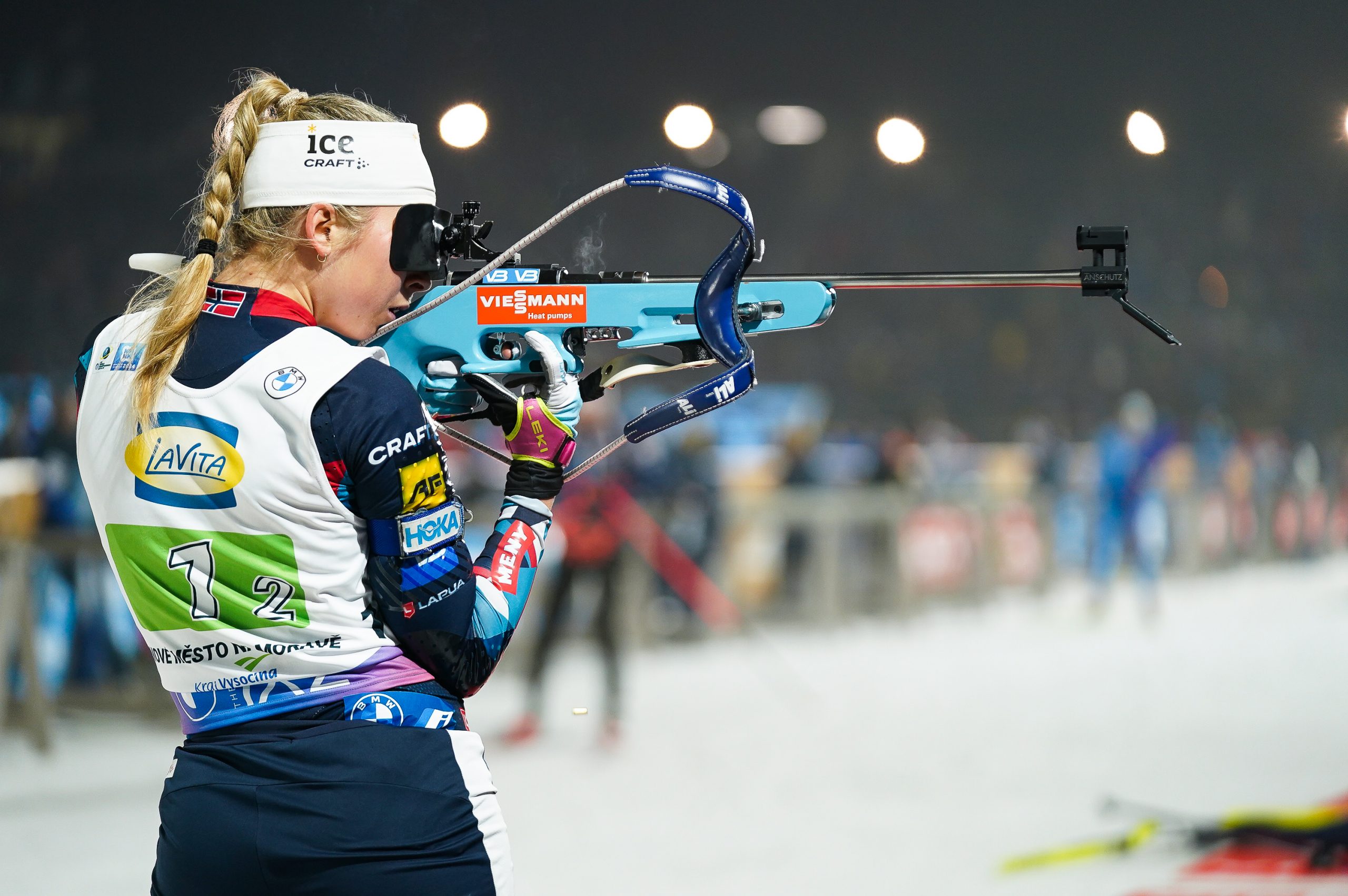
    Ingrid Landmark Tandrevold (NOR) incurred a penalty loop on the final shooting, falling from first to third. (Photo: NordicFocus)

    In the defining final stage of the race, Tandrevold, a lefty, stood on lane one, face to face with Jeanmonnot on lane two, in a shooting dual for the gold. Jeanmonnot shot with confidence, hitting 4/5 targets and her spare round in a total of just 28 seconds. But Tandrevold needed all three spares and still had to ski a penalty loop, opening the door for Vittozzi to leave the range in second after a flawless 19.6-second shooting bout. While Jeannmonnot skied to a decisive victory, Tandrevold caught and passed Vittozzi part way through the last lap, only to be convincingly out-sprinted by Vittozzi in the final two hundred meters. About thirty seconds behind that trio, Irwin shot clean and left the range in fourth, but three teams followed within the next nine seconds. The athletes from Sweden (H. Oeberg), Switzerland (Haecki), and Germany (Voigt) skied three of the four fastest course times on the last loop to push the USA down to seventh.
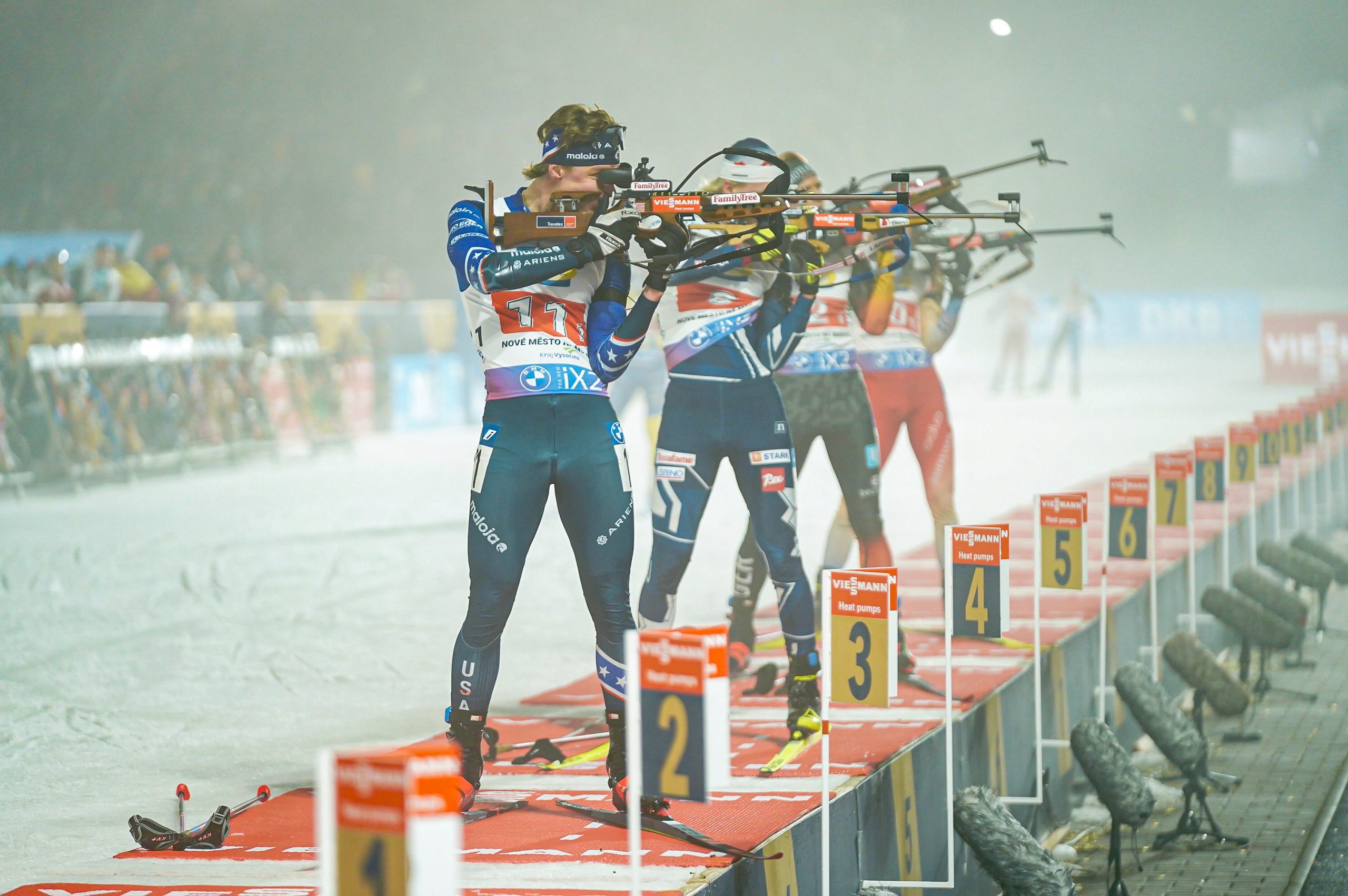
    Campbell Wright (USA) shoots on lane four in the Single-Mixed Relay. This year’s relays are his first since previously as the only New Zealand athlete on the circuit he didn’t have teammates with which to compete. (Photo: NordicFocus)

    For US Biathlon’s Campbell Wright, this season’s relays are a first. Wright is a dual citizen who grew up in New Zealand and competed for that country up through last season. As the only top Kiwi biathlete, he never had teammates with whom to race relays. Speaking of his experience shooting clean and tagging in fourth at the World Championships, Wright said, “I’m lovin’ it. I know I can ski well at the moment so it’s not as stressful skiing with fast people.” At just 21 years old, Wright is still coming to terms with the fact that he is one of the “fast people.” This was Wright’s second-ever Single-Mixed Relay after the one Antholz in January where he had a great start but then had to ski a penalty loop. Today’s shooting was different, he said, “because I had less pressure because Deedra was on the last leg!” He added, “That last leg is bloody hard.”
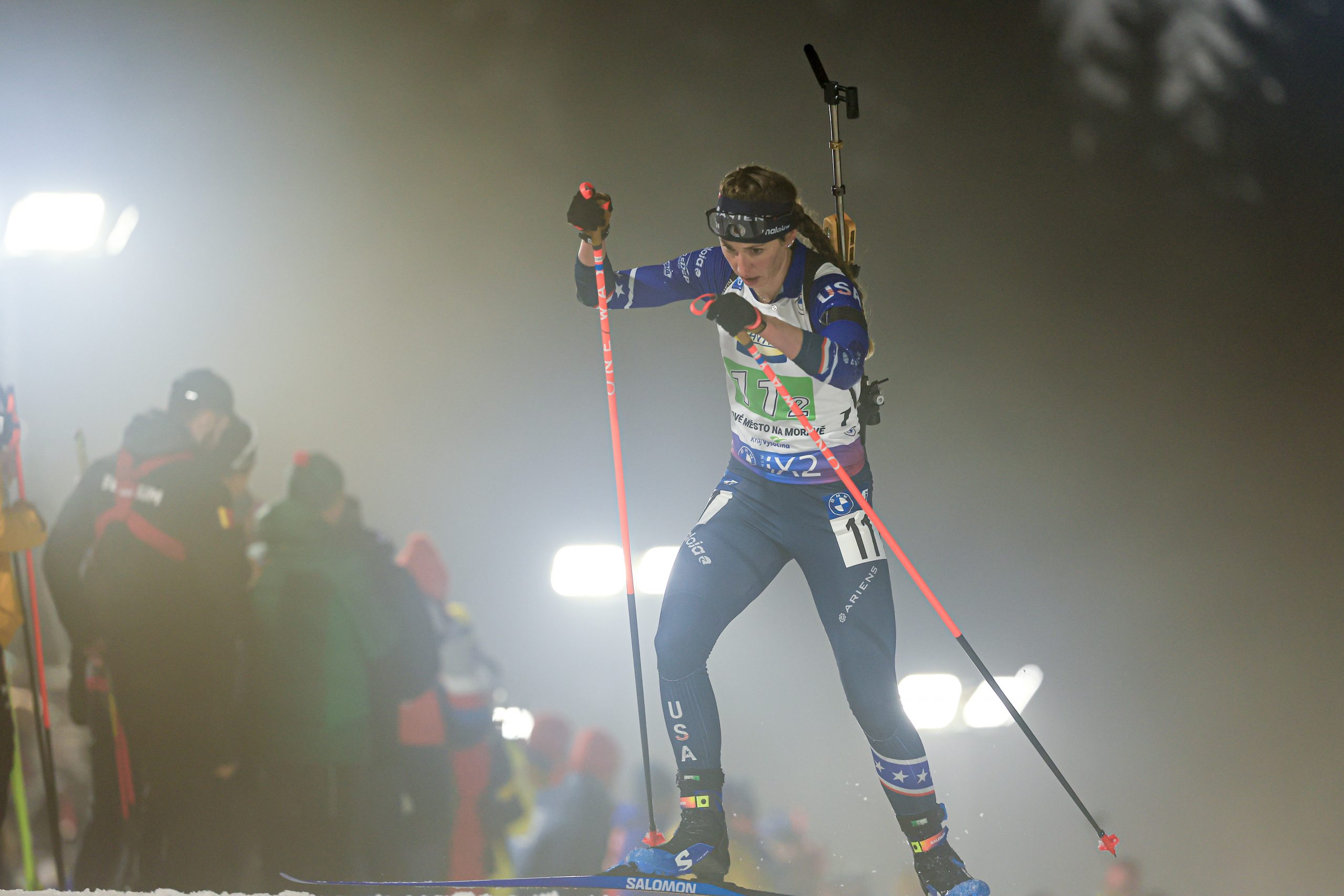
    Deedra Irwin (USA) shot clean on the final shooting to leave the range in fourth. (Photo: NordicFocus)

    Irwin performed magnificently in the last leg on Thursday. Coming into the final stage in fourth, shooting for a chance at a World Championship medal, she cleared all five targets in a smooth and deliberate rhythm. “I went into the last standing thinking, ‘I have to be super aggressive,” she said. “On the first standing, I took my time, but everyone is shooting so fast and clean. That mindset worked which was awesome.” After the final shooting, Irwin was shocked when she saw Norway and Sweden skiing around the penalty loop and realized how well she was doing. But she was also aware that she left range, as she put it, “with all these people on my ass.” Irwin felt her best in January, but then was sick during the pre-World Championships training camp and has been doing a heavy load of racing as the top American woman, so she doesn’t feel quite as sharp now. But, she said, “I’m still in the best shape of my life this year.” Although it was frustrating to be passed on the final loop, Irwin was still content about her performance against some of biathlon’s top talents. “It’s very humbling and cool to fight against them. I’m never gonna complain about a top eight.”

    Full Results

    Up Next

    Saturday 17 Feb Women’s 4×6 k Relay 7:45 Eastern Time
    Saturday 17 Feb Men’s 4×7.5 k Relay 10:30  Eastern Time
    Watch Live

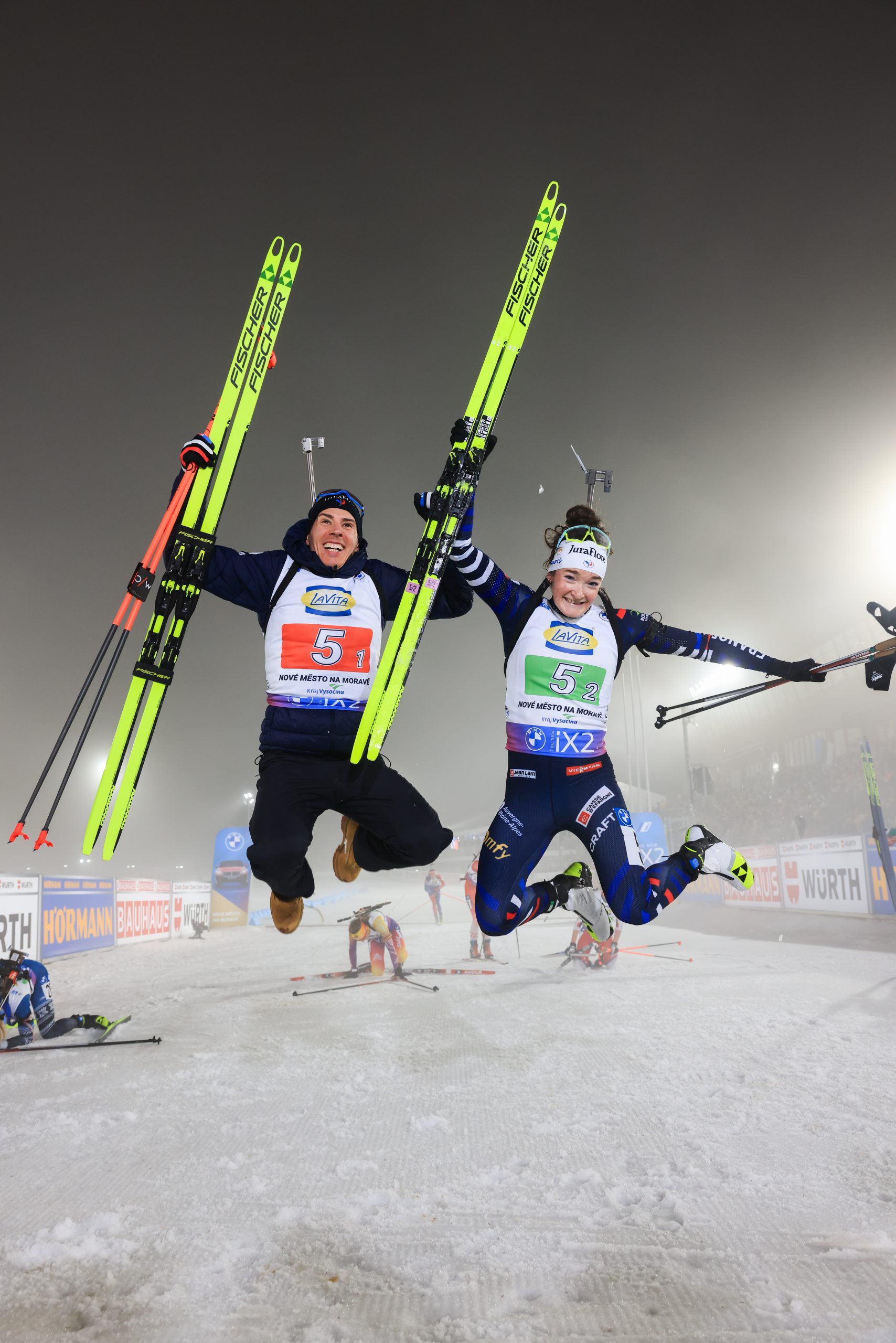
    Quentin Fillon Maillet and Lou Jeanmonnot celebrate winning the Single-Mixed Relay for France. (Photo: NordicFocus)
  • Norway Golden in World Championship Single-Mixed Relay Thriller

    Norway Golden in World Championship Single-Mixed Relay Thriller

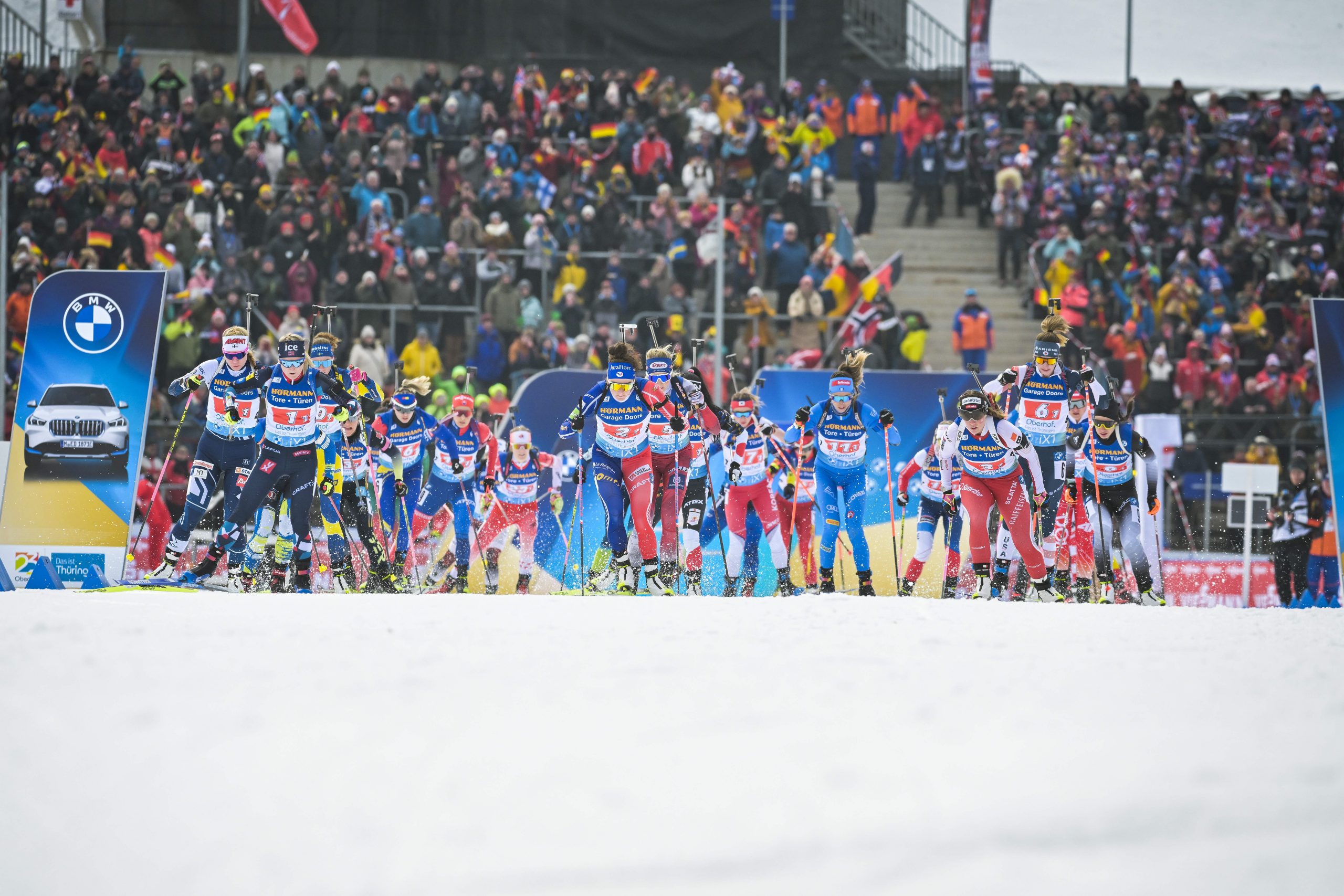
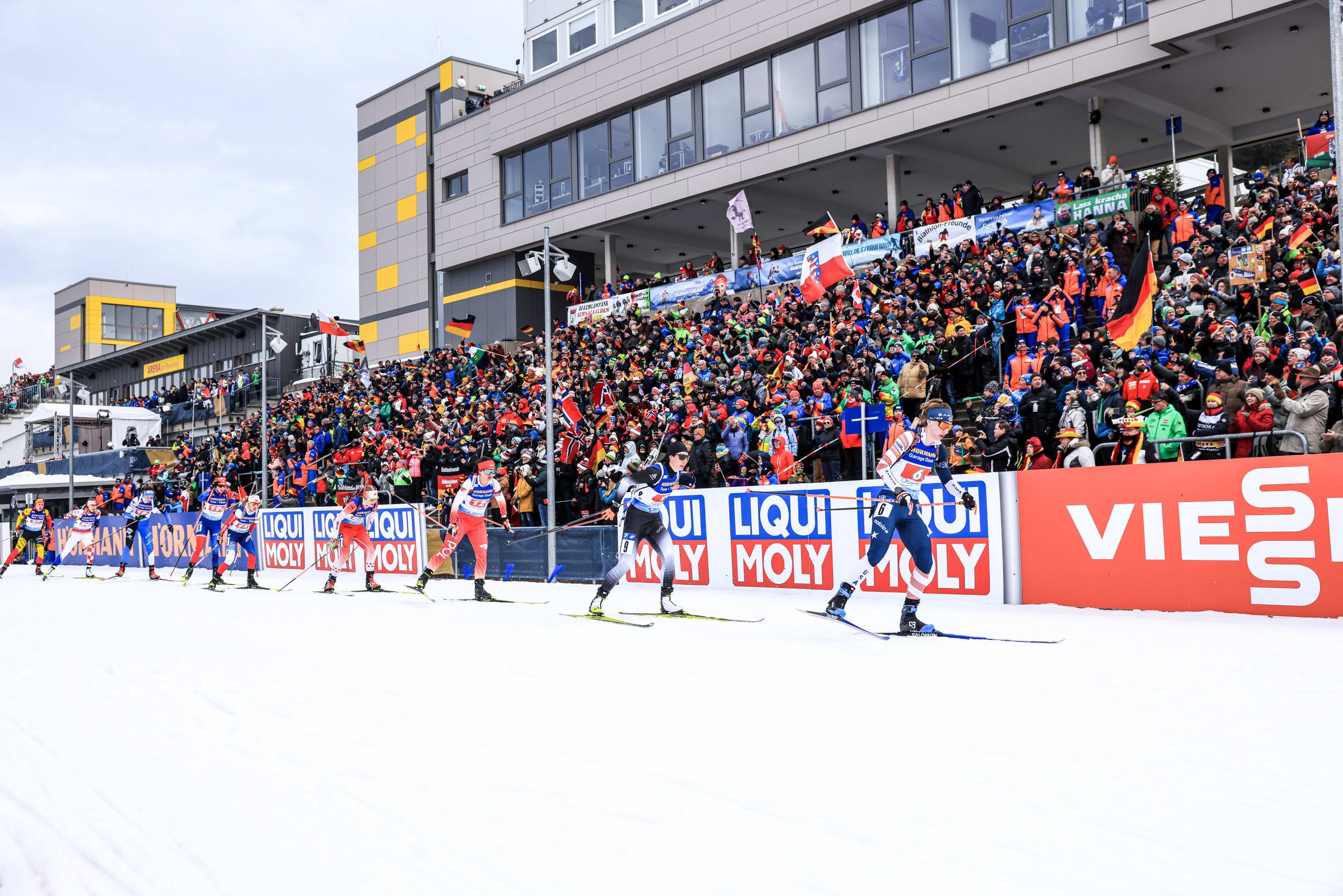
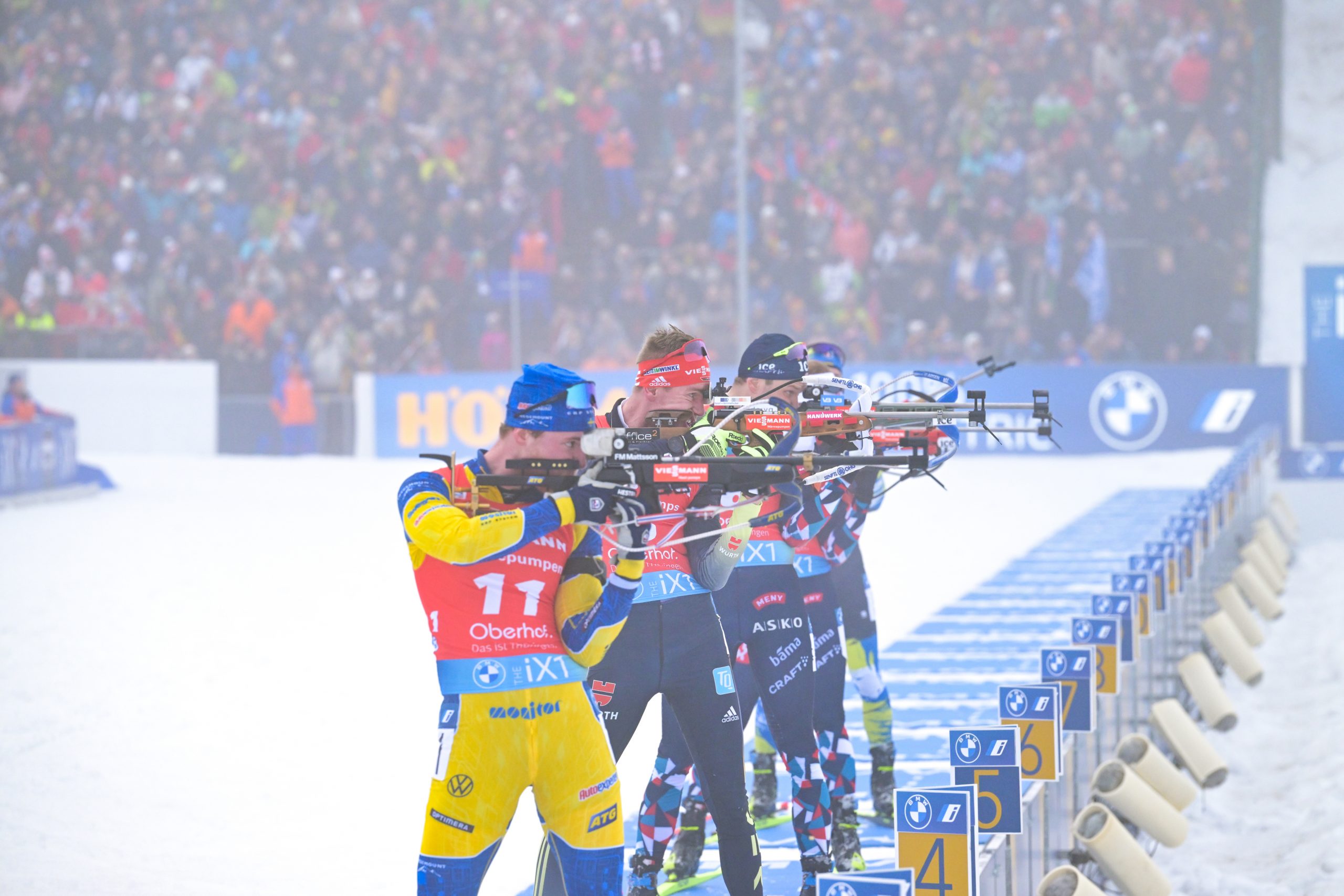
    The start of the Single-Mixed Relay at IBU World Championships in Oberhof, Germany. (Photo: NordicFocus).

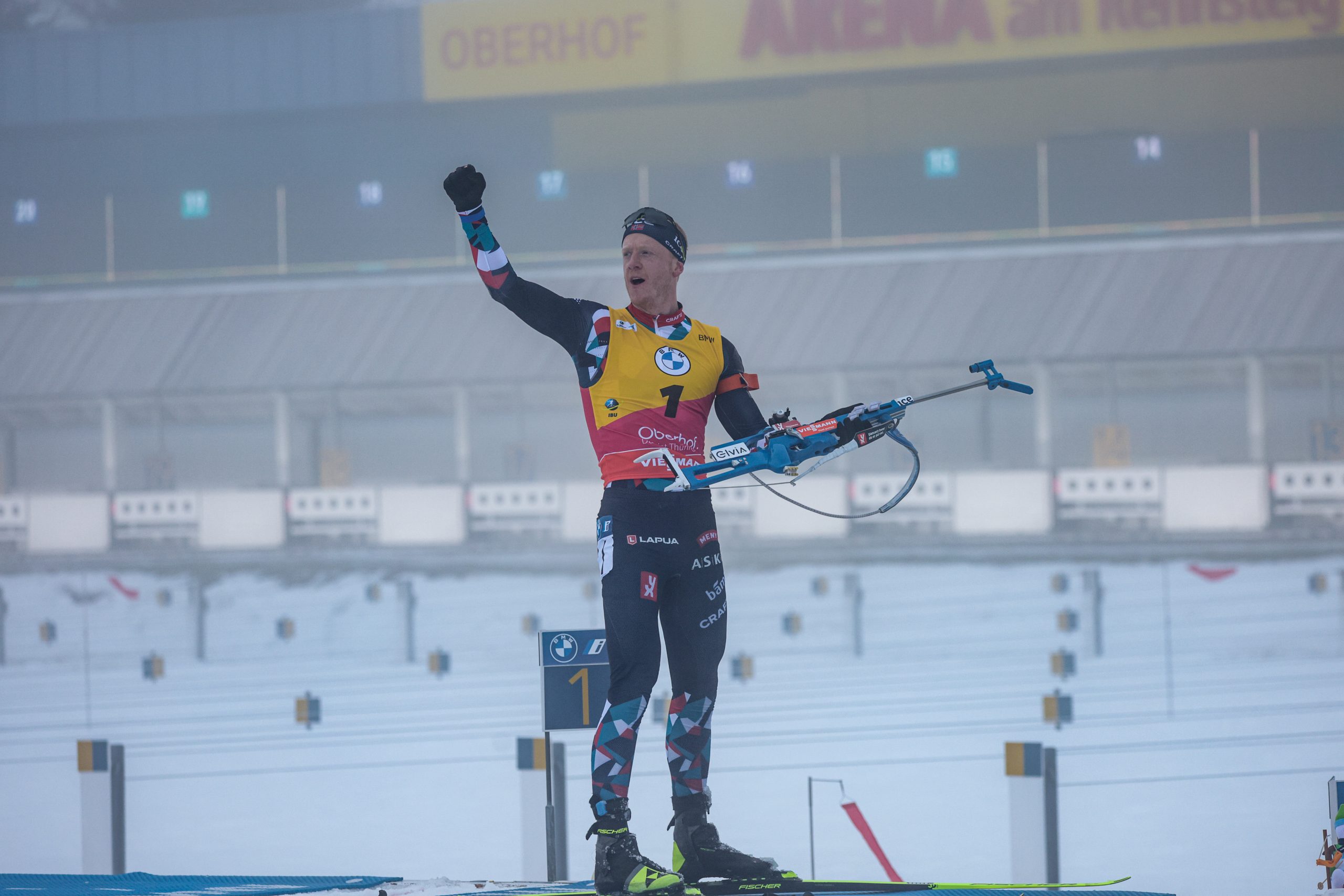
    Twenty seven nations took part in the Single-Mixed Relay today at Biathlon World Championships in Oberhof, Germany, but none could match the star power of Norwegian duo, Marte Olsbu Roeiseland and Johannes Thignes Boe. They teamed up to win Boe’s fifth straight gold medal at the 2023 Championships, and Olsbu’s record-breaking 13th World Championship gold. But it did not come easily.

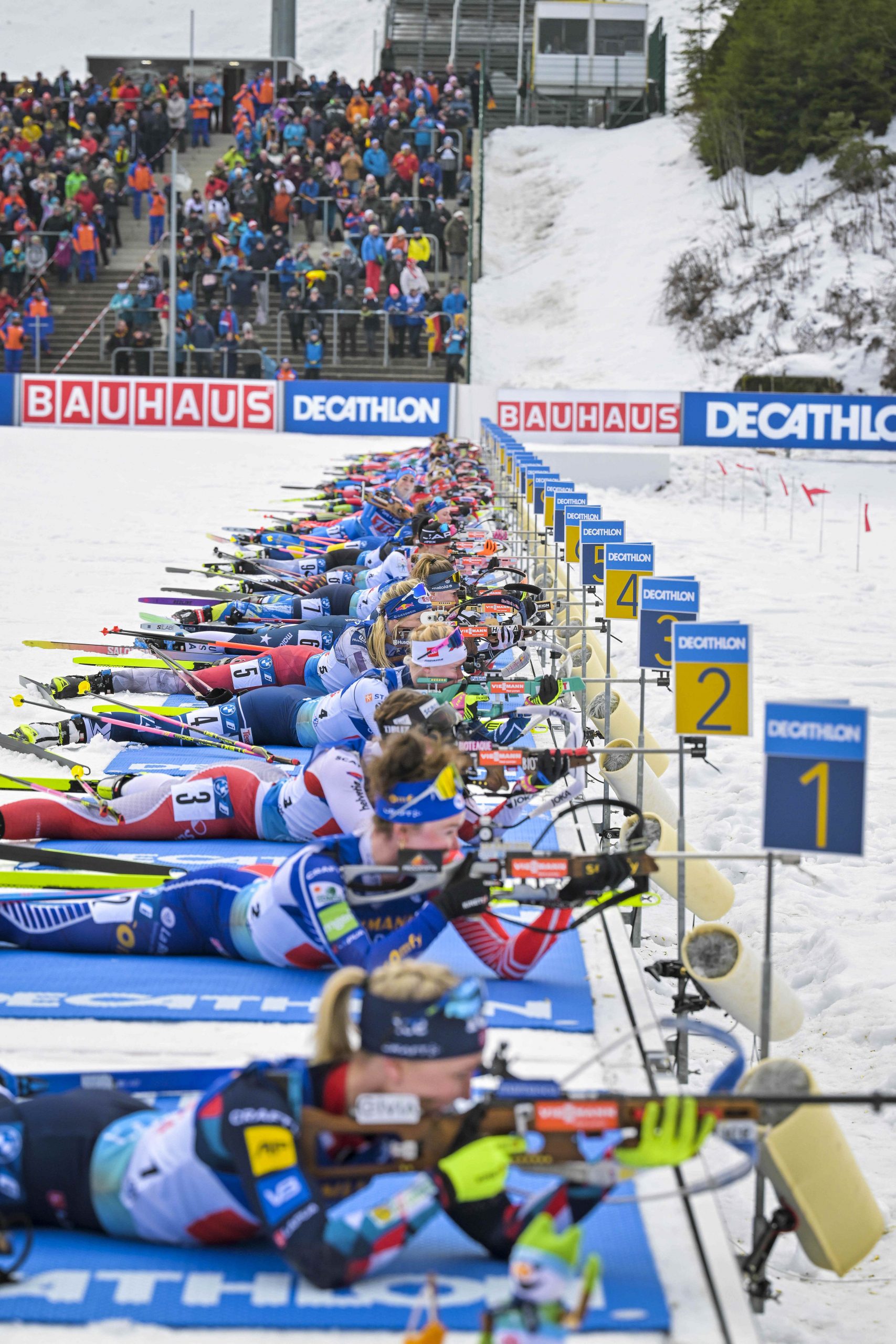
    The first shooting stage of the Single-Mixed Relay at the IBU World Championships. On Lane 11, Lisa Vittozzi is already getting up, having shot faster than anyone else. (Photo: NordicFocus)

    Though Norway were heavy favorites coming into the race, nothing is certain in biathlon, least of all in the Single-Mixed Relay. The event combines the performances of one woman and one man who each ski two short biathlon races, tagging off in between. Shooting accuracy plays an outsized role in the Single-Mixed Relay because the ski loop is only 1.5 k; there is relatively little distance over which to recover lost time. Shooting speed is also critical. In all biathlon relays, athletes can use up to three spare rounds per stage to hit their five targets; even fast shooters need about seven seconds to load each spare round so it pays to hit all five on the first pass.

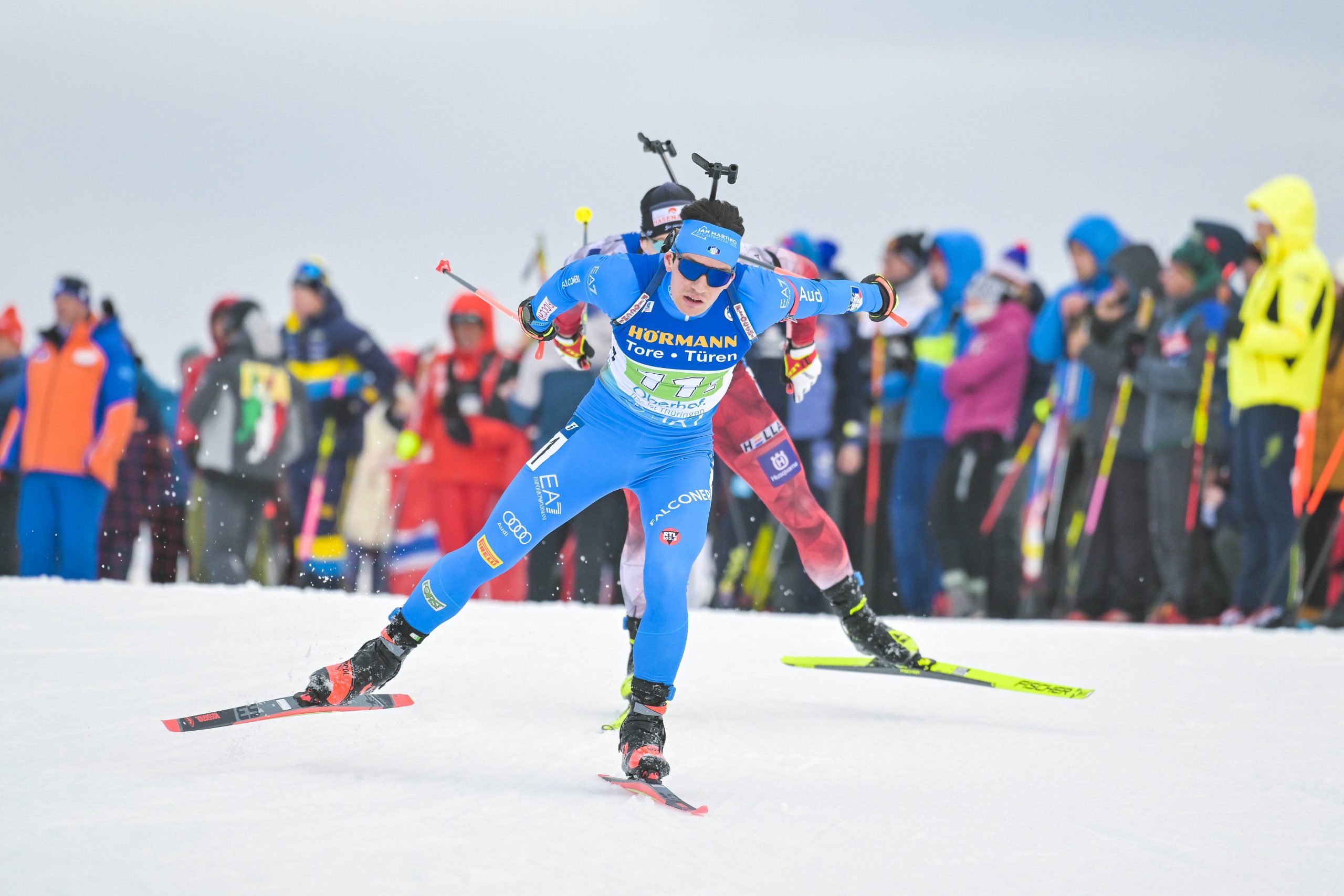
    Tommaso Giacomel (ITA) leading David Komatz (AUT) in the IBU World Championships Single-Mixed Relay in Oberhof, Germany. (Photo: NordicFocus)

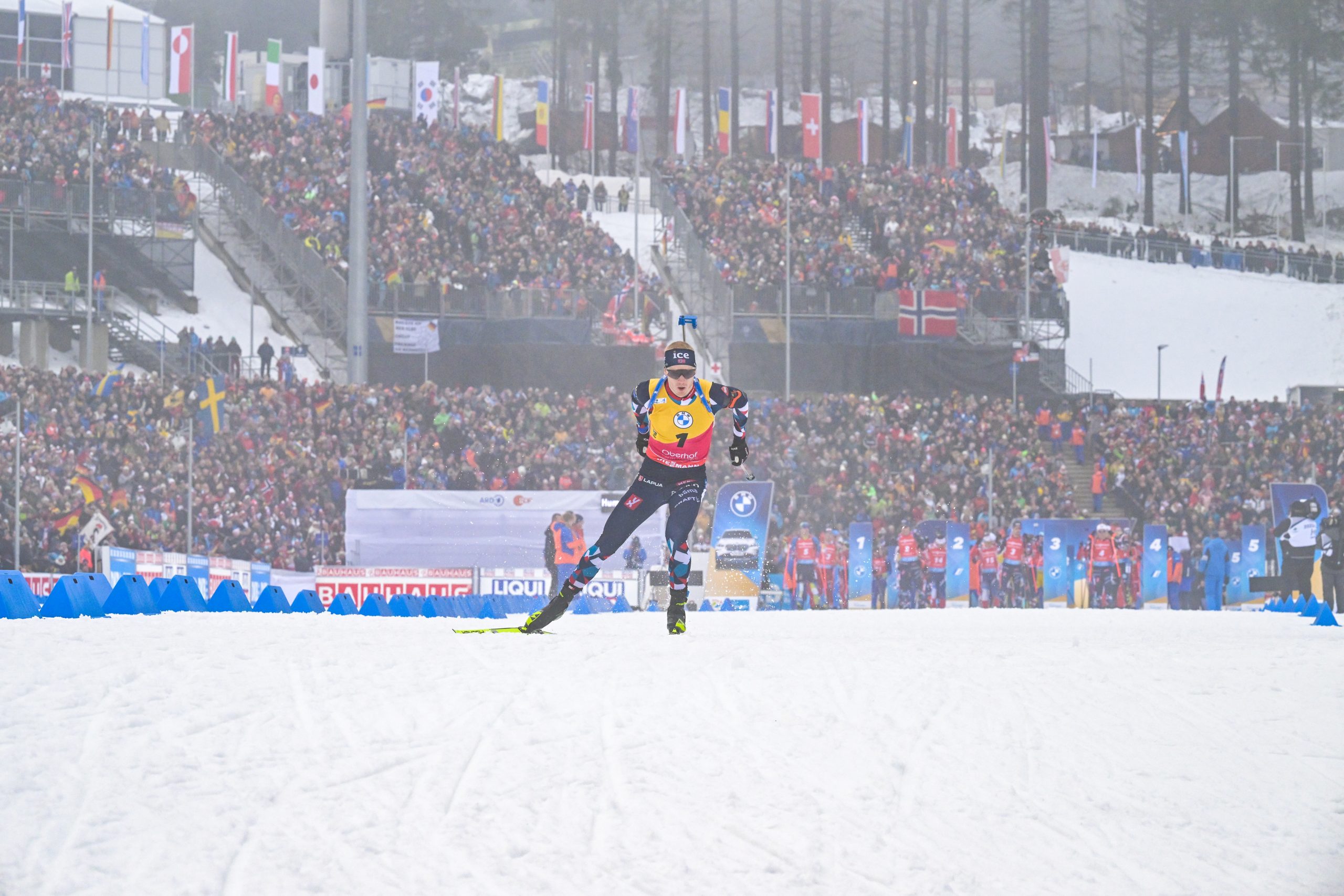
    During the first 33 minutes of the race leading up to the final shooting, Norway was only in the lead for about four. The rest of the time, Italy and Austria set the pace. A decisive moment occurred at Shooting 6, the final stage for the women, when Italy’s Lisa Vittozzi and Austria’s Lisa Hauser both missed and Roeiseland went clean. Roeiseland tagged the unbeatable Boe in first, setting Norway up for a near certain victory. Boe arrived at the second-to-last shooting bout with a ten second lead. But instead of his typical fast and clean shooting, he missed three from the magazine and one of the spares, sending himself into the penalty loop! The race was suddenly open again. Tommasso Giacomel (ITA) and David Komatz (AUT) capitalized on Boe’s mistakes, leaving the range together with an 11 second advantage over the Norwegian.

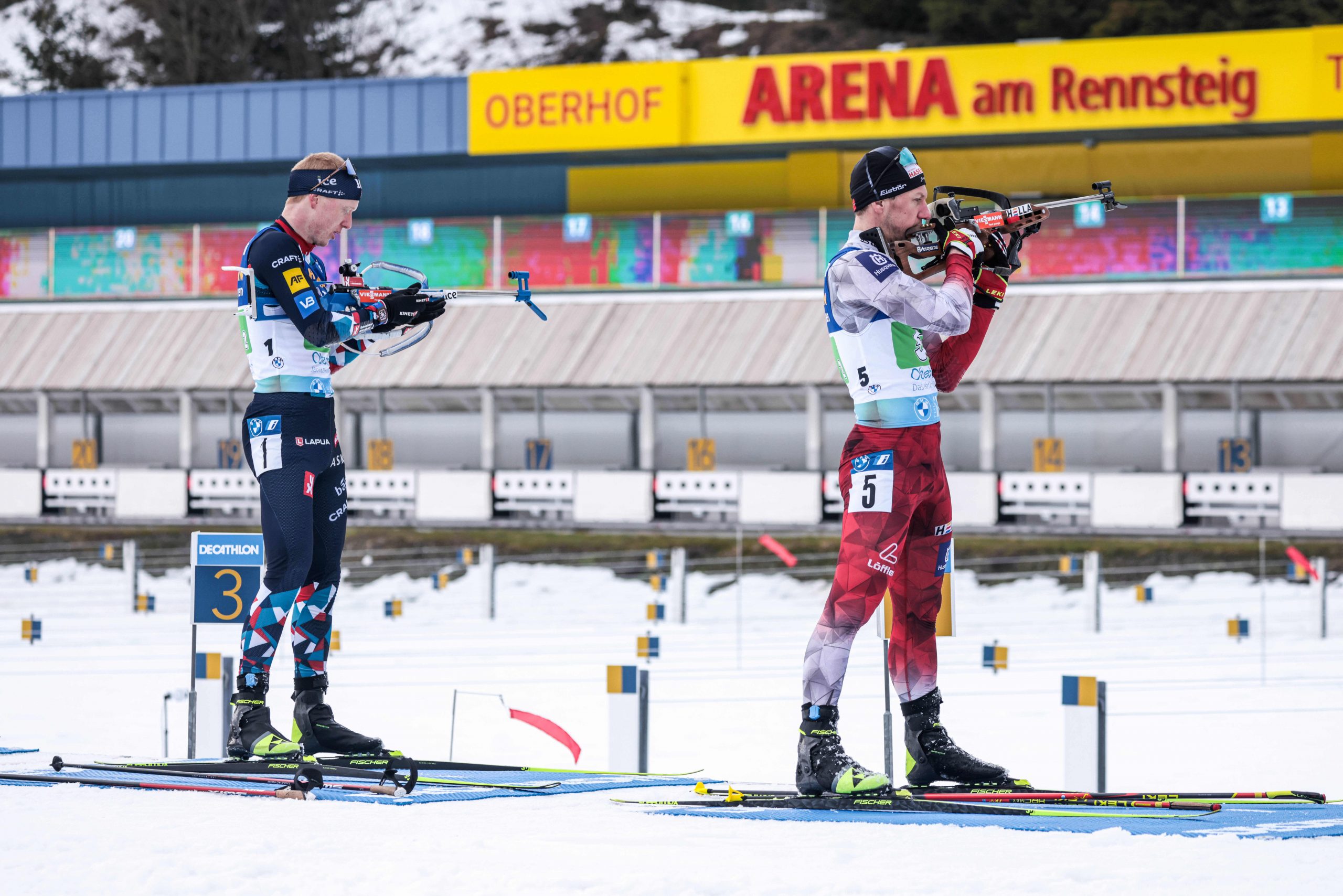
    Johannes Thingnes Boe (NOR) and David Komatz (AUT), (l-r) in the final shooting stage of the IBU World Championships Single-Mixed Relay. (Photo: NordicFocus)

    Boe shifted into another gear to catch Komatz and Giacomel on course. He let Komatz lead into the range, putting the much less-experienced Austrian on Lane 1 for the final shooting. Komatz handled the pressure brilliantly, using only one spare, but Boe was already gone. He had cleared his five targets in just 17.8 seconds. Giacomal, who maintained his composure so beautifully to secure silver for Italy in the final stage of last week’s Mixed Relay, couldn’t repeat his performance today and ended up with two penalty loops. He got extremely lucky, as nearly all the teams behind him also shot penalty loops, so he didn’t lose a single place.

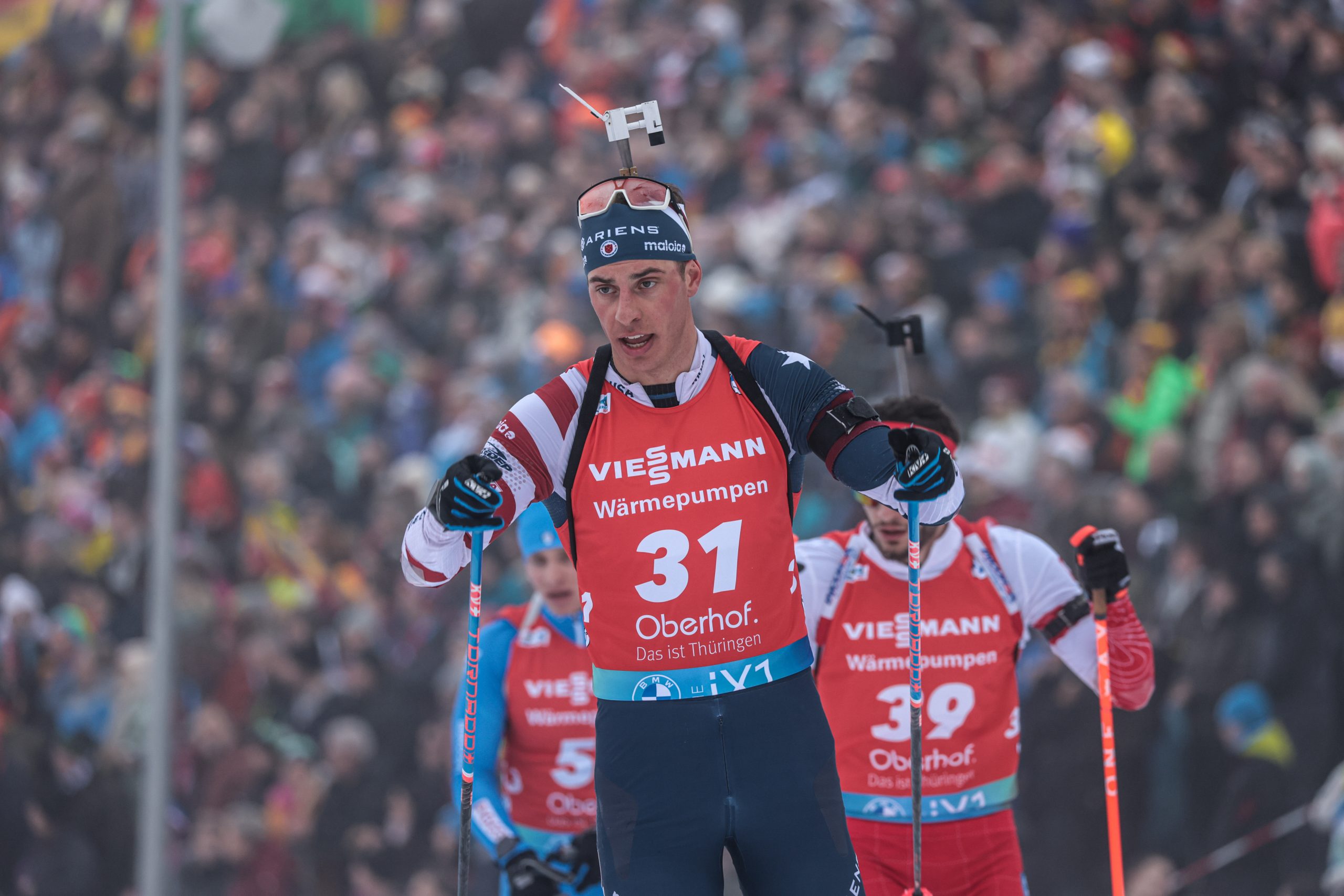
    Paul Schommer (USA) follows Flourent Claude (BEL) in the stadium at the IBU World Championships in Oberhof, Germany. (Photo: NordicFocus)

    Eleven of the 21 teams that had not been lapped by that point in the race did at least one penalty loop on the final stage, in part due to pressure distractions, but also due to wind gusts. Unfortunately, the US was one of them. Paul Schommer was shooting on Lane 10 when he missed four from his magazine, but managed to recover well by hitting all three spares to incur just one penalty loop. Schommer and teammate Deedra Irwin finished 11th, just two seconds behind Finland.

    Deedra Irwin (USA), leads the chase pack into the stadium during the IBU World Championships Single-mixed relay. (Photo: NordicFocus)

    Canadians Emma Lunder and Adam Runnalls were down in 18th at the second exchange but with a solid second half they moved up to 13th.

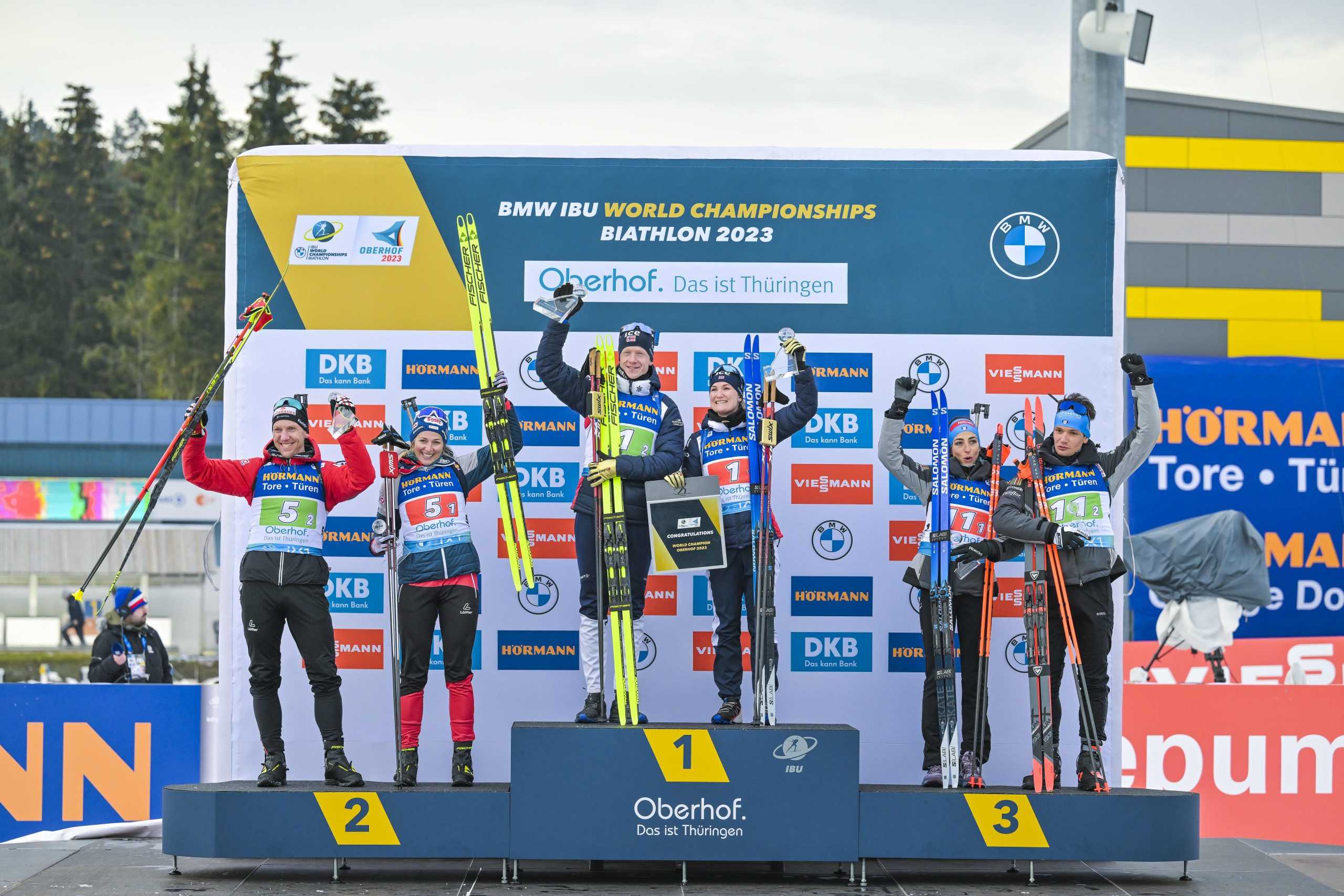
    Single-Mixed Relay medalists , (l-r): David Komatz (AUT), Lisa Theresa Hauser (AUT), Johannes Thingnes Boe (NOR), Marte Olsbu Roeiseland (NOR), Lisa Vittozzi (ITA), Tommaso Giacomel (ITA). (Photo: NordicFocus)

    Biathlon World Championships Single-Mixed Relay RESULTS

    UP NEXT:

    Saturday at 5:45AM Eastern Time: Men’s 4 x 7.5k Relay
    Saturday at 9:00AM Eastern Time: Women’s 4 x 6k Relay
    Sunday at 6:30AM Eastern Time: Men’s 15k Mass Start
    Sunday at 9:30AM Eastern Time: Women’s 12.5 Mass Start

    Watch live here.


  • Biathlon World Championships: Boe and Laegreid in a League of Their Own

    Biathlon World Championships: Boe and Laegreid in a League of Their Own

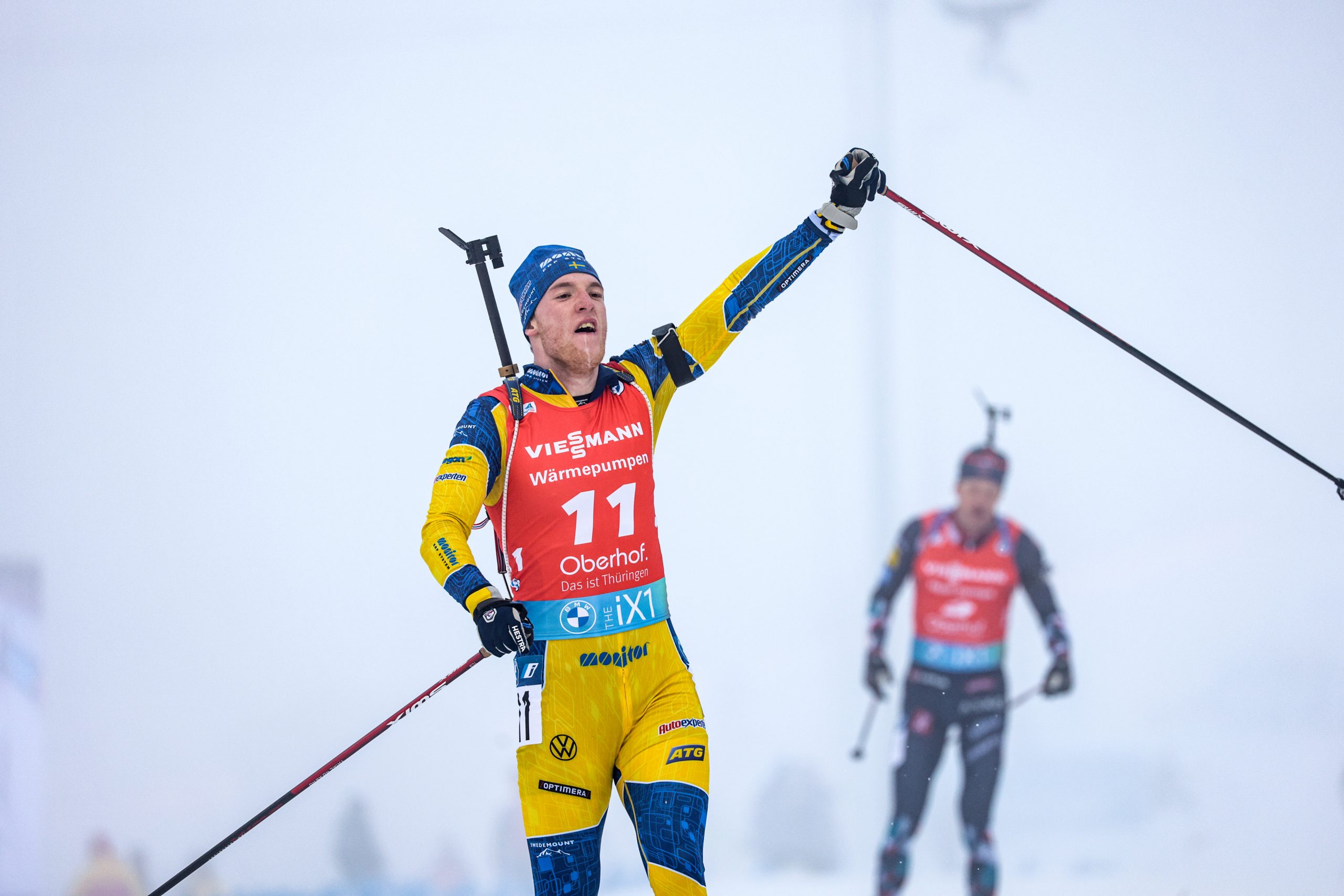
    Johannes Thingnes Boe (NOR) started Sunday’s Pursuit with a 15-second advantage but stretched it to 1:11 by the end of the race to claim his third straight gold medal at the IBU World Championships in Oberhof, Gemany. (Photo: NordicFocus)

    This winter, two Norwegian men have set a new standard of excellence in biathlon. In Sunday’s Pursuit at the IBU World Championships in Oberhof, Germany, twenty-nine-year-old Johannes Thignes Boe and 25-year-old Sturla Holm Laegreid put on a masterclass. They both shot 20/20—something many biathletes never manage to do in a whole career—to claim their now familiar places on the gold and silver steps of the podium.

    Having won the Sprint, Boe started first in the Pursuit with a 15-second lead over the Sprint silver medalist, his older brother, Tarjei Boe. Laegreid started third, 40 seconds back. Ten of the top twelve athletes shot clean in the first stage, and eight of them—including the three leaders—stayed clean through the second stage as well, so at the half way point, the front of the race held steady with Laegreid chasing the Boe brothers.

    On the third shooting, Tarjei Boe missed two and was overtaken by Laegreid who stayed clear. By the last shooting, J. Boe had over a minute gap. He shot clean to complete the perfect 20/20, taking a moment to celebrate on the range before setting out to enjoy a casual 2.5km last loop on the fan-lined course.

    Johannes Thingnes Boe (NOR) celebrates after hitting 20/20 to win the Pursuit at the IBU World Championships in Oberhof, Germany. (Photo: NordicFocus)

    When Laegreid arrived on lane 2 for his last shooting, he had a 36-second gap, which is encouraging but not comfortable. Were he to miss two or more and one of the chasers hit all five, he would be overtaken. But, like J. Boe, Laegreid nailed all five targets, securing the silver medal. In the end, J.Boe finished 1:11 ahead of Laegreid, who the finished line 43 seconds ahead of the third place.

    These gaps are extraordinary in a competition which is often determined by seconds. J. Boe is in a league of his own, but so is Laegreid. To see these two athletes towering so high above the rest of the field is truly astounding.

    Sturla Holm Laegreid (NOR) stands alone on the range in front of a full stadium of spectators as he hits his last five targets in the IBU World Championships Pursuit in Oberhof, Germany.

    While the front of the race was amazing to watch because gaps were so big, the rest of the race was amazing because it was so tight. In the fight for the bronze medal, three athletes—bib number 11 Sebastian Samuelsson, bib 2 Tarjei Boe, and bib 6, Vetle Christriansen—arrived on the shooting range together for the final stage.

    Sebastian Samuelsson (SWE), Johannes Kuehn (GER), Vetle Sjaastad Christiansen (NOR), (l-r) on the shooting range at the IBU World Championships in Oberhof, Germany. (Photo: NordicFocus).

    Unlike the unshakeable race leaders, one by one, each of the athletes missed twice. The three left the range together and the race for the bronze medal started with two rounds of the penalty loop. As chasers arrived on the range, none were able to capitalize on the moment with clean shooting. With one kilometer to go, Samuelsson and T. Boe had gapped Christiansen. The race for the bronze came down to the final meters, with Sebastian Samuelsson finally winning his first medal of the season.

    Sebastian Samuelsson (SWE) outsprinted Tarjei Boe (NOR) for the bronze medal in the Pursuit at the IBU World Championships in Oberhof (GER). (Photo: NordicFocus).

    Paul Schommer (USA) was the sole North American competitor in the Pursuit. He started in 31st, but dropped to 52nd with eight misses. Schommer is among the best shooters on the World Cup circuit so this performance was very much an anomaly. His next race will be Tuesday’s 20km Individual.

    Paul Schommer (USA) racing in the Pursuit at the IBU World Championships in Oberhof (GER). (Photo: NordicFocus).

    Biathlon World Championships Men’s Pursuit RESULTS.

    UP NEXT:

    Tuesday at 8:30AM Eastern Time: Men’s 20km Pursuit
    Wednesday at 8:30AM Eastern Time: Women’s 15km Pursuit

    Watch live here.

    Johannes Thingnes Boe (NOR) greets Sturla Holm Laegreid (NOR) in the finish of the IBU World Championships Pursuit in Oberhof (GER). (Photo: NordicFocus).
  • Norwegian Biathletes Already Talk Boycott of Canmore and Maine World Cups

    Norwegian Biathletes Already Talk Boycott of Canmore and Maine World Cups

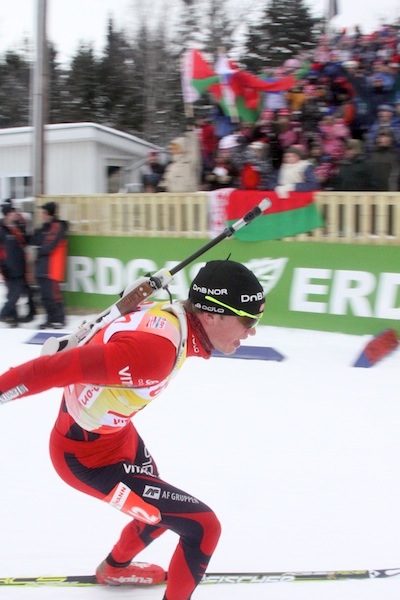
    Tarjei Bø racing in Presque Isle, Maine, in February 2011. Finishing fourth and sixth in individual races there helped him claim the first overall World Cup title of his career, but this season he's not excited to go back.
    Tarjei Bø racing in Presque Isle, Maine, in February 2011. Finishing fourth and sixth in individual races there helped him claim the first overall World Cup title of his career, but this season he’s not excited to go back.

    With seven months to go until the IBU World Cup arrives in Canmore, Alberta, and then travels to Presque Isle, Maine, international biathlon stars are already considering whether to skip the events.

    “I wish the races were in Europe,” Norway’s Emil Hegle Svendsen told broadcaster NRK.

    Roughly every five years, the World Cup travels to North America. The last time was in 2011, when the tour stopped in Presque Isle and nearby Fort Kent. At those races, most of the top stars vying for the overall World Cup title attended, but many of the others in the top 20 or 30 skipped the races. Field sizes were considerably smaller than for other World Cups.

    The Norwegians’ main concern seems to be that the North American period of racing falls directly before World Championships, and they would rather prepare at home: Oslo is hosting the 2016 edition. At the very least, they would like to be in the right time zone.

    “I hate that it’s set up like this,” Tarjei Bø, the most successful male athlete at the 2015 World Championships in Kontiolahti, Finland, told NRK.

    “This is a headache for us all,” agreed his coach, Egil Gjelland.

    But Max Cobb, the head of the IBU’s Technical Committee, which sets the World Cup Schedule, said in an interview that the committee had carefully considered whether there would be enough time for athletes to adjust back to being in Europe and prepare for the Oslo Championships.

    After all, it’s not like athletes will fly directly to Oslo after Maine and start racing the next day.

    “We looked at trying to maximize the amount of time between the North American World Cups and the World Championships,” Cobb said on Tuesday. “I think there’s two and a half weeks there, and that was a reasonable amount of time for preparation. If it had been a week less than that, then there would be a lot of teams considering not attending, or not sending their best athletes.”

    In addition, he suggested that teams might even maximize that time by managing their rosters. For instance, the weekend competitions in Presque Isle are relays; teams could race their “B” squads in the relays, and send their “A” teams back to Norway or another home training base.

    The first competition of World Championships is always a mixed relay, raced by only two men and two women from each country. That provides the rest of the athletes with even more time to train, adjust, and prepare.

    “We felt like it was important to put Canmore first, so that teams could decide when to arrive in North America based on jetlag and altitude training and those kinds of things,” Cobb said of the scheduling decisions. “And Calgary being an international air hub, that they could choose exactly when they wanted to arrive with lots of direct flights from Europe. Do that, and then come back to Presque Isle two hours closer to Europe, and fly home from there.”

    IBU President Anders Besseberg, himself a Norwegian, also wasn’t pleased with the threat of a boycott by the top Norwegians.

    “The US and Canada have many good athletes who have to travel to Europe to compete here, and then I think it gets a little petty if one boycotts the races over there, so to speak,” he told NRK. “I think it is stupid if Norway does not compete with some of their best athletes.”

    Cobb was slightly surprised to hear the criticism coming from the Norwegians, since he believed he had adequately addressed the situation with team staff when the schedule was set.

    “I had some discussions with a couple of Norwegian coaches around the World Championships this year, and it sounded like they were reassured once they realized that there was in fact two and a half weeks,” he explained.

    Still, the Norwegian men’s team made it clear that World Championship medals were the most important thing to them, and they’d consider staying at home in Europe for well over a month in preparation if that’s what it took.

    “It is not often the United States has a World Cup, and then when you put it right before the World Championships it goes without saying that not everyone is going to go over there,” Johannes Thingnes Bø concluded.

  • With Shipulin’s Late Heroics, Russia Unbeatable in Bad-Weather Oberhof Relay

    With Shipulin’s Late Heroics, Russia Unbeatable in Bad-Weather Oberhof Relay

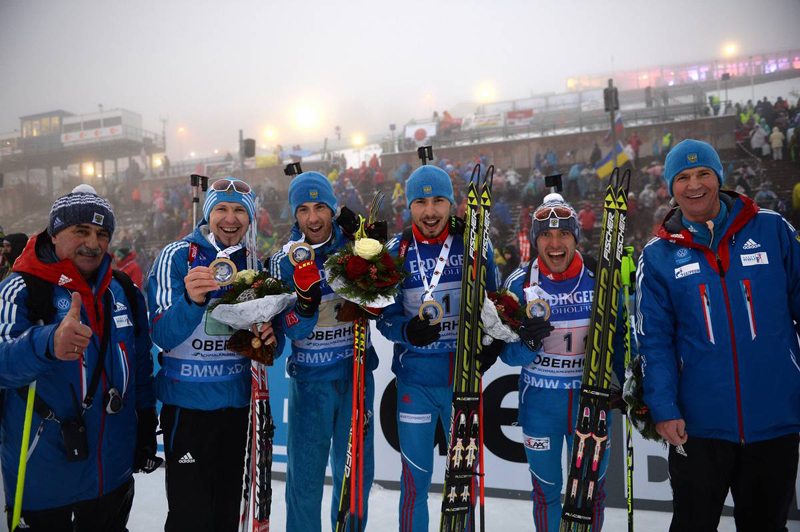
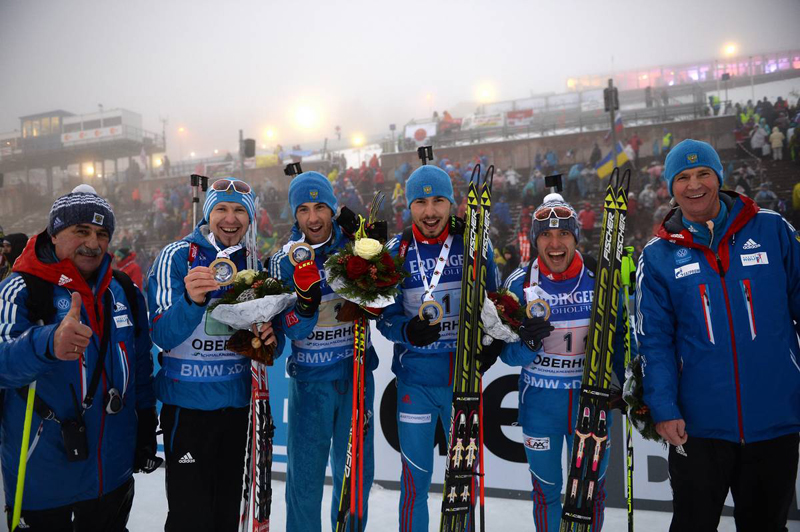
    The Russian men's relay team including; Timofey Lapshin (RUS), Dmitry Malyshko (RUS), Anton Shipulin (RUS) and Evgeniy Garanichev (RUS) show their hardware from the IBU World Cup biathlon, relay in Oberhof (GER).  (photo: Fischer/Nordic Focus)
    The Russian men’s relay team including; Timofey Lapshin (RUS), Dmitry Malyshko (RUS), Anton Shipulin (RUS) and Evgeniy Garanichev (RUS) show their hardware from the IBU World Cup biathlon, relay in Oberhof (GER). (photo: Fischer/Nordic Focus)

    Heavy fog in Oberhof, Germany, on Thursday pushed back the start of the IBU World Cup 4 x 7.5 k relay, and then obscured both the targets and the race course as the world’s top male biathletes battled their way through the race. But even a delay, tough conditions, and a 57 second deficit going into the final leg couldn’t keep the Russian team of Evgeniy Garanichev, Timofey Lapshin, Dmitry Malyshko, and Anton Shipulin from gold.

    It was Shipulin who did the hero’s work for Russia. He skied the fastest course time of all the anchor-leg skiers, and also turned in remarkable shooting – just one spare round over the two shooting stages combined. On the final loop, he closed a ten-second gap to Norway’s Ole Einar Bjørndalen, then passed him, accelerated up the final hill, and celebrated as he crossed the line with a two-second win.

    “Everything was good today, shooting and running, and so I am so happy that we won,” Shipulin said in a press conference.

    Impossible conditions

    Strong winds, dense fog, and slushy snow made both skiing and shooting a challenge. Even with three spare shooting rounds available in each shooting bout – a luxury available only in relays – just two of twenty-four nations escaped the day without penalty loops. As wind battered their race bibs and they squinted to see targets, the men missed almost more targets than they hit. Russia’s 12 spares set a new low for shooting by a winning team – and yet represented remarkable accuracy, given the conditions.

    “Every one of us had some problem or other on the shooting range, but we struggled to victory,” Malyshko said through a translator at the post-race press conference.

    All teams in the top six saw at least one trip to the penalty loop. The three medal winners, Russia, Norway, and France had one-a-peace; Germany and Ukraine each had two; in six Switzerland had six penalties.

    Athletes struggled on the ski trails as well; Ukraine, Canada, Poland and Finland are just a few of the dozen nations that had crashed during the race.

    “Marco [Bedard] fell but he is OK,” Canadian National Team Coach Roddy Ward wrote in an e-mail. “No broken equipment either. The conditions on the downhills were very tricky. There were a lot of falls!”

    The Czech Republic team, whose women claimed the win in Wednesday’s 4 x 6 k relay, was forced to withdraw before completing their first leg after a major crash by Michal Krcmar.

    “We actually thought the race was going to cancelled until about 5 minutes before the start.” Nathan Smith told FasterSkier in an email.

    Another athlete took a wrong turn at a trail intersection because visibility was so bad.

    Even Sweden was disqualified for using four spares in one bout of shooting, one more than the allowed three extra rounds.

    And then there was the rainy snow, something like being in a cloud.

    “The main challenge today was not to get cold,” Lapshin said in a post-race press conference. Biathletes have a word for this weather: “Oberhofing”.

    “Today it was a very hard competition,” Jean Guillaume Beatrix of France said. “Every year it is the same in Oberhof, conditions for warriors. We just try to be as strong as possible.”

    Lead Changes and Errors

    The opening leg already saw Russia, Latvia, and France beginning to take advantage of tough shooting conditions by slightly getting away from the rest of the field for the first transition. The French team was ager to prove their abilities without the participation of French superstar Martin Fourcade. His brother Simon said in the press conference, “Jean Guillaume [Beatrix, a teammate] has a good joke about this, the women had a podium yesterday without Martin, so why not us?”

    The second 7.5 k leg of the race was the point that brought Norway into striking distance of Russia and France. The experienced Alexander Os brought solid shooting in the windy range, putting Norway less than 10 seconds off the lead pack. He is one of several men vying to complete Norway’s roster for World Championships, and was happy with his effort: “I am satisfied,” he said in the press conference.

    Germany was fourth and Canada, boosted by Nathan Smith, fifth before the second exchange. But on the third leg it looked like Norway had run away with the race. Johannes Thingnes Bø easily closed the gap to France and Russia, then clean prone shooting put him eighteen seconds ahead of Russia and twenty-seven ahead of France.

    While all three leaders had a trip to the penalty loop after the standing shooting i, Bø made it to the exchange fifty seven second ahead of the chasing Russian Malyshko.

    Bjørndalen has claimed nine individual World Cup victories in Oberhof and with nearly a minute advantage on Shipulin was in the ideal position. But it wasn’t going to happen: Shipulin, who had excellent individual result before the holiday break, could not be beaten. The Russian closed nearly twenty seconds in the first loop and twenty-five in the second. And then Bjørndalen didn’t help himself by using all three spare rounds in standing.

    Still with a nine second deficit on the final lap Shipulin sprinted past Bjoerndalen to cross the line in the winning time of 1:15:24.1, 2 seconds ahead of Norway.

    “I wasn’t completely safe about whether I would catch him, it wasn’t 100% certain,” Shipulin said in the press conference. “I knew that Ole Einar has very strong efforts. So I just tried to get him. I did everything I could.”

    Bjørndalen didn’t appear to be in his best form, although Shipulin’s speed was enough to make anyone look weak in comparison.

    “It was hard on standing,” Bjørndalen admitted to Norwegian broadcaster NRK. “It was difficult conditions, and I had to work madly to get away without a penalty lap. In the track today was not good either…. Shipulin was so good today, and I felt tired.”

    Bø said that blame for Norway’s loss should not fall on Bjørndalen, even though as the anchor his face was attached to it.

    “It’s easy to be the scapegoat when you go last, but the entire race goes from A to B,” he told NRK. “I’m not proud of my penalty loop… my leg could have been half a minute better, and then we would have won by half a minute.”

    France finished 1:32 off the pace, having passed Germany while Simon Schempp was in the penalty loop. Germany would finish fourth 2:43.7 back. Quentin Fillon Maillet, France’s anchor, joined his team and they immediately grabbed a “Je Suis Charlie” sign in support of the victims of the recent terrorist attack at a Paris newspaper office.

    Ukraine and Switzerland rounded out the top six finishing 4:08.5 and 4:27.9 respectively behind the Russian team. Due to the range conditions, which saw many spares and penalty loops but also slow and deliberate shooting to try to overcome low visibility, only ten teams escaped without being lapped.

    Eighth Place for Canadian Men

    The Canadian men continued their relay success this season, clutching the 8th place finish when Macx Davies edged out Finland lunging for the line. Davies and Christian Gow made their World Cup circuit debut for this year in Wednesdays relay. Much of Canada’s usual World Cup squad is taking extra time to train and relax at home and skipping the Oberhof World Cup – Nathan Smith is there only to defend a top-25 Total Score ranking – and the IBU Cup squad was given the chance to race in their place, hence the newcomers to the scene.

    “Based on training and racing to date, I think Christian and Macx were confident coming into Oberhof,” Ward wrote. “However, I think it was good for Christian to brush shoulders with the big boys and see that he can hold his own. Macx had a great last lap and skied away from a few teams for 8th, that should help his confidence too. They both have the potential to put together a good result in the Sprint.”

    Gow is not usually a scramble-leg skier, but based on his performance in training and recent racing,  the team and staff picked him to lead off.

    “I felt a bit more pressure than normal  the last couple of days, mainly because I have never started a relay or a World Cup,” he wrote in an e-mail. “The idea of doing both of those things on the same day at the most crowded spectator venue was definitely a bit nerve-wracking. ”

    Gow was steady on the range in opening up for Canada, losing only fifty-six seconds to the leaders and passing off to veteran Nathan Smith.

    “He did quite well,” Ward said in a phone interview. “It was very, very hard conditions, but he definitely held his own. He shot pretty well, given the day, and tagged off pretty close to the leaders.”

    Smith moved into sixth place before finishing his leg, turning in what Ward called a “solid leg.”

    Marc Andre Bedard took over from Smith; a crash on his first lap for Bedard stole his speed leading into the big downhill of the course.

    Bedard took one trip to the penalty loop after his standing shooting. Davies final shooting resulted in two more penalties for Canada but a strong attack on the last lap moved Davies up from 10th to 8th at the finish. In doing so, Canada improved their Nations Cup ranking.

    “We have quite a few strong guys, so I thought that this result was possible,” Ward said. “8th place today shows our men’s team has some good depth.  It’s good to see our younger athletes make the jump to the highest level. Hopefully this means we are doing a good job at developing these guys and girls.”

    -Chelsea Little contributed reporting.

    Results

  • Johannes Bø Takes Kontiolahti Sprint Victory; Smith Leads Canadians

    Johannes Bø Takes Kontiolahti Sprint Victory; Smith Leads Canadians

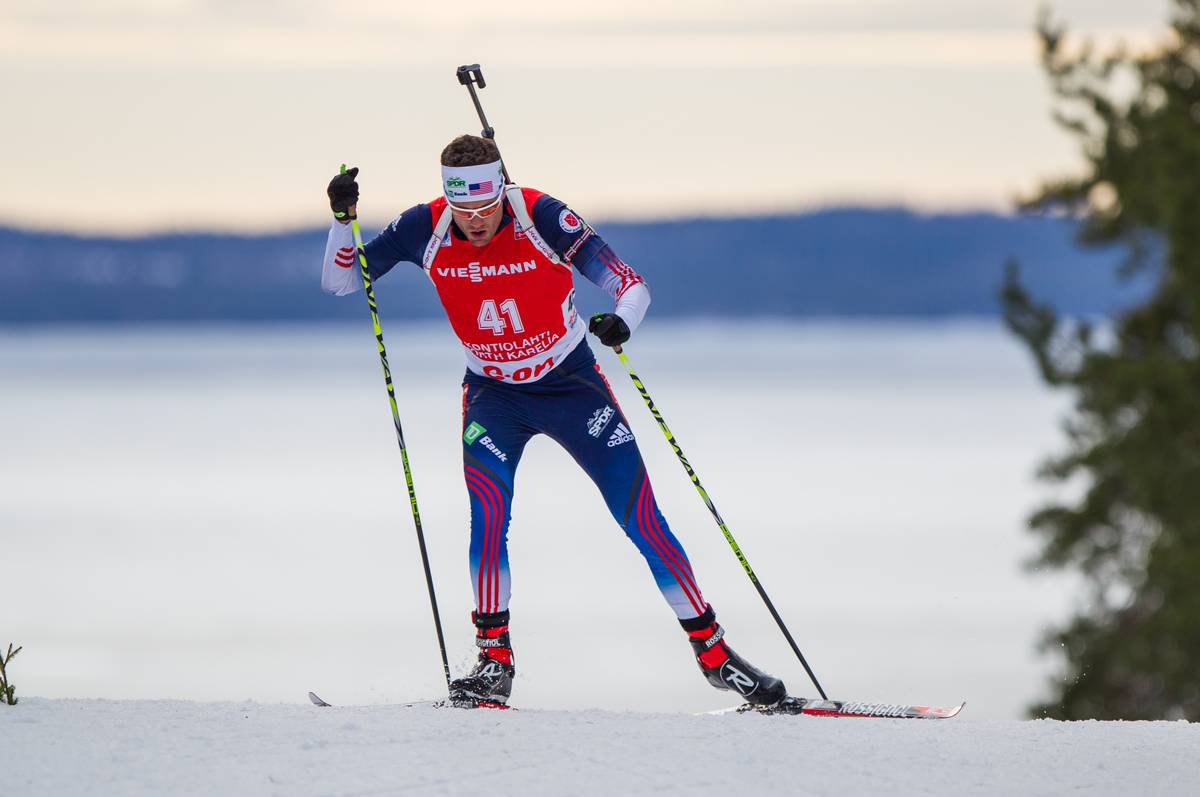
    Tim Burke crests a hill in today's 10 k sprint in Kontiolahti, Finland. (Photo: US Biathlon/NordicFocus)
    Tim Burke crests a hill in today’s 10 k sprint in Kontiolahti, Finland. (Photo: US Biathlon/NordicFocus)

    The winds were calm and the course was wet today in Kontiolahti, Finland, for the IBU World Cup. With unseasonably warm temperatures officials had to heavily salt the course, which provided for firm if wet conditions. Perfect shooting and the stamina to continue skiing strong as the course deteriorated would be necessary to win the day, and Norwegian Johannes Thingnes Bø delivered, shooting clean and skiing the course in 23:33.2. The perpetually-on-the-podium Frenchman Martin Fourcade was second 7.1 seconds later after also shooting clean, edging Germany’s Arnd Peiffer (+7.2), who barely missed overtaking Fourcade after a receiving one penalty in prone. Peiffer was the only finisher in the top ten to receive a penalty, and one of only two in the top 15.

    Russia’s Dmitry Malyshko was fourth (0+0), Norway’s Ole Einar Björndalen was fifth (0+0), and Czech Ondrej Moravec was sixth (0+0).

    Canada’s Nathan Smith was the top North American, finishing 21st in 24:38.6 (0+1), followed by teammate Brendan Green in 26th (1+0).

    Green was happy with his race, writing in an email that though he felt “a bit flat” initially, he “managed to ski a fast last loop to move up quite a few places to end the day with a fairly solid result. [I’m] not sure what was up physically but it seemed like it took the body a while to get going today.  We’re at the tail end of a long season so at this point I’m trying my best to finish out the season with strong and consistent results.”

    American Lowell Bailey (1+1) squeaked into the top 30, tying for 29th with Switzerland’s Serafin Wiestner (0+0), followed by fellow American Tim Burke in 35th (0+1).

    Burke was surprised by what he regarded as a poor finish.

    “I was pretty happy with my performance today and I expected a good placing, but the results said otherwise,” he wrote in an email. “I felt good on the skis and with one penalty I expected to be close to the top ten but I was far back from this.  I’m not really sure what happened and where I lost so much time.  I am just happy that we don’t have a pursuit based off this race!”

    Rounding out North American racers were American Leif Nordgren in 55th (0+2) and Canadian Scott Gow in 59th (2+0).

    Competition continues on Saturday with another sprint.

    Results