From the FasterSkier archive — posts syndicated from athletes’ and coaches’ own blogs between 2004 and 2012, kept online as published. Current coverage is at fasterskier.com.
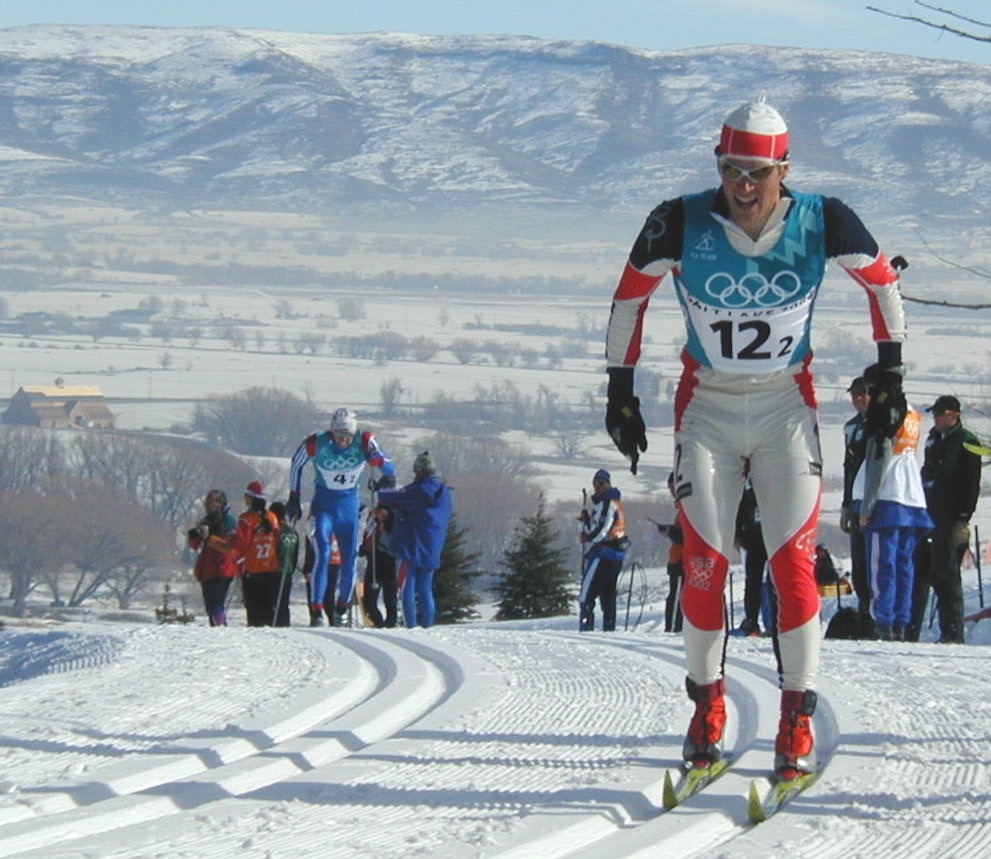
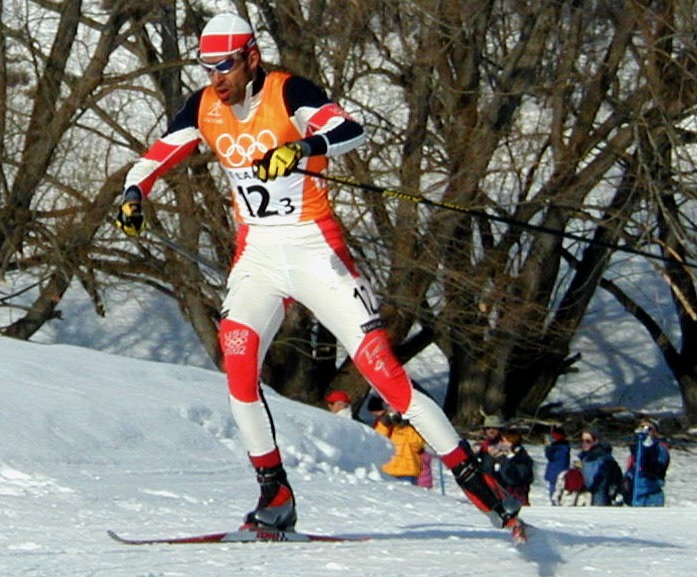
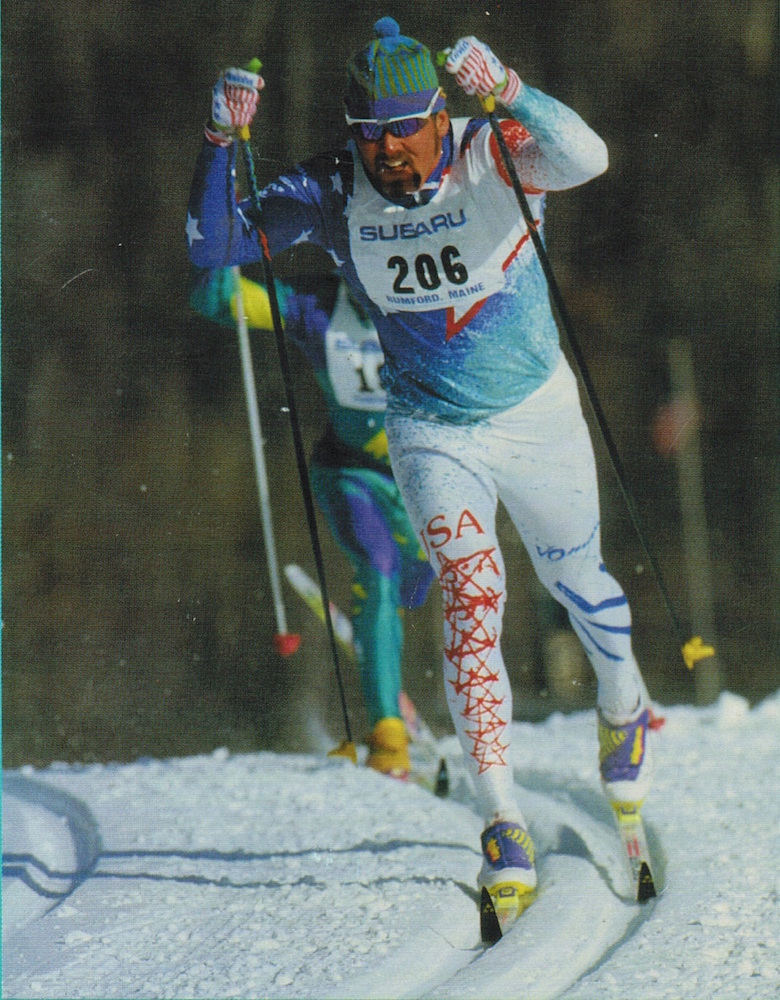
A 21-year-old Kris Freeman skis leg two of the men’s relay for the U.S. at the 2002 Winter Olympics at Soldier Hollow. (photo: Cory Smith)
This humble website went live twenty years ago today. (How long ago was that? Pretty long, judging from this recent Buzzfeed listicle.) As a later retrospective on this site would explain, “FasterSkier was founded in January 2002 by Torbjœrn Karlsen, Cory Smith and Erik Stange. FasterSkier.com was launched on February 1, 2002 and quickly grew to become one of the most trusted sources for Cross-Country skiing information in the United States … .”
The ur-articles from February 1, 2002, have sadly been lost to the ravages of time; the switch to the “modern” CMS interface has not been kind to content from the site’s first year. Early coverage presumably included a “Hello, World!” introduction, while the substantive focus was likely on the 2002 Winter Olympics, which began in Salt Lake City one week later.
Happily enough, the site’s Olympics coverage is preserved in its entirety, thanks to the intercession of the Internet Archive’s Wayback Machine. You can find a roundup of all 2002 Olympics coverage here, and a link to all compiled Olympic race reports here.
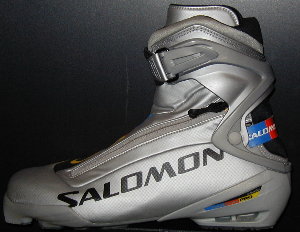
Coming soon to a store near you! Salomon Carbon Pro skate boot (photo: Cory Smith)
The articles are, collectively, a heck of a period piece, and are worth your time, particularly if you have been reading this site for years and would like to see how far the technology has come. You may also be interested in the gear reviews, of, for example, the new, all-gray Salomon Carbon Pro. “I think that they are a real improvement over the Pilot Racing Skate 9,” our reviewer wrote, in a comparison to the product better and more universally known as “bumblebee boots.”
It was tough to choose just one article from an embarrassment of historical riches to reprint for today, but this piece, a race recap of the men’s 4 x 10-kilometer relay, feels appropriate. Thomas Alsgaard; Cristian Zorzi; Anders Aukland; John Bauer; Kris Freeman. This was a long time ago.
(The writeup of the women’s relay, from four days later, may be found here; it ends, “The Americans finished a disappointing 13th,” and says little more than that about the American team composed of Wendy Wagner, Nina Kemppel, Barbara Jones, and Aelin Peterson.)
This article was written by site co-founder Cory Smith, and was originally published on February 17, 2002. Photos and captions, both also by Smith, are reprinted as they originally appeared. A few bonus race photos are appended at the bottom, thanks to Smith’s impressive archives.
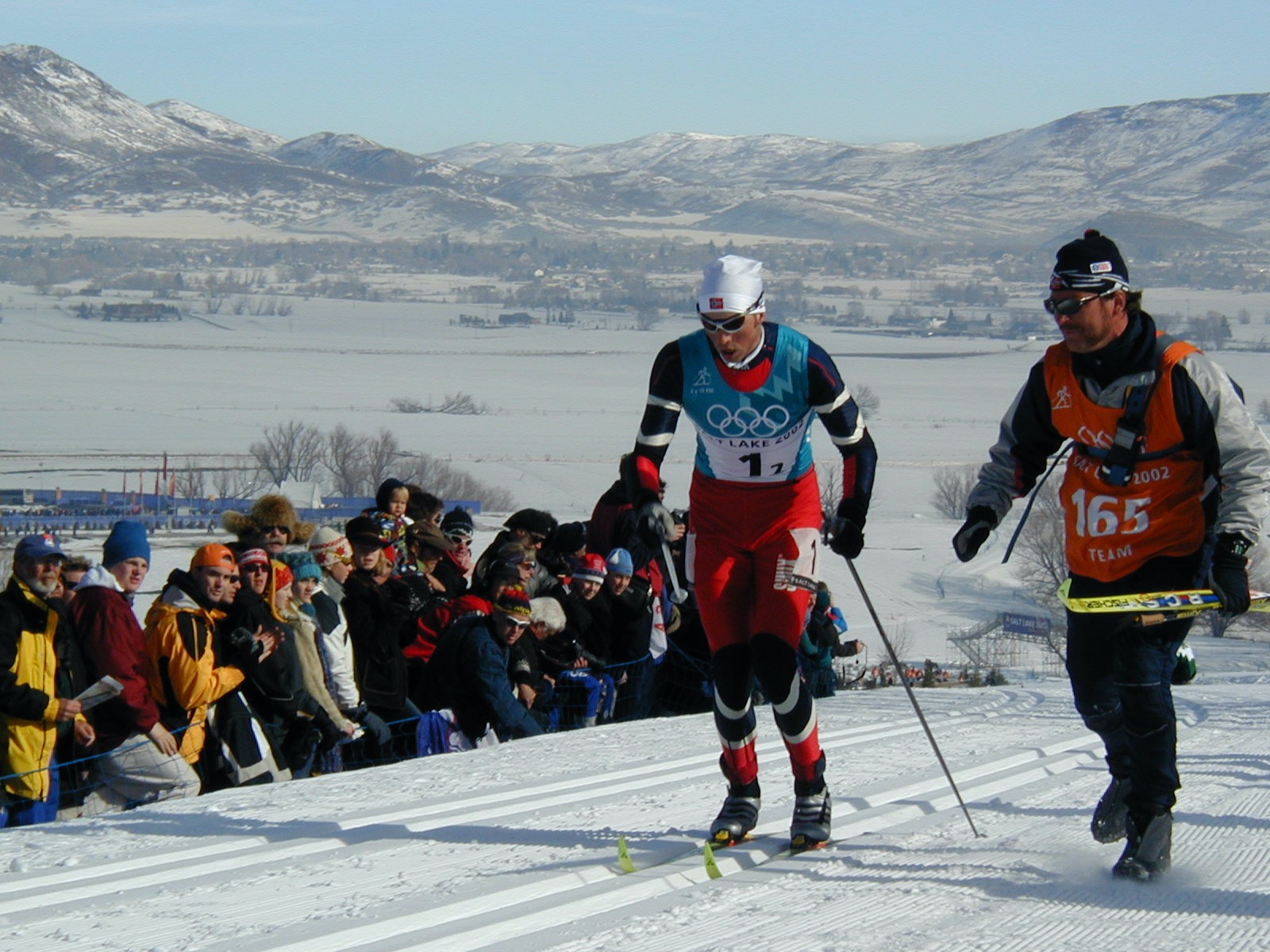
A Norwegian athlete skis in the men’s relay at the 2002 Winter Olympics at Soldier Hollow. (photo: Cory Smith)
Norway Beats Italy in Sprint to Finish (again), US Men’s Relay Team Posts Best Result Ever
By Cory Smith
By the length of one ski, Thomas Alsgaard brought order back to the cross country ski world. In today’s Men’s Cross Country 4 x 10K Relay race, the Norwegian team proved that even without an individual gold medalist in these games, they are still the best team in the world. Thomas Alsgaard outsprinted Cristian Zorzi in the final 100 meters to take home the gold for Norway.
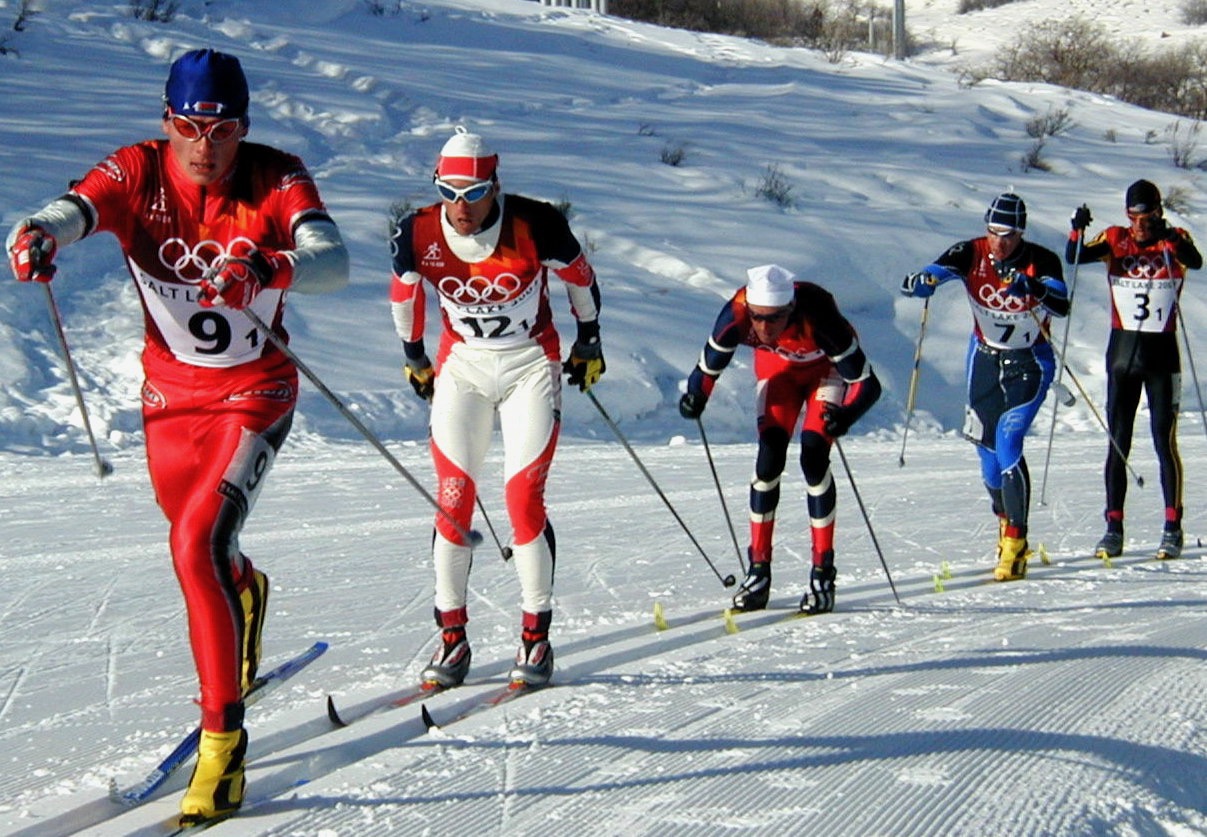
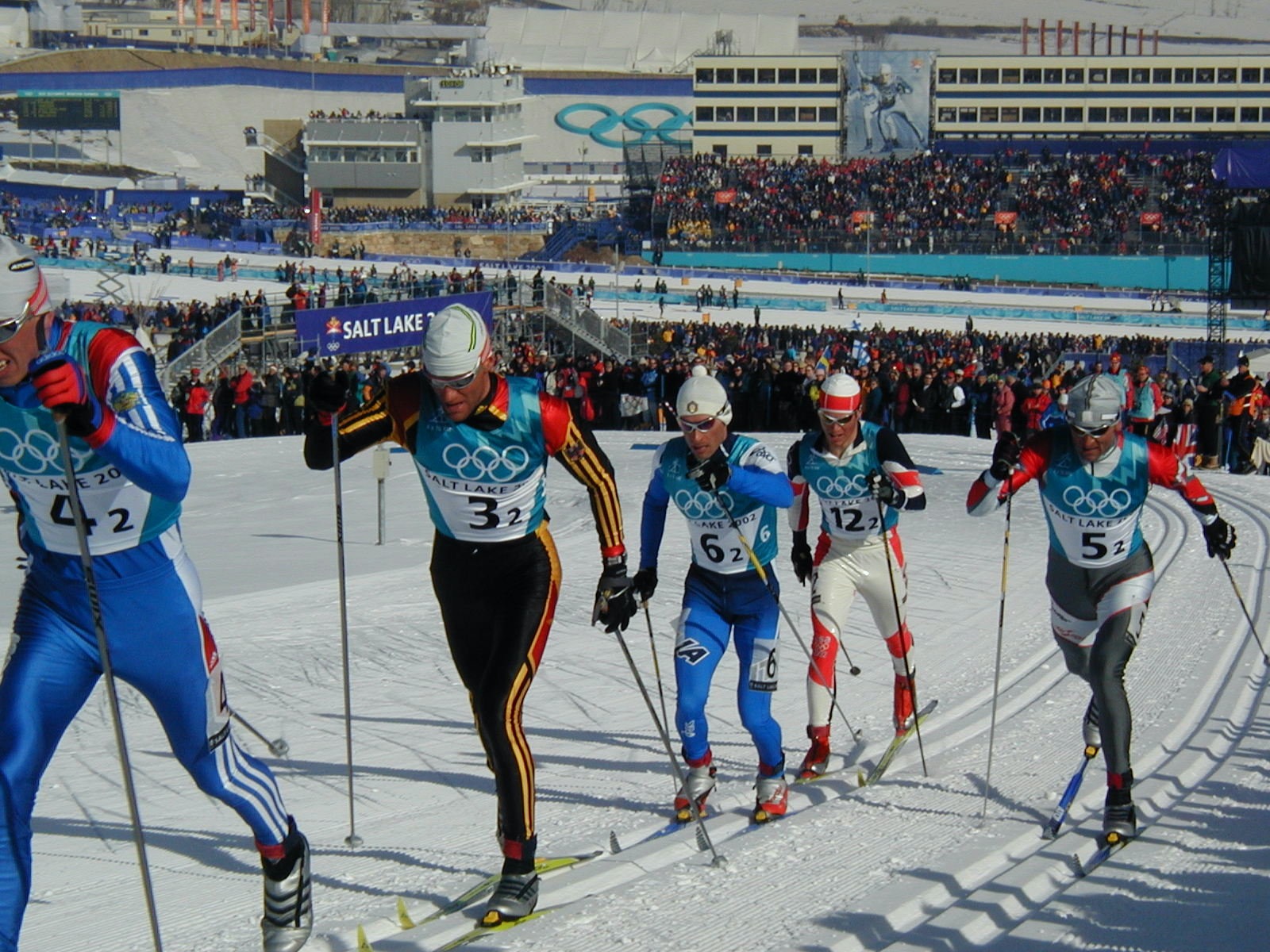
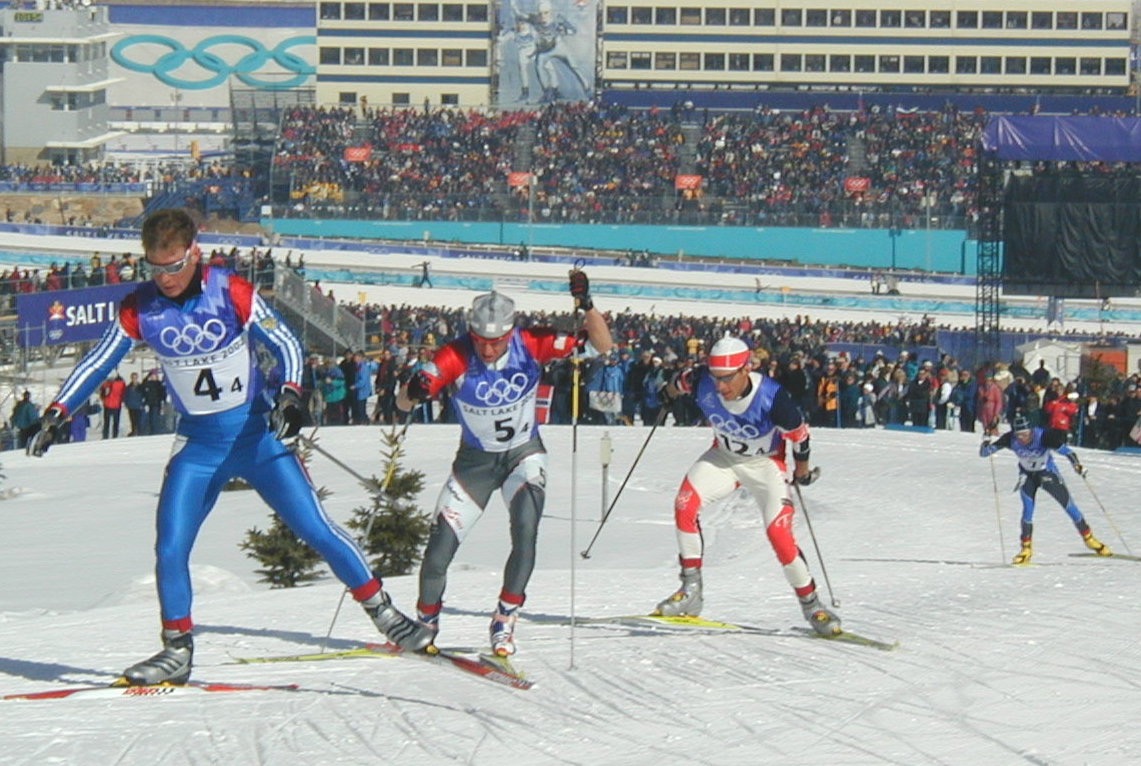
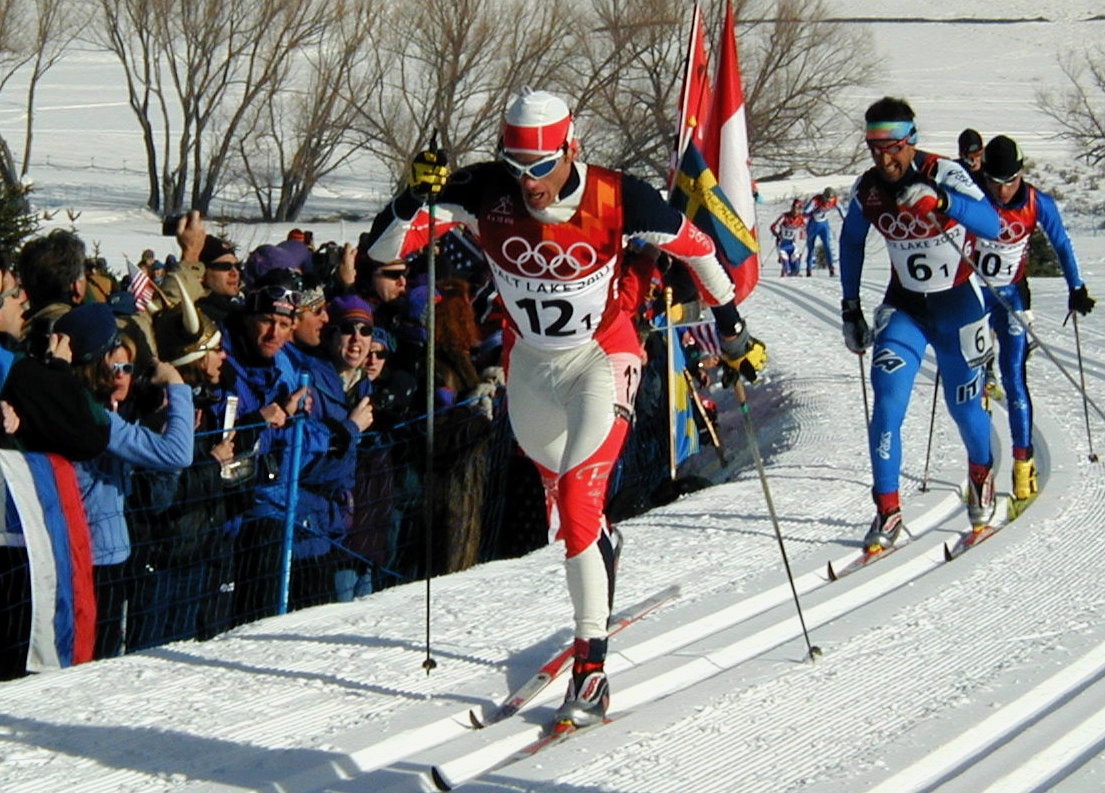
John Bauer (USA, bib 12) and Anders Aukland (NOR, bib 9) follow Belarus’s Roman Virolainen in the men’s relay at the 2002 Winter Olympics at Soldier Hollow. (photo: Cory Smith)
In a week that has seen more men’s gold medals for Estonia and Spain* than for Norway, and even a Canadian woman winning a medal, Sunday’s race was also extremely memorable, but with a more familiar outcome. The entire country of Norway was able to breathe a sigh of relief after their relay team put them back on top of the nordic world.
Meanwhile, the US men’s team, in the top five for most of the race, posted their top Olympic relay result by finishing a very impressive 5th. All four US skiers skied very fast and very smart to come within seconds of a medal for the first time ever.
Norway showed their dominance of the classic technique right from the start. After letting Belarus’s Roman Virolainen lead for much of the first lap, Norway’s Anders Aukland took control on his second 5K loop and opened a 10 second lead. Meanwhile, John Bauer, after a slow start that had him in last place out of the stadium, had moved up to the front of the pack and was actually leading the chase of Aukland. Bauer lost a few places gliding through the stadium, but he finished his excellent scramble leg in 5th place, right with Italy, Kazahkstan, and Germany, only 13 seconds off the lead.
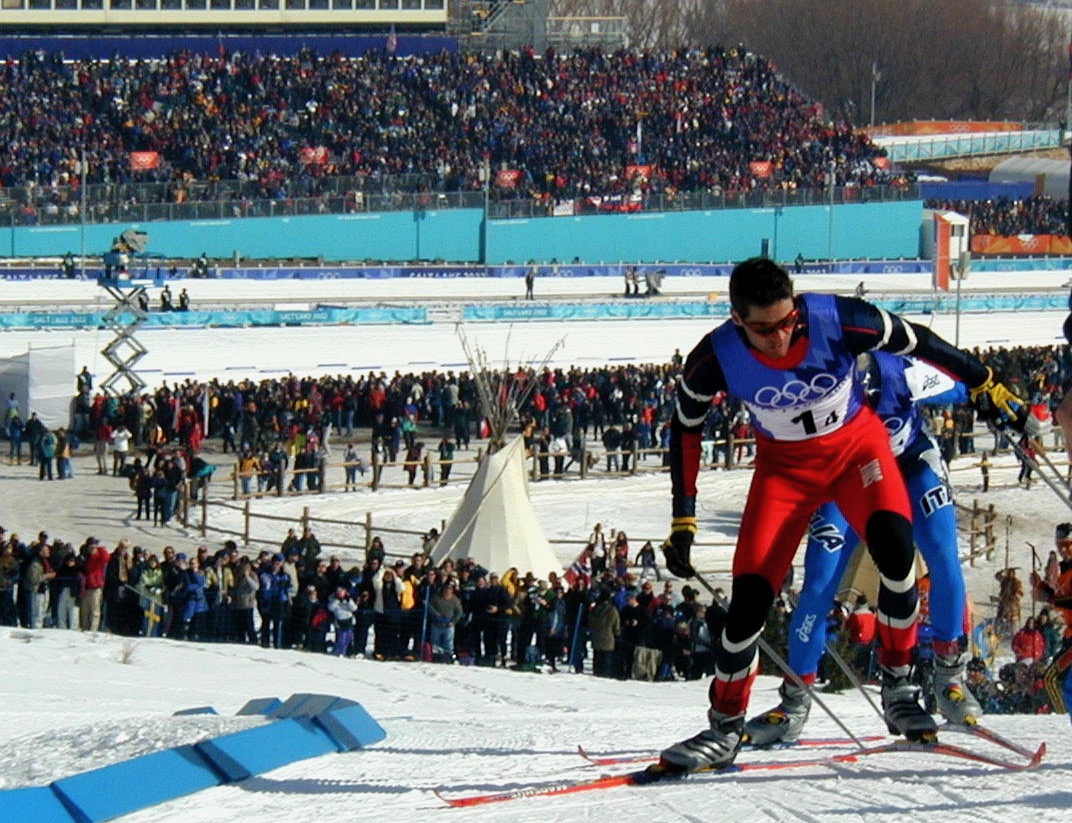
Kris Freeman (bib 12) stays right with the lead pack. (photo: Cory Smith)
On the second leg, Norway’s Frode Estil build the lead up to a maximum of 24 seconds while Kris Freeman (USA) jumped in behind Germany, Italy and Kazahkstan in the pursuing pack. As the leg went on, Estonia’s Andrus Veerpalu bridged up to the pursuing pack, as did Russia’s Mikhail Ivanov and Austria’s Mikhail Botvinov. This pack of six strong skiers started to cut into Estil’s lead, but as the leg came to an end, the pack began to break up. At the end of the second leg, Norway had an 11 second lead over Russia and Estonia. Kris Freeman skied an amazing strong race to stay in the thick of it, coming in right behind Italy’s Giorgio di Centa, in 5th place only 25 seconds off the lead. Halfway through the relay and the US men were only 14 seconds from a medal!
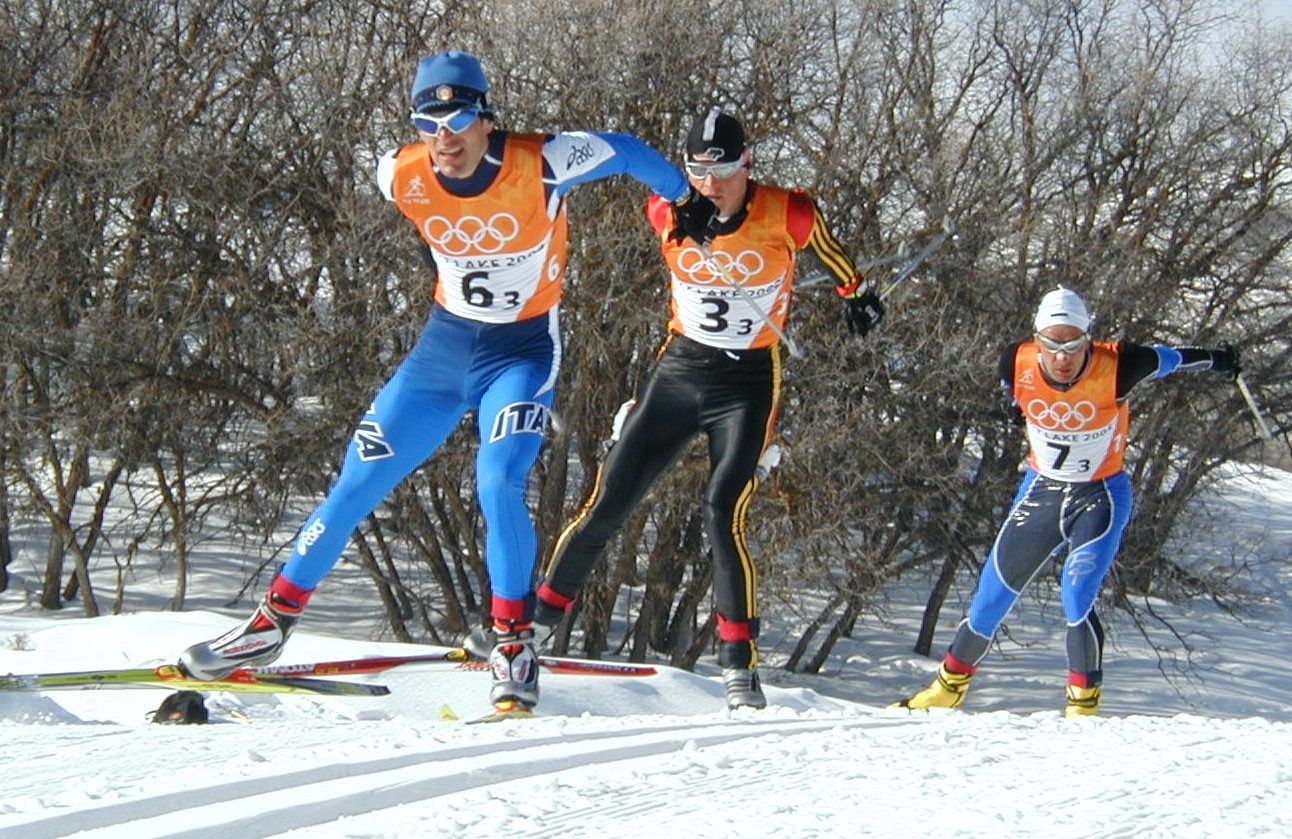
Pietro Piller Cottrer (ITA) charges towards the lead with Tobias Angerer (GER) in tow. (photo: Cory Smith)
The clear standout on the third leg was Italy’s Pietro Piller Cottrer. He started his leg in 4th place, then quickly passed the Russian and the Estonian and after about 5K, he was right with Norway’s Kristen Skjeldal fighting for the lead. The two of them skied together the rest of the leg, setting up yet another epic final duel between Italy and Norway. Justin Wadsworth looked to finally be over the head cold that had hindered him all week. He was smart enough to not try to stay with Piller Cottrer, but instead skied a very solid leg all on his own, until he was caught by Austria’s Gerhard Urain, whom he latched onto and followed until blowing by him near the end of the leg to finish in 5th place. In between the leaders and Wadsworth, Germany and Estonia came in together in 3rd and 4th.
Alsgaard leads Zorzi into the stadium to sprint for all the marbles. (photo: Cory Smith)
On the final leg, it became obvious that Alsgaard’s strategy was to try and shake Italy’s Zorzi, one of the best sprinters in the world, early. Alsgaard led most of the leg, but Zorzi held tight. Meanwhile, Germany’s Rene Sommerfeldt had pulled away from Estonia to assure a bronze medal. Carl Swenson jumped in behind Russia’s Nikolaj Bolchakov and Austria’s Christian Hoffman and they quickly passed the Estonian team. With the top three significantly ahead, Swenson was skiing strong and relaxed, as is his trademark, and was clearly gearing up for the finish. Along the way, they dropped the Russian, setting up a duel between Hoffman, who outsprinted Alsgaard in the 1999 Relay to win the World Championship, and Swenson.
Speaking of duels, Alsgaard and Zorzi were putting on a tactical clinic. Going up the last big climb at 9K, Alsgaard had the lead and tried on a couple of occasions to put on a kick and lose the Italian. But Zorzi held tight and made a pass just before the top of the hill. Just before the downhill, Zorzi dropped into a tuck and slowed way down, obviously trying to get Alsgaard to pass, so that he could draft.
Alsgaard wanted nothing to do with that plan and instead of passing, he pushed on the back of Zorzi’s ski with his pole to speed him up. Then Zorzi pulled over and nearly stopped. Alsgaard did the same. They were a kilometer from the finish and they were standing still arguing about who was going to lead!
Alsgaard eventually took the lead reluctantly. They went stride for stride up the short hill by the stadium and then dropped down to prepare for the sprint. On the gradual downhill, Zorzi freeskated hard to take the lead, and had about 5 meters on Alsgaard as they rounded the turn. Alsgaard then kicked it in and began gaining on Zorzi. With 50 meters to go, they were dead even, but it was clear that Alsgaard had greater speed. Alsgaard got a slight lead and held it. It was a very close finish, but there was no doubt that Norway had won.
Carl Swenson and Christian Hoffman pass the Russian team. (photo: Cory Smith)
Germany’s Sommerfeldt finished all alone in a surprising 3rd, and was mobbed by his bronze-winning teammates as he crossed the line. The battle was now for 4th. Swenson was up against formidable competition in Hoffman, but if any American could outsprint him, it would be Swenson and that’s why he was in the anchor position. Hoffman had the lead around the corner and they went toe to toe down the line.
For a moment it looked like Swenson would catch him, but there just wasn’t enough distance left. Another 20 meters and he would have had it. But instead Austria took 4th and the US maintained its 5th place on all four legs to post its best relay result ever.
The US skiers skied very, very well, both physically and tactically. But none of them skied unbelievably well, they all simply skied strong like they have all week. What I am trying to say is that this was no fluke. They finished right where they belong. They have been one of the top five teams on these trails all week and today they certified that. What is even more amazing is that there were two other American skiers, Pat Weaver and Andrew Johnson, who could have filled in and skied just as well. The US now has at least six World Class skiers. Don’t look now, but the United States is a force to be reckoned with.
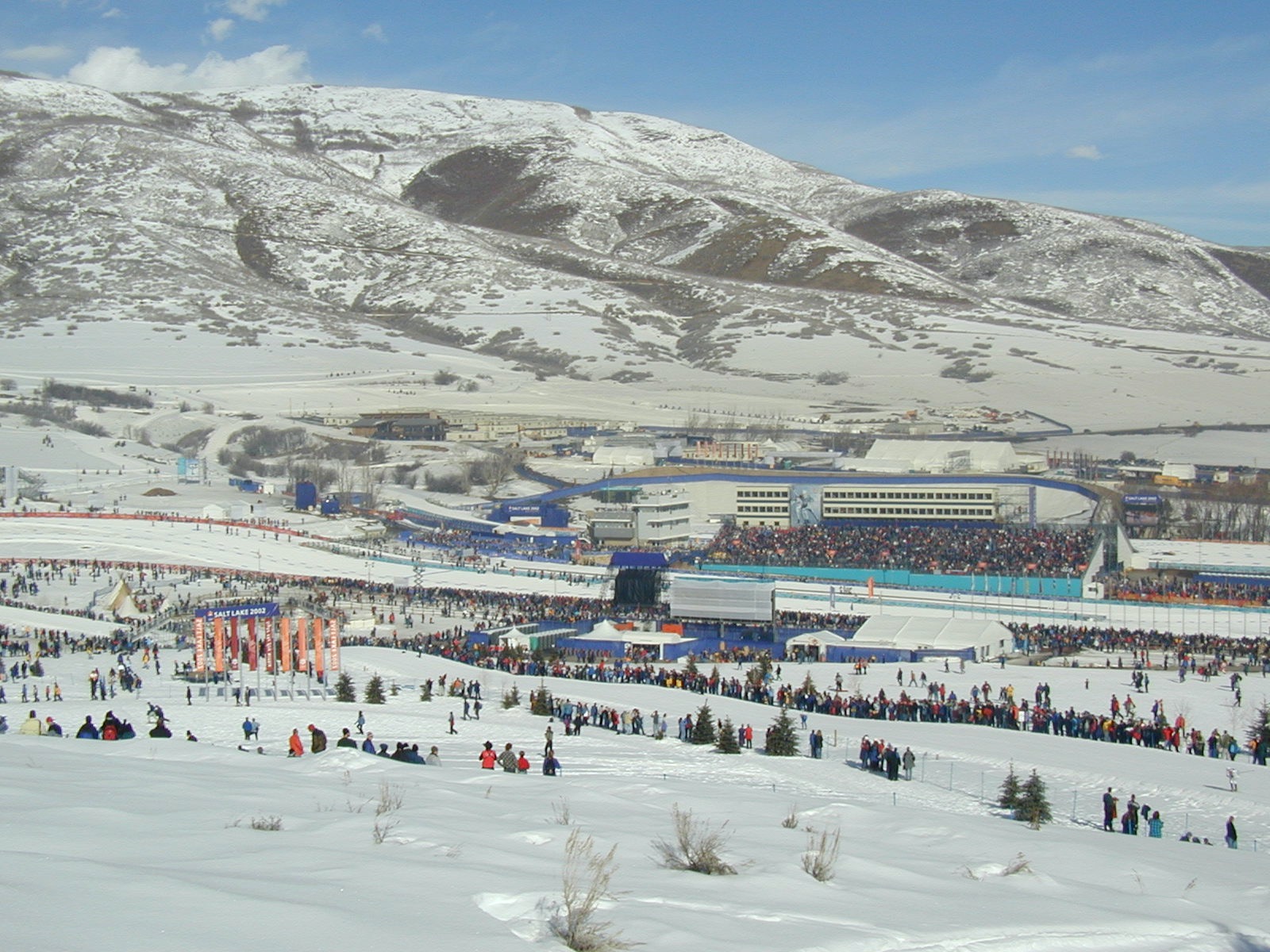
20,000 people cheer wildly at Soldier Hollow. (photo: Cory Smith)
Just as amazing as the race itself, was the crowd. Soldier Hollow was sold out for the first time ever, with 20,000 people watching a cross country ski race in this country for the first time ever. The crowd was loud and energetic. It was a sight that warmed the hearts of all Nordic die-hards on hand. Today, our little sport took a huge step forward in many ways.
[* Modern-day footnote: This statement, while accurate at the time, was ultimately belied by history, as the three gold medals that Johann Mühlegg won for Spain at these Olympics (in the 30-kilometer skate, 50-kilometer classic, and 2 x 10-kilometer pursuit) were subsequently rescinded following his disqualification for a positive darbepoetin test.]
Some additional photos from this race:
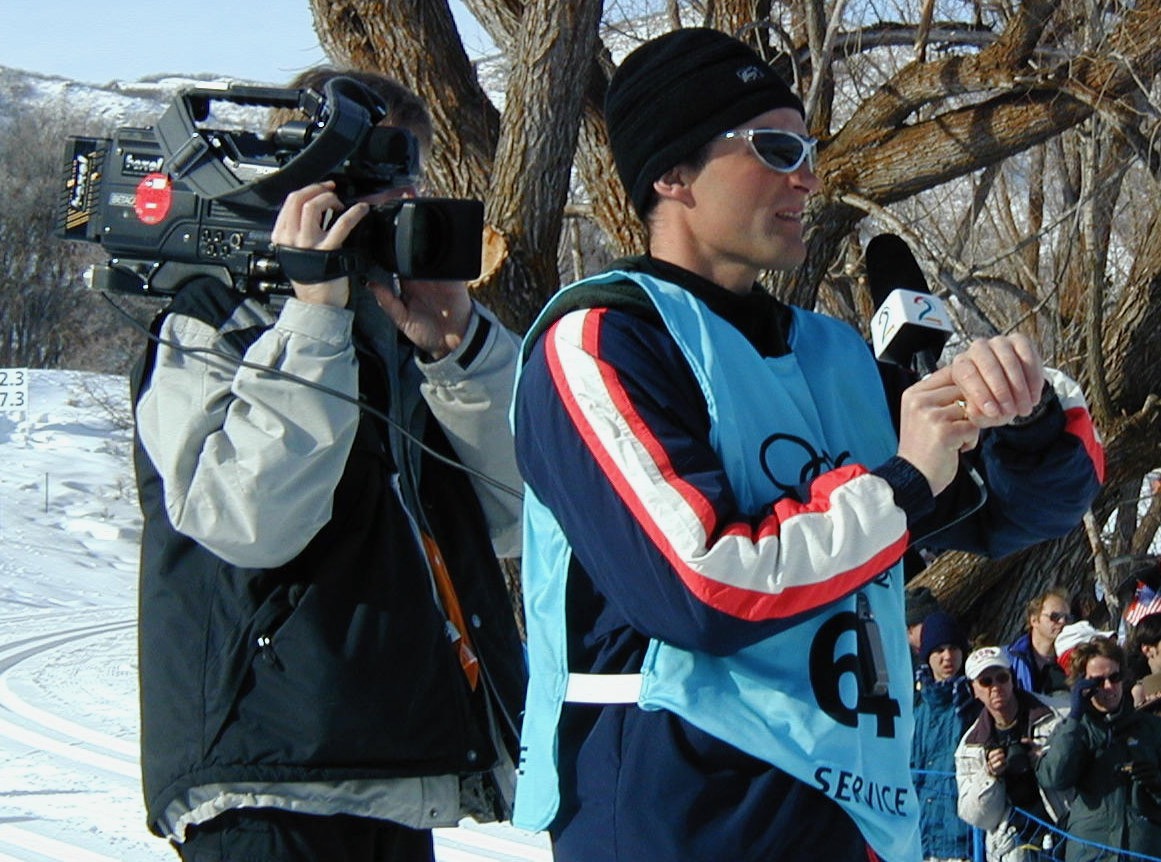
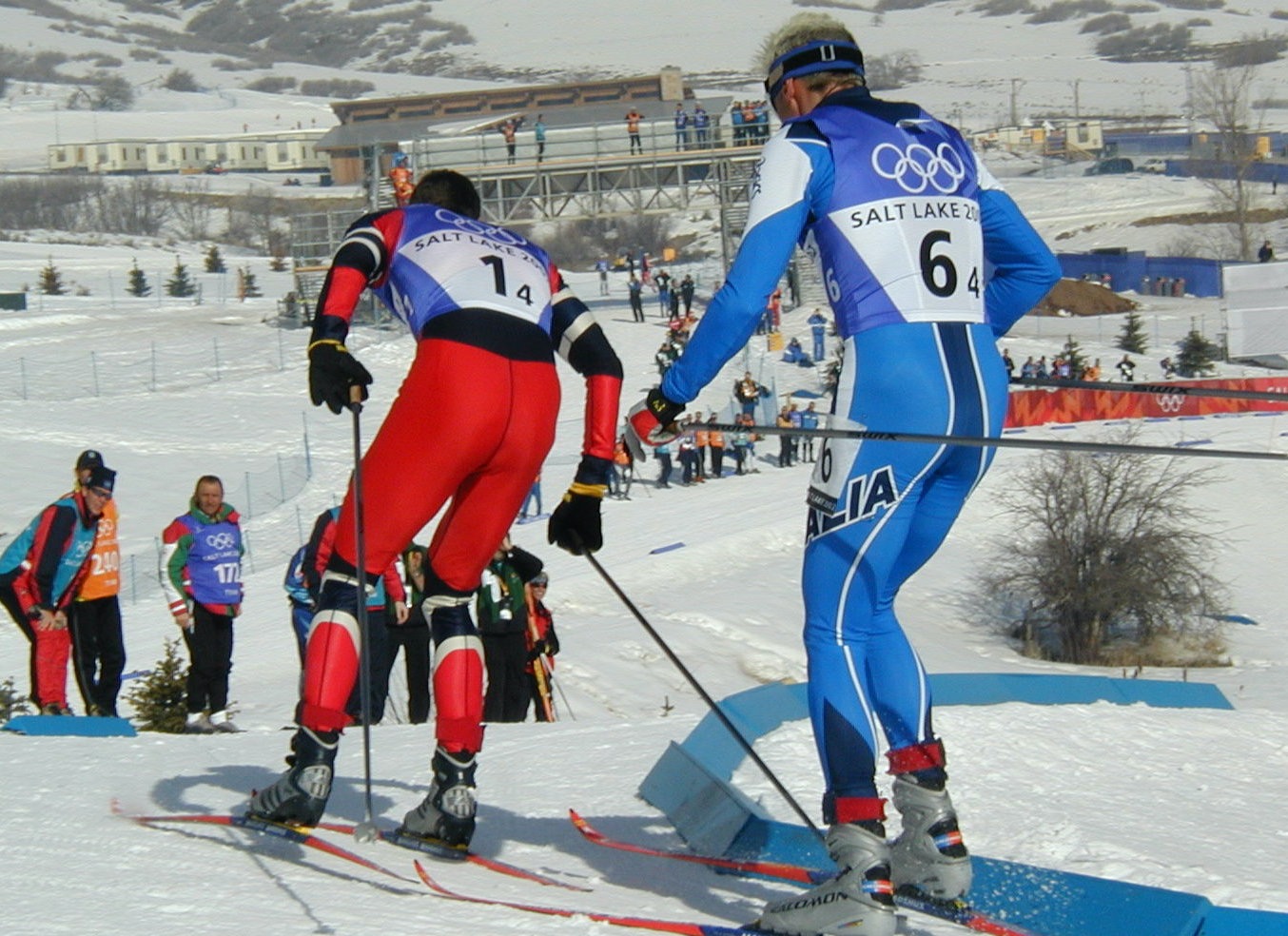
Vegard Ulvang serves as a commentator for Norwegian television at the 2002 Winter Olympics at Soldier Hollow. (photo: Cory Smith)Thomas Alsgaard leads Cristian Zorzi in the men’s relay at the 2002 Winter Olympics at Soldier Hollow. (photo: Cory Smith)Justin Wadsworth skis leg three of the men’s relay for the U.S. at the 2002 Winter Olympics at Soldier Hollow. (photo: Cory Smith)John Bauer skis leg one of the men’s relay for the U.S. at the 2002 Winter Olympics at Soldier Hollow, slightly ahead of Fabio Maj of Italy (bib 6) and Andrei Golovko of Kazakhstan (bib 10). (photo: Cory Smith)
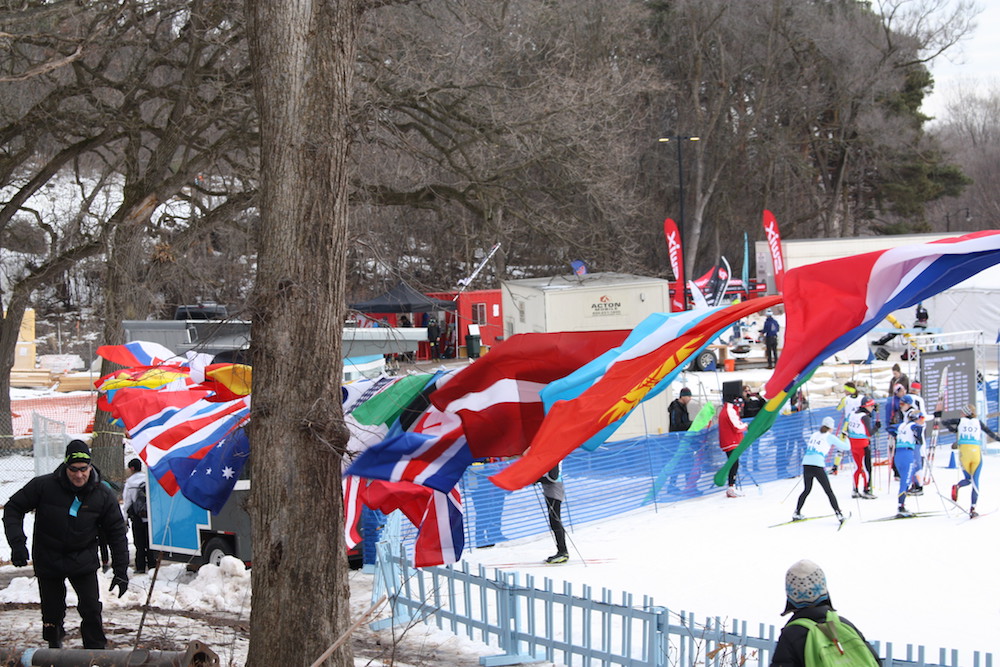
World flags waving on the first race day of the 2018 Masters World Cup on Saturday in Minneapolis, Minnesota.
MINNEAPOLIS, Minnesota — With temperatures staying in the mid-20s overnight on Friday, it was a warm, slightly sticky start to the 2018 Masters World Cup on Saturday in Minneapolis. However, despite temperatures in the upper 30s to low 40s, the 7.5-kilometer loop course at Theodore Wirth Park held up well — an important thing, as Saturday was all classic races.
Tom Ajax, of Minneapolis, finished 14th in his men’s age group “6” 15 k classic on Saturday at the Masters World Cup in Minneapolis, Minnesota.
According to Tom Ajax, a Minneapolis-based skier who raced in the men’s 30 k classic on Saturday (and also coaches with the Ride & Glide ski club), the course was “very clean. Spectacular, loved it.”
The tracks held up well, and the hills, though a little tough, were “doable,” said Ajax, who finished 14th in his age group “6” and described his last laps as stronger than his first. Helping to keep the course in good shape were the racers.
“Nobody snowplowing, nobody dogging it—a lot of strong skiers,” he said.
The sun did make a few short appearances on the overcast day, which modified course conditions some for the afternoon racers.
Boulder Nordic Sports Race Service Director David Chamberlain described conditions as “fairly consistent throughout the day.”
“In the morning we went with a little harder klister … but then switched over to a little softer one [around 10 a.m.],” he said.
At the same time, Chamberlain noted the course was “a little variable. Some of the hills got baked in the sun in a couple spots, and then [it was] a little drier in other places. The kick wax that worked in one place may not have worked perfectly in the other place.”
Generally, though, the overcast skies kept things pretty constant.
Conditions for Day 2 look to be about the same as Sunday, if perhaps a bit cooler. But, with a winter storm watch set for the Twin Cities metro area from Sunday night into Monday, things look like they could get a bit interesting for the shorter distance classic and skate races on Monday.
Elspeth Ronnander of the U.S. racing to third in her age group, the women’s “1” 15 k classic, at the Masters World Cup on Saturday in Minneapolis, Minnesota.
The races were broken into 24 different age groups, with the youngest racers being in “1” (e.g. born in 1986) and oldest in “13” (e.g. born in 1926). The largest race on Saturday was the men’s age-group “8” 15 k classic, which had 47 finishers. Finland’s Leino Nisula won that race in 41:19.7 minutes, another Finn Heikki Ruokonen won the men’s “7” 15 k in 40:07.4, and yet another Finnish man, Veikko Piirainen, won the “9” 15 k in 44:28.4.
The largest women’s age group was the “7” 15 k with 18 finishers, which Finland’s Marianne Niemi won in 47:18.9. American Carolyn Tiernan won the women’s “8” 15 k in 53:54.8.
Also racing 15 k were the women’s age groups 1 through 6. Elizabeth Youngman of the U.S. won the “6” in 45:31.7, Norway’s Ragnhild Bolstad won the “5” in 43:11.8, American Kim Rudd won the “4” in 45:49.3, Sweden’s Linda Hasselqvist won the “3” in 46:45.0, American Josie Nelson won the “2” in 45:51.8, and American Alexandra Jospe won the “1” in 45:45.9.
Women’s “9” through “11” raced 10 k, with American Gabriele Andersen winning the “9” in 30:37.0, Norway’s Else Marie Scharff won the “10” in 40:46.4, and American Patricia Kaald was the lone participant in the “11”, finishing in 1:06:56.5.
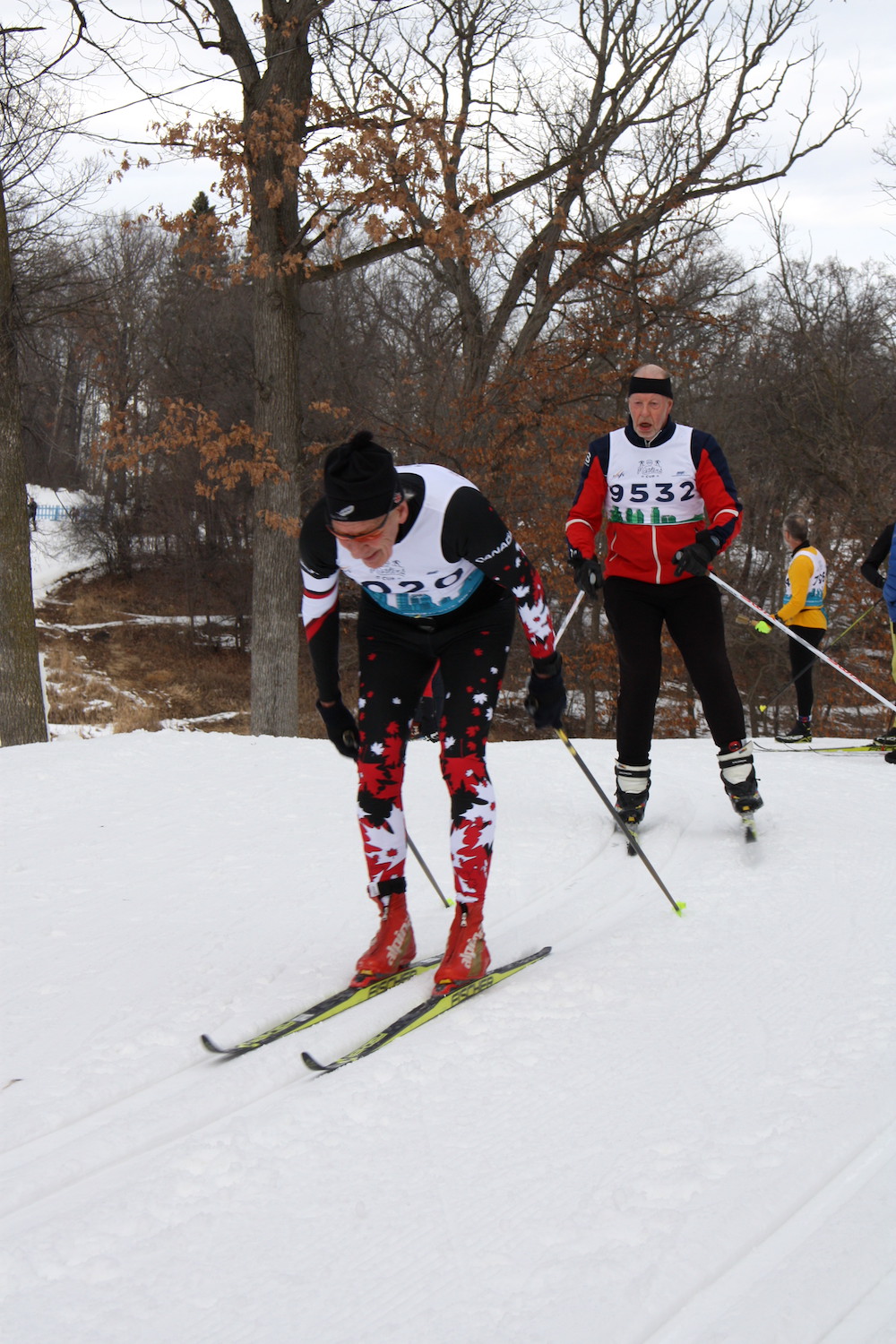
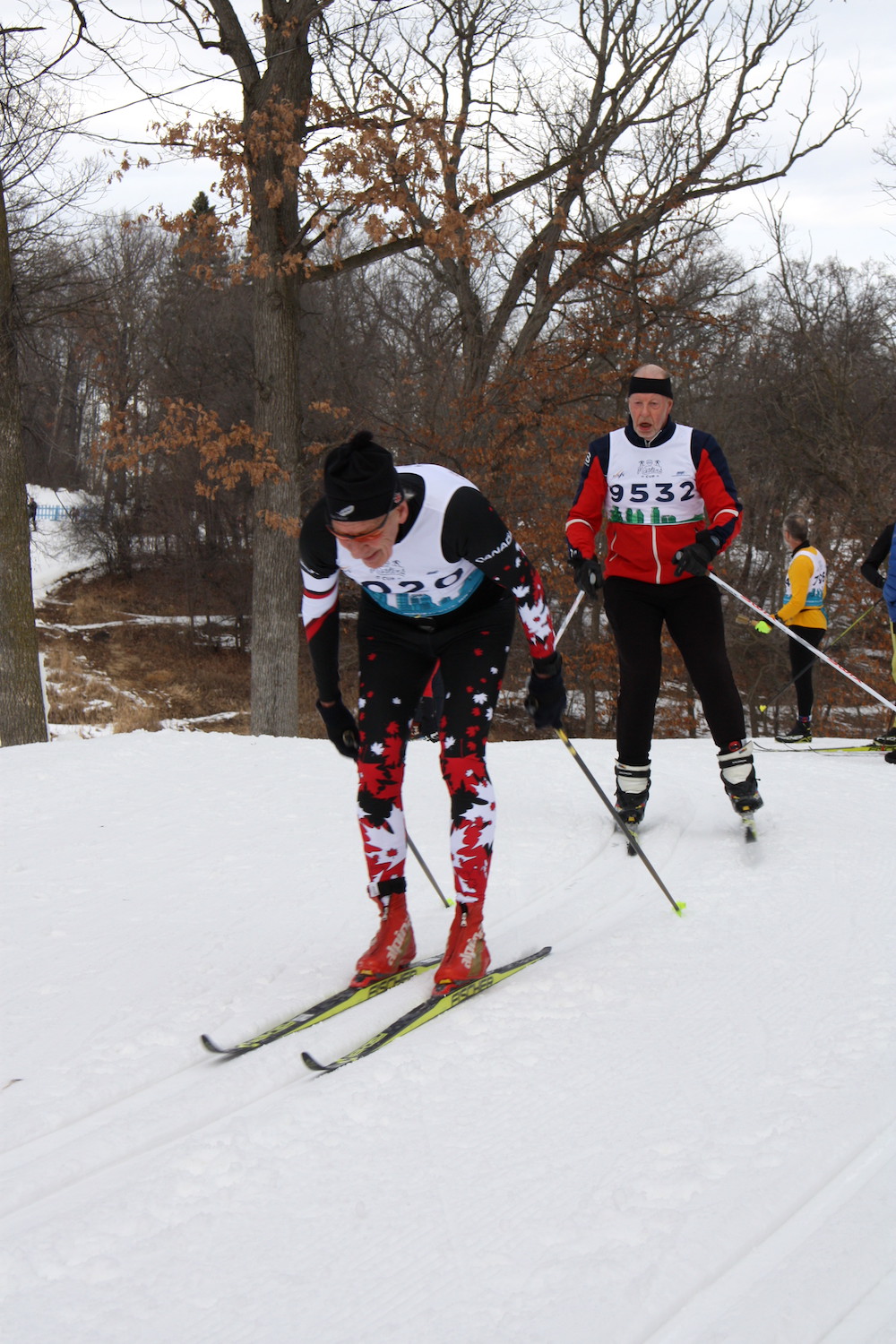
Rick Hubbard (9532) of the U.S. chases another masters skier while racing to 10th in his age group “10”, in the 10 k classic on Saturday at Masters World Cup in Minneapolis, Minnesota.
The men’s age groups 1 through 6 raced 30 k, with American Paul Allison winning the “1” in 1:15:16.5, American Erik Solberg winning the “2” in 1:25:47.3, Russia’s Andrey Lushnikov winning the “3” in 1:19:23.0, American John Bauer winning the “4” in 1:16:29.0, Sweden’s Tommy Gustafsson winning the “5” in 1:13:28.2, and Norway’s Jon Arne Envoldsen winning the “6” in 1:18:29.9.
The men’s “10” through “13” raced 10 k, with Norway’s Richard Johan Kringhaug winning the “10” in 29:12.9, Finland’s Tuomo Venalainen winning the “11” in 38:31.9, American Reno Deprey winning the “12” in 51:53.2, and the lone racer in the “13”, Charles French of the U.S., finishing in 49:47.4.
The 2018 Masters World Cup continues Sunday with 10, 15 and 30 k freestyle races.
About Andrea Potyondy-Smith: Andrea hails from the Twin Cities of Minneapolis (dontchya know) and has an MFA in creative writing. When she is not being an English geek, she can be found on her bike or skis, or playing in the Northwoods … typically on her bike or skis.
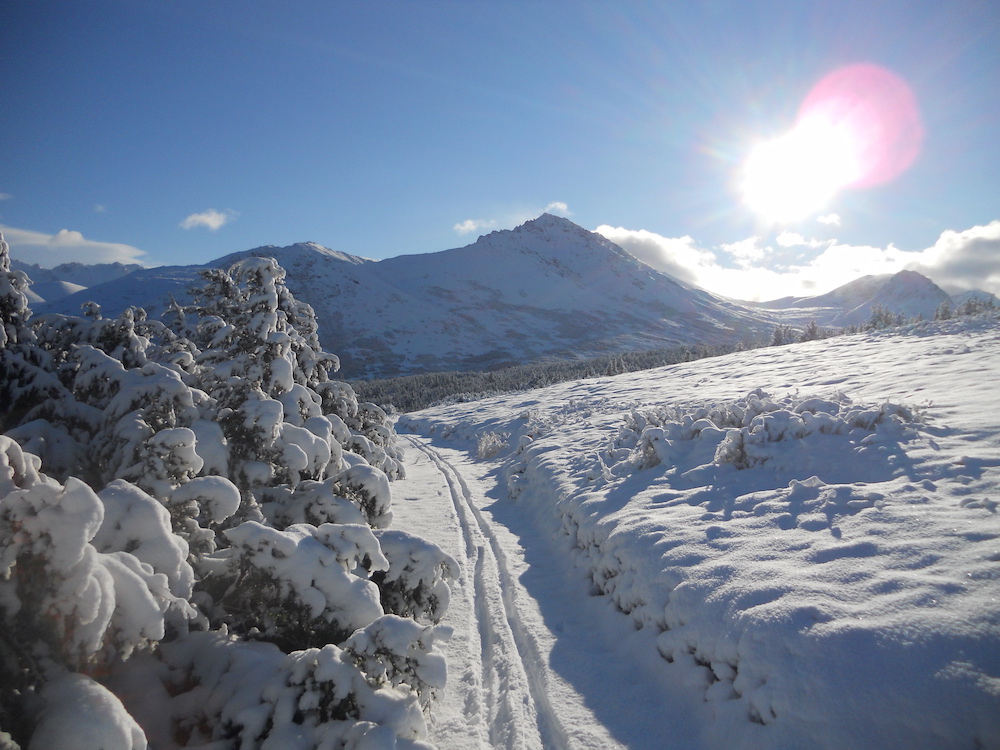
Early-season snow: first tracks in Chugach State Park, above Anchorage, Alaska, on Sept. 18, 2015. (Photo: Gavin Kentch)
Twenty years ago today, on Nov. 2, 1996, a ski race sanctioned by the International Ski Federation (FIS) was held in Fairbanks, Alaska, on the trails at Birch Hill. It appears to be the earliest FIS race ever held on natural snow in the Northern Hemisphere. This is a look back at that race, and at the significance it has, or does not have, for some of its participants.
Setting the stage
It was the final days before a hard-fought presidential election. Clinton was widely expected to prevail over the Republican candidate, although a strong third-party showing and voter dissatisfaction with the two major parties were complicating the electoral calculus. The Alaska Republican Party was running newspaper ads promising to “defend State’s rights.” And people were skiing in Fairbanks. Plus ça change.
There were also some differences. The front page of the Fairbanks Daily News-Miner on Nov. 3 ran an article headlined “Dole hoping for an upset” over, of course, Bill Clinton. Then on Nov. 4: “Perot plans last-minute television blitz.”
Elsewhere in the paper, movie listings included the Leonardo DiCaprio vehicle Romeo + Juliet. Agate type in the sports section recounted promising rookie Ray Allen leading the Milwaukee Bucks to a victory over the Boston Celtics. (It was the second game of Allen’s career. He would go on to play 1,298 more games after that.) And an ad for an ISP, or internet service provider, explained to potential customers the appeal of “the Internet.” You could “interact with people from around the world,” it promised, or, “Find answers and advice in newsgroups.”
In Fairbanks, meanwhile, it was winter, and it had been winter for a long time. The News-Miner reported that October had seen record-breaking cold, even for Fairbanks, with an average temperature for the month of 13.6 degrees. Through Nov. 3, it had snowed 22 inches so far that winter; given those temperatures, and the relative lack of solar radiation in Fairbanks in winter, most of it was presumably still on the ground.
The Nanook Challenge
Given this weather and snow conditions, it hardly seems newsworthy that a ski race was held. Plus several members of the U.S. Ski Team (USST) had been in town for early-season training, so the skiers were there.
The field for the 10-kilometer classic interval start – official title the “Nanook Challenge: FIS Series Race No. 1” – was small but distinguished. There were 10 women and 18 men entered. At least four current members of the U.S. Ski Team competed, along with several former USST members.
The top-five finishers in the men’s race were Ben Husaby, Marcus Nash, Patrick Weaver, Scott Loomis, and Carl Swenson, respectively, a bevy of elite skiers that would not have been out of place at a mid-1990s national championship race. (Indeed, all five men would place in the top seven in the 15 k skate race at U.S. nationals later that winter in Bend.)
The women’s podium was headed up by USST skiers Laura Wilson and Suzanne King. Third place went to Julie Southwell, described by the News-Miner as “a national team contender who trains in Fairbanks.” (Five years later, a profile of Southwell by Inge Scheve in The Bulletin of Bend, Ore., would call her “a former Colorado resident who says she sort of follows the snow.”)
Wilson’s winning time was 33:28 for 10 k. Husaby finished the same course in 27:56. Conditions were described in the News-Miner as “near-perfect,” with an 11 a.m. race temperature of “20 degrees under a pale white ceiling of clouds.” (The season’s second FIS race, a 15 k skate, was held the following weekend, in arguably less perfect conditions. The high temperature for Fairbanks on November 9, 1996, was –1°. The low was –26°.)
(Story continues below)
The Fairbanks Daily News-Miner’s 1996 story on a Nov. 2 cross-country ski race, the earliest FIS-sanctioned event ever held in the Northern Hemisphere.
The Fairbanks Daily News-Miner’s 1996 story on a Nov. 2 cross-country ski race, the earliest FIS-sanctioned event ever held in the Northern Hemisphere.
The Fairbanks Daily News-Miner’s 1996 story on a Nov. 2 cross-country ski race, the earliest FIS-sanctioned event ever held in the Northern Hemisphere.
The Fairbanks Daily News-Miner’s 1996 results from the second race on Nov. 9.
Looking back
Swenson, the fifth-place finisher in the opening 10 k classic, has fond memories of Fairbanks as an early-season training destination generally, though scant recollections of this race specifically. When asked about this race in a recent phone interview, following his workday doing indigent defense for the New Hampshire Public Defender, Swenson began by musing, “I’m just trying to place what year that would have been,” and attempting to reconstruct whether World Champs had been held that spring or the year before. “We’d always have a race real quick after we got there,” Swenson continued. “And we’d get to Fairbanks in mid-October.”
In a race of more recent vintage: Carl Swenson, competing for Steinbock Racing, made the trip from southern New Hampshire for the 2010 Boulder Mountain Tour in Sun Valley, Idaho. (Photo: Toko)
“I remember it fondly,” Swenson, now 46, says of Octobers and Novembers spent in the Golden Heart City. “Not a lot of sunlight, lots of skiing.” He adds that “everyone was so excited be on snow again; I always looked forward to it. I don’t know if everyone looked forward to it, but I always did.”
“We were always able to ski” somewhere in or near Fairbanks, Swenson notes, “but sometimes it was really thin. … There could be pretty bad skiing, but I always remember we skied.” They would – much like modern-day juniors competing in the Besh Cup series – stay at the Wedgewood Resort, and “we’d all pile up and drive to Birch Hill. When it was a bad snow year, we’d all drive up to an elementary school” that had trails (Salcha Elementary), “and it would be ridiculously cold.”
Swenson’s lack of specific memories may be attributable not only to the passage of time and multiple fall trips to Fairbanks, but also to the fact that Nov. 2 was early in the season for him in more ways than one. “I probably hadn’t done much rollerskiing” at that point, Swenson candidly admits. “I was still catching up.”
(Uniquely among top-level cross-country skiers, Swenson had “made the bold decision to pursue a professional mountain-bike career and continue to ski race internationally in the winter,” FasterSkier previously wrote. 1996 was his first summer of pro mountain biking in the “offseason.”)
When asked whether he had simply kept the rollerskis in storage through September or had at least gotten out a few times a week during the summer, Swenson at first suggests digging up an old training log from storage, then says, “it would depend on if I went to late-season mountain bike races that year. Sometimes I would be – World Championships are at the end of the season in mountain biking. In ’96, I think I would have been in Boulder. And maybe I would have started doing some rollerskiing in the summer – not much, if any.”
Swenson was clearly unconcerned about his results in a November race two months before U.S. nationals and more than three months before World Championships. He recalled that his focus for his first two weeks back on snow would have been volume, and guessed that he would have logged approximately 20 hours of skiing per week while in Fairbanks. “I’m sure everybody up there was concentrating on volume, and things like that,” Swenson notes. “There would be people chasing points, to make an early trip – but I doubt anyone was doing that up there.”
Swenson improved his position with a third-place finish in the 15 k skate a week later, suggesting that he may have been racing his way into skiing shape.
The ’90s force is strong: Ben Husaby (USST) racing at 1993 U.S. Nationals in Rumford, Maine. (Courtesy photo)
At the top of the results sheet, Husaby won both races, the 10 k classic on Nov. 2 and the 15 k skate on Nov. 9. His memory of that fateful week in Fairbanks borders on the eidetic. “That weekend actually stands out for me as one of the more memorable ones in my ski career,” Husaby recently said when cold-called about a race from the Clinton administration.
Husaby, who turns 51 next month, spoke with FasterSkier by phone from Bend, where he works as executive director of the Bend Endurance Academy. (Husaby once cracked that he enjoys being a ski coach because “I get to drive a Ford Econoline van down winding roads in inclement weather.”) Husaby clarified that in his current job he coaches only one skier, national-class athlete Dakota Blackhorse-von Jess; he assists nordic director Bernie Nelson and will go out with other athletes, but says that he is following Nelson’s lead.
Husaby still recalls how fast he skied, but poignantly acknowledges that his timing was somewhat suboptimal.
“I’ll just say, it was the fastest I’ve ever skated, for sure,” Husaby declares. “And you certainly don’t want that to happen in the first week of November, but it did. It’s bittersweet, because it’s the wrong time, but it was amazing. Those two races, they were effortless.”
Husaby speaks with evident emotion about the sensation of skiing so easily:
“So, nobody wants to be a Christmas star, and I was a November star. But, the race course [in Fairbanks] was a very challenging race course, and I blew around that course effortlessly. And that was a really, really cool feeling. I had traditionally struggled in tough skating race courses, and, you know, I walked all over everybody. And so, you know, that was exciting. And one of the things I remember is, how cold I felt being as quote-unquote ‘skinny’ as I was. I was in the low 180s. And I was colder than I had normally been.
“I also remember feeling really light and fleet and dynamic. I remember – and it’s always weird, because when we got back to the hotel – you know, those first races of the year, people are always talking about how they’re going to get better, where they made mistakes… generally everyone wants to downplay their early races. And here I was – I’m looking in retrospect in terms of how fast I really did ski. At the moment I didn’t realize that that was probably as fast as I had ever gone, but in retrospect, I realize, wow.
“There were a couple of World Championship results, there were a couple World Cup results where I was competitive, and probably moving along at the same speed – but this particular weekend, it was completely effortless.”
Husaby had been a member of the U.S. Ski Team from 1991 through 1995, but in fall 1996 was training solo. But he finished ahead of all current USST members in both races in Fairbanks.
“Particularly the skate race,” Husaby enthuses, “I mean, for me to beat everybody by over a minute – I think it was a minute and change – in a 15 k skate. I mean, I never did that. I’m not really sure why.” (Husaby correctly recalls that he beat second-place John Bauer by 1:04 in the skate race.)
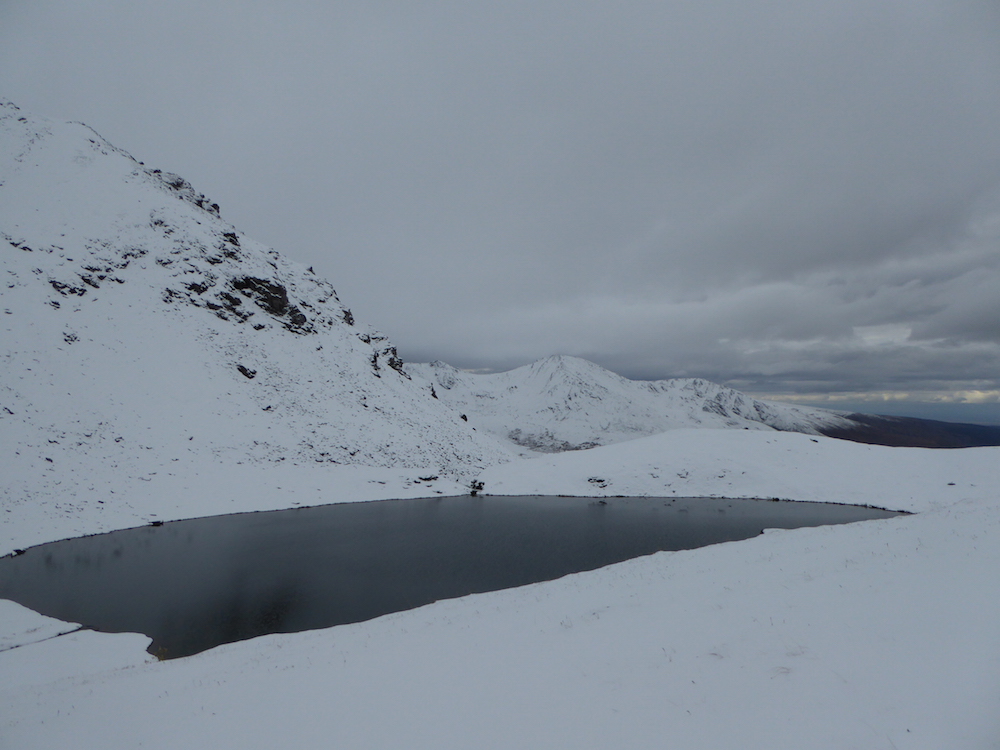
Early-season snow: skiing past Summit Lake, in Hatcher Pass above Palmer, Alaska, on Sept. 23, 2016. (Photo: Gavin Kentch)
At the time, Husaby felt strongly that his performance merited selection for bigger stages: “I do remember being like, ‘God, I wish they would have selected me to go back to the World Cup.’ Because they sent Marcus [Nash]. They took Marcus, not me. And I do remember being like, ‘Dangit, I killed everybody, they should be taking me.’ But it’s always like that – you always think that you should be the one that’s named.”
But he now waxes much more philosophical about the vagaries of team selection. “I’ve had 20 years to think about it,” Husaby now analyzes, no regret or animosity in his voice. “There are a lot of arguments why I should have been chosen for it, and a lot of arguments why I shouldn’t have been chosen for it. It’s just the nature of sport.”
As he left Fairbanks in November 1996, Husaby had high hopes that these results presaged a breakthrough season for him.
“Like any athlete, you think, ‘Oh my gosh, this is the start – it’s really going to happen here.’ Particularly when you’ve had five years of mediocre racing on the World Cup, right? … In the previous five years, I had everything [in World Cup results] from low 20s to, you know, 112th place. And so all of a sudden a result like this comes along early in the season, and I’m thinking to myself, ‘Man, if this is the start of things to come, this year is going to be totally lights out.’ ”
Husaby did not receive World Cup start rights that season, and in fact never raced on the World Cup again. He spent the 1996/1997 season on the domestic Yoko Cup, an inchoate version of the national-level race series that ultimately became the SuperTour.
Despite – or maybe because of – the fact that the Fairbanks races ultimately proved to be a highwater mark of the season rather than a springboard to successful European racing, Husaby frequently uses the experience as a teaching moment for his athletes.
“As much as we really think that we have our finger on the pulse,” Husaby theorizes, “and that we can really dial in when we’re going to be fast, and really pick and choose the big events, and how it’s all going to play out – you never really know when you’re going to have your moment. You don’t know. The body and the mind are really – sometimes they’re diametrically opposed, sometimes they’re incredibly in sync, sometimes one is lined up and the other one’s not. And a huge part about athletic growth is just realizing that you never really know when you’re going to have your moment. So when you do have your moment, hopefully you get something from it, you gain something from it. For me, this was an indicator that my training, the change in training, had an effect, the weight loss had an effect, maybe the release of not being on the ski team any more had an effect.”
“I guess the moral is to pull something positive out of a good race, regardless of when it happens.”
When asked about his strongest memories from his time in Fairbanks, Husaby mentions two things. First, despite the subzero temperatures for the skate race, “I remember that that climb – I felt like Superman going up that far outer climb [on the race course]… I remember charging up it. It’s got like three rises in it.”
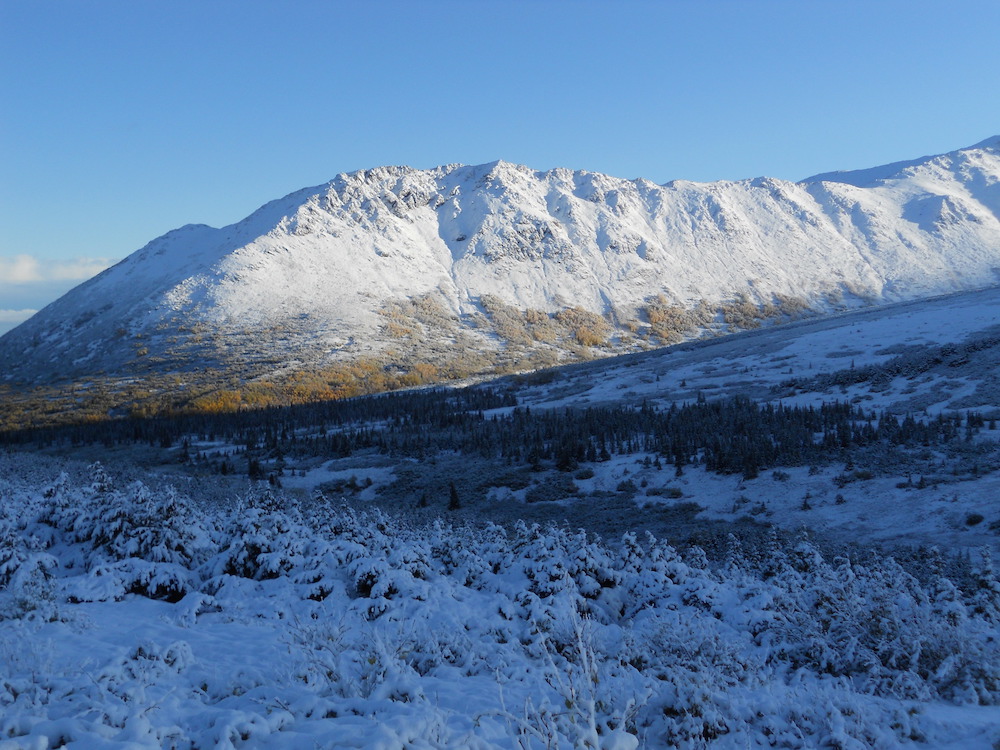
Early-season snow: fresh snow on top of fall colors in Chugach State Park, above Anchorage, Alaska, on Sept. 18, 2015. (Photo: Gavin Kentch)
And second, “I remember that being a very cold week. … I wasn’t a ‘do a loop many times’ kind of guy. I was always an explorer. Well, I spent most of my training time in Fairbanks actually out on the White Bear [Trail] and out on the military roads. I used to bring really crappy skis, just so I could ski on the military roads. But I recall that week being incredibly cold. And my motivation was to ski out to the end of White Bear, look at the thermometer, and then ski back in. Just to reaffirm how cold it really was. That was it. Besides that race, that was my memory of that week.”
In addition to multi-time Olympians, other notable names on the results sheet include “Jason Cork, UAF, 34:23.3,” in 12th, surrounded by several of his teammates from the University of Alaska Fairbanks ski team. Cork was born and raised in Alaska, and graduated from North Pole High School in 1995. He skied for UAF before embarking on a coaching career that ultimately brought him to his current position as Assistant Men’s Coach for the U.S. Ski Team.
Early-season history
The participants may not have realized it at the time, but they were, in the world of high-level ski racing, making history. The race remains the earliest FIS-sanctioned race ever held on natural snow in the Northern Hemisphere, according to the FIS database.
(A FIS-sanctioned race is one whose results can be used to help calculate a skier’s FIS points, “theoretically a universal ranking system for skiers around the world who have never competed against one another.” Generally speaking, a FIS race is held on a course with climbs of specific height differential and grade, as well as a total climb requirement. A FIS race is held on a relatively challenging course, and attracts a relatively high caliber of skiers.)
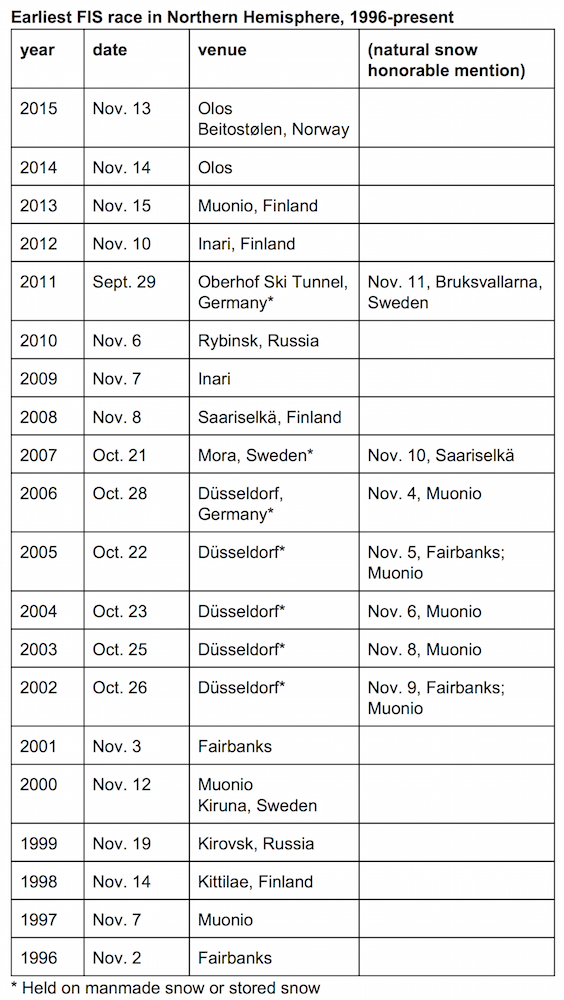
Here are the earliest FIS races from 1996 to present, as listed in the online FIS results database. Amidst a host of early-November dates from several venues across northern Scandinavia, November 2, in Fairbanks, Alaska, stands out as the earliest by a small margin. But Fairbanks shares one significant thing in common with the other names frequently occurring on this list: a far northern latitude. Fairbanks is at, in round numbers, 65 degrees north latitude; Olos and Muonio, 68°; Inari, 69°; Beitostølen, a downright tropical 61°. (The Arctic Circle is at 66°34′.)
Table of year’s earliest FIS race, 1996-2015. (Source: FIS database)
As FasterSkier wrote over a decade ago, Fairbanks in early winter presents a “surreal setting. … The air is still, day after day, and the temperatures hover around zero even though it is barely November.”
(The table distinguishes between natural snow races and artificial snow loops when relevant – it is truly impressive that Mora had a sprint race on a stored ribbon of snow on October 21, but it makes for an apples-to-oranges comparison to Fairbanks or Muonio. Also note that the 1996 cutoff for this table is not artificially hiding an earlier race out there. The earliest FIS race from any of 1990-1995 was held on November 6, 1993 (also in Fairbanks, also the Nanook Challenge). And by the 1990/1991 season, there are only a dozen races listed for the entire season (down from hundreds for 2015/2016), underscoring the limitations of the otherwise remarkable FIS database.)
All that said, simply skiing in Fairbanks in November is a news story on the level of “dog bites man.” September snowfall in Fairbanks is not unusual. Groomed (or at least dragged) skiing in October is expected. Throughout the 1990s, Birch Hill was a mecca for early-season training for high-level skiers from across the country. (The second FIS race of 1996, the 15 k skate a week later, boasted a top-8 of Husaby, John Bauer, Swenson, Loomis, Weaver, Todd Boonstra, Adam Verrier, and Audun Endestad. That’s a lot of good skiers. And a combined 15 Winter Olympics.)
Ken Leary is a longtime Fairbanks local who oversaw the low-key Wednesday Night Race Series ($20 for eight races!) for many years. In an email to FasterSkier, Leary wrote that “the first Nordic ski race of the season in Fairbanks is the annual Wednesday Night Halloween race held on the Wednesday nearest to Halloween.”
Leary added, “To my knowledge, Fairbanks has never had a Nordic ski race in the month of September, but it would have been possible in years 1992, 1993, 1996, and 2015 because of early snowfall.”
(In Anchorage, which like Beitostølen is situated at a balmy 61° north latitude, early high-level ski races on record include “a 15 km APU race that [then Alaska Pacific University head coach] Jim Galanes held on the Spencer Loop on October 25, 2001,” as recounted on local skier Tim Kelley’s blog. More recently, the University of Alaska Anchorage ski team held a time trial on the Spencer Loop a week ago today.)
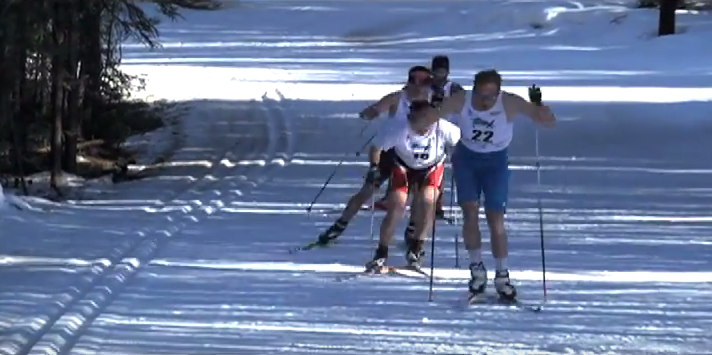
Max Olek (University of Alaska Fairbanks), No. 22, leads eventual winner Lex Treinen (also UAF), No. 18, in a ski race held at Birch Hill in Fairbanks, Alaska, on May 8, 2013. (Photo: YouTube screenshot)
And at the other end of the season, following a winter of roughly average snowfall but then a spring of record-breaking cold, Leary once hosted a race at Birch Hill on May 8, 2013, when the 6:45 p.m. start time occurred a full four hours before sunset. (The YouTube video is worth a quick watch (and not only because a cross-country ski race leads the sports news on local CBS affiliate K13XD Channel 13). It shows racers in shorts on what can only be described as close to 100 percent snow coverage on a 50-degree day. Many skiers have raced in midwinter in far worse.)
What it all means
There is an undeniable draw to being on snow – especially when you’re not supposed to be. (Or maybe especially when others are not, and you can brag on social media that you are.) Rollerskiing is good as far as it goes, but Annie Pokorny once credibly likened it to a rebound girlfriend, writing, “Every spring, Nordic skiers must undergo a reluctant breakup with the perfect girl” and console themselves with mere rollerskiing.
As Chelsea Little previously wrote in a lyrical piece on FasterSkier, she clings to the idea that, “at any given moment, somewhere in the world, there’s great skiing. If I can’t be back home and if it’s not December through March, then a corner of my mind is occupied wondering where that snow is and whether I can get there.” For Swenson, Husaby and a handful of other elite American skiers throughout the 1990s, the answer to “where the snow is” in October and November was consistently Fairbanks, Alaska.
Introducing the Alaska Ski for Women, a fundraiser to help stop the cycle of domestic abuse against women and children and also a really fun outing! Toko has supported this important event for the past 17 years.
Alaska Ski for Women – an important event
The colorful Alaska Ski for Women (ASFW) is North America’s largest women-only cross-country ski event. This is a great event where women of all ages and abilities come out to Nordic ski approximately 2.4 miles (4K), many in colorful costumes, while raising funds for local non-profit organizations that help stop the cycle of domestic abuse against women and children. This is not only a fun event, it’s also a fundraising event! Through the generous donations of ASFW participants, and the hard work of the all volunteer committee, the race has been able to make an impact in the community by contributing over $1,000,000 to groups that actively work to improve
women’s lives. A special focus is ending the cycle of violence against women and their families and to help women in crisis find positive solutions to a healthier life.
Held every year since 1997 the Anchorage event originally had nothing to do with the Super Bowl and started as a way to get more women out skiing together. That it was set on the same day as the football game was a coincidence -it was the only Sunday left with no race scheduled when the initial reservations were made. Since then, organizers kept the race on the day of the Super Bowl because it offered a great reason for women to have fun and raise money on a winter day when people are in a celebratory mood already.
The primary purpose of this event is to get women out and take away their excuses. It certainly is a nice date and the event gets done in time to watch the Super Bowl. Race Director, Tamra Kornfield said 500 women signed up for the event this year, a slight drop from last year’s numbers but the goal is to get more women interested in the sport as well as supporting a good cause. While it’s not yet known exactly how much money was raised this year, Kornfeld said last year the group raised about $50,000 in donations. Teams dressed in costumes including a Chinese dragon, hot air balloons, a lion, a gorilla, devil’s club and public school busses. A team dressed as “Google Maps” claimed victory in the costume contest. Olympic cross country skier Kikkan Randall was one of the costume contest judges. Randall said that the trail was well-maintained with manmade snow despite the lack of natural snow. Were it not for the snow making equipment at Kincaid Park the last two season, the Ski for Women might well have been a walk as it was in 2005 when there was no snow on the ground.
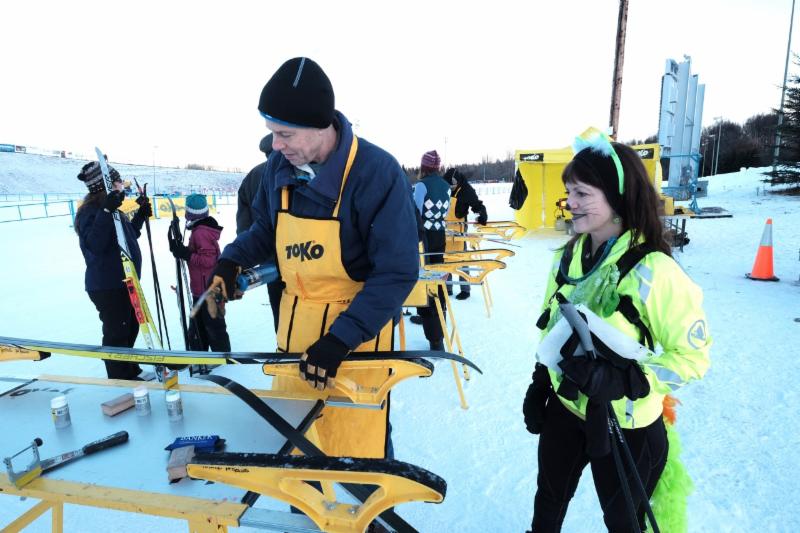
I have been a wax volunteer for the ASFW since the inaugural event in 1996. Initially a group of volunteers took over the Kincaid Park wax bunker and provided skate and kick wax services. TOKO started providing wax for the event in 1999 when I first came on board as a member of the TOKO Tech Team. The bunker was being renovated in 2001 for the World Special Olympics held in Anchorage and was unavailable for use for the Ski for Women. That year, myself and Mark Strabel set up our tables and tents in the stadium near the start and provided kick wax service to participants. Being near the start and seeing the costumes and the joy of the participants gave good reason to continue with kick wax service outside in the stadium. Glide wax service is also provided through rub-ons and paste. The following year TOKO became the proud and exclusive wax product sponsor of the Ski for Women and has been ever since.
In the 20 years I have been associated with this event there have been many volunteers who have stood outside and waxed skis. Some come for a year and others keep coming back. Each volunteer gets a TOKO hat and an apron. It is understood that regardless of the weather preceding the event or the forecast the day before, the morning of the ASFW will be cold and windy. These past few years I have been fortunate that a reliable core of volunteers has been available to wax. Chet Fehrmann, Ira Edwards, Eric Schwalber, Jay Holton and Matt Claman.
Toko is proud to support the Alaska Ski for Women and will continue to support it. Thank you to the organizers and the other supporters who make it possible.
– Patrick McGownd, Toko Tech Team Member since 1999
Bauer Wins the Pepsi Challenge
Hayward’s 3 time olympian John Bauer won last weekend’s Pepsi Challenge race. Here’s what he ended up waxing with:
I went with Toko HF Black then HF Red/ Yellow 50:50. I thought there was pretty good structure in the skis already so I did not re-rill. I did the red and yellow Structurite tool before adding JetStream Red and I put on a coat of the Red Helix. Perhaps I should have had more structure in…but there really wasn’t much one could do with the new snow that wasn’t much tilled when the sun hit it.
I think it was a good effort. I skied relaxed and in the pack until I led out after 3k. Skied the Silver with a few pushes over the hills and then was alone at the 11k point on in. There were a few lurchy spots on the downhills and the skis were noisy on the sun-drenched hills. Congratulations to John on his overall win despite being 47 years old!
Wax Report from JNQ Spokane, WA
We had our last JNQ event last weekend in Spokane, and I took 10 athletes to compete in the mass start classic and individual start skate events.
Conditions were slated to be challenging: with warm temperatures and no recent snow it was transformed but somewhat sloppy. The classic race had a possibility of new snow which I was hoping to avoid! Given the high moisture and rapidly rising temps during the day we went with LF Yellow and LF black mixed for both days as a glide base layer. Then I tested JS Red and JS Yellow blocks and found some mixed results: the JS Red ran well in the more frozen snow, but even without the temperatures rising, as the tracks (classic) or platform (skate) got more skied and transformed further the Yellow came into play. I opted for yellow on both days given where our athletes were starting in the order, and also used the yellow structurite. Next I want to play around with some linear 1mm rill to accompany the structure sometimes, as I think that would help further channel the transformed snow’s moisture down the ski – thoughts?
For kick in Saturday’s race, I first tested a green drywax vs. klister binder. Both skied comparably fast but out of fear of wear (lots of snowplowing, sharp corners) I went with the klister figuring it would increase tenacity. I covered the green binder first with Red, and tested that against a Red/Yellow mix. The Red was solid for most of the day’s races; it held well for kick and glide without getting slick as the tracks further glazed. However the later starters were the U14 classes and I wasn’t confident they’d be able to make it work (a few had issues in their warmup). I also wanted to keep the speed of the Red, so I just dabbed in some yellow. This small amount did the trick to add a bit more kick under the foot without sacrificing glide.
– Sam Naney, Head Coach Momentum Northwest
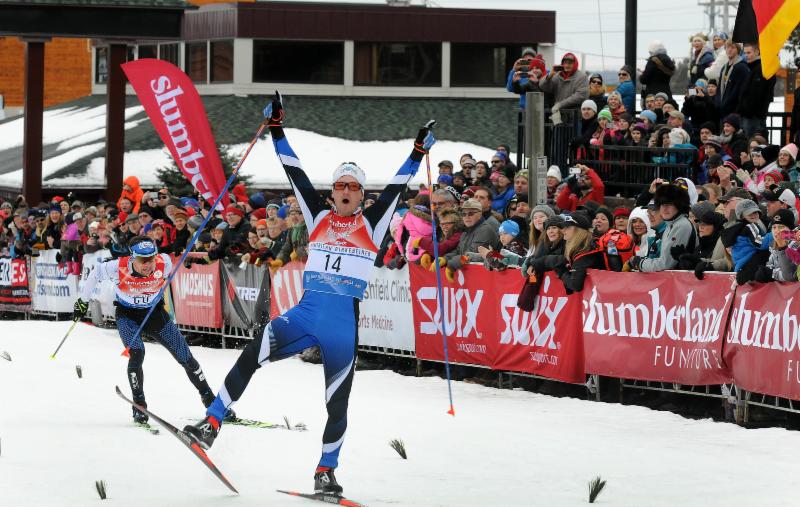
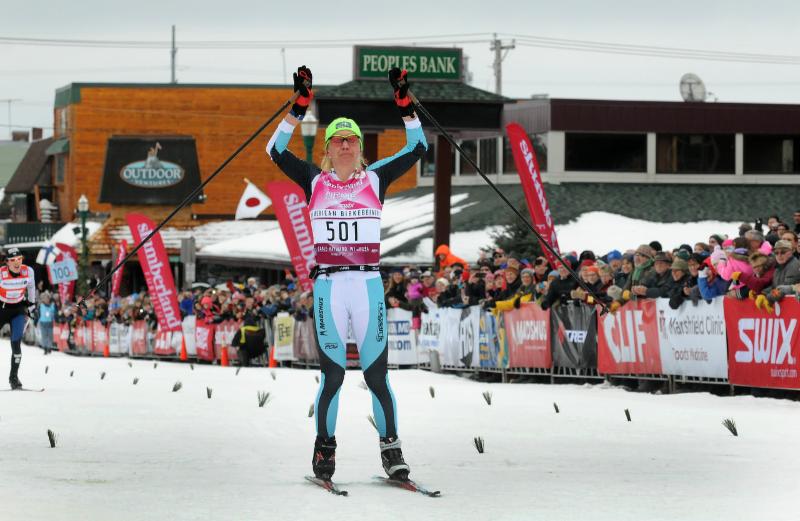
David Norris winning the American Birkebeiner (photo Paul Walsh) Caitlin Gregg wining the American Birkebeiner for a record 4th time! (Photo USSA)
American Birkebeiner CXC Wax Report
The American Birkebeiner is truly the “Super Bowl of Skiing” and the 2016 American Birkebeiner Ski Foundation (ABSF) schedule of events did not disappoint the 12,000 skiers who flocked to Hayward, Wisconsin to enjoy the festivities and trails of the North Country. The crazy weather was a different story; it caused a bit of stress for skiers, coaches, and wax technicians, including the Central Cross Country Skiing (CXC) wax team of Karmen Whitham, Marty Donegan, and Bruce Manske.
The glide wax was the easy part of Birkie waxing. We cleaned the ski bases with Toko LF Blue (-30 to -10 C); although the LF Blue is a hard wax, it aids in harden the base of a ski, and makes them run faster in transformed snow conditions; and, fluorine tribloc acts as a bonding agent for Top Finish products. Next, we applied a two layer of a 1:1 mixture of Toko HF Hot Wax Black and Toko HF Hot Wax Yellow (-6 to 0 C). The Black is very similar to the temperature Toko HF Hot Wax Red (-12 to -4 C), except the Black contains DLC additive for maximum dirt repellency. The Birkie groomers did an awesome job of preparing the course, but due to the thin snow cover and rainy weather, the course had a fair mount of dirty snow. Therefore, it was important to apply a double layer of wax. Toko HF Hot Wax Yellow has selected because of the high-fluorine content and its very durable, which aids in repelling water and dirt, and makes for fast skis.
The CXC wax team top coated each ski with JetStream Bloc 2.0 Yellow. The JetStream was cranyoned on across each ski and then melted with a fiberlene-covered iron. A very thin second coat of JetStream was then crayoned on the skis. This layer we rubbed into the ski with a dedicated cork; followed by lightly brushing with a soft nylon brush and polishing with a Toko Thermopad. The JetStream improved the speed and glide of the skis due to its high abrasion-resistant design.
The kick wax was challenging for most coaches and wax technicians due to the weather conditions, which included precipitation throughout the day, along with a glazing track, thousands of skiers, and the marathon distance factor. The CXC waxing crew, lead by Karmen Whitman, decided to use a combination of Toko Klisters. Nordic Base Klister Green was applied to the skis as a foundation layer; this was followed by a 1:1 mixture of Nordic Klister Yellow, designed for moist snow, and Nordic Klister Red, which has a wide range and is designed for transformed snow; Red is often used as a universal application.
We tested covering the Klister with several different hard waxes, including Toko X-Cold; the hard wax cover had limited success, and we decided to primarily remain with the Toko Yellow and Red Klister combination. In a few cases, we added an additional layer of the Yellow/Red for additional kick, along with extended the Klister zones. Another test, with limited success, included adding a layer of a universal Silver Klister. Yes, the freeze and thaw conditions of the trail, and the changing conditions between coarse and transformed moist to wet fine grained snow created a variety of challenges.
At the end of the day, The CXC Marathon Team, the CXC Masters Team, and the CXC coaching staff were very pleased with the performance of Toko wax and the results at the 2016 American Birkebeiner: Alice Flanders led the CXC women’s team in 10th in the 52k freestyle Birkie and Hillary Patzer finished 44nd. In the 55k classic Birkie, Nicolette Reker led the CXC women with a 20th place finish. Abbie Drach won the women’s Korterloppet in a time of 1:06:25.3. Duncan Douglas led the CXC men’s team finishing 31st in the 52k freestyle Birkie (as a 50year old!), with Cory Ellertson following close behind in 37th, while Chris Pappathopoulos finished 42nd. In the 55k classic, Nick Power just missed the top of the podium finishing second overall, with Andy Brown following close behind in fourth.
Bruce Manske Central Cross Country Ski Association CXC Development Coach
Birkie Wax Report
This year I was the only one of the Sugar Bowl to do the Birkie. Here are a couple strategies I used to have competitive skis while waxing for myself. The first thing I did was to apply my LF Moly layer at home before flying. This meant one less layer of waxing to do on Friday night. One great thing about the Birkie is the huge amount of testing and recommendations made public for the race. On Friday, I focused on getting a nice easy ski, with some pickups, to get ready for the race as well as eating a lot of food. After reading through the wax reports Friday afternoon, I wax my two wettest pairs of skis with Toko HF Yellow and Toko Jetstream Yellow Powder 2.0. I also applied a fairly aggressive structure pattern. The morning of the race I tested the two pairs of skis I waxed the night before. Once I picked the faster one I sprayed it down with Yellow Helix 2.0 and was ready to go. Toko makes wax recommendations for a ton of races you can find here. If you are traveling without a wax tech, there is a lot to be said for using wax recommendations, keeping the number of race morning wax decisions reasonable, and making sure you are physiologically ready to go.
– Spencer Eusden, Sugar Bowl Elite Team
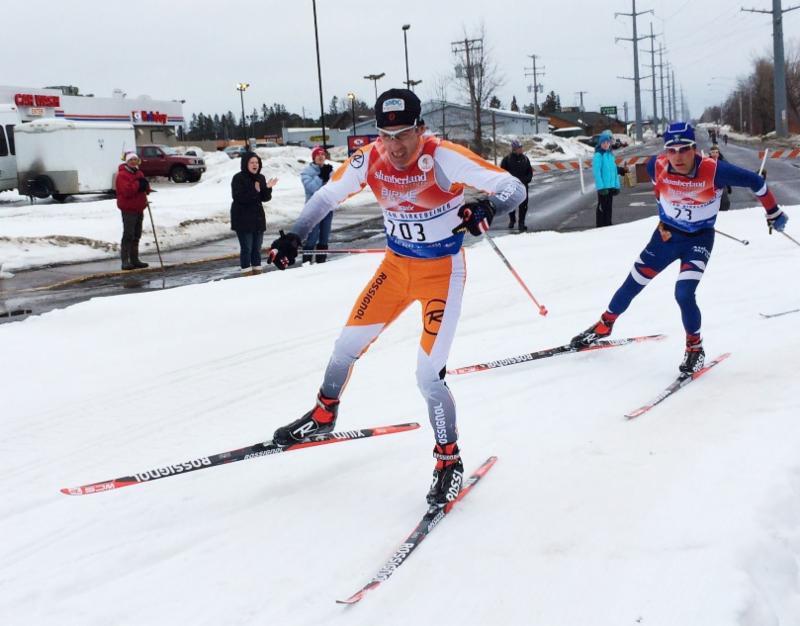
47 Year Old John Bauer finishing 30th (and winning age group of course) in the American Birkebeiner
John skied on Toko LF Black then followed by Toko HF Black which he then covered with JetStream Yellow block (ironed with fiberlene), and finally covered with HelX 2.0 Yellow. John also pressed in a Toko linear structure followed by the Toko Red and Blue Structurite bits. Congratulations John! (Photo: Chris Young)
Race report from Vuokatti, Finland Masters World Championships
Almost 1000 athletes representing 24 countries have recently concluded their competitions. Team USA concluded their “Global Warming in Finland” experience returning with 16 medals for the United States. 10 of those medals were won on Toko HF Yellow topped with Jet Stream Yellow!
Day 1 of the competition was held on 80% manmade moist snow on a course averaging 20cm in depth with temps hovering at -9C for the classic event. Toko Red dry wax kicking on HF Blue / Jet Stream Blue worked very well for all, producing a Gold Medal for Trina Hosmer and a Silver for Bob Gray. Top 10 finishes were also recorded on Toko HF Blue for Carolyn Tiernan, Inge Scheve, Kent Murdoch, David Ford, and Louise Wholey who substituted Jet Stream Red and most likely other Toko solutions that have not yet been confirmed.
Temperatures rose for the remaining events, becoming Zeros and klister type conditions for the remaining 6 races. All but the final Freestyle events were conducted with rain/snow falling at -1C to +3C just before and often during the races. Structure and massive fluoros became the weapons. The tracks were so thin, grey and brown on day 3, most classic skiers elected to go on Zeros for the 10K. Trina Hosmer was golden, Bob Gray was Silver and Abett Icks was Bronze on Toko HF Yellow/ Jet Stream Yellow. Most Toko skiers used the Red Structurite tool even though there was a fear of dirt because tracks and changing lanes were so sucky.
The 4X5K relays had the benefit of some additional wet snow improving the dirt element somewhat. Many USA athletes had their highest placing of the week. One team in 5th, 3 teams in 4th, and a bronze for Katie Meyer, Donna Difolco, Carolyn Tiernan and Trina Hosmer. Toko HF Yellow/ Jet Stream Yellow were on the final 2 legs for certain for that team.
The final distance races became easier calls on wax and ski selection. The classic event was all won on klister with the prior 4-day’s selection of all yellow combinations for glide. The skate event finally cooled down to -2C allowing the HF Red/Yellow covered with Jet Stream Red to make the podium. Two confirmed uses with a substitution of AX 134 with the Toko HF choice of the day produced great high-end speed of noteworthiness. Kent Murdoch and I were able to be in the top 3 at 500 Meters in all races that we used AX134. I came out of the worst start lanes in all 3 races to a top 5 position at the base of the first climb, thereby avoiding the cluster.
Best finishes of the week were recorded with a 5th for Inge Scheve, 6th for Kent Murdoch, Bronze for Katie Meyer, Silver for Milan Baic, 5th for Donna Difolco, 5th for Nancy Bauer, 8th for David Ford, 4th for Carolyn Tiernan, Gold for Trina Hosmer, 5th for Abett Icks, Silver for Bob Gray and a Bronze for Carol Devoe. A confirmed 9 of those skiers had a Toko HF and Jet Stream layer. Great week for Toko gliding! Substantial testing produced solid waxing recommendations throughout the week.
– Dave Ford, Toko Tech Team
Noah Hoffman battling it out at the Lahti World Cup last weekend
Report from Owl Creek Chase
Variable conditions for this years Owl Creek Chase 21k Classic. Sunny daily highs in the mid 40s and lows in the teens made for transformed snow but tilling brought fresh snow back for sections of the course. I prepped for glide with Toko HF Blue/HF Red mix at 1:1. I powdered with JetStream Red 2.0, with a sprinkling of Yellow 2.0 on the tails. I used a Toko Green base kick wax and Blue klister binder ironed in. I covered with a mix of Toko green base and another brand’s blue (under the foot). Skis were super fast, although I could have used a bit more klister for additional kick on the steep climbs and south facing slopes. – Brian Gregg
All American Birkebeiner coverage is brought to you through the generous support of Concept2, makers of the SkiErg.
To this day, Luke Bodensteiner, the U.S. Ski and Snowboard Association (USSA) vice president of athletics, said people don’t believe him when he talks about what happened at the 1988 American Birkebeiner.
Luke Bodensteiner (Photo: USSA)
Seventeen at the time and coming off a Kortelopet victory in ’87, Bodensteiner had registered for the 29 k in an attempt to defend his title. Everything seemed to be going extremely well for the teenager from West Bend, Wis., as he led even the Birkebeiner frontrunners for the first half of their race. Then he missed the turn for the Korte finish.
According to Bodensteiner, the elite coaches and support staff were standing on the cutover, blocking the Kortelopet turnoff as he sped by. He kept going, not realizing that was the turn.
“About two kilometers down the track, I was all alone,” Bodensteiner said over the phone on Wednesday. “I was like, ‘Oh God, I must’ve missed the finish because no one’s around here.’ ”
As he was debating what he should do — turn around and complete the race he registered for (and could legally do at 17) or keep going — Bodensteiner said about eight men caught him. He decided to hang on and finish the 55 k race with them, reasoning he wouldn’t have been able to beat his Kortelopet rival, John Bauer, if he backtracked.
Suffering for the last 10 kilometers without much food, drink or preparation for the marathon distance, Bodensteiner couldn’t remember exactly where he ended up — maybe sixth or seventh. It didn’t matter; a race official later told his dad he was disqualified.
Bodensteiner wasn’t too hard to pick out at the finish in his bright yellow Kortelopet bib.
“It was funny there because stuff like this gets way overblown,” he said. “Literally everyone I ran into asked me about it and no one believed my explaination. I got lost on the track.”
A few years later, Bodensteiner made the 1992 and ’94 Olympics as a member of the U.S. Ski Team. He won several national titles at the University of Utah, developed the USSA’s cross country SuperTour series, and came back to race the Birkie twice — legally.
Regarding the case of Joe Dubay, the College of Saint Scholastica freshman who was disqualified after winning Saturday’s classic Birkie in his teammate’s bib, Bodensteiner said it sounded like the race organizers made the right call.
“They have policies which prevent people from switching bibs; as a race organizer, that’s what you have to do,” Bodensteiner said. “That said the guy had a great race … At the end of the day it’s about performance. It’s not about medals or what’s written down on the results sheet. … You can make worse mistakes, for sure.”
He said Dubay will probably hear about this for years.
“As happened to me, I think he will probably get more attention out of this than he would for winning the Birkie,” Bodensteiner said.
The name John Bauer hasn’t been heard much around the elite circuit lately, but less than a decade ago, Bauer was kicking ass and taking names atop results lists across the country and around the world. Bauer represented the United States at the 1992, 1998, and 2002 Olympic Games, turning out some of the best individual finishes ever by an American. In 1996, Bauer became the second skier in history to sweep every event at U.S. Nationals.
Bauer charges up the track at US Nationals (Photo: tokous.com)
Lately, however, Bauer’s life consists of a lot less time on his skis and a lot more time with his children. Living in Hayward, Wisconsin, Bauer is the primary caregiver for his two youngsters. Bauer takes care of two-year-old son Bryce and daughter Anneliese, who will turn seven shortly, while his wife works full time.
In addition to being a loving husband and devoted father, Bauer takes on patients for a few rolf sessions each week. Rolfing is a method of deep body work that focuses on connective tissues, realigning and balancing the whole body, helping people to stand straighter and move more efficiently.
After being treated with rolfing for a series of overuse injuries in his knees and ankles from 1992 through 1994, Bauer became a firm believer in the method. He was certified as a rolf practitioner in 2002.
Bauer retired from professional skiing after the summer of 2005, feeling that his training wasn’t going well enough to continue. “Maybe I retired a bit too soon,” he mused in an interview with FasterSkier, “but now I can go out and I know what I need to do. That’s the benefit of being in skiing for so long, and now there’s no pressure.”
But once a skier always a skier, and Bauer remains very involved in the nordic community. Still racing occasionally for Rossignol’s marathon team, Bauer competes in the Birkebeiner, the Hills Classic, the Great Bear Chase, and the Mora Vasaloppet.
He also conducts clinics for Toko wax and acts as a personal coach, taking athletes out for individual technique sessions. Prior to the birth of his son, Bauer coached a club of five or six people and is considering starting up again for the coming season.
“I’m still very involved in skiing, I’m just not traveling the whole circuit,” says Bauer. “Skiing is a little bit addicting.”
Three Elite Wave Racers with Hayward and Birkie Experience
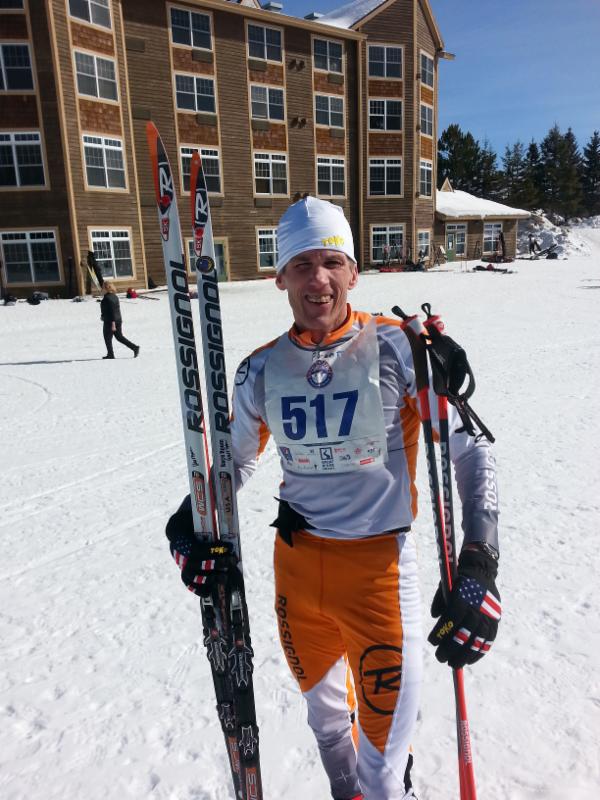
John Bauer (photo: Toko)
John Bauer has lived in Hayward five years and has raced the Birkie for six. As a 2002 Olympian in Salt Lake, Bauer placed 12th, 19th, and 33rdin the distance races, and 5th in the relay. He has been a member of the Rossignol team for 20 years, and tough he is still strongly competitive, his family has taken over a large part of his life which used to be filled with ski training and racing.
“With kids, I haven’t quite figured out how to train and recover quite like I used to. . . .so I haven’t done as many races as I would have liked this year.”
“I’ve been racing,” said Bauer, “but I’m definitely not expecting to win – I’d love to, I love skiing and I’ve always been geared to that, but then you can’t do that forever, so you have to change your focus.”
Instead, Bauer says he tries to “still keep the skiing fun without contending. . . I’m still competitive with myself, more than anything.”
Brian Gregg
Brian Gregg has lived in Hayward for four years, done the Birkie as many times, and though he says that he spends a surprisingly small amount of time on the trail in the winter (due to his racing and travel schedule) he does get to know the trail very well by running on it in the summer time. In order to freshen up on his memory of the course, Gregg says he has “been in Hayward the past 3 weeks focusing on my Birkie preparation and have skied the entire course several times. I incorporate my intervals so that I have the chance to ski key portions of the course at race speed.”
Gregg’s results have been 19th in ‘07, 5th in ‘08 and 4th in ’09. When asked if his next goal was the podium or a win this year, Gregg replied, “A strong field is racing this year. Bryan Fish and CXC do a great job making sure we have the fastest skis on the course so that will help. I am healthy and feeling strong and the podium is my goal. I will be racing to win but a lot can happen over 50km.”
Kristina Owen is also a member of CXC who lived in Hayward for two years before recently moving back to Houghton, Michigan. While living in Hayward she trained almost every day on the Birkie trail, starting from “OO”, and that was when she began to enter the race as well. In her first year she was a solid 8th place, but last year she took 15th, a result she wasn’t thrilled about. This year she will be trying to “redeem” herself, and though she couldn’t specify an exact finish place, she said she would “like to be in the top group.”
Kristina Owen leads Evelyn Dong and Rebecca Dussault through "OO"
Race Course Conditions
Owen skied some of the trail last week and is excited about the conditions, “It’s awesome this year. . . . It’s in good shape, it’s looking good.”
Bauer agrees, and is glad that this year the conditions will provide for a very fair race.
“The track this year is really hard, really firm. We’ve had really good snow, but we’ve also had a little rain with that, and so the whole trail is pretty compact, very, very firm. . . . And in that way it should be a consistent experience for everyone skiing, from the first to the last.”
Birkie start: Get there on time – and try to relax a little!
Sage Advice
Bauer said that the word of caution he would give to racers with less experience would be to not get overly excited.
“It’s a long race, so I would say don’t get too riled up at the start. The Birkie start is, in my view. . . notoriously chaotic. A lot of people go too hard, and it’s a long race. . . it’s too bad, so many start out [too fast] and they really slow down, and that’s not a fun way to struggle in at the end of an event – cramping and things like that. . . ”
Though it is hard to pace in a mass-start race like the Birkie, Bauer says that the way you ski will help you conserve energy.
“In the typical event, I ski relaxed and there are so many transitions where I can catch people, from keeping the speed going a little bit better than others. .. That’s what you really have to focus on in the Birkie trail more than anything – the trail isn’t that hard – yeah, it’s hilly and for some it is a challenge, but from my perspective it’s about some of the climbing, but it’s also about skiing smart and skiing the transitions really well and keeping the speed up. And that’s hard if you’re skiing in a crowd, if you catch someone and have to slow down because they’ve already hit the hill. . . but if you can ski transitions well it’s the key to this race.”
Gregg has these tips to share with the less experienced racer:
1) “Getting to the start takes longer than you think. Give yourself plenty of time.”
2) “Also, the snow is cold and dry so wax colder than you think. Make sure you have some Toko Cold Powder in your wax box.”
Gregg also refers to a handy online tool, which allows a person to view a simulation of the race course, called “Race my Race.”
Owens adds:
1)“The high point is at 14 kilometers and after that you’re mostly going downhill, which is a nice psychological thing to know.”
2) “Remember that it’s a long race and that it’s much easier to pick people off then to go out hard and blow up.”
After bonking in both of her previous races, Owen says that she is going to do one thing different in her own preparation this year:
“Eat. Eat so, so much the days before, and I’m going to be so much better at making sure I hit all my feeds, and eat a few Gu’s out there, and just fuel.”
Favored –and not so favored – Sections of the Course
Gregg says his favorite part of the race is coming into Hayward’s Main Street, because “The contrast of the quiet open lake to the roar of spectators on Main Street is pretty cool.”
For Owens, the best piece of the course is “Coming down mosquito brooks – it’s a rolling downhill. . . you don’t realize you’re losing so much elevation, but you are, and you just feel like a rock star.”
Owens also adds that she enjoys the famous “Bitch Hill”, because even though she is racing hard she still enjoys the “Bitches of Bitch Hill” who stand on the side and play loud music, dance, and give out hugs and pins.
Owens points out that, though many racers talk of this part of the course with dread, the hill is actually more of a psychological wall than anything.
“Theres about one big hill every five kilometers and they all have names, but [Bitch Hill] is the one everyone talks about. It’s ‘cause it’s at the end – the ones at the beginning – going up to the high point – those ones are actually a lot bigger, but you’re fresh so they don’t hit you as hard.”
A strong climber, Bauer says, “I particularly enjoy the start, once we enter the woods and get off of the powerline, from about 5km to the “OO”, the 23 kilometer point, that’s my favorite section. There’s a lot of climbing leading up to “OO” and the pace picks up there . . .”
Bauer said if he had to choose a least favorite section (a tough decision, because he thinks the whole trail is great) it would come after the hills, with the lighter piece of track that led to Mosquito Brooks.
Owen’s least favorite part of the course is Duffy’s Climb, “It’s right before you hit Hayward. It’s the last hill. . . but no matter what, it’s close enough to the finish where you’re going just about as hard as you can – it’s painful!”
For Gregg the hardest part is Lake Hayward because, he says, “It is wild that you can see the finish but are still 3km away.”
The Birkie Weekend Fever
Gregg’s favorite part of the weekend is the race itself, but he says he also enjoys “everything.”
“The craziness of the expo at Telemark and standing in line to pick up your race packet is fun. Every year my family comes to race and cheer and we go to the pasta feed at the Catholic Church in Hayward. Some pasta feeds try to just make money, these church ladies are competitive in their desert making…which is awesome. We all stay in the cabin at Cresthill and it is fun to get ready for the big race as a family.”
As far as the major influx of people into the little town, Gregg says he doesn’t mind a bit.
“Living in the small quiet community of Hayward it is fun to see the town explode with cross country skiers and all the excitement about cross country skiing. The long weekend sees the real big surge, but race is part of the community all year.”
Bauer just likes to stay focused on the main event.
“It’s really about the race. Mostly you’re thinking about what you have to do, but there’s so many distractions. It’s mostly about getting to the race on time, getting to the start and not breaking a pole, but there’s so much excitement and so many people. . .”
Distractions aside, Bauer still enjoys the throngs of people who spill into town for the event.
“I don’t know how it’s possible that many people can come into town, so the energy of that crowd is pretty fun!”