From the FasterSkier archive — posts syndicated from athletes’ and coaches’ own blogs between 2004 and 2012, kept online as published. Current coverage is at fasterskier.com.
John Caldwell, born November 28, 1928, passed away February 27 at 97 years old. John’s contribution to cross-country skiing in the United States is unquestioned.
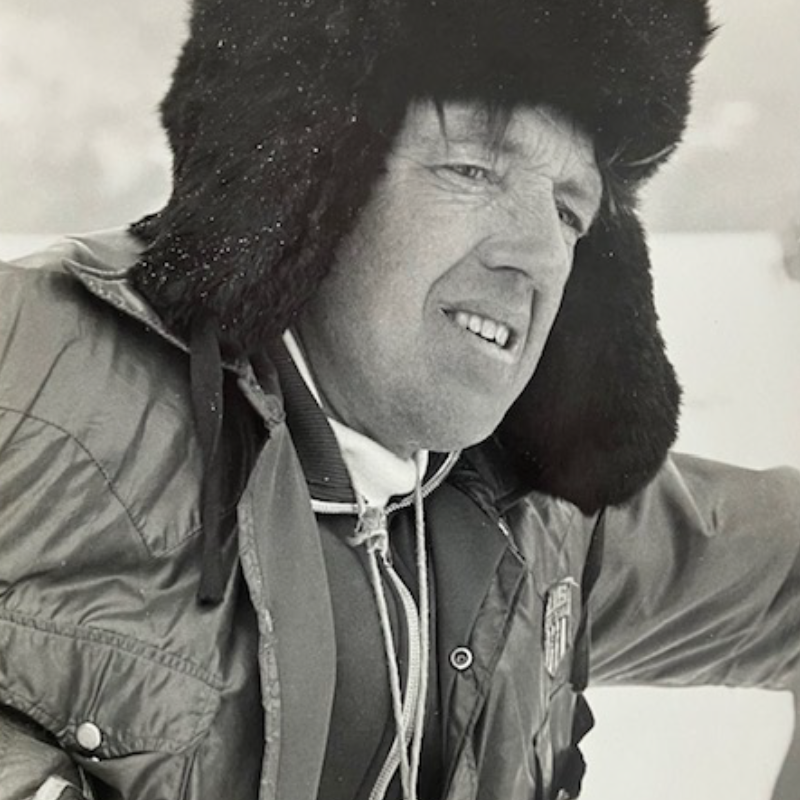
John Caldwell, November 28, 1928 — February 27, 2026. (Photo: Robert George)
He was a 1952 Olympian in Nordic Combined. He wrote several books on cross-country skiing that became our training guidance, our bibles, in the early and mid-1970s. He was a long-time teacher and coach at The Putney School, an early U.S. Ski Team coach, and a member of the coaching staff at the Winter Olympics in 1960, 1964, 1968, 1972, and 1984. In the mid-1990s he founded the New England Nordic Ski Association (NENSA), stepping in to fill a regional void the U.S. Ski Association had abandoned at the time.
That’s the high-level resume. But that doesn’t capture what happened. It’s beyond me to catalog everything John did for the sport. What I can offer is a personal perspective, what it was like to grow up skiing with his influence.
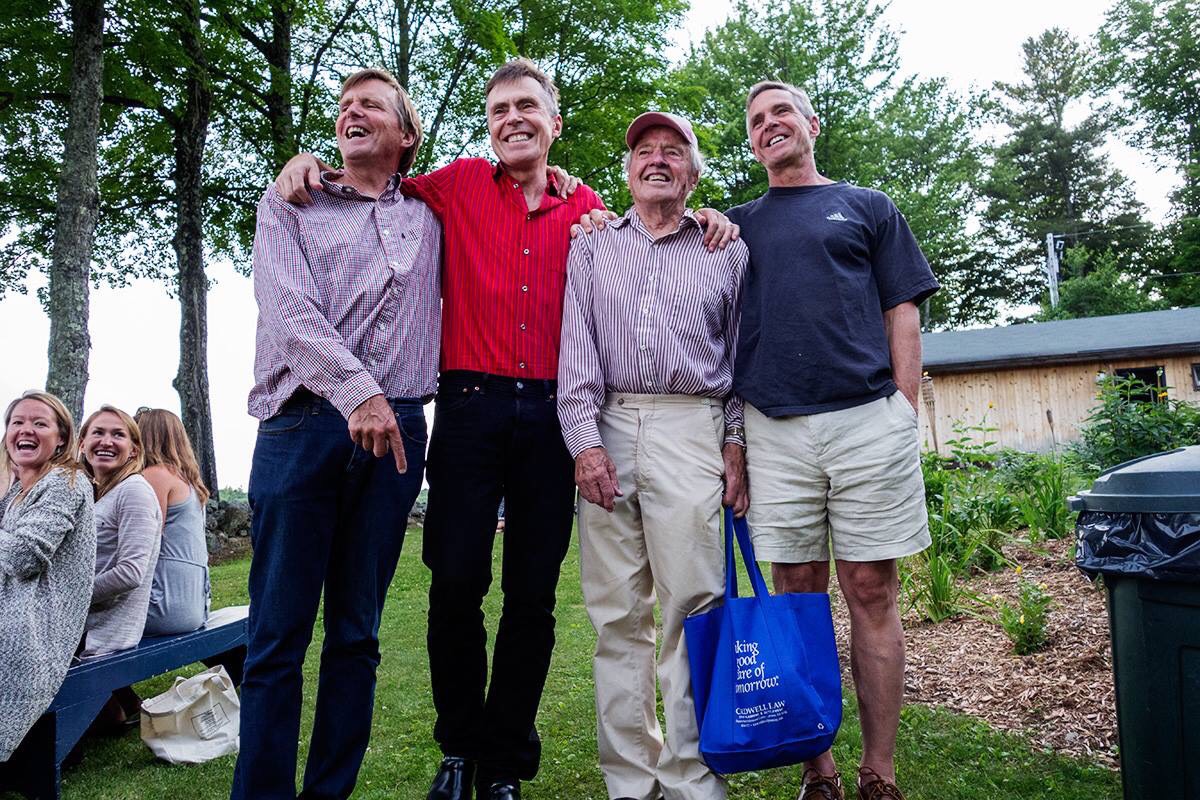
Left to right: Jennifer, Peter, Sverre, Tim, Hep, and John. (Photo: Courtesy Image)
My earliest memory of JC was driving to Putney with my dad to buy a pair of skis from him. Later I saw him at the Washington’s Birthday races, local races in Putney, the Samsonite/Dannon Series, and the night races of the late ’60s and early ’70s.
In 1967 or so, John reached out to Inga Löwdin in Sweden to bring women to the U.S. to race. That exchange helped spearhead women’s skiing in this country, particularly the career of Martha Rockwell, then a student at Putney. In the early ’70s he also brought Norwegian skiers over to compete in what was then a surprisingly robust night race circuit in the Northeast.
I’m not sure he was thinking in terms of “athlete development” as we define it today. His goal was simpler: to grow the sport. Get people involved. Raise the level by exposure.
He was integral in founding the Washington’s Birthday race in southern Vermont, one of the first popular cross-country races in the country. The race rotated locations from Marlboro, Guilford, Brattleboro, Putney, and Westminster West. It reportedly grew from 54 participants in the first year to several hundred within just a few years.
It was not an accident, even before Bill Kochs success the sport was going through a growth and participation spike that fuels the sport still today.
In junior high I would go up to Putney School for occasional training sessions. I remember skiing long loops and being far behind. In high school, Labor Day training camps organized by JC brought national team skiers into our backyard, Bob Gray, Tim Caldwell, Charlie Kellogg, Peter Davis, Joe McNulty. That was normal in Windham County. There were always good skiers and cyclists around for a workout.
Chris Osgood, Mary Heller Osgood, Jennifer Caldwell (daughter), Peter Caldwell (son) and John Caldwell arriving in Australia for a ski trip. (Photo: Courtesy Image).
By the early to mid-’70s, Putney graduates like Bob Gray and Martha Rockwell, along with the next wave, Bill Koch, Tim Caldwell, Stan Dunklee, myself, were training and competing together more regularly. John didn’t “coach” us in the modern sense. He rarely prescribed workouts. Instead, he would ask what I was doing for training, then share what he was hearing from Russians, Norwegians, and Finns.
“This is what they’re doing. Maybe it makes sense to try it.”
Between 1974 and 1978, and through the 1980 Olympics in Lake Placid, our local group trained together more often. Long runs from Putney to Saxtons River and back. Weekly 50–60 km roller skis, usually ending at the Caldwell sauna. For a few years we did a 220-mile bike ride straight up or down the spine of Vermont, depending on Bill’s forecast of prevailing winds.
John didn’t script those sessions. He didn’t stand there with a stopwatch. His influence, and his openness to ideas from abroad, shaped the key workouts we implemented. Many of them still hold up today.
I spent a lot of time around Putney in those years, so JC and I worked frequently on technique. He pushed me to experiment. Not necessarily because he knew the movement would be faster, but because adapting to new movement patterns develops skill. Most of our technical work happened on uphill’s. Back then, equipment and grooming limited how much time you could gain on flats and downhills. Uphill efficiency mattered most or so I thought. We worked on short, quick tempo striding. Shuffling. Even running movements not far from what people now call the Klaebo run.
John Caldwell and the art of flexing skis. Here, he’s helping his granddaughter Sophie Caldwell, a former U.S. Ski Team member, pick skis in 2017. (Photo: Sophie Caldwell)
In December 1979, John was contracted by the U.S. Ski Team to work with me in early, season Nordic Combined World Cups. I was skiing well and trying to hold form heading toward the 1978 World Championships in Lahti. I’m not sure how much he knew about ski jumping at that point. But he knew enough to keep things relaxed and low-key in the days before competition, including an afternoon visit to the Hofbräuhaus in Munich.
In Reit im Winkl, I was third in jumping and won the cross-country by a substantial margin. That week, at least, he did just fine as a coach!
At the 1982 World Championships he was there in a wax-support role. Back then, that mostly meant Swix Purple or Toko glide and a binder plus hard wax for kick. There wasn’t extensive testing. Athletes prepared their own skis. He was there as support team, especially for those of us from the Putney Ski Club. His last international trip with us was the 1984 Olympics in Sarajevo.
In later years, John served on a steering committee overseeing the U.S. cross-country program. I’d like to say it was a productive collaboration between staff and the steering committee. It wasn’t. The structure didn’t allow for effective dialogue. Good intentions don’t automatically produce good governance.
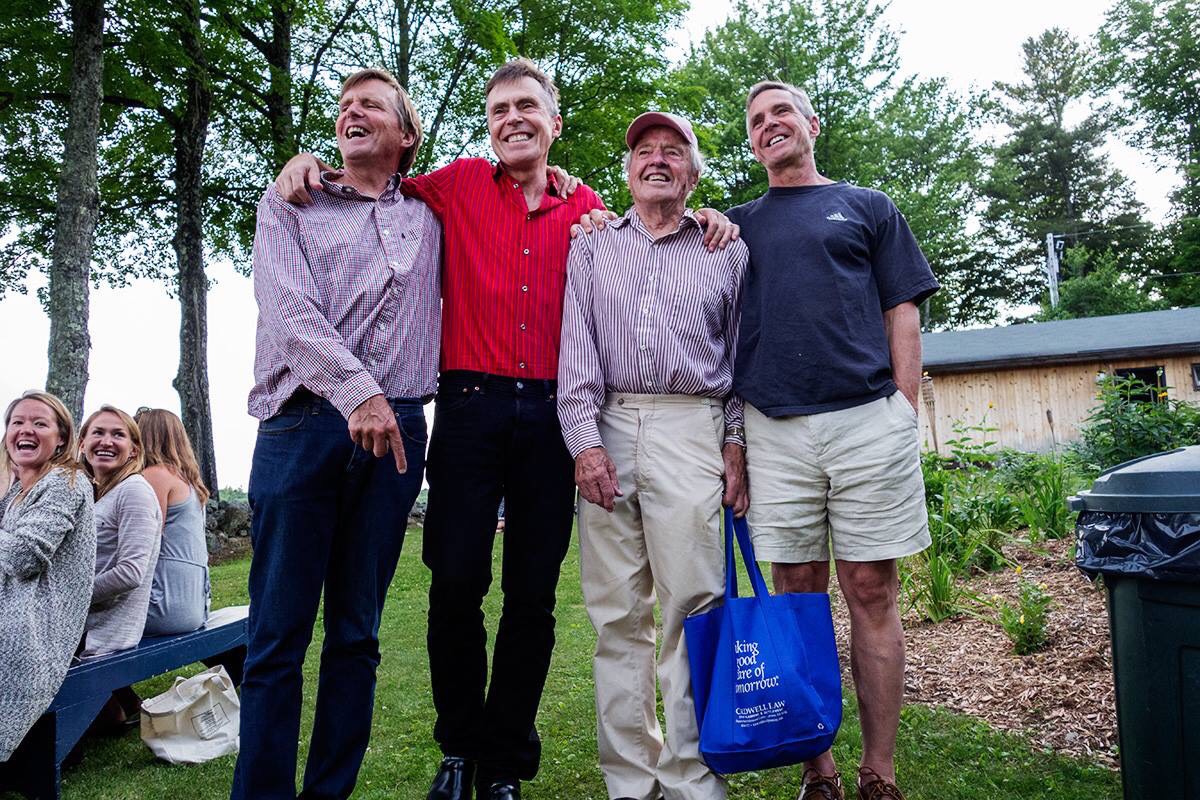
From left to right: Sverre Caldwell, Tim Caldwell, John Caldwell, and Peter Caldwell. (Photo: courtesy Sophie Caldwell)
In the early to mid-1990s, I worked at Stratton Mountain School. Being close to Putney again meant more time with JC, and many discussions that eventually led John to the formation of NENSA. As a founding board, we saw the early organizational stages and the hiring of its first staff. Summers often included time at the sauna, the best conversations happened when only a few of us were there, often ending around the big dinner table.
The last 30 years of my friendship with John were mostly phone calls, emails, and the occasional Facebook comment. Often cryptic. Once, commenting on a photo of me skiing in my 60s, he wrote that I still skied like a donkey. Not entirely inaccurate.
Other times it was, “What do you make of the results at X race?” Or, “Whose technique is best?” He was always curious and engaged. Thinking about the sport at a higher level than most others during those years
The last time I visited him was last June during a short trip through New England. Tim told me it was JC’s nap time, but I was on a tight schedule and stopped in anyway. The caretaker let me into his apartment. I walked in and said, “JC, what the hell is going on?” Before he even saw me, he replied, “Galanski, what the hell are you doing here?” We spent two hours talking about old times, friends, and family. Mentally, he was as sharp as ever, even as his body was failing.
John’s contributions to skiing can be measured by the roles he held, the teams he coached, and the organizations he helped build. Harder to measure, and ultimately more important, is what happened in southern Vermont simply because he was there. A culture took shape that valued learning and curiosity, exposure to the highest levels, and consistent, broad-based participation. Athletes trained hard, thought broadly, and held themselves to a higher standard, without being told to do so. John didn’t try to manage the sport or own its direction. He created the conditions where it could grow. And for decades, it did.
Note: An official obituary for John Caldwell has been published by his family. Those wishing to honor John’s legacy may consider making a donation toNew England Nordic Ski Association(NENSA), the organization he helped found to strengthen and grow cross-country skiing in the region. Contributions in his memory will continue the work he cared so deeply about — supporting athletes, coaches, and the future of American Nordic skiing.
John Caldwell, front left, with his, Hep, and all 10 of their grandchildren. Photo: courtesy of Sophie Caldwell.
David Sinclair winning in record time at the Ragged 50 K, also 2018 USATF 50 k Trail Championships, on Aug. 12 in Danbury, N.H. (Photo: Richard Bolt)It wasn’t the delusionally fast pace he was setting, nor the hazy mist of East Coast rain playing tricks on his eyes. When David Sinclair clamored past the 35-kilometer mark of the Ragged 50K trail marathon, which served as the 2018 USA Track & Field (USATF) 50 k Trail Championships two Sundays ago in Danbury, New Hampshire, there was no denying the shape that greeted him from side of the trail: a mother black bear and her cub.
Ten kilometers earlier, Sinclair had been the company of fellow runners, running in the top 10 until the halfway point. At 25 k, he positioned himself into the lead. In another 2 k, the former Dartmouth skier was pulling away and by the time he came across the duo of bears, Sinclair was alone, minutes separating him and the rest of the field.
Not slowing, Sinclair then did what outdoor adventurers are instructed to do should they encounter a black bear whilst traipsing about in nature. Stay calm, be big.
“I picked up the pace a little bit and started yelling, ‘Get out of here!’ Just making my presence known,” Sinclair, 26, of Peru, Vermont, told FasterSkier on the phone. “A minute later, I come around a curve in the trail and I see the cub again. Literally in the middle of the trail. For a second, I thought the mom would come and chase me down for getting too close to her cub.”
The mother bear, however, never reappeared. With that obstacle behind him, Sinclair ran the rest of the race alone. He crossed the finish line first in a time of 4 hours, 17 minutes and 36 seconds. That broke the previous course record set by Patrick Caron in 4:53:26 last summer.
David Sinclair (r) leading the 2018 Ragged 50K, which doubled as the USATF 50 k Trail Championships, on Aug. 12 as John Caldwell (yellow raincoat), Isabel Caldwell (second from l) and Sophie Caldwell (l) look on in Danbury, New Hampshire. (Photo: Richard Bolt)To date, the Ragged 50K was only Sinclair’s second race at that distance. His first was the 2018 Speedgoat 50 k, which took place in Snowbird, Utah, exactly three weeks earlier.
He described the Speedgoat, which features more than 12,000 feet of climbing over 33 miles, as “absolutely insane.” The bottom of the race’s website warns entrants (in all caps and bold font) “REMEMBER THIS IS A HARD RACE, IF YOU FEEL LIKE THIS SHOULD BE YOUR FIRST 50K, YOU ARE PROBABLY WRONG IN YOUR ASSUMPTIONS.”
Apparently, Sinclair chose to ignore or missed the heeding. He entered and won the Speedgoat, his first 50 k ever, in a time of 5:27:13. Two rest weekends and a week later, he won the Ragged 50 k in record time.
“Speedgoat took an hour and half longer than [the Ragged 50K] because of the altitude and insane amount of vertical,” Sinclair explained. “In comparison, the one here in New Hampshire felt a little bit easier.”
Easy being a relative term. The Ragged 50 K features 6,300 feet of vertical over 32 miles. After “mostly dirt road or pretty smooth trail” for the first 15 k, the remainder of the race pulls competitors through what Sinclair described as “gnarly, muddy single track.”
“That last hour of fighting your legs cramping up or when your stomach stops taking in any food and water, that part can be hard,” he said.
Losing sense of one’s vitals never sounds easy (or fun). Still, that hasn’t deterred Sinclair. Since the beginning of the summer, he had planned to taper specifically for the Ragged 50K. In winning the race, he earned a nomination to the US Mountain Running Team, as well as an automatic entry into the 2019 Trail World Championships next June in Mirandha do Corvo, Portugal. Sinclair plans to attend.
For winning the Ragged 50 k, Sinclair was also awarded $750 dollars from USATF and $300 for being a member of USATF New England Association.
Finishing 21 minutes and 17 seconds behind Sinclair in second was Simi Hamilton, 31, of the U.S. Ski Team (USST) in a time of 4:38:53. Third went to David Kilgore, 26, in a time of 4:41:38.
Simi Hamilton, of the U.S. Ski Team and Stratton Mountain School T2 Team, gives a thumbs up during the 2018 USATF 50 k Trail Championships in Danbury, New Hampshire. Hamilton went on to place second overall. (Photo: Richard Bolt)Hamilton’s time also surpassed last year’s Ragged 50K record by approximately 15 minutes. Though he usually spends his summers mountain biking as cross training, Hamilton spent much of this summer training on foot.
“I was in France for quite big chunk of the summer [at teammate] Erik [Bjornsen]’s wedding and then our [USST training] camp. I didn’t have my bike over there, but had access to some really cool running trails, so ended up doing a ton of running while in France,” Hamilton told FasterSkier on the phone while at a USST training camp in New Zealand. “When I came back to [to the U.S.] I was really psyched with how I was feeling running, so I talked to Matt [Whitcomb] about trying to find a race to do.”
The 50 k cropped up as one option thanks to a conversation with Sinclair, who dates Isabel Caldwell, the sister of Hamilton’s girlfriend and USST teammate, Sophie Caldwell.
“I think 50 k was probably a little longer than what Matt had in mind,” Hamilton said with a laugh. “But I’d been doing a lot of three- to four-hour runs, so I felt like my body was at least mostly prepared for something of that duration.”
According to Hamilton, the race did not qualify him for the 2019 Trail World Championships, though his recent performance has him more intrigued with mountain racing and running.
“It’s definitely something that’s on my radar, possibly next year I might try to find a few more mountain running races to jump into,” Hamilton said. “Obviously it all depends on my plan with my ski career and how much longer I’ll be doing this, but it’s something that’s been on my mind.”
Sinclair and Hamilton are not the first nordic skiers to find success at a USATF mountain ultra. Last year, Caitlin Patterson, of the Craftsbury Green Racing Project, placed fourth in the 10 k at the 2017 USATF Mountain Running Championships. Her performance also qualified her for the 2017 World Mountain Running Championships in Premana, Italy. Glenn Randall and Morgan Arritola have also posted strong results in national mountain running races.
Left to right: USST coach Matt Whitcomb, Richard Bolt, David Sinclair, Isabel Caldwell, John Caldwell, Sophie Caldwell, and Simi Hamilton after the 2018 USATF 50 k Trail Championships in Danbury, N.H. (Photo: Richard Bolt)“It’s really great to see Nordic athletes give it a go in mountain and ultra races,” US Mountain Running manager Paul Kirsch, also chair of USATF New England Mountain, Ultra & Trail Running, wrote in an email. “The aerobic and strength training required to be a great xc skier translates so well to the trails and mountain.
“To have David and Simi have such great races at this year’s grueling USA 50 km Trail Champs course reinforces how much the skills cross over in longer races as well,” Kirsch continued. “They both looked as strong at the end of the race as when they started. I look forward to seeing more Nordic athletes in future years.”
Even trailside. Both Caldwell sisters, along with their grandfather John Caldwell, came out to watch and cheer for Hamilton and Sinclair in person.
“We had a great support crew,” Hamilton said.
Following the race, Hamilton had one week of dryland training before jetting out to New Zealand for the USST’s on-snow camp at the Snow Farm.
Sinclair, who had been in Flagstaff, Arizona, earning his masters degree in geology until this spring, is now back in Vermont, preparing to start a teaching job at the Stratton Mountain School. He will continue to devote his spare time to running, welcoming anyone willing to join (he occasionally brings Isabel or joins the Stratton boys ski team).
“I don’t really track it,” Sinclair said of his running mileage per week.
Since he became involved with the sport two years ago, he indicated he has been self-coached, learning from conversations he’s had with other trail runners. His first long distance trail running race was the 2017 Flagstaff Skyrace–a 40 k race that finishes in the Arizona Snowbowl Ski Area–which he won. In winning the 2017 Flagstaff race, he qualified for the 2018 World Long Distance Mountain Running Championships in Karpacz, Poland, which took place this past June.
Taking the opportunity to travel in tandem with the World Long Distance Mountain Running Championships race, Sinclair spent the month of June in Poland, Italy, Austria and Germany. Prior to racing the World Long Distance Mountain Running Championships, Sinclair first raced the Livigno Skymarathon, a 32 k event that is part of the skyrunning series.
David Sinclair (r) running the Livigno Skymarathon this past June. He went on to place third overall. (Courtesy Photo)In the Livigno Skymarathon, which he said he used as “a warm-up race for the World Championships in Poland” he finished third. Sinclair then traveled to Karpacz, Poland to compete in the World Long Distance Mountain Running Championships, where he placed 30th and helped the men’s U.S. team to a second place team finish.
While most of his trail running race experience has come in the past two years, Sinclair was quick to point out that his time at Dartmouth also contributed to his quick ascent in the ranks. As a member of the men’s ski team at Dartmouth, Sinclair would run 12-18 mile over distance runs on the Appalachian Trail every weekend through the fall.
“The guys team would tend to run these pretty quickly and I think doing this for four years made transitioning to trail running races a lot easier,” Sinclair wrote in an email.
In terms of how he outlines his training weeks nowadays, Sinclair remains fairly flexible.
“I’ll have one or two days where I’ll run a little bit harder or do some intervals or do 45 minutes at threshold in the middle of a run,” Sinclair said. “Then I’ll try to do at least one longer run which might be three to four hours on a trail or 20 miles on a little more of a dirt road.
“It’s definitely a lot less structured than when I was focused on ski training, but for me it works better to not keep too close track of it because then I get too competitive with myself,” Sinclair added. “That’s my philosophy is keep it fun and exciting.”
So far, the biggest learning curve for Sinclair has been getting accustomed to pacing his running for a four or five hour race. He indicated that he usually wears a heart rate monitor to ensure he stays below his threshold heart rate and puts focus on staying hydrated early on.
“Getting enough fluid early in the race will pay off three hours later,” Sinclair said.
“It goes by pretty quickly if you stay focused on what’s the trail doing ten feet in front of you,” he continued. “Probably a good thing to do too because it keeps your mind off of how much further you still have to go.”
Kikkan Randall (l) and Jessie Diggins after being awarded their gold medals from the freestyle team sprint at Thursday night’s Olympic medal ceremony in PyeongChang, South Korea. (Photo: FlyingPointRoad)
After the U.S. women’s historic gold medal on Wednesday, we wanted to try something a little different and invite a few prominent members of the North American ski community to a roundtable discussion. Contacted via email, they each weighed in on the following questions with an interactive Google doc, where they could view others’ written responses and build on the conversation.
In no particular order, we’d like to introduce our special guests:
Holly Brooks, former U.S. Ski Team member and two-time Olympian (2010 and 2014)
Pete Vordenberg, former U.S. Ski Team head coach (from 2002-2012)
Nancy Fiddler, former U.S. Ski Team member and two-time Olympian (1988 and 1992)
Chandra Crawford, former Canadian National Ski Team member, three-time Olympian (2006, 2010 and 2014) and, before Wednesday, the last North American to win Olympic gold in cross-country skiing (in the freestyle sprint in 2006 in Turin, Italy)
*John Caldwell, 1952 Olympian and one of the founders of the U.S. women’s cross-country program who coached the U.S. Ski Team through five Winter Olympics (1960, 1964, 1968, 1972, and 1984), was also invited to the discussion and opted to respond with a mini essay on the subject, which was posted separately.
Roundtable Q & A
Q: Where and with whom did you watch today’s race?
Chandra Crawford: In my living room at 3 am with my husband Jared. 1.5 year old Kyla was crying a bit upstairs but she had to wait for the race to finish to be over-enthusiastically consoled. She was probably wondering what her mom was so excited about.
Nancy Fiddler: Today is my birthday, and I got up to find text messages on my phone with birthday greetings and news of the gold medal (I didn’t stay up to watch it). I played and re-played the final moments over and over again. I was not prepared for my physical reaction to watching Jessie cross the finish line; I was overcome with emotion and the tears flowed. I showed the final moments of the race video to everyone at the hair salon where I got my hair cut this afternoon. Watched the entire race again this evening with my husband.
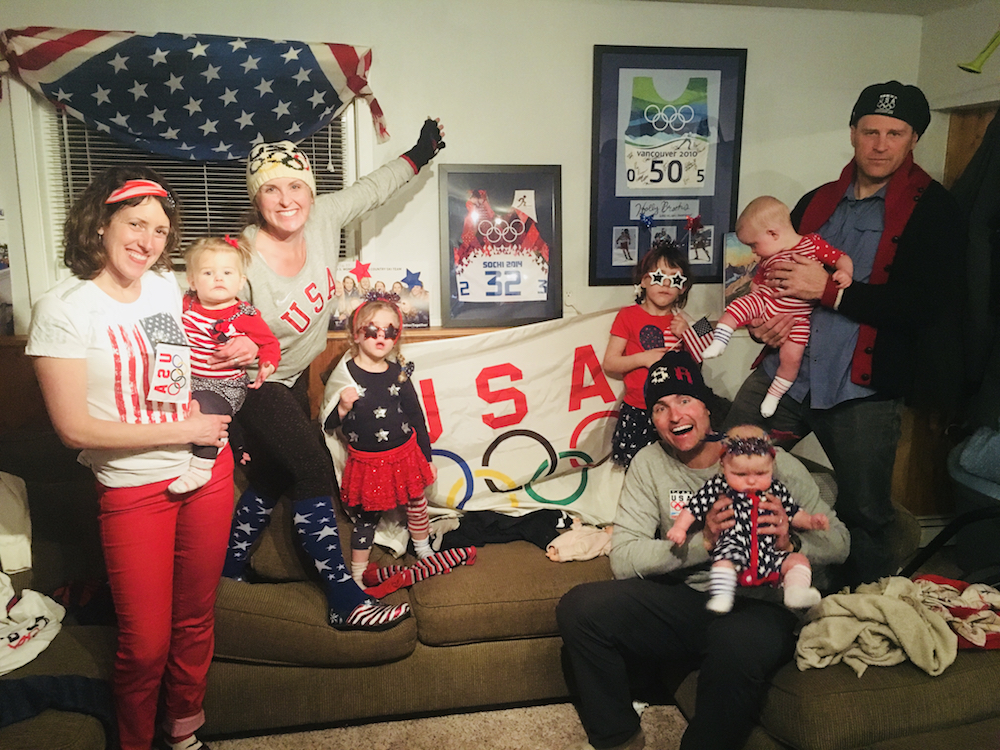
Olympic women’s relay viewing party last Friday, Feb. 16, at the Brooks/Whitney house in Anchorage, Alaska. (Courtesy photo)
Holly Brooks: After hosting a festive viewing party for the 4x5k complete with USA-themed food and 5 kids ages 5 months to six years old in flare head to toe we decided to have a low-key night for sprint relay. I watched LIVE with my husband Rob (wouldn’t miss it for the world) and my twin 5-month old twin infants were asleep in their respective cribs wearing their homemade relay socks. I was sitting in front of the TV on my knees yelling words of encouragement and affirmation when the internet connection died one minute into Jessie’s final lap — talk about WORST TIMING EVER. After what seemed like the longest Coca Cola commerical of my life we reconnected to see the final downhill, turn and finishing straight. For the final sprint I remember yelling, “YOU’VE OUTSPRINTED HER BEFORE!” reminiscing about World Champs last year. Once it was clear they won it was tears upon tears of joy!
Pete Vordenberg: My wife Barb was Kikkan’s Olympic roommate in 2002. And Barb grew up just miles from where Jessie grew up. We’re big fans. We watched in bed on a laptop – like modern Americans do.
Q: What do you think has been the most important cultural shift in recent years to bring U.S. Skiing back to a place where today was possible?
Chandra: Incredible, second-to-none dedication to a positive and supportive team environment.
Nancy: I agree with Chandra! The shift began with Kikkan’s initial success, when Americans saw the possibility of our athletes being able to compete on the international stage. But the team spirit that was cultivated around this tangible success is what changed the look of U.S. women’s nordic skiing. I know I got caught up in it and knew it was just a matter of time before the Olympic medal ceiling was smashed.
Holly: Kikkan’s unfathomable faith lead the way….. Then I believe it was a matter of getting the right people into the right place at the right time. The coaching staff and their ability to look at us as people, beyond simply results is crucial. I think that unconditional love and support is/was essential to a positive team environment, sustainability, and keeping people engaged and interested in supporting one another. People always ask us (I use the present tense because these girls will always be my teammates!) how did you do it? We took what was originally an individual approach and applied a team approach to it. Rather than being preoccupied with beating eachother we understood that we could collaborate and band together to beat the world. Which tonight, resulted in an Olympic GOLD MEDAL.
Pete: The quality of work being done, day-to-day and year-to-year training by coaches and athletes across the country is the reason we are where we are. How that improved is a rise in development efforts and programing at team/club, regional and the national level. All of it is tied together.
Luke, Farra, Wadsworth and I all raced together at the national team level in the late 80’s through late 90’s early 2000’s. These were hard and lean years that came on the tail of more hard and lean years that followed the successful Koch years. That we all (Luke, etc) ended up working in US Skiing is not an accident — we all wanted more and saw a way to do it. Bodensteiner began to build a consistent domestic and North American race circuit that really enabled US racers to compete at the right level and build from there. This was the start of a good pipeline for racers to develop. Chris Grover and Miles Minson started a development team. It was a small team, but it was a development team – the work they did was back to the basics, build from where you are not from where you wish you were.
Very importantly around this time a few junior programs added senior programs to build a link from junior to senior level racing. We were all working to developing skiers along a pathway, the pipeline – not just taking skiers to the World Cup, most of whom had not really developed enough to be at that level even if they were the best in the US. Somewhere in here better drug testing plays a role and more dopers are getting caught and then fewer are doping. This is a factor that is hard to quantify. There is still doping. But it seems less prevalent and this is an advantage to us as clean racers.
This development system was capitalized on by Trond Nystad and built and improved upon by myself, Trond, Grover and Vidar Lofshus. At this time Luke helped us build an actual team. We began to put together a national team program, a consistent staff, a more complete wax team and continued to focus on development (today Bryan Fish runs much of the USST’s development efforts and he does amazing work).
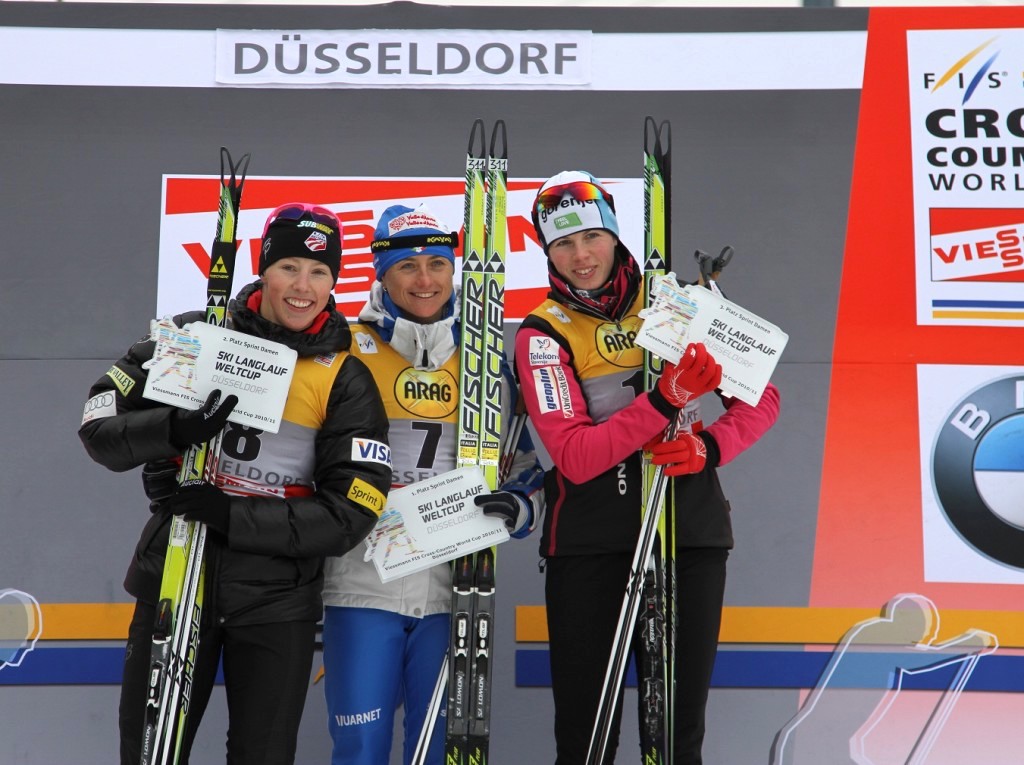
Kikkan Randall (l) with her fourth-career World Cup podium after placing second in a freestyle sprint in December 2010 in Düsseldorf, Germany, behind Italy’s Arianna Follis (c) in first and ahead of Slovenia’s Vesna Fabjan (r) in third. (Photo: Pete Vordenberg)
That is the beginning of the shift — a real focus on the development pipeline. But one thing I think is important to point out is that this effort across local, regional and national teams also changed the tone of US Skiing –- the tone is now one of preparing to win. We began to work together across the whole country to win at the international level. That is huge. This is probably the biggest thing – a ground swell of collective effort toward a shared goal. The number of people who played a specific, vital role are too numerous to name. Erik Flora at APU who is Kikkan’s coach and Jason Cork with the USST who is Jessie’s coach both deserve mention, but who coached and mentored Cork and Flora? They also deserve mention. I mean, I still teach classic the way Nancy Fiddler showed me how to teach classic! It is all interwoven. Before Erik and Cork, Kikkan and Jessie were coached by their youth coaches, their high school coaches, they were supported by race course volunteers, people handing out orange slices after races, parents driving to practice, club organizers and regional leaders and national team coaches like Whitcomb… That support network, that development pipeline, that nationwide effort is what got this medal.
I do want to point out the role of Andy Newell was the first one to get a World Cup podium after two generations of skiers struggled to crack the top 30. Newell was the tip of the spear. The 2002 team was awesome, Freeman got very close (and was robbed of medals by dopers) but it was spring, 2006 when Andy got a WC podium that the possibilities became more real. Kikkan’s podium in Russia was a huge moment for us as a country too and since then, well, here we are.
Q: What made the biggest difference in today’s race?
Chandra: Jessie’s ability to go beyond her limits is truly on another level, and they both rose to the occasion as game-day champions in terms of mental state.
The entire team keeping everything positive through the exhausting, media-intensive lead up to these games. And a gold old 15-year “overnight success story” led by Kikkan Randall’s belief in teamwork and profound humility and caring.
Nancy: Today it was about the combination of Jessie’s heart and Kikkan’s ability to perform under immense pressure. This was the American combination I picked to win a medal, and my intuition proved correct! They did it at Worlds and knew they could do it again if each one of them performed at their top ends. I do not think Jessie ever doubted that she wouldn’t get by Stina for one moment when she rounded that last turn.
Holly: Belief, experience, support from the “team behind the team” and the fact that the course played to their individual strengths. Kikkan is one of the best uphill, V1 jump skaters in the world and Jessie is one of the best downhiller/overspeed, “finishers when a teammate is waiting at the finish line!”
Pete: Today’s race was just one race, the fitness, the program, the team, the work, it has been done and rehearsed, and done again and rehearsed again, built up over years. It is everyone playing their role from massage therapist to waxer to club volunteer, club fundraiser, NNF fundraiser, youth coach to parents and friends, to athletes who were not chosen to race but still played their role as teammate… Today’s race is not a culmination, it is just another race and as long as there is still snow, the framework for more great races is in place. There is more to come.
Q: Which specific moment in the race did you think was most impressive?
Jessie Diggins as a junior training at Soldier Hollow in Midway, Utah. (Photo: Pete Vordenberg)
Chandra: Kikkan, despite her injuries in the lead-up to the games, hanging with Marit and Charlotte and making it look like no problem and Jessie keeping calm cool and collected on the skittery downhill and then pumping out huge power in the finishing one-skate. Sorry, that’s not one thing!
Nancy: Again, I agree with Chandra that Kikkan notched her game up to match Marit and Charlotte’s and made it look easy. And The Moment for me was when Jessie gave those 3-4 hard skates to give her the momentum that would ultimately send her past Stina at the finish line.
Holly: I don’t really believe in perfection but almost every once of this race was perfect and thank goodness, there were NO BROKEN POLES this time! (Thanks Diggy!) For five and a half laps it is all about staying in contact but when that is accomplished it is all about the finishing tactics and kick. There are so many things that could wrong is this situation but Jess set up her slingshot perfectly and her kick was world class. As the saying goes, it takes two to tango!
Pete: Every moment presents a challenge and an opportunity. Each exchange is both a challenge to get through safely and also an opportunity to gain a few meters. Every slick downhill presents the same challenge/opportunity. Each opening you see in the pack and can squeeze through could end in a fall, a broken pole or a great move up, and of course every uphill gives you the test of fitness and grit that makes our sport so hard and so cool. It was so fun to see all challenges met and opportunities capitalized on.
Q: Should casual ski fans be surprised by this result or was it only a matter of time?
Chandra: Be surprised and amazed! There’s quite a bit of luck involved in the Olympics! No matter how prepared or amazing people are it’s truly insane how much each micro-moment is weighted and placing a ski an inch to the left or right could cause a trip and effect things.
Nancy: I actually don’t think casual fans really expected the gold medal outcome. I was out skiing today at our local area and everyone I saw stopped me and wanted to talk about it. Those who follow World Cup skiing closely could see how the possibilities were shaping up.
Holly: Casual ski fans are surprised. Hard core ski fans should not be surprised. My suite mate at work today told me he was surprised and I found my hackles up, (AK moose reference) ….. I was actually offended. Kikkan and Jessie have done it before and the USA arguably has the best sprint team in the world. It’s sport so anything can happen but this is the outcome I knew was possible.
Pete: Are there casual ski fans? I thought either you don’t even know about skiing or like all of us, you bleed for it. If you have paid attention you should know we are contenders, and can no longer enjoy the status of underdog.
Though we have come far, it is still important to celebrate small successes and not just Gold, Silver and Bronze. Even if as a country we don’t celebrate a top 30 any more, for developing athletes a top 30 on the World Cup is really something to celebrate, as is a great training session, a single great interval workout up your local hill is a success, a long run in the woods is a joy in itself as well as a step forward. Those daily successes are the steps toward medals and there will always be more steps than medals.
Q: What does this mean for the US ski team’s status internationally?
Kikkan Randall (l) and Jessie Diggins listening to the U.S. national anthem after being awarded their gold medals from the freestyle team sprint at Thursday night’s Olympic medal ceremony in PyeongChang, South Korea. (Photo: FlyingPointRoad)
Chandra: I have never seen the ENTIRE field hug the winner. This team is so open, friendly, inspiring and well-loved. They are great people first and foremost, and that goes for the women’s team, men’s team, coaches, techs and support staff.
Nancy: RESPECT. I think the U.S. women have been getting noticed more and more the last several years, especially now that the team has so much depth. In addition to the successes of Kikkan, Jessie, and Sophie, Sadie has turned heads with her consistent results, and now Ida and Rosie are making their way into the top 20 in the world. It is apparent that even the toughest competitors out there genuinely like the American girls. Even without the gold medal, I would say that the American women have been accepted as challengers on any race day. And at the same time, they are friends with everyone. Watching every competitor congratulate Kikkan and Jessie after their win was just as satisfying as watching the race for me.
Holly: I would echo what Chandra said – if the skiers from other countries couldn’t win they were happy that we did. I’ve never seen so many genuine smiles or congratulatory hugs at a finish line. It was same in 2012 when we had our first relay podium. Our competitors were genuinely happy for us and as Marit Bjorgen said, it is “healthy for the sport.” Also of note would be the sportsmanship that Kik and Diggs displayed on the venue podium. Past races winners have been happy but remained on their podium block. In contrast, Kikkan and Jessie hugged their competitors to the right and to the left. I have witnessed our team spearhead a cultural shift on the entire World Cup. I think people have realized that we can be competitive as hell but be friends once the races are over. We have lead by example that you can be fun AND successful at the same time!
Q: What does this mean for the development of cross-country skiing in the U.S.?
Chandra: Get ready for the inspirational boost to our sport to last several hundred years, I reckon!
Holly: I think this is a watershed moment. The floodgates are open, the Olympic glass ceiling is shattered. This might be the “first – historic” medal but I expect more to come. We have some promising juniors in the pipeline and they should hold their heads high at international races. They are part of team USA and we mean business! Watch out world.
Nancy: I have seen huge leaps and bounds in the development of our sport since I was a racer back in the 70’s-90’s. There was no national picture to junior development, our international results were sporadic, and it seemed like there was no pipeline to success. I began coaching juniors soon after I retired in 1993, and shortly thereafter, I began to see some direction. The groundwork was being laid in the form of USST outreach to regional coaches. Coaches were becoming educated, regional camps started happening, and there was a whole lot of sharing of ideas across the country. Junior competition showed just how many kids were benefiting from the better system. I watched Sophie and Kikkan race at JN’s and was impressed by their technique and speed; I knew that this was the beginning of a better U.S. SkiTeam. With all the REG and U-16 camps, support from the NNF, strong clubs, and better coaches education, we have created a base of competitive skiers who grew up in this improved system. We have had success on the World Cup, at World Championships, and now a gold medal. The gold medal is going to stimulate our base of junior skiers to even more success. Seeing Jessie and Kikkan win that medal is BELIEVING that it is possible.
Pete: It means we are on a good path. But it doesn’t mean we can relax. If we want to win, and win even more frequently then the work, the innovation and collaboration, the learning, and failing and trying again must be on-going.
I would actually love to hear some history on how US Skiing entered that long period of drought after the Koch era. I think there could be some important lessons for us to keep in mind as we move forward from here.
If this success shows us anything it is a matter of working together across the entire country, pulling people together and working hard toward a shared goal. Maintaining, even improving on the positive and cohesive team and US xc community atmosphere supports this. Positive and solution-oriented work, action and words are the path to success.
One more specific thing is that I would like to see some of these women assume regional and national team leadership roles. For me this is the next step to build on our success.
***
Thank you to everyone who participated in this conversation.
Kikkan Randall (l) and Jessie Diggins after winning a historic gold for the U.S. in the women’s freestyle team sprint at the 2018 Olympics in PyeongChang, South Korea. (Photo: FlyingPointRoad)
The women’s team sprint medal ceremony at the 2018 Winter Olympics in PyeongChang, South Korea, with (from left to right) Sweden’s silver medalists Charlotte Kalla and Stina Nilsson, American gold medalists Kikkan Randall and Jessie Diggins, and Norway’s bronze medalists Marit Bjørgen and Maiken Caspersen Falla. (Photo: FlyingPointRoad)
(Note: This article has been updated to include clarification from Sara Mae Berman on her results in the 1971 national 50-kilometer ski race in Putney, Vermont)
***
What did John Caldwell have to say after the U.S. women’s gold-medal performance on Wednesday at the 2018 Olympics? We asked Caldwell, a 1952 Olympian and one of the founders of the U.S. women’s cross-country program who coached the U.S. Ski Team through five Winter Olympics (1960, 1964, 1968, 1972, and 1984), and he wanted to take the opportunity to explain how the team came to be in order to give some perspective on how far it’s come. The following was written by Caldwell, 89, of Putney:
“It hasn’t been easy to get to where we are after today. Lots of the reports mention how many years it’s been, or that it’s been 564, 321 days (or something like that) etc., and they are all true. Better they knew a bit about the development and could write about that. So that’s what I intend to do here.
In the Oslo Olympic Games in 1952, the Finnish women ran the same course as the guys one day and their times beat our times. Of course we didn’t have a women’s team then.
I coached the FIS Team to Oslo in 1966 (Gallagher, Elliott, Gray, Damon and C Matis) and the manager, Bob Tucker, and I wanted to get females started skiing more in the US. So we met with a Swedish official named Inga Lowdin and she told us we should work to make sure people don’t think you need Amazons (females) to be good at xc. “I will send you some “girls” that will help your development of xc.”
Tucker and I had to lock the big boss in a closet — well, almost — in order to get funding for airfares, something on the order of $3500. Three Swedes came over in 1967, including Toini Gustafsson and Barbro Martinsson, who both won gold medals at the Autrans OWG in 1968. They made their first stop in Putney and encouraged Martha Rockwell to race the next day, thus starting her international career.
A few years earlier Martha had led off for a team at the Putney Relays. Girls didn’t race then and so she was teamed up with two boys. She beat a couple of boys from a near-by prep school to the finish and one was seen shredding his skis afterwards on a handy fence.
Sometime in the late ’60s we ran a National 50k at Putney. Sara Mae Berman wanted to race, but no long races were run for the female sex. I entered her with the guys on a 5 x 10 k loop. She was quite far behind when she came by on her 4th lap and I stopped her for a moment or two, showed her our timing clock on a little stand, along with a pencil and paper, and told her to just time herself because I had to go inside and award prizes. She finished and I will wager her time is registered somewhere. We ran a tight ship in those days.
[Note: Berman wrote FasterSkier and sent a copy of results from that race, which was held in 1971, to clarify that at least one man finished behind her. Her husband Larry Berman explained in another email that her time was not originally listed, “but the timers recorded her and I wrote down her splits. At the end of 4 laps, there were 3 men behind her.”]
So our first ladies international team didn’t materialize until 1970 when we sent them to the FIS World Championships in Vsyoke Tatry in Czechoslovakia.
All along the way in these years there was precious little club skiing. Almost all of it happened in secondary schools and colleges. Divisional committees dictated races to fit the school and college schedules. Year-round XC training was a rarity, mainly due to the fact there were few year-round coaches available. So as a nation, we floundered. The transition to club skiing was slow and I hesitate to try and explain it or point to significant events, but thank goodness, it happened. Now we are fairly well set up with a pretty good club system. The secondary schools are feeding some clubs and a lot of colleges, the colleges are doing a good job of developing skiers with their four-year programs and they help feed the clubs with good seniors. The clubs also help feed the colleges with good skiers from their junior ranks.”
John Caldwell with his three sons. (From left to right) Sverre Caldwell, Tim Caldwell, John Caldwell, and Peter Caldwell. (Photo: Sophie Caldwell)
Flashback to 1964. That’s six years after the mega-fad of hula hooping, and five years before the psychedelic haze of Woodstock. A time when the country teetered towards war protest and Tricky Dick … (as in, “I am not a crook.” — Richard Nixon).
What could possibly supplant hula hoops and pending cultural disruption? You guessed it, cross-country skiing.
In 1964, John Caldwell wrote the first edition, of eight editions in total, what’s now considered a classic, The Cross-Country Ski Book.
While not quite on the scale of hula hooping, Caldwell’s book spawned a cross-country ski boom. The book popularized the sport that offered skiing as a path to enjoying the outdoors in silent-sport mode.
John Caldwell and the art of flexing skis. Here, he’s helping his granddaughter Sophie Caldwell, a U.S. Ski Team member, pick skis. (Photo: Sophie Caldwell)That’s not to say Caldwell doesn’t come with serious racing street cred. He was a 1952 Olympian and coached the U.S. Cross-Country Ski Team from 1965 to 1972 and was an Olympic coach in ’68, ’72, ’80, and ’84. He’s coached hallmark U.S. cross-country skiers like Martha Rockwell and Bill Koch.
At 88 years old, Caldwell lives in Putney, Vt., his hometown since 1941. He’s looked to for sage advice or a spicy quote on how the power brokers at the elite levels of U.S. skiing need to change and up their game.
One of Caldwell’s rules of engagement for the following “Nordic Nation” interview was no discussion of his grandkids. That brings us to the fact that his grandkids are still in the World Cup ski game. Granddaughter Sophie Caldwell and grandson Paddy Caldwell are current U.S. Ski Team members. (Note to listeners: Like any good grandparent, Caldwell did indeed mention his grandkids during the interview.)
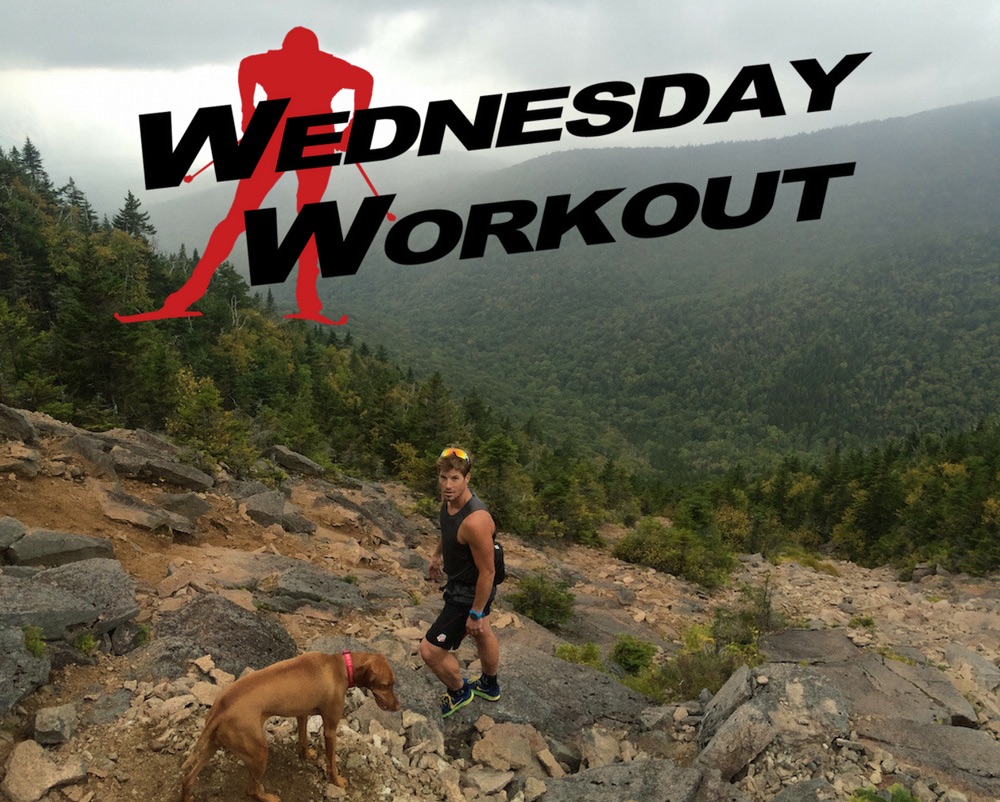
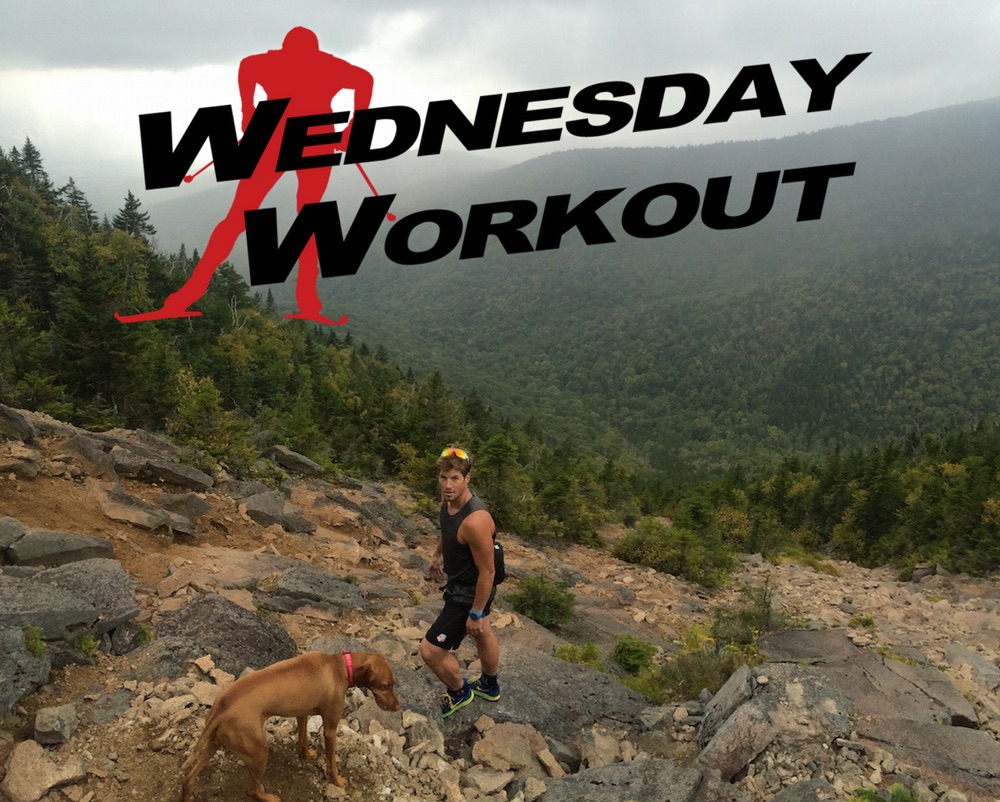
Kris Freeman and his dog She-Ra (along with Tad Elliott, not shown) racing the rain up to the top of North Slide on Mt. Tripyramid in Waterville Valley, N.H., on Sept. 14. (Photo: Tad Elliott)
This week’s workout tale comes from Tad Elliott, of Durango, Colo. Elliott, 28, has spent the last two and a half months in New England training with his coach Zach Caldwell. Elliott spent the better part of this month in New Hampshire with his former teammate on the U.S. Ski Team, Kris Freeman, who trains out of Waterville Valley, N.H. Caldwell lives in Putney, Vt., along with his uncle, John Caldwell. Here is an account of Elliott’s three-hour hike with Freeman, a.k.a. “Bird”, which they did last Wednesday.
***
I have been out East for 10 weeks training in Putney, Vt., getting ready for winter and Bird camp. Bird camp is held every September and is hard — really hard.
John Caldwell swings by Zach’s house every few days to have coffee and check in on how things are going. When he learned I was going up to Waterville to train with Kris, he said there was one workout that had to be done.
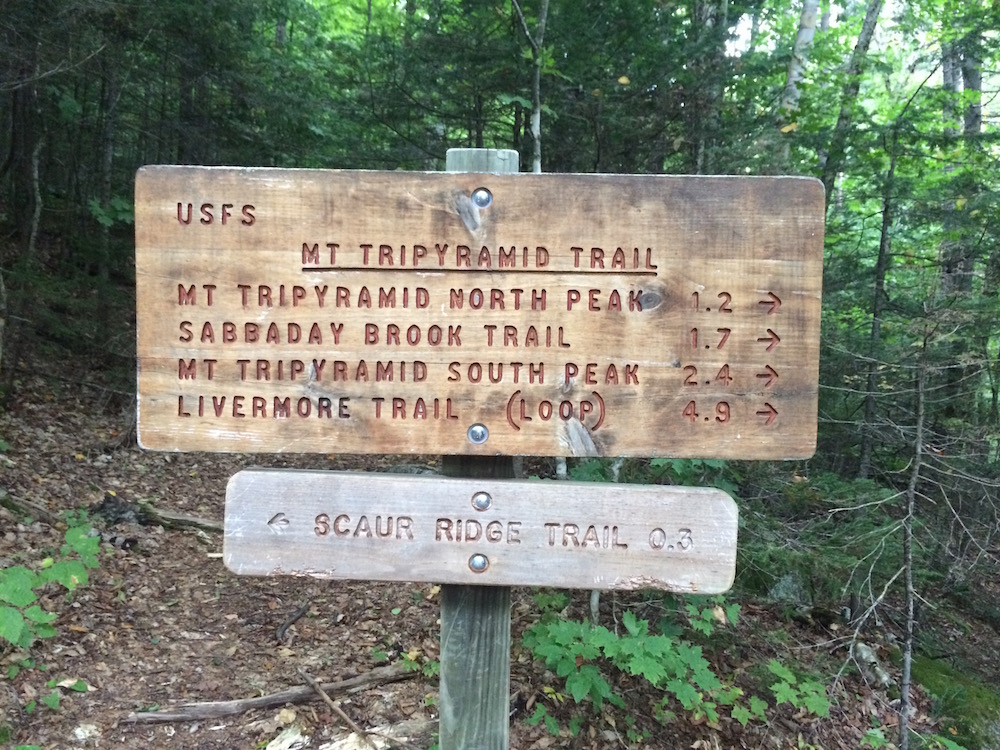
The Mt. Tripyramid trailhead: let the adventure begin (Photo: Tad Elliott)
The Workout: Tripyramids (or a Three-Hour Hike)
John Caldwell coached the U.S. Ski Team and they used to have training camps in Waterville Valley. JC told me that the best workout I could do is an OD hike going over Mount Tripyramid [a mountain with three distinct peaks along a mile-long summit ridge, some 4,160-feet tall in the White Mountains’ Sandwich Range]. The trailhead is a 20-minute drive from Kris’s front door. It’s an 11-mile hike going up the North Slide, to North Pyramid, over Middle Pyramid, up South Pyramid, and down South Slide.
On top of the hike, Kris needed some extra training. He double poled 20 miles up to the mountains. I loaded up She-Ra, Kris’s dog, and we met him at the trailhead. North Slide is a steep rock face, and rainstorms made the rocks slick and added to adventure of the Tripyramids. The rain, the scary trail that you aren’t sure is supposed to be a trail, is all part of climbing mountains in the East.
Just as we were starting up the North Slide, a hornet stung me. The rain, bugs and rocks are unique to the East and what make hiking mountains here so special. The views from the top were spectacular watching the thunder clouds roll in. The Caldwells got a kick out of this soft Colorado boy’s experience hiking some East Coast mountains.
The rain, the scary trail that you aren’t sure is supposed to be a trail, is all part of climbing mountains in the East.
The workout was a 2-hour, 50-minute run/hike, and a 4:20 workout for Kris. As John said there is plenty of time for beating yourself up rollerskiing and getting ready for the winter. Sometimes you need a good OD, have some fun with friends and enjoy hiking in the mountains. Also where else can you bag three peaks in three hours?
“Kris was making fun of me for how much I complained about my arm stinging and how red it got,” Elliott wrote of their 11-mile hike up Mt. Tripyramid in Waterville Valley, N.H. (Photo: Tad Elliott)
Kris Freeman halfway up North Slide on Mt. Tripyramid in Waterville Valley, N.H. (Photo: Tad Elliott)
***
In a follow-up up email, Elliott explained the focus of their OD hike turned into a bit of a scramble to reach the summit. “The goals hiking are always to make it to the top and enjoy the scenery,” he wrote. “The training benefit just comes from going uphill and doing something that is different and long. The pace was easy and manageable. We wanted to make sure the dog was OK and could make it up the steeper sections.”
How often does Elliott, also a former USA Cycling Team member, hike or trail run when he’s home? About once every two weeks. Hiking in the Rockies is an altogether different experience than hiking in the East, as he reiterated that Eastern trails are steeper, rockier and always seem to be damp and slick.
“Hiking in the Rockies is usually, you choose one mountain and go up that and it is a long hike into the base, then a huge hike up a massive peak. A lot more exposure, and you are going slow because the air is so thin,” Elliott wrote. “The experience out here was great. The views were awesome, and Kris was pointing out all the mountains nearby and future runs that we could go do.
“This was a easy day for us out here at Bird camp,” he continued. “Maybe it felt easy because we had fun. We wanted to give our hands and shoulders a break from the pounding on the pavement. Kris is one of the best at training in the world. A standard morning ski is now 40 miles. There is a run or strength every afternoon. I am feeling great. I have some boat time coming up in a week with my family in Annapolis. Recovery from Bird camp will be important.”
Elliott has been in New England since July 11 and plans to leave for Maryland on Sept. 26. Sidelined with Epstein–Barr virus two years ago, the former U.S. national-team distance skier explained that his health has been “pretty good” this summer, with some issues in the spring and mid-summer, “but it seems to keep getting better and better slowly.” He plans to compete in most of the U.S. SuperTour races this fall, including nationals.
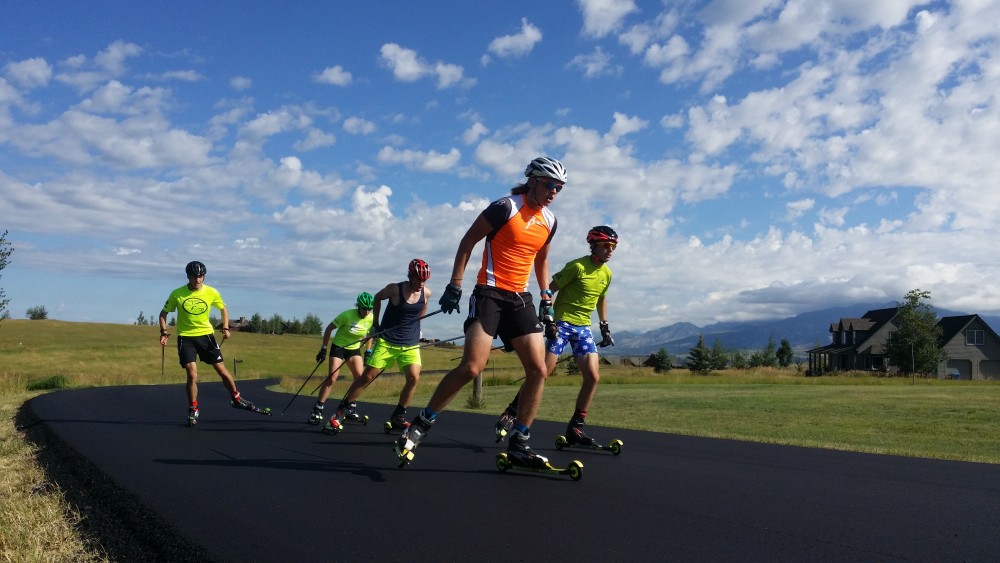
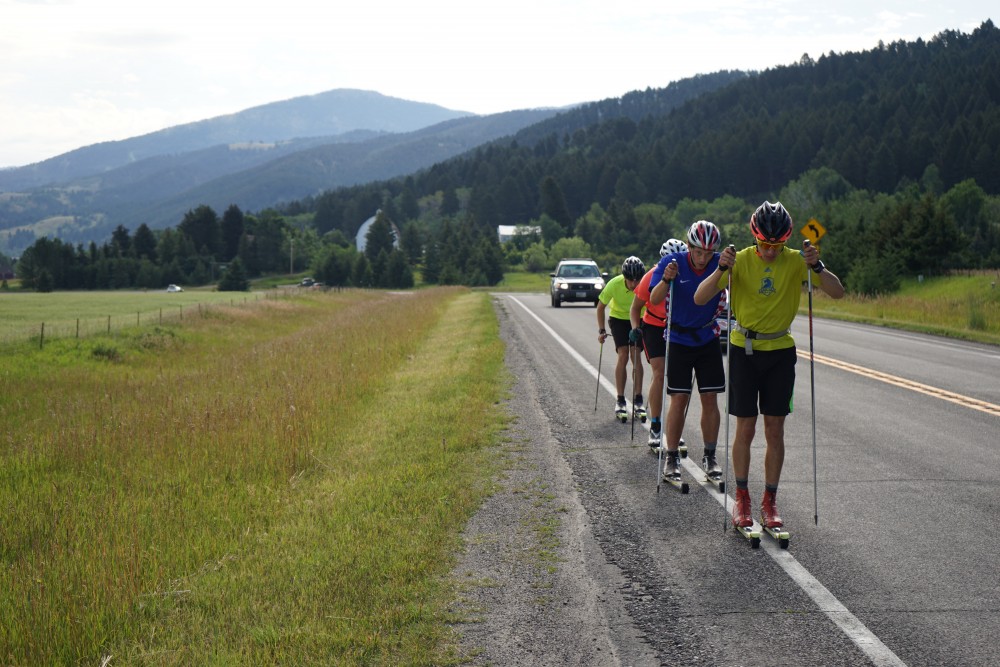
(From left to right) BSF skiers Silas Talbot, Jennie Bender, Paul Everett, Logan Diekmann, and Max LaChance during a rollerski in Bozeman, Mont. (Photo: Austin Caldwell)
The pale wood grain of a wax trailer’s interior walls and the sound of a power-tool firing up can only hold one’s attention for so long, especially if that someone has the coaching gene. As the grandson of John Caldwell, a former U.S. Ski Team (USST) head coach, and son of Sverre Caldwell, the Stratton Mountain School (SMS) nordic director and head coach, it may be no surprise that John — who goes by his middle name of Austin — Caldwell, also heard the call to coach.
After spending this past winter working for Caldwell Sport as a wax technician, Austin, a 24-year-old Dartmouth grad, wanted a challenge and change. Not only in his work, to include a greater focus on interactions with athletes, but in his whereabouts as well.
“I really enjoyed working with Zach and Amy [Caldwell] wax-teching last year,” Austin said on the phone while in Bozeman, Mont. “But part of me wanted to spread my wings a bit and try some new place outside of the east and outside of Vermont where I’ve lived all my life.”
Austin, Sophie and Isabel Caldwell (l-r) during their Christmas visit to Europe in 2013 to see Sophie race on the World Cup circuit. (Photo: Sophie Caldwell/sophiecaldwell.blogspot.com)
Growing up in Peru, Vt., alongside his two sisters Isabel and Sophie Caldwell (the latter of which is a USST member), skiing was not just what Austin spent his spare time doing. It was the family mealtime topic of choice; it was how vacations were spent with relatives — his uncle Tim Caldwell, a four-time Olympian, and cousins are all avid nordic skiers as well.
Surrounded by skiing his entire life, Austin did not want to give it up anytime soon. When the head coaching position for the Bridger Ski Foundation (BSF) elite nordic program opened up and his cousin, Anya Caldwell-Bean, BSF’s U18/U20 junior coach, told him of the opening, he saw an opportunity to not only stay involved with skiing, but further himself and his experiences in it.
“I loved wax-teching last year, that was really fun, but I also enjoyed coaching in the past for junior skiers,” Austin said. “My dad is a coach and I’ve always been interested in coaching … so now I get to coach and wax tech.”
Stepping into his new role and responsibilities as the head coach for the BSF elite team — his first coaching position of this caliber — Austin is aware of the challenges that rest ahead for himself and his athletes. Prior to this year, his work with athletes involved coaching juniors last year in Putney, Vt., and at SMS youth summer camps over the past five years.
“I have gained most of my understanding of coaching from my relationships with Sverre, Ruff Patterson, and Zach and Amy Caldwell,” Austin wrote in an email, referring to his father, college coach, and first cousin once removed (and his wife), respectively. “Those four have been great mentors and in the process they have taught me almost everything I know about skiing.”
Bridger Ski Foundation (BSF) 2016/2017 Roster:
Elite Team Jennie Bender
Silas Talbot
Nick Power
PG/Collegiate
Paul Everett
Max LaChance
Nick Matelich Summer Collegiate
Noah Anderson
Logan Diekmann
Currently eight athletes will work with him during the summer and throughout the season. Three athletes, Jennie Bender, Silas Talbot and Nick Power comprise the elite team, and five others make up the post-graduate crew, with a few of them heading to college in the fall and being replaced with new post grads for the upcoming school year.
“We’ll have some kids taking classes and then partway through the winter, people will be going different ways depending on how they do [during the season],” Austin explained. “So that will be, as far as managing at that point, that will be one of the bigger challenges.
“But I think it’s something all teams face,” he added. “Just having kids at different levels and different age groups as well.”
On a personal level, Austin admits one of his biggest adjustments so far has been learning Bozeman’s trails and rollerskiing roads, as well as not getting the team or team van lost in Montana’s mountains.
“For me, I guess the biggest challenge that everyone has been helping me with is finding my way around Bozeman and finding new routes for rollerskiing,” Austin said. “Every week I’ve been trying kind of to add a new place to rollerski … because it’s important to switch it up.”
“I plan on staying in the ski world for as long as I can, so far BSF and Bozeman have been great and I plan on remaining here for the coming years.” — Austin Caldwell on becoming BSF’s elite head coach
But even if navigating Bozeman has been a bit of a learning process during the beginning stages of his coaching career, the city and a well-established elite program were two of the draws that pulled Austin to apply and eventually take the position.
“Having a strong program in place and being in Bozeman were the two main factors [why I considered working with BSF],” Austin said. “I also talked with Dragan [Danevski, BSF’s head coach and program director] and with my cousin Anya and it just seemed like it would be a good fit.”
With the goal to remain involved with skiing for as long as possible, Bozeman and BSF struck Austin as the ideal program and place to be a part of.
“I plan on staying in the ski world for as long as I can, so far BSF and Bozeman have been great and I plan on remaining here for the coming years,” he wrote in an email.
Danevski respectfully declined to comment on Austin’s hiring. In the last two years, the BSF elite team has weathered several coaching transitions, most recently with the departure of Bernie Nelson — the team’s coach since the fall of 2014.
In his first season as an elite head coach and with eight athletes to oversee, his greatest ambition involves pushing his athletes to their full potential. Talbot, 23, Austin’s former classmate, co-captain and fraternity brother at Dartmouth College, and now an athlete for the BSF elite team, saw the transition to having Austin as a coach as uniquely strong.
“For myself, it has been hugely beneficial to have Austin coaching because he knows my athletic background so well,” Talbot, originally from Anchorage, Alaska, wrote in an email. “He already knows my strengths and weaknesses (which are especially prevalent in the dryland season), and so there is no need to build up the trust and/or understanding between us from scratch. In short, having someone I know well as a coach makes the adjustment to the new program — something that for many after college is a tough step — much easier.”
Bridger Ski Foundation elite and post-graduate athletes during a classic rollerski in Bozeman, Mont. From left to right: Max LaChance, Nick Power, Logan Diekmann, and Silas Talbot. (Photo: Austin Caldwell)
Entering her fourth year on the BSF elite team, Bender also found Austin a positive addition to BSF and the greater Bozeman area.
“Austin waxed for me during the last few World Cups at the Canadian Tour this past March, and I was instantly impressed with his professionalism,” Bender wrote in an email. “Austin taking the head Elite/PG coach position is a great attribution to not only BSF, but to the Bozeman ski community as a whole.”
So far, Austin too, cannot ask more of his athletes and training group. The higher level of focus and preparation he finds evident with the BSF elite and PG level athletes gives him confidence in the season and performances to come.
“I think the key to success is having a group that motivates each other and pushes each other,” Austin said. “And I’m very excited about this training group we have going into the summer. They’re all working very hard and they’ve come together really well. It’s like they’ve been training together a lot longer than three weeks … everyone in this group is always trying to push the limits and do everything they can do to get better.”
Jennifer Caldwell in the Prouty Ride, a 100-mile century road ride through central New Hampshire to benefit cancer research. Photo courtesy of Anya Bean Caldwell.
She had come so far. Nearly 85 miles to be exact, yet in the larger scheme of things, Jennifer Caldwell’s progress in the 2011 Prouty century ride meant so much more.
A cancer patient since 1999, the former U.S. Ski Team member epitomized the body’s limits in its lowest moments. She was not weak; anyone who knew Caldwell, who died on Dec. 27 in Wolfeboro, N.H., could attest to that.
Participating in the July benefit ride through central New Hampshire with about 50 friends and family members, which called it “Jennifer’s Tour,” the 53-year-old rode for the sake of cancer research and raised thousands of dollars in the process.
Competitive by nature, it’s hard to imagine she wasn’t racing for herself as well. Suddenly at mile 85, she went down. Hard.
Her husband, Howie Bean, said she had been cruising at a vigorous speed of 25 miles per hour when another rider accidentally hooked her handlebars. The woman who wasn’t expected to make it through Thanksgiving the year before crashed hard onto the pavement. She broke her pelvis in three places.
Almost as soon as she discovered the severity of her injury, Jennifer decided her next move. She needed to be operated on sooner or later to remove malignant tumors caused by gastrointestinal cancer – a major surgery known as debulking. While she was out of commission with one injury, she figured she might as well add that to the healing process.
“Most normal people would think, ‘I need to get over this one thing at a time,’ ” Bean said in a phone conversation from Wolfeboro. “She was just like bring it on.”
Jennifer Caldwell (center) surrounded by daughter Anya and husband Howie Bean, and their dog Lizzie at the top of Mt. Chocorua the New Hampshire White Mountains in October.
Three weeks later, Bean found her down at the lake with friends, against the doctor’s orders. With a belt fastened to her waist, she swam with her arms.
By September, she and Bean were hiking with their only child, 22-year-old Anya, and the University of New Hampshire (UNH) ski team.
“She was as strong as any of the girls going up that hill,” Bean said. “She was in darn good shape. She just made it her life to do that.”
On New Year’s Eve day, hundreds of friends and family members gathered to remember Jennifer, the youngest child and only daughter of Hep and John Caldwell. While some knew her all her life, such as her three older brothers, Tim, Sverre and Peter, several were grateful to have befriended her later on.
“She didn’t try to make friends, she just made them,” Bean said. “That’s the thing about Jennifer … some people really loved her.”
The following is a compilation of thoughts and memories regarding Jennifer Caldwell. Aside from Bean, her husband of 23 years, most were written as emails. Tim Caldwell also provided a couple of eulogies from her memorial service on Dec. 31.
Jen’s Early Days
Jennifer Caldwell. Courtesy of Anya Caldwell Bean
“I think she was a bit of an icon from the beginning – the youngest and only girl in John and Hep’s active and powerfully achieving family.” – Marianne Lucy, Jennifer’s sister-in-law
“Jennifer was smart and quickly skipped a grade [at The Grammar School in Putney, Vt.] early on. She was two years younger than our youngest son and that meant the four kids were all lined up in consecutive grades. They used to study after dinner sitting around the kitchen table.” – John Caldwell, father
“Jennifer did everything we did – from skiing, hiking and the myriad of other physical activities we indulged in, to studying, reading and playing a musical instrument [starting with the flute].” – Tim Caldwell, brother
“[She started skiing] just as soon as she could walk. That is, if she wanted to be with the boys. I once told my mother-in-law I wanted to start the kids early – even on the living room rug – so they could avoid bad habits from starting to walk.” – John Caldwell
“Her father Johnny introduced my generation of Putney children to skiing. He imported equipment, coached us and introduced us to world-class racers, who also gave clinics and taught us skis. Probably from birth Jennifer was part of that Putney skiing scene.” – Mary Heller Osgood, childhood friend and training partner
“We had a lot of fun on skis – a favorite springtime activity was using the apple trees in nearby Green Mountain Orchards as a slalom course to practice our skate turns. … Moonlight skis were popular too, though I do remember skiing over to the Caldwells through the woods one evening and trying to rouse Jennifer out of bed for a moonlight tour. That time she decided that it was way too late … and went back to sleep.” – Mary Heller Osgood
Note: Jennifer graduated from The Putney School, where she was an orchestra member. Several of high-school friends spoke at her funeral. She went on to attend Middlebury College and transferred to the University of Vermont to pursue her musical ambitions. There, she developed as a flutist and vocalist, and achieved All-American status as a nordic skier in 1981. She graduated UVM with a Bachelor of Arts and later took up the piano.
A Nordic Prodigy
“When I was learning how to ski, back in the 1970’s, Jennifer was one of my role models. She remains one of the leading ladies of cross-country skiing in our country. Jennifer was the epitome of grace and beauty, both on and off skis.” – Nancy Ingersoll Fiddler, two-time Olympian in nordic skiing, Bates College graduate and national champion
“She was a phenom earlier, way more than me.” –Bean, who first met Jennifer when she was 16.
Note: She and Bean attended junior nationals together in 1974, when Bean said, “she was just another girl on the team.” They later reunited in 1982, after both missed making the World Cup team and began their Great American Ski Chase tour with five others. Bean estimated they were on the U.S. Ski Team together from 1979-1984.
Jennifer Caldwell and husband Howie Bean at a wedding in last summer. Photo courtesy of Anya Caldwell Bean
“I guess I was awestruck, and I’m kind of a shy guy. This girl, she kind of hit me over the head, but [I thought], ‘This girl’s kind of cool. This could be fun.’ … We were so different in so many ways, but we just seemed to get along.” – Bean
Jennifer won the American Birkebeiner in 1983, which contributed to her two-year reign as Great American Ski Chase champion. (Bean won the overall title as well). Both retired from professional skiing in 1984 to pursue other recreational passions, such hiking and cycling, in Bean’s hometown of Wolfeboro. There, he got Jennifer into canoeing and they were married in 1988. Two months before Jennifer gave birth to Anya in 1989, they won the Smith River Canoe Race in Wolfeboro.
Later Years
“She got so good [at canoeing] that she raced with some real hot people. … One of my friends said, and I can believe it, that she was the best woman stern paddler in North America. … She could handle a boat like you couldn’t believe. … She might’ve been a better canoer than she ever was a skier.” – Bean
“Jennifer and I won the C2 Open Women’s Championship (two women in a canoe) event at the United States Canoe Association (USCA) Marathon Nationals in 2001 and 2003, the only two times we raced together at Nationals. We also raced in the C1 event, the solo boat race. I had never been in a solo boat … Jennifer convinced me to give it a try.” – Christina Wilson, Wolfeboro friend and national champion in canoeing
“A few minutes into the race, I heard, ‘Yoohoo!’ from behind me. I looked around and I saw Jennifer just behind me, everyone else was behind her. We were in the lead! She was drafting me and we were pulling away. We took turns drafting each other for the rest of the race, sprinting and resting, giggling when I got thrown into a wave. … We came into the finish line together, dead even. She was the first placed Master’s boat, and I was the first placed Open boat. It was one of the most fun races I had. This epitomized Jennifer to me. She was a tough competitor – one of the toughest by far – but had fun doing it.” – Christina Wilson
Note: In addition to her athletic endeavors, Jennifer volunteered at several organizations, including the Huggins Hospital Meals on Wheels and the Clearlakes Chorale. She worked at the Tuftonboro Library and organized clinics through the New England Nordic Ski Association (NENSA).
“We always talked gardening, or bread-making, or freezing veggies, raising plants, deer damage, skiing, etc., and had a lot of laughs together.” – John Caldwell
“She would be outside as much as she possibly could, and when she wasn’t outside, she would be reading or resting so she could be outside as soon as possible.” –Bean
“She connected with people very individually. She sent many early morning emails that she had written before the sun came up – a morning ritual that is missed by many of us.” – Christina Wilson
“During the last four years, Howie and Jennifer have had the team over to the house where we have trained on their homemade trails (which are as good as any touring center.) … Jen on numerous occasions had homemade bread waiting for the team after training sessions. … You could tell Jen not only loved the competitive part of the team, trying to become faster, but enjoyed the interaction with team members. Jen loved not only competition, but the relationships she developed in all sports she was involved in.” – Cory Schwartz, UNH nordic head coach
In Sickness, a Bright Spot
“When she was diagnosed with GIST [gastrointestinal stromal tumor], the life expectancy was five years. She lived about 13 more years, thanks to her treatments at Dana-Farber Cancer Institute. She must have made 50 trips down there during that time and finally simply ran our of drugs to treat the disease.” – John Caldwell
“When Jennifer was diagnosed with cancer … everything changed – and not all for the worse. It was as if the diagnosis gave her a new lease on life. She became more expressive, clearer about what she wanted for herself and her family. … Her humor and wisdom, her emotional and physical toughness gave strength to us all.” – Tim Caldwell, brother
“What amazed me the most about Aunt Jennifer throughout our conversations was how selfless she was. She would make some comment about how miserable cancer was and then say something along the lines of, ‘Look at me complaining, I need to quit whining!’ … She hated people worrying about her of feeling bad for her and had the impressive ability to make light of almost any situation, including her cancer, right until the end.”– Sophie Caldwell, niece, senior and co-captain of Dartmouth College ski team
Jennifer Caldwell and her niece, Isabel Caldwell. Photo courtesy of Anya Bean Caldwell
“Jen was by far the strongest and toughest person, both physically and mentally, that I’ve ever known. I’ll always remember her massive muscles from canoeing and how she would always tease me because I’ve never been very muscular. I guess that’s what happens when you grow up with three big brothers! … If Jen wanted something, she’d go out and get it. I think that’s why she was able to fight off the cancer for so long, she wanted to live so she did.” – Isabel Caldwell, niece, Dartmouth ski team sophomore
“She had an inviting smile, and a mischievous grin. She could swear like a sailor, and give you a bear hug like no other. She had a terrible sense of direction, but was always ready for an adventure.” – Christina Wilson, friend
“Even in sickness, she uplifted others with her wry assessments, stoicism and endless courage.” – Marianne Lucy, sister-in-law
“Three days before she died, I sat with my head on her shoulder and whispered in her ear my love for her. Not wanting to exclude 15 other people in the room, she turned to them and said, ‘Darcy is giving me make-up tips.’ ” – Darcy Caldwell, sister-in-law
“[Three weeks ago] I thanked my mom for fighting her battle for so long, and she laughed and replied, ‘Well, yeah! Can you imagine Howie raising you as a teenager?!’ She was sassy until the end and continuously heckled nurses and teased Howie about his shortcomings.” – Anya Caldwell Bean, daughter, UNH senior
“Not many people knew just how sick she was because she remained so active and vibrant. She was the epitome of life and emanated her inability to sit still. She inspired so much love and connected well with so many people. She was tougher than anyone I have ever met.” – Anya
Four days after Jennifer Caldwell passed away at home, the former U.S. Ski Team member and University of Vermont graduate will be remembered at a memorial service on Saturday, Dec. 31, at St. Katharine Drexel Church (11 a.m.) in Wolfeboro, N.H.
Caldwell died at home on Tuesday at age 53. She is survived by her daughter Anya, husband Howie Bean, parents John and Hep Caldwell and three older brothers: Tim, Sverre and Peter Caldwell.
Among her many achievements, Jennifer Caldwell won the American Birkebeiner and was a two-time Great American Ski Chase champion, winning every ski marathon in the U.S. for two years. Here is a link to her obituary.
Donations can be made in her memory to Clearlakes Chorale, P.O. Box 223, Wolfeboro, NH, 03894, or the Wolfeboro Cross-Country Ski Association, 47 North Main Street, Wolfeboro, NH, 03894.
Anyone wishing to share thoughts or memories about Jennifer Caldwell are encouraged to email alex@fasterskier.com.
This article is the third profile in the ‘Where Are They Now’ series, made possible through the generous support of Fischer Sports. Learn more about their products at www.fischersports.com.
Mike Gallagher, a three-time Olympic cross-country skier and former U.S. Ski Team head coach, stands in front of his home in Pittsfield, Vt., on Nov. 1.
FS Podcast Short: Mike Gallagher discusses the evolution of skating with Alex Matthews [podcast]http://images.fasterskier.com/2011/11/MikeGallagher.mp3[/podcast]
(You can subscribe to FasterSkier Podcasts in iTunes here)
PITTSFIELD, Vt. — The “XC1” license plate on the Subaru wagon should have been a dead giveaway. Instead, it took a minute to be sure the man walking across the general-store parking lot was Mike Gallagher, one of the pivotal players who put U.S. nordic skiing on the international map.
Inside the store, appropriately named the “Pitt-Stop” after the town with about 550 residents, Gallagher greeted a few familiar neighbors and affectionately asked the clerk to prepare his turkey-BLT sub without onions.
“They don’t come with onions,” she said, kindly. “Oh, no?” the 70-year-old Gallagher said about one of his favorite grinders. “Well, all right then.”
Pittsfield and Irene:
When Tropical Storm Irene swept the country in late August, it devastated several communities in central Vermont, including Pittsfield.
High atop a mountain road, Gallagher lost his driveway. With his power out, he thought, “Poor me,” he said.
Then he walked into town. In the river valley, 22 homes had been condemned or destroyed in Pittsfield, he said. Residents were stuck without a way out for more than a week.
The Pitt-Stop rationed gas to five gallons a day per household, the National Guard and FEMA flew supplies in, and people met every other day at town meetings.
“The town came together like it never has,” said Gallagher, who has lived in Pittsfield since 1967. “We’ve had what we call floods, but nothing. We never lost bridges, we never lost homes.”
With his wife, Tyna, in Boston during the storm, Gallagher couldn’t talk to her for four days. He had to walk to town and stand in one spot to get cell service.
When Tyna arrived home later that week, she was covered in scratches from walking through the woods, Gallagher said.
They couldn’t use their driveway for nearly a month, he said. It took 63 dump-truck loads of gravel to fill in.
Before proceeding a few miles from town to his home at the height of the land, the three-time Olympian and former U.S. Ski Team head coach visited the postmaster.
Up at his log cabin on 50 acres of land surrounded by national forest, Gallagher revealed four green-and-spotted apples the postmaster gave him. She thought they were interesting, he said with a laugh. He had apple trees in his yard.
Placing them on the woodpile that filled his front porch, Gallagher explained he used to chop the wood himself. Now, he had it delivered, but even after having a hip replacement a year and a half ago, he still stacked it.
Before eating lunch inside the house he built in the 1970s, Gallagher pointed to a green square nailed outside his garage. High above the ground, the original “XC1” Vermont license plate attested to his ski career; the nine-time U.S. nordic champion received it in the ’70s upon being the top racer in the country.
With prestige came egos, Gallagher said. He had plenty of stories to illustrate his.
A veteran member of the U.S. Ski Team in 1968, he remembered when about 10 teammates set a running record on Vermont’s Long Trail, which extends nearly 300 miles from Canada to Massachusetts.
A year later, he and the team took on another training excursion: bicycling some 1,000 miles around Vermont.
“I had this license plate, but I was not a biker,” Gallagher said, with a smile. “I had a 10-speed bike. … It didn’t have those fancy toe clips. I didn’t wear those fruity-looking black pants and those pointy Italian shoes with these clips on the bottom. I was a real man. I got on the bike and pushed the pedals.”
A graduate student at Springfield College in Massachusetts at the time, Gallagher joined his teammates on weekends to prepare. Meanwhile, many of them — which he described as bikers — trained more seriously for the ride.
“They did stuff like get in a line and rotate the lead and stuff like that,” he said. “But real men don’t do that type of stuff. You just get on the bike and go up front and stay there.”
In tennis shoes, running shorts and a T-shirt, the helmet-less Gallagher embarked on the cycling journey with the group. He treated as a race, avoiding the pull line and leading his peers by several bike lengths.
On the last day of the ride, the team approached the last 110 miles in similar fashion, drafting one another and taking turns breaking the wind. Gallagher couldn’t take it.
“I take off, ” he said. “For about 40 miles, I go off the front and just stay there, and they’re doing all this kind of stuff, staying about a quarter mile behind me.”
They regrouped at lunch in Manchester, Vt., about 50 miles from their final destination in Putney at the home of their head coach, John Caldwell. From there, they started to climb Bromley Mountain.
“This is where Mikey was gonna get his lesson,” Gallagher said. “He was gonna get spanked. All of a sudden, one of the guys goes off in front … and the next one goes, and the next one goes, and I am dropped … dropped bad. And I was Mr. XC1.”
Exhausted and about 20 minutes behind, Gallagher missed a shortcut into Putney, which saved the others about 20 miles. Laughing with tears in his eyes, he said he didn’t even have a water bottle.
When he eventually wheeled into Caldwell’s driveway about 1 ½ hours after the team, he saw his license plate, which had been chalked with two zeros: “XC100.” Everyone was in the sauna, drinking beer and singing.
“I’ve had a long day and they put it to me,” he said. “Of course, with the ego I had, being as cocky as I was, I really deserved it. But boy, they put it to me bad.”
He couldn’t let that go. “Guess who went out and bought a racing bike?” he asked. “And some of those pointy Italian shoes and some of those black pants?”
Yes, he ended up in “a tight, flashy T-shirt and a helmet,” he said, and trained so hard he won a national time-trial championship in 1972. A few months before he claimed the 25-mile cycling crown, Gallagher skied in his third Olympics, helping the men’s relay finish 12th and placing 30th in the 30 k.
He had previously cracked the top 30 in the 1968 Olympics (22nd in the 50 k, 27th in the 30 k), and was 38thin the 15 k at the 1964 Games.
“I was a wicked-good hill climber,” Gallagher said of his competitive cycling career. “Tremendous time trialist, terrible pack rider.”
He chuckled for a while and continued to eat his BLT.
That was the thing about Gallagher. Spending more than three decades in the sport at its highest level (as a USST athlete from the early ’60s to the mid-’70s, as its head coach in the ’80s and an assistant in the early’90s), he told it like it was, with an exceptional memory that lent to storytelling.
“There’s a couple things outside my skiing that I’m quite proud of,” he said.
The Mount Washington Road Race was high on the list. He won the 7.6-mile climb to the top of the 6,260-foot mountain four times from 1968-1971. In June, he was inducted into its Hall of Fame with two others: Daniel Kihara of Kenya and Derek Froude of New Zealand.
He would’ve gone after a fifth-straight title, too, if it hadn’t been for an incident on the auto road in ’71.
Before the race, he overheard Boston-Marathon winner Amby Burfoot telling reporters that he didn’t expect to lose to a skier. He didn’t forget that.
About 1 ½ miles from the finish, Gallagher checked back to see Burfoot 20 seconds behind him. A car trailed him even closer, beeping as Gallagher cut across the switchbacks.
“Hell, I had the right of way,” Gallagher said. “And he came up and hit me and I rolled up onto the hood and fell off on the side.”
He stood up and saw Burfoot just down the road. That motivated him to run even faster.
“I put on about a half-mile kick right then,” Gallagher said. He won by nearly a minute.
Gallagher, 70, stands near a pond on his 50-acres property in Pittsfield near his sauna (not shown).
Starting from Scratch
Inside his log cabin, Gallagher glanced at the large, rounded beams overhead. They were heavy, he said, and he installed them on his own.
When he bought the property in 1967, Gallagher wasn’t a builder. He considered it a risk in some ways as a full-time athlete at the height of his career.
“It was tough in the old days,” he said. “I worked 70 hours a week to train 70 hours a week.”
By trade, he was a teacher, working long hours in colleges like Castleton and Johnson State in Vermont to fit in semesters between seasons. Trained in physical eduation, he created a Sport and Society course at Johnson State.
In 1974, his Pittsfield home burned to the ground. Gallagher and his first wife were in Bermuda at the time, and as they switched hotels throughout the week, the bad news never reached them.
“The message that our house burned down was always one jump behind us,” he said. “(We) got back to Boston, jumped in a car and drove up to a cellar hole here.”
Six months later, Gallagher finished building their new home, which he did himself except for the plumbing and bricklaying. He didn’t have any architectural plans, he said, just an ambition to work.
Born in Yonkers, N.Y., and raised near Rutland, Vt., Gallagher began a family of his own in Pittsfield with two boys: Jesse, now 34, and Sean, 31. Both talented skiers, Jesse went to the University of Alaska and Sean skied for the University of Vermont.
Gallagher (R) with his son, Jesse, in his Elan work van.
Jesse became a big-game hunting guide, spending some of the year in Alaska and traveling to Africa last summer. When he wasn’t on the road, Gallagher said his oldest son lived in a small cabin on his property, back in the woods without a driveway.
Also in Pittsfield, Sean lived closer to town with his 2 ½-year-old son, Andrew.
“He’s a keeper,” Gallagher said of his grandson.
He said the same about his second wife, Tyna, whom he married 10 years ago and recently built a horse barn for.
“Everything in my life except my training and my devotion to my wife is what I call and organized mess,” he said as he walked around the barn, built for Bud, the horse, and their three dogs: Roscoe, Thunder and Jaeger.
On the other side, Gallagher pointed to his beehives surrounded by an electric fence. As of early November, two of three had survived.
A self-described, small-time beekeeper, Gallagher said he did his best to cultivate and protect the hives for the benefit of the environment. Pollination was good, he said, and comb honey was healthier than jar honey. Bears were his biggest problem.
Jesse helped by bringing spiked-bear boards from Alaska and laying them around the hives. Gallagher also placed muskrat traps nearby. “You try all your tricks because a hive like this is worth probably $300,” Gallagher said. “A bear comes in, then you’re out of luck.”
Gallagher shows off his beehives, surrounded by an electric fence and bear boards.
Elsewhere on the property, Gallagher said he spent most of his time gardening and mowing. With nine acres to cover at least once a month and four acres a week, he mostly mowed.
“Not that I’m retired,” said Gallagher, an independent subcontractor for the last 16 years. “But I basically am.”
In May 2010, Gallagher had hip surgery that was both life-changing and hard to bounce back from. Without it, he would be on crutches or relying on a cane, he said. Before it, he couldn’t ski.
Last winter, he resumed his part-time job instructing skiers at Mountain Meadows in Killington, Vt., and planned to return in a few months. This year, he hoped he could skate ski.
“There’s no reason why I can’t,” he said. “I just wasn’t ready last winter, but the activity was good for me.”
Continuing the tour of his property, Gallagher walked toward a wooden hut on the edge of a heart-shaped pond. The green space beside it was where he married Tyna, who now works as an office manager and sells candles on the side.
Beyond the pond was a place he described as “special,” a 10-person sauna with a ski-memorabilia changing room.
Inside, ski tips from as early as the ’30s served as clothes hangers and posters of some elite nordic skiers — including Bill Koch and longtime friend Bob Gray — plastered the walls. He looked closely at a plate, which named every Swedish Olympic cross-country ski champion through 1977.
“(What) makes the difference between a great champion and other skiers, (is) that they can change their technique during a race to accommodate conditions,” Gallagher said. “They can change it from day to day, even sometimes from year to year.” Through the years and his experiences with top-tier skiers, Gallagher learned that.
‘An Organized Mess’
Gallagher points to a photo of Bill Koch from 1982 in his basement “museum” in Pittsfield, Vt.
Back inside his home, Gallagher stood in his basement admiring his wax bench, which he used with the national team and with his sons. Well-worn, it appeared to be operational.
“I’ve got so much wax up here,” he said. “Literally, thousands of dollars of wax.”
He motioned toward the adjacent room: his office, or as he called it, “the museum.” He recalled an inscription above the library doors at the University of Colorado at Boulder, his alma mater.
“ ‘He or she who knows only their own generation remains always a child,’ ” Gallagher said. “So this is a lot of history of skiing, not just Mikey.”
The sauna had been just a warmup. This was a shrine to the sport with newspaper clippings, original photos, plaques and medals all holding pieces of history.
A photograph of Bill Koch en route to winning a 1982 World Cup event in Italy. Notice the coaches checking out his skis.
Pinned to the back wall, an action shot of Koch was at the heart of the collage. Gallagher pointed out two Norwegian coaches in the photograph, who were on their knees and straining to look under Koch’s skis. He won the World Cup race in Italy that day and the overall title that year in 1982.
Koch became the first American nordic skier to win a World Championship medal in ’82, after claiming an unprecedented silver at the ’76 Olympics.
“I coached him and he was one of my heroes,” Gallagher said. “And I’m one of his heroes. You know how that goes?”
After translating Norwegian and Swedish newspaper headlines, Gallagher shifted his focus to perhaps his biggest hero, his father. A member of the 10thMountain Division — a group of mountain-warfare soldiers formed in 1942 — his insignia hung on the wall.
Gallagher pointed out his father’s ice ax, which he used in World War II as a climber and downhill skier.
“I hang a lot of things on nails,” he said. “Jesse, about three years ago, said, ‘What are you gonna do with Grandpa Don’s ice ax?’ And I paused for a second, and he said, ‘Hang it on another nail?’ ”
The ice ax Gallagher’s father, Don, used while in the 10th Mountain Division. Gallagher’s son Jesse used it about three years ago to climb Mt. McKinley.
Probably, he responded.
Jesse wanted it to climb Alaska’s Mount McKinley, the highest mountain in North America. His father didn’t think he would go through with it.
“After he climbed the mountain, he gave it back to me,” Gallagher said. “ ‘Hang it on a nail.’ ”
Closing the door behind him, Gallagher turned around to face several posters of bald eagles. He was once so frustrated with a group of athletes, he told them, “I can’t fly with eagles if you ask me to train like a turkey!”
They responded by calling him “The Eagle.” “So today my nickname is,” he said, removing his cap. “The Bald Eagle.”
Testing the Waters
Before graduating Rutland High School in 1959, Gallagher earned early exposure with the national team at one of Caldwell’s training camps the fall of his senior year.
Fresh off his cross-country season, the Vermont state champion found himself in a perfect position at the snow-less camp, which resorted to running.
“I’m looking over my back the whole time at these guys who are training for the Olympics,” Gallagher said. “They can’t keep up. I said, ‘Whoa, this looks like the doors (are) open.’ ”
That winter, he won the Junior Olympics. In college, Gallagher wanted to surround himself with some of the best skiers he knew, so he chose to join Gray and Mike Elliott in Boulder. The three of them eventually dominated American racing.
After three years at CU, Gallagher — then a member of the U.S. Olympic training squad — took a year off to immerse himself with the team.
“By the end of the year, I was one frustrated puppy,” Gallagher said. “We had trained our butts off. … No other athletes in the world had trained any harder than some of us, but we weren’t trained right. We were more in shape to run and hike than we were to ski.”
He ventured to Norway that spring in search of a solution. He found it in the Norwegian training method.
“They did some silly son-of-a-gun thing called rollerskiing,” Gallagher said.
Upon returning to Colorado for his final year of college, he found his mind was elsewhere. With one semester left, he withdrew from CU and stayed in Europe to study the Norwegian system. He began rollerskiing, importing the three-wheeled skis to the U.S. and selling the first 200 pairs before they even landed.
For the rest of his ski career, Gallagher imported European items, such as skis, boots and bindings, and sold them out of his car at races. His eye for the market landed him jobs with ski companies, including Splitkein, Hexcel, Edsbyn and Elan, where he designed and tested fiberglass skis.
Even when he retired as an athlete in 1975, Gallagher maintained his part-time industry positions, which kept him in touch with the sport and its athletes before he returned to the scene in 1980, first as a private coach at the Lake Placid Olympics and then as the USST head coach from 1980-86.
“Basically, that’s how I got hired,” he said. “Because the racers had experience with me as an ex-athlete and a person that’s very knowledgeable and most of all, very enthusiastic.”
Peter Ashley, the U.S. women’s coach in the ’80s who worked with Gallagher, remembered him as an important figure during a transitional period in the sport. While people around the world resisted the skating technique, Gallagher fought for it.
“He brought some interesting openness to different ways of doing things,” said Ashley, now Fischer USA’s nordic division vice president.
“And you needed to because you had Bill Koch there. Mike was the perfect guy for Kochie because he allowed him to do things in a different way. … Flexible when he needed to be and would stand on things when he needed to.”
Personally, Ashley said Gallagher had a special impact on him as a freshman at the University of Colorado. In 1969, Gallagher helped save his life.
“We were out training one day and decided to take a tour,” Ashley said. “I ran into a tree and it was not exactly warm out there in Colorado.”
Several members of the group shed their clothing to cover Ashley and used pine-tree branches to insulate him. Some went to get help at the lodge, while the others stood by his side. He had destroyed his stomach muscles and could hear a few people quietly worrying if he was going to make it.
A couple of hours later, Ashley made it out safely on a toboggan. He raced at the NCAAs later that season.
How Far We’ve Come
For Gallagher, skiing was a lifelong sport and coaching became a passion. When he thought back to his career’s highlights, he said he missed coaching.
When skating disrupted the nordic world in the 1980s, Gallagher was hesitant at first. The Americans didn’t know how to do it, but Koch pushed them to experiment.
By the time his team got the hang of it around 1985, some others weren’t there yet. Gallagher remembered going to a meeting in Sweden, where an outraged technical delegate exclaimed: “ ‘Furthermore, our research shows that skating will damage women’s crotches!’ ”
“Ruff Patterson, who was my assistant coach, and I said, ‘Crotches?’ ” Gallagher recalled. “People were just going crazy.”
By 1986, skating was an accepted discipline. “I think it’s great the way it is now,” Gallagher said.
But evolution wasn’t easy to foresee. When U.S. Olympic biathlete Charlie Kellogg came to a summer practice with a pair of rollerskis — with the tips and tails cut off so they fit in his Saab — Gallagher was furious.
After cussing him up and down, Gallagher said, “ ‘How are you gonna get the kinesthetic feeling if you don’t have a ski on your foot?’ You can’t ski on a skate!’ ”
“Wrong,” Gallagher said, nearly 50 years later.
Earlier this year, Gallagher sold his last pair of rollerskis — his own — to a girl for $50. He told her it was the best deal ever.
Looking ahead to this season, Gallagher was excited to teach again. But he won’t teach beginners how to skate. One of the reason he thinks cross-country skiing struggles to gain popularity with newcomers is because of the industry’s dishonesty.
“We said cross-country skiing is as easy as walking. It’s not,” he said. “(To some people) I say, ‘Nah, I think you better be on snowshoes, you’re not ready to ski.’ … They want to exercise on snow. Not everybody can ski.”
In the end, he wants to make it fun for beginners and keep them coming back. “I enjoy teaching someone how to cast a fly,” he said. “I enjoy teaching someone how to pound a nail. I enjoy teaching someone cross-country skiing.”
And he loves being in Vermont. At his induction into the Vermont Ski and Snowboard Hall of Fame in 2007, Gallagher borrowed a line from one of his favorite presidents, John F. Kennedy. “Ich bin ein Vermonter,” he said. I am a Vermonter.
This article is the first installment of the ‘Where are They Now’ series, made possible through the generous support of Fischer Sports. Learn more about their products at www.fischersports.com.
John Caldwell. Photo: courtesy of Sophie Caldwell.
If you were to take stock of the people who have contributed the most to the development of cross-country skiing in the US, John Caldwell should be near the top of the list. He may beat everyone else simply because he’s had the longest amount of time to accomplish things—and at 82, he’s still got his opinions and and is not afraid to share them. Though he’s had multiple hip replacements and is a candidate for two new knees, Caldwell can still be seen shuffling on classic skis around New England.
Part of the goal of a “Where They Are Now” series is enlighten the younger generation on how something came to be. Though some past movers and shakers in the ski world may no longer be as active in the community as they once were, they are relevant for the same reason society bothers to study history. The past causes the present.
As a major player in the development of an always-changing sport, Caldwell is no mere historian. But the former Olympian, U.S. Ski Team (USST) coach, Putney School teacher, author, and New England Nordic Ski Association (NENSA) founder doesn’t like to single out any one of his accolades.
“I don’t think of being proud of anything,” he said in a recent interview with FasterSkier. “I just plug along.”
Caldwell was born in Pennsylvania, but his parents moved to Putney, Vt., in 1941, and he’s remained closely tied to the town ever since. He began his athletic career as a basketball player, but without a team to go out for in Putney, Caldwell’s dad got him started skiing. He skied at Dartmouth College at a time when intercollegiate skiing still featured four events. After graduating in 1950 and going to the 1952 Olympics as a Nordic Combined skier, he settled in Vermont to become a math teacher and ski coach at the Putney School.
Caldwell’s ski team quickly became so popular with students that he found himself with 50 skiers of widely varying abilities. As a matter of survival, he relied on repeated technique drills to manage athletes and develop good technical skiers, among them Bill Koch, Mike Gallagher, and his own children.
“It’s the idea of practicing something, not just, ‘Hey, go out and ski 5 k easy today,’” he said. “Some coaches will give you a heart monitor and tell you to keep your hear rate between 130 and 132 beats per minute, or something ridiculous like that, and think that they’re coaching. You’ve got to establish the importance of technique.”
John Caldwell, front left, with his wife, Hep, and all 10 of their grandchildren. Photo: courtesy of Sophie Caldwell.
With a seemingly endless supply of interesting and entertaining anecdotes, Caldwell has a story for every occasion.
Not long into the interview, he began reminiscing about his days as a coach for the U.S. national squad and interacting with the Soviet team.
At the height of the Cold War in 1966, the Americans and Soviets stayed in the same location for the World Championships in Oslo, Norway. Not wanting to appear in favor of one side of the Iron Curtain over another, the International Ski Federation (FIS) stuck the two countries together. It was Caldwell’s first time meeting the Russians.
“The Russians lent us their masseur, they said, ‘Do you boys want a massage?’ And the guys loved it,” laughed Caldwell. “They couldn’t have been nicer.”
The conversation soon moved to the American role as leaders in ski innovation during Caldwell’s day. It wasn’t just the advent of skating, he said, though that’s certainly the most-referenced example. According to Caldwell, the U.S. was also at the forefront of knowledge of equipment and wax. America boasted the first national team to shed bamboo poles in favor of lightweight metal poles in 1968—it was an American, Ed Scott, who invented the technology.
As for wax, even though it was originally a European product, Americans were also the first to realize that glide wax was for more than just going down hills.
“People in the sport now think, ‘Oh sure, you put glide wax on the tips and tails,’ but gosh almighty,we were the first country to do that. We had a clinic in Colorado Springs in the ’70s, and European coaches came over here to learn about waxing. We were at the forefront for a long time,” Caldwell said. And as a USST coach from 1960 to 1972, as well as the cross-country Olympic team coach in 1968, 1974 and 1984, he was right in the middle of it.
The U.S. even paved the way in the ever-important area of ski fashion. Caldwell recalled that his team in 1972 was the first one to race in one-piece uniforms. “Everyone looked at us like we were off the planet or something.”
America’s most famous contribution to the development of cross-country skiing is, of course, in the advancement of the skate technique. The U.S. didn’t invent it—according to Caldwell, that credit goes to a Finn, Paul Siitonen. But when Dan Simoneau came back from Europe one winter and told Caldwell about skiers he’d seen doing the marathon skate technique, the Putney School math teacher decided to set up an experiment.
With the help of a few of his students, Caldwell set up a test to compare kick double-pole and straight double-pole against the marathon skate. He measured not only lap times around a course, but also took heart rate data to determine if skating required more effort. Finding the new technique to be more efficient, Caldwell wrote an article saying skating was “the way to go,” but it still took a few years to catch on. Even after Bill Koch, Tom Siebels and Caldwell’s son Tim skated the whole stadium area during the World Juniors relay in 1971, the international ski community still hesitated to embrace the new technique—despite gaining the Americans gaining significant ground during the race and “astounding spectators.”
Jumping forward to the Lake Placid Olympics in 1980, the Games following Koch’s silver medal four years previously in Innsbruck, everyone expected Koch to produce even better results on home turf, but instead, “He blew up. It was a disaster.” Caldwell explained how, after the winter following the Lake Placid Games, Koch, angry at his performance, spent countless hours practicing the marathon skate on the trails in Putney.
“He would practice that all of ’81,” Caldwell recalled. “He’s very analytical. He’d set a 5 k course and do it three times. There’s a long uphill finish there, a great wide open field, and you could see his skate steps. The next time around he’d match up with those, trying to go the same distance with each step without losing energy or glide.”
The following winter, Koch was the overall World Cup champion, which Caldwell believes is in large part because he was the only one who could effectively skate. “He should, well, he does get credit for [developing skating]. He won the World Cup because of the extra speed from the marathon skate. Others weren’t doing it, or if they were, not with the same competence,” Caldwell said.
Following the 1982 season, FIS was forced to come up with a solution to the fact that skating was clearly faster than the diagonal stride, and it divided the races into separate events the following year.
When talking about Koch and the work he put in between the disappointment of 1980 and winning the overall World Cup in 1982, Caldwell pauses to explain why he thinks the US hasn’t been able to produce Koch’s level of results since.
“The team in 1981, after Lake Placid, didn’t have a lot of money,” he sad. “It’s something the USST has never figured out: ‘How come these guys got so good without our help?’ Most of these guys were living around East Putney and Brattleboro, except for Dan. They trained together a lot, but they didn’t have a coach. I didn’t pretend to be their coach … these guys just trained like hell, and that’s the best team we’ve ever had. I don’t think anyone can dispute that.”
Caldwell’s dissatisfaction with USSA is no secret. He published a series of critical articles on this website back in 2007, and his malcontent led him to help found NENSA in 1997. When the conversation shifted to his role in that organization’s formation, Caldwell reneged on his initial claim that no single contribution to skiing gave him more pride than another.
“That is one thing I am proud of. I think I was most responsible for starting that. I wrote the USST and said, ‘You guys aren’t helping us, so we’re gonna start our own organization,’ ” Caldwell said.
Critique of the USST wasn’t just words for Caldwell. He saw a gap in skiing development, and acted on his conviction. NENSA’s mission was, and still is, to get regional skiers at all levels involved in skiing, and to provide the infrastructure needed for athletes to reach their potential. Caldwell served as NENSA’s president until 2002, and most recently, New England has won the Alaska Cup at Junior Nationals for the past three years.
Current USST athletes Liz Stephen, Ida Sargent, Skyler Davis, Andy Newell and Kris Freeman have all taken part in the NENSA program.
“We should count more on the divisions, on the regions, and not have the USST try to be the overall rule,” he said. “They should be supporting programs like New England, Sun Valley, Alaska, Far West, and the rest.”
Caldwell believes this development model would provide at least part of a solution to the USST’s diminished budget. “They have what, four or five coaches out there?” he said. “That seems, I dunno…I know Zach [Caldwell] has been coaching Freeman, Sverre [Caldwell] coaches Newell and that new kid, Skyler Davis. Pretty soon you’re down to one coach for each person on the team. That’s not practical. Support the regions, then have your Olympic tryouts or whatever and may the best skiers win.”
When Caldwell himself was a coach, Olympic athletes were required by the International Olympic Committee (IOC) to maintain amateur status. The IOC removed the distinction between “amateur” and “professional” from its charter in 1986. None of the athletes Caldwell worked with, including Bill Koch, had any sponsors. He described his own job as their coach as completely amateur, too. Between 1966 and 1972, he recalled getting paid one of those years — $6,000 plus travel and expenses.
These days, Caldwell spends his time at home with his wife, Hep. He’s been known to bet New England skiers a beer they won’t be able to beat his grandkids, five of which are currently athletes on the eastern college or junior circuits. He admits he wouldn’t be able to coach anymore — “The whole sport has gone so technical.” Asked if he has anything to do with his family all being “above average” athletes, he credited keeping sports a fun family activity for his kids, who in turn did the same for the youngest generation of Caldwells.
So, where is John Caldwell now? Getting his sauna ready to enjoy with his friends, and looking forward to rooting for his grandchildren this winter.