Welcome to “17 Questions for 2017″, where we are catching up with American and Canadian national-team members before the beginning of the winter season.
***
U.S. Ski Team member Noah Hoffman made a big change to his training this season: he is aiming for 1,000 hours of training, a significant increase compared to the past few years.
“I am excited about it, that is the biggest thing for me,” the 27-year-old Colorado native told FasterSkier in June. “I am really excited about doing what I’m doing right now.”
Hoffman is a 2014 Olympian and a three-time World Championships team member; he made his first World Championships at age 21. He has two World Cup top-10’s to his name, a skiathlon in Canmore, Alberta, in 2012, and a ninth-place mini-tour finish in Kuusamo, Finland, in 2013. Last month, he won the 42 k Merino Muster in New Zealand.
1. Biggest change in your life in the last five or so months since the ski season ended?
The big change for me in my life outside of skiing/training was the ending of a relationship that I was in for nearly three years.
2. Biggest change in your training?
The biggest change in my training is the increase in my volume by nearly 40% over last year.
3. Major areas of improvement you’ve seen so far?
I am handling the increased training load well, and I believe it has resulted in better fitness.
4. Whom you’ve been working closest with this offseason (coaches or training partners)?
I have continued to work primarily with my two personal coaches, John Callahan and Zach Caldwell. I have continued to train almost exclusively alone.
5. Best trip in the last five months (and why)?
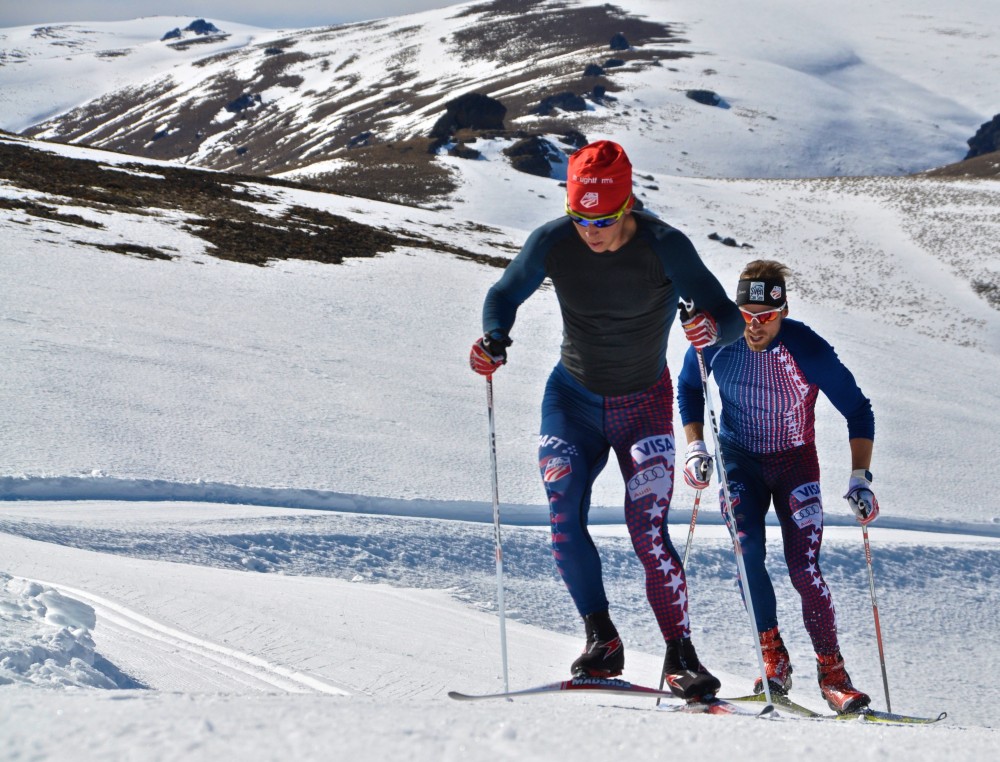
Noah Hoffman leads fellow U.S. Ski Team member Andy Newell during a ski at the Snow Farm in Wanaka, New Zealand. (Photo: Matt Whitcomb)
My training year is notable because of the sharp reduction in travel from years past. However, I have had two productive camps in Bend and New Zealand.
6. Favorite cross-training?
I just got a new mountain bike. I LOVE it!
7. Favorite non-athletic activity or pastime this summer?
This summer has also been notable for me because of the reduction in energy-intensive “fun” or “social” activities outside of training. However, I have played a lot of the yard game Cornhole, including playing in a couple of tournaments, which has been really fun.
8. Song that was your jam this summer?
This summer has been marked by live music for me. I have seen Edward Sharpe and the Magnetic Zeros, Motown the Musical, Emmylou Harris & Lyle Lovett, Bela Fleck and Abigail Washburn, Tedeschi Trucks Band, Los Lobos and North Mississippi Allstars, Brandi Carlile, Ray LaMontagne and Marian Hill. They have all been amazing! Before I depart for the World Cup I have tickets for Mandolin Orange, Colbie Caillat, Indigo Girls, The Head and the Heart and the Goo Goo Dolls as well as a Broadway Musical and a ballet.
9. All-time favorite race moment?
Racing the 50k at the World Championships in Oslo, with +/- 120,000 people on course, was something I’ll never forget.
10. First thing you pack in your bag when you leave for Europe?
My Kindle. When the training load is low in the winter, there’s lots of time to read!
11. Venue/event you’re most excited to visit this season?
I’m very excited to go to Ullricehamn, Sweden, and Tyumen, Russia, as they will be my two new venues this year.
12. Who will win the men’s and women’s World Cup titles this year?
Who’s to bet against Sundby? And for the women, I’ll be very interested to see how Bjørgen’s comeback goes.
13. Biggest sacrifice you feel you’ve made choosing this career path?
Skiing has afforded me more opportunities than I ever imagined, and I am so excited to live a different lifestyle after my career is over.
14. If you could change one thing about your sport, what would it be?
I would like to see more World Cup and World Championship level racing on this continent and I’d like to see Nordic skiing intensify the fight against doping and become as clean as possible.
15. What did you have for breakfast this morning?
Eggs, cheese, sour cream and salsa in a tortilla. I have that almost every morning.
16. In 5 years, I’ll be ____?
Going to school and adventuring every chance I get.
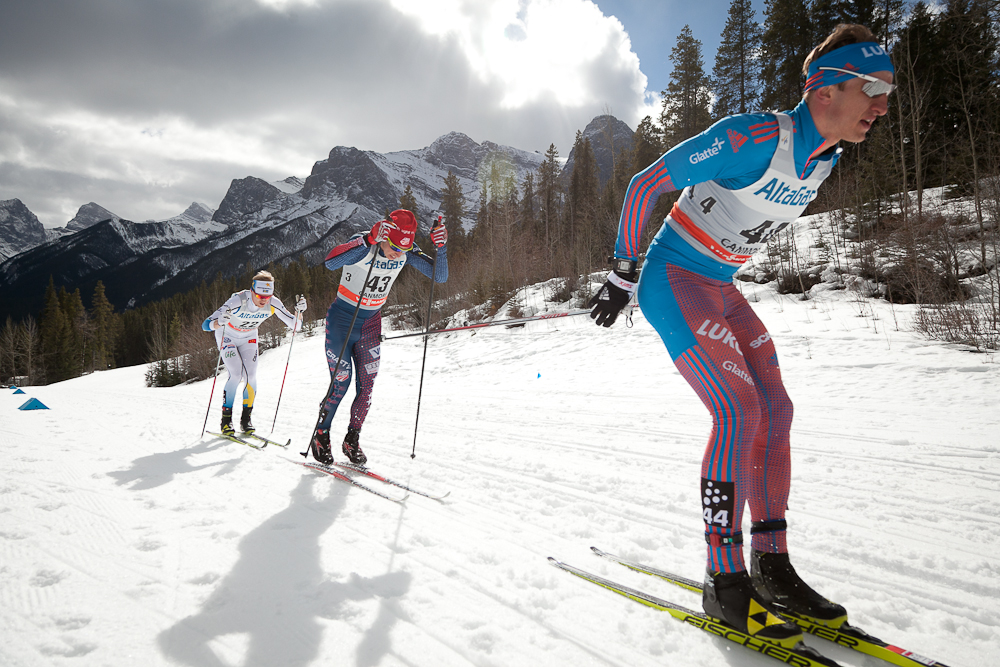
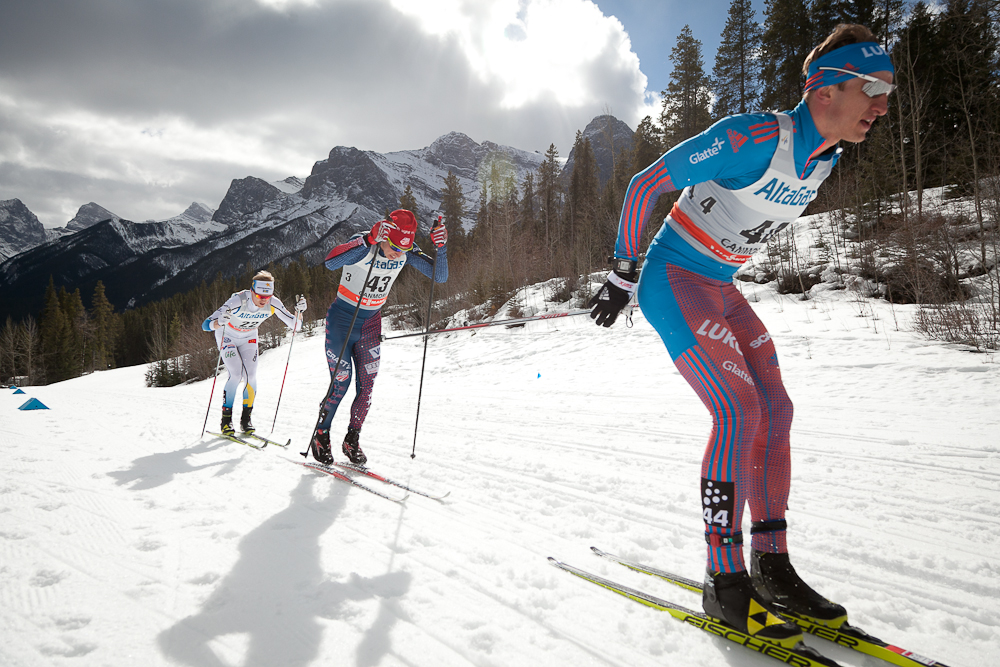
American Noah Hoffman (c) racing to 35th in the men’s 30 k skiathlon, a best for the U.S. men in Stage 6 of the Ski Tour Canada last season in Canmore, Alberta.
How to eke out that extra few percentage points for a top-10 performance, a podium, a medal is the constant chatter of athletes, coaches, and of course comment sections. Although premised on science, dialing in a specific training load for a specific athlete appears to be an art as well.
Maybe there are concrete answers to the frequency, duration and intensity to maximize one’s training, or perhaps it’s a moving target as an athlete is presented themselves with life’s external stressors.
“At this point, the question is either be done skiing and feel like I have given it my all or go back and to try to become the fittest athletes in the world and see what I can do with that.”
Earlier this month, U.S. Ski Team member Noah Hoffman blogged that he was making a big jump in his training load this year: from 678 to his stated goal of 1,000 hours. According to Hoffman, his largest annual training load to date was the 2013/2014 Olympic year with a total of 752 hours and 40 minutes. Hoffman also noted that was his most successful year to date as well.
Hoffman is coached by Vermont-based Zach Caldwell and Colorado-based John Callahan. Those two will guide Hoffman on his journey to 1,000 hours, ensuring both that he’s making gains and not breaking down.
FasterSkier interviewed Hoffman for the FS podcast to discuss his motivations for making a paradigm shift when it comes to training.
“From the time I got named to the U.S. Ski Team, all of a sudden the goals changed for me through my advisors and my coaching staff,” Hoffman said when asked how long he has been thinking about making a training-load change. “They changed to addressing my weaknesses over promoting my strengths. The idea being I had maxed out what I could do with training hard, and that I needed to become more of a skier and not just a fit guy to be successful. I’ve done that now for six years plus and I’ve made gains and it’s been successful, but I’ve lost serious ground on the fitness side of things, which is crazy to me because I believe that that’s my one skill, I can be the fittest athlete on the World Cup, the fittest athlete in the world, and for me to not have that to hang my hat on gives me absolutely nothing. And I, in the last two to three years in particular, have really stalled out on making gains on my weaknesses, and I mean, at this point the question is either be done skiing and feel like I have given it my all, or go back and to trying to become the fittest athletes in the world and see what I can do with that.”
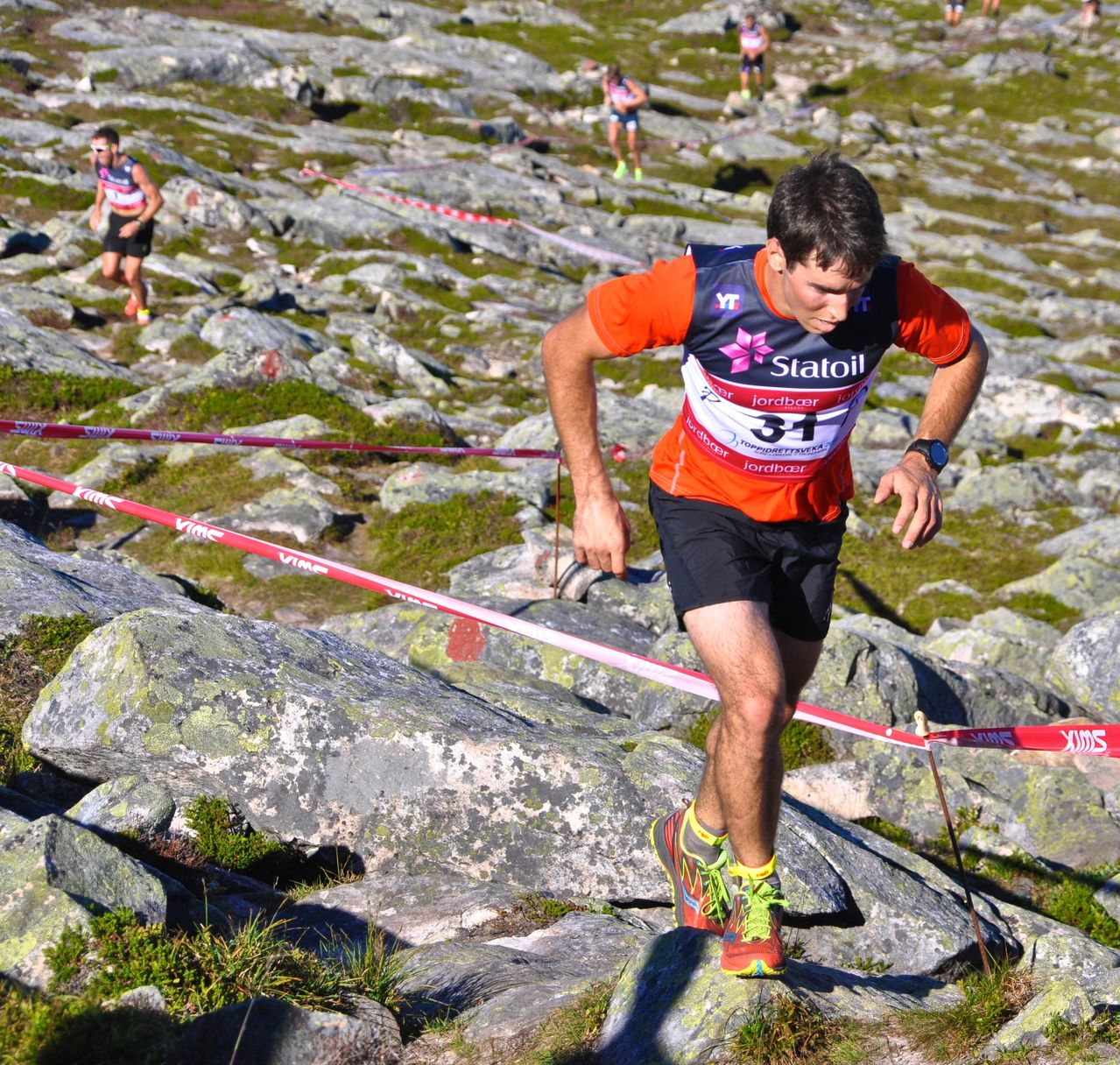
Noah Hoffman (U.S. Ski Team) racing to third in the Fonna Opp, the hill climb footrace that opened the 2015 Toppidrettsveka in Aure, Norway. Norway’s Didrik Tønseth was first to the top in 28:53.5, and Sweden’s Martin Johansson placed second, 13 seconds back, while Hoffman was 1:02.5 back in third. (Photo: USSA)
This week, FasterSkier featured Day 1 of Hoffman’s new plan for its Wednesday Workout. The workout, the start of a two-week, 53-hour training cycle, gives a glimpse into Hoffman’s big days. As explained in the article, Hoffman and coach Zach Caldwell consider the total increase in hours as a function of decreasing distractions and eliminating compromised training. But more hours is still more hours, bringing with it more physical and mental stress.
Asked it the new program was a risk, Hoffman explained it was an acceptable risk.
“I mean, yeah, I think it’s a risk, absolutely,” he said. “I view it as finally being able to train, being given permission from my coaches to train the way I have always wanted to, which is as hard as I believe I can and I believe I can handle. Handling training load has always been a strength of mine, I’ve just never been given free rein on it, not that I have complete free rein this year, but my coaches are buying into this goal that I have of wanting to see what happens if I just train as much as I think I can handle, train at a level that is hard for me as opposed to a level that is easy for me.”
As Caldwell and Callahan monitor Hoffman’s progress one thing is clear: Hoffman is once again passionate about his daily work.
“I am absolutely not saying this is the answer for me or anybody else,” he said. “This is just what I have decided to do. And I am excited about it, that is the biggest thing for me. I am really excited about doing what I’m doing right now.”
(To listen to complete interview, click “play” arrow below.)
Last year, Noah Hoffman was just another young athlete on the U.S. Ski Team’s Continental Cup squad. He was in the pipeline, developing towards a bright future, and wrapped up the season with a couple of SuperTour podiums, a fifth-place finish at U.S. Nationals, and a great race in Switzerland that nobody heard about. At SuperTour Finals, he finished second in the hill climb, his most high-profile domestic result of the year.
In other words, the 21-year-old Hoffman was doing pretty well for himself, but not many people were noticing.
This year, things are different. Hoffman started out with a strong 10 k skate race in Muonio, Finland, before moving to the World Cup circuit. In just his third World Cup race ever, and the first outside of North America, he finished 31st in the 15 k skate in Gallivare, Finland. The next day he was part of the American relay team and tagged off to Chris Cook in 5th place.
He can’t exactly go unnoticed with results like that.
Hoffman is racing the World Cup mini-tour in Kuusamo, Finland this weekend. FasterSkier’s Nat Herz caught up with him earlier this week to talk about what had changed this year, and how “The Hoff” had made the step up to the next level.
Hoffman racing in Muonio, Finland this fall.
FasterSkier: What was your attitude going into the Gallivare races? Did you feel different than going into the last World Cup races you’d done, in Canada?
Noah Hoffman: I don’t think it had much to do with it being a World Cup or anything. I think it was more just the technique work I’d done over the summer, and feeling good, and really enjoying the course. I really liked the course, although I think the course was great for me in Canmore too. I think it was just a better deal this time.
FS: Talk me through the 15 k, how did that go?
NH: I was feeling good. I started pretty hard, but at a pace that I felt like I could sustain. I came around on my second lap, and Jesper Modin, a really big Swedish kid who’s a good sprinter, maybe a year or two older than me, was starting when I came through. I was hoping to catch a good ride from him, and I hung with him for two or three kilometers, but I felt like I could go faster than he was going, so I went around him. I skied on my own for a while, and then Pietro Piller Cottrer started when I came around for my last lap. He came out of the start chute probably 10 meters ahead of me, and I really wanted to get on him. I knew that was going to be a great ride for me into the finish, but I just couldn’t quite do it. I never made contact with him. I skied the last lap pretty much alone. I did catch the guy who started thirty seconds ahead of me at maybe two or three kilometers to go, and I skied with him the rest of the way. It was good – I led some and he led some. Basically, my energy was good and I felt like I was able to move pretty well. It was obviously a pretty good day.
FS: So you didn’t feel like this was a spectacular, special race, really – just a good solid day?
NH: Well, I hope that wasn’t the pinnacle! No, I didn’t feel like it was much special. I felt better than I did the week before in terms of being able to move on the snow. The week before, I’d only had two or three days on snow before racing, so I just felt a little more comfortable. But I don’t think it was anything really special. I hope not.
FS: And then the relay, that seemed like another really solid effort. What was it like having Kris Freeman come around and tag off to you in fifth?
NH: Yeah, that was pretty fun. You know, Chris [Cook] and I had come out to the venue at a different time than Andy [Newell] and Kris, so I really hadn’t talked to those guys at all. I really wasn’t thinking….I had my general start time in mind, and I was just thinking about a normal race. I really almost forgot it was a relay.
Then in the exchange zone I was kind of like, ‘huh, it really depends on where Freeman comes in, for what this race is going to be like, doesn’t it?’ I was watching the Jumbotron a little bit, seeing Kris moving up, and I was sitting there with Randy Gibbs, who was about to come in the start pen with us, and he was saying Bird was moving up, he’d almost caught the lead pack. I thought for a while that Bird was going to give me a lead, and I was going to kind of relax until people caught me, because it didn’t make sense to try to hold off the lead group. Bird ended up tagging off to me maybe one or two seconds behind the lead guys, right there, and he and Newell had both had awesome legs, super impressive. So, it was really exciting to be able to ski with the top guys in a World Cup relay. It was really fun.
Unfortunately, I wasn’t able to stay with them for as long as I’d hoped. I think it was the Kazakh team who had started right behind me, and that skier caught onto the pack. Then, I got dropped from the group, and then he got dropped from the group, and then I caught him. He and I skied the second lap together, so that was good. I didn’t feel quite as good as the day before, but it was really fun to be right in there, right in the mix in a World Cup relay – that was awesome.
FS: I know I already asked you if these races felt special, but do you feel like you’ve made a jump from where you were last year to where you are now?
NH: Yeah, for sure. I don’t think there’s any question. I feel like the steps we took this summer – we knew what we needed to do and what we were going for. Working with Zach Caldwell has been great; working with John Callahan still has been awesome, and the U.S. team guys, and I just feel like it’s been a really good situation. I don’t feel like I’m that surprised – I felt better all summer, and like the stuff I was doing was really going to show on the snow, and make a big difference. But there’s no question that I’ve made improvements from last year, and I’m psyched about that.
FS: Do you feel like it was specific adjustments to your training or technique that have made the difference, or is it a combination of things?
NH: I think it’s a combination of things. The biggest goal of the summer was to put down representative efforts. First, to be able to utilize my capacity, and then to try to make gains on top of that, at a level that is nothing spectacular, but is a solid effort, and shows what I can do. I feel like that’s been – well, we’re only two weeks into the season, and there’s a long way to go. Who knows what’s going to happen, but I feel like I’ve been better able to do that so far this year, so I’m happy with that.
FS: Is that something that you feel like was holding you back, maybe over the last couple of seasons?
NH: Yeah, I didn’t feel like I was able to use my central system, my aerobic capacity the last couple of seasons.
FS: In terms of your fitness profile, do you feel like there’s still some room to build this season?
NH: I don’t know. That hasn’t been the focus at all this season. The focus is just to make sure I’m well-rested and to put in some representative races, and not be hindered by being tired because I’m trying to train too much at this time. I mean obviously, it’s still really early, but I feel like because I’m here in Europe, and I’m going to go home early next week…I felt like it was important to try to race as well as I can in these early races.
FS: So you’re going to race the mini-tour this weekend and then head back home, is that your plan?
NH: Yeah! I was shocked when I was invited to Gallivare last week, and I was equally surprised to be invited to Kuusamo. It’s a great opportunity. I was not expecting to be racing World Cups when I came over here, and it’s been awesome. Sprinting on the World Cup is going to be interesting. But my understanding of the mini-tour format is that you can gain time in the sprint, but as long as you put in a pretty good effort you won’t necessarily lose that much time in the sprint. I’m looking to limit my losses on Friday, and then I’m really looking forward to Saturday and Sunday. The courses here are awesome – I got to check them out. There’s really steep hills, and really fun skiing.
FS: It sound like that’s pretty ideal for you.
NH: Definitely – the harder the course the better, I’d say. I’m looking forward to it.
FS: Is it pretty cool to travel with the A-Team and just get to spend some time with those guys?
NH: Yeah, it’s awesome. It’s kind of one thing that I kind of feel like is tough on me mentally, because I spend so much time with these guys all summer, and then in the winter, they’re off at the World Cups racing the best in the world, and I’m on the domestic circuit. And, obviously, that’s where my results have put me, and there’s no question that it’s where I should be, but it’s tough to be slower than everyone around you. And so to travel with them has been awesome. I’ve been rooming with Kris, and he’s a great role model. It’s fun to hang out with these guys.
FS: Once you get back to the States, what is your plan?
NH: I’m going to head to [domestic competitions in] Canada. I’m looking forward to those races. I’ll be home in Aspen for four days, and then a couple of days in Boulder with Zach, doing another little technique block, reviewing some of that stuff, and then head to Canada, go to Silver Star, and back home for Christmas before going to nationals. So it should be an awesome schedule.