From the FasterSkier archive — posts syndicated from athletes’ and coaches’ own blogs between 2004 and 2012, kept online as published. Current coverage is at fasterskier.com.
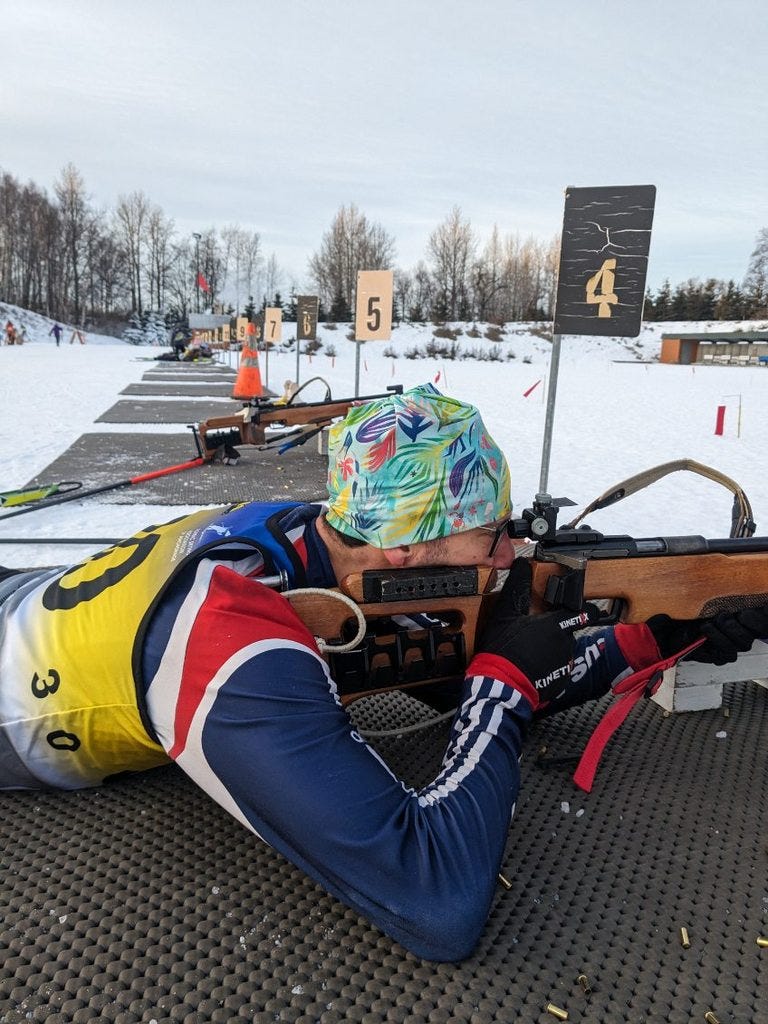
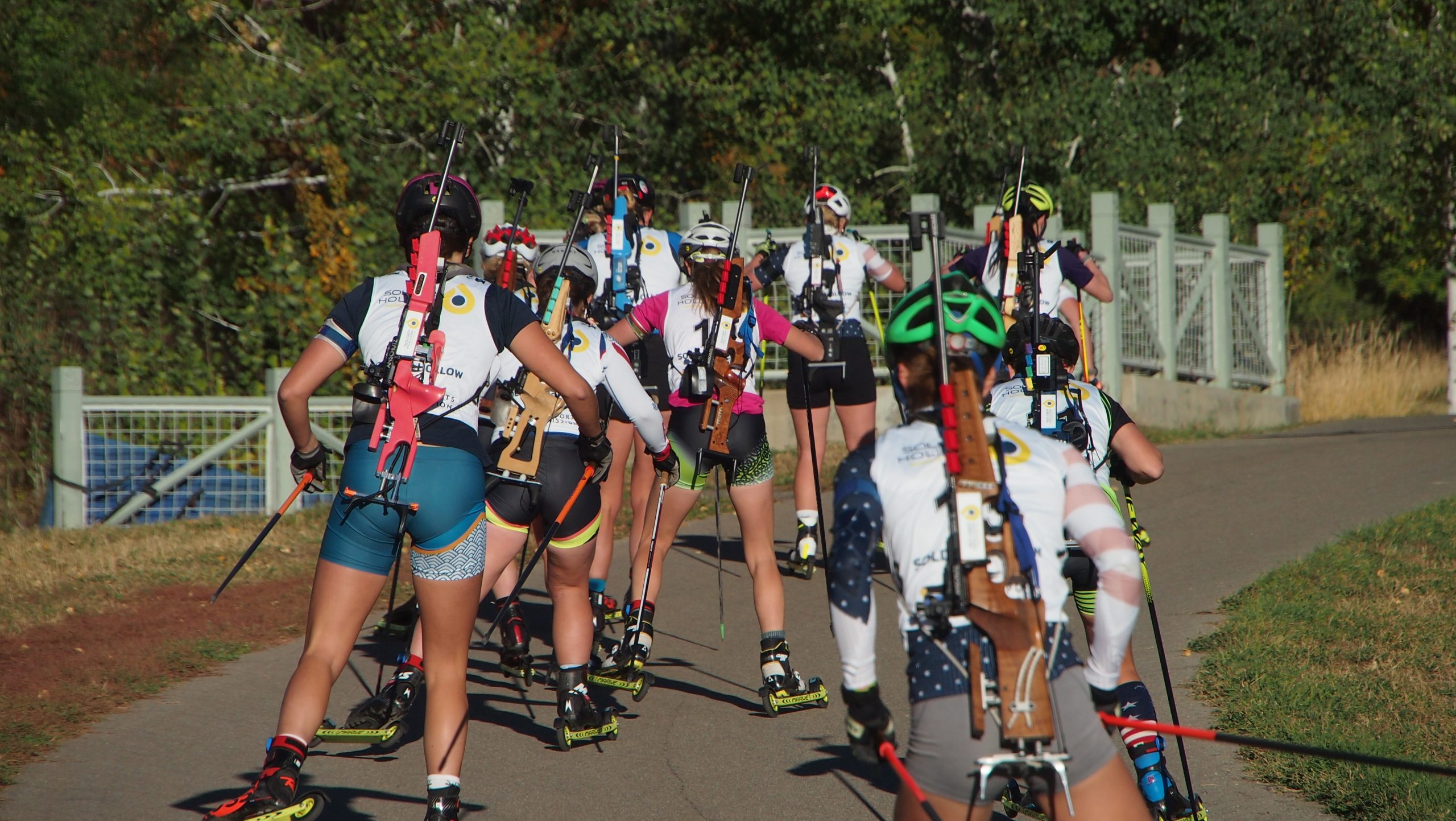
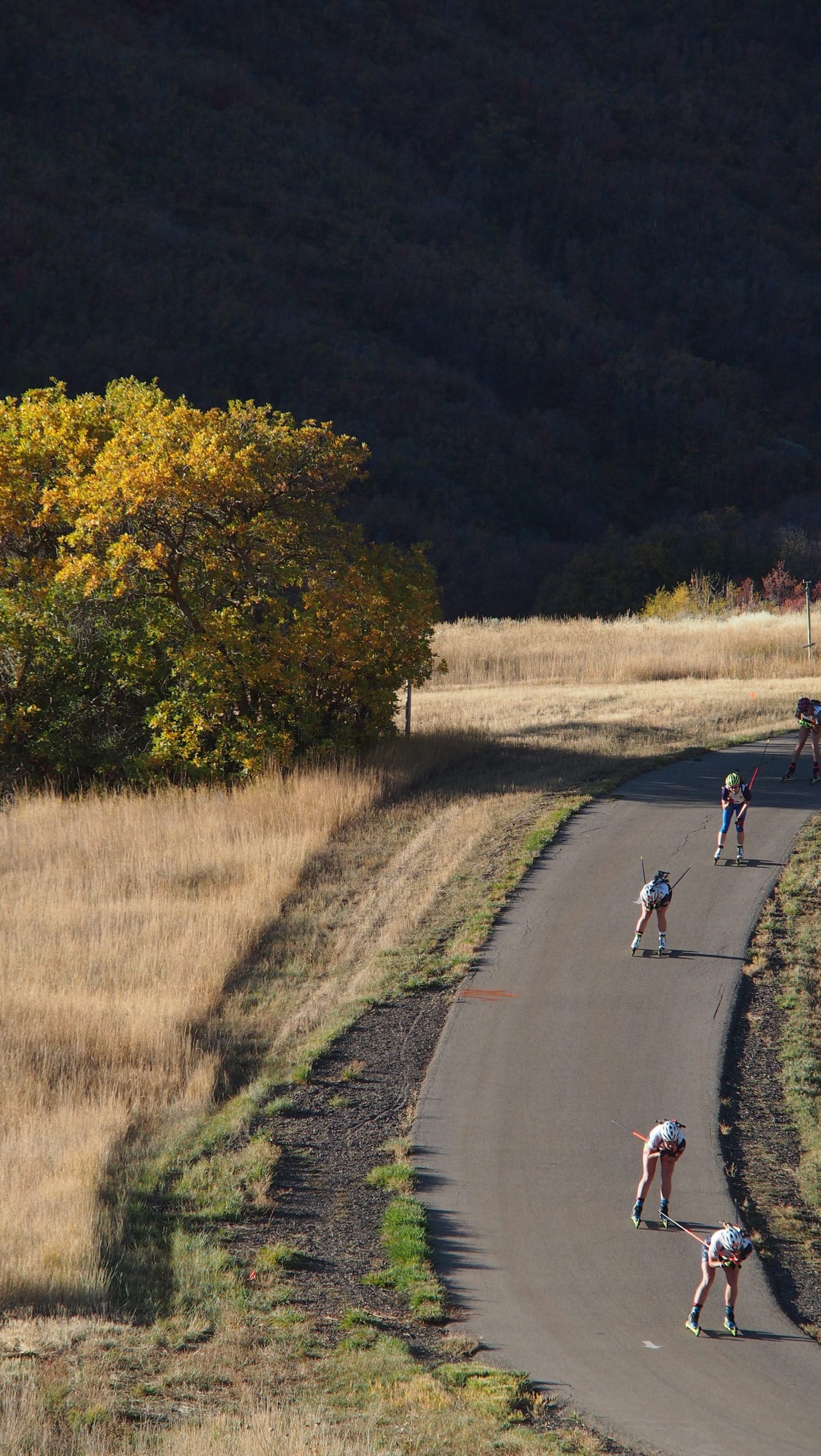
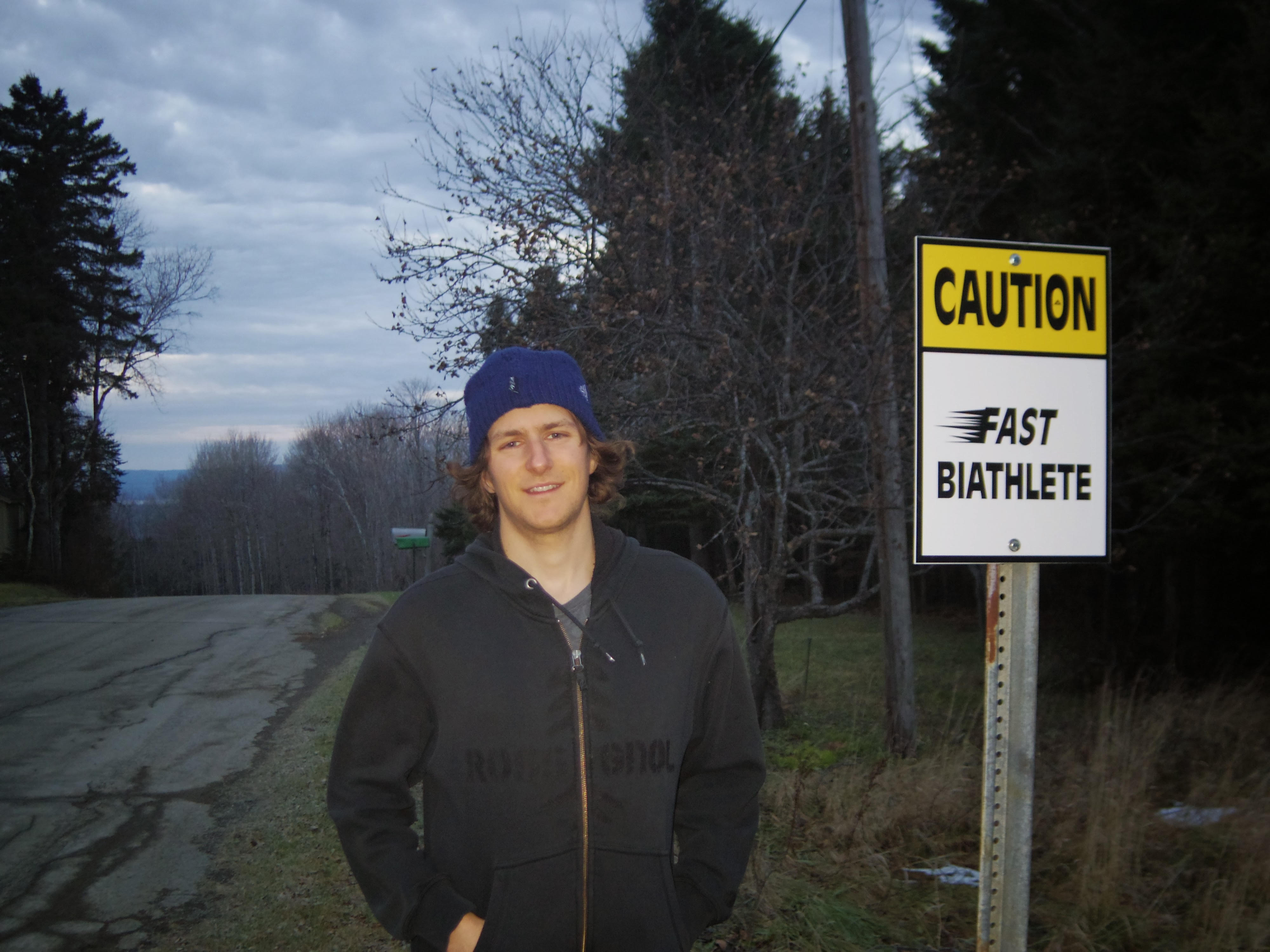
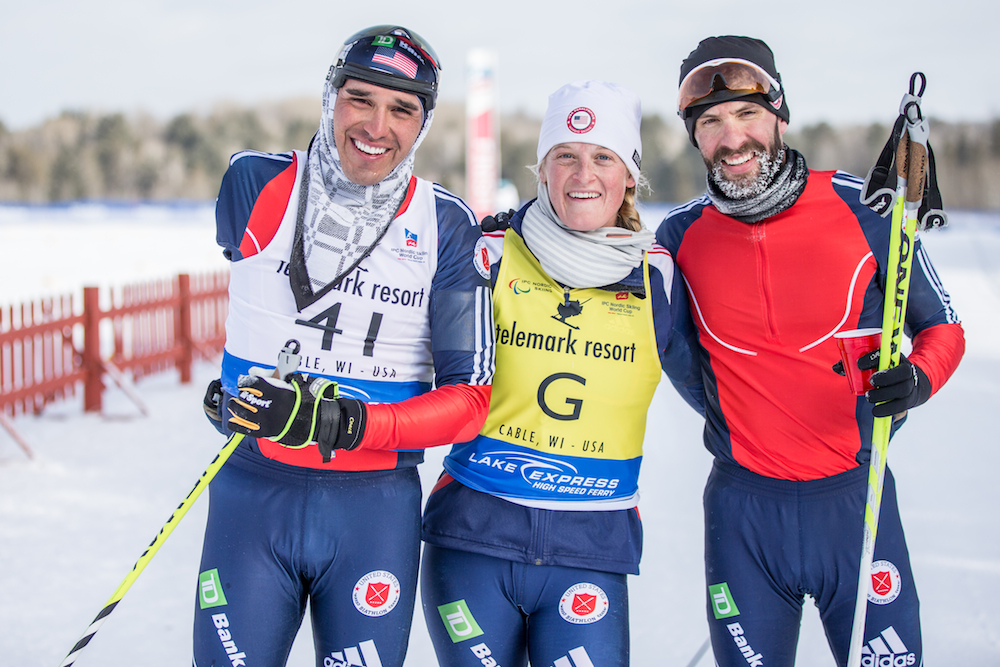
You miss every shot that you don’t take. (Photo: Courtesy John Farra, U.S. Biathlon Association)
A tale of how I skied faster than Kikkan Randall for exactly five minutes and 39 seconds until I got tired and she hit more rifle targets than I did.
Once upon a time, I was a serious, though definitively not successful, cross-country skier. I raced for my college team in Maine, then kept at it afterward and one time finished 17th (I think, I can’t find the results any more) at the Tour of Anchorage, which is just good enough to sound kind of impressive to folks who don’t know much about cross-country skiing and also quite clearly unimpressive enough as a high water mark for my career that it doesn’t feel too immodest to share.
Then, I developed a heart arrhythmia, atrial fibrillation, that seemed to be associated with intense and extensive exercise, so in 2018, I quit racing and intense interval training, started reading more books and generally began living a more balanced life. (If anyone wants to talk about how developing a serious-if-not-life-threatening medical condition can actually be life-changing in positive, not just negative ways, I am here for it.)
Anyway, I still try to exercise every day, but I don’t really compete any more. Except when something reallllllllly enticing comes along, like an email I got this week from Rachel Steer.
Rachel, if you don’t know her, is one of those Professional Anchorage People Who Just So Happened To Also Compete At The Olympics Back In The Day. (Seriously, you can’t walk into an engineering firm here without tripping over them.)
Rachel was once an international caliber biathlete, racing at two different Olympics, in 2002 and 2006. Today, we’re both members of a little group that meets on a weekly basis for interval training — I don’t really go any more, I just read the planning emails — and on Wednesday, she sent out a message about a “low-key local biathlon race” on Sunday.
“I’ve convinced Kikkan to do it with me,” Rachel said. “I know there’s a few of you on this list who are former biathletes (or who would like to give it a try). THIS IS YOUR CHANCE!”
If you live under a rock, or outside of Alaska, “Kikkan” is Kikkan Randall, another one of those PAPWJSHTACATOBITDs (Professional Anchorage People Who Just So Happened To Also Compete At The Olympics Back In The Day). She also owns a gold medal from the 2018 games in South Korea.
The idea of jumping into a race with Rachel and Kikkan, involving skis and guns, even though I hadn’t trained for it, sounded pretty fun. So I said yes.
A quick primer on biathlon: It alternates laps of a cross-country ski course with shooting at targets, 50 meters away, with .22 rifles. Missing a target, depending on the specific race format, puts you at a disadvantage by either adding a minute to your overall time, or requiring you to ski a short extra “penalty lap” that’s tacked on to the regular course. The beauty of the sport is its balance between fast and slow — the speed and brute force of racing paired with the stillness and fine motor skills of shooting. Think running a mile as fast as you can, then trying to thread a needle.
A memorial Viking runestone featuring a “possibly Ullr” figure with skis and a bow. (Photo: Berig/Creative Commons license)
The sport, of course, has its roots in Scandinavia, “where early inhabitants revered the Norse god Ull as both the ski god and the hunting god,” according to Encyclopedia Britannica. Ull’s goddess wife, Skadi, “was also celebrated as a hunter-skier” — making her, apparently, the first in a long line of badass female biathletes — and the “combined skills of skiing and marksmanship were first developed by the region’s militaries,” Britannica says. The first recorded competition was in 1767.
TL;DR, it’s Viking shit. Except the sport has evolved: Athletes now race with carbon fiber rifles on their backs, star in Swedish reality television series and perform in front of thousands of (often drunk) spectators and for millions of European fans watching on TV.
What’s not to like?
So, on Sunday morning, I woke up, pulled out my college racing spandex and drove to Kincaid Park, where I met up with Rachel, Kikkan and a handful of other adults for a rifle safety training with a bevy of friendly, energetic volunteers from the Anchorage Biathlon Club.
One of the first questions I got, when I arrived: Have you ever done this before? Once, I said, when I was just out of college. No one was wounded, I quipped, which prompted pained smiles from the safety training leaders that actually upon reflection were probably grimaces.
Biathletes take safety seriously. You can’t shoot until a safety officer opens the range, and there were three obvious safety principles (if I remember them correctly): Don’t point the rifle anywhere except straight up or downrange; don’t load the magazine (a sort of packet of five bullets) into the gun until you’re ready to start shooting; and don’t put your finger on the trigger until you’re pointing your gun at the targets.
There were only a few people at the race without our own rifles, so the organizers were able to give each of us a loaner. After 10 practice shots and a few warmup laps, I lined up for the race as the last of 30 competitors, who would start one at a time, 15 seconds apart. Kikkan started 45 seconds ahead of me, and I am absolutely not going to lie and tell you that I wasn’t a little bit motivated to see if I could make up any time on an Olympic gold medalist. As I finished my first 1.5-kilometer lap, I spotted her bright racing suit doubling back around a corner and entering the shooting range, and I started counting off seconds; I made it to 41 or 42 before I found myself on the same spot on the course.
Biathletes shoot at five targets between each lap. I hit my first nine shots in a row before missing my first one — but this comes with some pretty substantial caveats.
Typically, biathletes have to shoot from two different positions, standing and prone. In prone, they lie down and can prop their elbows on the shooting mat, making for a much more stable and accurate base. But to balance that, they have to hit smaller targets — a diameter of 1.5 inches, compared to 4.5 inches for standing, which means the standing targets are six-and-a-half times larger by surface area. As a beginner, I was shooting at the larger standing targets while prone — and I had the benefit of a stand that I could rest my rifle stock on.
I was feeling pretty good about myself for hitting nine out of my first 10. But by the time I came in to shoot for a third time, Kikkan had slipped out of sight, and after hitting my first two targets, I noticed a serious problem: fog. Inside my decidedly non-performance, kind-of-nerdy, Eyebuydirect.com glasses.
I proceeded to miss three shots in a row, then two more in my final turn at shooting.
My brilliant start, and my hopes of victory, had dashed by poor shooting (not to mention poor fitness). But really, this is the beauty of biathlon: Promising races can vaporize in a manner of seconds. And my final tally, 14 out of 20 shots, was still one better than a recent race by one of my favorite pros, Stina Nilsson of Sweden, who juuuuuust lost out to Kikkan on a gold medal in cross-country skiing at the 2018 Olympics, then switched to biathlon and has not yet achieved the same heights.
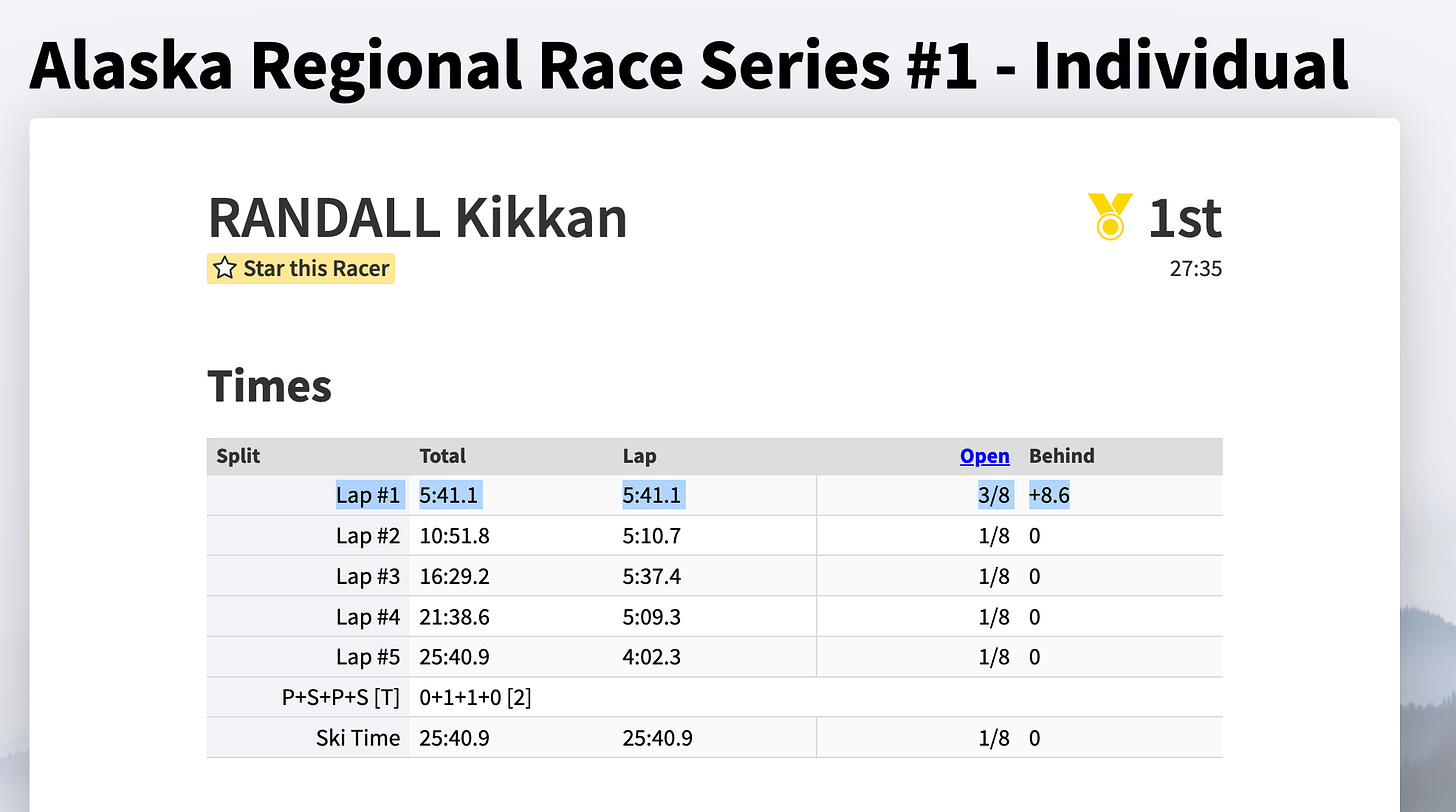
Nonetheless, let the results show what may be my proudest-ever athletic achievement: My first lap of the race was two seconds faster than Kikkan’s. However, she then proceeded to hit every single shot (or almost every single one — accounts differ), outpace me on all the other laps and absolutely obliterate the entire “open” division, winning by nearly three minutes.
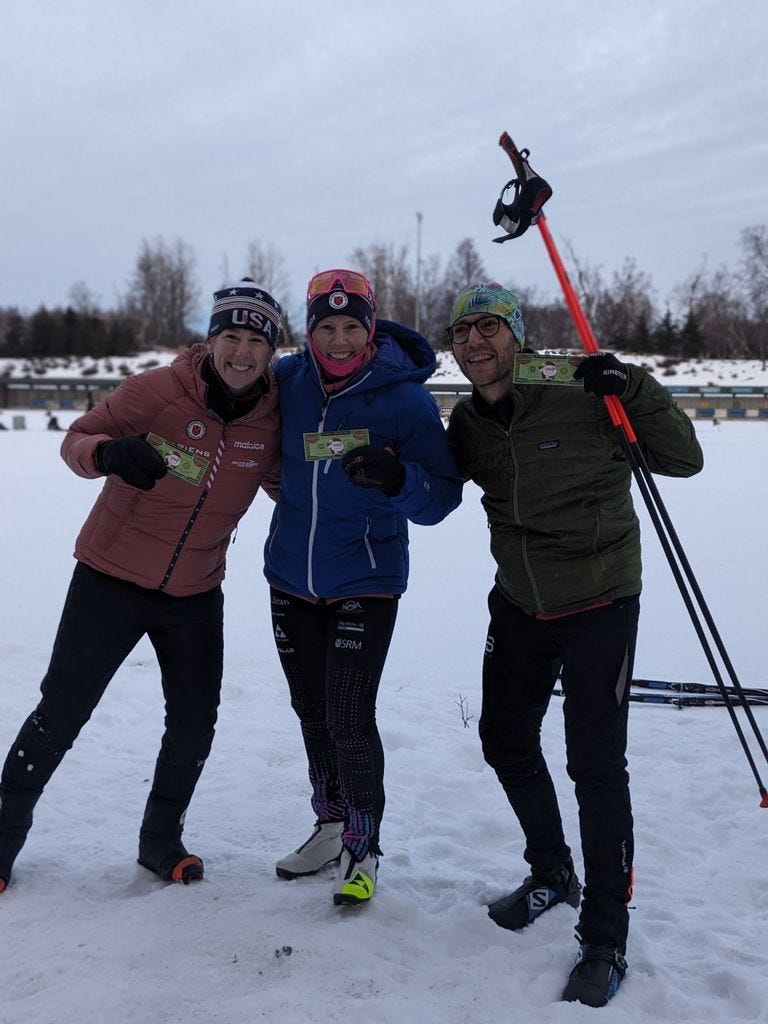
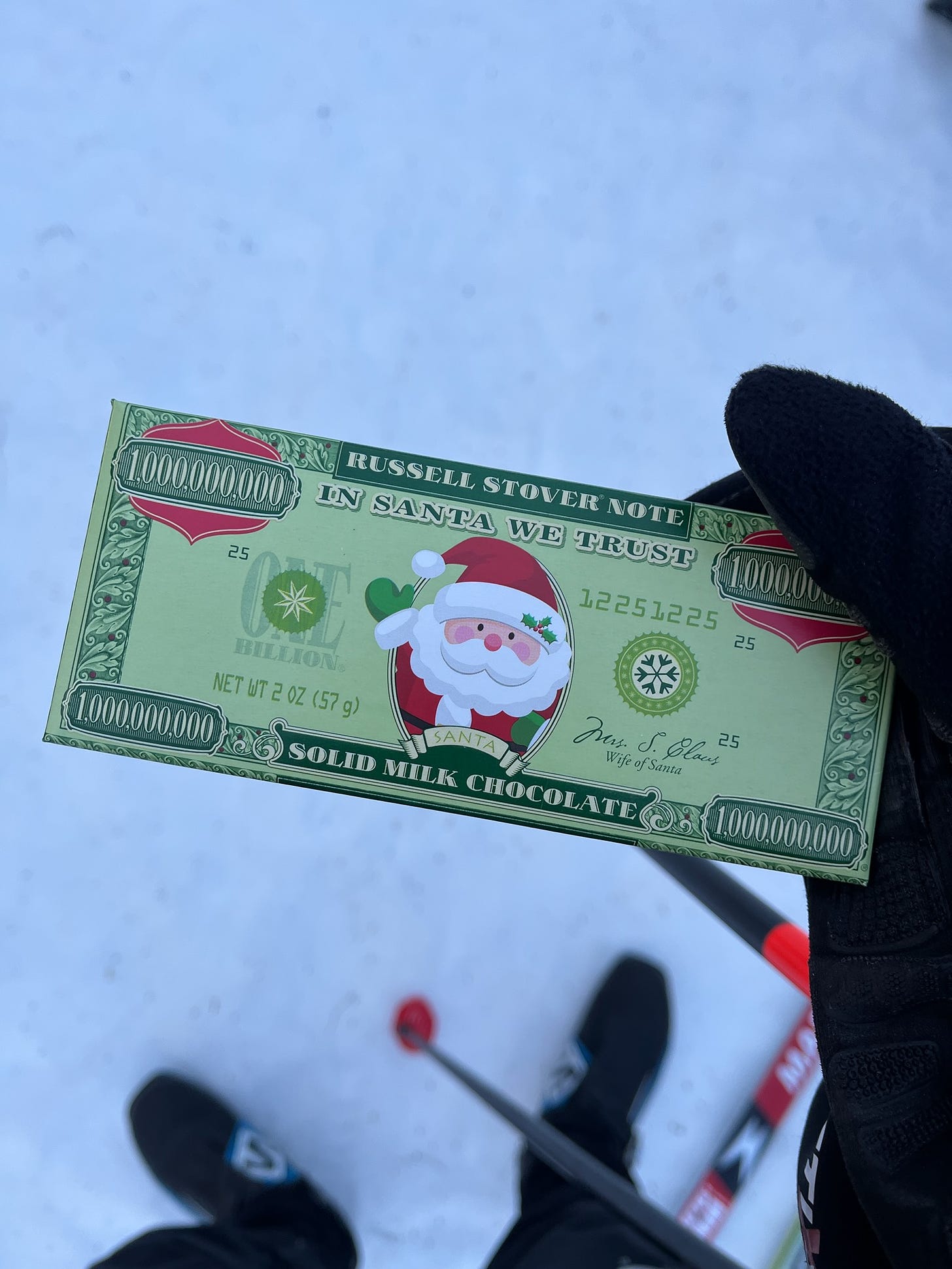
I was chit-chatting with friends after the race when, over a speaker, the awards announcer started yelling my name. (Actually, they yelled for “Nate,” but this is a common enough occurrence.) It turns out I had achieved the impressive result of third place out of eight, behind, of course, Kikkan and Rachel. (Yes, the two women in the field destroyed the six men.) In addition to a podium photo with two Olympians, this result earned me a $1 billion bar of chocolate, and enough of a tale to merit inclusion in a Northern Journal newsletter.
The first and only time I will share a podium with two Olympians. (Photo: Courtesy John Farra)
The whole vibe of the day was excellent — most everyone seemed to be relaxed and having a great time on a cool winter day. There are at least a couple more open biathlon races in Anchorage before the end of the year, and I would encourage any bi-curious folks to check them out. Email me here and I’ll put you in touch with the right folks.
I’m rich.
This article is the work of Nat Herz (a regular FasterSkier contributor, and Producer of The Devon Kershaw Show), and is re-printed with the permission of Nat Herz and Northern Journal.
Northern Journal is a reader-supported publication. To receive new posts and support my work, consider becoming a free or paid subscriber.
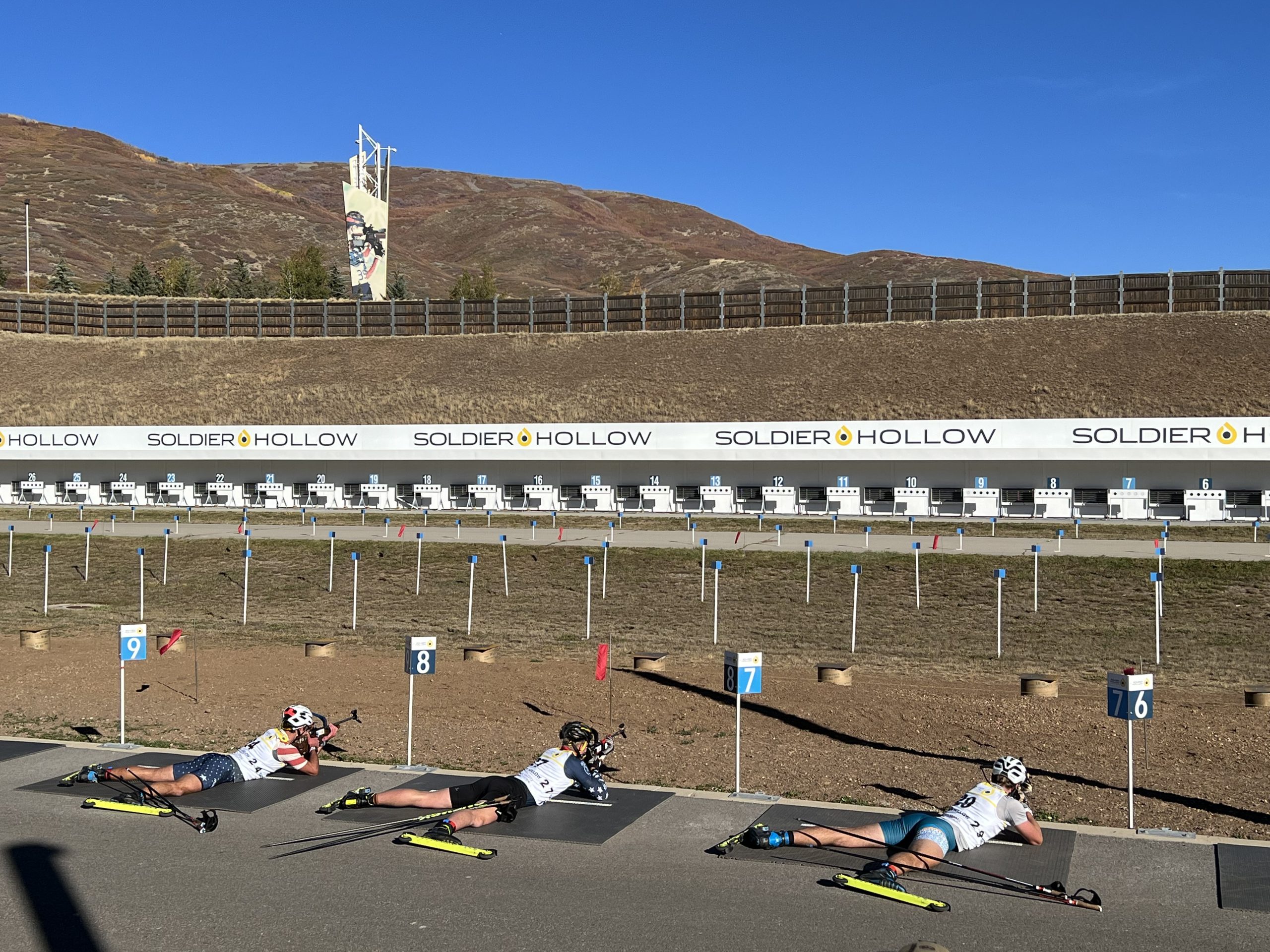
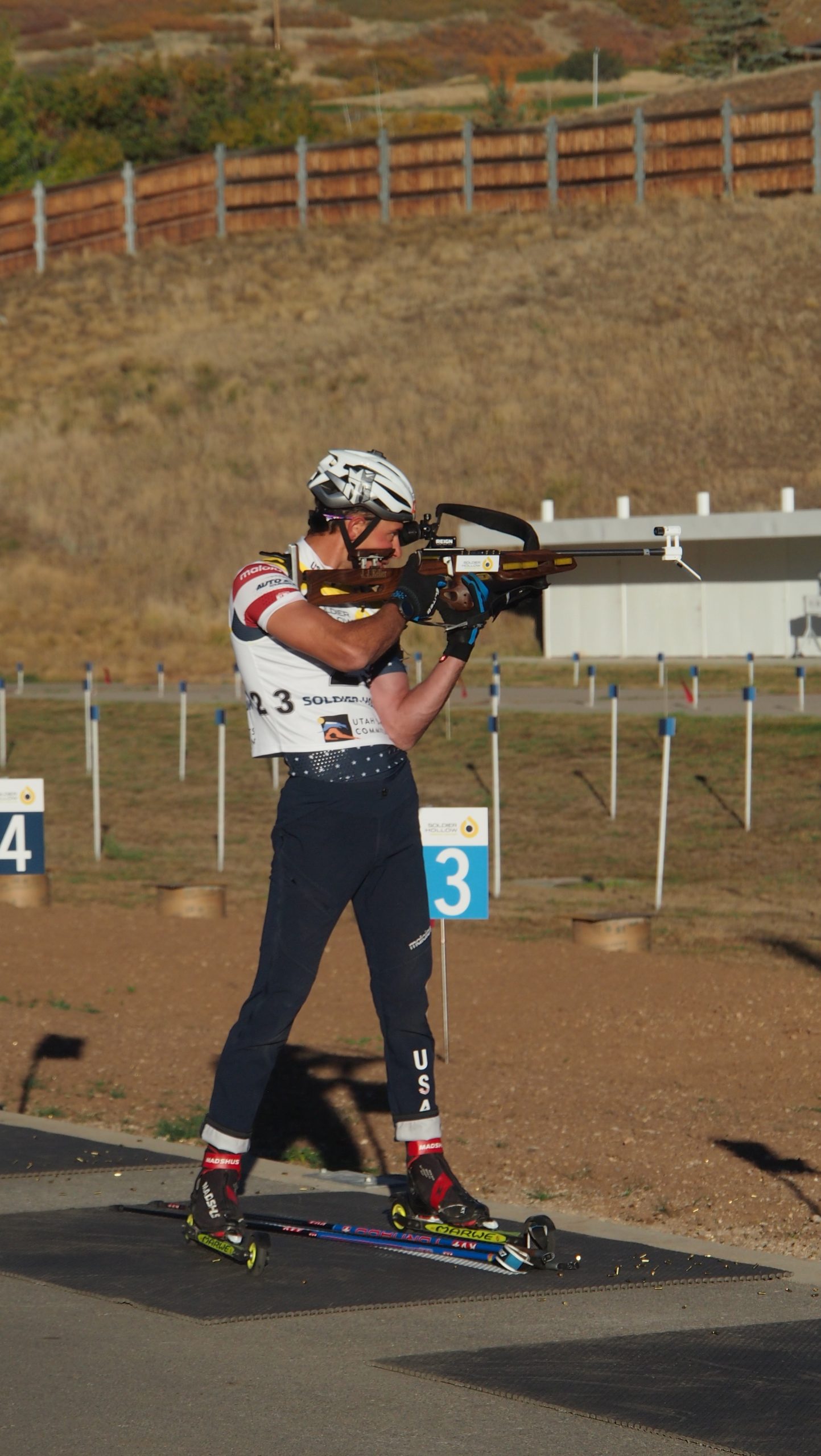
Schutzenski, 2023, Soldier Hollow, Utah: action on the range in the Men’s Mass Start. (Photo: FasterSkier)
On a sunny October Saturday, the Path of the Annularity—the shadow of an eclipse—passed directly over Soldier Hollow, Utah. For nearly thirty minutes, the sky was shaded, the air cooled, and the valley got eerily quiet. But the action never stopped: races went on, heart rates remained high, sweat continued to drip, and finish lines were crossed while the solar/lunar show swirled in the heavens above. Something special was happening, that’s for sure . . .
Now in its third year, the Schutzenski Festival—hosted by Soldier Hollow Nordic Center in Midway, Utah—is offering a blueprint of what rollerski festivals may look like in years to come. In a weekend that included ski events, biathlon events, team selections, and top-tier competition, the potential for development appears limitless. And how ironic that the popular future of biathlon and Nordic skiing may be demonstrated here on an ashpalt-ribbon race course where athletes compete on wheels rather than skis.
Deedra Irwin delivered a totally dominant performance at Schutzenski, 2023. (Photo: FasterSkier)
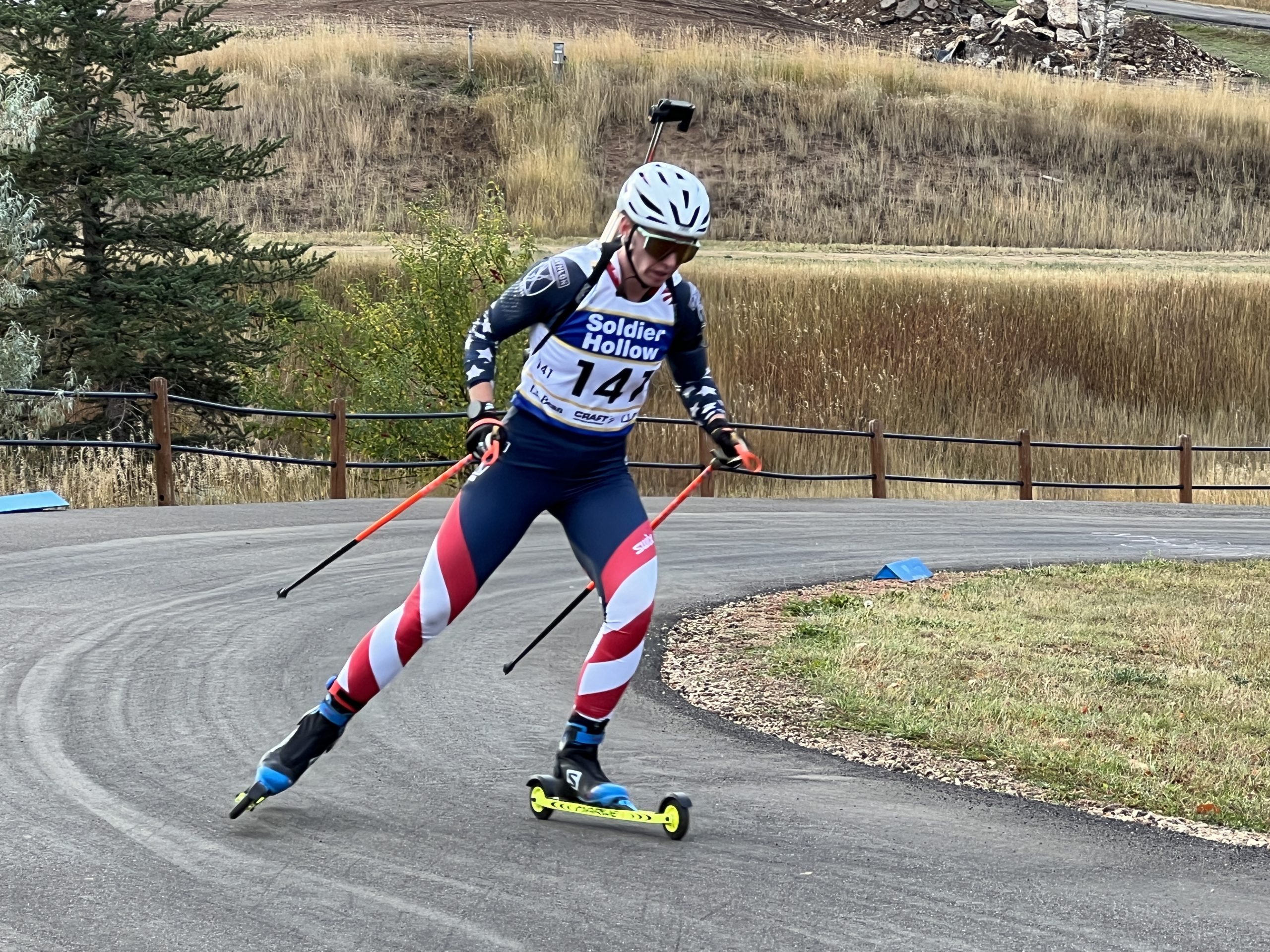
This season’s Schutzenski highlights included astounding performances from USBA standout, Deedra Irwin—winner of both days’ events due to her fast skiing and near-perfect shooting. She shared the spotlight with up-and-coming American men—especially Campbell Wright and Maxime Germain—who showed that American biathlon has a bright future on the international stage.
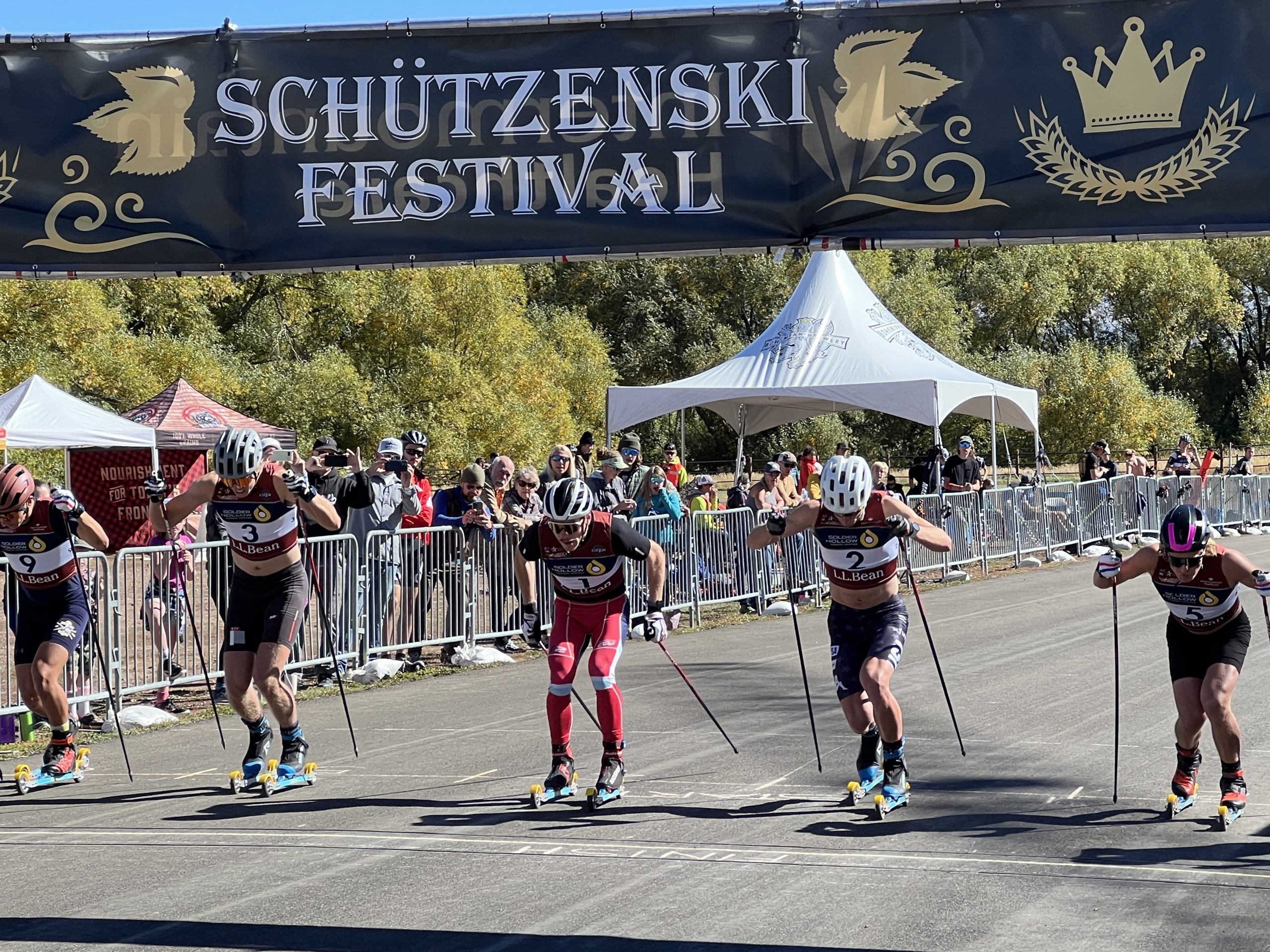
Start of the Schutzenski 2023 Men’s Sprint Final, won by Ben Ogden (center). (Photo: FasterSkier)
Outstanding Nordic performances were also delivered by US Nordic skiers. Rosie Brennan strided to victory in the 10k Classic event ahead of Jessie Diggins. Diggins also finished second behind Julia Kern in Saturday’s Sprint competition. Gus Schumacher narrowly bested Ben Ogden in the 10k, while Ogden recovered to win the Sprints on the following day.
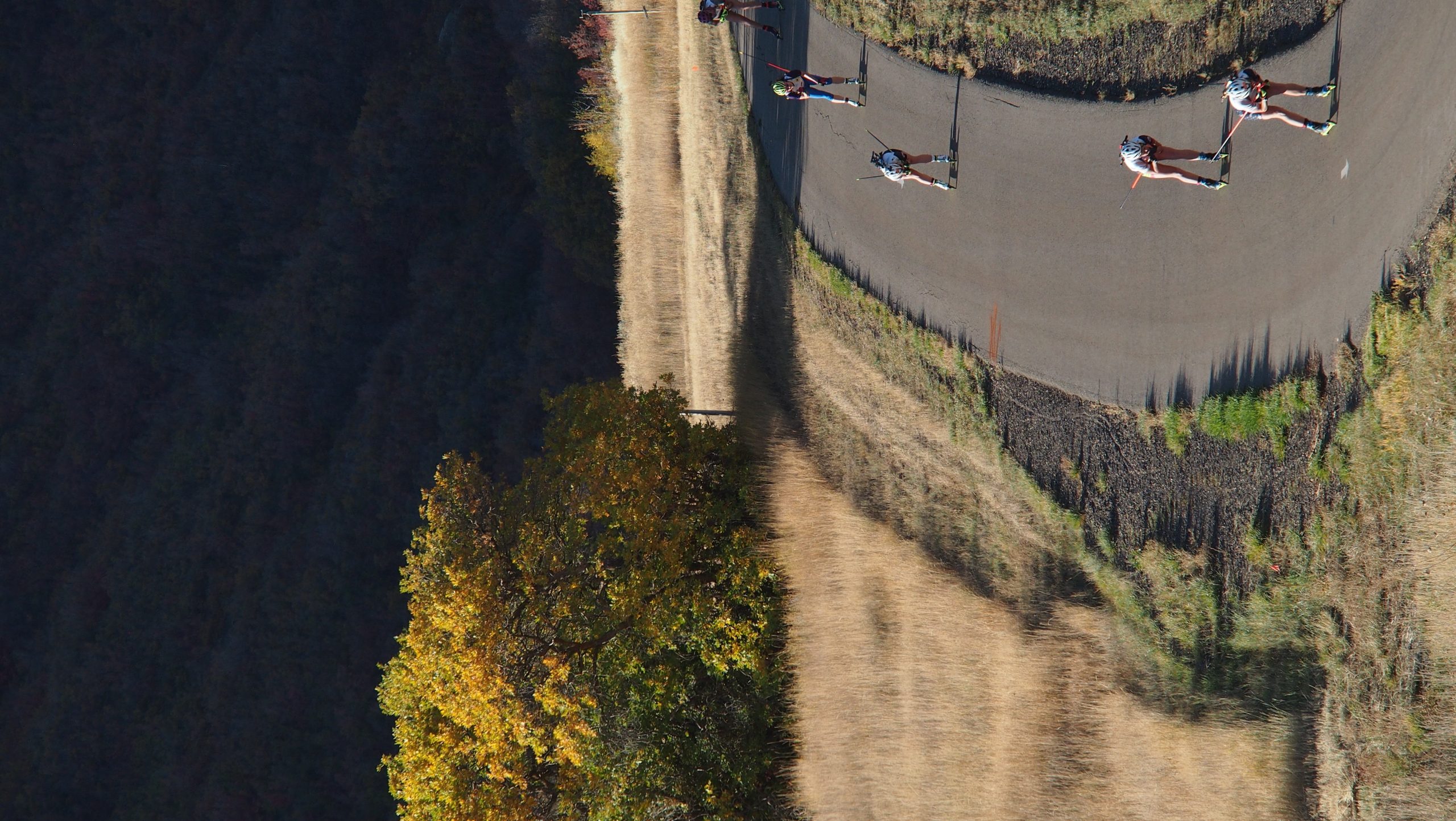
Biathlon Mass Start field in action at Schutzenski, 2023. (Photo: FasterSkier)
Racing and Qualifying
The trails at Soldier Hollow were designed and built for Biathlon and Nordic events staged during the Salt Lake City Olympic Winter Games of 2002. But the work on these facilities did not stop after the Olympics. Ever since, Soldier Hollow has continued to develop trails and programs as one of the premier Nordic/Biathlon facilities in the world. The world continues to take notice: Olympic and FIS World Cup Champion, Johannes Hoesflot Klaebo (NOR), now makes Soldier Hollow a regular training camp venue in his summer program. Likewise, the Stifel U.S. Cross Country Ski Team hosts a series of camps in Park City and Soldier Hollow, including the National Elite Group (NEG) Camp that coincided with Schutzenski 2023. And U.S. Biathlon (USBA) has fully invested in the facility with a new USBA Headquarters currently under construction in the center of the SoHo trail network. That facility—USBA’s new permanent home—is slated to be completed in time for next spring’s Biathlon World Cup, hosted March 8-10 at Soldier Hollow.
USBA used these Schutzenski races as the sole qualifying procedure for the European Camp that precedes the IBU World Cup season opener in Kontiolahti, Finland. The top nine qualifiers (based on Schutzenski event results) will travel with the US Team to Finland for a pre-World Cup camp. Individual performances in test events staged during that camp will determine start positions for this first IBU World Cup weekend.
John Farra—USBA’s Director of Sport Development, and Member of the IBU Development Commission—commented on the scheduling and the process:
“Obviously, we don’t want to wait until November—the [World Cup] trip leaves in two weeks . . . So, this year, the new move is that the top nine qualifiers go to Finland. Everybody’s together, we have a training camp, we have a time trial. And that selects who gets to go to the first World Cup in Kontiolahti. Hopefully we get the top nine right. That’s our new try, and people are excited about it.”
Farra also commented on the discrepancies that may exist between rollerskiing and skiing on snow, and explained the USBA’s decision to utilize these races as legitimate qualifying events:
“Roller skis are different from snow, right? The movement on skis, the technique, the downhill on an icy corner: it’s just different. We’re trying to make a selection that’s fair to everyone, and takes a group of great athletes to snow, and to a venue where we can fairly make final selections. Let’s get everybody over there, everybody’s fair and square, you all get to go to Finland, you all get to be at training camp, and then we’ll all have a time trial ten days before the first race. Then we determine who’s going to be in this race versus that race.
Women’s Mass Start, Soldier Hollow, Utah. (Photo: FasterSkier)
“In the end, our sport is about fitness,” Farra said. “It’s about an engine, and having the ability to just bury yourself, physically. So do believe, in the end, that these races are as good a test as we can make them.”
This new team qualification strategy not only allows contenders to prove themselves on snow, but also speaks of the growing emphasis on roller skiing as a means of predicting an athlete’s on-snow potential. The technique comparisons between roller skiing and on-snow skiing are imperfect—classic kick is certainly a simpler, less subtle movement on roller skis than on snow—with poling, kick, edging, glide, balance becoming motions that are determined more by the equipment and the ski-surface than by the athlete and their particular technical nuances.
Rosie Brennan showed great speed and fitness in winning Friday’s 10k Classic Individual Start, Schutzenski 2023. (Photo: Fasterskier)
Wheels or Skis? Asphalt or Snow?
Over the past twenty years, ski-training has gravitated more and more toward the predominance of roller skiing. Twenty years ago, Nordic training programs still included a great deal of cycling, running, bounding, hiking. While those activities still exist to occasionally flavor the training regimens of elite skiers, those athletes are now (for the most part) year-round skiers: on snow in winter and spring; on wheels in summer and fall. Coaches no longer seem to fear technique glitches and habits that may develop during the roller ski season; it all seems to be worth it for the specific stress and nearly-perfect muscle training that roller skiing offers. The best skiers now seem determined to ski year-round. Access to refrigerated snow tunnels in Europe—or to snowfields in the southern hemisphere—has ultimately proven impractical (and sometimes unhealthy with the social crowdedness of “camp” settings). Rather than traveling the world chasing snow, many ski athletes—especially North Americans—have definitely come to rely almost exclusively on the smoothly paved roads in and around their home bases. And nowhere in North America offers better facilities for that sort of training than Soldier Hollow.
Rollerskiing is developing into a sport discipline of its own, with ski athletes, rollerski athletes, and skiing fans now enjoying a FIS World Cup in rollerskiing. The record of transitions of high-profile athletes from other “roller sports” into gliding sports offers considerable proof of the abilities of athletes to adapt from one technique to the other. Especially in the United States, roller skating stars have been invading ice speedskating for years. There is no roller skating in the Summer Olympics, so American roller skaters began making the transition to ice. The techniques of the two sports—though appearing nearly identical—are actually quite different down where the rubber meets the road or the blade meets the ice. Coaches and competitors did not predict much success for them. Well, the ice speedskaters were forced to eat their words in the wake of the World Championship and Olympic successes achieved by athletes like Derek Parra, Chad Hedrick, Brittany Bowe, and Erin Jackson. The best roller skating athletes proved to be the best skating athletes, period. Watch for similar developments as the world of rollerskiing (especially at the FIS World Cup level) begins to produce athletes who are eager for the challenges of FIS cross country events.
Schutzenski Mass Start racing in Soldier Hollow. (Photo: FasterSkier)
Festivals and Races
High-profile rollerski festivals—like the internationally promoted Blink Festival in Sandnes, Norway—typically offer both Biathlon and Nordic events. Such festivals have gained enormous popularity among fans in Europe, Russia, and Scandinavia. Some notable American Nordic skiers (including Rosie Brennan, Julia Kern, Jessise Diggins, and Sophia Laukli) have jumped into professional rollerski races—often with podium results—but most of those efforts seemed to be the result of proximity to events during training camps rather than special days circled in red on the competitive calendar. The recent National Team Camp staged at Park City gave team members a chance to compete on rollerskis in proximity to Biathlon events that tested the nation’s very best Biathletes. And at day’s end, all athletes—biathletes and skiers—gathered at the biathlon range for a shoot-out that offered both impressive and comedic results. Yes, Jessie Diggins can shoot!
John Farra also commented on the potential for expanding festivals like Schutzenski in order to attract elite athletes and international audiences:
“Some of the top dogs (Europeans) already like to train here,” Farra noted. “[Maja] Dahlqvist (SWE) was here, and Krista Parmakoski (FIN), Klaebo of course. They’re already traveling to Utah to train. I think there’s a window for expanding this event to include an international field.”
“Luke [Bodensteiner] is the GM [at Soldier Hollow]; he wants to raise the level of this, actually. Luke asked me, ‘Do you think we could get some international athletes here? Make this a North American Blink Festival? If we do that, we can get it on broadcast TV. If you get some of the top dogs here, you can sell that broadcast back to Sweden and Norway.’”
“Biathlon needs the US and Canada to be successful,” Farra said. “Otherwise, biathlon becomes just a Europe Cup. It’d end up looking like Norway winning al the cross-country races: it’s not fun, it’s not cool, and people don’t want to see it after a while. There’s been a lot of talk about that: how do we get the US biathletes fighting for medals?”
And how does that sort of biathlon development get accomplished in the United States?
“The development part of biathlon is about touching and feeling it, about not being scared of it,” said Farra. “It’s not going to fit everybody: it’s a hard sport! Not everyone is going to have the disposition for it. But somebody who’s got a chill personality, within a couple of years, who knows?
“As a cheerleader and recruiter for biathlon, I stay away from the top tier of skiers,” Farra continued. “Those athletes are devoted to their sport and contending for victories and team spots; I’m not going to interrupt that. But for skiers at a certain developmental level, I feel that I have a certain responsibility—and I think their coaches have a certain responsibility—to introduce the biathlon option. Many of those skiers have the ski speed, right now, to win an IBU Cup event if they can hit all ten targets. There’s just an opportunity for one or two skiers who are open minded, who can get on the range 3-5 days a week; If they make a commitment to biathlon, then USBA will make a commitment to them.
“I tell prospective athletes, ‘Give us six months, give it a real try,” he says. “If it doesn’t work, no harm no foul.”
American skiers are beginning to realize that biathlon may be a viable option for those hoping to pursue international competition. (Photo: FasterSkier)
And having top American skiers showing how much fun it is just to give biathlon a try is a great way to generate attention for our sport. Having Jessie Diggins and Julia Kern mentioning on social media that they’d gotten a chance to learn how to shoot was a big moment for biathlon in the public eye. Even at Schutzenski, Diggins was still pumped for the opportunity. Immediately after finishing her race, she skied over to share a moment with Farra. “I’m excited to shoot a gun!” she beamed, still out of breath from her race-effort. “I’ve never done it though, besides a laser. I definitely need a lesson first!”
“It’s not about getting Jessie and Julia to become biathletes,” Farra shared. “It’s about Jessie and Julia speaking to thousands of girls who might view biathlon as a little more of a conversation rather than remaining this slightly freaky sideshow.”
This is how a sport grows; this is how Schutzenski—a gathering of biathletes and skiers in the mountains of Utah—may be defining the future of rollerski festivals.
USBA European Pre-Season Camp Selections
WOMEN (nine selections, one alternate)
Deedra Irwin (Pulaski, WI/National Guard Biathlon)*Pre-qualified for World Cup team
Kelsey Dickinson (Winthrop, WA/Craftsbury Green Racing Project)*Pre-qualified for World Cup team
Margie Freed (Apple Valley, MN/Craftsbury Green Racing Project)
Jackie Garso (Lake Clear, NY/Craftsbury Green Racing Project)
Cheresa Bouley (Zimmerman, MN/Minnesota Biathlon)
Grace Castonguay (Jackson, NH/Ethan Allen Biathlon Club)
Lina Farra (Heber City, UT/NYSEF)
Michaela Keller-Miller (Plymouth, MN/Craftsbury Green Racing Project)
Jake Brown (Saint Paul, MN/Craftsbury Green Racing Project)
Luke Brown (Saint Paul, MN/Craftsbury Green Racing Project)
Alternate: Eli Nielsen (Stehekin, WA/National Guard Biathlon)
Soldier Hollow, Utah; site of the 2002 Olympic Games, the USSS 2024 Senior National Championships, World Cup Biathlon competitions in spring 2024, and Schutzenski 2023. (Photo: FasterSkier)
Development of young biathletes is key to USBA’s long range plan (NENSA photo).
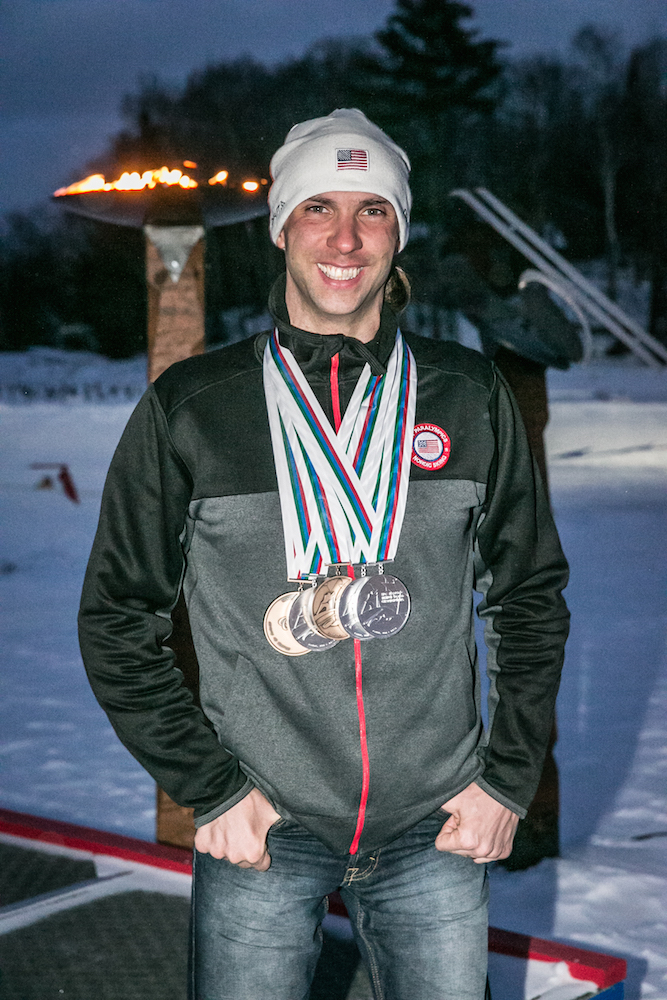
As the new Director of Sport Development for the US Biathlon Association (USBA), John Farra’s career is coming full circle (maybe even for a second or third lap). As he enters this newly established position within USBA, Farra reflects on decades of involvement—as athlete, as coach, as administrator—within the multi-faceted world of nordic skiing and Olympic/Paralympic sport. An alumnus (and former coach) of the University of Utah, a member of the 1992 Winter Olympic Team in Nordic skiing, Coach and Vice President of the Maine Winter Sports Center), High Performance Director for US Paralympic Nordic Team, High Performance General Manager for USA Triathlon, and Nordic Director for US Ski and Snowboard, Farra has spent his life on snow. Now he’s ready to make sure others have the same opportunity.
John Farra is USBA’s new Director of Sport Development (USBA photo).
“USBA stakeholders got together and created a strategic plan for 2030, a long view plan for how USBA can be one of the best governing bodies in the USA,” Farra said. “A core foundational component of that effort is the need to have more young people find the sport of biathlon.”
FasterSkier caught up with Farra on his drive from Utah to Colorado to investigate the potential for developing a biathlon range in Steamboat, already a winter sports Mecca, but one without a dedicated biathlon facility.
“Established ski clubs—like the Steamboat Springs Winter Sports Club—seem like a logical place to start,” Farra said. “There are already effective clubs around the country. Now, what can the USBA do to support their efforts, and to introduce young athletes to the sport?”
He’s been thinking that way for a long time. Near the beginning of his long career, one of Farra’s earliest administrative roles was as Director of the Maine Winter Sports Center (now called the Outdoor Sport Institute).
“Maine is an environment well-suited to the development of young biathletes: much of this massive state is covered in snow for half the year, and nearly every youngster knows how to handle a rifle. It made perfect sense to develop the sport in a community like that. So, my new role with USBA is like turning the clock back; revisiting a part of my life that I really enjoyed, introducing young skiers to a sport that I love. I’m hoping that the things I learned back then will come back to me.”
USBA’s new plan includes three objectives to which Farra will respond:
The need to support existing biathlon clubs. USBA sees that the club is the thing that’s sustainable: gatherings of passionate people who love biathlon.
The need to identify and support nordic communities that haven’t yet figured out how to add biathlon for their participants. How many new clubs can we help develop? And where are there nordic communities that haven’t yet figured out how to add biathlon to their programs?
And, the need to identify talented skiers who might excel at—and enjoy—biathlon. Where do we find the athletes? How do we find the kid who just hasn’t yet discovered that they should be a biathlete?
Closely contested racing at Schutzenski Festival, 2022 (FasterSkier photo).
“Some communities have the people, but not the venue,” Farra said. “Others have the venue but not the people. I’ve already had conversations with communities who might not know how to start. My job is to show them the possibilities, and to assist them in getting it done.”
Sometimes, “getting it done” means building new facilities (like Steamboat is considering). More often, it means developing programs and events that can introduce young skiers to biathlon without exorbitant financial commitments—maybe it’s the incorporation of pellet rifles, or laser rifles, or the staging of paintball biathlons (like the annual NENSA/Bill Koch League event that has been so successfully staged at Mountaintop Resort in Vermont). Farra’s goal is to provide opportunities for young skiers, to start them off early in their exposure to biathlon.
“We’re not here to steal skiers from cross country clubs,” Farra said. “In the past, there may have been defensiveness or concerns about that, but not everyone is a fit for biathlon. We don’t want to take opportunities away from young athletes. We want to provide athletes with even more opportunities than they might otherwise have had.”
The lead Elite Women’s field at the recent Schutzenski Festival, Soldier Hollow in Utah (FasterSkier photo).
There are high level athletes in the US Biathlon program, most of whom began focusing on biathlon as post-collegiate skiers. Such American biathletes have experienced great success, but it’s logical to assume that athletes who begin mastering biathlon skills at a younger age will stand an even better chance of succeeding at even higher levels of the sport. Farra is determined to show young skiers what might be possible.
“The pathway from entry level biathlon to the Olympic Trials is amazingly short at the moment,” he says. “There’s so much opportunity there.”
USBA is aiming for a bright future, and for the ongoing development of young American biathletes (FasterSkier photo).
For additional information—or to discuss particular possibilities—John Farra is available to the nordic/biathlon community via email: jfarra@usbiathlon.org. Those conversations could result in some very big opportunities and outcomes for individual athletes, for interested clubs, and for the sport of biathlon in the USA.
U.S. Biathlon has taken yet another step to fortify its athletic position for the future, naming Olympian John Farra to the newly-created position, director of sport development. Farra, an NCAA cross country skiing All-American with the University of Utah and a 1992 Olympian, has built a highly-successful career in sport development across multiple Olympic and Paralympic sports organizations.
Farra’s new role will focus on talent identification among junior and collegiate cross country skiers and providing a pathway to transfer that talent into biathlon. He will also head a new U.S. Biathlon initiative to identify and develop two dozen or more new local and regional club programs across the country, and to develop a national coaches education program. He will work closely with High Performance Director Lowell Bailey and Director of Athlete Development Tim Burke.
“John will bring vital experience to our U.S. Biathlon athlete development program,” said President and CEO Max Cobb. “Having his talent identification background will greatly enhance the transition of promising athletes into the development programs Lowell and Tim have put in place. But where we foresee the biggest long-term impact is to be able to broaden the number of local biathlon clubs across America while enhancing coaching and programs in our existing clubs.”
The U.S. Biathlon club initiative is a strategic direction to bring the excitement of biathlon to youth across America. Farra will pioneer the growth of new programs while working with all clubs around the country to raise the level of sport education.
Since retiring as an athlete, Farra has built a highly successful career in sport performance, starting as a coach for the University of Utah and helping lead the Utes to an NCAA skiing title. He served as nordic director for U.S. Ski & Snowboard where his athletes won four Olympic and six World Championship medals. As nordic skiing high performance director for U.S. Paralympics, his athletes won 19 medals. He most recently served as high performance general manager for USA Triathlon where his Olympic and Paralympic teams led the medals count for the sport in Tokyo.
“I have been a passionate biathlon fan, coach and official for many years,” said Farra. “I am fired up to contribute my experience to further establish talent identification, talent transfer, as well as club and high performance development programs that will have a lasting impact on the sport. This is coming back to my nordic roots.”
A product of the National Sports Academy in Lake Placid, N.Y., early in his career Farra played a similar role developing club programs while working with the Maine Winter Sports Center.
Farra will base out of his home in Heber City, Utah, not far from the Soldier Hollow biathlon venue. He lives there with his wife, Tess, and two daughters, Lina and Hanna. Lina is a biathlon athlete competing on the IBU Cup while Hanna is attending the University of Utah.
He will begin his new role Oct. 1.
About US Biathlon
US Biathlon is an Olympic sports organization that fosters the growth of the biathlon community in the U.S., developing athletes with integrity and achieving international and Olympic success. US Biathlon’s vision is to stand atop the international biathlon stage and be a leading organization for supporting athletes and clubs, prioritizing athlete well-being, and acting with integrity.
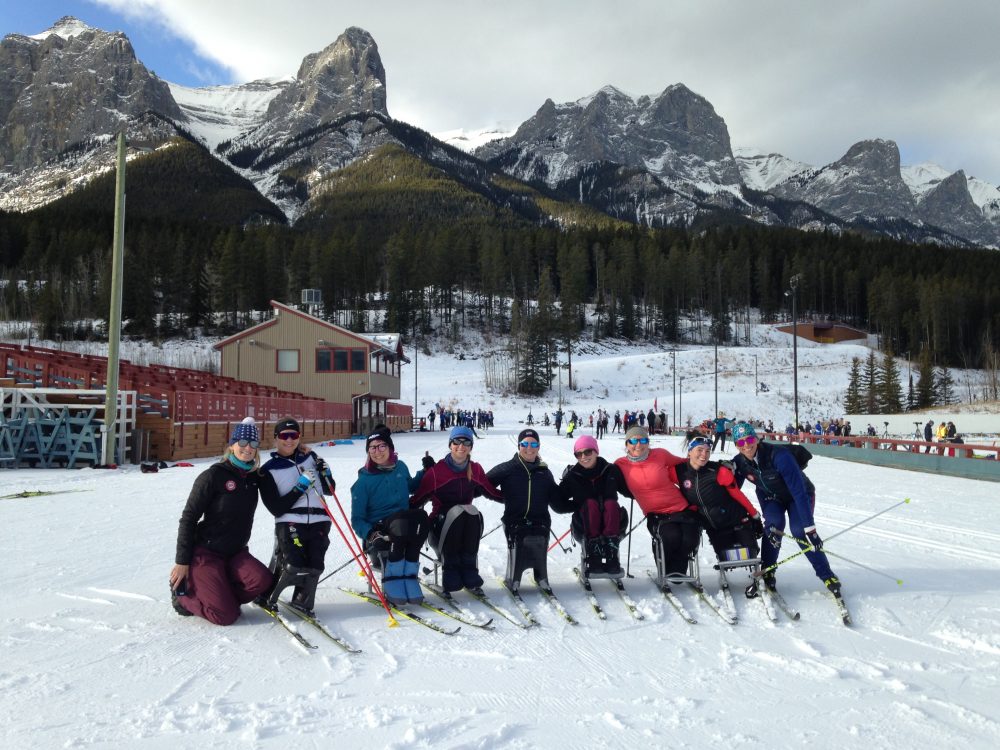
USPN coaches Eileen Carey (far left) and BethAnn Chamberlain (far right) with members of the women’s team at a recent training camp in Canmore, Alberta.
I believe in this mission and therefore want to highlight a program that is doing an exemplary job of developing, advancing, and retaining female coaches, yet has been largely absent from the conversation. That program is U.S. Paralympics Nordic Skiing (USPN).
When asked why he thought female coaches are so scarce in the Nordic world, John Farra, the former director of USPN, answered, “My theory would be that women are not encouraged as often or aren’t provided as many opportunities to take leadership roles in the Nordic space.”
This thought is consistent with research conducted by Dr. Nicole LaVoi and the Tucker Center for Research on Girls & Women in Sport at the University of Minnesota. Even without the research, plenty of women coaches can provide anecdotal evidence regarding the frustration of their experiences trying to break into a typically male-dominated field.
“How many women have stopped coaching because they don’t feel valued, or are not given opportunities to advance?” said Eileen Carey, current director of USPN. “If more women had better experiences coaching, we’d probably have more women coaches.”
This is why I was surprised when USPN invited me to test skis with the glide wax department at the Paralympic Games in PyeongChang, South Korea in 2018. I had been coaching juniors with Durango Nordic Ski Club for five years, but was new to para-Nordic skiing and international level competition. USPN gave me the opportunity to learn.
One of the first things I noticed upon arriving in South Korea was that for the first time in my coaching experience, I wasn’t outnumbered by men. Of the 14 coaches and support staff members, seven were men and seven were women. Furthermore, the women, who included powerhouses like Carey, Kristina Trygstad-Saari, and BethAnn Chamberlain, were far from statistical tokens. (Chamberlain was just recognized by the USOPC as the Developmental Coach of the Year.)
“[John Farra and I] made the decision on how we wanted to build our staff based on who was really competent and who was good in a team environment,” said Carey. “We chose who was best for the job, and that happened to be half women.”
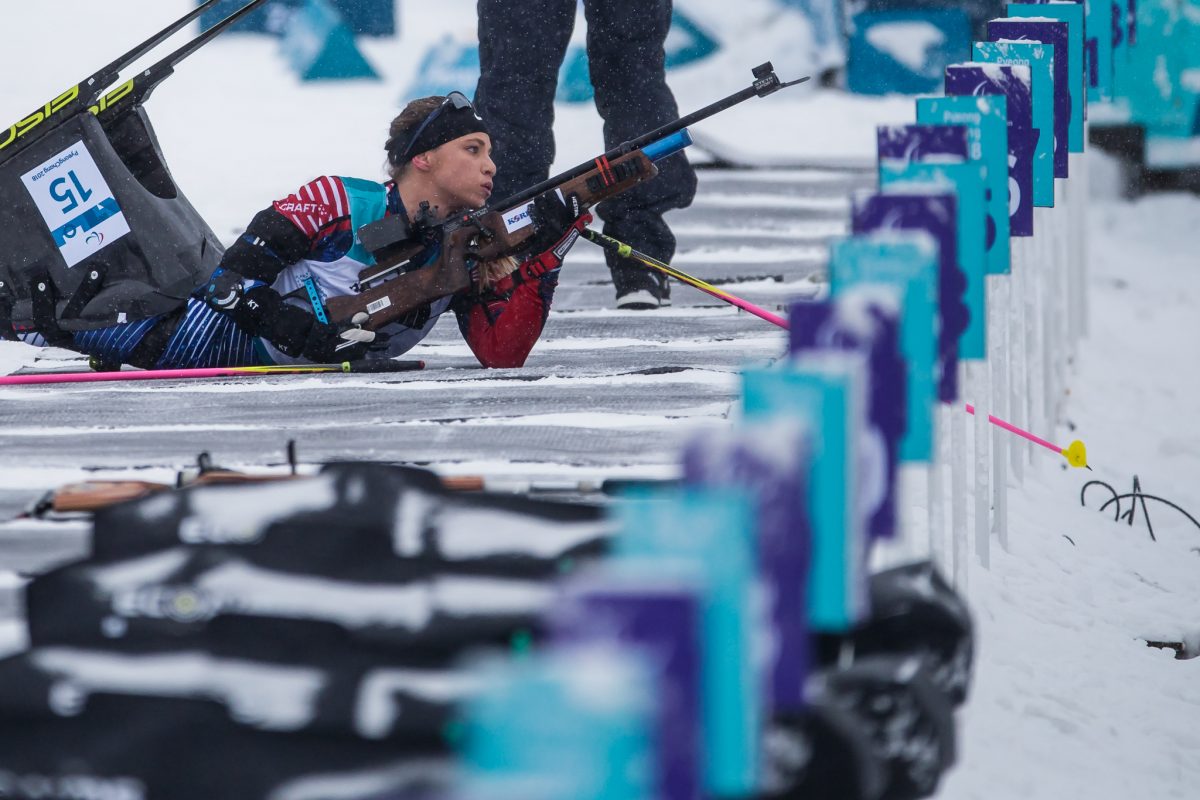
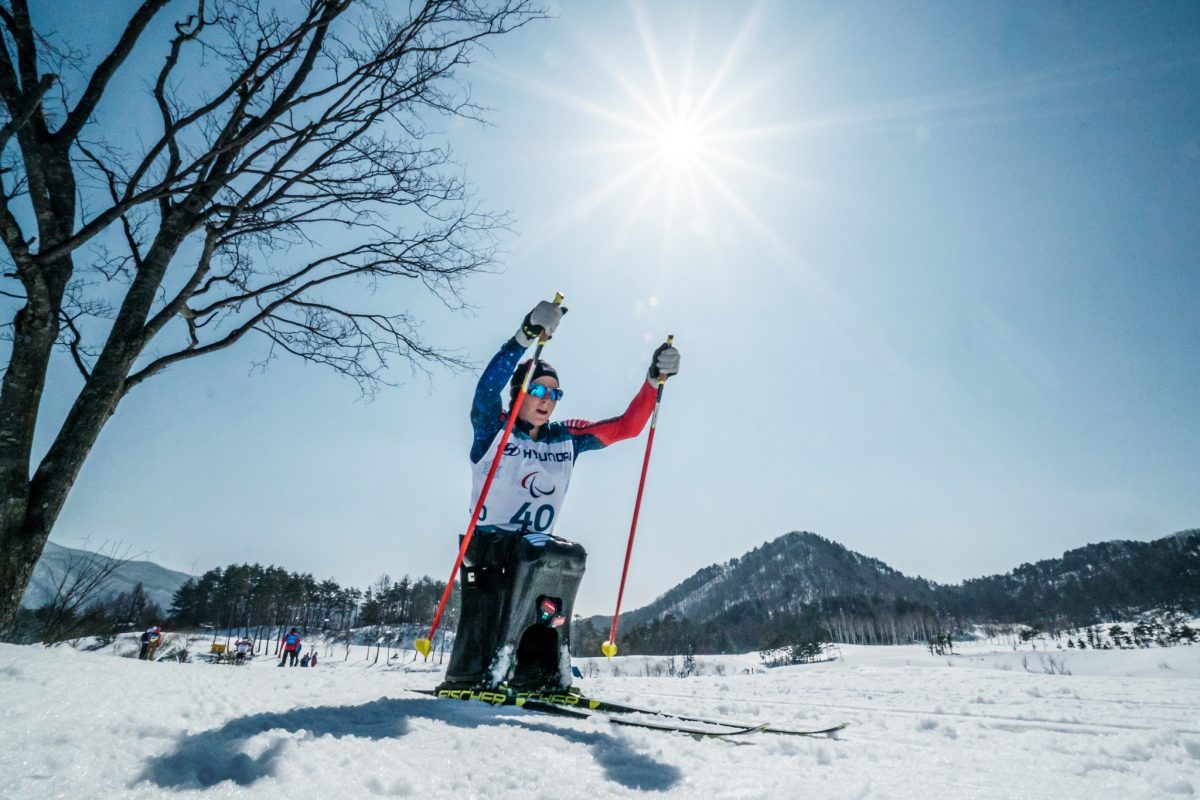
Oskana Masters focused and in the moment on the range during the 2018 Paralympics in PyeongChang, South Korea. (Photo: U.S. Paralympics/Joe Kusumoto)
In PyeongChang, USPN won a total of 16 medals, a tremendous increase from the three garnered during the 2014 Paralympics in Sochi, Russia. The 16 medals were comprised of six gold, seven silver, and three bronze and accounted for nearly half of the 36 medals won by Team USA at the Paralympics. Farra credits a large part of this immense success to Carey, who was head coach of the program at the time.
“What we experienced in Korea was this perfect symphony of human beings coming together with a purpose, without egos,” said Farra. “It was an unbelievable experience to be around so many passionate, powerful people who executed their roles so well. That was orchestrated by Eileen and her style of leadership.”
Another key member of the half female coaching staff is Chamberlain, who serves as the emerging athlete coach. She utilizes her trademark enthusiasm and approachability to coordinate with clubs nationwide to identify, recruit, and develop emerging athletes.
“BethAnn is ideally suited for this line of work,” said Farra. “Her intensity, her passion, she’s just incredible for wrapping people in and getting them fired up.
Chamberlain, who had a 15-year career as a professional biathlete before she started coaching, also offers USPN a fount of technical knowledge regarding all things skiing and shooting.
“She has an extensive background in biathlon, so when athletes are new, they get a pretty thorough introduction to the sport,” said Gary Colliander, USPN’s biathlon coach. “She’s also very easy to work with, so this develops a great opportunity for other coaches to learn from her as well.”
When I asked Chamberlain, who also has experience coaching for non-adaptive programs such as Boulder Nordic Junior Racing Team and the Loppet Ski Club, what her favorite aspect of working with USPN is, she referenced the out of the box thinking required to coach adaptive skiing.
“The goal is the same as it is in non-adaptive skiing and biathlon, to ski fast and hit targets, but your approach to get there is a little different,” Chamberlain said. “Just because a standing skier skis with two poles, is that really the way someone with one pole should ski? We don’t know all the answers. We don’t know a lot of the answers. So that forces us to be a little more open-minded, to consider other possible ideas and solutions.”
In fact, throughout my conversations with various individuals associated with USPN, this ability to consistently consider alternatives emerged as the number one hallmark of an effective coach.
Farra described Carey as, “hands down the best coach that I’ve worked with” specifically because she is, “someone who asks more questions than has answers.”
“She is always asking why? Why are we doing it this way? Why can’t we do it that way?” said Farra. “And by asking so many questions, she evolved from someone with former racing experience and some touchpoints with coaching to a large driver of the team’s success.”
Nick Michaud, a USPN development team coach, cited “the courage to say I don’t know” as one of the most important things he’s learned from both working with Carey and the team.
“To see someone like Eileen, who has been doing this a long time and is at the top of her game, admit ‘I’m not sure’ when I ask a question, and then for us to go figure it out, is such a cool process,” said Michaud.
“Being able to do that helps puts some autonomy on the athletes, it opens the door for a lot more learning, and it makes a more collaborative process. I think the moment you start assuming things or think you know everything, that’s when the growth and development stops.”
Obviously, inquisitiveness and humility are not qualities specific to gender. I do not think it’s a coincidence, though, that an organization that has grown and improved and succeeded by consistently asking what it can do differently exemplifies equity.
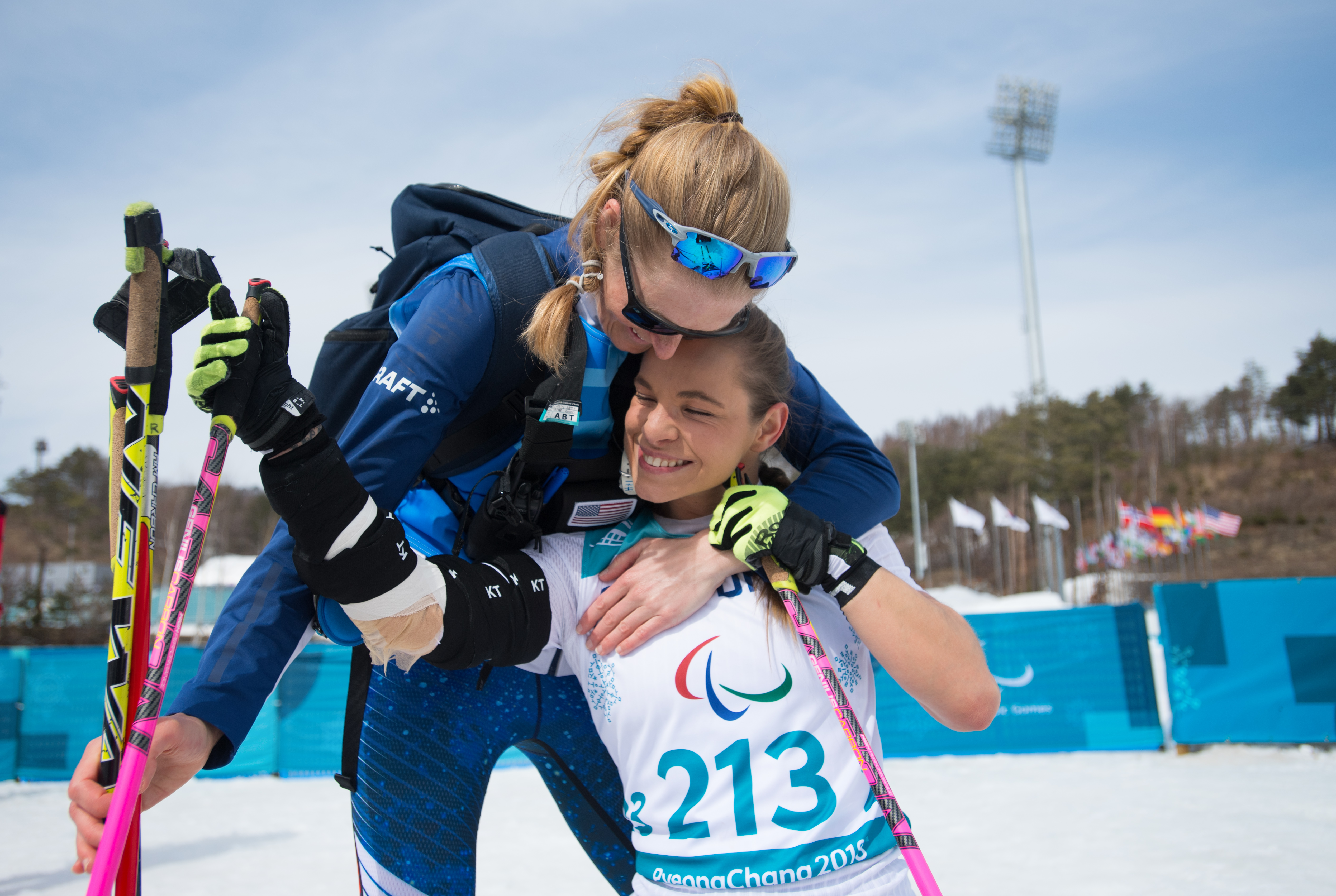
Oksana Masters of U.S. Paralympics Nordic is hugged by head coach Eileen Carey after her gold-medal finish in the women’s sitting 5 k cross country race at the 2018 Winter Paralympic Games in PyeongChang, South Korea. (Photo: Mark Reis/U.S. Paralympics)
At the introductory level, USPN strives to present opportunities for individuals to explore things they might not have otherwise thought possible. As athletes advance, USPN provides a framework for progression through the sport, which includes access to a range of highly-qualified professionals and resources. Assistant coach Trygstad-Saari handles initial communication with athletes, manages the logistics of the program, and in conjunction with Chamberlain, stokes enthusiasm. Michaud keeps a pulse on all groups and serves as a bridge for developing athletes who may be potential medalists.
At the elite level, athletes work with head coach Martin Benes and biathlon coach Colliander. They are also connected with a network of specialists within the United States Olympic and Paralympic Committee (USOPC), such as a strength coach, a sports psychologist, and a nutritionist.
This is all of course facilitated by Carey, whose staff and athletes can’t say enough good things about her efficiency, expertise, and color-coded spreadsheets.
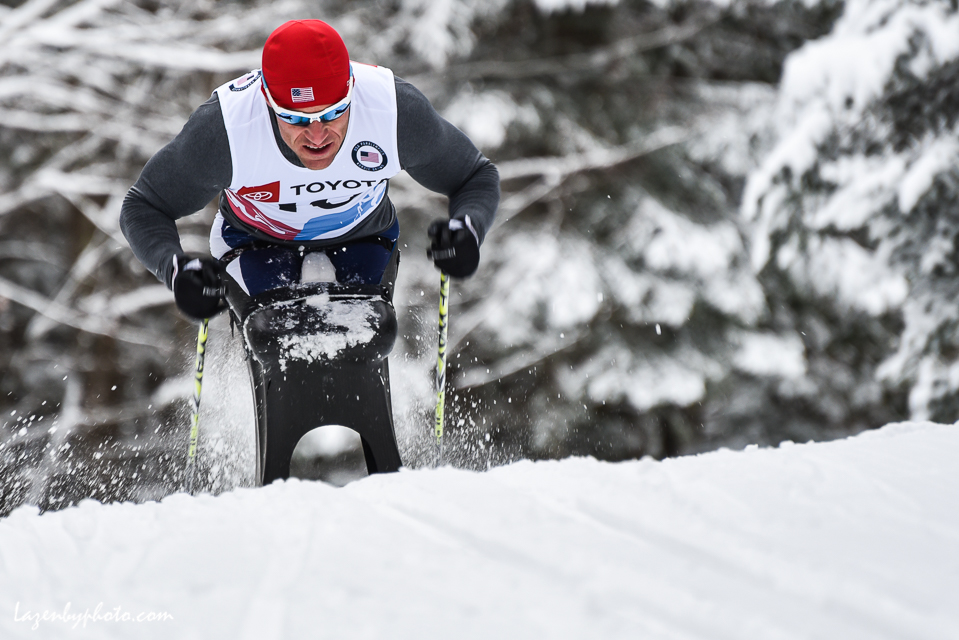
Dan Cnossen on his way to winning the men’s middle distance national title at the Paralympic Nordic Nationals at Craftsbury, Vermont. (Photo: John Lazenby)
“I’ve been really impressed with the caliber of coaching I’ve had in my eight years with the team,” said Dan Cnossen, an athlete on USPN’s National Team. Cnossen is a former Navy SEAL and a six-time Paralympic medalist. “They really consider and respond to athlete feedback. Tapping into the USOPC’s resources is also adding a lot of depth to the organization. The team is just getting better and better.”
The more I learn about how USPN develops Paralympic athletes, the more I realize how similar this process is to the way Nordic skiing should be developing female coaches. USPN removes barriers and provides opportunities for a minority population. This is analogous to presenting coaching as a viable career option to women and providing opportunities to pursue it.
Furthermore, USPN’s versatile approach and superlative support system allows athletes to not only explore skiing, but excel at it. Similarly, female coaches need professional development opportunities and a network of peers and allies, such as the WSCA, to thrive and advance in a traditionally male-dominated field.
What goes into creating successful athletes, coaches, and programs is vast and complex. Female leadership and gender equality may only be one piece of the puzzle, but I do believe it plays a powerful role. U.S. Paralympics Nordic provides a promising example for both the future of women’s ski coaching and promoting overall diversity in the sport.
As Michaud put it, “Hopefully we’re showing that we can mix up the way things are and be really good at winning medals.”
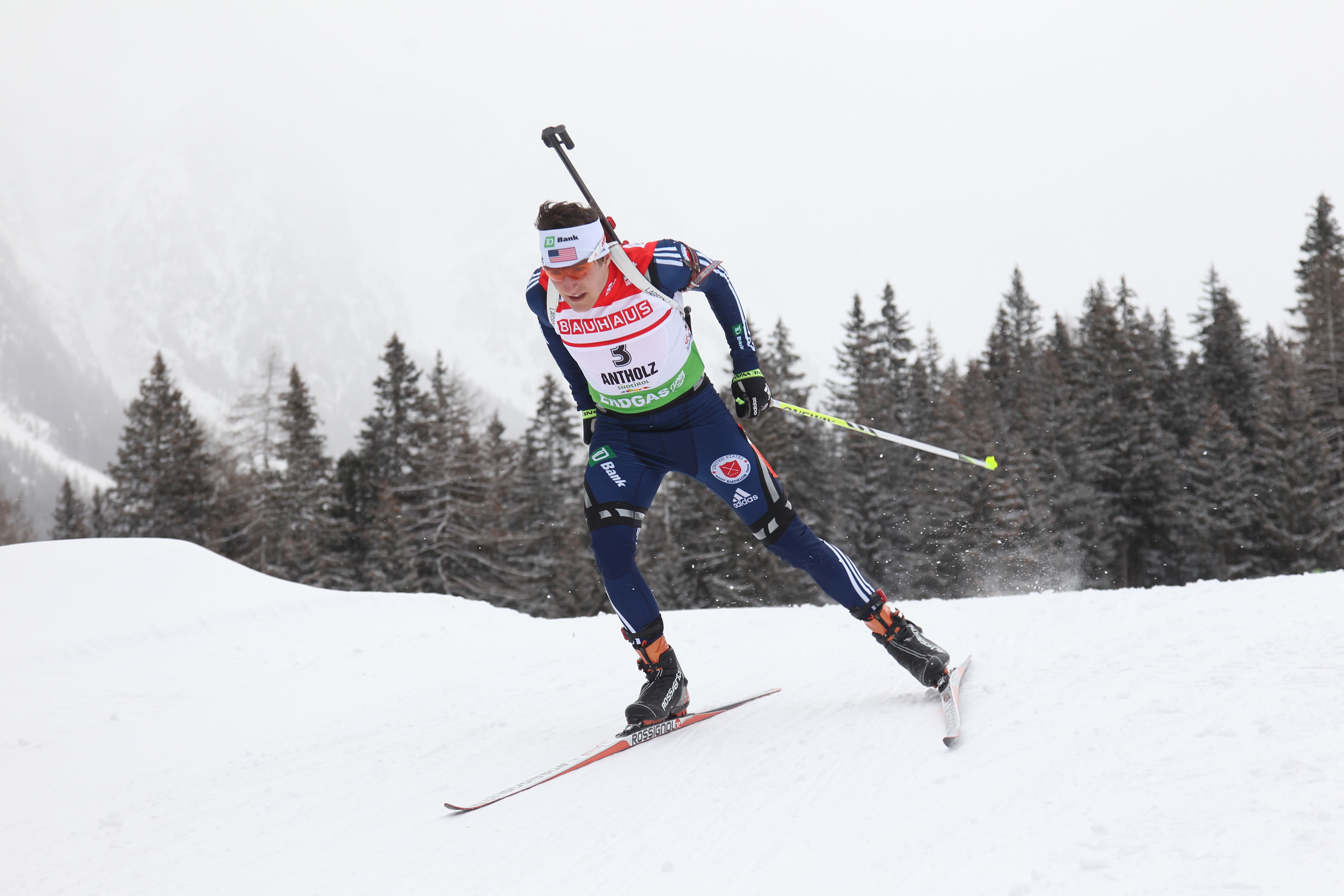
Russell Currier racing at IBU World Cup competitions in Antholz, Italy. (Photo: NordicFocus/USBA)
The first time I contacted Russell Currier for a retirement interview, it was mid-April. I had asked him to share his story, and no more than 24 hours after my initial email to Currier, I received a response.
“Yeah, let’s do that. I’m actually in Bozeman right meow,” he’d written.
Digging through my memory bank, I recalled Currier having come to Bozeman one other time. Two Aprils ago, the Stockholm, Maine, native spent a week in Montana visiting friends. The faint memory of Currier showing up to my Bozeman apartment that spring, sporting a DIY unicorn outfit, had me wondering what the recent biathlon retiree was up to two years later (at the time of our email correspondence, it had been 10 days since Currier’s final career competitions, the 2018 USBA nationals in Park City, Utah).
Since I was still living in Bozeman, Currier and I decided to meet in person for the interview. Open mic night at a local coffee shop seemed like a safe rendezvous spot. While I arrived at our destination point uncharacteristically early, Currier showed up characteristically five minutes late.
He had dropped the paper-cone head prong for this occasion, though he still had the same curly mop of brown hair. Leather thong flip flops, a black hoodie and shorts made him an unmistakable Mainer — most in the room wore pants and closed toed shoes, fitting for the local forecast of mid-40 temps and rain.
Russell Currier, a two time Olympian, four time World Championships team member and on-off National team member. (Courtesy photo)
The coffee shop served more than just coffee and we wound up sipping on local brews called “Strange Cattle”. A few shaky singers and a couple billiard –albeit shabby –games later, the Strange Cattle had gotten the best of us. My audio recorder inevitably remained in my pocket and the interview remained undone.
By the time we finally sat down to chat, it was over a month and quite a few text messages later (one of which involved Currier asking to borrow 90 K). In short, the following interview with Currier was conducted over the phone in late May, seeing as April is best left for brews and mythological beasts.
FasterSkier’s questions appear in bold; Currier’s responses follow immediately after.
***
FasterSkier: Russ, good to have you on the phone. What are you up now?
Russell Currier: Cutting cantaloupe.
FS: Nice. Whereabouts?
RC: Windham [Maine]. I moved there at the end of April. I’m staying in the basement of an old friend and doing landscaping. It’s not permanent, but it will suffice for now.
FS: Why landscaping?
RC: It was something that I could show up hungover for, but still grind it out and make it work.
FS: When did you decide to retire?
RC: Honestly, about two years ago. I had a really bad season [in 2015/2016] and I wasn’t sure if I wanted to keep racing or not. I decided to give it two more years, just to see if I could make it through another Olympic cycle.
FS: Were you experiencing any illness in 2015/2016?
RC: No, I think there were a few equipment issues that were bad luck. I didn’t do anything wrong. I did the best I could. I just didn’t nail training as best as I could. I was at that level of, you either get lucky and train really well, or you don’t get lucky; you try to train really well, but you don’t quite nail it.
FS: What do you mean by equipment issues?
RC: We had trials in Canmore and it was really, really cold that year — I mean, it’s always cold in Canmore — and the ammunition I was using wasn’t shooting very well. That may have been the limiting factor to my entire season. But it’s one of those things though that you can’t really prove.
That season ended up being my worst one ever. It was bad enough to say this could be a justifying end. So I gave myself the month of April to make the call; decide if I wanted to keep going or not.
FS: So in the end you essentially said, screw it, let’s do this?
RC: Pretty much. Officially, I did it out of curiosity. I figured it was worth the expense and trouble, since I had already gone that far.
My thinking was, if I go two more years, the absolute worst case scenario would be I rack up more debt and I don’t make it. The best case scenario, I do make it and I retire.*
FS: What will you miss the most about competing in biathlon?
RC: That’s an interesting question. I haven’t really wrapped my mind around the fact that I’ve retired. So far, it’s still awesome because it’s absolute freedom. I still do plenty of training. I actually did an ultramarathon this weekend, which is a whole other story within itself.
FS: An ultramarathon, really, where was that?
Pineland Farms. They have a 25-kilometer cross-country ski trail. We did three times around that, plus an additional loop so that it would add up to 50 miles. I couldn’t walk the day after. That was problematic.
FS: Do you think you have a future in ultramarthon running?
RC: I don’t know. I have to think about it. That was one thing my coaches had always told me was, if this biathlon thing doesn’t work out and you ever get into ultramarathon running, it could be your thing.
FS: So, back to what you’ll miss most about competing in biathlon?
RC: After the last race in Utah, I never really had time to sit down, think it over and decide how I felt about the last 16 years of my life. I don’t know if I’ll have a mental breakdown when I do or if I’ll think, wow, that was fun, and move on.
I had to send USADA [the U.S. Anti-Doping Agency] a letter saying that I officially retired. That kind of hit home. It was like signing the final papers on a divorce order. You’re ending a relationship with something you’ve been with for so long
FS: Looking back, what’s your fondest ski memory?
RC: The race weekend in Kontiolahti, Finland. It was super cold there, as in below legal race temperatures. I got food poisoning the day before the race. But I had traveled all that way and this was my one chance to race, so I raced anyway. I ended up cleaning and finished sixth.
That was the second top 10* that I had ever had and the whole thing was just one giant surreal experience. (The afterparty was just nuts and [the U.S. team] did a Finnish sauna).
Russell Currier (r) and USBA teammate, Tim Burke in Slovenia 2017. (Photo: russellcurrier.blogspot.com)
*Currier has been to two Olympic Games, qualified for four World Championships teams, earned two sixth-place World Cup results in 2012, and this spring alone, had a fourth, fifth and sixth place finish at USBA nationals.
FS: What’s involved in a Finnish sauna?
RC: I’m sure it varies from one part of Finland to the next, but you go in the sauna, get as hot as you can, then you run around outside like naked idiots. After that you go back inside the sauna, get as hot as you can tolerate, then go outside and jump in the snow, roll around. Then you go back inside and the final time you [exit] the sauna, you have to jump in the water (this is winter, so it’s basically just this carved hole in the ice). There are also a bunch of reeds you’re supposed to hit each other with. It’s like a sword fight with these giant sticks. Weird Finnish things.
FS: Interesting. How would you describe your career trajectory?
RC: I never had any specific goal in mind, I just wanted to see what would happen if I actually gave it my full effort and pushed it into my late 20s and early 30s … I made it further than most people thought I ever would have when I started. But I also always had higher expectations for myself.
FS: Do you feel like people were skeptical of you?
RC: No, I don’t know if they were skeptical. They just didn’t know what to expect. I was one of the early athletes to jump on board with what Maine Winter Sports Center (MWSC)* was offering; nobody had any idea really how it worked. It wasn’t like an academy school in New England, or Steamboat Springs or a little ski town in Norway or anything like that where everyone was on board with how the system worked. This was a completely new and revolutionary thing to do.
RC: Not the first, there were a few other athletes that were there before me, but not many. I think MWSC started in the summer of 2001, so [the program] had only been around for three years or so by the time I joined.
FS: How did you get involved with MWSC/skiing?
RC: It was a very arbitrary and borderline impulsive decision. The impulse never wore off.
FS: Where is the sport lacking or what do you think needs to be changed?
RC: Short answer, it needs to be way cleaner. Almost any North American athlete would probably say that right off the bat. For good reason. It’s scary how much time and effort of your life you can pour into something, only to watch an entire organization walk all over it. Ruin it. Unfairly. It really is terrible and it’s as bad as everyone thinks it is.
FS: You’ve been involved for 16 years now, any advice for those coming into the world of biathlon?
RC: I would say biathlon and cross-country will produce way more failure than they ever will success. These sports are going to kick you in the teeth constantly. You’re going to get the [expletive] kicked out of you so many times before you get the glory that you see on TV.
But, to quote John Farra, it’s worth it.
I remember John going on and on about the opening ceremonies at the Olympics and just saying it’s worth it. All the training, all the setbacks. It’s worth it. (Ironically when I finally did make [my first Olympic team in 2014], I actually missed the opening ceremonies because we had a race the next day, so we didn’t go. I thought that was kind of funny.)
Anyway, yeah, if you’re aware that it’s going to be one colossal struggle and you come in expecting that, it makes it not so bad.
Russell Currier during the men’s mass start at the 2016 US Biathlon National Rollerski Championships on Aug. 14 in Jericho, Vt. (Photo: Katrina Howe)
FS: Any unsung heroes to whom you’d like to pay tribute?
RC: My neighbor down the road from me growing up has not only been my number-one fan, but he has also painstakingly made various parts for my rifle that have literally played a crucial role in my career. He’s a machinist and a lot of my rifle’s components were his design. I’ll give a shout out to Tom Campbell for supporting me both grooming wise and equipment wise throughout my career.
***
What others had to say about Currier
The following is a compilation of emails from various individuals who worked with Currier over the course of his ski career.
I’ve always admired Russ’s ability to be resourceful and resilient. He’s had his share of frustrating races, such as placing 61st in sprints on multiple occasions (just missing out on pursuits). However he always bounces back. Watching him place a career-best 6th in a World Cup in Nove Mesto in 2012 was incredibly inspiring because he was the ultimate underdog on our underdog team. He had struggled to qualify for international racing earlier in the season and surprised a lot of people that day.
.
Another favorite Russell memory was during a Lake Placid training camp. He ran 9 miles in the middle of the night to get home from a party in Saranac Lake. A solid solution to not having a designated driver.
— Susan Dunklee
Russell was incredibly careful never to waste food, as though he had lived a previous life in the Great Depression. He used to fill container after container of food at the OTC dining hall and carefully take it with him until his room was full of to-go coffee cups filled with varying granolas.
Once when we were at the August rollerski trials in Jericho, Vt., I bought a 69-cent two-pack of puddings post-race. They were so awful that I left the other one in the place we were staying, intending to get rid of it. Russell saved it, put it in his truck, and drove it back home to Maine thinking I forgot it. He kept in his refrigerator for two and a half months and then drove it back down to Vermont and gave it to me at October Rollerski Trials. I was so flabbergasted by his dedication to save that terrible pudding cup that I just ate it.
— Joanne Reid
My favorite Russell stories probably shouldn’t be put in print, so I’ll go with this.
Russ is the only person I’ve known to go on runs with a shotgun. Apparently it’s quite an effective partridge hunting tactic.
— Welly Ramsey
It has been great to watch Russell over the years, develop as an athlete and keep working towards his goals. In the last couple of years it was impressive to see Russell really refocus and work towards a second Olympic opportunity and how it paid off. It will be exciting to see what opportunities come next for Russell!
— Seth Hubbard
One of my favorite memories of Russell is from when he was first interested in racing, in early high school. We were at a training camp and he was very concerned about what he was eating — only what he deemed healthy— and about getting the hours in his training plan.
When it was time to pack up, Russ was hungry and tired after his longer A.M. workout and he saw food on the table (breakfast for everyone) which he proceeded to eat in its entirety. Needless to say, he was not much help with packing and no one was very happy about the lack of breakfast. Russell, however, felt fine.
— Sarah Dominick
Russ was one of a few athletes that lived at the 10th Mountain Lodge at some point in their career. One summer night, I headed up there to pick up something I needed for training the next morning (can’t remember what). Since he lived upstairs, and it was dark, I thought it would be fun to try and scare him. I made my way through the door and up the stairs as quietly as I could, thinking I was really going to scare the [expletive] out of him. As I started rounding the corner, Russ jumped out from his room, headlamp blinding my eyes, biathlon rifle aimed at my face, finger on the trigger. I think that was the only time he almost shot me.
— Nick Michaud
Russell Currier working on his prone shooting position in June 2017. (Photo: russellcurrier.blogspot.com)
Russ was a morning person, more so than anyone else I’ve met before or since — he drew his innate energy from waking up early and making breakfast as the dawn broke.
We were staying in the house of a family friend for August World Cup Trials one year, and I came crawling (actually crawling) down the stairs race morning, bleary-eyed, incapable of speech, dysfunctional, and partly jet-lagged from flying to the East coast for these races. My body thought it was about 3am, and I tended to wake up at 11.
Russell started dancing around me, delighted in the (terribleness of) mornings, smiled down at me crawling on the stairs, and says, “I know what your spirit animal is! It’s a sloth!!!!” He called me Sloth ever since.
— Reid
When I first started watching World Cup biathlon races about 10 years ago, Russell anchored the men’s relay at World Championships. The team was about to be lapped by the Norwegian race leaders and Russell skied like hell to stay ahead of The King (Ole Einar Bjørndalen) to avoid getting pulled from the race. He got a lot of TV time that day.
Eileen Carey congratulating Oksana Masters after a gold medal at the Paralympic Games. (Photo: Mark Reis/U.S. Paralympics)
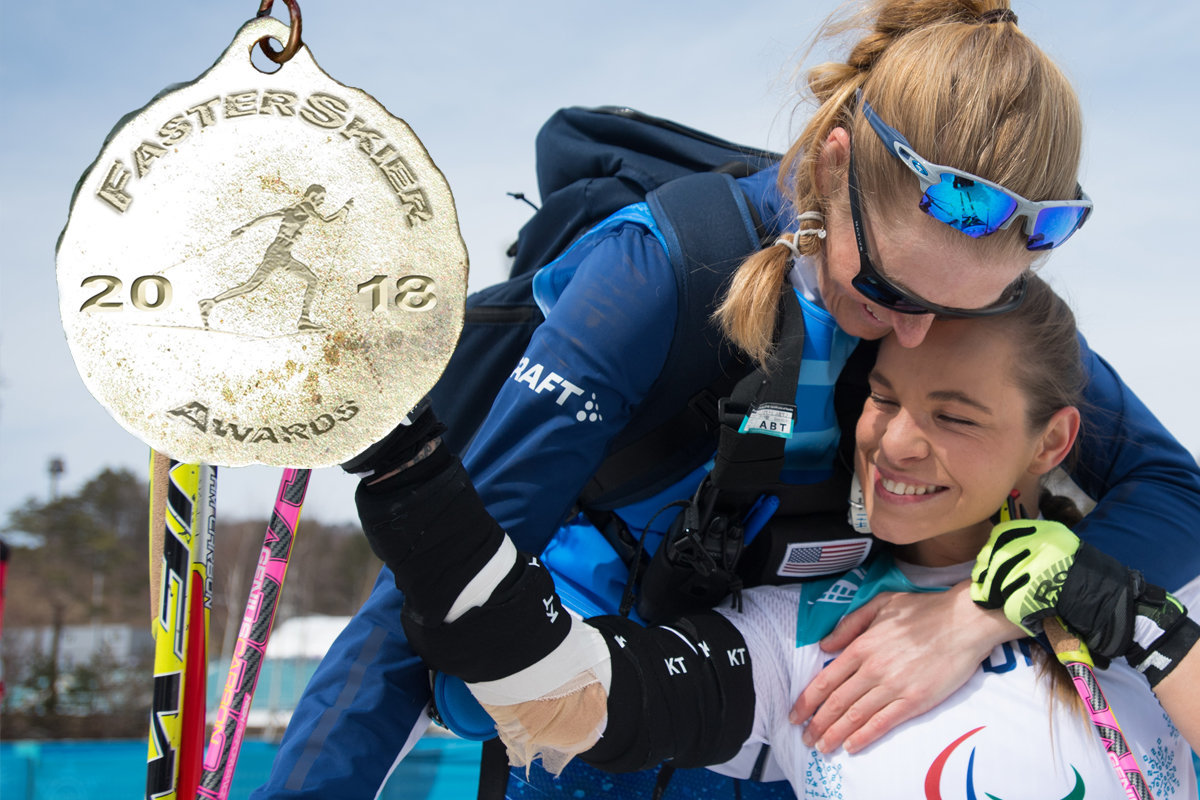
With the 2017/2018 season officially in the rearview, FasterSkier is excited to unveil its annual award winners for this past winter. Votes stem from the FS staff, scattered across the U.S., Canada, and Europe, and while not scientific, they are intended to reflect a broader sense of the season in review. This set of honors goes to coaches of North American teams in any nordic discipline, at any level – although in an Olympic and Paralympic Games year, that’s what we focused on.
A big architect of the team’s success has been head coach Eileen Carey. It’s not an easy or simple job to coach athletes at all different levels of sport and different athletic backgrounds, and bring them all towards success.
“The diversity in disciplines and levels of athlete in our program is one of the most interesting and motivating parts of my job,” Carey wrote in an email last week. “On one hand, I love getting into the details of what might make someone a fraction of a percent faster. I love the process of breaking down a performance into parts and working with athletes to problem solve how to make a small element better. So much of that is about failure, modification, and trying again. The potential gains are so small, but so are the gaps from 4th to 1st and every once in a while something sticks and that is incredibly motivating for me. Andy [Soule]’s sprint finish [for a gold medal] in PyeongChang is a great example of that.
Oksana Masters of U.S. Paralympics Nordic is hugged by head coach Eileen Carey after her gold-medal finish in the women’s sitting 5 k cross country race at the 2018 Winter Paralympic Games in PyeongChang, South Korea. (Photo: Mark Reis/U.S. Paralympics)
“On the other hand we have some promising new athletes in our program who are at such a different level in what they need as athletes,” she continued. “For our program, our goal is always to provide best in the world service to our athletes. For our athletes who are aiming for the podium today, that involves every detail coming together, the execution of their plan. For Grace [Miller] and Mia [Zutter] and Ruslan [Reiter], our next generation of podium-potential athletes, providing best in the world service is more about making sure they see what their medal winning teammates and competitors are doing to achieve their performances and showing them a roadmap to get to that point.”
Development coach BethAnn Chamberlain is a big piece of that effort. For the top-level athletes, Carey lives in Bozeman, Montana, where she works intensively with the sit-ski team,
“They move to Bozeman in the winters,” Carey explained. “I am with them every day from November through March, in addition to training camps that we have most months from May-October. Most of them compete in summer sports, so in the off season, there is always an individualized balance of figuring out how to optimize their preparation for skiing, while working with their goals for other sports.”
The standing and visually-impaired athletes have a different situation, and are primarily supported by clubs in their local areas. Carey works with both the athletes and their home coaches and teams to make sure they are getting the best development, but a big part of that can be training with an able-bodied ski team.
“We can help with funding, or workout ideas that might be unique to Paralympic skiing,” Carey wrote. “But at the end of the day, Jake Adicoff and Sawyer Kesselheim’s success at the Games [where they took silver in the visually-impaired 10 k classic, the first visually-impaired medal by the U.S. in modern Paralympic history] is much more about Sun Valley SEF and Bowdoin (Jake’s club/school) and Bridger Ski Foundation and Montana State (Sawyer’s club/school)… We can help fill the gaps with funding and equipment and communication with their coaches, but their best path to the podium is the same as every skier who wants to be on an Olympic podium.”
Carey and her colleagues, such as High Performance Director John Farra, have intentionally written their criteria so that standing and visually-impaired athletes can make the para-nordic national team without actually competing in para events – instead, they can make the C Team or Development team using USSA points from SuperTours, college races, or regional races. That means that they can spend more time with their home teams.
“We are lucky in that we have incredible partners in the USSA community who are really the ones developing many of our athletes,” Carey wrote. “I hope the more that coaches and clubs around the country see our athletes competing in USSA and collegiate races, the more they see opportunities for providing a ski development pipeline to even more members of their communities. As much progress as we have made as a program over the last several years, we have at least that much again to improve, and this is the next big opportunity for us as a program, and also for ski clubs and communities around the country.”
But while Carey is thinking about those big-picture goals and opportunities, she is also working one-on-one to help Americans become the best para-nordic skiers in the world.
“The fall after Sochi, we started a technique modification process to target Andy [Soule]’s speed on flats, in particular finishing speed,” she explained. “In Sochi, he was moving quickly and had great hand speed but he was not going fast compared to the athletes he was competing against. We tried and failed at so many things in the past four years to improve that. Every once in a while, we would find a mental cue or some technical detail that seemed to make a difference and we would build on that and find ways to analyze it. It can be so frustrating, because there are inevitably times when progress stalls or reverts and there rarely is a clear answer why… When he turned it on during that finishing stretch of the sprint to take the gold, that was the epitome of a plan coming together at the right time.”
A few minutes later, Oksana Masters won gold in the women’s sprint, overcoming an injury that had happened just weeks before the Paralympics. It was her first gold medal after collecting a silver and bronze earlier in the Games, to go with a silver and bronze from Sochi and a bronze from the 2012 summer Paralympics in rowing.
“Both of those races, strictly from a sport performance standpoint, were just incredible,” Carey wrote. “In addition, those two athletes have really been the architects of our program’s rise over the last quad. The two of them were at every camp and World Cup, and their instincts as athletes drove the strategies of our program. That day could not have been a more meaningful culmination of the last four years for them as individuals, for us as a program, and for me as a coach.”
Honorable Mention: Robin McKeever, Canadian Para-Nordic Skiing
Also taking home 16 medals from PyeongChang? The Canadian Para-Nordic team, which like the Americans had a big jump in both the number of medals and the number of athletes winning them. Far from being just the Brian McKeever show – although the veteran went undefeated for the third Paralympics in a row – the team also picked up multiple medals from Mark Arendz, Natalie Wilkie, and Collin Cameron, plus an individual medal by Emily Young and two relay medals.
Robin McKeever. (Photo: Noel Rogers/CCC)
Carey’s counterpart up north is Robin McKeever, who incidentally said that he looked at what Carey was doing as an inspiration in being able to recruit summer-sports athletes and successfully transform them into winter gold medalists. The two gold medals by Kendall Gretch, an American triathlete who didn’t pick up cross-country skiing until 2015, were “eye-opening”.
The para-sport landscape is slightly different in Canada, which also has a much smaller population to draw from (while at the same time having some of the same issues associated with far-flung geography). McKeever faces different development challenges, but has helmed the program towards depth and diversity in the last four years.
“It started as an eight-year process in 2010,” McKeever said in an interview last week. “At that time, we only had funding for Brian. I was given the reins to rebuild, effectively. Now there are some next-generation funds we have the opportunity to access, and now that helps build the base. In the last few years we have had a development coach on board, Kate Boyd, and that has been huge.”
Emily Young and coach Robin McKeever during a training session at the Alpensia Biathlon Centre during the 2018 Winter Paralympic Games in Pyeongchang, Korea. (Photo: Dave Holland/Canadian Paralympic Committee)
Then there was Wilkie, a teenager who came to the program after losing four of her fingers in an accident.
“We know where our pool of athletes comes from,” McKeever said. “It’s about the un-luck of athletes having trauma, which starts their Paralympic path. And it’s about luck in terms of recruiting athletes from summer sport.”
Those newer athletes in the program have veterans to look up to, whether that is McKeever’s brother Brian, or now Mark Arendz, who took home a remarkable six medals between biathlon and cross-country skiing.
“Mark was no surprise,” McKeever said. “Six medals was maybe a surprise, but he was a World Champion coming in.”
Given the limitations on how the team can find new athletes, McKeever didn’t want to be too concrete about whether the program would see a big swell in numbers coming off its recent success.
“It is still to be seen where that will go,” he said. “Some of it is a bit of luck, and some of it is really good management… A lot of staff has been around for eight years. They remain keen and excited. They stick around and are really integral to my support, and to the team’s support.”
One of the biggest highlights for McKeever, and an illustration of how the program has changed in just a few years, was the mixed relay team of Arendz, Young, Wilkie, and Chris Klebl taking silver, the first ever relay medal for Canada.
“The mixed relay is a real highlight,” he said. “Even if the full Russian contingent had been there, that would be a podium for us. I didn’t know eight years ago that the possibility was even there.”
Honorable Mention: Matt Whitcomb, U.S. Ski Team
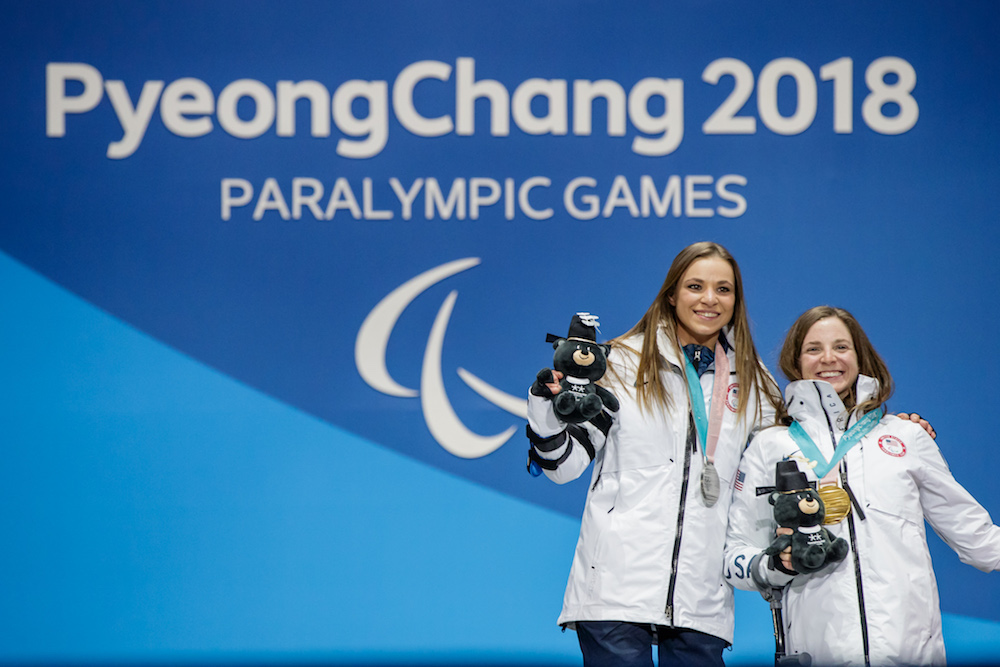
Another team that had a huge jump this year? The U.S. Ski Team women. Jessie Diggins and Kikkan Randall took gold in the Olympic team sprint, the first-ever gold medal for the U.S. in the sport.
But the Olympics weren’t the only thing that happened this season. Diggins also won a World Cup, was third in the Tour de Ski, and second in the overall World Cup standings. Randall picked up a World Cup podium; Sadie Bjornsen picked up several; and Sophie Caldwell had enough to earn third place int he Sprint Cup standings. The team had more days with many women in the sprint heats, and more good distance results, too.
Matt Whitcomb with Sadie Bjornsen and Sophie Caldwell in Seefeld, Austria, this winter. (Photo: Garrott Kuzzy / LumiExperiences.com)
“It’s been a many-year goal of ours to be ranked in the top three for the women’s team and we secured that for the first time today,” U.S. Ski Team Women’s Coach Matt Whitcomb told FasterSkier of his team’s best-ever Nations Cup ranking after the final World Cup of the season in Sweden. “We’ve come into [past] finals, I believe, ranked third and then come out of finals ranked fourth. We’ve been fifth… It was really quite an achievement.”
The U.S. women all spend large amounts of time with their club teams and coaches, including at APU and Stratton. But they come together to form a national team, the strength of whose relationships are a storied aspect of building their own success. And Whitcomb is a big ingredient there, facilitating not just training but atmosphere and long-range goals.
When Caldwell secured third in the Sprint Cup, she thought back two years to a conversation she had with Whitcomb about race goals. Whitcomb wanted Caldwell to write down goal in particular: to be in the Sprint World Cup overall top three.
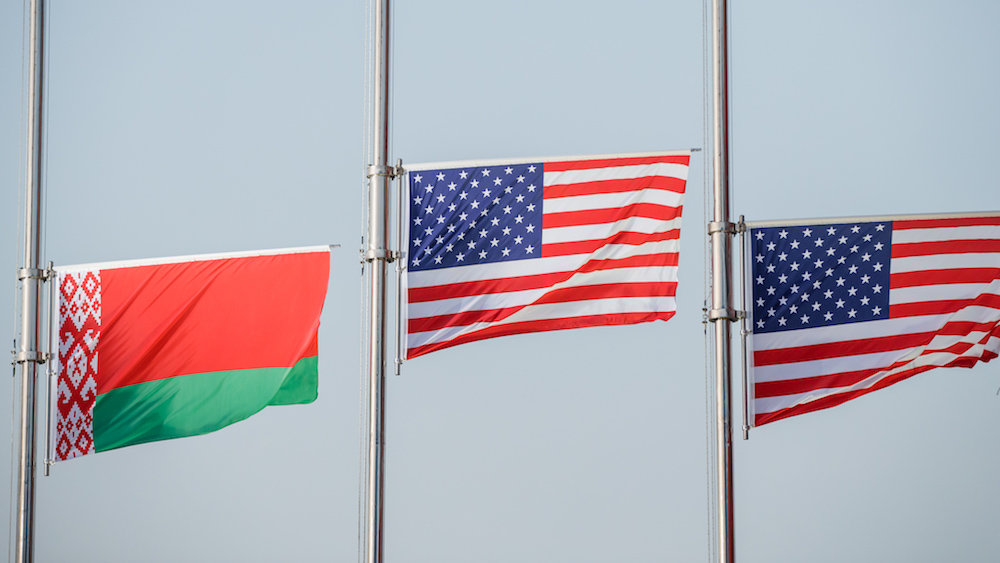
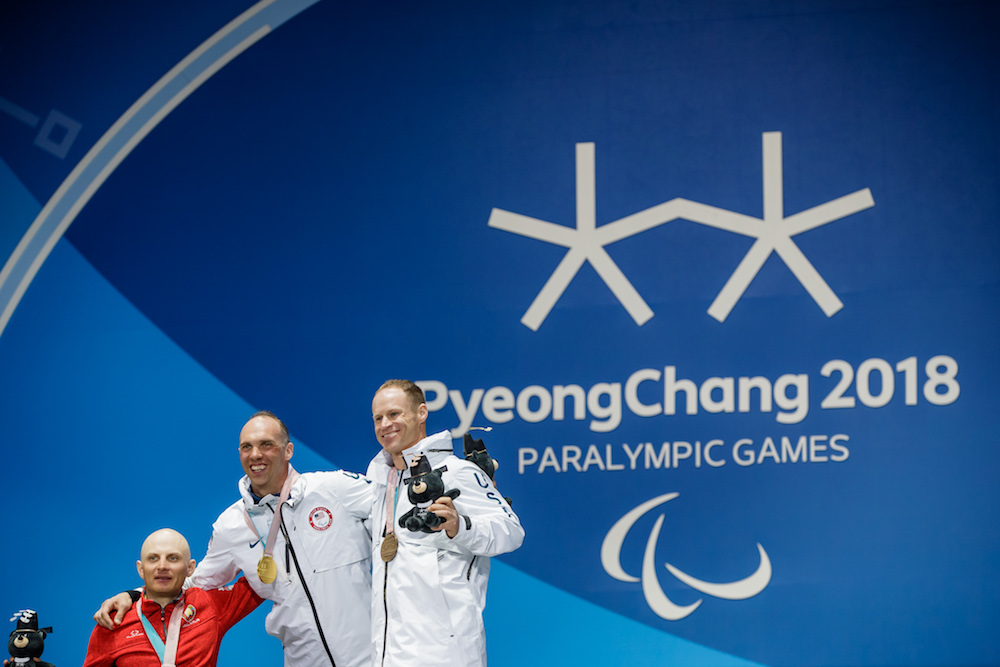
Two American flags and a Belarusian flag being hoisted to honor the medalists in the men’s sitting cross-country sprint at the 2018 Winter Paralympics in PyeongChang, South Korea. Americans Andy Soule and Dan Cnossen placed first and second, respectively, and Dzmitry Loban of Belarus finished third. (Photo: U.S. Paralympics/Joe Kusumoto)
Success to failure. Failure to success. Two trends of two extremes on the performance metrics on the international cross-country skiing spectrum. There are many in-betweens: scoring World Cup points with a top 30, top 10’s, any spot on the podium. There are the Olympic and Paralympic quads featuring a four-year buildup to North America’s singular focus on bronze, silver and gold hardware.
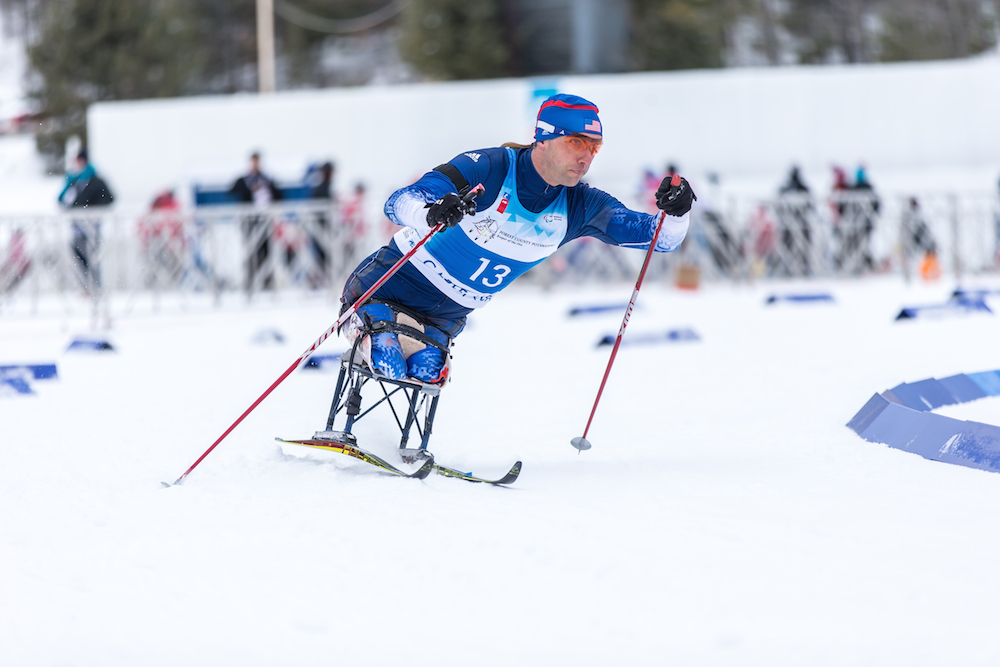
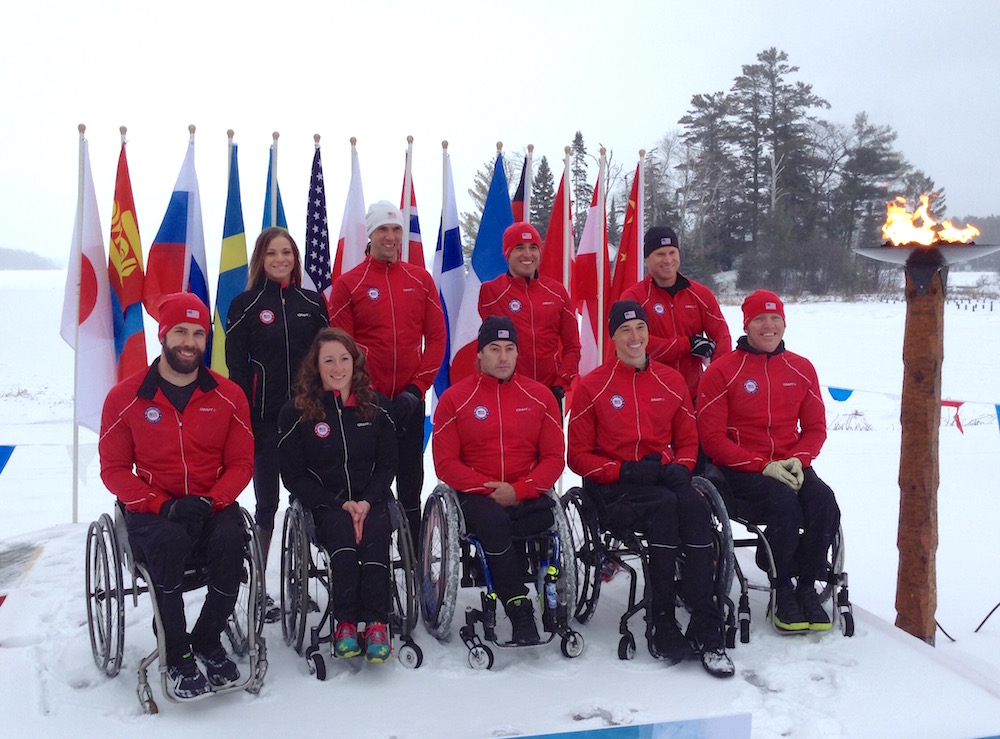
When considering how to develop talent, placing athletes on snow with the absolute best technology available, positioning athletes to medal, the U.S. Paralympics Nordic Program is an enviable high-performance model. That became evident this winter during the 2018 Paralympic Winter Games in PyeongChang, South Korea. U.S. Paralympics Nordic hauled in 16 medals in a week about a month ago.
That many medals for a single team borders on excess. Pursuing the perfection that leads to near-excess has driven the U.S. team staff and athletes for years. Back in 2006 in Torino, Italy, the U.S. Paralympics Nordic team earned three medals. In 2010, in Vancouver, British Columbia, they tallied one medal. In 2014 in Sochi, Russia, they claimed three. This year in PyeongChang: 16.
“I think we have a few factors to our success,” Eileen Carey, head coach of the U.S. Paralympics Nordic team told FasterSkier in a recent phone interview. “We’ve built the entire team — every athlete who has been engaged in the last several years and the staff that we have built are totally committed to the goal of the team. There are not a lot of egos. Everybody has a role. Everybody is really good at what they do, and everybody executes on race day.”
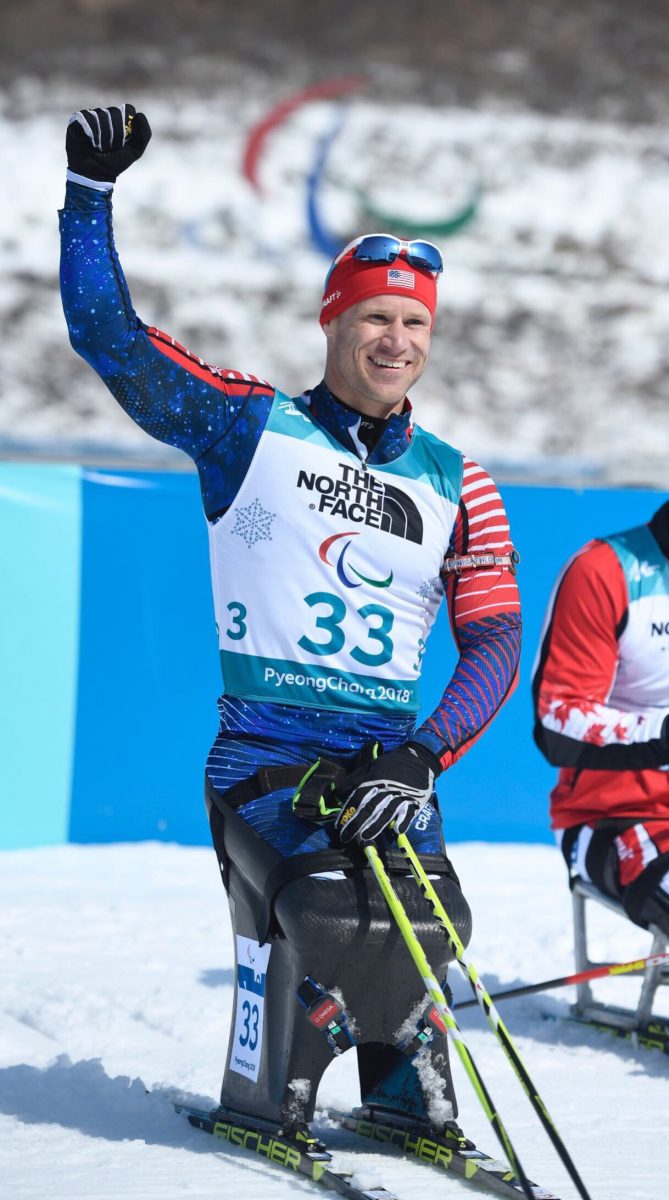
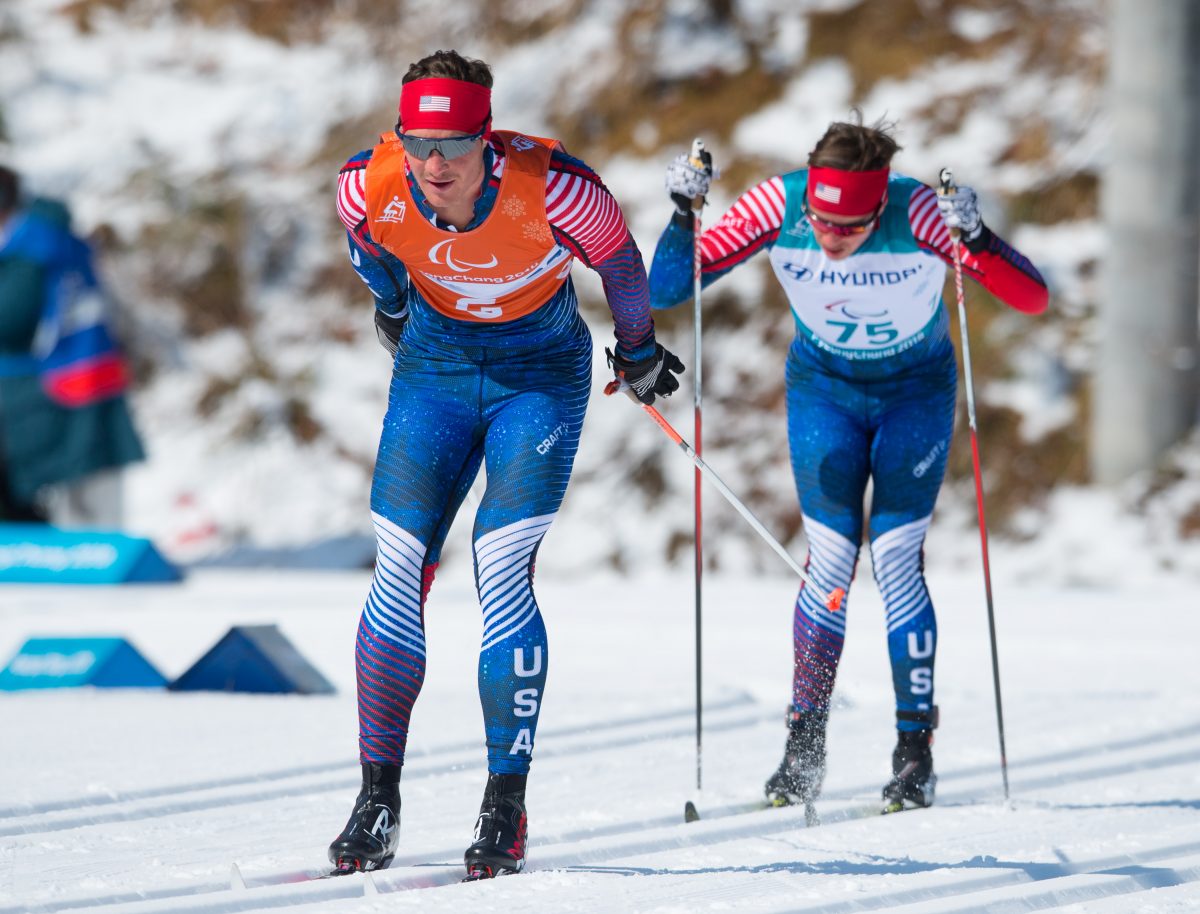
That goal and the team’s execution amounted to 11 medals total between two athletes, both sit-skiers. Thirty-seven-year-old Dan Cnossen entered six races: three cross-country, three biathlon. He medaled in each. Oksana Masters, 28, took five medals: two in biathlon, three in cross-country.
In the leadup to the Games, with buoyant media coverage of para-athletes and opportunities to brand themselves more broadly, the narrative of athletes like Masters and Cnossen were hard to miss. Masters endured a Ukrainian orphanage until she was almost 8. Cnossen is a retired Navy SEAL and a Purple Heart and Bronze Star with Valor recipient. He lost both legs above the knee after stepping on an improvised explosive device (IED) while on patrol in Afghanistan in September 2009.
Biathlon gold medalist Dan Cnossen of the U.S. celebrates his win in the men’s sitting 7.5 k biathlon sprint on opening day of competition at the 2018 Winter Paralympics on March 10 in PyeongChang, South Korea. (Photo: U.S. Paralympics/Mark Reis)
Stories like those of Masters and Cnossen should make us appreciate for a moment our most basic gifts. Their stories are inspiring. That, according to Carey, misses the point when it comes to understanding what exactly manifested in PyeongChang.
“Sure, the Olympic and the Paralympic mission is to inspire people,” Carey said. “But the narrative about Paralympians has historically been far more about inspiration being the central storyline versus Olympians where the essential storyline as about their athletic prowess. The comments that I have heard about these Games are about the athletic performances of the athletes. Whereas in Sochi, and a lot what I have heard before, is a lot about the inspiration.”
Cnossen is a graduate student at Harvard. He receives some support from the school’s cross-country coach, but trains most often north of Cambridge Square at the Craftsbury Outdoor Center in northern Vermont. There, Cnossen benefits from world-class biathlon instruction.
Carey explained that at last season’s 2017 PyeongChang test event, Cnossen performed better in the cross-country races there than in biathlon. As a world-class athlete, traveling several hours for countless four-day Craftsbury weekends and increasing his time spent training on the shooting range were some of the commitments Cnossen made, just like any other hyper-focused, hyper-driven athlete.
Carey also made clear what Craftsbury’s part was in developing Cnossen’s athleticism.
“As a sit skier, you don’t carry a rifle,” she explained. “When you are shooting, that means 100 percent of the time, someone is on the range loading pellets with bare hands when it’s cold outside and handing you your rifle. Dan would shoot three or four times a weekend when he was there, and they supported him 100 percent of that time. He won a medal in every biathlon event. That is Craftsbury’s success as much as anybody else’s.”
Masters’s own drama unfolded two weeks before the Paralympics when she slipped and fell on ice. She dislocated her elbow and chipped all three bones that meet in the elbow. After being operated on at The Steadman Clinic in Vail, Colorado, Masters remained a medal favorite in Korea.
She came to PyeongChang as an all-arounder in both biathlon and sitting cross-country. (Masters, also a multi-sport athlete, competed in rowing at the 2012 London Paralympics — where she earned a bronze medal — and cycling at the 2016 Rio Games.)
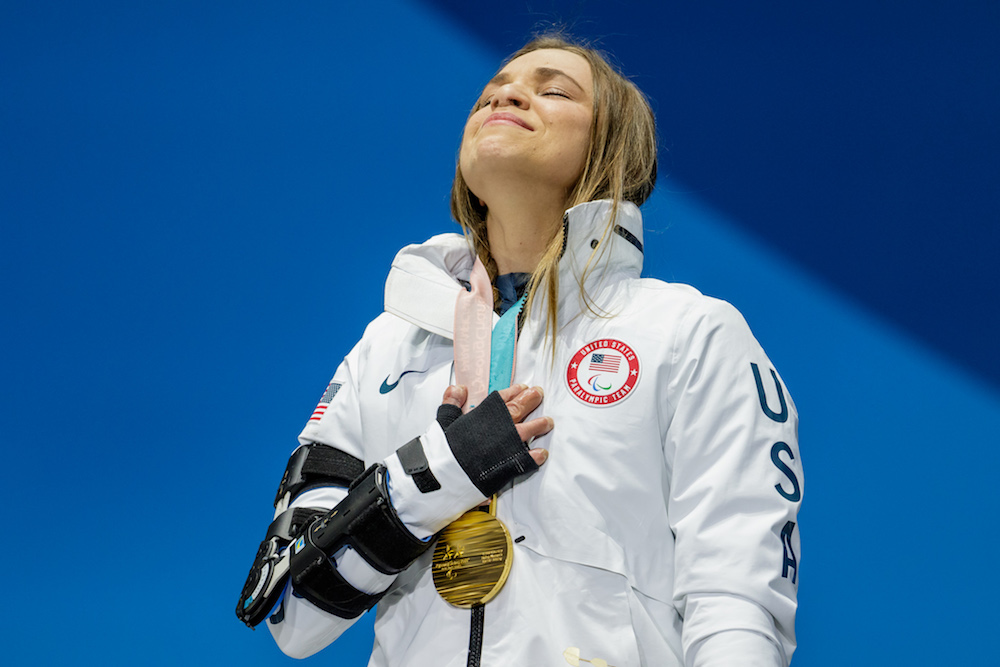
Oksana Masters (U.S. Paralympics Nordic) after winning her first-career Paralympic gold medal in the women’s sitting cross-country sprint at the 2018 Winter Paralympics in PyeongChang, South Korea. (Photo: U.S. Paralympics/Joe Kusumoto)
In her first race in PyeongChang last month, Masters took silver in the biathlon sprint (behind her U.S. teammate Kendall Gretsch in first). Those medals, Gretsch’s first and Masters’s first in biathlon, set the stage for more gritty performances and Masters’s five-medal PyeongChang bounty. Inspiring? Yes. But more to the point, both were athletically dominant.
Masters’s dominance came with a very human off-race. On March 13, during the women’s sitting 10 k biathlon race, Masters fell in her sit ski onto her ailing arm and missed a total of six shots for six penalty laps. While she skied the extra laps, another U.S. coach encouraged Masters to pull herself out of the race. The team’s staff was concerned about her elbow and wanted to ensure her health for her three remaining races.
“I sprinted down the course and just stood in front of her in the middle of the course and pulled her off,” Carey said of how she ultimately persuaded Masters to not finish. “Oksana thought she was done midway through the Games. We X-rayed her again and came up with a plan and taped her elbow in a way that would provide more protection.”
At the 2010 Vancouver Paralympics, Andy Soule earned bronze in biathlon. His medal was the first Paralympic medal in the discipline for the U.S. team. Eight years later in PyeongChang, Soule, a 38-year-old Army veteran, who, like Cnossen, lost both his legs in Afghanistan, delivered the Paralympics equivalent to the “here comes Diggins” moment.
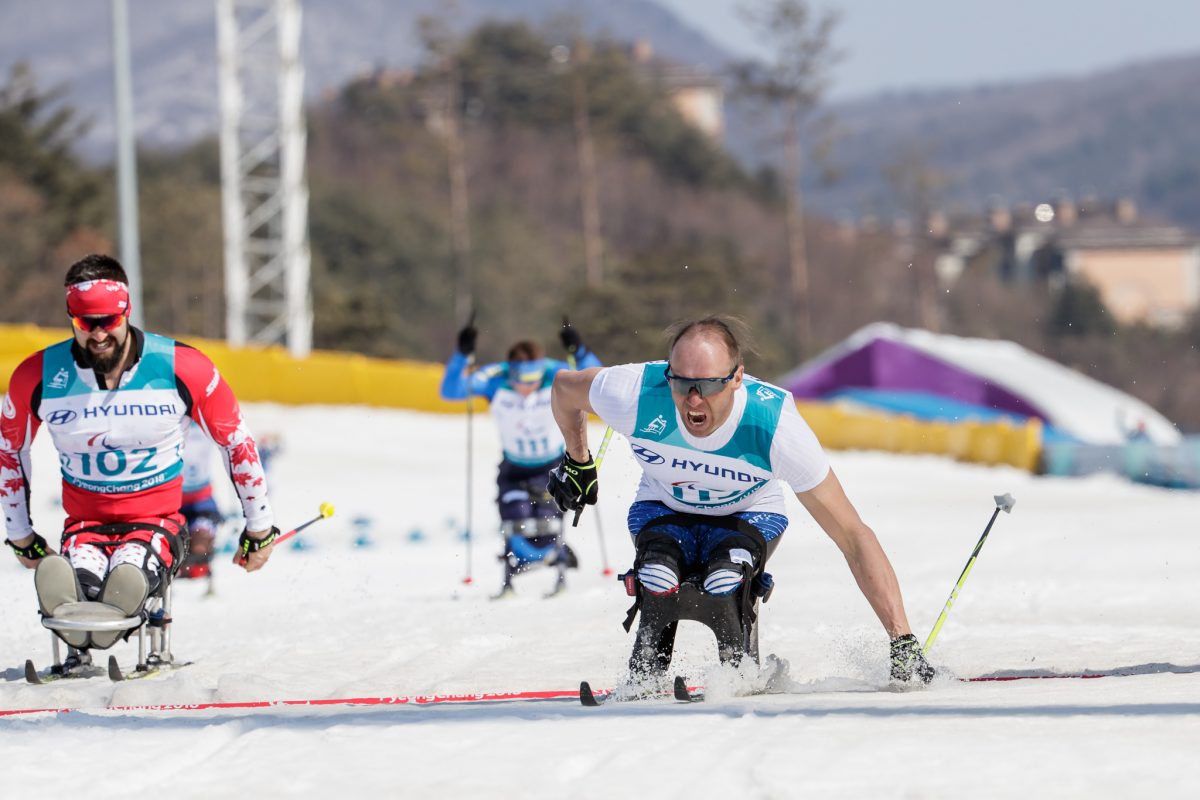
During the men’s sitting cross-country sprint final, Soule came into the last hill in sixth place. He then glided into fourth on final downhill before the last intensive double-poling push to the finish.
With lickety-split skis to match his upper body’s Thor-like power, Soule willed himself into medal contention. From literally out of the camera’s view and into front and center on the final stretch, Soule threw down and accelerated. Bronze, then silver, and at the line, gold came into play. The PyeongChang sprint win was Soule’s first-career Paralympic gold in three Paralympics — he also claimed bronze in the PyeongChang 12.5 k biathlon race. (Soule promptly retired from elite-level competition afterward.)
“Andy has spent a lot of time over the last four years doing a whole lot of stuff, like learning how to move fast on flats, which was something that we had identified from Sochi as being the weak link,” Carey said. “There was something otherworldly about those last 100 meters that was just incredibly cool to watch.”
Cnossen, Masters, and Soule symbolize the U.S. Paralympics Nordic team’s rise. Yet, Carey, along with the team’s high-performance director, John Farra, have been able to build a program that has positioned itself for future medals. Gretsch, 26, may be part of that future. She came to nordic skiing as a world-class para-triathlete and represents what Farra calls “talent transfer”.
“We are super proud with how our sit-ski program has evolved,” Farra said on the phone. “We are super proud that we can take athletes in a talent-transfer situation like Kendall and help her come from being a world champion in triathlon and have her transfer and learn the skills in a short period of time to now being one of the best in the world.”
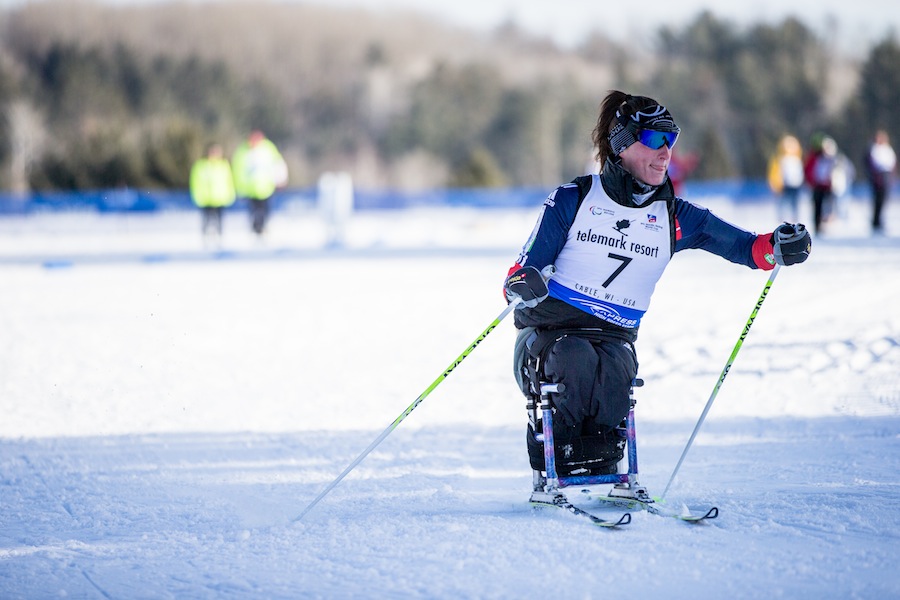
In PyeongChang, Gretsch captured two golds in the first two races. She won the sitting biathlon sprint and the 12 k sitting cross-country events.
Winter Paralympic rookie Kendall Gretsch racing at the 2018 Paralympics in PyeongChang, South Korea. (Photo: U.S. Paralympics/Joe Kusumoto)
Farra explained that their medal was the first for the U.S. in a visually impaired race at the “modern” Paralympics. The VI classes were historically split between B1, B2 and B3 classes. (B1 athletes have the least amount of vision.) The different classifications are used as a descriptor of each athlete’s degree of blindness. Formerly, each classification of athlete competed against the same classification athletes. For example, in the past, only B1’s competed against B1’s. Today, that format is defunct, and all classifications currently compete against one another. An athlete’s finishing time is adjusted based on their severity of blindness.
As Farra explained, in the “modern” VI medals are harder to come by.
Adicoff, a student at Bowdoin College and a member of the Sun Valley Ski Education Foundation (SVSEF), was competing at his second Paralympics. Kesselheim was a Paralympic rookie.
“They are a team,” Carey said of the Adicoff-Kesselheim pairing. “Visually impaired athletes and guides function much more, in my view, like a cycling team as opposed to a traditional ski racer. … The medal was won by both Jake and Sawyer. In that race, they worked together more effectively than I had ever seen them work together. They were more in sync; they were skiing closer to each other. There is a lot of challenges in guiding when it comes to the communication, and Sawyer is a great communicator. He is an amazing skier and athlete, but he is a great communicator and he has no ego. He was totally bought into being on that team.”
Guide Sawyer Kesselheim leads his U.S. teammate Jake Adicoff during the open relay on March 18 at the 2018 Winter Paralympics in PyeongChang, South Korea. (Photo: U.S. Paralympics/Mark Reis)
The first day of the next Paralympic quad began on March 19, the day after the PyeongChang Paralympic Closing Ceremony. Yet Casey and Farra kept an eye on 2022 by nurturing and investing in more Paralympic rookies by exposing them to their respective sport’s highest level of competition. Grace Miller (standing , Alaska Nordic Racing), Ruslan Reiter (standing, Outdoor Sports Institute), Joy Rondeau (sitting, National Sports Center for the Disabled), and Mia Zutter (visually impaired, CXC/St. Scholastica) participated in their first, yet most likely not their last, Winter Paralympics.
“Having a larger community of people that consider themselves para-nordic skiers is motivating,” Farra said.
In the recent past, Farra explained that identifying and developing standing athletes has been a priority. The U.S. has already been a leader in supporting sitting athletes and providing them with top-end, sit-ski technology.
“We have just scratched the surface of finding a couple of standing and a couple of VI athletes,” Farra continued. “That’s got us pretty excited about the connections they have to their local clubs and colleges, too. We were motivated to bring them to these Games so they could get a taste of what is out there and hopefully, they left absolutely motivated to live a professional athlete lifestyle and train hard with their clubs and their home college programs.”
— Alex Kochon contributed
The 2018 PyeongChang Paralympics men’s sitting cross-country sprint podium at the medal ceremony, with Americans Andy Soule (c) and Dan Cnossen (r) in first and second, respectively, and Dzmitry Loban of Belarus in third. (Photo: U.S. Paralympics/Joe Kusumoto)Kendall Gretsch (r) and Oksana Masters at the 2018 Paralympics medal ceremony for the women’s sitting 6 k biathlon sprint after winning gold and silver, respectively, on the first day of competition in PyeongChang, South Korea. (Photo: U.S. Paralympics/Joe Kusumoto)
The stadium at Mount Van Hoevenberg as seen on April 1, no joke, thanks to the TechnoAlpin Snow Factory. (All photos: Peter Minde)
When it came to investing in snowmaking, New York State’s Olympic Regional Development Authority (ORDA) went with the go-big mentality, leasing a TechnoAlpin Snow Factory for the Mount Van Hoevenberg nordic center and using the technology throughout the 2016/2017 winter season.
Following the previous 2015/2016 season, in which Mt. Van Hoevenberg, “Van Ho” for short, was open 37 days, according to ORDA’s annual report, the authority acquired and installed a self-contained snowmaking system at Van Ho, the 1980 Winter Olympic venue in Lake Placid, N.Y.
The Snow Factory at its current home at the Mount Van Hoevenberg nordic center in Lake Placid, N.Y. (Photo: Peter Minde)
The Snow Factory was put in place, just behind the cross-country lodge, just before Thanksgiving.
This machine isn’t your grandfather’s snowmaking setup, where snow guns are positioned strategically along trails. Mounted on a flatbed trailer, a 40-foot ocean shipping container holds compressors and ice-making equipment. A blower sends crystals through a segmented orange hose up to 600 feet in length.
The Snow Factory hasn’t budged from its original position near a parking lot, yet the snow it has produced has been spread throughout the stadium and on trails up to 1.5 k away from its starting point.
According to Robin Smith, TechnoAlpin’s Colorado-based business manager, the Snow Factory has been in production for the last four years, but its technology isn’t brand new. IDE, an Israeli company that specializes in water desalination, developed a warm-weather snowmaking unit with different technology than the Snow Factory uses.
Smith explained that the Snow Factory at Van Ho is the only one in the U.S. and one of only 19 in the world. The best part? The Snow Factory will make snow in temperatures up to 80 degrees Fahrenheit.
Blowing snow into the stadium, made by the Snow Factory, at Mt. Van Hoevenberg in late December. (Photo: Peter Minde)
Both Whiteface and Gore mountains, two of the alpine ski resorts that ORDA manages, use TechnoAlpin snow guns.
“Probably a year ago, we began a conversation with the success they [TechnoAlpin] were having in northern California with the machine that we ended up leasing,” explained Kris Cheney Seymour, Mt. Van Hoevenberg’s manager. “ORDA has its full attention and interest in the future of nordic sports at Mount Van Hoevenberg.”
When Seymour first spoke with FasterSkier on the phone in late January, the nordic center was dealing with changeable weather.
“Lake Placid has had a fairly light snow year and a fair amount of very heavy rain,” Seymour explained. “Traditionally, the stadium gets blasted in poor weather. This winter, we would have had a similar winter to what we had last year: no snow, ice conditions in the stadium. We’ve pretty much been open all but one day since Thanksgiving. The reason is the Snow Factory.”
Without the Snow Factory, Van Ho wouldn’t have been able to host St. Lawrence University’s Winter Carnival, Junior National qualifier races and other events, he said.
ORDA acquired the Snow Factory from TechnoAlpin after an alpine resort in California used it for a year. Arriving by truck the day before Thanksgiving, it took five days to haul from California at a cost of $7,000 dollars. According to ORDA’s Communication Director Jon Lundin, ORDA is leasing the Snow Factory for one year for $90,000 dollars.
In an email, Lundin explained that if ORDA decides to purchase the Snow Factory, it will pay a total of $500,000 dollars: $410,000 plus the amount already paid this season.
“We’ll make the decision later this spring as to whether or not we purchase the Snow Factory,” he wrote. “We’ll look at how it performed and how the cross-country venue benefited from its use.”
The Snow Factory in place at the Mt. Van Hoevenberg nordic center in Lake Placid, N.Y. (Photo: Peter Minde)
So how does this thing work?
Inside the shipping container are three icemakers, refrigeration equipment, a cooling tower, and a blowing system. The blowers move snow through a segmented orange hose. One can add segments to blow snow up to 600 feet away from the Factory.
“Other [traditional] snowmaking systems require a temperature and humidity component,” Reese Brown, executive director of the Cross Country Ski Areas Association, said on the phone. “Generally, 22 to 27 degrees and below is good snowmaking weather. The Snow Factory doesn’t require any conditions to make snow, because snow is generated inside the container and then spit out the hose. With the others, snow is made when it hits air temperature.”
“Snow is created within the shipping container,” Seymour said. “You can effectively make snow with 100-percent efficiency up to 60 degrees Fahrenheit. You’ll have diminished productivity, but you can make snow up to 80 degrees.”
Running on electricity, the Snow Factory draws from the ski lodge’s well, using 11 gallons of water a minute. The icemakers can be optimized for various climates. Seymour pointed out that northern California has a much drier climate than Lake Placid.
Dumping snow onto the trails at Mount Van Hoevenberg this winter. (Photo: Mt. Van Hoevenberg/Facebook)
Leading up to U.S. Junior Nationals, held in Lake Placid from March 3-11, FasterSkier asked Seymour about the Factory’s capability to cover a 5-kilometer loop if the ground was bare. With snow already on the ground, Seymour reframed the question.
“It works differently than a traditional snow system, and you need to use it and plan for it in a different way,” he said. “The Snow Factory makes a known quantity of snow: two tons per hour. Depending on what our needs are for snow coverage and where we want to go with it, we need to work backwards and give ourselves enough time to blow that amount of snow.”
While the Factory is mounted on a trailer, the trailer hasn’t moved from its home behind the lodge. The primary locations for its manmade snow have been the stadium, the Innerloopen 3.3 k homologated ski loop, and the beginner trails close to the lodge.
Days before Junior Nationals, ORDA decided to move the weeklong event to the 2.5 k loop at the Olympic Jumping Complex, also known as the MacKenzie Intervale Ski Jumping Complex, closer to downtown Lake Placid.
“Six weeks out, we were aware that the long-term forecast had two almost weeklong periods that we were going to have very warm weather,” Seymour said in a follow-up interview after Junior Nationals (JNs).
Leading up to the championships, the Factory had been cranking almost around the clock. Seymour estimated that once a week, ORDA would shut it down for maintenance. Otherwise, it ran 24/7.
A large pile of snow produced by the Snow Factory this winter at Mt. Van Hoevenberg in Lake Placid, N.Y. (Photo: Bob Maswick)
The stadium was covered a mix of natural and manmade crystals, 2 1/2 feet deep. The next focus was the sprint loop and the 3.3 k loop.
“We were moving snow 10 to 14 hours a day,” Seymour said. A PistenBully hauled snow in a 16-foot dump trailer to where they needed it. ORDA bought the trailer specifically for Van Ho.
Two weeks before JNs, groomers had buffed the 3.3 k loop to a 28-inch average depth with a mix of natural and manmade snow. Then, “We had really warm weather,” Seymour said. A warm three-day period with high winds and heavy rains reduced the base depth to 12-18 inches.
Then, starting Feb. 24, another three-day thaw cost precious base depth. A week before the championships, the race courses were down to an average depth of 4 to 8 inches.
The death blow came one night later. Driving rain and 50 mile per hour winds wiped out weeks of intense work. Wednesday morning, they inspected the courses. Not only was snow melting, but water was “flowing all over the place,” Seymour said. “We had large portions of the race trail that were totally washed out. There were sections of the trail that were lovely and totally groomable. But we also had a 100-meter section of the trail that was totally gone, like, 100 percent gone from pouring water.”
That morning, Van Ho still had snow stockpiled in the stadium out near the 3.3 k loop. But the forecast for Sunday through Wednesday of championship week called for temperatures in the mid 40s.
The forecast was accurate.
“We could have rebuilt the course so that it had four to six inches of snow everywhere,” Seymour said. “We knew that Mount Van Hoevenberg couldn’t survive a third major thaw in a four-week period.
“We had a course that was mostly built at the jumps,” he explained.
The U18 boys’ classic sprint podium at U.S. Junior Nationals, held at the Olympic Jumping Complex in Lake Placid, N.Y., with Gus Schumacher (c) of Alaska Winter Stars in first, Scott Schulz (l) of the New York Ski Educational Foundation in second, and Adam Glueck (r) of Ford Sayre in third. (Photo: XCJuniorNationals2017.com)
Blowing snow on site for 30 hours and working around the clock, ORDA employees also moved all the snow from the in-run of the ski jumps and the in-run and landing areas of the freestyle training area, which had a depth of eight feet. With that and the snow made on site, the Intervale loop was covered to an average depth of 2 1/2 feet for a successful Junior Nationals.
As a result of the venue change, there was only one adjustment to the schedule. Coaches, jurors and organizers agreed to switch the classic mass start to an individual start because of a narrow spot for two-way traffic midway through the loop.
While the Snow Factory ultimately didn’t play a part in JNs, it continued to blow snow at Van Ho, which remained open while the races happened took place at the jumps. Teams arrived early and trained on the trails, some choosing to cool down or train on off days at Van Ho.
“That was 100-percent Snow Factory,” Seymour said.
Besides the Factory, there have been other significant improvements to Van Ho. According to Allan Serrano, the FIS technical delegate who worked with ORDA to homologate Van Ho’s race trails, the stadium exit, along with much of the Interloopen portion of the Ladies’ 5 k loop, was widened.
“Most importantly they have been able to do rehabilitation work on the Ladies 5k, leveling and improving the water management so that it skis and grooms much better,” Serrano wrote. “They are able to have a high quality ski surface with lower snow.”
He added that Van Ho’s grooming capacity has also improved since its courses were certified in 2012.
“At that time the venue did not have a dedicated snowcat with track setters and now they have a machine with double track setters,” he wrote.
As race season winds down, what’s next? With the ability to make snow in warm temperatures, Seymour was intrigued by the opportunity to provide skiing on short loops in the offseason. He’s got the attention of John Farra, the high-performance director for U.S. Paralympics Nordic Skiing.
“We have found that it is most valuable for sit skiers especially to have access to snow in the ‘off season,’ ” Farra wrote in an email. “The nature of maneuvering a nordic sit ski on turns, downhills and out of the track is not something that can be duplicated on roller skis, so we have found [snow] much more valuable for sit skiers in advancing their technical skills. We are very interested in the Snow Factory project that ORDA has invested in and have been in touch with Kris about the possibility of getting our National Team to Lake Placid to take advantage of their new Snow Factory snow in this coming Games season.”
“Part of skiing currently is having a viable snowmaking option,” Seymour said. “The Snow Factory will guarantee the ability to open the venue when we want to and hold races as they’re scheduled; we can be counted on as a world-class venue. It’s a game changer.”
Canadian para athlete Yves Bourque, of Quebec, a veteran of the 2014 Sochi Paralympics, skiing in Craftsbury, Vt., at 2016 U.S. Paralympics Sit Ski Nationals and IPC Continental Cup from Jan. 6-9. (Photo: John Lazenby/Lazenbyphoto.com)
The first week of January was a busy one. In random corners of the world, some of the top-ranked nordic skiers competed for various titles: at the Tour de Ski in Switzerland, Germany and Italy, at U.S. Cross Country Championships in Houghton, Mich., and at the U.S. Paralympics Sit Ski Nationals and International Paralympic Committee (IPC) Continental Cup in Craftsbury, Vt.
In Craftsbury, about 30 miles south of the Canadian border in northern Vermont, five races were held in a span of four days, Jan. 6-9, after anticipated rain prompted organizers to move up the last two races to the scheduled off day.
“Busy for sure, but the OC [organizing committee] did an amazing job and the athletes got a big bang for their time and investment in being there,” U.S. Paralympics Nordic High Performance Director John Farra wrote in an email.
Oksana Masters (U.S. Paralympics Nordic A-team) during a snowy day in Craftsbury, Vt., at the U.S. Paralympics Sit Ski Nationals and IPC Continental Cup from Jan. 6-9. (Photo: John Lazenby/Lazenbyphoto.com)
The Craftsbury Outdoor Center hosted 25 participants in three cross-country races followed by two biathlon races. U.S. Paralympics A-team members Andy Soule and Oksana Masters won the opening men’s 7.5-kilometer and women’s 5 k mid-distance sit ski races, respectively, and Masters went on to sweep the remaining races of nationals.
Soule won four out of the five, placing second to longtime teammate Sean Halsted in the men’s 2.5 k short-distance sit ski on the second day of racing.
That day entailed back-to-back races: the short-distance in the morning and a full sprint — complete with a qualifier and heats —following in the afternoon.
“It was a busy day, but from a development perspective it was a great model,” Farra wrote.
Interestingly, the 850-meter sprint was scored as a “mixed” event, ranking both genders on a single results sheet. Masters topped the coed field, winning with an adjusted time 11 seconds faster than Soule. Halsted was the second male and third overall.
“This year for the first time we were able to take advantage of a new rule by IPC that allows us to combine men’s and women’s fields for the purposes of establishing a points base when the numbers of points-holding athletes in a single field would otherwise be too small,” Eileen Carey, head coach of U.S. Paralympics Nordic explained in an email.
“There is a precedent for this in IPC in the relay, where women get an additional 18% off their compensation to equalize the field and combine everyone in one event. As an example when Oksana is racing against women’s only fields, she has a 100% compensation, so her calculated result is the same as her real time,” Carey continued. “In this event, her calculated result was 82% of her real time. This made for a much more exciting event and a better competition for athletes. For our World Cup regulars and new skiers alike, it meant more practice going into technical sections in groups and having to ski more tactical races to qualify for finals.”
Looking at the overall field, Farra and Carey noted they were impressed by some “brand new” athletes.
“This was the first major competition for a majority of the field,” Carey explained. “As a group, they arrived impressively fit for skiing and improved throughout the week. It is exciting for us to have a bigger community of adaptive athletes in the same place each year.”
U.S. para skiers (left to right) Brittany Fisher, Oksana Masters, and Joy Rondeau at 2016 U.S. Paralympics Sit Ski Nationals and IPC Continental Cup. (Photo: John Lazenby/Lazenbyphoto.com)
In her first IPC Continental Cup and sit-ski nationals, Joy Rondeau, who trains with the National Center for the Disabled in Winter Park, Colo., placed second to Masters in all three cross-country events and the 6.5 k biathlon race.
“We had participation in all 3 classes and both genders… which was really cool for us,” Farra wrote. “Great to have some new talent in standing and visual impaired classes especially.”
“The development group as a whole came to the event more fit and more skilled than in the past so we think that means good things for the future of the sport,” Carey added.
This season, sit skiers Halstead and Bryan Price are on the development team. Halstead reached the podium in all five races, Price landed on it three times, and B-team member Aaron Pike tallied two podiums in Craftsbury.
Andy Soule (U.S. Paralympics A-team) at 2016 U.S. Paralympics Sit Ski Nationals and IPC Continental Cup. (Photo: John Lazenby/Lazenbyphoto.com)
“I was impressed with the group as a whole and am excited to see what is to come,” Carey wrote. “Our National Team athletes are skiing well and are on track for a good winter.”
As for the conditions in Craftsbury, Carey described them as “great.”
“The crew there is incredible with what they can do with small amounts of snow,” she wrote. “They worked hard making and moving snow and (once again!) made excellent courses for our skiers. I have learned to never underestimate what they are capable of, and they did not disappoint. We are lucky to have such a dedicated organizer in Nordic sport and the fact that they pulled out all the stops for our field of 25 athletes was amazing. They put together World Cup quality competitions.”
The national team is headed to Pyeongchang, South Korea, for the IPC Asian Cup Jan. 28-Feb. 1 and a chance to preview the 2018 Paralympics venue.
“We will get eyes on Pyeong Chang for the first time this winter so we will learn specifics from that trip that we will apply to our training,” Carey wrote.
Andy Soule and his hardware from 2015 IPC World Championships: five medals with three silvers and two bronze. (Photo: James Netz)
Andy Soule took one look at the skate course at the International Paralympic Committee (IPC) World Championships — with technical downhills and a massive uphill — and thought, I could do that. The 35-year-old Army veteran previewed it the day before the final race in Cable, Wis., and found it to be “fairly difficult by our standards,” he said in a phone interview last week.
Difficult in the sense that he’s a sit skier who relies entirely on his upper body and core strength, double poling everything from flats to steep hills. The course was designed for standing athletes — with two freestyle legs in the mixed relay, but the U.S. only had one man that could skate.
“We wanted to enter a relay at World Champs, but we only had one standing athlete available to us, Omar Bermejo, who had been battling sickness during these events so running him twice on a super cold day did not seem like the best idea,” U.S. Paralympics High Performance Director John Farra explained in an email. “So we floated it by Andy and he did not hesitate to say yes! … This is the first time a sitting athlete has done the standing course in the relay, so that was fun as countries came up to me to be sure we had not made a mistake.”
It wasn’t against the rules, as Soule pointed out: “There is no rule that says you have to have a sit skier or a stand skier on either one; factors are just supposed to take care of those.” So as the second leg of the U.S. mixed relay on Feb. 1, he headed out after teammate Oksana Masters tagged him in fourth of seven teams.
Farra’s Take on the “Sit-Ski Heavy” U.S. Team:
“It’s a good thing… we have been able to attract sitting athletes from other sports and they are having success, which is getting attention from other sitting athletes,” U.S. Paralympics High Performance Director and Coach John Farra wrote in an email. “We have proven that we can be a good sport for summer sport athletes looking for cross training and a new challenge and tough competition.”On the other side we are very much interested in increasing the [numbers] of standing and visually impaired athletes who can develop into strong international racers. Those who are finding success are finding it best to join up with a USSA Club program so they can be training & racing with other standing (able bodied) skiers as much as possible.”
“Our team is very sit-ski heavy right now, and while we didn’t really go into the relay with an expectation of a high place or anything, they decided to go ahead and field me on the standup course,” Soule said from his home in Pearland, Texas. “I told my coaches I believed it was entirely doable … it’s probably not any sort of a competitive advantage for sure, but it was an interesting experience, and it went pretty well.”
Soule came through the exchange in seventh, just seven seconds behind Germany’s Tino Uhlig, a standing skier who uses one pole, in sixth. With sit-skier Tatyana McFadden and Bermejo, a single-arm amputee, racing the third and fourth legs, respectively, the Americans placed seventh, 45.4 seconds out of sixth.
From the outset, the mixed relay was the team’s weakest event of the week, one in which they did not field a team at last World Championships. However, more symbolically, it capped their historic showing in Cable, where Soule racked up five medals — unprecedented for a U.S. cross-country skier at World Championships — and competed in all seven events, including the relay.
He was glad he did it.
“It have me a really good gauge of where we are in terms of what relative speeds look like for sit skiers versus standup athletes,” Soule said. “On the largest climb of that race, I was passed by one of the best standup skiers in the world in our sport, Nils-Erik Ulset, of Norway. I think it was an interesting event for a lot of people to see exactly what is possible for a sit skier, too.”
Andy Soule navigates a turn during one of his six individual races at 2015 IPC World Championships in late January in Cable, Wis. Soule medaled in five of those events. (Photo: James Netz)
And he held his own on the descents. “I definitely didn’t lose any time on downhills,” Soule added.
“Andy left Cable as a bit of a Legend,” Farra wrote. “5 medals and climbing & descending Telemark Hill successfully!”
In his eighth year on the U.S. Paralympics Nordic team, it was not only Soule’s most successful World Championships, it was perhaps the highlight of his career after winning bronze in biathlon at the 2010 Paralympics.
“This is a pretty high highlight,” Soule said. “After the second podium, I just started feeling like that wasn’t a fluke. This isn’t just a one-time thing, I’m really up here with the top of the field. I can compete with these guys. I can come out and compete on a level with the top guys every day. It was a confidence builder as well when you have that feeling.”
“After the second podium, I just started feeling like that wasn’t a fluke … I can come out and compete on a level with the top guys every day.” — Andy Soule, who earned three silver medals and two bronze at the 2015 IPC World Championships in Cable, Wis., unprecedented for an American
That feeling translated into three silver medals in two of three biathlon events and the cross-country 10-kilometer race at the 2015 championships, and two bronze in the cross-country 15 k and 1 k sprint (where Soule charged up from fourth with 40 meters to go to take third). On Monday, the IPC named Soule its January athlete of the month across all sports.
Prior to this season, he had a Paralympic bronze from 2010 and placed fourth twice during last winter’s 2014 Paralympics in Sochi, Russia.
“I wanted to break through that last little barrier for sure,” Soule said of his tendency toward wooden medals. “Between being almost on the podium and being a solid, consistent at least podium-potential finisher … that’s kind of been the source of all the little tweaks and changes we’ve been working with over the past year.”
2015 U.S. Paralympics Nordic World Championships Team in Cable, Wis. (Photo: U.S. Paralympics Nordic)
Asked specifically about those changes, U.S. High Performance coach Eileen Carey explained, “To talk about what any one individual athlete has done to improve is to talk about the whole team,” she wrote in an email.
Everyone on the team is analytical and thoughtful when it comes to what they need to work on and how to achieve those changes, she added. “They have created a really cool team environment focused on improving as individuals and as a team.”
For Soule, it was about relaxing his technique at race pace.
“He has always skied well at level 2, but speed had previously introduced a lot of wasted, inefficient movements into his technique, especially on flat terrain,” Carey wrote. “His ski speed and relaxed technique have always been there, it was just a matter if translating them to a race pace.”
In September, they started with rollerski sessions on the treadmill with live video so Soule could see the changes he was making as he tried them out.
“Once we had the cues we knew worked for him, we brought it to snow this fall,” Carey explained. “It has been an evolution and I am sure it will continue to evolve. We did a lot of video analysis during and after the first World Cup in Finland in December and spent the pre-World Champs camp honing in on some of the patterns we saw from that. He and his teammates have driven the process and we have worked to find the process and communication style that works best with each athlete.”
Andy Soule working on technique during a treadmill session on Sept. 16 at the Olympic Training Center in Lake Placid, N.Y.
As a result, Soule came out of the World Cup opener in Vuokatti, Finland, with two fourth-place finishes in the cross-country 10 k and biathlon sprint. While they weren’t podiums, he could feel a difference.
“What I used to be doing was concentrated more on high tempo,” he said. “My emphasis on training recently has been to focus on flat sections of the course, what standup, able-bodied skiers would be considering a V2-technique section, lengthening out the pole stroke.”
He continued to work on his technique at U.S. nationals in early January and at the team’s pre-World Championships training camp after that. He also switched to shorter poles this season.
“I think everything just builds off what you’ve been working on in the past,” he explained. “You keep watching video of yourself, keep looking at races and identify what did work and then what little things we can maybe experiment with to get a little more speed.”
Soule approached the biggest races of the season in Cable hoping to see improvement first, then results.
“I wasn’t really worried going in what specific places I was aiming for — you can never really control that because you can never control how good everyone else is going to be,” he said. “But I wanted to see a personal improvement in what I would be able to accomplish as compared to how I’ve been performing in the past year.”
As for which medals meant the most to him, he said his bronze in the cross-country 15 k was something he’d remember.
Andy Soule’s stack of medals from 2015 IPC World Championships in Cable, Wis., where he earned three silver and two bronze between two biathlon and three cross-country races. (Photo: U.S. Paralympics Nordic)
“It meant a lot to get the medals in the cross-country races just because that long-distance race, the first cross-country race of the week, was actually my first-ever podium in a cross-country race,” he said. “And it also boosts my confidence going into a biathlon event. It used to be, in order to have a shot at the podium in biathlon, I had to outshoot the top competitors. They had to miss shots in order for me to have a shot at the podium. Now I have that confidence that I can ski right with them. If neither of us misses anything, between me and the top competitors, I’m still in it.”
Now third overall in the IPC World Cup standings with two major stops remaining (this weekend in Asahikawa, Japan and at World Cup Finals from March 16-22 in Surnadal, Norway), Soule said he mostly wanted to put together a “solid string of really great performances” for the rest of the season. Beyond that, he has his sights set on the 2018 Paralympics in Pyeongchang, South Korea.
“I’m right at that age and I’m right at the point in my career where I’m in the prime of real top-performance potential,” he said. “I feel really great about what I have going forward and that I’ll be able to build on it and still improve on it.”
In most every interview in Cable, Soule tossed around the word: “team.” He reiterated that he couldn’t have done it without his teammates and turned the focus toward their many successes at this year’s World Championships as well, including five Americans making the sit-ski sprint finals (three men and two women), and Masters tallying silver and bronze in the cross-country 5 k and cross-country sprint, respectively.
“It just feels really good to have great teammates,” Soule said. “You’re always cheering for each other and everyone wants to see everyone else succeed, so it makes practice more fun when we’re all there and it makes racing more exciting. A good team component is really important to what we have going right now.”
“Lots of good things were going in Cable beyond the medals,” Farra added.
Masters currently ranks first in the World Cup in cross-country. Stay tuned for her interview.
Volunteers get ready to test snowmaking equipment at Telemark trails in mid-September in Cable, Wis. The IPC Nordic Skiing World Championships will be held there Jan. 22-Feb. 1, 2015. (Photo: CXC Skiing/Facebook)
Northern Wisconsin, home of the Lumberjack World Championships and largest ski marathon in North America (a.k.a. the Birkie), is about to play host to the International Paralympic Committee (IPC) Nordic Skiing World Championships in January 2015.
For the first time in 10 years, IPC World Championships is returning to the U.S. since its last visit in 2005 in Fort Kent, Maine. And it’s coming to Cable, a town with fewer than 900 residents but with a history steeped in skiing since before 1947, when Tony Wise founded Telemark Resort.
The championships are expected to attract 150 of the world’s most competitive para-nordic athletes from 20 nations slightly less than a year after the Winter Paralympics in Sochi, Russia.
Central Cross Country (CXC) is heading up the organizing efforts, working with Telemark’s owners to revamp the trails used for the 2012 and 2013 IPC World Cups — two events that drew international attention to Cable.
“One of the coaches, I can’t remember what country, said we should host world championships because both those world cups were organized so well,” Yuriy Gusev, CXC’s executive director and the Cable 2015 organizing committee chairman, recalled in a phone interview.
Cable’s World Cup organizers first entertained the idea of hosting World Championships in 2012, then, after their second World Cup in 2013, they submitted an official bid that year.
When it comes to arranging an event of this caliber — with eight days of races between the opening ceremony on Jan. 22 and closing ceremony Feb. 1 — Gusev said it’ll be completely different from putting on a SuperTour or national championships.
For instance, in many domestic ski races, fewer than 100 athletes typically participate. While there will be slightly more at IPC World Championships, the level of competition will be significantly higher than even a World Cup, which often attracts development skiers. And teams that don’t usually fly across the pond for non-World Championships events, like Hungary and South Korea, will be in Wisconsin as well.
With more top-level skiers on course, Gusev said perfecting details — from appropriate hill grades for varying abilities, to the biathlon range — has been critical.
“It’s a lot more details than anyone would ever imagine,” he said.
One example: the hill that returns skiers back up to the stadium. As U.S. Paralympics Nordic Program director John Farra explained, it was so steep for sit skiers to ascend, especially those with little to no use of their core muscles, it wasn’t legal. And while it was used in the two previous Cable World Cups, something had to be done before World Championships.
With help from former CXC head coach Bill Pierce, Gusev led the task of taking some chunks out of the hillside, as well as widening, flattening and cleaning up edges alongside the Telemark trails. That includes a homologated 5-kilometer competition loop and 2 1/2 k sit-ski loops.
This past spring, Farra and his co-coach, Eileen Carey, an experienced technical delegate, visited Cable to check on the progress and pre-empt some of the questions they knew the IPC would ask during its site visit in June.
“I’m glad we did it, and I think [Gusev’s] organizers appreciated it,” Farra said. “His new stadium is going to work, and he’s doing some pretty significant trail work … Now [the hill] is an appropriate return to the stadium. He’s done some nice improvements.”
The Hytte Recreation Center at Telemark Trails is going through makeover to be ready for the 2015 IPC Nordic Skiing World Championships and other events this winter. (Photo: CXC/Facebook)
The stadium has been moved slightly to a higher point and is near one of the oldest buildings on the Telemark property, the three- to four-thousand-square-foot Hytte Recreation Center, which Telemark’s owners agreed to let CXC renovate.
According to Gusev, CXC updated and repainted it as an events/activity center. The owners also granted them use of the Telemark trail system.
The lodge itself remains closed, but as Gusev pointed out, “most of the venues anywhere don’t have lodging facilities at the start line.” Rather, Lakewoods Resort a 10-minute drive away will be the official accommodation and site of the closing ceremony.
“It’s not that easy to find a venue with a trail system and a biathlon range,” Gusev explained. “[We had] two world cups there and all the teams really enjoyed the trails and the layout.”
The opening ceremony will be held in downtown Cable in an open area between the grocery store and chamber of commerce.
In terms of spectators, Gusev said it was difficult to predict how many people would come watch the week-and-a-half championships. Regardless, he said his seven-person organizing committee was working hard to generate as much interest as possible in the months leading up to it.
He’s currently trying to lock down corporate sponsors to provide cash flow for hosting the event. The plan was to initially work with donation partners, then use the assistance of the IPC to attract international sponsors.
A few months ago, the organizing committee secured a grant from the state department of tourism as well as support from Bayfield County.
Depending on how fundraising goes, Cable 2015 could cost anywhere from an estimated $500,000 to $750,000 dollars, Gusev explained. While details and budgets will have to be finalized by November, he’s confident they’ll get there.
“If you look at the Paralympic Games in Sochi, twenty-five countries broadcasted and two billion watched it,” he said. “For the state [of Wisconsin] and the sponsors, it’s a pretty big event to be involved in and the media exposure will be huge.”
T.V. coverage will be a combination of small-scale broadcast and live streaming on the event website. Initially, Gusev said they considered a wide-reaching broadcast platform, but found the cost to be around $500,000 for a weekend of coverage. Alternatively, the live stream, which can be accessed anywhere online, will cost the organizers about $75,000, with equipment as the main expense, specifically a satellite truck.
At the same time, that option creates more work.
“If you have half a million and you have someone come in from New York to come do it, you don’t have to worry about it…,” Gusev said. “It’s actually more complex [to do the live stream].”
And in terms of snow, that’s partly why Cable got World Championships.
“In 2013, there was no snow anywhere and the little snow there was got melted by three inches of rain the day before the first official training day,” he said of the IPC World Cup that year. “All the races were on artificial snow so nobody could believe we pulled it off.”
Part of Gusev’s master plan is putting Telemark on the map as a venue that can hold consistently successful, big events. In 2016, Junior Nationals will be held on the same homologated trails in Cable.
“The standing course is [a] legitimate, hard, Sochi-like course to throw at the athletes,” Farra said. “[And Telemark has] similarly challenging courses for sit skiers.”
(Photo: CXC/Facebook)
The Hytte Recreation Center at Telemark Trails is going through makeover to be ready for the 2015 IPC Nordic Skiing World Championships and other events this winter. (Photo: CXC/Facebook)
(Photo: CXC/Facebook)
(Photo: CXC/Facebook)
(Photo: CXC/Facebook)
(Photo: CXC/Facebook)
CXC volunteers cleared the sit-ski finish of several loads of rocks and boulders with Avant Tecno USA on Sept. 30 before the IPC Nordic Skiing World Championships in January. Next task: seeding it and putting down mats. The same trail will be used this winter for the Midwest Junior National Qualifier, Wisconsin High School State Meet and 2016 Junior National Championships. (Photo: CXC/Facebook)
Clearing the Telemark trails for IPC Nordic Skiing World Championships in January 2015.
Oksana Masters (r) during a rollerski in Edebäck, Sweden, near the Torsby ski tunnel, where three U.S. Paralympic Nordic skiers trained with two coaches for a week in September. (Photo: U.S. Paralympics Nordic/Facebook)
The second day of the 2014 Winter Paralympics in Sochi, Russia, Oksana Masters — a bronze-medal rower from Louisville, Ky. — broke the ice and a 20-year barrier for the U.S. Paralympics Nordic Program.
Three medals left U.S. Paralympics High-Performance Director John Farra a lot to be excited about, especially after the team took home one medal from the Paralympics four years earlier in Vancouver, British Columbia. He wasn’t at the helm then, when Andy Soule won bronze and six athletes represented the U.S. at the 2010 Paralympics.
But less than three years after he started with the program in the summer of 2011, Farra helped it more than double in size. The U.S. brought 16 nordic-and-biathlon skiers to Sochi and grew from five full-time athletes in 2011 to six national-team members (including Masters as its first A-teamer) and nine development-team athletes.
Tatyana McFadden while training in July for U.S. nationals in her summer sport, wheelchair racing, of which she’s a three-time Paralympic and 10-time World Championship gold medalist in track and field. (Photo: U.S. Paralympics Nordic/Facebook)
Out of the 16 in Russia, two of them won three medals, yes, but Farra also likes to point out all of their fourth-, fifth- and sixth-place finishes as well.
“[Those are] maybe a better sign of the health of our program,” he said on the phone from his office in Park City, Utah, last week. “I was prepared for the possibility that we might win [no medals]. I wasn’t worried, but I will say there was some sense of relief, but more importantly, it was just fun.”
Take Soule, for instance, who finished in the top five of all but one of his six races in Sochi. A biathlete as well as a cross-country sit-skier, the team veteran shot perfectly at the Games — hitting all his targets in three races.
Those kinds of performances, paired with a few medals (which Farra says they “stole”), better define the strength of their program, he said. And when his bosses in the U.S. Olympic Committee (USOC) Paralympics division decided on his team’s budget for this 2014/2015 season, Farra believed they took that into consideration.
“Our numbers went up in terms of participants and our performance,” he said, adding that they also increased the size of their full-time staff. “I think we’re in a really good place. … I didn’t get what I requested in terms of my high-performance request, but we’re getting enough to do the job, for sure. We’re getting really supported by the USOC, and we’re earning the support that we get because we’re running a really high-level program.”
U.S. Paralympics oversees five winter sports: nordic, alpine, snowboarding, sled hockey and wheelchair curling. Every four years, Farra explained that it’s essential for U.S. Paralympics’ summer sports (like cycling, swimming, and track and field) to cut back and support them in the months leading up to the Winter Games. They do so with the understanding that now, two years before the Summer Paralympics in Rio de Janeiro, Brazil, the winter sports will do the same.
“We’re spending less this year and appropriately so based on that design,” Farra said. “I think that’s fine.”
He pointed out that more than half of the available medals at the Winter Paralympics come from cross-country or biathlon events.
“[U.S. Paralympics] needs nordic to be successful,” he said. “Is it pressure? You bet it’s pressure because it doesn’t happen without us, but that’s the whole idea.”
Last year, his program was allowed to overspend to a certain degree, Farra explained, and the budget he has to work with this season — while down from last season — is still higher than it was three years ago.
“There were some elite strategies that I identified to my boss that I felt were really important going into Sochi and my boss allowed me to do what I needed to do,” he said.
That included their Fast Skis program in collaboration with U.S. Biathlon.
“I honestly feel that we had the fastest skis in Sochi of any team in the Paralympics because of that partnership, because we shared information,” Farra said. “We bought into that process and for two years we tested it. That’s the piece that we have and we’re going to keep that going, but now, what else can we do?”
“[U.S. Paralympics] needs nordic to be successful. Is it pressure? You bet it’s pressure because it doesn’t happen without us, but that’s the whole idea.” — John Farra, U.S. Paralympics Nordic high-performance director and coach
Standing in the hallway of the Olympic Training Center during a camp two weeks ago in Lake Placid, N.Y., Farra pointed to a five-year-old, steel-frame sit ski. That need to be three pounds lighter by switching to carbon fiber, and so did the frames of every sit skier on his team, he said. To dial in that equipment perfectly before the 2018 Paralympics in Pyeongchang, South Korea, they’ll likely have to test several versions years before. So they need to start now.
“Medals are good, but they’re not critical; I think they’re going to be more critical in Pyeongchang,” Farra said of building on his team’s established success.
He told his bosses this was going to be a process. “[I said], ‘I don’t want to get fired if we don’t win medals in Sochi,” he reflected with a laugh. “They said, no, no, we understand.”
Rethinking staff structure
While in Russia, Farra spent some time like he did when he started the job three years ago, asking questions and gathering ideas. He got talking to USA Bobsled and Skeleton and was inspired by the federation’s creativity when it came to reviewing staff. Each year, they surveyed their athletes and employees to get an honest sense of how everyone felt about the team, its structure and staffing, etc., and looked at the results collectively to make changes.
U.S. Paralympics Nordic director and coach John Farra (l) briefs Oksana Masters before her first-ever time on a treadmill at the Olympic Training Center on Sept. 16 in Lake Placid, N.Y. See the video and read more here.
He jotted the idea down at the breakfast table one morning in Sochi and vowed to try it in the spring. Then he wondered, did his team need a clearly defined director, head coach, assistants and/or development coaches? Or were there other ways to go about assigning responsibilities?
When he met with the USOC at the end of the season, he asked how other teams under its umbrella structured their respective teams from a staffing perspective.
“I was really shocked at how many sports did it in a unique way, and it validated my instincts that there’s not just one design,” Farra said.
In the spring, he went back to USA Bobsled’s idea and created a staff review using SurveyMonkey, a free-online polling tool. He encouraged his athletes and coworkers to participate, not withholding any criticism nor fearing repercussions for sharing their thoughts. He’d be the only one reading the results, and he invited criticism of himself as well.
“It really drew out some interesting responses where we found some flashes of our brilliance, but we have some flaws in our design,” Farra said.
The good news was the results were in line with what he had already been thinking.
Before this spring, Farra was the U.S. Paralympics Nordic’s lone full-timer. Three development coaches, Eileen Carey, BethAnn Chamberlain and Rob Rosser, worked with the team as U.S. Biathlon employees. Head coach James Upham worked as an independent contractor.
Farra said he sat down with that core crew this spring and shared the overall takeaways from the survey. Mostly he asked if they were willing to be part of a collaborative and different-looking staff structure: with a director/coach, who splits his time between administrative and instructive duties, plus several multifaceted coaches, who work with developing as well as elite athletes.
“While we need to win medals, we’re more of a development organization,” he said. “We’re still not there in terms of having all kinds of high-performance athletes that we need to care for. … Everybody needs to be a development coach, including a director.”
He challenged his own job, asking whether the team’s dollars were being wisely spent on a director who mostly sits at a desk. That wasn’t smart, he reasoned, so he needed to get more involved with day-to-day coaching, building sit skis and helping athletes learn to navigate corners. He would do so with Carey, also a high-performance coach, and Chamberlain and Rosser, all of which are now full-time team employees. But they no longer needed a head coach.
Upham had been a head coach for a long time, Farra pointed out, and if he had wanted to stay, the program would have had to consider if they could afford his pay scale. Salaries and budgets aside, Farra explained that it was more about a coaching style he had to sell his staff, and those that were interested stuck around. Upham left to become an assistant coach at Bates College.
“It was not a relaxing spring, but I think in the end the people that signed up for being a part of this collaborative coaching style are 100-percent onboard,” Farra said. “… Collaboratively we’re all responsible for our overall success. I’m psyched for James that he found something that’s going to work for him and I think he’d say the same for us.
“There was really no drama,” he added. “… I definitely can’t afford to hire lots of full-time coaches, but it wasn’t about money, it was more about being able to take the blinders off and sort of say, OK, can we do this in a different way?”
U.S. Paralympics Nordic held its annual weeklong training camp in Lake Placid, N.Y., earlier this month. Eleven athletes attended, plus five coaches and three to four support staff. (Photo: U.S. Paralympics Nordic/Facebook)
Throughout the last several months, Chamberlain, now in her second season with the team, and Rosser have been primarily working with developing athletes — both biathletes and cross-country skiers. While Farra and Carey are mostly responsible for the high-performance athletes (a.k.a. national-team members), the four coaches trade off when it comes to training camps based on their geographic proximity to those venues.
“It makes no sense to fly BethAnn and Rob to Utah to work with a couple newbies,” Farra said, considering he lives there.
At the same time, he needed to skip the October national-team camp in Oberhof, Germany, to take care of paperwork and meetings. Carey and Rosser will fly overseas with the team, while Chamberlain works on military and non-military recruiting stateside. The team includes several part-time contractors, including physiologist Jason Kask — brought on to help lead the training-plan process for the next Olympic cycle.
“We have regular meetings and go over the hundreds of responsibilities that exist with developing a high-performance and a development program,” Farra explained. “You get one chance every four years to build something that’s going to be successful.”
IPC World Champs in Cable
This winter, the world-famous host of the American Birkebeiner and back-to-back International Paralympic Committee (IPC) World Cups: Cable, Wis., will host the IPC Nordic Skiing World Championships from Jan. 22-Feb. 1.
That’s an exciting prospect for U.S. as the home team, with Farra largely crediting its success in the last three years to being able to bring numerous developing athletes to the Cable World Cups in 2012 and 2013.
At the last World Championships in 2013, the U.S. had four athletes and three coaches in Solleftea, Sweden.
“It was just so cost prohibitive,” Farra explained. “Every time you bring more athletes you need to bring a lot more staff. We expect [Cable] to be a decent size team, similar to what we saw in Sochi and hopefully some new faces so it’s a really good opportunity.”
The qualifying standards are still more selective than a World Cup, which will keep the team size around 16 or so, plus a couple guides, he predicted. It’s also cheaper than traveling overseas, but “not an inexpensive proposition,” he explained, when you consider the cost of food and lodging, plus participation fees.
But would having more athletes compete boost their chances?
“I’m not worried about medals,” Farra said. “I feel the support from the USOC and U.S. Paralympics. I don’t feel that we need to cash in a bunch of medals in Cable to get support for Pyeongchang. That would be icing on the cake but … we’re not worried about that, we’re worried about doing a great job.”
LAKE PLACID, N.Y. — In his eighth year skiing, retired Army veteran and double-leg amputee Andy Soule, of the U.S. Paralympics Nordic B-team, had been on a rollerski treadmill before — several times in fact: at the U.S. Ski Team headquarters in Park City, Utah, and at U.S. Biathlon’s base at the Olympic Training Center (OTC) in Lake Placid, N.Y., where he trained with fellow national-team members for a week earlier this month.
Straight off a training camp at Sweden’s Torsby ski tunnel in early September, Soule, A-team member Oksana Masters and C-teamer Aaron Pike all put their wheels on the OTC treadmill last week on Sept. 16. And while Soule, 34, was comfortable testing his double-pole technique in front of two coaches (John Farra and Eileen Carey), two physiologists (Jason Kask and Australia’s Sacha Fulton), and a visiting biomechanic from the Chula Vista OTC in California, Masters — who was born with multiple physical defects — had never been on a treadmill before.
“We’re starting from scratch,” Farra said to Masters, 25, as she watched herself rollerski on a video monitor at eye level in front of her. This was the first time the team had set up the treadmill with live-video capabilities, showing front and side views for the athlete to make tweaks or corrections on the fly.
“This is all new,” he said, reminding her to not overthink it. “Work on your V2.”
“What’s V2?” Masters asked as she playfully swung her poles behind her, alternating sides as if she was gliding to the left and right with each double pole.
“You were just doing it,” Carey said.
During each session, Soule, Masters and Pike all reached speeds around 10 miles per hour at about 10-percent incline. Each double poled for about 45 minutes, getting feedback from coaches, with Carey taking notes, Farra holding the safety rope, and both coaches asking how it felt.
The idea was to give the athletes ownership of their own progress — not just on the treadmill, but throughout offseason training. Farra said he got the treadmill-with-real-time-video idea from U.S. Ski Team member Noah Hoffman, who keeps a detailed training blog, and the U.S. Biathlon team, which uses it for that purpose in Lake Placid. As far as he knows, no other Para Nordic team in the world is doing that.
“Maybe one of our advantages is that we think that way,” Farra said. “I hope other Paralympic teams around the world aren’t thinking about all these little pieces and parts because we have a long ways to make up on Russia, who won most of the medals at the [Sochi] Paralympic Games. We’re not them, but I think we can run one of the most professional program in the world. That’s the goal: even if our results aren’t there yet, but if you do everything possible to run the single-best Paralympic program in the world, then that stuff will come, if you find the athletes and if they love it and if everything goes well.
“Andy Soule’s won a medal, so you could kind of go, oh well, he’s already won a medal, so why mess with his technique?” he added. “Well, because he can make two-, three-percent difference just by locking that down …”
U.S. Paralympics Nordic skier Andy Soule (r) gets feedback from coaches Eileen Carey (l) and John Farra during a treadmill workout at the Olympic Training Center on Sept. 16 in Lake Placid, N.Y.
U.S. Paralympics Nordic skier Andy Soule (in yellow) gets feedback from coaches Eileen Carey (l) and John Farra during a treadmill workout at the Olympic Training Center on Sept. 16 in Lake Placid, N.Y.
Andy Soule
Andy Soule working on technique during a treadmill session on Sept. 16 at the Olympic Training Center in Lake Placid, N.Y.
U.S. Paralympics Nordic skier Oksana Masters (r} talks to coach Eileen Carey before her first time on a treadmill on Sept. 16 at the Olympic Training Center on Sept. 16 in Lake Placid, N.Y.
Oksana Masters gets her poles and helmet from coach Eileen Carey (r) and team physiologist Jason Kask (second from r) and is ready to go while teammate Aaron Pike (l) observes.
Oksana Masters
Oksana Masters
Oksana Masters on the treadmill while coach Eileen Carey (r) and team physiologist Jason Kask observe.
Oksana Masters
Oksana Masters (r) looks at a video screen next to coach John Farra
Oksana Masters demonstrates superior tucking ability during a rollerski treadmill workout at the Olympic Training Center in Lake Placid, N.Y.
U.S. Paralympics Nordic director and coach John Farra (l) briefs Oksana Masters before her first-ever time on a treadmill at the Olympic Training Center on Sept. 16 in Lake Placid, N.Y.
The U.S. Paralympics Nordic Team treadmill staff works with athlete Aaron Pike in Lake Placid, including Larry (pointing) a biomechanic from the Chula Vista Olympic Training Center, team physiologist Jason Kask (l), visiting physiologist Sacha Fuller from Austalia, and coaches Eileen Carey (in red) and John Farra (r).
U.S. silver medalist Tatyana McFadden (l) and Norway’s gold medalist Mariann Marthinsen after the women’s 1 k sprint race. (Photo: Greg Rawlings/U.S. Paralympics Nordic)
In a phone interview from Sochi just before the opening of 2014 Paralympic Winter Games, Tatyana McFadden told FasterSkier, “The sprint is my favorite, I love to sprint in track and I love to sprint on skis.”
On Wednesday, the marathon-racing queen’s love of sprinting transformed to silver.
In the women’s 1-kilometer sit-ski sprint final at the Laura Cross Country Center in Krasnaya Polyana, Russia, McFadden finished second overall, just one-tenth of a second behind Norway’s gold-medal winer Mariann Marthinsen.
Second out of the start behind Germany’s Andrea Eskau, McFadden surged to first when Eskau fell. The American Winter Paralympics rookie led the race until the finish line where she was edged out by Marthinsen.
“I could not go easy, I needed to go hard from the start,” McFadden told the U.S. Olympic Committee. “I knew that they were coming and I could feel them down my neck.”
American Oksana Masters (second from l) with her silver medal from the 12 k sit-ski competition, the first of the 2014 Sochi Paralympics. In her second race on Wednesday, the 1 k sprint, she placed fourth, one second away from bronze. (Photo: U.S. Paralympics Nordic)
McFadden’s teammate, who also picked up the sport last season, Oksana Masters finished fourth, one second away from bronze.
Masters was in third until the final straightaway, where Russia’s Marta Zaynullia passed her for bronze. Eskau was disqualified due to an illegal lane change.
McFadden, 24, of Clarksville, Md., became the second U.S. women to win a Paralympic medal in cross county skiing in last 20 years. The first was Masters, who won bronze in the women’s 12 k distance race on Sunday.
After picking up skiing just over a year ago, McFadden advanced to the finals on Wednesday by placing fourth in the qualifier and second to Marthinsen in the semifinal. Masters was third in the qualifier round and second in her semi.
At age 6, McFadden was adopted from St. Petersburg, Russia, by American Deborah McFadden. Her birth mother, whom Tatyana recently met, has been in attendance at the Games to watch her compete.
Oksana Masters’ silver medal in the 12 k distance event at the 2014 Sochi Paralympics. (Photo: U.S. Paralympics Nordic)
McFadden told FasterSkier before the Games that having both her moms there with her in Sochi “has definitely been a dream of mine … Just having my whole family in the stands is going to be a huge fulfillment so I’m going to take that energy and put it into my skiing.”
Describing McFadden’s rise from a skiing newcomer to Winter Paralympic medalist, U.S. Paralympics Nordic High Performance Director John Farra wrote in an email, “It was definitely a like cramming for a final exam … like fitting in 4 years of college education into one semester, but we started with an athlete with RAW physical talent, power and strength and willingness to work.”
McFadden is a 10-time world champion and three-time Paralympic gold medalist in track racing. She’s competed at three Summer Paralympics and became the first person to win all four major marathons (Boston, London, Chicago, and New York) in a single season. In the 12 k distance event on Saturday, she placed fifth in her first Winter Paralympics race.
“It was definitely a like cramming for a final exam … but we started with an athlete with RAW physical talent, power and strength and willingness to work.” — U.S. High Performance Director John Farra on Tatyana McFadden
“We kept her on snow as much as possible from the start of the season until Sochi … and today it all came together for her,” Farra explained.
A packed cross country stadium at the 2014 Winter Paralympic Games sprint races. (Photo U.S. Paralympics Nordic)
In the men’s sprint final Andy Soule placed fifth and Dan Cnossen took sixth. Sochi roommates, Soule and Cnossen were 6.4 and 8.3 seconds back from bronze, respectively.
“My performances here have been very good for me, every race has been one of the very best of my career,” wrote Soule, who won bronze in biathlon at the 2010 Paralympics.
Soule’s best race, the distance biathlon, will be held Friday March 14th. “I feel very confident about the final biathlon event. The long distance biathlon is a very good event for me.” Soule noted.
Cnossen, a newcomer to the Paralympic Games, described his races in an e-mail, ” [In the semi final] I came around that first sharp right turn wide … then drafted off two Russians and came in third. In the final, I stumbled at the start … and was never able to reel in the other competitors.”
U.S. Paralympics silver medalist Tatyana McFadden with her first medal of the Winter Games in Sochi, Russia, on Wednesday after placing second in the 1 k sit-ski sprint. (Photo: John Farra/U.S. Paralympics Nordic)
U.S. Winter Paralympics rookie Oksana Masters on her way to a silver medal in the women’s 12 k sit-ski race at the 2014 Paralympic Games in Sochi, Russia. (Photo: U.S. Paralympics Nordic Program)
Oksana Masters won silver in the women’s sit-ski 12-kilometer cross-country race on Sunday, the second day of competition at the 2014 Paralympics in Sochi, Russia.
The medal ends a 20-year-medal drought for U.S. women’s Paralympic cross-country skiing. According to a U.S. Paralympics press release, Michelle Drolet last claimed a medal for the U.S. in cross-country, taking bronze in the women’s visually impaired 5 k freestyle at the 1994 Lillehammer Paralympics. No woman has ever won silver — until Masters, a 24-year-old Ukrainian-born American Paralympic rower (originally) from Louisville, Kentucky. At the 2012 London Summer Paralympics, she earned the first U.S. medal in trunk-and-arms mixed double scull.
In a press release, Masters credited her rowing background for her early success in skiing after picking up the snow sport last season.
“I really have to thank my training from rowing because it prepared me well for skiing,” she said. “I am so happy right now.”
Masters narrowly missed the podium on Saturday in her first Paralympic competition, placing fourth in the women’s 6 k biathlon race.
“[Today was] a fabulous day for us again!” said U.S. Paralympics Nordic High Performance Director John Farra.
Wheelchair racing champion Tatyana McFadden, in her Winter Paralympic debut, placed fifth in Sunday’s sit-ski race. Her previous best at this distance was ninth at the International Paralympic Committee (IPC) World Cup in Oberstdorf, Germany, earlier this season.
In an interview with FasterSkier before the race McFadden said she found the 12 k distance to be the hardest. “It takes takes more technique and technique plays in where you put your power in the snow,” she said. “I’m still learning and different snow conditions and the conditions are constantly changing.”
McFadden had difficulty with cornering in her distance race, falling three times. On her Facebook page, McFadden wrote, “Came in 5th place for my first winter games race in the 12k. Not too bad for falling 3x…need to get better at the turns. Exhausted but happy.”
Farra said McFadden’s technique was especially smooth on Sunday. “Great technique on the trails today,” he said. “A few crashes, but she is learning everyday … great day for her!”
Andy Soule following his fifth place finish in the men’s 15 K 12 race at 2014 Winter Paralympic Games in Sochi. (Photo U.S. Paralympics Nordic Program)
In the men’s 15 k distance race, Andy Soule placed fifth and Sean Halsted finished ninth for the U.S.
“Andy is a pro,” Farra said. “He knew what he needed to do … he has stuck with his plan and seems to be on his best form … maybe ever.
“It appears that some of our athletes are hitting their stride — peaking if you will — at the right moment, and that was always the plan,” he added. “I am happy to see it. Hoping we will see a few of the others hitting theirs before we leave Sochi.”
Tatyana McFadden competing at one of her first international cross-country ski races at the 2013 IPC World Cup in Cable, Wis.(Photo: James Netz)
Tatyana McFadden is coming off an impressive couple of years.
Winning the New York City Marathon last month, the 24-year-old University of Illinois student became the first person to win the Chicago, Boston, London and New York City marathons – the elusive Grand Slam – in a single year. In July, McFadden became the first athlete to win six gold medals at the International Paralympic Committee (IPC) Athletics World Championships in Lyon, France. No stranger to elite competition, the three-time Paralympian holds 10 medals in wheelchair racing, three of them gold from the 2012 London Paralympic Games.
Tatyana McFadden at the 2013 U.S. Adaptive National Championships at Soldier Hollow in Midway, Utah, where McFadden won the sit-ski sprint. (Courtesy photo)
Now with her track and marathon seasons over for the year and with the 2014 Winter Paralympics in Sochi, Russia, on the horizon, McFadden is days away from beginning her second season as a nordic skier at the IPC World Cup in Canmore, Alberta, starting Dec. 9.
John Farra, the U.S. Paralympics Nordic high-performance director, tells the story of how McFadden came to his sport.
“About a year and a half ago I got a text message at midnight from the [U.S. Paralympics] alpine director [Kevin Jardine] saying, ‘Hey, I’m at the ESPYs and Tatyana McFadden wants to be a nordic skier!’ ” Farra said.
According to the Chicago Tribune, Jardine reportedly told her, “Are you kidding me? No one wants to do nordic. Do you know how hard that is?”
“I guess you don’t understand anything about me,” McFadden replied.
“She contacted me and said ‘How can I get into the skiing thing?’ ” Farra explained. “So she comes to the national championships and won the sprint race and was very competitive in the others. I said, ‘You should come to the World Cup in Cable, Wisconsin. There may be time for you to make the Paralympic Games.’ So she did and she made the national team in just one race. She’s just so frickin’ strong.”
In a phone interview last week, McFadden described her busy upcoming month, which starts this week in Canmore.
“I’ll be there a few days before and I’ll do a competition, then I literally fly back [to Illinois], take a final, graduate, move out, then I head home for Christmas,” she said.
Majoring in human development and family studies, she will give the graduation speech to her class.
Born in St. Petersburg, Russia, with spina bifida, a birth defect that paralyzed her from the waist down, McFadden spent her first six years in an orphanage walking on her hands. A disabilities commissioner for the US Health Department, Deborah McFadden visited the orphanage and adopted Tatyana before raising her in Baltimore. Since then, Tatyana has been an activist on several fronts, advocating against a 2012 Russian law prohibiting Americans from adopting Russian children. She was also behind the Maryland Athletics Equity for Students with Disabilities Act, which was passed in 2010.
McFadden racing at the 2013 IPC Athletics World Championships in Lyon, France, where she won an unprecedented six gold medals. (Courtesy photo)
For now, she’s focused on getting back to Russia, this time as a Winter Paralympian. To manage the transition from wheelchair racing to skiing, McFadden said she’s been spending a lot of time in the gym on the SkiErg and doing interval training.
One of her biggest challenges has been learning how to handle the cold. McFadden experienced some issues with frostbite while training, but her enthusiasm toward the sport has made up for the hardships. Nicknamed “The Beast,” it’s no surprise when McFadden says, “I love to train really hard.”
She is also excited to get on snow in her new sit-ski. At last season’s U.S. Adaptive Ski Championships at Soldier Hollow in Midway, Utah, McFadden won the sit-ski sprint in a borrowed, ill-fitting sled.
“[The ski] was too big for me,” she said. “I’m a size 10 1/2 and I was riding in a size 14; it was way too big. I was sitting too high which really threw off my balance. I didn’t have control going down the hill too well and I really wanted to be shorter.”
Her new sit ski is designed to put her in a more-forward position, similar to her racing wheelchair. McFadden said it feels “a lot more natural and transitions well from wheelchair racing. … [It’s] literally just the bucket and it’s an absolutely beautiful, beautiful bucket. It’s extremely light and it’s purple, my favorite color. I’m really excited to take it out again.”
Starting in Canmore, McFadden will have plenty of opportunity to get used to her new setup. At the end of the month, she’ll head to Utah for her second nordic nationals in early January, once again at Soldier Hollow. Then she’ll head to Germany for the IPC World Cup in Oberstdorf from Jan. 16-19, and after that, Winter Park, Colo., for more altitude training.
Tatayan McFadden shows off her new sit ski in a promotional photo from her sponsor BP. (Photo: BP Team USA/Facebook)
“As soon as I graduate I’ll be on snow all the way up to Sochi,” McFadden said.
According to Farra, working with her on snow will the give the U.S. Paralympics Nordic coaches a chance to help her improve her technique.
“She’s so strong and unbelievably fit,” Farra said. “So she’s got the most important part of being a nordic skier down, and you can’t fake that.”
McFadden has no illusions about the challenges ahead of her. “I am really new to skiing,” she said. “My goals are, first of all, to make the team and head over. Then I’ll take it event by event. My goal [in Sochi] is to make the finals.”
As for her podium potential, Farra said, “We really don’t know. She’s fired up about it. She’ll have a day or two to train in Canmore before the races and she’ll spend the rest of the winter skiing with us trying to get ready for Sochi to see what she can do there.”
While Farra can’t predict McFadden’s performance in her new sport, he knows what kind of attention she can bring to the developing sport.
“When the Games are on, you are going to see Kikkan Randall skiing in a BP commercial and you’re going to see Tatyana McFadden skiing in a sit-ski on these commercials that are run all the time throughout the winter,” he said. In partnership with the U.S. Olympic Committee, NBC has committed to 50 hours of coverage for the 2014 Paralympics.
Thinking about her first Winter Paralympics, McFadden isn’t sure what to expect.
Tatayan McFadden shows off her new sit ski in a promotional photo from her sponsor BP. (Photo: BP Team USA/Facebook)
“For track, since I’ve been to other races and other Paralympics… I know what to expect between events and the transitions and about getting on the bus and off the bus and into the venue and what its going to feel like,” she said. “For Sochi, I don’t know any of that. I have no idea because everything is so new for me. I have to just be relaxed and go with the transitions and then when it comes time for me to put my skis on the snow, I have to remember everything I’ve learned … and ski as fast as I can and hopefully make people proud.”
Among the new experiences awaiting McFadden is biathlon racing. Due to a relatively small pool of athletes, adaptive skiers are encouraged to compete in both nordic and biathlon races. Brand new to skiing at nationals last year, she didn’t race biathlon. “I told John [Farra] that I wanted to focus on skiing,” McFadden said.
However, she did get introduced to the sport and practiced a bit on the shooting range. Despite some archery experience, McFadden said she never shot a gun before trying biathlon last January.
“It’s going to be a lot of fun,” she said. “I’ll shoot the targets as best I can, and if I miss them all, I know what it feels like to do a lot of laps. In track, doing [laps] is just a normal day for me. I’m not really too concerned about it. What is really different about biathlon is that I’m not used to stopping in a race. I’m used to going hard from start to finish and not having to slow down and take a deep breath and try to hit the targets.”
When asked what it will mean to her to return to Russia, she said she’s “really excited.”
“It’s part of my culture, it’s part of who I am, and that will never be apart from me,” she added. “But I’m going to be going and competing for the United States of America.”
Comparing her two “home” nations, she says the Russians are behind the times when it comes to accepting people with disabilities.
“[In the U.S.], you can get jobs and you can live a normal life,” she said. “That’s not really the case for Russia. Some places are not accessible, in America places have to be accessible. Just seeing athletes come in and seeing how strong the athletes are and seeing them compete. I think its going to be really good for them.”
Now a U.S. Paralympics National Team member, Tatyana McFadden (l) after placing second in the women’s 5 k at 2013 U.S. Adaptive Championships last January. Beth Requist (c) won it in 25:13.9, and Kristy Vaughn (U.S. Paralympics Development Team) was third (+2:34.4).
Omar Bermejo of the U.S. Paralympics Development Team cracks a smile during the 2013 SuperTour Finals hill climb at Sugar Bowl Resort on April 8 in Truckee, Calif. (Photo: Mark Nadell/MacBeth Graphics)
The wind howling sideways across Sugar Bowl’s alpine slopes in Truckee, Calif., skiers and spectators alike at the U.S. SuperTour Finals hill climb in April grimaced in the cold. The Spring Series skate race was mostly a snow squall, with competitors battling a headwind at times as they pushed toward the top.
Rounding one of the last corners into a blustery abyss, Omar Bermejo smiled for the camera. He might as well have been back in San Diego, Calif., where he was stationed with the U.S. Marine Corps; Bermejo appeared in his own world, immune to his frigid surroundings.
Omar Bermejo (U.S. Paralympics) climbs more than 1,000 feet to the top of Mt. Disney at Sugar Bowl Resort for the SuperTour Finals hill climb on April 8 in Truckee, Calif. (Photo: Mark Nadell/MacBeth Graphics)
“Being a Marine, you kind of crave those little, like, I-hate-my-life kind of moments,” Bermejo said three days later on April 11. “I don’t know, I liked it.”
Skating was his favorite technique and doing so up a mountain wasn’t awful – even with one arm, the U.S. Paralympics Development Team member explained. A Marine for more than 10 years, Sgt. Bermejo rewarded himself for surviving four deployments in Iraq by buying a motorcycle in 2008. Cruising around that June in San Diego, he hit a patch of dirt on a curve and lost control of the bike, crashed and had his right arm amputated as a result.
Four months later,he started skiing for physical therapy, and it didn’t take long for the U.S. Paralympics Nordic Program to catch wind of his new hobby.
“During my recovery, I had rehab [and the therapists] were like, ‘Hey do you want to try cross-country skiing?’ ” Bermejo, 31, recalled at Spring Series on April 11. “I was like, ‘Yeah, I want to go down some hills.’ And then they were like, ‘All right, go up that hill.’ I was like, ‘Wait a second, you tricked me!’ ”
His voice fluctuated with excitement as he spoke, not long after racing 20 kilometers on the last day of the season. “Actually I started on classic skis and I was like, ‘Oh wow, this is like running. I feel great!’ ”
Bermejo was, and remains, a fiercely competitive athlete. Before his accident, he was a road runner, racing 10 k’s, half marathons, you name it, Bermejo explained on the phone in June. He was just about to leave his hometown of Grand Rapids, Mich., to fly east to live and train with the Maine Winter Sports Center (MWSC) in Caribou, Maine.
Early last season, MWSC head coach Will Sweetser helped Bermejo and Kevin Burton, a U.S. Paralympics visually impaired skier, at the SuperTour in Bozeman, Mont. The relationship continued through U.S. nationals and SuperTour Finals, with Bermejo meeting the team in March for a weeklong training camp in Maine. Ultimately, Sweetser asked Bermejo if he wanted to move there.
“I really jumped at that,” Bermejo said. “I’m a stand-up athlete so I can sort of keep up with the able-bodied guys.”
U.S. Paralympics Development Coach Eileen Carey (c) with two of her athletes, Omar Bermejo (l) and Kevin Burton at the 2013 IPC World Cup in Cable, Wis. (Photo: James Netz)
By stand-up, Bermejo meant his adaptive category, which allows him to ski just like anybody else with just one arm. His able-bodied teammates include Kris Freeman, Sam Tarling and Welly Ramsey of MWSC’s Olympic Development Cross-Country Team (ODT).
“We are really excited to have Omar join us as a member of our ODT,” Sweetser wrote in an email. “While working with him last year as a service tech, he and I hit it off. I think that many of the professional clubs can offer a whole lot of help to most stand up adaptive athletes.”
“Pretty psyched to have Omar join us,” he added. “Our junior group love him and really get pumped to train with him.”
Not long after settling into Maine, Bermejo presented to the MWSC juniors. In September, he traveled to Italy with top skiers like Freeman, Tarling and U.S. Ski Team member Noah Hoffman to train at altitude in the Italian Alps.
“Sometimes I feel as if I don’t belong there since in reality I have only been skiing for only two years,” Bermejo wrote in an email. “But whenever those thoughts come around is when I tell myself that I must push myself a little harder or smarter to get through and succeed at my training.”
***
Three days after ascending more than 1,000 feet to the top of Sugar Bowl’s Mt. Disney, nearly 8,000 feet above sea level, Bermejo completed the 20 k classic at U.S. Distance Nationals on a borderline-hot, slushy day. About five kilometers in, he broke his pole. With no one around to hand him a replacement, he skied the next several hills without any use of his upper body. In his first Sprint Series, Bermejo wasn’t about to quit.
Omar Bermejo during a slushy 20 k classic at U.S. Distance Nationals on April 11 at Royal Gorge near Truckee, Calif. (Photo: Mark Nadell/MacBeth Graphics)
“I had to basically no pole the whole thing,” Bermejo said after finishing in just over an hour and a half. “Towards the way back, somebody gave me a pole so I’m like, ‘OK,’ … it was the last [race] so I had to make it count.”
That kind of grit is what U.S. Paralympics quickly picked up on. Post-rehab, Bermejo moved to Arizona to be with friends and lift his spirits.
“I was trying to deal with my arm being missing,” he said. “I used to be a strong guy, like great runner, so I wanted to get back to that.”
He discovered U.S. Paralympics coach Rob Rosser was hosting a biathlon clinic at the University of Arizona and decided to check it out.
“I was in the mode that I could do anything,” Bermejo said. “[Rosser] invited me to the Empire State Games in upstate New York and I was like, ‘Wow, this is great. I want to continue doing this.’ ”
Arizona, he soon realized, was not the best place for skiing. Bermejo started shopping around for new places to live and train, and Marc Mast in Sun Valley, Idaho, invited him to check out his Wood River Ability Program. In the summer of 2011, Bermejo moved there permanently.
U.S. Paralympics Development Coach Eileen Carey, formerly of the MWSC, wrote in an email that she first worked with Bermejo at a development camp in February 2012 in Lake Placid, N.Y., where he traveled for the Empire State Games.
“Since that time he has been hooked and has dedicated himself to becoming a Paralympic skier and biathlete,” Carey explained. “He has made huge gains in such a short period, which I would attribute to his professional and driven approach. He is introspective and I think that helps him see the small progressions that he makes and keep perspective on the fact that he is not yet the athlete he will one day become.”
“Being a Marine, you kind of crave those little, like, I-hate-my-life kind of moments, but I don’t know, I liked it.” — Bermejo on the 2013 SuperTour Finals hill climb at Sugar Bowl Resort
Last winter, Bermejo competed at the International Paralympic Committee (IPC) World Cup in Cable, Wis., and skied well enough to earn points. That gave him affirmation and hope. In a year, he wondered if he could make the 2014 Paralympics.
Omar Bermejo competed in both biathlon and cross-country events at the IPC World Cup in Cable, Wis., last season. (Photo: James Netz)
He decided his best shot would be in biathlon. “With my Marine background and the shooting, it’s something that holds near and dear to my heart,” he said.
“Right now on the international level, I’m like a nobody, but I want to get there,” Bermejo added. “They’ll be like, ‘Here comes the American guy; watch out for him.’ Eventually that’s what I want to do, I want to be a force.”
Months after his East-Coast move, Bermejo was already pleased with his progress. Sun Valley was a great start, he explained, but he needed to train with others and follow a specific outline.
“I asked my Paralympic coaches if moving to Maine would be a good idea and they told me it would be great if I was willing to sacrifice my then current social life and my love for the west of the country,” Bermejo wrote in an email. “I must say it was tough and one hell of a move but I have made huge improvements working with all the coaches at MWSC and I believe I am ready to use my newfound skills to work in the upcoming season.”
Along with Carey, U.S. Paralympics Nordic High Performance Director John Farra encourages stand-up athletes to train with an elite club with able-bodied nordic skiers.
“He has made a significant commitment to the sport and it has resulted in impressive improvement for a relative newcomer,” Farra wrote in an email. “We are excited for Omar to integrate into the MWSC program and see how far they can help him progress with his skiing. “
So far, the best thing he’s learned is to “slow down to go fast,” he wrote. “When I first started skiing just freshly out of the Marine Corps my technique was to go as hard and quick as possible and hopefully I would go fast enough, however, after a couple of races I took a beating and I was not going anywhere.”
In Maine, he realized if he relaxed and thought more about smooth skiing and glide, he could suddenly go faster and longer without feeling tired.
Following U.S. nationals in January, U.S. Paralympics will select its national team for the 2014 Winter Games in Sochi, Russia. While Bermejo isn’t a shoe-in for one of the 19 spots, he’s optimistic.
“Omar is one of the athletes who is Sochi ‘Eligible’ and in a good position to be able to qualify for the Team,” Farra wrote, referring to the Paralympic-team criteria. “I would expect he will make the team if he continues to train in a professional way through next winter.”
“Omar has been a great part of our program over the last year or so,” Carey wrote. “He is an A-lister through and through. He is one of those people you meet and hope you will know forever.”
Looking at the strides he’s made since his accident five years ago, Bermejo feels grateful for the opportunities he’s been afforded by the U.S.
“I am proud to have served under our flag in the military and would like to keep serving my country but this time as an inspiration to never quit and never stop dreaming no matter what happens,” he wrote.
“I want people to know that it does not matter how fast I can complete a race, how many people I can beat, what skis or waxes I use, or even how many medals I can accrue in my lifetime.. What matters is achieving happiness.. And I know I have already won at that ever since I started Nordic skiing.”
He has several people to thank for his quick rise within the sport, including Mast, who “was the first person that saw potential in me,” the Hall family in Casper, Wyo., “for opening their doors and allowing me to make my training easier,” and his girlfriend Lindsey Hall “for giving me the inner strength to keep going when the going is tough.”
Omar Bermejo (U.S. Paralympics/Maine Winter Sports Center) during an altitude training camp with the MWSC at Stelvio Pass in Italy in September. (Photo: Omar Bermejo)
Omar Bermejo (U.S. Paralympics/Maine Winter Sports Center) during an altitude training camp with the MWSC in the Italian Alps in September. (Photo: Omar Bermejo)
Omar Bermejo (U.S. Paralympics/Maine Winter Sports Center) during an altitude training camp with the MWSC in the Italian Alps in September. (Photo: Omar Bermejo)
U.S. Paralympian Alicia Dana competing in a criterion in Greenville, S.C., earlier this summer. In late June, Dana, 43, made the Paralympic team and will be traveling to London later this month for the 2012 Summer Games from Aug. 29-Sept. 9. The Putney native also made the U.S. Paralympics Nordic Skiing Development Team earlier this year. (Courtesy photo)
Like most athletic children of a certain era in Putney, Vt., Alicia Dana grew up cross-country skiing. She learned the ropes from the legendary John Caldwell, a Putney School coach who went on to lead the U.S. Ski Team, and took up racing at an early age.
It wasn’t long until Dana, formerly Brelsford, developed an affinity for other sports as well. By the time she was 16, she had competed at two cycling nationals and become a repeat contender at cross-country Junior Nationals. The next year, however, an accident changed her life.
At age 17, Dana fell out of a tree and was paralyzed from the waist down. Twenty-six years later, she’s still in a wheelchair, but has greater athletic aspirations than ever before.
In less than two weeks, she’s headed to London for her first Paralympic Games. Dana, 43, is one of eight women on the U.S. cycling team and one of three competing in handcycling with a recumbent bike.
“I remember as a kid dreaming, ‘Wouldn’t it be great to go to the Olympics someday?’ but I feel like that was a completely different me back then, able-bodied and not having any idea what was in store for me in life,” Dana said in a phone interview on Aug. 3.
She laughed as she thought about her current self, a paraplegic with an 8-year-old daughter, preparing for the Paralympics. As a child, she could not have fathomed it.
What’s even more, Dana could potentially make the 2014 Winter Paralympics as well if she sticks with skiing.
Last season, she jumped back into sit-ski racing in earnest, starting with a gold and a bronze at U.S. nationals in Rumford, Maine. From there, she earned a trip to the International Paralympic Committee (IPC) World Cups in Minneapolis and Cable, Wis., where she represented the U.S. and used her new custom sit-ski.
Dana represented the U.S. at the IPC World Cups in Cable, Wis., and Minneapolis from Jan. 26-Feb. 2. With four top 10’s, she was consistently the top American female and landed a spot on the U.S. Paralympic Nordic Development Team this season. (Courtesy photo)
In the Midwest, Dana finished seventh twice and placed ninth in two other races, and was consistently the top U.S. woman. Her results spoke for themselves, and in late June, U.S. Paralympic Nordic Skiing selected Dana to its development squad.
According to High Performance Director John Farra, Dana met the team’s “emerging” or development criteria by finishing better than 25 percent back in one of the World Cup events.
She made the D-team with Kristy Vaughn and Augusto Perez, and could potentially elevate herself to the national team’s A- or B- standards, which currently provides a higher level of support to six others.
In an email, Farra described the program as fluid and wrote, “athletes can be advanced at any time up to the National Team (given they meet criteria), and in addition, we can choose to invest in anyone we want for any particular project (camp or competition) based on their commitment, performance, & potential.”
Given what he’s seen in Dana so far, he thinks she could reach the next tier. Before she won a national title in the 6-kilometer distance event last January and placed third in the preceding 5 k, Dana had not skied yet that winter. In fact, she hadn’t planned on racing in Rumford.
An email from her coach at Northeast Passage, an adaptive-sports program out of the University of New Hampshire, brought the championships to her attention.
“I came across one of the emails that [Cathy Thompson] had sent, that nationals were that week,” Dana said. “I was like, Oh my God, I’ve gotta go to nationals!”
It wasn’t before the reality of logistics set in. A single mom who lived several hours from Maine, Dana needed to make arrangements for her daughter, Willa. She also had to figure out how to get there, where to stay, and whether it was all worth it.
Her good friend Amy Caldwell, who was already in Rumford at the time, convinced her it was.
“I remember talking to her on the phone and she was like, ‘Get up here, just come!’ ” Dana said. “It was a combination of her encouragement and John Farra; he was going to be there so I suddenly realized there’s more structure to this whole thing … sounds like there could be some good competition and I should really just go and check it out.”
Getting Back on the Bike
About six months earlier in the summer of 2011, Dana had a similar internal conversation and ended up competing at the U.S. Paralympics Road Cycling Nationals in Augusta, Ga. It was her first time back on the handcycling scene since taking nearly a decade off to raise her daughter. A national criterion champion in 2001, she had her daughter a few years later, when handcycling became an Olympic sport in 2004.
When Dana returned to racing last year after going through a divorce, she had the same bike – which by now was painfully outdated.
“It was the biggest race of the year, and I got totally, totally creamed by everybody,” she said. “I remember thinking, ‘OK, now I know what the competition is and what I need to do,’ and it motivated me to really start training. I decided to take the next year and just train as hard as I could.”
That summer, her bike was later stolen when she got a flat and had to leave it on the side of the road. Public outcry in newspaper articles and on websites led to the bike’s return about a week later, but by then, the Putney community had already helped Dana raise some $10,000 dollars for a new one.
She used that money and a few grants from nonprofits like the Challenged Athletes Foundation and the Northeast Disabled Athletic Association to buy an $11,000-dollar Carbonbike designed by a handcyclist in Switzerland. The man who sold her the bike, Ken Bestine from Bike-On.com, offered to coach Dana informally, and the two worked together for a few months.
This past April, Dana tested her training at a cycling race in Montreal, where she made the U.S. team standard in a time trial. Suddenly, she was on the national cycling squad and faced the possibility of making the Paralympics a few months later.
Her national-team status and accompanying funding allowed her to hire a coach, and she chose Jim Cunningham from Greenville Cycle Center in South Carolina, who has worked with able-bodied and disabled athletes across the country. After a month of training with him, Dana and her housemate drove to Augusta in late June for another shot at the U.S. road cycling championships and a trip to London.
“There was one slot that was still open for all the women Paracyclists across all the different categories,” Dana said. “So I was, in a sense, competing with all the blind athletes, the amputee athletes, and managed to get the fastest time.”
One woman, Muffy Davis, beat her in the 19 k time trial, but Davis had prequalified. About 4 ½ minutes back, Dana averaged nearly 20 miles per hour.
“I had thought that I had a pretty decent race, but I had no idea really where I stood,” Dana recalled. “We went to that event that evening where they were going to announce the team and I convinced myself that I hadn’t made it, but we went anyway, like, ‘Oh, I’ll have a good attitude, cheer people on and it’ll be fun to see who gets to go.’ … Next thing I know my name’s being announced as a member of the team. It was pretty awesome. I was surprised and just utterly flabbergasted, like, ‘Wow, I can’t believe I did this.’ ”
With the Paralympics on the horizon from Aug. 29 to Sept. 9, Dana wasn’t sure what to expect. She didn’t watch the London Olympics over the last two weeks because she doesn’t have television. A weeklong U.S. team-training camp, which started Sunday in Buellton, Calif., would likely bring her up to speed.
The newest member on the team, Dana was excited to meet her teammates and get a feel for how things worked. On Sept. 5, she’ll compete in her first Paralympic event: the women’s individual time trial at Brands Hatch, a raceway venue in Kent, England, about a 45-minute drive from London.
Unsure how long the time trial would be, Dana said they are typically between 15 and 19 kilometers. She’ll also compete in the road race on Sept. 7, which she expected to be between 30 and 40 kilometers. If all went well, she might race the team relay on the 8th, but she was unsure of the selection process.
Dana was also recovering from pressure sores, a common and serious ailment among active people in wheelchairs, especially those without feeling below the waist.
“It’s been kind of a hard month for some different reasons,” she said. “I had a cold and flu and then I got a couple of pressure sores on my rear end from riding so much. … They will heal up eventually, but it’s a real inconvenience because I’m going to be traveling a lot in the next month and a half.
“It definitely limits my ability to just function in my everyday life and that’s hard,” she added. “I’m just getting up to train and go to essential appointments and the rest of the time, lie down or I have a standing frame that allows me to be in a standing position, so it’s a real pain.”
An unemployed single mom, she’s had to balance this and full-time training with taking care of her daughter, who’s out of school for the summer. Most recently, Dana had to explain to her 8-year-old why she had to leave for California and then England.
Fortunately, Dana said she has great friends and a community that fully supports her.
“That’s a real energy boost,” she said.
Alicia Dana of Northeast Passage and Putney, Vt., races to victory on her old sit-ski in the women’s 6 k at 2012 U.S. nationals on Jan. 7 in Rumford, Maine.
All things considered, she’d love to make the podium at the Paralympics, but had no idea what the international competition was like.
“I know for our team … Davis [is] definitely faster than me, so I’m not looking to get a gold medal,” Dana said. “It would be awesome to get a medal and I think I must at least have potential for that because that was part of their criteria when they chose the team members.”
To prepare, she aimed to heal up and stick with her training plan, watch her nutrition, rest and recovery, and keep a positive attitude. Once she gets there, she’ll try to race as she normally would, focusing on her climbing strengths and strategies without getting wrapped up in what others were doing.
Similar qualities got her on the U.S. Paralympic Nordic Team. According to Farra, he promised to leave Dana alone until after the Paralympics to let her concentrate on cycling. Come mid-September, she expected to attend a ski-team training camp in Lake Placid.
“Clearly she is a natural athlete who knows how to push the limits and can handle the suffering that comes along with a difficult endurance sport,” Farra wrote. “We were very impressed with her results at the USA World Cups, and we are excited to see how far she can take her skiing.”
Dana said he’s already hinted at Sochi.
“Farra’s been holding out some carrots for me in that direction,” she said. “He wants me to set my sights on that so we’ll see.”
Her success so far has kept her dreaming.
“Doing well enough to go to the World Cup and doing well enough at the World Cup to realize, ‘Oh, well, there might be something in this for me,’ it’s just fed my interest and motivation,” she said. “It’s exciting, it’s great. Who would’ve thought, a 43-year-old single mom could have an athletic career ahead of her?”
Athletes collide during sprint heats at U.S. Nationals in Rumford, Maine, 2012.
A sprint qualifier can be defined as the preliminary stage of a sprint race in nordic skiing. In a race against the clock, competitors leave the starting gate at intervals and go as hard as they can for anywhere between 1 and 1.8 kilometers. The top 30 in most internationally sanctioned competitions, and sometimes a lesser number in other events, move onto the quarterfinals to face off against five other athletes at a time for the right to advance to the next round.
Sprint races progress in this manner all over the world; on the World Cup, in Continental Cups, in the collegiate circuit, and sometimes at small-scale high school races.
In the winter of 2009, the term “sprint qualifier” took on another meaning. The U.S. Ski and Snowboard Association (USSA) introduced a sprint race to the SuperTour that was truncated at the qualifying round; medals were awarded to skiers who clocked the fastest qualifying times, and the athletes’ entire day was done in a matter of two to four minutes. No longer just a prologue, the qualifier became a race all its own.
At the time, the trial run was met with mixed reviews. Athletes felt robbed of the chance to develop head-to-head sprint skills. Coaches acknowledged the challenges the organizers faced in putting on full heats, but agreed that the format was not ideal. Canadians who occasionally dabbled in the SuperTour simply didn’t understand it.
Qualifier-only sprints started with a trial run in West Yellowstone, Mont. that first winter, but have since spread to three other stops on the SuperTour in 2012. What began as confusion is now ranting fury — some still fail to understand why the experimental format was deemed a success and allowed to proliferate.
To begin to answer that question, we start with that first time qualifier-only sprints were held in the U.S.
When the format was first conceived of prior to the 2009-2010 season, then-USSA Nordic Director John Farra intended for it to do two things. First and foremost, the decision to leave out the heats from the West Yellowstone sprint was a philosophical one. Farra believed it to be the right move for U.S. skiing at the time, and today stands by his decision.
“We still don’t have enough Americans, in my personal opinion, who can qualify, period,” said Farra, who has since left USSA to become the High Performance Director for Paralympic skiing, in a phone interview in December. “That’s a problem. For me, at this point in our development, there’s an argument for getting athletes in more races where they’re just throwing down… I think it works on a gear all Americans need to keep working on.”
Secondly, it put an additional sprint race back on the calendar in the first period of the SuperTour where, at the time, there was only one in Bozeman, MT. It would not be the first time sprint races were held in West Yellowstone. Regular sprints, complete with heats, were held on the Rendezvous trails up until 2007, but according to Farra, coaches complained that the trails were too narrow and the altitude too punishing for a full sprint day.
One of the jobs of the Nordic Director is to select skiers at the end of the Period 1 to send to the World Cup. With an additional sprint thrown into the mix, Farra’s theory was that the overall points leader would have to be a decent sprinter and distance skier to earn those coveted European start rights.
Rankings of the best distance skiers and sprinters on the domestic circuit are often very similar, however. For example, at the end of Period 1 this winter, the women’s SuperTour sprint leader, distance leader, and overall leader were all one person: Jessie Diggins (CXC/USST).
On the men’s side, overall leader Mike Sinnott (SVSEF) had two top-5 distance results along with his two sprint wins and one second.
The sprint qualifier has also been accused of having another motive. It was introduced in the season leading up to the 2010 Vancouver Olympics, and it’s been suggested that the qualifier, in squeezing another race into a short time frame, was a grab for better FIS points to boost the U.S. quota for the Games.
Farra said this was never the case. Points are always based off the qualifier, so heats would have no effect on FIS points either way. Additionally, as Farra pointed out, “you can only ‘boost’ the points if you have a quality field in the race.”
Jessie Diggins competing in the qualifier-only skate sprint in West Yellowstone, Mont., in November 2011.
With his idea for a modified sprint in mind, Farra went to the West Yellowstone Chief of Competition at the time, Sara Hoovler, with the proposal.
From the organizer’s perspective, the introduction of an additional race in West Yellowstone brought with it organizational and financial burdens, which became the main point of negotiation.
“As an organizing committee we were pretty maxed out,” said Hoovler, who is now a school teacher in the area. “We couldn’t put on another full-scale race.”
When Farra brought the proposal to the organizers, they agreed to try out the additional sprint as long as it didn’t come with a significant extra cost—specifically, as long as it didn’t require coming up with the additional prize money. At $3,900 per race, prize money is one of the single most expensive components of hosting a SuperTour.
“Purses for these races can sink the entire event,” said Dan Cantrell, Hoovler’s successor as the West Yellowstone race director.
He estimates that between all the major costs involved with putting on the SuperTour every year—notably prize money and gas for grooming—the event runs the Yellowstone Ski Festival around $20,000. When the weather is especially uncooperative, the number goes up as tents and space heaters are brought in, or the Pisten Bully has go over the course multiple times.
With the introduction of homologation standards this year, any argument for heats became moot—the venue simply doesn’t have the terrain to meet the standards on a traditional sprint loop. For the race to count as a SuperTour complete with FIS points, there needed to be a certain amount of total climbing.
The only sprint course West Yellowstone could come up with that met the standards is a point-to-point 1.5 k, which ruled out the possibility for heats. For timing and officiating purposes, heats have to start and end in the same stadium.
“We were able to FIS homologate West for a sprint qualifier only. That’s a big deal, otherwise we don’t sprint there,” said Farra.
The other option would be to hold the fall SuperTours at locations that could homologate a sprint loop, but choices are limited by the reliability of snow anywhere else in the country in late November, and the number of venues willing to take on a SuperTour.
With the advent of homologation standards looming for 2011, Cantrell also had to account for the cost of the trail work necessary to get the courses up to standard. In addition to sitting on National Forest land, the Rendezvous Ski Trails occupy endangered grizzly bear habitat. Every time the ski trails are modified, the Forest Service requires an environmental impact assessment.
“To put it in perspective, the improvements from this year, with the connectors and homologation, was about a three year process,” said Cantrell. “We had a bulldozer out there two weeks before Thanksgiving.”
With these demands on the race organizers in mind, Farra was loath to push West Yellowstone to take on significant extra cost in adding a sprint qualifier to the schedule.
“We weren’t prepared to make the organizer come up with the prize money,” said Farra.
Since USSA strategically thought it was important to hold a sprint in Yellowstone, the organizers were excused from the obligation to hand out the prize money for sprint qualifiers. The exception is laid out in the USSA Rulebook—none of the sprint qualifiers on the SuperTour schedule this year award the usual purses to the top six finishers.
Since 2009, Yellowstone’s sprint qualifier has become two. In the second and third years of its existence, the opening day of the SuperTour was a double-header. The “SuperTour Sprint Showdown” starts with a skate sprint qualifier, and ends one hour later with a classic sprint. Each of the two races is an opportunity to earn points, but the single winner of the Showdown and recipient of the $250 purse is calculated from the combined times.
The first running of the Showdown at West Yellowstone, on the whole, was a success in the eyes of the organizers and USSA. There were a few kinks to work out—the flow of athletes from the finish back to the start was congested, and cold weather made the trek an uncomfortable one for athletes still just in spandex—but overall, organizers felt good about the trial run.
For her part, Hoovler thought the number of participants in the sprint qualifiers as reason to look positively at the outcome.
“We saw a lot of junior skiers, just getting some race experience, and also master skiers that weren’t competing for FIS points but challenging themselves,” she said. “I was very shocked at the amount of racers that participated.”
When West Yellowstone still had sprint heats in 2007, 42 women and 51 men participated. In 2009, 61 women and 67 competed in the qualifier-only version. In 2011, more athletes competed in the freestyle sprint than the classic, but the totals in the freestyle qualifier were 60 women and 92 men.
Amongst elite skiers, the sprint qualifier was met with some complaints about the absence of heats. Despite this feedback during the season, Farra said the format wasn’t a major issue at the spring USSA meetings, and he saw no reason not to keep experimenting with it.
“This is not a new topic,” Farra emphasized. “There’s been at least two springs for people to say, ‘Hey, this is ridiculous.’ I don’t remember there being significant discussion about that.”
The release of the 2011-2012 SuperTour calendar saw the addition of sprint qualifiers to three new venues: in Bozeman, Mont. one week after West Yellowstone; in night-sprint form at the Tour de Twin Cities, which took place just two weeks ago in Minneapolis, Minn.; and as a prologue to the upcoming 5/10 k classic on day one of the Owl Creek Chase in Aspen, Colo.
In the negotiating phase of calendar planning prior this season, Farra proposed the addition of sprint qualifiers to each of the new hosts. As with West Yellowstone, at each location, the investment that new homologation standards required already had organizers strapped for cash and volunteer power.
Austin Weiss, the Race Director for the Aspen SuperTour and Owl Creek Chase, agreed to add the sprint qualifier to the schedule on February 11 in order to make the entire weekend a more attractive package to racers. Weiss said the Aspen organizing committee was never asked if they could hold a full sprint with heats. He indicated that it would be a challenge, as heats require a separate day of racing, but didn’t rule it out as a possibility in the future.
“Logistically, everything is possible,” said Weiss. “It’s biting off a bit much—it’s not out of the question, but it’s something that the organizing committee would have to consider.
“The other benefit of a sprint qualifier is that it doesn’t require that much more work on the part of organizers.”
The race director in Minneapolis had a similar view.
John Munger, the director of the City of Lakes foundation, which hosted the first three races of the Tour de Twin Cities, pointed to the challenge of putting on a number of high-profile events within a short timeframe.
“It takes a long time to do sprints and lots of volunteer power,” Munger said in a phone interview. “We’re doing the Mayor’s Challenge, the IPC Paralympic World Cup, and the City of Lakes Loppet all within about two weeks.”
This is the compromise Farra sought to strike as he set about adding more sprints to the SuperTour last spring: give skiers more opportunity to develop their sprinting ability without pushing organizers to the point where they wouldn’t hold sprints at all. Just as in West Yellowstone, he saw qualifiers as the best solution.
“It’s a fine dance between what athletes and coaches want, and what we think organizers can do,” said Farra.
The financial burden of the additional race was also lessened at the new sprint venues. As with the two independent sprints in West Yellowstone, none of the three new sprint qualifiers come with the normal win payout, which adds up to $3,900 between both men and women (1st – $750, 2nd – $500, 3rd – $250, 4th – $200, 5th – $150, 6th – $100).
“Imagine if you push Bozeman, and we say, ‘Come up with four grand,’ and they say, ‘Sorry, can’t do it.’”
According to Dragan Danevski, director of the Bridger Ski Foundation, the additional prize money would have been more than they could afford, and was a point of negotiation when Farra asked them to hold a sprint qualifier in the spring.
“It would be nice if we could have $100,000 in prize money, but I said, ‘Look, in this economy, in this situation, we are lucky to have SuperTour races even with [some] money,’ sad Danevski in December.
“I had to make the decision that we would no be able to do three races and have prize money for three.”
The financial compromise has not gone unnoticed by the athletes, particularly those who have repeatedly placed in the top six in the SuperTour sprints thus far.
“I don’t understand it,” said Mike Sinnott (SVSEF), who was first and second in the two sprints in West Yellowstone and won the freestyle sprint the next week in Bozeman.
“It’s unprofessional in my opinion.”
In Sinnott’s view, the $250 check he won as the Sprint Showdown champion in West Yellowstone should have been a bonus.
“I think it’s pretty clear in the rules that you get $750 for a win,” he said.
Caitlin Gregg (CXC) has similarly excelled in sprinting this winter. She began with a fourth and first in West Yellowstone, a second-place in Bozeman, and a third in Minneapolis. Like Sinnott, she believes the sprint qualifiers should have prize money.
“If any race requires a registration fee and awards points…there needs to be prize money,” Gregg wrote in an email in December. While she understands that qualifier-only sprints, as a format, are easier on race volunteers than full heats, she believes that leaving out their prize money altogether undermines sprinting development in the U.S.
“It seems as though there was once a push to hold more sprints and team sprints on the circuit and suddenly (ironically coinciding with some of the best results ever for U.S. skiing, which came from sprints and team sprints internationally), the U.S. has decided to reduce the opportunities domestically for sprinters to develop,” said Gregg.
“Without prize money, sprint specialists or those who are competitive in both distance and sprint races would be loosing a large percentage of potential earnings that could allow them to continue competing on the SuperTour domestic circuit.”
As a solution, she proposed getting a title sponsor to help fund the SuperTour purses in the future.
If USSA is adamant about adding more sprints to the SuperTour, and has found race committees unable to produce the extra prize money, would USSA ever contribute their own cash to the pot to make up for it?
Given the state of its budget, “No way would USSA pay,” said Farra. “The SuperTour has never been funded by USSA… Given the state of the union at USSA, it’s highly doubtful that any prize money will come from them.”
Farra empathizes with the opinion of the athletes, but notes that contesting the sprints are still worth something.
“While I agree—I would be disappointed not to benefit from that prize money— World Cup qualifying is still up for grabs,” he said.
But for many athletes on the SuperTour, not even that is enough. Without heats, some don’t feel sprint qualifiers to be a valuable format.
Pat O’Brien (CGRP), who placed second in the night sprint qualifier two weeks ago in Minneapolis, believes the heats are critical to developing competitive sprinters.
“While I agree that it is important for US skiers to be able to qualify well (and make the heats), the real test to me is how well an athlete skis rounds,” said O’Brien. “It doesn’t matter how fast you are in the qualifier if you can’t move out of the quarters. Skiing well in a group is a skill that you only can develop through practice.”
“Cutting full sprints out of the schedule and replacing them with just qualifiers undermines this development.”
His teammate Tim Reynolds (CGRP) suggested an alternative format for heats that would be less demanding on organizers, and in cases like Minneapolis where there were fewer numbers, make more sense.
“You don’t have to take 30 onto the heats… I think you can adapt the format to the field size,” said Reynolds, pointing to the Madison, Wisconsin SuperTour as an example. In the past, the Madison event has taken on eight skiers from the qualifier on to the heats, which reduces the number of rounds to two semis and one final.
“Heats are a valuable experience,” said Reynolds.
If dissatisfaction with sprint qualifiers is as widespread as the vocal skiers would make it seem, then Farra agrees that USSA should go back to the drawing board.
“It’s part of being progressive,” said Farra. “How we’ll be a better ski nation is being open-minded to trying different things.”
“My memory is that we are still testing this concept. Until coaches come back in the spring and say, ‘This doesn’t work, we need to stop’—until that happens, we’re still testing it.”
If athletes really want to see qualifiers scaled back next year, Farra encourages them to go to the USSA spring meetings, or make sure their views will be represented at them.
“The USSA Congress really does work,” he said. “It’s amazing how many coaches go out of their way in the spring and engage in dialogue when they don’t want to be thinking about skiing.
“Athletes need to be able to remind their coaches, ‘This is what we’d like to see; this is how the SuperTour could be improved… Everybody is working their butts off, but it’s only going to get better if people bring their ideas forward.”