From the FasterSkier archive — posts syndicated from athletes’ and coaches’ own blogs between 2004 and 2012, kept online as published. Current coverage is at fasterskier.com.

Tag: John Kristian Dahl

  • Sunday Rundown: Harvey Wins World Champs Gold in Lahti; PyeongChang + Vasaloppet (Updated)

    Sunday Rundown: Harvey Wins World Champs Gold in Lahti; PyeongChang + Vasaloppet (Updated)

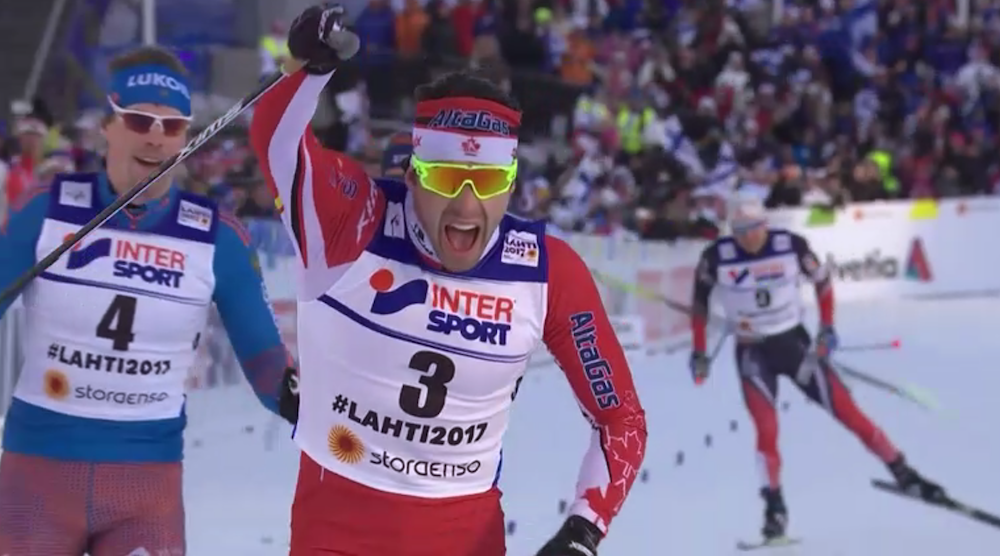
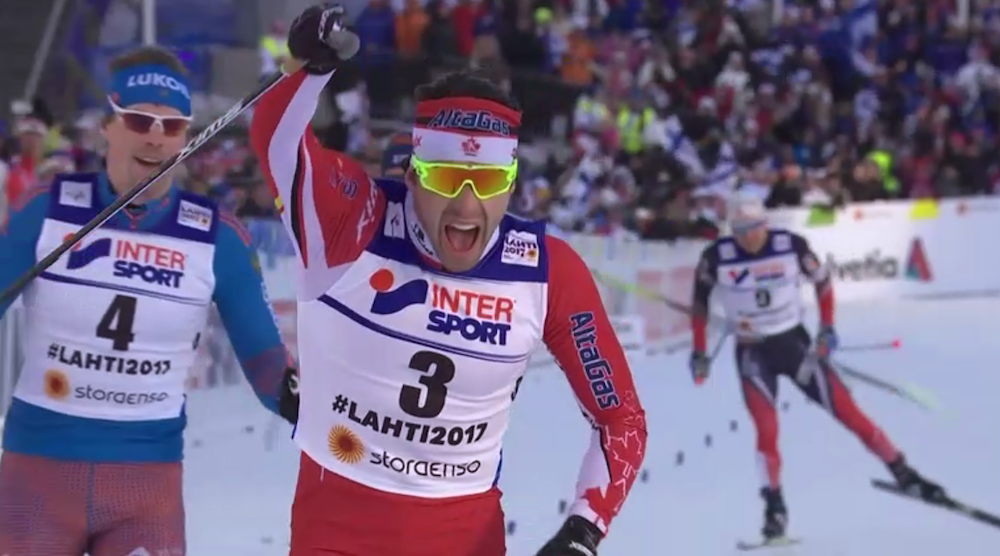
    Canada’s Alex Harvey (3) celebrates his win in the men’s 50 k freestyle mass start, his first individual gold medal at a World Championships, on Sunday at 2017 Nordic World Championships in Lahti, Finland. He beat Russia’s Sergey Ustiugov (l) by 0.6 seconds while Norway’s Sjur Røthe (9) can be seen coming in for sixth place, behind (not pictured) Finland’s Matti Heikkinen, Great Britain’s Andrew Musgrave and Norway’s Martin Johnsurd Sundby, respectively. (Photo: NBC Sports screenshot)

    FIS Nordic World Championships (Lahti, Finland): Men’s 50 k freestyle mass start

    After a week of missing out on the medals at 2017 Nordic World Championships, Canada’s Alex Harvey, a four-time World Championships medalist from 2011, 2013 and 2015, achieved his first individual gold medal in the final race of this year’s World Championships in Lahti, Finland.

    Harvey, 28, won the men’s 50-kilometer freestyle mass start in a drag race to the finish. Entering the final descent into the stadium with Norway’s Martin Johnsrud Sundby and Russia’s Sergey Ustiugov, Harvey rode his fast skis past both of them then had the most finishing kick in the final straightaway for a 0.6-second victory. He finished in 1:46.28.9 hours, while Ustiugov followed him across the line in second and Finland’s Matti Heikkinen from behind for third (+1.4), after passing Sundby around the outside of the last corner.
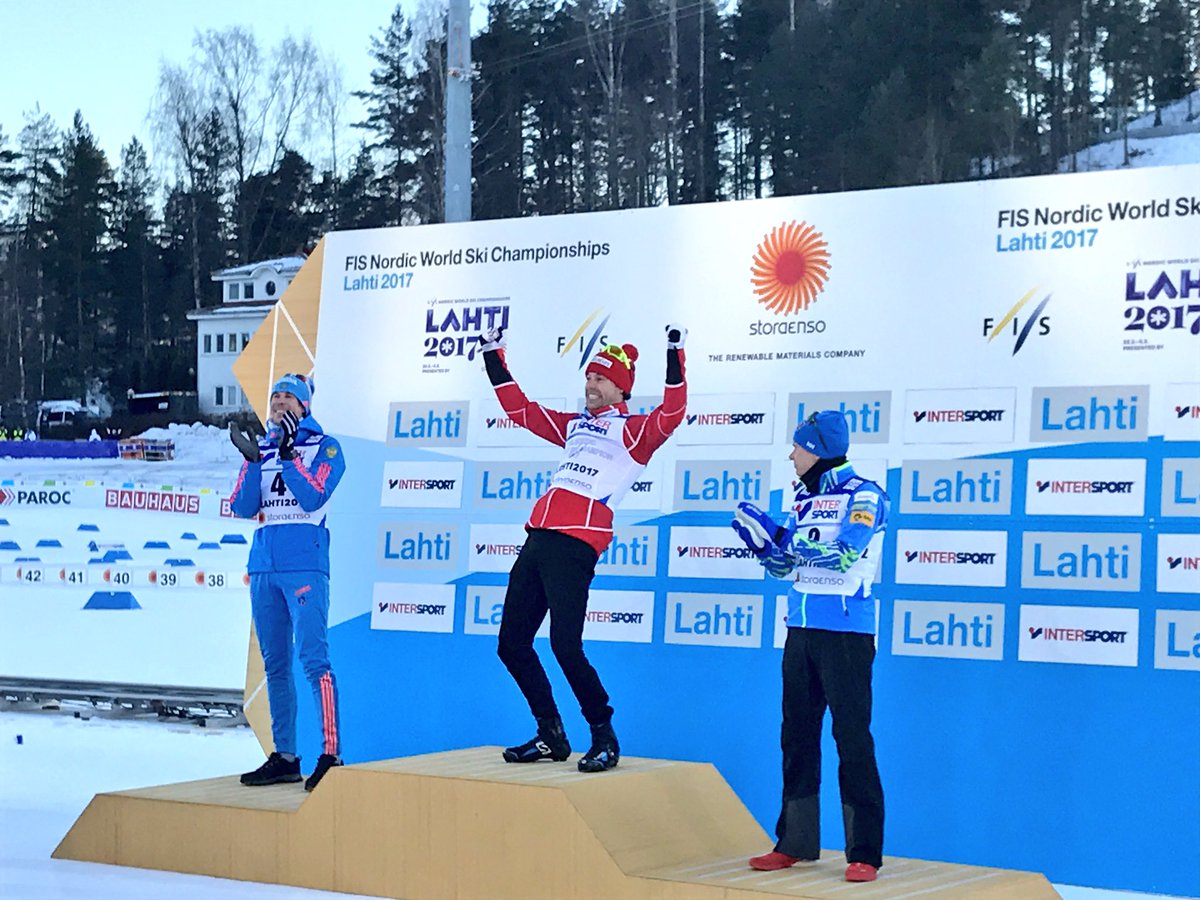
    Canada’s Alex Harvey (c) celebrates gold in the men’s 50 k freestyle mass start on Sunday at 2017 Nordic World Championships in Lahti, Finland, with Russia’s Sergey Ustiugov (l) and Finland’ Matti Heikkinen (r) joining him on the podium in second and third, respectively. (Photo: Cross Country Canada/Twitter)

    Sundby appeared to miss a pole plant soon after Heikkinen passed him and let off the pace a few meters before the finish. That’s where Great Britain’s Andrew Musgrave continued to accelerate and took fourth place, 2.9 seconds behind Harvey and 0.1 seconds ahead of Sundby in fifth. Norway’s Sjur Røthe followed another 0.4 seconds back in sixth, Switzerland’s Dario Cologna was seventh (+8.9), Norway’s Petter Northug eighth (+12.3), France’s Maurice Manificat ninth (+13.4), and Norway’s Hans Christer Holund 10th (+14.3).

    “I had really good skis,” Harvey said in a post-race interview with FIS. “I knew if I came into the corner in second place, that was the optimal position. So I was able to fight hard and hit that last corner in second and slingshot by Martin along the flat and then that was good after that.”

    “This is the best race of my life, for sure,” he added. “So I’m really happy.”

    Tad Elliott (Ski Club Vail) led the Americans in 27th (+3:16.8). Noah Hoffman (U.S. Ski Team) finished 50th (+8:53.1) and Kyle Bratrud (CXC Team) did not finish.

    Canada started four men, with Devon Kershaw finishing 38th (+5:45.5), Graeme Killick 43rd (+7:04), and Knute Johnsgaard in 55th (+12:03.3).

    For Harvey, the medal is his fifth at three World Championships and his first individual gold after winning the classic team sprint with Kershaw in 2011.

    Results

    ***

    IBU World Cup (PyeongChang, South Korea): Men’s and women’s relays

    Between the men’s and women’s relays on Sunday at the International Biathlon Union (IBU) World Cup in PyeongChang, South Korea, Canada had two teams in the top eighth, with its men’s team finishing seventh in the 4 x 7.5 k and women’s team eighth in the 4 x 6 k. Behind them, the U.S. men finished 10th and U.S. women 14th.

    France won the men’s relay by 33.8 seconds over Austria, using a total of 10 spare rounds but avoiding the penalty lap. Martin Fourcade anchored France to the win in 1:12:09.5 hours, after Jean-Guillaume Béatrix initially tagged them in first, his older brother Simon Fourcade raced them into second with near-perfect shooting (using just one spare to clean), and Simon Desthieux picked off one more place to give Fourcade a 16-second lead for the final leg.

    Austria achieved second place with Lorenz Wäger, Simon Eder, Julian Eberhard, and Dominik Landertinger combining for zero penalties and nine spares.

    Norway finished third (+45.4) with Vetle Sjåstad Christiansen, Ole Einar Bjørndalen, Vegard Gjermundshaug, and Henrik L’Abée-Lund. They had one penalty on Gjermundshaug’s third leg, and used a total of eight spares.

    Canada’s Christian Gow, Scott Gow, Nathan Smith, and Brendan Green finished seventh (+3:03.1) with zero penalties and nine spares. After Christian tagged his older brother Scott in ninth, Scott raced them into sixth place before Smith slipped four places to 10th at the final exchange. On the final leg, Green raced them into seventh, requiring two spares to clean.

    The Americans finished about nine seconds later in 10th (+3:12.8) with Lowell Bailey, Leif Nordgren, Paul Schommer, and Sean Doherty combining for zero penalties and nine spares, just like Canada. Bailey had originally put them in second at the first exchange, Nordgren dropped to seventh, then Schommer to 13th, before Doherty finally brought them back to 10th out of 24 teams.

    In the women’s relay, Germany pulled off a 22.8-second win over Norway, with one penalty and eight spares. Nadine Horchler put Germany in third at the first exchange, then Maren Hammerschmidt raced them into first by the race’s halfway point. From there, Denise Herrmann, a former cross-country World Cup regular, had to ski a penalty lap and tagged off in second, 13.5 seconds out of first. With teammate Laura Dahlmeier sitting out the relay, Franziska Hildebrand anchored Germany to the win in 1:07:35.6 after she used just one spare to clean.

    Norway placed second with Kaia Wøien Nicolaisen, Hilde Fenne, Tiril Eckhoff, and Marte Olsbu accumulating one penalty and 11 spares. Olsbu beat out the Czech Republic’s Gabriela Koukalová by one-tenth of a second at the finish, as the Czechs placed for third (+22.9), with Jessica Jislová, Eva Puskarčíková, Lucie Charvátová, and Koukalová (with a total of one penalty and nine spares).

    Canada took eighth (+1:34) with Rosanna Crawford, Julia Ransom, Megan Tandy, and Emma Lunder. Crawford tagged in second at the first exchange, Ransom slipped one place to third, Tandy lost another place to tag in fourth, and Lunder ultimately anchored them to eighth.

    The U.S., with Clare Egan, Susan Dunklee, Joanne Reid, and Maddie Phaneuf, finished 14th (+3:08.3) with one penalty and 10 spares. After Egan had a penalty on the first leg, Dunklee skied the fastest second leg to move the team from 19th to 14th, then Reid put them in 11th by the final exchange. Twenty-one teams competed in the women’s race.

    Results: Men | Women

    ***

    Ski Classics 90 k Vasaloppet (Sälen to Mora, Sweden)
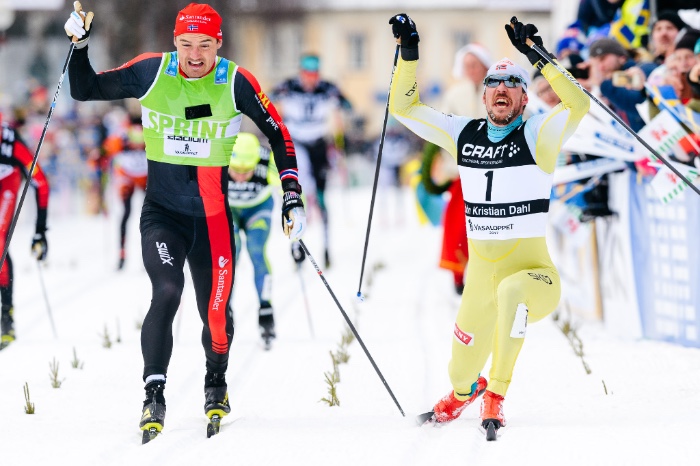
    John Kristian Dahl (r) of Team United Bakeries outlunges Ski Classics sprint leader Andreas Nygaard (r) of Team Santander for the win in Sunday’s 90 k Vasaloppet in Mora, Sweden. (Photo: Visma Ski Classics)

    [UPDATED] In Sunday’s 93rd annual 90-kilometer Vasaloppet from Sälen to Mora, Sweden, the ninth event of the Ski Classics series, John Kristian Dahl (Team United Bakeries) outlasted Andreas Nygaard (Team Santander) by one-tenth of a second for the win in 3:57:18.1 hours. The race came down to a five-way fight for first, with Stian Hoelgaard (Team Leaseplan) finishing 0.6 seconds back in third. The top 15 men were all within 21.7 seconds of the podium, and Brian McKeever, a member of Canada’s Para Nordic Ski Team, placed 20th (+2:31.1).

    “It has been a fight all day,” Dahl said, according to a Ski Classics press release. Three days ago, he had been unsure about starting the Vasaloppet following a back injury. “I was tired already after 30 k and had to let go of the lead group, but I fought my way back taking it step by step and hill by hill.”

    In the women’s race, Britta Johansson Norgren (Lager 157 Ski Team) broke away from the field to win by 1:37.9 minutes in 4:19.43.4.

    Astrid Øyre Slind (Team United Bakeries) finished second, and Sara Lindborg (Team Serneke) placed third, 9 minutes and 4.2 seconds behind Norgren. Kateřina Smutná (Team Santander) dropped out of the race about halfway through.

    “I am very tired but also so happy to win today,” Norgren said, according to the press release. “It felt pretty easy until Oxberg [Sweden] with 30 k to go, but then it got really tough and I had to fight all the way to the finish.”

    It was Norgren’s first Vasaloppet win after placing second the last three years. She increased her lead in the overall Ski Classics to 215 points over Smutná, while Tord Asle Gjerdalen continues to lead the men’s overall standings ahead of his Santander teammate Nygaard, who is 349 points behind in second place. Gjerdalen did not race Sunday’s Vasaloppet.

    Results

  • Ski Classics Opens with Doubleheader in Italy 

    Ski Classics Opens with Doubleheader in Italy 

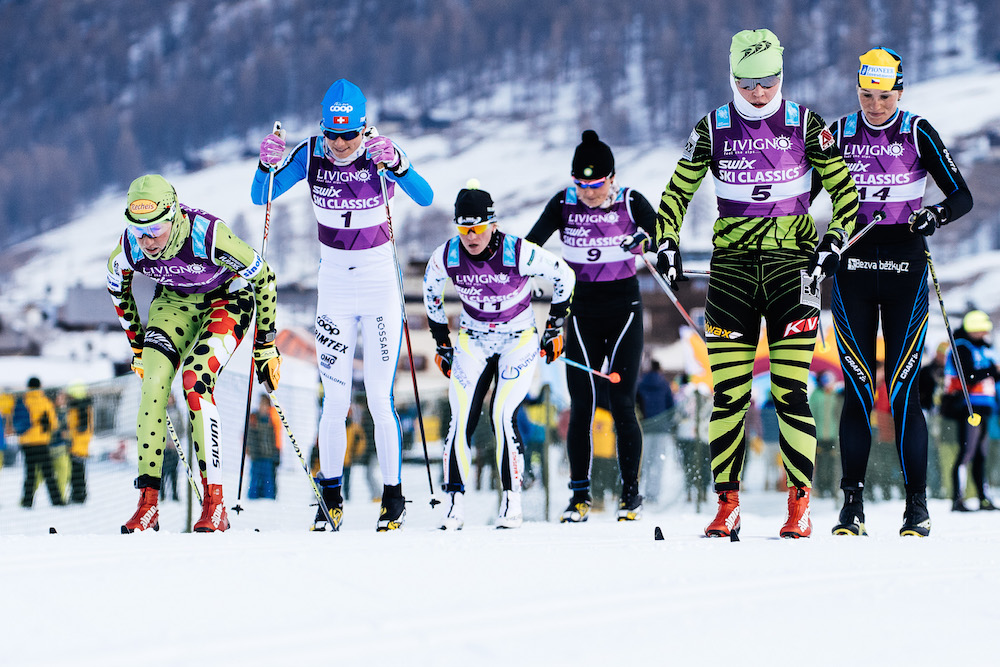
    Last year's Team Tempo Prologue in Livigno, Italy, which Team Coop won. This year, the team prologue will again open the Ski Classics series in Livigno on Saturday, followed by the shortened La Sgambeda classic race on Sunday. (Photo: Visma Ski Classics)
    Last year’s Team Tempo Prologue in Livigno, Italy, which Team Coop (in bib 1) won. This year, the team prologue will again open the Ski Classics series in Livigno on Saturday, followed by the shortened La Sgambeda classic race on Sunday. (Photo: Visma Ski Classics)

    The 2016 Ski Classics kicks off with a doubleheader in Italy on Saturday and Sunday, and the marathon regulars are chomping at the bit to get started with the long-distance race series.

    The 15-kilometer Proteam Prologue in Livigno, Italy, on Saturday opens the show for the marathon series, now called the Visma Ski Classics (with a new title sponsor in place of Swix), which has been extended to nine venues this season.

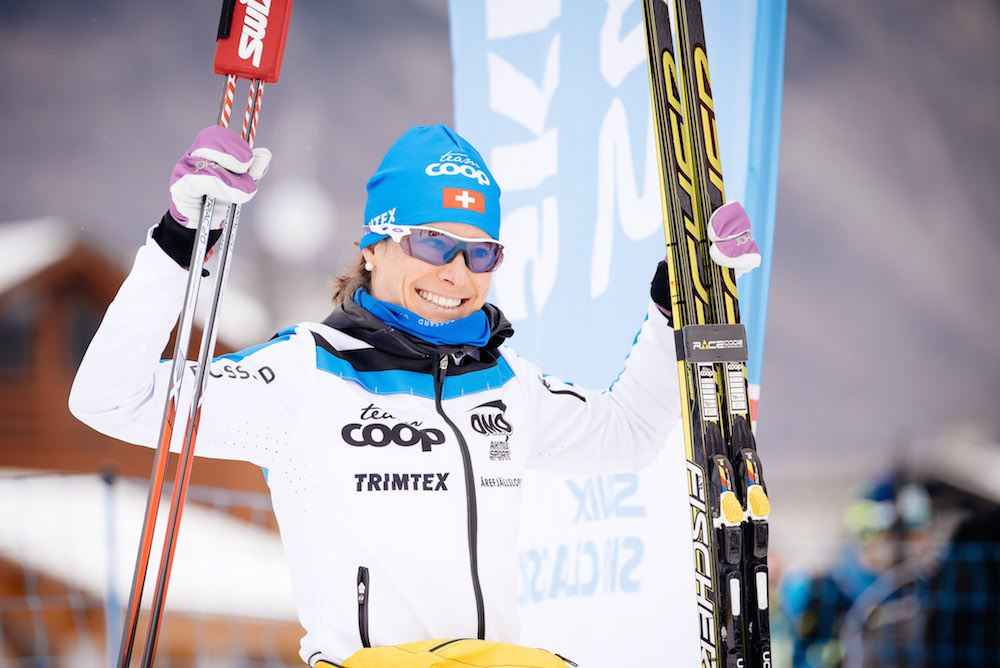
    Seraina Boner of Switzerland and Team Coop/Exspirit after winning the 2014 La Sgambeda in Italy last season. (Photo: Ski Classics)
    Seraina Boner of Team Coop (now called Team Exspirit) after winning the 2014 La Sgambeda in Italy last season. (Photo: Ski Classics)

    On the women’s side, last season’s Ski Classics champion Katerina Smutna of the Czech Republic will be on the start line for the first races this weekend, but she will face plenty of competition. Team Exspirit’s Seraina Boner of Switzerland is eager to take back the overall title, which she has earned three times (2011, 2013 and 2014), beginning with La Sgambeda.

    Poland’s World Cup star and the queen of the FIS Tour de Ski, Justyna Kowalczyk, will be doing several of the Ski Classics long-distance events this season with the Norwegian Team Santander headed by the Aukland brothers. And Britta Johansson Norgren of Sweden, who was on the podium at several of the Ski Classics events last season, is one to keep an eye on. Last season, she raced with the all women’s team Ski Pro Am, and this year she is a part of Sweden’s Lager 157 Ski Team, with teammates such as three-time Vasaloppet champion Jörgen Brink of Sweden.

    Among the men, 2015 Ski Classics overall champion Petter Eliassen of Norway makes his season debut in Italy this weekend. He will have to fend off a large and deep field of competitors such as Norway’s 43-year-old marathon veteran Anders Aukland and his Santander teammates, including younger brother Jørgen Aukland, and former World Cup skiers Tord Asle Gjerdalen of Norway and Johan Olsson of Sweden.

    Norwegian stayers such as Johan Kjölstad, Øystein Pettersen, Eldar Rønning, and John Kristian Dahl of Team United Bakeries, as well as Ski Classics veterans of Team Exspirit, including Daniel Richardsson, Anders Södergren and Jimmie Johnsson of Sweden and Norway’s Morten Eide Pedersen, will certainly do their best to make it a tough season opener from Day 1.

    Two unique competitions in Livigno

    The Prologue, in which the teams must field at least three racers to compete, was added last year, and is a team effort where the third person’s time determines the team result. The next day, on Sunday, the skiers embark on the first distance event, the now-24-kilometer classic technique La Sgambeda.

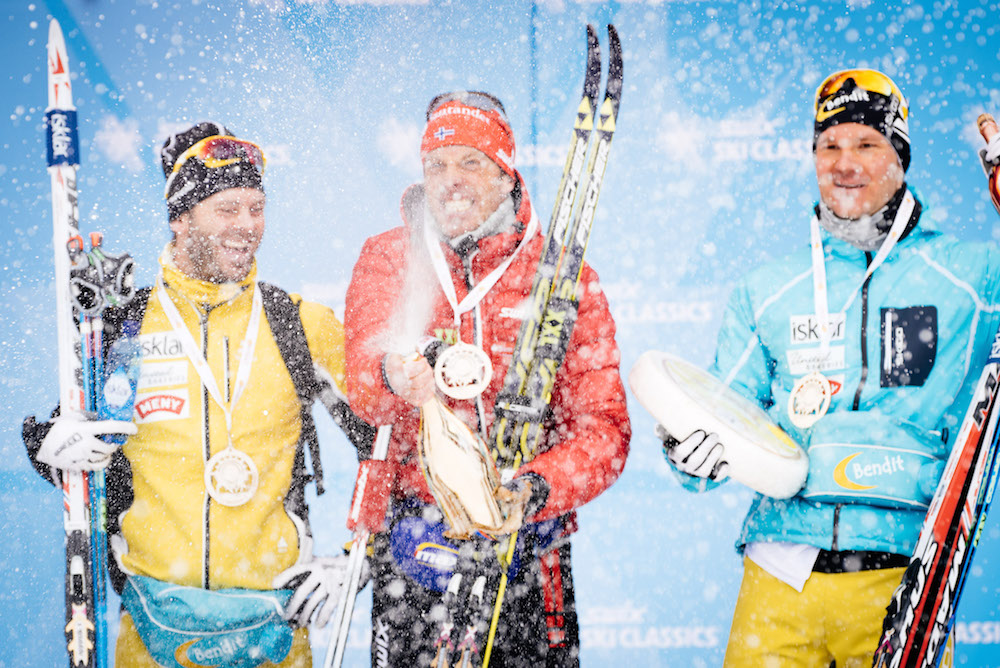
    Team Santander's Anders Aukland (c) after winning the 2014 La Sgambeda in Livigno, Italy. Johan Kjølstad  (l) and Øystein Pettersen (r) both of Team United Bakeries, placed second and third, respectively.  (Photo: Ski Classics)
    Team Santander’s Anders Aukland (c) after winning the 2014 La Sgambeda in Livigno, Italy. Johan Kjølstad (l) and Øystein Pettersen (r) both of Team United Bakeries, placed second and third, respectively. (Photo: Ski Classics)

    Team Exspirit (previously known as Team Coop) won the prologue last year and is aiming to defend the title this year.

    “We have had great preparations here in Livigno, skiing on the race course and acclimatizing to the high altitude,” team member Jimmie Johnsson said in a press release on Friday. “Of course, we’re aiming to defend our victory and we’re faster this season than ever before.”

    Team Exspirit’s Seraina Boner won La Sgambeda last year after breaking away from the field on the hard climb at the turning point of the course. This year, the course is shortened to from 35 k to 24 k due to lack of snow and is also flatter. While Boner prefers more elevation gain, she was still optimistic before the race.

    “The tougher course fits me better than the flatter one we have now,” she said. “But I will do my best, and I am really excited to finally start the long distance season together with my teammates.”

    While the Team Prologue is only open to professional teams registered with the 2016 Ski Classics, La Sgambeda on Sunday is open to amateurs and pros alike.

    Saturday’s Prologue will be held on the original course, but due to lack of snow in Livigno, the classic marathon on Sunday will be run on 6 k loops.

    “Last season, seven of the nine Ski Classics events had to change their courses due to weather issues,” Ski Classics CEO David Nilsson in a press release earlier this week. “We can just cross our fingers that the political leaders at the environmental summit in Paris this week are able to make the right decision.”

    For the 2016 season, there are 28 pro teams registered for the Ski Classics series.

    After the season opener in Italy, the Ski Classics takes a break until the Jizerská Padesatka in Liberec, Czech Republic, on January 10, 2016. The race series concludes April 2 with Årefjällsloppet in Sweden as the season finale, as it has been for years. New this year is the Toblach/Dobbiaco Cortina, a 50 k classic race in Italy on Feb. 13.

    Vasaloppet matters most

    For Madshus racer John Kristian Dahl of Norway, who won the Vasaloppet two years ago, the 90 k race from Sälen to Mora in Sweden is the main goal for the 2016 season.

    “It’s the longest and one of the oldest races in the circuit, and very special with the flats. That package makes it very unique, and difficult to win, too. In our world, it’s the championships in marathon skiing, and I’m happy that we have it every year,” Dahl said in an interview with Ski Classics earlier this fall.

    Live streaming in English

    In order for fans to follow the action live, Visma Ski Classics has launched the Live Streaming “Season Pass” available with English commentary on the app or the Tour Live Center at Visma skiclassics.com.

    2016 Ski Classics Schedule

    1. Dec. 5, 2015: Proteam Tempo Prologue, 15 k classic, Italy
    2. Dec. 6, 2015: La Sgambeda, 24 k classic, Italy
    3. Jan. 10, 2016: Jizerská Padesatka, 50 k classic, Czech Republic
    4. Jan. 23, 2016: La Diagonela, 65 k classic, Switzerland
    5. Jan. 31, 2016: Marcialonga, 70 k classic, Italy
    6. Feb. 7, 2016: König Ludwig Lauf, 50 k classic, Germany
    7. Feb. 13, 2016: Toblach/Dobbiaco Cortina, 50 k classic, Italy
    8. March 6, 2016: Vasaloppet, 90 k classic, Sweden
    9. March 19, 2016: Birkebeinerrennet, 54 k classic, Norway
    10. April 2, 2016: Årefjällsloppet, 65 k classic, Sweden

    For race recaps, follow FasterSkier’s marathon blog.

  • Eliassen Victorious in Birkebeiner Sans Kick Wax; Johaug Picks Up Win in First Try

    Eliassen Victorious in Birkebeiner Sans Kick Wax; Johaug Picks Up Win in First Try

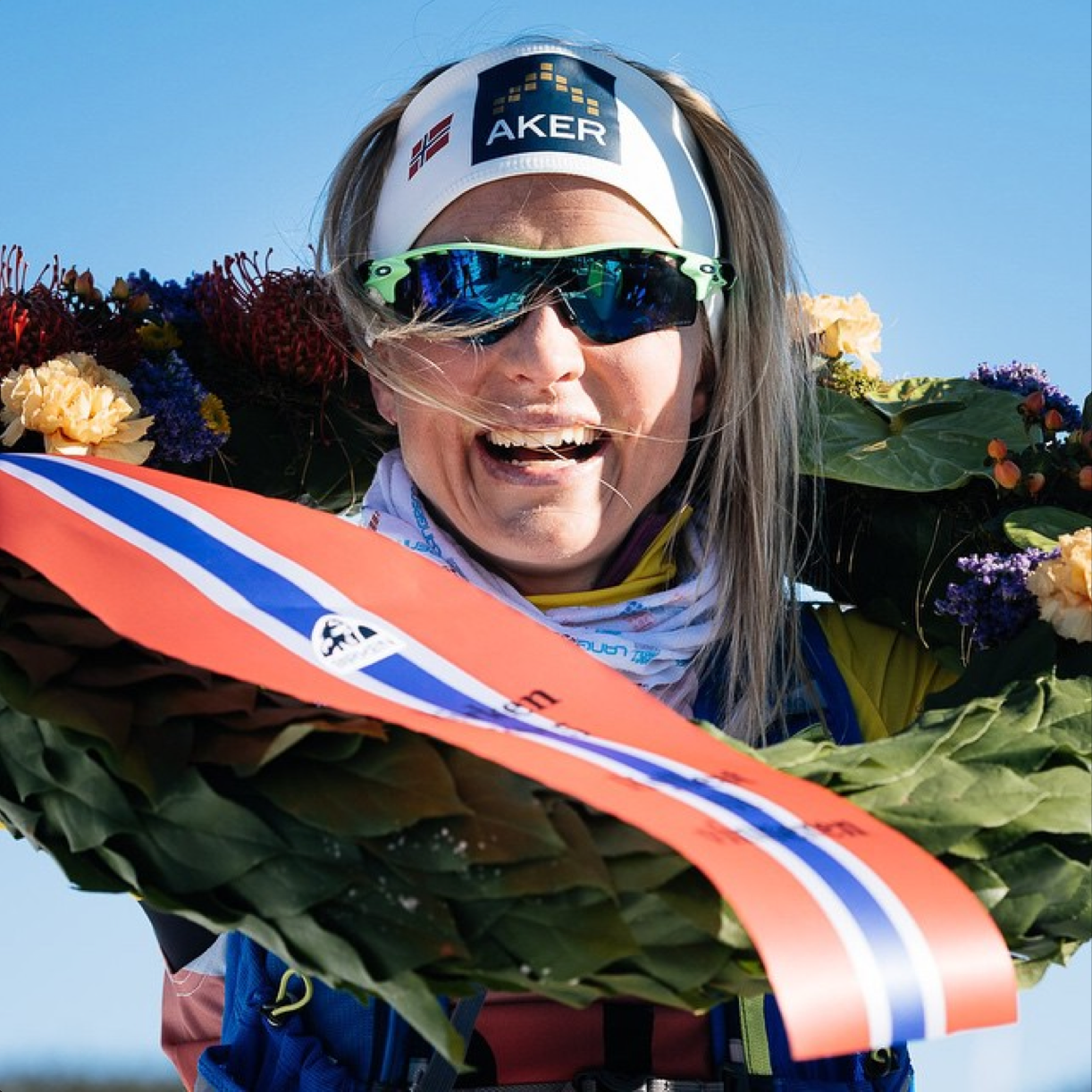
    Therese Johaug of Norway said it had been a dream to compete in the Birkebeiner ever since she was a little girl. On Saturday her dream came true... and not only did she win, she set a five-minute course record. (Photo: Swix Ski Classics/Instagram)
    Therese Johaug of Norway said it had been a dream to compete in the Birkebeiner ever since she was a little girl. On Saturday her dream came true… and not only did she win, she set a five-minute course record. (Photo: Swix Ski Classics/Instagram)

    The Birkebeiner, a legendary 54 k ski race from Rena to Lillehammer in Norway, has been running for 77 years. But that doesn’t mean that every year can’t bring something new.

    Last year, the Birkebeiner was canceled due to extreme weather on the mountain summits in the middle of the race course. This year, weather was perfect and the snow was faster than ever, leading to course record times being set in both the men’s and women’s races.

    The men’s race was won in 2:19:28 by Petter Eliassen, who also made history in another way: the Norwegian racer, representing team LeasPlanGo, also went without kickwax. It was the first time the race has ever been won on skis without grip, and probably among the first times such an attempt was even made.

    “I was very unsure whether I would go without or with kick wax,” Eliassen told Norwegian broadcaster E24 after the finish. “But after talking with the guys on the team, we agreed that I would do it. It’s how I have been training all year.”

    While other marathons such as the Vasaloppet in Sweden or the Marcialonga in Italy are routinely won on skate skis, or classic skis with only glidewax, the Birkebeiner is different. It gains 600 meters, or nearly 2000 feet, of altitude from the start to the high point at 34 k into the race, and the total climb is even greater than that because of a substantial descent from 19 to 27 kilometers which racers then must climb up from again.

    Yet despite lacking kick wax and having to double pole the entire race, Eliassen still had the upper body strength at the end to beat out fellow Norwegian Martin Johnsrud Sundby by 10 seconds. John Kristian Dahl placed third, another five seconds back.

    Eliassen built up a lead descending from Sjusjøen, but Sundby and Dahl caught back up to him and forced an exciting finish.

    “It is quite special and very fun to win the Birken,” Eliassen told E24. “It’s a great, traditional race… It was a good race. We were a nice group that went along together the entire race.”

    Sundby, who just finished up the World Cup season with the overall title, said he has a lot to learn for these long marathon races with such huge fields. He also said he’s still recovering, in some sense, from the illness that knocked him out of the first week of racing at World Championships back in February.

    “I’m in good shape, but have not gotten myself up again,” he told Aftenposten. “I’ve tested a bit lately, and is quite far from where I am at my best.”

    Beating the reigning World Cup champ does not tempt Eliassen to return to shorter distance racing, however. A former national team member, he finished World Cup Finals in Falun, Sweden, last year in eighth place. Then he shifted his focus, and it has paid off. He won the König Ludwig Lauf in Germany and the Vasaloppet in Sweden as well as the Birkebeiner this season.

    “Now it’s long races that appeal to me,” he told Aftenposten. “That’s what I like and what suits me, and so I enjoy it very well with the team.”

    In the women’s race, Therese Johaug competed in the Birkebeiner for her first time and won it handily; her time of 2:41:46 was also a course record. She broke the previous record by five minutes.

    “It was a fantastic trip over the mountain,” she told NRK. “What a mood! It could not have been better with these surroundings. It was incredibly fun to dabble in Birken. It has been a dream since I was a little girl.”

    Johaug is coming off of a successful World Cup season, including victories in both the 15 k skiathlon and the 30 k mass start classic competitions at World Championships. Like Sundby, she raced for Team United Bakeries at the Birkebeiner.

    Austria’s Katerina Smutna was the runner-up in 2:44:27, and Seraina Boner of Switzerland placed third two seconds behind her.

    Holly Brooks, an Alaskan racing for Team Santander, finished 11th in 02:58:25. Robyn Anderson of Stowe Vermont and VTXC finished in 3:16:00. Christina Turman, the interim head coach of the University of Alaska Fairbanks ski team, finished in 3:35:14.

    The top Canadian result went to Brian McKeever, who finished in 2:34:39, good for 58th place in the elite wave. McKeever is a member of Canada’s Para-Nordic World Cup team and his guide, Erik Carleton, placed 110th in 2:41:11. Ian Murray of Rocky Mountain Racers crossed the line just over a minute later to place 121st in 2:42:27, while Philip Shaw of Club Ski Rosemère finished in 3:00:18.

    Searchable results

  • Notes and Quotes: Falun Prologue Edition

    Notes and Quotes: Falun Prologue Edition

    All 2012 FIS World Cup Finals coverage is brought to you through the generous support of Fischer Sports USA, proud sponsors of Kikkan Randall, 2012 overall Sprint Cup Champion.

    FALUN, Sweden – It is amazing how interesting a 2.5-3.3-kilometer individual start race can be.

    There might not be the head-to-head drama of sprints and mass-start events, but observing how skiers approach the prologue distance, and the challenging nature of the “not a sprint, not a distance race” leaves plenty to talk about.

    With Mördarbacken (killer hill) falling within the first kilometer of the race, racers appeared to apply one of two basic strategies—throw down from the start and hope to hold on in the later gradual terrain, or open more moderately and accelerate over the top of the hill.

    In the men’s race, the Norwegain team notably chose the later. On the lower pitches of Mördarbacken the first time around (the men added their extra distance by climbing the first third of the hill a second time), almost to a man, the Norwegians appeared to be having a collective bomb of a day.

    Compared to many of their competitors, they were moving with a slow tempo and little explosiveness—maybe appropriate for the early stages of a 50k.

    But this had changed when they appeared again as they attacked the last hill with a vengeance.

    The results sheet supported the observations with eight of nine Norwegians improving their placing after the steepest pitch of the Mördarbacken.

    Most notably Niklaus Dyrhaug, who was 4th moved up 13 spots, Sjur Roethe 11, Martin Johnsrud Sundby 19 and John Kristian Dahl 21.

    Canadian Head Coach Justin Wadsworth told FasterSkier that “at the start of a race like that you can be really stressed and high tempo,” basically inefficient.

    Despite the experience of most of these athletes, many appeared to fall prey to this trap.

    A number of the Russians started hard, only to fall back later in the race.

    Petr Sedov, however, was not one of them. He improved a remarkable 32 places over the final 2.1 kilometers of the race, from 44th to 12th.

    Going the other direction was teammate Dmitriy Japarov, who fell 21 places from 15th to 36th.

    Notable: Ponytail.

    The women showed somewhat less volatility, most likely due to the fact there was just the single large climb.

    The top-6 at the finish all were within that number at the top of the hill and only Jessie Diggins and Laure Barthelemy moved up double digits among the top-25.

    Diggins improved 12 places from 20th to 8th and Barthelemy moved up 16 from 26th to 10th.

    Notable: Barthelemy under control on the climb.

    In addition to starting pace, there were quite a few differences in technique choice among the skiers—again more so with the men.

    A few, like Jean Marc Gaillard, impressively chose to V2 the entire first portion of Mördarbacken, while others quickly switched to V1.

    Completely anecdotally, the V1 choice seemed the better bet. The top three men, Alex Harvey, Dario Cologna and Devon Kershaw all used a powerful V1 relatively early in the hill, while the two most notable V2-ers, Gaillard and Marcus Hellner placed 24th and 9th respectively, with Hellner slipping after leading at the top of the hill.

    German Josef Wenzl appeared to employ the Norwegian slow-start strategy, but someone forgot to tell him he was supposed to speed up later in the race.

    The sprinter looked more than a little sluggish early in the climb and ultimately beat only American Sylvan Ellefson, who crashed hard and required on-course medical attention.

    Notable: Face of the day courtesy of Aino Kaisa Saarinen (FIN)

    Watching the women up at the crest of Mördarbacken revealed different technique choices as well.

    Some quickly switched out V1 as they crested the steepest pitch, V2-ing the remaining gradual climb, while others continued to V1.

    Again, unscientifically, it seemed that V1 was the better choice for most.

    Some women, notably the Norwegians, hugged the outside of the climb on skier’s right, sticking to the shaded part of the track along the barrier.

    Heidi Weng hugging the wall.

    Most of the Norwegians executed this to the extreme, staying outside of even the twists, while other skiers opted to take a better line.

    Two of the top Norwegian women did not start the race, withdrawing from the mini-tour.

    Vibeke Skofterud made the decision not to race after warming up.

    “She is a little bit tired after the Vasaloppet (the 90k Swedish ski marathon that Skofterud won two weeks ago),” Norwegian women’s coach Egil Kristiansen said.

    He added that she is having some minor issues with her elbow after the double-pole fest that is the Vasaloppet.

    Astrid Jacobson also passed on the prologue citing stomach problems according to Langrenn.com.

    Their teammate, Therese Johaug, however, was in fine form, placing 6th and climbing to 19th in the World Cup Finals standings.

    “It is a steep hill here in Falun and it is really hard, but I like to climb these hills,” said Johaug.

    She attacked the Mördarbacken with her usual double-time tempo.

    “I train a lot for this one in the summer at home in Dalsbygda and when I was a little girl, my grandfather said, ‘If you should be a good cross country skier you have to train on uphills,’” she said.

    And thus she trains uphills, something she “likes very much.”

    At this point, Johaug is considered the best climber on the World Cup circuit after twice winning the Tour de Ski final climb.

    “I push myself to do my best,” Johaug continued. “The important thing is to not be too far away from first place…In the end it is a tour and that’s the reason to get to the top.”

    Johaug doing what Johaugs do best—climbing.

    Eirik Brandsdal, winner of the Royal Palace Sprint continues to lead the World Cup Finals after placing 31st in the prologue, a result he was pleased with.

    “It was a good race,” Brandsdal said. “I saved some power on Mördarbacken, and from there I just pushed as hard as I could.”

    Climbing, Brandsdal said, is his strong suit, so the course suited him.

    He is currently three seconds ahead of Harvey entering the third day of competition.

    Following the prologue, he had yet to consider the possibility of going for bonus seconds in Saturday’s mass start.

    “I think I will just try to stay with these guys [Harvey at al] as long as possible,” Brandsdal said. “I am a sprinter, so it will be hard for me, but I will do my best.”

    He added that his performance in the mini-tour thus has already exceeded his expectations.

    Notable. Big bells.

    Matt Voisin contribute reporting.

  • “When You Gotta Go, You Gotta Go” – Northug Wins National Championship Despite Bathroom Break

    Petter Northug had earned a substantial lead early in the men’s 50K race when he stopped to take a leak on the side of the course. When asked about the incident, Northug simply shrugged his shoulders and said “when you gotta go, you gotta go.”

    “It’s a long ways to go, so you have plenty of time to work your way back up,” Northug explained.

    Northug dropped to 35th place, but was able to work himself back up to the front and won the race by a solid margin – almost 40 seconds separated Northug from second place.

    “There was a packed field and it snowed quite a bit, so it was an advantage to attack from behind,” Northug said to the Norwegian news agency NTB after the race.

    “I came here with the 50K title in mind, and it was really fun to win the 50K at the nationals. I’ve never won the 50K at the Norwegian Nationals before. That was really fun,” said Northug, who also won the King’s Award, the most treasured trophy awarded to Norwegian athletes in any sport.

    Morten Eilifsen was third in the 50K, after deciding to give away the silver by waiting for Chris Andre Jespersen and letting him finish ahead. Jespersen had done a large part of the pulling throughout the race.

    Bjoergen wins women’s 30K

    In the women’s 30K skate, Marit Bjoergen won another Norwegian national title, but just like Northug, Bjoergen has never won the marathon distance at the Norwegian nationals before.

    “It was a really hard race, and nothing came for free today. But it was really fun and a great atmosphere all along the course. And I guess I’ve never won the 30K at nationals before,” Bjoergen said to NTB after the race.

    Therese Johaug was second, beaten by Bjoergen in a sprint finish.

    “It was a hard race, but Marit was stronger than me in the sprint today, so I can’t complain about second place. It’s fun to end the season like this,” Johaug said.

    Astrid Uhrenholdt Jacobsen was third.

    In the classic team sprint on Friday, Petter Northug won the national championship gold medal along with club teammate John Kristian Dahl. Johan Kjoelstad and Eldar Roenning were second, eight seconds behind Northug and Dahl.

    In the women’s team sprint, Celine Brun-Lie (who raced for Norway at the 2011 World Championships in Oslo earlier this winter) won the gold medal with teammate Britt Ingunn Nydal. Martine Ek Hagen and Heidi Weng won the silver just a few small seconds behind.

    The marathon distance races on Saturday concluded the second part of the Norwegian Senior Nationals.

    Complete results from the 50K Saturday here.

    Complete results from the 30K Saturday here.

    Complete results men’s team sprint here.

    Complete results women’s team sprint here.

  • Thumbs Up For Mini-Tour Format

    Thumbs Up For Mini-Tour Format

    After the Nor-Am mini-tour in Rossland, British Columbia, last weekend, racers from both sides of the border raved about the event as an exciting change of pace where all racers – sprinters and distance skiers alike – have a fair chance to fight for the overall title. Contributing to the positive reviews was the excellent job that the organizers and volunteers put down to make it fun, fair and entertaining.

    Stefan Kuhn (Canmore Nordic) takes the victory over fellow Canadian Drew Goldsack (Rocky Mountain Racers). Photo: Rob Whitney.

    “I love the mini-tour – fun to watch and great to ski in. It adds a lot of excitement for us racers and a great challenge as well. I don’t know if you can do anything much better. The Rossland ski community had done a great job organizing and made a 3-day race series go very smoothly and was lots of fun,” Stefan Kuhn (NTS) said in an email to FasterSkier. The overall men’s tour winner also thought the sprints were factored fairly into the overall results.

    “You get a 60-second bonus if you win and down from there, and that is a lot,” Kuhn said.

    The overall women’s winner, Jessie Diggins (CXC) also enjoyed the format.

    “I think the mini-tour was really fun. The way it was set up made the last day pretty exciting since you knew exactly where you were in terms of the overall tour standings during the race,” Diggins said in an email to FasterSkier.

    On the World Cup, some European racers have complained that a mini-tour is not worth the effort for sprint specialists. That was not an issue for the Nor-Am racers that FasterSkier spoke with. If anything, Diggins thinks the sprints may have been weighted a little too heavily, though it was not a problem for her.

    “Because the 5km skate was so fast, the girls who weren’t sprinters weren’t given as much of a chance for the overall tour,” Diggins said.

    Good mix of sprint and distance

    “I really enjoyed the mini-tour format. I think it’s a great way to give both sprinters and distance skiers a chance to mix it up together,” Drew Goldsack (NTS) said in an email to FasterSkier. Going into the event, Goldsack was a bit concerned about the sprints being given too much emphasis. But in practice, he thought the concept worked out fairly for all.

    “On paper I thought that the sprint was maybe weighted too heavily but…it actually worked out perfectly. I think it was partly due to the fact that we had distance skiers sprinting better than usual and sprinters skiing distance better than usual, but it worked out well and made for some exciting racing.”

    Goldsack, who was third overall, had one single complaint.

    “The only thing I’d like to see better is the prize money; it seemed a little chincey for three hard days of racing. $700.00 for the win isn’t bad, but $400.00 for second and $250.00 for third place seems a bit low to me,” Goldsack said.

    Great format but keep it reasonable

    Brooks racing in Rossland (Photo: Rob Whitney)

    Holly Brooks (APUNSC) thinks the mini-tour format is both entertaining and fair, especially on the Nor-Am circuit where there are fewer specialists than on the World Cup. She also thinks the bonuses for the sprints helped even out any discrepancies.

    “Especially in the women’s field, the sprinters and the distance racers are the same people anyway, and the bonuses awarded for the sprints were huge, so I think the format was fair. I think on the World Cup there is more of a difference because the racers are more specialized,” Brooks said to FasterSkier.

    “We train so hard all year and make so many sacrifices. We train to race, and this is it. For me, this was a good intensity block before nationals. There were good interesting courses, and you have to be really versatile with this format that includes sprint, skate and classic,” Brooks said, but added that she doesn’t want organizers to go bananas with the concept just because the first one was a hit.

    “I hope they keep mixing it into the schedule, but I wouldn’t like to see all race weekends turn into mini-tours,” Brooks said, noting that one or two of them per year could be a reasonable amount.

    “Mini-tours are hard on both racers and organizers. There are more logistics and it’s easy to make mistakes, and it makes it complicated for everyone,” she said.

    Just a good, hard weekend

    “Overall I think the mini-tour format is really good. I wished they had them at the start of my career. I have always enjoyed racing different formats and distances,” Lars Flora (APUNSC) said. The only thing he would like more of was hills, even on the last day.

    “The time bonuses seem to play out fairly between sprint and distance racing. The only thing I would change is adding a hill climb at the end of Sunday’s race. It would have been fun to finish with a classic hill climb,” Flora said.

    Caitlin Compton (CXC) also thoroughly enjoyed the Rossland experience, both for the variety and for the rigor. For Compton, the mini-tour was also an opportunity to test her own limits.

    “I knew that Saturday’s 5K skate would be my better event, but I also wanted to see how my fitness was through the entire weekend. I was pleased to find that my energy and quickness was still there (on Sunday), if not higher than the days before,” Compton said, noting that Diggins had reserves nobody else could match.

    Mixed feelings on the World Cup

    US Ski Team’s Kikkan Randall, who is on the FIS Athlete Commission for cross-country skiing, said in an interview with FasterSkier earlier this season that she has mixed feelings about the mini-tour concept. On one hand, Randall likes the idea of cross-country capitalizing on the increased TV-viewership that comes with these tour type events. On the flip side, Randall is concerned that by adding the overall time component and with each individual stage only worth half World Cup points, the sprint race is being devalued. She is also skeptical to adding a longer event weekend to the early World Cup season.

    “I also feel that with an already packed ‘Period I’ racing schedule, it is better to have two races instead of three this early in the year to allow for a little more training during the week and thus better longevity through the season,” Randall said.

    Among the Norwegians, some of the sprinters left Kuusamo after the opening sprint event of the “Tour de Opening” in November. Ola Vigen Hattestad and Kuusamo sprint winner John Kristian Dahl were among those who left early. Dahl dislikes the mini-tour, and was happy to explain why.

    “We get more points for regular WC sprint races than we do here, there is a packed schedule with a lot of races before the end of the year, and we have important races in Düsseldorf (GER) already next weekend. To do three races here takes an incredible toll (on the racers), and it seems a little oddly placed,” Dahl said to the Norwegian TV station NRK.

    The mini-tour in Kuusamo consisted of three competitions. Sprint on Friday, individual start classic on Saturday and pursuit/handicap start skate on Sunday. Only the overall winners will be listed as World Cup winners for the event. The sprint winners were awarded only 50 points compared to the normal 100 points.

    “It’s no secret that the mini-tour robs some of the status from the sprinters. For me as a sprint specialist, this is not great,” said Ola Vigen Hattestad.

    According to Vegard Ulvang, the Cross-Country Committee Chairman, this year the mini-tour is a test-event and it will be evaluated in the spring as to whether to make the Kuusamo “Tour de Opening” a permanent part of the World Cup calendar.

    As for the Nor-Am mini-tour, it seems like the athletes are giving the format a thumbs up, at least after the Rossland experience last weekend.

  • What Was He Thinking?! World Cup Athletes and Coaches on D-Dorf Team Sprint

    What Was He Thinking?! World Cup Athletes and Coaches on D-Dorf Team Sprint

    Stupid, nonsensical, and “completely in the wrong.”

    Those were the descriptions by elite cross-country skiers and coaches of German sprinter Josef Wenzl’s actions in the Dusseldorf team sprint on Sunday.

    Wenzl’s aggressive attempt at passing Norwegian John Kristian Dahl in the race’s final corner ended with both athletes sprawled in the snow, watching a clear podium finish pass them by in the form of Anders Gloersen (NOR), Emil Joensson (SWE), and David Hofer (ITA).

    “Everyone knows that it makes no sense to pass on those final corners; it is simply too dangerous. I can’t understand what

    Oystein Pettersen (R) gestures at German sprinter Josef Wenzl.

    Wenzl was thinking,” wrote U.S. Ski Team Head Coach Chris Grover in an e-mail. “I feel bad for [Dahl’s team]. They deserved to be on the podium and receiving their prize money.”

    Wenzl did not show any contrition afterwards—indeed, video from the finish pen showed him jawing with Dahl’s teammate Oystein Pettersen, even exchanging a few grabs and light pushes. But later in the day, Wenzl did apologize, according to Vidar Lofshus, the sports director for the Norwegian ski team.

    “Wenzl showed great sportsmanship by taking all the blame for the incident, and has excused his behavior to Dahl,” Lofshus wrote in an e-mail to FasterSkier.

    By Monday, tempers had cooled. Pettersen even told Norwegian media that he had lunch with Wenzl after the incident. But that didn’t change the result sheet—nor the fact that Dahl and Pettersen had missed out at a shot at the $12,000 check for the winning team.

    The Norwegians saw the collision as a clear case of obstruction by Wenzl, Lofshus said. And indeed, International Ski Federation (FIS) rules state that it is the responsibility of a passing skier to avoid interference.

    But according to the Norwegian newspaper Dagbladet, the race jury ruled that Dahl was equally at fault as Wenzl, because he took a step to the outside of the corner, towards the German. While the Norwegians disagreed, Lofshus said that “there will be no appeal or protest.”

    Pierre Mignerey, a jury member and the assistant cross-country race director for FIS, declined to comment. The jury, though—which included two Germans out of five total members—was the only group willing to take any blame from Wenzl’s shoulders. In interviews and e-mails with four North American athletes and coaches, all took Wenzl’s actions to task.

    “I don’t know what [Wenzl] was thinking. They had pulled away from the pack,” said U.S. sprinter Andy Newell in an interview

    John Kristian Dahl (L) and Josef Wenzl collide in the final corner of Sunday's Dusseldorf team sprint.

    Sunday. “They went two wide into that corner—you don’t ever want to do that at any time in a race, not to mention if you have the podium already wrapped up.”

    Canadian sprinter Devon Kershaw also placed responsibility squarely on Wenzl, saying that Dahl had the best line heading into the final turn. But he also said that he recognized it can be tough for sprinters to think clearly at the end of a race. Instead, they’re “completely blasted, stressed out, and amped knowing they have a chance to win the whole thing.”

    Kershaw is no stranger to full-contact racing himself—in a Tour de Ski city sprint in Prague in 2008, he made his own Wenzl-esque kamikaze attack against Swedish skier Marcus Hellner.

    “I moved in on him, when there was absolutely no reason to—and we both went down,” Kershaw wrote in an e-mail on Monday. “I had qualified first, and was poised to perhaps slot into the top three in the overall tour had I moved through my quarterfinal. Instead, even though Hellner and I had a gap, I took him out fighting for the best line for no reason, and it was a disaster.”

    As his own actions demonstrated, “stupid things happen in sprint racing,” Kershaw said.

    “With so many dudes, so little space and really only one ‘direct line,’ it’s not really a surprise when things like this happen,” he added.

    Especially on the tight and technical Dusseldorf course, where, according to U.S. sprinter Kikkan Randall, “it’s a tricky course to stay on your own feet anyway, let alone with a bunch of people around.”

    Dahl and Wenzl in the snow as the podium finishers go by.

    Add a home crowd and put thousands of dollars on the line, and you’ve got a potent mix for a 25-year-old German. Dusseldorf is Wenzl’s stomping grounds—it’s where he had his first and only victory, in 2007. But after he finished 46th in Saturday’s sprint and didn’t even make the heats, German Head Coach Jochen Behle ripped Wenzl publicly, telling the press that he “expected much more.”

    So if there was any rational explanation for Wenzl’s actions on Sunday, it was that they were born out of desperation: over the last two seasons, he had only once finished on the podium in an individual sprint—and that was at a race in Whistler with a weak field.

    And the crash notwithstanding, Wenzl still seemed to impress Behle with his performance in the team sprint, which left the Germans just one clean corner away from the podium. After the race, Behle told Die Welt newspaper that his men had skied well, “even if the results are not exactly what I wanted to see.”

  • Norwegians Men Win in Dusseldorf, with Crash-Marred Finale

    If Josef Wenzl wants to race at the 2011 World Ski Championships in Norway, he probably can do it without a bodyguard. But that’s only thanks to the last-minute heroics of the sprinter Anders Gloersen (NOR).

    Wenzl, a German, squandered a sure podium finish for himself and the top Norwegian pair in Sunday’s team sprint in Dusseldorf, crashing out on the final corner and taking John Kristian Dahl along with him.

    Gloersen ended up being the beneficiary, going from zero to hero as he passed Dahl and Wenzl and overtook Emil Jonsson (SWE) in a frantic finishing sprint for the win. The Italian team of David Hofer and Fabio Pasini was third, while no North American teams made it past the semifinals.

    Had Wenzl’s blunder given the Swedes a victory at the expense of the Norwegians, their most hated rivals, it’s very possible that the German would have needed an armed escort through the streets of Oslo. As it was, Dahl was steaming, and he and Wenzl exchanged some heated words, finger-pointing, and bib-grabbing as they picked themselves up and skied into the finishing pen.

    Both had good reason to be angry. With a mere two hundred meters to go in the men’s final, Dahl and Wenzl had chased down the Russian leader Nikolay Morilov, and they held a big lead over the chasing pack as they barreled into the final corner, a sharp righthander.

    But instead of slotting in behind and waiting for the finishing stretch to unleash his sprint, Wenzl went for broke, staying abreast of Dahl and leaving the Norwegian little room to maneuver on the inside of the corner. Dahl tried to shove Wenzl away, but it was too late. Both of them crashed, allowing Jonsson and Gloersen to fly by.

    “I don’t know what [Wenzl] was thinking. They had pulled away from the pack,” said U.S. sprinter Andy Newell. “They went two wide into that corner—you don’t ever want to do that at any time in a race, not to mention if you have the podium already wrapped up.”

    The winning Norwegians will go home with $6,000 apiece, while Wenzl, Dahl, and their two teammates get nothing.

    Ola Vigen Hattestad, the other half of Gloersen’s winning team, said that he felt sorry for Dahl, but he also said that “team sprint has its own rules.”

    The two top North American teams—Andy Newell and Simi Hamilton for the U.S., and Stefan Kuhn and Len Valjas for the Canadians—surely left Dusseldorf with a greater understanding of those rules. Their races, like Dahl’s and Wenzl’s, were also undone by crashes.

    Hamilton and Newell were skiing well together, according to U.S. Ski Team Head Coach Chris Grover. Both men, he said, had been holding position in the middle of the pack in their semifinal heat.

    But with one lap to go before tagging off to Newell for the anchor leg, Hamilton crashed on the back side of the course’s one hill, courtesy of Sebastian Eisenlauer—Wenzl’s teammate.

    “The German seemed to just cut over and get on top of his skis,” Grover said. “Simi went face down, and that was it—we were behind by a big margin when he tagged off to Andy. That was the end of the day.”

    The crash was especially disappointing, Grover said, because the Americans’ semifinal heat was the fastest by a big margin. That meant that Newell and Hamilton could likely have advanced as lucky losers had they not managed to finish in the top three teams, which get automatic berths in the finals.

    The experience, Newell said, was still valuable for both athletes—especially Hamilton, who got his first team sprint start on the World Cup. Smooth exchanges are key on the technical Dusseldorf course, where passing is difficult, and Newell said that his team had some “really good” tags.

    “It was good practice, and we were having a great run,” Newell said. “We were running right in the front four or five for most of the entire race, and we were having a…pretty easy time getting around people.”

    The story for the top Canadians was similar, with Kuhn crashing at a crucial moment in his semifinal. Kuhn’s team had three laps to go when a Norwegian fell in directly in front of him.

    “It was a really critical spot,” said Canadian Head Coach Justin Wadsworth. “[Valjas] did a good job to pass one or two teams after that, but it’s over by then.”

    Unlike the Americans, though, Wadsworth’s team got both the long and short ends of the stick on Sunday, with the pain of the Kuhn’s crash assuaged somewhat by the podium finish of the Canadian women. The latter result was only made possible thanks to a last-minute faceplant by the Slovenian team, which had had third place under wraps.

    “We benefited from one crash today, and we had another that kind of worked against us,” Wadsworth said. “That’s just team sprinting—it’s crazy out there.”

    Link to full results.

  • Top Norwegian Sprinters Leaving WC Mini Tour

    Kuusamo, FINLAND – Among the Norwegians, sprinters Ola Vigen Hattestad and Friday’s sprint winner John Kristian Dahl have return tickets already Saturday. Dahl dislikes the mini tour.

    “We get more points for regular WC sprint races than we do here, there is a packed schedule with a lot of races before the end of the year, and we have important races in Düsseldorf (GER) already next weekend. To do three races here will take an incredible toll, and it seems a little misplaced,” Dahl said to the Norwegian TV station NRK.

    The mini tour in Kuusamo (FIN) consists of three competitions. Sprint Friday, individual start classic on Saturday and pursuit start skate on Sunday. Only the overall winners will be listed as World Cup winners for the event.

    “It’s no secret that the mini tour robs some of the status from the sprinters. For me as a sprint specialist, this is not great,” said Ola Vigen Hattestad.

    The past two seasons, Ola Vigen Hattestad has won 100 world Cup points for each of the sprint victories here in Kuusamo. The Friday sprint winner only gets 50 points for that race.  “I just have to do as well as I can,” Vigen Hattestad said.

    On the women’s side, Norway fields nine racers, and none of them are considering leaving before the mini tour is over on Sunday. However, national team coach Egil Kristiansen is open to pull racers if they look like they need it.

    Norway’s sprint team men will leave Saturday, regardless in order to save their energy for the Düsseldorf sprint the first weekend in December.

    From NRK.no, November 25, 2010. Translation by Inge Scheve

  • Norway’s Northug Still Questionable For Kuusamo World Cup

    Petter Northug will more than likely sit out the second World Cup weekend, but the start lists could feature few Norwegians at all. According to Norwegian national team directer Aage Skinstad, if the temperatures drop below minus 18 Celcius, the Norwegians will not be competing. Frigid temperatures are quite likely on the courses in Rukantturi, north of Kuusamo. Some predict as low as 25 C to 29 C below, at which point there would be no races at all.

    The “Tour de Opening” begins with a sprint on Friday, continues with a distance race on Saturday, and concludes with a pursuit on Sunday.  The predicted cold can cause problems for the skiers, and Northug is no fan of cold temperatures.

    ”We won’t take any chances. Petter has to get entirely well before we let him race, and that can take some time,” said John Northug, Petter’s father and manager, to langd.se.

    The Norwegian team headed to Kuusamo also includes Kristin Stormer Steira, who raced the World Cup opener in Gällivare (SWE). She has been fighting stubborn foot injuries all through the summer and dryland season, and is still not 100 percent recovered. She reports feeling the injury more when classic skiing than in skating. As for the men’s team, both of the Norwegian wild cards from Gällivare, Sjur Rohte and Chris Jespersen, will be given another chance to prove themselves in Kuusamo.

    Norway’s team in Kuusamo:

    Women – Kari Vikhagen Gjeitnes, Celine Brun-Lie, Ingvild Flugstad Ostberg, Maiken Caspersen Falla, Therese Johaug, Marthe Kristoffersen, Marit Bjorgen, Vibeke Skofterud and Astrid U. Jacobsen.

    Men – Ola Vigen Hattestad, Johan Kjolstad, Oystein Pettersen, John Kristian Dahl, Martin Johnsrud Sundby, Simen Ostensen, Eldar Ronning, Kristian Tettli Rennemo, Chris Jespersen, Sjur Rothe and Petter Northug jr (grandfathered spot as reigning the World Cup champion).

    From www.Langd.se, November 22, 2010. By Kjell-Erik Kristiansen, translation by Inge Scheve