
Tag: John Madigan

  • If You Go: Jericho’s Ethan Allen Firing Range

    If You Go: Jericho’s Ethan Allen Firing Range

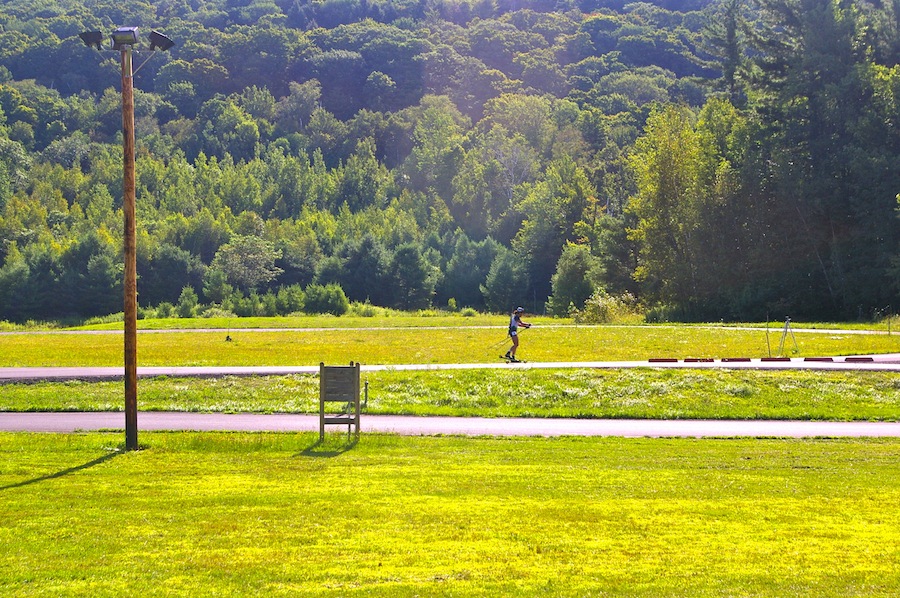
    A racer heads out on the penalty loop at the Ethan Allen Firing Range in Jericho, Vt., during the 2013 North American Biathlon Rollerski Championships from Aug. 10-11.
    A racer heads out on the penalty loop at the Ethan Allen Firing Range in Jericho, Vt., during the 2013 North American Biathlon Rollerski Championships from Aug. 10-11.

    Editor’s Note: After a weekend trip to Jericho, Vt., from Aug. 10-11, FS decided it might be interesting to provide some background on one of the most prolific biathlon sites in North America and clarify how to gain access to the National Guard’s facility.

    JERICHO, Vt. – Just a hop, skip and a jump off interstate 89, the Ethan Allen Firing Range sits tucked away high upon West Hill Road – and a lot of locals couldn’t tell you what it looks like. You see, what’s widely recognized as one of the best biathlon gems in the country (and North America) is also a bit exclusive and intimidating from the outset.

    Owned and operated by the Vermont National Guard, the 11,000-acre site mainly caters to the military. If you’re lucky enough to grace the grounds of Camp Ethan Allen, even if it’s just to and from the range, chances are you’ll come head to head with a humvee or some reserves in action. If you stay out of their way and have the go-ahead to use the range, chances are you shouldn’t run into any problems – and this is what makes Jericho so cool.

    In early August, about 105 athletes came out for the North American Biathlon Rollerski Championships hosted by the Ethan Allen Biathlon Club (EABC) and organized by US Biathlon (USBA).

    According to USBA director of athlete development Piotr Bednarski, that was a pretty huge turnout for rollerski races. In fact, it might’ve been the biggest field in about 20 years of the event’s existence.

    Every other year, the North American Biathlon Rollerski Championships float between Jericho and Canmore, broadening the scope beyond nationals. When they’re not hosting the championships, the sites swap what’s known as the North American Cup – and in Jericho, the turnout is typically good (60 to 70 athletes).
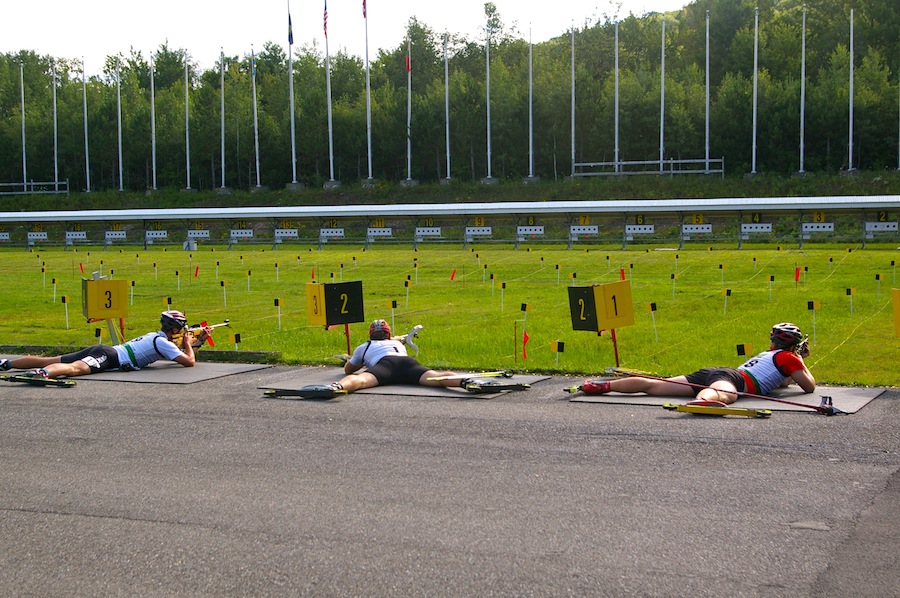
    Eventual men's winner Lowell Bailey (c) gets his shooting on Aug. 11 at the Ethan Allen Firing Range in Jericho, Vt. Bailey went on to win the two-day North American Biathlon Rollerski Championships.
    Eventual men’s winner Lowell Bailey (c) gets his shooting on Aug. 11 at the 30-point Ethan Allen Firing Range in Jericho, Vt. Bailey went on to win the two-day North American Biathlon Rollerski Championships.

    “It’s actually probably the best roller loop on the planet,” Bednarski said. “All the national team guys, they’ve gone to Ruhpolding and Oberhof [Germany] and all over the world, and this is really just a great place to ski.”

    The approximately 5.5-kilometer rollerski loop got a major upgrade in May when the Vermont National Guard spent $300,000 dollars on repaving. According to Maj. Christopher Ruggerio, biathlon coordinator at the National Guard, the project wasn’t an absolute must, but it was important in keeping Jericho valuable to biathletes.

    “Prior to initiation of this project, the course was by no means unusable, but did have a number of unwanted cracks and heaves that were becoming a safety concern to athletes,” Ruggerio wrote in an email. “Our Range is one of the premier venues in the Nation. According to various coaches and athletes from multiple organizations, our roller ski trail system is likely the ‘best in the world’ at this time.”

    EABC President John Madigan explained in an email that the range was “probably the best in the country and comparable to other countries” when it was built several decades ago.

    “Biathlon in Europe has grown tremendously since then and the stadiums in Germany and other countries now attract 30,000 or more spectators to World Cup races,” he wrote. “It will be a long time before we ever see that here, but these paved trails are as good as anything in Europe and as close to real skiing as you can get in the summer.”

    “It’s got the vertical plus it skis like skiing,” Bednarski explained.

    That’s partly why Biathlon Canada High Performance Director Chris Lindsay considers it almost like a second home – albeit in America – in contrast to their base in Canmore, Alberta. As he drove up the winding road to Jericho last month, Lindsay said he passed signs still standing after Tropical Storm Irene flooded the region two years ago. Their words were an eerie reminder of what Canmore experienced in June – unprecedented rainfall, devastating floods, evacuations, and destruction.

    The signs read “Vermont strong,” and Lindsay saw similarities to those posted in Canmore. “We have those, too,” he said.

    But long before the flooding thousands of miles away in Canmore, these races in Jericho were a priority and will become more so in the coming years. For the Americans, they were a sort of prequalifier for the Olympics: do well there and at two more rollerski trials in Utah, one could earn a ticket to Europe to strive for World Cup starts. For the Canadians, it was less about Olympic qualification and more about the competition.

    “We are very supportive of the idea of getting back to having co-competitive opportunities for the two major North American teams on a regular basis and during the training season so that there’s an opportunity to learn from each other and there’s also an opportunity to measure off each other,” Lindsay said.

    Because of the size of biathlon in Canada and the U.S., both programs can’t just rely on internal or domestic competition, he added. To measure success, they need to be pinned against one another.

    “Getting back to having this as a major event within our training season is a priority for the next quadrennial,” he said. “Having over a hundred people on the start list, this is pretty significant and it’s a great opportunity.”

    Bednarski, who organized the event remotely from Minneapolis, said he was ever impressed with the Canadians’ showing.

    “I think they’ve made it a national-team requirement basically, which is great,” he said. “It elevates everybody. … Anybody on the U.S. or Canadian team that has a shot at making the Olympics is here. There’s twenty athletes who are going to go, and they’re all here.”

    For the low cost of a couple dollars per day, athletes stayed in the barracks for as long as two weeks.

    “It’s like the army,” Bednarski said. “It’s really fun. Everyone’s together, there’s no TV, no internet, everyone’s just hanging out and playing games and Frisbee and whatever.”

    Women’s pursuit champion Rosanna Crawford, prequalified to represent Canada at the 2014 Sochi Olympics, explained in an email that she only spent two nights in the barracks after training in Lake Placid, N.Y.

    “I actually slept pretty good, but the showers are really gross!” she wrote. “They could really use some new shower curtains! Two nights was more than enough for my liking! The food was good though, they had hired a couple cooks to come in for the week and they were amazing and really nice people!”

    Wondering what it takes to gain access? Madigan explained that one must be associated with a club or organization that leases rights to use the range (Craftsbury and Mansfield Nordic do as well), and the leaders of those organizations must have safety training at the base.

    “We always welcome people to join us during a scheduled practice, try some shooting or check out the trails,” he said.

    There are three more races in the fall biathlon series (Sept. 29, Oct. 27 and Nov. 3) and a cyclocross biathlon race open to the public on Oct. 26.

  • Bailey Wins Twice at North American Rollerski Biathlon Championships (updated)

    Bailey Wins Twice at North American Rollerski Biathlon Championships (updated)

    Lowell Bailey racing in Saturday. Photo: Elizabeth Garaghty.

    The United States Biathlon Association (USBA) held their biggest summer event in Jericho, Vermont this weekend: the North American Rollerski Biathlon Championships, which crowned men’s and women’s champions in four different age categories as well as the masters men’s division.

    “Things went wonderfully,” said John Madigan, president of the Ethan Allen Biathlon Club, which hosted the races. “It is such a close and fabulous community in biathlon and it is always special when we can have all the top U.S. biathletes racing here in Vermont.”

    Despite the event’s name, no Canadian teams were in attendance, making the races an all-American affair. The U.S. national team was at the end of a week-long camp in Jericho, and comprised most of the senior field. In the junior races, athletes traveled from as far away as Alaska to attend the races.

    “I think the Canadians missed a great opportunity to race at the highest level at one of the best rollerski venues in the country, but they had not put it into their training plan at the beginning of the year,” Madigan said.

    On Saturday, the biathletes faced a scorcher of a sprint. The races were short – 7.5 k for women and 10 k for men, with just two shooting stages. With 80-degree weather, bright sun, and 80-percent humidity, many athletes struggled to adapt.

    Tracy Colliander. Photo: Judy Geer.

    “Heat has always been a challenge for me and it was definitely pretty intense for the Saturday race,” national team member Lowell Bailey wrote in an e-mail. “Even with extra attention to hydration, I was still pretty dizzy by the end. I think almost everyone had the same experience.”

    2006 Olympian Tracy Colliander said that the women had just as much trouble with the hot temperatures.

    “The heat was a big factor in these race,” she told FasterSkier. “The biggest thing was to try to avoid overheating as long as possible. It was inevitable that you were going to overheat, but if you could delay it, you were better off.”

    Bailey managed to triumph over his heat troubles in the sprint. He and Bill Bowler had the best shooting for the men – only a single penalty each – but Bailey was the faster skier, and picked up the win by 56 seconds. Jeremy Teela was another 38 seconds behind after missing three shots, and gave the national team a sweep of the podium.

    Tim Burke, who is recovering from compartment syndrome surgery, finished sixth after missing eight shots.

    “I was trying some new sites on my rifle but unfortunately I only received them the day before so I did not really have a chance to test them,” Burke said. “I decided the race would be the perfect situation to test them. I learned right away that they don’t work for me!”

    Burke’s skiing was solid, and he was confident that he would be back in top race shape by December despite missing a large amount of ski-specific training this spring.

    In the women’s race, Sara Studebaker picked up the win. Studebaker and Tracy Colliander had one penalty each; Colliander finished 15 seconds back, with her twin sister Lanny Barnes in third with two penalties.

    Sara Studebaker. Photo: Judy Geer.

    “Yesterday was good for me,” Studebaker wrote in an e-mail. “I was really happy with my shooting, and managed to keep things together with the skiing for most of the race despite the heat. It was super humid both days and it definitely took a toll on people.”

    While she was happy to win, Studebaker didn’t want to read too much into her victory. As a member of USBA’s “A” team she is prequalified for the first period of World Cup racing and is taking the long view.

    “For me, it’s certainly nice to see some good results right now, but that’s never been to goal,” she said. “I’m really focusing on December, and not having to qualify for the World Cup gives me good opportunity to treat these races like training and just get some more races under my belt without the stress.  In all, training has been going really well for me.  I’ve been trying some new things with my shooting and working a lot on ski technique.”

    Sunday brought a simulated pursuit – although the athletes started in the order they finished on Saturday, they were separated by thirty seconds instead of the time gaps from the previous race. For Studebaker, the 15-second advantage would have been nice to hold onto.

    “I think today [the heat] just caught up to me,” she wrote. “My prone shooting was solid, but by the time I got to standing I was pretty tired and just couldn’t keep things going. It was a tough one for sure.”

    Pursuits feature four shooting stages – two prone and two standing. For the women, these stages are spread over 10 k. Studebaker missed seven shots and finished in sixth place.

    Mark Johnson, 5th place in the sprint. Photo: Elizabeth Geraghty.

    With the previous day’s winner faltering, Barnes stepped up and took the win by a solid minute over her sister. Of all the women, Barnes shot the best: she had only a single penalty to Colliander’s four. The best shooting in the men’s field was four penalties as well. The twins, who do not have national team support, have been the best American shooters for several years – and have turned heads when they appear on the World Cup circuit as well.

    “We are where we want to be leading up to the next set of trials in Utah,” Colliander told FasterSkier. “It’s still early in the summer though and there is a lot of work to be done still before the season. We don’t want to be rocket fast right now, we want to be fast in the winter. You can’t look to seriously at results in the summer like this, but you can gauge how you feel and what you still need to work on before the snow flies.”

    National team member Laura Spector, who is finishing up her last term at nearby Dartmouth College this summer, finished third with seven penalties.

    “I’ve been training in Hanover during the week and go to Jericho for combo training on the weekend,” Spector said of her summer schedule. “It’s been pretty standard, and I just try to fit the training sessions in between classes and homework.”

    In the men’s race, Bailey stuck to his winning ways, this time beating teammate Leif Nordgren by 17 seconds over 12.5 k of skiing despite having five penalties to Nordgren’s four.

    “The races went pretty well,” Bailey said in a characteristically humble e-mail. “I have changed around my training a bit over the last month and I was happy to see that I was still able to perform well given those changes.”

    But like Studebaker, he was careful not to take his victories to seriously.

    Annelies Cook, 5th place in the sprint and 4th in the pursuit. Photo: Elizabeth Geraghty.

    “As far as these races are concerned, I think it’s hard to look at summer results and make assumptions or predictions about the upcoming winter,” Bailey said. “I’m happy with the way this weekend went, and it is a good affirmation of the work I’ve been doing. However, it’s important to keep things in perspective: my focus is on the December World Cups and eventually World Champs in Ruhpolding later this winter.”

    Norgren, who is the youngest member of the national team, was pleased with his second-place finish.

    “The skiing was pretty fast,” he said. “I’ve made a lot of improvements this summer in both technique and strength so I was happy with how the skiing went. As to where I was last summer, I’d say I’m way ahead of there now!”

    Bowler edged out Teela for the final spot on the podium, giving the national team another sweep.

    What’s next for the biathletes? The “A” team will be traveling to Europe for a training camp, while the rest of the squad will stay in the U.S.

    The next races at Jericho will be the International Biathlon Union’s North American Summer Biathlon Championships, which pair running with shooting. It’s unlikely that any winter biathletes will be competing.

    Results from the weekend can be found here.

    Lanny Barnes in the start. Photo: Elizabeth Garaghty.
    Lowell Bailey leading Mark Johnson in the sprint. Photo: Elizabeth Geraghty.
    Susan Dunklee (l) and Annelies Cook on the range in the sprint. Photo: Elizabeth Geraghty.
  • Interview: Patrick Coffey on Learning to Coach and Developing American Athletes (and Clubs!)

    (Note: this interview is the third in a series of profiles of USBA coaches. The first two were with Per Nilsson and Jonne Kahkonen.)

    When Patrick Coffey was hired by the United States Biathlon Association (USBA) as an assistant coach in 2008, he had only three years of coaching experience, making him an unusual choice for a national team position.

    But what he lacked in formal training and experience, he made up for in passion. In those three years, Coffey had grown the Ethan Allen Biathlon Club almost tenfold and turned it into one of the top clubs in the country, seemingly through sheer power of will and positive thinking.

    “We had him join us at some national team camps as a part of our coach mentor program,” USBA President and CEO Max Cobb told FasterSkier. “He demonstrated his great enthusiasm for coaching and brought a lot of energy to his work. Biathlon is a very coaching-intensive sport and we recognized that we needed more coaching manpower to deliver a really good program for the national team.”

    Since then, Coffey has grown into his role with the national team and is beloved by his athletes, several of whom asked FasterSkier to do an article on him. He currently works with the resident athletes in Lake Placid and the women’s national year-round and coaches the IBU Cup trips in the winter, and is the only American member of USBA’s coaching staff.

    “Patrick has and continues to work really hard to deliver well organized training for the athletes, all the while learning from our senior coaching staff,” Cobb said. “I think it has worked out well for the program and for Patrick too.”

    When FasterSkier talked to Coffey a few weeks ago, the interviewer had just completed a long hike in the White Mountains with Susan Dunklee, one of Coffey’s athletes, and that provided a jumping-off point for the convseration.

    FasterSkier: First of all, Susan told me to let you know that she hadn’t done a whole Presi Traverse, because she knew you weren’t psyched about that.

    Patrick Coffey: I was wondering. I was actually going to spy and ask how long she went for.

    FS: When we were hiking along, she mentioned that more than some of the other coaches you encourage workouts and adventures like that one. What do you see as the benefit to really long adventures in the mountains?

    PC: Well, I don’t know that I would endorse people going out and doing huge twelve, thirteen, fourteen hour days, because those are really hard to recover from. I think that probably more what she’s hinting at is that I think it’s important for people to individualize the training so that they’re happy as a person. So she likes to go out in the mountains and hike, backpack, trail run, so I try to work that stuff in a little more for her. We have other people who are like, tell me to go on a four hour bike ride and I’ll go on a four hour bike ride. They’re happy doing whatever is considered the absolutely best possible thing.

    FS: So now that that’s out of the way, could you tell me a little bit about how you got started coaching biathlon?

    PC: The long saga is that I grew up in Essex [Vermont], right near the Jericho range, and started skiing as a freshman in high school. I trained at the range, saw biathlon, and really wanted to get into it, so I competed for six years, was pretty bad, never super successful, didn’t ski in college, ended up having surgery when I was 21 that made it fairly clear that I was not going anywhere as an athlete.

    So I had a friend who was coaching in Jericho at the time. I couldn’t drive after the surgery so he would pick me up on his way to the range and I would help him coach. That was kind of my introduction to it and I realized that it was a great way to stay in the sport.

    I moved to Montana for a while and when I came back I decided that I wanted to start coaching in Jericho [for the Ethan Allen Biathlon Club] and really get the club going there. I totally lucked out that within three years I was working for USBA. They – I don’t want to say that they took note, but they noticed that there was actually a person trying to coach, an American, and man did they take a gamble. Because it’s just scary to think about what I didn’t know when they hired me. But they gave me an opportunity to coach at the highest level, and I like to think that I’ve been maximizing that opportunity and really trying to go for it.

    FS: So…. did you have any training as a coach, then?

    PC: Nope [laughs]. Basically what I was trying to do was emulate my junior coach, which was impossible because he was a drill sergeant, you know, that which does not kill you only makes you stronger. I’m much more of a, well, I guess you could say a mother hen. So I tried to take what I knew from him and adapt it to my own style. But it’s true. I was painfully clueless. I had way more motivation than I did knowledge when I started, but I figured that was enough to get things going.

    FS: Right now Ethan Allen is a pretty big club. Has it always been that way?

    PC: Well, in the mid and late nineties, USBA started five Regional Centers of Excellence (RCE’s). One of them in Jericho, and it was a thriving junior group. That started to fall off when I went to college, and then through college and when I was living in Montana I kind of lost track of things. When I came back, I want to say there were two or three athletes there.

    FS: That’s a big change.

    PC: I set goals for myself. I kind of made a three year plan, that I wanted to get twenty kids in the program, start a masters program, place at least one athlete on the junior worlds team every year, and then by the third year have one on every team. A lot of it was ignorance is bliss, but I’ve never been very practical.

    FS: But you did grow the program a lot.

    PC: Yeah, I was really lucky. I think that one of the best things was starting a masters group, because I’m still really passionate about community development, and I think you need to have it not just on the highest level of people who are national team, World Cup, Olympic-bound. And the idea was to have the masters as part of the community. Because yeah, they’re not going to go out to U.S. Nationals and get a podium and try to make these national teams. But, they love the sport, they’re going to talk about it, and if you need to run a race, that’s a great group to tie into.

    And out of that group we’ve had two folks join the board in Jericho, and one of them, John Madigan, is the president of Ethan Allen. He’s doing such a fantastic job. And I’d like to think that part of his introduction to the sport at Jericho in a bigger way, was because it was a masters group.

    FS: To backtrack a little bit, what happened to the RCE’s, and what are your ideas about developing more biathlon clubs in the U.S.?

    PC: To talk about the RCE’s, they put five of them together. In every sport, there’s the four year cycle with the Olympics. Every NGB (national governing board) swears that they’re not going to change anything, and then something always gets dropped. And that’s what happened. I can’t remember if it was after Nagano or after Salt Lake that the RCE’s lost their funding. But honestly of the five that were started, I can’t remember exactly who it was but there was a good group in Minnesota, a good group in upstate New York here and a good group in Jericho. Minnesota still has a program, Jericho still has a program – I would say that Jericho and Fort Kent are kind of the big programs as far as numbers go. Alaska has some amazing talent. Minnesota is obviously cranking out some amazing athletes as well.

    And then as far as the way to kind of get back on track, I actually did write up a development plan, just because I do like to stick my nose in that business. As an American, I feel like I have a unique perspective. I have now worked with the highest level athletes, so I see where the road is going, but I also have a better idea of where it begins. We don’t have tons of organized clubs, we don’t have any culture that backs it. And I think what I’ve learned from my own experience is that the most important thing for getting a club off the ground is just to have somebody with energy and passion. You know, you could have somebody who knows everything about the sport, but if they’re not an energetic personality, who’s going to want to hang out with them?

    I think that there needs to be coaching development as well as athlete development in this country. One of the things that I’ve been trying to get off the ground, and it’s an enormous undertaking, is a website with information for people who just want to start with the basics of biathlon. In retrospect, I went into Jericho not knowing my ass from my elbow. I wanted it to happen, I was organized, I was just kind of a driving force, and I think that’s the most important part. Because it’s a really interesting sport – it’s such an easy sell!

    FS: What do you think can be done to get more fans interested?

    PC: Boy. That’s one that I don’t have an answer for. I think that the problem with growing the community has to do with accessibility. Because if you’ve got snow and somebody with a snowmobile, you’re skiing, but the process of having a biathlon venue is so much more involved, when you add the rifles in there. It does blow my mind a little bit that every four years there seems to be a surge in interest, and then nobody keeps it. I wish I had an answer because about everything else, I’ve always got an opinion [laughs].

    FS: You’re the only American coach on the USBA staff right now. Do you think you have a better understanding of how American athletes are developing, and how grassroots biathlon works in the U.S.?

    PC: I think it definitely gives me a unique perspective. Because we talk about this all the time as a coaching staff and with our High Performance Director. There are cultural differences that are going to be very hard to understand no matter how much time these coaches spend around Americans. So that’s been a big advantage, not only for myself – I’m learning from them, it’s a two-way street. I’m learning their training philosophies they are bringing from each country, and I’m helping them understand why sometimes our athletes act the way they do. Not in a good or a bad way, but just the American mindset, I guess.

    FS: You were the national team assistant coach for a while, and now you’re back to being the Lake Placid coach, is that sort of accurate?

    PC: Yeah, it’s interesting because everyone asks me oh, what’s your job title. And on paper, I’m the Lake Placid High Performance Coach and the women’s national team Assistant Coach. But the reality is, now we’re a little more separate. Jonne [Kahkonen] and I are taking care of the women, Per [Nilsson] and Armin [Auchentaller] are taking care of the men, but it’s really fluid. All four of us are always in constant contact. I realize that of the four I’m low man on the totem pole. But I think that we’re not confined. My role is in the winter to be on the IBU Cup [a race circuit in Europe one level below the World Cup]. So anyone that ends up on the IBU Cup, I’m going to be working with. So the lines are not super definitive. And I feel like my involvement has increased every year, because I’m more knowledgeable and more confident, I’m able to add more to the conversation every year.

    FS: What have you learned from working with Jonne and Per?

    PC: Oh [laughs].

    FS: That’s too general a question.

    PC: No. I would say just about everything. I was super lucky to be put in the position I was in and I try to absorb as much as I can. What I’ve learned from Per is that the physical training can be as complicated or as simple as you want to make it, and that you can wrap your head around a lot of the big ideas and a lot of the individual ideas and boil it down and have a training philosophy. Within that you can be really specific but I think if you were to ask the athletes, the philosophy is really straightforward, and the training plans are easy to understand. Everything has a reason. I think that’s what I’ve learned from Per: that however complicated it might be in his head, when it’s presented it’s simple, it’s straightforward, and we don’t need to stress about some of the little details that are distracting.

    FS: It seems like you have a lot of different athletes in the program, for instance some who have been doing biathlon since they were really young and some who just picked it up. How do you deal with that as a coach and make those athletes a cohesive group?

    PC: The women have been doing a really great job of that themselves. Last year they banded together and said, let’s go ahead as a group, we’re going to gain respect as a group, and we’re going to respect whoever is in the driver’s seat on the World Cup and on the IBU Cup, and it worked. Any of the success that that group had last year, which is a lot, speaks well of the entire group.

    But I think that it’s really important to understand that each athlete has a different background. So I’m not going to sit around and give Lanny and Tracy [Barnes] shooting advice, because it’s pointless. I feel like we should sit around and they should tell me some things. But it’s a matter of respecting the backgrounds but also understanding the personalities and how they absorb the information. So I guess any good coach would tell you that it’s about adaptation and not trying to use the same line of instruction with every athlete because it’s not an effective tool. You may want to get the same point across to two different athletes, and you have to do it two different ways.