From the FasterSkier archive — posts syndicated from athletes’ and coaches’ own blogs between 2004 and 2012, kept online as published. Current coverage is at fasterskier.com.
In this episode of Nordic Nation, we speak all things trail design with John Morton. Based in Vermont, and global in perspective, Morton provides insights into the literal ups and downs of trail design and how full-blown nordic centers and small scale trails can bring a modern vibe to an old-school sport. He runs Morton Trails locally but has a global reach with projects based in China.
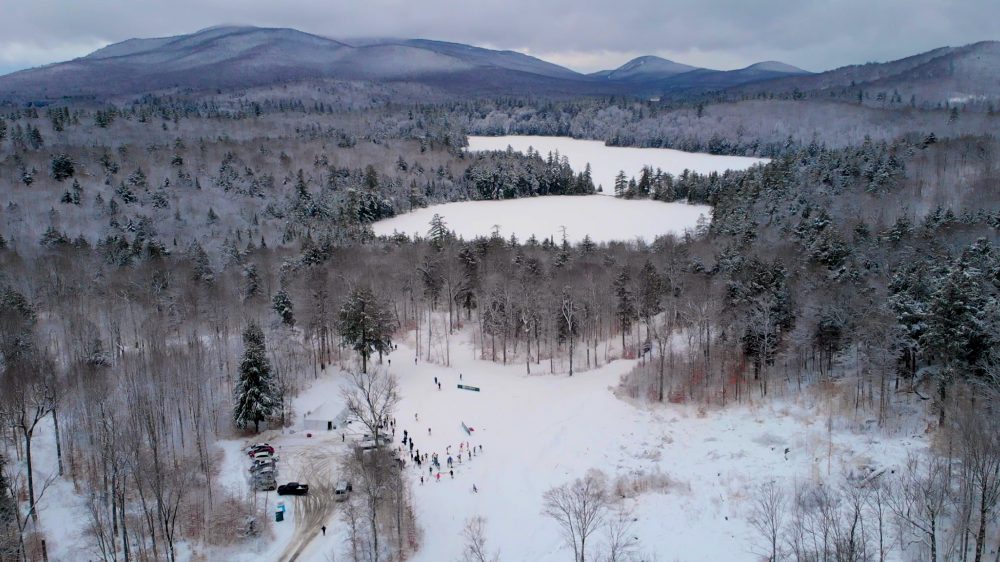
A vision for a nordic sport future – an aerial shot of a portion of Paul Smith’s campus.
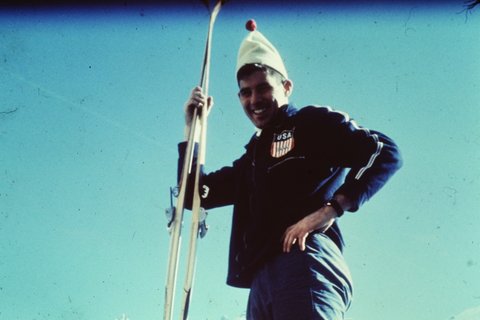
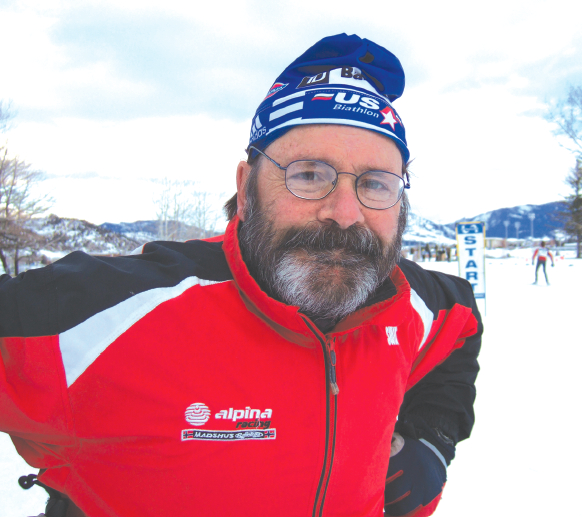
Morton’s ski resume is lengthy. And true to form, Morton stuck to trail design during our conversation. He failed to mention he is a two-time Olympic biathlete, served a tour of duty in South Vietnam, coached collegiate skiing, and remains an all-around ski enthusiast. This is really just the tip of the iceberg.
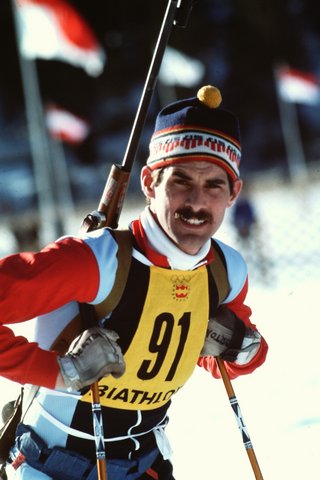
John Morton at the 1976 Winter Olympics in Innsbruck, Austria (Courtesy photo)
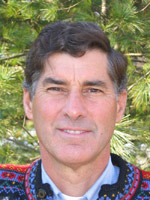
The following was submitted to FasterSkier by John Morton, a former U.S. biathlete and two-time Olympian (1972 and 1976) who has attended 10 Winter Olympics as “either an athlete, a coach, the Biathlon Team Leader, Chief of Course or, more recently as a spectator,” according to his bio (at end of article). Today, Morton, 71, lives in Thetford, Vermont, and works in trail design.
***
I’ve had the remarkable good fortune of attending 10 Winter Olympic Games. I was a member of the U.S. Biathlon Team in 1972 at Sapporo and again in ’76 at Innsbruck (where, following a workout, a few of U.S. ski-shooters wandered over to the adjacent cross-country stadium and watched Bill Koch win his monumental silver medal in the men’s 30 km). I was an assistant coach for the U.S. biathletes at the 1980 Games in Lake Placid, where late in the schedule, I accepted a complementary ticket to a hockey game, not even knowing which teams were playing. It turned out to be the USA’s remarkable victory over the Soviet Union, probably the most inspiring sporting event I’ll ever witness. I served as Team Leader for the U.S. biathletes at Calgary in ‘88, Albertville in ‘92 and Lillehammer in ‘94. Then, in 2002, I was the Chief of Course for the biathlon events during the Salt Lake City Olympics, a volunteer position that was every bit as stressful as competing back in ’72 and ‘76.
At the most recent three Winter Games, Vancouver, Sochi and PyeongChang, my wife and I have enjoyed the relative luxury of attending as spectators, cheering on America’s cross-country skiers and biathletes. As the jet lag from out trip home from South Korea begins to wear off, I can’t help thinking about the dramatic changes these two sports have experienced over the past 46 years. It seems to me that many of these changes can be traced to three factors: innovations by the athletes, technological improvements and the influence of television.
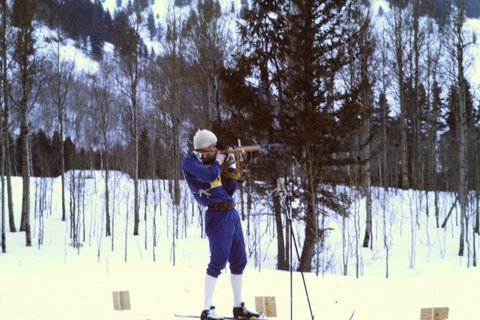
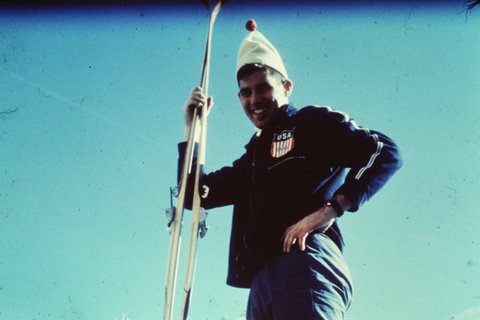
John Morton at 1972 biathlon Olympic trials in Jackson, Wyoming. (Courtesy photo)
Back in ’72 we were on wooden skis, kick-waxed the entire length. There were two biathlon events, the 20 km individual and the 4 x 7.5 km relay. We shot large-caliber rifles on a 150-meter range using paper targets for the 20 km and glass disks for the relay. It was impossible to determine the winner of the 20 km until all the paper targets had been carefully inspected, sometimes hours after the conclusion of the event. A typical biathlon course consisted of three, independent, 4 km loops, with cutoffs for the relay. Women didn’t compete in biathlon at the Olympics until Albertville in 1992.
Men’s cross-country has been part of the Winter Olympics since the beginning in 1924 at Chamonix, France, when there was a 15 km event as well as the legendary 50 km. The first cross-country event for women was a 10 km, which debuted in 1952. In those days, Nordic race courses consisted of roughly one-third climbing, one-third descent and one-third relatively flat terrain. Well into the 1960s, courses were prepared by soldiers boot-packing or snowshoeing the course, followed by skiers stomping in the parallel tracks through the forests and fields. Competitors typically started at one-minute intervals, disappeared into the woods, only to reappear exhausted, often hours later, covered with frost and mucus. The men’s 50 km cross-country event at the 1932 Winter Olympics in Lakes Placid consisted of a 25 km loop skied twice, and was won by Finland’s Veli Saarinen in 4 hours, 28 minutes.
In my view, the first significant change came at the 1974 Nordic World Championships when Sweden’s Thomas Magnusson won the men’s 30 km on Kneissl synthetic skis. Fiberglass and metal had replaced wooden Alpine skis years earlier, but the faster, plastic bases wouldn’t hold Nordic kick wax. But in wet, heavy, painfully, slow snow, Magnusson took a chance on the fiberglass Austrian skis and dominated the race. The headline in the Oslo paper the next day read something like, “Magnusson wins gold, Norwegian ski industry in peril.”
The next major breakthrough occurred at the 1976 Innsbruck Olympics two years later. Marty Hall, head coach of the U.S. Cross-Country Team recruited Rob Kiesel from Alpine skiing as his assistant. Together they determined that it was possible to wax the tips and tails of the new fiberglass skis for speed with Alpine wax, restricting the much slower cross-country kick wax to a short segment under the athlete’s foot. This made the skis of the Americans faster than those of their European rivals and certainly contributed to Bill Koch’s memorable silver medal in the 30 km, America’s first, and only Olympic medal in Nordic skiing until Kikkan Randall and Jessie Diggins struck gold in PyeongChang.
Following the success of the Innsbruck Olympics, expectations were high for U.S. Nordic skiers at the 1980 Olympics in Lake Placid. With a theoretical “home court advantage,” Bill Koch’s 13th in the men’s 50 km and Lyle Nelson’s 19th in the biathlon 10 km sprint fell short of the results which the public had been led to expect.
Discouraged, Koch elected to ski the international ski marathon circuit the following year rather than the Nordic World Cup. There, on trails groomed wide by Alpine-area Sno-Cats for thousands of citizen racers, he observed elite competitors pulling away from the throng by putting one ski in the set track and pushing off, skating-style with the other. He quickly mastered this marathon-skate technique and began to experiment by skating with both skis. When he returned to the World Cup circuit a year later, he threw the Nordic world into turmoil by abandoning the relatively slow kick wax altogether and skating entire courses on skis waxed purely for speed. The result of Koch’s persistence and innovation was a cumulative World Cup victory for the season, America’s first in cross-country skiing.
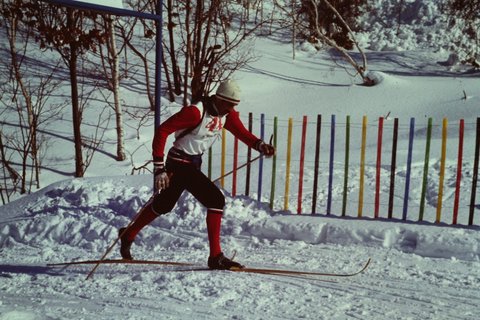
U.S. biathlete John Morton racing at the 1972 Winter Olympics in Sapporo, Japan. (Courtesy photo)
When the dust (or more accurately, snow) finally settled, Nordic skiing had two disciplines, classic (the traditional kicking and gliding) and freestyle (skating). Because biathlon was already complicated enough with skiing and shooting, they decided to go with skating as their designated technique, as did Nordic Combined. In a type of mutual re-enforcement cycle, the use of large, Sno-Cat-type grooming machines on cross-country trails, which originally made the evolution of the skating technique possible, became a requirement once skating was accepted as a part of the sport.
Enter television. The first Winter Olympics to be televised were the 1956 Games in Cortina, Italy, and it quickly became apparent how powerful the new medium could be. Figure skating, ice hockey and ski jumping immediately gained popularity, largely because they were relatively easy to cover. Alpine skiing, bobsled and Nordic skiing lagged behind because they were more difficult and expensive to film. The sports favored by TV prospered, enjoying increased funding from sponsors and a wave of young Olympic hopefuls. Meanwhile, those sports that were less telegenic scrambled to make their events more appealing to the camera. Nordic skiing and biathlon added mass-start and pursuit format events, making it easy for spectators to see who was winning. In terms of spectator interest, biathlon had the advantage of the shooting range. With the adoption of the modern, knock-down targets and television cameras’ abilities to zoom in on an athlete’s targets as he/she is shooting, the popularity of the sport took off. In recent years, biathlon has become the most-watched winter sport in Europe with World Cup events rivaling the popularity of Monday Night Football in America.
In cross-country, one of the unintended consequences of the skating revolution was a focus on upper-body strength, which in turn, led some athletes to abandon kick wax in classic events and double pole the entire course, especially in the shorter, sprint races. This led the FIS (the international governing body for skiing) to require tougher courses with more challenging climbs.
Finland’s Iivo Niskanen after winning the men’s 50 k classic mass start at the 2018 Winter Olympics in PyeongChang, South Korea. (Photo: FlyingPointRoad)
As a result, what we saw in PyeongChang for both cross-country and biathlon, were trails 30-feet wide, capable of accommodating three skaters, side by side (without obstructing each other), with steeper climbs and faster, more challenging descents. Aside from the spacious start/finish stadiums, the traditional one-third of relatively flat terrain has disappeared. There was also an effort to loop the trails back within sight of the spectators so that they saw more than just the start and finish of the events. For example, the men’s 50km, perhaps the most iconic of the cross-country events, was conducted on two, 4.16 km loops which brought the competitors through the stadium, in front of the cheering crowd a dozen times. The men’s 50 km classic in PyeongChang was won by Finland’s Iivo Niskanen in a time of 2 hours, 8 minutes (less than half the time it took for his countryman to complete the same distance in 1932 at Lake Placid).
Perhaps the most dramatic change, was the scheduling of many of the Nordic skiing events at night (which allowed them to be televised live in Europe and the eastern U.S. at a reasonable hour). In addition to the expense of lighting and minimizing the number of TV camera platforms, another motivation for shorter ski loops is the growing need, thanks to climate change, to cover the entire trail with machine-made snow. Early in the winter the biathlon and cross-country courses were blanketed with a deep layer of machine-made snow, enough to survive warm temperatures and thaws well beyond the Olympic schedule in February.
While there have been advancements and technological improvements in other Winter Olympic sports, I can think of none more dramatic than what we’ve experienced in Nordic skiing. From a single biathlon event held at the 1960 Squaw Valley Games, there were 10 biathlon competitions on the schedule in PyeongChang. With the advent of the skating technique, fiberglass skis and fluorocarbon waxes, times for cross-country events have been cut in half in less than a generation. Thanks to machine-made snow, the 2022 Winter Olympic Games will be hosted by Beijing, China, a city previously not known for winter sports. And through the development of LED lighting and high-definition television, the excitement of Nordic skiing events can be broadcast live, in prime time, to homes around the world.
*****
John Morton has participated in ten Winter Olympic Games as either an athlete, a coach, the Biathlon Team Leader, Chief of Course or, more recently as a spectator. He has published two books and numerous articles dealing with Nordic skiing.
After 11 years as Head Coach of Men’s Skiing at Dartmouth College, he founded Morton Trails, and has spent the past 28 years designing more than 220 recreational trails and competition venues across the country. He currently has projects underway in a dozen U.S. states as well as two projects in China. More information regarding his trail design work can be found at www.mortontrails.com. He lives with his wife Kay, at the end of a dirt road in Thetford, VT, surrounded by trails.
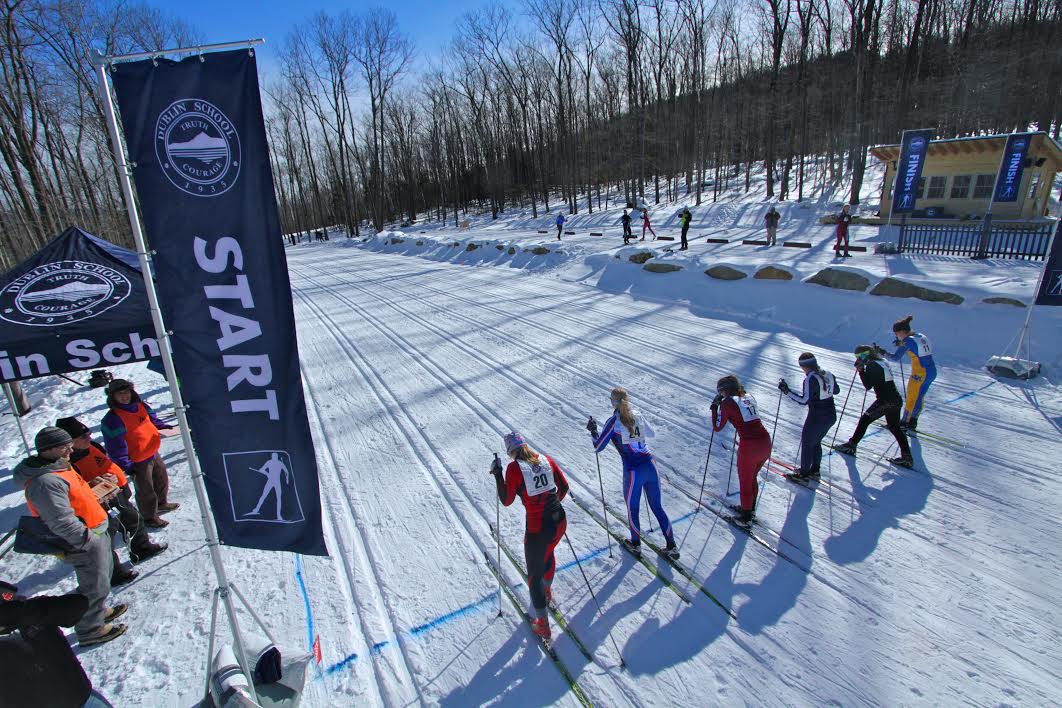
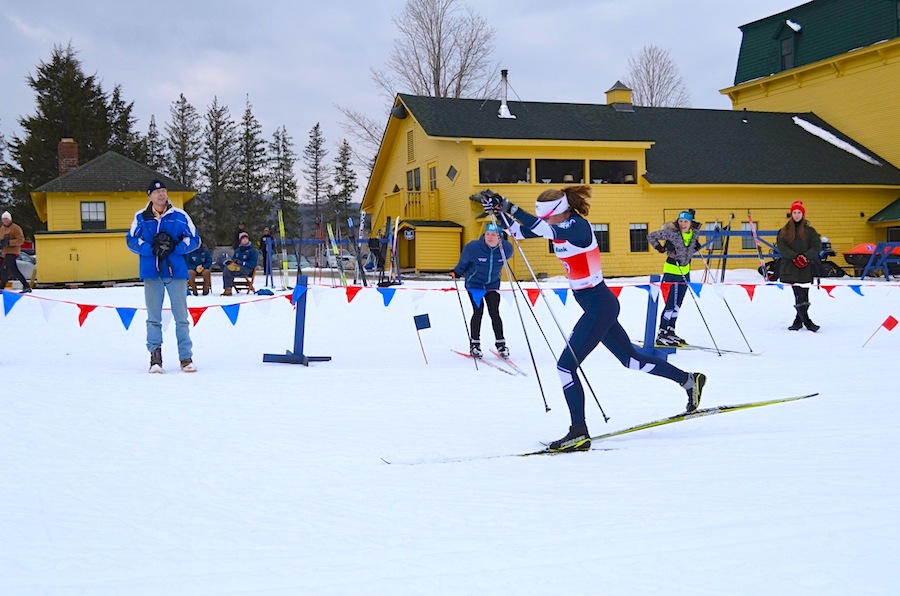
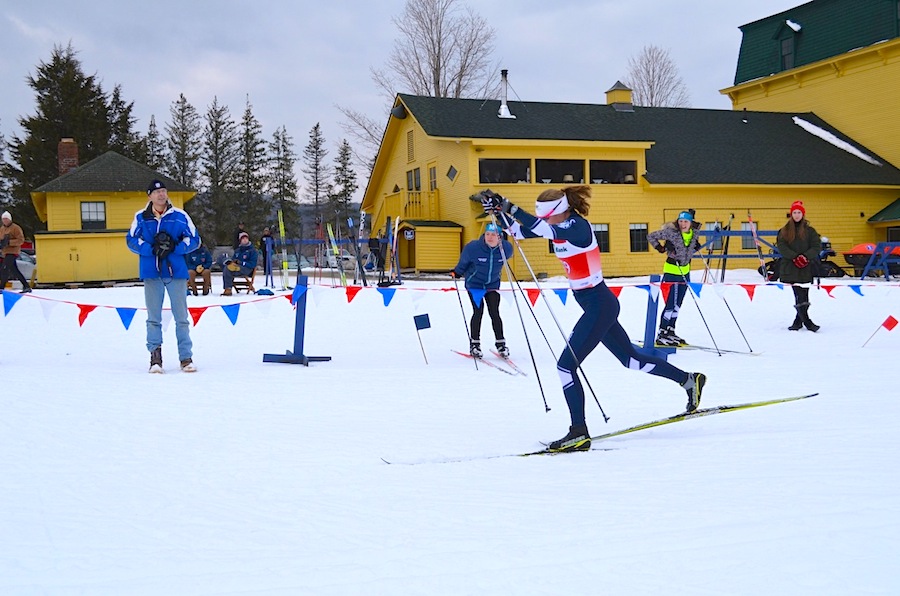
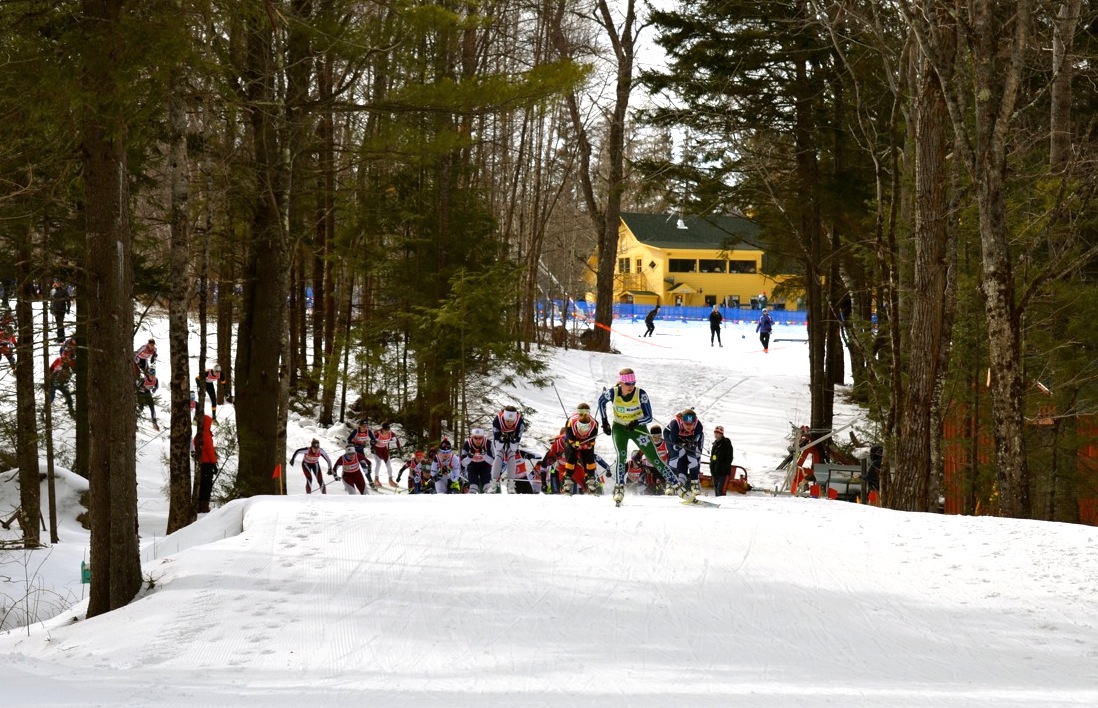
A race starting on the Dublin School nordic center’s new course last winter. (Photo: William H. Gnade Photography)
Note: In addition to the Dublin School, at least one other private school in New Hampshire has FIS-homologated trails. Proctor Academy, with 360 students in Andover, N.H., built FIS-approved trails (also designed by John Morton) two years ago. Proctor has two FIS-homologated loops of 2.5 k and snowmaking on 1.4 k.
***
Does a secondary school need an International Ski Federation (FIS)-sanctioned race course? Perhaps not, but that’s what skiers can expect when they go to New Hampshire’s Dublin School for the 2016/2017 ski season. The Dublin School, a private high school in southern New Hampshire, has a brand-new, FIS-homologated 5-kilometer loop, designed by John Morton, and it claims it’s the first high school in the world to receive the FIS homologation distinction.
Founded in 1935 by Paul and Nancy Lehmann, the Dublin School had unusual criteria. For location, according to the school’s website, “the site must be on the east side of hilly land at a considerable elevation,” and “There should be ample inexpensive, undeveloped, forested land and/or fields available for ultimate purchase and expansion.”
Michael Lehmann, the founders’ son, wrote in an email to FasterSkier that cross-country skiing was “an important sport the school” from the mid 1940s until the 1960s. Nathaniel “Buddy” Bates coached Lehmann when he was a senior at the Dublin School in the ’50s.
When Nathaniel’s son, Brad Bates, became Dublin’s new head of school and nordic ski coach in 2008, nordic had been an intramural sport for at least two decades. The only interscholastic ski competition was alpine.
After graduating from Dartmouth, Bates taught and coached rowing at a school in Delaware, where skiing was harder to come by. From there, he moved to Aspen, Colo., and became a high-school assistant principal, where, he “[reconnected] with skiing with a vengeance and got my own two kids into skiing,” he wrote. By coincidence, Noah Hoffman was a student at Aspen High when Bates worked there – although Bates didn’t coach there.
Upon his hiring as Dublin’s headmaster, Bates was instructed by Lehmann to hire a trail designer and build the best loop possible, Bates explained. So he reached out to his former Dartmouth coach, John Morton.
Tradition and the Future
Lehmann and his sister owned 82 acres of north-facing land adjacent to 27 acres owned by the Dublin School. With an upper elevation of 1,800 feet and significant terrain changes, “The slopes of the hill are steep enough for interesting and challenging Cross Country skiing. So, this was a perfect place to create the Nordic center,” Lehmann wrote in an email. They donated the land to the Dublin School.
“Both my sister and I consider outdoor sports to be very important for young people. What could be better than a sport which is in fresh air and sunshine, is fun, develops strength and stamina, and where there is the opportunity for competition?” Lehmann continued. “As this was a blank and very suitable piece of land, why not create the best trail system, one which could achieve FIS homologation?”
“What could be better than a sport which is in fresh air and sunshine, is fun, develops strength and stamina, and where there is the opportunity for competition?” — Michael Lehmann, on donating 82 acres to New Hampshire’s Dublin School for FIS-homologated ski trails
“We have 800 vertical feet on our campus,” Bates said in a phone interview.
The new 5 k loop connects with the school’s pre-existing trail system, which included 7 k of race trails (opened in January 2014) and 20 k of older trails. The new 5 k loop received a “C classification” from FIS, meaning it’s approved for classic mass starts and freestyle individual-start races.
“We may one day expand the stadium. It’s just the stadium area that’s the main issue,” Bates added.
Bates wanted a trail system “that would be first and foremost fun to ski and that would get junior skiers excited.” He also wanted a course that would be fair.
“As a ski racer, I was on congested trails. It wasn’t obvious then, but now it’s obvious,” he said.
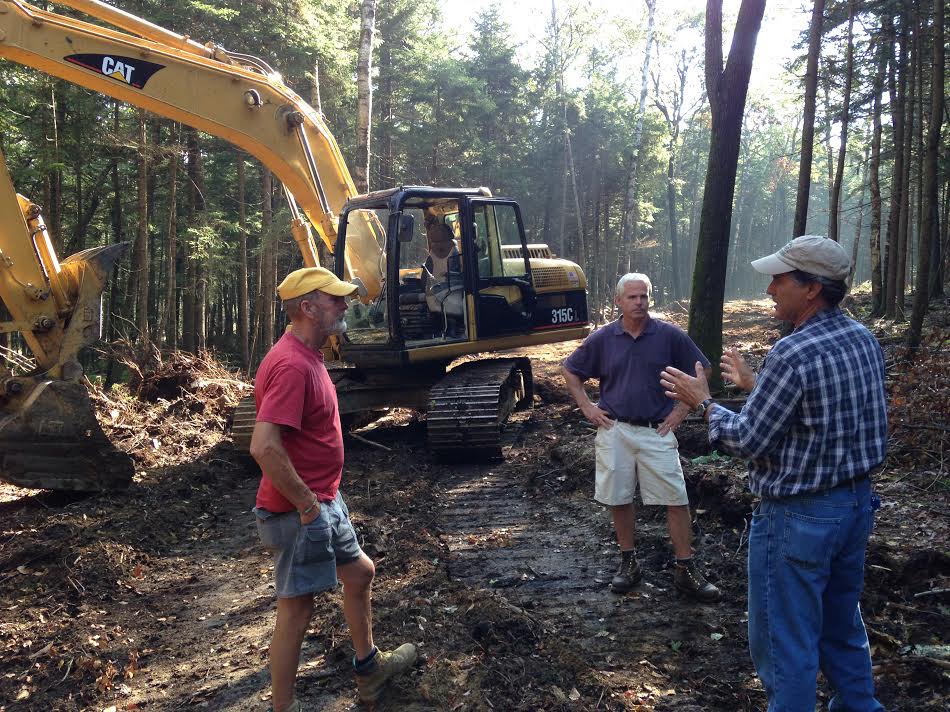
Owning their own excavator helped the Dublin School keep its construction costs down. (From left to right: excavator operator Bob Miles, project manager Andy Hungerford and trail designer John Morton. (Photo: Brad Bates/Dublin School)
He wanted the feel of a good race course while also making it practical for a race jury. One example: part of the reason the Dublin course isn’t homologated for a freestyle mass start is a bottleneck near the start.
“How the finish line works, turns out of the start, how downhills heading into quick abrupt uphills affect race fairness was all new to me,” Bates said. “The thought is that once we have the personnel and the infrastructure we can host major races here.”
Although Morton explained he tries to keep in touch with the skiers he coached during his 11 years at Dartmouth, he had lost touch with Bates and was glad to receive his email about developing the Dublin trails.
Regarding the trail design, Morton wrote, “Finding the required climbs was less of a concern than locating a potential start/finish area, which requires a level opening of at least 150 meters by about 50 meters. If you are working generally with a hillside, as we were in Dublin, it is ideal if the start/finish can be located somewhere near the middle of the available elevation gain. We were fortunate to find a modest natural shelf that provided just enough space for the start/finish, mid-way up the hill.”
While Bates mentioned a potential bottleneck that would preclude a freestyle mass start, Morton also looked at tree cutting. He explained that a homologated freestyle mass start course requires rolling terrain, including climbs that are 9 meters wide on the uphills and 6 meters wide in descents.
“[It’s] difficult for me to advocate cutting that kind of a swath through the trees of rural southern NH (for example), simply to comply with World Cup standards,” Morton wrote. “On the positive side, any skier who trains or competes on the Dublin School’s homologated race course, and goes on to compete internationally, will not be surprised by the competition venues he or she encounters… elsewhere in the world.”
Lehmann believes that homologation would enable students to train on courses similar to what they’d find at regional and national competitions. He wrote that Dublin School would bid for an Eastern Cup event once it had developed a sufficient volunteer base. Its student body is approximately 150 for grades 9 through 12, according to its website.
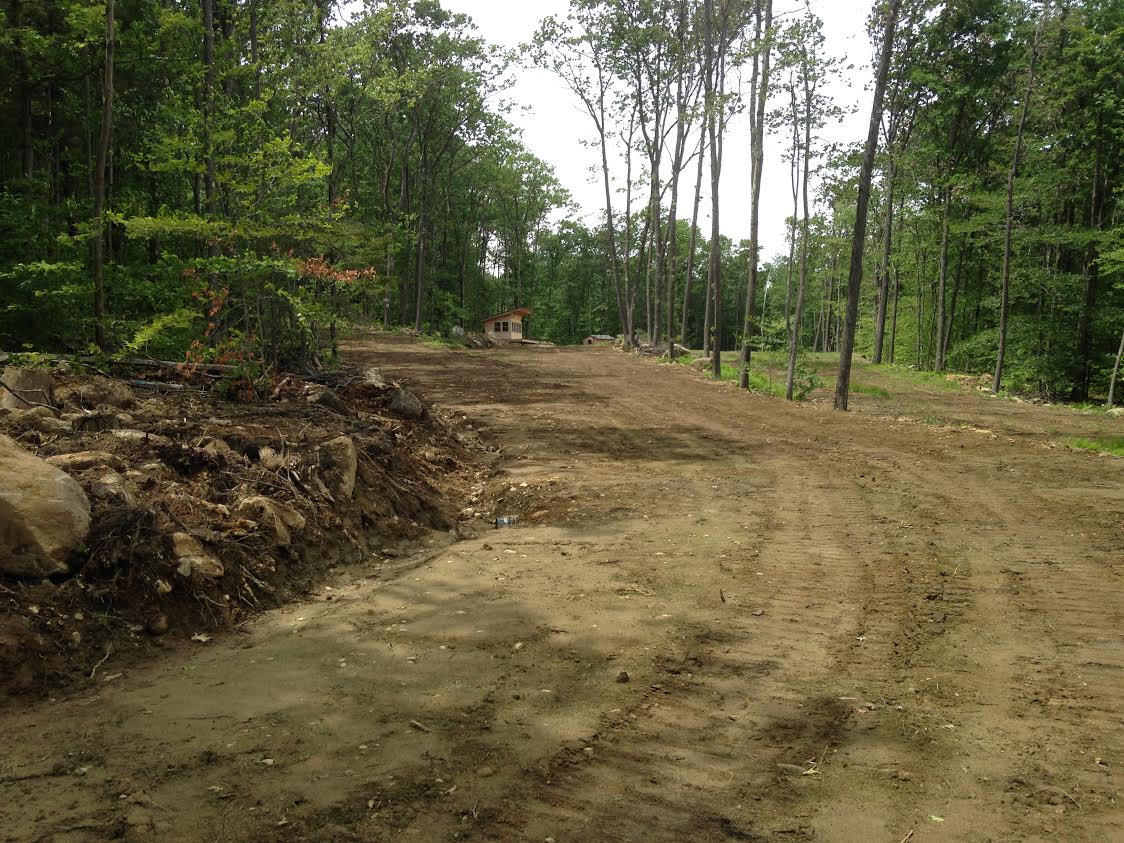
The construction of a homologated ski trail at the Dublin School in Dublin, N.H., this summer. (Photo: Brad Bates/Dublin School)
In addition to the new race loop, the Dublin School developed three additional kilometers of track that are not homologated. The total cost to build 8 k of trails, a yurt and a timing shed was under $250,000, Bates said.
In a continuing response to warm northeast winters, the Dublin School also installed snowmaking on a 1 k loop on the lower part of its campus. Intended for training and sprint races, Bates expects this loop to be fully solar-powered. He characterized it as a testing ground to determine whether it would be feasible to put snowmaking in on the FIS loop.
“People on the board made [snowmaking] a personal project,” Bates said.
“FIS homologation prequalifies Dublin to host national and international events where athletes hope to earn FIS points and qualify for the US National Team,” Bates stated on the school’s website. “For us, however, we are just happy to have such a fun and technical venue for our skiers to learn and enjoy the sport of skiing…”
According to Lehmann, the school created the Dublin XC Ski Club, “which attracts local skiers, many of whom [are] not otherwise connected to the School.”
The nordic center is open to the public when conditions are safe for skiing, except for when it is used for regional or school events.
Bates added, “Everyone is welcome to ski the trail system so long as they sign an online waiver. However, “The snowmaking loop will be reserved for school families and the local club we helped start, Dublin XC.”
“In Brad Bates, we could see a Head of School who would enthusiastically drive the re-introduction of Cross Country skiing – and he has done so!” Lehmann wrote.
“It is … heartwarming for me to see my former skiers passing along their love for the sport to another generation,” Morton said.
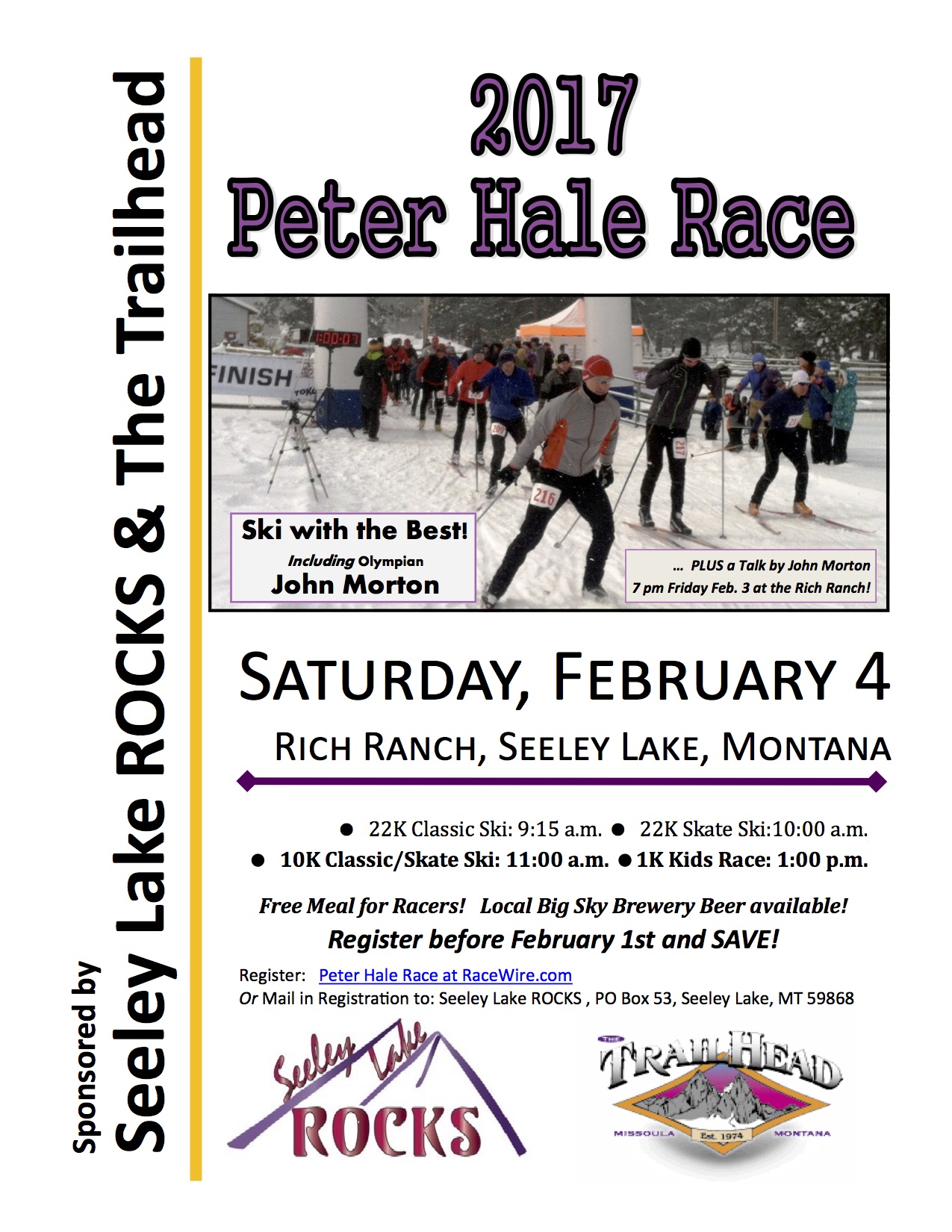
Seeley Lake ROCKS is pleased to announce that John Morton, former Olympic Nordic Skier, will participate in the Peter Hale Memorial Race to be held on Saturday, February 4, 2017, in Seeley Lake, MT. Morton is very familiar with Seeley’s ski trails. He knows the existing Seeley Creek Nordic Trails system well, and worked on the proposed Fawn Creek trail system that is bringing such excitement to the regional ski community. “We are looking forward to John’s participation in the race,” stated Noah Brautigam, Race Director. Morton’s involvement is expected to attract other notable skiers to the race, and the Seeley Lake Regional Outdoor Center for Kinetic Sports [ROCKS] is excited to expand the excellence and availability of the local Nordic experience.
ROCKS is expanding the 2017 Peter Hale event by adding an inspiration talk given by Hall of Fame Olympic Biathlete John Morton. Morton will share his extensive knowledge and stores about Nordic skiing at the 7pm, Friday, Feb. 3rd event at the Rich Ranch. An Amazon book reviewer notes “John Morton is a great coach and story teller, and …[he] delivers on so many levels. Morty gives advice about physical preparation, equipment and mental preparation, all laced together with great stories and anecdotes. I still bring this book out to read the stories when I need a little motivation.” The event targets young skiers, but is open to all ages.
The Peter Hale Race includes the traditional and challenging 22 km race, as well as a mellower 10 km race. Both races are open to classic and skate skiers. There will be a tent near the finish line with snacks, hot chili, and beer. The race day finishes with a 1 km fun race for children.
Why is it called the “Peter Hale Race?” Peter was a dearly beloved figure in the American Nordic Ski community. He also has strong Seeley Lake connections. His passion for skiing and for young people was critical to the early development of the Seeley Lake Elementary Ski Program. Peter helped ROCKS with the initial challenge of outfitting the fourth grade class with skis, and introducing them to a wonderful life-time sport. The program has expanded to the entire elementary school, and is a daily reminder of one man’s involvement and legacy that continues today.
Former Olympic skier John Morton regards Peter Hale as a good friend and is verbal with his recognition and high respect. “Skiing the Peter Hale Race is a fitting tribute,” say Morton as he looks forward to skiing in the namesake race to honor his late friend.
John Morton has an amazing history as an Olympic skier, coach, trail designer, and author. He started skiing where he grew up in Walpole, NH. Initially he participated in four events (slalom, downhill, jumping, and cross country) at Tilton School in Tilton, NH. Later he skied at Middlebury College, and excelled in cross country skiing. “Morton was an outstanding collegiate skier for Middlebury College, sweeping all the Eastern Carnival races in 1966. He was named to the US Cross Country Ski Team in 1968, and the US Biathlon team in 1969. He remained on the US Biathlon team from 1969 through the 1976 season (with the exception of a tour of duty in Vietnam in 1971, earning the Bronze Star). In that span of time, he represented the US at the [1972] Sapporo and [1976] Innsbruck Olympics as an athlete. From 1976 through 2002 Morty served as an assistant coach and team Leader for the US Team, including at 5 more Olympic events.” [US Biathlon News] Morton was inducted into the US Biathlon Hall of Fame in 2009. “John has modeled the spirit of the Olympic movement for generations of athletes over his 30 years of involvement with the US Biathlon Team, and set a standard for humility, integrity, and success,” says Larry Pugh, the 2009 Chairman of United States Biathlon.
His teaching and coaching career started in 1974 as a high school English teach, running coach, and ski coach in Anchorage, Alaska. He became head men’s skiing coach at Dartmouth College, Hanover, NH in 1978. He coached eleven years at Dartmouth. Then, in 1989 he began writing and designing trails. He wrote “Don’t Look Back,” about training and cross country ski racing. A reviewer at Amazon Books notes “John Morton is a great coach and story teller, and this book delivers on so many levels. Morty gives advice about physical preparation, equipment and mental preparation, all laced together with great stories and anecdotes. I still bring this book out to read the stories when I need a little motivation.”
In 1989, Morton initially focused on designing cross country ski trails. But, he soon found that fun, high quality trails were attractive to mountain bikers, runners, horseback riders, and others. His company, Morton Trails, has designed over 100 trails in the US, and around the world. These trail encourage healthy lifestyles, and increase surrounding property values. See details at MortonTrails.com.
Morton became an international biathlon referee with the International Biathlon Union in 2004. He is also a certified course homologation inspector for the FIS (International Ski federation).
Finally, Morton is an accomplished writer. He wrote “Don’t Look Back” (comprehensive guide to cross country skiing) in 1992, and a novel “Medal of Honor.” He is a frequent commentator on Vermont Public Radio, and has written over two-dozen magazine articles.
In short, we are thrilled to have John Morton joining us for the Peter Hale event, and speaking at the 7pm, Friday, Feb. 3rd inspirational event.
Seeley Lake Regional Outdoor Center for Kinetic Sports (ROCKS) is a 501c(3) non-profit located in Seeley Lake, MT, whose mission is to promote healthy children, strong families and vibrant communities through outdoor recreation. ROCKS working with regional organizations has been instrumental in equipping the Seeley Lake Elementary School students with skis, providing a warming hut at the Seeley Creek Trails and is currently developing a plan for a new Nordic ski area in Seeley Lake.
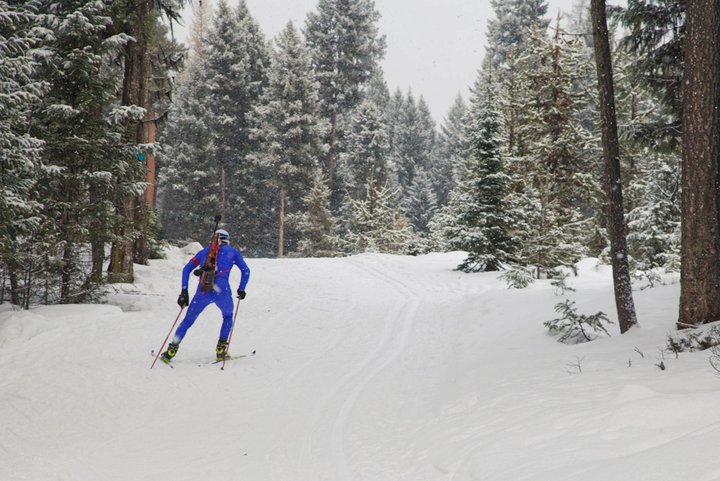
Seeley Lake Race February 4, 2017 in Seeley Lake, Montana. (Photo Credit: Jim McLean)
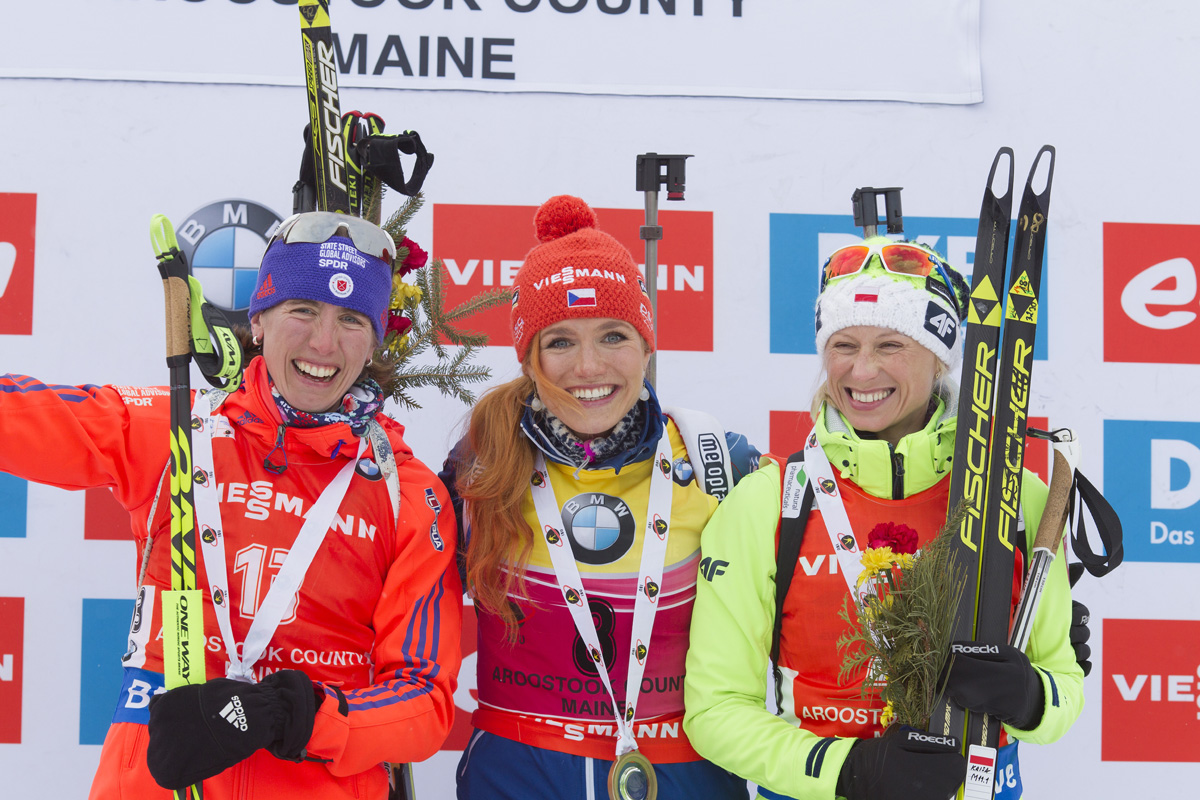
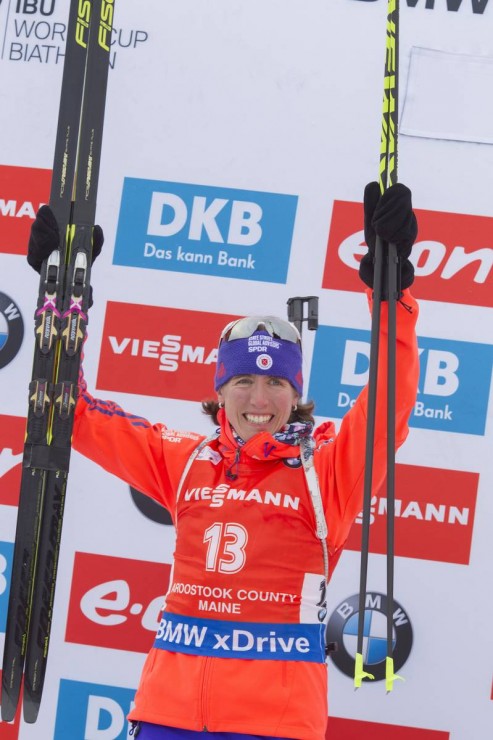
American Susan Dunklee (l) after achieving her best IBU World Cup finish in second place on Thursday and tying the best World Cup result by a U.S. biathlete. She finished second to Czech Gabriela Soukalova (c), and Poland’s Krystyna Guzik placed third (r) in the women’s 7.5 k sprint in Presque Isle, Maine. It was the first IBU World Cup held in the U.S. since 2011. (Photo: Fischer/NordicFocus)
Gazing out at the crowd, standing on the second step of the podium on Thursday, Susan Dunklee recognized dozens of faces: family, friends, people from her home base in Craftsbury, Vt., US Biathlon board members, colleagues from the Lake Placid Olympic Training Center, not to mention her team and support staff.
It had all the makings of a local-race feel, except for the implications of a World Cup podium — and the flashing lights, silver medal and media attention that came with it.
Two days before her 30th birthday, Dunklee had the best race of her career. The 13th starter, she raced to second in the women’s 7.5-kilometer sprint on the first day of the IBU World Cup in Presque Isle, Maine, finishing 17.8 seconds behind Gabriela Soukalova of the Czech Republic, the winner in 20:02.2 and overall World Cup leader.
Nearly 400 miles and a seven-hour drive from her hometown of Barton, Vt., Presque Isle is less than a half an hour away from Canada. Yet in her first U.S. World Cup, and the first World Cup in the states since it was last held in Presque Isle in 2011, Dunklee felt somewhat at home.
“To be able to have a best result on home soil and we only have a North American World Cup every five years, I couldn’t ask for anything better,” Dunklee said on the phone after the race. “It’s just phenomenal.”
In order to achieve her best World Cup result by one place (she finished third in a sprint two seasons ago in Oslo, Norway), Dunklee rekindled her joy in both the sport and Presque Isle’s course specifically, putting herself in a happy place she had been struggling to find in the last week.
“Last week was a little tough for me,” Dunklee said of the last World Cup in Canmore, Alberta. “I felt like I was going through the motions but not really feeling hungry for it.”
That changed on the final day of racing there, when she skied the first leg of the U.S. mixed relay, which went on to place fourth for the team’s best-ever finish in the event. Being within two seconds of a podium recharged her and reminded her to stay the course.
“Coming here I was like, ‘OK, there’s going to be random things that happen that are going to throw me off, but I’m just going to take the positive things that I can and use those to my advantage,’” Dunklee said.
On the team’s first training day in Maine on Tuesday, she skied the Presque Isle World Cup course for the first time. Dunklee had previously raced a NorAm there in 2009, but missed out on the 2011 Presque Isle World Cup as the team’s fifth woman at the time, when it only took four.
That was frustrating, she said, but she moved on from it — taking advantage of an opportunity instead in Ruhpolding, Germany, where she raced and previewed the course a year out from 2012 Ruhpolding World Championships. There, a year later at her first World Championships, she broke through in fifth in the 15 k individual.
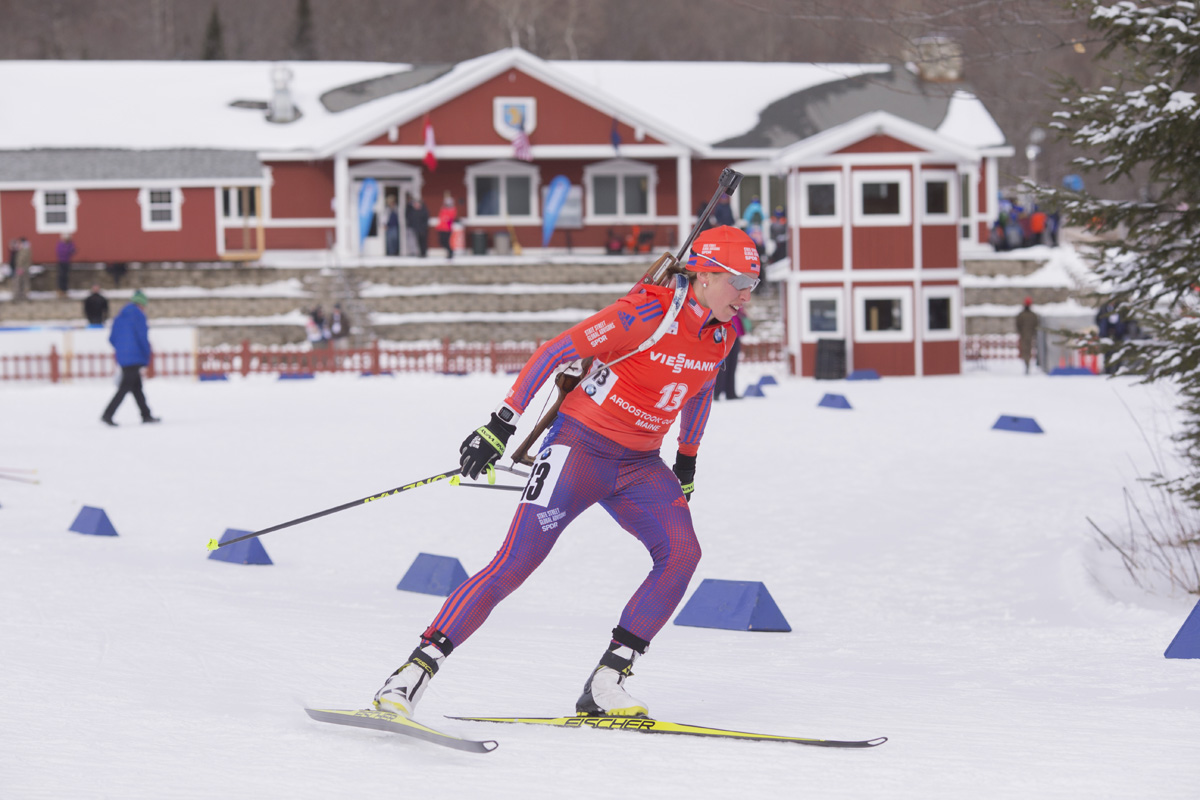
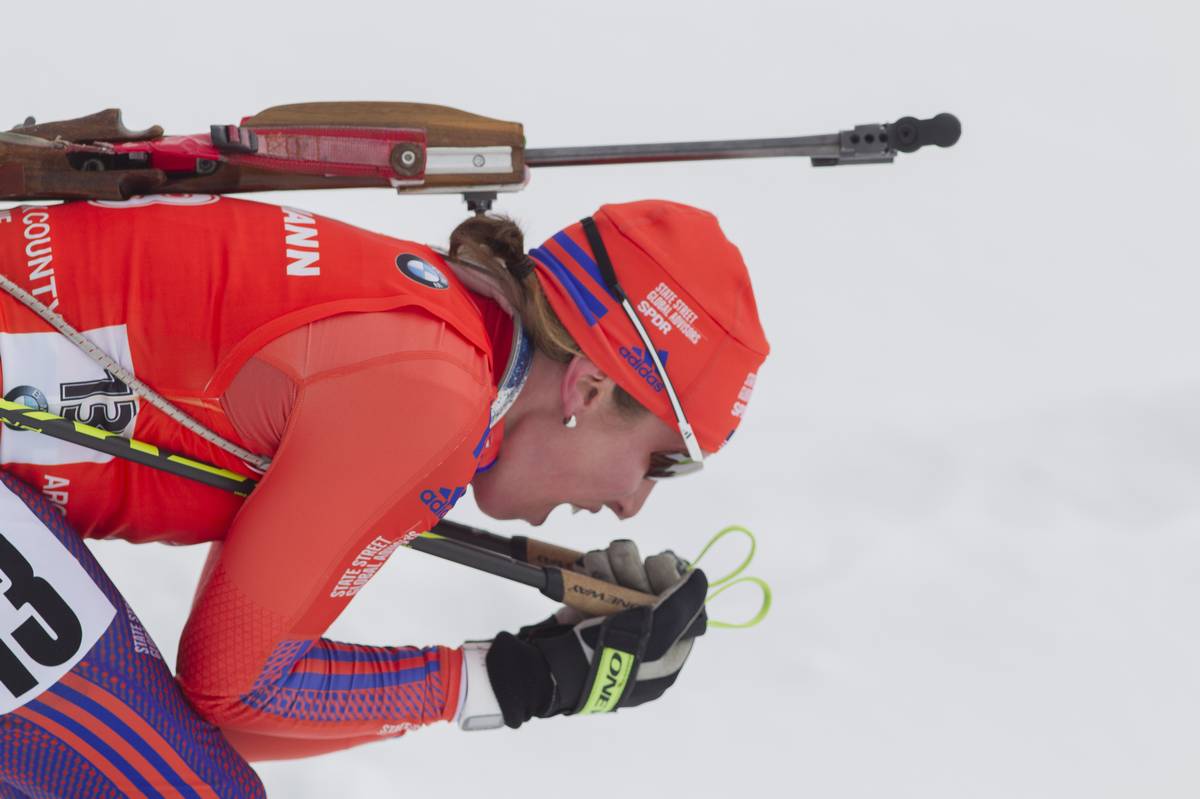
Susan Dunklee (US Biathlon) racing to a career-best second on Thursday in the women’s 7.5 k sprint at the IBU World Cup in Presque Isle, Maine. (Photo: Fischer/NordicFocus)
Memories aside, Dunklee was excited about what she saw in Presque Isle earlier this week.
“I skied the course and I’m like, wow … this is a John Morton course. This is what I grew up skiing on and this is what I’m good at,” she recalled. “This is what I’m going to thrive on. I love the ups and downs, the steep climbs, the roller-coaster flow, and that’s what really set the tone right away.”
On Thursday, it was cold in northern Maine, but busloads of schoolchildren came out for the first of four days of World Cup racing. Dunklee wasn’t in her home state, but with everyone speaking English and cheering “USA!” out on the course, it was the closest she had felt to being there.
“The community is extremely welcoming and they go out of their way to accommodate us and make us feel like home,” Dunklee explained.
She started behind Soukalova, an early leader with perfect shooting in both her prone and standing stages. No sooner had Finland’s Kaisa Mäkäräinen in bib 6 finished and taken the lead from Czech Veronika Vitkova (the second starter) by 20 seconds, Soukalova in bib 8 charged across the finish line moments later, 24.5 seconds faster than Mäkäräinen to take hold of first place.
The day was young, but most of the top-ranked skiers were on course at the beginning of the 88-woman field. Dunklee followed Soukalova out, cleaning prone as well to take the lead by 0.8 seconds after the first shooting.
Her shooting didn’t feel automatic, Dunklee recalled. That wasn’t necessarily a good thing, but it wasn’t bad, either.
“I was very aware of each shot I was taking; it wasn’t flowing automatically like it usually does, and usually you want that automatic flow in a race,” she explained. “Instead I had all these thoughts going through my head, but what was great about today is I was able to take those thoughts and just say, ‘It’s OK that I’m distracted. I’m going to put that thought aside and go back to what I’m focused on right now in the present moment.’ ”
She had similar feelings earlier this year in Ruhpolding, where she placed sixth in the mass start. Recognizing this, she resolved to keep calm.
On the second shooting stage — standing — Dunklee cleaned again and left the range with 9.3 seconds to make up on Soukalova.
A US Biathlon staff member (l) cheers on Susan Dunklee (r) as she races to a career-best second place in the 7.5 k sprint on Thursday at the IBU World Cup in Presque Isle, Maine. (Photo: Fischer/NordicFocus)
What came to mind then? “You still need to fight like hell,” she recalled. “When you’re having that sort of race, you don’t want to lose a second anywhere … I’ve just got to fight for the next seven minutes or whatever it takes.”
With 1 k remaining, she was 17.6 seconds off Soukalova’s time. Half a kilometer later, Soukalova still held her ground, 17.4 seconds ahead. By the finish, Dunklee was 17.8 seconds back in second, and she wasn’t even sure she was second — but she smiled at the cameras anyway.
“I knew I probably had one of my best races in my life and I’d done it at home and my parents were there,” she said. “I just felt really good about my performance. I was really happy.”
US Biathlon Women’s Coach Jonne Kähkönen knew she was on track for a career best.
“I knew that if she would clean the race today, she would be fighting for the podium, even if there were a few fast athletes starting behind her,” he said on the phone. “Not nervous, but just wanted to wait and see what the later starters would do.”
France’s Marie Dorin Habert presented the most immediate threat. After starting 24th and cleaning prone, Dorin Habert left the range in first, 4 seconds ahead of Dunklee. However, during her second stage, she missed one standing shot. The penalty loop put her in fourth, 25.5 seconds behind Soukalova and 16.2 seconds behind Dunklee, with one loop to go.
Meanwhile, Poland’s Krystyna Guzik had started 20th and cleaned both stages to leave the range for the last time in third, trailing Dunklee by 4.4 seconds. She couldn’t catch the American on the final loop and finished 1.3 seconds behind her in third.
“Shooting is so hard; it is not sure that every day I will shoot well,” she said in a post-race press conference. “I thought that this was a new day and do my best to shoot well and run fast. I just could not catch Susan; she was too fast on the last loop. For me, the last loop today was really hard.”
Ultimately, the three podium finishers were the only ones in the top eight to shoot clean. Soukalova had the fifth-fastest overall course time, Dunklee’s course time ranked 12th and Guzik’s 15th.
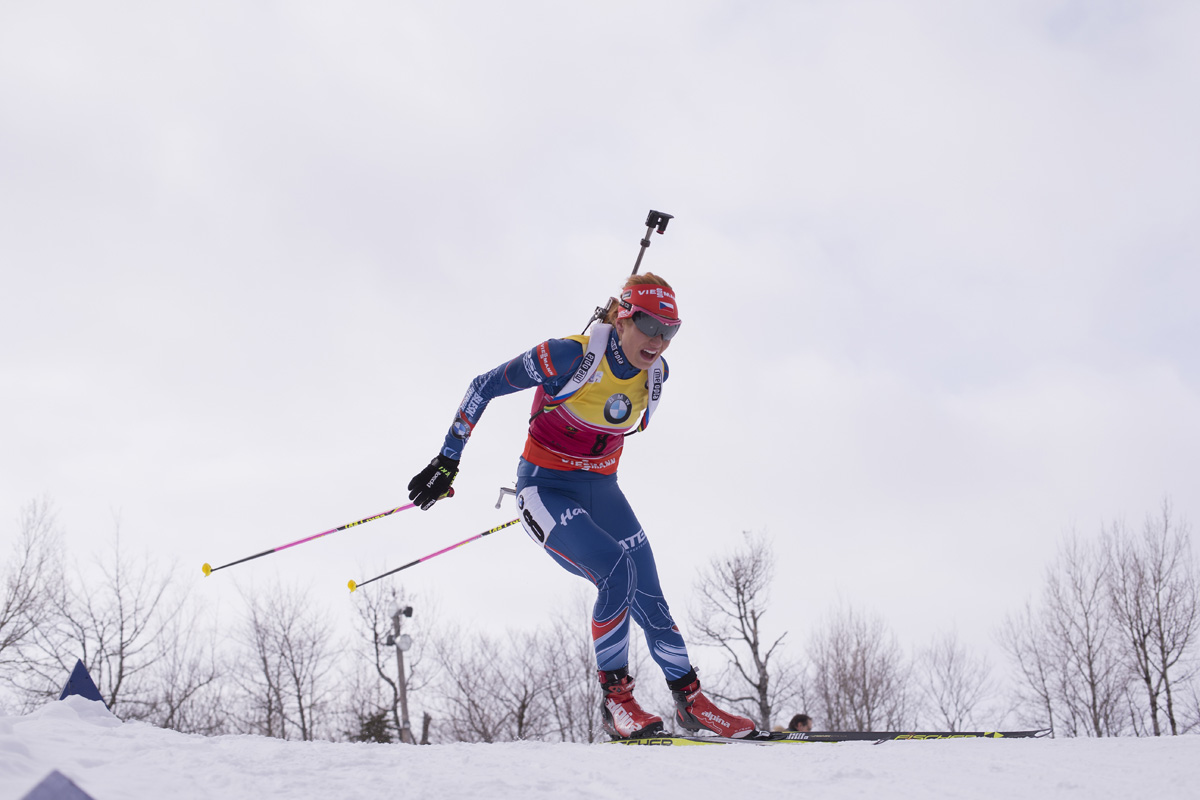
Overall World Cup leader Gabriela Soukalova of the Czech Republic racing to a 17.8-second win (over American Susan Dunklee) in the women’s sprint on Thursday at the IBU World Cup in Presque Isle, Maine. (Phot: Fischer/NordicFocus)
“I have to say everything was perfect,” Soukalova said in the press conference. “I started to feel a little tired after the long trip from Canada, but I started to feel good after the start. … We had good service, good skis today so I am very satisfied with this result.”
Dorin Habert crossed the line in fourth, 20.5 seconds behind Soukalova and 1.4 behind Guzik, bumping Mäkäräinen, with a single standing miss, into fifth.
The top five would stand, and Dunklee would tie the best result by a U.S. biathlete (male or female) joining the ranks of Joan Smith (1994) and Anna Sonnerup (1991).
Current men’s team member, Tim Burke placed second in two World Cup races in 2009/2010 and earned silver at 2013 World Championships. Before him, Josh Thompson also took silver at 1987 World Championships.
“What a great day for @USBiathlon with 6 athletes in the top 30 and @SusanDunklee on the podium! #homecourseadvantage!”Burke tweeted on Thursday, after he, Sean Doherty and Lowell Bailey placed in the top 20 in the men’s sprint. Dunklee, Hannah Dreissigacker and Clare Egan finished in the top 32 of the women’s race.
“Today Susan cemented her place as a world class biathlete,” US Biathlon President and CEO Max Cobb wrote in an email. “It was a historic performance, matching the best World Cup finish by an American.”
“You spend years and years working on this, trying to perfect things,” Dunklee explained. “And at first progress is pretty good, you make big gains pretty fast, and then to get that last one percent or so of performance, it just takes so much more work.”
You need that 1 percent, she added.
“There’s times where you work your way at something for months and you just don’t make progress on it or you even go backwards because you’re trying so hard, she continued. “I don’t know, somehow things came together and I’m just amazed. It’s exciting.”
‘A Culmination of a Whole Lot of Effort’
What is it about progress, or maybe more specifically about biathlon, in which someone like Dunklee can turn a last-place finish in Canmore’s mass start, complete with a “dirty” stage (five missed targets), around less than a week later with a silver-medal performance?
“We’ve talked about this actually a couple of times over the season,” Kähkönen said of Dunklee’s ability to overcome adversity and less-than-desirable results. “It’s been a little up and down. We’ve been trying to track down in the training log if we can find some reasoning behind it and be able to narrow it down better in the future as well. But now it looks like everything is on track in terms of the physical training.”
Susan Dunklee (US Biathlon) racing to a career-best and historic second place in the women’s sprint at the IBU World Cup in Presque Isle, Maine. (Photo: USBA/NordicFocus)
In the last World Cup before World Championships in Oslo in early March, Dunklee said the timing of this result was “perfect.”
“I think Susan, ever since last week, she was able to put distractions on the side and focus on what matters,” Kähkönen said.
“In order to have my best performances in biathlon or anything in life, to be a person that takes joy out of life … I really have to find what I love about it,” Dunklee explained. “… I think that hunger is honestly my most valuable asset as an athlete.”
Looking ahead to the rest of the races in Presque Isle, Dunklee had fewer than 24 hours to absorb what she’d done on Thursday and prepare for Friday’s pursuit. At 1:10 p.m. Eastern time, Soukalova will start the 10 k pursuit first. Dunklee will head out 18 seconds later in second, and Guzik 1 second after Dunklee in third. Dorin Habert will follow, 3 seconds after Dunklee.
“I’ve got the best setup I’ve ever had before going into a pursuit,” Dunklee explained. “Starting pretty close behind the leader, and that’s another wonderful opportunity to have a great result. I’m going to enjoy tonight and celebrate a bit, but at the same time I’m going to try to wind down a bit, have a little Susan-time to myself and get some good sleep tonight because I really want to see what I can do tomorrow.”
Asked about the task of refocusing after a result like Thursday’s, Kähkönen said that’s the key to consistent top results.
“With this schedule, we just don’t have the luxury of getting stuck on the current or especially the past,” he said. “You just need to stay focused on what’s coming up next.”
But Thursday was a pretty incredible day to be part of US Biathlon, in the same state (albeit 270 miles away) as its headquarters in New Gloucester, Maine.
“It’s unbelievable,” Kähkönen said. “Just to be able to grab the podium on the home soil, home World Cup, even if it’s not the hometown, but there’s a lot of friends and family and fans that are great support. The local community is just awesome, so it means the world to us.”
“It’s not just my success,” Dunklee stated. “It’s a culmination of a whole lot of effort over lots of years by this whole group of people who care a lot about our team.”
Dreissigacker 27th, Egan 32nd, Kocher 42nd
Joining Dunklee in the pursuit will be two other U.S. women and one Canadian. Dunklee’s teammate on the national team as well as Craftsbury Green Racing Project, Hannah Dreissigacker placed 27th for her fourth-best sprint result, finishing 1:33.7 behind Soukalova with a single prone penalty.
Hannah Dreissigacker (US Biathlon) racing to 27th in the women’s 7.5 k sprint at the IBU World Cup on Thursday in Presque Isle, Maine. (Photo: USBA/NordicFocus)
“I was really happy to clean standing — I am normally a better prone shooter than standing, but I knew that I had to clean standing if I wanted to really do well,” Dreissigacker, the 41st starter, wrote in an email. “I’m very happy that I was able to concentrate for all of the shots and make it happen.
“It felt really special to have my family here, and so many other Americans out there cheering for us,” she wrote. “I actually started just after I heard on the loud speaker that Susan had cleaned. So then she came around the building and headed out on her last lap just a bit behind me. That was a fun lap — I was excited for her, and also all of the staff and fans were out there cheering so hard for her and I could tell that she was gaining on me, and also that she was probably going to podium. I felt like we were doing that lap together, though she only caught me at the very end.”
Also for the U.S., Clare Egan finished 32nd (+1:38.5) with one standing penalty. The 56th starter, Egan looked to be in contention for a top 20 after cleaning prone, but slipped into 28th after standing.
Clare Egan (US Biathlon) racing to 32nd, her second-best IBU World Cup result, in the women’s 7.5 k sprint on Thursday in Presque Isle, Maine. (Photo: USBA/NordicFocus)
“I was thankful to clean prone because it put a little less pressure on the standing, which is the harder discipline for me,” Egan wrote in an email. “I was very shaky in standing and I had to stop and reset my position after missing my 3rd shot, but that worked and I hit the last two.
“This is my 2nd best result ever and by far my best result since World Cup 1,” she explained. “My ski speed took a major hit in December but I am now recovered to where I think I should be so that is a huge relief. I had a top-30 ski time today and 90% shooting so that is an almost perfect day.”
Originally from Cape Elizabeth, Maine (and a teammate of Dunklee and Dreissigacker at Craftsbury), Egan described the experience of racing in her home state.
“My parents, my teammates’ families, and some USOC staff and USBA board members are here,” she wrote. “I heard my name all along the course from voices both familiar and unknown– and that was a first.”
Friday will be Egan’s second time racing a World Cup pursuit.
Maddie Phaneuf (US Biathlon) on her way to 65th in the second individual IBU World Cup of her career on Thursday in Presque Isle, Maine. (Photo: USBA/NordicFocus)
The fourth U.S. woman, 20-year-old Maddie Phaneuf, in her second individual World Cup race, placed 65th (for her best result by 28 places) with a clean prone and two standing penalties.
“My goal was to shoot well and ski strong … which I didn’t feel I reached fully,” Phaneuf wrote. “I felt pretty good on the skis, but not nearly as strong as I was in Romania.”
“My result-goal was to make the Pursuit, which I just missed,” she wrote of Thursday’s World Cup race, in which she needed a top 60 to advance to the pursuit. “But I’m still happy with the result and know that I have the potential to achieve more.”
On behalf of her team, Dreissigacker noted, “Our skis were phenomenal today. Our wax techs definitely deserve a share of the credit for the great day that we had as a team.”
The top Canadian, Zina Kocher placed 42nd (+2:02.0) with three misses (2+1). Overall, she had the 20th-fastest course time.
“I was focused on having consistent solid performances this week in order to qualify for World Champs,” Kocher wrote in an email. “Knowing that it is a trials situation though does bring a bit more nerves into the equation.
“I had thought I had focused on attacking from the start, however looking at the breakdown in ski speeds, looks more like I went out for a casual ski lap 1, & lap 3 an explosion went off,” she wrote of her course times, which ranked 54th on the first loop, then 46th on the second, and finally, third on the last loop. “I’d say I’m happy with 3rd fastest last lap but will work on a more aggressive warm up for the next sprint or relay I do to make sure I’m starting out a bit quicker!”
Also for Canada, Emma Lunder placed 68th with two penalties (1+1), Audrey Vaillancourt was 80th with four misses (2+2) and Erin Yungblut 87th in her World Cup debut, also with four penalties (1+3).
Note: In the men’s 10 k sprint, Sean Doherty led the U.S. in 13th (0+1), Lowell Bailey was 15th (0+1) and Tim Burke 20th (1+1).
“The men were just really consistent,” Kähkönen said. “Everybody close together and just the whole field for the top athletes, so it puts them into a very good place looking ahead for tomorrow’s pursuit race. Hopefully Susan’s podium will give them another push.”
Stay tuned for a separate report on the men’s race.
Watch the men’s and women’s pursuits live on Eurovision (Friday at 11:30 a.m. and 1:30 p.m. EDT)
Susan Dunklee with her parents Judy (l) and Stan (r) after Dunklee tied the best-ever U.S. result in an IBU World Cup in second in the women’s sprint in Presque Isle, Maine. (Photo: USBA/NordicFocus)
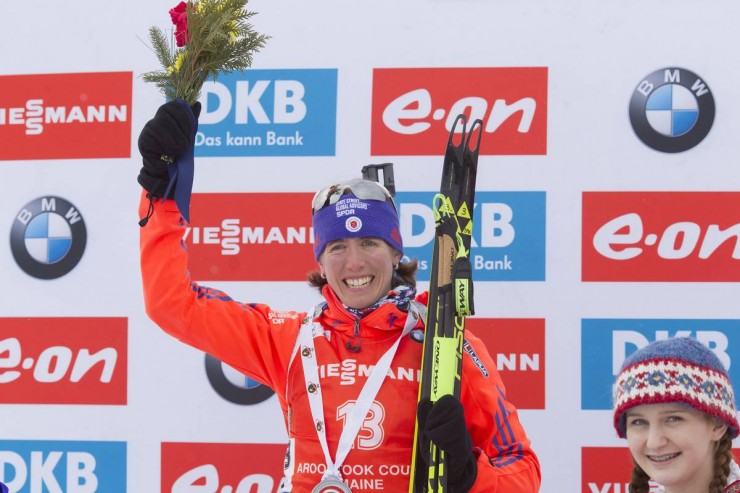
Dunklee celebrates a career-best second place in the women’s sprint at the IBU World Cup in Presque Isle, Maine. (Photo: USBA/NordicFocus)
Dunklee celebrates a career-best second place in the women’s sprint at the IBU World Cup in Presque Isle, Maine, in February. (Photo: USBA/NordicFocus)
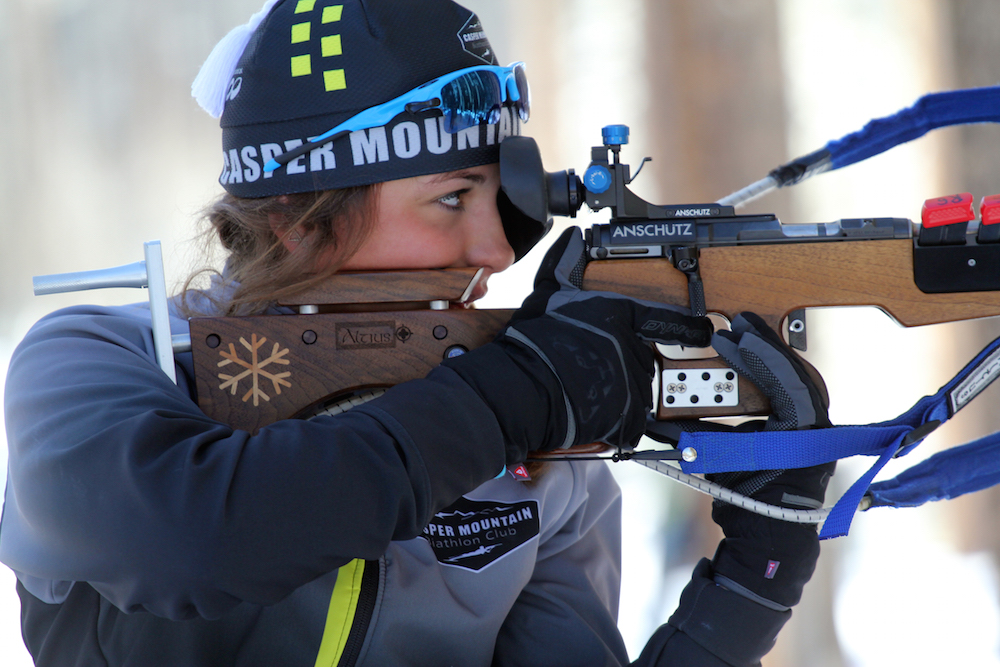
Casper Mountain Biathlon Club athlete Rylie Garner, 16, takes aim. Garner is one of six juniors training with the CMBC year round. (All photos: CMBC)
Where there’s a will, there’s a way. Without a range of its own, Wyoming’s Casper Mountain Biathlon Club (CMBC) has put athletes on the podium in the junior division at biathlon national championships.
But with donated land and the purchase of new targets, the club awarded a $728,307-dollar contract to build what might be the highest-altitude biathlon range in the U.S.
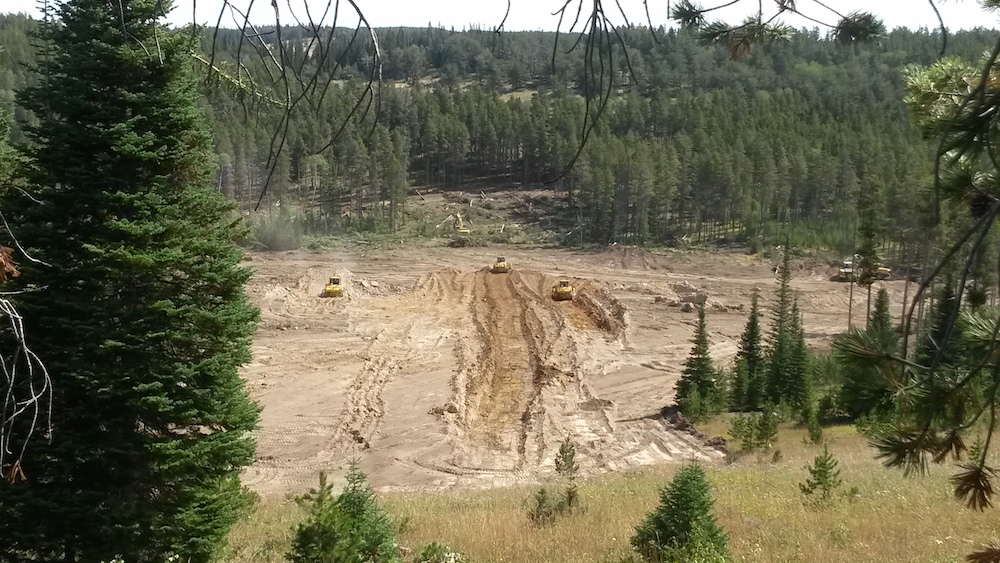
On Aug. 13, CMBC chose the Casper-based Wayne Coleman Construction to build a range on donated land abutting the Natrona County-run Casper Mountain Trails Center. Construction started late last month, and the range is expected to be complete by early November.
“It will be the only venue dedicated to both adaptive and able-bodied skiers,” CMBC’s president, Rob Rosser, said in a phone interview. Also a U.S. Paralympics Nordic and Biathlon development coach, Rosser competed in biathlon at the 1998 Winter Olympics and won multiple national and North American titles in the sport.
Construction on the Casper Mountain Biathlon Club range began last month.
Founded in 2008, CMBC gained nonprofit status in 2010. Its athletes ski at the Casper Mountain Trails Center, eight miles outside of town. The ski center includes 42-kilometers of winding trails on public land, but there’s no biathlon range.
In Casper, there’s a shooting range where CMBC athletes can practice, but it’s not biathlon-specific.
“We’ll shoot on paper, and then we’ll set up a metal target as well, just so they can shoot at an actual biathlon target,” Rosser said. “That’s the best we can do for now. We’ve managed to get some decent results in less-than-perfect training venues.”
To shoot at an actual biathlon range, CMBC athletes have to drive to a five-lane range in Lander, Wyo., 150 miles away.
“The best range close to us is Soldier Hollow, which is six hours away,” Rosser said. “That’s the closest one with both rollerskiing and shooting.”
They also train indoors with electronic rifles.
“Since about 2010, we’ve trained kids with electronic rifles,” he explained. “CMBC has had quite a few podiums at Nationals – Junior category – with the kids doing a combo of live shooting and training with the electronic systems.”
In a follow-up email, Rosser explained that Kyle Rutar, one of the club’s athletes, placed fourth in a Junior World Trials race after training exclusively with an electronic rifle.
“There’s nothing like doing it firsthand, skiing up to a rifle range, hearing lead hit on metal,” said Rutar in a phone interview.
It was “definitely an adjustment” to go to from an electronic rifle to the real deal, he added.
“The thing about the infrared rifle – everything’s dumbed down. There’s no wind, no temperature, no ballistics. All those things come in to play when you start doing it for real. … Infra-red is top notch for core shooting skills, but in race setting, you have to learn to adjust to the shooting environment in general.”
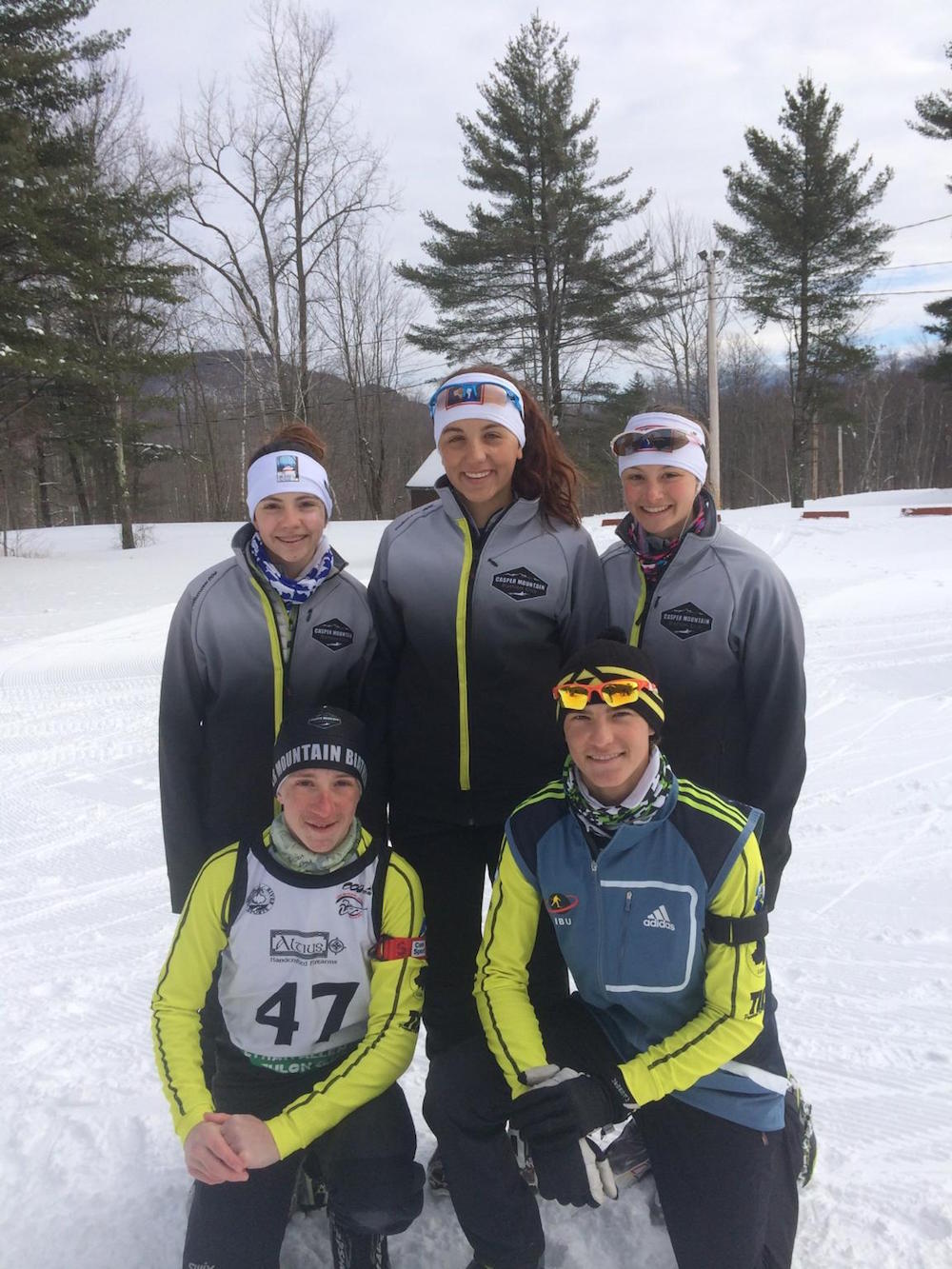
The Casper Mountain Biathlon Club team at 2014 U.S. biathlon nationals in Jericho, Vt. (from left to right, back to front): Madison Tinker, Rylie Garner, Katherine Gruner, and Christian Bjorklund and Jake Pearson.
Presently, CMBC has six junior skiers ages 10 to 16 in a year-round training program: Jake Pearson, Rylie Garner, Katherine Gruner, Garrett Aune, Lu Elder, and Mac Elder.
“Jake, Rylie and Katherine have been doing biathlon for 4 years now,” Rosser’s wife Cathy wrote in an email. “Garrett is going on his second year and Lu and Mac just started this year.”
Cathy is CMBC’s managing director, a title with a jack-of-all-trades job description including club administration, bookkeeping, grant writing, marketing and communications and some program planning. In addition, Ken Miech is a part-time program coordinator and assistant coach. A member of the Wyoming National Guard Biathlon Team, Miech started as a volunteer coach and now assists with program planning and execution.
“In 2014, we had 530 people come through our program,” Cathy explained.
Of those participants, 485 were juniors, 27 were adaptive athletes and 18 were masters. Most of the adaptive athletes are disabled veterans.
“Without a range, we’ve focused on youth and adaptive programs,” she wrote. “Once the range is built, we will continue this emphasis and also begin to put energy into the masters program.”
“Obviously we’re excited about having a natural range and seeing a great amount of growth because it’s a lot more fun shooting the real thing,” Rob said.
Land for Range Donated
According to Cathy, a local family — the McMurrys — donated 40 acres to Natrona County specifically for the range. They also donated a second 200-acre tract that surrounds the range to the city for ski trails.
Crediting the McMurry family’s generosity, she added, “They recognized the economic impact a biathlon venue could have on the community. They don’t have a specific interest in nordic skiing or biathlon, but they wanted to see the land used for the public good and recreation.”
According to Cathy, the 40-acre plot where the range will be built was appraised at $318,000 dollars. She estimated the value of the additional 200 acres at $1.3 million.
“I worked with [Rob] a little bit on the stadium design,” US Biathlon President and CEO Max Cobb said on the phone. “It’s a very impressive plan that he’s put together out there.”
“It’s going to be the only biathlon range that I know of at 7900-feet altitude and the only one dedicated to both adaptive and able-bodied athletes,” Rosser said.
“It’s going to be the only biathlon range that I know of at 7900-feet altitude and the only one dedicated to both adaptive and able-bodied athletes.” — Rob Rosser, Casper Mountain Biathlon Club president
The CMBC currently owns nine electronic targets up to International Biathlon Union (IBU) standards, with plans to buy 21 additional mechanical targets. For adaptive athletes, the International Paralympic Committee (IPC) mandates 10 audio targets for visually impaired athletes, and 10 for sitting or standing athletes. CMBC’s goal is to offer 24 targets for adaptive skiers.
Casper Mountain Biathlon Club president and coach Rob Rosser with athlete Rylie Garner.
“We’re a viable site for an IPC World Cup,” Rosser said.
Although they’re above the IPC’s 5900-foot altitude limit, Cathy explained that “based on preliminary conversations, a waiver would be likely” to hold an IPC World Cup there.
And while Casper Mountain is above the legal altitude limit for a biathlon or cross-country World Cup, Rosser expects to bid for Continental Cup races. In addition, between the long snow season and the altitude, he believes Casper Mountain will be a desirable training-camp venue.
In addition to building the range, the Rossers will also modify part of Casper Mountain’s trail system. Last November, trail designer John Morton flew to Wyoming to homologate trails to IBU, FIS and IPC standards.
Morton helped the Rossers plan two five-kilometer loops that meet standards for all three governing bodies.
“While [Rosser’s] top priority is biathlon with a special emphasis on Paralympic biathlon, it also makes sense to configure the trails to comply with FIS [International Ski Federation] cross-country homologation guidelines,” Morton wrote in an email.
“We have a big puzzle with overlapping course requirements for FIS cross-country, IBU biathlon and Paralympic biathlon and cross-country. The trick is to design courses that are fun and technically challenging to ski, are great for spectators in terms of giving them plenty to see, and still fulfill the course requirements for the various governing bodies,” he added.
Cathy explained that Wayne Coleman will be doing the earthwork and grading for the 30-point range, 10 new kilometers of homologated trails and two pedestrian underpasses.
“It’s a very impressive plan that [Rob] put together out there,” Cobb said. “Rob asked me to weigh in on some questions and I worked with him a little bit on the [range] design.”
U.S. Paralympics Nordic team member Omar Bermejo liked Casper Mountain so much that he moved there.
“One of the Paralympic camps was here in Casper. When I came to train, I fell in love with the town,” he said in a phone interview.
Of the skiing, he said it was a challenging course, especially Rosser’s homologated course, which is still being developed.
When the range is complete, the CMBC will aim to add a paved 5 k rollerski loop leading into and out of the range. Cathy explained they’re expecting at least half of that to be complete by next summer “and the full 5 kilometers if funding allows.”
“That’s going to make it one of the most attractive biathlon ranges in North America,” she added.
Cobb referred to biathlon in the West as a “growing community,” pointing out that the Bridger Biathlon Club in Bozeman, Mont., recently rebuilt its range.
“We’re seeing growth in the Rocky Mountain region, and that’s terrific,” he added.
In the spring of 2015, ROCKS will file an application for a Special Use Permit with the United States Forest Service (USFS) to build a new Seeley Lake nordic-ski venue, which is “intentionally being designed to international race-ready specs, fully homologated, with both the skier and spectator in mind,” according to ROCKS President Chris Lorentz.
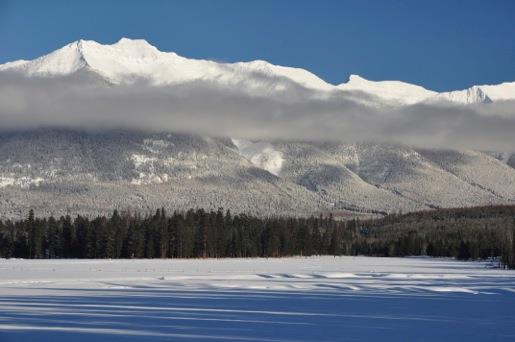
Swan Range forms the backdrop for the Seeley Lake ski trails. (Photo: Seeley Lake Nordic)
Lorentz said the Forest Service will review the permit application, perform an environmental analysis (including a mandatory 90 day public input period) and provide a decision by October 1, 2016.
“We believe the (process) will result in a positive decision notice,” Lorenz said.
ROCKS hired John Morton, owner of Morton Trails, to provide both a feasibility study (2011) and course design (2012) for the new Seeley Lake venue. According to a report issued by Morton Trails to the USFS, Morton states that efforts have “resulted in a workable concept for what offers to be a nationally, and even internationally, recognized cross country skiing venue … suitable for hosting Continental Cup races such as US Junior Olympics, US Nationals, North American races [i.e. Super Tour], as well as regional races where participants can be awarded FIS points for international ranking.”
Morton’s design would meet specifications for D-category homologation, making Seeley Lake one of six venues certified to this level in the United States. A D-certification allows a venue to host all events, including mass-start freestyle races. The only event requiring a designation beyond a D category is the skiathlon, which requires two separate courses (used concurrently). Soldier Hollow in Midway, Utah, is the only course in the US which currently has this designation.
To provide Seeley Lake with an advantage in bidding for major events and training camps, and to keep the door open for a possible World Cup event bid, Morton designed the course to “comply to a World Cup standard – which will make this venue truly representative of courses hosting the most elite competitions.” The most recent FIS Homologation Manual would have allowed for certification with a 25-meter climb; however, Morton chose to exceed this standard and comply with the World Cup’s 30-meter requirement.
In January, Seeley Lake hosted its 8th annual biathlon, with 115 racers participating in three events. (Photo: Seeley Lake Nordic)
Morton’s design includes a 15-point biathlon range and identifies a location for a 30-point range (meeting the IBU World Cup requirements) that could be installed with some additional construction. The course design for the five-kilometer loop is “spectator friendly” allowing spectators to view competitors five to seven total times, or 10 to 14 times for a 10 k race.
While USFS permit approval, new venue construction, and hosting of events at the new venue are years in the future, Seeley Lake, is not waiting for course completion to continue taking steps forward. Recent ROCKS activities have clearly energized the town which has a long standing nordic ski racing tradition.
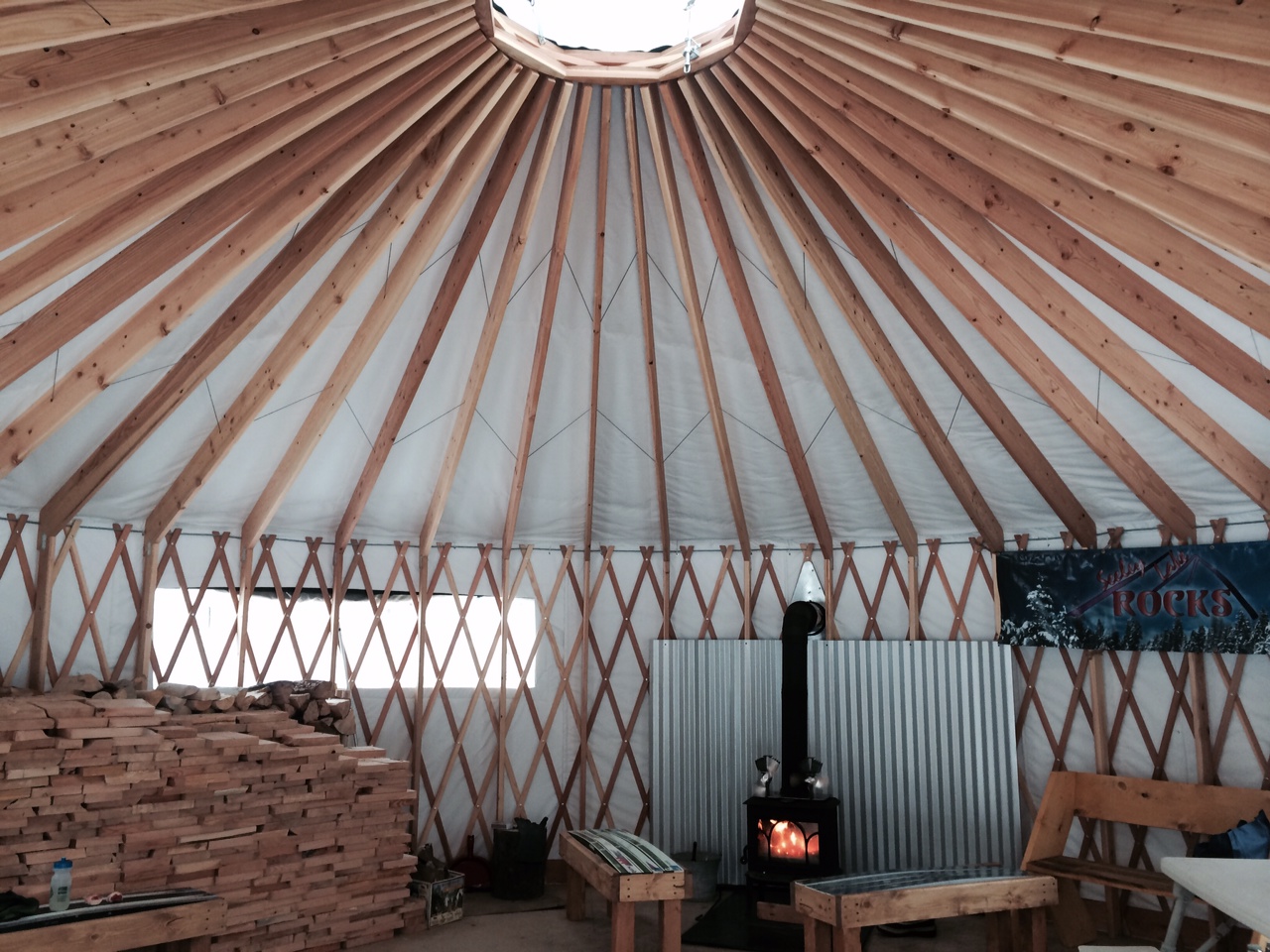
The town’s existing nordic ski trails at Seeley Creek have seen an upsurge in use following the installation of a new yurt (installed by Seeley Lake ROCKS) at the trailhead.
“The yurt is way more popular than we expected,” Lynn Carey of the Seeley Lake Nordic Ski Club said. “Our metal ranger now takes in more money than any other ranger in the state.”
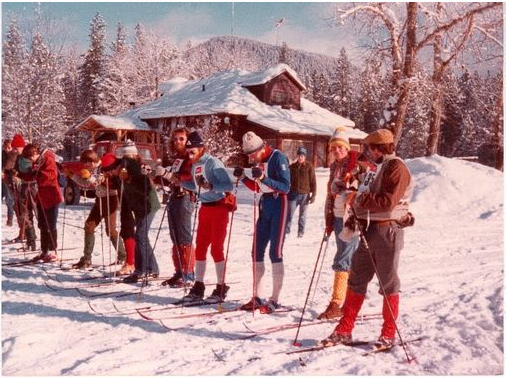
Seeley Lake, Montana, has a long history of ski racing. This is a photo of the start 1983 OSCR race. (Courtesy Seeley Lake Pathfinder)
ROCKS founder Karen Pratt notes, “The idea is that you need a culture shift to bring in an elite race [to Seeley Lake] and get enough interest in town to support it. An international race is a lot of work!”
The ROCKS plan seems to be working.
“There has already been a big culture shift in Seeley,” Pratt said. The Seeley school system started a ski program where any student above the 3rd grade can access free skis, transportation and ski instruction. Twenty students have caught the ski bug and joined the school’s newly formed nordic ski racing team.
According to Pratt, many local parents are learning to ski as a result of the new youth programs. She is convinced that the increased activity is improving community health. “It’s not a good thing when the people in Seeley don’t get out of the house in the winter,” she said.
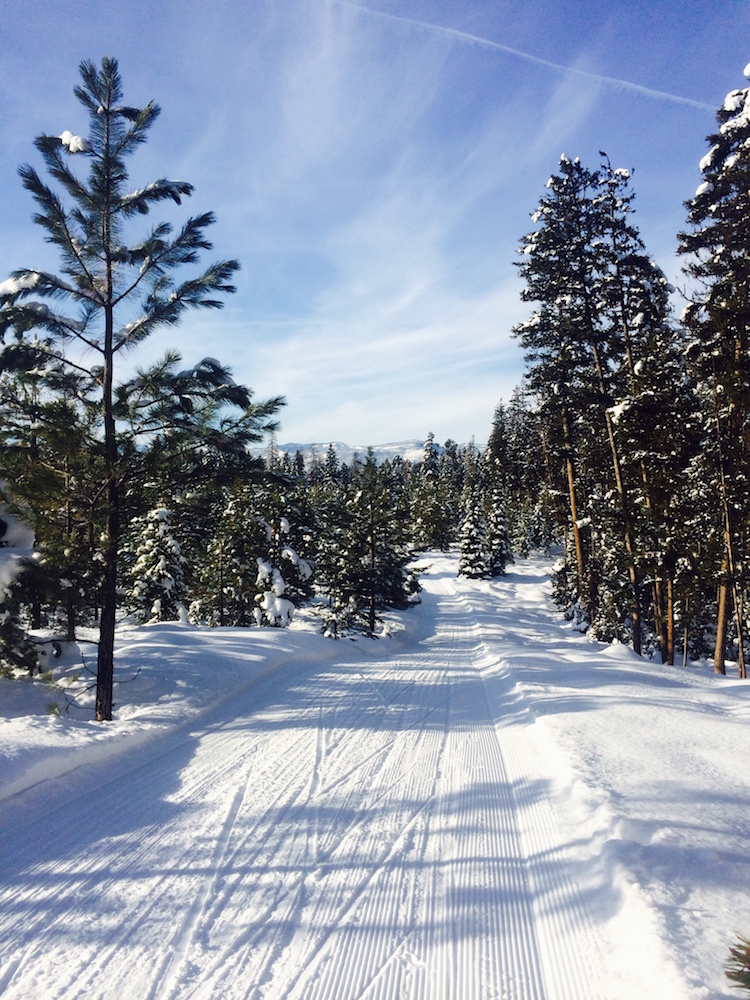
Seeley Lake’s existing ski trails at Seeley Creek. (Photo: Mark Vosburgh)
Grooming the 23-kilometer Seeley Creek trail system is now conducted daily, and several trails that had been abandoned or rarely groomed have been re-opened. The rolling trail system, designed by Olympian Jon Elliott, is seeing a resurgence in use and the trails are receiving rave reviews from regional skiers. The eighth-annual Seeley Lake biathlon had 115 entrants this year, nearly double last year’s count, according to race director Cheri Thompson.
Once the new trails at Fawn Creek are open, ROCKS organizers hope that overnight visits and resulting economic benefits to Seeley Lake will increase with skiers spending two days in the Seeley Lake area in order to ski both trail networks.
Pratt credits generous donations from the late Peter Hale and his estate for supporting the Seeley Lake ski program with skis, waxing supplies and equipment. Hale’s connection to Seeley and his passion for skiing is in part responsible for at least one concrete example of increased economic activity sought by ROCKS.
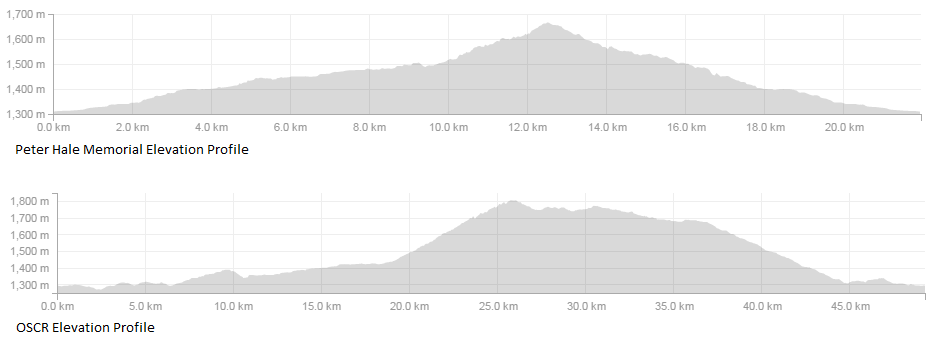
Elevation profiles for Seeley Lake’s signature nordic ski races, the Peter Hale Memorial and OSCR.
In 2012, Mike and Cathy Kahnle opened Seeley’s first bike-and-ski shop, Rocky Mountain Adventure Gear. Describing how he came to a decision to start the business, Mike said, “ROCKS was happening … Peter Hale contacted me prior to putting this business together and just filled my ear… It was pretty evident his love for skiing was overwhelming.
“Peter basically talked me into running Madshus skis in a shop that didn’t exist,” he continued. “You couldn’t have a conversation with him without feeling better about yourself and life in general.”
A passionate endurance athlete, Kahnle was also attracted to Seeley by its reputation for challenging endurance events like the Over Seeley’s Creeks and Ridges (OSCR, pronounced “Oscar”) 50 k ski race.
Describing the race, Kahnle said, “No matter what level athlete you are, you are going to have the opportunity to push yourself to find the limits of what you’ve got.” Referring to the nearly 800 meters of elevation gain in OSCR, he added, “If you want an easy race, go somewhere flat because we are not going to have it for you here.”
Carey, OSCR race director since 1991, agreed: “OSCR [founded in 1981] is a damn-tough race. It always has been, and we are proud of it … really it’s an adventure more than a race.”
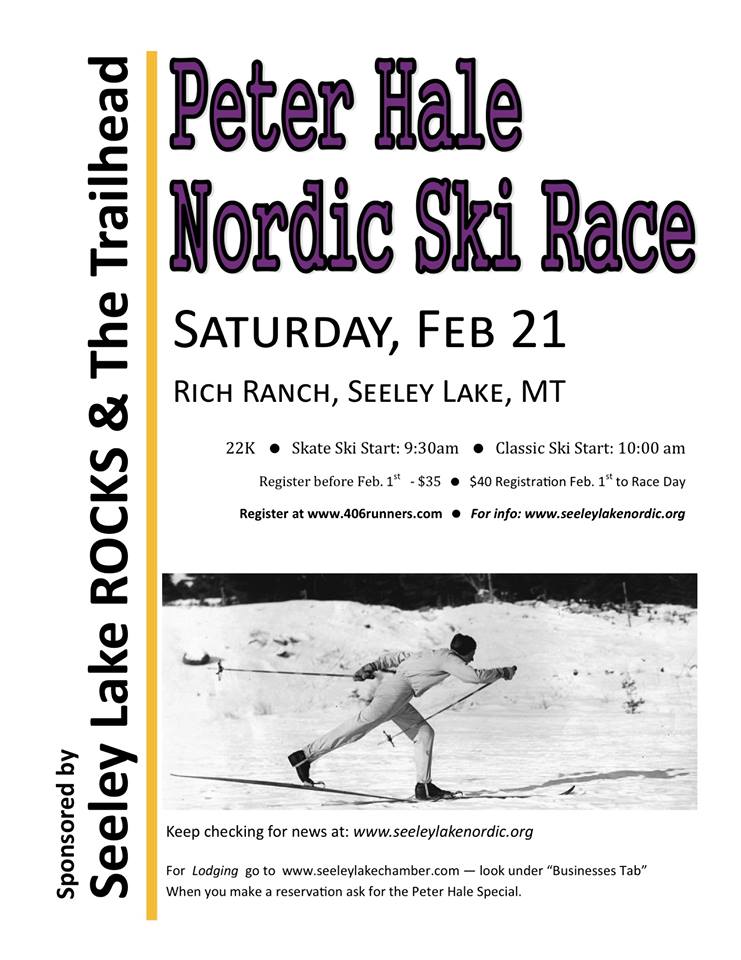
The second Peter Hale Nordic Ski Race will be held Saturday, Feb. 21, in Seeley Lake, Mont.
ROCKS will hold the Second Annual Peter Hale Memorial 22 k Ski Race on February 21, 2015. With an elevation gain of nearly 400 meters, the race is not easy. In honor of Hale’s love of classic skiing, both classic and freestyle races are offered. Inaugural race feedback (in spite of frigid temperatures) was positive with about half of the participants choosing the classic event. Pratt anticipates that the race entry will need to be capped after this year’s event due to capacity limitation of the venue.
With momentum building in Seeley Lake, the ROCKS vision for a national and international caliber ski venue is moving forward. “The focus is on the new course right now because it has to be,” Pratt said.
While not everyone in Seeley Lake is optimistic about the outcome of the ROCKS effort, Pratt stated, “If we did have a venue that brought in a week’s worth of high-end racers, it would mean us [in Seeley Lake] having a larger number of people who would have a larger vision about what is possible.”
The legendary Peter Hale, a former U.S. Biathlon skier and longtime U.S. nordic sales rep in. Hale spent the last seven years with Madshus, working until about a month ago. After fighting cancer for several year, he passed away on Sunday, Nov. 17. (Photo: The Master Skier)
Editor’s Note: The following is a tribute to Peter Hale, who died Sunday at age 66 after battling cancer. Hale remained active in the ski industry and community until about a month ago, when he returned home for hospice care in Bozeman, Mont. This is a compilation of thoughts and memories from some of the many people Hale impacted, from his days as a fledgling biathlete to one of the most-loved men in the U.S. ski business.
***
Terry Aldrich still remembers the first time he saw Peter Hale. It was memorable.
Aldrich went on to coach the Middlebury College ski team for 34 years, but back then he was on the biathlon national team based out of Fort Richardson, outside of Anchorage. The team had traveled up to Fairbanks to compete in the Gold Discovery Run footrace, a 16-mile run with 1,500 feet of elevation gain. Tough stuff. Nearing the end of the race, Aldrich was in about third place. As it turns out, Hale was just behind him.
“There was a truck that came by too close to him,” Aldrich explained in a phone interview this week. “He put up his hand to motion to the truck, and he smashed his hand on the truck mirror, which caused his hand to bleed. That shot of adrenaline must have been something, because my memory of that race is him going flying by me with 400 meters to go, with blood literally spurting out of his wrist. I thought, man, that is one tough character.”
It wasn’t just Hale’s gutsiness, but his speed that got him noticed. At that point, Hale was stationed at Fort Greely, the Army’s cold-weather testing center south of Fairbanks, Alaska. Watching Hale run, the biathlon coaches thought he obviously had talent and they should offer him the chance to try biathlon. Since the team was also run through the Army at that point, Hale was transferred down to Fort Richardson, near Anchorage, to join the unit.
Whichever Army bureaucrat approved that move, the ski world thanks you.
We all liked him so much, we didn’t want him to be shipped out of the unit. So we all helped him become an accomplished cross-country skier. – Terry Aldrich, longtime Middlebury coach and Peter Hale’s former teammate on the U.S. Biathlon team
Talk to any skier who knew Hale and they’ll tell you: he was the nicest guy in the sport, the most generous, the most selfless. Hale passed away on Sunday at age 66 after a long battle with malignant melanoma, and in the final week of his life, stories and messages of support from every corner of the ski world poured in on his Facebook page.
That he would come to be so important to the sport was not a given. Many other men might have given up when after joining the biathlon unit.
“It was obviously difficult – we lived at Independence Mines, which was very tough living conditions,” Aldrich said. “Not much heat and sometimes no hot water. We trained up there for months at a time in the early fall.”
Aldrich wasn’t sure exactly how much skiing experience Hale had before joining the unit, but his technique needed some work. Immediately, his new teammates set out to make it happen.
“We all liked him so much, we didn’t want him to be shipped out of the unit,” Aldrich laughed. “So we all helped him become an accomplished cross country skier… He had the aerobic background, he just didn’t have the skiing skills that he needed to ski at that level. But when you have people like John Morton, Dennis Donahue, and those guys – all of us really, I don’t want to single anyone out – helping you become a better skier, well, he certainly did. He really improved. We all have great, great memories of him up there.”
“Peter was a very capable skier,” Morton told the Bozeman Daily Chronicle, remembering him as “such a good guy, always friendly, gregarious, and outgoing,” and an open book when it came to pre-race secrets. The group had a common goal of making the 1972 Olympics, and even when teammates like Hale didn’t, most of the U.S. Biathlon team remained tied to the sport.
Aldrich and the others watched as Hale turned to a new job as a ski rep, first for NorTur and then for Madshus as the Northwest sales representative and U.S. race services manager. If anything, the generosity and good spirit they had come to know in those tough days in Alaska only grew.
He started in the business right after he was on the Olympic team for Biathlon…he worked for a company called NORTUR out of Minneapolis that primarily focus on nordic stuff back in the “old” days (late 70’s)…Distribution companies generally had multiple lines/companies they represented. Nortur had a tons of brands and most are gone/out of business except Swix and Rottefella. Swix used several outlets to sell their wax and Rottefella did the same.
As you well know, he worked for me when [Alpina] had Madshus skis…he actually brought the skis in himself before we took it over. He continued selling under my rep in the West (Spence Bocks) and then went on with Madshus when K2 took the brand over from us in 2004. – Steve Kvinlaug, former Alpina Sports president
Helping and Encouraging…
Peter Hale working hard at U.S. nationals in 2006. (Photo: The Master Skier)
Even in his days at Fort Richardson, Hale was already supporting a ski community: the one back home in Minnesota, where he grew up.
“To those of us who came along five or six years later, he was a mentor and fount of encouragement,” Shaun Koos, the father of Olympian (and 2014 Olympic hopeful) Torin Koos, wrote in an email. “I’ve never encountered a person with more passion for xc skiing. Peter would arrive home for the Christmas holidays extolling Alaska’s virtues and warning us that he already had several thousand ski kilometers in the bank.”
After joining Madshus seven years ago, that attitude continued.
“His modus operandi over the years remained remarkably consistent,” Koos wrote. “Peter was a friend to anyone who shared his passions, and his support and encouragement meant a great deal to hundreds of young skiers anxious to explore their potentials. Peter was in on the ground floor, and for forty years played a meaningful part in the development of cross-country and biathlon in the United States. He modeled the development pipeline. We will see some of his influence and impact this February in Sochi.”
Dennis Donahue – involved in the U.S. Biathlon Association at its inception as well as coaching the Ford Sayre high school nordic team in Hanover, N.H., for many years and pitching in for the New England team at Junior Nationals – noticed the same thing.
“Peter did a lot quietly behind the scenes – providing skis for motivated juniors,” Donahue wrote in an email. “I think this reveals the profound posture Peter assumed, a posture many people have already cited but is worth repeating. Not too many ski reps did/do as much as Peter. He definitely was a fixture and a truly unique person. He really got a kick out of supporting lots of skiers. And I am pretty certain Madshus of Norway recognized and approved of Peter’s approach.”
According to K2 Sales Director Van Brinkerhoff, who oversees Madshus distribution in the U.S.: “Peter’s roll with Madshus was simply and extension of who he was as a person,” he wrote in an email. “He loved both Nordic skiing and the brand, Madshus. Essentially Peter’s whole career in the Nordic industry was with a single company. It is truly a rare thing for one person to be so associated with a single brand and to have such influence with so many for so long. His life might have been cut short but his influence will have a lasting effect on many within our sport.”
Hale worked for the company up until mid-October, “talking with racers and dealers about their needs for a fall product and skis,” Brinkerhoff explained. Hale even apologized to Brinkerhoff for not being able to attend the Madshus sales meeting in early November in Seattle.
“He just felt as though he might not have the energy to participate,” Brinkerhoff wrote.
Not too many ski reps did/do as much as Peter. He definitely was a fixture and a truly unique person. He really got a kick out of supporting lots of skiers. And I am pretty certain Madshus of Norway recognized and approved of Peter’s approach. – Dennis Donahue, Hale’s former U.S. Biathlon teammate
For almost 40 years, new and developing skiers got their help from Hale. Consider Sarah Konrad, who got her start in skiing in the early 1990s in Bozeman, Mont. She later went on to become the first American woman to compete in two different sports at the same Winter Olympics, representing her country in both skiing and biathlon in 2006. Back then, she says, she was “nobody.”
“I was living in Bozeman and just starting doing the marathon circuit,” Konrad said on the phone. “After I did that for one year, [Hale] took me on and gave me a couple of pairs of skis. You know, he just believed in me, and he never stopped believing in me for those 20 years. I was pretty excited about it – you’re still trying to even believe in yourself, and so when someone else does, you’re like, all right! That’s a little affirmation for you to keep going for it.”
Peter Hale (r) with former Madshus athlete Leif Zimmermann (Photo: The Master Skier)
Another skier Hale represented: consider current U.S. Ski Team member Noah Hoffman.
“He would dig in to his own pocket to make sure I had the equipment I needed to succeed,” Hoffman wrote in an email.
Konrad eventually joined the Alpina team and traveled around the country racing with a group of other athletes. Hale went with them. But when the team folded, he kept helping her out.
“He would stay on to support people individually through Madshus, and he actually came to biathlon Olympic trials after I had switched over to biathlon and waxed my skis before the tryouts,” Konrad said. “That was really, really awesome… the truth of the matter is, he’s just there to help. It’s not like I’m paying him or anything. He’s just helping out of the goodness of his heart.”
Even if you weren’t American, Hale was still there to help you out – more than that, to go above and beyond. Dutch biathlete Herbert Cool remembers arriving in the U.S. to train for a year, long before he made three World Championships appearances. All he wanted was a deal on a new pair of bindings.
“Next thing I know I’m spending an entire evening with Peter changing all the bindings on my 10 pairs of skis from the back of his truck in an underground garage,” Cool explained. “I come from a country where there is never any snow and there are no facilities for biathlon, so it was great to be able to experience such an open-minded nordic community in North America. Peter personified this feeling for me. He was simply crazy about skiing and for him this meant that if a guy like me needed help, he’d help out! His work was very close to his heart and he was one of those rare examples of people who truly love what they do for a living.”
No matter whom you ask, most of the people that knew or met Hale agree.
“When he was a rep, the thing that I really noticed about him was that it didn’t matter if it was one of his athletes who was skiing on his equipment or not, if someone came up to him and needed a quick wax job five minutes before the race, he would always help, anyone, with anything, related to skiing,” Aldrich said.
… and Being A Friend
He helps in every way. It wasn’t just skis. He took care of people. – Sarah Konrad
But if Hale was just a guy who gave out and waxed skis, he wouldn’t be so beloved. It was his cheerfulness and friendship that mattered more to almost everyone he met.
“I’ve stuck with Madshus that long – you know, the skis are great, but primarily because of him,” Konrad said. “You get better and other companies say, ‘Hey! we can give you a better deal, come ski with us!’ People hop from one company to another, but I would never leave Peter! That would be ridiculous. So that was the two-way loyalty. He was always there for me, but I also felt like I would always be with him, too.”
For Hoffman, too, Hale was far more than just a ski rep.
“Peter was an amazing guy,” Hoffman wrote. “He loved to talk – I would have to schedule large chunks of my day anytime I needed to give him a call. He had so much faith in me as a skier and a person. He got to know my family because he cared about me, and he always made sure to pass his best wishes on to them.”
U.S. Biathlon Association President Max Cobb remembers the first time he met Hale. Cobb had just been hired by the biathlon team and had driven a van full of equipment from Vermont to West Yellowstone. The team was supposed to be able to cook in their hotel, but when he arrived, the kitchens were gutted. Cobb called up Hale, who helped arrange a local café to allow them to use the restaurant kitchen.
Peter Hale and Peter R. Hale (r), friends at first sight at the 1980 Olympics in Lake Placid, N.Y. (Photo: Peter R. Hale, of Rumford, Maine)
“Peter was a regular there!” Cobb laughed.
For the next five years, though, their friendship deepened. As much as Hale did for the sport of biathlon – and it was a lot – Cobb also got to enjoy skiing the trails of West Yellowstone with the Madshus rep.
“He always tried to find time to squeeze in a ski at the end of a long day, which is not always easy to do when you have been coaching or out giving splits or whatever,” Cobb said. “It really speaks to just how much he loved and enjoyed skiing, and the people in skiing. I can remember many late afternoons, meeting at the trailhead in Yellowstone, putting on our headlamps, and getting in an hour at the end of the day. It was always fun.”
Hale could even make the strain of traveling easier. All winter, skiers and coaches spent time away from their family and friends, staying in crappy hotels and eating on a budget. Hale was there to cheer them up.
“I remember very vividly a New Years Eve that we spent together at a bar in Lake Placid,” Aldrich said. “We were racing up there and we celebrated just he and I, talking about old times. Neither one of us had any family around… we ended up sitting at this bar for three or four hours and just talking.”
Even after Konrad retired from full-time racing, she and Hale would catch up on the phone once every few months.
“He helps in every way,” she said. “It wasn’t just skis. He took care of people.”
In 1980 I had the opportunity to work at the Lake Placid Olympics for Chummy Broomhall on the XC events, actually I worked for Sven Wik but Chummy got me in. When I first showed up at the XC venue I was confronted, on a few different occasions, by some other XC workers thinking I was their old friend Peter Hale (maybe they haven’t seen him for some years). Strangely, I thought back to the night before when I checked in for my ID card and uniforms and was being turned down because I had already checked in once. And then, ahhh, they discover there are 2 Peter Hales. Yes, my name is also Peter Hale, from Rumford Maine and at the time living in Telluride. Throughout the first week I’m being told I gotta meet Peter Hale who was announcing at the biathlon venue next door. After the first week both venues got together for a few beers at the XC venue and alas I meet Peter Hale.
So there you have it, a once in a lifetime meeting of your (kind of) doppleganger and with the same name, so I thought. A year or two later while in liftline at Telluride there’s Peter Hale. We chatted, he was at the time living in Montrose, Colorado 65 miles from Telluride. After a few meetings like that on the Telluride ski area that season we finally got to make some turns, and had a few beers, well, a bunch of beers, and a couple shots. Peter and his friend Gary ended up staying at my place that night. The next morning, with some explaining to wife Rayna, I went to work and let Peter use my ski pass for the day.
My brief acquaintance with Peter was special, he was such a genuine guy. RIP Peter Hale. — Peter R. Hale, of Rumford, Maine
Business Model?
If you’ve been in this sport any amount of time in the US, you realize that the brand territory of the few elite skiers who exist and are sponsored or supported by a brand, can be overtly partisan—clearly divided. At times even petty. To me, that is the impression about Peter that sticks. It says a lot about him. He made his tight living on the strength of the Madshus brand, yet he supported everyone. – Chad Salmela, former U.S. Biathlon member
Konrad and Hoffman are just a few of the exceptional athletes that Hale backed. But their success had little to do with how he acted towards them.
“I don’t think it mattered to him, although I think it did help him,” Konrad said. “He was always kind of going to bat with Madshus and Alpina to just get as much funding as he could for his athletes. So obviously when you have one that’s more successful and breaks through, that helps. It helps say, ‘Okay, Peter can call them. Look what he did with Sarah, he can do that with someone else.’ But he didn’t care, that’s not why he was doing it, not at all.”
Hale wasn’t out there to try to make money. In fact, Hoffman wrote, he sometimes felt guilty asking Hale for things, because he knew the consequences: “I worried about the sustainability of the setup, and I hesitated to ask him for equipment because I knew he would do anything he could to get it for me.”
U.S. Nordic Combined Head Coach Dave Jarrett started working with Hale shortly after the 2006 Olympics, and not long after, the entire National Training Group (NTG) was outfitted in Madshus. In a phone interview, Jarrett said Hale’s willingness to create affordable options for up-and-coming juniors boosted U.S. Nordic Combined’s overall development.
“[He] made it possible for them to get really, really high-quality equipment for extremely good prices, and a lot of times a lot of things were free,” Jarrett said. “In this day and age, with tight margins, it’s not heard of much.”
With the news of his passing, Jarrett said he was also learning how much Hale invested into all nordic sports.
“Not only was Madshus supporting us, but Peter Hale was covering the difference,” he said Monday. “He never said anything about it; he was always willing to make sure everybody had everything they needed. … He was doing a good job to cover everybody and everything as best as he can. It’s a sad day for sure.”
In addition to several Madshus-sponsored B-team athletes, Bryan Fletcher, one of U.S. Nordic Combined’s most promising A-teamers, has been with Madshus (and Hale) since making the national team in 2006.
“He was very enthusiastic about having us represent Madshus and it was just the start of a great partnership,” Fletcher said on the phone. “I still remember the first day I met him, we saw him in the grocery store and just got to chatting and I knew that it was the right call.”
Not only was Madshus supporting us, but Peter Hale was covering the difference. – Dave Jarrett, U.S. Nordic Combined head coach
After six years with Hale, Fletcher had a breakthrough season in 2012 and joined Madshus Norway. Despite the promotion, Fletcher stayed in contact with Hale, especially as Hale’s cancer intensified. A cancer survivor, Fletcher was diagnosed with lymphoblastic leukemia at age 3 and beat it seven years later.
“It just reminds you of the things you’ve been through,” Fletcher said. “It’s extremely hard to watch him go through the same thing. You wish you could step up and help fight that battle … That’s what’s so hard about cancer.”
Catching up a couple times a year, the two found humor in things like the tiring effects of chemotherapy.
“Little things like that I hoped would keep his spirits up,” Fletcher explained. “He was already such a positive person. You just talk to him and give him a few little words of encouragement and he was already off and running and just motivated to keep fighting even harder.”
Thinking about this winter without Hale, Fletcher knows several people will ski in his memory and participate in events in his honor. “I wouldn’t be surprised if Madshus came out with something to commemorate Peter,” he said. “His legacy will, for sure, live on.”
Hale was recently nominated for the biathlon Hall of Fame, partly for his unrivaled generosity (his own athletic exploits being the other, although, as Konrad said, “he never talked about that.”) A fringe sport within a fringe sport, ski companies didn’t always find it worth their money to put a lot of equipment or advertising into such a small community.
“We’re really well-supported now by the industry, but there were many, many years where the athletes were not that well-supported, with the notable exception of Peter,” Cobb said. “He always made the extra effort to get to events, whether it was nationals or World Cups or trials races, to support the athletes, and particularly the ones who didn’t have a national team behind them, or who didn’t have the best coaching situation… it was the special attention that he paid to athletes, and especially developing athletes, that really makes him the right person to be in our Hall of Fame. It meant a lot to us.”
Going above and beyond did have its consequences.
“Peter was so giving and so selfless, so much so that he could never stay on schedule!” Cobb said. “There was always someone who called him at the last minute, or something he needed to do for someone. It was always a question when we were getting ready to go – would he be there that day, or would it be the next day?”
“Some people have always kidded about him being a little scatterbrained or late with things, but he was always there,” Aldrich said.
And that’s the point, said Konrad: at first, she didn’t mesh easily with Hale’s working style. But he never let her down, so she quickly adjusted.
“Your start time is your start time, and you have got to be there,” she said. “Sometimes with Peter, prepping skis and stuff, it could be really down to the wire. At times it could be a little stressful because of that. But I never missed a start! … It’s hard to get too mad. And he just loved doing it.”
Maybe he was late sometimes, and maybe he gave out too many skis. These aren’t traits that you’d think would go in a ski rep’s job description, but they are the types of things that earned him such a loyal following – the reason that people like Konrad would never leave him.
“He really wasn’t selfish,” Konrad said. “He just gave and gave of himself. The athletes around him would be like, ‘all right, Peter, you’ve got to go home now!’ And he’d say, ‘no, no, just one more thing…’ He would never switch off.”
“He truly loved the sport, and he loved everybody in it,” Aldrich said. “He was just a rally special, caring, generous person. He never had a bad word about anyone else, but it’s also that I don’t remember ever hearing anyone say a bad word about him.”
Sendoff
Hale received his diagnosis several years ago. Considered the most dangerous cancer, malignant melanoma causes the most deaths in the U.S. despite not being the most common cancer. Hale fought hard anyway, and stayed involved in the ski world the whole time.
“He really did not step away,” Konrad said. “I think it is a mutual thing. He really loved being involved with skiers and the ski world, and he got a lot of energy from that, as well. I’m glad it was a mutually beneficial thing. Given the seriousness of [the diagnosis], he probably lasted lot longer than a lot of others would have. I’m not a doctor, I have no medical opinion of it, but that’s my sense. It’s been serious for a long time, and he just kept beating it.”
And in the last few years, he made plenty more memories. He met more young and developing skiers. He kept supporting his roster of athletes. He stayed in touch with his friends.
“After the last big race at Rumford, he was a rep there and we all knew that he was not well,” Aldrich said. “So George suggested that those of us in the East should come over to a dinner with Peter. Many of us did. John Morton was there, Dennis Donahue, David Cole, George and Jenny, and it was great to see him. We went for walks in the woods on George’s property, and it was great to just touch base with him.
“He was a great friend, and I’m really going to miss him.”
In the last week, Kris Zimmerman posted updates on Hale’s condition on his Facebook page. This was the main way that Hale got messages, so friends around the ski world began leaving him notes. They all professed their love for their friend, some by remembering a special moment together, others by leaving photos of ski trails.
“Your wonderful posts continue to bring a smile to Peter’s face and warms all of our hearts!” Zimmerman posted at one point.
The messages came from every corner. Reading the names was like a who’s who of the ski world – and not just a who’s who of people you might read about in the news. There were current national team members and former ones. Olympians and their families. Ski reps from other companies. Citizen racers who had met Hale on the trails; athletes who you would never find on a factory team roster. Friends old and new across the entire age spectrum.
“It was really great that he got a lot of enjoyment from that before he passed, seeing all that love from everywhere,” Konrad said. “But I think for all of us, too, it was really nice to see. They’re doing a celebration on Thursday night for him, and it was neat that Facebook has almost allowed that to go global. You almost don’t have to be there. I mean, that would be great, but we’ve almost been able to participate in this celebration of his life already. And it started happening before he died, so he could see it.
“You could almost see it as the community doing a sendoff, of Peter. I thought it was just great. It’s making me teary-eyed just thinking about it.”
Endless Stories of Admiration
“I have known Peter from the early 70’s, when he was affiliated with the U.S. Biathlon team. Peter worked as a representative for NorTur in Alaska and the Northwest for many, many years, where he represented the finest in Norwegian made cross-country gear. I traveled with Peter often during my tenure as NorTur CEO, and came to know him very well. He was a great friend to me, his customers and cross country skiing. Rest in Peace, Peter.” – Ross Gronfield
“I have known Peter since we were on the US Biathlon team together; he as a Senior & I as a Junior. Everyone who knows Peter agrees that he has been a keen XC skier & selfless supporter of skiing & junior skiers in particular since men were men &skis were made of wood! I had the good fortune of meeting Peter’s parents as well as hearing peter’s many stories of their family life. My memorable story from our days on the biathlon team begins with our new lodgings at “The Range” aka: the biathlon training center at Underhill, VT. The concrete barracks in which we were housed was quite a step up from the mobile home & dilapidated house we occupied previously. A few of us had gone into Burlington to buy groceries and do our errands ,one of which was picking up the mail at the National Guard HQ. When the clerk brought out the mail one small parcel was segregated from the rest by being kept outdoors. When we retrieved it we understood why; from it emanated a foul odor. We placed it under the windshield wiper of the van for the drive back to Underhill. We delivered the aromatic gift to Peter who recognized the return address as his sister’s. He bravely opened it to find a letter from his sister and a pig’s snout wrapped in plastic. The message from Peter’s inventive sibling was her wish for good luck in the tryout races and her hope that he would prevail “by a nose!” over his competition. The good luck charm was stored outside Peter’s window on the sill. I’m not sure if it made it through the entire race series before someone disposed of it. Peter was fun to have around; his stories always brought levity to sometimes stressful times. We love you “Omar”! (AKA:Peter the whale).” — Russell Scott, USA Biathlon 1973-1980
“Peter (Biathlon alias Omar) was one of a kind, they broke the mold after he was born. Peter and I were teammates on the U. S. Biathlon Team and we had a blast! Wax them fast in Valhalla, Omar!” – Deadwood Dan
“Skiers are a good bunch and much of is learned from people like Peter. Four decades of my skiing life was blessed by his presence and help. Peter was always up before the rest of us on race day to help make the fastest skis possible. He was the guy who would loan you his favorite rifle if you needed it. Never the guy to take the limelight, but always the guy help you to the next level. Before becoming the unwavering face of Epoke, Landsem and Madshus, Peter was a great inspiration for a skinny buck-toothed kid in Montana. Skiing at Lone Mountain Ranch I caught sight of a guy wearing a USA Biathlon jacket gliding effortlessly through the woods. Giving chase on my wood Jarvinen skis barely kept him in sight. Catching a glimpse of ski pole basket or sleeve disappearing behind a tree spurred me on, but Peter gracefully disappeared into the woods ahead. I sure wanted to be able to ski as well as that guy! It took many years to catch him. Last year when I told Peter of this memory he realized that he was “that guy”. He characteristically chuckled at the thought of being an inspiration to someone, but acknowledged my thanks. Once again Peter has quietly disappeared behind the trees up ahead.” — Josh Thompson
“I will remember Peter for his great big smile and the unwavering happiness in which he seemed to live. As with many others, I mainly saw Peter in the Fall in West at Thanksgiving Camp. Each and every year I was greeted with a genuine smile, hug and “How are you?” He always took the time to catch up and learn about the little munchkins coming up in the program. This will be my first year not going to West Yellowstone for Camp in over 15 years. I have to admit it would be strange to be there and not run into Peter out on the trails. Even in 2012 at West, we were able to ski for 5 min or so together catching up on the little things. He was so happy to be out on the trails, enjoying the snow and the crisp surroundings. I will always remember him for his big smile and happy heart.” – Allison Sehnert
“[Peter] was the first guy to sponsor me as an athlete. He just always had a smile on his face and always went way out of his way, above and beyond. Looking back, I appreciate the sacrifices he made for me and other people trying to make it. He was just always happy. I never saw him unhappy. He always seemed to be extremely tired from running around in every direction, trying to help as many people as he possibly could: his athletes and other people who just needed help. He was always there for anyone. It’s a big loss for the cross-country community.” — Brayton Osgood
“Peter, you have always been a take charge guy and when you found an impossible situation, would turn it turn into a reality. There were many, many times we had a saying, “that we would take a pigs ear and turn it into a silk purse.” My fondest memories of the Birkie, were when we would not have what the ‘Big Boys’ had, but Peter would send me off to the Hardware Store to get 2X4’s, and we would build stands that the skiers and the public did take note of, and in fact, would stop in, to see our Skis and Boots. You always made the best of all situations. Peter, remember the DRY LAND TRAINING at my house? and THE ITALIAN RAVIOLI DINNER??? OF COURSE ‘A LITTLE Aquavit’ for all!! We all miss your optimistic and enthusiastic attitude. I will give you a call. All our best wishes to you.” — Frank and Linda Rorvick
“A force. A legend. an inspiration, and a teacher for all of us in this wonderful sport. Rest well. You’ve sure earned it. Blaze some new trails for us Peter. Can’t wait to ski em.” – Larry O’Heren
“I don’t know Peter well but he was always available and helpful and, given our similar ages, ski community friendships, and “take on the world” it was always a treat and pleasure to be with him. I last saw him when he was in Wilson, WY quite a number of years ago and came “off pattern” to hang with me, shoot the shit, drink a bunch of coffee at our place, catch up on the comings and goings of mutual friends, and then proceed to give me a killer deal on both skis and boots … a deal an aging coach really didn’t deserve; but that he was happy to extend. His understanding of the sport, its luminaries (At least the ones I consider luminaries!), and its idiosyncrasies were extensive and I always learned something in conversation with him. Like many folks I know, I wish I had more time to be around him.” – Mark Clark
— Lander Karath contributed reporting
Letters to a Friend
“My Friend Peter Hale. One cannot talk about Peter Hale without that smile being mentioned. Whether it was after an all day on snow working hard, or sharing a beer Peter had a smile that could light the building up. This smile shouldn’t have been a surprise to anyone. It was just the precursor to Peter’s positive outlook on life. He was a hard man to get down, he just had a positive spirit and a belief in the good in people. Most of us would honestly have trouble having one day as positive as Peter lived his life. That is what made him a friend to so many people.
His love for the sport of Nordic has been well known. He made his living in the ski world, but that was not why he worked among the Nordies. He lived and breathed Nordic. He was always willing to help any skier even if they were no on his brand. As I started working in the ski business I quickly realized that if we had more guys like The Big Madshus Bear, as I called him, we would be better off as a ski nation. He just wanted to take care of you to help you be a better skier and he flat out didn’t care if you were the best around or just getting into it. He saw across company lines while still protecting his brand. He was always willing to help out on the wax bench and it was common to see him with his ski hat on crooked working a late night bench and sharing a beer and a story with a friend. These are some of the moments I will miss most about Peter, staring over the bench at his infectious smile. It always made my day easier and better.
A few years ago at Nationals in Rumford Peter sat down with me and shared some of his health issues. We had a long frank conversation about what he was facing and what was going to happen in the future. Peter always just said I will do my treatments, show up when they tell me, and do whatever they tell me. He fought a long time, longer than I believe most could. Still over the past three years every single time we talked, he first asked about my health. He next asked how my Mother, who is also ill was. He had to know those two things first before we could move on to him and how he was. This summer was a struggle for Peter, things turned worse and he knew that things may not turn out the way we had all hoped in full recovery. Yet still Peter never once made it about himself. Quite the opposite, he genuinely wanted to know how things were for everyone else. He didn’t feel sorry for himself one bit, just wanted to continue to share that smile and positivity.
These are the things that mad him not only my friend but really everyone’s friend. If I live a day or week like Peter lived his whole life it would be an accomplishment. Yet Peter did this every single day of his life even while dying. Amazing man, amazing spirit. A legend of the Nordic world has passed but hopefully will never be forgotten. That is my friend Peter Hale.”
— Roger Knight, Boulder Nordic Sport director of team and Eastern operations
“As I tried to come up with something specific, all I could really think of was how Peter was ALWAYS there. It was uncanny. And I think that’s why his passing kind of hit me a little more than I would have expected. I wasn’t the closest friend Peter had, but I felt a kinship with him and have known him as long as I have been involved in national/international level ski racing.
I first met Peter in West Yellowstone, November 1989. It was my first US Biathlon Team camp. I was 18. I had recently committed to biathlon as my primary sport and was invited to train with the National Team in West as a member of the Junior National Team. Walter Pichler was coaching there as a consultant but was really kind of just trying out for the head coach position, as it turned out. He started calling me “Yunior” (for “Junior,” with the German soft pronunciation of the J). It stuck. Peter was one of the few people I still saw regularly in recent years to call me by no other name.
I met Peter in the lobby of the Best Western Ambassador Inn. I was sort of hanging around after dinner, somewhat in pinch-me mode with Josh Thompson’s recent arrival to the camp. I had taken to the notion that given this opportunity, I would watch like a hawk, everything Josh did, while I had the chance. Josh had skied on Landsem and won a silver medal at biathlon worlds 2 winters prior, but Landsem went under after 1988, in some unknown manner to me—whether it was actually in Norway or just lost distribution in the US, I can’t remember. What it did was send Josh and others who were on Landsem (a good portion of the USBT at the time) to sort out a new ski affiliation. I was skiing as a sponsored Peltonen skier at the time, and was very proud that Josh had recently gone with a Peltonen contract. It was a small commonality, but it was cool to me. He was working through a bunch of Peltonens that whole camp.
I believe that winter was Peter’s first year with Madshus, as a reaction to Landsem folding (I believe that maybe Landsem was absorbed by Madshus?). Madshus retained most everyone who had been on Landsem the years prior, except Josh—clearly Landsem’s biggest US athlete. That had to hurt Peter to some extent, but he never let on. The first impression I had of Peter was made to me by Josh. Peter arrived in the lobby to great fanfare with the almost universal roar of “Omar!!!” Peter spent the next half hour or so catching up with everyone in the room as he continued to do his whole life, no matter where he went. It was clear that everyone loved Omar.
I can’t say exactly how Peter became Omar. I feel like there is a back story I never got clearly. The most basic answer I got was that he looked like Omar Sharif when he was younger (you could see the resemblance), but I still felt that the story has more to it, and may even have some off-color content, which as an impressionable 18 year-old, might have been why I never got the full scoop. As luck would have it, I don’t feel I ever completely filled that one in. Regardless, Peter remained Omar to me since the day I met him, and I remained Yunior to him as well.
Omar said he had to get all his new Madshus stuff from his truck and into the hotel. Josh slugged me in the shoulder and said come on Yunior, Peter is a good man. Let’s help him with his stuff. I would see this same lack of brand territory that Josh was exhibiting, easily a hundred fold from Peter over the next 24 years, even though Peter’s professional existence depended on the success of his brand. If you’ve been in this sport any amount of time in the US, you realize that the brand territory of the few elite skiers who exist and are sponsored or supported by a brand, can be overtly partisan—clearly divided. At times even petty. To me, that is the impression about Peter that sticks. It says a lot about him. He made his tight living on the strength of the Madshus brand, yet he supported everyone. I never skied on Epoke, Landsem, or Madshus skis as a ski racer. The closest I ever came to being squarely in Peter’s professional camp was when a small ski shop I was a partner in, sold Madshus. I remember feeling really good about selling Madshus when we brought in the skis, specifically thinking it was my first and only professional connection with Omar in the ski industry I ever had. Coming up with a specific story about Omar beyond how I met him, and how he became Omar to me, and I Yunior to him, is almost like pulling a needle from a haystack. For 24 years, he was always there. You never knew where or when he was going to show up, how he got there, where he was staying, or how he paid for it; but you knew you were going to see him 2-5 times a winter. You were never surprised to see him. Just happy to.”
— Chad Salmela, College of St. Scholastica head coach and former U.S. Biathlon member
“The passion Peter has had for Nordic skiing throughout his career is hard to match. From competing to selling, he was always promoting the sport and “softly” providing you with a wealth of knowledge from history to the latest in ski technology. Peter loved Norway and felt very much at home every time he came to visit. He certainly had a spot in his heart for any product made in Norway and was never shy in promoting the birthplace of modern skiing.On the other side of passion… well… comes a little frustration (in a funny way) Peter worked for me at Alpina Sports and we had wonderful conversations and some in depth discussions on the technical side that could include racing or touring. We all knew Peter loved racing.When it came to being organized….well…Let’s say not a strong suit for Mr. Hale. Being on-time was not part of Peter’s plan on a regular bases. It was never a question who would show up last for meetings or on-snow demo’s….we could even establish some small wagers on when we would see him…The time came…a few words was said and his smile was as wide as ever and we were back in action, as if nothing was different. He always had his spot.
Following deadlines for orders was also an issue most of the time, but he was always in the retailers corner supporting them and explaining to me that we would see it soon…”don’t worry Steve” Needless to say, I had some high blood pressure moments for sure that would generally end up in a smile and a quick laugh.
However Peter….’NOTHING a shot of Aquavit and some salmon would not cure,’ Love you man! ”
– Steve Kvinlaug, former president of Alpina
“Peter Hale, and his wonderful outlook on life, saved my butt one day. It was the American Birkebeiner and I sat in my warm car in the parking lot waiting for the start. I thought I was all set. I was ready. Skis waxed and packed in my box on the roof. It was 20 minutes to my Wave 1 start, so I casually got out of my car and reached up to unlock the box. The keys didn’t work.It was then I realized I had my wife’s box from HER car on top of my car and didn’t have HER keys. I had locked my race skis and poles in a box I couldn’t open.It was panic time. What to do? The first person I thought of was Peter Hale, because he’s always so helpful to everyone. I drove my car, fast, out of the lot to the house Peter rented on the Telemark road about a mile from the start.
People walking to the race were yelling at me, ‘You’re going the wrong way!’ as I pulled up in the driveway just as Peter locked the door and was headed to the start.
‘I need a pair of skating skis and a pair of poles for a short guy,’ I cried out. ‘Just a second,’ Peter said as he walked back into the house. A minute later he came over and handed me a pair of skis and poles.
‘Calm down,’ he said. ‘This is the only pair I have left, but you’ll be fine. Just have fun,” and he gave me that great smile of his, got in his car and went to the start.
Well, I had fun and I won my age class skiing with the shortest skis ever made and only able to get two fingers in the straps because I didn’t have time to adjust them.
Peter’s inspiration had me laughing all the way to the finish line. I lost a pole three times going up hills, but that didn’t matter. I would simply stop, turn around with a smile, and ask the skiers behind me to pass the pole up, and they did!
We will all miss you, Peter. RIP.”
— Bob Gregg, publisher, The Master Skier Ski Journal
Peter Hale: The Man with the Nordic Spirit
By Ian Harvey (published in The Master Skier, Aug. 28, 2012)
“I first attended one of Nat Brown’s summer training camps in Princeton, B.C. when I was 14 years old. I hardly knew anyone there, could barely rollerski, and was generally pretty intimidated. As my folks were dropping me off in the dirt driveway of the ranch, I saw a huge boat of a Cadillac roll down the drive with a seven inch-tall pink flamingo adorning the hood. The car pulled up and Peter got out; I’d never met the guy but he walked straight up to me with a huge grin, shook my hand and said, ‘Hi, I’m Peter Hale – you’re gonna have the time of your life up here’. I was so surprised by his entrance that I actually forgot my apprehension and nervousness. After that, I DID have an amazing time at the camp, and at many camps afterward, and it was largely due to Peter’s presence and ever-thoughtful attitude toward me and all the other athletes. Working with Peter now as an elite skier, I’m grateful for that same generous spirit and energy that I first saw nearly fifteen years ago and for his personality which invites everyone in to enjoy this amazing sport.” – Sam Naney, Methow Olympic Development Team
The example given above by Sam exemplifies why I wanted to salute Peter Hale who has worked for Madshus as a type of Nordic manager (product manager or racing manager) for many years. Simply put, I think this man embodies the Nordic Spirit. Peter is eager to help others, loves the outdoors and the ski sport, absolutely loves people, makes everyone around him feel warm and cared for, is very much “himself” (an original), and despite working hard, is always cheerful. I feel that Peter is one of many shining examples of the kind of wonderful people that we have in our Nordic community.
“The ski industry, like all industries, has a major trade show every year. Peter and I made it a point for many years to get together at the end of the show for an Italian dinner. As the show wound down, I would meet with accountants, people in the credit department and guys involved with shipping to go over administrative and accounting issues. These meetings could be so depressing, the skis were turned into basic commodities and all the passion for the sport disappeared. I would leave our booth, sit down with Peter at a fun Vegas restaurant and it was such a refreshing contrast to the day’s meetings. With genuine vigor and enthusiasm, Peter would talk about racing, how the industry could improve the gear, what we can do to better support athletes, how we can grow the sport… It was a long and very positive list of topics that would basically cover the romance of skiing. After a day of talking about bottom lines and going over spread sheets, Peter would bring back the love of the sport and remind me why I got into this industry in the first place.” – Rick Halling, Atomic Nordic Product Manager
Peter uplifts those around him either through his oddball and endearing sense of humor or by exhibiting genuine interest and concern for virtually all with whom he has contact. Peter is the rare type of guy who can drive through the night to get to an on snow demo, set up, stand around in the cold for 10 hours enthusiastically helping people with a smile and then go for a ski and marvel to his ski companion about how much he is enjoying himself and how much he enjoys this person or that person before loading up and heading out to the next event.
“Peter was the best man at the wedding of Tina and me. Who else has pictures of Peter Hale wearing a tuxedo? He wore a fish tie to the rehearsal dinner, looking like he had a fish hanging around his neck. He has been a member of our family for over 20 years and has known our children since they were babies. They grew up knowing him as Uncle Peter. Peter would bring new little skis for my children from his Norway trips.
It is quite natural in our house for me to come home from work some days in October and find Peter asleep on the couch in the living room after a tough day of Madshus store clinics in Anchorage.
Returning from the World Cup in Park City in 1988 the road from West Yellowstone to Bozeman was ice and we hit a big elk. Fortunately with the icy road the elk went spinning when hit and didn’t end up in our lap. For as long as Peter drove that Volvo, the elk hairs remained embedded in the trim.” – Patrick McGownd, Toko Tech Team member, Anchorage, AK
“Peter has always had a flair for the unexpected. His Cadillac was a surprise to us at a junior training camp back in the summer of 2000: he arrived in the largest white Caddy anyone had ever seen: white body, red-leather interior, a plastic pink flamingo duct-taped to the hood, and a circus-sized, yellow-and-black Epoke hospitality tent in the trunk, complete with a folding bed and chair. Our camps always ended with a roller ski race, and that year the prize was a ride into town in the Cady. Thomas Wassberg was guest coach and probably the most puzzled/impressed person there – a prize possession is a snapshot of Peter showing the dazed Thomas what can only be called the “engine room”. Coming from Sweden, Thomas had never seen anything a quarter as large or gas-consuming. To say nothing of the flamingo.” – Nat Brown, Past US Ski Team Technician (and coach and mentor to many)
“After the World Cup at Silver Star in 2001, Peter and I were told to jump into a Subaru and head for the East Coast for another World Cup at Ironwood Hills. We were the last car over the pass into Calgary that night, in a blinding snow storm, and about 10 o’clock the next day we arrived at Moose Jaw, starved and in need of fuel. After years of travel together, we share a predilection for the right kind of greasy spoon café, and decided to cruise the main street in search of one. We found The National Café – perfect: linoleum on the floors, half the police force having coffee in a booth in the corner, and a semi-grouchy waitress “of a certain age” who splashed some coffee into those heavy white cups that turn up only in that kind of café.
“So, does Rosy still work here?” asked Peter – never having been within 500 miles of Moose Jaw before. I shrank…“No, she quit a month or two go.” “Really? We wanted to see her. How come she quit?” “She wanted to get married.” “Married? Really? Who’s the lucky guy?” “Herb.” “Herb? I thought they’d never get together… “ By this time I was kicking Peter under the table. He quit, but we sure got good service. Traveling with Peter is always an adventure. That’s why “Peter stories” are a genre of their own.” – More from Nat Brown
“One quality I admire most about Peter is the way he takes genuine interest in anyone he has a conversation with. As a ski rep, his job is to talk to potential customers of skis. But he goes above and beyond the sales floor. He has forged thousands of true friendships, inspired young skiers, advised elite athletes, and motivated masters all around the world. He is a true ambassador to our sport! I always enjoy an engaging conversation with Peter and his dry, mid-west humor. And you have to appreciate his love for the wacky, somewhat extravagant sunglasses and retro ski apparel! I’m honored to work with such an influential member of U.S. skiing and to call Peter Hale a good friend!” – Leif Zimmermann, long time US Ski Team and BSF Ski Team member
Peter Hale, whether driving an elk hair embedded Volvo or his pink flamingo ordained white Cadillac, whether cheerfully helping people with whatever they might need or relaxing with friends in the bar after a long day adorned with the same sweaty cockeyed Nordic cap, lycra suit, and ski boots that he had eaten breakfast in is a person that we, the Nordic community can look at, smile, and proudly say, “Yeah, he’s one of us”.
Peter has been battling Cancer for over a year now and the treatment looks hopeful. I look forward to sharing many more entertaining and heartwarming years with Peter Hale.
Racers in action at Middlebury Carnival in mid-February at Rikert Nordic Center in Ripton, Vt. (Photo: Stella Holt)
RIPTON, Vt. – Nestled in the Green Mountain National Forest 12 miles up the hill from Middlebury, Vt., the Carroll and Jane Rikert Ski Touring Center lies behind an array of cheery colored yellow buildings that comprise Middlebury College’s Bread Loaf campus.
A moderately sized sign directs nordic-skiing seekers inward, off Route 125 and toward a large barn – also yellow. Around the corner, one can find a recently remodeled rental shop and warming space with couches, cubbies and a woodstove.
Outside, a large field is the gateway to some 50 kilometers of cross-country trails.
With winding tracks through dense forests, Rikert’s a place people have grown attached to over decades. They love it for its character – humble, quaint – something recreational skiers might seek but doesn’t make a whole lot of an impression on racers.
That’s where the challenge arose.
In 2001, Rikert last hosted the NCAA Skiing Championships on its tried-and-tested trails. A community treasure, the traditional 7.5 k course wasn’t exactly suited to mass starts and some people weren’t thrilled with how the event played out there. Trails were too narrow and not hard enough, they complained.
When Andrew Gardner became Middlebury’s nordic head coach in 2006, those same problems still existed.
“We always had sort of issues around our mass start,” he recalled. “Somebody would get pushed into a stream. … It would be crazy narrow. People would be butting up against each other, and it was tricky.”
It was also part of the reason why Rikert didn’t get awarded NCAAs two years ago. Middlebury submitted a bid for 2011 championships, but they went to the University of Vermont at Trapp Family Lodge in Stowe.
“There were concerns about the trails and whether we were in a place to hold those races,” Gardner said. “When we didn’t get the 2011 championships, it went back to what was the story? Why didn’t we get this? Cross-country infrastructure was a big part of it.”
Rikert needed a facelift – something efficient and tasteful without ruining its integrity. The general manager of Middlebury’s Snow Bowl alpine area and Rikert as its nordic counterpart, Peter Mackey got the ball rolling, reaching out to Middlebury alum John Morton, a former Olympic biathlete, coach and chief of course at the 2002 Salt Lake City Olympics at Soldier Hollow.
A trail designer for his own company, Morton Trails, with more than 20 years of experience, Morton returned to the place he spent four years training at in college. Exploring Rikert’s trails on foot, the 1968 NCAA runner-up remembered the two Middlebury Carnivals he won there. Like so many of its loyal customers, he had ties to the area. At the same time, he knew it needed to change to keep up with the times.
In 2010, when Rikert was awarded the 2013 NCAA Championships, the college hired Mike Hussey as a full-time, year-round director. Previously a sales manager for the Massachusetts-based HKD snowmaking manufacturer, Hussey came onto the scene with a wealth of ideas. Seeing through the trail reconfiguration Middlebury was already working on was one of them.
First things first, Rikert needed a homologated system to meet the International Ski Federation’s requirements for width and climb level. Nobody wanted to make Rikert a highway, but the trails had to be widened and retooled to ascend tougher terrain.
Homologation
One of the initial challenges was making a 5-kilometer course that achieved these standards without putting the average skier into panic mode.
“We went back and fourth with how much A-climb was needed,” Hussey explained, referring to the largest required incline that must have a grade between 9 and 18 percent.
The women’s freestyle mass start at the Middlebury Carnival from Feb. 15-16 heads out on the new Tormondsen Family Race Course at Rikert Nordic Center in Ripton, Vt. (Photo: Stella Holt)
“Andrew was pushing for more, John Morton was pushing for less, I was somewhere in between,” he said. “Realistically, the course gets used as a homologated race course about one percent of the year. The rest of the year, the general public is using it to ski on.”
Hussey wanted something that would work for both users, a hill that would be significant for a college racer but also something everyday skiers could ascend, taking a few breaks or a cutoff trail along the way.
“I think we really came up with a pretty darn good solution to the whole thing,” Hussey said.
That was the running theme to the entire project, from breaking ground in the fall of 2011 on what is now the homologated Tormondsen Family Race Course (click for map), with banked turns and what Hussey called a “screaming-fast downhill.” Finalized in early February, it also involved installing an integrated snowmaking system around the entire 5 k loop.
“[Hussey] understood a few things; he understood the homologation and how that was basically changing the playing field,” said David Lindahl, a principal at Morton Trails who contributed to the upgrades.
The process of changing a trail system is hardly ever easy, he explained. Venues have history and nostalgic ties. He and Morton started by asking Hussey what was possible, through permitting in the Green Mountains to property constraints, etc.
“It’s a big puzzle,” Lindahl said. “Sort of the base line is: how do we create a really good 5 k course? Then, what else can you do from that? Well you can make 2 ½ k courses. So we’re always kind of thinking of different options, but from that core, let’s make sure there’s a really good 5 k, because that’s a standard that you need to have.”
New signage on the 5 k Tormondsen Family Race Course at Rikert Nordic Center in Ripton, Vt.
By the time last winter rolled around, the 5 k course was complete with two 2 ½ k loops connecting in the field where the start, finish and spectators would be. After first seeking a D-homologation to hold freestyle mass starts, Morton and Lindahl came up with an E-homologation option as well for hosting skiathlons (half-classic, half-freestyle pursuits). According to Hussey, they’re one of two nordic areas in the country that are certified to hold such races (Soldier Hollow is the other one).
“Turns out if you do it right and you put all the pieces together and you put two 2 ½ k’s together then you have an E-category,” Lindahl said. “One of the courses only has to be at a C-level and the other one has to be a D-level. Typically, what we’ve done is the D-level for both of them. Those courses worked out well; they were independent [and] both came back into the stadium area.”
That made having a ski race with an equipment exchange, or transition, possible. It also draws crowds.
“A big piece of what we do is spectator interest,” Lindahl said. “How can we create something that is going to bring people back to the start finish area so that friends and spectators will be as involved as the coaches and athletes are?”
Based in Thetford, Vt., Morton Trails is the company that designed 15 k of trails at Colby College’s Quarry Road Trails in Waterville, Maine. Morton and Lindahl are behind the new 7.5 k course at Trapps, the expansion of an existing trail at the Jackson Ski Touring Center in New Hampshire and ongoing projects with Vermont’s Jay Peak and the Sugarloaf Outdoor Center in Carabasset Valley, Maine, to name a few.
“The Middlebury site is blessed with a wonderful big field, ideal for all types of start/finish configurations, and great for spectators,” Morton wrote in an email. “A challenge was getting from that field out to the required hills and back within 2.5 kilometers to give the spectators a second view of the athletes midway through the loop. The second 2.5 k loop also had to access the required climbs and return to the stadium within in the 5 k distance target.”
Ideally, the two loops would be close enough to share the proposed snowmaking piping system, an idea Hussey brought to the table.
“Another objective was to make use of as much of the existing trail network as possible, and thus minimize the need for new trail construction,” Morton explained. “Finally, there was a desire to have the racing trail independent from some of the other popular trails at Rikert so that during event days, recreational skiers are still able to enjoy loops not closed for racing.”
The end result: Rikert is one of two places in the country that are FIS certified for skiathlons, which could bolster its potential for international races down the road, Hussey said.
“We’ve put at least a million and a half bucks into this place in the last three years, which is akin in the nordic industry to Jay Peak putting 300 million into the alpine area,” he said.
“That is a huge investment … and yes, it’s a great event center, we’ve got homologated race trail, we’ve got snowmaking on that, but over and above that I’m very passionate about the fact that our region, what some people term the Addison [County] Alps, you’ve got Blueberry Hill 10 k by trail, you’ve got Rikert, we’ve got the Snow Bowl, we’ve got an amazing array of inns and hotels and restaurants and theater and art and hockey games at night. There’s all these things to do for folks to come in from out of town and enjoy the area.
“That to me is another piece of it that goes beyond NCAAs and national championships,” he added. “I’d love to hold a World Cup here. There are a lot of parts to make that happen. That’s the kind of facility that I believe we have.”
Snowmaking
As Gardner put it, three big changes at Rikert in the last few years have raised it to a new level. “Getting Mike hired so there was a full-time, year-round director, getting the trail built, and having snowmaking,” he said.
Rikert Nordic Center Director Mike Hussey (r) overseeing the Middlebury Carnival in mid-February. (Photo: Stella Holt)
Without Hussey, the snowmaking aspect – which cost upwards of $850,000 dollars – might not have been possible, Gardner said. Because of the confidence John Tormondsen, a Middlebury alum and first-team All-American nordic skier now on the college’s board of trustees, had in Hussey, he and his family donated a significant amount toward the total cost. Now in its initial months of operation, Rikert has the most snowmaking coverage of any nordic center in the Northeast.
“It’s the largest system of its type in North America, the most-extensive piping system,” Hussey said.
“I think Middlebury had the vision that we want to really put ourselves on the map,” Lindahl said. “The snowmaking thing, we weren’t the ones that suggested that, but obviously they went for it.”
Most importantly for college teams, it promised snow for NCAAs, which start Thursday with nordic races and continue through Saturday. Three weekends ago at the Middlebury Carnival, Rikert held its first collegiate races on the course. Although its been completed for more than a year, natural snow wasn’t abundant enough to cover it last year. The installation of the snowmaking system with 20 snow guns began late last fall, and water-withdrawal permits weren’t in place until early February.
As a result, Hussey and his crew have been pumping out the manmade stuff as much as possible in the last month. At 250 gallons per minute, they can potentially cover the 5 k loop in 200 hours. But they’re only allowed 90 gallons of inflow based on state regulations, which Hussey said was “very understandable” given their proximity to protected lands.
A look at the trails and new snowmaking system in mid-February at Middlebury College’s Rikert Nordic Center in Ripton, Vt.
“Our holding pond is not that large and we get maybe 16 hours of operating time [from that],” Hussey said. “After that, it takes a day or more to recharge. So when we get windows of opportunity to make snow, it’s sort of herky-jerky because we can run for 16 hours, then we stop, and then we gotta start up again. So it’s not a consistent flow and efficient use of the good hours. Phase two of the operation is to add a larger holding pond if we can.
“It’s been a little spotty early on as part of that permitting piece was challenging,” he added. “I think we’re through it now and all systems go.”
As for the NCAA outlook, Hussey wrote in an email that “projected temperatures are to be in the mid to high 30’s during the day and below freezing at night. We will be able to do a good job with the grooming under those circumstances.”
Asked what they learned from the Carnival races, he wrote, “We learned (confirmed) that this is a technical course and requires strategy as well as stamina. There are hard climbs and fast twisting downhills, all of which makes for good racing.”
“The course itself has definitely changed and the trail quality has improved a lot, especially the grooming quality,” said Hilary Rich, a senior on Middlebury’s nordic team. “Mike puts a lot of effort into [grooming] and it definitely shows.”
“It’ll suit the people who like to grind it out; there’s not much rest,” junior Austin Cobb said. “It feels less like the middle of the woods now. It seems like it’s a legitimate place to ski … It’s the real deal.”
Seeley Lake, MT – Olympian and Nordic ski trail designer John Morton of Morton Trails was recently in Seeley Lake to assess the potential of Seeley Lake’s Nordic trails. Morton Trails teamed with local firm CTA Architects and Engineers and was selected through a competitive bidding process to perform a Nordic events and training center feasibility study for Seeley Lake. The team was selected by Seeley Lake’s Nordic Challenge Steering Committee, a group representing various interests in the community. The committee was very pleased with the Morton/CTA proposal and is excited to have the team on board.
The Nordic Challenge Steering Committee hosted introductions and a local tour of Nordic ski facilities for the project team. The principals of the company John Morton and David Lindahl (a former competitive masters cross country racer with a Ph.D. in economic geography) spent three days in the area evaluating the Seeley Lake ski trails, learning about the community and gathering economic data. Team member Jeff Crouch with CTA of Missoula was also in Seeley Lake for the tour. Mr. Crouch has played a significant role in developing sport events in the region.
The Nordic ski community has already proven its ability to host very successful winter events including the Annual Over Seeley Creeks and Ridges (OSCR) cross country ski race and the Seeley Lake Biathlon. These events take place on an acclaimed Nordic trails system built and maintained through thousands of hours of community support. A portion of these trails are also incorporated in the Annual Race to the Sky sled dog event, a qualifier for the Iditarod.
The feasibility study will both assess Seeley Lake’s ability to attract skiers and analyze the related benefits of a Nordic center on the local economy. The idea for the project arose from the reported success of similar rural communities in Maine and Washington, now supported by similar Nordic ski centers. The feasibility study will supply economic, market, technical, financial, and management analysis specific to Seeley Lake.
Morton remarks, “The Seeley Lake Nordic trails have a great start toward a course that could attract national attention. National and international race venues can be built within very small areas.” For instance, the Vancouver Olympic trails for Nordic skiing (10 km) and the Biathlon trail (5 km) were constructed within one square kilometer of hillside offering tremendous on-site spectator access, as well as spectacular television coverage. “The Seeley Creek Nordic Trails area is already large enough for the additional work required for an outstanding race venue,” Morton continued. “The Seeley Creek Trails are exceptional, having been originally designed by ex-Olympian Jon Elliott.” The Feasibility Study will be completed and presented to the Nordic Challenge Steering Committee this spring.
The project concept developed out of a need to create year round economic stability for the Seeley Lake community and is supported by a group of representatives from the Missoula Area Economic Development Corporation, the Bitter Root Economic Development District, Inc., Missoula County Rural Initiatives, and the State Department of Commerce. For more information on the Seeley Lake Nordic trail project, contact Marcy Allen, Bitter Root Economic Development District Executive Director.
Kincaid Park in Anchorage recently received its homologation certificates. Photo, Rob Whitney
What do a GPS, a retired airline pilot, and a Norwegian guru named Hermod Bjorkestol have in common?
All are key components of a plan to bring many of the U.S.’s biggest venues in line with International Ski Federation (FIS) standards.
At its annual meetings in Turkey in early June, FIS made it clear to American officials that a longstanding exception would be revoked: starting in the winter of 2011-2012, all races held in the U.S. that are sanctioned and scored by the Federation will have to take place on certified trails—“homologated courses,” in official parlance.
Since all U.S. SuperTour and national championship events are scored using FIS points, any venue that plans to host a high-caliber race next winter will have to have its courses inspected and certified. And even if a ski area wants to hold scored races this year, FIS is asking that they have a plan to have their trails homologated by 2011-2012, according to U.S. Ski and Snowboard Association (USSA) Nordic Director John Farra.
Only six ski areas in the country currently have FIS certification, few of which are traditional SuperTour venues, and the U.S. Ski and Snowboard Association (USSA) is spearheading a new effort to bring more trail networks up to speed. What does that entail, exactly? FasterSkier spoke with a handful of experts to find out what this homologation thing is all about. And no, it doesn’t have anything to do with milk.
What the Heck is Homologation?
If you really want to know every last detail about the homologation process, you can download and read the fifth edition of the FIS Cross-Country Homologation Manual, a 69-page document that contains terms like “partial height differential,” specific guidelines for creating “undulating terrain,” and an alphabet stew of abbreviations and acronyms.
The Trapp Family Lodge in Stowe, Vermont is another venue that was recently homologated.
For the rest of the country, there’s Bob Gross, a retired airline pilot and avid marathon skier who represents USSA on the FIS subcommittee for rules and controls.
Gross got involved in the technical side of skiing in the lead-up to the 2002 Olympics in Salt Lake City, and he now is qualified as a homologation inspector—an official responsible for ensuring that courses meet FIS’s specifications. Along with Farra, Gross will coordinate the homologations of the nation’s major courses.
In a phone conversation, Gross explained the rationale behind the rules requiring homologation. Because all FIS-sanctioned races award ranking points to finishers—which in turn can determine seeding and start positions in big international races—it’s important for the Federation to maintain consistent standards for courses across different nations.
Then, there are also more basic logistical issues, like maintaining adequate trail width so that skiers aren’t stepping all over each other, or ensuring that the stadium is well laid-out. Safety is a concern, too—downhills can’t send skiers plunging into trees or ditches—and even details like spectator access are also considered.
The process sounds complicated, but Gross says it’s not—it boils down to ensuring that courses are “adequate to run, safe and fair.”
“It’s trying to get the courses so that they are standard…throughout the world. So that a skier who skis on a course here will have a course which is similar to [one] that’s being skied in New Zealand or Japan or Europe,” Gross said. “That is the basic philosophy.”
Getting Homologated
According to Gross, the homologation process will unfold differently depending on the status of each venue. If you’re starting from scratch in the woods in your backyard, homologation will obviously be a more arduous process than if you run an established ski area with pre-existing, elite-level trails.
Regardless of the amount of work that needs to be done at a given venue, the finished product must meet specific FIS standards outlined in the homologation manual—the most important of which concern the course layout.
If there are trails at a venue that are already close to meeting FIS’s requirements, the certification process can begin promptly. Whenever possible, course designers and venue managers will homologate existing trails rather than constructing new ones, since work like logging and excavating trails can be pricey. At Kincaid Park in Anchorage, which recently had its trails re-homologated, workers got especially creative: they used leftover fill from nearby roadwork to make sure that the steepness of one of their uphills met FIS standards.
But if a ski area does not have a suitable course to start with, they may have to bring in a trail designer to help lay one out.
According to John Morton, who along with David Lindahl operates the trail design firm Morton Trails, the backbone of a homologated course is its climbs.
“The climbs are the very first thing that we look for,” he said. “Then it’s kind of piecing all these other pieces together.”
FIS’s demands for the uphills are specific. A homologated 5 k, Morton said, must have two major, or “A” climbs, each 30 meters from the low point to the high point—and technically, neither should come in the first or last kilometer of the course. The gradient must average around six percent.
The profile for the Trapp Family Lodge homologated 5 k course. The yellow bars are the major or "A" climbs, and the orange bars are the smaller, "B" climbs. Graphic courtesy of Morton Trails.
Morton and Lindahl use a variety of tools to help them measure the uphills and other elements, including highly-sensitive GPS units, computer software like Google Earth, and an instrument called a clinometer, which is used to measure slope.
Once the major climbs are locked in, there are other aspects of the course design that must be incorporated, like several smaller “B” uphills, downhills, and stadium layout.
When the courses are close to meeting FIS standards, venue managers are then responsible for producing a sheaf of data and maps on all of the trails’ key characteristics, like distance, width, and elevation changes. How extensive? Morton and Lindahl have been known to create as many as 600 data points, while at Kincaid Park in Anchorage, their information filled a four-inch binder.
The data is submitted to one of the few FIS homologation inspectors in the U.S.—Gross is one, as are Lindahl and Morton—who enter it into a special computer program that summarizes the course.
Then, the inspector will make at least one in-person visit (paid for by the venue), to walk the course. This allows them to verify all the data, get a feel for the trails, and make judgments about key characteristics.
“There’s a lot of art involved in homologating a course.” Gross said. “If you look at a hill, for instance, there could be a break somewhere…where it leveled off or even dropped a little distance. Depending on how the homologation inspector feels that would ski, it could be two B-hills or one A-hill. That’s where the art enters in, and that’s why you have to go out and look at the course, so that you can make a judgment.”
If the inspector deems that more work needs to be done before a course meets FIS standards, they may even have to pay another visit before the process can proceed further.
However, there is a decent amount of flexibility in the rules, Gross said, especially for trails that are only being certified for domestic events. (World Cup courses must meet more stringent standards.) For example, if one of a course’s two A climbs isn’t quite tall enough, designers could pump up the other one to make up the difference. And according to Farra, city sprints and uphill climbs are exempt from FIS rules altogether.
When the inspector deems that the courses are up to snuff, the data is forwarded to FIS, where it eventually makes its way before Hermod Bjorkestol. Bjorkestol, the famed course designer and main editor of the homologation manual, has the final say on every application.
Courses are homologated at specific distances, and for specific race formats—trails certified for skate sprints have to be much wider than those that are used for individual-start classic races, for example. USSA is requesting that SuperTour venues homologate a sprint course, a 2.5 k loop, and a 5 k loop.
All told, the process could move as quickly as a month, if courses are already close to meeting FIS’s requirements. The more work that needs to be done to bring the trails in line, the longer it will take—especially if ski areas run into problems with procedural issues, like permits for logging.
In Anchorage, Kincaid Park made its upgrades slowly, starting with trail work 2006 and 2007, and didn’t finish collecting its data until 2008, according to Matt Pauli, who worked on the homologation process there. The actual FIS certification was issued in 2009.
The Big Picture
While the technical details of homologation would make even the most avid ski fan’s eyes glaze over, that’s not the point, according to Morton and Lindahl. Instead, they said, FIS’s goals are simple: to make sure that courses ski well.
“The whole point of homologation is to embody some of these things that go into…a good course,” Morton said. “Anybody who has done design knows, ‘now it’s time for a good climb.’”
One issue that arises is whether a push towards homologation might cost trails their character, by turning them all into superhighways—and Gross acknowledged that “something, I guess, is going to get lost.”
Regardless, Gross said, the U.S. has little choice, due to new race formats like mass starts and sprinting, which have been instituted by FIS to drive up spectator interest.
Skiers during a mass start race at Kincaid Park. Photo, James Brady.
“You can’t run a mass start on a narrow track,” he said. “Is that a good thing? That’s a value judgment I’m not making.”
Another issue is the financial cost. Gross wouldn’t estimate the price of a typical homologation effort, given the wide range of work that might be necessary. But he did say that the more a venue or club can rely on its members and volunteers for help, equipment, and expertise, the lower the price tag would be.
Since World Cup and other high-level races are always held on homologated courses, Gross went on, bringing America’s trails up to FIS standards will only make the country’s athletes more competitive. Farra, the USSA nordic director, echoed that argument in a press release announcing the homologation effort, pointing out that while Norway has over 40 certified venues, the U.S. has just six.
Dylan Watts, an Alaska Pacific University coach who wrote an article about the homologation process for the 2010 U.S. Nationals publication, also agreed.
“If we intend to compete with the world in FIS events such as the Olympics, World Cup, U-23 [World Championships]…we need to be racing domestically on courses that are also that style,” Watts wrote in an e-mail. “You get good at what you do. If you ski on a golf course, you get good at golf course skiing. If you ski on a logging road at 8,000 feet, you get good at that. If you ski on FIS homologated-style trails, you get good at that. That is why the homologation effort is important.”
Aerial of the trails at the Nordic Heritage Center in Presque Isle, MEJohn Morton
John Morton received this year’s EISA Service Award for the work he has done in trail design which has so positively affected many communities and nordic skiers; racers and recreational tourists alike. Many of the EISA college races are run on trails that he has designed or modified, including the new homologated race courses at Trapps Family Lodge in Stowe, VT, and The Jackson Touring Center in New Hampshire.
Morton is a two-time Olympian who grew up in Walpole, New Hampshire competing in slalom, downhill and jumping, as well as cross country. His aptitude for cross country skiing emerged when he attended Middlebury College, where he was EISA champion twice and a runner-up at the NCAA’s. He coached at Dartmouth for 11 years (“I have mixed loyalties!” he admits) before starting Morton Trails.
In the last 18 years he has designed trails not only for private landowners, schools, and resorts, but for major international events such as the World University Games and Biathlon World Cups – and in locations ranging from Alaska and Wisconsin to South Korea and the Scottish Highlands.
One of the many world-class race venues designed by Morton Trails is the site of the upcoming Junior Olympics: the Nordic Heritage Center in Presque Isle, Maine, a venue run by the Maine Winter Sports Center (MWSC). Here is the story of the how this venue came to be, and Morton’s design philosophy.
Nordic Heritage Center: A world-class facility
“The goal from the beginning was to create a facility that could bid for and host major national and international events.” – John Morton, on the Presque Isle course design.
Striking a Balance:
One of the toughest balancing points of trail design – specifically competition centers such as the Nordic Heritage Center – is to meet the needs of a wide range of trail users. Often, sites get funding for trail construction with an elite level competition in mind.
But Morton considers the whole ski community when he begins creating course composition.
“In reality,” Morton says, “most of the use of the facility is going to be local residents or high school kids, or college teams, or recreational skiers, and to me, it’s a terrible waste of resources if a trail is built for a specific event but then it isn’t suitable for any other uses after that.”
“My general philosophy is to try to make the climbs manageable,” continues Morton, “in other words, I’m not afraid to put tough climbs in, because that’s part of the sport, but I’m not into making them crippling.”
There are, Morton concedes, several “relatively” challenging downhills and corners on the Heritage Center courses – an average skier might find them technically demanding, but not dangerous, whereas a talented racer will find them “really exciting and invigorating.”
“They’re fun,” says Morton, “they make the uphills worth it. . .that’s one of the goals. . . to make the descents worth the climb!”
Morton concludes, “The goal is to make a trail that is challenging for the elite racers but still be manageable for everybody else and I think that the Presque Isle site fulfills that goal.”
On course: Racers at a 2009 Eastern Cup competition
The Vision:
Though John Morton was the heavy hand behind trail design, the vision of such a nordic center came from Andy Shepard, who partnered with Max Cobb to work on the plan. Shepard, president and chief executive of Maine Winter Sports Center, grew up skiing in Yarmouth, Maine, and studied engineering at the University of Maine. Working at the Freeport L.L. Bean Center for 16 years, Shepard has been a life-long advocate of healthy living, with an emphasis on outdoor sport.
Also growing up on the east coast, Cobb loved the sport of biathlon (he says he was first motivated to try the sport after an inspirational talk by then-Dartmouth coach, John Morton). Cobb has worked with the U.S. Biathlon team since 1989 and is now the Executive Director. Cobb is a well respected and often requested TD and referee for major international biathlon events, including his recent role as manager of biathlon at the Vancouver Olympics.
Shepard brought vision and enthusiasm, and Cobb had international experience and biathlon expertise. John Morton, with his own racing experience, knowledge of the east coast, and design expertise, was just the man they needed to help them find a location and plan an optimal venue.
Shepard and Cobb already had in mind a general area where they wanted to build the center: Aroostook County. The northern most county in Maine, Aroostook first saw its nordic introduction in the 1870’s, when several Swedish families brought their native activity to their new home in America.
Aroostook County, the northern most county in Maine
Rural Areas = successful Nordic racers
In communicating with competitors and coaches in Scandinavia, Cobb learned that it was becoming harder and harder to find successful athletes who came from larger towns and cities like Stockholm and Oslo. Instead, most of the successful racers came from rural areas – often significantly disadvantaged areas. In these areas the children were hard workers, and without the “popular distractions” of urban areas, the young athletes were willing to fully commit themselves to the sport.
It did not escape the men’s notice that Aroostook County also saw a bountiful and reliable amount of snowfall each year.
Presenting their Mission
The three men initiated the project by making a presentation to the Libra Foundation, whose mission is to enrich the communities and enhance the quality of life of Maine citizens. When presenting their idea their purpose was clear and simple. “We wanted to reestablish nordic skiing as a lifestyle in Aroostook County,” says Morton. They were subsequently awarded a large grant and the project began in earnest.
“I knew from Day 1 that the goal was to create a world class competition facility.”
Morton had already been designing courses for 10 years by the time he was contacted by Shepard, and he knew what he was looking for when searching out possible venues. One of the proposed areas, an abandoned airstrip, was tempting as a way of recycling an abandoned site and regenerating the community around it, but because of the general nature of an airstrip – think 2 miles of very wide, flat terrain – it did not have the variety that Morton knew was needed.
The location Morton kept coming back to was a large ridge known as the Quoggy Joe Ridge, which at one time had been a small alpine area. The ridge not only had ideal terrain, but as Morton explained, “it was desirable because it was equidistant between Caribou, Presque Isle, and Fort Fairfield – three key communities in the central part of the county.”
The downside: there were nearly ten different landowners who had stake in the area. To the rescue: Brian Hamel, of Loring Development. Though Hamel reportedly rolled his eyes at Morton’s proposed location, he then went about making the acquisition happen. Hamel negotiated purchase agreements and easements to secure the property, and with this major obstacle out of the way, the development began.
A racer skis through the stadium
On Site Construction – And – An Unique Feature
While Morton designed the trails, Shephard raised additional funding and Cobb looked into the details of the biathlon area. Another man who, according to Morton, “deserves a lot of credit” is Max Saenger. Saenger was the MWSC program director at the time (and most recently the Vancouver Olympic sports manager for biathlon) and had the charge of overseeing all on-site construction of facilities around the Heritage Lodge.
One thing that was troubling Morton was the limited area on the ridge in which to fit the penalty loop for the biathlon range. It was Cobb who proposed the idea of looping the penalty lane around the main lodge. By building a bridge from the spectator areas to the lodge, it would not only make this proposition feasible, but could also make for more exciting viewing of the races.
So that is exactly how the penalty loop was designed, and as far as Morton knows it is the only penalty lap designed in this unique way. When the 2006 Biathlon Junior World Championships was held at the Heritage Center, the feature was greeted with enthusiasm, as was every aspect of the range and trails. The facility received rave reviews from coaches, athletes, and spectators alike.
Racers ski on the lap course that circles the lodge
And now. . .
Now in its eighth year, the Nordic Heritage Center will further it’s achievements when it hosts nearly 1,000 athletes (ages 14-19), coaches, and spectators at the 2010 Junior Olympics.
With 10-15” of snow base on the recently widened trails, the Center and its race courses are ready for action.


 In this episode of Nordic Nation, we speak all things trail design with John Morton. Based in Vermont, and global in perspective, Morton provides insights into the literal ups and downs of trail design and how full-blown nordic centers and small scale trails can bring a modern vibe to an old-school sport. He runs Morton Trails locally but has a global reach with projects based in China.