From the FasterSkier archive — posts syndicated from athletes’ and coaches’ own blogs between 2004 and 2012, kept online as published. Current coverage is at fasterskier.com.
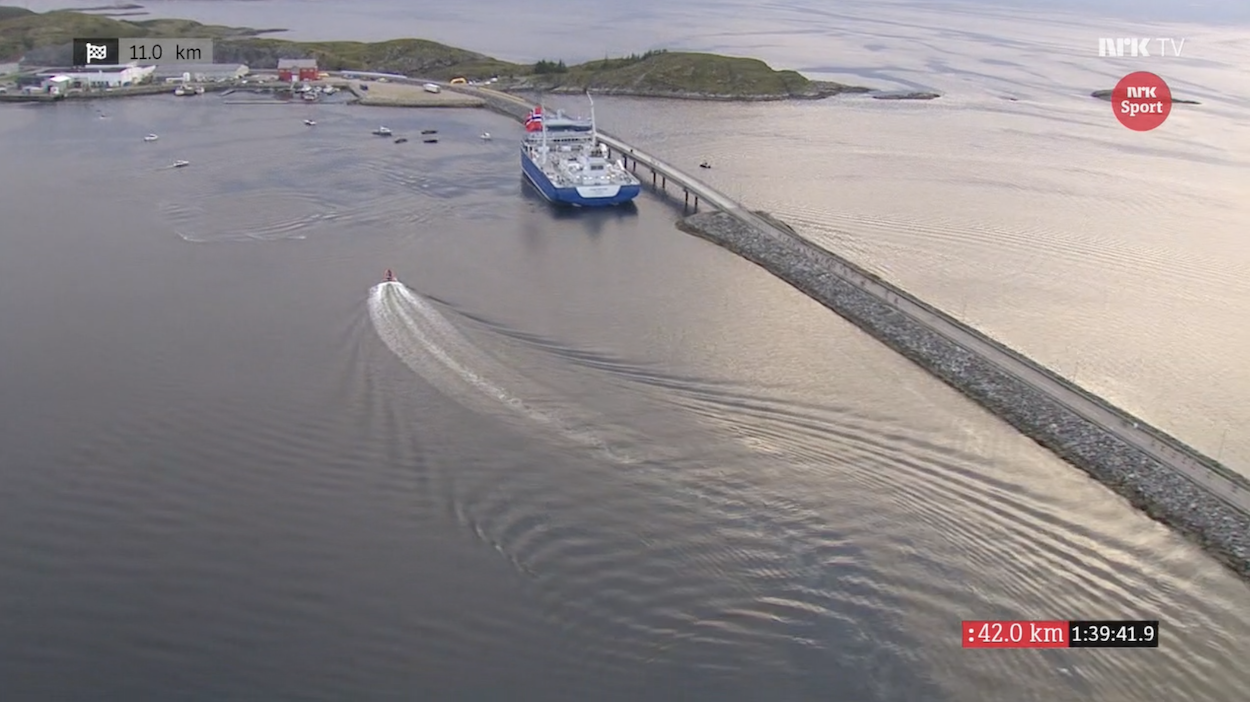
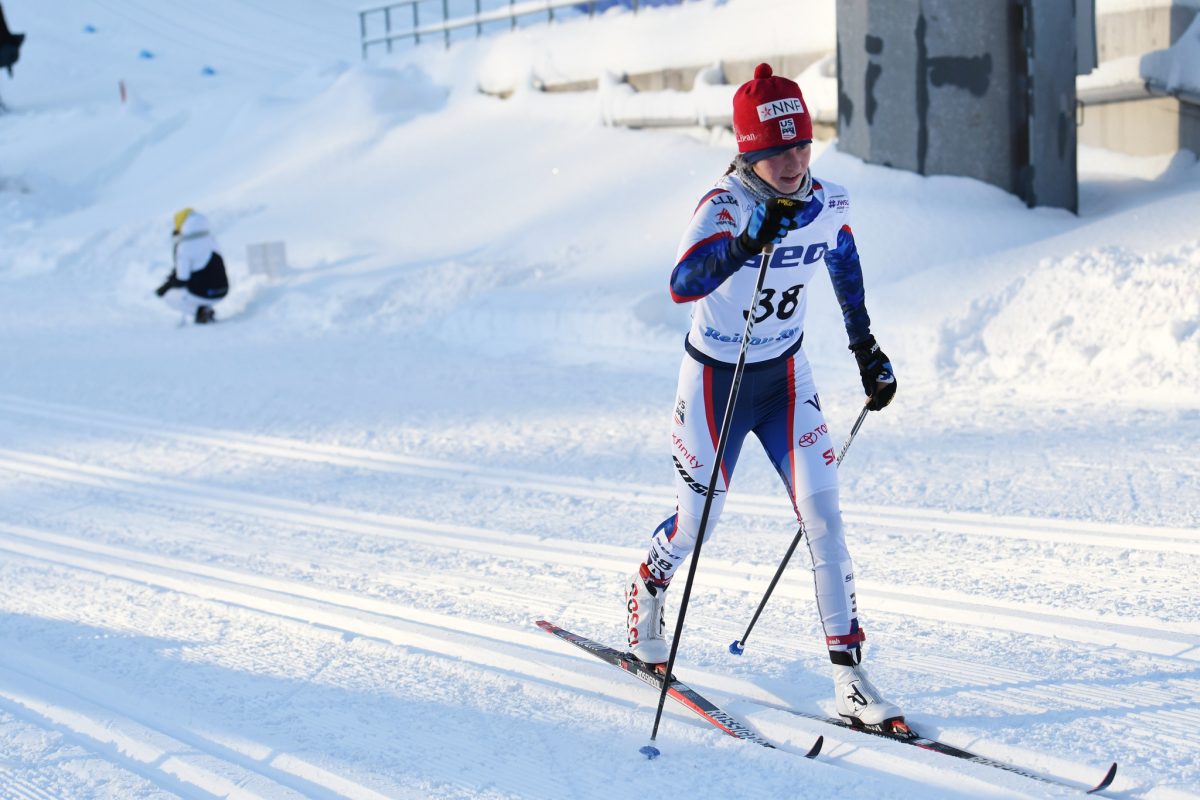
Athletes race across a causeway approaching Hitra in Toppidrettsveka 2022. (photo: screenshot from NRK broadcast)
After technique work on snow comes race effort on rollerskis. Racing Thursday evening in Hitra, Norway, Ben Ogden led four American men when he placed 18th in a field of nearly 100 in the 54-kilometer classic mass start, the opening race of the Toppidrettsveka race series in the Trondheim region of western Norway.
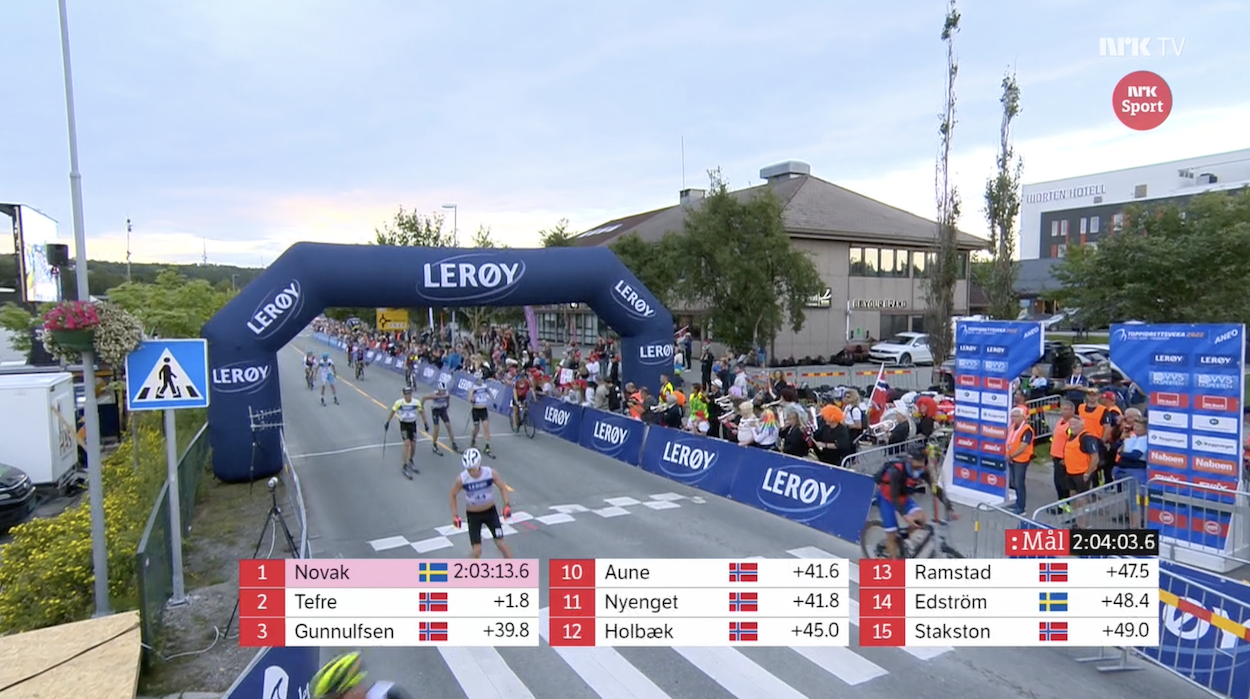
Ogden finished 50.2 seconds back of the winner, and 10.4 seconds off the podium. He was followed by fellow USST athletes Finn O’Connell in 47th (+3:57.4), Johnny Hagenbuch in 55th (+6:38.4), and JC Schoonmaker in 65th (+9:26.0). Kevin Bolger and Walker Hall are also on this trip, and may compete in upcoming races.
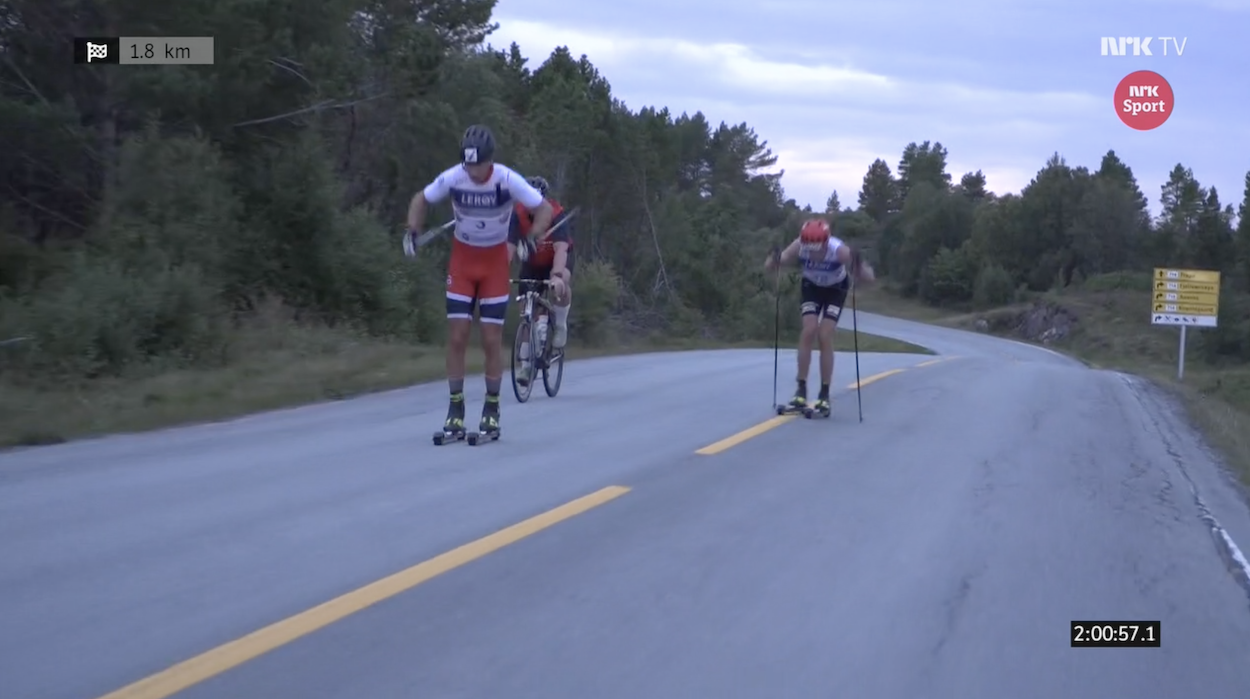
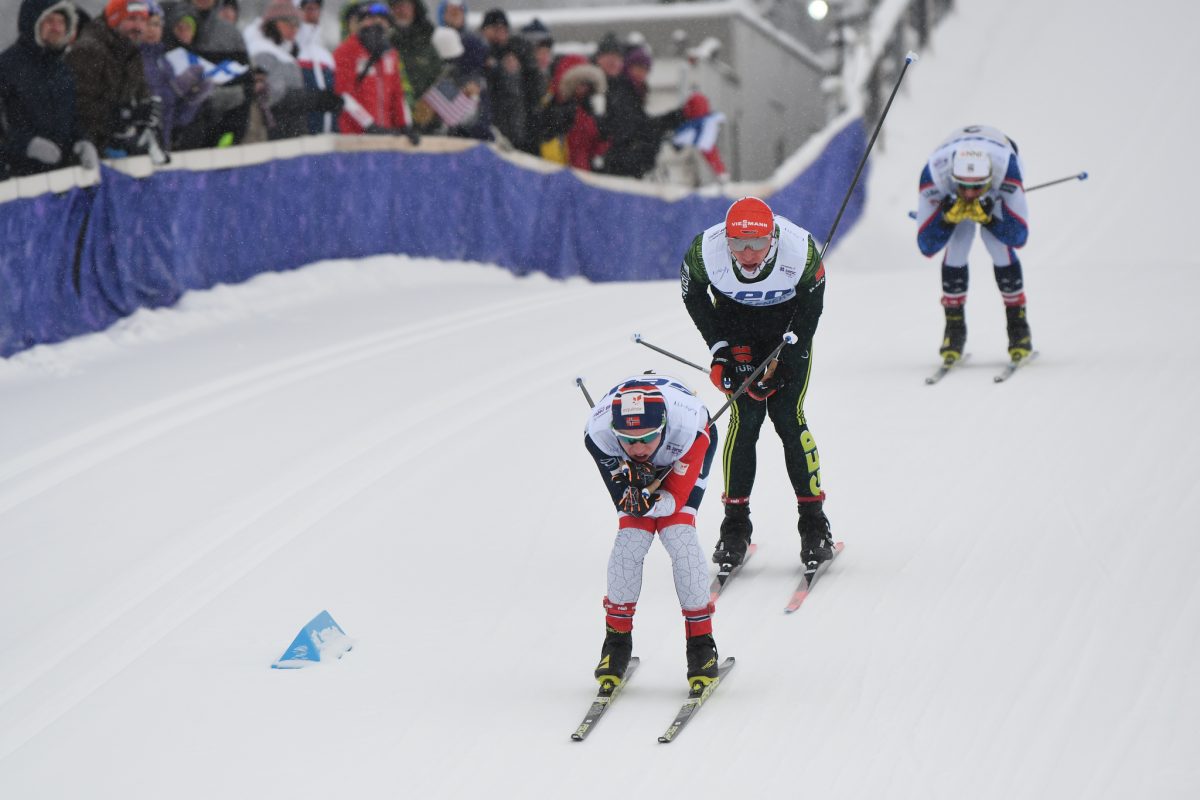
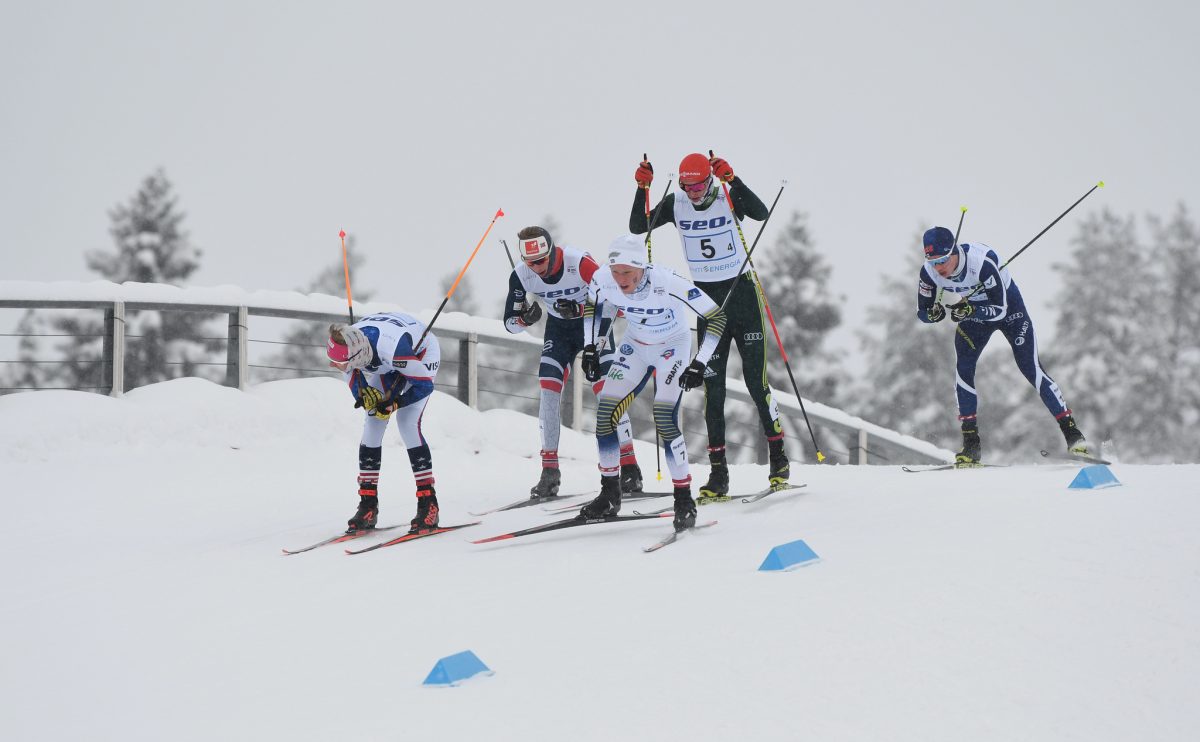
Max Novak makes the winning move, Toppidrettsveka 2022. (photo: screenshot from NRK broadcast)
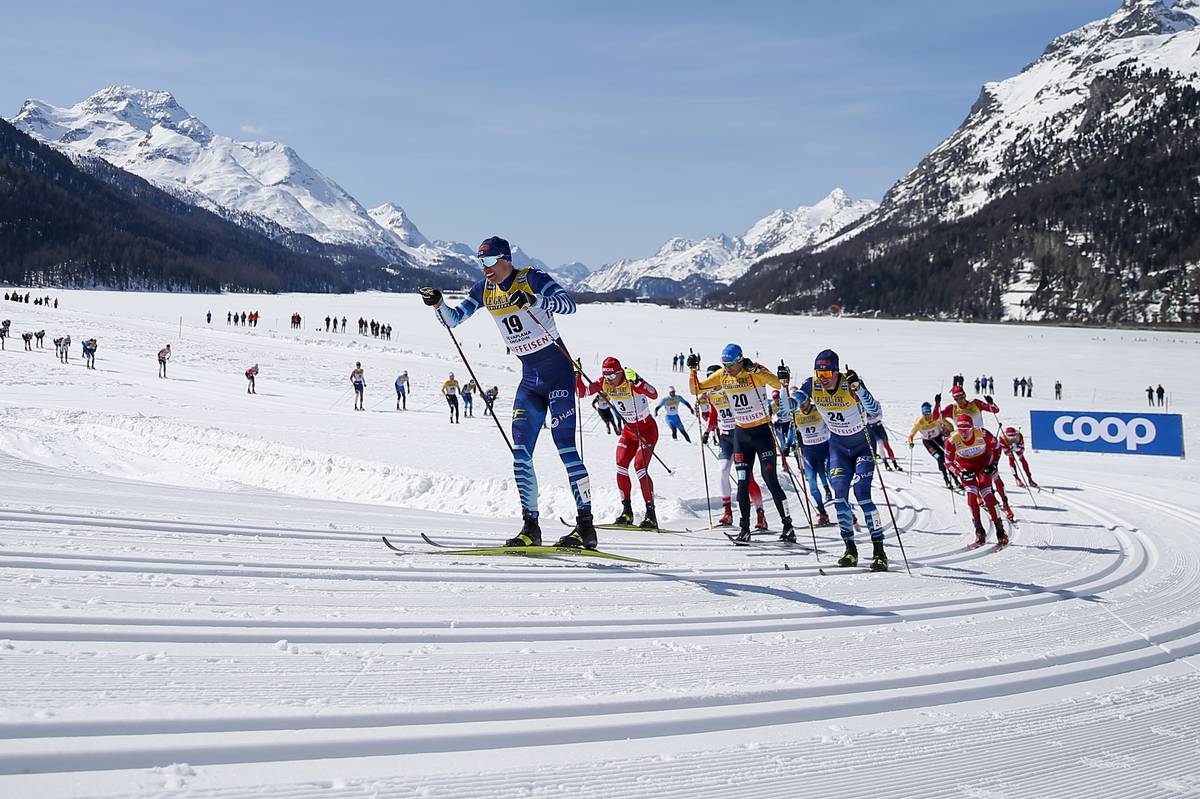
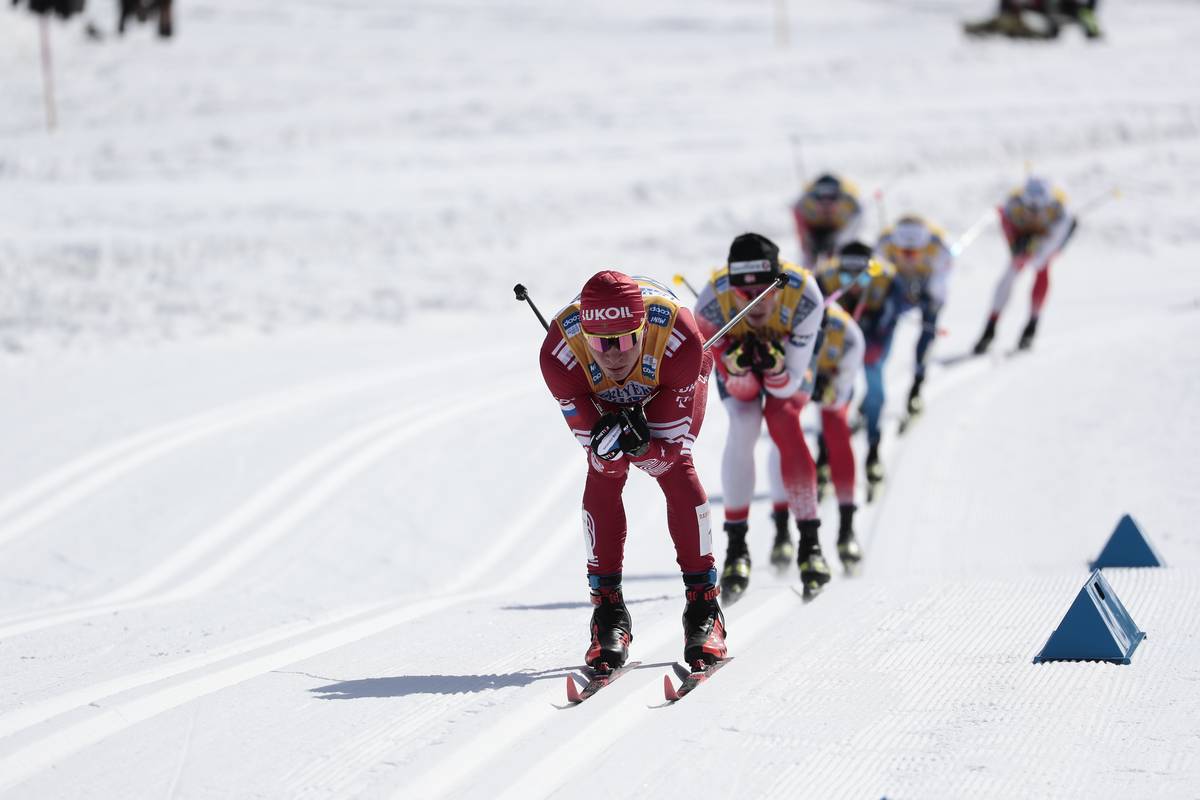
The race was won by Max Novak of Sweden in 2:03:13.6, after he and Norwegian Gjøran Holstad Tefre distanced themselves from a 17-man chase pack within the final 10 kilometers. Novak used a powerful acceleration on a small uphill 1.8 kilometers out to open up a small gap on Tefre, which he held all the way to the finish. Tefre finished 1.8 seconds back of Novak. Mikael Gunnulfsen of Norway won a group sprint to finish third (+39.8).
Perhaps the best-known retired skier in the field, Petter Northug, 36, finished 38th (+2:53).
The women’s race, in which no Americans competed (there are no American women on this training trip), was won by Norwegian Astrid Øyre Slind, who covered 54 k in 2:10:40.5, a staggering 12+ minutes ahead of Lotta Udnes Weng in second. Friend of the program Frida Karlsson finished in 2:25:31.2 to place fifth in a field of twelve women.
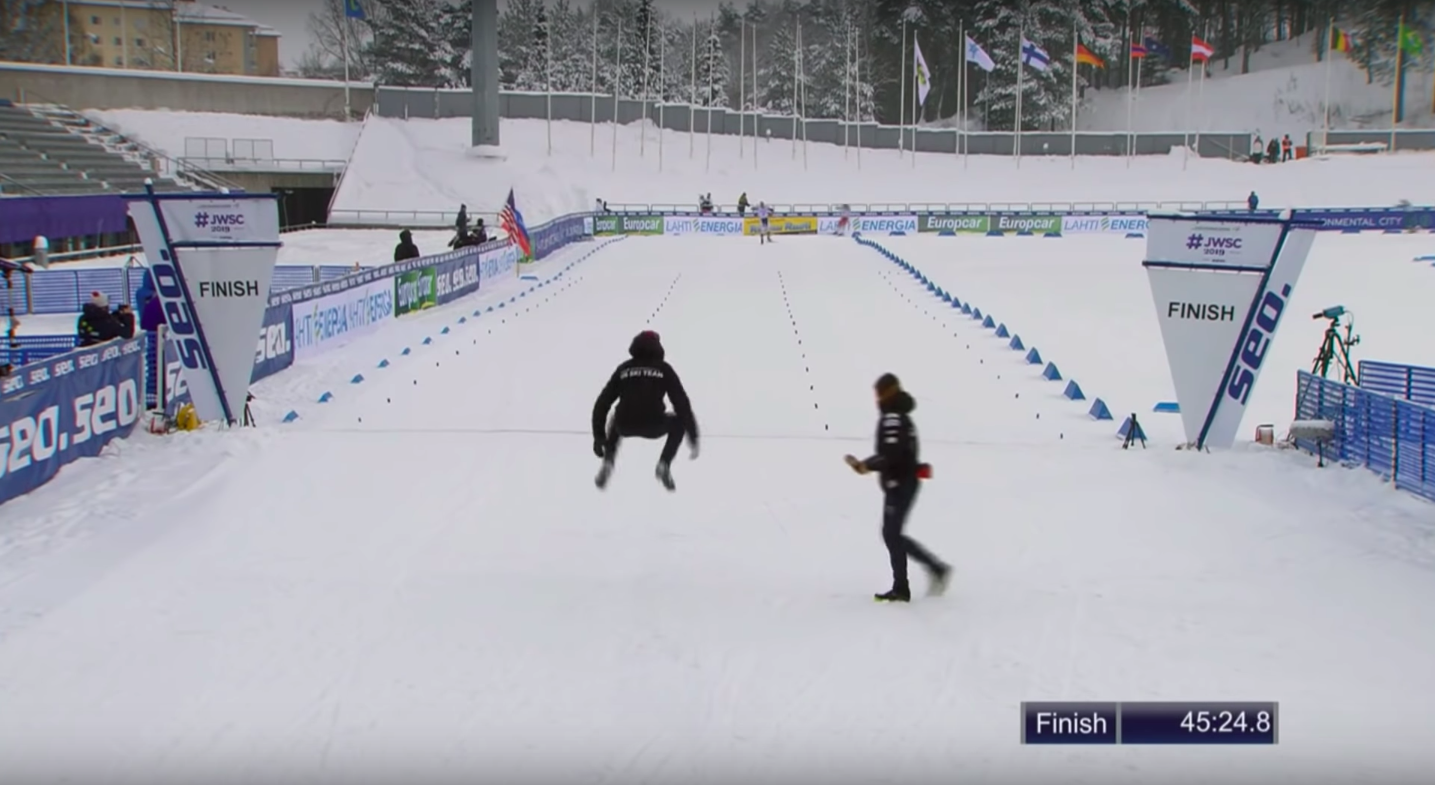
Ben Ogden crosses the finish line in 18th, back middle, to the right of the athlete in a yellow top. (photo: screenshot from NRK broadcast)
U.S. Ski Team Head Coach Matt Whitcomb was buoyant about the team’s fitness and recent training heading into the race.
“Everyone is healthy,” wrote Whitcomb in an email to multiple media outlets Thursday morning, “and we’ve all had one of the best training camps of my coaching career. The guys have had a blast together. We’ve trained hard, both on and off snow. While we’re training into these races, everyone feels ready to race. Training through the summer races is a common approach.”
Thursday’s races started at 6:20 p.m. in the evening local time, with the men’s winner finishing at 8:23 p.m. and the final American not finishing until after 8:30 p.m., suggesting a late night for all after cooldown, recovery, and coming down from the high of racing.
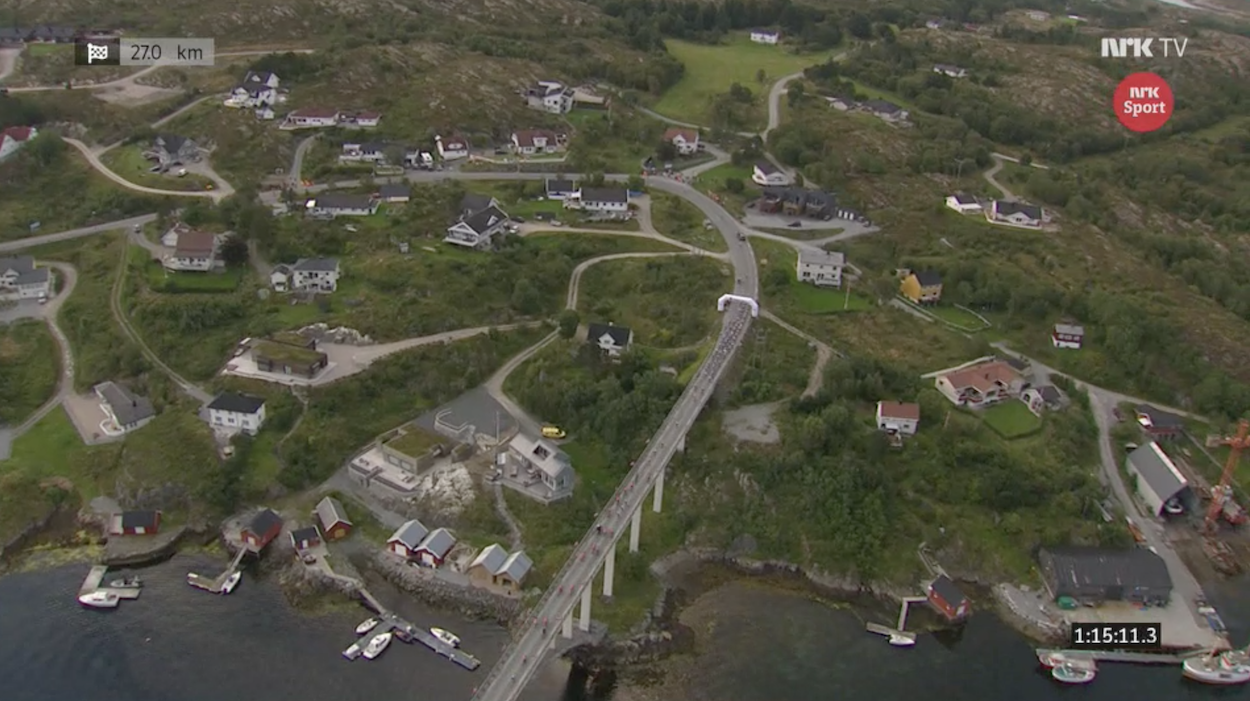
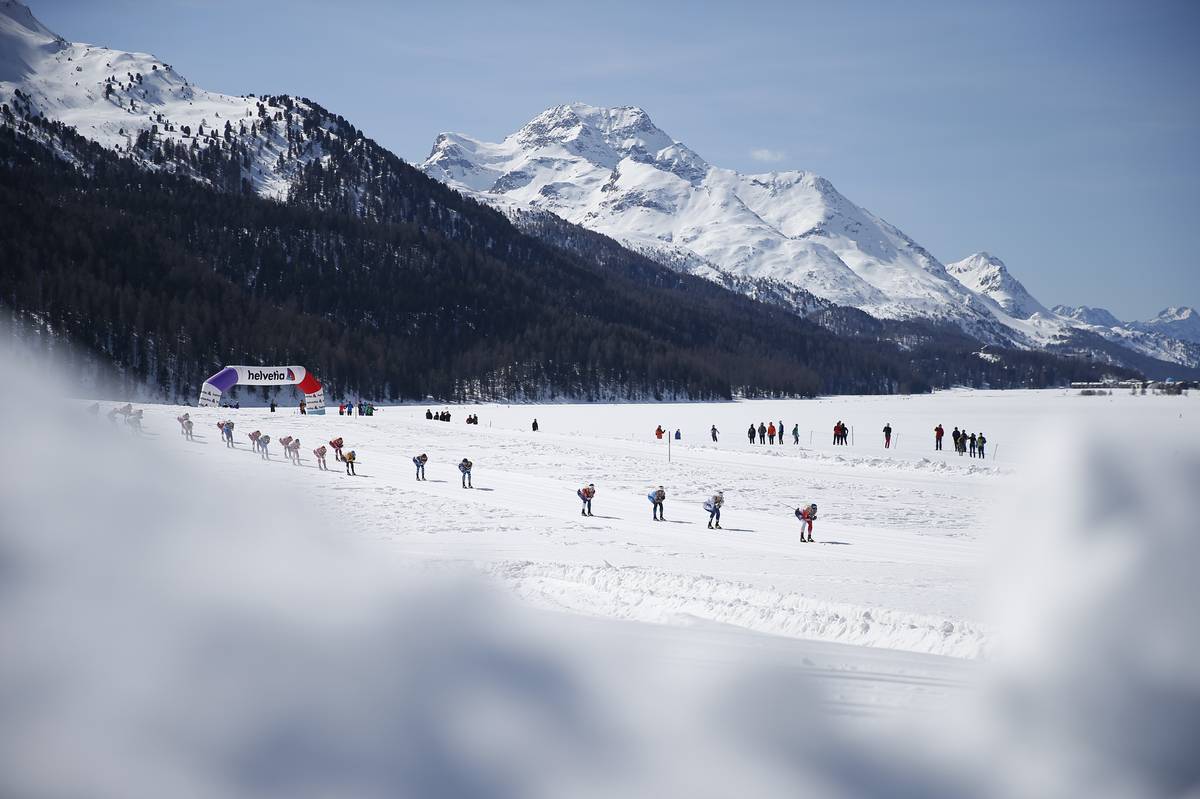
Scenery shot, Toppidrettsveka 2022. (photo: screenshot from NRK broadcast)
Competition continues in western Norway with a classic sprint on Friday, then a 10/15 k interval-start skate race on Saturday morning and a 5/10 k classic pursuit Saturday afternoon. FasterSkier will publish a more detailed article after the final race. The races will be shown on NRK, if you can manage to access the Norwegian broadcaster from where you live, and may be livestreamed on the event’s Facebook page.
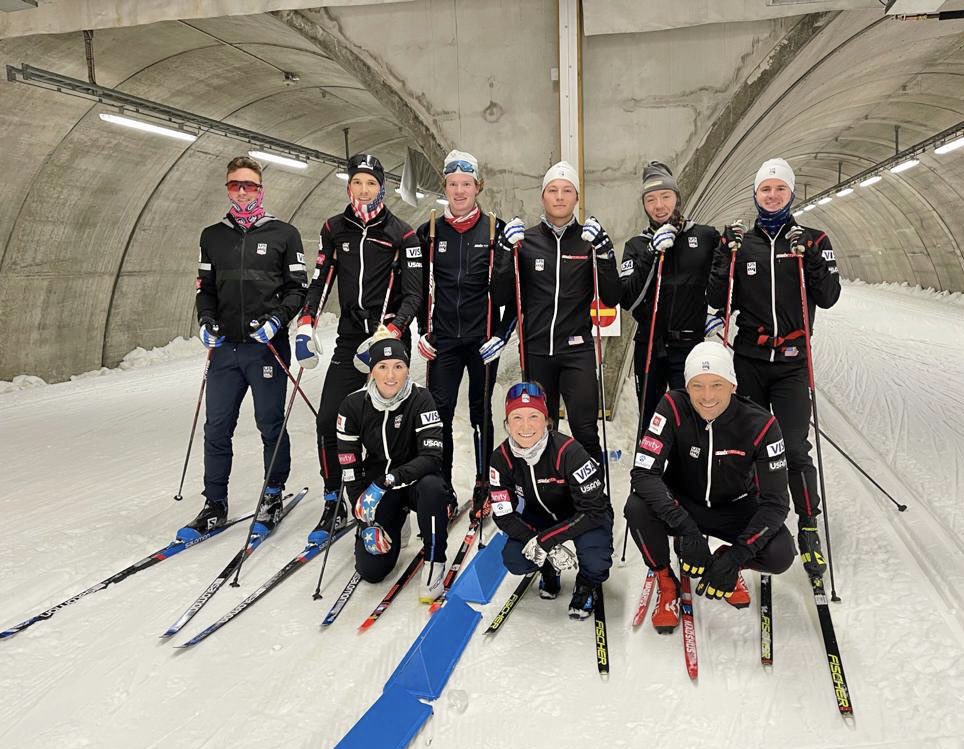
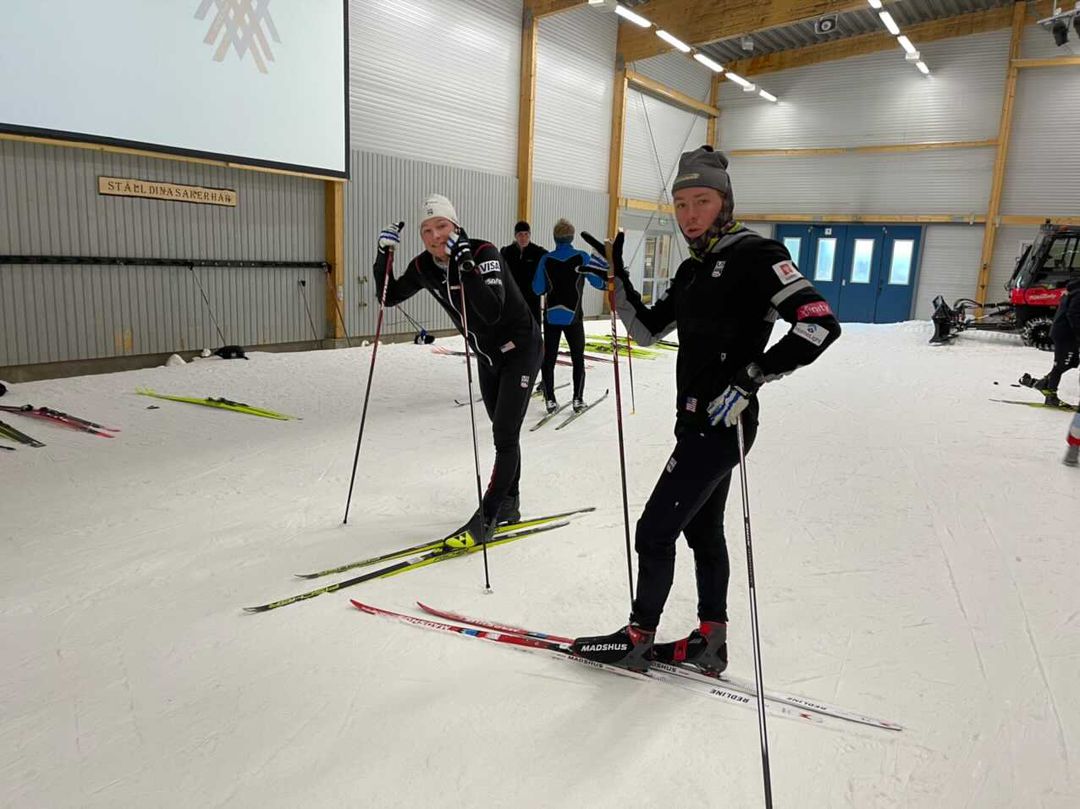
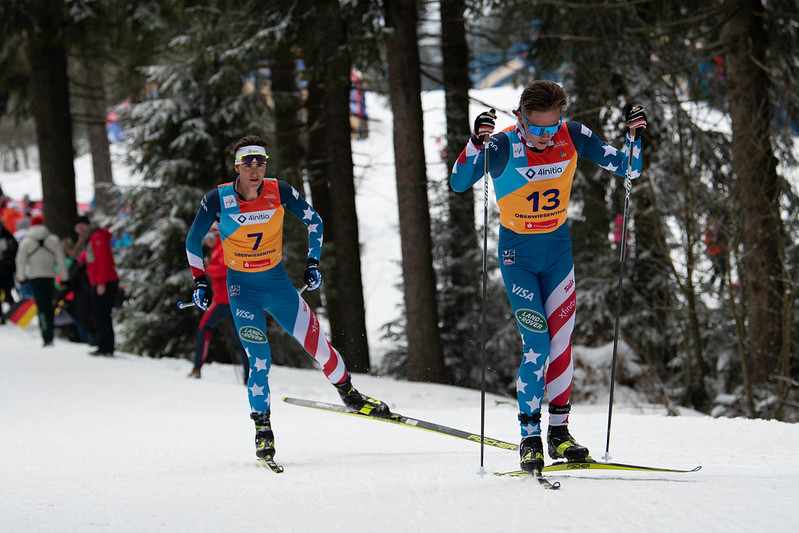
USST athletes and coaches in the Torsby Ski Tunnel, August 2022. Back row, from left: athletes Johnny Hagenbuch, Kevin Bolger, Finn O’Connell, JC Schoonmaker, Ben Ogden, and Walker Hall. Kneeling, from left: coaches Greta Anderson, Kristen Bourne, and Matt Whitcomb. (photo: François Faivre)
If it’s August, it must be time to ski.
Head Coach Matt Whitcomb and roughly half the men on the U.S. Ski Team, accompanied by a couple of well-known distaff guests, have spent the last week on snow in the Torsby Ski Tunnel in southwest Sweden. They raced in the nearby Inge Bråten Memorial rollerski race earlier today, and will compete in the Toppidrettsveka rollerski series in Norway starting on Thursday. It’s a multi-stage Scandinavian adventure to help prepare for next year’s race season.
American World Cup skiers have pursued a variety of options for summer snow over the years, depending on budget, logistics, travel time, and team size. The Alaskans historically gravitate to Eagle Glacier, spending three one-week camps on snow in the Chugach Mountains between June and August. Athletes from the rest of the country have traveled to one or more of the Snow Farm (New Zealand), Falls Creek (Australia), Sognefjellet (Norway), Dachstein Glacier (Austria), Passo dello Stelvio (Italy), Oberhof ski tunnel (Germany), Torsby ski tunnel (Sweden), or Planica ski tunnel (Slovenia), typically toward the end of the northern-hemisphere summer.
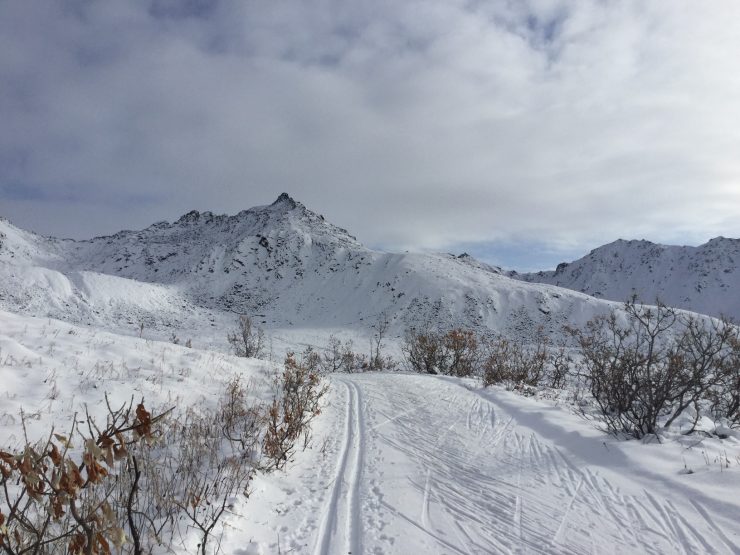
Early-season skiing at Hatcher Pass, October 6, 2019. (photo: Gavin Kentch)
This year, for Whitcomb and six national-team men, the answer is Torsby. Whitcomb flew across the Atlantic on August 12, joined by athletes Johnny Hagenbuch, Kevin Bolger, Finn O’Connell, JC Schoonmaker, Ben Ogden, and Walker Hall, as well as USST coaches Greta Anderson and Kristen Bourne. Their two-week trip includes a week-plus on snow in Torsby, a rollerski race in nearby Sunne, and rollerski races in the Trondheim region.
This year’s trip roster has “just six men,” Whitcomb said in a phone call while driving to the airport last Friday.
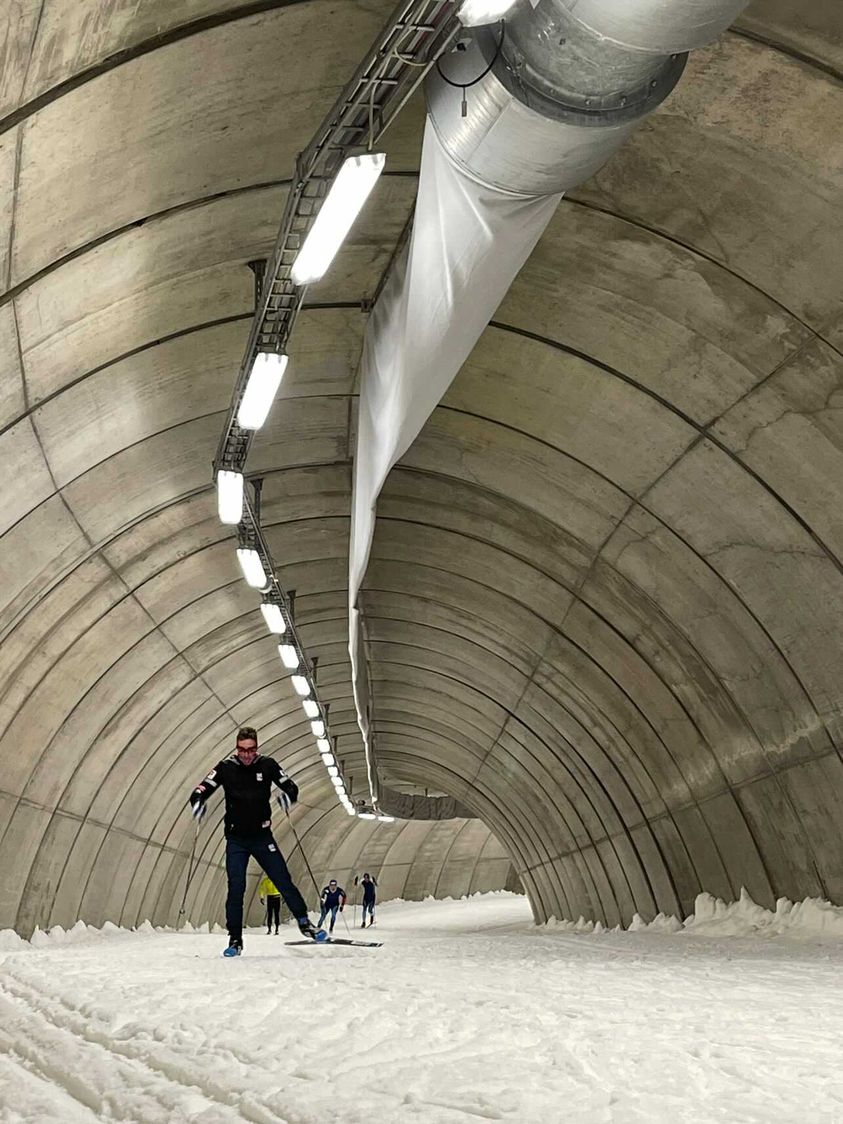
Johnny Hagenbuch, Torsby Ski Tunnel, August 2022. (photo: Greta Anderson)
“We’ve been whittled down after Covid,” he said, which among public names claimed Sophia Laukli after her recent brace of wins in the Stranda Fjord trail race and Lysebotn Opp rollerski race. That said, the American men were joined by well-known Swedish guests Maja Dahlqvist and Frida Karlsson, as well as much of the German team. (Dahlqvist and Bolger are dating.)
So why Torsby? In part because it presents a strong training option on the merits, in part because of money.
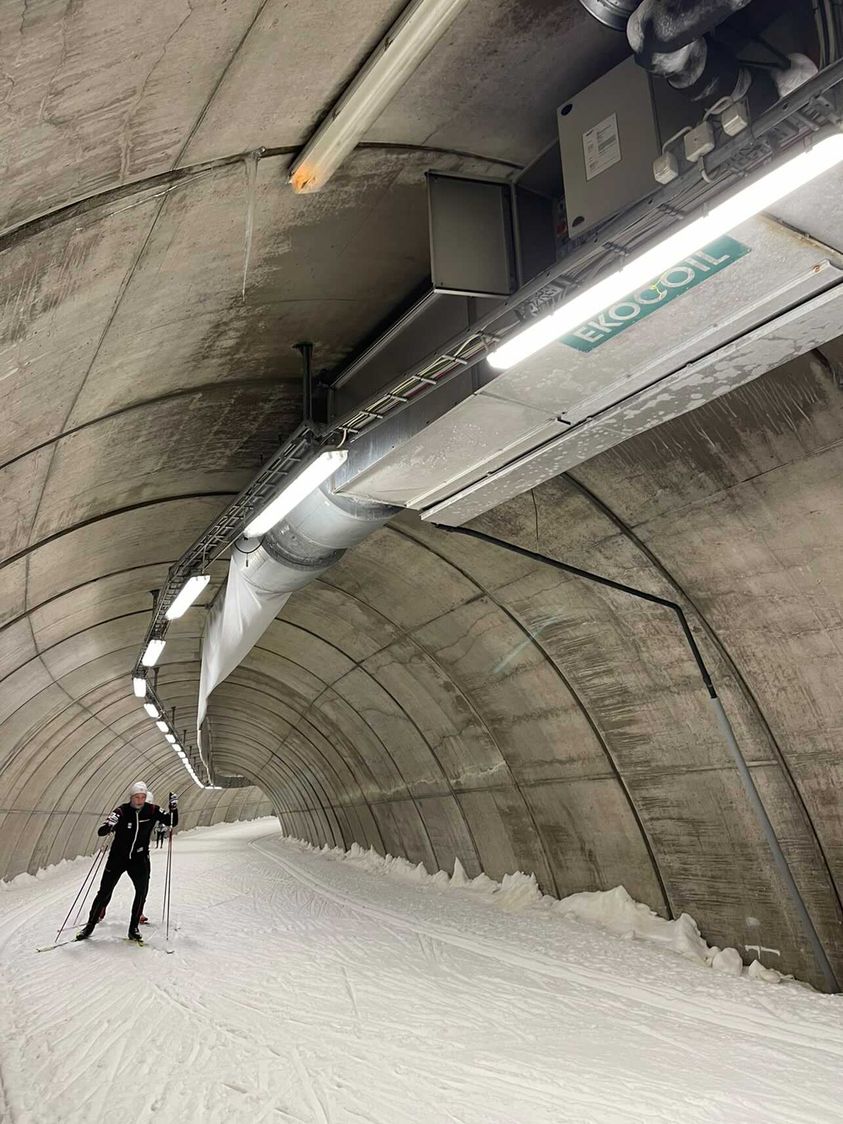
As for the training facility, it’s not just the ski tunnel. In addition to the roughly two-kilometer-long ski track inside a refrigerated tunnel, the area also contains “a rollerskiing track, biathlon stadium (outside and in the tunnel), extensive running trails through the surrounding hills and forests, and a fully equipped gym attached to the tunnel,” as Norway-based Canadian athlete Maks Zechel wrote on this site in 2017.
And as for money, Torsby is closer and cheaper than the southern hemisphere. “We weren’t able to fit it into the budget to have a bunch of people go down to New Zealand or Australia, and the Eagle Glacier facility is closed still,” Whitcomb said. “So we wanted to have an option for those that were maybe already on the East Coast or willing to travel. So we’re pretty excited.”
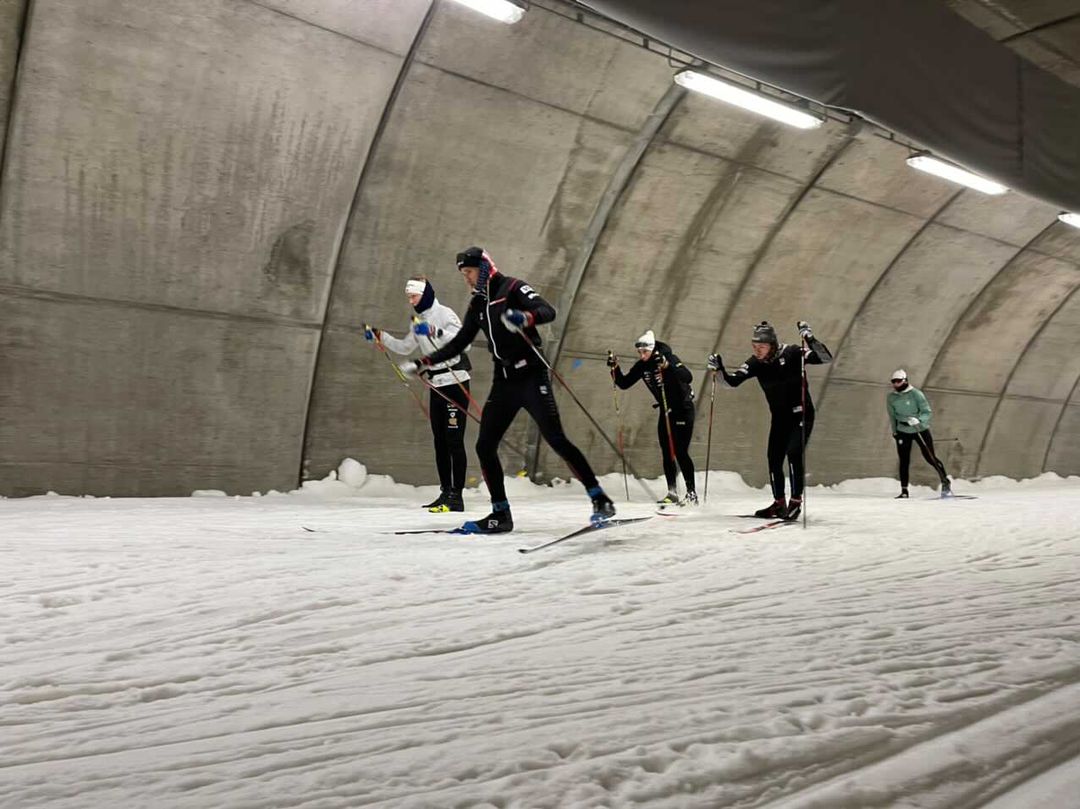
Kevin Bolger leads Ben Ogden, Torsby Ski Tunnel, August 2022. (photo: Greta Anderson)
“It’s been about 10 years since I’ve been to Torsby,” Whitcomb continued. “We brought the women’s team there in 2012 in a joint camp with the Swedes.”
Whitcomb also noted the relative ease of travel within Scandinavia: “In terms of itinerary, it’s a two-hour drive from Oslo [to Torsby]. When we get back to Oslo on the 21st to fly to Trondheim, that’s a 55-minute flight in the middle of the day, so it’s all fairly simple travel once we’re over there. It’s like traveling around New England.”
Another thing in common with New England: klister-cover skiing. Whitcomb described the snow inside the tunnel as manmade – snow guns are visible near the entrance – but as infrequently refreshed. “And so depending on when you’re there, it can be varying degrees of aged snow, but it tends to be fairly stable,” he said. “A variety of classic skis will work, and a variety of waxes will work. Generally a bit of a violet or some sort of 45 base covered tends to work, and some sort of medium grind.”
JC Schoonmaker, left, and Ben Ogden near the entrance of the Torsby Ski Tunnel, August 2022. (photo: Greta Anderson)
The tunnel is a valuable resource, but its terrain is “by no means ideal” as a direct replica of a World Cup course, Whitcomb acknowledged. The tunnel has two hills per lap, Zechel wrote, “which are steeper in one direction and more gradual in the other, making for a great place to work on striding. Most senior men would one-skate the hills at race pace, but they are still steep enough for offset technique work at lower speeds.”
But what does the tunnel have? Snow. Which is, to state the obvious, “a slippery surface,” per Whitcomb. This is specifically opposed to the “surefire kick” of the rollerskis that are most athletes’ go-to summer training modality.
Conditions in the tunnel can sometimes be “mealy,” Whitcomb observes, “even if you’re skating. It requires you to not just set the ski down, but to be able to ride it and negotiate the unpredictable nature of snow. Having a dose of that in the middle of summer has always been, we feel, a beneficial addition to the overall [training] plan.”
Whitcomb drills down on these dynamics when asked about the specific appeal of estival snow, especially what he’s learned over the last two years following no time on snow in summer 2020. Here’s his answer, quoted in full because it’s intriguing:
“One of the things that I have come to believe more and more over the last several years is that all great technique starts with the ability to use our feet well. You have to be able to stand well in your boots. Your boots have to be really comfortable, and that might mean you have to have insoles, or maybe it doesn’t; it might mean you have to have custom boots, maybe it doesn’t.
“And then you have to have a ski that you’re comfortable standing on. And all of that has to do with how comfortable you are with standing on a slippery surface below all of that. It’s like this four-layer deal where you have the body, the boot, the ski, and then the snow. And for anyone that has a hard time being stable on their feet, it’s going to be very difficult to ski well in the rest of the body. And so I think snow definitely allows us to focus by simply dropping our poles and learning to use the feet, just skiing easy for 20 or 30 minutes every session without poles, skating or classic.
“Because for those of us that don’t naturally use our feet well we often tend to use our poles as crutches, and it sort of masks the stiffnesses and the instabilities that we all have, myself included. But you take those poles away and you’re exposed to nothing but your balance, your ability to gain traction by kicking properly. And so that’s something that snow can do for you.”
* * *
The plan was to spend 20–25 hours on snow in the tunnel this past week, with secondary workouts on hillier outdoor terrain when necessary. Intensity in the tunnel was focused on speed; “we want to be a little bit mindful of breathing too hard,” Whitcomb noted.
He explained, “The Swedes are often talking about the challenges of coming from outdoor temperatures into the tunnel, which is quite humid – or at least cold, I don’t know if it’s humid – but they feel like it can irritate the lungs. So any intensity that we’ll do in the tunnel will be more along the lines of controlled threshold, and we’ll be masked up for those that have sensitive airways.”
(Whitcomb calls Bråten, who died in 2012 at age 63, “an old friend of the team, somebody I knew.” A full article on the rollerski races is forthcoming on FasterSkier later this week, but you can find results from Sunne here now, and results from Toppidrettsveka here starting on August 25.)
JC Schoonmaker, Torsby Ski Tunnel, August 2022. (photo: Greta Anderson)
Tomorrow the team flies from Oslo to Trondheim, where “we’ll live out near Aure on an oil facility,” Whitcomb notes. “And we’ll train there and sort of prepare for Toppidrettsveka, which is a four-stage event over three days. And then we’ll fly home on that Sunday,” August 28.
The men will have logged 20+ hours of on-snow time at almost precisely the midpoint between Bend Camp (late May) and the start of the World Cup season (late November). They will have explored the difference between rollerski kick and setting the wax on slippery surfaces. And they will have gotten to engage in high-level rollerski races with other top athletes. They’re all small pieces of the puzzle as the athletes build toward the season-opening races three months from now, be that in Ruka or closer to home.
The 2022 FIS Junior/U23 World Ski Championships trip has been made possible through support from the National Nordic Foundation (NNF), which has identified this invaluable opportunity for developing athletes as one of its “Pillar Projects”. You can support the NNF and the next generations of America’s top skiers by making a donation here.
Thursday marked the third day of 2022 FIS Junior World Ski Championships in Lygna, Norway, but the first day of competition for U23 athletes, following individual and relay races for the juniors on Tuesday and Wednesday. The U23 athletes saw a 10-kilometer interval start classic for women, and a 15 k interval start for the men.
Zanden McMullen leads the American U23 athletes with a 14th place finish in the 10 k interval start classic in Lygna, NOR. (Photo: flyingpointroad.com)
The top American finishers today were Zanden McMullen for the men in 14th, and Abigail Jarzin for the women in 36th. The overall podium was all Nordic countries, for the men, and all non–Nordic countries, for the women.
Women’s 10 k Classic
The women had the day’s first race, going out at 1 p.m. local time over two laps of a 5 k course with a relatively humane 145m of total climb per lap.
Anabel Needham races the 10 k interval start classic during the 2022 U23 World Championships in Lygna, NOR. (Photo: flyingpointroad.com)
Anja Weber of Switzerland had the day’s second-fastest split at the 3-kilometer timing checkpoint, behind early leader Anastasiya Faleeva of Russia… had the day’s second-fastest split at the halfway mark, behind Faleeva… and had the day’s second-fastest split at the 8-kilometer mark, behind Patricija Eiduka of Latvia.
But the race was 10 kilometers long. Weber held her speed over the end of the second lap slightly better than Eiduka, ultimately taking the win in 29:59.8. Eiduka was second, a scant 1.3 seconds back. Veronika Stepanova of Russia, last seen anchoring the gold-medal Russian Olympic Committee women’s relay team in Zhangjiakou, was third, 13.1 seconds back, skiing a steady race that saw her rank twelfth, eighth, and fifth at the intermediate timing checkpoints.
Stepanova recently posted to social media, explaining that she skipped the Olympics 30 k to prepare for World Juniors, adding that she wanted to do fewer races at her relatively young age. (Stepanova turned 21 last month.)
Abigail Jarzin leads the American U23 women in 36th in the 10 k interval start classic. (Photo: flyingpointroad.com)
Abigail Jarzin (University of Utah/Salt Lake City, UT) was the fastest of the four Americans in the race, finishing 36th (+2:42.8) in a well-paced effort that saw her move up considerably after ranking 45th at the 5 k split. She was followed by Anabel Needham (Michigan Tech University/Houghton, MI) in 47th (+3:47.5), Rena Schwartz (Dartmouth Ski Team/Middlesex, VT) in 50th (+4:14), and Lucinda Anderson (University of New Hampshire/Golden Valley, MN) in 56th (+4:50.8).
Among the Canadians, Anna Parent (Canmore, AB) was the top female in 17th (+1:45.8). Next for Canada was Beth Granstrom (Revelstoke, B.C.) was 37th (+2:42.9), followed by Anna Pryce (Calgary, AB) in 40th (+2:48), and Ontario’s Bronwyn Williams in 49th (+3:51.9).
Lucinda Anderson races the 10 k interval start classic during the 2022 U23 World Championships in Lygna, NOR. (Photo: flyingpointroad.com)
Other names potentially recognizable to North American readers include Poland’s Weronika Kaleta, who skis collegiately for UC Boulder, in 21st (+2:03.1), and Australia’s Tuva Bygrave, who skis collegiately for UAA, in 57th (+4:52.8).
Men’s 15 k Classic
The men went out second, undertaking three laps of the same 5-kilometer course starting at 3 p.m. local time.
The starting list was reverse seeded: The athletes with the highest distance points (on paper, the lowest ranked) went out first; the athletes with the lowest distance points (on paper, those highest ranked) went out last. There were 64 athletes in the field, and the athletes with bib no. 62 and bib no. 64 made the podium; sometimes FIS points have strong predictive value.
But sometimes first place overall goes to an athlete wearing bib no. 31. And that, as the saying has it, is why you play the games.
Noel Keeffe races the 15 k interval start classic during the 2022 U23 World Championships in Lygna, NOR. (Photo: flyingpointroad.com)
Arsi Ruuskanen of Finland skied his first lap in 12:58.1, a split time that ranked sixth overall after all the athletes had come through. Ruuskanen’s relatively early bib number meant that he lapped through the stadium just as eventual eighth-place finisher Iver Andersen of Norway was going out on course. Perhaps due to the chance to work with Andersen for much of his second lap, perhaps due to just his own strong race, Ruuskanen would go on to set the day’s fastest times at 10 kilometers, 13 kilometers, and, notably, the finish.
The 22-year-old Finn took the victory in a time of 40:23.0. He was closely followed by Leo Johansson of Sweden, 6.7 seconds back, who had more of a gap to third, Håvard Moseby of Norway, 28.1 seconds back.
The top American on the day was Zanden McMullen (Montana State University/Anchorage, AK), in his first year racing as a U23 athlete after three years of racing at World Juniors. Racing internationally at the senior level, McMullen also had four World Cup starts in Period 1 of this season, then placed sixth in both distance races at 2022 U.S. Nationals.
McMullen started the 15 k out hot, registering the day’s 3rd-fastest time through the 5 k checkpoint. He slowed slightly from there, though not too much, coming through other intermediate checkpoints in 9th and 15th. He was ultimately 14th overall at the finish, 57.8 seconds back from Ruuskanen.
Johnny Hagenbuch races the 15 k interval start classic during the 2022 U23 World Championships in Lygna, NOR. (Photo: flyingpointroad.com)
Among the Americans, McMullen was followed by Johnny Hagenbuch (Sun Valley Ski Education Foundation/Ketchum, ID) in 41st (+2:59.8) and Noel Keeffe (University of Utah/Steamboat Springs, CO) in 47th (+3:39.5). In a nod to a certain race being held in Wisconsin on Saturday, it should be noted that Hagenbuch is the youngest-ever winner of the American Birkebeiner.
Turning to Canada, Léo Grandbois set the pace with the day’s only top-10 finish for North America, crossing the line in 9th (+44.3). He was followed by Sam Hendry (Canmore, AB.), who skis collegiately for the University of Utah, in 18th (+1:14.1), Ottawa’s Pierre Grall-Johnson in 29th (+1:51.0), and Joe Davies (Pemberton, B.C.), who skis collegiately for UAF, in 35th (+2:16.5).
Racing continues tomorrow with interval-start classic races for the U20 athletes, 5 k for the women and 10 k for the men.
In the wake of a winter storm, athletes found ideal race conditions for a weekend of distance racing at the Craftsbury Outdoor Center, which hosted the Henchey Memorial Carnival. (Photo: NENSA Facebook Page)
By Ian Tovell and Rachel Bachman Perkins
Find FasterSkier’s coverage of Friday’s freestyle sprints here.
Saturday: 10 k Interval Start Classic
After another 4+ inches of snow fell throughout the day on Friday, NENSA described the conditions for today’s 10-kilometer interval start race as a “banner day for classic skiing” on the two-lap course at the Craftsbury Outdoor Center. The weekend of racing, titled the Henchey Memorial Carnival, included athletes of all levels, was described as “a celebration of the type of ski racing that [the late Bill Henchey] loved.” All three stages scored points toward the U.S. SuperTour Standings, while Friday and Saturday encompassed the UVM Carnival, and Saturday and Sunday’s distance races were part of NENSA’s Eastern Cup race series that allows developing athletes to qualify for Junior Nationals.
Results from the 10 k classic stage on Saturday established the start order and deficit for Sunday’s 7.5/10 k freestyle pursuit. The women took to the course first on Saturday at 9:45, with the men following at noon.
As the women lapped through the 5 k checkpoint, a familiar name topped the standings. Friday’s sprint winner Katharine Ogden (SMS T2) came through the halfway point in a time of 15:23.5. Rosie Frankowski (APU) was in second, 5.3 seconds back, while Alayna Sonnesyn (SMS T2) came through in third (+9.4). Second alternate for the Canadian Olympic Team, Jasmine Drolet (DAR) came through in fourth (+14.9), with Becca Rorabaugh (APU) right behind in fifth (+15.0). Ava Thurston (Mansfield Nordic Club) was 8th (+36.2), as the first U18 skier through the 5k mark.
Over the second lap, Ogden held onto her lead, claiming her second victory of the weekend in a time of 30:59.8. Though she has won all three SuperTour sprint races she has entered, this is Ogden’s first domestic distance win of the season. She was second to Caitlin Patterson (CGRP) in the 10 k classic in the U.S. Cross Country Championships in early January, then took second to Rosie Brennan in the same event the following weekend in Sun Valley.
“The race today was a lot of fun,” Ogden wrote to FasterSkier after the race. “It was a gorgeous Vermont day. Sunny, new snow, perfect grooming. Basically, a wonderful time. I love racing in Craftsbury with so many people I love. I also had some awesome skis, which is always a blast. It was especially fun to have my mom and dad and sister there! In terms of pacing and tactics, this course really has a lot of constant output, so I was mostly just focusing on skiing well and smoothly, and taking advantage of swapping between doublepole and striding to get little bits of recovery where I could. I got to ski with a little pack of EISA people (past and present) at the very end, which was fun.”
SMS T2 went one-two, as Sonneysn was able to catch and overtake Frankowski, placing second (+26.6) and third (+26.8), respectively. Yet another Sonnesyn-Frankowski matchup…
The women’s 10 k classic podium after the second day of SuperTour racing in Craftsbury, VT. (Photo: Craftsbury Outdoor Center/John Lazenby)
Rorabaugh crossed in fourth (+29.3), with Drolet rounding out the top-five (+34.4). Thurston was able to stay in the top-10 placing ninth (+2:18.5).
As the first collegiate racer, Drolet (DAR) topped the EISA podium with a time of 31:34.2. Yesterday’s collegiate sprint winner, Anna Bizyukova (UVM) was second (+36.1) and tied for seventh overall (+1:09.5). Erin Bianco (CBC) placed third (+58.3) and took the final spot in the top-10 overall (+1:31.7).
In the men’s race, it was between two athletes through the 5 k mark; Adam Martin (CGRP) went through with a time of 13:18.6 with Zak Ketterson (Team Birkie) only 2.1 seconds behind. Johnny Hagenbuch (SVSEF) was third (+9.3) at the half, with teammate Peter Holmes (SVSEF) in fifth (+15.0). Sitting in fourth was Finn O’Connell (BSF Pro), but his split did not register as he crossed the checkpoint.
Adam Martin races the 10 k interval start classic during the Henchey Memorial Carnival in Craftsbury, VT. (Photo: Craftsbury Outdoor Center/John Lazenby)
Martin was able to hold on for the win, closing the race with the fastest second lap split. Taking the win at home, he stopped the clock at 26:56.9. Martin took second in last weekend’s 10 k mass start free in Lake Placid, and won the 15 k classic at both the U.S. Cross Country Championships in Soldier Hollow, and the second SuperTour race weekend in Cable, WI.
Yesterday’s sprint winner Ketterson held solidly onto his position, finishing in second (+12.4), while Hagenbuch came through in third (+24.4).
“I’m really psyched to win today,” Martin wrote in a post-race email. “Interval start classic races are my favorite, so racing today at Craftsbury was close to my ideal race. A big snow storm came through Thursday night into Friday, so today’s near perfect conditions are a testament to our incredible grooming crew. I started toward the end of the A-seed directly in front of Zak Ketterson. I believe Zak put some time on me in the first 3 or 4 k, but I was able to claw that back by the lap mark and narrowly increase my lead by the finish. It deserves mention in all races, but at home when I know many of the volunteers, I especially want to thank everyone who came out to help put the races on, and as always our incredibly hard working wax techs.”
The men’s 10 k classic podium after the second day of SuperTour racing in Craftsbury, VT. (Photo: Craftsbury Outdoor Center/John Lazenby)
O’Connell finished fourth (+29.5) in the men’s overall, with Karl Schulz of Sun Valley next to round out the top-five (+38.1). It was a strong day for the Craftsbury Green Racing Project and the Sun Valley Gold Team, as both placed three skiers in the top-10.
In the collegiate race, Finn Sweet of UVM took first in a time of 28:08.5 beating two fellow Vermonters. Peter Wolter (MID) was not far behind, coming in second (+1.7). Fellow UVM skier, Gregory Burt finished third (+3.7). These athletes were 11th, 12th, and 14th in the overall standings, respectively.
The final day of racing in the Henchey Memorial Carnival featured a pursuit start for the 7.5/10-kilometer freestyle races, with start order and time back from the first starter determined by the previous stage’s results. Switching the order of the previous day, the men took to the course first, with Adam Martin (CGRP) heading out 12 seconds ahead of Zak Ketterson (Team Birkie). Johnny Hagenbuch (SVSEF) left the gate 24 seconds back, with Finn O’Connell (BSF Pro) next (+29.0), and Karl Schulz (SVSEF) starting fifth (+38.0).
With live timing giving splits solely based on time of day, overall position was tough to track from afar. As racers lapped through the 5 k checkpoint, Schulz had skied the fastest first lap, coming through midway in a time of 12:29.4. Goble Reid of BSF Pro came through with the second fastest time (+9.5), just ahead of teammate O’Connell (+10.3). Reid had started 13th, 1:18 back from Martin. Sam Wood (+12.9) of Sun Valley came through with the fourth-fastest time after starting 12th overall, 1:14 back. “Retired” long-time Craftsbury Green Racing Project team member Ben Lustgarten rounded out the top-five fastest splits at the midway point (+ 13.6). Both Martin (+37.8) and Ketterson (+25.4) were outside the top-10.
As mentioned, lap splits only tell part of the story. As the overall winner of the pursuit is whoever crosses the line first, moves and countermoves at the front of the field tell the true story of the day. Wearing a target on his back, Martin was quickly chased down by yesterday’s podium athletes, Ketterson and Hagenbuch. Lapping through the stadium, all three athletes raced together, heading out what would be a tactical second half. In the hunt were O’Connell and Schulz, both of whom were also within reach of the podium.
In the final kilometer, Hagenbuch began to lead the charge toward the finish, creating a small gap to Ketterson and Martin who were evenly matched as the leaders headed into the finish lanes. Hagenbuch held his advantage through the finish to stop the clock in a time of 26:02.0, which would also be the third fastest time of day.
Johnny Hagenbuch (SVSEF) pulls away for the win in the men’s 10 k freestyle pursuit, while Adam Martin (CGRP) and Zak Ketterson (Team Birkie) fight for second and third. (Photo: Craftsbury Outdoor Center/John Lazenby)
Dead even through the finish, Martin and Ketterson both crossed 1.2 seconds behind Hagenbuch, with second place going to Martin and third to Ketterson. O’Connell was next to the line for fourth (+3.3), with Schulz skiing the fastest time of day to take fifth (+13.0).
“It was a really fun weekend of racing in Craftsbury!” Hagenbuch wrote in a post-race email. “This was the first time I’ve competed here since I was a junior in high school in 2019, and happily the courses are much less intimidating now than they were then… The conditions for the classic race were just about as perfect as it gets; we may have raced on Blue Extra kickwax.”
Hagenbuch also provided a detailed look inside the men’s race, adding his own approach to the day, recognizing his time deficit and strengths.
“Being only 24 seconds back from Adam Martin at the start of the pursuit, I was pretty confident that I could at least catch him. I started with some intent, and I was able to reel in Zak Ketterson and Adam as Finn O’Connell and Karl Schulz reeled me in. The level of exertion dropped a lot once I caught the leaders, and I just tried to ski as smoothly as I could for the remainder of the first lap and the first half of the second five-kilometer lap. I picked up the pace at the start of the long climb from the low-point of the course – the one that includes ‘Screaming Mimi’ – and tried to hold high power through the climb. I established a decent gap – something that I didn’t necessarily expect – but had to keep pushing to hold off the chase group. Fortunately, I was able to maintain the lead and relax a little bit into the finish.”
The men’s podium after the 10-kilometer freestyle pursuit in Craftsbury, VT. (Photo: Craftsbury Outdoor Center/John Lazenby)
This is Hagenbuch’s third consecutive 10 k freestyle win of the season; he also stood atop the podium after racing on his home trails in Sun Valley, then again following the 10 k free in Lake Placid two weeks later. Putting together a solid weekend in Craftsbury, the 20-year-old was also third in the sprint qualifier on Friday, which he described as “one of his bests”. A member of the 2022 Junior World Championships team, and a soon-to-be Dartmouth College student, Hagenbuch concluded with insight into what lies ahead for him over the next few months.
“I’ll stay in Craftsbury this week, and then I’ll go directly to the pre-camp for World Juniors/U23s in Norway, which will actually be my first time to the country. Post-World Juniors, I’d like to remain in Europe for whatever competitions are offered to me. I would then go directly to SuperTour Finals in Whistler. From Canada, I would leave on March 28th to miss the first day of school and start classes on Tuesday in Hanover. It will be a whirlwind, but I’m really looking forward to it!”
As only Friday and Saturday’s events were part of the UVM carnival, collegiate race numbers dwindled on Sunday. The top EISA skier for the second day in a row was Finn Sweet (UVM) with a winning time of 27:44.6. Going one-two for UVM, teammate Bjørn Westervelt was the second collegiate skier across the line (+3:04.4), while Bowdoin’s Carson Williams finished third (+3:59).
Katharine Ogden leads the women’s 7.5 k freestyle pursuit in Craftsbury. (Photo: Craftsbury Outdoor Center/John Lazenby)
In the women’s 7.5 k pursuit, Katherine Ogden (SMS T2) was first on course with a sizable gap to the next racer. Her teammate, Alayna Sonnesyn, and APU’s Rosie Frankowski of APU Nordic headed out at 26 and 27 seconds back, respectively. Becca Rorabaugh of APU was next out of the start gate at 30 seconds back, with Alexandra Lawson of Craftsbury beginning 42 seconds back as the fifth starter.
Working to close the gap to Ogden during the first lap, Frankowski skied the fastest split through the 3.75k checkpoint with a time of 9:27.0 with Sonnesyn skiing the second fastest split (+1.9). Their work proved effective, as they caught the leader and lapped through the stadium as a group.
Rorabaugh had the third fastest 3.75 k split at the half (+14.7), while Lina Sutro (SMS T2) of SMS T2 skied the fourth fastest (+16.7) and Lawson the fifth (+15.9).
In Craftsbury’s Day 3 recap video (embedded below), produced by Mountain X Media, Frankowski described the second lap as “cat and mouse” as each of the athletes took advantage of her individual strengths to push different sections of the course. Eventually, Ogden began to fall off the pace, while Sonnesyn and Frankowski stayed tight through the final kilometer.
Rosie Frankowski (APU) leads Alayna Sonnesyn (SMS T2) and Becca Rorabaugh (APU) up a climb during the women’s 7.5 k freestyle pursuit in Craftsbury. (Photo: Craftsbury Outdoor Center/John Lazenby)
In the end, Sonnesyn found the advantage, heading into the finish lanes with a gap over the other two women to take the win in 19:40.5. Frankowski crossed 3.5 seconds back for second place, with Ogden taking third after a 23.5 second gap. Rorabaugh was fourth (+31.3), with Lawson fifth (+57.5). U18 standout Ava Thurston (Mansfield Nordic Club) skied her way from 9th to 6th (+1:31.8).
“I felt really good today and am excited about that!” Sonnesyn wrote to FasterSkier after the race. “It’s been a lot of racing the last 10 days and I was feeling the fatigue start to accumulate, but I’m also feeling confident in my distance skate skiing right now, so I was pretty excited to work hard out there.”
Over those ten days of racing, Sonnesyn has raced in five events and only missed the podium once in Friday’s freestyle sprint. She also won the 10 k mass start freestyle last weekend in Lake Placid.
“It was really fun to do a pursuit race today! We don’t typically do pursuits in the U.S. and the last few years I’ve only competed in World Cup pursuits where I started in the wave, so it was a unique and exciting day. I knew Rosie, Becca and I would want to work pretty hard in the beginning to chase down Katharine and that’s exactly what we did (although we never outwardly spoke about this plan with each other). We charged pretty hard from the start and once we became a full pack we started playing a little more cat and mouse on the second lap. We were all trying to conserve energy for the final few kilometers while also keeping up the pace, which made for some tactical racing.
“The last 1.5k are pretty much all uphill. From the bottom Rosie started charging again and I hung on. Prior to reaching the super steep pitch on Screaming Mimi, I put in a surge so I could take the most direct route around the corner. From there, I put my head down and gave it everything I had left up the last bit of the climb and into the finish.”
The women’s podium after the 7.5 k freestyle pursuit in Craftsbury, VT. (Photo: Craftsbury Outdoor Center/John Lazenby)
A graduate of UVM and now a member of the Stratton Mountain School T2 team, Sonnesyn has perhaps spent more of her competitive ski career based in the Northeast than near her childhood home in Plymouth, MN.
“The Midwest will always be my home but Vermont has become my second home the past eight years. It was pretty incredible hearing so many people cheering my name this weekend and definitely kept me charging up those hills. Really fun to be around such a great ski community and feel the love for the sport. Makes me appreciate this sport and all of the people in it!”
Wrapping up with her next steps, the two-time American Birkebeiner champion (2019 and 2021) has her eyes set on the Midwest’s marquee event.
“I’m currently en route back to the Midwest to spend a few weeks at home training for the Birkie. I’m excited to be back and the fever is definitely setting in!”
In the collegiate standings, UVM’s Annie McColgan took the win as the Catamounts topped both the men’s and women’s EISA podiums. McColgan’s time of 22:57.0 put her in 14th overall in the women’s standings. The second collegiate athlete was Emma Strack of St. Lawrence University (+2:20.9), with teammate Charlotte Browne in third (+6:15.5).
*****
As Period III draws to a close, the SuperTour race calendar breaks for the remainder of the 2022 Olympic Winter Games. The next race event will be the 50 k American Birkie, kicking off on February 26 in Hayward, WI.
Here’s a quick results recap from today’s SuperTour 10-kilometer mass start freestyle race in Lake Placid, NY. Stay tuned tomorrow for detailed coverage including comments from athletes.
Racing continued at Mt. Van Hoevenberg this morning in what Weather.com called “bitterly cold” conditions. Near-zero temperatures and skate skiing can be a challenging combination for a distance race on a World Cup–level course, but racers nonetheless put together strong performances on the three-lap 10-kilometer course.
In the women’s race, Rosie Frankowski (APU) set the pace with a fast start, leading through the 9k checkpoint. Having steadily reeled her in, Alayna Sonnesyn (SMS T2) caught Frankowski in the final kilometer, pushing ahead in the final meters to take the win in 28:57.1. Frankowski crossed the line in second (+3.7), with APU Teammate Becca Rorabaugh leading a chase pack to the finish to cross third (+36.6).
The men raced second today, with BSF Pro Team’s Finn O’Connell leading a sizable group through 6.6k. From there, SVSEF Gold Team member Johnny Hagenbuch turned up the pace, creating a gap over the final lap to finish unopposed in 24:35.3. Duking it out to the final stretch, Adam Martin (CGRP) took second (+11.6), roughly two seconds ahead of Peter Wolter (SVSEF) in third (+13.8).
The final weekend of SuperTour racing in Period II, and the final weekend within the Olympic qualification window, kicked off Saturday at the Lake Creek Nordic Center in Ketchum, Idaho. Part of the 2022 Sun Valley Nordic Invitational, the SuperTour races were held in conjunction with a Montana State University RMISA event and an Intermountain XC junior national qualifier.
Highlighting the size of the event, there were 157 female athletes in the field. With 141 senior and U18 men racing in the 10k, and another 46 racing in the men’s U16 5k. Spanning all age groups, an additional 70 U14 athletes and another 18 U12 athletes raced a 3k and 2k course, respectively. In all, nearly 400 cross country skiers, from Olympians to 10-year-olds in their first seasons on skis, made their way around the tracks in Lake Creek.
An athlete races the 10k interval start free on the Lake Creek trails in Ketchum, ID. (Photo: Tobias Albrigtsen / @untraceableg)
As the World Cup events in Les Rousse, France and Planica, Slovenia were both cancelled due to rapidly increasing coronavirus caseloads with the omicron variant, several athletes who might have headed back to the World Cup for these events found their way to Sun Valley instead, meaning fields were more in line with the U.S. Cross Country Championships than a typical SuperTour.
On the women’s start list for the 5-kilometer individual start skate, which kicked off the weekend of distance racing, were six women who have spent at least part of their season racing on the World Cup: Rosie Brennan (USST/APU), Caitlin Patterson (CGRP), Katharine Ogden (USST/SMS T2), and three University of Utah athletes who are also members of the U.S. Ski Team, Sophia Laukli, Novie McCabe, and Sydney Palmer-Leger.
Likewise, the men’s 10k field included seven World Cup athletes: David Norris (APU), JC Schoonmaker (USST/UAA), Scott Patterson (USST/APU), Hunter Wonders (USST/APU), Zanden McMullen (USST/APU), Luke Jager (USST/U of Utah), and Zak Ketterson (Team Birkie).
Given Ketchum’s elevation of roughly 5,950’, approximately the same as the courses in Soldier Hollow, Utah and those Olympic team members will face in Ziangjiakou in February, the events provided another opportunity to spend time training at the elevation and to hone their approach to racing at altitude. Overnight lows in the single digits meant cold air and snow temps at the start of the women’s race, another important similarity to forecasted Olympic conditions.
According to co-chief of competition Kelley (Sinnott) Yeates, livestream was not available during the Sun Valley Nordic Invitational due to connectivity issues along the courses. As such, FasterSkier’s reporting this weekend is based on live timing and the feedback of those on-site.
Of the course, Sun Valley native Johnny Hagenbuch provided insight into the 5km loop that was raced today in an email to FasterSkier: “The new courses at Lake Creek are very difficult: they essentially removed all the flat from the old course and replaced it with the biggest climb at Lake Creek.”
Senior Women’s 5k Free:
Without the ability to view the race and no intermediate splits in the live timing, the women’s race results left little room for suspense. Given her dominant performance in the 20k skate during the U.S. Cross Country Championships, it was no surprise to see Rosie Brennan’s name top the list. Brennan smashed the 5k loop, finishing in 14:28.6, a full 48.6 seconds faster than the next woman.
Rosie Brennan enjoys a wintery training day before the weekend of World Cup racing in Davos, SUI. (Photo: NordicFocus)
“I decided to come to Sun Valley after the World Cups in France were canceled,” Brennan wrote to FasterSkier in a post-race email. “My coach, Erik Flora, has been up here all week with the rest of my APU teammates, so it made sense for me to come here to be able to work with my coach and teammates. That has been the total silver lining of the World Cups being canceled. Erik is not allowed to come to the Olympics, but is my personal coach and someone who I trust and value immensely, so getting this extra week to work on things with him has been such a welcome surprise.”
Now several weeks into an extended altitude block, Brennan has been training near her childhood home in Park City, UT. The races in Soldier Hollow put her back on familiar tracks with hometown advantage, and the nostalgia continued today.
“It has been a full circle moment for me this weekend as I spent many years racing JN Qualifiers in Sun Valley growing up, so to be back here doing so now as I prepare for the Olympics has brought back all kinds of memories from my whole ski career. My high school and college coach were also out there today cheering and it’s been really special to have this extra time in the U.S. to share moments with people like that who have helped in getting me to where I am today.”
Brennan had originally planned to rejoin the U.S. Team in Europe, but following the cancellations of the two remaining World Cups before the Olympics, has shifted her plans to limit her risk of covid exposure, as a positive test might jeopardize her ability to travel to China, regardless of the severity of her case.
“With travel being risky on all kinds of levels today, I decided to just stay put after the World Cup cancellations and make the most of the training opportunities I have here in the U.S. before heading to Beijing. This weekend is serving as a replacement for the races I would have done in France and also another opportunity to test my limits at altitude. We just incorporated the races into a little intensity block to get my engine running again after a good volume block.”
Rosie Brennan logs hours on home trails during an extended altitude camp near Park City, UT. (Photo: Instagram @rosiewbrennan)
Speaking to her feelings holistically as she prepares for the Olympics, entering the Games on the heels of a career-best 2020/21 season with a host of early-season indicators that she can be a medal contender, Brennan spoke to the stress athletes face amidst the pandemic, which has added layers of complexity in traveling to Beijing and entering the Olympic bubble.
“It’s definitely a stressful lead up to the Games with COVID raging everywhere, a multitude of requirements and things that need to get done to be allowed into China, and figuring out all the details of being prepared for such a long travel to a very foreign country with lots of restrictions. I am doing my best to just stay on top of all the requirements, stay far away from everyone I can, and chip away at the things I need to be prepared for. The training at home has been great and having a coach to work with is so helpful, so from an actual racing perspective, I am feeling good and optimistic. I feel very lucky to have a home base in Park City and that the venues in the area provide good preparation for the Games.”
Sophia Laukli races to second overall and finishes the top collegiate racer in the women’s 5k interval start free in Ketchum, ID. (Photo: Instagram @utahskiteam)
Recovered from racing the Tour de Ski, where both women notched top-10 finishes on the hill climb, Sophia Laukli (USST/U of Utah) took second place (+48.6) today, with Novie McCabe four seconds behind in third (+52.6). Katharine Ogden (USST/SMS T2) was fourth (+52.0) for the women, with Rosie Frankowski (APU) next (+59.8) to round out the top-five.
With their top-three overall finishes, Laukli and McCabe also took home top results in the collegiate standings on behalf of the University of Utah. With teammate Sydney Palmer-Leger in 7th overall (+1:32.5), the Ute’s swept the RMISA podium.
“Today was definitely quite the race,” wrote Laukli after the race. “I was really looking forward to it since I love 5k skates, and courses with lots of climbing. I was also excited to get back into racing after the tour, especially on the domestic circuit which I was starting to miss. I was very happy with how the race ended up today, and it was actually a bit of a surprise (results-wise) just based on how I felt during it. I know I was not alone by getting rather cold out on course, but it felt like quite the shock to the system and difficult to get in a good groove—sometimes that will happen though! While it was probably one of the hardest 5ks I’ve ever done, it’s an awesome course and I just had fun getting back into racing after a short break.”
Commenting on her recovery post-Tour de Ski and her goals over the next couple of months, Laukli continued, “I took the past couple weeks very easy in my training, with minimal intensity, to recover from the tour. I wanted to take advantage of that racing block to really get into my best racing shape so taking a step back in training right after was important. The rest of the season is still a bit up in the air, but I know these races at altitude will be great preparation if I do end up at the Olympics. Either way, I’m planning to continue doing some college races and hopefully NCAAs, so these races will be good prep for that as well.”
With Sophia Laukli and Novie McCabe also taking second and third on the overall podium, Sydney Palmer-Leger brought the Ute’s home for a collegiate podium sweep. (Photo: Instagram @utahskiteam)
Other noteworthy results include the retired, but nevertheless still a contender, Caitlin Gregg, who hopped into the race while still serving as a co-head coach of the Midwest’s Team Birkie. Gregg finished in 8th (+1:37.5), just ahead of the day’s top Craftsbury skier, Alexandra Lawson.
Also, Caitlin Patterson, who earned a spot on the podium in each of the events at the U.S. Cross Country Championships and SuperTour in Soldier Hollow, finished 17th, nearly two minutes behind Brennan. In a post-race Instagram story, Patterson wrote that she had been very cold during the race with numb legs and toes, which left her feeling like a “floppy fish popsicle.” Despite finishing below where she was perhaps aiming, Patterson remains in second place behind Frankowski in the SuperTour overall standings, and in second behind Brennan in the Olympic qualification rankings for distance racing.
Senior Men’s 10k Free:
The men’s field would race the same lap the women did, but twice. That meant there was a time checkpoint at the halfway mark to indicate how the race was shaping up, yielding interesting insights into just how tight a spread the top of US men’s skiing is right now. With World Cup athletes, elite-level domestic racers, and top collegiate skiers from the West, there were plenty of names to watch.
Ian Torchia (SMS T2) leads Sam Hendry (U of Utah) during the SuperTour 10k individual start in Ketchum, ID. (Photo: Tobias Albrigtsen / @untraceableg)
An Aspen, CO native and no stranger to altitude, Graham Houtsma (BSF Pro) was early off the line as the second starter in bib 172. Houtsma came across the 5km split as the early leader at 13:30.3. His mark would look to be the point around which the top of the field clustered for the first part of the race. Then, Scott Patterson (USST/APU) came through in bib 194 and raised the bar. His split topped Housma by a full 30 seconds (13:00.2), and would be chased as the remainder of top-seeded athletes lapped through.
Before diving into that group, however, a caveat. A couple of the top skiers today weren’t assigned splits at all in the live timing, including overall SuperTour leader Adam Martin (CGRP), Johnny Hagenbuch (USST/SVSEF), and top-collegiate finisher, Bernhard Flaschberger (U of Denver). That gave an incomplete picture of what the race looked like through one lap, setting the stage for a few surprises in the eventual final results.
Scott Patterson skis to fifth in the 10k individual start free in Sun Valley. (Photo: Tobias Albrigtsen / @untraceableg)
So what did we know through 5km? If you were just observing, you would have seen Patterson overtaken by one, and only one, skier. Teammate Hunter Wonders (APU) completed the first lap of the course 3 seconds ahead of Patterson at 12:57.9. The field that had splits looked to be shaping up into a tight affair, with the top 5 skiers all within 15 seconds of each other. That included Wonders in the lead (12:57.9), with Patterson next (+2.3), Ian Torchia third (+8.5) seconds, David Norris (APU) in fourth (+10.0), and Finn O’Connell (BSF Pro) in fifth (+12.1). Based on eventual results, it is safe to assume that Hagenbuch, Flaschberger, and Martin all went through in the 13:00 min pack too.
At the finish, Wonders would cross the line in first place at 26:28.7, and slightly increase his lead over the pack in the second lap. Over Torchia, it had grown to 8.5 seconds, and Patterson 20.9 seconds. But it would be the skiers of the “mystery 5k” splits that really made a difference in defining today’s results. Hagenbuch came in soon after Wonders, and crossed the line in 26:15.4. It would prove to be a mark no one could top on the day. Bernard Flaschberger too, would slotted himself into the top of the pack – finishing less than a second ahead of Ian Torchia to claim 3rd.
The top 5 of the final results then, looked finished like this: Johnny Hagenbuch with the win in 26:15.4, Hunter Wonders in second (+13.3), Bernhard Flaschberger in third (+27.0), Ian Torchia in fourth (+27.5), and Scott Patterson fifth (+34.2).
The men’s podium of the SuperTour 10k individual start skate in Sun Valley, including the top-six athletes. (Photo: Tobias Albrigtsen / @untraceableg)
In an email to FasterSkier, Hagenbuch pointed to an intimate knowledge of his home course in Sun Valley as being a key to his impressive margin at the top:
“The conditions were firm and well skied-in, and it was fairly fast. I have skied a whole lot here at Lake Creek in my years, and I knew the race was going to be super hard. I think it’s important to focus on the transitions and more rolling parts of the courses at Lake Creek, as just about everyone will be suffering on the climbs. I tried to ski [with a] really big, powerful V2 on the more gradual north end of the course; the strategy for the uphills was mostly to step on and off the skis quickly.”
With his results, Hagenbuch wins his first SuperTour of the season, on his home course, to boot. Not too shabby for a Saturday morning in Ketchum. He also did so in convincing fashion, rising above a field of seasoned SuperTour athletes to claim a definitive win by a stout margin. It will also improve his 5th place overall in the SuperTour standings, replacing two 6th place finishes from early in the season at Duluth.
On his win, Hagenbuch wrote, “frankly it’s quite a relief to have done well today, as I feel I haven’t really expressed my shape to the fullest for a variety of reasons this season… I’m just taking it day-by-day, [and] it was a real treat to have so many friends and family to cheer me on at home in a field that was deeper than U.S. Nationals.”
Hunter Wonders skis to second place in the men’s 10-kilometer individual start skate race in Ketchum, ID. (Photo: Tobias Albrigtsen / @untraceableg)
Elsewhere in the SuperTour standings, Wonders’ 2nd place finish will improve his distance standing going into today from 12th overall – replacing a 4th place finish in Soldier Hollow in the 15km Classic off his point standings. Overall SuperTour leader Adam Martin finished 7th (26:57.6) on the day, while 2nd place holder JC Schoonmaker was 21st (28:04.3).
“Today was a solid effort,” Wonders wrote to FasterSkier after the race. “It’s been a while since I’ve been home to Alaska and that’s started to weigh on me this week. Leading into the racing I was low energy trying to get my feet back under me after nationals in Utah. It was a good confidence boost and a pleasant surprise when I realized I was having a good day on the course today.”
Shedding light on the course conditions for those unable to watch, Wonders continued, “It was amazing conditions for a race, not too cold with firm grooming which is always welcome. 10k is pretty short, so I knew I had to take it out hot. I was a little concerned about blowing up, but realized that the course had more recovery when you’re at race pace versus easy skiing. The high part of the course is brutal but it sets you up into a ripping decent to the finish. Overall, it was a great day and I’m happy with my racing and thankful for my teammates keeping my spirits up this week and the coaches hooking me up with some great skis.”
In the RMISA collegiate standings, the Utes again had a strong podium showing. With Flaschberger taking the win for Denver, Walker Hall (U of Utah) Sam Hendry (U of Utah) skied into the next two collegiate spots to solidify the overall lead for Utah this weekend.
The RMISA men’s podium of the 10k interval start classic in Sun Valley: Bernhard Flaschberger took the win for the University of Denver, ahead of Utah’s Walker Hall in second and Sam Hendry in third. (Photo: Tobias Albrigtsen / @untraceableg)
Hunter Wonders skis to second place in the men’s 10-kilometer individual start skate race in Ketchum, ID. (Photo: Tobias Albrigtsen / @untraceableg)
Quick Recap: We’ll have a full race report up tomorrow, including athlete comments and photos, but here is a quick recap of the action in the men’s 10k and women’s 5k interval start skate, which took place this morning in Ketchum, Idaho.
After just over a week off from racing, the Period II western swing of SuperTour racing continued this morning in Ketchum, ID. The SuperTour races were part of the 2022 Sun Valley Nordic Invitational, which also included RMISA collegiate races, and youth races. Today’s stage featured an individual start skate, with the senior women a one-lap 5-kilometer course on the Lake Creek trails, and the senior men repeating the route for a total of 10k.
On the heels of a dominant performance in the 20k mass start free during the U.S. Cross Country Championships in Soldier Hollow, UT, Rosie Brennan smashed the women’s race to win in a similar fashion. Brennan (USST/APU) completed the loop in 14:28.6, nearly 50-seconds faster than the next woman. Recovered from racing the Tour de Ski, Sophia Laukli (USST/U of Utah) took second place (+48.6), with Novie McCabe four seconds behind in third (+52.6).
For the men, hometown favorite Johnny Hagenbuch (USST/SVSEF) clocked the fastest time of 26:15.4. Though tighter than the women’s race, Hagenbuch also gapped the men’s field, finishing 13.3 seconds ahead of Hunter Wonder (USST/APU) in second place. University of Denver senior Bernhard Flaschberger was third to the line, 27.1 seconds behind Hagenbuch.
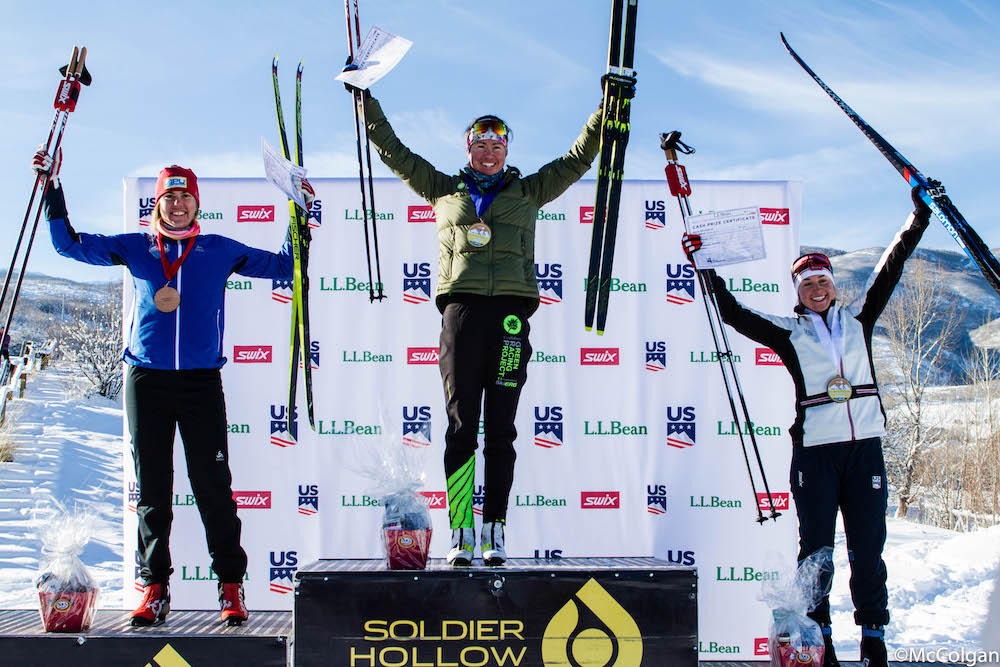
From left, Becca Rorabaugh (APU), Caitlin Patterson (CGRP), and Sydney Palmer-Leger (Utah) on the podium, 2022 U.S. Nationals. (photo: John McColgan)
By Gavin Kentch and Rachel Bachman Perkins
The 2022 U.S. Cross Country Championships began in Soldier Hollow, outside of Salt Lake City, Utah, on Sunday with skate sprints. JC Schoonmaker, recently returned from Europe, took his first national championship with relative ease for the men, while Caitlin Patterson, who was the first American in all four races at 2018 U.S. Nationals, returned to her Olympic-year winning ways by taking the victory for the women. Will Koch and Rosie Frankowski won the qualifiers, the race that matters for potential domestic Olympic qualification.
Men’s Race: JC Schoonmaker Wins First National Title with Tactics and Speed
JC Schoonmaker was born in August 2000. Eighteen months later, American skier and ski journalist Cory Smith, writing on a nascent website called FasterSkier.com, observed that race tactics were important on the sprint course being used for the 2002 Winter Olympics in Salt Lake City, and that it was generally disadvantageous to be leading into the final downhill as athletes approached the sweeping lefthand turn into the finishing stretch. He discussed Kateřina Neumannová’s quarterfinal heat as an example of the potential dangers of leading throughout, if that name gives you a sense for how long ago we’re talking about.
Twenty years later, in the opening race of 2022 U.S. Cross Country Championships, the names had changed but not the physics, as time and again it became apparent that athletes’ positioning on the final downhill was the single most important aspect of the course. Multiple heats saw athletes come back from fifth or even sixth to move up through the field and advance, and the one male athlete who tried to lead his heat from the gun paid for it in the end.
Schoonmaker, the U.S. Ski Team athlete who skis domestically for University of Alaska Anchorage, understood these tactics to perfection, using the experience gained from racing into 14th in the current World Cup sprint standings (despite missing two sprints in the Tour de Ski) to position himself exactly where he wanted to be throughout the afternoon. The result was his first national title, on a sunny, high-pressure, perfect day at Soldier Hollow.
JC Schoonmaker heads out in the qualifier. (Photo: John McColgan)
We’re not going to survey every heat from Sunday’s races, on the first of four days of competition at Soldier Hollow, but it’s worth looking at the fastest qualifiers, and the day’s first quarterfinal, to set a tone for what followed.
In the qualifier, 19-year-old University of Colorado skier Will Koch may have turned some heads when he notched the day’s fastest time, 3:07.88. Schoonmaker had the day’s second-best mark, 0.47 seconds back, with Bridger Ski Foundation athlete Logan Diekmann third by over a second more.
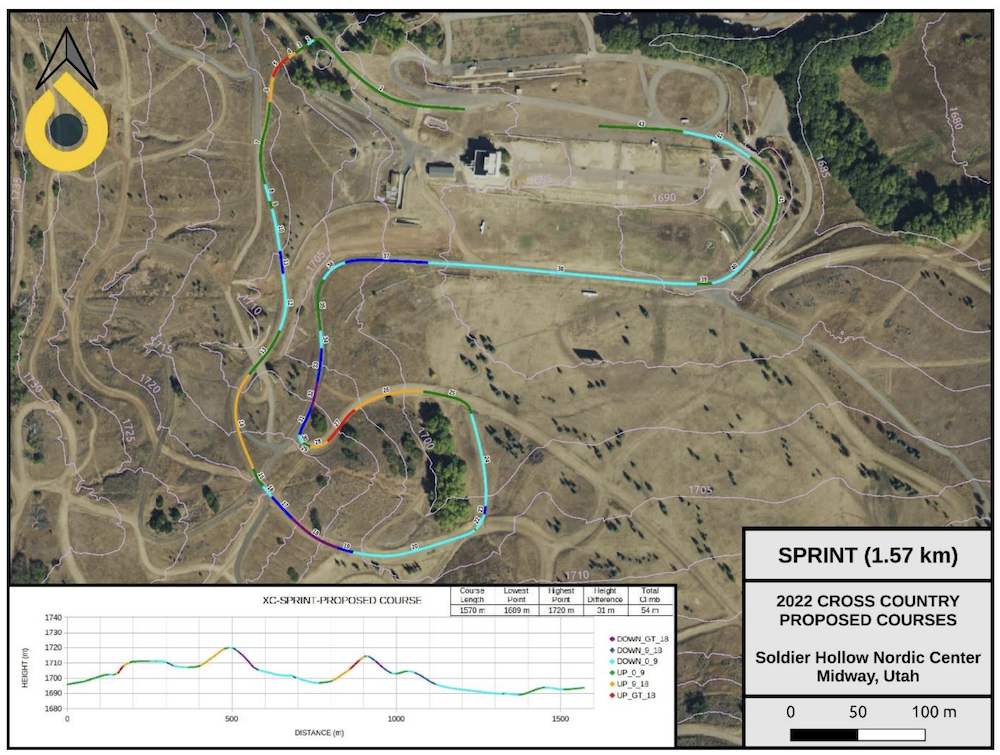
In the day’s first quarterfinal, Koch picked up where he had left off in the qualifier, blasting off the line to set a hot pace right from the start. He was probably the only athlete all day to V2 the entire first hill leading out of the stadium. He led up the first hill, down the first downhill, up the second and main climb on the course, and into the start of the final sweeping downhill into the stadium and the finishing lanes (see course map and profile below).
Course map and elevation profile for 2022 U.S. Nationals sprint course. (photo: screenshot from race website)
But then, for the first time on the day but not the last, the athlete who led into this descent was swallowed up by the rest of the field by the time they reached the final lefthand curve. Koch was caught up, gamely contested the group sprint that ensued, but barely ran out of gas after pushing hard for the entire heat.
Koch would finish fifth in a five-man heat – despite skiing faster than he had in qualifying. For his troubles, he towed the entire heat to the day’s fastest times by far, and both lucky loser spots; fifth in this heat would have won any other quarterfinal, semifinal, or final on the day. By nearly 5 seconds.
While the top qualifier was knocked out in the first quarterfinal, the effort is not to be diminished. Indeed, Koch chose a tactic, committed to it fully, executed it well, and came within 0.05 seconds of claiming fourth in his quarterfinal to advance as a lucky loser. With that in mind, this heat set the tone for the day, as a field of observant professional athletes noticed that there was maybe not a lot to gain by leading out the heat, and a lot to lose.
As Smith wrote of these dynamics on this course 20 years ago, “The ideal situation is to spend the first three-quarters of the race in the back, avoiding mayhem and drafting. Then move up to second coming into the final turn, and use the turn to shoot out and around the leader to win the sprint. But obviously that is easier said than done when everyone else is trying to do the same thing.”
In lieu of a play-by-play of the next six quarterfinal and semifinal heats on Sunday, let’s just survey some winning times: 3:06.09 (QF1, Koch’s heat); 3:15.31 (QF2); 3:13.97 (QF3); 3:16.83 (QF4); 3:10.99 (QF5); 3:13.16 (SF1); 3:20.04 (SF2). There’s a theme there: While the heat 1 lucky losers may see Koch’s reward for pushing the pace, no one else in the men’s field chose his approach. Racing was slower-paced, but it was hard to fault the results, at least for the athletes who advanced.
(The discrepancy is perhaps even greater than that, as local observers noted that the course got progressively faster throughout the day, as it warmed up from below-zero F temperatures the night before. On quiet moments in the livestream, the difference between notably squeaky snow (for the qualifiers) and not-squeaky snow (for the heats) was apparent.)
The other, related issue was falls at the bottom of the long runout, as trailing athletes accordioned back up to the leaders, and four, five, or even six men all sought to move from a narrow tuck to a wide V2 at the same time on the same stretch of trail. Through what consistently looked like incidental contact rather than malicious contact punishable by a yellow card or other formal sanction, Ian Torchia, Bill Harmeyer, Christopher Kalev, and Brian Bushey all hit the deck in their quarterfinals. The same thing happened in the semis, too, with Karl Schulz falling in the first semifinal and John Schwinghamer in the second. Again, it certainly appeared that it was not intentional, just the results of athletes all commencing a V2 at the same time at high speed.
After one fast heat and six slower heats, six men lined up for the final: JC Schoonmaker (UAA/USST), Noel Keeffe (University of Utah/USST), Logan Diekmann (BSF), Johnny Hagenbuch (SVSEF/USST), Magnus Bøe (University of Colorado), and Andreas Kirkeng (University of Denver).
Their average age was slightly less than 22; they had probably not read Smith’s coverage of the 2002 Olympic sprint when it was first published. But they had all successfully raced two heats on this course already, and they seemed disinclined to change what had got them there.
All of which is to say that Schoonmaker’s winning time for the final, 3:21.05, was the slowest of any men’s heat that day. (Indeed, this time would have placed him fourth in the first junior boys semifinal.) Diekmann led the pack out of the stadium in the final, closely tailed by the rest of the field. The men skied fairly leisurely up the first uphill, down the first downhill, and up the second uphill.
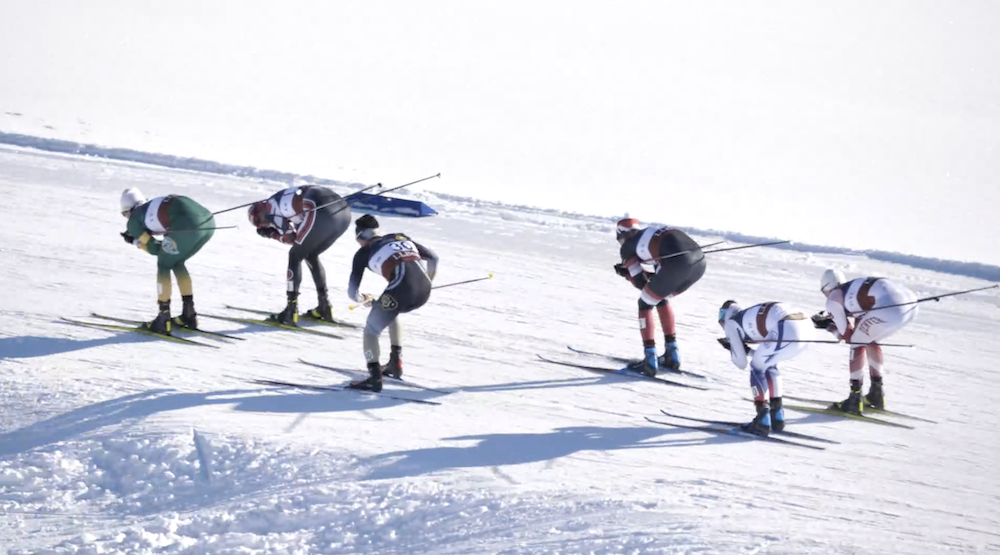
Finally, coming into the final downhill, Bøe moved, and Schoonmaker followed. The field started racing in earnest at this point, but there was still not much separation between six athletes traveling at high speeds: Here’s the men’s field, nearly three minutes into the final, about to come up out of their tucks, navigate the final lefthand turn, and sprint into the finish:
JC Schoonmaker (far left) leads the final in the men’s skate sprint at 2022 U.S. Nationals. (photo: screenshot from livestream)
That’s Schoonmaker in the lead, Keeffe just off his right shoulder in second, Bøe (bib no. 30) in third, then Diekmann, Hagenbuch, and Kirkeng trailing slightly behind in fourth through sixth, respectively, from left to right. And, spoiler alert, these were not their final finishing positions; there was more movement yet to come.
While the camera work, free live broadcast, and Adam Verrier’s announcing were consistently superb, the limitations of the available camera angles meant that a portion of the final lefthand curve was obscured from view for a few seconds. (That curve can be seen in the video in the second half of this Instagram post from BSF.)
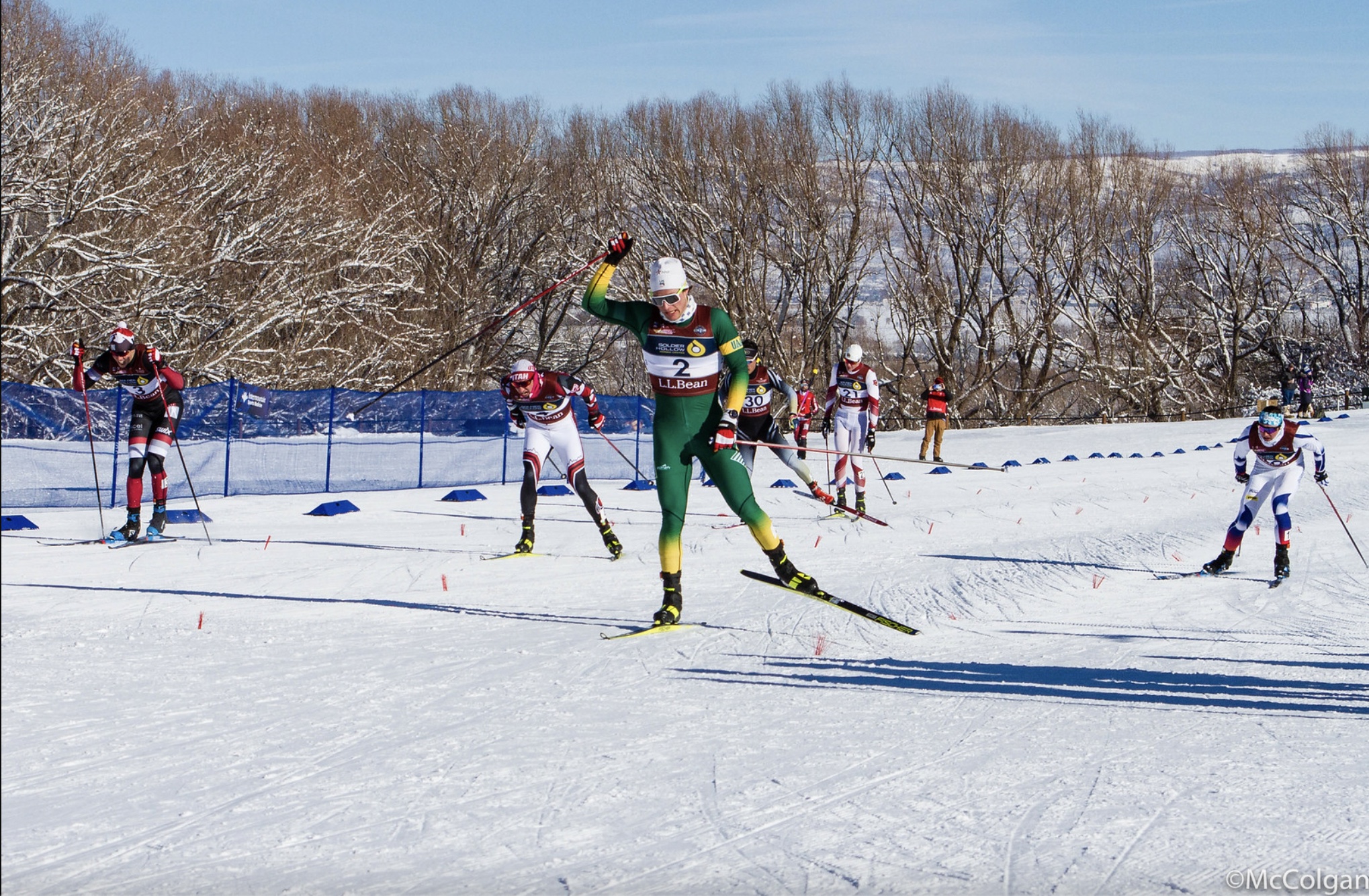
By the time the athletes came into view once more, Schoonmaker had positioned himself precisely where he wanted to be, on the inside of the curve, carrying a lead of multiple meters. His gap was small but consistent through the finish, which he approached with sufficient time and space to stand up and celebrate across the line.
JC Schoonmaker celebrates across the line as he wins the men’s skate sprint at 2022 U.S. Nationals. (Photo: John McColgan)
Schoonmaker’s winning time was 3:21.05. Behind him, Diekmann (+0.83) outlunged Keeffe (+.91) for second by less than a ski. Hagenbuch was another 0.20 seconds back in fourth (+1.11) , followed by the two collegiate skiers, Bøe and Kirkeng, in fifth (+2.14) and sixth (+3.47).
“I’m feeling really good after a nice relaxing Christmas at home [in Tahoe City, CA],” Schoonmaker wrote to FasterSkier after the race. “It was great to have a mental break from racing and we got absolutely dumped on with snow so that was really fun too.”
Schoonmaker also spoke to his feelings in the sprint, after a successful, but potentially draining stint in Europe, where he skied into the semifinals three times, finishing as high as 7th in Ruka, Finland.
“Today I felt pretty good and felt like I was getting better throughout the day after a little break from racing. It’s a weird course with the last downhill being so tactical but I was happy with my positioning and how I skied it. I won’t race the 30k just to make sure I’m not overdoing it but I’m really looking forward to the 15k classic, almost more than the sprints since I haven’t been doing much distance racing. I’m also just super excited to be back racing in the US and seeing a ton of friends out there!”
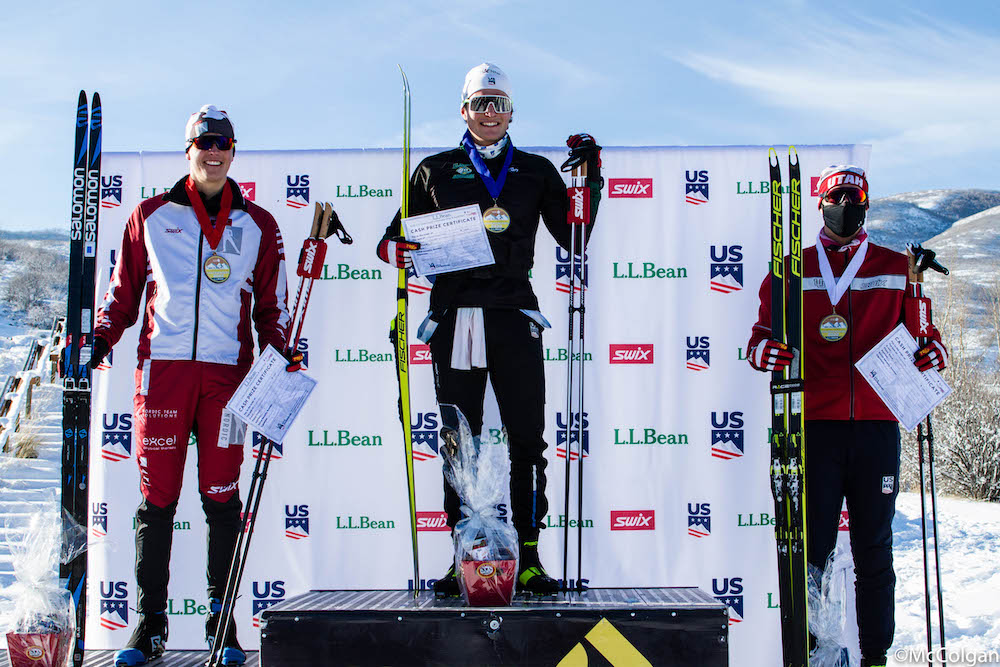
From left, Logan Diekmann (BSF), JC Schoonmaker (UAA/USST), and Noel Keeffe (Utah/USST) on the skate sprint podium, 2022 U.S. Nationals. (Photo: John McColgan)
It was Schoonmaker’s first national championship. His trajectory to the top of American sprinting has been quick, and recent; he finished 13th in the skate sprint at 2020 U.S. Nationals, and 14th in the classic sprint at 2019 U.S. Nationals. The last time he raced a national championship at Soldier Hollow, in 2017, he was 165th, albeit also age 16.
Women’s Race: Caitlin Patterson Times Her Move to Take the Victory
The tactical theme held fast through the women’s heats. Athletes stayed relaxed through the first two climbs of the course, using the sweeping downhill in the middle to establish position heading into a final shorter climb. Pushing over the top and into the downhill, athletes benefited from tucking into the slipstream of the leader rather than being first in the glideout, conserving energy for the final explosive push over the bridge and up through the finish lanes to the line.
Perhaps the only skier breaking from this narrative was APU’s Rosie Frankowski. Though she was third in both Period 1 SuperTour sprint races this season, Frankowski has historically been better known for her distance chops. Perhaps recognizing she’d need a fast heat to ensure lucky loser opportunities, Frankowski took the first heat of the quarterfinal out hot, dropping the field on the opening climb only to be reeled back in on the subsequent descent. As the women left the critical descent and began to skate out of the subsequent glideout, Frankowski was within a group of four women.
Powering into the final stretch, it was Frankowski matched by her teammate Becca Rorabaugh leading the way to the line, with Sun Valley’s Samantha Smith and Northern Michigan’s Katarina Hyncicova close behind. Rorabaugh took the heat in 3:43.67 with Frankowski in second. Though she qualified automatically, Frankowski’s fast start achieved the objective; it was the fastest heat of the quarters, allowing both Smith and Hyncicova to advance to the semis.
A trio of APU women on site at US Nationals. From left to right, Annie Gonzales, Rosie Frankowski, and Becca Rorabaugh. (Photo: Instagram @frankowitz)
In the semis, Frankowski repeated her approach, again pushing the pace early to establish a fast heat. Sydney Palmer-Leger (Univ. of Utah/USST) looked comfortable and content with her position as she trailed Frankowski into the sweeping downhill. Rorabaugh and Anna Bizyukova (UVM) also caught the leaders in the glideout, with Bizyukova sliding around the outside to head over the bridge alongside Palmer-Leger, setting the stage for a tight four-way spread at the finish with Frankowski and Rorabaugh on their tails.
Finishing with what would be by far the fastest times of the day, Palmer-Leger took the win in 3:38.61, edging out Bizyukova by 0.14 seconds. Half a ski length behind, Frankowski crossed in third (+0.31), with Rorabaugh fourth (+0.46). Roughly seven seconds back, Hannah Rudd (BSF) was fifth in the semi, finishing just ahead of Hyncicova.
The start of the second women’s semifinal. (Photo: Julie Oldham)
In the second semi, SMS T2 athlete Lina Sutro set a more conservative pace, leading Middlebury athlete Kate Oldham through the first two climbs. Sun Valley’s Samantha Smith made some aggressive hop-skate pushes to take the lead on climbs, but she was caught and passed on each of the subsequent descents. Sutro and Oldham charged hard over the top of the final climb, pushing into the downhill, but a strong move around the curve by Mariel Pulles (UAF) shot her to the front from fourth, while Caitlin Patterson also accelerated into the lead group.
Coming into the final stretch, it was Pulles with a narrow advantage over Patterson, with Sutro and Oldham holding on for a fast time, but no longer within reach of automatic qualification. Pulles crossed the line in 3:45.15, well behind the previous heat’s benchmark, indicating that only she and Patterson, who crossed +0.10 behind, would advance to the final.
Sutro crossed the line just ahead of Oldham for third (+0.28), followed by Oldham in fourth (+0.74). Lucinda Anderson (UNH) and Smith rounded out the second semi in fifth (+1.04) and sixth (+2.72), respectively.
In the final, a broken pole early on put Pulles at a significant disadvantage, though she held contact with the leaders. Frankowski again pulled ahead from the start, looking to be at the front, and set a pace that would not leave her opponents fresh for a fast and tactical final push.
After maintaining her position at the front through the meat of the course, Frankowski was once again swallowed up in the glideout as Patterson, Palmer-Leger, Rorabaugh, and Bizyukoga each caught and passed her. Frankowski wobbled as she found her position, looking as if some unintentional bumping of skis had taken place at the spot where we saw many crashes in the men’s quarterfinals and semifinals.
Patterson led over the bridge with Rorabaugh on her tails and Palmer-Leger in a competitive position alongside. Creating a small gap ahead of the three women in pursuit in the final straightaway, Patterson, Rorabaugh, and Palmer-Leger skied three abreast, seemingly evenly matched in the closing meters. Palmer-Leger skied with the highest tempo, but Patterson’s smooth and powerful technique carried her through the finish with the advantage, stopping the clock at 3:42.60, with Rorabaugh half a ski length behind in second (+0.24), and Palmer-Leger spaced evenly behind in third (+0.57).
Caitlin Patterson (far right), Becca Rorabaugh (center), and Sydney Palmer-Leger (far left) race to the line in the women’s sprint final at 2022 US Nationals. (Photo: John McColgan)
Bizyukova won the second-wave sprint to take fourth (+1.57), with Pulles, still racing with a dysfunctional pole, next over the line in fifth (+2.28), with Frankowski finally losing steam to finish sixth (+2.52).
Patterson was realistic after the race when she assessed her chances, while also revealing it was no secret that the final downhill was the crux of the course.
“The sprint today was really fun,” she wrote to FasterSkier late Sunday. “I went into it in no way expecting to win, but believed that it was within the realm of possibilities. The key would be to see how the final downhill played out in the heats and and try to play it well myself.”
Patterson added, “I do love downhills, but this Soldier Hollow sprint course perplexes me somewhat because it feels hard to control what’s going to happen in the race, with the way the draft might play out in those final hundred meters. I didn’t feel particularly in control during my heats, but I took advantage of whatever I could work with for positioning and made it work to move on through the quarterfinal and semifinal. I felt better in the heats than during the qualifier, but in much of the heat race I felt that the packs moved around and stayed tight together in a way that I had to tap into surges here and there rather than a consistent effort throughout the whole course. There were a lot of really tight finishes today – my own and others – and I think there were a ton of super strong skiers out there who probably got edged out by the tiniest of margins, but so goes sprint racing.”
Caitlin Patterson won the opening freestyle sprint of the 2022 US National Championships in Soldier Hollow. (Photo: John McColgan)
Turning to the final, Patterson recounted, “I was forced out wide to the right at the base of the final climb, and had to tuck in behind some people skiing up that steep hill. It wasn’t necessarily my plan to enter the downhill in 5th, but then when I pushed super hard over the top of the hill, I caught several drafts and executed good passes. When I found myself taking the lead going into the final corner, I pushed to the finish with everything I had even as I started to get a bit wobbly, and fortunately managed to hold off Becca and Sydney!”
The 30-something Patterson added, “Becca and I would like to note that no one should count us Master’s racers out of the game!”
Patterson noted that she is pleased to achieve sprint success domestically, but is seeking more international opportunities in distance races.
“Period 1 racing on the World Cup was ok for me, but not great, it felt like a bit of a slow start to wake up the distance race speed. Undoubtedly the whole World Cup field is extremely competitive right now, and the other US women are super strong which is awesome to see, but I want to get up there myself into contention! Without scoring any World Cup points in P1, it wasn’t really an option to stay and race the Tour this year, so I came back to the US to regroup and focus on Nationals racing. I believe that with strong Nationals distance race performances I may be able to earn more upcoming international racing starts, so that is my focus looking ahead.”
Juniors
A full field of juniors raced as well, going through a complete set of heats and finals after the senior athletes. Kendall Kramer (University of Alaska Fairbanks/USST) took the junior girls final over fellow Alaskan Marit Flora (APU), with Erica Laven (Täby IS Skidor) in third. Laven is from Sweden; Lauren McCollor (Northern Michigan University), fourth overall, rounded out the domestic national championship podium as the third American.
In the junior boys final, Finegan Bailey (SMS) took the win, with Trey Jones (Steamboat Springs Winter Sports Club) in second. Aidan Burt (University of Vermont) was third.
More about the course
The Soldier Hollow sprint course has historical relevance looking back to the 2002 Olympics, as discussed above. It also has prospective relevance, to the 2022 Olympics that start in Beijing in roughly a month.
Notably, and speaking of this year’s Olympics, it is “only … qualification round finish placing” that is considered for the USSS 2022 Championship Selection List, i.e., Koch and Frankowski each received a full 45 points (30 points for first plus 15 points for the national championship bonus) for winning the qualifier, regardless of their final overall placing.
While it remains an open question how many domestic athletes will be selected to this year’s Olympic team off of these races, it would be hard to find a better course to use as a basis for comparison. As Rosie Brennan noted in explaining her decision to come back home during the Tour de Ski and experience an extended period of living and skiing at altitude, the two trail systems were even designed by the same person.
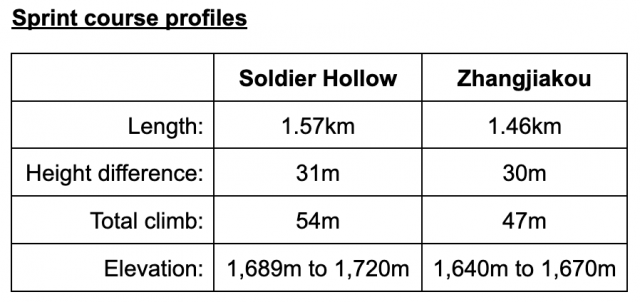
In addition to their more holistic similarities, their statistics are very comparable as well, particularly the overall elevation but also the more specific details of the course profiles:
Course information for 2022 U.S. Nationals and 2022 Olympics sprint courses. (FasterSkier table by Gavin Kentch)
If an athlete is indeed picked for the Olympic team based off of their performance in this week’s sprint races, it seems fair to say that they will have achieved success on the type of course they can expect to find in Zhangjiakou.
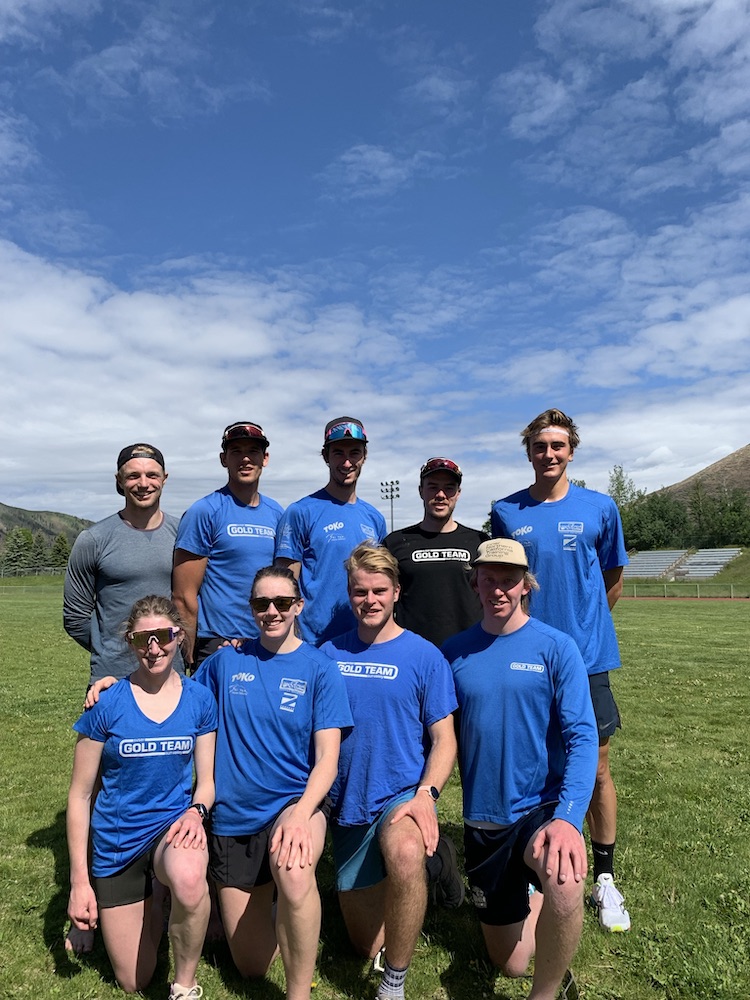
Current roster: Kevin Bolger, Katie Feldman, Sarah Goble, Sam Wood, Karl Schulz, Johnny Hagenbuch, Peter Holmes, Peter Wolter, Jake Adicoff
Who’s new: Peter Wolter and Jake Adicoff
Who’s missing: n/a
Who’s still on this team, or otherwise involved in American skiing, from when we did this in 2012: No one; Simi Hamilton recently retired, and Patrick Johnson was long involved in coaching, but no one currently
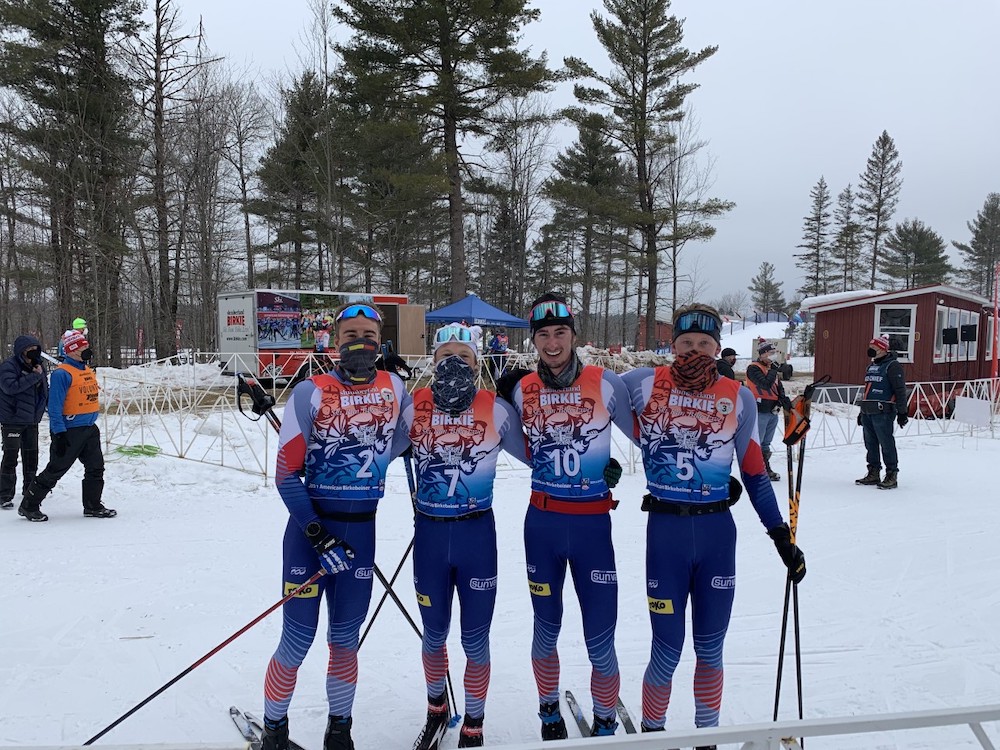
SVSEF athletes at the 2021 American Birkebeiner. (photo: courtesy SVSEF)
Top results last season: Bolger made five individual sprint heats last season, highlighted by 6th in the final in Dresden and 13th in Davos in the quarters, both in December. He finished the season ranked 16th in the Sprint Cup, and based on that metric, is the top returning American sprinter now that Simi Hamilton (14th) has retired. Hagenbuch made his World Cup debut with a pair of March distance races in Engadin, SUI (69th and 72nd) and had three starts at World Juniors in Vuokatti, FIN in February, with a best finish of 17th in the 10-kilometer skate. Domestically, he had two second-place finishes against deep regional fields in Soldier Hollow in January. Holmes raced in the World Cup sprint weekend in Ulricehamn, SWE last February, and was first and fourth in Soho January sprints.
Domestically, the team had a very strong showing in the American Birkebeiner, with a combined nine top-10 finishes between the men’s and women’s skate and classic fields. In the skate race, Hagenbuch won the men’s race, with Wood 2nd, Schulz 9th, and Holmes 10th. Feldman was 4th for the women. In the women’s classic race, Feldman was 3rd. For the men, Hagenbuch was 2nd, Sam Wood 6th, and Holmes 8th.
Going back to March 2020, Feldman was scheduled to make her World Cup debut in the ill-fated Québec City races. Bolger and Holmes had starts for the men.
Coach’s comments: Here’s Chris Mallory on the new additions to the team: “Peter [Wolter] came up through the SVSEF program and is finishing up at Middlebury this spring. Jake [Adicoff, a visually impaired skier and biathlete] didn’t compete much the last few seasons, but found the fire again this past year and will also ski with the US Paralympic Team this season. One of our other current Gold Teamers, Sam Wood, will work as Jake’s guide, so that’s exciting going into Bejiing.”
And here’s Mallory on recent training and the current team mood: “The training season has been going well. With the full team returning we were able to push the training pretty hard. We spent a large portion of the summer training in Sun Valley, so we had a lot of consistency there, but we were also able to add some camps again which was nice. We did a May Bend Camp, teamed up with BSF and Stratton some to put together an intensity block in Lake Placid, and recently spent a week in Park City with the National team. Kevin just traveled to Sweden to start prepping in Scandinavia for the World Cups, while the rest of the squad just arrived in Canmore yesterday to get some early snow time in at Frozen Thunder.
SVSEF athletes, fall 2021. (photo: courtesy SVSEF)
“We’re looking forward to a busy domestic race circuit. After spending last season racing regionally and putting together time trials to keep the motivation up, the team is looking forward to seeing friends again and the added competition the national circuit brings. SVSEF is hosting the post-Nationals SuperTour in January as a big Intermountain junior event/RMISA collegiate race, so we’re really looking forward to that as well.”
Over the bumps, Jessie Diggins heads out for her qualifier during the Keys to the Castle rollerski race in Lake Placid, NY. (Photo: Reese Brown / RDB Marketing)
As summer turned to fall, skiers from the Stratton Mountain School T2 team (SMS T2), the Sun Valley Gold Team (SVSEF), and the Bridger Ski Foundation Pro Team (BSF) met in Lake Placid, NY for a collaborative training camp, capped off with two stages of rollerski racing. The weekend featured a freestyle sprint event — The Keys to the Castle — on the rollerski track at Mt Van Hoevenberg, followed by a distance stage dubbed the Free Fall Rollerski Race in Jericho, VT. These events are perhaps the climax of NENSA’s summer rollerski series, which has helped feed the energy and momentum of the cross country ski community throughout the Northeast.
“Lake Placid and Jericho were fantastic events and the beginning of the vision becoming a reality,” NENSA competitive programs director Justin Beckwith shared in an email. “They also highlight the amazing partnerships we have with clubs, venues and sponsors. We have four more roller races this fall including Climb to the Castle this weekend, which is paired with our Eastern Coaches Symposium — back in the Empire State. The really exciting part is we hope to carry the enthusiasm from rollerski into our Popular Race calendar, which will be released in the coming month.”
The man behind the wheels: NENSA competitive programs director Justin Beckwith. (Photo: Reese Brown / RDB Marketing)
After a year with minimal opportunity for cross-club collaboration, the events provided not only a solid training stimulus, but also invigorated the teams as they prepare for the upcoming season. It left U.S. Ski Team head coach Matt Whitcomb scheming about the opportunity to grow the events in the years to come.
“Pulling off a stage-style roller ski race weekend, with over 100 competitors on two different roller-ski tracks, reminds me of summer racing in Norway and Sweden,” wrote Whitcomb in an email. “NENSA has upped its game. Think of the potential, too; we could do four stages, using four different tracks, and all within 1-2 hrs in VT and NY. Start in Craftsbury, move on to Jericho, and then to each of Lake Placid’s tracks. Everyone camps together at each location, and it’s just a giant summer ski party.”
The facilities at Mt Van Hoevenberg, home to the 1980 Olympics and an Olympic & Paralympic Training Center, have been undergoing extensive renovations and improvements, including the building of the new four-kilometer rollerski track which was finished this past August. (You can take a tour of the track via YouTube courtesy of Paul Schommer/Biathlon Uncharted.)
“If I win the lottery, I’m putting in more roller-ski tracks in the U.S.,” said Whitcomb. “It’s a game-changer to not have to worry about cars. Also, the best way to replicate the demands of a ski course is to ski on a ski course.”
Bill Harmeyer (SMS T2) makes his way through the heats during the Keys to the Castle rollerski sprint. Harmeyer finished 4th overall on the day. (Photo: Matt Whitcomb)
Mt Van Hoevenberg has also improved their snow making operations, allowing for 5k of groomed skiing with 3-4 days of blowing snow in cold weather. Whitcomb explained the value this provides to American cross country skiing.
“This was our second time utilizing New York’s investment in its facilities at Mount Van Hoevenberg. I’d be surprised if we’re not racing World Cups here in the future. A lot of work by ORDA has resulted in a world class roller-ski track and new race trails. What excites me is the chance for easterners to have early November skiing in years when the weather cooperates. Their snow-making capacity is impressive.”
With the added twist of a rolling ramp at the start, racers skied their way through the qualifier and rounds. In the women’s field, Jessie Diggins (SMS T2/USST) won the qualifier, cruising onward to snag the top spot on the podium, followed by teammates Julia Kern (SMS T2/USST) in second and Alayna Sonnesyn (SMS T2) in third.
Jessie Diggins (SMS T2/USST) over the climb during the final round of the Keys to the Castle sprint. (Photo: Matt Whitcomb)
“This is the time of year where the intensity in training starts to ramp up and it’s always awesome to have the chance to test out your race day preparation,” wrote Diggins after the race. “Things like the timing of pre-race meals to warmups and what you do in between sprint heats to stay activated but not get tired — this was a perfect chance to tune in to those little details at the race in Lake Placid!”
Diggins only competed in the sprint stage of the weekend, bowing out before the teams headed to Vermont.
“I’m super grateful to the organizers and hosts as it was an amazing new roller ski track and venue, and it was very cool to have so many teams and athletes there, from junior skiers to professional teams. The track was challenging and honestly just like a world cup sprint course, in terms of length, challenge and technical aspects. It was fun to fire up the engines and see what I still need to be working on in our final prep phase before the season begins!”
Jessie Diggins stomps the qualifier, continuing through the rounds to win the overall at the Keys to the Castle. (Photo: Reese Brown / RDB Marketing)
On the men’s side, Ben Ogden (SMS T2) also doubled up on the qualifier-final victories. He was followed by Peter Holmes (SVSEF) in second, and Logan Diekmann (BSF) in third.
“This weekend’s rollerski race was like a breath of fresh air for me and I think most of the competitors,” wrote Ogden in an email. “As fun as constant training, time trials and quarantining was, ski racing is all about racing. Getting together with such a talented group and pushing each other on such a beautiful New England weekend seemed almost too good to be true. Having the BSF Pro Team, Sun Valley gold team, and SMS T2 team, all on sight made it a crazy stacked fall time trial, which was such a treat after a year of so many small group time trials.
“This weekend was especially cool for me because It bridged the gap between all the ski worlds, something that has certainly not happened in a long time. Many of the college skiers were there, the SMS t2 team (who I ski with in the summers) was there, even a few fellow US ski team athletes and coaches were there. It’s rare that all these groups get together so that was a lot of fun.”
Putting on a clinic, Ben Ogden powers through the Keys to the Castle, winning both the qualifier and the overall. (Photo: Matt Whitcomb)
While racing in Vermont was not possible for much of the ‘20/21 season, Ogden, now 21-years-old, had a solid first run of international World Cup racing. On form when the stakes were highest, he qualified in 11th in the classic sprint at the World Championships in Oberstdorf, Germany and finished 17th. He was also the third fastest qualifier in the same event at U23 World Championships in Voukatti, Finland, where he finished 11th overall.
Ogden provided insight into his current status with training, and how the races provided him with insight into how his body is responding.
“I had a big period of training ending in these races and in true fall rollerski race style I didn’t change up much of my training for the races. I just thought of them as hard workouts with a bunch of friends who I don’t ski with all too often. I was really pleased to find some good speed through the entire skate sprint day. The course was really fast and tons of fun on rollerskis, so it was awesome to ski all three heats on Saturday…
“I’m really excited to get this winter underway. Feeling good about summer training in Stratton and the beginning of fall training at Groovy. (‘Groovy UV’ = University of Vermont, where Ogden is beginning his third year.) Lots of work to be done!! I think it’s going to be a fun year.”
The men’s podium of the Keys to the Castle rollerski sprint in Lake Placid. Ben Ogden (SMS T2) was the top qualifier and overall winner ahead of Peter Holmes (SVSEF) and Logan Diekmann (BSF Pro). (Photo: Reese Brown/RDB Marketing)
Heading east to the Camp Ethan Allen Training Site, men and women in the open division raced a 15k skate while juniors completed 5k.
For the men, Johnny Hagenbuch (SVSEF) stopped the clock at 32:00.9 with the fastest time of the day. He was pursued by Ben Ogen in second (+1:07.3), with Ian Torchia (SMS T2) on his tails in third (+1:07.6) with a tight finish.
“It was an awesome way to cap off a productive training camp!” wrote Hagenbuch after his race. “Being from altitude in Sun Valley, the main goal for the camp was to capitalize on some great venues for intensity training in and around Lake Placid. We had a bunch of really good sessions on rollerskis and foot, and it was awesome to collaborate with Andy Newell’s BSF Pro Team crew on a number of those quality workouts.”
20-year-old Hagenbuch was born and raised in Ketchum, ID. After taking a gap year following high school graduation, Hagenbuch will be attending Dartmouth College in the fall. He explained that his time spent in the east surrounding these events left him eager for what is to come in the years ahead.
“The new venues in Lake Placid at the Mount Van Hoevenberg were incredibly well-designed, and I really look forward to checking out the ski trails in the winter as opposed to bounding. The rollerski track is a really great resource, and NENSA did a fantastic job of hosting that event. There was a surprisingly robust field for a rollerski race in Upstate NY, and it was cool to see how much energy there is for skiing and rollerskiing in the East. I actually had never previously spent any substantive period of time in New England – winter or summer, so it was great to experience orientation at Dartmouth the week before the camp as well. My perception of the East has completely changed; it’s very different from the West, but I love it!”
Johnny Hagenbuch powers through his qualifying round during the Keys to the Castle rollerski sprint in Lake Placid, NY. (Photo: Matt Whitcomb)
Breaking down the combined stages that led Hagenbuch to a third place finish in the overall standings, he explained his approach to the weekend including how it fits within his overall summer training plan.
“The sprint went pretty well for me, especially considering that I historically and currently have not self-identified as the most talented sprinter. At this point in the season, it was a fun, low-stakes way to throw down with a great group of guys. Ben Ogden is fun to watch. The distance day in Jericho was much more my wheelhouse, as distance skate races are typically my best format. The 5km rollerski track on the National Guard base in Jericho was a treat to experience. I haven’t skied on Craftsbury’s rollerski track, but the Jericho rollerski track could easily be the best in the nation. Given that I’m still training at a relatively large volume, I wasn’t really expecting to feel particularly good or race anywhere near to my best form, but it was still a pretty good effort.
“One of my goals for the past couple of seasons has been to get stronger and ski more powerfully, and it was cool to see some of that effort pay off in Jericho. I felt that I was skiing much more powerfully in general, and I don’t think I lost much on the uphills – despite having gained 25 pounds in the last year. It was an encouraging result in the end, and I’m excited for the next couple of months of training before the season kicks off in earnest in West Yellowstone. I’ll be pretty consistently alternating between being at home for two weeks and away training or racing for two weeks until January, which’ll be a nice way to break it up (and will make time fly)!”
The women’s podium of the Free Fall distance race in Jericho, VT. Alayna Sonnesyn (SMS T2) took the win ahead of teammate Lina Sutro, with Mariah Bredal (BSF Pro) in third. (Photo: Matt Whitcomb)
On the women’s side, Alayna Sonnesyn took the win on the second day in a time of 37:55.3, sealing the overall victory for the combined events. Her SMS T2 teammate Lina Sutro rolled through in second (+49.3) with BSF Pro Team member Mariah Bredal in third (+2:33.6).
“In Lake Placid, it was really cool to ski on the new roller ski track,” wrote Sonnesyn in an email after the events. “I had heard stories about a pretty twisty and technical track but to finally have the opportunity to ski on a course similar to a World Cup level race was pretty sweet. Not to mention the new facilities at Mt. Van Hoevenberg are unbelievable! It was really fun to get into a sprint simulation with all of the other elite ski teams that were there and it felt almost like a SuperTour. That being said, it’s still September so although I brought a competitive spirit to the races, I still approached them as a workout. It was great to practice going super hard in the qualifier and then play around with tactics in the heats, but it was all in good fun too. With a pretty sketchy corner coming out of the last downhill, the women agreed this race wasn’t worth losing skin over. All in all, a great day!”
Alayna Sonnesyn leads her heat during the Keys to the Castle rollerski sprint in Lake Placid, NY. (Photo: Reese Brown / RDB Marketing)
“The following day in Jericho I was definitely feeling a little tired from the sprints the day before, but that was great practice for wintertime when we frequently race back to back,” Sonnesyn continued. “Also, during my time at UVM we skied at Jericho almost every week so it felt good to be back on a track that I knew so well and felt like home. Adding to that, it was great to see the UVM ski team and other junior/college racers attending this event. It had been a while since I had been at an event with so many New England skiers and I felt like everyone was just really happy to be there. Again, I was finding the balance in this race to approach it as a workout while still taking advantage of the opportunity to practice race warm ups, tactics, fueling, pacing, etc.”
Sonnesyn also concluded with insight into her overall feelings at this point in the season.
“I’m feeling really good and lucky to have these races to test things out. I gained a lot of takeaways on little things I can work on in the next few months, but also built some confidence behind what we have already been doing all summer. I’m excited to potentially compete in a few more NENSA races this fall and get ready for snow to fall!”
The women’s final of the Keys to the Castle rollerski sprint in Lake Placid, NY. From left to right, Lauren Jortberg (BSF Pro), Julia Kern (SMS T2/USST), Jessie Diggins (SMS T2/USST), Alayna Sonnesyn (SMS T2). (Photo: Reese Brown RDB Marketing)
Engadin, Switzerland – a stellar backdrop for the men’s 15 k mass start classic. (Photo: NordicFocus)
This World Cup coverage is made possible through the generous support of Marty and Kathy Hall and their A Hall Mark of Excellence Award. To learn more about A Hall Mark of Excellence Award or to learn how you can support FasterSkier’s coverage please contact info@fasterskier.com.
It’s the last hurrah, folks. Roughly a year after the COVID-19 virus achieved its global pandemic title, the World Cup finds itself at the end of a season that once looked as if it may not happen in the first place. Though four competitions — Lillehammer, Nové Město, Oslo, and Beijing — were cancelled or postponed, the World Cup toured through Europe from November to March without any known significant outbreaks. All things considered, they pulled off a bold and robust competition schedule.
Leaving the unpredictable spring conditions at the World Championships in Oberstdorf, Germany, the cold, crisp tracks and an Alpen backdrop looked like a wintery treat during today’s 15-kilometer mass start classic event. The picturesque venue, home to the Engadin Ski Marathon, is nestled in the Engadin Valley of Switzerland just south of St. Moritz in the town of Surlej. Pristine conditions, bluebird skies, and high mountain air; what more could you ask for in a final stop?
Iivo Niskanen leads the way midway through the 15 k mass start classic in the Engadin Valley of Switzerland. (Photo: NordicFocus)
As the dust settles from the World Championship, in particular the conclusive result of the men’s 50k classic just six days ago, eyes were on the 24-year-old duo up front with 5k to go. To put it clearly, we mean Norway’s Johannes Høsflot Klæbo perhaps looking for redemption after his disqualification for obstruction and loss of the World Championship gold medal versus Russia’s Alexander Bolshunov. The Russian also felt robbed of this medal as the interaction with Klæbo in the finishing stretch resulted in a snapped pole, consequently losing him ground to Emil Iversen and leaving him with silver.
With the field staying tight over the first 10 k on Saturday, it was on Bolshunov to move early and avoid setting up a repeat opportunity for Klæbo to sit and kick in his signature style. Time and again, Klæbo the World Champion and Olympic gold medalist in the classic sprint has demonstrated his potential to, quite literally, run away from the field in the final 400 meters, rocketing down the final stretch to clinch the win. Though Bolshunov is the overall World Cup winner for the third year running, it would not behoove the Russian to face off with Klæbo in this way.
Alexander Bolshunov leads the way in the 15 k classic, with Johannes Høsflot Klæbo drafting on his tails. (Photo: NordicFocus)
And he knew it. Crossing the bonus sprint checkpoint at 10 k, Bolshunov and Klæbo were side by side. But as the leaders kicked and glided into their final lap, Bolshunov began to surge off the front. At 11.4 k, he had only a second gap ahead of Klæbo who attempted to match the pace. But, by 2 k later, the winner was clear. Bolshunov had a 24.9 second gap at 13.8 k, while Klæbo had allowed the chase group to catch back up, letting go of a win and setting himself up for a sprint finish for second place.
Despite his lead, the Russian kept his foot on the gas all the way to the finish stretch where he raised his arms to soak in his achievement and coasted through the finish in 34:07.1.
Bolshunov coasts through the finish without challengers at the 15 k mass start classic in the Engadin Valley of Switzerland. (Photo: NordicFocus)Alexander Bolshunov takes the win in the 15k classic in Switzerland. (Photo: NordicFocus)
“I really like St Moritz,” Bolshunov told FIS through a translator after the race. “I was very pleased with the conditions here and feel it is one of the best places I have been skiing and training. About the race, I was really happy with the result and happy that now we have again hard winter conditions and that I could push hard on this course. I am very happy to take the victory.”
The remainder of the podium was less certain, with Klæbo heading toward the stadium with a pack of seven men. Utilizing his aforementioned signature, Klæbo engaged his sprint gear to move up to the front of the group, coming into the final 100 meters alongside his teammate Pål Golberg. Klæbo held Goldberg off by half a ski length for second (+18.5), leaving Goldberg in third (+18.9).
Johannes Høsflot Klæbo edges out teammate Pål Golberg for second place. (Photo: NordicFocus)The 15 k classic men’s podium in the dreamy Engadin Valley. Alexander Bolshunov (RUS) took the win ahead of Johannes Høsflot Klæbo (NOR) and Pål Golberg (NOR). (Photo: NordicFocus)
Sweden’s Jens Berman took 4th (+20.0), with Simen Hegstad Krüger of Norway in 5th (+21.2), Artem Maltsev of Russia 6th (+24.2), and Iivo Niskanen of Finland 7th (+27.4). Hans Christer Holund brought up the rear for the first group of chasers in 8th (+31.2).
Alexander Bolshunov celebrates his 9th World Cup distance win this season at the final stop in the Engadin Valley of Switzerland. (Photo: NordicFocus)
With this 23rd World Cup win under his belt — nine from this season alone — Bolshunov joins Norway’s Peter Northug as joint-fourth on the all-time list. He is the first male skier to win three consecutive World Cup crystal globes, tied for the second-most distance globes in his collection with Norway’s Martin Johnsrud Sundby who also holds three. Only the Swiss champion Dario Cologna outranks Bolshunov, with four distance globes.
Antoine Cyr (CAN) tucks into the draft of Jean Marc Gaillard (FRA) during a career-best race in the 15 k classic in Switzerland. (Photo: NordicFocus)
Turning to the North American results, Antoine Cyr took 21st for Canada (+54.5), nailing his best individual result of his career. This is the second season on the Senior National Team and racing at the World Cup level for the 22-year-old who hails from Gatineau, QC.
As the dense cluster of skiers from the mass start slowly began to thin out, Cyr skied his way up from 45th and 23 seconds back at the halfway mark to 21st and just 9 seconds behind the leaders at the 10 k checkpoint. Holding his ground in this group over the last 5 k, Cyr crossed the line just behind Andrew Musgrave of Great Britain.
“I had a really good race today — it is the first time I have earned World Cup points, so it’s pretty exciting,” wrote Cyr in a post-race email. “I knew it was a good course for me but I was starting far back on the grid and had to make up a lot of spots on the third lap, then the fourth lap I was just hanging with the pack I was skiing with. I am really happy with the results but I know I have even more to give as I am a rookie on the World Cup and just getting used to the way it races here. I am excited for tomorrow and what is to come!”
Graham Ritchie (CAN) crosses the line just behind Andrew Young (GBR) at the 15 k mass start classic in the Engadin Valley. (Photo: NordicFocus)
Also racing for Canada, Russell Kennedy took 35th (+1:17.0), Rémi Droulet 67th (+2:57.1), and Graham Ritchie 71st (+3:25.5).
David Norris navigates mass start chaos in the 15 k classic in Surlej, Switzerland. (Photo: NordicFocus)
For the US squad, David Norris was the top finisher, leading the way in 41st (+1:31.4).
“Our transition from World Champs to the Engadin went smoothly,” wrote Norris in a post-race email to FasterSkier. “I’ve spent this week previewing the new courses here in the Engadin and trying to recover from the 50km last week. Up until Wednesday my legs were still pretty heavy from my final effort in Germany. I’m in a good place now and race preparation on Friday felt good.
“I didn’t know what to expect going into today’s race. The course is quite flat and there was a pretty strong wind all morning. I chose the wrong skis for this morning so I consistently lost ground on a few crucial descents that fed into long double pole sections where you didn’t want to be alone breaking wind. When the guys up front started to stretch out the pack I was still pretty far back. I wasn’t strong enough to move forward so the last two laps my group seemed to pick guys off who were fading, but otherwise I think we bled time to the packs ahead of us. It was a fun race, but I know this is far from a great performance for me. Time to start thinking about tomorrow’s 50km – I’m real excited for Sunday!”
Hunter Wonders skis to 47th in the 15k classic in Surlej, Switzerland. (Photo: NordicFocus)
Ben Ogden throws his boot for 51st alongside Johan Haeggström of Sweden. (Photo: NordicFocus)
Next up for the Americans, Hunter Wonders crossed the line in 47th (+1:45.4) closely followed by Gus Schumacher in 48th (+1:46.1). Ben Ogden took 51st (+1:51.5) with Scott Patterson 53rd (+1:58.8), Kevin Bolger 60th (+2:11.5), and Johnny Hagenbuch rounding it out in 72nd (+3:39.7). The race saw 82 finishers.
Scott Patterson (bib 52) and Ben Ogden on course during the 15 k mass start classic in Surlej, Switzerland. (Photo: NordicFocus)
Johnny Hagenbuch on course between two Canadians during the 15 k mass start classic in the Engadin Valley of Switzerland. (Photo: NordicFocus)
Racing continues tomorrow with a pursuit start 50 k freestyle.
U.S. Ski & Snowboard has announced the Davis U.S. Cross Country Ski Team nominations for the 2020-21 season. Nominations include those active athletes who qualified based on published selection criteria in the prior season.
“The 2021 U.S. Cross Country Team has more depth than any team in modern American cross country ski racing history,” said Davis U.S. Cross Country Team Program Director Chris Grover. “From our seasoned veterans who will be focused on bringing home hardware from the 2021 FIS World Championships in Oberstdorf, Germany, to the members of the Development Team, who can nearly all boast having at least one World Junior Championships medal, this team offers so many ways to win. Athletes in this group have systematically broken down every barrier in cross country performance that traditionally blocked American athletes, including World Junior gold, to World Championships gold, to Olympic gold.”
The 2020-21 team is highlighted by an experienced group of World Cup, World Championship and Olympic Winter Games athletes, including Olympic gold medalist, Jessie Diggins and 2020 FIS Junior World Championship double-gold medalist Gus Schumacher.
The 2020-21 team also includes the largest D Team squad ever nominated with 11 athletes, including members of the gold-medal winning 2019 and 2020 FIS Junior World Ski Championships men’s relay team: Luke Jager, Ben Ogden, and Johnny Hagenbuch. The D Team also includes all four members of the silver-medal winning FIS Junior World Ski Championships women’s relay team: Kendall Kramer, Sydney Palmer-Leger, Novie McCabe and Sophia Laukli.
“The strength of the 20- 2021 U.S. Cross Country Team speaks to the commitment and professionalism of the community that has helped these athletes achieve excellence,” Chris said. “Our coaches’ education system, the stability and quality of our development preparation projects, and the dedication and knowledge of our club and school coaching partners has been instrumental in helping these athletes succeed internationally.
“The big steps forward over the last two decades have happened via community collaboration and pulling in the same direction,” he continued. “Together, we’ve created a truly American solution that meets the needs of our culture and our geography.”
Athletes nominated to the team are scheduled to open the season in with their first training camp in Park City, Utah (pending COVID-19 considerations).
Each athlete accepting the nomination to U.S. Ski Team receives world-class program support, along with access to the U.S. Ski and Snowboard Center of Excellence, as well as athletic benefits including an elite coaching, sport science, sports medicine, and high performance staff, and education opportunities.
An official Davis U.S. Cross Country Ski Team announcement will be made in the fall.
Luke Jager for the US, bib 1, a deep breath before the scramble leg beat down. (Photo: Doug Stephen)
Luke Jager: onward. He gapped the field by 25 seconds on the scramble leg. (Photo: Doug Stephen)
Ben Ogden for the U.S. on his solo journey to keep his team way off the front. (Photo: Doug Stephen)
Ben Ogden tags to Johnny Hagenbuch for the first skate leg. (Photo: Doug Stephen)
Gus Schumacher: The Closer. (Photo: Doug Stephen)
The Win. (Photo: Doug Stephen)
Canada’s Turn
From left to right: Canada’s Olivier Léveillé, Tom Stephen, Xavier McKeever, and Rémi Drolet. Second overall in the World Junior’s 4 x 5 k relay. (Photo: Doug Stephen)
Bib 11, Xav McKeever for Canada fighting for position on the scramble leg. (Photo: Doug Stephen)
Leg 2, Canada’s Olivier Léveillé leading the chase. (Photo: Doug Stephen)
Where they belong: Canada’s Tom Stephen taking the pull on the front chase group. (Photo: Doug Stephen)
Rémi Drolet — closing it out. (Photo: Doug Stephen)
Drolet, almost there. (Photo: Doug Stephen)
The maple leaf group hug. (Photo: Doug Stephen)
Junior Women’s Relay:
Sydney Palmer-Leger (bib 4) during the scramble leg. (Photo: Doug Stephen)
Kendall Kramer on the second classic leg. (Photo: Doug Stephen)
Leg 3 for the U.S., Sophia Laukli (Photo: Doug Stephen)
Novie McCabe on the fourth leg for the U.S. (Photo: Doug Stephen)
The U.S. takes second overall. (Photo: Doug Stephen)
Canada’s Molly Miller tagging Jasmine Drolet: Leg one to two. (Photo: Doug Stephen)
Leg three to four: Canada’s Lilian Gagnon tags Elizabeth Elliott. (Photo: Doug Stephen)
Let’s not forget the Swiss who had a fine day. Here’s Swiss skier Anja Lozza closing down for the team win. (Photo: Doug Stephen)
Friday was a much anticipated day across the Atlantic from the Oberwiesenthal, Germany: Junior World’s relay day.
Junior Women’s 4 x 3.3 k Relay
For the U.S. junior 4 x 3.3 k relay, oh-so-close was last year’s World’s just off the podium fourth place performance. Twelve months later and a loaded team featuring (in this order) Sydney Palmer-Leger, Kendall Kramer, Sophia Laukli, and Novie McCabe, the group skied themselves into second overall, 4.9 seconds off the winning time of Switzerland in first. The Swiss won in 35:08.6. Sweden placed third, 14.2 seconds back.
The tag to the U.S. at 9.9 k saw the team 27.8 seconds down on Switzerland, followed by the Swedes about six seconds further behind. Around 11 k, the Swedes and the U.S. were paired together in the hunt. McCabe eventually began to pull ahead into a secure second place position. In 3.3 k, McCabe locked in and chipped away nearly 23 seconds on the Swiss — who no doubt were feeling the pressure as McCabe gapped up.
Canada’s Molly Miller, Jasmine Drolet, Liliane Gagnon, and Elizabeth Elliott placed ninth (+1:25.8).
Eighteen teams started the race, with Germany and Poland disqualified for not following the marked course.
The U.S. juniors, Luke Jager, Ben Ogden, Johnny Hagenbuch, and Gus Schumacher had experience on their side for Friday’s relay. Last year the foursome clinched a first ever U.S. relay win at World Juniors. That victory came down to a Schumacher anchor leg in which he outpaced the Russians by 3.9 seconds to the line.
This year, in 54:54.9, the U.S. built a cushion of 35.5 seconds on second place Canada — which was the surprise, perhaps, of these Junior Worlds. (More on that in a few paragraphs.)
But, it’s never over until it’s over. However, Jager ended this sooner than anticipated. He pegged the scramble leg, putting 25 seconds into second place Germany when he tagged Ogden. It was game over as the U.S. added a few more seconds on each successive leg in their win.
“Today ended up perfect, but in the morning we didn’t know that would happen, and with the past 2 years of great relays, we had a lot of pressure on ourselves to do it again,” Schumacher emailed. “We’d looked at the teams quite a bit, and were glad with how they looked, especially with a strong American skier to match every other strong German and Norwegian leg. I myself was fairly confident with a lot of different scenarios on the last leg, but I knew that it depended on the first 3 legs going well, and those boys exceeded my expectations in a big way. They’ll say they had great skis and that’s why they were able to splinter a stacked field, but really these boys are some of the best skiers in the world and when it comes together perfectly (which it seems to often do on relay day), there’s not much match for them. I’m so proud of this team for making a 3rd relay podium look almost easy, because it definitely isn’t. The execution out of them was unparalleled today and I’m so glad to be a part of this team. Also all of us were so proud and stoked for our women’s silver medal this morning and also the Canadian men’s silver medal! Both were great races and it’s great to see them get such good placement here. Now we’re all looking forward to some North American world cups, especially Minneapolis. Go USA!!”
Let’s get back to Xavier McKeever, Olivier Léveillé, Thomas Stephen, and Remi Drolet; starting in bib 11 for Canada. It clicked today for this group. Good skis? Surely. Inspired by their U.S. neighbors? Perhaps. Stoked by their on-site talisman Devon Kershaw (in Germany to coach)? Does that need an answer?
No matter how you spin it, this was the race of the day. Certainly unexpected, and certainly deserved for a program rebounding from low funding and in the midst of a rebuild.
At the 10 k mark, Italy, at 30.8 seconds behind the U.S., was trailed by Norway, Switzerland, Canada, and France — all within roughly seven seconds. That five team pack moved together through the final tag off at 15 k. Glued together through 16.8 k, only Norway fell off the pace. 1.5 k later, and it was Italy’s turn to feel the burn, as they fell off too.
That left Canada and Switzerland 10 seconds ahead of the now trailing Italians. By the time the next k had clicked by, Drolet, who was coming off a stellar fourth in the junior men’s 30 k mass start skate, made it real: he gapped the Swiss by 20 seconds.
It’s worth mentioning again – Canada in second overall, 35.5 seconds off the winning pace. The Italians rebounded as the Swiss fell back. Italy took third (+55.4), the Swiss placed fourth (+1:34.4).
“This is absolutely incredible,” Drolet said to Nordiq Canada after the race. “We were so stoked to start this race, and we told ourselves last night we are going to go for the medal today. This is one of the best, if not the best, World Juniors for a Canadian team in terms of results. Knowing everyone on the relay team had a top-30 at the Championships we knew this was doable.”
Adding his own poetry to the historic relay for Canada, “People don’t really understand what went down today, but it is insane,” Kershaw told Nordiq Canada.
Helen Marie Fossesholm of Norway taking the junior women’s 15 k mass start skate. (Photo: Doug Stephen)
Wednesday in Oberwiesenthal, Germany World Juniors continued with a 15 k mass start skate for the women.
Junior Women’s 15 k Mass Start Skate
Norway’s Helene Marie Fossesholm (18) won her second race of these championships by taking the mass start skate in 35:55.6 minutes. Fossesholm also won the 5 k interval start classic race on Monday. Poland’s Izabela Marcisz placed second 1:09.3 back. Marcisz also won a bronze in the 5 k classic. Switzerland’s Siri Wigger skied herself into third (+1:10.6). The theme continues, this was Wigger’s second 2020 championship medal, after placing third in the skate sprint.
Sophia Laukli (bib 56) skied to 5th overall in the junior women’s 15 k mass start skate. (Photo: Doug Stephen)
Starting in bib 56, layered well back at the start, was Sophia Laukli (Middlebury) for the U.S. Laukli (19), in her first Junior Worlds, moved up in the pack to place fifth overall (+1:26.5).
Novie McCabe (MVNST) skied to ninth (+1:33.0) for her best individual Junior World’s result. Mccabe placed 10th in last year’s championship 15 k classic in lahti, Finland. Kendall Kramer (Fairbanks Nordic) was 24th (+2:54.5), and Sydney Palmer-Leger (SVSEF) did not finish.
Novie McCabe on her way to 9th overall in the 15 k mass start skate. (Doug Stephen)
Interview with U.S. Ski Team Coach Bernie Nelson
Liliane Gagnon (Skibec Nordique) was the top finisher for Canada in 34th (+3:38.2). Jasmine Drolet (Blackjack Nordic Club) followed close behind in 36th (+3:39.0). Benita Peiffer (Whistler Nordic) placed 49th (+4:43.2), and Elizabeth Elliott (Revelstoke Nordic) skied to 51st (+4:39.1).
From left to right: Canada’s Jasmine Drolet, Elizabeth Elliott, Benita Peiffer, and Liliane Gagnon. (Photo: Doug Stephen)
The junior men raced a 30 k mass start skate Wednesday with Norway’s Iver Tildhelm Andersen winning in a time of 1:13:39.0. Anderson medlaed in last year’s Junior World’s, placing third in the 10 k skate.
Second place went to Germany’s Friedrich Moch who crossed the line 9.4 seconds back. Moch also placed second in Monday’s 10 k classic. Third place went to Martin Kirkeberg Mørk of Norway, who was 32.8 seconds off the winning pace.
Remi Drolet of Canada skiing to 4th overall at the Junior World’s 30 k mass start skate. (Photo: Dough Stephen)
Scrolling not so far down on the results sheet to places fourth and fifth, respectively, added some excitement for North America; Remi Drolet (Black Jack Nordic) of Canada placed fourth overall (+43.2), and Gus Schumacher (AWS) of the U.S. fifth (+56.1). For Drolet, this was a Junior World’s career best result – he placed seventh in last year’s Junior World’s 30 k mass start skate.
At 25 k Wednesday, Drolet was positioned sixth overall, 19.4 seconds back on the then leading Moch. He was in a group with Mørk, and Italy’s Davide Graz. Roughly four seconds ahead was Schmacher as their carrot. By 28.8 k, Schumacher had faded slightly, as Drolet moved into fourth.
Schumacher won Monday’s 10 k classic, and with Wednesday’s fifth, nearly matches his fourth place in the 2019 Junior World’s 30 k mass start classic.
Gus Schumacher (bib 1), leading the 30 k mass start skate at the 2020 Junior Worlds. (Photo: Doug Stephen)
Thomas Stephen (Foothills Nordic) of Canada, placed 17th (+3:35.8), Xavier McKeever (Foothills Nordic) 32nd (+5:43.3), and Michael Murdoch (Whistler Nordic) 45th (+8:23.5).
For the U.S., Luke Jager placed 19th (+3:46.1), Johnny Hagenbuch (SVSEF) 20th (+3:49.2), and Zanden McMullen (APU) 35th (+6:03.3).
Luke Jager (bib 13) and Johnny Hagenbuch (bib 7), during the junior men’s 30 k mass start skate. (Photo: Doug Stephen)
Thomas Stephen skiing to 17th overall in the Junior World’s 30 k mass start skate. (Photo: Doug Stephen)
These events conclude individual racing for the juniors at these World Championships.
The weight is heavy. Pressure from expectations that can cripple or tap into even more primal motivation. Gus Schumacher (U.S./AWS), after qualifying first, and bowing out on Saturday’s World Junior’s skate sprint in the semifinals, placed seventh overall. That is stout. But so is the person behind the results who possesses a killer instinct on the race course but by all accounts projects humility in the rest of his life. The impression is that this nineteen-year-old from Anchorage, Alaska is downright kind — understanding that the hardware won becomes hollow if the person behind the top-step glory is singularly focused on the self.
Taking it. Gus Schumacher of the U.S. wins the World Junior’s 10 k classic. (Photo: Doug Stephen)
Post-race interview with Gus Schumacher
The time between Saturday’s sprint and Monday’s 10-kilometer interval start classic race must have been a liminal moment for the young skier. Schumacher is in Oberwiesenthal, Germany for podiums not the process of ruminating on what-if scenarios. The transition from not meeting his own benchmark of success on Saturday to channeling all that potential and kinetic energy down to the mitochondrial level was evident Monday as Schumacher won the 10 k classic in 26:31.7.
This was a close race that Schumacher, as the last of 103 starters, could chew on as the day’s fastest time split makers at 5 k in bib 102, Germany’s Friedrich Moch, and bib 103, Italy’s Davide Graz, set off before him. The German and Italian came through in first and second, respectively, at 5 k. Moch was 7.5 seconds up on Schumacher, Graz only 1.2 seconds faster.
The 10 k no-fuel-left rest phase for Gus Schumacher. (Photo: Doug Stephen)
Schumacher closed down. By the finish, he had put 4.5 seconds into Moch in second overall and 6.7 seconds into Graz. Good young man, who also happens to be fast, wins a close race.
This is Schumacher’s first individual World Junior’s medal. He placed fourth last year at the Lahti World Junior Championships in the 30 k mass start classic. He also anchored the junior men’s winning 4 x 5 k relay for the U.S. at those championships.
The celebration continued for the U.S. with two other skiers in the top-10. Ben Ogden (UVM/SMST2) raced to ninth place (+49.8), and Luke Jager (U Utah/APU) 10th (+50.6). The fourth U.S. skier, Johnny Hagenbuch (SVSEF) notched 25th overall (+1:29.8).
Ben Ogden on his way to 9th place in the World Junior’s 10 k classic. (Photo: Doug Stephen)
Luke Jager on his way to 10th in the World Junior’s 10 k classic. (Photo: Doug Stephen)
Canada’s Xavier McKeever skied to 17th (+1:13.4), Remi Drolet 29th (+1:35.0), Olivier Léveillé 30th (+1:35), and Thomas Stephen 65th (+3:48.7).
Xavier McKeever of Canada, hips forward, on his way to 17th in the World Junior’s 10 k classic. (Photo: Doug Stephen)
Erik Bjornsen, Simi Hamilton, Ian Torchia, Scott Patterson, and Akeo Maifeld-Carucci at the 2018 Bend on-snow camp. (Photo: Bryan Fish)
It’s late May. Athletes are a month into official training for the 2019/2020 season. Here’s some recent news of note from the domestic and international nordic ski world.
German cyclist confesses to doping following Seefeld sting
The police action in Seefeld, Austria, at the time of the 2019 World Championships that led to the arrest of several athletes and this remarkable and candid interview with Estonian skier Karel Tammjärv has led to another athlete leaving their sport. Former German pro cyclist Danilo Hondo was removed from his position as a national team coach with the Swiss Cycling Federation, after allegedly being named by German doctor Mark Schmidt as one of Schmidt’s doping clients during a custodial interrogation by Austrian police, Cycling News reported earlier this month. The article reports that Hondo paid Schmidt 30,000 Euros a year for his services. Hondo initially denied his involvement with Schmidt, but later confessed in an interview with German broadcaster ARD, Cycling News reports. He was dismissed from his coaching position soon after.
Maddie Phaneuf and mental health among endurance athletes
In a recent blog post, American biathlete Maddie Phaneuf writes candidly and publicly about her struggles with mental health after an untimely illness left her unable to race at the 2018 Winter Olympics in Pyeongchang.
“It took me nearly a year to figure out I was dealing with something much bigger and harder for me to handle on my own,” Phaneuf writes, “and that I needed to seek professional help from a therapist. Little did I know that I was experiencing Post Traumatic Stress Disorder from my experience at the Olympics. It’s hard for me to even write that because I’m afraid people will doubt it’s legitimacy. When we learn about PTSD we usually tie it with war veterans, so it’s not common for people to associate PTSD with athletes.”
Joanne Reid (r) tagging U.S. teammate Maddie Phaneuf in 12th during the final exchange of the women’s 4 x 6 k relay on at the 2017 IBU World Championships in Hochfilzen, Austria. (Photo: Glen Crawford)
Phaneuf nonetheless sets forth many common symptoms of PTSD, and explains how her experience at the Olympics left her exhibiting nearly all of them.
Phaneuf concludes, “I hope this post helps break the stigma of mental illnesses within the athletic community, and opens peoples eyes in tackling that hardest step: asking for help.”
(Canadian skier Maks Zechel sounded similar notes in a piece for FasterSkier written in January 2018, writing, “This past April, I decided to face my mental health issues that I had always known existed, but never understood or recognized for what they were. What an awkward thing to talk about, mental health, but it shouldn’t be. Our minds have to be taken care of with the same attention that we give our bodies through training and recovery. It doesn’t matter what it is that makes you begin to acknowledge your difficulties, but it has to be done; it is grossly underestimated just how permanent unchecked mental health issues can be. I didn’t acknowledge my health issues because I cared about my health, but I did care that it was starting to affect the way I raced, and although not the most important reason, it was enough to motivate me to work on my mental ‘fitness.’” Zechel added, “Not everyone wants to talk about their mental health issues, but many need to.”)
Jessie Diggins hosts “Meet the D-Team”
All three levels of the U.S. national team – the A-Team, B-Team, and D-Team – recently convened in Bend, Oregon, for an on-snow spring camp. This gave the athletes the chance to rack up the kilometers skiing in the morning, and the miles running or mountain biking in the afternoon. It also gave Jessie Diggins the chance to work on her whimsical interview skills. In a series of Instagram video posts, Diggins checks in with the entire D-Team save Kendall Kramer. For more on Johnny Hagenbuch’s favorite kind of dinosaur, Novie McCabe’s favorite flavor of gum, Ben Ogden’s lifetime cumulative skateboards built, and other important news of the day, check out Diggins’s Instagram page. Part I is here, Part II here, and Part III here.
Kendall Kramer collects ninth and tenth state high school championships
The only D-Team skier not present in Bend was Kramer, whose junior year at Fairbanks’s West Valley High School ended during the camp. By staying home Kramer was able to add to her collection of Alaska state high school championships, when she won both the 1,600 and 3,200 at last weekend’s state track and field championships at Machetanz Field in Palmer, Alaska, the Anchorage Daily News reported. Kramer clocked 4:56.15 to take the metric mile and 10:27.18 to win the longer race, in both cases taking the win over Anchorage skier Ava Earl.
Kendall Kramer from Fairbanks, Alaska during the women’s 10 k skate pursuit at 2019 World Cup Finals. (Photo: John Lazenby/lazenby photo)
Kramer’s ten (and counting; she still has her senior year ahead of her) Alaska high school individual championships include the 2018 and 2019 Skimeister award for lowest combined time at the cross-country skiing state meet, the 2017 and 2018 state cross-country running titles, and the 1,600/3,200 double at all of the 2017, 2018, and 2019 state track and field championships. On the track, Kramer has lowered her time in the 1,600 from 5:14.80 to 4:56.15 since 2017, and from 11:04.47 down to 10:27.18 for the 3,200.
U.S. Ski & Snowboard awards
Earlier this month, U.S. Ski & Snowboardnamed its athletes and coaches of the year, with official awards presented at the U.S. Ski & Snowboard Congress in Park City on May 16. Awards for nordic and nordic combined skiers and coaches were as follows, as quoted from a USSA press release:
Athletes of the year, nordic: Junior Worlds Men’s Relay Team: “In a storybook ending to a very successful Junior World Championships, the men’s 4x10k [sic] relay team took gold – the first ever gold won by the USA at the FIS Junior World Cross Country Ski Championships. Three of the four athletes had set the stage a year earlier winning silver.” The team was Johnny Hagenbuch (Ketchum, Idaho/SVSEF), Luke Jager (Anchorage/APU), Ben Ogden (Landgrove, Vt./SMS), and Gus Schumacher (Anchorage/Alaska Winter Stars).
Athlete of the year, Ski Jumping/Nordic Combined: Tara Geraghty-Moats: “Nordic combined skier Tara Geraghty-Moats (W. Fairlee, Vt.) played a vital role in the rapidly-growing women’s nordic combined international field, winning 10 Continental Cups and taking the season title in a year where the international field more than doubled. Geraghty-Moats also took the U.S. title and landed a berth as a special ski jumper on the U.S World Championship Team. As an athlete advocate, she served an important pioneering role with women’s nordic combined which will join the World Championships in 2021.”
International coach of the year, nordic: Jan Buron, Alaska Winter Stars: “A veteran club coach, Jan Buron of the Alaska Winter Stars program has developed many top athletes. This past season his work with junior skier Gus Schumacher, whom he has coached for the athlete’s entire career, led to the USA winning gold in the men’s relay at the Junior World Championships.”
International coach of the year, ski jumping/nordic combined: Jan Druzina, Junior/Continental Cup Ski Jumping Coach: “Jan Druzina came to USA Nordic as a Junior Team and Continental Cup coach for men’s ski jumping a year ago. Since then, he has visited every club to speak with coaches and parents, working together to build a strong junior program. The result was a definitive step up this year with Andrew Urlaub and Patrick Gasienica qualifying for their first World Championships and Urlaub taking a top-30 at Junior Worlds plus three top-30 Continental Cups.”
Domestic coach of the year, nordic: Alasdair Tutt, Nordic Ski Club of Fairbanks: “Kendall Kramer, coached by Alasdair Tutt, was 4th in the 15km mass start classic in her first time at Junior World Ski Championships. Kendall will also represent USA at the 2020 Youth Olympic Games.”
North American Junior Cross-Country Performance of the Year
Lahti, Finland U20 4 x 5 k World Champions: From left to right, Gus Schumacher, Ben Ogden, Johnny Hagenbuch, and Luke Jager. (Photo: Doug Stephen)
With the 2018/2019 season officially in the rearview, FasterSkier is running a series of articles highlighting some of the players and performances from the season. This honor goes to the most outstanding North American junior cross-country performance.
Lahti, Finland became a winter playground – in a Formula One kind of way- for America’s upstart junior skiers. Solid performances during the World Junior Ski Championships landed numerous skiers on the U.S. Ski Team’s Development team. (That story to follow next week.)
The obvious place to start is with this quartet: Luke Jager, Ben Ogden, Johnny Hagenbuch, and Gus Schumacher. This lineup took the men’s 4 x 5-kilometer relay win. With several articles already minted on their fine performance, we’ll forego the redundancy. Let’s just say these young men skied with poise and steel as they positioned themselves at the front of the race and in most instances dictated the outcome rather than respond defensively. This was no miracle on snow. It was a deserved result for the athletes and the considerable effort of their respective communities and a U.S. Ski Team culture espousing confidence.
Gus Schumacher and the U.S. team in for the win during the U20 men’s 4 x 5 k relay at Junior Worlds in Lahti, Finland. (Photo: Doug Stephen)
If for some reason you have not watched this race and crust cruising is no longer a possibility, then link here for your viewing guide.
This is also the place to mention the performance of the U20 U.S. women. Mara McCollor, Kendall Kramer, Sydney Palmer-Leger and Novie McCabe placed fourth in the 4 x 3.3 k relay. With the youngest team in the field, these skiers finished 40.5 seconds out of first and 6.9 seconds off the podium’s third step. That third place team, Sweden, had ringer Frida Karlsson ski the second classic leg – her time of 8:48 nearly beat out both her teammate’s skate leg splits which were 8:49.2 and 8:46.3 respectively. (We digress and it was cold snow.)
Kendall Kramer on her way to fourth place in the U20 15 k classic mass start at World Juniors in Lahti, Finland. (Photo: Doug Stephen)
Individually, Kramer placed fourth in the 15 k mass start classic in Lahti, McCabe 10th. In the 5 k skate, Kramer skied to 15th, and Palmer-Ledger 20th.
For the U20 men, Schumacher placed fourth in the 30 k mass start classic, Ogden 10th. (Canada’s Remi Drolet finished seventh in the 30 k mass start classic.)
In the 10 k skate, Schumacher scored a sixth place. On classic sprint day, Ogden was eighth, while Noel Keeffe placed 12th, and Schumacher 16th.
Moving on to the U23 women, Hailey Swirbul placed 10th in the 15 k mass start classic, Julia Kern 16th. Kern also placed 12th in the 10 k skate.
This is not an exhaustive list or discussion of World Junior/U23 results. It remains a recognition of some fine collective U.S. performances with a definite nod to the U20 men’s 4 x 5 k relay team for the junior performance of the year.
Ben Ogden (left foreground) and Luke Jager (right foreground) await the arrival of teammate Gus Schumacher (center background) in the U20 men’s relay at Junior World Championships in Lahti, Finland, in January 2019. (photo: JWSC2019 FIS broadcast screenshot)
Last Saturday, the American women placed fourth in the U20 relay at 2019 World Junior Ski Championships. In any other year before 2017 this result would probably be headline news; considering that the Americans had the youngest team in the race (you can compare athlete birthdates from the women’s race here if you really want to get into the minutiae), this may well be headline news next year, or the year after that, when the same athletes are potentially contending for the podium.
But a couple hours later, the U20 men went out and won their race, taking home a historic relay gold and deservedly garnering most of the headlines for the weekend.
Both races started in the middle of the night for most of this continent, and a daily viewing pass cost 9 Euros. You could be forgiven for not having woken up to watch it live. If you didn’t, or even if you did and you’d like to see it again, below are full replays of each race, courtesy of what appears to be a Russian YouTube user. (The same user also uploaded full broadcasts of the U20 women’s 5-kilometer freestyle interval start, U20 men’s and women’s classic sprint, and U23 men’s and women’s classic sprint if you’re looking for more.)
Here are time stamps for the start of each leg in both races, as well as a few choice moments from the end of the men’s race (all times are in reference to a point on the YouTube video, not the time on the live timing race clock, which is a few minutes behind the video timestamp):
3:57, the race begins, with Luke Jager skiing the scramble leg
15:37, first exchange: Jager tags off to Ben Ogden in first place
27:23, second exchange: Ogden tags off to Johnny Hagenbuch in first place
38:32, third exchange: Hagenbuch tags off to Gus Schumacher in third place, 2.0 seconds out of first
43:40, Schumacher and Germany go to the front and start pushing the pace, Schumacher visibly elevating as he V2s up a hill to cover Germany’s attack
46:08, with roughly a kilometer to go, the camera cuts to the Americans waiting in the stadium, cheering on Schumacher. “Team U.S. is cheering,” says the announcer. “But I have to say that Team U.S. is always cheering. It doesn’t matter if they win, or if they are number five or number six; they always have great team spirit up and running.” (Jessie Diggins said in response to this remark from the broadcast, in an ephemeral Instagram video, “that’s right.” If you were following social media on Saturday, you would have noticed basically the entire U.S. Ski Team assembled for watch parties to cheer on the U20 men and women, several of them doing so in advance of their World Cup freestyle races in Ulricehamn later that day.)
46:39, it’s Germany – America – Russia at the top of the penultimate hill, with a visibly tired Russia digging deep with labored technique but nonetheless staying with Schumacher
47:30, it’s now America – Germany – Russia by the bottom of the hill
Schumacher unleashes a devastating jumpskate … . The Finnish announcer exults, in slightly broken but endearing English, “And look at Schumacher bouncing! Schumacher is bouncing like maniac!”
47:50, approaching the top of the final uphill, Schumacher unleashes a devastating jumpskate, creating the separation from Russia and Germany that he will carry all the way to the finish. The Finnish announcer exults, in slightly broken but endearing English, “And look at Schumacher bouncing! Schumacher is bouncing like maniac!”
47:57, there are literally as many USST jackets on course here as there are representatives from all other nations combined. Several Americans sprint to follow Schumacher over and around the crest of the hill, waving flags and screaming their heads off.
49:22, camera angle straight down the finishing stretch, with Schumacher narrowly but inexorably leading in Alexander Terentev of Russia. A meter past the finish line, Ogden is jumping 3 feet off the ground while Jager applauds.
49:32, Schumacher crosses the line in first. Ogden and Jager tackle/hug him.
Lahti, Finland U20 World Champion 4 x 5 k relay podium: From left to right, Russian in third place, U.S. in first, and Germany in second. (Photo: Doug Stephen)
Nordic skiing doesn’t exactly come to mind when considering the X’s and O’s of sport.
Those who don’t ski on Saturdays or Sundays might be familiar with football’s schematics. The arrows, the diagrams, the dense playbooks. Basketball has symbolism: X’s in the key, plays for a pick and roll, defensive shifts from zone to man-to-man coverage.
The cross-country analog, and maybe this is a stretch, is the line-up for the 4 x (add a distance) relay. Where do you place the aerobic powerhouse or the kid who might just box out another team from taking a key position? Does the big-motor ski the scramble leg or the anchor? Or maybe somewhere in between?
“We talked to the skiers all week and asked how the courses were for skiing and if the courses were hard — they’re kind of shorter steeper climbs and then faster downhills, so sometimes it’s a little harder to get away,” the U.S. Ski Team’s Development Coach Gus Kaeding told FasterSkier in a call on Saturday. “So we figured with the strength of the field and 5 k for the men, it was going to be hard to make or break a point whether it was us or another team.”
Kaeding’s calculus, made in consideration with other U.S. coaches along on the trip, including former D-Team coach and current Cross Country Sport Development Manager Bryan Fish, was to keep the U.S. in touch with the front pack, and at times, leading it.
“We kind of talked with each of the guys separately and kind of talked about tactics, but one strength we felt our team had, was just simply the depth,” Kaeding said of the U.S. foursome.
On the surface, the Xs and Os manifest most starkly with the lineup. For the U.S., Luke Jager skied the first classic leg, Ben Ogden the second. The skate legs were handled by Johnny Hagenbuch and Gus Schumacher. Three of the four had been here before. At last year’s World Juniors in Goms, Switzerland, Jager, Ogden, Hunter Wonders and Gus Schumacher skied to a sensational second in the 4 x 5 k relay. With Hagenbuch in place of Wonders, who is now at U23 Worlds, on paper at least there was no loss in capacity.
Tag #1, Luke Jager to Ben Ogden (bib 2) in the U20 men’s 4 x 5 k relay at Junior Worlds in Lahti, Finland. (Photo: Doug Stephen)
“Looking at all the other teams, we kind of knew everyone else had a weak link at some point. We wanted to stay near the front and make sure when we were going up against that weak link, and we were pushing the pace enough to make them pay for it,” said Kaeding. “And that worked over the course of the race.”
Around the 3.5 k mark of Jager’s scramble leg, the U.S. skier upped the pace. Evident from the drop-off, many teams paid the price in oxygen debt. Jager’s initial surge wasn’t a “snap” for chasing teams. But it was enough of a push that at the 5 k mark when Jager tagged to Ogden, the U.S. handed off in first, followed closely by France and Norway less than a second back. Germany, in fourth place at this point, was ten seconds back.
“Each guy executed their individual game plan to perfection,” Kaeding continued. “I know Luke wanted to start out conservatively in the pack and then make a hard move, in the end, he did that. Ben did the same. Each was able to come in with the lead, which wasn’t necessarily meant to break, it was just meant to give an easy exchange and then allow the next skier just a little time to kind of ski into the race. And that’s exactly what they did.”
Like Jager, Ogden helped make and sustain a separation. When Ogden came through the tag zone in first, Germany was 2.2 seconds back, Norway 2.6. The next closest team, Sweden, dangled 15.9 seconds behind in a train including France, Russia, and Finland.
Johnny Hagenbuch skiing in third place during the third leg of the U20 men’s 4 x 5 k relay at Junior Worlds in Lahti, Finland. (Photo: Doug Stephen)
Hagenbuch stayed true to the team’s formula: ski near the front and don’t cede position. He too kept the team in gold medal contention when he tagged Schumacher in third, 2.0 seconds behind Germany in first and Norway in second (+0.6).
“Then they left it up to Gus … who skied a really smart anchor and bought his time, and bought his time,” Kaeding said of Schumacher’s anchor leg. “He led a little bit when the pace needed to be pushed so others didn’t catch. And it was pretty obvious through the race that the Russians were coming.”
At 16.1 k, with 3.9 k remaining in Schumacher’s effort, Russia was approximately 10 seconds behind the U.S. By 19 k Russia had nearly made contact to the U.S., skiing 2.8 seconds behind the first place U.S. team.
“Gus went with about a kilometer, a kilometer and half to go,” Kaeding said of Schumacher’s chess match. “I’m sure that was really hard for Terentev [Russia’s anchor leg skier] as he had just made contact and to see Gus go. And he held that three-second, four-second gap all the way until the finish. So he had the confidence that he could outsprint one of the best sprinters in the world and had the distance chops to be able to push the pace the entire way. It was pretty cool to see those guys really set out a plan and execute it to perfection.”
Gus Schumacher leads the group of five during the U20 men’s 4 x 5 k relay at Junior Worlds in Lahti, Finland. (Photo: Doug Stephen)
From Schumacher’s eyes, the gamesmanship was tense. With Norway slowing the pace and Germany upping it, Sweden, Russia, and Finland made contact with the three front teams.
“So by 2.5 k into my leg, we were all together in a group and I was definitely a little nervous because there were some great sprinters in that group,” Schumacher told FasterSkier in a call.
Despite skiing a classic sprint, a 15 k skate, and a 30 k classic mass start (in which he placed fourth overall), Schumacher said his focus on the relay remained.
“I for sure did not forget about the relay at all this week,” Schumacher said matter of factly. “I definitely tried to visualize the best outcome. I visualized a lot of different outcomes as well. Winning and coming from the back and stuff like that.”
Gus Schumacher and the U.S. team in for the win during the U20 men’s 4 x 5 k relay at Junior Worlds in Lahti, Finland. (Photo: Doug Stephen)
The vision in the last kilometer was clear and straight ahead. In any other parallel universe where Russia maybe hangs on, or Schumacher comes from the back, that simply did not play out in the here and now in Lahti.
45:34.7 was the winning time for the U.S. Russia placed second (+3.8), German third (+6.3).
45:34.7 minutes, a finishing time these young men will not soon forget as they evolve as athletes and tell tales of their historic win.