From the FasterSkier archive — posts syndicated from athletes’ and coaches’ own blogs between 2004 and 2012, kept online as published. Current coverage is at fasterskier.com.
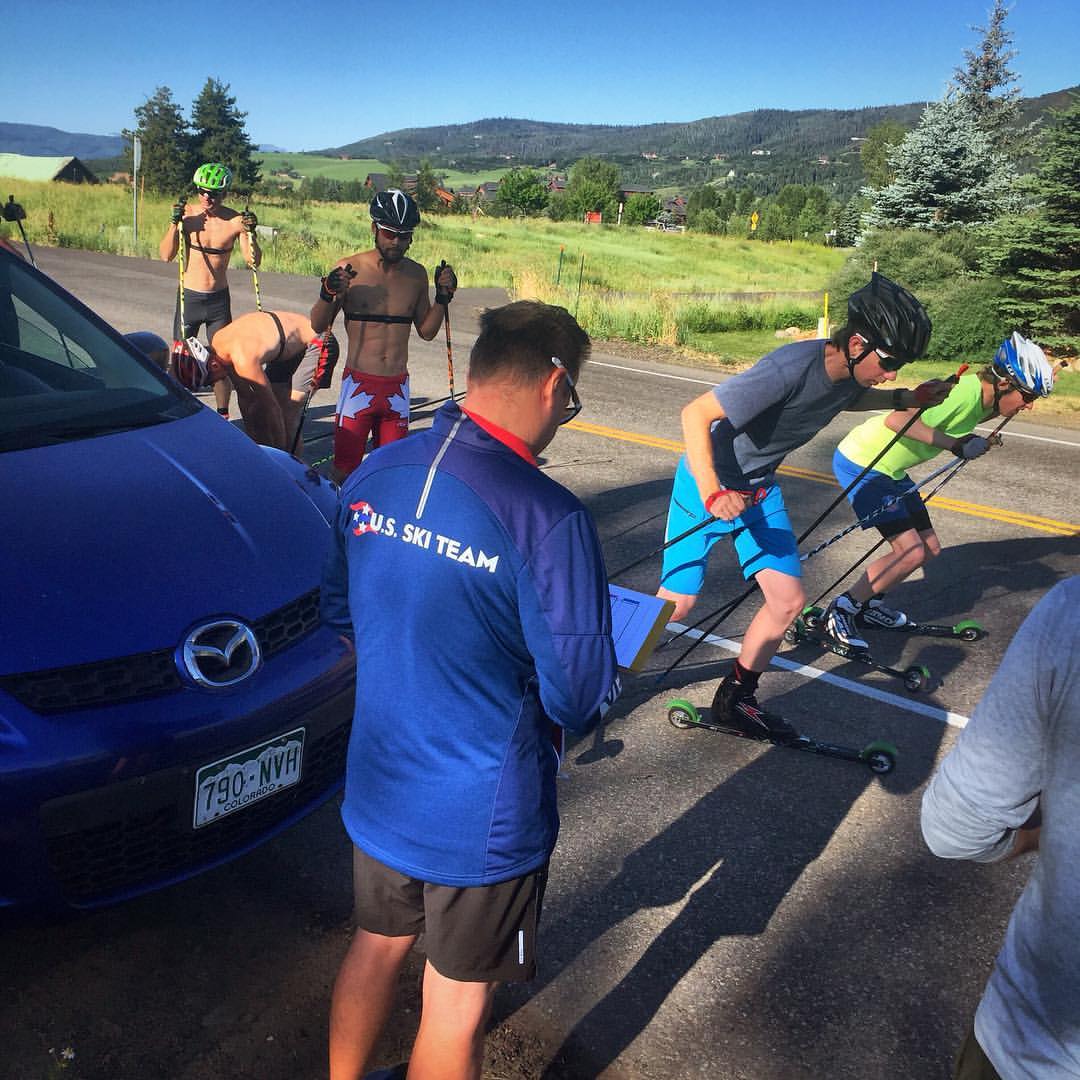
Taylor Fletcher cruising in the 2017 Fish Creek Time Trial in Steamboat Springs, Colo. (Photo: Jasper Good)
From late June into early July, U.S. Nordic Combined hosted a major training camp in Steamboat Springs, Colo. Among the sessions was the Fish Creek Time Trial, a skate rollerski race first held in 2007. That year, Johnny Spillane set down the first in a series of course records that would be improved by different athletes in the next decade.
The time trial is 8 kilometers and gains 885 feet of elevation, starting just south of Steamboat Springs and ending up in the Medicine Bow-Routt National Forest.
National team member Jasper Good is a Steamboat Springs native and remembers the first time he participated in the now-annual time trial.
“In 2012 Ben Berend and I miscalculated how long it would take us to get to the start,” he wrote in an email. “We proceeded to show up and were getting yelled at by everyone saying, ‘You’re starting right NOW, GO GO GO!’ Not the best first impression at a time trial with the National Team.”
A group photo of participants in the 2016 Fish Creek Time Trial, from “young guns” to Olympians. That year, retired gold medalist Billy Demong competed. (Photo: Jasper Good)
OK, that first start was a snafu, but that’s one of the points of the time trial: getting young racers like Good and Berend were then on the same pavement with the national team veterans and staff. Good is now 21 years old and collected his first Continental Cup top-10 last season, so he’s on his way to being one of those veterans that juniors can measure their progress against.
“We do the annual Fish Creek Time Trial with everyone from national teams down to young guns,” Good wrote.
The time trial is a suffer-fest, starting with rolling terrain that must be worked very deliberately, and also featuring a few walls.
“The first half is a gradual but hard rolling uphill with a lot of V2 gradient, an important part to keep your speed up and use momentum over hills,” Good explained. “About [5.5 k in], you hit the first wall of the race. After the wall there is a false flat with another segment of rolling uphill V2 gradient before you hit the final climb. As it starts to kick up more and more, you hit the second wall where you really don’t want to bonk. Because after the top of that, you only have about 250 meters to the finish. But the last 250 at the very top is a false flat that hurts oh so much. The race finishes with all the racers sprawled out all over the parking lot.”
Because there are now ten years of data, performances can be compared both between athletes and from year to year for any individual racer.
“It has been helpful to see the results from this time trial over the years,” Good wrote. “With it being a mid-summer uphill time trial, it is good to see overall fitness and willingness to suffer, but it’s not always a key indicator of how an athlete may race in a NoCo race come winter. It’s more of a checkpoint mid-summer.”
Other things can change over the years, too: as the “suffer-fest” becomes more and more like a normal race effort over the years, athletes can change how they approach it. For instance, Good’s warmup has changed a lot since that first year when he nearly missed the start.
“My warm-up now resembles my winter time warm-up more than ever,” he wrote. “When I was younger it was mostly just warmup to the start of the race from downtown and then just send it into the race.”
How To Make a Great Time Trial Course
U.S. Nordic Combined Coach Martin Bayer starts athletes at the 2017 Fish Creek Time Trial in Steamboat Springs, Colo. (Photo: Jasper Good)
There are a few things to keep in mind while putting together a rollerski time trial course: just finding the biggest hill with a paved road is not enough. Here are some reminders from Good, who has done Fish Creek for several summers in a row now.
Not All Uphill. “The first part is all about pacing it right and not going out to hard,” Good wrote. “If you go too hard at the beginning the two walls [at the end] are absolutely brutal. Technique and momentum is key in the first half.” Choosing a course with a big chunk of rolling terrain will require athletes to use good technique, execute on their transitions, and maintain momentum. That means that finishing times will reflect not only the athlete with the biggest ‘motor’, but also to some extent that they are skiing well.
Overall Time. “Taylor Fletcher set the time trail record this year at 23:02,” Good writes. “But most of us race it in 23:30 to 26:00, so it is very similar to our typical 10 k times [in nordic combined competitions]. I think it is key that it is in a sense the same time as our typical race, and the same sort of mentality.”
When the Gun Goes Off. How will you set up your time trial? Mass start? Interval start? For Fish Creek, there’s a very deliberate seeding strategy. “It is an interval start with reverse order and the best skier starting last,” Good writes. “In that regard, it is good for every athlete to have someone to chase, and perhaps a stronger skier to go by them. This is good because everyone can try their best to hang on to faster skier and learn how they ski the time trial.”
Pick a Location. If your club is big, this isn’t a big issue — you will always have people to race. But potentially consider whether you can locate your time trial in a place where athletes from surrounding clubs might consider commuting to, or a spot where regional or national teams sometimes host camps. “It is important for all of the NoCo crew to do this time trial together so that every athlete can see where they are at in comparison to the best (i.e. Taylor Fletcher the last few years),” Good writes. “It is also an annual thing so everyone can go out and try and best their time from previous years.”
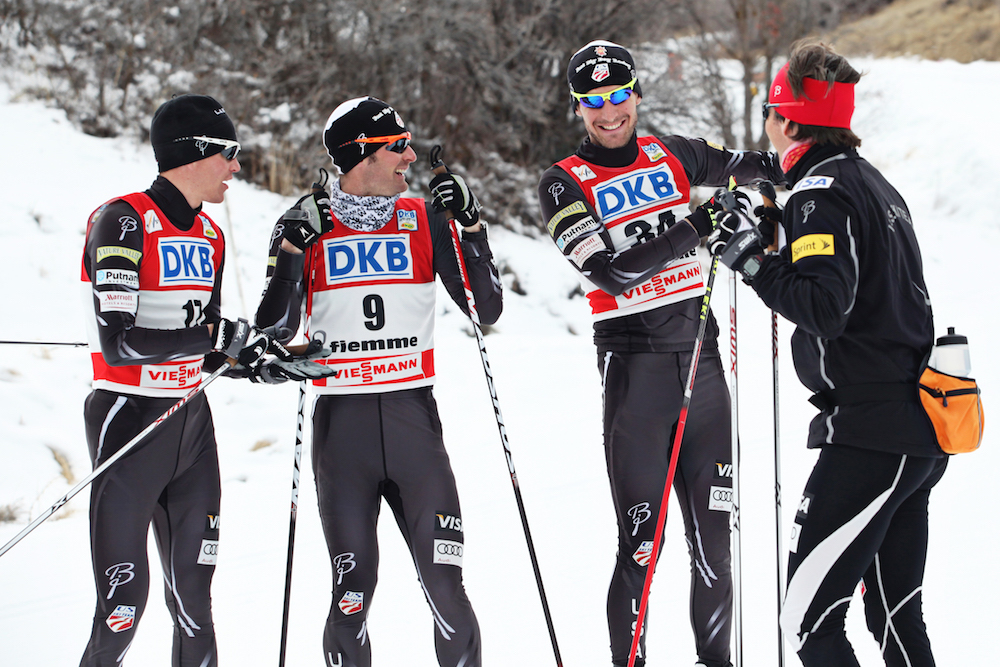
U.S. Nordic Combined’s 2011/2012 team members (from left to right) Billy Demong, Bryan Fletcher and Taylor Fletcher with head coach Dave Jarrett at Soldier Hollow in Midway, Utah. (Photo: USSA)
Listed at the bottom of a U.S. Ski & Snowboard Association (USSA) press release announcing U.S. Nordic Combined Head Coach Dave Jarrett’s retirement are his coaching highlights. It’s a long list defined by two things: Olympic and World Championship medals and longevity. Jarrett will forever be linked with the iconic names of U.S. nordic combined, including Billy Demong, Johnny Spillane and Todd Lodwick. His coaching legacy rewinds back to the 2002/2003 World Cup season.
Before that, as a nordic-combined athlete, Jarrett was a member of the U.S. Ski Team from 1992-1996 and is a two-time Olympian. He’s a lifer. And for lifers, separation from what they have always known remains difficult.
“I have been doing it a long time both as an athlete and and a coach,” Jarrett, 46, told FasterSkier on the phone. “It is now of those things where all of sudden it hits you, like, you are tired. You’re not able to go give everything and do everything. And certainly, it’s hard to justify a lot of time on the road. Missing family things, but also on the athletic side you are not able to give to the athletes everything that you need to give.”
Until 2014, USSA managed the U.S. Nordic Combined Team. The team is now run by USA Nordic, yet Jarrett’s position has remained under USSA’s umbrella — they continued to pay his salary. With the 2014 split, Jarrett’s responsibilities grew as he took on both coaching duties as well as some of the logistics of running a team.
Dave Jarrett, head coach of U.S. Nordic Combined, during the 2013/2014 season. (Photo: USSA)
“Honestly, it’s amazing he lasted as long as he did,” U.S. Nordic Combined A-team member Bryan Fletcher said on the phone from his home in Park City, Utah. “He’s definitely a trooper, for sure. It was pretty intense because he was still employed by USSA and still had bosses there, but he also had bosses on USAN and had obligations on both sides of the coin. That combined with continuing his education research for coaching stuff, it adds up quick. And then doing all the travel logistics for not only World Cup but for World Cup and B-team and then having to be there in person, it was insane.”
Taylor Fletcher, another longtime U.S. Nordic Combined athlete and Bryan’s younger brother, also noted the stress on Jarrett.
“He had definitely been challenged … he had to go from a full-time coach to a full-time coach and a team manager,” Taylor explained on the phone. “He was in charge of doing a lot of the fundraising, and all the aspects to keep our sport alive in the U.S. And that really took a toll on him and that was definitely difficult on all of us. But also, I think it put way more weight on his shoulders than he really needed.”
Diminishing funds correlates to increased non-coaching responsibilities for coaches, less on-snow time and more connecting the non-competitive dots for athletes. Jarrett weathered that type of job description metamorphosis. Ski coaching at the elite international level is an all-encompassing life, and he lived it for 15 years.
“For me and my wife, we got married while I was still an athlete and so this is a lifestyle, the only lifestyle we have ever really ever known,” Jarrett said. “Both of my children were born in 2002 and 2004. Again this is a lifestyle that’s all they have ever known.”
Demong, USA Nordic’s executive director for the last year, has spent nearly his entire international-skiing career under Jarrett’s wing. The two became teammates back during the 1996/1997 season when Demong bumped up to national-team status.
“DJ had a good understanding of physiology, so he and I bonded over that in the beginning,” Demong said. “Especially given the fact at the time we had a really good team culture developing but we didn’t have the physiological expertise in our training programs and that sort frustrated both us. So we sort of found a commonality there right out of the gate.”
After completing his competitive career, Jarrett went on to earn a degree in exercise physiology and kinesiology from the University of Colorado. He was able to bring his education into play as he joined the coaching ranks.
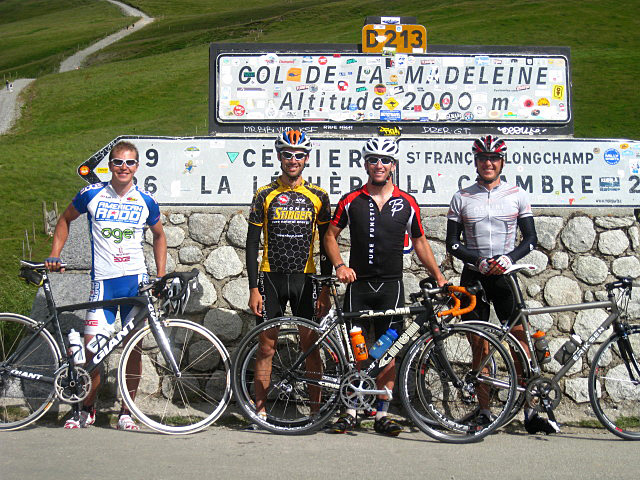
The U.S. Nordic Combined team takes a break at the top of the Col de la Madeleine during a 2009 training camp in nearby Courchevel, France. From left to right: Bill Demong, Johnny Spillane, coach Dave Jarrett, and Todd Lodwick (Photo: USSA)
“When he came back to coaching it was really a breath of fresh air,” Demong said about Jarrett’s academic and nordic-sports knowledge. “We had built this great culture and were all working really hard, but we still didn’t have the plan training-wise that I felt we needed.
“Going back to my high-school running days, we peaked when we wanted to peak for states and federations, and when we were doing our nordic training I felt like we were sort of doing what other nordic-combined skiers did, which was get up, ski, or get up, go jump, have lunch, go ski, go home,” he continued. “And DJ brought a ton of new ideas and concepts that he had learned in school as well as from networking with other sports. DJ really helped pioneer a lot of things on the physiological side and take our team from good culture, talented hard working athletes, to champions.”
Jarrett plans to open a strength and agility center in Heber, Utah, where he lives with his wife and children, the youngest of which will be entering eighth grade; his oldest will be a freshman in high school. As with any change, he said he looked forward to what the opportunity might bring and remaining close to his family. Yet looking back, Jarrett said he’d miss the small daily aspects of the sporting life.
“It’s the everyday victory I’ll miss,” Jarrett said. “I’m psyched to see the work that the athletes are putting in. The work that the coaching staff are putting in to see those everyday victories — those personal best, in testing, first time getting Continental Cup points, or first time getting World Cup points, or a World Cup podium. You can say the hardware is why you do it for sure, but I will miss is the everyday camaraderie and training.”
U.S. NoCo Moving Forward
Demong said the program remains stable heading into an Olympic season; Jarrett had been discussing a transition for the past several seasons.
“It had been something that has been on my radar for awhile and DJ certainly communicated early enough for me to to start planning, and quite honestly, we do have a good safety net,” he said.
U.S. Nordic Combined Assistant Coach Martin Bayer will step into the role of head coach. Bayer hails from the Czech Republic and began coaching domestically in the U.S. in 2000. He is currently based in Planica, Slovenia.
Demong said Bayer is entering this position with the institutional knowledge to make the coaching change seamless.
“Martin has worked his way up through the club system to the development team coach,” he said. “He has basically coached everybody onto the national team with the exception of Bryan, who is just a little bit older. So he has already a great relationship with all the athletes that are on the team. He knows all the athletes in the pipeline. … He knows the environment and he is familiar with how we operate, and there is a level of trust both from my end and with the athletes.”
Nick Huber will remain the program’s head ski-jumping coach. On the cross-country side of the sport, former U.S. national-team biathlete Jeremy Teela is advising the team. “He has agreed to come in and help us with domestic cross-country coaching and plan writing,” Demong said.
Jon Schafer, who had been U.S. Nordic Combined’s high-performance director for the last year, has also stepped down.
“Jon is a great and a good friend and very very exceptional high-level strategic thinker,” Demong said. “I think our organization is not at the point right now where we can take advantage of his talents and capacities fully, and quite honestly, we just need more boots on the ground. At this point, we are not going to fill that position. He has, however, written us a very detailed plan that we will be using as a road map going forward. It is a living document. For us, it is like everything from recruitment to medals and everything in between as it relates to coaches, education, and national-training centers.”
A business executive, Schafer brought management experience to USA Nordic, and on the sporting side, he was previously an elite-level rower and coach.
“My decision to step down was a very difficult one and one that I most certainly did not take lightly,” Shafer wrote in an email. “I loved working with the athletes and even after my departure, I am still very concerned about their success. It can be very difficult working in an environment of highly constrained resources, in particular with almost no support from USSA.
“Every position or idea simply cannot be funded and every shot has to be a kill,” he continued. “People are going to disagree about the best ways to spend highly limited funds and the tighter the budget, the harder it is to balance all of the different agendas. The organization has a lot of operational needs and the executive director and a few members of the board felt it was more important to have staff selling t-shirts, writing newsletters, marketing copy and other very ‘boots on the ground’ tasks, than a High Performance Director setting strategy and working with coaches and athletes at a higher level. I disagreed with this approach and since they couldn’t afford both, I tendered my resignation. I think this move is good for everyone, as the overall organizational dynamic proved to be a bit too bruising and tumultuous for an honest, easy-going, soft-spoken Midwest boy like me. I want to be very clear here too — my departure was a smooth and respectful one on both sides and I wish them nothing but the best.”
Always the jokester, Schafer (FasterSkier’s gear-review guru) added, “One big upside of this change for me too, is I now anticipate having much more time to write about how long you can wear your underwear without washing it. And perhaps teaching my Great Dane to finally respond to his name.”
The U.S. Nordic Combined team will meet in early May for an all-team camp, which will include all staff and any athlete with a chance of qualifying for the Olympics.
“It’s really going to be focused on learning more about ourselves, learning more about each other, learning how to communicate better and be tougher,” Demong said of the camp.
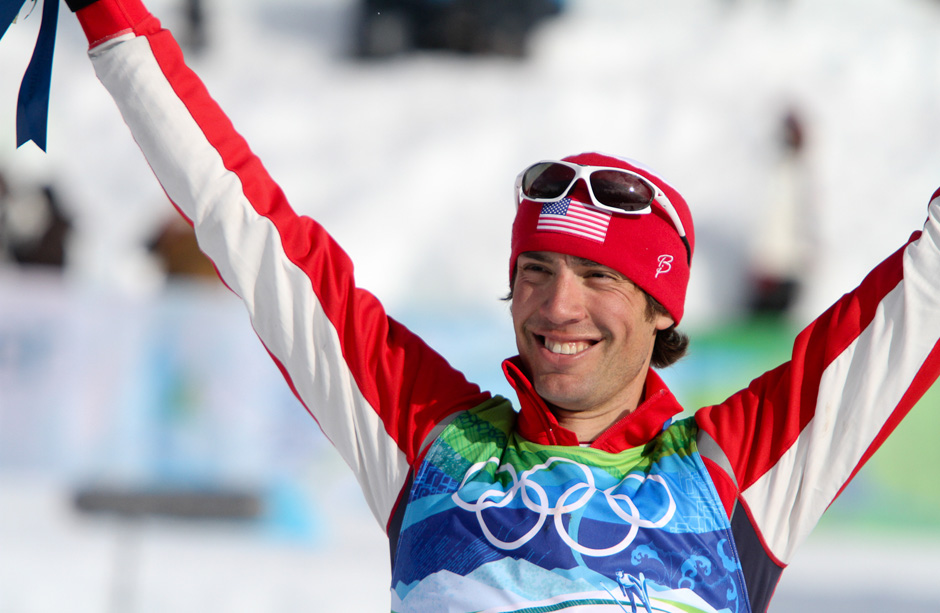
Four-time Olympian Johnny Spillane after notching his third-straight silver medal at the 2010 Winter Olympics in Vancouver, British Columbia. A longtime staple of the U.S. Nordic Combined Team, Spillane, 32, recently announced his retirement.
It’s hard to imagine U.S. Nordic Combined without Johnny Spillane.
For more than a decade, the Steamboat Springs, Colo., native has been the sport’s poster child, winning America’s first gold at 2003 World Championships and later notching three silver medals at the 2010 Olympics.
He’s been to every Olympics since 1998 and bounced back from several injuries to return to the team year after year. But this season, Spillane won’t be training for the 2014 Olympics. At 32, he recently decided to call it a career, and is the first of three over-30, A-team members to do so (Billy Demong, 33, and Todd Lodwick, 36, apparently have their sights set on Sochi, Russia).
The news came in the form of a letter to the Steamboat Springs community, published in Steamboat Today on April 18.
“I would like to take this opportunity to thank the community of Steamboat Springs for the incredible support it has given me over the years,” he began. His national-team career spanned more than 15 seasons.
Johnny Spillane (l) racing in the team event at the 2010 Olympics, in which he won his second of three silver medals.
“I’ve been very fortunate to be raised in this town and have the opportunities that Steamboat provides, but it is time for me to move on,” Spillane wrote. “It has been a long and productive career, and I have no regrets as I start a new chapter in my life.”
Not to worry, Steamboat; Spillane’s staying right at home. In an interview with FasterSkier, he explained that he’ll pursue passions like fly fishing and start by guiding this summer.
“It was a long, long career so I’m pretty excited to be done,” Spillane said on the phone of the decision he made a couple of weeks ago. Every year, he reevaluates, and this year, the time was right.
“I’m sure there’s more things that can be accomplished, but at the same time, there’s other things I want to do besides travel and ski,” he said with a laugh.
Initially, he plans to “explore as many different opportunities” as possible, which could include something in the fly-fishing industry and part-time junior coaching with the Steamboat Winter Sports Club.
“I don’t anticipate getting into coaching at any kind of high level because at that point you’re just traveling a ton anyways, and that’s what I’m trying to avoid to begin with,” Spillane said. “I would be open to [coaching] really young kids here in Steamboat, something that you could do a few nights a week, but beyond that I don’t have too much interest.”
While few are questioning his next steps, a lot of people are wondering why Spillane decided to call it quits before an Olympic year.
Simply put, he wants to spend more time with his wife, Hilary, and two daughters. His oldest, Hadley, is 2 ½, and Genevieve will turn 1 in May.
“It’s so much traveling and with having kids and stuff like that, I’d had enough,” Spillane said. “I’ve done this a long time. I’ve been to four Olympics and while it would be great to go to another, it’s not going to change my career in any way or anything like that.”
Last season, the 2003 world sprint champion competed in one event at World Championships in Val di Fiemme, Italy. There, he was 30th in the large-hill competition, and he cheered his teammates (Taylor Fletcher, Bryan Fletcher, Lodwick and Demong) on as they captured the nation’s first World Championships medal – bronze – in the team event.
“For sure, you want to be competing, but if you’re not gonna be the one out there, you want to be helping in every way you can,” Spillane said. “I was in the wax room, testing skis and doing everything I could to help contribute.”
His best individual World Cup result last season came in January, when he was 22nd on the large hill in Klingenthal, Germany. Despite traveling with the team all season, Spillane competed just five times. Hindered by injuries in the past, it wasn’t his body that was keeping him out of it this time. Rather, new rules required athletes to make the top 50 in preliminary jumps to advance to the actual competitions.
Spillane said he “struggled pretty heavily with the rule changes,” especially the tighter suits.
“There was a learning curve there and it took me a while to get it figured out,” he explained. “I don’t think I ever got it entirely figured out. I think that was by far the only contributing factor to some of the poor results I had because I felt really good skiing all winter long. It was just a matter of jumping well enough to put myself in any kind of position to be competitive.”
The changes were certainly “annoying,” Spillane said, but they’re also inherent in the sport. For a smaller nordic-combined squad like the U.S. it made adapting even tougher.
“Every time they make a rule change, it takes the countries that don’t have the financial capabilities to really explore the equipment a couple years to catch up,” he said. “You’re spending half your energy trying to figure out your equipment where you want to be spending that energy training and improving. That part is hard. Everybody gets frustrated with that.”
It’s also difficult missing out on opportunities to ski up to your potential. If Spillane could’ve made the top 50 on the jump hill more often last season, he believed he could’ve skied up to 20th or so.
But that’s all behind him now. Looking back on an individual World Championships gold, four national titles, and three silvers at the 2010 Olympic Games (the first of which was America’s first), Spillane said it’s the team he’ll remember most.
“What I’m most proud of is what the team accomplished as a whole while I was a part of it, whether it was individual results or team results,” he said. “Becoming one of the stronger nations in the world was for me one of the most exiting parts of it. The individual results and competitions were great, but I don’t focus on them all that much.
“Obviously I would’ve liked to have done better at every competition, but at some point you just have to be satisfied with what you did, and that’s where I’m at,” Spillane added. “I’m proud of the results I had, I wish some of them were better, but that’s in the past. I know that I did everything I could to get the results that I did get, and that lets you sleep at night.”
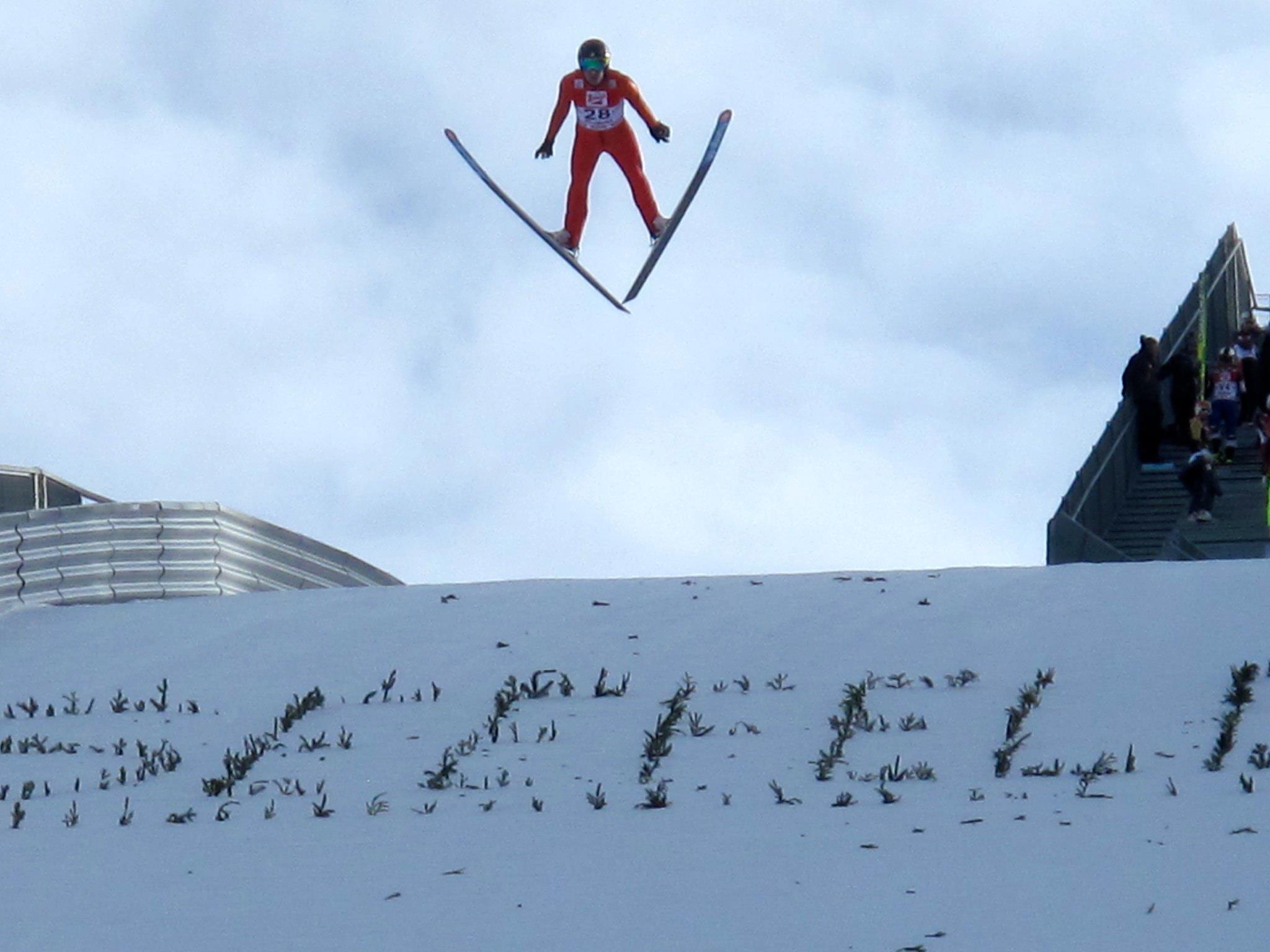
Taylor Fletcher jumping earlier this year in Seefeld, Austria, where he was fifth and third for World Cup career bests. (Photo: Michael Ward)
FasterSkier’s coverage of the 2013 FIS Nordic World Ski Championships in Val di Fiemme, Italy, is brought to you by the generous support of Fischer Sports.
VAL DI FIEMME, Italy – As more than a half dozen members of the U.S. Nordic Combined team and staff zipped around the stadium at Lago di Tesero on Thursday, several made jokes in the transitions between testing skis, but it didn’t seem to effect their efficiency.
That’s no surprise; three out of five of the team’s World Championships athletes have been to this level – the biggest thing outside of the Olympics – at least seven times. Todd Lodwick, 36, leads the group entering his ninth World Championships just a few years after winning two individual golds in Liberec, Czech Republic. Billy Demong, 32, also notched a world title that year in 2009, as well as a bronze, and just last year, he reached a season high of third in the Val di Fiemme World Cup. That success could mean good things for the seasoned U.S. team with multiple world titles, including Johnny Spillane, 32, who won the individual sprint here 10 years ago.
But this year, the team’s goal of three World Championships medals could largely ride on the performance of its youngest athletes: Taylor Fletcher, 22, and his older brother Bryan, 26. Both have notched breakout results in the past year, with Taylor most recently notching a career-best bronze at the World Cup in Seefeld, Austria, and Bryan winning the 134-meter large hill/Gundersen individual at the 2012 World Cup finals in Oslo, Norway.
The team also combined for a relay podium in early Januray in Schonach, Germany, with the two Fletchers, Lodwick and Demong combining for third behind Norway and Germany. It’s those kind of results that make the their coaches know big things are possible in the four competitions at World Championships over the next week and a half, but they know it’s going to take all they can muster to get there.
U.S. jumping coach Chris Gilbertson chatted with FasterSkier alongside the track on Thursday, one day before the team started the first competition: the individual HS 106 and Gundersen 10 k. The team event, with a 4 x 5 k relay, will take place Sunday, followed by the individual HS 134/Gundersen 10 k on Feb. 28 and the team sprint (2 x 7.5 k) on March 2.
FasterSkier:How’s everyone doing?
Chris Gilbertson: Pretty much everyone’s healthy. Todd’s been doing OK with the cough and stuff that he’s got. Since basically the middle of January, everything’s been moving better and better and better, going in the right direction. Bryan’s skiing is finally starting to catch up to the jumping side and of course Taylor has always been crossing fast and that confidence is starting to carry over into the jumping, which is nice. It sort of takes a little bit pressure off Taylor one way and then it also takes pressure off Bryan just to be the only guy that’s doing well. Also having Bill jumping better now, that was always his plan. He said, ‘Don’t worry, I’ll be ready by World Championships,’ and Dave and I were pretty much ready to strangle ourselves. All summer he was just horrible and we’re like, ‘I’ll get better,’ and we’re like, ‘Come on, when are you going to start?’ Finally, the last two weeks.
FS:What’s it like coaching a World Championships team with three seasoned veterans?
CG: It’s harder in some ways and easier in others. Easier in the sense that, you kind of don’t have to tell anyone what to do, they already know for the most part what’s going on. But on the other hand it’s really hard to tell the older guys what they need to do, because they already feel like they know, what they need to do. I kind of joke my coaching’s more reminding than anything, but it needs to be a little more forceful sometimes and you just can’t do that with the older guys because it just won’t work. The younger guys you can be a little more strict and stronger, with these guys, it’s kind of like, ‘Come on.’ If they’re on track, it’s fine, and when they’re not, it’s really hard to kind of pull them back into where you think they should be.
We just kind of have to let it run and let the results speak for themselves. [Head coach] Dave [Jarrett] is probably one of the best guys about this it’s like, ‘Look, it’s they’re performance and their results, and until they realize what’s going on, you can’t make them do anything.’ And it’s hard. It’s really hard to know that they’re making mistakes, that they’re a little bit off, or that they don’t want to listen. They’re still being stubborn in what they think is right. It’s not that we’re that far off, but sometimes it’s just enough.
Luckily they’ve all done it [won world titles]. You don’t have to reinvent the wheel in that sense, but just finding that, and we’re always saying the consistency.
FS:What do you think they’re capable of at these championships?
CG: It’s a little bit rough because we put high expectations on when we do the spring meetings, but I would say that the season so far hasn’t gone as planned. It’s been pretty good for Bryan and better and better for Taylor, but not for Johnny, Todd or Bill so I think that kind of tempers everything a bit. It’s not out of the realm of possibility but I would kind of say we’re gonna need to jump better than we’ve been to get close. We need to be within a minute and 15 or a minute to really get medal contention for sure. Definitely one of the better things was getting that third in Schonach [in a World Cup relay in Germany.] That showed Taylor went above and beyond and I think can pull it in. When we get close, we’re all right, but we can’t be that far out.
FS:What about the team’s past success in Val di Fiemme?
CG: I think on the big hill is better for Johnny, and I know these guys, they like the cross-country course. This is where it all began so it’s good. We trained here twice this summer. This is another place that we’re very comfortable, being at the hotel that we’re at, knowing everyone else here.
FS:What about the cross-country course?
CG: I thought it was really hard, which I think plays in our favor. I think it’s good for Taylor, good for Bill.
FS:How long has the team been training here?
CG: We just got here Saturday night/Monday morning. Bill loves to just show up as late as he possibly can. Bryan and Johnny like to come a couple days earlier than that. These guys aren’t affected by jet lag anymore. They won’t use that as an excuse ever. It’s only for Johnny, sometimes he’s got to stretch more and Bryan needs to get the cobwebs out a little, but then we’re good to go.
FS:What’s the goal at this point?
CG: A goal is three medals here, and however it happens, whether it’s one individual, one team, we’ll take any combination we can get. I’d be happy with one right now, the way things have been going.
FS:How key is having the younger guys step up?
CG: It’s good that that’s happening. We’ve been like, ‘Come on guys, we can’t depend on the older guys that are getting older,’ so it was good to finally see Taylor moving in and that breakthrough with Bryan last year was good.
Taylor Fletcher on his way to his first World Cup podium in Seefeld, Austria, on Sunday. Photo: Michael Ward.
Confidence breeds success, or so the saying goes, and with American Taylor Fletcher’s third place finish in the Gundersen normal hill competition in Seefeld, Austria, on Sunday it’s easy to see the truth behind it. One day after setting a new career mark, the Steamboat Springs native surpassed it again to finish just 2.9 seconds off Eric Frenzel’s (GER) winning time for his first career World Cup podium.
“It’s kind of sunk in, but it hasn’t really yet,” Fletcher said after returning from the hill. “I’m just trying to grasp what happened.”
As with his fifth-place performance on Saturday, a new best in jumping set Fletcher up to be in contention on the cross-country course. His skiing has repeatedly been the fastest in the field this season; his coaches know now that he’ll pop a good result if he ranks decently well after the jump.
“We knew he was capable of doing this and now he’s showing he’s able to do it, too,” said U.S. Nordic Combined head coach Dave Jarrett.
Taylor Fletcher in jumping in Saturday. Photo: Michael Ward.
On Sunday Fletcher stood in 21st after the jumping competition, slightly higher than the day before. He started 1:28 behind the leader as the competition moved to the course, a minute behind Frenzel and just 13 seconds behind the eventual runner-up, Mikko Kokslien (NOR).
Fletcher attacked the start of the 10 k the same way he did on Saturday, the difference this time being that he and the top group of three were able to create a safer distance on fourth and fifth.
To try and ensure the race wouldn’t come down to a sprint finish Fletcher attempted a breakaway towards the end, but wasn’t quite able to drop the others. He entered the finish lanes alongside Kokslien and lunged for second; the Norwegian eked just ahead of him in the photo finish.
“They were just a little strong at the end and I was unable to fully capture them,” Fletcher said. Still, “I had a better sprint today, so I was happy.”
Fletcher’s time was once again the fastest of the day, this time by 13 seconds. According to Jarrett, Fletcher’s first podium has been on its way since his first World Cup season in 2010.
“He’s getting older but he hasn’t done a lot of different things,” Jarrett said. “He just really paid attention to the small details and we did what we said we were going do, when we said we were going to do it.”
One thing Fletcher did credit with part of his recent success was racing bikes. Cycling has become a regular off-season sport for many members of the U.S. nordic combined team; last fall Fletcher became a Cat 2.
“It’s a big passion of mine and it’s so easy in Utah; there’s races every weekend,” he said. “You can get long hours of training and not put the suffer on your body. We’ve all picked it up and we’ve all seen that it’s worth it.”
A first-time podium appearance is something athletes remember for the rest of their lives. For Fletcher, it brought affirmation that he could put together the kind of day that he’d previously only been capable of.
“I made it onto the big stage with some of the better skiers and now I know I can do it on any given weekend,” Fletcher said. “I know my jumping can be better and the cross-country is just getting better and better, so I’m very excited.”
When you climb your first World Cup podium a few weeks out from World Championsips, do you recalibrate your expectations for the main event? According to Fletcher, not quite yet.
“I want to say yes, but at the same time it’s like, I’ve only done it once. So I can’t consider myself a favorite, but as of right now I’m skiing faster, so I feel like if my jumping continues to improve then I definitely have a good chance. Val di Fiemme is one of my favorite places, so we’ll see. I just want to take it in stride.”
Both Fletcher brothers have now stood on the World Cup podium; Bryan’s came in Oslo, Norway, last March. Both siblings say their lifelong training partnership has been integral to their individual success.
“We have each other to learn from and it’s been huge in getting us to where we are,” the younger Fletcher said. “It’s one of the biggest things that can contribute to my success, is being able to learn from him and him being able to learn from me.”
Bryan made his own progress in Seefeld this weekend, placing 15th in the jump and posting the 17th-fastest course time. It’s not where he wants to be yet, but it’s getting there.
“It felt great to have a decent jump to leave the weekend with,” Bryan said. “I will be heading into Klingenthal with a bit more confidence than I came into this weekend with.”
While most American athletes don’t get to see family for months at a time while they’re competing in Europe, the elder Fletcher was there to see his brother have a career breakthrough. “It was a very cool moment for me to see as an older brother and one day I hope we can share a podium together,” Bryan said.
“I am very proud of him. He has worked very hard to get a result like today.”
Johnny Spillane was 37th for the Americans on Sunday, 2:35 behind Frenzel’s mark.
U.S. Nordic Combined A-team member Bryan Fletcher on the top of the podium in at the World Cup Final on March 10 in Oslo, Norway. (Photo: Margo Christiansen/USSA)
Note: This preview has been updated to include comments from Billy Demong and Johnny Spillane.
The way U.S. Nordic Combined Head Coach Dave Jarrett sees it, why tweak something that works? Last year was a success by many measures with four athletes interchangeably placing in the top 20, some often in the top 10.
Olympic gold medalist Billy Demong hit the podium in his comeback season after taking some time off to raise a baby, and one of the team’s most promising up-and-comers Bryan Fletcher won the one-jump, single-race World Cup Final at Holmenkollen in Oslo, Norway.
That kind of momentum carried into the offseason with most of the team training in Park City, Utah, and a few others, like veterans Johnny Spillane and Todd Lodwick, living in Steamboat Springs, Colo. In July, the team jetted to Europe for its annual Tour de France camp, riding their bikes to catch parts of the multi-stage cycling race through the French Alps and Pyrenees. When that was over, they headed to Sochi, Russia, to test their jumping and rollerski skills at the International Ski Federation (FIS) Summer Grand Prix.
Todd Lodwick (second from left) on top of the podium at the FIS Summer Grand Prix near Sochi, Russia. Austrians Bernhard Gruber (l) and Tomaz Druml were second and third, respectively. (USSA/Dave Jarrett photo)
In the first competition, Lodwick, a three-time Olympian with his sights set on another in Sochi in 2014, finished second to Austria’s Bernhard Gruber. He had hardly been back in the game for more than a month after struggling with health issues – which turned out to be gluten intolerance – for the last two years. His lungs became so irritated by the allergy that he stopped racing last December, but by spring he determined the root of his troubles and mostly eliminated gluten from his diet.
On Day 2 in Sochi, Lodwick won the competition ahead of Gruber, who ranks seventh on the World Ranking list compared Demong (20th), Fletcher (24th) and Spillane (29th).
“It wasn’t a fluke,” said Lodwick, who ranked 54th after essentially two off-winters following the 2010 Olympics.
He peaked to place fifth at 2011 World Championships and notched two other top 10’s that year, but didn’t do many other World Cups leading up to it.
“Some people might think it could’ve been one way or the other, but they guy that went on to win [the Grand Prix] was the guy that I was dueling with from the get-go,” Lodwick added. “I take it as a huge confidence builder, I think for the team as well; we did very well there. We traveled and trained hard right before that. We went into it full-steam and we had that to build on for the rest of the year. I’m very pleased with the way I competed and I still have a lot to train for.”
So yes, it’s fair to say that Lodwick’s back. Even with a 7- and 4-year-old at home, the man who turns 36 on Nov. 21 is shooting for his first individual medal – this season at World Championships and/or at Sochi next winter.
As for the rest of the team, most of the A- and B-team and National Training Group flew to Europe in mid-October for a jumping camp in Oberstdorf, Germany, and Val di Fiemme, Italy. It was the first time they traveled overseas to work specifically on jumping about a month before the competition season, but it was something the coaches felt was necessary. With all the equipment and rule changes over the last few months, athletes still needed to get comfortable with their jumping skis, bindings and suits. Jarrett said the late-season trip to Europe was about building confidence.
U.S. Nordic Combined skiers Bryan Fletcher and Brett Denney skiing on fresh powder Friday afternoon in Park City, Utah. (Taylor Fletcher courtesy photo)
“We’ve been somewhat reactive to everything instead of proactive so we’re trying to get ahead of the curve now,” Jarrett said of the latest equipment and modifications to FIS jumping rules.
“Our model is to put ourselves in a position to win going into the cross-country race; we don’t necessarily have to win the jumping in order to win the whole nordic combined competition,” he said.
But it helps to do better on the hill in the first place. If a skier fails to make the top 50 in a World Cup jumping competition, they’re ineligible for the following skate race.
“If you don’t even make it in the cross-country race, it doesn’t matter how good of shape you’re in,” Jarrett said.
On Saturday, the team leaves for Lillehammer, Norway, where they’ll get a week of training in before the World Cup opens there. Until last weekend, neither the skiers in Park City nor Steamboat Springs had much snow to train on, and they hadn’t been able to jump on snow at home.
Things seemed to be changing for the better. On Monday, Taylor Fletcher wrote in an email that they had about two feet of new snow and hoped to be jumping Wednesday or Thursday. Lodwick planned to ski Rabbit Ears Pass outside of Steamboat on Monday afternoon.
With five men on the A-team this year, including Bryan’s younger brother Taylor, Jarrett said they’ll spend next week in Europe selecting the top four to fill their quota spots.
“We only have four start rights so we’ll have to make some decisions leading into the first comp,” he said. “We didn’t have enough tryout competitions to actually make it an objective decision of who we would leave home so we’re going to take five. Hopefully we can maximize the rotation with it and get some guys scoring points.”
Goals
In all, the team is looking for at least three medals to rival their performance at the 2010 Olympics (where Demong won gold, Spillane took silver in two events, and the team placed second in the relay). That’s number one, Jarrett said.
How to boost World Cup Quota:
— Make top 50 of World Ranking List: each team can have a maximum of eight athletes in a competition (seven from WRL; one from the previous period of the Continental Cup).
— Get a Continental Cup wild card: to reach the maximum of eight. Must make top three in the period with regard to COC points, which are counted the same as WC points.
“If we swept the events at SoHo and had the top 3 point scorers for the period then we could add 3 more spots maxing out at 8,” Jarrett said.
— Do well at Junior World Championships: “A new rule allows the medalists from JWC individual events to have a spot,” he said. “These spots are by name and don’t count against the 7.”
In the process, they want to increase their World Cup quota to at least five, which requires Lodwick to lower his world ranking within the top 50 in the first period (by January). The team is also hoping to gain wild cards with top Continental Cup finishers (like B-team members Brett Denney, Nick Hendrickson, Adam Loomis, Erik Lynch and Michael Ward) when it hosts those races in mid-December at Soldier Hollow in Utah. At most, the U.S. could potentially shoot for eight quota spots in a non-domestic World Cup race.
If they reach their goal of five this season, that carries over into the following year, which means they could take five guys to the Sochi Olympics.
“That’s going to require more different guys scoring World Cup points consistently,” Jarrett said. “On the surface it looks pretty nondescript but it’s pretty in depth when you think about what it’s going to take to do that.”
For the Continental Cup skiers, that means getting good enough results to earn starts on the World Cup. On the World Cup, they’re shooting for the top 50. Last year, Bryan Fletcher led the team in 17th overall on the World Cup. Demong was 20th, Spillane was 28th and Taylor Fletcher was 36th. While the World Cup overall is something to strive for, it’s not the focus this year.
The team’s got World Championships from Feb. 20 to March 3 in Val di Fiemme (Predazzo), Italy, to think about.
“Our first goal is to win three medals at the Olympics and that starts this season,” Jarrett said. “We want to win three medals at the World Championships in Predazzo.”
Asked what they’ve done differently to achieve that, Jarrett said nothing. As usual, most of the team’s athletes live high, train high and then try to kill it at sea level in Europe.
“We’re applying the same model that we’ve used since 2006 and earlier with Bill, Johnny and Todd to Bryan, Taylor, and now all those [B-team] guys, too,” Jarrett said. “I think everyone’s pretty motivated for the next 15 months or so to do whatever it takes to be on the podium in Sochi and Predazzo. If they’re not, than somebody else on the team’s gonna pass them.”
Internal Competition
That’s the fuel that’s fed their fire over the last several seasons. With veterans like Demong (age 32), Spillane (31) and Lodwick leading the way, younger competitors such as Bryan (26) and Taylor (22) Fletcher have worked hard to chase them down. In many instances, they’ve given their older teammates quite a run.
According to Jarrett, Bryan has been the team’s “measuring stick” in jumping for the last two years and Taylor’s been leading the pack in cross-country since the spring. Both have consistently challenged Demong, their main training partner in Park City, in time trials, testing and everyday training sessions. However, experience is also a key factor in racing, which should make things interesting when the teammates put their fitness and technique to the test in Lillehammer Nov. 24-25.
“There’s for sure frontrunners and we know who those are, but we have 10 guys fighting for five spots and that’s gonna make everybody better,” Jarrett said.
The Players
Bryan Fletcher
2011/2012 World Cup overall rank: 17th
Number of World Cup top 10’s last season: 5
Personal best: 1st at 2012 World Cup Final in Oslo
Personal goal: “Last year was a great result and an amazing way to end the season, but the hard work continues, and just because I’ve done it once doesn’t mean that it’s going to happen time and time again. I would feel much more confident getting on the podium a couple more times before World Championships or the Olympics; that would be huge.”
Coach’s comment: “The last camp in Oberstdorf, he was on fire,” Jarrett said. “I mean, jumping awesome, like winning-World-Cups kind-of jumping like he was in the middle of the season last year. It was good to see, I mean, he walked away from that with his equipment dialed in; he’s ready to go. The next step for Bryan, he knows he can be on the podium, so continue to get more podiums and then February 2013 [World Championships] and February 2014 [Sochi Olympics].”
Billy Demong
2011/2012 World Cup overall rank: 20th
Number of World Cup top 10’s last season: 6
Personal best: Individual Olympic gold medalist (won silver with relay), 2009 world champion
Personal goal: “My biggest goal is to win the Large Hill Individual and Team event in the World Championships in Val di Fiemme,” he wrote in an email. “Also to get one guy [who] has not podiumed at worlds to do so.”
“To be honest I am putting up bigger testing numbers and solid interval sessions than ever. I know that it is now more than ever about finishing races near or on the top!
Coach’s comment: “Bill is as fit and in good cross-country shape as I’ve seen him in a long time,” Jarrett said. “He’s still sorting out some equipment issues on the jumping hill. For whatever reason, we’ve just struggled finding him the right setup and we’re still working on it, and I think we’re on the right track. A lot of Bill’s success is gonna hinge on how well he jumps. … The reports [from the last jumping camp] were that Bill felt like he had a good setup and now he just has to trust it and go for it.”
“We have tried new boots, new bindings and new skis over the last few months,” Demong said. “It has been tough at times and it set me back for a little while but with my jumping coaches Chris Gilbertson and Greg Poirer we worked through it and now things seem to moving better and better. … My confidence is lower than normal, but I will live by the fact that your next jump is a product of your last so I aim to start having some good ones soon in Park City before we leave for Lillehammer.”
Johnny Spillane
2011/2012 World Cup overall rank: 28th
Number of World Cup top 10’s last season: 2
Personal best: Two individual Olympic silver medals (and another with relay), 2003 world champion
Personal goal: “My main goals are focused on the World Championships,” Spillane wrote in an email. “I’m hoping to have both good individual performances as well as contribute in the team events.
“I am injury free and it has been a good summer of training because of that. Last season was tough, I had a hard time putting together a good competition, I was either jumping poorly and skiing well or jumping well and skiing poorly. This year I’m hoping for a little more consistency.”
Coach’s comment: “He was jumping really well in October, and he’s in good shape,” Jarrett said. “He’s injury free, healthy. I don’t see any reason why we can’t start in Lillehammer like we started in Lillehammer in 2009/2010 [where he was 4th and 6th in World Cup races.]
“Ironically last year Johnny started jumping really well, but he got sick in the middle of the winter and was not able to race the way he normally was able to. It was a virus that kind of killed him from mid-January to the rest of the year almost. He got really sick after the races in Chaux-Neuve [where he notched season-best results of 8th and 9th], and never really recovered. … When he’s been able to go into the season healthy and injury free, he usually does pretty well.”
Taylor Fletcher
2011/2012 World Cup overall rank: 36th
Number of World Cup top 10’s last season: 0 (as a member of the B-team)
Personal best: 14th at Val di Fiemme World Cup (Feb. 15, 2012)
Personal goal: Breaking through on the World Cup and improving on last season’s performances. “More top 15 and hopefully achieve a World Cup podium and help out at world champs,” he said.
“We just got done doing some physical testing and I posted some of the highest numbers I’ve seen. Without a doubt I know I’m in great cross-country shape. Coming off the last camp I was jumping extremely well. I’ve got the itch to go and race in Europe as well as possible.”
Coach’s comment: “[Last year] he was named to the B-team from the previous season’s results and this year he’s on the A-team,” Jarrett said. “Like Bill, a lot of his success is going to depend on how he does in the jumping. We just need to get him to trust everything and just go for it and not overthink it and not want to win the jumping because he doesn’t need to win the jumping to win the race. He just needs to be in a good position.”
Todd Lodwick
2011/2012 World Cup overall rank: 52nd
Number of World Cup top 10’s last season: 0 (did five competitions, ended season in December)
Personal best: Five-time Olympian, 4th at the 2010 Olympics (won silver with relay), two-time world champion in 2009
Personal goal: “I want to be in the top 15 of the World Cup,” he said. “One of the biggest things is qualify in the top 50 of the world so we can get more guys on the World Cup. … I definitely feel like I have to earn my spot back onto the World Cup and that’s something that’s earned. I’m not looking for a handout by anyone. That motivates me to train hard and I have a lot riding on my shoulders.
“I was really, really sick last year and that ran a mental toll on me quite a bit, so definitely last season was a wash, was a disappointment,” he added. “It was probably one of the harder things to do, to cut gluten out. It was really hard for three months, but once I got over that hump it became easy. It was a no-brainer that gluten was the irritant. … This summer’s competitions proved that I’m still in shape and one of the better guys out there and I couldn’t have been more happy with the way the summer went.”
Coach’s comment: “I think that he’s focused and he knows that this has got to be his last chance to get an individual medal,” Jarrett said. “I think he wants that as badly as he ever has so he’s focused and ready to go.”
Billy Demong leading the chase group in the 10 k Gundersen competition in the Nordic Combined World Cup on Sunday in Val di Fiemme, Italy. Photo: Fiemme2013
When Friday didn’t go according to plan for all of the Americans on the Nordic Combined World Cup, they were happy to have Saturday to shoot for better results.
When the team sprint went better on the second day of competition in Val di Fiemme, Italy, with the two U.S. teams cracking the top 10, the four members were even more excited for Sunday. If trial and error told them anything, they figured they’d have foul-proof tactics for Sunday’s 10 k Gundersen start.
First, they concentrated on the jumping hill. Led by Bryan Fletcher in ninth, the crew posted a solid set of results with Billy Demong and Johnny Spillane ranking a respective 17th and 18th in the jumps and Taylor Fletcher jumping the 33rd best out of more than 50 athletes.
Relying on racing skills they had refined throughout the season, all four Americans went on to make the top 20. Demong skied the fastest 10 k of the day for third overall – his best World Cup result in two years. His previous best was a victory in Val di Fiemme in January 2010. He went on to win Olympic gold that year.
Bryan Fletcher tied a career best of seventh in the World Cup on Sunday with the 18th fastest time. His brother, Taylor, demolished his previous personal best of placing just outside the top 20, notching 14th overall. He skied the fifth fastest on the day, and Spillane was 19th despite recovering from a stomach bug.
Japan's Akito Watabe celebrates as he wins the Nordic Combined World Cup competition in Val di Fiemme, Italy, on Sunday. Billy Demong (USA) at right and Mikko Kokslien (NOR) at left battle for second. (Photo: Fiemme2013)
Japan’s Akito Watabe won Sunday overall in 28:27.8, setting a fast pace early on that Demong and Mikko Kokslien of Norway, who started 17th and 14th, respectively, did not try to reckon with. Instead, the two joined forces near the start, and skied into the race.
“Him and I like to ski a pretty similar race,” Demong said. “When we’re both skiing well, it’s controlled to start and just gets harder and harder throughout the race. [We] don’t go out crazy, just ski negative splits.”
Kokslien, who was part of the winning team sprint on Saturday, went on to outsprint Demong for second place, edging him by 0.9 seconds. Kokslien finished 3.0 seconds behind Watabe, and Demong said they were both surprised to see him in the stadium at the end.
“Honestly [Watabe] was so far in front of us at 5 k that we kind of just mentally let him go,” Demong said. “He had a minute and 20 seconds on us at one point so we were like, whatever, he’s gone.”
Demong said that was a smart strategy on his part. He was also impressed with his own tactics.
“I started off this weekend a little anxious and went out Friday and blew up,” Demong said of finishing 18th in the penalty race. “[I] went out hard, pulled away from the mass start [and] about 500 meters into the race, gapped off the field. Basically by 2 k was about ready to go back to the hotel.”
Although worn out from Friday’s race, he was more patient Saturday and helped secure sixth in the team sprint with Bryan Fletcher. On Sunday, Demong said he was recovered and ready to go, but wanted to again be patient. Skiing relaxed and controlled, he found himself in the hunt for a podium on the last lap.
“I started pulling away from the group without even knowing it,” Demong said. “Then [I] kind of had that confidence that, ‘All right, all I’ve got to do is go hard from here on out and not kill it,’ and we were left to fight it out, just Mikko and I.”
Bryan Fletcher hung with a group of 10 for most of the race and aimed to conserve energy for the end. With about 1 ½ kilometers to go, Bryan said six or seven remained in the chase for fourth place.
“It was definitely a challenging race and sitting in and not doing any work was a huge advantage for me in the end,” Bryan said. “I had a little bit fresher legs and more energy when the pace picked up .”
Taylor said he started near Austrian Mario Stecher, who helped him set a strong pace. The two skied together, and Taylor edged him for 14th by half a second.
“I felt awesome,” Taylor said. “I started dropping the guys behind me and catching more people. That’s a big energy boost so I just kept it going.”
U.S. head coach Dave Jarrett wrote in an email that the team was “psyched” with its collective performance to wrap up long weekend. “We want to keep the momentum rolling.”
“I’m pretty excited with our results this weekend,” Bryan said. “We had some chances and we didn’t take advantage of all of them but it’s there and the momentum’s going in the right direction.”
“To get a podium is great, but I think it’s even better to have the depth of the team,” said Demong, who added that he and Taylor Fletcher have a cumulative time bet for the season.
Going into Sunday’s race, Taylor was 5.5 seconds ahead of Demong, it terms of net time for all the World Cup races. Demong said he beat him by 10.3 seconds, putting him 4.8 seconds ahead.
“So we’re neck and neck,” Demong said. “And we’ve got six races left.”
On Monday, the team planned to fly back to the U.S. to train for two weeks before returning to the World Cup in Klingenthal, Germany, on Feb. 18. They opted to skip next weekend’s races in Kazakhstan.
Olympic gold medalist Billy Demong at the 2010 Vancouver Games
In some ways, starting off average works well for Billy Demong.
It’s not that he would prefer to rank 21st out of 54 athletes, although for some nordic combined athletes, that would be a good jump in the World Cup.
For Demong, a four-time Olympian and gold medalist, that result meant he was about 20 spots away from where he wanted to be.
On Sunday, the 31-year-old attacked the afternoon 10 k Gundersen start as he would have liked to on the 118-meter large hill in Chaux-Neuve, France. It was Demong’s last day of World Cup competition for nearly three weeks, and he went for it.
At the same time, so did his U.S. teammate Johnny Spillane, who ranked 20th in the morning jump. Working together, they captured their best results of the season as Demong finished sixth and Spillane placed eighth.
Starting 1 second in front of Demong, Spillane charged ahead to chase down his competition, and Demong followed. For most of the four laps, Demong and Spillane worked with Norway’s Mikko Kokslien to move to the front and drop those behind them, Demong wrote in an email.
They successfully caught second on the third lap, with only the weekend’s two-time defending champion, Alessandro Pittin (ITA), ahead. Demong held his position at the front of the chase group and attempted to drop his contenders on the last hill. In the end, he found he was too tired to sprint at the finish and fight for a podium spot.
While sixth wasn’t first, second or third, Demong was satisfied with his progress.
“I’m feeling good overall, building again,” Demong wrote. “My goals for this season are basically to get back on the podium and win. I’m also still satisfied to be struggling a bit as it fields my motivation to train harder.”
By struggling, Demong and Spillane and the rest of the U.S. crew generally mean their jumping. On Sunday, Demong clocked the third-fastest 10 k time (21:34.6) and Spillane had the fifth-fastest split (21:42.6).
Kokslien was the fastest of the day (21:30.6), and after starting 24th, the Norwegian placed third. Pittin picked up his third-straight victory of the weekend in 22:18.1 after becoming the first Italian to top the World Cup podium on Friday. Joergen Graabak (NOR) was second overall.
“They key to today’s race was jumping,” Pittin told EuroSport Italia on Sunday. “There, I made a difference.”
If Demong, Spillane or any of the other Americans had ranked fourth after the jumps, like Pittin, it’s likely they could have ended up in even better positions.
“The level both on the hill and on the course is really high,” U.S. Nordic Combined Head Coach Dave Jarrett said. “In order to win you have to very good at both sides in every comp. Not very much room for mistakes.”
American Bryan Fletcher placed 26th after ranking 28th in the jump. His brother, Taylor, finished 39th after starting 51st and Nick Hendrickson moved one spot down from 50th in jumping to 49th overall.
On the road almost as soon as the three-day competition ended, Jarrett said his athletes would fly home to train in Park City, Utah, and Steamboat Springs, Colo., for at least a week. The team will reunite in early February when the World Cup starts up again with a penalty race, team sprint and Gundersen start in Predazzo, Italy.
Johnny Spillane (USA) at the 2011 World Championships in Oslo. On Saturday, he notched a season-best ninth.
A day after Alessandro Pittin became the first Italian to win a nordic combined World Cup event, the Olympic bronze medalist repeated his success, edging Jason Lamy Chappuis of France on Saturday in Chaux-Neuve, France.
After ranking 22nd of 54 athletes in the 118-meter large hill jump, Pittin went on to catch the leaders in the 10 k Gundersen start and pulled out the victory in a photo finish with Lamy Chappuis and Fabian Riessle (GER), who was third.
Pittin posted the second-fastest time Saturday after Magnus Moan (NOR), who ranked 30th in the jump and first in the race. Not far behind the race leaders, American Bill Demong climbed his way to 12th place with the third-fastest split.
While Pittin added another achievement to the Italian history books, and Lamy Chappuis, who was born in Montana and moved to France as a kid, maintained his top spot in the World Cup standings, American Johnny Spillane lowered his season-best to ninth on Saturday.
Spillane had previously notched his best result of 2011/2012 season on Friday, when he finished 13th in Chaux-Neuve. The same day, Demong placed a season-best eighth, and Bryan Fletcher had his second-best result of the season in 14th.
“Everything has been slowly coming together, mostly on the jumping side of things,” Spillane wrote in an email after Saturday’s competition. “I have been feeling good on the skinny skis but needed to do a better job on the jump hill to have a chance.”
On Saturday, the second of three consecutive days of competition, Spillane was the ninth fastest in the 10 k after ranking 13th in the jump.
After seeing his best results in nearly two years following an injury that caused him to miss the beginning of last season, the 2010 Olympic silver medalist hadn’t met his podium expectations, but felt he was getting there.
“I’m feeling positive about the rest of the season,” Spillane wrote. “I feel like I’m in good shape but I still have work to do on the jump hill before I can be in there day in and day out.”
After Spillane, who was 7.9 seconds out of first, and Demong (+10.5), Taylor Fletcher was 31st and his brother, Bryan Fletcher, 32nd on Saturday. Both climbed from ranking a respective 49th and 41st in the morning jumping portion. Another American, Nick Hendrickson finished 41st after ranking 49th in the jump.
Todd Lodwick jumping in Oslo at World Championships last winter.
Jason Lamy Chappuis (FRA), the overall World Cup winner last winter, was back on top of the podium on Sunday for the second day of Nordic Combined competition in Ramsau, Austria.
“Of course I’m very happy that I can wear the yellow bib again, it’s a familiar feeling,” said Lamy Chappuis to the FIS media after his win. The 25-year-old has been on the World Cup podium 42 different times, and has stood at the top for 16 of them.
Sunday’s race was once again contested in the Gundersen format. The American squad didn’t fare quite as well as Saturday on the normal hill; Todd Lodwick led the way in 23rd heading into the 10 k, a place he maintained at the end of the race. Billy Demong ended up in 26th, Bryan Fletcher in 31st and Johnny Spillane in 47th.
USST Nordic Combined Head Coach Dave Jarrett, who was in Park City, UT for the Continental Cup over the weekend, said that there was definitely frustration on his team after Sunday, especially given that Fletcher and Demong had the 8th- and 9th-fastest times of the day, and know their jumping abilities are there.
Fletcher actually put together some of his best jumps this weekend in training, consistently jumping in the top 10 in his training jumps before competition. Successful jumps early in the day can sometimes have an adverse affect on the ones that really count, explained Jarrett.
“In jumping, the harder you try, the less you get,” said Jarrett on Sunday afternoon. “And if you perform well in the trial, it raises your expectations.”
To avoid the potential for his athletes to psych themselves out, Jarrett said they sometimes skip the training round and go straight into the competitive jumping.
In the 10 k, Jarrett said the course didn’t favor those who had jumped poorly and started further back. He echoed Demong’s comments after Saturday’s race, saying that it was hard to bridge the gap between packs without pulling your group along with you. In talking with him on Sunday, Jarrett gathered that Demong just hadn’t been able to drop the pack he was leading on the gradual uphill.
He was the top performer for the US, Lodwick’s result on Sunday was not his best either. Jarrett said his training suffered in the off-season from illness and from having to commute to Denver to treat his son’s health issues.
“He’s not in super shape,” said Jarrett. “But for what he’s been able to do…it’s good that he’s able to go out and [get 23rd].”
Spillane, meanwhile, has been struggling to dial in his jumping equipment. A recent FIS rule change altered the length requirements for jumping skis. Where the length of a jumper’s ski was once based on his height, now it’s determined by Body Mass Index (BMI). For most of the U.S. athletes, this resulted in no change in ski length. But for Spillane, who is tall and skinny, and therefore has a low BMI for someone of his height, his skis now have to be about 6 cm shorter.
“He fell into that breaking point on the chart,” said Jarrett. “He’s still trying to dial in skis that feel good, feel fast, and react the way he expects them to react.”
World Cup Nordic Combined competition moves to nearby Seefeld, Austria on December 16, 17 and 18.
Last weekend in Lillehammer, Billy Demong’s 11th place was discounted due to a penalty lap miscounting error in the new Nordic Combined pursuit format. In Saturday’s Gundersen format World Cup in Ramsau, Austria, he remained consistent with 11th place—improved, if you consider that last week he would have finished further back if he’d done a fourth penalty loop.
Norway’s Jan Schmid won on Saturday with his first career World Cup victory. Two of Schmid’s teammates have won World Cups this season so far—Magnus Krog in Kuusamo and Haavard Klementsen in Lillehammer—demonstrating the depth of the Norwegian squad.
According to Demong, the lead pack of 10 athletes stuck together for much of the 10 k race. The competition came down to a final sprint to the line between Schmid, current overall leader Tino Edelmann (GER) and Jason Lamy Chappuls (FRA).
The separation in jumping points was slim between the leaders going into the race. A mere 17 seconds divided the day’s best jumper, Chappuls, from the 10th-place man.
Demong’s jumping on the 98-meter normal hill improved dramatically in Ramsau over last weekend. He was in 14th heading into the cross-country portion. Demong attributed the gain, in part, to some new skis.
“Today was definitely much better jumping for me,” he wrote in an email, adding that his new skis “seemed to work!”
Fourteenth started him 33 seconds back from Chappuls. At the start of the race, Demong was feeling confident that he could win, but the flat course ended up not suiting his strengths.
“Magnus Krog (NOR) and I set out hard and worked really well together,” he said. The pair traded the lead on and off, but with the group of 10 skiers in front of them splitting the workload amongst the whole pack, “we were always 20 seconds behind,” Demong explained. He ended up +17.3 from the winner.
After several World Cup weekends under his belt this season, the Olympic gold medalist is feeling pretty good heading into the rest of the winter.
“I felt awesome in the race…and was able to push really hard the whole way,” he said. “I had the best legs of the year so far so I think good things will come when we get back on a more challenging course!”
Demong’s teammates also fared well in Ramsau. Bryan Fletcher improved upon last weekend, ending up in 21st with the 15th fastest cross country time. Todd Lodwick was not far behind in 29th, and Johnny Spillane finished in 37th.
World Cup Nordic Combined competition resumes on Sunday in Ramsau at 11:30 am CET. Live results can be followed online at FIS.
U.S. Nordic Combined veterans Todd Lodwick (L) and Billy Demong (R) celebrate 5th and 6th in the large hill individual comp at the 2011 World Championships in Oslo, Norway.
If the U.S. Nordic Combined Team got together for Thanksgiving, there might be less football watching and more talk about the kids.
That’s the way life is for almost half of the seven-man squad, with each of the “Big Three” aged 30 or older and with at least one child.
“It’s a different dynamic than it has been in the past,” said head coach Dave Jarrett, who has two kids of his own. “But it’s also a sign that these guys aren’t taking this as a hobby. … This is what their job is right now and this is how they’re supporting their family.”
Billy Demong, 31, was the latest to join the club when his wife, Katie, gave birth to their son, Liam, in January. While Demong said it’s not exactly all dad-talk when he travels with fellow veteran teammates Johnny Spillane and Todd Lodwick, it’s become a shared focus.
“Having a child is definitely something that changes your approach on a lot of things,” Demong said in a phone interview from Park City, Utah. “Yes, it takes away a lot of time and energy, but it’s time and energy spent with your child.”
Coming off a banner year in 2010, in which Demong captured two Olympic medals, including the first gold won by an American nordic skier, he took some time off to get married and renovate his Park City home last summer.
The plan was to regenerate — especially if he wanted to repeat his success at the 2014 Winter Games — and return to top form by the 2011/2012 season.
About a week before the team planned to fly to Finland for the World Cup opener in Kuusamo Nov. 25-26, Demong said he was ready to start the season. Like the two other dads and four 20-somethings on the team, the upcoming season was about setting personal goals.
Without any Olympics or World Championships this season, 28 World Cup events remained. The Americans would try for top finishes in most of them.
Goals
According to Jarrett, the World Cup is the main focus of the team this season, mainly because it’s all there is. While striving for the overall title would be harder than preparing for one big event, it’s the goal the coaching staff presented.
“We’re going to attend all the World Cups with the plan of chasing the overall as high as we can,” Jarrett said. “But we’re not living or dying by it either. We’ll adjust if needed.”
For starters, the team will miss two races by opting not to travel to Almaty, Kazakhstan. Then again, if one of the Americans needs to race there, Jarrett said they might reconsider.
“We’ll just have to play it weekend by weekend,” he said.
In the long term, most of the team is focused on performing when it counts, Demong said.
“What it takes to peak is not necessarily best for the whole season,” he said. “This is a good year for trying to find a high level and try to keep that … without sacrificing anything on either end.”
While all the athletes work to find their groove, a few will try for World Cup podiums, Demong said. Personally, he would not approach the season with an overall-title-or-bust attitude. In 2008 and 2009, Demong finished third overall in back-to-back World Cups. The first time, he exhausted himself trying maintain second and ultimately placed third. The next year, Demong said he didn’t care as much and ended up third anyway.
“To me, it’s not as important to focus on the overall; it’s important to focus on today and the here and the now,” he said. “It’s not something to stress from the beginning.”
An exhausted Demong at the finish at the 2011 World Championships in Oslo, Norway.
The Players
After somewhat of an off-year in 2010/2011, Demong still managed to come back to competition midseason and place sixth and seventh at the World Championships. In August, he was third in the debut of the penalty-race format at the Summer Grand Prix in Germany.
While it was early in the season, Jarrett said top performances like those of Demong — who was on a similar pair of rollerskis as everybody else — were good indicators for the winter ahead.
When Demong returned full time in April, he discovered he was more focused and motivated. With a family to look after, Demong said he wasn’t as carefree about his training and did less cycling to concentrate on nordic combined.
Learning how to be efficient with his time helped him bounce back, he said.
“I feel like I’m in as good shape as I’ve ever been in summer training,” Demong added. “And a lot of times, I’m not the best guy (on the team) anymore, and that’s really motivating.”
Bryan Fletcher racing in the large-hill team competition at the 2011 World Championships, Oslo, Norway.
Demong not the best? A few weeks ago, he was third in a team time trial. TheFletcher brothers — Taylor and Bryan — finished ahead of him in a respective first and second.
Up-and-comers like Taylor, 21, and Bryan, 25, made a difference. While Spillane and Lodwick trained in Steamboat Springs, the younger teammates kept Demong honest in Park City.
“We’ve always had this kind of focus on team training where the whole goal is to keep each other motivated,” Demong said. In the past, a few top teammates kept the others gunning for them.
“To be honest, I think that Bryan and Taylor are as fast as those guys now,” Jarrett said. “It definitely helps to know that if you can beat Bill or you can beat Johnny, that you can pretty much beat anybody in the world.”
With Demong, Spillane, Lodwick on the A-Team this season, Bryan finished 30th overall in the World Cup last year in his first full season on the circuit. Lodwick was the only American to do better, placing 25th.
This year, Lodwick, who placed fifth at worlds, is approaching the season a bit more tentatively while dealing with some pulmonary issues. Jarrett said he has been coping with asthma for years; “he just can’t seem to shake it.”
“His plan is a little bit more focused on certain events and not so much the whole season, per say,” Jarrett added.
The oldest on the team with two children, Lodwick, who will turn 35 at the end of the month, will spend the beginning of the season with his family, Jarrett said.
“Todd’s going to do a little bit of an abbreviated schedule to keep him in the game,” he said. “He’s kind of at that point in his career where he wants to focus on the big events, and since there’s no big events or World Championships this season … he’s not committed to (focusing) on the overall.”
Spillane celebrating silver at the 2010 Vancouver Olympics.
Three days before Lodwick’s birthday, Spillane will turn 31 on Nov. 21. This time last year, Spillane was recovering from a torn ACL, MCL and meniscus in his left knee. He managed to crack the top 20 at the World Championships despite the setback.
Spillane entered this season injury-free, a claim he wasn’t used to.
“Johnny’s been bitten, his whole career, with injuries,” Jarrett said. “2009/2010 was one of the first seasons he didn’t spend the spring doing rehab.”
That year, he racked up two individual silver medals and another with the team at the Vancouver Olympics. While Lodwick did not make the 2011 Summer Grand Prix, Spillane and the Fletcher brothers all cracked the top-20.
Joining Taylor on the B-Team, Denney and Hendrickson will try to break into a higher level of international racing, like Taylor did in placing 26th at worlds last year.
“They continue to improve and that’s what we need,” Jarrett said. “Now with tightening budgets, the key to having an active winter is to be competing in the World Cup.”
Last year, the 20-year-old Hendrickson finished a respectable 53rd in the Continental Cup and Denney, 21, was 58th overall.
While backcountry skiing on Mt. Baldy in Alta, Utah, Billy Demong (not pictured) snaps a photo of training partners Jeremy Teela, Nick Hendrickson, Bryan Fletcher, Brett Denney and Taylor Fletcher on Nov. 9. Photo courtesy Billy Demong.
Starting Off
While the team is scheduled to fly to Finland on Saturday, a last-minute decision could could change its plans. In the event of no snow in Kuusamo, which was the case for the cross-country World Cup opener, the races could be moved.
“Murphy’s Law is that they’ll change it and cancel it while we’re in the air,” Jarrett said on Monday. “Hopefully I can stay ahead of it.”
As of Friday, the team’s plans were in tact and its members were ready to roll. They started jumping on snow Saturday in Park City and Wednesday in Steamboat Springs, and Jarrett said they were the first two jumps open in the world.
“We kind of feel like we have a leg up on everyone,” he said.
Regardless of what happens with Kuusamo, the possibility of competing in Sjusjøen, Norway (which will host nordic-combined World Cup events Dec. 3-4), is good.
The International Ski Federation decided to move the cross-country World Cup opener to Sjusjøen for this upcoming weekend because of its colder temperatures and snowmaking capabilities.
Demong was confident the conditions would hold up for nordic combined.
“That’s good for us because it kind of puts Sjusjøen on the line to make sure they have snow,” he said.
Johnny Spillane at World Championships in Oslo, 2011.
Johnny Spillane, three-time Olympic silver medalist in Nordic Combined, returned to competition last week at the FIS Summer Grand Prix. After a long knee injury recovery and subsequently difficult World Cup season left the 31-year-old’s plans for the future up in the air, his participation marked an important decision to continue skiing. The question remains, however: how long will he be back for?
When an odd cliff jump landing put Spillane out for four months with a torn ACL and MCL last July, the 12 year World Cup veteran was no stranger to injury. With years of experience dealing with recurring shoulder problems, US Nordic Combined Head Coach Dave Jarrett called him a “pro at rehab.”
Experienced or not, however, when combined with the break he took from training after Vancouver, the diagnosis left Spillane out of commission for eight months headed into the 2011 season. He didn’t join his teammates in Europe until this January in Seefeld, Austria, with a 44th overall finish.
The 31-year-old seemed to struggle to regain his footing through the rest of the season, especially in the jumps; his best result was a 17th at the pre-World Championships World Cup in Chaux-Neuve, France, and he was far off his jumping form throughout the winter.
As of the end of the season, Spillane’s future plans with the team were left uncertain. In March, he said to FasterSkier, “I still have a desire to keep skiing so it’s a hard decision to make, that’s for sure.”
With his return to competition at the Grand Prix last week, however, it seems Spillane is back in the game, at least for the time being. After the first weekend jumping and rollerskiing in Oberwiesenthal, Germany, where he placed 43rd, he said he felt good and was excited to be back. Despite being disappointed with his first result, Spillane said his knee didn’t give him any trouble, and he felt good overall.
“I wanted to take some time after last season to see how I felt about everything,” he said in a phone interview. “I talked with my family and my coaches, and I’m psyched to be training again.”
Spillane, on the podium three times in Vancouver.
Asked if he is aiming for the the 2013 Val di Fiemme World Championships or what would be his fifth Olympics in Sochi, Spillane didn’t make any promises. With his health never a guarantee, he said he is taking the rest of his career “one step at a time.”
The decision to continue competing on the travel-intensive World Cup circuit became even more difficult with the birth of his daughter Hadley last August. “You definitely have to make adjustments,” he said. “You can’t be quite as selfish as an athlete as you were before.”
Demong in action at World Championships last winter.
Bill Demong and Bryan Fletcher led their Nordic Combined teammates to a “reassuring” start of competition this weekend at the FIS Summer Grand Prix in Oberwiesenthal, Germany. Fletcher kicked things off with an 8th overall in Saturday’s Gundersen format, and Demong led the way to the podium with a 3rd place on Sunday.
Though the Grand Prix series isn’t a World Cup event this year like it has been in the past, Demong said he and his teammates approached the races just as seriously as they would any other.
“These races are about getting us contact, which is hugely important; getting used to racing guys from other nations, skiing under fire, and just getting back in the mindset of dealing with the weather and other competitors,” said the 2010 Olympic gold medalist.
Fletcher’s 8th on Saturday, 38 seconds off of Germany’s Eric Frenzel, was his career best World Cup-level result. “I put together a good jump and a good cross country race, so I’m pretty stoked about it. It’s a great way to start off the Summer Grand Prix,” he said on Sunday, adding that it was great to be able to see that he’s on track for the winter.
Fletcher’s brother Taylor placed 21st overall, and came from a 49th on the hill to ski the 6th fastest time of the day out on the course.
Another highlight of the day was Erik Lynch’s chance to enter a high-caliber race, a rare opportunity for the 17-year-old. As part of the National Training Group that has been training in the Czech Republic for about a month, Lynch was able to take the entry spot left empty by the fact that Johnny Spillane couldn’t join the team in time for Saturday’s competition.
Demong on the podium in Germany (Photo: Dave Jarrett)
“Erik is 17 years old getting essentially a World Cup start,” said Head Coach Dave Jarrett. “[The NTG] was already here and it was a unique opportunity…I think he was a little bit awe-struck but he wasn’t intimidated by any means. He certainly skied pretty good.”
Demong struggled on Saturday with the jump portion, and a broken pole in the fist lap on rollerskis left him off the pace for the remainder of the race, where he ended up in 30th. Though he could have jumped better and skied faster, Jarrett noted on Saturday, “Bill knows what he needs to do.”
With Sunday’s 3rd place finish, it seems Jarrett was right. Demong, who finished 32 seconds behind the winner, Johannes Rydzek (GER), was also the first finisher across the line who had had to ski a penalty loop in the new racing format. He was reassured by how his day went, especially given the step back he took in his preparation last year. “It was my best result in a couple of years at the World Cup level…[and] it was the first real competition this season, so it gives me a lot of confidence going into the winter,” he said on Sunday.
Taylor Fletcher ended up with five penalty laps and finished 36th, while his brother Bryan finished 40th with four penalties.
Johnny Spillane returned to competition after a torn ACL, MCL and meniscus last summer left his plans after the World Cup season uncertain, and completed four penalties to finish 43rd.
Fitness-wise, Spillane said he thinks everyone is where they should be. “I think everybody is in a pretty similar spot; we’ve been training together quite a bit,” he said, though “Bill was damn good.”
“I think all three of us had a good race here,” agreed Demong. “Johnny had a bit of a wake up today, but he’s definitely fit.”
In addition to serving as a good test of their fitness, the debut of the penalty race gave everyone a chance to test out the tactics and logistics involved in a format being added to the World Cup this season. Based purely on how far they jumped, skiers had to complete a certain number of 150-meter penalty laps throughout the cross-country portion of the competition. Athletes could complete their penalties at any point during the six laps of the mass-start race, except on the first and last legs.
The trial got mixed reviews. From the coaches’ perspective, Jarrett said it was definitely interesting, but there were also issues that couldn’t have been predicted until the race was run. Chief among them was the fact that the course was too narrow for a mass start rollerski race. He said it was also hard for him to tell how his athletes were really doing throughout the competition, as it was difficult to keep track of who had already done their penalty laps.
The confusion especially affected the athletes. “There was a lot of chaos,” said Bryan Fletcher. “You had no idea where you were in the race. All of a sudden people in front of you disappeared to do penalty laps.”
The U.S. athletes went into the race with the strategy of completing the penalties when there were as few people clogging the loop as possible, with the expectation that everyone else would try to get them out of the way early and they’d have to wait until the end of the race. But when the first opportunity came and no one was in the penalty zone, Spillane said they decided to go for it.
“Tactically, it’s hard to tell if it was a good or bad decision,” he said.
Competition was also affected on the hill, where the elimination of wind compensation (and all other style points) had officials trying to send everyone off with comparable amounts of wind, causing the jumps to take twice as long as they usually do. Despite the effort, Jarrett said conditions still made the jumping “a luck of the lottery.”
“We’ve had quite a few formats in the last few years that I’d like to see introduced [on the World Cup] before this one,” said Demong. “It could be exciting, but it made the competitors wait around. The mass start meant that a lot of people caught a ride off the pack that wouldn’t have otherwise.”
Though there were problems with the format, there will be time to make adjustments before it appears on the World Cup.
“They have some formatting issues to solve; tomorrow there’ll be a meeting to get feedback from coaches, and a committee will meet on Tuesday and come up with solutions,” said Jarrett.
The FIS Summer Grand Prix continues in Liberec on Wednesday and ends with two more competitions in Oberstdorf on Friday and Saturday.
Demong, Spillane, Lodwick and Camerota (l-r) following their silver medal at the 2010 Olympics.
The most successful group of nordic athletes the US has ever seen? Unquestionably. With a grand total of nine individual Olympic and World Championship medals the trio of Billy Demong, Johnny Spillane and Todd Lodwick have more hardware than all other US cross-country, nordic combined and biathlon athletes combined.
With the World Cup season coming to a close in Lahti, Finland two weeks ago, the questions have begun – is the band breaking up?
The answer is not clear at this point. Before the 2011 season started, Demong committed through the 2014 Sochi Olympic Games, backing off a bit for this year in order to recharge his batteries.
Lodwick and Spillane, on the other hand, were uncertain, but following the large hill individual competition at World Championships, Lodwick told FasterSkier that he was in through Sochi as well, leaving only Spillane to make up his mind.
While all three pushed through sub-par seasons for various reasons, in many ways, it was Spillane who had the toughest time of it. The 11-year World Cup veteran suffered a knee injury this summer tearing his ACL and MCL cliff-jumping in Lake Placid.
Johnny Spillane during the third leg of the team comp in Oslo.
It was a long road back to full strength, and he struggled to regain his top jumping form. At World Championships in Oslo, Spillane was never in contention for the medals after the jumping portion of the competitions, a far cry from a year ago when he won three silvers at the Olympics.
“I haven’t really made a firm decision,” Spillane told FasterSkier in a phone interview earlier this week. “I still have a desire to keep skiing so it’s a hard decision to make, that’s for sure.”
Spillane is going to take his time, not wanting to rush into anything.
“I’ll make the decision when it seems like the right time. At this point I would say two months,” Spillane said.
He will continue to train as if he will compete next season as he ponders his future.
The 30-year-old from Steamboat Springs, Colorado has six World Cup podiums in addition to his two Olympic medals and World Championship gold.
“I’m obviously happy with what I’ve done,” Spillane said, but notes that “there’s still a lot more that can be done.”
If it seems like Spillane has been around for a long time, you just need to peruse Lodwick’s resume for a bit of perspective. His first World Cup start came back in 1995, and he is competed in an impressive five Olympic Games – and now number six is in his sights.
Lodwick will be 37 in Sochi, an unusually high age for an Olympic athlete, let alone a medal contender, a fact that is not lost on the man himself.
“I think that is kind of a story in itself,” Lodwick said just minutes after finishing fifth in the final individual competition at World Championships, a race he termed “the best of my season”. He continued “It is pretty cool for a 37-year old to go to his sixth Olympic Games – it is something. ”
Lodwick (l) and Demong (r) celebrate 5th and 6th in the large hill individual comp at World Championships.
In 1997, Lodwick competed with current US Nordic Combined coach Dave Jarrett in the team competition at the Trondheim World Championships. Four years later, he teamed up with Spillane and Demong for the first time in a World Cup team event.
The race was a three by five kilometer relay and the US placed fifth, less than a minute out of the win. A year later at the Salt Lake Olympics, the three men were joined by Matt Dayton, and placed fourth in the team event, a minute off the podium. It would take eight years to make up that time, and in Vancouver the US took silver in the team comp.
If Spillane does opt for retirement, it does not mean the end of US medal chances. Demong and Lodwick should continue to challenge in individual races, and with the emergence of Bryan Fletcher and brother Taylor, the four-man relay squad holds promise.
And if Brett Camerota can bounce back from a rough season, the depth is even more impressive.
The big-three, however, each with either a World Championship or Olympic gold, are missing the top prize in the team event. They were foiled by bad skis in Vacnouver, and while in the hunt for the podium after the first leg in Oslo, they quickly fell off the pace.
Lodwick is ready for more, even after 16 years on the World Cup and the “most hectic and frustrating” year of his career.
“I don’t do this for the money. I do it to feel good,” he said, adding with a laugh, “I do it to look good in the mirror.”
He continued more seriously “It’s something. It’s a lifestyle. We are surrounded by a lot of great people. For some reason I like punishing myself. I just love the sport.”
Olympic and World Championship gold medalists touring the world with a sewing machine? Professional athletes have unique and interesting ways of reducing stress and passing the time on the road, but sewing is not the new hobby of the US Nordic Combined, though I am sure the ski world would love to see what Todd Lodwick could come up with for the Oscars.
The sewing machine is a critical part of the racing gear the squad needs to compete at the highest level. The issue at hand is that the FIS rulebook it as thick as the New York City Yellow Pages. The rule book details every part of the jumping competition, including equipment rules. And that’s not to be taken lightly, although the FIS officials seem to interpret them differently every time, the guys explained.
So to be on the safe side, the nordic combined skiers generally check in the day before the competition to get their suits cleared by the local FIS technical delegates, as they interpret the rules and with their measuring tapes. If you show up on race day with a suit that is not within the standards, you get disqualified, no exceptions.
The suit, which is made of a foam-like material, cannot be more than 5 millimeters thick. No part of the suit can be more than 6 centimeters wider than the body part it covers.
Bryan Fletcher and a fully legal suit – at least it was legal at the FIS control the previous day.
There are rules for how many panels of material the suits can be made from ,and how they have to be designed. For instance, the torso section is made from no more than 6 panels: two in the front, two in the back and one on each side. The distance from the seam front side to the seam on the front side on the other side has to be the same.
Additionally, there are individual measurements that have to be considered, based on the racer’s height. For instance, Taylor Fletcher’s inseam – as measured from the center of the crotch to the ankle cuff – has to be exactly 84 centimeters, not 85 or 83.
The veterans on the US Nordic combined team has been through the routine more times than they care to recall. And accordingly, they travel the world with a sewing machine. The seamstress on the team? Bryan Fletcher has shown that he has a good handle on the art.
“We waste a lot of time and money on suits,” Johnny Spillane said with a sarcastic grin.
Teammate Billy Demong sighed and agreed:
“We spend more time dealing with jump suits than anything else in this sport.”
The team landed on Norwegian soil on February 15, and made a beeline for the suit factory Spinno in Vikersund. A new shipment of suits was waiting, the skiers as excited as children on Christmas Day.
“You know the feeling right off the bat. It makes everything else so much easier. You can rely on a good suit to perform. But the best guys still win,” Todd Lodwick said.
However, the Nordic combined obsession with suits, fabrics, designs and measurements can easily be compared to the cross-country skiers’ scientific approach to picking and collecting skis. Cross-country skiers generally have a large selection of skis with all kinds of grinds and flexes. On the jumping side, nordic combined skiers don’t worry as much about skis, grinds and flexes, and often having one pair of jumping skis. So much is literally riding on the suits, or perhaps more aptly, in the suit.
The lead group of David Kreiner (AUS), Bjoern Kircheinsen (GER) and Haavard Klemetsen (NOR) during the second leg.
Second chances are few and far between in professional sports, but with the International Ski Federation adding a second Nordic Combined Team event to the 2011 World Championships, Germany had just that.
After taking the silver in the first team competition on Monday, Germany extended an impressive streak of five straight World Championships finishing second. The extra opportunity would not change the results however, and the Germans once again came up short, this time by no more than two feet.
Austrian Mario Stecher outsprinted Germany’s Tino Edelman to claim gold, while Magnus Moan brought Norway the bronze, forty seconds down.
Todd Lodwick flying for team USA during the final group of the team competition in the 4x5km relay..
The US team, fifth after the jumping was unable to move up in the 4x5km race, dropping one spot when Japan came by with less than half a kilometer to the finish.
France, riding a strong jumping performance, headed out first, 32 seconds ahead of Germany. Austria was just behind in third and Norway in fourth.
The French have two strong skiers Sebastian Lacroix and Jason Lamy Chapuis, but have had trouble putting four strong legs together. That was the case today as Lacroix skied well over the first five kilometers, holding most of the lead on Austria and all of it on Germany.
Norway, running their strongest skier, Mikko Kokslien, closed to within 18 seconds at the first exchange.
The US employed the same strategy as earlier in the week, going with Billy Demong on the opening leg in the hopes of catching Austria and Germany. The plan worked on Monday, but this time around, Demong was unable to make contact.
In posting the second fastest split, behind only Kokslien, he did take 24 seconds out of Germany and nine out of Austria. But with Bryan Fletcher taking over, the US was in trouble.
Fletcher has had an excellent season, raising his jumping to a new level, but he is not yet at the top level on the track. It was quickly apparent that this was not going to be a medal day for the US.
Early in the second leg, Norway, Germany and Austria came together and set about tracking down leading France.
Japan's Akito Watabe soars during the large hill team relay.
Norway’s Haavard Klemetsen couldn’t handle the pace, and at 3k in to his leg, lost contact with Austria and Germany.
Those two teams quickly ate up France, spitting Maxime Laheurte out the back. Klemetsen also ran down Laheurte, and France, like the US was quickly headed out of contention.
Francois Braud took over for the French and started fast, closing the gap on Norway’s Jan Schmid. That was as good as it was going to get for France, and Braud eventually faltered on the last large climb.
Meanwhile, at the front, Austria’s Felix Gottwald set the pace with individual World Champion Erik Frenzel hot on his heels. Gottwald attacked hard on the big climb featured on the cross-country sprint course and earned a small gap. But Frenzel closed back up coming into the stadium and the two tagged off neck and neck.
Johnny Spillane continued to lose ground for the US, turning in a serviceable leg, but the need was for something spectacular.
Veterans Tino Edelman and Mario Stecher handled anchor duties for Germany and Austria respectively. Edelman drove the pace early – there was no time for cat and mouse as Mr Moustachio himself, Magnus Moan of Norway, was once again on the prowl.
In the first team comp, Moan made a huge charge, closing almost all the way on Austria and Germany in the anchor leg, before fading. This time he started at a more reasonable pace, but was still taking time out of the leaders.
Halfway through his five kilometers, Moan had the gap down to just 13 seconds, an improvement of 15 over 2.5k. But once again he couldn’t keep it up, and slowly drifted back to a firm grip on the bronze.
Edelman and Stecher pushed the pace on the sprint hill, but neither could get free and the pace dropped into the stadium. Up the final climb and into the high flat behind the stands, both men came almost to a stop, both recognizing the disadvantage of leading into the homestretch.
Edelman finally went, breaking hard into the downhill. The two men flew into the last 100 meters, dead even. Almost imperceptibly, Stecher inched ahead. Edelman threw a textbook lunge at the line, but it wasn’t enough. The official called for a photo finish, but it was clear that Austria had triumphed again.
Magnus Moan anchors the bronze medal for Norway in the Nordic Combined 4x5km relay.
Moan came across 40 seconds later to give Norway the bronze.
The standings were identical to Monday’s event, though in that race the Austrians went with Gottwald in the anchor position. Either way the result was the same.
“We had a 50/50 chance of wining today, and I am really happy that we made it,” Stecher said. “Before this championship I did not believe that we should win two golds.”
Todd Lodwick brought the US home in fourth, not bothering to respond to a late attack by Japan’s Norihito Kobayashi who had tracked down the American earlier.
A World Champion in 2009, Lodwick showboated down the homestretch, waving to the crowd, and breaking into a classical stride for the last 30 meters.
“We were just behind the medals again, but a solid day. In the future it’s going to be about being in a little bit better jumping shape coming in and giving ourselves a little bit better starting position to fight,” Demong said after the race.
The event marked the end of Nordic Combined competitions at the 2011 World Championships.
American Bryan Fletcher leading Austrian Bernhard Gruber in Oslo.
Five years ago, a fourth place finish for the Americans in a nordic combined team event at World Championships would have been tough to swallow, since U.S. medals at major competitions had been few and far between.
But in the season following the 2010 Olympics, which saw U.S. athletes take three silvers and a gold, collecting the “wooden medal” in their first of two team events in Oslo was merely a mild letdown.
“Considering I’m sort of looking toward Sochi, and taking a year pretty easy—or different—and Johnny [Spillane] is coming off an injury, we’re still in there,” said Billy Demong.
The Americans ended up just 14 seconds out of the medals in Monday’s race, behind Austria, Germany, and Norway.
In the team event, four athletes from each country get one crack on the jumping hill, and each is awarded points for their distance and style. The totals for each team are summed, and the country with the most points gets to start first in a 4×5 kilometer relay competition.
Johnny Spillane during his leg – the third.
On Monday, the U.S. had three decent jumps, by Demong, Todd Lodwick, and Bryan Fletcher. But Johnny Spillane, coming off torn knee ligaments this summer, has struggled on the hill this season.
“That’s partly technical, and partly just confidence—and not having a lot of jumps and not getting off to a good start right away,” Spillane said. “Once you start competing, it’s hard to make changes.”
Spillane said his jump in Oslo was decent, given his results this year, but at 108 points, it wasn’t quite at the level of the rest of the American squad—Demong’s, Fletcher’s, and Lodwick’s jumps were all better than 120 points.
The American’s performance on the hill left the squad in fifth, 1:08 down to France, which was the first team to start in the relay race. But France didn’t have nearly the horsepower on the track of the next three teams to start: Germany, at 13 seconds back; Norway, at 34 seconds back; and Austria, at 49 seconds.
By the end of the first leg, France had been chewed up and spit out by the Germans and Norwegians; they were out of contention, and went on to finish fifth.
The U.S., meanwhile, had opted to send Demong, its fastest skier, first.
“We had a little bit of time to make up, so we kind of front-loaded,” he said.
Demong was able to close the 20-second gap the Americans had to the Austrian team, and two squads made the tag together, in fourth and fifth. With France in third and fading, it appeared that the U.S. might have a shot at a medal—especially with their skier, Bryan Fletcher, going out with Austria’s Bernhard Gruber, who’s not known for his speed on skis.
(U.S. nordic combined fans might remember Gruber as the recipient of a one-two punch by Spillane and Demong in the final individual event in Vancouver; all three started the skiing portion close together, with the two Americans relegating Gruber to bronze at the finish.)
But as Fletcher hammered, trying to close the gap to France, and keep Norway and Germany within striking distance, Gruber did something unexpected: he kept up. As the pair hit big climb on their last of two 2.5-kilometer laps, Gruber accelerated, leaving Fletcher behind.
“[I] felt like I could put in some effort to try to reel in France. Eventually, I just put in a little too much work, and gave Bernie a little too much rest, and he just took off like an animal on the last hill,” Fletcher said. “I tried to go, and I just didn’t have it.”
The second leg was essentially the end of the day for the Americans—Spillane and Lodwick had serviceable legs, but
Norway's Magnus Moan, otherwise known as "The Mustache."
couldn’t bring the team back into contention. None of the U.S. athletes pinned the result on Fletcher, though—Demong said that he was just doing what he had to do.
“They were running fourth and fifth. If they had been running first and second, it would have maybe been time to play some games,” Demong said. ““He went for it.”
Gruber ended up with the fastest split time of his leg, putting 23 seconds into Fletcher—impressive for a guy who was picked for the Austrian team at the last second over Willi Denifl, thanks to a good day in Saturday’s individual competition and some solid training sessions.
In addition to dropping Fletcher, Gruber also brought his team back into contention with the Germans and Norwegians, and Felix Gottwald, who skied the Austrians’ third leg, finished the job. He tagged off to Mario Stecher, the team’s anchor, in a dead heat with the Germans; Norway’s Jan Schmid had faltered, leaving his squad 23 seconds down.
The last leg came down to a duel between the Germans and Austrians—two of the titans of nordic combined. Norway’s anchor, the mustachioed Magnus Moan, came within four seconds of reeling them in, to the delight of the home crowd. But Gottwald and Germany’s Tino Edelmann were moving too quickly to be caught.
The sprint to the finish, with Germany's Tino Edelmann on the left and Austira's Mario Stecher on the right.
Gottwald and Edelmann came into the stadium together, the latter in search of an elusive German team gold—the country was second at worlds in 2003, 2005, 2007, and 2009.
Gottwald led up the last rise onto the backstretch, then around the corner into the finishing straight, where he elected to sprint on the righthand side.
Edelmann had an open lane in the center, but was worried it would be soft, since a classic track there from the women’s cross-country race early in the day had been scrubbed just prior to the start of the nordic combined competition.
He instead went on the far right, and it looked like he got pinched—though he said in a press conference afterwards that the sprint was “totally fair.” Gottwald, the Austrian, held Edelmann off by a scant half-second.
“He had just a little, tiny bit more strength in his legs than me,” Edelmann said.
Moan held on for third place, 40 seconds back, and the Americans, in fourth, were just under a minute down. They’ll get another chance in the second team competition on Friday, though, and their coach, Dave Jarrett, said that the team still has hopes for a medal.
“We know that people are skiing well, and jumping well,” he said. “Everything’s there—it’s just a matter of putting it together in the competitions.”
With all of the US Nordic combined athletes proving they are in peaking shape for the cross-country – posting the fastest times on the course in Saturday’s individual competition – all that’s needed is attention to detail to make it all the way to the medals for the team competition.
The US crew for the team competition consists of Bill Demong, Johnny Spillane, Todd Lodwick and Bryan Fletcher. Demong, who had the fastest time of the day Saturday, has jumped well in practice, as have Spillane and Lodwick, who both had a slow start to the season due to injuries and illness. Bryan Fletcher has made huge strides and showed consistent improvement this season and was tenth after the jumping on Saturday. Fletcher dropped some spots on the course, which is normally his strongest side. Alas, the podium is within reach if the team puts all the pieces together on the same day.
“We are excited to compete on Monday,” head coach Dave Jarrett said to FasterSkier.
“We know if we focus on the things we can control the results will be there,” he said.
“We are recovered from yesterday and ready for tomorrow. We plan on being right in position to fight for medals, and that is all you can ask for,” Jarrett said.
The normal hill team competition starts with jumping at 11:30am local time (5:30am EST) and continues with team relay at 3pm local time (9am EST).
Bill Demong skied the challenging 10 kilometer course in Holmenkollen in 24 minutes and 18.4 seconds, moving him up 22 spots from 29th to seventh.
Billy Demong heads out on course in the cross-country portion of the World Championship Nordic Combined competition.
“The jump competition was disappointing. But I’m vying for a spot on the relay team,” Demong said with a grin. Demong won the gold medal at the 2010 Olympics in Vancouver, and was hoping for a podium Saturday, which he considered within reach on a good day.
Todd Lodwick was the second best American, finishing in eighth.
“The race was good, jumping was not good,” Todd Lodwick said, noting that he gave everything on the course. “It was a grudge fest out there. It was pure will at the end there,” he said.
Lodwick pointed out that the conditions – falling snow and basically no visibility on top of steep and technical loops – made for a hard day at the office.
The second-best ski leg (24:25.6) belonged to Felix Gottwald (AUT), who moved up from 15th place to the podium for the bronzed medal. Eric Fretzel (GER) won the competition. After delivering the best jump of the day, Fretzel was able to fend off the other racers on the course as well, even though there were plenty of racers with faster times for the ski leg.
Spillane, like Demong, fared better on the track today.
Johnny Spillane, who just recently returned to World Cup racing after recovering from a knee injury, felt that things were easier on the course than on the hill. Now he’s focusing on posting better results in the jumping.
“I obviously have to jump better, and I pretty much speak for all of the team there,” Johnny Spillane said to FasterSkier after the competition. Spillane moved up from 34th to 19th on the course, and had the fifth fastest cross-country time of the day.
Promising from the rookie
Despite knowing he has more to offer on the hill Taylor Fletcher posted his strongest international result in a World-Cup caliber field: 26th place.
“I am definitely happy with my race. I was able to move up quite a bit, from 39th to 26th. I caught a lot of people on the first lap, but then I skied two laps of the race entirely by myself. I never really latched onto a real group,” Fletcher said, explaining that skiing with people makes a big difference.
“I’m hoping to build on this through the World Championships and into the end of the World Cup and finish strong in Lahti,” Fletcher said.
Bryan Fletcher had the best jumping result of the five, starting the cross-country in 10th place, one minute behind the leader Eric Frentzel (GER) who also ended up winning the competition. However, Fletcher lost significant time on the course and dropped 12 spots to 22nd.