Tag: Jon Lundin

  • Mt. Van Hoevenberg’s Snow Factory a ‘Game Changer’

    Mt. Van Hoevenberg’s Snow Factory a ‘Game Changer’

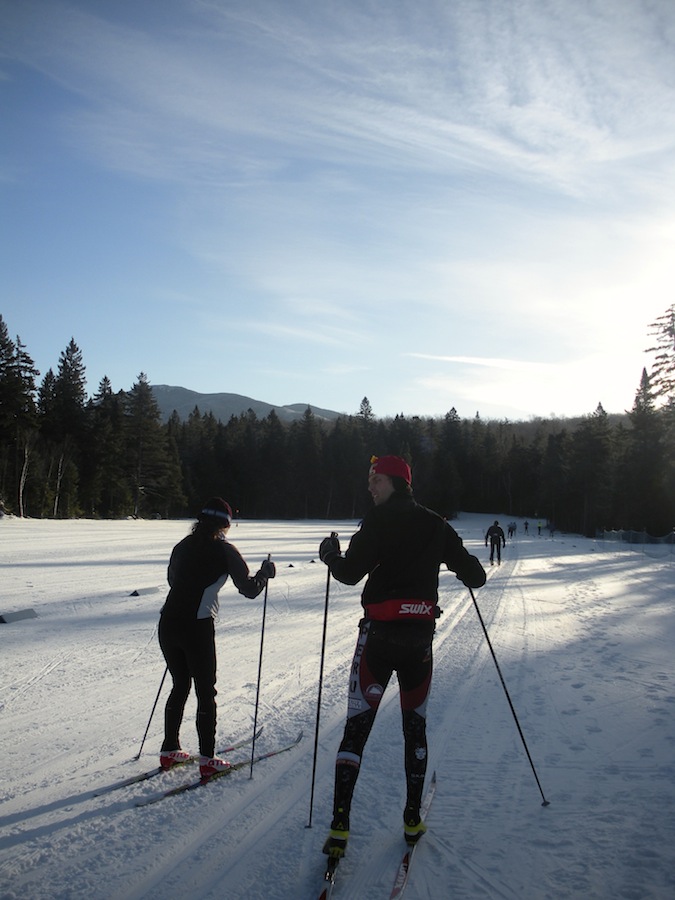
    The stadium at Mount Van Hoevenberg as seen on April 1, no joke, thanks to the TechnoAlpin Snow Factory. (All photos: Peter Minde)

    When it came to investing in snowmaking, New York State’s Olympic Regional Development Authority (ORDA) went with the go-big mentality, leasing a TechnoAlpin Snow Factory for the Mount Van Hoevenberg nordic center and using the technology throughout the 2016/2017 winter season.

    Following the previous 2015/2016 season, in which Mt. Van Hoevenberg, “Van Ho” for short, was open 37 days, according to ORDA’s annual report, the authority acquired and installed a self-contained snowmaking system at Van Ho, the 1980 Winter Olympic venue in Lake Placid, N.Y.
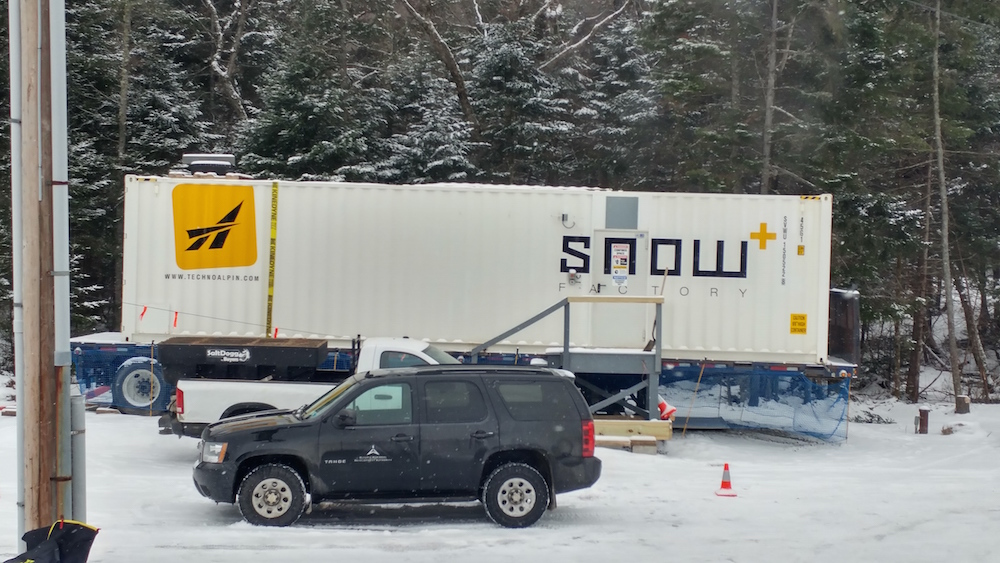
    The Snow Factory at its current home at the Mount Van Hoevenberg nordic center in Lake Placid, N.Y. (Photo: Peter Minde)

    The Snow Factory was put in place, just behind the cross-country lodge, just before Thanksgiving.

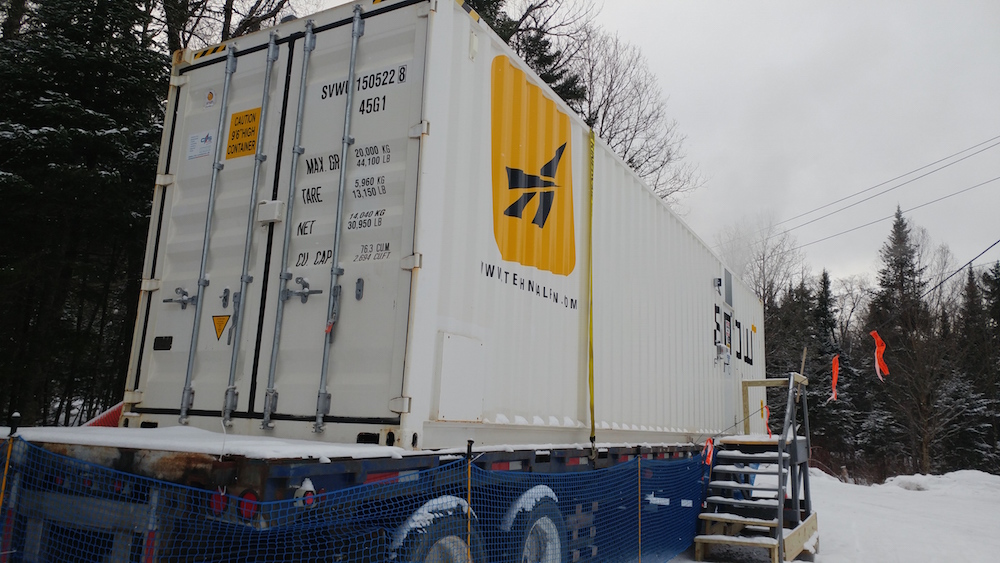
    This machine isn’t your grandfather’s snowmaking setup, where snow guns are positioned strategically along trails. Mounted on a flatbed trailer, a 40-foot ocean shipping container holds compressors and ice-making equipment. A blower sends crystals through a segmented orange hose up to 600 feet in length.

    The Snow Factory hasn’t budged from its original position near a parking lot, yet the snow it has produced has been spread throughout the stadium and on trails up to 1.5 k away from its starting point.

    According to Robin Smith, TechnoAlpin’s Colorado-based business manager, the Snow Factory has been in production for the last four years, but its technology isn’t brand new. IDE, an Israeli company that specializes in water desalination, developed a warm-weather snowmaking unit with different technology than the Snow Factory uses.

    Smith explained that the Snow Factory at Van Ho is the only one in the U.S. and one of only 19 in the world. The best part? The Snow Factory will make snow in temperatures up to 80 degrees Fahrenheit.
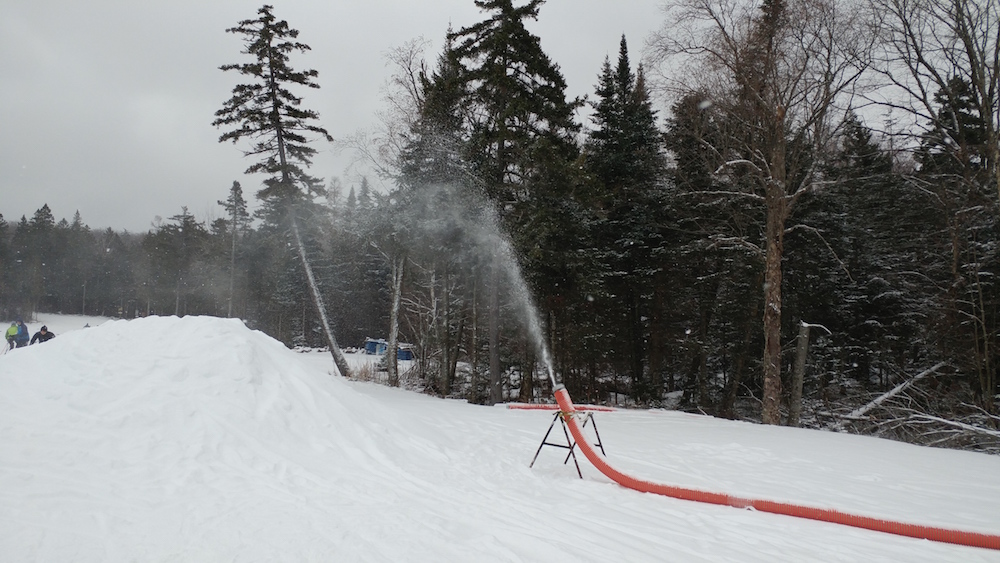
    Blowing snow into the stadium, made by the Snow Factory, at Mt. Van Hoevenberg in late December. (Photo: Peter Minde)

    Both Whiteface and Gore mountains, two of the alpine ski resorts that ORDA manages, use TechnoAlpin snow guns.

    “Probably a year ago, we began a conversation with the success they [TechnoAlpin] were having in northern California with the machine that we ended up leasing,” explained Kris Cheney Seymour, Mt. Van Hoevenberg’s manager. “ORDA has its full attention and interest in the future of nordic sports at Mount Van Hoevenberg.”

    When Seymour first spoke with FasterSkier on the phone in late January, the nordic center was dealing with changeable weather.

    “Lake Placid has had a fairly light snow year and a fair amount of very heavy rain,” Seymour explained. “Traditionally, the stadium gets blasted in poor weather. This winter, we would have had a similar winter to what we had last year: no snow, ice conditions in the stadium. We’ve pretty much been open all but one day since Thanksgiving. The reason is the Snow Factory.”

    Without the Snow Factory, Van Ho wouldn’t have been able to host St. Lawrence University’s Winter Carnival, Junior National qualifier races and other events, he said.

    ORDA acquired the Snow Factory from TechnoAlpin after an alpine resort in California used it for a year. Arriving by truck the day before Thanksgiving, it took five days to haul from California at a cost of $7,000 dollars. According to ORDA’s Communication Director Jon Lundin, ORDA is leasing the Snow Factory for one year for $90,000 dollars.

    In an email, Lundin explained that if ORDA decides to purchase the Snow Factory, it will pay a total of $500,000 dollars: $410,000 plus the amount already paid this season.

    “We’ll make the decision later this spring as to whether or not we purchase the Snow Factory,” he wrote. “We’ll look at how it performed and how the cross-country venue benefited from its use.”
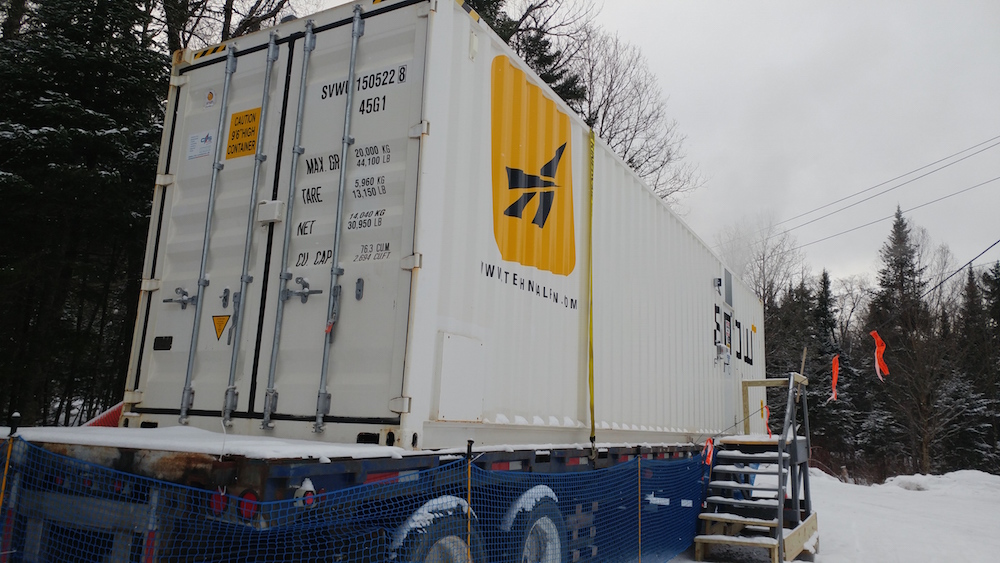
    The Snow Factory in place at the Mt. Van Hoevenberg nordic center in Lake Placid, N.Y. (Photo: Peter Minde)

    So how does this thing work?

    Inside the shipping container are three icemakers, refrigeration equipment, a cooling tower, and a blowing system. The blowers move snow through a segmented orange hose. One can add segments to blow snow up to 600 feet away from the Factory.

    “Other [traditional] snowmaking systems require a temperature and humidity component,” Reese Brown, executive director of the Cross Country Ski Areas Association, said on the phone. “Generally, 22 to 27 degrees and below is good snowmaking weather. The Snow Factory doesn’t require any conditions to make snow, because snow is generated inside the container and then spit out the hose. With the others, snow is made when it hits air temperature.”

    “Snow is created within the shipping container,” Seymour said. “You can effectively make snow with 100-percent efficiency up to 60 degrees Fahrenheit. You’ll have diminished productivity, but you can make snow up to 80 degrees.”

    Running on electricity, the Snow Factory draws from the ski lodge’s well, using 11 gallons of water a minute. The icemakers can be optimized for various climates. Seymour pointed out that northern California has a much drier climate than Lake Placid.
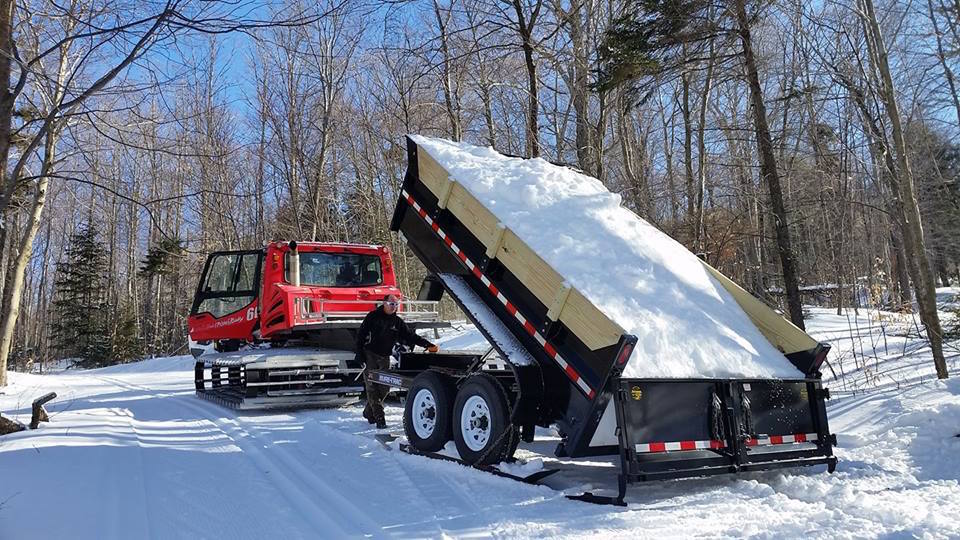
    Dumping snow onto the trails at Mount Van Hoevenberg this winter. (Photo: Mt. Van Hoevenberg/Facebook)

    Leading up to U.S. Junior Nationals, held in Lake Placid from March 3-11, FasterSkier asked Seymour about the Factory’s capability to cover a 5-kilometer loop if the ground was bare. With snow already on the ground, Seymour reframed the question.

    “It works differently than a traditional snow system, and you need to use it and plan for it in a different way,” he said. “The Snow Factory makes a known quantity of snow: two tons per hour. Depending on what our needs are for snow coverage and where we want to go with it, we need to work backwards and give ourselves enough time to blow that amount of snow.”

    While the Factory is mounted on a trailer, the trailer hasn’t moved from its home behind the lodge. The primary locations for its manmade snow have been the stadium, the Innerloopen 3.3 k homologated ski loop, and the beginner trails close to the lodge.

    Days before Junior Nationals, ORDA decided to move the weeklong event to the 2.5 k loop at the Olympic Jumping Complex, also known as the MacKenzie Intervale Ski Jumping Complex, closer to downtown Lake Placid.

    “Six weeks out, we were aware that the long-term forecast had two almost weeklong periods that we were going to have very warm weather,” Seymour said in a follow-up interview after Junior Nationals (JNs).

    Leading up to the championships, the Factory had been cranking almost around the clock. Seymour estimated that once a week, ORDA would shut it down for maintenance. Otherwise, it ran 24/7.
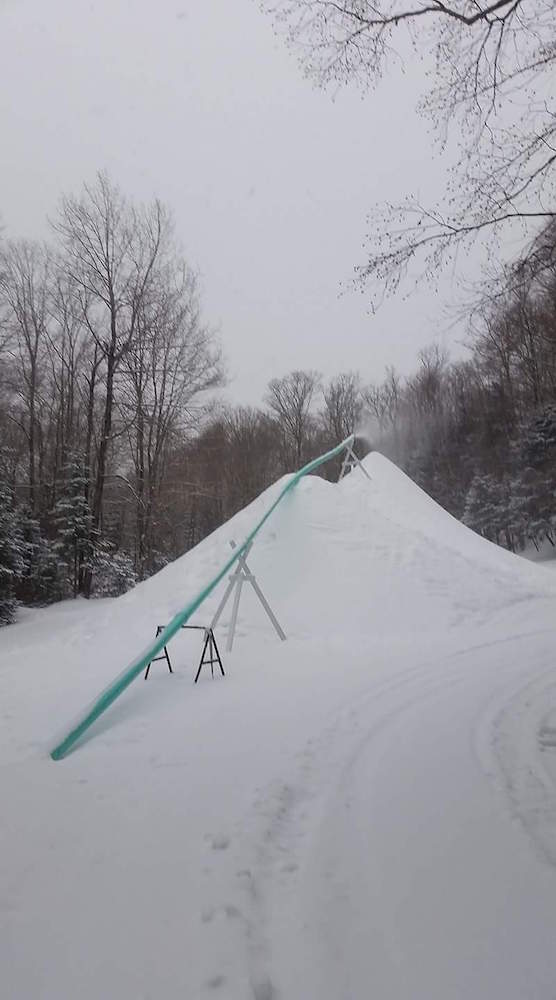
    A large pile of snow produced by the Snow Factory this winter at Mt. Van Hoevenberg in Lake Placid, N.Y. (Photo: Bob Maswick)

    The stadium was covered a mix of natural and manmade crystals, 2 1/2 feet deep. The next focus was the sprint loop and the 3.3 k loop.

    “We were moving snow 10 to 14 hours a day,” Seymour said. A PistenBully hauled snow in a 16-foot dump trailer to where they needed it. ORDA bought the trailer specifically for Van Ho.

    Two weeks before JNs, groomers had buffed the 3.3 k loop to a 28-inch average depth with a mix of natural and manmade snow. Then, “We had really warm weather,” Seymour said. A warm three-day period with high winds and heavy rains reduced the base depth to 12-18 inches.

    Then, starting Feb. 24, another three-day thaw cost precious base depth. A week before the championships, the race courses were down to an average depth of 4 to 8 inches.

    The death blow came one night later. Driving rain and 50 mile per hour winds wiped out weeks of intense work. Wednesday morning, they inspected the courses. Not only was snow melting, but water was “flowing all over the place,” Seymour said. “We had large portions of the race trail that were totally washed out. There were sections of the trail that were lovely and totally groomable. But we also had a 100-meter section of the trail that was totally gone, like, 100 percent gone from pouring water.”

    That morning, Van Ho still had snow stockpiled in the stadium out near the 3.3 k loop. But the forecast for Sunday through Wednesday of championship week called for temperatures in the mid 40s.

    The forecast was accurate.

    “We could have rebuilt the course so that it had four to six inches of snow everywhere,” Seymour said. “We knew that Mount Van Hoevenberg couldn’t survive a third major thaw in a four-week period.

    “We had a course that was mostly built at the jumps,” he explained.
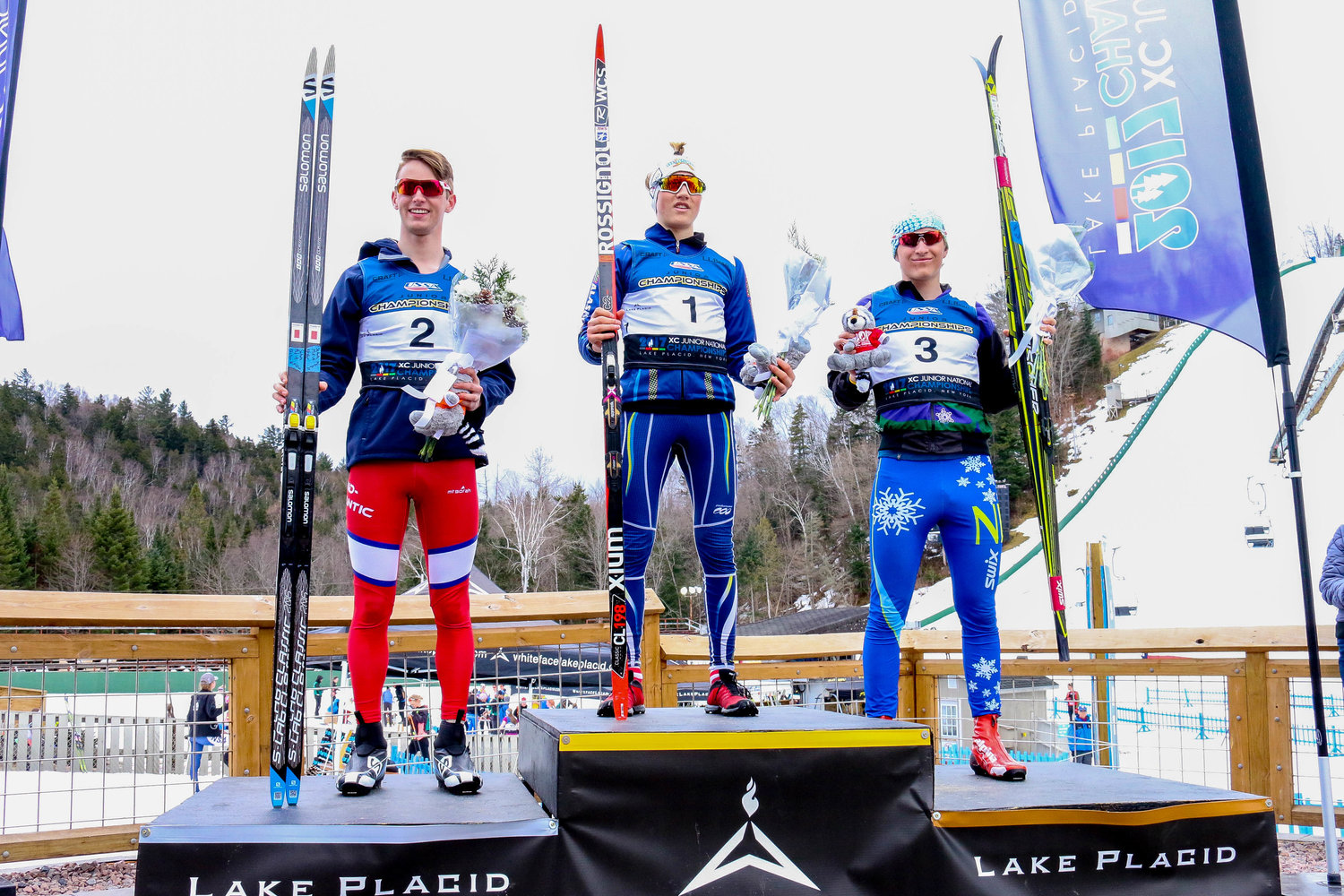
    The U18 boys’ classic sprint podium at U.S. Junior Nationals, held at the Olympic Jumping Complex in Lake Placid, N.Y., with Gus Schumacher (c) of Alaska Winter Stars in first, Scott Schulz (l) of the New York Ski Educational Foundation in second, and Adam Glueck (r) of Ford Sayre in third. (Photo: XCJuniorNationals2017.com)

    Blowing snow on site for 30 hours and working around the clock, ORDA employees also moved all the snow from the in-run of the ski jumps and the in-run and landing areas of the freestyle training area, which had a depth of eight feet. With that and the snow made on site, the Intervale loop was covered to an average depth of 2 1/2 feet for a successful Junior Nationals.

    As a result of the venue change, there was only one adjustment to the schedule. Coaches, jurors and organizers agreed to switch the classic mass start to an individual start because of a narrow spot for two-way traffic midway through the loop.

    While the Snow Factory ultimately didn’t play a part in JNs, it continued to blow snow at Van Ho, which remained open while the races happened took place at the jumps. Teams arrived early and trained on the trails, some choosing to cool down or train on off days at Van Ho.

    “That was 100-percent Snow Factory,” Seymour said.

    Besides the Factory, there have been other significant improvements to Van Ho. According to Allan Serrano, the FIS technical delegate who worked with ORDA to homologate Van Ho’s race trails, the stadium exit, along with much of the Interloopen portion of the Ladies’ 5 k loop, was widened.

    “Most importantly they have been able to do rehabilitation work on the Ladies 5k, leveling and improving the water management so that it skis and grooms much better,” Serrano wrote. “They are able to have a high quality ski surface with lower snow.”

    He added that Van Ho’s grooming capacity has also improved since its courses were certified in 2012.

    “At that time the venue did not have a dedicated snowcat with track setters and now they have a machine with double track setters,” he wrote.

    As race season winds down, what’s next? With the ability to make snow in warm temperatures, Seymour was intrigued by the opportunity to provide skiing on short loops in the offseason. He’s got the attention of John Farra, the high-performance director for U.S. Paralympics Nordic Skiing.

    “We have found that it is most valuable for sit skiers especially to have access to snow in the ‘off season,’ ” Farra wrote in an email. “The nature of maneuvering a nordic sit ski on turns, downhills and out of the track is not something that can be duplicated on roller skis, so we have found [snow] much more valuable for sit skiers in advancing their technical skills. We are very interested in the Snow Factory project that ORDA has invested in and have been in touch with Kris about the possibility of getting our National Team to Lake Placid to take advantage of their new Snow Factory snow in this coming Games season.”

    “Part of skiing currently is having a viable snowmaking option,” Seymour said. “The Snow Factory will guarantee the ability to open the venue when we want to and hold races as they’re scheduled; we can be counted on as a world-class venue. It’s a game changer.”

  • Pisten Bully and Lodge Renovations: Changes at Mt. Van Hoevenberg

    Pisten Bully and Lodge Renovations: Changes at Mt. Van Hoevenberg

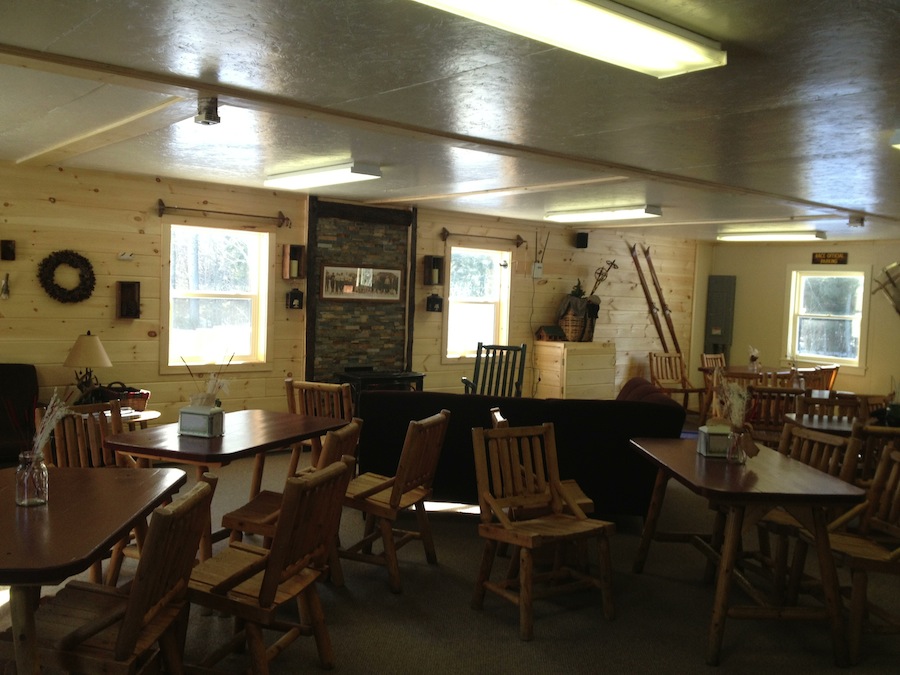
    Part of Mt. Van Hoevenberg's renovated lodge, as seen in January 2013.  A new bar area was added in December 2013 (not shown).
    Part of Mt. Van Hoevenberg’s renovated lodge, as seen in January 2013, in Lake Placid, N.Y. A new bar area (not shown) was added in December 2013 and was still under construction on Dec. 21. According to ORDA program coordinator Rebecca Dayton: “We have also put in a small bar area with a plan to serve wine, beer and light snacks during the season.”

    Editor’s Note: This is a follow-up article regarding the improvements New York’s Olympic Regional Development Authority (ORDA) has made to its Mt. Van Hoevenberg property, specifically its lodge, and what has yet to be planned. The first article, “Lake Placid: Mount Van Hoevenberg at the Crossroads,” originally appeared in April 2012.

    ***

    LAKE PLACID, N.Y. — A picture of garaged machinery shouldn’t get a skier excited.  But this was different.

    Attached to a text message – “It’s here!” – was a photo of a brand new Pisten Bully 100, delivered to Mt. Van Hoevenberg in Lake Placid, N.Y., in November 2012. That was one of several improvements that came to Van Ho, the home of the 1980 Winter Olympics.

    Known as “Van Ho,” the 50-plus-kilometer nordic area and nearby sliding track is operated by the Olympic Regional Development Authority (ORDA).  After the 1980 Olympics, New York state created ORDA to manage all of its Olympic venues, including Lake Placid’s Olympic Center and speed-skating oval, the jumping complex, Olympic Training Center, and the alpine-ski areas, Whiteface, Belleayre and Gore.

    To get the Pisten Bully out, Van Ho maintenance crews rebuilt some bridges to support the weight of the new groomer.

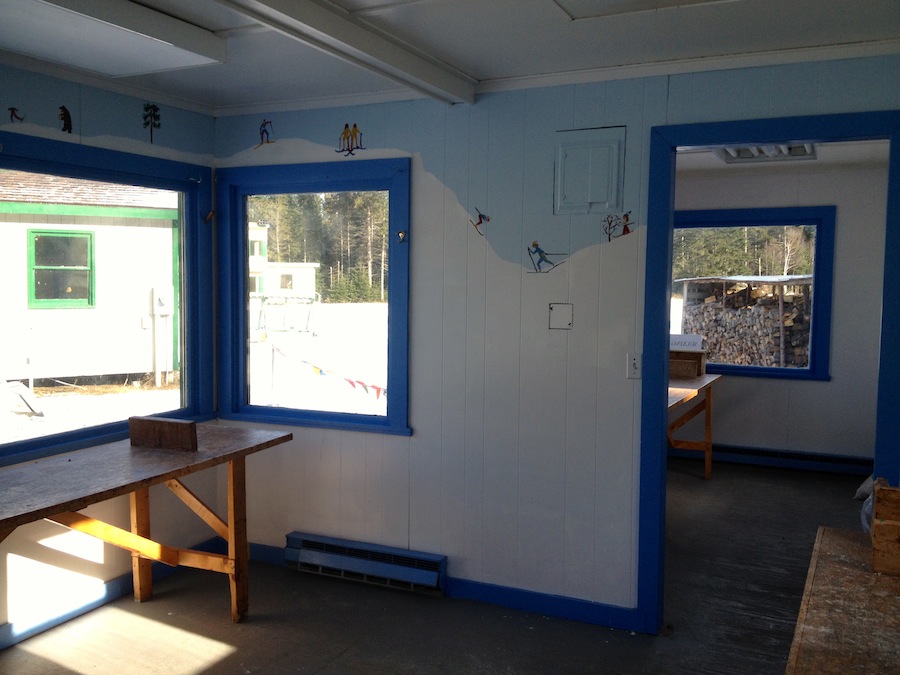
    In the summer of 2012, ORDA also remodeled its cross-country lodge. On one side, walls were removed to create more usable space. Paneled with blond wood, the new space relieves crowding on busy days. Last but not least, if you’re a master blaster with a toddler in tow – there’s a new baby changing station in the men’s room.  Equal rights have made it to Van Ho.

    This past spring, ORDA Communications Manager Jon Lundin outlined some of the criteria for the authority’s annual planning.  One doesn’t just cut a six-figure check for a snow cat. According to Lundin, ORDA assesses its needs during the winter and makes final plans in the spring.

    “Purchase of grooming equipment depends on availability of snow cat and timing of funding,” Lundin wrote in an email. “[It] could take 8-10 months or could be quicker depending on both variables.”

    Interior of new wax room at Mt. Van Hoevenberg cross-country lodge.
    Interior of new wax room at Mt. Van Hoevenberg cross-country lodge.

    Larger capital improvements have a longer timeline.  For example, “[Alpine] ski lifts have to do with preliminary engineering, market variables such as number of lifts being installed in North America (availability of materials based on that) and funding,” Lundin wrote. “Eighteen months is a good and fair barometer” of the time it takes to put in a ski lift.

    This year, ORDA made additional improvements to its cross-country lodge, expanding the lounge area into the former wax rooms for more public seating. The wax rooms are now in the New York Ski Educational Foundation (NYSEF) changing building behind the lodge, and the NYSEF team moved into the timing building, ORDA’s Olympic Sports Complex program coordinator Rebecca Dayton explained.

    “More room and better flow for them as they are now in the same building as their wax facilities and more room and better ventilation for other skiers,” she wrote in an email.

    As of Dec. 21, a small bar area was also under construction with the intent “to serve wine, beer and light snacks during the season,” Dayton added. Outside the lodge, trail homologation is complete with FIS certificates for six separate loops ranging from 1.4 to 7.5 km in length, she explained.

    Laundry List of Long-Term Projects

    While these are welcome improvements, more could be in store. But navigating the waters can be tricky.

    Located in the Adirondack Park, most of Van Ho’s land is owned by the Department of Environmental Conservation (DEC), and ORDA operates Van Ho under an agreement with the DEC.  It remains subject to Article XIV of New York’s Constitution, which mandates that Adirondack Park land shall be “forest preserve… forever…wild.”

    The Adirondack Park Agency (APA) oversees land use in the park. According to the APA, Van Ho is designated as an “intensive use” area. Their State Land Master Plan specifies that Van Ho should be maintained as a “year-round sports facility meeting international standards for such sports as … cross country skiing on improved cross country ski trails under developed, competitive conditions.”

    Under APA’s guidelines, ORDA and the DEC prepare a Unit Management Plan (UMP) outlining how Van Ho will be developed. There are dozens of UMPs for various public land parcels in the Adirondack and Catskills parks.

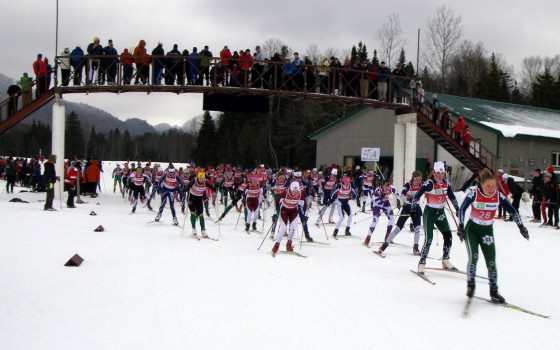
    The women's EISA field starts a race at Mount Van Hoevenberg in 2010. Leading are Ida Sargent (USST/Craftsbury) and Rosie Brennan (APU), then racing for Dartmouth College. Lake Placid is an important venue for developing racers.
    The women’s EISA field starts a race at Mount Van Hoevenberg in 2010. Leading are Ida Sargent (USST/Craftsbury) and Rosie Brennan (APU), then racing for Dartmouth College. Lake Placid is an important venue for developing racers.

    Approved in 1999, Van Ho’s plan calls for, among other things, refurbishing and repurposing the biathlon lodge as a ski-tourism lodge. It includes building a new cross-country lodge “in a location with better drainage” than the site of the current lodge.

    In a previous FasterSkier article, Greg Stratford, then-assistant manager of the Olympic Sports Complex, discussed the concept of replacing both the existing lodges with a single building on the site of the current cross-country lodge.

    “One of the problems is that if we build a new stadium, it would need to be suitable for both cross-country and biathlon,” he said in April 2012. “Each of the different sports that use our facilities has their own specifications and requests and wants and needs. We need to get everybody together to determine what would be the best scenario for Mt Van Hoevenberg.”

    Asked where the biathlon range might be sited for a single lodge, Lundin wrote, “Nothing contemplated.”

    When asked whether a combined lodge to serve both Van Ho’s cross-country and accompanying sliding track was under consideration, he replied, “That concept has not been part of our planning process.” Dayton confirmed that there are no plans to build a new lodge currently in the works. 

    Environmental and Financial Challenges

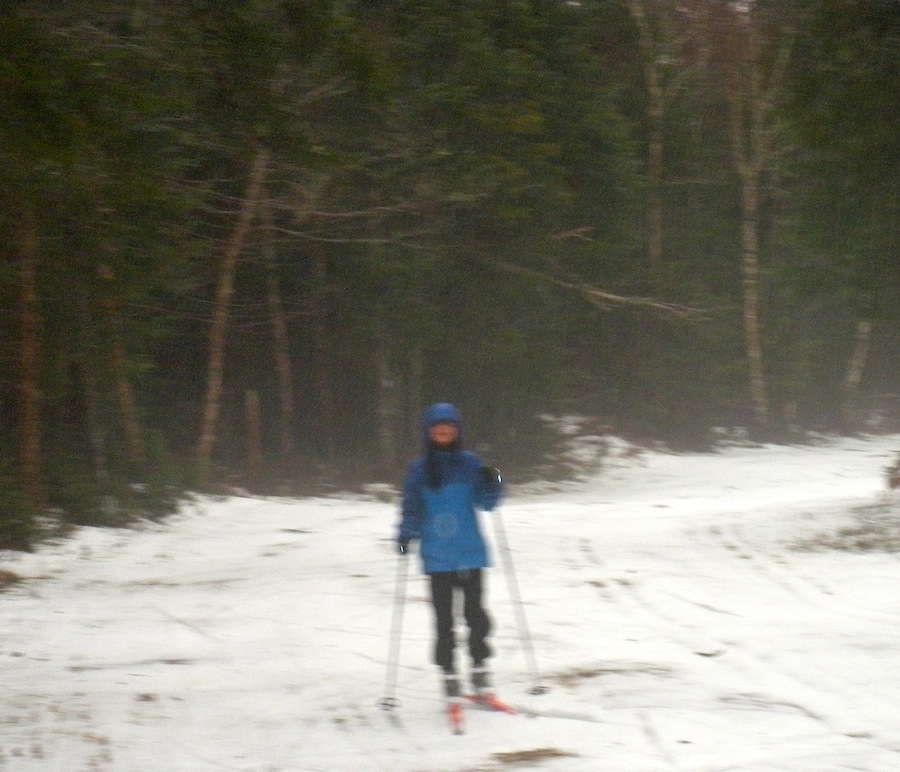
    A junior skier in some rain and slush at the start of the Ladies 5 k loop at Mt. Van Hoevenberg, near the cross-country lodge, on Dec. 21.
    The author’s daughter, Laurel Minde, 11, weathers rain and slush at the start of the Ladies’ 5K near the cross-country lodge at Mt. Van Hoevenberg on Dec. 21.

    Whatever the future holds, if a new lodge was to be built at Van Ho, or snowmaking installed, it’s not as simple as drawing blueprints and soliciting bids from contractors.

    Reviewing Article XIV case law, the UMP’s authors conclude that the improvements proposed for Van Ho “are consistent with the mandates of Article XIV.”

    But a in a subsequent section, the UMP separates planned improvements into two categories: those that that don’t require an amendment to Article XIV and those that do.

    Purchasing new grooming equipment, remodeling the biathlon lodge as a destination for recreation, and trail maintenance, for example, don’t require a constitutional amendment.

    However, installing a new snowmaking system, building a new cross-country lodge “in a location with better drainage” than the current lodge, and rebuilding the tunnels under the access road – among other things – would require an amendment to Article XIV.

    Would a new cross-country lodge, built on the site of the current one, require an Article XIV amendment?  Dayton declined to comment. “That is outside my area of expertise,” she wrote.

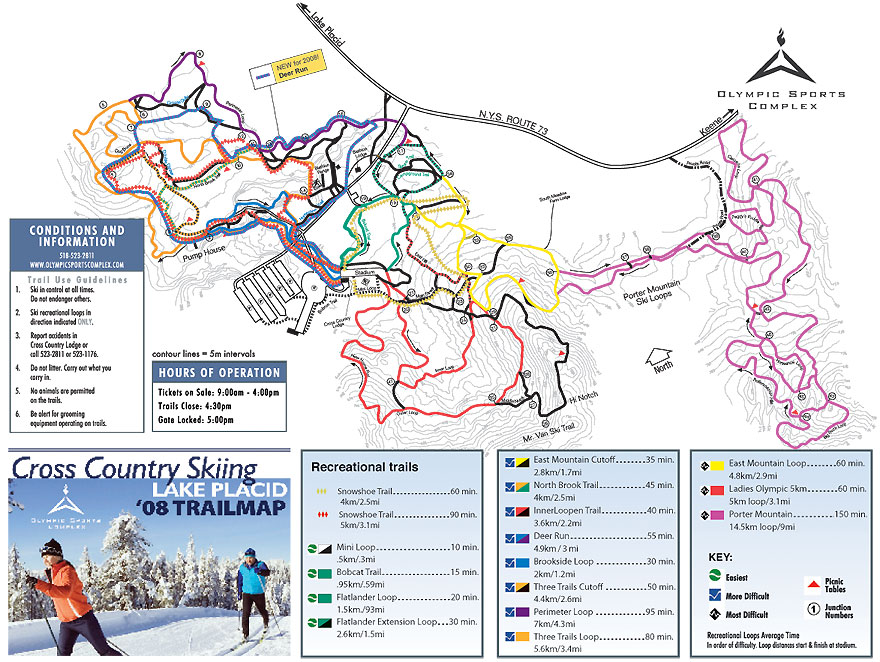
    Mt. Van Hoevenberg trail map (via http://www.orda.org/newsite/todo/winter/imgs/xctrails.jpg)
    Mt. Van Hoevenberg trail map (Photo: ORDA)

    What is it exactly about these improvements that would require a constitutional amendment?

    “The proposals in the Van Ho UMP are compliant with the State Land Master Plan for Intensive Use,” APA spokesman Keith McKeever explained in an email, while adding, “With regards to the constitutional questions raised, APA does not make those determinations. That would be done by the Attorney General’s Office.”

    The New York State Attorney General’s office declined to comment.

    According to DEC spokesman David Winchell, ORDA would need to discuss proposed improvements with the DEC, which would decide whether a constitutional amendment would be necessary. The DEC “would determine whether the proposed action is acceptable” and would collaborate with ORDA “to determine whether an amendment should be pursued.”

    Asked why ORDA hadn’t pushed for an amendment to Article XIV for Van Ho, Lundin wrote, “We have not pursued it at this time.”

    The LA Group of Saratoga Springs, N.Y., conducted much of the environmental impact analysis for the plan. When asked what environmental road blocks there might be to improvements at Van Ho, director of environmental planning Dean Long declined to comment. “Our last work at the facility was in 1996,” Long wrote.

    Resolving a possible Article XIV issue is only one challenge. ORDA would also have to find a way to pay for major improvements such as a snowmaking system.  In addition Mt. Van Hoevenberg, ORDA has to budget for improvements at its other venues.  Besides the Pisten Bully and an excavator for Van Ho, in its last fiscal year, ORDA renovated part of a Whiteface ski lift and purchased new snow cats for Whiteface and Gore.

    Everything You Were Afraid to Ask in Civics Class

    “You have conversations.  There’s dialogue before a bill is introduced,” according to a person closely involved with the New York State Legislature.

    Declining to be identified, the source explained that either ORDA or the DEC might approach a legislator to sponsor an amendment to Article XIV.  The bill would pass through committee before being introduced to the entire legislature.

    Hypothetically, any bill to amend Article XIV would have to be passed by two separate sessions of the N.Y. legislature.  The legislature is up for election every two years.  If a bill passes that hurdle, it would then be presented to the electorate as a referendum  If an amendment to Article XIV was brought before the legislature, it would take about five years to pass.

    The approach to amending the constitution is anything but casual. The source stressed that the legislature is “judicious in how frequently this is done.” Once an amendment makes it to the ballot, they do everything possible to ensure its success. It’s “critical to have environmental organizations on board,” he concluded.

    The Future for Van Ho

    Skiers warming up for the 2013 Lake Placid Loppet at Mt. Van Hoevenberg in Lake Placid, N.Y.
    Skiers warm up for the 2013 Lake Placid Loppet at Mt. Van Hoevenberg’s stadium in Lake Placid, N.Y.

    Completed in 1999, Van Ho’s UMP was “proposed to be accomplished in five phases over the next five years.” It acknowledged that development could take longer.

    In 2000, Van Ho’s 1980-vintage luge and bobsled tracks were replaced with one spectacular state-of-the-art sliding track. New York kicked in $13.5 million of the $20-million dollar cost, with the federal government covering the balance. The new track didn’t require an Article XIV amendment. The sliding track was a major piece in Van Ho’s UMP.

    The Whiteface Memorial Highway illustrates the challenges facing Van Ho.  If you’ve raced the Climb to the Castle, you’ve experienced this road’s frost heaves, bumps and sections of cracked pavement that can break poles and upend skiers.

    Like Van Ho, the highway is located on DEC-owned land and managed by ORDA.  The highway signs are property of the New York Department of Transportation.  None of these bodies has the budget for repaving the highway.  For over 40 years, the road didn’t see a major repaving project and deteriorated over time.  Only recently, New York Governor Andrew Cuomo announced that he would appropriate $12 million dollars to repave the highway and refurbish the summit castle and toll house.

    Over the last two years, ORDA has made significant changes at Van Ho.  But some of the biggest projects in the UMP require significant expenditure and effort. Determining whether a constitutional amendment is necessary is only one challenge. Financing the improvements is another.

  • NY Preserves ORDA Funding in Budget Measure

    An athlete training during a U.S. Ski Team camp in Lake Placid. Photo: TeamToday.

    New York’s Olympic Regional Development Authority (ORDA) has received $5.6 million in funding in a budget measure that passed in the New York state assembly on Friday and the state senate on Monday.

    ORDA manages Mount Van Hoevenberg, the site of the cross country, biathlon and nordic combined events during the 1980 Winter Olympics in Lake Placid NY, and the other legacy venues from those Games.

    The appropriation is about 16 percent of ORDA’s approximately $34 million budget, and is $1 million less than the authority received last year. In a budget document submitted to the state in February, ORDA had projected receiving $7.1 million from New York.

    Travis Proulx, the New York Senate’s deputy press secretary, noted that “ORDA has cash on hand which will allow them to absorb this reduction.”

    ORDA Communications Director Jon Lundin said that the $5.6 million appropriation was “the number we’ve been anticipating.”

    “Each year,” he added, “we’re operating with less and trying to do more.” Mount Van Hoevenberg “will run a little bit leaner” in the coming year.

    Lundin said that even if ORDA had firm information about funding earlier in the spring, their position on hosting the World Cup biathlon race next February wouldn’t have changed.

    “We needed to be creative from the very beginning,” Lundin said. The hangups that prevented Lake Placid from hosting the events were the upgrades to bring the venue to current International Biathlon Union standards. Lundin cited computerized targets and an improved judges’ tower as required measures, though he was unable to provide an estimate of the cost of improvements.

  • Lake Placid Venues at Risk In Proposed NY State Budget Cuts

    A collegiate race at Mount Van Hoevenberg in Lake Placid, which faces the possibility of closure if funding is not delivered in the New York state budget

    Lake Placid’s cross country, biathlon and ski jumping venues face the possibility of closure if the state does not appropriate money later this month.

    The Lake Placid Daily News reported in March that New York’s Olympic Regional Development Authority (ORDA), was at risk of losing all of its state funding for the coming fiscal year. The aid, approximately $6.6 million last year, comprises some 20 percent of ORDA’s budget.

    A member of ORDA’s board of directors is on record in the Daily News story as saying that the authority would have to close without the state’s appropriation.

    ORDA is the body that manages the legacy venues of the 1980 Winter Olympics in Lake Placid, including the cross-country, biathlon and sliding facilities at the Olympic Sports Complex at Mount Van Hoevenberg, just outside town. The Olympic ski jumps, Whiteface Mountain Ski Center, and Olympic Training Center in are also managed by ORDA.

    While the closing of these areas would be a big loss to recreational skiers, it would be an even bigger blow to the elite and developing athletes that train at these venues. The combination of ski trails, biathlon range and jumps in close proximity to one another make this a valuable resource for local athletes.

    The New York Ski Education Foundation runs extensive youth programs that make use of the Olympic Sports Complex. It’s also a training center for American biathletes and Nordic combined skiers.  The U.S. Ski Team holds an annual fall training camp in Lake Placid.

    “It would be a tragedy for biathlon if Mount Van Hoevenberg were to be shuttered,” said Max Cobb, U.S. Biathlon’s executive director.

    Cobb said he thought that juniors and developing athletes would be impacted more than elite athletes. Juniors ski and compete in the area all year round, while elite athletes like Lowell Bailey and Tim Burke train in Lake Placid only during the dryland season, prior to traveling for World Cup events.

    While people might be willing to drive a long distance to try a new activity for the first time, Cobb said that to ensure consistent training and world class progression, athletes should live within a one hour drive of a venue.

    As well as the cross-country trails and biathlon range, Lake Placid is also home to the ORDA-managed ski jumps. In addition to the iconic 90- and 120-meter Olympic hills, the jumping complex has three smaller hills for developing athletes. Athletes can train on three of the five jumps during the summer, sliding on a combination of plastic shingles and porcelain marble halves.

    While there are ski jumping hills throughout New England, ranging from 10 to 90 meters, few of them have summer jumping facilities. And Ken Barker, president of the Salisbury Winter Sports Association in Salisbury, CT, said that summer jumping is essential to training from J5 through Olympic athletes.

    Barker’s club will put plastic shingles on their 20-meter hill for the first time this summer.  (They’re also rebuilding their large hill for the 2011 Junior Olympics.)  And Barker cited the Lebanon Outing Club, in New Hampshire, as another facility that offered summer jumping. But few jumps in the region have the same level of programming as Lake Placid.

    Finally, there’s ORDA’s Sports Development Program, which offers year-round educational opportunities to youth groups, including sports clinics in biathlon, luge, bobsled and curling. They even partner with the New York City Parks Department’s Winter Jam, offering residents the opportunity to try out cross-country skiing in Central Park.

    Brad Clark, ORDA’s sports development manager, organizes outreach programs—activities like school field trips and interactive clinics at the various venues. If a child shows potential in a particular sport, Clark helps them find appropriate coaching.  Without ORDA, Clark said, these outreach programs would not exist.

    The tight budget situation is underscored by the news last week that ORDA had declined an opportunity to host a biathlon World Cup race at Mount Van Hoevenberg in February, 2011.

    Jon Lundin, ORDA’s communications director, said that the organization “would have needed to upgrade the facilities to comply with IBU [International Biathlon Union] requirements for a major World Cup event.”

    “We certainly are looking into [making the upgrades]; we just couldn’t do it this year,” Lundin said. He added that passing on the biathlon race was a “one-time blip,” noting that ORDA planned to host international events in the sliding sports, and possibly a World Cup freestyle event, in the coming year.

    In an interview with FasterSkier, Lundin said that he didn’t know how ORDA’s operation might be changed if the state does remove funding. However, he added that state law stipulates that Mt. Van Hoevenberg cannot be privately owned or leased to a business-person in the private sector.

    Travis Proulx, the state senate’s deputy press secretary, told FasterSkier that there is “still no finality to the status of ORDA’s funding.” He said that the senate didn’t want to cut ORDA’s appropriation in the first place, but that alternative funding is needed.

    With one to two weeks until a budget is finalized, Proulx said that the Senate is “looking for ways to keep the state’s role in ORDA alive,” citing alternative budget cuts brought to the table by the Democratic caucus and alternative revenue options submitted by the Governor David Paterson—including one proposal to allow the sale of wine in grocery stores.  Regardless of the final decision, both houses of the New York legislature, as well as the governor, are required by law to be in agreement on the state budget.