From the FasterSkier archive — posts syndicated from athletes’ and coaches’ own blogs between 2004 and 2012, kept online as published. Current coverage is at fasterskier.com.
This coverage is made possible through the generous support of Marty and Kathy Hall and A Hall Mark of Excellence Award. To learn more about A Hall Mark of Excellence Award, or to learn how you can support FasterSkier’s coverage, please contact info@fasterskier.com.
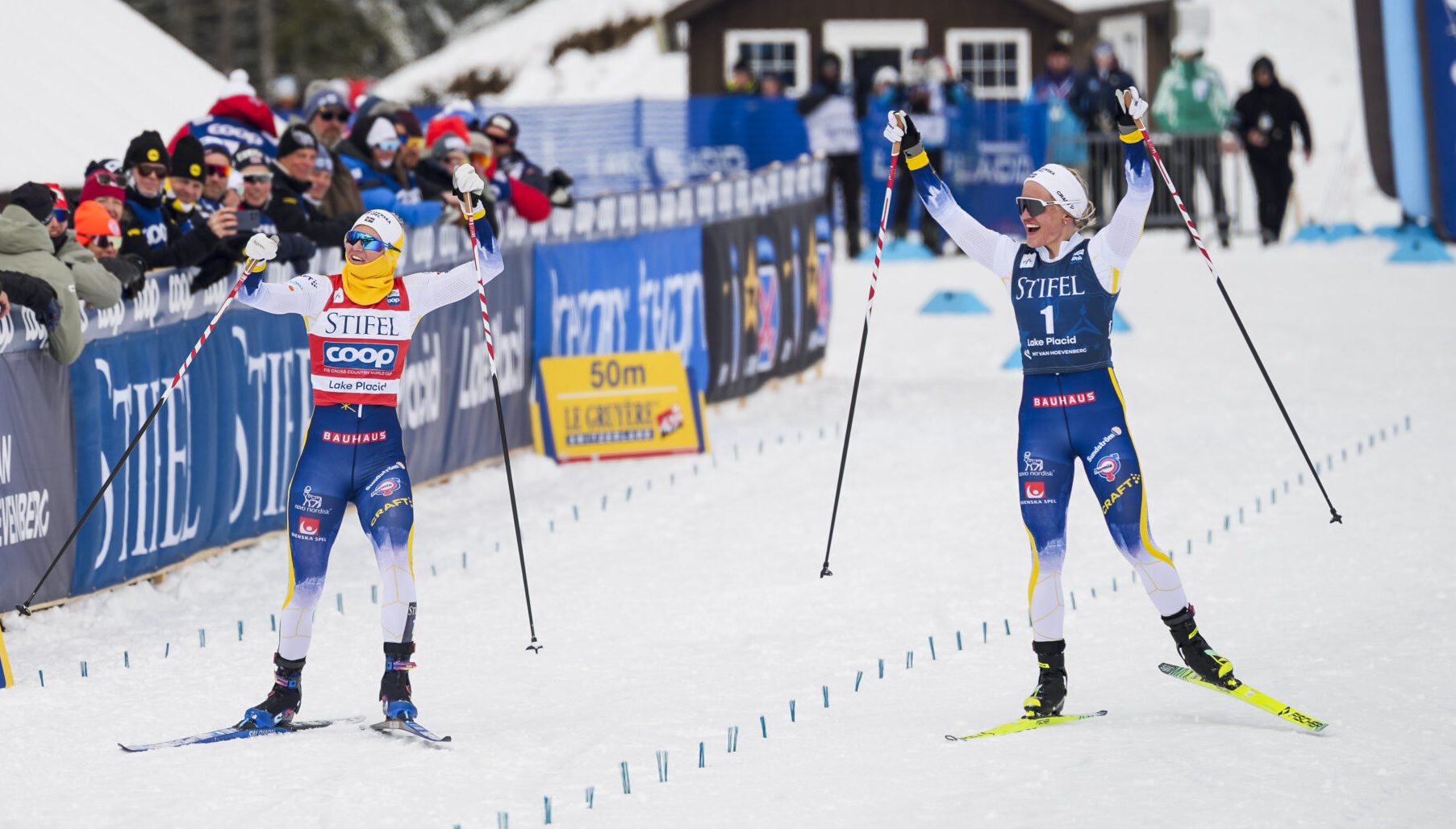
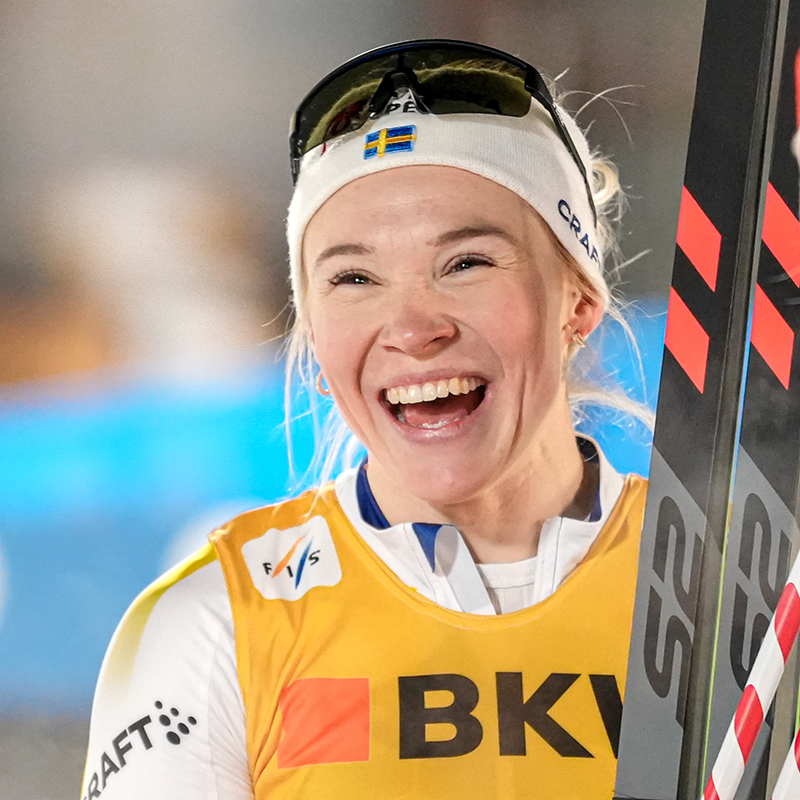
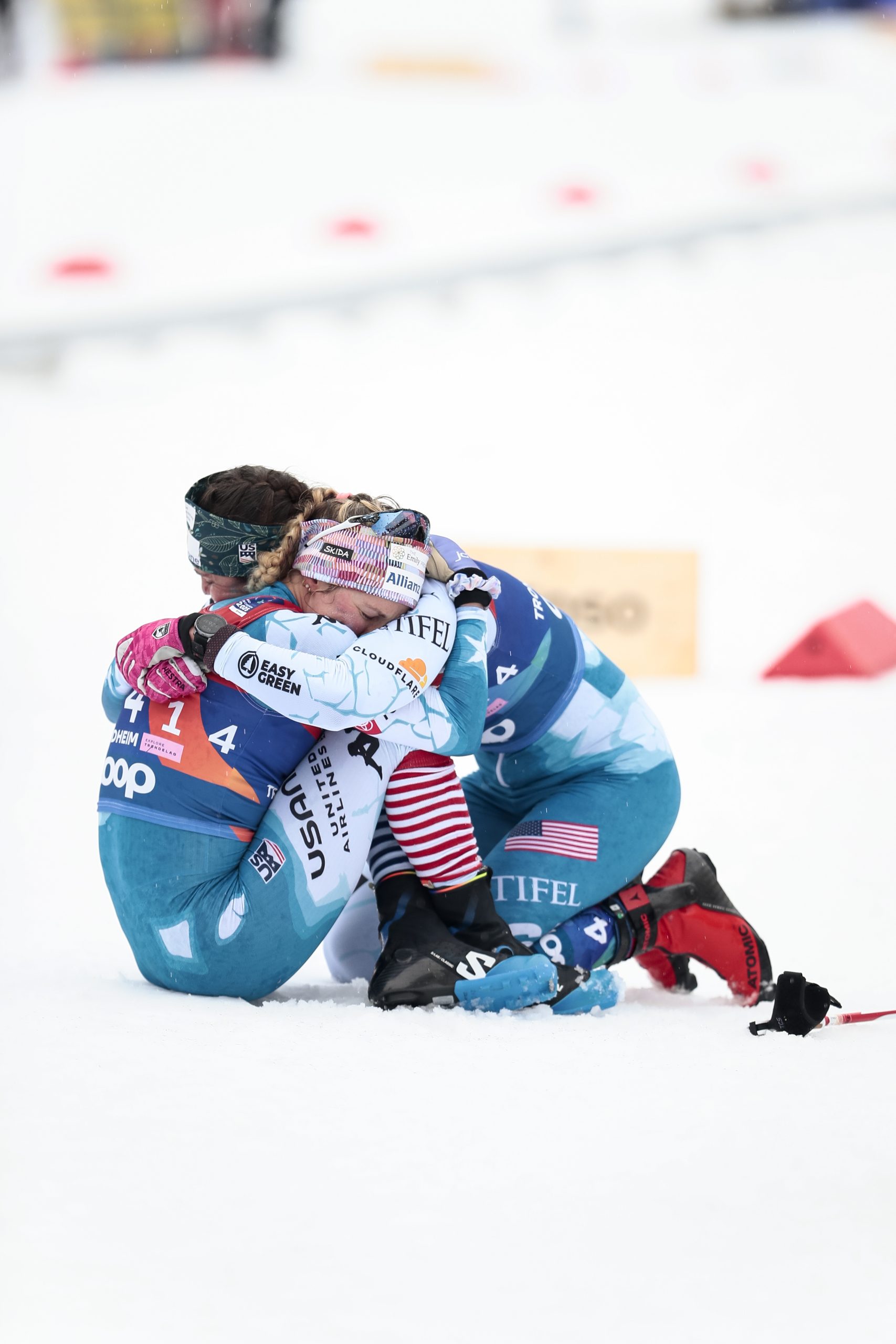
Jessie Diggins (USA) celebrates an entire career as she crosses the finish line of the 20 k Mass Start in Lake Placid. Thousands of fans in attendance celebrated with her. (Photo: Thibaut/NordicFocus)
While the men’s 20 k Mass Start Freestyle (raced earlier in the day) was the source of anticipation and intrigue, the Women’s 20 k was more likely to become a glorious victory lap. At the very beginning of the 2025-2026 season, Jessie Diggins had announced that this season would be her last. The most decorated American cross-country skier—and the winner of three World Cup Overall Crystal Globes—would hang up her skis after the final race in March in Lake Placid. Back then, that final day was still many months and many miles away. Today, Diggins toed the starting line for the beginning of these final kilometers. The staging of a glorious victory lap was entirely appropriate, and Diggins would make it one whether she won the day’s race, or not. That’s how she’s raced her entire career: joy in the competition, celebration in the victory, satisfaction in the effort, gratitude for the team. She’s left us breathless as many times as she has exhausted herself at finish lines, her effort as pure as the snow into which she has toppled after victories and defeats, alike. Her total effort and utter devotion could never have been in doubt. We have loved watching her give it all. Today, in Lake Placid, we were given one last precious opportunity to do so.
How ironic, then, that nature chose to rain, literally, on this parade. Spring conditions in the Adirondack Mountains are notoriously capricious. Lake Placid sits at the highest elevation of any village in the east, and the combination of elevation and proximity to both the Great Lakes and the Atlantic coast makes it a place for weathers to converge, for clouds to gather, where the mountains wear late-season robes of white, where the skies deliver showers of snow—and of rain. We’re often reminded that cross-county skiing is a winter sport—and racing through difficult conditions is the expectation, not the exception. So if there’s a victory lap to undertake, then a full-on storm of freezing rain seems like an appropriate way to do it.
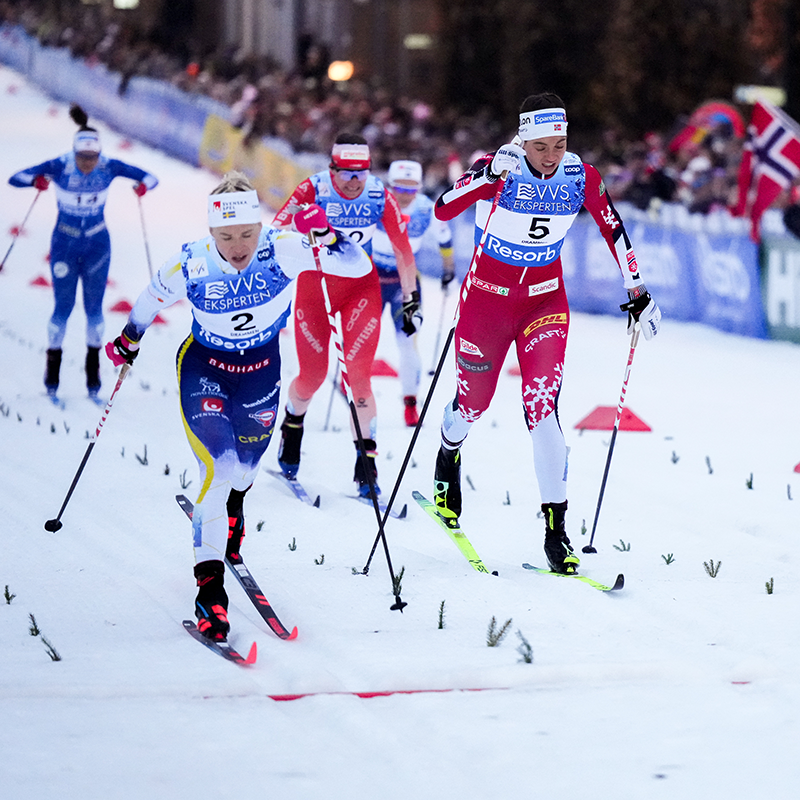
Heidi Weng (NOR) and Frida Karlsson (SWE) provided the pace for much of the 20 k Mass Start in Lake Placid, but they didn’t manage to drop the most dangerous sprinter, eventual race winner, Jonna Sundling (SWE). (Photo: Thibaut/NordicFocus)
20 k Mass Start
Fans knew who to watch: Frida Karlsson, Heidi Weng, and Diggins. And Diggins has a strategy that she folows in mass-start events: allow others to set the pace on uphills, even letting herself get gapped, only to close those gaps on subsequent downhills. When she uses that strategy, she keeps herself in contention for as long as possible.
At the 8 kilometer mark, those contenders remained together, and were in the company of numerous others who could play a part in the strategy of tis race. Astrid Oeyre Slind has begun to find the form that eluded her in Milano-Cortina,and Linn Svahn and Jonna Sundling lurked in the lead pack, hoping to be there at the end where their lightning-fast sprints could perhaps snatch victory from the distance specialists.
Karlsson set the pace in the early kilometers, but not at the uber-speed that has often been seen in women’s racing over the past few seasons. Weng came forward to take over the pace-making just prior to the bonus points line at 9 kilometers, moving Karlsson back into the pack where she is far less comfortable. So uncomfortable, in fact, that Karlsson immediately ran headlong into an unexpectedly fallen Slind. Both of them ended up in a tangle as Weng and the leaders glided away. Weng captured the bonus points that she needed to maintain her position on the podium of the Distance competition. Weng continued to push the pace, but all the logical contenders seemed capable of preventing her from breaking away.
Diggins moved to the lead at the 12 kilometer mark, using her fast skis and descending ability to glide to the front before powering up a mid-lap hill. Karlsson (who had weaved her way back to the lead) took up a position at Diggins’ shoulder. These two—along with Weng and Slind—would do their best to undo the strengths of the sprinters in the kilometers that remained. But with Diggins, Sundling, and Svahn still in contention, Karlsson and Weng were leaving things a bit late.
Karlsson, Weng, Diggins, and Sundling came through in order at the final bonus points line, seemingly less interested in those points than they were in positioning themselves for all that was likely to transpire in the final two kilometers. At the top of the final uphill, Norwegian Karoline Groetting surged to the lead. She was pursued by Karlsson and Weng, with Sundling and Diggins just behind. One kilometer to go, one major downhill to navigate . . .
Years ago—at the beginning of what was to become an historic career—a young and impetuous Jessie Diggins was often seen to lose control on downhills. She would ultimately overcome that limitation, becoming one of the best and most daring downhillers on the World Cup scene. Today in Lake Placid, though, Diggins’ past caught up with her. Every competitor would be exhausted at this point in a 20 k race, and maintaining control on any fast, winding downhill would be tremendously difficult. As the leaders descended a steep lefthand curve, Sundling picked an outside line that was especially fast. The video replay shows Diggins seeming to notice Sundling’s acceleration. The shift in Diggins’ posture made it clear that she felt the need to accelerate a bit, herself, but the extra step she took shifted her weight to the tails of her skis. Just like that, Diggins went down. Less than a kilometer from the end of the race—just minutes from the end of an astounding career—Diggins fell from contention. Not one to lie in the snow feeling sorry for herself while a race is going on, Diggins sprung to her feet and took off in pursuit of the leaders. Her race for today’s podium may have been over, but Diggins was far from being done with the racing. If only one kilometer remained in her career, Diggins intended to race her heart out over that final kilometer.
Jonna Sundling (SWE) was the skier everyone else in the field was most determined to drop. They didn’t . . . (Photo: Thibaut/NordicFocus)
At the front, Sundling’s daring downhill move had produced the speed she needed, and she stormed off the front followed only by the other best sprinter, Svahn. Weng was game in giving chase, but she had no chance of catching the two Swedish speedsters. Sundling first, Svahn second, Weng third. Diggins would recover from her tumble on the turn to finish 12th.
The last fifteen years have represented a golden age in women’s cross-country skiing, and there is one skier, in particular, whose career has spanned those years: Jessie Diggins. From the dominance of Justina Kowalczyk, to the excellence of Marit Bjoergen, to the determination of Charlotte Kalla, to the brilliance of Therese Johaug, to the spotlight she shares with the truly dominant team of Swedes, Diggins has born witness to the best this sport has had to offer. From them, she learned her craft. With them, she elevated a sport and thrilled an audience. The sport will miss her exuberance and her joy, her silliness and her seriousness. Thank you, Jessie, Diggins, for doing your best, for leaving it all out on the course, and for taking us all with you on this glorious victory lap.
Feature stories like this one take time, access, and care to produce. If you value thoughtful storytelling and independent ski journalism, please consider becoming a Voluntary Subscriber. Your support directly fuels the work we do to cover the people, places, and moments that make our sport special.
This coverage is made possible through the generous support of Marty and Kathy Hall and A Hall Mark of Excellence Award. To learn more about A Hall Mark of Excellence Award, or to learn how you can support FasterSkier’s coverage, please contact info@fasterskier.com.
Team . . . Maja Dahlqvist (SWE) wins the Sprint Crystal Globe, Linn Svahn (SWE) takes the World Cup Sprint win. (Photo: Thibaut/NordicFocus)
Team Sweden must face tricky circumstances in selecting its team for World Cup Sprint events, but their dilemma is made simpler by the apparent set of protocols the team follows when deciding who will race. Typically, Sweden brings only those skiers who can earn spots on the podium. Everyone else is racing back home in what we can only imagine must be the must competitive B-Team event in the world of women’s sports. In Lake Placid’s Freestyle Sprint, Sweden’s roster consisted of Jonna Sundling, Linn Svahn, Johanna Hagstroem, Maia Dahlqvist, Moa Ilar, and Emma Ribom (who did not start today’s Freestyle Sprint). That’s a fairly impressive set of starters: Sundling is 2022 Olympic Champion (and world champ from 2025), Svahn is 2026 Olympic Champion, Dahlqvist leads the World Cup Sprint standings, and Hagstroem is poised to win this year’s World Cup if Dahlqvist were to falter. Put those skiers on the starting line of a Sprint final, and it will be very difficult for any other nation to truly challenge them.
And that is precisely what Team Sweden did . . . though not without needing to come through a chaotic and unexpectedly close Freestyle Sprint final. In the end, Svahn notched her second victory of the weekend (after yesterday’s 10 k Classic victory) ahead of Sundling and Dahlqvist (who claimed her fourth World Cup Sprint Crystal Globe). Team Sweden swept its second straight podium of the World Cup final . . . with one race (tomorrow’s 20 k Mass Start) still to be run.
“It was so much fun—all these people, all this cheering—it’s amazing,” said Sundling.
“Honestly, I was just trying to do as good race as I could for the day,” said Dahlqvist. “The bonus would just be the points for the overall. I just wanted a good race for today.”
“It’s like my second home, honestly! So many people screaming my name,” said Dahlqvist.” It was really cool.”
Twelve Americans entered Lake Placid’s Freestyle Sprint qualifying: Jessie Diggins, Samantha Smith, Julia Kern, Alayna Sonnesyn, Lauren Jortberg, Rosie Brennan, Erin Bianco, Hailey Swirbul, Ava Thurston, Renae Anderson, Emma Albrecht, and Nina Schamberger. Diggins, Smith, and Kern all advanced beyond qualifying with Diggins advancing into the semifinals.
Jessie Diggins (USA) continues to cherish every finish line. Her retirement is a celebration, but one fans wish could be delayed a bit longer. (Photo: Thibaut/NordicFocus)
Freestyle Sprint
Diggins drew the first heat where she would meet up with Sundling and Faehndrich. That top-heavy field seemed to insure that this would be a fast heat, one likely to produce a lucky loser or two. Diggins’ strategy throughout the season has remained consistent: use her speed to keep heats fast, claim at least a lucky loser spot, and rely on her endurance to give her chances later in the heats when pure sprinters may be spent.
Diggins bobbled a bit out of the start gate, allowing Sundling to burst forward to set the early pace (Sundling is typically a fast-starter and aggressive pace-setter; she was likely to try that, anyway). Diggins needed to work a bit to get around Julie Myhre (NOR) on the first uphill, but from then on it was a three-woman race. That triad was interrupted when Diggins stepped on Faehndrich’s pole basket, sending the Swiss woman tumbling in a hairpin right-hand turn. Diggins lost some speed behind the tangle of skis and poles, but she would recover before the finishing straightaway. Faehndrich would pull off a miraculous recovery of her own, hopping back to her feet after her fall, chasing down the pack, and sprinting past Diggins into the third spot. The two of them would wait to see if their times would be fast enough to advance as lucky losers.
Svahn led a moderate-paced Heat 2, confident that no one else would be eager to lead. Jasmi Joensuu (FIN) went to the front in the loose snow of the final uphill, only to find her efforts eclipsed by Svahn swooshing out of the draft on the subsequent downhill. Svahn would advance easily, followed by Joensuu. Slow heat . . . Faehndrich and Diggins still safe.
Kern re-entered the World Cup scene after a few idle weeks following the Olympic Games where she had begun feeling some pulmonary stress. She appeared recoved with an impressive 17th place qualifier, but her performance in theheats made it clear that she may still be a bit rusty. Kern got pinched out of position numerous times in the quarterfinal, then lost her balance rather dramatically on the last right-hander before the finishing straightaway. Her speed having been lost, Kern would cross the line sixth. Her day would end with a mnmnmnmn place finish. For Faehndrich and Diggins . . . so far, so good.
Smith has repeated a pattern in recent world Cup Sprints, dropping to the rear early in each heat, only to unleash a torrential sprint in the closing meeters. Smith found an open lane to drive forward on the first uphill, puling even with Maia Dahlqvist (SWE) at the summit. Smith once again found a lane on the final uphill, hop-skating past Lotta Udnes Weng (NOR) before expertly pinching her out of second position. Smith entered the downhill well positioned on the tails of Dahlqvist. Smith’s good tactics would not continue as the field reached the final flats. Weng was able to wind past her, as well as Federica Cassol (ITA) who crowded Smith into abbreviated skate strokes in the finishing meters. Smith would finish fourth in the heat, and mnmnmnmnm in the day. Faehndrich and Diggins? Still in lucky loser positions with only one quarterfinal remaining.
Faehndrich and Diggins kept their fingers crossed that the final heat would be a slow one. It was a nervous position to occupy: Hagstroem highlighted the Quarterfinal 5; she’s a skier who often ignites the pace to exhaust her rivals . . . but her first strokes out of the start gate indicated that would not be her strategy on this day. Hagstroem would hold the lead across the finish line ahead of Coletta Rydzek whose clever footwork allowed her to sprint forward to claim the second automatic advancement spot. Hagstroem’s languid pace allowed the advancement of both Faehndrich and Diggins. the home-crowd breathed a sigh of relief.
Semifinals
Diggins lucky loser journey continude in Semifinal 1 where her desire to push the pace found itself in the backseat compared to the similar desires of Svahn and Sundling. The Swedish pair rocketed to the front as Diggins trailed the field. But it quickly became apparent that Sundling and Svahn had no interest in setting a fast pace—they only wanted to clog the front, daring others to take the lead. On Lake Placid’s Sprint course, taking the lead had proven to be a self-destructive tactic, while attacking from behind had proven to be a risky one. Diggins found an open lane on the final climb, but found the pace too high to allow her to advance.
The Swedes had looked supernaturally calm and relaxeda t the front, but on the final downhill the dangers of Lake Placid’s Sprint course revealed themselves again as Svahn was absorbed by skiers rushing from the rear, and Sundling found herself edged out of the lead by Anja Weber (SUI). The Swedes would call upon their superior speed to fight back into the lead before the finish line. Myhre would cross third, followed by Joensuu in fourth. Diggins would cross fifth to finish ??? on the day. The Swedes apeared relieved—and a little bit shell-shocked—in the finish area. They’d be unlikely to commit those tactical errors again.
Dahlqvist and Faehndrich—#1 and #2 in the current World Cup Sprint standings would face off in the second semifinal. After the grinning embarassment of an initial false start, Dahlqvist would allow her teammate, Hagstroem, to vault into the lead, followed closely by Faehndrich and Rydzek. Hoping to distance herself from Dahlqvist, Faehndrich drove to the front on the final uphill. using Hagstroem as a way to block any other pursuit. Faehndrich and Dahlqvist would cross the finish line togehter, followed by lucky losers, Hagstroem and Rydzek.
Linn Svahn and Jonna Sundling led the Swedish sweep at Mt. Van Hoevenberg. (Photo: Thibaut/NordicFocus)
Sprint Final
Svahn, Sundling, Hagstroem, and Dahlqvist highlighted the Sprint final, where they were joined by Faehndrich and Rydzek. With three closely-bunched contenders (Dahlqvist, Hagstroem, and Faehndrich) in the year-long Sprint World Cup competition all being present in the final, the Crystal Globe would be decided in this race. Sundling an Svahn set the pace, Faehndrich and Dahlqvist marked them closely. Hagstroem and Rydzek trailed. With Dahlqvist leading by only six points over Hagstroem—and with Faehndrich only a few more points behind them—the mathematical possibility existed for the cup to change hands at the finish line. In the end, Svahn pulled away from Sundling, and Dahlqvist separated herself from Faehndrich. Sweden would sweep the podium, and Dahlqvist would cross the finish line with arms raised as the winner of the Sprint Crystal Globe.
World Cup Final Women’s Freestyle Sprint QUALIFYING
Love Stories Like This? Help Keep Them Coming.
Feature stories like this one take time, access, and care to produce. If you value thoughtful storytelling and independent ski journalism, please consider becoming a Voluntary Subscriber. Your support directly fuels the work we do to cover the people, places, and moments that make our sport special.
This coverage is made possible through the generous support of Marty and Kathy Hall and A Hall Mark of Excellence Award. To learn more about A Hall Mark of Excellence Award, or to learn how you can support FasterSkier’s coverage, please contact info@fasterskier.com.
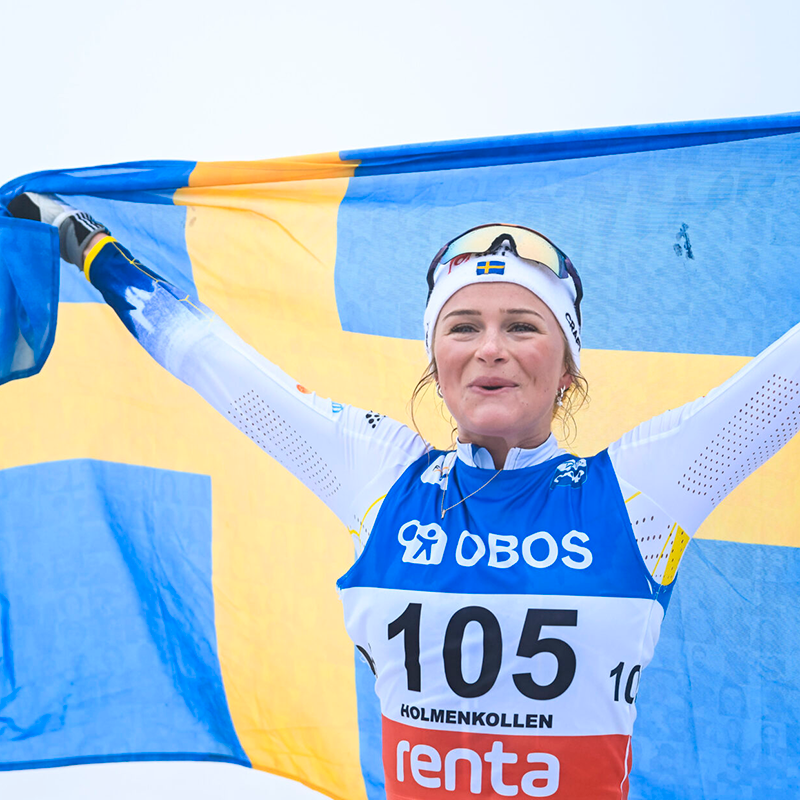
Frida Karlsson (SWE) claimed her third Holmenkollen win, her second at the 50 kilometer distance. (Photo: Authamayou/NordicFocus)
The prize for winning Oslo’s Holmenkollen 50 k is lifelong bragging rights. Such is the nature of the prestige afforded this event within the Nordic ski community. Norwegian fans, especially, remember certain years, certain races, certain rivalries; especially those that are memorable for the racing conditions that challenged the athletes. Fans are likely to remember this 2026 edition, and the thick, stubborn fog that enveloped the racers throughout the 50 kilometer distance. Stadium announcers regularly reminded the audience that racers were entering the stadium . . . otherwise, fans might not have known. The fog may have appeared thicker and soupier through the lens of broadcast cameras, but it’s certain that the fog hung close to the ground, obscuring skiers’ views of the course, of the crowds, and of their competitors. Perhaps that had something to do with the more measured pace the leaders selected. By the halfway point of the race, the entire women’s field was still together (not at all the normally expected state of affairs in women’s mass-start Distance racing). The regular cast of contenders remained at the front—Frida Karlsson (SWE), Ebba Andersson (SWE), Heidi Weng (NOR), Astrid Oeyre Slind (NOR), Jonna Sundling (SWE), and Jessie Diggins (USA)—but none of them seemed eager to race off alone.
Karlsson would emerge from the fog first, crossing the finish line all alone to claim her third Holmenkollen race, and her third at the 50 kilometer distance. Behind Karlsson, her Swedish teammates—Linn Svahn and Jonna Sundling—would sprint across the line in second and third, just ahead of Heidi Weng (NOR), Nora Sanness (NOR) and Jessie Diggins (USA).
“It’s such a magic day for our team,” beamed Karlsson. “It’s our first “triple” in the distance, and it’s sick!”
Alison Mackie (CAN) followed up a win at the U23 World Championships with a 14h place debut in the Holmenkollen 50 k. (Photo: Authamayou/NordicFocus)
Canada’s Alison Mackie remained in the top 10 through the halfway mark, and continued to make her presence felt throughout the 50 kilometer distance. . A young skier with a bright future, Mackie was certainly making he most of her first Holmenkollen. She would finish the day in 14th, sandwiched between established distance-racing stars Kristin Austgulen Fosnaes NOR) and Astrid Oeyre Slind (NOR).
Kendall Kramer (USA started 45th (out of 50 starters), but in the close company of the 46th starter, Delphine Claudel (FRA), a world class Freestyle competitor. If they could work together, they could make up many places in a hurry. By the five kilometer mark, Claudel had managed to work her way all the way up to the front . . . but Kramer was nowhere to be seen. Claudel would hang on to finish 28th. Kramer would cross the line 41st.
Clearly the best . . . Frida Karlsson (SWE) raced away from her rivals, exiting the fog to claim victory in Holmenkollen’s historic 50 k Freestyle. (Photo: Authamayou/NordicFocus)
Holmenkollen 50 k Freestyle
The Holmenkollen 50 k consists of six laps of an 8.3 kilometer loop, demanding 1000 feet of climbing per lap. And this day in Oslo, race organizers elected to stage the race in a manner that put both the women’s field and the men’s field on the course at the same time, albeit separated by half a lap’s distance. The men’s field would come through at the end of the bonus points at 19.6 kilometers just before the women started, providing a head start of approximately a four kilometers. Stragglers from the men’s field would ultimately be caught by the women. Likewise, stragglers from the men’s field would later be caught by the women. In the thick fog that hovered over the course during today’s race, there was plenty of opportunity for mild confusion.
Karlsson Weng, Andersson, and Slind would ease to the front, providing the early pace, but not going straight to the accelerator as they might have done on a normal day. Behind them, another predictable tier of racers followed, including Nepryaeva, Sundling, and Diggins. The men’s field had already passed through 20 kilometers in a massive, cohesive unit. It was possible that the bizarre conditions on the day would influence the women’s field to do the same.
Diggins won the bonus points at the three kilometer check point, gaining another 12 points over her closest rival in the chase for the Crystal Globe, Moa Ilar (SWE). Diggins would again remain ahead of Ilar at the 11.3 bonus points line. Diggins would collect eight points by crossing the line fourth.
Just before the end of the second lap, Slind stumbled and fell. She would need to spend extra energy to rejoin the leaders, if she was even able to. The field would slow a bit in the feed zone, but Slind would still have a gap of nearly eight seconds to make up . . . and Weng, Andersson, Karlsson, and Diggins continued to make the pace at the front.
Karlsson upped the pace as they approached the 27.9 bonus points line, gapping he rest of the field in the company of Weng and Karoline Groetting (NOR). Diggins led the rest just nine seconds behind, but it seemed that a gap was forming. Diggins would use the technical downhills of the Holmenkollen course to rejoin the leaders, though she also dragged other sprinters forward. With twenty kilometers remaining, the leaders had yet to get rid of Sundling and her Swedish teammate, Olympic Sprint champion, Linn Svahn. Karlsson and Weng would’ve known that their chances of victory relied on their ability to drop those sprinters. All the leaders opted to switch skis at the end of the lap. They would all be on new skis for the final two laps.
Karlsson used the first uphill of the fifth lap to break away. She was followed briefly by Groetting, bu by the top of the slope, Karlsson was away, disappearing into the fog at the front. Groetting would dangle alone in the fog ahead of a chase group led by Svahn. Diggins would continue to bob at the back—on again, off again—repeatedly showing her ability to close gaps and make up ground.
With 12 kilometers to go, Karlsson was away, in full flight, and powering through the fog. Her lead would continue to grow: ten seconds, 15 seconds, 30 seconds, ultimately extending to nearly two minutes. The solo chaser, Groetting, would be caught by the chase group that now consisted of six: Weng, Svahn, Sundling, Groetting, Nora Sanness (NOR), and Diggins. Diggins may be leading the World Cup Distance standings, but Karlsson was continuing to prove that she is the premier Distance skier in the world.
Linn Svahn (SWE), Frida Karlsson (SWE), Jonna Sundling (SWE) made up what Karlsson described as “Our first triple” in World Cup Distance podiums. (Photo: Authamayou/NordicFocus)
Karlsson would ski the last lap alone to claim her second Holmenkollen 50 k victory. The chase group would decide the podium with a sprint to the line, in which Svahn would outsprint Sundling. Weng would cross fourth, ahead of Sanness and Diggins.
Karlsson had shown the potential to exit the recent Olympic Games in possession of four gold medals . . . her performances would deliver only two (the Skiathlon, and the 10 k Freestyle). After the disastrous tumble of Ebba Andersson in the Team Relay (which allowed Norway to steal away the gold medal), and Karlsson’s own illness that kept her from competing in the 50 k, Karlsson appeared still to have something to prove when she toed the Holmenkollen starting line in Oslo. She would ski away from the rest of the best, stamping her authority on this historic race and claiming the sort of lifelong bragging rights that only the Holmenkollen can provide.
Feature stories like this one take time, access, and care to produce. If you value thoughtful storytelling and independent ski journalism, please consider becoming a Voluntary Subscriber. Your support directly fuels the work we do to cover the people, places, and moments that make our sport special.
Good luck finding the finish line . . . Linn Svahn (SWE) and Jonna Sundling (SWE) race through Holmenkollen’s thick fog toward the Swedish flag held aloft by race winner, Frida Karlsson (SWE). (Photo: Authamayou/NordicFocus)
We had to take a break after our three-week Olympic sprint, but we’re back to catch up on a couple of weeks of World Cup racing.
Devon and Nat take a quick run-through of events in Sweden, Finland and Norway. We’ll be back after the marathons at Holmenkollen.
Reach us at devon[at]fasterskier.com and nat[at]fasterskier.com.
A reminder: This is a homegrown podcast done by two guys working long hours and late nights. We also paid real money to be in Italy for the Olympics. If you can, support the show and FasterSkier’s ongoing coverage with a voluntary membership.
Help Support Our Olympic Coverage!
FasterSkier had our own Nat Herz on the ground at the Olympics, which, to be honest, was a very big financial lift for us. If you value the thoughtful work and access FasterSkier provides at championships like this one, please consider becoming a Voluntary Subscriber. Your support directly fuels the work we do to cover the people, places, and moments that make our sport special.
This coverage is made possible through the generous support of Marty and Kathy Hall and A Hall Mark of Excellence Award. To learn more about A Hall Mark of Excellence Award, or to learn how you can support FasterSkier’s coverage, please contact info@fasterskier.com.
The women’s sprint final comes into the finish in Drammen, Norway with: Laura Gimmler (GER), Ane Appelkvist Stenseth (NOR), Jonna Sundling (SWE), Nadine Faehndrich (SUI), Johanna Hagstroem (SWE), and Kristine Stavaas Skistad (NOR), (l-r). (Photo: Nordnes/NordicFocus)
The snow was trucked in, the rock band was playing near the finish, and Norwegian children cheered from second-story windows along the course. On a rare midweek World Cup race day in Drammen — a small city just southwest of Oslo where the sprint course loops through the streets, wraps around an old fountain, and finishes on the snow-covered steps of an iconic church — Jonna Sundling of Sweden took home another World Cup sprint victory.
Sundling won the women’s classic sprint, going stride for stride with Norway’s Kristine Stavaas Skistad before pulling away in the final meters. Switzerland’s Nadine Faehndrich, racing her final classic sprint before retirement, earned the bronze.
It was Sundling’s fifth individual World Cup victory of the season and the latest chapter in an intensifying rivalry with Skistad that has captivated ski fans, especially Scandinavian ones, for the last few seasons. From the World Championship final in Trondheim last year to the Olympic final in Milano Cortina, Sundling, with the rest of the Swedish sprinters, and Skistad have been locked in a tactical chess match. On Thursday in Drammen, it was Sundling who played the final move.
Quarterfinal number one heads up the first climb with: Barbora Antosova (CZE), Mathilde Myhrvold (NOR), Jessie Diggins (USA), Melissa Gal (FRA), (l-r). (Photo: Nordnes/NordicFocus)
Qualification and Quarterfinals
Sweden’s Linn Svahn, the reigning Olympic sprint champion, posted the fastest qualification time at 2:41.87 — nearly three seconds clear of Sundling’s 2:44.39. But qualification speed, as World Cup sprinting always reminds us, is only the entry ticket.
Two Americans advanced to the heats. Jessie Diggins, the overall World Cup leader wearing the yellow bib in what she called a “full circle moment,” qualified 17th in 2:50.91. Rosie Brennan, seeded 28th, also made the top 30.
Diggins chose Quarterfinal 1 alongside Sundling and Skistad — a loaded heat. Skistad took the win with Sundling second via a photo finish, just 0.18 seconds separating them. Diggins fought hard for third, advancing as a lucky loser after finishing just 0.22 seconds behind Sundling.
Rosie Brennan (USA) said after the race, “Drammen is one of my favorite races, it’s a fun course and always has a lively atmosphere.” (Photo: Nordnes/NordicFocus)
Brennan’s day ended in the quarterfinals. Racing in Heat 3, she bobbled heading into the downhill and lost the draft, which was a costly moment on a course where the slipstream effect was enormous all afternoon. She finished fifth in her heat.
“I was happy to get a chance in the rounds, but the conditions were very tough,” Brennan said. “They salted the course, and it was skiing great in the qualifier and then got really icy for the rounds. Anyway, I bobbled into the downhill and lost the draft and then just don’t have the power I need to pass that many people up the finish stretch, so I was disappointed to not be more in the mix.”
Meanwhile, Svahn survived a scare of her own… as her quarterfinal rounded the fountain that anchors the bottom of the course behind the start gates, five of the six athletes ended up in a pile and Svahn seemingly had the most bodies and equipment to navigate as she got back out on the course, but somehow recovered to advance. The Olympic champion’s troubles, however, were only beginning.
Maja Dahlqvist (SWE) and Jessie Diggins (USA), (l-r) during the second semifinal. (Photo: Nordnes/NordicFocus)
Semifinals
The two semifinals told entirely different stories, and the contrast between them shaped the final.
In Semifinal 1, Skistad took the win with Sundling second, just 0.20 seconds back. Both advanced automatically. Behind them, Svahn finished third and would not advance.
Semifinal 2 was a different race entirely. Johanna Hagstroem and Ane Appelkvist Stenseth pushed the pace from the gun, stringing the field out over the first climb. But on the long downhill, the draft did its work. Faehndrich and Laura Gimmler of Germany surged past, using the slipstream to slingshot into the lead.
Nadine Faehndrich (SUI), who is planning to retire after the season, found a little extra Drammen magic today as she finished on the podium in third. (Photo: Nordnes/NordicFocus)
Faehndrich won the heat decisively. Gimmler was second. The fast overall times meant Hagstroem would advance along with Stenseth, who just out-lunged Diggins for fourth and the second lucky loser position.
For Diggins, the day ended in 10th. But she left Drammen at peace.
“This was really cool because the Drammen area was my first ever World Cup start and it was a skate sprint,” Diggins said. “So it’s kind of a very full circle moment to close it out with a classic sprint here as the last classic sprint of my career.”
She had tried something new in the heats, sitting in the draft instead of going to the front, a departure from her usual aggressive approach. “Normally, because literal strength is not my strength, I usually just try to go really, really hot and try to go off the front,” she said. “I was like, nope, I don’t think that’s gonna work for me here with the crazy draft and slingshot effect. I was taking a lot of notes in warm-up, and in the quarterfinal, I had the smallest tuck of my life. It was just really fun to try to believe in myself as more of a pure sprinter and to try to be a little more tactical.”
She acknowledged she ran out of power in the semifinal, but had no regrets. “I still felt like I executed my plan to the best of my ability, and that’s always a cool feeling.”
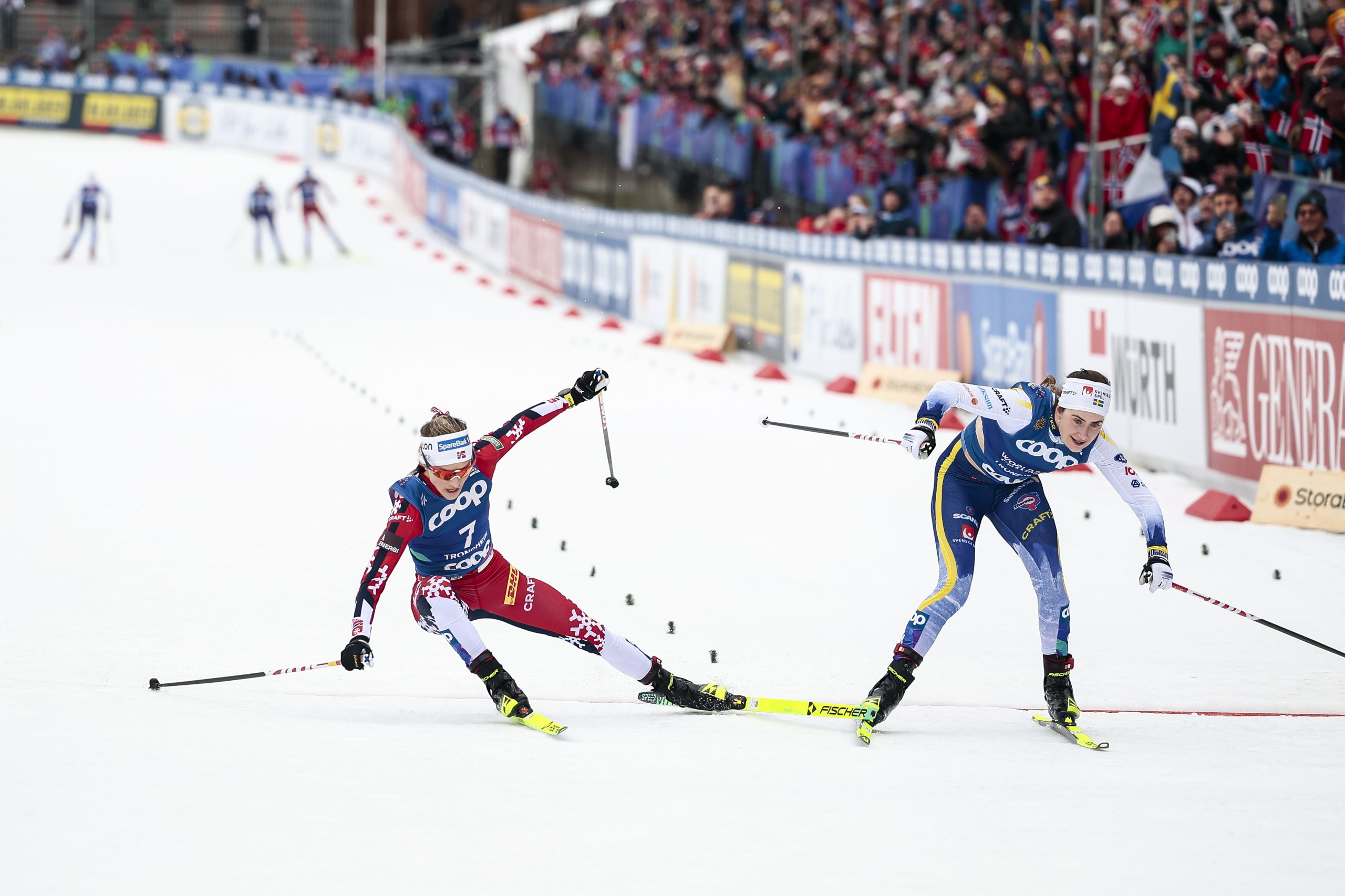
Jonna Sundling (SWE) crosses the finish line just ahead of Kristine Stavaas Skistad (NOR) for the win in Drammen, Norway. (Photo: Nordnes/NordicFocus)
The Final
Six women lined up for the final: Sundling and Hagstroem for Sweden, Skistad and Stenseth for Norway, Faehndrich for Switzerland, and Gimmler for Germany. Svahn and Maja Dahlqvist, the Olympic gold and bronze medalists in the sprint classic, were both absent.
On the opening climb, Skistad sat behind Sundling in a familiar posture — patient, conserving, waiting for the right moment. As Kikkan Randall mentioned on the broadcast, Skistad almost never leads into a downhill. She baited Gimmler into taking the front position, then tucked into her slipstream.
Coming off the descent and around the final hairpin, Faehndrich made her bid, surging past Gimmler and into third. But the race was between the two women everyone expected.
Sundling and Skistad skied side by side on the final climb, and what followed was a scene that encapsulated their rivalry. Stride for stride, shoulder to shoulder, neither yielding a centimeter. Sundling’s transition from double pole to striding was fractionally sharper — she carried more momentum through the final meters — and she crossed the line with a small advantage.
“It is usually very tight in Drammen, but today it was extremely tight,” Sundling said on air afterward. “Till the last meter. I was like, okay, I need to continue all the way over the finish line. It was tough, but I’m happy that I was the first person over the line.”
For Faehndrich, the bronze was a fitting farewell. The 30-year-old Swiss racer, who announced her retirement this season, now sits third in the sprint World Cup standings at 700 points — just behind Hagstroem (708) and within striking distance of leader Dahlqvist (720) heading into the final sprint of the season in Lake Placid next weekend.
Jessie Diggins (USA) gave her fans something to cheer about during her quarterfinal when she charged to the finish line. (Photo: Nordnes/NordicFocus)
Looking Ahead
Diggins continues to lead the overall World Cup standings with 1,961 points, 275 points ahead of Sweden’s Moa Ilar, a margin that appears insurmountable with four races remaining. The distance globe, too, seems firmly in her grasp. But the sprint crystal globe race is wide open: Dahlqvist, Hagstroem, and Faehndrich are separated by just 20 points at the top of the standings, and the final sprint in Lake Placid could decide everything.
For Diggins, there’s another milestone ahead — she’s only a few nights away from sleeping in her own bed before racing in front of an American crowd at the World Cup Finals. “Very, very, very excited about that,” she said.
The World Cup moves to the historic Holmenkollen venue in Oslo on Saturday for the Women’s 50 k Freestyle Mass Start, before the season concludes in Lake Placid, New York, March 20-22.
Feature stories like this one take time, access, and care to produce. If you value thoughtful storytelling and independent ski journalism, please consider becoming a Voluntary Subscriber. Your support directly fuels the work we do to cover the people, places, and moments that make our sport special.
This coverage is made possible through the generous support of Marty and Kathy Hall and A Hall Mark of Excellence Award. To learn more about A Hall Mark of Excellence Award, or to learn how you can support FasterSkier’s coverage, please contact info@fasterskier.com.
Jonna Sundling (SWE) during qualification in Lahti, Finland. (Photo: Authamayou/NordicFocus)
The World Cup season returned to Finland this weekend, closing a circle that began more than three months ago in Ruka. In the time since Olympic teams were selected, dreams realized or deferred, experience forged, and farewells offered week after week as the long winter wears on. If the stakes in Lahti feel slightly lower than they did earlier in the season, they are tightening in another way — especially in the races for the Crystal Globes.
With only a handful of races remaining in the season, the women’s Freestyle Sprint offered more than just another podium. The fight for both the Sprint Crystal Globe and the Overall Crystal Globe continues to tighten.
In tricky conditions, Sweden’s Jonna Sundling emerged as the day’s winner, navigating the heats with authority before closing out the final to claim victory.
“I think all day it’s been difficult with the conditions because it seems so nice, but when you ski it’s like icing underneath,” Sundling said in a post-race interview with FIS on the broadcast. “There were some challenges with the skiing, but I’m glad that I could ski as I did today and go all the way.”
The victory marked a strong return for Sundling, who said she had recently been dealing with a cold and missed racing in Falun before arriving in Lahti.
One of the most interesting moments of the women’s race came when Kristine Stavaas Skistad (NOR) was disqualified during the semifinals for what appeared to be a very minor incident. She received a yellow card for the incident, and because she was already carrying one from a previous violation, she was disqualified. (Photo: Authamayou/NordicFocus)
A Tactical Sprint Course
The Lahti freestyle sprint course rewarded patience as much as power. After the individual qualification round, the top 30 athletes advanced into the head-to-head heats — five quarterfinals of six athletes each, with the top two finishers and the two fastest “lucky losers” advancing to the semifinals.
From there, the field narrowed again: two semifinal heats would determine the six skiers racing for the win.
While the course appeared straightforward on paper, athletes quickly discovered the conditions made positioning critical. The climb before the final hairpin offered one of the few reliable passing opportunities before the long run to the finish, which saw the race often gather back together around the final corner before the finishing stretch. And throughout the heats, several favorites discovered how narrow the margin for error could be.
Maja Dahlqvist (SWE) got out well, but was unable to advance from the quarterfinals. (Photo: Authamayou/NordicFocus)
Globe Leaders Falter
Two of the athletes who have dominated the sprint standings this season — Maja Dahlqvist (Sweden) and Nadine Fähndrich (Switzerland) — both saw their days end earlier than expected, failing to advance beyond the quarterfinals.
Their early exits added intrigue to the sprint globe race as the season heads toward its final stretch.
Meanwhile, Sundling continued to build momentum, advancing smoothly through her heats despite the difficult snow conditions.
“I’m super motivated,” Sundling said of the final weeks of the season in the broadcast interview. “It’s my favorite time of the year.”
Hilla Niemela (FIN), Johanna Hagstroem (SWE), and Jessie Diggins (USA) (l-r) charge up the opening climb of the Freestyle Sprint in Lahti, Finland. (Photo: Authamayou/NordicFocus)
Diggins Attacks, But Falls Short
For the United States, Jessie Diggins came closest to advancing deep into the rounds.
In her quarterfinal, Diggins launched a decisive move on the final climb, surging to the front of the group in an effort to create separation before the tight hairpin turn at the top of the hill. Over the crest, she continued the attack, aggressively no-pole skating the downhill in an attempt to open a gap.
For a moment, the tactic appeared to work.
But the chasing group quickly organized behind her, the draft pulling them back together on the descent into the stadium. Sweden’s Johanna Hagström surged in the final meters, lunging at the line to edge Diggins and end the American’s day in the quarterfinal.
Diggins said the Lahti crowd helped make the experience memorable.
“It was so cool to hear the crowd roaring. There were so many people out, really filling the stadium and along the course. It’s just a very cool environment. It was sunny and beautiful, which made it really fun.
“I was really happy with my energy today. I feel like I skied a pretty good race and did everything I could. But again this year, I feel like I just don’t quite have that ultimate power, especially in the finishing stretch.
“I’m excited for tomorrow and just excited to be finishing out my last stretch here in Europe. That feels really special. It’s kind of cool to take a moment to reflect on my many years spent on the road in Europe. That chapter is coming to a close now, which is really cool and really special. I’m just grateful thinking back on all the memories over all the different years.”
Rosie Brennan (USA) fighting to maintain contact with the group as Gina Del Rio (AND) takes the opening climb out fast during their quarterfinal. (Photo: Authamayou/NordicFocus)
Brennan Knocked Out in Quarterfinal*
Veteran American Rosie Brennan also reached the quarterfinals but was unable to advance.
Lauren Jortberg (USA) on her way to 37th place in qualification in Lahti, Finland. (Photo: Authamayou/NordicFocus)
Jortberg Reflects on Qualification Miss
For Lauren Jortberg, the Lahti sprint was a reminder of how thin the margins can be in World Cup qualification.
Jortberg finished 37th in the qualification, just outside the top-30 cutoff needed to advance to the heats. After the race, she said the conditions on the Lahti course made it difficult to find the right balance between glide and stability.
“There was kind of an ice sheet underneath with some sugar on top,” Jortberg told FasterSkier after the race. “So it was hard to find skis that were running really well while also being able to push off and plant well. It made the skiing a little tricky, but that’s pretty typical for what we’ve seen in Lahti the last few years.”
Jortberg also felt she left something on the course in terms of pacing.
“I think I just didn’t pace it very well,” she said. “I probably paced it too much. I didn’t really finish feeling that tired, so that was a bit of a bummer.”
Part of that caution, she explained, stemmed from having dealt with illness in the days leading into the race.
“I had been sick the last week, so I think I held back a little bit,” Jortberg said. “That’s frustrating because I felt really good and I think I could have been competitive today.”
Even so, Jortberg said the past months of racing have helped build confidence as she continues gaining experience on the World Cup circuit.
“One of the big takeaways from these World Cup weekends is that when I can put down a really solid qualifier, I’m very much in the mix,” she said. “Even though today wasn’t a great qualifier, I wasn’t that far out of the heats, so I think that’s something I can take confidence from going into the next few weekends.”
Julia Kern (USA) during qualification. (Photo: Authamayou/NordicFocus)
Julia Kern Trying to Get Back to Form*
Julia Kern, returning to racing after illness following the Olympic Games, placed 44th in the qualification round.
Albrecht Gaining World Cup Experience
Emma Albrecht, competing in her fourth World Cup weekend, finished 48th in the qualification round in Lahti as she continues gaining experience at the highest level of the sport.
Albrecht said one of the biggest adjustments to racing on the World Cup has been the razor-thin margins in sprint qualification.
Emma Albrecht (USA) gaining experience during the qualification in Lahti, Finland. (Photo: Authamayou/NordicFocus)
“The biggest adjustment to racing at this level is how tight the race margins are,” Albrecht told FasterSkier after the race via email. “The U.S. SuperTour field is obviously not as competitive, and it has been a shift — especially in sprinting — to have to have a fast qualifier. You are no longer guaranteed to make heats.”
The Lahti sprint course also served as a reminder of the confidence and technical skills required to compete in crowded sprint fields.
“Today’s qualification reminded me to take up space on the course and not be afraid of a little hop skate,” she said.
Even with the challenges, Albrecht said the experience is fueling motivation heading into the offseason.
“This weekend is making me very excited for summer training,” she said. “A field as deep as this really highlights weaknesses on course. I would love to become a more efficient jump skater and be more confident in my high-speed V2. I’m definitely walking away with a lot of motivation to improve.”
Liliane Gagnon (CAN) charges up the first climb during her quarterfinal, where she narrowly missed advancing to the semifinals. (Photo: Authamayou/NordicFocus)
Canadian Results
Canada’s top performance came from Liliane Gagnon, who finished third in her quarterfinal — just short of advancing to the semifinals.
Teammates Olivia Bouffard-Nesbitt and Katherine Weaver placed 43rd and 46th, respectively, in qualification.
Jonna Sundling (SWE) celebrates the win while Coletta Rydzek (GER) and Johanna Hagstroem (SWE) lunge for third behind her. (Photo: Authamayou/NordicFocus)
The Season’s Final Push
With only a handful of races remaining on the World Cup calendar, the results in Lahti could prove important in shaping the final standings.
For Sundling, the victory served as both a return to form and a statement heading into the closing weeks of the season.
“I’m looking forward to the rest of the season,” she said.
For others — particularly those chasing the Crystal Globes — the margin for error continues to shrink.
And with more racing still ahead in Lahti this weekend, the battle for the season-long trophies is far from settled.
*We hope to add more quotes above from athletes if we hear back from them, but wanted to get this race report posted in a timely fashion.
Love Stories Like This? Help Keep Them Coming.
Feature stories like this one take time, access, and care to produce. If you value thoughtful storytelling and independent ski journalism, please consider becoming a Voluntary Subscriber. Your support directly fuels the work we do to cover the people, places, and moments that make our sport special.
The highs were high and the lows were low in the Olympic team sprint in Italy, with the Ogden-Schumacher men’s team claiming silver and the Diggins-Kern women’s pair finishing out of the medals. Devon and Nat break the whole thing down.
We’ll be back after Saturday’s men’s 50 k. Reach us at devon[at]fasterskier.com and nat[at]fasterskier.com. We’re really grateful for all the support during the Olympics — thanks for notes and encouragement.
A reminder: This is a homegrown podcast done by two guys working long hours and late nights. We’re also paying real money to be here in Italy. If you can, support the show and FasterSkier’s ongoing coverage with a voluntary membership. We’re also offering a bonus during the Olympics: a WhatsApp group with notes on Nat’s experiences in Italy, the food he’s eating, interview transcripts and more.
Send nat[at]northernjournal[dot]com a confirmation of your voluntary membership and the number he should use for WhatsApp and we’ll get you signed up. You can also Venmo him directly at @nat-herz if a membership isn’t for you. We’re suggesting a minimum of $10, but we also won’t turn anyone away who wants to join because of an inability to pay.
Help Support Our Olympic Coverage!
FasterSkier will have our own Nat Herz on the ground at the Olympics, which, to be honest, is a very big financial lift for us. If you value the thoughtful work and access FasterSkier provides at championships like this one, please consider becoming a Voluntary Subscriber. Your support directly fuels the work we do to cover the people, places, and moments that make our sport special.
This article was made possible through the generous support of our voluntary subscribers who have helped us put our Nat Herz on the ground reporting at the Olympics. If you value coverage like this, please support FasterSkier with a voluntary subscription.
Jonna Sundling (SWE) follows Jessie Diggins (USA) during the Olympic Women’s Team Sprint in Tesero, Italy. (Photo: Vanzetta/NordicFocus)
PREDAZZO, ITALY — Eight years ago, on a different continent, the words “Here Comes Diggins!” by Chad Salmela vaulted American cross-country skiing into a new era. On Wednesday in Val di Fiemme, the event that changed everything for the United States returned to the Olympic stage.
The Women’s Freestyle Team Sprint has long been one of the Americans’ signature races. In the PyeongChang 2018 Winter Olympics, Kikkan Randall and Jessie Diggins delivered the nation’s first Olympic gold medal in cross-country skiing. Last March in Trondheim, Diggins and Julia Kern claimed World Championship silver.
On Wednesday, Diggins started the race in the first leg, handing off to Kern for the anchor leg, as they had in their previous medal run. They hoped for one more shared championship moment.
It was not to be. The Americans finished fifth, in a race that required not just fitness but flawless execution. Sweden’s Jonna Sundling and Maja Dahlqvist took gold. Switzerland’s Nadja Kaelin and Nadine Faehndrich secured silver. Germany’s Laura Gimmler and Coletta Rydzek won bronze after a late-race crash by Finland opened the door in the final turn.
For the Americans, the margin was not dramatic. But close, at this level, does not bring home a medal.
Jessie Diggins (USA) and Jonna Sundling (SWE), (l-r) come through the stadium during the Olympic Women’s Team Sprint. (Photo: Vanzetta/NordicFocus)
“Honestly, left it all out there.”
The Team Sprint is one of the sport’s most punishing formats. Two skiers qualify individually; their times are combined to determine which 15 nations reach the final. In that final, the athletes alternate laps — three each — on a course that offers no reprieve.
Often, one skier brings distance strength, and the other sprint speed. For the United States, Diggins and Kern blur those categories. Both are capable of driving pace. Both can finish.
From the gun, Diggins did what she has done throughout her career: she went to the front.
She and Sundling stretched the field immediately, driving into the Zorzi Climb, the race’s defining ascent. The early order — Sweden, the United States, Norway, Canada — hinted at the nations prepared to dictate terms.
Jonna Sundling (SWE) stretches her lead. (Photo: Vanzetta/NordicFocus)
When Sundling surged later in the race, Diggins expected it.
“I knew she was probably going to do that,” Diggins said afterward. “And I was like, just do the best that you can do. You know, like, you can’t control anything except your effort and your heart. And I was like, skiing out of my body, and I just did everything that I could, and I’m proud of that.”
That theme — control what you can — carried through her reflections.
“Honestly, I almost passed out like four different times,” she said. Then, clarifying: “No, from going that hard, no regrets. Honestly, left it all out there. I feel like we did everything we could, and that is the only thing you can control at the end of the day.”
Julia Kern (USA) and Jessie Diggins (USA), (l-r) gather in the finish area after the race, Diggins racing in the US team’s relay socks for the final time. (Photo: Barbieri/NordicFocus)
One final lap with ‘Relay Socks’
By the last exchange, Sweden had carved out daylight. Switzerland began clawing into Finland’s hold on silver. Behind them, Germany, Norway, the United States, and Finland battled for bronze.
On the final descent, Finland’s anchor, Jasmin Kahara, lost her balance in the sweeping right-hand turn and fell, sliding out on her stomach. Germany and Norway slipped past in their tucks. Kern, just meters behind, fought to the line, but the podium had narrowed to two.
Coletta Rydzek (GER) brings home the bronze medal for Germany with Norway’s Julie Bjervig Drivenes just off camera. (Photo: Vanzetta/NordicFocus)
As they drove for the line side by side, aerodynamically no-pole skating with everything they had, it was clear this was going to be close. Germany claimed bronze while Norway left empty-handed in fourth. Just behind, Kern brought the United States to the finish in fifth.
For Diggins, the moment carried a different weight. It was, by her admission, her last Olympic relay leg.
“I love racing with this girl. I’m so, so proud of her,” she said of Kern. “And, yeah, it’s emotional to feel like I’m never gonna pull on those relay socks again.”
When asked whether there was a sense of handing the event forward, she reflected on the arc of her career — from her first team sprint world title in 2013 to the growth of youth programs back home.
“It’s just really cool to be part of the evolution of American skiing,” she said.
Julia Kern (USA) and Nadine Faehndrich (SUI), (l-r) find their lines around a tricky corner. (Photo: Vanzetta/NordicFocus)
Whitcomb knows they can win
For Head Coach Matt Whitcomb, the analysis was candid and clear-eyed.
“Yeah, it was a good race,” Whitcomb said. “Of course, this is an event that we know we can win, and we didn’t today.”
In a format this tight, small imperfections are decisive.
“For even a bronze medal to happen, both legs have to be firing exquisitely,” he said. “We swung as hard as we could. We did our best. We were prepared to win today, and we just didn’t.”
Of Kern’s anchor leg, Whitcomb offered both empathy and affirmation.
“Julia is an incredible performer, and one thing you can always trust from her is that you’re gonna get her absolute best,” he said. “We saw it on the final climb. I was happy with how she climbed. Just didn’t quite have the entire thing today, and that’s okay.”
Jessie Diggins tags Julia Kern (USA), while Jonna Sundling tags Maja Dahlqvist (SWE), (l-r) in the exchange zone between laps. (Photo: Vanzetta/NordicFocus)
Diggins in the best fitness of her life
Diggins has raced these Games managing injury concerns, including rib pain after a fall in the opening Skiathlon. But when asked whether her fitness was lacking, she pushed back.
“I feel like I’ve come into this with the best fitness in my life,” she said. “And that’s one of the only things I could control.”
There is comfort, perhaps, in that certainty — in knowing preparation was not the missing piece.
“I was skiing out of my body,” she said. “And I just did everything that I could.”
In Olympic-level team sprinting, that is sometimes enough. On Wednesday, it was not quite.
But the American women did what Diggins described as the only thing you can in cross-country skiing: you have to leave it all on the course without regret.
FasterSkier will have our own Nat Herz on the ground at the Olympics, which, to be honest, is a very big financial lift for us. If you value the thoughtful work and access FasterSkier provides at championships like this one, please consider becoming a Voluntary Subscriber. Your support directly fuels the work we do to cover the people, places, and moments that make our sport special.
That was a banger. We’re deep into the Olympics now, and Devon and Nat return for the third straight night to recap the women’s relay. One more race — the Norwegian men versus the world — and then everyone gets two days off.
Reach us at devon[at]fasterskier.com and nat[at]fasterskier.com. We’ll be back tomorrow.
A reminder: This is a homegrown podcast done by two guys working long hours and late nights. We’re also paying real money to be here in Italy. If you can, support the show and FasterSkier’s ongoing coverage with a voluntary membership. We’re also offering a bonus during the Olympics: a WhatsApp group with notes on Nat’s experiences in Italy, the food he’s eating, interview transcripts and more.
Send nat[at]northernjournal[dot]com a confirmation of your voluntary membership and the number he should use for WhatsApp and we’ll get you signed up. You can also Venmo him directly at @nat-herz if a membership isn’t for you. We’re suggesting a minimum of $10, but we also won’t turn anyone away who wants to join because of an inability to pay.
Help Support Our Olympic Coverage!
FasterSkier will have our own Nat Herz on the ground at the Olympics, which, to be honest, is a very big financial lift for us. If you value the thoughtful work and access FasterSkier provides at championships like this one, please consider becoming a Voluntary Subscriber. Your support directly fuels the work we do to cover the people, places, and moments that make our sport special.
This article was made possible through the generous support of our voluntary subscribers who have helped put our Nat Herz on the ground at the Olympics. If you value coverage like this, please support FasterSkier with a voluntary subscription.
Norway claimed the Team Relay gold medal in the Olympics of Milano-Cortina. Heidi Weng (NOR) skied the anchor leg all alone . . . she never would’ve expected that. (Photo: Vanzetta/NordicFocus)
On paper, no one beats Sweden. After the first three events of these Olympics, Sweden had won all three gold medals. Before the games began, most ski-experts gave few other nations a chance of grabbing any gold in Women’s Cross-Country . . . especially not in the relay. Just consider Sweden’s roster: Linn Svahn, Ebba Andersson, Frida Karlsson, Jonna Sundling. Svahn is the world’s best sprinter. With two silver medals thus far, Andersson has proven herself the second best distance skier at these Olympics. The first two gold medals in Olympic distance races have been won in peerless fashion by Karlsson. And Sundling has been Sprint racing’s World Championship and Olympic Gold medalist. If you wanted to construct a relay team that was certain to win gold, those are the names you’d print on your entry.
On paper, no one beats Sweden, but cross-country ski racing is a sport that regularly refuses to follow the script, and Olympic medals aren’t handed out based on which team submits the most impressive set of skier résumés. Ski racing happens out on a snow covered course between start lines and finish lines: punishing uphills, treacherous downhills, sharp curves, and variable snow. It’s not a running race . . . and the challenges of racing at high speeds on long, flexible skis with no metal edges means that just about anything can happen.
And it did . . .
The field of the 2026 4 x 7.5 k Olympic Relay leaves the starting line. Drama would be soon to follow. (Photo: Barbieri/NordicFocus)
Scramble
Skiers call Leg 1 of the relay the “Scramble Leg,” a self-evident appellation that often finds teams assigning a capable sprinter to the task. The first kilometer of Leg 1 can be a crowded scrum—shoulders rubbed, elbows thrown, ski tails trod upon, poles at risk. The job of the Leg 1 skier is simple: weave through traffic, stay out of trouble, don’t get dropped. The Val di Fiemme course has already shown that it challenges racers with its tight turns and slushy snow. Falls have been common and consequential in Nordic events thus far in the Olympics. And a race day that offered 40 degree temperatures and light rain made the waxing a bit of a tricky prospect for the first two Classic legs.
Racers would ski two laps of 3.75 kilometers each. Though the field endured the rippling effects of a crash in the opening kilometers, the race settled quickly into a pack of 12 contenders. By the second lap of Leg 1, Svahn had begun to open a gap—not so much a breakaway as it was a demonstration of a team racing at a different level. Norway’s Kristen Austgulen Fosnaes and Italy’s Iris di Martin Pinter gave chase, but it appeared that the expected Swedish dominance had begun.
Julia Kern (USA) maintained her position in the top 12, but seemed to be struggling a bit to do so. The American team has struggled with slow Classic skis thus far in these Olympics, but Kern appeared determined to keep her team in contention.
Ebba Andersson (SWE) had a nightmare of a day on the course of the Olympic Relay. (Photo: Vanzetta/NordicFocus)
Leg 2
Kern had continued moving forward through the field, and tagged Rosie Brennan with Team USA in seventh place. Early in the second leg, Andersson suffered an awkward fall that allowed Norway’s Astrid Oeyre Slind to move to the front. Slind and Italy’s Caterina Ganz did their best to add to their advantage as Andersson struggled to overcome the deficit. Just like that, Sweden had a problem: Slind was now racing to win, and Ganz was racing in her home country. Both appeared energized and fresh.
Andersson ultimately reeled in Ganz, but Slind continued to widen the gap. Behind her, the brilliant Classic technician, Kerttu Niskanen had worked Finland back into the race alongside Italy. Brennan continued to maintain USA’s place in the top seven, as Andersson continued working her way back toward the front. Team Swedn knew htat if it could get back to Slind, then Karlsson and Sundling would likely still be able to deliver victory.
And then the wheels fell off the Swedish juggernaut . . . and in most spectacular fashion. Andersson had often appeared uncomfortable during her relay leg. Then, on a fast slushy downhill, she caught the tentative outer edge of a high-speed snowplow, somersaulting her across the course in a violent, end-over-end crash that left her briefly stunned and scattered. Andersson scrambled quickly to her feet, only to find herself standing on only one ski, the other one coasting down the slope with a broken binding. Andersson sprinted forward to collet her ski, but the damage to the binding was too severe. Only one thing left to do: run for it. Cradling her crippled ski in her arms, Andersson began frantically scooter-pushing her way up the course. There are plenty of places on a world-class ski course where coaches and team personnel wait with spare poles (just in case one gets snapped). When skiers break a pole, it’s definitely going to affect their progress and their placing, but those poles will likely be replaced pretty quickly. A broken ski is another matter, entirely . . . and the likelihood of a coach standing in the right place wearing skis preppred with decent race wax is not all that high. Andersson knew her team’s chances were fading, and she ran for her life. Eventually, a coach appeared with a ski that must’ve been a decent match, and Andersson was able to get back into the race.
“Yeah, it was a lot of emotions going through my whole body and the mind at that moment,” said Andersson in post-race interviews. “And, yeah, it was a completely disaster. And first I was thinking, ‘oh, I need to fix it by myself.’ But then I understood that, okay, I won’t be able to do it. So then I just tried to go as fast as possible down the hill and to one of our coaches that was running with a new one. After that, I just tried to minimize the disaster that was already done.”
But the damage had been done. Sweden now trailed by over a minute, and a rejuvenated Team Norway was forcing the pace at the front.
Frida Karlsson (SWE) overcame much of the deficit created by Andersson’s disastrous fall, but the gap was simply too great. Sweden would settle for silver. (Photo: Barbieri/NordicFocus)
Leg 3
Karlsson would start with a deficit of 1:18. She’d start whittling away at that gap as soon as she took to the course. Slind would hand Karoline Simpson-Larsen a lead of 23 seconds over Finland and Switzerland. But every fan’s attention would have been directed to Karlsson as she began Leg 3 with a deficit of 1:18. Karlsson appears to be in tby far the best form of any of the distance skiers at these Olympics, but so wide a gap would be nearly impossible to solve. Nonetheless, she set off in pursuit.
Novie McCabe skied brilliantly to move Team USA into fifth place, but even as she did she found her position eclipsed by the flashing white suit of Karlsson who appeared determined to bring Sweden back into medal position. Like Karlsson, Martina diCenta turned up the speed to overtake Switzerland’s Marina Kaelin, moving the host nation back into third place as the field neared the stadium.
Joy at the finish line: Heidi Weng (NOR) celebrates Norway’s unlikely victory in the Olympic 4 x 7.5 Relay. (Photo: Vanzetta/NordicFocus)
Anchor Leg
Simpson-Larsen handed Weng a lead of 48 seconds, followed another nine seconds later by Italy. Yet another nine seconds later, Karlsson tagged Sundling, who set off in pursuit of the medals. Finland’s Jasmi Joensuu held second place, and Italy’s Federica Cassol clung stubbornly third . . . but Sundling was flying, and Italy and Finland would have no answers for a hard-charging World and Olympic champion.
The anchor leg played out in three segments. At the front, Weng continued to race on alone, checking her speed on each downhill curve, but working the uphills and flats like the former World Cup champion she is. In the medal chase, Sundling was storming forward through the contenders, having already caught Italy, and reeling in Finland before the beginning of the penultimate lap. Behind the medal struggle, Diggins led a small group of chasers poised to claim prizes if any other disasters befell the leaders.
In the end, Weng would hold on to Norway’s lead, jubilantly sprinting across the line even with a lead that needed no such efforts. She screamd with joy at the finish line where she was immediately embraced by her teammates. Norway had felled Goliath, and proved the experts wrong. Behind them, Sundling would shed Joensuu and coast across the line for silver. Sundling skied into the embrace of her teammates, but their posture was anything but celebratory. Finland would claim bronze, followed by Germany, United States, and Italy.
On paper, no one beats Sweden. But cross-country ski racing is a sport raced on snow rather than paper, and Olympic medals are won, not given. Sweden can be proud of an Olympic sliver medal in the Team Relay, but the gold that Norway takes home will be one that will be treasured and remembered for ages.
FasterSkier will have our own Nat Herz on the ground at the Olympics, which, to be honest, is a very big financial lift for us. If you value the thoughtful work and access FasterSkier provides at championships like this one, please consider becoming a Voluntary Subscriber. Your support directly fuels the work we do to cover the people, places, and moments that make our sport special.
This article was made possible through the generous support of our voluntary subscribers who have helped put our Nat Herz on the ground at the Olympics. If you value coverage like this, please support FasterSkier with a voluntary subscription.
Linn Svahn (SWE) has long looked like the best sprinter in the world, but she has only rarely had the chance to prove it. After years of injury and delay, finally she earns Olympic gold. (Photo: Barbieri/NordicFocus)
PREDAZZO, ITALY — Checking today’s ESPN home page makes it clear that the Olympics don’t seem to occupy the American imagination like they once did. I remember the Olympics as being a bigger deal—a set of events that captured the imagination of the world, an international spectacle that occupied the media spotlight. Life magazine, Time magazine, Sports Illustrated: all devoted their covers and countless pages to Olympic events when they were upcoming, to the results when they became available, to the impact that these performances had on the viewing public. There was something bigger about it, something that seemed to separate it from mere sport, something that seemed to elevate it above mere commercialism. These weren’t just athletes; these were Olympians.
They still are . . . Over in Italy, the Olympians are parading in ceremonies and competing in events and collecting medals while national anthems resonate in the crisp mountain air … but ESPN covers only the sports that matter to most Americans: NFL Football and NBA basketball and NHL hockey and MLB baseball and PGA golf, followed by men’s college basketball and women’s college basketball and college softball and MLS soccer and WCW Wrestling and the lingering stories surrounding Super Bowl commercials and Super Bowl halftime shows. And waaaaay beneath all that, we find a mention of the American gold medal in Team Figure Skating and the final helicopter flight of Lindsey Vonn’s legendary career. Thus far in Milano-Cortina, Olympic performances haven’t proven sufficient to capture the attention of a jaded viewing public. The only story American’s are likely to follow in cross-country skiing is that of reigning World Cup Champion, Jessie Diggins. Even with that accolade in hand—even being a defending medalist in the Olympic Sprint—Diggins does not find herself appearing often in the daily conversation that dominates column inches over at ESPN.
Strength and grit, tactics and tenacity: Julia Kern (USA) earned her way through to the Olympic Sprint final. (Photo: Vanzetta/NordicFocus)
And it really is too bad that ESPN may overlook another tremendous story that unfolded in the Women’s Classic Sprint, as the long-suffering Linn Svahn—whose history of injury and ill-fortune has repeatedly interrupted what could’ve been a legendary career—finally grabbed the medal that has always appeared to be within her reach. Svahn led a Swedish sweep of the podium ahead of Olympic and World Champion, Jonna Sundling and the ever-crafty veteran, Maia Dahlqvist. Svahn delivered a performance that cements her place in the history of cross-country skiing. After a long, long wait, Linn Svahn is Olympic champion.
Though it appeared that Americans were still struggling with waxing issues in the soft snow of Val di Fiemme, Team USA saw four skiers advance through qualifying: Jessie Diggins (20th), Sammy Smith (26th), Julia Kern (28th), and Lauren Jortberg (30th). Those qualifying placings did not inspire a tremendous amount of confidence in what was likely to be a lightning-fast day of sprinting. Ultimately, it was Kern who would ski with power and grace in advancing to the Olympic Sprint final where she would finish sixth. Diggins may still be suffering the effects of her crash in Saturday’s Olympic Skiathlon; Diggins skied bravely, but could be seen clutching her injured ribs after placing fourth in her quarterfinal. She would finish the day in 17th.
“My qualifier didn’t go as well as planned,” said Kern. “But it was enough to qualify, and I always get stronger in the rounds. And I had really good skis and played to my strategy and knew I had a strong finish and really never gave up and was hanging really tough when I was pretty tired. And so I went the lucky loser route today, which was my strategy. And that obviously has a cost. So come the final, I was completely spent, but I didn’t know it, and I really gave it my all, tried to be in the mix, and I had left everything on the course to get to the final. And I don’t have any regrets about that. I think that’s what I needed to do to get there. And that’s where I’m skiing right now.”
“Obviously it was 30th, but I think it still wasn’t really, like, my best qualifier,” said Jortberg. “I think there’s still a lot of room to move there, which is cool. And I think had it not been in such a stacked heat, I think it would have maybe been a slightly different quarterfinal for me, but we’re still really proud of how I skied. I think I made a couple tactical errors out there.”
Ultimately, the final American placings were Kern 6th, Diggins 17th, Smith 19th, Jortberg 30th.
“Really exciting to have my Olympic debut,” said Smith. “And I wish I would have done a few things differently in that heat. Like what? I mean, I think I tried to make a move on the left side on the hill. I could have potentially been able to make more time over the top, but it’s pretty incredible opportunity and just excited to be out here and racing.”
Smith explained the challenge and the complexity of competing in the Olympics while simultaneously enrolled at Stanford: “I’m taking material science and engineering. I’m taking environmental law class. I’m taking a creative nonfiction class, doing an independent study as well with a psychology professor,” said Smith. “And then I’m also taking physics. Stanford probably has more Olympians per capita than most places. It’s actually pretty cool. We have four winter Olympians from Sanford this year. So Eileen Gu is competing for China in big air and slope style, Zoe Atkin in half pipe and big air, and then Brandon Kim in speed skating. So it’s pretty cool that there’s four of us. The school’s been incredibly supportive, and I’m excited for all of us to compete.”
Sprint Quarterfinals
Jortberg and Smith lined up together in a quarterfinal that was packed with stars and contenders including Sundling, Kristine Stavass Skistad (NOR), and 2025 World Cup Sprint champion, Jasmi Joensuu (FIN). Sundling went to the front, setting the pace ahead of Skistad, providing a possible preview of the tactics likely to define the Sprint final. Jortberg and Smith dropped to the back where they appeared incapable of overcoming the blistering pace set by Sundling. Over the top of the ultimate downhill, Sundling led Joenssu as Skistad appeared to struggle. But the finish line lies at the far end of a straight downhill, and Skistad’s fast skis and gliding ability were able to dismantle Joensuu. Skistad would follow Sundling across the line to claim automatic spots in the semifinal. Smith would finish fourth to sit in a lucky loser position after the first quarterfinal.
Quarterfinal 2 included Kern, Nadine Faehndrich (SUI), and the day’s top qualifier, Svahn. Faehndrich and Svahn made the pace in the heat, though Faehndrich would fade from contention in the late stages. The suprising Italian, Caterina Ganz, would drive forward to claim the second spot to advance to the semifinal behind Svahn; Kern was able to hold her position in the pack moving forward into third place, a status that would allow her to claim a lucky loser spot in the semifinal.
Johanna Matintalo (FIN) took the third quarterfinal ahead of Laura Gimmler (GER). Julie Bjervig Driveness (NOR) would move into the fastest lucky loser, spot pushing Kern down a spot, but allowing her to remain in contention with two heats remaining.
Still sore from a crash in Saturday’s Skiathlon, Jessie Diggins (USA) gave her all in her Olympic Sprint quarterfinal. (Photo: Vanzetta/NordicFocus)
Diggins started in the fourth quarterfinal alongside Maia Dahlqvist (SWE). They appeared to be the strongest in their heat, and Diggins sprinted directly to the front to set the pace. But the snow in Val di Fiemme was unusually slow, which did not favor the leaders, especially with the course profile that descended steadily to the finish line. Diggins paid the price for leading early, finding herself passed by the field, and unable to improve her position in the finishing straightaway. Diggins would end her day with a fourth place finish in the quarterfinal from which Dahlqvist and Federica Cassol (ITA) would advance.
“I didn’t realize it right after it crashed, when I bruised my ribs,” said Diggins. “But then afterwards, you feel it; right now they really hurt. So I’m doing the best I can. I know I’m in good shape and I really want to make the team proud and I’m just trying the best I can . . . I needed to figure out how to manage this for Thursday. I hope that my body’s feeling better, but my energy is good and I’m excited to be here. I think I’M not a best shape in my life. I just need everything to come together in the right moment. But I know there’s possibility there. So I’m going to keep coming and bring my best.”
Sprint Semifinals
Kern found herself in a semifinal crowded by the résumés of Svahn, Sundling, and Skistad. Sundling and Svahn would claim hte automatic qualifying spots, while Kern would overcome a mid-race loss of speed to finish fourth (behind Skistad) to reside in a lucky loser spot (behind Skistad) with one semifinal remaining. Ultimately, the second semifinal involved fewer stars, and a field that seemed less likely to produce fast times and lucky losers. Driveness and Dahlqvist advanced out of the second semifinal, allowing lucky loser spaces for Skistad and Kern.
Linn Svahn (SWE) streaking toward her Olympic Sprint gold medal. (Photo: Barbieri/NordicFocus)
Olympic Classic Sprint Final
Six months ago, FasterSkier’s Editor-in-Chief made a bold and confident confident call, predicting that Julia Kern would qualify for the Olympic Sprint final. While that early prediction may have been a reflection of the proud Massuchessetts roots he shares with Kern, it also reflected his knowledge of World Cup and Olympic skiing, and his understanding of just what it takes to ski and compete at this level. The Editor knows his stuff, and Kern has proven herself entirely deserving. That Kern advanced to the Olympic Classic Sprint final came as no surprise to Fasterskier.
But Kern was not alone in the final. The cast of characters in this Sprint drama was one that left no room for pretenders or understudies. Kern lined up alongside Skistad, Sundling, Svahn, Dahlqvist, and Driveness. At the crack of the starter’s pistol, Team Sweden began to assert itself as Sundling drove straight to the front. This has been the tactic that has earned Sundling World and Olympic championships, and it came as no surprise to see her at the front. She was followed by Svahn as Skistad appeared overcome by the early pace. At the mid-race point, Dahlqvist eased her way past Skistad, and Team Sweden headed for the podium. At the finish, it was the power of Svahn that drove across the line ahead of Sundling and Dahlqvist. Linn Svahn’s long path had finally delivered her to the destination that fans had always imagined. After years of injury and disappointment, after seasons of patience and impatience, Linn Svahn finally wears the Olympic gold medal.
Julia Kern (USA) used all her experience and every bit of her energy to advance to the Sprint fFinal. (Photo: Barbieri/NordicFocus)
“I am really happy with today,” said Kern. “It’s been a challenging season. I haven’t made it out of the quarterfinals this year. So to make it to the finals of the Olympics Is a huge accomplishment, and I’m really proud of it because I fought really hard today.
The typical ESPN viewer may find other events to be more compelling, but the thrill of competing in an Olympic Games is not lost on the athletes: “I’ve never raced with the rings on my bib,” said Jortberg. “There’s a lot going on, which is super cool, and I feel like I just feed off that.”
On the ground reporting by FasterSkier’s Nat Herz.
Help Support Our Olympic Coverage!
FasterSkier has our own Nat Herz on the ground at the Olympics, which is a significant financial lift for us. If you value the thoughtful work and access FasterSkier provides at championships like this one, please consider becoming a Voluntary Subscriber. Your support directly fuels our work to cover the people, places, and moments that make our sport special.
This coverage is made possible through the generous support of Marty and Kathy Hall and A Hall Mark of Excellence Award. To learn more about A Hall Mark of Excellence Award, or to learn how you can support FasterSkier’s coverage, please contact info@fasterskier.com.
Moa Ilar (SWE) continued to solidify her position in the chase for the overall World Cup. she stands second, 149 points behind Jessie Diggins (USA). Ironically, the strongest Swedish skiers—and those who will be the strongest contenders for medals in Milano-Cortina—may be Ilar’s teammates who stayed away from Oberhof. (Photo: Authamayou/NordicFocus)
When it comes to World Cup cross-country ski racing, season-long progress can be difficult for spectators and commentators to assess. It’s always hard to tell: are skiers getting faster? Are they fading? Or are they holding steady? This is the time of the season when event results begin to swirl and performances can become confusing. Three weeks from now, when the Olympics begin in Milano-Cortina, today’s winners could find themselves on the podium, or off the back. It’s all about the accuracy of their progression, the physiological and psychological costs of their efforts, their ability to remain healthy, and their commitment to the training peak that comes before the taper. And each skier handles it differently.
Jessie Diggins races . . . that’s what she does. Others rest, others taper, others plan and plot, others pick and choose. Diggins races, a level of every-week race commitment that has decorated her trophy case with three World Cup Crystal Globes. Diggins has said that she doesn’t rely so much on “tapering” for big events as she intends to continue progressing through the races of each successive week. It’s a strategy that has seen her reach extraordinary levels, but not always at the times when she might’ve hoped. Last season, Swedish contenders went home to train and recover in the weeks leading to the World Championshp in Trondheim. It was a successful strategy, as Swedish women—Ebba Andersson, Frida Karlsson, and Jonna Sundling—definitely dominated those events. The Swedes are, once again, back at home in the weeks before the Olympics. It will be fascinating to watch events unfold in the two weeks of Olympic racing. The Swedish strategy may work again . . . but on the days that those races are run, they’ll be forced to deal with the power and the intensity and the will of Jessie Diggins.
Olympic Talk
Much of the media coverage of late has been about Olympic qualification: will Norway continue to make their would-be Olympians jump through hoops? Will the USA consider finishes at US Nationals, rankings in SuperTour, point standings on the World Cup . . . or will coaches exercise discretion in filling the team? Those are interesting discussions—rife with intrigue and opportunity, with aspiration and realization, disappointment and heartbreak—but it’s also a conversation that concentrates more on likely Olympic also-rans, and less on the skiers whom fans really follow. Even in talent-rich Norway, the skiers most likely to claim medals in Milano-Cortina have already been named to the team. Same for Sweden. Same for the USA. The contenders are well known, and their tickets to the Olympics were punched long ago. So while some Olympic hopefuls continue working to climb the rankings toward eventual places on their Olympic teams, the races in Oberhof highlighted the efforts of those who may contend for medals in Milano.
And the Norwegians just keep coming . . . who is this Karoline Groetting getting her first world Cup start in Oberhof? Kristin Austgulen Fosnaes knows: Groetting is the upstart who nearly undid Fosnaes’ hopes of qualifying for an Olympic spot in Milano-Cortina. Fosnaes continued to elevate her profile with a win in the Norwegian National Championships 10 k, potentially paving the way for her naming to the Norwegian Olympic Team. She was followed onto the podium by Groetting who has now placed her name into the running for Olympic Team selections. Fosnaes has been a regular on the roster of the Norwegian Ski Team, but one who has from time to time, been viewed with skepticism by her countrymen, especially after her leaden performance in last season’s World Championship Team Relay in Trondheim all but handed the gold medal to Norway’s arch rival, Sweden. Fosnaes is a fine skier, a skier who would be a franchise player on the national team of nearly any other ski-country in the world. In any other country, Fosnaes would’ve been named to her Olympic Team two months ago. But as a skier competing for Norway, she’s forced to keep racing and racing, always hoping to sufficiently impress the committee that selects the Norwegian Olympic Team. How interesting it is, then, that Fosnaes was not on the starting line today in Oberhof. Either she thinks she’s secured a spot on her Olympic team, or the committee selecting that team has already decided to stop looking at her. Either way, the focus today was on Groetting.
Karoline Groetting (NOR) delivered quite a World Cup debut, leading the field through many of the early checkpoints, and finishing in fifth place on the day. Perhaps more important in her quest to be named to her nation’s Olympic Team, Groetting was the fastest Norwegian finisher in Oberhof. (Photo: Reichert/NordicFocus)
Oberhof 10 k Classic
With the Olympics remaining at the forefront of many contenders imaginations—and with resting for those races becoming a priority for many of those competitors—there were plenty of stars missing from today’s 10 k Classic start list: Finland’s Classic specialist, Kerttu Niskanen, is not on the starting line. Nor are Sweden’s Ebba Andersson or Frida Karlsson, Norwegians Astrid Oeyre Slind, Heidi Weng, Karoline Simpson-Larsen, or Kristin Austgulen Fosnaes (who is still yet to be named to Norway’s Olympic Team).
Chasing an Olympic berth of her own, American Hailey Swirbul was the final starter of the day in Oberhof; she seems to be making the very most of her return to World Cup racing.
“The smiles have been genuine!” beamed Swirbul. “I’m making sure to enjoy this life the most I can (but) I did not enjoy the feelings in the middle of this 10k today though, I won’t lie. I think a lot of us who came from Nationals, straight to international travel, straight to the World Cup were fighting some demons out there. It feels the most challenging, in my opinion, to find the will to keep fighting when your body feels heavy and the suffering feels unrewarding. But that’s also what keeps us coming back: the days where you can keep leaning into the discomfort and be in the fight and be rewarded for it is like no other feeling!”
“I was the last starter today,” Swirbul continued. “So I was getting splits to know where I stood. An interval start race is a unique mind game because you can’t gauge if the imaginary people on front of you are pulling away or starting to fade. You just have to focus on your own race and get around the course as fast as you can, regardless of how others pace. That is easier said than done, especially with higher expectations on the World Cup. I try to remember that I don’t need to do anything that I haven’t done before. I just want to try to race my own race, regardless of the stage it’s on.”
Contenders in Oberhof included Sweden’s Jonna Sundling, Maia Dahlqvist, and Moa Ilar (who is chasing Diggins in the season-long chase for the FIS Crystal Globe), Austria’s Teresa Stadlober, and newly discovered Norwegian phenom, Karoline Groetting. An early starter wearing bib 7, Groetting led the field at many of the early splits, and crossed the finish line with an advantage of 30 seconds over her nearest rival, and 37 seconds over her more famous countrywoman—and long-time national team member—Tiril Udnes Weng. But while Groetting settled into the leader’s chair, the more recognizable contenders began racing: Ilar, Stadlober, Sundling, and Diggins.
Diggins was 15 seconds behind Ilar at the 2.6 kilometer checkpoint. Ilar led again at the 5.8 kilometer mark, coming across 13 seconds ahead of Groetting. At the finish line, Karoline Hennig-Doetzler (GER) challenged Groetting’s time, but fell just six seconds short. Groetting dodged another bullet when Maia Dahlqvist crossed the lone a mere .1 seconds behind Groetting’s finishing time. It was a tremendous finish for Dahlqvist—best known as a sprinter—as she continues to show great form in the approach to Milano-Cortina where she will certainly be a capable partner for Sundling in the Team Sprint event.
It was later revealed that Diggins unusual split times resulted from her suffering quite a dramatic fall when her tip got caught in soft snow at the course’s edge.
“I think that the reason my splits looked a litle funny is that I had a crash on one of the downhill corners. I caught my tip in some really deep sugar, and used my arm as a brake to keep myself from sliding off the course!”
“It was time lost, and it was also a lot of adrenaline lost,” Diggins continued. “But it was honestly a really great practice in mental toughness, in refocusing, my energy and my attention on ‘what can I do in this moment. How well can I ski?’ I’m just really glad that’s really all that the crash was.”
Ilar crossed the finish line with an advantage of 31 seconds over Groetting, but there were still other stars shining brightly out on Oberhof’s Classic course. Stadlober had begun the chase back at 7.6 kilometers when she was still 17 seconds behind Ilar. The gap narrowed to 10 seconds at 9 kilometers, and Stadlober was pouring it on. Over the final kilometer, the Austrian flew in pursuit of the Swede, only to find herself falling short by the narrowest of margins. Ilar would hold on to win by .7 seconds showing that hers is the best Classic skiing form today. Even so, she was surrounded by serious rivals—Stadlober in second, Sundling in third, Diggins in fourth, Groetting in fifth—who may be on their way up.
Rosie Brennan has continued to navigate her return to world-class form. “I’m still living in a day-by-day world, trying to figure everything out,” she said. “I had some really good training at home but have struggled again for the last two weeks. I haven’t been able to discover a pattern, so I truly feel I have no control over when my body is ok and when it isn’t, and now I’ve added some vascular complications to the whole thing. I had to come race this weekend to qualify for the Olympics and I am very pleased to have accomplished that! Now I need to look forward as best I can to the Games and try to prepare as best as possible.
“Erik Flora is over here now,” Brennan continued. “Which will help that process immensely. But overall, it’s been a long year and change of living in an unknown, complicated medical world.”
Brennan would finish the day in 30th, followed by Hailey Swirbul 33rd, Novie McCabe 35th, Alayna Sonnesyn 45th, Sammy Smith 49th, Kendall Kramer 54th. Alison Mackie led her Canadian teammates in 31st, followed by Sonjaa Schmidt 36th, Katherine Stewart-Jones 38th, Amelia Wells 56th.
Now trailing by only 149 points, Ilar trimmed a bit of Diggin’s advantage in the World Cup overall race. And Ilar’s plans for the season? She was quite frank in her response to those asking if she’s going for the World Cup overall win now. “Of course I am,” Ilar smiled.” I would lie if I said anything else!”
And what about the others who stayed home this weekend? We shouldn’t forget the impending return of Andersson, Karlstad, Niskanen, Slind, Weng, and Simpson-Larsen. The plot thickens.
This coverage is made possible through the generous support of Marty and Kathy Hall and A Hall Mark of Excellence Award. To learn more about A Hall Mark of Excellence Award, or to learn how you can support FasterSkier’s coverage, please contact info@fasterskier.com.
Jonna Sundling (SWE) and Laura Gimmler (GER), (l-r) during the heats of the World Cup Freestyle Sprint in Oberhof (GER). (Photo: Authamayou/NordicFocus)
By the time the stadium lights fully took over in Oberhof, the snow had begun to change its mind.
What started as a pliable winter surface—the kind that both softens and creates mistakes—tightened as the temperature dropped, and each pass of a ski left a polished, glistening trail under the lit German night. The Thuringian Forest, quiet by geography but loud by reputation, had settled into one of those evenings that reward certainty. Edges held if you trusted them. Hesitation showed immediately. And in an Olympic season, there was very little room for either.
Saturday’s women’s Freestyle Sprint marked the World Cup’s return after the Tour de Ski, but the pause had not dulled the stakes. For several nations—and particularly for the United States—Oberhof represented the final sprint in the window that matters most for Olympic selection. That context did not announce itself loudly. It rarely does. Instead, it threaded through the day in subtler ways: in heat selection, in how aggressively athletes protected space, and in the quiet tension between racing for today and building the version of yourself you’ll need in February.
At the front, the results followed familiar lines. Jonna Sundling (SWE) qualified near the top and then won every round she entered, finishing the job decisively for her 15th individual World Cup victory. Coletta Rydzek (GER), fed by a home crowd that never stopped leaning forward, closed hard for second. Maja Dahlqvist (SWE) completed the podium in third, another entry in Sweden’s sprint abundance—a luxury that, paradoxically, can complicate Olympic selection rather than simplify it.
But Oberhof was not only about dominance. It was about positioning, intent, and the quieter victories that occur well outside the top three—where a season can tilt not with a trophy, but with a single, well-timed decision in a quarterfinal.
Hailey Swirbul (USA) take the first corner during her quarterfinal in Oberhof (GER). (Photo: Authamayou/NordicFocus)
A Course That Punishes Drift
Oberhof’s sprint course is deceptive in its simplicity: an out-and-back layout, one major climb, a technical descent, and a finishing stretch that arrives already under load. What separates it from more straightforward sprint venues is how early it demands decisions. The opening stretch funnels athletes into a tight corner almost immediately, compressing the field before it has a chance to stretch. The central climb—long, steep, and increasingly rutted and churned as the day progresses—forces skiers to declare themselves sooner than they might like.
There is little room to hide here. Miss the first corner, and you’re fighting for oxygen before the race has found its rhythm. Drift into the wrong line on the climb, and the surface punishes you. Get boxed entering the final turn, and momentum disappears instantly. Oberhof rewards skiers who are decisive without being reckless, aggressive without being impatient.
Those dynamics shaped the day for the Americans in distinctly different ways, producing four very different American stories inside the heats—plus one clarifying, unfortunate footnote that mattered for selection math and for morale: Alayna Sonnesyn (USA) did start, but crashed and did not finish.
Jessie Diggins (USA) during qualification in the World Cup Freestyle Sprint in Oberhof (GER). (Photo: Authamayou/NordicFocus)
Before the Racing: Compassion, and a Reminder Not to “Try Harder”
On paper, the Olympic selection criteria reads like a legal document—because, in many ways, it is one. It is also, inevitably, a psychological environment: a room everyone lives in, even when no one speaks about it.
U.S. Head Coach Matt Whitcomb described the team’s internal emphasis heading into Oberhof in terms that had nothing to do with points or spreadsheets.
The first message, he said, was simple: have compassion—for yourself and for your teammates.
“This is a stressful job,” Whitcomb said. Some athletes may feel safely “inside” the team; others may feel perched on the edge; others may already feel disappointment. And the team, he stressed, needs to remember that everyone is absorbing the same pressure in different ways. “Read the room,” he said, especially if you have a great race—take care of each other through a stressful period.
His second point was the one that, in a sprint weekend like this, can save an athlete from the most common selection-week mistake: mistaking urgency for a new identity.
Because “this may be one’s last opportunity,” Whitcomb said, it’s tempting to believe you can manufacture something extra—try harder, ski differently, do something dramatic. But that instinct is usually the trap.
“You can’t try something dramatically different,” he said. “What you have to do… is you ski the way that got you here.”
In Oberhof, Whitcomb felt the athletes largely did that. The plans were executed; warm-ups and routines stayed intact. “We qualified a bunch of people,” he said. The day simply didn’t convert into the results they wanted.
That, too, is sprinting: sometimes you do many things right, and the course—plus the speed of the other nations—still asks for more.
Jessie Diggins (USA) during qualification in the World Cup Freestyle Sprint in Oberhof (GER). (Photo: Authamayou/NordicFocus)
Racing as Training: Jessie Diggins
For Jessie Diggins (USA), Oberhof was never meant to stand alone.
Coming off the Tour de Ski, Diggins framed this weekend not as a test of peak form, but as a carefully placed piece of a longer arc: racing as a training stimulus, not a destination.
“Essentially, I’m using these races as training stimulus,” Diggins said. “It’s a chance to get more reps—working on the tactics, working on communication, just working on all the little things that you really can’t practice any other way unless you’re racing World Cup.”
That philosophy has long guided Diggins’ career. She has rarely spoken about “peaking” the way outsiders want athletes to: as a clean line on a calendar, a simple on/off switch. For her, form is something you keep building in public, in the only environment where it truly exists—under the clock, in contact, with consequence.
“So [I’m] keeping the training load really quite high,” she explained, “but just recovering enough that I can still punch some hard race efforts and have that be part of the training and the lead-up. And for me, that’s always been a really important thing.”
She added a line that sounds like personal preference until you watch her career and realize it’s closer to a blueprint: “I think I race well when I am racing pretty often. I might not do every single race, but just enough that I feel like I’m using them as a really helpful part of my lead-up.”
Diggins’ day ended in the quarterfinals—13th overall on the official results sheet. But that early exit doesn’t necessarily conflict with the way she described the weekend. In an Olympic season defined less by accumulation than timing, Diggins tends to measure progress in subtler signals than finish position: how quickly the body responds, how efficiently it recovers, whether the details are sharpening rather than dulling.
Oberhof, in that sense, fits neatly into the plan. Not every race has to be a verdict. Some are simply data—hard efforts taken at speed, recorded by the body, filed away for February.
Samantha Smith (USA) during qualification in the World Cup Freestyle Sprint in Oberhof (GER). (Photo: Authamayou/NordicFocus)
A Wild Arc, Embraced: Samantha Smith
If Diggins arrived in Oberhof as a veteran calibrating form, Samantha Smith (USA) arrived by a far less conventional route—one that still feels almost implausible when you say it out loud.
The last couple of months, Smith said, have been “wild.” She helped Stanford reach the NCAA soccer final. She put her skis on for the first time this season in December. She raced into shape at U.S. Nationals. And suddenly, she was back on a World Cup start line—aware of the stakes, but determined not to let the stakes steal the experience.
“I’m so grateful for the opportunities that I’ve had,” Smith said. “To have a chance to play for Stanford has been such an incredible journey… and now to be back skiing, it feels great to be out here and competing with everyone.”
Smith kept returning to the same theme: presence. She likes the work itself—the daily process—whether it’s skis or soccer.
“I really enjoy the process,” she said. “I love to train, I love to race, I love to play soccer games. So [I’ve] just been trying to focus on enjoying every moment… embracing the opportunities that I have and just trying to be very present.”
That presence mattered on a day when nerves were unavoidable.
“Coming in today, I was definitely nervous,” Smith said. “I feel like the first World Cup races of the year are a bit nerve-wracking, especially when you haven’t had a ton of time on snow or a ton of opportunities to really gauge fitness.”
So she narrowed her goals to what she could actually execute: ski clean; work transitions; be diligent in the “working sections” where Oberhof can hand you time or take it away quietly.
“I didn’t really have an outcome goal,” she said. “It was just to ski hard, do what I could, and if I got into heats, to really compete.”
And then, in her quarterfinal, came the moment that extended her day—and changed, materially, what this weekend could mean.
Smith described herself as not being in the position she wanted over the first big hill. She could see the risk: that the heat would compress into a pure sprint finish, where you either have the lane or you don’t. And then—briefly—she did.
“Into the last climb before the finish, I saw a window on the inside,” Smith said. “I saw the space open up, and I just tried to take it. To be honest, I wasn’t really expecting that it was going to open up.”
It did. She went. And she made the move that sprint racing requires: the one that looks obvious in replay and feels like a gamble in real time.
“I was worried it was going to come down to a complete sprint finish at the end,” she said, “but I think I got pretty lucky… There was a bit of open space, and I was able to make my way up.”
The reward was tangible: Smith advanced to the semifinals and finished 12th overall. Just as important—at least in the language of selection criteria—she also climbed to 42nd on the women’s Sprint World Cup standings after Oberhof.
In a season where criteria can hinge on ranking thresholds, that is not a small detail. It is the kind that turns a good day into a consequential one.
Whitcomb’s reaction captured the strange emotional geometry of selection weekends: elation, paired with an awareness that someone else is hurting.
“We’re absolutely ecstatic with Sammy,” he said—and then, almost immediately, he acknowledged the other side of it: “It’s always bittersweet because on literally every race I’ve ever been to, there have been people that have good races and then people that are really disappointed.”
In sprinting, the margins are often only a few meters. In Olympic selection, those meters can echo.
Hailey Swirbul (USA) during qualification in the World Cup Freestyle Sprint in Oberhof (GER). (Photo: Authamayou/NordicFocus)
Joy Without Illusion: Hailey Swirbul
For Hailey Swirbul (USA), the day began with something rarer than confidence: uncomplicated joy.
“I was genuinely excited just to be back racing and to make the rounds today,” Swirbul said. “It felt like a treat. Honestly, I wasn’t expecting it. I was hopeful that I might have that opportunity, but getting to be in the heats was really fun.”
What stood out wasn’t that she smiled—it was why.
“My smiles were genuine out there,” she said, “and I felt an excitement and joy to get to be part of it, rather than a fear or pressure… to live up to some expectation that I might set for myself.”
Swirbul approached qualifying with a clear-eyed strategy built around her own technical history. She identified the steep jump-skating (V1) section that had dominated the day’s conversation and made a choice.
“There’s a lot of pressure, a lot of expectation around that steep V1 hill in the middle of the course,” she said, “and that’s just historically not my strength… I felt like I was able to do the working sections well.”
The plan worked. She advanced into the heats and finished 22nd overall.
In the quarterfinal, the course delivered its blunt lesson: once you lose contact, you often don’t get it back.
“I maybe tried to ski my own race a little too much,” Swirbul said. “Once you’re off the main pack, it’s really hard to get back on… I was excited to have a strong finish… but it’s just not enough at this level.”
The sentence contains both honesty and optimism—because Swirbul wasn’t treating Saturday as an endpoint. She was treating it as preparation for what, in her case, may be the weekend’s more natural opportunity: Sunday’s 10-kilometer classic interval start.
“I’m excited—really looking forward to the classic 10 k tomorrow,” she said. “I’ve had a couple of good ones this year, so [I] hope I can keep the momentum going.”
And then she said something that explains why so many distance skiers quietly enjoy sprinting before a 10 k: it’s a way to wake the system up.
“I do actually really like racing a sprint, especially a qualifier plus a quarter right before a 10 k,” she said. “I think that’s kind of ideal race prep for 10 k. So I’m hoping that can help power me through tomorrow’s race.”
Swirbul’s mindset for Sunday, she said, would be built on a simple distinction: what she can control, and what she can’t.
“Every course and every day has so many variables… out of my control,” she said. “So I just want to try to control what I can and do my best at those things.”
It’s a professional skier’s sentence. It’s also, in an Olympic season, a survival skill.
Lauren Jortberg (USA) during qualification in the World Cup Freestyle Sprint in Oberhof (GER). (Photo: Authamayou/NordicFocus)
Boldness, Not Regret: Lauren Jortberg
Lauren Jortberg (USA) did not set out to lead her quarterfinal. It happened anyway, fast and almost accidentally—the kind of start that changes your entire heat because it changes your options.
“I took control early… wasn’t necessarily on purpose,” Jortberg said. “I just had a really fast start, and there’s a big corner right away, so I wanted to have good positioning there.”
She connected that early positioning to what she sees as a strength: the major climbs. In Oberhof, you don’t get to drift into those climbs. You arrive either with space or without it.
“I wanted… good positioning for the major climbs,” she said. “I feel like that’s one of my strengths.”
Late in the heat, the day turned on a familiar sprint mechanism: contact and congestion at exactly the wrong time.
“I got a bit of a tangle… into the final turn,” Jortberg said. “I lost all my speed there.”
Importantly, she rejected the clean narrative that would blame her early assertiveness for the late cost.
“I don’t necessarily think that leading… came at a cost,” she said. “I just think… I lost all my speed when we got tangled.”
And then she said what, in an Olympic-selection sprint, many athletes think, but not all athletes will say out loud: she did not come to Oberhof to hide.
“With the Olympic implications, I don’t really want to sit in the back and just chill,” Jortberg said. “That’s not really how I like to race heats.”
She described her approach as an attempt to avoid the passive sprint fate: getting boxed in, stuck behind, hoping someone else would make a mistake.
“I just really want to try to ski well,” she said. “At least [I] tried to move… and try to ski my best out there rather than just… getting boxed.”
Jortberg finished 29th overall. But what she took from the day was not despair—it was proof of belonging.
“A lot of my confidence is just knowing that I really can ski with these women who are really strong,” she said. “That’s important for confidence moving forward.”
Even in a heat that didn’t break her way, she will leave Oberhof with something World Cup weekends can either confirm or erase: the belief that she belongs on this stage.
Maja Dahlqvist (SWE), Jonna Sundling (SWE) and Iris De Martin Pinter (ITA), get set to start their semifinal in the Freestyle Sprint in Oberhof (GER). (Photo: Authamayou/NordicFocus)
The Final, and the Moment That Changed It
The women’s final unfolded at speed—and then, briefly, at the mercy of chance.
Sundling drove the pace as expected, forcing the field into single-file. Dahlqvist tracked smoothly. Rydzek hovered, patient and dangerous. Behind them, Iris De Martin Pinter (ITA) skied with poise well beyond her years, positioned to contend.
And then she wasn’t.
De Martin Pinter fell, fracturing the race at the worst possible moment—the kind of incident sprinting produces with brutal efficiency. Sundling’s growing gap became decisive. In a course that rewards momentum and punishes disruption, the fall functioned like a door closing: abruptly, unfairly, and permanently.
Sundling closed the remaining distance with authority. Rydzek surged for second. Dahlqvist held on for third.
Jessie Diggins (USA), Hilla Niemela (FIN), Nicole Monsorno (ITA), Milla Andreassen (NOR), Samantha Smith (USA), Alina Meier (SUI), (l-r) come around the first corner of their quarterfinal. (Photo: Authamayou/NordicFocus)
Skis, Speed, and the Truth You Can See on a Downhill
No sprint weekend exists in a vacuum. Equipment matters, and in Oberhof, that reality was visible in the most unforgiving place: the downhills where small gaps become facts.
Whitcomb, careful about specifics because he had not yet been fully able to review the race video, acknowledged what many observers sensed: the U.S. skis were close, but not quite at the level of the very best nations on the day.
“I think that’s a safe and fair assessment,” Whitcomb said. He emphasized that the team was competitive—but in sprinting, “competitive” is often not enough.
“You need the best skis to go up against other teams that have the best skis,” he said, citing nations that, on this day, appeared to have exceptional speed.
It’s the part of sprinting that can feel cruelest to athletes: you can execute your plan, hit your cues, make good tactical decisions—and still watch a gap open on a downhill you skied correctly. In Oberhof, where the course magnifies drift, ski speed is not a luxury. It is oxygen.
Samantha Smith (USA) for the first time advanced into the semifinals in the World Cup sprint in Oberhof (GER). (Photo: Authamayou/NordicFocus)
Selection Without Ceremony
For the United States, day one in Oberhof didn’t resolve Olympic selection questions. It narrowed them.
U.S. Ski & Snowboard’s selection language ties nomination, in part, to World Cup standings thresholds, with specific mention of Top 50 (or Top 45 under certain conditions) in the Sprint or Distance World Cup standings on January 18, 2026.
Inside that structure, Saturday’s most significant American movement belonged to Smith.
With her semifinal, she, in just one World Cup race, vaulted to 42nd in the Sprint World Cup standings. That is the kind of number that changes the texture of a season, because it moves her into the zone where the objective criteria has been met.
The other Americans’ days mattered in quieter ways. Diggins stayed on her February-focused arc, treating racing as stimulus and sharpening. Swirbul used the sprint as both a joyful return to the rounds and a deliberate set-up for Sunday’s classic 10k, a race she believes suits her. Jortberg confirmed her willingness to race with intent rather than hide from consequence, even when the margin for error is razor-thin.
And Sonnesyn’s crash—real, abrupt, and emotionally expensive—served as a reminder that selection seasons do not always give you clean data. Sometimes they give you a fall, a DNF, and the long work of resetting.
Jonna Sundling (SWE) comes to the line for the win in the finals. (Photo: Authamayou/NordicFocus)
What Remains
By nightfall, the snow had hardened completely. The course no longer absorbed uncertainty. It reflected it.
Some athletes left with podiums. Others left with confirmation, calibration, or unfinished business. In an Olympic winter, not every race is meant to answer questions outright. Some exist to refine them—to strip them down to what actually matters.
Whitcomb’s framing, in that light, felt less like a coach’s speech and more like a survival manual for the next month: be compassionate; don’t weaponize the criteria against each other; and when the moment arrives, resist the temptation to become someone new out of panic.
You can’t “try harder” into an Olympic team. You can only ski the way that got you here—cleanly, boldly, and with enough self-trust to hold your line when the window opens.
In Oberhof, Samantha Smith did exactly that. And for one night in the German cold, that single choice—one inside lane, one late move—was the difference between a good day and a consequential one.
Feature stories like this one take time, access, and care to produce. If you value thoughtful storytelling and independent ski journalism, please consider becoming a Voluntary Subscriber. Your support directly fuels the work we do to cover the people, places, and moments that make our sport special.
This coverage is made possible through the generous support of Marty and Kathy Hall and A Hall Mark of Excellence Award. To learn more about A Hall Mark of Excellence Award, or to learn how you can support FasterSkier’s coverage, please contact info@fasterskier.com.
The night sprint in Davos has a way of making the sport feel louder than it usually allows itself to be. The course is short, the laps repeat, the crowd sees the same faces twice, and the organizers lean into the spectacle—music, lights, flames—until the whole thing starts to resemble a winter street festival that happens to include the fastest skiers in the world. “They deliberately design this event to feel like a rock concert,” U.S. head coach Matt Whitcomb said, pointing to the night racing, the lighting, and the two-lap format that keeps the athletes close and visible.
But the women’s sprint on Saturday didn’t need help finding drama. It had its own: a final that turned into a study in timing and patience, a surprise runner-up, a home-country podium that felt like the whole point of staging a race like this in the first place, and an American women’s team day that—depending on where you stood—looked either like incremental progress or a reminder of how narrow the margins are when you’re trying to turn good skiing into the kind of skiing that survives the heats.
At the front, Jonna Sundling (Sweden) won the women’s sprint free in 2:31.86, edging Mathilde Myhrvold (Norway) by 0.08 seconds (2:31.94). Nadine Fähndrich (Switzerland) rounded out the podium in third at +2.60, a result made sweeter by the route she took to get there: she advanced into the final as a lucky loser and still skied her way onto the podium when it mattered most.
Behind them, the final was saturated with familiar sprint power: Maja Dahlqvist (Sweden) finished fourth, Linn Svahn (Sweden) fifth, and Laura Gimmler (Germany) sixth—three Swedes in a Davos final, again, in a venue that has long amplified Sweden’s particular talent for fast, hard, repeated efforts under bright lights.
Kristine Stavaas Skistad (NOR), Laura Gimmler (GER), Jonna Sundling (SWE), Nadine Faehndrich (SUI), (l-r) during the sprint heats in Davos (SUI). (Photo: Vanzetta/NordicFocus)
A course that asks for control more than courage
Davos is not a long sprint, but it’s demanding in the way short races can be demanding: there’s nowhere to hide, and every mistake is immediate. The compact two-lap circuit rewards rhythm and positioning—especially on the downhill into the technical corner that has been a recurring storyline in Davos when the surface hardens.
Whitcomb, talking about the venue more broadly, framed Davos as a place where experience matters —not only experience racing hard, but racing smart: managing altitude, managing risk, and understanding that “good” in Davos can disappear fast if you’re constantly reacting rather than shaping.
That’s why Sundling’s win felt so Sundling: not flamboyant, not chaotic, but efficient—an athlete with enough power to force the pace and enough composure to let the final come to her.
Mathilde Myhrvold (NOR) and Jonna Sundling (SWE), (l-r) lunge for the sprint final finish line in Davos (SUI). (Photo: Vanzetta/NordicFocus)
The final: Sundling’s patience, Myhrvold’s moment, Fähndrich’s home lift
If you didn’t know the result, you might have expected a Swedish one-two. Sundling and Dahlqvist were both in the final, and Sweden brought three athletes onto the start line. But sprint finals aren’t always about the most decorated name; they’re about who can keep their speed intact after a day of qualifiers, quarters, and semis—after the accumulation of small sprints that feel, by the end, like one long race done in pieces.
Sundling and Myhrvold made the final feel like a contest of timing. Sundling’s skiing had the taut confidence of someone who knows exactly what she wants from the last 200 meters; Myhrvold skied like someone who believed she could take it from her. They hit the line separated by less than a tenth of a second.
And then there was Fähndrich—third, at home, on a night designed for the crowd to matter. If Sundling’s win was clinical, Fähndrich’s podium was emotional in a quieter Swiss way: the sense that the event’s atmosphere wasn’t just decoration; it was fuel.
Julia Kern (USA) and Nicole Monsorno (ITA), (l-r) in the quarterfinals in Davos (SUI). (Photo: Vanzetta/NordicFocus)
The U.S. women: progress, frustration, and the line between them
For the U.S. women, Davos was not the same kind of headline day the men had produced a few hours earlier. But it also wasn’t empty. It was the kind of day coaches talk about carefully: pieces moving in the right direction, while also acknowledging that “right direction” still has to show up in a bracket.
Whitcomb didn’t sugarcoat the overall result. “Honestly, a little lackluster on the women’s side today,” he said, adding that the athletes themselves would agree with that assessment. At the same time, he pointed to specific positives—the kind that matter in the arc of a season.
He said Jessie Diggins “skied competitively” and “narrowly missed advancing,” and he emphasized that the difference between making semifinals and missing them is often a single decision in a single corner. He also singled out Julia Kern as an athlete whose level is rising: “Julia is definitely skiing on another level than she has been for the first couple of weekends,” Whitcomb said, framing it less as a sudden leap and more as a build—more weekends of consistent racing, more reps in heats, more time at speed until the pieces become routine.
Kern’s own description of her day fit that exact narrative: detailed plan, sharper qualifier, more of a feeling of normalcy returning—plus the kind of bad luck sprinting specializes in.
“I’m proud of making a detailed race plan and starting faster in the qualifier today,” Kern said. “I felt much more like myself out there and was able to play the tactical game with some good moves, even though it ended with an obstruction by another athlete. I’m excited to take this fresher energy into tomorrow and build on the endurance base I feel like I have going into the distance race.”
It’s a very Kern quote: pragmatic, technical, forward-looking. Not a lament—more a calibration.
The deeper truth of sprinting is that it doesn’t always reward “feeling better” immediately. Sometimes it rewards it tomorrow, or next week, or in the next venue where a better qualifier and a cleaner first heat finally align. That’s why Whitcomb’s view was pointed but not pessimistic: he sees the level rising, and he sees that the team standard is higher than the day’s outcome.
“We should be putting multiple women in the semifinals,” he said. “And it’s time to start doing that.”
Jessie Diggins (USA) during qualification in Davos (SUI). (Photo: Modica/NordicFocus)
Why Davos matters beyond the podium
Davos is always a little odd in the calendar. It arrives after the first wave of races has introduced the season’s storylines, but before the season has fully decided what it wants to be. It’s high enough to punish sloppy energy management, tight enough to punish poor positioning, and loud enough to make athletes feel—at least for one night—that they’re racing in an arena rather than on a trail.
That can be destabilizing, in a good way. It can pull surprise finalists into the light. It can elevate a lucky-loser path into a podium. It can turn a planned, steady day into a messy one. And it can expose the difference between skiing fast and getting through rounds—a difference that isn’t always about fitness.
For Sweden, Davos once again looked like a venue built for their sprint depth: three in the final, the winner on top. For Norway, Myhrvold’s second place was a reminder that the sport is always producing new sprint threats, even in an era dominated by familiar names. For Switzerland, Fähndrich’s third place felt like the perfect use of home advantage and crowd energy.
And for the U.S. women, it was a day that asked a familiar question: how close is “close,” really?
Kern’s answer—embedded in her quote—was that she’s trending toward the skier she knows she is, and she’s carrying that energy forward into the distance race. Whitcomb’s answer was both sharper and more structural: good signs are not the same as results, but good signs are still worth something if they’re backed by consistent racing.
Recap: Women’s Sprint Free, Davos
Jonna Sundling (SWE) — 2:31.86
Mathilde Myhrvold (NOR) — +0.08
Nadine Fähndrich (SUI) — +2.60
Maja Dahlqvist (SWE)
Linn Svahn (SWE)
Laura Gimmler (GER)
Mathilde Myhrvold (NOR), Jonna Sundling (SWE), and Nadine Faehndrich (SUI), (l-r) share the sprint podium in Davos (SUI). (Photo: Vanzetta/NordicFocus)
The quieter ending Davos can leave you with
By the time the final ends, the flames are still there, the music is still there, and the crowd is still leaning over the fencing as if the night could produce one more surprise. But the athletes are already drifting toward tomorrow—toward the distance race, toward the next chance to turn “better” into “through,” toward the next bracket that won’t care how good your plan was unless it shows up as a place on the right side of the line.
That’s the strange promise of Davos: it amplifies everything. It amplifies winners. It amplifies near-misses. It amplifies the feeling that a season can pivot in a single night sprint—sometimes in front of flames and floodlights, sometimes in a quiet tactical mistake that only the skier can feel.
Sundling won because she was the best sprinter on the night and skied like she knew it. Myhrvold took second because she refused to concede the finish until the last step. Fähndrich climbed onto the podium because sprinting still leaves room for the athlete who keeps the door open long enough to walk through it.
And the U.S. women left Davos with a different kind of narrative—less celebratory, more unfinished. Kern put it plainly: she felt more like herself, she played the tactical game, and she’s taking that energy into tomorrow. In a season built out of weekends, that’s how momentum often begins: not with a single clean headline, but with the gradual return of a feeling an athlete recognizes—and a plan that, sooner or later, stops being interrupted.
Feature stories like this one take time, access, and care to produce. If you value thoughtful storytelling and independent ski journalism, please consider becoming a Voluntary Subscriber. Your support directly fuels the work we do to cover the people, places, and moments that make our sport special.
This coverage is made possible through the generous support of Marty and Kathy Hall and A Hall Mark of Excellence Award. To learn more about A Hall Mark of Excellence Award, or to learn how you can support FasterSkier’s coverage, please contact info@fasterskier.com.
“I’ll tell you; I never get no respect.” That was the lament of the immensely popular comedian Rodney Dangerfield, the loveable schlub who became an American icon by continually reminding everyone how unloved he was, while he simultaneously went on to become a huge success. The FIS (International Ski Federation) Team Sprint race format is kind of the Rodney Dangerfield of the ski world. Mention it to the average ski fan and they usually get about as excited as hearing about soybean futures—unless of course your team is winning a medal. Some of this is no doubt due to the complex qualifying and race structure. But if you take a look at when international cross-country skiing competitions occur, you would think that the Team Sprint is the belle of the ball. It’s been in every winter Olympics since 2006 and every World Championship since 2005. But during the regular season, it’s the first race many skiers are likely to opt out of and today was no exception. In the high altitude of Davos, Switzerland, it was the time for the Team Sprint to get its moment in the regular season spotlight, as the men and women competed for team honors in the Freestyle technique in this cross-country hybrid event.
Astrid Oeyre Slind (NOR), Jasmin Kahara (FIN), Maja Dahlqvist (SWE), Iris De Martin Pinter (ITA), Laura Gimmler (GER), Anja Weber (SUI), (l-r) fight for position in the women’s Team Sprint. (Photo: NordicFocus)
In the women’s event the story was that there was no American team entered. Given how much emphasis the team places on the Nation’s Cup battle, the no show was a little surprising. But it’s a long season— in an Olympic year— and there’s only so much energy to go around, but it did feel a bit like a Dangerfield moment. While the American women rested, it was time for other nations to take their shot. After Sweden’s Sprint podium sweep last week in Trondheim, Norway, it felt like the Swedes were the prohibitive favorites, especially with Maja Dahlqvist and Jonna Sundling headlining Sweden I into the qualifying round.
On the men’s side, the only question going into the race was how many of its stars, if any, would Norway rest. Given their early season dominance, they were clearly favored to win. In the qualifying rounds when Johannes Klaebo and Erik Valnes were on the start list for Norway I, and Harald Oestberg Amundsen and Oskar Vike, were manning Norway II, it looked a little bit like mission impossible for the rest of the men.
But one of the reasons that the Team Sprint has its appeal is that in the tight quarters with multiple exchanges and skiers packed so closely together, anything can—and often does—happen.
Men’s Team Sprint
Men’s Team Sprint Qualification
In the least surprising development of the day, Norway I led by Klaebo and Valnes qualified first, and Norway II led by Amundsen and Vike was second. In third place, 2.4 seconds off the lead was the Italian duo of Elia Barp, and Federico Pellegrino.
Team USA’s chances ended when Ben Ogden crashed in the qualifier. (Photo: NordicFocus)
The only American team—which consisted of Ben Ogden and JC Schoonmaker—finished 18th place, which wasn’t good enough to qualify. After Ogden crashed and broke a pole in his qualifier, the American hopes for making the finals were dashed. Gus Schumacher didn’t race due to illness and took the day off to recuperate for the rest of the weekend. Because of this, Schoonmaker was moved into USA I and this resulted in no USA II being available.
Men’s Team Sprint Final
At the start Valnes shot to the lead and looked determined to set a brisk pace. An early crash by Barp pushed Italy I to the back and meant Pellegrino would have his work cut out for him. At the first exchange the field was still tightly bunched with Norway I and Sweden II going to the front. Halfway through this leg there was another crash as Sweden I’s Edvin Anger crashed in one of the icy turns. At this point Klaebo—who was unaware of the carnage behind him— decided to open up some navigating space around him and turned up the pace.
As Klaebo handed off on the second leg, Norway I was in the lead. The field was slightly broken up by another collision in the middle of the pack. But nothing deterred the Norwegians as Valnes continued to keep the Norwegians out front. He handed off to Klaebo who was now shadowed by the rest of the field. Anton Grahn of Sweden II was gamely hanging with Klaebo at the front, while in the middle of the field there were two more crashes as skiers tumbled throughout the slick course.
It was no surprise when Norway I, led by Johannes Klaebo (NOR) went to the lead and won the race. (Photo: NordicFocus)
At the next exchange it was still Norway I and II at the front as Valnes and Amundsen began to press hard with Johan Haeggstroem of Sweden hanging with the Norwegians at the front. But Valnes soon found another gear and established some separation of the field. He was able to hand off to Klaebo with a slight lead over his teammate with Sweden I and Switzerland I close behind. Klaebo and Vike were out front while Sweden I’s Anger hung tight with Klaebo. Into the final hill Klaebo found the gear that only he has and created a large gap on the field.
Federico Pellegrino (ITA) did a great job closing the gap after his teammates crash to secure second for Italy. (Photo: NordicFocus)
Amazingly Pellegrino had managed to overcome the early deficit created by his teammate’s crash and was now battling Anger for second. Pellegrino was able to secure second place with Sweden I finishing third. In a huge surprise Norway II had dropped down to seventh place at the finish.
After the race Klaebo said he wasn’t aware of the crashes behind him but wanted to be out front regardless. As usual, his race strategy worked perfectly even if at the time he couldn’t fully appreciate its effect.
Federico Pellegrino (ITA), Elia Barp (ITA), Johannes Hoesflot Klaebo (NOR), Erik Valnes (NOR), Johan Haeggstroem (SWE), Edvin Anger (SWE), (l-r) (Photo: NordicFocus)
Women’s Team Sprint
Women’s Team Sprint Qualification
There were no surprises in the top two qualifying spots as Sweden I consisting of Dahlqvist and Sundling finished first with Sweden II’s Emma Ribom and Linn Svahn qualifying second. Germany’s team I of Laura Gimmler and Coletta Rydzek took the third qualifying spot, and Norway II consisting of Astrid Oeyre Slind and Mathilde Myhrvold settled for qualifying fourth.
Women’s Team Sprint Final
Lap one of the women’s race was a tightly packed affair with Switzerland getting to the exchange first, but there hadn’t been any real separation as Fabienne Alder (SUI) went out first in her leg of the lap, but was quickly absorbed by the field with Sweden I and II going to the front of the pack.
Jonna Sundling (SWE) created a big lead as she eased across the finish line for the victory. (Photo: NordicFocus)
At the second exchange Kristine Stavaas Skistad of Norway I snuck to the front and was the first to hand off to her teammate Kristin Fosnaes. At this point there still hadn’t been much separation with Dahlqvist now pushing the tempo.
At the start of the third exchange the Swedes were beginning to assert themselves and Sundling and Svahn pushed to the front as the field began to string out.
Kristin Austgulen Fosnaes (NOR), Kristine Stavaas Skistad (NOR), (l-r) hand off in the Team Sprint. (Photo: NordicFocus)
On the final leg Slind went to the front with the two Swedes going with her. Dahlqvist and Slind began to push hard as Germany and Switzerland hung with them.
As the final exchange approached, Dahlqvist had gapped the field giving Sundling about a three second advantage over Norway I and Norway II, as Sweden II struggled to keep with the pace. Sundling had a large lead of almost six seconds as the skiers entered the finish area with Norway I and II working hard to try to stay on the podium. Sundling was unchallenged as she entered the stadium and coasted to the finish. Norway I and II fought for second place with Norway II edging out Norway I. Germany I finished fourth. In the biggest surprise of the day, Sweden II finished in fifth.
Astrid Oeyre Slind (NOR), Mathilde Myhrvold (NOR), (l-r) beat expectations and finished second. (Photo: NordicFocus)
After the race Dahlqvist commented on the difficulty of coping with the altitude, and both racers stated that they were pleased with their efforts.
Astrid Oeyre Slind (NOR), Mathilde Myhrvold (NOR), (l-r) – FIS world cup cross-country, team sprint, Davos (SUI). (Photo: NordicFocus)
Love Stories Like This? Help Keep Them Coming.
Feature stories like this one take time, access, and care to produce. If you value thoughtful storytelling and independent ski journalism, please consider becoming a Voluntary Subscriber. Your support directly fuels the work we do to cover the people, places, and moments that make our sport special.
This coverage is made possible through the generous support of Marty and Kathy Hall and A Hall Mark of Excellence Award. To learn more about A Hall Mark of Excellence Award, or to learn how you can support FasterSkier’s coverage, please contact info@fasterskier.com.
There are winter mornings when a World Cup feels like a World Cup, and there are winter mornings when the sport seems to slip into its future tense. Today, in Trondheim, was the second kind. The light came late and cold over the stadium, washing the course in the flat silver of early December, but everything else carried the charge of February. Coaches shouted splits with a little more strain in their voices; athletes tightened their warmups with a little more intent. You could feel the nerves of a nation in the Norwegian start pen. You could feel the confidence of another in the Swedish one.
For the women on the line, the distance was familiar—ten kilometers of freestyle skiing, two laps, clean snow, no drafting, no negotiations—but the meaning was not. This is the race that will award an Olympic gold medal in Val di Fiemme in eight weeks. The stopwatch in Trondheim wasn’t just measuring form in early December; it was auditioning futures, exposing weaknesses, and hinting at hierarchies that might matter when the medals are real.
What followed was not a rehearsal so much as a warning: Sweden already looks like a finished script; the United States has a veteran in her final season, refusing to yield the stage; and Norway—despite the home crowd—spent the afternoon hunting answers they did not entirely find.
Jonna Sundling (SWE) and Swedish teammates set the early standard at the 2 k split in the 10km Individual Start Freestyle in Trondheim (NOR). (Photo: Modica/NordicFocus)
The Swedish Wave: Sundling Lights It, Andersson, and Ilar Finish It
The Swedish takeover announced itself at the 2 k timing banner. Jonna Sundling, better known as a sprint specialist, hammered through in 5:52, the fastest split of the day at that point. Within minutes, the entire top of the board was yellow and blue: Sundling, Ilar, Emma Ribom, Frida Karlsson, and Ebba Andersson stacked one through five in the early going.
By 5 k, they had turned that into a proper blockade. Sundling led; Ilar, Andersson, and Ribom were essentially layered behind her on the clock; Karlsson hovered close. The question wasn’t whether Sweden would win but which Swede would be allowed to keep the flowers.
At the same time, Italy made a serious bid to interrupt the pattern. Maria Gismondi, just 21, moved into the virtual lead near 5.9 k and held it through the stadium. Her final time of 26:31.4 ultimately held up against every challenge except the Swedish trio and Diggins, good for sixth and the best World Cup result of her career. It was exactly the kind of performance the Italian federation will want to see ahead of the home Olympics.
The race for the win, though, narrowed to two names: Andersson and Ilar.
Ebba Andersson (SWE) takes the win in the Women’s 10 k Individual Start Freestyle in Trondheim (NOR). (Photo: Modica/NordicFocus)
Andersson, starting in bib 44, did what she has built a career on. She let Sundling shoulder the riskiest early pace, then began to grind everyone else down. By 6.9 k, she had moved to the top of the virtual standings. At 9.2 k—the final intermediate with 800 meters remaining—she led Ilar by just 1.6 seconds, with Sundling and Diggins already on the defensive.
Ilar, celebrating her 100th World Cup start, skied the kind of race that confirms her status as more than a supporting player in the Swedish machine. She built steadily through the middle sections, using her high-tempo, slightly more elastic style to put serious time into Sundling and much of the field on the second lap. At that same 9.2 k split, she was 12.4 seconds ahead of Sundling and still closing on Andersson—setting up a finish that felt less like a December World Cup and more like a championship climax.
With bib 40 pulled over her race suit, Ilar came across the line with the fastest time thus far (26:07.3), but down the last climb and into the final V2, Andersson did just enough. Her final 500 meters looked like a long, controlled sprint—less explosiveness than total commitment. She hit the line in 26:05.3, then folded over her poles as the result rang in—two seconds quicker than the time of her teammate Ilar.
“I also felt that we had good skis,” Andersson said afterward—an understated summary of a day when Sweden appeared to have both the fastest boards and the strongest legs.
After yesterday’s Skiathlon victory, Jessie Diggins (USA) went to the well again today in the 10km Freestyle. (Photo: Modica/NordicFocus)
Diggins in the Pain Cave, Again
If Saturday was Jessie Diggins’ day—her first-ever skiathlon World Cup win on this same Trondheim course—Sunday was about how much she had left. The 10 k freestyle is one of her signature events and will be her target distance at the Olympics in February. Still, it came after 20 punishing kilometers and a night filled with commitments that follow a World Cup win.
From the first split, the American was chasing the Swedes rather than matching them. At 2 k, she was 1.3 seconds back; at 6.9 k, she trailed Andersson by 2.2 seconds and Ilar by six, sitting in a tight cluster with Sundling and Norway’s Astrid Øyre Slind in what quickly became a four-way fight for third. By 9.2 k, Diggins had slipped to 13.3 seconds off Andersson and roughly 11–12 seconds behind Ilar, but she still held a tenuous 0.7-second advantage over Sundling and a slightly larger buffer on Slind.
That’s where the familiar part of the story began.
Diggins came out of the final tuck, hammered into V2, and turned that 0.7-second margin on Sundling into 3.0 seconds by the finish. Slind, charging from behind, closed much of the gap but ran out of course, ending up 0.5 seconds short of Diggins and three-tenths ahead of Sundling.
Afterward, Diggins said she felt encouraged by what the weekend revealed about her trajectory:
“I’m really happy with how I’m racing right now—where I’m at, how the training’s been going, how my body’s been adapting to the training load, and how racing has played into the overall plan. That’s been really cool. I’m super grateful.”
She also reflected on the advantage of experience in the late stages of her career:
“It’s really fun to be an older athlete because you get to know your body and you get to know the courses and the flow of things, and you just get to enjoy it. I’m taking it week by week, but I’m not taking it for granted.”
Jessie Diggins (USA) on her way to her second podium in as many days in Trondheim (NOR). (Photo: Modica/NordicFocus)
And in her race execution today, she emphasized the fight:
“I was definitely fighting for every single second out there… In an individual start, you never know when you’re going to need that hundredth of a second. My goal is always to ski as hard and as smart as I can and make sure I get to the finish line with nothing left.”
What she was most proud of, she said, wasn’t only the podium:
“I’m super proud of the process with the wax techs—how the team is driving and working together. The puzzle pieces are coming together, and that’s been really special.”
In her final World Cup season, with retirement announced and Milano–Cortina confirmed as her last Olympics, third place in this exact format—on a day when Sweden finished 1–2, and Norway threw 12 athletes at the problem—counts for more than just another podium. It’s proof that Diggins is still firmly inside the medal conversation for the 10 k free next February.
Astrid Oeyre Slind (NOR) led Norway in fourth place. (Photo: Modica/NordicFocus)
Norway’s Almost-Answers
For a team treating Trondheim as an Olympic trial, Sunday’s box score landed somewhere between reassuring and uncomfortable.
Astrid Øyre Slind, at 37, produced the kind of race that will look excellent on any selection document. A marathon specialist with much of her career spent on the Ski Classics circuit, she paced the 10 k like someone who knows exactly how deep she can go. Slind wasn’t heavily featured in the early splits, but she climbed relentlessly through the second lap, arriving at 9.2 k close enough to threaten Diggins’ podium. Her final climb was ferocious; the line, unfortunately, came half a second too soon. She finished fourth (+17.0), the top Norwegian on the day.
Behind her, Nora Sanness delivered a quietly excellent seventh-place finish, moving from roughly 8–9 seconds down at 2 k into the top 10 by the end. Heidi Weng, second in Saturday’s skiathlon, sat as close as 1.7 seconds off the lead at one intermediate but faded to 10th (+35.5) after a second lap that looked like someone running low on core stability and patience. Karoline Simpson-Larsen (11th) and Kristin Austgulen Fosnæs (12th) rounded out the Norwegian block just outside the top 10.
As always with Norway, the question isn’t whether they have enough good skiers—but which ones they trust when medals are on the line. On Sunday, the answer was Slind and Sanness, with Weng still firmly in the conversation. For the rest of the red suits, Trondheim may end up filed under “evidence, but not enough.”
Maria Gismondi (ITA) proved she will be one to watch when the women race this race again at her home Olympics in February. (Photo: Modica/NordicFocus)
Breakthroughs and Quiet Statements
Behind the podium and the selection drama, the Trondheim 10 k produced a handful of performances that will matter later:
Maria Gismondi (ITA), 6th (+26.1) — The young Italian’s surge into the leader’s seat midway through the race and her eventual sixth place were arguably as important as any podium. With Italy hosting the Games, the federation will be delighted to see an athlete in blue who can stand up to Swedes and Norwegians for 10 kilometers in skate.
Helen Hoffmann (GER), 9th (+33.5) — A former world junior champion in the 15 k freestyle, Hoffmann climbed from relative anonymity in the early splits into the top 10 by the finish—a statement performance for a German women’s distance squad trying to rebuild.
The Finns’ fade — At the first split, Finland briefly went 1–2–3 through Vilma Nissinen, Jasmi Joensuu, and Jasmin Kähärä. By the end, Joensuu and Pia Fink would share 14th (+48.8), Nissinen would slide to 20th, and Kähärä to the low 20s—valuable data for a nation balancing sprint prowess with distance ambitions.
For the rest of the American squad, it was a hard, unsentimental day. Julia Kern finished 40th (+1:30.2), Alayna Sonnesyn 55th (+2:03.9), and Kate Oldham 63rd (+3:01.4). Rosie Brennan, coming off a heavy workload in Saturday’s skiathlon and still working her way back, finished 51st (+1:59.7)—a result that likely reflects fatigue more than long-term form.
Kendall Kramer (USA) had a solid day in 46th place. (Photo: Modica/NordicFocus)
A December Race That Felt Like February
On paper, Sunday in Trondheim will live forever as just another line in the FIS database: “Women’s 10 km Interval Start Free, December 07, 2025.” But everything around it felt bigger.
The event is an exact match for one of the six women’s cross-country races on the Olympic program: the same distance, the same technique, the same individual-start format. The Olympic women’s 10 k free is scheduled for February 12, 2026, at the Tesero Cross-Country Skiing Stadium in Val di Fiemme. The names at the top of Sunday’s results—Andersson, Ilar, Diggins, Slind, Sundling, Gismondi—are almost certainly the names we will be circling when that start list goes up.
In that context, Trondheim wasn’t just an early-season test. It was an audition, a rehearsal, and a warning shot.
For Sweden, it confirmed what the rest of the world already suspected: the women’s distance team is so deep that a sprinter can lead a 10 k at 2 k, a rising star like Ilar can nearly steal the win, and a seasoned champion like Andersson can still slam the door in the final 500 meters.
For Norway, it sharpened the selection dilemma: the best individual performance came from a 37-year-old marathon specialist, and the home crowd saw their women beaten soundly in an event they will desperately want to win in Italy.
For Jessie Diggins and the U.S. team, the weekend now reads as a statement: a skiathlon win and a 10 k free podium on consecutive days, in her final World Cup season, in Scandinavia, in an Olympic-format race. With each race, she’s reminding everyone that the most decorated career in American skiing isn’t easing toward the exit—it’s still trying to slam through one more door.
If Sunday in Trondheim is any indication, the women’s 10 k free in Milano–Cortina will not be decided by large margins. It will be decided by seconds—and maybe, once again, by whatever is left in the tank over the last kilometer.
Feature stories like this one take time, access, and care to produce. If you value thoughtful storytelling and independent ski journalism, please consider becoming a Voluntary Subscriber. Your support directly fuels the work we do to cover the people, places, and moments that make our sport special.
Moa Ilar (SWE), Ebba Andersson (SWE), and Jessie Diggins (USA) (l-r) take the podium in the Women’s 10 k Freestyle Individual Start in Trondheim (NOR). (Photo: Modica/NordicFocus)
This coverage is made possible through the generous support of Marty and Kathy Hall and A Hall Mark of Excellence Award. To learn more about A Hall Mark of Excellence Award, or to learn how you can support FasterSkier’s coverage, please contact info@fasterskier.com.
Team Sweden appeared determined to dictate the outcome of the 20 k Mass Start in Ruka, with Frida Karlsson (red bib) and Ebba Andersson (4) setting a blistering pace for much of the day. Ultimately, it was their Swedish teammate—Sprint World Champion, Jonna Sundling—who would drive forward on the final hill to snatch the victory. (Photo: Modica/NordicFocus)
For the better part of a decade—when Norway’s Therese Johaug represented the power in women’s cross-country skiing—Ruka’s 20 k Mass Start Freestyle would’ve been an easy race to predict. Johaug would’ve gone to the front, all tenacity and tempo, and made the rest of the field suffer until it shattered. She had the ability—and the superiority—to bend the results of distance racing to her will. Johaug was one of the greatest distance skiers of all time, but she announced her retirement after the end of last season. In her absence, no one else has been able to demonstrate a similar sort of dominance. Today’s field was entirely capable of creating a blistering pace, but not so much so that any one skier could ski away alone.
There were a few ways this race could go:
The whole field stays together, with the results decided in a bunch sprint to the line? That could happen, but it’s truly unlikely that the endurance skiers would agree to that lazy sort of an outcome.
Go off the front and win solo? Frida Karlsson, Ebba Andersson, Heidi Weng could potentially do that.
Work the field like a criterium bike racer, and sprint from the final bunch? Jessie Diggins won this race in precisely that fashion just one year ago. And Sweden’s Jonna Sundling (who was second behind Diggins last year) has always shown that sort of ability in the past.
That brings us to the sprinters . . .
It’s such a cool thing to be a sprinter in the field of a mass-start distance race. Sprinters in professional cycling (like Davis Phinney, like Mark Cavendish) have repeatedly snatched important race wins right out from under the noses of famous endurance cyclists. While it doesn’t happen as often in ski racing, the field in mass-start events sometimes sets itself up for similar outcomes—especially when some of the world’s most successful ski-sprinters also have the ability to hang in a pack with the world’s best endurance skiers.
That’s what’s happened for the past few seasons in Ruka—and it happened again today, as Jonna Sundling (SWE) sprinted away from a seven-woman breakaway group of the world’s best skiers. Jessie Diggins (USA)—herself one of the world’s premier sprinters—followed Sundling closely up the final hill to the finish, but could not get around the traffic in the group. She would settle for second, marking a tremendous start to her own World Cup campaign. Heidi Weng would cross the line third, ahead of a small group of frustrated distance skiers who had worked all day to drop these undroppable sprint finishers.
Diggins has excelled in Ruka mass-start races before, winning the 20 k last season, and finishing second the year prior. She’s likely to be satisfied with today’s podium performance, and happy to know that her off-season training appears on schedule to make her a contender in nearly every scheduled World Cup race.
“I’d taken notes from the year before of how that really long downhill off the north part of the course where the group will often come right back together,” said Diggins. “Even if I’m kind of struggling with the climb and off the back a little bit, I knew to keep fighting for every single second. Because it will probably come back together. Knowing that helps you stay mentally in it.”
Remaining in contention within the main group throughout the day, Alayna Sonnesyn (USA) delivered a strong 27th place finish in Ruka . (Photo: Modica/NordicFocus)
Americans also appreciated the finishing results of Diggins’ teammates: Alayna Sonnesyn would finish in the main group for 27th, Sophia Laukli 39th, Kendall Kramer 44th, , Julia Kern 53rd, Kate Oldham 61st. Rosie Brennan chose not to start today. It makes sense: Brennan is incredibly strong, so she can stay with a fast pace. But when sprint moves happen, her diesel-powered racing style would be less likely to close gaps quickly enough to benefit from the slipstream. It’s a long season, and Brennan might benefit more from a rest day than from another long day of racing that was not likely to produce the results she hopes to see later in the season.
Canadian Katherine Stewart Jones would remain at the front of the chase group throughout the day, ultimately delivering a fine 18th place finish.
20 k Mass Start Freestyle
Ruka’s course offers breath-taking climbs and death-defying downhills, but the pace of mass-start racing in the post-Johaug era is simply not fast enough to drop everybody else. Bunches are likely to crest the hills together, and rocket-fast downhills allow sprinters (like Diggins and Sundling) to make up any time lost on the climbs. That’s also what may make this race such a bittersweet return to World Cup competition for climbers like Astrid Oeyre Slind (NOR) and Delphine Claudel (FRA). Strong distance racers are incredibly fast skiers . . . but unless they drop the sprinters, they really don’t stand a chance in a Mass Start race like the 20 k Freestyle in Ruka.
Overnight freezing produced a track that was icy and fast: five laps of a four kilometer course that winds up and down Ruka’s notorious climbs.
“It was so icy, and so scary, and there were these bare patches of ice where the snow would slip off,” said Diggins. “So you’re trying to climb up the hill and your skis are sliding out to the side. It was happening to everyone! Then, on the downhills, the winds in the morning had blown pieces of moss from the trees . . . so it was a little bit terrifying out there.”
Coming through at the end of Lap 1, Frida Karlsson (SWE) led the way, producing enough pace to string out the field. The top fifteen skiers continued to shadow her, including the likes of Weng, Diggins, Moa Ilar (SWE), Slind, and Stewart-Jones (CAN). Soon after the end of the first lap, Karlsson turned up the pace again in a breakaway that included Weng and Andersson The field separated behind a gap, and a chase group led by Diggins, Ilar, Sundling, Nora Saness (NOR), and Karoline Simpson-Larsen (NOR).
Sundling emerged from a scramble of chasers to bridge up to the breakaway, now composed of three Swedes and Heidi Weng. By the end of the second lap, Diggins began to claw her way back, leading Simpson-Larsen, Saness, and Ilar. The lead group had expanded to seven skiers.
A podium finisher in the 20 k Mass Start for three years in a row—and winner in 2024—Jessie Diggins (USA) understands how to contend on the steep course in Ruka. (Photo: Modica/NordicFocus)
Diggins never really appears altogether comfortable—her technique displaying a bit more flopping and head-bobbing than that of other premier skiers—but she is certainly able to grind out the kilometers, consistently working her way into and through a breakaway group. She moved forward briefly at the checkpoint where World Cup bonus points were awarded, but there was no frenzied sprint for points as the group skied through led by Andersson and Karlsson. Ilar had already been gapped, so it seemed that the contenders were satisfied with maintaining their fast but sustainable pace.
Kristen Austgulen Fosnaes (NOR) and a resurgent Delphine Claudel (FRA) continued to lead the chase group, but the race for medals and points had gone up the trail, and the seven leaders (continuing to be trailed by a game Ilar) would settle the question in the kilometers to come.
In later laps, Diggins continued to yo-yo off the back of the breakaway. Commentator, Chad Salmela, noted that this is the same way Diggins skied this event a year ago (a race she would go on to win). Diggins is a great endurance skier, but she’s also a sprinter. And the situation is always the same when there’s a sprinter in the breakaway—either drop them, or suffer the consequences. But Diggins was not the only sprinter left in the field of this 20 k Mass Start.
Jonna Sundling is perhaps the world’s best sprinter—and a skier possessed of remarkable endurance abilities, as well. Sundling had remained all but invisible within the breakaway, but her breakaway mates would have been keenly aware of her presence. That may be why Karlsson turned up the heat yet again, storming to the front, followed by Andersson and Weng. Together, the lead group came through the end of Lap 4, knowing full well that the final lap would be a scorcher. All-rounders would press the pace to an anticipated breaking point, sprinters would hang on for dear life, and the issue would be settled at the finish line.
The final time up Ruka’s steepest hill, Andersson drove to the front, determined to exhaust Karlsson and separate herself from the sprinters. But Diggins clung to the tail end of the group, and made it over the top still in contact. Sundling remained in contention as well, tucked in safely behind Andersson and Karlsson. Diggins descending ability allowed her to move forward in the group as it approached the finishing hill (the same hill that played such an oversize role in finishes of the Sprint heats).
Up to this point, everyone had been watching the courageous efforts and tactical brilliance of Diggins, but it was Sundling who skied into the final uphill in the position typically utilized by the world’s finest sprinters. Sundling was fully aware that the leader over the top of the final hill was likely to hold off their rivals to the finish line. Sundling committed to the move while Diggins was forced to maneuver through traffic, weaving around a fading Karlsson. Sundling pulled clear as she entered the finishing straightaway, and after 20 gruelling kilometers of racing, the field finished in the order of their sprint reputations: Sundling, Diggins, Weng, Karlsson, Andersson, Simpson-Larsen, Saness.
“I am a little tired right now,” admitted Diggins. “I’m holding as high a level of training as I can while still trying to race well. That’s a delicate balance, but racing is also part of my training plan at this point in the year. And I’d definitely like to use racing in order to get better at racing. The goal is to be in sharp form in the middle of the season as we get to the Olympics. I feel really happy about where I’m at right now.”
One way or another, the World Cup season has begun, introducing months of racing that also lead to the Olympic Winter Games of Milan-Cortina. While today’s 20 k event may not have been a dress-rehearsal for the Olympic 50 k, it certainly demonstrates the ways in which certain skiers may look to influence the outcome. We’ll start watching closely now, and will await more thrilling racing as the season continues.
All smiles on the podium in Ruka. Jessie Diggins (USA), Jonna Sundling (SWE), Heidi Weng (NOR). (Photo: Thibaut/NordicFocus)
Love Stories Like This? Help Keep Them Coming.
Feature interviews like this one take time, access, and care to produce. If you value thoughtful storytelling and independent ski journalism, please consider becoming a Voluntary Subscriber. Your support directly fuels the work we do to cover the people, places, and moments that make our sport special.
FasterSkier’s coverage of this week’s FIS World Championships stands as a proud tribute to an icon of American Skiing, Marty Hall who has generously supported our coverage of international cross country ski events. To learn more about Marty and Kathy Hall’s A Hall Mark of Excellence Award, please contact info@fasterskier.com. We’ll miss you, Marty.
Sweden celebrates in Norway. Ebba Andersson, Frida Karlsson, Emma Ribom, and Jonna Sundling (l-r) delivered a memorable performance in overhauling Norway’s early lead in the Women’s team Relay at the World Championships in Trondheim. (Photo: Modica/NordicFocus)
In the long history of Women’s Team Relay races in FIS World Championships, Sweden has triumphed only once. Many other times, they have appeared snake bit: slow skis, unexpected falls, inexplicable blow ups. Sweden may be the dominant women’s team at these World Championships (having gone four-for-four in gold medals thus far), but the team Relay has always been a place where favorites can find themselves vulnerable.
Norway is aware of this particular ski history, and the home team was not afraid to show its hand. To know what strategy would be employed in today’s Women’s Team Relay, fans only needed to observe who Norway had placed in the anchor position: Kristin Austgulen Fosnaes. She’s a fine and talented skier, but at her best she’s neither the sprinter who will challenge Sweden’s Jonna Sundling at the finishing sprint, nor is Fosnaes the sort of dominating all ’rounder who can drop the field out on the trail. For Norway to win, they’d need to rely on skiers in the middle legs to create an insurmountable gap over the Swedes. Norway really does want to win; this could prove to be the only strategy that makes that victory possible.
Jonna Sundling (SWE) delivered perhaps the greatest leg in Women’s Team relay history, undoing Norway’s 37 second lead in the final leg, and delivering a World Championship for Sweden. (Photo: Modica/NordicFocus)
Team Relay
The World Championships in Trondheim were designed to be the Norway Show. For the Norwegian Women’s Team, it just hasn’t turned out that way. Kristine Stavaas Skistad was Norway’s hope to win the opening event, the Freestyle Sprint. She finished second (behind Sweden’s Sundling). Therese Johaug is one of the sport’s all-time greats. She hoped to return from retirement to deliver championships in the Distance events. She finished second in both the Skiathlon and the 10 k Classic (behind Sweden’s Ebba Andersson). The Team Relay was Norway’s chance for retribution. But their daring plan needed to work . . .
Twenty teams lined up at the start of the Women’s 4 x 7.5 k Team Relay, but really only a few teams were likely to contend. Before the field had even left the stadium (paced by Sweden’s Emma Ribom) gaps had already opened, and groups had already begun to be established. Within the first two kilometers, the front of the race had developed into a group of seven nations: Sweden, Norway, USA, Finland, Switzerland, Germany, and Czechia.
Heidi Weng (NOR) led off strongly, delivering a substantial lead at the end of Leg 1. It looked like Norway’s strategy might be working. (Photo: Modica/NordicFocus)
Norway’s Heidi Weng was undoubtedly the most decorated and experienced skier on Leg 1. She wasted little time in going to the front where she set a blistering pace, but if Weng had intended to gap the field and give a substantial lead to her Leg 2 teammate, Astrid Oeyre Slind, the rest of the contenders were having none of it. Switzerland’s Anja Weber led the pack through the stadium for the first time at 3.8 kilometers, followed by and Germany’s Pia Fink and Sweden’s Ribom. Weng marked her rivals, perhaps hoping to surge before the end of this first 7.5 kilometer leg. Rosie Brennan (USA) had begun to dangle from the lead group, but she commented in post-race interview that she was fairly satisfied with her performance, and that she feels she skied up to her current potential.
“I’m for sure not at my best,” said Brennan. “So my goal was just to stay as close as possible . . . I felt I did that pretty well, and I was happy with how I skied—kinda met my goals out there. It was good.”
Weng knew the job she had to do, and she set about doing it on the climb out of the stadium. She attacked the climb, initiating a gap in front of Fink and Czechia’s Katerina Janatova. Ribom began to struggle visibly, dropping off the back of the chase group. The gap continued to grow.
Pink and Janatova kept Weng within range as the leaders entered the stadium for the hand-off to Leg 2 skiers. Norway had a five second lead over the chasers, but the real lead was what they had built over their rivals, Sweden. When Sweden’s Leg 2 skier, Frida Karlsson, took the tag, she was already 40 seconds behind. Karlsson had her work cut out for her, and only 7.5 kilometers in which to close that gap.
USA’s Brennan entered the exchange zone in sixth place alongside Switzerland and Finland, some 45 seconds behind the leader.
Norways Leg 2 skier, Slind, went straight to work, followed by Germany’s Katerina Hennig. Czechia’s Anna Jaklova quickly found herself in over her head with the pace set by Slind; she dropped back to preserve her placing rather than race on ahead and blow up. It was a smart move from the young Jaklova, but it also provided an enticing target for the charging Karlsson, who rocketed past the Czech on her way into third position.
Slind continued to open the gap. On her first time through the stadium, Norway enjoyed a lead of 21 seconds over Germany, 33 seconds over Sweden. Norway’s plan was to just keep pouring fuel onto the fire, setting up Leg 3 skier, Therese Johaug, to deliver a slam dunk. That would be the only way to keep Fosnaes ahead of Sundling in Leg 4.
Jaklova was caught and passed by Niskanen, and later by Nadia Kaelin of Switzerland. Julia Kern (USA) skied alone in seventh, 1:22 behind the leaders.
The growing excitement on the course could be measured in the exhortations of Norwegian coaches. Their shouts of “Kom igjen! Kom igjen!” rose in pitch and tenor as Slind raced by. The Norwegian plan was working thus far, but no lead was big enough to provide a sure-thing advantage over Sundling in the anchor leg.
Karlsson skied brilliantly in her pursuit of Slind, catching Germany’s Hennig along the way. Sweden skied through the exchange in second place, but still 30 seconds behind Norway. Germany would hope to preserve their third position rather than engage in a chase of Sweden, as their Leg 3 skier, Helena Hoffman, was likely to find herself no match for Sweden’s Ebba Andersson.
Therese Johaug (NOR) delivered a lead of 37 seconds for Team Norway at the end of Leg 3. Even though substantial, that lead would not prove sufficient to thwart the heroic efforts of Sweden’s Jonna Sundling. (Photo: Modica/NordicFocus)
Thus far at these World Championships, Johaug has claimed two silver medals. That would be a career-accomplishment for most cross country skiers, but Johaug is cut from different cloth. She came out of retirement in pursuit of gold at these championships . . . she raced out of the stadium determined to do her part in Norway’s quest to seize the relay.
Johaug’s line on the course was a bit nerve-wracking as she hugged the very edge of the course, flirting with v-boards and course markers on every bend. Johaug could have been considered the favorite among all those contesting the Freestyle legs, but she needed all the time she could get. Johaug’s tempo was proving to be a match for Andersson’s power. Through the exchange zone, the gap remained at roughly 37 seconds. Andersson tagged Fosnaes who exited the stadium to the deafening cheers of the Norewegian crowd. Sundling followed intently. History was about to be made . . .
Ebba Andersson (SWE) skied almost even with Therese Johaug (NOR) in the all-important third leg to keep Sweden from falling completely out of contention. Still, Norway’s lead seemed insurmountable when Jonna Sundling (SWE) took to the race course for the final leg. (Photo: Modica/NordicFocus)
After watching Johaug’s blazing tempo in Leg 3, it was a bit unnerving watching the more contemporary tempo of Fosnaes. Granted, the Norwegian needed to avoid overdoing it, but Sundling’s charge began almost immediately. In less than three kilometers, Sundling carved 20 seconds off Fosnaes’ lead. The Norwegian was in sight, and Sundling was on fire. Even before the end of the first lap, Sundling had erased the gap to Norway. Sundling—the three-time World Champion in the Sprint—may be the fastest skier in the world. With one lap to go, Fosnaes must have realized the depth of her predicament.
Sundling could have waited on Fosnaes tails, confident in her ability to win a sprint to the finish. But Sundling is also one of the best Distance skiers in the world, and she went to the front as the Norwegian crowd went absolutely silent.
Sundling continued to lead Fosnaes around the final lap, seemingly content to remain in the vicinity of her rival while she attempted to recover from her Lap 1 effort. Sundling pressed the pace up the final rise, but was not able to shake a determined Fosnaes. It came down to a battle on the final straightaway, where Fosnaes actually made up a bit of ground. but Sundling had maintained just enough energy to power to the finish line, delivering Sweden’s fifth straight gold medal at these championships.
Jonna Sundling (SWE) and Kristin Austgulen Fosnaes (NOR), (l-r) battle on the finishing straightaway of the Women’s Team Relay in Trondheim. Sundling’s historic final leg earned the victory for Sweden. (Photo: Modica/NordicFocus)
Showing not an iota of dejection, the members of Team Norway rushed to Fosnaes in the finish area, burying her in a team hug that showed an appreciation for the performance she had delivered. Team Sweden, showing perhaps more relief than elation, crowded around Sundling, celebrating a victory that was quite a bit more challenging than they had originally imagined, but satisfied that Sweden had finally lived up to its billing in a World Championship Team Relay.
In the battle for third, Victoria Carl (GER) led over the top of the final rise, bumping and clacking her way along the edge of the v-boards at the top in an effort to find the fastest snow and shorten her line to the finish. Jasmi Joensu’s (FIN) skis proved no match for Carl’s on the final descent, and Germany entered the final bend with a lead of a few precious meters. Joensu is the top-ranked sprinter in the world this season, but Carl managed to hold her off down the home stretch. Germany once again claims a relay medal; this time, a bronze.
The United States followed Switzerland across the line to claim sixth. Canada followed close behind in eighth.
A day of rest follows for the women’s field, but it will be interesting to see how much energy may have been taken out of the contenders in Sunday’s 50 k Freestyle Mass Start. Andersson and Johaug appear likely to battle for that crown but, as today’s relay clearly demonstrates, it’s never wise to count out a racer like Jonna Sundling.
2025 World Championships Women’s Team Relay RESULTS
Emma Ribom (SWE), Frida Karlsson (SWE), Ebba Andersson (SWE), Jonna Sundling (SWE), (l-r) take a well-deserved victory lap at the FIS World Championships in Trondheim, Norway. (Photo: Modica/NordicFocus)
Whew. The weather in Trondheim hasn’t let up, and neither has the racing.
Norwegian marathon skier and TV commentator Petter Soleng Skinstad joins us for the recap. We’ll back back tomorrow; as always, Devon’s email is nat@fasterskier.com.
Julia Kern and Jessie Diggins after winning a silver medal in the Trondheim team sprint. (Federico Modica/NordicFocus)
Remember on the last episode where we talked about how exciting we thought the women’s skiathlon would be? It delivered every ounce, and maybe a little bit more. We’ve got a full recap here.
Reach us by email at devon@fasterskier.com and nat@fasterskier.com. We’ll be back after Tuesday’s the individual start races.
Therese Johaug (NOR) and Ebba Andersson (SWE), (l-r) lunge for the line and the win. (Photo: Modica/NordicFocus)