From the FasterSkier archive — posts syndicated from athletes’ and coaches’ own blogs between 2004 and 2012, kept online as published. Current coverage is at fasterskier.com.
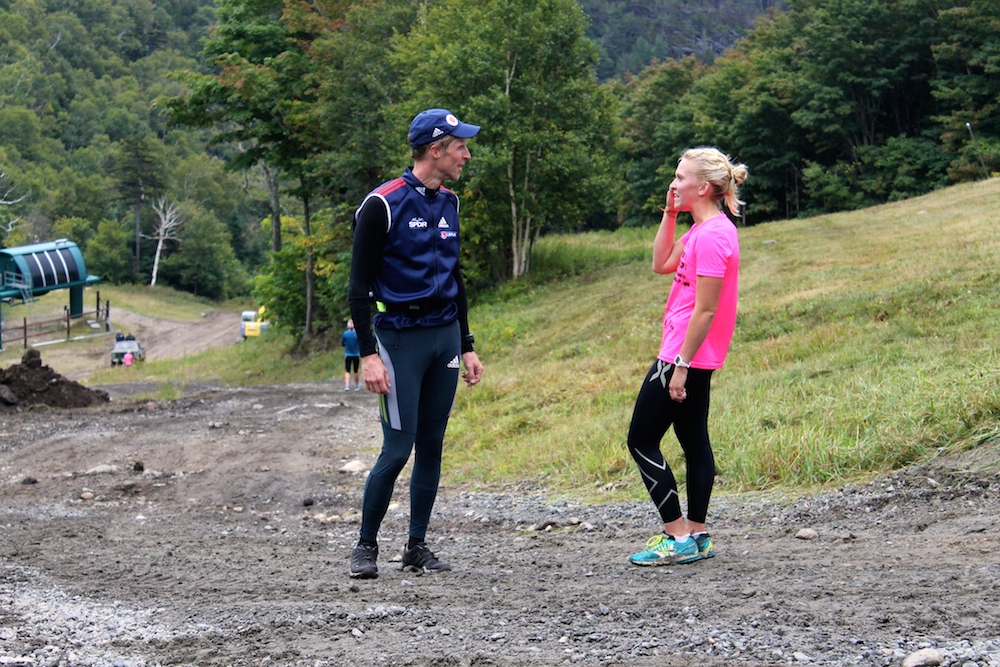
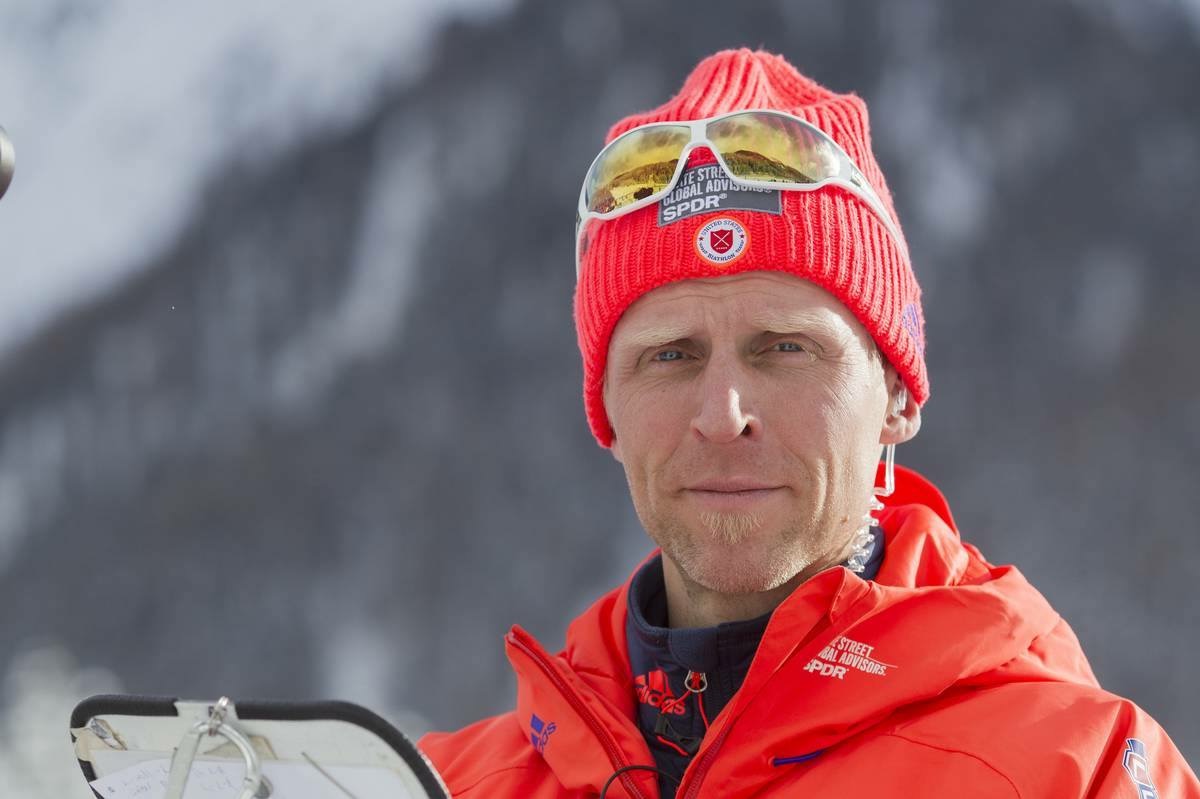
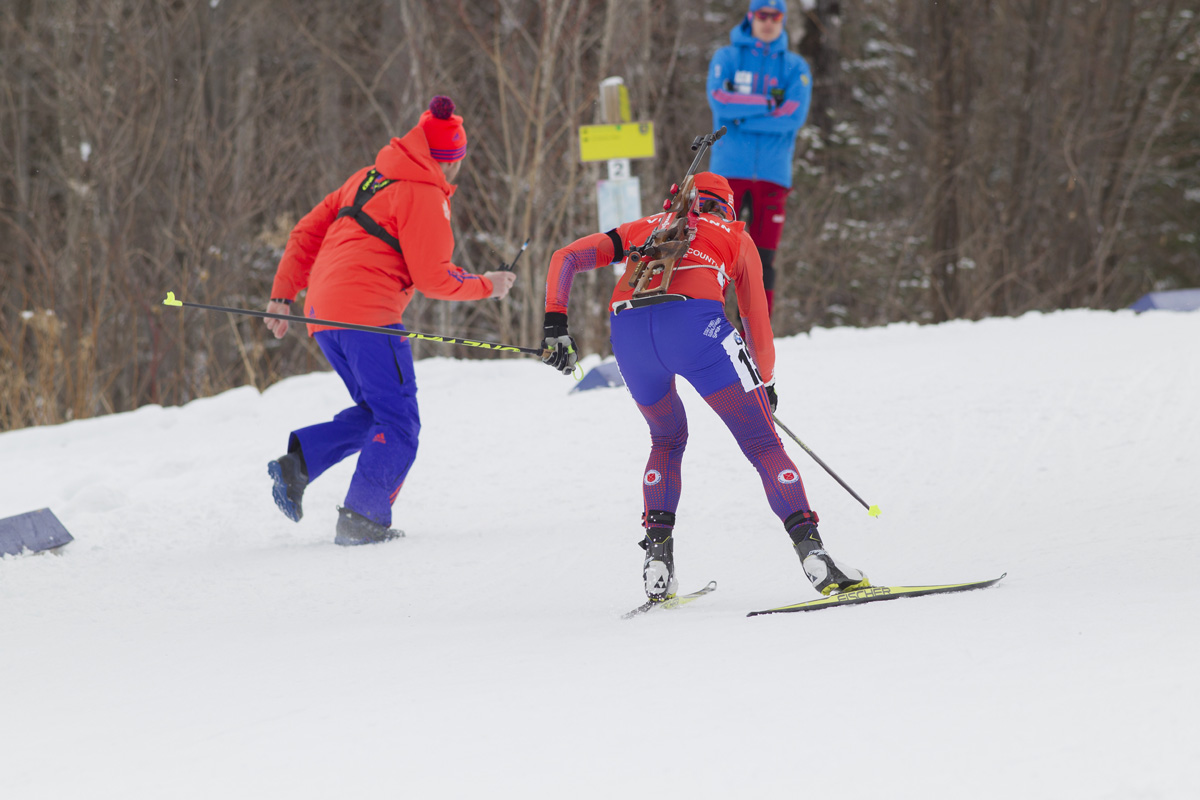
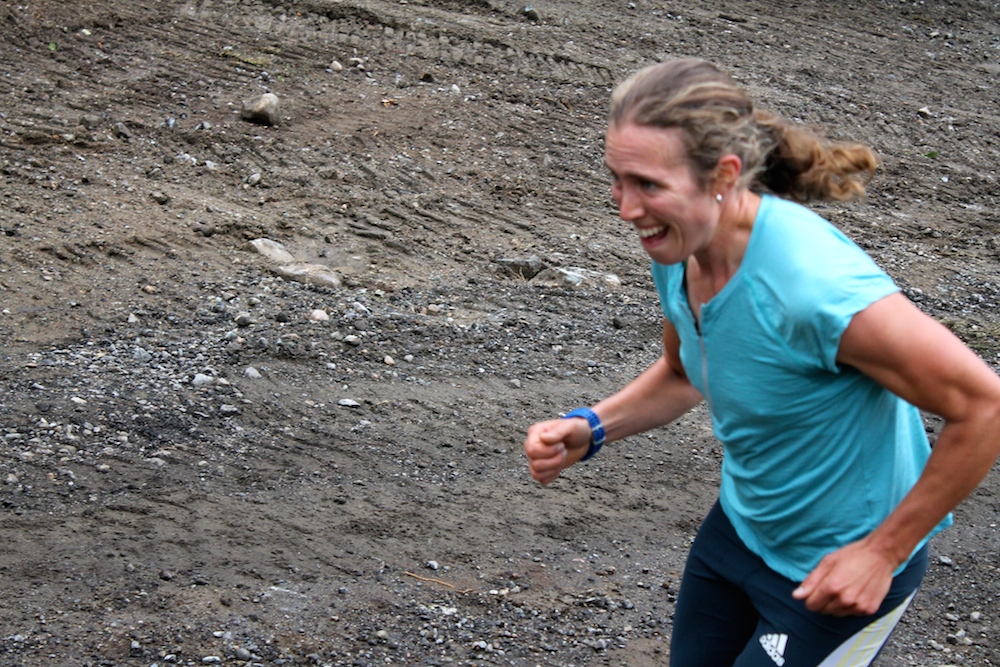
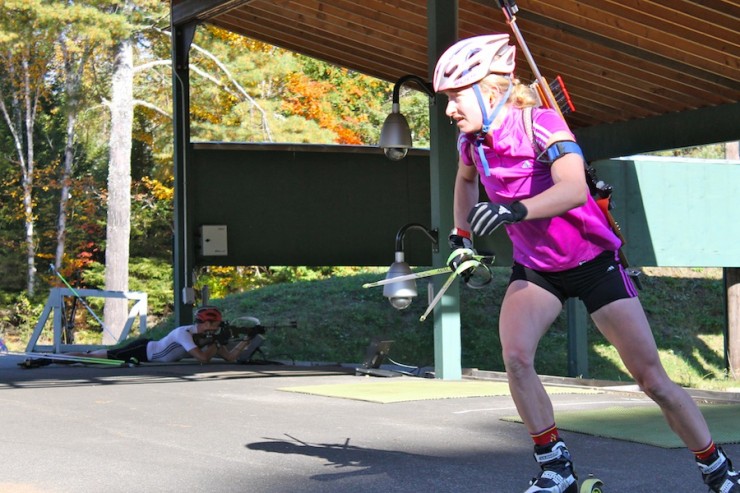
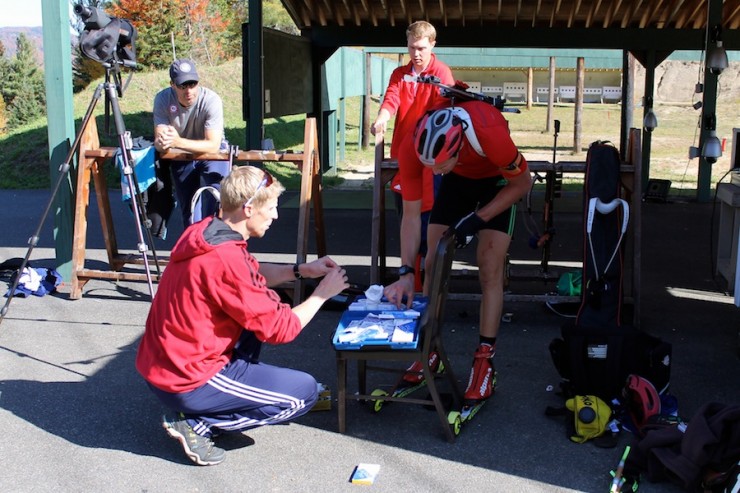
U.S. Biathlon Association women’s coach Jonne Kähkönen checks in with Kelsey Dickinson after an uphill running time trial in 2014.
When Jonne Kähkönen was hired to be the women’s national team coach by the US Biathlon Association (USBA) in 2010, there wasn’t much of a playbook to follow.
The Finn couldn’t mimic the footsteps of his predecessor, because there wasn’t one.
For the first time, the women’s team was going to have a coach of their own.
“The men’s program was on a really high level going into Vancouver [2010 Olympics],” USBA Chief of Sport Bernd Eisenbichler – then the high-performance director – said on the phone this weekend. “It was a deep program and the men’s relay was having pretty good potential. And we saw the women coming up having the same potential to go up to the top as well.
“We knew that if we wanted to build up a strong women’s program, we needed to have a dedicated coach for them,” he explained. “Really just focused on their development, and putting the group together to make it a really good environment.”
Enter Kähkönen, who had spent the previous four years as the head coach of the Finnish biathlon team.
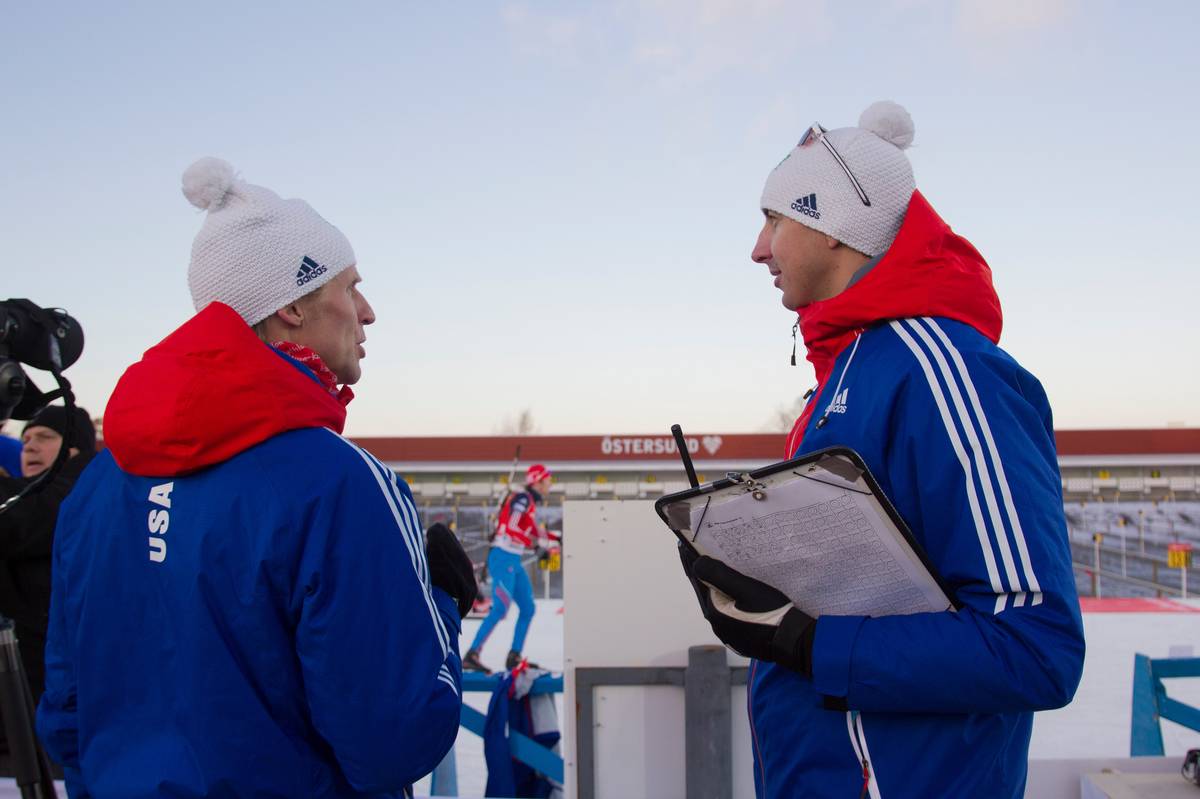
US women’s coach Jonne Kähkönen, left, and men’s coach Jonas Johansson on the range in Sweden in 2014. (Photo: USBA/NordicFocus.com)
“Obviously the first quad [four-year Olympic cycle] felt like it went by really quick, because everything was new,” Kähkönen said in a phone interview last week. “I think looking back, we made really good decisions overall with the philosophy of the team for both the men and the women. Especially for the women, in the early years, to get them up to speed, to be competitive. And it was successful already after the first couple years.”
In 2009, the U.S. women were ranked 20th in the World Cup’s Nations Cup standings. Eight years later, they have had numerous top-20 performances from multiple athletes, World Youth and Junior Championships flower ceremonies, and World Cup podiums and a World Championships silver medal by Susan Dunklee.
“When we started, we didn’t think we were capable of that,” Eisenbichler said. “We saw the potential, but to win a silver medal with Susan, to have these multiple top 20’s by six or seven different athletes, I think we can be really happy with what the women’s program has looked like the last eight years and where we are right now.”
And after leading that charge for eight years, Kähkönen is leaving the team to take back his role as the head coach for Finland – a program that has also risen in that period, with Kaisa Mäkäräinen winning three overall World Cup titles, Mari Laukkanen scoring two World Cup victories, and the mixed relay team finishing sixth at the 2018 Olympics.
“It has been a process,” Kähkönen said of the transition. “I definitely have been thinking of each quad [cycle] as a project. At the end of the project it is always good to evaluate and think about the next steps and what’s good for me professionally, but then I want what’s best for the team and the athletes also. And I feel like now with the few retirements, it’s probably good in a way to make the changes now.”
“I think that the women need a new stimulus,” Eisenbichler said. “Not that the old stimulus wasn’t good or wasn’t working anymore, but after eight years it’s normal. And Jonne and I see that the same way. I could not be more thankful and grateful to Jonne. And now it’s time for him to have a new era with the Finnish biathlon association.”
The Fun-Loving Finn
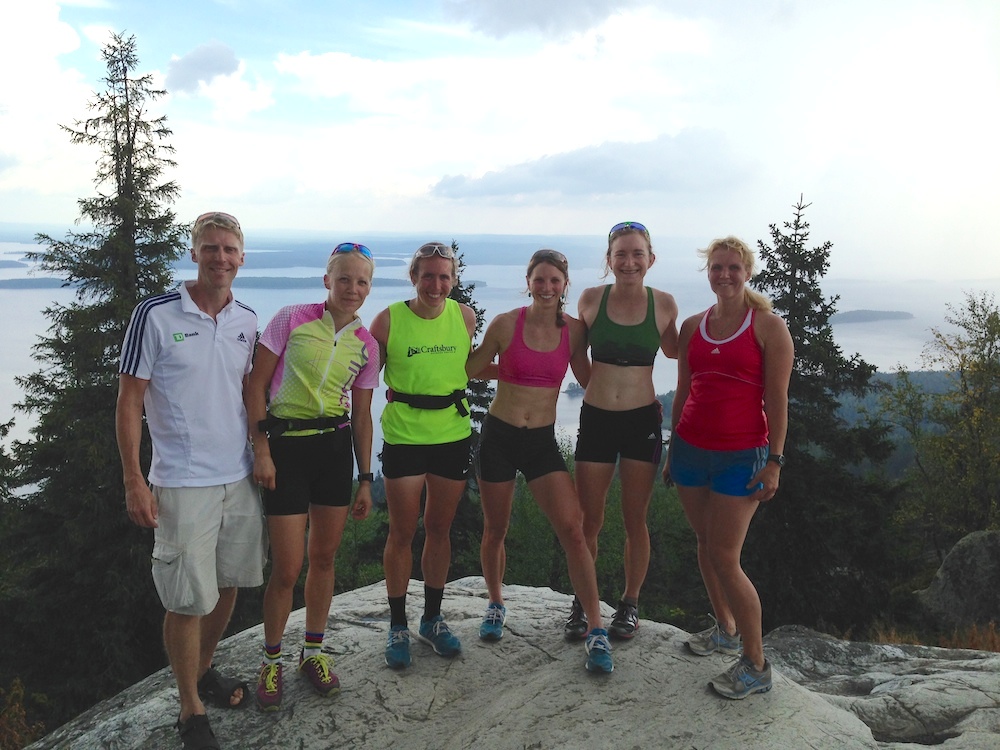
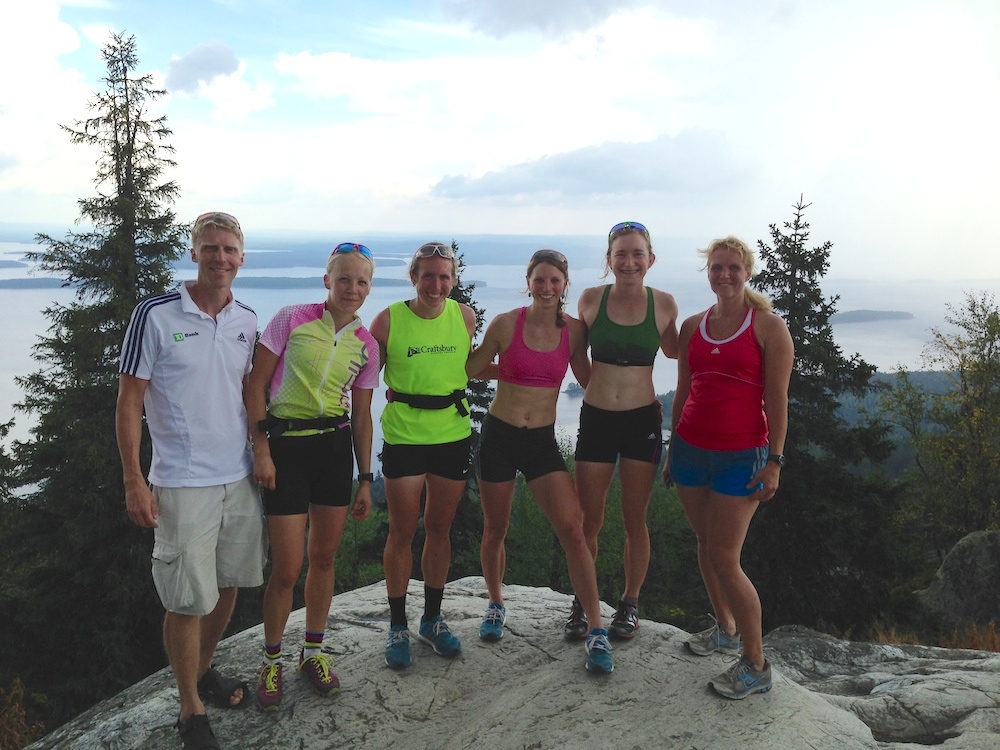
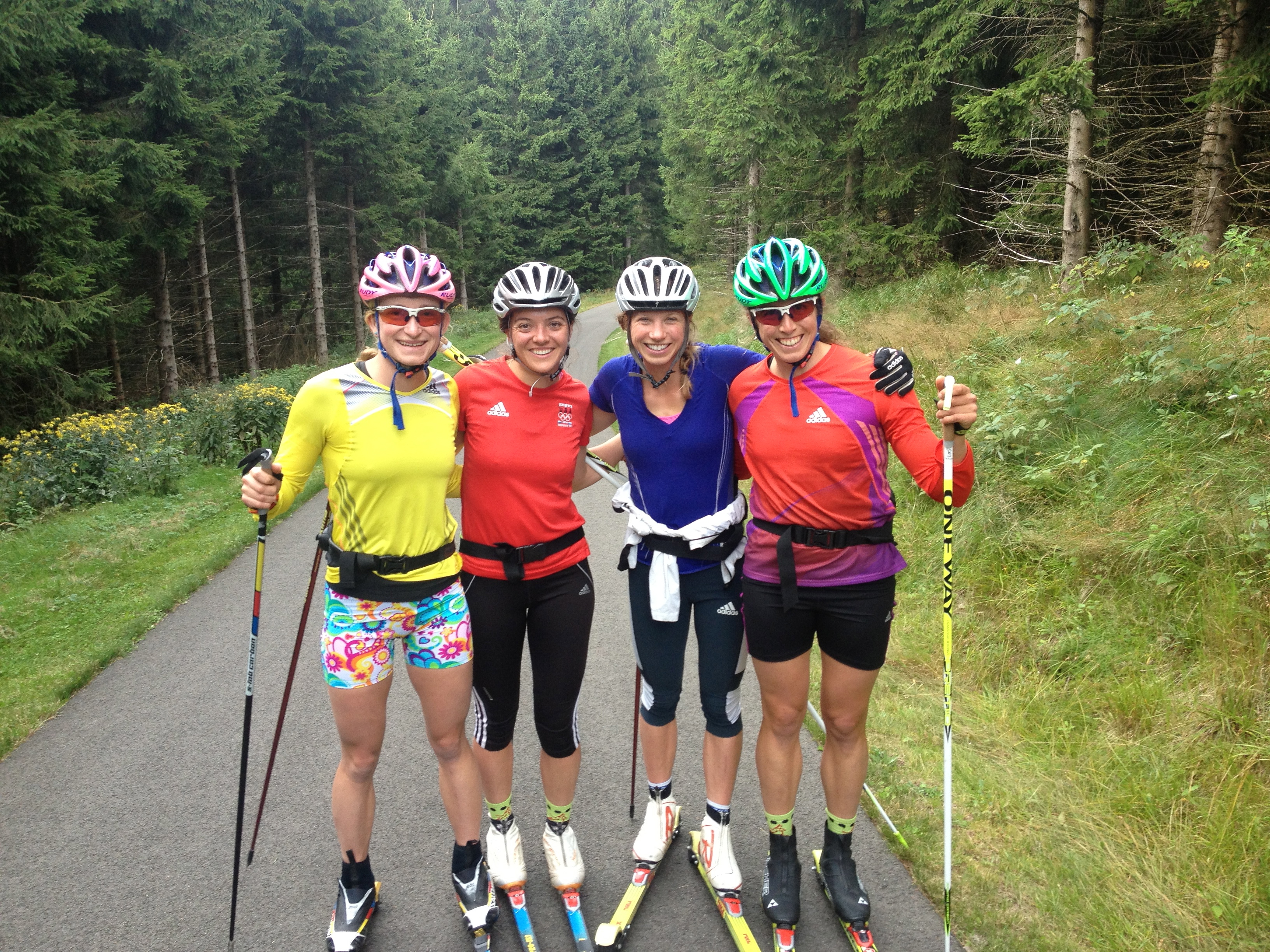
The US Biathlon women’s team after an uphill interval session up Koli, the highest point in southern Finland, with coach Jonne Kähkönen (l) and his wife (r), who also rollerskied up, and Finnish World Cup champion Kaisa Mäkäräinen (second from l). (Photo: Jonne Kähkönen)
“I think that having a women’s coach changed something in the heart of the women’s team, because it felt like a validation that we were improving and deserved someone that was there specifically for us,” 2014 Olympian and five-time World Championships competitor Annelies Cook, who retired in 2016, wrote in an email last week.
“Personally, I am really grateful that I had Jonne as a coach,” she continued. “Jonne was there in my life through many big changes and I could always talk to him and I always felt supported by him. He was always positive for us, and that is something you really need in a sport that can really get you down sometimes. Biathlon is different from cross-country skiing in where the differences in performances from day to day don’t change that drastically. Biathlon can change instantly from good to bad, and that can be really emotional sometimes.”
Kähkönen said that he learned a lot in his years of coaching in the U.S., not least from the athletes and the team’s international staff, who hail from Sweden, Italy, the Czech Republic, and Germany.
“It makes me think what works and what doesn’t work, and also to take that into account working with the athletes,” he said.
But what he learned the most was to have fun.
“I know that having fun seems dangerous to say [in a serious environment],” he said. “It’s not only about having fun, but enjoying your work and enjoying what you’re doing — I think that’s more descriptive. But, at times, having fun as well!”
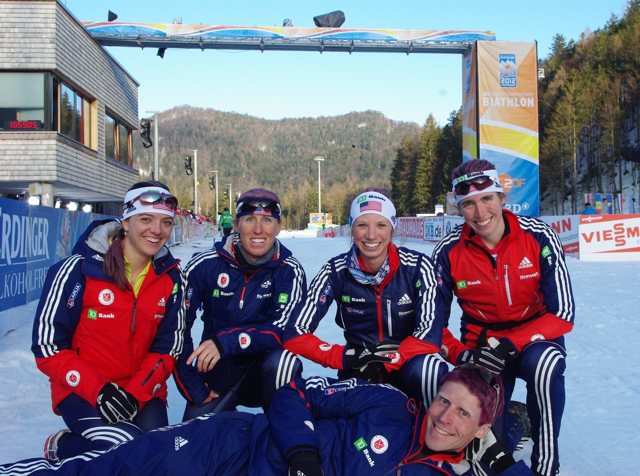
Sara Studebaker, Lanny Barnes, Annelies Cook, and Susan Dunklee, with coach Jonne Kahkonen, model their new hairstyles at 2012 World Championships.
Case in point: in 2012 at World Championships, Kähkönen dyed his hair purple. He had told the team that if any of the women finished in the top 10, he’d do it. Susan Dunklee placed fifth in the 15 k individual. So purple it was.
“I think those types of things are important, whatever it is, just to try to lighten it up a little,” he said. “Me being Finnish, people say that I’m not a typical Finn. I’m more open or more lively or whatever.”
Quite apart from the hair, Dunklee’s fifth-place finish in Ruhpolding was one of Kähkönen’s favorite moments from his tenure with the team. At the time, he was midway through his second winter leading the women’s squad, and Dunklee had competed in just two weekends of World Cup racing.
“Probably one of the most exciting moments was Susan’s first breakthrough at Ruhpolding World Champs in that individual,” Kähkönen reminisced. “She had the lead for a good while, and her being really surprised by it. That was definitely, maybe not the start of it all, but one of the very good results that we had early on.”
The previous year, Sara Studebaker and Laura Spector had broken into the top 20 on the World Cup, and Haley Johnson had been close in 21st. One year later, Cook made her own jump into the land of top-20’s. And later still, Hannah Dreissigacker and then Clare Egan would hit the top 20, along with Dunklee’s four World Cup podiums and her World Championships silver medal.
“Obviously after all the hard work, all the medals, Tim [Burke] in Nove Mesto and then Susan and Lowell [Bailey] in Hochfilzen last year, those are on top of the list,” Kähkönen said.
Back to Finland
Kähkönen hesitated to say that he was headed for home.
“It may be a cliché to say that home is where your heart is, but Lake Placid has been my home,” he said. “I’ve said this to a couple of people, but it hasn’t hit me yet because I’m still here. It has been great. The community is so supportive. There are great people there and we made good friends. So it will be tough to leave when that day comes.”
The family will move this summer, after his oldest son graduates from high school in June.
U.S. women’s coach Jonne Kahkonen talks to his team between intervals at a training camp in Bend, Oregon, in 2012.
But it is an interesting assignment for Kähkönen to retake the reins of a program that has changed a lot since he last worked there.
“With Kaisa [Mäkäräinen] being the star, it is exciting to go back and work with her, if she decides to continue [racing], which remains to be seen,” he said of an athlete who had five podiums the last time he worked with the team, but now owns 23 international wins and 54 more podiums. “We worked together in the past, so it will be fun to be reunited.”
But the other pieces of Finland’s biathlon puzzle are no less compelling.
“At the same time, I think as big a part of it is seeing the rise of the next generation,” Kähkönen said. “They won a couple medals at the junior level. It’s not just the juniors and youth who won the medals, but even behind them, there are just more people doing biathlon now, which is good to see. And just seeing the good results that the men’s team is starting to post on the World Cup now. That’s inspiring to me.”
And in the end, the fun is one thing that he hopes to bring back to Finland.
“I just read in one of the Finnish papers today, Aino-Kaisa Saarinen, who is part of the cross-country team — she has trained a bunch with Kikkan Randall and the U.S. women — she made a comment that what she was missing a little bit in the last couple of years was having this sort of North American type of relaxed and having fun atmosphere while doing the work that everyone is committed to.”
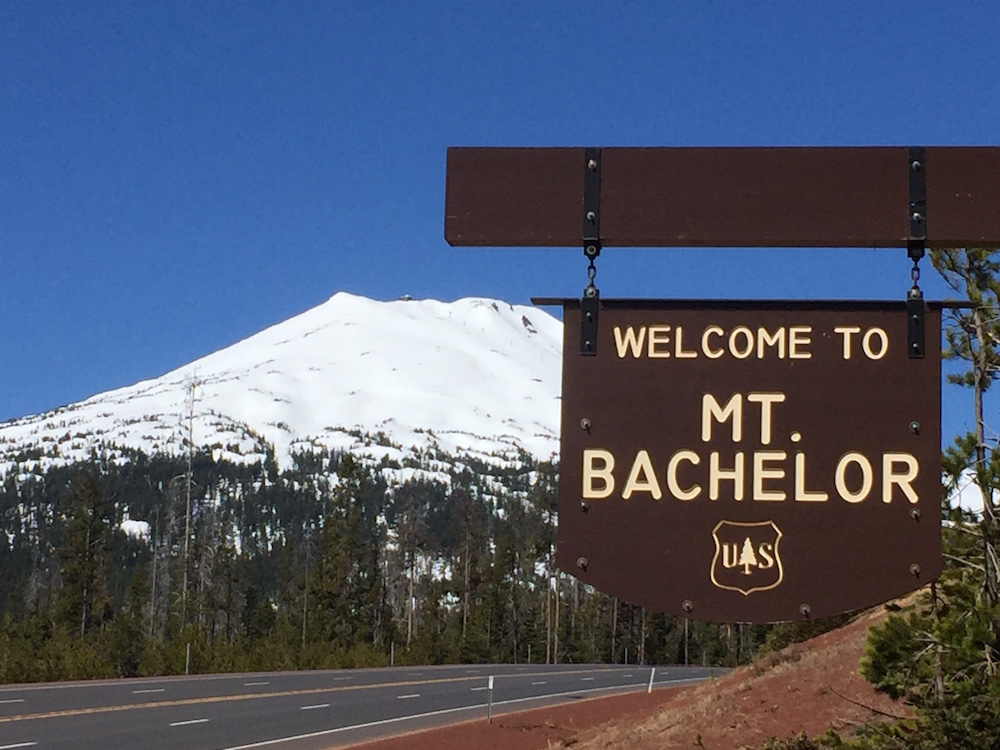
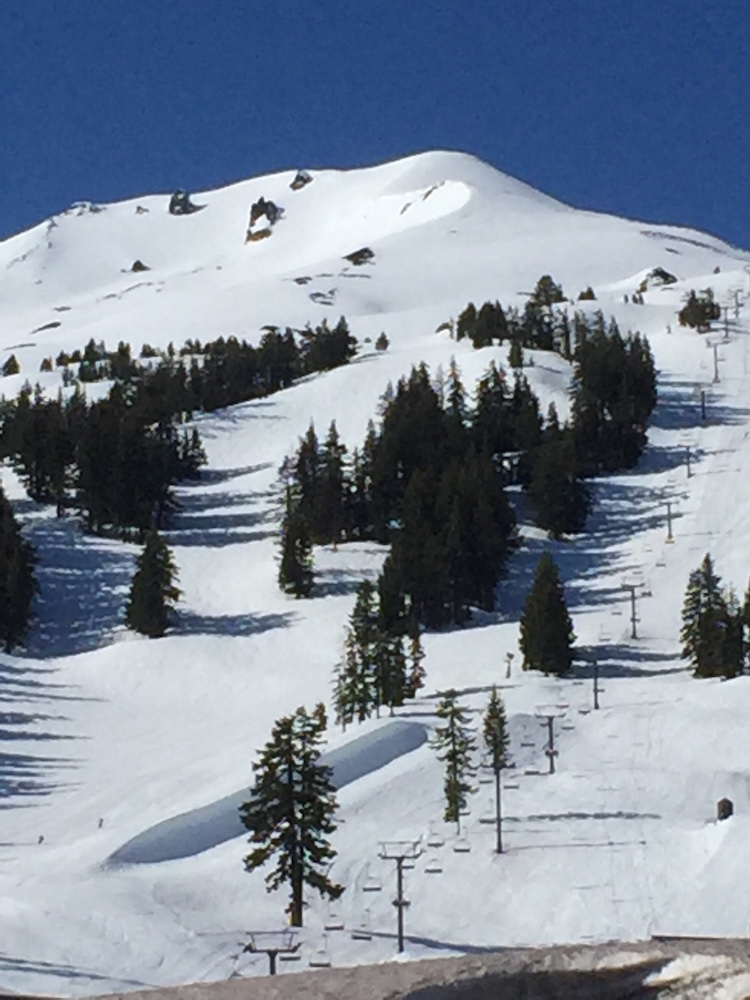
Mt. Bachelor in Bend, Ore., as seen in May 2017. (All photos: FBD)
You should be in Bend. Bend, Oregon. Right now.
For all of my “shallow readers” in the audience, those unable to focus on any piece of written work longer than 140 characters (you know who you are), you can stop here. You’ve both learned everything you need to know and also everything your SnapChat-addled brain can handle, so you’re done. For those of you with attention spans longer than those of fruit flies, dig in, as I’m about to plan your next trip for you — and here’s the good news — it’s this weekend. Or next year at this time. And every year thereafter.
Let me see if I can guess what’s going on right now for most of you — you’ve already storage waxed your skis for the summer, you’re back out on your mountain bike, and you’re re-reading each of my whap-stick reviews (skate & classic) every night before you go to bed. You tell yourself each morning as you go through your visualization and meditation routine, in which you attempt to teleport into my magnificent body and life, that this is the year that you’re going to set a PR at the (insert your favorite race here), beat your nemesis (insert the name of that person who you’ve been chasing for a decade or so) or finally slay that dragon and qualify into Wave 6 of the Birkie. Then your change-adverse subconscious kicks in and tells your mind, “Hey brain, these are great goals — you know what we really ought to do? We should do the same thing that we’ve been doing for the last 5, 10, 15, or 20 years, I bet THIS year is the year that it finally works.” Sure, that’s one approach, but you know what’s an even better tactic, one that might actually work? Try something new. And he’s a shocker, start by spending more time on snow. It is for this strategy that this report is going to come in handy.
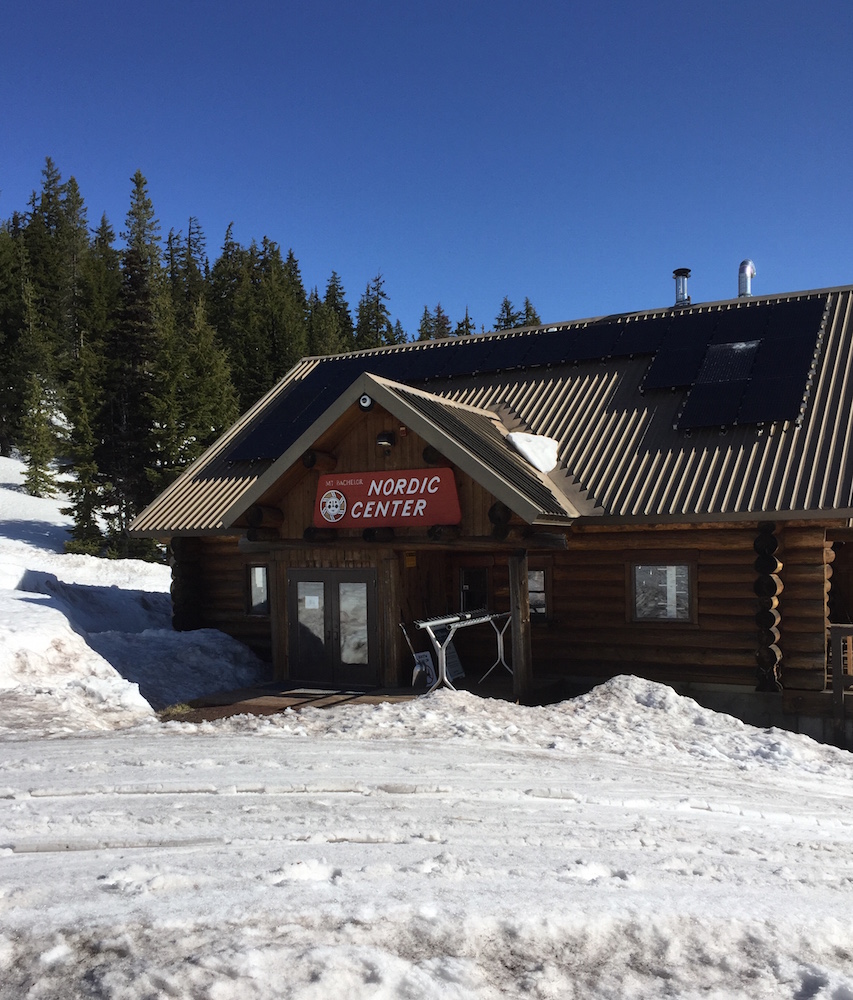
Mt. Bachelor Nordic Center in May 2017.
Once you make this leap of faith and commit to change, the hard part is over and then it’s just a matter of figuring out what you’re going to do differently (read, better). As usual, I have you covered, as what better way to dilute the knee-buckling pressures of adulthood and obstinate Great Danes than to escape to a place filled with cool people. And not just cool people, YOUR people. And Bend is that place. Not only can you still get on snow here right now, but you can get on really good snow.
This isn’t an article about some BS 2 k loop in a carbon-monoxide-filled tunnel in the armpit of Europe. In fact, it’s about as far away from that (both literally and figuratively) as possible. The Nordic center in Bend is nestled between 1,752 and 1,950 meters at the base of Mt. Bachelor and offers an amazing array of trails and options. Right now, all 56 k of perfectly prepared trails are open and believe it or not, the venue is still getting regular new snowfall.
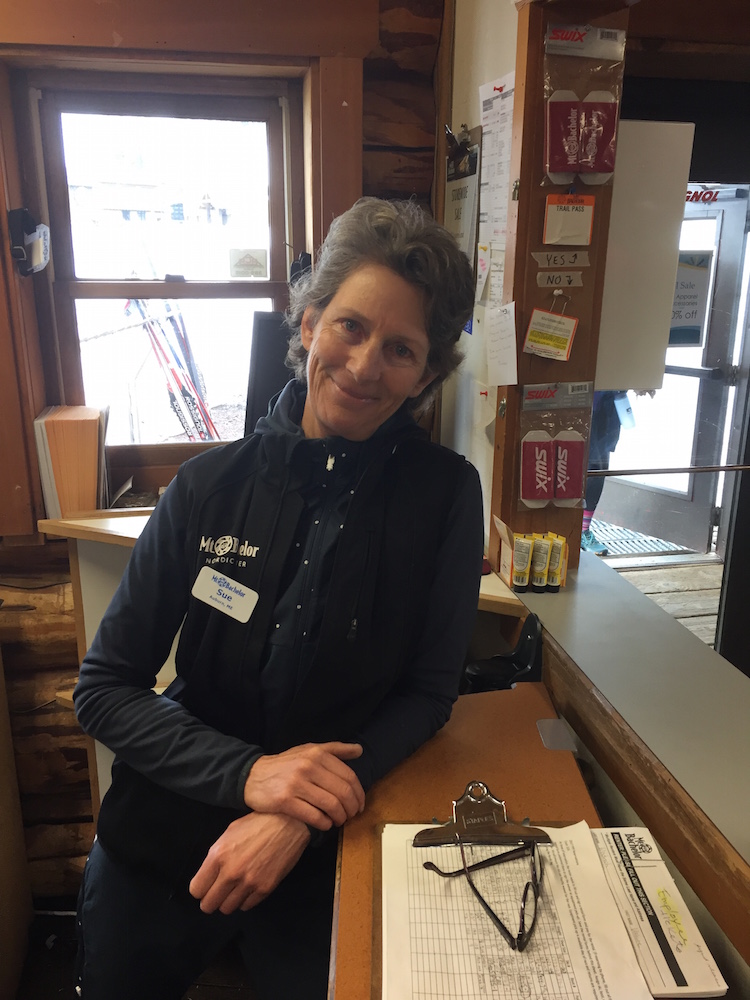
Sue Foster, Mt. Bachelor Nordic Ski Center director
“This is truly an amazing place,” said Sue Foster, director of the Mt. Bachelor Nordic Ski Center. “Our snow in early to mid-May is usually quite reliable, but this is a particularly great year, even for us. We’re still grooming the whole network, so every trail is still open, which is pretty awesome for this time of year. We may shut the lower loops down soon, but we’re still going to to have a lot of skiing available into mid-June.”
It is for all of these reasons and more (more on this in a bit), that Bend is the venue of choice in May for all of the U.S. nordic national teams: US Biathlon, Cross Country, Nordic Combined, Paralympics Nordic, and several top junior teams are either here right now or coming shortly.
“This is a fabulous place to train in May,” said US Biathlon Women’s Coach Jonne Kähkönen. “We’ve been coming here for several years as it is a perfect place to log a lot of quality hours on snow, really focus on technique and have a wide variety of outstanding dryland training options as well.
Jonne Kähkönen, US Biathlon women’s head coach, in Bend, Ore.
“I coached in Finland before I took this position with US Biathlon and we used to go to the glacier in Ramsau, Austria, for a similar camp, but this is really much better,” he continued. “Not only is the snow as good or better, but everything is much easier logistically, as you don’t have to take a gondola up every day to ski and the afternoon dryland training is accessible from right outside the condo. It’s a great way to start the season.”
Reigning biathlon world champion Lowell Bailey elaborated on some of the concepts from Kähkönen: “I come to Bend because it has been one of the most dependable places for quality on-snow training in May. With more than 50 kilometers of trails and world-class grooming, there is no better place to start the training season each year.”
His fellow world championship medalist Tim Burke concurred: “Bend is the perfect place to kick off the training season because you can combine ski-specific training in the morning with world class mountain biking in the afternoon. I don’t know of any other locations that can offer this combination in May.” But don’t just take their word for it, as this video says it all:
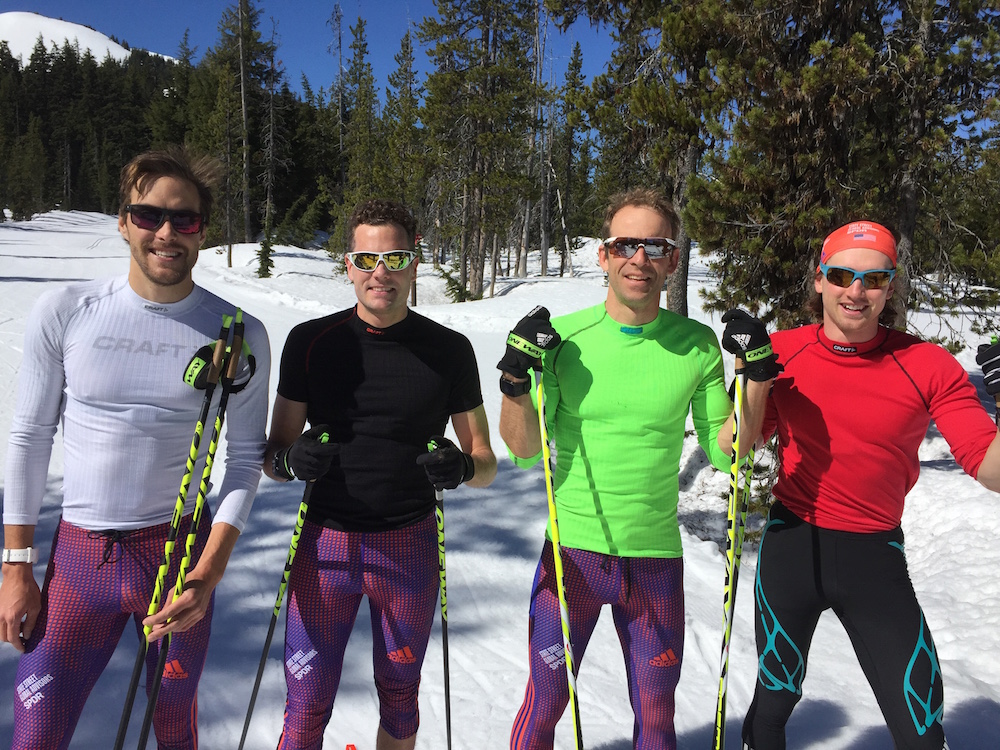
Determined to build on the incredible success of last season, the US Biathlon men’s team arrived in Bend looking leaner and more focused than ever, with their mantra being, “New year, new gut.” From left to right: Leif Nordgren, Tim Burke, Lowell Bailey, Sean Doherty.It is also important to point out that while Lowell (l) and Timmy (r) aren’t skiing quite as much as me here, they’re still skiing a fair amount and since the skiing is at altitude and there is an oxidative stress associated with high levels of aerobic training, the camp has already taken its toll on both athletes, for while they don’t look bad in the aforementioned video and photo, here is a shot of them on their first day in Bend, so wear that sunscreen people.
The XC mafia is out in force, too, with their whole gaggle on-site as well. “I’ve spent a lot of time here,” said Chris Grover, head coach of the U.S. Cross Country Ski Team. “Probably going back to the ’80s. From the national-team perspective, it’s a no-brainer — we can ski every morning on legitimate cross-country trails, which is not really something you can do on the glaciers in Europe, then in the afternoon, Bend also offers all sorts of amazing dryland options. On top of all of that, the community support that we have here is unreal: everything from the management and staff at Mt. Bachelor, to fellow skiers, to the community in general, we are always blown away at how nice people are here and how willing everyone is to lend a hand if we need help with something crazy. It’s an incredible place.”
Andy Newell (U.S. Ski Team) training both on snow and on dry land earlier this month in Bend, Ore.
The cross-country athletes share all of these sentiments as well: “The U.S. Ski Team Bend training camp is a tradition that pre-dates me, for sure,” said longtime, wily U.S. Ski Team veteran Andy Newell. “I don’t know the exact origins, but I believe it started a generation or two before me with Justin Wadsworth and all of those guys — maybe even earlier, I’m not sure — but there’s a reason why we keep coming back, it’s because it’s pretty awesome.”
Newell continued, “Bend is sweet for many reason: amazing trails, reliable conditions, and manageable elevation, so the overall quality of the training is very high, which is not something you can do in many places in Europe, especially at this time of year. In addition, the overall vibe is really cool. The camp itself has lots of focus on technique, not hammering intervals, so it’s really nice to be able to just enjoy being back together with your teammates and have fun being back on snow. Plus, as you well know, FBD, the afternoons are open for all sorts of shenanigans. It is without a doubt one of the best camps of the year.”
So elites are here, pre-elites are here, juniors are here, but what about you, the mid-life crisis, disenfranchised desk jockey with 2.2 kids, a white picket fence and a possible brain-damaged Great Dane that somehow still does not know his name, is this place for you? Of course it is.
FBD’s Great Dane
How can I write this with such confidence? Well, for starters, I am one of you: you are “my people” and vice versa. I’ve been on the tracks every day for two weeks and the skiing is amazing. However, if you are a regular reader, Instagram follower (and you certainly should be, as I am awesome), or you only know me by reputation, you may have some “concerns.” For example, why don’t we take a completely wild hypothetical: let’s say that I have lost my mind and have been filling my free time pretty much exclusively just skiing, mountain biking, paddling, and trolling Josh Smullin on Instagram. Again, this is purely hypothetical. So in this clearly random and arbitrary example, you’re now likely thinking, “this dude is nuts, I’m not going to listen to him” (often a very sound strategy, btw). OK, fine, if you aren’t going to listen to me, nonetheless Lowell, Timmy, Andy, or Kikkan, maybe you will listen to one of my favorite nordic power couples and dyed-in-the wool, uber-Master Blasters, Pat and Cyndy Flores. I’ve crossed paths with these globe trotters in Alaska, Switzerland, all over the continental U.S., and seemingly every other place where the snow is good, so it made complete sense that these crafty snow-chasers were smiling in the sun on the deck as I walked up to the nordic center one morning.
Pat FloresCyndy Flores
“You can’t beat Bend in May,” noted a tan, fit, and rested-looking Pat Flores. “Cyndy and I would come up here regardless, as there is so much great training, good restaurants and nice people, but what really makes the trip a no-brainer for us is we do JD’s master’s camp each year and this is really the icing on the cake.”
Cyndy agreed, “This is one of the few places that not only has reliable snow in May, but to be able to stay in a nice condo only 20 minutes from snow and also less than 10 minutes from a really cool town with all kinds of great restaurants, shops and fun stuff to do, makes this a ‘must-do’ every year. JD’s masters camp is great, the skiing is great, the food is great and if you’re really lucky, you might get to ski with FBD!” (Ed. note: REALLY LUCKY, as he is both everywhere and quite elusive, all at the same time, in particular when stories are due).
I have personally never attended one of JD’s camps, so being the always suspicious, ever-vigilant investigative reporter than I am, I didn’t just take Pat and Cyndy’s word for it, I also went straight to the source, XC Oregon Head Coach John “JD” Downing. “The camp is a great way for masters skiers to get to the next level,” Downing said. “We keep it fairly small, so there is a lot of personalized attention and the venue is amazing. Bend doesn’t just have skiing in May, it has really good skiing in May. Sadly, climate change is a reality everywhere, but this is one of the places that still seems to be holding up well. In fact, some of the best days I’ve ever had on snow anywhere in the world have been in Bend in early May. As you well know, you can ski all morning, then bike and run in the afternoon on a trail system that is also world class. You can even go play a round of golf. It’s an extraordinary thing, really. This why so many national teams come here at this time of year.”
Chris Grover, head coach of the U.S. Cross Country Ski Team, earlier this month in Bend, Ore.
Speaking of national teams and master blasters, Kähkönen offered very valuable advice for athletes of all ages, in particular masters: “My recommendation is to adapt your training to your length of stay. If you can only make it out for an extended weekend, that’s OK, as this can still be very productive. In this scenario, focus on skiing well and don’t worry too much about your levels of exertion. You’re at altitude and you probably won’t feel as good if you are sea level athlete, but for a short stay, that’s okay. If you are able to come out for a more extended block of training though, keep a close eye on your levels. Altitude can be tricky, so be careful to not go to hard every day. You should use this camp to set a solid aerobic base and technical foundation for the year, so be smart.”
Grover also offered up some top-secret, US Ski Team ninja sh*t: “This is a phenomenal place for skiers at all levels to come to start their seasons, as Mt. Bachelor can throw lots of different conditions at you. We view this as a strength, not a weakness, though, as it’s a great place to improve your skills, in particular in classic. If you’re here for a week, you’ll likely ski on hard wax, klister and zeros, so it is a perfect environment to test equipment, wax and work on technique in these different conditions. Even if you are mainly skating, you’ll get fresh snow, wet snow, dry snow, old snow, hard pack, and slush, sometimes many of these in one day. These variable conditions are something that you usually don’t get on glaciers, so without a doubt, practicing in this environment has made us better skiers as a national team and it most certainly will help skiers of all levels.”
For more on my travel idiosyncrasies, check out this wonderful podcast from some dude named, “Jason”.
Now that this esteemed panel has convinced you to make the trip, the next question is, “How are you going to roll? There’s BALLER, FBD-style, which means that you’ll need a stevedore to unload all of your gear (I like to have the options to choose between lots of colors and styles of underwear each morning).
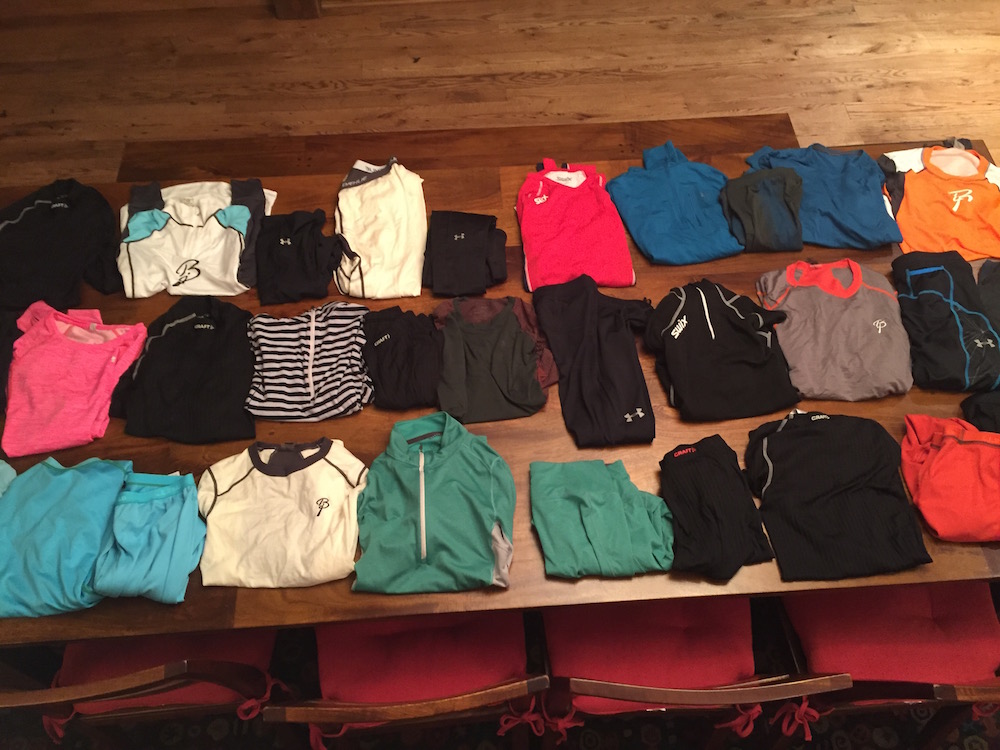
Study at the feet of the master and bring six sets of skis (rock classic, cruiser classic, race classic, rock skate, cruiser skate and race skate — yes, not having both cold race skate and warm race skate still has you upset, but you’re praying that you’ll be able to make your “cold skate” race skate skis work, as you are pretty frickin’ adaptable). Now over-stuff your ski bag with base layers of every conceivable thickness, material, color and style. Ditto for mountain-bike gear. Double-ditto for running gear. Better bring that paddling gear, too, just just in case Timmy Burke gets his nerves back after his horrific loss to me in our race on Lake Placid, then, since everyone knows you have a reputation for looking real nice for the ladies, you’ll also need your traditional two bags of personal grooming items and tastefully coordinated couture.
To adequately transport all of this crap, you’re going to need one of those stupid monster trucks but that’s OK, as your top priority is to make it to the tracks every day, regardless of road conditions, completely ignoring the fact that the scenic highway to the mountain is perfectly maintained and essentially never closes. You’ve never been one to listen to reason and you’re certainly not going to start now (after all, you are a self-loathing nordic skier who pays money to suffer) so you rationalize this ridiculous gas guzzler with the explanation that you also need this vehicle so you have room for the sherpas, in particular your shirt sherpas, as those dudes are indispensable. If you’re fortunate enough to snag one of the rare and exclusive invites to have dinner with me and you show up looking like you slept in your clothes, “my people” will immediately show you to the door. You’ve been warned. So yup, better pack that travel steamer as well.
This excessively wasteful and cumbersome manner of travel isn’t for everyone though — I get that — and to be fair, it is really more of a lifestyle and not something for which everyone is suitable emotionally and financially equipped, which is fine. Some of you out there in FasterSkier-land may consider yourself the nordic version of Seal Team 6, and thanks to my gripping expose on why you never need to do laundry again, you may prefer to go commando and travel with just one pair of socks, undies, and a T-shirt. Well, fear not my nimble travelers, I have you covered here as well (see what I did there?).
How to go “lean and mean”
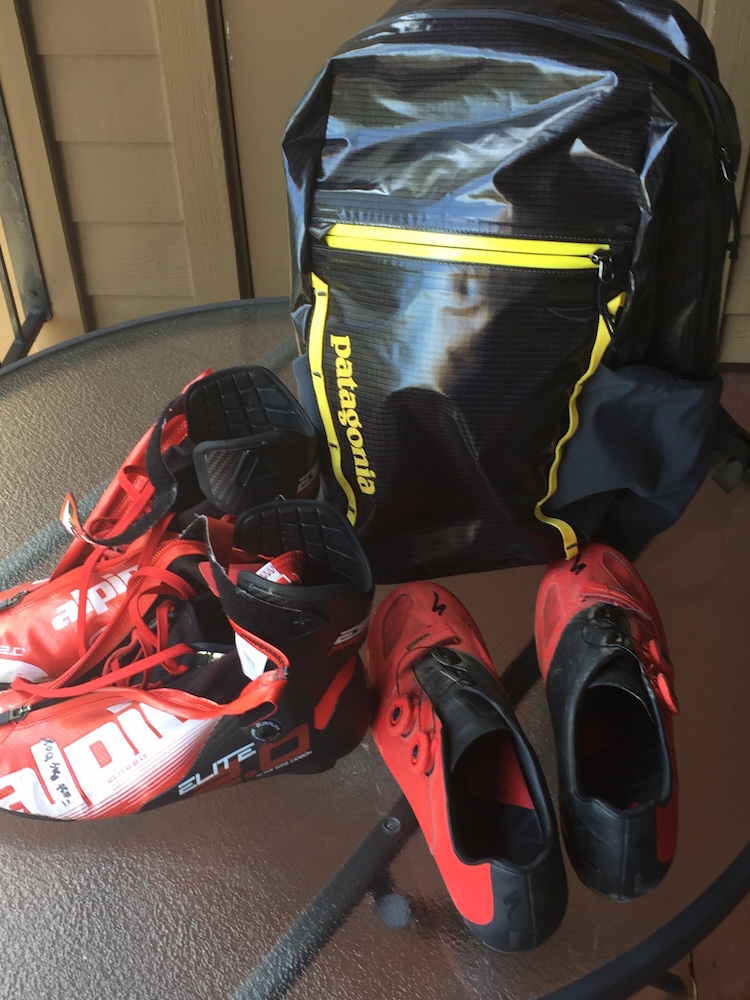
If you want to really go for it, you can do this trip with just a backpack. Load your ski boots and cycling shoes in your day pack and wear your running shoes. Stuff your one extra pair of socks and skivvies into your boots, eschew the bulky and pesky toothbrush for a pack of Tic Tacs that you pick up at a gas station in town, and POW, you are set. The fine folks at my favorite shop, WebCyclery, will hook you up with the rest: skis, boots, poles and mountain bike. If you’re one of those “I don’t need 20 outfits but I need my own skis” types, fear not, as WebCyclery also has a public wax bench, so you don’t actually have to choose between either of these two extreme examples and there is plenty of room for a reasonable, middle-of-the-road approach. Do yourself a favor, though, and regardless of which camp you gravitate towards, avoid the “why you need to travel wax” lecture from my good buddy Zach Caldwell and be pro: travel wax, then scrape at WebCyclery or up at the nordic center. The most important point here is regardless of where you are on the baggage, underwear and ski spectrum, I’m dead serious, you really can do a great, multi-day training camp with only a carry-on bag.
Now you’re geared-up and ready to crush the ski each morning, but what about the rest of your day? Glad you asked. It just so happens that Bend has a wide variety of trails to suit every skill level taste and agro level. Whether you are a normal person who can can chill in Level 1 and simply enjoy the super fun, flowing trails, or if you are one of “those guys” who gets all kitted up and lurks in the bushes ready to pounce on Adam Craig or Ryan Trebon as they ride by so you can shame them with your exemplary nordic fitness (completely disregarding the fact that they are probably out cruising and you’re about to ‘ring the bell’) none of that matters. What matters is that this place is perfectly suited for you to either be super-smart and carefully but gradually build your base fitness while loving life, or you can go out and hammer every day and completely blow yourself up by doing stupid sh*t. I know that’s how some of you roll and I’m not your mother, so knock yourself out. If you do fall into the latter category, please be sure to tell Adam and Ryan that I say hi, but don’t come crying to the FBD when you find yourself wrecked in January. Remember, no one wants to be a “Thanksgiving star and a Christmas turkey.” Church.
Just one of the many savage views that you will encounter on one of the nation’s best bike trail systems.
All right, where was I? Ah, yes, what to do with the rest of your day: the ski was epic, you tore up the dirt faster than the GOP shredding Obamacare and since you’ve now logged over six hours of training on your way to being sick and injured, you’re so hungry that you’re ready to eat your own head. Please tell me you’re not one of those annoying nordic nerds who flies with chopped up, organic, locally sourced carrots in your carry-on, nestled between the hand sanitizer and the Nalgene bottle that you filled up in the bathroom. If so, stop it, stop it right now. Have a beer and a can of Pringles on the flight like a normal person.
If this is you however, you’re probably also going to cook breakfast at your condo each morning and subsist on PBJs that you eat in the car on the drive home, as you’re concerned about not achieving the correct 4:1 carb/protein ratio before your glycogen window closes. This is all well and good, but I’d kill myself if I lived like this, so my advice to my one or two normal readers is treat yourself, after all, who deserves it more than you, right? Don’t worry, I hear ya, you’ve blown 90% of your disposable income on new skis, flights, condos, and Great Danes, so you don’t want to break the bank on lavish meals. Fair point. But, in addition to all sorts of great restaurants with real plates, flatware and food served by humans, there are some economical options that fit the bill nicely without decimating your wallet: two FBD favorites are Parrilla and The Pancake Wagon. There’s also a parking lot full of food trucks, aptly named, “The Lot,” which offers all sorts of options for people comfortable eating food that has been prepared in a structure that can drive away at a moment’s notice, one step ahead of the law.
And let’s not forget the beer — ah, my beloved beer, the source of, and solution to, so many of life’s problems. So while the FBD loves beer and Bend has all kinds of great beer places, interestingly enough, you know what the FBD hates? To be fair, this list is long and distinguished and merits an entire series of its own, so for now let’s confine this to the context of this discussion, the FBD hates the hipster/yuppie/hippie/yippie whateverthehellyourproblem is, beer snob. Yes, beer is awesome, but you know what none of us need? Some smug, pseudo-olfactory savant weirdo wearing an outfit that looks like it came out of my grandmother’s basement and a haircut that screams that he lost a bet, telling us why some particular brew “has a nose that resembles Costa Rican coco beans buried behind a pit toilet with a hint of a 1972 Volkswagen Bug seat covers,” or whatever nonsense the hip crowd is spewing these days. Just order you goddamn beer and shut up. Guy code is that you have between 15 – 20 seconds to place a beer order, with no editorializing. The ONLY circumstances in which you can offer anyone at the table any advice or commentary whatsoever is if they directly and specifically ask you a question and even in this very focused and narrow circumstance, you answer must again be limited to 15 – 20 seconds. I don’t make the rules, I just enforce them.
So assuming you navigate through these hipster-invested waters of annoying ignorance, pomp and circumstance, you should be good to go. Or are you? If you’re anything like me, my thinking in this situation usually goes something along the lines of, “I skied over 50 k today AND crushed Adam Craig in a race so secret that not even he knew it was happening, so I have earned these 162 ‘cheat calories’…..…Wait a minute…. 162 calories? In only ONE beer? Damn, that’s a lot. Maybe I should go do some sit-ups in the bathroom or I’ll never make that cut for Wave 6. I feel fat just thinking about this. Now everyone is looking at me, I can feel it. Oh crap. Do I look fat in these pants? I knew I should have skied another hour. I wonder what Noah Hoffman is having for dinner? I really wish he still blogged daily……” Then I go in the bathroom and do 15 minutes of core while sobbing uncontrollably. But that’s me.
OK, let’s move on. I now have you set up for skis, bikes, and food, anything else else? Well, if you’re anything like me, you’ve probably going to completely disregarded the very sage advice of world-class coaches like Kähkönen and Grover (we don’t need to talk about my lactate reading after doing a supposed threshold block with Burke and Bailey), and you’re now completely wrecked. Sure, you could give up and fly home while attempting to pick up the pieces of your shattered life, or, you could simply train wisely in the first place, but we all also know that you are a stubborn nordic skiers, so you aren’t going to do either one of those things, which means that your only other option is to get some professional help. Step One is to get a massage from someone who specializes in working on athletes. For this, my go-to guy is Scott Yount. He has worked on all kinds of elite skiers, so stop your crying, he can get your whiny nordic ass back out there overtraining in no time. If things really get bad, or if you showed up with some pre-existing conditions (which shortly won’t be covered by proposed, “new and improved” and “really terrific” Affordable Care Act, so act fast), hit up the PT to the stars, Dave Cieslowski, DPT, CSCS. He also specializes in Type-A, needy, nordic skiers (and is one himself), so you guys will hit it off great.
Finally, since as always, I like to make all of these reports as long and rambling as possible, not to mention my rigorous and adorable sense of honor and integrity, I would like to go on record right now and state that I do not receive any sort of remuneration whatsoever from any of these people, organizations, restaurants, shops, businesses, clubs, cliques, or churches. My uncle does not own the bike shop, nor does my brother-in-law work at the burrito place. I am simply giving you a sampling of some of your many options and suggesting places for which I have had very positive experiences. My goal is to make your trip out here not only as easy as possible, but also as fun and as successful as all of mine have been, with as little effort on your part as possible. Let’s be real clear here, too — this is this is like divulging your secret powder stash or favorite surf spot, so if you do happen to run into me somewhere in the world, suffice it to say that you owe me a beer, as you aren’t getting information of this quality from many other places. That’s just how we roll at here at FasterSkier.
You also need to promise to use this information for good, never evil. I’m trusting you with all sorts of top secret beta and if you embarrass me, I’m gonna be pissed. If you bring a bunch of East Coast attitude, use your cell phone in line at the burrito place, or get all pushy in the tent behind The Pancake Wagon and someone kicks you in the nuts, well, you had it coming. Don’t hate on these places or write me that my recommendations suck — that’s on you — this is not check-in at the Philadelphia International Airport. You are in polite society now, so act accordingly.
A few other tips, as noted earlier, the weather is unpredictable, so come prepared for sun, wind and snow, perhaps all in the same day. Embrace this, though, as there is something incredibly bad-ass about having to have the heat blasting on the drive up to the ski and the AC cranking on the drive home. Be prepared to deal with whatever the mountain throws at you — remember, skiing is an outdoor activity and you will most likely see very different conditions each day. Thankfully, I was able to shoot perhaps the most informative video EVER on mental preparation, so I’d advise watching this every morning before you head up:
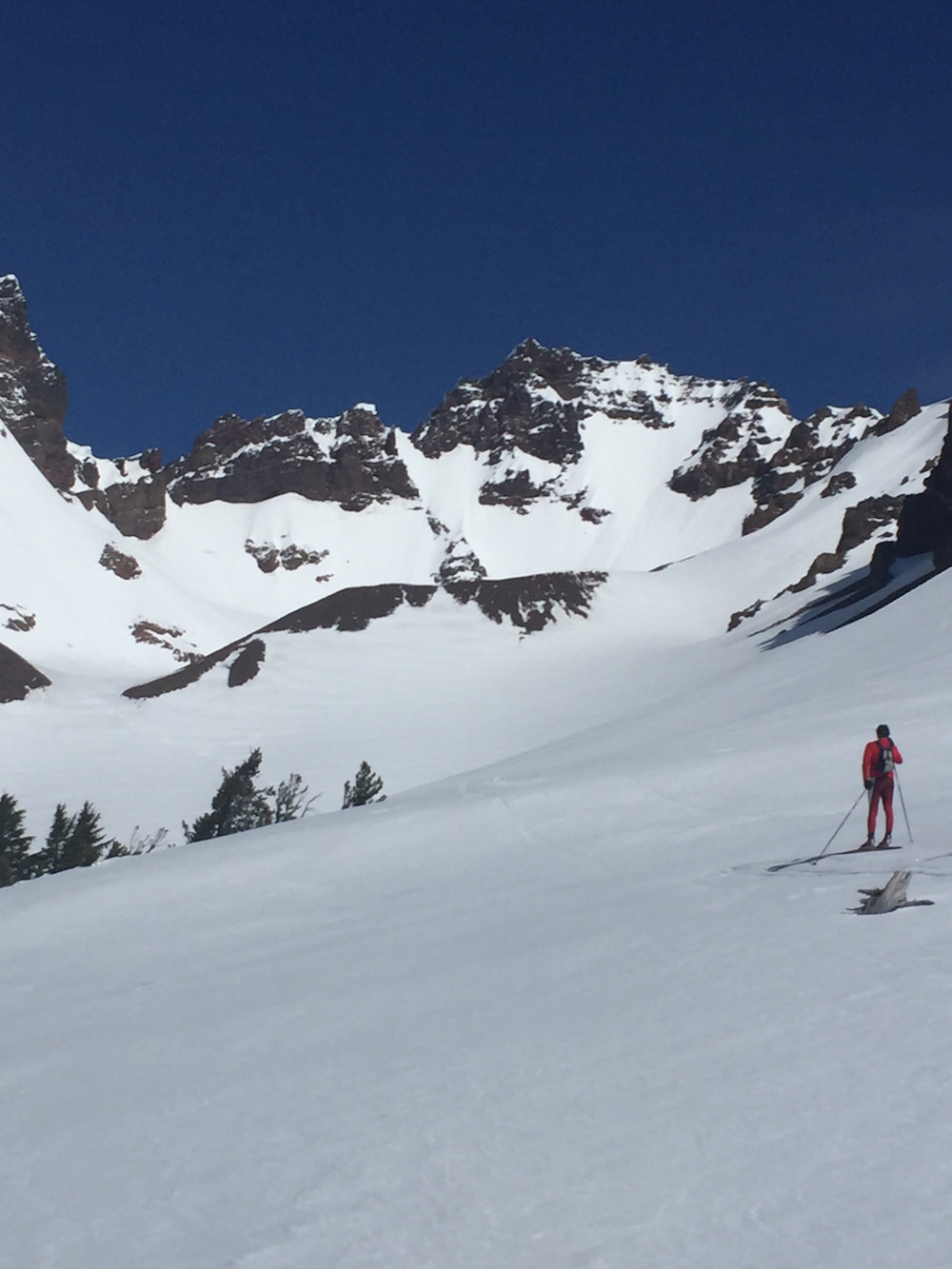
In general, the optimal ski window is usually between 8:30-10:30 a.m., so lie around in bed for too long and things will get soft. If you consider your weather forecasting and navigational skills to be superior, there is also amazing crust cruising to be had when the conditions cooperate.
Crust cruising in Bend
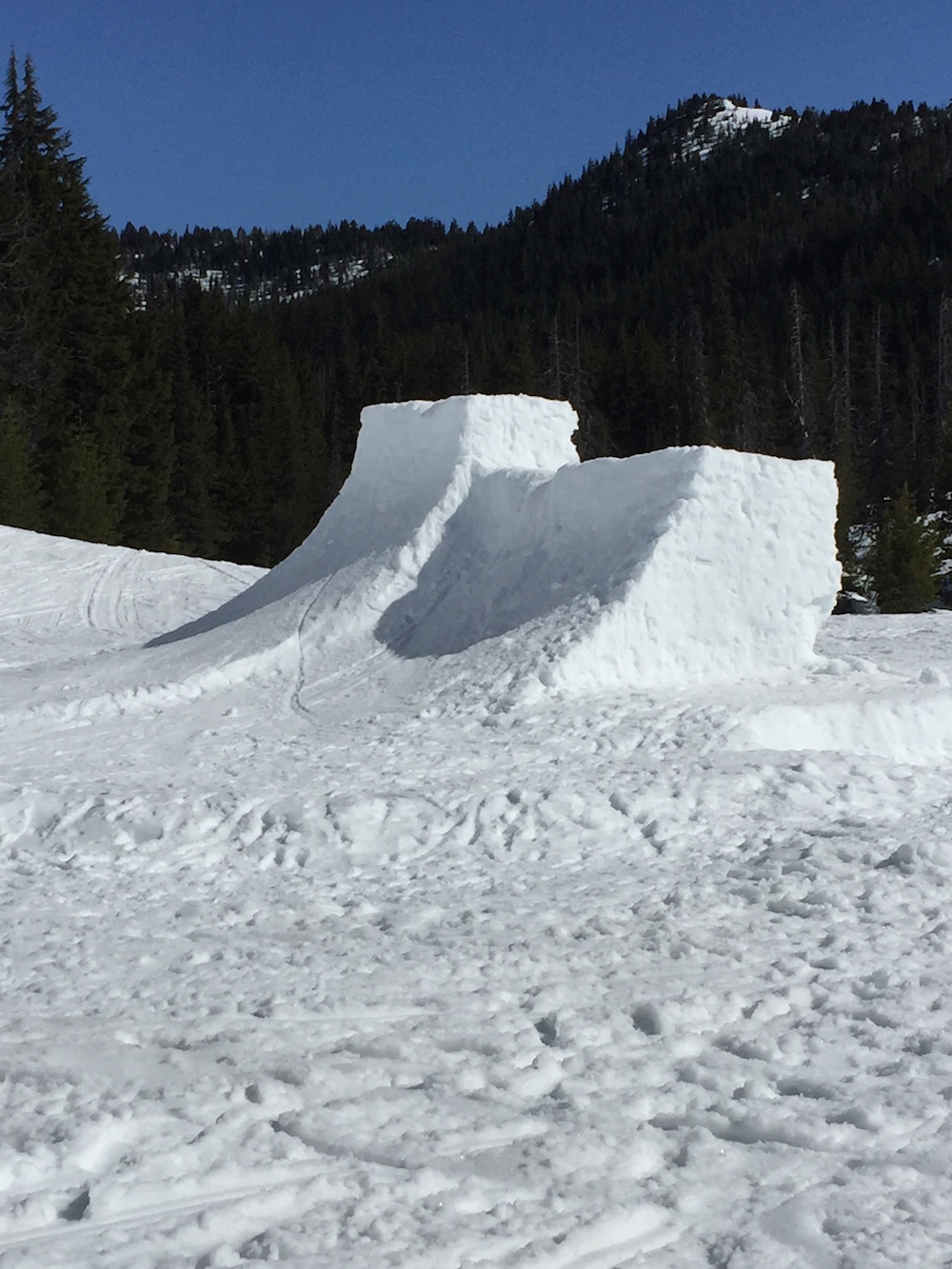
Watch your goodies coming back in, though, as one route back to civilization has some mighty big kickers: these are known as, “FBD Killers,” so I only hit them a few times.
FBD killers
The alpine skiing is also awesome, if you’re in to that sort of thing. Some of the really hard-core locals will hit the tracks at 8:30 for a few hours, transition directly to alpine, grab some lunch, paddle, then go for a ride or run. If that’s not a perfect day, I don’t know what is.
Mt. Bachelor alpine area
In conclusion, Bend is one of the nicest places in the world to be in May for nordic skiers of all levels. “I never, ever get tired of this place,” Foster mused. “Every day up here is special. Each day has its own personality and every one is different. Even the drive to the nordic center is amazing. You’re in the trees for most of the trip up, then you hit the high country, turn the corner, and you can see the mountains — it’s breathtaking. It’s just such a cool reminder that everything is okay in the world.”
So instead of squandering those frequent flyer miles on something stupid like going to visit family, invest in your future and book a flight into Bend (Redmond) today. From there, you are less than 30 minutes away from having all of your problems solved. You’re welcome.
And remember, you owe me a beer. One that doesn’t smell too much like VW seat covers, if it’s not too much trouble, please.
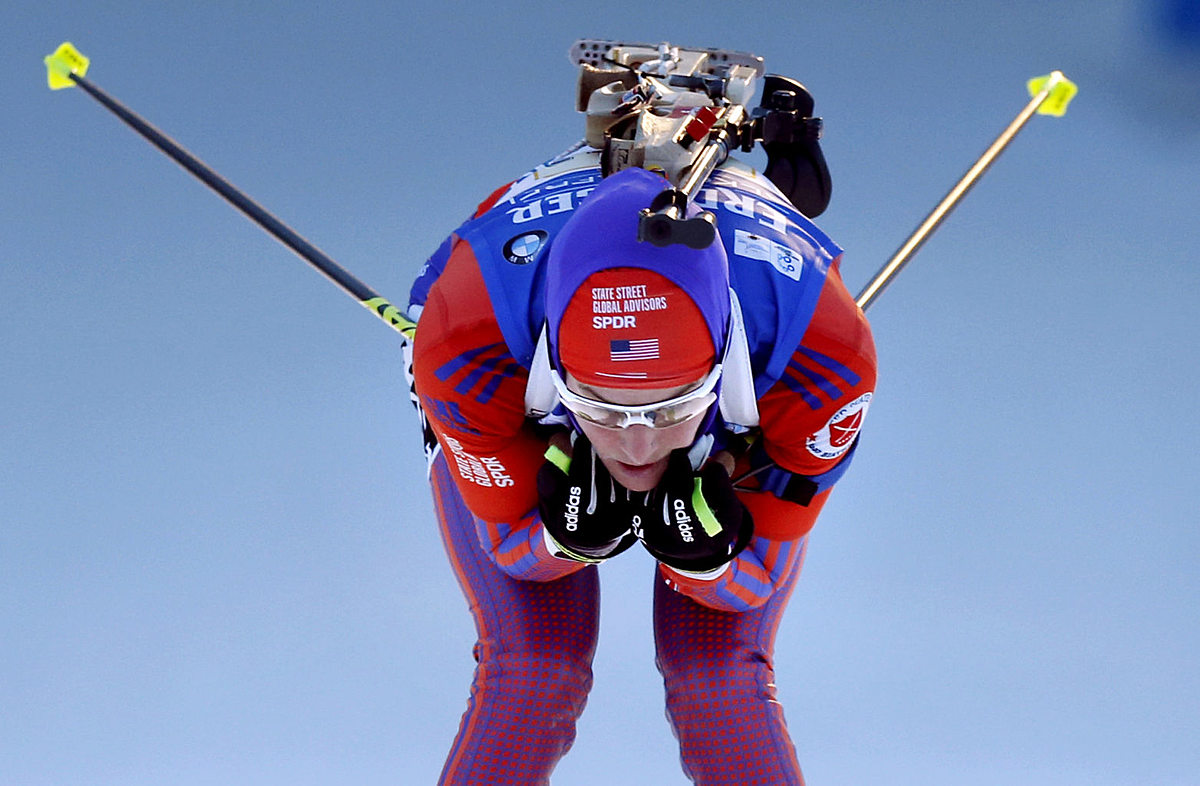
Clare Egan (US Biathlon) tucking and gliding during a 2015 IBU World Cup. She finished the 2015/2016 season ranked 66th overall. (Photo: USBiathlon/NordicFocus)
Bailey, Burke, Dunklee — even if you are a casual fan of biathlon in North America, they’re recognizable names.
Egan is relatively new to the scene. 2016/2017 marks only her second full-time season on the World Cup. That’s remarkable when you consider this: other than a session or two at summer camp, she first picked up a rifle at the age of 25. She’s now 28. Her being picked as a member of the relay team t0 start the season is a sign her teammates and coaches have faith.
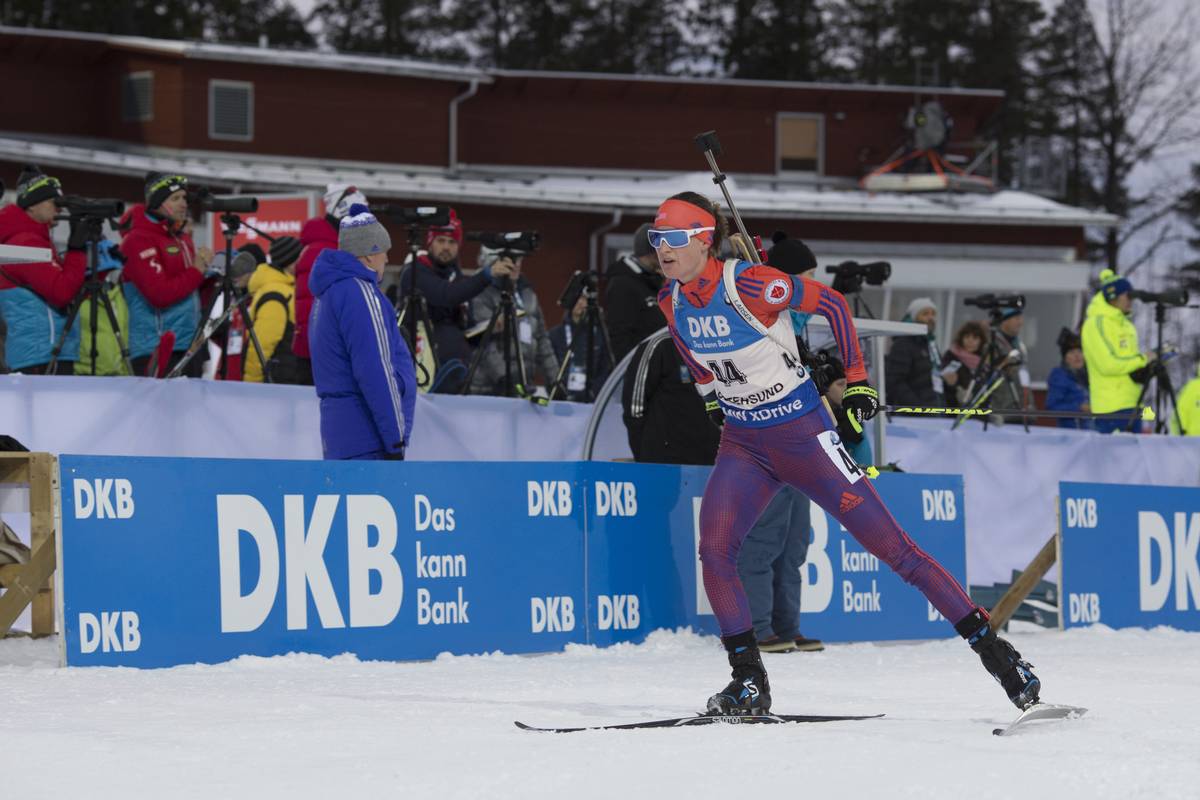
Clare Egan (US Biathlon) racing to 30th in the women’s 10 k pursuit at the IBU World Cup in Östersund, Sweden. (Photo: USBA/NordicFocus)
Still at the first World Cup stop in Östersund a week later, Egan racked up her second-best pursuit result this past Sunday, Dec. 4. She finished 30th after starting 44th (her placing in the sprint the day before).
“My wax crew did an excellent job today and definitely gave me an advantage – I was gliding past everyone on the downhills so I was able to pick up a few places just from having the fast skis…,” Egan wrote in an email to FasterSkier after Sunday’s 10 k race. “I was able to fight for top-30 on my last lap and won a sprint between 4 people in the finish. I’m proud of all my results from this week and looking forward to learning from these experiences and moving up throughout the season!”
New to the sport only a few years back, Egan had a steep learning curve. As FasterSkier podcast listeners learned, Egan attended Wellesley College in Massachusetts; a school with a club cross-country skiing program. No D-1. She graduated in 2010.
In 2011, Egan joined the Craftsbury Green Racing Project. By 2014 she was a member of US Biathlon’s development program. Now, she’s a member of the US Biathlon A-team.
So back to that learning curve.
Warning! Math equation coming.
y = mx + b.
That equation describes in mathematical terms both the direction (positive or negative), and gradient of a line. In Egan’s case, if we were illustrating her rise in the sport with a line, let’s just say it’s positive and steep.
FasterSkier reached Egan by phone in late October while she was in Canmore, Canada, for a three-week training camp. During the conversation, Egan focused on how she could improve as a biathlete. She finished last season ranked 66th overall on the IBU World Cup.
“I continue to work on improving my shooting accuracy as well as my shooting speed,” Egan said of how she can improve in the standings. “I met my goal of shooting an average of 80 percent hits on the World Cup last year. But I hope to improve upon that this year and be shooting for 85 percent, which is a lofty goal, but I think I can do it.”
Along with improved shooting, Egan remarked that she wanted to maintain her higher-end skiing speed throughout the season. Most biathletes, unlike some cross-country skiers on the World Cup, don’t specialize in say either sprint or distance events. The race season offers more opportunities to race. That increased racing load brings with it the possiblity of fatiguing, and dulling that turbo-charged race-specific gear.
“Last year I started out real strong and then I had a fairly significant trough in the middle of the season and then came back pretty well for World Cup 8 and World Championships,” Egan said of her desire to achieve fewer peaks and valleys when it comes to results. “But I would like to see more consistent results basically over the course of the season. And I think that my experience from last year as well as my training that I have put in this year will allow me to do that — last year was the first time that I had done a full world cup season.”
From an outsider’s perspective, it appears biathlon is a sport rife with tense nerves; there’s the race-pace skiing and laser focus required for shooting. Together they seem incongruous. Like timed needle threading after a sprint up the stairs.
Yet Egan said as a developing biathlete, the nerves part of the equation remains under control most of the time. “I think actually as a brand-new biathlete you really don’t have as many nerves,” she said. “You have no pressure, no expectations, in fact your only expectation is that you will probably miss most of the targets. So there’s not so much to be nervous about.”
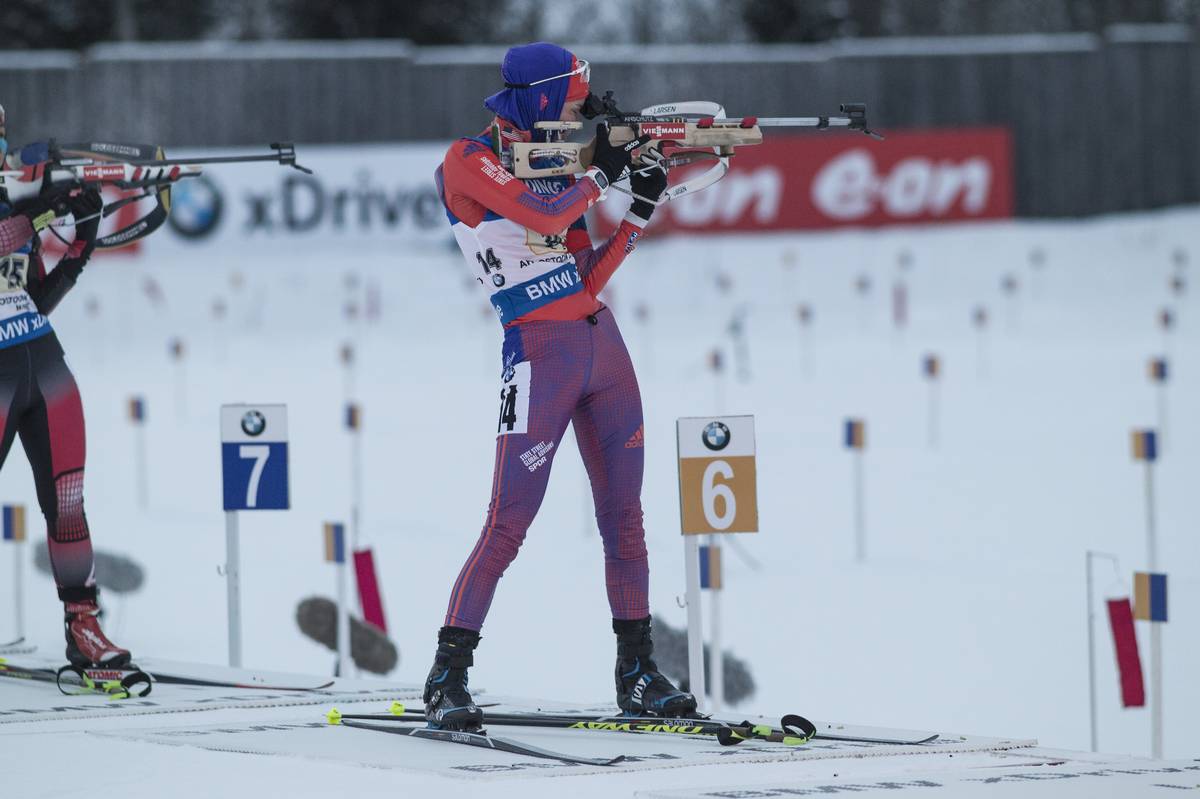
Clare Egan (US Biathlon) during her standing stage of the women’s 4 x 6 k relay at the 2015 IBU World Cup in Presque Isle, Maine. Her team went on to place 10th for a season best. (Photo: USBA/NordicFocus)
In other situations, as she matures in the sport, the nerves do occasionally manifest. “Certainly as you improve and like now I am racing internationally, I am representing my country, I am representing my team, sometimes I am on the relay with much more experienced athletes — that’s when nervousness and pressure set in at a much higher degree.”
Entering the season, Egan also ruminated on the emotional aspects of the sports. “Every biathlete has to deal with crazy up and downs, way beyond what nordic skiers experience, and that is something you definitely have to learn to deal with,” she said. “There is no way, as a cross-country skier, that you go from the top 10 to 80th — but that happens all the time in biathlon. There is no easy answer. There is no easy way to deal with that.”
The season is young. Egan’s goals remain lofty yet modest. For her, success equates to improvement. Be it shooting speed, shooting accuracy, skiing speed, or skiing technique, she’s open to improving across the board. Ranked among the top 50 biathletes in the world will be a tangible metric, she says, or her hard work.
***
We asked Egan to give a go at our ’17 questions for 2017′. Here are her responses:
1. Biggest change in your life in the last five or so months since the ski season ended?
I moved out of the Lake Placid Olympic Training Center and into an apartment with my boyfriend, Erik. This is the first time in my life as an athlete that my home has been separate from my “workplace,” and it has improved my quality of life as well as my ability to mentally and physically recover from training. I am especially enjoying cooking and eating homemade food!
2. Biggest change in your training?
Relative to last year, my training plan this year had less intensity over the first three months, which allowed me to increase the overall volume. I am also doing a more comprehensive strength program.
3. Major areas of improvement you’ve seen so far?
I’ve seen improvement in my shooting accuracy and speed, especially at low heart rate. The next step is putting that into practice at high intensity.
4. Whom you’ve been working closest with this offseason (coaches or training partners)?
I am coached primarily by the national team women’s head coach, Jonne Kähkönen. As for training partners, I’ve been getting to know Maddie Phaneuf pretty well! We are regularly joined by our national teammates Susan Dunklee and Joanne Reid, as well as a handful of up-and-coming biathletes including Emily Dreissigacker and Hallie Grossman from the Craftsbury GRP, Chloe Levins and Jennie Bender.
5. Best trip in the last five months (and why)?
Best training trip was to Bend, Oregon. Anywhere with that much sun and snow is a very special place.
Best vacation was to the Turks and Caicos Islands with Erik, where we stayed at a Club Med resort and did tons of water sports and learned trapeze! And I love going home to Cape Elizabeth, Maine any chance I get — I went three times this summer.
6. Favorite cross-training?
Tennis and badminton!
7. Favorite non-athletic activity or pastime this summer?
Floating on my large inflatable pink piglet on Mirror Lake or tending to my garden vegetables and flowers.
8. Song that was your jam this summer?
That would have to be “Can’t Stop the Feeling” by J.T.
9. All-time favorite race moment?
One day that changed the course of my life was in February of 2010 when I qualified for NCAA’s as an independent skier from Wellesley College. I never seriously considered training year-round for cross-country skiing until that moment.
10. First thing you pack in your bag when you leave for Europe?
Rain pants — I’ve never been more thankful for a single item of clothing. Getting soaked as you lie on the shooting mat in the prone position is not fun! And my lucky pigs.
11. Venue/event you’re most excited to visit this season?
If all goes well, I will be racing in PyeongChang, South Korea at the pre-Olympic World Cup. I have never been to Asia and would be thrilled to see a new part of the world and feast on Korean food!
12. Who will win the men’s and women’s World Cup titles this year?
Martin Fourcade and Laura Dahlmeier. Susan Dunklee in the top 10!
13. Biggest sacrifice you feel you’ve made choosing this career path?
I live far away from most of my friends and family and my travel schedule causes me to miss more weddings and other important events than I would with a “normal” job.
14. If you could change one thing about your sport, what would it be?
I wish biathlon were more accessible to American athletes and audiences. The catch twenty-two is that Olympic medals would bring attention to our sport and inspire more athletes to try it, but without a huge pool of athletes, it is hard to achieve that level of international success. Despite the current small number of American biathletes, several are World Cup medalists who are well-prepared to medal in the 2018 Olympics, so that could spark a wave of greater publicity and involvement.
15. What did you have for breakfast this morning?
Black tea, two pieces of bread with Norwegian brown cheese (gjetost), and a homemade coconut chocolate truffle.
16. In 5 years, I’ll be ____?
…in a completely different chapter of my life, the specifics of which are TBD, but could range from working overseas with the foreign service to nursing a babe in the ‘burbs while teaching high-school Spanish and coaching girls’ track.
17. In 50 years, I’ll be ____?
If I am lucky enough to be alive as I approach 80, I hope I will look back on this sliver of my life with pride, knowing that I did my best work, that the glory outweighed the frustration, and that I lived fully in the richness of this experience.
Annelies Cook finishing out her international biathlon career, anchoring the U.S. women’s relay team to 13th at 2016 IBU World Championships. (Photo: USBA/NordicFocus)
OSLO, Norway — The women’s 4 x 6-kilometer relay wasn’t just the last race of 2016 World Championships for part of the US Biathlon team, but also the last international race of some of their careers.
With both Hannah Dreissigacker and Annelies Cook set to retire – and neither are attending the final World Cups in Khanty-Mansiysk, Russia – it is the end of an era for the team.
“I’m really sad to be saying goodbye to Annelies and Hannah as teammates,” Clare Egan said. “Really, really sad. They are just great teammates, relay day or not relay day. Summertime, wintertime. We have big shoes to fill.”
But before they could laugh and cry and reminisce about so many training camps and racing trips done together, the women had to get through the relay, and they wanted a good result.
“I said last night in our race meeting, we definitely want to approach every day until the end of the World Championships very professionally,” U.S. women’s national team coach Jonne Kähkönen said. “Sure, there are a lot of emotions. You have to put those on the side, and finish the day first, and then celebrate the retirements. But have a good focus all the way through.”
“We want to have fun on this last day, and we want to put together a good result to have a good memory to go out on,” Susan Dunklee agreed. “When you’re seeking fun, that doesn’t mean that you don’t work hard and it doesn’t mean that you’re unprofessional or you’re not doing the focused work that you need to do. But I think that’s the common misconception when we talk about fun. Fun means keeping yourself motivated to be hungry and to want to do the work.”
Dunklee led things off for the United States, cleaning prone with no spare rounds and going out with the leaders.
“I don’t think I’ve ever seen so much contact in the women’s field in a mass start situation,” she said of the early going. “People were bumping elbows and poles, and stepping on each others’ skis, and I saw a couple different people go down. People were moving back and forth across the trail more than they usually do. It was really difficult to move up today.”
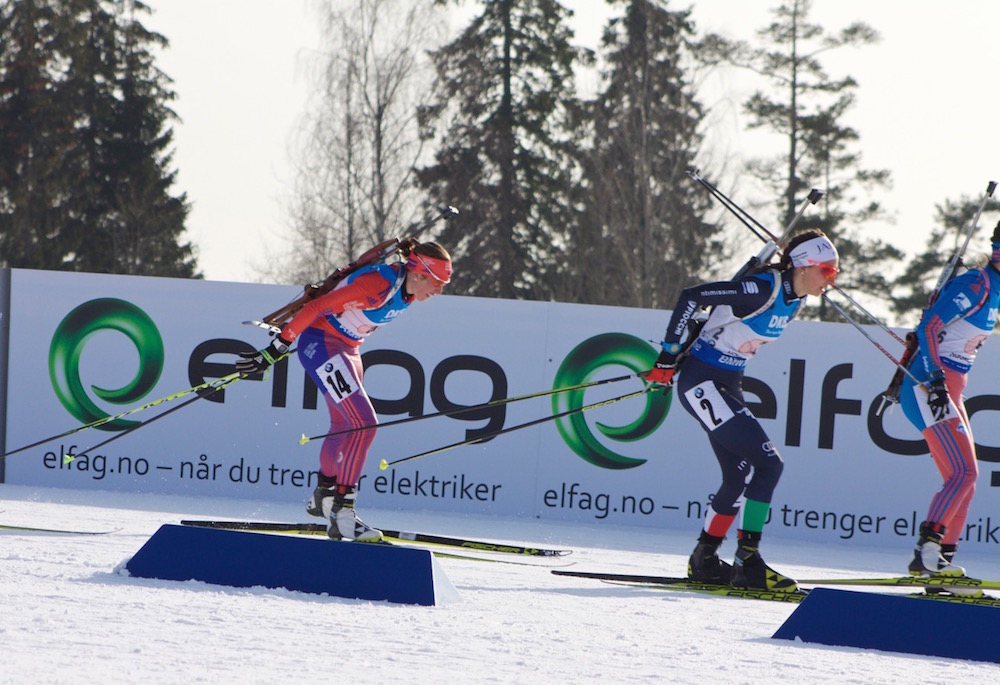
American Susan Dunklee (14) chasing Italy’s Lisa Vittozzi (2) while skiing the first leg of the women’s 4 x 6 k relay at 2016 IBU World Championships in Oslo, Norway. She tagged her team in 10th and the U.S. went on to place 13th. (Photo: JoJo Baldus)
Dunklee tried to attack on the second loop, but was quickly caught.
“I don’t think I felt as sharp on skis,” she said, comparing the effort to her leadoff leg in the mixed relay a week ago, where she tagged off in first place.
“I didn’t have the gas to quite go as hard, and when I did go hard I didn’t recover. I think all this racing is starting to get to me a little bit. I attacked off the front, and then people passed me on that downhill leading into the big hill. They caught right back up, so I thought it was stupid to waste that much energy if I’m not going to make a big break.”
Dunklee then used two spare round in standing and tagged off in tenth place, 28.2 seconds back. Her ski time was the second-fastest of all leadoff skiers.
She tagged off to Dreissigacker, who was in the last relay race of her career. Things didn’t go perfectly, and the team fell to 16th.
“Shooting, I had to use three spares,” Dreissigacker explained. “I am not that happy with my shooting, but it still wasn’t terrible. It’s just a tough competition out there today. There are all kinds of teams at the top.”
Egan moved up to 14th with two spares, before tagging off to Cook.
Cook had only announced her retirement publicly in the last 24 hours, and of all the emotions running rampant on the team, hers were the strongest.
“I was so nervous, oh my god,” she said. “I wanted to be able to finish in a good way, with my team. I had the worst butterflies all day long. But I was just really happy to ski.”
And after being frustrated in the sprint, after a bout of pre-Championships illness, Cook felt her ski speed come back around as the week went on. She used just one spare round on the anchor leg and was left with a performance she could feel happy about. She crossed the line smiling in 13th place, 3:47.1 behind the winning Norwegian team.
“I think Annelies did a great job today,” Kähkönen said. “Cleaning quick in prone, and then just one reserve in standing. That was excellent execution. To her potential, I mean, that’s how Annelies Cook shoots.”
Still, even out on the course there were bits of emotion.
“On the last little bit I saw Hannah, and Susan and Clare, and they are such a great team,” Cook said, tears wellling up in her eyes. “I’m going to miss them so much. It has been a really amazing adventure with a lot of really good people.”
The result wasn’t the best of the season. The U.S. had finished tenth in the last World Cup relay before World Championships, at home in Presque Isle, Maine.
Clare Egan skiing the third leg for the U.S. women in the 4 x 6 k relay at 2016 IBU World Championships. After receiving the tag in 16th, she brought the team to 14th and the U.S. finished 13th. (Photo: JoJo Baldus)
“We maybe just didn’t have the energy on the skis today,” Egan said. “It seemed like some of the other teams were performing extremely well. I don’t think we were performing poorly.”
Kähkönen thought that was a fair assessment.
“At the World Champs, that’s just the level [of competition],” he said. “You need that good shooting, and even better shooting, and the best shape of the day. And as usual, we had a few surprises mixed in there. Like the Slovenian team, and Kazakhstan definitely had a great day today.”
Now, the team is looking forward to Dunklee and Dreissigacker competing in Sunday’s mass start, the first time ever that two American woman qualified for the 30-woman event at a Championships.
From there, Dunklee and Egan will go to Khanty-Mansiysk to finish off the World Cup, while the retirees will go home, and then to North American Championships in Fort Kent, Maine.
After that, it’s time for the team to contemplate life with two fewer members.
“I’m going to miss them so much. It has been a really amazing adventure with a lot of really good people.” — Annelies Cook (US Biathlon) on retiring
“It will be a great challenge,” Kähkönen said. “We’ve talked about this for the last two years now. Ever since Sochi I guess. Just trying to find ways to bring in more resources and effort into development, because it’s a long path. I typically say it’s four, five, six years, depending on where you start from, to get to a true World Cup level. I mean, even Clare [Egan, who started biathlon three years ago], she is doing awesome, but still on the way. She is in the process of getting there.”
Dunklee and Egan both agreed that there is plenty of opportunity for their team, naming Maddie Phaneuf and Joanne Reid as women they are excited to work with more next season.
“We have some candidates,” Dunklee said. “It’s going to be a fun challenge, getting some new people up to speed. There’s hope. We have a bright future.”
Kähkönen sees Dunklee, who has had world class performances each of the last several seasons and turned in a top-ten sprint result earlier in World Championships, as the ‘captain’ of the team going forward.
But team cohesion and a supportive atmosphere are hallmarks of the U.S. women’s team, and he doesn’t see any problem fitting new candidates into that group.
“The others members took Joanne into the team immediately,” Kähkönen said of Reid’s first World Cup experience. “It was good to see. And I must say, it was almost out of the blue that she raced national trials, and then IBU Cup, and then most of the [World Cup] athletes had not seen her, had not even met her. So I think they did a good job, and at the same time that’s just how the team operates.”
Memories of the atmosphere that Cook and Dreissigacker helped create will inform the group moving forward.
“These awesome experiences you have with your teammates, these bonding moments whether it’s training in the mountains in the summer or in the pouring rain when nobody wants to be out but you’re out there and you’re badass, those keep you motivated,” Dunklee said. “Your teammates make it fun.”
Norway’s Johannes Thingnes Bø racing to a 28-second win in the IBU World Cup men’s 10 k sprint on Thursday in Presque Isle, Maine. (Photo: Fischer/NordicFocus)
After skipping the last tour stop in Canmore, Alberta, Norway’s Johannes Thingnes Bø returned to the International Biathlon Union (IBU) World Cup with a bang, winning the men’s 10-kilometer sprint on Thursday morning in Presque Isle, Maine, in a time of 24:38.8, with no penalties. It was the first World Cup race in the U.S. in five years.
“It’s never easy, but today I felt I had control,” Bø told the IBU in a post-race interview. “I was calm before the race, and also on the shooting range. I tried to do it like in training.”
The defending 2015 world champion in the sprint is now heading into the 2016 World Championships at home in Oslo, Norway, with a victory in the same discipline.
“It looks like it has been good for me, but who knows,” he said at the press conference on his decision to not make the long trip to Canmore, Alberta, last week for the previous World Cup. Instead, he trained for Oslo.
Asked why eight of his 10 World Cup victories came in sprints, Bø replied, “Maybe it’s because shooting is my weakness, and in the sprint there is only two [stages]. So there is a bigger chance for me to not miss so much.”
He achieved his clean shooting despite losing feeling in his fingers on the first loop due to the cold weather and his fairly thin gloves, he told Norwegian broadcaster NRK.
“Without feeling I had to focus extra hard on the innermost black spot, maybe that was the thing that made it go so well,” Bø said according to a translation.
Starting very early with bib 3, France’s Martin Fourcade had one miss in the standing stage and initially took a 38-second lead at the finish (over Norway’s second starter Erlend Bjøntegaard) thanks to Fourcade’s fast skiing, with the eventual overall fastest course time.
After changing into dry clothes and waiting in the finish pen for a few minutes, Fourcade was passed by Russia’s Anton Shipulin, who started behind him in bib 16 and had two clean shooting stages. The Russian lost time to Fourcade on the final loop, but by the finish, Shipulin, who ranks second in the overall World Cup, had preserved a 1-second lead over Fourcade — the World Cup leader.
“I have competed here 10 years ago at the Junior World Championships,” Shipulin said at the press conference through a translator. “So I know the tracks, and they are quite good.”
Shipulin ended up second when Bø, the 25th starter, barreled through the finish 27.9 seconds faster, with both clean shooting and the second-fastest overall course time. That moved Fourcade into third (+28.9) and the top-three stood through the remainder of the 88-man race.
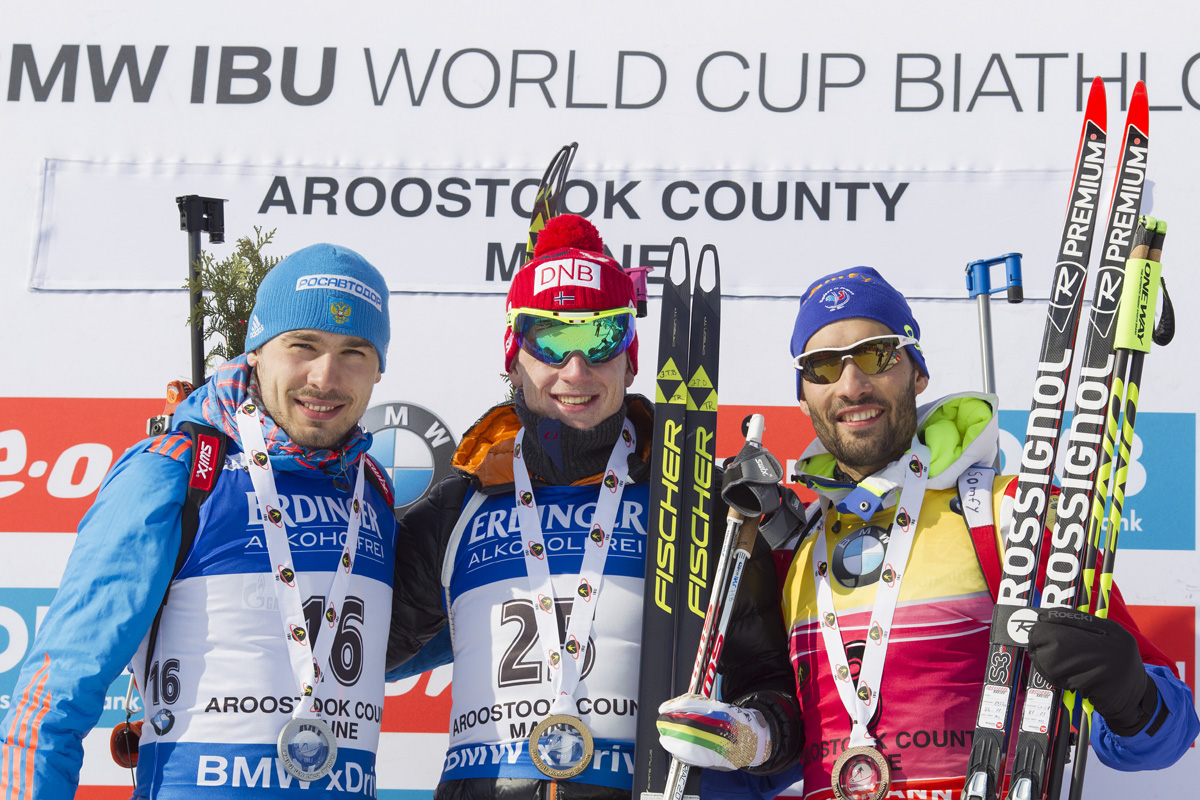
The men’s sprint podium at the IBU World Cup in Presque Isle, Maine, with Norwegian winner Johannes Thingnes Bø (c), Russia’s Anthon Shipulin (l) in second, and France’s Martin Fourcade (r) in third. (Photo: Fischer/NordicFocus)
“Of course I am happy and satisfied with the race today,” Shipulin said. “I wasn’t as fast as those two guys on the track. But I did clean shooting, and the result was good … I hope I will get better for the World Championships.”
“My shape was really good today … The shooting range is not as easy as we thought,” Fourcade said at the press conference. “No wind today so that was good.”
“But I really was surprised by the sun; I think it was too much sunshine for my little blue eyes,” the brown-eyed Fourcade joked. “I had real difficulties on the shooting range. That is why I needed so much time in the standing shooting.”
Bø posted the best times after the first and second shooting stages, where he hit every target, and extended his lead to the finish over Shipulin. Despite placing third, Fourcade slightly added to his commanding World Cup lead, with 857 points to Shipulin’s 646.
“Johannes was simply a better biathlete today,” Fourcade said. “He shot clean, he shot fast, and [me and Shipulin] both know he will be one to beat for the World Champs.”
As the race progressed, Germany’s Erik Lesser in bib 54 had the best chance to reach the podium, thanks to two clean shooting stages.
He picked up speed throughout his three loops; after losing more than 20 seconds to Bø on each of the first two loops, he only lost 2 additional seconds on the last one. But overall, Lesser could not quite match the skiing performance of the top three and finished fourth, 45.9 behind Bø and 20 seconds off the podium.
“I was very timid on the first round, somehow insecure,” Lesser told German TV broadcaster ARD. “I felt a little tired, so I wanted to rather push towards the end. … The shooting range is not easy, in standing I had to rebuild my stance. You really have to pay attention. Everything is possible in terms of advancing or falling back.”
Behind Lesser, two Swiss athletes had their best results of the season, with Serafin Wiestner in fifth (+50.3) and Benjamin Weger (+52.5) in sixth place, both missing one shot in standing.
For Wiestner, a border police officer, it was a new personal best after previously finishing 24th in a sprint in Ruhpolding, Germany, earlier this year.
“We are really happy about this result,” Wiestner told the IBU. “The last weeks were not so good for us, for the whole team … It’s a really tricky course, but I like that.”
I had a really bad season until now,“ Weger added. “Almost [all] just bad races. So I am very happy to be back in top 10 now, the first time this season. I hope to continue like that now.”
Latvia’s Andrejs Rastorgujevs in seventh (+54.0) and Bø’s older brother, Tarjei, in eighth place (+58.9) also had just one penalty in standing, and stayed within one minute of Bø to achieve a good starting position for the pursuit on Friday.
Doherty Leads Three Americans in Top 20; Canada’s Perras 48th
American Sean Doherty returned to the World Cup on Thursday, in his first race since racking up three medals in as many races at Junior World Championships in Cheile Gradistei, Romania. At 20, he become the most decorated athlete in history of Youth/Junior World Championships in his final season as a junior.
Starting in the middle of the field in bib 42, Doherty was the youngest competitor in the sprint. He shot clean in prone, and then missed one in standing, having to ski a penalty lap. The top North American, he ultimately placed 13th for his career-best World Cup result, 1:16.2 behind Bø.
“My shooting today felt good, very in control,” Doherty, a New Hampshire native, wrote in an email. “The wind was manageable, it just came and went but was never too extreme. The range approach here is deceptively tough, and the wind conditions can be tricky but overall today was a good day on the range.
“I am really looking forward to the pursuit,” he added.
Lowell Bailey (US Biathlon) racing to 15th in the men’s sprint at the IBU World Cup in Presque Isle, Maine. Bailey was one of three U.S. men in the top 20 on Thursday. (Photo: USBA/NordicFocus)
Shortly behind, another American Lowell Bailey placed 15th (+1:22.4), also with a clean prone shooting and one penalty in standing.
“The wind can definitely be a factor here as the venue sits on top of a plateau,” Bailey explained in an email. “But today, I think the biggest factor was the approach. It is one of the more difficult approaches [in the World Cup] and if you aren’t prepared for it, you will be surprised at the fact that you aren’t very recovered when you hit the mat.”
Earlier this week, Bailey provided a unique view of the Presque Isle courses for the IBU in a first-person video, skiing through the men’s sprint loop, the arena and the penalty lap (coincidentally, Johannes Thingnes Bø passed Bailey in the penalty lap during the video).
“A lot of transitions from downhills directly into steep uphills,” Bailey commented in the video. “So you have to be changing techniques all the time.”
“The snow here is very cold,” he said of the conditions. “You can hear it, kind of squeaking like Styrofoam. That makes it interesting for waxing. We’ll be on very hard cold wax. Very fine stone grinds with the ski base.”
In his email, he explained that the course was challenging, particularly with a “corkscrew” downhill section, with some ice beneath the snow. “You had to stay alert and react when your skis started to slip,” he wrote.
“I felt like an alpine skier,” winner J.T. Bø joked about the course in an IBU interview. “You had to ski at the very edge of the skis. It was really hard, but it was cool.”
“The two places are really different,” Fourcade said during the press conference, comparing Canmore with Presque Isle. “Canmore is huge mountains, and here we are more in the forest. I prefer the track here, but it’s hard to compare two sites.”
Also for the U.S., Tim Burke started early bib 6, missed one target in each of his shooting stages, but finished 20th (+1:32.7) as the second-best athlete with two penalties.
“I felt solid on the ski course today,” Burke wrote in an email. “It was not one of my best days, but I was able to keep a good pace for the entire race. This is an interesting course in that there are not really any big climbs, but on the other hand there is very little recovery because of the challenging downhills. This was my first time competing on this course and I really liked it.
“My shooting felt decent today and the two misses were very close,” Burke continued. “But two misses is obviously too much for the sprint competition.”
Leif Nordgren in bib 76 came in 65th (+3:02.6) with three penalties (2+1). Eleven seconds outside the top 60, he missed qualifying for Friday’s pursuit.
“The men were just really consistent, everybody close together and just the whole field for the top athletes, so it puts them into a very good place looking ahead for tomorrow’s pursuit race,” US Biathlon coach Jonne Kähkönen said in a phone interview with FasterSkier. “Hopefully Susan’s podium will give them another push.”
After the men’s race on Thursday, Susan Dunklee raced to second place in the women’s 10 k sprint to tie the best-ever result by a U.S. biathlete, male or female.
Canada brought some of its developmental team to Presque Isle, with the athletes prequalified for the World Championships in Oslo skipping the races and continuing to train at home in Canmore.
Originally Nathan Smith had planned to keep competing in Presque Isle, partly in order to defend his top 20 in the overall World Cup (he was 19th after the Canmore World Cup).
“It was a really last minute decision. I literally had my stuff packed and ready to load into the team van,” Smith told FasterSkier in an email. “I was already somewhat uncertain about going because my skiing has been lackluster the last few weeks. When I saw how potentially cold it could be [in Presque Isle] I decided that perhaps I should stay in Canmore to get some rest and refocus after a very demanding month of racing, travel, and all the extra energy spent at a home world cup. I’ll be cheering the team on from the comfort of my living room.”
Asked how he thought that might affect his place in the standings, he guessed it would drop him just outside the top 20.
“I was hoping to be near top 10 by this point but unfortunately I didnt make so many points the last 2 world cups,” Smith wrote. “I think it’s better for me to try and perform my best … at world champs instead of chasing points to try and stay around 15th to 20th.”
Without the usual starters, Scott Perras achieved the best result for the Canadian men in the sprint on Thursday, finishing 48th (+2:36.0), with one penalty in both prone and standing, and qualified for the pursuit on Friday.
“Shooting was ok, I was a bit tight for prone but it was fine,” Perras wrote in an email. “Presque Isle can be pretty windy, today was just a slight breeze, almost perfect!
“Skiing felt ok, I expected to feel a little better for sure,” he added. “[The] course is fun, what makes it difficult is the fact that you climb for a couple minutes before you get to the biggest climb on the course. That and the fact there isn’t much time ever spent in a downhill tuck.”
In their first World Cup races of the season, Canada’s 21-year-old Carsen Campbell finished 78th (+3:45.9) with one penalty, Matthew Neumann, 26, was 82nd (+4:16.6) with three misses (1+2), and Matthew Hudec, 21, finished 88th (+5:18.6) with two penalties (1+1).
Every Course is Different
The World Cup returned to the U.S. and the Nordic Heritage Center in Presque Isle for the first time in five years since February 2011, when the World Cup also included races in Fort Kent, Maine. Back then, Fourcade placed second in the sprint to Germany’s Arnd Peiffer, who finished ninth on Thursday (+1:06.4) with one penalty.
Most athletes commented positively on the challenging course and arena, though some pointed out a few unusual details, mainly a utility building in the middle of the penalty lap making it difficult to see the competition.
“It’s pretty far around that little house, at least it feels that way,” Peiffer told German TV broadcaster ARD after the race, when asked about his penalty lap.
According to ARD’s play-by-play announcer, organizers recently measured the loop out at 155 meters, 5 meters longer than the IBU norm, but still well within the standards.
“Yes, it does feel long,” Bailey agreed in his email.
“The penalty loop definitely felt long to me but I’m sure they have measured it,” Tim Burke wrote in his email. “I think it’s just the fact that you can’t see through it, that makes it feel so long. That will be an interesting factor for the pursuit because you won’t be able to judge how many athletes are in the penalty loop.”
In contrast to that, Perras even observed some positive elements: “I don’t think the penalty loop feels any bigger, it actually skis quite well. Some penalty loops have really tight corners and you can’t really ski through the corners at all, you are almost skidding. And here there are fans in the penalty loop, how do you compete with that.”
Germany’s Lesser also noted in his interview with ARD that the shooting mats felt uneven, giving him slight problems to find his stance.
“I also felt that the shooting range mats slope towards the targets,” Burke agreed. “This is very unusual and hopefully they can fix this for the remaining competitions.”
“The shooting mats do seem to slope awkwardly,” Perras wrote. “Honestly I’ve seen this at a few ranges throughout the world. No two ranges are the same and I try to just focus on the target, besides my legs aren’t even the exact same length so don’t take my word for it.”
While not featuring quite as many people in attendance as some of the huge venues in Europe who are always on the World Cup competition calendar, there was still a good atmosphere at the Nordic Heritage Center on a weekday and in sunny weather. International athletes such as Germany’s Peiffer appreciated the support they received from the U.S. fans, many of them schoolchildren with rows of classes that had “adopted” different nations such as Germany, Italy, or even the small contingent from Romania, waiving flags and loudly cheering for the athletes.
“Those kids probably got a day off from school to come here,” Peiffer told ARD with a laugh. “But that at least means there is something going on [in the arena]. And they are cheering very enthusiastically, and the same for everyone. A very fair audience.”
“There is a lot of school kids here today and I hope they get inspired,” American Susan Dunklee told ARD in an interview after her race. “It’s a really great sport, and I think Americans haven’t fully discovered it yet.”
The World Cup in Presque Isle continues with pursuits on Friday and the men’s relay on Saturday and women’s relay on Sunday.
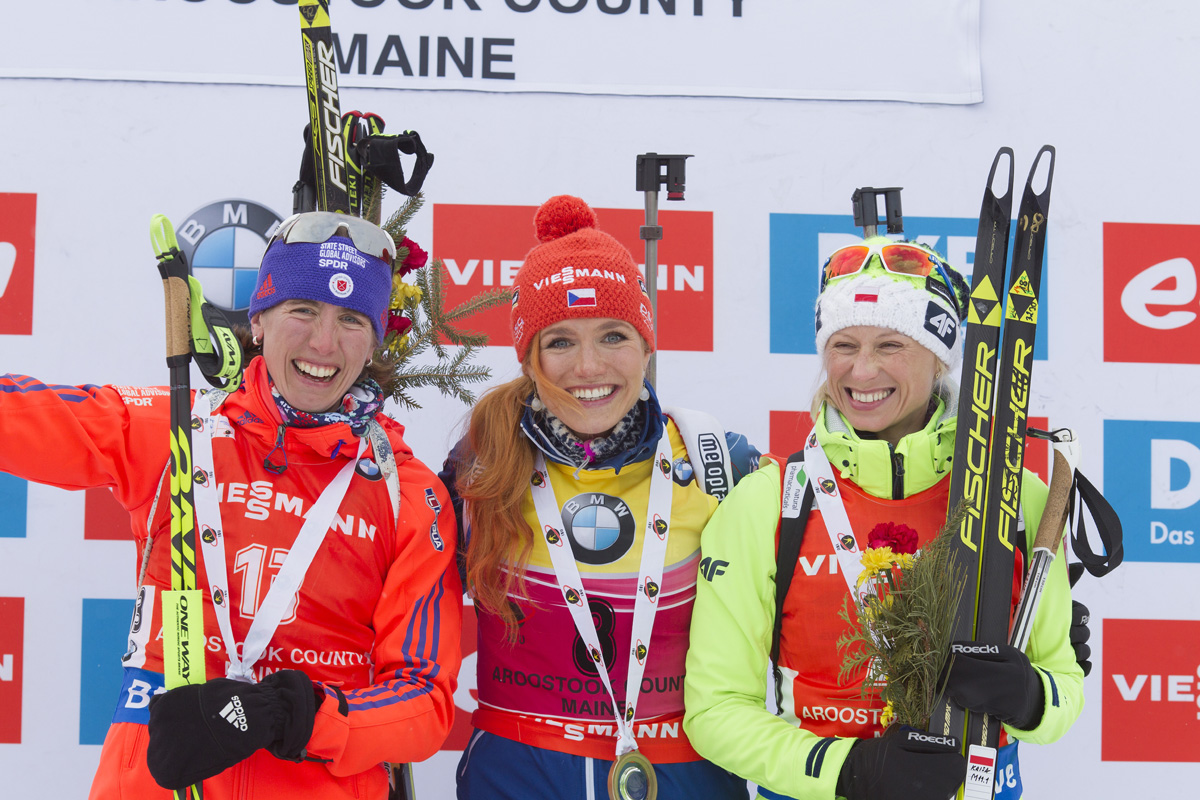
American Susan Dunklee (l) after achieving her best IBU World Cup finish in second place on Thursday and tying the best World Cup result by a U.S. biathlete. She finished second to Czech Gabriela Soukalova (c), and Poland’s Krystyna Guzik placed third (r) in the women’s 7.5 k sprint in Presque Isle, Maine. It was the first IBU World Cup held in the U.S. since 2011. (Photo: Fischer/NordicFocus)
Gazing out at the crowd, standing on the second step of the podium on Thursday, Susan Dunklee recognized dozens of faces: family, friends, people from her home base in Craftsbury, Vt., US Biathlon board members, colleagues from the Lake Placid Olympic Training Center, not to mention her team and support staff.
It had all the makings of a local-race feel, except for the implications of a World Cup podium — and the flashing lights, silver medal and media attention that came with it.
Two days before her 30th birthday, Dunklee had the best race of her career. The 13th starter, she raced to second in the women’s 7.5-kilometer sprint on the first day of the IBU World Cup in Presque Isle, Maine, finishing 17.8 seconds behind Gabriela Soukalova of the Czech Republic, the winner in 20:02.2 and overall World Cup leader.
Nearly 400 miles and a seven-hour drive from her hometown of Barton, Vt., Presque Isle is less than a half an hour away from Canada. Yet in her first U.S. World Cup, and the first World Cup in the states since it was last held in Presque Isle in 2011, Dunklee felt somewhat at home.
“To be able to have a best result on home soil and we only have a North American World Cup every five years, I couldn’t ask for anything better,” Dunklee said on the phone after the race. “It’s just phenomenal.”
In order to achieve her best World Cup result by one place (she finished third in a sprint two seasons ago in Oslo, Norway), Dunklee rekindled her joy in both the sport and Presque Isle’s course specifically, putting herself in a happy place she had been struggling to find in the last week.
“Last week was a little tough for me,” Dunklee said of the last World Cup in Canmore, Alberta. “I felt like I was going through the motions but not really feeling hungry for it.”
That changed on the final day of racing there, when she skied the first leg of the U.S. mixed relay, which went on to place fourth for the team’s best-ever finish in the event. Being within two seconds of a podium recharged her and reminded her to stay the course.
“Coming here I was like, ‘OK, there’s going to be random things that happen that are going to throw me off, but I’m just going to take the positive things that I can and use those to my advantage,’” Dunklee said.
On the team’s first training day in Maine on Tuesday, she skied the Presque Isle World Cup course for the first time. Dunklee had previously raced a NorAm there in 2009, but missed out on the 2011 Presque Isle World Cup as the team’s fifth woman at the time, when it only took four.
That was frustrating, she said, but she moved on from it — taking advantage of an opportunity instead in Ruhpolding, Germany, where she raced and previewed the course a year out from 2012 Ruhpolding World Championships. There, a year later at her first World Championships, she broke through in fifth in the 15 k individual.
Susan Dunklee (US Biathlon) racing to a career-best second on Thursday in the women’s 7.5 k sprint at the IBU World Cup in Presque Isle, Maine. (Photo: Fischer/NordicFocus)
Memories aside, Dunklee was excited about what she saw in Presque Isle earlier this week.
“I skied the course and I’m like, wow … this is a John Morton course. This is what I grew up skiing on and this is what I’m good at,” she recalled. “This is what I’m going to thrive on. I love the ups and downs, the steep climbs, the roller-coaster flow, and that’s what really set the tone right away.”
On Thursday, it was cold in northern Maine, but busloads of schoolchildren came out for the first of four days of World Cup racing. Dunklee wasn’t in her home state, but with everyone speaking English and cheering “USA!” out on the course, it was the closest she had felt to being there.
“The community is extremely welcoming and they go out of their way to accommodate us and make us feel like home,” Dunklee explained.
She started behind Soukalova, an early leader with perfect shooting in both her prone and standing stages. No sooner had Finland’s Kaisa Mäkäräinen in bib 6 finished and taken the lead from Czech Veronika Vitkova (the second starter) by 20 seconds, Soukalova in bib 8 charged across the finish line moments later, 24.5 seconds faster than Mäkäräinen to take hold of first place.
The day was young, but most of the top-ranked skiers were on course at the beginning of the 88-woman field. Dunklee followed Soukalova out, cleaning prone as well to take the lead by 0.8 seconds after the first shooting.
Her shooting didn’t feel automatic, Dunklee recalled. That wasn’t necessarily a good thing, but it wasn’t bad, either.
“I was very aware of each shot I was taking; it wasn’t flowing automatically like it usually does, and usually you want that automatic flow in a race,” she explained. “Instead I had all these thoughts going through my head, but what was great about today is I was able to take those thoughts and just say, ‘It’s OK that I’m distracted. I’m going to put that thought aside and go back to what I’m focused on right now in the present moment.’ ”
She had similar feelings earlier this year in Ruhpolding, where she placed sixth in the mass start. Recognizing this, she resolved to keep calm.
On the second shooting stage — standing — Dunklee cleaned again and left the range with 9.3 seconds to make up on Soukalova.
A US Biathlon staff member (l) cheers on Susan Dunklee (r) as she races to a career-best second place in the 7.5 k sprint on Thursday at the IBU World Cup in Presque Isle, Maine. (Photo: Fischer/NordicFocus)
What came to mind then? “You still need to fight like hell,” she recalled. “When you’re having that sort of race, you don’t want to lose a second anywhere … I’ve just got to fight for the next seven minutes or whatever it takes.”
With 1 k remaining, she was 17.6 seconds off Soukalova’s time. Half a kilometer later, Soukalova still held her ground, 17.4 seconds ahead. By the finish, Dunklee was 17.8 seconds back in second, and she wasn’t even sure she was second — but she smiled at the cameras anyway.
“I knew I probably had one of my best races in my life and I’d done it at home and my parents were there,” she said. “I just felt really good about my performance. I was really happy.”
US Biathlon Women’s Coach Jonne Kähkönen knew she was on track for a career best.
“I knew that if she would clean the race today, she would be fighting for the podium, even if there were a few fast athletes starting behind her,” he said on the phone. “Not nervous, but just wanted to wait and see what the later starters would do.”
France’s Marie Dorin Habert presented the most immediate threat. After starting 24th and cleaning prone, Dorin Habert left the range in first, 4 seconds ahead of Dunklee. However, during her second stage, she missed one standing shot. The penalty loop put her in fourth, 25.5 seconds behind Soukalova and 16.2 seconds behind Dunklee, with one loop to go.
Meanwhile, Poland’s Krystyna Guzik had started 20th and cleaned both stages to leave the range for the last time in third, trailing Dunklee by 4.4 seconds. She couldn’t catch the American on the final loop and finished 1.3 seconds behind her in third.
“Shooting is so hard; it is not sure that every day I will shoot well,” she said in a post-race press conference. “I thought that this was a new day and do my best to shoot well and run fast. I just could not catch Susan; she was too fast on the last loop. For me, the last loop today was really hard.”
Ultimately, the three podium finishers were the only ones in the top eight to shoot clean. Soukalova had the fifth-fastest overall course time, Dunklee’s course time ranked 12th and Guzik’s 15th.
Overall World Cup leader Gabriela Soukalova of the Czech Republic racing to a 17.8-second win (over American Susan Dunklee) in the women’s sprint on Thursday at the IBU World Cup in Presque Isle, Maine. (Phot: Fischer/NordicFocus)
“I have to say everything was perfect,” Soukalova said in the press conference. “I started to feel a little tired after the long trip from Canada, but I started to feel good after the start. … We had good service, good skis today so I am very satisfied with this result.”
Dorin Habert crossed the line in fourth, 20.5 seconds behind Soukalova and 1.4 behind Guzik, bumping Mäkäräinen, with a single standing miss, into fifth.
The top five would stand, and Dunklee would tie the best result by a U.S. biathlete (male or female) joining the ranks of Joan Smith (1994) and Anna Sonnerup (1991).
Current men’s team member, Tim Burke placed second in two World Cup races in 2009/2010 and earned silver at 2013 World Championships. Before him, Josh Thompson also took silver at 1987 World Championships.
“What a great day for @USBiathlon with 6 athletes in the top 30 and @SusanDunklee on the podium! #homecourseadvantage!”Burke tweeted on Thursday, after he, Sean Doherty and Lowell Bailey placed in the top 20 in the men’s sprint. Dunklee, Hannah Dreissigacker and Clare Egan finished in the top 32 of the women’s race.
“Today Susan cemented her place as a world class biathlete,” US Biathlon President and CEO Max Cobb wrote in an email. “It was a historic performance, matching the best World Cup finish by an American.”
“You spend years and years working on this, trying to perfect things,” Dunklee explained. “And at first progress is pretty good, you make big gains pretty fast, and then to get that last one percent or so of performance, it just takes so much more work.”
You need that 1 percent, she added.
“There’s times where you work your way at something for months and you just don’t make progress on it or you even go backwards because you’re trying so hard, she continued. “I don’t know, somehow things came together and I’m just amazed. It’s exciting.”
‘A Culmination of a Whole Lot of Effort’
What is it about progress, or maybe more specifically about biathlon, in which someone like Dunklee can turn a last-place finish in Canmore’s mass start, complete with a “dirty” stage (five missed targets), around less than a week later with a silver-medal performance?
“We’ve talked about this actually a couple of times over the season,” Kähkönen said of Dunklee’s ability to overcome adversity and less-than-desirable results. “It’s been a little up and down. We’ve been trying to track down in the training log if we can find some reasoning behind it and be able to narrow it down better in the future as well. But now it looks like everything is on track in terms of the physical training.”
Susan Dunklee (US Biathlon) racing to a career-best and historic second place in the women’s sprint at the IBU World Cup in Presque Isle, Maine. (Photo: USBA/NordicFocus)
In the last World Cup before World Championships in Oslo in early March, Dunklee said the timing of this result was “perfect.”
“I think Susan, ever since last week, she was able to put distractions on the side and focus on what matters,” Kähkönen said.
“In order to have my best performances in biathlon or anything in life, to be a person that takes joy out of life … I really have to find what I love about it,” Dunklee explained. “… I think that hunger is honestly my most valuable asset as an athlete.”
Looking ahead to the rest of the races in Presque Isle, Dunklee had fewer than 24 hours to absorb what she’d done on Thursday and prepare for Friday’s pursuit. At 1:10 p.m. Eastern time, Soukalova will start the 10 k pursuit first. Dunklee will head out 18 seconds later in second, and Guzik 1 second after Dunklee in third. Dorin Habert will follow, 3 seconds after Dunklee.
“I’ve got the best setup I’ve ever had before going into a pursuit,” Dunklee explained. “Starting pretty close behind the leader, and that’s another wonderful opportunity to have a great result. I’m going to enjoy tonight and celebrate a bit, but at the same time I’m going to try to wind down a bit, have a little Susan-time to myself and get some good sleep tonight because I really want to see what I can do tomorrow.”
Asked about the task of refocusing after a result like Thursday’s, Kähkönen said that’s the key to consistent top results.
“With this schedule, we just don’t have the luxury of getting stuck on the current or especially the past,” he said. “You just need to stay focused on what’s coming up next.”
But Thursday was a pretty incredible day to be part of US Biathlon, in the same state (albeit 270 miles away) as its headquarters in New Gloucester, Maine.
“It’s unbelievable,” Kähkönen said. “Just to be able to grab the podium on the home soil, home World Cup, even if it’s not the hometown, but there’s a lot of friends and family and fans that are great support. The local community is just awesome, so it means the world to us.”
“It’s not just my success,” Dunklee stated. “It’s a culmination of a whole lot of effort over lots of years by this whole group of people who care a lot about our team.”
Dreissigacker 27th, Egan 32nd, Kocher 42nd
Joining Dunklee in the pursuit will be two other U.S. women and one Canadian. Dunklee’s teammate on the national team as well as Craftsbury Green Racing Project, Hannah Dreissigacker placed 27th for her fourth-best sprint result, finishing 1:33.7 behind Soukalova with a single prone penalty.
Hannah Dreissigacker (US Biathlon) racing to 27th in the women’s 7.5 k sprint at the IBU World Cup on Thursday in Presque Isle, Maine. (Photo: USBA/NordicFocus)
“I was really happy to clean standing — I am normally a better prone shooter than standing, but I knew that I had to clean standing if I wanted to really do well,” Dreissigacker, the 41st starter, wrote in an email. “I’m very happy that I was able to concentrate for all of the shots and make it happen.
“It felt really special to have my family here, and so many other Americans out there cheering for us,” she wrote. “I actually started just after I heard on the loud speaker that Susan had cleaned. So then she came around the building and headed out on her last lap just a bit behind me. That was a fun lap — I was excited for her, and also all of the staff and fans were out there cheering so hard for her and I could tell that she was gaining on me, and also that she was probably going to podium. I felt like we were doing that lap together, though she only caught me at the very end.”
Also for the U.S., Clare Egan finished 32nd (+1:38.5) with one standing penalty. The 56th starter, Egan looked to be in contention for a top 20 after cleaning prone, but slipped into 28th after standing.
Clare Egan (US Biathlon) racing to 32nd, her second-best IBU World Cup result, in the women’s 7.5 k sprint on Thursday in Presque Isle, Maine. (Photo: USBA/NordicFocus)
“I was thankful to clean prone because it put a little less pressure on the standing, which is the harder discipline for me,” Egan wrote in an email. “I was very shaky in standing and I had to stop and reset my position after missing my 3rd shot, but that worked and I hit the last two.
“This is my 2nd best result ever and by far my best result since World Cup 1,” she explained. “My ski speed took a major hit in December but I am now recovered to where I think I should be so that is a huge relief. I had a top-30 ski time today and 90% shooting so that is an almost perfect day.”
Originally from Cape Elizabeth, Maine (and a teammate of Dunklee and Dreissigacker at Craftsbury), Egan described the experience of racing in her home state.
“My parents, my teammates’ families, and some USOC staff and USBA board members are here,” she wrote. “I heard my name all along the course from voices both familiar and unknown– and that was a first.”
Friday will be Egan’s second time racing a World Cup pursuit.
Maddie Phaneuf (US Biathlon) on her way to 65th in the second individual IBU World Cup of her career on Thursday in Presque Isle, Maine. (Photo: USBA/NordicFocus)
The fourth U.S. woman, 20-year-old Maddie Phaneuf, in her second individual World Cup race, placed 65th (for her best result by 28 places) with a clean prone and two standing penalties.
“My goal was to shoot well and ski strong … which I didn’t feel I reached fully,” Phaneuf wrote. “I felt pretty good on the skis, but not nearly as strong as I was in Romania.”
“My result-goal was to make the Pursuit, which I just missed,” she wrote of Thursday’s World Cup race, in which she needed a top 60 to advance to the pursuit. “But I’m still happy with the result and know that I have the potential to achieve more.”
On behalf of her team, Dreissigacker noted, “Our skis were phenomenal today. Our wax techs definitely deserve a share of the credit for the great day that we had as a team.”
The top Canadian, Zina Kocher placed 42nd (+2:02.0) with three misses (2+1). Overall, she had the 20th-fastest course time.
“I was focused on having consistent solid performances this week in order to qualify for World Champs,” Kocher wrote in an email. “Knowing that it is a trials situation though does bring a bit more nerves into the equation.
“I had thought I had focused on attacking from the start, however looking at the breakdown in ski speeds, looks more like I went out for a casual ski lap 1, & lap 3 an explosion went off,” she wrote of her course times, which ranked 54th on the first loop, then 46th on the second, and finally, third on the last loop. “I’d say I’m happy with 3rd fastest last lap but will work on a more aggressive warm up for the next sprint or relay I do to make sure I’m starting out a bit quicker!”
Also for Canada, Emma Lunder placed 68th with two penalties (1+1), Audrey Vaillancourt was 80th with four misses (2+2) and Erin Yungblut 87th in her World Cup debut, also with four penalties (1+3).
Note: In the men’s 10 k sprint, Sean Doherty led the U.S. in 13th (0+1), Lowell Bailey was 15th (0+1) and Tim Burke 20th (1+1).
“The men were just really consistent,” Kähkönen said. “Everybody close together and just the whole field for the top athletes, so it puts them into a very good place looking ahead for tomorrow’s pursuit race. Hopefully Susan’s podium will give them another push.”
Stay tuned for a separate report on the men’s race.
Watch the men’s and women’s pursuits live on Eurovision (Friday at 11:30 a.m. and 1:30 p.m. EDT)
Susan Dunklee with her parents Judy (l) and Stan (r) after Dunklee tied the best-ever U.S. result in an IBU World Cup in second in the women’s sprint in Presque Isle, Maine. (Photo: USBA/NordicFocus)
Dunklee celebrates a career-best second place in the women’s sprint at the IBU World Cup in Presque Isle, Maine. (Photo: USBA/NordicFocus)
Dunklee celebrates a career-best second place in the women’s sprint at the IBU World Cup in Presque Isle, Maine, in February. (Photo: USBA/NordicFocus)
Susan Dunklee (US Biathlon) placed sixth in the IBU World Cup sprint on Friday in Pokljuka, Slovenia. (Photo: Fischer/NordicFocus)
(Photo: Fischer/NordicFocus)
Note: This article has been corrected to include Susan Dunklee’s sixth-place pursuit finish last season in Antholz, Italy. On Friday in Pokljuka, Slovenia, Dunklee tied her best result last season and posted her best sprint finish in two years.
***
For Susan Dunklee, it felt really good to smell the roses (and gerbera daisies or whatever those orange flowers were) on Friday at the third International Biathlon Union (IBU) World Cup stop in Pokljuka, Slovenia.
It’s not that she hadn’t been to the flower ceremony before; the 29-year-old US Biathlon veteran placed sixth in a pursuit last January in Antholz, Italy, and she reached the podium two seasons ago at a World Cup sprint in Oslo, Norway. Before that in January 2014, Dunklee placed fourth in a sprint in Antholz, Italy, which, at the time, stood as the best result by a U.S. female biathlete since 1994.
In the time since Dunklee’s 2014 sprint podium, she has continued to lead the U.S. women’s team while experimenting with some tweaks to her training and her approach.
“Biathlon is a notoriously up and down sport,” Dunklee wrote in an email after Friday’s 7.5 k sprint, in which she placed sixth for her best result in two seasons.
In two weeks of racing beforehand, Dunklee had not finished higher than 31st this season. She placed 64th in the World Cup opening sprint in Östersund, Sweden, then 53rd at the sprint last weekend in Hochfilzen, Austria. In both races, she missed four of 10 targets.
“After getting off to a rough start this season, I realized that my biggest challenge would be to remain happy and confident, and to keep my focus forward,” Dunklee explained.
She described her summer training as high-quality.
“I took a lot more ownership in the planning, specifically targeting my weakest areas,” she wrote. “After seeing huge steps forward in training, I was hoping for big things this winter. In those first few races of the season I did a great job executing my race plan, but the results didn’t reflect that at all. That was frustrating and disappointing.”
Susan Dunklee (US Biathlon) racing to sixth in the women’s 7.5 k sprint at the IBU World Cup in Pokljuka, Slovenia. (Photo: Fischer/NordicFocus)
Thank goodness for breakthroughs. On Friday, Dunklee knocked down 9 of 10 targets for her best shooting of the season. Combined with fast skiing (with her overall course time ranking seventh of 103 finishers), she ended up sixth, 30.6 seconds behind winner Marie Dorin Habert of France and 17.6 seconds off the podium.
Dunklee started second and set a long list of split times to beat for those behind her. Her time on the first loop held up as third-fastest of the day, and her last loop ranked eighth.
The eventual top four — Dorin Habert in first, Germany’s Laura Dahlmeier in second (+1.1) and Franziska Hildebrand in third (+13.0), and Veronika Vitkova of the Czech Republic in fourth (+16.4) — all cleaned the two-stage race. Another Czech skier, Gabriela Soukalová in fifth (+25.2) missed one prone shot, like Dunklee. Fortunately, prone hasn’t been Dunklee’s problem.
“Skiing and prone shooting have already been strong,” Dunklee observed. “Standing shooting has been what held me back this season. I’ve been working to fix a very minor issue with my timing. The trigger-finger/brain connection has been off and caused my shots to land left.”
In Pokljuka, her standing shots grouped more toward the center, she explained. She cleaned that stage, and that was the moment she knew Friday’s race could be a good one.
The second starter, she didn’t hear much in terms of split information, so she told herself to imagine she was fighting for a top 10. Dunklee finished first and held the lead until Soukalová in bib 15 finished 5.4 seconds faster.
“I felt relaxed today,” Dunklee noted. “Everything seemed so quiet that first loop — it reminded me of starting bib number 1, at Ruhpolding World Championships in 2012 when I had one of my best performances [placing fifth in the 15 k individual]. I tried to recreate that feeling.”
Back then, she was 26 and only four years into her biathlon career. Fifth stood as the best result ever for a U.S. woman at IBU World Championships.
Susan Dunklee and the US Biathlon support crew following Dunklee’s sixth-place finish in the women’s IBU World Cup sprint in Pokljuka, Slovenia. (Photo: Fischer/NordicFocus)
Three and a half years later, she was back at the flower ceremony and within striking distance of the podium.
“This is a huge confidence booster for me going into the Christmas break and reaffirms the work I did this summer,” she wrote. “I am very happy today. Our whole staff is happy. Seeing them so excited at the flower ceremony reminds me of how many people are behind creating a good performance.”
According to US Biathlon Chief of Sport Bernd Eisenbichler, the last few weeks haven’t been easy for Dunklee.
“She struggled a bit in the last weeks with her confidence, especially in standing shooting, but made a great step forward in the pursuit in Hochfilzen and today was just perfect,” he said in a US Biathlon press release. “She worked hard to cut her shooting times over the summer and showed that today very impressively. On the track she looked good and the seventh ski time reflects that. But I also know there is quite more to come for her on the ski speed in the coming weeks.”
U.S. Women’s Coach Jonne Kähkönen said he’d seen her progression throughout the summer and fall, but knew Dunklee needed a good race “to get the ball rolling.”
“Susan had the patience to analyze and the hunger to keep working during the first weeks of racing,” Kähkönen said. “We talked a lot about the challenges of the shooting specifically at this venue and it is just great to see her stick with the plan and get a reward for all the hard work. What is even greater is the fact that this was not by all means a perfect race, so there are still things to keep working on and trying to get even better — as always.”
Dunklee will start Saturday’s 10 k pursuit in sixth, 31 seconds behind Dorin Habert.
“I am very happy today. Our whole staff is happy. Seeing them so excited at the flower ceremony reminds me of how many people are behind creating a good performance.” — Susan Dunklee, sixth in Pokljuka sprint
Also qualifying for the pursuit, Canada’s Rosanna Crawford finished 23rd (+1:11.4) in the sprint with a single standing penalty. She started early in bib 10 and while her race was slower than Dunklee’s (her course time ranked 38th overall), Crawford cleaned standing, and hit every target up until her last shot.
At that moment, she let out an audible scream, which TV cameras picked up, and she shook her head as she skated out of the range and into the penalty lap.
“I’m feeling a bit frustrated with my ski speed right now,” Crawford said afterward in a Biathlon Canada press release.
Like Dunklee, the 27-year-old Crawford also tried something different this training season. Specifically, she was hoping to peak later this winter.
“The shooting has been pretty good but the shape isn’t quite there,” Crawford said. “I knew that with changing things the first trimester of racing might now be where I want to be. Hopefully things pay off and the ski speed will come.”
About 15 seconds behind her, Crawford’s teammate Julia Ransom placed 31st (+1:26.3) for a new career best, improving upon 32nd in the Östersund sprint this season. The 22-year-old Ransom finished the day with a single prone penalty.
A third Canadian woman, Megan Tandy, made the pursuit in 51st (+2:00.8), finishing with three penalties (1+2). One of the latest starters in bib 95, Emma Lunder got some TV time during her shooting stage, where she missed two in addition to two preceding prone penalties en route to 89th (+3:31.7).
In the men’s race on Thursday, five Canadians qualified for the pursuit — a first for their team.
“This has been a pretty good start for the team, and our younger athletes are definitely ahead of where I was at their age,” Crawford said. “I think the good results by the older athletes in the past few years has allowed us to better prepare athletes coming up. With more support on Tour, less Tour fees, and more money put towards summer training – the results are showing with many of the team members getting World Cup points.”
Three U.S. women missed the top-60 pursuit criteria, with Hannah Dreissigacker finishing 7.3 seconds back from 60th in 64th (+2:20.5) with a single standing miss. Clare Egan placed 84th (+3:18.8) with two prone penalties, and Annelies Cook finished 94th (+3:47.0) with five misses (2+3).
Saturday’s races start at 11:15 CET (5:15 EDT) with the men’s pursuit, followed by the women’s pursuit at 13:30 CET (7:30 EDT).
Leif Nordgren of the United States racing to 19th place in the sprint in Sjusjøen, Norway, on Saturday. The team’s new orange-and-purple suits have been provoking discussion… (Photo: Jonne Kähkönen)
As much as Tarjei Bø wanted to win one for the home team in Sjujøen today, the Norwegian biathlete knew when he missed his second shot that it wasn’t going to be.
“You do not deserve to win with two penalties,” he told Norway’s NRK broadcaster. “That hasn’t happened in the last two years I think. It’s good that someone could beat me.”
Simon Schempp of Germany had no such problem in the 10 k sprint. With just one missed shot, he beat Bø by 13.7 seconds to take the win in the first major biathlon competition of the 2015-2016 season.
“It was fantastic to win in the first competition,” Schempp told NRK. “I’ve felt good in training all year, and this confirms that my shape might last.”
Schempp broke through last season, winning three different World Cup races and landing fourth in the Total Score.
“It’s wonderful when the season starts like this,” Schempp tweeted after the race.
Simon Fourcade of France placed third, +32.3 with a single penalty. He landed just four seconds ahead of his younger brother Martin, who had three penalties and tried to charge hard for the podium after errors in standing shooting.
He made up ground, but not enough.
“Not so bad result with not so good feelings… Hope for better next week,” Simon Fourcade wrote on his Facebook page.
Much of the pressure was on the home team, which is preparing to host World Championships in Oslo in March.
Besides Bø’s second place finish, the team seemed shaky. Younger brother Johannes Thinges Bø had three penalties to place sixth.
“It was a little bit of nerves kicking in,” the several-time World Cup winner told NRK, according to a translation. “It was shitty shooting at the moment. But it will be an exciting season and it’s good to have started.”
On the other hand, the older Bø brother asked, well what did you expect?
“It was not Johannes who I feared most today,” Tarjei Bø told VG. “He is not the best in the wind. He has been okay in tailwind for several years, but with crosswind he is not so good.”
Several other Norwegians were in the top 20, but most were not the national team atheltes. Henrik L’Abee Lund placed 18th with three penalties, and Alexander Os, a successful Championships competitor who has lately been left off the national team and has started his own training group, finished 20th.
Stars Ole Einar Bjørndalen and Emil Hegle Svendsen didn’t start today’s race.
All of that might be worrying for the host country. But Tarjei Bø is confident.
“I want to be good all winter,” he told NRK. “I think I might be the type to be good from start to finish.”
Four Americans competed, and all finished in the top 30. Tim Burke led the pack in 13th with two penalties, +1:25.7.
“This was my fourth session on skis and my first speed on snow, so I was definitely not expecting to feel great,” he wrote in an email. “I felt very flat for the entire race, considering this, I was pleasantly surprised with the result. Everyone comes into these races with very different goals. Some are trying to qualify for World Cup teams and others are coming in under a big training load. With all of these variables, I don’t read too much into the results.”
That’s to be expected, said Women’s National Team Coach Jonne Kähkönen.
“In general, I would say most of the struggle was mainly because of the travel overseas (arrival on Tuesday pm) and due to that not quite adjusted,” he explained in an email, speaking of both the women’s and men’s teams. “At the same time; this was what I expected and wanted to do to speed things up in terms of adjustment.”
This is the first season that the U.S. team has competed in these races. Previously, the team would travel directly to Östersund, Sweden, to train in advance of the World Cup beginning there.
Burke appreciated the chance to get an extra race start in and feels that he’s working towards good race shape.
“This training season was a little up and down for me with a few different sicknesses,” he wrote. “I feel like I did not really start to get on track until the end of October. I’ve had some great training days in the past month and then some days where I feel pretty flat like today. I’m hopeful that I will be more consistent now when I start backing off the hours and get a few more races under the belt.”
Close behind on the results sheet were Leif Nordgren in 19th (+1:33.1, 2 penalties), Lowell Bailey in 25th (+1:41.9, 3 penalties), and Sean Doherty in 29th (+1:47.6, 2 penalties).
“It’s always nice to get the first race of the year in the books, and it’s an even better feeling when it does fairly well,” Nordgren wrote in an email. “I feel like in the past season I’ve started off much to slow, yes, my goal this year was to start as close to where last season ended as possible. I’m not at that point today, but I’m not so far off like I’ve been in the last few years, and with a few more races under my belt, hopefully it’ll pick up fast.”
Like Burke, he said it was unusual to go through the process of getting used to racing while also getting used to being on snow.
“I could tell it was the first race of the year today, I definitely felt a little off balance, and it was a little weird to be on fast skis!!” he wrote. “The conditions here in Sjusjøen are near perfect though, almost like mid winter conditions, its getting quite cold at night and there is plenty of snow!”
Of the four, only Nordgren is planning to compete in Sunday’s mass start, while the rest of the team will be training.
“I just feel like racing is something that helps me get into good form,” Nordgren wrote of his decision to buck the team trend. “This is a good opportunity to get a really high quality race in, so why not race!”
The success of all four in the first test of the season was taken as a good sign for the men’s team.
“Sean has definitely taken a good step forward already in the training season and today was a good confirmation on it,” Kähkönen wrote of Doherty’s top-30 debut. “Looking forward to seeing what he can do this year.”
With two half-seasons of World Cup racing under his belt, Doherty – who still has one year of junior eligibility left – has already been a calm presence in team events.
“Today was definitely a solid team performance,” Burke wrote. “Our entire men’s team is at a very high level and we are all very excited to see what we can do in the relay.”
This is too good not to include: also in the race was fun-loving Swedish cross-country skier Robin Bryntesson, who missed nine of his ten shots and finished last. That prompted retired star biathlete and fellow jokester Carl Johan Bergman to basically ask if the results sheet was upside down:
Annelies Cook (USBA A-team) en route to the first of back-to-back sprint victories last weekend in Jericho, Vt. As a result of her performances at the USBA trials, Cook was one of two women selected to the team’s upcoming training camp in Utah. (Photo: Erika Bailey)
Note: This article has been corrected to reflect the fact that Annelies Cook was sick in the opening sprint of the 2015 USBA trials and did not start.
Annelies Cook wasn’t feeling the heat the first time around in Jericho, Vt., at the first set of US Biathlon Association (USBA) trials in August. She was sick and didn’t compete in the opening sprint, but came back to place third in the mass start the next day.
“I was coming off a small cold [during] the first trials and also didn’t feel great with the heat that we had at the time,” the USBA A-team member explained in an email on Monday.
Last weekend was different. Again in Jericho, Cook, 31, won back-to-back sprints at the second set of trials, which determine who goes to the USBA Utah training camp near Park City from Oct. 18-Nov. 1, and from there, who is selected for the early season International Biathlon Union (IBU) World Cups 1, 2 & 3.
“These trials races were a lot more positive feeling,” she wrote after winning last Saturday’s sprint by 12.5 seconds over teammate Clare Egan and Sunday’s sprint by 1:26.8 over Maddie Phaneuf of the USBA X-team. Cook hit 70 percent of her targets on Saturday and 80 percent on Sunday.
“The shooting isn’t good enough for a World Cup standard,” Cook wrote. “You really have to hit a minimum of 80% to do even okay now. It’s just so competitive.”
According to women’s coach Jonne Kähkönen, conditions made for a fair playing field, with light winds and crisp, clear fall weather.
“The level of shooting was average, both for the qualified athletes and the non-qualified,” he wrote in an email.
The 2015 USBA men’s trials winner Sean Doherty (A-team) placed second in both sprints last weekend in Jericho, Vt. (Photo: Erika Bailey)
Leif Nordgren, of the USBA A-team, who prequalified for the World Cup with a top 20 on the international circuit last season, won the men’s sprint with 70-percent shooting, finishing 16.3 seconds ahead of 20-year-old teammate Sean Doherty. One of several men in the mix for the lone remaining World Cup spot available on the men’s side, Doherty also missed three targets on Saturday, but finished 5 seconds ahead of team veteran Lowell Bailey, who had two misses. (Bailey is also prequalified for the World Cup.)
“As always, some showed better shape of the day than the others, e.g. Sean and Clare (the first sprint on Saturday),” Kähkönen explained. “Overall, I can see that the tough block of training has taken its toll and the performance is not yet at the level we want to see at the World Cups, but I am also confident that through a good periodization and working on the shooting execution especially during this next block of training we will get to where we want to be.”
Based on last weekend’s results and the previous August trials, the USBA coaches invited Cook (the women’s overall trials winner), Egan (the second woman) and Doherty (men’s trials winner) to join them in Utah. The team has two World Cup openings for the women and one for the men.
“My biggest focus for these trials was to keep on doing the work that we have been doing,” Cook explained. “The pressure I feel is mostly internal, wanting to prove to myself that I am more fit than the previous year and better able to handle the shooting pressure.”
She has focused on more intensity this year — hard intensity — balanced with distance training to avoid peaking in September, Cook wrote.
“I think that I was slow to start on the World Cup last year and that is really hard to catch up. It’s hard to get fast while you are trying to race too,” she wrote. “So our approach is to get there a little bit sooner this year.”
She felt some fatigue on Saturday and “had to fight really hard to ski fast,” she explained.
Cook finished just ahead of Egan, who missed two targets to place second on Saturday, and Phaneuf placed third, 37.2 seconds back with two penalties as well. The two prequalified World-Cup women on the A-team, Susan Dunklee was fourth and Hannah Dreissigacker finished fifth. Mikaela Paluszek of the Maine Winter Sports Center (MWSC) was sixth, Emily Dreissigacker (Craftsbury) seventh, Chloe Levins (National Development Group) eighth, and Lisa Ratschiller (LRB) ninth to round out the senior women’s field.
“I saw these races as an opportunity to compete well under pressure,” Egan, 27, wrote in an email. “On skis, a good performance comes from extraordinary effort, but on the shooting range a good performance comes from repeating your normal process in a totally average manner. Switching between those mindsets is one of the great challenges in biathlon, and being under pressure adds to that challenge.”
On Sunday, Cook explained she felt notably better and ended up winning by nearly 1 1/2 minutes. Phaneuf missed three to place second, Egan was third with four misses, Hannah Dreissigacker placed fourth, Emily Dreissigacker fifth, Ratschiller sixth, Paluszek seventh, and Jordyn Leighton (Chelsea) eighth. Levins and Dunklee did not start.
“Shooting … seems to always be tricky in Jericho,” Cook wrote. “I think it probably has a lot to do with the approach because it is just this long gradual uphill that is hard to bring your [heart rate] to a good place that feels in control for shooting. I didn’t do a good job on the first day for sure, but that gave me something work on the second day. I am working on being mindful in the shooting range.”
Clare Egan (USBA A-team) prepares to shoot during the second set of USBA trials in Jericho this past weekend. (Photo: Erika Bailey)
Egan was satisfied with Saturday after meeting her goal of 80-percent shooting, but not so much with Sunday after two prone and two standing misses.
“Over the course of the weekend, only two people shot 90% and nobody shot clean (men or women), which is definitely below average for this field of competitors,” she wrote. “It could be because of the pressure scenario, but I also think that the Jericho range has its own set of difficulties including the uphill approach and wind.”
In the Saturday’s men’s race, Russell Currier (MWSC) placed fourth, Wynn Roberts (National Guard) was fifth, Max Durtschi (X-team) sixth, Jakob Ellingson (Loppet Nordic Racing/Mt. Itasca Biathlon) seventh, Craftsbury’s Alexander Howe and Casey Smith eighth and ninth, respectively, and Brendan Cyr (MWSC) 10th.
On Sunday, Bailey won the second sprint by 15.3 seconds with a single penalty. Doherty was second again, this time with two misses, and Nordgren was third with two misses as well.
Ellingson placed fourth, Durtschi was fifth, Currier sixth, Roberts seventh, Smith eighth, Patrick Johnson (X-team) ninth, and Howe 10th.
According to USBA Chief of Sport Bernd Eisenbichler, who also observed the athletes in Jericho, the A-team controlled the field during the trials, but non-national team standouts Ellingson and Currier made a case for themselves. Currier placed second in the trials and Ellingson was third, and both earned an invite to the team’s November camp in Lake Placid, N.Y. The didn’t make the Utah cut “as the distance to [the] A-team is still too big,” Eisenbichler wrote.
“[We are] very happy with Max Durtschi’s improvement and development in a short time doing Biathlon — he is on the right track,” he added.
Kähkönen noted Cook’s overall consistency last weekend “and the fact that she did nothing spectacular,” as good indicators for her potential this season.
“Clare had a good sprint on Saturday especially, [we’re] happy to see the progression and the clean prone stage in a race which has been a bit of a challenge this summer,” he added. “Maddie also has taken a good step towards the senior women, which I’m happy to see as we definitely need to have all of these women in top of their game during the winter — also to have competition on who gets to race the relay.”
In Utah, the focus will be high-quality biathlon training and an emphasis on race execution, especially from a mental standpoint.
“The camp in Utah is a tough one and if the performance of an athlete is not at the level where they can handle the altitude it can be a push back in their performance,” Kähkönen explained. “So looking at the bigger picture and seeing the progression over a longer period of time [throughout the trials period], this is the way to go.
“For the athletes that did not make the cut at this time, we are offering a camp and coaching support here in Lake Placid with [development coach] Jean [Paquet], so all of the potential athletes are getting a good block of training leading up to the start of the season and we have our coaching staff eyes on them,” he added.
“We still have 7 weeks ’til the World Cup starts and I am very confident, that this is on the right track,” Eisenbichler added.
Sam Dougherty (right) coaching a girls’ biathlon clinic in Nome, Alaska. He now has a coaching internship with the U.S. national team. (Photo: Sam Dougherty)
In recent years the U.S. Biathlon Association offers a coaching internship with the national team. It can be a springboard for a career in nordic sport: last year’s intern, Erik Lewish, is now an assistant coach with the team.
This year the spot went to Sam Dougherty, a former junior biathlete who recently graduated from Montana State University.
In the long run, Dougherty wants to have a career in management and administration. He studies business at MSU. But for now, he wants to take that approach with biathlon, the sport he has been passionate about for so long.
“I want to immerse myself in every facet of programming at every level across the nation in order to have a non-condescending finger on the pulse of biathlon,” Dougherty wrote in an email interview. “In business school I was surrounded by incredibly gifted people who are hell-bent on changing the vocabulary of their field of interest. I want to be that kind of person for biathlon and the greater American nordic community.”
The view from the range at the North American Rollerski Cup race this summer in Jericho, Vermont. (Photo: Sam Dougherty)
In the meantime, he based himself in Lake Placid with the national team and has been involved in every aspect of training. Dougherty said that he had filled two notebooks already with coaching notes.
That’s impressive considering Dougherty’s previous involvement in coaching and management. although he’s 22 years old, he has been coaching for a while – partly because the biathlon community is small and coaches and range help are always needed, even from the current pool of athletes.
So Dougherty has worked with elementary schoolers, high shoolers, and masters athletes. That includes as a village coaching director for NANA Nordic (now called Skiku) and as a program head and coach for 75 biathletes at the Nordic Skiing Association of Anchorage.
And he earned more practical experience a few years ago when he tried to start up a training group and team for elite junior biathletes who were attending MSU. Four or five serious college-age athletes gave it ago, but the effort came apart after most left the sport.
After competing as a skier for the first part of his time in Bozeman, Dougherty transitioned to managing the MSU Ski Team his senior year. That meant learning under the guidance of Kristina Trygstad-Saari, who coached the team last year, and Tim Whiton, who was her assistant.
Sam Dougherty’s Coaching Checklist
Here’s how Dougherty aims to get the most out of his internship experience, while also giving the mot to U.S. Biathlon’s athletes and staff. His organizational and managerial philosophy, as well as his background as an athlete, are why he was picked for the position. “I try to remind myself of a version of this every day,” Dougherty wrote in an email. Communicate: Know the plan, explain the plan, execute the plan. Be a Sponge: Never stop learning and absorbing. Be a derivative of your mentors Mold my Style A’ la Carte: Take what qualities I like from all of my mentors, and build a model coach from those qualities. Respect the Totem Pole: I deserve to be at the bottom. How do I make myself invaluable? Be The Best at What You Do, then Do It Better: Is “Business as Usual” the most efficient and cost-effective? Always Think 4 Weeks Ahead: Where are we going and why? Control What You Can, Respect What You Can’t: Make sure athletes are in a place that they feel well but still ask for performance. In return ask for self-motivation.
“I’ve done my best to receive as much formal training in coaching as possible,” Dougherty explained. “US Biathlon has a tier-level coaching certification program, much along the lines of USSA. I received my Level 1 coaching certification in 2012… I also took a semester-long sports coaching class at Montana State, which gave me a basic understanding of exercise physiology, nutrition, planning, and mediation.”
Many of the national team staff he’s now working with come from European countries which have a more formalized coaching education system, like Sweden, Finland, and Germany. He’s hoping to absorb their knowledge.
“I definitely see a difference in my style of coaching compared to the National Team coaches [from] Europe,” he wrote. “A lot of it is in their confidence and experience, and it’s something I hope to emulate by the time I’m their age. I think a more formal education in coaching can prepare a person for success a lot sooner in their career and take a lot of the guesswork out of their approach for the first few years.”
With Jonne Kahkonen and Jean Paquet as his main mentors, Dougherty has been working mainly with the women’s “A” team, although he also works with other athletes. He does whatever is necessary, which encompasses a wide range of tasks.
“I’m an excellent van driver,” he wrote.
That sounds like a joke about the typical internship experience. However, Dougherty is not just relegated to managerial tasks, he also helps out on the range and is learning more about physiology, which he considers his biggest weakness as a coach at the moment.
“I am responsible for timing, scoring, and recording every shot our athletes make,” Dougherty explained. “I then put the information into a database that our coaches and athletes can analyze for progress and trends. Every round our athletes fire has a reason. I feel that’s unique to this team.”
Looking through the scope is something Dougherty has been doing plenty this summer. (Photo: Sam Dougherty)
That means managing the shots for athletes like World Championships medalist Tim Burke, World Cup podium finisher Lowell Bailey, World Junior Champion Sean Doherty, and American recordbreaker Susan Dunklee, and the rest of the team’s big names.
“I’m still really star struck when I look down the scope for these guys,” Dougherty wrote. “I still have posters of them on my wall in Alaska. The biggest unknown for me going in was how I could assist in the development of athletes 10 years my senior that have achieved more success than I could’ve ever imagined in my own biathlon career.”
But he is having an effect. Kahkonen wrote that Dougherty has quickly earned the respect of the athletes with his hard work.
“Sam stood out [from other applicants] with his overall approach to it and his former career as a biathlete,” Kakkonen wrote in an email. “Now having Sam and working with him am I really happy that we selected him. He has a very good, calm approach to coaching and has a very open mind to keep learning as we go.
Sam has been getting along really well both with the staff and more importantly with the athletes; he has the respect through his actions at training.”
As the summer has worn on, Dougherty has been trusted with more responsibility.
“More recently I have been given the opportunity to work one-on-one with the athletes, and even run some of the training on my own,” he explained.
And when more bodies are needed, Dougherty relies on his own experience as a top-30 World Juniors finisher several years ago.
“It’s also nice to know I’m capable of jumping into a shooting drill every so often,” he wrote.
He’s now looking forward to the future. The internship will end on November 1.
“I’ve been in contact with a few programs that may have a place for me after my internship is done, and I’m still looking to see what is out there for biathlon and Nordic management and coaching,” he wrote. “Wherever I decide to go I hope to positively impact the overall athlete experience… As an athlete I wanted to be the best. Once I started coaching, I realized that it was just as rewarding for me, and maybe all along I just wanted the team and the program to be the best.”
And although coaching national-team athletes might seem a bit different than some of the other options open to a young coach, Dougherty has learned plenty that he hopes to take to another job.
“At the national team level, athletes are much more involved in the planning and execution of their personal training plan,” he explained. “It’s much more collaborative. At this level it’s more about removing obstacles for the athletes than enforcing a universal training plan. It’s something I would incorporate if I coached a collegiate team in the future.”
American Susan Dunklee on her way to ninth place, for her third-straight individual top 10, in the women’s IBU World Cup 7.5 k sprint in Nove Mesto, Czech Republic. (Photo Credit: USBA/Nordic Focus)
Laura Dahlmeier of Germany had just enough speed on the final loop to beat teammate Franziska Hildebrand, winning Saturday’s 7.5-kilometer biathlon sprint in Nove Mesto, Czech Republic, to earn her first-ever World Cup victory.
She finished in an overall time of 21:33.4 and topped Hildebrand by 1.0 second.
Hildebrand had the fastest cumulative time by 15.8 seconds heading into the third of three loops, but Dahlmeier was 16.8 seconds faster on the third loop. Neither skier missed a shot.
“Since I was a little child, I always said that I wanted to come to the World Cup, and that I wanted to win,” Dahlmeier told the IBU’s Jerry Kokesh. “Today it is so, I’m in the first position and it’s amazing for me.”
It was an impressive result for a young German team: Dahlmeier is just 21 years old, and Hildebrand, at 27, is one of the most senior members of the team. It was also a career-best for Hildebrand, who was thrilled to go 1-2 with her younger teammate.
“It is amazing,” Hildebrand said in the press conference. “I felt a little tired from the relay, so I said I would just see what would happen today … The last loop was hard. I am happy to reach the podium.”
The result satisfied the win-hungry German fans, who have high expectations every year. Dahlmeier made it clear that it was satisfying to prove wrong those who had questioned the ability of the young women’s team.
“You can see that our concept works,” she told German broadcaster ZDF. “It was right to go with not so high expectations for the season. But we have shown that we can do it, and that people like [Darya] Domracheva or [Kaisa] Mäkäräinen are beatable.”
American Hannah Dreissigacker took 39th in the IBU World Cup 7.5 k sprint in Nove Mesto, Czech Republic. (Photo: USBA/Nordic Focus)
Veronika Vitkova of the Czech Republic was third (+13.9), having missed one shot in the prone stage. The 32,000 fans in Nove Mesto were undeniably rooting for a home team victory; the noise when Vitkova and her teammates were on course and on the range was substantial. But the Czech women couldn’t come through. Gabriela Soukalova tied for 20th with one penalty.
Darya Domracheva of Belarus missed one shot in each shooting stage and was fourth (+23.0), while Marie Dorin Habert of France ended up fifth (+26.9) after finishing the first loop in third and missing two shots in the standing stage.
The top North American racer was American Susan Dunklee, who placed ninth (+46.3). She was 17th following the second loop after missing a shot in the standing stage, but pushed herself into the top ten by skiing the eighth-fastest final loop of the day. It marked her third-straight top-10 finish this season.
Dunklee explained in an email that the 2.5 k course in one of her favorites on the World Cup circuit.
“There are a lot of steep climbs, and my strongest technique is V1,” the 28-year-old wrote. “The climbs are hard, but it is crucial to also push hard on the flats and gradual downs after the uphills – that is where I tried to make up time today.”
On the range, Dunklee explained that she chose to shoot on point 30 during the standing stage because it is more protected from the wind. While she did have one late miss, she was happy about how she executed her shooting.
This result comes after a warm-up that she explained felt tense. She wrote that the team was involved in a significant traffic jam on the way to the race and barely made it on time, due to the “32,000-plus” fans driving to Nove Mesto. However, she was able to relax after skiing around for a bit before the race.
Her teammate Annelies Cook also had an impressive performance, placing 28th (+1:19.8) and earning her her third-best sprint result ever on the World Cup, and her best result so far this season.
“I am feeling really happy and also relieved,” she wrote in an email. “It has been a long time since I was able to put together a good race in both skiing and shooting, long enough to start to wonder if it was still possible.”
American Anneiles Cook took 28th in the IBU World Cup 7.5 k sprint, earning her third-best World Cup sprint result ever and her best result this season. (Photo: USBA/Nordic Focus)
The 30-year-old Cook explained that she tried to channel the positive energy from the large crowd on hand, and then take advantage of the long approach to the range in order to relax.
“I try not to think about what is possible until the last loop because so much can change in a second and it is better to just be in the moment,” she explained.
She added that it was a great feeling to be able to ski hard on the last loop and “feel like you are actually being competitive on skis.”
The other American woman who qualified for Sunday’s pursuit was Hannah Dreissigacker, who finished 38th (+3:09.7)
“I just tried to really ski my own pace on the first lap and keep it in control so that I’d have more left for the end. I focused on being relaxed and having good technique,” she wrote in an email.
She wrote that during shooting she was focusing on the basics of “breathing and trigger” – as she explained it is easy to lose that focus – and it worked today, as she only missed one shot in the standing stage.
“In standing I think I may have come in a bit too hard, and I got shaky legs,” she wrote.
She wrote that she tried to ski as hard as she could on the last lap, though was passed by Domracheva and knew she should not try and stay with her too early. However, she kept her in her sights on her way to the 30th-fastest final loop of the day.
U.S. Women’s Head Coach Jonne Kähkönen explained in an email that it was a great day overall for the women’s team.
He wrote that he knew the American women could have a solid result as a team as well as individuals, based on both training over the last few weeks and the progression over the course of the season so far.
“I know that we have trained well and have used the opportunity in-between the World Cup races to always aim for even better, so based on that I was feeling confident for the day,” Kähkönen wrote.
He added that Dunklee has been consistently performing well and that it was encouraging to see Cook and Dreissegacker also “stepping it up.”
“I know that they have the potential to ski like this consistently,” he wrote.
Neither Canada’s Audrey Vaillancourt nor American Clare Egan qualified for the pursuit, as Valliancourt placed 66th (+3:09.7) and Egan took 73rd (+3:43.4). In her first World Cup individual race, Egan cleaned prone but missed four standing shots.
In an email, Egan explained that while she executed her plan on her first shooting stage, she didn’t do a good job controlling her rifle in standing.
“But of course no matter what happens in biathlon, you have to keep pushing hard,” she wrote. “I did not think about my misses after I left the mat, I just skied as fast as I could to the finish line. Although I am disappointed about the standing, overall I am pleased with my performance because there were a lot of good things about it, and I know I can improve on the bad ones. I can’t wait to race three times next week in Oslo!”
“For Clare, it was good to see the start and the prone stage,” Kähkönen wote. “She did a great job executing the game plan there. As for making it to the next level, there are really no short cuts – just hard work.”
Canada’s Rosanna Crawford did not finish after missing her first shot in the prone stage, then hitting the next four – in the wrong lane.
“I usually choose my lane as soon as I can see the targets and repeat it a couple times to myself. I didn’t do that today because I was analyzing the wind flags really hard,” Crawford wrote in an email.
After skiing her penalty loop, her coach told Crawford that she had cross-fired and was facing eight minutes of penalties, so she decided to stop.
“I’ve never cross fired before in a race and from what everyone tells me I’ll probably never do it again!” she wrote. “Lots of things to learn from this race but stewing and being angry won’t help me for next week.”
The seventh weekend of the IBU World Cup finishes tomorrow in Nove Mesto with the women’s 10 k pursuit and the men’s 12.5 k pursuit.
— Alex Kochon and Chelsea Little contributed reporting
Hannah Dreissigacker en route to 17th place in the World Cup sprint in Pokljuka, Slovenia, today. Photo: USBA/NordicFocus.com.
Among all the endurance sports, biathlon is by far the most chaotic. Besides the ups and downs of what effect hundreds of hours of training per year might have on our body, there’s also an ugly truth: a slight gust of wind at the wrong time can take a good race and turn it into a bad one.
But for all the potential disappointment, this leads to the possibility of magic, too.
After a disappointing start to the season, which saw her fail to crack the top 75 over the first two weeks of racing, Hannah Dreissigacker turned things around by shooting perfectly in today’s World Cup sprint in Pokljuka, Slovenia, and finishing in a tie for 17th – her best result ever.
“Biathlon is so weird,” the American biathlete laughed in a phone interview. “When things go badly, it’s so hard, and it’s hard to imagine that they would ever be good. And then a week later, somehow everything just goes much better. It’s such a roller coaster like that.”
Part of the early struggles came from the structure of the team’s training plan, which focuses on strong performances later in the season around championship events and relies on the athletes to some extent racing themselves into better shape.
“Since I’ve been training with the biathlon team, so the last two years and this year, my season has gotten off to such a slow start,” Dreissigacker explained. “I start the first races and I’m like, oh my gosh, I’m going to be so slow. I think our plan is really based on racing yourself into shape. In biathlon, you have so many races that it makes sense. But it can feel so frustrating in the beginning, and so hard to understand that it could actually happen.”
Dreissigacker competing in her first Olympics in Sochi, Russia. Photo: USBA/Paul Phillips/Competitive Image.
Knowing she had to trust the plan, the 28-year-old came into this weekend with some deliberate plans on how to improve over her first several results.
“I definitely had a lot of goals this week as far as how I was going to do better, and I felt like that really worked,” she said. “I’ve been working a lot on how I am going to approach skiing mentally, to push myself harder, and how to approach the shooting as well. So I felt really good about that. It just came together.”
Coaches and teammates say that they’ve seen the result coming. After all, Dreissigacker finished 23rd in the 15 k individual at the Olympics in February. She’s always had the potential.
“She is a consistent shooter in practice, she’s always been a great athlete and a strong skier, plus she’s been working hard at this for years now,” teammate Susan Dunklee, who finished 19th, wrote in an e-mail. “It was only a matter of time for her to find the top twenty. After a slower start this year for the women’s team we just needed some confidence. This will help a lot. I think Saturday is going to be a lot of fun.”
Saturday: the 10 k pursuit, a race where start times are based off the results of the sprint. Dreissigacker will start 59 seconds behind Gabriela Soukalova of the Czech Republic, who won today, and Dunklee three more seconds back.
Dreissigacker is looking forward to her first head-to-head race of the season, where she thinks she will ski better. In the sprint, she had the 45th-fastest ski time.
“Honestly, the sprint has always been my worst race,” she admitted. “Which is a bummer. That level of intensity by myself is really hard for me to do, I think. I’m a little bit better with the individual because it’s a little less intense so I can do that by myself. But it’s a challenge for me to figure out how to race sprints better. That’s one reason I’m really psyched for the pursuit. I can ski with people and really work on that efficiency and stuff. I think that should help a lot.”
In the sprint, she skied her first lap with Franziska Hildebrand of Germany, who ended up placing 21st despite two penalties. That helped Dreissigacker to a good ski split – 24th – on that loop. But her next loops ranked 58th and 50th in ski time. That was at least partly, she thought, because she didn’t have someone to follow.
“The whole race was much better than I’ve been skiing, relative to the field,” she explained. “Neither of my last two laps were as fast. I was skiing more by myself and I also think I started to get tired. And everyone was yelling at me, so I maybe got a little bit frantic. When you’re just skiing behind someone it’s much easier to relax and ski smooth and efficient. When you’re just thinking about ‘I have to go as hard as I can now’, sometimes I start thrashing a little bit.
Susan Dunklee finished 19th in the sprint, with two penalties. Photo: USBA/NordicFocus.com.
“So I went really hard,” she continued. “I left it all out there. I felt pretty dead on a lot of parts of the course. That was a success. But I also know that I can do better than that if I’m being efficient.”
Performance, and Team, Coming Together
U.S. Women’s Coach Jonne Kahkonen confirmed in an e-mail that the first part of the season is, to some extent, about slowly putting the pieces together for strong performances.
“It was great to see Hannah put one together before Christmas,” he wrote. “I have probably been sounding like a broken record; repeating that the pieces of the biathlon puzzle are all there and that it can happen quick – just let it happen and continue to work. Really glad that Hannah got the confirmation now and also the same for Annelies last week on the pursuit in Hochfilzen.”
Teammate Annelies Cook started off the season in the same boat as Dreissigacker, but improved last weekend, placing 50th in the sprint in Hochfilzen, Austria, and then skiing up to 33rd in the pursuit. Today, she placed 94th with three penalties.
“Especially after that first weekend, Annelies and I were feeling pretty bummed, and really like we were in it together because we were performing similarly, and it was bad,” Dreissigacker said. “Her race last weekend showed me that I could be there with her, we can both do this. I was so psyched for her. And I wish we could have both had a good race today. But at least now both of us have had that chance to say, ‘yes, we belong here, and the season will get better from here’.”
The U.S. has just three women on tour at the moment, which can make it difficult mentally when nobody is having outstanding results. But things have been improving for the group.
“It is good to have results for all of the women; for sure it boosts the confidence of the team and takes the pressure off of a single athlete,” Kahkonen wrote. “Having three athletes is tough, mainly on the Nation’s Cup points, but with these three athletes performing to their potential we can take the challenge. I have seen that all of these ladies have the potential for this and more based on the training, good that they are getting the results to back it up. I think on Hannah’s race today the key was simply going after it without the fear of failing.”
More Race Notes
Dunklee, who had two penalties, said that the range conditions left opportunity for good results based on clean shooting, like what Dreissigacker accomplished.
“While I was in the start pen, I saw a lot of the early starters shoot prone and head straight for the penalty loop,” she wrote. “It seemed to indicate a wide open race. This range is a bit tricky because the downhill approach sends you in with so much speed and there is no chance to flush your legs.”
The wind wasn’t particularly tricky, but this was the first race of the series since moving to Hochfilzen, and the range is definitely unique. That may have thrown a few athletes for a loop.
“The tricky thing here is the elevation; just high enough to create the challenge,” Kahkonen wrote. “Also the range approach was fast with the conditions, so if you were not prepared for it, it would end up in trouble. We talked about this beforehand and Hannah did an excellent job executing the plan.”
Dunklee was neither overjoyed nor disappointed in her result. After a podium last season in Oslo, it’s clear that more is possible. But to place in the top 20 with two penalties isn’t bad, either.
“If a top 20 is becoming my average, I’ll take it,” she wrote. “I had a great ride with Kaisa [Makarainen of Finland, the fastest skier on tour] right out of the gate (she was on loop 2) and was able to match her pace on that loop and still feel relaxed. Not sure what caused my prone miss, but my standing miss was on my last target. I thought about it too much and over-held that shot.”
For Dreissigacker, the turnaround in ski speed was likely due to some recent high-quality training sessions. When she heads home for the Christmas break, she’s going to continue focusing on the race-intensity training and hope that brings further improvement in January and February.
“Since the last race, I’ve had a couple good intensity sessions that I felt like I needed. I think I just didn’t have enough intensity leading into the first couple weekends,” she said. “So I’ve had more good intensity sessions and had my confidence sort of boosted there. Just knowing that all right, yeah, I know I’m not where I want to be but I can get better, and this race, I’m going to get better.”
Tim Burke nears the finish of Tuesday’s Tim Burke Uphill Run Test at Whiteface in Wilmington, N.Y. He set a new course record in 13:21.
WILMINGTON, N.Y. — “You know we do other workouts,” Tim Burke says with a laugh more than halfway up the 4,867-foot Whiteface Mountain. Minutes before, the 32-year-old U.S. biathlete completed his big effort of the day in 13 minutes, 21 seconds, finishing about 1,300 feet higher than he started on Tuesday.
In doing so, Burke set a new time to beat in the third edition of the Tim Burke Uphill Run Test (TBURT), named after him because he mapped the route a few months earlier. U.S. Biathlon (USBA) teammate Russell Currier was just four seconds off his mark for the second-fastest time on Tuesday, and USBA Talent ID recruit Max Durtschi was another four seconds back in third.
“This is my second time doing it all out, and it was just as painful as the first,” Burke said near the top of Whiteface’s Face Lift on a 50-degree morning with 100-percent humidity.
The run ended nearby at the base of the Summit Quad, and while it didn’t rain, the course was muddier than usual with several construction vehicles sharing the trails.
“This is my second time doing it all out, and it was just as painful as the first.” — Tim Burke on the Tim Burke Uphill Run Test
“It’s a great climb to get you up to your max heart rate,” he added. “It’s pretty quick and then you have to hold it. It’s not too long so endurance really doesn’t come into play; it’s more of just a max test.”
Susan Dunklee edged Clare Egan (not shown) by 1 second for the fastest women’s time in the Tim Burke Uphill Run Test on Tuesday at Whiteface in Wilmington, N.Y.
Whiteface is New York’s fifth-highest mountain and earlier this month, Burke was the fastest to ascend it on rollerskis in the annual Climb to the Castle.
In June, aspiring biathletes at the USBA tryout camp ran the route for the first time, with Durtschi posting the best time of 13:56. Five of those athletes returned a couple weeks ago to run it again.
On Tuesday, 13 athletes at the two-week, USBA national-team camp, between the A, B, development and X teams and Talent ID crew, pushed up it once more.
“There’s no real variables,” Burke said of the test’s advantages, compared to say, rollerskiing, which can be affected by temperatures and different ski speeds. “Today, it was a little bit muddier than it was in the past, but I don’t think it really slowed the times down.”
To the surprise of four USBA coaches present, everybody’s time was faster.
“I was expecting it to be slower since the conditions seemed slippery and soft, but just really happy to see that,” development coach Jean Paquet said. “That means the training is going well. Before this week we had a pretty heavy week, so we don’t know how the athletes are going to respond to that.”
Camp started Sept. 8 with a week of high-intensity training, including a rollerski time trial last Friday. Considering that, women’s coach Jonne Kähkönen, who heads up the team’s Lake Placid training, said he was interested to see how the uphill run would go.
“As soon as I saw them starting the time trial [on Tuesday], I thought, it will be another good one,” Kähkönen reflected. “It’s been tough for sure, not too long per session, but several sessions every other day in a short block.”
“As soon as I saw them starting the time trial, I thought, it will be another good one.” — U.S. Biathlon Women’s Coach Jonne Kähkönen
The top woman, Susan Dunklee started 30 seconds behind development skier Clare Egan and edged her by 1 second, setting a women’s record in 15:43. Another A-team skier, Annelies Cook was third fastest in 17:09. Hannah Dreissigacker did not race, ski walking to the top instead because of a recent back injury, which Kähkönen described as a possible pinched nerve between her shoulder blades.
“We’ve been taking gradual steps to get her back to 100 percent,” he explained.
As for Burke, the defending king of the mountain in multiple disciplines, he said he’s feeling good and pleased with his summer results despite some changes to his normal training. Most notably, he’s been trying to boost his speed.
“In the past, my intensity efforts weren’t quite as hard and I started to see that definitely my biggest strengths in skiing were the 20 k, the 15 k; I really like doing hill climbs and stuff like that, sustained, longer efforts,” he explained. “I was struggling a little bit in the sprints, I felt like, as I got older. The sprint is so important in biathlon because you have the pursuit after that. This year I wanted to focus on getting my 10 k down a bit.
“It’s been really exciting for me to try some different things and try different ideas that I had for a while,” he said. “I basically had used very similar periodization in my training in the last eight years … but this year I totally started from scratch with my periodization. So I’m doing my intensities more in a block format and my endurance weeks are a lot bigger than they used to be in a short period of time.
“It’s less consistent throughout the year, and if I’m doing intensity, I’m doing a lot of it and really hard efforts.”
Coming off an intensity week, he viewed the TBURT as another good marker.
“This is something we’ll have consistent from year to year, and it’s also a great way to test some of the younger guys to see what kind of capacity they have,” he said.
The U.S. Biathlon team next heads to Park City, Utah, for another two-week camp in late September/early October. That will also be open to the western-based Talent ID recruits, and the national team will be back in Lake Placid before its final IBU World Cup rollerski trials Oct. 25-26 in Jericho, Vt.
Nice morning for a hill climb at the Tim Burke Uphill Run Test at Whiteface in Wilmington, N.Y.
Looking up from the base of Whiteface on a quiet September morning.
Coaches’ conference before the start at the Tim Burke Uphill Run Test #3 at Whiteface.
Warming up before the start
Dump trucks do hill climbs, too.
Looking down at the course around 1/3 of the way up.
Halfway!
Getting there…
Last rise to top of Face Lift/bottom of Summit Quad.
View from the finish
Russell Currier
Russell Currier
Russell Currier
Sean Doherty
Max Durtschi
Tim Burke nears the finish of Tuesday’s Tim Burke Uphill Run Test at Whiteface in Wilmington, N.Y.
Tim Burke
Burke and others at the finish.
Leif Nordgren
Lowell Bailey
Lowell Bailey
Brian Halligan
Casey Smith
Clare Egan
Clare Egan
Susan Dunklee edged Clare Egan (not shown) by 1 second for the fastest women’s time in the Tim Burke Uphill Run Test on Tuesday at Whiteface in Wilmington, N.Y.
Annelies Cook
Kelsey Dickinson
Maddie Phaneuf
Finished!
Lactate testing at the top, with with Kelsey Dickinson (l) and USBA coaches Jonas Johansson and Jean Paquet.
Assistant coach Erik Lewish (l) makes his way to the finish after giving splits halfway up while coach Jonne Kähkönen checks in with Annelies Cook.
Kelsey Dickinson talking to U.S. Women’s Coach Jonne Kähkönen at USBA’s Talent ID Camp last spring. Dickinson was selected to be part of USBA’s Development Group last season.
Women’s coach Jonne Kähkönen checks in with Kelsey Dickinson after an uphill running time trial in 2014.
Kelsey Dickinson heads down the mountain while mountain workers catch a ride up.
The U.S Biathlon women’s team after an uphill interval session up Koli, the highest point in southern Finland, with coach Jonne Kähkönen (l) and his wife (r), who also rollerskied up. (Photo: Jonne Kähkönen)
While Susan Dunklee and her U.S. Biathlon teammates Lowell Bailey and Tim Burke were finishing up the three-day Blink rollerski festival in Norway, two other women on U.S. Biathlon’s A-team — Annelies Cook and Hannah Dreissigacker — had a little business to take care of in Finland.
To close their Finnish training camp, most of which took place near the 2015 World Championships venue at Kontiolahti, Cook and Dreissigacker competed in a 5-kilometer running biathlon race. Cook won and Dreissigacker placed second.
In an email, U.S. women’s coach Jonne Kähkönen, previously the head coach of the Finnish biathlon team, explained that the road race was “a bit different sport, but makes for a good training.” The nature of running then shooting made it challenging, along with the relentless heat his team experienced while in Scandinavia.
We asked Kähkönen more about the camp and what’s next for them in Sweden.
FasterSkier:How was it being in Finland and working with one of your former athletes, Kaisa Mäkäräinen, again? How did this come about?
Jonne Kähkönen: I talked about a possible joined camp with Kaisa at the end of the winter and we finalized the details in the beginning of the summer. We had already decided to do this camp on the [World Championships] venue, but it was great for us to have her join in. Kaisa did all the days of our camp together with us leading up to the departure to Blink with Susan.
FS:What are your thoughts on the World Championships course? How does it suit your athletes?
JK: I would say any course is a good fit if the athletes are in shape.. 🙂 This course has some specific features to it like the ‘wall’ climb and a long flat section before and after the shooting. These are the things that we will take into consideration with our training, but the most important is to improve the overall level of the athletes. Also the shooting range can be a bit tricky in Kontiolahti, so it was good for our ladies to have a solid camp there. We have had really good racing here the last couple of times at the [IBU World Cup] races, so I feel like it is a good fit for our athletes.
FS: Were most of your training sessions there?
JK: We spent most of the camp right in Kontiolahti to have as many sessions at the venue as possible. We did a couple of sessions elsewhere though, one of them was an uphill interval session in Koli, the highest point in southern Finland. The athletes did roller ski intensity up the paved road.
FS: What was it like having Susan, Lowell and Tim at Blink?
JK: We unfortunately [were] only able to check the live splits — don’t get the Norwegian TV here in Finland. I think having three athletes invited to the races this year speaks a lot about our team and the level where they are right now — especially with the results they have produced now in the racing.
FS: What do their results there — with two podiums between Lowell and Tim — indicate?
JK: Blink results [are] just a part of summer training because everyone is in the middle of a tough training block. At the same time though, it is good to see that we are in the mix and it should boost the confidence to sure, seeing that they can be there just the same as everyone else. For us the main goal was to have contact with the field during the summer already, since we typically won’t see the international athletes during the summer that much. In the past we have had some joined time trials with some other athletes, but it was good to have this level of competition with a full stadium of spectators as well.
FS:Who will be in Torsby, Sweden, at the snow-tunnel camp this week?
JK: I will be in Torsby with all the three women, also the men will be there with full staff. The goal for the third week of the camp is to have a few good sessions on snow in the tunnel, working on the technique and also doing shooting with the longer skis on in the tunnel. For the shooting we will have the added challenge of having the Swedish team with us there for some of the shooting sessions.
FS:Any more stops after that? Is the team headed to Jericho, Vt., for the North American Cup rollerski races in two weekends?
JK: No other stops, back in the US after Torsby and all of our athletes will be in Jericho, provided that they are in full health.
The U.S. Biathlon Women’s A-team, including Hannah Dreissigacker (l), Susan Dunklee (second from r) and Annelies Cook (r), with Russia’s Ekaterina Yurlova (second from l) and Finland’s Kaisa Mäkäräinen (c) at the 2015 World Championships range in Kontiolahti, Finland. (Photo: Jonne Kähkönen/USBA)
When the U.S. Biathlon women step out onto the trails at Kontiolahti, Finland, next March, there should be some muscle memory that comes into play on the 2015 International Biathlon Union (IBU) World Championships course.
They’ve been spending the last two weeks there, rollerskiing and testing their technique and fitness the loops, and learning more about the course and Finnish culture with reigning Overall World Cup champion Kaisa Mäkäräinen.
On July 20, the three 2014 U.S. Olympians and women’s A-team members — Susan Dunklee, Annelies Cook and Hannah Dreissigacker — arrived in Kontiolahti, about 450 kilometers northeast of Helsinki. There, U.S. Women’s Coach Jonne Kähkönen set up several training sessions with Mäkäräinen, his former athlete, who also took the team orienteering, to her favorite local swimming holes, and joined them for a barbecue.
Susan Dunklee racing to seventh in the IBU World Cup pursuit last March in Kontiolahti, Finland. (Photo: USBA/NordicFocus)
“It has been helpful to try to keep up with her on skis and have a few head-to-head shooting duels,” Dunklee wrote in an email. “Ekaterina Yurlova from Russia joined us one morning as well. A few Finnish juniors also joined us for a time trial. It can be difficult in the race season to really get to know athletes from other countries, but it is a lot easier in the summer when everything is more relaxed.”
On Wednesday, Dunklee flew to Norway with Mäkäräinen to compete in the Blink rollerski festival from Thursday to Saturday in Sandnes and Lysebotn. She will be the first U.S. female biathlete to race in the world-famous event, and plans to do the uphill climb and biathlon races at Blink.
“I am most excited about the opportunity to get lots of head-to-head shooting practice against some of the world’s best under the pressure of a race,” she wrote. “That is something that is very difficult to simulate in the training season, so it will be a valuable experience.”
Before her team’s camp in Finland, Dunklee spent her rest week backpacking between huts in Norway. Despite hiking one day for more than nine hours by herself (after bypassing one hut to get to the next), she described it as relaxing.
“The week in Norway was good for the soul,” she wrote. “Sometimes your head needs some recovery too.”
In Kontiolahti, the U.S. women did most of their rollerski-combo workouts at the World Championships range, familiarized themselves with the course’s climbs, and experimented with corners and transitions throughout the loops, Dunklee explained.
“Of course skis move a lot differently than rollerskis, and even in the winter, we have to be prepared to adapt our skiing style day-to-day based on snow conditions,” she added. “This course has one steep wall that I absolutely love (mostly because I know lots of other athletes hate it) and the terrain suits my strengths: V1 and V2 alternate.”
“This course has one steep wall that I absolutely love (mostly because I know lots of other athletes hate it)…” — Susan Dunklee on Kontiolahti’s 2015 IBU World Championships course
Cook explained that her main goal at the Scandinavian camp (with another stop at the Torsby ski tunnel in Sweden next week) was to focus on quality training without distractions.
Finland’s Kaisa Mäkäräinen climbing to a victory in the Lysebotn hill climb last season at the Blink Festival in Norway. The 2014 edition of the race took place Thursday, with Makarainen and Americans Susan Dunklee and Lowell Bailey competing. U.S. cross-country skier Liz Stephen won the women’s race. (Photo: blinkfestivalen.no)
“I hate missing out on life and sometimes at home that means I get overwhelmed trying to do everything,” she wrote. “Here in Finland, I can just keep it simple. I also want to do that for training — to keep working on confident shooting and skiing, but keeping it really simple and intuitive.”
While in Kontiolahti, the team stayed at cabins at a campground near town, Cook explained. They commuted on trails with a cruiser bike, visiting lakes and picking blueberries along the way. Outside of training, they didn’t have to worry about too much; Kähkönen’s wife cooked them Finnish meals and treats.
Mäkäräinen also went out of her way to accommodate the Americans.
“It was great for me to get the chance to ski against her in a normal time trial just to see where she is better than me,” Cook wrote. “We also have a small group so it is great to have one extra person around to mix it up!”
Dreissigacker explained that it had been fun getting to know Mäkäräinen better.
“It makes you realize that the World Cup leader is just a normal, hardworking person,” she wrote.
“It makes you realize that the World Cup leader is just a normal, hardworking person.” — Hannah Dreissigacker on training with Finland’s Kaisa Mäkäräinen
Finishing up their second week in Kontiolahti, Dreissigacker described the beautiful weather and valuable training they’d experienced. Even a windy day, like Thursday, made for good practice on the range.
“It’s a unique course with some really steep big hills, but also a lot of flat,” she added. “So it’s good to get more practice skiing here.”
“The world championship course is just hard,” Cook wrote. “There is a massive uphill wall that is going to be a killer no matter what way you slice it. But it is cool to try some things that will make it faster to ski up so the suffering has a bigger payout!”
In Torsby, Cook and Dreissigacker will meet up with other U.S. Biathlon teammates (including Dunklee) and shift to snow for technique work and ski testing.
“It will be fun to have the entire team there — men, women, techs and coaches,” Dreissigacker wrote. “The team atmosphere is always a lot of fun when we’re all together.”
2014 Olympian Susan Dunklee training in Lake Placid, N.Y., last fall. US Biathlon is hosting a tryout camp for its development team in Lake Placid this summer from June 23-26.
There could be such a thing as national-team walk-ons as a result of an upcoming US Biathlon (USBA) tryout camp, a new format of its kind aimed at talented endurance athletes in the J1, OJ or collegiate age category.
The camp itself will be include four straight days of dryland sessions and evaluations from June 23-26 at the Olympic Training Center in Lake Placid, N.Y. Anyone interested in becoming world-class competitors is encouraged to submit an application.
Max Cobb, the USBA president and CEO, explained in an email that the camp is about evaluating one’s stage in the journey toward becoming a world-class competitor. “If you are a top J1 / OJ or college age skier and want to pursue biathlon this is a great opportunity for you to get to know the sport and hear from top World Cup biathletes,” he wrote.
Coach Jonne Kähkönen (l) assists Leif Nordgren with a lactate test last October during a rollerski workout in Lake Placid, N.Y.
“We will not have more than 10 athletes at the camp to ensure they get good coaching attention and we have time to get to know each athlete,” Cobb explained. “We hope to find athletes that, with a year or two of training, could be on the X-Team, and if they progress as fast as Susan Dunklee did perhaps contend for a spot on the 2018 Olympic team and be medal contenders for the 2022 Olympics.”
He added that there is no fixed upper age limit, but the USBA is looking for athletes ready to commit four to eight years to succeeding at the Olympic level.
Women’s national-team coach Jonne Kähkönen, who heads up most of the team’s offseason training in Lake Placid, explained that they came up with the tryout format due to growing interest and inquiries received in the past year.
“We also will focus more on the biathlon development to ensure a good pool of athletes in the future,” Kähkönen wrote in an email.
As for who should apply, Kähkönen wrote that those who’ve achieved some top results would be a plus, “but we will run a few field tests and want to see the potential the individual has to grow as a biathlete. Any biathlon experience is also a plus, but not necessary; it is more about the talent and the ability to learn the skills. We have done this successfully with college-aged athletes and they have been able to built the skills at a later age, so any ‘time gain’ we can get is a good thing.”
And what will the four days hold?
“We haven’t finalized the exact schedule for the days, but it will be full four days of action,” Kähkönen explained. “We want to see everyone on foot / on roller skis, shooting, skills / coordination in general physical exercising (games, strength circuit, flexibility etc.), so it will be an exciting and action packed mini-camp!”
Dates: Start: June 23rd, after lunch End: June 26th, after lunch
Camp Activities:
US Biathlon is looking for talented endurance athletes who are interested in becoming world-class competitors. The tryout camp will help us evaluate your stage in this journey.
– Physical tests, e.g. uphill run, 30 meter test
– Strength tests and flexibility screening
– Roller ski technique training with World Cup athletes Tim Burke, Susan Dunklee and Olympic Champion Andrea Henkel
– Shooting drills and precision test
– Question and answer sessions with World Cup athletes Tim Burke, Susan Dunklee and Olympic Champion Andrea Henkel
– Final running Biathlon competition running at the Olympic Biathlon venue Mt van Hoevenberg
Hannah Dreissigacker (US Biathlon) en route to 23rd in the Olympic 15 k individual in Sochi, Russia.
FasterSkier’s coverage is made possible through the generous support of Rudy Project.
SOCHI, Russia – Hannah Dreissigacker didn’t exactly kick off the Olympics the way she wanted to. A first-time Olympian in biathlon, the American finished 65th in Sunday’s sprint race, not good enough to qualify for the 60-woman pursuit.
While her coaches, like Dreissigacker herself, were disappointed, they knew that the result didn’t disqualify their youngest athlete from having a stellar race later in the Games.
“This is what I didn’t tell her, but I had the feeling, and I think I mentioned it to the other coaches too, that I could see the potential for a really good result,” U.S. women’s coach Jonne Kahkonen said.
In today’s 15 k individual race, Dreissigacker came back with just that sort of race: two penalties over 20 targets, the 30th-fastest ski time in the field, and 23rd place overall, the best finish of her career at the World Cup, World Championships, or Olympic level.
“I’ve had a real up and down year,” Dreissigacker said, relieved. “I’ve had some really good relay races, but I haven’t had an individual race where things have come together. I’ve been just kind of waiting for that to happen. I’ve been really working on the mental piece, and I think that happened today.”
While some athletes might get sad or disappointed after missing the pursuit or having a subpar race, Kahkonen and the coaching staff saw Dreissigacker take her emotions in another direction. And that’s when they knew that the rest of the field was in trouble.
“I have to give a really big hand for her approach,” head coach Per Nilsson said. “She was really pissed. You could see it in her eyes that she wanted more. She was not happy with this one. Even when I saw her after Susan [Dunklee]’s super race [in the pursuit], you could see that she wanted to be in that race, not watching it. She has that character also, which I think will bring her even further up. She wants to compete.”
Hannah Dreissigacker (US Biathlon) en route to a career-best 23rd in the Olympic 15 k individual in Sochi, Russia.
Instead of competing in Tuesday’s 10 k, Dreissigacker stewed in her frustration, and came out all the better for it.
“I definitely had those days to just kind of be hungry, to watch these other races and to be like, I’m ready to go,” she said.
“I was feeling good physically. It was frustrating to watch – I came and cheered for my teammates, and it definitely made me think that I needed to make a good plan for this next race. And try to make sure I had a really good approach both mentally and for the physical piece.”
Along the way, she picked up advice from a variety of people. She chatted with Lowell Bailey, a teammate who came back from a mediocre 38th-place showing in the pursuit to make U.S. history with an eighth-place finish in the 20 k, about the course.
She talked to Kahkonen about how to stay positive.
“I talked to the coaches and to Sean some, just about the idea that one bad day doesn’t really mean anything,” she said. “You have to bounce back… I’ve been just thinking about my previous not-so-good race and how to approach the shooting. I think that approach worked really well. I thought about taking a little extra time to set up for my shots, and just get in a good mental place. It seemed to work.”
And she watched the cross-country skiing sprint, where former Dartmouth College teammate Sophie Caldwell placed sixth.
“That whole day was so heartbreaking in a lot of ways,” she said, referring to Kikkan Randall’s failure to advance out of the quarterfinals. “But I got to go up and watch on the course, and that was really fun. Sophie has such nice technique, and it really inspired me to try to be more smooth on my skis.”
Finally, there was just the Olympic spirit spurring her on.
“I mean, it’s the Olympics!” Dreissigacker exclaimed. “It’s hard not to be psyched. Even if you get bummed for a little bit, it’s not that hard to get going again.”
All of these changes, discussions, and distractions helped Dreissigacker regroup and turn in the best performance of her career – by a lot. Her previous best World Championships result was 56th in the 15 k individual at 2013 World Championships.
Susan Dunklee (US Biathlon) leaving the range en route to 34th in Friday’s Olympic 15 k individual in Sochi, Russia.
In the process, she also moved into the leader’s position for the U.S. team. Susan Dunklee, who had tied the best-ever finish by a U.S. woman with her 14th-place result in the sprint, had been doing the brunt of the work this season.
Does that take some pressure off of Dunklee, who has been leading the team for most of the past two years?
“Oh, definitely,” said Dunklee, who finished 34th today. “Any time you have someone else who is capable to pulling together a big day, it’s big. Hannah has been doing so well in practice. She has been skiing so strongly, and she shoots so fast and she shoots so well. We’ve known that she’s been capable of this all year and it’s so sweet to see. So exciting.”
Dreissigacker has only been part of the U.S. biathlon team for two years; before that, she was a cross-country skier with the Craftsbury Green Racing Project and competed in biathlon on the side, qualifying for a few IBU Cup and Open European Championships tours.
The coaching staff praised how far Dreissigacker has been able to come in just two seasons.
“I guess it’s pretty simple – it takes a lot of hard work,” Kahkonen said. “But Hannah is really committed to that. She has been really good at taking the advice, putting in the work, and working on her own to try to figure things out. Obviously, it’s not just me. Armin [Auchentaller, the shooting coach] has worked a lot with the shooting for example. It’s a team effort.”
That effort has been switching Dreissigacker’s way of approaching training, so that she can follow a more biathlon-specific plan and attitude.
“I think for her, she had a really good base from doing sport for a long long time,” Nilsson said. “I think now maybe what she has learned is the structure of the biathlon training and how you train to be a good biathlete. I mean, if you see Hannah in the weight room or doing some runs or stuff, she’s an unbelievable athlete. But biathlon, you have to train biathlon in a specific and structured way. And this is the case for her.”
But what the staff kept coming back to was how much Dreissigacker wanted a good result. Usually, such emotion can get in the way in biathlon – something that both Dreissigacker and Dunklee have admitted in the past week.
Megan Imrie (Biathlon Canada) posts the top Canadian result of 30th on her birthday Friday in the 15 k individual at the 2014 Olympics in Sochi, Russia.
This time, though, Dreissigacker managed to channel that emotion for something good.
“I think it speaks a lot about Hannah, and her experience and the fighting spirit that she has,” Kahkonen said. “And just being a good athlete, to bounce back like this. But the shooting has been there at practice and in the training, and a few times in the racing as well. She has had really good relay legs this year on the World Cup, under pressure. Definitely all the elements were there…. I will definitely remind her about this situation.”
On a bad shooting day, Dunklee placed 34th with five penalties, using the fifth-fastest ski time of the day to climb her way into the points; combined with her sprint finish and 18th place in the pursuit, she has qualified for the 30-woman mass start on Monday.
Sara Studebaker placed 55th with four penalties, and Lanny Barnes 64th with three.
Megan Imrie led Canada on her birthday, placing 30th with two penalties; Megan Heinicke finished 51st with four missed shots, Zina Kocher 63rd with eight missed shots, and Rosanna Crawford 67th with five missed shots.
LAKE PLACID, N.Y. — Nothing says the beginning of October like a grueling combo workout for the U.S. Biathlon squad. As if five to six repeats around their 3-kilometer rollerski loop wasn’t enough, they started Thursday with an all-out race to the top of the course.
According to women’s coach Jonne Kähkönen, the prelude was something new this year after several of his athletes said they wanted a faster first lap in races. The answer: get the blood pumping and heart racing faster before you start.
That meant starting at the bottom of the Olympic Jumping Complex — way down in the lower parking lot — and racing one another to the top (mass-start style). Four men (Tim Burke, Lowell Bailey, Leif Nordgren, and Russell Currier) and three women (Susan Dunklee, Hannah Dreissigacker and Annelies Cook) all started at once, along with special guest Andrea Henkel, a German biathlete and Olympic gold medalist (and Burke’s girlfriend). Henkel, 35, did the initial workout with the group, but without a rifle for this trip, opted to double pole around the rest of the morning.
With a 10-minute rest beforehand, the combo workout (5 or 6 x 8-minute laps around the relatively new course, with prone and standing shooting in between) involved two to four lactate readings per athlete. It marked the end of a tough three-week training block, and Kähkönen said this workout is done once every intense training period. Next week, athletes can enjoy some rest before flying to Utah for the last set of rollerski races in Soldier Hollow Oct. 22-24.
Andrea Henkel (l) and Russell Currier
Russell Currier
Andrea Henkel
Lake Placid Olympic Jumping Complex
Annelies Cook
Lowell Bailey
Tim Burke training in Lake Placid, where FasterSkier chatted with him this fall.
Susan Dunklee
Hannah Dreissigacker
Hannah Dreissigacker leaving the range during combos in Lake Placid
Lowell Bailey
Leif Nordgren
Russell Currier
Hannah Dreissigacker (r), Andrea Henkel
Leif Nordgren
Russell Currier
Lowell Bailey
Dunklee in Lake Placid.
Andrea Henkel
Hannah Dreissigacker
Lowell Bailey
Tim Burke
Lowell Bailey
Tim Burke
Russell Currier
Annelies Cook
Susan Dunklee
Coach Jonne Kähkönen (l) assists Leif Nordgren with his final lactate test on Oct. 3.
(l-r) U.S. Biathlon women’s team Hannah Dreissigacker, Sara Studebaker, Annelies Cook, and Susan Dunklee out on a rollerski. Photo: Annelies Cook.
On the World Cup, results can be tracked year by year, and intimidation and nerves drop away as athletes become acclimated to the scene. But training camps can function in the same way, and on her third summer trip to Ruhpolding, Germany, with the national team, U.S. biathlete Annelies Cook appreciates how far she has come in just a few years.
“Since the first time I was here everything has changed so much in terms of the women’s team and our strength and professionalism,” she said in an interview this week. “Even little things, like skiing around the course and realizing that the hills aren’t that hard anymore. They don’t feel that bad. They are hard hills, too, big uphills, and I remember the first year when I was skiing easy I couldn’t do it. But now it feels fine. Little things like that are really exciting to notice.”
For Cook, that’s a lot of what this camp is about: big training, but also a focus on the little things. The team’s sports psychologist was with them for a week, and helped Cook re-define her approach to shooting, which was a frequent frustration during the last World Cup season.
“He’s really proactive so that we have a plan to work on,” Cook explained. “It’s really cool because I don’t think I have ever approached shooting like that before. It’s always something that we worked on, but then you got to a race and had to figure it out. Now we analyze what’s happening and the steps that we want to take so that when we put ourselves into new positions in competitions, we’re ready for them.”
Already this summer, she had seen her shooting percentages go up in training. But the question was how to translate that to competition, which is a whole different animal in terms of effort, nerves, and mentality. With the new approach, she is doing much more preparation pre-race, between dry-firing and visualizing as she falls asleep.
Cook on the range in Ruhpolding. Courtesy photo.
“This is not normally how I am as an athlete,” she laughed. “I really go with the flow and think, it’s fun racing tomorrow! So it’s a totally different approach for me to go to bed at night and think, how am I going to come into the range, and exactly how am I going to get onto the mat, and exactly how am I going to focus and what are my key words. All these little things that I think are really useful, but I need to practice them.”
It matches how she already approaches skiing: after feeling overwhelmed at her first few World Cups, Cook has since employed a strategy of breaking down each course and planning how to ski it in a race, with lots of visualization and thinking about kinesthetics, or motion. She loves doing that for skiing; realizing that shooting could be just the same was a revelation.
“It’s just taking it to the next level for me personally, getting a little bit deeper into what it means to be good,” Cook said.
Time Trials with Germany
Another new addition to this year’s training camp was the chance to time trial with the German women. This past weekend, the two teams held both a sprint and a pursuit in Ruhpolding.
“These races were not originally in the plan, but when Ricco Gross asked if we would like to join in I jumped on the opportunity right away,” U.S. women’s coach Jonne Kahkonen wrote in an e-mail. “I feel like this type of race routine competing against the top international athletes should be included whenever you get the chance and I was excited that Ricco wanted us in.”
For Cook, it was the perfect opportunity to test her new strategies: “It’s very hard to practice that unless you are racing.”
The U.S. women had mixed results. Susan Dunklee was second in the sprint behind Franziska Hildebrand, while Hannah Dreissigacker was fourth in the pursuit behind three Germans, including Olympic gold medalists Andrea Henkel and Evi Sachenbacher-Stehle.
“I would not specifically lift anyone higher than the others, but I do have to say that I have been happy to see the quick progression that Hannah has had to close the gap to the others – making them work even harder,” Kahkonen wrote. “The hard work that all of the women have done together has helped them to become more of a team; more intact.”
There were good shooting days and bad shooting days, but Kahkonen was pleased with the way his team skied and their level of competition, especially since the first week of training camp had been a heavy volume block while the Germans had tapered a bit for next week’s national championships, which are a step in the Olympic qualification process.
“I think all of our four women gained a lot,” he wrote. “They each have their tasks and focus areas for the moment in the training and in the end this was our approach – training to get better, but in a real race situation… looking at the ski times it is really good to see that our women are a tight group close to each other and close to their international competition.”
Cook agreed, and it went along with her general feeling from the camp and the past season of World Cup racing.
“Skiing around the German women feels comfortable and I’m not intimidated and having them blow by me, feeling inadequate,” she said. “We’re just comfortable in our own skin, which is a cool feeling.”
Summer Mix
Cook is happy with the way her summer of training has gone so far, but in some ways the camp in Germany is a sort of recovery: being only with her teammates, away in a foreign country, means that she is focusing on biathlon 100 %.
Cook out on a hike this summer. Courtesy photo.
“At home, even if the team is there, I’m also very independent,” said Cook, who grew up in Saranac Lake, near the national team’s home base of Lake Placid. “I spend a lot of time doing my own thing, because I really like that and it works for me. I did a lot of fun adventures with friends who came home – I’d go on hikes and runs. It was a little hectic at times because I’m bad at saying no to tings, but I’m happy that way. But it’s nice to be at camp now because I can really focus on the team.”
Cook described her summer as a mix between “focused training and stuff that I just like to do with friends.” A Maine Winter Sports Center athlete, she spent two weeks up in Aroostook County, where she was impressed by the crew of biathletes.
“There’s a lot of good young biathletes who are motivated,” she said. “I was super psyched to see that. Really good energy, and they were really focused. They were dry-firing more than I was, that’s for sure! Maybe I should dry-fire a little bit more!”
She also took a brief family trip to the Netherlands, and battled illness. The combination made for a month that was “unsettled,” but by the time the national team reconvened in Jericho, Vermont, in early August for rollerski races, she was able to confirm that her fitness was still there.
And so, as the winter nears, the summer mix is winding down and more time will be spent with the national team. It’s a productive atmosphere.
“We can all push each other, we all have things we can learn from each other, and we all get along,” Cook said of the four-person women’s team. “It’s a really supportive atmosphere. We compete against each other, but it’s not in the negative way. There’s a positive and a negative way to compete against your teammates, and it’s really positive between the four of us. We all want to move together as a group, and that feels really good. It’s something that we talked about at World Championships, and we’re really doing it.”
Coach Jonne Kahkonen takes video of Tim Burke during a workout at last spring’s Bend camp.
Welcome to Wednesday Workout, the newest workout series on FasterSkier. During the offseason, we’ll feature components of summer training programs from top individuals and teams throughout the U.S. and Canada at the junior, college and elite club levels. If you ever have a workout suggestion or training question, send them in to info[at]fasterskier.com.
***
As athletes ease back into training this spring, they will gradually introduce each component of their training plan back onto the table: distance. Strength. Threshold intervals. Hard intervals.
What about overdistance? “OD”s are long, base-building affairs, and it can be hard to know where to start after a month or more of relaxing. Can you jump straight into a two-hour run? A three-hour rollerski?
The U.S. biathlon team is luckier than most, as coaches Per Nilsson and Jonne Kahkonen say that all of their athletes are returning to camps this May at about the same level of fitness; that removes some of the guesswork. Today in Bend, Oregon, they’ll be tackling a classic OD on snow, probably in the range of three to four hours, depending on the athlete. In the thick of the training season, cross-training workouts on the bike could last up to five, but there’s no need for that now.
That said, this is the first volume block for the team. The coaches estimated that in nine days, divided into two four-day training blocks with a rest day in the middle, the biathletes would hit between 35 and 40 hours total.
“Bend is the place to be if we are talking big hours in the beginning of the season,” Kahkonen said. “It’s perfect here to get on snow and have the opportunity in the afternoon workouts to go out for either mountain biking or running.”
As the athletes build their endurance base and prepare for other types of workouts, Nilsson and Kahkonen discussed how to execute today’s workout well – both if you’re lucky enough to be on snow, or if you’re stuck doing dryland.
The Workout: “The main goal for sure for all this type of workouts is to have as much continuous work as possible and not too many stops,” Kahkonen said. “In our training system we have Wednesday as the day when we have a long session in the morning and then a halfday off. Here the standard is 3-4 hours.”
As always, there’s a balance between skiing continuously and getting something useful out of the workout besides just the hours. The team tries to have some OD sessions that focus on technique as well.
“It’s important to work on the key elements in the ski technique: postition, weightshift, rhythm, and balance, even if you are going pretty slow,” Kahkonen said. “This is not easy to do from the focus side, but you can see that the athletes that have that in the mind are most of the time also the athletes that have the best technique. We either work with the video or sometimes try to follow an athlete.”
(“It gets harder every year,” he smiled.)
As for the pace, it can’t be too fast or too slow. How to control it?
“By heart rate or feel,” the coaches said. “If you can talk the whole time then the pace is too slow!”
Some teams throw in sprints or mini speeds along the way to break things up; Nilsson and Kahkonen eschew that, saying they’d save it for other workouts. For them, an OD is a continuous workout, and the next most important thing to focus on is technique.
As such, they have their athletes ski mostly solo, especially in skate OD’s, where there is a more technical focus.
“For the specific workouts it’s better to go more alone,” the pair explained. “If you ski side by side and talk, it’s not so productive for the ski technique. In other activities it’s fun and they can run, hike, or bike together in the group.”
Finally, the team knows how lucky they are to be on snow right now. It’s a recent development; last year was the first time the biathlon squad made the trip to Bend, and before that they started their seasons in Lake Placid with dryland.
For athletes in similar positions, Kahkonen had a few suggestions about how to ease the body into dryland OD’s.
“If you are on other places, I think cross-training is good in the beginning,” he said. “You can combine two different activities so you don’t overdo it, especially the impact from the pavement.”