Tag: JP Le Guellec

  • Bankes Gets Gold #2 for Canada with Perfect Shooting at IBU Junior Worlds

    Bankes Gets Gold #2 for Canada with Perfect Shooting at IBU Junior Worlds

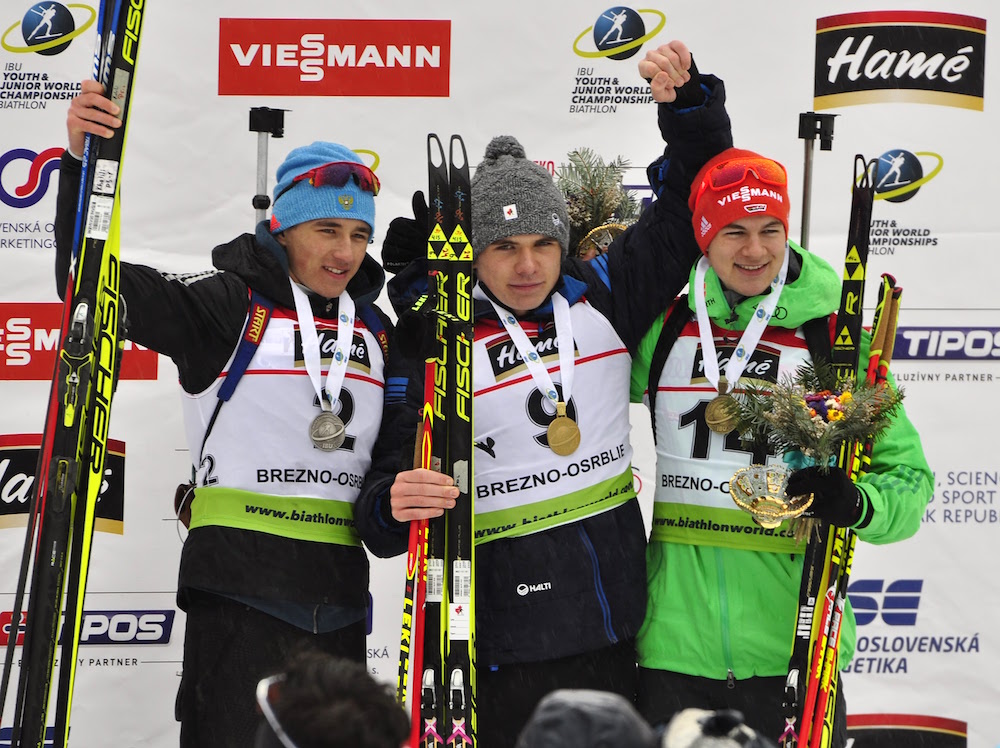
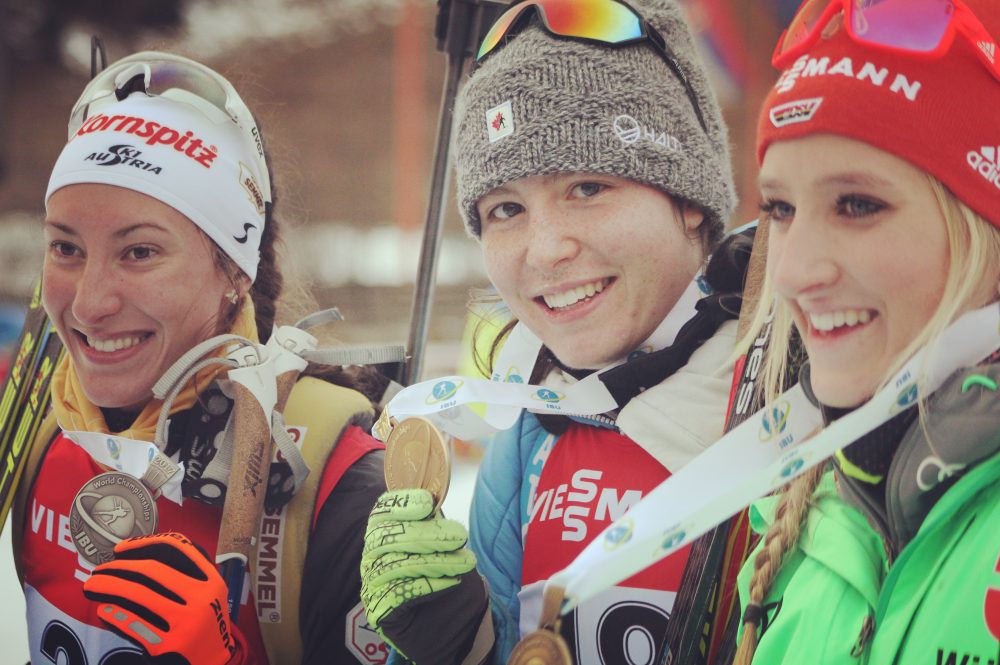
    Canada’s Megan Bankes flashes a smile and her gold medal after winning the junior women’s 12.5 k at IBU Junior World Championships on Thursday in Osrblie, Slovakia. individual podium on Thursday at IBU Junior World Championships in Osrblie, Slovakia. Joining her on the podium are Austria’s silver medalist Julia Schwaiger (l) and Germany’s bronze-medalist Anna Weidel (r). (Photo: Jacqueline Akerman)

    (Note: This article has been updated to include comments from Megan Bankes.)

    Just to review:

    • 2004: Jean-Philippe “JP” Le Guellec becomes first Canadian to win an International Biathlon Union (IBU) Youth World Championships title (in the youth men’s sprint).
    • 2009: Kurtis Wenzel becomes second Canadian to win at IBU Youth Worlds, with a gold medal in the youth men’s sprint.
    • 2012: Wenzel does it again as a junior, winning the 15-kilometer individual at IBU Junior Worlds.
    • Feb. 22, 2017: Leo Grandbois shoots a perfect 20-for-20 to become the third Canadian to be crowned a world champion at Youth/Junior Worlds, winning the youth men’s 12.5 k individual in Osrblie, Slovakia.
    • One day later: Megan Bankes repeats the 20-for-20 shooting feat in the junior women’s 12.5 k individual in Osrblie and becomes Canada’s first woman to win at Youth/Junior World Championships.

    And just like Grandbois, Bankes had never hit 20 consecutive targets without a miss in a race before. In fact, she had never cleaned a race of any length before. Doing so earned her a gold medal in her first race of her fourth Youth/Junior Worlds.
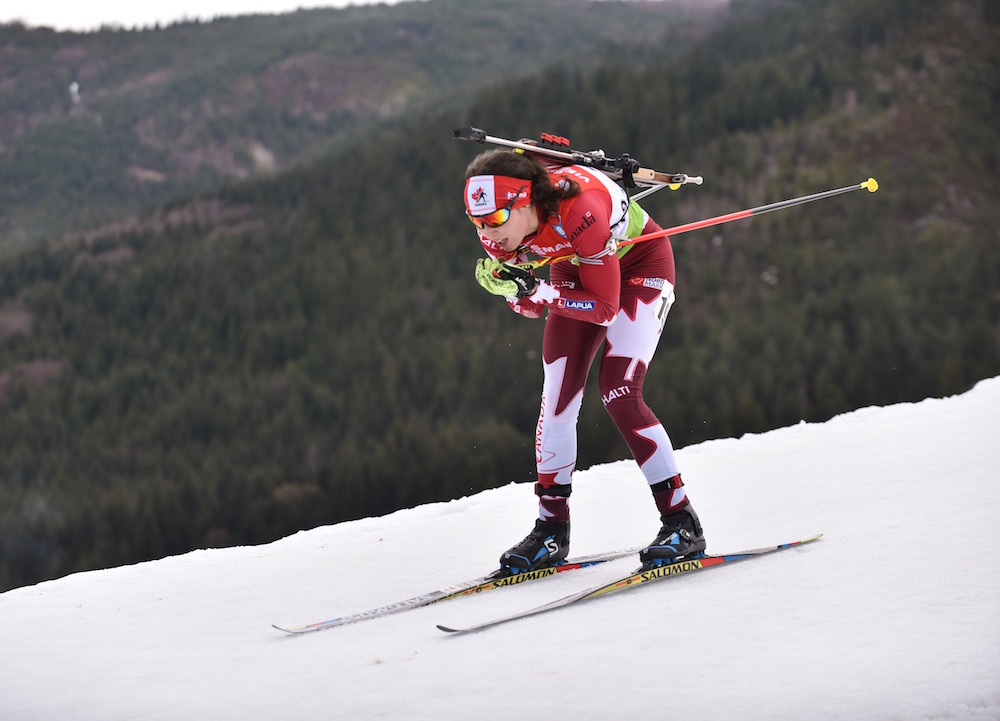
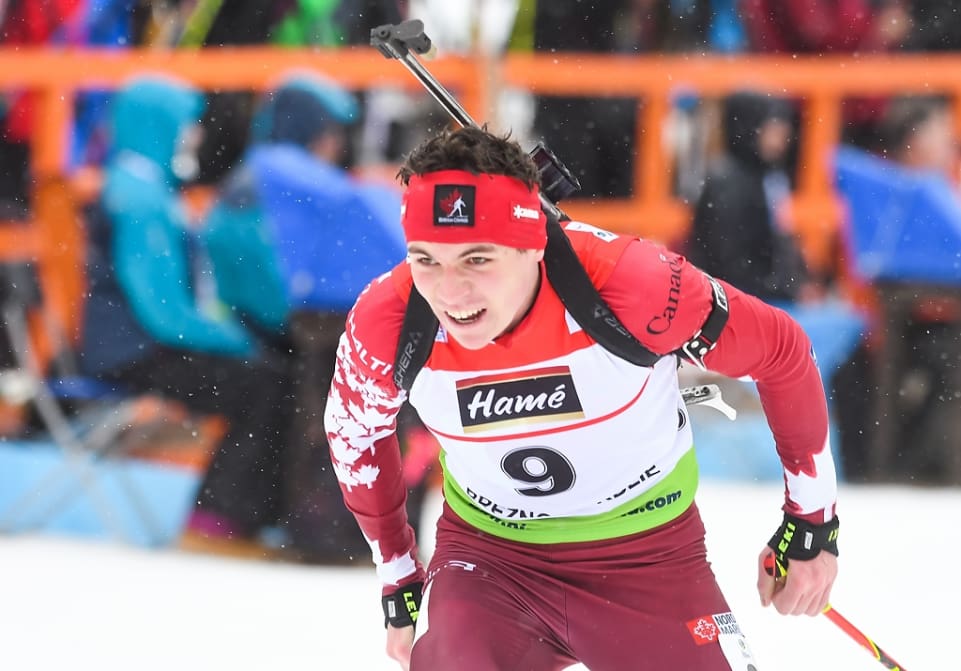
    Megan Bankes racing to an unprecedented gold for a Canadian woman in the junior women’s 12.5 k individual on Thursday at 2017 IBU Junior World Championships in Osrblie, Slovakia. (Photo: Bryan Dickson)

    “I watched Leo yesterday and gained a lot of inspiration from him,” Bankes said, according to a Biathlon Canada press release. “I saw how calm he was on the range and just felt if he can do it then I can, too. I just wanted to go out there – shoot clean and ski fast.”

    As the 19th starter in a field of nearly 70 women, the 19-year-old Bankes, who trains with the Biathlon Alberta Training Centre (BATC) in Canmore, set down the performance to beat with clean shooting and a finishing time of 37:22.0 minutes. She bumped Germany’s Anna Weidel, the 13th starter, to second place with a time that was 1 minute and 20 seconds faster. Weidel had missed just one shot — still an impressive performance in a four-stage race — in the first standing stage (0+1+0+0). Each miss adds a minute penalty to a racer’s total time.

    “I was incredibly stoked to clean my last standing, and then knew I just had to push super hard up the last 2 hills and ski smart all the way to the finish,” Bankes wrote in an email to FasterSkier. “When I crossed the finish line I was really excited, but I didn’t really think my result would hold up because there were a few girls who were skiing fast and had hit 15/15, but then when a bunch of them started missing, and I realized my position was going to hold, it was incredible.”

    Her overall course time ranked 11th, comparable with the two women she ended up sharing the podium with. Weidel was ultimately pushed to third when Austria’s Julia Schwaiger in bib 26 finished 32.1 seconds faster for silver. With one costly miss in her final standing stage (0+0+0+1), Schwaiger’s finishing time was 47.9 seconds short of gold.
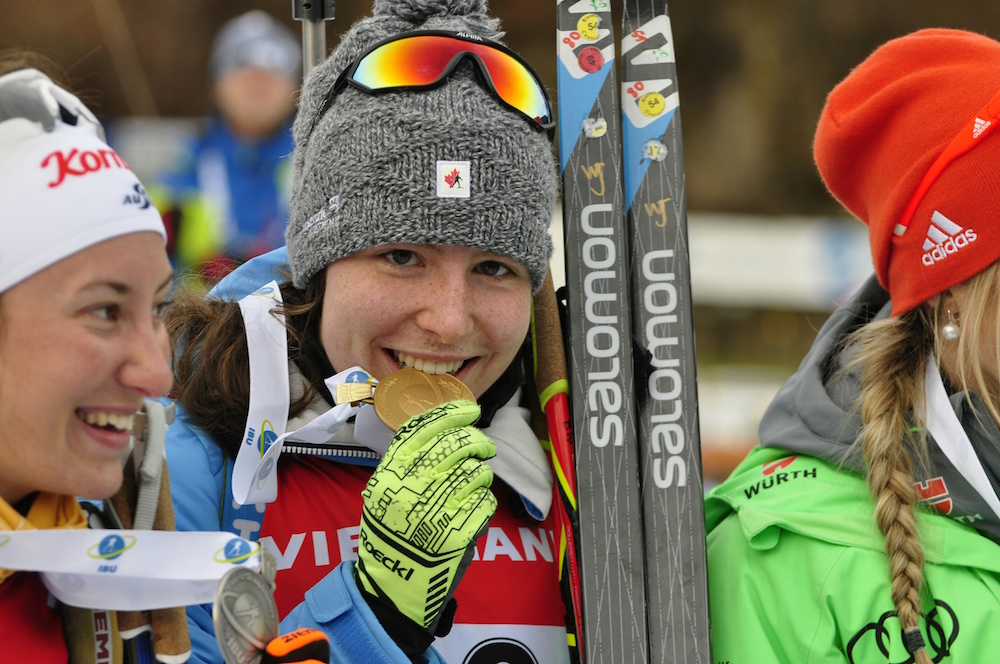
    Canada’s Megan Bankes takes a bite out of her gold medal after winning the junior women’s 12.5 k individual at 2017 IBU Junior World Championships in Osrblie, Slovakia, and becoming the first Canadian woman to do so at Biathlon Youth/Junior Worlds. (Photo: Airat Aitniakov)

    That medal went to Bankes, one of five women in the race to hit every target.

    “I shot with a lot of confidence today. It came really easy,” Bankes told Biathlon Canada.

    But, as there usually is, there was a backstory on Thursday.

    “She had a what she said was a ‘horrific’ zero,” her coach Richard Boruta explained of her pre-race target practice, in an email co-written with Canada’s trip leader/head coach Jacqueline Akerman.

    Boruta tried to calm Bankes down, assuring her that she had the self confidence to execute strong shooting.

    “My coach Richard just told me to go out pretty hard and not lose too many seconds up the first couple hills, and then settle into my race,” Bankes recalled in the email. “The range entry is pretty easy, because you’ve got a bit of downhill into it, so you can push pretty much as hard as you want (or can).”

    “Megan had been focused the whole day on the race and she new what she needed to do and was able to pull it through,” the two coaches wrote. “The trail conditions and weather have been challenging with all the rain and slush, but Megan managed to ski very tactically along the flats and paced herself well on the two major climbs in the course.”

    According to them, one of Bankes’s longtime goals had been a top eight at these championships. That changed after she broke through on the IBU Junior Cup earlier this month, placing second in the 10 k pursuit at IBU Junior European Championships in Nove Mesto, Czech Republic. After that, she visualized herself in the top five, maybe top three, in her first year as a junior at world championships. Bankes had previously notched 18th in the pursuit and 19th in the individual at last year’s Youth World Championships in Romania.

    “Junior OECH was a pretty big confidence boost, but coming into the race, I didn’t totally know what to expect,” Bankes wrote. “I knew that if I had a really good day on the range and on the course, then I could do well, and maybe podium, but I didn’t really imagine that I would hit 20/20, and win!”

    Individual-format races require solid shooting and fast skiing, just like any biathlon race, but the one-minute penalties as opposed to penalty laps put an emphasis on shooting accuracy.

    “I can’t say they have ever been my strong suit!” Bankes wrote of individual-format races. “So for me the goal was to start pretty fast on skis, stay calm in the range, and then see what happened.”

    “After I got the silver [in Nove Mesto], I knew if I shot and skied well, I could get a medal here,” she told Biathlon Canada. “It takes a long time to get to this point. I think having been here [at Youth/Junior Worlds] four times now I have the experience to do this. I have everything around me here that I need to be successful.

    “It is pretty exciting,” she added. “This is the first time I’ve shot 20 for 20. It never crossed my mind, but to be the first Canadian [woman] to win is very cool.”

    According Akerman and Boruta, they had anticipated that Grandbois and Bankes would have “a respectable chance” at a medal, along with other team members as well. But two gold medals in two days?

    “We have had good results and medals in the past, but it has been up and down with a few top athletes hitting the top 10 or reaching the podium,” they wrote. “Now we see the group as a whole rising together.”
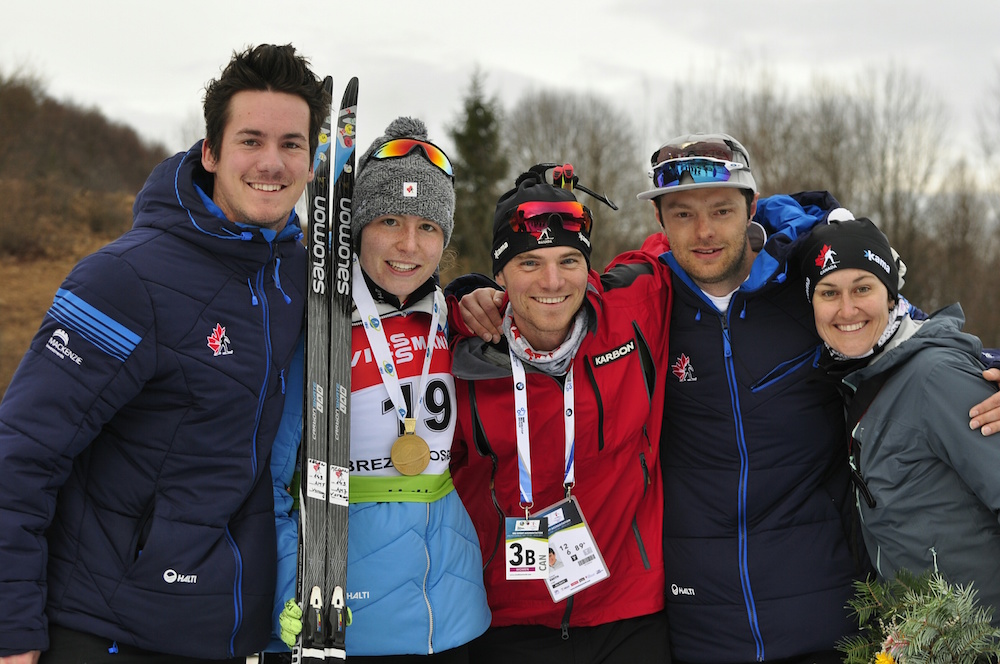
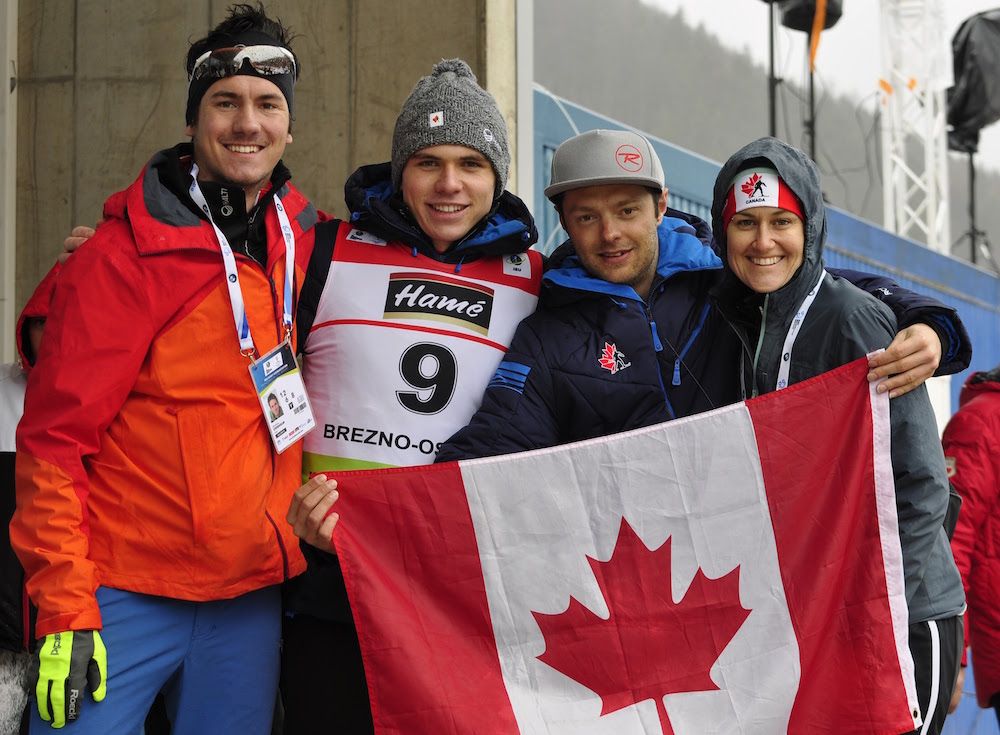
    Megan Bankes (second from l) with her Canadian support crew, including her former coach Tyson Smith (c), wax techs Andrew Chisholm (l) and Andrzej Lesnik (second from r) and Canada’s trip leader/head coach Jacqueline Akerman (r), after Bankes won the junior women’s 12.5 k individual for Canada’s second gold medal of 2017 IBU Youth/Junior World Championships in Osrblie, Slovakia. (Photo: Airat Aitniakov)

    They credited “consistent and qualified coaching support in yearly developmental stages”, and explained that Bankes started the sport with coach Iaroslav Khomiak at Foothills Nordic in Calgary. She was later coached by Tyson Smith (Nathan Smith’s brother, who is assisting the team at Youth/Junior Worlds) before joining the BATC group in Canmore in 2015.

    Last summer, Biathlon Canada launched a funded “Shooting Stars” camp, which brought national-team staff and coaches together with athletes and their coaches in Canmore. The team also added IBU Junior Cup tours to the schedule to give young athletes opportunities to experience international competition in Europe and “get to know each other before WYJCHs.”

    “My observations of this current group; they are pretty grounded, are very motivated, focused and are they are both pushing and supporting each other in all aspects of their performance,” Akerman and Boruta wrote.

    So what does two gold-medal performances mean for Canada?

    “There is now a great opportunity for an greater amount of exposure for our athletes and our sport,” the coaches wrote. “… More solid results ahead for us this week, there are other realistic opportunities within the group. The whole team, including staff are motivated and focused for that. … Of course Leo and Megan have both shown what they are capable of, and will be eager for more. Right behind those two in our Jr Women and Youth Men categories are others skilled enough to be right up there with them. Our youth women are a younger crew, but are learning and applying new skills daily, so I am excited to see some PB’s from them tomorrow. The relays also present us with exciting and realistic chances of podiums, it will continue to be an exciting week and championships!”
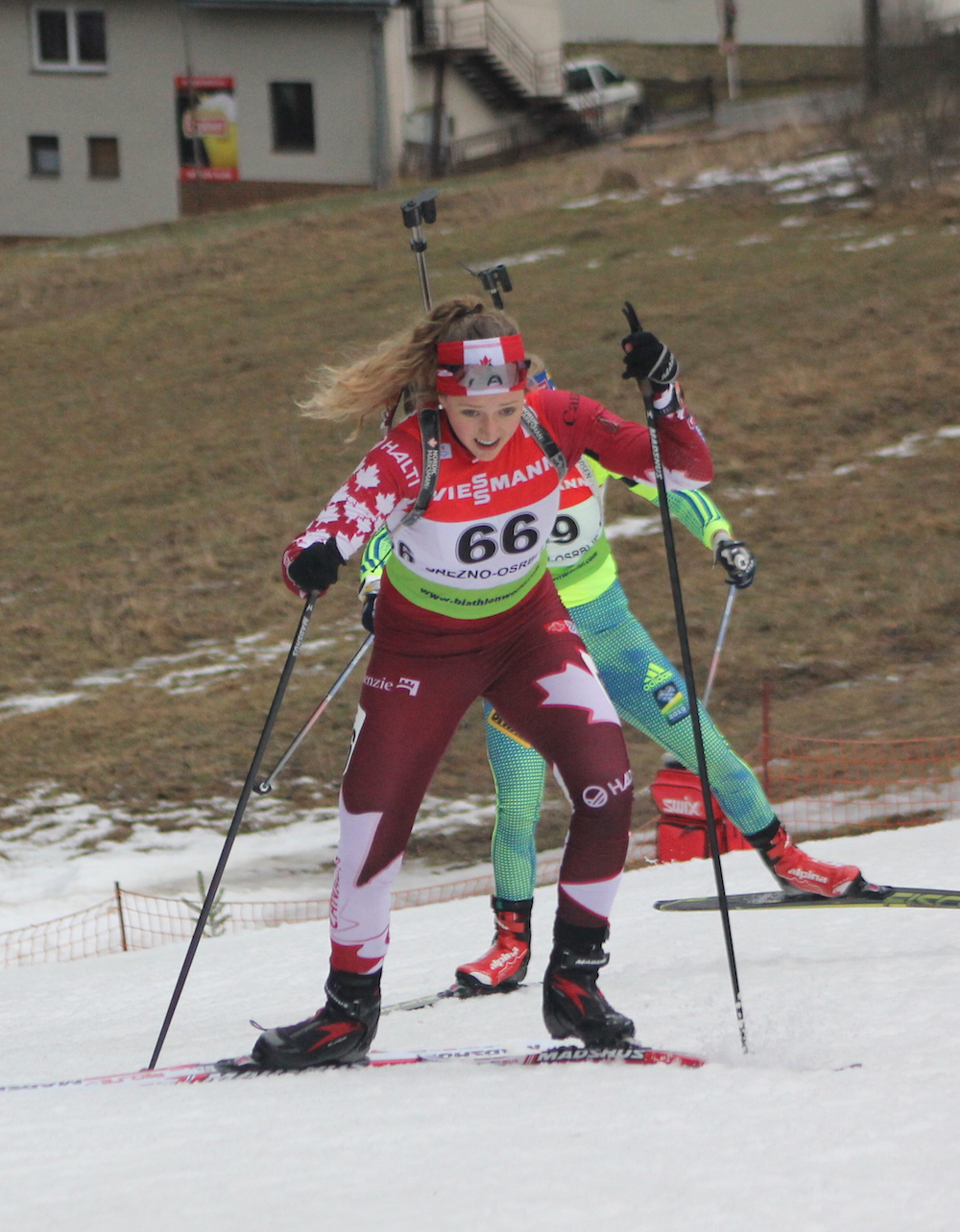
    Canada’s Emily Dickson (66) racing to 28th for her first top 30 at IBU Junior World Championships in the women’s 12.5 k individual in Osrblie, Slovakia. (Photo: Jacqueline Akerman)

    In the junior women’s race, Canada had two in the points (top 40) and one just outside with Emily Dickson in 28th (+4:21.3) with one miss (0+1+0+0). Nadia Moser finished 41st (+5:55.8) with four penalties (2+0+0+2). Charlotte Hamel did not finish.

    For the U.S., Siena Ellingson placed 50th (+7:11.5) with four penalties (0+1+2+1) and Nina Armstrong 65th (+14:15.3) with eight misses (4+1+2+1).

    Earlier in the day, the junior men raced a 15 k individual, which Norway’s Sindre Pettersen won in 40:17.2 minutes. He started 68th and cleaned three-straight stages before missing two on his last standing (0+0+0+2), but managed a 51.2-second win over Germany’s David Zobel. An early leader in bib 26, Zobel had three penalties (0+2+1+0) yet his time held up for silver despite a challenge from Russia’s late starter Nikita Lobastov (bib 84). Lobastov shot 19-for-20 (0+1+0+0) and finished just four seconds short of Zobel for third place (+55.2).

    Only one athlete in the junior men’s race cleaned: Latvia’s Ingus Deksnis in fifth.

    In his first year as a junior, Canada’s Zachari Bolduc led the North Americans in 34th (+3:44.7) with two penalties (1+0+0+1). He later told FasterSkier his goal had been a top 30, and he was 8.4 seconds short of it on Thursday.

    “I’m happy with this shooting but I was very very slow on my skis,” Bolduc wrote in an email. “The course was a mix of soft snow, ice and slush so it was not easy conditions! I hope I will have better feelings on my skis for the sprint. But, I’m happy with my race today!”

    He was followed by Canadian teammates Trevor Kiers and Jules Brunette in 54th (+5:21.6) and 55th (+5:27.4), respectively, after each shot five penalties. Pearce Hanna finished 65th (+6:38) with seven misses (1+2+2+2).

    The top American on Thursday was Cody Johnson in 50th (+5:08.3) with two penalties, both in the last stage (0+0+0+2). Cameron Christiansen followed in 72nd (+8:10.6) with six penalties (1+1+2+2), and Peter Carroll was 79th (+10:36.4) with four misses (0+3+0+1). Travis Cooper did not start.

    The youth men’s and women’s sprints are scheduled for Friday in Osrblie.

    Results: Junior women | Junior men

  • The Next Le Guellec? Grandbois Canada’s Third IBU Youth World Champ

    The Next Le Guellec? Grandbois Canada’s Third IBU Youth World Champ

    Canada’s Leo Grandbois (Biathlon Estrie) racing to gold in his first IBU Youth World Championships race on Wednesday, the 12.5 k individual, in Brezno-Osrblie, Slovakia. He hit all of his targets for the first time in a race to win by nearly a minute and 15 seconds. In doing so, he became the third Canadian biathlete to win gold at Youth World Championships. (Photo: IBU)

    It was raining hard on Wednesday at the biathlon stadium in Brezno-Osrblie, Slovakia. Like, cats and dogs, “des grenouilles” (frogs, in French), or “junge Hunde” (puppies, in German).

    But that didn’t stop Leo Grandbois, a German-born Canadian biathlete racing at his first International Biathlon Union (IBU) Youth World Championships, from having the race of his life.

    Grandbois, 17, who was born in Munich and lived there for a year before moving to Lennoxville, Quebec, was one of four youth men named to Biathlon Canada’s Youth/Junior World Championships team. Wednesday marked his first 12.5-kilometer individual race in the youth division, and he explained after that his success derived from his focus — and his skis.

    “The range had a bit of wind and the tracks were really wet, but I had really good skis,” Grandbois wrote in an email after.

    The ninth starter out of more than 100 in the youth men’s race, Grandbois was the only one to knock down all 20 of his targets. He had never cleaned a race before, and he did it in a four-stage race. Without any one-minute penalties added to his total time (there are no penalty loops in individual races, just time penalties for each miss), he clocked the fastest time at the finish in 32:56.6 minutes. That time stood while nearly 90 others finished after him, with nobody coming within a minute of his time.

    The youth men’s 12.5 k individual podium after the first race of 2017 IBU Youth/Junior World Championships in Osrblie, Slovakia, with Canada’s Léo Grandbois in first (c), Russia’s Said Karimulla Khalili (l) in second, and Germany’s Danilo Riethmüller (r) in third. (Photo: Airat Aitniakov)

    Russia’s Said Karimulla Khalili started in bib 2 and enjoyed a brief moment as race leader, before Grandbois bested his time by 1:14.9 minutes. Khalili took the silver medal despite three penalties (1+0+1+1), and Germany’s Danilo Riethmüller captured bronze (+1:21.5) with three penalties as well (2+1+0+0). Besides Grandbois, who shot 100 percent, only one racer shot 95 percent: Italy’s Cedric Christille in fourth place (+1:44.5; 1+0+0+0).

    “I always go for the win when I race,” Grandbois wrote. “But I was aiming a top 10.”

    With the victory, Grandbois became the third Canadian to win a gold medal at Biathlon Youth World Championships, according to a Biathlon Canada press release. Kurtis Wenzel, of Calgary, is a two-time world champion: first in the 2009 youth sprint and later in the 2012 junior individual. Jean-Philippe “JP” Le Guellec, who previously coached Grandbois, started the trend by winning the 2004 Youth Worlds sprint.

    “Before I came here I looked at JP’s results on the internet, and read in the newspaper about his win in 2004,” Grandbois told Biathlon Canada. “It has always been my goal to be like him so to follow that path and do what he did is an amazing feeling.

    “The nicest message I received today was from JP,” he continued. “He told me how proud he was of me and to keep working hard. I have been smiling since I received that message.”

    And it wasn’t just the shooting that went exceptionally well for Grandbois on Wednesday; he posted the third-fastest ski time. In an email to FasterSkier, he explained that the hilly course in Osrblie suits him. “My kind of course,” he wrote.

    “Everything was perfect for me today, I was focused on the range and tried to do like at training,” he explained. “I had some great legs, too!”

    He told Biathlon Canada that he had worked on improving his shooting over the last three weeks.

    “When I went to bed last night and woke up today, I just had a good feeling I could do something great today,” he said. “I had complete focus and concentration on the range. The hard work over the last few weeks in training really worked today.”

    Leo Grandbois (9) with his support crew, including wax techs Andrew Chisholm (l) and Andrzej Lesnik (second from r) and Canada’s head coach Jacqueline Akerman (r), after Grandbois won gold in the 12.5 k individual on the first race of his first IBU Youth World Championships in Osrblie, Slovakia. (Photo: Airat Aitniakov)

    In a post-race interview with Junior IBU Cup media, he thanked his supporters: “I want to thank first my coaches at home, my parents who always supported me and all the team who did a great job for the race, the skis, thank you.”

    When FasterSkier asked what this gold medal means to him, he explained it came down to all the passion and training he had put in.

    “I am probably the most happy man on earth today!” he wrote.

    Last year at Youth Olympic Games (YOG) in Lillehammer, Norway, Grandbois finished 22nd in the sprint, 25th in the pursuit and 16th in the mixed relay, a team event. At his first Youth World Championships, he said the field was bigger in comparison.

    According to Biathlon Canada High Performance Director Eric de Nys, Grandbois has been on the national team’s radar for a few years. Biathlon Canada started a Shooting Stars program this season and Grandbois was one of 16 athletes invited to “train, test and develop” with the national team.

    “Trajectory wise it identifies both a good skier and fantastic shooter under pressure,” de Nys observed of Grandbois’s performance on Wednesday. “This was Leo’s first time shooting clean and to do it a Worlds…..awesome.  Extremely happy for Leo and his support in QC.”

    Cervenka, Levins Land Top 20

    Leading the U.S. men on Wednesday was Vasek Cervenka, who has spent the better part of the last two seasons training in Nove Mesto, Czech Republic. The Boulder, Colo., native (who lives in Grand Rapids, Minn.) raced to 16th (+4:19.5) with five penalties (0+2+2+1).

    In his second Youth Worlds, his goals coming into the opening individual race had been to hit all of his targets and ski technically well. Placement-wise, he wanted a top 10.

    “The conditions were good in the morning, but a light rain started one and a half hours before the race and has continued the rest of the day,” Cervenka explained. “This made the course tricker over time as it was slowing down the skiing quite a bit. The rain also interfered with the shooting on the range.

    “I am a little disappointed today in my shooting knowing I can do better, also knowing a clean shooting would have brought me up to 2nd place,” he continued. “I felt good skiing but bonked on my last two loops.”

    After he cleaned the first prone stage, Cervenka’s time ranked third. One loop later, with two misses in the first standing stage, his split ranked 10th, which dropped to 23rd after the third stage. He recovered to 18th by the start of his last loop, and ultimately finished 16th for his best non-relay result at his second Youth Worlds. Last year at YOG, Cervenka had a previous best result of 20th in the pursuit.

    “As happy as I am with my improvements from last year to post this top 20, it still stings for me to miss a few shots too many, knowing where I could have placed if they went down,” he wrote.

    Also for the U.S., Jacob Pearson finished 49th (+7:45.3) with four misses (0+2+0+2), Alex Kilby was 75th (+9:51.1) with five penalties (1+0+1+3), and Camren Nielsen 91st (+14:36.9) with 11 misses (3+4+2+2).

    Canada’s Adam Runnalls finished 41st (+7:04.8) with eight penalties (1+2+4+1) and Thomas Hulsman was 57th (+8:19.0) with five misses (2+0+2+1). Robert Kreitz did not finish.

    Also on Wednesday, the youth women opened the championships with the 10 k individual, where American Chloe Levins raced 14th with three penalties (1+1+1+0). France’s Lou Jeanmonnot-Laurent shot 19-for-20 (0+1+0+0) to win the race in 34:00.9, and Levins finished 3:05.6 minutes off her winning time. None of the 90 women who finished the race shot clean.

    For Levins, a Middlebury student-athlete who plays collegiate golf in the fall and the spring, 14th was her best non-relay result at her third Youth Worlds.

    “Everything is possible, especially in an individual race,” she wrote in an email after. “The range is windy here in Osrblie, so good shooting is rewarded. … There’s no funny business on the track in Osrblie. It’s straight up, straight down, and flat into the range. The course demands power and strength, which I think is an advantage for me.

    “Today, it was important not to let the weather get in your way,” she added. “Sometimes it’s difficult to feel excited and fresh when it’s pouring rain, as it was today; those who shut it out of their mind are usually better off. Despite the conditions, our wax technicians prepared very good skis that moved really quickly through the saturated snow.”

    Last year at YOG, Levins broke through with a fourth place in the pursuit.

    “It is difficult to judge from one race, but the level of competition at this year’s Youth World Championships compared to last year’s Youth Olympic Games seems very similar,” she observed. “There are many familiar faces, and today there were even some repeating champions. I’m comfortable with the level of competition.”

    Moving forward to three more races in Osrblie (the sprint, pursuit and relay), Levins explained she took a lot of positives from Wednesday.

    “It’s not my best biathlon competition ever, but it’s certainly not my worst,” she wrote. “It’s a short way from the bottom to the top in this game, so I’m happy to have stayed above ground today. The result is fine, but I’m more happy to be able to say I did good work today.”

    Asked what she’s studying at Middlebury, Levins explained that she’s started pursuing neuroscience and economics “with a little bit of German for fun. My German professor loves that I have the opportunity to converse with native German speakers on a daily basis,” she wrote.

    (When Grandbois was asked if he speaks German, he replied, “Yes … but not perfect.”)

    Sharing the podium with Jeanmonnot-Laurent was Russia’s Kristina Egorova in second (+52.4) with one standing miss as well (0+1+0+0). Sweden’s Elvira Karin Öberg notched bronze (+1:16.1) with two penalties (0+0+1+1).

    Also for the U.S., Grace Gilliland finished 46th (+6:28.9) with four penalties (1+1+1+1), Amanda Kautzer was 53rd (+7:14.3) with eight misses (2+1+4+1), and Helen Wilson was 62nd (+9:00.5) with six penalties (1+2+2+1).

    Canada’s Shilo Luca Rousseau finished 54th (+7:29.9) with five misses (2+0+1+2), Frédérique Pérusse was 77th (+11:54.6) with nine penalties (1+4+1+3), and Elise Sauve 78th (+12:07.1) with seven misses (2+2+2+1).

    IBU Youth/Junior World Championships continue Thursday with the opening junior competitions: the women’s 12.5 k and men’s 15 k individual.

    Results: Youth men | Youth women

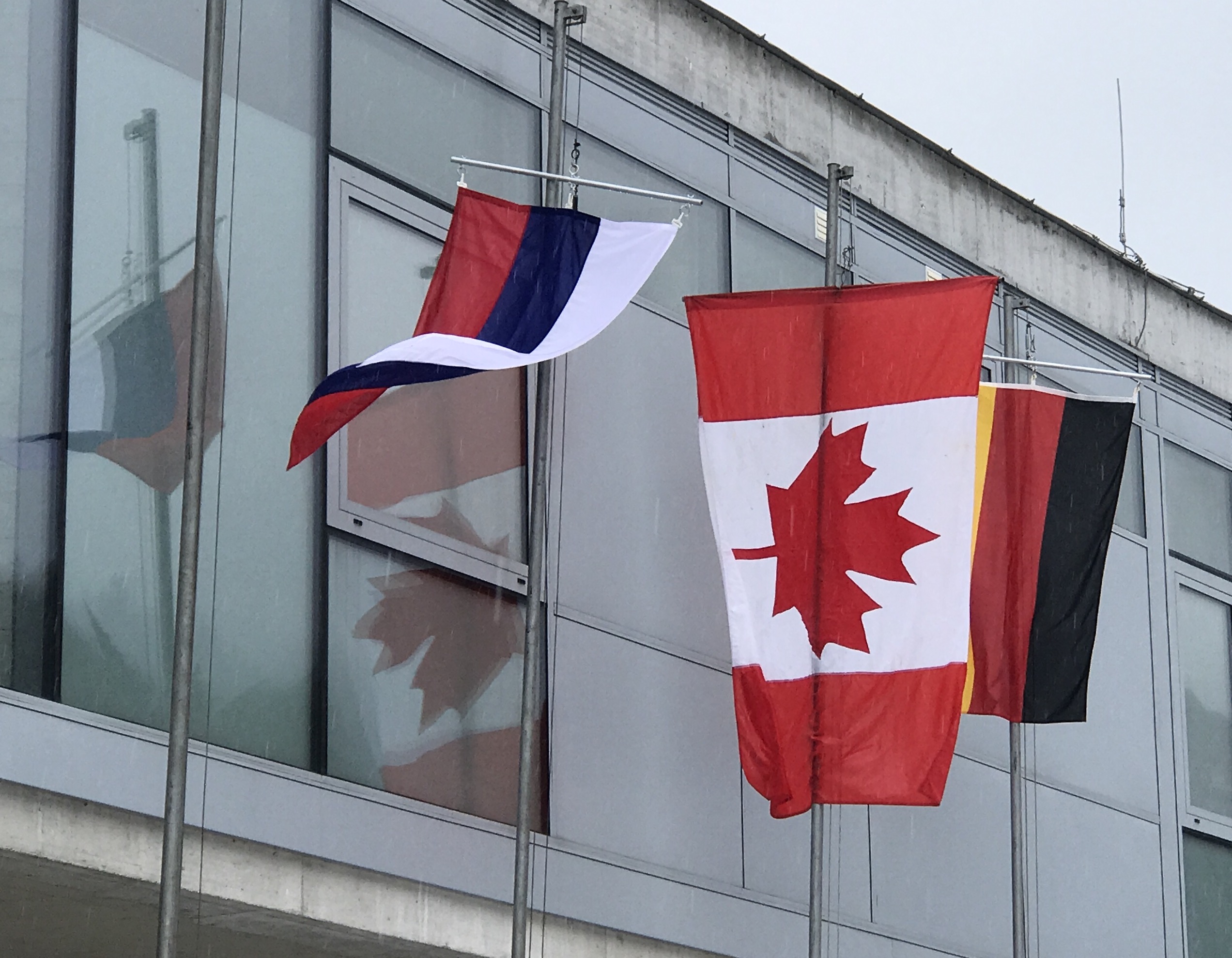
    The Canadian flag flying high above the biathlon stadium in Osrblie, Slovakia, after Leo Grandbois won the youth men’s 12.5 k individual, the first race of 2017 IBU Youth/Junior World Championships. Russia took second and Germany third. (Photo: Terri Dickson)
  • Green One Shot Away from Top 10 in 20 k Individual; Burke Makes Mass Start

    Green One Shot Away from Top 10 in 20 k Individual; Burke Makes Mass Start

    Canada's Brendan Green on his way to his best Olympic result of 21st in Thursday's 20 k individual biathlon race at the 2014 Winter Games in Sochi, Russia.
    Canada’s Brendan Green on his way to his best Olympic result of 21st in Thursday’s 20 k individual biathlon race at the 2014 Winter Games in Sochi, Russia.

    FasterSkier’s coverage is made possible through the generous support of Rudy Project.

    SOCHI, Russia — Deciding whether it’s better to start sooner, later or somewhere between in the races at the Laura Cross-Country Ski & Biathlon Center has been more or less a crapshoot at the Olympics, and before the men’s biathlon 20-kilometer individual start on Thursday, the athletes and their coaches essentially took a stab at what they predicted could be best.

    Canada’s Jean-Philippe Le Guellec figured the second or third seed (out of four) might be a good place to take advantage of the soft conditions — presumably warmer for the 6 p.m. start then cooling as the race went on.

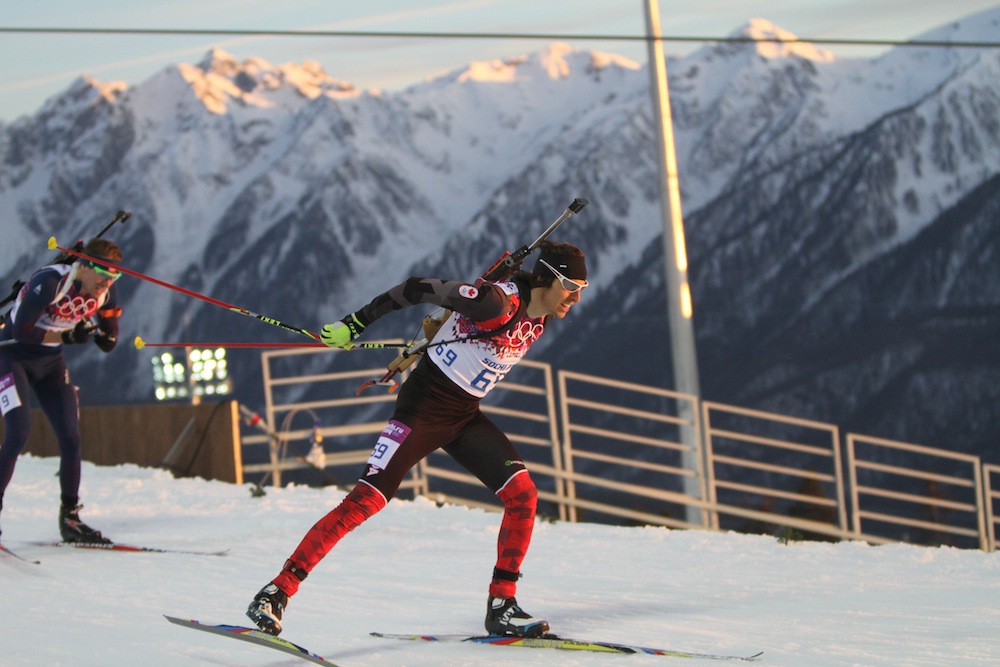
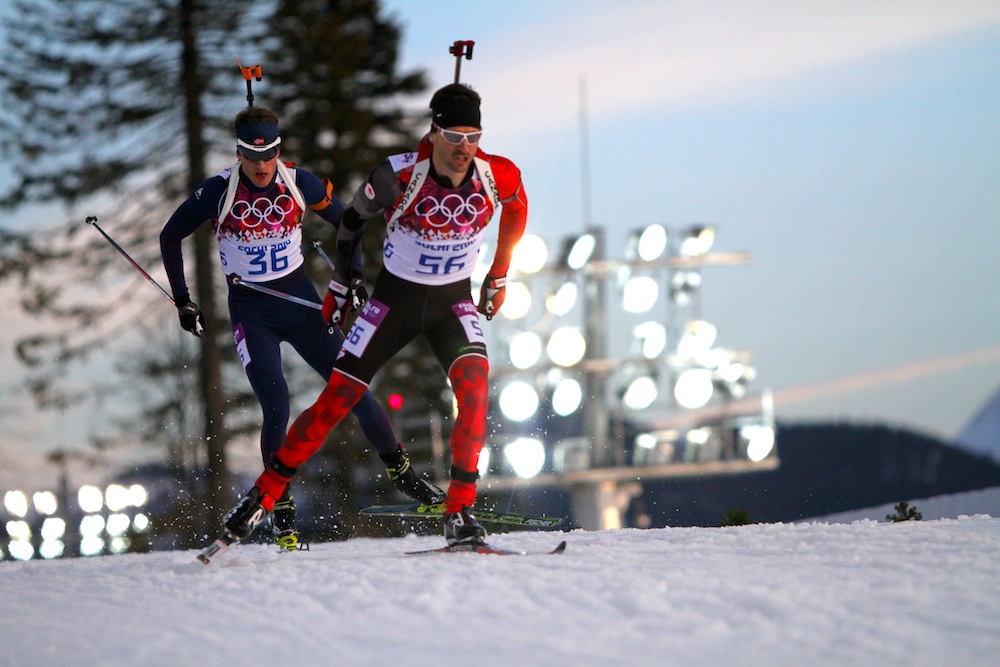
    Canada’s Jean-Philippe Le Guellec (56) leads Norway's Tarjei Bø in the men's Olympic biathlon 20 k individual on Thursday in Sochi, Russia. Le Guellec went on to place 35th and Bø was 26th.
    Canada’s Jean-Philippe Le Guellec (56) leads Norway’s Tarjei Bø in the men’s Olympic biathlon 20 k individual on Thursday in Sochi, Russia. Le Guellec went on to place 35th and Bø was 26th.

    Le Guellec found himself at the end of the second seed on Thursday’s 89-man start list. Good enough, he thought.

    His teammate, Brendan Green started later in bib 69, and while the course didn’t speed up, and the temperatures didn’t drop anywhere close to freezing (it went from 50 degrees Fahrenheit at the start to 47.5 degrees at the finish), Green managed just fine.

    The 27-year-old from Canmore, Alberta, notched his best Olympic result in 21st, topping his sprint finish of 23rd and his pursuit performance of 35th, also in Sochi. Green didn’t race any individual events at the 2010 Olympics, but helped the men’s relay place 10th.

    Green finished Thursday night out with two misses — one in the first standing and another in the prone. Penalized two minutes, he finished 2:33.6 back from French winner Martin Fourcade. One fewer miss and he would’ve been in the top 10.

    Perhaps most surprisingly, he had his best race of the Olympics on the warmest evening yet, which made for slushy conditions that typically bother his back.

    “I actually felt not too bad on the skis today, which was nice,” Green said. “I think I skied all right. I had two penalties … which usually is OK, but I guess on this range you need a little more than that.”

    Given his consistency at these Games, Green said he’s been “fairly happy” with the last week, but knows he has more to give.

    “The potential’s there, I’m just waiting to capitalize on it,” he said.

    Another Canadian, Nathan Smith placed 25th, 3:09.6 behind Fourcade with three penalties (0+2+0+1). Despite the misses, Smith was one of the quickest to get his shots off, cleaning the first prone with the third-fastest shooting time and cleaning the first standing with the second-fastest time. Even with a miss on the final stage, he was the third-fastest shooter to put him second overall for shooting time.

    So far this week, Smith has placed 11th in the pursuit and 13th in the sprint as well to add to his first Olympic resume.

    Le Guellec placed 35th (+3:53.8) with two penalties, one in each standing. The result came three days after he went from leading to finishing 26th in Monday’s pursuit. In the preceding sprint, he captured a career best fifth at his third Olympics.

    “Ski-shape wise, I wasn’t in the same game that I was in the sprint or pursuit,” he said. “For me, conditions like this, I have a hard time getting around the course, especially [when] it’s a super difficult course, and the skis today were just slowing down after each lap.”

    Le Guellec was on his “number two” racing skis after his No. 1 pair broke when he crashed in the pursuit.

    “That makes a one-percent difference, [but] it makes a difference over 20 k,” he explained.

    Perhaps the worst moment of Le Guellec’s race (and perhaps a better one for American Lowell Bailey) was when Bailey, who started a minute behind Le Guellec in 58th, caught the Canadian on the third of five laps.

    “I could see him behind me, like, ‘God dammit!’ ” Le Guellec said with a laugh. “I knew that today was not the day for skiing. I’m happy with the shooting, but with today’s ski shape I knew I wasn’t going to be in the mix for sure so it was just to finish the race and call it a day essentially. There’s not much more you can do.”

    Bailey Notches Eighth, Burke 44th

    Tim Burke (US Biathlon) en route to placing 44th in Thursday's 20 k individual biathlon race at the 2014 Olympics in Sochi, Russia.
    Tim Burke (US Biathlon) en route to placing 44th in Thursday’s 20 k individual biathlon race at the 2014 Olympics in Sochi, Russia.

    After Bailey placed eighth for US Biathlon’s best Olympic result, Tim Burke was the second American in 44th (+4:49.5). He missed two in both standing stages, and with the 21st-fastest time on the first loop and 10th-fastest third loop, he was hoping to put a better race together soon.

    “I knew it was going to be a really tough 20 k here. It’s such a challenging course,” Burke said. “And after my first two races here, I felt pretty awful. I was definitely pretty conservative out of the start. I wanted to make sure I didn’t die at the end. The skiing turned out to actually, ironically, be okay today. It was the shooting that didn’t come through.”

    But he wasn’t going to let four penalties in a four-stage race get him down.

    “That happens sometimes,” he said. “My first two races here were 90 percent. Today’s 80 percent, and that’s above my World Cup average. Unfortunately, I just didn’t have that day where the skiing and shooting lined up at the same time.”

    In the sprint, Burke placed 19th and then finished 22nd in the pursuit. He said it took a while to recover from Monday’s pursuit, and he had no idea how his body was going to feel for Thursday’s race.

    “It was nice today to actually feel closer to normal,” he said. “It felt better than I expected.”

    Unofficially, Burke made the final spot for the 12.5 k mass start on Sunday. U.S. head coach Per Nilsson said he made a step forward with his skiing on Thursday.

    “He’s just, I think, in his head,” Nilsson said. “I think he looked better and better.”

    In his first Olympics, American Russell Currier was looking for his first top 40 of the season after placing 61st in the sprint. He finished 50th on Thursday (+5:35.8) with four penalties (2+2+0+0).

    It was an improvement over the sprint, in which he had four misses in prone.

    “For me it was OK, but the level this sport’s at now, OK is not as good anymore,” Currier, 26, said. “You either need to have a lot of experience or the race of your life. It could’ve been a lot worse and I’m glad to have improved on the day, but I think it’s another reminder of how cutthroat it is now.”

    Currier said the most challenging part of the Olympics has been waiting between races — especially the five-day spell he had between the sprint and individual events.

    “When you’re warmed up and you have a late start and you have to just hang out, it’s not any more stressful than a time trial in the summer, it’s just knowing that you have so much to do before you get to the finish line,” he said.

    Canadian Scott Perras placed 59th in the second race of his first Olympics (after finishing 74th in the sprint), with four penalties (0+3+1+0) on Thursday.

    Leif Nordgren of the U.S. was 83rd with six penalties, missing one on the first prone and five on the first standing.

    — Chelsea Little and Nat Herz contributed reporting

    Results

  • Notes and Quotes: The Good and Bad from Davos, Ramsau and Annecy

    Notes and Quotes: The Good and Bad from Davos, Ramsau and Annecy

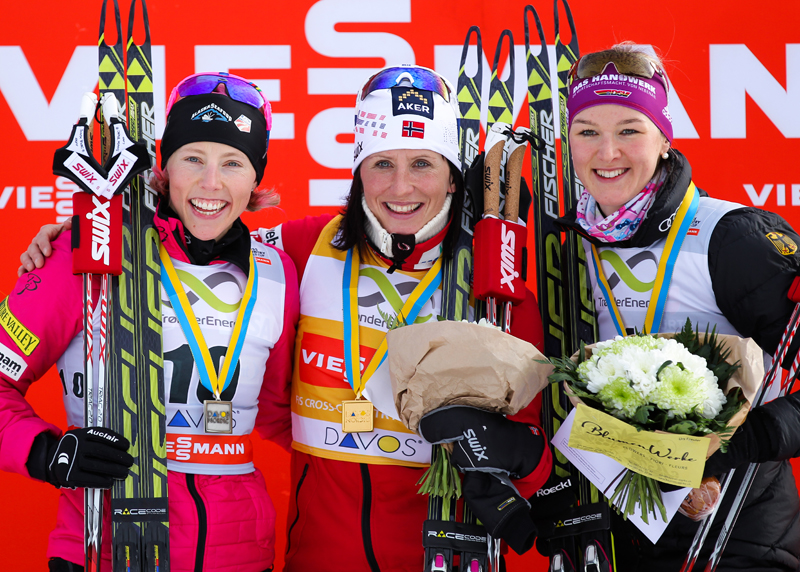
    The women's podium at Sunday's World Cup skate sprint in Davos, Switzerland: (from l to r) Kikkan Randall (USST) in second, Marit Bjørgen (NOR) in first, and Denise Herrmann (GER) in third. (Photo: Fischer/Nordic Focus)
    The women’s podium at Sunday’s World Cup skate sprint in Davos, Switzerland: (from l to r) Kikkan Randall (USST) in second, Marit Bjørgen (NOR) in first, and Denise Herrmann (GER) in third. (Photo: Fischer/Nordic Focus)

    From the cross-country World Cup in Davos, Switzerland, to U.S. Nordic Combined’s best team-sprint result in Ramsau, Austria, to five straight days of biathlon races in Annecy, France: here’s everything you didn’t get to read about over the weekend in simple thumbs-up-thumbs-down fashion. And if you missed the recaps, check out our digest.

    Likes:

    Skiing fast:

    “Skiing super fast [feels] awesome. This is definitely the strongest I’ve skied in a  little while and definitely very appreciative of it. It’s a great feeling to be able to move up through the ranks like that and just builds to your confidence.” – Bryan Fletcher (U.S. Nordic Combined), on placing fourth with Todd Lodwick in Saturday’s World Cup 2 x 7.5 k team sprint in Ramsau, Austria

    “The energy was good, and our skis were so fast. We were working hard on pushing over the top of the hills because if you just add one more skate, you’re flying down the hill.” – Jessie Diggins, 12th in Sunday’s World Cup skate sprint in Davos, Switzerland

    “I tried to go out really hard right from the start and just hold on. It worked out well for me and I ended up feeling better today than in any of my previous races this season.  I ended with the 3rd fastest ski time, so I am very happy with the direction my skiing is headed.” – Tim Burke (US Biathlon), 16th in Sunday’s IBU World Cup 12.5 k pursuit in Annecy, France

    Qualifying for the 2014 Sochi Olympics:

    In an email, Megan Heinicke explained that, in placing fourth with Canada’s relay at the IBU World Cup last Thursday, she completed her Olympic qualification (with teammates Megan Imrie, Rosanna Crawford and Zina Kocher):

    “I am incredibly relieved to have that finalized and just so happy to have Sochi in my plans. This girls on this relay team will be our Olympic team and I think this result gives us a lot of confidence and motivation, which is awesome!” – Heinicke (Biathlon Canada)

    Fourth place:

    “I knew it was likely to be painful so I was mentally prepared for a hard fight and as motivated as ever to give it my all.  The result altogether was amazing…I couldn’t stop smiling. We saw that we had this kind of potential in our relay last weekend and we all knew that a relay without penalty loops would be enough to fight for a top 6 finish. I am so proud of all of us!  I think the coolest thing for our relay is that this wasn’t a miracle race – it was just 4 good to normal races which means that this is a result we can realistically repeat and even improve on.” – Heinicke

    “I could have played my cards a little bit different to give us another chance to be up there on the podium, but nevertheless fourth place is awesome and we had the fastest time out there.” – Todd Lodwick (U.S. Nordic Combined), on Saturday’s team sprint

    Team sprints:

    “Nordic combined was actually the one who invented the team sprint. It actually began in 1993, and then it kind of went away from the program in the ’90s until it came back in 2011. I think they brought it back as a World Cup event after cross-country took it on and did it as an event and showed it’s a good spectator event.” – U.S. Nordic Combined Head Coach Dave Jarrett 

    “It’s a strength, and [it was] a medal event in the World Championships last year. It was the first time it was a medal event, but it won’t be a medal event in the Olympics. We tend to rally around each other when it comes to team events and certainly Todd and Bryan were clearly in a  good place and they did a good job.” – Jarrett

    Women’s 15 k races:

    The women’s 15 k individual race on Saturday in Davos, Switzerland, was only the second one on the World Cup in the last 10 years, with the other in Davos two years ago. What gives? Bring on the distance!

    Note: Bjørgen won that race, too, but Norway swept the 2011 edition’s top four. On Saturday, they took three of the top four, with Sweden’s Charlotte Kalla placing third.

    Davos

    “Davos is really nice and the cheering was great.  There were lots of fans out there with big bells which is fun.” – Ida Sargent (US Ski Team), 41st in Sunday’s Davos World Cup sprint

    Personal bests

    “[Sunday] was the second best qualifying result I have ever had in a WC sprint, classic or skate, in terms of both FIS points and total time back from the leaders but it was just super tight today.  There are just a lot of fast women out there.” – Sargent

    Note: The top 30 women were separated by 3.6 seconds in Sunday’s 1.5 k freestyle sprint qualifier. The men’s top 30 on the same course was separated by nearly six seconds.

    Teammates tearing it up:

    “It was awesome to watch the heats in the sun and see all of those girls ski so well. Kikkan is obviously so strong and Jess and Soph skied awesome quarterfinals.  It was fun to see.” – Sargent, on Sunday’s World Cup skate sprint

    “I was really hoping we’d actually see a couple of Americans in the final, and it was close. So it was really cool to see those girls just coming on and coming on, and it’s really fun to have a team component.  I think everyone should be pretty psyched.” – Kikkan Randall (US Ski Team), second in sprint

    Last Thursday, the U.S. women tied a team-best eighth in the IBU World Cup relay: 

    “Getting 8th again shows that our result last week wasn’t a fluke – 8th can be our new norm, and in the next relay we can do even better! I think that we had a really really good year of training this year, and the fact that we mostly had poor results in the first few races doesn’t mean anything.  We’re just starting to hit our stride, and I think that we will all continue on an upward trajectory into the second trimester of the season.” – Hannah Dreissigacker (US Biathlon)

    Feeling young:

    “I still feel like I am in my youth in the way I’m skiing and competing. I have so much fun doing it. It’s a blast. I love the sport and [Saturday’s team sprint] was just a  culmination of really, really good teamwork. ” – Lodwick, 37

    Fast skis:

    “The wax techs did an awesome job … providing us with really, really fast skis. They did a heck of a job and allowed us to ski our own race.” – Lodwick 

    Perfect conditions:

    “The range conditions were excellent. There was almost no wind. It was totally calm with stable light. I would say it was perfect.” – Heinicke, 50th in Saturday’s 7.5 k sprint 

    Annecy’s course:

    “The course here is really fun and it suits me well. Shooting has also been quite easy here.” – Annelies Cook (US Biathlon), after anchoring U.S. women’s relay to team-best eighth


    Dislikes:

    Missing a relay:

    With just three guys on the IBU World Cup, the Canadians had to sit out the men’s relay on Friday in Annecy, France:

    “Unfortunately we didn’t start enough WC’s last year and subsequently didn’t rank high enough in Nation Cup points to have 4 start spots this WC season. There are selection trials next week in Canmore, Dec 20-21 and they will be used to selected the final Men’s Olympic spot and the next IBU Cup tour which will see those athletes compete in Oberhof and then continue onto the IBU Cup.  Anyone who is not qualified is at home getting ready for those races.” – Scott Perras (Biathlon Canada)

    “Having not raced the relay is kind of bitter sweet. Sure it’s great to get a whole week to rest up (mentally) but I think things would have gone better had I raced [Friday]… I guess it is also a plus to have rested a week physically, but maybe not so great to maintain that race shape and speed.” – JP Le Guellec (Biathlon Canada), 49th in Saturday’s IBU World Cup 10 k sprint

    Davos sprint course

    “I don’t really like this course just because I’m not a huge fan of two lap courses. I’ve never figured out how to pace them and I don’t think I have ever qualified in a two lap skate sprint.” – Sargent

    Annecy’s course:

    “Flat courses with bumps like here or Antholz [Italy] give me grief with my back. I think it’s all the one skate followed by tucking and opening again for more one skate that takes its toll. So I could feel my back being pretty tight in standing, which definitely is an issue.” – Le Guellec, on Saturday’s sprint

    The unavoidable

    “… Little things like hitting a patch of ice on the final corner and almost going down and then skiing a horrible transition into the hill on one the laps really adds up.” — Sargent 

    DQs:

    “I’ve taken a very hard look at my suits and measured myself neck to ankles in 5 cm increments as well as spent a good deal of time sewing and trying to understand how it all comes together. As far as the bib fiasco part II well? Sh*t happens;)” – Billy Demong (U.S. Nordic Combined), ninth in Sunday’s individual competition, a week after being disqualified for forgetting his bib in Lillehammer, Norway

  • Comfortable in Bib 1, Bø Wins Second Straight in Annecy; Smith Captures Another PB

    Comfortable in Bib 1, Bø Wins Second Straight in Annecy; Smith Captures Another PB

    Johannes Thingnes Bø after finishing sixth at 2012 Norwegian biathlon championships in Trondheim. At 20, Bø won his first IBU World Cup on Saturday, then repeated with another victory in Annecy, France, on Sunday. (Photo: Wikimedia Commons)
    Johannes Thingnes Bø after finishing sixth at 2012 Norwegian biathlon championships in Trondheim. At 20, Bø won his first IBU World Cup on Saturday, then repeated with another victory in Annecy, France, on Sunday. (Photo: Wikimedia Commons)

    The thing about Le Grand Bornand in Annecy, France, is it’s so darn flat, you’ve got to ski real fast if you’re going to make waves there.

    That’s one thing IBU World Cup competitors quickly realized during their five days of races at the venue, with relays on Thursday and Friday, sprints on Saturday, and a final pursuit on Sunday.

    As a biathlete, you’ve also got to hit your targets. Norway’s Johannes Thingnes Bø did both – almost perfectly with 19-for-20 shooting – to rack up his second-straight victory of the weekend and his career.

    Starting first, 33 seconds ahead of the Czech Republic’s Ondrej Moravec, the 20-year-old Bø won the men’s 12.5-kilometer pursuit by 37.5 seconds in 31:43.7. He cleaned his first prone and missed one on the second stage, but it didn’t make much of a difference. He had a 46-second lead before his second prone and was still 21 seconds ahead heading into his third loop.

    Bø recorded some of the fastest range and loop times to beat Germany’s Erik Lesser, who cleaned every stage to take second. Another 1.6 seconds back, Russia’s Anton Shipulin placed third with a penalty on the first standing. Meanwhile, Moravec had two penalties to finish 12th.

    Twenty of the top 25 finishers cleaned the first prone, and six of those men – including Shipulin, Lesser, Austria’s Daniel Mesotitsch and Dominick Landertinger, and Norway’s Lars Berger and Henrik L’Abee Lund – also cleaned their second prone.

    But by the time Bø knocked down all his targets in the first standing, no one else had got a shot off. Lesser cleaned again to move to second, 31 seconds behind the Norwegian, but Bø cleaned once more to dash the hopes of anyone trying to catch him and finished uncontested.

    “It was a special feeling to go out with bib number one,” Bø told IBU, according to a press release. “I never felt the pressure. I think that is why I was so good on the shooting range and on the tracks.”

    Overjoyed with second and a solid start to the season, Lesser described his weekend in France as “phenomenal.”

    “I hope our team can keep this form and try to beat Johannes and his brother [Tarjei]  in Sochi,” Lesser said.

    The IBU World Cup goes on a three-week holiday break before resuming on Jan. 3 in Oberhof, Germany.

    Smith on a Roll

    Nathan Smith (Biathlon Canada) racing to seventh in the 12.5 k pursuit in early August at 2013 North American Biathlon Rollerski Championships in Jericho, Vt. Four months later, he's punched his ticket to Sochi.
    Nathan Smith (Biathlon Canada) racing to seventh in the 12.5 k pursuit in early August at 2013 North American Biathlon Rollerski Championships in Jericho, Vt. Four months later, he’s punched his ticket to Sochi.

    A day after he tied his career-best 16th and qualified for Canada’s Olympic team, Nathan Smith finished eighth in Sunday’s pursuit, 57.5 seconds behind Bø and 18.4 seconds off the podium.

    He had risen from 48th to 27th in a pursuit a week earlier in Hochfilzen, Austria, yet Smith knew it would be tighter and harder to pick off the places closer to the front.

    As a result, he started conservatively and tried to keep pace with those around him using as little energy as possible. He missed a shot in the first prone, but after doing the same thing last Sunday, Smith knew it was possible to recover.

    He ended up cleaning his second and third stages before missing one more on his second standing.

    “Missing the last shot is a biathlon classic,” Smith wrote in an email. “I think I lost focus thinking about the possibility of a podium. Frustrating for what could have been, but I’m not too upset, as the race was still a solid [personal best].”

    On Monday, Smith plans to fly home to Canmore, Alberta, via Calgary to spend the holidays training and enjoying the break. On Jan. 4, he’ll head back to Germany.

    Both his Biathlon Canada teammates currently in France also qualified for the pursuit, with Jean-Philippe Le Guellec shooting clean and placing 33rd (+2:19.0), and Scott Perras finishing 48th with five penalties (+3:29.2).

    “Skiing was ok‘ish.’ Better than [Saturday],” Le Guellec wrote in an email. The team veteran placed 49th in the preceding sprint with two standing penalties.

    “Shooting 20/20 is a great feeling before heading home,” he added. “I basically tried to survive skiing. I was always between packs too, so skied alone a lot, which makes it harder because you have no one to help you. But easier to since you can really just do your own thing.”

    Getting passed a couple times reminded Le Guellec to keep pushing, and he was glad his back didn’t suffer the effects of the flat course.

    “I tweaked my standing position a tad, remembering stuff that was working well this summer and kind of forgot down the road, so I think that really helped bring standing back for me,” he explained.

    Having a perfect day on the range as well, Lowell Bailey of US Biathlon placed 15th, up from 35th. Perhaps most notably, he had the second-fastest net time of 31:13.7 behind Carl Johan Bergman of Sweden, who finished fourth.

    “After cleaning my third stage, I knew I had a good chance at a top finish but I just tried to refocus on what tasks I needed to execute during the fourth stage,” Bailey wrote in an email. “I had been a little bit too tentative on the range earlier in the week and I wanted to stay aggressive and focused for the last stage.  I was able to do this and found myself in 18th leaving the range, fighting for a top-15.  We had great skis and I felt better than I had in the last two races.”

    Bailey went 20-for-20 to finish 1:11 behind Bø (after starting 1:41 behind), and crossed the line just 0.6 seconds ahead of teammate Tim Burke in 16th.

    Burke had two penalties – one on each of standing stage – as he skied up from starting 28th.

    “I wanted to be really aggressive on the shooting range and on the course,” Burke wrote in an email. “I knew that would be my only chance to move up.”

    While Bailey clocked the second-fastest loop time on the fourth of five laps, Burke had the second-fastest course time on the same loop. Burke’s course time on the second loop ranked third.

    “I tried to go out really hard right from the start and just hold on,” he explained. “It worked out well for me and I ended up feeling better today than in any of my previous races this season.  I ended with the 3rd fastest ski time, so I am very happy with the direction my skiing is headed.”

    After cleaning both prone stages, he was up to 15th and thought a podium might be possible. He didn’t get ahead of himself, though, staying aggressive on the range and not “trying to make my shots too perfect,” Burke explained.z

    Skiing in 19th at the beginning of the last loop, he trailed Bailey and Sweden’s Frederik Lindstrøm by about five seconds, and pushed hard on the first climb to catch them. Burke also caught Frenchman Martin Fourcade and the group he was skiing with, then beat Lindstrøm and Fourcade in the finishing stretch.

    “The finish sprint is really fast here and it comes after nearly a minute downhill, so everyone goes into it completely recovered,” Burke explained. “This is definitely not my type of finish so I knew that I had to try something before the last downhill.  I made my move on the last climb and was able to get free of the group.”

    Happy with his performance and how he felt after three weeks of racing, Burke’s ready for another big training block. He’ll be in Antholz, Italy, while the rest of his team travels back to the U.S.

    “I have had a lot of trouble in the past staying healthy when I fly home for the Holidays, so I did not want to take any extra risks this year,” he explained. “I will also train at altitude for the next few weeks and I am hoping that this will help me in Sochi.”

    Results

  • So Close for Canada with 9th- and 11th-Place Relay Finishes

    So Close for Canada with 9th- and 11th-Place Relay Finishes

    Scott Perras in the lead pack with Ole Einar Bjørndalen (NOR) and a lot of freshly falling snow.
    Scott Perras in the lead pack with Ole Einar Bjørndalen (NOR) and a lot of freshly falling snow.


    HOCHFILZEN, Austria – For the Canadian biathlon team, today’s men’s and women’s relays offered a tantalizing glimpse of what is possible.

    The women’s team was as high as sixth and seventh place at times in the relay, including after the second-to-last shooting – and that was despite a penalty loop and three spare rounds by Megan Imrie in the second leg. That definitely hadn’t gone according to plan.

    Rosanna Crawford in the pack with Franziska Preuss (GER) and Marie Laure Brunet (FRA) on leg one.
    Rosanna Crawford in the pack with Franziska Preuss (GER) and Marie Laure Brunet (FRA) on leg one.

    “If we can all just use one spare round each, it will be great,” Rosanna Crawford said after finishing the leadoff leg in tenth place, just 19.9 seconds off the lead.

    It was a strong opening for Crawford, who also placed 17th in the sprint yesterday.

    “My plan was to go off super aggressive and really try to get to the start of the pack, because it’s so narrow here that if you get to the back you can easily lose 30 seconds without it even really being your fault,” she said. “So I was happy with my start. Bummed about my one miss in prone, but stoked to finally clean my standing.”

    Ultimately, Zina Kocher had a disastrous final shooting stage, racking up two more penalty loops in standing. That dropped her to 12th place, although she passed one team by the finish to end up 11th.

    It wasn’t a good way to end the relay, yet there were plenty of positives – the Canadians were just 10 seconds from the top 10, the distance of one spare round or half a penalty loop. Kocher, despite her shooting woes, skied the fifth-fastest anchor leg. Megan Heinicke was cool under pressure and cleaned both her shooting stages with no spare rounds on the third leg, gaining the team valuable spots.

    In the men’s race, Canada had an even more stellar start. Jean Philippe Le Guellec used a single spare round to tag off in eighth, 23 seconds out of the lead, and then Scott Perras used the same shooting to move into fourth by the halfway point of the relay race. When he tagged off to Brendan Green, Canada was just six seconds from the lead.

    “I didn’t even realize I was up there until partway through the last lap, when I looked up the hill and was like, wow, there’s really nobody farther up,” he said. “I was desperate to take the top three, but I got cut off a couple of times on the last lap and that just zapped any energy I had.”

    JP Le Guellec in the train going up a long grinding hill on leg 1.
    JP Le Guellec in the train going up a long grinding hill on leg 1.

    Since Canada only has three quota spots for individual racing on the World Cup this season, Perras took a strategic rest to try to allow his teammates Green and Nathan Smith to finish their Olympic qualification, which he has already done (it didn’t quite work). This being his only start of the weekend, he had a little extra motivation to fly.

    “It’s the only bit of excitement I get to have all week, so I think I had a little bit of extra [power],” he said. “Even today I was trying to get the boys going, like, guys, this is my only chance for excitement this week! … ’d prefer to have a race in the body, even if it is the day before. Especially with conditions like this, it’s kind of the first time I’ve skied on [falling snow] this year.”

    As Perras tried to get his team into the top three – he had the fifth-fastest ski time of racers on his leg, impressive especially considering how Ole Einar Bjørndalen put the pedal to the metal and broke up the field with his aggressive pace – he faced off against that new snow. Hochfilzen already has a fairly narrow course with lots of twisting corners, and the weather didn’t make it any easier to pass.

    “When I tried to make two passes, I have small baskets on and they just punched through,” he said. “It’s okay, you just get back in the group, but I did have to yell at someone.”

    When Green took over, he kept the team in a good spot through prone, but then accrued a penalty loop in standing. Anchor leg Smith took over in 12th place, and was able to move the team up to ninth with perfect shooting. He finished the race in a pack with Simon Hallenbarter of Switzerland, Leif Nordgren of the United States, and Lukas Hofer of Italy.

    “I didn’t know the Swiss guy behind us,” Smith said. “I could hear someone behind me, but I couldn’t tell who. He went for it, and had a little more than Leif and I, so I kind of lost it on that last hill. But I started to recover coming down, and then I had a pretty good sprint to the finish. It was hard.”

    The ninth place finish was still strong for Canada, which has had just three other top-ten men’s relay results in the last decade.

    “Unfortunately Brendan got a little choke in his standing, but other than that it was probably one of our best relays ever. And the finish was really close from third, so with one less penalty loop or whatever, we could have moved up a lot.”

    Results: men / women

    Megan Imrie (3rd from left) on the shooting range.
    Megan Imrie (3rd from left) on the shooting range.
  • Le Guellec Leads Canadians in 13th, Crawford Gets ‘Lucky’ in 17th in Hochfilzen Sprint

    Le Guellec Leads Canadians in 13th, Crawford Gets ‘Lucky’ in 17th in Hochfilzen Sprint

    Canada's JP Le Guellec racing to 13th in Friday's 10 k sprint at the IBU World Cup in Hochfilzen, Austria.
    Canada’s JP Le Guellec racing to 13th in Friday’s 10 k sprint at the IBU World Cup in Hochfilzen, Austria.

    HOCHFILZEN, Austria – The snow was supposed to stop. Then again, Friday’s International Biathlon Union (IBU) World Cup 7.5- and 10-kilometer sprints were held in a place that eventual men’s winner, Lars Berger, called “snowfilzen.”

    Five minutes before the start of the men’s 10 k, it started snowing – and the weather deteriorated throughout the race.

    That was especially frustrating to Biathlon Canada’s JP Le Guellec, not because it threw him off his game, but because he thought the conditions would improve as the race went on. Anticipating that, he asked his coach Matthias Ahrens to give his teammates Brendan Green and Nathan Smith the benefit of starting later.

    “I wanted to give priority to Nathan and Brendan because they have criteria to meet for the Olympics,” Le Guellec said after starting 22nd and placing 13th in Friday’s sprint. “We thought it was going to be snowing at the beginning of the race and then stop snowing at the end.”

    Canada's Brendan Green racing to 31st in Friday's 10 k sprint at the IBU World Cup in Hochfilzen, Austria. Green was one second away from making the top 30 and qualifying for Canada's 2014 Olympic team.
    Canada’s Brendan Green racing to 31st in Friday’s 10 k sprint at the IBU World Cup in Hochfilzen, Austria. Green was one second away from making the top 30 and qualifying for Canada’s 2014 Olympic team.

    With Le Guellec, 28, already prequalified for the Olympics, his teammates need a top 30 to do the same. Green finished 31st, one second out of 30th, with two misses after starting 53rd. Smith, who started in bib 105, placed 48th with a single penalty.

    “It’s a bit frustrating, but it is fun for me to have had the better conditions,” Le Guellec said after cleaning the prone and missing one on the standing. “The tactic missed though.”

    Green described the weather as “a little bit nasty” in the middle of his race, adding that it did let up a bit. His nemesis was shooting, he said. After missing the last shot of his prone, Green repeated with a final miss in the standing.

    “Missing the last shot in standing was not good,” he said. “There was a little bit of wind, but I think it was manageable. I just got a little bit too excited and shot it off a little too soon. … I was really hoping for a top 30 to finish off my Olympic criteria, so hopefully in the pursuit I can do that.”

    Smith hit nine of 10 targets, missing just one in the second bout.

    “I felt better than the last sprint, but not as good as the individual in Östersund,” he said after notching a World Cup career-best 16th in the 20 k individual in Sweden last week.

    “The last lap, I had no chance. It was so much slower,” Smith said of Friday’s race. “There was nothing I could do.”

    While earlier starters enjoyed better conditions, it wasn’t easy for anyone out there, and Le Guellec used his experience to manage the increasing wind.

    “In prone, it was pushing a little more than in zero so I shaded a bit instead of correcting, and ended up cleaning,” he said. “I did the same thing [last week] in Östersund in the sprint and I missed two, but then after the race, my coach told me I didn’t shade enough.”

    Lesson learned. At the first World Cup in Östersund, Le Guellec came out firing with a fourth-place finish in the 20 k individual on Nov. 28. Two days later, he placed 29th in the 10 k sprint with four penalties – two in each stage.

    Heading into Friday’s standing, Le Guellec noticed the wind was coming from the opposite direction and heard German Andreas Birnbacher (who ended up 33rd) coming out of shooting “pretty frustrated with three misses,” Le Guellec said.  “I had a clue and setting up, I really took my time. I ended up missing one anyway, but it was pretty decent considering the wind.”

    Overall, he was pleased with his result, 55 seconds behind Berger (who won in 25:02) and feeling like might have been able to push harder earlier. With the 27th fastest first-lap time, he improved to 11th fastest the second time around.

    “I don’t know if I went [out] too conservative, but the skis were definitely good,” Le Guellec said. “I hammered on the last lap and I had some guys to follow.”

    Canadian Zina Kocher chases Ekaterina Glazyrina of Russia out of the starting gate in Friday's IBU World Cup 7.5 k sprint  in Hochfilzen, Austria. Kocher ended up 25th and Glazyrina was 51st.
    Canadian Zina Kocher (l) chases down Ekaterina Glazyrina of Russia during Friday’s IBU World Cup 7.5 k sprint in Hochfilzen, Austria. Kocher ended up 25th and Glazyrina was 51st.

    Another Canadian prequalified for the Olympics, Rosanna Crawford placed 17th with two penalties – both standing – in the women’s 7.5 k. She finished 47.1 seconds behind Selina Gasparin, who became the first Swiss biathlete to win a World Cup (finishing in 23:16.9).

    “I got lucky,” Crawford said of starting 90th, a bib number she initially dreaded fearing the conditions would worsen.

    “The course sped up a lot,” she explained. “If I’d started early, I don’t think I would have been that high.”

    In last week’s Östersund sprint, Crawford missed three standing for 51st overall. After cleaning her prone again on Friday, she was disappointed with two standing misses, but recognized that “the potential is there.”

    “The season always seems to start off pretty bummy for me for some reason,” Crawford said. “Today, 80 percent, I’m not very happy with it especially since it came in one bout, but it will come together. I think we have a big potential for a great relay. Three of us had great races today.”

    Zina Kocher was the second Canadian woman in 25th with two misses – one in each stage. Megan Imrie placed 35th with two penalties as well (0+2), and Megan Heinicke finished 70th with four misses (1+3).

    “Skiing was quite good, but shooting was a disaster,” said Heinicke, who posted the 38th-fastest course time overall. “I’m waiting to see if I’m in the pursuit. It will be pretty tight I think.”

    Similar to the men’s race later in the day, the wind picked up significantly for the women from zeroing to prone.

    “I clicked four left, which is a lot, but … I only missed one,” Heinicke said. “Standing, [the wind] wasn’t very strong, but it was sort of on and off. It was just tough and I was pretty disappointed because I had really good windy shooting in that [Östersund] pursuit that was canceled so I was thinking, ‘be confident,’ but it didn’t work out.”

    Heinicke finished 56th in last week’s sprint with three misses (1+2). The following Östersund women’s 10 k and men’s 12.5 k pursuits were canceled because of high winds, a decision that was made midway through the women’s race. Both Heinicke and Imrie were skiing in the top 10 when it was called off.

    “I was disappointed at first, but then when I saw the footage, I was like, ‘Okay, be realistic. I would never have been in that position in normal conditions,’ ” Heinicke said. “I was just happy that I had managed the wind well, and I felt good skiing that day. It was fun while it lasted.”

    World Cup racing continues in Hochfilzen this weekend with the women’s 4 x 6 k and men’s 4 x 7.5 k relays on Saturday, and the women’s 10 k and men’s 12.5 k pursuits on Sunday.

    Results: men | women

  • Fourcade Capitalizes on Lindström’s Crash to Take Second Win; Burke Third in Östersund World Cup 10 k Sprint

    Fourcade Capitalizes on Lindström’s Crash to Take Second Win; Burke Third in Östersund World Cup 10 k Sprint

    IBU world cup biathlon, sprint men, Oestersund (SWE)
    The podium in today’s World Cup biathlon 10 k sprint. From the left: Sweden’s Fredrik Lindstroem, France’s Martin Fourcade, and American Tim Burke. (Photo: US Biathlon/Nordic Focus)

    Conditions deteriorated today for racing in Östersund, Sweden, with a consistent wind that made shooting difficult and fresh snow that slowed the tracks.  Sweden’s Fredrik Lindström was undeterred by the wind, shooting perfectly, but crashed just over a kilometer from the finish line and was passed by Frenchman Martin Fourcade, wearing the yellow jersey from his victory in Thursday’s 20 k individual race. Fourcade had picked up one penalty in the standing stage, but finished with the win in 25:56 while Lindström was 6.5 seconds behind following his crash.  American Tim Burke also shot perfectly, but his early-season legs could not match those of Fourcade and Lindström and finished 31.3 seconds behind Fourcade, for a total time of 26:27.

    For his part, Fourcade admitted some disappointment about winning due to Lindström’s crash: “we both know [Lindström] would have won if he had not fallen,” he said in a press conference, which can be seen on the International Biathlon Union’s website. He also admitted the importance of clean shooting: “we both know that sometimes you can get away with some mistakes, but shooting clean is the best way to be safe.”

    Lindström’s rifle reportedly broke when he crashed, which will present a challenge in tomorrow’s race.

    “I’m not so good with tools, so I’ll have to ask some friends for help [fixing it],” he said to Swedish TV4. “I am a bit concerned for the rifle. There may be some glue … I can’t put on my shoulder. The entire rear end is gone. I have to get into that stuff, otherwise it will be difficult to shoot.”

    IBU world cup biathlon, sprint men, Oestersund (SWE)
    Tim Burke skis his way onto the podium in today’s 10 k sprint in Ostersund (Photo: US Biathlon/Nordic Focus)

    For his part, Burke was surprised with his podium finish due to what he describes as poor ski fitness.

    “We really planned on working into the season this year so I know I am not in perfect skiing shape,” he wrote in an email to FasterSkier. “The best part about my race today was surely the shooting. I was able to follow through with the things I have been working on in training, so I am very happy about that. After leaving standing shooting I thought I would have a chance for a top 10 finish with how I was feeling on the ski course. I think a few more races will go a long way in getting my skiing back to the level I was at last year.  Now I am looking forward to an exciting pursuit tomorrow!”

    Indeed, if Burke’s fitness is really lacking, then perhaps he can deliver big things this season:

    “I feel like this year I reached a new level with my skiing in training.  I know that my skiing today was far from what I am capable of when I am in top form.  I am confident that my fitness will continue to improve with more racing, but the others may improve as well!  The trick will be having a race where I combine my shooting from today with my best ski performance. ”

    Lowell Bailey contributed to a solid day of racing for the United States with a 14th place finish, coming in at 27:02.6 with one penalty in prone, 1:06.6 behind first-place Fourcade.  The first Canadian finisher was Scott Perras, coming in 34th in 27:38.8, also with one penalty in prone.

    “I have struggled with jet lag since coming to Sweden and just couldn’t shift into the gear necessary for good race results,” Perras wrote in an email to FasterSkier. “I knew the 20 k individual race would help me; I needed to get in that hard effort and then I had a day to absorb it.  Unfortunately my hands froze in the race even though the temps were mild, this cost me time and possibly accuracy in prone shooting.”

    “Hopefully my body continues to come around,” he added.

    Rounding out the North American skiers were American Leif Nordgren who was 41st in 27:52.6, followed by Canadian Nathan Smith coming in 45th in 28:05, both with one penalty in prone.  In 87th place was American Jeremy Teela, in 29:49.3 who had a disappointing four penalites in the standing stage after cleaning prone, and 89th place American Sean Doherty in 29:53.6 with three total penalties.

    It was a particularly disappointing day for Canadian JP Le Guellec, who finished in 69th place with a time of 28:54.7 today after an impressive 4th place finish in Thursday’s 20 k individual race.

    “We had calm wind during zero-time (the period allocated for adjusting the rifles pre-race),” Le Guellec explained in an email sent to FasterSkier, “my ski shape wasn’t very good, and on top of that the wind picked up drastically when I came in prone. I tried shading the target to compensate for the wind, but it wasn’t enough and I still missed two targets. I got thrown around in standing as well with another two accumulated misses.”

    “Having no wind in zero time and having it come up in the race happens throughout a season,” Le Guellec continued, “it’s always frustrating when what you do doesn’t work. But the worst is that I won’t be racing in tomorrow pursuit since I was not in the top 60.”

    “Fuel for World Cup 2 in Hochfilzen,” he added.

    Burke will have a chance to snag another podium tomorrow in the 12.5 k pursuit, where Lindström might also have the chance to avenge his crash and overtake Fourcade.

    Jean Guillaume Beatrix of France tied his career-best finish in fourth place, while World Cup podium stalwarts Arnd Peiffer of Germany and Evgeniy Ustyugov of Russia were fifth and sixth and will be in the mix for the lead tomorrow.

    Results

  • Perras Collects First Top-Ten, Gow 29th for Canada in Ruhpolding Sprint

    Perras Collects First Top-Ten, Gow 29th for Canada in Ruhpolding Sprint

    Scott Perras (CAN) warms up to the cheers of the spectators at World Championships last year in Ruhpolding; today on the same course, he notched his first top-ten.
    Scott Perras (CAN) warms up to the cheers of the spectators at World Championships last year in Ruhpolding; today on the same course, he notched his first top-ten.

    The Canadian biathlon team isn’t known for chasing points, and that couldn’t have been more apparent last weekend in Oberhof, Germany, when they sent only a skeleton crew to the first World Cups of the new year. It’s a tactic they have used in the pass to give their athletes more time at home in North America; as several pointed out, now that they’re back in Europe, they’ll stay there until mid-March at the earliest. That’s a long time.

    “It was never the plan for the team to go to Oberhof,” Scott Gow told FasterSkier. “JP [Le Guellec] and Zina [Kocher] went because they were chasing points, and the plan for everyone else was to stay home, put in a good training block, and try to be as ready as possible for the tour. Also, this tour is going to last until at least after Sochi, so to have an extra week home before a very long tour is nice.”

    While that almost certainly cost Canada some Nations Cup points, especially since two relays were featured in Oberhof, it’s seeming like the right decision now, as both Gow and Scott Perras notched career-best results in the sprint in Ruhpolding, Germany today. Gow placed 29th, his first time in the points; Perras was tenth, his first time in top ten.

    While Gow thought that being able to do a volume block at home over Christmas helped him out today, Perras wasn’t so sure. He as more concerned about maintaining fitness and a good base, which is tough to do during the season.

    “When you are on the World Cup it is hard to log a ton of volume hours,” Perras wrote in an e-mail. “Volume hours are not for everyone but they are for me, I did my best to log some solid volume so that I could be fast in February and beyond.”

    Spending a few weeks in Canmore did give him an advantage today, however, and it came from having similar conditions and a solid gameplan. Perras had the 31st-fastest course time and Gow the 37th; but Perras timed his work perfectly, moving from 21st up to tenth between the final shooting and the finish.

    “The conditions were tough today, pretty slow and challenging,” Perras wrote, referring to the fresh snow that had fallen all day but luckily stopped before the men raced. “I was kind of happy with this because Canmore was cold and slow over Christmas so I was used to it. We did a race right before coming to Ruhpolding and it was slower in Canmore. I knew that it was going to be a long race and that I should leave something for the end.”

    Perras was able to ski with Simon Schempp of Germany for the beginning of the race, while Gow caught a ride with a French racer near the end. Skiing fast was important, and both men said that having people to ski with helped.

    But in Ruhpolding, shooting cleanly is also incredibly important. The venue often sees a high number of clean sheets, meaning that there’s less room for error.

    “Often in Ruhpolding you have to shoot clean, it’s a downhill approach the the range and there isn’t a breath of wind,” Perras explained. “My zero on my rifle has been the same since the first training day here. These two factors add up to a range where people are going to shoot well and do it fast.”

    While both men shot clean, Perras succeeded particularly well at this, and it’s what helped him climb into the top ranks; while he was just eight seconds faster than Gow on the trails, he made up time on the range.

    After sitting in the top 20 after a clean prone stage, Jean Philippe Le Guellec accumulated two penalties in standing and dropped down to 41st by the finish.

    “Thats why I missed two today!” he joked on Twitter. “… my first name isn’t Scott.”

    Along with Le Guellec’s win earlier this season, the first for a Canadian man on the World Cup, the team seems to be on the upswing despite the loss of Brendan Green for the season due to back injuries. While it’s easy to look at each performance separately, everyone involved insisted that the success is a team effort started years before – perhaps even with Le Guellec’s sixth-place finish at the Olympics in Vancouver.

    “I think our success as a team started last year when JP and Brendan started to really break through,” Gow said. “We all took that as motivation to better ourselves, and that added focus has translated into some great results for everyone. It’s also a huge confidence boost which helps the whole team train and perform better.”

    “We have a decent group and everyone has some strengths to bring to the game,” Perras agreed. “We started to strengthen our weaknesses by trying to match our teammates strengths. Like I told Brendan earlier this year, iron sharpens iron.”

    But he was particularly appreciative to have not only Green and Le Guellec as teammates, but also younger teammates like Gow, who has only competed in a handful of World Cup competitions.

    “Gow, he is the future of Biathlon Canada,” Perras wrote. “He is only 22 and pushes me everyday. Sometimes I look over at him training and think about how much ahead of me he is when I was 22.”

    And like the fact that the Canadians don’t chase Nations Cup points, they also don’t push their up-and-coming talent too hard, at least not if they can help it. While Gow has been a top prospect for some time now, he is still racing frequently on the IBU Cup, the tier just below the World Cup.

    “I started on the IBU Cup because the rest of the team was preselected for the World Cup,” Gow explained. “I started off the season with a top 6 on the IBU Cup and ended the World Cup in Pokljuka. I’m happy I did the IBU Cups first because it gave me the confidence I needed to perform well on the World Cup, that I may not have had had I gone straight to Ostersund.”

    Indeed, last season he did so well in early-season trials races that he made the trip to Ostersund for the opening World Cups. But once there, he placed 80th in the sprint. This year, he’s better prepared and hitting his stride in the middle of the season.

    “The coaches have been pleased with my results, so I was asked to stay on the World Cup and I have improved on my personal best with a top 30,” he wrote.

    With his performance, Perras qualified for the mass start tomorrow. Limited to 30 athletes including the top 25 in the total score and the next five best racers from the earlier part of the weekend, it’s tough to get into, and Perras has never done so before. He’ll be the lone Canadian contesting the race, which starts at 9:30 EST and can be streamed live for free from the IBU’s biathlonworld website.

    Lowell Bailey led the U.S. in 26th place with clean shooting; Jay Hakkinen also shot clean to place 54th, while Russell Currier had four penalties for 80th place and Leif Nordgren five penalties for 86th.

    results

  • Initially Discouraged After Sprint Race, North American Men Put Three in Top Twenty at World Championships

    Initially Discouraged After Sprint Race, North American Men Put Three in Top Twenty at World Championships

    Tim Burke cresting a hill in Ruhpolding, Germany, en route to tenth place. Photo: NordicFocus/USBA.

    RUHPOLDING, Germany – Not a single one of the North American men was pleased with their race in the World Championships 10 k sprint today – at least that’s what they said at the finish.

    One after another, the biathletes reported that they felt slow. Tim Burke. Jean Phillipe Le Guellec. Lowell Bailey. Russell Currier. Nathan Smith. Marc-Andre Bedard.

    Here’s a typical soundbite, this time from Le Guellec.

    “Skiing wasn’t really awesome, actually,” the Canadian told FasterSkier just after finishing. “Skis were really good, but my ski shape was really not so good. I couldn’t get moving.”

    Burke leading Dominik Landertinger of Austria out of the range.

    It was startling, then, to look at the final results and see them so close to the front. Burke led the way in tenth, with Le Guellec 14th and Bailey 20th.

    “I was definitely a little surprised that I ended up tenth today when I felt like I was not in top form,” Burke wrote in an e-mail later that evening.

    There were a couple factors which led to the men thinking they had done far worse. First, having an early bib turned out to be a big advantage, and the sun bore down on the Chiemgau arena and the ruts in the track became deeper and deeper. Of the first ten starters, five placed in the top 11. Burke, starting 12th, was fifth when he crossed the line, which usually doesn’t inspire confidence.

    But it became more and more difficult to break into the top ten as the afternoon wore on. Carl Johan Bergman, starting with bib 41, pulled off what seemed like an impossible feat when he finished third.

    Then, there was an uncharacteristic pittance of clean sheets in the men’s field.

    Le Guellec, skiing well in spite of himself.

    “Normally on this range, with the downhill approach, everyone shoots really well,” Burke explained in his e-mail. “Maybe it was the pressure of World Champs or the 30,000 fans, but for some reason the guys field shot poorly today.  I think this is why I was able to stay in the top ten. Normally with the feeling I had today I would expect to finish around 20.”

    Regardless, many of the North American men had quietly successful days.

    Burke’s top-ten, which is the third-best World Championships performance of his career, came at what is one of his least favorite venues on the circuit.

    “I’ve always sort of struggled on this course – it’s a lot of short steep climbs and quick downhills, and it’s tough for me, I like a working course a little bit more,” he said directly after the race. “Some of these guys are a little quicker and do a little better on these steep climbs.”

    Adding to the choppiness of the Ruhpolding course was the drastic difference in conditions on different sections of the trail.

    “The shady parts were actually really icy,” Burke said. “So you went from like six inches of corn snow to ice – it made for some un-rhythmic skiing, for sure.”

    That feeling of never quite getting in a groove, and being constantly a bit off balance, is probably what led Burke to come away with a negative feeling.

    Bailey leaving the stadium on his first loop.

    Like Burke, Le Guellec, who started with bib 21, underestimated his performance by about a half.

    “If I’m top 30, I guess I’ll be all right,” he told FasterSkier after the race. “Tomorrow’s another day.”

    Le Guellec had just one penalty, and was happy with his shooting – especially so since he felt that with slow skiing, he needed something to rely on for tomorrow’s pursuit race.

    “The pursuit race is very tactical, so hopefully ski shape will be there, but you can get by with good shooting,” he said. “And then the individual is in a little while still, so I’m hopeful that I should be [skiing] fine.”

    Does he think that he can improve his ski speed over the course of the week?

    “Aw, hell, I hope so,” he laughed.

    Bailey after hitting his tenth of ten shots.

    Bailey shot clean, but was practically despondent about his skiing after finishing 20th. After the race he seemed unable to comprehend how things had gone so wrong; usually a fast skier who can get by with a penalty or two, today he had just the 43rd-fastest course time.

    “I didn’t feel very fresh,” he said, pausing. “I’m not sure why. I felt really good coming in. I expected to feel better skiing. I definitely was struggling, bigtime.”

    The trio will all be in contention the pursuit, with Burke starting 58 seconds behind Martin Fourcade, the winner of the sprint, Le Guellec 1:10 back, and Bailey trailing by another five seconds.

    All Four Canadians Will Start in Pursuit

    Le Guellec will be joined in the pursuit by all of his teammates. It’s a big accomplishment for Canada, especially given that they are missing star skier Brendan Green. Nathan Smith placed 45th in the sprint, Scott Perras 50th, and Marc-Andre Bedard 55th.

    All three have seen limited World Cup action this year, but only Perras was part of Canada’s last swing through the top-tier circuit; Smith and Bedard were racing on the IBU Cup instead, where Smith recently picked up three wins.

    Given that success, he was hoping for more from today’s race.

    Smith leaving the range.

    “I’d been expecting better skiing,” he told FasterSkier, echoing the other men. “I think it was softer than the mixed relay today. I don’t think my skiing was as good… and eight of ten is a little worse than I’d been shooting lately. So it was okay, not a disaster, but not what I was really hoping for.”

    Smith felt betrayed by his poor 88th-place starting position (which came about somewhat mysteriously – read why here).

    “I didn’t ski with anyone,” he said. “I just saw that Marco was always 30, 45 seconds behind me. I could keep seeing him. But he was the only guy around the same speed as me. It was like a team time trial and I didn’t want him to get me.”

    Bedard, who started one bib behind Smith, was the only man who knew the root of his skiing problems: he said that the late start threw him for a loop and he didn’t do a good enough warmup. Both were looking forward to the pursuit, where start times will be back to normal and they’ll have real competitors to ski with.

    For Bedard, more than Smith, the race today was special, however, regardless of his skiing woes. The Quebec native was not expecting to be named to the team, but was called up when Green had to bow out due to his back problems.

    “It’s awesome [to be here],” he said, savoring the words. “It’s really a privilege for me. I always race my best, but I wasn’t expecting to come, so I concentrated on the IBU Cups and going to nationals, and then with Brendan getting injured and having a pretty decent race in Canmore, they decided to take me here. And that was really – I train all year for this event.

    Bedard shooting prone.

    “It’s cool to be on World Cups, but you need to be on World Champs or Olympic Games,” he said. “Especially here. I don’t think there are going to be a lot of World Championships or Olympic Games that are this big. So this is awesome to have a chance to race in Ruhpolding, at World Championships.”

    Bedard felt the love all the way around the course, he said.

    “The fans here are awesome,” he said. “They are definitely sold for their country, that’s normal, that’s okay. But it’s cool to see people, you go around, even training – in the race you don’t really notice – but there’s people yelling your name, and ‘Go Canada,’ so there must be maybe ten real Canadians here but [it feels like more].”

    Currier, Hakkinen Out of Pursuit

    Currier heading out on course.

    The remaining two Americans had rough days for a variety of reasons. Russell Currier, who is getting over what he called “some godawful virus or something,” had three penalties and a lackluster ski time to finish 63rd. He just missed the 60th-place cutoff for the pursuit, although he didn’t know it when he talked to FasterSkier at the finish line.

    What he did know was that it wasn’t a good race for him.

    “Eh, pretty shitty,” he said of the effort. “I was good after prone, even with the miss. But then ski speed kind of fell apart, and two misses in standing. It wasn’t a disaster or a terrible race, but not good enough at this level.”

    Like Burke, he wasn’t a fan of the trails here.

    Hakkinen in the penalty loop.

    “I hate this course,” he said. “Even when it’s in good shape this is a terrible, terrible course. I mean that’s just my opinion.”

    Still, he said that’s “just something you deal with” and that he was looking forward to the other races this week. Given that illness was the reason his ski form was off, he was confident that he’d be able to get things back together.

    Hakkinen finished 91st with five penalties, four of which came in the prone stage. He was understandably uninterested in talking to the press after the race; U.S. coach Jonne Kahkonen told FasterSkier that the wind had been getting tricky as Hakkinen came into the range, and that even though he was paying attention and taking clicks to adjust to the conditions, things had gone wrong.

    Full results

    Race report

  • Perfect Shooting Brings Russia’s Makoveev First World Cup Win

    Perfect Shooting Brings Russia’s Makoveev First World Cup Win

    Russia's Andrei Makoveev on course. Photo: NordicFocus/Fischer.

    If there’s one race in biathlon where shooting really, really matters, it’s probably the individual format. The distances are the longest on the circuit – 15 k for women and 20 k for men – but the penalties for missed shots are so harsh that even the added length makes it difficult to compensate for errors. Instead of hitting the penalty loop, which usually takes 20 to 25 seconds, racers see a minute added to their time if they fail to knock down a target.

    Makoveev. Photo: NordicFocus/Fischer.

    On Thursday, Russia’s Andrei Makoveev took those facts to heart and focused on shooting above all else in the World Cup individual race in Nove Mesto, Czech Republic. It paid off, as he was the only one of 99 finishers to clean all four shooting stages, going a perfect 20 for 20 on the range.

    “The 20k was the most important race of the week for me,” Makoveev said in a postrace press conference. “I have done well in sprints and pursuits before, but never had a good individual race.”

    That changed when his clean shooting landed him atop the leaderboard and Makoveev picked up the first win of his career. Despite having the fastest ski time, the Russian won by almost a minute over Emil Hegle Svendsen of Norway, who had two penalties.

    Ferry of Sweden, third place. Photo: NordicFocus/Fischer.

    “I was fighting for the victory during the whole race and had good luck on the shooting range,” Makoveev said.

    Svendsen always impresses on skis, and can often win even with a few shooting errors. Thursday, though, was not one of those days.

    “This is a hard shooting range; you enter with a high pulse which makes shooting hard right away,” the Notwegian said. “Then there is the wind. In my first prone it was from the left and then the next time there was no wind, you have to stay focused on the wind to shoot well here. But Andrei shot clean so it is possible for everyone.”

    Bjorn Ferry of Sweden finished third, 15 seconds behind Svendsen. It was the first podium of the season for the 2010 Olympic gold medalist, who says that he is unsatisfied with his skiing this year.

    “I have hit most of my targets so far this season, but my skiing… has not been quite so fast,” he said to explain his lackluster results. “I still think I have a way to go.”

    Simon Eder of Austria, 6th place, followed by 22nd-place Jakov Fak of Slovenia. Photo: Fisher/NordicFocus.

    Just a day after Zina Kocher and Megan Imrie hit the top 20, Canadians Jean-Phillipe Le Guellec and Brendan Green did an encore. Le Guellec missed two shots and Green three to place 17th and 19th, respectively.

    “I’m not sure the reason for the results of our teams over the last two days but maybe some extra time at home [over the holidays] helped,” Green told FasterSkier when asked why the Canadians are on a hot streak.

    Green actually wasn’t expecting to have a great race, since he had only arrived in Europe several days before; he still felt jetlagged.

    “I’m never sure what to expect with how my body will handle [switching time zones] – it always seems to vary but today things worked out well,” he said.

    There were a few very bright spots for Green in his performance. The best aspect was his skiing: his course time was the ninth-fastest of the day.

    “The skiing felt tough, but I actually had one of my best skis this season which was sweet, and I was able to match it with decent shooting,” he said. “I opened the race missing my first two prone shots which is never a good way to start an Individual, but it seemed like I was able to settle into the shooting after that, picking up one more miss in my last standing bout.

    “All in all I’m pretty happy with today, and stoked to start off the new year with a top-20.”

    Le Guellec, Green, and the rest of the team had skipped the first 2012 weekend of World Cup racing in Oberhof, Germany, in favor of training on home turf. The strategy seems to be working, and Green said that they’ll do something similar to prepare for World Championships in March.

    “The team will head back to Canada after Oslo to get in a couple weeks of solid training as well as a few of the IBU Cup races in Canmore before heading over to Europe again,” he said. “Hopefully the extra planned training at home will make a difference and that we are able to have our top performances in Ruhpolding.”

    It’s a plan that the Americans may want to consider. After a starting the season strong, with Tim Burke, Lowell Bailey, and Jay Hakkinen all collecting top-10 results, the U.S. men have been unable to find their stride in 2012. On Thursday, Bailey led the squad with a 44th-place performance. The rest of the team was outside the top 60. Burke finished 63rd and Hakkinen 87th; Russell Currier, in his first World Cup race of the season, missed five shots and placed 64th.

    The remaining Canadians, Nathan Smith and Scott Perras, placed 56th and 66th.

    Full results

    Men's podium, l-r: Svendsen, Makoveev, and Ferry. Photo: NordicFocus/Fischer.

  • Snowy Trails and Packed Fields Make a Barnburner in Hochfilzen; Le Guellec, Hakkinen Top-Ten in Pursuit

    Snowy Trails and Packed Fields Make a Barnburner in Hochfilzen; Le Guellec, Hakkinen Top-Ten in Pursuit

    Andreas Birnbacher of Germany (l) and Ole Einar Bjørndalen of Norway plow through fresh powder in their sprint to the line in Hochfilzen, Austria. Photo: nordicfocus.com courtesy of Fischer USA.
    Andreas Birnbacher of Germany and Ole Einar Bjørndalen of Norway plow through fresh powder while sprinting to the line in Hochfilzen, Austria. Photo: nordicfocus.com/Fischer USA. Click any photo to enlarge for better quality.

    There were a lot of unusual things about the World Cup biathlon races in Hochfilzen, Austria on Saturday.

    First, there was the inch of snow that fell during the men’s 12.5 k pursuit. Then, there was the fact that the field was incredibly compressed thanks to some strange weather in the original sprint race.

    “The snow storm that stopped [mid-race on Thursday] had a bigger effect than I expected,” U.S. biathlete Jay Hakkinen told FasterSkier.

    What Hakkinen (and others) hadn’t considered was the effect of setting up a pursuit where all 61 starters broke the wand in the space of two minutes.

    Course workers swept constantly to clear the shooting mats of snow. Photo: nordicfocus.com courtesy of Fischer USA.

    While cross-country race organizers can put as many skiers as they want in a mass start, it’s more complicated in biathlon due to the fact that there are only 30 points on a shooting range. In mass start racing, only 30 athletes get to start; in pursuits, which are seeded off of 10 k sprint races, 60 racers get the honors with the assumption that time gaps will prevent bottlenecking at the range.

    But in today’s pursuit, with so many starters so close together, things were a bit different. The race was essentially turned into a mass start with 60 racers.

    Tactics were further complicated by the fact that fresh snow was accumulating on the trail, and nobody wanted to work outside of the single skied-in track in the middle. As a result, long, single-file lines of closely-packed skiers snaked around the winding, open course in Hochfilzen all day, and the points on the range filled continuously during the first prone stage. The penalty loop looked like a merry-go-round at full capacity.

    “It was difficult today as only a small part of the track was fast, so it was hard to pass,” Norwegian veteran Ole Einar Bjørndalen told the press.

    But despite the close quarters and the potential stress on the range, there didn’t seem to be any problems. And for many, the mass-start feel created opportunity. The eventual winner, Andreas Birnbacher of Germany, started 26th. In a normal pursuit, that would have been minutes behind the leader, and he wouldn’t have had a chance. But today?

    “With clean shooting and perfect skis, it happened,” Birnbacher said in a press conference, still in shock that he had moved through the entire field.

    Simon Fourcade (FRA) leading the field through a tunnel. Photo: nordicfocus.com courtesy of Fischer USA.

    While Tarjei Bø of Norway and Martin Fourcade of France spent the first several loops out front, both missed shots in the third shooting stage, allowing a chase group of Simon Fourcade (Martin’s brother), Simon Eder of Austria, Birnbacher, and Bjørndalen to go by while they were stuck in the penalty loop.

    Bø and Martin Fourcade soon caught up – they are two of the fastest, most aggressive skiers on the circuit – and the six men skied together, shuffling positions, for much of the fourth loop.

    When they entered the range for the final time, the crowd held its breath. It is unusual for such a large group to be together so late in the race, and as a result the pressure to knock down targets was immense. For a few, it was too much, but Birnbacher, Bjørndalen, and Simon Fourcade were able to clean and sprint out of the stadium together to battle it out on the last loop.

    It certainly wasn’t what anyone had expected from this race – Bjørndalen may be the “King of Biathlon”, but he hasn’t won a race yet this season, and started with bib 15. Birnbacher had been even further back, and Simon is the less successful of the Fourcade brothers. Spectators are used to seeing Martin at the front, but instead, Simon had led the race on and off for several kilometers.

    By the time the men, led by Birnbacher, came down the final hill into the range, so many skiers had passed through single file that the trail looked like it had classic tracks. Even inside the tracks, it was slow; trailing skiers sometimes had to reach up and push the poles of the leaders to even out their speeds.

    Birnbacher using the powder like a waterslide. Photo: nordicfocus.com courtesy of Fischer USA.

    The crowd – waving flags and drinking beer as the snow piled up on their hats and shoulders – held their breath and watched the trio slingshot into the stadium. Bjørndalen made an aggressive move to draw even with the German; even despite his 92 World Cup wins, it’s always surprising to see such quick skiing from a 37-year-old. Fourcade trailed slightly, but the two leaders flailed through the powder to the line with amazing speed.

    “Everything was coming together as we came to the finish,” Bjørndalen said later. “I tried in the last meter, but Andi was stronger.”

    Part of the veteran’s problem may have been that the deep snow impeded his lunge to the line, and he ended up tangling and falling across the finish. But regardless of whether he would have made it on perfect corduroy, those weren’t the conditions in Hochfilzen, and Birnbacher came away with a 0.2-second victory, just the second of his career.

    The racers collapsed into the inch of fresh powder, leaving snow angels behind when they finally stood up to face the cameras.

    For Birnbacher, the win was especially meaningful as he is not considered the leader of his team.

    “Simon [Schempp] or Arnd [Peiffer] could win on any day, but this was my day,” he said in the postrace press conference. “At our training camp in Muonio, all of us showed we were in good shape. I hope that I can maintain it and be in good shape for [World Championships in] Ruhpolding. It is very important, almost the only thing everyone was talking about all summer.”

    The adversaries hugged it out after dusting off the snow. Photo: nordicfocus.com courtesy of Fischer USA.

    Fourcade was similarly thrilled. He has watched his brother pick up several victories already this season, and didn’t think he’d find similar success.

    “After the sprint, I thought I would never be on the podium ever again,” Fourcade said in the press conference. “That was the best race of my life, and I was sixth. It seems like something always happens to keep me from the podium.

    “Today, I kept thinking that something would happen and I would not make it,” he continued. “I have waited two years [since my last podium] and am very happy now. I knew my shape was very good – now all I am looking forward to is being up here with my brother!”

    Just 50 seconds after the leaders’ sprint to the line, Jean-Phillipe Le Guellec of Canada crossed in eighth place. And four seconds behind him, Hakkinen claimed ninth.

    The pair had started with bibs 48 and 45, respectively, and were among the biggest movers in the field. They were also among only five men to clean all four stages of the race (Birnbacher and Bjørndalen were two of the others).

    While each had finished in the top twenty so far this year, neither had reached the kinds of results they thought they were capable of. Le Guellec finished top-ten in the 2010 Olympics, while Hakkinen had a similar finish in the 2006 Games. For the last two seasons, they had said the same things after races: it was okay, but not what they were looking for.

    Today, that changed.

    Hakkinen leading Le Guellec. Photo: nordicfocus.com courtesy of USBA.

    “Today was a race I have known I am capable of but took awhile to accomplish,” Hakkinen wrote in an e-mail. “Skis were great, skiing was strong, and cleaning in both the sprint and pursuit [is something] I am quite proud of.”

    Le Guellec, too, was relieved to get some confirmation that his previous results were not a fluke. He explained that a changed attitude had led to his improvement.

    “I’ve been getting very anxious over the last few weekends and totally over analyzing everything,” Le Guellec said in a Biathlon Canada press release. “My motto this weekend was to just focus on skiing and shooting. Mentally I didn’t want to sweat the small stuff… I did that today and it took the pressure off.

    “This gives me the confidence to know I can be there,” he concluded. “This was a great result and I’m very happy.”

    Chris Lindsay, the High Performance Director for Biathlon Canada, confirmed that Le Guellec had been hard at work to achieve this result.

    “Today was a clear indication of JP’s capacity,” he told FasterSkier. “It has taken a few races to shake out the bugs, but he has always had his sights on being back among the best in the world. JP has been carefully strengthening each weakness in his execution. This precision in training will inevitably lead to top ten results.”

    It wasn’t just practice that returned Le Guellec to the top, Lindsay said, but also the talent of a young and improving Canadian team; Brendan Green, who finished 40th today, is currently ranked 33rd in the world and Le Guellec 36th.

    “I really think he has been helped by having strength among the rest of the team,” Lindsay said. “And the rest of the team has been helped through his previous successes and his maturity as an athlete.”

    Hakkinen nearing the finish. Photo: nordicfocus.com courtesy of USBA.

    For 34-year-old Hakkinen, who had not finished in the top ten since the 2008 season, shooting clean and netting the 22nd-fastest ski time of the day were a big deal, but there was an added bonus to his finish today.

    “Now I am also ranked in the top 30 which means I have a chance to qualify for the mass start in Oberhof, which is a big motivational boost going into the Christmas break,” he said. “It feels good to be back in the top ten, so I am planning to keep improving on today’s result.”

    With Lowell Bailey, who slipped from 21st to 25th on the back of four penalties, ranked ninth in the standings, the U.S. has a lot to be happy about. And Leif Nordgren, who had struggled through this first period of racing, finally had a strong race, missing a single shot and moving up from bib 49 to finish 33rd.

    “I followed my plan and everything except for the last ski loop went well,” he wrote in an e-mail. It feels good to be back in the points! That’s where I expect myself to be in every race – I’m happy with the direction of both my skiing and my shooting, and it’s only a third of the way through the season so there is a lot of races left.”

    Full results

    Nordgren leading Emil Hegle Svendsen of Norway. Photo: nordicfocus.com courtesy of USBA.