Tag: JP Leguellec

  • Canada Sets Championship Relay Mark, U.S. Left Looking for More

    Canada Sets Championship Relay Mark, U.S. Left Looking for More

    Just under a minute separated the Canadian and U.S. relay teams in the men’s 4×7.5km event at the IBU World Championships. And those 60 seconds meant more than just four places in the standings, loaded as they were with expectations and history.

    The Canadians skied to a championship best-ever result of 8th, less than a second out of 7th and 15 seconds from 6th.

    “It was a great day for us and a solid team effort,” Canadian scramble skier JP LeGuellec wrote to FasterSkier in an email, noting that the team’s previous top championship relay finish was a 10th at the Vancouver Olympics in 2010.

    The U.S. on the other hand, 12th out of the 29 teams, was not satisfied.

    “With this same team we had a 5th place earlier in the year so we were definitely hoping for more today,” veteran Tim Burke (USA) wrote in a post-race email. “But that’s just the way biathlon goes sometimes.”

    LeGuellec started the Canadians off strong, tagging to Scott Gow in 8th, after using two spare rounds to clean his ten targets.

    Gow struggled somewhat on the track, posting the 18th best time. That combined with three spares on the range dropped the team to 14th. But Nathan Smith started moving back up through the field. He shot the best of the quartet, needing just a single spare in prone.

    Not just accurate, Smith was fast on the range as well, with the 2nd quickest shooting of the leg. He moved all the way up to 7th at the final tag.
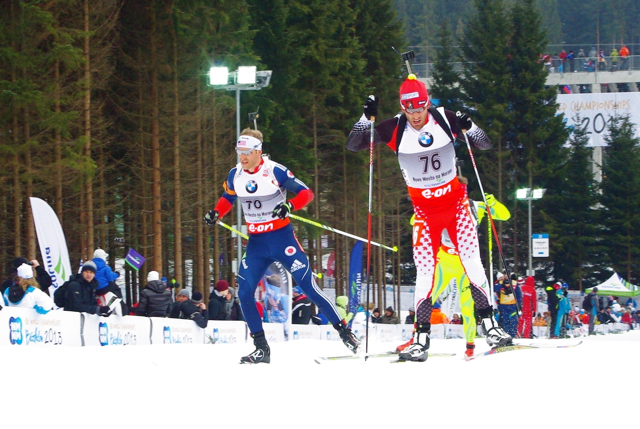
    Scott Perras (r) and Lowell Bailey (l) racing earlier in the World Championships.
    Scott Perras (r) and Lowell Bailey (l) racing earlier in the World Championships.

    Scott Perras took over and cleaned prone the first time through the range.  He needed all three spares in standing, but avoided the penalty loop and then threw down the second fastest closing lap of the anchor leg.

    “I had to give it my all on the final lap,” Perras told FasterSkier. “On the final climb which is pretty gradual and normally one skate I just offsetted with the fastest tempo I could manage.”

    With an extremely tight race for second and third up ahead, Perras’ time was all the more impressive.

    “I felt good on the skis today, I could go when I wanted and relax when I needed to,” Perras explained.

    Like LeGuellec, Perras was pleased with the result.

    “A top eight is big for us and I knew it,” Perras said, describing his mindset headed out for his leg. “I thought about the job my teammates did and drew motivation from that.”

    Top relay results are extremely challenging because everyone needs to have a strong day. Finishing off such a performance brings added pressure.

    “When you are anchor and your team tags over to you in a good position you do your best to close the deal… it’s something I enjoy but its also something that comes with a lot of responsibility,” Perras said.

    Both LeGuellec and Perras, while pleased, are hungry for more and see potential in the current team.

    LeGuellec pointed to cutting back on spare rounds. While it was good to avoid the penalty loop, the spares “represent a lot of time spent on the range.”

    “We only need some time to take it to the next level, we all know that JP [LeGuellec] is World Class…and we are getting stronger,” Perras said.

    For now, the team can enjoy the fruits of their labor. World Championships are done for all but LeGuellec, the lone Canadian man to qualify for Sunday’s mass start competition.

    “We are very happy, we know we can do better but when you consider the other relays we have produced this year this is by far the best,” Perras concluded.

    Burke’s sentiments ran somewhat differently in regards to the U.S.

    It was hardly a terrible day, but disappointing nonetheless.

    “No one had a bad race, but besides Russ [third leg skier Russell Currier], no one really put it together.  I feel like we all skied well but we just had too many extra rounds compared to the top teams,” Burke said.

    Lowell Bailey stayed with the leaders through the first shooting, but after using three rounds on standing, he dropped off the pace.

    Burke was solid, skiing fast, but was unspectacular on the range just two days after winning a silver medal.

    He needed a total of four spares, though he tagged to Currier in 8th.

    Currier shot well, using just a single spare, but still dropped spots, slipping down to 11th.

    Leif Nordgren took over for the final leg, and like Burke totaled four spare rounds.

    Both Burke and Bailey have one more shot as both will race the mass start.

  • Bailey Ninth, Hakkinen and Leguellec Top-Twenty in World Cup Biathlon Openers

    Martin Fourcade after winning last year's World Championships pursuit. Photo: nordicfocus.com

    One by one, last year’s heroes succumbed to errors over the course of the opening biathlon World Cup race in Ostersund, Sweden on Wednesday.

    Norwegians Tarjei Boe and Emil Hegle Svendsen, wearing the yellow and red bibs of as the previous overall and discipline leaders, only made it four kilometers before the mistakes began. Racing near the beginning of the field in the interval-start competition, each missed two shots in their first of four shooting stages – and in an individual race like today’s, where each missed shot is rewarded with a one-minute time penalty, that hurts.

    Ole Einar Bjorndalen of Norway missed six shots. Bjorn Ferry of Sweden missed five. Germans Michael Greis and Arndt Peiffer missed three, as did Switzerland’s Benjamin Weger and Russia’s Anton Shipulin.

    Who was left atop the leaderboard after twenty kilometers?

    Martin Fourcade of France, that’s who. Last year’s third-place finisher in the overall World Cup and World Championships pursuit victor missed just one shot – and on a day when not a single competitor went clean, he won by almost two minutes.

    Fourcade came into the final shooting stage with Dominik Landertinger of Austria. Neither man had made a mistake, but while Fourcade held the lead, shooting errors could change everything.

    “I knew that if I shot clean in the last stage, I could win,” Fourcade told IBU News. “But it is not good to think like that and I missed one shot.”

    It had to have been a nervous moments, but the Frenchman still came out on top. Landertinger faltered in a bigger way, missing two shots to Fourcade’s one. The Austrian ended up fourth place, just three seconds off the podium.

    Fourcade, meanwhile, skied through to the finish with a massive cushion. Michal Slesingr of the Czech Republic and Simon Schempp of Germany joined him on the podium, separated by just 0.2 seconds after each missing one shot.

    While many favorites had missed early on, two Americans followed different trajectories over the 20 kilometers. Lowell Bailey had shot clean coming into the last standing stage, and even though he ended up missing two shots, he still came away with a ninth-place finish, tying his career best.

    “All I can say is that I had a split bullet on the first shot and threw the next one wide on the left,” Bailey wrote in an e-mail. “It all happens so quickly. One minute you’re fighting for the podium, and a few seconds later you’ve just added two minutes to your course time! I was happy to come back and hit the last three targets. Of course every biathlete hopes to clean every race, but I am satisfied with the way things went today.”

    Bailey’s previous best was ninth place at the World Cup in Fort Kent, Maine this winter, which was lightly attended compared to these opening races. He found his quick start to be particularly gratifying since he hasn’t always been so lucky.

    “I had solid, uninterrupted training going into this race so I felt as prepared as I could be,” he explained. “The last couple of years, I’ve struggled in the beginning of the season with nagging sicknesses that kept me from following through training in this critical part of the season.

    “I am really happy with the way things went to day- it’s a good feeling to start the season tying a career best!”

    After just two loops of clean shooting, Bailey had the second-fastest cumulative time. With another clean round, he stayed in podium position with third-best. But even before arriving at that last shooting stage, the wheels had begun to come off; Bailey’s skiing dropped to the 83rd-fastest time for the loop. After missing two shots, he maintained ninth place to the finish.

    “I felt pretty good out of the start and for the first few loops,” Bailey wrote. “[But] I definitely felt more and more fatigued towards the end of the race… my fourth loop was a little off the pace.”

    With a layer of wet snow falling on top of the groomed trails this morning, it could have also been that Bailey – like other World Cup racers – was thrown off by the slow, difficult conditions compared to the faster, icy snow they had been training for the last week or more.

    Teammate Jay Hakkinen went through a similar rollercoaster of emotions; after two loops and clean shooting, he was ranked fifth. But he missed one shot in each of his last stages and after tiring on his skis skipped from seventeenth to eighteenth on the final lap of the course. Still, it was his best result since the 2008-2009 season.

    “It was a really good start to the World Cup season by collecting World Cup points,” Hakkinen wrote in an e-mail.

    It couldn’t be a more different start then last year, when Hakkinen didn’t even make it onto the World Cup squad until halfway through the season.

    “After working very hard to prepare for the season, I am glad to see things are going according to plan,” Hakkinen said. “90% shooting is quite solid. I just need to keep doing the same disciplined training and then the shots I missed today will be hit in the next race.”

    U.S. Head Coach Per Nilsson enjoyed the day’s racing, writing “That was fun!” in an e-mail.

    “Lowell and Jay had a solid race in skiing and shooting” he said. “That was a great season opener for them even if it was not a perfect race. It gives us great optimism for the future also.”

    The other two U.S. starters, Tim Burke and Leif Nordgren, didn’t fare so well. The pair missed five and four shots to finish 58th and 64th, over six minutes behind Fourcade. Nilsson said that men had been sick and were still not in top race condition.

    “The first race after being sick really hurts! Looking forward to feeling better this weekend,” Burke tweeted.

    Still, Nilsson was enthusiastic.

    “Tim still ranked 27th in the course time. And Leif had a good second half of the race,” he wrote. “We are looking forward to the race tomorrow and for the rest of this trimester.”

    The Canadian team only saw one bright spot in today’s results, but what a spot it was: JP Leguellec finished 14th with two penalties. Unlike Hakkinen and Bailey, he actually got stronger as the race went on, missing a shot in each of his middle stages and then cleaning the last one.

    The result isn’t a breakthrough for Leguellec – he has ten even better international results for his name, including sixth place in the sprint at the Vancouver Olympics – but like Bailey and Hakkinen, he said that it was a relief to start of the season on the right foot.

    “I focused hard on my training this summer and everything indicated that I was in good shape, but without racing, it is so hard to measure where you are at because there is no indicator,” he said in a Biathlon Canada press release.

    Now, he has that indicator, and he hopes that it’s just a starting point for the 2012 season.

    “I believe the podium is the next step and today clean shooting would have put me in second place,” Leguellec said. “Aiming for the podium there is no margin for error. I have to do the same things in the sprint on Friday that I did today – strong skiing and clean shooting.”

    Leguellec’s teammates had universally tough days – Scott Perras and Brendan Green missed four shots to place 68th and 72nd. In his first-ever World Cup start, Scott Gow – who just turned 21 – missed four shots as well and placed 101st.

    World Cup action continues tomorrow with the women’s 15 k individual.

    Full results

  • Canadian Biathletes Wrap Up World Cup Trials – Photo Gallery

    Canadian Biathletes Wrap Up World Cup Trials – Photo Gallery

    Team Canada wrapped up its World Cup selection trials in Canmore on Tuesday with a pair of mass start races, which were won by Megan Imrie and Nathan Smith.

    With barely any snow in Scandinavia, the team was lucky to be at home in Canmore, where there has been skiing thanks to “Frozen Thunder,” a snow-saving operation. The team was racing to select two women and one man to join prequalified racers Imrie, LP Leguellec, Brendan Green, and Scott Perras on the World Cup at the end of the month. Team nominations have not been made public.

    In the women’s mass start, the race came down to a sprint finish by three athletes who went through the race in wildly different styles. Imrie, who had only a single penalty, came away with the 1.3-second win over Rosanna Crawford, who put her first-ever four-stage clean race in the books. But just two seconds behind her was Zina Kocher, who managed to ski almost to the top despite having five shooting penalties. All three women were 2010 Olympians.

    In Monday’s sprint, Imrie and Leguellec bested the fields, as reported on FasterSkier’s blog. In Tuesday’s mass start, however, the results were a bit more interesting. In the men’s race, Smith bested Smith by almost a minute, even though both men had two penalties over four shooting stages. Fellow national team member Marc-Andre Bedard finished third with three penalties, and junior Scott Gow – who finished second in the sprint – continued his strong run by placing fourth, just thirteen seconds behind Bedard.