Tag: Judy Geer

  • Innovation and the Science of Over Summer Snow Storage at the Craftsbury Outdoor Center

    Innovation and the Science of Over Summer Snow Storage at the Craftsbury Outdoor Center

    The Craftsbury Outdoor Center (COC) in the Northeast Kingdom of Vermont has emerged as a premier year-round cross country ski training venue. The COC has also been a leader in embracing and promoting sustainability and environmental stewardships through their own day to day operations and educating their customers. They have invested in energy efficient buildings, a wood-burning central heating system, solar energy, and an abundant garden which allows them to grow much of their produce on site. 

    Following this ethos, the COC has partnered with the University of Vermont (UVM) on a project to develop an innovative over summer snow storage system. The system aims to guarantee one to three kilometers of skiable snow by Thanksgiving each year. 

    “Storing snow over the summer enables us to make the snow at the coldest times in winter, when the snowmaking is most efficient, rather than in November when the temps may be marginal,” wrote COC owner Judy Geer. “[It also] assures skiers will be able to will be able to stay home in Vermont or New England over Thanksgiving and be able to get in good training, rather than spending money and increasing their carbon footprint on trips out west.”

    Snow storage systems are used in several locations throughout Europe and were responsible for making the cross-country venue at the 2018 Olympics in PyeongChang viable. So why does this development at the COC require a team of university scientists?
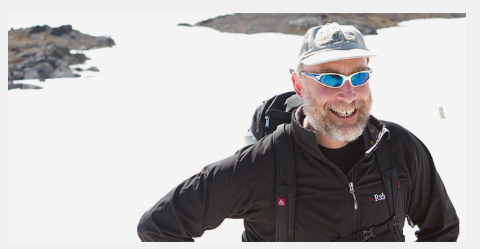
    Paul Bierman, Ph.D is a professor of Geology and Natural Resources at the University of Vermont. (Photo: uvm.edu)

    Paul Bierman, professor of Geology and Natural Resources at UVM, project leader, and nordic ski enthusiast, explains that the project is unique because Craftsbury is the lowest in latitude and elevation of any snow storage site. The majority of cross-country venues with snow storage systems are located in high latitude Scandinavia or in mountainous high altitude areas in Central Europe. Craftsbury Common, on the other hand, sits at about 44.6 degrees north latitude and about 353 meters in elevation. 

    “No one has ever tried [snow storage] in the worst of all possible combinations: low altitude, humid, low latitude. This was really an interesting merge between university science and engineering, and a center that is committed to trying new things as well as sustainability. Maybe that’s why it worked,” Bierman said with a laugh. 

    Bierman explained that the impetus for the project was born a few years ago around Thanksgiving when temperatures in Vermont were too high for snowmaking and no natural snow had fallen. A dismal combination for a skier. he COC could only produce a 100 meter lollipop on their soccer fields. While out on a ski, Geer and her husband and co-owner Dick Dressigacker began chatting with Bierman about the concept, knowing his interest in snowmelt and snowmelt hydrology. 

    A conic map of snow storage facilities. The Craftsbury Outdoor Center sits at the lowest combined elevation and latitude. (Photo: Optimization of over-summer snow storage at mid-latitude and low elevation, H. Weiss et. al. Click to enlarge)

    Bierman spearheaded the project with a scientific lens. He recruited his undergraduate assistant Hannah Weiss who has continued with the project as a graduate student, and a colleague in mechanical engineering began with a feasibility study. They found inspiration from old fashioned Vermont ice houses, which predated modern refrigeration. Ice house technology consisted of ice harvested from the surface of rivers and lakes during the winter. It was then covered with straw and sawdust and preserved in a partially underground building to keep perishable food cool in the summer. 

    The team identified a storage site in a pond that no longer held water and instrumented the ground at varying depths to measure temperature. 

    “We wanted to make sure that the ground was not so warm that we were just going to melt the stored snow from below.”

    The team monitored the temperature variation over the course of a year.

    “What we realized is because of how far north Craftsbury is, ground temperatures weren’t doing all that much and there really wasn’t going to be that much flux of heat from the ground into the snow pile. So that got us thinking, ‘Okay, maybe this is going to work.’”

    Next, with the help of the Craftsbury grooming team, they created two test piles at the end of the 2018 season in order to determine an optimal system for insulating snow through the summer. They covered the piles with roughly 25 cm of wood chips which were instrumented with thermometers. They tested a variety of covers including foams of different densities, concrete curing blankets, space blankets, and reflective mylar over the top to deflect solar radiation.
    Susan Dunklee (USA Biathlon/CGRP) cools off from a mid-summer workout in a 2018 test pile. (Photo: Paul Bierman, UVM)

    After monitoring the piles through the summer, they identified the optimal setup. On top of the manicured snow pile, a concrete curing blanket was laid primarily to protect the snow from debris. The blanket also adds some insulation. Next, a layer of wet wood chips 20 to 30 cm deep was spread, providing the majority of the pile’s insulation. Finally, a white mylar space was stretched across to reflect thermal energy from the sunlight. This system proved highly effective. 

    “When you monitor the temperature underneath that concrete curing blanket, it basically doesn’t change. No matter how hot it is outside, it basically stays at zero.”

    With a scientifically-backed storage plan, the UVM and Craftsbury collaborators went into the 2019 season ready to give snow-storage a go. The pond site was improved and a road was built to improve access. 

    Keeping in line with its mission of sustainability, the COC purchased new energy-efficient airless snow guns which use between a quarter and a third of the power than older model fan guns. These new guns ran for a week in February, blowing roughly half the COC’s annual water allotment into a large pile. 

    “The beauty of it is that they don’t have to power fans anymore, so it was a lot less energy,” explained Bierman. “And they did it in the middle of their high season, and because they generate their own electricity for these guns, they have a heat recapture unit on the generator, so a significant part of the energy that would have gone up the chimney as waste heat, was now heating dorms that were full of people.”

    He added that were the snow blown in November, as is the case in most snowmaking operations, the COC would have been mostly empty, meaning the heat would have been wasted that way as well. 

    Groomers ran a pistenbully back and forth over the pile to pack it more densely: dense snow melts more slowly. The pile was shaped with an excavator, then the team waited as it transformed into corn snow in the spring. Then the pile was covered with wood chips and the white reflective covering. 

    Though the storage method was tested the year before, the scale of the pile had increased dramatically. 

    “This was a big logistics year,” Bierman explained. “How do you do this? How do you shape a pile? How do you put chips on it? How do you put a cover on it? How do you keep the cover from blowing away in a big spring wind storm? Which it did the first time,” he laughed.

    Once the pile was tucked neatly under its multilayer covering, the team sat back and monitored it regularly throughout the summer using a new style of survey equipment called terrestrial “LIDAR”, which stands for light detection and ranging. This allowed the team to track changes in the 3D surface of the pile, thereby measuring the change in volume. 

    “It became pretty clear by mid-July that this pile wasn’t shrinking very quickly. By the last scan in October, we had about 65% left by volume of what we put in there. And that is pretty much what Europeans in the Alps get.”
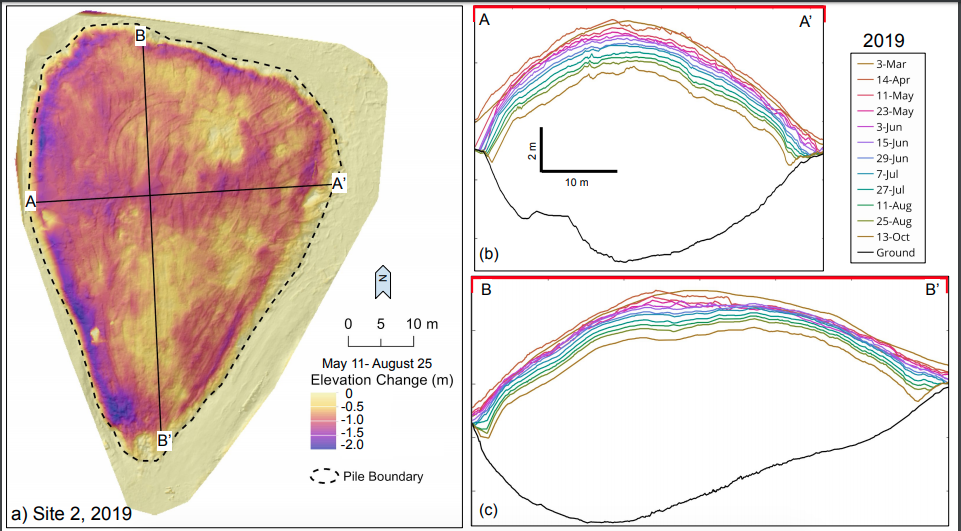
    A LIDAR map of the 2019 stored snow pile at the Craftsbury Outdoor Center. Click to enlarge. (Photo: Optimization of over-summer snow storage at mid-latitude and low elevation, H. Weiss et. al.)

    He explained that the limited existing data suggests that the average retention by volume of other snow storage sites is between 60-70% on average. 

    By their measurements in early November, the pile contained 5-6000 cubic meters of usable snow, which translates to 2-3 km of coverage at 50 cm deep and a few meters wide.

    “In any normal November, that would be a godsend. Most of the early November skiing at Craftsbury is a big lollipop in the upper soccer field and down the hill in the lower soccer field, where people are going in one direction on maybe a 200 meter course around and around and around.”

    He added that the preserved snow would allow “more interesting” terrain to be opened early, such as “Lemon’s Haunt”, a 1.6-kilometer blue square trail which rolls through the woods. 

    Feeling confident that the COC could provide a few k of skiing by its projected opening day on November 16th, the team began scraping off the layers of wood chips in early November. Then, in an unforeseen plot twist, the first snowfall of the year arrived, coating Craftsbury with a thick layer of natural snow. This interrupted the original plans of spreading the pile, but allowed the COC to open 25 kilometers of trail on opening day. 

    “The pity is that it didn’t work out as everybody anticipated, which was to lay a couple k of base down with this icy stuff, then have the natural snow sit on top of it, which would preserve the natural beautifully.”

    He laughed that no one would want klister snow laid on top of their blue wax conditions.

    So how would the pile have been transformed into ski trails had Mother Nature not trumped the scientist’s plans? 

    Bierman explained that during the summer, the snow transforms into “firn”, a term used most commonly with glaciers to describe an intermediate stage between snow and ice. Though icy and dense, the substance maintains its granular quality.

    He explained that without the world-class groomers and equipment at the COC, making this into skiable terrain would not be possible. 

    “The beauty of Craftsbury is how well they groom. Their grooming is spectacular, they’ve got three piston bullies, they’ve got this.” 

    Prior to the natural snowfall, the grooming team had been meticulously cleaning an excavator and dump truck to ensure that dirt was not introduced into the clean snow pile, as the sun on the dark-colored dirt increases melting. Dirt in the base would be further mixed into clean natural snowfall, creating a problem from the get-go. Not to mention skiing in dirty snow is not recommended for your bases.

    With clean equipment, the team would begin trucking snow to the furthest point, working their way backward toward the pile. Once the snow is laid out, groomers can work their pisten bully magic to create a surface that is pleasurable to ski. 

    The COC is developing a plan for how the stored snow will be used, which will be dependent on weather and natural snowfall. Some stored snow may be kept in order to patch holes in the event of a warm spell. 

    Next year, the team intends to again create as large a pile as possible and continue to fine tune the storage methods. 

    “This is just the first year, so we have a lot to learn–both in terms of process, and also environmental and cost-effectiveness,” wrote Geer. 
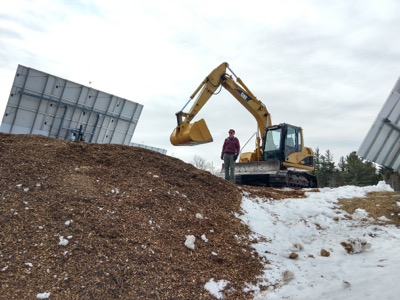
    An excavator layers wet wood chips onto the 2019 snow storage pile at the Craftsbury Outdoor Center. (Photo: Paul Bierman, UVM)

    Bierman explained that the logistics of properly covering the large pile requires practice, but a lot of pitfalls have been flushed out in the first two rounds of the experiment. The COC staff will be refining their method of covering the surface with an adequate layer of wood chips which does not crack or slump, and overlapping layers of the white reflective cover to reduce the chance of exposure and rapid melting. 

    “Nature is going to help us because now the ground underneath that pile is cold. It has had cold melting snow on it all summer, so presumably the ground underneath there is 0 degrees C and saturated with 0 degrees C water, and it’s only going to get colder this winter.”

    Bierman continued that other snow storage facilities have experienced improvement in retention each year over the first few years. 

    Depending on what winter has in store, the COC may increase the volume of snow that is blown into the pile in 2020. 

    “If we have a good snow year and they still have water left in February, they’re just going to blow it into the pile,” said Bierman. 

    He continued that they could scale up by an additional 50% over last year’s volume. 

    Overall, the project has been a great opportunity for the COC to improve upon existing snowmaking methods and to guarantee snow for Green Racing Project athletes, the local junior teams, and recreational skiers alike.  

    “It gives the place an insurance policy. It doesn’t matter when you put that snow away, by putting it away, Craftsbury can reliably say that they can open in November. We don’t even have to wait for snowmaking weather.”

    What would it take for over summer snow storage to be implemented by other ski areas? Bierman explained that the recipe is outlined in great detail on the project website and also in a technical paper written by the UVM science team, which is currently under review (full citation below). 
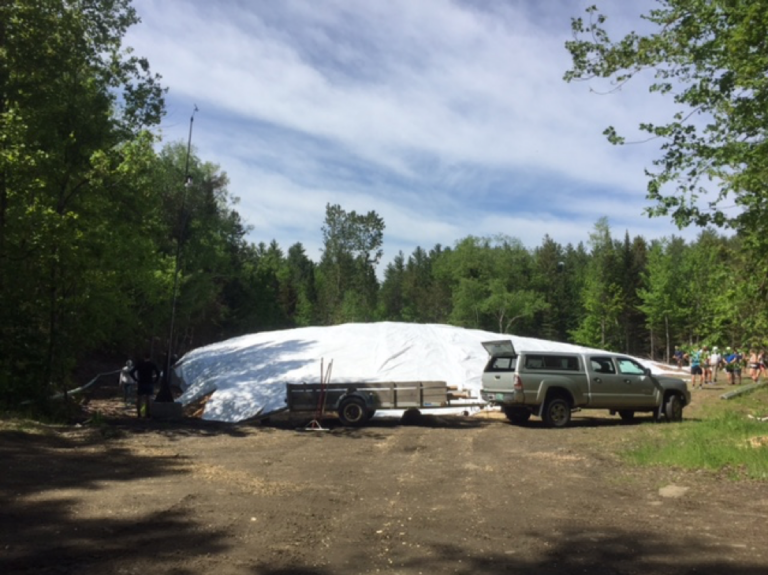
    A white reflective space blanket is the final layer on the top of the snow storage pile. (Photo: Paul Bierman, UVM)

    Clearly, the project requires significant resources: a place to store snow, an excavator, snowmaking equipment, pistenbully, coverage supplies, not to mention man-power. It is not, perhaps, readily accessible to small family run ski areas, but Bierman expressed that many major cross country centers could consider it.  

    Apart from the superficial benefits of early season skiing, Bierman imparted the importance of the underlying reason for the project. 

    “We’re on a trajectory of global warming unlike anything we’ve ever seen, and this is a Band-Aid. It’s a Band-Aid that might hold us for 10, 20, 30 years, but it’s not getting at the root issue here which is decarbonizing the global energy system. Unless we do that, all winter sports in these mid-latitudes are going to be extinct. We can’t save enough snow to have a nordic season if it doesn’t get cold anymore. If you look at the Vermont climate assessment, if we don’t change how we’re doing business — sort of the business as usual scenario, how we operate — we’re going to look something like the Great Smoky Mountains of Tennessee by 2090.

    “So this is a fun thing, extend the season, that’s all great, but we have to take some serious action as a global community to deal with climate change and the use of carbon fuels.” 

    Overall, both Bierman’s team and the folks at the COC are pleased with the results produced by the project and the many benefits it has provided in its nascence. The large pile of preserved snow stands as a testament to creativity, dedication to sustainability, and the power of problem-solving. 

    “The takeaway is that it works,” concluded Bierman. “And actually, it’s a lot of fun and it’s been a great way to share what we know about climate change, and not only about climate change adaptation, which is what you’d call this project, but also climate change mitigation which is ‘how do we get on the front of this?’ 

    “It’s a great educational tool about ‘climate change matters, and let’s see what we can do about it.’ We’re being forced to do things in New England that 20 years ago you wouldn’t have thought about doing.”

    To bring this article to life, check out this video created by Bierman’s daughter, Quincy, who is a member of the junior program at Craftsbury. 

    References: Weiss, H. S., Bierman, P. R., Dubief, Y., and Hamshaw, S.: Optimization of over-summer snow storage at mid-latitude and low elevation, The Cryosphere Discuss., https://doi.org/10.5194/tc-2019-56, in review, 2019.
  • When the World Comes to Town (Craftsbury)

    When the World Comes to Town (Craftsbury)

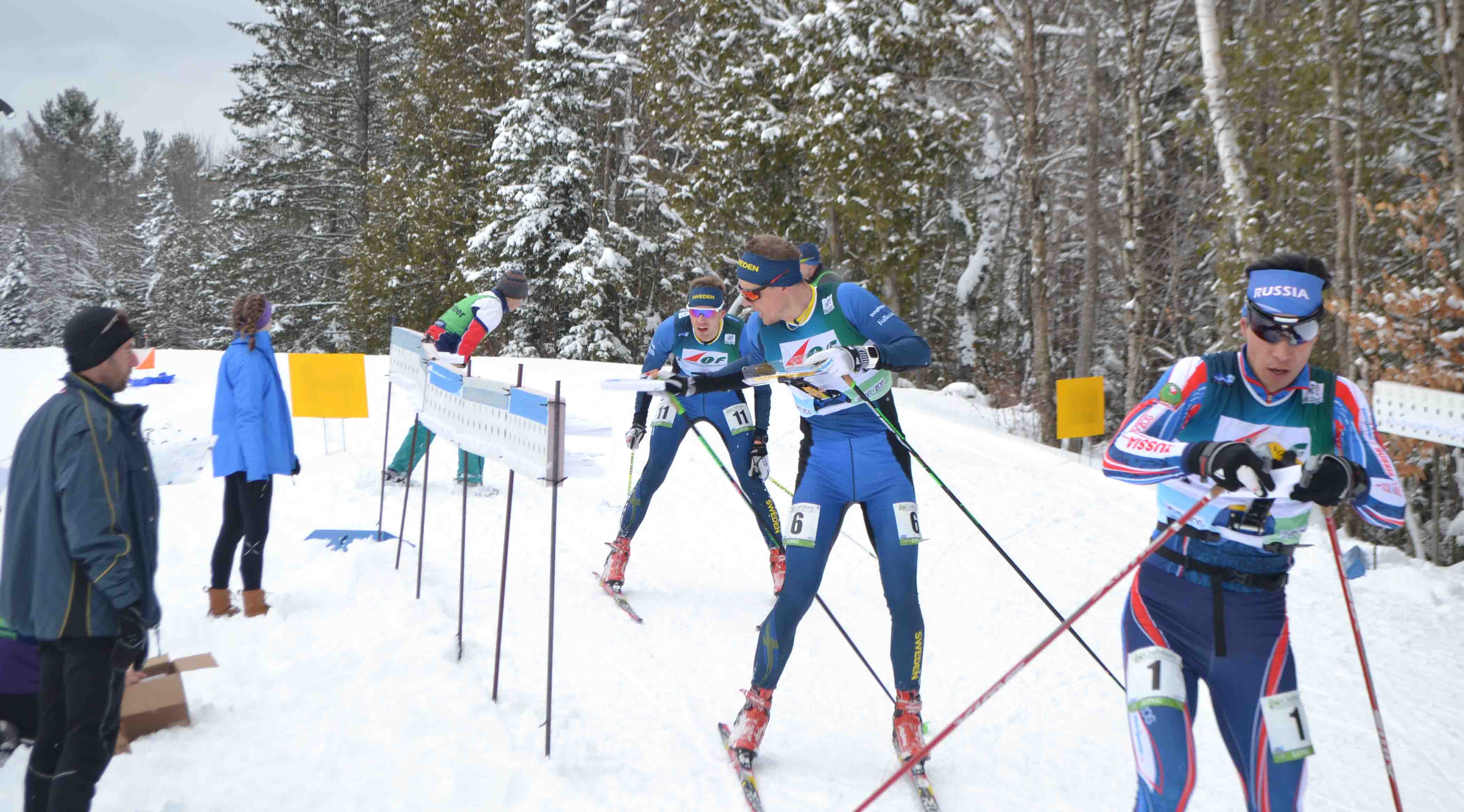
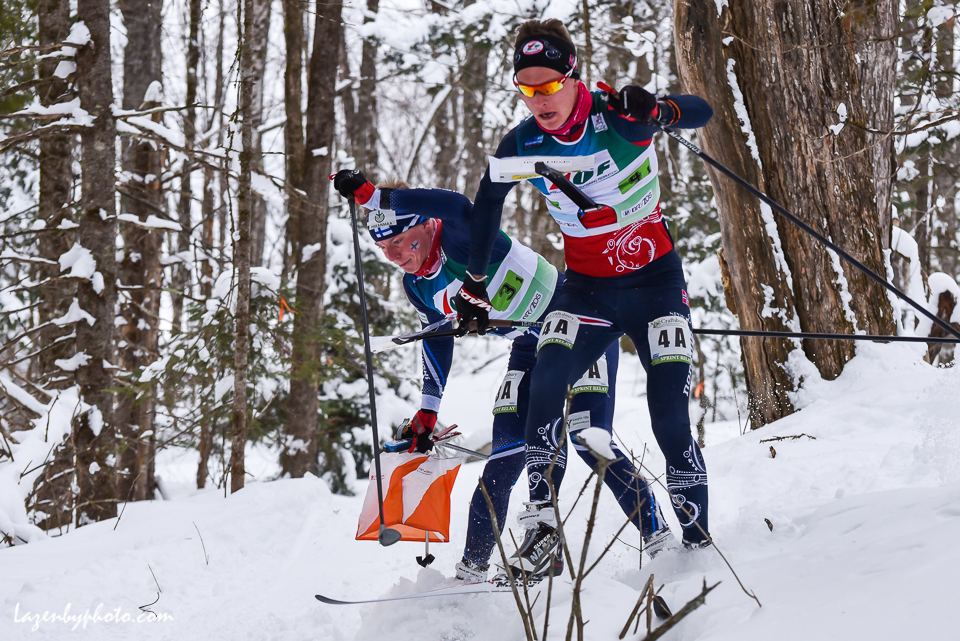
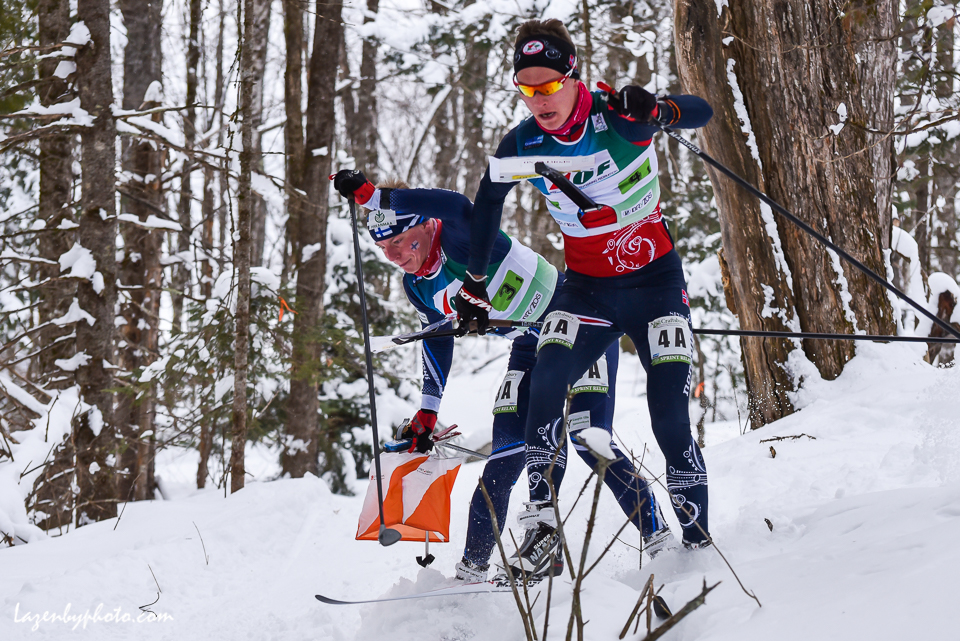
    A near miss as competitors Tero Linnainmaa of Finland and Jorgen Madslien of Norway arrive at a checkpoint at the same time in the mixed relay at the International Orienteering Federation World Cup at Craftsbury Outdoor Center in Craftsbury, Vermont. (Photo: John Lazenby/Lazenbyphoto.com)

    The following was submitted by Kevin Brooker, who attended the 2018 Ski Orienteering World Cup and Ski Orienteering World Masters Championships last week in Craftsbury, Vermont. Brooker, who wrote an introductory piece on ski orienteering, set out to explain how the event made its way to the small town in the Northeast Kingdom.

    ***

    CRAFTSBURY, Vermont — Even within the tiny and tight-knit American world of nordic activities, ski orienteering is relatively unknown. Just like traditional cross country racing, the American devotees are rabid enthusiasts determined to have an impact on a sport dominated by Scandinavian athletes. Overseeing the sport is the International Orienteering Federation (IOF), whose mission is to promote the overall sport of orienteering and all of the subsets such as ski-o, mountain bike-o, and the largest segment: foot-o.

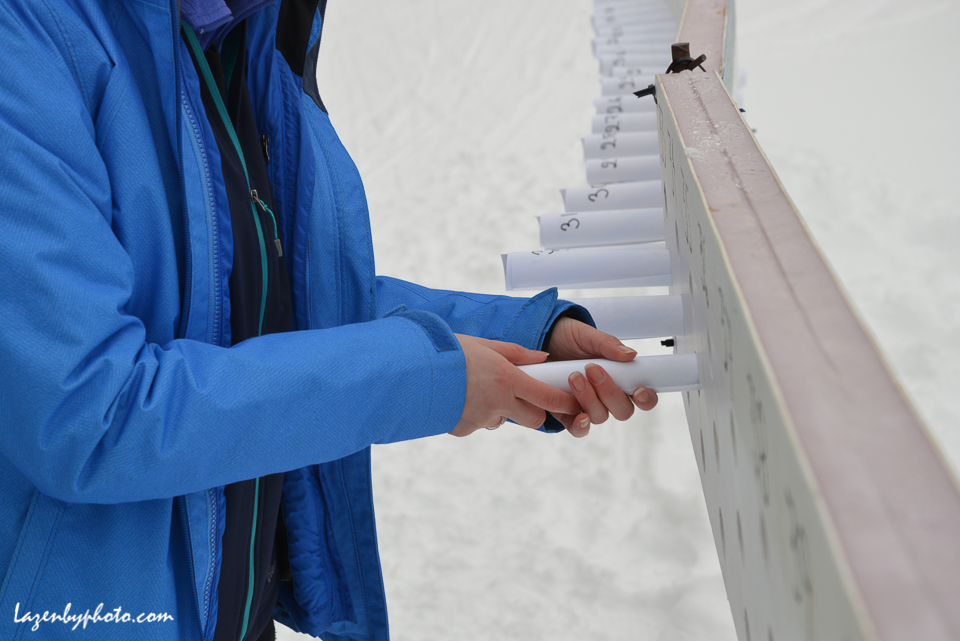
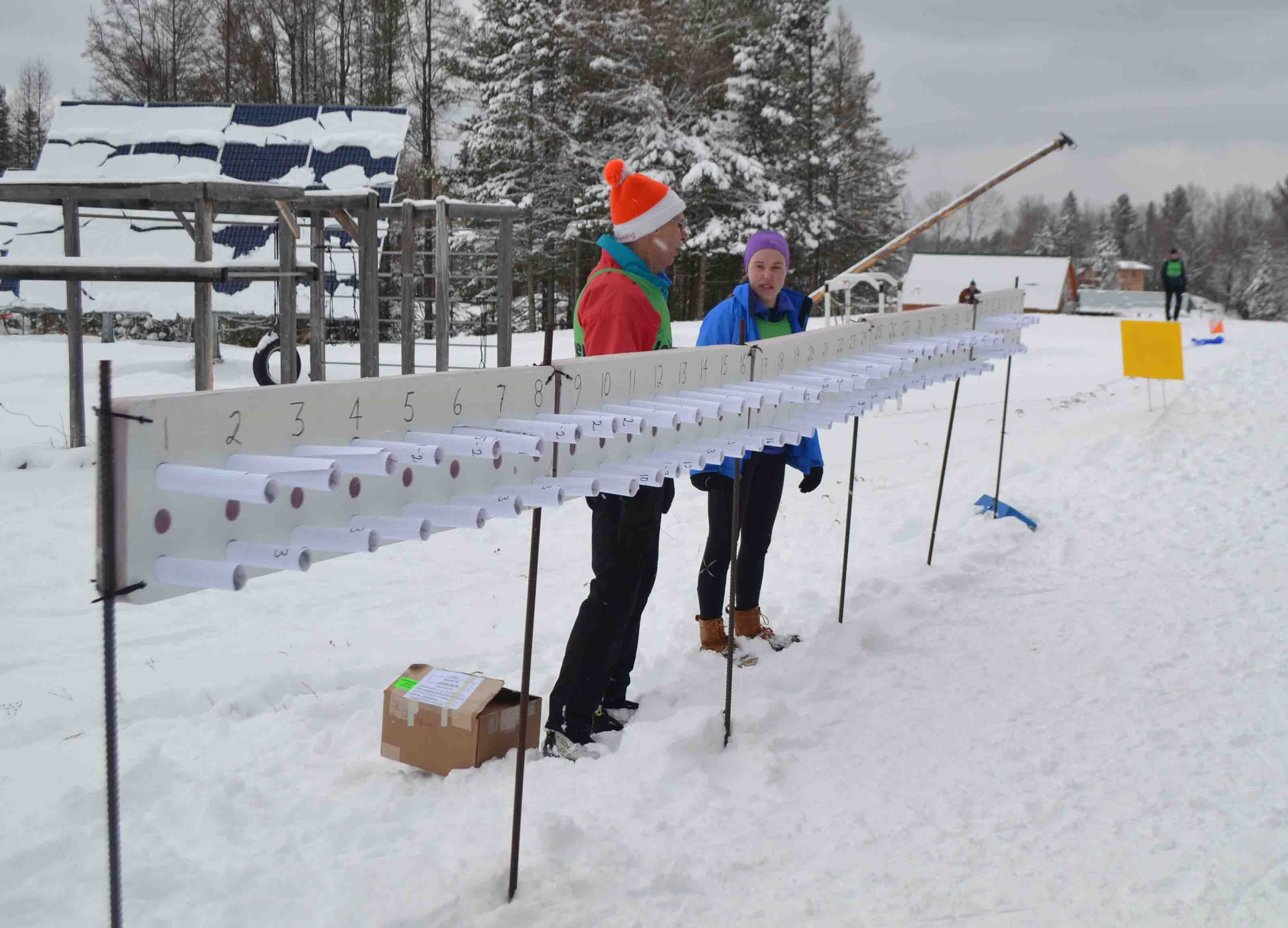
    At the map exchange, athletes remove the used map, grab the next sequence and continue racing. Race volunteers collect the discarded maps and refill the board with fresh maps, as seen at the Ski Orienteering World Cup Finals in Craftsbury, Vt. (Photo: Kevin Brooker)

    The IOF organizes a World Cup and World Championships for all segments and does its best to move these events around the globe. Like most international competitions, it takes several years to pull together an event. In addition to an appropriate venue, the organizing committee must have international experience, a lot of determination and grit.

    Just how did the Ski-O World Cup Finals and Masters World Championships end up in Vermont and how did it go?

    Ken Walker, event controller for this year’s championships in Craftsbury, explains the genesis of the event:

    “I was approached several years ago while ski-0 masters racing in Europe about bringing World Cup ski-0 races back to North America. We held very successful races in Truckee, California, in 2012 and competitors wanted to return. I suggested doing it in the East and [Craftsbury Event Director] Adrian Owens was enthusiastic about holding them at Craftsbury. This was a natural choice, knowing the fine trail network and an organization welcoming competition events. My official job was national event controller.  It basically means I check to ensure the races are fair, accurate and safe, and we follow the International IOF rules.”

    Preparing for racers to arrive at the map exchange in the distance race at the International Orienteering Federation (IOF) Ski Orienteering World Cup at the Craftsbury Outdoor Center in Craftsbury, Vermont. (Photo: John Lazenby/Lazenbyphoto.com)

    With a well-formed idea, Walker and Owens approached Judy Geer, co-owner of the Craftsbury Outdoor Center (COC), about hosting the event.

    “When Adrian Owens approached us about the idea of hosting this race, which he did well over a year ago, I was pretty quick to say, ‘Sure, sounds like fun!’ ” Geer explained. “It seemed like an opportunity to share our trail system in a new way and welcome an international group of nordic skiers to Craftsbury. At the same time, we had no idea how to host such a race so it was critical that there would be a knowledgeable organizing committee to really put it all together. Luckily, we had that. “

    An East-Coast venue secured, Walker and Owens assembled an organizing committee (OC) to bring the event to Vermont. The committee had more to do than just run a race; they had to educate the Craftsbury staff and teach them about ski-o.

    Craftsbury Outdoor Center coach Ollie Burruss had this to say about his ski-o learning curve:

    “I would just add that the organizing committee has been incredibly helpful in educating those of us at the Outdoor Center without a background in ski orienteering – I think that would be almost all of us, actually. We are quite comfortable hosting high level cross country races, but this series added new elements to our race day preparation. Without the OC stepping up and providing input, suggestion, education, and the like, we would not have known where to start.”

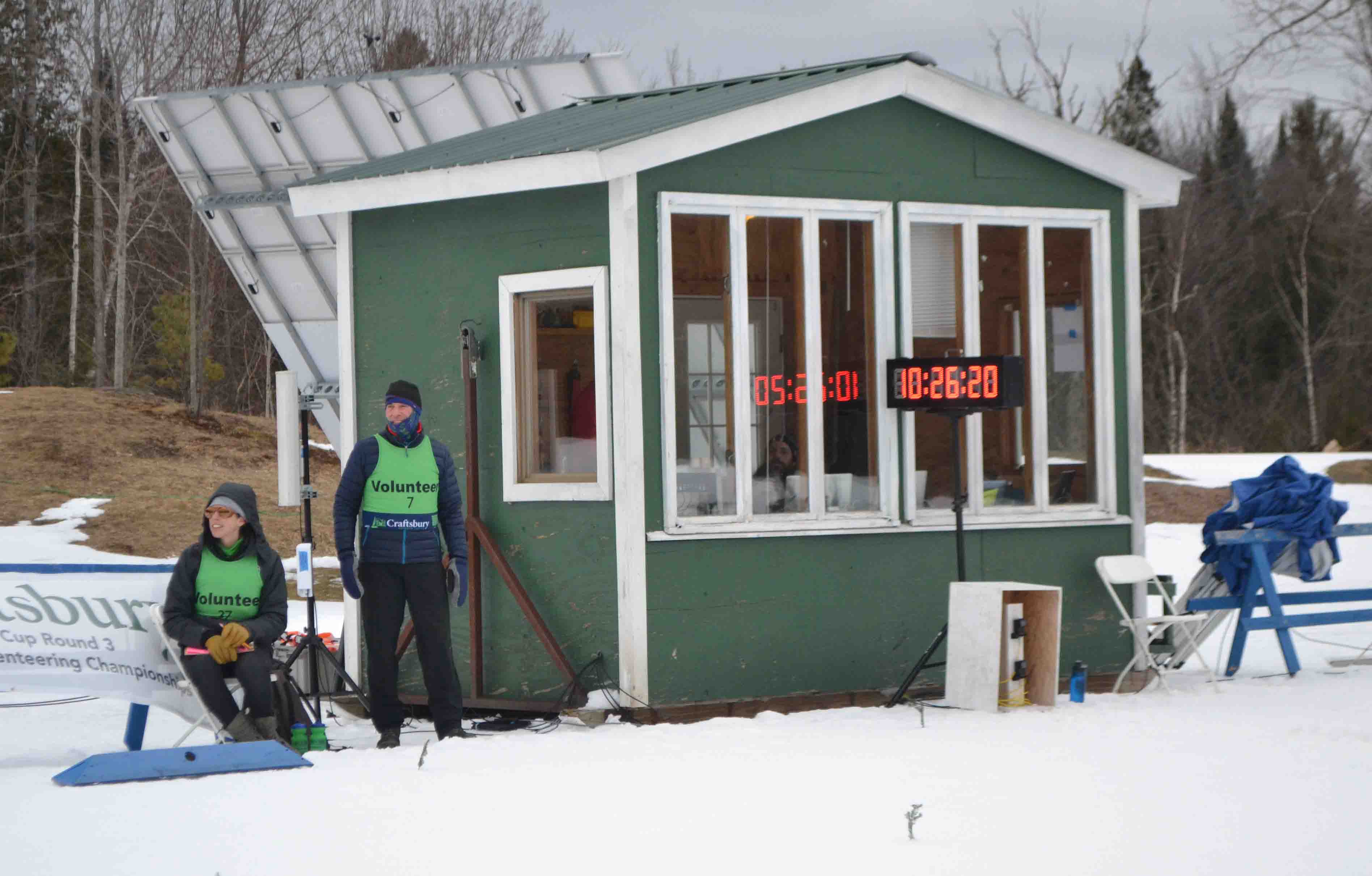
    The finish crew getting ready to record race numbers to help verify the electronic finish order at the Ski Orienteering World Cup Finals and World Masters Championships in Craftsbury, Vt. (Photo: Kevin Brooker)

    Much of a ski-o race shares a lot of similarities with a more traditional cross-country event. Both have individual starts and mass starts. With the exception of ski-o competitors wearing map holders, the starts and finishes look identical. Craftsbury was able to utilize their expertise and equipment setting up timing and start and finish areas. Where the Center needed some help was setting appropriate courses and the OC provided two expert competitors and course setters.

    Alex Jospe and Andy Hall are two such experts.

    “As course setter, my main task is to design an orienteering course that is appropriate for each class,” Jospe explained. “For the elite skiers, this involves very technical skiing and very technical navigation, with a mix of challenges from route choices to fine-scale navigation execution, all done at top speed. Ironically, those are the easiest courses to set, because the competitors can handle just about anything you throw at them. The tricky part is designing a course that will be navigationally challenging for the elder classes, without totally thrashing them on the ski trails.

    One of the maps at the 2018 Ski Orienteering World Cup / World Masters Ski Orienteering Championships. (Photo: John Lazenby/Lazenbyphoto.com)

    “Setting a course entails laying everything out on paper, and then going out into the terrain to make sure that all the trails and tracks line up the way they are supposed to,” she continued. “I also spend a lot of time skiing various route choices, to get a sense of how long it will take for the skiers to complete the course. Then we print out the maps, and go out to set up the checkpoints, which are marked with an orange and white flag. Each of these flags (called ‘controls’) has an electronic timing unit on top, so that competitors can carry a timing chip and get splits instantaneously at the finish.”

    With the event completed, how does the OC feel about the event?

    “We’ve been on a steep learning curve about this sport, and it’s really been fun to finally get to watch the races this week!” Greer noted. “We hope the competitors are enjoying Craftsbury as much as we’re enjoying having them here.”

    “Our expectations have been more than met, with terrific support from venue staff and the trail groomers,” Walker said. “It is fun to host nearly 200 European racers and introduce more Americans to ski-o.”

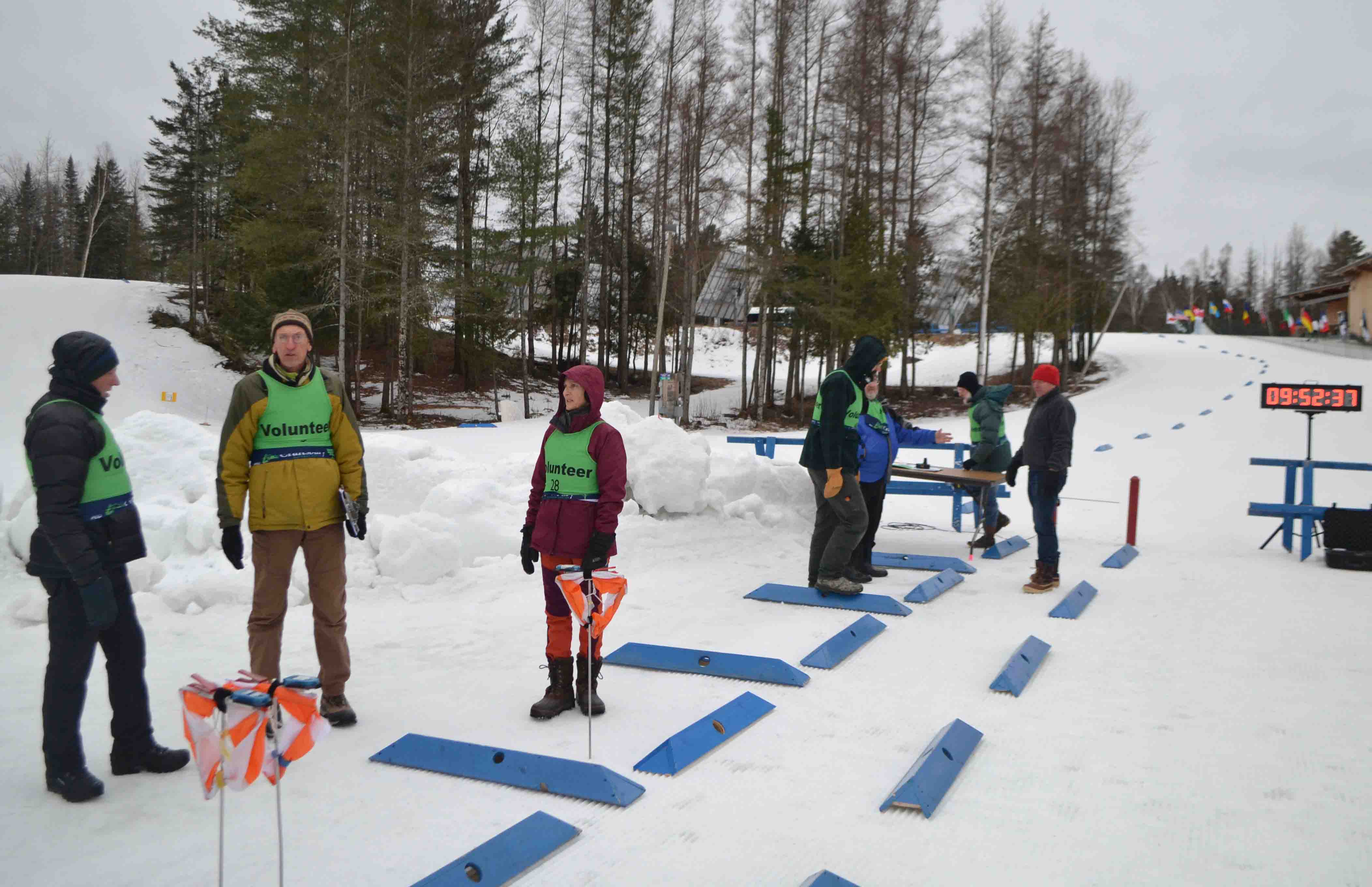
    The start crew preparing for the World Cup long distance event at 2018 Ski Orienteering World Cup / World Masters Ski Orienteering Championships in Craftsbury, Vt. (Photo: Kevin Brooker)

    With years of racing, coaching, and organizing races, Burruss had this to say: “I really appreciate the patience they [the organizers] have showed and I hope we have held up our end of the bargain. It is a cool event and I’m glad we were able to help bring this level of racing to the NEK [Northeast Kingdom].”

    The experience of setting dozens of courses for many levels of skill and age, with snow cover ranging from gray ice to a foot of fresh snow, Jospe summed up her experience:

    “Hosting this event at the Craftsbury Outdoor Center has been amazing. They are generous, interested, and enthusiastic — we couldn’t do this without such good support! It’s really cool to bring so many international competitors to this corner of Vermont, and everyone is appreciating the friendly vibes.”

    For those of us fortunate enough to participate in this world-class event, the hard work and effort by the OC and huge staff of volunteers at the start, finish, registration, and out on the course is greatly appreciated. The trail grooming was exceptional and the rest of the COC staff was extremely professional. Everyone worked together to provide a fantastic racing experience to spectators and participants alike.

    See also:

    ***

    About the Author: Kevin began nordic skiing to keep in shape for bicycle racing at the dawn of the skating revolution.  He lives in Vermont with his wife and two kids, who are fortunate enough to have great skiing right out the front door. 

    This ski-orienteering mass-start race had two exchanges. The top map is the first taken after the start. The maps were used in different orders to deter leaching (following). The intricacies of an orienteering mass start are worthy of their own article. The course setter mixes and matches the routes, and each athlete will cover the same legs but in a different order. After all this, there is often a finishing sprint for the victory. The exchange crew must be sure to put the correct map into the proper slot to insure a fair race. (Photo: Kevin Brooker)
  • Emily Dreissigacker on World Cup Cusp

    Emily Dreissigacker on World Cup Cusp

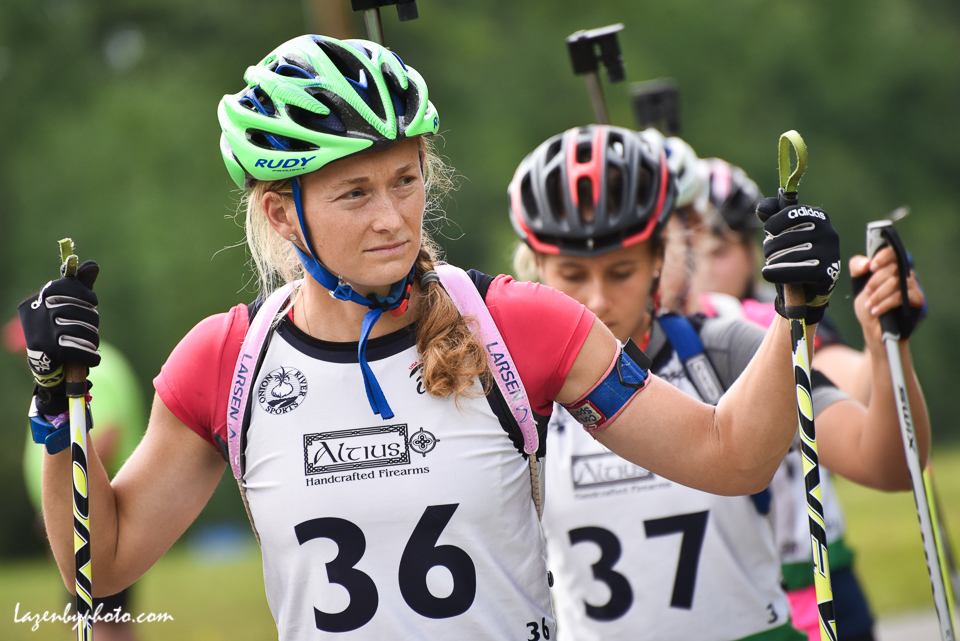
    Emily Dreissigacker (CGRP) at the start of the women’s sprint at the 2017 US Biathlon Rollerski Championships on Aug. 12 in Jericho, Vt. (Photo: John Lazenby/Lazenbyphoto.com)

    Say this name three-times fast: “Dreissigacker”.

    Not so easy at first.

    Break the four-syllable surname into discrete parts: Driess (with a hard I) – i – gack – er.

    It then rolls off the tongue … Dreissigacker.

    In northern Vermont and in particular around the Craftsbury Outdoor Center, Emily Dreissigacker, of the Craftsbury Green Racing Project (CGRP) is as well known a name as any. Her parents, Dick Dreissigacker and Judy Geer, bought the Outdoor Center in 2009. Both are Olympic rowers.

    And both of Emily’s siblings are biathletes. Her older sister Hannah, 30, was a 2014 Olympic biathlete who retired in 2016 and younger brother Ethan, 26, formerly raced for the Green Racing Project.

    At 28, (she’ll be turning 29 in November), Emily Dreissigacker is on the cusp of making it onto the International Biathlon Union (IBU) World Cup representing the US Biathlon Association (USBA). 

    A week ago, she was selected for US Biathlon’s on-snow camp in Canmore, Alberta. Of the five women chosen for that camp, three are already penned to start on the World Cup next month: Susan Dunklee, Clare Egan and Kelsey Dickinson. The last remaining World Cup spot is reserved for either Joanne Reid, a national A-team member, or Dreissigacker.

    “I’m not really feeling the pressure,” Dreissigacker wrote in an email about a possible World Cup nod. “I’m just excited to get out there and ski on snow and get in some really solid training.”

    Perhaps this is a reason why the USBA’s high-performance team recruits and promotes older athletes — with age and experience comes a calmness. With time comes wisdom: winning or losing in sport doesn’t define a person.

    There’s been both winning and losing and the in-between for this Dreissigacker, who grew up near Craftsbury in Morrisville, Vermont, and married her teammate Alex Howe last summer.

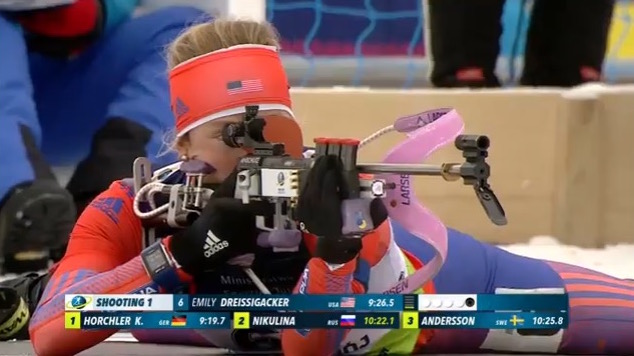
    Emily Dreissigacker shooting clean during her first prone stage of the women’s 15 k individual race at 2017 IBU Open European Championships in Duszniki-Zdrój, Poland. She finished 41st. (Eurovision screenshot)

    “At this point, competing at the Olympics had been a dream of mine for so long that it felt inextricably entwined with who I was as a person,” Dreissigacker wrote in a June 2015 blog post. “I could feel it slowly but surely slipping out of my grasp and yet I couldn’t let go. I thought about quitting, but there was always something pulling me back. Don’t get me wrong, I loved racing. I loved racing against my teammates in practice, I loved lining up side by side for a 2k or blindly pushing myself past all reason in an interval start. But the training, the whole process had gotten stale. I felt like I was slogging my way through each steady state workout, counting down the minutes rather than enjoying the time I had. Meanwhile, I jealously eyed the skiers leaving each morning for what looked to me like exciting adventures. They got to go biking and hiking and running and rollerskiing (yes, I was jealous of rollerskiing)! But it never really seemed like a viable option to me. I was a rower.”

    Since that 2015 blog post, Dreissigacker has been a biathlete.

    After eight years training as a rower, she tapped into her adolescent and teenage years as a skier. Like some of her peers — Reid, Egan and Dunklee come to mind — Dreissigacker learned to shoot in atypical fashion: she didn’t train as a junior biathlete and came to biathlon later in their athletic careers. (Reid, Egan and Dunklee all competed at the NCAA Division 1 level.)

    “I skied in high school and tried biathlon once, so I had shot a rifle before but not well and not for long,” Dreissigacker wrote. “I also hadn’t trained for skiing, other than a bit of cross training here and there, so I’m definitely playing catch up on that side of things too. Rowing is much more of an anaerobic sport so building up my aerobic base has been and still is a big focus. As well as pretty much re-learning how to ski. I definitely still have a lot to work on in both regards.”

    Despite her perceived deficiencies, Dreissigacker’s results show what any coach desires — positive trends when it comes to skiing speed and shooting accuracy. Dreissigacker spent the 2016 and 2017 race seasons on the IBU Cup, a step down from the World Cup.

    In March of last year, Dreissigacker earned a top 20 on the IBU Cup. This year, she skied and shot consistently enough in the four-part 2017 USBA rollerski trials series to get picked for the Canmore preseason camp. In the first half of the trials, she placed fifth in both races in mid-August. A month later, she jumped the ranks with first and second place finishes at Part 2 of trials in Jericho.

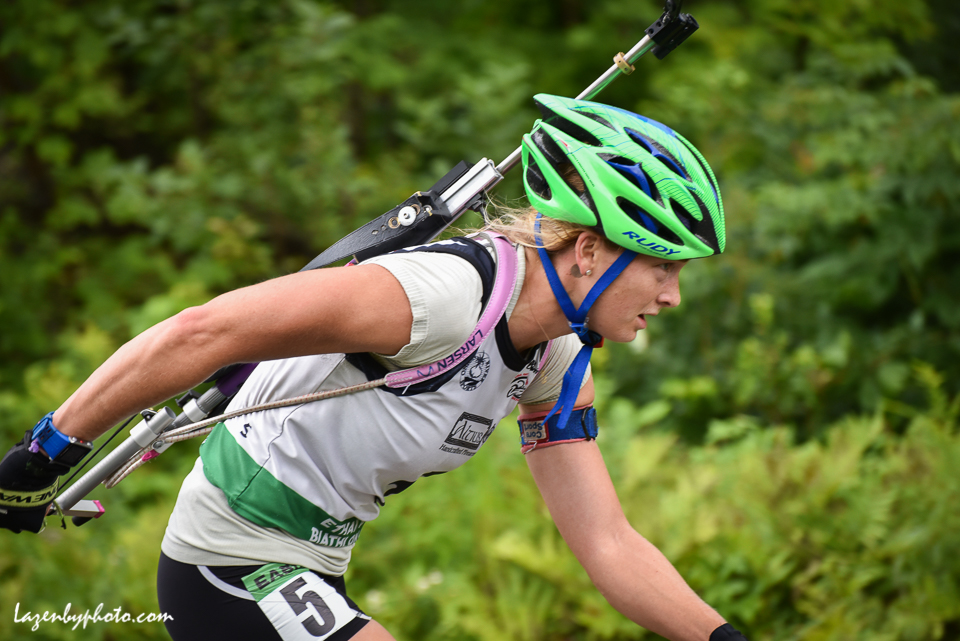
    Emily Dreissigacker (CGRP) racing to fifth in the women’s mass start at 2017 US Biathlon Rollerski Championships on Aug. 13 in Jericho, Vt. (Photo: John Lazenby/Lazenbyphoto.com)

    As she ramped up for trials, Dreissigacker spent time in Europe with the Green Racing Project. That trip also gave her time to train with national-team biathletes.   

    “Our European camp this year had much more of a biathlon focus,” Dreissigacker explained. “We did essentially the same trip as the National team so we were able to train with them some. We got to race at German summer rollerski nationals which was a great opportunity to get in more racing and also to experience a really high level of racing. And we got to ski on snow in the Oberhof tunnel. The trip was also a little earlier so after we got home I had a really solid training block in Lake Placid before an easy week at home leading up to trials.”

    According to USBA Chief of Sport Bernd Eisenbichler, this year’s version of the European training swing was beneficial for Dreissigacker.

    “The camp setup that the Craftsbury team had this summer, accompanying us on the Europe camp instead of going to the Dachstein glacier, choosing to go to the ski hall in Oberhof, helped also to have her performance level in the fall,” Eisenbichler wrote in an email. “Last year we saw that August was quite okay but then the fall, she was really really tired. I don’t know if I would get agreement from Craftsbury, but I would argue that the camp setup was smarter this year and that is why she was in better shape this October.”

    Finding form and peaking when it counts isn’t an outcome hard science can unfailingly predict. Be it her modified camp in Europe or the confidence that comes with experience, Dreissigacker performed at this year’s USBA rollerski trials.

    “Em has been on the biathlon development program for the last 2 years and on the biathlon team training plan, she works with [USBA Development Coach] Jean Paquet now most of the time,” CGRP Head Coach Pepa Miloucheva wrote in an email. “Last year the Craftsbury biathlon team did travel to Europe for a camp on snow with the skiers, this year the biathlon team  The Europe ski trip was more biathlon specific at the ski tunnel in Oberhof with the USBT [US Biathlon team].”

    Dreissigacker’s shape and shooting accuracy could serve her well as she transitions to snow in Canmore. The Canmore camp on Frozen Thunder will conclude Nov. 10. And as for the rest of the season, the IBU World Cup could be seeing a new Dreissigacker this winter.

  • Craftsbury Outdoor Center’s Economic ‘Ecosystem’ at Risk

    Craftsbury Outdoor Center’s Economic ‘Ecosystem’ at Risk

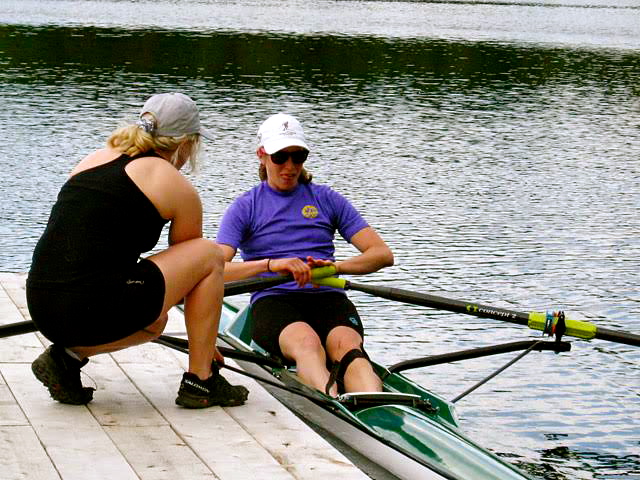
    Pepa Miloucheva (l), head coach of the Craftsbury Green Racing Project, giving biathlete Susan Dunklee some sculling instruction at the Craftsbury Outdoor Center in June 2012. (Photo: Susan Dunklee)

    A critical issue looms in Craftsbury, Vt. — home to what nordic skiers know as the Craftsbury Outdoor Center (COC).

    The COC runs sculling camps on the adjacent Great Hosmer Pond. Currently, motorboats and scullers share access on the pond. The tippy-sleek sculls are best on glassy water — meaning no wind and restricted speeds for any motor boats. Some homeowners along the pond are frustrated with what they claim is the COC’s monopolization of the pond, insisting their right to pursuits like high-speed boating, water skiing and tubing is restricted.

    But before we dive deeper, what’s this have to do with skiing?

    “What skiers may not know is that we also have a national reputation for our sculling camps which are a really wonderful place to learn how to row or get better at rowing,” Judy Geer, an owner and director of the nonprofit, said in a phone interview.   

    Sheldon Miller, COC communications director, wrote in an email that annually the sculling/rowing camps generate $1.2 million dollars in annual revenues. That revenue, in turn, underwrites many of the COC’s ski programs.

    “The Outdoor Center is a non-profit, and it basically it’s sort of like an ecosystem,” Geer said. “The more diverse an ecosystem is, the healthier and more sustainable it is going to be. We need summer activities to balance the winter activities and we need income-generating activities, like the camps, to balance the charitable work that we do.”

    Ida Sargent, a Craftsbury Green Racing Project (CGRP) skier and U.S. Ski Team member. (Photo: John Lazenby/Lazenbyphoto.com)

    COC makes the FasterSkier news cycle when it hosts SuperTour-caliber ski races or its Craftsbury Green Racing Project skiers reach the podium. In recent years, COC has become a literal savior and news peg when it comes to on-snow skiing. The northeast has been hit with repeated low-snow years, and COC’s snowmaking operation has produced a reliable skiing option. What’s less known is the community outreach at the core of COC’s mission. The “charitable work,” Geer referred to.

    Remoteness is the Northeast Kingdom’s liability and blessing. The most rural part of a rural state, the region remains postcard Vermont. But as such, local residents, including school-age children, often rely on the COC as their access to wellness.

    “Being a rural community, there are not a lot of formal recreational opportunities,” said Dave Snedeker, executive director of the Northeastern Vermont Development Association. “The Outdoor Center provides free membership to community members in Craftsbury and Albany [Vermont]. Residents of those two communities have free access to the outdoor center all year round. It’s a great benefit because most people don’t have the option of joining a gym or have a place to go. So the Outdoor Center provides that.”

    That access includes users like the roughly 850 children who visit the COC with their school in winter and have the option of using rental equipment free of charge. According to Miller, financial assistance is generous when it comes to subsidizing youth programs and offering families scholarships for its programs.

    “The Center goes out of its way to remove financial barriers to entry into the youth sports it supports — primarily cross-country skiing, biathlon, and mountain biking,” Miller wrote. “For example, Craftsbury Nordic Ski Club annual fees currently amount to $800 for a high school athlete. There are currently 29 skiers in this program, and they have year-round access to three dedicated youth and junior coaches. By comparison, the same level of annual programming costs over $2,000 in central Vermont and over $8,000 in Vail, CO.”

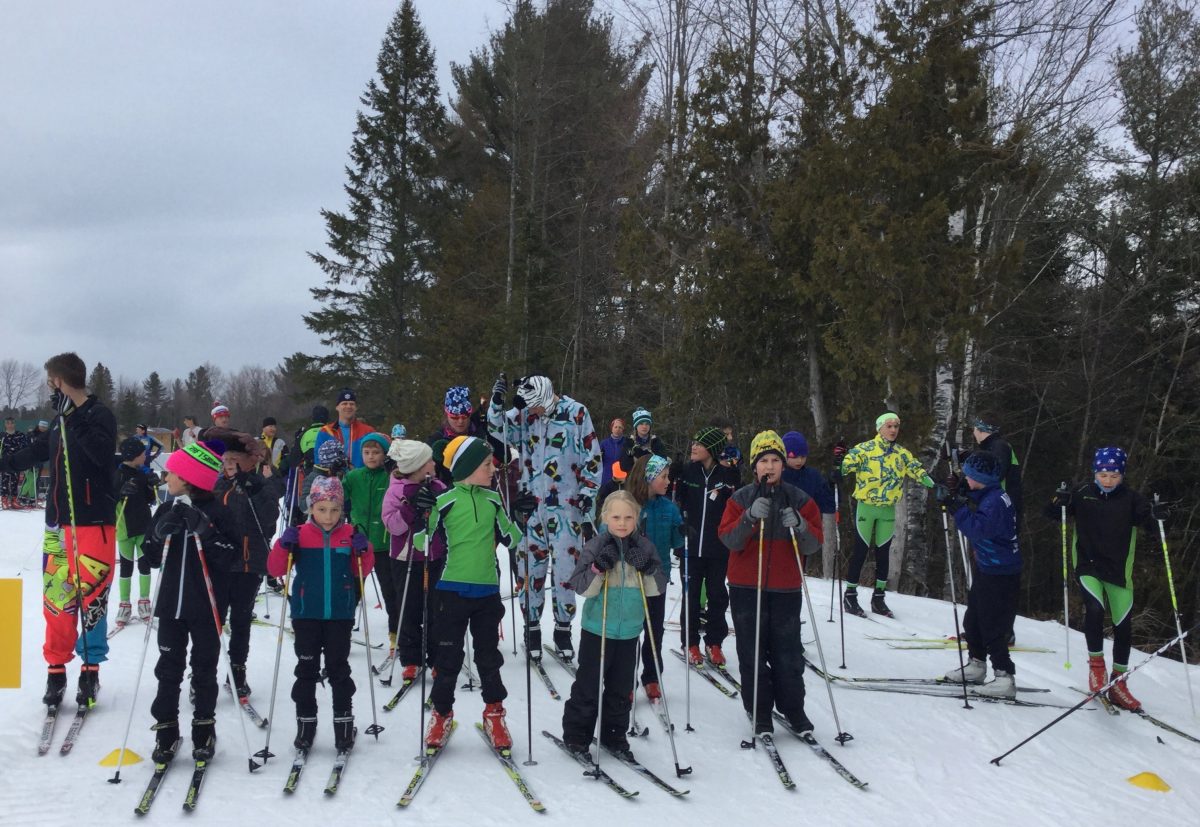
    Primed and ready for the day, some of Craftsbury Outdoor Center’s junior skiers toe the line for a fun relay. (Photo: Anna Schultz)

    Considering the regional impact, any reduction to that $1.2 million influx from the COC sculling camps could potentially make nordic skiing even more exclusive in a state with a proud inclusive nordic skiing heritage.  

    The skiing-rowing bond is tight in Craftsbury, a town with a population of about 1,100 (in 2000). As good as the skiing can be there, the rowing on Great Hosmer Pond is considered world-class. Rowers there are protected by the pond’s geography from intolerable winds. From a programming standpoint, COC could foreseeably run sculls all day on the pond, the water conditions are most often favorable.

    Here’s the watered-down version of the Great Hosmer Pond quagmire: Great Hosmer Pond is a long and skinny lake, nearly two miles in length and approximately 175-feet wide at its narrowest. By state law, a “200-foot shoreline safety zone,” exists. That safety zone means no high-speed boating, speeds in excess of 5 mile per hour within 200 feet of shore. Most spots in Great Hosmer Pond don’t meet the legally necessary conditions established in Vermont for high-speed boating.    

    But high-speed motoring on the pond, despite the pond’s geometric limitations, was granted an exception in 1995. The stakeholders advocating for higher speeds assumed the “200-foot shoreline safety zone,” was waived, too. Last fall, the Vermont Department of Environmental Conservation clarified that the shoreline rule was still in effect.

    Either way, formal regulations on the pond are rarely if ever enforced, Greer said.

    As it stands, only a few small sections of the pond are suitable for high-speed use. Even in those small areas, Vermont law still restricts a motorized boat to no-wake-speeds within 200 feet of the following: “a person in the water, a canoe, rowboat, or other vessel”.

    COC would like the state to enforce the pre-existing laws mandating speeds be limited to 5 mph where and when appropriate. Geer and Miller explained that COC has voluntarily cut back on camp participants and hours of use on the pond. These include self-prescribed restrictions like no camps on holiday weekends, an overall reduction in the number of campers for both week-long and weekend camps, and for 2017, a limit of eight out of 15 weekends between Memorial Day and Labor Day during which camps are run.

    “We really committed to staying off the lake every afternoon, totally from 1-4 and on Saturday all the way until 7,” Geer said of COC’s commitment to compromise. “We have listened, we have made changes. It hasn’t seemed to help and it hasn’t really been acknowledged, I mean it’s been frustrating. For us, we see as the age old — how do you share a community resource? In our mind, you share it to benefit as many people as you can. And you also take care of that resource so that it is healthy and sustained into the future.”

    Stakeholders on both sides of the issue are involved in community organizing and lobbying state officials. FasterSkier reached out to Sarah George, whose family owns a cabin on the pond. (George was also appointed the Chittenden County state’s attorney in January 2017.) George has spoken to the press in the past about boating use on Great Hosmer Pond, but she declined an interview request with FasterSkier. It does appear that the issue for some property owners along the lake is less about the nuances of motorboat use, and more about the idea that a business is monopolizing how the pond is used.

    An online petition, titled “Save Great Hosmer Pond”, makes the following claim on behalf of limiting COC’s sculling camps:

    “An issue has arisen where the COC and there sculling camps have monopolized much of the usage of the pond during the summer months and left camp owners unable to use their motorboats and fisherman and other users unable to access the pond due to the size constraints of the pond and having 40-50 rowing shells (20′ long) on the water at one time. Despite efforts to resolve differences between the two factions, the State Department of Environmental Conservation Watershed Division has become involved to mediate the dispute and potentially enact rules restricting motorboats and other uses on the pond in favor of this private business entity doing business on land and water that belongs to the people of Vermont!”

    The petition was posted online in January, and as of Thursday, it had 20 signatures.

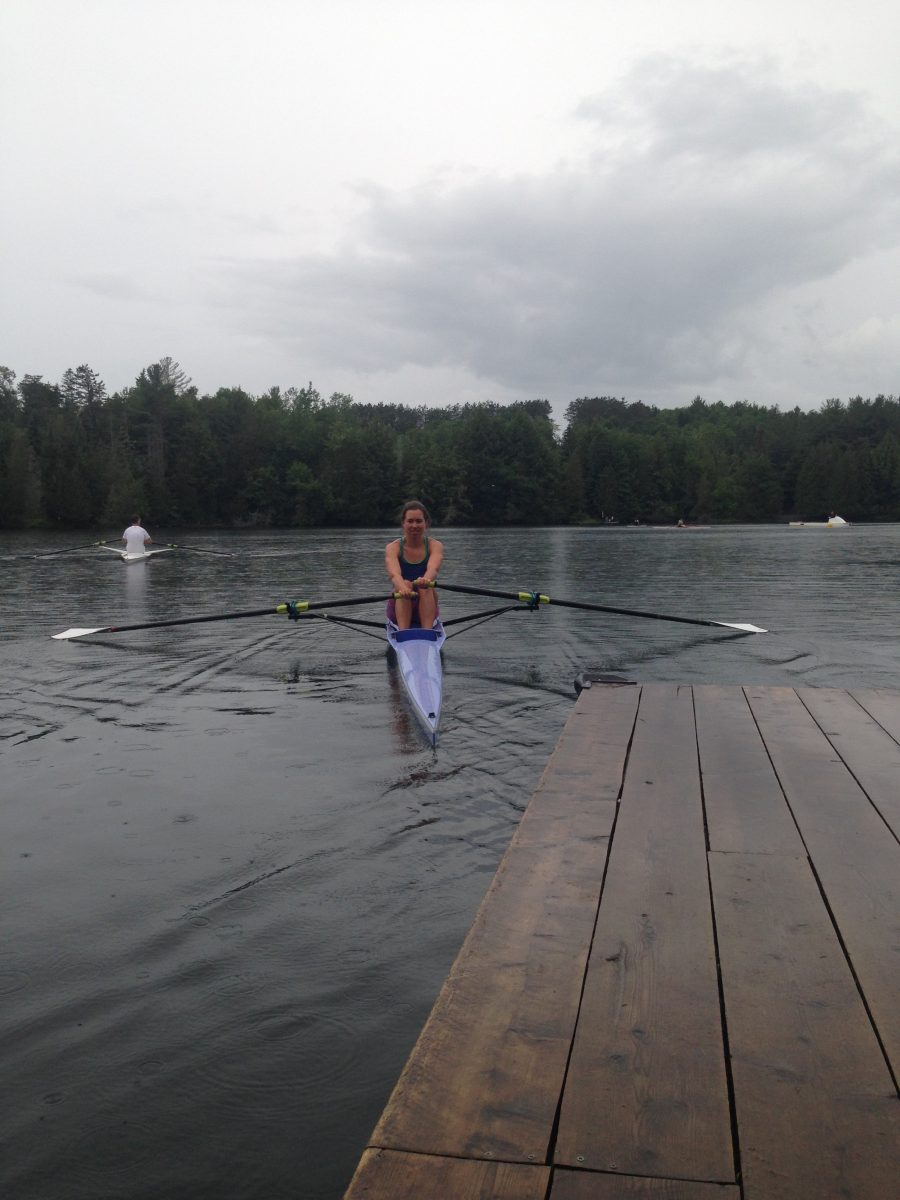
    CGRP skier Caitlin Patterson heads out on the water for a rowing workout. (Photo: Heather Mooney)

    On one side, the perception is that COC monopolizes. On the other, the reality that even a single speeding boat can monopolize by creating wakes and possibly unsafe situations for scullers.

    The Friends of Great Hosmer Pond are one group formally advocating for the state to uphold restrictions on high-speed boating.

    Gina Campoli, speaking on behalf of the organization, was concerned for both the COC’s viability and the state regulating non-motorized use on the pond.

    “Winter and summer we are really concerned that the state of Vermont would consider diminishing the outdoor center’s ability to function,” Campoli said. “And that is to undercut their rowing program, which as you know underwrite many of the winter programs. Although this is rowing story, it is going to have a direct effect on this really special place.”

    A draft proposal to mitigate the conflict was released on July 25. The only new provision was this segment: “Use of racing shells and rowing sculls is prohibited on the Pond between the hours of 1:00 pm and 4:00 pm, and the hours of 7:00 pm and sunrise, from the last Saturday in May through the first Monday in September.”

    The COC remains an anchor in the community. Beyond providing cost-effective programming, COC helps maintain the pond’s ecosystem.

    “Another thing the Outdoor Center does, there is an invasive aquatic species called milfoil, and the Outdoor Center fully funds its removal,” Snedeker explained. “They fully fund that. If they didn’t do that then that would be on the community taxpayers to bear, assuming they wanted to keep their lake clean.”

    Offsetting costs like that to the community is one of many economic benefits the COC provides the region. Snedeker said it remains one the Northeast Kingdom’s largest employers with 60 full-time employees and maintaining 100 staff during the summer season. 

    Those wages eventually makes its way into the Northeast Kingdom.

    “Those people live in the community and spend money at local businesses,” Miller wrote. “The Center pays all property and state taxes, and its guests infuse tourism dollars into local businesses. Whether people come to Craftsbury for a week-long camp or a two-day ski race, they stop at general stores, local breweries, and other points of interest along the way. Even guests who stay on campus bring money to local providers, as a majority of the food served at the Center is grown locally and local contractors and suppliers are used whenever possible.”

    Stay tuned as the decision-making process moves forward.

  • In Northern Vermont, A College Bucks Trend of Disappearing Ski Teams

    In Northern Vermont, A College Bucks Trend of Disappearing Ski Teams

    Sterling College students learning to ski. This winter, they will have a competitive team for the first time. Courtesy photo.
    Sterling College students learning to ski. This winter, they will have a competitive team for the first time. Courtesy photo.

    CRAFTSBURY COMMON, Vermont— Over the last decade, college ski teams haven’t exactly been thriving. Sure, the level of skiing by American college skiers at NCAA Championships seems to have taken a huge step up – winning the season-capping races is no longer an honor reserved for European scholarship racers – and college skiers are now more likely to earn a spot on the U.S. Ski Team or compete in World Cups. But for the community as a whole, it’s been a rough go.

    All over the country, programs have disappeared. Western State University in Colorado cut its NCAA team, and nordic skiing is now a club. The same happened at Whitman University in Washington and Carleton College in Minnesota. The University of Nevada ski team, one of the most successful of this bunch, was cut in 2009. In 2011, the College of Saint Benedict and Saint John’s University, partner colleges in Minnesota, also eliminated their clubs. That’s just to name a few.

    But in a small town in northern Vermont, one college is going against the grain. Sterling College, with an enrollment of about 120 students, announced this week that it was adding a club ski team.

    At first glance, Sterling doesn’t seem like the most logical candidate for a ski team. There’s that tiny student body, and a correspondingly sized budget. The college is also focused on the environment, sustainability, and agriculture. In fact, until now it hasn’t had any competitive athletic program at all.

    “People often think about Sterling – and we do too – as being very community-oriented and very supportive,” laughed Dean of the College Pavel Cenkl in a recent phone interview. “Some folks might consider that to be antithetical to competition. But what we’ve seen, particularly recently among our students, is that it actually really helps to create a very supportive environment for training and for getting ready for competition.”

    Sterling has one other thing going for it, too: it’s based here, right next door to the Craftsbury Outdoor Center and its 85 k of trails. That makes a ski team at Sterling practically a no-brainer.

    “We’re really excited about that and it just makes so much sense I think,” Cenkl said. “We’re the only college in the United States that has this size and caliber of a nordic center on its campus – we have trails on campus actually – so we hope it will be a draw for students from outside as well as fill a need for students that we have here… [The team] is open to everybody.”

    Anyone who has skied at Craftsbury has likely seen Sterling: situated at the south end of the Common, its classic white New England buildings are part of the town’s character. The Grand Tour trail passes through the village, as does the Catamount Trail. Olympic trials were held here in 1972 – “Bill Koch skied by our buildings,” Cenkl says – and numerous Craftsbury Marathons have started, finished, or passed by the Common.

    A relic from Sterling's older days as a boarding school. Photo: Sterling College website.
    A relic from Sterling’s older days as a boarding school. Photo: Sterling College website.

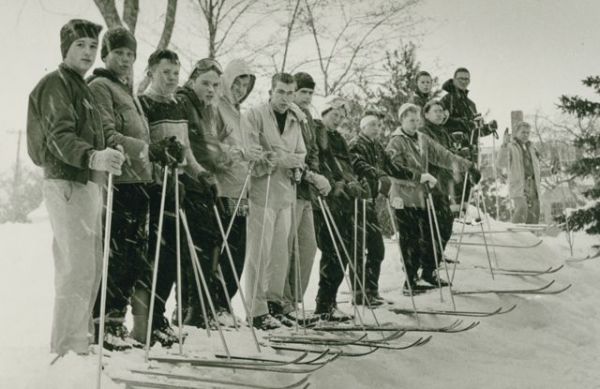
    Sterling was founded in 1958, and the black-and-white photo atop the ‘About’ page of its website features 13 young men on skis. The college is tied to the land in multiple ways; sports is usually more or less incidental. Its mission is framed in the language of environmentalism and good old Vermont stoicism:

    “The Sterling College community combines structured academic study with experiential challenges and plain hard work to build responsible problem solvers who become stewards of the environment as they pursue productive lives.”

    The college offers four majors: Ecology, Sustainable Agriculture, Outdoor Education, and Environmental Humanities. It features four “living laboratories”: a farm, two swamps, and a sugarbush. Students can choose classes like Environmental Policy and Law, Renewable Energy Design and Analysis, or Draft Horse Management. In January, they could sign up for a two-week cheesemaking intensive at an acclaimed farm in nearby Greensboro.

    But the college also requires experiential learning, like a January course where all students try out cross country skiing a few times, among other activities. If they like it, they have been able to take a more advanced class in the winter, and another class even takes a backcountry skiing trip to Idaho.

    A ski team will add an important new set of opportunities for students. Starting a team became possible when the Craftsbury Outdoor Center hired a new coach, Zach Russo, for its junior program. Cenkl talked to the Outdoor Center and the organizations agreed to share the new staff member, so that Russo will coach the college’s team a few hours a week as well.

    Skiing isn’t the only thing that Sterling is adding; Cenkl is teaching a trail running class which will soon be formalized as a team. Is it the traditional ‘rah rah’ college athletics? Not exactly. But Cenkl sees a use for sports, and is committed to trying to add the ones for which there is student interest.

    “We’re not going to field a football team any time soon,” he chuckled “But we’re always open to whatever student interest might be, or if we get faculty with particular expertise or connections.”

    So far this fall, he has seen that it makes a big difference to students on campus.

    “We met at 5:30 this morning to go running by headlamp at the Outdoor Center trails, and the students absolutely love it,” he said. “One, they get up at 5:30 in the morning to go running, which is great, and we’re working together to prep for a 10 k race that we’ll be doing in Nashua, NH, in November.”

    Sterling students at Charley's cabin, a winterized warming cabin on the Craftsbury Outdoor Center trail system. Courtesy photo.
    Sterling students at Charley’s cabin, a winterized warming cabin on the Craftsbury Outdoor Center trail system. Courtesy photo.

    The college is in talks to finalize its membership with the U.S. Collegiate Ski and Snowboard Association (USCSA), a league of club and Division III teams. Cenkl anticipates that Sterling will compete in some league races against schools like Cornell, Clarkson, and Paul Smiths College. But he also hopes they might do some regional citizen’s races in New England, like the Craftsbury Marathon or other competitions in NENSA’s Marathon and Zak Cup series.

    Russo, the new coach, competed for and helped head up the Clarkson University ski team when he was a student. As the two men talked, Cenkl found that the atmosphere on Russo’s old team, as well as at USCSA races, was very appealing.

    “It was so in keeping with what I had envisioned for Sterling: a very student-oriented, very collegial environment, low-stress,” he explained. “It seems like that league will fit really well with extending the teaching.”

    But it will also serve another purpose. Sterling students are traditionally engaged in their community around Craftsbury, but don’t have quite so much contact with other colleges.

    “So it’s a way to tie the community together while looking beyond the Northeast Kingdom and making some connections with the outside world,” he said. “We could maybe expand our relationships with other colleges, and build on some of the longer relationships we’ve had with places like the Craftsbury Outdoor Center.”

    On the Outdoor Center’s part, it was also a no-brainer to partner with Sterling. Although the Center is best-known in the ski world for its northerly location that assures snow, its additional snowmaking capacities, and its elite Green Racing Project team that has helped launch athletes onto the U.S. national teams for skiing and biathlon, its actual mission is more in line with Sterling’s.

    From its website, the Craftsbury Outdoor Center’s mission is:

    1. to support and promote participation and excellence in lifelong sports with a special focus on rowing, nordic skiing, and running;

    2. to use and teach sustainable practices; and

    3. to protect and manage the surrounding land, lake and trails.

    In an e-mail this weekend, Judy Geer, who bought the center in 2008 with husband Dick Dressigacker and turned it into a nonprofit, confirmed that the partnership just made sense.

    “We’re excited to see them starting this team, and as we started to put together a job that would appeal to a good candidate for our junior coach, it fit well to be able to include the Sterling piece,” she wrote. “We were able to collaborate on attracting and compensating our coach. In terms of the mission, it really fits the first prong.”

    Sterling has an advantage in how well its mission matches with Geer’s goals, but its reasons for starting a ski team are also important in its success. Perhaps the struggles faced by many former NCAA teams have more to do with budget and scale.

    Starting a club team isn’t difficult, Cenkl reported; aside from the dialogues on campus, he is mostly responsible for joining the USCSA, which is “not particularly onerous, as opposed to the NCAA or something.”

    If your goal is to win a Division I Championship? Yes, that will be expensive, difficult, and complicated. But that shouldn’t be the only reason that colleges field ski teams.

    “It seems like a natural extension of our ecological focus, community orientation, and environmental awareness,” Cenkl said. “And extracurricular activities can try to formalize your goals.”

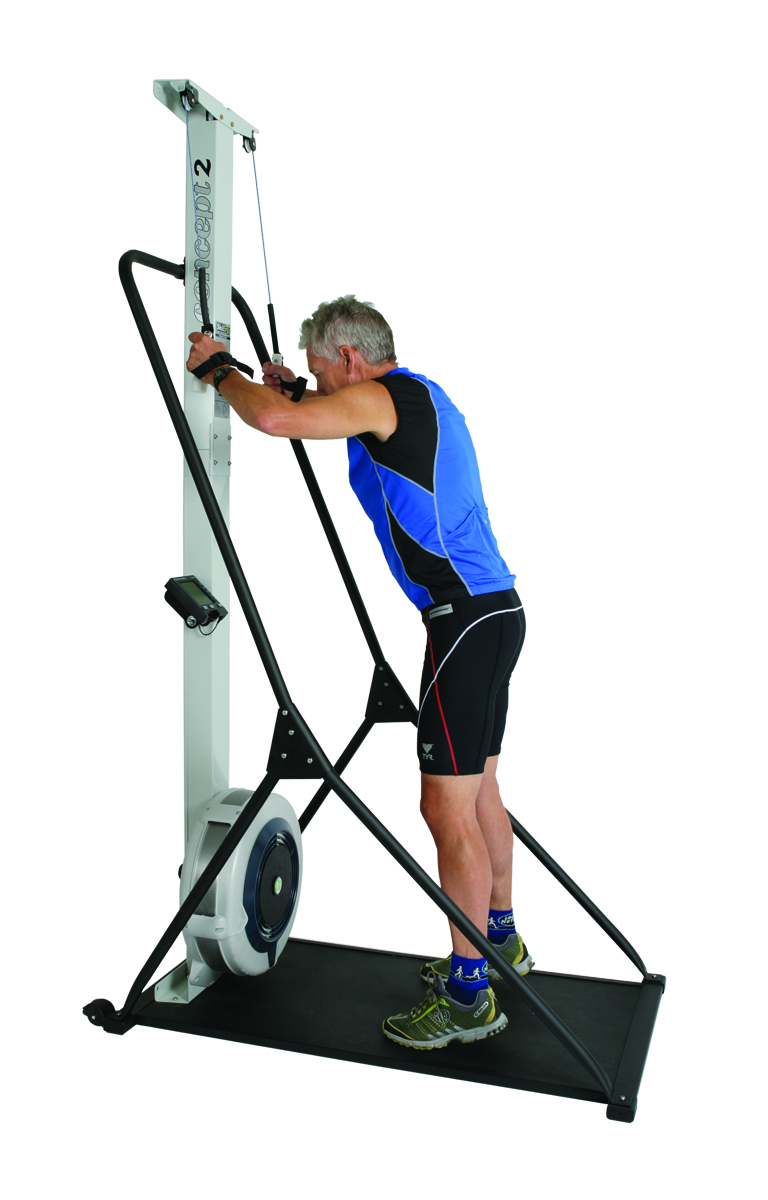
  • SkiErg Training Tips from Judy Geer

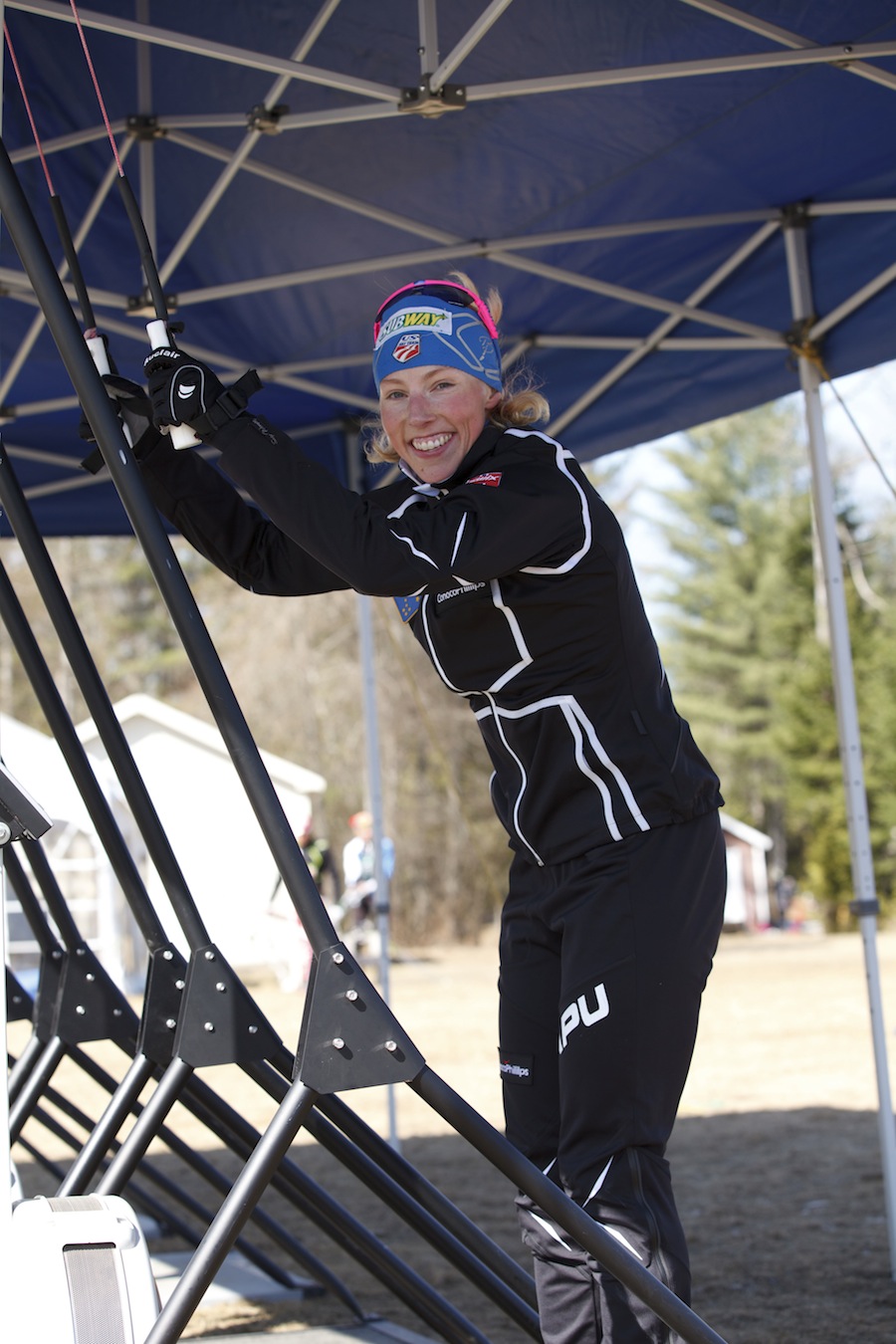
    The U.S. Ski Team's leading woman Kikkan Randall using the SkiErg. She's been using it this year to rehab an Achilles issue.
    The U.S. Ski Team’s leading woman Kikkan Randall having fun with the SkiErg. She’s been using it this year to rehab an Achilles issue.

    Know Where You’re Starting From!

    Over the past month, skiers and biathletes around the world have been getting back to training. For many of those at the upper levels, this means a round of testing. It might be VOmax testing on a treadmill or SkiErg, strength testing of various sorts, uphill runs, double pole rollerski time trials—there’s a wide variety, but the important point is that it makes good sense to test at the beginning of the training year so that you have a baseline from which to measure your progress.

    Most of us don’t have ready access to a rollerski treadmill, or a VOmax lab, so we find other ways to test ourselves. Ideally, the test(s) should be repeatable and accurately measurable, so that results can be compared from one time to another and offer meaningful guidance.

    If you have access to a SkiErg, it’s a good option testing option because it doesn’t have the innate variability of most outdoor tests. And the Performance Monitor is self-calibrating so tests can also be compared from one SkiErg to another. Compare your results with a friend in Europe, or across the US.

    Here are some test distances you might consider using in your own testing protocol. Several of these are also included in the Concept2 Online Ranking, and SkiErg Performance Series, so you can see how you stack up there as well.

    SkiErg by Concept2

    • Speed/Power: 30 seconds
    • Sprint: 1000m
    • Distance: 2000m
    • Distance: 5000m

    …and Make Sure You Get Where You Want to Go

    The one kind of training that we all hope to avoid is rehab, but sometimes it is unavoidable, whether due to overuse or accidental injury. The challenge becomes finding good training activities that can still be done without hindering the recovery of the injured body part. Recovery from injury demands patience, determination and creativity. On the bright side, these are all good attributes to develop and you may find new training modalities that you truly enjoy. And a lower body injury may help you make significant gains in upper body strength and power, and vice versa. But enough of the optimism!  Injuries are not something any skier wants to deal with.

    We’ve heard from a number of skiers who have found that the SkiErg can be a really helpful training tool during the rehab period for lower body injuries. Pull up a stool, or spin bike, and you can do any kind of workout you want: from intervals to distance. Or, if you can stand but can’t bend your knees, you can ski that way as well. Ideally, through your rehab period, you’ll be able to progress from seated to straight-leg standing to full use of your legs.

    We sincerely hope that it is not injury that introduces you to the SkiErg, but if it is, we hope you find it helpful and we wish you a speedy recovery!

  • After Roll-Run-Row, Craftsbury Skiers Primed for Season Ahead

    After Roll-Run-Row, Craftsbury Skiers Primed for Season Ahead

    Start of the Craftsbury Outdoor Center’s Roll-Run-Row, a race which tested the program’s elite skiers against its elite rowers, on Oct. 3 in Craftsbury, Vt. (Courtesy photo)

    It downpoured across much of the Northeast on Wednesday. Those at the Craftsbury Outdoor Center in northern Vermont hardly noticed. Owner Judy Geer called it “drizzle.”

    That morning, about 20 Craftsbury Green Racing Project (CGRP) athletes and coaches participated in the second annual Roll-Run-Row race, which pitted the some of the nation’s best nordic skiers against top-tier rowers. All belonged to the same program, but the idea was to have some competitive fun while pushing individuals out of their comfort zones.

    This summer, the Outdoor Center started an elite-level rowing team similar to the nordic one. The result was an increase in high-level athletes for a total of 14 skiers and five rowers, most of which live and train there.

    According to Geer, the skiers spent time before the race teaching the rowers how to rollerski. In turn, the rowers provided some pointers on Hosmer Pond. The field included one rower, Peter Graves, who represented the U.S. at the London Olympics this summer as well as Lynn Jennings, a three-time World Champion in cross-country running.

    The race itself involved point-to-point rollerskiing, running and rowing legs, which took the winner, rower Kyle Lafferty, about 30 minutes to complete.

    Craftsbury Green Racing Project skier Gordon Vermeer (front) finishing up the rollerski portion of the second annual Roll-Run-Row in Craftsbury, Vt. (Courtesy photo)

    Craftsbury’s nordic coach Pepa Miloucheva estimated the uphill rollerski was about 2 kilometers long, the run was about 3.5 k, and the row was about 2 k with two 90-degree turns.

    “There were some big gaps between the winning and last times in the rollerski and the rowing legs, but was a hard effort for all for sure,” she wrote in an email.

    There were no gender or age categories; finishers classified as overall. Craftsbury skier Clare Egan placed second and Gordon Vermeer represented the nordic guys in third.

    Vermeer is one of four newcomers to the Craftsbury’s elite cross-country team. This spring, he graduated Dartmouth College and, like his teammates, began the transition to full-time training.

    According to Miloucheva, she couldn’t ask for much more from athletes like Vermeer, including former University of Vermont (UVM) grads Alex Howe, Caitlin Patterson and Amy Glen.

    “The new athletes this year are great,” Miloucheva wrote. “All were able to adjust to the new training regimen without a problem and make some good fitness and technical improvements. … We have a big team this year, but it has been great to see them challenge and enjoy pushing each other, during practice.”

    Some highlights this summer included hosting the New England Nordic Ski Association (NENSA) Regional Elite Group and J2 national camps in Craftsbury, and training with the U.S. Ski Team in mid-September in Lake Placid, N.Y. According to Miloucheva, most of her athletes have stayed healthy and avoided serious injuries, and enjoyed a productive and busy training season.

    “Right now we are into a hard training block before we leave on our first big trip this winter,” she wrote of the entire team’s departure for on-snow training in Canmore, Alberta, on Oct. 25. “[We’ll go] straight to Yellowstone from there for the first [SuperTour] races of the season.”

    ***

    A few weeks ago in Lake Placid, FasterSkier caught up with two CGRP rookies: Patterson and Glen. Here’s what they had to say about their season so far:

    Former UVM skier Caitlin Patterson (Craftsbury Green Racing Project) during the Roll-Run-Row in-house event on Oct. 3 in Craftsbury, Vt. (Courtesy photo)

    FasterSkier: What’s it like being part of a new team?

    Caitlin Patterson: It’s been great. I think it’s easy to get used to the atmosphere of the team. It’s a good group of people and the training is similar to what we’ve done before.

    FS: But it’s got to be different from college skiing, right?

    Amy Glen: It’s definitely different. Your job is your work now. And then we do work [at the Outdoor Center] in our free time, but it’s more, like, for fun almost.

    FS: How’s the transition to full-time training?

    CP: For me it hasn’t been very tiring at all, probably less so. In past summers, I was doing a lot more. Last summer I was working almost a full-time job and training full time and this is a lot more laid back. At Craftsbury, we eat all our meals in the dining hall so we don’t have the food-prep piece, so it’s been pretty relaxing.

    FS: How did you approach two weeks of training in Lake Placid with the U.S. Ski Team?

    CP: I think it’s kind of a fun opportunity to train with other people. It doesn’t really matter if your first, even in [a] sprint situation, or certainly not in a workout. As long as you can have fun and talk to some people who you haven’t seen in a while or maybe get to know some of the juniors who are here, that makes it fun. To ski on different terrain, that helps keep the excitement up.

    Former UVM skier Amy Glen, who won an NCAA title in the 15 k classic race on March 9 at Bohart Ranch in Bozeman, Mont.

    FS: What are some of your goals for the racing season?

    AG: Ski as fast as I can.

    CP: Changing to a new training program coming out of college, you have high expectations, but you can’t be unreasonable about it. It’s not the end of the world if things don’t go quite as well as they could. But I’d like to be optimistic that it should go well for all of us because of the training program.

    There’s the early season races and then West Yellowstone and Bozeman and leading up to the World Cup, certainly it would be great to qualify for those. I think for any of us on this team, it’s a realistic possibility. From there hopefully we have some Europe trips planned and nationals and U23’s for any of us still in the age group. All sorts of fun stuff.

    FS: How would you describe your team?

    AG: Funny.

    CP: Lots of humor on a daily basis. Everyone’s really serious about training, too, but we can be serious at the same time as your having constant competitions. The guys are having a lot of competitions, strength and whatever else. I think we laugh a lot and have good fun with it.

    ***