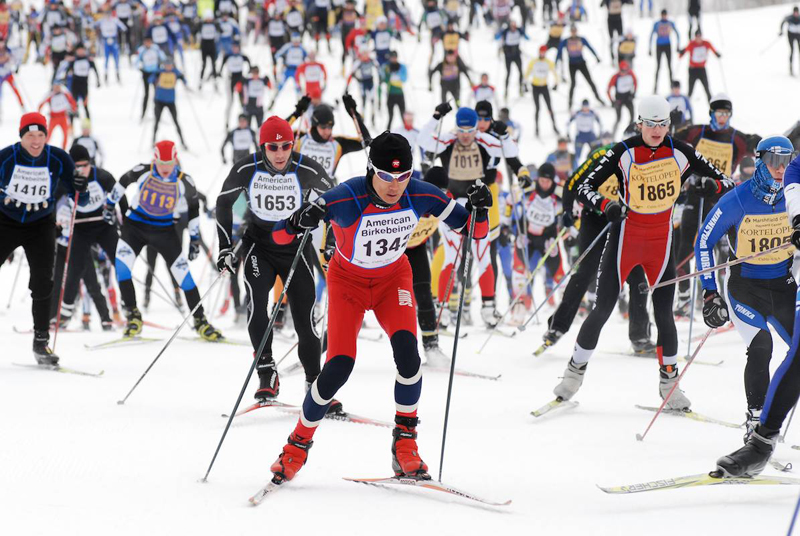
The 38th annual American Birkebeiner, held in sub-zero and single-digit temperatures with record particpation, saw two sprint finishes to crown the men’s and women’s Birkie freestyle champions and a pair of UVM alums ski to sizable victories in the Birkie Classic on Saturday.
Norwegian Tore Martin Gundersen won the 50K Birkie Freestyle race with a time of 2:00:32.8, furiously outsprinting his nearest opponent, Benoit Chauvet of France, by less than a second. Twenty seconds later, third through twelve places were decided in less than ten seconds. Andrey Tyuterev of St. Petersburg, Russia took the final spot on the podium in thir dplace. Bryan Cook of CXC was the top American in fifth overall, with CXC teammate Brian Gregg the second American in seventh place.
In her first Birkebeiner, Caitlin Compton of CXC broke the women’s 50K Freestyle course record today and took first place with a winning time of 2:15:26.0. APU’s Morgan Smuth and XC Oregon’s Evelyn Dong kept it close all the way to the line finishing just three and eight seconds off Compton’s pace for second and third place, with the top three finishers all dipping beneath the previous course record set by Rebecca Dussault in 2010.
“It was great to see [Caitlin] take the win, as she led a lot of the race and really pushed the pace in the last 10k,” said Smyth, who was racing in her first 50K. “She did a lot of the work, it was a well deserved win.”
Finishing alongside its freestyle counterpart, the Birkie Classic was contested, and saw two University of Vermont alums picking up victories. 2010 Birkie Classic Champion Jerguen Uhl (VTXC) defended his title, pulling ahead of Karl Nygren (CXC) and Eric Wolcott (CXC).
Uhl’s former UVM teammate Jennie Bender, skiing for CXC, grabbed the women’s Birkie Classic title by an impressive seven minutes over Kerrie Fabius of Thunder Bay, Ontario. Hilary Patzer of St. Paul, Minnesota took third, another minute and 40 seconds back.
“It was great!” Bender told FasterSkier of her first ski marathon. “My wax was great… it was definitely abrasive, but the CXC coaches did a great job. I skied with a lot of the men and kind of jockeyed back and forth. It was freezing outside, but it felt pretty awesome.”
Ned Zuelsdorff, Executive Director of the American Birkebeiner Ski Foundation, said skiers from 19 foreign nations, including Latvia, Israel and Denmark, and 47 U.S states, including Hawaii, North Carolina and Alaska, had great conditions for the 38th anniversary event.
Honorary Starter, John Schmitt, the voice of Birkie for 19 years welcomed the largest field of skiers ever in the American Birkebeiner’s 38-year history. He sent over 8,850 skiers on their way beginning at 8:00 a.m.
Temps hovered around 10 degrees below zero at the start as 21 waves of skiers left the starting gates.
The American Birkebeiner is modeled after the Norwegian Birkebeiner Rennet, which in turn was inspired by the historic rescue of the infant who would become a celebrated king, Haakon Haakonsson IV. The race symbolically re-creates the flight of the prince, carried on skis by warriors called birkebeiners for their protective birch bark leggings.
Long time friends Gale Otterholt and Marv Franson assumed the roles Torstein and Skervald, the Birkebeiner warriors who rescued the infant Prince Haakon (H?-ken). Otterholt a retired pharmacist and college professor and has completed 33 Birkies and also from Eau Claire, Franson, a retired Dean and Electronics Instructor, has skied 34 Birkies.
Long time Birkie skier and friend of the Warriors, Gretchen Lindgren, dressed as Inga from Varteig, mother of Prince Haakon, while her grandchild Finnley assumed the role of the cherished prince.
The men dressed in full Birkebeiner regalia including helmets, shields and their wooden skis skied to the finish line to the clang of cowbells from the thousands of spectators who lined Hayward’s Main Street.
Gretchen skied the full 54 kilometers dressed in a traditional Norwegian dress and cloak, on wooden skis and carried Prince Haakon on her back for the trip up Hayward’s Main Street.
“The historic re-enactment, fast race course and the largest field ever made the Birkie’s 38th anniversary one for the books,” Zuelsdorff said. “We couldn’t be more pleased.”
Icy trails and strong winds greeted the competitors in the 2011 Gatineau Loppet in Gatineau, Quebec, Saturday.
A thaw in the previous two days reduced the snow pack significantly, forcing a few changes in the course. The race was rerouted to the widest and flattest sections of the Gatineau Park, the large area of park land where the race is held.
In the 49 k classic event, Juergen Uhl of Burlington, Vermont, took the win in a time of 2:30:26.1, just ahead of second place Matthias Purdon of Ottawa, Ontario, who races for the local competitive team XC Ottawa, in a time of 2:30:29.5. Nansen Weber of Chelsea, Quebec finished third in a time of 2:32:32.8.
Stephanie Howe, of Bend, Oregon was the fastest woman over 49 k, turning in a time of 2:56:44.
Uhl, a former NCAA champion and German import who is now skiing for VTXC, recently returned from World University Games in Erezeum, Turkey. Uhl represented Germany at the event, and suffered from the stomach flu, but if he was feeling an lingering ill effects from the trip, he didn’t show it Saturday.
The day was a difficult one for waxing – temperatures on Friday were well above zero, and then dropped overnight, creating frozen, icy tracks. Finally, just before the 9 AM start, it began snowing, and around 2 centimeters of fresh snow covered everything.
As a result, many found it either faster to double pole the entire course, or that was simply the only option due to a lack of grip. While the course featured some lengthy climbs, were mostly long and gradual, as the change in course took out most of the steep pitches in the back trails of the Gatineau Park.
After 48.5 kilometers, it came down to a three-man shoot out in the last 500 meters. Uhl was leading Phil Shaw of Rosemere, Quebec, and Purdon as they descended the last hill and entered the flat run into the stadium, and faced a 55 km/hr head wind. However, as they rounded the final corner, Uhl upped the pace, and the other two were unable to match him on the finishing stretch.
In initial results Shaw finished second, but the winner of the same event last year was later disqualified.
In the 28 k classic event, Sean Thompson of St. Bruno, Quebec, emerged victorious in a time of 1:24:46. But the battle was for second place, as Timothy Plante, also of St. Bruno, finished in 1:27:43.1, beating Nicholas Underwood of Queensbury, Vermont, who was just behind in 1:27:44.9.
The Gatineau Loppet continues Sunday with freestyle events, a 51 k and a 28 k, as well as a few shorter races. The two longer races have been modified to use a few more technical trails which have been determined in good shape.
Juergen Uhl en route to NCAA glory two years ago. Photo, flyingpointroad.com.
VTXC team member and former University of Vermont (UVM) standout Juergen Uhl, a 2009 NCAA champion in the men’s 10 k classic, recently competed at the World University Games in Erzurum, Turkey. Unfortunately, Uhl came down with the stomach flu upon arriving in Turkey, which stymied his efforts on the trails. Nevertheless he finished 25th in the 10 k classic and 42nd in the 15 k continuous pursuit while representing his home country, Germany.
Uhl wanted to be sure to thank the UVM coaches and athletes for their support, as well as the group around VTXC, especially Sam von Trapp and Ryan Kerrigan, who made the trip possible.
FasterSkier caught up with Uhl to talk about his experience at the University Games, and what skiers can expect to find when the site hosts World Junior and U23 Championships next year.
FasterSkier: Why did you decide you wanted to do the University Games, and what did you have to do to qualify?
Juergen Uhl: I am pursuing a Masters degree at the University of Vermont and I love ski racing, but my NCAA eligibility is done. So I decided that it would be fun to set myself a goal for the season that I can reach, and that is a little out of the ordinary. I had heard about the University Games through friends and it seemed like it was just the event that I was looking for. I checked out the conditions for me to take part in it. The great support by my advisor, Professor Douglas Fletcher, and the fact that Germany requires one race below 100 FIS points made me believe that I could do it!
FS: It looks like you were the only German skier over there – did you have support?
JU: The German team is fairly small in numbers compared to the teams of other large sports nations, however we still have about 25 athletes and a full delegation of officials, coaches, athletic trainers and a doctor. I am the only cross country skier, but we have a couple of nordic combined guys and a couple of biathletes who need support on the race course. The five of us shared a coach and a wax tech, which worked out to be perfect.
FS: The 10 k classic would obviously have been your best race… but you were sick. How would you say your race compared to what it would have been like if you were healthy?
JU: I just felt flat for the races due to the stomach flu earlier in the week and the marathon of events that we had when we arrived in Turkey. My striding was not as powerful, and I ended up getting tired early in the race. I was racing, but I noticed during the race that I really was not able to give as much as I usually would. It is very hard to place myself for the case that I would have been healthy- I think for a good race I would have just cracked the top ten. FS: Could you describe the level of competition? I saw some names I recognized in the women’s field at least – it looks like there are some really fast people but also a pretty big spread in talent. Is that accurate?
JU: The spread was large – yes. The winner in the 10 k classic race for the men was about 55 seconds ahead of the second competitor and the last person finished 15 minutes back.
I checked out the FIS profile for the winner, from Russia – he was 13th in the 15 k classic World Cup race a couple of weeks ago in Otepaa and he won the 15 k classic at the U23 Worlds in 2010. The last finisher is from Venezuela. He made the trip to Turkey to get good FIS points (300) so he would be able to race in the next Olympic Games.
To sum it up, the field was made up by a hand full of top racers, a dozen semi-professional skiers who are maybe taking one class and race on the Europa Cup circuit, and a large amount of true collegiate racers and some students who enjoy ski racing but may or may not be following a training plan. FS: You said it was like a small Olympics and there was tons of stuff to do. What are some of the activities and programs?
JU: The event has a funny touch in that sense – most competitors are second level racers, meaning that they are good but they would not be racing on the World Cup circuit, except maybe the first three or four for each event. However the event was organized close to what I think the Olympics would be! There were more than 3,000 competitors from a total of 56 nations.
The schedule we followed in the beginning was crazy, especially because going for a ski itself already takes a long time. We stayed in an athletes’ village with security screening every time you enter and free meals. This also meant that we didn’t have our own vehicles, but everyone used the organized transportation system. The system sort of worked – the occasional very late departure and wrong turn on the way to the courses didn’t really help in saving time considering that the ride itself takes about 40 minutes when things go well. So a one hour ski already took at least four hours of time.
But finally to the program. In the beginning of our stay we had a fair amount of official appearances to make. We arrived late on Tuesday, a short ski on Wednesday – then we were asked to take team pictures directly followed by a flag ceremony and directly followed by an appearance at the embassy to meet with the German ambassador. And since my bags had not arrived the first day, I went on a trip to the airport to get them, which gave the day another late night finish.
Thursday ended with the opening ceremony, which would conclude at midnight- nice race prep! I decided to go anyway. I mean, I was tired from getting over the stomach flew and all the events but I was told that it would be a great event. It was. Germany was the first country to enter the stadium – it was sick. 21,000 people including the president of the country were cheering while we walked around the track, and there was an amazing show after. Oh yeah – there was the lighting of the torch! It was a scene that reflected the horse and fighting culture of the Ottoman Empire – the final part was that an Ottoman on a horse threw his burning javelin from about 30 yards over an oversized torch in the stadium to light it up. FS: Have you gone to watch any of the other sports?
JU: Yes. I stayed with the nordic combined guys, so I ended up watching most of their events. I also watched pretty much every ski jumping event because the jumps are right in town next to the village and there is no bus ride necessary. I watched a curling game, skier cross and some figure skating. It was easy to catch most of the events at least on the screen because they were all fully televised on eurosport2 and all the events would be shown live on a big screen within the village and on several screens in the dining hall. Another crazy add-on to this is that they use the newest camera techniques. A flying camera on the ski jumping complex and in the stadium for the opening ceremony and even a driving camera on the finishing 100 meter stretch in the Cross Country stadium. FS: What’s been your favorite part of the experience so far?
JU: I don’t think there is a single favorite thing. There will be so many memories (except maybe the races…) that I will be taking home from this place. The opening ceremony is definitely right up there though! Then there is funny/frustrating ones:
They groomed the classic course about five minutes before the start.
Every nation brings along pins and apparently everybody wants them. A normal conversation with one of the volunteers: “Where are you from?” “Germany.” “Ah, I like Germany. Pin?”
The amount of pictures that I am in doubled in the last two weeks.
Turkish men walk arm in arm as a sign of friendship. I went on a City tour and the guide seemed to like me.
I was able to get up on the jumps during the last competition – it was fun to see how the guys prepare.
There are many more – in general I would say that my main experience is that Turkish people are very nice and welcoming people, especially once you know a couple of words in their language. They eat good food, they are always on the phone and they love sports. The nordic events were too far away but all other events were blessed with full bleachers. However they are not a winter sports nation, which caused sometimes trouble with the race preparations. FS: Finally, World Juniors is there next year so everyone is wondering what it’s like to ski in Turkey. What is the venue like? How are the trails?
JU: I think that the people will enjoy the venues! The jumps are definitely the highlight of the place and will be for the events next year – but the race trails for the nordic complex are not far behind.
The nordic events will be in Kandili, which is about 40 minutes out of Erzurum and close to 2000 meters high. The climate, landscape and the snow very much reminded me of Utah, so a ski that works in the dry western snow will be good to race on here. Our wax tech, Fabian Mauz, went to school for climate research. He was a wax tech for the Swiss team and one of the people who did climate studies in Soldier Hollow for the Olympics. He confirmed that snow and the way it transforms was similar. An example would be that our thermometer (in the sun) would show 20C but we ended up racing on hard wax.
The race courses are hard! It reminded me of the race course at the jumps in Lake Placid. The uphill is a bit longer and steeper but that may have felt that way because I was not 100% fit, and it is at altitude. They have two 2.5 k and two 3.75 k loops; there may be a 5 k loop if there is snow. The courses are all on the same little hill – both 2.5 k loops go up the hill and back down. The 3.75 k loops are similar in a way that they are the same for almost all of the 2.5 k loop but you end up going back down almost all the way once or twice to make your way back up to the top.
I am sure they got enough feedback on the grooming so things should go smoothly. They have enough snowmaking and new equipment. It will be a perfect venue.
A final remark would be that you need to go out for cai kebab – it is a special kind of kebab and Erzurum is famous for it. It is lamb meat, so fairly greasy. I did not have any trouble with it but I heard that some people did. So I would not recommend it as a pre-race dinner.
Vermont already has one elite racing team in the Craftsbury Green Racing Project, but Ryan Kerrigan still thinks there’s room for another.
Kerrigan is the captain of a new squad based in Stowe and organized under the aegis of the Von Trapp Family Lodge, the resort just outside of town. Dubbed VTXC both in honor of the state and the Von Trapps, Kerrigan and his crew are targeting races on the New England circuit, as well as a few higher-profile events.
Kerrigan, a former University of Vermont (UVM) skier who works at the lodge, said that VTXC is designed to provide support for athletes that aren’t ready or willing to commit their whole lives to the sport.
“There’s a lot of post-college skiers pursuing other careers during the work week…skiers who can’t commit to a full-time program,” Kerrigan said in an interview.
Juergen Uhl will race for the VTXC team this coming winter. Photo, flyingpointroad.com.
As an example, Kerrigan cited former UVM skier and NCAA champion Juergen Uhl, who is now working on a graduate degree. The rest of the team consists of a mixture of seasoned veterans and young talent, including Eli Enman, former UVM standout Kate Crawford, and former Middlebury skier Robyn Anderson.
Uhl, who raced with Craftsbury last year, said that he appreciated the opportunity to receive support while still sticking to his own schedule.
“Craftsbury is a pro team,” he said. “VTXC is more a team that tries to accommodate people who want to race at a high level…but they have their own lives.”
VTXC will support Uhl’s travel to early-season races in West Yellowstone, and to this year’s World University Games in Turkey, if he qualifies. The rest of the team will stick to racing Eastern Cups and marathons—including, potentially, a trip to the Gatineau Loppet in Ottawa.
Racing isn’t VTXC’s only focus, though: Kerrigan said that the team’s skiers will work with local youth and masters programs at least one day a week.
“That’s kind of how a lot of our athletes are going to be able to give back,” he said. “I think it will be a great way to plug in some of the stronger skiers to our community.”
While Kerrigan was still searching for a title sponsor as of a few weeks ago, the team has already found a handful of supporters. The Trapp Family Lodge fronted the money for uniforms, and it will also host three races to benefit the team this winter. The New England Nordic Ski Association will help with waxing, and Swix and Ibex are on board, as well.
Juergen Uhl (South Burlington, VT) and Audrey Weber (St. Louis Park, MN) may have graduated from college last spring, but they haven’t left their racing days behind. The UVM and Dartmouth ’09s captured the 54K Birkie Classic titles in February this year and will make their way to Maine to race at Spring Series this week. FasterSkier caught up with Juergen and Audrey on winning the Birkie Classic and life after EISA racing.
Juergen Uhl. Photo: Darlene Prois.
Juergen Uhl
Since graduating from UVM last spring, we’ve seen you racing in a Craftsbury uniform — what has your transition to post-collegiate racing been like? How has your experience as a racer at UVM helped shape your focus and shift to racing professionally?
The transition to post-collegiate racing has been very smooth. I graduated in May 2009 and decided to continue at UVM as a graduate student in Engineering. This lead to a rather small change in lifestyle. I was going to be in Burlington and take classes. And I wanted to continue racing!
I worked as a volunteer student coach with the UVM team, assist the team at practices and at some carnivals and Eastern Cup races, as well as get some training in.
It was the perfect setup for me as I would be training with a very good group of guys without traveling far. Furthermore it was awesome to be supported by the Craftsbury Nordic Ski Club and their newly initiated Green Racing Project. This helped me to receive the necessary race support and a second opportunity to train with a different group of highly competitive skiers. Overall I felt like I was offered the optimum base for another good season.
Coming into the 2009-2010 season, what were your goals for the year? You’ve historically been a strong classic skier, highlighted this year by your win at Craftsbury in February, and of course your win at NCAAs last season — what races were you focusing on for the season?
I had a limited amount of goals for the season 2009-2010 because I knew that I would not be very flexible while being a TA and taking classes at UVM. Therefore one of my main goals was to stay in shape and keep the momentum for the season 2010-2011. I will gain a lot of flexibility during the next academic year – I should mostly be able to plan my work at school myself. This is of great importance to me as I am hoping to qualify for the World University games next year. My main focus for this season was to compete in a couple of bigger marathon events. I had heard a lot about the American Birkebeiner and besides my desire to check out the scene around the Birkie I was also eager to race in it. The Craftsbury marathon was on top of my list because it is hosted by my home club and it is one of the biggest marathons in the East. Furthermore I had decided to compete in smaller races in the East – but besides the two marathons I did not have a set race schedule.
Explain how your win at the Classic Birkie unfolded: Did you lead the field the whole way or did you exchange the lead with other racers? What kind of skis did you use? How were the conditions? How did your skis hold up throughout the race? Were there any critical points in your race that you felt contributed most to your win?
The plan to go to the Birkie arose through Peter Hale. He helped me out with Madshus skis for this season and invited me to stay at a house in Hayward. A lot of people talked very positive about their experience of racing the Birkie, so I was really excited to compete. And it sure was a good time!
I waxed my race skis the day before the race with the help of Leif Zimmermann – there was not going to be any time before the start of my wave to test wax or try my skis which made me a bit skeptical whether my skis would work especially in the beginning of the race. I had only skied the last few kilometers of the 54k course previous to the race day. So, I was worried that it could be too hard to stay with the lead pack in case my skis were not going to work from the start. But they did! I was relieved.
My body also felt great which made it fun to just cruise for the first few kilometers. After about 10k I accidentally ended up in the lead of the pack; I increased the pace by a notch, mainly because I felt good and it didn’t seem like it could hurt me. I noticed that some of the racers seemed to have trouble to keep up or didn’t feel like going harder at this early stage of the race. I thought to myself that the race was still very long and I decided to hold back. But I definitely felt more confident after this minor surge and I knew that I was going to have a good race.
At about 23k I went back into the lead; this time I was trying to break away from the group. I pushed the pace up and over a 1k hill and I managed to put a gap between me and the rest of the field. The next 20k I skied hard. The rolling course at the Birkie is perfect for classic skiing. It was a lot of fun to be able to use the full range of classic techniques to be the most efficient at every part of the course.
After 43k I started to get a bit tired – I had tried to be conservative with the two gels that I had carried with me but it just was not enough. I had also lost my drink bottle at about 3k of the race which may have added to this lack of energy. Luckily a friend and ex-teammate from UVM Anders Osthus who was competing in the same race and a couple of other coaches had supplied me with drinks so that I ended up being strong enough to fight up the two longer uphills that were left before the finish.
I reached the lake and therefore the 51k mark of the race. It felt awesome to ski across the lake knowing that I was getting closer and closer to the win and the post race activities. At 1k to go I looked over my shoulders and I knew I was going to be able to bring it home. Sweet! The finishing stretch in Hayward was very exciting; the nice weather had attracted a lot of people that provided all racers with an amazing atmosphere when making their way to the finish.
What’s next for your race season? Any exciting spring plans? Will you return next year to contest the Birkie?
I will conclude this season with the Supertour Finals up in Maine. I heard from a lot of skiers that they will make their way to Presque Isle, so it should be great time. An exciting trip that I will be going on this spring is to visit the Niagara Falls. I have heard various opinions as to how much people liked or disliked their trip there – but the Niagara Falls are very well known around the world and I am looking forward to check them out. It will be awesome! I had such a good time at the Birkie this year that I would love to go back to Hayward/Cable, Wisconsin. It may depend on how much support I will be offered at that point.
Thanks for catching up with us Juergen! Good luck at Spring Series!
Audrey Weber. Photo: Darlene Prois.
Audrey Weber
You graduated from Dartmouth in 2009. What made you decide to pursue skiing professionally after graduation? How has your experience at Dartmouth shaped your experience as a racer?
I always knew I wanted to ski professionally, but just had to get my academic obligations out of the way first. I love putting myself 100% into the things I pursue, and being done with college, I wanted to take the opportunity to put all my effort and focus into skiing and see what I could achieve. My experience at Dartmouth taught me how to lead a very busy and demanding life, all while maintaining my sanity and not losing the joy in the things I do. I now find myself very well prepared to manage my responsibilities in a professional manner on and off skis. Also, skiing on such an extremely stacked team, such as Dartmouth’s women’s cross country team, has taught me to really just ski for myself and to achieve things for myself, and not worry about other people and their results compared to yours.
What has your year been like on the CXC team? Where do you spend most of your time training? How often to you train with other CXC athletes? What has been the biggest change to your training and racing experience since joining a professional team?
My year on the CXC team has been fantastic! I have gotten to travel all over the country, train with a great group, and really learned a lot about myself through the experience. Adjusting to the new lifestyle has posed its difficulties, but in the end I find that it all suits me very well. It is really hard to say where I spend “most” of my time. If I look over my schedule for the past 9 months I have spent 13 weeks “at home” in Minneapolis, 7 weeks in Hayward, 5 weeks in Utah where my boyfriend lives, and the other 3.5 months traveling to other locations for training, racing, and recreation. I’ve become rather accoustomed to living out a suitcase. Between May and November I train with the team at camps two weeks of every month. Then starting in West Yellowstone I am training with the team when we are together for races. The biggest change for me since “going pro” is what to do with myself all of the time when I’m not training. Recovery is a top priority, so I have lots of down time, but I also spend time working on fundraising, as well as other team responsibilities such as blogging and clinics. It is a little odd for me to have such an unstructured schedule for the first time in my life. Many days I have nothing I must to do at a specific time, so I really have to be motivated to get things done on my own.
Coming into the 2009-2010 season, what were your goals for the year? What races were you focusing on for the season?
My goals for this year were mostly training-related. I wanted to make a smooth adjustment to my new training regimen and to be very careful about not overdoing things with all the extra time I now had to put into training. I also was focused on successfully rehabing my shoulder, which I had surgery on in late April 2009. I wasn’t able to start using it again until September so I wanted to fully regain strength and range of motion by the end of the season. My main focus was the SuperTour sprints, especially the classic. I didn’t get to sprint as much as I wanted in college, and sprints are the area in which I feel I have the most potential.
You’ve had some strong results in sprint races, including your 13th place finish at US Nationals this year. What was it like to get a win in a high profile distance race? Have you raced a 50K before?
I was very happy with my sprint at nationals, but winning the Birkie was way cooler. I am really proud to able to represent the Birkie and all the great things it stands for in this reguard. I really did not expect as much of a reception as I got. Coming down Main Street the crowd was deafening and then as soon as I crossed the line I was whisked away by an escort to a holding room while we waited for the podium presentation and the press conference. It was pretty exciting. I did one 50k before this, the Great Glenn to Bretton Woods “ski adventure” in New Hampshire. I really enjoyed that race and it got me thinking that I could do pretty well in other classic marathons.
Explain how your win at the Classic Birkie unfolded: Did you lead the women’s field the whole way or did you exchange the lead with other racers? How were the conditions? How did your skis hold up throughout the race? Were there any critical points in your race that you felt contributed most to your win?
I skied in a small pack of ladies including Kerrie Fabius of Thunder Bay and Hillary Patzer. We switched off the lead for the first 20k or so, and then Hillary and I pulled away. I was leading Hillary at 36k (15k to go) when I got my second-to-last feed. I was feeling strong, so I started pushing the pace to see what Hillary had left. I pulled away and increased my effort throughout the remainder of the race. I raced on a pair of original production Salomon skis with a low camber, soft flex, and Finn Sisu fine grind. The skis were great the entire race: I strode every hill except the very top of Bitch Hill. I was running up on people’s tails on the down hills and striding past them on the climbs. The conditions were amazing. A hard white track all the way from Telemark to Hayward. The track was fast, which made the downhills really fun! I think the critical part of my race was that I fed a lot early on while staying relaxed and patient. This allowed me to have the energy to start pushing where I did and break away.
What’s next for your race season?
My next and final races for the season will be at Spring Series in Fort Kent, Maine. There is a classic sprint there, so I’m pretty excited.
Thanks Audrey – congrats on your Birkie win and good luck in Maine!
Hayward, Wisconsin – Italian skier Fabio Santus broke the 50K Birkie Skate presented by Becker Law course record with a time of 1:56:58.6 in the 37th annual American Birkebeiner held Saturday, February 27th. Rebecca Dussault the returning champion defended her title by winning the Women’s Skate division with a time of 2:18:18.1.
Santus of Milano, Italy, skied his first Birkie saying, “I am very, very happy. It was a great track with very good people.”
Tad Elliot, Durango, Colorado, skied to a second-place finish in 1:57:06.7 followed by Christopher Cook, Rhinelander, Wisconsin, with a third-place time of 1:58:41.
First time Birkie skiers Tazlina Mannix and Brooke Gosling battled for their positions with Mannix of Anchorage, Alaska, capturing the second place finish with a time of 2:18:49.2 and Gosling of Canmore, Alberta, Canada, taking third with a time of 2:18:57.
In its third year the Birkie Classic presented by Subaru showed course records for both the men’s and women’s races. The 54K Classic Champion is Juergen Uhl of South Burlington, Vermont, with a time of 2:28:39.4. Audrey Weber of St. Louis Park, Minnesota, captured the women’s title in a time of 2:51:34.
The second place time in the men’s classic of 2:32:30.7 was skied by Jesse Smith of Traverse City, Michigan. In third place was Shawn Miller, Duluth, Minnesota finishing in 2:33:16.3.
Repeating her second place finish from 2009, Hilary Patzer, St. Paul, Minnesota, finished in 2:53:07.4, while Kerrie Fabius, Thunder Bay, Ontario, Canada skiing in her first Birkie finished in 2:53:31.3.
Ned Zuelsdorff, Executive Director of the American Birkebeiner Ski Foundation, said skiers from 19 foreign nations, including Andora, Estonia and Russia, and 47 U.S states, including Hawaii, North Carolina and Alaska, had great conditions for the 37th anniversary event.
Honorary Starter, Wisconsin Governor James Doyle, welcomed the largest field of skiers ever in the American Birkebeiner’s 37-year history. He sent over 8,055 skiers on their way beginning at 8:00 a.m.
Temps hovered just below 0 degrees at the start, then climbed as 21 waves of skiers left the starting gates.
The American Birkebeiner is modeled after the Norwegian Birkebeiner Rennet, which in turn was inspired by the historic rescue of the infant who would become a celebrated king, Haakon Haakonsson IV. The race symbolically re-creates the flight of the prince, carried on skis by warriors called birkebeiners for their protective birch bark leggings.
Brothers David and Grant Nelson assumed the roles Torstein and Skervald, the Birkebeiner warriors who rescued the infant Prince Haakon (Hō-ken). The brothers made their own wooden skis for the event. Grant, a dentist in Duluth, Minnesota, has skied 15 Birkies. David, a circuit designer for satellite components lives in Medicine Lake, Minnesota, has skied 16 Birkies.
David’s wife Josie portrayed Inga the mother of Prince Haakon. Josie, worked as a physical therapist until becoming a stay at home mom after the birth of Karl; she has skied 11 Birkies and one Kortelopet. Karl served as Prince Haakon in the re-encactment.
The brothers dressed in full Birkebeiner regalia including helmets, shields and their wooden skis while carrying 13-month-old Karl Nelson to the finish line to the clang of cowbells from the thousands of spectators who lined Hayward’s Main Street. Karl’s mother, Josie skied the full 54 kilometers dressed in a traditional Norwegian dress and cloak, on wooden skis.
“The historic re-enactment, fast race course and the largest field ever made the Birkie’s 37th anniversary one for the books,” Zuelsdorff said. “We couldn’t be more pleased.”