From the FasterSkier archive — posts syndicated from athletes’ and coaches’ own blogs between 2004 and 2012, kept online as published. Current coverage is at fasterskier.com.

Tag: Jules Chappaz

  • Evensen Stuns Drammen as Klaebo and Ogden Crash Out of Semifinals

    Evensen Stuns Drammen as Klaebo and Ogden Crash Out of Semifinals

    This coverage is made possible through the generous support of Marty and Kathy Hall and A Hall Mark of Excellence Award. To learn more about A Hall Mark of Excellence Award, or to learn how you can support FasterSkier’s coverage, please contact info@fasterskier.com.

    Ben Ogden (USA) and Johannes Hoesflot Klaebo (NOR), (l-r) moments after their Semifinal crash in Drammen, Norway. (Photo: Nordnes/NordicFocus)

    The greatest cross-country skier in history was lying on the snow, his arms wrapped over his face, his hands holding the back of his head, and the city of Drammen — where the man-made course magically appears on top of the streets, and Norwegian children crane from balconies to watch the racing — went very, very quiet.

    Johannes Hoesflot Klaebo did not finish on Thursday. Neither did Ben Ogden. The gold and silver medalists from the Olympic sprint classic in Milano Cortina just last month, the two men who have defined this event all season, were tangled together on the hard-packed final downhill before the hairpin, while the semifinal raced on without them.

    After the chaos of the semi-final, which took down the two fastest qualifiers, a 25-year-old Norwegian named Ansgar Evensen — who had changed into Skiathlon boots between the quarterfinals and semifinals because he felt so unsteady on his feet — surged from sixth place in the final to cross the line first.

    Evensen won ahead of Jiri Tuz, the 21-year-old Czech who earned a career-best second place. Kristian Kollerud of Norway, racing in his very first World Cup start, took a remarkable third, and Harald Oestberg Amundsen, the 2024 overall World Cup champion, finished fourth.

    It was the kind of day that maybe only Drammen — with its icy hairpin, its drafting effect, and its knack for producing chaos at precisely the wrong moment — could deliver.

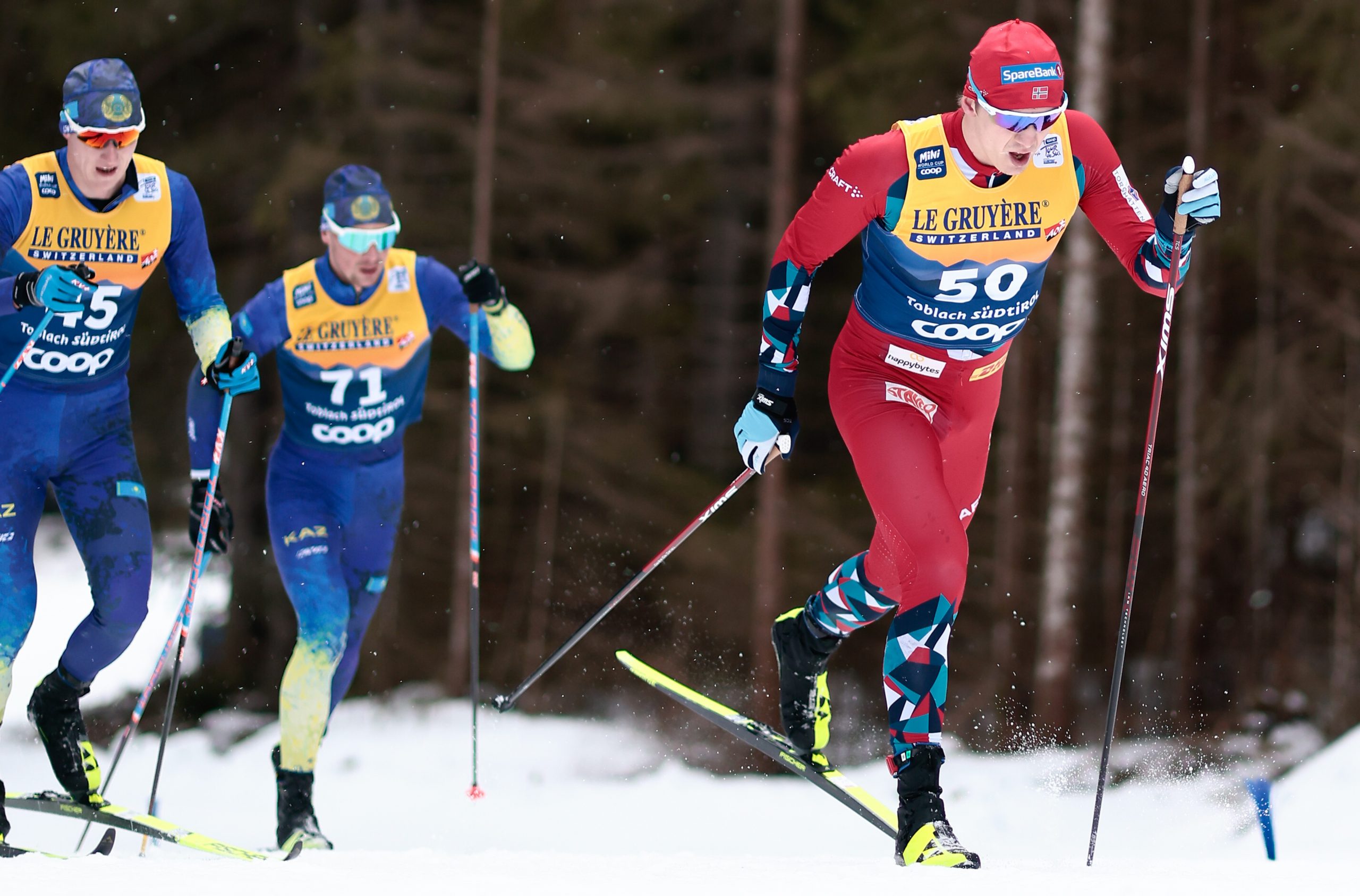
    Johannes Hoesflot Klaebo (NOR), Bernat Selles Gasch (ESP), Theo Schely (FRA), Ludek Seller (CZE), and Vili Crv (SLO), (l-r) in the first Quarterfinal. (Photo: Nordnes/NordicFocus)
    Qualification and Quarterfinals

    Klaebo’s dominance was apparent from the opening qualification. He posted a 2:24.88, nearly three seconds faster than Ogden’s 2:27.47, with the next 28 qualifiers separated by less than five seconds. That kind of gap on a world-class field in sprint qualification puts his dominance in perspective.

    Klaebo, as he always does, chose the first quarterfinal heat. He won it easily — clocking 2:37.14 — compared to his qualifier, a notably conservative time that suggested he was managing his energy for the rounds ahead.

    Simone Mocellini (ITA), Ben Ogden (USA), and Aron Aakre Rysstad (NOR), (l-r) in the second Quarterfinal. (Photo: Nordnes/NordicFocus)

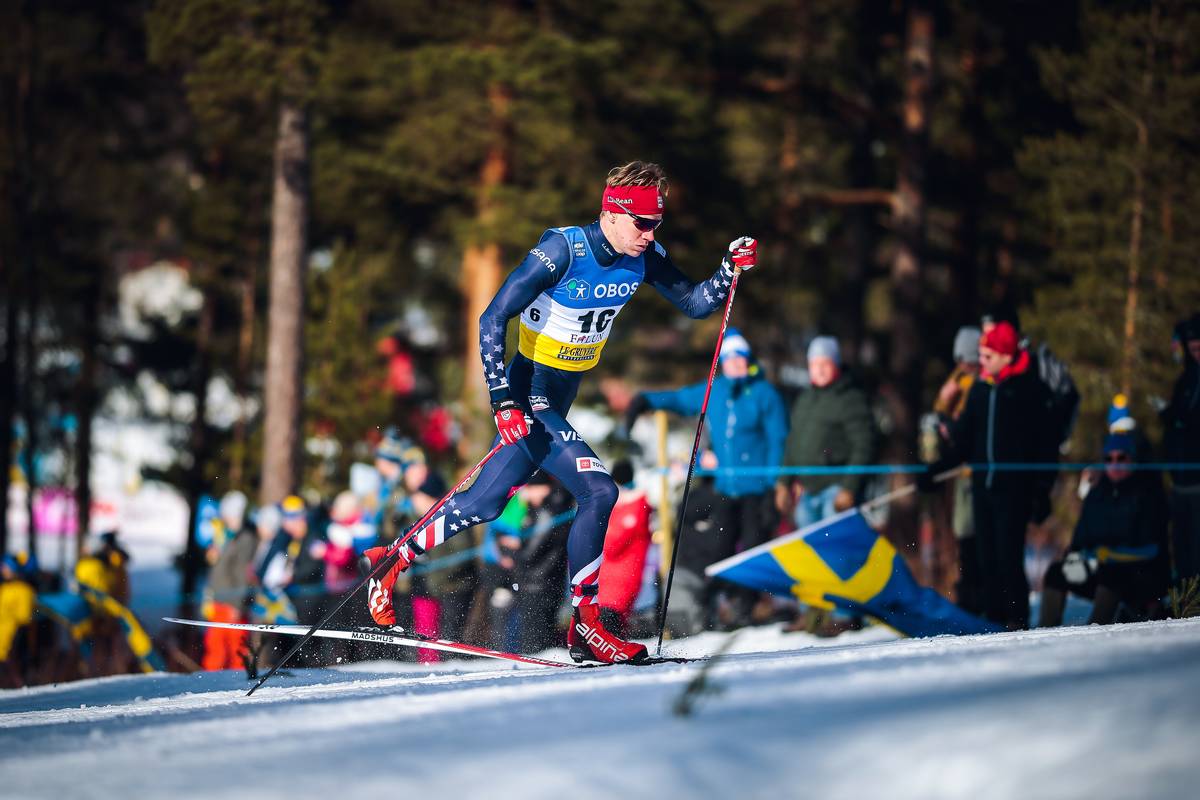
    Ogden, the lone American in the top 30, qualified second and chose Quarterfinal 2 alongside Italy’s Simone Mocellini and Norway’s Even Northug. He entered the bottom of the final climb up to the iconic finish on the steps of the Neo-Gothic Bragernes Church behind the leaders, but unleashed a powerful double-pole to charge into second place, advancing comfortably.

    The quarterfinals also produced some early drama. Northug, who had been enjoying a strong sprint season, was disqualified from Heat 2 after receiving his second written reprimand of the season, this time for a classical technique infraction.

    And quietly, in Heat 3, Evensen advanced as a photo-finish second behind Sweden’s Alvar Myhlback.

    Ben Ogden (USA) and the medical team check on Johannes Hoesflot Klaebo (NOR). (Photo: Nordnes/NordicFocus)
    The Crash

    The first semifinal will be remembered for the crash.

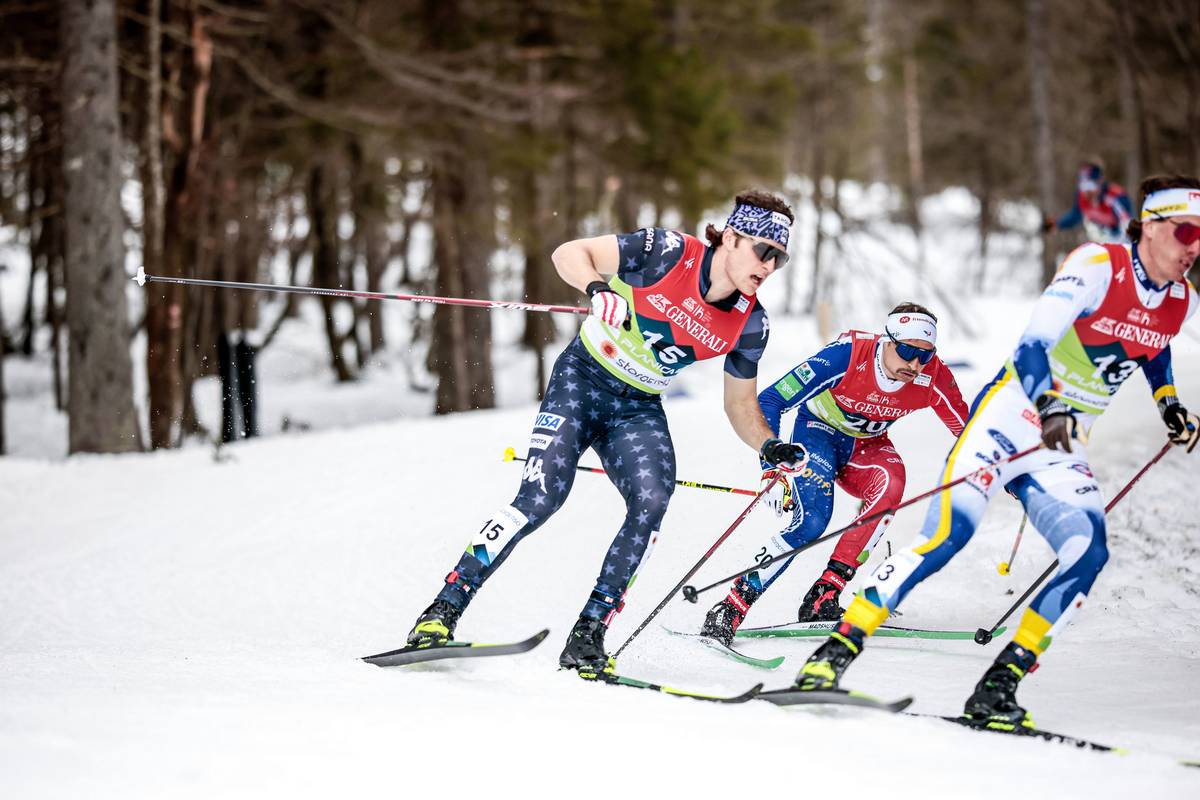
    Klaebo had won his quarterfinal from the front and appeared to be cruising. Ogden, too, looked comfortable. But on the icy final descent heading toward the hairpin around the fountain behind the start gates, the pack compressed. Klaebo held tight to the inside along the fencing, leaving him vulnerable when the skis began to cross. Contact was made. Ogden’s feet swept out from under him and fell right in front of the Norwegian. Klaebo had no place to go, skiing right into Ogden, which launched him into the air, spinning backward, ultimately hitting the back of his head on the hard-packed snow.

    Ben Ogden (USA) walks off after the crash in the Semifinals. (Photo: Nordnes/NordicFocus)

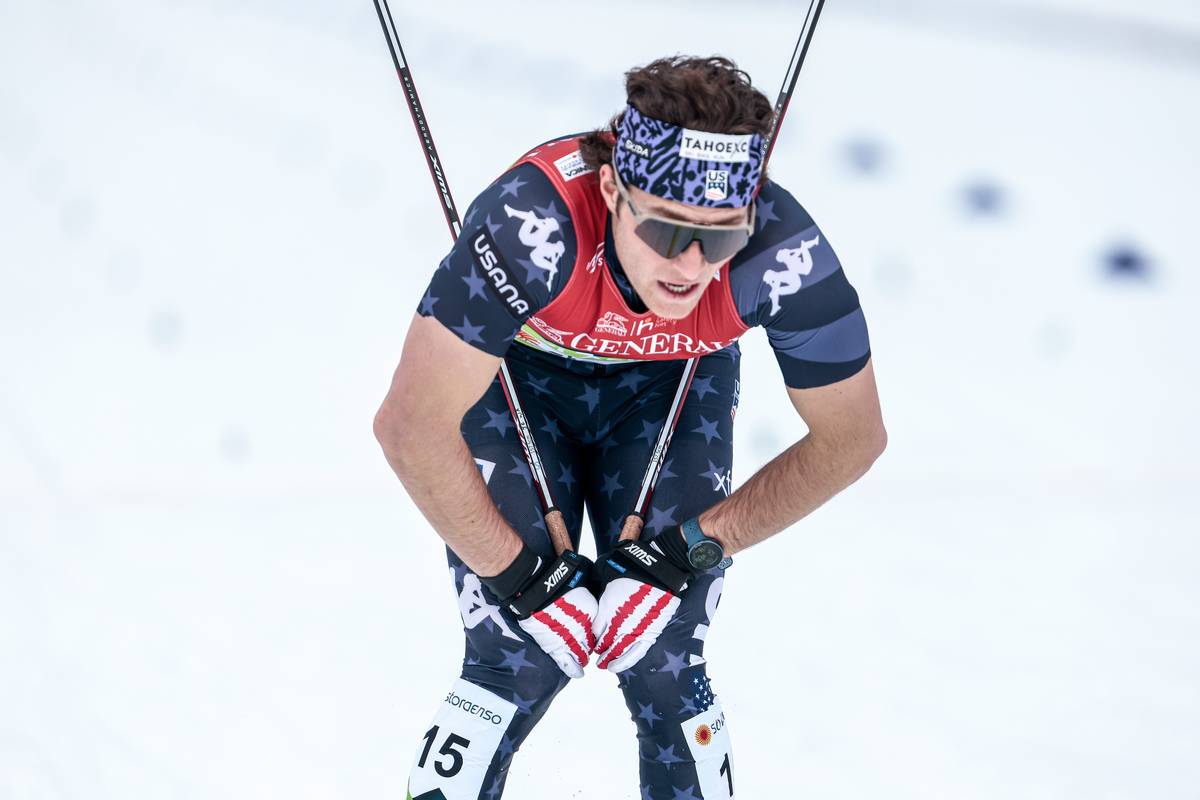
    Listening to the broadcast, the silence in Drammen was palpable. Ogden scrambled to his feet with only one ski still attached; Klaebo did not immediately follow. Replays showed Klaebo had not only hit his head on the hard snow, but may also have been struck in the head by a trailing ski as he fell. Both men would be listed as DNF — a designation almost never seen next to Klaebo’s name in a decade of dominance.

    Anton Grahn of Sweden, who had been near the front, took the semifinal win. Tuz advanced automatically in second. Alvar Myhlback of Sweden finished third but would not be fast enough to advance as a lucky loser. The crash all but guaranteed that the top four finishers from Semifinal 2 would all advance to the final.

    After the crash in Semifinal 1, Semifinal 2 with Harald Oestberg Amundsen (NOR), Kristian Kollerud (NOR), Jules Chappaz (FRA), Ansgar Evensen (NOR), Noe Naeff (SUI), and Davide Graz (ITA), (l-r) race for the finals. (Photo: Nordnes/NordicFocus)
    Semifinal 2 and the Path to the Final

    The second semifinal, then, was a race with diminished stakes but no shortage of quality. Chappaz drove the pace from the front and never relinquished it. Kollerud, the 21-year-old in his club racing suit, making his World Cup debut, finished an impressive second.

    Behind them, Amundsen and Evensen advanced as lucky losers, separated by just hundredths of a second. The final would feature three Norwegians, a Frenchman, a Czech, and a Swede — but no Klaebo and no Ogden.

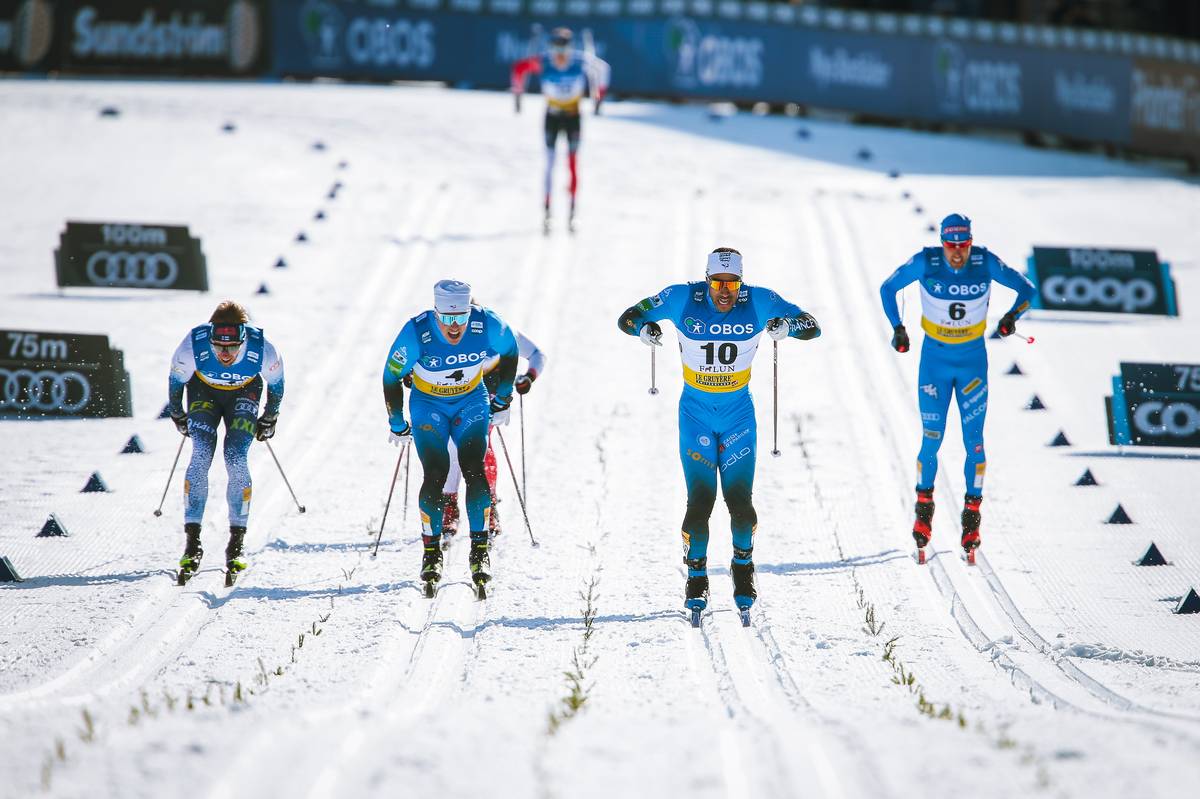
    Entering the finish stretch. (Photo: Nordnes/NordicFocus)
    The Final

    Half the final field was under 23 years old. Tuz, Kollerud, and Grahn — all 21 — represented a generational shift on a day when the established order had been upended.

    Tuz, perhaps emboldened by his semifinal crash survival, went hard from the gun, leading over the opening climb. It was a brave tactic from a young racer in only his second World Cup final. Behind him, the more experienced campaigners — Amundsen, Evensen, Chappaz — bided their time, trusting that the Drammen draft would bring them back and leave them well rested for the final climb.

    It did. The group had reformed as they skied behind the fountain. As they navigated the icy turn, Grahn — who had been skiing near the front all day — lost his footing on the hairpin and crashed, his race effectively over. He would finish sixth on the day.

    The final dash for the line. (Photo: Nordnes/NordicFocus)

    Grahn’s fall opened a lane on the outside. Evensen, who had been sitting sixth, saw it and calmly worked his way around the dicy turn.

    “When Anton fell in the last corner, I had every opportunity,” Evensen said afterward. “So I took it from fifth place to first on the final.”

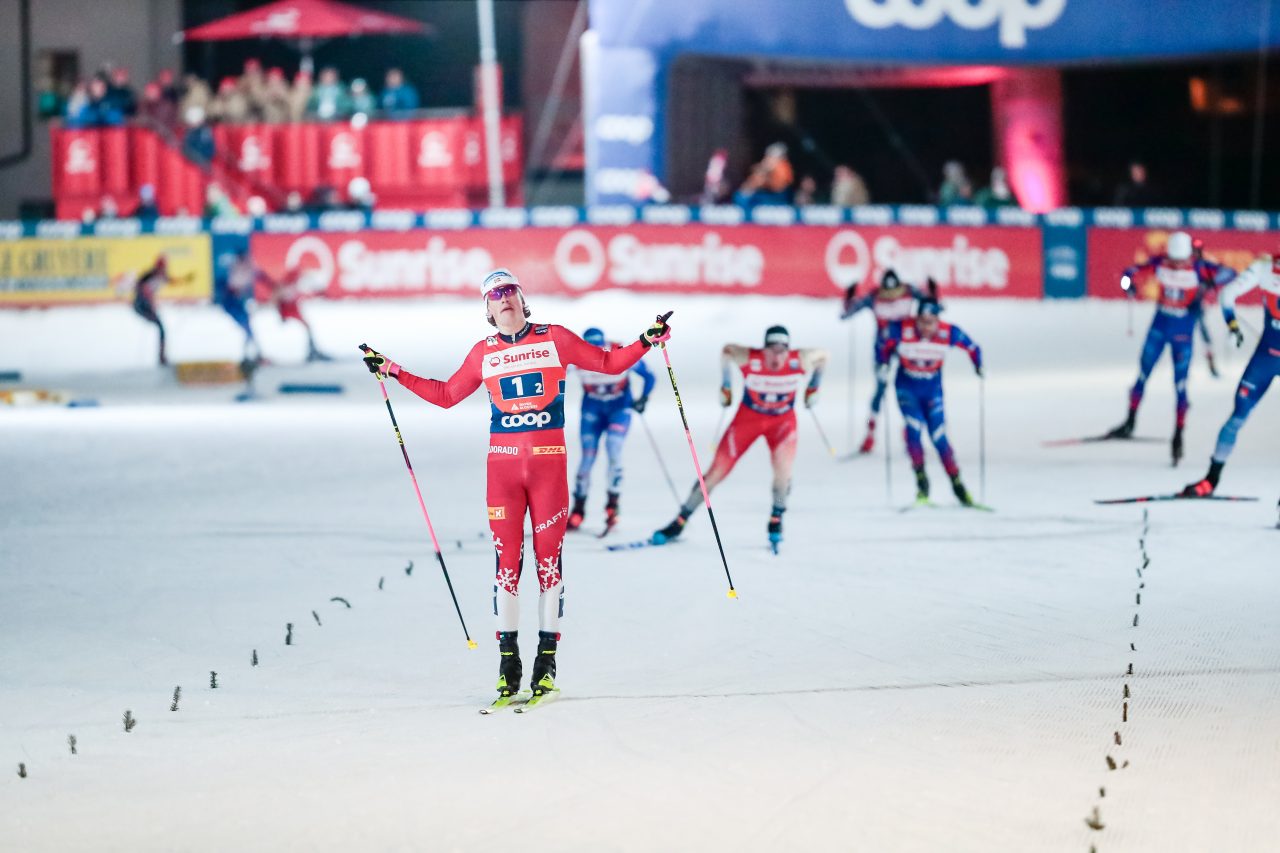
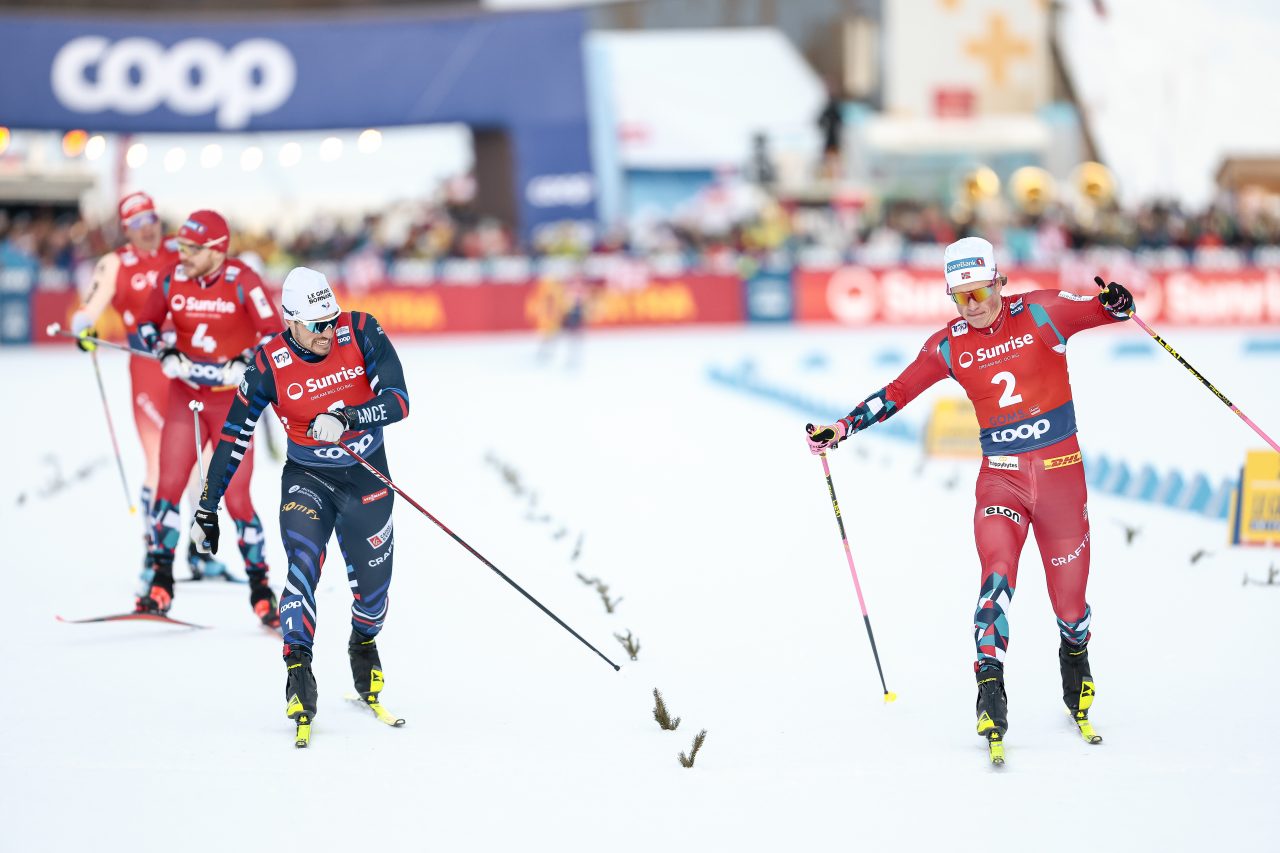
    What followed was one of the great finishing surges in Drammen’s long sprint history. Amundsen and Kollerud were locked in their own battle, focused on each other. Chappaz was charging. But Evensen — who had finished fourth on this same course back in 2023, who knew exactly how the final 50 meters of this city sprint played out — found a gear that nobody else could match.

    Harald Oestberg Amundsen (NOR), Jiri Tuz (CZE), Kristian Kollerud (NOR), Jules Chappaz (FRA), and Ansgar Evensen (NOR), (l-r) had an exciting finish in Drammen. (Photo: Nordnes/NordicFocus)

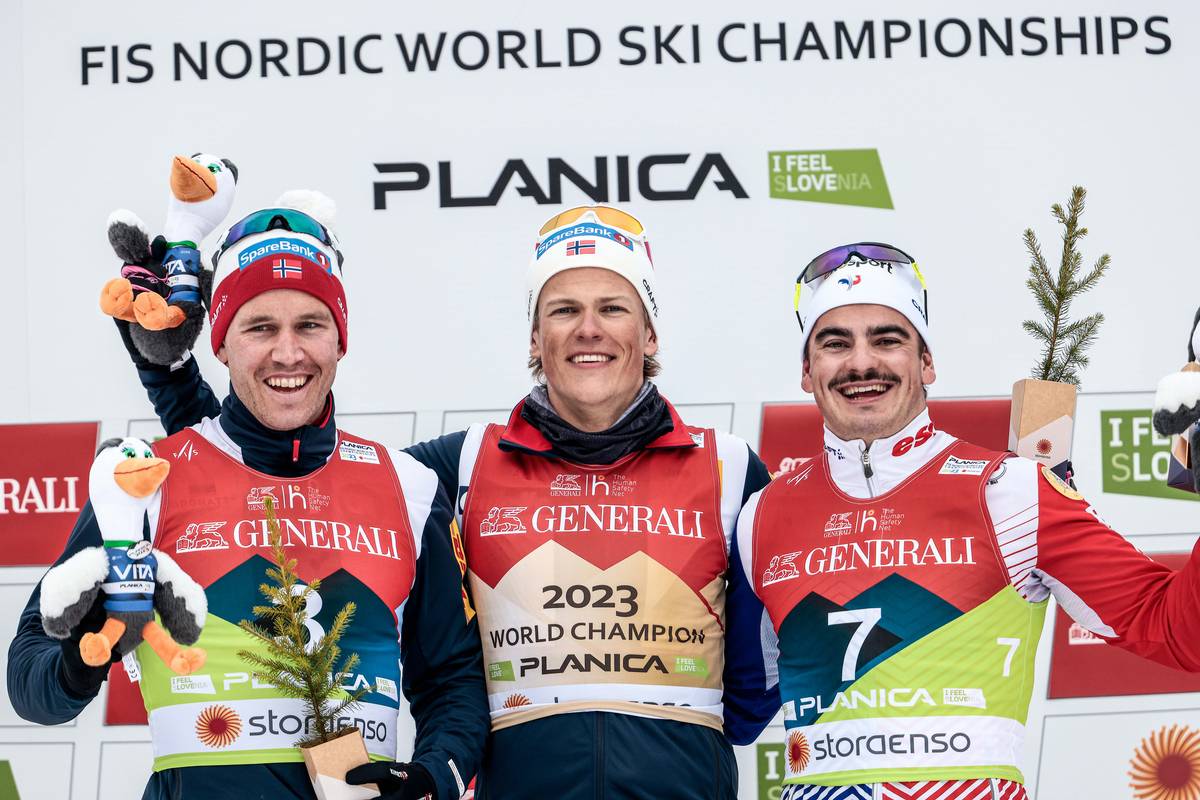
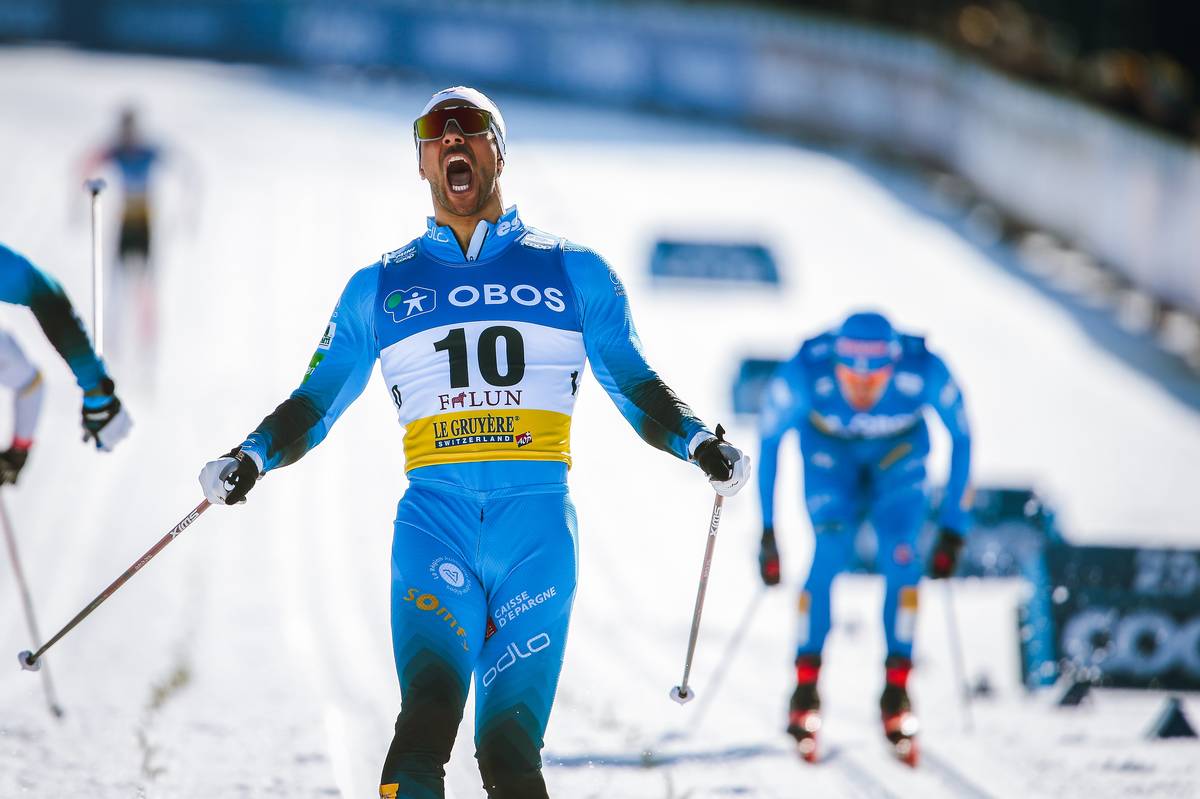
    He crossed the line first, fist clenched, pounding his chest. Tuz nipped Kollerud for second by four hundredths of a second. Amundsen was fourth, just 0.43 seconds off the win.

    “It was super cool and I love to ski in Drammen,” Evensen said in a post-race interview with FIS, still catching his breath. “I had to change boots to my combi boots because I felt so unbalanced in the quarterfinal. But that’s how it is. Have to stay on your feet to win. And unfortunately for Johannes and Ben, they weren’t as stable today.”

    Kristian Kollerud (NOR) waits for final confirmation of his podium. (Photo: Nordnes/NordicFocus)
    Kollerud’s Debut

    The feel-good story of the final belonged to Kollerud, who stood on the podium in his club racing suit — not the Norwegian national team uniform — soaking in a result he could not have imagined when he woke up that morning. A podium in your first World Cup start doesn’t happen. Except when it does.

    He picked up a written reprimand for a classical technique infraction during the semifinals, but it was his first of the season and carried no further consequence. What will carry forward is the confidence of knowing he can compete with the best in the world.

    Tuz, too, earned a career milestone. The Czech U23 athlete had made the final in Milano Cortina but never stood on a World Cup podium before Thursday. He now has a silver medal from Drammen.

    Jiri Tuz (CZE) celebrates his podium in Drammen, Norway. (Photo: Nordnes/NordicFocus)
    Standings and What’s Next

    Klaebo’s DNF stung, but his World Cup position remains commanding. He leads the overall standings at 2,071 points (636 points more than Amundsen in second), the sprint standings at 835 points (283 points in front of Lars Heggen), and the distance standings at 936 points (128 points in front of Amundsen).

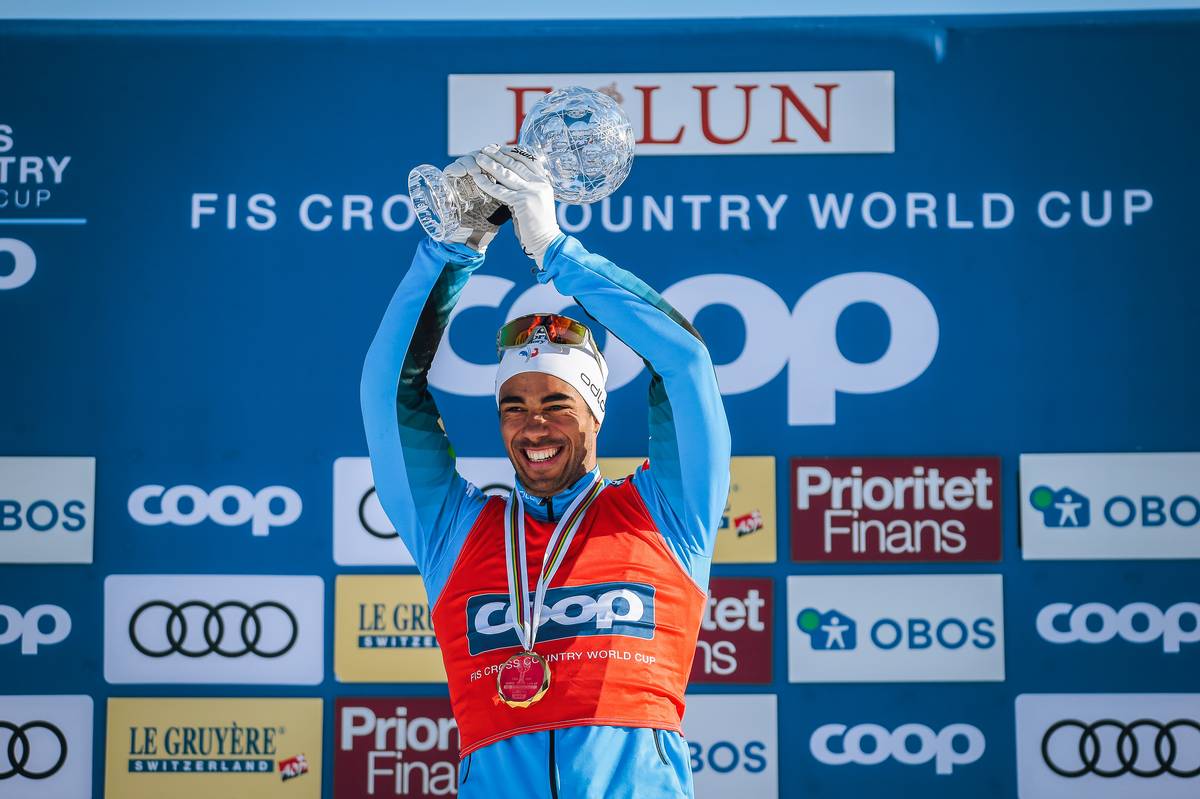
    Barring further incident, Klaebo will sweep the overall, distance, and sprint crystal globes for the season.

    Whether he gets the chance to race for them this weekend, however, is now in question. Norwegian national team doctor Ove Feragen told TV2 that Klaebo was taken to the hospital following the crash for precautionary testing related to the head impact. Feragen said Klaebo was conscious, in stable condition, and not believed to be seriously injured, but the severity of the fall warranted evaluation. His status for Saturday’s 50 k Freestyle Mass Start at the historic Holmenkollen in Oslo remains uncertain.

    The season concludes with World Cup Finals in Lake Placid, New York, March 20-22, where Ogden and the American men will race in front of a home crowd. With four races left, a lot of exciting racing remains.


    Drammen Men’s Classic Sprint QUALIFICATION RESULTS

    Drammen Men’s Classic Sprint FINAL RESULTS


    Love Stories Like This? Help Keep Them Coming.

    Feature stories like this one take time, access, and care to produce. If you value thoughtful storytelling and independent ski journalism, please consider becoming a Voluntary Subscriber. Your support directly fuels the work we do to cover the people, places, and moments that make our sport special.

    Join the FasterSkier community!


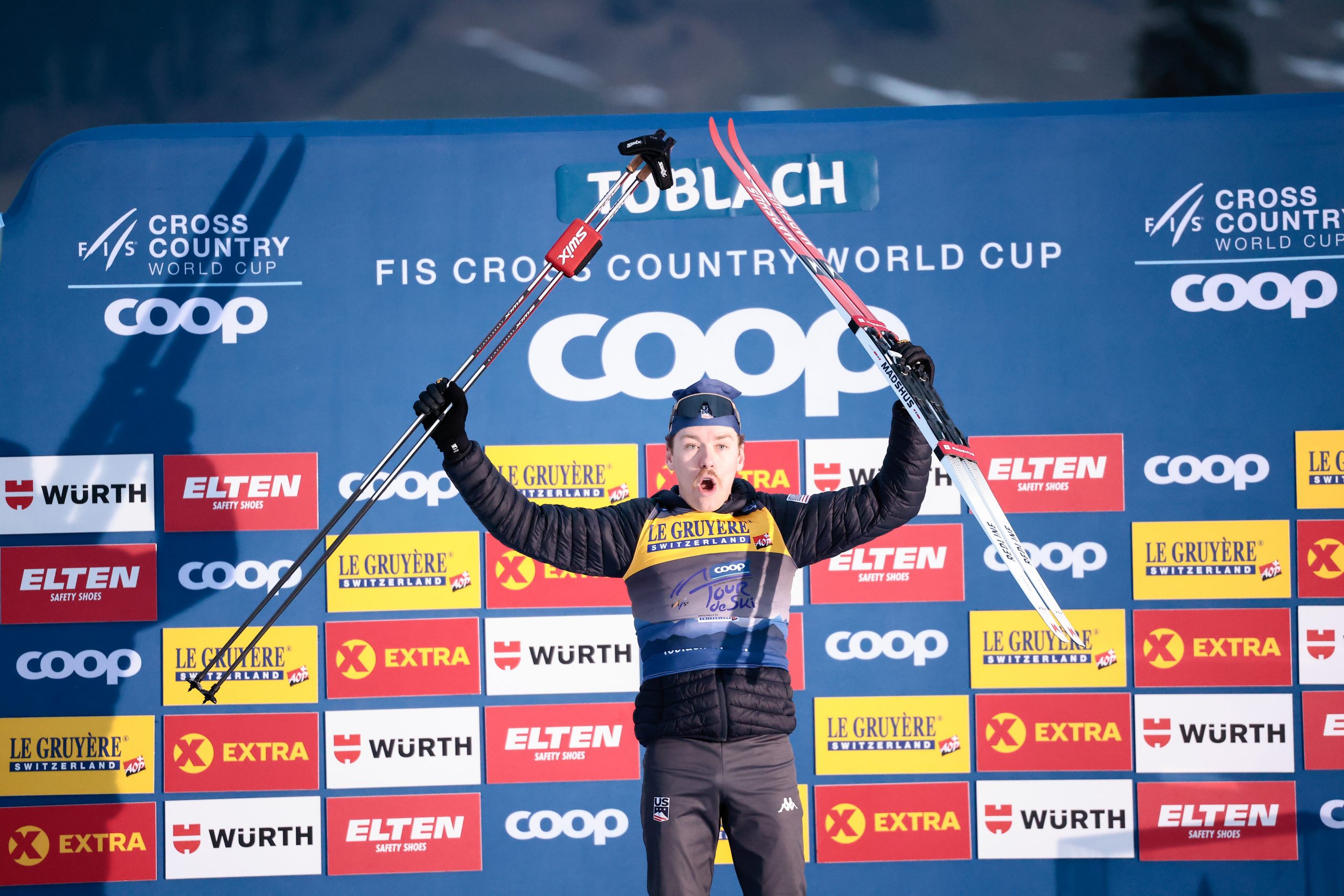
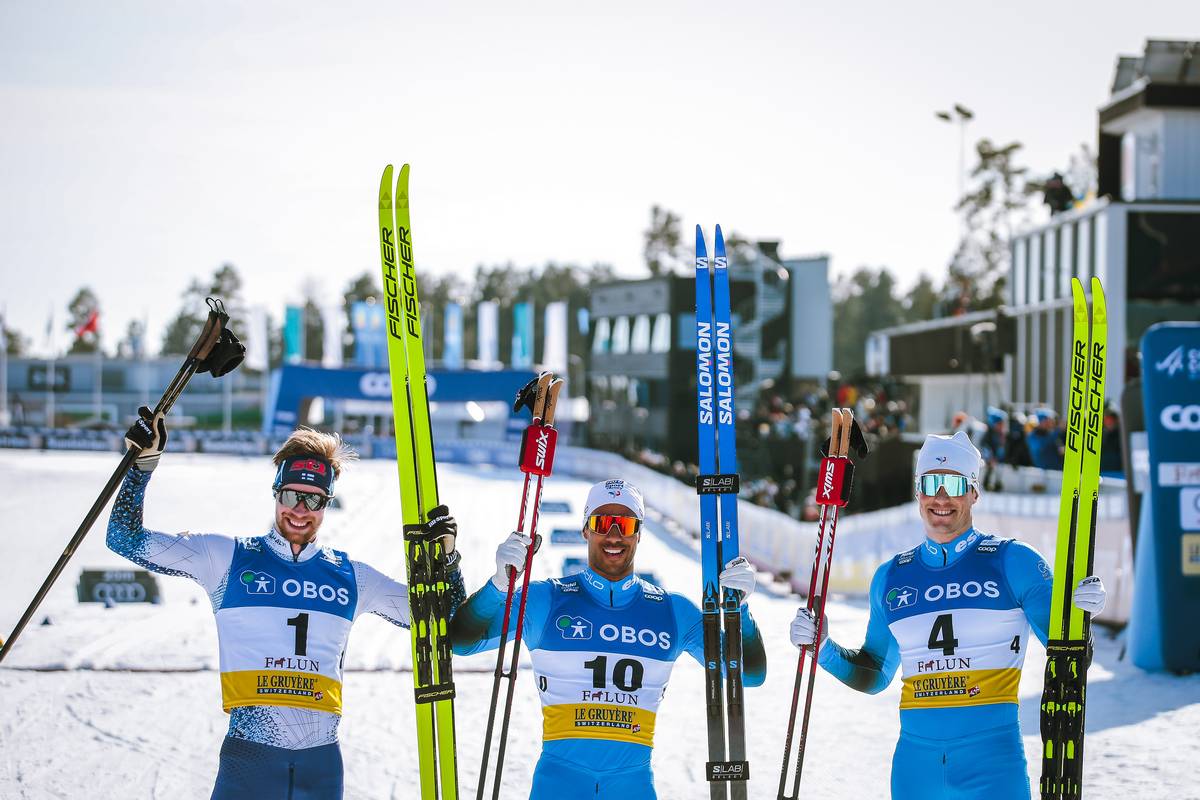
    Jiri Tuz (CZE), Ansgar Evensen (NOR), and Kristian Kollerud (NOR), (l-r) share the Classic Sprint podium in Drammen, Norway. (Photo: Nordnes/NordicFocus)
  • Lahti Sprint—Klaebo Remains Unbeatable

    Lahti Sprint—Klaebo Remains Unbeatable

    This coverage is made possible through the generous support of Marty and Kathy Hall and A Hall Mark of Excellence Award. To learn more about A Hall Mark of Excellence Award, or to learn how you can support FasterSkier’s coverage, please contact info@fasterskier.com.

    Babe Ruth, Muhammad Ali, Michael Jordan, Michael Phelps, this guy—Johannes Hoesflot Klaebo (NOR). (Photo:  Authamayou/NordicFocus)

    “It’s Johannes Klaebo’s ski world,” said skiandsnowboardlive.com’s on-air commentator, Andrew Kastening. “And we’re all just living in it.” Truer words were never spoken . . .

    “I didn’t have a plan,” said Klaebo after his dominant performance in Lahti Finland’s World Cup Freestyle Sprint. “I just went for it at the end there and managed to get enough meters to the young guys. Next year it will be even harder, so we’re going to enjoy this now for the rest of this year. Next year, it’s going to be way harder, I think.”

    Well, we don’t really believe Klaebo’s “no plan” claim. In fact, we probably aren’t sure we believe that next year will be “way harder,” either. Not with the way this year has gone, anyway. But Klaebo’s suggestion that we “Enjoy this for now?” No problem . . .

    Ironically, Klaebo’s absolute dominance leaves ski reporters scrutinizing the strengths and weaknesses of other skiers—scanning the notoriety of other results—for stories that will continue to capture readers’ imaginations. Where the heck has Sindre Bjoernstad Skar been? And how much resentment do Even Northug and Lars Heggen harbor after being left off the Norwegian Olympic team? And, after his recent U23 World Championship (and the pedigree afforded him by his mother, legendary Nordic skier, Bente Skari), is Filip Skari the real thing? And is Harald Oestberg Amundsen still in the running for the Crystal Globe? Or does he just need a Sprint day to warm him up for the Distance races? And who the heck is Mathias Holbaek? On a normal World Cup weekend, those questions—Norwegian questions—would occupy the imaginations and fill the column inches of ski journalists. But that was before the Olympic Winter Games of Milano-Cortina . . . the Games in which Ben Ogden (USA) and Gus Schumacher (USA) created scenes of flashing silver excellence. Now, reporters have another story to report: American sprinters have arrived on the scene. If Ogden and Schumacher have any energy left after the predictable post-Olympic celebrations, then they’ll have something to say about Lahti’s Sprint results, too.

    Gus Schumacher (USA) and Ben Ogden (USA) and Gus Schumacher (USA) have ushered in a new era of American men’s skiing. (Photo:  Vanzetta/NordicFocus)

    Granted, Ogden and Schumacher had far fewer Norwegian Sprint rivals to navigate among, through, and past on the way to their Olympic silver medals. That’s the salient reminder, folks: while the the Olympics offer the most valued, most brightly glittering prizes in the skiing world, the Olympics also offer the best chance for anyone to break through the Norwegian medals-monopoly. That’s because Norway is only allowed the maximum number of Olympic starters in any event: four starters. Conversely, in World Cup races, Norway is allowed at least seven starters . . . sometimes eight (if the race is in Norway). Any non-Norwegians—Ogden and Schumacher included—will find it far more difficult to snatch headlines in Lahti’s World Cup Freestyle Sprint. For that matter, American Sprinters (including Jack Young, JC Schoonmaker, Kevin Bolger, Zanden McMullen) will find it considerably more difficult to qualify for the heats, much less to advance through to semifinals and finals.

    And all this drama occurs in the shadow of the most predictable story—the one that we’ve probably grown tired of repeating by now: Klaebo’s going to win, right? I mean, he’s won the last 13 races he’s entered (sprints,  distance races, relays, Classic, Freestyle), including the six Olympic races that he swept during the Games of Milano-Cortina. And lining up for another Freestyle Sprint on a course where he has generally shown himself to be unbeatable seems unlikely to offer much hope to his rivals. Well, there’s always silver . . .

    Federico Pellegrino (ITA) is in Lahti, and so soon after he captured a magnificent bronze medal for Italy in the Team Relay. And Lucas Chanavat (FRA) is here, but he may finally have realized that he has never devised a tactic that’s even come close to allowing him the sort of success that his natural power and physical prowess would’ve suggested could be his. Among Americans, Schumacher qualified eighth. Jack Young 16th, Ben Ogden 22nd, McMullen 26th. Qualifying was won by Klaebo, followed by Chanavat and Pellegrino. The stage was set in an exciting race for silver. Sorry if that sounds like a weak set-up; we’re just calling it as we see it . . .

    Zanden Mcmullen (USA) held his own in a closely contested heat with Lucas Chanavat (FRA), Benjamin Moser (AUT), Lukas Mrkonjic (AUT), and Johannes Hoesflot Klaebo (NOR),. (Photo:  Authamayou/NordicFocus)
    Sprint Heats

    McMullen drew the first heat alongside Chanavat and Klaebo. Chanavat wanted the lead, but not the pace. With Klaebo positioned alongside him (staying near the front and out of trouble) the course was clogged and the pace was slowed.  Ultimately,  Chanavat found himself suckered into the lead at the top of the final downhill where he surrendered the draft and was predictably passed by Klaebo. Chanavat would actually fall in the final turn, allowing Klaebo to cross the line unchallenged, and making room for Benjamin Moser (AUT in the second spot to qualify for the semifinal. McMullen would cross in a closely-contested third place, too slow to advance as a lucky loser, but good enough for 20th on the day. There was some question about Chanavat’s fall (and whether or not he was interfered with), but the slo-mo replay made it appear that he’d done the damage on his own.

    In the second quarterfinal, Ogden decided to play his cards at the front where he was joined by Pellegrino. But coming through to make the pace was Skar (who has been absent from the World Cup scene for a few seasons, but returned to this venue in replacement of Olympic medalist, Oskar Oppstad Vike (NOR) who was injured at the recent U23 World Championships. Pellegrino would become impatient with Skar’s pace, driving forward to take the lead at the top of the final climb. But it was Heggen who would take advantage of the draft on the final downhill to take the heat win. He was followed across the line by Janik Riebli (SUI), Pellegrino, and Skar. Ogden would coast across the line a distant sixth, 28th on in the final Sprint results.

    Schumacher bided his time at the rear of the third quarterfinal, weaving through traffic to move forward into fourth position before the final downhill. Schumacher chose the outside line on the final left-hander, rocketing forward to steal an automatic ticket into the semifinal just ahead of Holbaek and Valerio Grond (SUI).

    Jack Young started at the rear of his quarterfinal, continuing to work his way through the field, but generally finding his way blocked and his momentum stymied. He entered the final downhill in fourth position, but with precieous little room to maneuver. Young came around the final turn in third, but was late to accelerate, finding himself still third at the line. In a slow heat, Young’s finishing time was not fast enough to advance. He would finish teh day in 15th.

    “My training during the Olympics absolutely allowed me to come in to Period 4 fresher and sharper,” said Young. “I felt faster today than I did in Falun, and I think I’m still on the way up.

    “Tactically, I’m making the progress I need to make,” Young continued. “I did a lot of things today in the heat that I haven’t done in the past. I was taking up space and shutting down moves made from behind me better than I ever have. In the future I need to keep skiing aggressively and find ways to get into the top two before the last 100 meters.

    Janik Riebli (SUI), Lars Heggen (NOR), Johannes Hoesflot Klaebo (NOR), Gus Schumacher (USA), Benjamin Moser (AUT), Davide Graz (ITA) in the Freestyle Sprint inLahti, Finland. (Photo:  Authamayou/NordicFocus)
    Sprint Semifinals

    Schumacher lined up next to Klaebo in the first semifinal. Klaebo was first off the line with Schumacher attached to his tails. They marked at the front by Heggen; no one wanted to get away, no one wanted to lead. Klaebo seemed to grow bored with the tactical pace, allowing himself to glide into the lead and initiating a small attack before the top of the uphill section. All day long, skiers in the lead on the final downhill have found themselves overtaken by those in the draft. But “all day long” is not enough of a precursor to undo the ski-dominance of Klaebo. He floated down the slope, surrendering no discernible advantage to those tucked in behind him. Klaebo would execute a couple of energetic pushes in the final straightaway to remain ahead of Riebli (who edged out Heggen). Schumacher never managed to make up enough ground, finishing the semifinal in fifth position, and ninth on the day.

    Chappaz skied to tactical perfection in the second semifinal, using the draft on the downhill to slingshot into the lead in the final meters. Behind him, numerous skiers were caught in traffic as Skari emerged from the pack for the automatic semifinal spot, ahead of Grond who advanced as a lucky loser.

    Sprint Final

    In Lahti’s quarterfinal and semifinal heats, Klaebo had shown that he could win from the draft, or win from the front. Subsequently, he would continue to provide a cryptic puzzle for Skari, Heggen, Chappaz, Riebli, and Grond. I mean, we expect Klaebo to win, we just don’t know exactly which way he’ll choose to do it.

    At the crack of the starter’s pistol, Klaebo rocketed forward (that much we could anticipate), controlling the front and dictating the early pace as he so often does. The rest of the skiers were left to wonder—will he just drill it at the front and drop us? Or will he lure one of us into the lead, only to slingshot around us at the end? Here’s what the other skiers must, by now, understand pretty clearly: if Klaebo makes you lead, you lose. On the other hand, if Klaebo puts his energy into keeping the lead, there’s no one who can come around him. That’s the kind of advantage a skier earns when he’s the best of all time. And the best of all time was simply not going to get beat in this little World Cup Sprint in Lahti. Heggen and Riebli did their best to follow Klaebo, but the draft effect that Heggen needed just never materialized. Heggen was in good position on the final downhill: all the laws of physics were on his side, all the likelihoods of ski race tactics were in his favor . . . still, Heggen never made up a single meter. He would hold on for second, ahead of a late-charging Chappaz. Klaebo would coast across the line for his zillionth career World Cup victory, his we-can’t-keep-track-of-how-many wins in a row.

    Johannes Hoesflot Klaebo (NOR) eases up at yet another World Cup finish line. It may not be exciting any more, but it certainly remains thrilling. (Photo: Authamayou/NordicFocus)

    He doesn’t get tired, he doesn’t get sick, he doesn’t get out-maneuvered, he doesn’t get out-smarted, he doesn’t get out-sprinted. In one of the most challenging endurance sports that humans have ever contested, one guy just seems to win at will. How incredible it is to be a ski-fan in this era when one skier displays such outright dominance. The legendary Marit Bjoergen (NOR) claimed 114 wins during World Cup history’s most decorated Nordic skiing career. In Lahti, Klaebo truly began drawing within sight of that landmark number. Six races remain in the World Cup season. If he were to win out this season, Klaebo would finish the year having overtaken Bjoergen for the most-wins distinction, as well as a few others.

    “I’m tired,” admitted Klaebo. “I’m barely training between the races. I’m just racing now, but we’ll see how long we continue to do that. Hopefully, we’ll be able to do that for two more weeks.”

    There’s never been a season like this one that Klaebo is likely to complete: World Cup Overall, World Cup Distance, World Cup Sprint, Tour de Ski, and six Olympic gold medals. That’s the real story . . . and I’m so glad I’ve been here to see it. Next year may be “way harder,” predicts Klaebo. As he advises, we’ll enjoy this for now.

    Lahti Men’s Freestyle Sprint RESULTS

    Lahti Men’s Freestyle Sprint QUALIFYING

    Love Stories Like This? Help Keep Them Coming.

    Feature stories like this one take time, access, and care to produce. If you value thoughtful storytelling and independent ski journalism, please consider becoming a Voluntary Subscriber. Your support directly fuels the work we do to cover the people, places, and moments that make our sport special.

    Join the FasterSkier community!
    Johannes Hoesflot Klaebo: another win in Lahti in a season for the ages. (Photo: Authamayou/NordicFocus)


  • The Devon Kershaw Show: A Tesero team sprint slugfest

    The Devon Kershaw Show: A Tesero team sprint slugfest

    This episode was made possible through the generous support of our voluntary subscribers.  If you value coverage like this, please support FasterSkier with a voluntary subscription.  

    The highs were high and the lows were low in the Olympic team sprint in Italy, with the Ogden-Schumacher men’s team claiming silver and the Diggins-Kern women’s pair finishing out of the medals. Devon and Nat break the whole thing down.

    We’ll be back after Saturday’s men’s 50 k. Reach us at devon[at]fasterskier.com and nat[at]fasterskier.com. We’re really grateful for all the support during the Olympics — thanks for notes and encouragement.

    A reminder: This is a homegrown podcast done by two guys working long hours and late nights. We’re also paying real money to be here in Italy. If you can, support the show and FasterSkier’s ongoing coverage with a voluntary membership. We’re also offering a bonus during the Olympics: a WhatsApp group with notes on Nat’s experiences in Italy, the food he’s eating, interview transcripts and more.

    Send nat[at]northernjournal[dot]com a confirmation of your voluntary membership and the number he should use for WhatsApp and we’ll get you signed up. You can also Venmo him directly at @nat-herz if a membership isn’t for you. We’re suggesting a minimum of $10, but we also won’t turn anyone away who wants to join because of an inability to pay.

    Help Support Our Olympic Coverage!

    FasterSkier will have our own Nat Herz on the ground at the Olympics, which, to be honest, is a very big financial lift for us. If you value the thoughtful work and access FasterSkier provides at championships like this one, please consider becoming a Voluntary Subscriber. Your support directly fuels the work we do to cover the people, places, and moments that make our sport special.

    Join the FasterSkier community!
  • Klaebo’s History, USA’s Glory—Olympic Team Sprint

    Klaebo’s History, USA’s Glory—Olympic Team Sprint

    This article was made possible through the generous support of our voluntary subscribers who have helped put our Nat Herz on the ground at the Olympics. If you value coverage like this, please support FasterSkier with a voluntary subscription.

    Gus Schumacher (USA), Ben Ogden (USA) announce the arrival of a new American cross-country tradition. (Photo:  Vanzetta/NordicFocus.)

    PREDAZZO, ITALY — Johannes Hoesflot Klaebo still had something special to do. American skiers still had something special to prove. But the Team Sprint is never as simple as just lining up and racing. Contending nations need to consider the field, rate the strengths and vulnerabilities of their competition, and make a plan to best take advantage of the circumstances. Then they have to ski it . . .

    Not that they needed to, but the Norwegians must have come up with a different plan. For nearly a year—since the straightforward, matter-of-fact Team Sprint victory of Klaebo and Valnes in last year’s World Championships—I’ve been thinking of the Norwegian Team Sprint strategy in only one way: whoever is paired with Klaebo just needs not to get dropped. Stay out of trouble, avoid tangles, respond to the attacks from other teams but don’t allow yourself to be made vulnerable by launching attacks of your (efforts that could, then, be counter-attacked). When considering strategy, picking Klaebo’s partner in this team event seemed like a straightforward selection to make . . . but more than one Norwegian could fit neatly into that role. It’s a role that’s been performed admirably by Valnes in the past, and by Iversen before him (both of them on this year’s Norwegian Olympic Team roster). It’s a role that could have logically been taken on by Harald Oestberg Amundsen, who is both a very fast sprinter and the reigning World Cup Distance champion. All three of them are fast, All three of them are great endurance skiers as well as fine sprinters. None of them would be likely to get dropped by anyone else in the field, and all have a wealth of experience skiing in the should-to-shoulder, rough-and-tumble style of pack racing that is typical of a Team Sprint event. Pick one of those guys, right?

    Not so fast . . .

    Johannes Hoesflot Klaebo finds himself paired in this Olympic Team Sprint with Einar Hedegart. Hedegart is certainly fast, and it’s rumored that he possesses the highest VO2 Max of any Norwegian athlete (in any sport). That would certainly come in handy if Hedegart’s job was to drop everybody in order to give Klaebo a head start on the anchor leg. But is that even necessary? The Team Sprint finishes on the same hill as the Individual Sprint. Remember that hill? The one that’s made Klaebo famous for his unmatchable 11 mph scamper that’s all over the internet? If you put all the best skiers in the world at the bottom of that hill, and say “go,” Klaebo will win a race to the finish line by a mile. We thought the plan for the Team Sprint would take advantage of that advantage.

    What does teaming with Hedegart get them? Those are questions that someone over in Norway must’ve considered. If Hedegart tries to break away, he makes his team vulnerable to counter-attack . . . and he already showed in the 10 k Freestyle (where he went out way to fast, and bonked like an inexperienced age-grouper) that he may not yet possess a full understanding of pacing. Furthermore, Hedegart possesses nowhere near as much World Cup Sprint experience as Iversen or Valnes or Amundsen. They’re less likely to get stepped on or pushed over or boxed in. With Hedegart—well, he’s fast, but the Norwegians really don’t know what they’re getting.

    On the other hand, Hedegart’s raw speed is what Norway may be seeking. With his bronze medal in the 10 k Freestyle, he showed that he was a fairly even match for the speedy Frenchman, Mathis Desloges (already with three silver medals in these Olympic races). And France is starting Desloges in the first leg of the Team Relay (opposite Hedegart). One way or another, Klaebo’s performance is fairly predictable, so all the significant question marks are swirling around Hedegart.

    Ben Ogden (USA) had one job to do—create the gap. (Photo: Barbieri/NordicFocus)
    The American Dream

    It seems like the American men also have decided to try out an unexpected strategy. It would have been easy to assume that Team USA might hope to get Ben Ogden—the team’s most accomplished sprinter—into the anchor leg so that he could battle his way to the finish line among the other designated sprinters. A sprint finish for the medals, assign your best sprinter. Right? Maybe not. The US team decided that the anchor leg will be skied by Gus Schumacher, himself no slouch as a sprinter, and an occasional visitor to World Cup  Sprint semifinals and finals. But if Schumacher skis the anchor leg, then he’s likely to find himself sprinting against Klaebo and Federico Pellegrino and Jules Chappaz. Schumacher may not match up too well against those three . . . but if Schumacher is given a lead going into the anchor leg, there aren’t many skiers in the world who can chase him down. Perhaps what USA is counting on is Ogden being able to launch an attack in the penultimate leg that disrupts the other contenders, allowing Schumacher to coast home alone. Klaebo may already be well off the front by then, but who knows? Maybe there’s a medal for the Americans in this strategy that might not otherwise have existed.

    “I was incredibly nervous before today’s race,” said Ogden. “But the parts, the moments where I’m nervous are, like, the lead up, you know? I know that once the race starts, I can just get to this headspace where I can be confident and be strong and be smart with my movements in the group. And that’s a really good feeling.”

    Time to line up and race . . .

    Einar Hedegart (NOR) would need to be both fast, and patient in an event that he had never skied before. (Photo: Vanzetta/NordicFocus)
    Men’s Team Sprint

    Unlike the Individual Sprint where the event is raced in heats of six skiers, the Team Sprint is a 15 team melee whose selection of teams is based on the compiled individual qualifying times of each team’s sprinters. Once the final field is decided, they just line ’em up, and say “Go.” With 15 teams charging around the Sprint course, it would seem to be anyone’s race.  Ironically, pre-race ski-pundits would have us believe that the three medals should only be distributed among four teams: Norway, France, Italy, and the USA. But teh efforts, attacks, and foibles of many other teams are likey to have an impact. As other recent relay events have amply demonstrated, there is much that can interrupt all best-laid plans between the prediction and the finish. Soon, either those experts would look like geniuses, or fools.

    Ogden would be compelled to deal with Desloges, Hedegart, and Anger in Leg 1. While the Ogden-strategy may have been to accelerate in his leg—creating a gap that will allow Schumacher to maintain an advantage—Ogden was not likely to pursue the all-out-from-the-gun that Diggins employed in the Women’s Team Sprint. It’s just too athletically expensive to race that way.

    Ogden started front and center of the front row, where he was followed quickly by Austra. The first meters were confusing as Riebli (SUI) needed to scramble to find a replacement pole in just the first few seconds of racing. Ogden and Desloges made the early tempo. The field would begin to stretch out, more out of concern for safety than exhaustion.

    “We did our one thing that we talked about: we were gonna meet on the right hand side of the exchange zone,” said Ogden. “Without fail, every single time we caught we came in on the other side, on the far and had to cross, and had to cross through like 15 people in order to get to our guy on the other side. And it was one of those things where we both honed in on the fact that being on the right hand side of the exchange room was not working. But it was also like, we can’t risk going to the left hand side and having him not see us. So we just had to sort of stick with it. And, you know, made for a couple fast first 20 seconds of the legs to try to catch back up.”

    Johannes Hoesflot Klaebo (NOR) will do what he’s going to do. Teams from all other nations will scramble for silver and bronze. (Photo: Vanzetta/NordicFocus)
    Leg 2—Klaebo’s fast lane

    Klaebo may not have been happy at being forced to weave through the field after the exchange (and Hedegart’s presence in the crowded scrum of the transition must have been nerve-wracking), but this is not Klaebo’s first rodeo. He made his way easily to the front followed by Pellegrino and Edvin Anger (SWE) who decided he wanted to take the lead. Klaebo and Pellegrino were only too happy to let the confident young Swede do the work.

    “I was trying to save energy and not lead,” said Schumacher. “When you start off out of the stadium and third or fourth, and another line comes up behind you, you’re eighth pretty quickly. And then, yeah, coming into the stadium, there was a big slingshot, and I was sort of like—I don’t know—I felt like I was generally on the wrong side of that . . . I kept my head, stayed calm, which I’m really proud of.”

    “It’s nice to be able to trust Ben,” Schumacher continued. “To tag him far back, and he’ll tag me back in a great spot. And he set me up in that last lap perfectly. Then I had a pretty simple job to do, and I’m really glad I was able to do that.”

    Leg 3—Hedegart’s patience

    Hedegart inherited the lead from Klaebo, but he led at a pace that indicated he was not interested in laying down the law. Not yet, anyway. Hedeagart settled in behind Lauri Vuorinen (FIN) while the field spread out behind them. No real breakaway yet, but the group was beginning to feel the strain. There wouldl be less “trouble” for Hedegart to encounter on the course, but he wasn’t out of the woods yet. All of Norway held its breath.

    Gus Schumacher (USA) has often shown the sort of speed and endurance needed in the anchor leg, but his performances in recent Olympic races left some questions. He answered loud and clear. (Photo: Vanzetta/NordicFocus)
    Leg 4—Schumacher’s arrival, Desloges’ disasters

    Hedegart had again come through transition with the lead, follwed by Sweden and France. Anger again wanted the front, perhaps hoping to create some gaps of his own. Desloges spent Leg 4 suffering his second broken pole of he day. France was faltering irretrievably, and the field sensed an opening in the medals. Team USA had sat concealed in the field all race, but Schumacher was begining to move forward, and to make his presence felt. Canada shadowed USA. With the field still hanging together, Team USA may have been ready for Ogden’s Leg 5 surge.

    Leg 5—Ogden’s encore

    Just like they may have planned it, there went Ogden leading Hedegart up the significant hill. Hedegart may have possessed the lead, but the USA was putting its plan into effect, as well. While all the leaders remained in contention, it looked like the pre-race script was remaining consistent.

    Celebration at the finish. Ben Ogden (USA) and Gus Schumacher (USA) team up to make history. (Photo: Barbieri/NordicFocus)
    Anchor Leg—USA!

    Ogden had done his job, as had Hedegart. One lap to go, with Klaebo enjoying a small lead over Schumacher, Anger, and Pellegrino. With only the anchor leg remaining, what USA needed was a skier with flashing speed and bottomless endurance. That’s Gus Schumacher . . .

    “The best way to do that is just go as fast as you can,” said Schumacher. “And I think today I did a good job of just looking forward. Klaebo was gonna ski this fast. If I can stay close to him, I’ll also ski it fast.”

    Schumacher made his way to Klaebo’s tails as Pellegrino dropped Anger. Medals waited on the horizon as Klaebo shifted into top gear on his signature hill. Pellegrino made up ground on Schumacher, but did not close the gap enough to benefit from the draft on the downhill where the field spread out in a test of glide wax and base prep. Gaps held as skiers entered the finishing straightaway where Klaebo wrote Olympic history to become only the second Winter Olympic athlete to win five golds in a single games. Additional history followed in Klaebo’s wake, as Schumacher erupted across the finish line to grab silver for Team USA, his first Olympic medal, and Ogden’s second silver of these Games.

    “Once the race starts, I just race the same way I have since I was five,” said Ogden. “So that’s a really nice feeling. And I think that the test of this championship has like, like, set me up really well to just be confident and leap, (to) control the pace and then go hard and be confident that I could, that I could make some time. So was a good feeling.”

    Pellegrino offered the home-crowd yet another thrill when he crossed the line to deliver his second bronze medal.

    Relief, exhaustion, satisfaction: Federico Pellegrino (ITA) has long carried the weight of Italian expectations. With his second bronze medal of these Olympic Winter Games, Pellegrino is writing the closing chapters of his career con brio e brillantezza. (Photo: Barbieri/NordicFocus)

    The legendary American speedskater, Eric Heiden, won every single event on the speedskating card in the Olympic Winter Games of Lake Placid, 1980. Those unprecedented triumphs—from the explosive 500 meter sprint to the brutal 10,000 meter marathon—made it clear that even among the very best in his sport, Heiden reigned supreme. As performers and performances have specialized across all sports, it appeared unlikely that anyone would ever so dominate a sport again. Well, with his own fifth gold medal, Klaebo has proven to be Heiden’s equal. And with one event still remaining in cross-country events at these Olympics, a modern athlete may yet prove the sort of dominance once known only to the great sportsmen of history.

    American sports fans certainly remember Heiden. But today, in Val di Fiemme, the performance that would make hearts beat and souls rejoice—the medal that would see American sports fans leaping from the couch in the middle of the North American night—belonged to Ben Ogden and Gus Schumacher, rivals throughout their long careers, teammates for a decade, and partners in the race that earned only the third cross-country skiing medal in America’s Winter Olympic history.

    Bill Koch has long borne the mantle of American cross-country skiing.  He is now joined in that task by more American skiing stars including Jesie Diggins, Ben Ogden, and Gus Schumacher. (Photo: Peter Ashley)

    Way back in 1976, American viewers were glued to the TV sets watching races from Innsbruck, hoping to see Bill Koch win his second Olympic medal. Back then, that’s what we thought would happen . . . win one medal, win another. But while Koch performed admirably in the race that followed his historic silver medal, he did not earn a place on the podium again. Today, in Val di Fiemme, Ben Ogden made a little history of his own, becoming the first American man to earn a second Olympic medal. He did so in a display of grit, of determination, of long-standing cameraderie and cooperation with his longtime teammate, the indefatigable Gus Schumacher who, himself, became only the third American man to claim an Olympic medal.

    Soon, we may stop talking about historic finishes for American skiers. As a team, most of the firsts and onlys now lie behind them. What arrives in their place is legitimacy and respect, and a future that may bring expectation and anticipation in place of mere hopes and dreams. American cross-country has arrived, just in time to establish a bright future when some of its bright stars are preparing to depart the stage. Mission accomplished, plan complete.

    Men’s Olympic Team Sprint RESULTS


    Help Support Our Olympic Coverage!

    FasterSkier will have our own Nat Herz on the ground at the Olympics, which, to be honest, is a very big financial lift for us. If you value the thoughtful work and access FasterSkier provides at championships like this one, please consider becoming a Voluntary Subscriber. Your support directly fuels the work we do to cover the people, places, and moments that make our sport special.

    Join the FasterSkier community!


    History in hand: Gus Schumacher (USA) and Ben Ogden (USA) hold American silver. (Photo:  Barbieri/NordicFocus)

    Ogden remained refreshingly loose on the podium: “I was giving (Klaebo) some $#!* for the fact that they had the least cool podium outfits,” Ogden recalled. “And then he said, ‘How many golds do you have?’ I was like, well, that’s a good point, but they still have the least cool podium outfits. There can be no denying that . . .”

  • How do you solve a problem like Johannes? The World Cup weighs in on how to dethrone him.

    How do you solve a problem like Johannes? The World Cup weighs in on how to dethrone him.

    Johannes Høsflot Klæbo, in typically dominating fashion, anchored the Norwegians to a victory in the team sprint in a World Cup in Switzerland earlier this month. (Photo: Modica/NordicFocus)

    In cross-country skiing, sprinting is a notoriously inconsistent discipline for a single competitor to dominate. The short distance leaves little time for racers to recover from even small mistakes; sharp corners and tight spaces often produce race-ending crashes.

    Which makes the track record of Norway’s Johannes Høsflot Klæbo almost impossible to comprehend.

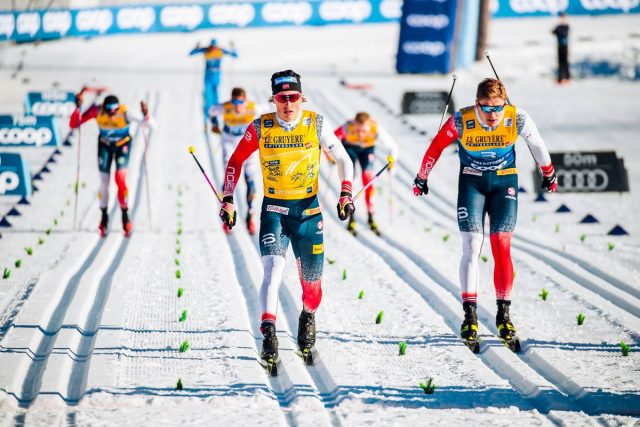
    Klæbo, a five-time Olympic gold medalist, has won the last 10 straight sprint races he’s entered on the World Cup — the highest level of international competition. He often crosses the finish line far enough ahead of his rivals — if you can call them rivals — that he has time to unstrap his poles before crossing the finish line.

    Klæbo, 28, has won five out of the six Olympic and World Championships sprints he’s contested, and 52 of his 69 sprint World Cup starts — missing the World Cup sprint podium just once since 2018, according to data from the International Ski Federation.

    So: How do you beat this guy?

    FasterSkier, when the World Cup made its swing through Canada and Minnesota last season, decided to pose that question to an array of the circuit’s athletes and coaches. We’ve put together a kind of brief oral history below, seeking to appropriately describe Klæbo’s supremacy and the best ideas about how to take him down.

    Enjoy.

    What kind of tactics would you use to beat Klæbo in a sprint?

    Håvard Solås Taugbøl, a Norwegian World Cup racer and one of the nation’s (and globe’s) best sprinters: That’s the $1 million question. I have never managed to do it. 

    Swiss sprinter Valerio Grond: Maybe break his poles or something? I don’t know.

    French sprinter Lucas Chanavat: I mean, if I had the answer, I would have won the last one. You just focus on yourself, do the best race you can. It’s about my strengths. I think you have to be really perfect on every move you do. That’s the fun part about competing with him. It’s, like, you have to be perfect. And that’s really motivating.

    Lucas Chanavat of France alllllmost beat Klæbo at a World Cup sprint race in Switzerland last year. But he didn’t. (Photo: Modica/NordicFocus)

    Sweden’s team manager, Anders Bystrom: I think, first of all, you have to mentally know that he’s not unbeatable. Because I think many people think so. He’s shown that he is almost unbeatable, so it’s fair that people think that. But we don’t talk about him like that.

    Jonna Sundling, the Swedish Olympic champion from 2022 in the women’s sprint: I would go hard from the start, and don’t leave any power. Just go, all that I have. I don’t think I could take him in the final meters — he’s too quick for me. The men, maybe they’re scared sometimes — I don’t know, I think they can do more than what they think they can do. Maybe.

    Maja Dahlqvist, a Swedish Olympic sprint medalist: I would try to sprint him down, like waiting til the end. But I guess a lot of people try to do that, and people are not so successful.

    Grond: If he’s in his top shape, he’s almost unbeatable. He’s really, really always in a good spot. But when he’s maybe not in the best spot, you have to take advantage of this and put in an attack.

    Canadian national team coach Robin McKeever: Break his pole? 

    Swedish sprinter Edvin Anger: I think we need to push him really hard, and take our chances. I don’t think I need to go hard early, but I think I need to have a good place. And when I take my chance, I really need to take my chance. And I need to push from the place in the track that I think is best for me. I can’t wait to see what he will do, because I need to do the thing first.

    Norwegian sprinter Erik Valnes: How to beat Johannes in sprint is all about him being in bad shape. [Laughs] I think maybe it’s about the finish — or, to be able to have a good finish after a high-speed final. There are many things that have to be right to beat him. You just need to start the finishing sprint before him, and be ahead. Because as long as you’re behind him, you’re one step behind him in the mind games as well.

    McKeever: I think the only way is by surprising him. And they’re trying.

    What makes Klæbo so good at sprinting?

    Chanavat: He’s strong in every aspect of the sprint race. He has, like, amazing turns, an amazing finishing sprint, he’s insane in stamina. He’s good at everything. He’s the GOAT [Greatest Of All Time]. 

    Grond: He’s so good in every technique and part of the race, and also tactically. He’s simply the best skier in history.

    Dahlqvist: He’s good in everything. He can go hard, he can wait, he can go from the start.

    Norwegian distance specialist Simen Hegstad Krüger: He often likes to control the heat and he gets a lot of respect. And you have — I think there’s a lot of guys that think there’s no chance to beat him so they just give him room and then they give it away to him. He has earned the respect but especially in sprint you can’t give anything away and you have to take your place and take your positions. And I think he’s the best in that but I think sometimes he gets the best positions a little bit too easily.

    Klæbo wins a Tour de Ski stage just ahead of his Norwegian teammate Erik Valnes. (Photo: Modica/NordicFocus)

    Valnes: I’ve been angry with myself sometimes because of bad tactical decisions. Because many times I’ve just, in my unconsciousness — you think, ‘Just follow him, and you’ll get a good result.’ But then you will not get past him.

    Bystrom: If you meet him in a heat, you almost adapt to what he’s doing. Because you have to see, ‘Okay, what’s Johannes going to do now?’ Because you know he has this X-factor in many parts of the course. 

    Does Klæbo have any weaknesses in sprinting?

    Chanavat: You should probably ask him. That would be the best.

    Klæbo: That’s going to be a secret. [chuckles] I don’t think I will tell everyone. I think I’ll keep that for myself and I’ll tell everyone when I’m done racing. That’s my answer.

    Norwegian sprinter Even Northug: Maybe none.

    Valnes: No. That’s the thing with him. He’s not having any weaknesses. You can say, like, maybe double-poling long flats. But he’s quite good there.

    Krüger: Not that I’ve seen so far. Even in distance races, it’s not so many weaknesses to find. 

    French sprinter Jules Chappaz: I think running [uphill], like in Ruka [the Finnish ski resort that hosts the season-opening World Cup races each year]. First it was the ‘Klaebo run,’ but now I think I’m really good at it. Maybe, hopefully next year in Ruka, I can run faster, beat him. [He didn’t.] He is sick a lot of times — maybe that’s sort of his weakness. 

    Klæbo coasts to the win in Ruka this year, beating everyone, including Jules Chappaz. (Photo: Modica/NordicFocus)

    Anger: It’s a hard question. But I think we need to push him and then make him a little stressed — that’s what I think.

    Bystrom: Mayyyyyybe it’s skating without poles — using your legs to be able to, maybe, go past him. But it’s really hard to say. He’s the best. He’s shown that many times. He’s so good in so many areas. It’s hard to say there’s one where you could beat him when there’s 28 areas where you can’t beat him.

    Are there ways athletes can train over the long-term, like over next summer or multiple seasons, to beat Klæbo?

    Chappaz: Just trying to focus on ourselves. This spring, I will compete in the Ski Classics [marathon races] to improve my double poling. To look to the Olympics, 2026, with the Val di Femme finish — I hope it will improve my double poling skills, to [be able to] beat him.

    Dahlqvist: Maybe they need another team like us, like the Swedish women, because you can use your team more. So, maybe a whole team needs to be stronger, to try to beat the Norwegian. They could do team tactics in a way, like everyone knows where they will go. 

    Anger: I’m still young — I’m just 21 years old. And he has a lot of training hours. A lot more than I have. With one or two years more, with good summers, also with a lot of hours, I think it will be better for me. And maybe I will be better in the final — I’m good in the quarters and the semis right now, but maybe I miss a little in the finals. I need to be a little harder and stronger.

    Valnes, Klæbo and Anger pose for a podium photo after Klæbo won a World Cup sprint in Canada last year. (Photo: Modica/NordicFocus)

    Grond: We’ve just got to work hard. It’s also about learning how to ski against the best skier, for me. So, I’m trying, also, to get some experience on how they ski and where I can be better than them.

    Valnes: It’s more about improving the base level, the capacity, the VO2 max. If you have that base, from May until September, then you can build a little bit on that with specific training in October and November and just before the season starts.

    McKeever: The reality is, how do you beat Klaebo? Have him age out a little bit. 

    Northug: Training.

    Norwegian national team coach Eirik Myhr Nossum: You have to train, of course. But there were a lot of people training for the 100-meter dash, as well: Usain Bolt still won. So, if everybody in the world trains the best they can, still one will win — and it’s hard to beat Johannes. It’s possible, but he’s probably the best skier that’s ever been. And now it’s harder than ever, and he still wins.

  • Revelations at Tour de Ski: Ogden and Hyvarinen!
    Revelations at Tour de Ski: Ogden and Hyvarinen!

    This coverage is made possible through the generous support of Marty and Kathy Hall and A Hall Mark of Excellence Award. To learn more about A Hall Mark of Excellence Award, or to learn how you can support FasterSkier’s coverage, please contact info@fasterskier.com.

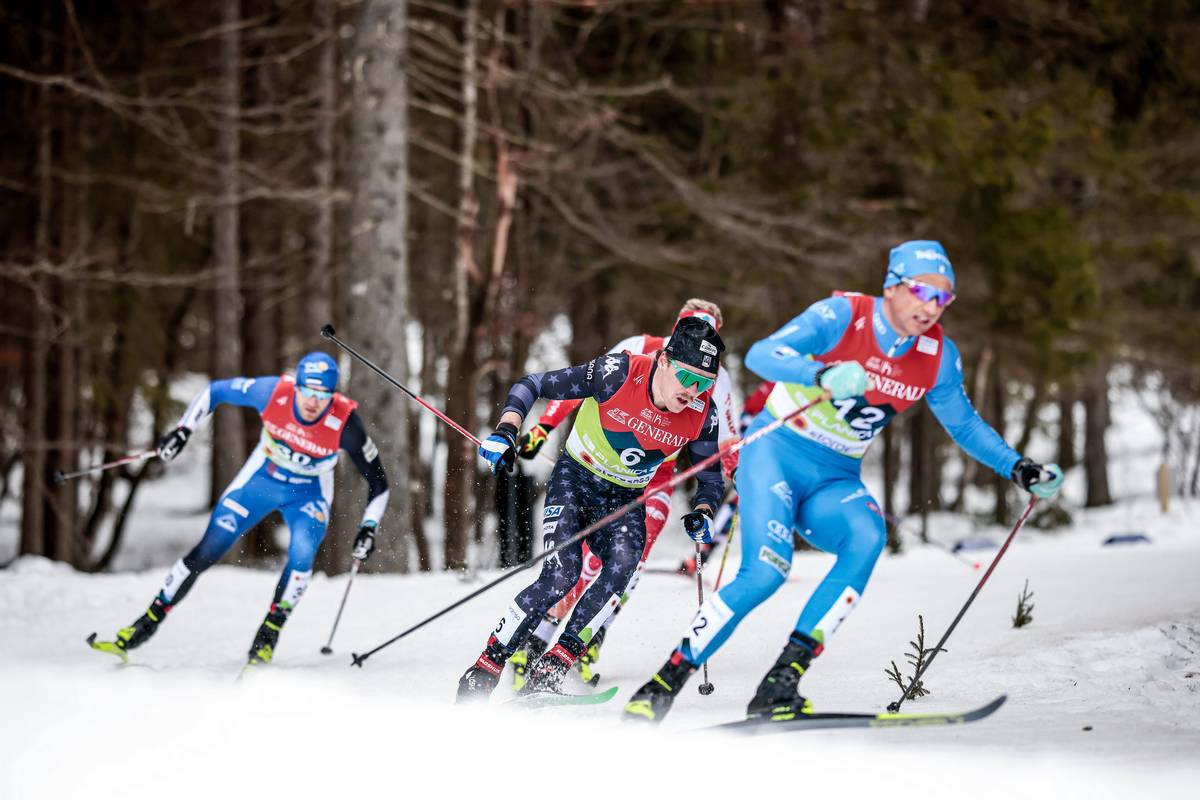
    Ben Ogden (USA) had a lot to celebrate today. He finished ninth in today’s 10 k Classic, kept his third overall position in the TDS, and took the lead in the points race. He literally did a backflip off the podium. (Photo: NordicFocus)

    On Day Two of the Tour de Ski (TDS) in Toblach, Italy, the world had a chance to see what the realignment of the men’s cross-country ski world could look like, and whether it would withstand the concerted efforts of Norway to reclaim its place at the sport’s summit. The new TDS leaders would be tested by the 10 k Classic Individual Start. With many of the favorite pre-race contenders sidelined by illness, it was a chance for other skiers to take to the spotlight, or for yesterday’s winners to try and remain in it. In the men’s race, the TDS leaders were shockingly two Frenchmen and an American. Lucas Chanavat (FRA) sat in first, followed by Jules Chappaz (FRA), and Ben Ogden (USA).

    But, after only one day of racing, it was way too early to proclaim that the giant of men’s racing— Norway—had been felled. Norwegians were still the current favorites to take the title: Erik Valnes (NOR) sat in fourth place, only 17 seconds behind the leader, and Harald Oestberg Amundsen (NOR) was fifth, 20 seconds back. The usually reliable Paal Golberg (NOR) was 24th at the start of the day. So, no tears for Norway as they still had plenty of horsepower under the hood.

    For Chanavat to stay in the lead, he would have to beat the odds by doing something he hasn’t done at the international level since he was a junior skier ten years ago: have a strong performance in a distance Classic race. History—and the odds—were against him.

    When one scans the TDF men’s standings, there aren’t any names jumping out as overwhelming favorites. Valnes is as close as it comes. It is as wide open a tour as there might have ever been, and it is yielding some of the most exciting racing that fans have seen in years. At the end of the day of racing, traditional order had not been fully re-established as the 32 year old Finnish veteran, Perttu Hyvarinen, rose to this occasion and took an unexpected win. Valnes finished second, and Amundsen was third. As expected, Chanavat and Chappaz were unable to maintain their positions, finishing 89th and 48th respectively.

    By finishing ninth, Ben Ogden (USA) was able to stay in third place in the TDS standings. (Photo: NordicFocus)

    But the day brought more good news for team USA: Ben Ogden finished ninth, which was enough to keep him in third place overall in the TDS standings. The Americans also had an excellent performance turned in by Gus Schumacher who finished 15th. Other American finishers were Scott Patterson 40th, Zanden McMullen 50th, and Kevin Bolger 72nd.

    The top Canadian was Antoine Cyr who had a strong day finishing 19th. The next best Canadian was Oliver Leveille in 57th, followed by Julien Locke in 88th.

    It was a career best day and shocking victory for Perttu Hyvarinen (FIN), who captured his first podium in World Cup racing by taking the victory. (Photo: NordicFocus)
    Men’s 10 k Classic Individual Start

    The men’s race started late today—3:00 local time—which meant that by the time skiers took to the course temperatures had warmed to a little above freezing; the trickiest range for Classic skiing. But the temperatures didn’t turn out to be an obstacle for the American squad. “I would have imagined it to be a tricky day to find kick,” said Ogden. “But to be honest, the wax techs today killed it and not one ski I tested kicked badly and none of them were particularly draggy. So major cheers to them for making it easy.”

    Antoine Cyr (CAN) had his moment amongst the early starters taking the best time among skiers on the course at the 1.7 kilometer mark, but he was soon displaced at three kilometers by Hyvarinen. It was an omen of the breakthrough day which was about to unfold for the Finn.

    Amundsen was among the first of the pre-race favorites to take the course, and at the 1.7 kilometer time check he had the fastest time of skiers on the course. When Valnes  came through shortly after, he was tied with his countryman Amundsen. But, by the time they reached the 2.3 kilometer time check both the Norwegians had dropped to third and fourth. This was due to the fact that when Ben Ogden (USA) skied through the 1.7 kilometer time-check, he became the new leader on the course, ahead of Valnes and Amundsen by over two seconds. And, Ogden was still in the lead at the 2.3 kilometer mark without any strong challengers behind him. Being in the lead also allowed him to capture TDS Bonus points handed out the 2.1 kilometer mark.

    Ogden dropped to third place by the three kilometer mark, tied with Valnes. Could lightning strike for the American two days in a row? It was a tall order, and by the half-way mark Ogden had slipped to eighth, some 18 seconds behind the lead, but still only 14 seconds from Valnes. Ogden had extra time in his pocket based upon time bonuses he acquired in yesterday’s sprints, so he was still looking strong in the overall standings. It was a tricky course to maintain consistent pacing on. “I think that with it being a slightly more double pole focused course than usual it was just tempting to go very hard out of the start,” Ogden said. “That being said, the downhills didn’t end up being particularly restful and the ‘smaller’ hills felt pretty big once you were racing.”

    Perttu Hyvarinen (FIN) might have been as surprised as anyone by today’s victory over the best in the world. (Photo: NordicFocus)

    The early finishing mark was set by Hyvarinen who has never stepped onto a World Cup podium. Even so, he turned in a very strong time, over 27 seconds ahead of the next best finishers on the course at the time he finished. As skiers with fancier pedigrees crossed the finish, Hyvarinen’s time—to the astonishment of spectators— continued to hold up. One by one, the best skiers in the world came through; Hyvarinen’s time continued to hold.

    The best in the world continued to finish with Hyvarinen continuing to hold the lead. When Amundsen finished, he was in second, but an astounding seventeen seconds behind the Finn. Then came Valnes; and he too was unable to displace Hyvarinen. One by one all of the top ranked skiers finished, and all of them fell short of Hyvarinen’s time. It was beginning to be a storybook day for Finland.

    Try as he might Erik Valnes (NOR) was unable to dislodge Perttu Hyvarinen (FIN) from the top of the podium. (Photo: NordicFocus)

    At eight kilometers, Ogden was hanging tough in sixth place; 28 seconds off Hyvarinen’s time, but more importantly only fourteen seconds behind Amundsen. As Ogden pushed toward the finish he double poled intensely, but the clock showed that he continued to lose time. When he crossed the finish line he was ninth, 46 seconds from the lead, but only 30 seconds behind Valnes. It was good enough to keep Ogden in third place overall in the Tour de Ski.

    It was a career day for Hyvarinen, and his teammates were clearly thrilled for him. After 110 starts he not only found the podium but conquered the top spot. It was yet another feel good story in a TDS where conventional wisdom has been challenged. After the race he praised his service team for giving him good skis. He seemed to take the surprise victory in stride noting that there wouldn’t be any big celebrations, though he clearly enjoyed showering his team with champagne after his victory.

    Gus Schumacher (USA) also had an excellent day for team USA. He finished 15th and that moved him into 12th in the TDS standings. (Photo: NordicFocus)

    Somewhat hidden by Hyvarinen’s surprise victory and Ogden’s performance was a fantastic day for Gus Schumacher (USA), who finished 15th. His performance was good enough to move him into 12th in the overall TDS standings, exactly one minute behind Ogden. Schumacher is still feeling good after today’s efforts. “[I’m] not crazy tired yet,” Schumacher told FasterSkier.  “[I’m] pretty psyched to feel like my skiing is just going solid lately, so looking forward to the rest of it.”

    Impact on Tour Standings

    When the racing had finished, the old order was partially restored with Norway taking the lead in the TDS: Valnes in first, Amundsen second. But American Ben Ogden disrupted the list of Scandinavians in the top and remained in third place. Norway had been restored to the top of the results list in the TDS, but still had not found the top of the podium for the day’s race, and for his surprise efforts, Hyvarinen landed in fourth place overall. No matter how you looked at it, it was still a day full of disruption to World Cup skiing with a little known Finn taking the race and an American man sitting third in the overall TDS standings. It was a pleasant surprise on which to end the year. Ogden acknowledged as much when he was asked if before the TDS began he had ever imagined himself this high in the rankings? “No,” he replied. “I sincerely did not imagine I would be third in the Tour at any point. I’m proud to be there and excited to keep fighting and see what the future holds.”

    But there was even more good news for team USA, Ogden was also leading in the points chase. He was clearly very pleased with this outcome as he literally did a backflip from the top of the podium at the end of the flower ceremony.

    10 Kilometer Individual Start Classic RESULTS


    It was a day team Finland will long remember when Perttu Hyvarinen (FIN) stepped up to fill the void left by Iivo Niskanen’s (FIN) illness to take the victory. (Photo: NordicFocus)
  • Klaebo Dominates Chaotic World Championship Sprint, Schoonmaker Scores Top Ten

    Klaebo Dominates Chaotic World Championship Sprint, Schoonmaker Scores Top Ten

    This World Cup coverage is made possible through the generous support of Marty and Kathy Hall and A Hall Mark of Excellence Award. To learn more about A Hall Mark of Excellence Award, or to learn how you can support FasterSkier’s coverage, please contact info@fasterskier.com.

    23.02.2023, Planica, Slovenia (SLO):
    Johannes Hoesflot Klaebo (NOR) – FIS nordic world ski championships cross-country, individual sprint, Planica (SLO). www.nordicfocus.com. © Modica/NordicFocus. Every downloaded picture is fee-liable.

    By the time the men’s final started, the procession had all but begun. Johannes Hoesflot Klaebo (NOR) went to the front, kept the rest of his competitors just out of reach, and used the final stretch to wave to the crowd as he claimed his seventh World Championship title. A whole season’s worth of results pointed to that conclusion, and it had finally come. It could almost have appeared unextraordinary but for the fact that the Planica, Slovenia race course seemed intent on writing the final few verses of this season-long story. On a day when racers routinely veered off course, Klaebo’s achievement of moving through all of it unscathed—making a World Championship look almost inevitable—was put into stark relief. Johannes Hoesflot Klaebo was a master craftsman at work in this, his chosen medium: sprint racing.

    Ultimately, the day—and the World Championship—was won by Klaebo, followed on the podium by World Cup Distance Leader, Paal Golberg (NOR) and the jubilant Frenchman, Jules Chappaz.

    “A Hard-A** Course”

    The real excitement at the World Championships today wasn’t in the final, but in the jostling it took to get there. Every quarterfinal heat seemed to apply another layer of complexity, as tough conditions and a winding Planica course combined to void most pre-race predictions. As US skier Ben Ogden would summarize in post-race comments to FasterSkier: “It was a hard-a** course, and slushy as well.”

    The Planica, Slovenia sprint course. The A-climb in the middle wound and changed pitches, combining with soft snow conditions to make for plenty of tangle-ups. (Photo: FIS Nordic World Ski Championships – Planica)

    The second quarterfinal exemplified how conditions combined to re-write expectations in real time. Federico Pellegrino (ITA), the only skier in the field other than Klaebo with a sprint world title, and Richard Jouve (FRA), the only other skier besides Pellegrino and Klaebo to have won a sprint race this season, lined up as the marquee names set to challenge Klaebo. Alongside them, Even Northug (NOR) and Calle Halfvarsson (SWE) both looked to build off their own promising sprint results this season.

    Richard Jouve (FRA) leads out the second quarterfinal heat Thursday. Jouve, alongside Federico Pellegrino (ITA) were knocked out in the quarterfinal, shaking up pre-race predictions. (Photo: NordicFocus)

    That field jockeyed for position as they hit the long climb that defined the middle-part of the Planica course. Smack in the middle of the climb—where skiers emerged from under a bridge—was an uphill chicane where many skiers broke into a herringbone. As the heats went on, that spot got increasingly chewed up, the snow got softer, and the chicane became a crux in the course that claimed another victim. Jouve suffered a momentary stumble, allowing Pellegrino and Halfvarsson to begin chasing Northug. Jouve eventually would close the gap to Pellegrino, but the two pre-race favorites weren’t fighting for first or second, but rather third place. Halfvarsson overtook Northug on the final climb to win the heat. Jouve had recovered from his stumble but not quite enough, being edged out by Northug for the second spot. The only two skiers to have beaten Klaebo head-to-head this season—Jouve and Pellegrino—were out before the semifinals.

    The spot in the chicane that saw a little stumble for Jouve saw bigger accidents from others. In the first quarterfinal, Swedish skier Even Anger broke a pole and fell, causing a split in the field that allowed the Norwegian duo of Klaebo and Erik Valnes (NOR) to cruise to the semifinal. On the unlucky side of the fall in that heat was Canadian Graham Ritchie. In post-race comments to FasterSkier, Ritchie summed up his, and many other racers’ experience on the Plainca course: “That was a good learning race,” he said. “I was able to ski all right, but had a tumble. It was a sloppy hill, and if someone goes down next to you, it was pretty likely you’re going to end up in that mix.”

    Ultimately, Valnes—who had qualified first and avoided that first quarterfinal heat carnage—would also fall victim to the tricky chicane. In the first semifinal, he entered leading before breaking not a pole, but a ski. It was that kind of day.

    Ben Ogden (USA) skis in quarterfinal action after qualifying sixth place on Thursday. Ogden would be eliminated in the heat, finishing 26th on the day. (Photo: NordicFocus)
    Sprint Quarterfinals

    For the Americans—Ben Ogden, JC Schoonmaker, and Kevin Bolger—there was one place they looked to head: the Finals. “This time around at World Championships I’m more at liberty to set some goals,” Ogden said. “I’m really excited for the Classic Sprint—I have my heart set on getting into the Final.” For Ogden and Schoonmaker, a Sprint Final is the next logical step. Both have earned a pair of seventh place finishes in sprint races this year: Ogden in December at back-to-back weekends in Lillehammer and Beitostolen, Schoonmaker in November’s opener in Ruka and in the Tour de Ski at Val di Fiemme. The young Americans’ performances in qualifying seemed an auspicious sign: Ogden had qualified in sixth place, while Schoomaker had qualified in 15th. Ogden chose to a position in the third quarterfinal, where he matched up with other top-ten qualifiers Paal Golberg (NOR) and Lucas Chanavat (FRA). Ogden lingered in the mix through the early goings of the race, before launching into a hard stride that moved him up the pack at the base of the climb. For the young American, though, it was a move that couldn’t be carried to the finish-line. “I made a bunch of places up striding up the first hill,” Ogden said, “but just didn’t have it to push up and over the whole way.” Ogden finished sixth in the heat, saying post-race that “I was psyched with the qualifier, but it definitely took a little out of me.”

    Schoonmaker entered the fifth quarterfinal heat. That heats highest qualifier was Finnish skier Niilo Moilanen, who looked to get out in front to avoid any kind of melee in the early downhill section of the course. It looked like a smart move, as Czech skier Ondrej Cerny went down in the first turn. Things then settled down and the pack was together through the main climb. In an instant though, the settled nature of the field was undone as Moilanen and Swedish skier Johan Haeggstroem tangled. Haeggstroem broke a pole, and Schoonmaker and French skier Renaud Jay seized the opportunity. Jay exploded towards the top of the climb with Schoonmaker in tow; less forceful, but now with less reason to be so. Jay and Schoonmaker could control their efforts all the way to the finish line, the fall having cleared the field for them to advance to the semifinals.

    JC Schoonmaker (USA) in action Thursday. Schoonmaker scored his first World Championship top 10, with a ninth place finish after being eliminated in the semifinals. (Photo: NordicFocus)
    Sprint Semifinals and Finals

    Schoonmaker lined up in the second semifinal alongside Paal Golberg (NOR), Michal Novak (CZE), Renaud Jay (FRA), and Marcus Grate (SWE). That field stretched only slightly through the early part of the climb into the uphill chicane; it remained a close race. Then, all of a sudden, Schoonmaker dropped to the snow, the last skier on the day to get bitten by bad luck and hard conditions. He popped up and skied on, but his chance at the final had slipped away. Chappaz and Golberg went on to claim first and second in the heat.

    In the day’s final, Chappaz continued to prove fearless, even up against Klaebo who has dominated the World Cup season, and Golberg, the skier who has traded places with Klaebo for the World Cup Overall lead throughout the season. The 23 year old Frenchman’s would claim a World Championship bronze—out-lunged by Golberg by the narrowest of margins. Klaebo raced the final at the front, setting the pace wire to wire, apparently having decided to stay out of the troubling mix that had tripped up so me contenders on this chaotic day in Planica. 

    US “Pretty Satisfied” with Top 10 Results

    In post-race comments to FasterSkier, US Ski Team Head Coach Matt Whitcomb said the US camp was “feeling pretty satisfied after what is not historically a wheelhouse event for us.”

    JC Schoonmaker (USA) after his semifinal heat. Schoonmaker fell on the main climb in the heat, falling victim to the tricky conditions on the Planica course. (Photo: NordicFocus)

    JC Schoonmaker’s semifinal performance saw him earn ninth place, the first top 10 World Championship finish of his young career. Schoonmaker joined Julia Kern and Rosie Brennan from the women’s field to give the US three total top 10’s on the day. That, Whitcomb suggested, is an overall strong result which shines through a day with a lot of twists and turns. “We love to chase the podium, and there’s always a moment where you realize that you won’t be doing that [in a sprint race] that is kind of a let-down,” Wuitcomb said. “But then the team pulls back and goes ‘we’re good.’ It was a really good day with three in the top ten.”

    The US men’s team—and the entire World Championship field—now face the challenge of shifting disciplines to Friday’s 30 k Skiathlon. The shift in discipline will also mark a shift in focus for Klaebo who has now won the individual sprint race at World Championships or the Olympics in every season since Pyeongchang in 2018. His seventh World Championship title ties Gunde Svan (SWE) for the fourth most all-time. Klaebo is now in an historical peer group with only Sweden’s Sixten Jernberg (8), and Norway’s Bjorn Daehlie (9) and Petter Northug (13). The sprint was the relatively easy part for Klaebo, but he has yet to dominate a World Championships in the way that Northug did during the peak of his career, winning both distance, sprint, and team events in a single Championship. In Falun 2015, Northug won both the Individual Sprint and the 50 k, an accomplishment still unmatched by any other skier. Friday will offer an indicator of Klaebo’s abilities to deliver a similar performance, one of the few remaining historical precedents he still might be chasing.

    Full RESULTS Qualifying | Heats

    Men’s World Championship Sprint podium: 1st) Johannes Hoesflot Klaebo (NOR), 2nd) Paal Golberg (NOR), 3rd) Jules Chappaz (FRA). (Photo: Nordic Focus)
  • Jouve takes back-to-back classic sprint wins, earning France the 2022 World Cup sprint globe; Ritchie leads for North America with Top-20

    Jouve takes back-to-back classic sprint wins, earning France the 2022 World Cup sprint globe; Ritchie leads for North America with Top-20

    This World Cup coverage is made possible through the generous support of Marty and Kathy Hall and the A Hall Mark of Excellence Award.  To learn more about A Hall Mark of Excellence Award or to learn how you can support FasterSkier’s coverage please contact info@fasterskier.com.

    It’s the last hurrah, folks! The World Cup Finals kicked off in Falun, Sweden today with a classic sprint. While the season has been a wild ride for many reasons – spills and thrills in the Tour de Ski, COVID-cancellations, Olympic Games, geopolitical nightmares – Falun evidenced that spring is on it’s way and it’s time for the World Cup crews to head home take a break, and begin anew.

    Contrasting the dim light and long shadows of far-north Ruka, Finland at the opposite bookend of the season, the sprints in Falun were raced under bright sun, with temperatures well-above freezing, bare ground and green grass emerging from beside ski tracks.  

    Zak Ketterson leads the U.S. in 39th during the classic sprint qualification round in Falun, SWE. (Photo: NordicFocus)

    The American men, particularly in sprint, headed into the Falun weekend at a significant disadvantage. Kevin Bolger announced on Instagram Thursday that he had tested positive for COVID, while Ben Ogden, JC Schoonmaker, and Luke Jager – the remainder of the four sprint men who competed during the 2022 Olympics in Zhangjiakou – are currently competing at the NCAA championships in Soldier Hollow, UT. The sprint field as a whole has been weakened; Russian athletes were banned from competition on March 1st, while Norway’s top-six sprinters, including sprint and overall World Cup leader Johannes Høsflot Klæbo, each tested positive for COVID following the World Cup race weekend in Lahti, Finland. With no Russian’s and the top-Norwegians out, the men’s field had been cracked wide open.  

    Finland’s Joni Mæki posts the fastest time in the classic sprint qualifier in Falun, SWE. (Photo: NordicFocus)

    Finland’s Joni Mæki took the top spot in qualification, setting the mark at 2:51.58. Sivert Wiig of Norway took second in the qualifier (+0.69), with Sweden’s Calle Halfvarsson in third (+1.41). Three nations represented in the top-three.

    Though new-to-FasterSkier names made the top-30, the early heats featured little surprise. Building momentum from a podium day in Drammen last week, France sent three of its top men to the semifinals: Lucas Chanavat and Richard Jouve, who had been third and first, respectively in Drammen, plus Jules Chappaz. Long-time sprint force Federico Pellegrino of Italy also moved through with an automatic spot, joining the day’s top-three qualifiers in the next round.

    What did shake up the quarters was some trouble for the two Chinese athletes in the field. Shang Jincai, who had qualified in 25th, had a false start in heat three. Jincai looked as though he had been trying to keep himself so primed for forward momentum at the start beep, that he lost his balance, kicking a foot forward to catch himself well-before the beep and thus triggering the start. After a discussion with a jury member, while Pellegrino shook his head and raised his hands nearby, looking impatient, Jincai received a yellow card and was disqualified. 

    After stumbling on a climb and losing ground, Wang Qiang (CNH) races to 18th in the classic sprint quarterfinal in Falun, SWE. (Photo: NordicFocus)

    In the next heat, Wang Qiang, who qualified in 9th and took second in Drammen, fell when hopping out of the track to run uphill, roughly two minutes into the heat. Qiang had been in the lead, though the pack remained tight. After a few missteps, he was back to his feet, chasing as real estate ran out, while Lars Agnar Hjelmeset (NOR) and Calle Halfvarsson (SWE) took the reins at the front to go 1-2 in the heat. Qiang raced his way back to fourth, just over a second back, but it was not enough for a lucky loser spot.  

    Richard Jouve (FRA) takes control through the rounds in Falun. (Photo: NordicFocus)

    In the semis, France’s Jouve took control of the fast first heat, beginning a surge just under-two minutes in as the men ran up the steep climb and banked left to head back toward the stadium. Around the last corner, Jouve still held the lead with Mæki (FIN) just off his shoulder. Jouve pulled ahead in the double pole sprint through the lanes, while Mæki, Wiig (NOR), and Chanavat (FRA) raced each other and the clock down the final meters. At the line, it was Norway-France-Finland, spread by 0.38 seconds, fifth and sixth less than a second behind also. Each of the top-four finishers advanced into the final round.

    The second heat was significantly less smooth, though times did not reflect the chaos and were only marginally slower than the first. As the course broke down, it looked to be continually harder to keep klister free and stay upright. Heading into the final downhill in strong position to take the heat, France’s Jules Chappaz looked as if his klister snagged some loose granules of snow; as he pushed off the outside ski to stay in the curve, the ski looked unable to slide and he crashed into the abrasive corn. 

    The remaining athletes in the head narrowly dodged Chappaz, allowing Hjelmeset and Pellegrino to take the lead and eventually win the heat. Sweden’s Halfvarsson also went down earlier in the heat, looking to have similarly iced up while running up the first climb, leaving him off the back after the subsequent downhill.

    After leading into the final downhill, a dejected Jules Chappaz (FRA) recovers from a crash to finish his semifinal. (Photo: NordicFocus)

    Once again, Jouve took control of the final early, with Pellegrino marking. Mæki stayed wide on the first climb looking for better snow, but came over the top and into the curve behind the top three. Jouve, still calling the shots, led into the downhill, but he could not create any significant gaps there; Wiig, Pellegrino, Chanavat and Mæki quickly accordioned onto the backs of his ski tails.

    Looking confident and composed despite being unable to break away, Jouve remained at the front heading into the final curve. Once in the lanes, Jouve began to pull ahead a final time, creating a gap of several meters to Mæki and Chanavat, who were evenly matched in the double pole sprint. 

    Richard Jouve (bib 10) leads the men’s classic sprint final to the finish in Falun, while four athletes vie for the remaining two podium positions. (Photo: NordicFocus)

    Emptying his lungs with a triumphant cry, Jouve coasted over the line for the win in 3:03.62, while Mæki and Chanavat threw their boots forward in a photo finish for the second and third podium spots roughly half a second behind. From the slow-mo, it was Mæki with the better lunge, nipping Chanavat by 0.03.

    Just behind Wiig crossed fourth (+1.41), with Pellegrino fifth (+2.06), followed by a gap to Hjelmeset in sixth (+13.18).

    Richard Jouve (FRA) lets out a victory cry as he takes the classic sprint win in Falun. (Photo: NordicFocus)
    The men’s classic sprint podium in Falun, Sweden: Richard Jouve (FRA) took the win ahead of Joni Mæki (FIN) and Lucas Chanavat (FRA). (Photo: NordicFocus)

    “I’m very proud,” Jouve told FIS after the race. “Off myself, my team. It’s amazing.” 

    With the win today, Jouve also took the lead in the sprint World Cup standings, advancing by just six points ahead of Johannes Høsflot Klæbo (NOR). The season saw Jouve land on four World Cup podiums, finish seventh in the freestyle sprint during the Olympics, and then earn his career first World Cup win in Drammen’s classic sprint last Thursday.

    “It’s amazing,” said an emotional Jouve, seemingly in happy disbelief. “The season was very great for me, to win at the end of the season is already a dream, but to grab [the globe], it’s big. Fantastic.”

    With a win in the final sprint stage, Richard Jouve becomes the 2022 World Cup sprint champion, hoisting his crystal globe. (Photo: NordicFocus)
    French teammates Richard Jouve (left) and Lucas Chanavat (right) end their season in first and third, respectively, in the World Cup sprint standings. (Photo: NordicFocus)

    A quick review of the final standings: With 568 points, Jouve is the 2022 sprint World Cup champion, with Klæbo second (-6) and Chanavat third (-107). Italy’s Pellegrino was fourth (-238), with Norway’s Håvard Solås Taugbøl fifth (-244). 

    The US had three starters for today’s final sprint stage. Zak Ketterson led the way for the American team in 39th (+9.92), followed by Logan Hanneman in 47th (+10.79), and Peter Holmes 54th (+13.38). 

    Listen to post-race interview with U.S. Ski Team Head Coach Matt Whitcomb here.

    Logan Hanneman skis to 46th in qualification in Falun. (Photo: NordicFocus)
    Graham Ritchie leads the way for North America, finishing 20th in Falun’s individual classic sprint. (Photo: NordicFocus)

    Racing for Canada, Graham Ritchie was the sole North American to break into the heats after qualifying in 28th (+8.11). Racing in the third quarterfinal heat, Ritchie crossed fourth, roughly three seconds behind Chanavat and Pellegrino, the heat winners. The effort landed him in 20th overall once final rounds were decided. 

    Missing the top-30 by just 0.27 seconds, Antoine Cyr was next for Canada in 31st (+8.76), with Xavier McKeever next in 44th (+10.54), followed by Rémi Drolet in 57th (+14.59). 

    Antoine Cyr just misses the mark in qualification, finishing 31st. (Photo: NordicFocus)

    Racing in Falun continues tomorrow with a 15 k individual start skate.

    Results:

    Qualification | Final | World Cup Sprint Standings


  • Tuesday Race Rundown: Lahti Junior Worlds  U20 5 k/10k Individual Skate (Updated 2x)

    Tuesday Race Rundown: Lahti Junior Worlds U20 5 k/10k Individual Skate (Updated 2x)

    Gus Schumacher skiing to sixth place in the U20 10 k skate during the 2019 Junior Worlds in Lahti, Finland. (Photo: Doug Stephen).

    FIS Junior World Ski Championships Lahti, Finland 5 k/10k Freestyle Interval Start

    Tuesday in Lahti, Finland was as Finland should be: squeaky-snow-cold and cross-country ski racing on offer.

    Eighteen-year-old Gus Schumacher broke through for the U.S. and placed sixth overall in the U20 men’s 10-kilometer freestyle. Schumacher was the 95th starter of 102 finishers on the day. His sixth place finish was consistent with his 1.1k, 5k, and 6.6k splits where he was ranked 5th, 6th, and 7th respectively. Schumacher stopped the clock in 23:19.3 minutes, 44.4 seconds behind the winning mark.

    The Lahti championships are Schumacher’s second Junior Worlds. His sixth place is his best individual result. He was part of the second place 4 x 5 k U20 relay last year in Goms, Switzerland.

    “I was most nervous about hitting it right and doing the right pacing and making sure I can have the best race that know I can,” Schumacher told FasterSkier over the phone. “I approached it as just a new race almost. We have done a fair amount of watching old world cups and world championships that were on the exact same courses here. It was definitely hard to reflect on that because none of them were exactly 10 k. And obviously those athletes are quite a bit stronger than we are. And the snow is different.”

    Schumacher extracted what he needed from the videos. Imprinted in his mind before his 10 k start were enough visuals to quell the nerves and provide a path to fast clean skiing.

    “We watched that and I felt like I got an idea for what the body movements looked like of those guys,” Schumacher said. “I thought about how that would feel for me and I thought about the other middle distance skate races I have done this year –which is actually a fair amount between early season time trials.”

    Schumacher executed his plan. He dialed back the initial effort, stayed in control, and systematically revved the engine.

    “I went out and tried for at least the first five minutes to go a little easier, because I think that is the high risk time, the very beginning,” said Schumacher. “I tried to go out and keep it consistent and as I started to get into it, I started to ramp it up a little more and really try to make the most of the recovery. Which wasn’t a lot, but enough that I could put my head in between my knees on the downhill and I could tell myself that 15 seconds of high speed downhill is helping me. And I could get my breath down a little bit and I was ready for the next hill.”

    His run at the podium came up just 17 seconds short. But with his plan executed, the Anchorage based skier had no regrets when reflecting on Tuesday’s race effort. 

    “I definitely wanted to be top-10, but I felt like and still feel like a medal is in sight,” Schumacher said. At 18, he still has one more year of eligibility in the U20 ranks.

    “For sure satisfied with this race, it felt like a good result and it was one of my better races. And I am happy with how it played out and also thinking about how I can hit the 30 k and do the most I can do.”

    France’s Jules Chappaz won the race in a time of 22:34.9 after skiing the fastest splits at 5 k and 6.1 k. Sunday’s classic sprint winner, Russia’s Alexander Terentev, placed second (+21.0), and Norway’s Iver Tildheim Andersen in third (+27.2).

    Canada placed two skiers in the top-31. Remi Drolet finished in 20th (+1:14), Samuel Gary Hendry 21st (+1:15.9), Thomas Stephen 31st (+1:36.8). Xavier McKeever skied to 44th (+2:04.6).

    For the U.S., Zanden McMullen placed 32nd (+1:40.6), Johnny Hagenbuch 34th (+1:46.3), and Noel Keeffe 58th (+2:45.7).

    Men’s U20 Results

    Sweden’s Frida Karlsson winning the U20 5 k skate at Junior World Ski Championships in Lahti, Finland. (Photo: Doug Stephen)

    Sweden’s Frida Karlsson won the U20 5 k skate in 12:50.6 minutes. Norway’s Helene Marie Fossesholm placed second 11 seconds back, with Finland’s Anita Korva in third (+19.8).

    “It was fun to ski today. I just wanted to have my revenge”, Karlsson told race organizers after the race. Karlsson had qualified first on Sunday’s U20 classic sprint but placed fifth in the overall.

    U.S. skier Kendall Kramer post U20 5 k skate at Junior World Ski Championships in Lahti, Finland. (Photo: Doug Stephen)

    The best placed North American was U.S. skier Kendall Kramer who finished in 15th (+55.6) place. Also for the U.S., Sydney Palmer-Leger was 20th (+1:04.9), Novie McCabe 29th (+1:20.8), and Waverly Gebhardt 65th (+2:28.8).

    Canada’s Anna Pryce (bib 22) and Jasmine Drolet (bib 20) finishing the U20 5 k skate at Junior World Ski Championships in Lahti, Finland. (Photo: Doug Stephen)

    Anna Pryce was the top Canadian in 43rd (+1:36.5). Teammates Molly Miller skied to 50th (+1:52.9), Isobel Hendry 58th (+1:57.1), and Jasmine Drolet 67th (+2:35.7).

    Women’s U20 Results