From the FasterSkier archive — posts syndicated from athletes’ and coaches’ own blogs between 2004 and 2012, kept online as published. Current coverage is at fasterskier.com.
This coverage is made possible through the generous support of Marty and Kathy Hall and A Hall Mark of Excellence Award. To learn more about A Hall Mark of Excellence Award, or to learn how you can support FasterSkier’s coverage, please contact info@fasterskier.com.
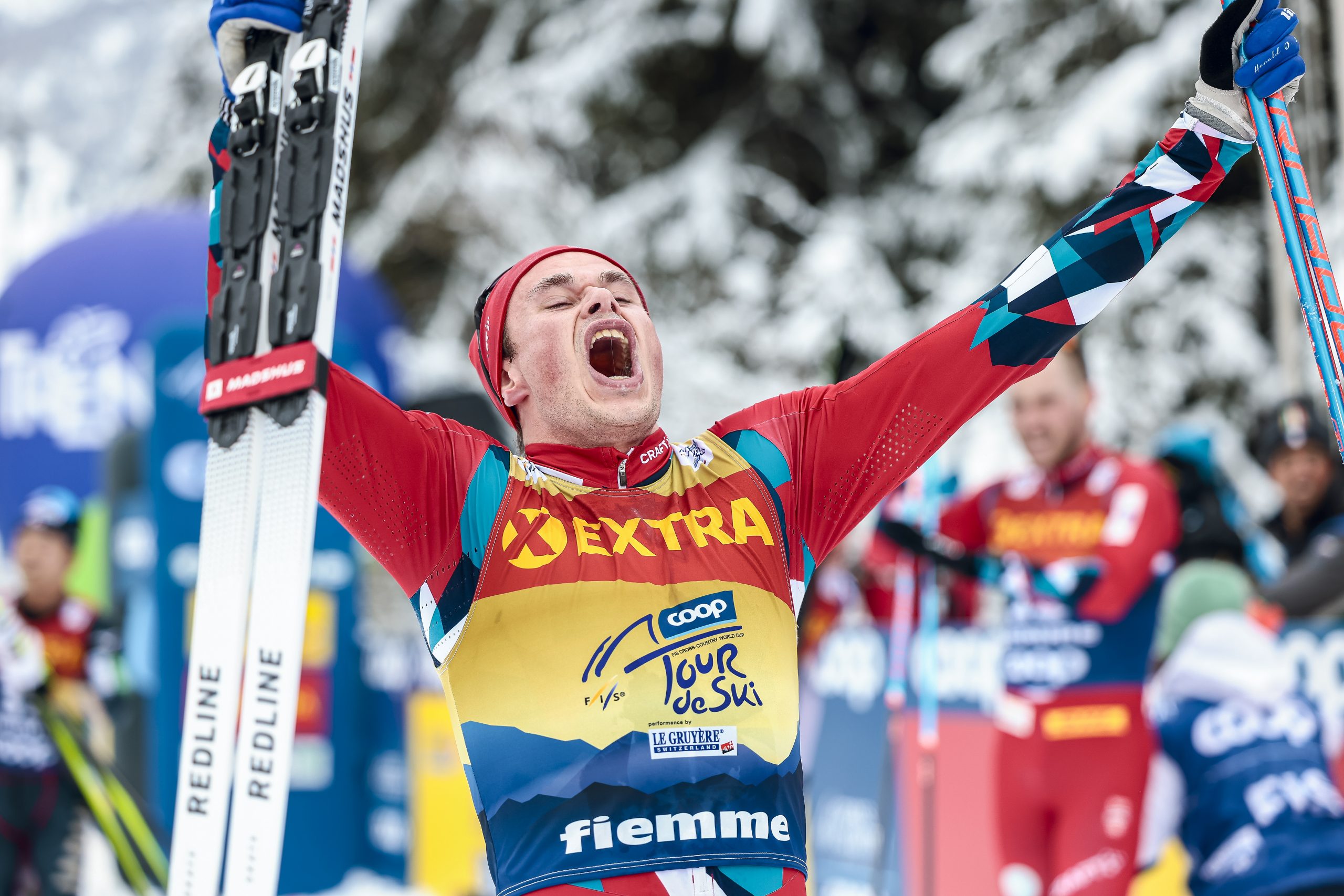
Johannes Hoesflot Klaebo (NOR) claimed a record-setting fifth overall Tour de Ski victory. (Photo: Vanzetta/NordicFocus)
In its original configuration (and for many seasons that followed), the final stage of the Tour de Ski was a Pursuit race—perhaps the only Pursuit race that actually made sense in the context of the World Cup tour. The leader went off with the advantage they’d earned during the course of the Tour; everyone else chased. The first skier to the top of Ape Cermis was the winner of the Tour de Ski. In the past few years, though, organizers began thinking that the final day’s racing would be more exciting if it adopted a mass start format. So, today’s final stage was one in which all remaining competitors departed the starting line together. The contenders would battle it out on the slopes of the Alpe Cermis, hoping to manage the gaps to their competitors and to maintain the positions each had earned during the week of grueling racing in Toblach and Val di Fiemme. The stage was set for the climb up the Alpe Cermis.
Ultimately, the stage was one by Mattis Stenshagen (NOR) just ahead of Jules LaPierre (FRA). A resurgent and rejuvenated Emil Iversen (NOR) claimed the third spot on the day’s podium, followed by Savelii Korostelev (AIN) who is beginning to establish himself as a contender in World Cup events as skiers begin setting their sights on the Olympic Winter Games beginning next month in Milano-Cortina. North American skiers were led to the summit by Antoine Cyr (CAN) in 13th place. Gus Schumacher (USA) would climb bravely, fading to 16th on the stage but still managing to preserve his seventh place overall finish (best ever for an American man in the Tour de Ski). Ben Ogden (USA) would maintain his position in the field, coming across the line 22nd and followed by Zak Ketterson was 35th, Graham Ritchie (CAN) 40th, Remi Drolet (CAN) 45th.
Gus Schumacher’s (USA) goal in the 2026 Tour de Ski had been a top ten overall finish. He accomplished that with room to spare, and added a stage victory in the 5 k Mass Start for good measure. (Photo: Vanzetta/NordicFocus)
“My goal was to get top ten, coming in,” recalled Schumacher. “It’s nice to have a solid tour, with some really bright spots like the 5 k . . . In mass starts, I’m feeling really comfortable skiing with (the leaders) in the Pursuit, the 5 k Mass Start, and today. It’s nice to be comfortable with the leaders.”
“Today I was more energetic than I expected,” said Ogden. “But I don’t really race this often enough to have an idea of how long it is, or how much it’s gonna hurt.”
But it was the overall Tour de Ski lead of Johannes Hoesflot Klaebo that everyone was interested in—and the lead that all the other racers were hoping to reduce, or even overcome. Unsurprisingly, Klaebo’s 90 second cushion over his nearest rivals proved more than sufficient to preserve his overall victory in the 2026 Tour de Ski—his record-setting fifth overall victory in this annual event.
Stage 6—Alpe Cermis
Klaebo must be so tired of this stage . . . he’s skied this finish to the Tour de Ski many times before, each time knowing that he has a chance to win if only he can get to the top fast enough. Klaebo has made this climb before—and has claimed the Tour victory four other times—but it’s never been his strength. One year ago, he finished this stage 17th . . . fast enough for the win, but well behind a number of skiers who were also in today’s field. Today, in Val di Fiemme, Klaebo led at the start, offering a moderate pace while hoping to conserve energy for the climb. Inexplicably, his pace in the early kilometers was matched by Edvin Anger (SWE), a skier who excels only at sprinting, and whose body type—the guy is huge—really didn’t suggest that he’d be a contender on the steep slopes of the Alpe Cermis. Across the flats of the valley below Val di Fiemme they raced, knowing that the real challenge wouldn’t start until they reached the slopes of the Alpe Cermis.
All the starters must have approached the day with trepidation—climbing the Alpe Cermis is a daunting challenge—but perhaps nerves were even more on edge among the Norwegian team members, many of whom knew that today’s result might be the difference between qualifying for the Norwegian Olympic Team, or being left at home when the Games begin in Milano-Cortina next month.
Simen Hegstad Krueger (NOR) has won this stage three times in the past, but his recent performances did not suggest that he’d be a factor today. How crazy is it that a skier of Krueger’s pedigree finds himself on the bubble when it comes to selection for his nation’s Olympic team? Krueger is one of a number of Norwegians who knew their performance in Tour de Ski was perhaps the only way to get the attention of the Committee selecting the Norwegian Olympic Team. And in these 10 kilometers, his chances would fade dramatically. A three-time former winner of this stage up Alpe Cermis, Krueger would fade to 25th on the day—22nd in the overall standings—probably ending his Olympic quest. Just one spot ahead of Krueger, Andreas Fjorden Ree also may have seen his Olympic plans fading today on Alpe Cermis. Qualifying for a Norwegian Olympic Team may be the starkest test in all of cross-country skiing, and the Alpe Cermis is a definitively cruel proving ground, one that leaves former champions prostrate and gasping.
Harald Oestberg Amundsen (NOR) preserved his status on Team Norway with a fifth place finish on Alpe Cermis, but Lars Heggen (NOR)—who stood in second place at he beginning of the day—may find himself harshly criticized in Norway after dropping to 29th on the Alpe, and sixth overall. Ironically, what would be career-best finishes for nearly any other World Cup competitor could become the disastrous moment in Heggen’s career.
Mattis Stenshagen (NOR) dominated the final climb up Alpe Cermis, winning the Tour’s final stage, and vaulting himself into second place overall. (Photo: Modica/NordicFocus)
The Climb
The rate of attrition is high at the Tour de ski: only 69 of the original 122 starters remained to toe the starting line of the final stage. Klaebo began the day leading the Tour de Ski standings—1:23 ahead of Heggen, 1:29 over Stenhagen, and1:37 over former Tour winner, Amundsen who began the day in fourth position. Italy’s Federico Pellegrino still harbored ambitions of a final Toud podium; he sat in fifth, 1:40 back, and trailing two skiers (Stenshagen and Heggen) who had never before climbed the Alpe. Potential exstedfor plenty of positions to be shuffled, but not before the grueling climb of the Alpe Cermis was concluded.
Schumacher started in seventh position, moving past Anger into sixth as soon as the climbing began in earnest.When the course reached its steepest point (a 26+ percent grade), the stage was led by Stenshagen who was followed closely by LaPierre and Korostelev. Thereafter, the gap was growing ahead of Klaebo and the rest of the chasers.
“The first pitch is pretty shocking,” remembered Schumacher. “You climb for six minutes before it, then it’s like ‘Oh $#%, that’s an Alpine hill! . . . You’re not gliding at all, and there’s still eight minutes of climbing after that.”
Half way up the climb, much of Klaebo’s lead had evaporated. By the time racers reached the second steep section, Klaebo’s lead was barely 41 seconds. Lapierre was attempting to get away alone, effectively drawing even more effort out of Stenshagen. It would be a steep and punishing uphill drag race to the finish line.
Elan and panache—France’s Jules Lapierre (FRA) celebrates his second place stage finish at the top of Alpe Cermis. (Photo: Modica/NordicFocus)
Lapierre was hoping to script a second victory in the Alpe Cermis stage, but at the summit it was Stenshagen who stormed to the front, punching the air as he crossed the line for the stage win. He had a sizable stage-lead over Klaebo as the time-keeping vigil began—watching the clock to see if Klaebo would arrive soon enough to avoid overall defeat.
The finish line at the top of the Alpe Cermis might as well have been the selector for the Norwegian Olympic Team, as Iverson celebrated his third-place finish just ahead of Amundsen in fifth (with Korostelev between them in fourth). Klaebo crossed the line 12th, 58.0 seconds behind Stenshagen, but more than enough to preserve his advantage in the overall standings. For a record-setting fifth time, Klaebo would claim the overall victory in the Tour de Ski. And while Klaebo has not yet begun discussing the possibility of retiring at season’s end, this last climb up Alpe Cermis may have him thinking about it. After all these times racing from top to bottom, he probably never wants to do this again . . .
One step off the overall podium, Iversen appeared likely to join the Tour’s podium-finishers on the Norwegian team in Milano-Cortina, though it’s been suggested in the media that Stenshagen and Iversen—even after their tremendous performances in Val di Fiemme—may still be expected to prove their worth by finishing ahead of their domestic rivals at the upcoming Norwegian National Championships. How many times does a skier need to prove their point before they’re considered good enough to qualify to represent Norway in the Olympic Games? Lars Hegen may also find the answer to this question, as he started the day second overall but faded to sixth overall on the slopes of Alpe Cermis.
And the North Americans? Schumacher finally makes it to the finish of the Tour de Ski, claiming a hard-fought and richly-deserved seventh place.
“In the last few tries (Schumacher) has been in good standing midway through the Tour . . . but has come down with illness,”said on-air commentator, Kikkan Randall. “For him to come through with a solid top-ten performance—seventh overall—has got to be a one of the best-ever US Men’s finishes. He’s an athlete that looks to be on a trend to continue to build through this season. If he can use this Tour de Ski as a springboard, it can be great preparation fo the Olympics.”
Feature stories like this one take time, access, and care to produce. If you value thoughtful storytelling and independent ski journalism, please consider becoming a Voluntary Subscriber. Your support directly fuels the work we do to cover the people, places, and moments that make our sport special.
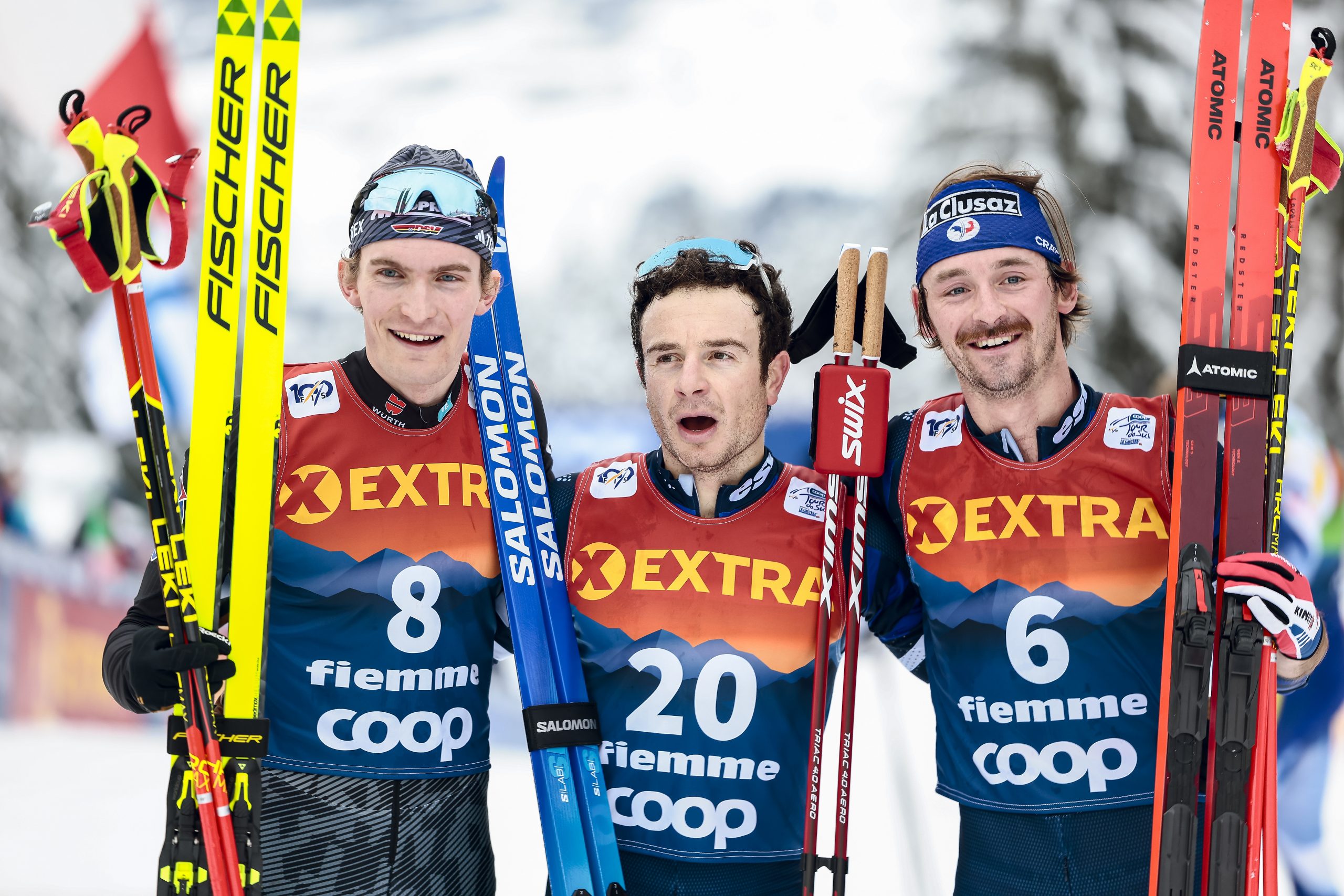
Jules Lapierre (FRA), Mattis Stenshagen (NOR), Emil Iversen (NOR) on the podium atop the Alpe Cermis, the concluding stage of the 2026 Tour de Ski.(Photo: Vanzetta/NordicFocus)
Goms! These races, in Switzerland, were unambiguously awesome. Wipeouts, sun, fondue, North American podiums and breakout performances. And an Alaskan guest who watched the races firsthand.
We really went above and beyond the call of duty this week — we’ve got sounds from the side of the trail and even a profanity-laced tirade from Devon if you stick it out to the end of the show. We’ll be on scene at the next round of World Cups, which are in a couple of weeks in Canmore, Alberta.
A sincere thank you to everyone who’s generously pitched in to support us over the past few weeks. Email us at devon@fasterskier.com and nat@fasterskier.com. We’ll be back soon.
They’ve reached the summit — the athletes, have, anyway. Devon certainly has not, thanks to frozen pipes in his Oslo apartment. He and Nat persevere to bring you the recap of this year’s final Tour de Ski stages, which featured some spicy and sloppy racing in Italy. Stay tuned til the end for an ode to Le Gruyère cheese.
Next week, during the break from the World Cup, we’ll have a mailbag episode. Send us your questions at nat@fasterskier.com and devon@fasterskier.com. Have a great week.
This coverage is made possible through the generous support of Marty and Kathy Hall and A Hall Mark of Excellence Award. To learn more about A Hall Mark of Excellence Award, or to learn how you can support FasterSkier’s coverage, please contact info@fasterskier.com.
The unrelenting slopes of Alpe Cermis challenged Norwegian dominance, as France’s Jules Lapierre emerged to triumph in the final stage of the 2024 Tour de Ski. (Photo: Modica/NordicFocus)
The origin story of the Tour de Ski suggests that it was invented to mirror cycling’s Tour de France: multiple stages, mountaintop finishes, leader’s jerseys, thrilling competitions, glorious champions. Today’s Stage 7 of the Tour de Ski—with its finish on the high summit of Alpe Cermis— is probably what the original race organizers had in mind. Helicopters hovered over the point-to-point course that wound its way through historic ski-venues in the Val di Fiemme. At the 2.4 kilometer mark, the still-flat course wound into the stadium of Val-d’Isére (where the first Bonus Sprint in the Alpe Cermis stage would be decided). Then, following the course of the Marcia Longa—Italy’s famous ski marathon—the course traveled to the base of the Alpe Cermis Alpine resort.
The day had begun with Amundsen holding a considerable lead in the overall standings over his countryman, Erik Valnes. Known as a good all-rounder—but really more of a sprinter—Valnes would face considerable challenges to his desire to remain on the Tour de Ski podium, as he was trailed in the standings by other skiers whose pedigrees spoke of greater climbing abilities. Martin Loewstroem Nyenget (NOR) sat only eight seconds behind Valnes, with talented climbers, Hugo Lapalus (FRA) and Friedrich Moch (GER) only another few seconds behind. The battle for podium spots would be furious and painful, with rewards and accolades for those brave enough to climb into the clouds. Valnes would have his hands full . . .
Germany’s Friedrich Moch led Jules Lapierre (FRA) through most of the climb up Alpe Cermis, though it was Lapierre who would sprint clear for the stage win. (Photo: Barbieri/NordicFocus)
Stage 7, Alpe Cermis
Bonus Points Leader, Lucas Chanavat (FRA), toed the starting line after a number of less-than-stellar stages in which he would win sprint points, then ease along the course to the finish well out of contention. In the early kilometers of the Alpe Cermis stage, Chanavat led the pack toward the first Bonus Points sprint at 2.4 kilometers, hoping to secure his hold on the Points Jersey before the real climb of the day would begin. Though nipped at the line by sprint-rival, Edvin Anger (SWE), Chanavat would collect enough points to secure the victory in the points competition. Ironically, he would be required to finish the stage at the top of Alpe Cermis’ long climb in order to claim the distinction, and to collect the winner’s spoils. It would be a long day of climbing for the sprinter, Chanavat.
After the Points Bonus sprint, it was the skier sitting in 26th place overall—Haavard Solaas Taugboel (NOR)—who went to the front to make pace. Commentators speculated on the possibility that Team Norway was tactically using lower-placed skiers to protect the lead of Amundsen, Valnes, and Nyenget. There was one last Points sprint at 6.8 kilometers (at the base of the climb), but by that time Amundsen had already gone to the front. He took the points that Chanavat and Anger coveted, seemingly determined to begin the climb in earnest. Final standings in the Points competition: Chanavat, Anger, Valnes, Amundsen, and Antoine Cyr (CAN).
Amundsen led the field on the lower slopes of the climb, though with no real sense of urgency. In season’s past, much of the low part of the climb was defined by athletes propelling themselves via V2, maintaining that faster, more costly technique for as long as they could in attempts to break the field. Typically the last skier using the V2 was the one who would create gaps in the field and put themselves in position to win the day. Today, however, Amundsen dropped into the V1 early on, allowing a group of rivals to remain on his heels. That group settled into a lead pack of seven: Amundsen, Nyenget, Friedrich Moch (GER), Mika Vermuelen (AUT), Jules Lapierre (FRA), Hugo Lapalus (FRA), and Beda Klee (SUI). Valnes was nowhere to be seen. The battle for podium positions began . . .
And the course steepened: 26.5 percent (that’s steep). Klee was dropped: lead group reduced to six.
Mika Vermeulen powered to the front as Amundsen and Nyenget faded to the rear of the lead group. By this time, Valnes had already ceded his second place position to Nyenget in the virtual Tour standings. Other podium contenders pushed to the front, fighting it out for podium places, mostly at the expense of Amundsen and a visibly-tiring Nyenget who dangled just off the back.
With every change in pitch, a different contender would appear at the front. Finally, Moch took the lead as the group entered the tightest switchbacks, driving around each direction-change with Lapierre hard on his heels. Next in line—head down, but tempo high—Lapalus followed his countryman while Amundsen and Vermeulen settled in. Nyenget was gapped: lead group reduced to five.
Moch and Lapierre ratcheted up the pace. Little bit by little bit, gaps opened behind them. Lapalus watched his own ski tips, Amundsen (overall victory already in sight) marked the gaps, Vermeulen atttempted damage control: lead group reduced to two.
Farther down the mountain, Valnes struggled; his podium position all but gone as his rivals for the podium—Lapalus and Moch—drove forward.
Moch and Lapierre continue to show spark in their steps as they entered another 28 percent grade (murderous!). In their wake, Lapalus powered on alone (eyes still down). Amundsen and Vermeulen appeared bound to one another in their fatigue (battling to hold their positions rather than determined to drive forward). Nyenget suffered alone in no-man’s land, while resurgent Klee and Jens Burman (SWE) gave chase. Somewhere farther down the mountain, Valnes toiled in obscurity.
The Alpe Cermis levels a bit in the final kilometer, requiring racers to shift gears, yet again. It’s a point where a different set of athletic/physiological abilities comes into play. Thirty minutes into the race, Moch and Lapierre exited the steepest sections of the climb, both breaking into a V2 skate as the horizon leveled. Lapierre drove forward into the lead, his tempo visibly quicker than Moch’s. Behind them (across an ever-widening gap) Lapalus stayed with the V1 in attempts to save energy, just in case he still had to deal with a charging (V2) Amundsen who seemed to have recovered some energy after his mid-climb lull.
Harald Oestberg Amundsen (NOR) climbed bravely, and quickly enough to protect his overall lead in the Tour de Ski standings. (Photo: Modica/NordicFocus)
At the finish, it was Lapierre sprinting clear of Moch, both of whom celebrated as they crossed the line. Moch knew he had skied onto the overall podium, a first for Germany since Tobias Angerer, overall winner of the first Tour de Ski in 2006/2007, finished third in the 2008/2009 tour. Lapalus finished 16 seconds behind the winner, securing his own place on the overall podium by sufficiently gapping Nyenget.
The winner of the overall Tour de Ski—Amundsen—arrived fifteen seconds after Lapalus. Amundsen had done his job, and the biggest prize of the FIS World Cup season was his.
Valnes finished 11th, 1:13.9 behind. All things considered, Valnes (known more for his sprinting prowess) delivered a truly impressive performance, and that in an event where careless or unfit competitors can “blow” and lose big chunks of time. Even so, he proved unable to keep pace with the climbers, and dropped from the podium into sixth overall.
Among North American finishers, Antoine Cyr (CAN) climbed the fastest: 14th place, 1:34.2 behind the winner. Following him were Zanden McMullen (USA) 36th, Scott Patterson (USA) 42nd, and Olivier Leveille (CAN) 45th.
Much much later, at the hard-won summit of Alpe Cermis, Chanavat crossed the line to claim the Points Championship. It’s unlikely that he’s ever skied so far or so high.
International flair on the Stage 7 podium at the summit of Alpe Cermis: Friedrich Moch (GER), Jules Lapierre (FRA), Hugo Lapalus (FRA), (l-r) (Photo: Modica/NordicFocus)
This World Cup coverage is made possible through the generous support of Marty and Kathy Hall and A Hall Mark of Excellence Award. To learn more about A Hall Mark of Excellence Award, or to learn how you can support FasterSkier’s coverage, please contact info@fasterskier.com.
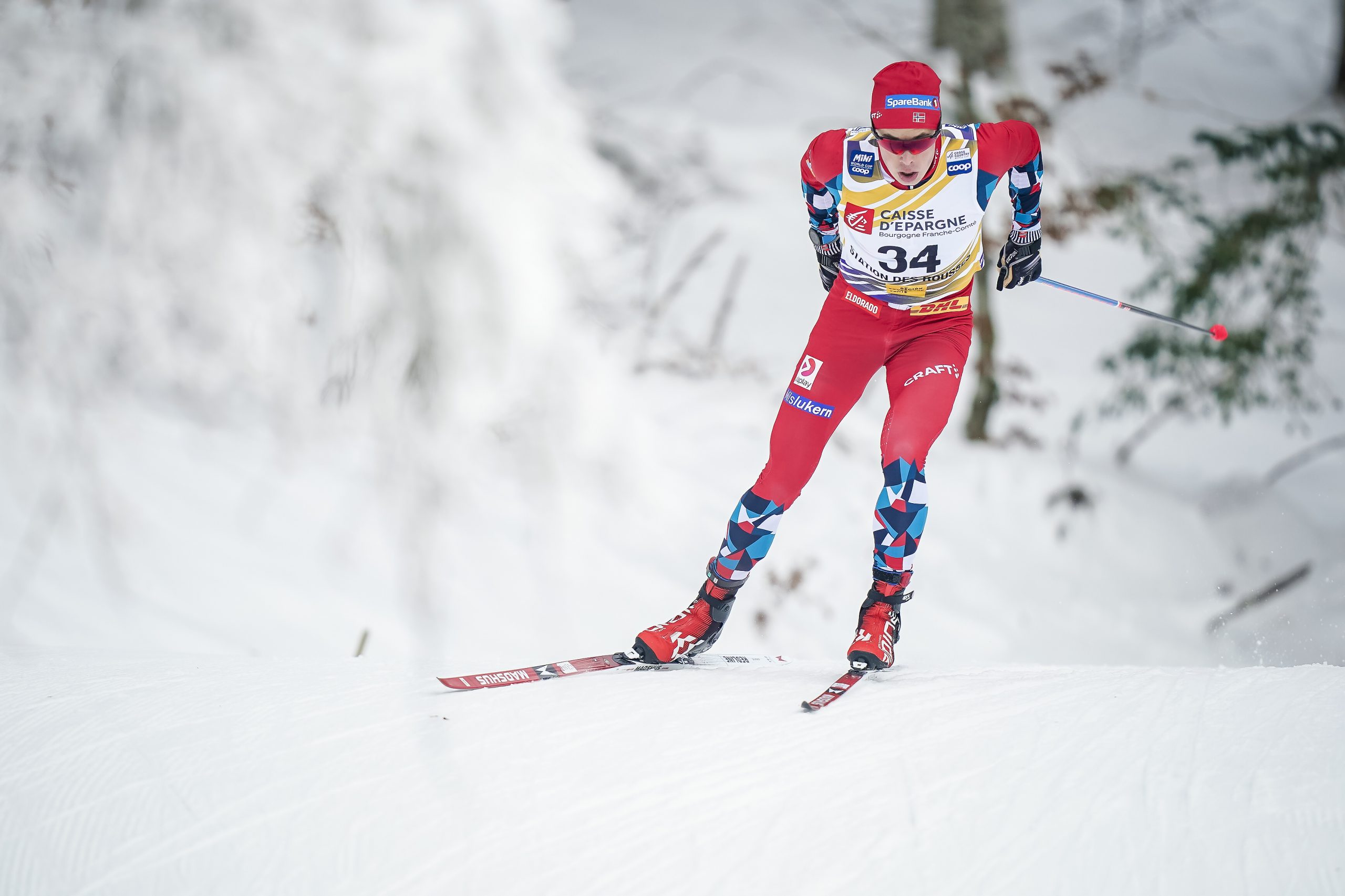
Harald Oestberg Amundsen (NOR) earned his first FIS world cup cross-country victory at Les Rousses, France. (Photo: Thibaut/NordicFocus)
Fans have become accustomed to Norwegian men occupying the World Cup podium, but it’s getting pretty crowded there on the top step. Team Norway has delivered World Cup wins this season from Iver Tildheim Andersen, Paal Golberg, Simen Hegstad Krueger, Johan Hoesflot Klaebo (who has already won 12 times this season), and now Harald Oestberg Amundsen. It seems that any Norwegian can win on any given day . . . and no skier from any other country seems to have a chance.
Norwegian skiers have claimed so many of the podium spots in early-season World Cups, but at Les Rousses their usual dominance was somewhat less than total: Amundsen (NOR) claimed his first World Cup victory, Roethe (NOR) second, and William Poromaa (SWE) third. Frenchman, Jules LaPierre, had a spectacular day racing in his home country, further interrupting the usual Norwegian strangle-hold on the top placings and finishing a very impressive fifth, just 25 seconds behind race winner, Amundsen.
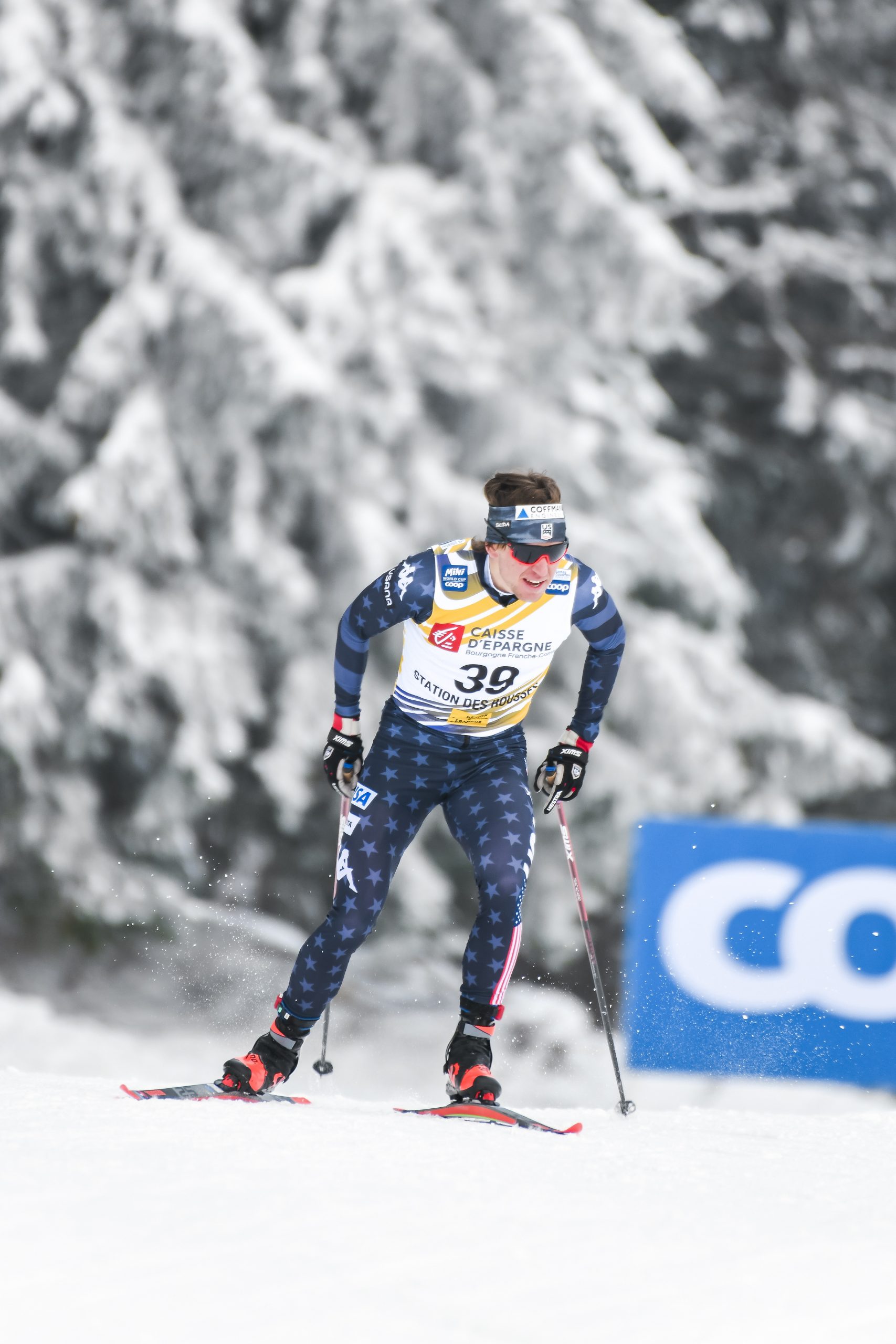
Scott Patterson (USA) led the American contingent at the World Cup Skate 10km, Les Rousses, France. (Photo: Authamayou/NordicFocus)
Scott Patterson (USA) continued a season of distance race performances in the top thirty with a 24th place finish.
“It’s been a solid break after the Tour de Ski from World Cup racing,” said Patterson. “[I finished] 24th today: not everything I wanted, but I think it was a solid result. I was in the fight . . . I raced a distance double pole marathon last weekend and was still feeling some effects from it. I think the form’s coming along and I’m excited as we keep having ore races coming up and build toward [World Championships].”
Other American finishers included Finn O’Connell 50th, Peter Wolter 56th, Will Koch 63rd, and Zak Kettterson 65th. Nordiq Canada chose not to enter skiers in the races at Les Rousses.
Will Koch (USA) got his first taste of World Cup racing on the 10 k course in Les Rousses, France. (Photo: Thibaut/NordicFocus)
The day’s results demonstrate how difficult it is to prepare for the upcoming World Championships while also defending individual places in the World Cup standings. Early in the season, Klaebo had stated that his chances at winning the overall World Cup championship were over. It appeared, then, as though he would pick and choose his World Cup starts in order to secure the Sprint crown, while prioritizing his preparation for the World Championships (which most competitors hold in higher regard than the World Cup). It would’ve been easier for Klaebo if he’d stayed that course. As it is, he now seems determined to pursue every win, and to chase points in any event in which Paal Golberg—his Norwegian teammate and closest rival in the race for the overall World Cup—is entered.
Men’s 10 k Skate
Fresh snow and overcast skies greeted competitors in Les Rousses, a resort community in the Jura Alps north of Geneva. At an elevation of nearly 4000 feet (1219 meters), Les Rousses offers challenges that other, lower, venues do not. Additionally, 10 k is not a typical men’s distance, raced this season in a nod to distance-equity that has been instituted between men’s and women’s fields. For skiers at the World Cup level, the 10 k distance is a bit of a sprint . . . and a distance in which much can go wrong. Sprinters have a chance to excel (though they could also blow up). Distance skiers are forced to press the pace, and hope that their speed will emerge.
The Les Rousses World Cup 10 k was raced around three laps of a 3.3 k loop. In any such lapping course, there’s potential for results to be affected by the ways in which skiers pair up (or group up) over the course of three high-speed laps. Strategically, the greatest advantages are available to skiers who pair up with later starters (the faster/fresher skier “giving a ride” to the skier who has been on course longer). Veterans are always looking for this (entirely legal) advantage. Toenseth and Andersen grouped up on the course, working well together through the middle lap, but neither seemed to gain enough advantage to affect the final standings. Most other contenders seemed to race mostly on their own. Pre-race favorite, Krueger, found himself alone . . . no beneficial pairings for Krueger. Klaebo who was the day’s final starter, and was therefore unlikely to benefit from the speed of other racers; however, he would hear split times of all skiers who started before him. Game on . . .
Amundsen, was an early leader, but he was also skiing alone. Krueger started conservatively, some 11 seconds behind Amundsen at the first check point. Klaebo started equally conservatively—only 21st fastest at the first check point—but would gain time through the first lap (5th at 3.3 k, only five seconds out of the lead). He lingered 13 seconds behind Amundsen at the halfway point. Klaebo has already earned 12 World Cup victories this season (only two behind the season-record of 14 wins set by Martin Jonsrud sudby), but his performance in Les Rousses appeared a bit flat. He may be conserving energy (lord knows he spends enough of it), or he may be in a pre-Worlds training cycle that hinders top-speed efforts. Either way, he skied consistently if not brilliantly—never really excelling, never really losing too much time—finishing the day in 8th.
Klaebo’s countryman, Amundsen, continued to lead his teammates through the later check points. Early leader, Andersen (who won the 10 k skate earlier this season in Lillehammer), faded over the closing kilometers to finish 9th. Poromaa (SWE) started fast, though struggled a bit to maintain his form late in the later stages of the race. He moved into second at the finish (still behind Amundsen, and snatching crucial World Cup points from Golberg) where he remained until the later arrival of Roethe.
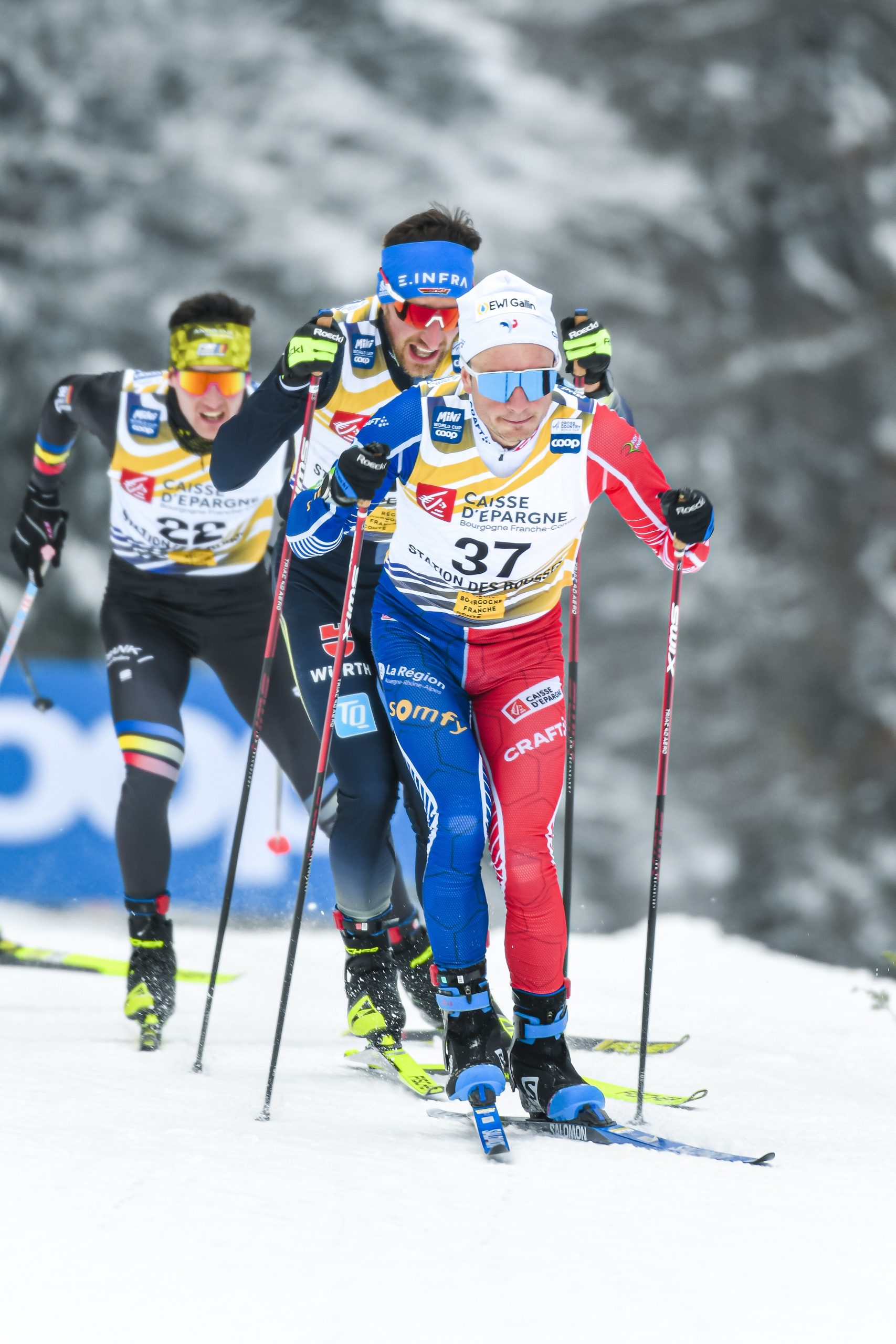
Jules Lapierre (FRA) raced with bravery and panache in front of loyal French fans at Les Rousses, finishing a remarkable fifth. (Photo: Authamayou/NordicFocus)
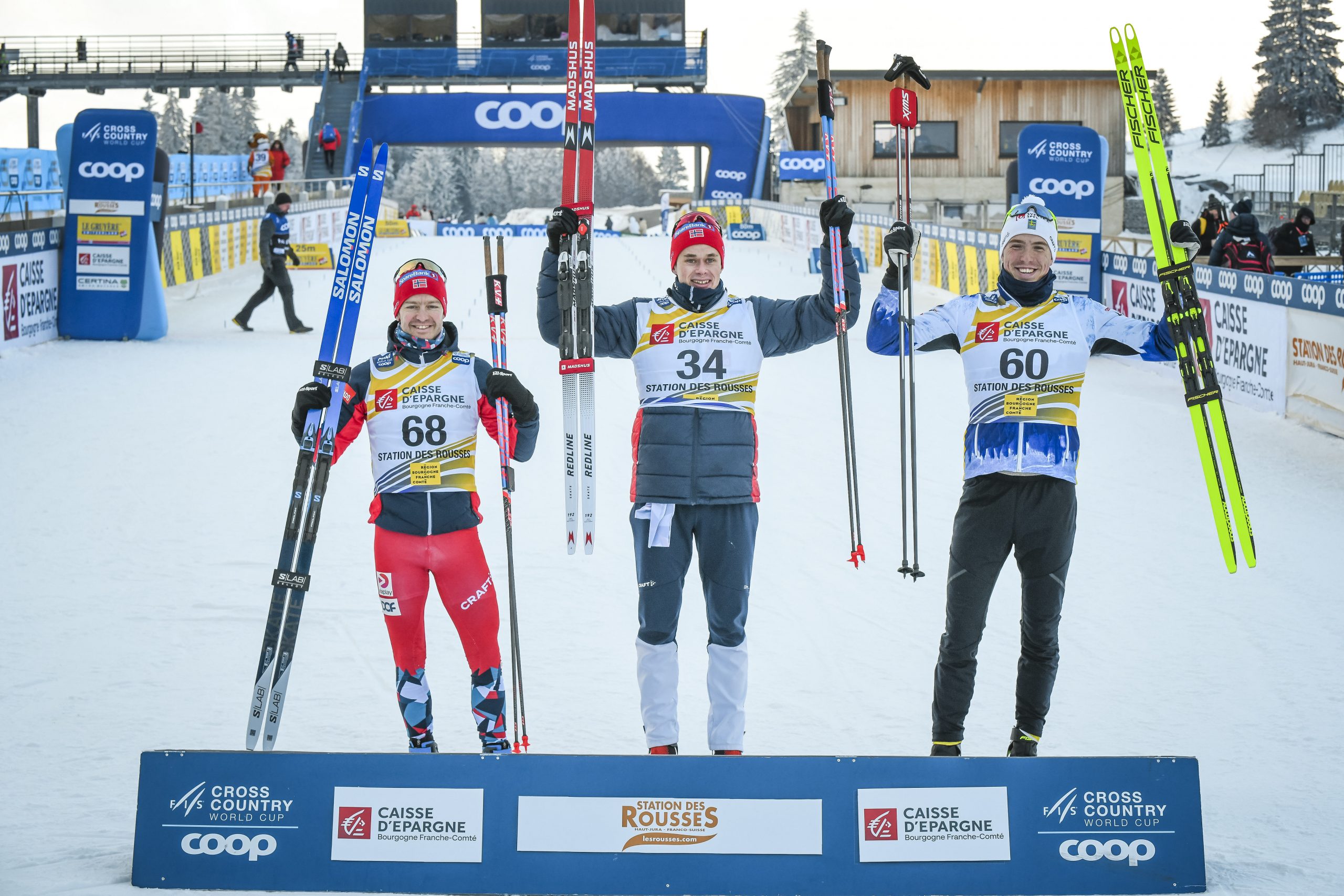
France’s Jules LaPierre led at 8.1 k, and sat in second in the results at the finish until Golberg eclipsed him (though still behind Amundsen). Ultimately, Amundsen finished in 21:26.5 for his first career World Cup win. Roethe finished second (11.9 seconds behind), with Poromaa another six seconds behind to earn his second career World Cup podium
With so many Norwegian skiers fighting for spots in the upcoming World Championships, Amundsen acknowledged the magnitude of his performance in securing his first World Cup victory. “It was a really important race for me,” he said.
Sjur Roethe (NOR), Harald Oestberg Amundsen (NOR), William Poromaa (SWE), (l-r)—FIS World Cup cross-country, 10km, Les Rousses, France. (Photo: Authamayou/NordicFocus)
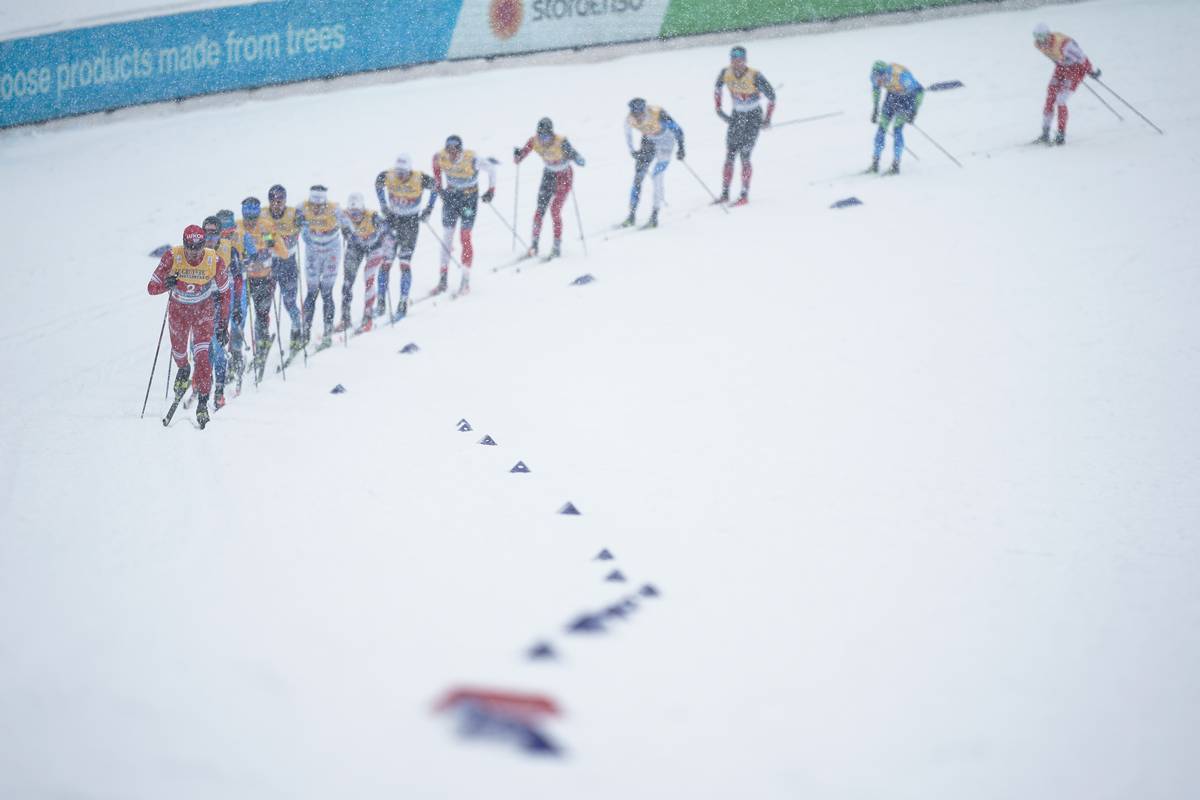
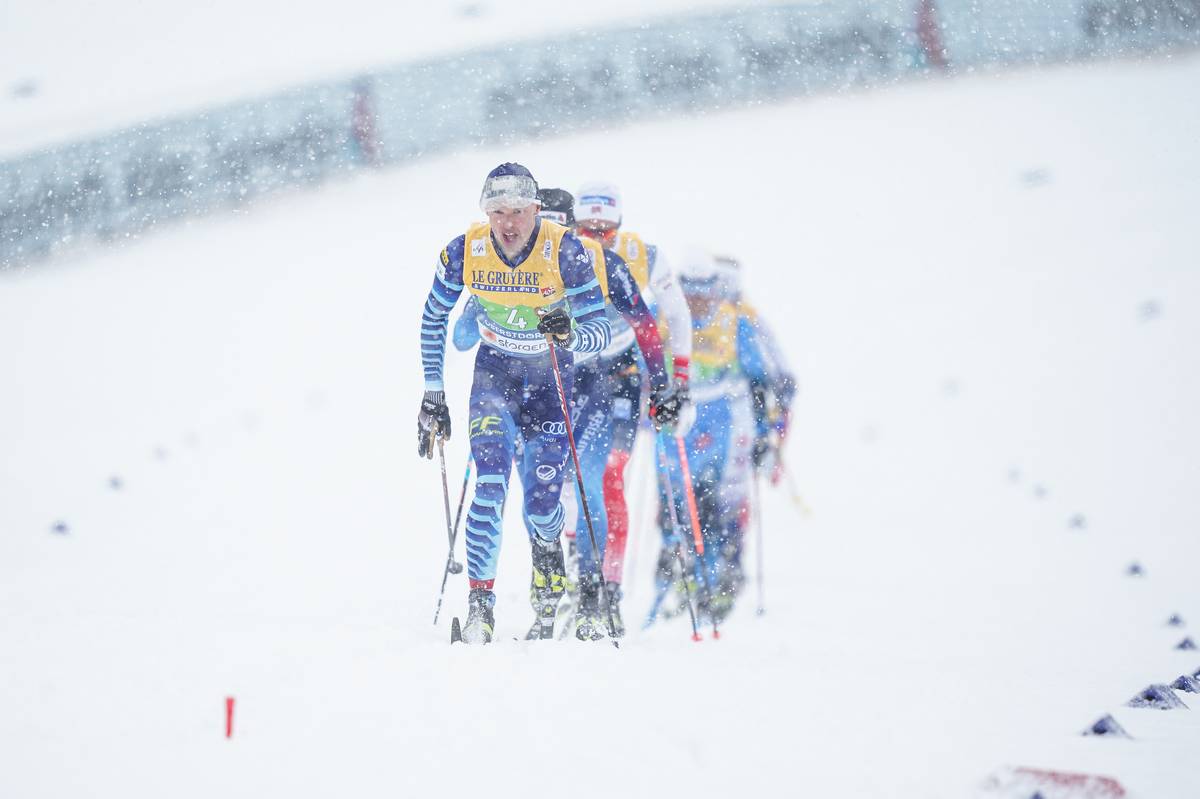
A train, led by Alexey Chervotkin (RSF), winding through the snow. (Photo: NordicFocus)
This World Championship coverage is made possible through the generous support of Marty and Kathy Hall and their A Hall Mark of Excellence Award. To learn more about A Hall Mark of Excellence Award or to learn how you can support FasterSkier’s coverage please contact info@fasterskier.com.
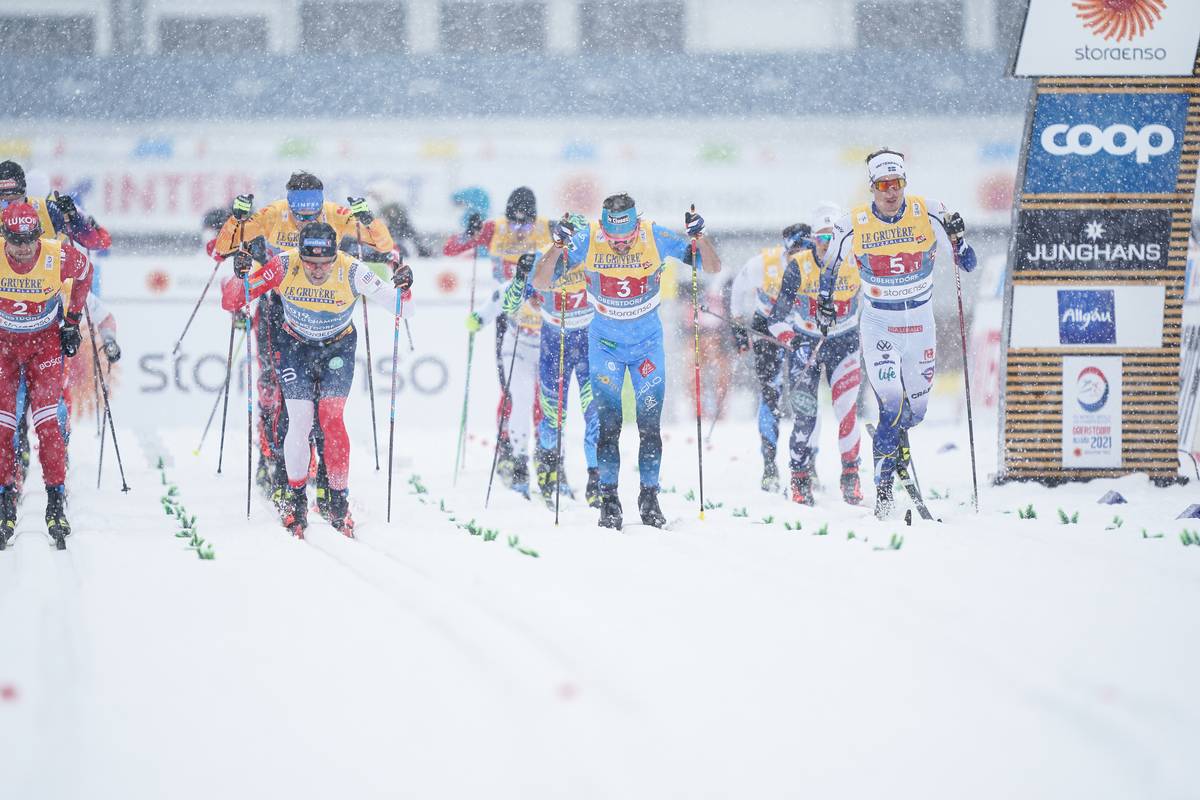
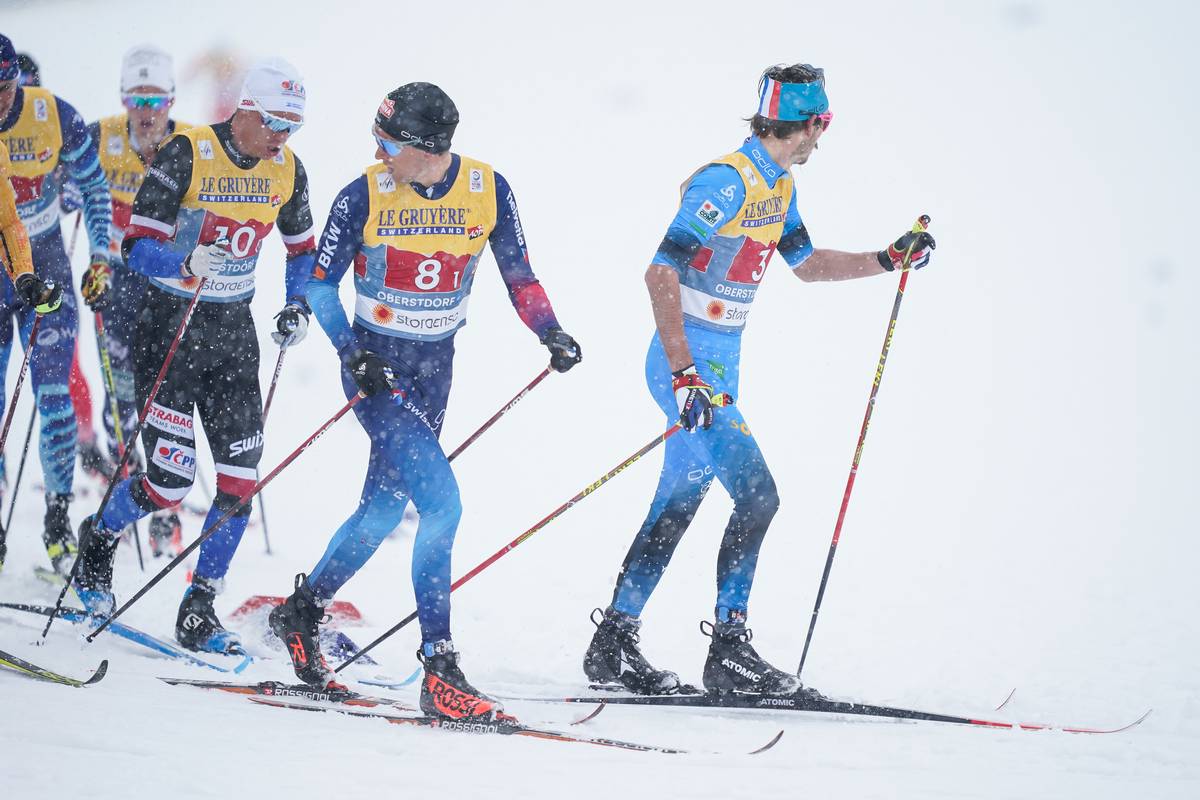
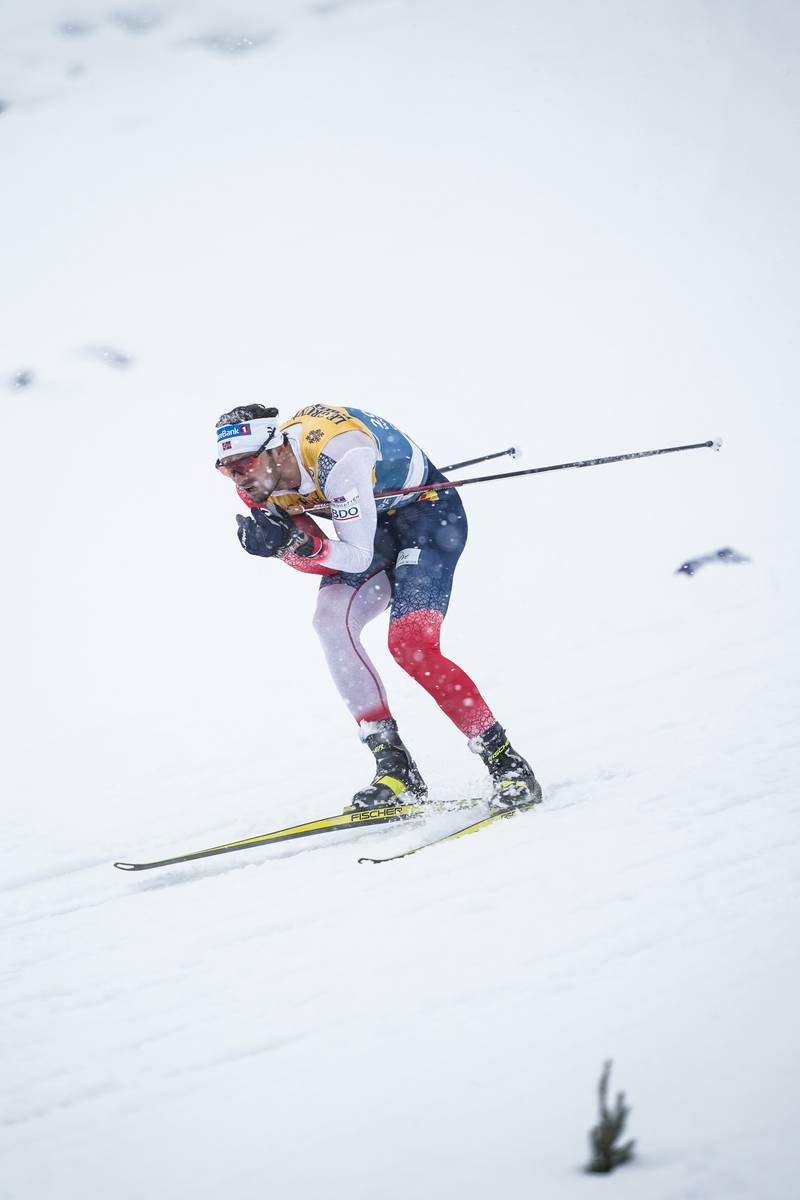
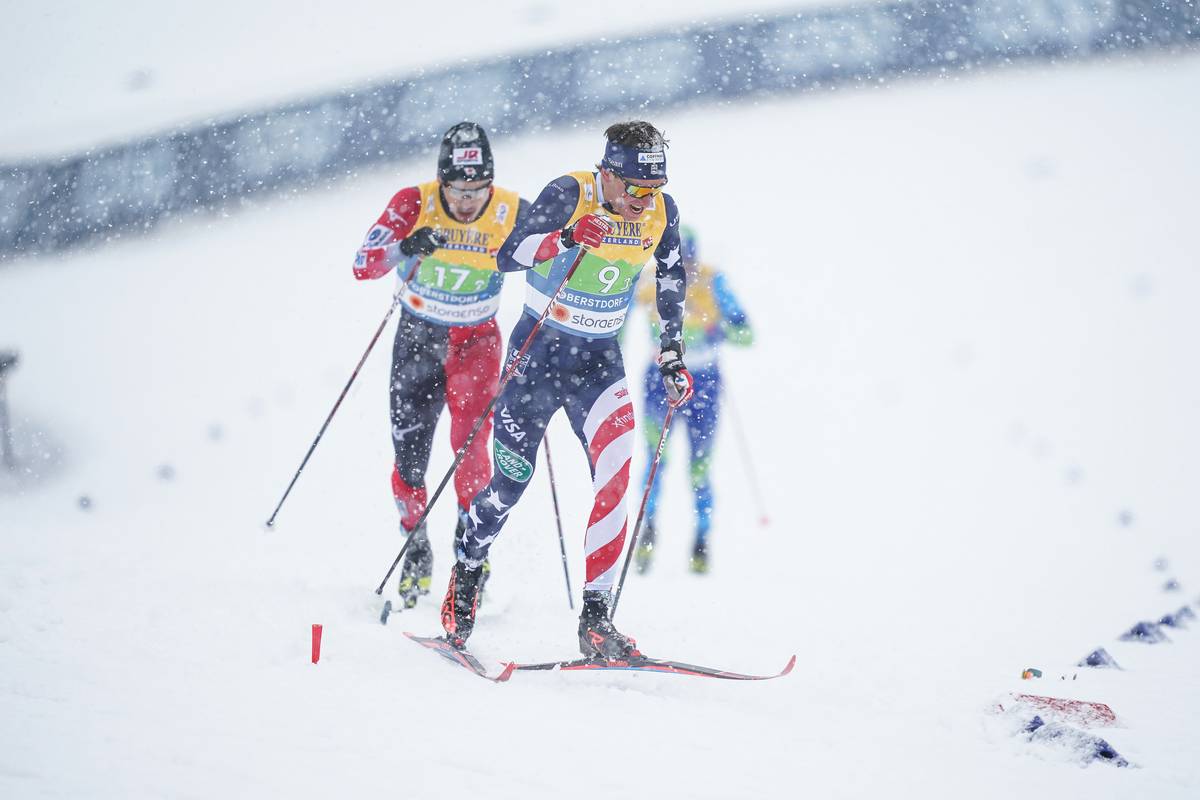
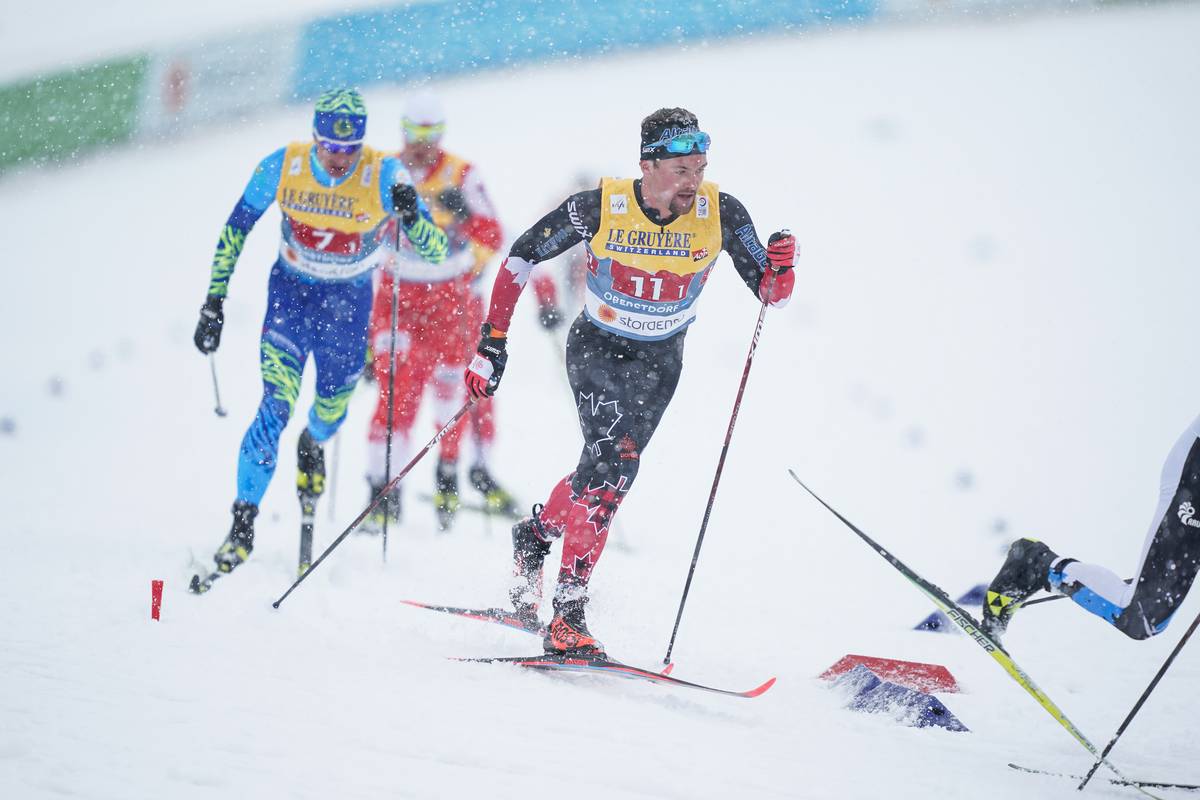
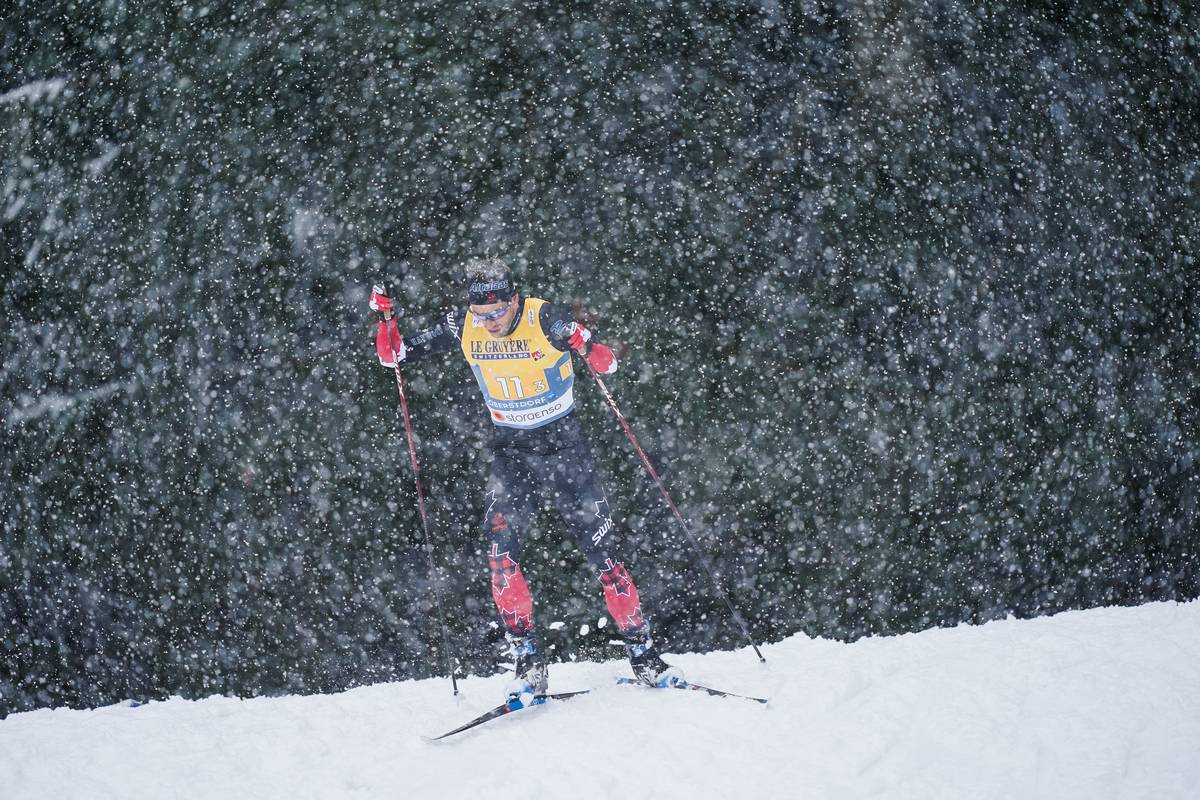
After the tropical conditions of the past week, the men were greeted with heavy snowfall for Friday’s championship 4 x 10 k relay competition in Oberstdorf. Temperatures hovered around freezing and the snow fell thick and fast as the scramblers lined up at the start. Eighteen nations were represented at the start line with thirteen completing the whole race.
The start to a snowy 4 x 10 k relay at the 2021 World Championships. (Photo: NordicFocus)
On paper Norway was the team to beat out on the track. Of the last 15 men’s relay titles at a World Championship, Norway has won all but one. The last time Norway failed to win the men’s relay was in 1999 when team Austria finished 0.2 seconds ahead of Norway. And in the end on Friday after striding and skating through fresh snow for 40 k, it was once again team Norway that crossed the line in first, but what a race it was to get them there.
Johannes Hoesflot Klaebo (NOR), Hans Christer Holund (NOR), Emil Iversen (NOR), Paal Golberg (NOR), (l-r) 2021 Relay World Champions. (Photo: NordicFocus)
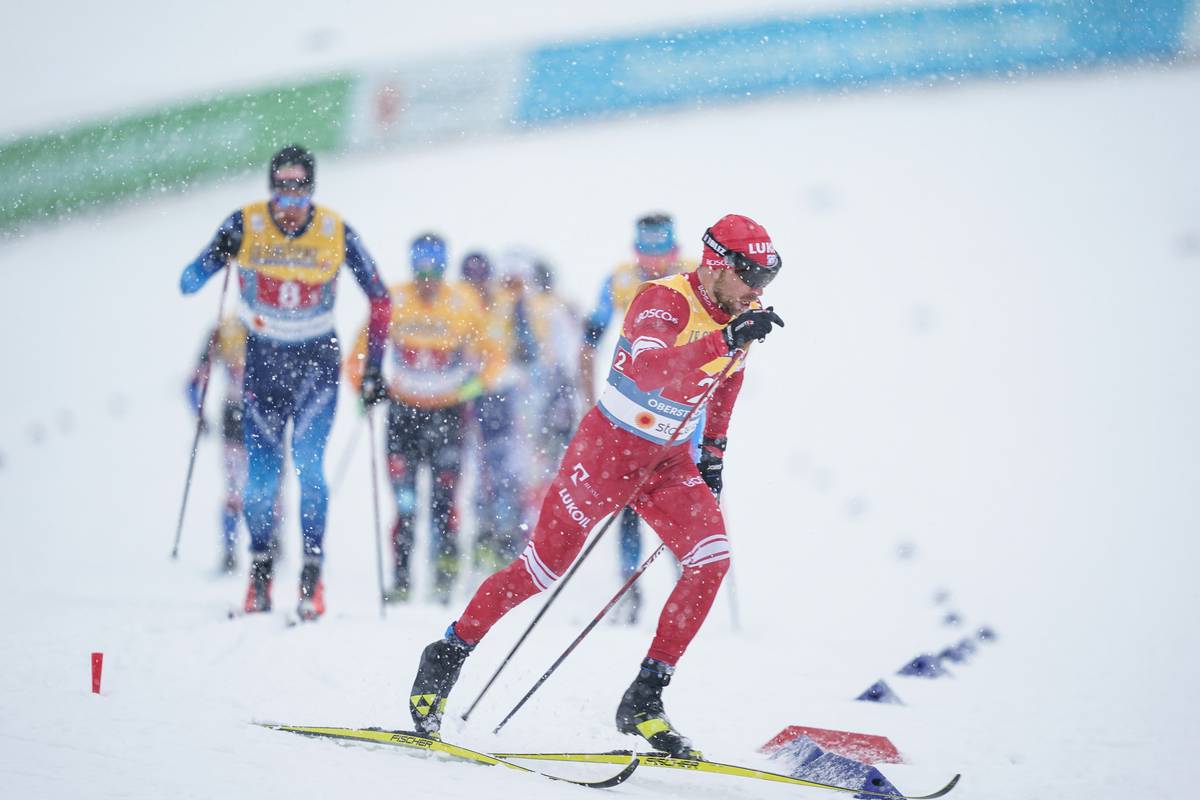
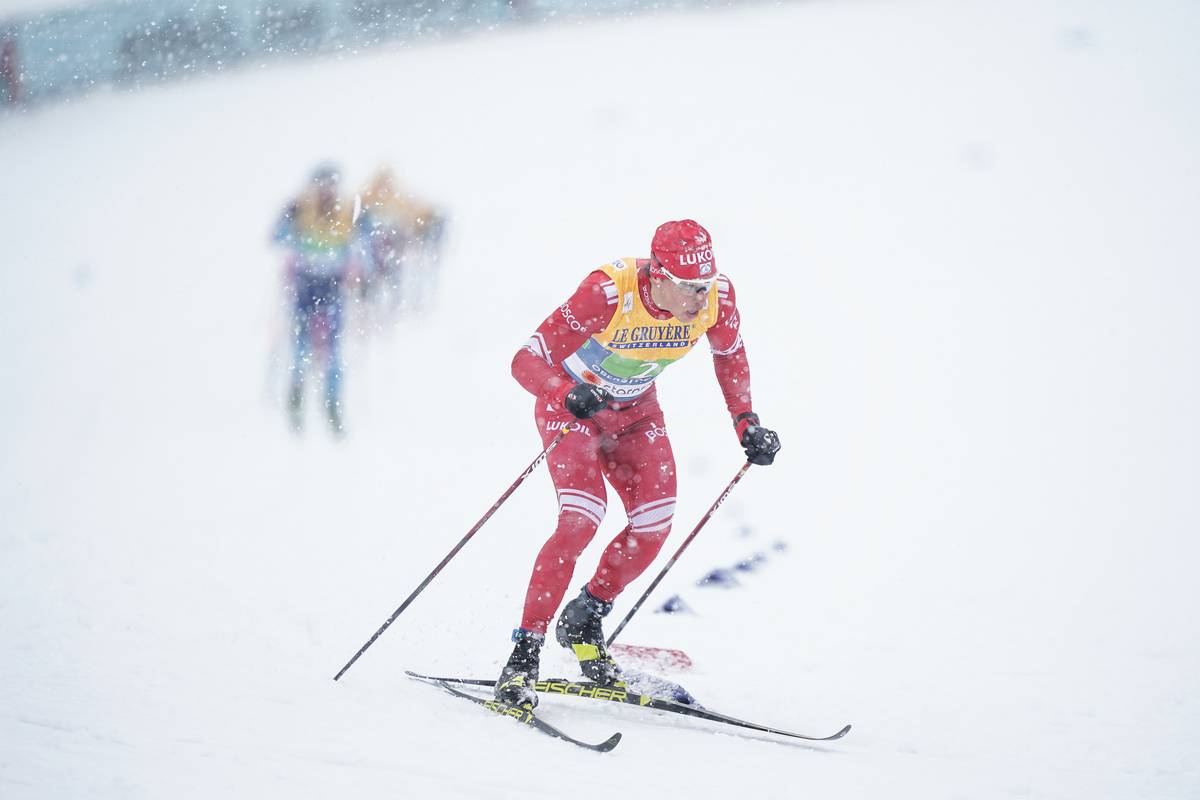
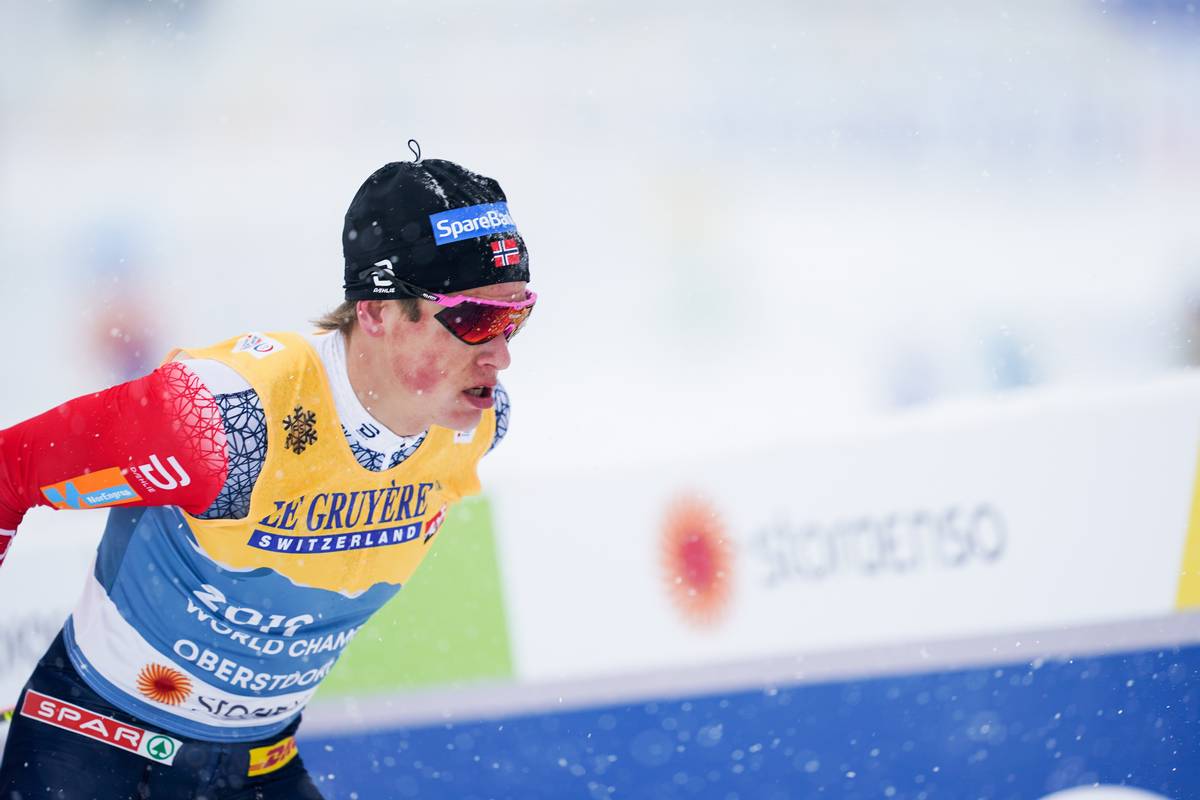
The team most likely to challenge Norway was Russia, or the Russian Ski Federation as they are represented at these championships. The bar was set from the beginning. Despite conditions not favoring an early breakaway, Alexey Chervotkin (RSF) made a move just 1.4 k off the start, putting distance between himself and the pack.
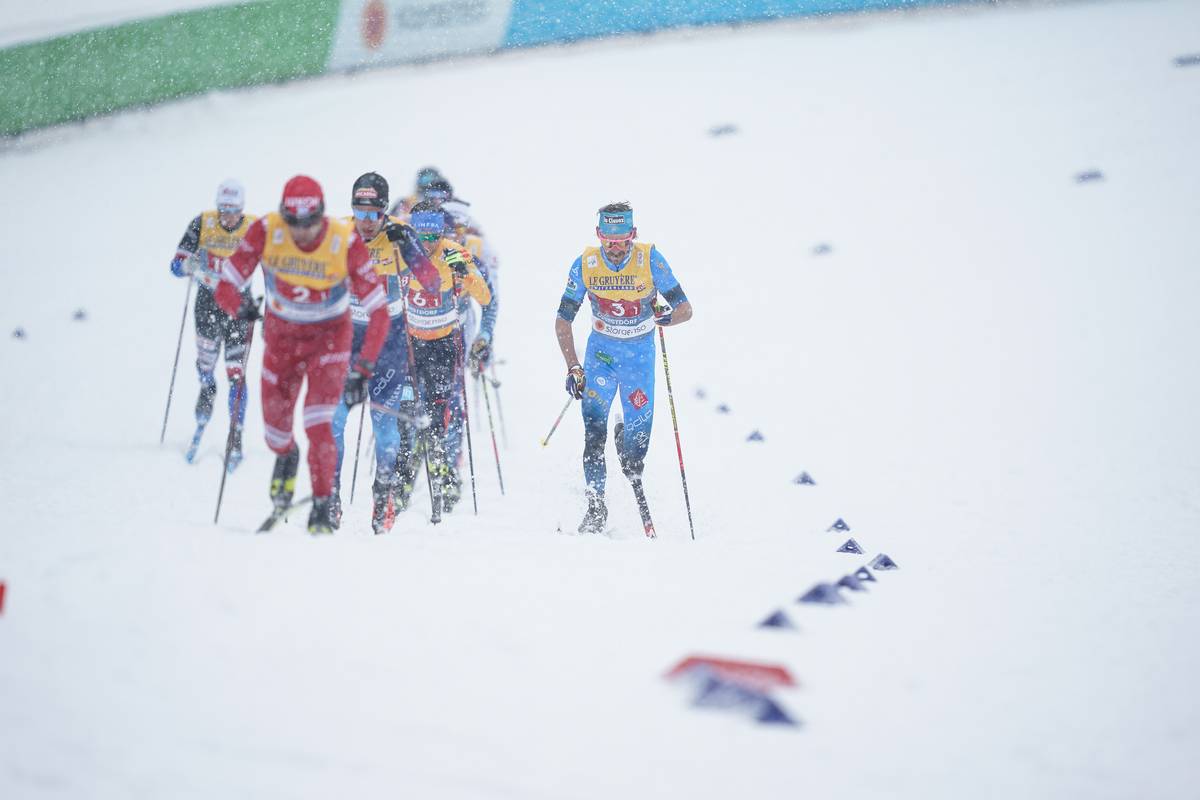
Hugo Lapalus (FRA), out of the tracks, while Alexey Chervotkin drives the bus. on the scramble leg. (Photo: NordicFocus)Making a move that stuck on the first keg: Russia’s Alexey Chervotkin pushed over the top. (Photo: NordicFocus)
At 4.7 k, Chervotkin had stretched his lead to +14.1 seconds and the group seemed largely unprepared to mount an organized counterattack. Perhaps expecting the Russian to fade or simply unable to respond, Norway’s Pål Goldberg remained tucked in the rear of the pack. At 6.6 k the margin was +33.6 to Russia. Save for Chervotkin’s effort out front, the pace remained World Cup-pedestrian. At one point, the skiers nearly halting completely at the crest of the sprint hill, playing chicken for who would descend first. Through 8 k the gap to Russia was nearly one minute.
No man’s land, atop the climb, Michal Novak (CZE), Beda Klee (SUI), Hugo Lapalus (FRA), (l-r) bring the pace to a walk as no team wants to chase Russia down. (Photo: NoricFocus)
Entering the first exchange the chase pack had split in two, with France leading and Norway off the back in 10th position. In a post-race interview Golberg said of his race, “it was a bit of a tough start. I chose a different choice [of ski] from the seventeen other skiers so that was really stupid but fortunately I have three skiers on my team that are better than everyone else here today so I’m really happy for them.” One of those skiers was Emil Iversen who took over for Norway on the second leg. His work linked Norway up with the rest of the chase pack, now being led by Iivo Niskanen of Finland. Ivan Yakimushkin had taken control for RSF, but already, with the hot pace set by Niskanen, the gap was down to +30.4 seconds to Norway.
Ivan Yakimushkin, Russia’s second leg skier, sensing the group led by Iivo Niskanen closing in on the second leg. (Photo: NordicFocus)
At 13.3 k Niskanen, Iversen, and Dario Cologna of Switzerland were closing in on Yakimushkin. After 40 minutes on the clock they had overtaken the Russian. The pack now comprised six nations (France and Sweden also in contention), with team Canada drifting around eight seconds behind. Again on lap two through the stadium the pace slowed to a halt before the descent, unrelenting snow adding an extra challenge to the lead.
At the base of the Burgstall climb on his final lap, Iversen (NOR) made his move, directly shadowed by Niskanen (FIN). To the soundtrack of much excited shouting from the coaches, the pair closed in on the exchange zone, with Russia now off the back.
Iivo Niskanen of Finland doing the work to reel in Russia on the second leg of the 4 x 10 relay. (Photo: NordicFocus)
Wednesday’s 15 k skate champion, Hans Christer Holund, contended the first skate leg for Norway. His lead over Russia being +23.6 seconds at the tag zone. Followed by Perttu Hyvarinen, Finland’s third leg, Holund broke trail out front through deep snow as behind him, Artem Maltsev for RSF turned on the burners, starting to forge the gap. At 23.3 k there was just six seconds between them and the Finn was fading fast. At 24.7 k Holund was alone out front, +12.1 ahead of RSF and Finland now in third. As the athletes battled through their last loop, the wheels seemed to come off for Maltsev (RSF) and Clement Parisse of France and Jens Burman of Sweden moved to the fore.
Norwegian work horse on the third leg: Hans Christer Holund. (Photo: NordicFocus)
Into the final exchange Holund handed team anchor Johannes Høsflot Klæbo a +25.5 second lead over France and Sweden (virtually neck and neck), and a +35 second lead to Russia, for whom Alexander Bolshunov would be taking anchor.
Johannes Hoesflot Klæbo (NOR) biding his time for the final show-down. (Photo: NordicFocus)
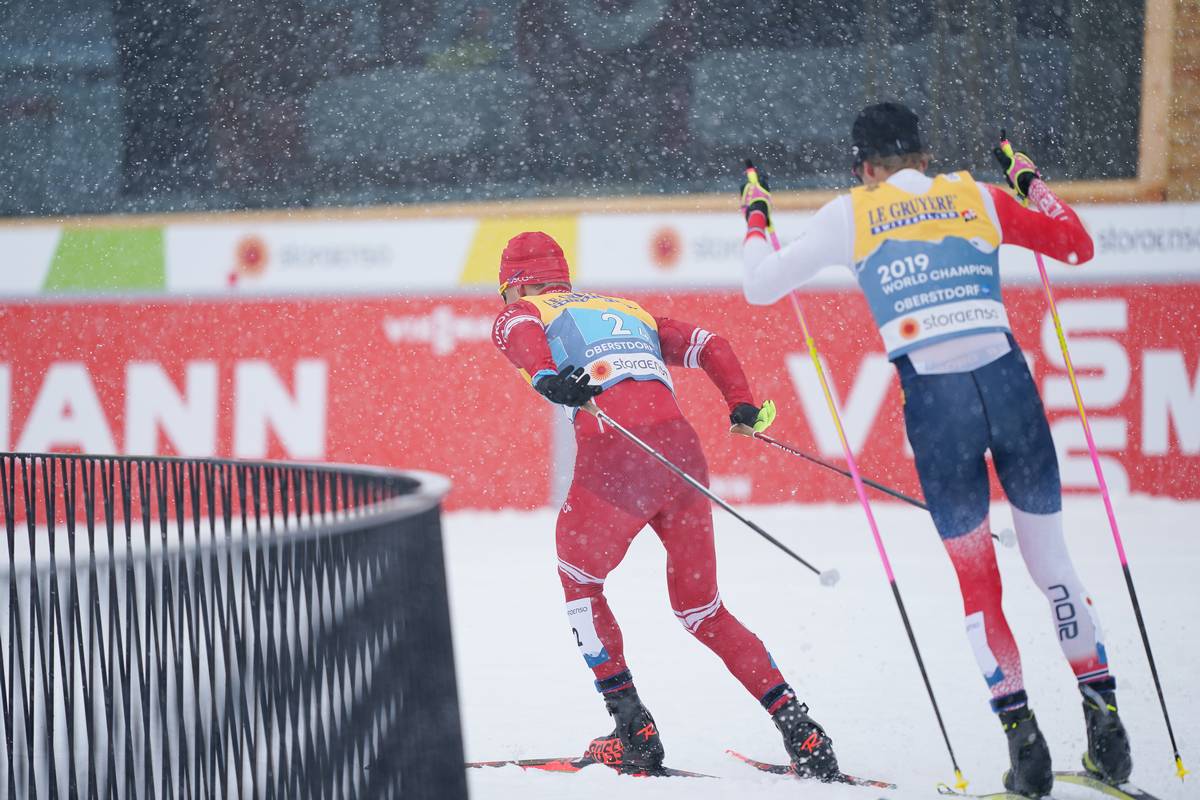
With Klæbo (NOR) out on his own in deep snow, Bolshunov was on the hunt. The ten second lead over Russia held by Sweden and France was immediately absorbed and once again there was a pack of five teams in contention behind Norway. At 31.4 k Bolshunov had only gained 0.5 seconds on Klæbo but that was soon to change. By 33.3 k he had broken away from the chase pack and was +15.8 behind. Each of the two athletes played to their respective strengths, Klæbo cruising easily while he waited for his ride to catch up and Bolshunov grinding away with metronomic consistency.
Locked in for battle, Norway versus Russia to conclude the Men’s 4×10 k championship relay. (Photo: NordicFocus)
By 34.7 k the duel was on – the world’s best playing hot and cold as they ticked away the kilometers toward the finish line. With Norway absent for much of the Wold Cup season, these two rivals have not had many head-to-head opportunities this year up until this moment. For his part, Bolshunov never moved to pull away from Klæbo who boasts a peerless finishing kick. Once atop the course’s final major run up the Burgstall climb, when Bolshunov had gained no ground, this chess march was all but done.
Klaebo (NOR) not giving an inch to Bolshunov (RSF). (Photo: NordicFocus)
Entering the corner into the final sprint hill before the finish there was virtually no gap between the two skiers, though in reality the game had tipped in Norway’s favor. While Bolshunov may dominate the distance races, Klæbo remains king of the sprint and once he made his up-skate move, there was nothing the Russian could do. The decisive moment came half way up the hill as Klæbo catapulted himself away with an unmatched turn of pace, setting up for an easy cruise down the finish straight, sealing the deal on gold for Norway once again in a time of 1:52:39. Twelve seconds later, Bolshunov crossed the line, meaning silver for RSF.
The deal has been sealed, Johannes Hoesflot Klæbo (NOR) celebrates victory as a defeated Bolshunov (RSF) gives up before the line. (Photo: NordicFocus)
Rewind a bit and the fight for bronze was unfolding on the Burgstall climb as Jules Lapierre of France made a break, gaining ten seconds of advantage over Sweden, Finland and Switzerland.
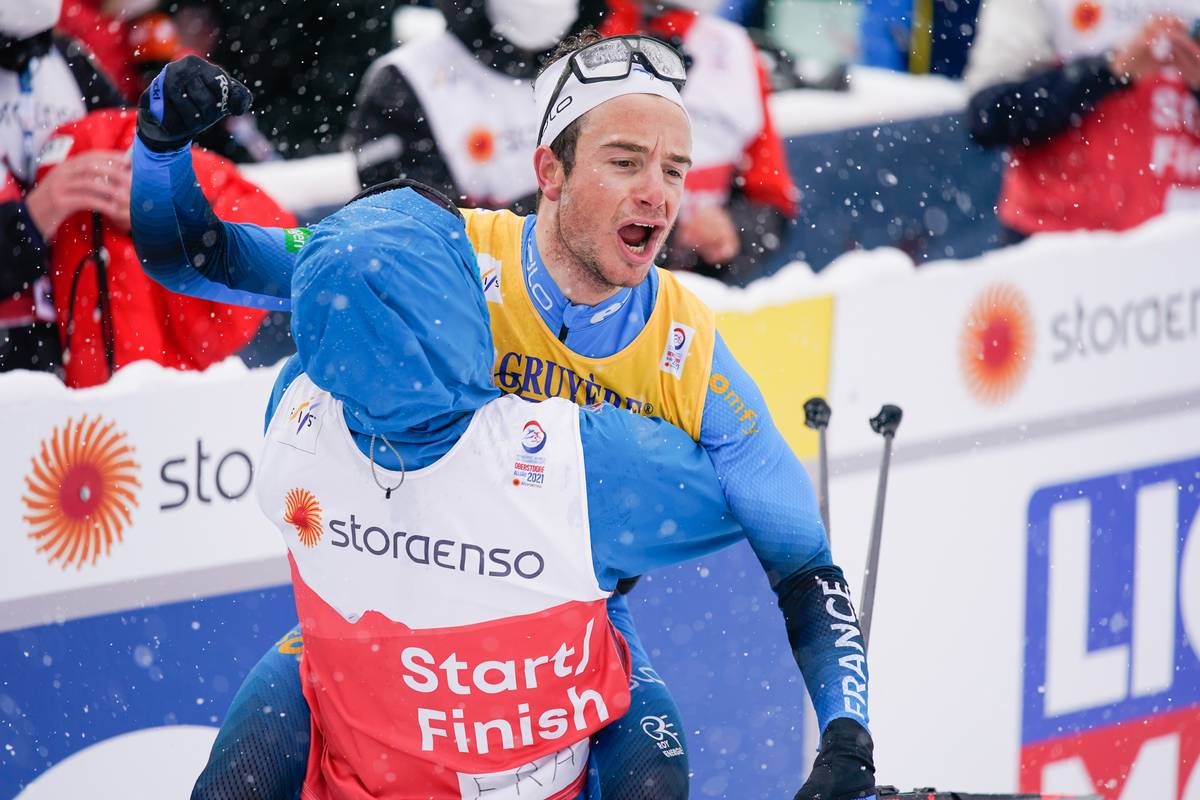
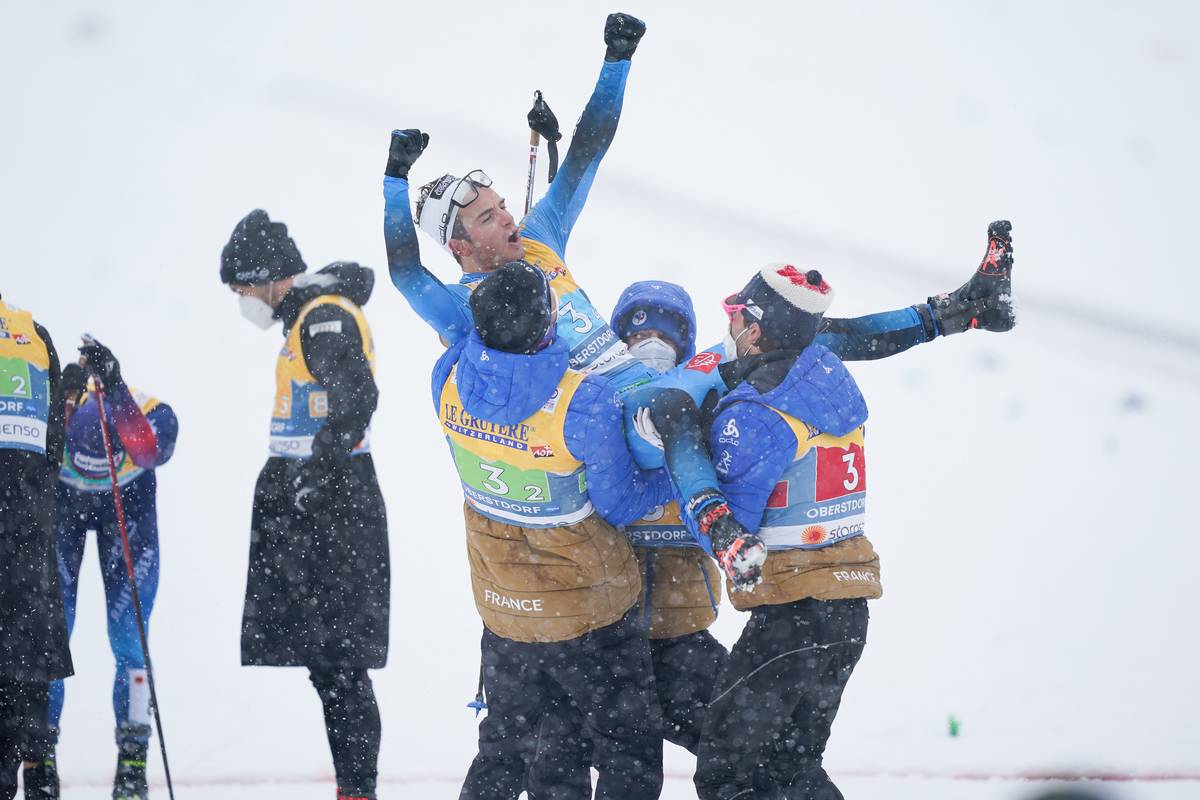
Jules Lapierre (FRA) gets a boost after bringing home bronze for France. (Photo: NordicFocus)
Though that advantage shrunk on the descent, it remained enough to give France third place, finishing + 1:12.6 behind Norway and four seconds ahead of Sweden in fourth.
No shortage of enthusiasm from team France after their third place finish. (Photo: NordicFocus)
For team USA, David Norris raced the scramble, handing over to Scott Patterson in 11th position at the first exchange.
Scott Patterson for the U.S. settles into a pacing groove on the second leg of the 4 x 10 k relay. (Photo: NordicFocus)
Patterson remained steady through his laps and tagged Simi Hamilton, still in 11th. Over the course of his 10 k, Hamilton gained one position and tagged Gus Schumacher in 10th place.
“It was awesome,” Hamilton said of the racing and wild Oberstdorf weather. “It was, I mean a pretty crazy, bizarre, different weird day with the conditions. You know like, you never really know what to expect when you wake up and its basically 32 and dumping all day. It’s going to make for a pretty different race but I’m super proud of our team.
“I think we put together just four really good consistent legs. Our skis were awesome, my boards were running really really well. The climb was tough for me, as kind of a “sprinter” when you mix in a four-minute climb its always tough for me but thankfully I was able to kind of rely on some good glide to recover from the top down to the stadium each time so that was great. But yeah, these boys are… it was maybe the most fun relay I’ve ever skied on, on the World Cup or World Championship just because, I don’t know we had a really good energy going today. We all came out and fought hard and I think this is the type of energy that you know eventually will land us on the podium. I won’t be on that team, but it’s cool to be a part of it. I’m stoked, it was a great way to end the championships for me and it was a fun day.”
Simi Hamilton, leg three skier for the U.S. (Photo: NordicFocus)
Schumacher and Friedrich Moch of Germany battled it out, the advantage ultimately going to Germany who finished in 7th, Schumacher crossing the line 8th for the United States.
Graham Ritchie (CAN) keeping Canada’s team in contact during the scramble leg. (Photo: NordicFocus)
Team Canada, who posted a strong start by Graham Ritchie, ended the day in 10th place. Skiing leg two for Canada was Antoine Cyr, followed by Russell Kennedy with youngster Remi Drolet holding the anchor position.
In a snow globe, Russell Kennedy of Canada during leg three of the 4 x 10 k relay. (Photo: NordicFocus)
This year’s World Championships conclude for the men on Sunday with a 50 k classic mass start event.
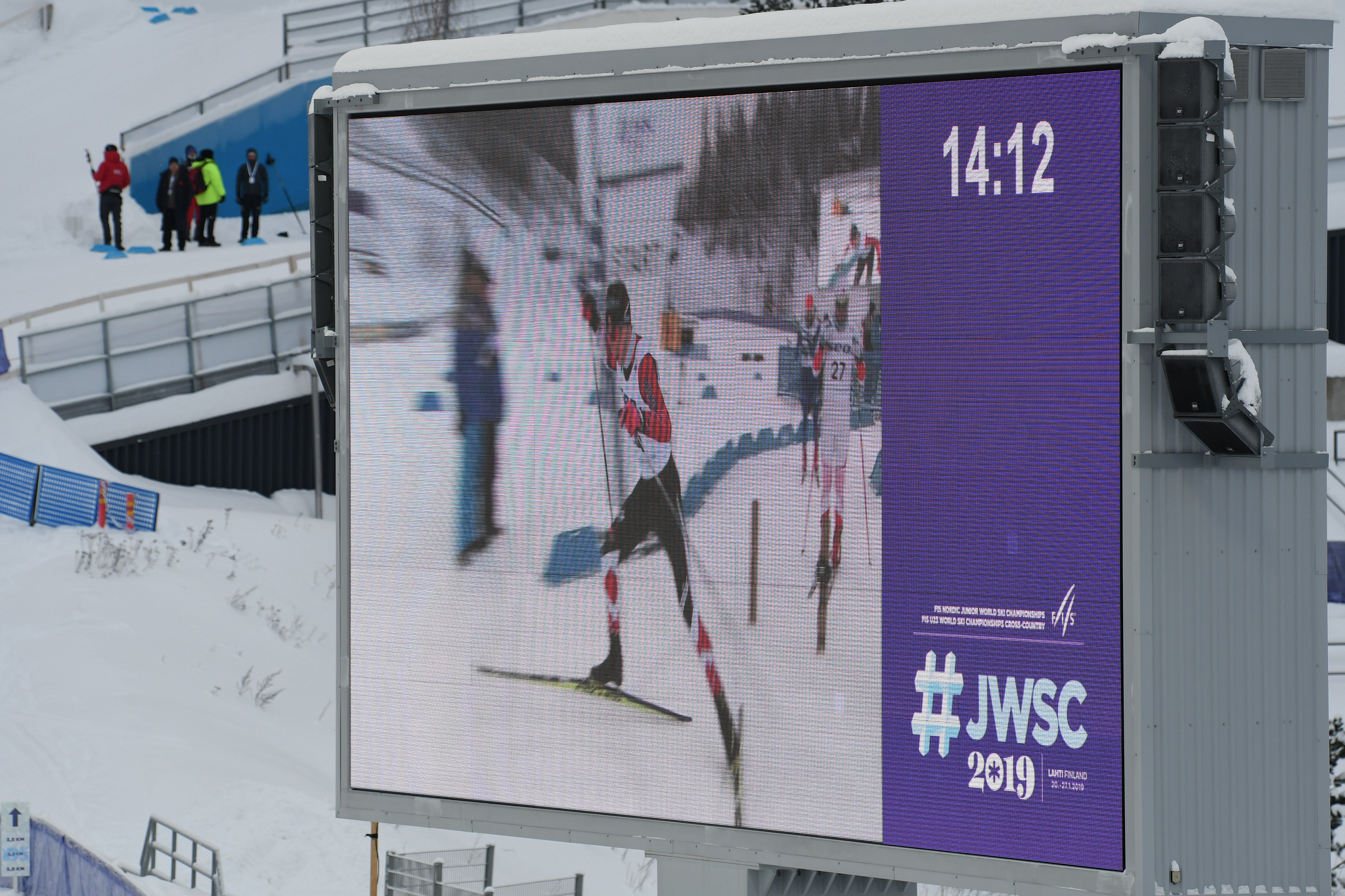
The big screen in Lahti, Finland’s main stadium. Site of the 2019 Junior World Ski Championships. (Photo: Doug Stephen)
Four U.S. skiers began the U23 women’s 10 k skate individual start at the 2019 U23 World Ski Championships in Lahti, Finland on Wednesday, all four finished in the top-30 after Russia’s Mariya Istomina claimed the win in 25:57.3 minutes.
Fnland’s Evelina Pippo was second (+2.0), and Norway’s Tiril Udnes Weng third (+29.6). Istomina and Pippo are scheduled to compete at this weekend’s Ulricehamn, Sweden World Cup and have concluded their competition schedules at U23 Worlds.
The best placed North American was U.S. athlete Julia Kern who placed 12th (+1:21.9). In Kern’s fifth trip to World Juniors and her second as a U23, Wednesday’s 12th place was a career best individual Junior/U23 World’s distance result.
“The 5km course is pretty tough here, with some steep climbs and longer climbs,” Kern emailed about her 10 k skate experience. “It was constant work out there with little rest. I went out hard because the only way to do well at this competitive level is racing is start hot and keep that pace. I was happy to lay down a better performance than Monday and achieve my goal of a top 12 result today. I am really stoked for Lina for having such an awesome race today, it was so fun to watch her on the big screen before I started!”
The next scheduled race for the U23 women is a 15 k classic mass start race on Jan. 25.
“I am really excited for the 15km classic mass start on Friday, I love mass starts, especially when they are classic. I think our team has a good shot of putting down strong races!”
Evelina Sutro in her first Worlds finished in 18th, stopping the clock 1:47.6 minutes behind Istomina’s winning time.
“The race was fun, it was a lot warmer today than it has been the past couple race days which was nice,” Sutro emailed. “It was a tough race with a lot of short and steep hills. The course wasn’t very technical but you really had to work over the top and ski the downhills efficiently. The legs were definitely feeling it the most for me. It was super inspiring to be racing with all these fast ladies!”
Also for the U.S., Hailey Swirbul raced to 26th (+2:90.5), Alayna Sonnesyn 27th (+2:12.6).
Canada’s Sadie White placed 43rd (+3:15.4), Hannah Mehain 44th (+3:19.8), Natalia Hynes 49th (+3:42.8), and Marie Corriveau 54th (+4:58.9).
The U23 men raced a 15 k skate on Tuesday with France’s Jules Lapierre taking the win in 34:02.8 minutes. The Czech Republic’s Michal Novak placed second (+29.0), and Ivan Yakimushkin third (+30.0).
Canada’s Antoine Cyr was the highest placed North American in 38th (+2:56.6). Teammates Gareth Williams skied to 39th (+3:04.0), Graham Ritchie 52nd (+4:02.1), and Julian Smith 57th (+4:20.2).
For the U.S., Hunter Wonders finished in 43rd (+3:20.8), Peter Holmes 48th (+3:43.8), and Braden Becker 53rd (+4:03.1).
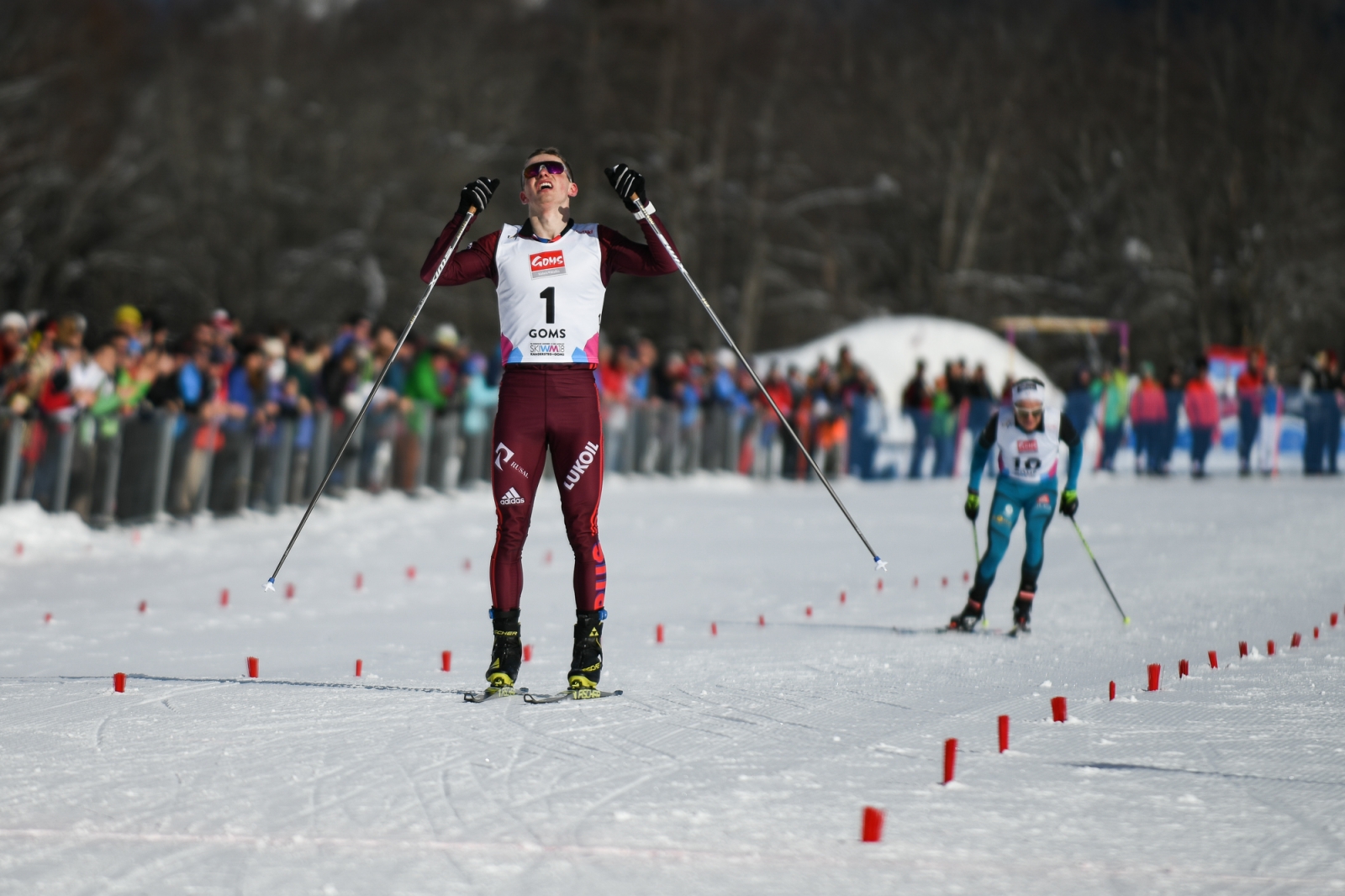
Russia’s Denis Spitsov celebrates his first U23 World Championships gold on Friday ahead of France’s Jules Lapierre in the men’s 30 k skiathlon in Goms, Switzerland. (Photo: JWSC2018.ch)
(Note: This article has been updated to include comments from Americans Lauren Jortberg and Ian Torchia.)
U23 World Championships (Goms, Switzerland): 15/30 k skiathlons
On the final day of U23 World Championships racing in Goms, Russia stole the show in the women’s and men’s skiathlons.
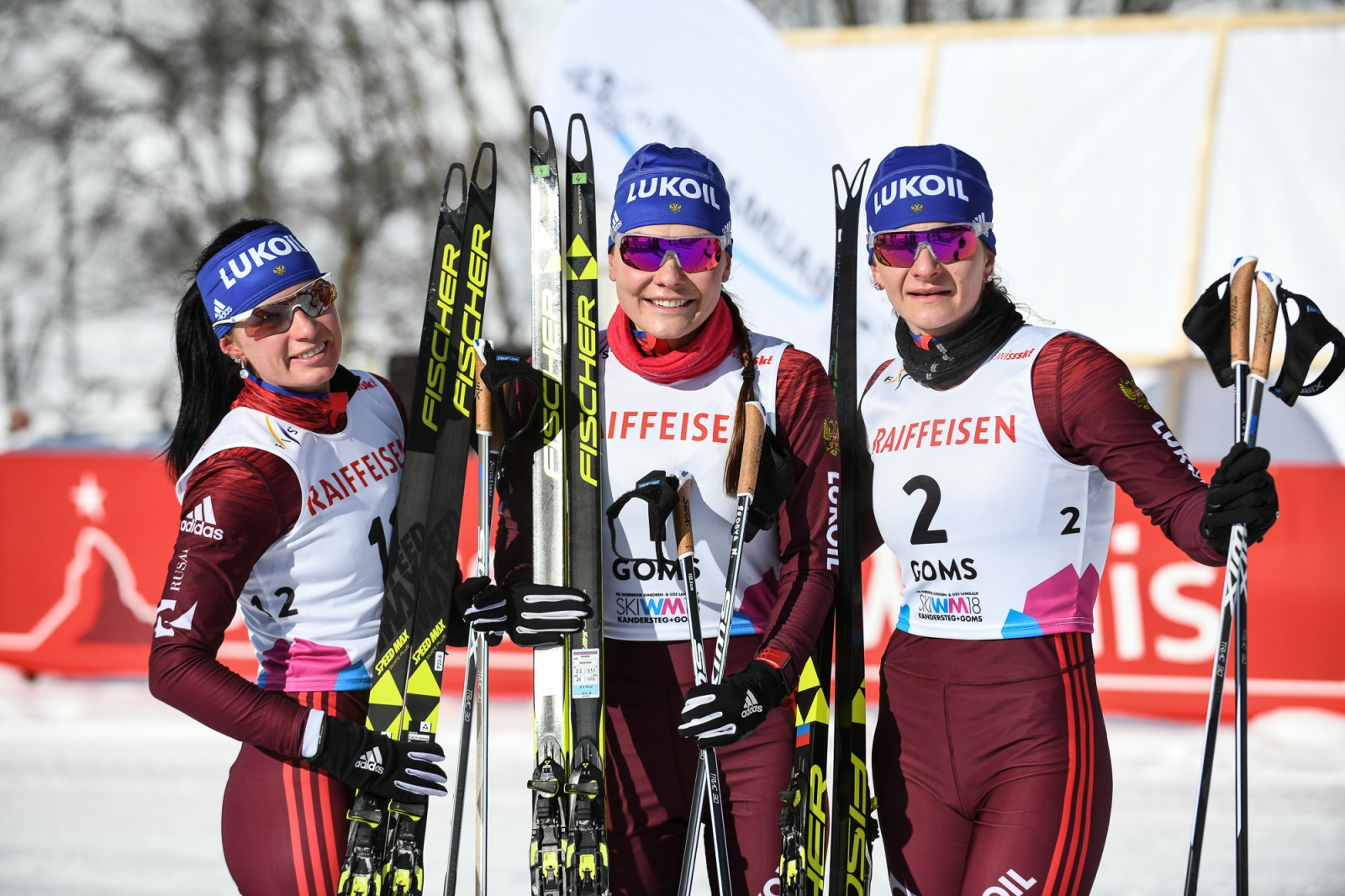
The all-Russian women’s 15 k skiathlon podium at U23 World Championships on Friday in Goms, Switzerland, with Anastasia Sedova (c) in first, Natalia Nepryaeva (l) in second and Yulia Belorukova (r) in third. (Photo: JWSC2018.ch)
Anastasia Sedova led them in the first race of the day on Friday, the women’s 15-kilometer skiathlon, which she won in 44:03.6 minutes. Russia swept the podium and had four in the top five with Natalia Nepryaeva in second (+10.7) and Yana Kirpichenko in third (+37.2), and Yulia Belorukova in fourth (+1:58.0). Germany’s Pia Fink placed fourth (+1:33.5).
The race was the first of the week for the 22-year-old Sedova, a World Cup regular, and it was her second individual gold medal at her second U23 World Championships (she won the 10 k classic in 2016).
“Good preparation for the Olympic Games,” Sedova said during an in-arena interview after the race. “I am very lucky today. Good atmosphere, good weather today.”
Kirpichenko won the 10 k classic earlier this week and Nepryaeva placed third in the freestyle sprint in Goms.
“It’s hard to say how to describe the race, but Anastasia is a really good skier,” Nepryaeva said after. “She was really good today. So for me it was hard to support her during the race. Today she was much better than me.”
American Lauren Jortberg (Dartmouth Ski Team) led the North Americans in 29th (+5:29.9) for her best distance result at the Junior/U23 World Championships level.
“Early in the race I was right over 30th place, and I was trying to maintain contact with the big group ahead of me,” Jortberg, a Dartmouth sophomore from Boulder, Colorado, wrote in an email. “The pace of the classic leg was really fast. A couple of the girls in the race are heading to the Olympics in a few days so it was a really hot start!”
She came through the transition at the race’s halfway point in 31st, about 3:47 behind the leaders.
“I am a much better skater so I felt like I really put the hammer down on the skate leg and moved up a lot,” Jortberg wrote. “The skate course was much easier than the classic course, but I feel like I skied the massive climbs better than the girls around me. I focused on having a really high tempo over the hills and skiing the downhills technically well because there was no rest on the course.
“I’m pleased with my performance today, and I’m excited about my results this week as a whole,” she added. “I’m definitely leaving here hungry for more because I don’t think it was my best week, but I think it was really solid. This is the most competitive field I’ve ever raced against so it feels really good to know that I’m not too far off their level!”
Also for the U.S., Lydia Blanchet placed 38th (+7:11.1) and Nicole Schneider was 40th (+8:04.3). Julia Kern did not finish.
Canada’s Katherine Stewart-Jones (Canadian National U25 Team/NTDC Thunder Bay) placed 31st (+5:39.0) and Maya MacIsaac-Jones was 42nd (+8:08.8), while Laura Leclair and Sophie Carrier-Laforte were lapped.
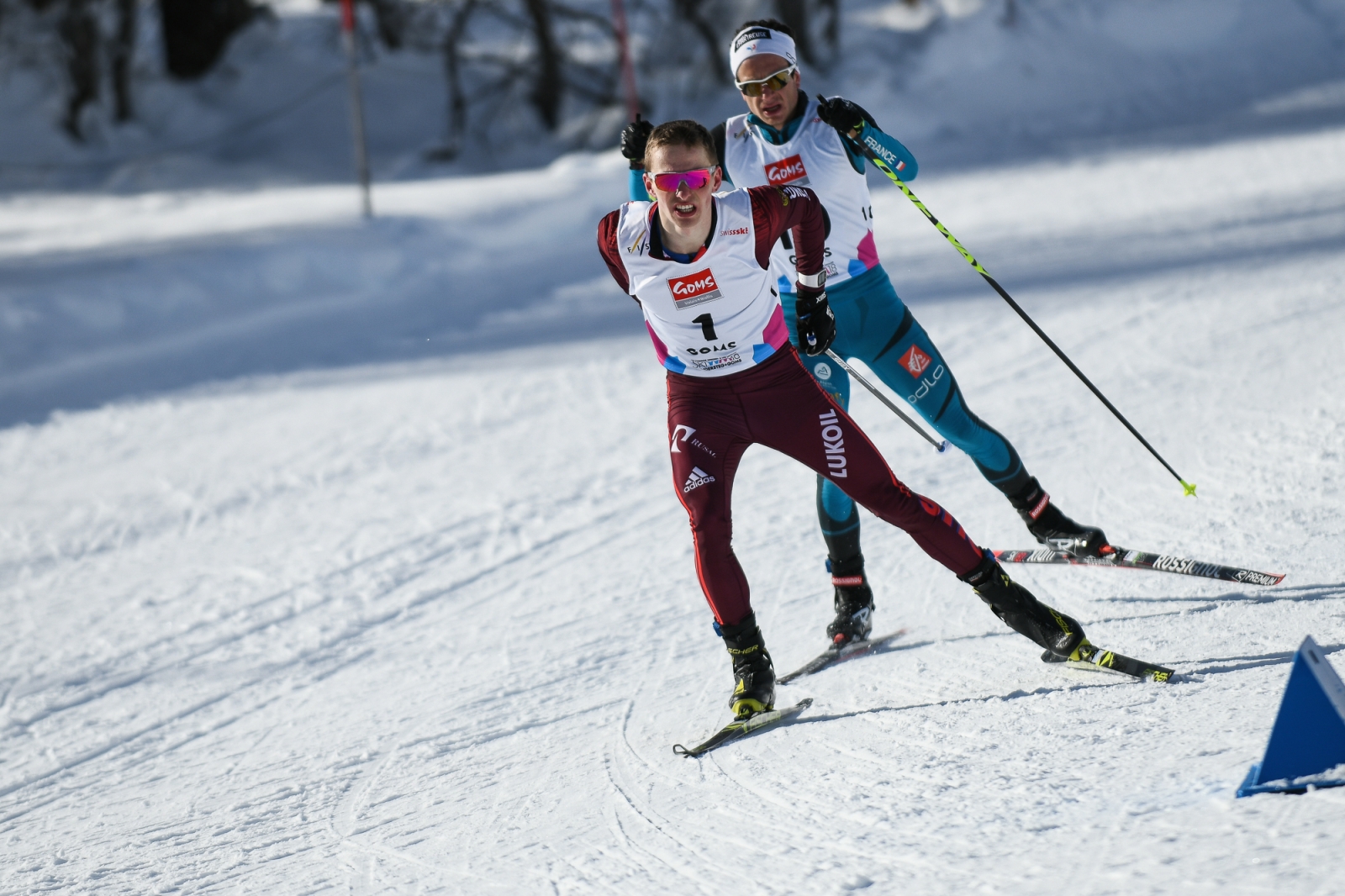
Russia’s Denis Spitsov leads France’s Jules Lapierre during the men’s 30 k skiathlon on Friday at 2018 U23 World Championships in Goms, Switzerland. Spitsov went on to win by 2.9 seconds over Lapierre. (Photo: JWSC2018.ch)
In the men’s 30 k, Russia’s Denis Spitsov took the win in 1:18:14.9 hours, just 2.9 seconds ahead of France’s Jules Lapierre. Norway’s Ole Jørgen Bruvoll placed third (+21.5), ahead of Russia’s Ivan Yakimushkin in fourth (+23.2), and Andorra’s Irineu Esteve Altimiras in fifth (+36.4).
The gold was the first for Spitsov, 21, who previously placed second in the 15 k classic earlier this week. He has two individual bronze medals from last year’s U23 Worlds (in the 30 k skiathlon and 15 k freestyle).
American Ian Torchia (U.S. Ski Team/Northern Michigan University) placed 27th on Friday (+6:05.7). Only 33 men finished, and he was the only North American that didn’t get lapped.
“Between the 3700 feet of climbing, a 2.5km loop, and the top dogs having World Cup podiums…half the field got lapped,” Torchia wrote in an email. “Definitely added some motivation in the final 2 laps to see Spitsov and Lapierre slowly catching up.
“I felt I skied technically better in skate and struggled on the classic leg,” Torchia explained. “Took a hard tumble halfway through the classic leg and had to take half a lap to recover from that. Found a hole in my suit close to my groin afterward which was a little unnerving!”
At the end of the week, he noted that he felt “more fired up than coming in. Funny how being 6 minutes back can do that,” he wrote. “It was an eye-opening experience to get back on the international stage after 2 years and I will take these lessons of racing to the rest of the season in the Ishpemimg Super Tour, Steamboat NCAA’s, and Craftsbury Spring Series. Also already thinking of ideas on how to change and optimize my training to make the jump to the top level.”
Americans Andrew Egger, Zak Ketterson and Thomas O’Harra also competed, as did Canada’s Alexis Dumas, Gareth Williams, Philippe Boucher, and Ricardo Izquierdo-Bernier.
Stratton’s Ben Saxton (l) edging Julien Locke (r) by eight-hundredths of a second for the win in the men’s 1.4 k classic sprint A-final on Friday at Eastern Canadian Championships in Gatineau, Quebec. (Photo: Becca Rorabaugh (APU) on her way to winning the women’s 1.3 k classic sprint qualifier on Friday at 2018 Eastern Canadian Championships in Gatineau, Quebec. (Photo: Rob Smith/CCC)
NorAm Eastern Canadian Championships (Gatineau, Quebec): Classic sprints
Eastern Canadian Championships opened in Gatineau on Friday with classic sprinting, and Americans Becca Rorabaugh and Ben Saxton ended the day with wins in the women’s and men’s A-finals, respectively.
Becca Rorabaugh (APU) on her way to winning the women’s 1.3 k classic sprint qualifier on Friday at 2018 Eastern Canadian Championships in Gatineau, Quebec. (Photo: Rob Smith/CCC)
For Rorabaugh, the win is her second straight after the Alaska Pacific University (APU) skier won the women’s 5-kilometer freestyle at last weekend’s SuperTour in Craftsbury, Vermont. She edged last weekend’s classic-sprint winner, Kaitlynn Miller, of the Craftsbury Green Racing Project (CGRP), by 0.41 seconds for the win in 3:23.15 minutes in Friday’s 1.3 k classic sprint final. It was an all-American podium (and all-American final) with Erika Flowers, of the Stratton Mountain School (SMS) T2 Team, just another three-hundredths of a second back in third (+0.44). Liz Guiney (CGRP) followed in fourth (+2.51), Rosie Frankowski (APU) was fifth (+3.88), and Corey Stock (Bridger Ski Foundation) placed sixth (+6.1).
Rorabaugh had started the day by qualifying first in 3:26.95, then won both her quarterfinal and semifinal. Miller qualified third and won her quarterfinal and semifinal as well.
In the men’s 1.4 k classic sprint, Saxton (SMST2) nipped Julien Locke (Canadian U25 Team/Black Jack) at the line by 0.08 seconds for the win in 3:04.54. Patrick Stewart-Jones (Alberta World Cup Academy) placed third (+5.53), Kris Freeman (Caldwell Sport) was fourth (+5.94), Kevin Bolger (Sun Valley Ski Education Foundation) fifth (+7.42), and Julian Smith (NTDC Thunder Bay) sixth (+11.63).
Locke initially won the qualifier in 3:08.37, then won the first quarterfinal and first semifinal as well. Saxton qualified sixth, then advanced in second in his quarterfinal about a second behind Smith, and Saxton won the second semifinal.
Easterns continue Saturday with 10/15 k freestyle races and conclude Sunday with 10/15 k classic pursuits.
The U.S. women’s relay after taking a historic third in the 4 x 3.3 k relay at 2017 Junior World Championships on Sunday at Soldier Hollow in Midway Utah, with (from left to right) Hailey Swirbul, Katharine Ogden, Julia Kern, and Hannah Halvorsen. (Photo: FlyingPointRoad.com)
For fans of North American skiing, some of the last races of U23 and Junior World Championships at Soldier Hollow in Midway, Utah, proved beyond captivating, surpassing most expectations and previous results.
But for the U.S. junior women’s relay, a group of four that had set a goal two years ago at a U.S. development training camp, the podium was exactly where they had envisioned themselves.
Relay bronze
Hailey Swirbul, Julia Kern, Hannah Halvorsen, and Katharine Ogden went out and achieved that very goal on Sunday, racing to third in the 4 x 3.3-kilometer relay on the final day of Junior Worlds.
According to Ogden, who became the first American to capture an individual bronze two days earlier in the women’s 10 k skiathlon, the foursome were at a camp two years ago in Lake Placid, N.Y., when they walked into a store together. In the 1980 Olympic village, they found red-white-and-blue tube socks — just like the socks the U.S. Ski Team women wear in World Cup team events — on sale. They each bought a pair and made a goal of wearing them together in the relay at World Juniors.
“The four of us have a group message, and it wasn’t unusual to open that message and see a note from someone who just couldn’t contain their excitement for this relay and had to share it with the rest of us… and this was up to two years ago!” Swirbul explained in an email. “We didn’t just think or hope we were capable of this result, I think we all KNEW we could do it deep down. It was kind of surreal to wake up on the morning of the race and think, ‘Today is the day, this is what we have been waiting for for so long! Let’s do this.’ ”
So just by getting to the relay start line on Sunday, they achieved their goal. But they knew they were capable of a top, even best-ever, result.
Hailey Swirbul tucking into the stadium as the first skier on the U.S. women’s 4 x 3.3 k relay team at 2017 Junior World Championships at Soldier Hollow in Midway, Utah. (Photo: FlyingPointRoad.com)
Swirbul started the team off by skiing to eighth in the first classic leg.
“My leg of the race started out fast — exactly what I had expected going into it,” Swirbul wrote. “The first kilometer flew by, and before I knew it, I was cresting the peak of the biggest climb of the course with legs that felt like they were made of lead! I tried to stretch them out on the downhill and hung onto the girls around me through the rolling last kilometer of the race. That 3k was tough!!”
She tagged off to Kern, who moved the team into sixth by the race’s halfway point. Kern came down with a cold last Wednesday and sat out Friday’s skiathlon to rest of for the relay.
“I was feeling a lot better today but definitely not 100% healthy,” Kern wrote in an email. “My goal was to go out and ski the best leg I could and fight hard to the finish because every second counts. I wasn’t really nervous until I was hanging around in the start pen waiting to see Hailey throw down a strong first leg. I was most nervous that I wouldn’t be able to ski well since I am not completely healthy and let the team down.”
She focused on skiing strong over the second half of the course, “since it played my strengths and I knew people would be hurting at the point,” Kern wrote. She tagged Halvorsen in sixth, about 25 seconds out of third and 45.5 seconds behind Italy in first.
Skiing the first skate leg for the U.S., Halvorsen focused on third place. She attacked on the climb known as “Horseshoe Hill”, passing Sweden and France to take that position, but France’s Laura Chamiot-Maitral passed her back on the downhill.
After the race, Halvorsen told the U.S. Ski Team media that she had learned a lot about pacing the 3.3 k after placing 13th in the 5 k freestyle earlier in the week (following Ogden, who fifth).
“I realized I just needed to trust myself and not start so fast — just be calm and slowly catch up,” she said.
The final exchange of the 4 x 3.3 k relay, with Americans Hannah Halvorsen (second from left) before tagging Katharine Ogden (l) in fourth, right behind France (6) in third. (Photo: FlyingPointRoad.com)
Halvorsen tagged Ogden in fourth at the final exchange, just 2.1 seconds out of third.
“I knew that no matter what, I needed to catch up to third place,” Ogden reflected in an email. “I honestly didn’t even think about pacing myself and just went hard from the tag.”
On the long, sustained climb on the backside of the 3.3 k loop, Ogden passed France’s Lena Quintin to move into third. As she soared down the other side, within view of her teammates, Ogden continued to push the pace to lock up third.
“I know Katharine’s technique really well so when I spotted a black dot skiing along I knew it could only be Katharine,” wrote Kern, Ogden’s teammate for the last two seasons at the Stratton Mountain School (SMS) in Vermont. Kern, Ogden and Halvorsen are all members of the U.S. Ski Team (USST) development “D” team.
“I waited a few more seconds but still no one came and I knew she had third locked in!” Kern wrote.
“I was crying when I saw her all alone,” Swirbul told the USST.
“I came into the finish and saw the team standing there cheering for me and it was an incredibly special moment,” Ogden reflected.
She finished third, 25.8 seconds behind Russia in first and just 5.2 seconds behind Italy in second. France’s Quintin finished about 40 seconds later in fourth. The bronze was the first for a U.S. women’s relay at Junior Worlds.
The first U.S. women’s team to podium at Junior World Championships: (from left to right) Hailey Swirbul, Katharine Ogden, Hannah Halvorsen, and Julia Kern, after placing third in the 4 x 3.3 k on Sunday at 2017 Junior World Championships at Soldier Hollow in Midway, Utah. (Photo: FlyingPointRoad.com)
“This week at worlds has been amazing,” wrote Ogden, 19, who left the championships with two bronze medals in her final year of Junior Worlds eligibility. “Wonderful skiing and good weather and unprecedented results for the whole team…”
“It was really incredible to stand up at the medals ceremony the other night,” she told the USST. “The only thing I can think of that would be better is standing up there with my friends.”
“This has been a dream for us for more than two years,” Swirbul, and 18-year-old University of Alaska Anchorage freshman, told the USST. “To see that dream come true — I was crying, happy, hugging and screaming — all in one emotion.”
“I was so happy but not in shock — because I knew we could do it,” Halvorsen, 18, of the Sugar Bowl Academy, told the USST.
Halvorsen, of Truckee, Calif., brought her little sister up on the podium with her.
“After having my whole family here: parents, grandparents, four brothers, and baby sister, it was special to bring the littlest one up to the podium,” Halvorsen wrote in an email.
“There is no one I would rather be on the podium with than my best friends and teammates,” Kern, 19, wrote. “Not only did I share the experience with my best friends, but on home soil with all my family and friends there to celebrate with us!
“I am just proud of our team because everyone skied so well and brought their A game today,” Kern continued. “And to have [USST development coach] Bryan Fish there to help us make it happen was amazing because he has worked so hard to help us become the fastest skiers we can be and this has always been a dream of his as well!”
“I am so lucky to be in this generation with these tough competitors that double as amazing teammates, and I think our country is just getting started with more exciting results to come!” Swirbul wrote.
Russia took the lead on the third leg and stayed ahead of Italy for gold, finishing first in 34:45.3 minutes, with Polina Nekrasova, Lidia Durkina, Anna Zherebyateva, and Mariya Istomina. Italy secured second (+20.6) with Martina Bellini, Anna Comarella, Francesca Franchi, and Christina Pittin, while France was fourth (+1:05.0) with Juliette Ducordeau, Flora Dolci, Chamiot-Maitral, and Quintin. Sweden finished fifth (+1:20.3), and Canada placed 12th (+4:41.3) of 12 teams, with Natalie Hynes, Lisle Compton, India McIsaac, and Annika Richardson.
In the junior men’s 4 x 5 k relay that followed, Norway eked out the win over Russia by 0.4 seconds, with Herman Martens Meyer, Jon Rolf Skamo Hope, Harald Østberg Amundsen, and Thomas Helland Larsen, in 49:36.1. After the first leg, which Germany’s classic-sprint winner Janosch Brugger led, the race was a Norway-Russia battle for first, with Russia leading through the second and third exchanges before Larsen outlunged Vladislav Vechkanov at the finish.
Russia took silver with Vechkanov, Egor Kazarinov, Kirill Kilivnyuk, and Yaroslav Rybochkin, ahead of France, which skied most of the race in third in finished in that position (+1:05), with Martin Collet, Camille Laude, Hugo Lapels, and Arnaud Chautemps.
Of 12 teams, the U.S. finished ninth (+4:28.8) with Bill Harmeyer, Kam Husain, Wyatt Gebhardt, and Hunter Wonders, after skiing in sixth during the first two classic legs, then slipping to ninth on the third leg.
Canada followed in 10th (+5:21.6), with Antoine Blais, Ryan Jackson, Philippe Boucher, and Gareth Williams, after skiing in ninth for the first two legs.
Paddy Caldwell switching to skate skis during the halfway point of the men’s 30 k skiathlon on Jan. 4 at 2017 U23 World Championships at Soldier Hollow in Midway, Utah. (Photo: FlyingPointRoad.com)
The day before, in the last races of U23 World Championships on Saturday, American Paddy Caldwell matched his personal best from two days earlier in the 15 k freestyle, placing ninth in the men’s 30 k skiathlon.
Caldwell had been 10th at the ski change halfway through the race, following his U.S. teammate Jack Hegman in ninth by half a second.
Paddy Caldwell, of the Stratton Mountain School and U.S. Ski Team, racing to ninth in the men’s 15 k freestyle at 2017 U23 World Championships at Soldier Hollow in Midway, Utah. (Photo: U.S. Ski Team/Tom Kelly)
“Starting off in the classic leg I was trying to stay relaxed and maintain position,” Caldwell wrote in an email. “For the first half of the classic I was at the tail end of the lead group then started to lose some time over the last part of the classic.”
He and Hegman started skiing together about 8 k into the 15 k classic leg, and remained together for most of the rest of the race. At the transition, they were about 44 seconds behind eighth place and 13 seconds ahead of 11th.
“I was really struggling with breathing during the classic leg so I tried to relax for the first part of the skate leg and maintain our position,” Caldwell wrote. “We put in a surge on the second lap of the skate to try to catch the group ahead of us (5th-8th) but they were just out of contact. On the last lap I put in one last push early on to break away from the French skier in 10th and got just far enough ahead to hold him off on the last climb before the long decent into the stadium.”
With the sixth-fastest skate leg, Caldwell (SMS/USST D-team) finished ninth, 9.2 seconds ahead of France’s Jean Tiberghien in 10th. Nearly 20 seconds after Tiberghien, Hegman finished 11th (+1:53.5) for a career best at his first U23 Worlds.
American Jack Hegman (SVSEF) racing to 24th in the men’s 15 k freestyle on Feb. 2 at 2017 U23 World Championships at Soldier Hollow in Midway, Utah. (Photo: FlyingPointRoad.com)
“I think I am slightly better at skating, but felt really good about my classic skiing today,” Hegman, of the Sun Valley Ski Education Foundation (SVSEF) Gold Team, wrote in an email. “ I think I was able to gain some good time on the classic portion and then hold on in the skate. In the skate portion I tried to follow Paddy as long as I could and conserve energy. I lost quite a bit of time in the last 2k but thankfully didn’t lose too many places.”
“For the entire skate leg, when I realized I was in the top 12, all I was thinking about was holding onto that top 12 position,” Hegman wrote.
The two led three U.S. men in the top 15, with Adam Martin (Northern Michigan University) not far behind in 15th (+2:23.3). For Martin, it was his first skiathlon in three years (he finished 40th in the 20 k skiathlon at 2014 Junior Worlds in Val di Fiemme, Italy).
Adam Martin (Northern Michigan University) racing to 15th in the men’s 30 k skiathlon on Saturday at 2017 U23 World Championships at Soldier Hollow in Midway, Utah. It was his first top 20 in two U23 Worlds. (Photo: FlyingPointRoad.com)
“I wanted to go out hard enough to establish a decent position, but also wanted to conserve sufficient energy to ski a strong back end of the race,” Martin wrote of Saturday’s eight-lap race.
He skied most of it with the Czech Republic’s Petr Knop, who ultimately finished 14th, 1.4 seconds ahead of Martin.
“Sometimes I was following, and sometimes I led and tried to catch up to the skiers in front of us,” Martin wrote.
“I’ve never been top 20 at one of these competitions before, so top 15 is cool,” he added. “I think I’ve had very decent races this week!”
“It is awesome to see three of us in the top 15 today,” Hegman wrote. “I think having the momentum from this week with so many good performances helped us quite a bit today. Also our skis were awesome today (and all week).”
“I am really happy with my results all week,” wrote Caldwell, who notched top 20’s in all three races, including 18th in the classic sprint to start the championships. “It was an amazing week of racing for USA and I was really happy to end on a high note.”
Russia swept the men’s 30 k skiathlon podium with Alexander Bolshunov, Alexey Chervotkin, and Denis Spitsov, respectively, after the three skied together for most of the race, well ahead of France’s Jules Lapierre and Switzerland’s Jason Rueesch in pursuit of them. As the Russians descended down the final hill — clear of any outside contenders for the podium — they locked arms and coasted into the stadium together. Just before the finish line, they stopped to cross as one.
According to a USST press release, the competition jury had to review timing and scoring records, as well as consult photo assets and the finish referee to determine who finished first, second and third. Gold went to Bolshunov, who also won the 15 k freestyle two days earlier, with an official finish time of 1:15:31.5 hours. Chervotkin was listed as second (+0.2) and Spitsov third (+0.5).
Lapierre crossed 11 seconds later in fourth, about three seconds ahead of Rueesch in fifth (+14.3).
Evan Palmer-Charrette (NTDC Thunder Bay) led the Canadian men in 26th (+5:44.6). Alexis Dumas of the Pierre Harvey National Training Centre (CNEPH) finished 33rd (+9:02.7) out of 36 finishers. Several North Americans did not finish, including Canada’s Julien Lamoureux and Julien Smith, and American Cal Deline.
In the U23 women’s 15 k skiathlon earlier on Saturday, Canada had three in the top 30, with Dahria Beatty (Alberta World Cup Academy/Canadian National U25 Team) in 19th (+2:18.1) for her third top 20 of the week. Katherine Stewart-Jones (NTDC Thunder Bay/NST U25 Team) placed 21st (+2:29.3) for her best result at U23 Worlds, and Frederique Vezina (CNEPH) notched a personal-best 29th (+3:36.2). The team’s fourth skier, Jenn Jackson, did not finish.
Jesse Knori, of the University of Colorado-Boulder (CU) led the U.S. women in 30th (+3:40.1). Alayna Sonnesyn (University of Vermont) followed in 31st (+3:42.5), Nichole Bathe (University of Alaska Fairbanks) was 33rd (+4:36.9), and Corey Stock (Bridger Ski Foundation) 36th (+5:42.1).
Another CU skier, Petra Hyncicova, who raced for her native Czech Republic, placed 22nd (+2:30.7) for her second-best result of the week after placing 20th in the classic sprint.
Norway’s 19-year-old Lotta Udnes Weng won the 15 k skiathlon for her first gold of U23 Worlds, finishing in 40:50.9 minutes and besting Finland’s Johanna Matintalo by 3.8 seconds. Russia’s Yana Kirpichenko captured third (+13.9), edging Weng’s twin sister, Tiril Udnes Weng in fourth (+15.6).
“On paper, this is not my best distance,” Lotta Weng, a six-time Junior Worlds medalist, told the USST. “But I knew I could do well in both classic and skate, and that if I had a really good day, I could ski for a gold medal … I knew I would have a good sprint and I was just trusting it.”
American Ben Loomis (10) racing to a career-best ninth in the individual normal hill/5 k competition on Feb. 4 at Nordic Combined Junior World Championships at Soldier Hollow in Midway, Utah. (Photo: U.S. Ski Team/Tom Kelly)
Ninth for Loomis
Also on Saturday, in the last individual competition of nordic-combined Junior Worlds, 18-year-old American Ben Loomis notched his first top 10 in his third Junior Worlds appearance.
Loomis started the day by jumping to 10th on the normal hill at Utah Olympic Park in Park City, his home training base. That put the U.S. Nordic Combined skier 58 seconds out of first and 11 seconds behind Finland’s Arttu Mäkiaho in ninth for the start of the 5 k race at Soldier Hollow. While Loomis didn’t catch Mäkiaho (who raced to second place for his second-straight individual medal after winning the normal hill/10 k to start the week), Loomis picked off one place to finish ninth, 1:22.3 minutes behind the winner, Germany’s Vinzenz Geiger.
“My goals for the 5k competition were to jump into the top ten, and to not lose any ground during the race,” Loomis wrote in an email. “I was able to do this, but was still hoping for a higher finish.”
He explained that a snow flurry during the jumping competition left the last 20 starters on the hill waiting for it to pass. Loomis was the fourth-to-last to jump, out of 49 starters.
“I was able to stay relaxed, focused and have my best competition jump of the week,” he explained. “The home hill advantage made a huge difference in my jumping. Prior to this week, I had little jumps on the hill this winter. Luckily, I know the hill well and was able to get in rhythm with the jump very quickly.”
Considering his starting position in the 5 k, which is half the distance of the usual 10 k in nordic-combined competitions, Loomis said he knew he needed to move up quickly, but do so in a controlled manner.
“5 k really places a big importance on the jumping,” Loomis told the USST. “It’s a lot harder to make up time, and these Europeans are really quick.”
He paced his first 2.5 k, and by the second lap, he worked with Norway’s Lars Ivar Skaarset — who had caught Loomis after starting 12th — to rein in Slovenia’s Matevz Malovrh, who started fourth and was fading. While Skaarset finished 17.4 seconds ahead of Loomis for eighth place, they both beat Malovrh, who placed 10th, 1.8 seconds behind Loomis.
“Overall, I am very happy with my 9th place result. I was hoping for a little more, but to be 9th in the world is very special,” Loomis wrote. “I am already looking forward to next year’s competitions and approaching them with even more experience.”
Earlier in the week, Loomis placed 18th in the normal hill/10 k and skied the third leg of the men’s 4 x 5 k team event, in which the U.S. placed seventh (with Elijah Vargas, Grant Andrews, Loomis, and Stephen Schumann). After Vargas tagged Andrews in 10th, Andrews skied them into ninth, and Loomis brought the U.S. up to seventh, which Schumann held during the final leg.
The U.S. had two in the top 15 on Saturday, with Schumann in 15th (+1:44.3), up from 20th after the jump. Grant Andrews placed 33rd (+2:40.0) and Tucker Hoefler finished 46th (+3:56.9).
Geiger won Saturday’s normal hill/5 k after jumping to first then starting with a 4-second lead over Japan’s Yuto Nakamura in second. Mäkiaho passed seven people to finish second, 22.6 seconds after Geiger, who won in 12:14.9 minutes. France’s Laurent Muhlethaler started fifth and captured third (+23.9), while Nakamura missed the podium in fourth (+42.8).
“It’s great to be on top of the podium today, after the 10k it was so hard for me due to some illness and an injury after I fell at the World Cup in Chaux Neuve,” Geiger said. “It just feels amazing to be Junior World Champion now.”
The Russian men finishing in unison to take first, second and third in the men’s 30 k skiathlon, the final race of 2017 U23 World Championships at Soldier Hollow in Midway, Utah. Alexander Bolshunov (8) was deemed the winner, Alexey Chervotkin (1) was second, and Denis Spitsov (11) third. (Photo: FlyingPointRoad.com)
FIS Nordic Combined Junior World Championships (Park City and Midway, Utah): Normal hill/5 k
American Ben Loomis (6) leads Norway’s Lars Ivar Skaarset (7) during the third leg of the nordic-combined 4 x 5 k team event on Thursday at 2017 Nordic Junior Worlds at Soldier Hollow in Midway, Utah. Loomis brought the U.S. from ninth to seventh, and his team ultimately finished seventh. (Photo: FlyingPointRoad.com)
[UPDATED] In the individual normal hill/5-kilometer Gundersen on Saturday, the last nordic-combined competition of 2017 Nordic Junior World Championships, American Ben Loomis captured his first top 10 in his third Junior Worlds in ninth place.
Eighteen-year-old Loomis jumped to 10th then picked off one place in the 5 k to finish ninth, 1:22.3 minutes behind the winner, Germany’s Vinzenz Geiger.
Geiger led after the jump and started the ski race 4 seconds ahead of Japan’s Yuto Nakamura in second. Geiger was able to hold off Finland’s hard-charging Arttu Mäkiaho, who raced from ninth to second, by 22.6 seconds. France’s Laurent Muhlethaler raced from fifth to third (+23.9) for the final spot on the podium, while Nakamura slipped to fourth (+42.8).
The U.S. had two in the top 15 with Stephen Schumann in 15th (+1:44.3), up from 20th after the jump. Grant Andrews placed 33rd (+2:40.0) and Tucker Hoefler finished 46th (+3:56.9).
FIS Nordic U23 World Championships (Midway, Utah): 15/30 k skiathlon
It was a Russian affair and a head scratcher for the photo-finish crew at U23 World Championships on Saturday, with three Russians putting enough time on the rest of the field in the men’s 30-kilometer skiathlon that they had time to slow to a stop and inch across the line in unison.
The jury ultimately had to decide who won, awarding it to Alexander Bolshunov in 1:15:31.5 hours, 0.2 seconds ahead of Alexey Chervotkin in second. Denis Spitsov was listed as third (+0.5). France’s Jules Lapierre came closest to the Russians in fourth, finishing 11 seconds later.
The field was considerably strung out by the end of the race, with Switzerland’s Jason Rueesh finishing 14.3 seconds out of first in fifth and Norway’s Gaute Kvaale crossing the line in sixth (+33.0), ahead of France’s Valentin Chauvin in seventh (+49.1), and Andorra’s Irineu Esteve Altimiras in eighth (+56.8).
American Paddy Caldwell (SMS/USST) placed ninth for the second-straight race at U23s, finishing 1:24.4 behind the winner.
The U.S. men had three in the top 15 for their best day of the championships, with John Hegman (SVSEF) placing a 11th (+1:53.5) and Adam Martin (NMU) 15th (+2:23.3) for their best results at U23 Worlds.
Evan Palmer-Charrette (NTDC Thunder Bay) led the Canadian men in 26th (+5:44.6). Alexis Dumas (CNEPH) finished 33rd (+9:02.7) out of 36 finishers. Several North Americans did not finish, including Canada’s Julien Lamoureux and Julien Smith, and American Cal Deline.
In the women’s 15 k skiathlon, Lotta Udnes Weng achieved her first gold of U23 Worlds, holding off Finland’s Johanna Matintalo by 3.8 seconds and crossing the line in 40:50.9 minutes. Russia’s Yana Kirpichenko reached the podium in third (+13.9), fewer than two seconds ahead of Weng’s twin sister, Tiril Udnes Weng in fourth (+15.6).
Dahria Beatty, of the Alberta World Cup Academy and Canadian National U25 Team, led the North Americans in 19th (+2:18.1), and teammate Katherine Stewart-Jones (NTDC Thunder Bay/NST U25 Team) was 21st (+2:29.3) for her best U23 Worlds result.
The Czech Republic’s Petra Hyncicova (University of Colorado-Boulder) followed in 22nd (+2:30.7), and three Canadian women finished in the top 30 with Frederique Vezina (CNEPH) in 29th (+3:36.2). Jenn Jackson did not finish.
Jesse Knori (University of Colorado-Boulder) was the top American in 30th (+3:40.1), Alayna Sonnesyn followed in 31st (+3:42.5), Nichole Bathe (University of Alaska Fairbanks) in 33rd (+4:36.9), and Corey Stock (Bridger Ski Foundation) in 36th (+5:42.1).
Mathilde Petitjean, who races for her native Togo but trains with the Quebec-based CNEPH, finished 38th (+6:04.8) of 38 finishers.
FIS Cross-Country World Cup (PyeongChang, South Korea): 15/30 k skiathlon
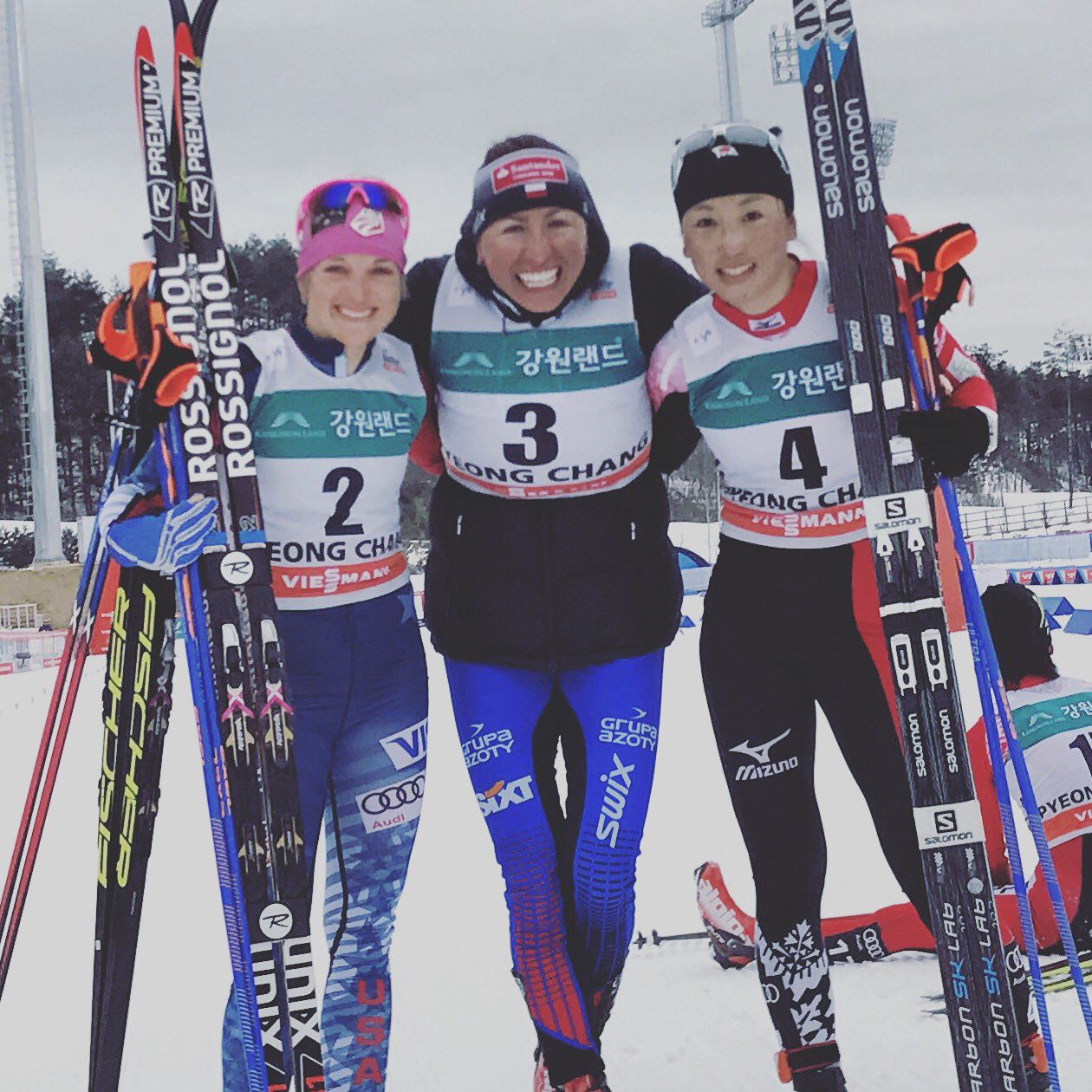
The women’s 15 k skiathlon podium at the PyeongChang World Cup in South Korea, with Poland’s Justyna Kowalczyk (c) in first, American Liz Stephen (l) in second, and Japan’s Masako Ishida in third. (Photo: FIS Cross Country/Twitter)
The second day of World Cup racing in PyeongChang, South Korea, took place this Saturday, with a skiathlon event for both genders. The women raced a total of 15 kilometers, the first 7.5 k leg classic and the second 7.5 k leg freestyle. Poland’s Justyna Kowalczyk came away with the women’s win (her first in three years), getting back to her old ways of breaking away from the pack to finish first in 43:54.7 minutes. Liz Stephen of the U.S. Ski Team (USST) claimed second place (+56.0), while Japan’s Masako Ishida took third (+1:14.8).
For Stephen, second matched her best individual result in a from two years ago, when she placed second in a 10 k freestyle in Rybinsk, Russia. This year at the Tour de Ski, Stephen posted the second-fastest time up the final climb in Val di Fiemme, Italy. For Ishida, it was her first podium since 2009.
Caitlin Patterson, racing for the U.S., finished just off the podium with a career-best fourth (+1:21.4) for her first top 20 on the World Cup, and American Liz Guiney placed 13th (2:21.7) for her first top 20 as well. Jessica Yeaton, who trains with Alaska Pacific University and races for Australia, came in 24th (4:58.6).
Two Canadian women competed with Annika Hicks leading the team in 26th (+5:17.8) followed by Sadie White in 29th (+6:54.7) for their first World Cup top 30s.
In the men’s 30 k skiathlon that followed, Russia’s Petr Sedov broke away during the skate leg to take a decisive victory over Norway’s Daniel Stock and Mathias Rundgreen, finishing in 1:18:49.6 hours, 22.5 seconds clear of second place. It was Sedov’s first World Cup win and podium, and the first individual podiums for Stock and Rundgreen as well.
Rundgreen edged Russia’s Konstantin Glavatskikh for the final spot on the podium, with both being listed as 42.1 seconds behind Sedov.
While Rundgreen held off three others for third place, including Sweden’s Gustav Eriksson in fifth (+46.8), Japan’s Keishin Yoshida in sixth (+47.1), and Russia’s Alexander Utkin in seventh (+49.0), American Noah Hoffman kept his distance ahead of the second chase group to finish eighth (+1:06.2) for his best result in a non-World Cup stage since placing eighth in a 2012 skiathlon in Canmore, Alberta. (Hoffman won the time of day in the 15 k pursuit four years ago in Kuusamo, Finland.)
Also for the U.S., Scott Patterson was next across the line in ninth (+1:28.4) for his first World Cup points, and Matt Gelso finished 19th (+5:00.8) for his first top 20.
Brian McKeever of Canada’s Para-Nordic Ski Team was the lone Canadian finisher in 29th (+8:48.9). Bob Thompson was listed as placing 32nd of 37 after being lapped, and Simon Lapointe did not finish.
NorAm Eastern Canadian Championships (Cantley, Quebec): Classic interval start
The NorAm mini tour at the Nakkertok Nordic Centre continued on Saturday with Eastern Canadian Championships with classic individual start races.
In the men’s 15 kilometre, Lappe Nordic’s Andy Shields took a lead in the first lap and held on to win in 39:14.7, just 0.7 seconds ahead of CNEPH’s Ricardo Izquierdo-Bernier. Team R.A.D.’s Russell Kennedy collected his second bronze of the weekend, 24.7 seconds back.
SMS Elite’s Anne Hart won the women’s 10 k in a reversal of Friday’s sprint podium. Hart’s 30:03.3 finish gave her a 9.3 second edge on CNEPH’s Sophie Carrier-Laforte and 20.0 seconds on AWCA’s Maya MacIsaac-Jones.
For the 123 men and 77 women doing the full distance, the weekend is a mini tour. For the younger categories, it is three separate events allowing the kids who couldn’t skip school on Friday to race Saturday and Sunday.
There should be over 700 finishers today with 768 on the start list. The volunteers will have more hours of work even after the open categories have finished.
Results will update continuously as more categories start.


 This coverage is made possible through the generous support of Marty and Kathy Hall and A Hall Mark of Excellence Award. To learn more about A Hall Mark of Excellence Award, or to learn how you can support FasterSkier’s coverage, please contact info@fasterskier.com.