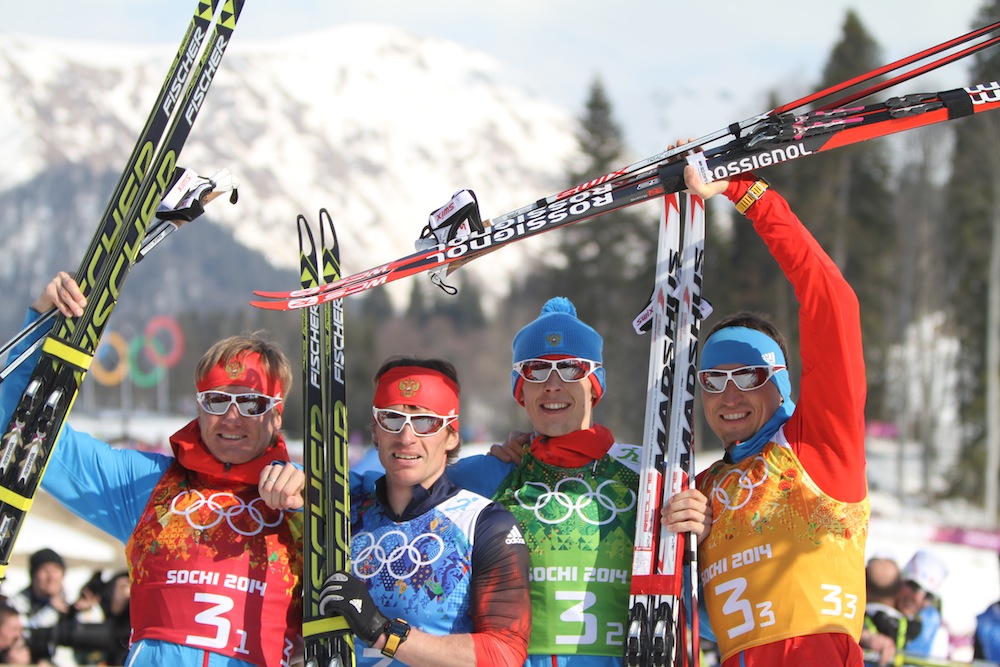
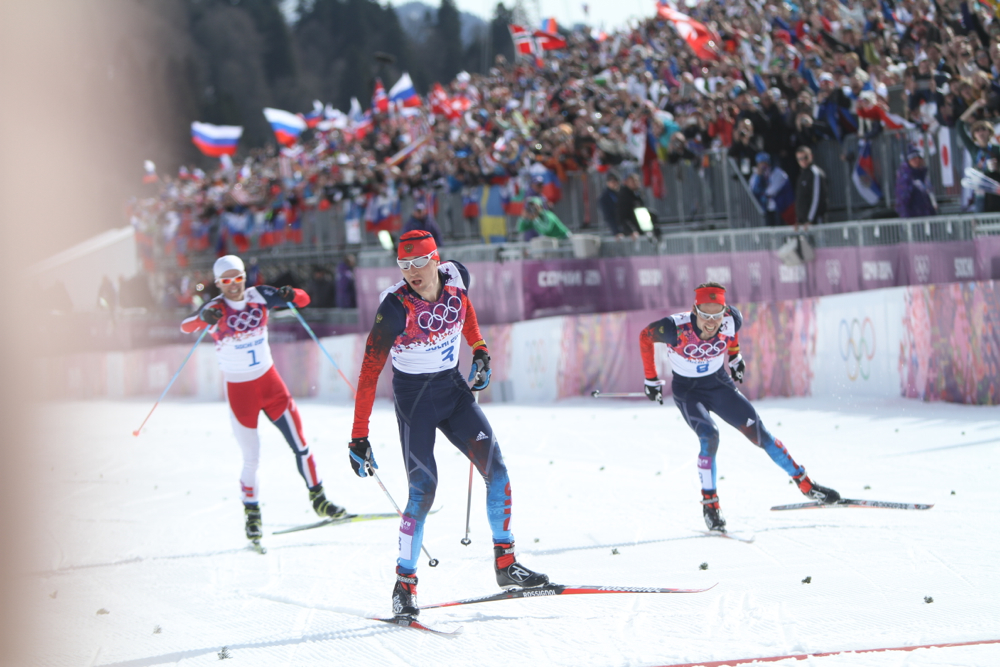
The silver-medal winning Russian men’s relay team at the 2014 Olympics. Alexander Bessmertnykh, Maxim Vyegzhanin, and Alexander Legkov were disqualified for doping, but just had their bans overturned by the Court of Arbitration for Sport.
The Court of Arbitration for Sport (CAS) has overturned doping bans assigned to eight cross-country skiers based on investigations into manipulation of the anti-doping process at the 2014 Winter Olympics.
“In 28 cases, the evidence collected was found to be insufficient to establish that an anti-doping rule violation (ADRV) was committed by the athletes concerned,” CAS wrote in a press release. “With respect to these 28 athletes, the appeals are upheld, the sanctions annulled and their individual results achieved in Sochi 2014 are reinstated.”
The athletes whose results will be reinstated are:
50 k gold medalist and relay silver medalist Alexander Legkov
50 k silver medalist, team sprint and relay silver medalist Maxim Vylegzhanin, also fourth in the 30 k skiathlon
relay silver medalist Alexander Bessmertnykh, also seventh in the 15 k classic
Evgeny Belov, 19th in the 30 k skiathlon and 25th in the 15 k classic
team sprint silver medalist Nikita Kriukov, also 13th in the men’s sprint
Alexei Petukhov, eighth in the men’s sprint
Evgenia Shapovalova, 28th in the women’s sprint
Natalia Matveeva, 20th in the women’s sprint
The disqualifications of skiers Julia Ivanova, Yulia Tchekaleva, and Anastasia Dotsenko were upheld, although CAS held that instead of being banned from the Olympics for life, the three women were merely banned from the 2018 Games.
The cases of biathletes Olga Zaitseva, Olga Vilukhina, and Yana Romanova have not yet been handled.
The eight athletes whose disqualifications were overturned had not been invited to the 2018 Olympics, and many other Russian athletes who had not been convicted of doping offenses also did not meet the IOC’s requirements of proof of being clean either. Thus, it is doubtful whether the CAS appeals will affect the Olympic rosters.
CAS did not release any information about how the arbitration panel came to its decision.
“Although the operative part of the decision is issued, the principle of confidentiality of the procedure still applies,” Legkov’s lawyer, Christof Wieschemann, wrote in a statement emailed to the media. “I assume that all parties involved will respect this. The panel has to decide in its judgment what details of the proceedings becomes subject of the reasoning of the decision and therefore will also become public. We will wait for the reasoned decisions.”
The evidence in the McLaren report showed, for instance, that anti-doping sample bottles belonging to Legkov, Vylegzhanin, Shapovalova, and Petukhov, among others, showed marks consistent with having been tampered with. A sample belonging to Vylegzhanin also showed discrepancies in the reported specific gravity.
There was no explanation offered as to why this evidence is not valid in proving an anti-doping rule violation.
Likewise, CAS offered no explanation as to why this testimony was not sufficient to prove an anti-doping rule violation.
“Dr. Rodchenkov testified fully and credibly at CAS,” Rodchenkov’s lawyer, Jim Walden, wrote in a statement. “His truth has been verified by forensic evidence, other whistleblowers, and, more recently, recovery of the Moscow lab’s secret database, showing thousands of dirty tests that were covered up. The panel’s unfortunate decision provides a very small measure of punishment for some athletes but a complete ‘get out of jail free’ card for most. Thus, the CAS decision only emboldens cheaters, makes it harder for clean athletes to win, and provides yet another ill-gotten gain for the corrupt Russian doping system generally, and Putin specifically.”
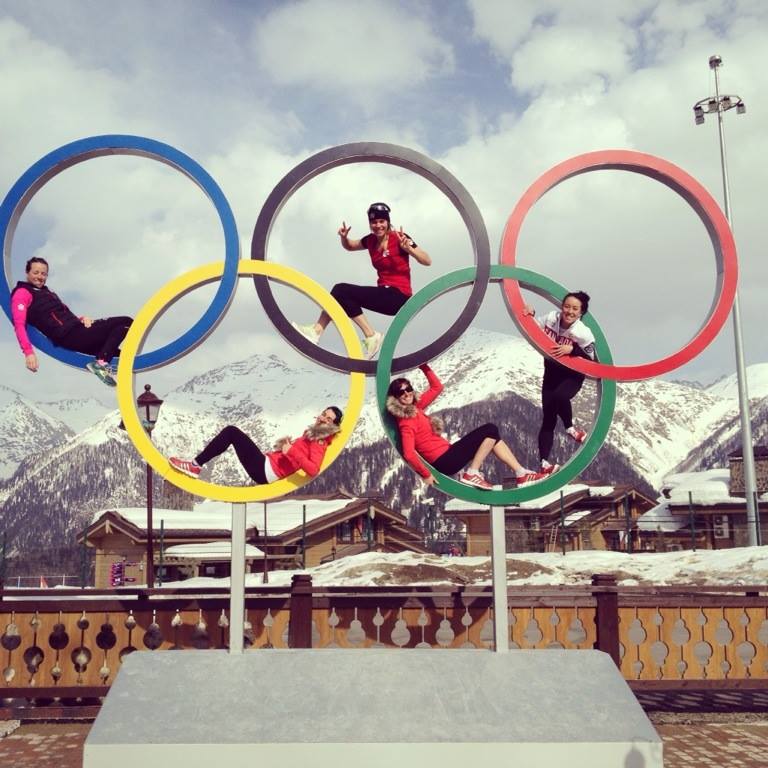
Five members of Cross Country Canada’s 2014 Olympic team get the perfect photo opp at the Olympic rings in Krasnaya Polyana, Russia. (From left to right) Perianne Jones, Amanda Ammar, Heidi Widmer, Brittany Webster, and Emily Nishikawa. (Photo: Emily Nishikawa)
On Nov. 9, news broke that four more Russian cross-country skiers had been sanctioned for cheating during the 2014 Sochi Olympics. So far, six Russian nordic athletes in total have had their 2014 Olympic results erased by the International Olympic Committee (IOC). These athletes are also prohibited from participating in all future Olympics due to their affiliation with Russia’s elaborate-state sanctioned doping enterprise.
Julia Ivanova, half of Russia’s 2014 Olympic team-sprint duo, is one of the six penalized Russians. In Sochi, Ivanova and her teammate Anastasia Dotsenko skied to 10th place in the classic team sprint. (Thus far, Dotsenko has not been implicated in the doping scheme.)
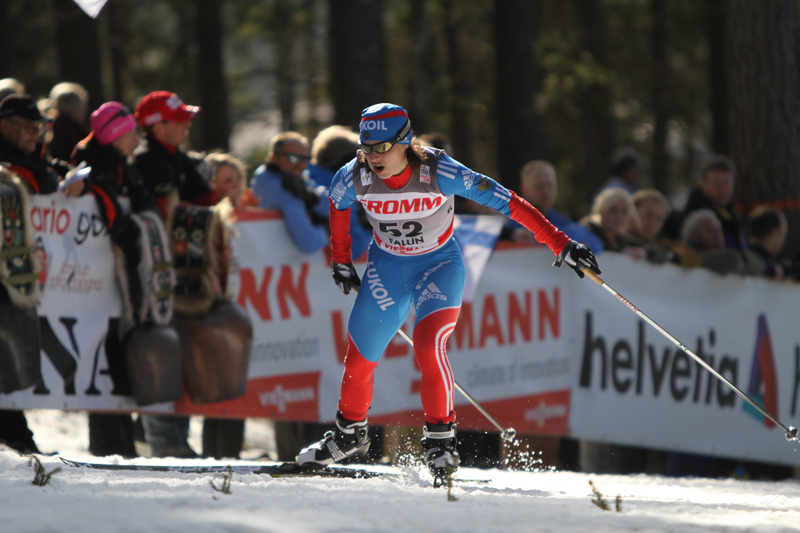
Russia’s Julia Ivanova racing at 2012 World Cup Finals in Falun, Sweden.
It’d be easy to say the Russian pair was way out of the medals — theirs was simply another tainted performance already removed from the official results.
Yet among those clean athletes caught up in the win-at-all-costs mantra of the Sochi doping regime are Canada’s team-sprint pair Perianne Jones, now 32, and Dasha Gaiazova Atkins, 33. Looking back, “What might of been?” is a legitimate question the two retired skiers have asked.
Ivanova and Dotsenko made the Sochi team-sprint final as what’s referred to as lucky losers — 10th place in their semifinal wasn’t enough for them to automatically advance but their time was fast enough relative to the rest of the field to put them through to the final. Jones and Gaiazova Atkins were right behind them in 11th, which was the end of their day.
“I texted Peri that morning when the article came out in Fasterskier and said, ‘Should we start training for a redo?’ ” Gaiazova Atkins, who was born in Russia but spent more than half of her life in Canada, said on the phone from her home in Calgary. “Because we could have been in the finals and then you never know how that goes. It could have had a much, much better result and we could have had a chance for a medal.”
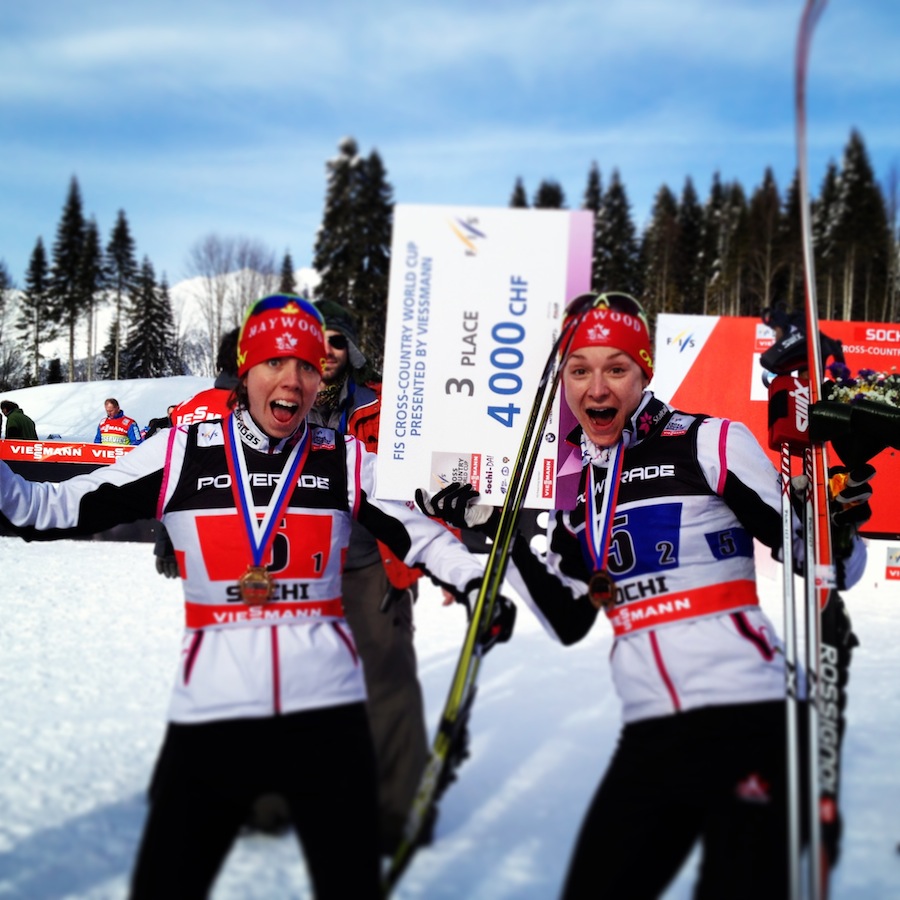
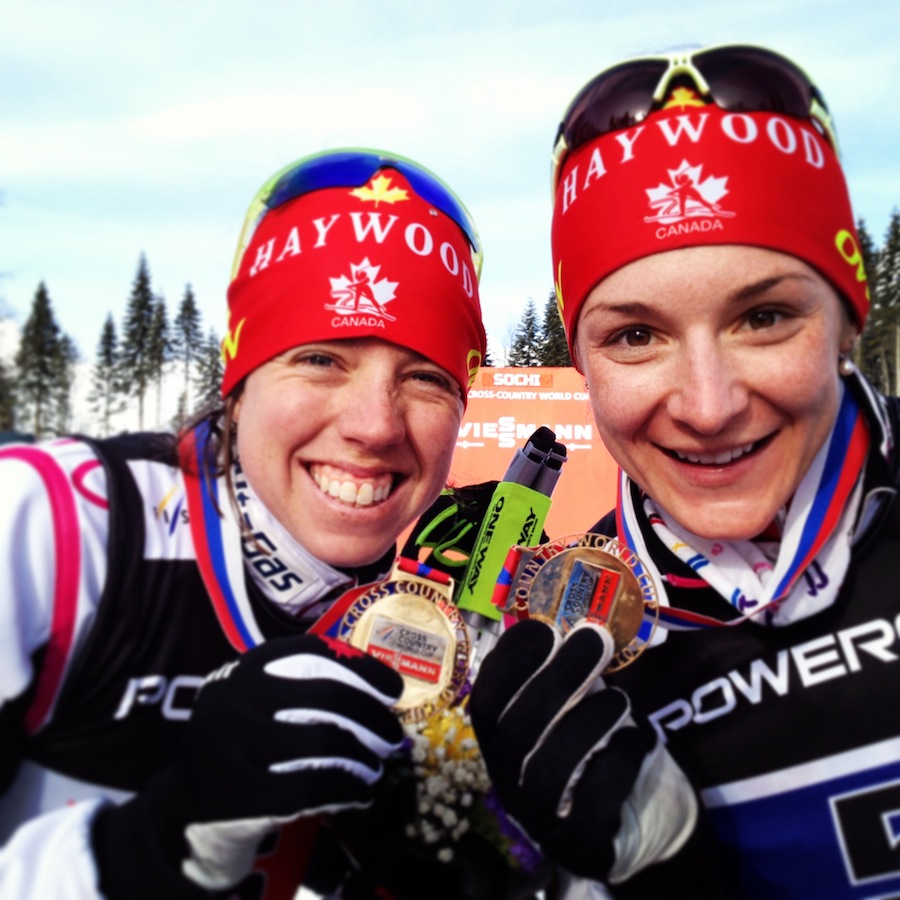
One year before the 2014 Olympics, at the pre-Olympic World Cup in Sochi, Jones and Gaiazova (the latter of which has been married since, hence the new last name) placed third in the classic team sprint. Notably, they were third in a photo finish with the second-place Russians — Ivanova teamed up with Natalia Matveeva in that race.
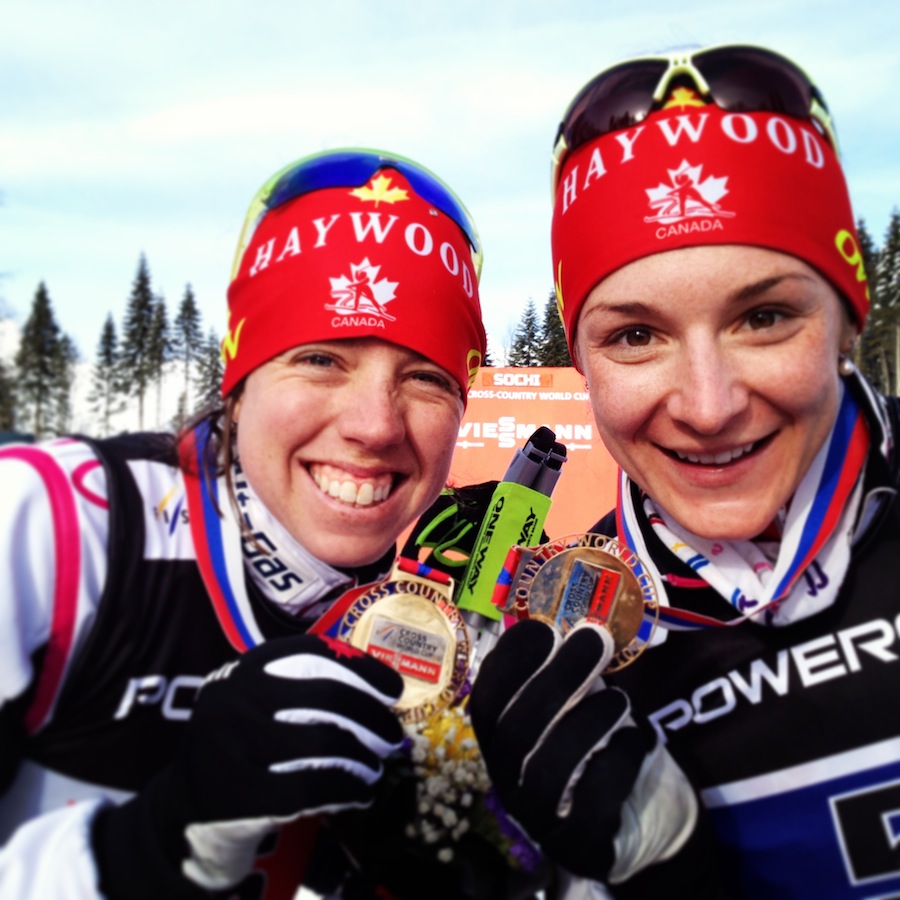
Canada’s Perianne Jones (l) and Dasha Gaiazova having some fun after notching their first podium together with bronze in the classic team sprint at the Sochi pre-Olympic World Cup in February 2013. (Photo: Chandra Crawford)
Jones first heard about the Ivanova news through Gaiazova Atkins’s text message.
“When it goes back and you realize that something could have gone a little bit differently or wonder what could’ve been, then you think about it a lot more and it definitely hits you a little personally,” Jones said on the phone from Canmore, Alberta. “For sure, it makes me feel sick and I cannot go back. No one can. That’s the unfair part. … It’s an interesting conundrum: people have put their lives into something and then are not given a fair chance.”
The “what if” part of this story is multi-layered. Ivanova raced twice in the 2014 Olympics before the team sprint; first in the 10-kilometer classic on Feb. 13 and again in the 4 x 5 k relay on Feb. 15. What if Ivanova had been tested after those races and a legit lab had found her to be doped? What if Ivanova and Dotsenko never raced the team sprint on Feb. 19? Or a different iteration of Russians were slower in the semis? On paper at least, in this post-Sochi thought experiment, the Canadians advance to the final as lucky losers.
The perspective of time buffered by athletic retirement seemed to have taken the edge off the tone of both Jones and Gaiazova Atkins, based on their voices over the phone. They both sounded calm and measured, without a sense of bitterness. But they raised several important points as the fallout from the Russia’s doping program continues.
Canada’s Perianne Jones racing to fifth in the 1.4 k classic sprint at 2015 World Championships in Falun, Sweden. She placed 24th overall and retired after that 2014/2015 season.(Photo: Flyingpointroad.com)
On Jones’s mind were those athletes still competing, and those wondering if they, too, are racing in an unlevel playing field.
“I am retired now,” Jones said. “So it would have been tough had all this stuff been coming out as I was still ski racing. I think it is tough for the athletes who are still competing now. Not that it is easy to hear about it after the fact, but you definitely have to believe you can do it while you are ski racing. I imagine that at least most of the playing field is clean and that would be hard given everything that has transpired over the last little while.”
Gaiazova Atkins’s story resonates due to her literal mid-teen continental shift. At the age of 15, she moved with her family from Russia to Quebec. Although she started skiing in Russia, her swift trajectory up into the international ranks began as a Canadian. She did, however, recall a Russian ski culture where more than a healthy lifestyle choice was on the line.
“I would say there is more pressure in Russia,” Gaiazova Atkins said. “And maybe because in Russia, in so many ways the country is so far behind in development … they have very few resources. So there is a lot of pressure to become a big skier because if you can race fast, you can do quite well for yourself in the country. … In America, it is not the same. And here in Canada, Chandra [Crawford] got a gold medal, shake her hand and off she goes to get an education.”
Gaiazova Atkins’s perspective was one of trying to humanizing cheaters and would-be cheats, people with families and their own demons straddling their shoulders.
“The incentive to perform is so much higher in Russia,” Gaiazova Atkins said. “And the alternative? You can live in poverty and then, OK, I am going to take a chance. So for a lot of athletes, it may not be perceived as high risk because it’s the only chance to do well in life.”
While she expressed that blame should be placed on those involved, Gaiazova Atkins emphasized truly understanding an athlete’s complicity.
“I know these girls and I know the guys who are now being stripped of their results,” she said. “I follow them on Instagram and I see what they are saying in Russian, and it’s crazy they are still denying they did this. But then, you think about a big country like Russia and the whole thing, you almost ask yourself, ‘Did the athletes even know this was happening? Did they have any say?’ It is just like, you have no choice as an athlete.”
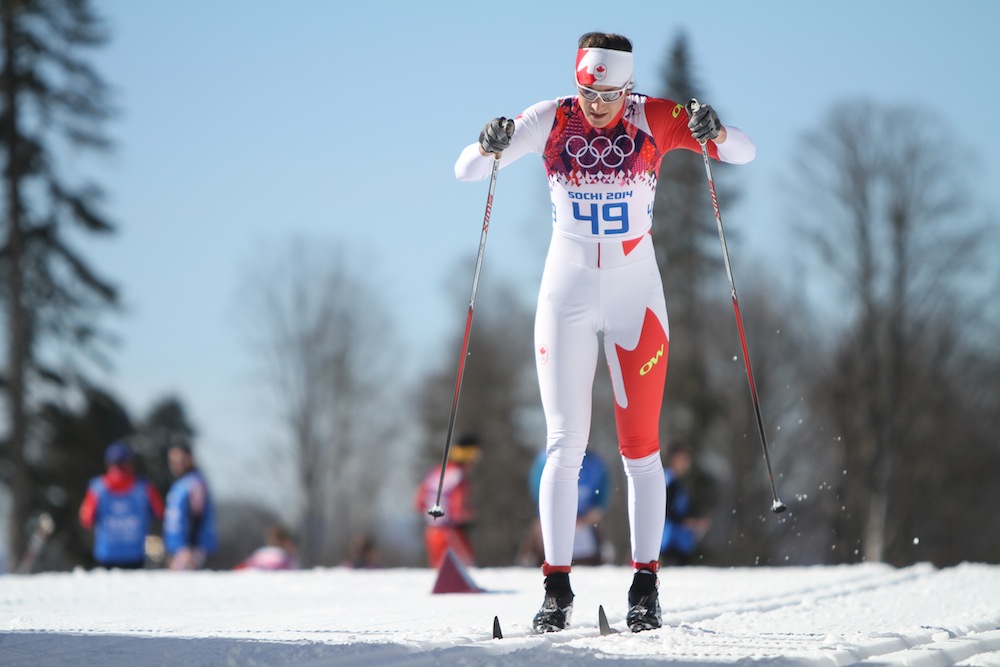
Dasha Gaiazova racing to 44th in the women’s 10 k classic individual start at the 2014 Olympics in Sochi, Russia. She retired at the end of that 2013/2014 season and is currently coaching the Space Dogs Ski Club (where she’s also the president) in Calgary.
Several times, Gaiazova Atkins stated her belief that the doping was a top-down mandate, a state-sanctioned endeavor with upper-government power plays manifesting with Sochi podiums. But she’s also no apologist.
“I follow on Instagram and their posts from all those guys, like Legkov and people that support him,” she said. “They say, we are with [Legkov] because we know how hard he works and how much work ethic he has. And I am thinking to myself, every single person racing is working just as hard and harder.
“I feel sorry for those athletes, especially those who aren’t as systematic like the state-supervised program,” she added. “The ones who choose themselves and go to doctors, no pity for you.”
As far as moving forward, Gaiazova Atkins said she was in favor of nothing less than a wholesale Russian ban from the upcoming PyeongChang Games.
“You cannot slap them on the hand and say, ‘OK, don’t do this next time, please’,” she said. “It has to be with consequences for the state, for the country.”
Gaiazova Atkins also believes that Ivanova’s doping has had lasting impact on potential funding for the current crop of Canadian cross-country skiers. “Eleventh place is not a top 10,” she said.
“Cross Country Canada funding is based on our results, and there is a big difference between a top 10 and 11th place sometimes,” she added. “To take us out of the equation, this had a trickle effect on the whole system, like our whole nation may have been affected by the funding because we did not get a top-10 result.”
As the concentric ripples from Russian doping in Sochi move outward, they’ve arrived in North America, nearly four years late, with the 2018 Winter Olympics in PyeongChang, South Korea, on the horizon.
Canadians Perianne Jones and Dasha Gaiazova celebrate their first bronze together in the 2013 Sochi World Cup classic team sprint. (Photo: Chandra Crawford)
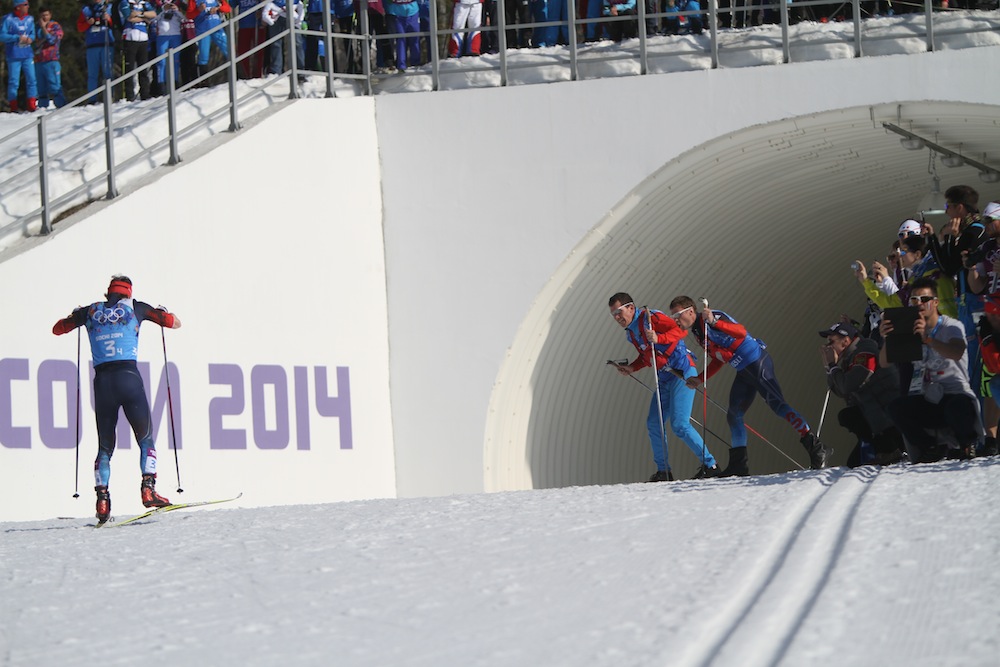
Russian team staff cheer on Maxim Vylegzhanin, the country’s anchor skier, in the 4 x 10 k relay at the 2014 Olympics in Sochi, Russia. Vylegzhanin has now become the second member of that silver-medal relay team to be disqualified for doping.
All four were identified in the McLaren Report, an independent investigation commissioned by the World Anti-Doping Agency to investigate reports from whistleblowers that Russia had systematically evaded the anti-doping process at the 2014 Olympics.
“The athletes have been disqualified for life from taking part in the Olympic Games,” Valbe said.
With Legkov’s disqualification, Russia had already lost a gold medal in the 50 k and a silver medal in the 4 x 10 k relay.
Vylegzhanin had finished second in the 50 k, but with him now disqualified as well, there could be a substantial medal re-allocation. Third-place Ilia Chernousov, also from Russia but not implicated the McLaren report, would stand to gain gold. Fourth-place Martin Johnsrud Sundby of Norway would take silver, and fifth-place Sergei Dolidovich of Belarus would earn bronze.
Vylegzhanin also won silver in the men’s team sprint with Nikita Kriukov. With that result invalidated, Sweden’s Emil Jönsson and Teodor Peterson will move from bronze to silver, and fourth-place Northug and Ola Vigen Hattestad would earn bronze.
Valbe said that the IOC Disciplinary Commission’s decision will be appealed to the Court of Arbitration for Sport, so such medal reallocations are not yet finalized.
“It’s hard to choose words, but I’ll fight to the end — it’s a violation of all human rights,” Petukhov said, according to a translation.
Petukhov finished eighth in the skate sprint in Sochi; Shapovalova finished 28th. Ivanova was part of the sixth-place women’s relay and team sprint teams, both of which stand to be disqualified, and finished 17th in the 10 k classic and 30th in the 30 k skate.
The Canadian team of Perianne Jones and Dasha Gaiazova missed qualifying for team sprint finals as “lucky losers” by one spot. The Russian pair of Ivanova and Anastasia Dotsenko, however, did advance as lucky losers – meaning that if they had not been in the race, the Canadians would have been next in line for a spot in the finals.
Maxim Vylegzhanin competing in the 10 k classic in Falun, Sweden, in 2016. Vylegzhanin is provisionally suspended while the International Olympic Committee investigates possible doping infractions at the 2014 Olympics. (Photo: Fischer/NordicFocus)
In part of the media storm following the Court of Arbitration for Sport’s response to an appeal by six Russian cross-country skiers, Russian Ski Federation President Elena Valbe made a surprising assertion: that the athletes, who remain provisionally suspended by the International Ski Federation (FIS), are allowed to train with the national team.
This is not generally the case for athletes serving suspensions, but FIS Anti-Doping Coordinator Sarah Fussek confirmed the organization’s stance.
“You cannot really say it is a deviation [from the norm] because we have not had these [types of] facts on the table before,” she said in a phone interview on Friday. “This is a special case and it requires special handling.”
Are All Provisional Suspensions Created Equal?
FIS more often deals with cases which start with a positive drug test, or “adverse analytical finding”. A positive test results in a nearly-automatic suspension while the case proceeds – called a “mandatory provisional suspension”.
The cases of Alexander Legkov, Maxim Vylegzhanin, Alexey Petukhov, Julia Ivanova, and Evgenia Shapovalova arose via investigation started by journalists, continued by Richard McLaren on behalf of the World Anti-Doping Agency, and now being conducted by the International Olympic Committee (IOC).
“The investigation of the alleged anti-doping rule violations will be carried out by the IOC Disciplinary Commission, which has the results and case management authority for anti-doping at the Olympic Winter Games, whereby the provisional suspensions are imposed by FIS,” stated a FIS press release announcing the suspensions on Dec. 22, 2016.
In cases without a positive drug test, sports federations are allowed to implement an “optional provisional suspension”. This is what FIS put in place on the six Russian skiers, whose samples were allegedly tampered with at the 2014 Olympics.
Fussek said she awaited a written explanation from the FIS Anti-Doping Panel, which gave the recommendation to the athletes that they could train with their national team again. For privacy reasons and due to rules governing ongoing cases, FIS cannot not share documents which were provided to the athletes explaining such decisions.
However, Fussek understood that it was because of the optional nature of the provisional suspension that the athletes were being allowed to officially train again (all had been training on their own while serving their suspensions).
“As you know, we do not have an adverse analytical finding where a mandatory suspension would have been put in place,” Fussek said. “Presumably they have decided for that, because it was special circumstances… they would give them a special allowance to train. They have decided not to prohibit them to train in order to keep a balance between the provision of the suspension and the actual consequences. It is an ongoing case with special circumstances.”
Indeed, considerable time that has passed with no news or hearings from the IOC investigation. In the ruling from the Court of Arbitration for Sport (CAS), the organization gave FIS until Oct. 31 to bring a formal case against the athletes, or else their suspensions will be lifted. At that point, they would have waited 10 months.
“The provisional suspension switches into a sanction in face of its duration and the ongoing investigations from which nobody knows how long they will last,” the lawyer for Legkov and Belov wrote in a press release. “The provisional suspension is no longer appropriate if the federation is not in the position to provide full proof that the athlete is guilty of an anti-doping rule violation within a reasonable time.”
FIS is in a strange position because it is waiting on the IOC commission and doesn’t necessarily have control over the time frame. But if allowing the athletes to train with the national team was FIS’s attempt to mitigate these special circumstances and the long wait, it does not appear to have a formal basis in anti-doping rules. There are no specific guidelines in the FIS Anti-Doping Rules or the World Anti-Doping Code specifying what is allowed of athletes under mandatory versus optional provisional suspensions, if indeed there is a difference.
Those rules only note the meaning of a provisional suspension more generally: “Provisional Suspension means the Athlete or other Person is barred temporarily from participating in any Competition or activity prior to the final decision at a hearing conducted under Article 8,” the 2016 FIS Anti-Doping Rules state at the top of page 61.
In prior rulings against the skiers, it was made clear that anything involving the national team was off-limits.
On Dec. 30, 2016, FIS denied an appeal by the skiers, who wanted to be reinstated in time for the Tour de Ski.
“As a result of the decision, all of the above mentioned athletes may not take part in any competitions or national team activities,” FIS wrote in their press release at the time.
And in a Jan. 25, 2017, press release confirming the decision to uphold the provisional suspensions of Alexander Legkov and Evgeny Belov, FIS again wrote, “as a result of the decisions, the above-mentioned athletes may not take part in any competitions or national team activities.”
So what constitutes “activities”? The 2017 International Standard for Testing and Investigations, published by the World Anti-Doping Agency (WADA), defined “team activity” as “Sporting activities carried out by Athletes on a collective basis as part of a team (e.g., training, travelling, tactical sessions) or under the supervision of the team (e.g., treatment by a team doctor).”
However, that was in reference to whereabouts reporting, not to allowable activities under a suspension.
Unwittingly, A Trap?
The skiers may want to be wary of FIS’s allowance. One reason that an athlete’s treatment during a provisional suspension is important is because the time served in a provisional suspension is usually included in the period of their final suspension as well – credit for time served.
“If an Athlete or other Person voluntarily accepts a Provisional Suspension in writing from FIS and thereafter respects the Provisional Suspension, the Athlete or other Person shall receive a credit for such period of voluntary Provisional Suspension against any period of Ineligibility which may ultimately be imposed,” read the FIS Anti-Doping Rules (page 43).
And once an athlete is ineligible, they cannot participate in training or any other national team events.
“No Athlete or other Person who has been declared Ineligible may, during the period of Ineligibility, participate in any capacity in a Competition or activity (other than authorised anti-doping education or rehabilitation programs) authorised or organised by FIS or any National Ski Association or a club or other member organisation of FIS or any National Ski Association, or in Competitions authorised or organised by any professional league or any international or national level Event organisation or any elite or national-level sporting activity funded by a governmental agency,” the FIS Anti-Doping Rules state (page 44).
Below this rule, FIS goes out of its way to clarify even further what types of activities are not allowed during a period of ineligibility.
“For example… an Ineligible Athlete cannot participate in a training camp, exhibition or practice organised by his or her National Ski Association or a club which is a member of that National Ski Association or which is funded by a governmental agency… The term ‘activity’ also includes, for example, administrative activities, such as serving as an official, director, officer, employee, or volunteer of the organisation described in this Article. Ineligibility imposed in one sport shall also be recognised by other sports.”
Logically, time served under a provisional suspension should be counted in any final duration of ineligibility only if an athlete behaved the same way during their provisional suspension as they are required to during ineligibility.
The Russian skiers hope to be proven innocent, and act confident that they will be.
“The athletes will be free to participate in the competition season 2017/2018 and the World Cup 2017/2018 starting 24.11.2017 in Ruka if the ongoing investigations of Oswald Commission of IOC will not bring out new facts and new evidence beyond the facts published by Prof McLaren and if the athletes will not be definitely sanctioned based on such new facts,” Legkov and Belov’s lawyer wrote in their press release. “The defense has no reason to believe that the investigations will bring out such new facts.”
But if the skiers do face sanctions after their final hearings — it would no doubt devastate them if those suspensions started from the hearing date, not from Dec. 22, 2016, when they were very first provisionally suspended.
Alexander Legkov (3) beat out fellow Russians Maxim Vylegzhanin (not shown) and Ilya Chernousov (r) for gold in the Sochi Olympics 50 k freestyle mass start — the last race of the 2014 Games. Vylegzhanin took silver by 0.7 seconds, just a tenth of a second ahead of Chernousov in third, and Norway’s Martin Johnsrud Sundby (1) missed a medal by 0.2 seconds in fourth. Legkov and Vylegzhanin may still have months to go before they learn if they can compete next season.
The Court of Arbitration for Sport (CAS) did one thing that the Russian skiers wanted: they issued a decision of some sort quickly, far more quickly than is typical in doping appeals.
Alexander Legkov, Maxim Vylegzhanin, Alexey Petukhov, Evgenia Shapovalova, Julia Ivanova, and Evgeniy Belov have been provisionally suspended by the International Ski Federation (FIS) since December. The six cross-country skiers are among a group of Russian athletes whose anti-doping samples from the 2014 Olympics were tampered with, according to an independent investigation commissioned by the World Anti-Doping Agency.
In the six months since the provisional suspensions were enacted, FIS has not formally brought Anti-Doping Rule Violations (ARDV’s) against the six athletes. They were asking CAS to cancel their provisional suspensions.
CAS disagreed, but essentially gave FIS a deadline to bring a case forward.
“The CAS Panels in charge of the matters have decided to maintain the provisional suspensions imposed on the athletes until 31 October 2017, at the latest,” the tribunal wrote in a press release. “In the absence of any anti-doping rule violation (ADRV) having been assessed against any of the athletes so far, the temporary suspension shall lapse and the athletes shall be allowed to compete again. A further provisional suspension may be imposed on the athletes by the International Ski Federation (FIS) after that date, if the facts and circumstances so merit, and would be subject to appeal.”
While detailed minutes of the May 25 hearings for the Russian skiers were not released, CAS did give a glimpse into some of the evidence that may have been presented. Namely, FIS apparently provided a timeframe for their own investigation, and that was based on a separate timeline from the International Olympic Committee.
“The Panels in charge of these matters have noted that the reports following the investigations conducted by a special IOC commission would be delivered during the summer period and found that it was necessary to allow the FIS time to complete its own investigation before issuing its final decisions concerning the six athletes,” the tribunal wrote.
The skiers were not pleased.
“Of course, the whole situation is very angering,” Vylegzhanin told Sport-Express, according to a translation. “I would like to calmly train and prepare for the season, just knowing that it will happen. But apparently, we will have to get used to the idea that until October 31, we are in a special situation. At the same time, there is a hope that we will get the all-clear before the season…. Sometimes, during hard training, I have bad thoughts anyway, because of this whole situation. But I hope this will not interfere with my preparations for the season. The thoughts about the upcoming Olympic Games in Pyeongchang motivate me to work in full.”
The others are also training and planning to compete. Legkov reportedly ran a 32:10 10 k at a charity running race recently; both he and Petukhov recently posted cycling pictures from training camps on the Mediterranean.
Meanwhile, Russian Ski Federation President Elena Valbe said in a separate interview with Sport-Express that FIS was allowing the suspended athletes to train with the Russian National Team, a major departure from normal rules for suspended athletes.
Russia’s Alexander Legkov leading into the ski exchange during the 50 k freestyle mass start at the 2014 Sochi Olympics. He went on to win gold. Legkov appeared this week in front of the Court of Arbitration for Sport to protest his provisional doping suspension by the International Ski Federation.
On Monday, Russian cross-country skiers appeared before the Court of Arbitration for Sport (CAS) to protest their provisional suspension by the International Ski Federation (FIS).
“The hearings were held for five hours, during which we actively discussed all the legal and factual subtleties,” Christoph Wieschemann – the lawyer for Alexander Legkov and Evgeny Belov – told Russia’s TASS news agency, according to a translation. “I believe in the independence and impartiality of the judges. I’m not speaking of CAS as an institution, rather of the judges, who I consider to be highly qualified and fair. They asked many questions of me, and of the representative of FIS, and I believe that our position was more convincing. Therefore I believe in our success.”
Timeline and What’s Happened So Far
In late December, 2016, FIS suspended Legkov, Belov, Maxim Vylegzhanin, Alexei Petukhov, Julia Ivanova, and Evgenia Shapovalova. The suspensions were the result of details in the McLaren report, which indicated that the athletes’ anti-doping samples had been tampered with during the 2014 Olympics; based on this evidence, the International Olympic Committee (IOC) directed FIS to take action.
These manipulated sample vials were among 99 samples belonging to Russian skiers which were either identified by forensic experts as being tampered with, or which were discussed as being positive for prohibited substances in emails or other documents obtained by the investigators. FIS has yet to suspend any athletes for violations revealed in the McLaren report at non-Olympic events.
The provisional suspensions were just that – a temporary suspension while the cases were further investigated and until FIS convened a Doping Panel. The skiers immediately appealed to FIS, asking that they be allowed to continue competing while the case was investigated. A few days later, that appeal failed.
Next, the skiers appealed being suspended at all. On January 25, the FIS Doping Panel rejected the appeal and the skiers remained suspended.
The only avenue left for the skiers was to finally appeal their suspensions to CAS, a process which usually takes months. Ivanova has not appealed; the other five have (Vylegzhanin, Petukhov, and Shapovalova are represented by different lawyers than Belov and Vylegzhanin). As the arbitration drew on, they made an emergency appeal to CAS to try to gain entry to 2017 World Championships. Like when they initially appealed to FIS, they tried to argue that the evidence against them was weak and that they should be allowed to continue competing while the case was adjudicated. That appeal also failed.
On Monday, the Russians finally had their real hearing at CAS, an important step in the progress of the case. A decision can’t be expected for at least another month.
https://www.instagram.com/p/BUInQWSF_Qm/
In an Instagram post, Petukhov reported that Belov stayed at CAS for a remarkable 11 hours – through his own hearing with Legkov, and then also to listen in on the hearings for Petukhov, Vylegzhanin, and Shapovalova. “Our lawyers have worked perfectly,” he wrote, according to a translation.
The Arguments
The athletes maintain their innocence, and also question the process of the FIS/IOC investigation: in the months since December, their provisional suspensions have neither been lifted nor turned into a more final decision. It’s hard to tell whether there is progress on the cases.
They also question whether evidence of tampering is enough to result in a suspension. The samples did not test positive for any prohibited substances.
Investigations by the New York Times and other news outlets, besides the McLaren report, suggest that this is because the tampering was done to switch out “dirty” samples for clean ones – which would of course result in no positive tests. Although so-called “non-analytical positives”, where doping has been proven without a positive drug test, are becoming more and more common, the skiers assert that even if someone else had tampered with their samples it was not their fault and does not mean that they were in fact doping.
“We asked CAS representatives to issue the solution as soon as possible, even without a detailed explanation,” Christoph Wieschemann – the lawyer for Legkov and Belov – said in an interview with Russia’s Sport Express. “I hope this will speed up the process.During the hearings, we also emphasize that it is extremely important for athletes to get a decision as soon as possible.”
Wieschemann also pointed out that the evidence in Richard McLaren’s investigation on behalf of WADA – called the McLaren report – was never intended to single out individual athletes for suspension, rather “to collect evidence of the existence of a doping system within the country.” As such, Wieschemann insists that the evidence shouldn’t be used to suspend his clients.
McLaren has stated publicly that he was not tasked with assessing the guilt or innocence of individual athletes.
“Look at what is there and what the data is and make a decision on that basis and don’t turn it into what it isn’t – a doping results-management investigation of specific athletes,” McLaren said in an interview with The Guardian after the first part of his report dropped. “It never was that.”
But unlike Wieschemann, he doesn’t believe his evidence is lacking in any regard, just that this wasn’t necessarily its intended purpose. McLaren he insists that everything he documented was reliable.
“I wouldn’t put anything in the report that I didn’t have evidence of and wouldn’t meet the criminal standard in any court around the world,” he said in the same interview. “Nothing in there is an allegation. I wouldn’t have put it in if it didn’t meet that standard. To say that is all allegations and not proven and there is no evidence … there is evidence and I have it secured.”
Wieschemann disagrees. In a press release posted on his website regarding the skiers’ provisional suspensions, he asserts that the information in the McLaren report cannot be verified and is in fact wrong.
Then there’s this: “Furthermore, two samples have been taken from Alexander LEGKOV in Sochi which have been tested negative and for which no forensic proof on marks and scratches is available. In conclusion, that means – according to present knowledge – LEGKOV has been tested negative twice in Sochi without any indication of tampering.”
However, one of Legkov’s samples from Sochi did show such indications of tampering.
Furthermore, the report included emails between sports officials discussing how they “rescued” Legkov from a positive test for budesonide, a banned glucocorticosteroid, at national championships later that season.
Wieschemann counters that such evidence is irrelevant, because it did not occur at the Olympics and the current arbitration proceedings are based on suspensions initiated from the IOC recommendations.
“I think we are all positive,” Wieschemann said of the team’s attitude going into the CAS hearing. “The main thing is that we believe each other, and I’m absolutely sure that the guys were sincere in their conversations with me.They never used dope, including at the Olympic Games in Sochi… we can say with confidence that on that day, Alexander [Legkov] was clean.All the facts mentioned in McLaren’s report are beyond the control of the athlete.”
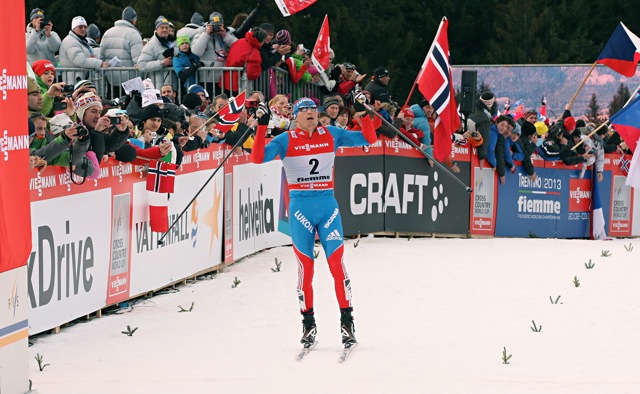
Alexander Legkov of Russia celebrates his Tour de Ski victory atop the Alpe Cermis in January, 2013. Legkov cannot compete in this year’s Tour de Ski because he is suspended for possible doping violations. (Photo: Fiemme2013)
The International Ski Federation (FIS) has denied an appeal by six Russian cross-country skiers suspended under the suspicion of doping.
FIS and the International Olympic Committee (IOC) are investigating the six athletes because bottles used to store their urine samples from the 2014 Olympics in Sochi, Russia, bore signs of tampering. FIS suspended the skiers while the investigation takes place.
The athletes had appealed this suspension because many planned to compete in the Tour de Ski, starting on Saturday.
“After receiving written submissions from the athletes and the response from FIS, the FIS Doping Panel made the unanimous decision today to uphold the provisional suspensions of the Russian Cross Country athletes, Evgeniy Belov, Julia Ivanova, Alexander Legkov, Evgenia Shapovalova, Alexey Petukhov and Maxim Vylegzhanin,” FIS wrote in a statement emailed to the press. “The reasons for the Panel’s decision will be communicated directly to the athletes in due course. As a result of the decision, all of the above mentioned athletes may not take part in any competitions or national team activities.”
This was also the first time that FIS publicly named the six skiers.
FIS Secretary General Sarah Lewis told FasterSkier last week that one other athlete may be suspended.
“There is only one additional non-Games time case and this is presently being processed,” she wrote in an email. “The timeline is the next week if possible.”
FIS did not tell the athletes what part of the World Anti-Doping Code they were suspected of violating.
The suspensions were based on the McLaren report’s findings that sample bottles had been opened and closed after sample collection. Wieschemann notes that in some other cases, the samples were positive for banned substances, or even belonged to a different person than the athlete who was supposedly being tested. This was not true for either Legkov or Belov. Evidence showed only that the bottles had been opened or tampered with. Wieschemann argues that this does not necessarily mean that the samples were not “clean”.
According to Wieschemann, neither Legkov nor Belov were on the “Duchess” list. That was a list of athletes who were provided banned performance-enhancing drugs by the Russian government and then protected from anti-doping measures.
The statement also notes that Legkov and Belov were often previously tested by outside anti-doping agencies in Europe.
“There is neither a positive sample from either of the athletes, nor any other indication that they could have taken banned substances… Such a connection is also not provided in the McLaren Report,” the statement says, according to a translation. “In fact, both athletes also gave blood samples in Sochi, which were negative.McLaren does not provide any information about swapping blood samples.This is a sure sign that both athletes were not drugged at the time of the Olympic Games.”
Complicit in Tampering or Not?
FIS wrote in their statement that “the reasons for the Panel’s decision will be communicated directly to the athletes in due course.” The rationale was not described to the media.
However, there are several reasons that FIS may want to keep the athletes suspended while they finish their investigation.
Article 2.5 of the World Anti-Doping Code prohibits “Tampering or Attempted Tampering with any part of Doping Control: Conduct which subverts the doping Control process but which would not otherwise be included in the definition of Prohibited Methods. Tampering shall include, without limitation, intentionally interfering or attempting to interfere with a doping Control official, providing fraudulent information to an anti-doping organization or intimidating or attempting to intimidate a potential witness.”
A footnote clarifies that “for example, this Article would prohibit altering identification numbers on a Doping Control form during Testing, breaking the B bottle at the time of B Sample analysis, or altering a Sample by the addition of a foreign substance.”
Sports organizations must decide the appropriate action for cases where a sample was tampered with by someone other than an athlete.
According to emails in the McLaren report, anti-doping officials opened sample bottles in order to replace “dirty” urine with “clean” urine. That means that the athletes must have been complicit in providing the “clean” urine sample in the first place. Yet it’s also very possible that some sample bottles were either opened by mistake or tampered with in a different way, without the knowledge or complicity of the athlete.
FIS may have evidence that they have not disclosed. The federation may also simply want more time to determine whether the athletes were complicit in sample manipulation.
Other Reasons the Appeal May Have Failed
Legkov and Belov do appear in planning documents for Sochi released as part of the McLaren report evidence packet. At the very least, that means that the government anti-doping officials carefully noted and tracked their participation at the Games.
Regarding the clean blood samples, this may not be sufficient evidence that athletes had not taken performance-enhancing drugs. Urine and blood samples detect different substances over different periods of time.
“A blood sample does not replace a urine test, because it concerns primarily different substances and different methods,” the Finnish Center for Integrity in Sports, SUEK, writes on its website.
Urine contains substances excreted from the body, while blood contains those integrated into the body. Testing agencies may not even test for all of the same substances in the two different types of samples. For example, human growth hormone is tested in blood, but not in urine; steroids are easier to detect in urine than in blood.
Furthermore, the IOC may not have even fully tested the samples collected at the Olympics.
“The initial tests take place in the lab located in the Olympic city,” NBC wrote of Olympic testing procedures. “Because of the huge number of samples and tests that need to be conducted in a short period of time, not every sample is tested for every drug. Experts take educated guesses on which set of athletes are more likely to use certain drugs and run the according tests.”
Finally, Wieschemann’s statement concludes that “Alexander Legkov and Evgeny Belov have at no time used prohibited means or applied forbidden methods.”
Budesonide is a corticosteroid sometimes used in asthma medication. In September, Secretary General of the Russian Ski Federation Georgiy Mnatsakanov told Norways’ NRK broadcaster that both Legkov and Ilia Chernousov used asthma medication despite the fact that they have no diagnosis of asthma.
Email released as part of the McLaren report show that Legkov did not have a Therapeutic Use Exemption for such medication.
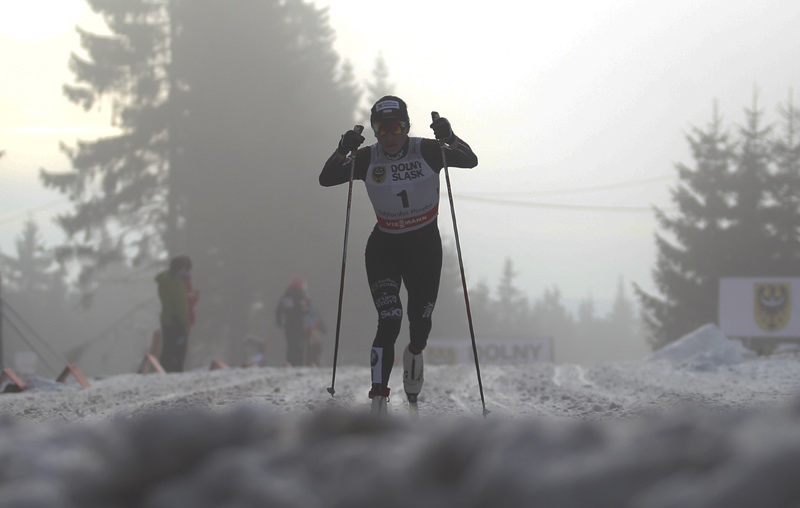
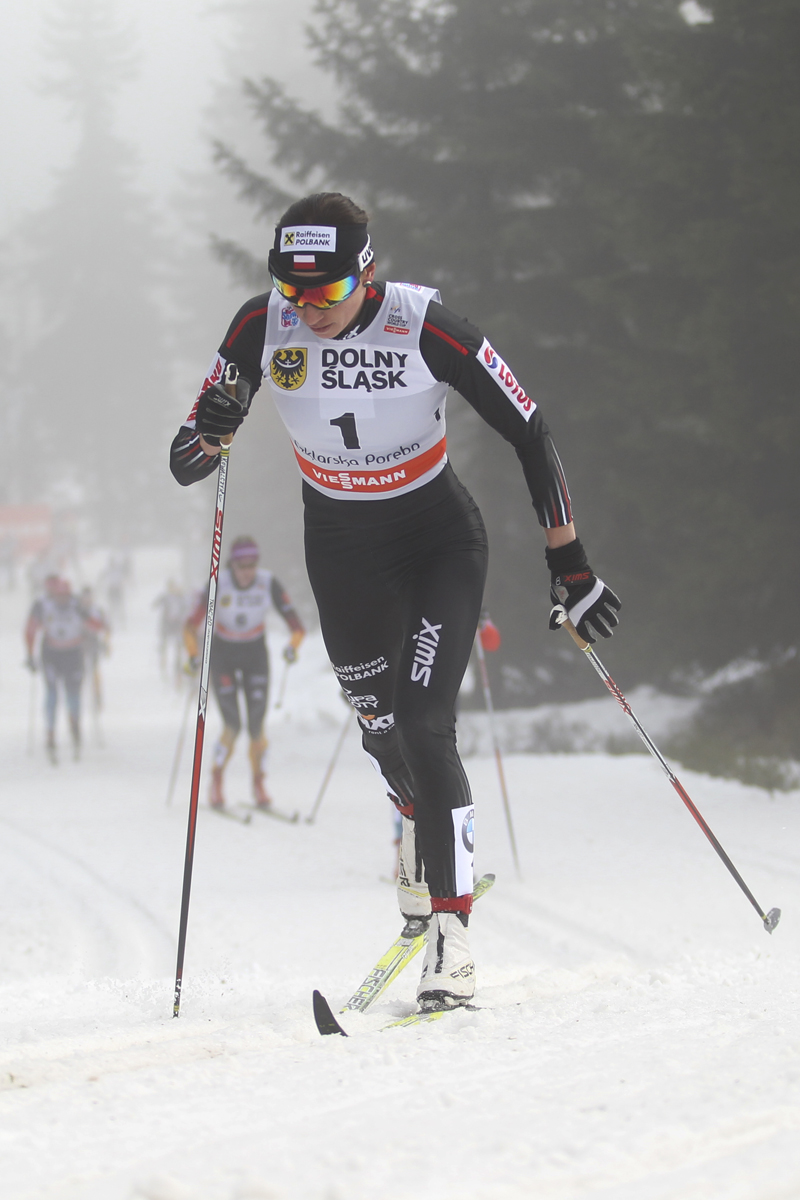
Poland’s Justyna Kowalczyk essentially led from start to finish of Sunday’s 10 k classic mass start at the World Cup in Szklarska Poreba, Poland. (Photo: Fischer/NordicFocus)
It’s not easy being Justyna Kowalczyk — always breaking trail, always having the weight of Poland on her, and in a classic distance race at home on her birthday without any Scandinavians in the field? Forget about it.
Kowalczyk was easily the favorite for Sunday’s World Cup 10-kilometer classic mass start in Szklarska Poręba, Poland, nearly two years after she won the same race there. That didn’t make winning any easier.
Poland’s Justyna Kowalczyk breaking away to a victory in Sunday’s 10 k classic mass start at the World Cup in Szklarska Poreba, Poland. Russia’s Yulia Tchekaleva (behind) and Germany’s Denise Herrmann (second from l) remained closest to her for most of the race. (Photo: Fischer/NordicFocus)
With noticeably slower skis, lacking glide on pea-soup, 35-plus degree afternoon, Kowalczyk relied on kick and her unmistakable stride on her 31st birthday. That didn’t help her on the long downhill on the last third of each 2.7 k loop, but she was able to nail the two climbs.
“The person who first blazes trail, it costs a lot of strength and speed,” Kowalczyk’s said in a post-race interview with WP Poland, according to a translation. “Therefore, at the beginning of the second and third [lap] athletes stuck to me.”
Lucky for her, Kowalczyk’s kick wore off as she continued through the four-lap race — just as she was warming up. After immediately taking control and skiing off the front of the mass start, Kowalczyk couldn’t get more than a few strides ahead of Russia’s Yulia Tchekaleva on the first lap. By the downhill, Tchekaleva quickly soared up alongside Kowalczyk, then past her to lap through the stadium 0.6 seconds ahead in first.
Tchekaleva’s lead was short-lived. By the 4.2 k checkpoint, Kowalczyk had gapped her and everyone else by nearly 12 seconds; Tchekaleva was skiing in second and Germany’s Denise Herrmann was 13.4 seconds back in third. American Liz Stephen led a chase pack in fourth, another 10 seconds behind.
“I have never started on the first line of a World Cup mass start before, so that was really fun, and the pace went out hot, but I never got swallowed up in the mass like I think I would have if I had started back in the pack,” Stephen wrote in an email. “Justyna was on a mission today and just never looked back.
“The fans were so loud and into it out there today,” Stephen added, after eventually placing sixth, her career best in an outright World Cup. “Especially as it was Justyna’s birthday today, too.”
Nearly 30 seconds ahead of Tchekaleva early in the first lap, and 41 seconds up on Herrmann in third, Kowalczyk looked back occasionally — giving a glance back as before picking up the maximum bonus points at 6.9 k. Unless something tragic happened, this race was in the bag, but she didn’t let off until striding blissfully into the stadium for the last time.
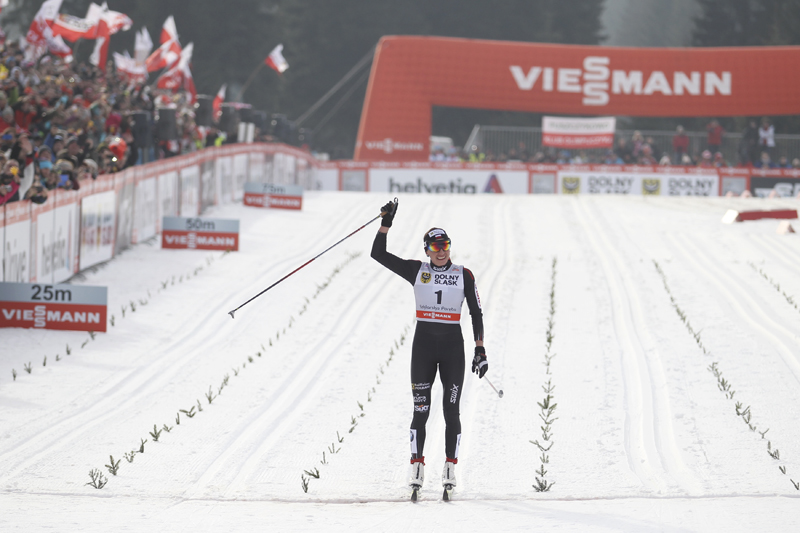
Upon finishing first in 34:43.2 without anyone contenders in sight, Kowalczyk waved her arms in the air. Then she stopped, bent over her poles for a millisecond to catch her breath and looked back on the course, waiting patiently for Tchekaleva to follow in second.
Tchekaleva came through uncontested 41.8 seconds later, and another Russian Julia Ivanova rounded out the podium in third, 1:15.2 seconds back from Kowalczyk.
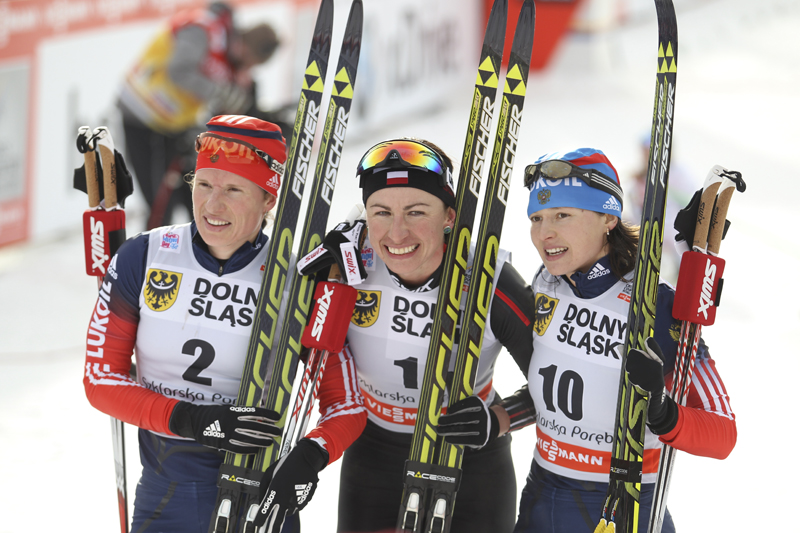
Women’s 10 k classic mass start podium at Sunday’s World Cup in Szklarska Poreba, Poland: winner Justyna Kowalczyk (c), and Russia’s Yulia Tchekaleva (l) in second and Julia Ivanova in third. (Photo: Fischer/NordicFocus)
Ivanova had caught and challenged Herrmann with Germany’s Claudia Nystad and Stephen on the last lap, then ended up dropping Herrmann before the finish. Herrmann placed fourth, four seconds later, and Nystad was another two seconds back in fifth. Stephen placed sixth, 1:26.4 after Kowalczyk, edging Germany’s Stefanie Boehler by 2 seconds.
Nystad originally led the chase, along with Stephen, up the final climb. After absorbing Herrmann as part of their group, they forged ahead with Stephen up front and Tchekaleva in their sights — but she was at least 25 seconds out of range.
“I was feeling really good for most of the race until the very top of the uphill on the last lap when Julia Ivanova went by me and as I tried to hang I just fell apart a bit,” Stephen explained. “[I] didn’t push over the top as much as I needed to to hold off the coming Germans.”
Welcoming Tchekaleva across the line, Kowalczyk gave her a hug. The birthday girl was excited, but not visibly ecstatic about her World Cup win in Poland. It was, after all, just another race before the Olympics — minus the Norwegians, Finns and Swedes.
“Maybe you cannot see it, but I am very touched,” Kowalczyk told WP. “I learned to have control emotions. I once cried today when I got the cake, the flowers, but the second time I will not cry. For such moments the training does it all.”
So she got a cake — but did she eat it, too?
“It’s not the best thing for me right after the race,” Kowalczyk said with a smile, adding she’ll, “eat a double portion for my mom.”
As for the victory, Kowalczyk said it was “nice,” but “Sochi is still far away.”
The victory elevated her to third in the overall World Cup standings behind Norway’s Therese Johaug and Astrid Uhrenholdt Jacobsen, respectively, and four points ahead of Marit Bjørgen. At least Johaug and Bjørgen aren’t expected to compete at the final World Cup Feb. 1-2 in Toblach, Italy, before the Olympics.
Also in the top 10, Russia’s Natalia Zhukova placed eighth (+1:47.8), American Ida Sargent notched a career-best distance result of ninth (+1:49.3), and Austria’s Katerina Smutna was 10th (+1:49.5).
Justyna Kowalczyk celebrates a 42-second victory in Sunday’s 10 k classic mass start on her 31st birthday at home in Szklarska Poreba, Poland. (Photo: Fischer/NordicFocus)
Dasha Gaiazova (r) finishes third, just six-hundredths of a second behind Russian Natalia Matveeva (l) in second, at Sunday’s Sochi World Cup classic team sprint in Krasnaya Polyana, Russia. (Photo: Chandra Crawford)
Krasnaya Polyana, Sochi’s mountain village and one of its 2014 Olympic venues, is nowhere near Dasha Gaiazova’s birthplace just outside Moscow. In fact, it’s almost 1,700 kilometers south of the Russian capital and a day’s drive away.
But Sunday, the 29-year-old Canadian transplant who spent her formative years in Banff, Alberta, found herself right at home in the 6 x 1.25-kilometer classic team sprint, the last of three pre-Olympic races in Krasnaya Polyana.
Some Russian fans knew her story, and they cheered her on as she rounded the course six times – three in the semifinal and three in the final.
Gaiazova and teammate Perianne Jones successfully advanced out of the semis in third with a fast-enough time despite slowing conditions under sunny skis. In the final, Jones got off to a slippery start and tagged off to Gaiazova in 10th, five seconds out of the lead. She handed her skis to her husband and wax tech, Joel Jacques, and begged for more kick.
Meanwhile, Gaiazova began clawing her team closer to the front, where Finland and Russia’s B-team steadily increased the pace. First through the first two laps, Finland’s Mona-Liisa Malvalehto and Anne Kyllönen proceeded to switch leads with Russia’s Julia Ivanova and Natalia Matveeva on the second leg.
Canada worked to pick of the places, moving all the way to sixth. On the final go-around, Jones burst out of the exchange and brought the team to fifth, 3.8 seconds behind Russia and 2.7 behind Finland in first and second, respectively. Norway stood between them in third, but Gaiazova took care of that, passing Celine Brun-Lie on the last lap.
Working her way up the long climb toward the stadium, Gaiazova heard one voice. There could’ve been dozens cheering her on, but it was Canadian head coach Justin Wadsworth who got through to her.
Canadians Perianne Jones and Dasha Gaiazova celebrate their first bronze of the season, and together, in the Sochi World Cup classic team sprint. (Photo: Chandra Crawford)
Pushing hard up and over, Gaiazova gained on Russia’s Matveeva entering the finish. Matveeva had lost contact with Kyllönen, who dropped the pack on the last lap, and likely had no idea what was coming from behind. Gaiazova surprised her at the line, where Matveeva lunged to secure second by 0.06 seconds. Gaiazova captured third, 5.58 seconds behind the Finnish winners, for the Canadians’ best team-sprint result of the season.
“If it had been a little bit longer, it would’ve been more of an advantage to me, but I did the best I could and I was happy with that,” Gaiazova said. “It’s kind of good, always leaves me with a little bit more to wish for, like, ‘OK, I was fourth and photo finishing for third and now I’m third photo finishing for second.’ ”
Gaiazova recently notched an individual career best of fourth in a classic sprint at the World Cup in Liberec, Czech Republic. After placing third in a World Cup freestyle team sprint last year with Chandra Crawford in Dusseldorf, Germany, the podium was Gaiazova’s first of the season – as it was for Jones (who also won bronze with Crawford in a freestyle team sprint last season in Milan, Italy).
“It feels really good and really good to do it here in Sochi,” Jones said Sunday. “I think it also speaks to the strength of our women’s program. Now all three of us have been on the podium in the team sprint in all different configurations so that’s pretty exciting.”
On her final leg, Jones knew she had some gas left after conserving somewhat the second time around. She made a point to charge up the hill, where she also found Wadsworth cheering her on over the top.
“He was just screaming his head off,” Jones said. “That was really awesome because I passed a couple more girls there and just hung on for the downhill and made sure to go around the corner without crashing and handed off to Dasha relatively cleanly.”
Easier said than done. With changing conditions throughout the day, several skiers and their wax techs worked frantically within the roughly two-and-a-half minute frame between exchanges to get the wax right. It was never going to be perfect on the 4-degree Celsius (nearly 40 Fahrenheit) afternoon, with either no kick or way too much sticking, but they continued to try.
Gaiazova said her hairies worked great throughout the day and Jones found a better pair of skis after the first leg. With a fast descent and sharp corner heading into the finish, staying on one’s feet was also important – and Russia’s eventual silver medalists nearly didn’t qualify for the final after crashing and placing fourth in the semi. They came in 12.37 seconds behind the Americans, Ida Sargent and Sadie Bjornsen, in first, but fortunately for them, that was the faster semifinal of the two.
Gaiazova and Jones felt some tension after learning their semifinal, the second one, was almost seven seconds slower than the first with softer snow in warming conditions.
“I got a little nervous, but thankfully we made it through,” Gaiazova said after her team finished third (+4:32) behind Finland in first and Russia’s A-team in second.
Perhaps the biggest game changer of the day, however, occurred at the exchanges, which were tracked. According to Gaiazova, there were six tracks for 10 teams, which made it especially tricky.
“Say I’m standing in the exchange zone in the track … waiting for Peri to come and tag me,” she explained. “Peri’s coming in, but she can’t ski in the same track as me, her skis would run into my skis, so she has to ski in the track next to mine and then step out at the very last moment to tag me so each team is taking, like, two tracks. It’s messy. There’s people everywhere and all you’re trying to do it just to it as quick as possible and carry the speed from one person to another. I think everybody struggled with exchanges today.”
Perianne Jones (l) and Dasha Gaiazova having some fun after notching their first podium together with bronze in the classic team sprint at the Sochi World Cup on Sunday. (Photo: Chandra Crawford)
“I hope with today’s result and basically this whole month we can just carry the momentum for the girls, for the team,” Gaiazova said.
For Finland, which notched its first women’s team-sprint victory since Aino-Kaisa Saarinen and Virpi Kuitunen won the classic event at the 2009 World Championships, the win was pretty sweet – but tiring.
“I was tired, but I tried everything [in] intervals,” Kyllönen told Eurosport, according to the Helsingin Sanomat.
Malvalehto explained their strategy was to get in front on the first lap, ski the second one more moderately and push hardest on the third.
“The last leg of the race was the most difficult leg, but overall we didn’t have any big problems here today,” Malvalehto said in a press conference. “The track was very good. I hope it will be the same for the Olympics. It’s very nice here when it’s sunny.”
Matveeva said the finishing stretch was especially tough.
“I just didn’t have enough in me, but we still did well,” the Russian said in a press conference. “The speed today was much higher than on previous days. It was wonderful to feel the support of all the Russian fans here today.”
Norway’s Astrid Uhrenholdt Jacobsen and Brun-Lie finished fourth (+7.2), and the Americans were fifth (+9.16) after coming through the last exchange in fourth.
All 2012 FIS World Cup Finals coverage is brought to you through the generous support of Fischer Sports USA, proud sponsors of Kikkan Randall, 2012 overall Sprint Cup Champion.
STOCKHOLM, Sweden – Marit Bjørgen (NOR), dubbed the Queen of Cross-Country Skiing following her dominating performance at the 2011 World Championships, received a medal from the King of Sweden and continued her steady trek toward the overall World Cup title.
Bjørgen overcame an impressive challenge by the red-hot Julia Ivanova (RUS) to earn her fourth consecutive victory. Teammate Maiken Caspersen Falla finished third.
At the start of her current win streak, Bjørgen led rival Justyna Kowalczyk (POL) by just 38 points. Now with only three races and the World Cup mini-tour standings remaining, the Norwegian is up by 160.
While Bjørgen said she was surprised by her victory after feeling sub-par in qualification, and placing an uncharacteristic 12th, events on the course told otherwise.
She won each of her heats, including matchups with Kowalczyk in both the quarters and semis, and had plenty left in the tank to beat out Ivanova on the final climb.
In the quarterfinals, Kowalczyk took an early lead, trying to get clear on the first hill.
That strategy worked well several weeks ago in the Lahti classic sprint. There Kowalczyk blew her competition off the course in the quarters and semis on the steep climbs.
But such was not the case today. She was unable to break away, and Bjørgen, waiting patiently, moved up on the outside on the gradual descent.
Foreshadowing events to come, Kowalczyk dropped back on the backstretch along the water and was left with ground to make up on the final hill.
She did so with relative ease, beating out eventual lucky loser Vesna Fabjan (SLO) while Bjørgen cruised to the line.
The semis played out similarly with Bjørgen moving to the front and leading down the backstretch, with Falla Charlotte Kalla (SWE) and Kowalczyk hot on her heals.
As the race hit the final corner, Kowalczyk, with work to do, swung wide to take an open track, hooking a tip in the chopped up snow in the process.
At high speed, there was no recovering, and the Pole went down hard, ending any chance for an appearance in the finals.
This was the second sprint in a row in which Kowalczyk took herself out with an unhindered crash. She also went down on a corner late in the final last week in Drammen, costing herself a shot at the win.
And the weekend prior, while she stayed on her feet, a cautious turn in Lahti allowed Bjørgen and Ivanova to come by and gain an insurmountable lead.
With the way Bjørgen is currently skiing, it is hard to imagine these mistakes would have been the difference, but Kowalczyk has given up substantial points in the last three sprints due to mishaps.
Ivanova, however, is headed in the opposite direction.
The 27-year-old Russian had only one sprint finals appearance to her name when she woke up on March fourth. Now with two second place finishes in two consecutive sprint starts (she did not race the Drammen sprint last week), Ivanova is quickly establishing herself as a force to be reckoned with.
In the final she led out and maintained the top spot through a majority of the race, fearless at the front.
Bjørgen did not muster an attack until she came around on the outside on the last corner, pulling even with the Russian.
Ivanova responded with a push of her own, and started pulling back away.
But Bjørgen, skiing with her trademark robotic precision, could not be vanquished. She powered up over the crest of the hill, picking up several meters on Ivanova, and gained enough ground to keep the finish from being close.
“I was not surprised that Ivanova was so strong,” Bjørgen said after the race. “She already showed her skills in Lahti.”
Falla, who had faded back on the double pole section, took advantage of Kowalczyk’s crash to get in contention for the podium. She came up hard on Kalla, and the Swede could not quiet come up with enough to take third.
Wile Kalla was unable to reach the podium in front of the home crowd, she did continue to make up ground on Kikkan Randall (USA) in the fight for fourth in the overall World Cup standings.
With Randall finishing 8th, Kalla is now just 17 points in back of the American.
Falla also wrapped up second in the overall Sprint Cup, besting Bjørgen by just 15 points.
Had Falla failed to crack the top-9 the two would have reversed places.
“I am very satisfied,” Falla said of her performance. “The atmosphere during the race was amazing—thank you to all who were here.”
Organizers estimate 15,000 spectators on-hand for the event.
Randall won the Sprint Cup by 122 points and was the only woman to score points in every World Cup sprint this season.
Bjørgen, who told FasterSkier that she has felt in top shape since Lahti, is trying to win her first overall title since 2006, the year she won her last of four consecutive World Cup crystal globes.
The World Cup Finals continue on Friday with a 2.5k freestyle prologue in Falun.
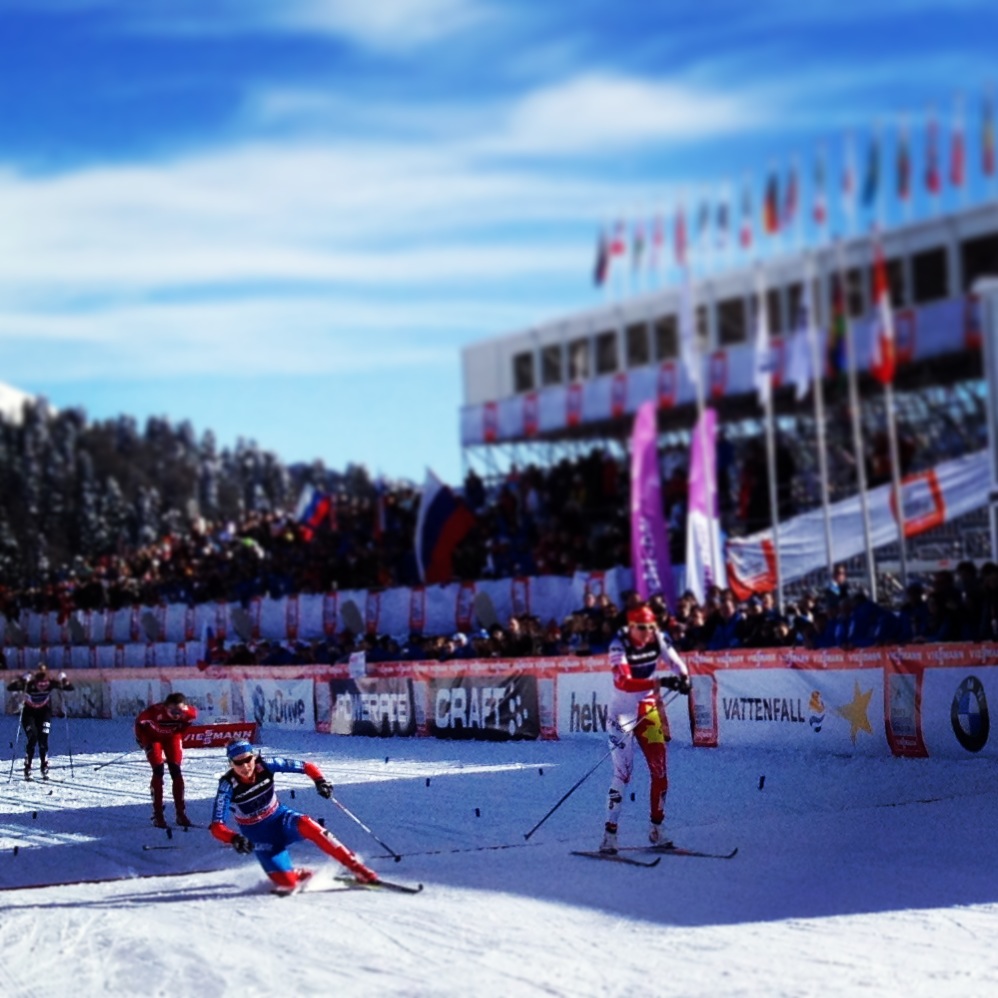
Julia Ivanova (RUS) and Marit Bjoergen (NOR) sprint for the line. Photo: Fischer/Nordic Focus.
Marit Bjørgen (NOR) doesn’t enter many races as an underdog, but with the way Justyna Kowalczyk (POL) advanced through the early heats in the classic sprint in Lahti, Finland, the Norwegian was just one more woman in the final trying to avoid being embarrassed.
Kowalczyk powered away from the field in both the quarter and semi finals, opening up gaps on the first climb that ultimately reached as much as 30 meters. No one could hang, allowing Kowalczyk to ease up at the end, conserving energy, and easily avoiding trouble on the famed 180-degree corner on the descent to the stadium.
The final, however, was very much a different story. Kowalczyk attacked out of the start yet again, but in an early sign that the competition would not roll over, Russian Julia Ivanova pulled alongside, and Bjørgen locked in on the Pole’s tails.
With a lengthy and steep climb out of the start, and a second significant pitch, both with sections of herringbone, both the men’s and women’s races did follow the standard sprint script. Heats spread out quickly, and in almost every group there were several skiers who could not manage the pace.
Add in two fast technical descents with icy corners, and the course can appropriately be termed unforgiving.
As Kowalczyk hammered over the top of the first of those climbs in the final, she was unable to shake Ivanova and Bjørgen while Maiken Caspersen Falla struggled to maintain contact.
Falla lost touch and barring mishap (which given the number of crashes on the day was no sure thing) the top three were decided, with only the order to be determined.
Over the years, despite multiple World Cup and Tour de Ski titles, Kowalczyk has become renowned for her poor downhill abilities. At this point the label is unfair. Kowalczyk still approaches descents conservatively, but no longer resembles a deer on ice.
The days of losing races on the descents, however, were not over. Kowalczyk swung wide, playing it safe on the first downhill corner, and Bjørgen and Ivanova moved past, immediately opening a lead into the last climb.
For all her strength climbing in the classic technique, Kowalczyk could not close the gap.
Ivanova led into the hairpin, but took an outside line, allowing Bjørgen to slip through on the inside.
At that point the race was over. With the fate of the overall World Cup trophy hanging in balance over these last weeks, Bjørgen would not be giving up a lead on the final stretch.
Women's podium: (l-r) Julia Ivanova (RUS), Marit Bjoergen (NOR) and Justyna Kowalczyk (POL). Photo: Fischer/Nordic Focus.
Ivanova battled gamely, and was plenty pleased with the first World Cup podium of her career.
“It is my first individual World Cup podium and I am for sure very, very satisfied,” Ivanova said after the race. “I had a really good day and was able to fight hard for the podium.”
The Russian has been skiing especially well of late, placing 6th in Saturday’s skiathlon after taking 12th in the 10k classic in Poland. In 30 career World Cup sprint starts, Ivanova had only advanced to the semis twice prior to today.
Kowalczyk crossed safely in third, dropping an additional 40 points to Bjørgen in the overall.
“Yesterday I had not a good day but today I was able to forget everything and restart,” Kowalczyk said. “It was a tough race—the course is very hard especially in the downhill where it was icy. I am very satisfied to finish on the podium today and looking forward to the next races.”
Bjørgen, who placed second to teammate Therese Johaug in the skiathlon, now holds a 78-point lead on Kowalczyk in the overall standings, while Randall is still well in front in the Sprint Cup standings.
The American reached the finals in a classic sprint for just the second time in her World Cup career, looking very strong in both her quarter and semi.
She used an efficient narrow herringbone run at the tops of the steep hills to open up a gap in both heats, though in the semis, she was already trailing the then-untouchable Kowalczyk.
Randall told FasterSkier that she had excellent skis and that the key was getting over the tops of the hills well.
A strong skier on the descents, Randall also took advantage of the technical nature of the course.
“I was really enjoying them,” Randall said of the downhills and corners. “I had practiced a few rounds during warm-up and could make up time on people…you could tell those who weren’t confident in how it would go and that just opened up an opportunity.”
In the final, Randall said she was a bit fatigued, confirming what appeared evident to observers. Instead of the controlled run on the steep section of the first climb, Randall broke in to a wider, and less efficient herringbone.
“With that hard opening pace right of the bat, I was struggling to keep up and my technique broke down,” Randall said of the final.
She kept her head in the race, and came back on Falla, nearly catching the Norwegian at the line.
“I knew those two were going to go for it,” Randall said of Bjørgen and Kowalczyk. “Ivanova found another gear today and was going hard from get go…I hoped to stay close but couldn’t quite hang.”
Entering the day, with three classic sprints remaining in the season, Randall did exactly what she needed to, advancing to the final, and minimizing any damage.
She widened her cushion on Natalia Matveeva (RUS) who entered the race second in the Sprint Cup, when the Russian failed to advance out of the semis.
And Falla, third sprinter in the world, picked up only five points on Randall.
Another potential threat, though a long shot, Ida Ingemarsdotter (SWE) didn’t even qualify for the heats. Ingemarsdotter had been on a roll, and had beaten Randall in three of the last four sprints.
While both the Sprint Cup and the overall rankings, where Randall sits in fourth, have been a goal all season, she is doing her best to ignore all the talk of points, choosing to take each race as it comes.
With just two sprints remaining, Randall is in solid position with a 138-point lead on Matveeva.