From the FasterSkier archive — posts syndicated from athletes’ and coaches’ own blogs between 2004 and 2012, kept online as published. Current coverage is at fasterskier.com.

Tag: Julia Kern

  • The Case for More American World Cups

    The Case for More American World Cups

    This coverage is made possible through the generous support of Marty and Kathy Hall and A Hall Mark of Excellence Award. To learn more about A Hall Mark of Excellence Award, or to learn how you can support FasterSkier’s coverage, please contact info@fasterskier.com.

    Johannes Hoesflot Klaebo (NOR) back in action and lifted by the roar of American ski fans during the World Cup 10 k Classic in Lake Placid, New York. (Photo: Dils / FasterSkier)

    LAKE PLACID, NEW YORK — Ten kilometers into the second World Cup on American soil in as many decades, and the verdict is already clear: We need more racing in the United States.

    That’s the message panted into my microphone by every athlete in the Mix Zone; shouted over the undulating din by every supporter I spoke with on the ice-lacquered walkways lacing Mt. Van Hoevenberg. And it’s the irresistible outcome of the turnout this afternoon in Lake Placid — with a crowd that came out in droves for Diggins, the Schumacher-Ogden’s Silver Medal Squad, and a host of homegrown heroes; that braved five inches of wet, driving snow; and that stayed to see Jessie clinch the Overall Crystal Globe, a reconstituted Klæbo overtake Amundsen in the Distance standings, and to welcome the world’s best to the conclusion of the 2025-26 season.

    The reaction to racing in the United States in 2023 was overwhelmingly positive – and, it had seemed, sui generis. With four snowmaking venues spread across the Twin Cities, along with the (purportedly) highest concentration of cross-country skiers outside of Oslo, the energy that embraced Jessie Diggins in her home state and buried a generation of “almosts” for the U.S. Men’s Team in the snow and mud at Theodore Wirth could have been lightning in a bottle.
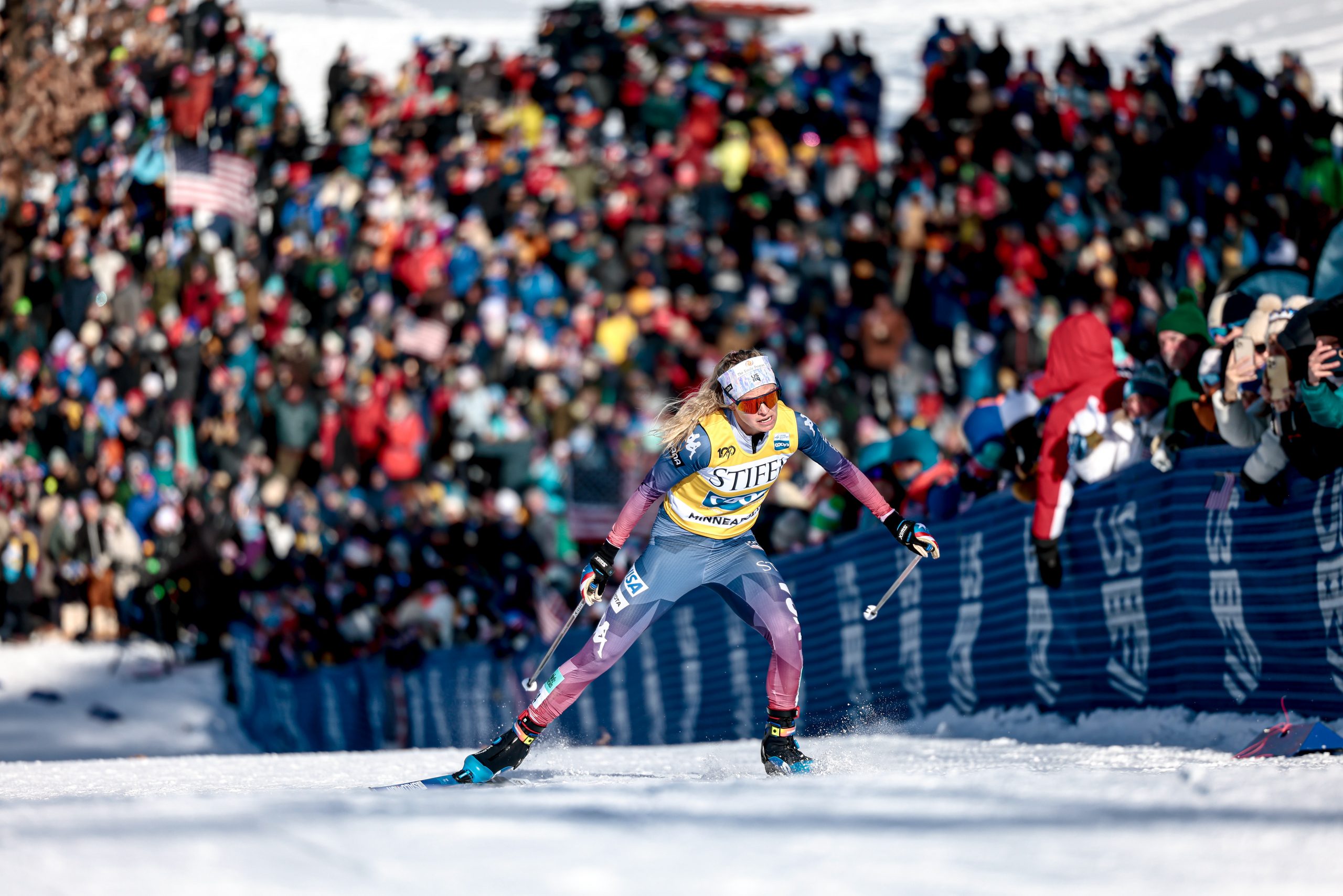
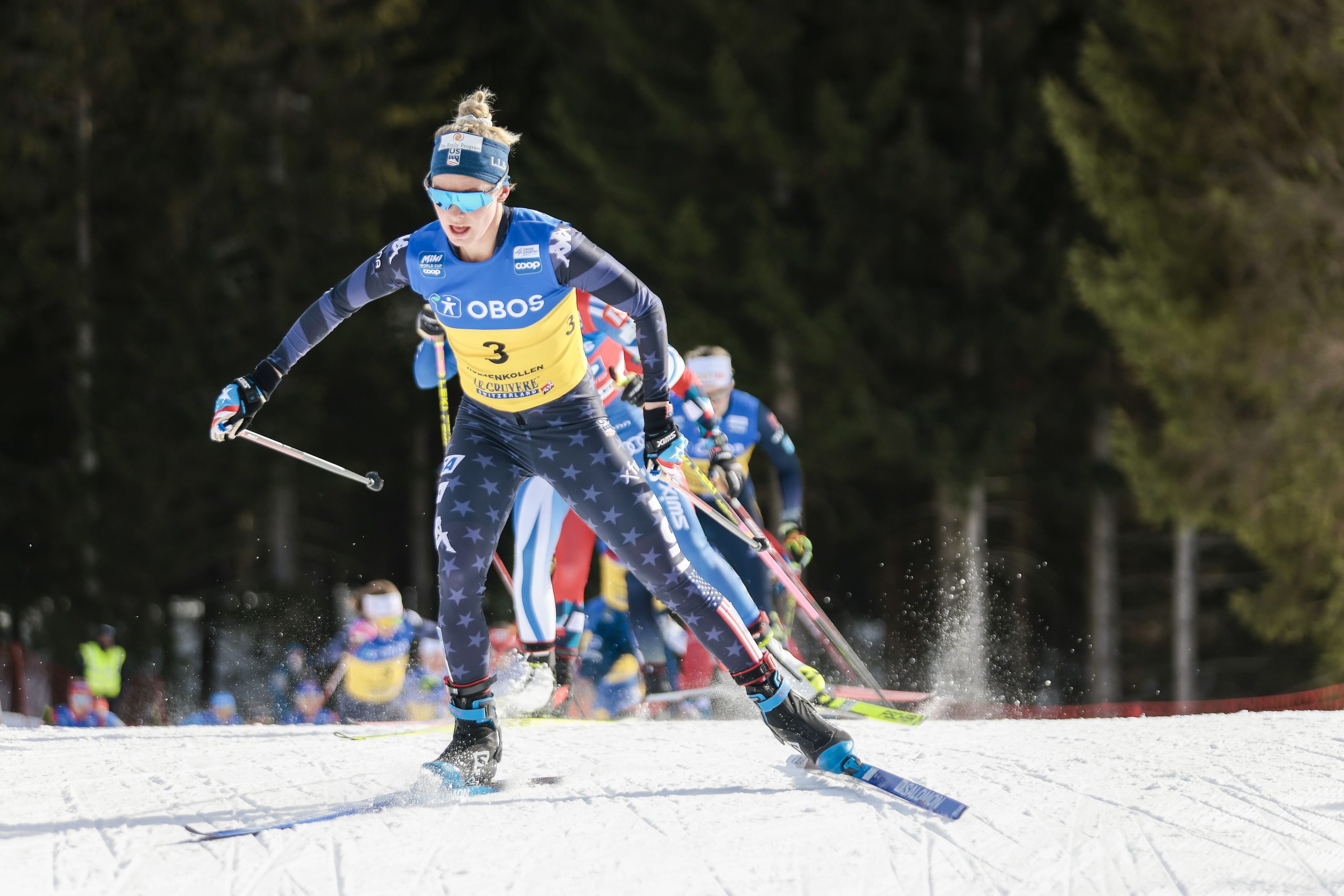
    Jessie Diggins (USA) racing on home soil in Minneapolis and did so again in Lake Placid as she concludes her storied World Cup career. (Photo: Modica/NordicFocus)

    I will admit my own skepticism that Lake Placid could field the fans, or the volume, of spectators to match Minneapolis. Perhaps my flight into Saranac Lake Regional Airport on Wednesday morning was my first evidence of error. Of seven passengers bobbing our way through the cloud-laden Adirondacks, four were here for the World Cup: Charlie, from Seattle; Billy (as in, Demong, the Nordic Combined gold medalist) and his son, from Salt Lake City; and myself, from D.C. Bussing to the venue the next day, I’m seated with a dozen of University of Minnesota alumni – they’ve taken off of work, graduate school, and medical school to spectate. “I’m excited just to see the number of people out cheering,” Alex Gude, who organized the trip, tells me. “I think one of the best parts about Minneapolis is just seeing the community come together, and now, away from home, we’re seeing another whole ski community come out and cheer.”

    And, indeed, they are – from across the United States, from across New England, from across the Canadian border, and from right here in Lake Placid. Once we disembark, I wade through the corn snow and the first of many falling flakes to Mt. Van Hoevenberg’s sprawling Nordic Center, where the racecourse coils around the podium and snakes below the pedestrian bridge. Patricia Damp is herding thirteen might-be-members of the local ski community across the bridge; she’s a third-grade teacher here in Lake Placid, chaperoning a class field trip to the World Cup Finals.

    Are the kids already Diggins die-hards, Ogden acolytes, Gus bus-riders? Not really, Patricia tells me. The class “was out here a couple months ago, cross-country skiing. We get to do the Olympic venues. We were at the museum a month ago. We have a friend who we watched ski jump. So, we’re very Olympic-oriented, and today we’re just out here to support the athletes and get some autographs.” Her students back her up. “We’re excited to get the players’ signatures,” Riley tells me. And while Declan is “excited to see the racers,” there’s no-one in particular he’s cheering for.

    Gus Schumacher (USA) during the Men’s 10 k Classic in Lake Placid, New York. (Photo: Dils / FasterSkier)

    From the mouths of children, our first – and perhaps strongest – argument for future American World Cups. The glitter-dusted kids in fan club bibs, wielding cardboard-cutout faces as large as they are, make for compelling pictures and undeniable evidence of Team USA’s impact on its next generation. But racing in the United States creates opportunities to draw an entirely new cohort of young people into the cross-country skiing community – kids who may have never tried skiing before; who may not have heard of Kikkan or Klæbo ; and whose parents certainly are not waking up before sunrise to livestream Ruka, Falun or Holmenkollen. They will not see themselves in this sport until they see this sport. What better way to do so than on a Friday field trip with Mrs. Damp?

    After bidding them good luck with the signature-hunting, it’s not an easy task to wade against the current of the rest of the Lake Placid Class of 2035. Also threading his way through the third-graders is Niklas Dyrhaug, immediately recognizable even five years into retirement from World Cup racing. He’s on the other side of the v-boards this weekend, broadcasting for Norwegian television. In his first sentence, he tells me: “We are enjoying being back in the U.S. In my opinion, we should be here every year.” He’s not surprised by the number of spectators, either. “Everybody who knows the U.S. crowd knows they are really enthusiastic . . . We know the tradition, the culture, and Lake Placid’s place in that history. So, personally, I’m not that surprised. It’s really cool that we’re back here.”

    That’s the sentiment just after Coaster Hill, some four kilometers into the racecourse, where Norwegian national team coach Eirik Myhr Nossum prowls the striding zone. Being back in the United States is “awesome, it’s amazing. I think we should be here every year, because you guys show up; you guys cheer for everyone, and it’s always fun to be in the U.S. and to be overseas to compete.”

    And it’s the sentiment at the finish line.

    Harald Oestberg Amundsen (NOR) after the 10 k Classic in Lake Placid, New York. (Photo: Thibaut/NordicFocus)

    Harald Amundsen (NOR) tells me, “In the outer part of the track, there were so many people I couldn’t hear my own thinking. That’s a really good thing.” Even before he arrived at the venue, “We had a run this morning in the city. Everyone was screaming at us, ‘Good luck!’ It’s a really nice atmosphere.”

    For Elia Barp (ITA), conditions were “very tough because it was really slow with this new snow, but it was fun racing for me. So I enjoyed it – at least I tried to enjoy it – it was a pack of people screaming my name so that gave me even more motivation, and was fun . . . I loved racing two years ago in Minneapolis, and here it’s packed with people, even with the snowfall, so thank you to everyone for coming. It’s really good to race here.”

    Mika Vermeulen (AUT) admits, “Honestly, this is probably the worst race I’ve done in a long time. But I don’t think I’ve ever had so much fun out on the track . . . on top there, out in the forest, I just heard, ‘MI-KA, MI-KA,’ the whole time. It was insane. I had a bad race and a lot of fun.”

    As for how he feels about returning to the United States: “Great, great, actually—and feeling a bit frustrated, because it just gets me pissed that we race these [bad] courses in Europe all the time, over and over and over again, and we have these freaking jewels out here which we never use. It’s crazy. I want to go to the U.S. every year for at least a whole period. It’s called the World Cup. It’s not called the European Cup, right?”

    Fans all over the course with custom gear showing their fandom. (Photo: Dils / FasterSkier)

    Klæbo’s opinion is a bit more measured – perhaps because he has more microphones hovering around his face. “I heard some rumors that it was supposed to be quite well [attended], and when I searched up Lake Placid and read a little bit about the place, I understood there’s not that many people living [here], but when you see how many people are here, I was pretty shocked.”

    A second argument, then, in favor of World Cup racing in this country: the athletes love it. They embrace not just the energy, but the venues that push the World Cup beyond the geographic and cultural confines of Transalpine Europe.

    Benjamin Dohlby (USA) at the finish of the Men’s 10 k Classic in Lake Placid. (Photo: Thibaut/NordicFocus)

    For the closing statement, Ben Dohlby is among the last athletes I interview. This is Ben’s first World Cup start; a junior at University of Alaska-Fairbanks, he was 3rd in the American Birkebeiner in February. How does it feel to be making his first professional start in the United States?

    “It was crazy. I went out so hard. The fans were so loud that I didn’t feel anything, and then I felt it all and got so tired – but it was awesome; a great atmosphere.” It wasn’t too long ago that Ben was skiing laps around the glazed kilometer of manmade snow at Lapham Peak State Park in Delafied, Wisconsin; now he’s here. To his former teammates, to other up and coming skiers, and to novices across similar ribbons of snow in Wisconsin, Michigan, and Minnesota, his message is simple: “Follow your dreams and you can make it happen.”

    Most of the fans hiked up on the course, but the stadium filled up as the day went on. (Photo: Dils / FasterSkier)

    That, then, is our concluding point: More World Cup starts on American soil means more starting berths for American skiers, and more chances for our most talented young skiers to make it to the starting line. We should savor the privilege of, as a host nation, pitting our athletes against the most accomplished figures in the sport, dreaming that a World Cup podium, an Olympic medal, could be in their future. When a lifetime of discipline and preparation meets the opportunity of a lifetime, the promise of Lake Placid – that miracles can happen – becomes deliverable.

    I will leave the invariable complex problems of bidding, organizing, and logistically managing future events to far wiser pundits. But, in the meantime, the verdict is clear: FIS, U.S. Ski & Snowboard, and the American Nordic community should be eager, and determined, to have them here.


    Love Stories Like This? Help Keep Them Coming.

    Feature stories like this one take time, access, and care to produce. If you value thoughtful storytelling and independent ski journalism, please consider becoming a Voluntary Subscriber. Your support directly fuels the work we do to cover the people, places, and moments that make our sport special.
  • Tahoe Nordic Expo to Bring Together Olympic, Paralympic, and World Cup Athletes for Inaugural Virtual Panel

    Tahoe Nordic Expo to Bring Together Olympic, Paralympic, and World Cup Athletes for Inaugural Virtual Panel

    The April 4 event pairs a live global broadcast with on-snow programming at Tahoe XC.

    The inaugural Tahoe Nordic Expo will take place April 4, 2026, bringing together some of the most accomplished names in Nordic sport for a live, global virtual panel focused on the past season, the Olympic year, and the future of the sport.

    Designed as a hybrid event, the Expo centers around a live virtual panel featuring Olympic, Paralympic, and World Cup athletes across multiple Nordic disciplines, including cross-country skiing, biathlon, Nordic combined, and telemark.

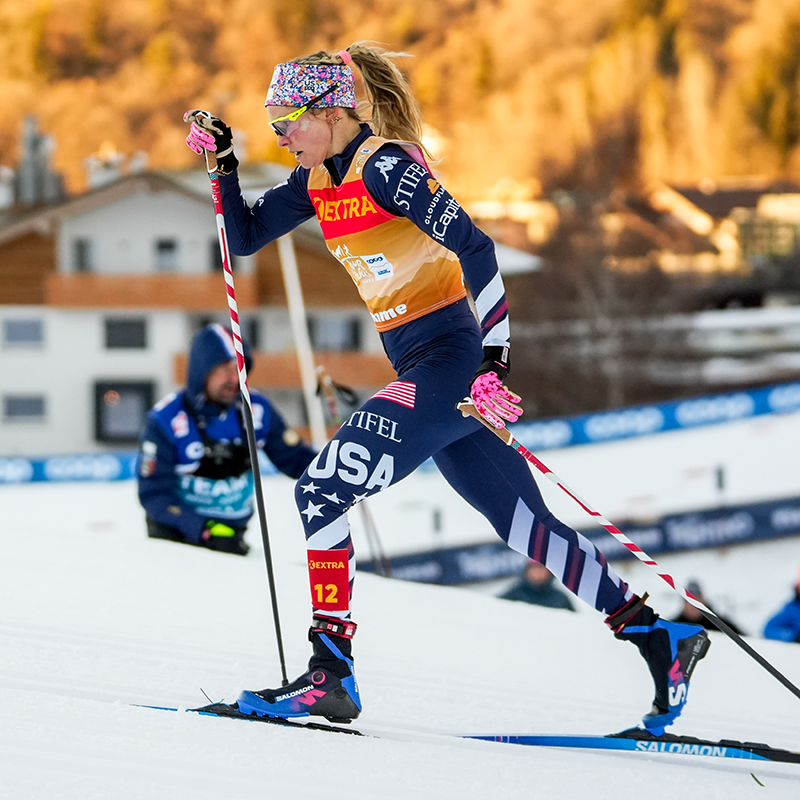
    Julia Kern (USA) racing the World Cup cross-country mass start in Ruka (FIN). (Photo: Modica/NordicFocus)

    The panel lineup includes:

    • Kikkan Randall, Olympic gold medalist and one of the most decorated U.S. cross-country skiers in history
    • Oksana Masters, 24-time Paralympic medalist in Nordic skiing and multiple sports
    • JC Schoonmaker, Tahoe native and two-time Olympian
    • Julia Kern, World Cup medalist and Olympian
    • Annika Malacinski, national champion and leading voice in women’s Nordic Combined
    • Jaz Taylor, multiple-time World Cup champion

    The discussion will be moderated by Andy Newell, a four-time Olympian and prominent voice in the sport.

    The 90-minute panel will serve as a live season recap, covering the 2025–26 World Cup circuit and the Milano Cortina Olympic and Paralympic Games, while offering audiences a rare opportunity to hear directly from athletes about training, competition, and the evolving culture of Nordic sport. Virtual attendees can submit questions in advance, while in-person participants will engage in a live Q&A.

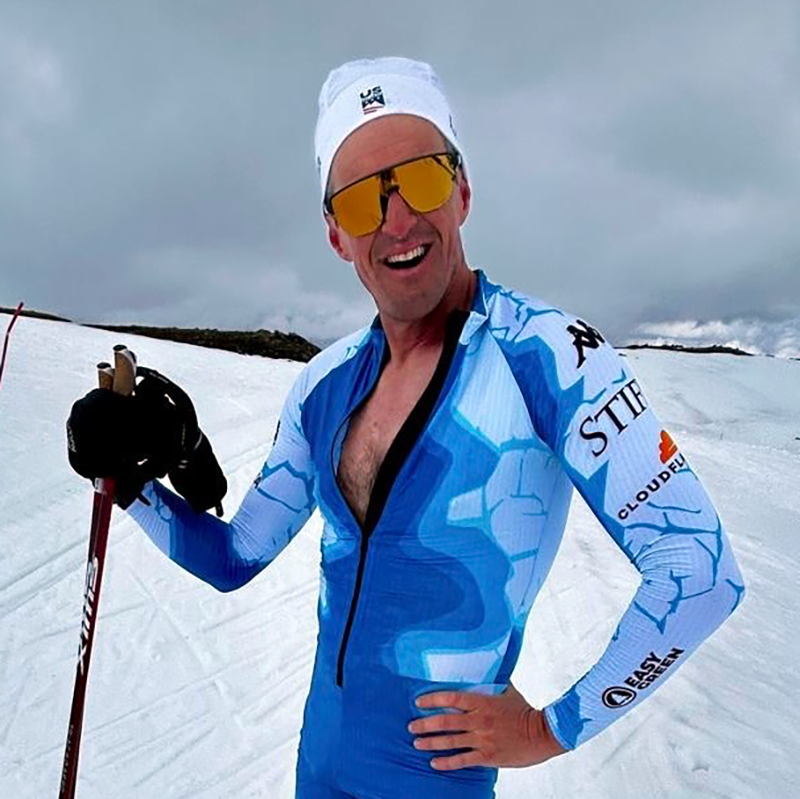
    Coach Andy Newell all smiles at the 2023 BMT. (Photo: BMT)

    Founder Elyse Sara created the Expo to fill a gap in the Nordic landscape – one that emphasizes connection, storytelling, and access to athletes across disciplines and levels. The event brings together voices from across the global Nordic community, from Olympic medalists to emerging leaders shaping the future of the sport.

    The event also includes a limited in-person component at Tahoe XC featuring clinics, demos, a laser biathlon relay, live viewing of the virtual panel, and other community events.

    In addition to its focus on sport and storytelling, the Expo also supports inclusion in athletics. Ten percent of all proceeds will benefit Move United, a national leader in adaptive sports programming.

    The Tahoe Nordic Expo aims to establish a new kind of gathering within the sport – one that reflects, connects, and looks ahead.

    Event Details

    Date: April 4, 2026
    Virtual Panel: 2:00–3:30 PM PT (global access)
    Live Event: 10 AM – 5 PM PT (Tahoe XC)
    Registration: tahoenordicexpo.com
    Contact: elyse@tahoenordicexpo.com

    JC Schoonmaker (USA) onhis way to finish the individual sprint in 15th place at the World Championships in Trondheim (NOR) in 2025.
    (Photo: NordicFocus)
  • Colin Rodgers and the Culture of SMS T2

    Colin Rodgers and the Culture of SMS T2

    This article was made possible through the generous support of our voluntary subscribers. If you value coverage like this, please support FasterSkier with a voluntary subscription.

    The first time I saw Colin Rodgers, he was climbing onto a podium in the basement of a hotel in Biwabik, Minnesota. I honestly can’t remember the name of the hotel, but I can remember the rooms, the enormous lobby complete with an indoor minigolf course, and the basement where the awards were taking place. It was Junior Nationals, 1997, and he’d just won the opening U16 race. We were there with the New England contingent. They held the awards in this low-ceilinged basement room, and although he wasn’t the tallest of boys, his blonde hair almost touched the ceiling tiles. Colin went to Holderness School in New Hampshire, and as I looked up at his smiling face, it was obvious that he was the kind of kid who was going somewhere.

    A few years later, I was watching him again, but this time from behind as he skied away from me up one of the small climbs on Woodpecker during the 3 x 5 k Classic Relay at the Williams College Carnival. Colin raced for Middlebury, and I raced for UNH, and at carnivals, he’d ski away from me. That was the deal. He was always a step, or a lot more, ahead.

    We caught up over Zoom last week. Colin was in a hotel room in Falun, Sweden, traveling with the U.S. Ski Team on the World Cup circuit. I was sitting on a rocking chair in the foyer of our local dentist’s office while my boys were inside getting their teeth cleaned. That’s how FasterSkier interviews happen sometimes.

    Colin Rodgers (SVSEF) – 4th Place

    Since his competitive career ended, Colin has given himself fully to coaching. First with the SVSEF Gold Team, who he had raced for at the end of his career, and later junior skiers at Green Mountain Valley School, where he spent nine years. And now, as head coach of the SMS T2 Team at Stratton Mountain School in Vermont, he works with some of the best cross-country skiers in the world.

    The team this year included Jessie Diggins, Ben Ogden, Julia Kern, and Canadian skier Remi Drolet, as well as collegiate skiers Fin Bailey and Jack Lange. Of the professional skiers, three of them finished in the top six at the Olympics. All four were in the top 20. Ben Ogden came home with two silver medals and ended a 50-year Olympic medal drought for American men in cross-country skiing. And Jessie Diggins, who is currently wrapping up a career that is the best of any American skier ever, added a bronze medal to her collection.

    Colin still seemed a little stunned by it all when we spoke.

    “We were so far beyond wherever I thought we were going to be,” he said. “I had a good feeling about this year. But for Ben to take home two silvers, and Jesse a bronze, and Remi to be in the top 20 and really help Canada with a historic relay finish, and Julia in the top six. It’s stuff that I could never believe was truly going to happen. And here we are talking about it.”

    SMS T2’s Rémi Drolet, Ben Ogden, Julia Kern, Jessie Diggins, and coach Colin Rodgers. (Photo: courtesy photo)

    Colin grew up in Westford, Vermont. His father was the program director for the U.S. Biathlon team from 1984 to 1988, which brought the family to northern Vermont. His parents built a house in Westford that year and never left.

    He went to Holderness, then Middlebury, and after college, he headed to the Maine Winter Sports Center, where coaches like Jens Johansson, Eli Brown and Will Sweetser were building something in the northern reaches of the state. From there, he moved to Sun Valley, Idaho, where he joined the SVSEF Gold Team and kept racing.

    Colin was good. He raced on the World Cup. But the jump he’d always hoped to make didn’t quite happen.

    “I think as a nation now, we’re so much more educated,” he said. “I had amazing coaches. But we were just kind of, maybe sometimes trying too hard.”

    He talked about spending time in Scandinavia and being around athletes who were significantly better than him. What he noticed wasn’t that they worked harder. It was that they were smarter about the work.

    “I probably trained at level two way too much of the time,” he said. “Especially being a little more anaerobic and linked to the sprint side. I really needed to be doing the easy training even easier.”

    He paused.

    “When it’s time to go, you’ve got to let the dog run,” he said, quoting his old Middlebury coach Terry Aldrich. “And that was the exact opposite. Like, now it’s time to really peak, and you let it loose.”

    I told him I’d heard a version of that from the other direction. When I was coaching, I used to tell my kids about Matt Whitcomb, who had been a teammate of Rodgers at Middlebury, previewing a course at Junior Nationals and telling the athletes they had to “walk the f-ing dog.” Every time they got to a climb, they were pulling back on the leash. Walking the dog.

    Two coaches. Related metaphor. Opposite leash relationships. That’s about as clean a summary of training philosophy as you’ll find in this sport. Keep the dog relaxed in training often, until it is time to let it run when it matters.

    Matt Gelso on the finishing stretch with coach Colin Rodgers encouraging in West Yellowstone (Photo: Toko)

    Before Stratton, the coaching experience that shaped Colin most was the time he spent around Rick Kapala at Sun Valley.

    Kapala ran the Sun Valley Education Foundation for nearly 30 years and built a program Colin still talks about with real admiration.

    “It was serious training, but it was also really creative,” Colin said. “You’d go out for long mountain adventures, do different kinds of workouts. It kept people engaged.”

    That stuck with him. When he moved to GMVS to coach high school athletes, he kept coming back to a simple question.

    “What would make me really want to go to practice today?”

    He laughed when he said it.

    “It sounds basic. But it actually matters a lot. If people don’t want to be there, something’s probably off.”

    He talked about his coaching years at GMVS and how, for him, the job was about getting kids to believe in what they could do.

    “When kids are in high school, they’re questioning everything. How they look, how they’re growing. And you’re just like, no, dude, this is fun. This can be a real blast. And believe. Like, damn, I can do a good job at this. If I’m doing this every day, I might as well be good at it, right?”

    He spent nine years doing that work. And then the SMS T2 job came along.

    “It was an opportunity there’s no way I was going to pass up,” he said. “It’s changed my life. Literally.”

    The program at Stratton operates under a mission statement crafted by Colin’s predecessor, Sverre Caldwell: international excellence and local inspiration.

    Colin said that phrase was part of what sold him on the job.

    “It’s everything I believe in. We’re trying to be the best we can be, win races, kick ass internationally. But then also, along the way, inspire the next generation of skiers coming up.”

    At Stratton, those two things aren’t separate. The T2 athletes train on the same roads and trails as the younger skiers in the school’s Nordic program. When Stratton kids show up for a summer or fall practice, and the older athletes are there, everyone just funnels in together and heads out.

    “It doesn’t even need to be talked about, really,” Colin said. “It’s just showing up, doing the work. This is how it’s done. And if you keep working really hard for a long time, you’re probably going to get really good too.”

    He brought up the chain of inspiration that runs through American skiing. Jessie Diggins was inspired by Kikkan Randall, by Andy Newell, by Simi Hamilton. Kern was inspired by Diggins.

    “When you get motivated by somebody who’s special and inspiring to you, if you have some talent and the fire to go for it, you realize you can chase that person. And then it’s like, oh, I can maybe be them. And then it’s like, oh, maybe I can be better than them.”

    One of the more interesting aspects of Colin’s role at SMS T2 is that he’s not the only coach in the picture. Not even close.

    Kristen Bourne and Colin Rodgers out for a run during the OD run at Park City camp, 2025. (Photo: Matt Whitcomb)

    Diggins works primarily with Jason Cork on the U.S. Ski Team staff. Ogden’s training has long been guided by Patrick Weaver, his college coach at UVM. Kern has a deep relationship with Kristen Bourne, who is also a national team coach. Drolet works with Dave Wood, a former coach of the Canadian national team. And Bailey goes to UVM and skis for Weaver, while Lange goes to Dartmouth and is coached by Brayton Osgood.

    Colin sees his job as connecting the dots.

    “Each athlete comes in with their own support network,” he said. “Jason has been working with Jesse forever. Ben has a really close connection with Weave. And I’ve been able to learn a lot from Patrick about how Ben ticks.”

    He was honest about what that requires.

    “When you step into a role like this, you have to check your ego,” he said. “It’s not about being the only voice in the room. It’s about helping the athlete succeed.”

    What he brings is proximity. He sees the athletes more frequently than some of their other coaches, especially during training blocks in Vermont. He can offer technique advice, fill gaps when someone else isn’t available, and keep everyone communicating.

    “I think one of my strengths is the ability to connect people,” he said. “And to connect with people.”

    Colin has watched American skiing grow up. When he was racing, relatively few American men were competitive at the highest levels. The development pathways weren’t as clear. The coaching wasn’t as sophisticated.

    “We’re closer as a nation now to what it means to go to that next level,” he said. “We know what to do. As coaches, we’re totally clued in on this systematic, long-term idea of how to periodize correctly, and also how to make it fun.”

    Colin Rodgers, Jessie Diggins and Julia Kern. (Photo: courtesy photo)

    He pointed to results at every level. At the time we spoke, American athletes were fighting with the best in the world at the World Junior Championships. On the World Cup, Diggins, Kern, and Ogden, along with the APU-based skiers, are proving it can happen at the very top.

    “A lot of people have helped build this,” he said. “It’s not just one program or one coach.”

    But the jump from junior skiing to the World Cup is still enormous. And programs like SMS T2 exist to help athletes survive that transition.

    “Having environments where athletes can develop during that stage is really important,” he said. “The gap is huge.”

    Before we wrapped up, I asked Colin what success looks like for him five years from now.

    He went big picture with a slightly longer lens. The 2034 Olympics will be in Salt Lake City. There’s a generation of young American skiers who have already raced at Soldier Hollow, the Nordic venue, during their youth careers. Now they’re looking ahead to competing on home soil.

    “We’re working towards 2034,” he said. “And we want to be successful there. If we stay on this trajectory, we can have medals. That’s our ultimate goal.”

    Within Stratton, he wants to grow the team thoughtfully. This year was lean, focused on supporting the Olympic athletes. Going forward, he wants to build back toward four or five athletes on each side, men and women, plus NCAA skiers.

    “We have to do it the right way,” he said. “We don’t want to take on too many people too fast.”

    Jessie Diggins (USA), whose World Cup career will conclude in a week and a half, celebrates her bronze medal in the Olympic 10 k Freestyle in Tesero, Italy. (Photo: Vanzetta/NordicFocus)

    He’s also thinking about the athletes who won’t be there. Jessie Diggins is retiring. That will leave a void at SMS T2 and on the World Cup, where Colin noted she currently sits at 380 career starts, more than any other skier.

    “Jesse’s going to go on and do a lot of really cool things and still inspire the next generation in new ways,” he said. “And then there’s going to be up-and-comers who are going to step up and be inspired by everything she’s done, and by everything Ben and Julia and Remy are already doing.”

    International excellence. Local inspiration. It’s a simple mission. But Colin Rodgers has spent a career learning that the simple things are usually the ones that matter most.

    He’s been chasing the highest levels of this sport since he was 15 years old, standing on a podium in a hotel basement in Minnesota. The path just looks different now.


    Help Support Our Olympic Coverage!

    If you value the thoughtful work and access FasterSkier provides, please consider becoming a Voluntary Subscriber. Your support directly fuels our work to cover the people, places, and moments that make our sport special.

    Join the FasterSkier community!


    Rémi Drolet and Colin Rodgers. (Photo: courtesy photo)
  • Diggins Podiums in Lahti as Karlsson Wins 10 k Classic

    Diggins Podiums in Lahti as Karlsson Wins 10 k Classic

    This coverage is made possible through the generous support of Marty and Kathy Hall and A Hall Mark of Excellence Award. To learn more about A Hall Mark of Excellence Award, or to learn how you can support FasterSkier’s coverage, please contact info@fasterskier.com.

    Jessie Diggins (USA) on her way to third place in the 10 k Classic Individual Start in Lahti, Finland. (Photo: Authamayou/NordicFocus)

    As Jessie Diggins climbed the final hills in Lahti on Sunday, she could hear something unusual rising above the crowd noise. Scattered along the course were hand-made signs held by Finnish fans and young skiers. Many carried the same simple message: “Thank you, Jessie.”

    For Diggins, racing through what has increasingly become a farewell tour of World Cup venues that have defined her career, the moment carried emotional weight. Lahti has not always been a place where the American felt the course played to her strengths, particularly in classic technique. But on Sunday, she delivered one of her most meaningful performances there, skiing to third place in the women’s 10-kilometer classic interval start.

    “There were so many people out on the course with signs saying ‘Thank you, Jessie,’ and it was really emotional in the best way,” Diggins said afterward. “It was incredibly touching. Seeing all the little kids in glitter after the race was just really special.”

    Frida Karlsson (SWE) on her way to the 10 k Classic win in Lahti, Finland. (Photo: Authamayou/NordicFocus)

    Sweden’s Frida Karlsson powered to the victory in 25:57.6, edging teammate Linn Svahn by just over four seconds. Diggins followed in third, 6.2 seconds behind the winner, securing the 90th World Cup podium of her career — a milestone that came in her 375th World Cup start.

    The podium also represented a breakthrough for Diggins in a discipline she has spent years working on. Despite her long list of accomplishments, Sunday marked her first World Cup podium in a standalone 10-kilometer classic interval start.

    “The Lahti course hasn’t always suited my strengths in classic skiing,” Diggins said. “So it felt really cool to pull it together a bit more today.”

    The result allowed Diggins to maintain control of both major season-long competitions. With only three World Cup stops remaining this winter, she continues to lead Sweden’s Moa Ilar by 264 points in the Overall World Cup standings and by 188 points in the Distance standings, positioning herself strongly in the race for the sport’s coveted crystal globes.

    Moa Ilar (SWE) and Linn Svahn (SWE), (l-r) reflecting at the finish. (Photo: Authamayou/NordicFocus)
    Svahn Sets the Early Benchmark, Karlsson Finishes the Job

    With the interval format — one athlete starting every 30 seconds — stretching the field across the Lahti course, the first major time to chase appeared almost immediately.

    Sweden’s Linn Svahn, starting with bib 5, was among the earliest contenders onto the course and quickly posted the fastest times through the early checkpoints. Known primarily as one of the World Cup’s dominant sprinters, Svahn skied aggressively over the opening kilometers and established the benchmark that much of the field would spend the next hour chasing.

    Her time held atop the standings as racer after racer attempted to match it.

    Later in the race, however, another Swede began to close the gap. Frida Karlsson, wearing bib 40, remained within seconds of Svahn through the intermediate checkpoints before edging ahead in the final kilometers.

    “I was just trying to stay in my own skiing,” Karlsson said afterward. “I heard it was between me and Linn, and I was super excited to get that fight.”

    Karlsson ultimately crossed the line in 25:57.6, securing the victory by 4.1 seconds over her teammate.

    The win came after a brief illness, which prevented her from competing in the Olympic 50 k, but Karlsson said she was eager to keep racing despite the setback.

    “I was sick after the Olympics, but I was really excited to keep racing and just do what I know best,” she said. “So I’m super glad to be here.”

    Diggins, starting shortly after Karlsson, kept herself in contention throughout the race, skiing within striking distance of the Swedish pair at each checkpoint before finishing 6.2 seconds back in third place.

    Linn Svahn (SWE) on her way to second place. (Photo: Authamayou/NordicFocus)
    Three Different Approaches to the Same Race

    The split times revealed three distinct pacing strategies among the podium finishers.

    Svahn, starting fifth, set the tone early. She posted the fastest time through the opening 1.1 kilometers and maintained the lead at the 3.4-kilometer checkpoint, immediately putting pressure on the rest of the field as they left the start gate.

    Karlsson, starting later in bib 40, remained just seconds behind through the early checkpoints, skiing a controlled opening before gradually closing the gap. By the middle of the race, she had moved into contention, and over the final kilometers, she proved strongest of all, ultimately pulling ahead to secure the victory.

    Diggins, meanwhile, delivered perhaps the most evenly paced effort of the three. She remained within striking distance of the leaders at every checkpoint — fifth at 1.1 kilometers, third by 3.4 kilometers, and still in podium position through the final lap.

    That steadiness proved decisive in the final standings. While the two Swedes battled for the win, Diggins’ consistent pace allowed her to secure third place and another important podium in the fight for the season-long crystal globes.

    Jessie Diggins (USA) sprints for the finish line. (Photo: Authamayou/NordicFocus)
    Diggins’ Classic Progress

    Diggins’ podium also reinforced one of the season’s quieter developments: the continued evolution of her classic technique.

    For much of her career, the American’s greatest moments have come in skating events, where her aggressive pacing and powerful finishing speed often prove decisive. But this season she has shown remarkable consistency in classic distance races, finishing in the top ten in every classic distance event on the World Cup calendar.

    Conditions in Lahti — warming temperatures and increasingly soft tracks — placed an additional premium on ski preparation, something Diggins was quick to acknowledge after the race.

    “I had great skis, which is a huge part of the equation, especially when the conditions get slushy,” Diggins said. “This podium really belongs to the team. I’m so grateful for all the hard work they put in.”

    Rosie Brennan (USA) on her way to 12th place. (Photo: Authamayou/NordicFocus)
    Brennan Continues Return to Form

    A bit further down the results list, fellow American Rosie Brennan continued a gradual return toward form after a long battle with illness that has affected much of her season.

    Brennan finished 12th (+38.6) in Lahti, a result that reflected both solid skiing and a cautious approach early in the race.

    “This whole process has really been a game of time,” Brennan said. “There have been many moments when I’ve wondered if I’ll ever feel normal again in my life. But the last three days are the most normal I’ve felt racing since December 2024.”

    The Lahti course, known for its steep climbs and technical demands, offered a test of efficiency in classic technique — a challenge Brennan felt she handled well.

    “Lahti requires really good technical skiing,” she said. “I felt like if I could relax and focus on my classic technique, that would give me the best chance.”

    Kendall Kramer (USA) working her way up one of the many Lahti climbs. (Photo: Authamayou/NordicFocus)
    Kramer Finds Lessons in the Lahti Hills

    For American Kendall Kramer — 42nd in 27:40.8 (+1:43.2) — the Lahti race presented a different kind of challenge: starting first.

    Wearing bib 1, Kramer had the advantage of pristine tracks before the course began to break down as temperatures warmed. But the early start also meant racing without reference splits from the rest of the field.

    “I was actually okay starting with bib 1 today, given the state of the tracks,” Kramer said. “They tend to break down as the race goes on, and the corners can get icy, so it was nice to have cleaner conditions early.”

    Without other athletes on course to gauge pacing against, Kramer said the race became more about skiing freely and trusting her own effort.

    “Racing without reference splits definitely makes pacing tougher, but at the same time it lets you ski freely and focus on your own race.”

    The steep Lahti climbs also highlighted the technical demands of classic skiing at the World Cup level.

    “The punchy hills were fun because I could really bound up them, which is something I haven’t done much in World Cup racing so far,” Kramer said. “But the sections where it turns into pure power striding showed me I still have a lot to work on.”

    Despite the challenges, Kramer described the experience as valuable for understanding the technical standards required to compete consistently at the highest level.

    “I’ve learned so much from racing here this season,” she said. “At the World Cup, every strength and every weakness gets highlighted, and that really helps show what to work on heading into the summer.”

    Julia Kern (USA) catches a rest from both the climbs and the sunlight. (Photo: Authamayou/NordicFocus)
    Kern Heading Home Early to Recover

    Julia Kern, who finished 51st — 28:11.4 (+2:13.8) — today, said she will return home early from the World Cup circuit as she continues working through health issues that have lingered since the Olympic races.

    “I’ve been battling my body on various fronts since the Olympics,” Kern said in a team media statement. “One of my strengths is showing up and continuing to try and believe despite the challenges, while also being patient and smart.”

    Kern added that she will take additional time to recover while seeking answers about her condition, with hopes of returning to competition at the Stifel World Cup Finals in Lake Placid later this month.

    “Right now, my body needs more time to recover and is in search of answers, so I’m headed home early with the hopes of being in a place to race in Lake Placid.”

    Lauren Jortberg (USA) and Katherine Weaver (CAN), (l-r) charge for the line. (Photo: Authamayou/NordicFocus)
    Jortberg Gets a Front-Row Look at Karlsson’s Pace

    For American Lauren Jortberg — 55th in 28:32.7 (+2:35.1) — the Lahti race offered a unique opportunity to measure herself against one of the sport’s best.

    Early in the race, Jortberg found herself skiing behind Sweden’s Frida Karlsson for several kilometers as the eventual winner was completing her second lap while Jortberg was still on her first.

    “I skied with Frida for about three kilometers, which was really cool,” Jortberg said. “She’s obviously a beast, and it was cool to hang with her and get a taste of what that pace actually feels like.”

    Jortberg said the experience offered valuable insight into the demands of racing a 10-kilometer interval start at the World Cup level, where pacing often means pushing near maximum effort from the start.

    “Ten-k pacing on the World Cup is basically as hard as you can go the whole way,” she said. “It’s about learning how to navigate that kind of effort and still ski your own race.”

    She added that the race reinforced both the progress she has made in classic technique and the areas she hopes to continue developing as she gains more experience at the international level.

    “I’m really proud of how my classic skiing is coming along,” Jortberg said. “There’s still a lot to work on, but it was definitely a good first start in a distance race.”

    Jortberg said she hopes to carry the fitness and lessons from Lahti into the next stop on the World Cup circuit in Drammen, Norway.

    Emma Albrecht (USA) giving it everything she can all the way to the finish. (Photo: Authamayou/NordicFocus)
    Albrecht Sees the Margins Up Close

    Further back in the start order, fellow American Emma Albrecht — 58th in 28:50.7 (+2:53.1) — experienced firsthand just how tight the margins can be in World Cup distance racing.

    “The tight margins were shown by skiers finishing at similar times,” Albrcht said after the race. “For me, I was not passed, and I did not pass anyone. Which meant the skiers in front and behind me were skiing at a similar pace to me.”

    Like Kramer, Albrecht said the steep Lahti climbs emphasized the technical demands of classic technique, particularly the efficiency required to stride uphill without losing grip.

    “The uphill sections are the most technical and demanding here,” she said. “The climbs in Lahti are steep, and striding up efficiently requires really good technique to avoid slipping.”

    For Albrecht, the race served as a clear reminder of the areas she hopes to refine moving forward.

    “One of my biggest takeaways is that I want to keep working on my striding technique and get better at adjusting my tempo based on the terrain.”

    Dariya Nepryaeva (AIN) and Novie Mccabe (USA), (l-r) come to the line. (Photo: Authamayou/NordicFocus)
    Other North Americans in the Field

    Novie McCabe raced her way to 43rd in 27:45.0 (+1:47.4) in the 64-skier field.

    For Canada, Jasmine Drolet led the team in 41st place with a time of 27:39.8 (+1:42.2). Liliane Gagnon finished 46th in 27:56.4 (+1:58.8), and Katherine Weaver placed 59th in 29:00.9 (+3:03.3). Teammate Olivia Bouffard-Nesbitt, who had been listed on the start sheet, did not start the race.

    Take a bow, Jessie Diggins (USA) . (Photo: Authamayou/NordicFocus)
    The Season’s Final Push

    Sunday’s race in Lahti brought us even closer to the end of the season, now with only two sprint races and three distance races remaining until the sport’s biggest prizes will ultimately be decided.

    For Diggins, the third-place finish represented more than another podium in an already historic career. It also reinforced the remarkable consistency that has defined her season. With top-10 finishes in every classic distance race this winter, she has transformed what was once considered a relative weakness into one of the foundations of her bid for both the Overall and Distance crystal globes.

    Three stops remain on the calendar: the classic city sprint in Drammen, Norway, the iconic 50-kilometer race at Holmenkollen in Oslo, and the Stifel World Cup Finals in Lake Placid, New York.

    For Diggins, those races now carry both competitive stakes and emotional significance. As the American continues what has increasingly felt like a farewell tour across the World Cup circuit, the crowds that gathered along the Lahti course on Sunday offered a glimpse of how much her career has meant to fans of the sport, not just in the United States, but all around the world.

    And as Diggins pushed across the final climbs toward the stadium — signs waving, glitter-clad children cheering from the side of the course — she did what she has done so often over the past decade: she kept fighting for every second and left everything she had, once again, on the course.

    Lahti Women’s 10 k Classic RESULTS


    Love Stories Like This? Help Keep Them Coming.

    Feature stories like this one take time, access, and care to produce. If you value thoughtful storytelling and independent ski journalism, please consider becoming a Voluntary Subscriber. Your support directly fuels the work we do to cover the people, places, and moments that make our sport special.

    Join the FasterSkier community!


    Linn Svahn (SWE), Frida Karlsson (SWE), and Jessie Diggins (USA), (l-r) share the 10 k Classic podium in Lahti, Finland. (Photo: Authamayou/NordicFocus)
  • Sundling Returns to Win Lahti Sprint as Crystal Globe Battle Tightens

    Sundling Returns to Win Lahti Sprint as Crystal Globe Battle Tightens

    This coverage is made possible through the generous support of Marty and Kathy Hall and A Hall Mark of Excellence Award. To learn more about A Hall Mark of Excellence Award, or to learn how you can support FasterSkier’s coverage, please contact info@fasterskier.com.

    Jonna Sundling (SWE) during qualification in Lahti, Finland. (Photo: Authamayou/NordicFocus)

    The World Cup season returned to Finland this weekend, closing a circle that began more than three months ago in Ruka. In the time since Olympic teams were selected, dreams realized or deferred, experience forged, and farewells offered week after week as the long winter wears on. If the stakes in Lahti feel slightly lower than they did earlier in the season, they are tightening in another way — especially in the races for the Crystal Globes.

    With only a handful of races remaining in the season, the women’s Freestyle Sprint offered more than just another podium. The fight for both the Sprint Crystal Globe and the Overall Crystal Globe continues to tighten.

    In tricky conditions, Sweden’s Jonna Sundling emerged as the day’s winner, navigating the heats with authority before closing out the final to claim victory.

    “I think all day it’s been difficult with the conditions because it seems so nice, but when you ski it’s like icing underneath,” Sundling said in a post-race interview with FIS on the broadcast. “There were some challenges with the skiing, but I’m glad that I could ski as I did today and go all the way.”

    The victory marked a strong return for Sundling, who said she had recently been dealing with a cold and missed racing in Falun before arriving in Lahti.

    One of the most interesting moments of the women’s race came when Kristine Stavaas Skistad (NOR) was disqualified during the semifinals for what appeared to be a very minor incident.  She received a yellow card for the incident, and because she was already carrying one from a previous violation, she was disqualified. (Photo: Authamayou/NordicFocus)
    A Tactical Sprint Course

    The Lahti freestyle sprint course rewarded patience as much as power. After the individual qualification round, the top 30 athletes advanced into the head-to-head heats — five quarterfinals of six athletes each, with the top two finishers and the two fastest “lucky losers” advancing to the semifinals.

    From there, the field narrowed again: two semifinal heats would determine the six skiers racing for the win.

    While the course appeared straightforward on paper, athletes quickly discovered the conditions made positioning critical. The climb before the final hairpin offered one of the few reliable passing opportunities before the long run to the finish, which saw the race often gather back together around the final corner before the finishing stretch. And throughout the heats, several favorites discovered how narrow the margin for error could be.

    Maja Dahlqvist (SWE) got out well, but was unable to advance from the quarterfinals. (Photo: Authamayou/NordicFocus)
    Globe Leaders Falter

    Two of the athletes who have dominated the sprint standings this season — Maja Dahlqvist (Sweden) and Nadine Fähndrich (Switzerland) — both saw their days end earlier than expected, failing to advance beyond the quarterfinals.

    Their early exits added intrigue to the sprint globe race as the season heads toward its final stretch.

    Meanwhile, Sundling continued to build momentum, advancing smoothly through her heats despite the difficult snow conditions.

    “I’m super motivated,” Sundling said of the final weeks of the season in the broadcast interview. “It’s my favorite time of the year.”

    Hilla Niemela (FIN), Johanna Hagstroem (SWE), and Jessie Diggins (USA) (l-r) charge up the opening climb of the Freestyle Sprint in Lahti, Finland. (Photo: Authamayou/NordicFocus)
    Diggins Attacks, But Falls Short

    For the United States, Jessie Diggins came closest to advancing deep into the rounds.

    In her quarterfinal, Diggins launched a decisive move on the final climb, surging to the front of the group in an effort to create separation before the tight hairpin turn at the top of the hill. Over the crest, she continued the attack, aggressively no-pole skating the downhill in an attempt to open a gap.

    For a moment, the tactic appeared to work.

    But the chasing group quickly organized behind her, the draft pulling them back together on the descent into the stadium. Sweden’s Johanna Hagström surged in the final meters, lunging at the line to edge Diggins and end the American’s day in the quarterfinal.

    Diggins said the Lahti crowd helped make the experience memorable.

    “It was so cool to hear the crowd roaring. There were so many people out, really filling the stadium and along the course. It’s just a very cool environment. It was sunny and beautiful, which made it really fun.

    “I was really happy with my energy today. I feel like I skied a pretty good race and did everything I could. But again this year, I feel like I just don’t quite have that ultimate power, especially in the finishing stretch.

    “I’m excited for tomorrow and just excited to be finishing out my last stretch here in Europe. That feels really special. It’s kind of cool to take a moment to reflect on my many years spent on the road in Europe. That chapter is coming to a close now, which is really cool and really special. I’m just grateful thinking back on all the memories over all the different years.”

    Rosie Brennan (USA) fighting to maintain contact with the group as Gina Del Rio (AND) takes the opening climb out fast during their quarterfinal. (Photo: Authamayou/NordicFocus)
    Brennan Knocked Out in Quarterfinal*

    Veteran American Rosie Brennan also reached the quarterfinals but was unable to advance.

    Lauren Jortberg (USA) on her way to 37th place in qualification in Lahti, Finland. (Photo: Authamayou/NordicFocus)
    Jortberg Reflects on Qualification Miss

    For Lauren Jortberg, the Lahti sprint was a reminder of how thin the margins can be in World Cup qualification.

    Jortberg finished 37th in the qualification, just outside the top-30 cutoff needed to advance to the heats. After the race, she said the conditions on the Lahti course made it difficult to find the right balance between glide and stability.

    “There was kind of an ice sheet underneath with some sugar on top,” Jortberg told FasterSkier after the race. “So it was hard to find skis that were running really well while also being able to push off and plant well. It made the skiing a little tricky, but that’s pretty typical for what we’ve seen in Lahti the last few years.”

    Jortberg also felt she left something on the course in terms of pacing.

    “I think I just didn’t pace it very well,” she said. “I probably paced it too much. I didn’t really finish feeling that tired, so that was a bit of a bummer.”

    Part of that caution, she explained, stemmed from having dealt with illness in the days leading into the race.

    “I had been sick the last week, so I think I held back a little bit,” Jortberg said. “That’s frustrating because I felt really good and I think I could have been competitive today.”

    Even so, Jortberg said the past months of racing have helped build confidence as she continues gaining experience on the World Cup circuit.

    “One of the big takeaways from these World Cup weekends is that when I can put down a really solid qualifier, I’m very much in the mix,” she said. “Even though today wasn’t a great qualifier, I wasn’t that far out of the heats, so I think that’s something I can take confidence from going into the next few weekends.”

    Julia Kern (USA) during qualification. (Photo: Authamayou/NordicFocus)
    Julia Kern Trying to Get Back to Form*

    Julia Kern, returning to racing after illness following the Olympic Games, placed 44th in the qualification round.

    Albrecht Gaining World Cup Experience

    Emma Albrecht, competing in her fourth World Cup weekend, finished 48th in the qualification round in Lahti as she continues gaining experience at the highest level of the sport.

    Albrecht said one of the biggest adjustments to racing on the World Cup has been the razor-thin margins in sprint qualification.

    Emma Albrecht (USA) gaining experience during the qualification in Lahti, Finland. (Photo: Authamayou/NordicFocus)

    “The biggest adjustment to racing at this level is how tight the race margins are,” Albrecht told FasterSkier after the race via email. “The U.S. SuperTour field is obviously not as competitive, and it has been a shift — especially in sprinting — to have to have a fast qualifier. You are no longer guaranteed to make heats.”

    The Lahti sprint course also served as a reminder of the confidence and technical skills required to compete in crowded sprint fields.

    “Today’s qualification reminded me to take up space on the course and not be afraid of a little hop skate,” she said.

    Even with the challenges, Albrecht said the experience is fueling motivation heading into the offseason.

    “This weekend is making me very excited for summer training,” she said. “A field as deep as this really highlights weaknesses on course. I would love to become a more efficient jump skater and be more confident in my high-speed V2. I’m definitely walking away with a lot of motivation to improve.”

    Liliane Gagnon (CAN) charges up the first climb during her quarterfinal, where she narrowly missed advancing to the semifinals. (Photo: Authamayou/NordicFocus)
    Canadian Results

    Canada’s top performance came from Liliane Gagnon, who finished third in her quarterfinal — just short of advancing to the semifinals.

    Teammates Olivia Bouffard-Nesbitt and Katherine Weaver placed 43rd and 46th, respectively, in qualification.

    Jonna Sundling (SWE) celebrates the win while Coletta Rydzek (GER) and Johanna Hagstroem (SWE) lunge for third behind her. (Photo: Authamayou/NordicFocus)
    The Season’s Final Push

    With only a handful of races remaining on the World Cup calendar, the results in Lahti could prove important in shaping the final standings.

    For Sundling, the victory served as both a return to form and a statement heading into the closing weeks of the season.

    “I’m looking forward to the rest of the season,” she said.

    For others — particularly those chasing the Crystal Globes — the margin for error continues to shrink.

    And with more racing still ahead in Lahti this weekend, the battle for the season-long trophies is far from settled.


    Lahti Women’s Freestyle Sprint QUALIFICATION RESULTS

    Lahti Women’s Freestyle Sprint FINAL RESULTS


    *We hope to add more quotes above from athletes if we hear back from them, but wanted to get this race report posted in a timely fashion.


    Love Stories Like This? Help Keep Them Coming.

    Feature stories like this one take time, access, and care to produce. If you value thoughtful storytelling and independent ski journalism, please consider becoming a Voluntary Subscriber. Your support directly fuels the work we do to cover the people, places, and moments that make our sport special.

    Join the FasterSkier community!


    Linn Svahn (SWE), Jonna Sundling (SWE), and Coletta Rydzek (GER), (l-r) share the Freestyle Sprint podium in Lahti, Finland. (Photo: Authamayou/NordicFocus)
  • US Ski Team Announces World Cup Period 4 Starters

    US Ski Team Announces World Cup Period 4 Starters

    Dear Cross Country Community,

    We are pleased to announce the Team for Period 4 (Falun, Lahti, Drammen, & Oslo) of the 2025-26 World Cup season:

    Falun Sprint F & Lahti Sprint F

    Men

    Zach Jayne                                Objective          25-26 Overall SuperTour Leader

    Ben Ogden                                Objective          5th 25-26 Sprint World Cup

    Gus Schumacher                       Objective          21st 25-26 Sprint World Cup

    Jack Young                                Objective          26th 25-26 Sprint World Cup

    JC Schoonmaker                        Objective          28th 25-26 Sprint World Cup

    Kevin Bolger                             Discretion         15th Toblach Sprint F

    Zanden McMullen                     Discretion         20th Oberhof Sprint F

    Zak Ketterson                           Alternate          18th Val di Fiemme TDS Sprint C

    Michael Earnhart                      Alternate          35th Oberhof Sprint F


    Women

    Hailey Swirbul                           Objective          25-26 Overall SuperTour Leader

    Jessie Diggins                            Objective          25-26 Overall World Cup Leader

    Julia Kern                                  Objective          22nd 25-26 Sprint World Cup

    Sammy Smith                            Discretion         12th Oberhof Sprint F

    Lauren Jortberg                        Discretion         26th Oberhof Sprint F

    Alayna Sonnesyn                       Discretion         27th Davos Sprint F

    Rosie Brennan                          Discretion         15th Ruka Sprint C

    Ava Thurston                            Discretion         4th US Nationals Sprint F Qualification

    Emma Albrecht                         Alternate          5th US Nationals Sprint F Qualification

    Gus Schumacher (USA) charges up one of the hills on the sprint course at the base of the Mördarbacken during the 20 k Freestyle Mass Start in Falun, Sweden last season. (Photo: NordicFocus)

    Falun 20 km Skiathlon

    Men

    Zach Jayne                                Objective          25-26 Overall SuperTour Leader

    Gus Schumacher                       Objective          18th Distance World Cup

    Zak Ketterson                           Objective          26th Distance World Cup

    John Hagenbuch                       Discretion         14th OWG 10 km F

    Zanden McMullen                     Discretion         18th Oberhof 10 km C

    Ben Ogden                                Discretion         20th Toblach 5 km F

    Hunter Wonders                       Discretion         24th Oberhof 10 km C

    Luke Jager                                Alternate          29th Oberhof 10 km C

    JC Schoonmaker                        Alternate          29th Toblach 5 km F


    Women

    Hailey Swirbul                           Objective          25-26 Overall SuperTour Leader

    Jessie Diggins                            Objective          25-26 Overall World Cup Leader

    Julia Kern                                  Discretion         10th Toblach 5 km F

    Novie McCabe                          Discretion         22nd Goms 20 km C

    Rosie Brennan                          Discretion         24th Ruka 10 km C

    Luci Anderson                           Discretion         25th Davos 10 km F

    Kendall Kramer                         Discretion         27th Goms 20 km C

    Alayna Sonnesyn                       Discretion         27th Ruka 20 km F

    Jessie Diggins on her way to winning both the FIS Overall and Distance Crystal Globes in Lahti, Finland last season. (Photo: NordicFocus)

    Lahti 10 C

    Men

    Zach Jayne                                Objective          25-26 Overall SuperTour Leader

    Gus Schumacher                       Objective          18th Distance World Cup

    Zak Ketterson                           Objective          26th Distance World Cup

    Zanden McMullen                     Discretion         18th Oberhof 10 km C

    Hunter Wonders                       Discretion         24th Oberhof 10 km C

    Luke Jager                                Discretion         29th Oberhof 10 km C

    Ben Ogden                                Discretion         29th Toblach 20 km C

    John Hagenbuch                       Alternate          14th OWG 10 km F

    JC Schoonmaker                        Alternate          29th Toblach 5 km F

    Reid Goble                                Alternate          1st Wirth SuperTour 10 km C


    Women

    Hailey Swirbul                           Objective          25-26 Overall SuperTour Leader

    Jessie Diggins                            Objective          25-26 Overall World Cup Leader

    Julia Kern                                  Discretion         16th Goms 20 km C

    Novie McCabe                          Discretion         22nd Goms 20 km C

    Rosie Brennan                          Discretion         24th Ruka 10 km C

    Kendall Kramer                         Discretion         27th Goms 20 km C

    Sammy Smith                            Discretion         3rd US Nationals 10 km C

    Ava Thurston                            Discretion         4th US Nationals 10 km C

    Emma Albrecht                         Alternate          1st Wirth SuperTour 10 km C

    Alayna Sonnesyn                       Alternate          2nd Wirth SuperTour 10 km C

    Lauren Jortberg                        Alternate          2nd Anchorge SuperTour 10 km C

    Samantha Smith (USA) racing the individual World Cup sprint in Drammen (NOR) in 2024. (Photo: Modica/NordicFocus)

    Drammen Sprint C

    Men

    Zach Jayne                                Objective          25-26 Overall SuperTour Leader

    Ben Ogden                                Objective          5th 25-26 Sprint World Cup

    Gus Schumacher                       Objective          21st 25-26 Sprint World Cup

    Jack Young                                Objective          26th 25-26 Sprint World Cup

    JC Schoonmaker                        Objective          28th 25-26 Sprint World Cup

    Zak Ketterson                           Discretion         18th Val di Fiemme TDS Sprint C

    John Schwinghamer                  Discretion         1st US Nationals Sprint C Qualification

    Kevin Bolger                             Alternate          15th Toblach Sprint F

    Zanden McMullen                     Alternate          20th Oberhof Sprint F


    Women

    Hailey Swirbul                           Objective          25-26 Overall SuperTour Leader

    Jessie Diggins                            Objective          25-26 Overall World Cup Leader

    Julia Kern                                  Objective          22nd 25-26 Sprint World Cup

    Rosie Brennan                          Discretion         15th Ruka Sprint C

    Sammy Smith                            Discretion         19th OWG Sprint C

    Lauren Jortberg                        Discretion         30th OWG Sprint C

    Alayna Sonnesyn                       Discretion         27th Davos Sprint F

    Ava Thurston                            Discretion         3rd US Nationals Sprint C Qualification

    Erin Bianco                               Alternate          4th US Nationals Sprint C Qualification

    Jessie Diggins (USA) on her way to a podium finish during the first women’s 50k version of the famed Holmenkollen in Oslo (NOR) in 2023. (Photo: NordicFocus)

    Holmenkollen 50 km F Mass 

    Men

    Zach Jayne                                Objective          25-26 Overall SuperTour Leader

    Gus Schumacher                       Objective          18th Distance World Cup

    Zak Ketterson                           Objective          26th Distance World Cup

    John Hagenbuch                       Discretion         14th OWG 10 km F

    Ben Ogden                                Discretion         20th Toblach 5 km F

    JC Schoonmaker                        Discretion         29th Toblach 5 km F

    Zanden McMullen                     Discretion         18th Oberhof 10 km C

    Brian Bushey                             Alternate          4th US Nationals 20 km F

    Hunter Wonders                       Alternate          24th Oberhof 10 km C


    Women

    Hailey Swirbul                           Objective          25-26 Overall SuperTour Leader

    Jessie Diggins                            Objective          25-26 Overall World Cup Leader

    Julia Kern                                  Discretion         10th Toblach 5 km F

    Luci Anderson                           Discretion         25th Davos 10 km F

    Alayna Sonnesyn                       Discretion         27th Ruka 20 km F

    Novie McCabe                          Discretion         22nd Goms 20 km C

    Rosie Brennan                          Discretion         24th Ruka 10 km C

    Kendall Kramer                         Discretion         27th Goms 20 km C


    The above discretionary selections were nominated by a 15-person working group that included:

    James Southam                         Athlete Rep

    Ida Sargent                               Athlete Rep

    Perry Thomas                           Mansfield Pro Nordic Team

    Chad Salmela                            Team Birkie

    Andy Newell                             Bridger Ski Foundation

    Erik Flora                                  Alaska Pacific University

    Pepa Miloucheva                      Craftsbury GRP

    Colin Rodgers                            SMS T2

    Peter Holmes                            SVSEF Gold Team

    Sophie Caldwell                        Aspen Valley Ski and Snowboard Club

    Eliška Albrigtsen                        Denver University

    Chris Grover                             USST

    Matt Whitcomb                        USST

    Jason Cork                                USST

    Kristen Bourne                          USST


    The nominations were then approved by a discretionary selection review group comprised of:


    Tyler Kornfield                          U.S. Ski & Snowboard Athlete Rep

    Anouk Patty                              U.S. Ski & Snowboard Chief of Sport

    Bryan Fish                                 U.S. Ski & Snowboard Development Director


    The above discretionary selection process will be repeated for each period of World Cup this coming season.  As always, if you have questions or concerns about this process, feel free to contact me directly.


    Sincerely,


    Chris Grover

    Cross Country Program Director, U.S. Ski Team

    chris.grover@usskiandsnowboard.org

  • The Devon Kershaw Show: A Tesero team sprint slugfest

    The Devon Kershaw Show: A Tesero team sprint slugfest

    This episode was made possible through the generous support of our voluntary subscribers.  If you value coverage like this, please support FasterSkier with a voluntary subscription.  

    The highs were high and the lows were low in the Olympic team sprint in Italy, with the Ogden-Schumacher men’s team claiming silver and the Diggins-Kern women’s pair finishing out of the medals. Devon and Nat break the whole thing down.

    We’ll be back after Saturday’s men’s 50 k. Reach us at devon[at]fasterskier.com and nat[at]fasterskier.com. We’re really grateful for all the support during the Olympics — thanks for notes and encouragement.

    A reminder: This is a homegrown podcast done by two guys working long hours and late nights. We’re also paying real money to be here in Italy. If you can, support the show and FasterSkier’s ongoing coverage with a voluntary membership. We’re also offering a bonus during the Olympics: a WhatsApp group with notes on Nat’s experiences in Italy, the food he’s eating, interview transcripts and more.

    Send nat[at]northernjournal[dot]com a confirmation of your voluntary membership and the number he should use for WhatsApp and we’ll get you signed up. You can also Venmo him directly at @nat-herz if a membership isn’t for you. We’re suggesting a minimum of $10, but we also won’t turn anyone away who wants to join because of an inability to pay.

    Help Support Our Olympic Coverage!

    FasterSkier will have our own Nat Herz on the ground at the Olympics, which, to be honest, is a very big financial lift for us. If you value the thoughtful work and access FasterSkier provides at championships like this one, please consider becoming a Voluntary Subscriber. Your support directly fuels the work we do to cover the people, places, and moments that make our sport special.

    Join the FasterSkier community!
  • Sweden Wins Gold, America Shows Heart in Exciting Women’s Team Sprint

    Sweden Wins Gold, America Shows Heart in Exciting Women’s Team Sprint

    This article was made possible through the generous support of our voluntary subscribers who have helped us put our Nat Herz on the ground reporting at the Olympics. If you value coverage like this, please support FasterSkier with a voluntary subscription.

    Jonna Sundling (SWE) follows Jessie Diggins (USA) during the Olympic Women’s Team Sprint in Tesero, Italy. (Photo: Vanzetta/NordicFocus)

    PREDAZZO, ITALY — Eight years ago, on a different continent, the words “Here Comes Diggins!” by Chad Salmela vaulted American cross-country skiing into a new era. On Wednesday in Val di Fiemme, the event that changed everything for the United States returned to the Olympic stage.

    The Women’s Freestyle Team Sprint has long been one of the Americans’ signature races. In the PyeongChang 2018 Winter Olympics, Kikkan Randall and Jessie Diggins delivered the nation’s first Olympic gold medal in cross-country skiing. Last March in Trondheim, Diggins and Julia Kern claimed World Championship silver.

    On Wednesday, Diggins started the race in the first leg, handing off to Kern for the anchor leg, as they had in their previous medal run. They hoped for one more shared championship moment.

    It was not to be. The Americans finished fifth, in a race that required not just fitness but flawless execution. Sweden’s Jonna Sundling and Maja Dahlqvist took gold. Switzerland’s Nadja Kaelin and Nadine Faehndrich secured silver. Germany’s Laura Gimmler and Coletta Rydzek won bronze after a late-race crash by Finland opened the door in the final turn.

    For the Americans, the margin was not dramatic. But close, at this level, does not bring home a medal.

    Jessie Diggins (USA) and Jonna Sundling (SWE), (l-r) come through the stadium during the Olympic Women’s Team Sprint.  (Photo: Vanzetta/NordicFocus)
    “Honestly, left it all out there.”

    The Team Sprint is one of the sport’s most punishing formats. Two skiers qualify individually; their times are combined to determine which 15 nations reach the final. In that final, the athletes alternate laps — three each — on a course that offers no reprieve.

    Often, one skier brings distance strength, and the other sprint speed. For the United States, Diggins and Kern blur those categories. Both are capable of driving pace. Both can finish.

    From the gun, Diggins did what she has done throughout her career: she went to the front.

    She and Sundling stretched the field immediately, driving into the Zorzi Climb, the race’s defining ascent. The early order — Sweden, the United States, Norway, Canada — hinted at the nations prepared to dictate terms.

    Jonna Sundling (SWE) stretches her lead. (Photo: Vanzetta/NordicFocus)

    When Sundling surged later in the race, Diggins expected it.

    “I knew she was probably going to do that,” Diggins said afterward. “And I was like, just do the best that you can do. You know, like, you can’t control anything except your effort and your heart. And I was like, skiing out of my body, and I just did everything that I could, and I’m proud of that.”

    That theme — control what you can — carried through her reflections.

    “Honestly, I almost passed out like four different times,” she said. Then, clarifying: “No, from going that hard, no regrets. Honestly, left it all out there. I feel like we did everything we could, and that is the only thing you can control at the end of the day.”

    Julia Kern (USA) and Jessie Diggins (USA), (l-r) gather in the finish area after the race, Diggins racing in the US team’s relay socks for the final time. (Photo: Barbieri/NordicFocus)
    One final lap with ‘Relay Socks’

    By the last exchange, Sweden had carved out daylight. Switzerland began clawing into Finland’s hold on silver. Behind them, Germany, Norway, the United States, and Finland battled for bronze.

    On the final descent, Finland’s anchor, Jasmin Kahara, lost her balance in the sweeping right-hand turn and fell, sliding out on her stomach. Germany and Norway slipped past in their tucks. Kern, just meters behind, fought to the line, but the podium had narrowed to two.

    Coletta Rydzek (GER) brings home the bronze medal for Germany with Norway’s Julie Bjervig Drivenes just off camera. (Photo: Vanzetta/NordicFocus)

    As they drove for the line side by side, aerodynamically no-pole skating with everything they had, it was clear this was going to be close. Germany claimed bronze while Norway left empty-handed in fourth. Just behind, Kern brought the United States to the finish in fifth.

    For Diggins, the moment carried a different weight. It was, by her admission, her last Olympic relay leg.

    “I love racing with this girl. I’m so, so proud of her,” she said of Kern. “And, yeah, it’s emotional to feel like I’m never gonna pull on those relay socks again.”

    When asked whether there was a sense of handing the event forward, she reflected on the arc of her career — from her first team sprint world title in 2013 to the growth of youth programs back home.

    “It’s just really cool to be part of the evolution of American skiing,” she said.

    Julia Kern (USA) and Nadine Faehndrich (SUI), (l-r) find their lines around a tricky corner. (Photo: Vanzetta/NordicFocus)
    Whitcomb knows they can win

    For Head Coach Matt Whitcomb, the analysis was candid and clear-eyed.

    “Yeah, it was a good race,” Whitcomb said. “Of course, this is an event that we know we can win, and we didn’t today.”

    In a format this tight, small imperfections are decisive.

    “For even a bronze medal to happen, both legs have to be firing exquisitely,” he said. “We swung as hard as we could. We did our best. We were prepared to win today, and we just didn’t.”

    Of Kern’s anchor leg, Whitcomb offered both empathy and affirmation.

    “Julia is an incredible performer, and one thing you can always trust from her is that you’re gonna get her absolute best,” he said. “We saw it on the final climb. I was happy with how she climbed. Just didn’t quite have the entire thing today, and that’s okay.”

    Jessie Diggins tags Julia Kern (USA), while Jonna Sundling tags Maja Dahlqvist (SWE), (l-r) in the exchange zone between laps.  (Photo: Vanzetta/NordicFocus)
    Diggins in the best fitness of her life

    Diggins has raced these Games managing injury concerns, including rib pain after a fall in the opening Skiathlon. But when asked whether her fitness was lacking, she pushed back.

    “I feel like I’ve come into this with the best fitness in my life,” she said. “And that’s one of the only things I could control.”

    There is comfort, perhaps, in that certainty — in knowing preparation was not the missing piece.

    “I was skiing out of my body,” she said. “And I just did everything that I could.”

    In Olympic-level team sprinting, that is sometimes enough. On Wednesday, it was not quite.

    But the American women did what Diggins described as the only thing you can in cross-country skiing: you have to leave it all on the course without regret.

    Women’s Team Sprint — Qualification Results
    Women’s Team Sprint — Finals Results


    Help Support Our Olympic Coverage!

    FasterSkier will have our own Nat Herz on the ground at the Olympics, which, to be honest, is a very big financial lift for us. If you value the thoughtful work and access FasterSkier provides at championships like this one, please consider becoming a Voluntary Subscriber. Your support directly fuels the work we do to cover the people, places, and moments that make our sport special.

    Join the FasterSkier community!


    Nadine Faehndrich (SUI), Nadja Kaelin (SUI), Maja Dahlqvist (SWE), Jonna Sundling (SWE), Coletta Rydzek (GER), and Laura Gimmler (GER), (l-r) share the Olympic Women’s Team Sprint podium in Tesero, Italy. (Photo: Vanzetta/NordicFocus)
  • Tim Baucom and the Art of Making Hand-Structured Skis

    Tim Baucom and the Art of Making Hand-Structured Skis

    This article was made possible through the generous support of our voluntary subscribers who have helped put our Nat Herz on the ground at the Olympics. If you value coverage like this, please support FasterSkier with a voluntary subscription.

    Tim Baucom mountain biking with his parents on the Bangtail Divide Trail in Bozeman, Montana. (Photo: Courtesy Photo)

    After a historic day like yesterday, there are so many possible stories, some big, some smaller, but all important. It is easy to get lost in the moment, the history, and the meaning, but we also cannot forget about how it happened. Not just on the race course, but bigger than that, how did the team make it happen, specifically the service team?

    A lot of credit should be given to Eli Brown, who is the tech for both Ben Ogden and Julia Kern. Clearly, Brown, a self-proclaimed golf caddy for his athletes, provided some special magic, as did Oleg Ragilo, who leads the kick team, and Chris Hecker, who leads the glide team, but what makes the US Cross-Country Ski Team service team special is that they know they work best when all of their pistons are firing in sync.

    One of those pistons is their head of hand structure, Tim Baucom. His route to the wax truck bench was less predictable than you might expect.

    Baucom’s first ski race. (Photo: Courtesy Photo)
    Just a Kid Who Loved Sports

    Like many who stay in coaching and the industry, Baucom loved all sports growing up.

    “Sports were definitely my biggest focus when I was young. As soon as I started playing Little League baseball, soccer, and stuff, it was definitely all I thought about, in school too. Gym class and recess.”

    For a long time, Baucom played all the sports he could, but he was definitely into soccer, which was probably his favorite, and he played through high school.

    Middle School State Championships with his coaches Kate and Chris Northcott. (Photo: Courtesy Photo)

    Baucom grew up in Walpole, a small town in southwest New Hampshire, but cross-country skiing wasn’t on his radar as a child. Though he tried it in fifth grade and continued through high school, he did not approach it with the passion one might expect from a story about someone at his current level.

    “I didn’t really have much of a community for it where I grew up. It’s funny because New England’s so small.”

    Little did Baucom know he was just across the Connecticut River from the epicenter of American Nordic skiing.

    “I was 15 or 20 minutes away from Putney… but the communities in New England are so removed from one another. My dad even worked in Putney, and I didn’t really know those kids or race against any of them, or know the coaches.”

    While he loved soccer and other ball sports, skiing seemed to fit best.

    “Once I started skiing, I realized it was probably my best sport, at least the one I was more naturally adapted to.”

    But that didn’t mean he was fully committed to training like the top juniors in the region.

    High School State Championships with teammates Brenden Short, Morgan Brown, and Tyler Westover. (Photo: Courtesy Photo)

    “The first time I roller skied was my freshman year at UNH… There were three or four of us who had grown up in the New Hampshire high school skiing world and played other sports and never thought about roller skiing.”

    And while that might sound surprising to some people, it is not something Baucom regrets at all.

    “In most ways, I’m super thankful that I had a very diverse sports background… competent at ball sports, and alpine skiing—I alpine skied a ton—and telemark skied and ice climbed, and rock climbed. I’m definitely thankful for that.”

    Racing for UNH in Houghton, Michigan. (Photo: Courtesy Photo)
    Moving West and Almost Choosing a Different Path

    After high school, Baucom chose to stay in-state and attend the University of New Hampshire, where he majored in anthropology and had minors in history and music. Skiing became a big part of his life through connections and friendships, but he admits he probably wasn’t fast enough to make the team now.

    After graduation, he spent the summer helping build houses up in North Conway, but as fall approached, he left Durham, North Conway, and southwest New Hampshire behind.

    “I moved out to Bozeman the year after graduating… planning on being a ski bum for a little bit and then probably going back to grad school. I was very interested in public health, and medical anthropology really interested me.”

    But Baucom needed to find a way to support his ski bum lifestyle:

    “I started coaching that winter for Bridger Ski Foundation because it was an easy job. I could go ice climb or ski all day, and then at 4:00 show up at Lindley Park and ski around with some kids for a little bit and get paid a little money.”

    He figured that, between the money he had saved that summer and what he was making as a coach, he would be able to make his lifestyle work financially, but he didn’t expect to enjoy coaching so much.

    “I started dryland training… working with younger kids who were just starting to roller ski and just starting to learn how to bound and ski walk. We played soccer and speedball, mostly, which [was] awesome.”

    Working in Quebec with fellow UNH alumni Nick Brown and Andrew Morehouse. (Photo: Courtesy Photo)
    First Real Exposure to Waxing

    At BSF, Baucom found mentors to guide him in waxing.

    “We had a few coaches and techs who were quite experienced… Floyd Rieshus… he was probably in his 70s when I was working with him, and he was so dialed.”

    But it wasn’t just the technical side of waxing that was appealing; there is something about the physical labor of being a cross-country ski coach that draws in a certain type of person.

    “We’d show up in West Yellowstone, and he’d have his big sled that he’d hauled his elk out of the woods with—still covered in blood—and we’d throw all the waxing tables and gear into that, and the generator, and he would slowly trudge from town all the way out to the stadium.”

    In addition to Rice, Bjorn Bakken was heavily involved in BSF, and Baucom was willing to take on whatever they suggested.

    Baucom must have been doing something right because when the opportunity presented itself, the head coaches threw him into the deep end of the pool to see if he could swim.

    “[U.S. Nationals] was in Rumford, and [my boss] called me, ‘one of the people couldn’t make it,’ and they were like, ‘We really need extra help.’ So I went there and really got thrown into it.”

    When he arrived in Maine, conditions were, to say the least, challenging, but the rest of the BSF service team didn’t question his ability. They put him in charge of kick, even though Baucom felt as if he had imposter syndrome.

    “I think I was honestly in charge of kick—which was a joke at the time—because I had no experience making skis for that quality of athlete and that high level of race.”

    Baucom knew the stakes were high and that he had better figure out what to do quickly, but then the weather of New England did what New England weather does in January and tossed a wintery mix classic race day at everyone.

    It was situations like that that Baucom loved, having to get creative when there was no other option.

    Baucom and Jason Cork on top of Stratton Mt. (Photo: Courtesy Photo)
    How He Made it to the World Cup

    As a parent, you try to teach your child to advocate for themselves, and clearly, Baucom was taught that lesson well.

    “For a few years, politely persistent. I emailed [Chris] Grover a few times, being like, ‘Hey, I’m interested in this job.’ I emailed [Jason] Cork [on the tech side] and was like, ‘Any advice if I want to be a tech on the World Cup?’”

    The message back was simple: keep doing what you are doing, it is really the only way. What Baucom may not have realized about the impression he was leaving wasn’t just that he was skilled when things got unpredictable, but that he brought the right ‘vibe’ with him to the wax trailer.

    “I think if you have the right personality, and enough people see that, I think that helps. That is huge for a team like this. We’re living together for four or five months… one of the most important aspects is to be able to work together.”

    Eventually, that persistence with the right vibe got Baucom to Europe to start lending a hand.

    Simi Hamilton and Baucom in Quebec. (Photo: Courtesy Photo)
    Baucom’s Role: Manual Structure

    For people who don’t know what manual structure is: basically, the base of any ski has structure in it, small etch marks that help move water through the base or over snow crystals, depending on the temperature and the sharpness of the crystal.

    When World Cup skis come from the factory or, more directly, from the brand reps at World Cup races, they are ground, which creates a more permanent structure cut by a machine. What Baucom and the rest of the team are trying to determine on race day is whether adding a different pattern over that grind with a hand tool improves speed compared to the structure already on the ski from the brand.

    “The idea is to find something that’s durable, lasts the duration of the race, doesn’t pick up excessive dirt, works well with the grind that’s under it, and works well with the base material.”

    The US Cross-Country Ski Team has five different ski brands represented, and “they all have factory grinds that are great, and we use them. So we need to find something that works well for everyone.”

    In the days leading up to a race, the team will run a structure test or two and another on race morning before both the men’s and women’s races, “depending on conditions, it could be eight pairs, it could be four,” said Baucom.

    “We’re trying to narrow a giant box of different hand structures down to eight on the morning of, and then from there down to one—or maybe two options—that could work with different grinds.”

    Hailey Swirbul and Baucom on a ski in China one of their first days on the ground OWG 2022. (Photo: Courtesy Photo)
    Trial, Error, and Evolution

    Not everything Baucom and the team do works, so they have to catalog the results and move on with that knowledge for the next time similar conditions arise.

    “There are certain structures we stay away from that we’ve had bad luck with… and there are certain grinds from different ski companies that we pretty much won’t ever put manual structure on.”

    That’s the tricky part: not all athletes ski the same way, are looking for the same feel from a ski, or ski on the same brand of skis.

    “The most important thing is for each individual tech to have an idea of what works with their athlete’s skis.”

    Baucom and his partner Brooke Segerberg in Davos, Switzerland. (Photo: Courtesy Photo)
    A Historic Day

    Elite skiers train nearly a thousand hours a year, year after year, which is the required ante chip to line up at a race, especially an Olympic one. For Baucom and the rest of the US Ski Team service staff, the skis raced on World Cup weekends and at these Olympics did not come together the way you might prepare them for a Saturday morning ski. It, too, took thousands and thousands of hours of work over decades of involvement for the entire service team to put world-class skis in the athletes’ hands so they could realize their dreams.

    Another historic day might materialize at these games, and one thing we know for certain is that the service staff is working hard to make it happen.

    Help Support Our Olympic Coverage!

    FasterSkier has our own Nat Herz on the ground at the Olympics, which is a significant financial lift for us. If you value the thoughtful work and access FasterSkier provides at championships like this one, please consider becoming a Voluntary Subscriber. Your support directly fuels our work to cover the people, places, and moments that make our sport special.

    Join the FasterSkier community!


  • Eli Brown – The Ski Caddy

    Eli Brown – The Ski Caddy

    This article was made possible through the generous support of our voluntary subscribers. If you value coverage like this, please support FasterSkier with a voluntary subscription.

    Waxing Julia Kern’s skis in Toblach New Years 2026. (Photo: Courtesy Photo)

    On race mornings, when the athletes are still quiet, and the stadium hasn’t yet decided what kind of day it wants to be, Eli Brown is already working through choices that won’t appear anywhere in the results sheet.

    Brown is a technician for the U.S. Cross-Country Ski Team, a job title that undersells the reality of what he does. He manages ski fleets that can swell to dozens of pairs for each athlete, interprets snow that changes by the hour, balances structure, flex, base material, and wax, and does it all while standing between an athlete’s confidence and the unforgiving arithmetic of international racing. He describes the role with a metaphor that is so perfect and precise.

    “It’s kind of like being a golf caddy,” Brown said. “You’re advising. You’re coaching. You’re listening. There’s some sports psychology in there. And at the end of the day, it’s teamwork.”

    The difference, of course, is speed. Brown’s athletes are making decisions at speeds that at times surpass fifty kilometers an hour, on snow that doesn’t care how good yesterday felt. His job is to make sure they don’t have to think about their skis at all.

    This week, as the U.S. team arrives in Val di Fiemme for the 2026 Olympic Games, Brown is heading into his third Olympics as a full-time national team technician. He works primarily with Julia Kern and Ben Ogden, two athletes who could hardly be more different in how they move through the sport — or through their skis.

    What ties them together is Brown’s ability to translate snow into something usable and pressure into something manageable.

    The Mora (Minnesota) Vasaloppet in 1983. (Photo: Courtesy Photo)

    Before the Truck

    Brown didn’t arrive in the U.S. Ski Team wax truck by accident, or through a single decisive turn. He arrived there by staying in the sport long enough to see it from nearly every angle.

    He grew up outside Minneapolis, where skiing was part of the landscape rather than a specialization. From there, he headed north to Northern Michigan University, spending time embedded in one of the country’s most storied distance programs. He raced, trained, and lived the rhythms of high-level skiing there, even if the academic endpoint never quite aligned. The years mattered anyway.

    After Northern, Brown continued racing at a high level, lining up on the SuperTour with the Maine Winter Sports Center. Those seasons placed him squarely inside the domestic pipeline, moving between venues, teams, and support systems that most fans never see. It was an education in how competitive skiing actually functions in the United States — who does what, who makes decisions, and how outcomes are shaped long before race day.

    Coaching followed. Brown took over as head coach at the University of Utah, a role that asked him to shift from personal performance to collective responsibility. Coaching meant planning seasons, managing personalities, and learning how to communicate under pressure — skills that would later prove just as valuable off the racecourse as on it. It was also in Utah that he completed his degree, closing a chapter that had remained open since his time at Northern.

    His transition into technician work came gradually. After the 2014 Sochi Olympics, Brown began volunteering with the U.S. Ski Team as a tech, contributing where he could and learning how the national program operated from the inside. There was no formal on-ramp. He showed up, worked, and earned trust in the most durable way possible.

    Later that year, he became a full-time member of the U.S. Ski Team staff. He has remained in that role since, now heading into his third Olympic Games as a technician.

    That long, nonlinear path matters because it produced range. Brown understands athletes because he has been one. He understands coaches because he has been one. And he understands the demands of elite racing because he has lived alongside them for decades, in roles that rarely attract attention.

    By the time he steps into the wax truck now, Brown isn’t just a specialist. He’s a translator — carrying experience forward from each stage of his career and applying it quietly, in service of athletes who don’t have time to wonder how their skis came to be ready.

    Trailside support back in the 90’s. (Photo: Courtesy Photo)

    The Job Is Not the Ski

    Brown came up in an era when elite racers still did most of their own ski work. He’s part of what he calls “the last generation of full-time racers who maintained their own equipment,” a background that shapes how he approaches the modern technician’s role.

    Today, that role is far more layered than waxing alone. A tech has to understand how structure reduces suction in wet snow, how flex interacts with kick wax in classic skiing and changes contact on skate skiing, how base materials respond to temperature and moisture, and how all of that feels under an athlete who has preferences, moves differently, and skis faster than the tech ever will.

    “It’s complicated,” Brown said, describing how structure, grinds, and brands interact. “How it interacts with different brands and different grinds. Now we have to make sure that it interacts with our new grinds as we develop them, especially for race days in the games coming up.”

    The complexity has only increased in recent years. Product cycles are shorter. Wax formulations change constantly. “If you ask me what waxes we use,” Brown said, “it’s a combination of letters and numbers. From Swix or whoever. It’s always changing.”

    That instability has pushed the job away from recipes and toward judgment. Brown doesn’t describe himself as a scientist. He calls himself an artist.

    “I rely heavily on feel,” he said, contrasting his approach with colleagues who lean more on data. “There’s subjective testing, and that’s still really important.”

    The goal is simple, even if the path there isn’t: remove friction, remove doubt, and give the athlete skis they can trust without thinking.

    Julia Kern, Eli Brown, and Ben Ogden at the Planica World Championship. (Photo: Courtesy Photo)

    One Pair of Skis, Two Skiers

    Brown’s ability to individualize that trust is most obvious in the contrast between the two athletes he supports.

    “They’re such different athletes,” he said of Kern and Ogden. “And the way they ski, I think, is also different in the way that their ski brands are also different. So it’s hard to say there’s much crossover or similarity there.”

    Kern (Atomic) and Ogden (Madshus) race on different brands, which means separate quivers, separate development conversations, and separate ways of defining what “good” feels like. Over time, those preferences shape the skis themselves.

    “The quiver of skis develops kind of along with what the athlete wants,” Brown said. “Whether by effort or by chance.”

    For Brown, that means his own body becomes a tool — a reference point for athletes whose sensations he can’t fully replicate. In classic skiing, especially, the feedback loop is intimate and physical.

    “With Julia,” Brown said, “if I can feel the wax, then it’s good. And with Ben, I need to jump on those things and make them work. I need a hammer almost to keep up with him when he’s skiing easy.”

    Kern wants skis that give her clear feedback. Ogden wants skis that disappear under him.

    “She calls it the Eli Factor,” Brown said. “I ski in her skis a lot, and it’s like, yeah, she’ll like it if it feels a touch slow. And I question if it’s fast enough, then it’s perfect for her.”

    That calibration — knowing when “slow” is actually right — is the kind of knowledge that doesn’t show up in spreadsheets. It lives in repetition, in trust, and in the willingness to be wrong and adjust.

    Eli modeling the new Kappa kit inside the wax truck. (Photo: Courtesy Photo)

    Inside Yolanda

    The work happens inside a semi-truck the team calls Yolanda, a mobile workshop and nerve center that houses eight technicians during World Cup weekends and championships.

    “When you walk into Yolanda,” Brown said, “on the left, there’s Jason. He’s like the door security.”

    Jason Cork oversees Jesse Diggins’ skis and manages data. Across from him sits Chris Heckler, the team’s glide specialist, responsible for Gus Schumacher’s skis and for pushing development at the cutting edge. In the back corner is Oleg Ragilo, “a quiet boss from Estonia,” the head of kick wax and the truck’s mechanic. Tim Baucom, recently returned from retirement, handles hand structure. Bernie Nelson works with Jack Young and specializes in high-speed testing and emotional steadiness. Bjorn Heimdal and Per Erik Bjørnstad, both from northern Norway, bring decades of experience across glide and kick.

    “And then at table three,” Brown said, “it’s Bernie and me.”

    Everyone can wear any hat if needed, but the structure matters. Decisions are made by conversation, testing, and sometimes by vote. Kick wax choices are made by committee — “two out of three or three out of three votes advance skis” — a system designed to protect athletes from any single person’s blind spot.

    There’s humor inside the pressure. The team maintains a set of traveling trophies, passed around to mark gratitude, effort, or apology. It’s a way of acknowledging that success and failure are shared.

    “You’re on a roller coaster together,” Brown said. “The emotional roller coaster part.”

    Team Kern: Eli Brown, Julia Kern, and Kristen Bourne in Toblach. (Photo: Courtesy Photo)

    Relearning Speed

    The current era of ski preparation is defined by change. Products come and go. Environmental and health concerns have reshaped what’s allowed. Even trusted solutions can’t be trusted for long.

    “We’re on the cutting edge,” Brown said, “and it’s constantly changing.”

    That volatility has made high-speed testing more important than ever, especially in skate races where structure and glide decisions can hinge on how skis behave at race pace on the actual course. Hand structure tools, brand-specific grinds, and new base materials all interact in ways that don’t fully reveal themselves on paper.

    Brown sees his role as filtering that uncertainty before it reaches the athlete.

    “I don’t want them thinking about it,” he said. “I want them to just ski.”

    The Olympics compress all of that work. The venue in Val di Fiemme is familiar, but transformed by Olympic infrastructure. Warm weather looms as a wildcard. The margin for error narrows.

    Looking back on the Tour de Ski, Brown is candid about what he’d change. “I wish I’d given Julia slightly more kick,” he said. “Ben slightly less kick.”

    That kind of reflection isn’t self-flagellation. It’s the process.

    Eli and fiancé Colleen above snowy Predazzo days before the Olympics start. (Photo: Courtesy Photo)

    The Emotional Work

    If the technical demands are invisible, the emotional ones are even more so. A tech absorbs disappointment, so an athlete doesn’t have to. He steadies confidence when results wobble. He celebrates quietly when things click.

    Brown talks about success in broader terms than medals.

    “Gold is the goal,” he said. “But it’s also maintaining team relationships and health through an intense period.”

    That perspective extends beyond race results to the ecosystem around the sport. Brown worries about industry instability, about layoffs and shrinking budgets, about whether the work he and others do will continue to be supported.

    “We’re all one big community trying to do something special,” he said. “It’s my little cog in the machine.”

    Inside Yolanda, that belief takes practical form. Shared meals. Shared jokes. Shared responsibility when something goes wrong. The trophies circulate. The work continues.

    Skiing the 2025 Birkie with his dad, Elton Brown. (Photo: Courtesy Photo)

    What Happens When It Works

    When it works, there’s no single moment that announces it. No flag. No statistic. Just an athlete skiing freely, unencumbered by doubt.

    Brown watches from the side of the course or from inside the truck, reading body language, listening for feedback, and filing away information for the next decision. The skis disappear. The job is done.

    That’s the paradox of being a golf caddy or maybe more accurately a ski caddy: success means becoming invisible.

    For Eli Brown, that invisibility is the point.


    Help Support Our Olympic Coverage!

    FasterSkier will have our own Nat Herz on the ground at the Olympics, which, to be honest, is a very big financial lift for us. If you value the thoughtful work and access FasterSkier provides at championships like this one, please consider becoming a Voluntary Subscriber. Your support directly fuels the work we do to cover the people, places, and moments that make our sport special.

    Join the FasterSkier community!


    Eli and fiancé Colleen doing some pre Olympic cruising. (Photo: Courtesy Photo)
  • Matintalo First, Diggins Second: A Classic 20 K Test Before the Olympics

    Matintalo First, Diggins Second: A Classic 20 K Test Before the Olympics

    This coverage is made possible through the generous support of Marty and Kathy Hall and A Hall Mark of Excellence A Hall Mark of Excellence Award. To learn more about A Hall Mark of Excellence Award, or to learn how you can support FasterSkier’s coverage, please contact info@fasterskier.com.

    Emma Ribom (SWE), Moa Ilar (SWE), Kerttu Niskanen (FIN), Karoline Simpson-Larsen (NOR), (l-r) lead early in the women’s 20 K Classic Mass Start in Goms, Switzerland. (Photo: Authamayou/NordicFocus)

    The sky above the Goms Nordic Centre on Sunday morning had the washed-out look of winter at altitude — pale and reflective. Snow had fallen overnight — not enough to transform the valley, but enough to affect ski behavior. The tracks were glazed in some places and soft in others, offering a surface that challenged kick, balance, and restraint.

    This was the third and final race of the last World Cup weekend before the Olympic Games. The final challenge came in the form of a 20-kilometer Classic Mass Start — a distance long enough to punish impatience, short enough to reward precision. In many ways, it felt like a rehearsal, a partial preview of the Olympic 50 k to come, even as two of the discipline’s defining figures — Sweden’s Ebba Andersson and Frida Karlsson — were notably absent.

    Fifty-six women started. Not all of them finished. None of them were anonymous by the time the race ended.

    Jessie Diggins (USA) and Astrid Oeyre Slind (NOR), (l-r) got away early in the first lap before being brought back by the chase pack around 6.5 K. (Photo: Authamayou/NordicFocus)
    An Early Question — and a Fast Answer

    From the opening kilometers, the field confirmed what the course profile had suggested: this would be a race shaped less by outright speed than by rhythm and positioning. Short climbs arrived in quick succession, descents offered only brief relief, and the peloton stretched and compressed like an accordion with every change in gradient.

    The first clear question of the day was posed early.

    On the opening lap, Norway’s Astrid Øyre Slind moved decisively off the front. Jessie Diggins, wearing bib one and leading both the overall and distance World Cup standings, responded immediately. For a moment, the two skied clear — a clean, purposeful break that suggested collaboration rather than desperation.

    The gap grew briefly, then stalled. By roughly 6.5 kilometers, the chase pack — patient, organized, and unwilling to let the race fracture too soon — closed the door. The break dissolved without drama, but not without meaning. The message was clear: separation would be earned later, not gifted early.

    Through the first full lap and into the second, the splits told a consistent story. No one was allowed to escape. The front group remained compact, with the top ten separated by only a few seconds at successive checkpoints. Every surge was answered. Every acceleration absorbed.

    Karoline Simpson-Larsen (NOR), Dariya Nepryaeva (AIN), Katharina Hennig Dotzler (GER), Johanna Matintalo (FIN), and Kerttu Niskanen (FIN), (l-r) work to bring back Diggins and Slind. (Photo: Authamayou/NordicFocus)
    The Long Middle: Where Races Are Actually Won

    What followed was the part of mass-start racing that rarely makes highlight reels but defines outcomes: the long middle.

    The snow conditions amplified this dynamic. The fresh layer over a firmer base rewarded good kick but punished over-striding. Downhills carried enough draft that working alone was inefficient. On climbs, being out of position meant burning matches simply to stay attached.

    Julia Kern spent much of this phase skiing in between packs — strong enough to feel underutilized, cautious enough to avoid overreaching.

    Julia Kern (USA) and Tiril Udnes Weng (NOR), (l-r) trying to maintain contact. (Photo: Authamayou/NordicFocus)

    “Today’s race was definitely a really hilly one, and not that fast, given the new snow,” Kern said afterward. “The tracks were a bit glazed, but also powder. The techs did a really good job giving us great kick, and I really needed that for how much climbing there was.”

    She described a race defined by indecision forced by circumstance rather than confidence.

    “I skied a lot of the race kind of stuck in between two packs,” she said. “In the second lap, I wasn’t sure if I should really go with the pack and risk it. I didn’t want to blow up, especially at semi-altitude. It was just hard to say with such a long, slow race.”

    When a small bridge attempt formed later in the race, Kern hesitated — not from fear, but from realism.

    “It was one of those days where I was feeling stronger than the pack I was skiing in, but not quite sure I could keep up with the pack in front,” she said. “They started to slow down, so it was a little bit of yo-yoing.”

    For Kern, the result — 16th — came with clarity rather than frustration. The margins were small, the lessons specific, and the work ahead clearly defined.

    Hailey Swirbul (USA) coming up the final climb with teammate Kendall Kramer (USA) slightly behind. (Photo: Authamayou/NordicFocus)
    Moving Forward from the Back

    If Kern’s race unfolded in the gray area between groups, Novie McCabe and Hailey Swirbul experienced the race from its deepest end.

    McCabe started with bib 57. Swirbul with 58. Both expected chaos early — and neither panicked when it arrived.

    “I kind of expected the accordion,” McCabe said. “I talked to my tech before the race, and he thought it would be a good idea to stay calm early. When it strung out, that’s when I should try to move up.”

    That patience paid dividends. As the field gradually fractured, McCabe began to advance — not in dramatic surges, but in deliberate steps.

    “I tried to push up to whoever was ahead, then tuck in and rest,” she said. “Eventually, I got into a good group with Catherine Stewart-Jones and some others. At that point, it was about hanging on a little more.”

    The effort came at a cost. McCabe admitted she was suffering late, but also recognized the value of the experience.

    “It was nice to have such a good classic skier to ski behind and try to relax in there,” she said.

    Swirbul’s approach mirrored that composure, shaped by perspective earned through time away from the sport.

    “The start of the race actually didn’t feel stressful to me,” she said. “There’s not much you can do to move up until it breaks up a little bit, so I took that as an opportunity to relax and work into the race.”

    She broke the race into manageable pieces.

    “I like trying to pick people off in a mass start,” she said. “It helps to focus on closing one gap at a time.”

    Swirbul finished 24th, McCabe 22nd — both having moved forward through nearly the entire field.

    Samantha Smith (USA), Hailey Swirbul (USA), and Rosie Brennan (USA), (l-r) early on in the women’s 20 K Classic Mass Start in Goms, Switzerland. (Photo: Authamayou/NordicFocus)
    Rosie Brennan: The Value of a Steady Day

    For Rosie Brennan, Goms was not a race defined by sharp inflection points or dramatic movement through the field. Instead, it was a professional, workmanlike effort — the kind that rarely demands attention but often proves essential when teams begin to think about Olympic lineups, relays, and durability.

    Brennan skied much of the race just outside the most active chase groups, navigating the same glazed tracks and punchy climbs that tested everyone else. On a course that punished inefficiency, her race was marked by steadiness rather than volatility. She did not chase moves that would cost more than they offered, nor did she allow the race’s elastic rhythm to pull her into repeated accelerations that would compound fatigue.

    In a season where results are scrutinized as much for how they are achieved as where they land, Brennan’s day in Goms served as a reminder of her role within the U.S. program: a veteran presence capable of managing long classic efforts even when conditions and dynamics do not invite heroics.

    These are the kinds of races that rarely make headlines — and yet, as part of Olympic preparation, they often matter most.

    Kendall Kramer (USA) comes to the line with a top 30. (Photo: Authamayou/NordicFocus)
    Kendall Kramer: Learning in Plain Sight

    Kendall Kramer’s race unfolded quietly, but not inconsequentially. Still early in her World Cup career and newly named to her first Olympic team, Kramer approached the 20 K Classic as both an examination and an education.

    She remained engaged with the race as it evolved, skiing within her limits while absorbing the tactical realities of a mass start at altitude: when the field compresses, when it stretches, and how much energy it costs simply to stay connected on repeated climbs. In a race where early overcommitment was punished and late positioning proved decisive, Kramer’s task was not to force relevance, but to understand it.

    Her finish inside the top 30 (27th) reflected a growing familiarity with World Cup distance racing — not yet a statement, but a step. For an athlete still building the physical and tactical base required for races of this length, Goms offered clarity about where the work remains, and confidence that she belongs in the conversation.

    Samantha Smith (USA) nears the end of the 20 K in Goms, Switzerland. (Photo: Authamayou/NordicFocus)
    Samantha Smith: Building the Long View

    For Samantha Smith, the 20 K Classic represented another piece in a longer developmental arc — one that continues to unfold quietly but deliberately.

    Smith skied the full distance with control, settling into the rhythm of the race rather than fighting it. In a field that included Olympic medalists, Crystal Globe contenders, and seasoned distance specialists, her goal was not to dictate the race but to measure herself against it. The result reflected that intention: steady pacing, minimal volatility, and a complete performance on a demanding course.

    At this stage of her career, races like Goms are less about immediate return and more about accumulation — learning how long classic efforts feel when contested at World Cup intensity, how fatigue presents itself late, and how small tactical decisions compound over 20 kilometers.

    Those lessons are not always visible on a results sheet. But they are foundational — and necessary — for what comes next.

    Alison Mackie (CAN) continued her strong season as the U23 leader. (Photo: Authamayou/NordicFocus)
    The Canadian Women: Depth That Shapes the Race

    While the podium fight ultimately played out among familiar names, the Canadian women were far from passive participants in the race’s structure.

    Alison Mackie, wearing the under-23 leader’s green bib, skied assertively within the main chase group for much of the race. Starting deeper in the field, she navigated the accordion effect with composure, staying attached as the pace fluctuated and the snow conditions demanded constant adjustment. Her performance reinforced why she has emerged as one of the most promising young distance skiers in the World Cup field.

    Katherine Stewart-Jones, meanwhile, played a quieter but equally influential role. Her presence in the chase packs — particularly later in the race — provided both pace and stability. For athletes moving forward from the back, including Novie McCabe and Hailey Swirbul, Stewart-Jones’ classic proficiency offered a valuable reference point, a wheel worth following when the race began to exact its toll.

    Together, the Canadian performances underscored a broader truth about modern World Cup distance racing: influence is not limited to podium contenders. Nations with depth — even without a skier contesting the final sprint — shape how races unfold, how packs form, and how energy is spent.

    Astrid Oeyre Slind (NOR), Johanna Matintalo (FIN), and Jessie Diggins (USA), (l-r) charge for the podium. (Photo: Authamayou/NordicFocus)
    The Final Selection

    By the final lap, the race had distilled itself down to a familiar truth: six women remained, and no one else was coming back.

    Diggins had conserved. Øyre Slind remained vigilant. Finland’s Johanna Matintalo had been quiet — almost invisible — in the way that often precedes a decisive move.

    Diggins knew exactly what she had left, and just as importantly, what she didn’t.

    “I knew I was going to need to ride the draft as much as possible and save my energy,” she said. “It’s been a really big training week for me, so I knew I kind of had one shot.”

    Her plan was precise.

    “I was going to need to launch that move as late as possible, probably on the hill,” she said. “I had amazing kick. Double-poling isn’t quite my strength right now.”

    On the final major climb, Diggins moved. So did Øyre Slind. But Matintalo matched them — and crested first.

    From there, the race tipped irrevocably. Matintalo exited the climb with speed, controlled the final straight, and claimed her first World Cup victory. Diggins finished second, securing her 77th individual World Cup podium. Øyre Slind followed in third.

    Johanna Matintalo (FIN) claims the victory, with Jessie Diggins (USA) second, and Astrid Oeyre Slind (NOR) third. (Photo: Authamayou/NordicFocus) 


    What It Means Going Forward

    This was the final race before the Olympic Games. Diggins left Goms having extended her lead in both the overall and distance World Cup standings. More importantly, she leaves having confirmed — again — that her classic skiing is no longer something she manages, but something she trusts.

    “I try not to overthink it,” Diggins said of the looming 50 k. “All you can do is the best you can in the moment with the tools you have that day.”

    That sentiment echoed through the U.S. team’s performances — from podium contention to patient rebuilding.

    The race in Goms did not offer easy answers. But it did offer honest ones.

    Jessie Diggins (USA), Johanna Matintalo (FIN), and Astrid Oeyre Slind (NOR), (l-r) share the 20 K Classic Mass Start podium in Goms, Switzerland. (Photo: Authamayou/NordicFocus)
    A Quiet Confidence

    By the time the fog settled back into the valley and the stadium emptied, the course had revealed itself fully. It had rewarded patience. It had punished haste. And it had reminded everyone watching — and skiing — that distance racing rarely announces itself loudly.

    The Olympic 50 k will be longer. The stakes will be higher. The margins may be smaller still.

    But the questions asked in Goms were the right ones — and the answers, for those willing to listen, were already there.


    Goms World Cup Women’s 20 k Classic Mass Start RESULTS

    Women’s World Cup DISTANCE STANDINGS

    Women’s World Cup OVERALL STANDINGS


    Help Support Our Olympic Coverage!

    FasterSkier will have our own Nat Herz on the ground at the Olympics. If you value the thoughtful work FasterSkier provides at championships like this one, please consider becoming a Voluntary Subscriber.

    Join the FasterSkier community!


    Jessie Diggins (USA) and the US team celebrate another podium in Goms, Switzerland. (Photo: Authamayou/NordicFocus)
  • Svahn Returns to the Top as Olympic Stakes Sharpen in Goms Women’s Classic Sprint

    Svahn Returns to the Top as Olympic Stakes Sharpen in Goms Women’s Classic Sprint


    This coverage is made possible through the generous support of Marty and Kathy Hall and A Hall Mark of Excellence A Hall Mark of Excellence Award. To learn more about A Hall Mark of Excellence Award, or to learn how you can support FasterSkier’s coverage, please contact info@fasterskier.com.

    Maja Dahlqvist (SWE) and Laura Gimmler (GER), (l-r) with Jessie Diggins (USA) just behind during the Classic Sprint heats in Goms, Switzerland. (Photo: Authamayou/NordicFocus)

    By the time the women clicked into their classic skis in the upper Rhône Valley on Saturday morning, the sprint course in Goms had already made its argument. This would not be a day for pure glide, or pure kick. It would be a day for the awkward in-between—the calculus of wax, confidence, and courage. The kind of skiing that rewards athletes who keep their heads when the track changes mid-lap, when the fastest line is also the most exposed. Here, “relaxed” and “hard” have to mean the same thing.

    The official report called the surface “hard packed.” Air was just above freezing (0.4°C). Snow was far colder (-8.0°C). This split-temperature setup can turn one polished corner into a skating rink, and one kick zone into a question you must answer at speed.

    With Milano Cortina looming—the last World Cup weekend before Olympic racing in Val di Fiemme—every answer carried extra weight. Sweden, in particular, arrived with a familiar burden: racing to win and also to clarify which few women might fill the nation’s four Olympic start spots in the classic sprint. The day’s story was not just about who won. It was about the ones who looked ready to be chosen.

    At the center of it all was Linn Svahn—back on top of a World Cup sprint after what she described, in a post-race on-air interview with FIS, as a challenging year.

    “So nice to be back and compete again,” Svahn said. “It’s been like a roller coaster year… It’s one of my favorite courses of the whole World Cup. But it was tough.”

    She looked more than “back.” She looked inevitable.

    Lauren Jortberg (USA) during qualification. (Photo: Authamayou/NordicFocus)

    Qualification: fast snow, sharp edges, and a fraction too much ice

    Svahn set the tone immediately, winning the qualification in 3:46.07, with Switzerland’s Nadine Fähndrich second (+1.84) and Finland’s Jasmi Joensuu third (+4.35).

    For the Americans, the qualification round was both encouraging and cruel, as sprint prologues often are: three into the top 30, one out by a place.

    • Jessie Diggins qualified 6th in 3:54.81 (+8.74).
    • Julia Kern qualified 15th in 3:58.58 (+12.51).
    • Samantha Smith qualified 26th in 4:00.71 (+14.64).
    • Lauren Jortberg—was so close—finishing 31st, 4:01.74 (+15.67), one spot out of the heats.

    Jortberg’s own description of the qualification captured the emotional violence of that single place. Her plan, she said, was to ski “as relaxed and smoothly as I can,” then push the fast pieces—downhills and turns—hard. She believed she executed that plan almost everywhere.

    Except, crucially, at the top of the major climb.

    “It was way icier… than when we were warming up on it, and I wasn’t anticipating that at all,” Jortberg said. “I lost a ton of time. I nearly fell because I slipped so much—so that’s really brutal, especially being 31st.”

    Her immediate feeling, she admitted, was a strange split: “both devastation and almost like tears of joy,” because of how much she had struggled in classic sprinting in the past—and because, on this day, she could finally feel the gap closing. “There’s more to come,” she said. “I’m really excited to keep working on my classic skiing and showing that I’m a threat in both classic and skate.”

    On paper, it reads like a line item: 31st, not qualified. In the body, it feels like something very positive is brewing from many years of hard work.

    Julia Kern (USA) and Samantha Smith (USA), (l-r) during the Classic Sprint quarterfinals in Goms, Switzerland. (Photo: Authamayou/NordicFocus)

    The heats: Sweden’s depth, Switzerland’s home-course fire, and the shape of the final

    The women’s sprint in Goms unfolded in the standard format: five quarterfinal heats of six, two automatic qualifiers from each, plus two “lucky losers” on time; then two semifinals with the same rule; then a final of six.

    What made Saturday distinct was how quickly the day shifted from “times” to “tactics.” Goms is not a flat drag race. It’s a course that asks athletes to make decisions—when to risk the inside line, when to conserve, when to surge. Kern noted afterward that those decisions are hard to replicate outside racing.

    “For me, nothing beats the effort of racing head-to-head to practice digging really deep,” Kern said. “Those surges and tactics are hard to emulate in training.”

    That mattered because Kern arrived at this World Cup period still chasing a particular feeling—what she has described as race sharpness—after time back home training.

    On Saturday, she said, she finally felt it.

    “Today I felt sharper than I have in any sprint so far this season,” Kern said. Even in a moment when she was sixth over the top of the first climb, she believed she could re-enter the race: “I knew I could charge the second climb and that I wasn’t out of it.”

    Kern also described the way she is trying to reprogram the smallest pieces of sprint execution—especially the opening of the qualifier, where she has struggled.

    “One of my goals was to start faster in the qualifier… and I did today,” she said. In the heats, the goals shifted: “continue to believe and never count myself out,” keep technique cues in mind, “send the downhill,” and practice cornering. And the most important sign, to her, was the feeling on the second climb: “I felt my second hill surge… and that’s encouraging for the last bit of training before the games.”

    Kern ultimately exited in the quarterfinals, finishing 15th overall on the day. But the quote that lingered was not about the placing—it was about learning to believe, again and again, in the middle of the heat, when the race tries to convince you you’re done.

    Smith also advanced out of qualification and into the quarters—another solid marker in a season where her trajectory has been trending upward. She finished 23rd overall.

    Her takeaway was precise and practical, the kind of detail you can only identify when you’re close enough to feel time leak out of the run.

    “Looking ahead, the next few weeks, I’m really going to prioritize transition moments because I felt like I lost a lot of time there on the course,” Smith said. “But I know it’s something I can practice and sharpen with some intentionality.”

    She also pointed to tactics: “I think there’s a lot I can improve tactically, and definitely walking away from today’s race with some stuff to focus on for the next few weeks.”

    Her plan between now and the Games is a familiar championship build: “I’m going to use the next two weeks as an opportunity to build volume before sharpening with some faster and higher-intensity workouts,” she said, adding that she’ll keep her preparation similar to what has worked for her before major championships.

    Maja Dahlqvist (SWE), Jessie Diggins (USA), Nicole Monsorno (ITA), and Magdalena Scherz (AUT), (l-r) stride up one of the two long climbs on the sprint course in Goms, Switzerland. (Photo: Authamayou/NordicFocus)

    For Diggins, the day held a different kind of meaning. She arrived in Goms wearing the World Cup leader’s yellow bib, but approached the classic sprint less as a referendum on form and more as a laboratory — a chance to learn, adapt, and sharpen instincts under pressure.

    In the quarterfinals, Diggins said her skis felt “a little bit slick,” prompting an adjustment before the semifinals as conditions continued to glaze over. “We added more for the semi, which I was super, super happy about,” she said, noting how quickly the track changed as the day wore on. “I was really impressed with the team’s ability to shift mid-round when it turns out, like, oh, it’s getting a little more glazy.”

    Rather than fight the conditions, Diggins leaned into them. She said she made a conscious decision to seek out firmer, faster snow and to corner aggressively, skiing where the surface had stayed icy instead of getting churned into powder. “Downhills are my strength, so I was like, I’m going to play my strengths here,” she said. “I was really psyched about that — and also really impressed with my ski speed. I’m really, really grateful to our team.”

    Diggins qualified sixth, advanced through the rounds, and finished 7th overall, exiting in the semifinals. In a day defined by razor edges, she looked close. The difference between “final” and “semis” felt less like fitness, and more like the thousand small interactions between ski feel, kick security, and how aggressively you can take space in traffic.

    Diggins framed the race as part of a broader Olympic preparation, even with the acknowledgement that racing under training load makes the experience different than what awaits in Val di Fiemme. “I was really just seeing this as great practice for the Olympics,” she said. “You can still learn so much — learn where your strengths are, what you think you need, how you might want to pace.”

    She described the day as “a learning mission,” an expedition of sorts to gather information she can use over the final weeks before the Games. While the classic sprint is not her primary Olympic focus, Diggins said that doesn’t change how she approaches it. “If I’m going to do it, I want to really go for it and give it the best that I can.”

    Technically, Diggins said the Goms sprint offered a valuable reminder of what she is still actively refining in classic skiing. On a long sprint course with slow, natural snow early in the day, her focus was on what she called “relaxed power.”

    “I was thinking a lot about not skiing frantically,” Diggins said, describing cues she used throughout the race — staying tall on the steep sections instead of folding forward at the waist, leading with her hands when fatigue set in, and prioritizing efficiency over force. “Lots of little cues,” she said, all aimed at skiing as economically as possible when the course demanded patience as much as aggression. I

    Maja Dahlqvist (SWE), Johanna Matintalo (FIN), Laura Gimmler (GER), Linn Svahn (SWE), and Nadine Faehndrich (SUI), (l-r) come down the home stretch. (Photo: Authamayou/NordicFocus)

    The final: Svahn returns, and the podium reshapes itself

    By the time the final arrived, the field had taken on an instructive shape: three Swedes (Svahn, Dahlqvist, Emma Ribom), a Swiss home favorite (Fähndrich), a German (Laura Gimmler), and a Finn (Johanna Matintalo).

    If Sweden came to Goms needing clarity, this was the clearest possible argument: depth, multiplied.

    Svahn won the final in 3:46.07. Behind her, Gimmler took second at +10.54, with Fähndrich third at +12.38 (listed as +1.84 behind Gimmler in the results display). Dahlqvist finished fourth, Matintalo fifth, and Ribom sixth.

    For Svahn, the victory read like both a return and a resolution. In that FIS on-air interview, she framed the months since then as having reshaped her perspective.

    “I think [the nerves are] quite all right,” she said of the Olympic approach. “It feels like the last year has given me a lot of challenges. So [it] feels like I’m just happy to be back racing.”

    The subtext—the thing everyone in sprint skiing understands without saying—is that “happy” is not the same as “soft.” Sometimes it’s the opposite. Sometimes it’s what happens when fear gets replaced by appetite.

    Jessie Diggins (USA) battled her way to 7th place in Goms, Switzerland. (Photo: Authamayou/NordicFocus)

    What the Americans take from Goms

    For the U.S., Saturday offered a compact set of truths:

    1. Diggins is still Diggins—top-six in qualification, semifinal caliber in classic sprinting, and moving through the day with the poise of someone who is not guessing anymore.
    2. Kern’s sharpness is arriving at the right time, and she can feel it—not as a vague confidence, but as the ability to surge when the race says you can’t.
    3. Smith is identifying controllable time, the kind that can realistically be found in the last weeks before a championship: transitions, tactical decisions, and intentional sharpening.
    4. Jortberg is at the door, close enough that a single icy misread becomes the whole story—and also close enough that “devastation” can coexist with proof of progress.

    That last point may be the most emotionally resonant, because sprinting is brutally literal: it doesn’t care how well you’ve been training, or how much you’ve improved, or what you deserve. It cares what happened on the one lap, on the one climb, when the track turned slicker than it was ten minutes earlier.

    Still, if you listened carefully to Jortberg, you could hear the deeper shift: the sense that classic sprinting is no longer a weakness she is managing, but a skill she is building. “There’s more to come,” she said—and she didn’t sound like she was trying to convince herself.

    It was a close battle to the line of the finals between Maja Dahlqvist (SWE), Laura Gimmler (GER), Linn Svahn (SWE), and Nadine Faehndrich (SUI) (l-r). (Photo: Authamayou/NordicFocus)

    A last World Cup weekend, and the feeling of the calendar tightening

    The phrase “before the Olympics” can make everything sound ceremonial. In reality, it makes everything feel compressed. It turns a ski change into an existential decision. It turns a quarterfinal exit into either a warning or a reassurance, depending on your mood, your coaches, and your confidence in the training you still need to do.

    In Goms, the course didn’t let anyone hide from that compression. It asked for kick and glide, yes—but also for willingness: willingness to trust your skis when the track changes, willingness to believe you’re not out of it when you crest a climb in sixth, willingness to keep choosing speed through corners, through transitions, through the parts of the course where time disappears quietly.

    Svahn won because she looked like someone who had already made peace with the hard months—and decided to race anyway. Diggins moved through the day like someone who understands exactly what she needs and what she doesn’t. Kern sounded like an athlete who could finally feel the race returning to her body. Smith sounded like an athlete who knows where the seconds are. Jortberg sounded like an athlete who knows how thin the line is between “in” and “out”—and how much it matters that she’s standing on it at all.

    Diggins also spoke with pride about the broader U.S. team atmosphere in Goms, describing the rounds as collaborative as much as competitive. She said she and Julia Kern spent time discussing tactics and strategies between heats, and she pointed to Samantha Smith’s growing confidence as a highlight of the weekend.

    “Seeing Sammy gain confidence and get into the rounds with a really great strike rate has been so cool for me to see,” Diggins said. “I’m just incredibly proud.” She added that the momentum extended across the team, noting breakthroughs on the men’s side as well — moments she described as “really beautiful to see.”

    The Olympics, when they arrive, will not care about any of this context. They will simply happen. But if Goms offered any preview, it was this: the women who will matter most in Val di Fiemme are the ones who can treat uncertainty not as a threat, but as part of the job.

    And on a hard-packed, split-temperature day in Switzerland—on a course Svahn calls her favorite, on a climb that turned to ice without warning—you could see who is learning to do exactly that.


    Goms World Cup Women’s Classic Sprint QUALIFYING

    Goms World Cup Women’s Freestyle Team Sprint RESULTS


    Help Support Our Olympic Coverage!

    FasterSkier will have our own Nat Herz on the ground at the Olympics, which is a very big financial lift. If you value the thoughtful work FasterSkier provides at championships like this one, please consider becoming a Voluntary Subscriber.

    Join the FasterSkier community!


    Laura Gimmler (GER), Linn Svahn (SWE), and Nadine Faehndrich (SUI), (l-r) share the Classic Sprint podium in Goms, Switzerland. (Photo: Authamayou/NordicFocus)
  • Goms Wasn’t the Answer — It Was the Test

    Goms Wasn’t the Answer — It Was the Test

    This coverage is made possible through the generous support of Marty and Kathy Hall and A Hall Mark of Excellence Award. To learn more about A Hall Mark of Excellence Award, or to learn how you can support FasterSkier’s coverage, please contact info@fasterskier.com.

    Leg one gets started in the Women’s Team Sprint in Goms, Switzerland. (Photo: Authamayou/NordicFocus)

    There are World Cup races that arrive like answers, and others that arrive like mirrors. The women’s freestyle Team Sprint in Goms belonged firmly to the second category — not because the results were unclear, but because nearly everyone on the start line arrived with something else already decided.

    This was the last World Cup before the Winter Olympics in Milano–Cortina, and teams have been finalized. In Switzerland, the focus shifted from selection to tactical rehearsal, testing legs, patience, and restraint before Olympic stakes.

    That context hung over the Team Sprint from the opening qualification prologue to the final exchange. For some, the day was about execution. For others, survival. And for the U.S. women, it was an afternoon shaped as much by what wasn’t raced as what was.

    Jessie Diggins, focused on the Overall World Cup and conserving energy for February, sat out. Sweden, which has recently dominated sprinting, also left its top women on the bench. Their absences reshaped opportunity and increased ambiguity in a race where errors are costly.

    Julia Kern (USA) during qualification. (Photo: Authamayou/NordicFocus)

    A Course That Punishes Early Optimism

    Goms’ team sprint course was unforgiving. The moderate altitude, demanding climbs, and relentless rhythm tested the athletes in each of the individually timed qualification prologues. The top-16 teams advanced, then raced six alternating laps marked by tag zones, tempo shifts, and mounting fatigue.

    “It was definitely a rude awakening,” said Julia Kern, who returned to racing after a short training block at home in Vermont. “I think a lot of people felt that way — the qualifier was brutal, especially with such a long climb at semi-altitude.”

    Kern’s reset after the Tour de Ski was intentional. “The first week I focused on recovery, and the second week I finally got in a training week for the first time this season,” she said. “The snow conditions were awesome, which made it even better. But my body isn’t fully sharp yet, which is to be expected after some training and traveling back over to Europe.”

    That combination — fitness returning, sharpness still arriving — defined much of the U.S. women’s day.

    Kendall Kramer (USA) during the team sprint qualification in Goms, Switzerland. (Photo: Authamayou/NordicFocus)

    Two U.S. Teams, Two Very Different Races

    The United States entered two teams into the final.

    Team One paired Kern with Sammy Smith, a first-time Olympian whose rise this season has been defined by composure as much as speed. Team Two brought together Lauren Jortberg and Kendall Kramer, both newly named to their first Olympic team — and both still absorbing what that meant.

    For Jortberg, the Olympic nomination landed at the end of a season built on restraint.

    “I made a really conscious decision this year not to focus too hard on Olympic qualification itself,” Jortberg said. “I didn’t really think the Olympics were on the cards for me. I made a lot of big changes — a new ski brand, a team change, moving to a new country — so I just focused on the process.”

    That process had worked. She arrived in Goms feeling strong.

    “Today, I was really happy with the sprint qualifier — probably my best World Cup qualifier so far,” she said. “Time-wise, it was strong, and I knew going into the race that I was feeling good physically.”

    Then, just minutes later, it unraveled.

    Lauren Jortberg (USA) gets aero in Goms, Switzerland. (Photo: Authamayou/NordicFocus)

    The Moment Team Sprints Turn Cruel

    On Jortberg’s opening leg of the final, the pack compressed into one of the course’s tighter corners. The decision window was measured in fractions of a second.

    “Coming into a corner, I got tangled up with another skier,” Jortberg explained. “In that split second, it was either ski into their gear or crash. That’s just part of team sprint racing — it’s really tight skiing.”

    She went down. The gap opened immediately.

    For Kendall Kramer, suddenly tasked with damage control, the calculation shifted from ambition to probability.

    “I knew things happen in team sprints all the time — broken equipment, falls, tangles, people bonking,” Kramer said. “So I didn’t get discouraged or feel like we were completely out of it. You never know how a race can change.”

    But races do not always cooperate.

    “Not many crashes happened today,” Kramer said. “I think for both of us, being able to draft and roll with the group pace would have helped a lot.”

    Jortberg knew the consequences instantly. “It creates a huge gap, and that’s really hard in a team event because it affects your teammate,” she said. “It makes it even sadder when you know you’ve put them in that position.”

    Both athletes made the same strategic choice: do not burn the weekend to save a result that no longer exists.

    “It didn’t make sense to burn all our matches trying to close such a big gap,” Jortberg said. “We both have more important races coming up.”

    For Kramer, the day still mattered.

    “Just qualifying and getting to experience my first World Cup sprint day was really cool,” she said. “I learned a lot from it.”

    Julia Kern (USA) tags Samantha Smith (USA)  during the Team Sprint in Goms, Switzerland. (Photo: Authamayou/NordicFocus)

    Team One: Learning While It’s Still Allowed

    Up front, Kern and Smith stayed clear of trouble, navigating a race whose pace was notably more controlled than many recent team sprints.

    “The pace was more controlled, so it’s hard to say exactly how that will play out in the future,” Kern said. “But it was good practice finding places to relax — and also learning that you need to be near the front to avoid tangles. I had two close calls on the first lap where I lost positions, which wasn’t ideal.”

    Smith, meanwhile, looked comfortable doing exactly what Olympic team sprints demand: staying patient until patience becomes aggression.

    Samantha Smith (USA) the Team Sprint qualification in Goms, Switzerland. (Photo: Authamayou/NordicFocus)

    “Team sprints are my favorite event,” Smith said. “The format is so unique and challenging. It rewards consistency and composure balanced with speed and execution.”

    This was her first time racing consistently at the front in a World Cup team sprint.

    “I loved trying to match other racers’ moves, learning how the pacing changes lap to lap, and figuring out the best time to attack,” she said. “Every race is a learning opportunity, and I definitely took a lot away from today.”

    The most important lesson, she said, was restraint.

    “In a format like the team sprint, it’s so important to stay relaxed and patient,” Smith said. “You have to save enough so you can really push on that final lap.”

    Julie Bjervig Drivenes (NOR), Coletta Rydzek (GER), Tiril Udnes Weng (NOR), (l-r) all come to the finish in Goms, Switzerland. (Photo: Authamayou/NordicFocus)

    Germany Executes, Cleanly and Calmly

    While much of the field experimented, Germany arrived with a plan — and executed it.

    Speaking to the FIS broadcast after the race, Laura Gimmler explained the approach.

    “It was a pretty hard race here,” Gimmler said. “The plan was to slow a little bit in the first loop, save energy, and then build up from round to round so I could work for Coletta and let her save energy for her strengths.”

    Her teammate echoed the sentiment, crediting positioning and trust.

    “I knew I had a strong Laura who could make positions,” she said. “We worked for it.”

    The strategy paid off. Germany stayed composed as others faded, and when the final lap arrived, they were exactly where they needed to be.

    “It’s always nice to be on top of the podium,” one of the pair said via the FIS broadcast. “Confidence before the Olympics? We’ll see — but winning always helps.”

    Laura Gimmler (GER) and Coletta Rydzek (GER), (l-r) celebrate the Team Sprint victory in Goms, Switzerland. (Photo: Authamayou/NordicFocus)

    Olympic Reality, Briefly Revealed

    It would be easy to dismiss Goms as an incomplete picture. Sweden’s absence loomed large. Diggins’ absence larger still. The Olympic team sprint in Val di Fiemme will not be controlled. It will not be forgiving. And it will not wait for mistakes to resolve themselves.

    But that is precisely why this race mattered.

    “This course is very hilly, just like Val di Fiemme,” Kern said. “It was good practice to feel how the load accumulates through the rounds.”

    For Smith, the day confirmed belief as much as readiness.

    “It’s been a dream of mine to ski in the Olympics for as long as I can remember,” she said. “Now it’s real — and this weekend is about building momentum.”

    For Kramer, the meaning is still arriving.

    “It’s been really special to feel the pride from my hometown,” she said. “I don’t think it’s fully sunk in yet.”

    And for Jortberg, the crash did not undo the season that carried her here.

    “I’m happy to feel like I’m getting back into the groove,” she said. “Reminding myself that I can compete with the best.”

    Team USA with Kendall Kramer (USA), Samantha Smith (USA), Lauren Jortberg (USA), Julia Kern (USA), (l-r) at the finish of the Team Sprint in Goms, Switzerland. (Photo: Authamayou/NordicFocus)

    What Goms Did Answer

    Team sprints are rarely remembered for who sat out. They are remembered for who navigated chaos best — and who learned quickly enough to let the rest go.

    In Goms, the U.S. women did not leave with a podium. They left with something arguably more valuable at this stage: clarity. About tactics. About limits. About how quickly Olympic margins appear.

    There will be no controlled pacing in Val di Fiemme. No absent favorites. No allowance for first-lap tangles.

    But there will be familiarity — with fatigue, with pressure, and with each other.

    In the final World Cup weekend before the Olympics, that may have been the most important result of all.


    Goms World Cup Women’s Freestyle Team Sprint QUALIFYING

    Goms World Cup Women’s Freestyle Team Sprint RESULTS


    Help Support Our Olympic Coverage!

    FasterSkier will have our own Nat Herz on the ground at the Olympics, which, to be honest, is a very big financial lift for us. If you value the thoughtful work and access FasterSkier provides at championships like this one, please consider becoming a Voluntary Subscriber. Your support directly fuels the work we do to cover the people, places, and moments that make our sport special.

    Join the FasterSkier community!


    Astrid Oeyre Slind (NOR), Julie Bjervig Drivenes (NOR), Coletta Rydzek (GER), Laura Gimmler (GER), Karoline Groetting (NOR), Tiril Udnes Weng (NOR), (l-r) take the Team Sprint in Goms, Switzerland. (Photo: Authamayou/NordicFocus)
  • A Sprint Built for February, Raced in January with Tour Fatigue

    A Sprint Built for February, Raced in January with Tour Fatigue

    This coverage is made possible through the generous support of Marty and Kathy Hall and A Hall Mark of Excellence Award. To learn more about A Hall Mark of Excellence Award, or to learn how you can support FasterSkier’s coverage, please contact info@fasterskier.com.

    Nadja Kaelin (SUI), Ingrid Bergene Aabrekk (NOR), Julia Kern (USA), Jasmin Kahara (FIN), Moa Ilar (SWE), and Nicole Monsorno (ITA) (l-r) start their quarterfinals during the Classic Sprint in Val di Fiemme (ITA) during the penultimate stage of the 2025/26 Tour de Ski. (Photo: Vanzetta/NordicFocus)

    By the time the women arrived in Val di Fiemme for Stage 5 of the Tour de Ski, the race had already narrowed in a way that had nothing to do with start lists or bib numbers. Five stages into the Tour, with travel from Toblach behind them and the final climb up Alpe Cermis looming ahead, every decision began to carry weight beyond the moment.

    Saturday’s classic sprint added another layer. For the first time, the athletes raced the exact sprint course that will be used at the Olympic Games in February — not a modified version, not a nearby loop, but the course itself. It was a rare opportunity: Olympic reconnaissance inside a stage race that punishes excess effort.

    The challenge was simple and unforgiving. One lap to qualify. One lap to survive each heat. No chances to reset.

    Julia Kern (USA) – FIS world cup cross-country, tour de ski, individual sprint, Val di Fiemme (ITA). (Photo: Vanzetta/NordicFocus)

    “It definitely feels like an Olympic course.”

    The Val di Fiemme Olympic sprint course announces itself immediately. Tight turns demand positioning. Technical downhills reward precision. And the long climb — the defining feature — exposes anyone who arrives underpowered or out of position.

    “It definitely feels like an Olympic course,” said Julia Kern. “It is very hard. It has technical downhills, big climbs — it has everything.”

    Jessie Diggins agreed.

    “It’s a really legit course,” Diggins said. “I love that the uphill is long and there are opportunities for people to move and to pass.”

    Then she framed it in terms of February.

    “It’s the Olympics. It should be hard,” she said. “You should have to be the fittest and the fastest and just the best to win. And I think this is a course that demands those things.”

    Jessie Diggins (USA) – FIS world cup cross-country, tour de ski, individual sprint, Val di Fiemme (ITA). (Photo: Modica/NordicFocus)

    Qualification: one lap, no margin

    Qualification was a single-lap time trial, and it set the tone for the day. With no drafting and no tactical games, athletes had to show exactly what they had on the climb. The long uphill created immediate separation, and the results reflected fitness more than finesse.

    For athletes racing the Tour de Ski overall, qualification was also about control: skiing hard enough to stay well inside the top 30, but not harder than necessary.

    Both Diggins and Kern advanced cleanly into the heats, securing places in the top 30 and moving on to the quarterfinals.

    Julia Kern (USA) reached the line in her quarterfinal but was not fast enough to advance. (Photo: Modica/NordicFocus)

    Quarterfinals: positioning becomes everything

    The quarterfinals split the field into five heats of six, with the top two from each heat automatically advancing to the semifinals, joined by two lucky losers based on time.

    With only one lap to work with, positioning was critical. The opening corners and technical sections determined who could enter the climb with momentum — and who would have to spend energy simply fighting back into contention.

    Kern approached her quarterfinal with a clear plan.

    “Today I wanted to be near the front, given all the turns,” she said, “and then open it up on the climb.”

    The plan made sense on a course where passing opportunities exist — but only if you can generate speed when the hill demands it.

    “At this stage in the Tour — in this season — I haven’t quite found my speed yet,” Kern said afterward. “And so didn’t quite have it on the hill today.”

    She finished outside the top two in her heat and did not advance as a lucky loser, ending the day 18th overall, eliminated in the quarterfinals.

    Still, Kern found something constructive in the effort.

    “I feel like I skied the first half better than I have in the past,” she said. “So I’m glad about that — and I just got to practice the hill now.”

    On an Olympic course, even a quarterfinal can be information worth collecting.

    Jessie Diggins (USA) and Johanna Matintalo (FIN), (l-r) lead their quarterfinal. (Photo: Vanzetta/NordicFocus)

    Semifinals: racing the sprint vs. racing the Tour

    The two semifinal heats brought together 12 athletes, each with the same arithmetic: finish in the top two, or be fast enough to earn one of the two lucky-loser spots into the final.

    This is where the Tour de Ski context begins to shape behavior.

    Diggins was explicit about that calculus.

    “My tactics were super different than the guys,” she said, “based on how women generally tend to race — especially on a longer course.”

    She came into the day with a clear objective: protect her overall position, gather bonus seconds if possible, and avoid unnecessary damage with Alpe Cermis one day away.

    Jessie Diggins (USA) came into the finishing stretch in the tracks behind Johanna Hagstroem (SWE), but was soon boxed out by Iris De Martin Pinter (ITA) and Julie Bjervig Drivenes (NOR), which made it impossible for her to find space in the closing meters. (Photo: Modica/NordicFocus)

    In the semifinal, Diggins briefly looked poised to advance into the final. Coming out of the final downhill and into the approach to the home stretch, she dropped into an aggressive low tuck, taking full advantage of fast skis to glide up into contention without spending additional energy. But as the field compressed in the final meters, Diggins found herself boxed in, with no clean lane to move forward before the line. It was a moment that captured both the precision and the limits of sprint racing on a technical course — speed alone wasn’t enough if space never opened.

    “For me, it was really like, okay, I just needed to try to get through to the semis and ideally through to the final,” Diggins said.

    She advanced through her semifinal — but without selling out — and finished 7th overall, just outside the six-woman final.

    “Seventh place was kind of almost best-case scenario,” she said. “One less hard effort for maximum points.”

    In the Tour de Ski, that logic is not defensive — it’s strategic.

    A Swiss, a Swede, a Finn, and repeat with Anja Weber (SUI), Maja Dahlqvist (SWE), Jasmi Joensuu (FIN), Nadine Faehndrich (SUI), Johanna Hagstroem (SWE), Johanna Matintalo (FIN), (l-r) lining up against each other in the finals of the Classic Sprint. (Photo: Vanzetta/NordicFocus)

    The final: Joensuu takes advantage

    The six-woman final delivered what the course promised: a fast, honest race where the climb made the selection.

    Jasmi Joensuu (FIN) executed it best, winning the sprint in 3:45.75. Nadine Fähndrich (SUI) finished second, with Johanna Hagström (SWE) rounding out the podium.

    Where the Tour stands

    After Stage 5, Diggins remains in the gold bib, leading the Tour de Ski overall. Joensuu’s sprint victory moved her into second overall, tightening the standings ahead of the decisive final stage.

    Kern sits 17th overall, a position that reflects both the difficulty of the sprint and the way Tour time gaps become stubborn once established.

    With only the final climb remaining, the math is clear — but the execution is anything but.

    Jasmi Joensuu (FIN) celebrates ahead of Nadine Faehndrich (SUI) at the finish of the Classic Sprint in Val di Fiemme (ITA). (Photo: Modica/NordicFocus)

    One climb left

    The Tour de Ski ends where it always does in Val di Fiemme: on the Alpe Cermis, a climb so steep it turns technique into survival.

    For Diggins, Saturday’s ascent will be the last final climb of her career.

    “This is my 14th Tour,” she said. “I’m really excited that this is the last one. You will not catch me doing that again. I put in my time.”

    Her approach is stripped to essentials.

    “You literally have no idea how you’re going to feel until you’re a third of the way into the climb,” Diggins said. “And then you find out, and then you work with what you got.”

    She wants one thing.

    “I’m excited to be gritty,” she said. “Leave it all out there.”

    What Saturday actually revealed

    Saturday’s sprint didn’t decide the Tour de Ski. It clarified it.

    The Olympic sprint course in Val di Fiemme is technical, selective, and honest. It rewards fitness and decisiveness. It punishes hesitation. And it gives athletes exactly one attempt at a time to get it right.

    For Diggins, the day was about control — gathering points, learning the course, and arriving at Alpe Cermis with something left in the tank.

    For Kern, it was about feedback — confirmation of progress in parts of the course, and clarity about what still needs sharpening.

    And for the field as a whole, it was a reminder that Olympic snow does not negotiate.

    Tomorrow, the Tour de Ski ends on a climb that reduces everything to fitness and will.


    Women’s Classic Sprint Qualification RESULTS

    Women’s Classic Sprint Final RESULTS

    Women’s 2026 Tour de Ski OVERALL STANDINGS


    Love Stories Like This? Help Keep Them Coming.

    Feature stories like this one take time, access, and care to produce. If you value thoughtful storytelling and independent ski journalism, please consider becoming a Voluntary Subscriber. Your support directly fuels the work we do to cover the people, places, and moments that make our sport special.

    Join the FasterSkier community!


    Nadine Faehndrich (SUI), Jasmi Joensuu (FIN), Johanna Hagstroem (SWE), (l-r) share the podium of the Classic Sprint in Val di Fiemme (ITA). (Photo: Modica/NordicFocus)
  • Under the Lights in Davos, Sundling Delivers—and the Margins Show

    Under the Lights in Davos, Sundling Delivers—and the Margins Show

    This coverage is made possible through the generous support of Marty and Kathy Hall and A Hall Mark of Excellence Award. To learn more about A Hall Mark of Excellence Award, or to learn how you can support FasterSkier’s coverage, please contact info@fasterskier.com.

    The night sprint in Davos has a way of making the sport feel louder than it usually allows itself to be. The course is short, the laps repeat, the crowd sees the same faces twice, and the organizers lean into the spectacle—music, lights, flames—until the whole thing starts to resemble a winter street festival that happens to include the fastest skiers in the world. “They deliberately design this event to feel like a rock concert,” U.S. head coach Matt Whitcomb said, pointing to the night racing, the lighting, and the two-lap format that keeps the athletes close and visible.
    But the women’s sprint on Saturday didn’t need help finding drama. It had its own: a final that turned into a study in timing and patience, a surprise runner-up, a home-country podium that felt like the whole point of staging a race like this in the first place, and an American women’s team day that—depending on where you stood—looked either like incremental progress or a reminder of how narrow the margins are when you’re trying to turn good skiing into the kind of skiing that survives the heats.
    At the front, Jonna Sundling (Sweden) won the women’s sprint free in 2:31.86, edging Mathilde Myhrvold (Norway) by 0.08 seconds (2:31.94). Nadine Fähndrich (Switzerland) rounded out the podium in third at +2.60, a result made sweeter by the route she took to get there: she advanced into the final as a lucky loser and still skied her way onto the podium when it mattered most.
    Behind them, the final was saturated with familiar sprint power: Maja Dahlqvist (Sweden) finished fourth, Linn Svahn (Sweden) fifth, and Laura Gimmler (Germany) sixth—three Swedes in a Davos final, again, in a venue that has long amplified Sweden’s particular talent for fast, hard, repeated efforts under bright lights.
    Kristine Stavaas Skistad (NOR), Laura Gimmler (GER), Jonna Sundling (SWE), Nadine Faehndrich (SUI), (l-r) during the sprint heats in Davos (SUI). (Photo: Vanzetta/NordicFocus)
    A course that asks for control more than courage
    Davos is not a long sprint, but it’s demanding in the way short races can be demanding: there’s nowhere to hide, and every mistake is immediate. The compact two-lap circuit rewards rhythm and positioning—especially on the downhill into the technical corner that has been a recurring storyline in Davos when the surface hardens.
    Whitcomb, talking about the venue more broadly, framed Davos as a place where experience matters —not only experience racing hard, but racing smart: managing altitude, managing risk, and understanding that “good” in Davos can disappear fast if you’re constantly reacting rather than shaping.
    That’s why Sundling’s win felt so Sundling: not flamboyant, not chaotic, but efficient—an athlete with enough power to force the pace and enough composure to let the final come to her.
    Mathilde Myhrvold (NOR) and Jonna Sundling (SWE), (l-r) lunge for the sprint final finish line in Davos (SUI). (Photo: Vanzetta/NordicFocus)
    The final: Sundling’s patience, Myhrvold’s moment, Fähndrich’s home lift
    If you didn’t know the result, you might have expected a Swedish one-two. Sundling and Dahlqvist were both in the final, and Sweden brought three athletes onto the start line. But sprint finals aren’t always about the most decorated name; they’re about who can keep their speed intact after a day of qualifiers, quarters, and semis—after the accumulation of small sprints that feel, by the end, like one long race done in pieces.
    Sundling and Myhrvold made the final feel like a contest of timing. Sundling’s skiing had the taut confidence of someone who knows exactly what she wants from the last 200 meters; Myhrvold skied like someone who believed she could take it from her. They hit the line separated by less than a tenth of a second.
    And then there was Fähndrich—third, at home, on a night designed for the crowd to matter. If Sundling’s win was clinical, Fähndrich’s podium was emotional in a quieter Swiss way: the sense that the event’s atmosphere wasn’t just decoration; it was fuel.
    Julia Kern (USA) and Nicole Monsorno (ITA), (l-r) in the quarterfinals in Davos (SUI). (Photo: Vanzetta/NordicFocus)
    The U.S. women: progress, frustration, and the line between them
    For the U.S. women, Davos was not the same kind of headline day the men had produced a few hours earlier. But it also wasn’t empty. It was the kind of day coaches talk about carefully: pieces moving in the right direction, while also acknowledging that “right direction” still has to show up in a bracket.
    Whitcomb didn’t sugarcoat the overall result. “Honestly, a little lackluster on the women’s side today,” he said, adding that the athletes themselves would agree with that assessment. At the same time, he pointed to specific positives—the kind that matter in the arc of a season.
    He said Jessie Diggins “skied competitively” and “narrowly missed advancing,” and he emphasized that the difference between making semifinals and missing them is often a single decision in a single corner. He also singled out Julia Kern as an athlete whose level is rising: “Julia is definitely skiing on another level than she has been for the first couple of weekends,” Whitcomb said, framing it less as a sudden leap and more as a build—more weekends of consistent racing, more reps in heats, more time at speed until the pieces become routine.
    Kern’s own description of her day fit that exact narrative: detailed plan, sharper qualifier, more of a feeling of normalcy returning—plus the kind of bad luck sprinting specializes in.
    “I’m proud of making a detailed race plan and starting faster in the qualifier today,” Kern said. “I felt much more like myself out there and was able to play the tactical game with some good moves, even though it ended with an obstruction by another athlete. I’m excited to take this fresher energy into tomorrow and build on the endurance base I feel like I have going into the distance race.”
    It’s a very Kern quote: pragmatic, technical, forward-looking. Not a lament—more a calibration.
    The deeper truth of sprinting is that it doesn’t always reward “feeling better” immediately. Sometimes it rewards it tomorrow, or next week, or in the next venue where a better qualifier and a cleaner first heat finally align. That’s why Whitcomb’s view was pointed but not pessimistic: he sees the level rising, and he sees that the team standard is higher than the day’s outcome.
    “We should be putting multiple women in the semifinals,” he said. “And it’s time to start doing that.”
    Jessie Diggins (USA) during qualification in Davos (SUI). (Photo: Modica/NordicFocus)
    Why Davos matters beyond the podium
    Davos is always a little odd in the calendar. It arrives after the first wave of races has introduced the season’s storylines, but before the season has fully decided what it wants to be. It’s high enough to punish sloppy energy management, tight enough to punish poor positioning, and loud enough to make athletes feel—at least for one night—that they’re racing in an arena rather than on a trail.
    That can be destabilizing, in a good way. It can pull surprise finalists into the light. It can elevate a lucky-loser path into a podium. It can turn a planned, steady day into a messy one. And it can expose the difference between skiing fast and getting through rounds—a difference that isn’t always about fitness.
    For Sweden, Davos once again looked like a venue built for their sprint depth: three in the final, the winner on top. For Norway, Myhrvold’s second place was a reminder that the sport is always producing new sprint threats, even in an era dominated by familiar names. For Switzerland, Fähndrich’s third place felt like the perfect use of home advantage and crowd energy.
    And for the U.S. women, it was a day that asked a familiar question: how close is “close,” really?
    Kern’s answer—embedded in her quote—was that she’s trending toward the skier she knows she is, and she’s carrying that energy forward into the distance race. Whitcomb’s answer was both sharper and more structural: good signs are not the same as results, but good signs are still worth something if they’re backed by consistent racing.
    Recap: Women’s Sprint Free, Davos
    1. Jonna Sundling (SWE) — 2:31.86
    2. Mathilde Myhrvold (NOR) — +0.08
    3. Nadine Fähndrich (SUI) — +2.60
    4. Maja Dahlqvist (SWE)
    5. Linn Svahn (SWE)
    6. Laura Gimmler (GER)
    Mathilde Myhrvold (NOR), Jonna Sundling (SWE), and Nadine Faehndrich (SUI), (l-r) share the sprint podium in Davos (SUI). (Photo: Vanzetta/NordicFocus)
    The quieter ending Davos can leave you with
    By the time the final ends, the flames are still there, the music is still there, and the crowd is still leaning over the fencing as if the night could produce one more surprise. But the athletes are already drifting toward tomorrow—toward the distance race, toward the next chance to turn “better” into “through,” toward the next bracket that won’t care how good your plan was unless it shows up as a place on the right side of the line.
    That’s the strange promise of Davos: it amplifies everything. It amplifies winners. It amplifies near-misses. It amplifies the feeling that a season can pivot in a single night sprint—sometimes in front of flames and floodlights, sometimes in a quiet tactical mistake that only the skier can feel.
    Sundling won because she was the best sprinter on the night and skied like she knew it. Myhrvold took second because she refused to concede the finish until the last step. Fähndrich climbed onto the podium because sprinting still leaves room for the athlete who keeps the door open long enough to walk through it.
    And the U.S. women left Davos with a different kind of narrative—less celebratory, more unfinished. Kern put it plainly: she felt more like herself, she played the tactical game, and she’s taking that energy into tomorrow. In a season built out of weekends, that’s how momentum often begins: not with a single clean headline, but with the gradual return of a feeling an athlete recognizes—and a plan that, sooner or later, stops being interrupted.


    Women’s Individual Sprint Final RESULTS


    Love Stories Like This? Help Keep Them Coming.

    Feature stories like this one take time, access, and care to produce. If you value thoughtful storytelling and independent ski journalism, please consider becoming a Voluntary Subscriber. Your support directly fuels the work we do to cover the people, places, and moments that make our sport special.

    Join the FasterSkier community!
  • Ruka Launches an Olympic Winter: Karlsson Victorious, Diggins Fifth in 10k Classic Opener

    Ruka Launches an Olympic Winter: Karlsson Victorious, Diggins Fifth in 10k Classic Opener

    This coverage is made possible through the generous support of Marty and Kathy Hall and A Hall Mark of Excellence Award. To learn more about A Hall Mark of Excellence Award, or to learn how you can support FasterSkier’s coverage, please contact info@fasterskier.com.

    Okay, who else didn’t sleep last night? It felt like waiting for Santa Claus on Christmas Eve — that fizzy, restless anticipation you can’t shake, even as an adult who should know better. Part of it was simply the joy of finally watching World Cup racing again after eight long months. But more than that, this morning in Ruka felt like the beginning of something bigger: the start of the Olympic year, the opening chapter of a season that will define so many careers, answer so many questions, and launch a web of storylines that will stretch from today all the way to Milano-Cortina.

    This year, the stakes are different. For veterans, it’s legacy. For rising athletes, it’s opportunity. For everyone, it’s a race against time.

    And for those of us who follow this sport as if it were a second bloodstream, the first race in Ruka is the moment winter starts breathing again.

    Frida Karlsson (SWE) poses with Mr. and Mrs. Claus following the 10k Classic in Ruka (FIN). (Photo: Modica/NordicFocus)

    Before the Gun: What Was at Stake

    Even before the racers hit the snow, there were subplots everywhere.

    Norway opened the season in a moment of transition. Therese Johaug — retired again and pregnant with her second child — leaves a vacuum on the women’s team that hasn’t existed in over a decade. Who leads now? Is Heidi Weng’s late-career renaissance real? Is this the year Norway’s depth must finally be enough?

    Sweden, meanwhile, enters the Olympic season with the most complete women’s distance squad on earth. Their classic technique is crisp, balanced, efficient — a signature advantage on days like this.

    Finland carries the emotional core of the weekend. Krista Pärmäkoski, racing her final season, took her last opening-day start in Ruka on home snow. Kerttu Niskanen, always a threat in classic, lined up ready to test herself in front of the home crowd.

    And for the United States, the arcs were wide-ranging:

    • Jessie Diggins begins the final season of her career.
    • Rosie Brennan enters winter in deeply untraditional circumstances after an Epstein-Barr reactivation.
    • Julia Kern arrives healthier and steadier than in years.
    • Sophia Laukli brings a redesigned training life out of Norway.
    • And three additional American women (Kate Oldham, Kendall Kramer, and Alayna Sonnesyn) who begin the short, intense race for Olympic qualification.
    Alayna Sonnesyn (USA) lunges for the line at the end of the 10k Classic in Ruka (FIN). (Photo: Modica/NordicFocus)

    A Day Shaped Before It Started: New Snow, Glazing Tracks, and Wax Tech Calculus

    Ruka had been bitterly cold in recent weeks — until a foot of new snow fell and temperatures climbed toward freezing. The result was a wax technician’s nightmare: soft snow in the shade, glazing climbs in the sun, and a classic course twisting through varying microclimates.

    Kick wax that worked at the start failed on the climbs. Skis that kicked well on the climbs dragged on the flats. Double-pole sections demanded freedom; the final climbs demanded grip. There was no perfect answer — only compromise and risk.

    This race was always going to reward the skiers with the best technical balance and the wax techs bold enough to choose the right kind of “wrong.”

    Moa Ilar (SWE) charges down the finishing stretch at the end of the 10k Classic in Ruka (FIN). (Photo: Modica/NordicFocus)

    The Race: Karlsson Sets the Standard, Weng Returns, Ilar Rises, Diggins Surges

    1.1 km — Jessie Diggins Takes the First Lead of the Season

    From the moment the race began, the tone was unmistakable.

    With bib #1 Julie Bjervig Drivenes setting the baseline, Jessie Diggins blasted through the first checkpoint with the early lead — 1.3 seconds ahead of Frida Karlsson.

    It was classic Diggins: joyful, aggressive, fearless.

    3.3 km — Karlsson’s Stride Takes Control

    By 3.3 km, the race reshaped itself. Frida Karlsson, with her strong hip stability and long, economical stride, surged into the lead on the climbing sections. Diggins, whose double-poling and downhill flow looked excellent, lost time on the steepest pitches and slid to seventh.

    Behind Karlsson, Sweden formed a front of precision:

    • Moa Ilar at +3.0
    • Ebba Andersson at +5.1
    • Three Swedes in the top three splits.

    A message, delivered early.

    6.1 km — Heidi Weng Charges Back Into the Story

    Heidi Weng, skiing 30 seconds behind Diggins, mounted the late charge of the day. She began cutting into Karlsson’s lead — from 14 seconds at 6.1 km to only 10.5 by the line.

    After several up-and-down years, Weng signaled something unmistakable: she’s not done yet.

    Final Kilometers — Diggins Closes Hard, Ilar and Andersson Duel, Fosnæs Threatens

    Jessie Diggins mounted her own push on the flats and downhills, gaining time between 6.1 and 8.1 km. She crossed the line in a time that held the top spot until the final seeded skiers, ultimately placing fifth — one of her strongest classic results ever on this course.

    Moa Ilar executed a poised final push, taking third and bumping Andersson to fourth. Kristin Austgulen Fosnæs threatened Diggins’ time but ultimately finished behind her in sixth.

    Jessie Diggins (USA) was all smiles after the 10k Classic in Ruka (FIN). (Photo: Modica/NordicFocus)

    Jessie Diggins: Racing the First Day of Her Last Season

    As Diggins enters the last year of her storied career, her goals have nothing to do with podiums.

    “My goals are really not about race results at all,” she said. “My goals for the season are to be happy and healthy and just in the present moment… just really soaking in the moment and the feeling of, like, wow, I get to do this.”

    She brought that joy directly into today’s start.

    “I just wanted to go hard and use this race to get the season started.”

    And yet, the question remains: when Diggins puts on a bib, does instinct overtake the plan?

    “I do like to push myself to the max whenever I race — maybe not 100% where I’m scraped off the snow, but really darn close,” she said.

    “It’s part of my training plan with Cork — we use early season races to build sharpness.”

    On a tricky waxing day, Diggins was clear-eyed about the team effort.

    “I was really happy with my skis… a great mix of just enough kick but also really free. We needed the skis to be fast in the double-poling, and knowing I was going to herringbone the climbs anyway, we went for that in-between.”

    For Diggins, this wasn’t just a top-five finish. It was a signal: the last season of her career may feature some of her best classic skiing.

    Rosie Brennan (USA) with her signature long stride during the 10k Classic in Ruka (FIN). (Photo: Modica/NordicFocus)

    Rosie Brennan: “This Is Uncharted Territory”

    Rosie Brennan entered the winter with one of the most unconventional lead-ups of her career — a necessity after an Epstein-Barr reactivation forced her into weeks of “micro-intervals” and tightly controlled volume.

    Her return to full-distance racing revealed both progress and uncertainty.

    “If I’m honest, I had a little higher expectations for myself today, so I’m feeling a bit mixed about it,” she said.

    “There were some moments of skiing I was really happy with and some that left me wanting more.”

    The hardest part, she explained, has been adapting to Europe — travel, fatigue, recovery — with a body that no longer responds as it used to.

    “It’s been a really hard adaptation to Europe with a body that isn’t as resilient as I’m accustomed to… this is uncharted territory for me, and I just don’t know what will happen.”

    Still, she holds hope — and patience.

    “I have to keep trying and experimenting and figure out what will work for me this winter. I’m sure there will be a lot of ups and downs in the process.”

    For Brennan, today wasn’t a verdict — it was the next step in a complicated, courageous return.

    Ebba Andersson (SWE), Julia Kern (USA), (l-r) push up the climb in Ruka (FIN). (Photo: Modica/NordicFocus)

    Julia Kern: A Personal Best Hidden Behind the Result Sheet

    Julia Kern’s final ranking might not have turned heads on the results page, but the performance meant far more than the number beside her name. For Kern — often a slow starter in Ruka — today marked meaningful progress.

    “Actually, I’m proud of my race today,” she said. “If you just look at the result… You would think I’d be quite dissatisfied, but this was a personal best for me in the opening Ruka 10km.”

    The opener in Ruka has long been one of the toughest venues for her, a course whose steep climbs, cold temps, and early-season timing rarely align with her strengths.

    “This was my eighth time doing this race, and the result has never been great or representative of other races later in the season,” Kern explained. “I was proud of having moments out there where I skied with good technique, and my body had good energy.”

    Her long-term confidence remains intact — today was a step, not a verdict.

    “Of course, I want to climb higher in the results list, but my result today doesn’t worry me,” she said. “I use this race to race myself into shape and wake up the body for the sprint tomorrow and the rest of the season.”

    Like many in the field, she dealt with some of the day’s most fickle challenges: a mix of new snow, fog, drizzle, and instant glazing that made finding kick nearly impossible.

    “It was on and off snowing/light fog or drizzle… a classic Ruka day where the tracks seem to glaze in an instant,” she said. “The glaze made it really challenging to kick from the start, and even harder in the second lap.”

    But where the climbs demanded compromises, the flats rewarded her strengths.

    “Otherwise the conditions felt fast on the downs and flats,” Kern added, “and I felt strong on the flatter terrain today.”

    Kern leaves day one not discouraged, but energized — a skier who knows this course never tells the whole story and who trusts what today’s moments of good skiing suggest about what’s ahead.

    Heidi Weng (NOR), Frida Karlsson (SWE), Moa Ilar (SWE), (l-r) share the podium of the 10k Classic in Ruka (FIN). (Photo: Modica/NordicFocus)

    The Podium: Sweden Opens the Olympic Year With Authority

    The final standings reflected both power and depth:

    1. Frida Karlsson (SWE) 23:31.8
    2. Heidi Weng (NOR) +10.5
    3. Moa Ilar (SWE) +18.3
    4. Ebba Andersson (SWE) +21.2
    5. Jessie Diggins (USA) +27.6
    6. Kristin Austgulen Fosnæs (NOR) 37.2

    Sweden finished with three in the top four. Karlsson earned her 16th career victory; Weng her 139th career podium; Ilar her 9th.

    On the Finnish side, Krista Pärmäkoski delivered a valiant final Ruka classic performance. Kerttu Niskanen, traditionally a force here, struggled to find her usual early-season spark.

    And for the Americans, the opener delivered clarity: Diggins strong, Brennan resilient, the younger athletes gaining essential early-season data for Olympic qualification.

    The 10k Classic podium with Heidi Weng (NOR), Frida Karlsson (SWE), Moa Ilar (SWE), (l-r) in Ruka (FIN). (Photo: Modica/NordicFocus)

    What It All Means

    Today’s 10k classic didn’t answer every question — but it answered enough to shape the early contours of an Olympic year:

    • Sweden has the momentum.
    • Norway has a leader again.
    • Finland is beginning a farewell tour.
    • The U.S. has real reasons for belief — and real reasons for patience.
    • The waxing cabins will decide as much as the athletes.
    • The Olympic shadow looms over every split, every selection, every training day.

    And for those of us lying awake the night before the opener, waiting for winter like children waiting for Christmas — the season is here again.

    It begins in Ruka, with a direct path to the Olympics in Italy, and ends in Lake Placid.

    And today was the first chapter.

    Complete Results:  Women’s 10k Classic


    Love Stories Like This? Help Keep Them Coming.

    Feature interviews like this one take time, access, and care to produce. If you value thoughtful storytelling and independent ski journalism, please consider becoming a Voluntary Subscriber. Your support directly fuels the work we do to cover the people, places, and moments that make our sport special.

    Join the FasterSkier community!


    Frida Karlsson (SWE) looked pretty comfortable in the reindeer pelt-covered leaders chair following the 10k Classic in Ruka (FIN). (Photo: Modica/NordicFocus)
  • The Secret Weapon Is Fun: Inside Kristen Bourne’s Collaborative Coaching on the U.S. Ski Team

    The Secret Weapon Is Fun: Inside Kristen Bourne’s Collaborative Coaching on the U.S. Ski Team

    When we spoke, Kristen Bourne was sitting on the couch in her living room in Truckee, California, a small ski town she now calls home. Tibetan prayer flags hung loosely behind her, shifting gently in the morning light that poured through the window. The room felt warm and calm — the kind of quiet space that comes from someone who spends much of her year on the move. Bourne smiled easily as she spoke, her voice’s cadence unhurried, like someone grounded in both her work and the mountain rhythm around her.

    She had just returned from camp and was preparing to leave again this weekend to start the World Cup with the U.S. Ski Team. Between talk of travel logistics and packing lists, she mentioned the soundtrack that keeps her company on solo skis. “When I’m skiing by myself? Yes,” she said, grinning. “I really like skiing to Machine Gun Kelly… it kind of brings me back to the Blink-182, Sum 41 days. It feels almost like nostalgic, but newer age.”

    That small confession says a lot about Bourne, now in her fourth season on the U.S. Cross-Country Ski Team coaching staff: rooted in rhythm, grounded in joy, and always blending the familiar with the fresh.

    Joy, she’ll tell you, isn’t a garnish. It’s the point.

    Kristen Bourne, Olivia Nesbitt Bouffard, and Jessie Diggins on an afternoon run in Wanaka, New Zealand. (Photo: Jessie Diggins)

    “Happiness goes such a long way in professional sport… our secret weapon as a team is having fun. Our staff genuinely enjoys being together. The athletes genuinely enjoy being together. We love to all come together.”

    The proof, for her, is a memory from the day Jessie Diggins won the 10 K at the World Championships in Planica. The scene isn’t what the public imagines. “You’d think everybody is stressed,” Bourne said. “We were ahead of schedule, and we all just sat down in [our wax truck], Yolanda, and made instruments out of whatever we could find for, like, 30 minutes.” The room filled with improvised drums and laughter. “It was so fun,” she said. “That’s the stuff people never see.”

    Northern Michigan University’s Kristen Bourne (c) after the 5-kilometer classic race at the 2017 NCAAs in Jackson, New Hampshire. (Photo: Jackie Schneider)

    Minnesota Roots, and a Goal Cut in Half

    Bourne grew up just outside the Twin Cities, where endurance sport was a family language. “Our family vacations were going to [my dad’s] marathons and triathlons,” she said. She started by hopping into a mile here and there, handing him nutrition at the end of the driveway, learning the cadence and care that go into long efforts.

    Skiing arrived as a nudge. A new high-school coach was recruiting runners to cross-country ski at Mounds Park Academy. The first season was rough: “I swore I was going to quit. Every single race I did, I cried after most races,” she said. In a 5k, Jessie Diggins (then a rival in the same section) beat her by 12 minutes. Bourne’s response was characteristic—specific, measurable, gritty: next year, get that down to six.

    She continued to run and ski through high school, then headed to Northern Michigan University after spending a semester at the University of Colorado. She transferred mid-winter 2014 and skied at NMU through 2018, working under a rotation of assistants. Her path after graduation would tilt everything she thought she knew about training.

    Kristen Bourne spent time in Norway after college training with Lyn Ski / Team Obos. Bourne is pictured here racing in a Norwegian Cup race in Gålå. (Photo: Martin Riseth)

    Norway: Where Individual Plans Meet Shared Trails

    Right out of college, Bourne moved to Norway for a year and a half. She intended to ski; illnesses complicated the plan. But a concurrent internship at the Norwegian School of Sports Science opened doors into a different coaching world. Back home, she was used to “show up and the coach tells you the workout and everybody does the same thing.” In Norway, she said, “you sit down with a coach and you generate your plan… It was the first time I was exposed to individual planning—thinking about what’s best for you, not necessarily the team.”

    Interval days there could look like organized chaos: “Every single person… almost had a different workout, but people would sync up where they could.” At first, she struggled; she missed the mob grind. Then she looked around at a culture of success and realized what was happening: athletes were learning their bodies early, practicing agency. The lesson stuck. “Team workouts are also the way to go,” she said, “but giving athletes a platform to think for themselves—creating this athlete-coach collaborative experience versus coach telling athlete, ‘this is what you should do’—had a tremendous impact” on how she now works.

    (l-r) WSCA members Maria Stuber (then CSS), Kristen Bourne (then CSS, now with the US Ski Team), Kristen Monahan-Smith (Michigan Tech), and Tracey Cote (Colby College) at the NCAA Championships in Jackson, New Hampshire, in 2021. (Courtesy Photo).

    The Parking-Lot Pivot

    Her return to the U.S. was abrupt. She lost her residence permit—”turns out it was under the seat of my roommate’s dad’s car”—and flew home with two days’ notice, arriving just as COVID was beginning to ripple into sport. She kept racing a little, then decided she was done.

    That’s when a well-timed email—and a parking-lot shout—changed everything. Her dad reached out to Maria Stuber, who was building the Women’s Ski Coaches Association. “Maria found me in a parking lot at U.S. Nationals and yelled out her window, ‘I’m going to call you,‘” Bourne remembered. A call later, Maria offered her a position at the College of St. Scholastica and connected her with Pepa Miloucheva at the Craftsbury Green Racing Project. After two school years at Scholastica, with summers in Craftsbury, Bourne joined the U.S. Ski Team staff.

    The transition was, by her own admission, intimidating. “It was this idea of, like, how am I here?“ she said. But Norway’s reminder—that fresh eyes are valuable—kept her steady. “Just because you’re newer and have less experience doesn’t mean your ideas aren’t valid,“ she said. “You’re maybe fresher out of a ski career, you relate with athletes in a different way. There’s a lot of value in that.”

    She also learned to de-personalize the miss. “Technique feedback doesn’t always stick. That’s not a reflection of me as a coach or the athlete,“ she said. “We tried that idea; it’s fine. We’ll try something else.“ Each year, she felt more confident; more importantly, she built deeper connections.

    Julia Kern—one of the athletes Bourne works with most closely—sees that same quality every day.

    “Kristen is unique in the sense that she’s able to connect with just about any personality type on the team,“ Kern said. “One of her strengths is figuring out how to connect differently with different athletes. Every athlete responds differently and has different needs, and she just gets that. She’s very approachable and sees athletes as whole people.”

    USST athletes and coaches in the Torsby Ski Tunnel, August 2022. Back row, from left: Johnny Hagenbuch, Kevin Bolger, Finn O’Connell, JC Schoonmaker, Ben Ogden, and Walker Hall. Kneeling, from left: coaches Greta Anderson, Kristen Bourne, and Matt Whitcomb. (photo: François Faivre)

    Mentors and a Collaboration-First Culture

    Ask Bourne about mentors and the names tumble out: Matt Whitcomb, Chris Grover, Jason Cork. “From the very beginning… incredibly supportive,“ she said. “Matt will answer his phone every time. He usually likes to FaceTime… we brainstorm ideas.“ The flow goes both ways: she calls when the connection is hard; he calls when he’s stuck on something.

    Her women’s network is just as active. “Maria Stuber, hands down,“ Bourne said. “And Sam Benzing at Montana State—we coached together at Scholastica. She’s younger, but her perspective is so interesting.“ Group FaceTimes are common: Maria, Sam, Kristen, swapping angles and problem-solving. It’s not just helpful; it’s survival. “It would be really hard to be in this job and not have that,“ Bourne said. “The collaboration makes it so much more sustainable.”

    That same approach underpins her work with athletes like Kern.

    “Kristen’s helped me figure out what kind of training plan works well for me,“ Kern said. “We’ve tried some new things the last few years—different kinds of workouts, always thinking creatively. She’s open-minded, reads up on what other athletes are doing, but also thinks for herself. She’s got such a growth mindset.”

    Julia Kern and Kristen Bourne in Sjusjøen at the 2025 pre-World Championships camp. (Photo: Matt Whitcomb)

    Coaching Women, Coaching Men — and Being Seen

    On the World Cup, visibility is progress measured in inches. FIS’s women-coach bibs created access (up to two additional bibs if teams have women on staff), but change is slow. “Every year, maybe there’s one or two new women… it definitely hasn’t blown up,“ Bourne said. Old assumptions linger. “I probably get asked a couple times a year from male coaches: ‘Are you the massage therapist or PT?’“

    For Kern, Bourne’s presence is more than symbolic.

    “It’s huge,“ Kern said. “She’s one of the few female coaches on the World Cup level, and she’s down to work hard and just have fun with it too. I hope the next generation of women who want to coach feel inspired that they can do it too. Kristen’s paving the way, even in ways people might not see from the surface.”

    Bourne herself agrees that visibility matters. “You can’t be it if you can’t see it,“ she said. “It’s important for young men, too, to see women in leadership roles. Our men’s team has been incredible—they’ve never made me feel like I don’t belong.”

    Her advice to aspiring women coaches is emphatic: build a robust support community. “Ask for advice,“ she said. “It makes a world of difference.”

    Kristen Bourne and Sophia Laukli on the pre-race day at Val di Femme during the 2025 Tour de Ski. (Photo: Leann Bentley)

    Athlete Work: Julia Every Other Day, Gus and Sophia on the Radar

    Bourne’s primary day-to-day is Kern. “We’re talking basically every other day—texting or on the phone, training planning. We work very closely, very in depth,“ she said. She also monitors Gus Schumacher and Sophia Laukli.

    Kern said that beyond the workouts, Bourne has shaped the team culture itself.

    “She’s really good at encouraging athletes to bring their own sense of leadership,“ Kern said. “Not everyone is going to be outspoken—some are quiet leaders, some lead through training. She empowers people to be leaders in their own way. She creates a team atmosphere that’s a judgment-free zone. No idea is a bad idea.”

    Gus Schumacher and Kristen Bourne after his 4th place finish in the Davos sprint during the 2023 Tour de Ski. (Photo: Leann Bentley

    Season Outlook: Keep the Vibe, Chase the Team Moments

    Last year’s long illnesses made for uneasy preseason reading. This year feels different. “People are in a pretty good place,“ Bourne said. “At our camp in Utah, I would assume there would be a little more stress—it’s an Olympic year. Not at all. People were so relaxed and chill and vibing and doing their thing.”

    If there’s a metric she’d choose for success, it’s carrying that “happy momentum“ through everything—the Olympics, Lake Placid World Cup Finals. “In a year with so many eyes on cross-country skiing, that would be massive,“ she said.

    Results still matter, of course. And she lights up talking about the collective ones. “It would be so awesome to see success in team events,“ she said. “Relay and the sprint relay—those mean so much when it’s a collective team event. We want to do well there.”

    Lucas Wilmot, Kristen Bourne, Murphy Kimball, Tabor Greenberg in Bend, Oregon 2025 after wrapping up the first L3 intervals at camp. (Photo: Leann Bentley)

    Representation, Purpose, and the Long Run

    There’s a moment near the end of our conversation when Bourne zooms out to the why. “We are very deeply intertwined in another person’s process and journey,“ she said. “What an absolute privilege to be part of that. It’s impossible not to come to absolutely love and care so much about these people.”

    Kern echoed that sentiment from the athlete side.

    “Kristen understands there’s life outside of skiing,“ Kern said. “She also knows what it takes to be one of the best in the world—and when it’s time to step away. She helps us stay grounded.”

    Five years from now, Bourne hopes she’s doing exactly this, just deeper—”coaching, getting to know these athletes more and more.”

    And she hopes the picture around her looks different: more women coaches on staff, on other staffs, in other sports at U.S. Ski & Snowboard; more women wax techs. “If I can have a tiny ounce of contribution into changing that,“ she said, “I’d be so, so happy.”

    Kristen Bourne and Colin Rodgers out for a run during the OD run at Park City camp, 2025. (Photo: Matt Whitcomb)

    Purpose, Rhythm, and Joy

    As our conversation wound down, Bourne slightly rotated her position as the light spilling through the window shifted—yet still filtering across the prayer flags behind her. She laughed when she mentioned her must-pack item: heated socks for Finland. “I get cold fast,“ she said. “Those are my best friend.“

    There’s rhythm in that, too: warmth, joy, and purpose, all braided into one.

    Because for Kristen Bourne—and for the athletes who work with her—the secret weapon really is fun.

    Leann Bentley, Kristen Bourne, and Bernie Nelson at Val di Fiemme the morning of one of the last stages of the 2024 Tour de Ski. (Photo: Matt Whitcomb)

    Love Stories Like This? Help Keep Them Coming.

    Feature interviews like this one take time, access, and care to produce. If you value thoughtful storytelling and independent ski journalism, please consider becoming a Voluntary Subscriber. Your support directly fuels the work we do to cover the people, places, and moments that make our sport special.

    Join the FasterSkier community!
  • The Energy Equation: Julia Kern’s Formula for Olympic Success

    The Energy Equation: Julia Kern’s Formula for Olympic Success

    On a late-October morning, Julia Kern sat in San Diego, sunlight spilling through the window after cradling her infant nephew. “He’s a cutie for sure,” she laughed. In a few short weeks, she’ll trade baby giggles for the squeak of ski pole baskets on the cold Finnish snow, but the warmth in her voice already says a lot about where she is mentally this Olympic year: grounded, grateful, and still having fun.

    “It’s been a really good lead-up this year,” Kern said. “I’ve been able to stay healthy. I’ve done a lot of physical therapy on my back from my injury last year, and that’s finally going well. So being able to link consistent training together without major disruptions has been the biggest difference this year. That makes me really excited to see what will happen this season.”

    Cycling gives Julia Kern a place to turn her mental rhythm and flow into motion. (Courtesy Photo)

    The Year of Steady Rhythm

    After an injury-plagued 2024 season, Kern’s return to full health has been both physical and psychological. She’s worked closely with physical therapist Brie Beckwith and coaches Kristen Bourne and Colin Rogers to rebuild her movement patterns and ski technique. “A lot of what I’m doing from my back rehab is retraining movement patterns—learning to actually use my glutes, push through the right way, fully transfer weight,” she explained. “Part of it is having less pain, which lets me move more fluidly. But it’s also about translating that from the gym to skiing.”

    For the first time, she spent a full three-week training block with Bourne in New Zealand, where daily feedback deepened their connection. “That was really cool because I’ve never had that before,” Kern said. “It’s one thing to text once a week; it’s another to work together every single day. We built a real rhythm.”

    That word—rhythm—is perhaps the throughline of Kern’s 2025 Olympic campaign. Rhythm in training, in recovery, in how she manages a long World Cup season without burning out. Her “don’t reinvent the wheel” approach to the Olympic year reflects a maturity hard-won through injury and experience. “You do what’s working well,” she said. “Changing things is always a risk.”

    Jessie Diggins and Julia Kern flank their US Ski Team coaches Jason Cork (kneeling) and Kristen Bourne (standing) at their annual on-snow training camp in New Zealand. (Courtesy Photo)

    Learning the Language of the Body

    If Kern’s early career was marked by her ability to push, her recent evolution is defined by knowing when to pull back. “Recovery is a big one,” she said. “Not just lying in bed—but mental recovery, physical therapy, fueling, hydration. As I get older, I spend more time on that. I’ve learned what works and what doesn’t, and how to read cues—whether I’m ‘good tired‘ or ‘bad tired.’“

    Her typical week includes two or three intensity sessions, distance training, and strength work, but with flexibility to fit around life: weddings, visits home, mountain-bike trips. “Working around the life schedule is what makes it rewarding,“ she said. “You’re excited to go do it, and you also feel like you can do all those fun life things too.”

    That balance shows in how she approaches her mental game. Kern has worked with the same sports psychologist for over five years, meeting weekly or monthly. Together, they’ve developed what she calls a “good energy“ framework: a way to make decisions rooted in joy rather than obligation. “It doesn’t mean bouncing off the walls,“ she explained. “It means asking: What makes me feel good in skiing? If I’m dreading something because I’m missing an important life event, that probably isn’t bringing me good energy. So I make decisions based on that.”

    Patience, she says, has been her greatest teacher. “Everyone has their bumps in the road,“ she said. “Taking those as learning experiences rather than failures is huge. Setbacks force you to approach things differently, and you can actually learn a lot about yourself that way.”

    Spending time being active and relaxing with friends and family is a cornerstone to Julia Kern’s success. (Courtesy Photo)

    A Culture of Team First

    If there’s a single quality that defines Kern, according to U.S. Ski Team Head Coach Matt Whitcomb, it’s her blend of positivity and perseverance. “She’s had a hard road,“ Whitcomb said. “Even as a junior, she battled compartment syndrome, mono, back troubles, shoulder troubles, nerve issues—you name it. That would defeat most athletes. But despite it all, Julia goes on to win World Cup and World Championship podiums.”

    Whitcomb sees her as both a survivor and a student. “She had incredible leaders to follow—Sophie, Liz, Kikkan, Sadie—and she was always listening, always learning,“ he said. “Julia’s a scholar. Her parents are scholars, her sister’s a scholar. She comes from a learning family. And now she’s the sum of all those experiences. She reminds me so much of Kikkan Randall—so driven individually, but without a team to celebrate it with, she’d quit skiing. Julia’s the same way: such a team-oriented person.”

    That team ethos is something Kern now passes along to younger teammates, such as Kate Oldham. “I really appreciated when older athletes just showed by doing,“ Kern said. “Now I try to do the same. When we do race prep, anyone who wants can join. Like at World Champs—Kate, Jessie, Rosie, and I practiced that final corner together. It was so slushy and tricky, and Kate ended up being the best one out of all of us. So we said, ‘Okay, we’re learning from her here.‘ Everyone has value on this team.”

    It’s a culture built not on hierarchy, but on collaboration—crafting beaded bracelets during camps, sharing meals, and creating ways to connect off the snow. “It’s easy to be isolated in hotel rooms,“ Kern said. “We make time for activities that bring us together. Everyone brings something.”

    The American women celebrate after United States I – Rosie Brennan and Julia Kern – finished 3rd in a Team Sprint in 2023. (Photo: Nordic Focus).

    Learning from Leaders, Leading by Example

    When asked what she’s learned from her longtime teammates Rosie Brennan and Jessie Diggins, Kern doesn’t hesitate. “Rosie’s been such a great example of someone who’s had more adversity than maybe anyone I know and still shows up for the team,“ Kern said. “When I was first named to the team and had compartment-syndrome surgery, Rosie—who I didn’t even know—emailed me. She told me it would be tough but that I’d get through it. That stuck with me.”

    From Diggins, Kern learned the art of curiosity. “Jessie never goes around thinking, ‘I’m the fastest in the world, I know everything,‘” she said. “She’s always got a growth mindset—always wanting to follow someone, to learn something. That’s really rare for someone at the top.”

    Whitcomb has noticed the same instinct. “Julia’s evolved from someone who needed guidance into someone others now look to,“ he said. “She embodies that positive feedback loop of mentorship that defines this team.”

    Mental Toughness in the Grind

    On the World Cup circuit, there’s little room for reflection. Races pile up; travel blurs weeks together. Kern’s approach to a long season is both pragmatic and optimistic. “I love to race,“ she said. “The World Cup is part of the bigger plan. Early season, we’re still training on the road. You’re not trying to peak at Ruka. It’s about understanding where you are in the load of the season.”

    She deliberately builds in breaks—two weeks at home after the Tour de Ski, Christmas with her boyfriend, family visiting during the Olympics. “Those resets make all the difference,“ she said. “They help you stay excited.”

    You’re probably already following Kern on Instagram, but if you aren’t, you are missing out on a lot of delicious food inspiration. Cooking has become another activity for her to recover and connect with her friends and family. (Courtesy Photo)

    Her outcome goals are clear: make sprint finals consistently, push into the top-10 in distance races, and—if everything lines up—fight for a team-sprint medal at the Olympics. “That’s what I think about during hard intervals,“ she admitted. “The team sprint is a big goal of mine.”

    But Kern’s definition of success extends well beyond medals. “A successful season for me,“ she said, “is staying healthy, enjoying the process, and feeling good about how I carried myself. Pressure is a privilege. I want to soak up the experience and make it fun again.”

    Beyond the Podium

    For Kern, the sport’s meaning has broadened. As an athlete representative to FIS and an advocate with Protect Our Winters, she’s become a voice for climate responsibility and athlete well-being. During the 2025 World Championships, when environmental protests threatened to disrupt races, Kern helped mediate between activists and organizers. “We agreed that protesting during the race wasn’t the way to send a strong message,“ she said. “Now we have an open dialogue. These things take time, but they’re moving.”

    Her motivation, she said, “is less about results and more about impact.“ She wants younger athletes to know that skiing fast can be both a platform and a privilege. “I feel grateful that I had such an active childhood and want that for the next generation,“ she said. “Clean air affects everyone. Being outside isn’t something we can take for granted anymore.”

    Using her success as a platform to make a lasting impact on children has become a priority for Kern. (Courtesy Photo)

    The Joy of Motion

    Talk to Kern for long enough, and you realize skiing is just one part of her athletic identity. She’s an all-around mover—mountain biking, surfing, beach volleyball. “I’ve always loved doing every sport imaginable,“ she said. “Even as a kid, I just wanted to move. There’s so much value in being active and having fun. You don’t have to specialize too early. Playing lots of sports keeps it fresh and helps you avoid burnout.”

    Cooking has become her creative outlet. “My boyfriend and I love to cook together,“ she said. “We have a CSA, so we get creative with whatever veggies we have. It’s like art—making the food look pretty, connecting with what we eat. It’s a kind of recovery, too.”

    From the Gym to the World Stage

    Whitcomb sees this blend of drive and joy as Kern’s secret strength. “Julia’s positivity isn’t surface-level,“ he said. “It’s a choice she makes every day despite setbacks. That’s what makes her such an anchor on this team.”

    For her part, Kern sees the season ahead not as a culmination, but as another chapter in a long-term process. “Fourteen-year-old me would be surprised I’m still ski racing,“ she said, laughing. “Back then, I thought junior nationals were the pinnacle. I didn’t even know what the World Cup was. I think she’d be proud that I’m still doing this—and still having fun with it.”

    Enjoyment is what keeps Kern chasing perfect rhythm through the snow, trusting that good energy leads to good skiing, and that joy and excellence can, in fact, coexist.

    Kern seems fully ready to send it this season. (Courtesy Photo)

    Love Stories Like This? Help Keep Them Coming.

    Feature interviews like this one take time, access, and care to produce. If you value thoughtful storytelling and independent ski journalism, please consider becoming a Voluntary Subscriber. Your support directly fuels the work we do to cover the people, places, and moments that make our sport special.

    Join the FasterSkier community.


  • Corners and Confidence: Kate Oldham’s Steady Rise to the U.S. Ski Team

    Corners and Confidence: Kate Oldham’s Steady Rise to the U.S. Ski Team

    At the World Championships last winter, a slushy, rutted corner near the finish line became a proving ground for precision and poise. The turn was taking down skiers all week — an icy edge here, a soft patch there — the kind of technical trap that can shake even the most seasoned racers.

    On the U.S. team’s final course preview, Jessie Diggins, Julia Kern, Rosie Brennan, and newcomer Kate Oldham took turns testing different lines. It was part of their customary pre-race ritual — playful, low-stakes, but essential.

    “And you know,” Kern recalls, “when we do race prep, we make sure anyone who wants can join. I think those moments are really cool. Like this year, Kate [Oldham] at World Champs — we did race prep together, Jessie, her, and I, and maybe Rosie too. We were practicing that final corner because it was so slushy and tricky, and Kate ended up being the best one out of all of us in that corner.”

    Kate Oldham (USA) during the Individual Sprint at the FIS Cross-Country Ski Championships in Trondheim (NOR) last season. (Photo: Modica/NordicFocus)

    It was a small moment, but it spoke volumes — the rookie demonstrating to her mentors not through bravado but through calm instinct and feel. For Oldham, it was proof that she belonged.

    “Pre-race days are really fun,” she says. “It’s a time to try stuff out in a low-stakes way. You don’t necessarily want to be experimenting once the heats start, so we’ll trade off who goes in front and see how different approaches work. That corner was taking people down left and right — and none of them were Americans, so that was cool.”

    For the team, it was just one corner on one course. For Oldham, it was the quiet confirmation that her precision and poise could stand alongside the best in the world — that she could carve her own line through the sport.

    From Carbondale to the World

    Oldham, who was recently named to the U.S. Ski Team, grew up in Carbondale, Colorado. In this mountain town, Nordic skiing runs through the community as naturally as snowmelt through the Roaring Fork Valley. “My parents just introduced me to it as a little kid,” she recalls. “We played sharks and minnows on skis.” She skied with the Aspen Valley Ski Club (AVSC) development team, more for fun than ambition—until a trip to West Yellowstone changed everything.

    Her dad was helping the high-school team with meals, and Kate got to tag along. “I thought they were the coolest kids ever,” she laughs. “I got a little taste of what it was like to train more seriously—but in a really low-stress way. I could ski when I wanted to, hang out with my dad when I didn’t. I just started liking it more and more.”

    By freshman year, she had joined AVSC’s National Comp Team, with coach August Teague guiding her progression. “He had a big hand in shaping my love for training and the structure that cross-country skiing brings to your life,” she says. “I love being able to map things out and plan.”

    Teague’s wife, Kara LaPoint, became another key influence. “She’s a pro triathlete and just a really badass person,” Oldham says. “We love training together when I’m home.” From the AVSC coaches to her parents to the national-team staff she works with now, Oldham has always been surrounded by people who bring joy and perspective to the grind of elite sport. “The whole community fuels my fire,” she says.

    Oldham recharging back home with good friend Kara LaPoint. (Photo: Courtesy Photo)

    The College Shift

    Oldham began her college career at Middlebury but transferred to Montana State after two semesters, drawn by the environment and energy of Bozeman. She completed a degree in environmental studies with a minor in sustainability. “I absolutely loved MSU,” she says. “Being in Bozeman just fit me.”

    The NCAA circuit gave her a crash course in balancing intensity and independence. “It’s extremely competitive now—good skiers in every region,” she says. “You’re racing against Scandinavians, Europeans, all kinds of strong athletes. It’s a great way to get better.”

    Equally valuable was learning to juggle priorities. “That balance between school, life, and skiing teaches you communication and time management,” she says. “It’s the same skill set you need later, navigating different coaches and support staff.”

    Oldham’s affection for the Bobcats remains strong. “I’m still really close with the team. Sometimes I’ll text my old coach, Sam Benzing—’Hey, do you remember what we were doing at this time last year?‘ They’re always willing to help, and I’m super grateful for that.”

    Oldham celebrates making First Team All-American at the 2024 NCAA Championship. (Photo: Courtesy Photo)

    A Pro’s Life in Bozeman

    When she graduated, Oldham decided to stay in Bozeman and train with Andy Newell and the Bridger Ski Foundation. “Andy’s a great mix of laid-back and professional,“ she says. “He’s flexible with what I want to do but still really on top of things.”

    Without classes or side jobs, Oldham has ramped up her training—but carefully. “We’ve been cognizant not to make big changes when what I’ve been doing has been working,“ she says. “There’s already a lot of change in an Olympic year. I wanted to keep what I could the same.”

    Her days follow a rhythm familiar to many full-time athletes: morning training, lunch, laptop chores, a second session, and quiet evenings. “I like to have a routine, but I also adjust based on life,“ she says. “That’s a good skill, especially once you’re on the World Cup. Travel, fatigue, sickness—you have to be adaptable.”

    This summer included a mix of Bozeman training and U.S. Ski Team camps. “It’s nice to get new perspectives, new venues, and then come home for family time,“ she says. “I love riding my bike, hanging out with my family—just that balance.”

    Oldham’s focus on recovery is equally pragmatic. “A lot of my body care happens in the gym—PT and strength work. Tschana [Schiller], our strength coach, does a great job keeping us balanced and mostly injury-free,“ she says. “Then it’s good food, good sleep, and time to unwind. It’s simple, but it adds up.”

    Oldham and BSF teammate Emma Albrecht. (Photo: Courtesy Photo)

    Lessons from the Veterans

    One of the most significant changes this past year was joining a national team full of skiers she grew up watching on TV. “It’s wild,“ she admits. “They’re all so different in great ways. Seeing them up close, you realize—they’re real pros. It’s their job. But they’re also incredibly humble and welcoming.”

    She has learned as much from how Diggins, Kern, and Brennan think about training as from what they do. “They all pay close attention to what they need on a given day,“ Oldham says. “At a camp, they might all have slightly different plans. Not because they’re doing something special, but because they know what works for them. They balance that with the team sessions so everyone gets what they need.”

    It’s a lesson she wishes she’d known earlier. “Even though it’s scary sometimes, it’s okay to be confident in yourself and your plan,“ she says. “Doing what you need is a huge asset. Trusting yourself can be hard, but it’s worth it.”

    That self-trust carries into her goals for the season. “Obviously, I’d love to make the Olympic team,“ she says. “That would be an incredible experience. But I’d also be really happy with some top-30s on the World Cup.”

    After spending time with Kate, it quickly becomes apparent that she is cooler than most of us. (Photo: Courtesy Photo)

    More importantly, she wants to manage the grind. “I learned a lot last year, and I’m still figuring out what I need to stay happy and motivated through a long season of travel,“ she says. “That’s a big process goal—dialing in what works for me.”

    She’s also been working on how she handles the inevitable rough patches. “My tendency can be to isolate when something goes wrong,“ she says. “But I’m learning to use my support team. There are people who want to help, and when I let them in, they always have a great perspective. Sometimes it’s just someone saying, ‘What did you learn today?‘ That can shift the whole mindset.”

    Looking Ahead

    Oldham envisions a long career—but only if she keeps loving it. “I want to love skiing forever,“ she says. “As long as my body’s healthy and I’m enjoying it, I’ll keep going. But not at the expense of that joy.”

    Her advice to the younger version of herself, and to the next generation coming up through AVSC, is simple. “Don’t count yourself out,“ she says. “So much can happen in a race that you don’t expect. Sticking with it is the only way to find out. Enjoy it, and pay attention to the relationships you build along the way—they’re what you take with you.”

    Kate and her father, Nelson, out on a hike. (Photo: Courtesy Photo)

    The Roots That Keep Her Grounded

    When she’s not training or racing, Oldham gravitates back to Carbondale, where her family’s restaurant—Dos Gringos Burritos—is about to turn twenty-five. She’s been part of it since before she can remember. “I’ve been around it my whole life,“ she says. “It’s a pretty important staple in our town, and my parents are huge role models for me.”

    Working at the restaurant keeps her connected to real life. “The service industry teaches you a lot,“ she says. “Everyone should do it once—how to deal with people, how to work hard behind the scenes. It grounds you.”

    Her go-to order? “The summer salad wrap,“ she says instantly. “But after twenty-three years of hanging around the place, you have to keep it fresh.”

    Outside the restaurant, she finds calm in the same things that shaped her childhood: horses, bikes, and the Colorado mountains. “I grew up around horses and hope to return to that life after skiing,“ she says. “Being outside, cooking, baking—it’s all part of keeping balance.”

    That balance, she’s learning, is the fundamental foundation of confidence. It’s not just about speed through a corner or times on a results sheet—it’s about knowing where you came from and who you are when the racing stops.

    Oldham loves getting outside, especially on horses. (Photo: Courtesy Photo)

    Love Stories Like This? Help Keep Them Coming.

    Feature interviews like this one take time, access, and care to produce. If you value thoughtful storytelling and independent ski journalism, please consider becoming a Voluntary Subscriber. Your support directly fuels the work we do to cover the people, places, and moments that make our sport special.

    Join the FasterSkier community.


  • Season Finale: Diggins and Hagenbuch Crowned National Champions in 40 k Classic

    Season Finale: Diggins and Hagenbuch Crowned National Champions in 40 k Classic

    This article was made possible through the generous support of our voluntary subscribers.  If you would like to see more articles like this one, please support FasterSkier with a voluntary subscription.

    USA’s Jessie Diggins (seen here competing in Falun Sweden earlier this season) concluded her long season with a victory in the 40 k Classic Mass Start at Mt. Van Hoevenberg. (Photo: Authamayou/NordicFocus)

    The World Cup season ended a week ago in Lahti, Finland where Jessie Diggins raced to a courageous ninth place in securing (by the narrowest of margins) the Distance World Cup Crystal Globe (to go along with her Overall Crystal Globe secured a week prior). Lahti’s 50 k Classic Mass Start definitely felt like the end of a long season, but for Diggins—and for men’s Lahti 50 k eighth place finisher, Gus Schumacher—it certainly was not. More racing remained as the stars of Team USA headed back to Lake Placid to race alongside their countrymen in SWIX SuperTour and Spring Nationals events.

    Spring racing can be brutal: everyone’s gunning to knock off the top stars, many of whom are running on fumes at the end of a seemingly endless season of travel and competition. But racing at home is one of the responsibilities that many of those stars continue to take seriously. It can be an arduous responsibility—even the stars of Team Norway went home to participate in spring championships where World Cup Champions, Johannes Hoesflot Klaebo and Simen Hegstad Krueger, found themselves fourth and sixth, respectively, in their National Championship 10 k. One thing appears obvious: cross-country ski racing is always hard, no matter who you race against.

    And so skiers found themselves at one last starting line in Lake Placid: one last ski marathon, one last high-speed tour of the countryside, one last opportunity to race cross country toward glory.

    2025 NCAA Champion, John Steel Hagenbuch (Dartmouth) demonstrated his Classic skiing prowess once again in winning the 40 k Mass Start at Mt. Van Hoevenberg. (Photo: Tobias Albrigtsen)
    Men’s 40 k Classic Mass Start

    By the 10 kilometer mark, the Men’s 40 k had become a three-man affair featuring the Classic skiing prowess of Remi Drolet (SMS T2), John Steel Hagenbuch (Dartmouth), and Schumacher (APU). That trio created a rapidly expanding gap of 15 seconds over a group of chasers that included Brian Bushey (UU), Reid Goble (BSF), Michael Earnhart (APU), and Finn Sweet (UVM). A little more than a kilometer later, that gap would expand to 25 seconds, then to 52 seconds by 15 kilometers. The race was going up the trail, and the leaders showed no inclination to wait around for anyone else.

    Lots can happen during long races, and it’s not impossible to make up places or to get across gaps that had been created earlier. But it’s a supremely difficult to accomplish any such late-race jumps when skiing alone. Nonetheless, Xavier McKeever (CAN) succeeded in bridging the gap to the chase group, joining up with them by 18.75 kilometers. Still, by the 20 kilometer mark, the chasers trailed 1:27 behind Schumacher, Drolet, and Hagenbuch.

    Gus Schumacher (APU) led much of the Men’s 40 k Classic, only to find himself outmaneuvered by a cagey John Steel Hagenbuch (Dartmouth). (Photo: Modica/NordicFocus)

    Race splits suggested that Schumacher did most of the leading in the front group, matched consistently by Drolet, and followed by Hagenbuch. With 15 kilometers to race, the dilemma in the lead group belonged to Drolet—he was the least explosive sprinter, statistically not as likely to win in a sprint as were his breakaway companions. If Drolet hoped to win this season-ending marathon, he’d need to make a move soon. Perhaps Drolet made just such a move out on the course—one that Schumacher and Hagenbuch countered. Or Perhaps Schumacher had turned up the pace to prevent any such strategies from happening. Regardless, it was Schumacher and Hagenbuch who created a gap, detaching Drolet by 27.5 kilometers, though by 31.25 kilometers, Drolet clawed his way back to the leaders where Schumacher continued pushing the pace. But it was a final surge from Hagenbuch that would nip Schumacher at the line by less than a second. The win belonged to the Dartmouth skier while Drolet faded to third.

    Men’s National Championship 40 k Classic RESULTS

    Jessie Diggins (USA) has raced a long and fruitful season in 2024-2025. In front of her fans one last time in the National Championship Classic 40 k, she was not to be denied. (Photo: Authamayou/NordicFocus)
    Women’s 40 k Classic Mass Start

    Teammates Jessie Diggins (SMS T2) and Julia Kern (SMS T2) have spent so much time together over the years. From travel and training to start lines and podiums, these two long-time friends have skied thousands of kilometers together. Why not 40 more?

    By five kilometers, the Women’s 40 k Classic had formed itself into a race among a lead group of five: Diggins (SMS T2), Julia Kern (SMS T2), Erica Laven (UU), Selma Nevin (UU), and Margie Freed (Craftsbury). But, soon after, Diggins and Kern began to pull away, at which point the remaining field began splitting into groups of twos and threes. The pace had gotten too hot at the front; the race reached an early point where few skiers were likely to enjoy the prospect of skiing the remaining 30+ kilometers alone. Strategically, it seemed smartest to group up, to conserve energy, to at least ski with company for the distance that remained. Even so, Laven continued to ski on alone, suspended in the unenviable no-man’s-land between second place and fourth place. Laven wasn’t likely to catch Diggins and Kern, but it also appeared that she wasn’t willing to slow her pace just for the chance to have some company. Laven skied on alone, her position on the podium nearly 30 lonely kilometers away.

    Julia Kern (SMS T2) has often proven herself to be a skilled distance racer. In Lake Placid, she skied shoulder to shoulder with her friend, teammate, and rival, Jessie Diggins (SMS T2). (Photo: Thibaut/NordicFocus)

    By the halfway point, Diggins and Kern enjoyed a two minute advantage over Laven, with the rest of the field another minute+ behind and strung out all across the 518 area code. Racing 40 kilometers is a daunting challenge, and many of these skiers had never raced so far before. Surviving and thriving across so great a distance are skills that must be learned with experience. Today was delivering that sort of experience for many.

    Teammates in training, rivals in racing, friends at the finish line. Jessie Diggins (SMS T2) and Julia Kern (SMS T2) share a moment after the Team Relay at the 2025 World Championships in Trondheim, Norway. (Photo: Modica/NordicFocus)

    In the end, Diggins and Kern would deliver the first- and second-fastest splits at nearly every check point of the final 15 kilometers. It would’ve been great to hear their conversation on the race course: did they reminisce about seasons past and races remembered? Or were they making plans for training dates and racing duels in the future? Ultimately, they sorted things out over the final kilometers of this 40 k Mass Start, with Diggins turning on the jets at around 37 kilometers to solo in for a 14 second win in this latest round of their friendly rivalry. Laven would complete her solo mission to claim a hard-earned third.

    For Diggins and Kern, there will be many more kilometers still to ski together, but that will be after another spring, after another autumn, when cross country ski racing returns next season.

    Women’s National Championship 40 k Classic RESULTS

    Until next year. (Photo: Modica/NordicFocus)