From the FasterSkier archive — posts syndicated from athletes’ and coaches’ own blogs between 2004 and 2012, kept online as published. Current coverage is at fasterskier.com.

Tag: Julian Smith

  • Eastern Canada Cup #3,4: Back to Business

    Eastern Canada Cup #3,4: Back to Business


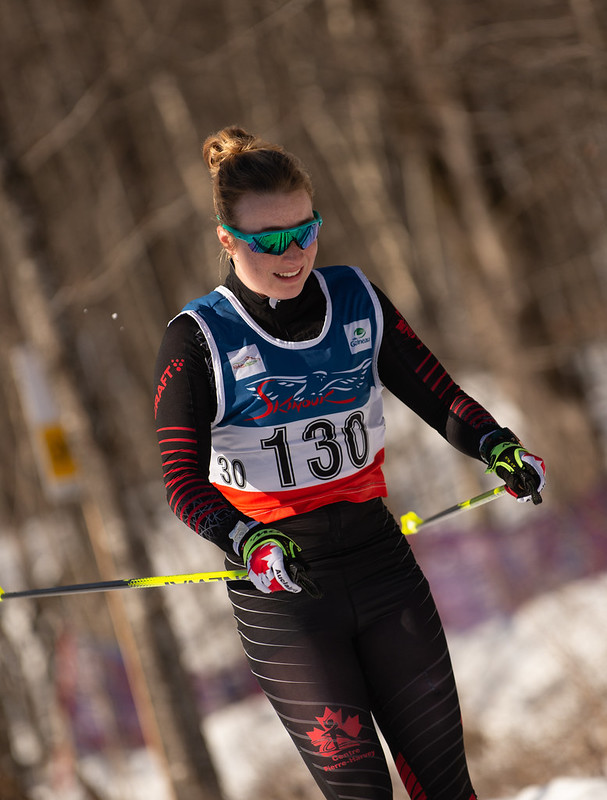
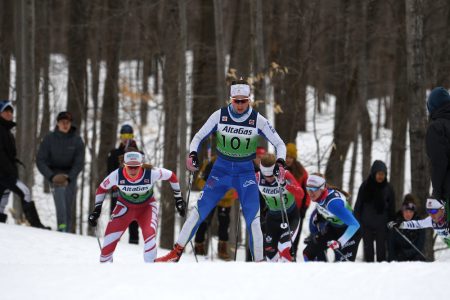
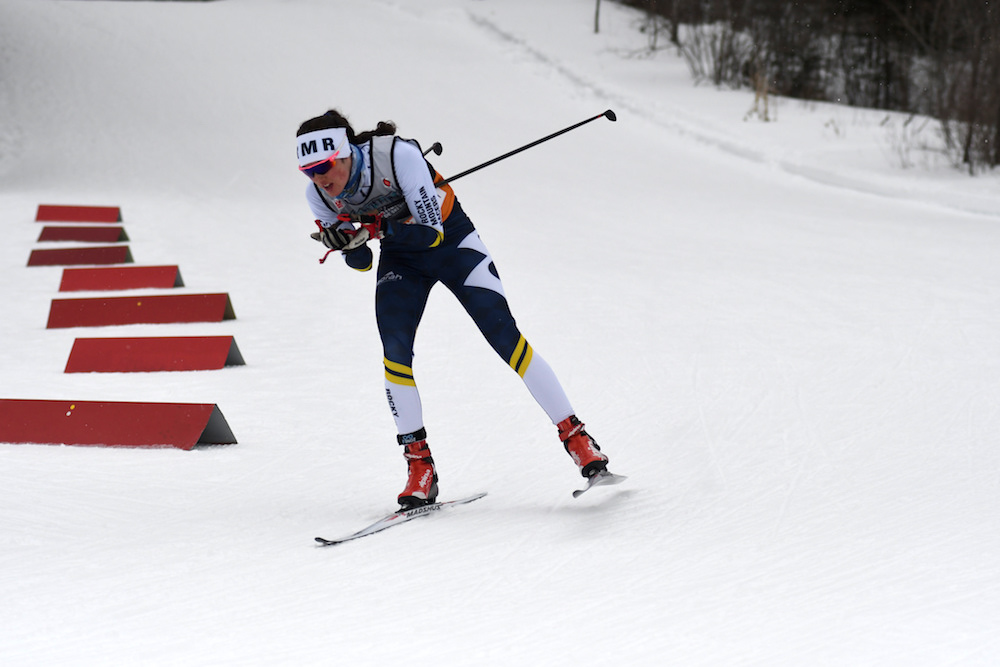
    Liliane Gagnon leads the women’s 10km at the Eastern Canada Cup at Mont Sainte Anne. (Photo: Stéphane Barrette/Nordiq Canada)

    The Eastern Canada Cup series wrapped up in Mont Sainte Anne (MSA), Québec, with distance racing for over 300 skiers each day. As with Westerns, the second weekend brought results and execution a little higher in the athletes’ focus, but the almost universal use of the words ‘fun’ and ‘excitement’ remain a reflection of a return to racing after a season without.

    MSA is just outside Québec City and is very accessible for most population centres in the province. It is a destination venue that is famous for challenging trails and a few brutal climbs that reflect 1991 homologation standards. Races are hosted by Club Nordique Mont Ste Anne on trails owned by the alpine resort. This is the home base of the Centre National d’Entraînement Pierre-Harvey (CNEPH).

    “The race organizers and volunteers did a great job today, the course was challenging but fun and the conditions were good despite the rain we got the day before.” — Étienne Hébert


    Saturday: Individual Start Classic 5km/10km

    The women kicked off the weekend with a 5km race of truth and it was CNEPH’s U20 Liliane Gagnon setting the standard in 14:00.7. Chelsea’s U18 Tory Audet was second at 7.5 seconds back, collecting her second senior podium of the season. Last weekend’s double winner Laura Leclair was third (+16.7), putting a second CNEPH suit on the podium.

    “I had a very good day!” Gagnon wrote to FasterSkier. “I surprised myself which is awesome. I knew the form was good, but I didn’t expect the race I pulled off. 5km classic individual starts are usually my biggest fear and I proved myself wrong.”

    Gagnon was one of many who had process goals top of mind.

    “I usually have trouble with individual starts because I don’t start fast enough. Today my goal was to start off quick and ideally keep that speed all through the race and I think I did a pretty good job. I really tried to stride long on the “false flats hills” and push hard on the top of the hills and I think it paid off!”

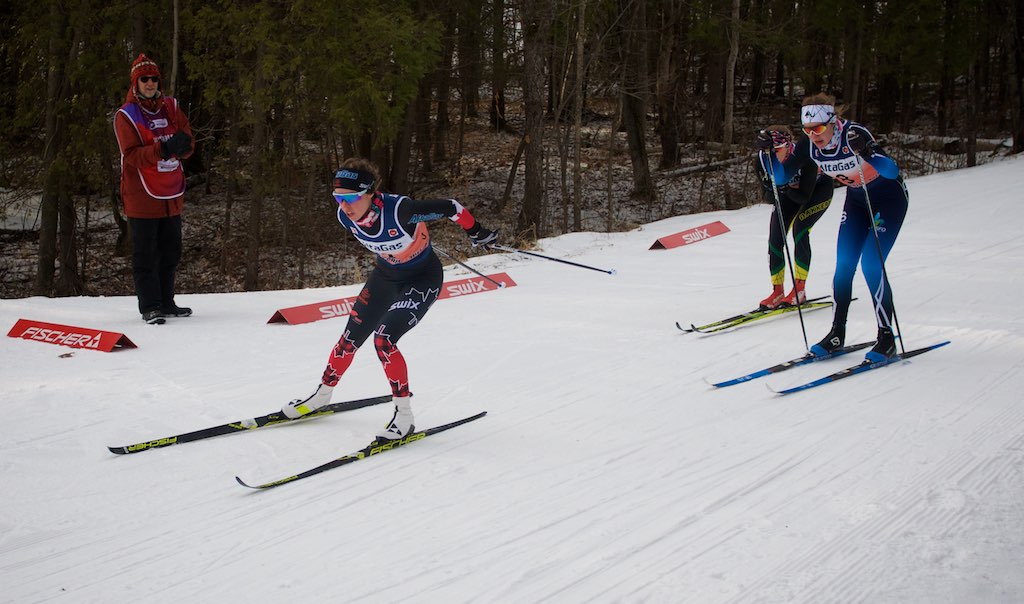
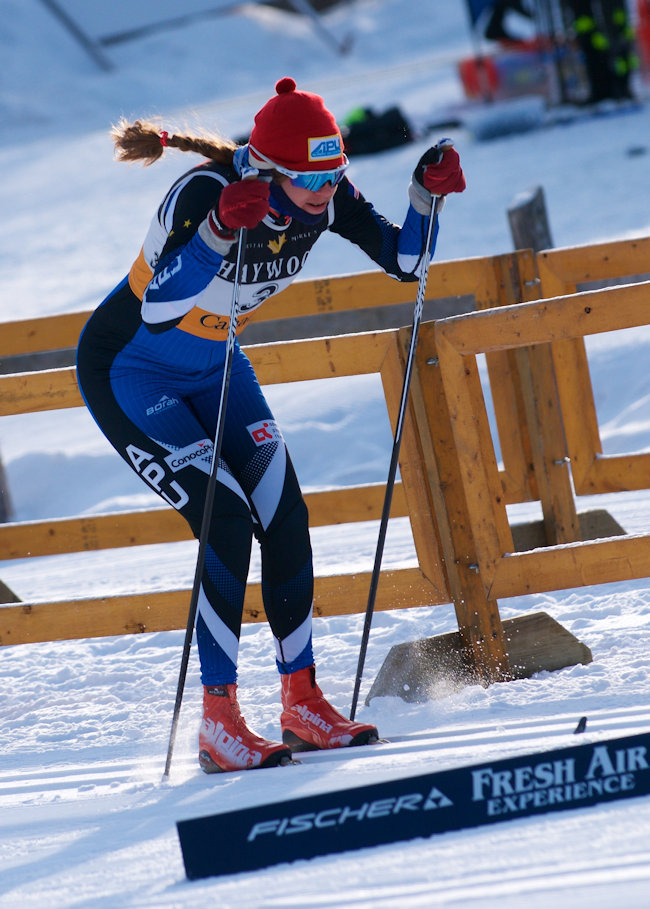
    Liliane Gagnon in the 5km classic. (Photo: Stéphane Barrette/Nordiq Canada)

    “I had a great race,” Audet wrote. “We had awesome glide but our kick was not ideal. The conditions were fast, which made this specific course very exciting. This course had a lot of uphills, which are my favourite! Uphills gives me the feeling of accomplishment every time I crest a new hill, and that motivates me for the next one!”

    Enthusiasm flows from Audet, who at sixteen was affected more than many by a season without learning from real races.

    “During my race, what stayed in the back of my mind was that a faster and more experienced skier started one minute behind me. I was driven to maintain that one-minute gap between us.”

    That skier starting one minute behind Audet was Leclair, who wrote “Today was an overall good day. I think I lost seconds in the last portion of the race but I’m happy with the first half. Skis were good and conditions were super fast. Happy to be racing at my second home.”

    Leclair is a Chelsea member, giving her the chance to race at both ‘home’ courses this month.

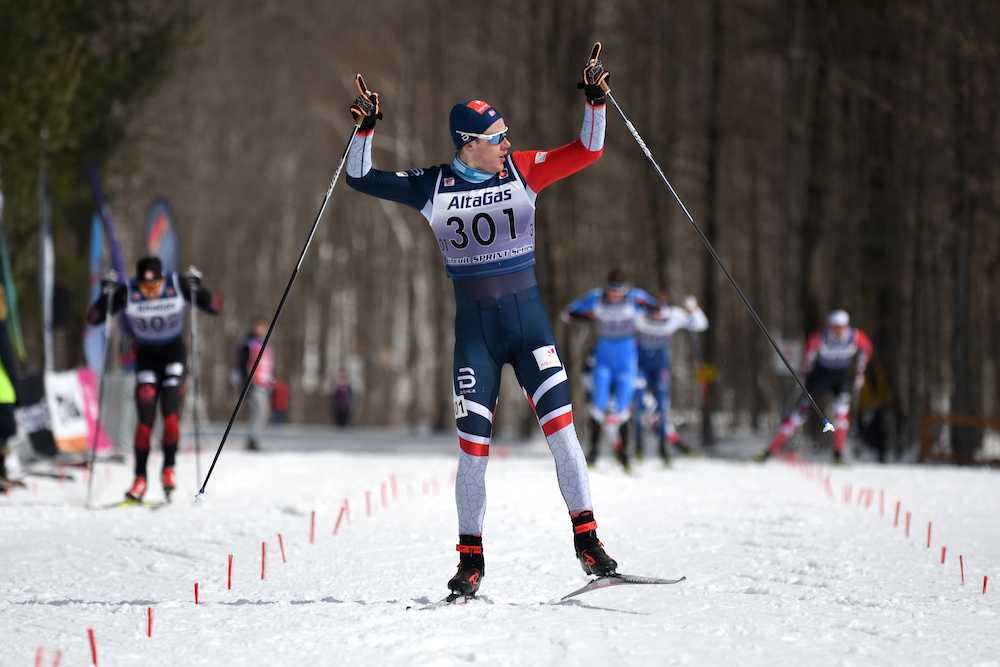
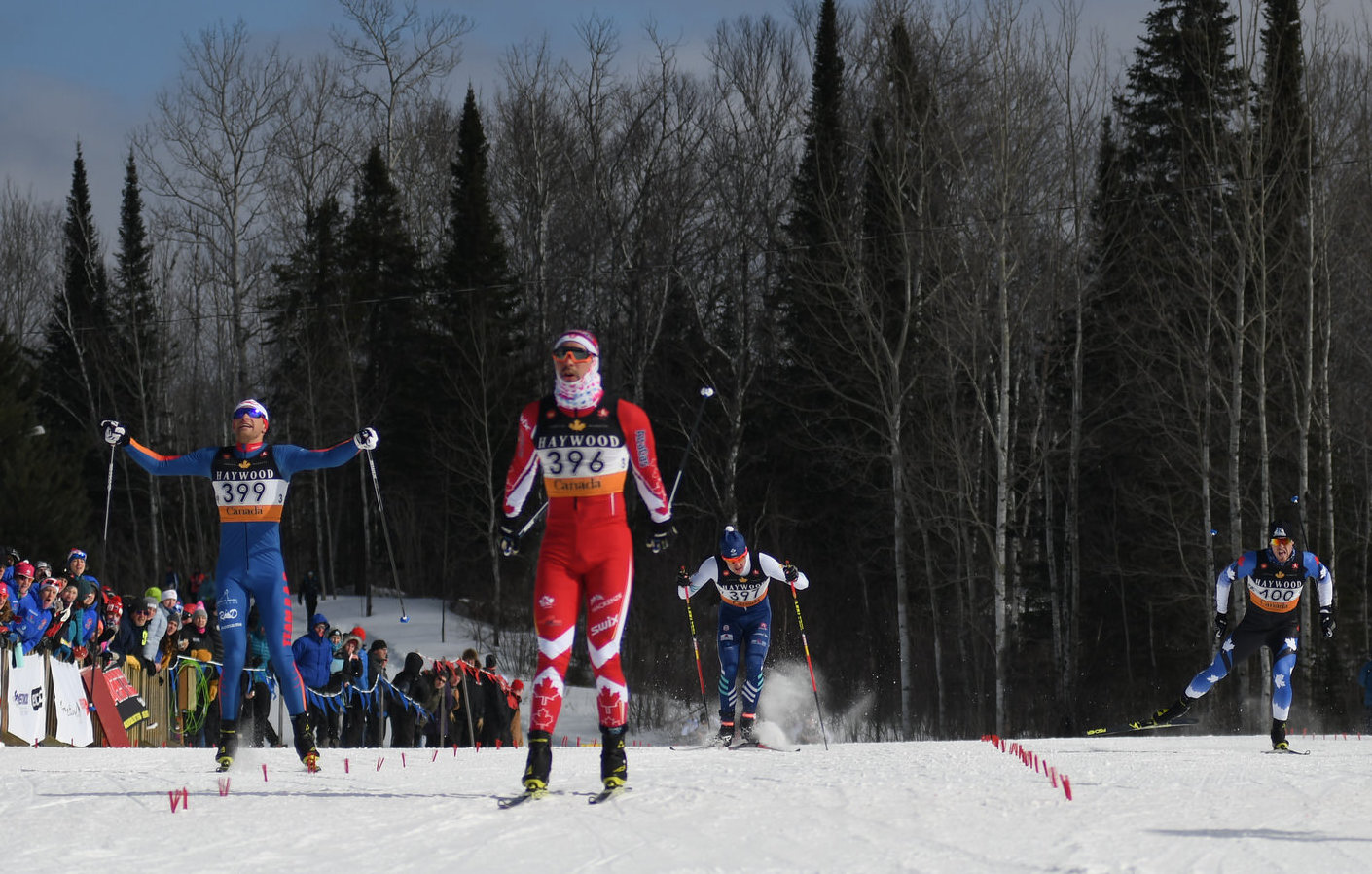
    Julian Smith on his way to another victory. Coach Timo Puiras is visible on the left. (Photo: Stéphane Barrette/Nordiq Canada)

    National Team Development Centre Thunder Bay’s Julian Smith his strong start with a third win in the new season, finishing the 10km in 23:51.7. CNEPH’s Phil Boucher was 24.7 seconds back, edging out TBay’s Pierre Grall-Johnson in third at 30.3.

    Boucher was fresh from the US SuperTour in Cable, where he was third in the 15km classic and won the 15km free.

    “My day was ok,” he wrote. “I was just not fast enough to win. Skis were good and my pacing was too. I just didn’t deliver the result that I was supposed to.”

    Grall-Johnson had a more optimistic outlook on his day.

    “Fun day today,” Grall-Johnson wrote, “first 10km of the season. Those are always hard distances, I am definitely feeling the fatigue of the past few months but still happy with how I pushed today… I think today was all about maintaining a high speed through the full lap, keeping the power high on the false flats and really pushing hard into the downhills. Our NTDC skis were awesome today, so looking forward to tomorrow.”

    5th place Étienne Hébert, another CNEPH skier, explained the ‘return to racing’ experience.

    “Definitely not a bad race in any way, my distance racing has clearly improved this year and getting consistent top fives and podiums early on helps build up confidence for the rest of the season.  The race organizers and volunteers did a great job today, the course was challenging but fun and the conditions were good despite the rain we got the day before.”

    What made the difference between 5th and the podium? “The guys in front on me just had a better day on Saturday.”

    Classic Results

    Sunday: Mass Start 10km/15km Free

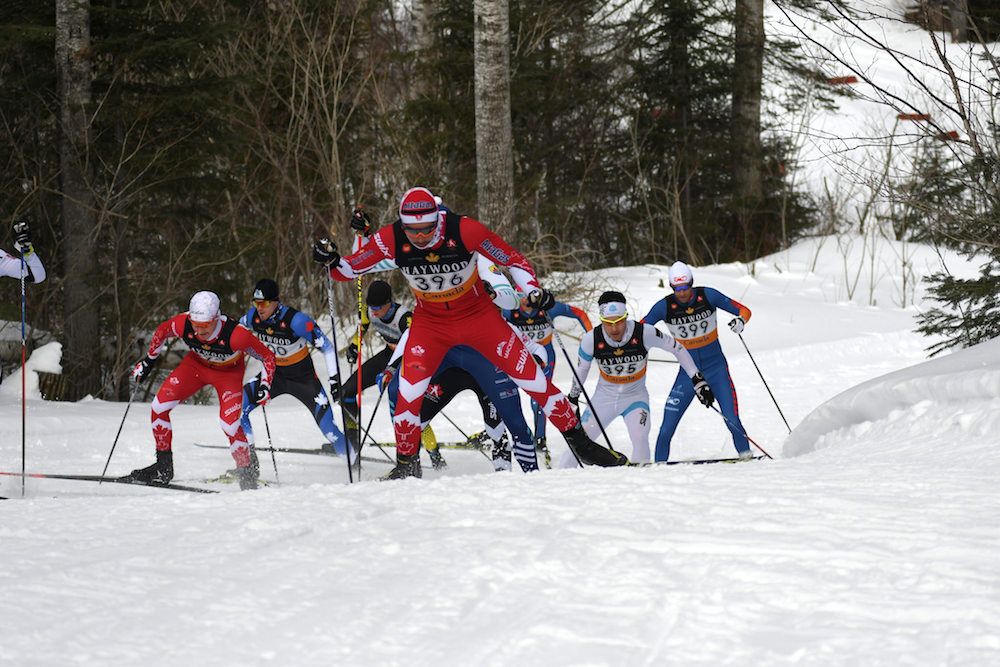
    Tony Cyr leads from the start of the 15km. (Photo: Stéphane Barrette)

    Sunday was a sun day on the course and delivered the first mass start in 20 months for most of the skiers present. The excitement and the broken poles were real.

    Antoine (Tony) Cyr, who returned from World Cup Period I with two top twelve results and a cold, pushed the pace early before finishing alone in 37:48.3.

    “Tony started with a strong pace,” Boucher wrote, “and after that we just tried to drop each other by a big enough gap in the hills so that the other didn’t catch up on the flats. I bonked first, so I got second…”

    “[The] skate race was good!” Grall-Johnson wrote of being the only non-CNEPH skier in the top eight. “It was one of those races that just flowed through. Antoine took it out a hard pace and then by the top of the first hill there were only three of us with a gap to the next pack, and then we just created a bigger gap over the rest of the first 5km. Tactics weren’t the deciding factor yesterday, I was very content to let Phil and Tony do most of the work and I just had to respond whenever they picked up the pace or tried to attack. At the beginning of the third lap Antoine and Phil pulled away from me on a long working section. I managed to catch back up to Phil who also had a little bit of an explosion and we skied together until he broke me going up a very steep hill with just about 1km to go.”

    Behind the trio, there was a lot more action.

    “Sunday’s 15km mass start was simply really fun,” Hébert wrote about his fourth place from a trio of chasers. “I skied the two last laps with my teammates Leo Grandbois and Felix-Olivier Moreau.  Those laps were very strategic and exciting, lots of tactics involved to fight for that fourth spot.  The start of the race was terrible for me, I got tangled up with other skiers and boxed behind which meant that the first lap was only about getting back in touch with the chasing group.”

    ***

    Gagnon won the women’s 10km in 30:42.1, continuing the CNEPH Sunday domination with Leclair second at 12.9 back. Nakkertok’s Zoë Williams was alone in third at 25.6 seconds behind.

    “My day was awesome!” Gagnon wrote. “Really did not expect taking another win today, but very happy that the race feeling is coming up strong.

    “My teammate Laura and I really worked through this one together,” Gagnon continued. “Maybe not the best tactic all through the race but it ended working out pretty well and we got a lot of experience from it. I knew when I was going to ‘attack’; I was ready to go hard in that last hill, last kilometre and did exactly that.”

    Williams had a plan for the mass start.

    “Tactically my plan had been to chill for the first lap behind the leaders,” she wrote to FasterSkier.

    Plans change, especially in mass starts.

    “Unfortunately my pole got broken right off the start which separated me from the lead pack, but I had a lot of fun working with Bronwyn to reel people back in! (And big shout out to Gilles Bérubé for the super smooth pole hand off!)”

    The ‘Bronwyn’ mentioned is Bronwyn Williams, 4th today, 3rd in the Nakkertok sprint last weekend. She’s also Zoë’s younger sister.

    Audet pulled out early after experiencing back pain. Her youth didn’t stop her from making the wise choice as Trials approaches.

    “Being up in the mix with the senior racers has been a goal of mine and I’m surprised that this is what I am doing,” Audet wrote. “I really enjoy racing with them, they have a lot more experience than I do and it is a lot of fun to race and learn from them.”

    Brazil’s Jacqueline Mourao was the leader of a large group of ‘other nation’ athletes vying for an Olympic quota spot, finishing 6th (+1:28.1). Mourao, now 46, is a seven-time Olympian who rose to prominence as a mountain biker and started skiing in 2005 while renting a basement suite from Pierre Harvey.

    Mass Start Results

    Finding the Bar

    After a season without racing, we now have four Canada Cup weekends to use to judge the state of skiing in Canada.

    With male athletes who have raced the US SuperTour and World Cup period 1, there is a basis for speculation on where Canada fits into world rankings.

    Boucher left the Cable SuperTour with a 1st, 3rd, and 16th results, the last coming in the sprint. Cyr  recorded 11th, 12th, 32nd, 56th, 42nd, 36th, and a DNF in three World Cup weekends. Antoine Briand skied two SuperTour weekends, finishing 2nd and 26th in sprints, 27th and 33rd in distance.  Boucher, Cyr, and Briand all train together at CNEPH which gives Boucher a unique perspective.

    “Tony is in a league of is own in Canada right now,” Boucher wrote. “He is skiing well and his race efforts are so consistent. He is skiing at a World Cup level, which I have been struggling to do over the past year. That being said, I don’t need to compare to Tony to know if I am at a World Cup level – my results from last year speaks from themselves and, sadly, the answer is no. I don’t feel fast enough to get a decent result on a World Cup event.”
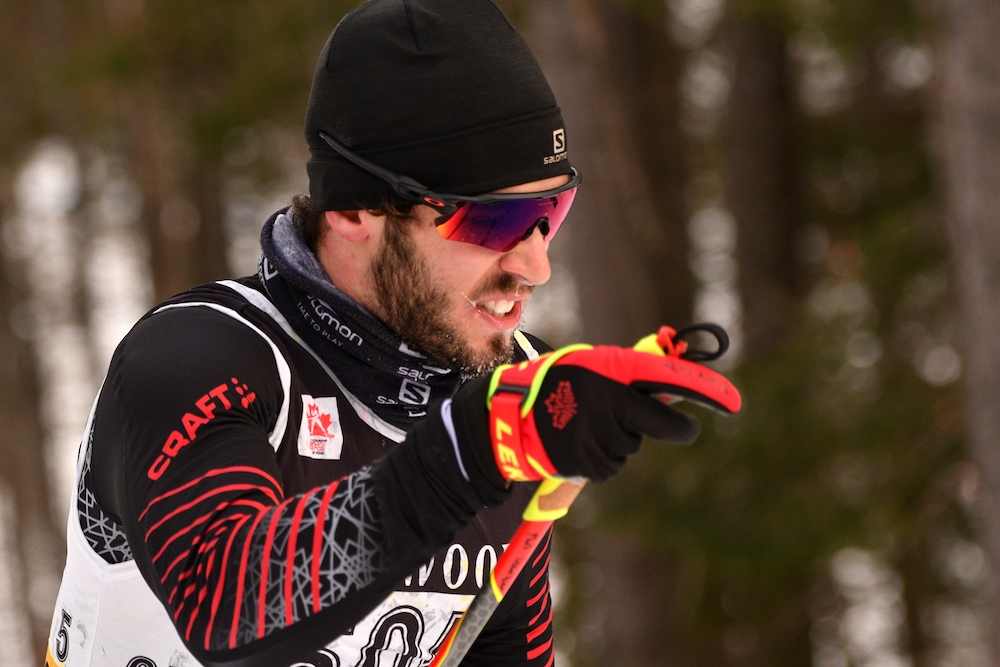
    Phil Boucher on his way to second place in the classic. (Photo: Stéphane Barrette/Nordiq Canada)

    We can already see that splitting NorAms into Western and Eastern Canada Cups has reduced travel, and travel costs for racers and teams. This is good.

    “I think it is pretty clear that splitting the Canadian field in two circuit results in a less competitive field,” Boucher wrote.  “We can compare the 15km mass start skate in Cable since it was pretty much the same kind of course. In the super tour, we had a leading pack of approximately 15 guys and this weekend we were 3 battling for the win.

    “So I’d say splitting the Canadian circuit is bad for the depth of the field of our Canadian races, but it doesn’t mean that the level of competition is not high. We still have great skiers in both Canadian circuits. It would just be more fun and more exciting to race against all the best skiers in the country.”

    Less depth in fields, especially in sprint heats, is probably not good. FasterSkier is following this closely.

    Up Next

    There are both new and familiar faces to watch from December, but the real test will be when the entire country meets at the Olympic Trials in Canmore from January 6th to 11th. This is the selection event for Beijing, U23/U20 World Championships, and World Cup period 4, which means most athletes have something to chase.

    Canada has Olympic quota spots for four women and three men, and unofficially the three men’s spots were allocated based on World Cup period 1 results. With so few Olympic berths up for grabs, the focus will shift to earning World Cup starts for older skiers.

    “I’m feeling reassured for trials, simply because last season was kind of a black period and I didn’t know we’re I stood. Now I know the shape is there, it’s going to be very stressful weekend, with a lot at stake but I’m confident the preparation is good and I’ll be ready.” — Gagnon

    “Only thinking about racing, I think it will be an incredible event and I can’t wait to race for the win on the tough Canmore courses.” — Hébert

    “With Trials being held in Canmore, I am sure the volunteers will put on another great event. The courses are something to behold in Canmore with demanding climbs and technical descents. I am sure the athletes will all be excited to race hard, and the spectators will surely be there looking on with anticipation. I think as long as everyone follows covid protocols and respects regulations, everyone should be able to compete, coach and spectate while feeling safe.” — Smith

    For most of the roughly 600 individual skiers who have raced one or more Canada Cups this month, the return of racing is the return of measuring progress and the return of learning.

    “I had no clue how to pace myself, there were tough climbs and I don’t have a lot of experience, and hadn’t raced on a course this difficult in 2 years.” — Audet

    Racing in Canada, Racing at Home

    “Racing in Canada is always fun! Skiing with teammates and with family and friends cheering you on is always fun. It’s a familiar feeling and it’s feels good to start off the season that way and hopefully later moving on to the big races in Europe.” — Gagnon

    “A lot of excitement again this weekend.  There was good support from parents and friends cheering on the side of the course which brought good vibes through the weekend.  We also got lucky with weather, especially on Sunday with a beautiful sunny day.  In Mont Sainte-Anne, the race organizers always have to deal with RCR, the group that owns the mountain, who often don’t even do the minimum to give skiers decent trail conditions all winter.  So, the Club Nordique Mont Sainte-Anne organizing an event like they did last weekend really shows the commitment of the volunteers and the community around the mountain.” — Hébert

    “It feels amazing to be back on the race course again! I have really missed racing and with a couple tough years of sickness and injury simply getting back on the start line is an incredible win. Some things have for sure changed, but honestly, at the heart of things it’s still the same. It doesn’t matter who’s on the race course for me; the goal is always to go as fast as I can between the start and finish line and figure out what I can change for the next race to go even faster!!” — Williams

    “The weekend in MSA was exciting. The conditions were superb and the race organizers did a great job. There were lots of spectators respecting covid precautions and cheering loudly! The 10km classic interval start was fast and furious with quick conditions and great waxing by our staff! Sunday was fun to race a mass start and started off with a blistering pace and a course full of long uphills!” — Smith

  • Eastern Canada Cup #1 & 2: Getting Started in Nakkertok

    Eastern Canada Cup #1 & 2: Getting Started in Nakkertok

    The men’s sprint final at Eastern Canada Cup #1 on Nakkertok trails. (Photo: Robert Smith)

    Once again, there was a great weekend of racing on the Nakkertok trails in Gatineau, QC. It was almost like the pandemic pause hadn’t happened: lots of racers, live results on Zone4, great support for media.

    But it isn’t really just Nakkertok. ENGNE, a coalition of local clubs, puts on great races using Nakkertok trails and the NakkerTrak snowmaking magic.

    As with the first Western Canada Cup (WCC) race, the theme of the weekend was smiles and rust.

    “The mood at this weekends races was super fun!,” wrote Laura Leclair. “Even if it was pouring rain on Saturday, people were very happy to put a bib back on. Super grateful towards all the volunteers who stand in the rain in order to run the event smoothly!”

    Leclair is a CNEPH team member from Chelsea Nordique, one of the ENGNE host clubs and a double winner. Her thoughts were echoed by National Team Development Centre (NDC) Thunder Bay’s Julian Smith, who also won both events.

    “The race went really well today, it was super fun, the volunteers put on a really good event. It was really wet and rainy this morning, but that actually made it for a really fast day.”

    A number of athletes wanted FasterSkier to know that the volunteers got the worst of the Saturday rain before the athletes were on course. Smith put it best:

    “I want to thank the organizers profusely because they were true champions. It was a terribly miserable day to stand still outside for 10 or more hours and they did so with smiles and cheers!”

    Luckily for these volunteers, Sunday brought sunshine for an individual start.

    ***

    Canada is in a sense divided by Thunder Bay, though it is not equidistant from the eastern and western borders. The west has more space, but the east has more people. Sovereign Lake draws volunteers from the local population of 43,000, noticeably smaller than Ottawa/Gatineau with 1.3 million. The population difference also affects the number of athletes, with 12 million Canadians living close enough to drive to Nakkertok for a weekend. As in, almost a third of all Canadians.

    Nakkertok hosted about 480 racers, continuing the trend as the largest event on the continental cup circuit in North America.

    Thunder Bay is neither east nor west, but is within flying distance from both. The only races in driving distance are in the US.

    NDC TBay sent their team west for WCC 1&2 before heading east for ECC 1 – 4. This will give the viewers a few hints about the relative strengths of the two solitudes.

    FasterSkier is trying to bring the Eastern Canada Cup to life from a sunny Sovereign Lake parking lot while this reporter’s partner is doing yet another double workout day at ladies camp. Both Western Canada Cups were held at my home venue, which makes it easy to capture athletes before or after their cooldown ski, record video of the race itself, talk to officials, and feel the vibe from the volunteers, the parents, the siblings, and a few hundred recreational skiers who have never seen a race before. So how is this going to work? And how can it be better for Eastern Canada Cup 3&4 next weekend? Or for the National Championships in Canmore in January?

    Pre-pandemic, the key to getting good content remotely was to email questions to the athletes at the magic time when they could read the message at the venue, then reply at the first convenient pause with wifi, often the airport. When a ‘surprise’ athlete made the podium, it was usually someone FS had been tracking. Now we have a Tory Audet earning her first FIS points and her first senior podium on the same weekend.

    Luckily, Julian Smith helped FasterSkier out with some videos that bring the weekend closer.


    Saturday: Free Technique Sprints

    Saturday started with a downpour on the volunteers setting up, but the action heated up quickly as most racers got their first race in a bib in twenty months. The men raced first, unusually.

    Pierre Grall-Johnson leads Étienne Hébert early in the sprint final. (Photo: Robert Smith)

    CNEPH’s Étienne Hébert won the qualifier in 2:39.86 in his first official race, edging out two TBay skiers who had raced WCCs the previous weekend: Smith by 1.15 seconds and Pierre Grall-Johnson-Johnson by 2.03

    In the heats, it was the Smith show again, winning all of his heats. Hébert took second in his first sprint day, ahead of Grall-Johnson-Johnson who, like Smith, had done all three rounds at Westerns the week before.

    “I felt strong but a little stiff in the qualifier which maybe have been due to warming up in as much water proof clothing as possible,” Smith wrote to FasterSkier. “But the heats, the skis were running fast and the body felt snappy.”

    Hébert was thrilled to be racing again.

    “It’s amazing to finally put a bib back on and race against the other Canadian athletes.  Stress levels were somewhat high before the sprint but it quickly got replaced with excitement.  Having the possibility to race, especially before Olympic trials, is great and I want to say that Nakkertok did an amazing job this weekend.  We train all year as a team for those moments when you get to put the CNEPH suit on and show everyone how fast we are.  This weekend was only the start and we’re all excited for MSA next weekend.”

    MSA is Mont Sainte Anne near Québec City, the home of CNEPH, and like Nakkertok, a keystone race venue in Canada.

    “Saturday’s sprint had a lot of positives,” Hébert wrote about the results. “I got to see that my form was really good and that I can already compete at a high level. Tactics can still be improved but that will come with simply racing more.”

    “Tactics was the key factor in the sprint on Saturday.  Pierre and I had a gap on the rest of the field after the first climb but Julian got back in touch before the last downhill and used the slipstream to get ahead.   thought I could just stay behind [Grall-Johnson] until the finish and pass him but he slowed down too much on the second climb which allowed Julian to come back.”

    Grall-Johnson had his own view of the final on his home trails.

    “Knowing the course very well, as I grew up on it, I was pretty confident in what tactics were best but these races are always good opportunities to try out new ones,” Grall-Johnson-Johnson wrote. “In the final I decided to go out hard from the start and see if I could create some separation, I was able to get a few meters on the first climb but had a pole go deep through the snow which almost made me crash with loaded legs and then on the second climb I had very little energy so I was caught and then conceded in the downhill due to a very advantageous draft going into the finish. Overall though happy with a third place.”

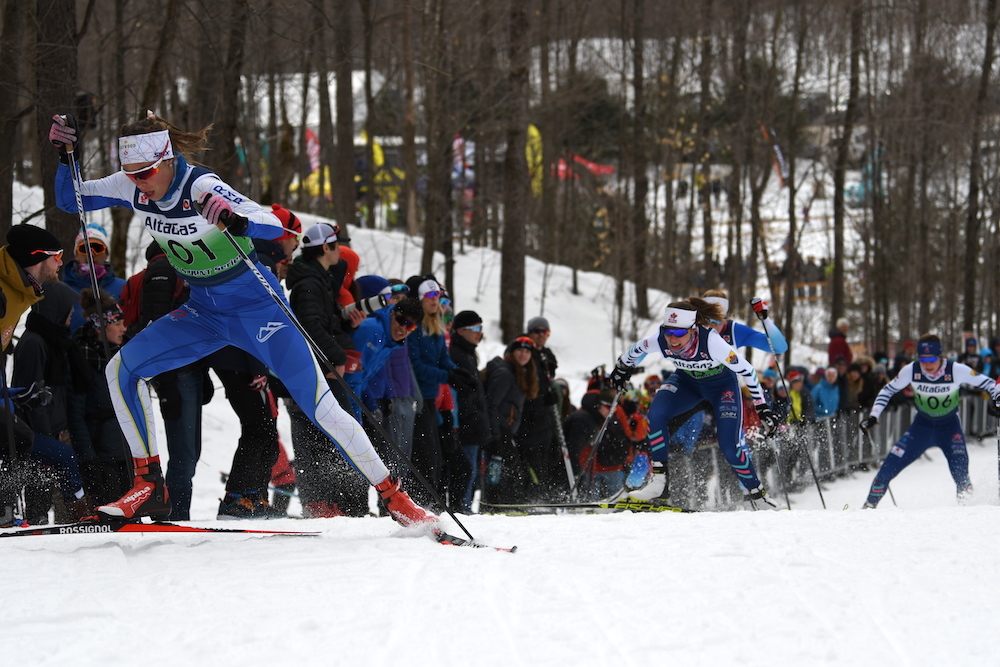
    Laura Leclair wins the final, just ahead of Shaylynn Lowen (Photo: Robert Smith)

    Leclair won the qualifier in 2:55.08, just ahead of CNEPH teammate Liliane Gagnon at 0.29 seconds back. TBay’s Bronwyn Williams and Shaylynn Loewen followed at 2.96 and 3.25 behind.

    In the heats, Leclair won her quarter, came second in her semi, and then edged Loewen for the win.

    Liliane Gagnon leads Laura Leclair in the final. (Photo: Robert Smith)

    “I was pretty confident in Saturday’s final heat,” Leclair wrote to FasterSkier. “I knew that my teammate (Liliane Gagnon) and I could work together in order to position ourselves in the front. I knew we were stronger in the last uphill and Lili and I were able to make a gap between the other skiers.”

    “Unfortunately, Lili fell in the last corner (I swear I did not tackle her ) so I was alone for the last downhill. The other girls caught up because of draft, but I was able to take the win.”

    Williams took third, followed by Chelsea’s U18 Tory Audet, who qualified 5th. Audet also lead the list of new names to watch. Twenty months without racing is a long time in the development of junior skiers, which means more welcome surprises are coming.


    Sunday: Classic Interval Start 10km/15km

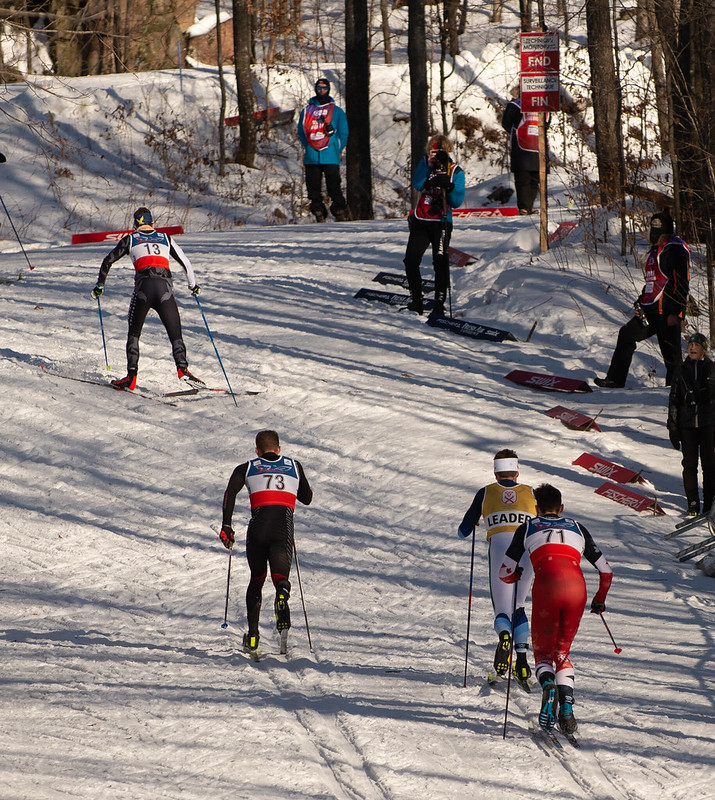
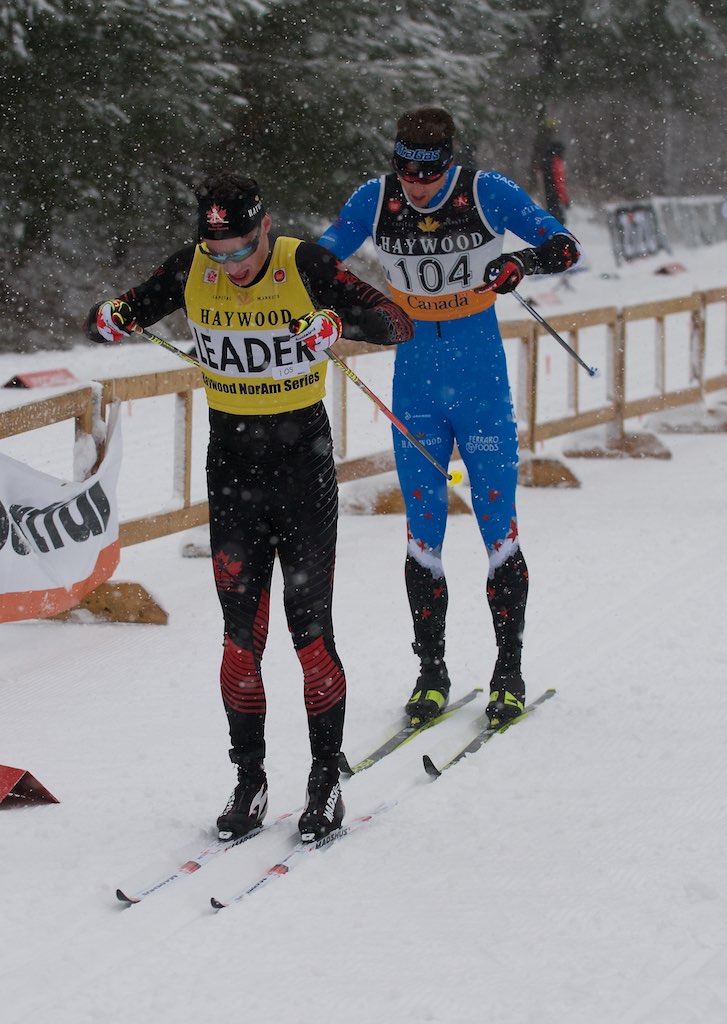
    Julian Smith (yellow bib) skis beside Étienne Hébert (73) in the 15km classic. (Photo: Robert Smith)

    Smith won the 15km in 35:21.3, giving him four wins in four race days, and then summarized the event in a short sentence to FasterSkier.

    “The weekend was a blast!”

    Smith later added a little more detail: “The Sunday weather could not have been more different. -4 and bright sunlight was a welcome change and the track was set for a blistering 10/15km for the seniors.”

    Grall-Johnson was a close second, 4.6 seconds back.

    “Today it was a relatively flat course with lots of laps so I double poled 90% of the race other than the stride zone,” Grall-Johnson wrote. “It was a great fight between Julian and I today, we were going back and forth in the lead, unfortunately Julian pulled away in the end but despite a crash on the first lap I was happy with how I was able to refocus and push mentally.”

    Hébert was third at 25.1 seconds back, changing podium places with Grall-Johnson.

    “The last two laps of 2.5km is where the order of the podium got decided,” Hébert wrote. “Julian and Pierre finished stronger than I did.  We were, all three of us, really close after 10km, inside 10sec I think.  I’m looking forward to a course with more climbs because striding felt really good but my muscles got stiff in the double pole which definitely caused me to lose some time.”

    Laura Leclair poling to victory. (Photo: Robert Smith)

    The women’s 10km also had a double winner, Leclair in 28:05.3.

    “I am not usually a classic skier but I worked hard on my technique this summer and I am super happy to see it paid off,” Leclair wrote. “I felt really good, the conditions and skis were super fast and I just went for it. For some reason I didn’t get any split during the race so I wasn’t sure where I was but I just skied my best.”

    The next three places were U20 athletes: Audet at 25.8, Gagnon at 32.5, and Big Thunder’s Sarah Cullinan at 54.3.

    Gagnon is well known to Canadian fans and raced at U20 World Championships in Vuokatti last season.

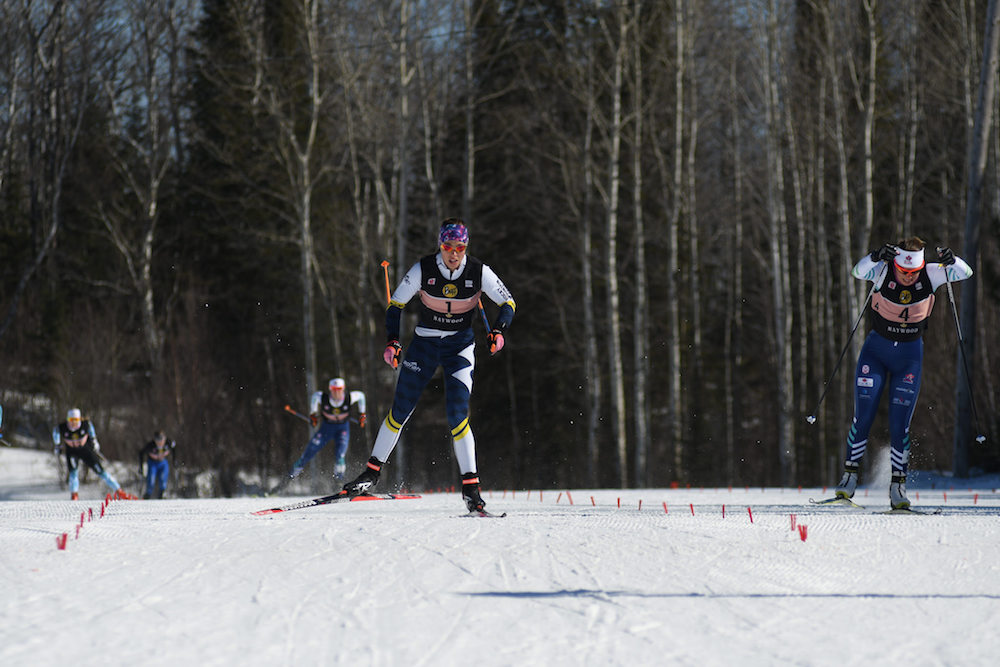
    Tory Audet on her way to her first open podium. (Photo: Robert Smith)

    Audet, who recently turned 16, has less public history as a skier.

    “This was my first U20 podium, and my first FIS pointed race,” she wrote. “I was only eligible for a FIS license last year, and since there were no races, this was my first FIS pointed race.” 

    In her first weekend, she raced up in U20/Open and it paid off for her with a 4th in the sprint and 2nd.

    “Having not done a sprint in over a year, and never with older athletes, I had no clue what to expect. My goal was just to race fast and see how far I could get. I knew the trails quite well and had raced them in previous years, which was good because I knew what to expect.

    “As for race tactics, I have limited experience in sprints so at the beginning of the day, I didn’t have any tactics. It was not until I hit semis and made the mistake of leading the pack that I started to think about tactics. I was drafted on the hill  and I lost my spot in the finals, but regained it as a lucky loser. When it came to the final, I decided to try a different strategy: to get out in 3rd or 4th and draft off everyone. It was was really fun because I got to observe everyone else’s tactics,  to see the lines they were taking, and learn from their extensive experience.”

    With U20 athletes on the podium at both Eastern and Western Canada Cups this weekend, it is clear the next generation made good use of a season without races.

    Sprinting heats: Robert Smith caught the reactions to a crash. (Click to enlarge.)

    Getting In The Mood For Racing

    “Everyone just seems to be happy racing again and I think that really helps in making the events fun. Its the first time many of the volunteers have helped with racing events, either for a long time or just first time ever so obviously you have to be patient and understand that everyone is a bit rusty but overall energy is great!” — Grall-Johnson

    “I could feel that everyone at the venue was really excited to be there.  Saturday’s weather was suppose to be horrible but we got kind of lucky with the worst of the rain falling before the qualifier.  Despite this, athletes and everyone else at the venue had big smiles on.  Seeing everyone again after a year and a half was exciting.  I got to see the athletes and coaches from Monteriski, my home club, and all the competitors I didn’t see for the entire pandemic.  Excitement is really the mood that was present last weekend.” — Hébert

    “I am super stoked to be racing back in Canada again. It was great to be at home in front of friends and family and super cool to see how everyone has been training!” — Leclair

    “Our wax techs did an incredible job  so a huge shout out to our staff and the organizers [who] put on a great event for a second day. It is just so exciting to be racing in Canada again, and having friends and family cheering from the sidelines makes it even more special.” — Smith
    Results: full weekend, qualifier, heats, interval start

    Photo Galleries: Robert Smith Sprints, Distance Men, Distance Women, Younger Athletes
  • Western Canada Cup #1: Back to the Bibs

    Western Canada Cup #1: Back to the Bibs

    Olivia Bouffard-Nesbitt starts the first FIS race in Canada in 20 months.

    Racing returned to Canada after a lost season, and there are plenty of storylines to follow.

    This weekend, The Sovereign Lake Nordic Centre in Vernon, BC hosted a freestyle sprint and a classic 10/15-kilometer individual start. It sounds so familiar, a re-run of the annual NorAm kickoff with a new Western Canada Cup name.

    Travel to the venue became more challenging when a November 13th ‘atmospheric river’ destroyed the two main highways between Vancouver and Vernon. The two alternate routes reopened fairly quickly, but only for commercial traffic. This created an unusual situation where athletes from Vancouver had to fly while athletes from Manitoba (two time zones east) were able to drive.

    Official training on Friday was lightning fast.

    Another atmospheric river on December 1st brought record heat to the region, with a high of 16C in Vernon, well above the old 7C record. A timely cold snap saved the snow base, albeit with extremely fast glide for Thursday and Friday training. The sprint course was changed from the 2005 World Cup loop to a safer and slower variation.

    Despite border restrictions, a number of U.S. teams attended. Dartmouth made their annual trip from Vermont, joined this time by Green Mountain Valley School and Stratton Mountain School (not the post-graduate SMS T2 team; they went to Duluth). Methow Valley Nordic Ski Education Foundation sent a much smaller team than usual, but Sugar Bowl Academy in California helped to make up the numbers (and took a few medals home too).

    Further reaching by geography, Brazil and Portugal each had one woman racing, who were discussing plans to earn quota spots for the 2026 Olympics. Throw in the second ever Mexican National Championships and you have the makings of a great weekend.

    Saturday Freestyle Sprint

    Two themes dominated the sprint day: smiles and rust. With only a few athletes having raced the previous season (World U20/U23 and World Cup athletes), the excitement of racing again was visible everywhere. 

    The rust was also on display. Athletes regretted their layering choices. Enthusiasm led to extremely aggressive starts and ragged finishes. Many athletes forgot to allow time to collect timing chips on the way to the start. More forgot that it takes extra time to show the ‘fully vaccinated’ wristband to be eligible to start. Quite a few discovered that the wristband should not be on your watch arm, because the wristband is covered by a sleeve locked in place by the watch strap resulting in a longer delay. A wristband that is applied so that it can’t be transferred to another person also can’t be moved to the other wrist for day two. Lessons learned, or re-learned, for many skiers.

    National Team Development Centre Thunder Bay (NDC TBay) athlete Julian Smith summed up the first day back for FasterSkier.

    “Yeah, first day racing in Canada in a long time,” he said. “My last race was the American Birkebeiner in February 2020. So that’s pretty fun to put the bib on, really push the body and race with all our friends out here. The organizers here at the Nordic Center did a great job. And everyone was doing their job well and it ran really smoothly.”

    Behind the scenes, there were also a few learning and re-learning moments for the 180 volunteers running the event.

    Nonetheless, race morning dawned with a steady snowfall at -4C that provided great skiing and slower racing.

    Olivia Bouffard-Nesbitt was the top seed and became the first person to race for points in Canada in twenty months.

    Pre-race speculation had a changing of the guard, with the young athletes expected to displace the known entities, and most athletes feeling confident in their preparation with very little evidence to back it up.

    Bouffard-Nesbitt, who trains with Alberta World Cup Academy (AWCA), justified her #1 bib by winning the 1.3km qualifier in 2:59.69, 2.31 seconds ahead of Kimberly’s U20 Marielle Ackermann. Shaylynn Lowen (NDC TBay) skied to third (+6.54).

    In the heats, Ackermann comfortably won each U20 round to take the win while Bouffard-Nesbitt showed her experience to dominate the senior heats.

    Bouffard-Nesbitt, like most of the skiers, was visibly thrilled to be back on course.

    “Oh, it was really good,” she said, before laughing. “It was rusty! It kind of felt like the first race back in two years. But every heat got progressively better. Quarter was better than the [qualification] and then better after that, so yeah, it was great.”

    Sovereign’s own Hannah Mehain got stronger through the heats to take second place, ahead of Dartmouth’s Callie Young.

    “I felt maybe not quite as snappy in the qualifiers,” Mehain told FasterSkier. “But it improved for the day and I just felt better and better .”

    As the American east and Eastern Intercollegiate Skiing Association (EISA) faced COVID restrictions that limited race opportunities, Young was in a similar boat to the Canadian women in terms of lack of high-level racing opportunities. She also shared her feelings on the sprint day.

    “I didn’t have my best qualifier, this is my second day at altitude,” Young said. “So it was kind of tough. But when I get into the heats, it’s always so fun and competitive.”


    On the same course NDC TBay’s Smith was clearly the strongest of the men, winning the qualifier and all three heats. Xavier McKeever and Tom Stephen, qualifying 2nd and 6th, both chose to race up in senior, resulting in some hard fought heats. McKeever and Stephen are both members of the national team and train with Foothills Nordic Ski Club in Calgary.
    “It was really fun,” said Smith after his race. “It was a blast for the body to do what it’s supposed to do, what I’ve been training it to do, so that was really fun.”
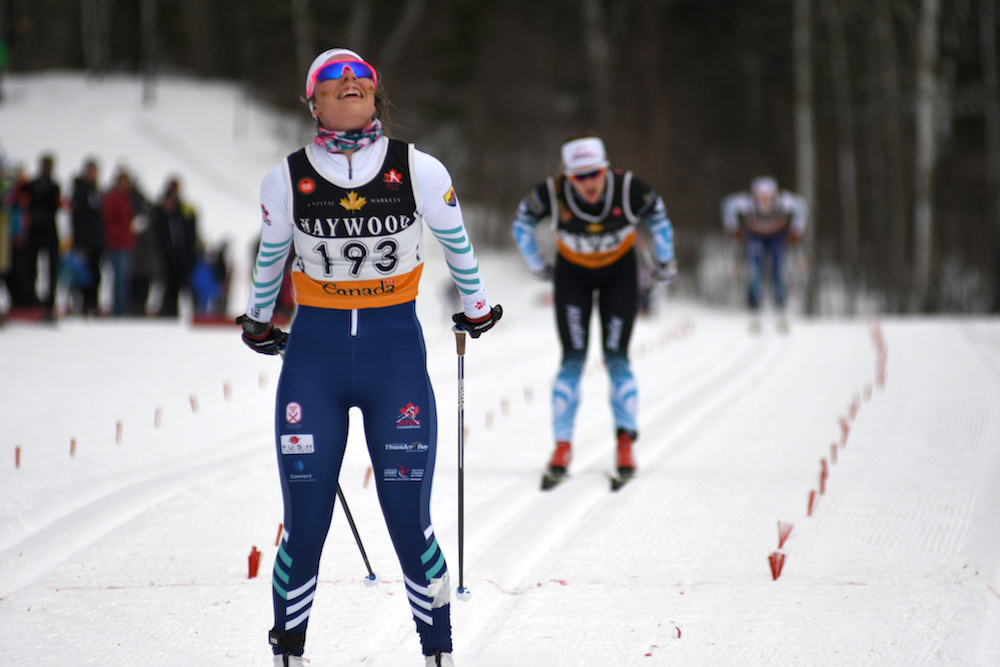
    Smith was one of the few who answered the tactics question with something other than how much fun it was to be racing again.
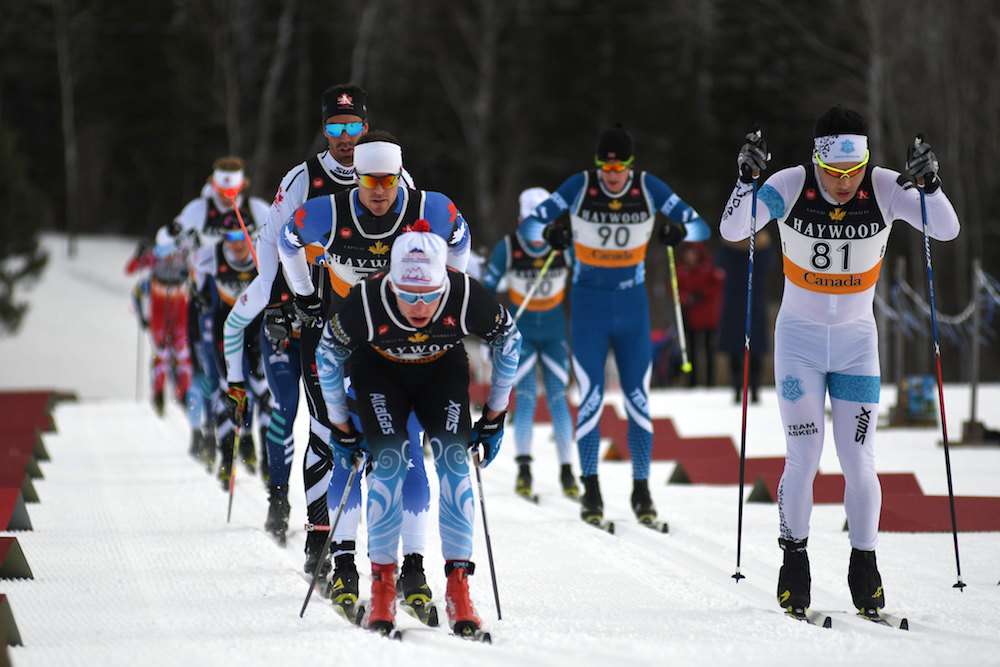
    “In the final, it kind of slowed down at about the first third. And I just tried to go when everyone else started to go and got a bit of a gap and in the end, was able to hold the lead. So that was really fun.”

    In the end, the juniors found themselves enrolled in the Locke School of Heat Tactics, with Black Jack’s Julien Locke using guile to take second in the final after qualifying 7th.

    AWCA’s Bob Thompson gapped NDC TBay’s Pierre Grall-Johnson on the climb to complete the podium.  

    World U20 relay silver medallist teammates McKeever, Rémi Drolet, and Stephen were 5th, 6th, and 7th, while Olivier Léveillé was away in Lillehammer. Though age and experience filled the podium, Grall-Johnson-Johnson was the first U23 athlete showing that the younger skiers are putting the pressure on.

    Sprint Results: Qualification, Heats, Final, U18/U16 Mass Start.


    10km/15km Classic Individual Start

    The race of truth was also the race of discovery as many athletes re-discovered why pre-race routines exist. Sunday dawned clear and cold, rising to -11C for the men’s start at 9am. With yesterday’s new snow packed hard, there was no difficulty in finding grip with hard wax, but not everyone found the glide necessary on a 5km loop that is flat and fast by World Cup standards.

    Rémi Drolet, just returned from racing Continental Cups in Muonio and Gällivare, skied a consistent race to take the win in 39:06.1, setting the fastest time in all three laps.

    Stephen was second, 39.6 behind, moving up on the final lap.

    “It was really good,” Stephen said. “It’s my first 15k back this season because I’ve been coming back from injury. And it went really well, it went just like I planned it, so really happy with it.”

    Interval starts are more exciting than they used to be.

    “Oh, it’s so fun,” Smith added. “I haven’t done something like this with this many people in a long time.”

    AWCA’s Jack Carlyle skied a very strong first 5km lap before struggling with the cold after a mistake choosing baselayers, finishing third at 49.2 back.

    “I made a rookie mistake and did not wear enough layers and froze halfway through the race,” Carlyle explained once he was warm again. “But I had great skis. And for the first bit of the race, I had great feelings. So yeah. Happier where the body is just need to remember not to make silly mistakes.”

    McKeever recovered from a slower first lap, moving up from 7th to finish 4th at 1:06.8 behind.

    “I was really lucky to start my season off in Europe, with a couple of victories in Finland and Sweden. And I was really happy with how they went, especially after last year being a really tough year for myself,” he said. “So overall, I’m pretty stoked to just be back at it.”

    “The sprint yesterday, I think went really well. Today, I was just missing a bit of gas. I feel I didn’t feel awesome, awesome, but it’s just nice to get out there and race again in Canada. And we have more next weekend.”


    Jasmine Drolet stepped up the sibling rivalry with a win in the 10km in 30:38.9. Now in her first year at Dartmouth, she made up for missing the sprint with a steady performance.

    “Definitely a shock to the system,” she told FasterSkier. “But I’m glad to have gotten it over with and to be in racing season now.”

    Back in Canada after her first semester in the Ivy League, she was adjusting to the changes.

    “I was nervous before [the race]. Changing training, and changing coaches and everything, but now, I feel confident that my training this fall was good. The US is maybe a little bit different than Canada, but not very different. It’s a lot of work to juggle school and skiing full time, but it’s manageable.”

    Bouffard-Nesbitt finished in second place, 41.4 back, with a fast first split.

    Another full-time student, Mehain was third at 1:09.7, just holding off a fast finishing Beth Granstrom.

    “I had a great day,” Mehain said. “It’s really fun to be out racing again, seeing everybody. I pushed fairly hard on that course for the classic 10k and had a lot of fun.”

    Distance Results: Interval Start, Full Weekend.

    Mexican National Championships

    Karla Schleske Shepard is the first female National Champion for Mexico. (Photo: Peggy Hung)

    This is the second National Championship for Mexico, with the first held in Canmore at Canadian nationals in 2019. Starting a ski program in a country without snow or a skiing tradition is hard, even without a pandemic disrupting progress. This year, there were six men and one woman competing.

    Jonathan Soto Moreno won both days, capping a year where he also earned a Beijing quota spot for Mexico at World Championships.

    Karla Schleske Shepard, a former heptathlete who represented Mexico at the PanAm games, became the first ever female champion after learning to ski in February 2021.

    What’s Next?

    December 11th and 12th has both the Eastern Canada Cup #1 at Nakkertok and the Western Canada Cup #2.

    The major storm that threatened the first weekend at Sovereign did even more damage in Rossland, forcing Black Jack’s Organizing Committee to cancel. WCC #2 will now be held at the backup venue, Sovereign Lake, with details forthcoming.

    With continued highway closures in BC and additional border restrictions related to the omicron variant, many travel plans will change. Both ECC #1 and WCC #2 may have smaller fields as US teams react to the increased friction at the border.

    NDC TBay, based in arguably the east/west centre of the country, is headed for the eastern Canada Cups. This will allow some comparison between the two series and give ski fans something to debate during the Christmas break.

    All will be made clear in Canmore on January 6th to 11th, when trials for OWG, U20/U23 World championships, and World Cup Period 4 will bring together the top athletes from the entire country.

    Photo Galleries: Doug Stephen (VR45 Photography): Sprints, Distance


  • Nakkertok NorAm Weekend Round Up

    Nakkertok NorAm Weekend Round Up

    Katherine Stewart-Jones leads a sprint heat on her way to domination. (Photo: Robert Smith)
    Katherine Stewart-Jones leads a sprint heat on her way to domination. (Photo: Robert Smith)

    The NorAm circuit moved east to the Nakkertok trails for three days of racing jointly hosted by Nakkertok Nordic, Club Skinouk, Chelsea Nordiq, and Kanata Nordic. Friday featured classic sprints, Saturday interval start free, and Sunday interval start classic.

    The event was also the Candy Cane Cup for the younger categories, as well as Ontario Cup 1 and Coupe Québec 1. 374 athletes in the U16, U18, and Open categories competed on Friday with many more younger athletes racing Saturday and Sunday.

    Nordiq Canada’s Jeff Ellis was there and has once again shared the full-length post-race interviews. Photographer Robert Smith has galleries for each day, so keep scrolling.

    Nakkertok had over 3km of trail open thanks to their snowmaking, with a 2.5km loop used for the distance races.

    The 'NakkerTrak' at NakkerTok before the 2019 NorAm weekend. (Photo: Nakkertok)
    The ‘NakkerTrak’ at Nakkertok before the 2019 NorAm weekend. (Photo: Natural Fitness Labs)

    On the women’s side, it was the KSJ show, with home-grown national team member Katherine Stewart-Jones winning all three days.

    In the sprint, Stewart-Jones finished in 3:19.96, comfortably ahead of AWCA’s Maya MacIsaac-Jones and RMR’s Katie Weaver at 2.43 and 3.93 seconds back respectively. The podium trio were the top three qualifiers, but in reverse order.

    Stewart-Jones steamrolled the field in the free 5km, 36.8 seconds ahead of Laura Leclair in second and 39.9 seconds before Cendrine Browne, both of CNEPH.

    The trend continued on Sunday, with Stewart-Jones finishing the classic 10km in 28:52.1, 1:18.1 ahead of Skibec’s Andrée-Anne Théberge and 1:29.8 ahead of AWCA’s Annika Richardson.

    Antoine Cyr leads Julien Locke in the interval start classic. (Photo: Robert Smith)
    Antoine Cyr leads Julien Locke in the interval start classic. (Photo: Robert Smith)

    For the men, Hardwood’s Bob Thompson kicked the weekend off with a sprint victory in 3:12.71, followed by national team member Antoine Cyr at 0.36 seconds and his CNEPH teammate Antoine Briand at 0.63.

    On Saturday, Cyr won the free 10km in 22:10.4, 20.9 seconds ahead of Fondeurs Laurentide’s Ricardo Izquierdo-Bernier and 32.8 seconds clear of Team R.A.D.’s Evan Palmer-Charrette.

    Palmer-Charrette stepped up to finish the weekend on top of the podium, winning the 10km classic in 24:43.8. National team member Julian Smith was second at 6.2 seconds followed by Cyr at 14.4 seconds.

    Results: Full Weekend, Sprint Qualifier, Sprint Heats, Interval Free, Interval Classic.

    For many Canadians this season, the big focus is on the Mt. Sainte Anne (MSA) NorAm in January, which is the Junior and U23 World Championship trials. That series is also a path to World Cup starts. As a result, a number of athletes chose the nearer of the two December NorAm races and skipped the other to reduce travel. Over 30 western Canadians drove to Sun Valley for the SuperTour event instead of flying to Nakkertok.

    “I think that it’s good for younger athletes to chase high competition for development,” Stewart-Jones wrote in response. “It makes more sense for them to travel less too. This year, for most of the younger athletes and even a lot of the older ones, the focus is on trials in MSA in January so there is a lot of time to prepare for their optimal race performance.”

    Stewart-Jones moved from Nakkertok to Canmore this training year, resulting in new training partners and a new personal coach, national team head coach Erik Bråten. That also meant returning to Nakkertok required two extra flying days and the associated illness risk.

    “If I hadn’t been trying to get the COC spot locked up for the rest of the season I would have most likely gone to Sun Valley too.”

    There is a complicated calculus to getting World Cup starts in Canada. The COC leader gets FIS-guaranteed starts and financial support from the host organization for each race weekend. Keeping the COC leader bib for the season would mean more and cheaper time on the World Cup for Stewart-Jones. Dahria Beatty and Emily Nishikawa chose to race period 1 in Europe instead, with Beatty qualifying for the next WC trip selection by placing 25th in the Davos sprint on Saturday.

    Photo galleries from Robert Smith are here.

    Video interviews are by Nordiq Canada’s Jeff Ellis. Audio interview courtesy the LOC.

    Post sprint race interview with Stewart Jones (below)

    Post skate race interview with Stewart Jones (below)

    Post classic race interview with Stewart Jones (below)

    Thompson talks sprinting and his season (below)

    Cyr talks about finally getting the win and the leader’s bib (below)

    Palmer-Charrette is happy to get the win (below)

  • Canadian Nationals: Skate Sprint and WCF qualification

    Canadian Nationals: Skate Sprint and WCF qualification

    Maya MacIsaac-Jones attacked on the final hill to win. (Photo: Doug Stephen)
    Maya MacIsaac-Jones attacked on the final hill to win. Behind, Katherine Stewart-Jones leads Dahria Beatty and Annika Richardson. (Photo: Doug Stephen)

    This article has been updated with final WCF selections and a video of the sprint A finals.

    Nationals rolled on at Nakkertok trails with free technique sprints on Saturday. The women raced a 1.3km course while the men added one more hill for 1.4km.  The jury described the conditions as ‘soft icy’, which seems to mean ‘fast spring skiing’ with a soft layer over a firm base.

    Maya MacIsaac-Jones (CNST) took her second consecutive national sprint title by jumping clear on the final climb to earn a solo victory in 2:46.62. Dahria Beatty (CNST) led the pack into the finish 2.87 seconds later with Katherine Stewart-Jones (CNST) at 3.27 seconds and Cendrine Browne (CNST) at 3.47.

    Germany’s Julia Richter took fifth for the University of Utah at 4.82 followed by Annika Richardson (NTDC TBay) at 5.31.

    “Going into the final,” MacIsaac-Jones wrote, “I knew that my offset was strong so I made the decision to attack on the final climb, which worked out as planned!”

    Maya MacIsaac-Jones leading the A final. (Photo: Doug Stephen)
    Maya MacIsaac-Jones leading the A final. From left to right, Julia Richter (104, red), Cendrine Browne (113), Dahria Beatty, and Katherine Stewart-Jones pursue. (Photo: Doug Stephen)

    MacIsaac-Jones is ending her nationals on a high, as she makes a planned shift to focus on World Cup finals next Friday. “I’m so happy with my race today, this is the best I’ve felt all year. It’s been a rocky season, and this is really motivating for me going into next year.”

    The conditions made for fast racing, but the A final was different.

    “It went out pretty slow,” Stewart-Jones wrote, “because no one wanted to lead on the first climb because there was significant draft on the next downhill.”

    Browne, who is usually described as a distance specialist, now has 4th in every event at nationals.

    “My qualifier was not so great, so I didn’t know what to expect in the heats,” Browne told the LOC. “Fortunately, I felt really good in the heats and I managed to squeeze myself up to fourth place today. Really happy with that, usually not a sprinter, so yeah, good day for me.”

    ***

    Norwegian junior Haakon Skaanes wins the sprint ahead of Antoine Briand. (Photo: Doug Stephen)
    Norwegian junior Haakon Skaanes wins the sprint ahead of Antoine Briand. (Photo: Doug Stephen)

    In the men’s A final, the Norwegian theme from today’s World Cup sprint in Falun flowed into Canada. Norwegian national team junior Håkon Skaanes (Strindheim IL) won the qualification and all his heats to take the A final in 2:45.69.

    Antoine Briand (CNEPH) finished alone in second, 2.54 back, to become the Canadian champion. Julien Locke (CNST) out-sprinted the rest to take third and the silver medal at 5.60 seconds. Julian Smith (NTDC TBay) completed the Canadian podium at 5.73. Lenny Valjas (CNST) was fifth at 6.08 ahead of Norwegian junior Albert Sunde Oehlschlaegal (Sjåstad v Lier IL) at 6.26.

    Briand, who qualified second 1.05 behind Skaanes, was happy with his first Canadian title.

    “Today’s race, I’ve been thinking about it for the past eight, nine months,” he told the LOC. “I was really strong today, from the start of the day, qualification this morning and every heat I was feeling good.”

    Briand didn’t wait for others to set the stage.

    “In the final, I went really hard in the first uphill,” Briand wrote. “My coach shouted on me that the gap had opened. So me and the Norwegian guy who won kept going hard until the end. I couldn’t follow him the second time we went up but I managed to stay 2nd.”

    Julien Locke takes third. (Photo: Doug Stephen)
    Julien Locke (317) takes third, ahead of Julian Smith (305), Lenny Valjas (308) and Albert Sunde Oehlschlaegal (behind Locke). (Photo: Doug Stephen)

    “For me,” Smith wrote in an email, “I was really confident in my skis so I was trying to settle into 3rd place going into the first downhill, and then move into second during the second climb. This allowed for drafting on the final descent. … I did let one too many people between me and the finish line on the last climb and then was not quite able to close the gap in the end.”

    This nationals is not just the largest in recent memory, but also one of the most competitive. Unusually, there are only two Canadians on the World Cup circuit in Falun, with everyone else here in Nakkertok. The addition of the Norwegian juniors and NCAA athletes added speed to the mix.

    minocycline online

    “I have never been to a Canadian National Ski Championships where the field is so deep, with National Team members, competitive domestic racers and so many international racers,” Smith wrote.

    Racing continues Sunday with sprints for the younger age groups and an invitational for even younger athletes. Sunday has 507 racers on the start list compared to 194 finishers and 12 DNS on Saturday.

    World Cup Final Qualification

    Twelve athletes have already qualified, leaving seventeen spots to be decided at nationals: 8 men and 9 women.

    The criteria was summarized after the pursuit race. The races that count are the sprint, the individual start classic, the pursuit, and pursuit time-of-day.

    Twelve athletes were already named to the World Cup Final team:

    • Alex Harvey, Lenny Valjas, Emily Nishikawa, Dahria Beatty based on World Cup or Olympic results.
    • Katherine Stewart-Jones and Jack Carlyle (AWCA) as COC leaders.
    • Cendrine Browne, Maya MacIsaac-Jones, Russell Kennedy (Team R.A.D.), Scott Hill (Hardwood), and Evan Palmer-Charrette (Team R.A.D.) by qualifying for World Championships.
    • Rémi Drolet (Black Jack) with a top ten at World Juniors.

    What follows is an interpretation of the criteria. CCC will announce the definitive list Sunday night at La Soirée, along with the new CCC branding.

    Update: At the Sunday evening event, Nordiq Canada (the organization formerly known as CCC) announced the final selections.

    For the women, it is Annika Richardson, Anne-Marie Petitclerc, Sadie White, Marie Corriveau, Zoë Williams, Hannah Mehain, Frédérique Vézina, Alannah Maclean, and Laura Leclair.

    For the men, it is Antoine Briand, Philippe Boucher, Julien Locke, Julian Smith, Bob Thompson, Alexis Dumas, Antoine Cyr, and Graham Ritchie. Apart from morning sickness, a pregnant woman has to deal with heartburn, fatigue, sore muscles and much more. It is also difficult to get good rest at night as their tummy gets bigger. Towards this end, pillow manufacturers aimed to address the need and develop the kind of pillows that will facilitate a pregnant woman’s sleep and relaxation. Our review will focus on the best pregnancy pillows which can cater for your needs whilst taking into consideration different factors like material, size, shape, price and brand. Shop best pregnancy pillows online at Pregily.com – read reviews and shop now!

    Results: Qualification, Heats, Full Week

    Photo Galleries: Doug Stephen, Rob Smith, James MacLean

    Sprint Video: Doug Ranahan

  • Friday Race Rundown: World Juniors, IBU World Cup, and Super Tour (Updated 2x)

    Friday Race Rundown: World Juniors, IBU World Cup, and Super Tour (Updated 2x)

    Hailey Swirbul for the U.S., skiing to 10th overall in the U23 World Championship 15 k classic mass start in Lahti, Finland. (Photo: Doug Stephen)


    2019 U23 World Ski Championships in Lahti, Finland 15 k/30 k Classic Mass Start

    Link to Doug Stephen’s images from Lahti.

    Of the four Russian athletes starting the 15-kilometer classic mass start in Lahti, Finland three placed in the top four. Anna Zherebyateva won in 40:31.4 minutes as she was able to stretch her nine-second gap at 10 k to 23.5 seconds by the finish. Also from Russia, Lidia Durkina placed second (+23.5), Germany’s Katharina Hennig skied to third (+37.5).

    “My tactic was to make a gap in the second loop,” Zherebyateva said during the post-race press conference. “So I did exactly what I wanted. It went really well. Tracks were exactly right for me. This gold medal is an important step for my sport career.”

    Yana Kirpichenko was the third Russia in the top-five as she placed fourth (+41.6).

    The best North American finisher was U.S. skier Hailey Swirbul who raced to 10th (+1:27.8). Swirbul was positioned 29th at the 5 k time check but steadily moved up in the field as the race progressed. By 10 k she had positioned herself in the top-15.

    For the twenty-year-old Swirbul, this is her first go at U23 Worlds after participating in three Junior Worlds as an U20. Last season in Goms, Switzerland she placed second in the 5 k classic and third in the 10 k skiathlon.

    Two other U.S. skiers raced into the top-30. Julia Kern placed 16th (+1:43.4), while Alayna Sonnesyn was 23rd (+2:24.9). Hannah Halvorsen, the fourth U.S. starter, placed 54th (+6:58.6).

    Hannah Mehain was the top Canadian in 31st (+3:16.8), Sadie White placed 33rd (+3:18.6), and Natalia Hynes 51st (+3:40.9). Marie Corriveau did not start.

    Women’s Results

    Similar to the U23 women’s race, Russian skiers dictated the pacing at the front of the pack — the four Russian starters swept first through fourth place.

    Andrey Sobakarev won in 1:17:19.1 hours, Ivan Kirillov placed second (+3.5), Ivan Yakimushkin third (+4.9), and Anton Timashov fourth (+11.4).

    Canada’s Antoine Cyr was the top North American in 27th (+2:26.8), while teammate Gareth Williams toed the line a fraction behind in 28th (+2:26.9). Also for Canada, Ritchie Graham was 41st (4:44.1), and Julian Smith 45th (+5:14.3).

    Peter Holmes was the top U.S. finisher in 33rd (+3:15.7). Hunter Wonders placed 40th (+4:43.0), Braden Becker 53rd (+6:59.0), and Daniel Streinz 66th (+15:53.9).

    Men’s Results


    ***

    Johannes Thingnes Bø scored his 10th IBU World Cup win of the season today in the 10 k sprint in Antholz, Italy. (Photo: biathlon world.com screenshot)

    IBU World Cup Antholz, Italy 10 k sprint

    In the groove is in the groove. Norway’s twenty-five-year-old Johannes Thingnes Bø scored his 10th IBU World Cup win of the season today in the 10 k sprint in Antholz, Italy. Bø won the race in 23:53.9 minutes with a single penalty in standing. The Norwegian leads the IBU World Cup overall and padded his lead with his fifth sprint win this year.

    “It was quite difficult; the altitude here is quite heavy and with the new tracks, I felt dead from 5K so the last 5K was really tough,” Bø said to the IBU after the race. “I managed to have a good plan for the race. When I shoot nine targets, I was quite happy and then it was just to fight hard for the finish line. I like this year’s track; I liked last year’s too because it was not so painful.”

    Bø’s season thus far has been a study in speedy skiing. His shooting stands at 87% for accuracy (82% standing, 91% prone) with his superior skiing speed carrying him to the World Cup overall lead. In Antholz today, his course time for each of his two 5 k laps were ranked first.

    Norwegian teammate Erlend Bjøntegaard shot clean in both his shooting bouts to take second place, 17.5 seconds behind. France’s Antonin Guigonnat placed third (+20.2, 0+1).

    Scott Gow of Canada was the top North American in 20th (+1:06.6, 0+0). Teammates Jules Burnotte raced to 48th (1:55.9, 1+1), Christian Gow 61st (+2:13.4), and Aidan Millar (+3:46.7, 2+2).

    Jake Brown was the top American in 40th (1:42.4, 1+0). Sean Doherty finished in 55th (+2:06.2, 2+1), Max Durtschi  62nd (+2:13.8, 0+1), and Leif Nordgren 73rd (+2:43.1).

    Racing continues tomorrow in Antholz for both the men and women with the 12.5k  and 10 k pursuits.

    Men’s Results

    ***

    Lake Placid SuperTour 5 k/10k Skate Individual Start

    In the 5 k-freestyle individual start Jessica Yeaton (APU/Australian National Team) placed first with a winning time of 15:01.9 minutes. She was in a tight race for the top spot with U.S. Ski Team/SMS T2 athlete Sophie Caldwell who finished 3.0 seconds back. Caldwell is back home in Vermont training and preparing for the 2019 World Championships.

    Katherine Ogden (Dartmouth Ski Team) placed third in a time of 15:17.8. Kelsey Phinney (SMS T2) placed fourth in 15:37.7.

    “Today’s race went super well for me; I had awesome skis despite tricky conditions/weather leading into the race – our wax tech did a phenomenal job,” Yeaton wrote to FasterSkier. “The course here is really good for me with all the steady climbing in the first part- I just tried to push hard to the top of the course and then survive and carry my speed on the downhill, which turned out to be a good tactic.
    “Between US Nationals and now I definitely feel like I am in a good place leading into Seefeld. I struggled with some injuries in the fall and was forced to do a lot of cross-training (especially on the bike) and skip the early season races in Nov/Dec. In retrospect I think this actually was a blessing in disguise, as I ended up putting in a super hard training block and gaining a lot of fitness. Looking ahead to Seefeld, my goal is to top 30 in one of the races, with my main focus being on the skate events (30k and sprint), and the 15km skiathlon. I am really excited for the rest of the races this weekend; they are my final prep before heading over to Europe to race on World Cup and in Seefeld.”

    Women’s Results

    Kyle Bratrud (SMS T2) won the men’s 15 k skate in 25:27.1 minutes. Bratrud, who was recently selected to the 2019 U.S. World Championship Team, has been a top-performing distance skier this season on the SuperTour.

    “Today went well,” Bratrud emailed. “After Nationals, I made the tough decision of turning down World Cup starts in Otepaa and Ulricehamn in order to get some quality training in for the World Champs. Today reflected that as I felt a little tired and pretty flat from not racing since Nationals. That being said, I expect to keep feeling better each race and I should be in a great place when I fly to Europe on the 4th!”

    Bratrud recently won the NorAm/SuperTour 15 k classic in Sovereign Lake and the 15 k classic at U.S. Nationals. Bratrud placed second in West Yellowstone’s SuperTour 15 k skate, and the 30 k skate mass start at U.S. Nationals.

    Akeo Maifeld-Carucci (CGRP) placed second in a time of 26:18.9. It was Carucci’s second SuperTour podium of the season and his best career SuperTour result. In West Yellowstone, he was third in the 15 k skate behind Ben Lustgarten (CGRP) and Bratrud.

    Alexis Dumas (CNEPH) of Canada was third in 26:32.2. U.S. skier Adam Martin was fourth, 3.1 seconds behind Dumas.

    Men’s Results


  • Wednesday Race Rundown: U23 Worlds from Lahti, Finland

    Wednesday Race Rundown: U23 Worlds from Lahti, Finland

    The big screen in Lahti, Finland’s main stadium. Site of the 2019 Junior World Ski Championships. (Photo: Doug Stephen)

    Four U.S. skiers began the U23 women’s 10 k skate individual start at the 2019 U23 World Ski Championships in Lahti, Finland on Wednesday, all four finished in the top-30 after Russia’s Mariya Istomina claimed the win in 25:57.3 minutes.

    Fnland’s Evelina Pippo was second (+2.0), and Norway’s Tiril Udnes Weng third (+29.6). Istomina and Pippo are scheduled to compete at this weekend’s Ulricehamn, Sweden World Cup and have concluded their competition schedules at U23 Worlds.

    The best placed North American was U.S. athlete Julia Kern who placed 12th (+1:21.9). In Kern’s fifth trip to World Juniors and her second as a U23, Wednesday’s 12th place was a career best individual Junior/U23 World’s distance result.

    “The 5km course is pretty tough here, with some steep climbs and longer climbs,” Kern emailed about her 10 k skate experience. “It was constant work out there with little rest. I went out hard because the only way to do well at this competitive level is racing is start hot and keep that pace. I was happy to lay down a better performance than Monday and achieve my goal of a top 12 result today. I am really stoked for Lina for having such an awesome race today, it was so fun to watch her on the big screen before I started!”
    The next scheduled race for the U23 women is a 15 k classic mass start race on Jan. 25.
    “I am really excited for the 15km classic mass start on Friday, I love mass starts, especially when they are classic. I think our team has a good shot of putting down strong races!”

    Evelina Sutro in her first Worlds finished in 18th, stopping the clock 1:47.6 minutes behind Istomina’s winning time.

    “The race was fun, it was a lot warmer today than it has been the past couple race days which was nice,” Sutro emailed. “It was a tough race with a lot of short and steep hills. The course wasn’t very technical but you really had to work over the top and ski the downhills efficiently. The legs were definitely feeling it the most for me. It was super inspiring to be racing with all these fast ladies!”

    Also for the U.S., Hailey Swirbul raced to 26th (+2:90.5), Alayna Sonnesyn 27th (+2:12.6).

    Canada’s Sadie White placed 43rd (+3:15.4), Hannah Mehain 44th (+3:19.8), Natalia Hynes 49th (+3:42.8), and Marie Corriveau 54th (+4:58.9).

    U23 Women’s 10 k Skate Results

    The U23 men raced a 15 k skate on Tuesday with France’s Jules Lapierre taking the win in 34:02.8 minutes. The Czech Republic’s Michal Novak placed second (+29.0), and Ivan Yakimushkin third (+30.0).

    Canada’s Antoine Cyr was the highest placed North American in 38th (+2:56.6). Teammates Gareth Williams skied to 39th (+3:04.0), Graham Ritchie 52nd (+4:02.1), and Julian Smith 57th (+4:20.2).

    For the U.S., Hunter Wonders finished in 43rd (+3:20.8), Peter Holmes 48th (+3:43.8), and Braden Becker 53rd (+4:03.1).

    U23 Men’s 15 K Skate Results


  • Monday Race Rundown: U23 Worlds Classic Sprint (Updated)

    Monday Race Rundown: U23 Worlds Classic Sprint (Updated)

    Moa Lundgren of Sweden out lunges Norway’s Tiril Udnes Weng for the win during the U23 World championship 1.4 k classic sprint in Lahti, Finland. (Photo: Doug Stephen)

    FIS Junior World Ski Championhips U23 1.4 k/1.6 k Classic Sprint

    Link to U23 classic sprint photo album from Doug Stephen.

    Monday, the second day of racing at the 2019 Junior World Ski Championships in Lahti, Finland the U23 women raced a 1.4-kilometer classic sprint.

    Norway’s Tiril Udnes Weng set the standard in qualification. Her 3:26.52 minute time placed her in bib 1 for the heats.

    Three U.S. skiers qualified for the heats. Julia Kern qualified in 16th (+9.09), Hannah Halvorsen 24th (+11.89), and Hailey Swirbul 25th (+12.31). The fourth U.S. entrant, Evelina Sutro placed 37th overall.

    “Though it wasn’t a perfect day for the U23s, it was exciting to establish a baseline from which we can improve,” Swirbul emailed. “We were in the mix during the quarterfinals, and I think our team gave a good effort today but is left wanting more. Personally, I thought I had a good day. I felt good, had good skis, and raced to my strengths the best I could. I’m excited to see how this team and I progress over the next few years to keep moving up and up in the U23 division!”

    Halvorsen skied in the second heat where she placed fifth (+2.39) behind heat winner Moa Lundgren. Lundgren posted a 3:24.60 finishing time in the heat and ultimately placed first overall. Halvorsen ranked 23rd in the final standings.

    Swirbul and Kern were grouped in the third heat where they finished fifth and sixth respectively. France’s Delphine Claudel won the heat in 3:27.16, Swirbul was 1.31 seconds back, Kern 3.24.

    Swirbul placed 24th overall, Kern 27th.  

    “It was a really cold day out there racing at the legal limit of -4F,” Kern emailed. “It was not the day I dreamed of, but I am looking forward to more races to come this week. I caught the tip of my ski on someone’s pole cornering the first 180 and took a fall. I was able to jump back up on my feet and hammer to catch up, but that energy cost me early on that I did not have cresting the last hill. It was really fun to get to race side by side with Hailey in the heat!”

    For Canada, Sadie White finished 35th, Marie Corriveau 38th, Hannah Mehain 49th, and Natalie Hynes 55th.

    Lundgren, who was the fourth fastest qualifier, won the women’s final in 3:18.33, only 0.05 seconds ahead of Weng in second. Russia’s Aida Bayazitova took third (+3.78). Anastasia Kirillova of Belarus was fourth (+4.12), Norway’s Amalie Haakonsen fifth (+7.75), and Johanna Hagstroem sixth (+37.54).

    Women’s Qualification Results | Women’s Final Standings

    The men raced a 1.6 k classic sprint course with Norway’s Erik Valnes posting the fastest qualifying time of 3:23.80 minutes. Valnes already has two World Cup podiums both from the recent Dresden, Germany World Cup weekend. He won the team sprint along with Sindre Bjørnestad Skar. The day prior to his team sprint win, Valnes placed third in the skate sprint.

    After racing on a slightly bigger World Cup stage, Valnes showed no nerves as he clean-sweeped the heats and the final which he won in 3:21.14 minutes. Russia’s Sergey Ardashev placed second (+1.38) and Norway’s Joachim Aurland third (+2.00).

    In fourth place was Russia’s Ivan Yakimushkin (+2.59), Norway’s Sivert Wiig in fifth (+7.31), and Sweden’s Marcus Grate sixth (+15.53).

    Canada placed three athletes in the heats after Ritchie Graham qualified in 19th (+12.32), Julian  Smith 22nd (+13.39), and Antoine Cyr 24th (+13.84). Teammate Gareth Williams finished 52nd overall.

    For the U.S., Peter Holmes advanced to the heats after qualifying in 20th (+13.05). Daniel Streinz placed 41st overall, Hunter Wonders 56th, and Braden Becker 63rd.

    “It was a good day out in Lahti, sunny skies but brutally cold,” emailed Holmes. “The Junior’s performance the previous day amped me up and made me excited to race. I had a solid qualifier and was feeling very good in the quarter final. I was positioned well throughout the race, but unfortunately got tangled up with another skier in my heat on the last downhill and went down. It’s a bummer, especially at U23s, but that’s racing.”

    No North Americans advanced beyond the quarterfinals. Holmes placed sixth in the first quarterfinal to conclude his day ranked 27th in the final standings.

    Cyr was fourth in the second heat and placed 20th overall.

    Smith and Graham were fourth and sixth respectively in heat four. Smith ranked 19th overall,  Graham 26th.

    Men’s Qualification Results | Men’s Results

  • 2018 Canadian Nationals: 30/50 k Classic Recap

    2018 Canadian Nationals: 30/50 k Classic Recap

    Katherine-Stewart Jones (193) of NTDC Thunder Bay soaks up her win in the women’s 30 k classic mass start on Saturday at 2018 Canadian Ski Nationals in Thunder Bay, Ontario, just 2.3 seconds ahead of Annika Hicks (AWCA) in second. (Photo: Doug Stephen)

    (Note: This article has been corrected to reflect that Evan Palmer-Charrette won his second national title last weekend.)

    2018 Canadian Ski Nationals (Thunder Bay, Ontario): 30/50 k classic mass starts

    On the final day of racing at Canadian Ski Nationals in Thunder Bay, two National Team Development Centre (NTDC) Thunder Bay athletes topped the podium on their local trails at the Lappe Nordic Centre on Saturday. Katherine Stewart-Jones and Evan Palmer-Charrette won national titles in the women’s 30-kilometer and men’s 50 k classic mass starts, respectively.

    Stewart-Jones, 22, who is also a Canadian National U25 Team member, won the women’s 30 k for her first national title by 2.3 seconds over Annika Hicks of the Alberta World Cup Academy (AWCA) with a time of 1:33:50.7 hours. NTDC Thunder Bay had two women on the podium with Alannah Maclean finishing third, 10.2 seconds behind her teammate. Stewart-Jones had previously placed second in the freestyle sprint last Wednesday at nationals.

    “Am I happy or am I happy????” Stewart-Jones, 22, wrote on Instagram following her win “Beyond stoked to finally get a National Champs Title in the 30km”

    Stewart-Jones also started the week with a win in the classic team sprint with Nakkertok club teammate Zoë Williams on March 10.

    Also in the top 10 of Saturday’s 30 k, Olivia Bouffard-Nesbitt of Rocky Mountain Racers (RMR) raced to fourth (+18.3), Frédérique Vézina of the Pierre-Harvey National Training Centre (CNEPH) placed fifth (+19.2), American Caitlin Gregg finished sixth (+1:25.5), Sadie White (NTDC Thunder Bay) was seventh (+2:48.3), Williams (Nakkertok) eighth (+3:40.4), Laurence Dumais (AWCA) ninth (+4:30.4), and Katie Weaver (Hollyburn) 10th (+6:47.7).

    Jack Carlyle (l) of the AWCA and Ryan Jackson (81) of BXC leading the men’s field in Saturday’s 50 k classic mass start on the last day of 2018 Canadian Ski Nationals in Thunder Bay, Ontario. (Photo: Doug Stephen)

    In the men’s 50 k, Palmer-Charrette, 23, who grew up racing at Lappe Nordic, tallied his second-straight podium (after placing third in the skate sprint) with a win in 2:16:44.1. The national title was his second after Palmer-Charrette was the top Canadian in last year’s classic sprint at nationals in Canmore. On Saturday, he finished 9.8 seconds ahead of Scott Hill of Barrie Cross Country (BXC) in second place, and BXC had two on the podium with Ryan Jackson in third (+14.6).

    The top three separated from the rest of the pack, with Julian Smith (NTDC Thunder Bay) finishing 2:40.1 back in fourth, Michael Somppi (AWCA) following in fifth (+2:45.2), then Bob Thompson (NTDC Thunder Bay) in seventh (+2:57.2), Andy Shields (Lappe Nordic) in seventh (+3:13.6), Alexis Dumas (CNEPH) in eighth (+3:20.6), Jack Carlyle (AWCA) in ninth (+3:21.9) and Jess Cockney (AWCA/Canadian World Cup Team) in 10th (+5:20.5).

    Results

    See also: Canadian nationals classic team sprints + interval starts| Skate pursuits + sprints

  • 2018 Canadian Nationals: Skate Pursuits and Sprints

    2018 Canadian Nationals: Skate Pursuits and Sprints

    Jess Cockney (396) after winning the men’s 15 k freestyle pursuit at 2018 Canadian Ski Nationals, ahead of Ty Godfrey (l), Michael Somppi (r) and Evan Palmer-Charrette (second from r) in Thunder Bay, Ontario. (Photo: Doug Stephen)

    Canadian Ski Nationals (Thunder Bay, Ontario): Freestyle pursuits and sprints

    Ski Nationals continued Tuesday and Wednesday at Lappe Nordic in Thunder Bay, with 10- and 15-kilometer freestyle pursuits (based on Sunday’s 5/10 k classic interval starts) followed by sprints.

    Jess Cockney (396) leading the men’s 15 k freestyle pursuit on Tuesday at 2018 Canadian Ski Nationals in Thunder Bay, Ontario. He went on to win the pursuit as well as the freestyle sprint the next day. (Photo: Doug Stephen)

    On Tuesday, Jess Cockney of the Canadian World Cup Team and Alberta World Cup Academy (AWCA) raced to first in the men’s 15 k freestyle pursuit, up from sixth after the 10 k classic. His cumulative time for the two races was 1:04:06.7 hours, just 1.2 seconds ahead of Ty Godfrey of Team R.A.D. in second. (Godfrey previously placed ninth in the 10 k classic.) Michael Somppi, who grew up skiing with Lappe Nordic and now trains with the AWCA, completed the podium in third, 2 seconds behind Cockney, after placing 10th in the classic race.

    Just behind Somppi, another local skier Evan Palmer-Charrette, of Lappe Nordic and the National Team Development Centre (NTDC) Thunder Bay, placed fourth in the pursuit (+2.8). Antoine Cyr and Alexis Dumas, both of the Pierre-Harvey National Training Centre (CNEPH), finished together in fifth (+11.5) and sixth (+11.6), respectively, ahead of Knute Johnsgaard (World Cup Team) in seventh (+13.4), Scott Hill of Barrie Cross Country (BXC) in eighth (+16.3), Reed Godfrey (Team R.A.D.) in ninth (+31.8), and Ryan Jackson (BXC) in 10th (+38.9).

    The fastest 15 k skate time of the day was clocked by Somppi in 36:54.5. Ty Godfrey had the second fastest time of day, just 0.2 seconds back, while Cockney’s freestyle time ranked third fastest (+4.9).

    Olivia Bouffard-Nesbitt (Rocky Mountain Racers) racing to second overall (first Canadian) in the women’s 10 k freestyle pursuit on Tuesday for her second national title of the week at 2018 Canadian Ski Nationals in Thunder Bay, Ontario. (Photo: Doug Stephen)

    American Caitlin Gregg, of Central Cross Country (CXC), Team Gregg and Loppet Nordic Racing, won the women’s 10 k freestyle pursuit by more than a minute in 43:12.4, after placing second in the 5 k classic. The winner of Sunday’s classic race, Olivia Bouffard-Nesbitt of Rocky Mountain Racers (RMR) scored her second-straight title as the first Canadian in the pursuit, placing second overall, 1:03.4 behind Gregg. Annika Hicks (AWCA) was the second Canadian in third overall (+1:16.3), up from fifth in the classic race.

    Katherine Stewart-Jones (NTDC Thunder Bay/National U25 Team) placed fourth in the pursuit (+1:18.3), Frédérique Vézina (CNEPH) fifth (+1:24.0), Alannah Maclean (NTDC Thunder Bay) sixth (+1:40.8), Maya MacIsaac-Jones (RMR/National U25 Team) seventh (+2:07.8), Lisle Compton (NTDC Thunder Bay) eighth (+2:14.4), Laura Leclair (CNEPH) ninth (+2:19), and Annika Richardson (NTDC Thunder Bay) 10th (+2:19.6).

    Gregg clocked the fastest 10 k skate time in 27:51.6, while Vézina was second fastest on the day, 1:06.5 back. Hicks had the third-fastest time, 1:07.3 back from Gregg.

    On Wednesday, Cockney racked up his second-straight national title with a victory in the 1.4 k freestyle sprint final. Cockney edged Andy Shields (Lappe Nordic) by 0.83 seconds for the win in 2:39.87. Just three-hundredths of a second behind Shields, Palmer-Charrette reached the podium in third (+0.86), Somppi followed in fourth (+2.14), Julian Smith (NTDC Thunder Bay/National U25 Team) finished fifth (+4.3) and Sebastien Boehmler-Dandurand (Stefan Kuhn HP Team) placed sixth (+11.81).

    Shields won the qualifier to start the day in 2:44.54, while Cockney was the second-fastest men’s qualifier, 1.39 seconds off Shields’s time. Shields went on to win his quarterfinal and place second in the first semifinal, while Cockney was second to Smith in both the fourth quarterfinal and second semifinal.

    Maya MacIsaac-Jones (l) and Katherine Stewart-Jones (r) go head to head for the win in the women’s freestyle sprint final on Wednesday at 2018 Canadian Ski Nationals in Thunder Bay, Ontario. MacIsaac-Jones won it by 0.05 seconds. (Photo: Doug Stephen)

    MacIsaac-Jones won the women’s skate-sprint final in 3:06:68, five-hundredths of a second ahead of Stewart-Jones in second. In a race for third, Maclean took it (+4.82), ahead of Gregg in fourth (+5.01). Hicks placed fifth (+7.22) and Zoë Williams (Nakkertok) was sixth (+9.12).

    MacIsaac-Jones topped the women’s qualifier by 5.78 seconds in 3:12.87. Mathilde Petitjean of Club Nordique Mont Sainte-Anne (C.N.M.S.A.) qualified second, and Maclean was 6.42 seconds back in third.

    MacIsaac-Jones then won the first quarterfinal and placed second to Stewart-Jones in the first semifinal. Stewart-Jones finished second to Bouffard-Nesbitt in the second quarterfinal, and Maclean won the second semifinal over Gregg, after finishing second to Gregg in the fifth quarterfinal.

    Nationals conclude with 30/50 k classic mass starts on Saturday.

    Audio livestream

    Full race schedule

    Photos

    Results:

    Pursuit | Pursuit time of day

    Sprint heats | Sprint qualifier


  • Friday Rundown: U23 Worlds Skiathlons; Eastern Canadian Champs

    Friday Rundown: U23 Worlds Skiathlons; Eastern Canadian Champs

    Russia’s Denis Spitsov celebrates his first U23 World Championships gold on Friday ahead of France’s Jules Lapierre in the men’s 30 k skiathlon in Goms, Switzerland. (Photo: JWSC2018.ch)

    (Note: This article has been updated to include comments from Americans Lauren Jortberg and Ian Torchia.)

    U23 World Championships (Goms, Switzerland): 15/30 k skiathlons

    On the final day of U23 World Championships racing in Goms, Russia stole the show in the women’s and men’s skiathlons.

    The all-Russian women’s 15 k skiathlon podium at U23 World Championships on Friday in Goms, Switzerland, with Anastasia Sedova (c) in first, Natalia Nepryaeva (l) in second and Yulia Belorukova (r) in third. (Photo: JWSC2018.ch)

    Anastasia Sedova led them in the first race of the day on Friday, the women’s 15-kilometer skiathlon, which she won in 44:03.6 minutes. Russia swept the podium and had four in the top five with Natalia Nepryaeva in second (+10.7) and Yana Kirpichenko in third (+37.2), and Yulia Belorukova in fourth (+1:58.0). Germany’s Pia Fink placed fourth (+1:33.5).

    The race was the first of the week for the 22-year-old Sedova, a World Cup regular, and it was her second individual gold medal at her second U23 World Championships (she won the 10 k classic in 2016).

    “Good preparation for the Olympic Games,” Sedova said during an in-arena interview after the race. “I am very lucky today. Good atmosphere, good weather today.”

    Kirpichenko won the 10 k classic earlier this week and Nepryaeva placed third in the freestyle sprint in Goms.

    “It’s hard to say how to describe the race, but Anastasia is a really good skier,” Nepryaeva said after. “She was really good today. So for me it was hard to support her during the race. Today she was much better than me.”

    American Lauren Jortberg (Dartmouth Ski Team) led the North Americans in 29th (+5:29.9) for her best distance result at the Junior/U23 World Championships level.

    “Early in the race I was right over 30th place, and I was trying to maintain contact with the big group ahead of me,” Jortberg, a Dartmouth sophomore from Boulder, Colorado, wrote in an email. “The pace of the classic leg was really fast. A couple of the girls in the race are heading to the Olympics in a few days so it was a really hot start!”

    She came through the transition at the race’s halfway point in 31st, about 3:47 behind the leaders.

    “I am a much better skater so I felt like I really put the hammer down on the skate leg and moved up a lot,” Jortberg wrote. “The skate course was much easier than the classic course, but I feel like I skied the massive climbs better than the girls around me. I focused on having a really high tempo over the hills and skiing the downhills technically well because there was no rest on the course.

    “I’m pleased with my performance today, and I’m excited about my results this week as a whole,” she added. “I’m definitely leaving here hungry for more because I don’t think it was my best week, but I think it was really solid. This is the most competitive field I’ve ever raced against so it feels really good to know that I’m not too far off their level!”


    Also for the U.S., Lydia Blanchet placed 38th (+7:11.1) and Nicole Schneider was 40th (+8:04.3). Julia Kern did not finish.

    Canada’s Katherine Stewart-Jones (Canadian National U25 Team/NTDC Thunder Bay) placed 31st (+5:39.0) and Maya MacIsaac-Jones was 42nd (+8:08.8), while Laura Leclair and Sophie Carrier-Laforte were lapped.

    Russia’s Denis Spitsov leads France’s Jules Lapierre during the men’s 30 k skiathlon on Friday at 2018 U23 World Championships in Goms, Switzerland. Spitsov went on to win by 2.9 seconds over Lapierre. (Photo: JWSC2018.ch)

    In the men’s 30 k, Russia’s Denis Spitsov took the win in 1:18:14.9 hours, just 2.9 seconds ahead of France’s Jules Lapierre. Norway’s Ole Jørgen Bruvoll placed third (+21.5), ahead of Russia’s Ivan Yakimushkin in fourth (+23.2), and Andorra’s Irineu Esteve Altimiras in fifth (+36.4).

    The gold was the first for Spitsov, 21, who previously placed second in the 15 k classic earlier this week. He has two individual bronze medals from last year’s U23 Worlds (in the 30 k skiathlon and 15 k freestyle).

    American Ian Torchia (U.S. Ski Team/Northern Michigan University) placed 27th on Friday (+6:05.7). Only 33 men finished, and he was the only North American that didn’t get lapped.

    “Between the 3700 feet of climbing, a 2.5km loop, and the top dogs having World Cup podiums…half the field got lapped,” Torchia wrote in an email. “Definitely added some motivation in the final 2 laps to see Spitsov and Lapierre slowly catching up.

    “I felt I skied technically better in skate and struggled on the classic leg,” Torchia explained. “Took a hard tumble halfway through the classic leg and had to take half a lap to recover from that. Found a hole in my suit close to my groin afterward which was a little unnerving!”

    At the end of the week, he noted that he felt “more fired up than coming in. Funny how being 6 minutes back can do that,” he wrote. “It was an eye-opening experience to get back on the international stage after 2 years and I will take these lessons of racing to the rest of the season in the Ishpemimg Super Tour, Steamboat NCAA’s, and Craftsbury Spring Series. Also already thinking of ideas on how to change and optimize my training to make the jump to the top level.”

    Americans Andrew Egger, Zak Ketterson and Thomas O’Harra also competed, as did Canada’s Alexis Dumas, Gareth Williams, Philippe Boucher, and Ricardo Izquierdo-Bernier.

    Results: Women | Men 

    ***

    Stratton’s Ben Saxton (l) edging Julien Locke (r) by eight-hundredths of a second for the win in the men’s 1.4 k classic sprint A-final on Friday at Eastern Canadian Championships in Gatineau, Quebec. (Photo: Becca Rorabaugh (APU) on her way to winning the women’s 1.3 k classic sprint qualifier on Friday at 2018 Eastern Canadian Championships in Gatineau, Quebec. (Photo: Rob Smith/CCC)

    NorAm Eastern Canadian Championships (Gatineau, Quebec): Classic sprints

    Eastern Canadian Championships opened in Gatineau on Friday with classic sprinting, and Americans Becca Rorabaugh and Ben Saxton ended the day with wins in the women’s and men’s A-finals, respectively.

    Becca Rorabaugh (APU) on her way to winning the women’s 1.3 k classic sprint qualifier on Friday at 2018 Eastern Canadian Championships in Gatineau, Quebec. (Photo: Rob Smith/CCC)

    For Rorabaugh, the win is her second straight after the Alaska Pacific University (APU) skier won the women’s 5-kilometer freestyle at last weekend’s SuperTour in Craftsbury, Vermont. She edged last weekend’s classic-sprint winner, Kaitlynn Miller, of the Craftsbury Green Racing Project (CGRP), by 0.41 seconds for the win in 3:23.15 minutes in Friday’s 1.3 k classic sprint final. It was an all-American podium (and all-American final) with Erika Flowers, of the Stratton Mountain School (SMS) T2 Team, just another three-hundredths of a second back in third (+0.44). Liz Guiney (CGRP) followed in fourth (+2.51), Rosie Frankowski (APU) was fifth (+3.88), and Corey Stock (Bridger Ski Foundation) placed sixth (+6.1).

    Rorabaugh had started the day by qualifying first in 3:26.95, then won both her quarterfinal and semifinal. Miller qualified third and won her quarterfinal and semifinal as well.

    In the men’s 1.4 k classic sprint, Saxton (SMST2) nipped Julien Locke (Canadian U25 Team/Black Jack) at the line by 0.08 seconds for the win in 3:04.54. Patrick Stewart-Jones (Alberta World Cup Academy) placed third (+5.53), Kris Freeman (Caldwell Sport) was fourth (+5.94), Kevin Bolger (Sun Valley Ski Education Foundation) fifth (+7.42), and Julian Smith (NTDC Thunder Bay) sixth (+11.63).

    Locke initially won the qualifier in 3:08.37, then won the first quarterfinal and first semifinal as well. Saxton qualified sixth, then advanced in second in his quarterfinal about a second behind Smith, and Saxton won the second semifinal.

    Easterns continue Saturday with 10/15 k freestyle races and conclude Sunday with 10/15 k classic pursuits.

    Results: Qualifier | Heats

  • Saturday Rundown: Annecy, Toblach, St. Ulrich, Rossland (Updated)

    Saturday Rundown: Annecy, Toblach, St. Ulrich, Rossland (Updated)

    The photo finish for first in the men’s skate sprint final on Saturday at the NorAm in Rossland, B.C., with Julien Locke (near) outstretching Evan Palmer-Charette for first, and Julian Smith (r) taking third third ahead of Bob Thompson (yellow NorAm leader’s bib). (Photo: CCC/Twitter)

    NorAm Mini Tour (Rossland, B.C.): Freestyle sprints

    On Day 2 of NorAm racing in Rossland, British Columbia, Julien Locke, of the Black Jack Ski Club and Canadian National U25 Team, won the men’s 1.4-kilometer freestyle sprint final on his home trails by just one-hundredth of a second over Evan Palmer-Charrette, of the National Team Development Centre (NTDC) Thunder Bay, in 2:38.13. NTDC Thunder Bay had two on the podium with Julian Smith in third, 0.4 seconds behind Locke.

    Locke started the day by qualifying second, just 0.06 seconds behind Bob Thompson (NTDC Thunder Bay), who won the qualifier in 2:39.49. Locke went on to finish second to Thompson in the first quarterfinal, then won the second semifinal while Thompson won the first semi.

    In the final, Locke tallied his first NorAm win of the season, while Thompson, last weekend’s classic-sprint winner at Sovereign Lake, placed fourth (+0.43), missing the podium by three-hundredths of a second. Andy Shields (Lappe Nordic) finished fifth (+1.78) and Sebastien Boehmler-Dandurand (Canmore Nordic/Stefan Kuhn HP Team) sixth (+5.21) in the men’s final.

    Also on Saturday, American Caitlin Gregg (Team Gregg/Loppet Nordic Racing) racked up her second-straight win in Rossland (after topping Friday’s 5 k classic), winning the women’s 1.4 k skate-sprint final in 3:03.36. Canada’s Andrea Dupont (Rocky Mountain Racers) finished 2.5 seconds later for second place and Zina Kocher (Foothills Nordic) scored her first podium of the season in third (+3.53).

    Dupont won the women’s qualifier in 3:07.68, and Gregg qualified second, 0.87 seconds back. Dupont went on to win the first quarterfinal and first semifinal, while Gregg won her quarterfinal and semifinal as well. (Gregg’s quarterfinal had four racers, compared to five in Dupont’s quarterfinal, as only 21 women competed in the senior women’s heats.)

    Also in the final, Laura Leclair, of the Centre National d’Excellence Pierre Harvey/Pierre-Harvey National Training Centre (CNEPH), finished fourth (+6.11), Maya MacIsaac-Jones (U25 Team) was fifth (+6.31) and Sophie Carrier-Laforte (Skinouk) sixth (+8.57).

    Results: Heats | Qualifier

    ***

    OPA Cup (St. Ulrich, Austria): 5/15 k classic

    On the second day of Alpen Cup (a.k.a. OPA Cup) racing in St. Ulrich, Ida Sargent of the U.S. Ski Team (USST) finished third in the women’s 5 k classic behind two Russians, Elena Soboleva and Natalia Matveeva, respectively.

    Soboleva took the win in the individual-start race in 14:25.8, and Matveeva was 12.5 seconds back for second place. Just like Matveeva, Sargent reached the podium for the second-straight race in third (+18.1), after placing third in the freestyle sprint on Friday (Matveeva finished second in the sprint).

    Germany’s Antonia Fräbel finished fourth (+21.0) and American Sophie Caldwell (USST), who won the sprint the day before, placed fifth (+22.7). The other USST member in the race, Julia Kern finished 15th (+53.5).

    The men raced a 15 k classic, with France’s Alexis Jeannerod taking the win in 38:45.6. Germany’s Thomas Wick was 4.7 seconds back in second, and Russia’s Gleb Retivykh placed third (+11.3). The lone American man racing, Andy Newell (USST) finished 36th (+2:07.1) out of 125 finishers.

    The three-day OPA Cup weekend in St. Ulrich wraps up Sunday with 10/15 k freestyle mass starts.

    Results: Women| Men

    https://www.instagram.com/p/Bcxx2GhlDfv/?taken-by=juliakernski

    ***

    IBU World Cup (Annecy, France): Women’s and men’s pursuits

    Susan Dunklee (US Biathlon) after placing sixth and reaching the flower ceremony in the women’s 10 k pursuit at the IBU World Cup on Saturday in Annecy, France. After starting 10th, sixth stands as a season-best for Dunklee. (Photo: Glen Crawford)

    Women’s race report

    Men’s race report

    Germany’s Laura Dalhmeier captured her first win of the season, preventing Slovakia’s Anastasia Kuzmina from her third-straight win, and American Susan Dunklee raced to a season-best sixth in the women’s 10-kilometer pursuit on Saturday in Annecy-Le Grand Bornand, France.

    Canada’s Emma Lunder achieved a career-best 18th after starting 34th, and her teammate Julia Ransom placed 27th after starting 39th.

    In the men’s 12.5 k pursuit that followed, Norway’s Johannes Thingnes Bø started first, shot clean and fended off his competition to rack up his fourth-straight victory — winning by more than a minute.

    And for the second-straight race, France’s Martin Fourcade finished second, this time 1:01.4 minutes behind Bø, who crossed the line first in 32:52.1. Fourcade had to ski two penalty laps later in the race (0+0+1+1), while Russia’s Anton Shipulin, who started sixth and had a single miss (0+0+0+1), rose to third place (+1:10.5).

    American Lowell Bailey shot clean to race up to 14th (+2:13.9) after starting 35th. His US Biathlon teammate Tim Burke finished 26th (+3:03.1) with three penalties (1+0+1+1), after starting 10th.

    Canada’s Scott Gow finished a second later for 27th (+3:04.1) after starting 16th and skiing four penalty laps (1+0+1+2). His brother Christian Gow moved up one spot to 29th (+3:06.6) after starting 30th and shooting 19-for-20 (1+0+0+0).

    The U.S. had four men in the pursuit, with Sean Doherty placing 30th (+3:07.0) with three penalties after starting 17th.

    Leif Nordgren improved to 48th (+4:54.9), up from 56th, despite three misses.

    ***

    FIS Cross Country World Cup (Toblach, Italy): 10/15 k freestyle

    Women’s report

    Men’s report

    The men’s 15 k freestyle podium at the Toblach World Cup in Italy, with Norway’s Simen Hegstad Krüger (c) scoring his first World Cup victory in first place, last weekend’s winner Maurice Manificat (l) of France in second, and Great Britain’s Andrew Musgrave (r) in third. (Photo: FIS Cross Country/Twitter)

    In the men’s 15 k freestyle on Saturday in Toblach, 24-year-old Simen Hegstad Krüger achieved his first individual World Cup victory in 29:58.8 minutes, and was joined on the podium by France’s Maurice Manificat in second (+10.6) and Great Britain’s Andrew Musgrave in third (+11.5).

    Canadian World Cup Team member Alex Harvey missed the podium by 2.5 seconds in fourth place (+14.0), tying his best result of the season after finishing Ruka Triple mini tour in fourth place late last month in Kuusamo, Finland.

    Russia’s Sergey Ustiugov followed in fifth, Norway’s Finn Hågen Krogh was sixth and Hans Christer Holund seventh, Finland’s Matti Heikkinen eighth, Switzerland’s Toni Livers ninth, and notably, Norway’s Johannes Høsflot Klæbo — who hasn’t lost a race all season (he sat out last weekend’s 15 k skate in Davos, Switzerland) — was 10th.

    Erik Bjornsen of the U.S. Ski Team (USST) was the lone American in the points (top 30) in 29th (+1:09.6), Noah Hoffman finished 40th (+1:24.5), Scott Patterson (USST) was 42nd (+1:29.4), and Paddy Caldwell (USST) 53rd (+1:50.0)

    For Canada, Devon Kershaw (World Cup Team) placed 38th (+1:22.1), Graeme Killick (World Cup Team) was 49th (+1:47.8), Russell Kennedy (Team R.A.D.) 60th (+2:13.2), and Knute Johnsgaard (World Cup Team) 85th (+3:28.3).

    The women’s 10 k freestyle podium on Saturday at the World Cup in Toblach, Italy, with Sweden’s Charlotte Kalla (c) in first, and Norway’s Ragnhild Haga (l) and Heidi Weng (r) in second and third, respectively. (Photo: FIS Cross Country/Twitter)

    In the women’s 10 k freestyle individual start in Toblach, Sweden’s Charlotte Kalla tallied her third win of the season in 22:40.1 minutes, ahead of five Norwegians and American Jessie Diggins.

    Norway’s Ragnhild Haga was 5.8 seconds shy of Kalla’s time for second place, and her teammate Heidi Weng was another 8 seconds back in third (+13.8).

    Norway occupied second through sixth place, with Astrid Uhrenholdt Jacobsen in fourth (+17.9), Marit Bjørgen in fifth (+22.6) and Ingvild Flugstad Østberg in sixth (+29.3). Diggins led the U.S. Ski Team (USST) in seventh (+40.5), with Finland’s Kerttu Niskanen close behind in eighth (+43.5) and the second U.S. woman in the top 10, Sadie Bjornsen, another 0.4 seconds back in ninth (+43.9).

    The USST had three in the top 20 with Rosie Brennan placing 19th (+1:15.2) for her second-straight top-20 result (following a 17th place in last weekend’s 10 k freestyle in Davos, Switzerland). Chelsea Holmes (Alaska Pacific University) finished 36th and Liz Stephen (USST) was 47th.

    Emily Nishikawa (Canadian World Cup Team) led her team in 51st, Cendrine Browne (Canadian U25 Team) followed in 55th, Dahria Beatty (World Cup Team) was 69th, and Katherine Stewart-Jones (U25 Team) 77th.

    Results: Women | Men

  • Palmer-Charrette, Gregg Top First-Ever Canada 150 Rollerski Race

    Palmer-Charrette, Gregg Top First-Ever Canada 150 Rollerski Race

    Evan Palmer-Charrette (41) leads the elite men’s 11.25 k mass start at the Canada 150 Rollerski Race on Saturday, July 1, in Thunder Bay, Ontario. Right behind him, Brian Gregg (44) and Angus Foster (46) follow. (Photo: Christian Hollmann)

    Editor’s note: Evan Palmer-Charrette, a 23-year-old member of the National Team Development Centre (NTDC) Thunder Bay, agreed to write a recap of the inaugural Canada 150 Rollerski Race, the first Cross Country Canada (CCC) sanctioned rollerski race in Thunder Bay, Ontario, well before he won the race. By no fault of his own, Palmer-Charrette ended up being both the author of and a subject in the following article, and his teammate Annika Richardson provided a post-race video interview with him. Richardson finished second in the women’s race.

    ***

    THUNDER BAY, Ontario — On Canada Day this past Saturday, July 1, a historic holiday for Canada as a nation, NTDC Thunder Bay in conjunction with the Lakehead Superior Nordic Association, Big Thunder Nordic Ski Club and Lappe Nordic, made history of its own, hosting a Cross Country Canada (CCC) sanctioned rollerski for the first time in downtown Thunder Bay. It was the second time a sanctioned (tier-two, non-FIS) rollerski race had been held in Canada, following last year’s Challenge Volvo 2016 in Sainte-Catherine-de-Hatley, Quebec.

    Sadie White racing in the Canada 150 Rollerski Race on July 1 in Thunder Bay, Ontario. (Photo: Kevin Schlyter)

    Saturday’s event, dubbed the Canada 150 Rollerski Race, drew more than 40 of Canada’s top development skiers and Americans Caitlin and Brian Gregg to showcase rollerski racing as part of the city’s Canada Day festivities. The day began with both men and women racing 1.5-kilometer time-trial sprint qualifiers on a two-lap, 750-meter course.

    Evan Palmer-Charrette qualified first in a time of 3:03.71 minutes, followed by Julian Smith in second (+3.64) and Jack Carlyle in third (+5.05).

    In the women’s qualifier, Caitlin Gregg won the qualifier by more than nine seconds in 3:28.21. Annika Richardson was second overall (+9.35) and top Canadian qualifier, followed by Sadie White in third (+11.51).

    The forecast for the day called for thunderstorms, and while some rain led into the qualifier, the sun came out for most of the distance races. All of the women raced together over a 9 k distance, whereas the men were broken up into four groups racing either 4.5, 6, 9, or 11.25 k based on their qualifier results. The distance races were held on the same course as the sprint, which circled a city block and included an out-and-back for an additional climb and descent.

    The elite races offered cash prizes for the top five men and women ($500, $300, $200, $75, and $25, respectively), as well as the top three in the men’s and women’s qualifier ($150, $100 and $50, respectively). Each race featured three primes scattered throughout the course, which rewarded the first to reach them with cash ($100 at the second prime) and prizes from local businesses.

    Mia Serratore (35) leads Caitlin Gregg (31), Annika Richardson (32), Katherine Stewart-Jones (34), and others in the women’s 9 k “Canada 150 Rollerski Race”, the first-ever sanctioned rollerski race held July 1 in Thunder Bay, Ontario. (Photo: Anna Buske)

    Given her qualifying result and impressive resume, Gregg established herself as the race favorite for the women’s 9 k race. The first prime was on Lap 4, which was when Gregg made her move and broke away from the field, which gave her a sizable gap for the remainder of the race. She won in 23:25.9, more than a minute ahead of anyone else.

    “I’ve been working on my starts so I try to get out fast, which was a lot of fun when you have a big pack like that in a mass start,” Gregg explained. “And then I just tried to relax for the first couple of laps. … I felt strong and was able to push through the whole race, which was nice for having a race effort this time of year.”

    After Gregg’s move dismantled the pack, Richardson raced to second (+1:01.1) as the top Canadian finisher.

    “After attempting to bridge it [the gap] with Sadie, it was all about skiing smoothly and holding second until the end,” she said.

    Canadian national-team member Katherine Stewart-Jones rounded out the podium in third (+1:56.9). Only four women finished the race, with White placing fourth (+2:07.7).

    Michael Somppi leads Brian Gregg (second from l) and Evan Palmer-Charrette (second from r) during the “Canada 150” downtown rollerski race, the first-ever CCC-sanctioned rollerski race in Thunder Bay, Ontario, on July 1. (Photo: Kevin Schlyter)

    The elite men’s 11.25 k race played out quite differently with 10 of the 13 starters finishing within 17 seconds of one another. Yet similarly to the women’s race, the pace picked up going onto the fourth lap with a prime and a prize on the line. Angus Foster outsprinted teammate and fellow Thunder Bay native Palmer-Charrette to take the first prime and a prize to go along with it.

    After Brian Gregg was first to the second prime, Michael Somppi took the third and final prime on the 12th of 15 laps and made a decisive move to try and break away from the pack. However, with just over two laps to go, Palmer-Charrette reeled him back in and finished first in 25:20.2. Gregg followed just 0.2 seconds later for second overall and Carlyle crossed 0.3 seconds later for third place. Less than 4 seconds out of first, Somppi finished sixth (+3.8), behind Dominique Moncion-Groulx in fourth (+1.7) and Andy Shields in fifth (+2.0).

    The men’s 6 k race was hit by the worst weather of the day, as a looming storm cloud opened up during it. Thomas Manktelow of the Albert World Cup Academy (AWCA) won the first prime and went on to win the race as well.

    Thomas Manktelow (l) and Levi Nadlersmith (r) racing to first and second, respectively, in the men’s 6 k race at the Canada 150 Rollerski Race in Thunder Bay, Ontario. (Photo: Kevin Schlyter)

    “I was a little worried about some of the corners in the wet, but managed to get away without any crashes,” Manktelow said. “The mass start was super-fun and went pretty well, and the entire event was well-run.”

    Larkin Wasmuth won the men’s 9 k race and Aleksi Luoma topped the men’ 4.5 k.

    The field was quite strong with the likes of 2014 U.S. Olympian Brian Gregg and several athletes from national training centres across Canada.

    “It was so much fun to compete in a sanctioned roller ski race in North America,” Gregg wrote in an email. “NTDC and Thunder Bay did a fantastic job running the event especially with the added challenge of a few rain showers throughout the day. I can’t wait for the next rollerski race, the Canada 150 race has set the bar high.”

    Results: Qualifying time trial | Final

    Evan Palmer-Charrtee (41) holds off Brian Gregg (44) and others, including Dominique Moncion-Groulx (53) and Andy Shields (49), for first place in the elite men’s 11.25 k “Canada 150 Rollerski Race” on July 1 in Thunder Bay, Ontario. (Photo: Kevin Schlyter)
  • Morgan Gets What He Came For, 9th in U23 Classic Sprint

    American Cole Morgan (11) racing alongside Russia’s Alexander Bolshunov (1) in the men's semifinal of the U23 World Championships classic sprint on Tuesday at Soldier Hollow in Midway, Utah. (Photo: FlyingPointRoad.com)
    American Cole Morgan (11) racing alongside Russia’s Alexander Bolshunov (1) in the men’s semifinal of the U23 World Championships classic sprint on Tuesday at Soldier Hollow in Midway, Utah. (Photo: FlyingPointRoad.com)

    Two weeks after being officially selected to the U.S. team for 2017 senior World Championships, which will be held later this month in Lahti, Finland, 22-year-old Cole Morgan still felt like he had something to prove, goals to chase, races to qualify for.

    That’s where U23 World Championships came in. For Morgan, a former University of Vermont skier who graduated last spring and began a professional racing career with the Sun Valley Ski Education Foundation (SVSEF) in Sun Valley, Idaho, his goal for the one race he was competing in at his first U23 Worlds was to finish in the top 12 — which would secure his spot at 2017 World Cup Finals, according to the U.S. Ski Team’s selection criteria.

    So he went after it on Tuesday at Soldier Hollow in Midway, Utah, racing to 11th in the men’s 1.5-kilometer classic-sprint qualifier, 8.19 seconds off the fastest time set by Russia’s Alexander Bolshunov in 3:36.52. Morgan went on to take second in his quarterfinal, 0.85 seconds behind Bolshunov in first, and fifth in his semifinal for ninth overall.

    “Coming into these championships already having qualified for World Champs honestly didn’t really take of any of the pressure to perform,” Morgan wrote in an email after Tuesday’s sprint.

    He had drawn the attention of U.S. coaches and earned the final men’s sprint spot on the U.S. World Championships team in a tiebreak, based on his SuperTour results, according to U.S. Head Coach Chris Grover.

    “If anything I feel like I put more pressure on myself because I felt that I had to prove that I deserve that spot and really wanted to show that I can mix it up with guys with World Cup experience,” wrote Morgan, who has never started a World Cup.

    Once he had successfully achieved a top 12 by making the semifinals, “I just wanted to give it my best in the semi and see how far I could go,” Morgan wrote.

    His quarterfinal strategy had been to stick behind Bolshunov.

    “I had a really good start and was able to tuck right in behind him right after the start,” Morgan explained. “From then on I just skied behind him for the rest of the course and remained in contact over the last climb. I had some of the fastest skis out there today and was able to come around him on the outside into the finish but didn’t have as much left in the double pole finish.”

    Bolshunov crossed the line first in 3:38.13 and Morgan followed in second to automatically advance to the semifinal. Behind him, Slovenia’s Miha Šimenc finished third (+1.2) and the second American in the heat, Paddy Caldwell was fourth (+6.17).

    American Paddy Caldwell (20) racing to fourth in his quarterfinal at Tuesday's U23 World Championships men's classic sprint at Soldier Hollow in Midway, Utah. He ended up 18th overall, his best sprint result at U23 Worlds. (Photo: FlyingPointRoad.com)
    American Paddy Caldwell (20) racing to fourth in his quarterfinal at Tuesday’s U23 World Championships men’s classic sprint at Soldier Hollow in Midway, Utah. He ended up 18th overall, his best sprint result at U23 Worlds. (Photo: FlyingPointRoad.com)

    Caldwell, of the Stratton Mountain School (SMS) and U.S. Ski Team D-team, was one of three U.S. men to reach the rounds after qualifying in 20th (+14.68). With his quarterfinal result, he ended the day in 18th for his best sprint result by 25 places at his third U23 World Championships.

    Morgan’s Sun Valley teammate, Jack Hegman qualified 23rd (+15.59) and finished sixth in the last quarterfinal, 5.71 seconds behind Norway’s Chrisander Skjønberg Holth in first. That put Hegman 28th overall at his first U23 Worlds (after having competed in 2014 Junior Worlds). Cal Deline (Dartmouth) narrowly missed the heats after placing 31st in the qualifier, 0.14 seconds out of 30th.

    In the first men’s semifinal, Norway’s Fredrik Riseth, who had qualified fourth and won the first quarterfinal, beat Bolshunov to the line in 3:35.21. The Russian finished 0.28 seconds back in second, Norway’s Joachim Aurland followed in third (+0.68), and Russia’s Alexey Chervotkin (who spent the better part of this season on the World Cup) was fourth (+2.8). Morgan finished fifth (+9.67), ahead of Sweden’s Axel Ekström, also a World Cup skier who finished 32nd in the Tour de Ski, in sixth (+10.74).

    Morgan explained that he used his quarterfinal strategy in the semifinal and was in a good position until the downhill before the last climb.

    “I was just too blown out from my quarter to push the last hill at all,” he wrote. “I was in sixth off the back at the top but was able to make up some good time on the downhill and the finish with my skis to move into fifth.

    “I’m really happy with this result as I met my goal for the championships and felt good about where I’m at with my skiing,” Morgan added. “This is my only event this week so I was stoked to have a good one.”

    Next on his agenda: the 34 k Boulder Mountain Tour on Feb. 4 in Sun Valley before leaving for Finland on Feb. 16.

    Norway's 21-year-old Fredrik Riseth (4) celebrates his U23 World Championships classic sprint win on Tuesday, which he took by 1.05 seconds over Russia’s Alexander Bolshunov, at Soldier Hollow in Midway, Utah. Riseth won the classic sprint two years ago at 2015 Junior Worlds. (Photo: FlyingPointRoad.com)
    Norway’s 21-year-old Fredrik Riseth (4) celebrates his U23 World Championships classic sprint win on Tuesday, which he took by 1.05 seconds over Russia’s Alexander Bolshunov, at Soldier Hollow in Midway, Utah. Riseth won the classic sprint two years ago at 2015 Junior Worlds. (Photo: FlyingPointRoad.com)

    Meanwhile on Tuesday, the four men who finished ahead of Morgan in the semifinal plus Russia’s Andrey Sobakarev and Norway’s Holth (who placed first and second, respectively, in the second semifinal) advanced to the final. There, Riseth — who won the Junior Worlds classic sprint two years ago — beat Bolshunov again for the overall victory in 3:32.78. Bolshunov took silver, 1.05 seconds back, and Norway had two on the podium with Aurland in third (+2.3).

    Canada’s Evan Palmer-Charrette (NTDC Thunder Bay) was 0.92 seconds out of qualifying in 33rd (+18.21). He led Canadian teammates Julian Smith (NTDC Thunder Bay) in 34th (+18.59), Scott James Hill (Team Hardwood) in 35th (+18.73), and Alexis Dumas (CNEPH) in 42nd (+30.79).

    Results: Qualifier | Brackets | Overall

    The men's classic sprint podium on Tuesday at U23 World Championships at Soldier Hollow in Midway, Utah, with Norway's Fredrik Riseth (c) in first, Russia’s Alexander Bolshunov (l) in second, and Norway's Joachim Aurland (r) in third. (Photo: FlyingPointRoad.com)
    The men’s classic sprint podium on Tuesday at U23 World Championships at Soldier Hollow in Midway, Utah, with Norway’s Fredrik Riseth (c) in first, Russia’s Alexander Bolshunov (l) in second, and Norway’s Joachim Aurland (r) in third. (Photo: FlyingPointRoad.com)
  • Under 23 Questions with Julian Smith

    Under 23 Questions with Julian Smith

    NTDC Thunder Bay's Julian Smith (l) racing to 51st in the men's 15 k freestyle at 2017 senior U.S. nationals earlier this month at Soldier Hollow in Midway, Utah. (Courtesy photo)
    NTDC Thunder Bay’s Julian Smith (left) racing to 51st in the men’s 15 k freestyle at 2017 senior U.S. nationals earlier this month at Soldier Hollow in Midway, Utah. (Courtesy photo)

    In an effort to showcase the North Americans competing at this week’s International Ski Federation (FIS) 2017 USANA Nordic Junior World Championships and U23 Cross Country World Championships at Soldier Hollow in Midway, Utah, we asked those qualifying athletes several questions about themselves — actually, we had them fill in the blanks. Here we have 21-year-old Julian Smith, of the National Team Development Center (NTDC) Thunder Bay, who’s representing Canada at his first U23 Worlds Championships after competing at last year’s Junior Worlds.

    ***

    “My full name is Julian Thomas Tones Smith, but you can call me J-man. I was born in The Hammer raised in Wiarton, Ontario, and one thing you should know about my hometown is it is the hometown of Wiarton Willie, an albino groundhog who determines the length of winter by looking for his shadow on February 2nd.

    I started cross-country skiing when I was three, thanks to my parents moving out to the country with many snow mobile trails to ski on. I currently train in Thunder Bay with NTDC Tbay.

    If I’m not skiing, you might find me wearing birks and a tilly hat taking photos with my film camera. If I had to pick a favorite book, it would be ‘The Liberator’ by Alex Kershaw.

    One of the things I’m most excited about for U23/Junior Worlds at Soldier Hollow is having a most epic and excited cheering section composed of all of our parents that are coming down to support us. One race I’m especially targeting there is the classic sprint.

    The best advice anyone ever gave me about skiing or racing was ‘The top of the podium is a small place.’ Difficult to get to but motivating to aspire to be there. One of the best race memories I have is the entire trip to World Juniors in Almaty, KAZ.

    If I could meet one World Cup skier, it would be Maurice Manificat.

    If I don’t end up being a professional skier, I’ll probably be going to school to do something that I love.

    I’m missing so many days of school that I have decided to take a break from school this semester, and my professors are probably thinking, ‘I don’t have to deal with that skier this semester.’

    You can follow me on Instagram @julian.tt.smith.”

  • Bonus Rundown: McKeever, Bratrud, Holmes, Gesior Notch Alberta Cup Wins

    Bonus Rundown: McKeever, Bratrud, Holmes, Gesior Notch Alberta Cup Wins

    The Alberta Cup men's podium in Sunday's 8.1 k classic interval start, with winner Kyle Bratrud (c) of CXC Team, NDC Thunder Bay's Evan Palmer-Charrette (l) in second and AWCA's Dominique Moncion-Groulx (r) in third. (Photo: NTDC Thunder Bay/Twitter)
    The Alberta Cup men’s podium in Sunday’s 8.1 k classic interval start, with winner Kyle Bratrud (c) of CXC Team, NTDC Thunder Bay’s Evan Palmer-Charrette (l) in second and AWCA’s Dominique Moncion-Groulx (r) in third. (Photo: NTDC Thunder Bay/Twitter)

    Here’s one that didn’t make Sunday’s Rundown: the Alberta Cup’s opening distance races, which took place Nov. 26-27 in Canmore, Alberta.

    ***

    The Alberta Cup kicked off this past weekend with several big names competing in the distance races at the Canmore Nordic Centre on Saturday and Sunday.

    Brian McKeever, Kyle Bratrud, Chelsea Holmes, and Felicia Gesior picked up victories, with the latter three all hailing from the U.S.

    In the men’s 13.5 k freestyle interval start, McKeever, of Canada’s Para-Nordic Ski Team, took first in the men’s open race, beating his teammate Graham Nishikawa by 3.6 seconds with a winning time of 30:01.8. A visually impaired skier, McKeever races with Nishikawa as his guide in Paralympic races. But not on Saturday.

    Bratrud, of the CXC Team, placed third in the 13.5 k skate, two seconds back from Nishikawa and 5.6 out of first.

    David Palmer (Black Jack) was the second Canadian in fourth overall (+20.0), Matthew Hudec, of the Biathlon Alberta Training Centre (BATC), was fifth (+36.3), and Brian Gregg (Team Gregg) took sixth (+50.1). Rounding out the top 10 (of 54 in the open men’s field), Russell Kennedy (Team R.A.D.) placed seventh, Erik Carleton (Canadian Para-Nordic Ski Team) was eighth, Evan Palmer-Charrette (NTDC Thunder Bay) ninth, and Dominique Moncion-Groulx, of the Alberta World Cup Academy (AWCA), 10th.

    Holmes, of Alaska Pacific University (APU), won the women’s 8.1 k freestyle on Saturday, finishing nearly 45 seconds ahead of Caitlin Gregg (Team Gregg) in 21:10.7. Biathlon Canada’s Emma Lunder placed third (+52.1) and junior biathlete Megan Bankes (BATC) finished fourth (+1:08.4), ahead of another BATC junior Nadia Moser in fifth (+1:13). Andrea Dupont, of Rocky Mountain Racers (RMR) finished sixth (+1:19.6) and Katherine Stewart-Jones (NTDC Thunder Bay/National U25 Team) was seventh (+1:30.8), while Kathryn Stone (University of Alberta) placed eighth, Annika Richardson (NTDC Thunder Bay) was ninth, and India McIsaac (RMR) 10th out of 33 women in the open category.

    On Sunday, CXC posted this photo and caption about the Alberta Cup classic distance race: "Double CXC Team Win! Felicia Gesior double poles to a victory in the women's classic race. Photo with the other two girls to double pole the race. These girls are STRONG!" (Photo: CXC Skiing Facebook)
    On Sunday, CXC posted this photo and caption about its women’s winner Felicia Gesior (l), runner-up Caitlin Gregg (Team Gregg) (c), and Annika Richardson (r) (NTDC Thunder Bay) who placed second in the junior race in the Alberta Cup classic distance race: “Double CXC Team Win! Felicia Gesior double poles to a victory in the women’s classic race. Photo with the other two girls to double pole the race. These girls are STRONG!” (Photo: CXC Skiing Facebook)

    On Sunday, Bratrud came out with a 9.9-second win in the men’s 8.1 k classic interval start over Palmer-Charrette. Bratrud won in 19:00.1, Palmer-Charrette was second, and Moncio-Groulx placed third (+29.2).

    On his first of of four laps, Moncion-Groulx recorded the fastest lap time of the day.

    “I didn’t know if I was in the game, but I was happily surprised when I was third,” Moncion-Groulx said of his finish, according to an AWCA press release. “It’s an improvement, and there are definitely some good guys racing. It’s a good confidence boost.”

    Michael Somppi (NTDC Thunder Bay) was fourth (+32.5), Julian Smith (NTDC Thunder Bay) fifth (+45.7), and for the second-straight race, Brian Gregg finished sixth (+53.0). Nishikawa was another two seconds back seventh, Palmer was eighth, Kennedy cracked the top 10 for the second straight day in ninth, as did Carleton in 10th.

    McKeever finished 11th, half a second behind Carleton, his other Paralympic guide, out of 26 in the men’s open race. After Sunday’s race, McKeever tweeted, “Vented personal frustration today. Mental error=inability to count laps in today’s race. Realize I’ve put a lot of stress on myself lately.”

    In another tweet on Sunday, he wrote, “Congrats to Kyle Bratrud from and the boys for laying down the hammer on the field today! Cool to see!”

    Also on Sunday, Gesior won the women’s 6.3 k classic and Caitlin Gregg repeated in second. Gesior put down the fastest time in 17:46.8, and Gregg finished 9.3 seconds back, while Olivia Bouffard-Nesbitt (AWCA/National U25 Team) placed third (+13.1).

    According to the AWCA press release, Bouffard-Nesbitt is still recovering from a stress fracture and spent three months this summer on crutches. “I know I need to step up to the challenge. I feel the pressure and it’s helping me become a better athlete,” she said.

    Stewart-Jones double poled to fourth (+23.3), Holmes placed fifth (+36.0), and Dupont was sixth (+54.1). Alannah Maclean (NTDC Thunder Bay) placed seventh, Emma Camicioli (RMR) was eighth, Delphine Duvernay Tardif (AWCA) ninth, and Ember Large (University of Alberta) 10th out of 18 women in the open field.

    Results: Saturday’s freestyle | Sunday’s classic

  • O’Harra 14th in Classic Sprint for Junior Worlds Best; Stewart-Jones Leads Three Canadian Women in Heats

    O’Harra 14th in Classic Sprint for Junior Worlds Best; Stewart-Jones Leads Three Canadian Women in Heats

    An exhausted-and-ecstatic Fredrik Riseth of Norway after winning his first Junior World Championships title on Tuesday in the 1.3 k classic sprint. (Photo: FIS)
    An exhausted-and-ecstatic Fredrik Riseth of Norway after winning his first Junior World Championships title on Tuesday in the 1.3 k classic sprint. (Photo: FIS)

    Last year in his FIS Junior World Ski Championships debut, Thomas O’Harra placed 54th in the freestyle sprint in Val di Fiemme, Italy. Another year older and with another season of training under his belt, the 18-year-old Alaska Pacific University (APU) skier placed 14th on Tuesday in the opening race of 2015 Junior Worlds in Almaty, Kazakhstan: the 1.3-kilometer classic sprint.

    Thomas O'Harra (APU) leading his freestyle-sprint quarterfinal with Sun Valley's Miles Havlick (3) and Kris Freeman last month at 2015 U.S. nationals in Houghton, Mich.
    APU’s Thomas O’Harra (13) leading his freestyle-sprint quarterfinal with Sun Valley’s Miles Havlick (3) and Kris Freeman (8) last month at 2015 U.S. senior nationals in Houghton, Mich. He went on to place 18th overall.

    O’Harra qualified 18th and went on to place third in his quarterfinal, 2.92 seconds behind the winner of his heat, Ludek Seller of the Czech Republic, and 0.35 seconds behind Russia’s Alexander Bakanov, who also automatically advanced in second.

    O’Harra’s quarterfinal was the slowest of the five, which prevented him from moving on to the semifinals as a lucky loser. But at the end of the day, 14th was still way better than 54th.

    “I don’t know if I can say I was expecting it, but I definitely knew that if I had a good race, I could get into the top 30,” O’Harra wrote in an email on Tuesday. “Coming into the sprint, my goal was to qualify. Ultimately though, my goal was to get into the top 10. Once I had qualified, I focused more on trying to advance out of my quarterfinal.”

    He reflected that his quarterfinal was “pretty hard right off the bat … everyone was jostling for position.” Knowing that he needed a top-two in his heat to guarantee a spot in the semifinal, O’Harra followed Bakanov in his track to the finish and lunged between the Russian’s legs as Bakanov let up near the line. And while it wasn’t quite enough, O’Harra was pleased to finish well within the top 30.

    “Today was a much better experience than last year’s sprint!” he wrote. “Last year I tripped myself going up the first hill and ended up 54th — not exactly super-duper. I think that a year’s more experience helped a lot. I was definitely a lot more collected and calm this year, both going into the race and during the race.”

    He was also optimistic about another top 30 in Wednesday’s 10 k freestyle.

    “I think that I’m in a really good place right now, but I didn’t actually try to peak specifically for these races, mainly because there is still a lot of racing left this season,” he wrote.

    “Last year I tripped myself going up the first hill and ended up 54th — not exactly super-duper. I think that a year’s more experience helped a lot.” — Thomas O’Harra, 14th in 2015 Junior World Championships 1.3 k classic sprint

    O’Harra led the North Americans in the junior men’s sprint, which Norway’s Fredrik Riseth won outright in 3:01.25. The Norwegian qualified fifth behind Finland’s Lauri Vuorinen (the top men’s qualifier in 3:01.88), and Riseth went on to win his quarterfinal and his semifinal before beating Bakanov by 4.85 seconds in the final.

    Norway’s Johannes Høsflot Klæbo made the podium as well in third, 8 seconds behind Riseth. Germany’s Marius Cebulla was fourth (+10.04), Sweden’s Oskar Svensson finished fifth (+10.11), and Vuorinen was sixth (+21.67).

    Riseth’s father, Svein Riseth, told Langrenn that he was impressed with his son’s result. While he knew Fredrik was in great shape, Svein wasn’t sure he had enough left after dominating his quarterfinal and semifinal. The contender he was most concerned about was Fredrik’s Byåsen IL teammate, Høsflot Klæbo.

    “Johannes is not only a good skier, but he is mentally and tactically strong,” Svein said, according to a translation. “It is outrageously fun two Byåsen runners entered the podium. Not just for the team but for [Trondheim] skiing.”

    While no other North American men qualified in the top 30, Canada’s Julian Smith (Georgian Bay) placed 39th, 3.82 seconds from 30th. Americans Evan Weinman (Middlebury) and Peter Holmes (University of New Hampshire) were 46th and 48th, respectively, Canada’s Alexis Dumas (CNEPH/NST-Junior) ranked 53rd, Ricardo Izquierdo-Bernier (CNEPH/NST-Junior) was 56th, American Gavin Hess (UNH) 58th, and Canadian Philippe Boucher (CNEPH/NST-Junior) 59th.

    Stewart-Jones Leads Three Canadian Women in the Heats

    Canadian National Junior Team members Katherine Stewart-Jones (19) and Maya MacIsaac-Jones (29) chase Russia's Natalia Nepryaeva (2) in the quarterfinal of the 1.3 k classic sprint on the opening day of 2015 Junior World Championships in Almaty, Kazakhstan. (Photo: Lisa Patterson/CCC)
    Canadian National Junior Team members Katherine Stewart-Jones (19) and Maya MacIsaac-Jones (29) chase Russia’s Natalia Nepryaeva (2) in the quarterfinal of the 1.3 k classic sprint on the opening day of 2015 Junior World Championships in Almaty, Kazakhstan. (Photo: Lisa Patterson/CCC)

    In the women’s 1.3 k classic sprint, Katherine Stewart-Jones knew what was coming, or at least what to expect, in her third time qualifying for the Junior Worlds heats.

    The 19-year-old Canadian National Junior Team member qualified in 19th, 13.61 seconds behind Russia’s Yulia Belorukova, the top qualifier in 3:29.24. Stewart-Jones then finished fourth in her quarterfinal, 9.77 seconds after another Russian, Natalia Nepryaeva, who won the heat. Their quarterfinal was the second slowest and Stewart-Jones did not advance, putting her in 19th overall.

    “I am satisfied with my result,” Stewart-Jones, the top North American female junior of the day, wrote in an email. “I definitely had the goal to make it past the quarter-finals because last year I was extremely close. I can’t really be disappointed with how it turned out because I gave everything I had.”

    “I definitely had the goal to make it past the quarter-finals because last year I was extremely close. I can’t really be disappointed with how it turned out because I gave everything I had.” — Katherine Stewart-Jones, 19th in 2015 Junior World Championships 1.3 k classic sprint

    Last year at Junior World Championships, she placed 15th in the freestyle sprint, and the year before, she was 25th at the 2013 Junior Worlds in Liberec, Czech Republic.

    But for the first time on Tuesday, she raced against one of her fellow national-junior team members in the heats: Maya MacIsaac-Jones of Rocky Mountain Racers (RMR).

    “We both had a really good start so it was fun to ski at the front together for the first part of the race,” Stewart-Jones explained. “After the long downhill I was in third place but then I made a bit of a tactical mistake. At the start of the long uphill I went right behind a Russian but she slowed down. When I went to make the pass and change lanes I lost my momentum.”

    MacIsaac-Jones, 19, made the top-30 qualifying cutoff in 29th and ended up fifth in her first time racing the heats at that level, 12.05 seconds behind the winner.

    “Katherine and I have raced together for a long time, and since there are so many things at World Juniors that are different from racing in Canada, it was nice to have a familiar face beside me,” MacIsaac-Jones wrote in an email. “My ‘realistic’ goal for today was to qualify, and my ‘dream’ goal was to get a top-15 result. I am very happy to have qualified for the heats, especially to have qualified with two of my teammates, but I am disappointed that I wasn’t able to move on past the quarter final.”

    Her previous best in her last Junior Worlds in 2013 was 36th in the classic sprint. On Tuesday, she placed 25th overall. The third Canadian woman to make the rounds, Sophie Carrier-Laforte (Skinouk/NST-Junior) qualified in 23rd and placed 22nd overall after finishing fifth in her quarterfinal, 12.21 seconds behind Austria’s Lisa Unterweger, who won the heat.

    “It was a lot of fun to be racing with so many other Canadian girls in the heats today,” MacIsaac-Jones wrote. “We have all been training really hard for these championships, so it feels great to show the world what Canadian girls can do!

    “This experience is definitely different from my experience in Liberec 2013,” she explained “I feel like I am in a lot better distance racing shape than I was in Liberec, and I should have a chance to race most or all of the distance races, which will be a lot of fun. This being my second Championships, I feel like I have a bit of a better idea of what to expect and how to prepare for racing on the international scene.”

    Stewart-Jones was also looking forward to the distance races after placing 31st in the skiathlon in Val di Fiemme last year.

    “I would like to make a top 15 in a distance race and I believe that I can,” she wrote.

    Nakkertok Head Coach Kieran Jones wrote in an email that Stewart-Jones’ performance on Tuesday wasn’t a surprise.

    “We have been targeting top 30’s at World Juniors since the start of the year. While I was pretty excited for the classic sprint, I would say that it’s definitely not her strongest event,” he noted. “It’s more of a good indicator that the fitness and speed is where we want it to be. Katherine is rock solid — once she gets rolling, she’s great at managing her energy, enthusiasm, and focus.”

    He explained that she’s shooting for top-30 results in both Wednesday’s 5 k freestyle and Friday’s 10 k skiathlon.

    “Personally, I think she has a shot at a top 10 in the 5 km if everything goes to plan,” Jones wrote. “She is also really looking forward to the relay — this year the Canadian women’s team is one of the strongest it has been in a long time, and she wants to help them have a strong finish.”

    Germany's Victoria Carl after notching her second Junior World Championships title and third podium in the first race of 2015 Junior Worlds in Almaty, Kazakhstan. (Photo: FIS)
    Germany’s Victoria Carl after notching her second Junior World Championships title and third podium in the first race of 2015 Junior Worlds in Almaty, Kazakhstan. (Photo: FIS)

    Just 0.26 seconds from qualifying in the top 30, Julia Kern of the Cambridge Sports Union led the U.S. junior women in 31st. Vivian Hett (Northern Michigan University) placed 36th, 3.89 seconds from 30th, and Hailey Swirbul (Aspen Valley Ski & Snowboard Club) was 40th.

    Canada’s Annah Hanthorn (Whitehorse) finished 45th, and American Kristen Bourne (NMU) placed 46th.

    Germany’s Victoria Carl racked up her second Junior Worlds title since she last raced at the championships in 2013 (where she won the 5 k freestyle and placed second in the classic sprint). Carl, 19, qualified fourth and won her quarterfinal and semifinal before topping the final as well in 3:29.01, 1.64 seconds ahead of Belorukova in second.

    Another one of the women in the Stewart-Jones/MacIsaac-Jones quarterfinal, Nepryaeva placed third in the final, 2.18 seconds back from the win. The Russian edged Norway’s Lotta Udnes Weng by 0.2 seconds for the podium, and Weng’s sister Tiril Udnes Weng placed fifth, 6.42 seconds after Carl. Germany’s Jenny Mann finished sixth in the final (+30.43).

    First Impressions

    The junior classic sprint was originally scheduled for Monday, then pushed back a day to allow more time to extend the 800-meter loop to 1.3 k. In addition to concerns about dirt and rocks on the trail, the air quality in Almaty continues to pose one of the biggest problems for athletes, with several U.S. athletes bringing ventilation masks to the championships.

    “The air quality is certainly an issue, but we all share this challenge,” U.S. Ski Team Development Coach Bryan Fish wrote in an email. “Many of our athletes purchased filtering masks before arriving. The same ones used [at the Summer Games] in Beijing.

    “They don’t wear them all the time — primarily when skiing,” he added. “The trails are uphill, so it depends how high the inversion is. Unfortunately there is no way to escape it in the city.  All the teams are staying in the city except Russia is an hour away in the mountains.”

    According to O’Harra, “Skiing here is… thin. When we arrived, there was only about 2.5k of trail, and that was full of rocks. The volunteers and organizers have done an amazing job, though! They have been blowing snow around the clock, and their hard work definitely shows,” he wrote. “The smog varies. It pretty much always sits down in the bottom of the valley, and most days it creeps up to where the trails are as we ski. It was definitely hazy today, but there have been worse days. I don’t think that it hindered my performance, but I still don’t like having it around.”

    MacIsaac-Jones wrote that the skiing over the last week had not been ideal; the postponement of the first race “altered everyone’s race preparations, and we have been dealing with heavy smog all week.”

    She added that there was adequate snow on the sprint course, “and there should be enough for the skate race tomorrow. The snow here is artificial, cold and hard-packed right now, which is great for me because it is similar to the snow I am used to training on in Canmore, Alberta,” she wrote.

    “The skiing here is nothing like I have seen before,” Stewart-Jones explained. “The race site is built at the top of a huge sand hill in the middle of the city. All the trails weave around the hill and the snow is all man made. … The smog is definitely an issue; I have been coughing a lot more than usual.”

    Through email exchanges, her coach Jones has been keeping tabs on the conditions.

    “That stuff is out of our control,” he wrote. “That’s always been the message — control what you can, and don’t worry about anything else. … Kath is great at that, so I wasn’t worried.”

    — Chelsea Little contributed reporting

    Results: Men | Women