From the FasterSkier archive — posts syndicated from athletes’ and coaches’ own blogs between 2004 and 2012, kept online as published. Current coverage is at fasterskier.com.
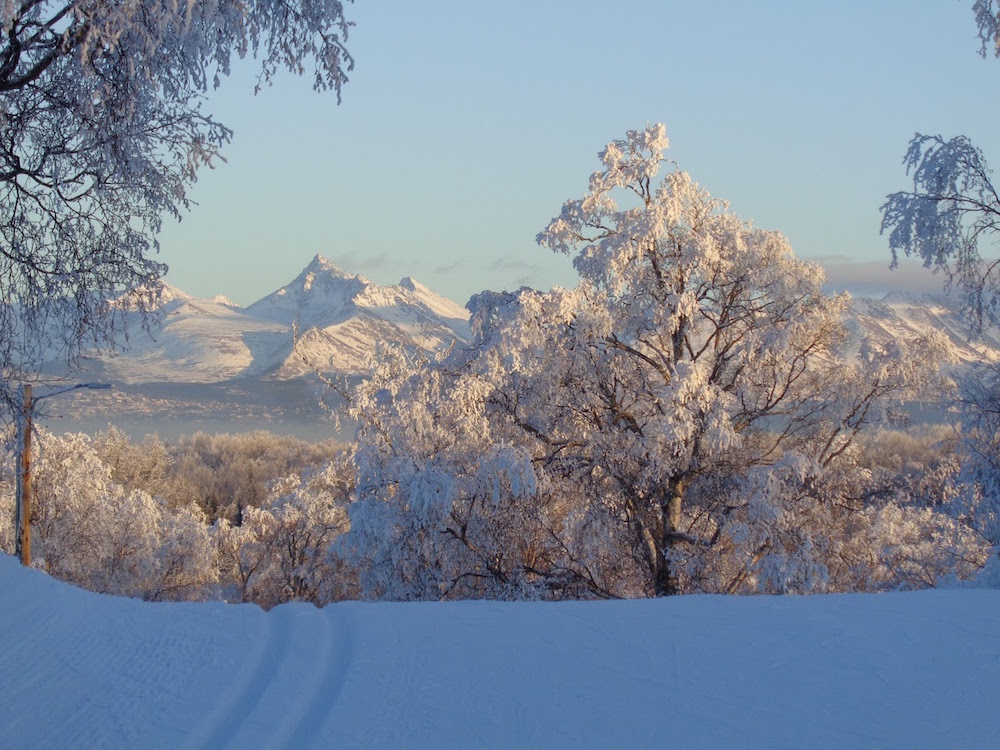
The Chugach Mountains as seen from the Lekisch Loop at Kincaid Park in Anchorage, Alaska, site of the Anchorage WinterStart SuperTour. (Photo: Adam Verrier)
The North American cross country scene offers numerous race opportunities throughout the winter season, but it’s the SuperTour that involves the very most competitive skiers from the United States and Canada. On December 12-17, Anchorage’s Kincaid Park plays host to the Anchorage WinterStart SuperTour, the first SuperTour event of the 2023-2024 season (presented with the support of Nordic Ski Association of Anchorage and Cross Country Alaska).
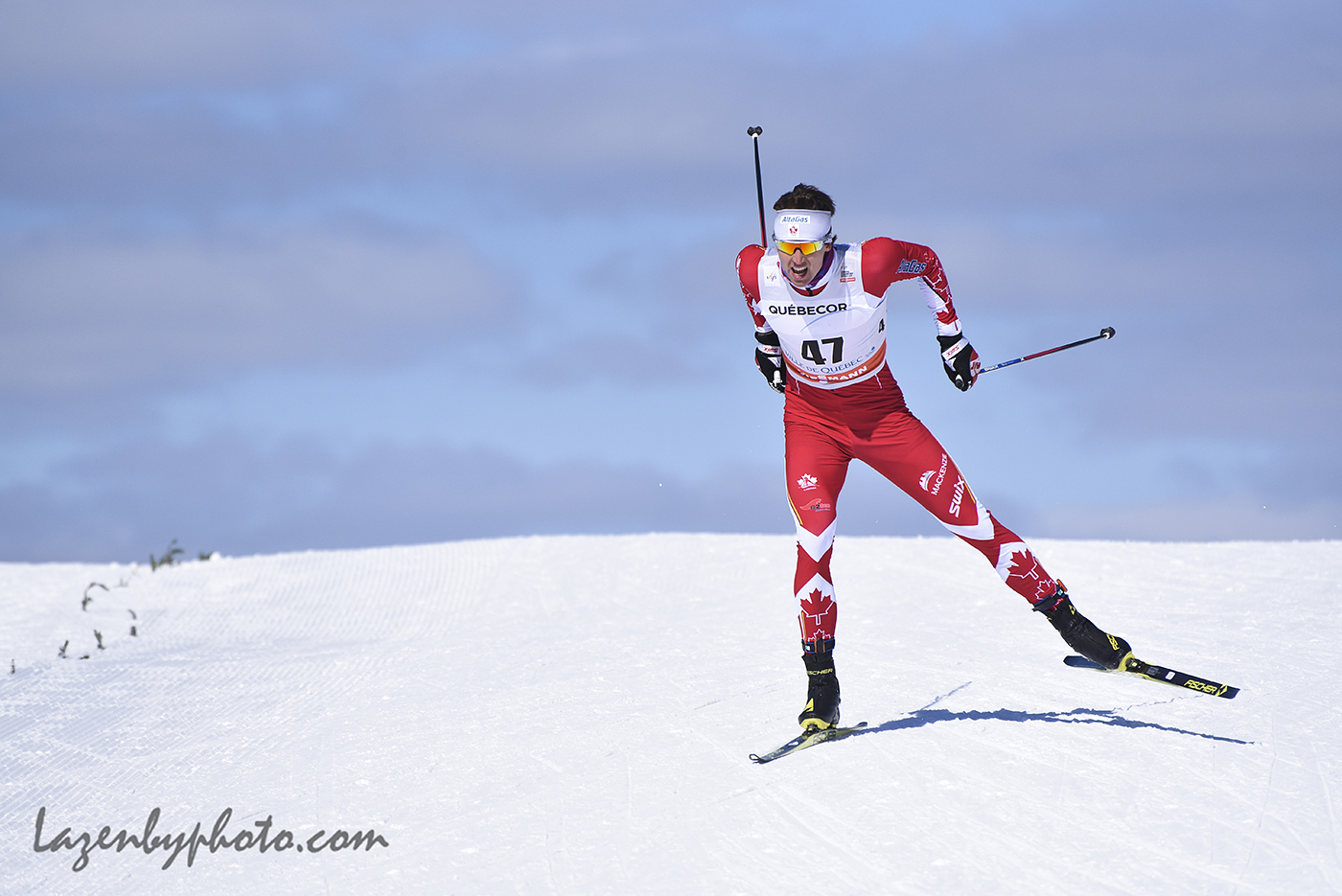
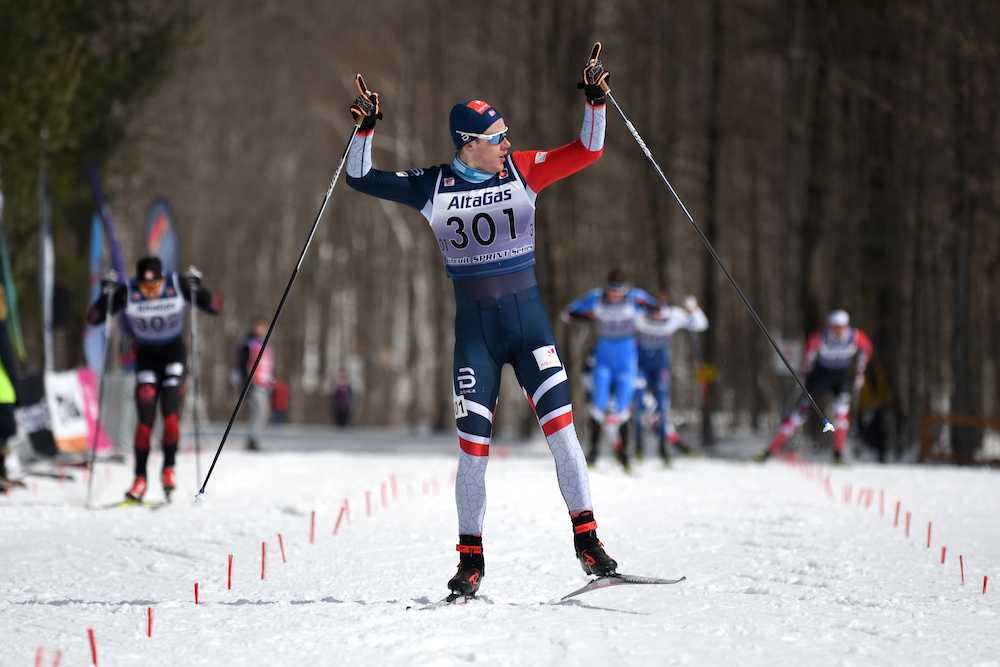
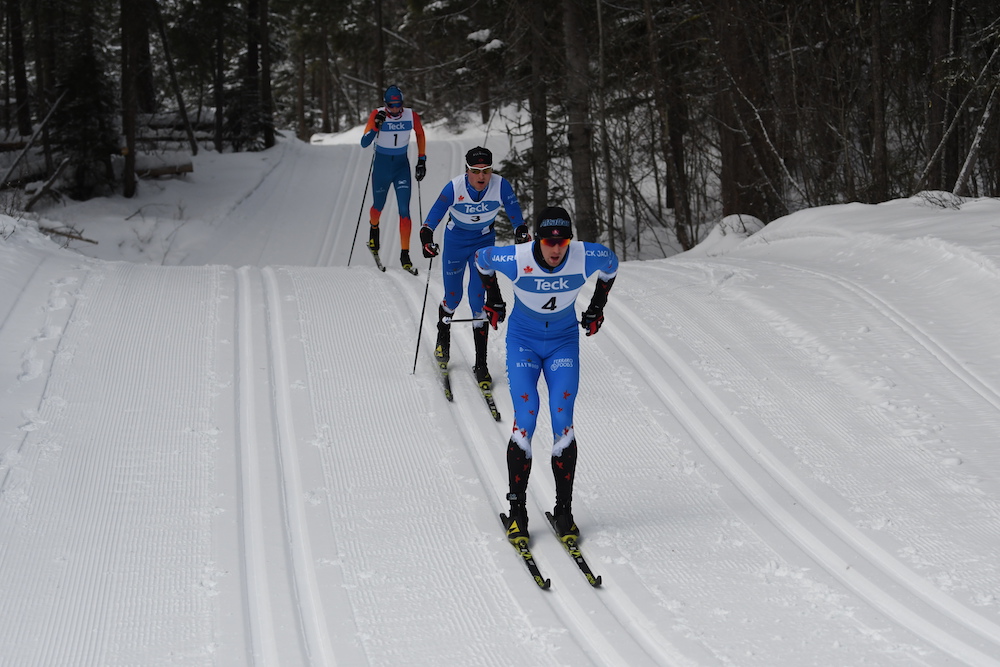
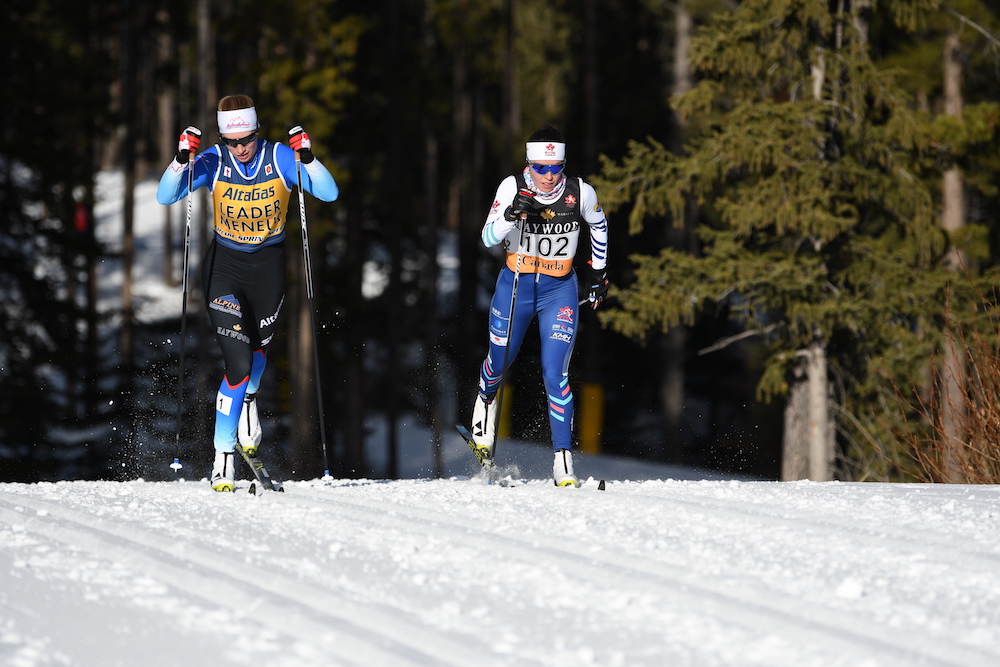
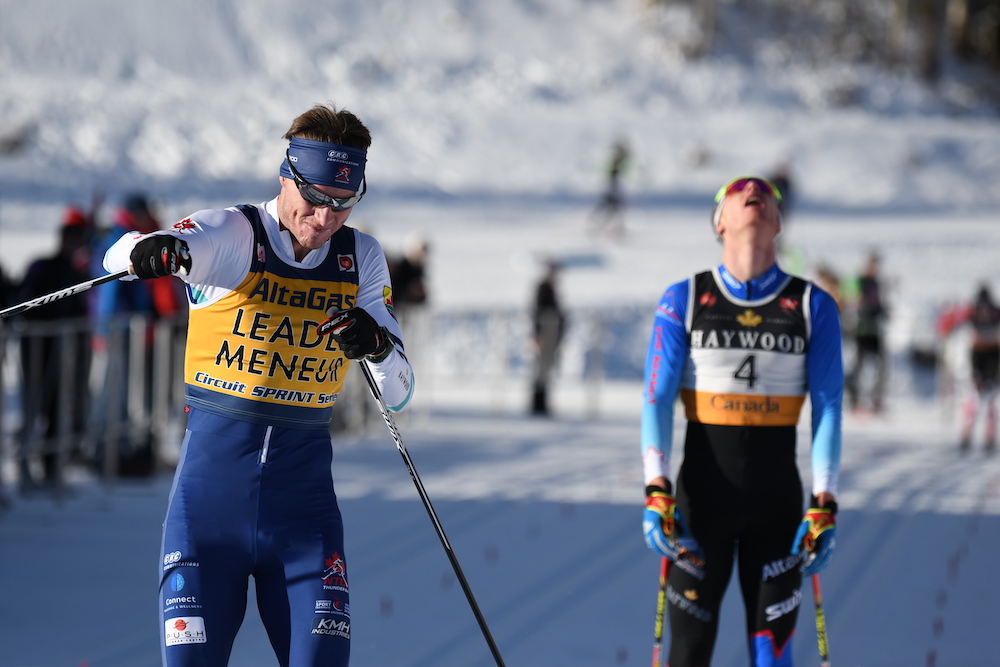
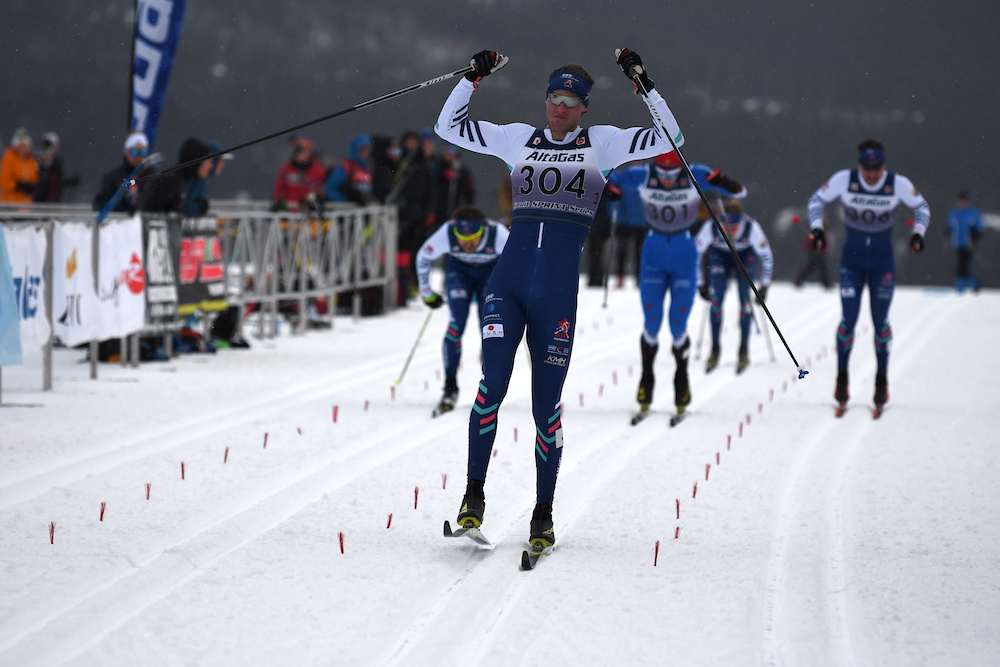
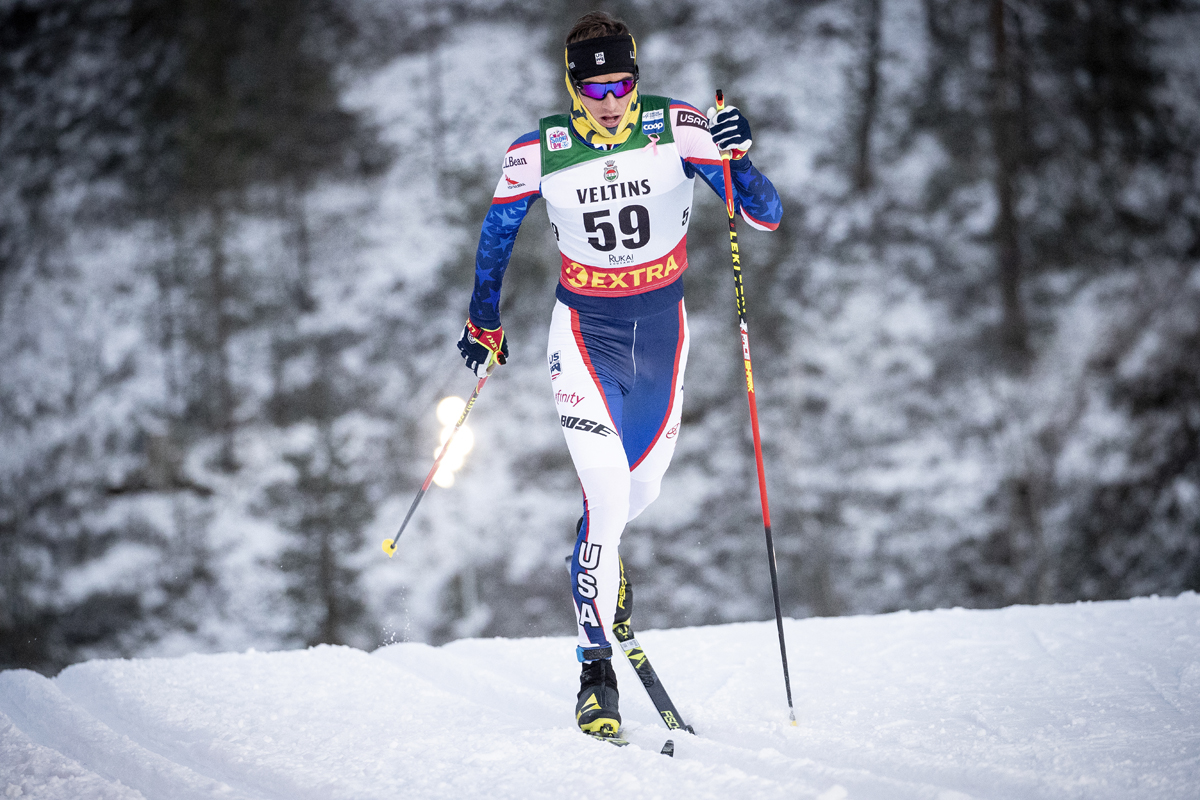
Early in his career, Julien Locke (CAN) raced to 20th place at FIS World Cup finals in Quebec City, Canada. This week in Anchorage, Locke was the winner of the SuperTour Men’s Freestyle Sprint. (Photo: John Lazenby/Lazenbyphoto.com)
Men’s and Women’s Sprint
Tuesday saw SuperTour action in both the Men’s and Women’s Sprints. American, Sammy Smith, topped the women’s results ahead of Lilian Gagnon and Anna Marie Dietze, while Canada’s Julien Locke led the men’s field ahead of Walker Hall and Michael Earnhart.
In post-race interview with FasterSkier’s Nat Herz, Locke articulated the importance of doing well at these North American SuperTour races. “SuperTours [are] the top level of domestic racing,” he said. “So everyone who’s not at the World Cup is here right now . . . For the United States and Canada, these are selection races for the World Cup later in the year.”
In Wednesday’s 10 k Classic Interval Start, the men’s field was led by Maximillian Holman, ahead of Hugo Hinckfus and Hunter Wonders. Smith continued her winning ways at the head of the women’s field ahead of Sydney Palmer-Leger and Nina Schamberger.
Winner of the first two women’s events (Freestyle Sprint and 10 k Classic), Smith commented on the heavy/fresh snow conditions in Anchorage. “The snow definitely made the conditions a little interesting,” she said. “It definitely made technique stuff a little more complicated; but it was super-fun racing, super competitive day.”
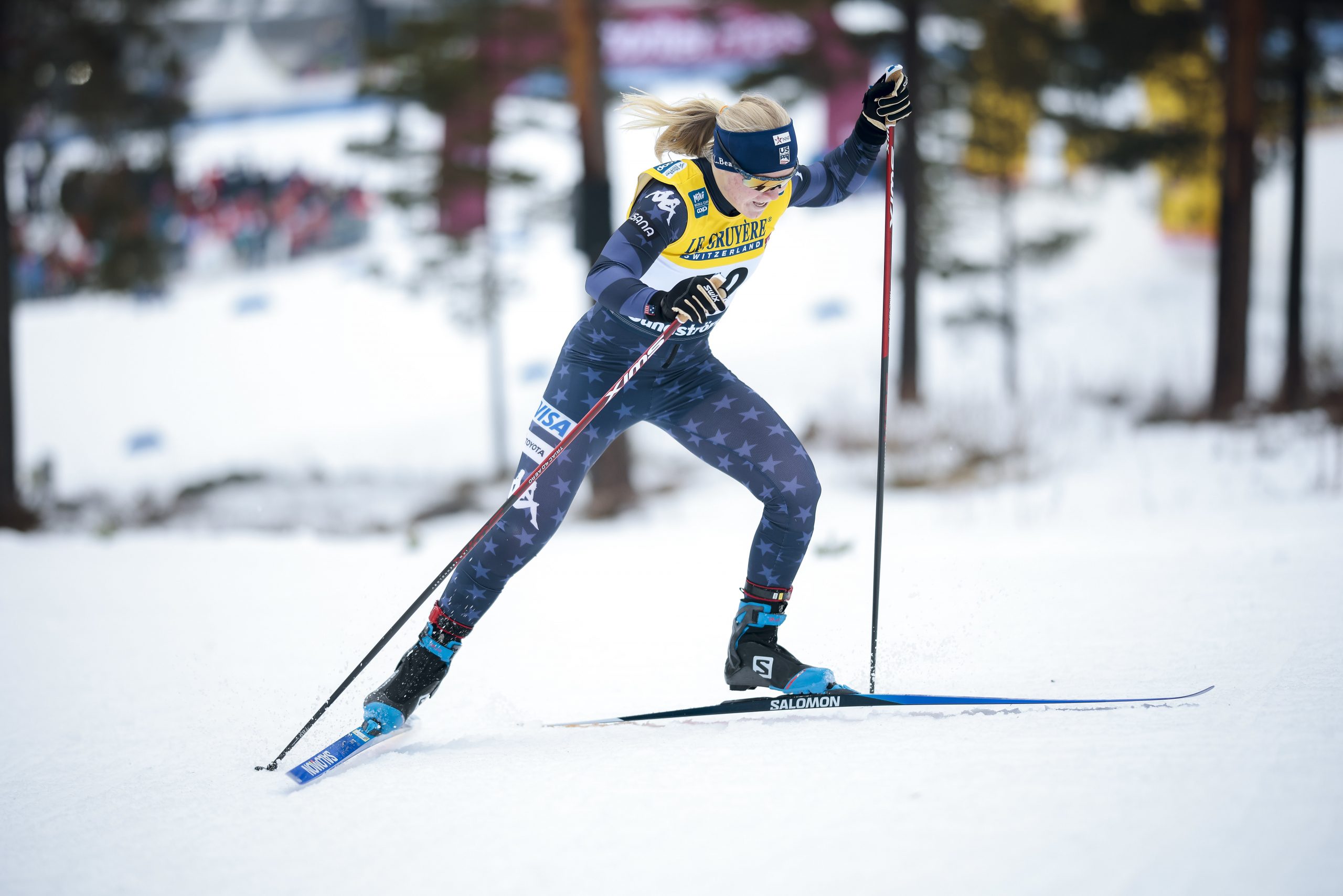
Winner of both Women’s Sprint and Women’s Classic 10 k Interval Start events earlier in the week week, Sammy Smith (USA) (seen here in a FasterSkier file photo from World Cup competitions in 2023) will be in action again in upcoming Classic Sprint and 10 k Freestyle Mass Start at the Anchorage WinterStart Supertour. (Photo: NordicFocus)
Schedule of Events
Anchorage WinterStart SuperTour events continue on Saturday with Men’s and Women’s Classic Sprints, followed by Sunday’s 10 k Freestyle Mass Start.
Now that we’ve got your attention with fresh wintery tracks and crisp corduroy, read on to learn more about a new GPS-based live groom reporting tool to automate and streamline communication between groomers and skiers.
If there’s a generalization that can be made about cross country skiers, it might be that we like to “know before [we] go.” As the ski season waxes and wanes, or mid-season storms roll through, we relentlessly check the weather forecast and our local grooming report as we fantasize hungrily about the fresh corduroy or classic tracks we hope to enjoy that day.
But we can’t always know before we go. Timely grooming reporting asks those cultivating the trails to go a step further after a middle-of-the-night shift, when sitting at a computer to update the website in a timely manner might be less appealing than crawling into a warm bed or sipping a hot cup of coffee. This creates friction between the hard-working groomers and skiers who are chomping at the bit and weighing the potential disappointment of making the drive to the ski area without knowing what to expect.
Luckily for both parties, there’s a new system growing which allows faster and more efficient communication, Nordic Pulse.
Former Canadian national team member Julien Locke has been working as a web-developer for several years to support his ski career. Locke raced regularly on the World Cup from 2017 to 2019, before sustaining a severe concussion, which removed him from training and competition. His career best result arrived in Dresden, Germany where he popped a 15th place finish in the freestyle sprint in 2018. Though he still trains as a professional skier, subsequent health issues have prevented him from returning to his former performance level, but the fire still burns, and he aspires to make it back to the World Cup.
Roughly six years ago, one of Locke’s projects was a website overhaul for Sovereign Lake in Vernon, BC, including integrating a better method for sharing grooming information with skiers.
“Their grooming team was quite frustrated with not having a slick system for them to use to update the report, and their skiers were feeling like they didn’t have enough information,” Locke explained in a call. “So we made a little web based system and it worked okay, but it really opened my eyes to a real need that Sovereign Lake had, and other ski areas that I was working with also had, to promote the groomers perspective and skiers perspective. And it really inspired me to start thinking, ‘How can we make this better?’ And it took quite a few years for this project to really get going. It wasn’t until a year and half ago that I started developing it full time.”
During the interim, Locke continued to work with Sovereign Lake and other ski clubs, all the while listening to the interests, needs, and frustrations of groomers, skiers, and club organizers. Eventually, this evolved into the development and launch of Nordic Pulse, a GPS-based live grooming system that allows for simple, efficient, and automated communication on grooming operations for ski areas of all sizes and capacities.
“The goal in the beginning was to make it easier for groomers and ski areas to share what they’re doing, their trail conditions and their grooming reports. And then for skiers to have a central platform so that in November when you don’t know where to go skiing, or mid season when you have two different options of places near you, you can easily and conveniently see what conditions will be like.”
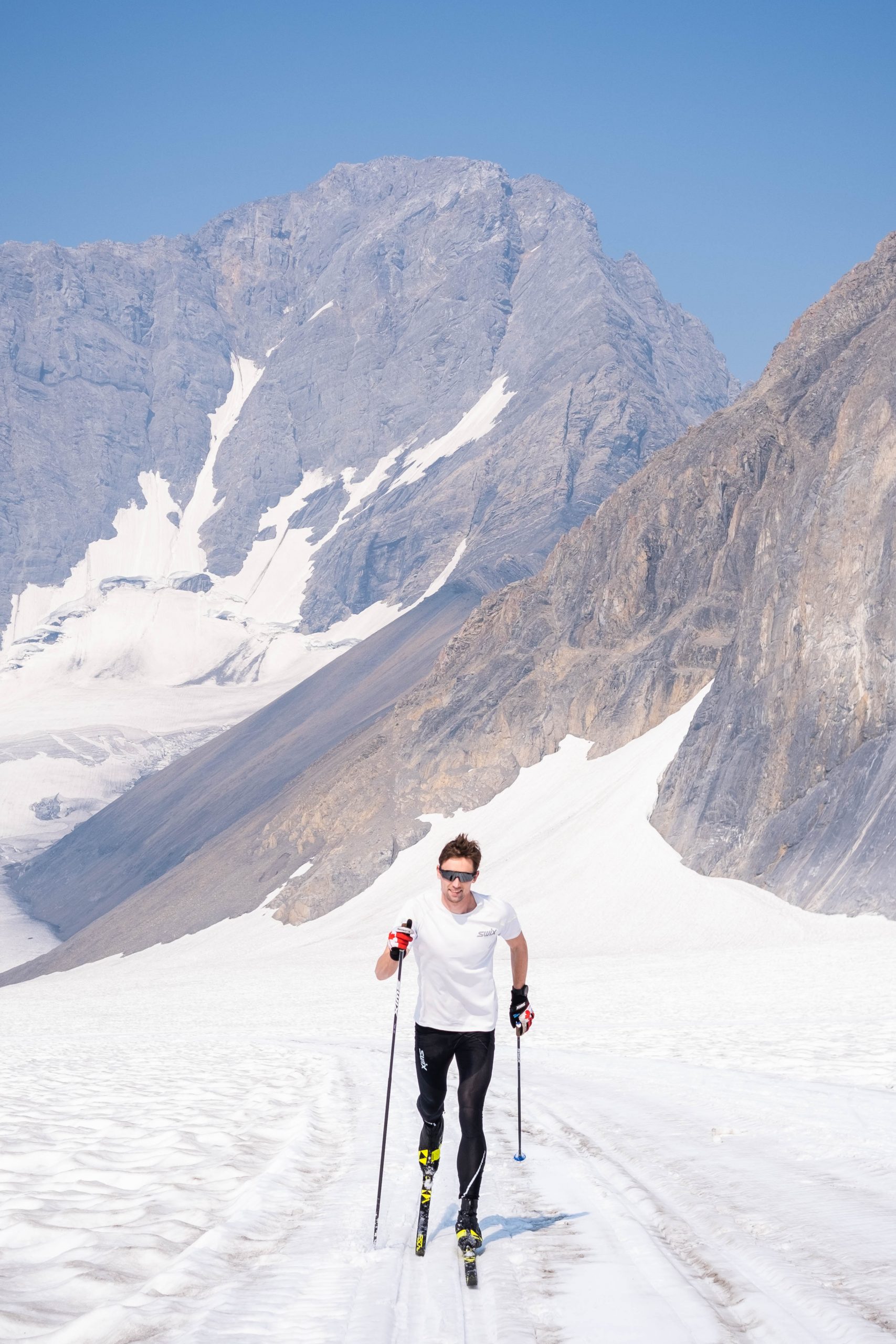
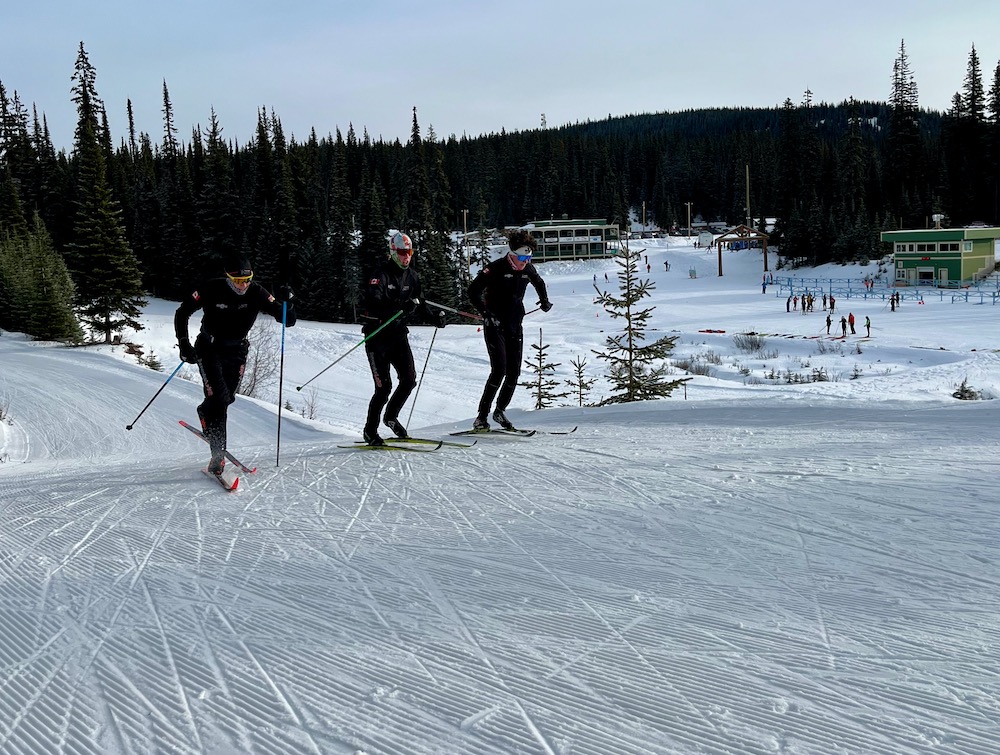
Nordic Pulse founder Julien Locke trains on the Haig Glacier. (Photo: Russell Kennedy)
In particular, a need Locke identified and aimed to solve was creating efficiency for the grooming team.
“Oftentimes, they start grooming at midnight, and are grooming until the early, early hours in the morning. They finish their shift, and you know, they’ve been up all night, they’re tired, and the last thing that they want to do is go fiddle around with the website or call somebody to tell them an elaborate description of where they went.”
Locke looked to automate the reporting process and make it seamless.
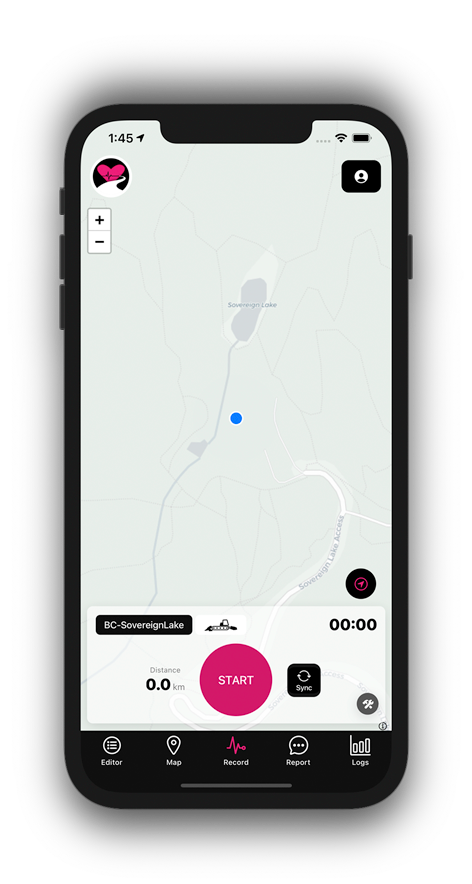
“Our solution is using GPS, so the groomers click ‘start’ when they start recording and they click ‘stop’ and when they’re done, and then, in that time, all the grooming reports are done automatically. So it really saves them quite a bit of time every day at the end of their shift not having to report or go through the trails list and try to remember what was groomed at what time.”
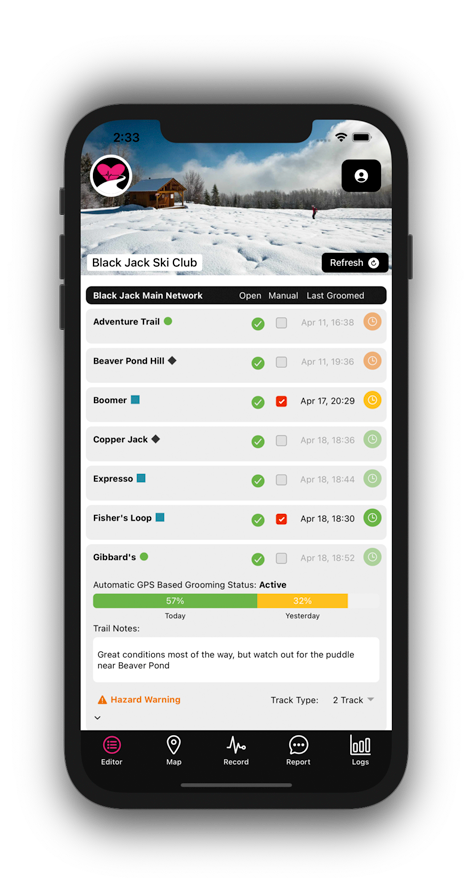
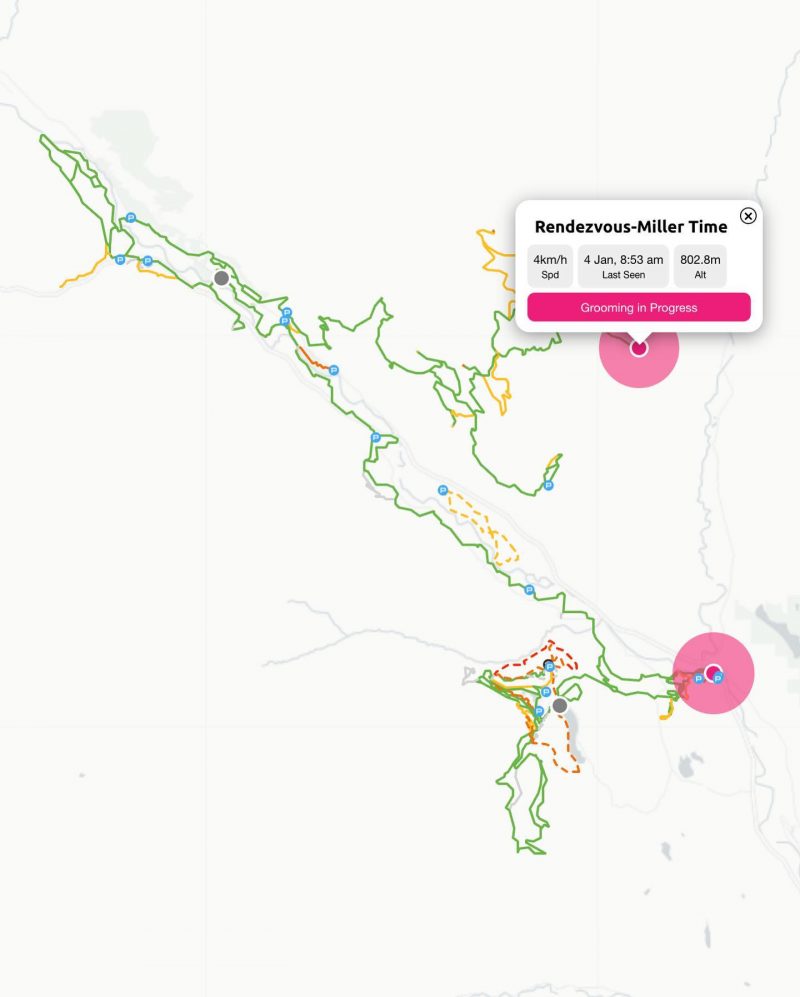
Acknowledging that it is common for a groomer to only hit part of a particular trail within a route, the traditional system of listing off what was completed can fall short. With Nordic Pulse, a color-coded map shows specifically what was groomed each day, including options to differentiate between skate and classic if track has not been reset on all trails that day. If needed, groomers can also select from a materials list to indicate what machinery was used, from snowmobile to PistonBully, depending on what the ski area has available. Additional notes can be added as needed.
“Being able to get the grooming information onto a map so that the skiers have a really quick visual of what’s been done, I think, was a real need from the people I had talked to. I know from the feedback we’ve gotten, people really appreciate being able to see visually what’s been done.”
When a new ski area comes on board, Nordic Pulse handles the mapping to create a pre-set base on which the system will run. While the app is running in the groomer’s pocket, GPS data points are collected every 20 to 30 meters, keeping precision high even for trails with frequent intersections or overlapping segments. This data is synced to the Nordic Pulse server and processed by its algorithm to determine which trails on the predetermined map were completed, with time stamps.
No cell service at your local trails, or perhaps your groomers don’t want to burn cell data? No problem.
A simple app allows groomers to track their work with GPS, which is pushed to a map so skiers can see what and when grooming took place. (Photo: nordic-pulse.com)
Groomers can run the app without having cell reception or consuming data. The GPS information will be stored locally on the device until the phone enters WiFi, then the groomer would only need to click sync to push the data to the NordicPulse server. Time stamps will be preserved to accurately reflect the work that was done, should there be delays.
Locke added that some of the earliest users of the system were ski areas based in the Kananaskis Provincial Park near Canmore, Alberta, well outside the reach of cell reception.
In terms of the cost of adopting Nordic Pulse, pricing is adjusted on a sliding scale system depending on the number of kilometers groomed by the ski area, the number of skiers, and the amount of GPS data that needs to be processed with daily grooming. Clubs are billed annually and prices currently range between $600 and $2000 per year.
Having grown up in the small town of Nelson, BC, it was important to Locke to keep the costs reasonable.
“When I started developing Nordic Pulse, I was looking at options. One strategy I could have taken was creating an enterprise level product for just large ski areas who have the budget to afford that. But I grew up in a really small club, and I really wanted Nordic Pulse to be accessible to everybody. So we’ve done our best to really keep the cost as affordable as we can by having a sliding scale.”
For ski areas with limited budgets, Nordic Pulse offers a “community edition” with no yearly fee.
A color-coded trail list and map with time stamps indicates which trails have been groomed, with room for additional notes as necessary. (Photo: nordic-pulse.com)
Rather than using GPS to track grooming and automatically update the live-grooming maps and trail reports, the community edition uses the in-app trail editor to manually update the maps or trail lists instead. While Nordic Pulse “would love to be able to offer the community edition completely free”, there is a small one-time setup fee to cover their costs in getting the but there’s no yearly costs after that.
Year one has gone “incredibly well”, surpassing Lockes original goals and expectations.
“I started developing this year and a half ago and I was optimistic we’d get maybe a dozen clubs on board in the first year. I really thought we’d start small and grow. And then, we started doing a beta testing phase, and all of the sudden, clubs were reaching out every day, it seemed. And by the time we officially launched, I think we had over almost 20 areas on board, and then by the end of the year, we had 35, and now we have around 80 ski areas total after year one. So it’s growing really fast, which has really been exciting for us. And also, I think, really great for skiers because the more ski areas that are on board, the more useful the information is for skiers, as in, skiers can go to any area and be able to check the reports on the same platform.”
The goal for next year: “Just keep growing.”
“We’re always looking are excited to have new ski areas come on, and are looking to grow more in the States and more in Canada, and potentially elsewhere in the world as well.”
Currently, the app is only designed for us by groomers, while skiers check either the Nordic Pulse site or an embedded applet on their local trail system’s website directly. The website is mobile optimized, but Locke said that a skier specific app is in the works to improve the user’s experience, and should be on line by next season.
“I’m really motivated to make the system as interesting as possible for everybody, and as useful as possible, and just continually roll out new features for both skiers and also groomers.”
So far, the feedback Nordic Pulse has received from clubs who have integrated the system this year has been “incredibly positive,” improving the experience for a growing population across all abilities within the cross country ski community.
“I think in the last few years, especially with the numbers of skiers increasing from COVID, a lot of ski areas have been feeling the need to have better ways to report their grooming and show that information. And a lot of ski areas come to us saying, ‘Hey, we’ve been thinking of doing something like this, but on our own, we can’t afford it because it’s expensive to build a system like this.’ And they really appreciate being able to use our service and tap into all those features. Already this year, we’ve had over 160,000 skiers using our platform and almost a million views, so it’s growing really fast and it’s meant a lot to me. It’s been very rewarding, and humbling to be able to make a difference in the ski world.”
What are users saying about Nordic Pulse?
According to Nordic Pulse, Ethan Meginnes of the Black Jack Ski Club in Rossland, BC, the system is a “game changer” for its members.
“As a groomer and avid skier, I am relieved to be able to relay and receive reliable information. Nordic Pulse is easy to use with multiple platforms,” Meginees said. “I would love to see every cross country ski center ultimately utilize this app.”
Methow Valley resident and regular trail user Alex Hall called the system “exceptionally good.”
“I love the live grooming report,” he wrote to FasterSkier. “Though I find that I question its accuracy at times… There do seem to be occasional misalignments, but the thing I love about the live timing is it will show you instantly, completely and comprehensively where the cats are and what they’ve done, and it’s all on a picture, so it’s really handy. It’s definitely my favored system because it’s really quick and gives that overview. It updates automatically, it’s live, it’s got color graphics. Every now and then, there is something goofy about the live map. It’s definitely [an improvement from the last system].”
The Methow Valley Trails receive a fresh groom in January, mapped with Nordic Pulse. (Photo: nordic-pulse.com)
After a brief break, the SuperTour picked up in Lake Placid this weekend, with a fluoro-free Period III kicking off with a 1.5-kilometer classic sprint. The frigid forecast called for overnight lows of -5 Fahrenheit, with a wind chill as low as -23F. Highs during the day were only predicted to climb into the low single digits. Qualifiers were scheduled for 10/10:45 am, with quarterfinals for the open men beginning at noon – hopefully, enough time for a few degrees of warmth to reach the trails.
The weekend competitions would be hosted on Mt. Van Hoevenberg’s new World Cup trails, which are paved for rollerski use in the summer, and played host to NENSA’s “Keys to the Castle” sprint event in September. For those familiar with the venue, the new courses are tucked into the north-facing hillside, just south of the 1980 Olympic stadium and biathlon range. The new serpentine loop intersects with the final Ks of the classic “Ladies 5” outer loop, but overall remains closer to the stadium to allow access to the recently improved snowmaking system.
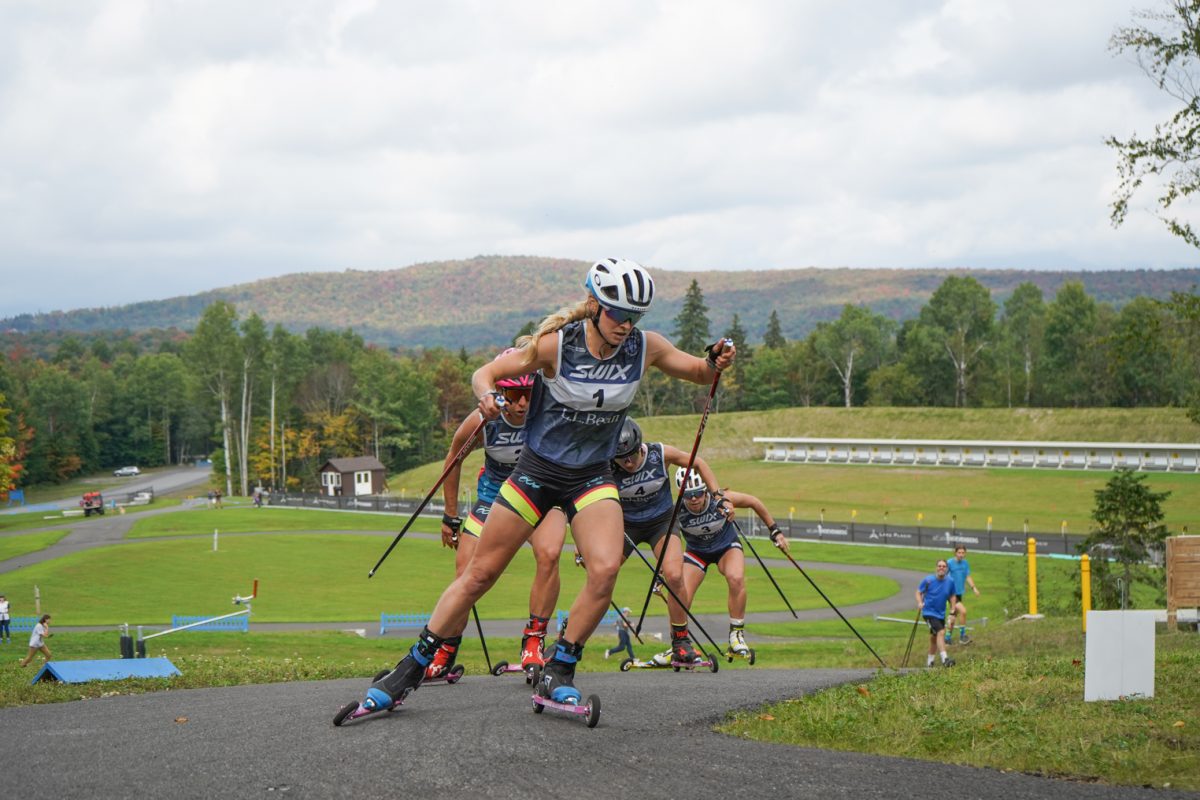
Jessie Diggins (SMS T2/USST) pushes over the climb during the final round of the Keys to the Castle sprint. (Photo: Matt Whitcomb)
With a large reservoir and advanced technology, this new World Cup loop can be made winter competition ready within four days, though Van Hoevenberg’s nearly 50k of open trail might suggest that coverage is not currently an issue.
There was praise for the course from many athletes, including those that have seen both Lake Placid, and everywhere in the world beyond Lake Placid.
“It raced much more like a world cup course!” said Alayna Sonnesyn (SMS), in an email to FasterSkier. Katharine Ogden (SMS) too, said of the course, “it was WAY more fun than the old one…[which] was pretty flat.”
The course designers at Lake Placid seem to have carefully been taking notes on what makes sprint racing exciting over the course of its evolution as a discipline in the sport. An historic venue for American skiing, these developments may be a long-time coming for Mt. Van Hoevenberg, but it’s clear that they were executed with mastery so VanHo can continue to expand upon its legacy in the decades to come.
This course featured a long, final uphill climb to test a skier’s mettle, then a short, technical downhill into the finish to test their tactical brains. And in between; transitions, transitions, and more transitions.
Becca Rorabaugh (APU) said of this : “The final climb always turned into a drag race, and I liked the pitch because it favored a bit of a stride over an all-out run. Skiers still had to be alert through the downhill and finish, though; positions often changed in the stadium.”
The weekend, hosted by the Olympic Regional Development Authority (ORDA) in Lake Placid, also served as the second NENSA Eastern Cup weekend. Thus, senior athletes from American elite clubs lined up alongside regional junior racers, eastern collegiate racers, and Canadian athletes who traveled from Quebec, Ontario, and beyond. 382 athletes, 176 women and 206 men, on the start lists for the qualifier, and separate heats were run for the U18/U20 and U16 categories.
Without livestream, FasterSkier has relied on live timing and athlete interviews to shed light on how the sprint races unfolded.
Men’s 1.5-kilometer Classic Sprint
After returning from a stint in Europe where he raced the Tour de Ski, Team Birkie’s Zak Ketterson set the mark in the men’s qualifier, stopping the clock at 3:04.79. Sun Valley’s Peter Holmes skied the next fastest time in qualification (+0.72), while Étienne Hébert was just behind in third (+1.41). Hébert hails from Quebec and currently trains at the Centre National d’Entraînement Pierre-Harvey (CNEPH), based at Mont Ste Anne.
Each of these men moved smoothly through the rounds, with Ketterson getting edged out by Bill Harmeyer (SMS T2) in the first semi, and Homes and Hébert going 1-2 in the second. Racing in the second semi saw a tighter spread and faster times, bringing Julien Locke (Black Jack Ski Club) and Logan Diekmann (BSF Pro) who had finished a close third and fourth, respectively, along to the final as lucky losers.
The final featured a tight finish among the top four men, with Ketterson off the front to finish in 3:04.71, earning his second consecutive classic sprint victory. Ketterson had dominated the classic sprint in Cable, WI, and stood at the top of the SuperTour leaderboard, thereby earning start spots for the Tour de Ski. The timing of the Tour caused him to miss the subsequent classic sprint in Soldier Hollow, UT.
During the Tour, his first World Cup starts, Ketterson was less than a second shy of qualifying for the classic sprint heats in Oberstdorf, Germany, and had been roughly five second out of the Top-30 the day prior in a 15k skate. He was the only American on the men’s team to finish the Tour. After the Tour, Ketterson made a quick turnaround to attend the weekend of distance racing in Sun Valley, Idaho, where his results (15th in the 15k classic and 34th in the 10k free) were far below what might be expected from him.
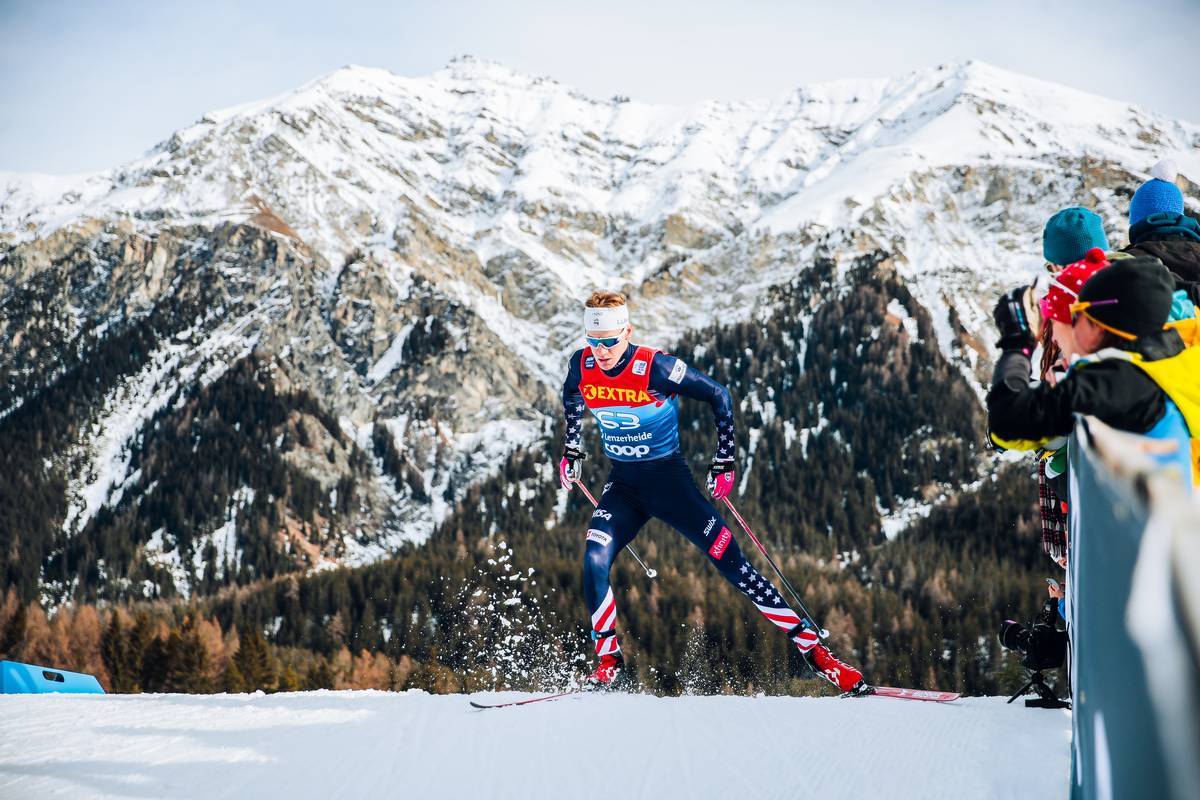
Zak Ketterson races the freestyle sprint qualifier in Lenzerheide, SUI, the first event of the 2021/22 Tour de Ski. (Photo: NordicFocus)
In a post-race email to FasterSkier, Ketterson shared how he felt about the Tour and what the recovery process has been like for him.
“The Tour de Ski was a fantastic learning experience with lots of ups and downs. I am pretty happy with my performance on the Tour given it was my first time on the World Cup, but I definitely think I will be faster next time around now that I have had the experience. Post Tour I was incredibly empty, both physically and mentally. To have to change gears pretty much immediately after the last stage of the Tour and head straight to Sun Valley for some super competitive SuperTour races at high altitude was definitely a recipe for disaster on my body. I felt like I was just going through the motions and my body wanted nothing to do with those races.
“These last few weeks at home in Minneapolis provided me with some long-overdue recovery. My hunch after some really lackluster racing in Sun Valley was that there was no need to overthink anything and that the issue was probably just that I was tired. I took time at home to mentally and physically reset and started to feel a lot more like myself as the Placid races approached. Today, it all came together and I felt a lot more race-ready.”
Ketterson also commented on the improvements that have been made at the Mt Van Hoevenberg venue, explaining how it supports the growth and elevation of domestic skiing.
“I am blown away with the venue at Mt. Van Hoevenberg! The venue truly feels like it’s ready for World Cups, or even another Olympics. It’s really inspiring to see big investments into nordic skiing venues in the United States, and I can’t stress enough how big it is for us athletes. I can’t wait to come back to Lake Placid sometime later to really experience this place because I think it’s so awesome here.”
Behind Ketterson, just 0.26 seconds separated second through fourth in the men’s final. Holmes won the boot slide to snag second (+0.72), while Harmeyer took the final podium spot in third (+0.92). Hébert was just 0.06 seconds shy of the podium, ending the day in fourth (+0.98).
Harmeyer provided insights into his approach to the day, along with insights into the moves that contributed to the excitement at the finish line.
“I felt really good in the heats today,” he wrote via email. “The course was certainly difficult and tactical. Placement in the group was really important and that was especially apparent in the final. We had a group of four dudes going over the top of the final climb into the long descent before the finish. It was an absolute scramble trying to get into the tracks on that final downhill. At one point, I had my left ski in the right part of the track and Étienne had his right ski in the left side of the track. Not easy to squeeze two guys going 30+ mph into a single track but somehow, I came out ahead which was just enough to lunge at the finish for third.”
During Period I, Harmeyer took third in the classic sprint final in Cable, and was just off the podium in fourth the weekend prior after the freestyle sprint in Duluth, MN. After qualifying in fifth, a crash in the quarterfinal left him 24th in the freestyle sprint in Soldier Hollow during the U.S. Cross Country Championships. A few days later, he was 51st in the 15k classic. In the Soldier Hollow SuperTour classic sprint, Harmeyer qualified in fourth, and just missed the final to end his day in eighth.
Reflecting on the season as a whole, Harmeyer wrote, “I had a really good start to the season with some strong races in the Midwest. But overall, things have been frustrating. I’ve been struggling with some cold weather triggered exercise induced asthma that got really bad after the first supertours in the Midwest. I continued to struggle with it through a disappointing Senior nationals and decided to take a bit of time off to reset, recover and do some testing. I’m hopeful the worst is behind me and that I’ve got some good protocols lined up to prevent anything from happening in the future. My primary goal for the remainder of the season is to win the Stowe Derby, specifically the derby meister.”
Wrapping up with a comment on the venue, Harmeyer added, “The new courses at Lake Placid are sweet! The sprint course is incredibly tactical but also rewards tough, explosive skiing. I had an absolute blast out there in the heats. The distance courses are hard but I’m excited to be doing a mass start on those for this Sunday. Overall, Van Ho has done a great job with course management and their snowmaking to put together some killer courses.”
After a gap, Diekmann crossed the line in fifth (+5.81), while Locke rounded out the men’s final in sixth (+9.11).
The women’s field began right where it left off in SuperTour classic sprints, with the winner of the last race at Soldier Hollow, Katharine Ogden, (SMS) finishing the qualifier in first place (3:40.49). She was followed by Lauren Jortberg (BSF Pro Team) in second (+2.2), and Ava Thurston (Mansfield Nordic Club) in third (+6.1). The qualifier indicated, again, the overall strength of the field that has characterized this year’s SuperTour, with the heat qualifiers all within 30-seconds of each other (26.0 seconds to be exact).
That field remained tight in the quarterfinals as well. All five quarterfinals saw winning times within a mere five seconds of one other, with Katharine Ogden turning in the fastest time of the round at 3:42.77, and Alayna Sonnesyn winning her heat in 3:46.12.
Ogden commented to FasterSkier that she “didn’t really have any strategy in particular. I find that it is better for me to make strategy in the moment during sprint heats because you never know what’s going to happen out there… I just tried to conserve as much energy as possible in the quarter and semi.” It would pay off later on.
Meanwhile, also progressing to the semifinals was the APU one-two punch of Rosie Frankowski and Becca Rorabaugh out of quarterfinal 2. Despite being primarily known as a distance racer, Frankowski, came into today leading the SuperTour sprint classification and “set a blistering pace,” according to teammate Rorabaugh. With it, she pulled the duo into the semifinals together.
After all the quarterfinals were through, the semifinals were set with a who’s-who at the top of the SuperTour sprint standings, rounded out by Canadian Katie Weaver (Hollyburn XC Ski Club) and Minnesotan Margie Freed (Craftsbury).
The first semifinal featured a battle between two SMS T2 teammates, Katharine Ogden and Alayna Sonnesyn, and two APU teammates, Rosie Frankowski and Becca Rorabaugh. Frankowski again set the pace for the heat, with teammate Rorabaugh commenting that “[Rosie] is so strong on the uphills that she pulls the whole heat to a faster time.” Frankowski, however, couldn’t quite outlast Ogden and Sonnesyn, who used the downhill after the final climb to launch into the first two positions. Ogden won the heat in a time of 3:39.23, with Sonnesyn and Frankowski in second and third, respectively, by less than a second. Rorabaugh finished fourth, but along with Frankowski won the lucky loser spots into the finals – setting up another round of the SMS-APU duel.
In the other semifinal, a close battle throughout yielded a win for Lauren Jortberg (3:45.15) and a second place for Erika Flowers (+0.90). The result sent another teammate pairing into the finals, with both skiers coming from Bridger Ski Foundation (BSF).
At Lake Placid – a place that has over the past century proved to be able to gather the entire world around skiing – it was perhaps appropriate that the women’s final would bring together three teams from across the American continent. Two from Vermont (SMS), two from Montana, two from Alaska (APU), and away they went!
Katharine Ogden commented that the field didn’t waste any time: “It was pretty hard from the gun, as per usual.”
Rorabaugh, meanwhile, made a change in strategy, deciding to follow her teammate Frankowski more closely in the early part of the race. “I was trying to stay closer to the front of the pack since I had let a large gap form in the semifinal that I couldn’t make up,” she explained.
That adjustment was one that helped create a pack that was tight throughout the race, and that was a bit harder to find a position in.
Sonnesyn commented that this led to her having to adjust. “I had great energy but got tangled up a few times on the second hill, so I really had to ski from behind in the second half of the race,” she wrote. “Luckily, I had great skis and remained calm and was able to push through the final stretch.”
In that final stretch, on the final hill, a “drag race,” as Rorabaugh described it, ensued. It was instigated by Ogden, who saw the final climb as the place to make her move, and made it. She came over the top in first place.
“[I] got lucky,” she told FasterSkier. “Pat [O’Brien, SMS T2 head coach] had provided me with some really fast skis that allowed my move to stick going back down the hill.”
Perhaps it wasn’t all luck though. Ogden came across the finish line in first place (3:40.13) after winning the qualifier, her quarterfinal, and her semifinal. It was an all-around dominant performance for one of the U.S. brightest stars in the classic sprint.
Meanwhile, Becca Rorabaugh had powered through the transition into the final downhill and came up with the reward of second place (+3.40), She was followed by Alayna Sonnesyn, who remained cool, calm, and collected as she skied her way through the pack to third place (+4.29).
The final was rounded out by fourth place Rosie Frankowski (+4.74), fifth place Lauren Jortberg (+5.63) and sixth place Erika Flowers (+17.77).
The result was reached at the end of an exciting day that encapsulated the beauty of ski racing – with excitement and energy perfectly juxtaposed against the extreme absence of that energy in the air. Preparing for cold temperatures that are forecasted again for the 10k freestyle mass start tomorrow, the top finishers today all expressed that the temps are part of the appeal in the northeast this weekend.
From Rorabaugh, “I don’t mind cold temperatures – I grew up in Fairbanks, Alaska!”
From Sonnesyn, “I like to think the Midwesterner in me prepared well!”
And from Ogden, the perfect Vermont tip: “As Sverre [Caldwell] told us last night, tricky race conditions can work to your advantage if you prepare better than anyone else. Wise man :)”
Olivia Bouffard-Nesbitt starts the first FIS race in Canada in 20 months.
Racing returned to Canada after a lost season, and there are plenty of storylines to follow.
This weekend, The Sovereign Lake Nordic Centre in Vernon, BC hosted a freestyle sprint and a classic 10/15-kilometer individual start. It sounds so familiar, a re-run of the annual NorAm kickoff with a new Western Canada Cup name.
Travel to the venue became more challenging when a November 13th ‘atmospheric river’ destroyed the two main highways between Vancouver and Vernon. The two alternate routes reopened fairly quickly, but only for commercial traffic. This created an unusual situation where athletes from Vancouver had to fly while athletes from Manitoba (two time zones east) were able to drive.
Official training on Friday was lightning fast.
Another atmospheric river on December 1st brought record heat to the region, with a high of 16C in Vernon, well above the old 7C record. A timely cold snap saved the snow base, albeit with extremely fast glide for Thursday and Friday training. The sprint course was changed from the 2005 World Cup loop to a safer and slower variation.
Despite border restrictions, a number of U.S. teams attended. Dartmouth made their annual trip from Vermont, joined this time by Green Mountain Valley School and Stratton Mountain School (not the post-graduate SMS T2 team; they went to Duluth). Methow Valley Nordic Ski Education Foundation sent a much smaller team than usual, but Sugar Bowl Academy in California helped to make up the numbers (and took a few medals home too).
Further reaching by geography, Brazil and Portugal each had one woman racing, who were discussing plans to earn quota spots for the 2026 Olympics. Throw in the second ever Mexican National Championships and you have the makings of a great weekend.
Saturday Freestyle Sprint
Two themes dominated the sprint day: smiles and rust. With only a few athletes having raced the previous season (World U20/U23 and World Cup athletes), the excitement of racing again was visible everywhere.
The rust was also on display. Athletes regretted their layering choices. Enthusiasm led to extremely aggressive starts and ragged finishes. Many athletes forgot to allow time to collect timing chips on the way to the start. More forgot that it takes extra time to show the ‘fully vaccinated’ wristband to be eligible to start. Quite a few discovered that the wristband should not be on your watch arm, because the wristband is covered by a sleeve locked in place by the watch strap resulting in a longer delay. A wristband that is applied so that it can’t be transferred to another person also can’t be moved to the other wrist for day two. Lessons learned, or re-learned, for many skiers.
National Team Development Centre Thunder Bay (NDC TBay) athlete Julian Smith summed up the first day back for FasterSkier.
“Yeah, first day racing in Canada in a long time,” he said. “My last race was the American Birkebeiner in February 2020. So that’s pretty fun to put the bib on, really push the body and race with all our friends out here. The organizers here at the Nordic Center did a great job. And everyone was doing their job well and it ran really smoothly.”
Behind the scenes, there were also a few learning and re-learning moments for the 180 volunteers running the event.
Nonetheless, race morning dawned with a steady snowfall at -4C that provided great skiing and slower racing.
Olivia Bouffard-Nesbitt was the top seed and became the first person to race for points in Canada in twenty months.
Pre-race speculation had a changing of the guard, with the young athletes expected to displace the known entities, and most athletes feeling confident in their preparation with very little evidence to back it up.
Bouffard-Nesbitt, who trains with Alberta World Cup Academy (AWCA), justified her #1 bib by winning the 1.3km qualifier in 2:59.69, 2.31 seconds ahead of Kimberly’s U20 Marielle Ackermann. Shaylynn Lowen (NDC TBay) skied to third (+6.54).
In the heats, Ackermann comfortably won each U20 round to take the win while Bouffard-Nesbitt showed her experience to dominate the senior heats.
Bouffard-Nesbitt, like most of the skiers, was visibly thrilled to be back on course.
“Oh, it was really good,” she said, before laughing. “It was rusty! It kind of felt like the first race back in two years. But every heat got progressively better. Quarter was better than the [qualification] and then better after that, so yeah, it was great.”
Sovereign’s own Hannah Mehain got stronger through the heats to take second place, ahead of Dartmouth’s Callie Young.
“I felt maybe not quite as snappy in the qualifiers,” Mehain told FasterSkier. “But it improved for the day and I just felt better and better .”
As the American east and Eastern Intercollegiate Skiing Association (EISA) faced COVID restrictions that limited race opportunities, Young was in a similar boat to the Canadian women in terms of lack of high-level racing opportunities. She also shared her feelings on the sprint day.
“I didn’t have my best qualifier, this is my second day at altitude,” Young said. “So it was kind of tough. But when I get into the heats, it’s always so fun and competitive.”
On the same course NDC TBay’s Smith was clearly the strongest of the men, winning the qualifier and all three heats. Xavier McKeever and Tom Stephen, qualifying 2nd and 6th, both chose to race up in senior, resulting in some hard fought heats. McKeever and Stephen are both members of the national team and train with Foothills Nordic Ski Club in Calgary.
“It was really fun,” said Smith after his race. “It was a blast for the body to do what it’s supposed to do, what I’ve been training it to do, so that was really fun.”
Smith was one of the few who answered the tactics question with something other than how much fun it was to be racing again.
“In the final, it kind of slowed down at about the first third. And I just tried to go when everyone else started to go and got a bit of a gap and in the end, was able to hold the lead. So that was really fun.”
In the end, the juniors found themselves enrolled in the Locke School of Heat Tactics, with Black Jack’s Julien Locke using guile to take second in the final after qualifying 7th.
AWCA’s Bob Thompson gapped NDC TBay’s Pierre Grall-Johnson on the climb to complete the podium.
World U20 relay silver medallist teammates McKeever, Rémi Drolet, and Stephen were 5th, 6th, and 7th, while Olivier Léveillé was away in Lillehammer. Though age and experience filled the podium, Grall-Johnson-Johnson was the first U23 athlete showing that the younger skiers are putting the pressure on.
The race of truth was also the race of discovery as many athletes re-discovered why pre-race routines exist. Sunday dawned clear and cold, rising to -11C for the men’s start at 9am. With yesterday’s new snow packed hard, there was no difficulty in finding grip with hard wax, but not everyone found the glide necessary on a 5km loop that is flat and fast by World Cup standards.
Rémi Drolet, just returned from racing Continental Cups in Muonio and Gällivare, skied a consistent race to take the win in 39:06.1, setting the fastest time in all three laps.
Stephen was second, 39.6 behind, moving up on the final lap.
“It was really good,” Stephen said. “It’s my first 15k back this season because I’ve been coming back from injury. And it went really well, it went just like I planned it, so really happy with it.”
Interval starts are more exciting than they used to be.
“Oh, it’s so fun,” Smith added. “I haven’t done something like this with this many people in a long time.”
AWCA’s Jack Carlyle skied a very strong first 5km lap before struggling with the cold after a mistake choosing baselayers, finishing third at 49.2 back.
“I made a rookie mistake and did not wear enough layers and froze halfway through the race,” Carlyle explained once he was warm again. “But I had great skis. And for the first bit of the race, I had great feelings. So yeah. Happier where the body is just need to remember not to make silly mistakes.”
McKeever recovered from a slower first lap, moving up from 7th to finish 4th at 1:06.8 behind.
“I was really lucky to start my season off in Europe, with a couple of victories in Finland and Sweden. And I was really happy with how they went, especially after last year being a really tough year for myself,” he said. “So overall, I’m pretty stoked to just be back at it.”
“The sprint yesterday, I think went really well. Today, I was just missing a bit of gas. I feel I didn’t feel awesome, awesome, but it’s just nice to get out there and race again in Canada. And we have more next weekend.”
Jasmine Drolet stepped up the sibling rivalry with a win in the 10km in 30:38.9. Now in her first year at Dartmouth, she made up for missing the sprint with a steady performance.
“Definitely a shock to the system,” she told FasterSkier. “But I’m glad to have gotten it over with and to be in racing season now.”
Back in Canada after her first semester in the Ivy League, she was adjusting to the changes.
“I was nervous before [the race]. Changing training, and changing coaches and everything, but now, I feel confident that my training this fall was good. The US is maybe a little bit different than Canada, but not very different. It’s a lot of work to juggle school and skiing full time, but it’s manageable.”
Bouffard-Nesbitt finished in second place, 41.4 back, with a fast first split.
Another full-time student, Mehain was third at 1:09.7, just holding off a fast finishing Beth Granstrom.
“I had a great day,” Mehain said. “It’s really fun to be out racing again, seeing everybody. I pushed fairly hard on that course for the classic 10k and had a lot of fun.”
Karla Schleske Shepard is the first female National Champion for Mexico. (Photo: Peggy Hung)
This is the second National Championship for Mexico, with the first held in Canmore at Canadian nationals in 2019. Starting a ski program in a country without snow or a skiing tradition is hard, even without a pandemic disrupting progress. This year, there were six men and one woman competing.
Jonathan Soto Moreno won both days, capping a year where he also earned a Beijing quota spot for Mexico at World Championships.
Karla Schleske Shepard, a former heptathlete who represented Mexico at the PanAm games, became the first ever female champion after learning to ski in February 2021.
What’s Next?
December 11th and 12th has both the Eastern Canada Cup #1 at Nakkertok and the Western Canada Cup #2.
The major storm that threatened the first weekend at Sovereign did even more damage in Rossland, forcing Black Jack’s Organizing Committee to cancel. WCC #2 will now be held at the backup venue, Sovereign Lake, with details forthcoming.
With continued highway closures in BC and additional border restrictions related to the omicron variant, many travel plans will change. Both ECC #1 and WCC #2 may have smaller fields as US teams react to the increased friction at the border.
NDC TBay, based in arguably the east/west centre of the country, is headed for the eastern Canada Cups. This will allow some comparison between the two series and give ski fans something to debate during the Christmas break.
All will be made clear in Canmore on January 6th to 11th, when trials for OWG, U20/U23 World championships, and World Cup Period 4 will bring together the top athletes from the entire country.
Photo Galleries: Doug Stephen (VR45 Photography): Sprints, Distance
Racing at the 2020 U.S. Senior Nationals wrapped on Tuesday with a 1.5-kilometer classic sprint. Although the day came down to six skiers in both the men’s and women’s finals — as is the norm — what flummoxed a few skiers of note were the dicey conditions, which left the tracks covered with slow-me-down lake effect snow.
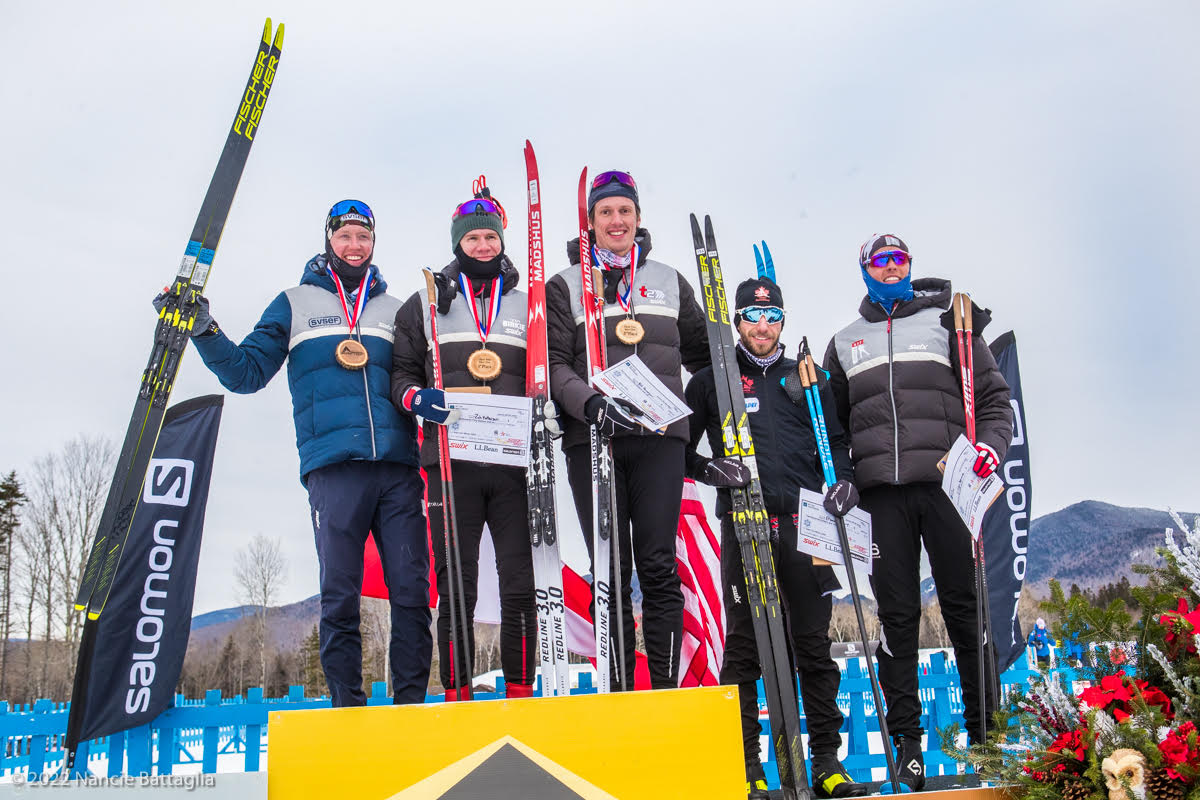
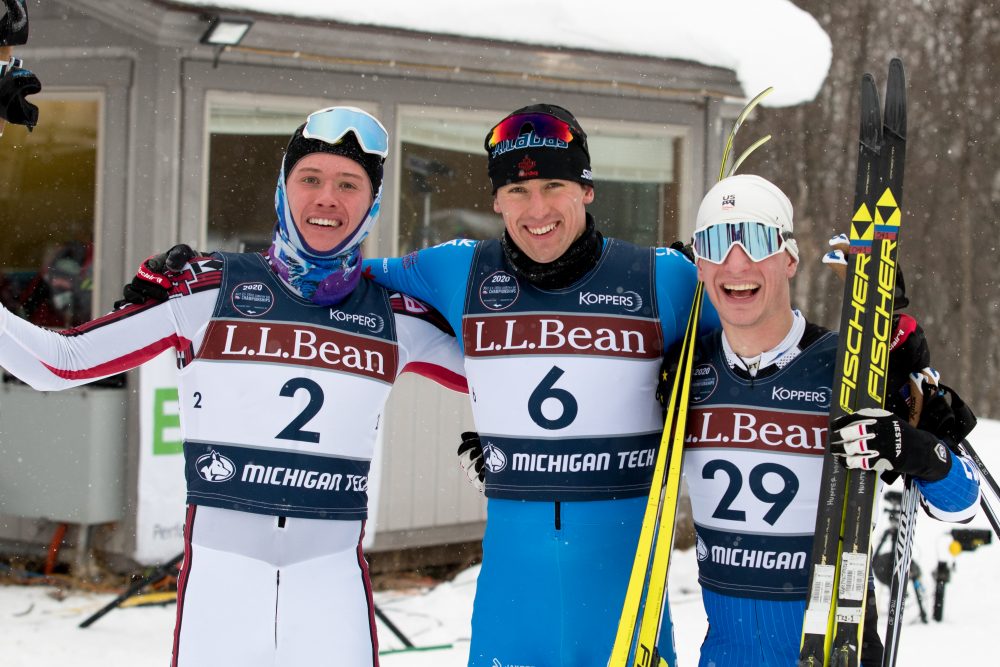
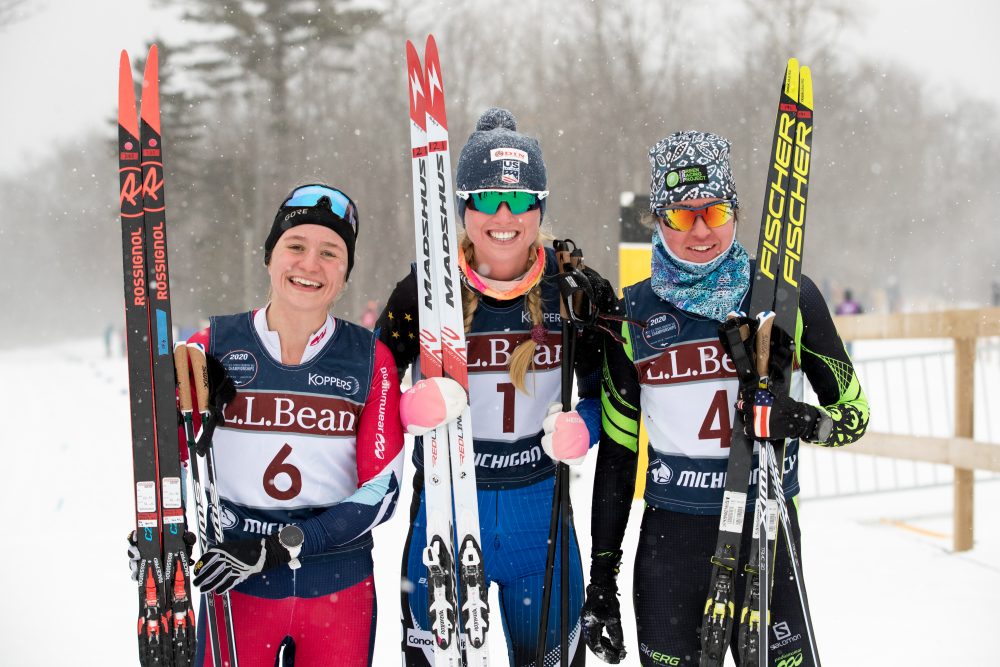
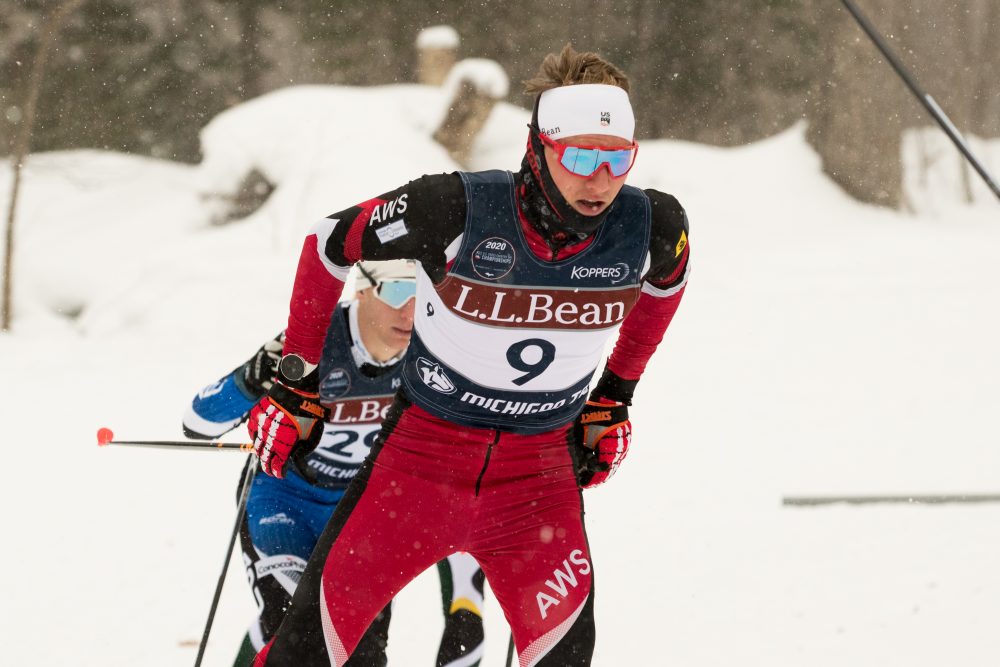
Men’s 2020 National Championship classic sprint overall podium: Luke Yager in third, Julian Locke first, and Hunter Wonders second (l-r). (Photo: Reese Brown.
Post-race interview with Hunter Wonders
Canada’s Julien Locke (CNST) won the men’s final in 4:03.83 — a time indicating the high-burn but slog-like effort needed to finish the course. The first American, and by default, the U.S. champion, was Hunter Wonders (APU) in second overall (4:05.75). Luke Jager skiing for the University of Utah was third overall and the second American in 4:09.52.
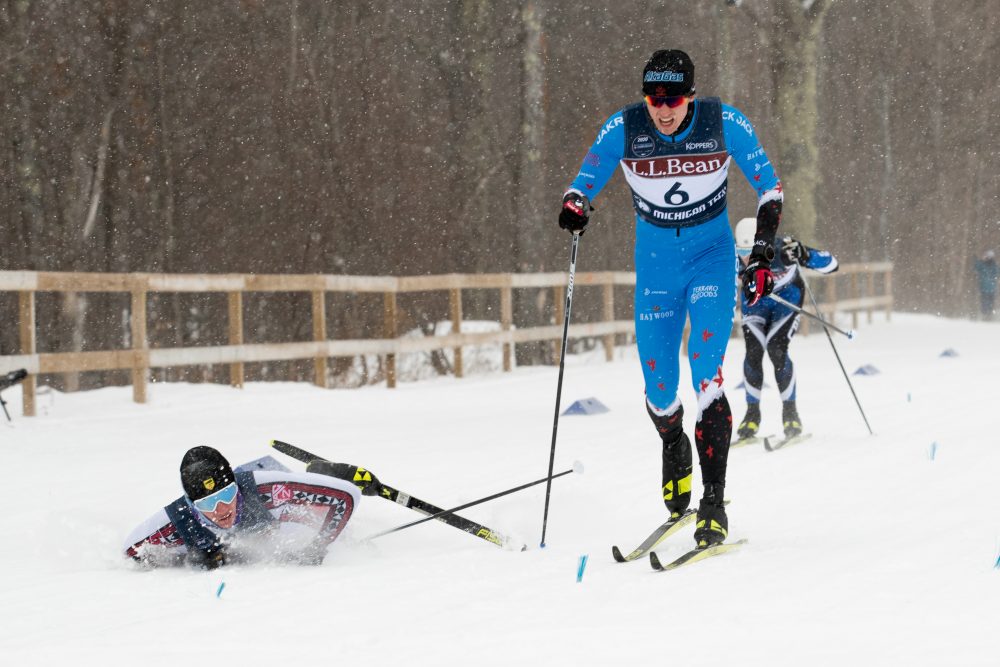
Jager came into the finish double poling, while Locke strode in an adjacent track. Just feet before the line, Jager looked like he’d nip Locke by a toe. Amidst the thick snow, it appeared Jager’s wax simply iced up and his ski stopped abruptly, causing a fall. He quickly righted himself and crossed the line for third.
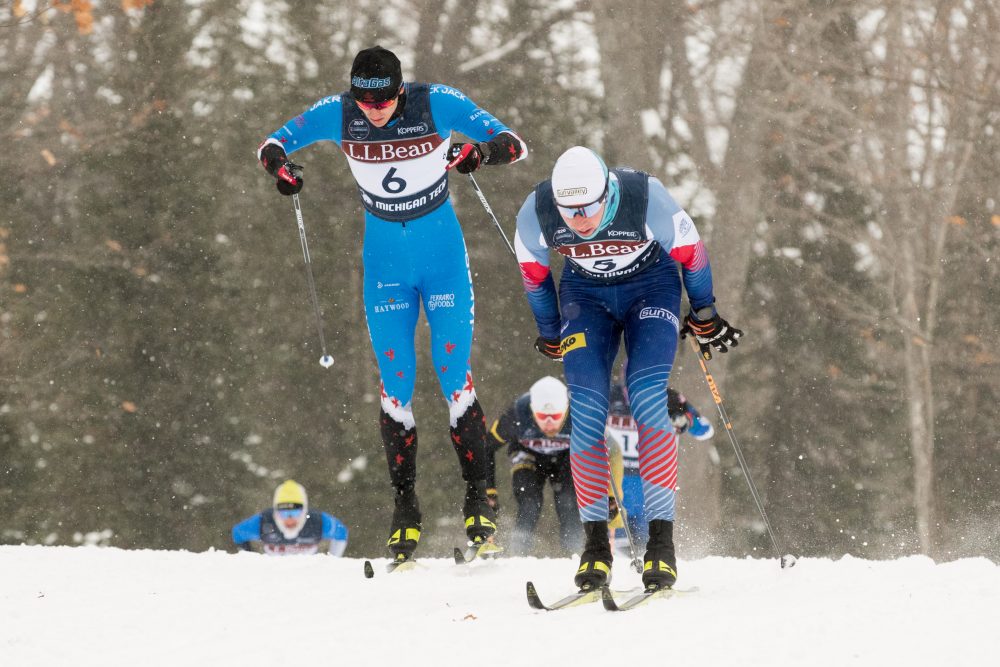
Luke Yager takes an unfortunate spill before the finish line. Canada’s Julien Locke (bib 6) took the win. (Photo: Reese Brown)
Tyler Kornfield (APU) placed fourth overall (third American) in 4:11.26. Peter Holmes (SVSEF) was fifth, and Canada’s Julian Smith (NST-NTDC Tbay) was sixth (+4:18.40).
Hailey Swirbul (APU) concluded a stunning Nationals week with her second sprint title of the 2020 Nationals. Swirbul also won the 20 k classic National Championship in Houghton and placed third in the 10 k skate.
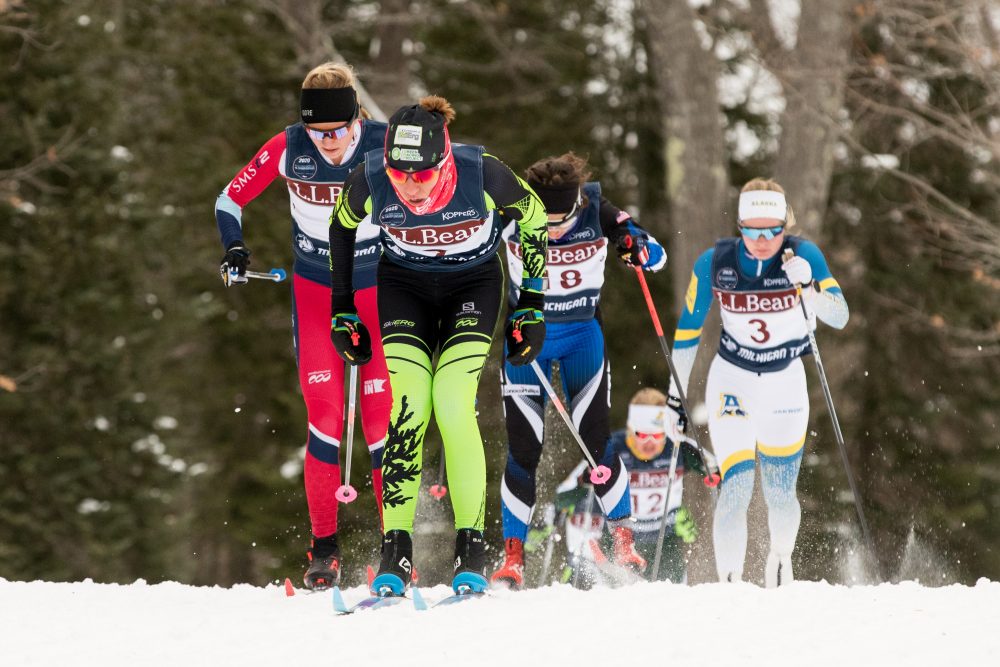
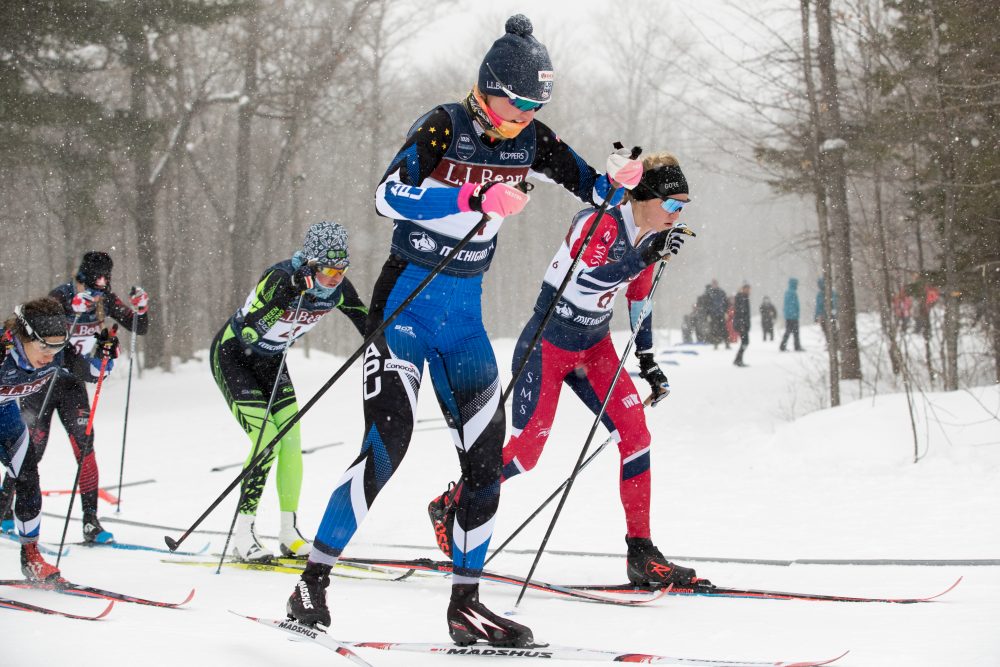
The lunge: Hailey Swirbul (bib 1), Caitlin Paterson (bib 4), and Alayna Sonnesyn (bib 6) go to the line. (Photo: Reese Brown)
Post-race interview with Hailey Swirbul
Swirbul won today’s classic sprint in 4:41.79, after posting the fastest qualifying time in 4:18.11. Caitlin Patterson (CGRP) was second in 4:42.03, and Alayna Sonnesyn (SMST2) third (4:42.14).
Cendrine Browne of Canada placed fourth (4:50.08), and University of Alaska Fairbanks skier, Mariel Pulles of Estonia, skied to fifth (4:54.32), and Rosie Frankowski (APU), known for her distance skiing, was sixth (4:59.24).
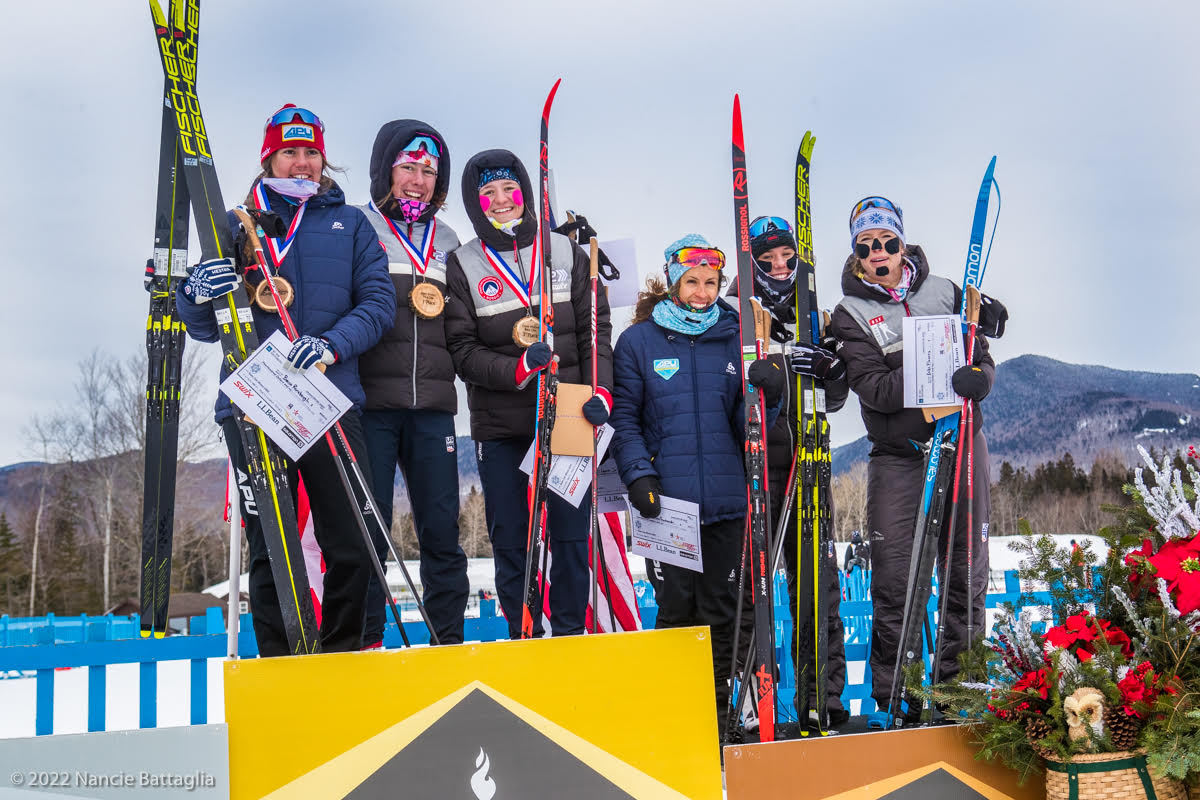
The women’s 2020 National Championship classic sprint podium: Alayna Sonnesyn in third, Hailey Swirbul first, and Caitlin Patterson second (l-r). (Photo: Reese Brown)
Post-race interview with Cailtin Patterson
Kaitlynn Miller (front) during the women’s classic sprint at the 2020 Senior Nationals. (Photo: Reese Brown)
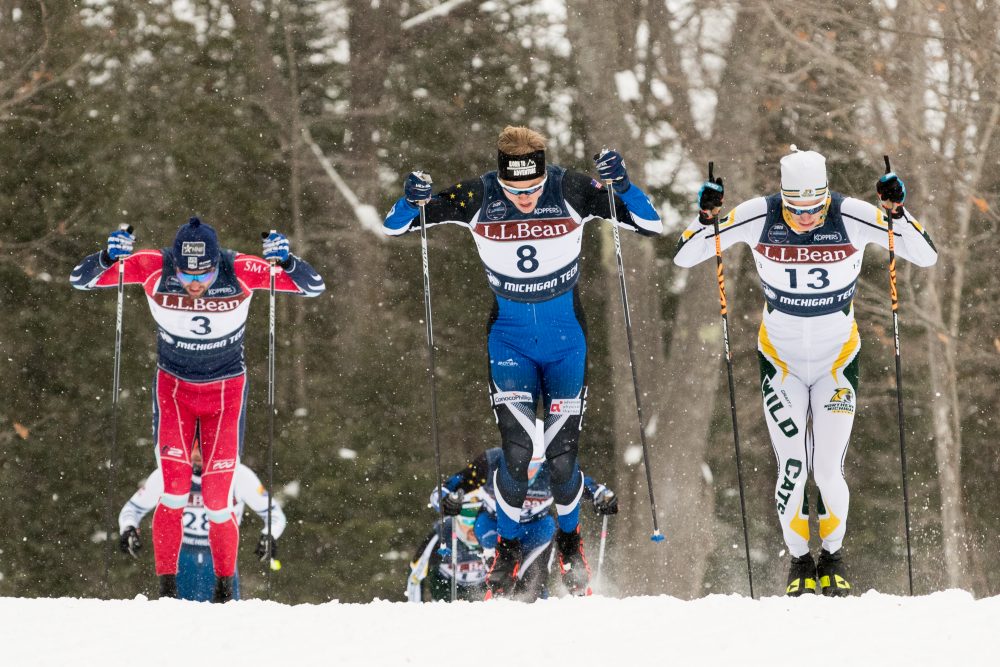
Erik Bjornsen (bib 8), Ben Saxton (bib 3), and Daniel Streinz (bib 13) during their quarterfinal classic sprint at the 2020 Senior Nationals in Houghton, MI. (Photo: Reese Brown)
No separation yet, the start of the women’s classic sprint final at the 2020 Senior Nationals. (Photo: Reese Brown)
Gus Schumacher (bib 9) during the men’s classic sprint at the 2020 Senior Nationals. (Reese Brown)
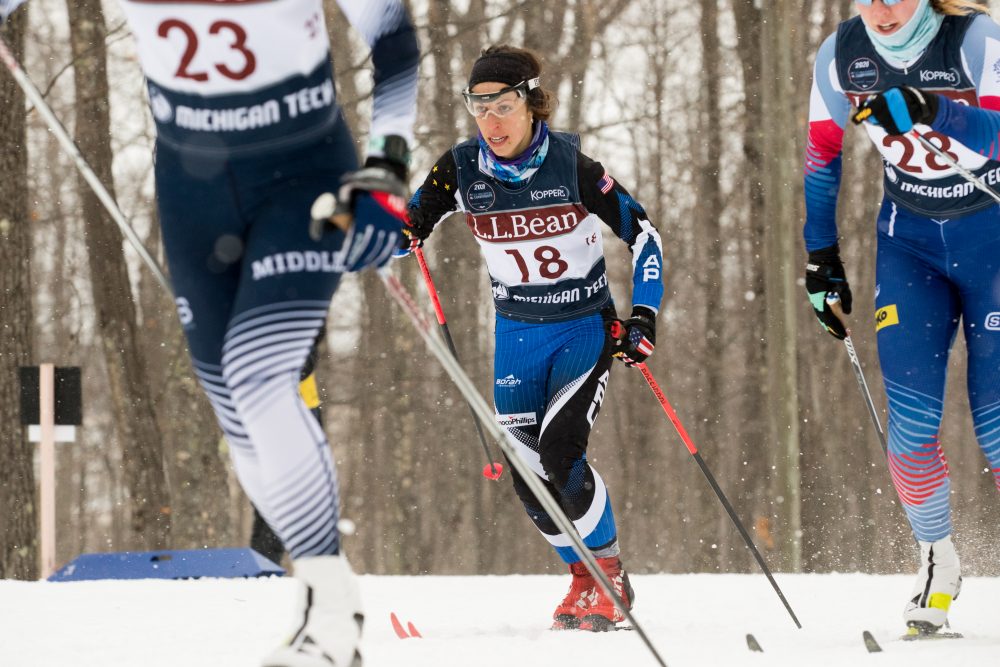
Rosie Frankowski (bib 18) advanced during the women’s classic sprint at the 2020 Senior Nationals. (Photo: Reese Brown)
Julien Locke (bib 6) and Peter Holmes (bib 5) during the men’s classic sprint at the 2020 Senior Nationals. (Photo: Reese Brown)
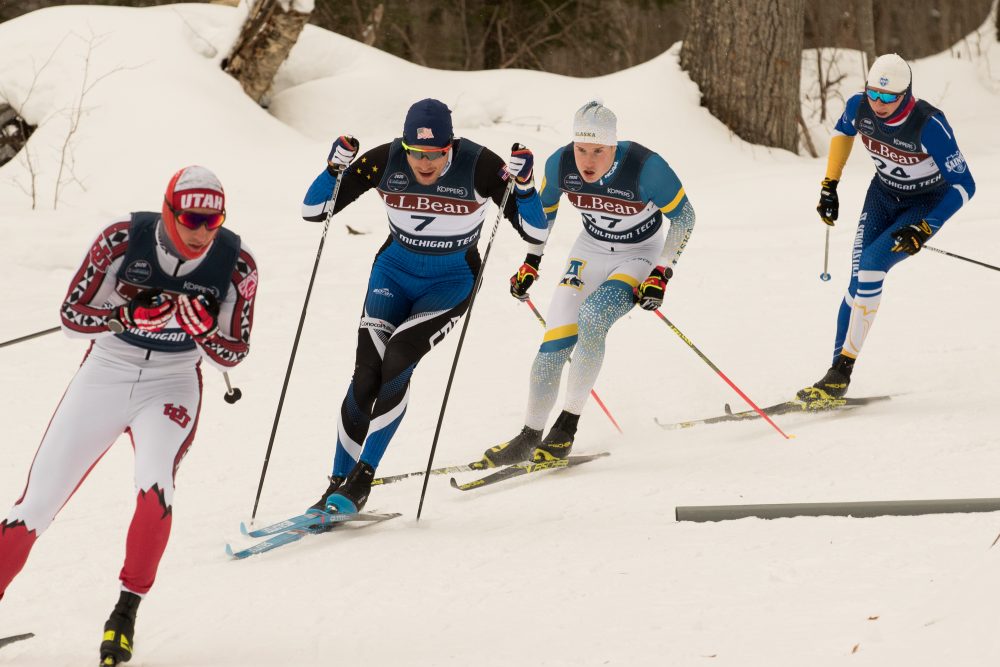
Follow where the lens is focused: Tyler Kornfield (bib 7) locked in. (Photo: Reese Brown)
Maya MacIsaac-Jones attacked on the final hill to win. Behind, Katherine Stewart-Jones leads Dahria Beatty and Annika Richardson. (Photo: Doug Stephen)
This article has been updated with final WCF selections and a video of the sprint A finals.
Nationals rolled on at Nakkertok trails with free technique sprints on Saturday. The women raced a 1.3km course while the men added one more hill for 1.4km. The jury described the conditions as ‘soft icy’, which seems to mean ‘fast spring skiing’ with a soft layer over a firm base.
Maya MacIsaac-Jones (CNST) took her second consecutive national sprint title by jumping clear on the final climb to earn a solo victory in 2:46.62. Dahria Beatty (CNST) led the pack into the finish 2.87 seconds later with Katherine Stewart-Jones (CNST) at 3.27 seconds and Cendrine Browne (CNST) at 3.47.
Germany’s Julia Richter took fifth for the University of Utah at 4.82 followed by Annika Richardson (NTDC TBay) at 5.31.
“Going into the final,” MacIsaac-Jones wrote, “I knew that my offset was strong so I made the decision to attack on the final climb, which worked out as planned!”
Maya MacIsaac-Jones leading the A final. From left to right, Julia Richter (104, red), Cendrine Browne (113), Dahria Beatty, and Katherine Stewart-Jones pursue. (Photo: Doug Stephen)
MacIsaac-Jones is ending her nationals on a high, as she makes a planned shift to focus on World Cup finals next Friday. “I’m so happy with my race today, this is the best I’ve felt all year. It’s been a rocky season, and this is really motivating for me going into next year.”
The conditions made for fast racing, but the A final was different.
“It went out pretty slow,” Stewart-Jones wrote, “because no one wanted to lead on the first climb because there was significant draft on the next downhill.”
Browne, who is usually described as a distance specialist, now has 4th in every event at nationals.
“My qualifier was not so great, so I didn’t know what to expect in the heats,” Browne told the LOC. “Fortunately, I felt really good in the heats and I managed to squeeze myself up to fourth place today. Really happy with that, usually not a sprinter, so yeah, good day for me.”
***
Norwegian junior Haakon Skaanes wins the sprint ahead of Antoine Briand. (Photo: Doug Stephen)
In the men’s A final, the Norwegian theme from today’s World Cup sprint in Falun flowed into Canada. Norwegian national team junior Håkon Skaanes (Strindheim IL) won the qualification and all his heats to take the A final in 2:45.69.
Antoine Briand (CNEPH) finished alone in second, 2.54 back, to become the Canadian champion. Julien Locke (CNST) out-sprinted the rest to take third and the silver medal at 5.60 seconds. Julian Smith (NTDC TBay) completed the Canadian podium at 5.73. Lenny Valjas (CNST) was fifth at 6.08 ahead of Norwegian junior Albert Sunde Oehlschlaegal (Sjåstad v Lier IL) at 6.26.
Briand, who qualified second 1.05 behind Skaanes, was happy with his first Canadian title.
“Today’s race, I’ve been thinking about it for the past eight, nine months,” he told the LOC. “I was really strong today, from the start of the day, qualification this morning and every heat I was feeling good.”
Briand didn’t wait for others to set the stage.
“In the final, I went really hard in the first uphill,” Briand wrote. “My coach shouted on me that the gap had opened. So me and the Norwegian guy who won kept going hard until the end. I couldn’t follow him the second time we went up but I managed to stay 2nd.”
Julien Locke (317) takes third, ahead of Julian Smith (305), Lenny Valjas (308) and Albert Sunde Oehlschlaegal (behind Locke). (Photo: Doug Stephen)
“For me,” Smith wrote in an email, “I was really confident in my skis so I was trying to settle into 3rd place going into the first downhill, and then move into second during the second climb. This allowed for drafting on the final descent. … I did let one too many people between me and the finish line on the last climb and then was not quite able to close the gap in the end.”
This nationals is not just the largest in recent memory, but also one of the most competitive. Unusually, there are only two Canadians on the World Cup circuit in Falun, with everyone else here in Nakkertok. The addition of the Norwegian juniors and NCAA athletes added speed to the mix.
“I have never been to a Canadian National Ski Championships where the field is so deep, with National Team members, competitive domestic racers and so many international racers,” Smith wrote.
Racing continues Sunday with sprints for the younger age groups and an invitational for even younger athletes. Sunday has 507 racers on the start list compared to 194 finishers and 12 DNS on Saturday.
World Cup Final Qualification
Twelve athletes have already qualified, leaving seventeen spots to be decided at nationals: 8 men and 9 women.
The criteria was summarized after the pursuit race. The races that count are the sprint, the individual start classic, the pursuit, and pursuit time-of-day.
Twelve athletes were already named to the World Cup Final team:
Alex Harvey, Lenny Valjas, Emily Nishikawa, Dahria Beatty based on World Cup or Olympic results.
Katherine Stewart-Jones and Jack Carlyle (AWCA) as COC leaders.
Cendrine Browne, Maya MacIsaac-Jones, Russell Kennedy (Team R.A.D.), Scott Hill (Hardwood), and Evan Palmer-Charrette (Team R.A.D.) by qualifying for World Championships.
Rémi Drolet (Black Jack) with a top ten at World Juniors.
What follows is an interpretation of the criteria. CCC will announce the definitive list Sunday night at La Soirée, along with the new CCC branding.
Update: At the Sunday evening event, Nordiq Canada (the organization formerly known as CCC) announced the final selections.
For the women, it is Annika Richardson, Anne-Marie Petitclerc, Sadie White, Marie Corriveau, Zoë Williams, Hannah Mehain, Frédérique Vézina, Alannah Maclean, and Laura Leclair.
For the men, it is Antoine Briand, Philippe Boucher, Julien Locke, Julian Smith, Bob Thompson, Alexis Dumas, Antoine Cyr, and Graham Ritchie. Apart from morning sickness, a pregnant woman has to deal with heartburn, fatigue, sore muscles and much more. It is also difficult to get good rest at night as their tummy gets bigger. Towards this end, pillow manufacturers aimed to address the need and develop the kind of pillows that will facilitate a pregnant woman’s sleep and relaxation. Our review will focus on the best pregnancy pillows which can cater for your needs whilst taking into consideration different factors like material, size, shape, price and brand. Shop best pregnancy pillows online at Pregily.com – read reviews and shop now!
Julien Locke leads Rémi Drolet and Sam Hendry during the second lap at Westerns 2019. (Photo: Doug Stephen)
KELOWNA, B.C —
One week after Easterns, it was time for Westerns, and the Polar Vortex made the trip for both weekends.
At Easterns, the air was cold enough to keep the organizing committee on edge at the start of the weekend, and freezing rain complicated driving plans. At Westerns, the cold weather held off to Sunday, but falling snow on dry, salted roads created a sheet ice for Friday’s commute. Both championships had less athletes than expected, with driving conditions and weather predictions having an effect.
Photo albums and result links follow the daily summaries.
Friday, Skate Sprint
Tallon Noble leads Sam Hendry in the junior men’s A final. (Photo: Greg Redman)
The action kicked off Friday with skate sprints at the Telemark Nordic trails near Kelowna, B.C., in sunshine and -11C.
Benita Peiffer (Whistler) won the 1.3km A final in 3:02.79, 0.10 seconds ahead of top qualifier Katie Weaver (RMR). Elizabeth Elliot (AWCA) took third, 2.77 back after qualifying second.
“I felt really confident going into the final,” Weaver told FasterSkier. “I led all of the race, right until the finishing stretch and Benita came up, and I think she got me right at the end.”
Despite placing second, Weaver was happy with her tactics: “I wasn’t super confident with my hop offset on those tough hills, so my goal was to get out into the lead and control the race. Kinda position myself well so I could have a good finish.”
Peiffer and Elliot grew up racing together before Elliot moved to Canmore, and were clearly enjoying racing together again, completing each other’s sentences during the post-race interview.
Elliot: “It was really fun, we had all the BC skiers that we grew up skiing with. It was super-fun to all be with each other in the same heats and…”
Peiffer: “…Back to the good old days of racing together.”
Tactics were also a shared vision.
Peiffer: “You stay with the pack going up the big hill, and then it’s really easy to draft because you have a really long downhill.”
Elliot: “If your skis work for you.”
The open men raced the same course and Julien Locke (CNST) was in dominant form, winning the qualifier and each heat by over 3 seconds, taking the A final in 2:28.23.
“I’m just here to race hard,” Locke said after his cool down ski, “so I just raced hard every round.” Locke has been fast in 2019, winning the sprints at US Nationals, Easterns, and Westerns, but he would probably trade any one of those to improve on his second place at the World Championships qualification sprint at Bishop’s University.
Junior national team member Rémi Drolet (Black Jack) outreached Telemark’s own Gareth Williams (CNST) to take second, 3.42 behind Locke and 0.03 ahead of Williams.
“Tactics were tough for me,” Drolet said. “I was slow off the start, so I was behind a little bit. Basically, I had to catch up so I was really focusing on pushing over the tops of hills really hard. In the end, it was a sprint to the finish between Gareth and I. Julien was a bit ahead [laughs at the understatement]. It was fun.”
Williams was bouncing back after getting ill on the trip home from U23’s in Lahti and leaving Easterns without starting a single race.
“I started to feel better round after round, because I hadn’t done any intensity at all, so the feelings were coming back, but I kind of lost it there on the last hill,” he said. “My legs felt really heavy and I pushed really hard but it wasn’t quite enough to out sprint Rémi, and not enough to keep up to Julien Locke either.”
312 athletes raced in good conditions on a day where the driving conditions were anything but good.
Xavier McKeever won the junior boys qualifier and every heat at Westerns 2019. (Photo: Greg Redman)
Saturday, Classic Mass Start
The new 5km loop at Telemark received a homologation certificate less than a week before the event, but it was immediately put to use with the men doing three classic laps and the women doing two in -11C air and intermittent light snow.
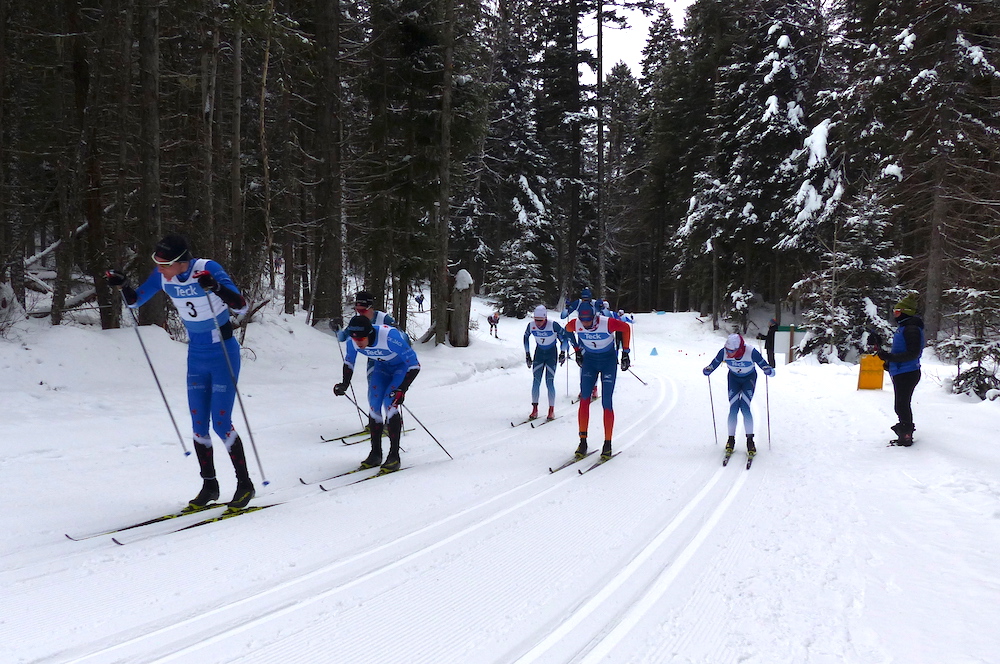
The men raced first, with Locke, Drolet, Williams, and Sam Hendry (Team R.A.D.) taking an early lead.
Williams dropped out early in a race he probably shouldn’t have started. It is hard to miss a race for illness, and harder still when the local tv station is there to see their hometown star, and your mum is the race secretary.
Black Jack teammates Locke and Drolet put the hurt on Hendry early, before Drolet broke clear to win alone in 42:18.4, 4.8 seconds ahead of Locke. Hendry hung on for third, losing 42.2 seconds on the final lap.
“I tried my best to hang on to the pace, but Rémi’s in great shape right now, coming off his big results at world juniors, so [it was] hard to stick on,” Hendry said after. “My skis weren’t quite as fast as the others. On all the downhills, they’d open up a little gap and I’d have to try to bring it back on the climbs and the flats.”
“Rémi and Sam were skiing fast, it was fun to battle with them,” Locke said. “I’m a little bit stronger on the flats, [Rémi’s] a bit of a stronger climber. We were pushing each other and just trying to ski fast and work together.”
“It was a really fun race today,” Drolet said after doping control “It was a decent pace off the start, skiing with my teammate Julien, Gareth for a bit until he unfortunately dropped out, and then Sam Hendry. It’s a pretty hilly course, so there’s not a tonne of double poling, but I think the parts of it that are double pole are important to ski well and conserve energy for the uphills.”
Drolet and Locke worked well together, up to a point. “Once Sam started to fade a little bit, we attacked and dropped him off,” Drolet explained. “Then we skied together for the rest of the race until the final climb, where I managed to pull away from him.”
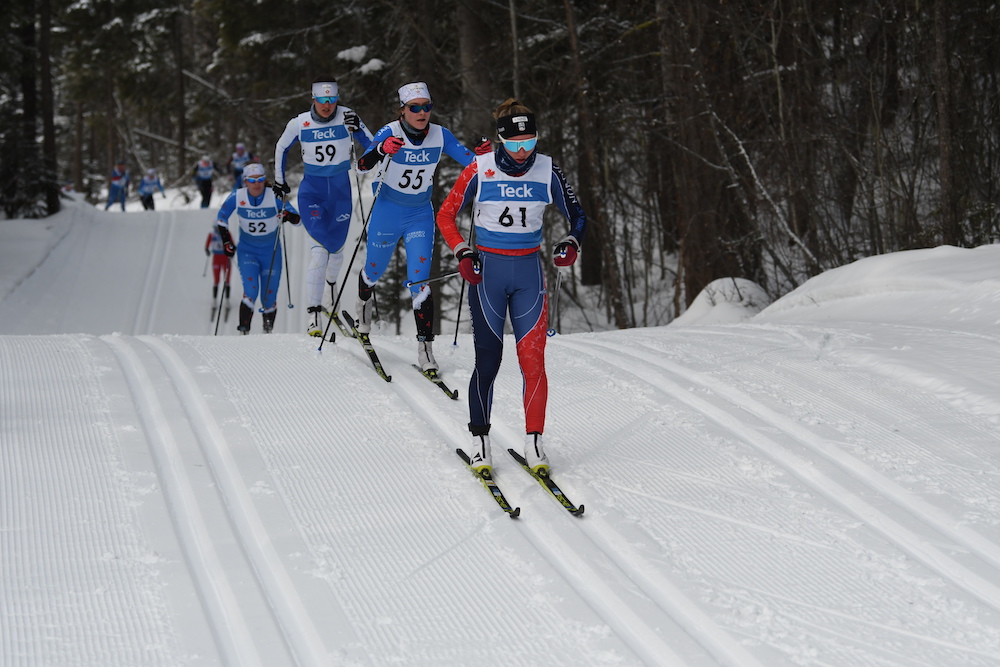
Novie McCabe (61) leads Jasmine Drolet, Katie Weaver, and Molly Miller at the 2019 Westerns 10km. (Photo: Doug Stephen)
The open women’s 10km was all about the next generation. Novie McCabe (Methow) got away early to win in 32:42.6 minutes. Black Jack teammates Jasmine Drolet and Molly Miller were second and third at 53.4 and 1:28.1 back. All three are in the junior girls category and competed at Junior Worlds in Lahti.
“I basically went out from the start hard, and tried to hold it,” McCabe told FasterSkier. “Going up the first hill, I tried to get into the lead and then on the double pole section I tried to make a break and just push hard into a downhill and that’s where I kind of gapped people by a little bit and then I just went from there.”
As an American, McCabe has a Canadian Points List ranking that put her in the third row at the start. Asked about whether this is good practice for racing in Europe, she replied “Yeah, it was definitely good to have some practice with that, navigating my way through people.”
Jasmine Drolet, at sixteen, a year younger than the other two on the open podium, kept things simple in the interview, describing her day as “good race, good skis.”
“In Canada it’s not hard to be the fast one, but when you get there [at World Juniors], it’s quite a shock,” Jasmine Drolet explained. “It’s good to ski with the best in world.”
“I haven’t been feeling super great in a lot of the distance races this year, so I was happy to have a better day today,” Miller said at the end of the day. “It was a bit aggressive in the beginning for sure. I came out of the lanes in a bad place, but it seemed to spread out very quickly.”
Among the 386 racers were some of Canada’s para-nordic team, here to prepare for World Championships starting the following Saturday.
“Races are always better than intensity,” Mark Arendz (CPNST) told FasterSkier post-race. “We’re using this as an intensity, just this single race from Westerns, to prep for World Championships in Prince George [B.C.] next week.”
(In the video below, you can see Arendz in the open men’s start, look for the national team suit, second lane from left.)
Sunday, Relays
The temperature, despite predictions, reached -17C by 9:00, allowing the relays to start on time.
For most, the relays are really about having fun with friends. The results are summarized in Sunday’s rundown.
“Relay events are always fun races, even in -17 conditions,” Rémi Drolet wrote in an email Sunday night. “It also does not matter how far ahead or behind you may be. It is always important to go as fast as possible since it can be hard to predict exactly what will happen after you have tagged your teammate.”
105 teams braved the cold to enjoy another good event at Telemark.
Course and Venue
“It’s a good course, I love racing here. Steep hills, some nice gradual stuff, it’s a good combination of all techniques.” — Locke, talking about the new sprint course
Julien Locke leads early in the first lap of the 15km. (Photo: Peggy Hung)
“My first race [here] was in 2005, my first ever provincial race, BC Midget Championships. I was 13 years old and that was my first race outside of the Kootenays. It was a pretty big day for me.” — Locke
“Seeing the young kids racing this weekend certainly brought back memories. Kelowna was one of the locations where I raced most in my younger years, and it was there that I learned many of the fundamentals of racing. Much of my early understanding of race preparation, tactics, and even technique was developed racing at Telemark.” — Rémi Drolet
“Super nice day, super great course, not too cold. Another great race at Telemark.” — Hendry, on Saturday
“It’s really nice to just be able to come up here and have some great competition and the races are really well organized.” — McCabe, on crossing the border from the Okanogan Valley in Washington state to the Okanagan Valley in B.C.
On zone4 results, click on a skier’s name to pull up pictures of that athlete in the selected event. Greg Redman, featured here, is one of the photographers contributing. There are a lot of photos, with over 60 photos of some athletes in some events.
Note that masters and the youngest athletes are in the Okanagan Cup links under Full Weekend, and some of the para athletes competed in the open category for the classic race.
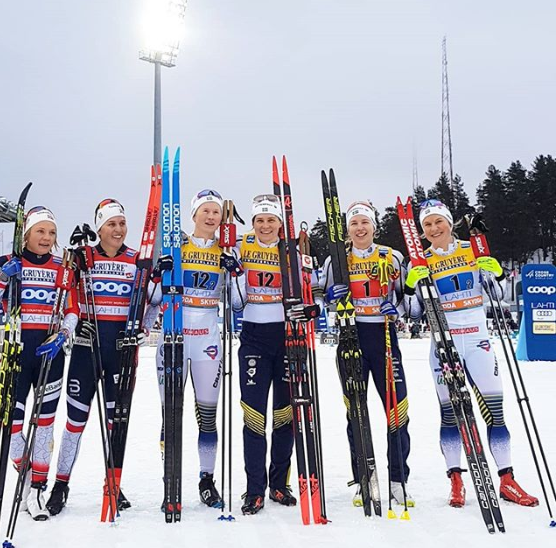
2019 Lahti, Finland’s World Cup classic team sprint podium. From left to right, Norway I in second, Sweden I in first, and Sweden II in third. (Photo: @fiscrosscountry Instagram screenshot)
FIS World Cup Lahti, Finland Classic Team Sprint
Sunday in Lahti, Finland the women raced a 6 x 1.4-kilometer classic team sprint. U.S. fans saw their hopes for a podium snuffed out in the two semi-finals that determined the 10 teams advancing to the finals.
In the first team sprint semi, the U.S. Ski Team’s (USST) Ida Sargent and Sophie Caldwell placed sixth overall and did not advance. Sargent and Caldwell, constituting team USA I, were 10.78 seconds off the winning time of Sweden II’s Evelina Settlin and Hannah Falk, who won the first semifinal in 18:36.74 minutes.
In the second semi, USA II’s Kelsey Phinney (SMS T2) and Julia Kern (USST D-Team) raced to seventh (+1:06.32). Norway I’s Tiril Udnes Weng and Maiken Caspersen Falla marked the fastest time of 18:31.09 minutes.
In the women’s final, Sweden I’s Ida Ingemarsdotter and Maja Dahlqvist won in 18:24.96 minutes. Weng and Falla took second (+1.84), Sweden II’s Settlin and Falk placed third (+3.55).
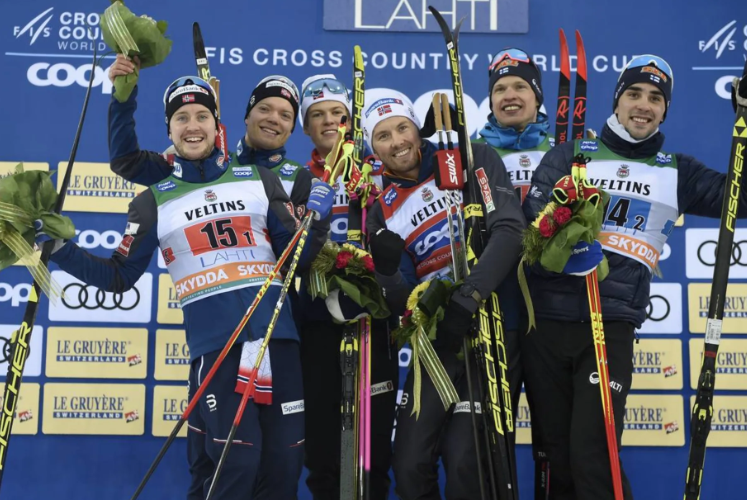
2019 Lahti, Finland’s World Cup classic team sprint podium. From left to right, Norway II in second, Norway I in first, and Finland I in third. (Photo: fis-ski.com screenshot)
The men raced a 6 x 1.6 k classic team sprint in Lahti. Both U.S. teams entered raced in the second semi with neither placing well enough to advance. The second semi was won by Russia I’s Artem Maltsev and Gleb Retivykh in 19:31.22 minutes.
In that semi-final, USA II’s Kevin Bolger and Logan Hanneman placed sixth (+6.60), USA I’s Simi Hamilton and Erik Bjornsen were seventh (+16.05).
USA II placed 12th overall, USA I 14th in the final standings.
Johannes Høsflot Klæbo and Emil Iversen of Norway won the first semi in 19:22.32 minutes.
Norway I’s tandem won the final in 18:57.19 followed closely by Norway II’s Sindre Bjørnestad Skar and Eirik Brandsdal in second (+0.65). It was a photo finish for second and third, as Finland I’s Iivo Niskanen and Ristomatti Hakola finished 0.71 seconds back to take the third podium spot.
Western Canadian Championships, Telemark, Kelowna B.C., Relays
Westerns wrapped up with club relays on a day where the thermometer flirted with cancellation before rising to -17C at 9am (that is 2 Fahrenheit, for residents of Liberia, Myanmar, and the USA).
The relay event is intended to help build club spirit in a less competitive environment. In practice, many skiers just find two friends they want to ski with. Despite the cold, 105 teams competed today.
In the open men category, the ‘BC Lost Boys’ team won easily, with Rémi Drolet, Gareth Williams, and Julien Locke finishing the 15km in 38:00.9. Drolet and Locke are teammates at Black Jack while Williams is a Telemark local. All three are national team members.
Julien Locke leads Rémi Drolet and Sam Hendry in Saturday’s mass start classic. The relay used the same 5km loop. (Photo: Doug Stephen)
‘Alberta 1’ placed second, at 1:47.1 back, with Thomas Manktelow (), Michael MacIsaac-Jones (AWCA), and Sam Hendry (Team R.A.D.) ‘BC Power, Speed, and Grace’ was third, with Tallon Noble (Strathcona), Michael Murdoch (Whistler), and Ian Williams (Telemark) at 2:26.8.
The open women used the same 5km loop as the men (and the same as on Saturday). ‘BC Supernovas’ won in 47:25.7, with BC team members Paige Latta (Sovereign Lake), Elizabeth Elliot (AWCA), and Benita Peiffer (Whistler). ‘BC Avalanche’ took second at 1:33.4 with Katie Weaver (RMR), Gina Cinelli (Revelstoke), and Beth Granstrom (AWCA). ‘Just the Ladies – No Nick’ was just 3.5 seconds behind 2nd place with Claire Grall-Johnson (AWCA), Amanda Thompson (AWCA), and Hannah Jirousek (AWCA) representing Yukon/Ontario.
Norway’s Maiken Caspersen Falla taking the World Cup win in the 1.4 k skate sprint in Lahti, Finland. Sophie Caldwell of the U.S. Ski Team placed second. (Photo: fis-ski.com screenshot)
FIS World Cup Lahti, Finland 1.4 k/ 1.6 k Freestyle Sprint
In the women’s skate sprint qualifier in Lahti, Finland Slovenia’s Eva Urevc laid down the fastest time in 2:40.67 minutes. Swiss skier Nadine Faehndrich was the second fastest qualifier, 4.21 seconds back, with the U.S. Ski Team’s (USST) Sophie Caldwell third (+4.36).
Canada’s Dahria Beatty qualified 25th (+10.21). Also making the heats for the U.S. were Ida Sargent (USST) in 26th (+10.36), and Kelsey Phinney (SMS T2) in 27th (+10.54).
Of the top three qualifiers, only Caldwell advanced to the finals. The final was won by Norway’s Maiken Caspersen Falla in 2:43.64. Falla advanced to the finals as a lucky loser from the first semifinal. That semi was won by Caldwell who ended up placing second (+0.11) in the final. Sweden’s Maja Dahlqvist sprinted to third overall (+0.37).
Germany’s Sandra Ringwald placed fourth (+0.46), Norway’s Mari Eide fifth (+0.75), and Tiril Udnes Weng of Norway sixth (+0.94).
Phinney placed 19th overall, Sargent 30th. Canada’s Beatty was 24th in the final standings.
Also for the U.S., Julia Kern (USST D-Team) coming off of illness ended her day 38th overall. Hannah Halvorsen (USST D-Team) placed 41st.
Johannes Høsflot Klæbo won the men’s 1.6 k skate qualifier in 2:47.01 minutes. He was followed by teammate Haavard Solaas Taugboel in second (+4.15). Qualifying in third was Finland’s Joni Maeki who clocked a time of 2:51.36.
Klæbo won the final in 2:52.06 while Italy’s Federico Pellegrino raced to second (+0.30). Norway’s Finn Hågen Krogh was third (+0.61). Also from Norway, Eirik Brandsdal took fourth (+1.31) and Emil Iversen fifth (+1.75). Gleb Retivykh of Russia was sixth (+2.08).
No North American men qualified for the heats.
Logan Hanneman (APU) for the U.S. placed 32nd overall after missing the heats by .22 seconds. Simi Hamilton (USST) finished 36th overall, and Erik Bjornsen (USST) 42nd.
Evan Palmer-Charette was the lone Canadian entered; he placed 67th.
Rémi Drolet leads Julien Locke and Sam Hendry at the start of lap three. (Photo: Peggy Hung)
Canadian Western Championships, Telemark, Classic Mass Start
Day two of Westerns dawned with low clouds and intermittent light snow at -11C for the classic mass starts.
The men raced first, completing three laps of the new (and freshly homologated) 5km loop. Rémi Drolet (Black Jack) won in 42:18.4, getting from Julien Locke (CNST) on the last climb to earn a 4.8 second gap. Sam Hendry (Team R.A.D.) stayed with leaders until late in the second lap, finishing 42.2 seconds back. Rémi Drolet and Hendry are juniors who represented Canada at Junior Worlds in Lahti last month. Crystal Lust
The first small climb of the Westerns 10km classic. Jasmine Drolet (#55) leads Novie McCabe (#61) in the left track. (Photo: Peggy Hung)
The open women skied two laps of the same course, with Novie McCabe (Methow) breaking clear on the first lap to win alone in 32:46.6. Jasmine Drolet (Black Jack) was second at 53.4 seconds followed by teammate Molly Miller at 1:28.1. All three raced at World Juniors in Lahti: Jasmine Drolet is 16 and the other two are 17.
There were 386 finishers on Saturday. Racing continues Sunday with relays.
Elizabeth Elliot leads Benita Peiffer and Paige Latta up the first climb in the semi-final at Westerns (Photo: Peggy Hung)
Canadian Western Championships started off Friday with free technique sprints on the Telemark trails near Kelowna, B.C.
The sun was out for the qualification round, followed by cloud, and light snow as the day progressed with the temperature hovering at -10C. A major road closure combined with icy morning highways and a large number of accidents blocking roads caused some athletes and volunteers to miss the qualification round, resulting in only 312 athletes on the start line. About 500 athletes are expected to race Saturday.
Katie Weaver (RMR) won the 1.3km qualifier in 3:06.02 and her first two heats before Benita Peiffer (Whistler) pipped her at the line to win the A final by 0.10 seconds in 3:02.79. Second place qualifier Elizabeth Elliot (AWCA) took the bronze, 2.77 seconds back.
Julien Locke blew the A final apart in Telemark. (Photo: Peggy Hung)
The men raced the same course, with Julien Locke (CNST) steamrolling the field, qualifying first in 2:27.67 before winning all three heats alone. In the A final, Locke clocked 2:28.23, 3.42 seconds ahead of the three chasers. Junior Remi Drolet (Black Jack) stretched ahead of local Gareth Williams (CNST) by 0.03 seconds with Larkin Wasmuth (CRTG) 4th, 0.53 seconds behind Drolet.
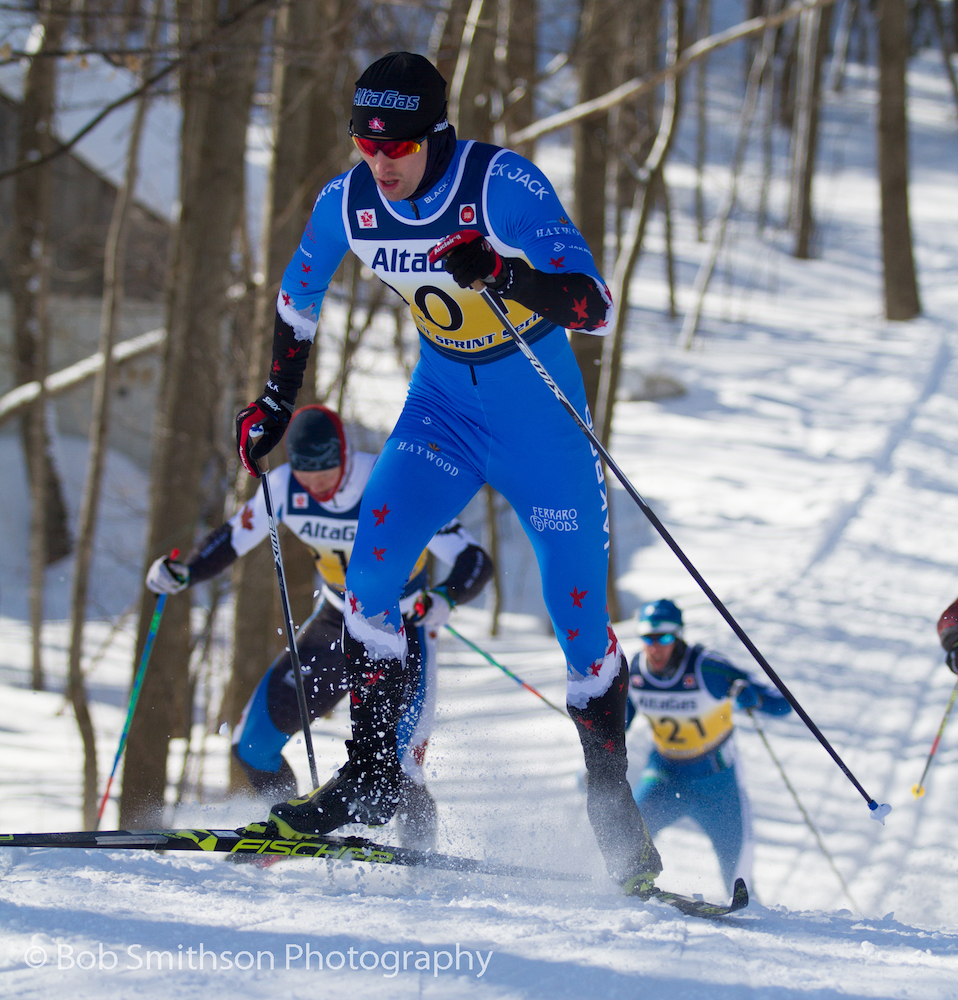
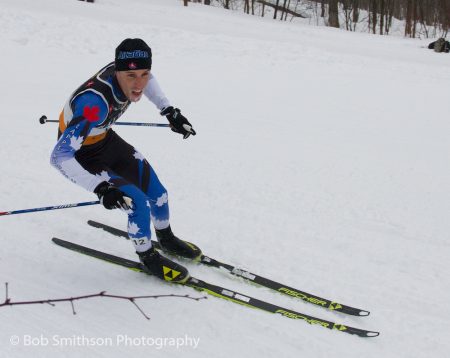
Julien Locke leading a sprint heat. (Photo: Bob Smithson)
The NorAm series went to Duntroon, Ontario, for the Canadian Eastern Championships: three days of varied weather, new race formats, and new faces on the podium, all hosted by Highlands Trailblazers.
Easterns is possibly the most storied ski race in Canada. Most years, it is the largest FIS event in North America. This year, the Polar Vortex froze out the travel ambitions for many families and lower budgets in the post-Olympic season persuaded many western teams to stay home. Despite these challenges, over 450 athletes braved the difficult road conditions to hit the start line.
Easterns was ringing in the changes this year. This may be the first ever NorAm where the men and women skied the same distance on the same courses in every event. The two-day pursuit reappeared for the first time at this level since 2000.
The two-day pursuit format was introduced in 1988. Based on the Gunderson start in Nordic Combined, there was an interval start classic race on the first day and a free technique pursuit on the second, with medals awarded for both days, but no time-of-day points for the second.
In 2002, the two-day pursuit was replaced with the same-day pursuit, with no medals for the classic portion and a two hour break before the skate. Beckie Scott won all three medals in this event at the Salt Lake Olympics. In 2003, this was changed to ‘continuous pursuit’, sometimes referred to as ‘pursuit without a break’. The format name was quickly shortened to ‘pursuit’, which confused people until 2011 when FIS acquired rights to the name ‘skiathlon’, allowing ‘pursuit’ to be used for the final day of a mini-tour. CCC wrote a history in 2011 to celebrate the new name.
In the summer of 2018, FIS dropped the skiathlon format, which brings us back to a format that most of the athletes racing today will not remember.
The weather also came out to play: -18 Celcius (C) and windy for official training, -12 C and sunny for the sprint heats, -9 C and 37 km/h winds for Saturday’s classic, and +3 C and freezing drizzle and rain for Sunday’s pursuit.
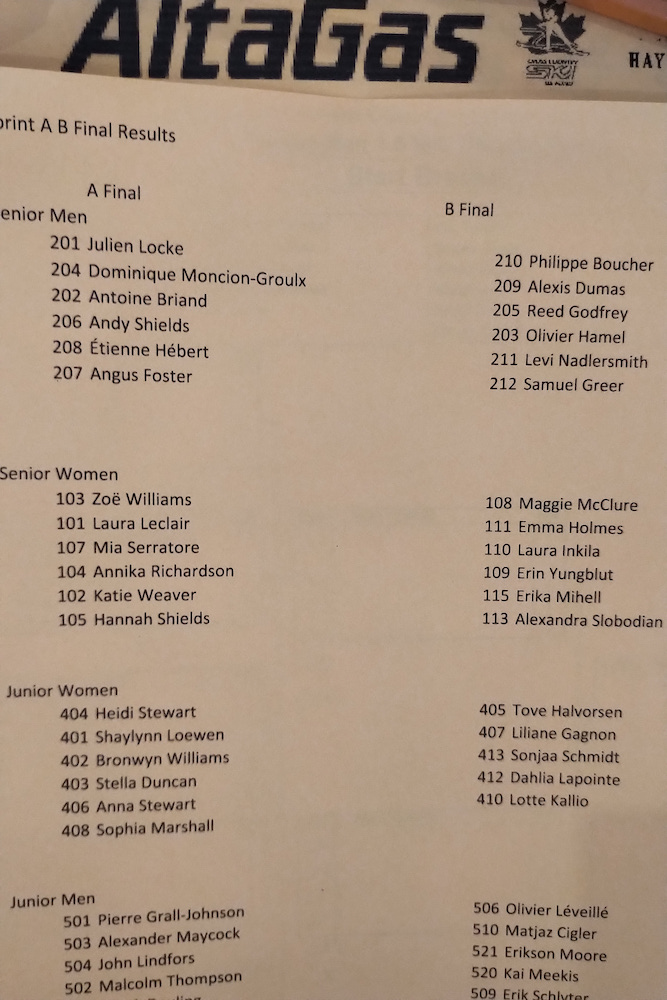
Women’s A final: Zoë Williams (Nakkertok), Laura Leclair (CNEPH), Mia Serratore (Big Thunder), Annika Richardson (TBay), Katie Weaver (Rocky Mountain Racers), Hannah Shields (Nakkertok)
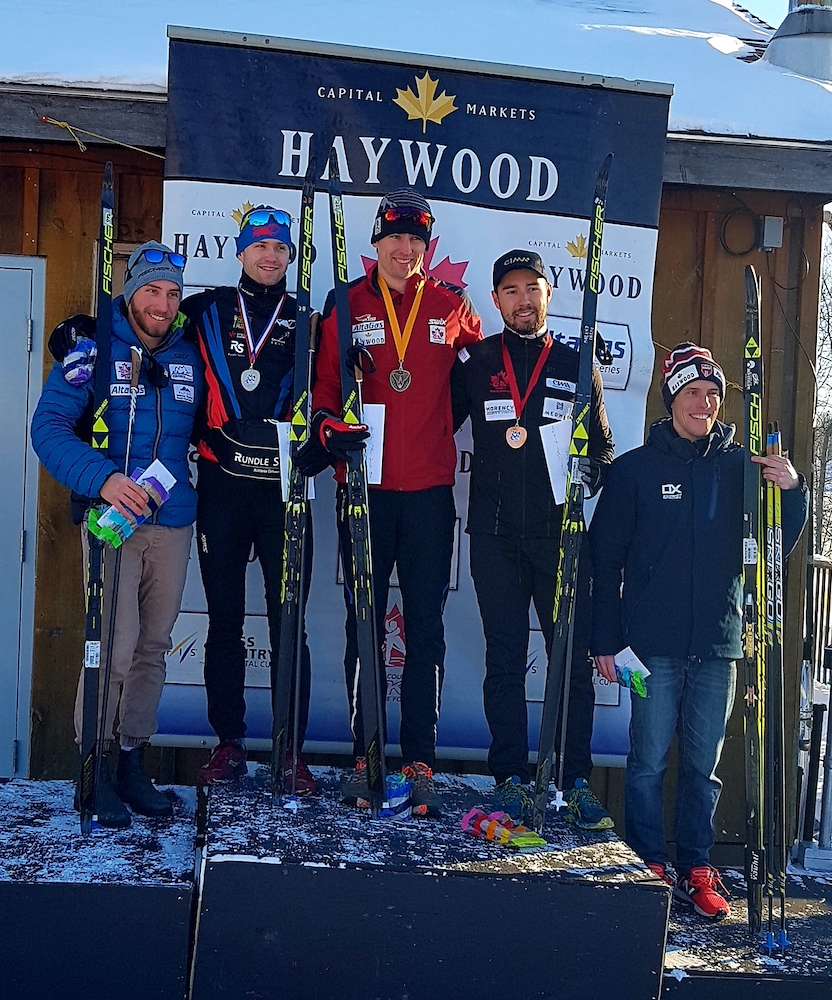
Men’s A final: Julien Locke (CNST), Dominique Moncion-Groulx (Team R.A.D.), Antoine Briand (CNEPH), Andy Shields (Lappe), Étienne Hébert (AWCA), Angus Foster (TBay).
There are no official results or times for the sprints.
Friday started cold and sunny for the 1.5km classic sprints, a welcome relief after cold and windy weather on the official training day.
“After two small running hills at the beginning, the remainder was all double pole,” Julien Locke (CNST) wrote. “While the course was not as demanding as I would have liked, it was a good opportunity to use the upper body strength.”
The course worked well for Locke, as he won the qualifier by over 4 seconds.
Zoe Williams (Nakkertok) won her first career NorAm, two weeks after her first podium and narrowly missing the selection for World Championships.
“Today was very surprising,” she wrote to FasterSkier. “When I skied the course yesterday I wasn’t a huge fan and I didn’t think it played to any of my strengths. My qualifier was really messy but I pulled it together in the heats and felt I was able to get faster as the day went on!”
The women’s A final was chaotic. Each of the three women on the podium had their own view of the action.
“I talked to my coach (Kieran Jones) before the A final and our plan was to stay relaxed in the first half of the course, pick it up in the second half and push it into the finish. It worked out almost perfectly; I got caught up in a fall on the main uphill and lost contact with the leaders but was able to fight back in the second half of the course with Laura and Annika and as everyone jostled for the inside line into the finish I just picked the outside lane and hammered.” — Williams
“Honestly the A final was pretty bad. It was a cool race because everyone in the A final could race but I think we were all a little too excited (or tired). There were a lot of tangles and falls so no tactics there.” — Laura Leclair
“Tactics were pretty important in the final. I started out hard to get out in front to stay out of trouble on the downhill. Managed to make a gap but lost it in the final straight. It was really important to be strong with the double pole at the end.” — Mia Serratore
It was Serratore’s first NorAm podium.
The men followed with tactics that emphasized staying out of trouble.
“Briand set a strong pace in the first 400m up Honey and Sugar Shack hills. I followed him out to the Biathlon range and then hopped in front for the fast/icy turn. From there, I lead up the gradual Chicken Coop climb, through the twists around the wax rooms and to the line.” — Locke
“The final started fast with Antoine putting the pace in front. I think the top three skiers (Antoine, Julien and I) had a little gap after the climbing section of the course. Julien accelerated to pass Antoine before the fast downhill, I stayed in 3rd behind them. I took the inside on the 90 degree corner at the bottom of the downhill and move up to 2nd place. Following the downhill, like in the semi-final Julien put the hammer down double poling on the gradual climb and I was the only skier that managed to stick right behind him. I tried to change tracks and pass him on the last stretch but I could not find enough speed to overtake him.” — Dominique Moncion-Groulx
“I went all out from the gun and Julien took over at mid point. No real tactics from there on to be honest it was full gas racing.” —Antoine Briand
Some of the athletes were feeling the effects of racing the US SuperTour after the Bishop’s University NorAms.
“I had a dynamic first half of the qualifier but felt slow and I did not ski the second half well. I had good energy, change of gears and I felt solid through all the rounds. I’m happy with my speed in the heats and with a good final result. For a 3rd weekend of racing in a row, it’s fun to still feel energetic.” — Moncion-Groulx
“Coming back from a big win in Lake Placid at the US Super Tour last weekend, I was feeling confident for another classic sprint. Had a good qualification with the second best time and being on the podium at the end of the day is always satisfying.” — Briand
Interval Start Classic
Saturday brought in wind and warmer weather for the 10km classic race. The 5km loop had two main uphills immediately followed by downhills.
Williams said pacing mattered because “with only 4 main hills, lots of good rest, and a ton of double pole you had to keep pushing everywhere.”
Williams got her second win of the weekend in 35:46.09 minutes. “Super happy with it: stuck to my plan and had fun chasing people down. Mia started ahead of me and we skied the 2nd lap together which was awesome.”
Serratore finished second, 37.82 seconds back. Leclair didn’t get the benefit of timely splits or good rides, but was able to grab third at 1:18.40, just 0.18 seconds ahead of Annika Richardson.
“Because I was second to start, I was alone the whole race and didn’t see anyone,” Leclair wrote. “That was pretty hard because I didn’t know how fast the girls behind me were going. I had no bunny or rabbit. Anyway, the conditions and skis were good and it was an overall good race.”
Among the men, Alexis Dumas (CNEPH) came the closest to even splits, crossing the line in 30:04.8 for the win.
“I was able to ski really hard in the second lap and that’s where I made the difference. Also, my skis were super good. My wax tech and my coach did a great job today.” — Dumas
Shields was second, 16.67 back, after an error in the unofficial results was corrected.
“I felt flat racing today. Yesterday was a long day with the classic sprints and awards being late in the day so I was carrying fatigue,” Shields wrote. “In today’s race, I knew I didn’t have a great one but was surprised to see how far back I was when the initial set of results came out showing me in 7th place – almost a minute from the win.”
Boucher was happy with his third place, 21.57 seconds back.
“I think my skis and pacing played a lot in the outcome of the race. I decided to sacrifice some kick to have a better glide on the flat sections. Turns out it was the good call for me. I’m a little disappointed that I lost nearly 15 seconds on the leader in the last lap.” — Boucher
Skate Pursuit
Zoë Williams (101) and Annika Richardson ready to start the pursuit. (Photo: Marten Burns)
Sunday brought freezing drizzle replaced by rain which resulted in significant challenges in picking the right skis for the changing conditions. The start times for the skate pursuit are based on time back in Saturday’s classic race, with no bonuses awarded.
Leclair took her first senior NorAm win, starting third at 46 seconds back.
“My tactics for today were pretty simple,” Leclair wrote. “I wanted to start fast and catch the two girls in front of me. I put my head down, climbed and went hunting.”
“I felt super good and skis were wicked fast. After missing the first step of the podium on the two last races, it is nice to finish on the top.”
Zoë Williams in second place in Sunday’s pursuit. (Photo: Bob Smithson)
Saturday’s winner Williams started first and hung on for second. “Today was tough; didn’t have much left in me physically or mentally and it made the 15km a bit of a suffer fest.”
Annika Richardson moved up to third. “I was pretty hungry for a podium after being 4th the past two days. I have done 13 races in the past month so have felt like I have been running on empty for a little while,” Richardson wrote. “But, I really love skate distance races so was able to give it everything I had left.”
“I started with Laura Leclair who is an amazing skate distance skier. I stuck behind her until the first long downhill but she had really, really fast skis so I wasn’t able to stick with her for the rest of the race (though my skis were quite good) but managed to catch Mia Serratore by the end of the South 3.75 loop on the first lap.”
Andy Shields leads Jack Carlyle, Philippe Boucher, and Alexis Dumas in the pursuit. (Photo: Bob Smithson)
Jack Carlyle earned his first senior NorAm win as well, as the top four men neatly reversed their start order at the finish.
“Sunday was a great day,” Carlyle wrote. “Had some good jam in the legs and was able to push hard.”
“On the first lap the first four starters (Phil Boucher, Andy Shields, Alexis Dumas and I) came together as a pack, and we skied together for most of the race,” Carlyle wrote. “We took turns taking the lead throughout the race, and on the last lap I attacked with 3km’s to go and that’s when the pack broke up.”
Boucher started slowly in a strategy that earned him second place. “I decided to start easy on the first km. When I got dropped I decided to stay calm and kept skiing at my pace. When I rejoined the lead pack, I think I had more energy left than the other guys. I had awesome skis and that played a good role at being able to save energy. Jack attacked with 3.5km left, I stayed in his skis in the long hill. Only the two of us survived the attack. I died a few meters after the top. That’s how Jack got away with the win.”
Andy Shields looking ahead in the pursuit. (Photo: Bob Smithson)
Shields was still tired after two top tens and a third at the SuperTour the previous weekend, but felt better than Saturday. “Different weather today for sure. Ski selection was critical and was the main factor in determining who finished in what place – for the top 4 anyway. I felt ok with my race but my skis weren’t quick enough to complete. The wax was fine, just my ski fleet has a weak link in today’s conditions.”
Format Changes
None of the athletes commented on gender equality, but there were lots of opinions on what was, for most, their first two-day pursuit.
The wave start from the open women’s pursuit. (Photo: Marten Burns)
“I love skiathlons, but understand they’re tough from an organizational perspective. Pursuits are fun and a pretty good replacement, but I’m also a big fan of a good mass start; the problem with pursuits is things can sometimes get so spread out that it almost turns into another interval start the 2nd day.” — Williams
“I like two days pursuit but I really wish the sprint counted for something so that all race formats would be encountered.” — Leclair
“I’m not a big fan of two day pursuits, I think mini-tour with a sprint on the Friday is way more fun.
I’m missing skiathlon. It was a race I enjoyed and I don’t understand why we don’t race it anymore.” — Briand
“Pursuit starts are some of my favorite races. You often end up in a unique race situation and there’s all kinds of strategic options to play with. Lots of fun!” — Shields
“I really like racing, so I don’t mind. Skiathlon was a fun race but pursuits are fun too.” — Boucher
“I really like 3 day mini tours because it gives an advantage to those who are good at sprint and distance as well as skate and classic. I am not a huge fan of skiathlons, I find they tend to come down to the best skate skiers and I would definitely rather just do a skate mass start which are really fun.” — Richardson
“Love all racing formats, don’t have a favourite to be honest.” — Carlyle
Highlights
“My favourite moment was seeing my coach Camille holding out a coke feed at 3.75km to go, I really needed the boost of energy.” — Richardson was happiest on Sunday, and not just for her first podium.
“On the non-racing focused side, hanging out with the CNEPH crew! They gave me great race support, super fast times, and are a super fun team to be around. Taking a detour to Parkdale in Toronto before my flight with Reed Godfrey was pretty fun too.” — Carlyle
“It’s been -40 in Thunder Bay so I was happy to enjoy some sun and some warmer weather today.” –Serratore, on Friday’s -12 weather.
“Without a doubt the sprint final. It was such an exciting race and tons of fun. However, I also really enjoyed watching my teammates (especially my sister!!) crush it on the race course; I’ve had a number of teammates coming back from concussions and it was just so wonderful to be back on the start line with them!!” — Williams
“My favorite moment was definitely my win today because I surprised myself. I am happy with the sprint final as well.” — Leclair, who likes surprises. https://carnivorestyle.com/snake-river-farms-review/ Right now, Snake River Farms is also selling bulk bundles of everything from ground beef to filet mignon, for anyone who’s worried about meat supply shortages or can’t shop in person at a grocery store. Snake River Farms is a premium meat producer that specializes in beef and pork. Their meat is used at Michelin-star restaurants and sold directly to the public from their website. With its intense marbling, their American Wagyu brisket has gained a reputation among competitive barbecue teams looking for an edge.
“I liked the pursuit. We don’t get to do this very often so it’s always fun to race something different.” — Boucher
“It was a surprisingly beautiful day up at Highlands today. After being greeted by howling winds and -18, today’s sunny -12 was a treat to race in.” — Locke
Nakkertok rented a dog for the weekend! (Photo: Marten Burns)
2019 Easterns classic sprint podium (L to R): Katie Weaver (5th), Laura Leclair (2nd), Zoë Williams (1st), Mia Serratore (3rd), Annika Richardson (4th). (Photo: Marten Burns)
The NorAm series rolled on with Easterns, hosted by Highlands Nordic in Duntroon, Ontario, with 1.5km classic sprints. The weather cooperated, despite a massive cold front sweeping through much of North America, allowing for comfortable racing after a delayed start. There were over 340 racers registered for Friday’s races, with more racers and younger categories waiting for Saturday.
On the women’s side, Zoë Williams (Nakkertok) continued her strong start to 2019 with her first NorAm win, beating top qualifier Laura Leclair (CNEPH) and Mia Serratore (Big Thunder).
Easterns 2019, mens classic sprint podium (L to R): Étienne Hébert (5th), Dominique Moncion-Groulx (2nd), Julien Locke (1st), Antoine Briand (3rd), Andy Shields (4th). (Photo: Marten Burns)
Julien Locke (CNST) doubled up with the fastest qualification time and an A final win. Dominique Moncion-Groulx (Team R.A.D.) took second ahead of early leader Antoine Briand (CNEPH). Briand won the US SuperTour in Lake Placid last weekend.
“It was a surprisingly beautiful day up at Highlands today,” Locke wrote in an email to FasterSkier. “After being greeted by howling winds and -18, today’s sunny -12 was a treat to race in.”
Official results were not yet available at 7pm local time. More details coming in the weekend wrap-up on Monday.
Cendrine Browne (bib 1) leads Katherine Stewart-Jones (bib 2) at the start of Sunday’s 14.3 km skate mass start at Bishop’s University. (Photo: Ian Aitken)
The third NorAm weekend of the season was also Canadian selection trials for 2019 World Nordic Ski Championships and a Quebec Cup event on the Bishop’s University trails in Lennoxville, which is a neighborhood in Sherbrooke, Québec. With variable weather the Mont Orford club rallied and held races all three days of the competition schedule.
On the line were NorAm series points, COC leaders’ bibs, and six automatic selections for the World Championships in Seefeld. Four athletes have been pre-selected for the World Championships: Alex Harvey (PyeongChang, WC period 1), Lenny Valjas (PyeongChang), Dahria Beatty (WC period 1), and Emily Nishikawa (Tour de Ski). The race winners from each day would join that group.
Skate Sprint, Friday
Maya MacIsaac-Jones was the fastest woman all day. (Photo: Michèle Carriere)
Racing began Friday with skate sprints on a technical course. The weather cooperated, with -10 C air, dry snow, and snow flurries. Maya MacIsaac-Jones (CNST) took the first selection, along with the qualifier and every heat, winning the 1.3km A final in 2:36.83. Katherine Stewart-Jones (CNST) was second (0.05) while Laura Leclair (Nakkertok) earned her first senior NorAm podium at 3.77 seconds.
“The start position was very important because the course isn’t very wide and it makes it very hard to pass,” Leclair wrote of the A final. “I wanted to start fast and stay close to Maya.”
Stewart-Jones had a similar strategy, writing “In the final my strategy was to position myself behind Maya from the beginning because I knew she was feeling strong and it would allow me to conserve energy and avoid having to pass other people.”
Evan Palmer-Charrette on his way to qualifying 4th. (Photo: Michèle Carriere)
The men’s 1.6km sprint final was more aggressive, with Evan Palmer-Charrette (Team R.A.D.) winning in 3:06.58, edging out Julien Locke (CNST) by 0.11 seconds at the line with early leader Russell Kennedy (Team R.A.D.) 2.26 back in third.
Palmer-Charrette had a plan to attack at the midpoint of the final. “Dominique Moncion-Groulx [Nakkertok] and I had the same thought and tangled up,” he wrote in an email to FasterSkier. “I thought that ended my chances but was able to bridge back to the lead and come through with a strong finish.”
“Everyone was skiing tight together in the first half of the final,” Locke wrote after the race. “I knew that the differences would be made in the 2nd half so I held my position mid-pack and made sure I was ready for when the pace ramped up. Russell pushed hard up the 2nd climb and I waited for the steep pitch to hop by him. I led down the twisty turns and through most of the finishing straight. Evan had a great kick in the last few meters of the gradual downhill finish.”
“It was a fun final, I led most of it. Julien came in front of me on the last hill and I followed him down,” Kennedy wrote. “Evan took a really good line into the finishing straight. He had a great day and I am super stoked for him.”
Classic Distance, Saturday
The individual start classic day dawned cold, but a delay to a noon start allowed legal racing at -19 C with less wind.
Scott Hill putting in the fastest second lap in the 15km. (Photo: Ian Aitken)
Scott Hill (Hardwood) won the men’s 15km and earned his trip to Seefeld with the fastest splits on the last three laps, with Kennedy fading on the last lap for second, 9.0 seconds back. Graham Nishikawa (CPNST) held on for third at 38.0 seconds.
“I put together my best race of the year so far in terms of pacing, tactics, technique, focus and all the other small things,” Hill wrote. “For sure double pole strength made the difference today on such a flat course. I don’t consider myself a great double poler but after I went to Norway this summer and raced some almost entirely double pole rollerski races and got my butt kicked really bad, I have been working a tonne on double pole since I got back to Canada at the end of August and it paid off today.”
Stewart-Jones won the women’s 10km, earning the selection spot along with the virtual COC leaders bib. Cendrine Browne (CNST) was second at 30.8 seconds, an improvement from her 4th on Friday. Zoë Williams (Nakkertok) was third at 1:53.5, edging out Frederique Vezina (CNEPH) by 3.1 seconds.
Katherine Stewart-Jones moving up in the 10km. (Photo: Ian Aitken)
“It was a pretty flat course so there was a lot of double pole. I think that what made the difference was really going out hard from the start and trying to stay as consistent as possible,” Stewart-Jones wrote. “On a course like this it’s easy to lose focus but you can lose a lot of time if you aren’t keeping the tempo high on the flats.”
Athletes from the east were less likely to comment on the cold than the westerners. All names withheld to protect the guilty.
Skate mass start, Sunday
Russell Kennedy leading early in the 19.3km. (Photo: Ian Aitken)
Sunday was warmer as a massive snowstorm rolled through Quebec. The trails became softer and deeper as the day progressed despite the shortened courses.
Katherine Stewart-Jones (CNST) continued her dominance with a win in 48:25.5 minutes, on a shortened course of 14.3 km, with one 4.3 km lap and two 5 km laps.
“There was a ton of snow so it was really slow,” Stewart-Jones. “Cendrine and I worked together and exchanged leads. I made a break on the last little bump before the finish.”
Browne had her final chance to get an automatic selection. “I started pretty fast, and already after 4 km, the pack was broken. Katherine and I were with a little group of 6 skiers but broke away after 6 km and skied together for the remaining 9 km,” she wrote. “I tried to attack on the last uphill but Katherine stayed with me and attacked me when there was 500 meters to the race. I was so tired I couldn’t follow… I think I attacked too early but I had to try!”
COC leader Russell Kennedy (Team R.A.D.) collected his first win of the weekend to earn his trip to World Championships, finishing alone at 57:12.6 on the four lap 19.3 km race. Hill was second at 23.4 seconds behind. Palmer-Charrette out-sprinted the remains of the original six leaders to complete the podium at 1:07.0.
“It was a hard day with the amount of snow that fell,” Kennedy wrote. “I found myself on the front early so I pushed the pace and kept pushing. Took a break on the second lap and pushed the third and fourth lap.”
At the end of the weekend, MacIsaac-Jones, Palmer-Charrette, Stewart-Jones, Scott Hill, and Russell Kennedy have met the qualification standard for Seefeld. The High Performance committee should soon announce their official selection; if there is a sixth athlete chosen, it is likely to be Browne with 4th, 2nd, and 2nd places.
Kennedy continues as COC leader while Stewart-Jones moved past Dahria Beatty to earn the women’s leader bib.
The men’s 4 x 7.5 k relay in Ruhpolding, Germany. (Photo: screenshot biathlonworld.com)
IBU World Cup Ruhpolding, Germany 4 x 7.5 k / 4 x 6 k Relay
In relatively calm weather on Friday in Ruhpolding, Germany the International Biathlon Union (IBU) World Cup sent the men’s 4 x 7.5-kilometer relay on its way. Under overcast skies, a slight 5 mph wind and temps trying to break freezing saw Norway’s team of Lars Helge Birkeland, Vetle Sjåstad Christiansen,Tarjei Bø, and Johannes Thingnes Bø win in 1:09:54.3 hours. The Norwegian foursome raced to the top podium spot with no penalties and using eight spares.
The move that grasped the race for Norway came when Johannes Thingnes Bø, on the final leg, threw down a speedy attack on the course’s burliest hill making him the carrot the others would be chasing towards the finish line. In less than a kilometer, Bø put in the almost 14 second gap back to Germany
Germany’s Rees Roman, Johannes Kuehn, Arnd Peiffer, and Doll Benedikt placed second 13.5 seconds behind Norway. Rees shot clean for Germany as did Peiffer – in total the German team shot with no penalties and used six spares.
The final podium spot went to France’s Emilien Jacquelin, Martin Fourcade, Quentin Fillon Maillet, and Simon Desthieux. France finished 26.2 seconds back while skiing no penalties and using nine spares.
Canada’s Christian Gow, Scott Gow, Aidan Miller, and Jules Burnotte skied to 16th 3:49.0 minutes behind Norway. In total, the Canadians skied one penalty and used 16 spares.
The U.S. team of Leif Nordgren, Sean Doherty, Jake Brown, and Max Durtschi raced to 17th, stopping the clock 4:01.2 after Norway. Over the duration of their four legs, the U.S. skied a single penalty lap while using 13 spares.
Twenty seven teams were entered in the men’s race.
The Canadian selection races for senior World Championships combined with a NorAm and Québec Cup weekend hosted by the Mont Orford club, began with freestyle sprints today.
Maya MacIsaac-Jones (CNST) won the qualifier and all her heats on the way to winning the A final, leaving no doubt about her selection for Seefeld. MacIsaac-Jones’ 2:36.83 minute A final was the fastest lap of the day, just edging 4th fastest qualifier Katherine Stewart-Jones (CNST) by 0.05 seconds. Laura Leclair (CNEPH) was third at 3.77 seconds after qualifying second. Third-place qualifier Cendrine Browne (CNST) was fourth, 4.99 seconds back, with Zoë Williams (Nakkertok) fifth (+5.18) and U.S. skier Madison Morgan sixth (+8.92.)
On the men’s side, Evan Palmer-Charrette (Team R.A.D.) won the A final in 3:06.58 minutes, 0.11 seconds ahead of Julien Locke (CNST). Top qualifier Russell Kennedy (Team R.A.D.) was third, 2.26 behind Palmer-Charrette and 0.24 seconds ahead of Sebastien Boehmler-Dandurand (AWCA). Antoine Briand (Skibec) finished sixth (+5.12), followed by Dominique Moncion-Groulx (Nakkertok) in sixth (+5.93).
Racing continues for two more days with an interval start classic on Saturday and mass start skate on Sunday. The top Canadian each day qualifies for World Championships.
Canada’s Julien Locke with the overall win in the men’s classic sprint at the 2019 U.S. Cross-Country Ski Nationals in Craftsbury, Vermont. (Photo: John Lazenby)
With the thirty men who qualified for the men’s classic sprint heats on Friday in Craftsbury, VT. winnowed down to six in the final, Ben Saxton had already made made his mark in the quarterfinal.
The SMS T2 skier laid down the fastest qualifier in 3:18.58 minutes. He won his qualifier ahead of second place skier Zak Ketterson (who eventually made the finals as a lucky loser) and faced down with fourth fastest qualifier, Logan Hanneman (APU) in the second semi. Hanneman bested Saxton by less than one tenth of a second as they moved on to the final.
The second semi was won by Canada’s Julien Locke. Locke began his day qualifying in ninth, then won his quarter and semi as he advanced. He also established a pattern of skiing faster as the day transpired. He won the quarter in 3:21.79; his semi in 3:17.84.
In the final, Locke notched up his speed enough to beat both Saxton and Hanneman for the win. He stopped the clock in 3:15.46. Saxton placed second, Hanneman third.
Peter Holmes (SVSEF Gold Team) placed fourth, Canada’s Dominique Moncion-Groulx (Team R.A.D.) was fifth, and Zak Ketterson (NMU) sixth.
“I actually wasn’t feeling so great this morning so I wanted to be a bit calm in the heats,” Locke said. “And it was pretty obvious after the quarterfinal that that strategy was working because same thing there, I was a bit back at the start and then I could close down to the finish and I think a lot of guys were tying up because you know if you do a three minute sprint it’s a lot harder than doing a two minute sprint with a one minute warm-up, that’s kind of what I was doing today. I think it was just reinforcing that the first half of the course wasn’t very important.
“The final was fun,” Locke continued. “I started a little bit slow the other guys were really pushing off the line and I was dropped by a bit, but I just hung in there and stayed within contact. And then I knew that I was stronger on the climb so I just waited until the technique zone and then I put the hammer down and skied harder into the finish.”
The American podium from the men’s classic sprint at the 2019 U.S. Cross Country National Championships at Craftsbury, VT. From left to right, Logan Hanneman (APU) in second, Ben Saxton (SMS T2) first, and Peter Holmes (SVSEF Gold Team) in third. (Photo: John Lazenby)
Saxton claimed the U.S. national classic sprint championship as the first American across the line, with Hanneman in second, and Holmes third.
For Saxton, it was his fourth U.S. nationals sprint podium but his first national championship. Saxton placed second in 2014 and 2015 nationals, a skate and classic sprint respectively. Last year, at nationals in Anchorage, he placed third in the classic sprint.
“The final was really fun, the sun was out for most of the heats so we were all in a pretty good mood,” Saxton said to FasterSkier in Craftsbury. “It was a good clean race, everybody came through the technique zone pretty tight. The Canadian Julien Locke grabbed a meter or two at the end. And I couldn’t quite grab him at the end but I had my hands full running from Logan Hanneman anyway. He’s one of the fastest finishers we’ve got.”
In past nationals, Hanneman has qualified high in the rankings, yet Friday was his first career national’s podium. (In 2015, Hanneman was second in the skate sprint qualifier; first in the 2018 national’s skate sprint qualifier; second in the 2018 national’s classic sprint qualifier.)
“The final was pretty similar to the semi in that Ben and Zak Ketterson really took it from the gun,” Hanneman said after the race. “They controlled it out of the start, but after the quarterfinal, I kind of decided to hang back until the uphill because there’s a lot of time to be made over that uphill and into the finish. Those guys went out hot [in the final] and I was just behind them and Julien was behind me somewhere and we all came into the uphill kind of four abreast. I was in the far right track, then the striding came and yeah we closed that gap up to Ben and Zak [Ketterson]. Julien made his move kind of over the top of the uphill on the inside and I was far outside and there were people in the middle — he made it at the right spot. It was a fun race. Coming up here into the finish with all the crowd right here on the side and the sun, it was pretty nice.”
Holmes was the third American as he earned his first career U.S. national’s podium. The twenty-two-year-old Holmes graduated from the University of New Hampshire last year and is in his first year with the SVSEF Gold Team.
Pre-race favorite Andy Newell qualified in third after double poling the classic course on skate skis. Newell did, however, stride on his skate skis through the required technique zone.
Newell initially placed second in the fifth quarterfinal but was later suspended for interfering with a competitor causing them to fall.
Bob Thompson outsprinted Jack Carlyle in the men’s 30km. (Photo: Doug Stephen)
Canmore hosted the second NorAm of the 2018/2019 season on December 13th, 15th, and 16th. The event also served as U23 and Junior World trials.
By the end of the weekend, starts at the U23/Junior World Championships and the World Cup’s Tour de Ski would be earned.
This event was originally scheduled for Whistler Olympic Park but had to be moved as a result of heavy rain and inclement weather forecasted into the immediate future. The Callaghan Valley Cross Country organization, the original bid-winner for this season’s trials, made the difficult decision to cancel on December 1st. The weather gods added one final insult on December 13th, when a major snowstorm ensued in the Callaghan Valley that would have made racing possible on the 14th.
Canmore’s cross-country community stepped in on December 2nd and was able to organize a successful race weekend with a few weeks notice.
The International Ski Federation (FIS) mandates that Continental Cup leaders for each period earn automatic start rights for the next World Cup period, including financial support from the event hosts. This season, Period 1 leaders get starts for Period 2 (Tour de Ski) and period 3 (Dresden, Otepää, and Ulricehamm) along with race support.
For the first time since Perianne Jones and Dasha Gaizova started in the 2014 edition, Canada will enter a woman in the Tour de Ski (TdS). The last female finisher was Sara Renner, who placed 16th overall in 2010.
This past weekend, Dahria Beatty won all three races in Canmore. Combined with her second place (and top Canadian result) in Sovereign Lake the previous weekend, Beatty is the COC leader and will leave for Europe on the 21st.
In an email to FasterSkier after Thursday’s sprint, Beatty wrote: “I think the first 3 stages of the Tour this year are my dream come true, 2 sprints and a 10km skate.” The day after sending the email, Beatty received the official news that her TdS dream would be a reality.
On the men’s side, Bob Thompson won twice in Canmore to lock down the male COC leader position.
As this event was also the selection trials for U23 and Junior World Championships, up to 12 athletes would automatically qualify for the Lahti, Finland championship races. The High Performance Committee met Sunday afternoon and will announce the final choices soon.
Weekend Results Summary:
Names in green earned automatic selection for Lahti.
Classic Sprint, Thursday:
Open Women: Dahria Beatty, Katherine Stewart-Jones, Maya Macisaac-Jones; Marie Corriveau (6th, U23)
Junior women: Anne-Marie Petitclerc, Molly Miller, Anna Pryce
Open Men: Bob Thompson, Angus Foster, Julien Locke; Graham Ritchie (4th, U23)
Junior Men: Remi Drolet, Tom Stephen, Xavier McKeever
Interval start freestyle, Saturday:
Open Women 10km: Dahria Beatty, Katherine Stewart-Jones, Frédérique Vézina; Sadie White (4th, U23)
Junior Women 5km: Molly Miller, Isobel Hendry, Elizabeth Elliot
Open Men 15km: Russell Kennedy, Evan Palmer-Charrette, Alexis Dumas; Gareth Williams (6th, U23)
Junior Men 10km: Sam Hendry, Remi Drolet, Tom Stephen.
Mass start classis, Sunday:
Men 30km: Bob Thompson, Jack Carlyle, Russell Kennedy; Sam Hendry (4th, top junior), Antoine Cyr (5th, U23)
Dahria Beatty leads Katherine Stewart-Jones. They would finish 1-2 all three races. (Photo: Doug Stephen)
“My tactics for every heat was to ski smooth and relaxed the first half and attack off the final two climbs into the finish. That worked out well for me today. I skied from the front and had control of the heats. The sprints were staged out of the biathlon stadium (hence why you couldn’t find them on the webcam) so it was an uphill finish, making for very fair racing.” — Beatty (1st)
“I was not happy with my qualifier but am really happy with how I skied the heats. Our staff did an awesome job with the skis today! The course was a lot of fun. Tactics essentially involved staying relaxed off the start, positioning well for the final climb and then hammering to the finish.” — Maya MacIsaac-Jones (CNST, 3rd)
“I feel pretty amazing about today’s race. 4th senior at a NorAm sprint is by far my best sprint result ever! My tactic was to have fun and just go like hell; I had a blast and I never went this fast before!” — Frédérique Vézina (CNEPH, 4th)
“I didn’t really have any tactics, I just wanted to go as fast as I could, ski well and try to stay with the leaders. I didn’t ask myself a lot of question, just ski fast!” — Marie Corriveau (MSA, 6th)
Bob Thompson wins the A final with three Thunder Bay teammates in the camera frame. (Photo: Doug Stephen)
“I am very happy with how today went. I found the finishing sprint gear I felt I was missing had the speed when I needed it.
Everyone was fairly relaxed for the first half of the final knowing it was important to have the energy for the gradual climb into the finish. My move was made coming up to the last short downhill and then on the short striding hill before turning into the finish. I had been feeling great in that section in every heat and made sure I was at the front to make the most of it.” — Thompson (1st)
“The group strung out a little bit going into the big downhill, I was back in 5th but had amazing skis and came back up to the group pretty easily. Everyone was really skiing together going into the last climb, and Bob just put down a mean last hill and got away from us. I jumped out from behind Julien Locke as we hit the finishing stretch and got up beside him as we got right down to the line, and just got him in a big lunge.” — Angus Foster (TBay, 2nd)
“The tactics worked out for me as well! I was planning on holding on to the leaders in the final for as long as I could, and then using my fitness to the best of my ability in the finishing stretch.” — Graham Ritchie (TBay, 4th)
Interval start free technique
Sadie White was fourth and top U23 on Saturday. (Photo: Doug Stephen)
“It was a hard race today. I had a good start but then got really stiff going into my second lap after the big climb. It took a lot of mental fight to regroup after I got really stiff on the second lap but I was able to ski out of it and push really hard on the final lap.
I am really happy with my fitness right now, my pacing was a bit off today but I think that fact that I am in good shape allowed me to bring it back.” — Beatty (1st)
“I felt better and better throughout the whole race today! I kind of wish we had more lap to go…” — Vézina (3rd)
Russell Kennedy descending to first place. (Photo: Doug Stephen)
“Pacing was important today: that being said I didn’t pace it that well. Was definitely fastest the first two laps. Skis for me were really good [as] the team did an awesome job on them.” — Russell Kennedy (Team R.A.D., 1st)
“The race today went alright, I tried to start hard and couldn’t quite get myself into a top end race gear. I skied relatively consistent and was able to find a better feeling on the last lap, but overall not the way I want to feel during a race, the result was a pleasant surprise.
I think pacing played a big role, I was pretty far back after the first and second lap but turned out to be less than some guys lost on the last lap and so I was able to move up quite a few places in the final kms.” — Evan Palmer-Charrette (Team R.A.D., 2nd)
“My race today was really good. I feel like I was able to push hard and keep a good technique. I think the key today was to get a good glide after each push because they were not a lot of easy part on this course and the downhills were fast so you needed to get recovery were you can.” — Alexis Dumas (CNEPH, 3rd)
“Today’s race was good, not amazing but I’m happy to come away with the top U23 spot which qualifies me for U23 World Championships.
Today’s weather was static and remained the same for the whole race. The race was decided on the last lap, that’s where I pushed my hardest. My plan for the race was to increase the speed as the race progressed, getting a bit faster each lap. I was getting splits and I realized I was off the pace on the first laps, so I just made sure to push as hard as I could on the final climbs.” — Gareth Williams (Telemark, 6th)
Mass start classic
Russell Kennedy (bib #1) leads out the men’s 30km while Bob Thompson towers over the field in the leader’s bib. (Photo: Doug Stephen)
“Today’s race stands out as the most fun I’ve had in a 30k since the very first one I ever did at the Canmore Nationals in 2010.
The main group got smaller definitely through Russell pushing the climbs on most laps. We had the group of 6 for several laps and then the last 2 were really just the 3 of us with Russell pushing hard on the climb from the bottom of the course. Jack and I had faster skis and on the final downhills went by and then had a great sprint to the line.” — Thompson (1st)
“After a tough sprint day, it was great to bounce back with two super successful distance races. ” – Sam Hendry (Team R.A.D., 1st junior in 4th)
“Today was a fun race. A good battle between Katherine and me once again.
Katherine set the pace early and by the second lap, we were on our own. It was windy on course today, so it was hard to break from each other and after testing each other a few times on the last lap it came down to the finish sprint, which of course is my favourite.” — Beatty (1st)
“The race was really fun. I pushed the pace right off the start so Dahria and I made a break from the rest of the group after the first lap. We skied together the entire race, it was the type of course that made it difficult to break away because the hills were relatively short and there was quite a big drafting effect on the flats. It came down to the finishing stretch and Dahria was stronger on the double pole!” — Katherine Stewart-Jones (CNST, 2nd)
Selection
“At this point, if I am offered a start I will plan to race the first 3 stages and then reassess after that based on how I am skiing. The Dresden WC will also be a focus just after the new year so I want to make sure I am well prepared and have enough energy for those races as well.” — Beatty, on Thursday, before the Tour de Ski offer was made.
“Qualifying for world juniors has been a big goal of mine for many years and I am really excited to have achieved it this weekend.” — Hendry
Personal Highlights
“Most unusual part was getting to come home and lie in bed between the quali and heats.” — MacIsaac-Jones
“I am very very happy with my race today, I really surprised myself! It’s been a long time I didn’t feel good at racing so it was really fun to have good feelings again. Take the first spot for U23 world champ was the best way to start the season!” — Corriveau
“Getting to race the final with three of my NTDC Thunder Bay teammates was a blast, I was really proud of the way we skied out there today and think it reflects a lot of hard work by our team and coaches this year! I’m stoked for Graham and Julian go 1-2 in U23 with World Champs spots on the line, and we all owe a big thank you to our wax techs for some wicked boards all day.” — Foster
“It’s been really nice to race at home and sleep in my own bed, especially knowing I will be away a lot for the rest of the season.
Everyone in Canmore has done a great job organizing the races so last minute. I’ve been especially loving the chocolate medals!” — Beatty
“The highlight from this past weekend was hands down, getting to ski with my teammate and role model Russell Kennedy for almost all of the classic mass start on Sunday.” — Hendry
Remi Drolet has been in Canmore before: Petter Northug (NOR) (l) high fives Remi Drolet (spectator) as he finishes his final lap during the men’s 1.5 k classic sprint at the Ski Tour Canada on Tuesday in Canmore. (Photo: Peggy Hung)
Dorothea Wierer of Italy won Thursday’s sprint in Hochfilzen, Austria in a time of 21:04.9 minutes. (photo: biathlonworld.com)
Today in Hochfilzen, Austria, Dorothea Wierer of Italy won the sprint in a time of 21:04.9 minutes. Wierer missed one shot standing for a single penalty during the race. Kaisa Mäkäräinen of Finland was close behind in second, 0.6 seconds back. Mäkäräinen also had one missed target standing. Third place went to Russia’s Ekaterina Yurlova-Percht, finishing 24.4 seconds behind. Yurlova-Percht short clean in the race.
Susan Dunklee was the best placed American in 34th (+1:33.0, 0+2). Joanne Reid was 44th (+1:48.3, 0+1), and Clare Egan 65th (+2:22.1, 2+2).
On the non-racing front, the IBU released a statement about “Austrian state authorities” investigating five Russian biathlon officials and five biathletes due to their connections to doping. The IBU stated that the possible infractions occurred during the 2017 Hochfilzen IBU World Championships.
Russian sports journalist Dmitry Guberniev has posted the names of the individuals under investigation. According to tass.com, a Russian news site, Guberniev the following people: “Among athletes accused of violating anti-doping rules are 2014 Olympic champion Anton Shipulin, Evgeny Garanichev and Alexander Loginov. The list also includes biathletes Alexey Volkov, Irina Starykh, former coach of the Russian national team Alexander Kasperovich, doctors and massage therapists Artyom Kryntsilov, Alexander Selyavkin, Evgeny Shutov and Dmitry Topychkanov,” tass.com reported.
List of people under investigation according to Russian journalist Dimitri Guberniev (Screenshot from @guberniev_dmitry)
FasterSkier will post updates about this developing story as more information is discovered
– Harald Zimmer contributed
***
NorAm and U23/JW World Championships Qualification, Canmore, Alberta
The Canadian NorAm series continued Thursday in Canmore, Alberta, with a combined NorAm and trials for U23 and Junior World Championships.
The three race weekend kicked off with classic sprints, run from the biathlon stadium which offers an uphill finish in place of the traditional long descent into the finish straight.
The selection criteria are involved, but it appears that each day four athletes will earn a spot in U23/JW World Championships in Lahti, Finland. The top athlete of each gender in U23 and junior each day should be automatically selected.
There are also World Cup period 2 (Tour de Ski) and period 3 starts on the line, with the possibility of Canadian women in the Tour de Ski for the first time since Sara Renner finished 16th in 2010.
Dahria Beatty (CNST) won the open women’s category in style, winning the qualifier in 3:51.06 by 4.96 seconds before winning all three heats by large margins.
Katherine Stewart-Jones (CNST) finished second in the A final in 3:49.60, 2.20 seconds behind Beatty after finishing second in the qualifier and winning her earlier heats. Maya MacIsaac-Jones (CNST) completed the podium, finishing 5.37 back.
Marie Corriveau was the top U23, finishing 6th in the A final after qualifying in 6th. Corriveau has struggled with results for two seasons, but her first race of the season is a very positive sign.
Anne-Marie Petitclerc (Mont Sainte Anne) won the qualifier and quarterfinal on her way to the junior win in 4:01.71. Molly Miller (Black Jack) was second at 0.68 seconds back and Anna Pryce (Foothills) took third at 7.25 seconds.
Bob Thompson (TBay) won the men’s A final in 3:19.43 by 2.31 seconds. Angus Foster (TBay) outstretched top qualifier Julien Locke (CNST) by 0.01 seconds for second. Graham Ritchie (Big Thunder) was the top U23 in 4th, 2.36 back after qualifying 6th.
Remi Drolet (Black Jack) won the junior A final in 3:31.94, after winning the qualifier and all his heats. Foothills teammates Tom Stephen and Xavier McKeever were second and third, 2.08 and 2.51 seconds back respectively. Stephen has two future seasons as a junior while McKeever has three.
All results, including live timing for the rest of the weekend.
The men’s 1.6 k skate sprint podium from Lillehammer, Norway: the winner, Italy’s Federico Pellegrino (center), Norway’s Emil Iversen (left) second, and Canada’s Alex Harvey (right) third. (Photo: Fischer/Nordic Focus)
At two minutes into the men’s 1.6-kilometer freestyle sprint in Lillehammer, Norway on Friday, the six skiers in the final were strung in line — each milking a draft into the banked left turn before the final climb.
Norway’s Emil Iversen was in the lead — the workhorse pushing the pace for much of the race. Behind him were Italy’s Federico Pellegrino and Canada’s Alex Harvey zooming around the corner and stepping into the climb.
Halfway up the climb, a flip switched for Pellegrino – he was a flurry of V1 turnover as he built a five-meter, then a 10-meter gap — and a world of momentum — descending into the final straight.
Sporting Italy’s green lycra, Pellegrino never stopped accelerating towards the line to win in a time of 3:19.17 minutes. Iversen was second (+0.44), while Harvey hustled down the line to take third (+0.68).
Pellegrino crosses the finish line in the final of the men’s 1.6 k skate sprint in Lillehammer, Norway.
“I am really satisfied about today’s race,” Pellegrino told the International Ski Federation (FIS) after the race. “My goal was to get into the finals because I know in Norway it’s really tough at the beginning of the season. But the skis were good, the skis were good and even the mind was in a good shape.”
Pellegrino remains the record holder for World Cup skate sprint wins — today was his 11th victory in the discipline.
Lurking, but no stranger the to the upper tier of the World Cup is Harvey, sixth overall in the standings.
Harvey won the fifth heat to advance to the semi-finals on Friday. He was then the second lucky loser to advance to the finals. Harvey explained after the racing ended that speed-tactics had helped his hand.
“In the quarterfinal, I saw my skis were really good so was like ‘Okay maybe it can be a good day today,’” Harvey said. “The first semi was really slow. So then we talked, Emil or Sindre, if someone can make it to the front it would be good to make kind of a high speed. I think we were six seconds faster than the other [semi-final] so that’s why I was a lucky loser.”
Canada’s Alex Harvey congratulating Norway’s Emil Iversen. Harvey placed third in the men’s 1.6 k skate sprint in Lillehammer, Norway. Iversen was second.
It was Harvey’s 27th World Cup podium and his first of the 2018/2019 season. Harvey often claims to begin his World Cup campaign with an element of caution when it comes to peaking. It’s true, his results tend to improve as the season progresses and the key races arrive. Last year, Harvey didn’t podium until January 6 during the 15 k classic in the Tour de Ski (TdS). In 2017, his first podium came on January 15th, in a team sprint. He went on that year to win the 50 k skate at the Lahti Worlds.
His primary objectives for this season remain further out — the Tour de Ski (TdS), the 50 k and skiathlon at Worlds, and the season finale in his home province of Quebec.
“I’ve had a good summer of training, I’ve been really happy,” Harvey said. “I was able to execute the plan basically to the dot, no injuries, nothing. So I’m really confident for the season. I worked on trying to find some speed again, like doing some speedwork a bit more often because I’m not getting any younger. So it’s something I need to work hard on. And I know that the baseline the fitness has been really good all summer so that I’m confident about. and I’m happy to see that the work that I’ve put in both in the gym and on roller skis for speed is kind of paying off for sprinting.”
The U.S. Ski Team’s (USST) Simi Hamilton, coming off a fall early in his Ruka qualifier last Saturday, rebounded to qualify 22nd (+8.72) in Lillehammer. Hamilton was eliminated in today’s fourth heat and placed 19th overall.
“Racing in Norway is always the toughest times of the year because the fields are so deep,” Hamilton said after his quarterfinal. “I’ve never had a good sprint here before. I’ve never even made the heats. So I think that you know, to have a decent qualifier today and to still have decent energy in the quarterfinal, I think that’s a really good sign just for my fitness this year. I got off to a rough start with falling in Ruka last weekend. But I’ve been healthy and I’m really psyched about that, It was not the best way to end the day but I’m really psyched for everything else coming up.”
Russia’s Gleb Retivykh (bib 9), the U.S.A.’s Simi Hamilton (bib 22), and Norway’s Sindre Bjørnstad Skar in the fourth heat of of the men’s 1.6 k skate sprint in Lillehammer, Norway. (Photo: Fischer/Nordic Focus)
Hamilton also told FasterSkier’s reporter in Norway he’s feeling sharp. Like many others, he’s focusing on the Seefeld, Austria Worlds as the main objective. Hamilton trends towards better results in skate sprints, which the World Cup schedule is heavy with this year.
“I’m really psyched for the rest of the year we have a lot more skate sprints coming up, which really suit me well,” Hamilton said. “I enjoy classic sprinting too but I tend to be a little better at skating, so it should be a really good season.”
As a three-race series, with an overall winner named after the classic pursuit on Sunday, many distance skiers were entered in the sprint.
Beyond Harvey and Hamilton, no other North American men qualified for the heats. The USST’s Kevin Bolger was the next best placed American in 61st (+14.63). Also for the USST, Erik Bjornsen was 63rd (+15.04), Paddy Caldwell 82nd (+19.34). David Norris (APU) placed 90th (+20.71), Scott Patterson of the USST finished in 92nd (+22.21), and Adam Martin (CGRP) 108th (+32.72).
For Canada, Andy Shields placed 60th (+14.59), Russell Kennedy (Team R.A.D.) 64th (+15.21), Julien Locke (CNST) did not start due to illness.
Racing continues Saturday for the men with a 15 k skate.
The women’s podium from the 2018 1.3 k World Cup freestyle sprint in Lillehammer, Norway. Sweden’s Jonna Sundling (center) won, teammate Stina Nilsson (left) was second, and U.S. skier Sadie Bjornsen (right) third.
FIS Cross-Country World Cup in Lillehammer Norway: Freestyle Sprint
In Friday’s women’s 1.3-kilometer freestyle sprint in Lillehammer, Norway, the first day of three successive days of World Cup racing, the women’s sprint final was stacked with Swedes, with four of six athletes sporting the yellow, blue, and white.
In the final, Jonna Sundling of Sweden passed teammate Stina Nilsson meters before the finish line to take the win in 2:52.74 minutes. It was Sundling’s first career individual World Cup win. Nilsson placed second (+.34), the U.S. Ski Team’s (USST) Sadie Bjornsen was third (+3.03).
Evelina Settlin, also of Sweden, placed fourth (+3.82), Kristine Stavås Skistad from Norway was fifth (+6.65), while the day’s fastest qualifier, Hannah Falk, finished sixth (+9.81).
American’s Jessie Diggins and Rosie Brennan were knocked out when they placed fourth and fifth respectively in the second heat. The top-four spots in the second heat were separated by 0.42 seconds. Diggins finished the day in 17th, Brennan in 21st.
Sweden’s Falk won the qualifier in 2:56.43 minutes.
The U.S. Ski Team’s (USST) Bjornsen was the fastest North American qualifier in sixth (+1.88). Brennan qualified in ninth (+3.11), Diggins 12th (+3.66).
Ida Sargent (USST) qualified 34th (+7.28), Kelsey Phinney (SMS T2) in 38th (+8.76), Caitlin Patterson (CGRP) 59th (+13.18), and Kaitlynn Miller (CGRP) 73rd (+20.78).
USST athlete Sophie Caldwell did not start as she is fighting a cold.
No Canadian women were entered
The men raced on a slightly longer 1.6 k course. Italy’s Federico Pellegrino, known for his skate sprint flash, won the men’s final in 3:19.17 minutes. On-form Norwegian Emil Iversen was second (+0.44), while Canada’s Alex Harvey, took third (+0.68).
Norway’s Sindre Bjørnestad Skar placed fourth overall (+0.91), with Finn Hågen Krogh racing to fifth (+1:07). Finland’s Ristomatti Juhani Hakola crossed the line in sixth (+2.43).
Norway’s Johannes Høsflot Klæbo won the qualifier in a time of 3:07.63. Klæbo placed sixth in the first semifinal finishing over thirty seconds back after breaking a pole.
Canada’s Alex Harvey and USST skier Simi Hamilton were the only North American men to qualify for the heats. Harvey qualified 17th (+7.59), Hamilton 22nd (+8.72). While Harvey eventually moved onto the final, placing third, Hamilton bowed out in the third heat. Hamilton placed fourth and was unable to advance as a lucky loser. Hamilton finished 19th overall in Friday’s sprint.
For Canada, Andy Shields placed 60th (+14.59), Russell Kennedy (Team R.A.D.) 64th (+15.21), Julien Locke (CNST) did not start.
The USST’s Kevin Bolger was the next best placed American in 61st (+14.63). Also for the USST, Erik Bjornsen was 63rd (+15.04), Paddy Caldwell 82nd (+19.34). David Norris (APU) placed 90th (+20.71), Scott Patterson of the USST finished in 92nd (+22.21), and Adam Martin (CGRP) 108th (+32.72).
Bolshunov had a commanding victory in Sunday’s 15-kilometer classic race. He stopped the clock with a winning time of 36:17.8 minutes. Early in the race, Bolshunov’s splits mirrored those of Norway’s Emil Iversen during which the two skiers’ times never deviated more than one second apart.
Toe it! Norway’s Emil Iversen skis to second place in the 2018 men’s 15 k classic in Kuusamo, Finland. (Photo: Fischer/Nordic Focus)
In his final two laps, Bolshunov began to pull away from the field, putting 19.6 seconds on the second place Iversen before the finish. Sweden’s Calle Halfvarsson took the third podium spot finishing 21.2 seconds back.
In a press conference, Bolshunov was asked whether anyone could stop him this season. He responded through a translator, “ It’s just the start of the season. It would be good if no one would stop me but we’ll say about it later.”
Iversen, who finished 9th in the World Cup standings last year said he was encouraged by his race today. “I have high expectations, I want to try to beat that result. Have to do good work all winter to do that, but good start for sure,” he said in the press conference.
Last season’s overall World Cup winner, Johannes Hoesflot Klaebo, finished 9th (+47.6).
Alex Harvey was the top North American skier finishing in 22nd (+1:13.9). Harvey had a strong start but slowly moved backward in the standings, which he attributes to poor early season pacing.
“I started way too hard today for how early I am in the season,” Harvey said via Skype. “The first lap I was going great everywhere, then second lap just a bit lesser, third lap worse, fourth lap worse.”
Despite a disappointing result on the day, Harvey is feeling positive about his racing in Kuusamo and is encouraged about his fitness at this point in the season.
“I wasn’t expecting much from the sprint and the sprint was actually really good from me,” Harvey continued. “It’s actually a PB [a personal best] for me here in Kuusamo. Today, just a bit disappointing, but I really feel like the pace I kept to the split at the first 1.1 k – I was third – so that was way too fast for me. I’m not a quick starter on any given day, especially before Christmas I need to pace a bit better than that. So a bit disappointed with the distance pacing, but happily surprised about the sprint day.”
Harvey placed eighth in Saturday’s classic sprint.
In his first lap during Sunday’s 15 k classic, Harvey’s fast pace challenged Halfvarsson to push harder as well, which ended positively for the Swede. Harvey shared this as the highlight of his day, “I took Calle Halfvarsson to the podium today. … He lapped his second lap when I started so I caught him. … I was kind of disappointed in myself in the changing tent afterward and he came and just said ‘hey, thanks man, you brought on the podium today, so I have to thank you.’ So that was my highlight.”
Harvey also expressed his gratitude for the effort that went into creating the high-quality conditions expected at World Cup. This year has seen a lack of snow in Kuusamo. “It’s good to see that Ruka again did a really good job… they’ve had it rough this year, everywhere in Europe and in Scandinavia. I think they did a really good job managing to give us really good racing conditions for the weekend.”
Also for Canada, Russell Kennedy (TEAM R.A.D.) skied to 71st (+3:47.6), Andy Shields 82nd (+4:22.6), and, Julien Locke (CNST) 83rd (+4:32.3).
Leading the U.S. men, Erik Bjornsen finished 31st (+1:50.0), just outside of the points. (The top-30 on the World Cup score points.) Bjornsen raced with consistent lap splits, maintaining a position between 29th and 34th at checkpoints throughout the race.
“It wasn’t the start to the season that I had hoped for, but I don’t think it was too far off,” Bjornsen wrote in an email. “Today, I didn’t feel great. I felt a little stiff, never able to open up and glide out there. I’ve always found the snow to be a little tricky here in Ruka. Hopefully next weekend I’ll feel a little more snap in the body. The goal is to be consistently skiing in the points.”
U.S. coach Matt Whitcomb was encouraged by Bjornsen’s effort.
“I think he [Bjornsen] should feel good about skiing a really consistent race, being in the mix with some incredible skiers, and I thought he was attacking hard from lap one through four,” Whitcomb told FasterSkier in a phone call. “I think he’s in great shape.”
U.S. Ski Team’s Kevin Bolger raced to 63rd during Sunday’s 15 k classic in Kuusamo, Finland. (Photo: Fischer/Nordic Focus)
Next for American skiers was Adam Martin (CGRP) in 53rd, followed by Scott Patterson (USST) in 57th, David Norris (APU) in 59th, and Kevin Bolger (USST) in 63rd.
Whitcomb added that if the team was looking for stronger results, they would have arrived in Kuusamo sooner so the skiers could adjust to the conditions and time-zone. “We showed up and there was a Russian team that had been already skiing for 2.5 weeks in Finland,” he said. “So, each week they spend on the ground is worth, just sort of an automatic 30 or 60 seconds, just in these early season weeks, where you get your feet under you. When you’re coming from a place that is as far away as Russia or the U.S. or Canada or Australia, it takes a long time to settle.”
Whitcomb continued, “This year is better than any year that I’ve seen since 2006. And I think what the guys have really been missing over the years is some semblance of a stronger team, and they really have that now. So I think it’s gonna produce, with time, stronger results.”