From the FasterSkier archive — posts syndicated from athletes’ and coaches’ own blogs between 2004 and 2012, kept online as published. Current coverage is at fasterskier.com.

Tag: junior athletes

  • For Low-Intensity Training, Consistency Beats the Big Week

    For Low-Intensity Training, Consistency Beats the Big Week

    This article was made possible through the generous support of our voluntary subscribers. If you value coverage like this, please support FasterSkier with a voluntary subscription.

    A new study landed in my feed last week, and I will admit the algorithm has my number. It steered me toward a question I have chewed on more than once here at FasterSkier: when it comes to low-intensity training, are you better off concentrating volume into one big week, or spreading the same volume evenly across several weeks? The easy move is to enjoy a paper that agrees with you and click away. I try not to do that. A study only earns its keep if I am willing to read the ones that argue against me with the same care I give the ones that pat me on the back. This one sits close to my own view, which is exactly why I want to handle it carefully.

    What the researchers tested

    Walther and colleagues, writing in the International Journal of Sports Physiology and Performance, set out to test whether concentrating low-intensity training into a high-volume block produces any adaptation that even distribution does not. They worked with 20 well-trained junior cross-country skiers in a crossover design, so every athlete completed both approaches and served as their own comparison. Total training volume was matched across the two protocols. Before and after each intervention, the researchers ran a battery of tests: VO2max, peak velocity at VO2max, lactate responses, submaximal economy markers, and subjective measures of recovery and fatigue.

    The two protocols differed only in shape:

    • BLOCK: one week at 160 percent of normal endurance volume, followed by three reduced-volume weeks.
    • EVEN: the same total volume spread evenly across four weeks.

    The point worth holding onto is that the totals were identical. Only the organization of the four weeks changed.

    FasterSkier – Even vs Block Protocol – Figure 1: Bar charts comparing the EVEN and BLOCK protocols. EVEN shows four weeks at 100 percent of normal volume. BLOCK shows one week at 160 percent, followed by three weeks at 80 percent. Total volume is identical. The two protocols delivered identical total volume. BLOCK front-loaded a 160 percent week; EVEN spread the same load across four weeks.

    The performance results

    Concentrating the volume into a block had no effect on performance. Both protocols nudged some variables in the right direction, and the improvements were statistically similar. VO2max, maximal aerobic speed, and lactate-threshold measures all moved to a comparable degree whether the work was stacked into a block or laid out evenly. That matters because block periodization is so often assumed to be the stronger option. Here, concentrating on a low-intensity load produced no extra adaptation beyond what consistent training already delivered.

    The two approaches did not feel the same, though. During the high-volume week and the recovery week that followed, the BLOCK group reported lower mood, reduced feelings of recovery, and greater fatigue. The athletes tolerated the work, and there was no indication of increased injury or illness risk, though four weeks is a short window in which to base that claim. The concentrated approach simply costs more on the recovery side without being repaid in results. I would have liked to see heart rate variability tracked across both protocols. Autonomic data might have put real numbers to that recovery cost, rather than leaving it to a subjective report.

    FasterSkier – Gains vs Cost – Figure 2: Both protocols improved aerobic measures to a similar degree, but the block week carried a higher subjective recovery cost.

    Why this matches what I have seen

    This lines up with something I have watched play out across endurance sport for years. Adaptation comes from repeated exposure, not from the occasional enormous week that flattens recovery and chips away at the very adaptation you are chasing. A training model deserves to be judged on more than whether it works. Time to adaptation matters. So does recovery cost, psychological and autonomic strain, and whether an athlete can actually keep the thing going for months and years. The block protocol led to greater fatigue and poorer perceived recovery without a better outcome. From a coaching chair, that is not a small detail, and it weighs even heavier with junior athletes.

    There is a fair counterargument, and it deserves room. Proponents of block periodization will point out that overload blocks build fatigue first and may reveal their benefits only over a longer horizon, and that a four-week window can miss those delayed adaptations. I see the logic, but I lean the other way. The longer the timeline an adaptation needs, the greater the room for overtraining and the thinner the signal you are actually working with. If a block needs four weeks to show its hand, there probably wasn’t much adaptive signal to begin with.
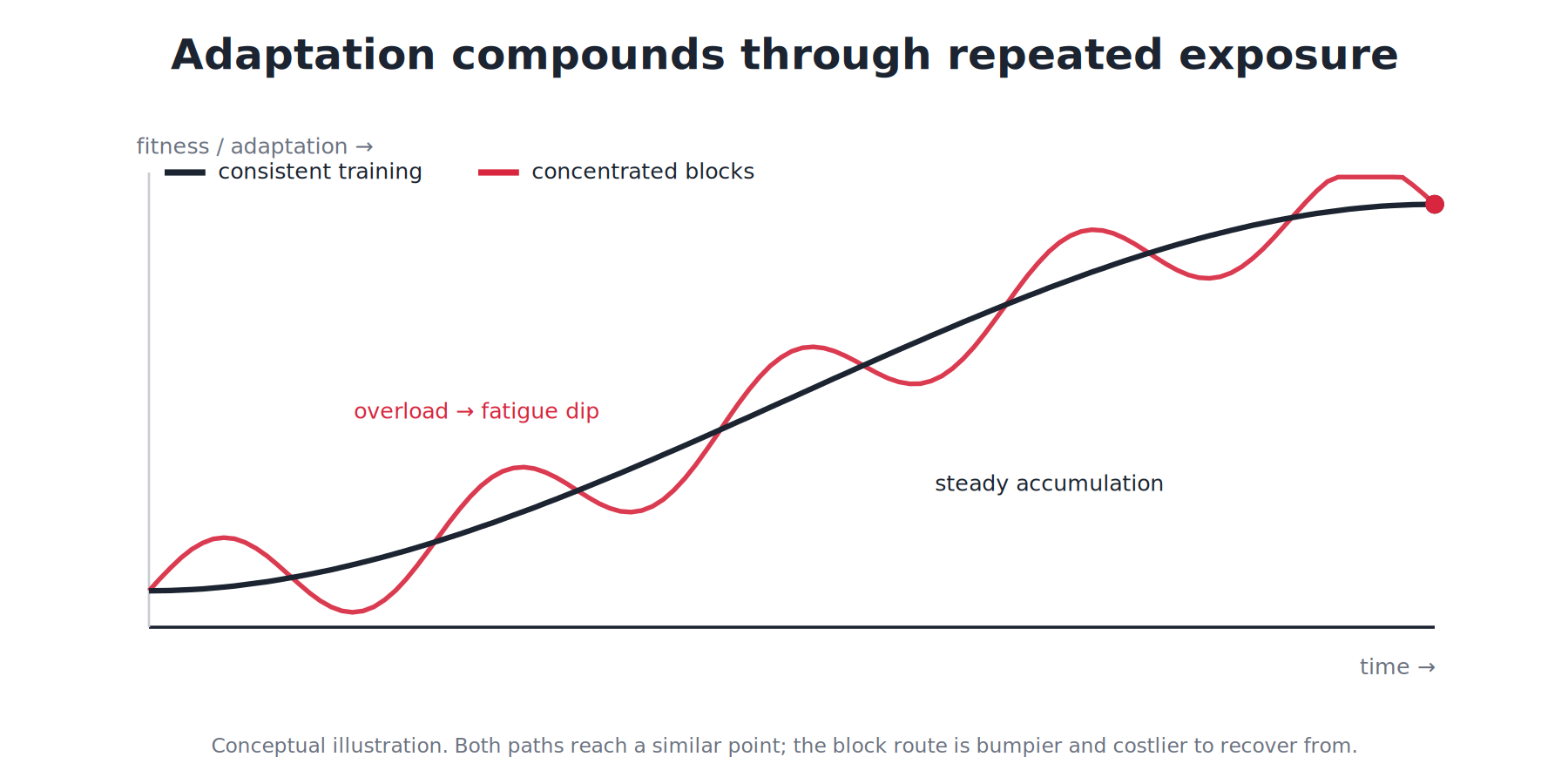
    FasterSkier – Block vs Consistency – Figure 3: Over time, adaptation accumulates through repeated exposure. The block route can reach a similar point, but with more fatigue along the way.

    Why low intensity is the key qualifier

    For low-intensity work, the physiological stress of any single session is modest by design. The adaptation seems to come from stacking many of those sessions on top of one another over time, not from cramming volume into a short window. When the totals match, the body appears to respond to how much training got done, not to how it was parceled out. That helps explain why athletes who lean on the occasional big week rarely pull ahead of the ones who just train, month after month, without drama. The big week feels harder. Harder is not the same as more adaptive.

    The authors are careful not to overreach, and so am I. Their findings should not be stretched to cover every form of block periodization. The earlier work showing real benefits from block training generally concentrated high-intensity sessions, where the stimulus is far larger. This study looked only at low-intensity volume. Block periodization may well earn its place when the stimulus itself is potent. There is just little evidence that piling up low-intensity volume creates a stronger adaptive signal.

    What it means for junior coaching

    For junior endurance athletes, the practical read is straightforward. Do not expect a high-volume, low-intensity camp or an overload week to produce superior adaptations simply because the work is bunched together. Camps still earn their place for logistics, technique, and the team-building that holds a season together. They just do not appear to hand you a physiological edge once total volume is matched.

    So here is where I land. Concentrating low-intensity volume into overload blocks does not seem to yield better short-term aerobic adaptation than spreading the same volume out, at least when the total volume is equal. I am not claiming block periodization does not work, or that all concentrated loading is a waste. What the evidence keeps pointing at, for aerobic base development, is that showing up consistently does more for an athlete than the occasional heroic training week. Over a season, the consistent skier and the big-week skier can bank the same hours. Only one of them pays the fatigue tax to get there.


    Help Support Our Coverage!

    If you value the thoughtful work and access FasterSkier provides, please consider becoming a Voluntary Subscriber. Your support directly fuels our work to cover the people, places, and moments that make our sport special.

    Join the FasterSkier community!


  • Young Perfectionists are at Risk of Burnout, but Good Parenting Helps

    Young Perfectionists are at Risk of Burnout, but Good Parenting Helps

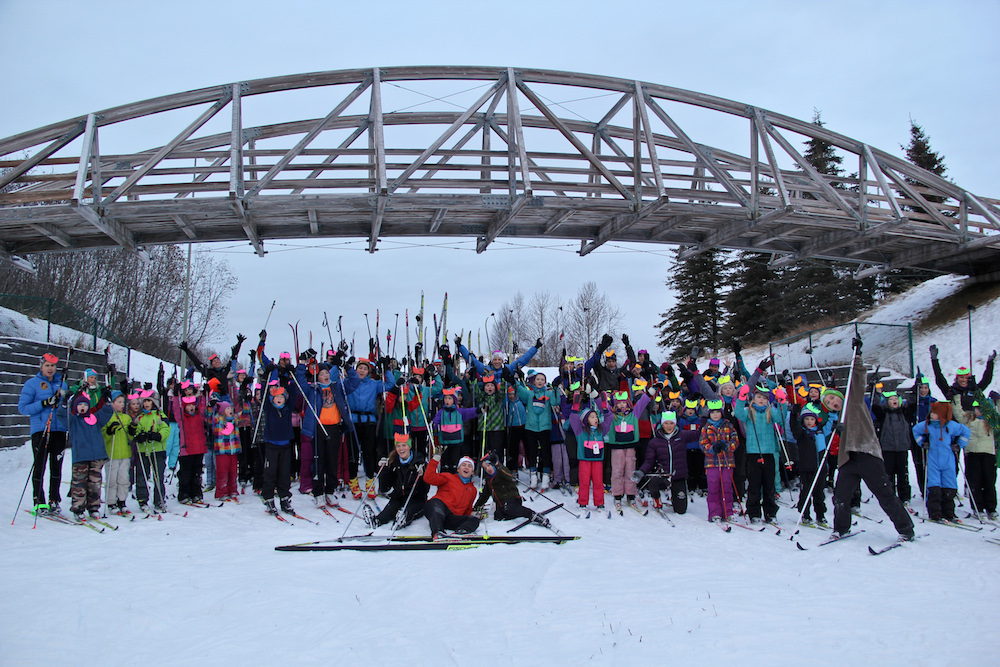
    A key to avoiding burnout in young athletes? Keeping parents from emphasizing perfectionism, and focusing on learning and enjoyment rather than winning or avoiding mistakes. Here, kids are excited to ski at the start of the day at the fourth-annual Lickety-Splits Ski Camp for Kids on Dec. 22 in Kincaid Park in Anchorage, Alaska. (Courtesy photo)
    A key to avoiding burnout in young athletes? Keeping parents from encouraging perfectionism: parents should emphasize learning and enjoyment rather than winning or avoiding mistakes. Here, kids are excited to ski at the start of the day at the fourth-annual Lickety-Splits Ski Camp for Kids in December, 2014, in Kincaid Park in Anchorage, Alaska. (Courtesy photo)

    When we think of top athletes, we often think perfectionist. We picture an athlete working and working to hone a task or technique and never believing that they are good enough or have reached their potential. It doesn’t help that some of them describe themselves that way, voluntarily. In the pages of this website, World Champion Devon Kershaw and Paralympic and IPC World Championships medalist Oksana Masters have both said that they are perfectionists.

    But is that really something to strive for? As the old saying goes, perfect is the enemy of good. Sean McCaan, the psychologist for the U.S. Biathlon Team, identified that endurance athletes have perfectionist tendencies.

    New research shows that junior athletes who are major perfectionists are at higher risk of burning out from sport.

    Published in the Scandinavian Journal of Medicine and Science and Sports, Henrik Gustafsson of Karlstad University in Sweden along with colleagues York St. John University and Umeå University wrote, “junior athletes high in perfectionism may be at comparatively greater risk to burnout and that this may especially be the case when they perceive their parents to emphasize concerns about failure and winning without trying one’s best.”

    Gustafsson and his colleagues had previously researched other sources of stress on the lives of junior athletes, like increasing school demands or dealing with heightened training loads as each season goes by. They also identified what leads to burnout in older, elite athletes: things like high expectations and lack of balance with other parts of life.

    Gustafsson also works as a psychology expert for the Swedish Olympic Committee, including with cross-country skiers and biathletes. So he knows about the pressure of having a perfect result – and how a lot of that pressure can come from within.

    “Because everyone is so well trained, nerves and psychological causes become decisive for the outcome of races,” he said in an interview before the 2014 Olympics in Sochi. “Many participate in the Olympics only once. It is bad if it’s a big disappointment.”

    Being emotionally and physically exhausted, as well as feeling like results do not show any real accomplishment or value, can lead to a loss of interest in sport, Gustaffson found. In a 2007 paper, he had found that burnout was not correlated to training load, so something else must be at play.

    In the most recent study, the authors studied 216 Swedish junior athletes attending sport high school for sports like soccer, hockey, track and field, and swimming. They administered three questionnaires:

    • the Athlete Burnout Questionnaire, which analyzes attitudes about athletic accomplishment, exhaustion, and the value of spending time on sport;
    • the Multidimensional Perfectionism Scale, which asks questions about self-set standards, attitudes towards mistakes and failure, and parental pressure towards perfection growing up; and
    • the Parent-Initiated Motivational Climate Questionnaire, which asks how parents support learning and performance in terms of praise, reaction to mistakes, and the amount of effort required.

    Overall, the Swedish athletes seemed quite healthy. They reported that parents emphasized the enjoyment of learning something new. They also said that as athletes they were only moderately concerned about making mistakes and set moderately high standards for themselves. As a result, they showed only low to moderate symptoms of burnout.

    To see whether those which did score as a greater risk for burnout had consistent profiles from the other questionnaires, the researchers grouped the athletes according to four profiles ranging in perfectionism and parental pressure.

    Athletes who reported a tough parental climate, with worry about mistakes and less emphasis on enjoyment of learning, and who were also themselves perfectionists, scored higher on the metrics of burnout than other groups in most cases.

    Interestingly, even highly perfectionist young athletes could cope with the challenges of sport if they did not also face pressure from perfectionist parents. Only in terms of having a reduced sense of accomplishment – that is, feeling that their results weren’t good enough and that they weren’t performing up to their ability level – were they significantly more burnt-out than athletes who were only moderately perfectionist.

    Indeed, having supportive rather than critical parents has been previously suggested as an essential part of the athlete-parent relationship.

    “In sum, we would contend one of the primary characteristics of expertise in sport parenting is the ability for parents to consider sporting opportunities in the best interests of their child, and to be able to provide support that complements the demands of training and competition experienced by children,” wrote Chris Harwood and Camilla Knight in a review paper in Psychology of Sport and Exercise titled “Parenting in youth sport: A position paper on parenting expertise.”

    To prevent burnout, Gustafsson and the co-authors suggest interventions in cases where parents put pressure on winning without also emphasizing enjoyment, or where they penalize or criticize mistakes too much.

    That way, they might have a greater chance of sticking around in the sport for fun – or perhaps all the way to championship events like the Olympics, where they would receive another sort of advice from Gustafsson.

    “Once [performance anxiety] slams them and becomes a problem, it doesn’t work to simply think positively,” he said in the 2014 interview. “More importantly [they need to have] the courage to practice and compete, and not to hope to avoid the unpleasantness. They must be prepared to accept that tiger of anxiety but not to feed it.”