From the FasterSkier archive — posts syndicated from athletes’ and coaches’ own blogs between 2004 and 2012, kept online as published. Current coverage is at fasterskier.com.
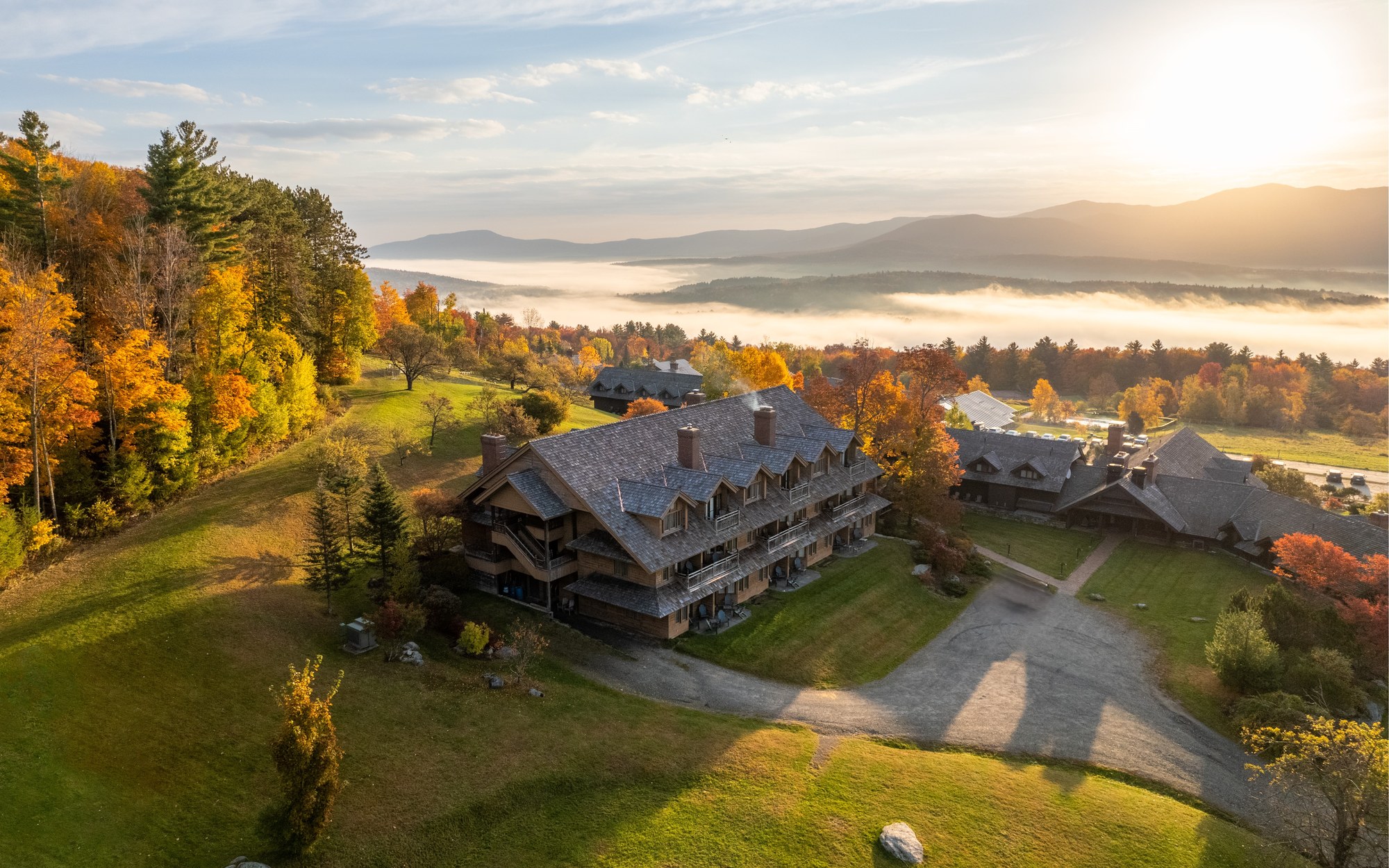
Morning fog fills the valley below the von Trapp Family Lodge & Resort in Stowe, Vt. (Photo: Chadwick Estey)
The von Trapp Family Lodge & Resort has received the Historic Hotels of America® Legendary Family Historic Hoteliers of the Year Award, announced October 15 at the 2026 Historic Hotels Annual Awards of Excellence Ceremony and Gala. The honor was conferred on the von Trapp family by Historic Hotels of America, an official program of the National Trust for Historic Preservation.
The lodge is one of more than 300 hotels and resorts in the United States recognized by Historic Hotels of America for preserving and maintaining its historic integrity, architecture, and ambiance.
“This recognition is especially meaningful to our family because it honors not only our history, but the generations of dedication that have kept our family’s legacy alive,” said Kristina von Trapp Frame, granddaughter of Maria and Georg von Trapp.
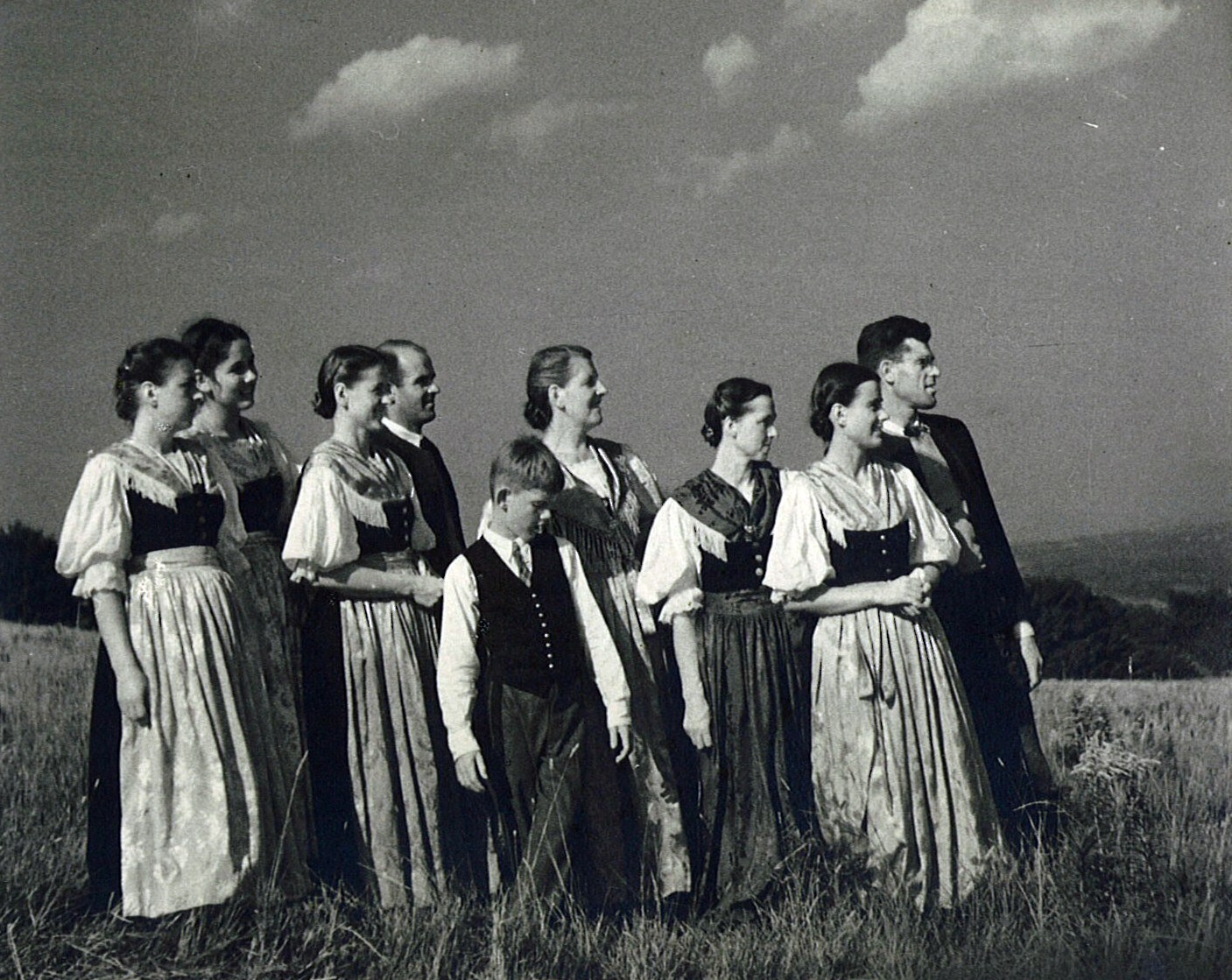
The Trapp Family Singers, who performed in more than 30 countries before and after making their home in Vermont. (Photo: von Trapp Family Lodge & Resort archive)
From Austria to Stowe
The family left Austria in 1938, months after its annexation by Nazi Germany, and spent the years that followed on the road as the Trapp Family Singers. The choir would eventually perform in more than 30 countries, and the family’s story became The Sound of Music.
In 1942 they settled in Stowe. They named their home Cor Unum, Latin for “one heart,” on a hillside looking across to the Worcester Range, and from 1945 to 1955 they ran the Trapp Family Music Camp nearby.
“What began with my grandparents’ dream of creating a home in the Vermont mountains has grown into a place where we have welcomed guests from around the world for more than 75 years,” Frame said.
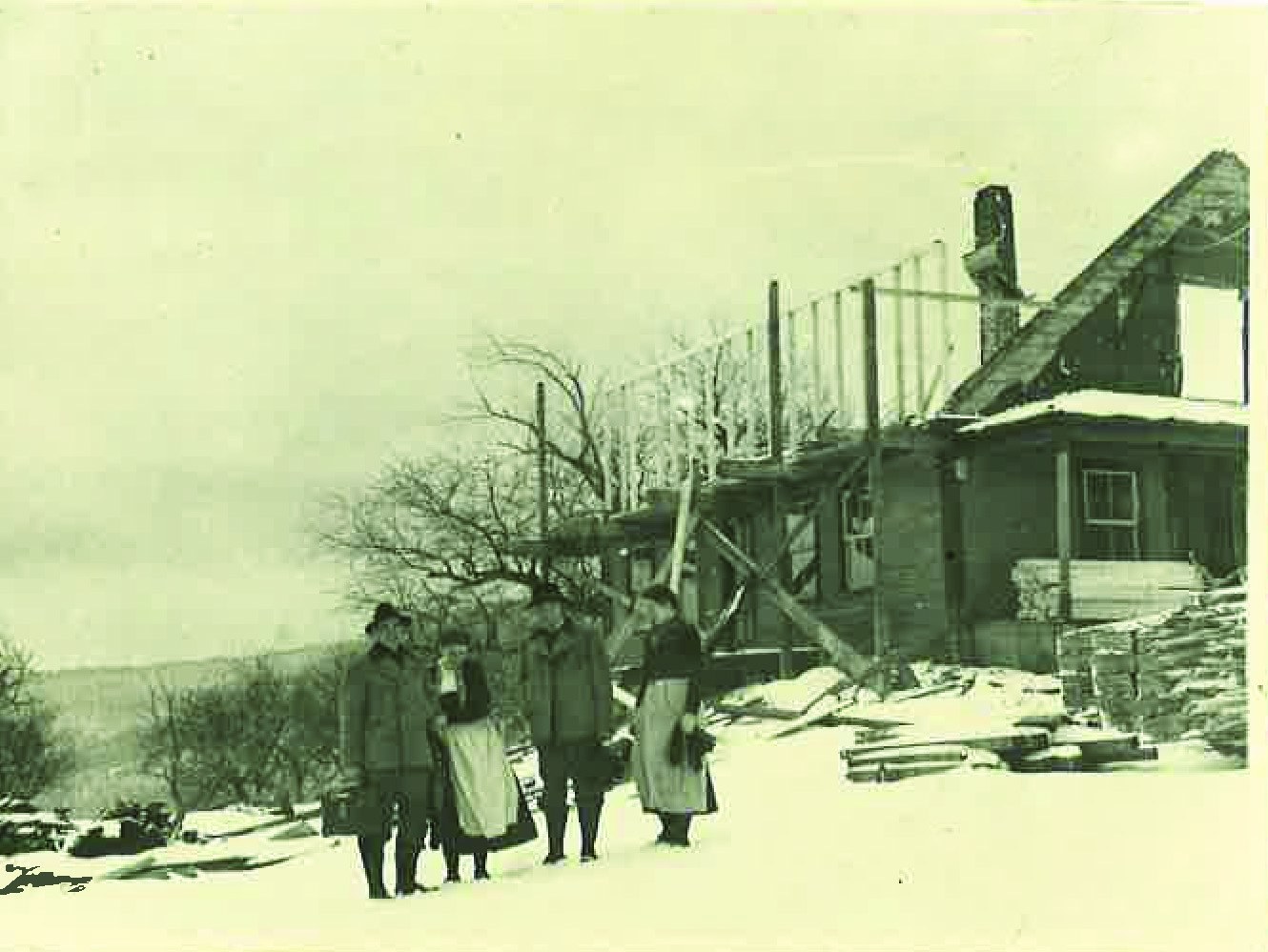
Building the family’s new lodge in Stowe, 1943. (Photo: von Trapp Family Lodge & Resort archive)
Opening the Doors in 1950
In 1950 the family opened their expanded home to guests as the Trapp Family Lodge. Maria ran it first. Her youngest son, Johannes, took over from her and turned a ski lodge into a year-round destination.
Three generations on, it is still family operated. The property covers 2,600 acres and pairs Austrian-inspired hospitality with outdoor recreation, a craft brewery that began making lager in 2010, farm-to-table dining, and wide-open mountain views.
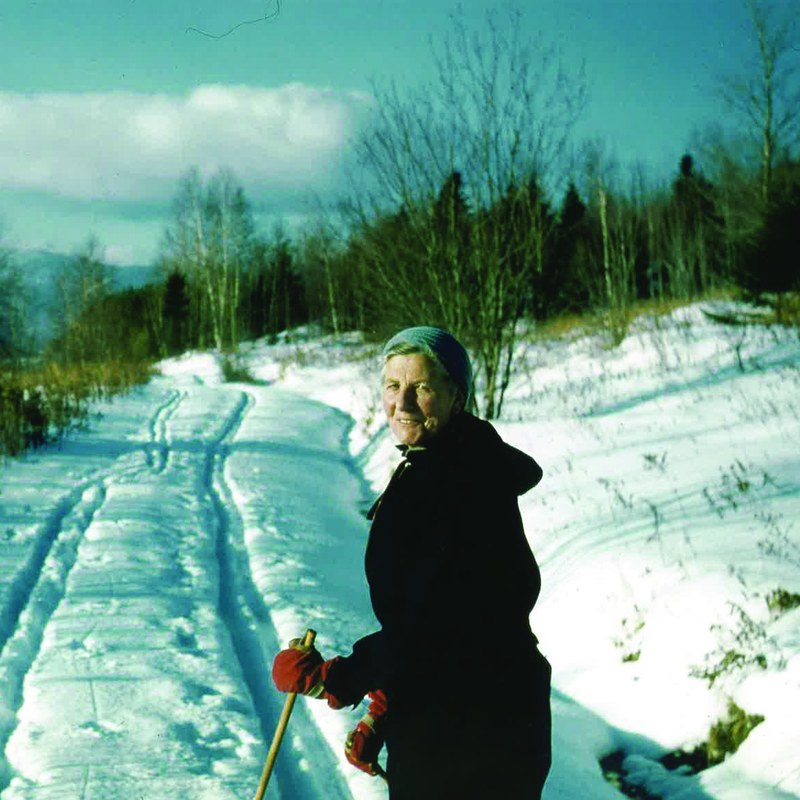
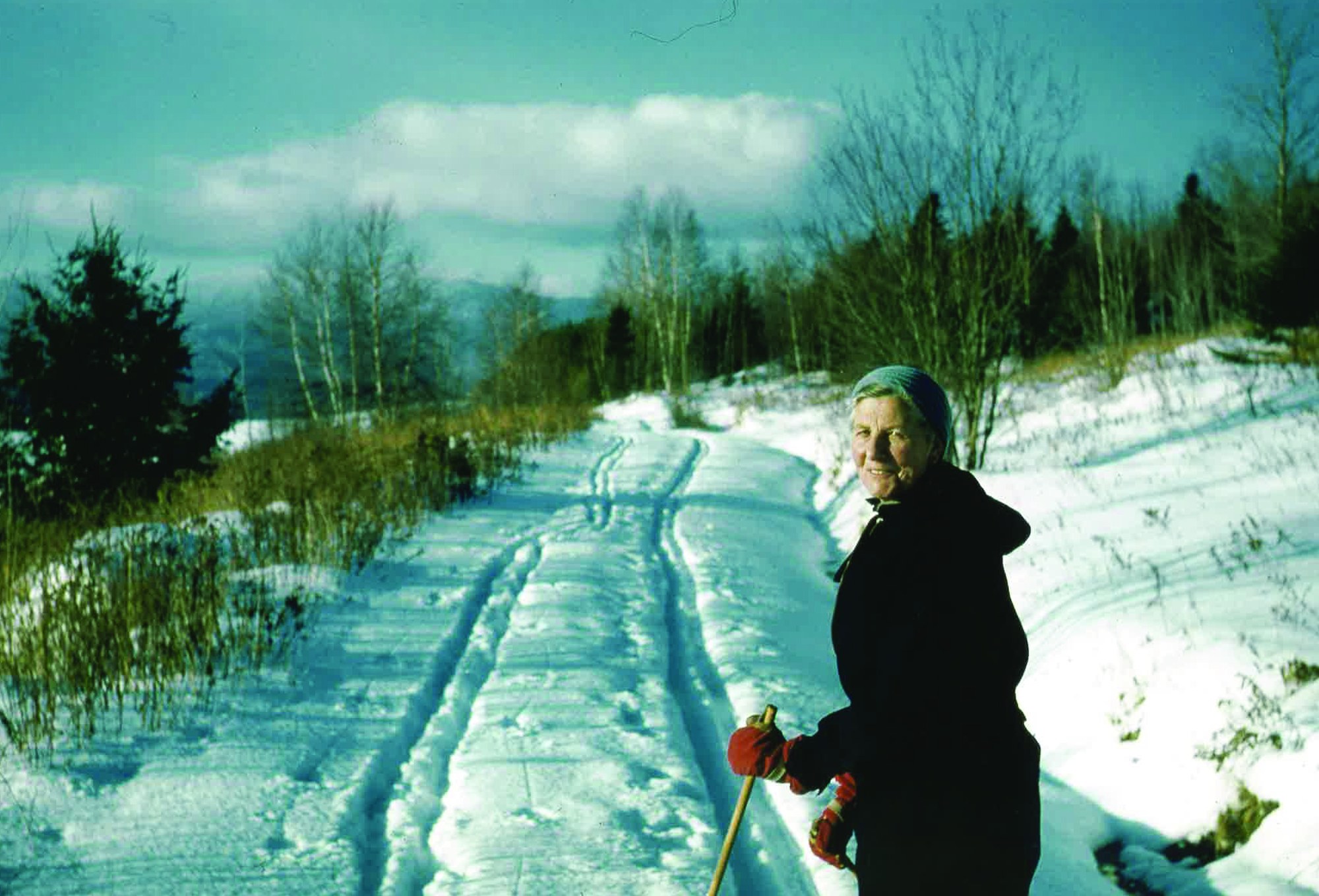
Maria von Trapp out on skis. (Photo: von Trapp Family Lodge & Resort archive)
Where American Cross-Country Skiing Got Its Start
Skiers know the place for something else. In 1968 Johannes opened a cross-country ski center at the lodge, the first in America.
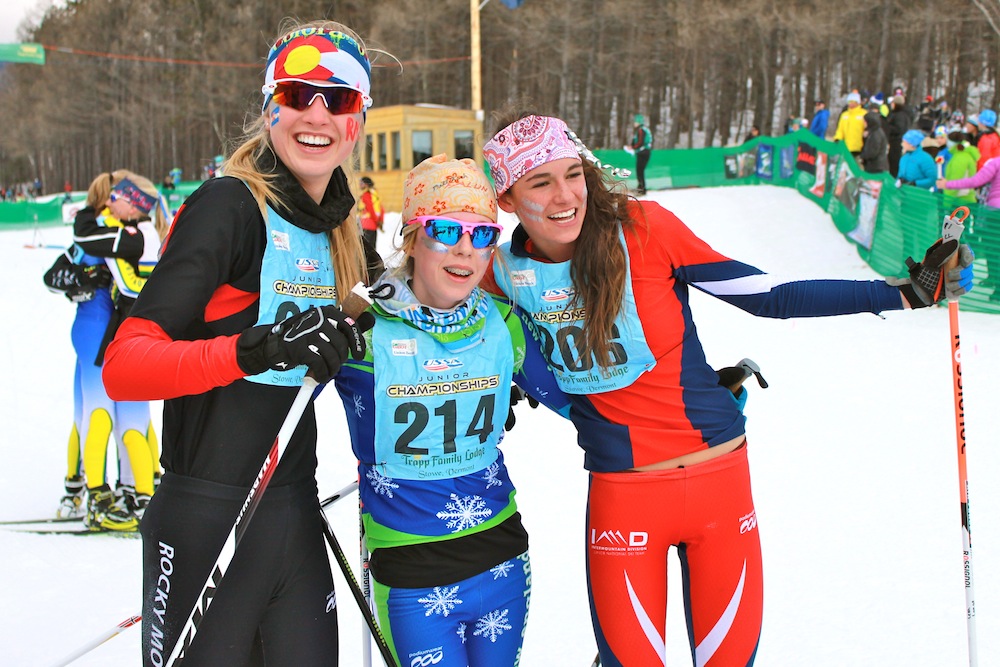
The trails have stayed close to the sport ever since. Johannes helped revive the Stowe Derby in 1972, and in 2014 the lodge hosted U.S. Junior Nationals, with Johannes himself handing out the medals.
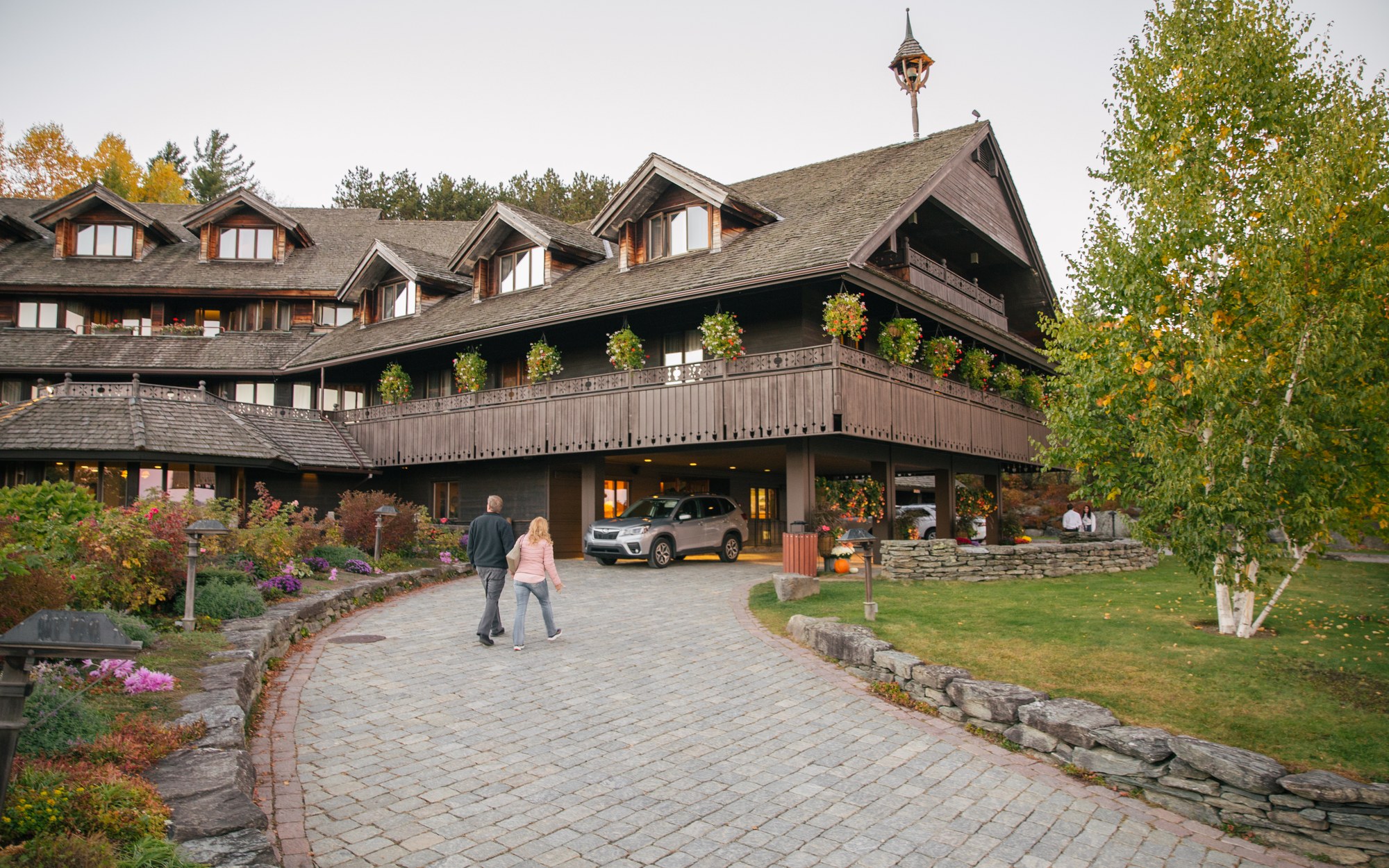
The main lodge, rebuilt in the Austrian style the family brought with them to Stowe. (Photo: Chadwick Estey)
Honored in Williamsburg
Through its Annual Awards of Excellence, Historic Hotels of America recognizes the historic hotels, hoteliers, and leadership practices that do the most to further the recognition, preservation, and celebration of these hotels and their histories. Eleven historic hotels and seven individuals were honored in 2026.
The winners were announced before an audience of owners, general managers, senior decision makers, and guests from many of the finest historic hotels in the world, at the Williamsburg Lodge, Autograph Collection (1939) in Williamsburg, Virginia. The ceremony closed the 2026 Historic Hotels Annual Conference.
“We are delighted to honor the von Trapp Family with this prestigious award. It was chosen from an exclusive group of nominees and considered for several categories. It stands among the finest hotels and hoteliers in the world,” said Lawrence Horwitz, Executive Vice President of Historic Hotels of America and Historic Hotels Worldwide. “We applaud the dedication and passion of the individuals working at these iconic and legendary historic hotels, the people who keep the stories alive from the past and make staying or celebrating special occasions at these historic hotels memorable experiences.”
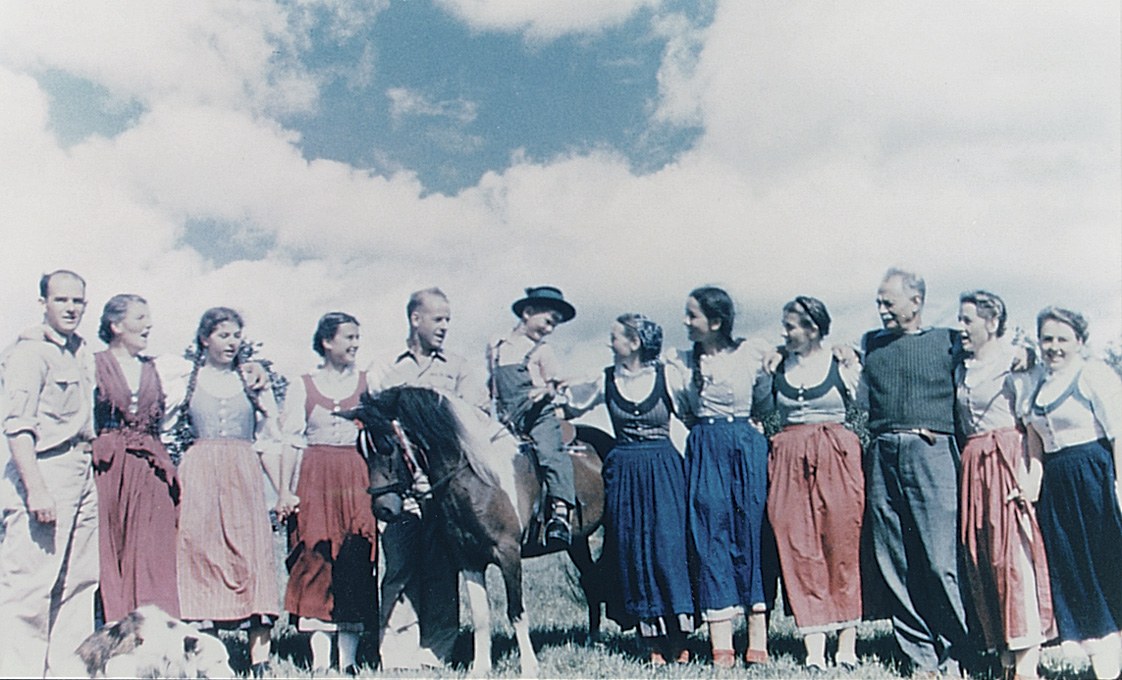
The von Trapp family lined up in a Stowe field, with Johannes on horseback. (Photo: von Trapp Family Lodge & Resort archive)
Carrying It Forward
“We are incredibly proud to carry on their traditions of warm hospitality, family, music, and a love of the outdoors,” Frame said. “Receiving the Legendary Family Historic Hoteliers of the Year Award is a wonderful tribute to our family, our dedicated employees, and the countless guests who have become part of our story.”
About von Trapp Family Lodge & Resort
Founded in 1950 by the von Trapp family, whose story inspired The Sound of Music, the von Trapp Family Lodge & Resort is a third-generation, family-operated, four-season destination in Stowe, Vermont. Situated on 2,600 acres, the property offers Austrian-inspired hospitality, outdoor recreation, a craft brewery, farm-to-table experiences, and breathtaking mountain views while preserving the family’s rich history and traditions. Learn more at vontrappresort.com.
About Historic Hotels of America®
Historic Hotels of America is the official program of the National Trust for Historic Preservation for recognizing and celebrating the finest historic hotels across the United States. The National Trust for Historic Preservation was chartered by the U.S. Congress in 1949 and is a private 501(c)(3) nonprofit organization. To be nominated and selected for membership, a hotel must be at least 50 years old; designated by the U.S. Secretary of the Interior as a National Historic Landmark or listed in or eligible for listing in the National Register of Historic Places; and recognized as having historical significance. More than 300 historic hotels from 41 states, the District of Columbia, the U.S. Virgin Islands, and Puerto Rico have been inducted. Learn more at HistoricHotels.org.
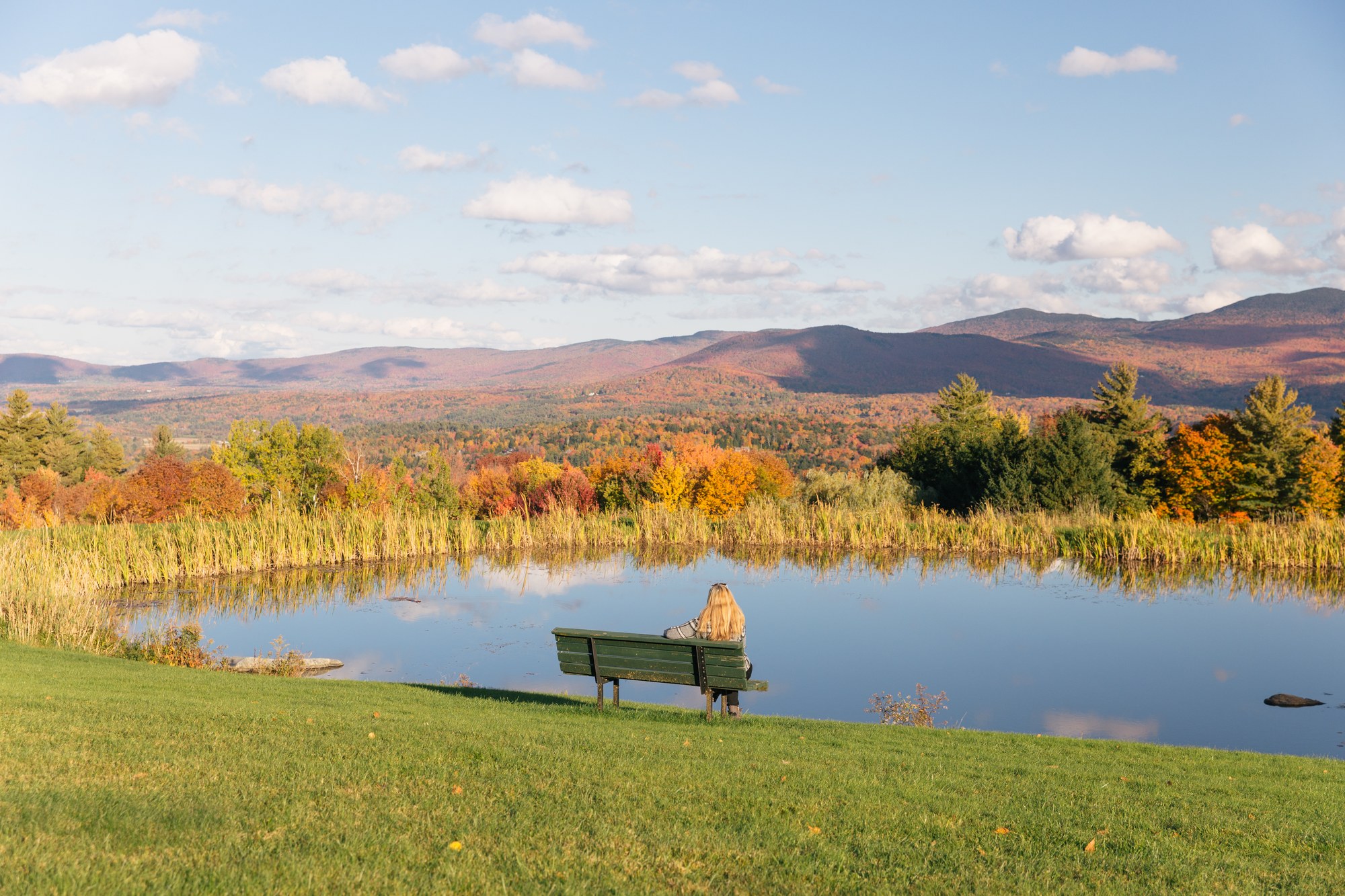
A guest takes in the view from the pond at the von Trapp Family Lodge & Resort. (Photo: Chadwick Estey)
Quinn Holan on his way to a top 5 junior finish at US Nationals Lake Placid. (Photo: Courtesy Photo)
Will Sweetser thinks American Nordic skiing is recruiting in the wrong places. Here is what he is building on Donner Pass to prove it. This is the second of two parts — be sure to read part one, to learn about Sweetser’s background and coaching philosophy — Keep Showing Up: Will Sweetser’s Unglamorous First Principle
The number Will Sweetser carries around is thirty.
That, he says, is roughly how many development and junior racers a competitive Nordic ski club will produce from any 30,000 Americans with access to snow. The figure does not move much. Aroostook County, Maine, from Houlton to Fort Kent, about that. Stratton, Vermont, about that. Truckee, California, where he lives now, about that. He has been watching the number hold for thirty years.
“Maybe it’s a little richer in some of these alpine resort towns like Jackson or Aspen,” Sweetser said. “But in general, I think that’s a pretty good estimation of what you’re going to get.”
If he is right, the implication cuts against how most American Nordic clubs are organized. Truckee has three programs competing for that local pool. Each ends up with roughly ten development-age athletes. Sweetser, who runs the Nordic operation at Royal Gorge on Donner Pass, calls the result “not functional. And actually bad for athlete development.”
His conclusion is the one most clubs in snow country do not want to hear. He thinks they are fighting over the wrong 30,000 people.
Quinn Holan, Walker Rawlinson and Cabot Godoy celebrating learning at Jackson Hole International Spring Series 2023. (Photo: Courtesy Photo)
The 30,000 that interest Sweetser sit on the other side of the Sierra crest.
The Reno valley, by his count, holds about 650,000 people. The slice he is targeting — the corridor running from Gardnerville up through northwest Reno into Verdi, Nevada — is roughly 140,000 of that. He likes to compare it to the state of Vermont, where the total population is about 648,000. From west Reno to Royal Gorge is under 50 minutes. To Auburn Ski Club, the next program over, it is 40.
That, he points out, is shorter than what plenty of Vermont families drive to ski on Saturday mornings. It is shorter than what he himself drove from Bates to find usable snow in the 1990s.
“Why am I fighting over the 30,000 who live in Truckee,” Sweetser said, “who are frankly inundated with sports options?” Lacrosse. Soccer. Dance. Most of his daughter’s friends, he said, are doing two or three sports a season through elementary school. “How do you compete? Do cross-country ski training on top of all of that?”
There is a second front in the same argument. Truckee is a snow-sport town, but it is also a freeride town, and Nordic, in his telling, is losing the adolescent attention war to a sport that was built for the camera roll. “It’s never going to look as good as huck yourself off of a classic line at Palisades or Sugar Bowl or Heavenly,” he said. “You’re just not going to.”
Quinn Holan, Walker Rawlinson and Cabot Godoy. (Photo: Courtesy Photo)
So Royal Gorge is being repositioned. Sweetser describes it as a destination training center, by which he means destination for both racers and resources. The piece that interests him most is the labor pool.
A generation of Eastern Intercollegiate Ski Association graduates moved to the Bay Area for jobs in tech and finance over the last decade or so. Sweetser, off the top of his head, can name seven or eight. Widen the age range and he says he can name another thirty. They are not coaches by trade. Most of them make considerably more money than coaching pays. But they are skiers, and Sweetser’s bet is that a meaningful number of them would take three and a half hours twice a week — a Tuesday and a Thursday morning, say, or a Tuesday and a Saturday — to be paid by Royal Gorge to run a session in the Bay.
“The ones who are older don’t care about the money. They’ll do it anyway,” he said. “But the younger guys probably care about the money even less. They’re psyched to be out.”
He has tried this before with a Bay Area satellite through Sugar Bowl Academy and lost it to a turnover in headmasters. The current effort is being underwritten by Royal Gorge, whose general manager, Tom Miner, took over a few years ago and has been, in Sweetser’s description, the institution willing to write the checks. Bay Area families would still drive up Thursdays and Fridays for weekend training; the satellite sessions supplement, they don’t replace. “Four to five sessions of skiing per week,” Sweetser said. “Which is pretty crazy if you think about it. You can develop a lot.”
His reference point was his own résumé. He coached at Bates in the 1990s, when the team was off Mondays, didn’t ski Tuesdays or Wednesdays most weeks, and drove an hour each way the rest of the time or just left on Thursday for the next carnival stop. “I don’t think it’s the worst development plan for kids who want to ski in college,” he said. “Nor do I think it’s going to hurt your lifelong love of the sport to ski three or four days a week instead of six.”
JC Schoonmaker and Emma Ribom giving back at a Far West dryland clinic. (Photo: Courtesy Photo)
“I think it’s also a thought exercise more than a practicality,” he said. The snow-belt population is small to begin with, he argued, and within it, Nordic competes against alpine, against freeride, against every other thing a kid with a phone can see. He went looking for the counterexample and landed on Great Britain. Their entire cross-country skiing base, he estimated, is “maybe a thousand” people. Three British men finished in the top eight of a World Cup race in the lead-up to last year’s Olympics. The United States, from a population orders of magnitude larger, did not have three.
“So I think we have to apply both systems simultaneously,” he said. “You want the best possible resource application and preservation, as well as the recruiting.”
The recruiting, in his version, is what is taking him to Reno and to the foothills around Auburn and Grass Valley, towns at 2,000 feet of elevation, with populations several times Truckee’s, that have a history of ski teams without a current knowledge base. He has also been watching California middle-school track results, the way a baseball scout reads box scores. He is looking for the eleven- and twelve-year-olds who will hit puberty, stop being runners, and still have an engine.
Long view of program and athlete development. (Photo: Courtesy Photo)
The institutional pieces have been moving in the meantime, some faster than others.
Sweetser submitted a bid this month to host the 2028 Junior Nationals at Royal Gorge. The bid still needs approval from the sport committee and the junior working group, and the organizing committee is largely the one already preparing for an earlier event. He said the bid is in part a consequence of another organization having stepped back, and would not elaborate.
He is also in the middle of homologating four race courses at Royal Gorge — a sprint, a 2.5, a 3.3, and a 3.75 kilometer loop, with options for a 5K and additional sprint variants. Sweetser did the initial mapping himself; a professional GIS contractor is doing the formal version now.
The third moving piece is administrative. Sweetser owns a company called Ydalir, which is the U.S. importer for the Italian wax brand Maplus and the holding entity for his coaching operation. Ydalir’s junior and weekend programs are being folded into the Royal Gorge brand. “Weekend program up through juniors is branded Royal Gorge cross country,” Sweetser said. The older athletes — gap-year skiers, elite development athletes, masters groups — sit one tier up, with the financial arrangement still being worked out.
The deal makes sense to him because of what an institution provides. “I can’t just be running around in the woods all the time,” he said. “I need a home.”
Walker Rawlinson (Menlo CA) in a breakthrough race Jackson Hole 2023. (Photo: Courtesy Photo)
The home matters because of who he wants in it.
The NCAA is on the verge of changes that will give skiers a five-year clock from high school graduation, capped at age 24, in which to use four years of eligibility. Sweetser thinks the new rule will quietly squeeze out the gap-year athlete — the kid who could use a year at a prep school, the kid who is simply not ready at 18, the kid who would be a different athlete and a different person at 20. The five-year window is generous in theory and tight in practice.
What Royal Gorge can offer those athletes, Sweetser said, is a landing pad. Last year the resort gave passes to the three older skiers he was coaching. This year, in addition to the passes, it will offer them paid work with the ability to ski before and after a shift.
“It’s a pretty decent deal when you’re trying to make it,” he said.
None of this is new in concept. The Maine Winter Sports Center built something close to it in the 2000s, and produced a long run of national-team athletes from it. Sweetser was part of that operation. The Royal Gorge version inherits the DNA and adds a piece Maine never had: a population base on the other side of the mountains big enough to recruit out of.
Whether his thirty-out-of-30,000 math holds in California the way it held in Aroostook is the experiment.
“You take an 18-year-old and go out as a 20-year-old,” Sweetser said, “you’re a different person.”
Help Support Our Coverage!
If you value the thoughtful work and access FasterSkier provides, please consider becoming a Voluntary Subscriber. Your support directly fuels our work to cover the people, places, and moments that make our sport special.
Johannes Hoesflot Klaebo (NOR), Emil Iversen (NOR), and Martin Loewstroem Nyenget (NOR), (l-r) during the final kilometers of the Olympic 50 k classic. (Photo: Vanzetta/NordicFocus)
A review of a recently published paper from Norway, “Long-term development culture for sustainable Olympic success: Lessons learned from Norwegian cross-country skiing” by Jacob Walther and Øyvind Sandbakk, is worth the time.
We’ve all heard enough about Norway. But this one simply cuts through some misconceptions, and it is worth the time to review. It strips away the mythology and gets back to what actually drives development and ultimately elite performance. Norway isn’t operating with better information. They’re more disciplined about applying what most programs already understand, and more consistent about what they refuse to do.
The paper addresses this immediately and directly. There is no “Norwegian method.” No magic interval session. No secret intensity zone you can implement and expect results. What they have is a system. And more importantly, a system built around their culture.
We tend to frame their success in physiological and technical terms. It’s not physiology, technique, health management, or mental health; they are all part of it, but they don’t explain the system. Most programs know early specialization is risky and inaccurate. Most coaches understand long-term development and the need to build training slowly and in phases based on training age. The difference is that Norway holds the line on it.
The elements are not new. Delay early selection. Encourage multi-sport participation, and integrate sport science into daily coaching. Invest in coach education. Treat athlete health as part of development, not something that gets in the way of it. The result isn’t just better elite athletes. It’s broader mass participation, more informed training, and a deeper pool of athletes and families engaged in the sport.
Norway’s Johannes Høsflot Klæbo won his first World Cup at 20, in the men’s 1.6 k freestyle sprint in Otepää, Estonia, in 2017. (Photo: Fischer/NordicFocus)
The paper uses Johannes Høstflot Klæbo as a case study. At 15, he placed 101st at junior nationals. Years later, he’s the most decorated Winter Olympian of all time. That’s a compelling outcome. But the value isn’t the result. It’s what the system expects and allows.
In most programs, that athlete gets filtered out early. In Norway, they stay in longer. That’s the point. This isn’t about identifying talent earlier and directing resources and opportunities at those. It’s about not eliminating talent identification too soon. That requires patience, cooperation among club programs, trust in the system, and a willingness to ignore short-term validation.
That’s where the Norwegian model sets itself apart. The turning point came in the lead-up to the 1994 Winter Olympics. Norway didn’t discover new physiology or invent new training methods. They organized themselves differently. They centralized expertise, embedded sport science into coaching, collected experience and training data across all Olympic Sports, and aligned the ski federation from the national team down to the club level.
Olympiatoppen sits at the center, not as a lab removed from the field, but as part of the training process. It doesn’t drive the system, but it informs and shapes it. That balance matters. Norway didn’t just add sports scientists. They used sports science to improve coaching. At higher levels, many coaches are trained in exercise physiology. That reduces misinterpretation and creates consistency over time.
Long-term development in Norway isn’t a slogan. It is intentionally implemented. It follows physiology. Peak endurance performance arrives in the late 20s, after years of consistent training. They don’t challenge that reality; they built their whole system around that reality.
You see that athletes stay in the sport longer, as evidenced by high-level FIS races in Norway. Hundreds of skiers are over 25-30 years old. They build general capacity before narrowing focus. Skill development has time and the room to engrain. Training isn’t rushed. Volume and intensity progress over years, not seasons. Junior results are not used as a sorting mechanism.
And this is where most systems break down. They say development matters, so select early and train accordingly. In Norway, youth championships are not selection events. They are part of the development process. The culture reinforces it. Clubs and schools coordinate so athletes can participate in multiple sports. Athletes regularly move across multiple ski disciplines. The recruitment base stays broad, and the system stays resilient.
Norway hasn’t eliminated selection; they’ve delayed it and minimized its consequences. That distinction matters. What gets labeled as “talent” at 14–16 is often early maturation, better support, or more exposure, not long-term potential. Norway avoids that trap by not falling into it. While many other systems double down on it.
Another principle sits underneath all of this: athlete health, physical and mental, comes before results. Training is managed for long-term progression. Training loads increase gradually over the years. High intensity is controlled, and low intensity dominates most of the training. The goal is adaptation over time, not accumulation in the short term.
The paper also points to emerging pressure on this model. Rising costs, shifting societal trends, increasing early specialization, and changes in team structures all push against it. These aren’t theoretical concerns. There are real pressures that can erode the system if they’re not managed.
Harald Oestberg Amundsen (NOR), Johannes Hoesflot Klaebo (NOR), and Einar Hedegart (NOR), (l-r) share the 20 k Freestyle Mass Start podium at the final World Cup in Lake Placid (USA) to end the 2025/2026 season. (Photo: Modica/NordicFocus)
So what carries over?
We can’t copy Norway. That misses the point. The lesson is alignment. Align incentives with long-term outcomes. Integrate sports science into coaching to improve the coach’s work. Build systems that allow athletes time to develop. And hold the line when short-term pressure starts to dictate decisions.
Many countries can point to a standout athlete. But if success depends on outliers, unusual resilience, unusual support, unusual talent, you don’t have a system. You have anecdotes. Norway produces depth, that is, the expectation and the standard.
There’s no secret session here. What they’ve built is a system that connects coaching and science, commits to long-term development, creates space for late progression, and maintains consistency over time. Not what they’re doing this week or next week, but what the athletes are doing ten years from now.
Help Support Our Olympic Coverage!
If you value the thoughtful work and access FasterSkier provides, please consider becoming a Voluntary Subscriber. Your support directly fuels our work to cover the people, places, and moments that make our sport special.
Where do High School and USCSA programs fit into our development.
In a recent article, I laid out the disconnect between what we say about long-term development in Nordic skiing and what we do and the rewards. “Long-Term Development in Nordic Skiing: What We Say vs. What We Actually Do”. Most people that I talk with agree with the premise of long-term development and keeping youth in sport longer. None of this is particularly controversial. We all understand that endurance development, technical skills and learning how to race takes years. We now see this statement across virtual all endurance sports world, that early results are a poor predictor of long-term success.
So, if we assume there is a consensus then we must ask why the system seems to act in the opposite way. Because systems don’t reflect what we say. They reflect what we reward through early selection, for competition and training opportunities. That’s really the question sitting underneath all of this.
We’ve reached a point where there’s broad agreement on philosophy. Long-term development matters. Early results don’t predict long-term success. Endurance, technique, and racing ability take years to build. You hear that all endurance sports now, not just skiing.
None of that is controversial!
But if that’s true, then we have to be honest about what follows. Because systems don’t reflect what we say. They reflect what we reward. And right now, the system is still rewarding something very different.
The incentives tell the story.
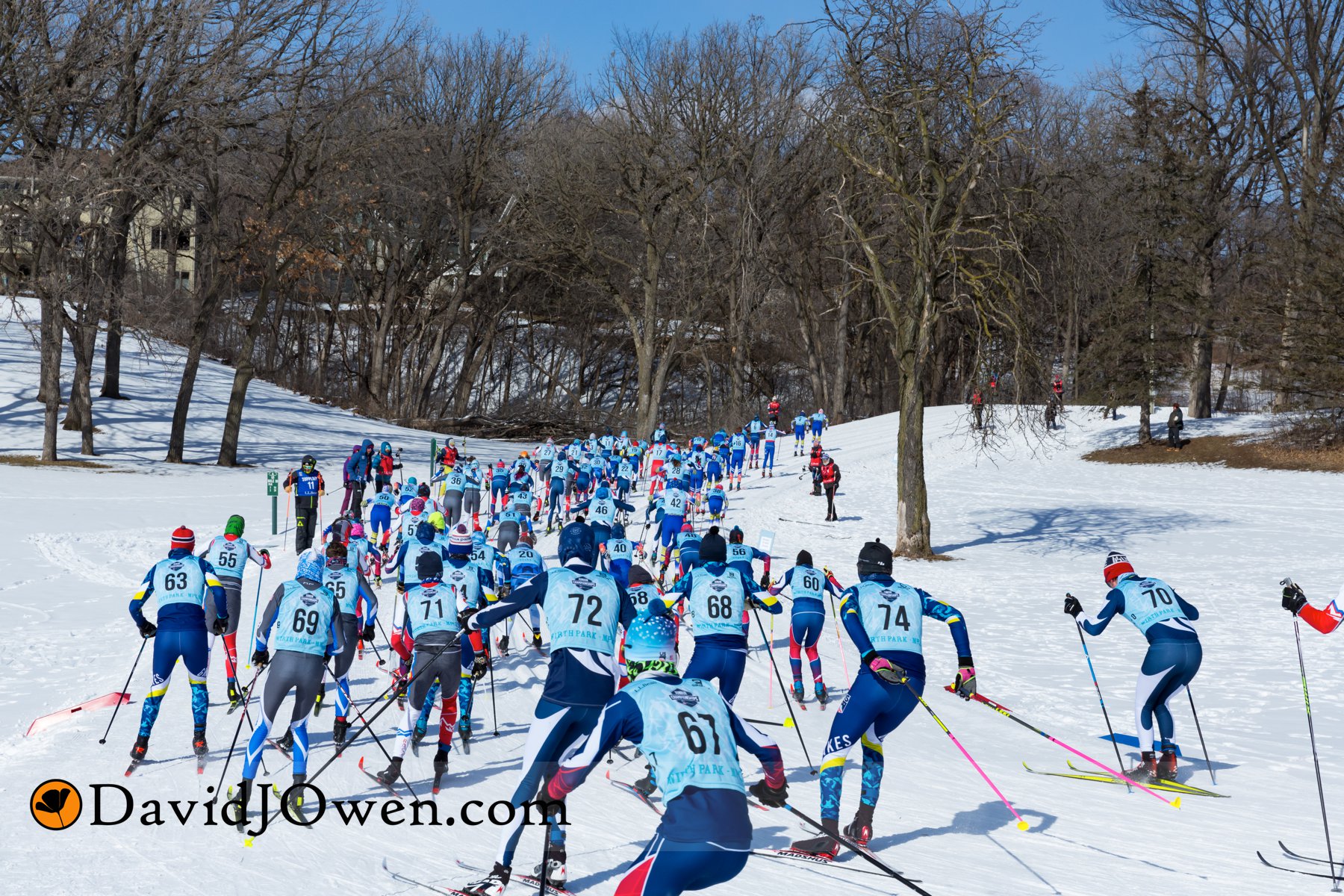
Skiers from all over the country round the first corner of the Theodore Wirth Park course in the U16 Boys 5 k Classic at Junior Nationals in Minneapolis in 2022. (Photo: David J Owen Photography)
Junior skiing in the U.S. is quietly organized around early selection. Qualification for Junior Nationals, especially at U16 and younger, carries weight. Rankings matter. Opportunities follow results. No one would say that’s the goal. But it’s the outcome.
Athletes see it. Parents respond to it. Coaches feel it. And none of that is inherently bad. But when those forces align around early results, the system starts to tilt. Short-term performance carries more weight than it should. And over time, that shows up in participation. The fields in USSS junior races get smaller as the age groups progress. We can debate why, but we can’t ignore that we’re losing athletes along the way.
The earlier we start selecting, the earlier we start excluding, selecting out athletes. And in a sport like skiing, that’s a problem. Development is long-term, non-linear, and tied to maturation in ways we can’t reliably predict. So, when we sort athletes at 13, 14, or 15 years of age, or younger, we’re making decisions on incomplete information, and treating those decisions as if they’re meaningful. They’re not!
What we’re really doing is narrowing the pathway at the exact point where it should be widest. If we believe in long-term development, early stages should include more athletes, not filter them out. We don’t lose athletes because they lack talent. We lose them because they stop seeing a path or opportunities forward.
That loss doesn’t always show up at the top. At the elite level, we can always point to success and say the system works. And in a narrow sense, it does. Every system produces some high performers. But that’s survivorship bias. But even with the perceived success, it is clear that most of those who step onto the World Cup are not prepared and developed for that level of competition, or we see an erosion of their performances over several years.
What matters more is what happens in the middle. Over time, that middle erodes. Fewer athletes stay. Fewer develop later. Fewer are still around when their best years should begin. And once they’re gone, they’re gone. So, how do we grow the sport and improve the development system? Following are a couple of ideas for the integration of high school and college skiing.
Stillwater senior Jessie Diggins, right, finishes ahead of St. Paul Academy senior Annie Hart in the 2010 edition of the Minnesota State Meet. (Photo: MSHSL Archives)
This is where the high school system should come into focus. Whether we acknowledge it or not, it’s one of the most influential environments in the entire pathway. We’re talking about roughly 6,500 high school athletes, compared to about 2,100 in the USSS junior system. That alone tells you something. Most athletes are not in the club pipeline. And there’s very little overlap between the two, in some regions more than others.
So now you have two systems, often operating in parallel, sometimes in conflict, shaping the same athlete. The club system is year-round, often very expensive, which creates barriers, and it is tied to rankings, qualifications, and progression. Ideally, at least in theory, it is long-term focused. The high school system is seasonal. Compressed. Built around immediate competition, conferences, regional, and state.
Both have value. But they’re not aligned. And when systems aren’t aligned, the athlete’s abilities are often put in difficult positions. High school seasons are short. That compresses everything. Training, racing, recovery, all of it gets stacked into a three-month season.
And yet, high school skiing also gets something right that the system needs more of. It creates a connection. It lowers barriers to entry. It brings athletes into sport who might never join a club. It makes skiing social. It makes it fun. Those values matter!
Athletes who feel connected to a team stay in the sport longer. That alone makes the high school system one of the most valuable pieces of the entire pathway. The issue isn’t that it exists rather it is not integrated, where do those high school skiers go after high school, an assumption may be many go into the non-integrated USCSA programs.
If that gap exists in high school, it becomes even more obvious at the college level.
Because this is where the pipeline either tightens or disappears. On one side, you have NCAA skiing. Roughly 20–25 programs. Maybe 300–400 athletes. Small, but structured, providing consistent coaching, clear expectations, and daily training environments that align with the demands of sport.
On the other side, you have USCSA. Thousands of athletes. Hundreds of active racers. A much broader participation base. So yes, USCSA is far bigger. But the NCAA is more efficient. In NCAA programs, a higher percentage of athletes improve year over year. More reach FIS relevance. More stay on a performance trajectory. That’s not because they’re inherently more talented. It’s because the environment supports development. Training is consistent. Coaching is present. Progression is clear.
USCSA shows the opposite. It’s not only a talent problem. It’s a structural problem. You have hundreds of athletes still in the sport. Many have endurance backgrounds. Many are still within a trainable window. But training is inconsistent. Coaching is variable. Development isn’t systematized. And there’s no clear bridge to higher performance levels. So, the conversion rate stays low.
This is where the pipeline argument starts to fall apart. We tend to focus on the front end, getting more kids into the sport. But at the USSS level that has been ineffective at best. And missing the fact that we already have athletes in the system that aren’t welcome or integrated. High school skiing, USCSA, represents a large participation pool sitting right in the middle of the development pathway. What we don’t have is a system that consistently integrates and develops them.
So, what actually needs to change? Not the philosophy, it seems we already agree on that. What needs to change is how the system behaves across the junior and collegiate level, it means recognizing where the opportunity is not just in the NCAA pipeline, but in the larger, under-structured USCSA system that already exists.
Even if we integrated the high school athletes and the USCSA athletes into the USSS system, the sport is still tiny. But it seems growing the sport significantly beyond this level is unlikely so we should be looking for ways to include these athletes in the system as much as possible for those who have an interest.
There are athletes in the system right now, thousands of them, who could or have the potential to improve dramatically beyond high school. Some who could enter the sport late and still become competitive.
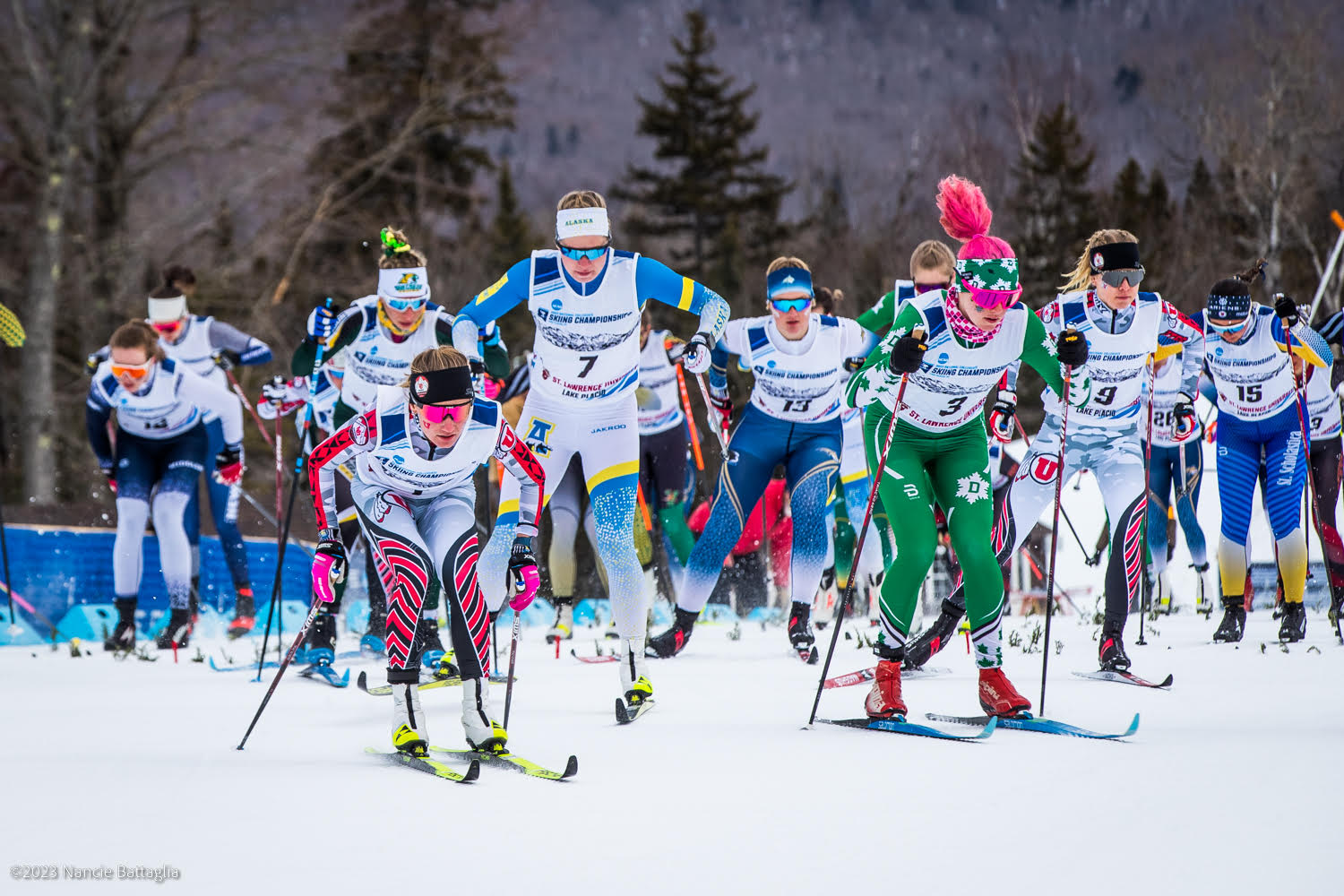
Novie McCabe controlled the pack for much of the 20-k mass start at the 2023 NCAA Championship in Lake Placid, New York. McCabe became just the fifth three-time NCAA Women’s Champion with her win. (Photo: (c) 2023 Nancie Battaglia)
At some level, this comes down to a simple choice. Do we want a system that identifies and benefits early performers? Or one that develops athletes over time? Right now, we say the second. But too often, we operate like the first. And the differences are real; we can see it by who improves, who stays in the sport, and when athletes exit the sport.
We don’t need to overhaul everything. There’s a lot in the system that works. High school brings athletes in. NCAA shows what structured development can look like. Even USCSA shows us how much untapped potential is sitting there.
But without alignment, those pieces don’t add up. So the question isn’t whether we understand long-term development. It’s whether we’re willing to build a system that actually supports it. Because if we are, the path forward should be clear.
And if we’re not, we should at least be honest about what we’re choosing instead.
Help Support Our Olympic Coverage!
If you value the thoughtful work and access FasterSkier provides, please consider becoming a Voluntary Subscriber. Your support directly fuels our work to cover the people, places, and moments that make our sport special.
Annika Martell racing during the NENSA club relays, Saturday, March 28, 2026 at Craftsbury. (Photo: Phil Belena)
The Craftsbury Green Racing Project has named Annika Martell as its new Head Ski Coach.
Martell brings a resume that spans nearly every corner of the Nordic skiing world. A Minnesota native, she headed east to ski at Colby College, where she captained the team and earned recognition for her leadership before graduating with a degree in economics and environmental science.
Her coaching career has taken a similarly wide path. Early on, she interned with the US Biathlon Association and coached juniors at Ford Sayre and the Berkshire Nordic Ski Club, before moving into elite-level work as an assistant coach with the Stratton Mountain School T2 Team. She spent four years as an assistant coach at Williams College, during which time she completed two stints as a Trail to Gold Fellow with the US Ski Team and served twice on the wax staff for Team New England at Junior Nationals.
Most recently, Martell was the Head Nordic Coach at St. Michael’s College, where she guided the program to highly competitive results.
Her background extends well beyond the ski tracks. She is a certified weightlifting coach and handled strength and conditioning duties at Williams. She also has experience in finance and operations management, and holds a Master’s degree in Sports Business from Drexel University.
The Craftbury Green Racing Project is still accepting athlete applications for the incoming 2026 snow class — Apply Here
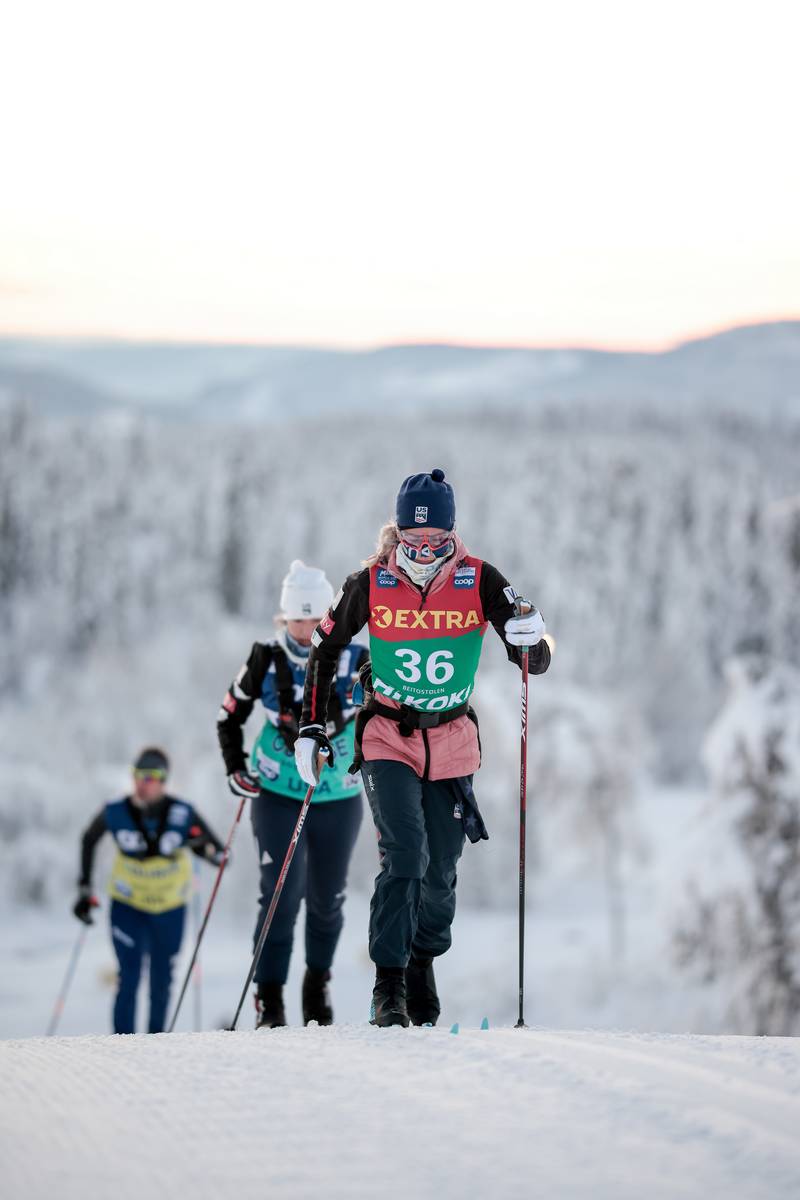
Martell follows Jessie Diggins on course in Beitostolen in 2022. (Photo: Nordic Focus)
Park City Ski & Snowboard is seeking a Head Cross Country Competition Coach to lead its U16+ competitive Nordic program. The full-time, year-round position reports to Cross Country Director Emma Garrard.
Below is the full job description.
Reports To: Cross Country Director, Emma Garrard Employment Status: Full-time, year-round, salaried exempt Compensation: Annual salary commensurate with experience, plus benefits Athlete Focus: U16 and above
Position Summary
The Head Comp Team Coach will manage the coaching staff, run the competitive calendar, and represent PCSS in the Regional and National Nordic community. This position requires someone who can coach at a high level and manage staff, budgets, calendars, and travel around the country for training and races, while upholding PCSS core values of Passion, Accountability, Respect, Team, and Integrity.
Program Leadership & Staff Management
Design and execute a multi-year training and competition framework, consistent with US Ski & Snowboard Training System principles
Supervise, mentor, and evaluate XC comp assistant coaches
Lead staff meetings and maintain clear communication
Maintain a strong focus on positive team culture
Collaborate with the Director on program goals, budget planning, and seasonal priorities
Contribute to the recruitment and retention of quality coaching staff
Prioritize strong communication with the Director, staff, and parents
Attend PCSS staff meetings and all-program events as requested by PCSS leadership
Support PCSS-hosted events and fundraising initiatives
Technical Coaching & Athlete Development
Implement and evaluate individual and team training plans on an annual and multi-year basis
Lead on-snow sessions 5–6 days per week during the training season, with full preparation and follow-up
Develop and execute strength and conditioning programs, including dryland
This job description is not an employment agreement or contract. PCSS management reserves the right to alter the scope of work within the framework of this description at any time. All offers are contingent on successful background check completion.
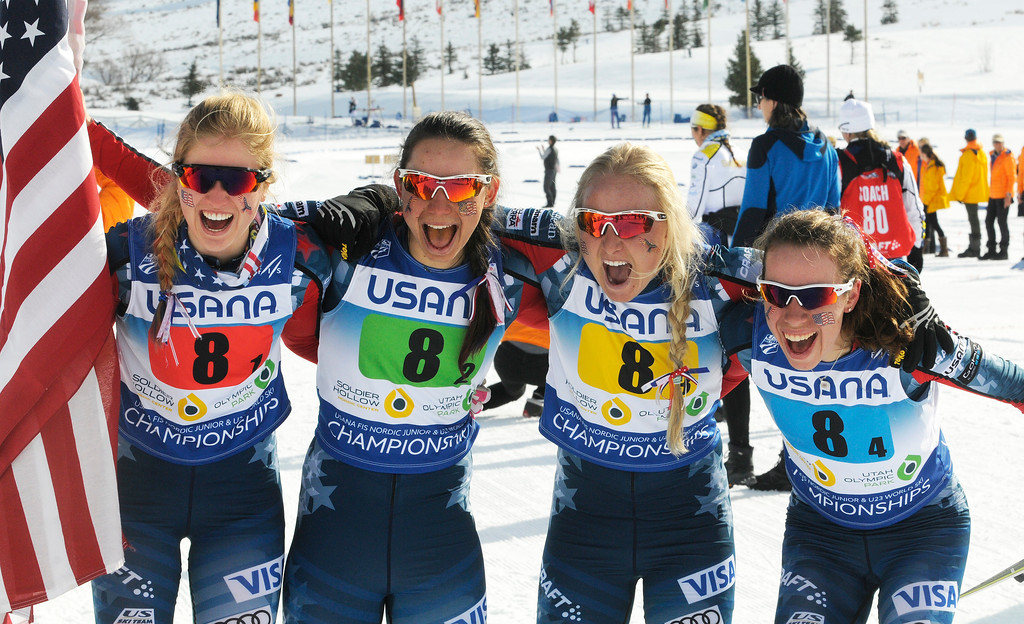
The U.S. women’s relay after taking a historic third in the 4 x 3.3 k relay at 2017 Junior World Championships on Sunday at Soldier Hollow in Midway Utah, with (from left to right) Hailey Swirbul, Julia Kern, Hannah Halvorsen, and Katharine Ogden. (Photo: U.S. Ski Team/Tom Kelly)
As the season winds down, it’s worth stepping back and asking a simple question: Does the way we develop young skiers in the United States reflect the philosophy we say we believe in? I know everyone is probably done with hearing about how the Norwegians do it, so let’s look at what we say we know and what we embrace.
Many coaches and programs describe cross-country skiing as a lifetime sport. We talk about patience and say it takes ten years or more to develop as a skier. Clubs reference long-term athlete development models, and parents hear that endurance sports reward athletes who build gradually and peak later in life.
All of that is true.
But much of the system we’ve built rewards the opposite.
Once rankings, camp selections, college recruiting, and program reputation become tied to junior results, the incentives quietly shift. Development begins to be measured by podiums and training hours rather than movement quality, long-term improvement, or whether athletes are still engaged in the sport five or ten years later.
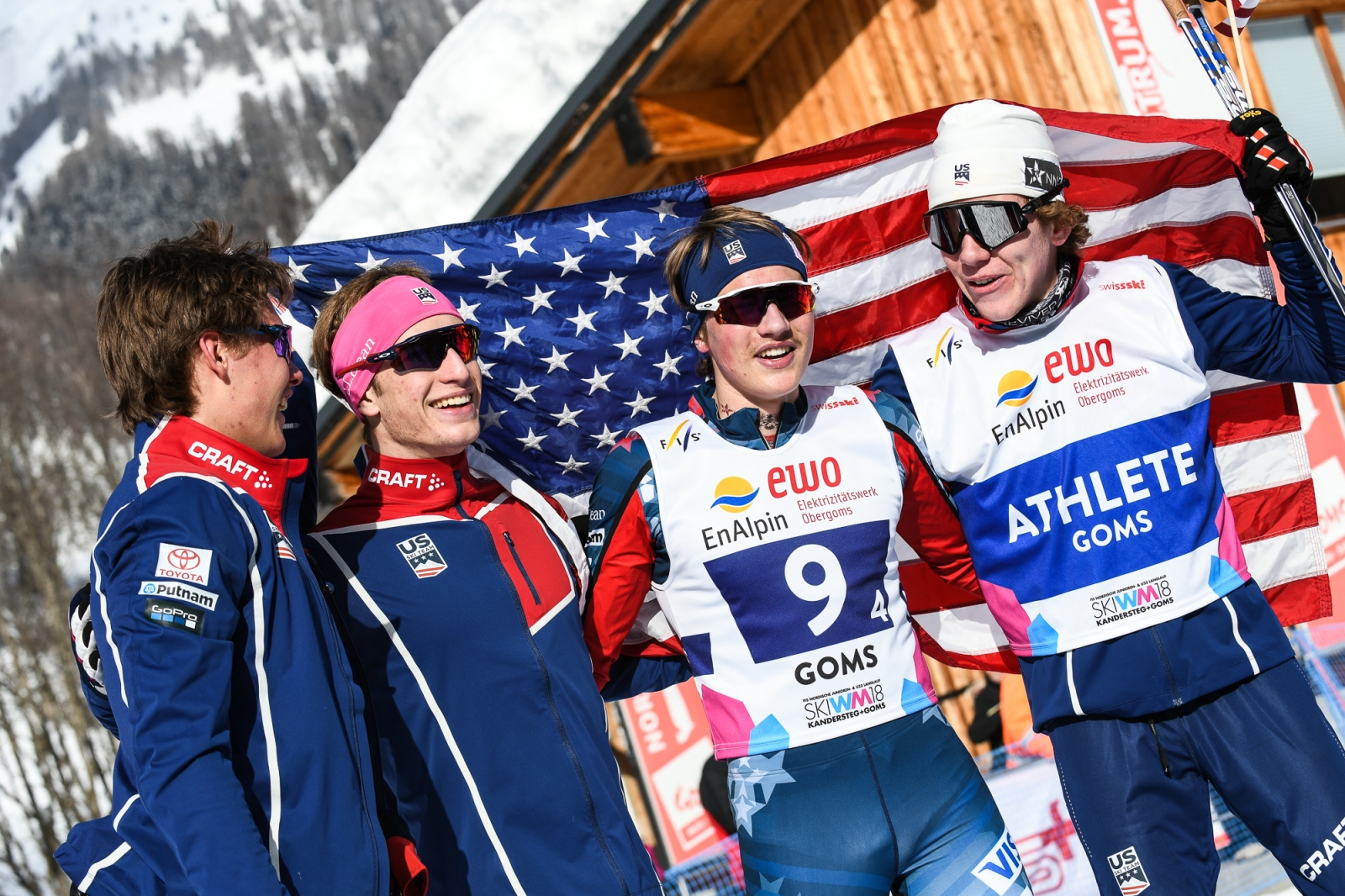
The U.S. men’s silver-medal relay at 2018 Junior World Championships in Goms, Switzerland, with (from left to right) Luke Jager, Hunter Wonders, Gus Schumacher, and Ben Ogden. (Photo: JWSC2018.ch)
What is long-term development
Aerobic capacity develops over years, often decades. Technical efficiency improves gradually. The durability required to handle training load is built slowly through years of training. Most elite endurance athletes reach their peak in their mid-twenties or early thirties, not in high school.
If peak performance happens ten or fifteen years after an athlete first enters the sport, the early years should focus less on maximizing results and more on building the foundation that supports long-term growth.
That foundation includes several elements.
Movement skill. Nordic skiing is a technical sport, and the best skiers move efficiently long before their physiology fully matures. This efficiency is critical to managing training loads in the future. More efficiency in technique equals less stress and load from training.
General athletic development. Running, biking, jumping, climbing, and playing other sports all contribute to coordination and resilience. Athletes who move well tend to adapt better to training later.
Motivation. The most valuable asset a young athlete has isn’t VO₂ max or the hours trained by some arbitrary definition. It’s the desire to keep showing up year after year.
Junior athletes race during the 2022 U.S. Cross Country Championships in Soldier Hollow, UT. (Photo: Tobias Albrigtsen / @untraceableg)
The System Sends Mixed Signals
In practice, the system often sends young athletes a different message.
Junior racing has become increasingly competitive. Rankings exist even for younger age groups, and selections for camps, trips, and development programs often depend on early results. National events and development pathways can make performance at 14 or 15 feel like it carries some long-term significance. Yet we also claim to know that identifying future elite athletes at that age is extremely unreliable. If that’s true, it’s worth asking why the system places so much weight on those results.
One example is allowing U14 athletes to ski up in order to qualify for Junior Nationals. It doesn’t happen frequently, but it happens every year. It’s hard to reconcile that with the philosophy of not rushing development. If long-term development truly matters, governing bodies should show leadership and address this issue.
In some regions of the country, qualifier races have U16 athletes seeded in the start list with U18 and U20 athletes. People say it doesn’t matter because we separate them in the results. I disagree, the are intermingled with much older and more developed athletes. But more than that it is again the message begin sent?
At the same time, training culture has shifted. Training data is widely shared, and conversations often revolve around hours. Young athletes begin comparing workloads long before their bodies are ready to handle them. Often the more is better attitude prevails, even though we say that we should be working on other skill aspects of development.
These pressures can push athletes toward earlier specialization and higher training loads than their stage of development requires. A 14-year-old begins to feel like they need to train like a college skier. A 15-year-old worries that missing races or reducing training volume might put them behind.
The Boulder Nordic Junior Race Team out for an adventure ski in 2014. (Photo: BNST)
What are the impacts of the mixed signals
The most visible consequence is burnout. Many people challenge the idea of burnout. But after more than forty years around this sport, I’ve seen the pattern repeatedly. Just because we don’t measure something well doesn’t mean it isn’t happening.
Coaches who have spent time around junior skiing see the pattern: talented athletes who disappear from the sport sometime between their late teens and early twenties. Sometimes academics, finances, or changing interests are the reason. But often the explanation is simpler, they are tired from too much too early and to intense.
There are also physical consequences. Adolescence is a complex period of growth and development. Training loads that are manageable for more mature athletes are impossible for a developing body. When volume and intensity climb too quickly, overuse injuries and chronic fatigue become more likely.
Early specialization is not the problem. Rather, it is ineffective programming that has these young athletes training like more mature athletes. This early training focus limits athletic development. Athletes may accumulate impressive training hours but miss the movement diversity that builds long-term durability.
The biggest loss in this process is one that is unseen because those athletes are lost from the sport.
From a coaching perspective, the shift shows up in small ways. Conversations revolve around weekly training hours instead of how well athletes are skiing. Easy sessions slowly become harder. Fatigue accumulates while movement quality quietly declines. None of this happens overnight, but over time, the focus drifts away from skill development and toward simply doing more.
Development in endurance sports isn’t about accumulating work. It’s about adapting to the work being done and building the capacity to handle more later. A training log that looks impressive at 15 doesn’t necessarily translate into success at 25. What matters more is whether the athlete remains healthy, motivated, and technically sound over the long term.
Hailey Swirbul celebrates the U16 Junior National Championship title in the Freestyl Mass Start in Stowe, Vermont, in 2014. (Photo: Voisin/FasterSkier)
What Good Development Actually Looks Like
If long-term development is the goal, the early years should look different from elite training. Young skiers benefit from variety. Running, cycling, hiking, and other sports build coordination and resilience. The goal isn’t to replicate elite training programs but to create athletes who move well and enjoy being active.
Technique deserves major attention. Nordic skiing rewards efficiency, and athletes who develop strong movement patterns early often progress faster later because every hour of training becomes more productive. Training volume should increase gradually over time. Consistency across years matters far more than pushing limits in any single season.
Most importantly, development should seek to preserve motivation. The sport needs athletes who remain engaged long enough to realize their potential. We often see athletes try to do a big training year to catch up or reach a target training volume. It rarely works out.
The Problem With “More Volume” Thinking
In Nordic skiing, training volume carries a certain mystique. Conversations quickly turn to hours, weekly totals, yearly totals, and stories of elite athletes training 800 to 1,000 hours per year.
It’s easy to see why. Endurance sports reward consistency and large training volumes. But a subtle misunderstanding often occurs. Volume stops being seen as the result of long-term development and starts being treated as the cause of performance.
Correlation becomes mistaken for causation.
Hunter Wonders (APU/Alaska) winning the U16 Boys Mass Start Freestyle race at the US Junior National Championship in Stowe, Vermont. (Photo: Voisin/FasterSkier)
High Volume Works for Elite Skiers
At the elite level, high training volume makes sense. World Cup athletes have spent years building the capacity to handle that workload. Their aerobic systems are highly developed, their movement patterns are efficient, and their bodies have adapted gradually.
High volume works because it sits on top of a massive foundation: technical skill, durability, and years of progressive training.
The problem arises when that model gets copied without the same foundation underneath it.
The Missing Variable: Training Age
One of the most overlooked concepts in endurance development is training age. Training age refers to how many years an athlete has spent consistently adapting to structured training. Two 18-year-old skiers may have very different training ages. One may have spent eight years gradually building capacity. Another may have entered the sport recently and increased training dramatically. On paper, their training logs may look similar. In reality, their ability to adapt to those loads can be very different.
Training only produces progress when adaptation occurs. Without adaptation, training simply builds fatigue.
The U18 Girls field works its way past the Loppet Foundation Adventure Center in Minneapolis during Junior Nationals on March 11th, 2022. (Photo: David J Owen Photography)
The Efficiency Problem
Elite skiers move extremely well. Their technique allows them to ski long distances while conserving energy and minimizing unnecessary muscular stress. Developing this efficiency early is critical. In the future, it will allow the athletes to train large volumes without the metabolic and neuromuscular stress that can lead to overtraining.
Young athletes often lack efficiency. When technique is still evolving, large training volumes can actually slow technical development. Fatigue reinforces inefficient movement patterns that later become difficult to change.
For developing skiers, time spent improving movement quality can be far more valuable than time spent extending distance.
The Cost of Chasing Hours
There is also a practical cost to the “more volume” mindset. Elite athletes structure their lives around training. Sleep, nutrition, and recovery are integrated into the system. Young athletes are balancing school, travel, social life, and other commitments. When training volume climbs, something gives. Sleep declines, recovery becomes inconsistent, and fatigue accumulates.
Under those conditions, simply adding more hours rarely produces better results.
What Volume Should Really Represent
Training volume does matter. Endurance sports ultimately require substantial workloads. But volume should be viewed as a long-term outcome of development, not a short-term objective. Successful endurance athletes rarely build training hours quickly. They accumulate them gradually across many seasons, allowing their bodies to adapt step by step. By the time they reach elite levels, high training volumes feel natural because they have spent years building the durability to support them.
The 2026 US Ski and Snowboard Junior National Championships in Cable, Wisconsin, hosted by the American Birkebeiner Ski Foundation. (Photo: Tryg Solberg)
A Better Question to Ask
Instead of asking how many hours an athlete should train, a better question might be:
What training can this athlete adapt to right now?
For some athletes, the answer may involve increasing volume. For others, improving technique, strength, or intensity distribution may produce greater gains. Development is not identical for every athlete. What matters is finding the training load that promotes consistent adaptation rather than constant fatigue.
Why This Matters for the Future of the Sport
Cross-country skiing, like all endurance sports, depends on long-term participation. The sport needs athletes who remain engaged, not only as competitors but as lifelong skiers, coaches, and community members.
A development system that pushes athletes too hard, too early risks losing them before they reach their potential. It also narrows the pathway to elite performance by favoring early maturity and filtering out late developers.
If Nordic skiing truly wants to remain a lifetime sport, its development culture must reflect that philosophy.
Closing
Cross-country skiing has always valued endurance. That value should extend beyond physiology and into how we develop athletes. Endurance isn’t just about how long someone can ski hard on race day. It’s about how long they can remain engaged in the process of improving.
If we truly believe Nordic skiing is a lifetime sport, then our development system should not resemble a funnel that selects kids out at every progressive age group. It should look more like a runway, where every young athlete has the opportunity and the time to fully develop their potential, not just the ones who mature early.
Help Support Our Olympic Coverage!
If you value the thoughtful work and access FasterSkier provides, please consider becoming a Voluntary Subscriber. Your support directly fuels our work to cover the people, places, and moments that make our sport special.
The 2026 US Ski and Snowboard Junior National Championships in Cable, Wisconsin, hosted by the American Birkebeiner Ski Foundation. (Photo: Tryg Solberg)
Finals week has a way of compressing time. Days shrink into problem sets and exams; nights stretch just long enough to make sleep negotiable. When Jack Lange logged onto Zoom from Hanover in late November, he was finishing his senior fall at Dartmouth, a mechanical engineering major balancing equations while packing for a training block at Silver Star. The snow out west wasn’t cooperating. Races were being reformatted. Nothing felt settled.
That uncertainty didn’t seem to bother him much.
“We’re wrapping up school right now and then heading to Silver Star next Tuesday,” Lange said. “Hopefully, the snow conditions there improve a little bit.”
It was a measured answer—calm, almost deliberately so. Over the next hour, that calm would reveal itself not as indifference, but as something learned the hard way.
Young Jack Lange skiing in a New England BKL race. (Photo: Heidi Lange)
A kid who wasn’t supposed to be good at this
Lange grew up in Vermont’s Upper Valley, skiing out of Green Woodlands and the Ford Sayre Bill Koch League. It was the kind of childhood that feels almost mythic now: full-moon skis to a cabin, hot chocolate on a frozen pond, friends everywhere.
“I’ve always just made sure that that’s the thing that comes first,” he said. “Getting outside and enjoying being outside and enjoying pushing myself and having fun.”
He played everything. Soccer, where he was very aware he wasn’t the best. Swimming, where he gravitated toward breaststroke. Cross-country running. Mountain biking. For a while, he did both alpine and Nordic skiing, until a choice had to be made.
“My sister was doing more Nordic and more of my friends were on the Nordic,” he said. “So I just went with Nordic.”
Lange and friends meeting Jessie Diggins and Sophie Caldwell Hamilton at the Quebec World Cup. (Photo: Heidi Lange)
It wasn’t a natural fit at first. Lange remembers being the odd kid out on relay day—the one paired with a skier from another team because the numbers didn’t work.
“I wasn’t good at it,” he said simply.
What hooked him wasn’t speed. It was curiosity.
“I really like the amount that you can learn from being out in training,” he said. “Not even structured training—just being outside and having fun. I really enjoy the process of figuring out how hard I can push myself.”
By freshman year of high school, something shifted. He trained more. He paid attention. And suddenly the results were better than expected.
“That was kind of the confidence boost that launched me into, like, ‘Oh, this is something I can do.’”
2019 Junior National Championships in Alaska. Lange finished in fifth place with Dartmouth teammate Wally Magill in first. (Photo: Heidi Lange)
The pressure builds—and breaks
Lange’s junior years were uneven. Seasons were disrupted. Races were canceled. One winter meant nine consecutive weekends racing at Craftsbury, all interval starts—an exercise in patience for someone who loved head-to-head competition.
“I love mass starts,” he said. “I love racing next to people. Mind games and competitiveness.”
By his senior year, he had narrowed his focus to Junior Nationals. The goal was simple: qualify. Nothing more.
When he arrived at the 2019 Junior National Championships in Alaska, he was the last skier to qualify from New England. He started near the back in the 5-kilometer skate race at Kincaid Park.
“My goal for the entire season was to make JN’s,” he said. “And I was there, and I was like, I’m in Alaska. This is kind of crazy.”
Mid-race, a coach called out a split.
“One of the New England coaches is like, ‘You’re like three seconds out of top ten,’” Lange recalled. “And I was like, that’s pretty funny.”
He kept skiing. He finished fifth.
“That was way, way beyond where I ever could have expected to be.”
There’s a photo from that day—Lange among a group of skiers who would later become familiar names on the U.S. Ski Team. At the time, it felt surreal. In hindsight, it was clear it wasn’t the performance itself that mattered most, but the conditions under which it happened: no expectations, no fear.
That lesson wouldn’t fully sink in until later.
Lange with his parents, Heidi and Greg. (Photo: courtesy photo)
Dartmouth, and the weight of wanting it too much
Lange chose Dartmouth largely because it felt right. He wanted engineering. He liked the people. He trusted the coach.
“Brayton [Osgood] is such an amazing coach to work with,” Lange said. “He’s never the guy to show up and be like, ‘This is what you’re doing.’ He’s super approachable. He really wants us to find our spot in the sport.”
At Dartmouth, skiing wasn’t isolated from the rest of life—it was embedded within it. That integration became most visible during the most stressful week of the year: NCAAs, which overlap directly with finals.
“My freshman year, that finals week with NCAAs was kind of a dark time,” Lange said. “I was close to tears on the start line of the 20k race. Just so much pressure, so overwhelmed.”
He remembers warming up briefly, then stopping.
“I skied like fifteen minutes in the warm-up and just put my skis down,” he said. “I was completely broken.”
A kilometer into the race, he was in dead last.
And then something shifted.
“I saw Brayton on the side of the trail,” Lange said. “And I was like, you know—I don’t need to take this so seriously. I can show up, do my best at everything, and give 100 percent effort. If I do that, it’s gonna come through.”
It did. That race became one of his best of the season.
Dartmouth Ski Team (Photo: courtesy photo)
The things that make it lighter
The story of Dartmouth skiing is often told through tradition—green suits, first-years with mohawks, time trials. Lange points to different details.
There’s a sauna in the locker room.
“That’s a prime spot to get to know the team,” he said. “We rip this on all the time.”
There’s also life beyond skiing. Every non-freshman on the men’s team is in a fraternity. Lange lives in the Zeta Psi house with teammates and classmates—engineers, computer scientists, people whose lives orbit entirely different centers.
“I’m surrounded by a ton of people who have no clue what skiing means to me,” he said. “And that’s been a really huge part of being at Dartmouth.”
His best season, he said, came immediately after pledging.
“It taught me how to not put as much pressure on myself,” Lange said. “How to make this a sustainable thing that I could really enjoy.”
That balance—academic, athletic, social—isn’t accidental.
“None of the three would be as good without the others,” he said.
Lange’s favorite race: Prospect relay with Cam Wolfe and Cooper Camp. (Photo: Heidi Lange)
“You can’t live nervous”
Lange keeps a training log. He trains consistently. He admits he’s overcooked himself before. What he doesn’t do is chase numbers obsessively.
“I don’t think I’ve ever had an hour’s target that I’m trying to hit,” he said. “I’ve just trained for the enjoyment of it.”
There was a time, early on, when outside voices crept in.
“I was getting a lot of people saying, ‘You’re training too much. You’re doing this wrong,’” he said. “I got a little worked up about it and a little nervous.”
He paused.
“You can’t live nervous.”
It’s the line that keeps resurfacing, whether he’s talking about high school racing, college pressure, or the future beyond Dartmouth.
“I think anyone who’s in high school, middle school—just go out there because you enjoy it,” he said. “You’re gonna have crappy days. But if you go out there every day and just have a good time, and surround yourself with people you like to be around, things will work out.”
That philosophy shapes how he defines success now. Lange talks about team first. About racing in a green suit. About showing up energized.
“The guys here are here for the right reasons,” he said. “They’re skiing because they really enjoy skiing. That’s super energizing.”
Lange with his long time coach and mentor, Dennis Donahue. (Photo: Heidi Lange)
A quiet kind of confidence
Ask Lange where he sees himself years down the road, and he doesn’t reach for outcomes. He talks about process.
“The process of showing up every day,” he said. “How can I be the best athlete I can be today? That’s the most rewarding thing.”
Skiing, he believes, has taught him how to live—how to work, how to recover, how to stay curious.
“Wherever I am fifteen years from now,” he said, “all of the lessons that I’ve learned are still going to be extremely relevant and important.”
For now, there are finals to finish and skis to pack. The snow will either come or it won’t. The races will sort themselves out.
Lange will keep doing what he’s learned to do best: show up, stay loose, and ski without fear.
Because speed, he’s learned, is hard to find when you’re holding your breath.
Love Stories Like This? Help Keep Them Coming.
Feature stories like this one take time, access, and care to produce. If you value thoughtful storytelling and independent ski journalism, please consider becoming a Voluntary Subscriber. Your support directly fuels the work we do to cover the people, places, and moments that make our sport special.
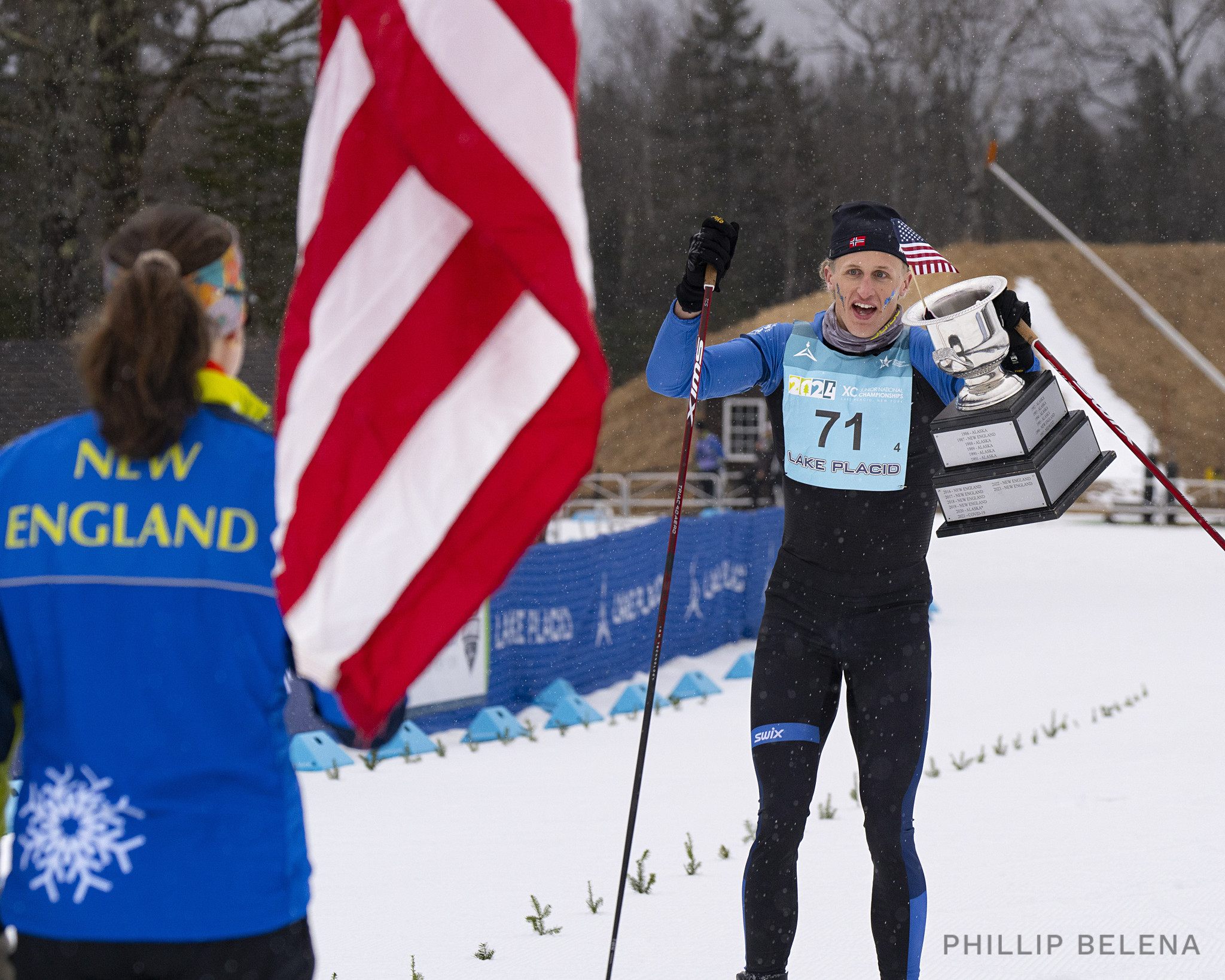
New England’s Fin Bailey (SMST2 / University of Vermont) crosses the line, Alaska Cup in hand, to win the U20 Team Relay at Junior Nationals in Lake Placid, New York. (Photo: Lake Placid Organizing Committee/Phillip Belena)
The U.S. Cross Country Junior National Championships—originally known as the Junior Nationals, then called the Junior Olympics for a stretch, and now again the Junior Nationals—were first held in 1965 in Bend, Oregon. Those early events included all ski disciplines: cross-country, alpine, ski jumping, and nordic combined. They were hosted at venues that could accommodate the full spectrum of competitive skiing.
In digging into history, I found it surprisingly difficult to track down hard dates and specific changes. So, instead of presenting a definitive historical timeline, I’m going to share what I’ve seen and experienced over the years.
Early Days and the Shift to Cross-Country
The last Junior Nationals to include all disciplines took place in 1969 in Girdwood, Alaska. Starting in 1970 and through the later part of that decade, cross-country and nordic combined events continued together, but the overall focus began to shift toward cross-country skiing.
Between 1965 and 1975, there were no age group classifications at Junior Nationals. Based on my recollection, eligibility extended to what we’d now call the J1 age group. There was no Older Junior (OJ) category yet.
Somewhere in the late 1970s to early 1980s, age groups were formally introduced: OJ, J1, J2. More recently, those categories were replaced by U20, U18, and U16, aligning with FIS international standards. Other than changes in the format of the competition events, themselves, the structure of Junior Nationals has remained fairly consistent for the last couple of decades.
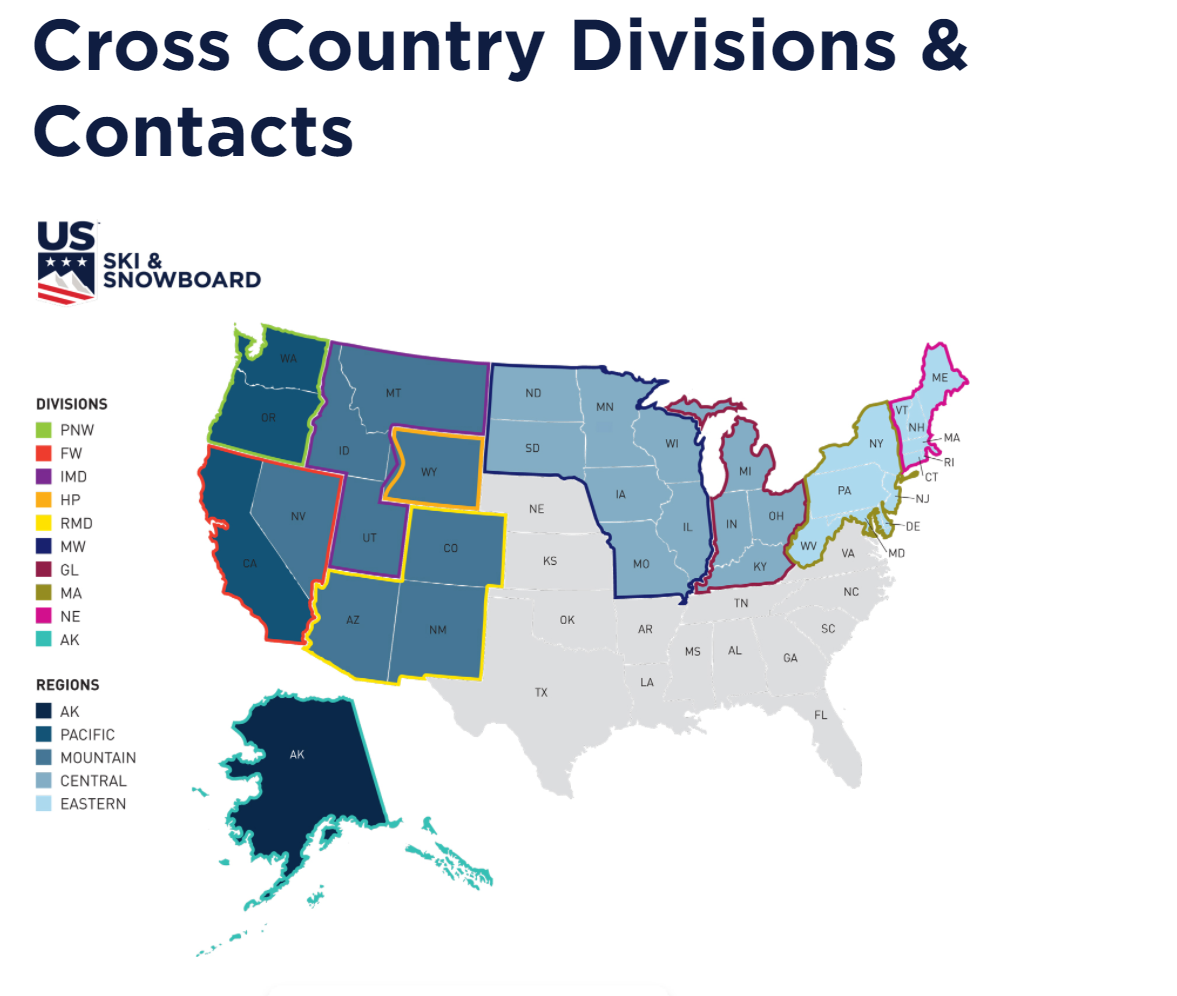
Geographical make-up of each division competing at Junior Nationals. (Photo: US Ski and Snowboard)
Divisions and Participation
Athletes now compete as part of one of ten regional divisions, with each allowed to bring up to 25 male and 25 female skiers across the U16, U18, and U20 categories. Some athletes may pre-qualify through national rankings or international results, which allows them to compete beyond the division quota.
Current Divisions
Alaska
Far West (CA, NV, HI)
Great Lakes (MI, WI, KY, IN, OH)
High Plains (WY, Eastern MT, ND, SD)
Intermountain (ID, MT, UT, Western WY)
Mid-Atlantic (NY, NJ, PA, DE, WV, MD, DC)
Midwest (IA, MN, IL, MO)
New England (MA, ME, NH, VT)
Pacific Northwest (OR, WA, Western ID)
Rocky Mountain (CO, NM)
Sverre Caldwell (far right) with the 2013/2014 Stratton Mountain School T2 Team (from left to right): Head coach Gus Kaeding, Andy Newell, Annie Pokorny, Eric Packer, Jessie Diggins, Sophie Caldwell, Simi Hamilton, Erika Flowers. (Photo: Annie Hart)
The Ongoing Debate
There’s been no shortage of conversations about Junior Nationals over the years. Topics have ranged from the inclusion of the U16 category, to the rising costs of participation, to the event’s role in the development pipeline. There’s also been discussion about whether the event should be managed more by divisions or clubs, and whether the U20 category still fits the purpose of the event.
Back in the early to mid-1990s, I spent four years working with Sverre Caldwell at Stratton Mountain School. Even then, discussions around J2 (now U16) participation were front and center. Around that same time, John Caldwell helped launch NENSA (New England Nordic Ski Association). I was an original NENSA Board Member, which made youth development a key priority. One of NENSA’s early initiatives was the creation of the New England Junior Festival—intended, eventually, to provide an alternative to Junior Nationals for the J2 age group.
That shift never materialized. The deeply entrenched belief in the value of Junior Nationals as a key part of athlete development won out.
Why Revisit the History?
I’m sharing this history because it helps illustrate just how much the program has—and hasn’t—changed in the past 60 years. Some people believe it hasn’t evolved enough to keep pace with the times or to support broader participation. Others are convinced that “This is the way we’ve always done it, and it works.” In my view, neither is entirely true.
In my earlier piece, “What’s the Hurry?”, I argued that our current system identifies and prioritizes talent far too early. We are selecting athletes at the U16 level and younger, despite a large body of research showing that it’s nearly impossible to accurately predict which athletes will succeed at the senior level. Early selection risks pushing kids out of the sport who might develop later.
Cost, Pressure, and the Case for Change
The financial burden of Junior Nationals is another serious issue. If a skier qualifies as a first-year U16, they could potentially attend six championships. Just the travel and participation costs over that period could exceed $20,000—and that doesn’t include:
Club coaching fees
Equipment
Travel to qualifiers
When you add everything up, you’re looking at a potential $150,000 investment during a skier’s junior years. That’s not sustainable or accessible for many families.
Beyond cost, there are other concerns. Is it appropriate for 14- and 15-year-olds to be competing alongside 18- and 19-year-olds? Is there a clear and valid developmental rationale for putting U16s on a national stage?
In some regions, the answer may be no. Early selection and high-stakes competition at young ages may actually be contributing to dropout rates in older age groups.
Time to Rethink the Model
It’s time—long past time—to reconsider how we structure Junior Nationals. We’ve had the same essential age group model for over 45 years, but we now have decades of experience and research to suggest it needs to change.
My Recommendation
Remove U16s from the Junior National Program.
Instead, focus on:
Local and divisional development
Age-appropriate regional events
Creating fun, inclusive, and positive experiences
At those younger ages, our goal should be to get kids into the sport, keep them in, and help them build the skills and mindset they need for a lifetime of skiing—whether or not they go on to elite competition.
In talking with peers and colleagues in the Scandinavian and Central European countries countries, asking for their views on this topic and what occurs in their country, we received the following responses from Trond and Knut Nystad.
Trond Nystad, coach of the Norwegian men’s cross-country ski team at the Sochi Olympics.
Trond Nystad
In my mind it makes no sense to select young skiers to travel to nationals for a lot of reasons.
Travel takes up a lot of time and is very expensive.
Since there is such a large variation in biological age, you will end up selecting skiers who are biological advanced and the true talents are left at home discouraged and with no self confidence. Most countries in middle Europe starts the selection/de-selection process too early. The ones who were not selected quit, and the ones who were selected quit when they loose the “biological advantage.”
Young skiers from parents with a larger income have better/more equipment, leading to a selection of the ones that “have” as supposed to looking at long term potential.
When young skiers are “rewarded” with a trip to nationals they might get satisfied early and loose the long term drive.
No correlation between success U16 and long term success in endurance sports.
Money can be more effectively used by organizing a local race series where athletes get to compete in a lot more events.
Young athletes would benefit more from mastering skills needed in sports (and life) instead of being focused on selection races and results.
Knut Nystad, Norway’s former waxing czar. Photo, Langrenn.com.
Knut Nystad (comments edited to key bullet points)
In Norway there is a separate championship for the U16.
Cost of attending is an issue, but the clubs take the majority of the cost, leaving only a minor part for each participant to pay. For the athletes that cannot afford it – most clubs have “need based” funds that ensure that everyone can participate.
Norway is a small country, hence traveling cannot be compared to the US. Does it make sense to have a championship for this age group? Maybe, maybe not.
For the sake of identifying talents you clearly do not need a U16 championships. We know that it is not a race that give any clear indication of talent, nor does it identify who will prosper and develop into international top level skiers. Many of the absolute best Norwegian skiers were way down on the results at this age (including Klæbo).
At this age there are some many factors that come into play – exposure age (how long have they trained), biological age (early/late puberty), equipment, wax, early specialization vs multi sport focus, parents, training group, quality of coaching +++ It is an unfair competition.
What about asking what motivates the athletes to continue develop? Truth is that young athletes are motivated by different things.
In my mind, the best way to identify talents, is by motivating as many as possible to have fun, be challenged, and keep on racing for as many years as possible.
So what is the correct strategy/answer? The one that motivates more athletes to stay longer in the sport. Does this mean yes or no to a U16 championship? This is for you to answer based on what is appropriate to get the sport of skiing in the US to prosper.
Closing Thoughts
Junior Nationals have served the sport well in many ways. But we have to recognize when a system, even one we may be emotionally attached to, is no longer serving all athletes effectively. If we truly care about developing strong, healthy, resilient skiers—for sport and for life—then we need to be willing to adapt. While Norway and Sweden have championship events for U16’s it doesn’t mean it is necessary or optimal for the U.S, given the size of the country, the cost, the culture, and the level of participation.
Let’s build a system that works for more kids, not fewer. That starts by taking a hard look at who we’re serving, and how we’re defining success.
U.S. Ski & Snowboard recently announced its U.S. Ski Team nominations for the 2022-23 season. Of the 22 athletes named to the team this season, six were not on the previous year’s roster, either newly named or renamed: Michael Earnhart, Walker Hall, Zak Ketterson, Will Koch, Finn O’Connell, and Sammy Smith.
To help fans get to know these new(er) faces, FasterSkier is doing a series of interviews, providing insights into the factors that have contributed to development, progress, and growth for these athletes last season. In this installment, we talk with Michael Earnhart following his nomination to the U.S. Ski Team on its D-Team. Earnhart discusses growing up skiing in Alaska, his successes as a junior, and what to expect as he joins the U.S. team alongside Junior World Championship teammates this season.
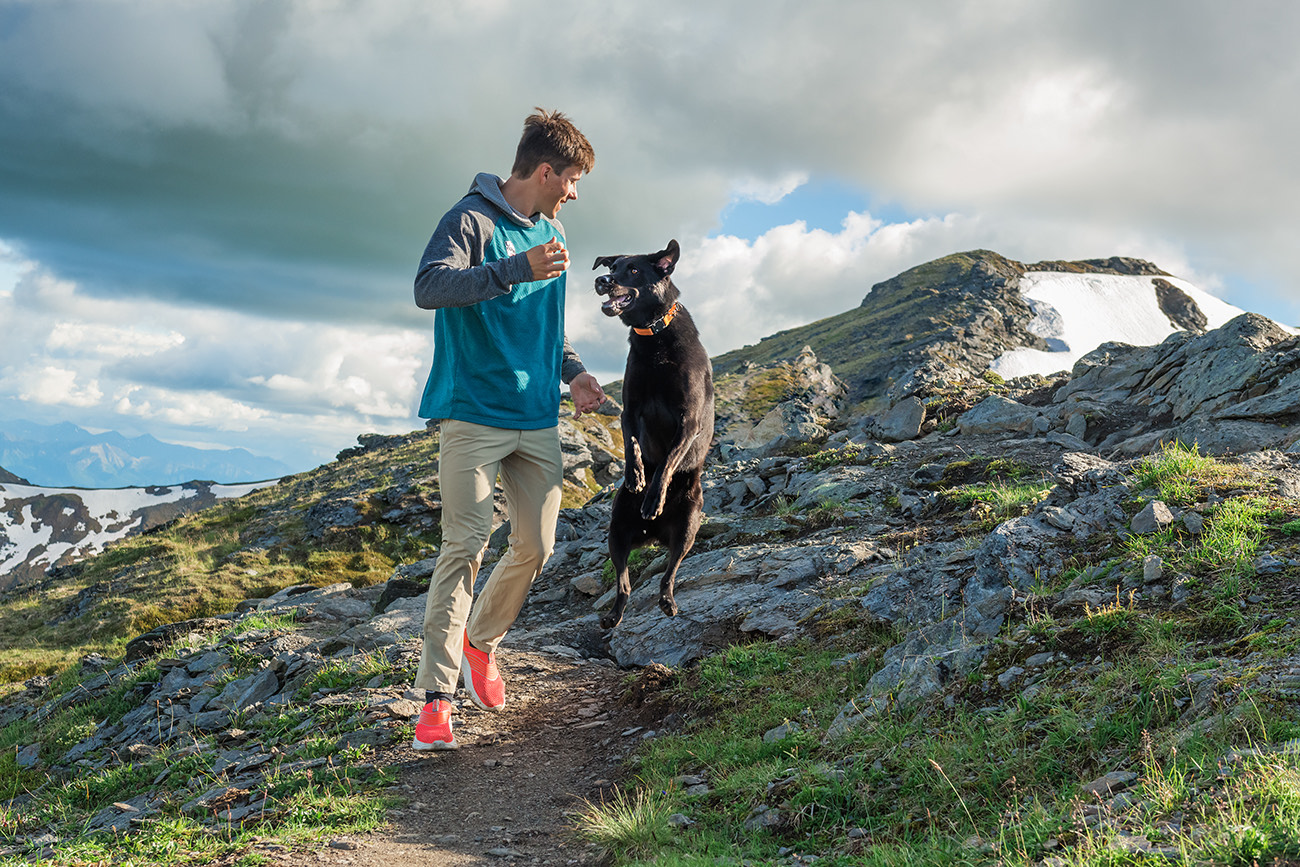
Michael Earnhart playing with his dog around his hometown of Anchorage Alaska. Earnhart was recently nominated to the US Ski Team D-Team. (Photo: Michael Earnhart).
FasterSkier/Ben Theyerl (FS): Can you just tell us a little bit about yourself? Where are you from, who have you skied for in the past and who are you skiing for now?
Michael Earnhart (ME): I’m from Eagle River, Alaska, which is just outside of Anchorage. I trained with Alaska Nordic Racing, and then last year moved into Anchorage to train full-time with APU (Alaska Pacific University). I’ve just been trying to stay in Anchorage and Alaska as much as possible because I really think it’s the best place to be a skier in the U.S.
I’ve also gone on two different U.S. Ski Team trips. I started out with the Nordic Nations Cup (U18) and then I’ve gone to World Junior Championships (World Juniors) the past two years in a row, with this past year being the World Junior Championships that helped me qualify for the U.S. Ski Team.
FS: I wanted to hop in right there, congratulations on officially joining up with the U.S. Team. Can you take us through the process that led you to this point – when did you think that joining the national team was a goal you could realistically set for yourself? And what was the process of reaching that goal once it was set?
Michael Earnhart. (Photo: Michael Earnhart).
ME: In the beginning, I was just into running through elementary and middle school, and just wanted to be competitive in skiing for the running aspect of what I was doing, not really thinking about skiing so much. My freshman year of high school I made it to JNs (Junior Nationals) and ended up getting a Top-10 which was when I was like ‘wow, you know, this skiing thing is really cool.’
From that point on, I started focusing more on skiing and got lucky because I was naturally talented to some degree. But I worked hard and was able to make my first international trip (the U18 Nordic Nations trip). That was my first time wearing the red, white, and blue, and I very much went ‘yep, this is what I want to do.’ I wanted to wear that U.S. race suit full time.
FS: Did you make it out to Bend camp this spring? How was the first experience joining up with the team?
ME: I did make it out and it was really fun. Those people on the team are some of the nicest people I know, and so it was good to spend time with them in general, but being at a camp where the goal is to put in some big volume was super beneficial to my training. You also get to just learn different techniques for training from everyone and you’re really motivated. It was all super great.
FS:I’d also note some of those people you’re joining the team alongside. Will Koch and Walker Hall are both joining the D-team with you, and you have experience racing with them at Junior Worlds, but primarily from competing against them in the past. What has the experience been reaching the point of your career where your top competitors are becoming your teammates?
ME: It’s definitely interesting. I’ve known these guys for years as competitors. Like I think I used to in the summer months be thinking things like ‘ok, how do I beat Walker [Hall]?’ And now this summer, I’m living with him and we’re training together. We both want to do well on the international level, and so it makes sense and I’m really excited about it.
Earnhart as part of the US U18 Nordic Nations Team. ((Photo: Jane Mittelsteadt).
FS: You mentioned that you’re skiing for APU, which gives you plenty of examples of U.S. Ski Team members to look up to. You’ve already said that you think Anchorage is the best spot for you to be training, and being from there, I was wondering if you have any reflections on what about it makes it that way?
ME: There’s a lot. You can train at sea-level, and you can train at altitude. You have snow from October through May. We have great roller skiing in the summer and good running temperatures then too. It also stays fairly moderate temperature-wise – like Fairbanks gets too cold to ski sometimes. So, it boils down to access and climate.
I would also add that the community is just really large – there’s more skiers than just APU out here. We’ve got older people, middle-aged people who get out on the ski trails too and give us a lot of support.
Michael Earnhart taking part in Anchorage’s NordicX event last April. (Photo: Ophira Group / NordicX)
FS: Let’s back up and talk about this past season. If you take us back to last Fall, what were your goals going into this season?
ME: My goal was to make Junior World Championships again, and then just perform as well as I could there. Making the [US Ski Team] D-Team was on my mind, but I didn’t want to set any specific numbers results-wise that I thought would get me there. I didn’t want to say that I had to get a top-15 at Worlds or go for the win or whatever, it was just going to be do whatever I could to get myself onto the D-Team.
ME: There were a couple things going on there, but I think the big thing was that it was my last year as a junior so I may as well go have some fun with the guys that I’ve grown up skiing with in Alaska. I wanted to have one more fun time at JNs and I knew I could potentially win some races. I wanted to have a kind of “finish” to my time as a junior and mark it by spending time with the people that have helped me along the way the last four or five years in skiing.
FS:Quick follow-up: Any comments on the choice of a mullet in Minneapolis?
ME: You know, I started doing that a couple years ago. I like the idea of growing your hair out all winter to cut it for spring racing. I had a friend cut my hair in the hotel bathroom the night before the first race, and well, I thought it looked pretty good, so…
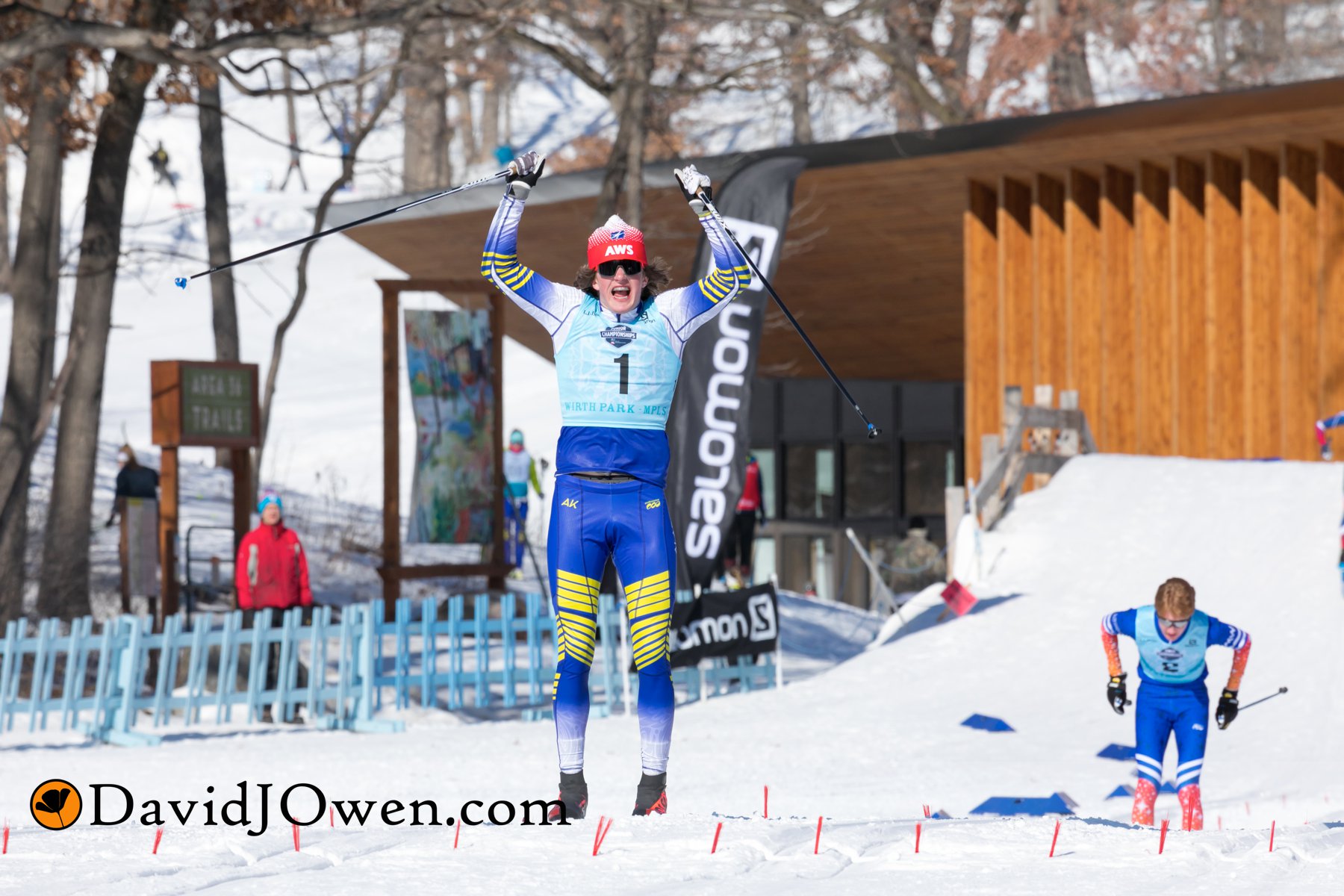
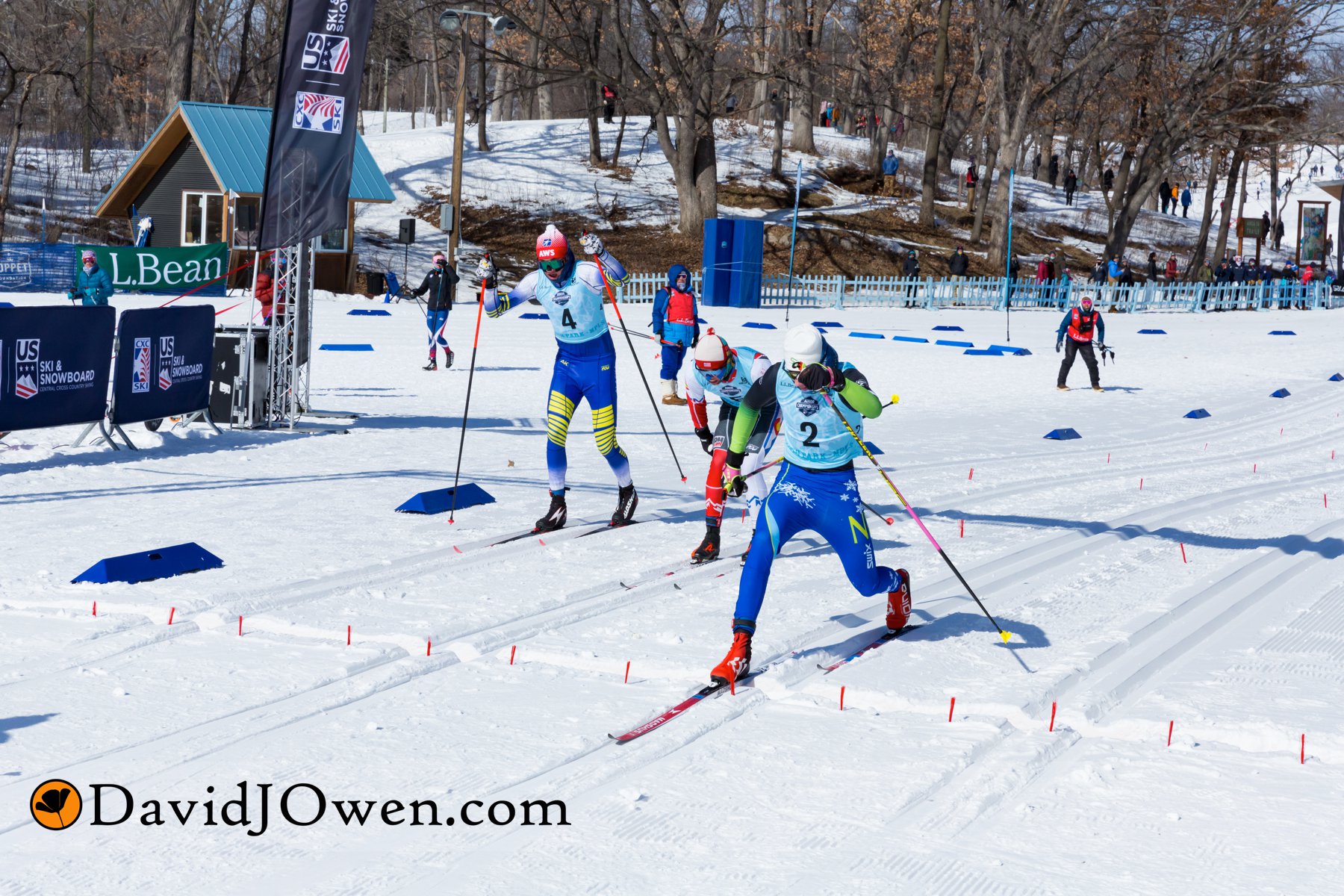
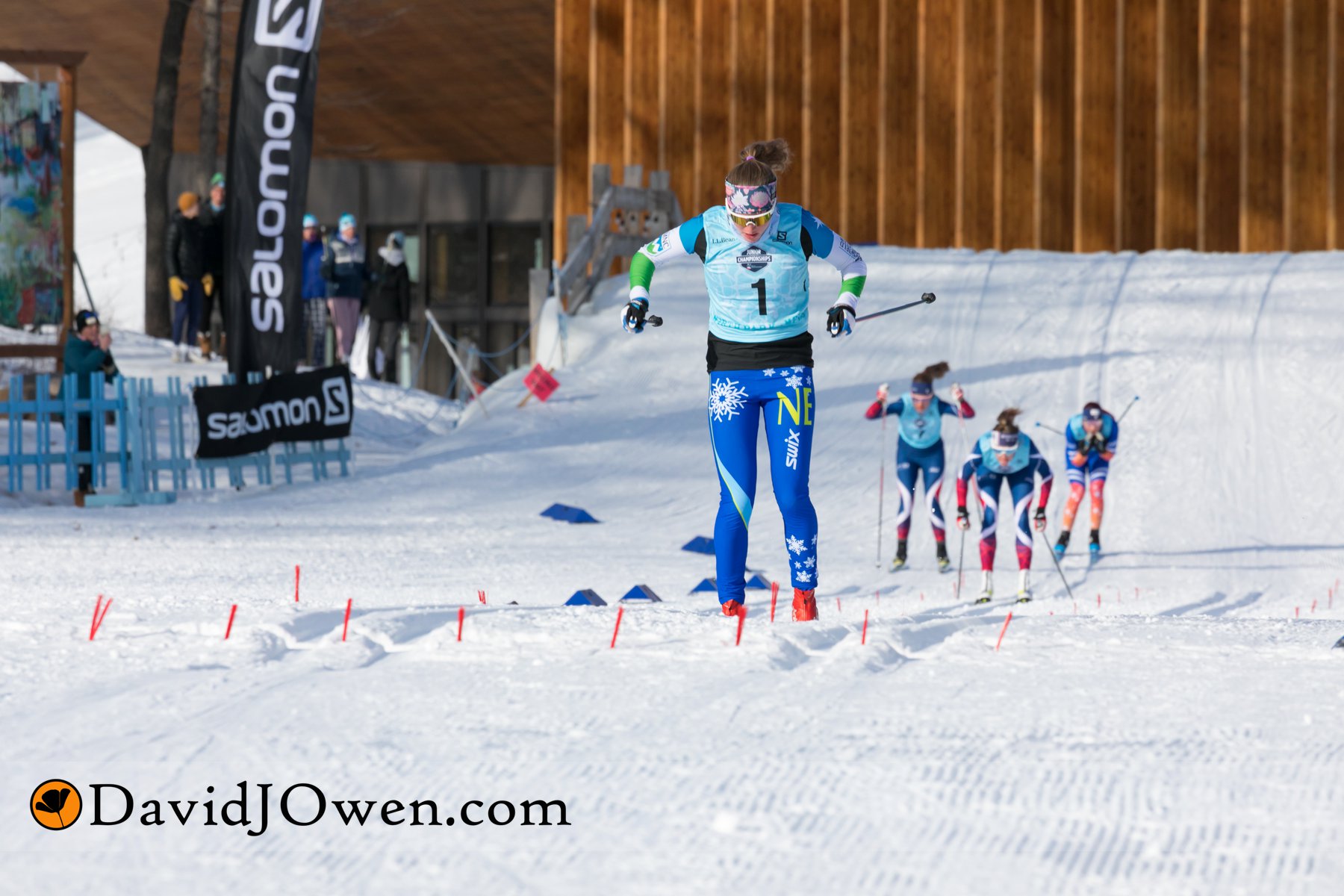
Michael Earnhart (bib 1) rocking the mullet in question at 2022 JNs in Minneapolis. (Photo: David J Owen Photography)
FS: I think we all did. If you could pick one highlight from this season, what would it be?
ME: For me, that’s pretty easily the relay at Junior Worlds. Even though we only got 3rd place when we wanted to win. I felt like it showed that the generation that came just before us, yes, they could get the US a gold medal and make history. But we’re here too, able to get a podium. I think it shows that US skiing is here to stay – we’re going to keep getting better. I’m really proud of having been a part of that.
FS: That brings us up to this training year. What are you thinking your goals are individually this next season? And what do you want to accomplish alongside those team members that you’re joining the U.S. Ski Team with?
ME: It’s hard to say right at the moment. I’m kind of at a weird age now being a first year U23, especially when we have so many fast U23s on the team already. I don’t have any specific goals set yet. I just really want to have a productive training year and race as fast as I can. Maybe some top-10s at U.S. Nationals – if you’re looking for a number, I’d put that out there.
I just want to be as close to winning as I can, and any race that I do, just race hard.
Michael Earnhart skiing in the suit of his home club Alaska Pacific University (APU). (Photo: Tobias Albrigtsen / @untraceableg).
FS:All sounds good to me. Thanks so much for helping us get up to speed, and good luck next season!
The U18 Girls field works its way past the Loppet Foundation Adventure Center at Theodore Wirth Park in Minneapolis during Junior Nationals on March 11th, 2022. (Photo: David J Owen Photography)
To trace the thread of the past, present, and future of American cross-country skiing, all you have to do is look at a golf course in Minneapolis that touches 3 of those 10,000 lakes in Minnesota; Theodore Wirth Park.
Over the past week, America’s most-skied loop played host to the US Ski and Snowboard Junior Championships (formerly Junior Nationals, or “JNs”), bringing the top under-20 year old skiers from across the nation together for the first time since 2020s JNs in Truckee, CA were forced to cancel mid-competition in the panicked early days of the COVID pandemic.
Two years later, the performances by the nation’s top junior skiers seemed to be nothing less than a brighter future put into motion. A week of skiing which saw athletes from Maine to Alaska, and anywhere in-between with enough snow, push each other, and the future of US skiing, forward.
Wirth Park Finally Gets to Host the Show
Last week marked just the second time that JNs was held at Wirth Park since its inception fifty-seven years ago.
The first was just eleven years ago in 2011, when an air of real possibility had just started to take hold in US skiing. Names like Kikkan Randall and Andy Newell were forging a path with their results on the World Cup. The Loppet Foundation, a decade into growing the sport in America’s most Nordic-centric city, was drawing up plans to turn Wirth Park, and Minneapolis, into an American Oslo. Competitors and spectators came to the 2011 Junior Olympics (as JNs was then known) with the idea that what they would see was a first glimpse into the future of skiing, in the US and beyond.
Some of what they saw was in part gimmick. The sprint race, for example, was held at night on purpose despite Wirth’s lighting being pretty much a few old trail lamps augmented with a couple of generators and some hip string lighting.
Some of what they saw though, was the real deal. Including the Female OJ (U20) skier from just down the road in Afton who won every race she could that week; Jessie Diggins.
In the intervening decade between then and now, Diggins went on to change the sport forever in the US, and actively reflected it back on the prime venue in her home state. She led the campaign lobbying the FIS to put a World Cup at Wirth on the calendar, and that vision for the future was set to be realized in March 2020.
The new homologated sprint course at Wirth had the FIS starting gates in the snow, bleachers set-up, and starting double-pole tracks set when it was canceled due to the COVID-19 pandemic on March 12th, 2020. The Loppet Foundation closed its new glass-fronted chalet a week later.
Wirth Park and Minneapolis were pushed back into looking forward to the future once again.
Two years later, the starting gates were repainted with the US Ski and Snowboard logo, the sprint course was ready, the start tracks set once again, Diggins was sending her best wishes, and Wirth Park would finally get to see its future vision for skiing come into the present.
Just how far Wirth, JNs, and skiing in the US had come, was on full display. Whereas JNs just a few years ago was only possible to follow from afar if you were willing to carefully read results sheets, the 2022 edition came with a full four camera set-up and commentary team provided by Engage Livestream Broadcasting. You could now watch nearly every corner of the Theodore Wirth Park course from anywhere, and according to Loppet Foundation, nearly 83,000 viewers did.
The Wirth course has evolved quickly in the past few years to adapt to the age of climate change, homologation, and well…live broadcasts. The traditional 5 k course at Wirth, which sent skiers out from the maples and oaks onto the windblown golf course, was eschewed to race either a 2.5 k or 3.3 k lap (depending on the distance) that concentrated the park’s unique, urban, time-tested terrain. Over the crest of the downhill that u-turned into the A-climb, skiers would view the Minneapolis skyline. On the new sprint course, they stormed up the tow rope line of a tubing hill. The middle-section made use of the out-runs for the now-demolished ski jumps, where skiing in America got its start with the Norwegians who founded Minneapolis in the 1800s.
The Minneapolis skyline visible in the distance from the finish area at Theodore Wirth Park on a cold, sunny March day during Junior Nationals last week. (Photo: David J Owen Photography)
Of course, none of this pomp and circumstance was on the minds of the skiers who looked at Wirth park’s course with one question on their mind: how do I ski it faster than anyone in the country?
A Week of Racing: the Junior Nationals Program
Over the week-long course of JNs, about four-hundred junior skiers sought an answer to that in a four-race program. They started with an individual start freestyle 10/5 k, then an individual classic sprint, then a 15/10/5 k classic mass start, and finally a 4 x 3.3 k mixed team relay. Each race was held as a separate event, meaning four distinct opportunities for athletes to win the title of junior national title. Each event also contributed to the cumulatively scored Alaska Cup – the top regional team in the country , the Junior National Club Team Classification – the top junior club, and the Roger Weston Trophy – the top high school team. Skiers competed against others in their age classes: U16s, U18s, and U20s.
In keeping with tradition, skiers competed for their regional teams, which proves to be an ever-evolving and wonky geographical distinction at JNs. Clubs leave and move divisions, and especially when high schoolers turn to college skiers in the U20s, skiers who may be from one division might ski for another (i.e. a skier from Alaska going to school in New England might qualify for the New England U20 team). Generally the map below shows the regional break-up of teams*:
Geographical make-up of each division that competed at Junior Nationals in 2022. *Note: Wisconsin started competing with Great Lakes in 2020, and did so this year as well. (Photo: US Ski & Snowboard)
The sheer amount of racing that occurs over the week of JNs is overwhelming in a way that’s inspirational – speaking to the depth and excitement that US skiing can expect in years to come. However, there were names and performances to highlight, and so here we look briefly at each race.
Monday: Individual Start 10k/5k Freestyle
After a weekend of course preview in which the skiers of America were greeted with the local Midwestern custom of a too early March rain, the JNs program began on a sunny Monday where the temperature stayed in the mid-high 20s (Fahrenheit). The snow left from the snowstorm a week before (another Midwestern custom, the Birkie-week foot of snow) combined with the man-made base to produce fast conditions.
The week kicked off at 9:00:15 with Minneapolis’ own Greta Hansen (Midwest, Minneapolis Ski Club) starting in bib 1 in the female U18 5 k race. The female U20, U18, and U16 fields were combined in the 5 k, before being separated by class in the results.
Combining the fields yielded the first intriguing result of the week, when U18 racer Ava Thurston (New England, Mansfield Nordic Club) finished the race in 1st nearly a minute (14:18.9) ahead of 2nd place (and first place U20) Nina Seemann (+55.6 seconds). Thurston had a similar advantage over 2nd place U18 (and 3rd overall) Maggie Warner (+56.1) (Midwest, NordicWerks). In a field of the best skiers from across the country, Thurston also proved to be one-half of the extraordinary feat of being joined by a teammate on the podium. Hattie Barker, also from Mansfield (New England), was the 3rd U18 (+57.3 sec).
Thurston, who was named to the U18 Nordic Nations Cup US team (the event, set to be held outside of Trondheim, Norway was canceled at the end of January due to COVID-19), had begun a banner week.
In the U20 girls, meanwhile, Seemann topped the field ahead of 2nd place Aurora Cramer (Intermountain, Sun Valley) (+3.9 sec). The Dartmouth freshman came to US Junior Championships after having competed for the US at World Junior Championships just a few weeks ago. The U20 podium was rounded out by New England’s (Gunstock Nordic) Catherine Stow (+25.9 sec).
In the U16 girls race, host club Loppet Nordic Racing (LNR) got its first national champion on its home turf. Sydney Drevlow (Midwest) finished the 5 k in a time of 15:36.8 for 1st place, and was joined on the podium by her teammate Inga Wing (Midwest, LNR) in 3rd (+13.7 sec). In between them was Pacific Northwest’s Neve Gerard (Mt. Bachelor) in 2nd (+11.6 sec).
The U20/U18 Boys 10 k field would see similar results to their female counterparts, with top athletes having come fresh-off of qualification for the Nordic Nations trip or Junior World Championships.
Like the girls field, there was one boy who stood out immediately with his result in the skate race. Alaska Pacific University’s (APU) Michael Earnhart (Alaska) continued a breakout year that’s seen him post strong results at Junior World’s, Senior Nationals, and on the SuperTour alike, winning a junior national championship in a time of 22:02.5. He was followed in the overall by the U18 National Champion Adrik Kraftson (Midwest, LNR) (+13.1 sec), and U18 2nd place Jack Lange (New England, SMS) (+16.2). Wes Campbell (Intermountain, Park City) rounded out the U18 podium (3rd) in 4th overall (+23.5). All three U18s were set to be teammates on the Nordic Nations trip that was canceled in January, but would make-up for the chance to get familiar with each other there by seeing plenty of each other on the race course the rest of the week.
Midwestern skier Adrik Kraftson (LNR) lies on the Wirth Park snow in exhaustion after a race a JNs. Kraftson had a week of impressive results, including a 2nd in the U18 Boys 10 k Freestyle and the fastest leg in the U18 Team Relay. (Photo: David J Owen Photography)
The U20 podium was rounded out by Alaska’s Alexander Maurer (Alaska Winter Stars) (+35.0) in 2nd and University of Vermont (UVM) freshman Aidan Burt (UVM) (+37.8) in third.
The U16 boys would see a tight 5 k race. Green Mountain Valley School’s (GMVS) Tabor Greenberg (New England) delivered a big win for New England in a time of 13:37.4. He edged out Alaska’s Murphy Kimball (AWS), who was 2nd (+4.1). New England did place another on the podium though, with Stratton Mountain School’s (SMS) Micah Bruner in 3rd (+11.5).
The first day allowed skiers that had come off of the World circuit to re-establish themselves at the forefront of US skiing, and saw young promising skiers have their first “big” results on a national stage. A familiar picture for the Alaska Cup also began to take shape, with New England, Midwest, Alaska, and Intermountain all prominent at the top of the results.
Wednesday: Classic Sprint
The Minnesota sun was still high above Wirth Park, but by Wednesday skiers and coaches realized they had come to visit the land of the wind chill factor. Highs were in the single-digits with the wind blowing across the hills of Wirth.
While the new sprint course kept mostly in the park’s trees to mitigate the wind, the cold, transformed snow on a Classic day surely sent a couple of wax techs to parts of their boxes they don’t visit very often (base klister, anyone?). Then again, with the best skiers in the country come the best wax techs too.
Still, the Wirth sprint course that had been designed for the World Cup required those techs to be on their A-game. After turning out of the marsh bottom the start-area sits in, skiers were greeted by the wide, four-lane, long climb that begins all Wirth courses, before a series of rolling hills sent them straight up the steep, rope tow lift line A-climb. Then, the course twisted and turned before popping over a bridge that led to the finishing straight.
In terms of tactics, the climb-heavy course would allow only the strongest of skiers a little maneuvering. If you could stay below full-bore on the first climb, then you could throw in a commanding push over the top of the A-climb. The final half-kilometer had enough mitigating turns and bumps that would wipe out an attempt to draft into the finishing line, and so there wasn’t much reason to hold back before then.
One skier who did have the capacity to use the tactic of waiting for the A-climb proved to be Michael Earnhart. In the Boys U20s final, Earnhart tucked into a pack that contained the whole field: Jack Young (New England, Colby College), Peter Hinds (Alaska, APU), Aidan Burt (New England, APU), Jack Christner (New England, Middlebury College), And Anders Weiss (Rocky Mountain, Aspen Valley Ski and Snowboard). On the A-climb, he moved out of the track and attacked, coming over the top in first. The U20 field yielded a strong response, and when they came over the top of the bridge, the gaps at the top of the climb had remained the same. Earnhart was followed by Colby freshman Jack Young who came in like a Mule (shameless bad pun) in 2nd (+0.2). Rounding out the podium was Hinds (Alaska, APU) in 3rd (+1.6 sec)
Jack Young (New England, Colby College) outsprints Peter Hinds (Alaska, APU) for second place in the U20 Classic Sprint Final behind winner Michael Earnhart (Alaska, APU). Along with the Classic Sprint, Earnhart also won both the Individual 10 k Freestyle and Classic Mass Start 15 k at JNs. (Photo: David J Owen Photography)
In the Girls U20s final Nina Seemann (New England) was able to establish a gap from the gun and hold it. She claimed her 2nd win in as many races -5.9 sec ahead of the College of St. Scholastica’s Mia Case, who raced for her home division Great Lakes (Case is from Minoqua, WI). In 3rd place, by a ski, was Northern Michigan University Freshman Lauren McCollor (+0.1).
The boys U18 final saw Finegan Bailey (New England, SMS) establish a two-man break alongside Trey Jones (Rocky Mountain, Steamboat Springs), before Bailey pulled ahead in the final stretch. Bailey won, with Jones 2nd (+0.4), and Adrik Kraftson (Midwest, LNR) taking his second podium of the week in 3rd (+5.6).
In her second breakaway win of the week, Ava Thurston (New England, Mansfield) commanded the field to win by -5.8 sec over Jackson Hole’s Kate Brigham (Intermountain). Molly Moening (Midwest, Minneapolis Ski Club), another Nordic Nations team qualifier, rounded out the podium in 3rd place (+7.9 sec).
Finegan Bailey (New England, SMS) celebrates after winning the U18 Boys Classic Sprint ahead of Trey Jones (Rocky Mountain, Steamboat Springs). Midwestern skiers Adrik Kraftson (LNR) and Benon Brattebo (LNR) sprint for 3rd in the background. (Photo: David J Owen Photography)
When the U16 boys raced their final, the runner-up from Monday Murphy Kimball (Alaska, AWS) was willing to animate the race as it hit the first hill. When they got to the A-climb, the only one in the field who could match his climbing was Midwest’s Miles Miner (Minneapolis Ski Club). The pairing raced to the finish, with Kimball opening a gap to take first and Miner in 2nd (+1.9 sec). In the ensuing sprint for third place, one of the layered nuances that makes JNs a great national gathering for the ski community played out. Winning the sprint for 3rd was New England’s Ellis Slover (+8.6 sec), who hails from Quarry Road Nordic Ski Club in Waterville, Maine. The small detail of the home club can seem small, but for a club that’s only a decade old tucked into a town in Central Maine, having a junior on a national podium takes every bit of the ski community working towards one goal, and represents a joyous breakthrough. “QRSC for the win” commented Slover’s teammate Beckett Cote on his result (who is also the author’s cousin). Indeed.
The U16 girls race saw Sun Valley’s Cora Faye Scott (Intermountain) establish a lead late in the race over a pack of three. In the sprint for the final two podium spots Maeve Ingelfinger (Intermountain, GNT) (+2.5) got 2nd and Lucy Perkins (Rocky Mountain, Ski and Snowboard Club Vail) finished third (+2.6).
The day of sprint racing saw racers who had already had top results earlier in the week show their dynamism as skiers, and those who may go on to specialize in the discipline have affirming results. The regional mix still leaned heavy towards New England, Alaska, and the Midwest, and half-way through the week, it seemed those three would be racing for the title in the Alaska Cup.
Murphy Kimball (Alaska, AWS) lifts his poles as he celebrates a national title in the U16 Boys Classic Sprint. 2nd place Miles Miner (Midwest, Minneapolis Ski Club) sprints in the background. (Photo: David J Owen)
Friday:15 k/10 k/5 k Classic Mass Start
By Friday, the air had gotten colder (highs in the single-digits) and the wind had gotten blowier (the windchill well below zero). Even worse, skiers would leave the wooded-protection of the sprint course to face the wind head-on for a u-turn hill out in the open on the golf courses fairway. It was a mass start though, so at least they’d have each other.
The closest race on the day came from the U16 Boys field, which raced 2 laps of a 2.5 k loop for their 5 k. A pack of 4 skiers came together on the second lap, which included Landon Wyatt (Intermountain, BSF), Tabor Greenberg (New England, GMVS), Benjamin Barbier (Rocky Mountain, Steamboat Springs), and Elias Soule (Alaska, AWS). Wyatt was able to make a move in the last kilometer to give him a small advantage over the field, and came away with the national championship (14:38.2). In another sprint for 2 podium places with 3 skiers, Tabor Greenberg (New England) was able to take 2nd (+1.3), and Benjamin Barbier (Rocky Mountain) 3rd (+2.0).
The U16 Girls field yielded just as impressive performances. Sydney Drevlow came back for a second convincing distance race win on the week, claiming another national championship twenty seconds ahead of the field (16:25:0). Following her was Rose Horning (Rocky Mountain, Ski and Snowboard Club Vail) in 2nd (+29.1), and the runner-up in the sprint Maeve Ingelfinger (Intermountain, GNT) in third (+33.6).
Sydney Drevlow (Midwest, LNR) finishes her second U16 national title of at year’s JNs in the Classic Mass Start 5 k. Drevlow also turned in a commanding win in the Individual Start 5 k earlier in the week. (Photo: David J Owen Photography)
Despite the change in distance, the top of the U18 Boys field still came down to a battle between the top sprinters Finegan Bailey (New England, SMS) and Trey Jones (Rocky Mountain, Steamboat Springs). At the end of 3 laps of a 3.3 k (10 k total) Bailey and Jones were locked in a sprint again. Bailey again got the edge, winning a second national championship on the week (23:57.3). Jones finished second (+0.12). Then, Wes Campbell (Intermountain, Park City) came in to pick up a second podium on the week in 3rd (+9.1).
In the U18 girls 10 k, Ava Thurston could make the gaps she had over the field something you could see with your own eyes on account of the mass start. She came in -26.6 seconds (27:41.5) ahead of 2nd place Nina Schamberger (Rocky Mountain, Summit Nordic Ski Club). Schamberger’s podium capped an impressive season for the 16 year old who made her Junior World Championship debut a few weeks ago. Molly Moening (Midwest, Minneapolis Ski Club) was 3rd for the second consecutive race (+39.1).
With her 3rd win in the JNs program, Thurston inched towards the rare distinction of winning every race at a JNs. In fact, it had only been done once before at Theodore Wirth Park. With one race to go, her path had only been walked by one skier before her – Jessie Diggins. Not bad company.
Ava Thurston (New England, Mansfield) and Nina Schamberger (Rocky Mountain, Summit Nordic Ski Club) after finishing 1st and 2nd in the U18 10 k Classic Mass Start. (Photo: David J Owen Photography)
She was walking that path, though, with two skiers alongside her. In the U20 Girls, Nina Seemann (New England, Dartmouth) came away with her third win on the week (28:50.8). Meanwhile, in the U20 Boys, Michael Earnhart (Alaska, APU) also won a third in his 15 k (40:54.8). Earnhart had a close one, with Alexander Maurer (Alaska, AWS) in 2nd (+1.8) and Aidan Burt (New England, UVM) (+1.8) in 3rd, while Peter Hinds (Alaska, APU) just missed out in 4th (+1.9). Catherine Stow finished 2nd behind Seemann (+18.5), and Aurora Cramer (Intermountain, Sun Valley) finished in 3rd (+28.0).
After three days of individual racing, JNs would turn towards resolving the issue of which region had the competitive edge in the US in 2022. The Alaska Cup, still a close contest between New England, Midwest, Alaska, Intermountain, and Rocky Mountain would be resolved the next day when individual results gave way to regional pride in the team relay.
Landon Wyatt (Intermountain, BSF) leads the U16 Boys field into the final sprint during the 5 k Classic Mass Start. Wyatt would win the race, with skiers (l-r) Elias Soule (Alaska, AWS), Benjamin Barbier (Rocky Mountain, Steamboat Springs), and Tabor Greenberg (New England, GMVS) sprinting for 2nd-4th place.Tabor Greenberg (New England, GMVS) wins 2nd place, with Benjamin Barbier 3rd (Rocky Mountain, Steamboat Springs), and Elias Soule (Alaska, AWS) 4th. Greenberg claimed victory earlier in the week in U16 5 k Individual Freestyle Race. (Photo: David J Owen Photography)
Saturday: Mixed 4 x 3.3 k Team Relays
The team relays were the one part of the program at JNs that changed between 2020 and 2022. The distance of each leg – the same; the number of skiers on a team – the same; but the gender makeup of those skiers – different. In keeping with the World Cup, the teams would feature two boys and two girls. The two boys would scramble the 3.3 k course in legs 1 and 2, while the girls would anchor in legs 3 and 4. One race apiece for the U16s, U18s, and U20s.
There was plenty of variety among how coaches approached putting together their teams, and they presented different results accordingly. There did, however, prove to be one constant across the three age classes. New England would finish in first.
It began with the U16s. New England-1 skier Tabor Greenberg (GMVS) scrambled to come in alongside the Alaska-1 skier Murphy Kimball (AWS) and hand-off in first and second, respectively, together (6:57.8). The duo’s leg was the fastest the race would see. Through the second lap, New England-1 skier Quinn McDermott (Berkshire Nordic) had kept them in front (14:09.9). Elias Soule (AWS) kept Alaska-1 in 2nd, and a strong leg from Rocky Mountain-1 skier Henry Magill (Steamboat Springs) brought them into 3rd. When the girls began to race, Beth McIntosh (Frost Mountain) built on the New England-1 lead, Rose Horning (Vail) went into the final exchange having put Rocky Mountain-1 in 2nd. Inga Wing (LNR) and Adeline Loewen (Plain Valley), meanwhile had put Midwest-1 and Pacific Northwest-1 into 3rd and 4th when Loewen skied up to Wing and came into the final exchange with her. Anchor Sydney Drevlow (LNR) was able to continue the charge for Midwest-1, and with the fastest women’s split (8:25) she moved into 2nd place. In the end, she couldn’t quite catch Annelies Hanna (Ford Sayre), who finished the win for New England-1 (31:37.7). Drevlow brought home 2nd for the Midwest-1 team (+11.2), and Pacific Northwest-1 had ridden their late surge to a 3rd behind the skiing of Neve Gerard (+12.9).
The U18s saw similar close racing throughout the race. Adrik Kraftson (LNR) scrambled with the fastest leg (6:37.5) to put Midwest-1 in first. But Intermountain-1 with Wes Campbell (Park City), New England-1 with Finegan Bailey (SMS) , and Midwest-2 with Cooper Camp (LNR) were all within five seconds. When Jack Lange (SMS) handed off to the 3rd leg though, he had skied New England-1 into first place (13:35), followed by Midwest-1 with David Isom (Minneapolis Ski Club), and Midwest-2 with Jonathon Clarke (LNR) (+4.6). Hattie Barker (Mansfield) built on New England-1’s lead to hand off to the anchor Ava Thurston (Mansfield) in first place (21:42.3). Behind, the skiing of Maggie Warner (NordicWerks) had maintained Midwest-1’s 2nd place (+13.1), and Abigail Haas (FXC) had moved Alaska-1 into 3rd (+24.1) alongside Midwest-2 with Jordan Parent (NordicWerks) in 4th (+24.2). Thurston anchored with the fastest girls leg (7:51.1) to win it for New England-1, and give New England the 2nd win of the day. Midwest-1 skied to second with Molly Moening (Minneapolis Ski Club) anchoring, and Meredith Schwartz (AWS) was able to hold off a challenge from Greta Hansen (Minneapolis Ski Club) to see Alaska-1 finish in 3rd ahead of Midwest-2 in 4th. With that 4th though, the Midwest pulled off the impressive feat of having two teams in the top 5, speaking to the region’s depth.
When the U20s started then, New England was looking for the sweep. Their bid would start with Colby’s Jack Young, who finished his leg with New England-1 in 3rd (+12.1) behind Intermountain-1 with Elijah Weenig (Jackson Hole) in 2nd (+5.6) and Alaska-1 with Michael Earnhart in 1st (6:38.2). At the 2nd exchange, Alexander Maurer (AWS) had held 1st place for Alaska-1 (13:26.6), while Aidan Burt (UVM) had moved New England-1 into 2nd (+5.8), and Intermountain-1 had held 3rd with Max Kluck (BSF) (+9.5). Then, Catherine Stow (Gunstock) put in the fastest women’s leg of the race (7:58.3) to put New England-1 into 1st (21:41.0) with a gap coming out of the final exchange. Marit Flora (APU) kept Alaska-1 in 2nd (+23.2), and Lucienne Ludwig (Sun Valley) had Intermountain-1 in 3rd (+1:00.0). Nina Seemann (Dartmouth) kept New England-1’s gap, and finished her fourth and final win of JNs with a sweep for New England on the day (30:00.7). Katey Houser (Alaska Nordic Racing) finished a 2nd place relay for Alaska-1 (+29.6), and Aurora Cramer (Sun Valley) kept Intermountain-1 in 3rd (+1:13.7).
Nina Seemann comes across the line in first place for the 4th time in 4 races at JNs last week. The Dartmouth Freshman swept the U20 Girls races while cementing New England’s Alaska Cup win at Wirth Park. (Photo: David J Owen Photography)
Team Results: Alaska Cup Settled
By the time the Team Relays finished, there wasn’t a coach or spectator in Wirth Park that needed to pull up the Alaska Cup standings to do the math on who had won. New England, after a week of strong individual and team skiing, came away with the distinction of the top region for junior skiing in the country. It was a title that they’ve become used to winning. Going back to 2014, the only thing that could stop team New England from winning the Alaska Cup was the global pandemic of the past two years (*Alaska was in first at 2020 JNs when it was cancelled mid-week, it should be noted). And it doesn’t appear anything will change as we emerge from that era.
Behind New England, the Midwest finished 2nd by less than 300 points, which was a sure sign that the development places like Theodore Wirth Park have been invested in to spur is on track. Intermountain had a strong showing coming in 3rd place, while Alaska and Rocky Mountain were also competitive in 4th and 5th, respectively.
In the Junior Nationals Club Classification, Loppet Nordic Racing maintained its streak as the top junior racing club in America. Service High School in Anchorage, Alaska won the Roger Weston Trophy for the top high school in the country.
Skiers from all over the country round the first corner of the Theodore Wirth Park course in the U16 Boys 5 k Classic last week in Minneapolis. (Photo: David J Owen Photography)
Lessons from a Week at Wirth
In winning all four races at a JNs held in Wirth Park, Ava Thurston (U18) and Nina Seemann (U20) just one other skier with that distinction; Jessie Diggins. No matter where their promising careers in skiing go (and all signs on that are far), they’ve accomplished a feat that shows a unique capacity for focus, grit, and determination appropriate to the skier they followed in the feat.
Ava Thurston (New England, Mansfield) sprints to 1 of her 4 victories at JNs last week. Alongside fellow Vermonter Nina Seemann, Thurston replicated a feat that three time Olympic medalist Jessie Diggins completed a decade earlier by sweeping her category at JNs. (Photo: David J Owen Photography)
And then again, that’s really what bringing back Junior Nationals to Minneapolis – to Theodore Wirth Park – was all about. Letting the work and dedication that’s gone into American skiing be shown by the juniors who do it best.
As Loppet Foundation Executive Director Claire Wilson said in remarks to FasterSkier “The week was the highlight of the winter – and the Loppet is proud to support the development of the sport and finally give the community a great Junior Nationals!”
Each racer that crossed the start line at Wirth did so powered by all that has been put into the ski community over the course of their young lives. The brand-new chalet that played background to a new course at Wirth was a constant reminder that people coming together to grow something they love has the power to produce big things. If you paid attention to the skiing in the foreground though, that power wasn’t broken down into pieces. In each look of determination while skiing down the trail, each smile on a face when that trail had been skied, was the reflection of a coach, parent, or teammate that shared the joy of ski racing with a young person, and who in turn let it run wild.
It’s that simple. All that we leave Minneapolis with is again an air of possibility, for where the nation-wide community of Nordic skiing will set its sights on next – a future that by the looks of last week is as inspiring as anything that’s come before it.
Rocky Mountain coach Molly Susla (Crested Butte) and athlete Sawyer Ezzell (Crested Butte) share a smile in Minneapolis during JNs last week. (Photo: David J Owen Photography)
David J. Owen is a Minneapolis-based photographer who’s work showcases the best of skiing in the Midwest. Check all of his 2022 Junior Nationals galleries here. Visit his website to see his full suite of work in skiing and beyond.
Mooney siblings (from left to right) Scott, Heather and Brooke after jumping into Lake 22 just outside of Seattle, following Brooke’s graduation from Washington University in June. “With two siblings peer pressure works wonders, not going to be the wimpy one who doesn’t jump in!” Heather wrote. (Courtesy photo)
Perhaps you have heard of them. Or at least seen them. At 6 feet and 6 feet 2 inches tall, respectively, the Mooney sisters, Heather and Brooke, are hard to miss. But their height is not the only reason the two women stand out.
The sisterly pair also share a talent for the sports they pursue. At one point, for both of them, that sport was skiing. And at one point, for both of them, it was not.
Having grown up in Peru, Vermont, where the Green Mountain range serves as the town’s backdrop and skiing is the norm, the two were certainly primed with the ideal environment for becoming interested in nordic.
“Our school bus had a ski rack on the side of it because we would ski at recess,” Heather recalled during an in-person interview this month in Bozeman, Montana. “In southern Vermont, that is what everyone did.”
“That” meant skiing. Their mother had picked it up as an adult and also worked as a promotion manager for a skiing magazine. Their father was the headmaster at Vermont Academy, providing the the family access to a plethora of trails directly from their residential backdoor.
Both parents were also active outdoor enthusiasts, encouraging Heather, Brooke and eventually their younger brother Scott, to partake in anything that got them moving: swimming, hiking, soccer, tennis. (It didn’t hurt the family’s sporting M.O. that their father had been Yale’s soccer goalie as an undergrad.)
By the time she was a freshman, Heather had enrolled at the Stratton Mountain School ski academy. Three years later, her sister Brooke had as well. (Heather and Brooke are two years apart, but Heather skipped first grade).
Heather Mooney racing to 42nd in the women’s 10 k freestyle at the 2016 U23 World Championships in Rasnov, Romania. (Photo: FIS)
They became well-known names on the eastern ski circuit. They also found national and international success while still U18s. Heather qualified for Junior Nationals four times, Junior Worlds twice and U23 Worlds in 2016. By her junior year in high school, Brooke had qualified for three Junior Nationals.
As J2 skiers, both Mooney girls received coaching from Pepa Miloucheva, the head ski coach at the Craftsbury Outdoor Center. With a background in sculling, as well as ski orienteering, Miloucheva had her eyes on Heather and Brooke, who showed the potential to qualify for Junior Nationals in rowing as well. Both girls were invited to a youth rowing camp held at the Outdoor Center.
“The director told me I needed a snorkel,” Heather reminisced with a laugh. “But Brooke was very good.”
***
During an early season training session at the University of Washington (UW) this past year, Brooke sat down for testing on a rowing ergometer. She pulled for the alloted test time, one minute, and stopped. Her sustained pace was 615 watts.
National team coaches could not recall any other woman surpassing 600 watts, The Seattle Times reported.
“You don’t have to know rowing to see her strength,” UW head rowing coach Yasmin Farooq told the Times. “Watch her and you think, holy smokes, this woman has some serious power.”
Unofficially, Brooke holds the watts record for an American woman on the rowing machine. Officially, she was named the Pac-12 Women’s Rowing Athlete of the Year in May and is now living in Princeton, New Jersey, one month removed from UW. She’s also a national-team recruit.
Her invite to join USRowing came in December, and following her graduation from UW in June, Brooke headed back east. In Princeton, she is training with U.S. rowing veterans like Meghan Musnicki and Elle Logan — both multiple Olympic gold medalists — with the hope of working toward a spot on the 2020 Olympic team (selection won’t take place until 2019).
“I kind of figured I would be pretty crazy to turn down this opportunity, whether it leads to greater results or not, I had to try it,” Brooke told FasterSkier on the phone.
The seeds of opportunity were planted in the initial rowing camp Brooke attended in Craftsbury. She spent her senior year at Vermont Academy, where she took up rowing as her newfound, full-time passion.
“I knew I wasn’t going to want to keep on skiing through college, so I figured I might as well try rowing,” Brooke said.
She filled out a few higher-education recruiting questionnaires and received a response from UW. As one of the top rowing schools in the country, UW had her attention. Throughout her four undergraduate years, Brooke developed into one of the country’s top college rowers, even with a slight scare before her senior season.
***
When Brooke first started getting headaches in the summer of 2016, the doctors told her she was dehydrated. At a sculling camp in Craftsbury post-doc visit, her headaches continued. Most of the time, they got progressively worse throughout the day.
Brooke Mooney, who was recently recruited to the U.S. women’s national rowing team, during a sculling camp in Craftsbury, Vt. in 2016. (Photo: Craftsbury Outdoor Center)
“I would be able to get up in the morning and work out a little bit, but if I didn’t work out before 9 o’clock, I couldn’t workout,” Brooke recalled. “I would just lay on my bed in so much pain.”
With dehydration as her diagnosis, she did what she could to work out. Sometimes the headaches would lapse, but most often they would not.
“I started the school year in and out of headaches. I talked to the team doc and went to the headache clinic,” Brooke said.
It wasn’t until April, almost a year after her headaches began, that Brooke was given an MRI. The results: she had a cyst in her optic chiasm. The mass was pushing on her optic nerve and needed to be removed, or else it could expand and cause permanent damage to her vision, even blindness.
Her eye doctor allowed her to finish the race season (for rowing, championship racing occurs in the spring) before removing the cyst. Following her surgery in June 2017, Brooke was not allowed to train or work out for eight weeks the summer before her senior year at UW.
“I was so worried,” Brooke said, particularly when she found out that her team would be racing the famed Head of the Charles Regatta that fall.
“I wanted to race that more than anything and I panicked that I was going to miss my opportunity because of the surgery,” she said. “But then I ended up making it … every once in awhile, a good break is really beneficial.”
***
If you peruse Heather’s blog, one post from April 2017 blares the title “On Burnout and Bye for Now.” This was her informal farewell to cross-country skiing.
The post itself came two years after she graduated from Middlebury College, a time when skiing held great promise for Heather. She had capped off her senior year with seven collegiate wins and had also qualified for the 2012 Youth Olympic Games as a college sophomore.
Following graduation, Heather signed on with the Craftsbury Green Racing Project (CGRP), but later found things weren’t aligning the way she had hoped they would. Particularly, she felt she was not performing to her expectations, given the amount of support she had (according to Heather, CGRP covers most of their athletes’ expenses for food, housing and travel.)
“I thought I was done for good,” Heather, now 24, continued. “Pepa [Miloucheva] was the one who encouraged me not to look at it that way.”
Even with Miloucheva encouraging her not to give up completely, Heather forfeited skiing, and even gave up physical activity for a bit.
“In the beginning of the summer when I quit, I was like, ‘I’m not exercising, I’m not being an athlete, I’m just doing whatever what I want — I can be happy without skiing,” Heather said. “Very quickly I realized that I need exercise to be happy.”
That summer in Truckee, California, Heather landed a coaching gig that gave her the opportunity to travel to Australia. By the fall, she decided to move to Bozeman, with plans to gain residency at Montana State University and enroll in its architecture graduate program.
In Bozeman, she reconnected with Austin Caldwell, a longtime friend from Vermont and the current head coach of the Bridger Ski Foundation Elite team. The two went for a few early fall skis together and Heather soon found herself attending Caldwell’s agility practices, then interval sessions. When the winter hit, Heather even jumped into some races, but only as many as she chose.
In all, she competed in about a dozen SuperTour races, finishing last season ranked 36th overall on the circuit. Heather also raced to 14th in the 50-kilometer American Birkebeiner skate race in February.
“It was really refreshing to step out of expectation,” Heather said. “I feel like we all get into such definitions of like how we should be in the sport. I realize [now] there are so many different ways to engage with it. Likely that’s how we many of us will reach our potential, is by engaging in a way that works for you as a person.”
After a break, Heather is currently planning to defer from MSU and focus once more on skiing.
“It’s been exciting for me slowly lose that anxiety of how I should be performing and how I wanted to perform,” Heather said. “I look at how can I work with myself, versus trying to fit myself into the pro-athlete mold.”
Rosie Brennan (U.S. Ski Team) on her way to 28th in the Ski Tour Canada 10.5 k classic mass start Montreal last season. (Photo: flyingpointroad.com/NNF)
Welcome to ’17 Questions for 2017′, where we are catching up with American and Canadian national-team members before the beginning of the winter season.
***
First named to the U.S. Ski Team in high school, Rosie Brennan dominated the 2015 SuperTour and earned rights to race in Europe, including at World Championships where she finished 16th in the 30 k classic. After a six-year absence she was renamed to the national team after that winter and has been there ever since, including finishing her first Tour de Ski last season and skiing scramble for the U.S. women’s relay team, which finished third in the World Cup in Lillehammer, Norway. Brennan, 27, is based in Anchorage, where she is part of the Alaska Pacific University elite team.
1. Biggest change in your life in the last five or so months since the ski season ended?
For the first time since I was 18, I (kinda) lived outside college housing thanks to my boyfriend renting an apartment.
2. Biggest change in your training?
I trained a bit more than last year, otherwise things have been pretty similar.
3. Major areas of improvement you’ve seen so far?
I am happy with the improvements I have made in double poling and pure speed.
4. Whom you’ve been working closest with this offseason (coaches or training partners)?
I spent the majority of the summer in Alaska training under Erik Flora with my APU teammates.
5. Best trip in the last five months (and why)?
Going to the wedding of one of my best friends from college. Nothing beats time with good friends.
6. Favorite cross-training?
Biking
7. Favorite non-athletic activity or pastime this summer?
I started a little garden at APU and was able to harvest quite a few vegetables!
8. Song that was your jam this summer?
I have to admit that I was a little nerdy this summer and listened more to podcasts than music.
9. All-time favorite race moment?
I think my favorite race moment is still the first time I won a Junior National Championship. It was the first time in my life I truly believed I could accomplish anything I set my mind to.
10. First thing you pack in your bag when you leave for Europe?
Teddy
11. Venue/event you’re most excited to visit this season?
La Clusaz. I have never been to France!
12. Who will win the World Cup title this year?
Bjoergen and Sundby, boring I know.
13. Biggest sacrifice you feel you’ve made choosing this career path?
Financial stability and being more or less homeless.
14. If you could change one thing about your sport, what would it be?
More racing in the U.S. and more financial support.
15. What did you have for breakfast this morning?
Same thing every morning: Everything bagel, raspberry jam, 2 fried eggs
A few weeks ago, the United States Ski and Snowboard Association (USSA) decided not to auto-renew an affiliation agreement with High Plains, a cross-country division encompassing primarily Wyoming. At USSA Congress this weekend, the Cross Country Sport Committee voted unanimously to reinstate the affiliation agreement and give High Plains back its Junior Nationals quota, among other things, for next season.
FasterSkier caught up with USSA CEO Tiger Shaw on Sunday morning to talk about how the decision was made.
FasterSkier: How did the discussions about High Plains go?
Tiger Shaw: I have got to say, the process ran like I would have hoped. The Cross Country Sport Committee was talking about the actual situation with High Plains for part of the discussion. Rebecca [Watson, the chair of the board of High Plains] – who I’ve gotten to know pretty well now and she’s wonderful – did a great job of explaining how they operate and their history and background, and the state of affairs within Wyoming.
Then there was some discussion about the concept of in-division versus out-of-division: a club being located with one division but part of a different division. It works pretty well in alpine – a club decides what division it wants to join. Willard Mountain in New York competes as part of the Vermont Alpine Racing Association.
Cami Thompson-Graves [the head of the Cross Country Sport Committee] did a great job of codifying the issues, letting people have their say – there was some discussion about that specific situation in Jackson – and then reining it in. It was quickly apparent that the discussion is well beyond just the High Plains setting. One thing is that the affiliation agreement doesn’t encompass everything, nor should it necessarily, and we weren’t going to figure that out yesterday morning at 8:30. So Cami asked for volunteers to join in a smaller group, you could call it a task force, to discuss the situation overall, which might apply to some other division some day.
In the meantime, High Plains is fine. They can move ahead, status quo. The group will give Rebecca some guidance about what they think should change, if anything, within High Plains. And those will be mostly recommendations and suggestions, which she’s totally open to. And then the group will report back to the Sport Committee. So everybody voted on keeping High Plains in as a division. It was unanimous and we will sign the agreement again with them.
I was thrilled with the process. It was democratic, it went to committee, all the major players were there and had their say, but it would have gone on all day if we wanted to but instead we tabled it and sent it to a committee to spend some time on this summer.
FS: Was that meeting just the Sport Committee, or was it open to other people at Congress?
TS: It was held in the planned time slot where most of the Sport Committees roll up all their subcommittees inputs and give reports. It was a special agenda item within it. It was totally open to anyone who wanted to come in and listen and talk.
FS: Did clubs or other people from Wyoming get there to participate?
TS: I think that everybody in the room had read all 122 emails [laughs]. I’m kidding, I don’t know how many emails there were, but you get my point. But it was clear that a lot of the input arguing on both sides of the equation were wonderful inputs for the subcommittee to consider and were way too much to bring into this meeting. I think a lot of people participated that way [by emails]. Nobody missed anything by not being there… So I hope that nobody drove all the way from Wyoming just for that.
FS: Some of the interplay between high school and club racing is challenging in a lot of places around the country.
TS: That was certainly a topic and was clearly passed to this smaller group to look at that. Nobody wants to discourage anybody from any way [from skiing]. High school is just completely embraced, like it should be, by everybody. The question is what is the best way to integrate that, or whether it should exist separately from USSA competitions. How the qualification processes should work.
Also, when you have an elite competition leading up to Junior Nationals, that’s a subcommittee decision. Clearly there is work that can be done there that could alleviate that issue, which could definitely happen all across the country – there were people talking about the impact of qualification quotas here and there, if there’s good kids who can’t qualify in their division, and then divisions that have a lot of spots but don’t have a lot of kids in them. That will be talked about too.
FS: Is there any other big nordic news from Congress?
TS: I was in some of the meetings, but because I have to be in all the different sports I don’t see absolutely all of the content. But it seemed in general like the attitude and the feeling was wonderful.
The nordic combined and jumping crowd was highly organized and got a lot done too. So things are good.
There’s a lot going on. There’s a freeskiing committee that was broken out from freestyle, which we have pushed the FIS to do the same thing, and that worked really well and also creates a new board member for that discipline.
It just seemed like the energy and the alignment and the enthusiasm has built a lot since last year, and that’s exactly what I’m after.
Amanda Kautzer (r) of Loppet Nordic Racing crests the final hill in the 1.4 k classic sprint A-final before winning her first title at Junior Nationals in Stowe this March.
Three years ago, Loppet Nordic Racing (LNR) was just an idea.
But when Reid Lutter and Piotr Bednarski decided to combine their successful Minnesota Valley Ski Team and Go! Training programs under the auspices of The Loppet Foundation, things started moving fast in Minneapolis and Saint Paul, Minnesota.
In the club’s first season of racing, it took home the boys’ club title at Junior Nationals in Anchorage, Alaska.
Lutter said that neither coach was expecting to find their new program on top quite so soon.
“When we came together we thought we could be competitive for a podium, but we didn’t think we’d have that great of a performance,” he laughed. “We were surprised when we won the boys title in Alaska.”
Their top racer, Ben Saxton, moved East to join the Stratton Mountain T2 team (and has since moved on to Dartmouth College and the U.S. Ski Team). But that didn’t slow down LNR.
At Junior Nationals in Stowe, Vermont, in March, they took home both the boys’ and girls’ titles. Lutter described watching as first one skier, then another – from a variety of different high schools and programs around the Twin Cities – turned in stellar performances.
“It came together and they all skied really well,” he said. “Tons of kids from different high schools kind of fueling off each other to it that goal – the goal was to win that national title.”
LNR alum Ben Saxton (left, SMST2 team) raced his way to second place in the senior freestyle sprint at U.S. Nationals in January, and has since earned a spot on the U.S. Ski Team. Photo: Tom Scrimgeour.
Going into their third season of existence, LNR might well be considered a juggernaut of junior cross-country skiing in the United States. That was the plan all along, but don’t let the results fool you: the keys to the club’s success, Lutter asserts, are fun and community involvement. LNR might produce junior national champions, but it also offers programs for younger kids as well as adults.
This summer Bednarski, who serves as the head coach, supervised training for over 160 juniors. Lutter, whose title is head junior coach, helped organize three different week-long training camps in connection with Central Cross Country (CXC), each of which had enrollment around 40 athletes. And a new “FAST Kids” program saw about 30 middle-school skiers training during the summer as well.
“We train really hard, but we also have a lot of fun and we don’t take ourselves too seriously,” Lutter said. “We’re not performing brain surgery now, we’re just trying to get kids fit.”
Overseeing such a large program is something of a balancing act, but Bednarski and Lutter manage the chaos. The key is to have coordinators for different regions of the twin cities – Chris Harvey on the west side, and Julia Curry on the east – and an army of experienced racers helping out with group work three days a week.
“We’re always at a 10:1 ratio,” Lutter said of his coaching staff. “Well, sometimes it slips up to 12:1. But we’re really sure that we’re getting the kids attention every day they’re out training with us. So that’s why when you look at the coaching staff, it looks like every person in Minnesota is helping out.”
That also translates to a lot of people who feel like they’ve participated in the club’s strong results. The first step when LNR was founded, Lutter said, was to catch up to other top clubs around the country. Now, they can go farther.
“The Twin Cities should be performing similar to Anchorage,” he said. “We have more teams and more athletes than any other locations anywhere else in the country… we’re excited about where we’ve come in the three years since we merged and formed a super club, but we also feel like we haven’t reached the level where we should be. What can we do with the power of a huge metropolitan area?”
That is, definitely, the question. LNR hopes to send athletes to World Junior Championships and the U18 Scando Cup trip, not just hit the Junior National podium as they have been doing the past two years. Eventually, elite racing is on the radar.
And being in the twin cities, the club has several helpful tools at their disposal. One is the organization and assistance of CXC, an organization which Lutter considers a valuable partner.
The other is the rabid enthusiasm of the Minnesota high school racing scene. The vast majority of LNR participants ski primarily with their high schools in the winter, although LNR will be offering more winter training sessions this year for those who want them. It’s a balancing act, Lutter says, but one with a lot of benefits.
“We all want the same thing, which is to get these kids to ski fast and have fun and keep skiing,” he explained. “Our goal as a club is basically to make World Juniors, the J1 trip, to get high places at junior nationals. The high school coaches’ goals are to get on the podium at state. A lot of the time those will coincide nicely. I think that LNR has had the past 4 or 5 past boys’ state champions, so it’s working pretty well.”
And, Lutter says, he envisions only even more success in the future. By partnering with the Loppet Foundation, the two successful coaches were able to plug into something bigger and think outside the box. With some new programs, more kids will be skiing in the Twin Cities than ever before.
“We think that this is really the tip of the iceberg,” he said. “The other programs that our foundation is working on, in terms of working with inner city youth and working with middle schoolers, and trying to expand skiing to lower income people, those are great, great base programs.”
Lutter and Bednarski also joined forces with another vision in mind: to offer more training for younger racers. Another Twin Cities program, Endurance United, is now also offering that type of programming, but five years ago it was scarce.
From that idea was born the FAST Kids program.
“We were competing with each other for athletes, and we wouldn’t see them until they were in high school, and then you were just always trying to get kids in your summer program so you could pay your coaches’ salaries,” Lutter said of the pre-LNR days. “One of our main ideas was that look, we’re not going to be competing for resources, instead we’re going to be coordinating so we should have some funds left over to help fund a U14-U12 coordinator.”
He’s looking forward to the day that the FAST Kids become fast high school students.
“When Piotr and I talk about the club, we’re so excited about where we are right now, but it’s also like, my goodness, when these sixth and seventh graders get up to be juniors, hopefully we can do even better,” he said. “They’re the ones who will go through the whole program.”
The U16 women that anchored their teams to the top three on Saturday in the Junior Nationals 3 x 3 k freestyle relay: Intermountain’s Leah Lange (r) in first, New England’s Leah Brams (c) in second, and Rocky Mountain’s Hailey Swirbul in third.
FasterSkier’s coverage is made possible through the generous support of Madshus.
STOWE, Vt. — Competitors throughout the season, hundreds of juniors came together on Saturday and teamed up to represent their respective regions in the 3 x 3-kilometer freestyle relays on the final day of 2014 Junior Nationals in Stowe, Vt.
New England topped the Midwest by 368 points for the coveted Alaska Cup — the overall accolade awarded to the team with the most cumulative points throughout the week.
Below are the top teams in the U16, U18 and U20 relays, including six national-championship winners. Intermountain swept the U16 races, Alaska’s U18 men won, and New England capped the day off with two U20 victories and a U18 women’s win.
Fun Facts: Lange received the tag in third and went on to win by 7.3 seconds with the fastest anchor leg. “I saw that she was in first and I got so excited I just started screaming,” Gibson said. Lange placed second in the 5 k classic and third in the 1.4 k freestyle sprint earlier in the week. “We were just so excited; the relay there’s so much more energy in the other races,” Lange said. “It’s definitely the best race to do so good in.”
Intermountain’s U16-relay winning men’s team congratulate Zach Williams (c) after he anchored them to a Junior National title on Saturday in the 3 x 3 k freestyle race.
U16 Men:
Intermountain 1: Max Polito (Jackson Hole), Peter Wolter (Sun Valley), Zach Williams (Sun Valley)
Alaska 1: Benjamin Koenig (NSCF-Fairbanks-FXC), Jack Consenstein (APU), Hunter Wonders (APU)
New England 1: Daniel Steinz (Maine WSC), Russell Boswell (SMS), Forrest Hamilton (Mansfield)
New England 2: Anders Hanson (Craftsbury), Adam Glueck (Ford Sayre), Calvin Bates (Dublin School)
Midwest 1: Anders Sonnesyn (Endurance United), Xavier Mansfield (LNR), Henry Gore (Madnorski/CXC)
Far West 1: Brandon Herhusky (Sugar Bowl), Ryland Belisle (Sugar Bowl), Skyler Mullings (Sugar Bowl)
Fun Fact: Intermountain went 2-for-2 to start Saturday, with victories in the U16 men’s and women’s races. The winning men’s team wore blue do-rags and painted mustaches. “We got this right before the race from our coach,” Wolter said, pointing to his face. “And I don’t think we really had a plan.” Williams said they didn’t know the course until shortly before their race. “We just kind of went for it,” Williams said. “We relied on outside information, no personal experience,” Wolter added.
New England’s Zoe Snow (r), Katharine Ogden (c) and Julia Kern (l) celebrate their U18 women’s 3 x 3 k freestyle relay victory on Saturday at Junior Nationals in Stowe, Vt.
U18 Women:
New England 1: Zoe Snow (Cambridge Sports Union), Katharine Ogden (SMS), Julia Kern (CSU)
“It was a lot of holding back everyone else because we knew that Katharine was going to kill it and Julia was going to keep it up,” Snow said. “We definitely had a plan going into it,” Ogden said.
“New England, we’re such close friends and teammates and it’s even more fun when you win together,” Kern said.
The team also gave a shout-out to their coach, Sverre Caldwell of the Stratton Mountain School, on his birthday on Saturday.
Team Alaska congratulates Thomas O’Harra (r) for anchoring them to a U18 3 x 3 k freestyle relay title at Junior Nationals in Stowe, Vt.
U18 Men
Alaska 1: John Farr (APU), Joe Bue (FXC), Thomas O’Harra (APU)
Intermountain 1: Logan Diekmann (BSF), Sam Miller (BSF), Karsten Hokanson (Wasatch Nordic)
Midwest 1: Ian Torchia (LNR), Nick Gardener (Endurance United), Zak Ketterson (LNR)
Far West 1: Dylan Syben (Unleashed Coaching), Julien Bordes (Unleashed Coaching), Sam Zabell (Sugar Bowl)
Fun Fact:This is the first podium for both Farr and Bue, and O’Harra’s fifth in four years of competing at Junior Nationals. Farr and O’Harra have been teammates since O’Harra was in seventh grade and are the three-time defending champions of the Anchorage high school two-man relay competition. They hail from East Anchorage, the same high school as Kikkan Randall. “It’s the last Junior National race for us, and it could be the last race [Thomas] and I go together,” Farr said. “So it’s a good feeling to end it this way.”
The U20 women’s relay podium at Junior Nationals, with New England in first and second, and the Midwest in third. Bill Koch (second from r) was a guest medal presenter, along with another Olympian, Mt. Bachelor coach Dan Simoneau (r).
U20 Women:
New England 1: Hannah Benson (Williams Outing Club), Kelsey Phinney (Middlebury), Heidi Halvorsen
New England 2: Sadie James (Bates), Tara Humphries (Bates), Maddy Pfeifer (Andover)
Midwest 2: Elizabeth Evans (St. Scholastica), Maria Hauer (Flyer Nordic), Nicole Schneider (LNR)
New England 3: Cate Brams (CSU), Erin Perryman (St. Lawrence), Emily Ramsey (Maine WSC)
Alaska 1: Hannah Stevesn (ANR), Marion Woods (AWS), Anna Spencer (APU)
Far West 1: Laurel Fiddler (Bates), Danielle Nivinski (Sugar Bowl), Amanda Kirkeby (Mammoth Mountain)
Intermountain 1: Maggie Williams (Sun Valley), Sarah Williams (Sun Valley), Joelle Romo (BSF)
High Plains 1: Laura Stamp (Willams), Leann Bentley (Laramie HS), Louisa Austin (Lander Valley)
Fun Facts: After New England swept first through six (not including Sweden’s Ulrika Axelsson of Michigan Tech) in the 5 k classic earlier in the week, Halvorsen said that along with other results throughout the week (including her sprint title) gave them confidence going into the relay. “I think we were pretty confident going into this race that we could potentially get two teams on the podium,” she said after the team went 1-2.
“I think it’s really nice because last year we didn’t have the greatest year,” Benson said. “We didn’t win the Alaska Cup. It’s awesome to come back here to New England to have such a significant lead over everyone else. I think it represents how New England skiing can come together.”
Phinney, of Boulder, Colo., is the daughter of Olympic cycling medalists, Davis and Connie Phinney. Her dad raced the Tour de France and her mom raced competitively and also rowed collegiately.
The U20 men’s relay podium at Junior Nationals, with New England in first, Far West in second, and Rocky Mountain in third. Olympians and medal presenters Bill Koch and Dan Simoneau (r) stand at right.
U20 Men:
New England 1: Jack Schrupp (Gunstock), Jack Hegman (University of Vermont), Cole Morgan (UVM)
Far West 1: Peter Holmes (Unleashed Coaching), Shane Christian (Unleashed Coaching), Patrick McElravey (Middlebury)
Rocky Mountain 1: Jackson Hill (University of Colorado), Oscar Friedman (Dartmouth), Haakon Sigurslid (Durango)
Midwest 1: Mathew Nichols (University of Wisconsin-Green Bay), Jan Katterson (LNR), Thomas Bye (CXC)
Midwest 2: Sam Elfstrom (NMU), Kyle Marshall (Wisconsin-Green Bay), Luke Brown (LNR)
Alaska 1: Kyle Hanson (NSCF-Fairbanks-FXC), Nicholas Lovett, Daniel Serventi (APU)
Fun Fact: This was Morgan’s third victory in four races at Junior Nationals (after being the top American in the sprint) and Hegman’s fourth consecutive podium. “I think we all just wanted to go out an hammer … and just go for it,” he said.
“It’s pretty sweet, a good feeling to end on a good note like that,” Hegman said.
Holmes, a U18 skier for Far West, raced in the older age group for his team, and McElravey rallied after a major crash in Friday’s 15 k mass start took him out of the race.
***
Stay tuned for videos of the last two days of Junior Nationals racing to be completed in the next week.
STOWE, Vt. — It was a jam-packed day of classic sprinting up at Trapp Family Lodge on Wednesday, with 54 heats determining six champions at Junior Nationals between the U16, U18 and U20 men’s and women’s categories.
While some races were snowy, others were windier, and a few were neck-and-neck to the line, the conditions remained relatively consistent throughout in temperatures around 10 degrees throughout the day. The sun began to set soon after the U20 and U18 women’s finals, making for a picture-perfect ending on Day 2 of 4 at Junior Nationals.
The men’s SuperTour field leaves the starting line in Bozeman, Mont., December 2012.
The annual U.S. Ski & Snowboard Association Congress concluded in Park City, Utah, last weekend, bringing a few changes to the American race calendar and rulebook for the 2013-2014 season. USSA Nordic Manager Joey Caterinichio called the outcomes from the meetings the result of a productive three days — “one of our better congresses” — with country-wide participation from coaches of all competitive levels.
“I had a lot of compliments from coaches,” Caterinichio said. “They said there’s been times they wanted to be gone after the second day, but they felt it was so productive that every single one of them stayed the whole meeting. It was just a really productive meeting, which is hard to do sometimes.”
One of the coaches in attendance was Brian Tate, director of the Steamboat Springs Winter Sports Club in Steamboat Springs, Colo. Tate sits on the Junior National Oversight Committee and he agreed that it was a constructive Congress.
“As a club director I make the effort to attend the USSA Congress to hear the plans and strategy our sport’s governing body and national team have in store for the next year and beyond,” Tate said.
“As a club coach, I do not have a ton of contact with the U.S. Ski Team coaching staff, so the Congress is an opportunity to hear the state of affairs, so to speak. They do a good job highlighting the past season and shed light onto the coming season.”
Revamped National Race Calendar
The biggest item on the agenda last week was the SuperTour calendar, which has been reworked to make more sense “athletically and developmentally.” The schedule now breaks down into two-week racing blocks that alternate with breaks to allow athletes to go home and recover or race regionally.
The geographic distribution of races is also designed to be more even amongst regions, so that athletes within each have equal opportunity to compete against higher caliber skiers. The calendar is arranged two years out to allow coaches more time to prepare their travel schedules.
“We spent a long time going over the philosophy of what we want the calendar to look like in the future,” Caterinichio said. “The whole nation had input on this calendar. It seems small, but it’s huge.”
Before this year, Caterinichio says the SuperTour was designed from the venue backwards; the shape of the calendar depended on who wanted to host a race at a given time. Now that coaches have agreed on a basic schedule that makes sense for them and there are more race organizers willing to host events around the country, the process has been allowed to reverse; Caterinichio approached venues to fill in specific dates on the SuperTour and build a domestic race calendar that makes sense for the athletes competing in it.
“For athletes and professional teams using the SuperTour schedule as our domestic racing series to get to the World Cup to continue racing, the current calendar does not make sense, athletically, to go with timing rest and getting our top athletes together in one spot,” Caterinichio said. “So we needed to build in some breaks.”
The rest periods were designed to both allow top athletes a travel break and to strengthen regional races by giving local junior skiers the chance to face tougher competition against the top athletes that will not be able to return home.
“Now we’ve got a good plan for the national calendar down to the regional calendars,” Caterinichio said. “Top skiers can race regionally and I think it will help everybody. It will help college and junior racers and not only keep their regions strong but also…strengthen the nation as a whole.”
Practically speaking, this means that several mainstays of the SuperTour had to either change their dates to fit the new design or be left off completely. The Madison, Wisc., sprints now fall a week later, for example, while Aspen, Colo., and the Tour de Twin Cities are no longer part of the tour.
2013-2014 Calendar Draft:
November 29-Dec. 1 West Yellowstone, Mont.
December 7-8 Bozeman, Mont.
January 4-10 U.S. Nationals, Soldier Hollow, Utah
January 17-19 Regional
January 26 Regional
February 1-2 Regional
February 8-9 Madison, Wisc.
February 15-16 Battle Creek, St. Paul, Minn.
February 22 American Birkebiener, Hayward, Wisc.
March 23-29 SuperTour Finals, TBA (Leading bid from Anchorage, Alaska. Sun Valley and some Eastern sites as “backup”)
2014-2015 Calendar Draft:
November 29-Dec. 1 West
December 7-8 West
January 3-9 U.S. Nationals, TBA (Leading bid from Houghton, Mich.)
January 17-19 Regional
January 25-26 Regional
February 1-2 East (Leading bid from Craftsbury, Vt.)
February 8-9 East
February 15-16 Madison, Wisc. (SuperTour prize money, no points)
February 23 American Birkebeiner
March 23-29 SuperTour Finals, TBA (Bid from Anchorage, AK, if not the 2014 host)
SuperTour Finals to Include Club Relay, Two National Championships
One of the recurring discussions at the USSA Congress every year is the timing of U.S. Nationals, and whether it makes sense to have a championship in January when the nation’s best athletes are racing in Europe. Last week the Congress decided to keep January nationals as is, but added a second championship race to SuperTour Finals in the spring, when World Cup athletes are back in the U.S.
As a result, the season-ending race series will not be a mini-tour next year, though Caterinichio says the format change can be revisited again in 2014. That means not more hill climb, and the series will be split into two SuperTour Finals races, a sprint and an interval start, and two national championships.
To complement the final the 30/50 k Championship on the final two days of the series, a club relay will be the second championship race on the schedule. It will include two classic legs and two freestyle legs, and to keep the relay competitive between clubs, the relay will be mixed — two men and two women. It has been proposed that only clubs teams be eligible for the championship, but that unofficial mixed teams will be welcome to race.
New Junior Age Group Nomenclature
In the junior skiing category, the most significant change came in the age-class nomenclature. The “J” age groups have been eliminated in favor of a “U” system, which is more common across junior sports. OJs are now U20s, J1s are U18s, J2s are U16s, and so on.
The Junior National Championships will take place in 2014 at Trapps Family Lodge in Stowe, Vt., and the schedule of races is under review. JNs tried out a new competition schedule this year in Fairbanks but there is a proposal to return to the original event order, beginning with the interval start and ending with the relay.
Alaska’s Celia Haering (APU) gets out in front early in the OJ girls 3 x 3.3 k relay on Tuesday at 2013 Junior Nationals in Fairbanks, Alaska. Alaska went on to win, ahead of Intermountain in second and Rocky Mountain in third. (Photo: bertboyer.zenfolio.com. All proceeds go to NNF)
FAIRBANKS, Alaska — Hannah Boyer and Logan Hanneman got to experience something rare and special on Tuesday: a clinching anchor leg on their home trails for a national championship.
Hannah Boyer (NSCF-FXC) anchoring her Alaska OJ girls relay to a victory at 2013 Junior Nationals in Fairbanks, Alaska. (Photo: bertboyer.zenfolio.com)
Boyer, a Fairbanks native now skiing at Northern Michigan University, and Hanneman, who competes across town for the University of Alaska Fairbanks, each helped Team Alaska win gold in the Older Junior divisions of the 3X3-kilometer classic sprint at Birch Hill Recreation Area.
And they did so in front of family and friends on the trails they’ve been skiing since they were kids.
“It was pretty awesome,” Boyer said.
Teammates Celia Haering and Stephanie Kirk made Boyer’s job easier by springing her to a 37-second lead over the nearest OJ team, though there were closer J1 squads in pursuit and the Norwegian guest J1 team ahead.
“Normally I don’t have a big gap like that,” Boyer said, adding that she nevertheless felt a bit of pressure to hold the advantage.
And being ahead isn’t exactly a cakewalk.
“It’s definitely more challenging when you can’t tell what’s going on behind,” Boyer said.
Boyer wound up 1:16 ahead of runner-up Intermountain. Rocky Mountain edged Alaska #3 for the bronze medal.
The boys race was much closer, with Alaska’s Forrest Mahlen, Vanya Rybkin and Hanneman topping Team Midwest by almost 13 seconds in 28:00.6.
Midwest anchor Ben Saxton actually skied 18 seconds faster than Hanneman but inherited too large of a deficit to catch him.
“We wanted to give (Hanneman) as much leeway as possible on that third leg,” said Mahlen, adding that Hanneman wasn’t on fresh legs after competing at the recent NCAA Skiing Championships.
Alaska also had extra motivation to topple the Norwegian J1 guest squad.
Alaska Pacific University’s Forrest Mahlen (r) helping his OJ boys 3 x 3.3 k relay to gold on Tuesday at 2013 Junior Nationals in Fairbanks, Alaska. (Photo: bertboyer.zenfolio.com)
“We definitely wanted to beat the Norwegians. They kind of showed us up yesterday,” said Mahlen, who participated in the Norwegian Junior Championships last month.
Alaska accomplished that mission as Norway finished in 28:13.1.
But Saxton, the Midwest anchor, left disappointed as he was outlunged by Norwegian anchor Mattis Stenshagen by .1 seconds. Stenshagen came from behind, changed lanes in the final 10 meters and nipped Saxton in a photo finish.
“I put a hurt into him on that last uphill,” said Saxton, who also made the trip to Norwegian Juniors and got to know Stenshagen there. “(But) I let up on the homestretch. I thought I had a bigger lead. … That’s a lesson I’m not going to forget.”
Start of the OJ/J1 girls freestyle relay at the 2012 Cross Country Junior Nationals at Soldier Hollow in Midway, Utah, on March 10.
MIDWAY, Utah — The 2012 Cross Country Junior Nationals wrapped up at Soldier Hollow last weekend, and if you’re longing for more (or missed any of the action), check out our comprehensive videos and photo galleries of each day’s events.