Tag: Jurg Capol

  • FIS Marketing Boss Lacks Confidence in Ski Tour Canada; CCC Reponds

    FIS Marketing Boss Lacks Confidence in Ski Tour Canada; CCC Reponds

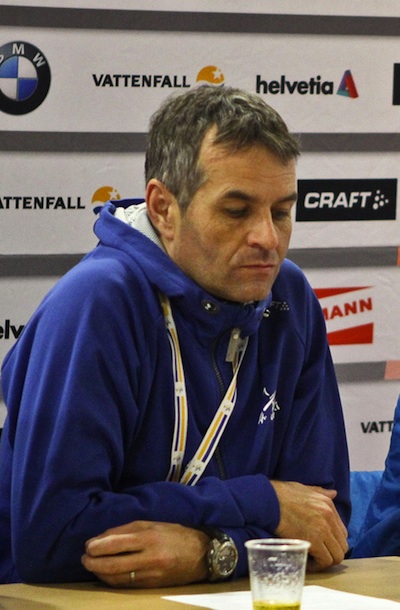
    Jürg Capol in 2011. The director of marketing for FIS's nordic side, Capol is not thrilled about the Ski Tour Canada this season.
    Jürg Capol in 2011. The director of marketing for FIS nordic, Capol is not thrilled about the Ski Tour Canada this season.

    Excitement is rising in North America for the Ski Tour Canada, a series of eight World Cup cross-country ski races scattered across the country in 2016. And a number of international superstars have announced their intentions to participate in the series.

    But one big name in the ski world is less than enthusiastic: Jürg Capol. The director of marketing for the International Ski Federation’s nordic sector, Capol voiced doubts to Norwegian website Sporten.com.

    “It’s silly,” he said, according to a translation. “It is from Europe that you generate great television revenues.”

    Does it have to be so? Not necessarily. Dave Dyer, the director of events for Cross Country Canada (CCC), doesn’t agree with Capol’s perspective.

    “It’s tough to read into his comments in terms of the context of the overall conversation and whether it accurately reflects his views,” Dyer said in an interview with FasterSkier on Friday. “But I think we’re stating the obvious when we say that ski events, whether they are cross-country, alpine, or biathlon or nordic combined, held in North America, can hit the prime targets of European television.”
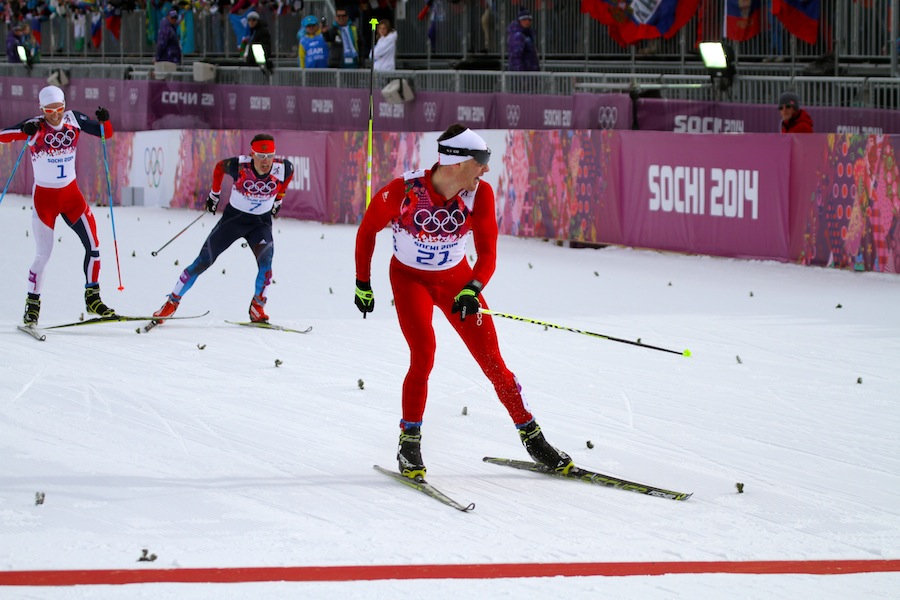
    Switzerland's Dario Cologna winning the 30 k skiathlon at the 2014 Olympics in Sochi, Russia. Cologna is among those who have publicly announced they intend to race the Ski Tour Canada.
    Switzerland’s Dario Cologna winning the 30 k skiathlon at the 2014 Olympics in Sochi, Russia. Cologna is among those who have publicly announced they intend to race the Ski Tour Canada.

    The Lake Louise downhill, one of the international federation’s major alpine events, is broadcast to over 100 million people globally from western Canada.

    In February, more than 800 million viewers globally tuned in to FIS Alpine World Championships in Vail/Beaver Creek, Colo.

    “It’s more of a challenge from a television perspective, not saying whether that is good or bad,” Dyer said. “I think we actually have quite good positioning from a television perspective – we are aligned with coverage of the biathlon World Championships, so I think that will garner us a big profile in Europe.”

    Yet one of Capol’s major criticisms is that the Ski Tour Canada would be good only for the home country.

    “Tour de Canada is an ending for the World Cup,” Capol told Sporten.com. “It is not known whether it will be good for Canada, or for Norway. There are not so many places who will broadcast it live because of the time difference between Canada and Central and Northern Europe. It’s hard to get on the program then. So you lose. The concept is perhaps to some extent good for Canada alone, yet we do not know whether there will be a ‘next time’.”

    One obvious missing piece is that not only will the event be good for Canadian skiing, but also for American skiing. The last FIS World Cups hosted in Quebec in particular were easily accessible to American spectators living in the Northeast, and the broadcasts generated interest and excitement.
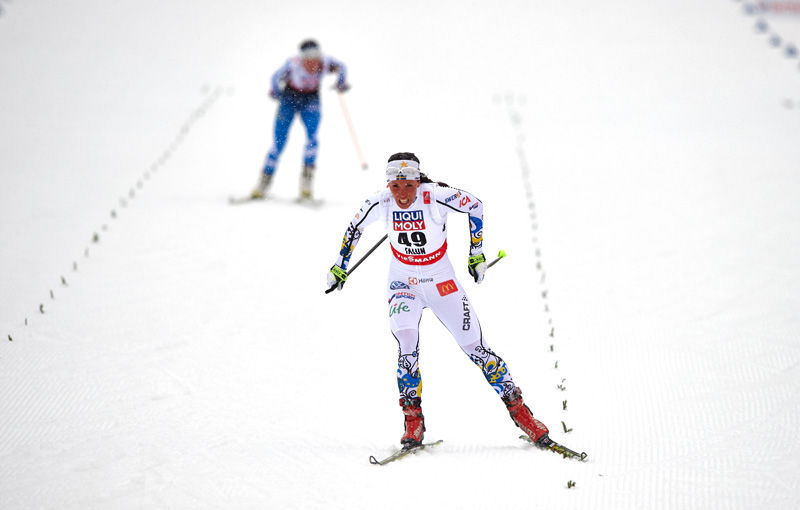
    Charlotte Kalla of Sweden skiing to a monster win in the 10 k skate at 2015 World Championships. Kalla, too, plans to come to Canada - because she wants to win the overall World Cup.
    Charlotte Kalla of Sweden skiing to a monster win in the 10 k skate at 2015 World Championships. Kalla, too, plans to come to Canada – because she wants to win the overall World Cup.

    Between Americans and Canadians, four men and six women were ranked in the top 30 of the World Cup in either distance or sprinting, and three different skiers medaled at 2015 World Championships.

    And in fact, FIS has been pushing for increased success from a variety of nations, especially given the near-total dominance of Norwegian women in the last season.

    “Over the last few years the tendency is a dominance of the two or three biggest nations,” FIS Cross-Country Race Director Pierre Mignerey said in May. “I’m not concerned with a temporary dominance of one nation but in the long term this is a danger for our discipline. The best possible life insurance for Cross-Country skiing  is to have a larger number of countries at the highest level.”

    Thus a focus on North America does not seem unwise.

    “From a spectator perspective here in North America, they were fabulously successful,” Dyer said of the last World Cups to be held in Canada in December 2012. “I think that being the World Cup final for the 2015/2016 season, the Ski Tour will be equally as exciting and people will be equally interested.”

    The success of those events made it easier to market the Ski Tour Canada, he said.

    “Any time we do a city sprint, now that we have some examples under our belts, we have good television and print media coverage,” he explained. “Those events sell very very well whether we are selling to our public partners or whether we are selling to the corporate sector.”

    Finally, Capol expressed doubt that top skiers would attend the Canadian races, and asserted that the success of television broadcasts in Europe depended on them doing so.

    “This is hard to sell,” Capol said. “In Canada cross-country skiing is a little sport… I know that media revenues are low. Going 25 percent of all distances at the World Cup in Canada… It depends on the runners going. If Justyna Kowalczyk is in good shape maybe it gets a little more. From Germany there is little interest.”

    That may be partly due to the declining fortunes of German skiing. A traditionally strong media market for nordic sports, both German skiing and biathlon had less than successful 2014 Olympics. But the biathlon squad bounced back with Laura Dahlmeier, Franziska Preuss, and Simon Schempp breaking through to become major forces in 2015-2016 while Erik Lesser, Arnd Peiffer, and Franziska Hildebrand stayed their successful courses. By contrast, Nicole Fessel, Steffi Boehler, and Denise Herrman had strong seasons but are nowhere near challenging the Norwegian dominance in cross-country skiing.
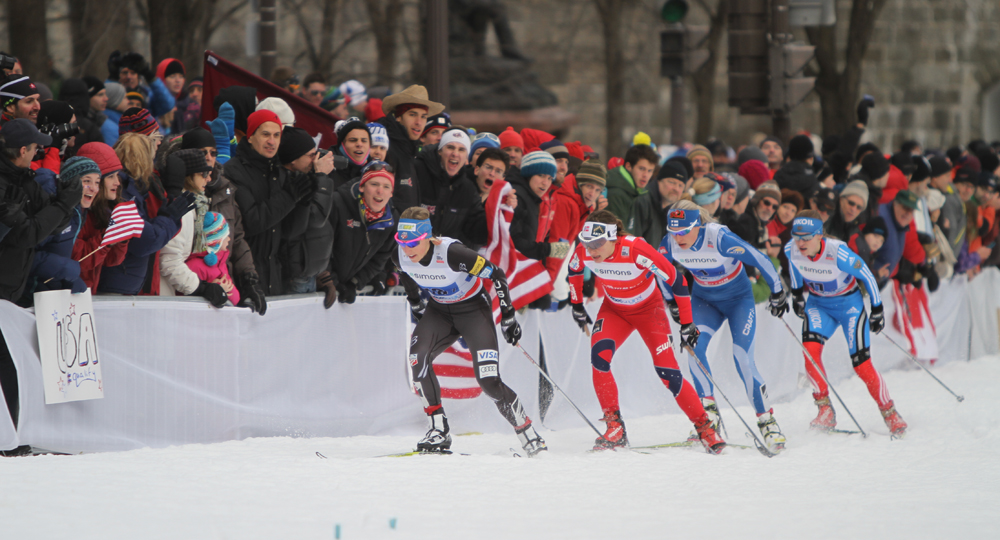
    Kikkan Randall leading Norway's Maiken Kaspersen Fallain the city sprint in Quebec City in December 2012.
    Kikkan Randall leading Norway’s Maiken Caspersen Falla, Finland’s Anne Kylloenen, and Russia’s Svetlana Nikolaevs  in the World Cup team sprint in Quebec City in December 2012.

    For the Ski Tour Canada, basing marketability estimates on the number of top skiers who attended previous World Cups held in Canada, which were scheduled in December, might not be accurate. Many top athletes skipped those due to worries about preparation for the rest of the season. But in a year without a World Championships, having eight races in Canada means it will be tough to win the World Cup title without going there. That means the field will be totally different than in the December races in past seasons.

    “We’ve received really, really positive initial indications of the number of teams that are coming over with their full squad,” Dyer said. “We know from looking at the World Cup series, that a serious skier can ill afford not to come to Canada in 2016. So we’re expecting a really high percentage of eligible athletes in the Red Group to be joining us. I’d suggest that unless an athlete is injured or sick, they’ll be here. They are the last races of the season so athletes are going to put whatever feelings of concern about fitness they have behind them and ski until they drop.”

    It’s not just Dyer who is saying that. The sport’s best athletes seem to be prepared to do battle in Canada.

    “The focus lies in the overall World Cup, meaning that the results at the at Ruka Triple, Tour de Ski and Ski Tour Canada must be very good, because here many World Cup points are up for grabs,” Swiss skier and 2008/2009 World Cup champion Dario Cologna recently told FIS’s own news service. “I am very much looking forward to the start of the new season.”

    Sweden’s Charlotte Kalla has also been saying for months that she will race the tour.

    “The Ski Tour Canada is a major event towards the end of the season,” Norwegian national team coach Egil Kristiansen told ABC Nyheter last week, implying that his top stars like Therese Johaug would compete. “There will be many World Cup points handed out there. Therefore it is an important competition, at least for those who will fight for crystal balls.”

  • ‘Haters Gonna Hate,’ Northug Remains Separate from Norwegian National Team

    ‘Haters Gonna Hate,’ Northug Remains Separate from Norwegian National Team

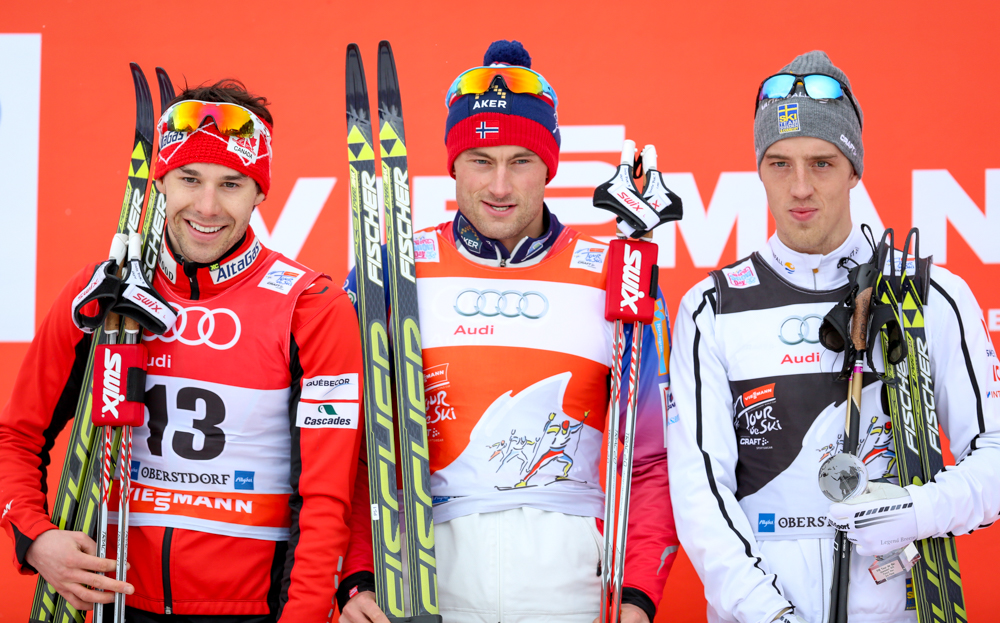
    Norway's Petter Northug (center) won Sunday's Tour de Ski 15 k classic pursuit in Oberstdorf, Germany, over Alex Harvey of Canada (left) and Calle Halfvarsson of Sweden (right). (Photo: Marcel Hilger)
    Norway’s Petter Northug (center) won the 15 k classic pursuit at the 2014/2015 Tour de Ski in Oberstdorf, Germany, ahead of Canadian runner-up Alex Harvey (l) and Sweden’s Calle Halfvarsson (r) in third. Northug won’t have a chance to go for the overall Tour de Ski or World Cup title this coming season as he is currently off the Norwegian national team. (Photo: Marcel Hilger)

    The show must, and will, go on. That’s how the Norwegian ski federation feels about the debacle with Petter Northug, Jr., after the 29-year-old celebrity skier missed the deadline to sign its contract. For now, the federation’s offer to let Northug maintain his sponsorship obligations with the Coop grocery store chain up until the start of the 2015/2016 season in late November is off the table — and Northug won’t be able to compete for Norway on the World Cup circuit.

    The two sides clashed on the terms of the agreement. VG reported that Northug had asked for a three-year contract instead of the single year the federation offered. He also wanted to represent the national team for a shorter period than last season, which lasted from Nov. 1, 2014 to April 7, 2015.

    Petter Northug. (Photo: Tor Atle Kleven)
    Northug talking to NRK. (Photo: Tor Atle Kleven)

    According to Dagbladet, Northug also requested “breaks” in the World Cup period where he’d be able to race in the Coop uniform, presumably in the International Ski Federation (FIS) marathon series.

    In May 2013, Northug left the national team to start a private team, sponsored by Coop. He subsequently signed an agreement with the Norwegian ski federation that enabled him to compete in the 2013/2014 World Cup.  The agreement was renewed last year. Northug’s deal is an exception to the federation’s policy that Norwegian skiers have to be on a year-round commitment in order to represent Norway in international races.

    Initially, the federation hadn’t planned to offer Northug a special agreement again this year. But it reneged on its stance, and in June, it tendered an offer similar to the 2014/2015 agreement.

    “The agreement is the same as the one he had in success season 2014/15,” said Torbjørn Skogstad, chairman of the federation’s cross-country committee, according to a translation. “[The federation] regrets that Petter Northug did not want to join the national team and the World Cup on the same terms as all other athletes.”

    “The Norwegian Ski Federation is planning upcoming World Cup season with those athletes who have signed an agreement and is not going to take any further initiatives from Petter Northug or Coop,” he continued.

    Northug’s tenure on the national team has been marked by controversy. As a junior, he didn’t mince words about being left off Norway’s 2006 Olympic squad. Since splitting from the national team, his results have been mixed. His four gold medals at the 2015 World Championships in Falun, Sweden, were preceded by a lackluster 2013/2014 season with no Olympic medals and seventh-place overall finish on the World Cup.

    Reactions in the ski community have been mixed.

    “Once the deadline has expired, then it’s time to cut through,” Odd-Bjørn Hjelmeset, a 2007 individual world champion for Norway, told VG. “[The federation has to] set an example here. Northug believes he is in a special position.”

    “Did anyone really talk to Petter? I think this could have been solved,” Hjelmeset added.

    One of Northug’s current rivals, Calle Halfvarsson of Sweden believes Norwegian skiing will suffer the most. He said “it would be really stupid of [the Norwegian federation]” to exclude Northug.

    Jürg Capol, the nordic director for FIS Marketing AG, told VG that the sport benefits if all the best athletes toe the start line.

    “In the World Cup, we are not dependent on one skier,” he said. “Northug has never won the Tour de Ski, so the best should be in place when the Tour de Ski starts. Who remembers who won the Vasaloppet and Marcialonga? It is the World Cup that matters.”

    Last season, Northug placed second to teammate Martin Johnsrud Sundby in the Tour de Ski and finished the World Cup third overall behind Sundby and Switzerland’s Dario Cologna, respectively.

    Most telling of all may be what Norwegian team director Vidar Løfshus told Dagbladet. “I think it’s a shame,” he said. “But we’ll manage just fine without Petter, too.”

    Løfshus observed that Northug’s biggest successes have been in championship years, of which this season is not.

    “In the World Cup, there are other Norwegians who have been just as good,” he said.

    On reopening negotiations, “We’re not going to take more initiative,” he added. “We gave him a good deal.”

    Petter Northug posted this meme on Instagram on Monday following the Norwegian ski federation's announcement that he was off the team for the 2015/2016 season for his failure to sign a contract with the team. (Photo: Petter Northug/Instagram)
    Petter Northug posted this meme on Instagram on Monday following the Norwegian ski federation’s announcement that he was off the team for the 2015/2016 season for his failure to sign a contract with the team. (Photo: Petter Northug/Instagram)

    As of early Tuesday, Northug had not publicly commented, but posted an Instagram meme with a cat captioned, “Haters gonna hate.”

    Coop deflected comments. Communications director Bjørn Takle Friis wrote, “This is a matter between the Norwegian Ski Federation and Petter. Are Sørum Langås, Team Northug’s manager will comment on the matter when they are ready.”

    With no World Championships or Olympics in 2016, this season’s main events are the Tour de Ski in early January and the Canadian World Cup tour in March. Beyond this season, Northug’s future on the national squad may be determined by the men’s team’s performance this winter. For now, he’s on the outside, looking in.

  • Tour de Ski, Including Final Climb, in Jeopardy Due to Snow Conditions

    Tour de Ski, Including Final Climb, in Jeopardy Due to Snow Conditions

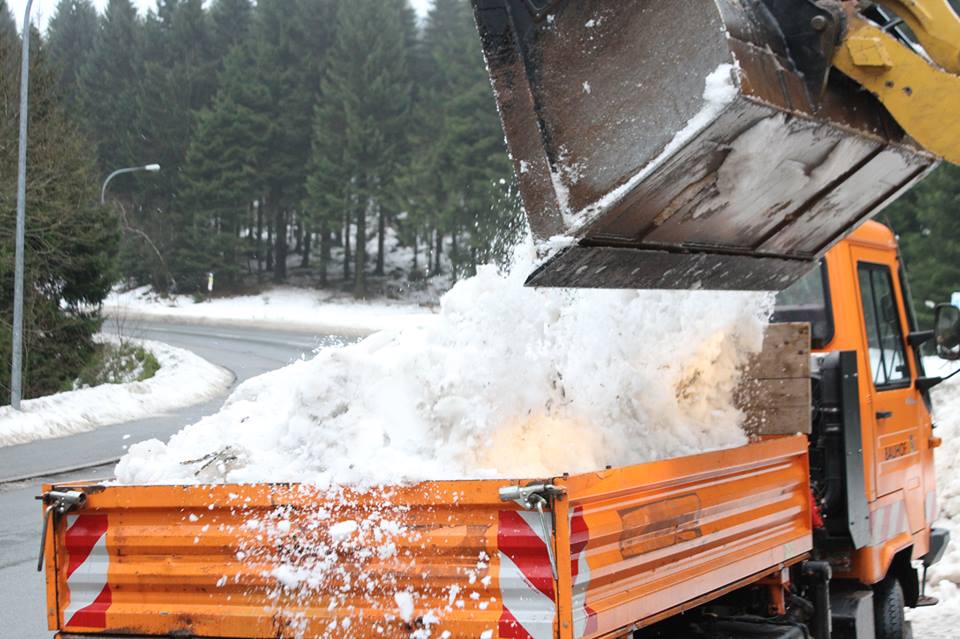
    Last year, the Oberstdorf, Germany, organizers had to harvest snow in order to pull off the opening stages of the Tour de Ski. Photo: Weltcup-Oberhof.de.
    Last year, the Oberhof, Germany, organizers had to harvest snow in order to pull off the opening stages of the Tour de Ski. (Photo: Weltcup-Oberhof.de)

    A snowless December in central Europe has already seen the cancellation of one cross-country World Cup weekend, slated for La Clusaz, France, but moved to a manmade snow loop in Davos, Switzerland, and now one of the sport’s flagship events, the Tour de Ski, is in danger.

    The International Ski Federation (FIS) is currently searching for acceptable backup venues for several of the stages, including the opening races of the multi-day stage race, which was set to begin in Oberstdorf, Germany.

    “Oberstdorf is the most critical,” FIS Nordic Director Jürg Capol said to Norwegian newspaper Adressa.no. “This is where we need to find solutions first, and it is hard to locate a backup venue. Its not just about snow, but also about hotels and accommodations.”

    Sweden’s SR radio reports that FIS is currently in emergency meetings to determine a backup plan for different stages of the event, which is set to kick off on Jan. 3. Temperatures are not cold enough to blow snow at most of the venues.

    “There is currently no snow in Oberstdorf. Additionally, it’s warm, and that’s not supposed to change the next days,” Capol said.

    German organizers, nevertheless, have vowed that their races – the first two days of the Tour – will go off without a hitch. Last year’s edition of the event was famously gray, rainy, and dreary in Oberhof.

    “Due to the high temperatures, not enough snow could yet be produced in order to prepare the trails,” the organizing committee noted on its website. “In the coming days, the prognosis remains unstable, which is why the FIS and the OC have agreed to make a final decision on 25 December.”

    The third stage of Tour de Ski takes place in Dario Cologna’s hometown of Val Müstair, Switzerland. The Swiss organizers report decent conditions.

    “They probably need one or two days of colder weather in order to be able to host the stage as planned,” Capol said.

    Stage four and five take place in Toblach, Italy. The organizers have produced some manmade snow, but still don’t have enough.

    Accordingly, the final stage up the monster hill in Val di Fiemme, Italy, may be moved due to lack of snow in the valley. Without more snow on the monster hill, that stage will be raced as a pursuit at the Passo Lavaze, which is the backup venue at 1800 meters above sea level.

    One country isn’t entirely broken up about the developments: the monster hill has caused trouble for Norwegian stars Marit Bjørgen and Petter Northug in the past, if the stage is moved it might increase their shot at winning the overall Tour de Ski. Neither of them has managed to win the overall stage race.

  • In World Cup Debut; Szklarska Poreba Set to Host World Uphill Trophy

    In World Cup Debut; Szklarska Poreba Set to Host World Uphill Trophy

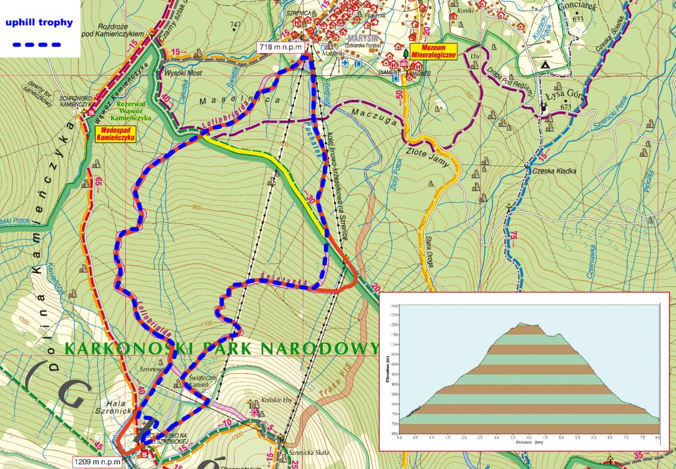
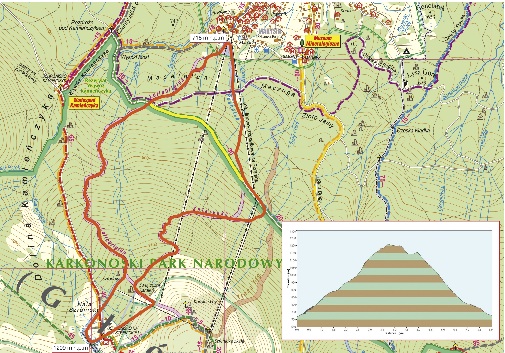
    Course map and profile for the inaugural World Uphill Trophy in Poland this Sunday.

    The cross country World Cup moves to Szklarska Poreba, Poland this weekend, beginning with Friday’s skate sprint. This marks the first time Poland has hosted a World Cup event, and with the queen of the home team, Justyna Kowalczyk, only 12 points behind Marit Bjoergen (NOR) in the season-long battle for the overall World Cup title, there should be plenty of excitement for the local crowd.

    As part of the International Ski Federation’s (FIS) effort to jump-start the visibility of top-level skiing in Poland for its debut on the circuit, a third event will be taking place in addition to the sprint and the 10/15 k classic: the inaugural World Uphill Trophy, set to start at 12:30 CET on Sunday.

    In an email on Monday, FIS Cross-Country Race Director Jürg Capol said he expects the event to be popular with the home TV audience.

    “We wanted to create a several-days event,” he wrote. “Cross-country is a growing sport in Poland, first it’s our [number one] TV market right now.”

    The 8 k race, which goes straight up Karkonoski Mountain for 4 k and then back down, is not part of the World Cup, but is positioned on the schedule so that athletes already in Szklarska Poreba can easily take part in it. The Uphill Trophy race is also open to elite Continental Cup-level skiers and amateurs over the age of 18.

    Capol estimated that 25-30 World Cup skiers would stay to race on Sunday. Between the top class, COC-level skiers, and amateurs, he expects around 250 skiers to participate in the Uphill Trophy race.

    Simply finishing the course will be no easy feat—after climbing 500 m over 4 k with no break, skiers will turn around and come back down a separate alpine slope. On the way down, they’ll navigate through approximately 10 giant slalom-style gates to finish back at the bottom of the mountain, which works out to 2.5 gates every kilometer.

    “Not so many are [needed] because the alpine slope has natural curves,” said Capol.

    By comparison, the grueling final stage of the Tour de Ski on Alpe Cermis contained 100 fewer meters of climbing, and ended at the top.

    As exciting and crash-inducing as the event is likely to be, several World Cup teams have already said they won’t be participating. Trond Nystad, head coach of the Norwegian men’s national team, said his athletes would be done competing in Poland on Saturday.

    “We prioritize World Cup races and have decided that a race format like this does not fit into the training and racing schedule,” Nystad said on Monday.

    Likewise, Canadian head coach Justin Wadsworth said the skiers wouldn’t be entering.

    The U.S. Ski Team will play it by ear; head coach Chris Grover said the Americans are sticking around for the Uphill Trophy on Sunday, but won’t know who will race it until they gauge how everyone is feeling on Saturday night after the 10/15 k classic.

  • Tour de Ski Pares Down for 2014; Will Head to Switzerland

    Tour de Ski Pares Down for 2014; Will Head to Switzerland

    As athletes prepare to start this year’s Tour de Ski on Thursday, plans are taking shape for the next four editions of the race that would vary its length and location.

    According to FIS Cross-Country Race Director Jürg Capol, the Tour will almost certainly be making a stop in Switzerland next year, and for the three years afterwards.

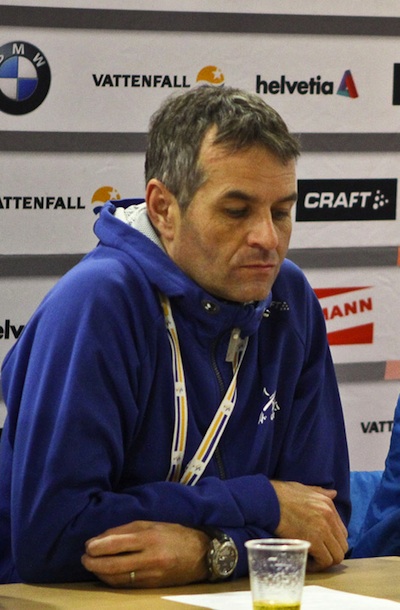
    Jürg Capol at a press conference in Oberhof, Germany, on Wednesday, before the first stage of the 2012 Tour de Ski.

    The event will alternate between venues in Münstertal—the small valley that claims Swiss superstar Dario Cologna as a native—and Lenzerheide, which Capol says is best known as a center for biathlon.

    From its inception, the Tour de Ski was intended to make stops in three nations, but an initial foray into the Czech Republic didn’t pan out. Since last year, the Tour has been limited to stages in Germany and Italy.

    The Swiss, Capol said, have committed to hosting the Tour for the next four years. The change must be ratified by the FIS committee that handles scheduling for cross-country, but Capol said that discussions there shouldn’t be contentious.

    The committee will also take up a proposal that would limit the Tour to a mere six stages over eight days in its 2014 edition, to give athletes more of an incentive to participate in an Olympic year.

    Typically, a handful of top athletes have opted out or dropped out of the Tour during years with Olympics or World Championships, to avoid illness or fatigue that could detract from their performances in the season’s marquee event.

    In 2014, there’s the added problem that the Olympics start early, on February 7, reducing the amount of time that athletes have for recovery between the Tour and the Games.

    The idea to shorten the Tour has already been discussed in committee, Capol said, and while it still must be voted on, he said that approval would be a formality.

    As for Tours in non-Olympic years, he said that the format would likely remain the same: 10 races in eight days in years with a World Championships, and 11 races in nine days in years when there are no other championships.

  • Athletes React to Shortened Davos Races (Updated)

    Switzerland, Nov. 29, 2011
    A look at the trails in Davos, Switzerland, about a week ago on Nov. 29. Photo courtesy of Kikkan Randall.

    For some cross-country skiers on the World Cup circuit, the news that Saturday’s individual races would be shortened wasn’t all that disheartening.

    Sadie Bjornsen, who made her first World Cup podium in Sunday’s team sprint with U.S. teammate Kikkan Randall, tried to contain herself. Instead of a 15 k freestyle in Davos, Switzerland, the women will race 10 k. The men’s skate race was cut from 30 k to 15 k.

    “Sadie just did a happy dance,” Randall said in a phone interview with FasterSkier on Tuesday, when the International Ski Federation announced its decision because of a lack of snow.

    “I think maybe in the U.S. I’d enjoy a 15 k but on the World Cup, it’s a little rough,” Bjornsen said. “So this is pretty good.”

    Not everyone shared her enthusiasm.

    Wednesday Update:
    (According to FIS Race Director Jürg Capol)
    – “Approx. 3 km are ready to ski (critical snow situation)
    – Working to get 5 km with 7 snow guns and normal snow
    – Course is rather tight (not enough snow), approx. 4m wide
    – Cabling from TV persons starts Wednesday, different IT times on a 5 km course
    – No changes of starting times are possible, discussion are done with all TV right holders; so no other starting interval is possible
    – No other tracks are available, running 15 km ladies, we would have only 15 minutes before men race would start, athletes can’t test their skis and do their warm up. By having 10 km for the ladies, the gap will be approx. 35 minutes.”

    Distance skiers like Canadian Ivan Babikov had been in Davos for more than a week, training specifically for the longer events. The men’s 30 k freestyle would have been the first one in Davos since 2000. Instead the event was sliced in half.

    “This is baloney,” Babikov tweeted on Tuesday. “I was really looking forward to the 30km skate WC race in Davos. … Boooo. #BringThe30Back”

    In a phone interview with FasterSkier, FIS Race Director Jürg Capol said there was “almost no snow,” and Davos race organizers were doing all they could to make enough artificial snow for what will be a 5 k loop. They had originally planned on a 7.5 k loop and were at about 3 k on Wednesday.

    Only one course was wide enough, and given the lack of natural snow, there were no test tracks, Capol said. With Saturday’s individual races starting just two hours apart, the FIS decided to shorten the women’s event to allow enough time for the men to warm up.

    “There might be an option to get more snow (this week), but we had to decide today,” Capol said. “Of course we are never in favor to change the program, but (under) certain conditions, we have to act.”

    The forecast for Wednesday through Saturday in Davos suggested a chance of rain with daytime temperatures in the 40s and 50s, and above freezing at night.

    U.S. distance specialist Kris Freeman wrote in an email that he suspected the race would be shortened and had mixed feelings as a result.

    “The race would have been the first 30k time trial on the World Cup since (Dec. 2004),” Freeman wrote. “I think the return of this race would have been great for the sport and a challenging race to ski well.”

    However, as a diabetic, he was cautious.

    “I have not raced a 30 k time trial in so long that I was not sure how I would have dosed my insulin,” Freeman wrote. “Mass starts and time trials place very different stresses on my body. So to summarize, I am disappointed that they event has been changed but also relieved.”

    Teammate Noah Hoffman had been particularly excited for the 30 k freestyle, but was relieved to have a distance race of some sort still in tact.

    “It has been colder and snowing here the last couple of days, so we were optimistic they would pull something off,” Hoffman wrote in an email. “However, there is currently not enough snow to hold anything more than a sprint. We weren’t sure what they could do with such a short amount of time.”

    Liz Stephen was another American who had prepared for the longest race yet in the World Cup season. So far, the women had gone a maximum of 10 k.

    “I was really looking forward to a longer skate race this weekend, or just a longer race in general,” she wrote in an email. “But I could use some more practice racing at these slightly higher speeds.”

    Saturday’s individual events will start as scheduled, with the women kicking off at 12:15 p.m. (6:15 a.m. EST) and the men racing at 2 p.m. (8 a.m. EST). Sunday’s sprint races in Davos remained unchanged.

    Audrey Mangan contributed reporting. 

  • First World Cup Moved to Sjusjøen (Updated)

    First World Cup Moved to Sjusjøen (Updated)

    Sjusjoen. Chances are unlikely that conditions will be like this next weekend. Photo: www.sjusjoen.com

    The International Ski Federation (FIS) announced Thursday that the first World Cup of the 2011-2012 season, originally scheduled for Beitostølen, Norway, will instead be held a 170 km drive to the east in Sjusjøen, Norway. The venue is situated just 20 km outside Lillehammer, and has never held a World Cup event before, according to Terje Lund, head of the organizing committee. The event schedule will remain the same: 10/15 k on Saturday, November 19 and a 4×5/4×10 k relay on the 20th.

    “It was not an easy decision,” said Jürg Capol, FIS Race Director Cross-Country, in a press release. “Compared to Beitostølen, the weather is a bit colder in Sjusjøen and they will be able to produce snow during the next few nights. The preparations will be a bit easier and less snow is needed as the base is paved. We highly appreciate the huge efforts put in by the OC [organizing committee] of the World Cup weekend in Sjusjøen and the team led by Erik Oestli in Beitostølen as well as the Norwegian Ski Federation to find a good solution to carry out the World Cup Opening in Norway despite the mild weather.”

    The Sjusjøen website has several webcams that update every minute to depict current conditions. As of Thursday morning, it’s foggy and completely bare.

    “We are ready to tackle the challenge of organizing the World Cup Cross-Country competition in just a few days,” said Lund. He hopes to get at least 3.75 k of trail ready with the help of refrigeration and 10 snow guns on hand.

    In order to give the venue enough time to make snow, and save the course from getting chewed up, athletes won’t be allowed to ski at Sjusjøen until Friday, November 18. U.S. Ski Team (USST) head coach Chris Grover said that the athletes not already in Torsby, Sweden, are flying on Sunday to arrive in Oslo, Norway on Monday and drive to Torsby to train in the ski tunnel.

    When everyone is finally allowed on the course, said Grover, it will make for a “very busy Friday testing wax and skis…But we’re excited to be racing, for sure.”

    The Canadians are equally enthusiastic. Devon Kershaw said in an email that after finding out on Thursday morning that the race was still on, he and his teammates were “pretty fired up about that news.” Rather than training in Torsby, the Canadian National Ski team will be racing this weekend at Bruksvallarna, Sweden.

  • Capol Champions Minor World Cup Changes

    Whether or not the World Cup opener happens in Beitostolen or elsewhere, the season will start eventually, and in doing so, will feature new rules and schedule changes.

    Top Teams Required to Compete

    One of the changes which could have a large impact on the World Cup scene is a new rule requiring the top teams to compete in all but one World Cup weekend.

    According to the recent FIS Cross Country press release; “The best nations according to the team World Cup rankings 2010/11 (Top 4 ladies’ teams: Norway, Sweden, Italy, Finland; top 5 men’s teams: Norway, Russia, Sweden, Switzerland, Italy) have to start in all World Cup competitions during the season 2011/12 with the exception of one World Cup weekend.”

    According to Jurg Capol, Cross Country Race Director for the International Ski Federation (FIS), the goal is to have as many nations present at a World Cup as possible.

    “We would like to avoid the Rybinsk situation,” wrote Capol in an e-mail to FasterSkier, referencing the annual stop in Russia where fields are often so small, that every started is guaranteed World Cup points just by crossing the finish line.

    “It’s even a pity, as the OC [organizing committee] does a good job at having between 20 to 25’000 spectators a day.”

    However, just because FIS has implemented rules to encourage the top countries’ and therefore the top skiers to attend, doesn’t mean the top athletes on the World Cup actually have to show up and race.

    “It’s only related to the team, and it depends on their quota,” Capol wrote.

    As per FIS rules, if a team has a quota of five or more athletes, at least three athletes have to start. If they have a quote between three and four, two athletes must start. In addition, all starting athletes must meet the World Cup requirements for FIS points.

    “Some of the top athletes will also do a decision to skip one or another WC weekend, but what we should guarantee to a WC event that the requested amount of nations are present.”

    Of course, using Rybinsk as an example, countries could still opt out of the Russian stop, so long as they hit every other location on the circuit, but that would ensure that at almost every World Cup event the full complement of nations would take part.

    If a team breaks the rule, according to Capol, that country  is unable to compete in the following World Cup weekend. However, Capol assured FasterSkier that the World Cup countries were unanimous in their support of the measure.

    “The commitment of the committee was 100%, and as committee members are also representatives of their national ski associations, I have no doubts,” he wrote.

    Red Group Seeding

    While it may not be as obvious in North America, where watching World Cup races on television – live or otherwise – is rare, one of the other changes is that the athletes with the highest FIS points will start between the top seeded (Red Group) athletes.

    In practical terms, according to Capol, this means that, for example, it could be a FIS regional series leader, such as the United States’ Brian Gregg starting between Petter Northug and Marcus Hellner.

    The impetus comes from FIS’s TV experts and producers, and the goal is to get the best athletes more TV time, and at the same time start the Red Group earlier.

    “The TV director didn’t always have the time to show the top 10, because the main focus is related to positions 1-3,” Capol wrote.

    “By having more time between the best athletes, the top 20 athletes will get more time and it will help to develop the TV production for an interval race.”

    Bonus Points to the Top-10

    In a move that could significantly alter race strategy, sprint bonus points will now be awarded to the top-10 past an intermediate mark, compared to the top-3 in seasons past.

    These seconds are only awarded in mass start competitions, and have played a major role in determining the Tour de Ski winner.

    First will get 15 points, second 12, down to one for 10th.

    Estonia No Longer a Fixture on the World Cup

    Otepaa, Estonia will no longer automatically receive a World Cup event. The Baltic nation, which is rabid about cross country skiing has had their World Cup weekend reduced to occasional status.

    However, FIS has decided to move the location around, ostensibly due to Estonia’s tumbling status as a World Cup power.

    “During the season, Estonia was ranked as 15th in the Nations Cup standing, and several better-placed Nations asked for World Cup competitions,” wrote Capol.

    Further complicating the situation is Estonia’s current battle with doping, as legend Anders Veerpalu is in the midst of a complex legal battle over his innocence.

    “It didn’t affect the decision of the CC committee,” Capol wrote, “but of course a positive doping case never has a positive impact.”

    Rise of the City Sprint

    Over the past five years, FIS has fully embraced the city sprint concept. The event along the Rhine in Dusselfdorf, Germany, is entering a fifth consecutive year, and Stockholm, Sweden, has become a fixture as well.

    This season, the cross-country committee has expanded the city sprint to include Moscow and Milan.

    According to Capol, part of the reason for adding two city sprints to the calendar was due to the lack of a major championship event. Additionally, Capol cites city sprints as being a factor in building the image of cross country skiing in the last ten years.

    However, city sprints pose all sorts of complications, and can be quite contentious in terms of course lay-out and snow quality. In one particular sprint in the Tour de Ski in Prague, Czech Republic, athletes such as Canadian Devon Kershaw, who wrote about it on his blog, were irate with the conditions.

    Capol assured FasterSkier that the events would be well organized.

    “On both sites, the NSA [National Sport Assosciation] have sent their specialist and we have the guarantee the event is well prepared,” he wrote.

    Capol also mentioned that the organizing committees have access to more snow making equipment than ever before, and that all city sprints have met the FIS homologation criteria.

    “Some courses seem to be easy,” he said, “but it has never been easy to win!”

    Tour de Ski May Expand to Include Switzerland

    With home-country hero Dario Cologna being an annual contender (as well as two-time champion) in the Tour de Ski, the Swiss have been pressing FIS to include a stop in Switzerland

    “The concept of the Tour de Ski is based on three countries, before we had only two nations which were able to run competitions during this time of the year,” Capol wrote.

    Capol is extremely happy with the final races in Val di Fiemme, Italy, but is still looking for the ideal start to the stage race.

    “Oberhof [Germany] have technically done their competitions very well, but we did not have a great atmosphere,” Capol wrote.

    While Davos (less than 100 k from where Cologna was born) is currently a pre-Christmas World Cup venue, Capol said that Cologna’s back yard may earn a Tour de Ski race in the future, and that as more nations become prepared to host the Tour de Ski, the addition of other counties is possible.

  • Beitostølen World Cup Likely to be Moved or Canceled, North Americans Adjust (Updated)

    Beitostølen World Cup Likely to be Moved or Canceled, North Americans Adjust (Updated)

    Right now, Europe might as well be Rumford, ME (January 2011).

    With current temperatures in Beitostølen, Norway hovering a few degrees above freezing, chances are the first World Cup of the season, scheduled to take place November 19 – 20, will be canceled or moved to a new venue. The International Ski Federation (FIS) has until Wednesday to make the call according to competition rules.

    “I would say the chances for Beitostølen are 10% and for Sjusjøen, [Norway] 40%,” said cross-country race director Jürg Capol via email.

    If the decision is to cancel, which has happened four other times in Capol’s tenure, he confirmed that FIS wouldn’t be able to reschedule the opening races. There are simply no gaps in the 2011-2012 World Cup calendar.

    Sjusjøen, which lies about 20 k east of Lillehammer, is set to host the Nordic Combined World Cup on December 3 and 4, and has already put down a base of manmade snow. Johannes Haukåssveen, a race organizer at Sjusjøen, said on Monday that with additional snow guns borrowed from Sweden and Italy, the venue could produce snow at twice their normal capacity.

    Beitostølen attempted to set a base of artificial snow over the weekend, but a combination of warm weather and high humidity prevented it from sticking. According to logistics manager Erik Østli, the temperature was hovering around half a degree above freezing in the stadium, and they need at least two degrees below in order to produce snow.

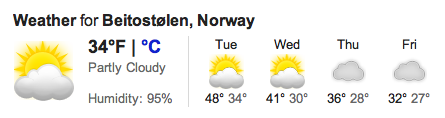
    Beitostølen forecast as of Tuesday afternoon.

    Östersund, Sweden was originally considered as another alternative, as the venue has a stockpile of snow, but it declined to host the opening cross-country races in favor of saving up for the Biathlon World Cup taking place there November 28 – December 4.

    At this point, Capol thought things didn’t look too promising. Langrenn.com reported earlier today that Terje Lund, events manager for the Norwegian Ski Federation, will inspect the course at Sjusjøen to evaluate the viability of holding a World Cup there in less than two weeks. FIS rules state that a World Cup must be cancelled no fewer than nine days before the event. Under “extraordinary” circumstances, however, FIS can make the decision as close as six days prior.

    On Wednesday morning, FIS announced it would delay the decision until Thursday afternoon. “The Norwegian Ski Federation is evaluating together with the organizing committee all possible solutions to host the Cross-Country World Cup opening in Norway,” said Capol in a press release.

    If the races are moved to Sjusjøen, Capol said that certain exceptions to FIS competition rules may be made in case of critical snow, particularly with regard to homologation standards.

    “We might adapt the courses and this has happened before, but nevertheless we still follow the basic requests for the courses and stadium,” he explained.

    U.S. and Canadian Ski Teams Adjust

    Though race cancelations present a setback for every team on the circuit, a schedule change is more difficult for the teams crossing the Atlantic. The majority of the U.S. Ski Team (USST) had planned on departing for Europe over the weekend and competing in the Norwegian opening races at Beitostølen originally scheduled for November 11- 13.

    Those events were canceled last Wednesday, and most athletes and coaches decided to delay travel for another week. Andy Newell, Simi Hamilton and Noah Hoffman rerouted their flights to Sweden and arrived Monday afternoon in Torsby, getting their first glimpse of the indoor ski tunnel today.

    USST head coach Chris Grover said that the main issue for athletes, in deciding whether to stay at home later or leave for Europe on schedule, was balancing the quality of training with having enough time to recover from travel and adjust to a significant time zone change.

    Newell, Hoffman and Hamilton decided to leave earlier for the Torsby Ski Tunnel, but remaining USST athletes originally planning on entering the first World Cup—Kikkan Randall, Liz Stephen, Sadie Bjornsen, Kris Freeman and Tad Elliot—opted to remain stateside. Ida Sargent has been in Muonio, Finland since October 31 with Craftsbury Green Racing Project (CGRP) teammates, and will join the USST according to the outcome of FIS’s decision.

    “For the Alaska people it was a no-brainer, they’re already on snow,” said Grover. “Liz, Kris, and Tad felt like they could get the right work done at home.”

    Freeman said his decision to stay in New Hampshire was fairly straightforward.

    “I figured out a while ago that it’s better to stay home than chase crappy snow,” he said. “You can waste a lot of energy that way. It’s better for me to stay in one place and rollerski.”

    Hamilton’s initial report from Torsby indicated that the skiing in the tunnel is repetitive, but Newell said in an email today that it was still better than nothing.

    “It’s still nice to make the transition on a non-race week, which is why some of us came over despite the snow conditions,” he wrote. Though testing skis can be difficult in cases like this, Newell said he and his teammates are not unused to relying on old skis for the first weekend.

    “It’s going to suck if they cancel the entire first weekend of World Cups, but there’s bound to be some kind of racing going on in Sweden or Norway somewhere, so we’ll find it,” he concluded.

    The Canadian National Ski Team (CNST) is already in Europe, and is currently skiing in Östersund. Conditions aren’t great: “It’s really dirty, and there are strips of snow that you can double pole across,” said head coach Justin Wadsworth. Stuck without their own rollerskis, athletes are doing off-snow training with borrowed equipment.

    As of right now, the CNST is planning on racing Sweden’s domestic opener at Bruksvallarna. Three races have already been cut down to two, but on Monday race organizers said they would be able to maintain the 2.5 k of existing artificial snow for one men’s and one women’s freestyle race.

    “[Petter] Northug is scheduled to come,” said Wadsworth. “It should be a good race if they can pull it.”

    Wadsworth said he doesn’t see the possible World Cup cancellation as a problem for his athletes outside of logistics.

    “We’ve been skiing since October 15 [on Frozen Thunder], so that’s good,” he said. “That’s going to be a bonus once we get started.”

    North American or no, teams all over the world are holding their breath for FIS’s decision. Until then, as Wadsworth said, everyone is “waiting to see what the hell we’re going to do.”

    — Kieran Jones and Topher Sabot contributed reporting.

  • World Cup Finals Format Could Change in 2012

    Petter Northug's winning margin in this year's World Cup Finals in Falun was far larger than this one, at the 2011 World Ski Championships in Oslo.

    The tour format adopted over the past few years by the International Ski Federation (FIS) has been credited with injecting some excitement and suspense into cross-country skiing—the idea being that lumping different lengths and styles of races into one big event can lead to prolonged, back-and-forth battles and compelling storylines.

    But this season’s World Cup Final, a four-day mini-tour in Sweden? A total snoozefest. In the last stage, a handicap start that sent skiers out one-by-one, based on their cumulative time from the previous three races, the leaders could have skied the race with one pole and still won comfortably: Marit Bjoergen began the day with a full 1:14 over her nearest challenger, while Petter Northug got a minute and 28 seconds.

    “They were in too good shape,” joked Jürg Capol, the cross-country race director for FIS.

    With the Falun races failing to raise the pulses of even the most ardent ski fans, Capol is mulling a change to the mini-tour format that he said could create some more excitement: switching the order of the last two competitions. Instead of concluding the mini-tour with a handicap start, it could end with a mass-start race, which would force those lagging in the standings to try to break up the pack.

    “When you are a little bit behind, you have to attack, of course,” he said. “You know how much you have to catch up…you cannot wait until the very end.”

    The handicap start would be moved to the second-to-last day. And since that race does not include the bonus seconds that are currently awarded at intermediate sprints (and at the finish) in the pursuit, Capol’s thinking is that the time gaps in the overall race would be smaller heading into the final stage.

    Then, on that last day, the mass-start pursuit, the bonus seconds would be eliminated, to keep the race from becoming too “artificial.” Since the skiers would be closer in the standings, Capol said, the bonuses wouldn’t be necessary.

    “You have guys [that] are not too far away—they will ski offensively,” he said.

    Like Petter Northug, Marit Bjoergen won this year's World Cup Final in Sweden by a huge margin.

    Capol said he still needs some time to ponder the idea, and to discuss it with others. Thus far, he said, he’s spoken to only a few people about it, including Vegard Ulvang, the Norwegian chair of the FIS cross-country committee. Capol added that he still wasn’t entirely sure whether to chalk up the large gaps in this year’s World Cup Final to the specific abilities of Bjoergen and Northug, or to the format.

    “I wanted to think about [whether] it’s more related to one athlete,” he said.

    Last year, with the World Cup Finals in the same format, Northug and Bjoergen both led coming into the final day, but the gaps to their chasers were a little smaller—Northug’s was 40 seconds, and Bjoergen’s 50 seconds. They both held on to win easily.

    Other stage races have been more exciting, though—namely, this year’s World Cup opener in Finland. While Bjoergen cruised to another win on the women’s side, the outcome of the men’s event was uncertain until the closing kilometers of the final stage, when Alexander Legkov made a sensational attack to beat out Dario Cologna.

    The opener, however, is a shorter race, with three stages to the World Cup Final’s four. (Capol said that he was not considering any big changes to the opener, aside from mixing up the techniques.)

    If a change were to be made for Falun, it would have to be approved by the cross-country committee, which meets in June in Portoroz, Slovenia. If the group signs off on it, the schedule could be modified as early as next year.

    Given Bjoergen’s strength and versatility relative to the rest of the women’s field, it’s tough to envision any configuration of formats that could stop her from waltzing to a decisive win.

    On the men’s side, though, it’s a little different—Northug was in fine form at the end of the season, but he’s not unstoppable in every discipline, as Bjoergen can be.

    Still, though, based on the results of past men’s mass start races, which so often end in pack or group sprint finishes, it seems implausible that a field could be shattered enough, in a pursuit, for athletes to close down significant time gaps.

    If there’s one place that it could happen, though, it’s in Falun, where the distance trails ascend the precipitous Mordarbacken, Swedish for “murder hill.” In this year’s pursuit, Northug got away from the rest of the men’s field with Giorgio di Centa; the two finished some 10 seconds up on Daniel Rickardsson, with a larger group another 10 seconds behind.

    “The course is hard enough in the [pursuit], and the snow is generally slow enough, that it will break up,” said Kris Freeman, an American cross-country skier.

    However, Freeman added that he thinks FIS is “splitting hairs.”

    “I think that any time you do a mini-tour, there’s a possibility that someone is just going to get way, way out front and be uncatchable,” he said. “I don’t see it being any more or less exciting, changing it up.”

    In the past, FIS has taken pains to make its race formats more straightforward and digestible; the appeal of the handicap start on the last day of a stage race is that the first athlete across the line is also the winner of the whole tour—which Freeman said he thinks makes the most sense.

    With a mass-start as the final stage, the victor in that day’s race could just as easily be a skier who’s ends up in the middle of the pack in the overall rankings.

    Confusing? Perhaps. But it does happen nearly every year on the Champs Elysees, in Paris. The final stage of the Tour de France is almost always captured by a sprinter, with the yellow jersey comfortably tucked in behind.

    Sprint Changes—Or Not

    In the heats of the classic sprint in Stockholm, the first stage of the World Cup Final, nearly all of the men’s field double-poled the course on skate skis.

    While Emil Jönsson (SWE) stuck with klister (literally), and ultimately won the race, the Stockholm sprint marked the second time this season that skate gear has been a factor on courses that were ostensibly designed for classic skis. The first time was in Estonia in January, where Eirik Brandsdal (NOR) took first place without kick wax.

    The course in Estonia, Capol said, could see some changes—perhaps by adding more height to its big climb, or by running it in reverse. But in Stockholm, he said, substantially modifying the course would be impossible, since it loops around the Royal Palace on a specific route.

    This season, he added, athletes’ choices at that event were primarily dictated by conditions, rather than the terrain; in last year’s edition, only a few athletes tried skate skis.

    “It’s not the course of itself—it’s probably more how the snow is,” he said. “The course is how it is, because we can’t do anything more.”


  • In Poland and Moscow, Next Year’s World Cups Take Shape

    In Poland and Moscow, Next Year’s World Cups Take Shape

    There were few participants in the Tour de Ski who were still standing after the finish of that race’s final stage, the brutal ascent up the Alpe Cermis in Italy. But an even more difficult challenge may await those athletes next season: the inaugural Uphill Trophy, a new competition format tentatively slotted into the World Cup calendar in Poland next February.

    The race packs a whopping 500 meters of climbing into its first four kilometers—nearly 100 more than the ascent of the Alpe. But reach the top, and you’re only halfway done: there’s still 500 vertical meters of descending, over the same distance, back to the finish.

    The map and course profile of the proposed Uphill Trophy course in Poland.

    While most ski fans worldwide were paying attention the 2011 World Championships in Oslo two weekends ago, a handful of athletes and organizers were hard at work 650 miles away, in the Polish resort town of Szklarska Poreba. They were taking part in one of two test events for next year’s Uphill Trophy race—the guinea pigs for an event that could see stars like Marit Bjoergen and Justyna Kowalczyk taking part next season.

    The Uphill Trophy isn’t a done deal yet—another trial run will take place later in the season, and the idea still must be approved by FIS’s cross-country committee in a meeting in June. But despite drawing some criticism from purists in the fall, the format is beginning to crystallize.

    “I hope that the idea will be good for the sport,” said Jürg Capol, the cross-country race director for the International Ski Federation (FIS), in an interview.

    Capol, a former Swiss national team member, scouted the race trails for the Uphill Trophy in a visit to Szklarska Poreba in January.

    In total, the course is eight kilometers long, half of it climbing, and half of it descending, with a little bit of rolling terrain at the top. The uphill, Capol said, is less steep than the one at the Tour de Ski, while the descent is also manageable.

    “It’s not a black track,” Capol said. “It’s a blue track, which I would not say is a problem. When I skied, I came down [easily].”

    In October, Capol had said that the downhill might include giant slalom-style gates for skiers to navigate through. But after skiing the course, he said that they would only be necessary in the first part of the descent.

    “Two thirds of the downhill…is in the forest, and it’s maybe 20 meters wide,” Capol said. “So you don’t need a lot of gates, because you follow the natural way.”

    The top part, though, could include a few. And the skiers would have to go through them, Capol said.

    “You have to follow the course,” he said. Miss a gate? “Then you are out. Or you have to go back.”

    Retracing your steps for 15 seconds to get around a gate, Capol added, wouldn’t be as much of a death sentence in cross-country as in alpine skiing, where runs can be over as quickly as a minute.

    In the test race, the winning time for the men was just under 28 minutes. Forty-three skiers took part, among them Polish national team member Mariusz Michalek, who raced the Tour de Ski in January and placed 25th of 36 starters in the ascent of the Alpe Cermis.

    In the trial run, Michalek crashed on the descent and fell behind the eventual winner, Radek Sretr. Michalek ultimately finishing in third place, nearly two minutes back, and afterwards, a press release from the organizers quoted him as saying that the Uphill Trophy was tougher than the climb up the Alpe Cermis.

    Capol, one of the architects of the Tour de Ski, said that his hope is that the Uphill Trophy will be another “angle” for the sport, another “story to sell”—especially in next year’s calendar, which lacks a World Championships or an Olympics.

    He said that the race had the potential to make for “very good” TV, though that’s not guaranteed.

    “It’s [an] investment that the Polish TV has to do,” he said. “Of course, if you have the right tools to film it, and enough cameras over there, then it can be really interesting.”

    If the Uphill Trophy is indeed approved by FIS’s cross-country committee in June, the event will go off in the middle of next February—with the potential for extra prize money to be awarded, or other small changes to give the race “special status,” Capol said.

    If the Uphill Trophy is rejected, World Cup races will still be held in Poland on the same weekend, on homologated courses a few kilometers away.

    Moscow Sprint

    Capol also said that he had also made a site visit to the Red Square in Moscow, where FIS hopes to hold a sprint race next season.

    The test event for that sprint was held in early February, at a Moscow amusement park called Gorky Park, but Capol said that the Red Square is still his first priority.

    According to Capol, the biggest challenge in holding a race on that site is logistical—a few years ago, he said, the Red Square hosted an event for snowmobiles that was noisy and resulted in damage, leaving officials wary.
    “They’re not that open,” he said.

    Capol said that the proposal for the race has been presented to the appropriate officials, and that the Russian Ski Federation is on the case. A decision on the Moscow sprint will also come after the June FIS meetings.

    As for the terrain? A sprint on the Red Square would be no Uphill Trophy, that’s for sure: Capol said that the event would be mostly flat. But there’s still one slight uphill, he said, that would be “great [on] this course.”

  • Polish Appeal Likely, but What Next?

    Kikkan Randall is in for a long week.

    With the news that the Polish Ski Association (PSA) plans to appeal Justyna Kowalczyk’s relegation in the Sunday’s women’s sprint final in Davos—which elevated Randall to third place—the Alaskan could be waiting until late this coming week to find out whether she gets to keep her podium finish, and the $5,000 that goes with it.

    According to International Ski Federation (FIS) rules, the PSA can take up to 72 hours after the publication of the results to submit its appeal in writing, whereupon a special FIS commission will undertake a review of the incident. That commission then has up to 72 more hours to come to a decision—which means that Randall may not know her fate until Saturday, at the latest.

    The relegation stemmed from an aggressive move by Kowalczyk on the race’s homestretch, when she moved quickly to her right to prevent Randall from passing.

    The race jury ruled almost immediately that Kowalczyk had engaged in obstruction, and placed her last in the heat.

    The move was blatant, and FIS Cross-Country Race Director Jurg Capol told FasterSkier afterwards that he had no doubt the jury decision would be confirmed in the event of a protest.

    But Kowalczyk’s official website stated Sunday evening that the PSA would still file a formal appeal on Monday, setting into motion a complicated process.

    According to Capol, appeals are decided by a three-member commission chaired by Karl-Heinz Lickert, the head of FIS’s rules and controls committee.

    Assuming Kowalczyk’s appeal moves forward, Capol said that Lickert will choose two other members of the rules committee to serve with him on the appeals commission—neither of whom can come from Poland or the U.S., to avoid bias.

    Along with a $500 deposit—which is refunded if the appeal is upheld—the PSA must compile and submit their evidence of Kowalczyk’s innocence.

    “You need to do your arguments; you need to show some video material,” Capol said.

    According to Capol, the appeals commission will also gather information from the race jury, including minutes and information about its own discussions.

    Based on the evidence available, the commission then has 72 hours after the appeal submission to render a decision, which is based on a simple vote.

    While Lickert may be in for a busy few days, Capol said that he was sure that the jury made the correct decision, and that it would not be overturned.

    “It was clear for me—I have no doubt about this,” he said. “If there is an appeal, the appeal[s] commission will confirm the decision of the jury.”

  • North Americans Weigh in on New FIS Format

    Andy Newell says he's excited for the prospect of an uphill-downhill format in Poland in 2012. Photo, Phil Bowen.

    If Vegard Ulvang gets run out of Europe, it appears that he still could safely make his home in North America.

    Ulvang is the chair of the International Ski Federation’s cross-country committee, which is considering the introduction of a new race format that includes five kilometers of climbing followed by five kilometers of technical downhill. Scandinavians have reacted to the idea with derision: Norwegian Eldar Roenning told the newspaper Nettavisen that the idea was “the biggest B.S. I’ve heard in a long time.”

    But among athletes in the U.S. and Canada, the response was enthusiastic—at least cautiously so. In interviews, Americans Kikkan Randall and Andy Newell and Canadian Ivan Babikov all said that they would be interested in testing out such an event. Only Canadian Devon Kershaw met the idea with any real skepticism.

    “Some people get frustrated that they changed the race format styles so much, but, I mean, that’s the way it is…As sweet as an individual start 50 k is, they’ve got to keep it changing to keep people interested,” Newell said. “As someone that likes to go down hills fast, I think [the new format] would be pretty fun.”

    In an interview last week, FIS Cross-Country Race Director Jürg Capol said that he had not yet canvassed athletes for their opinions on the format since, as he put it, FIS is still “in the stages of the idea.” Too much discussion and debate early in the process would only serve to stifle innovation, he said.

    Capol maintained, however, that FIS gives plenty of weight to athletes’ preferences, since they’re the “main stakeholders.” As one of two cross-country representatives elected to the FIS Athlete’s Council, Randall plays a key role in this process—and she said that she has already sent a message to her peers to gauge opinions on the new format.

    While Randall conceded that some athletes have been “a little bit leery of how many changes we’ve had in our sport recently,” she said that the newly-invigorated council should provide a better channel for skiers to communicate with the federation.

    In past years, Randall said, the athlete’s council existed, but FIS did not pay for representatives to attend meetings. That kept participation at a minimum.

    Now, halfway through a four-year term, Randall has already attended two FIS meetings in Turkey and Croatia, and she said that has become more adept at navigating the federation’s politics.

    “It’s taken a year to figure things out and learn, but now I have a foot in the door,” she said. “I think it’s going to be better, going forward.”

    At the very least, FIS doesn’t appear to be rushing things. According to U.S. Ski and Snowboard Association Nordic Director John Farra, if the federation’s cross-country committee were overly aggressive, the new race format would already be “locked into the calendar.” Instead, the Polish venue will hold a test event this coming spring before making any decisions.

    “I think the system works,” Farra said, “by giving people time to process it.”

    However, Kershaw said that he was not yet convinced that athlete feedback had been reflected in FIS’s recent decisions—even if it had been brought to the table. Kershaw said that most athletes and some coaches were against the idea of a mini-tour in Finland to start the season, which nonetheless went forward this year.

    “Is it working? I don’t know—it is yet to be seen,” Kershaw said of the council. “But I’m glad that there is a voice.”

    While Kershaw said he was intrigued by the proposed race in Poland, he argued that for an uphill-downhill format to work, it would have to be executed well.

    On Alpe Cermis, the two-and-a-half kilometer final climb at the Tour de Ski, Kershaw said that the athletes end up looking “weak,” and “kind of silly.” But it still works, he said, because of the fans, who “really get to feel the hurt.”

    “I’ve hurt a lot in a lot of race, but I don’t know if I’ve hurt more than going up that hill,” he said.

    According to Kershaw, it could be hard to attract the same kind of crowds to the Polish venue. Kershaw, who raced there in 2001 at the World Junior

    Devon Kershaw says that execution is key to the success of an uphill-downhill format.

    Championships, described the village of Szklarska Poreba as a “rough, eastern European town.”

    “I’m just not convinced that Poland is maybe the best place to put it, for the first one,” Kershaw said of the new format. “I’d be interested to see how the race set-up in Szklarska Poreba—how it’s changed since World Juniors.”

    Kershaw said that he’d like to see FIS preserve more of a balance between new races and old ones, like the two-day pursuit and the 50-kilometer individual start. The latter event has not been on the calendar since the 2008 season, although Capol has said that it will return in 2012.

    “It can’t be understated how hard and lonely that race. That is cross-country skiing,” Kershaw said. “I wish they’d bring back that history, but at the same time, keep pushing the envelope.”

    The challenge, Randall said, is that the introduction of new formats generally comes at the expense of old ones, given the limited space in the World Cup schedule. Keeping a good mix, she said, is “getting harder and harder.”

    One man with few concerns about that balance was Babikov, the Canadian climbing phenom who set the fastest time up the Alpe Cermis in 2009. He said he liked his chances in Poland.

    “Any race where there’s no flat is good for me, either up or down,” he said. “I think I could do pretty well there.”

    Meanwhile, Ulvang has some damage control to do in Scandinavia. In the same report in which Roenning, the Norwegian, blasted the new format, his teammate Martin Johnsrud Sundby sarcastically suggested that FIS “add whoop-de-doos and moguls while they’re at it, and maybe finish with a big air jump and style points, too.”

    “Ski-cross-has already been invented—could you mention that to Ulvang?” Sundby said.

    For his part, Capol said that while he welcomed the views of athletes, each has his or her own individual biases—as shown by the divergent opinions on the two sides of the Atlantic.

    “You can ask different athletes—some are specialists. From the athlete’s perspective, they look at it from their own personal point of view, of course,” he said. “As an athlete, you have to be like that—otherwise you would probably not be successful.”

  • New FIS Group to Scrutinize Team Sprint

    Norway's Petter Northug passes Germany's Axel Teichmann in the finals of the team sprint at the 2010 Olympic Games.

    The days of the world championships of interval training may be numbered.

    That’s the moniker that some Europeans use for the team sprint, which appears on the schedule for every Olympics and World Championships—but rarely on the World Cup.

    According to U.S. Ski and Snowboard Association (USSA) Nordic Director John Farra, the International Ski Federation (FIS) has convened a working group that will investigate the potential for doing away with the team sprint and replacing it on the schedule for major championships with a second individual sprint.

    No decisions have been made about the fate of the event—the goal of the group, Farra said, is to “honestly research” the implications of any changes. But if its four members—Farra, FIS Cross-Country Race Director Jürg Capol, and representatives from Estonia and Slovenia—decide that a change is necessary, they could introduce a proposal as soon as FIS’s spring meetings in June.

    Since 2007, the team sprint has been held just twice a year on the World Cup circuit: once in the German city of Dussseldorf, and once elsewhere. The event features pairs of athletes trading off laps of a short course, with two semi-final rounds feeding into a single final.

    Eliminating the team sprint from the championship schedule had come up during last spring’s FIS meetings in Turkey, but Farra said that “almost nothing’s been done” since then.

    At the federation’s fall meetings in Switzerland earlier this month, Farra said that he “kept forcing the issue, just in that the meetings from the spring suggested we’d create a working group.”

    Now that such a group has been created, Farra said that it will investigate, among other things, whether the team sprint is truly favoring sprinters, or whether it’s favoring “distance-type athletes.”

    “If that happens, there’s an argument to say, ‘maybe, really, we should have something for our sprinters. Maybe the event has become too long, too unwieldy,’” Farra said.

    Countries with deeper teams appear to achieve the most success in the event: pairs from Germany, Russia, Italy, Norway, Finland, and Sweden have captured all but two of the 36 podium places available in the team sprint over the last two seasons. (The other two? Slovenia and Canada.)

    Any changes would not be made lightly, though, because modifications to the World Championships schedule would likely have to be mirrored at the Olympic level. With so many different sports clamoring for Olympic status, FIS could risk losing a medal event by rocking the boat, Farra said.

    “It’s not just going to be a popularity contest,” he said. “We’ve got to be careful that we don’t offer up the opportunity for them to say, ‘well, wait a minute—you already have one sprint. You don’t need another.’ And then we lose an event—it’s something some of us are concerned about.”

    The group will present its findings to a FIS committee at the federation’s spring meetings next June. If Farra and the other three members decide that changes are needed, “we’d make a proposal right then and there,” he said.

    The end result could see the event being dropped entirely, or simply modified, Farra said.

    No Tour de Ski Championships for 2012

    Farra and Capol also confirmed that there will be no world championship in the Tour de Ski in the 2011-2012 season.

    Such an event was floated by FIS and approved in concept at its June meetings as a possible means of sustaining excitement during the one year in every four that does not include an Olympic Games or World Championships.

    A trial run could have taken place at a stage race held in Canada in 2012, but those plans went south when the country’s governing body declined to host the event (though Farra did say that Canada does seem to be “firmly in possession” of two weekends of World Cup racing in December of 2012).

    There was a small chance that FIS could have come up with an alternative venue in time for a race next year. But those plans were scuttled by the federation’s TV deal with the European Broadcasting Union, since FIS’s pre-existing long-term contract doesn’t include televising such an event.

    “They [the EBU] don’t want to pay more money, and they’ve already negotiated,” Farra said.

    Now, the inaugural edition of the event appears to be set for 2016, by which time Capol said he hopes that the contractual issues can be resolved.

    “Everything can be fixed, but it needs a year,” he said. “Realistically, by 2016.”

  • FIS Mulls New Format for Poland World Cup

    FIS Mulls New Format for Poland World Cup

    Justyna Kowalczyk navigates a descent in the sprint at the 2010 Olympic Games.

    So much for Justyna Kowalczyk’s home-field advantage.

    For the first time in her career, the International Ski Federation (FIS) has scheduled World Cup races in Kowalczyk’s native Poland, in February of 2012. But if officials at FIS have their way, Kowalczyk, a notoriously poor descender, will have to successfully navigate five kilometers of technical downhill before she can step onto the podium there.

    According to FIS Cross-Country Race Director Jürg Capol, a federation committee discussed a new type of event last weekend at its fall meetings in Switzerland: five kilometers of uphill, followed by five kilometers of technical descending—perhaps even including slalom-style gates. A test race is in the works for this coming spring, after which FIS will decide whether or not to introduce the format at the Polish World Cup in 2012.

    In an interview, Capol said that the idea for the race grew out of the federation’s desire to inject some excitement into the sport during the lull that typically follows the Tour de Ski—especially in 2012, a year without an Olympic Games or World Championships.

    “We would like to have a kind of story here, [in] the second part of the season,” Capol said, adding that he was looking for something that would be “appetizing for fans.”

    The Polish venue, in the resort town of Szklarska Poręba, had an alpine slope that was suitable for the new format, and Capol made a visit to examine the site in September.

    The course, he said, is distinct from the climb that ends the Tour de Ski, on Italy’s Alpe Cermis: It’s not as steep, and of course, it includes the descent.

    “It would be kind of a Super-G—some gates…to reduce the speed a little bit,” Capol said, referring to the alpine skiing discipline of the super-giant slalom. “It should be a part of the game, the downhill.”

    While it’s fast for cross-country skiing, Capol maintained that the descent was tame by alpine standards. And according to U.S. Ski and Snowboard

    Ivan Babikov, pictured here in last year's SuperTour Finals in Fort Kent, excels in uphill climbs. The event proposed for the World Cup in Poland could suit him – as long as he can stay on his feet on the downhill.

    Association (USSA) Nordic Director John Farra, who attended the meetings in Switzerland, the total amount of climbing in the course—504 meters—isn’t much more than is included in a typical 10-kilometer race. FIS-sanctioned competitions of that distance normally include between 250 and 420 meters of uphill.

    “It’s a subtle shift, and I think there’s a true desire…for being open to different formats, being open to different concepts,” Farra said.

    Indeed, Capol and FIS Cross-Country Committee Chair Vegard Ulvang have been credited with the success of several new fan-friendly formats and rules introduced on the World Cup circuit over the past few years. But earlier this year, a number of athletes criticized the federation for abdicating tradition and taking those innovations too far—especially when the individual-start 50-kilometer race, an event with a rich history, was left off the calendar for the 2010-2011 season.

    Capol acknowledged those concerns, and he noted that the individual-start 50-kilometer would return next year.

    “All stakeholders are important, and of course, athletes are the main stakeholders, because they are doing the show—they are the gladiators,” he said. “Of course, we try to integrate those inputs.”

    However, Capol said that he had not yet consulted athletes about the proposed new format; he maintained that soliciting too much feedback in the planning stages could stymie the sport’s growth. “We’re still in the stages of the idea,” he said.

    Before that idea can come to fruition, Szklarska Poręba will have to hold the test race, which Capol said he would like to schedule for the end of the season, in late March or early April. Ideally, he said, a few World Cup athletes would be able to take part.

    A positive test would likely pave the way for the World Cup in 2012, though that decision would not be made until next spring’s FIS meetings. If there are problems, Capol said, the Polish races would simply revert to standard formats, held on courses nearby.

    Meanwhile, Kowalczyk will have to work on her technique. She lost her lead in the Olympic sprint final to Norway’s Marit Bjoergen on the last downhill corner, and at a race later that year, she admitted that her descending could use some work.

    “For me, better up than down,” she said.

  • Canadian Tour Decision Came Despite Study Recommendation, Documents Show

    Switzerland's Dario Cologna racing in the 2010 World Cup in Canmore, Alberta. Canmore likely would have been one of the venues of a Tour de Ski-style stage race proposed for Canada in 2012. (Photo: Phil Bowen)

    Cross Country Canada’s decision not to host the continent’s first-ever Tour de Ski-style stage race in February, 2012, came despite the recommendation of an independent feasibility study commissioned by the government of Alberta, documents obtained by FasterSkier show.

    The study, a preliminary version of which was delivered to Cross Country Canada (CCC), the International Ski Federation (FIS), and other stakeholders in early May, urged the organizations to “immediately proceed” with the planning necessary to host an Alberta-based stage race. But the concept was rejected by CCC’s board of directors later in the month, who cited the financial risks that would have been shouldered by the organization, as well as a compressed time frame.

    In the wake of the decision, the study’s author and local organizers have both criticized CCC, which, as the national governing body, has approval or veto power over World Cup races in the country. In an interview, Ken Davies, whose consulting firm conducted the feasibility study, said that the concerns of CCC’s board were contrived. Deadlines were flexible, he said, and the financial risk could have been passed on to local organizing committees.

    “As far as I’m concerned, they had no risk,” Davies said. “I don’t think they’re reaching as far as they should reach.”

    The Study

    The feasibility study, conducted by Davies’ firm Lumina Consulting, was commissioned by the government of Alberta early this year as part of an effort in western Canada to ensure the continued use of the Olympic venues from the 1988 Games in Calgary and the 2010 Games in Vancouver.

    While CCC was in no way bound by the conclusions of the study, its directors did cite a draft version in their decision not to host the race. FasterSkier has obtained a copy of the draft report, and a Freedom of Information request is pending with the Alberta government for the full version.

    In the study, Lumina examines the viability of a Canada-based stage race, looking at aspects like potential venues, volunteer capacity, and revenues and costs. In the draft version, the costs of the tour were calculated as ranging anywhere from $3.4 to $5.1 million, depending on the logistics of the race and the number of stages. A more expensive format included a competition in Quebec, while the cheaper options limited venues to Alberta and British Columbia.

    Canadian Brent McMurtry racing in Canmore in February, 2010. Photo: Win Goodbody.

    The majority of those costs would have been covered by private sponsorship, and Lumina held preliminary meetings with a short list of Canadian oil and gas firms to gauge interest. “The price tag,” the study reads, “does not intimidate them.”

    “They said, ‘come back when you’re serious,’” Davies said.

    The report concludes by offering an estimate of the direct benefits of holding the race—which would have amounted to nearly $4 million in spending on hotel reservations and meals—and a formal recommendation: to “immediately proceed with further exploration of an Alberta-based Tour de Ski concept.”

    “The direct benefits alone justify the recommendation for the Tour de Ski proceeding, but it is expected that the real win for the sport and for Canada will be the indirect benefits,” the study reads. (In the report, indirect benefits include anything that is not an immediate economic impact of the race itself, like promotion of tourism or increased exposure for the sport.)

    CCC Declines

    One week after receiving the draft report, on May 14, CCC’s board of directors released its decision declining to host the race, in a letter to FIS. In an interview at the time, CCC Executive Director Davin Macintosh told FasterSkier that the board’s major concern with the proposed race was the financial risk involved—as well as the relatively brief window that organizers had to plan the event.

    “It really is just financial risk—and it’s a short time frame,” he said.

    But in interviews, both Davies and a potential race organizer argued that CCC would have been only minimally involved in the preparation—and wouldn’t have been on the hook for any of the costs of the race. According to Davies, the financial burden of hosting the Tour would have been passed on to local organizing committees.

    “The whole idea was to take it completely out of their hands,” Davies said. “There was no financial dealings with them at all.”

    Dale Swanson, the outgoing chair of the Canmore-based Alberta World Cup Society (AWCS), said that his organization was ready and willing to assume the financial risks and take the lead in hosting the race.

    “If [CCC] would give us the right to go after the sponsors…we would take on that responsibility,” Swanson said. But, he continued, “even if we tell them that we will accept the risk, they don’t seem to understand that, or believe it.”

    In the past, both Swanson and Davies acknowledged, CCC has stepped in to provide financial assistance for the weekend World Cups hosted in Alberta. But according to Davies—himself a former AWCS chair—CCC could have been indemnified from a tour with the stroke of a pen.

    “It’s just as simple as writing that line,” Davies said.

    While the details of the potential arrangement with the AWCS were not outlined in the feasibility study, Davies said that he made them absolutely clear to CCC.

    “In simple terms, we said to them that they don’t have to put up a penny,” he said.

    Macintosh, CCC’s director, was attending the organization’s annual meeting in Newfoundland last week and did not respond to repeated requests for a follow-up interview. But Jim McCarthy, CCC’s board chair, said that the group was not persuaded that they would have been insulated from all of the risk.

    “I suppose they were trying to set it up that way, but we were not convinced in the end that they had, or that they could,” McCarthy said. “We’ve got a bit of a history there, back to fundraising for World Cups…They didn’t identify to our satisfaction that there were funding sources available.”

    According to Davies, however, the Canadian oil and gas firms were very interested in the prospect of underwriting a Canadian tour. That industry has a poor environmental reputation in Europe, he said, and the companies could have used the 100 million TV viewing sessions that come with a tour to sell their image.

    Poland's Justyna Kowalczyk in Canmore.

    “This was a perfect opportunity,” Davies said—especially with the recent incident with the British Petroleum oil well in the Gulf of Mexico. “It’s right when things are at their worst.”

    With the planning for the event still in preliminary stages, the companies wouldn’t give a firm commitment, Davies said, but the potential was there.

    “From our assessment, there was interest, and it was pursuable,” he said. “The feasibility study says there’s not money in the bank, but…that there’s likely the necessary money there. And it basically becomes an effort of solidifying that, and FIS would have given us time to do that.”

    According to FIS Cross-Country Race Director Jurg Capol, his organization did want a commitment from CCC in advance of the ski federation’s meetings at the end of May. Both Macintosh and McCarthy cited that deadline as the reason CCC made its decision to decline when it did.

    But in an interview, Capol said that CCC’s commitment would not have been binding. If money had not been forthcoming over the next three to four months, he said, there was still time for them to back out.

    “I didn’t say I wanted to have all the details,” Capol said. “We wanted to see a process of the project.”

    The Impact

    The World Cup is still tentatively scheduled to return to Canada for weekend races in December, 2012, with events in Canmore and Whistler, BC. In its letter to FIS declining to host the tour, CCC’s board wrote that it “hopes that the momentum of this process, and the energy of all participants, may be directed immediately toward ensuring the success of [those races].”

    But according to Swanson, the AWCS outgoing chair, the weekend World Cup races have nowhere near the same appeal to his volunteers, who he said were discouraged by CCC’s decision to turn down the tour.

    “It’s a presumption on CCC’s part that they can take us for granted, and count on us any time they want after some of their decisions that really disappoint us,” Swanson said. “We may or may not come back to the table, and they need to realize that. Our working relationship with them needs to change.”

    McCarthy said that CCC’s board was mindful about the impact of its decision on local organizing committees, but that at the same time, that had to be balanced.

    “We’re obviously concerned about that,” McCarthy said, “but the financial risks were huge, without really anything approaching assurance that they could be managed.”

    The effects of turning down the race are not limited to local organizers, however, according to Bjorger Petterson, a former Canadian national team coach who also served as the country’s FIS delegate for 27 years. In an interview, Pettersen said that CCC also passed up an opportunity to develop the sport throughout the entire nation.

    “You get kids interested in baseball in every city in the U.S., and the reason for that is it’s kept in front of them at the highest level all the time,” he said. A race like the tour, he added, “inspires the general public, it inspires development skiers, and it inspires national team skiers.”

    Ultimately, Pettersen said, CCC’s board made its decision because it failed to recognize the slew of potential benefits that came with the tour—which he chalked up to a lack of leadership.

    “It’s not that they don’t want to help the sport,” Pettersen said. “Within the organization, it needed a leader that…understood how strong a development vehicle this would be for the sport, and for our national team.”

    Tour of the Rockies Report (PDF)

    CCC Letter (PDF) – Cross-Country Canada letter declining the opportunity to host the 2012 Tour de Ski.

  • CCC Turns Down “Tour of the Rockies” for 2012

    A "Tour of the Rockies" would have used the World Cup venue in Canmore (Photo: Win Goodbody)

    A previous version of this article incorrectly stated that Ken Davies is currently the chair of the Alberta World Cup Society. FasterSkier regrets the error.

    Cross Country Canada (CCC) has turned down an opportunity to host a Tour de Ski-style event in February of 2012, according to a letter released by the organization Tuesday.

    In interviews, CCC officials said that plans for the “Tour of the Rockies” foundered on the potential costs, which could have ranged as high as six million dollars, as well as a short time frame for preparation—especially given World Cup events already scheduled in Canada for the following season.

    But the president of a consulting firm hired to study the feasibility of a Tour-style race said that the plan for the event was “as good as it gets at this stage, without having final exact location.”

    “Suffice to say, it’s not in question that it would work, from an objective perspective,” said Ken Davies, whose firm, Lumina Consulting, produced a preliminary report that CCC cited as the basis for its decision.

    Davies is also the chair of the Alberta World Cup Society, which was involved in the planning of the proposed event.

    Details of the race had not been settled on, but Davies said that it would have resembled the Tour de Ski, the multi-day format that has gained traction in Europe since its inception in 2007. Hill climbs, city sprints, and conventional distance races were all on the table.

    According to Dave Dyer, CCC’s events director, plans for the tour had been evolving since it was first discussed with the International Ski Federation (FIS).

    The original proposal, he said, would have included races at established venues in Canmore and Whistler. A “unique transportation experience” would have advertised the tourism potential of both British Columbia and Alberta to athletes, coaches, team managers, and the media.

    In a later version, Dyer said, race logistics would have been run from a “hub” in Canmore—which he suggested would place unreasonably high stress on the organizing committee there.

    Lumina’s feasibility study was commissioned by the government of Alberta, and the final version has not yet been published; it is due out at the end of the month. Davies would not comment on the details until the report was issued.

    The provincial governing body for skiing, Cross Country Alberta, was supportive of the Tour concept, and FIS Race Director Jurg Capol said that the Alberta government had been in favor of it, as well. According to Capol, the province would have been one of the race’s financial sponsors.

    Alberta has sponsored World Cup events in the past, but Glen Cowper, a government representative, said that it would be premature to say whether it would have done so in this case.

    With FIS’s spring meetings approaching at the end of the month, Davin Macintosh, CCC’s executive director, said that his organization’s board was forced to make a decision based on the preliminary report. For CCC, the tight timing and financial hurdles were too much to take on.

    “It’s by no means something that we think would be impossible, but it would be an unprecedented amount of private funds that we would have to gather together, in a relatively short time frame,” Macintosh said. “We went through a detailed analysis of the cost…and determined that it wasn’t a reasonable risk for the organization to take on at this time, in addition to the 2012 World Cup that’s already scheduled.”

    Having organized the Tour de Ski for the past four years, FIS Race Director Jurg Capol acknowledged that CCC would be taking on financial risks by hosting a similar event. But he said that a certain degree of uncertainty in the planning process was unavoidable, which race organizers must to be willing to accept.

    “You need the spirits to go for it, even when everything is not fixed,” Capol said. “It’s always easy to find reasons not to do it.”

    The ’12 Tour appears to be the last chance to land that race format in North American until at least 2015—Capol said that FIS would not consider holding another Tour in Canada for the next five to ten years.

    “Maybe after that,” he said.

  • NASCAR meets Klister: the Nordic  ”Speedway”

    NASCAR meets Klister: the Nordic ”Speedway”

    The Nordic Speedway, as envisioned by Ulvang and Capol
    The Nordic Speedway, as envisioned by Ulvang and Capol

    (Original Source: langd.se, 10/29/2009, Köp biljett till vallaområdet! by Kjell Erik Kristiansen, translated by Aubrey Smith)

            From the innovative creators of the Tour de Ski comes another idea to incorporate more viewer-friendly action at nordic events. 

              Jürg Capol and Vegard Ulvang, managers of FIS, are hatching a plan to allow Nordic race fans to get even closer to the action by selling tickets that grant accessible views of the coaches,  wax technicians, athlete warm-up areas and other areas of pre-race preparation.    


    vegard ulvang
    Vegard Ulvang
    jurg-capol
    Jürg Capol

         “We must not hide,” said Ulvang, pointing out that currently what happens before the actual ski race is a very secretive, concealed process. Ulvang maintains that the start is one of the most exciting times, when there is great drama and often the stress of the morning preparation comes down to the last couple seconds.

              Although Ulvang stresses that nothing is “definite”, he and Capol hope to try their plan out this winter on a small scale, seeing what does and doesn’t work before incorporating the plan on a larger scale in 2011.

              The tickets to these”speedways” would range in price, perhaps bewtween thirty and one hundred dollars. The more expensive tickets would provide the greatest access and closest proximity to the top racers and wax preparations.

             One challenge that has to be taken into account and worked out, as Ulvang notes, is that the wax technicians will not be happy with having their peace disturbed.