From the FasterSkier archive — posts syndicated from athletes’ and coaches’ own blogs between 2004 and 2012, kept online as published. Current coverage is at fasterskier.com.
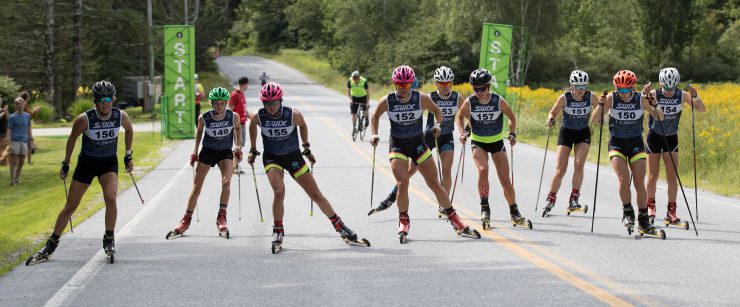
There’s a chill in the air, but winter is still months away. With New England’s weather forecasts predicting a sunny autumn weekend with temperatures in the mid-60’s (high teens Celsius), the coast of Maine looks like the ideal event destination this weekend. The New England Nordic Ski Association (NENSA) is ready to oblige with the staging of The Maine Event: XCX Sprints on Sunday, October 23. This is one of the many events hosted by NENSA that is designed for skiers of all ability levels from those just learning, to enthusiastic Masters participants, to seasoned racers. It’s part of the NENSA philosophy that is organized by NENSA’s Competitive Program Director, Justin Beckwith.
“In New England, we generally look on roller ski events as festive, as gatherings,” Beckwith said, “As a means for aspiring skiers to gain race experience rather than pursue race victories. We try to maintain a fun, festive environment, and NENSA’s philosophy is reflected there. It’s as much about gathering skiers together as it is about competing.”
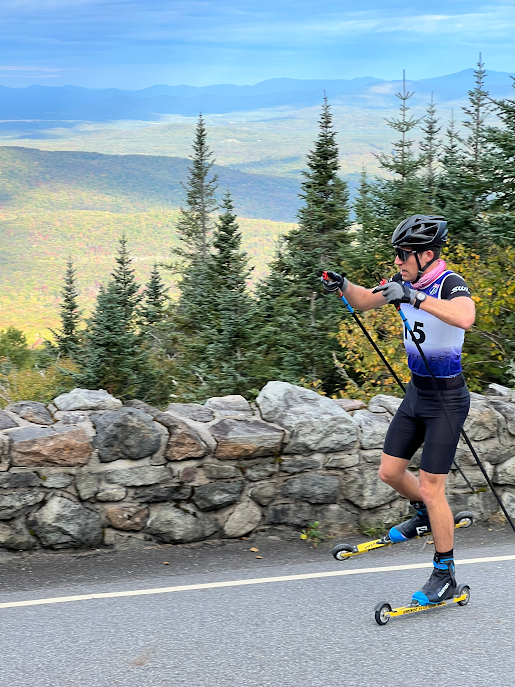
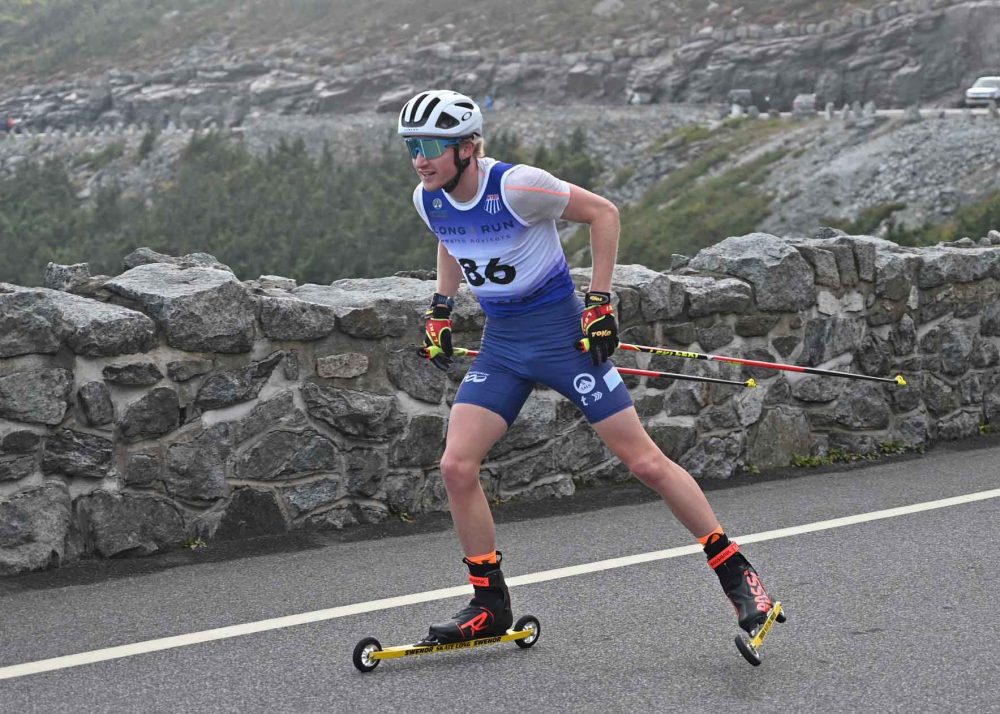
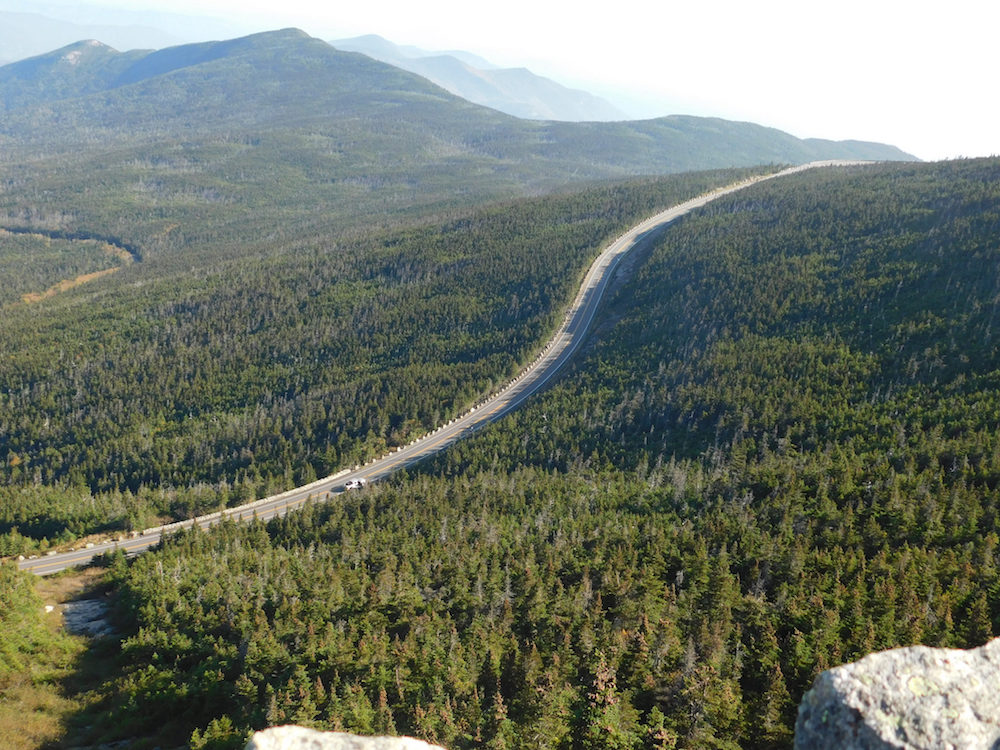
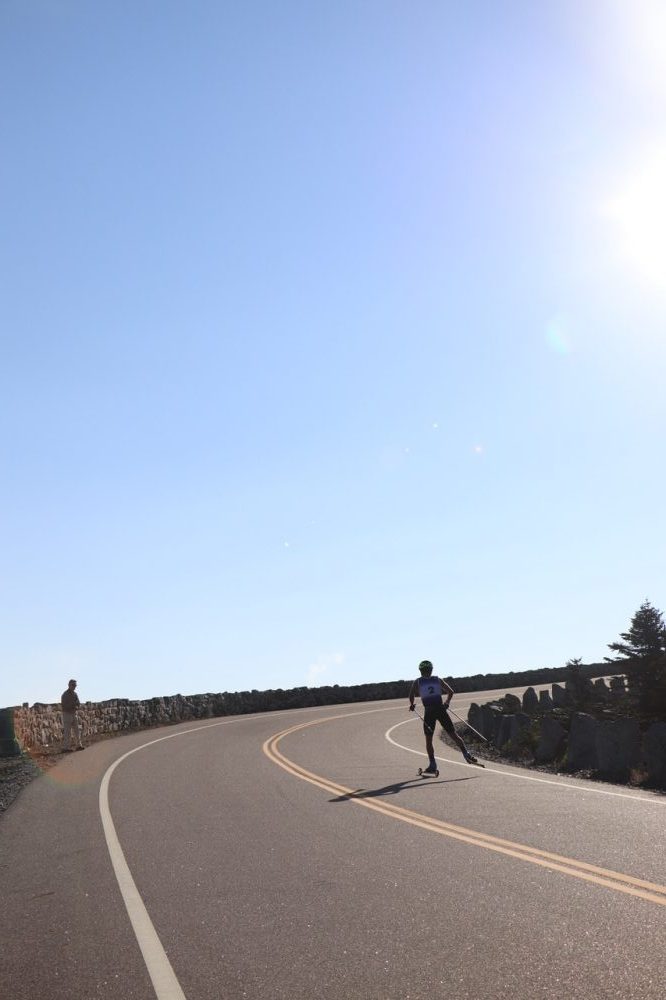
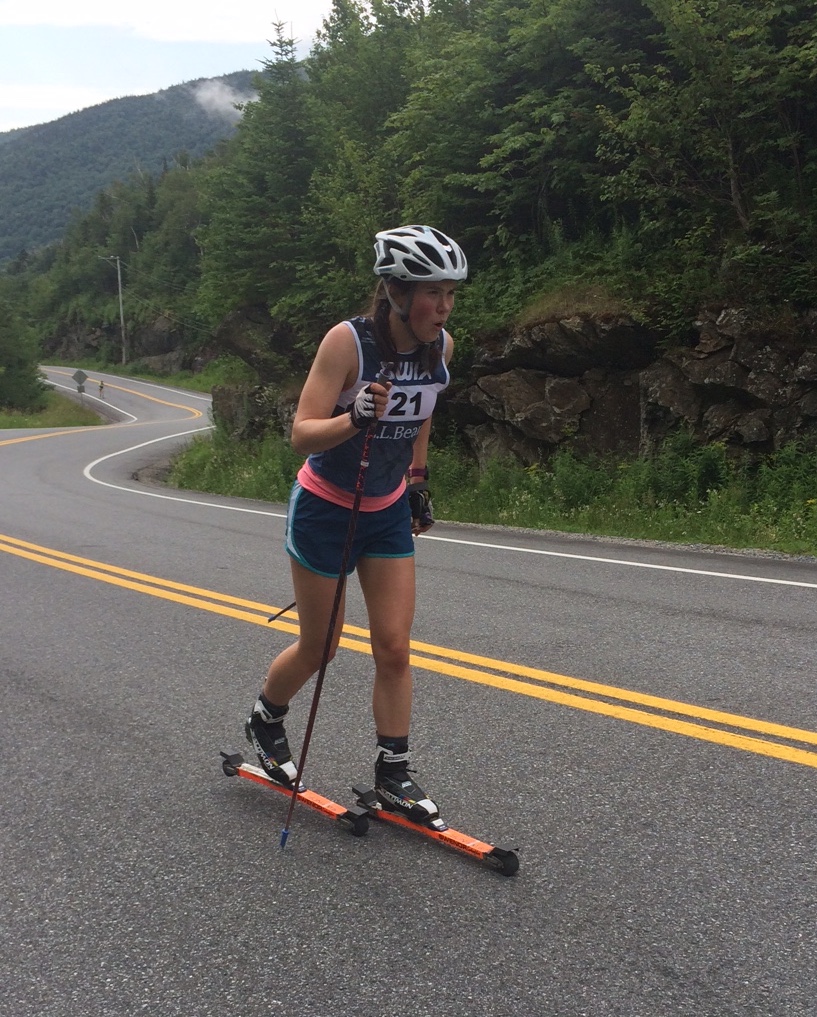
Nearing the Whiteface summit in Climb to the Castle, 2022 (NENSA photo).
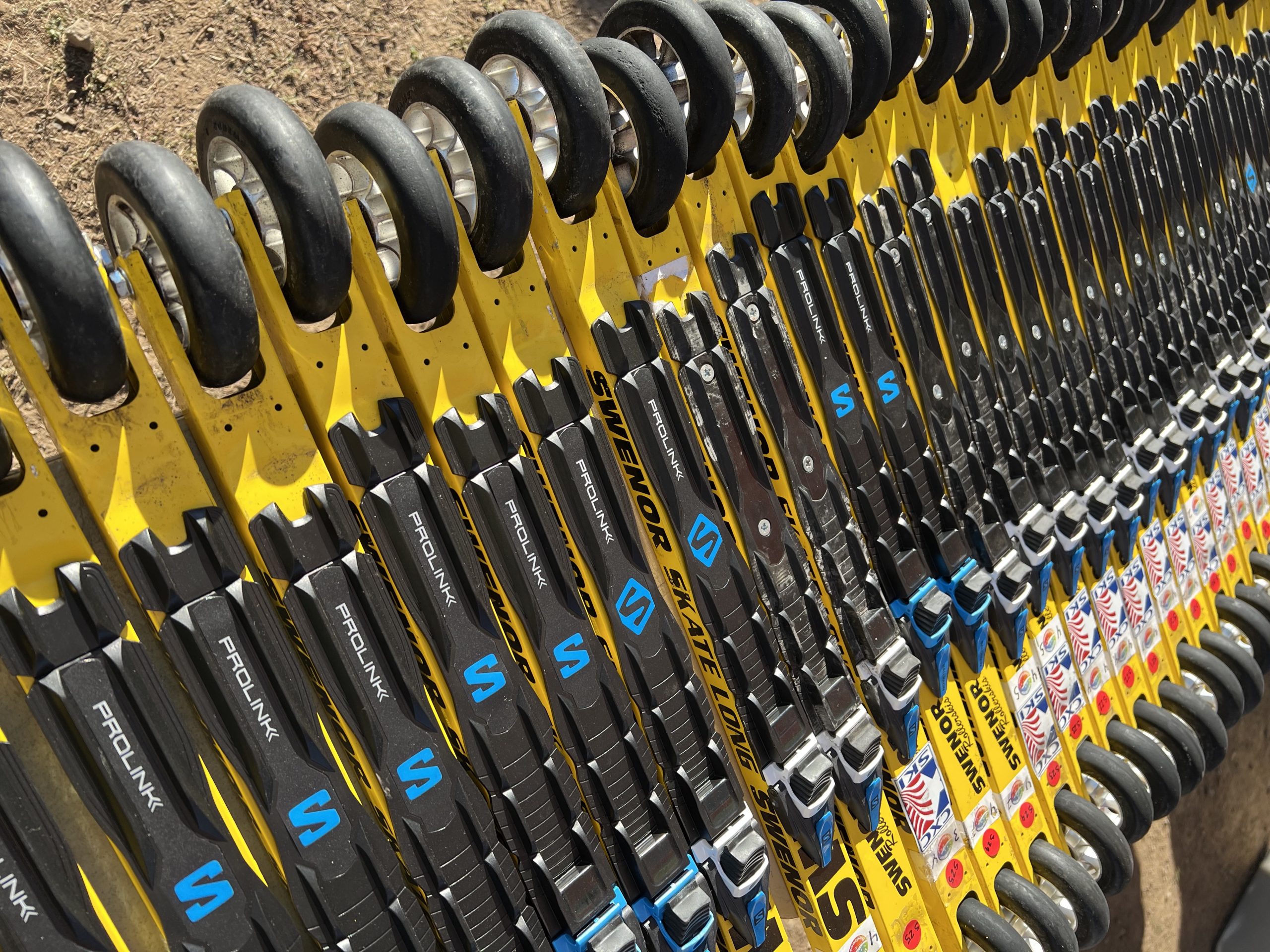
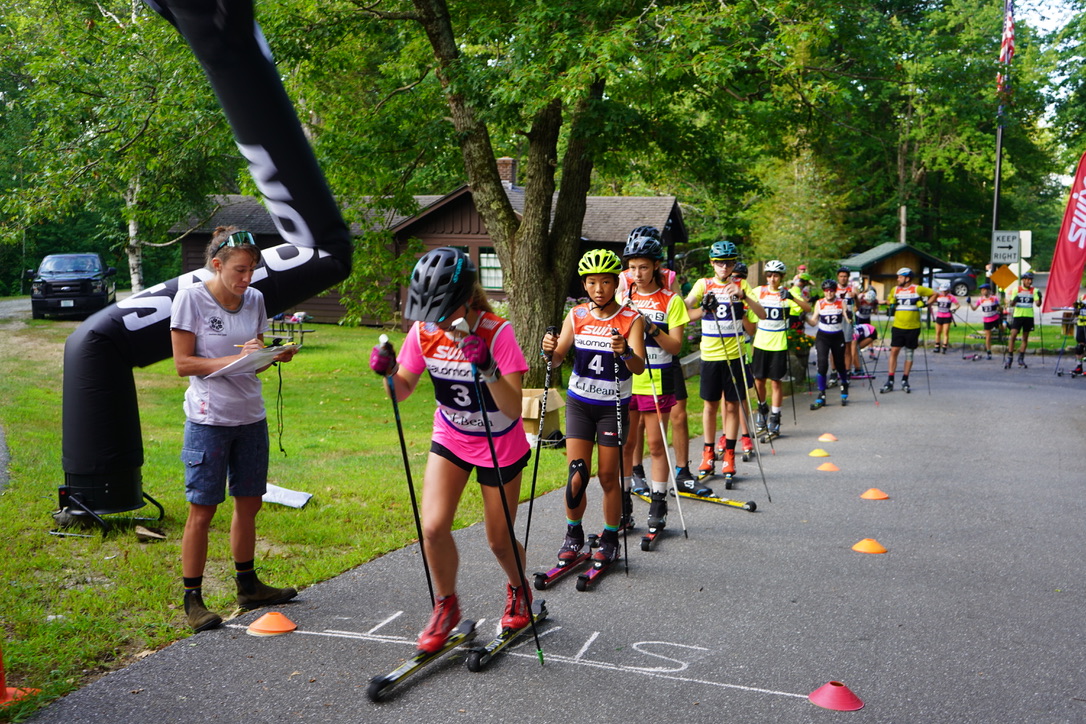
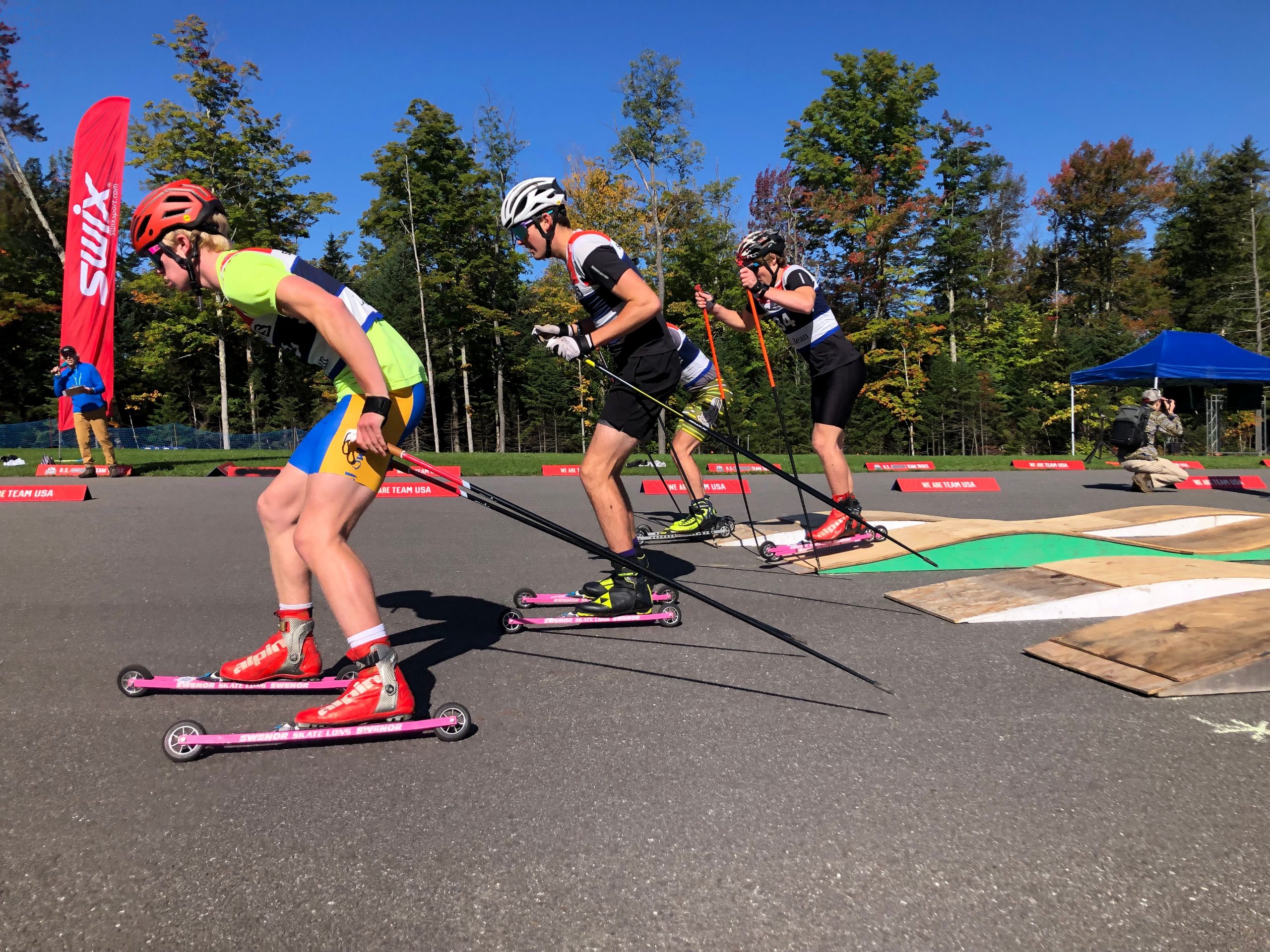
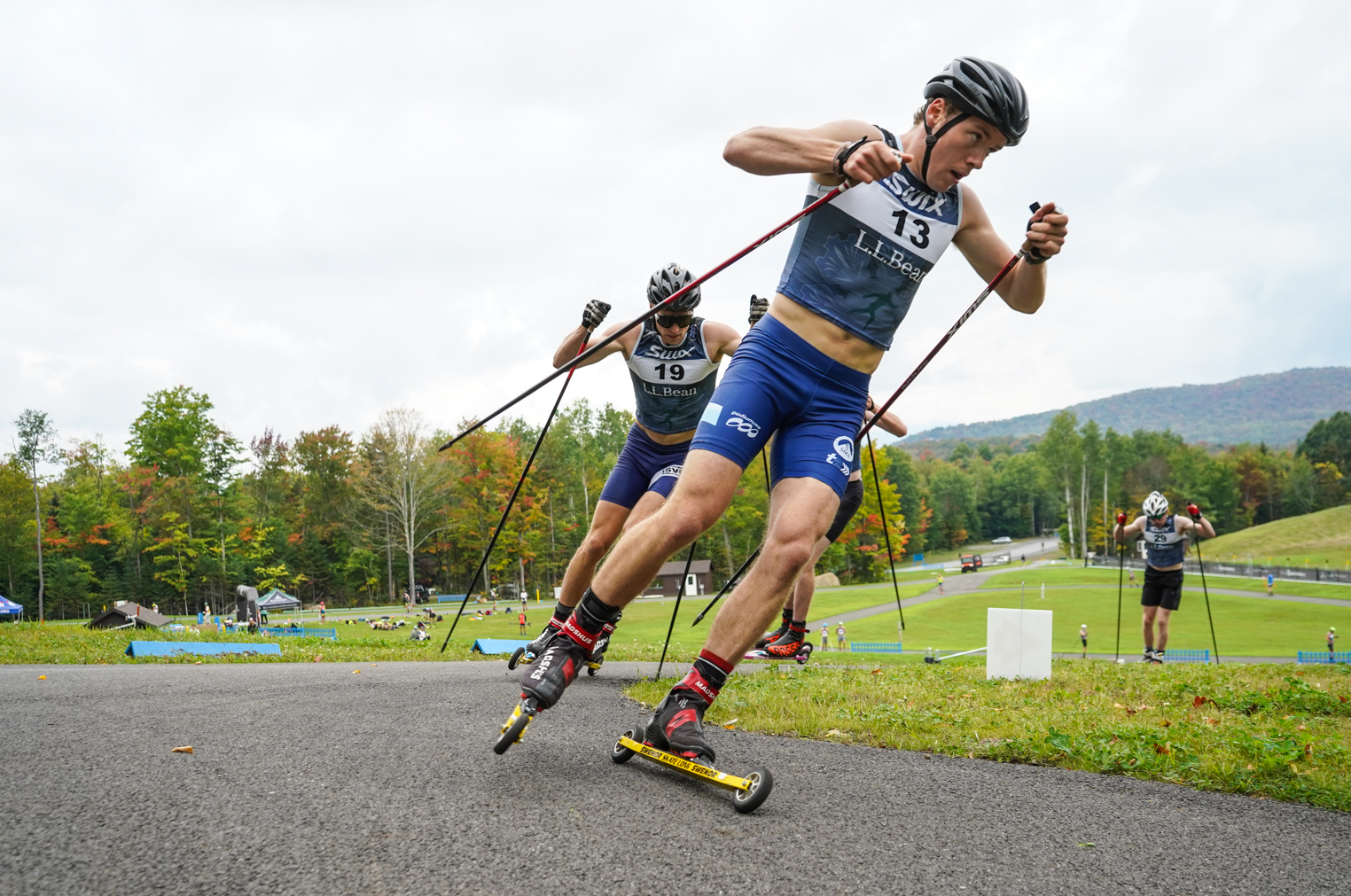
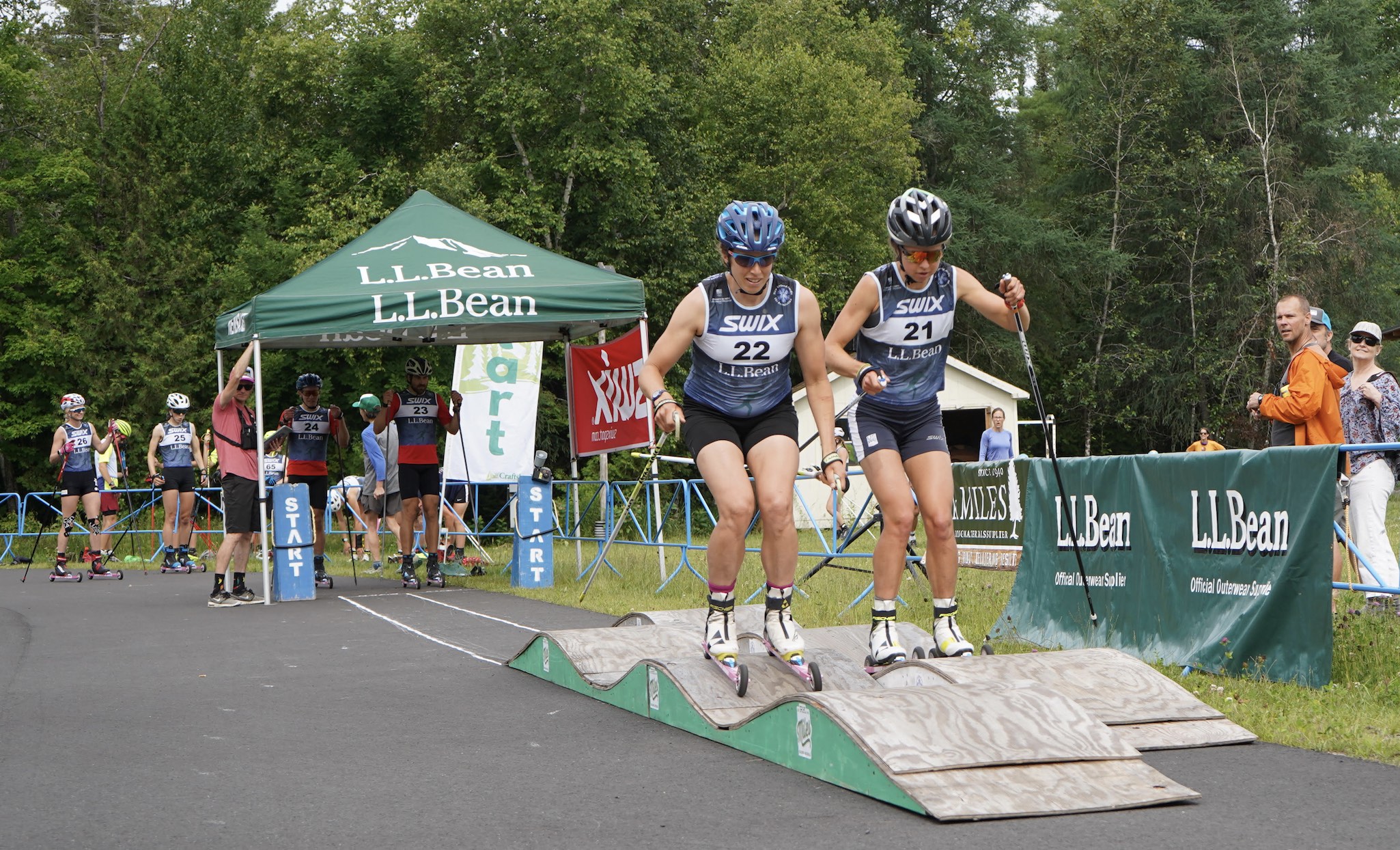
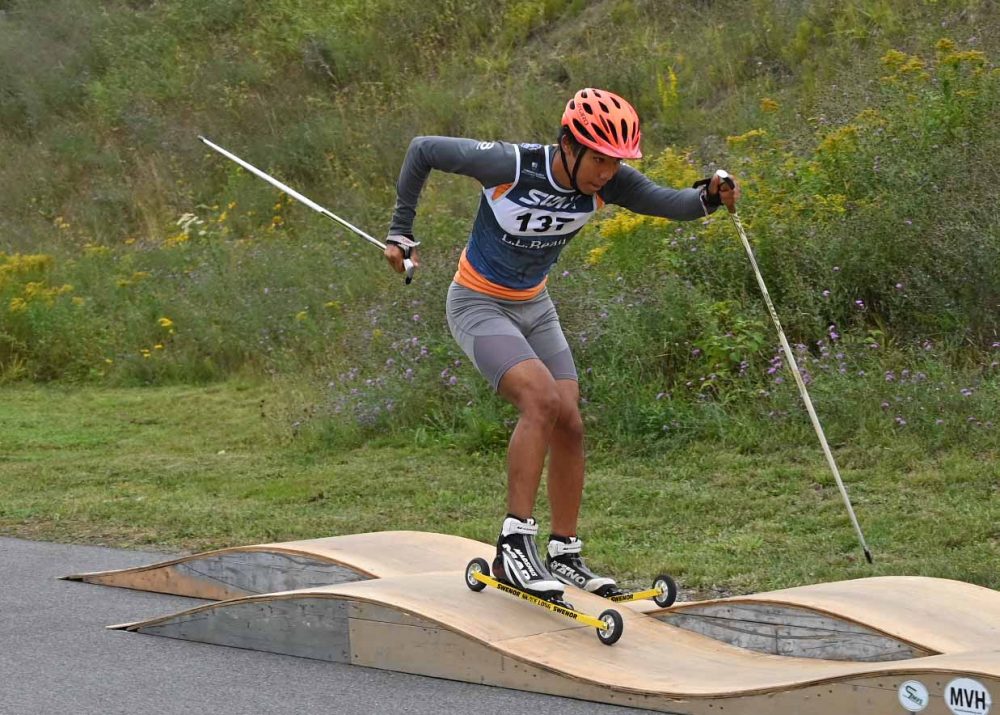
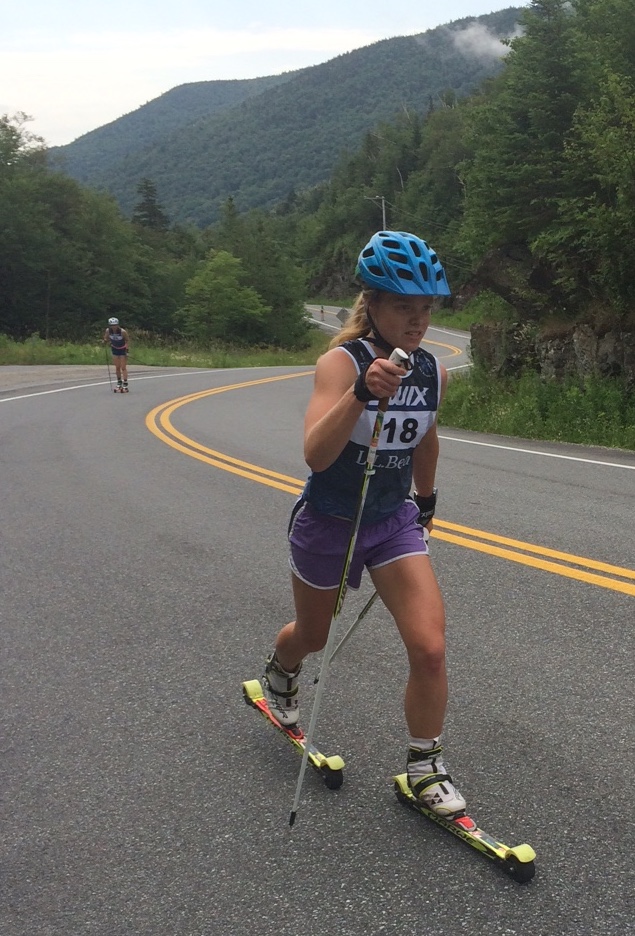
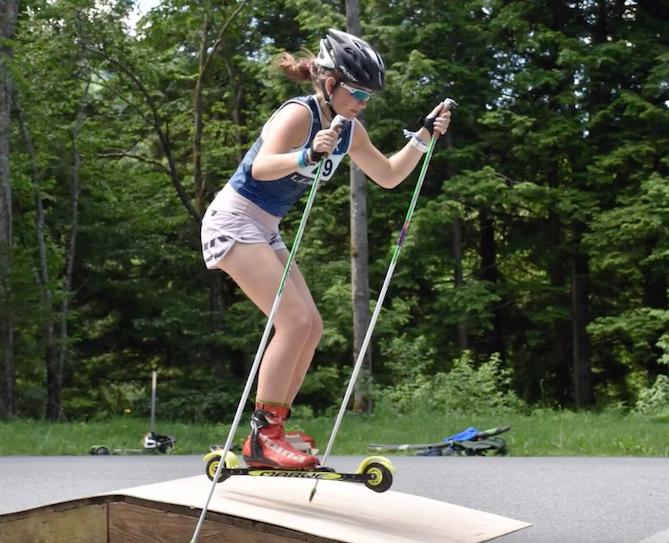
NENSA’s seasonal calendar identifies a large number of roller ski opportunities, but to call them “races” is to misunderstand NENSA’s efforts. The events that NENSA stages are intended to be less of a “race,” and more of a controlled event. Matched roller skis are provided for event contenders, so no one needs to worry about a mechanical disadvantage. Ramps, bicycle bumps, NENSA wave boards (designed and built by Beckwith, himself), and other fun elements are incorporated in nearly every event. “We want skiers of all skill levels and competitive ambitions to have the opportunity to gather together,” says Beckwith. “Racing can be part of that, but any festival can offer more.”
NENSA stages a variety of roller ski events and ski community gatherings throughout the summer:
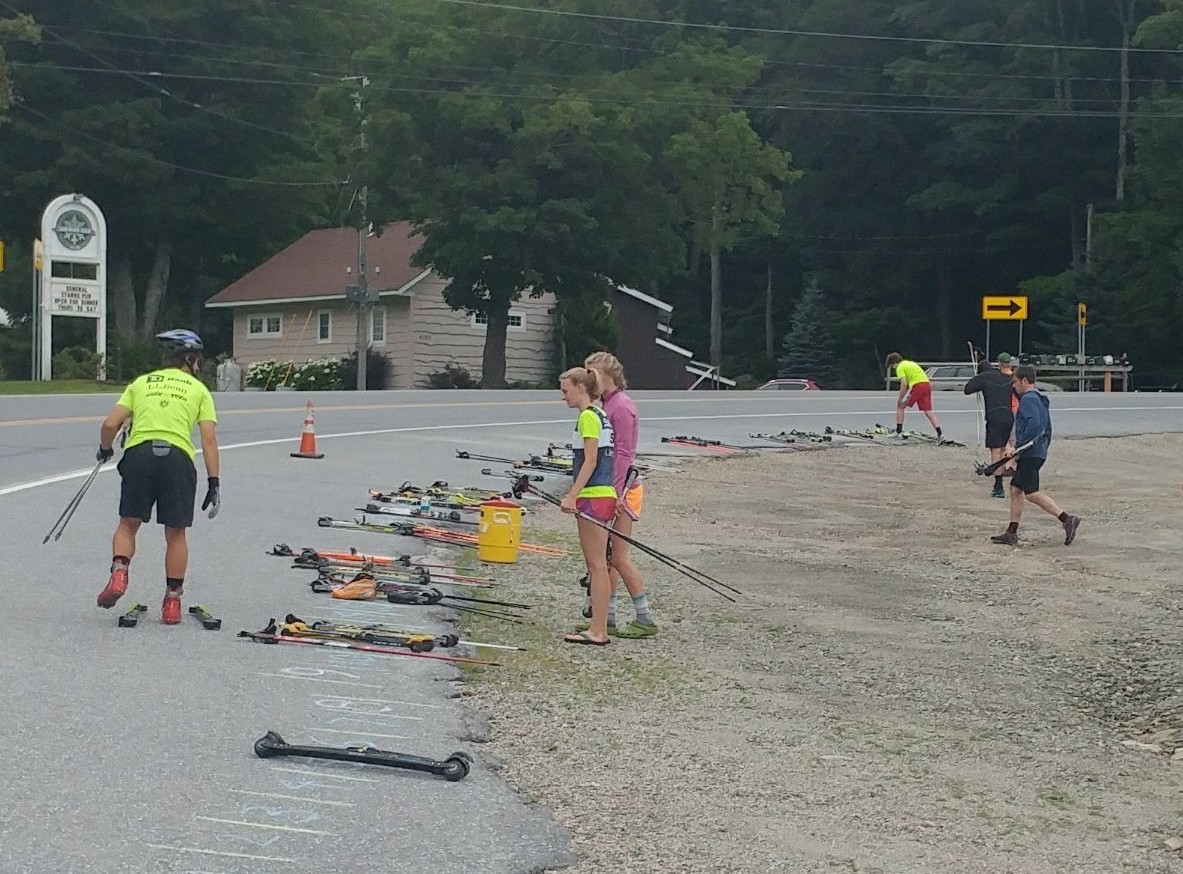
NENSA also offers numerous clinics aimed at those new to roller skiing in the form of NENSA’s Learn-To-Rollerski clinics. There the focus is on learning roller skiing fundamentals: stopping and turning, basic technique fundamentals, agility skills, and games.
“When NENSA started, one of the goals was to strengthen clubs within the region.” Beckwith said. “By my tenure, many clubs were already well organized, and they were doing their own camps and programs. NENSA’s new aim became how to capitalize on the activities already being staged in New England by adding heightened programming and bringing the clubs together.”
NENSA events can also offer high-level competition, though in an environment that’s designed primarily to offer training experience for young athletes: learning the psychology of racing, the timing of warming up and warming down, the ins and outs of race-day fueling and hydrating, the strategies of racing against the clock, or the terrain, or other competitors. But the format and intent of each event needs to strike a delicate balance: “For years, I’d sent athletes to compete in the App Gap Challenge as part of Green Mountain Valley School’s summer training camp,” Beckwith remembered. “Even then, the App Gap event was called a ‘challenge’ rather than a race. It wasn’t so much a competition as it was a way for skiers to measure improvement year after year.”
While NENSA stages events that could be described as “races,” Beckwith made it clear that NENSA is not attempting to create a roller ski athlete, nor to stage events that would otherwise interrupt the progression of any ski-athlete’s summer training: “Too much racing in the summer can be an interruption to ski training,” Beckwith said. “Athletes need to consider that these races are not so serious, but that they are simply an addition in the summer season.”
While ski-event organizers in the West and Midwest are beginning to consider seeking FIS and/or USSA sanctioning for roller ski events in seasons to come, that’s not where NENSA is focusing its efforts. NENSA’s mission is to do more than one thing: development and growth of cross country skiing, and providing competitive opportunities for cross country athletes. NENSA’s combination of racing, skills events, instruction, and community gatherings may continue to be the way to accomplish that. Perhaps the place to begin on a glorious New England autumn weekend is on the coast of Maine. Go to NENSA’s website for further event information, and for THE MAINE EVENT Registration.
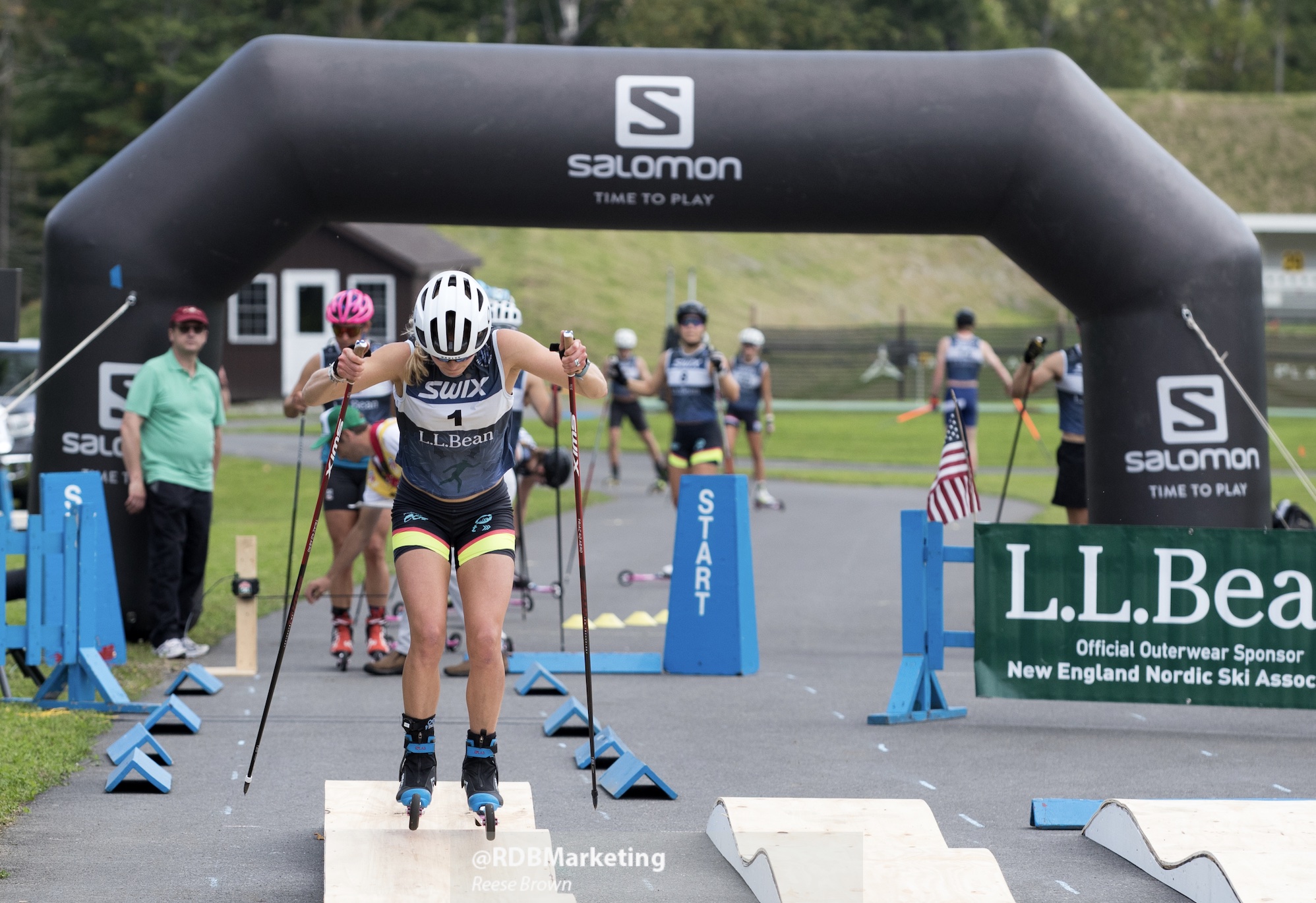
Over the bumps, Jessie Diggins heads out for her qualifier during the Keys to the Castle rollerski race in Lake Placid, NY. (Photo: Reese Brown / RDB Marketing)
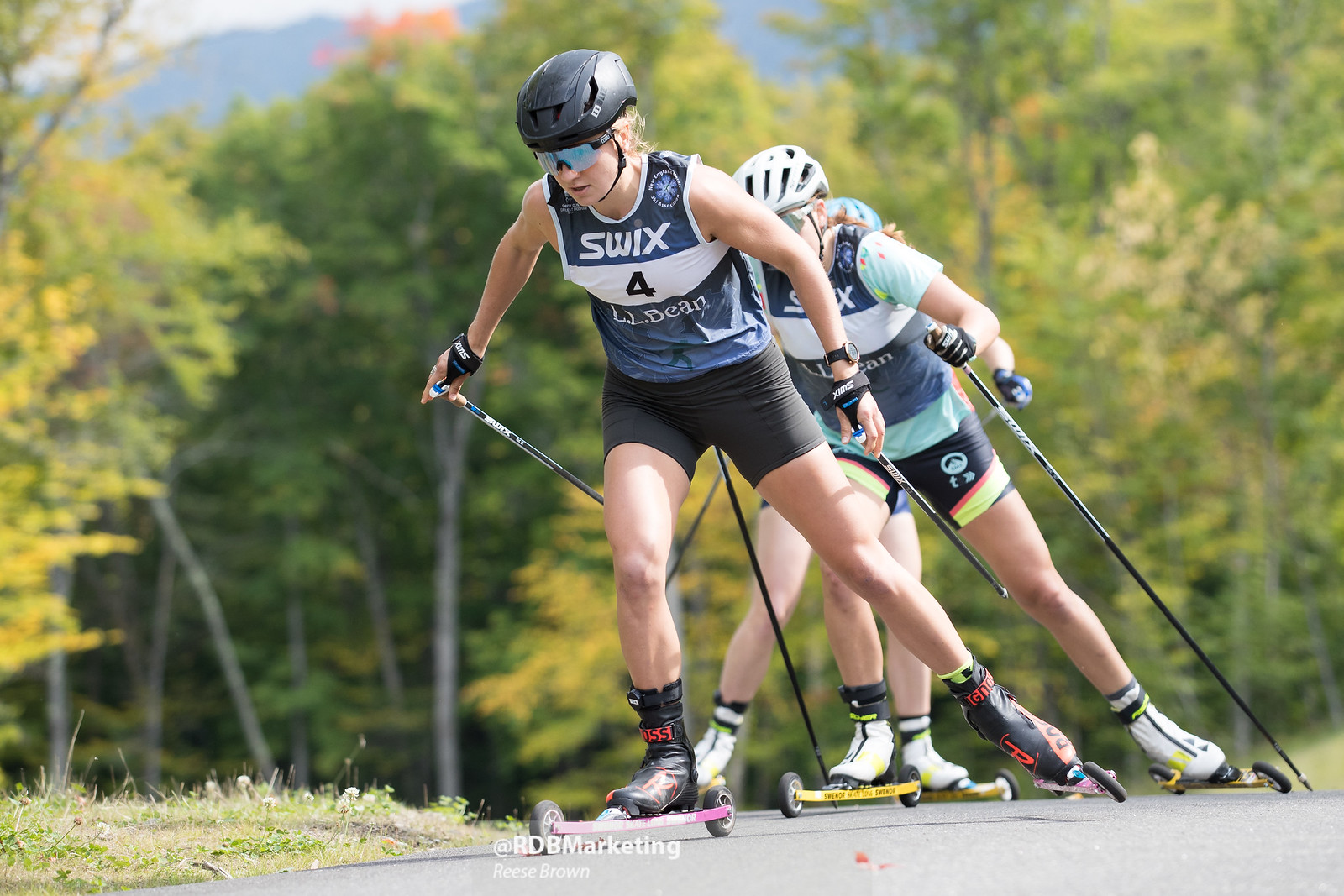
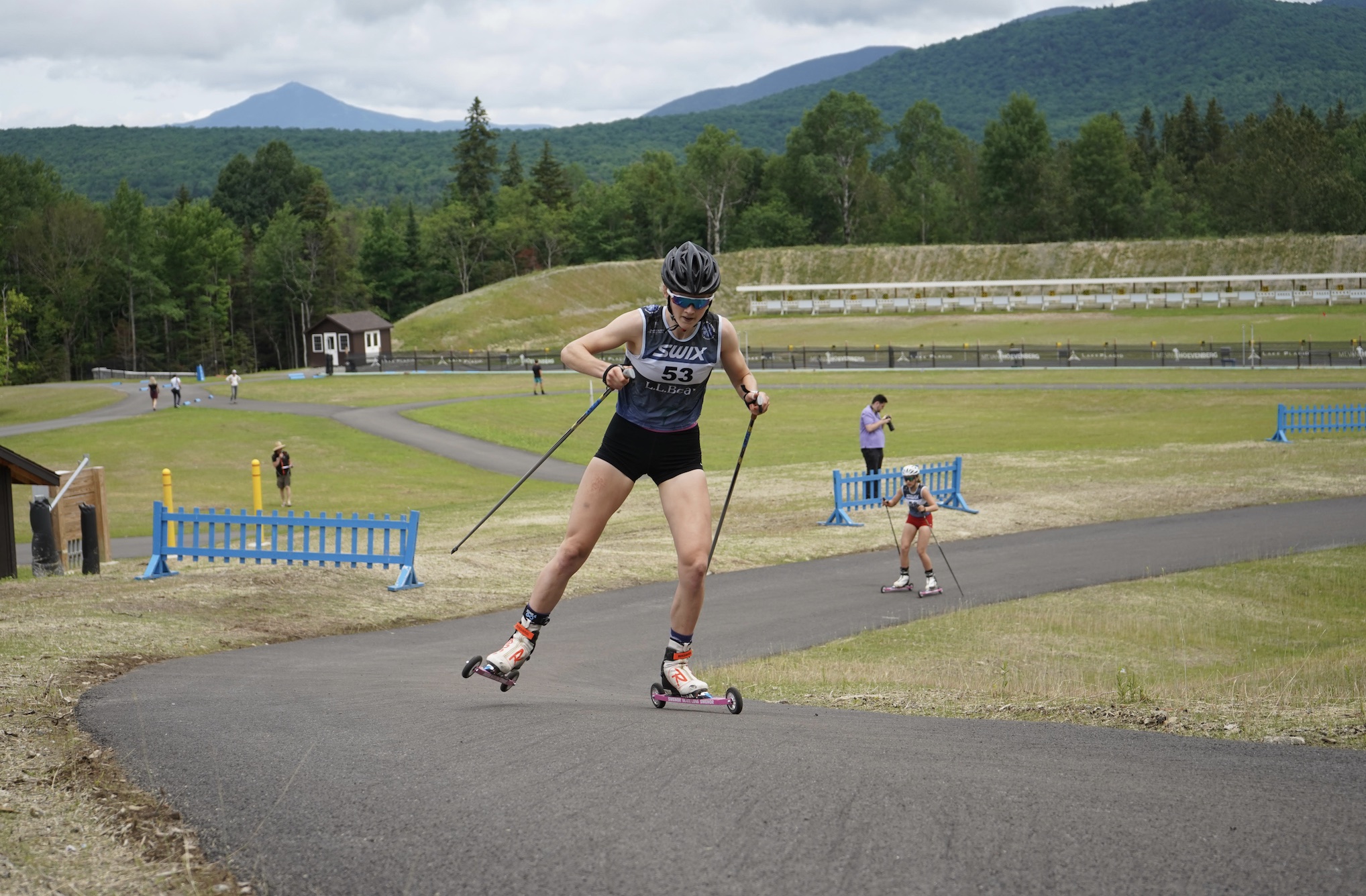
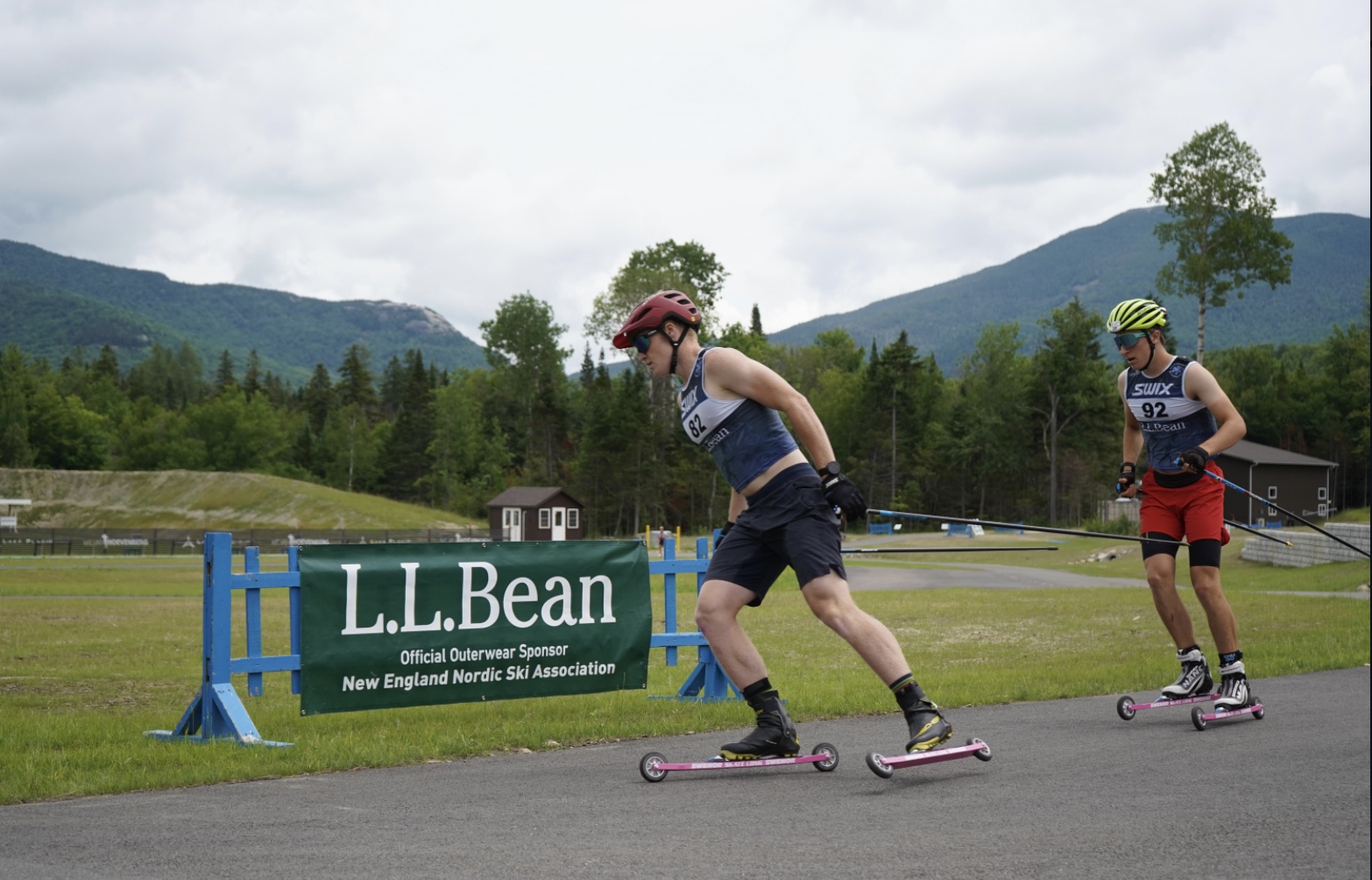
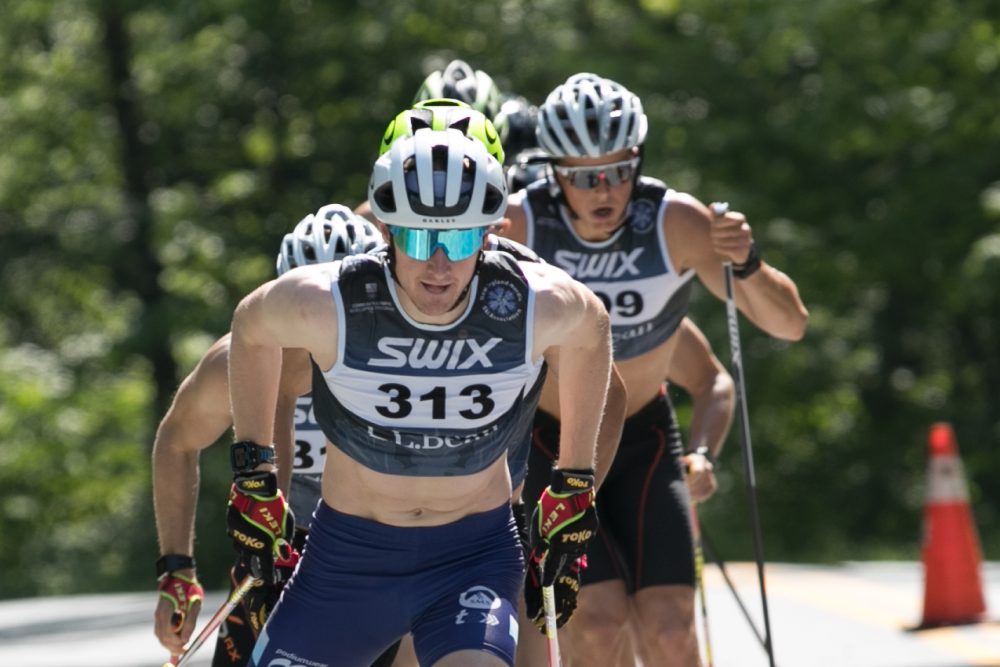
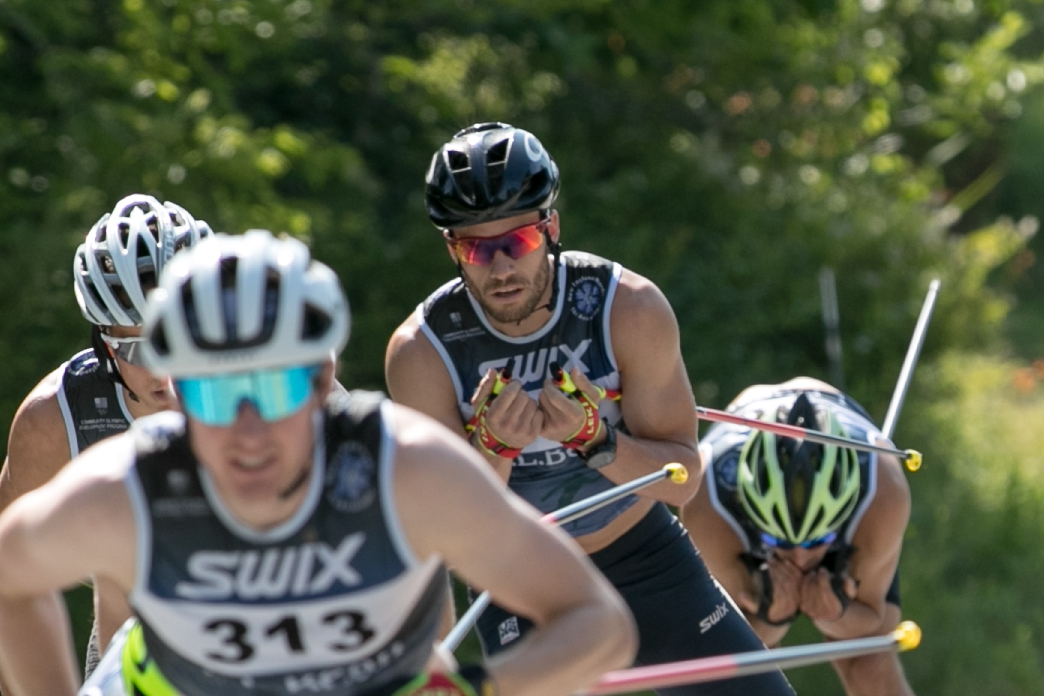
As summer turned to fall, skiers from the Stratton Mountain School T2 team (SMS T2), the Sun Valley Gold Team (SVSEF), and the Bridger Ski Foundation Pro Team (BSF) met in Lake Placid, NY for a collaborative training camp, capped off with two stages of rollerski racing. The weekend featured a freestyle sprint event — The Keys to the Castle — on the rollerski track at Mt Van Hoevenberg, followed by a distance stage dubbed the Free Fall Rollerski Race in Jericho, VT. These events are perhaps the climax of NENSA’s summer rollerski series, which has helped feed the energy and momentum of the cross country ski community throughout the Northeast.
“Lake Placid and Jericho were fantastic events and the beginning of the vision becoming a reality,” NENSA competitive programs director Justin Beckwith shared in an email. “They also highlight the amazing partnerships we have with clubs, venues and sponsors. We have four more roller races this fall including Climb to the Castle this weekend, which is paired with our Eastern Coaches Symposium — back in the Empire State. The really exciting part is we hope to carry the enthusiasm from rollerski into our Popular Race calendar, which will be released in the coming month.”
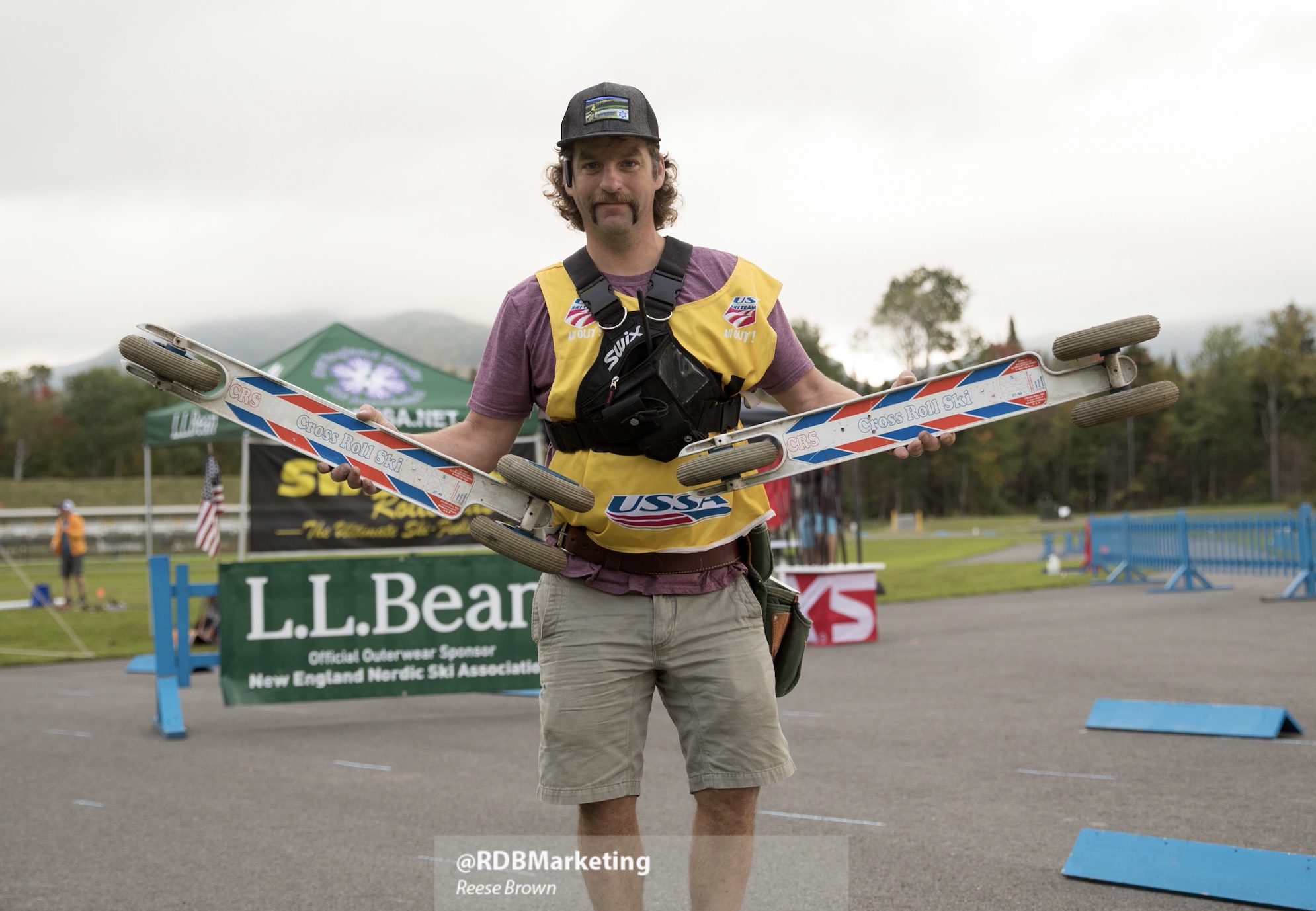
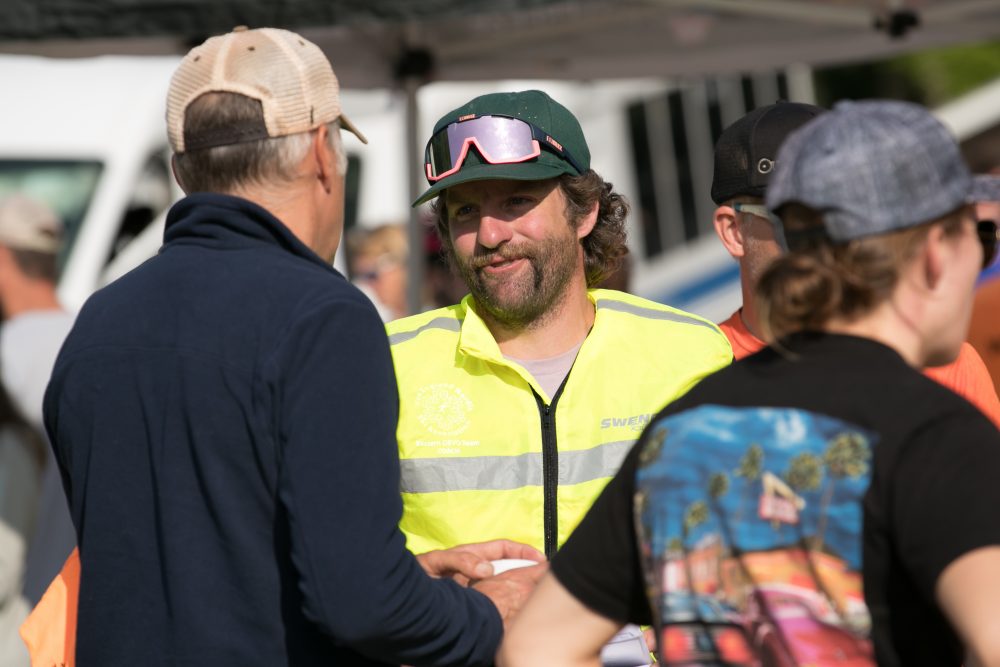
The man behind the wheels: NENSA competitive programs director Justin Beckwith. (Photo: Reese Brown / RDB Marketing)
After a year with minimal opportunity for cross-club collaboration, the events provided not only a solid training stimulus, but also invigorated the teams as they prepare for the upcoming season. It left U.S. Ski Team head coach Matt Whitcomb scheming about the opportunity to grow the events in the years to come.
“Pulling off a stage-style roller ski race weekend, with over 100 competitors on two different roller-ski tracks, reminds me of summer racing in Norway and Sweden,” wrote Whitcomb in an email. “NENSA has upped its game. Think of the potential, too; we could do four stages, using four different tracks, and all within 1-2 hrs in VT and NY. Start in Craftsbury, move on to Jericho, and then to each of Lake Placid’s tracks. Everyone camps together at each location, and it’s just a giant summer ski party.”
The facilities at Mt Van Hoevenberg, home to the 1980 Olympics and an Olympic & Paralympic Training Center, have been undergoing extensive renovations and improvements, including the building of the new four-kilometer rollerski track which was finished this past August. (You can take a tour of the track via YouTube courtesy of Paul Schommer/Biathlon Uncharted.)
“If I win the lottery, I’m putting in more roller-ski tracks in the U.S.,” said Whitcomb. “It’s a game-changer to not have to worry about cars. Also, the best way to replicate the demands of a ski course is to ski on a ski course.”
Bill Harmeyer (SMS T2) makes his way through the heats during the Keys to the Castle rollerski sprint. Harmeyer finished 4th overall on the day. (Photo: Matt Whitcomb)
Mt Van Hoevenberg has also improved their snow making operations, allowing for 5k of groomed skiing with 3-4 days of blowing snow in cold weather. Whitcomb explained the value this provides to American cross country skiing.
“This was our second time utilizing New York’s investment in its facilities at Mount Van Hoevenberg. I’d be surprised if we’re not racing World Cups here in the future. A lot of work by ORDA has resulted in a world class roller-ski track and new race trails. What excites me is the chance for easterners to have early November skiing in years when the weather cooperates. Their snow-making capacity is impressive.”
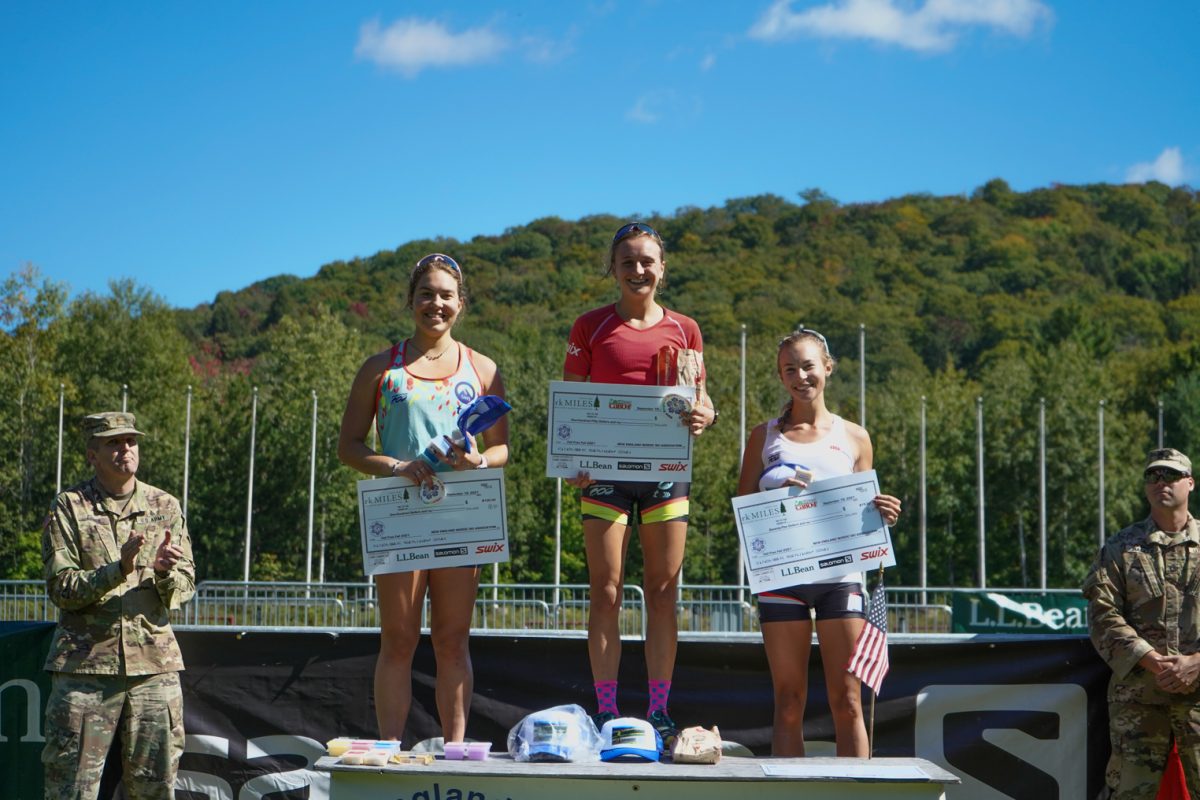
With the added twist of a rolling ramp at the start, racers skied their way through the qualifier and rounds. In the women’s field, Jessie Diggins (SMS T2/USST) won the qualifier, cruising onward to snag the top spot on the podium, followed by teammates Julia Kern (SMS T2/USST) in second and Alayna Sonnesyn (SMS T2) in third.
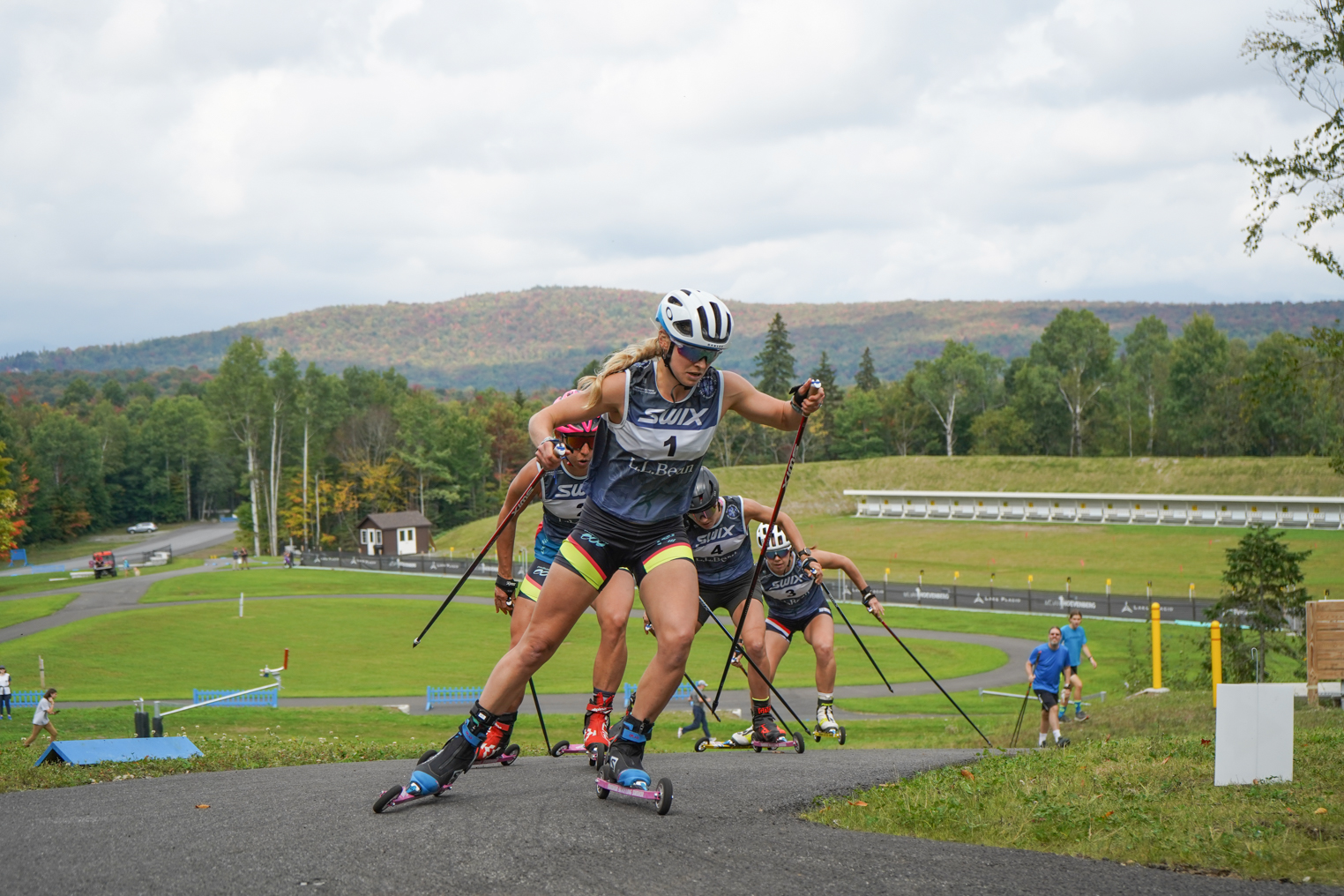
Jessie Diggins (SMS T2/USST) over the climb during the final round of the Keys to the Castle sprint. (Photo: Matt Whitcomb)
“This is the time of year where the intensity in training starts to ramp up and it’s always awesome to have the chance to test out your race day preparation,” wrote Diggins after the race. “Things like the timing of pre-race meals to warmups and what you do in between sprint heats to stay activated but not get tired — this was a perfect chance to tune in to those little details at the race in Lake Placid!”
Diggins only competed in the sprint stage of the weekend, bowing out before the teams headed to Vermont.
“I’m super grateful to the organizers and hosts as it was an amazing new roller ski track and venue, and it was very cool to have so many teams and athletes there, from junior skiers to professional teams. The track was challenging and honestly just like a world cup sprint course, in terms of length, challenge and technical aspects. It was fun to fire up the engines and see what I still need to be working on in our final prep phase before the season begins!”
Jessie Diggins stomps the qualifier, continuing through the rounds to win the overall at the Keys to the Castle. (Photo: Reese Brown / RDB Marketing)
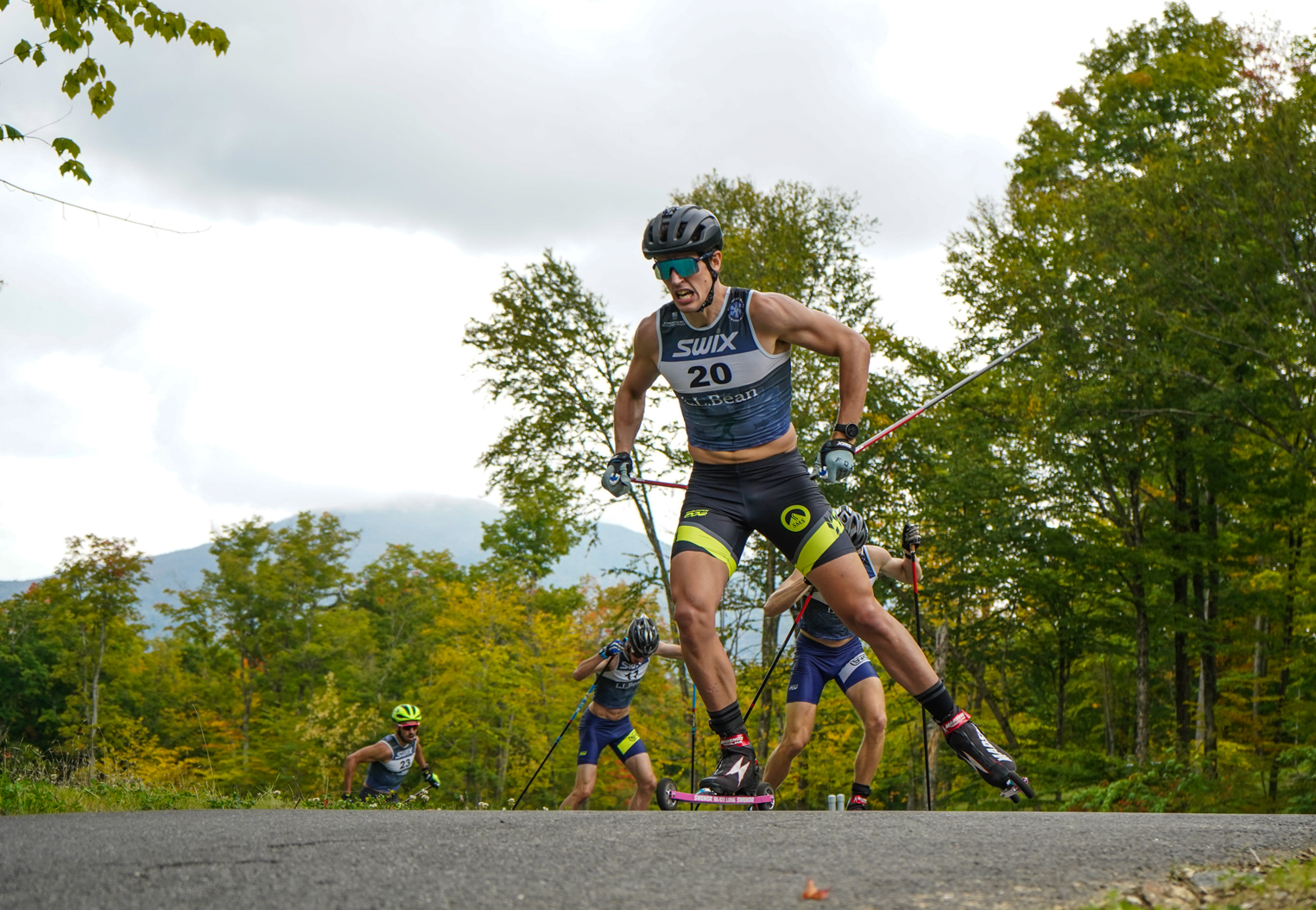
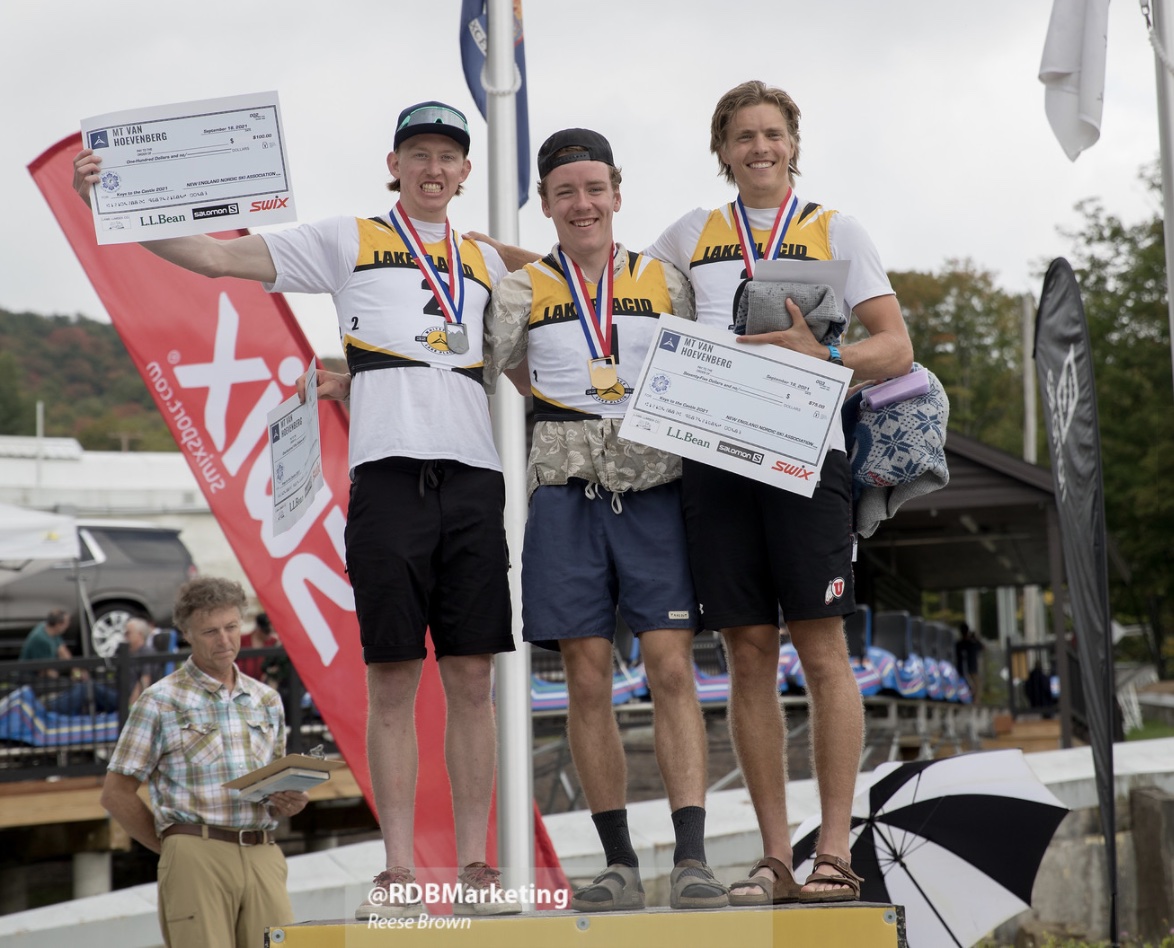
On the men’s side, Ben Ogden (SMS T2) also doubled up on the qualifier-final victories. He was followed by Peter Holmes (SVSEF) in second, and Logan Diekmann (BSF) in third.
“This weekend’s rollerski race was like a breath of fresh air for me and I think most of the competitors,” wrote Ogden in an email. “As fun as constant training, time trials and quarantining was, ski racing is all about racing. Getting together with such a talented group and pushing each other on such a beautiful New England weekend seemed almost too good to be true. Having the BSF Pro Team, Sun Valley gold team, and SMS T2 team, all on sight made it a crazy stacked fall time trial, which was such a treat after a year of so many small group time trials.
“This weekend was especially cool for me because It bridged the gap between all the ski worlds, something that has certainly not happened in a long time. Many of the college skiers were there, the SMS t2 team (who I ski with in the summers) was there, even a few fellow US ski team athletes and coaches were there. It’s rare that all these groups get together so that was a lot of fun.”
Putting on a clinic, Ben Ogden powers through the Keys to the Castle, winning both the qualifier and the overall. (Photo: Matt Whitcomb)
While racing in Vermont was not possible for much of the ‘20/21 season, Ogden, now 21-years-old, had a solid first run of international World Cup racing. On form when the stakes were highest, he qualified in 11th in the classic sprint at the World Championships in Oberstdorf, Germany and finished 17th. He was also the third fastest qualifier in the same event at U23 World Championships in Voukatti, Finland, where he finished 11th overall.
Ogden provided insight into his current status with training, and how the races provided him with insight into how his body is responding.
“I had a big period of training ending in these races and in true fall rollerski race style I didn’t change up much of my training for the races. I just thought of them as hard workouts with a bunch of friends who I don’t ski with all too often. I was really pleased to find some good speed through the entire skate sprint day. The course was really fast and tons of fun on rollerskis, so it was awesome to ski all three heats on Saturday…
“I’m really excited to get this winter underway. Feeling good about summer training in Stratton and the beginning of fall training at Groovy. (‘Groovy UV’ = University of Vermont, where Ogden is beginning his third year.) Lots of work to be done!! I think it’s going to be a fun year.”
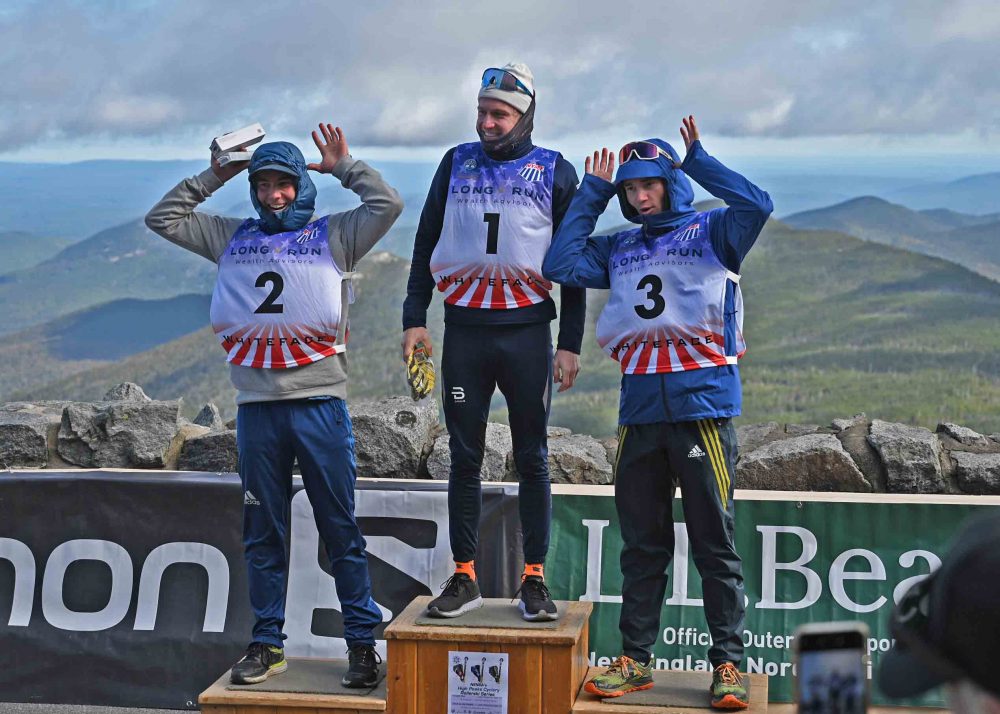
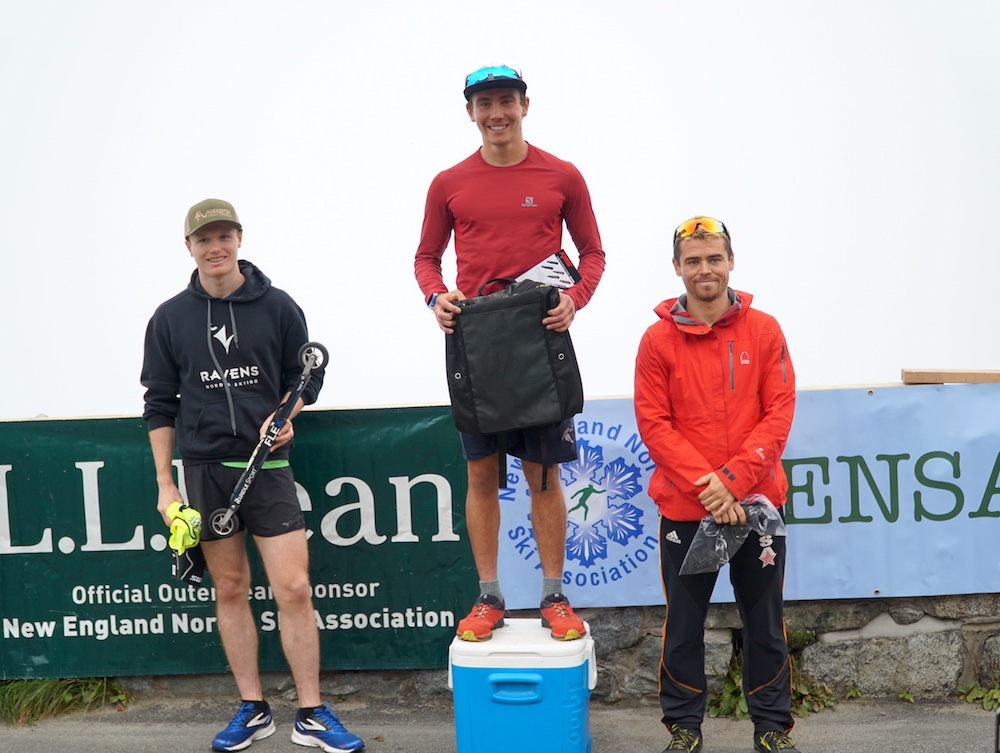
The men’s podium of the Keys to the Castle rollerski sprint in Lake Placid. Ben Ogden (SMS T2) was the top qualifier and overall winner ahead of Peter Holmes (SVSEF) and Logan Diekmann (BSF Pro). (Photo: Reese Brown/RDB Marketing)
Heading east to the Camp Ethan Allen Training Site, men and women in the open division raced a 15k skate while juniors completed 5k.
For the men, Johnny Hagenbuch (SVSEF) stopped the clock at 32:00.9 with the fastest time of the day. He was pursued by Ben Ogen in second (+1:07.3), with Ian Torchia (SMS T2) on his tails in third (+1:07.6) with a tight finish.
“It was an awesome way to cap off a productive training camp!” wrote Hagenbuch after his race. “Being from altitude in Sun Valley, the main goal for the camp was to capitalize on some great venues for intensity training in and around Lake Placid. We had a bunch of really good sessions on rollerskis and foot, and it was awesome to collaborate with Andy Newell’s BSF Pro Team crew on a number of those quality workouts.”
20-year-old Hagenbuch was born and raised in Ketchum, ID. After taking a gap year following high school graduation, Hagenbuch will be attending Dartmouth College in the fall. He explained that his time spent in the east surrounding these events left him eager for what is to come in the years ahead.
“The new venues in Lake Placid at the Mount Van Hoevenberg were incredibly well-designed, and I really look forward to checking out the ski trails in the winter as opposed to bounding. The rollerski track is a really great resource, and NENSA did a fantastic job of hosting that event. There was a surprisingly robust field for a rollerski race in Upstate NY, and it was cool to see how much energy there is for skiing and rollerskiing in the East. I actually had never previously spent any substantive period of time in New England – winter or summer, so it was great to experience orientation at Dartmouth the week before the camp as well. My perception of the East has completely changed; it’s very different from the West, but I love it!”
Johnny Hagenbuch powers through his qualifying round during the Keys to the Castle rollerski sprint in Lake Placid, NY. (Photo: Matt Whitcomb)
Breaking down the combined stages that led Hagenbuch to a third place finish in the overall standings, he explained his approach to the weekend including how it fits within his overall summer training plan.
“The sprint went pretty well for me, especially considering that I historically and currently have not self-identified as the most talented sprinter. At this point in the season, it was a fun, low-stakes way to throw down with a great group of guys. Ben Ogden is fun to watch. The distance day in Jericho was much more my wheelhouse, as distance skate races are typically my best format. The 5km rollerski track on the National Guard base in Jericho was a treat to experience. I haven’t skied on Craftsbury’s rollerski track, but the Jericho rollerski track could easily be the best in the nation. Given that I’m still training at a relatively large volume, I wasn’t really expecting to feel particularly good or race anywhere near to my best form, but it was still a pretty good effort.
“One of my goals for the past couple of seasons has been to get stronger and ski more powerfully, and it was cool to see some of that effort pay off in Jericho. I felt that I was skiing much more powerfully in general, and I don’t think I lost much on the uphills – despite having gained 25 pounds in the last year. It was an encouraging result in the end, and I’m excited for the next couple of months of training before the season kicks off in earnest in West Yellowstone. I’ll be pretty consistently alternating between being at home for two weeks and away training or racing for two weeks until January, which’ll be a nice way to break it up (and will make time fly)!”
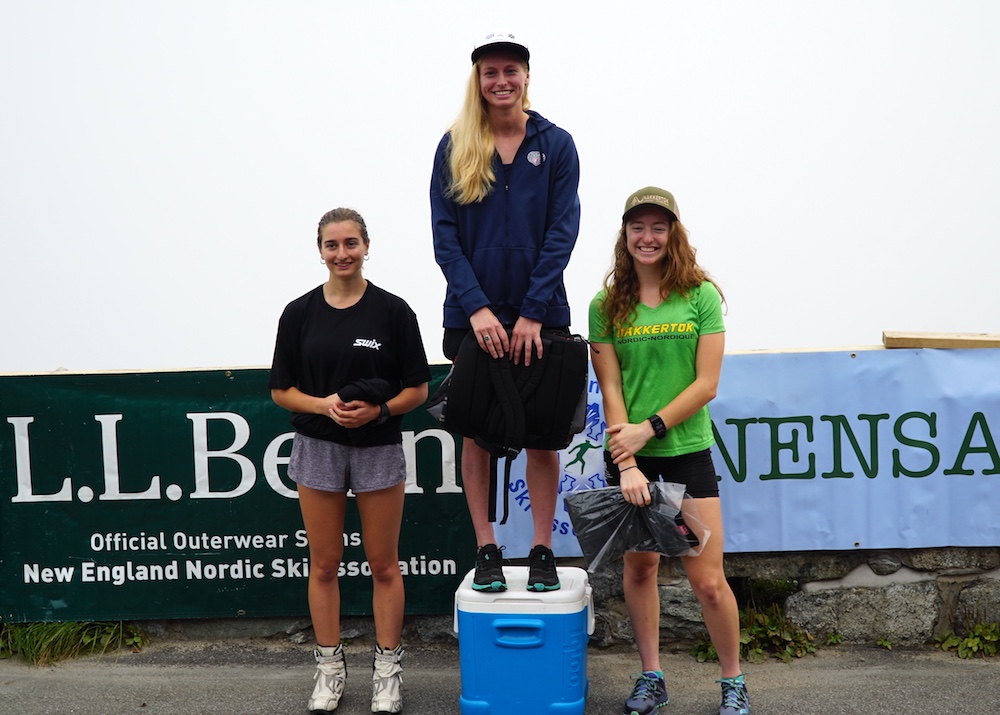
The women’s podium of the Free Fall distance race in Jericho, VT. Alayna Sonnesyn (SMS T2) took the win ahead of teammate Lina Sutro, with Mariah Bredal (BSF Pro) in third. (Photo: Matt Whitcomb)
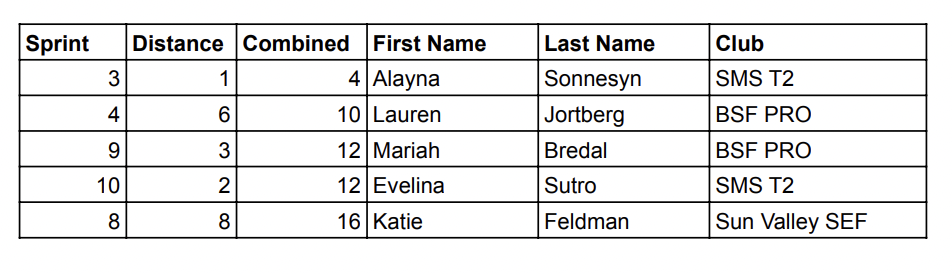
On the women’s side, Alayna Sonnesyn took the win on the second day in a time of 37:55.3, sealing the overall victory for the combined events. Her SMS T2 teammate Lina Sutro rolled through in second (+49.3) with BSF Pro Team member Mariah Bredal in third (+2:33.6).
“In Lake Placid, it was really cool to ski on the new roller ski track,” wrote Sonnesyn in an email after the events. “I had heard stories about a pretty twisty and technical track but to finally have the opportunity to ski on a course similar to a World Cup level race was pretty sweet. Not to mention the new facilities at Mt. Van Hoevenberg are unbelievable! It was really fun to get into a sprint simulation with all of the other elite ski teams that were there and it felt almost like a SuperTour. That being said, it’s still September so although I brought a competitive spirit to the races, I still approached them as a workout. It was great to practice going super hard in the qualifier and then play around with tactics in the heats, but it was all in good fun too. With a pretty sketchy corner coming out of the last downhill, the women agreed this race wasn’t worth losing skin over. All in all, a great day!”
Alayna Sonnesyn leads her heat during the Keys to the Castle rollerski sprint in Lake Placid, NY. (Photo: Reese Brown / RDB Marketing)
“The following day in Jericho I was definitely feeling a little tired from the sprints the day before, but that was great practice for wintertime when we frequently race back to back,” Sonnesyn continued. “Also, during my time at UVM we skied at Jericho almost every week so it felt good to be back on a track that I knew so well and felt like home. Adding to that, it was great to see the UVM ski team and other junior/college racers attending this event. It had been a while since I had been at an event with so many New England skiers and I felt like everyone was just really happy to be there. Again, I was finding the balance in this race to approach it as a workout while still taking advantage of the opportunity to practice race warm ups, tactics, fueling, pacing, etc.”
Sonnesyn also concluded with insight into her overall feelings at this point in the season.
“I’m feeling really good and lucky to have these races to test things out. I gained a lot of takeaways on little things I can work on in the next few months, but also built some confidence behind what we have already been doing all summer. I’m excited to potentially compete in a few more NENSA races this fall and get ready for snow to fall!”
The women’s final of the Keys to the Castle rollerski sprint in Lake Placid, NY. From left to right, Lauren Jortberg (BSF Pro), Julia Kern (SMS T2/USST), Jessie Diggins (SMS T2/USST), Alayna Sonnesyn (SMS T2). (Photo: Reese Brown RDB Marketing)
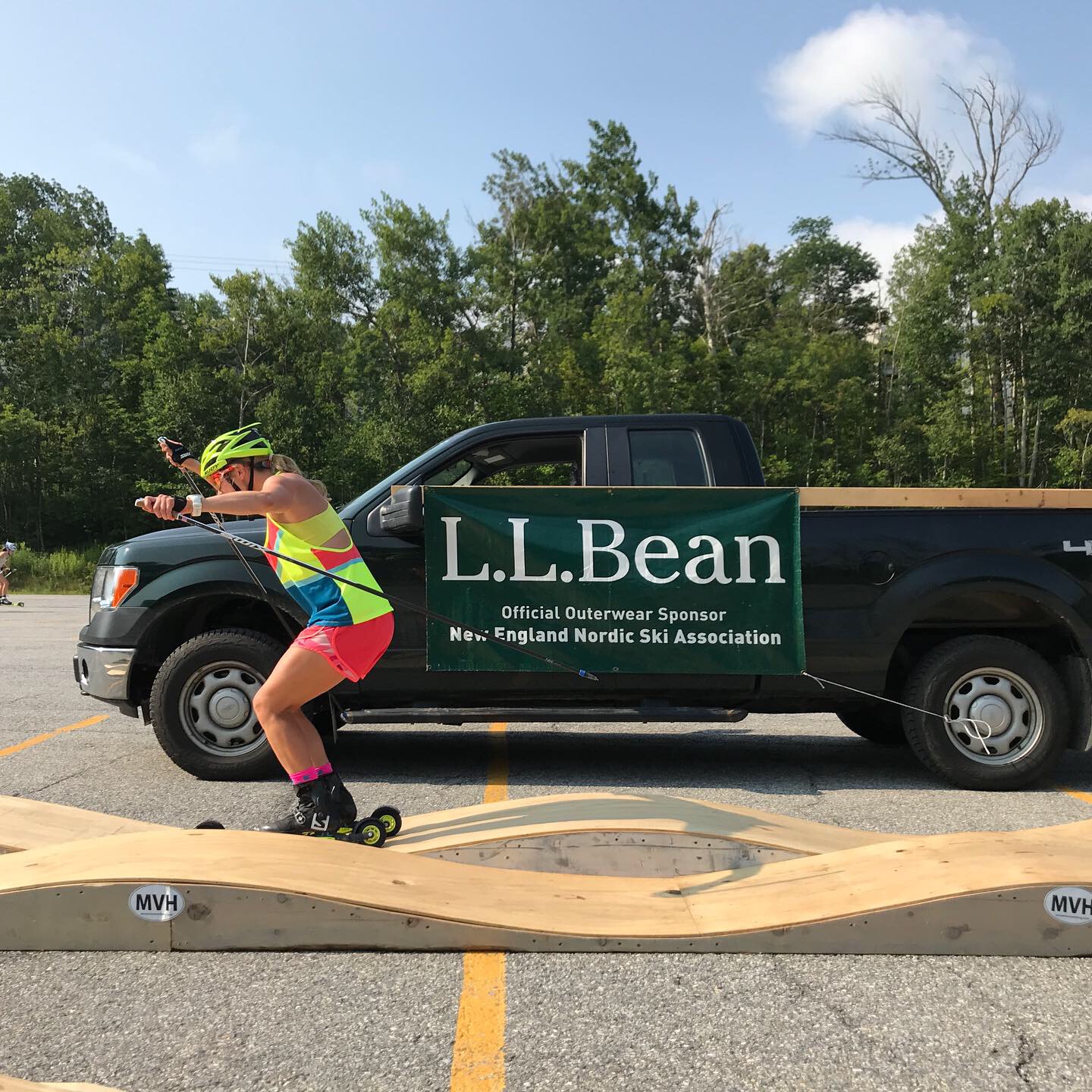
Jessie Diggins takes a first crack at NENSA’s rollerski ramps, which will be featured in the sprint qualifier and rounds in Lake Placid this weekend. (Courtesy photo)
On the heels of our coverage of the Martin Fourcade Nordic Festival and the Alliansloppet Action Week, we turn our attention to the Northeast where the burgeoning New England Nordic Ski Association (NENSA) rollerski race series is well underway. The next round of racing will take place this upcoming weekend, starting with a freestyle sprint event dubbed “The Keys to the Castle” on September 18th at Mt. Van Hoevenberg in Lake Placid, NY, followed by a freestyle distance race the on the rollerski track in Jericho, VT the next day. Men and women will each race 15-kilometers in the open division, while juniors will have the option to race 5k.
For those interested in seeing the show, in-person spectating is encouraged at the Lake Placid stage, however, as the ski track in Jericho is at a Vermont National Guard base, names must be submitted for entry prior to the event. Events will also be live-streamed on the NENSA Facebook Page, and live timing will be available through Bullitt Timing. Updated COVID considerations for participants and community members can be found here.
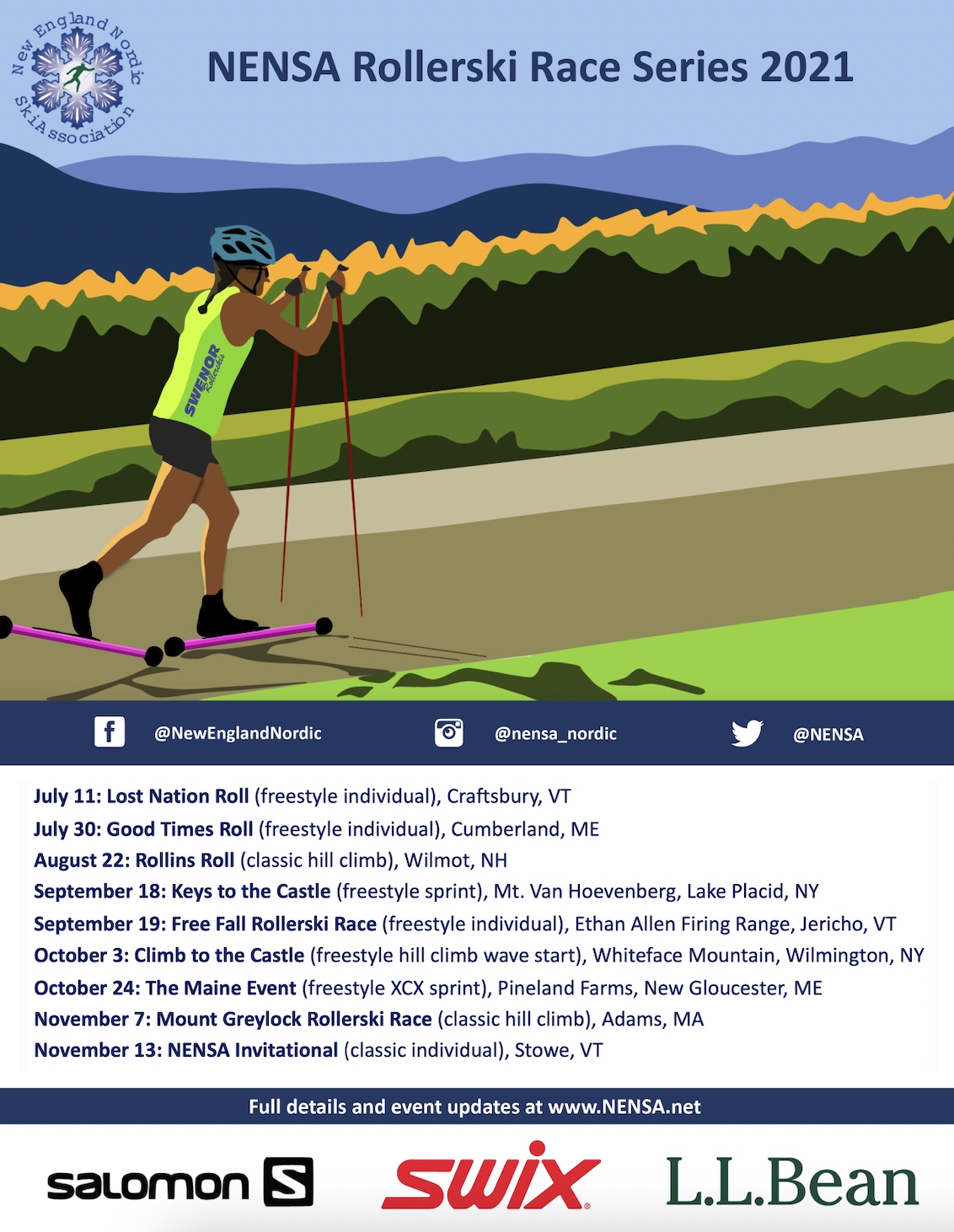
Building from past years, the series features nine events beginning with the Lost Nation Roll in Craftsbury, VT in July and ending in mid-November with the NENSA Invitational in Stowe. Captaining the ship and still rocking the mullet-mustache combo is competitive programs director Justin Beckwith, with whom FasterSkier connected in mid-August to learn more about this year’s widened scope of event offerings, supporting a thriving culture of skiing in the region, and whether the dream of a New York City rollerski event is still alive.
Beckwith explained in the call that one of NENSA’s objectives as the rollerski series evolves is to reach more athletes and to make opportunities for rollerski racing more accessible. Given the high density of cross country skiers and high level clubs in Vermont, the well-attended and highly competitive App Gap Challenge, and the designated rollerski tracks in Craftsbury and Jericho, past events have primarily taken place in that state. However, these venues can be quite a drive for skiers living in Western Massachusetts, New Hampshire, or Maine.
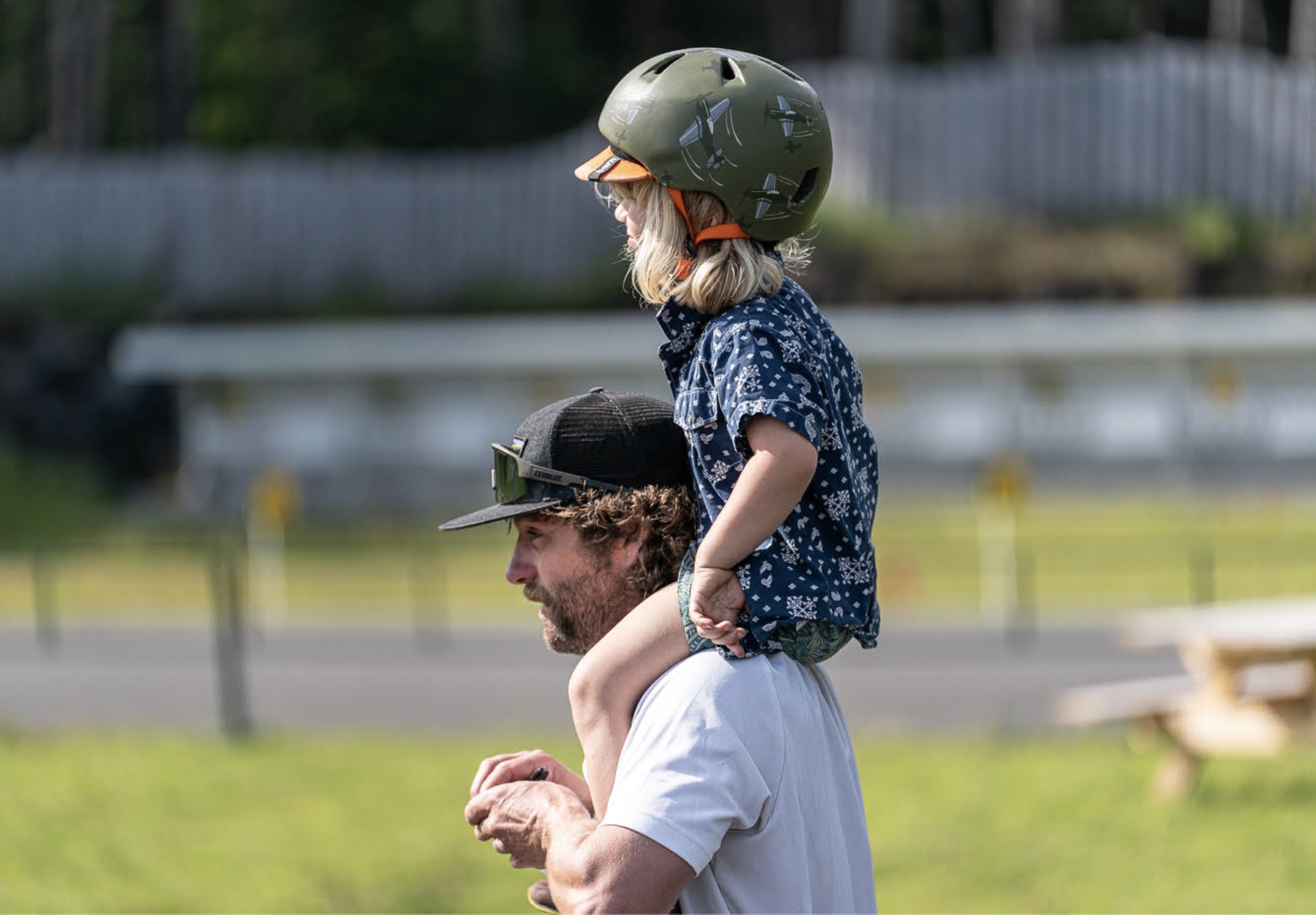
NENSA Competitive Programs Director and rollerski race series organizer Justin Beckwith with his son, Red, at an event in Craftsbury. (NENSA photo)
One of the first steps to expanding opportunity in the region? Outreach. Rather than bringing more people to Vermont, bringing the races to the people.
“One of the primary goals was to try and bring our programming across the entire Eastern region,” Beckwith said. “So we’ve done a race in Southern Maine, which Clare Egan so eloquently said at awards that she doesn’t think anyone’s had a rollerski race in Southern Maine before. And just this weekend, we’re going over to New Hampshire. It will be the first event we’ve done in New Hampshire on rollerskis. So that’s really cool.”
The first event he mentioned — the Good Times Roll in Cumberland, ME in collaboration with NonStop Nordic — featured a 4.3k freestyle race for Middle School and beginners, and a 7.5k open race on a closed roadway. The start and an agility course took place inside the Cumberland Fairgrounds. The second stage, The Rollins Roll in Warren, NH, led classic skiers up the Mt Kearsarge auto road, which was closed during the event. Bringing together the community, both events saw participants from the junior level through the 50+ age bracket.
In the Lost Nation Roll, which was co-hosted with the Craftsbury Outdoor Center, youth skiers had the opportunity to race the same course as elite athletes from the Craftsbury Green Racing Project (GRP) whom they admire. Likewise, the GRP athletes had the opportunity to ski their home track with outside stimulation. This event was followed by a learn-to-rollerski clinic and a free biathlon clinic to bring in additional members of the community who were not up for racing or wanted to learn more about shooting.
Now, midway through the series, the events are catered more toward the top juniors and seniors in the region, though some are still open to all levels. Beckwith explained that NENSA was “lucky” to have such a high density of top skiers in the area, including regional high-performance junior clubs, elite teams like SMS T2 and the Craftsbury Green Racing Project, and EISA collegiate teams including Dartmouth College and the University of Vermont.
“We’ve had pretty good success incorporating at least the college programs that are within striking distance — driving time — and who can participate in the races that sort of start in September, October and then in the November.”
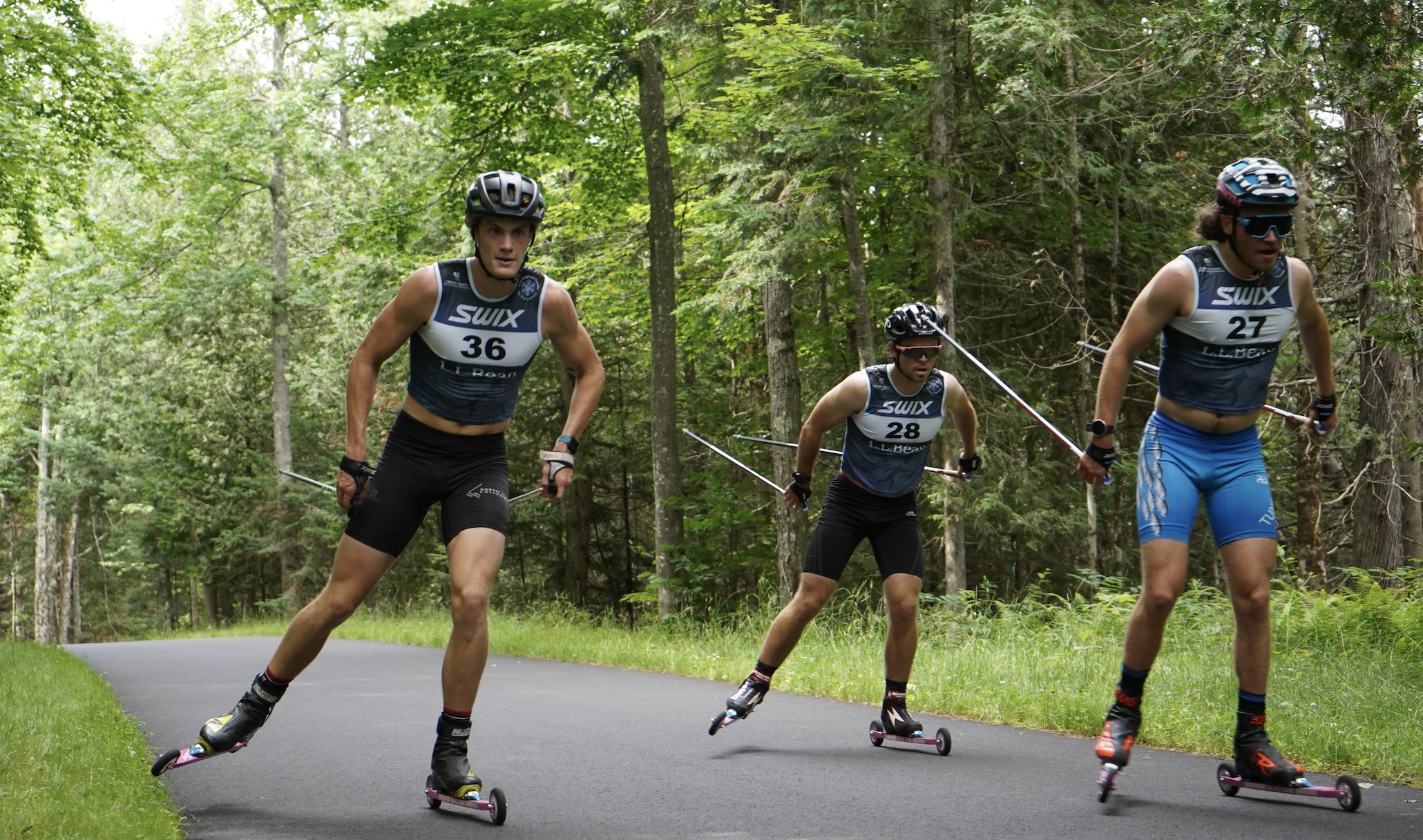
From left to right, Greg Burt, Raleigh Goessling, and Luke Brown go head-to-head during the 2021 Lost Nation Roll in Craftsbury, VT. (Courtesy photo)
In addition to new venues, the series is also incorporating a more diverse array of events, including sprint stages. Beckwith explained that the first round of sprint rollerski racing took place at the Eastern REG camp in early July in Lake Placid.
“At Mt Van Hoevenberg — that was really our first sprint course. It was actually our first sprint event that we’ve done in total since Junior Nationals 2020. But it was also the first heat format we’ve ever done in rollerskiing. And it’s an excellent venue for it. I think you can’t make a track wide enough [for rollerski sprints], so we actually pared down [the heats]. And I think the event we’ll do on September 18th… we’ll probably be running heats of four again in that. So it’s a little different than a winter format just because of the track width. But yeah, it’s exciting.” (Beckwith added that long-term, a wider track is something NENSA hopes to develop.)
More specifically, the events will still feature the typical structure of qualification followed by three progressive rounds, only modified to four skiers per section. Lucky losers will be incorporated based on time, as Bullitt Timing is providing a FIS level timing system. Juniors will compete in a mixed gender “Kings Court”-style sprint in order to ski more rounds, gaining more tactical experience.
The events this weekend will include athletes from the Sun Valley Gold Team, the Bridger Ski Foundation Pro Team, and SMST2. (The Craftsbury squad is currently in Germany training in the ski tunnel in Oberhof.) Because the number of athletes on course is limited, these events will have a bit more “vetting of the competition” — i.e., being current U.S. Ski & Snowboard members and holding a current FIS license. However, recreational skiers still have the opportunity to test their mettle at Climb to the Castle in Lake Placid on October 3rd or the Mount Greylock Rollerski Race on November 7th in Adams, MA. Both are uphill classic challenges.
“We created a permitted opportunity to ski up a closed State Park Road. So why not? Even if you’re not racing, go try it out, right?”
NENSA athlete Evelyn Walton on course in Lake Placid during the Eastern REG camp. (Courtesy photo)
Before the pandemic, the series averaged roughly 100 participants in each stage across all ability levels. While numbers have been lower in 2021 thus far, a summer series still remains a valuable touch point to keep the ski community engaged until the snow flies.
“A lot of these races this year, the focus is kind of building — not just out of COVID and building back into events, but into thinking about how we can better support the community and create opportunities. That’s our mission statement: to support a vibrant ski culture.”
To bring in people from all aspects of the community, NENSA is partnering with ORDA — Olympic Regional Development Authority — to organize an Eastern Coaches Symposium and a TD training opportunity in concert with the Climb to the Castle on October 3rd. Climb to the Castle is co-hosted with NYSEF, the New York Ski Education Foundation.
While this race up the Whiteface Toll Road in Lake Placid has plenty of history, it is also quite a grueling and climbing 2,300 feet in five miles is not universally accessible. Beckwith explained that they’ve considered a shorter distance where beginner or youth skiers could start further up the road to make it more manageable, or perhaps supporting a fleet of fast or “juiced” wheels to reduce the load.
Speaking to the concept of growing and sustaining the nordic community across all ages through the rollerski series, Beckwith recalled a conversation with longtime Sun Valley Ski Education Foundation coach Rick Kapala, who had contacted Beckwith to learn more about putting on the series in hopes of putting on similar events out West.
“The idea I think Rick hit on the head is just that you’re creating excitement, to keep the kids engaged, right? And adults — all of it keeps skiers engaged throughout the year, and I think that’s really the goal. There’s no qualification [to enter]. In the past, we’ve built prize money in and I think we’re gonna be building prize money into a few of those bigger events I was telling you about in the coming days, but that’s just fun to roll that out as it comes… So really the most enjoyable piece of it and the broader scope is that we’re bringing together people from different communities, regions, abilities, all of that.”
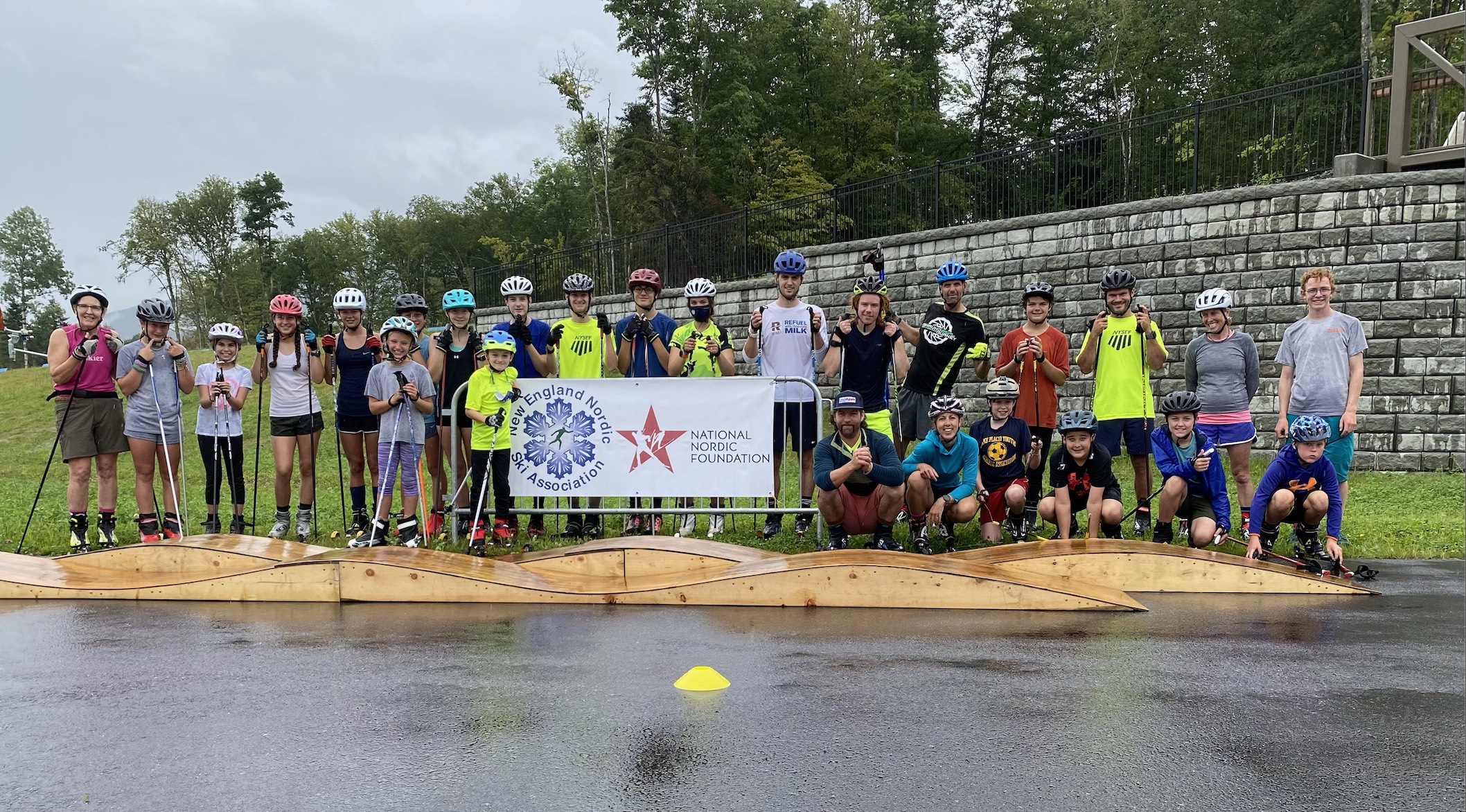
A host of rollerskiers get together after a NENSA event. (Courtesy photo)
He explained that NENSA’s team will similarly highlight regional popular racing opportunities during the winter.
“We’re really gonna highlight those races, popular racing opportunities, and also let people know that we feel like those are great developmental opportunities. Versus, we’ve been maybe a little Eastern Cup and Junior National qualifying centric in the past. So we’re really trying to support those, you know, it’s inclusive, but more so than that, creating festive opportunities that are available regionally. And the level of competition will be at those events regardless, because there’s really good skiers throughout the region, and they’re already utilizing those events.
“We know people will go to sanctioned events in winter and summer, try to qualify for JN’s, but how can we create opportunities beyond that? If we can bring it to people’s backyard communities, so to speak, or within that sweet spot of an hour or two from their doorstep, then hopefully, we just get more people involved and excited throughout the year.”
Green Racing Project members Susan Dunklee (left) and Caitlin Patterson (right) take on NENSA’s rollerski ramps at the opening event in Craftsbury, VT. (Courtesy photo)
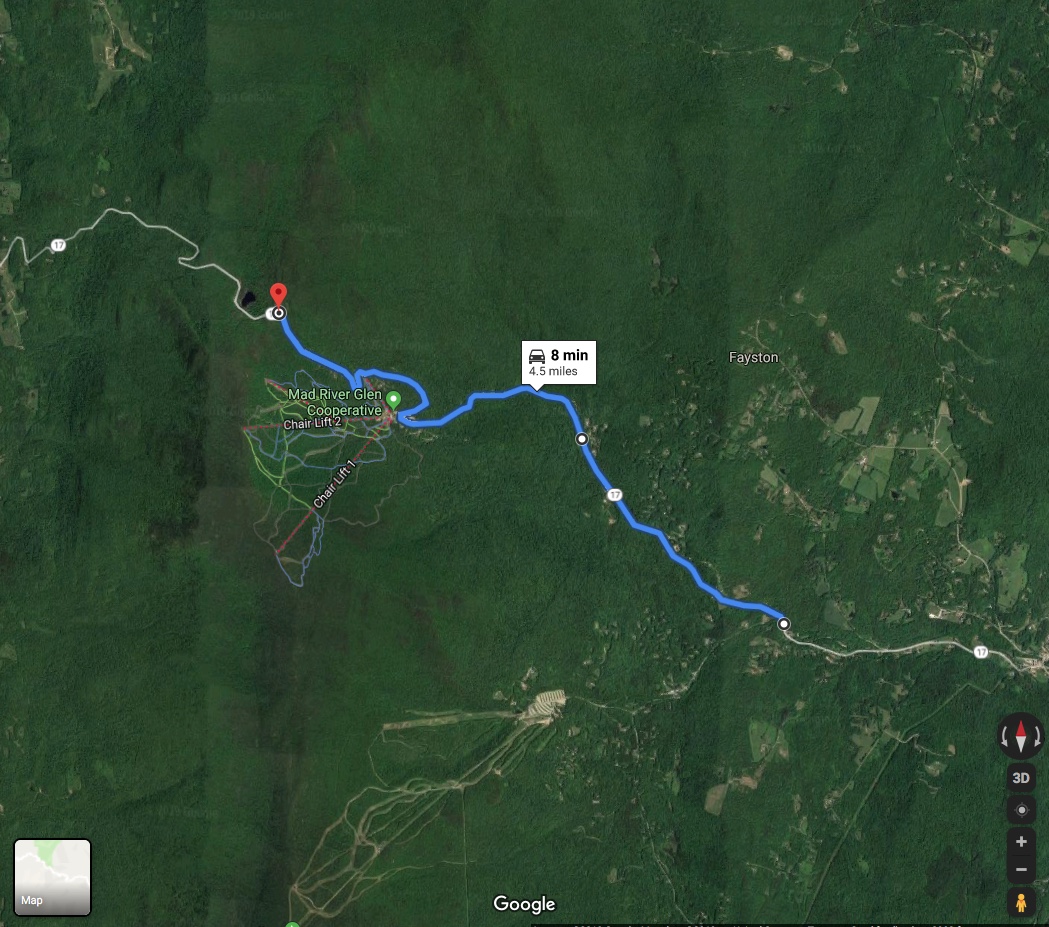
FasterSkier spoke with Beckwith about the nascent series in 2019 shortly after the App Gap Challenge, a skate-to-classic skiathlon that led skiers up a mountain pass on a closed State Highway near Fayson, VT. (The App Gap took a hiatus in 2021 due to construction on the road.) When considering what it took to pull off an event of that magnitude, Beckwith said: “The beauty of a rollerski series is that nobody has any expectations or guideline of how we do this.”
He also said that he envisioned an event closer to the scale of the many summer rollerski festivals in Europe, perhaps in New York City or Boston. While this may seem like a pipe dream, with Beckwith behind the wheel, the idea came closer to fruition than one might have thought.
“Let’s say we were seriously exploring a race in Central Park this fall as part of the series early on. And I think it’s very possible for 2022 — it takes time to do that. But we’re close, we’ve got our foot in the door. People know who we are. And we have developed some key contacts that came up down there, which is exciting.”
NENSA also grew its staff this year to make organizing larger events more sustainable, adding an Event Support position filled by Fred Bailey.
“It definitely takes a team to pull this off,” Beckwith stated.
NENSA will be offering a youth clinic in Boston in collaboration with two other organizations whose goals also include getting kids outside on skis and supporting equity and inclusion in the cross country ski community. Like other clinics NENSA has run this summer, this clinic will introduce current ski program participants and potential future participants to rollerskiing for the first time with a focus on having fun, broadening exposure to different aspects of the sport, and encouraging an active and healthy lifestyle. Beckwith identifies that added exposure in populated areas may also help NENSA create larger highlighted events in the future.
“But there’s twofold to that. Because if we’re getting into urban areas, metro areas, whatever, then the visibility grows.”
With better understanding of the concept, urban venues might be more open to hosting. Beckwith explained that NYC stands at the top in terms of ideal venues. As so many events from 2020 were postponed into 2021 due to the pandemic, permitting became very challenging, which impeded the feasibility of running an event there in 2021.
NENSA athletes Jack Young and Jack Lange compete in the sprint event during the Eastern REG camp in Lake Placid. (Courtesy photo)
“One other issue beside the permit was just that it’s an Olympic year, and the availability and openness of National Team athletes [may be less than non-Championship years]. If we pull off a race in New York City, we’re talking about a budget at a minimum of 10 to 30 grand, so if we’re going to do that we want to have [high caliber athletes racing to] capitalize on it.”
While it may be nearly 300 miles north of Central Park, Jessie Diggins is confirmed to be competing this weekend in Lake Placid. Given the caliber of the elite training groups participating, it’s clear that the level of competition is high and the racing will be spicy.To add to the excitement, qualifier and rounds will feature a 24 foot bicycle ramp directly out of the start.
The NENSA rollerski series is now in its fourth year. If it wasn’t already abundantly clear how dedicated Beckwith is, he became emotional when reflecting on what he is proud of.
“Oh, geez, what am I proud of. We lost, you know, a year of in-person rollerski races with COVID. So that was a real doozy because we had Craftsbury coming online with a roller ski track, we had Van Hoevenberg coming online with a roller ski track, we were really excited to build into that. And then you know, the wheels fell off the bus from the outside — that wasn’t anything that we did. We created some really great regional events, as much as you can in a safe manner. But they were quite engaging challenges, and we saw literally worldwide participation in virtual events.”
Adapting to the times, Beckwith also pulled off running the 2020 App Gap challenge over the course of a week where athletes from the same club could race on matched skis in a designated window. Breaking these groups down further into waves of 15 made it such that there were never more than 30 people in the area at a time.
“So that kept us together a little bit… This year, it’s definitely a big step to re-engage after having a year where you didn’t. If you host an event, at the end of the day, you’re talking about what you’re going to do better the next year to build on it, and that’s just tricky with everything that we had coming down the pike. So I’m just really excited about where we are right now. We’re gonna have more rollerski races than we’ve ever had. I think that we’re gonna have the most competitive races we’ve ever had. It was pretty hard to top the women’s field in that Lost Nation Roll last year. I think it was about a 33 FIS point race or something like that — in no small part because Jesse [Diggins] was there.”
He acknowledged that there were plenty of other strong athletes there also — women and men — but that this weekend’s races will be a step higher.
“I think the big success of this year is going to be just that we’ll have more participation overall. Partly because we have more events — well attended events — but that we’re reaching many more skiers by taking the show to them basically. That’s probably going to be the biggest takeaway win for this year.”
Beckwith also thanked the associate sponsors of the series: Swix, L.L. Bean, and Salomon. Apart from direct funding, he noted that Salomon sharing a video clip of one of Beckwith’s signature agility courses helped it see over 80,000 views internationally.
“We also have a really amazing partnership with Enjoy Winter, and Swenor rollerskis, which has really been a part of the series from the beginning and what makes it work for us. So that’s a really important piece to a partnership. Worthy of mentioning are the great people like, I’m teared up now, but Marty Hall, Joe Lamb. They’re just really supportive. So that’s incredible.”
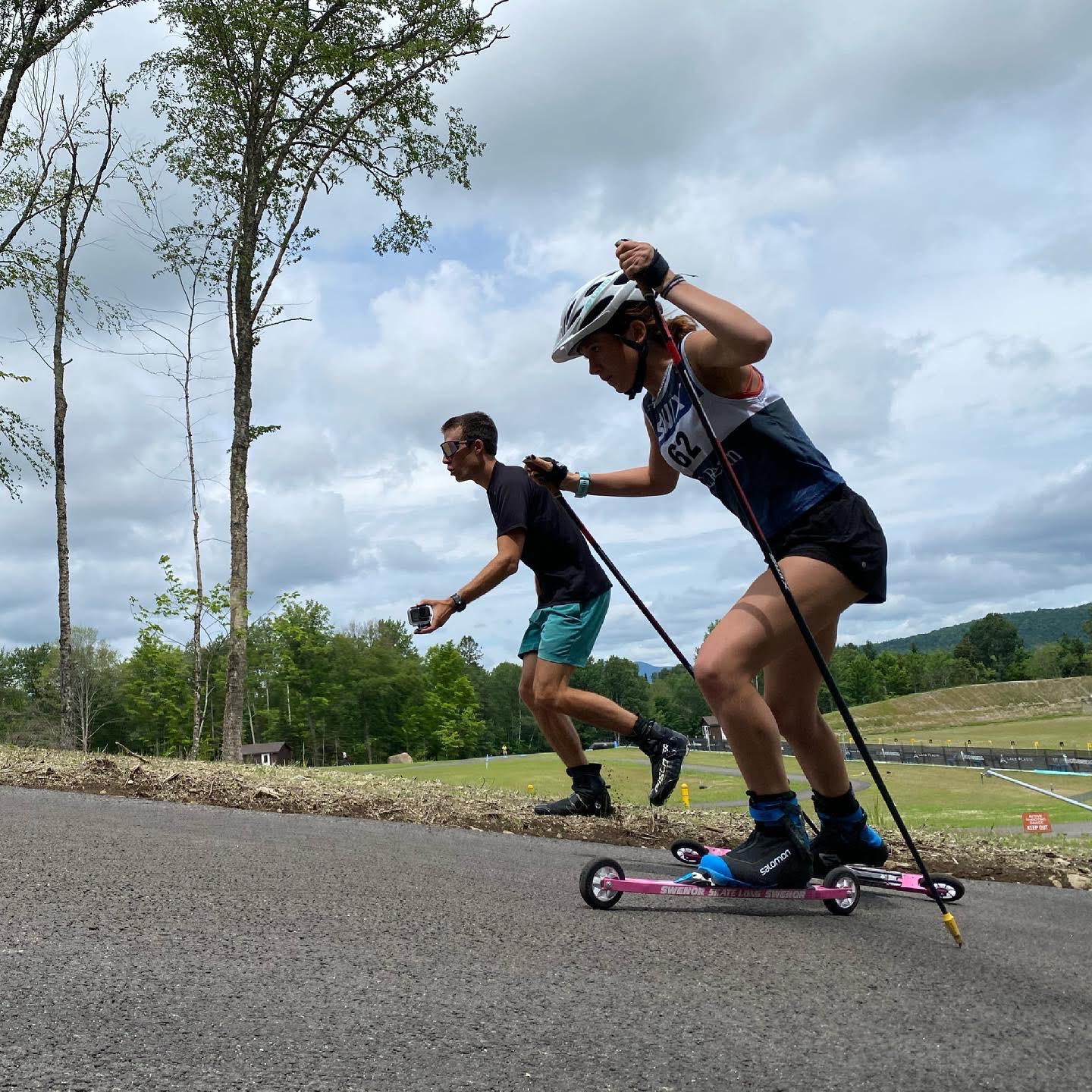
Hattie Barker attacks a climb with Mansfield Nordic coach Adam Terko collecting video. (Courtesy photo)
The letter opens with a strong message: “In this time of unparalleled social change and reflection, we request that this Committee take an important step forward for equity and inclusion by creating domestic race schedules that offer equal race distances for women and men.” Letter signatories include several head NCAA coaches like Becky Woods of Bates and Tracy Cotes of Colby, as well as U.S. legend Bill Koch, and current World Cup overall winner Jessie Diggins.
Head Cross-Country Ski Coach at St. Michael’s. (Photo: St. Michael’s)
In speaking with Peters, she emphasizes the desire to equalize the race experience.
“We used to hear that we’re trying to equalize the time on course and we want people to have the same race experience – which is based around time,” said Peters. “The current model of racing, where women generally race 5 k less than men, offers completely different race experiences for men and women. When you look at the data we provide in the letter, race times get closer when you analyze the longer distances. In those longer distances, race times are much closer when men and women are doing the same distance, not women racing 5 k shorter.”
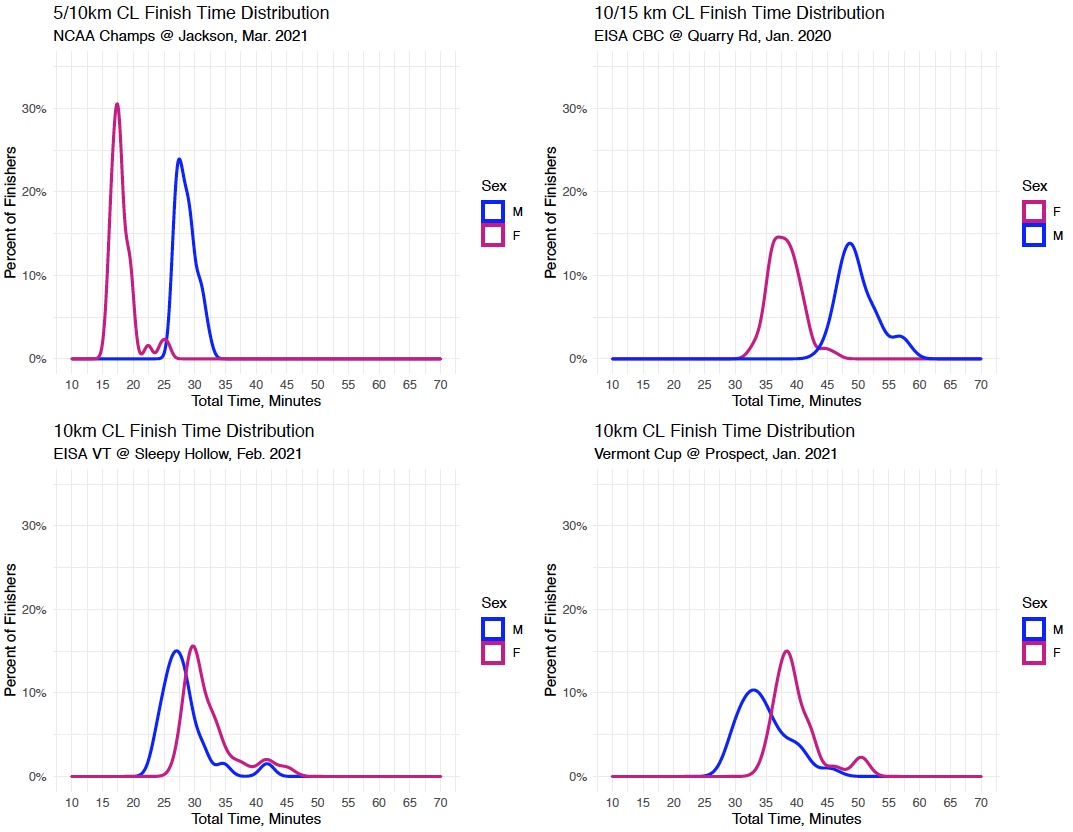
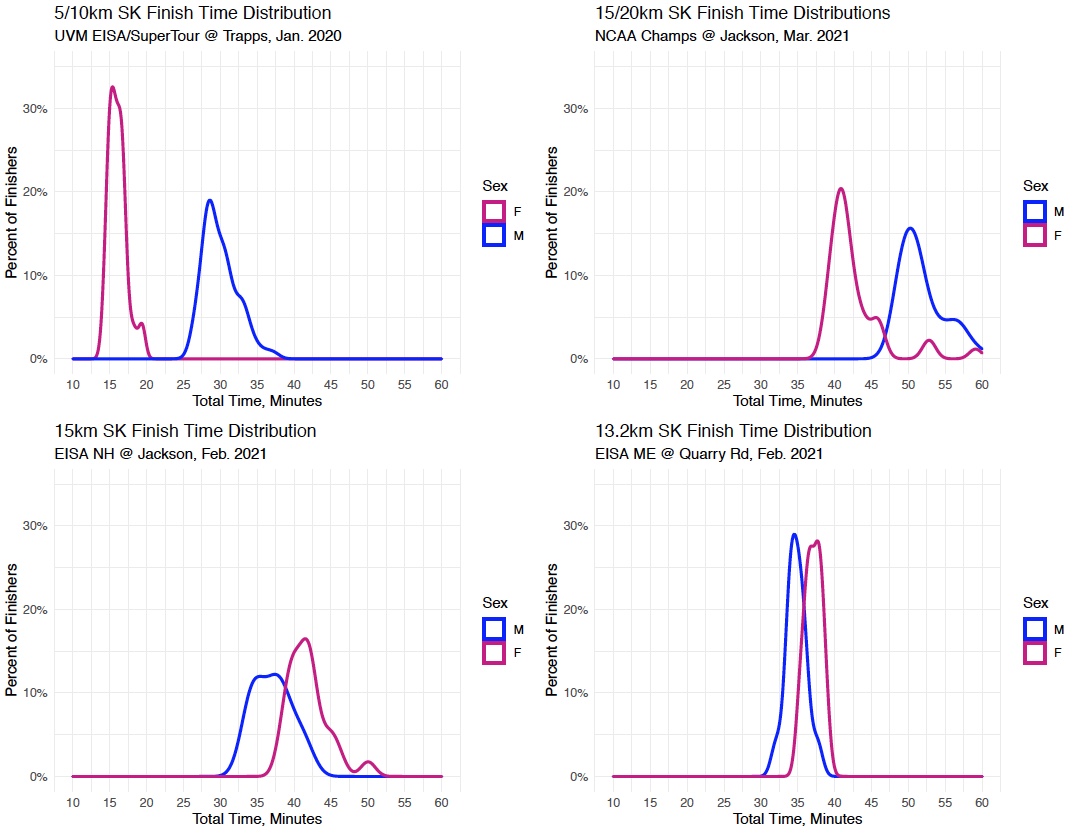
The data provided to The Ski Equal Team by Lily Koffman, a Harvard biostatistician and former collegiate skier, tells a simple story. Of the four classic races analyzed by Koffman, finish times were more similar when men and women both raced 10 k rather than 5 k and 10 k respectively, or 10 k and 15 k, respectively.
The same trend holds for the skate racing data. The finish times for men and women overlapped more when both genders raced the same distance. In this case, equal distance skate races of 15 k and 13.2 k, respectively. Conversely, skate race data show little overlap in times comparing unequal race distances. What appears to hold true is that if stakeholders want roughly equal time racing for men and women, at least according to this sample, all skiers should race longer distances and of equal length.
“The difference in time on course for men and women competing in separate distance races show a significant gap and virtually no overlap of time,” asserts the Ski Equal Team letter to U.S. Ski & Snowboard. “By contrast, equal distance races show a significant overlap in finish times and consequently a similar race experience for the men’s and women’s fields. This is not an isolated example – we see similar patterns in other collegiate and junior races. There is no compelling reason to require women and men at any level to race different distances.”
“By providing equality of opportunity in sport, the Nordic ski community will prepare women to expect equality of opportunity in areas beyond sport, such as employment and compensation,” reads the Ski Equal Team letter.
The equal distance initiative has set its eyes on the NCAA ski championships too. The Ski Equal Team’s proposal to the NCAA’s Ski Committee includes several scenarios including sprints, mass starts, and individual start races — all equal distance.
Below are the potential formats proposed by the Ski Equal Team:
o Year 1 – 5k & 20k mass; Year 2 – 10k & 15k mass
o Year 1 – Sprint & 10k; Year 2 – 5k & 15k
o Year 1 – Sprint & 20k; Year 2 – 10k & 15k
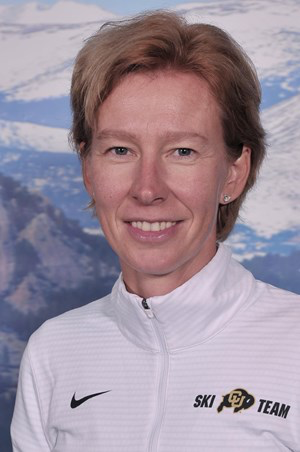
CU Head Cross-Country Coach Jana Weinberger. (Photo: CU)
University of Colorado Head Nordic Coach Jana Weinberger expressed she does not have strong feelings about the equal distance debate. Weinberger raced at CU as a student-athlete and has coached at the school for many years. “When I was a competitive athlete, I was happy women skied shorter distances, and it never crossed my mind that we should, or that I wanted to, ski the same distance. I was solely focused on competing against the women I raced, as opposed to racing the same distance as men. I never felt that racing a shorter distance was a sexist decision.”
According to Weinberger, many of her female athletes are focused on performing their best at the predetermined distances, which in this case are 5 k shorter than the men’s distance. “Additionally, I had this discussion with many of the women on my team in the past, and the strong majority did not want to race the men’s distances,” Weinberger added. “For them, it was not a matter of; I can’t race that far, or, the men race farther because they are stronger, but more from the standpoint that I like racing the distances we currently have and am focused on racing women.”
Weinberger also has the distinction of serving on the NCAA’s Ski Committee. One glaring absence from collegiate racing, well represented at seemingly all other levels of cross-country ski racing, are sprints. The CU coach said she considers adding sprints to the NCAA Championship calendar a more important short-term goal.
“As a member of the NCAA committee, I feel it is more important to add a sprint race to the Championship weekend than to spend our time and resources in having equal distances for men and women,” wrote Weinberger.
A 2016 FasterSkier article featuring the different distances raced at the NCAA level for men and women reflected an antiquated notion, or myth, regarding a woman’s ability to endure. Former ski racer Annie Pokorny, quoted in that piece, said, “that conception turned into tradition, one that still thrives today in the form of shortened distances for female endurance athletes.”
During this inflection point in history when equity and inclusion have become keystones for many evolving institutions, modifying race distances by making them equal in length, has gained traction.
There is talk of equal distance racing for next season. With the racing calendars at the national level to be formalized at the upcoming U.S. Ski & Snowboard Congress from May 17-21, the topic of equal distance racing is expected to be discussed. On a regional level, Justin Beckwith, the Competitive Program Director for NENSA, expects some experimentation with equal distance formats to take place next year.
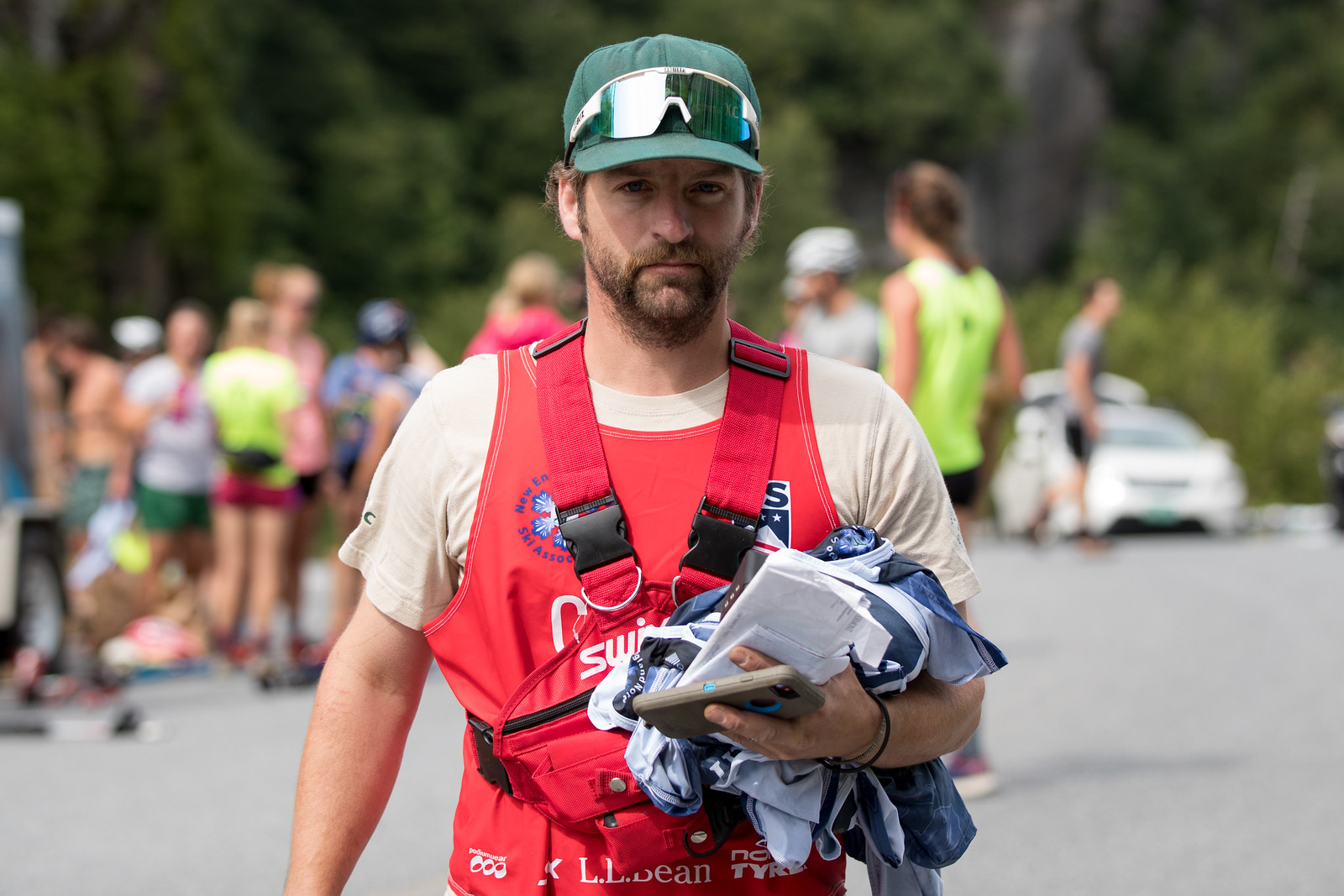
NENSA Competitive Programs Director Justin Beckwith.
“The underlying sentiment from most parties is that decisions of race distances should be made on the basis of development/speed development,” Beckwith emailed. “There are complicating factors in all of these discussions, like NCAA, Junior World Ski Championships and World Cup distances — those training for these specific events feel compelled to do just that.”
Those examples of unequal distance racing cited by Beckwith remain for the time being. It’s true, women race shorter distances than men in the distance events at Junior Worlds, U23 Worlds, Senior World Championships, Olympics, and the World Cup. That might be another debate altogether: is cross-country ski racing a means to train up the pin-prick of light at the sharp end of the pipeline, and prepare those athletes for specific distance races, like a 5 k for women and 10 k for men? Or should it function as a completely different competitive enterprise?
This strange ski racing season, Beckwith explained, allowed for some experimentation with organizing events where equal distance racing came into play.
“Through our pandemic 2021 season we had some latitude to try equal distance in a few more events than we normally would — it seemed to be well received minus some feedback from college athletes,” said Beckwith. “As we are planning for 2022 we are looking at the opportunity to shake up distances to make exciting events for competitors, venues, and spectators alike. Specifically, if Eastern SuperTours are approved for Period 3 we have a proposal that would have not just equal distances, but also unique formats.”
Back at St. Michael’s College in Vermont, Peters knows change starts somewhere. The two most common approaches are from the top down, or at the more local level, from the bottom up. Peters’ family owns and operates Vermont’s Sleepy Hollow Nordic Center. Peters has helped develop a statement called the Sleepy Hollow Ski Equal Pledge. If you are racing at Sleepy Hollow, everyone races the same distance.
It might make sense before you grind out training for specific distances to check out the set-in-stone race schedules, when they become available, and plan accordingly. They might just be equal.
For skiers and race organizers, remaining nimble and realistic are keystone 2020 attributes as the global pandemic commands our attention. Amidst the disruption, the New England Nordic Ski Association (NENSA) remains committed to organizing races for the 2020-2021 season. Justin Beckwith, Competitive Program Director at NENSA, said the aim is clear during uncertain times: under-promise and over-deliver.
An older photo of NENSA athletes competing at the 2011 Eastern High School Championships in Rumford, Maine. This season will have a decidedly different look. (Photo courtesy Janice Sibilia.)
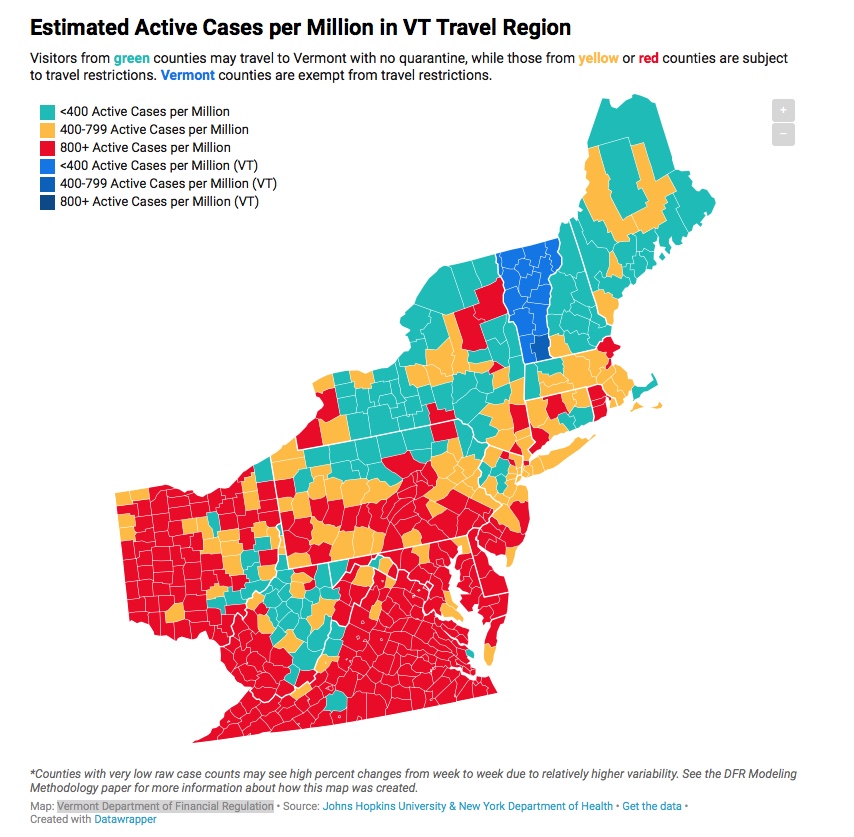
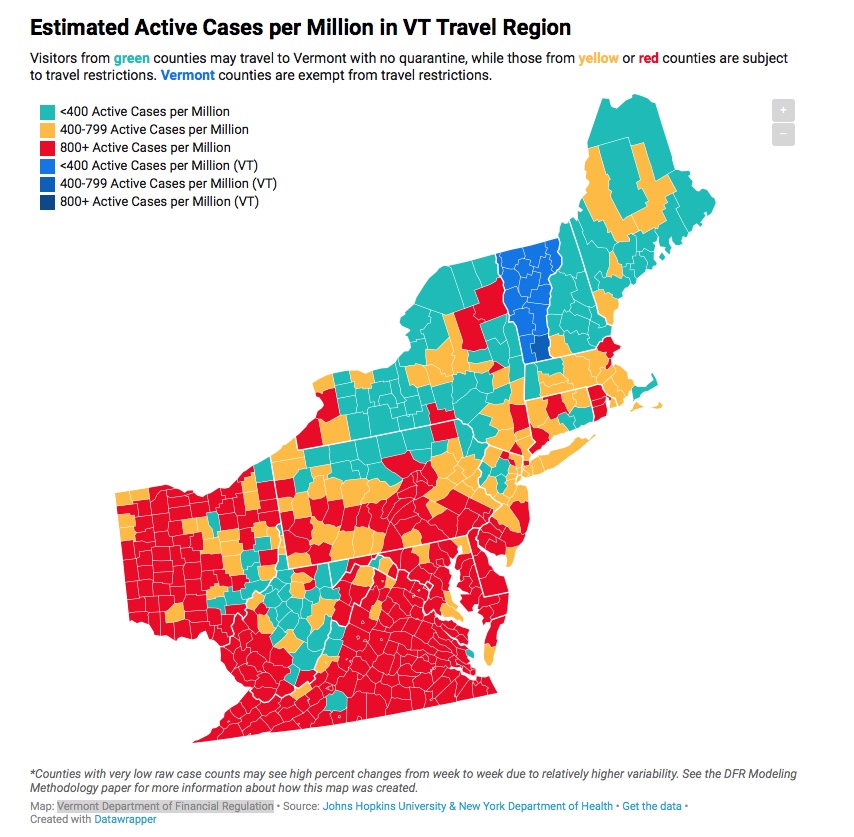
As a case study, New England poses several challenges. Geographically several states with differing Covid-19 mandates share borders or are within relatively close proximity to one another. In this piece, we’ll use Vermont as our Covid-19 focal point. Vermont’s Agency for Commerce and Community Development has posted criteria for those traveling from out of state along with a map to make travel decisions easier.
On the color-coded map depicting both state and county borders, it’s easy to determine who can travel to Vermont seamlessly with zero quarantine requirements. (There are no travel restrictions within Vermont.)
Hypothetically, using the current data, if you are a ski racer from a New England county and your county has between 400-799 active cases per million or greater, you are likely looking at a 14-day quarantine when entering Vermont, “or a 7-day quarantine followed by a negative test in [your] home state and enter Vermont without further quarantine restrictions.”
Currently, much of Massachusetts falls in the 400-799 active caseload category, as do several counties in Maine and a single New Hampshire county.
This all gets tricky for those crossing state borders to race.
Compounding the complexity, each state has unique caps on maximum group sizes for outdoor events. In Vermont, a state with favorable Covid-19 metrics relative to the nation as a whole, “outdoor organized events” are limited to 150 people. Skiers, coaches, spectators, volunteers, and officials — they add up quickly. The aim is to minimize the total number of individuals on-site for a race. That, said Beckwith, requires rolling race start times and the ability for racers to arrive promptly and leave the venue quickly post-race.
NENSA Competitive Programs Director Justin Beckwith at NENSA’s 2018 App Gap Challenge rollerski race, up the Appalachian Gap in Fayston, Vt.
“We are trying to really promote the local races, so we are saying stay home, try a popular race so to speak, that is a good step for a high school kid versus going to an Eastern Cup during a year where we would rather have slightly reduced field sizes to make it easier to pull events off,” said Beckwith. “Once you get to 100 competitors, that is pretty close with volunteers and coaches, if not over, to the cap here in Vermont.”.
Here’s our closer look at NENSA’s plan and how it may over-deliver. Regional will be the operative word as NENSA is encouraging skiers to minimize out-of-state travel.
“We are starting with the language of advising people to race within their region. Vermonters could go to the two Eastern Cups in Vermont, maybe they slide over to the one in Dublin, New Hampshire because it is not that far away,” Beckwith said. “Kids from Maine would do the Eastern Cup in Maine, they could slide over to New Hampshire and do those.”
On NENSA’s website, they have a dedicated page for COVID-19 considerations. There, interested racers can find specific contingencies for Eastern Cups, Eastern High School and U16 Championships, Women’s Day, the BKL Festival, and popular racing. Across the board, all NENSA races will be individual start (no mass start or sprint heats for the 2020-2021 season).
With the Eastern Cups arguably the most complex, we’ll focus on those contingencies. The streamlining and social distancing begins on October 1, when NENSA will open their portal for purchasing a bib and timing chip. The bib and timing chip remains with the skier for the season. Beckwith said NENSA plans for “touchless registration and timing” and no day of race registration.
Plan 1:
All races will be individual start with start times organized by age group.
On the Wednesday before the race, all athletes, coaches, athlete relatives attending the race, volunteers, timers, and staff must complete an on-line NENSA Event Health Screening Tool. This includes a temperature check.
Limited spectators will be allowed at the venue with the possibility of no movement beyond their personal vehicles.
No on-site indoor waxing will be available.
Likely limited coach access to the course.
Bathrooms will be assigned by state.
All present at the race site must wear a “face covering and cover their mouth and nose at all times. Athletes/coaches must cover their nose and mouth in the start and finish area and if they are within 6 ft of another individual on course.”
Plan 2:
Essentially, Plan 2 calls for eastern Cups to be moved to February or early March.
Plan3:
“Regional races within states in New England – states determine “Championship” Teams.
Plan 4:
This plan, the last on the list, appears to be a fall back in which even a semi-large gathering of people is untenable.
Races will be run over the course of nine days. Racers sign up for a start time and complete their race. NENSA makes clear in Plan 4 that during hours when racers will be present, NENSA timers and race marshals will officiate.
Beckwith added that no Eastern Cup races have been calendared with U.S. Ski & Snowboard, however, a schedule of events can be found on the NENSA site.
The most critical piece, reiterated numerous times by Beckwith, was safety. That tenant is front and center on the NENSA website: “Our first objective is to ensure the health of our community in New England,” reads the language.
“You have to think about this in the context of staying healthy and allowing everybody to participate,” Beckwith said. “Trying to deliver a little lower level event and do a really good job versus ‘oh yeah this is business as usual.’ We are probably going to have people go to all the races. I do not think we are going to prohibit that. But we might, for instance, format the Junior National criteria in a way so people feel like they don’t have to go to every race. It is again going to come down to education and messaging.”
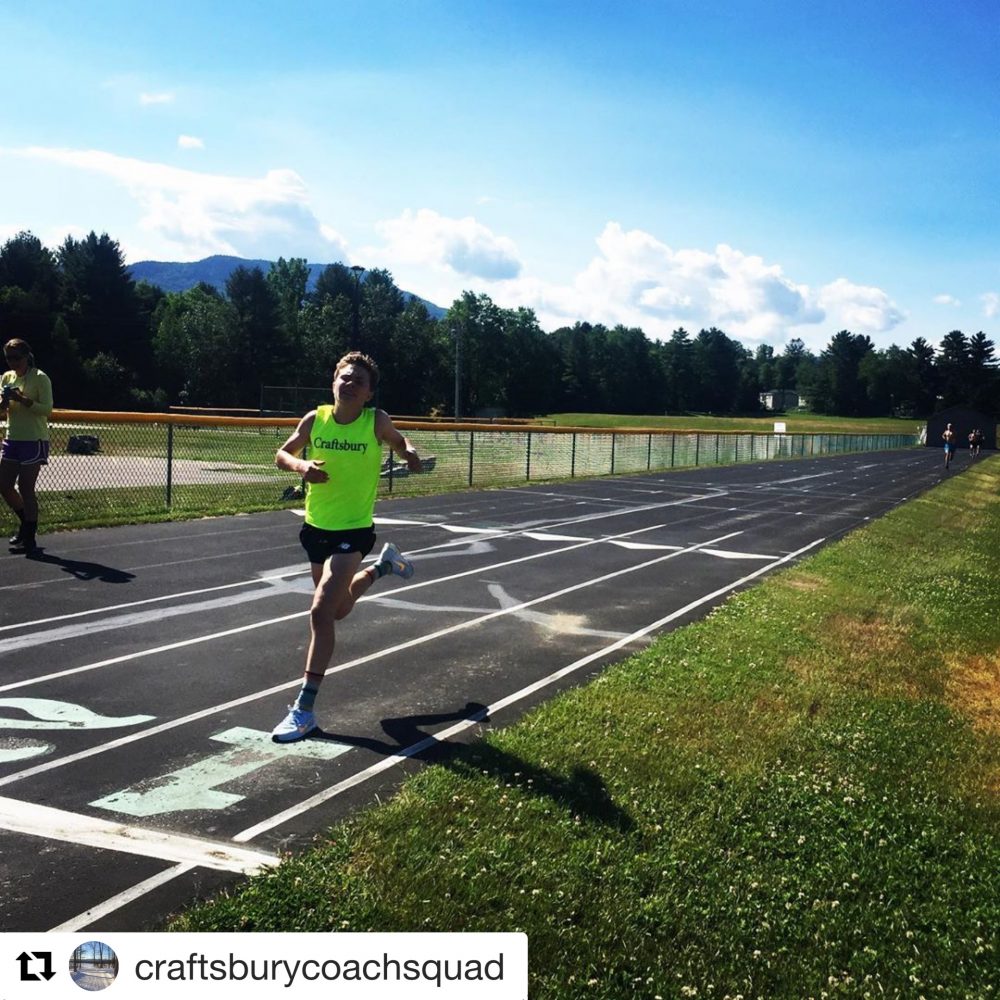
Cormac Leahy of Craftsbury finishes his 3000 m time trial. (Photo: @craftsburycoachsquad)
Skiers are made in the summer, and one of the hallmarks of summer training is periodic training camps. But as with racing, the coronavirus pandemic has upended summer group training.
In April, the New England Nordic Ski Association (NENSA) opted to turn their June regional elite group (REG) training camp into a virtual event. Part of the US Ski and Snowboard development program, REGs have a standardized format that helps evaluate athlete development.
“[The virtual REG] is a work in progress,” NENSA Competition Director Justin Beckwith wrote to FasterSkier.
In normal times, the Eastern REG brings together junior athletes from New England and New York. Beckwith generally gathers 40 to 46 athletes, evenly divided between men and women, together for an intense week of training, testing, and education. This year, 34 campers participated in the virtual REG. However, NENSA shared the REG program template as part of its #juneterm program. Clubs across the northeast integrated the template into their June training.
“Athletes are ranked by World Cup points for the 3 tests and along with NRL ranking allows a second route to National Training Group (NTG) camps,” Beckwith wrote.
“The virtual setting will also allow us to gather more data throughout clubs as many will be performing a similar training schedule this week and next.”
Beckwith shared the REG schedule with FS. With eight workouts over seven days, – and the option of two additional easy sessions – it’s not for the faint of heart. The schedule includes classic and skate technique days, and an over distance day.
Each session comes with a video link demonstrating the workout goals. There were also evening education sessions with Andy Newell and US Ski and Snowboard coaches Bryan Fish and Kate Barton.
Typically, Beckwith explained, the camp includes three tests: a double pole uphill test, an uphill run, and an agility test. This year, in an effort to standardize workouts in the virtual world, he’s programmed a 3000-meter track run, a double pole test using a Ski Erg, and the Canadian Strength test.
Virtual REG for the East. A Ford Sayre athlete completes part of their Canadian strength test. (Photo: Ford Sayre Nordic)
The Canadian strength test is as follows: one minute of pull-ups; one minute of sit-ups; one minute of push-ups; one minute of box jumps on to a 16-inch / 40-centimeter box; and one minute of dips. There’s one minute of rest between each exercise and guidelines for correct technique.
“I think we are lucky in the East because we have high buy-in from athletes and coaches – this gives us the best chance for good data and to be able to do something with it,” Beckwith wrote.
What about the stoke that comes when skiers gather from all corners of the northeast to push each other? “What kid wouldn’t be psyched to log in [to Zoom] and have Andy Newell talk to you about training and technique!” Beckwith wrote.
Beckwith focused on workouts that felt would keep athletes engaged, even though they weren’t training in a traditional camp setting. While some organizations are planning to run brick-and-mortar summer camps, Beckwith is planning for a ski season out of the ordinary for the coming year.
“Realistically, we will be operating under different guidelines for what I like to think of as a year – which brings us right to the end of this season March 2021. The key is adapting and creating motivating and competitive events for skiers of all ages,” Beckwith wrote.
He added that as of this writing, Green Mountain Valley School (GMVS) and Stratton Mountain School (SMS) are close to deciding whether to hold their August camps. An internet search showed that CXC’s REG, scheduled for early August, includes a COVID-19 waiver as well as a regular liability waiver.
“We’ll get through it but we need to be nimble and think outside the box for what camps and competitions will look like,” Beckwith concluded.
Cormac Leahy of Craftsbury finishes his 3000 m time trial. (Photo: @craftsburycoachsquad)
Skiers are made in the summer, and one of the hallmarks of summer training is periodic training camps. But as with racing, the coronavirus pandemic has upended summer group training.
In April, the New England Nordic Ski Association (NENSA) opted to turn their June regional elite group (REG) training camp into a virtual event. Part of the US Ski and Snowboard development program, REGs have a standardized format that helps evaluate athlete development.
“[The virtual REG] is a work in progress,” NENSA Competition Director Justin Beckwith wrote to FasterSkier.
In normal times, the Eastern REG brings together junior athletes from New England and New York. Beckwith generally gathers 40 to 46 athletes, evenly divided between men and women, together for an intense week of training, testing, and education. This year, 34 campers participated in the virtual REG. However, NENSA shared the REG program template as part of its #juneterm program. Clubs across the northeast integrated the template into their June training.
“Athletes are ranked by World Cup points for the 3 tests and along with NRL ranking allows a second route to National Training Group (NTG) camps,” Beckwith wrote.
“The virtual setting will also allow us to gather more data throughout clubs as many will be performing a similar training schedule this week and next.”
Beckwith shared the REG schedule with FS. With eight workouts over seven days, – and the option of two additional easy sessions – it’s not for the faint of heart. The schedule includes classic and skate technique days, and an over distance day.
Each session comes with a video link demonstrating the workout goals. There were also evening education sessions with Andy Newell and US Ski and Snowboard coaches Bryan Fish and Kate Barton.
Typically, Beckwith explained, the camp includes three tests: a double pole uphill test, an uphill run, and an agility test. This year, in an effort to standardize workouts in the virtual world, he’s programmed a 3000-meter track run, a double pole test using a Ski Erg, and the Canadian Strength test.
Virtual REG for the East. A Ford Sayre athlete completes part of their Canadian strength test. (Photo: Ford Sayre Nordic)
The Canadian strength test is as follows: one minute of pull-ups; one minute of sit-ups; one minute of push-ups; one minute of box jumps on to a 16-inch / 40-centimeter box; and one minute of dips. There’s one minute of rest between each exercise and guidelines for correct technique.
“I think we are lucky in the East because we have high buy-in from athletes and coaches – this gives us the best chance for good data and to be able to do something with it,” Beckwith wrote.
What about the stoke that comes when skiers gather from all corners of the northeast to push each other? “What kid wouldn’t be psyched to log in [to Zoom] and have Andy Newell talk to you about training and technique!” Beckwith wrote.
Beckwith focused on workouts that felt would keep athletes engaged, even though they weren’t training in a traditional camp setting. While some organizations are planning to run brick-and-mortar summer camps, Beckwith is planning for a ski season out of the ordinary for the coming year.
“Realistically, we will be operating under different guidelines for what I like to think of as a year – which brings us right to the end of this season March 2021. The key is adapting and creating motivating and competitive events for skiers of all ages,” Beckwith wrote.
He added that as of this writing, Green Mountain Valley School (GMVS) and Stratton Mountain School (SMS) are close to deciding whether to hold their August camps. An internet search showed that CXC’s REG, scheduled for early August, includes a COVID-19 waiver as well as a regular liability waiver.
“We’ll get through it but we need to be nimble and think outside the box for what camps and competitions will look like,” Beckwith concluded.
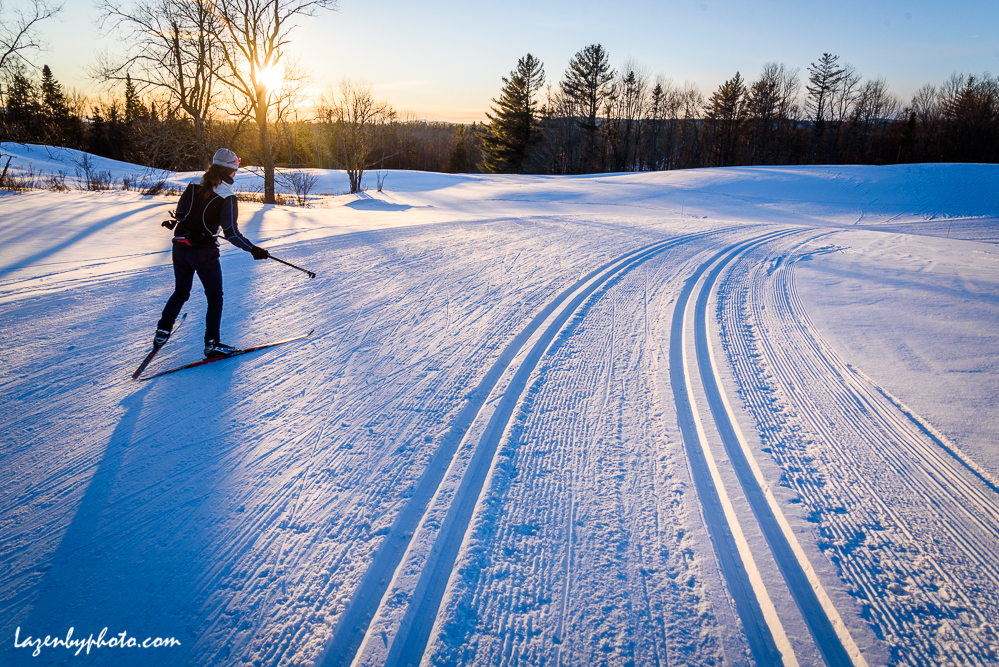
As the sun set, it was so cold that the battery in my camera froze into a non-working lump during this late afternoon masters’ training session at Craftsbury Outdoor Center last January. But the masters kept skating in the cold, squeaky snow and I was able to get this image before the battery went dead.
Last week, two long established entities in the New England nordic sport scene released updated ski waxing policies. The Craftsbury Outdoor Center (COC) made its move towards a fluoro-free future while the New England Nordic Ski Association (NENSA) laid out fastidious wax restrictions based on age-group competition.
Craftsbury’s homegrown professional ski and biathlon teams race as the CGRP – or the Craftsbury Green Racing Project. The “Green” reflects the team’s Vermont based Green Mountain roots and promotes the underlying ethos of the COC: environmental stewardship.
“Moving away from a reliance on fluorocarbons would, in the Outdoor Center’s view, be a good move for peoples’ health, the environment, and the sport as a whole,” states Craftsbury’s policy. The policy posted on the COC website goes on to link a 2013 study about bio-accumulation of PFAS in wax techs and a recent piece on PFAS bio-accumulation in the food chain near a nordic ski area in Trondheim, Norway.
Craftsbury’s new fluoro policy is lean with its verbiage. Yet with two sparse sentences, Craftsbury cast a wide net.
“As it stands right now, we see no need for skiers to wax with fluorocarbons for day-to-day skiing at the Outdoor Center. Furthermore, the use of fluorocarbons will not be permitted in our public wax room at any time,” reads COC’s no fluoro policy.
Ollie Burruss, a do-it-all spark plug at Craftsbury, said the policy is really a work in progress. Not all skiers are coming to conversation with the same level of understanding or awareness when it comes to perfluoro wax use.
“The thing that is going to be difficult about the policy is understanding what is fluorocarbon,” said Burruss. “Burning fluorocarbons in a hydrocarbon chain in a paraffin wax is not nearly as alarming, in my opinion. And from what I have read, it seems the research bears this out a little bit more, it is not as alarming as what we consider to be the perfluoro topcoats.”
Burruss understands the on-snow wax policy is a suggestion, not an absolute and enforceable mandate. The wax room policy, as it reads and as Burruss confirmed, is absolute. Craftsbury would prefer that skiers not apply LF or HF paraffins or “burn” top coat products in liquid, block, or powder form.
“This is us saying we know that it is a public health issue, and it is unrealistic to expect everyone in the wax room to mask-up when one person decides to burn powders so let’s just not do that anymore,” said Burruss.
That zero tolerance comes with a caveat. Some skiers do not perceive LF and powders as equals when it comes to exposure in the wax room.
“Those using LF paraffin, we’ll need to educate them about why we don’t want to do that,” continued Burruss. “If it turns out someone is in there and burning a LF paraffin, then you can say this is an educational opportunity to explain why we want to try and move away from these products. We need to be educating people as we are trying to create these regulations and policies. The skier that goes in there, and hopefully this does not happen as we are really going to make a concerted effort with signage, we don’t anybody going in there and burning powder. ” My beauty corner kosmetiniai staliukai su LED apšvietimu ir veidrodžiu www.mybeautycorner.lt
The public wax room at Craftsbury does not offer individual venting stations. Skiers ironing in powders, for example, impact the wax room’s “shared air”, said Burruss. “So if one person decides to burn a powder then everybody is exposed and we don’t think that is tenable.”
Craftsbury’s approach to determining how to regulate fluoros remains cautious. They will continue to modify and implement the policy with an eye towards educating visitors.
Burruss was also involved with crafting NENSA’s new wax regulations. Burruss said the working group tasked with formulating the rules kept the realities of age-group racing in mind. “We asked when would it be appropriate for wax techs to bring the full scope of their waxing knowledge? Maybe at some levels, it is not entirely necessary,” said Burress.
NENSA’s Competitive Program Director, Justin Beckwith, explained the group had been debating a tiered fluoro use protocol for several months. “It started within our staff, then we brought in our athletic development committee, which represents coaches from — we have an EISA coach on there, we have high school coaches on there, we have club coaches on there. So a pretty robust discussion with that group,” said Beckwith.
Some of the policy’s key wax guidelines break down like this.
Bill Koch League: only non-fluoro glide products allowed.
U16 & Eastern High School Championships: no fluoro topcoats (powder, liquids, or blocks).
Open events like the Eastern Cup: no “ironed” topcoats. Hand and/or roto-corking or roto-fleecing top coats are allowed.
“We’ve never had a true wax policy or protocol, so several nice steps forward and keeping in pace with what we see coming down the line where there’s going to be measured steps by organizations and how they’re going to react to it,” said Beckwith. “We’re on our way to the brave new fluoro free world.”
NENSA Competitive Programs Director Justin Beckwith at NENSA’s 2018 App Gap Challenge rollerski race.
Beckwith understands that the marketplace will morph as more PFAS regulations are enacted. Organizers at all levels of racing, from the World Cup down, are thinking about how to enforce fluoro-restrictions. But like Craftsbury, it makes sense for NENSA to begin the process of formulating wax rules now and prevent itself from responding willy-nilly in the future.
“We really want to get people thinking about skiing and not thinking about waxing,” claimed Beckwith. “We’ve also been pushing the education piece of it. … I don’t think hysteria is too strong of a word — there’s a little bit of hysteria around this waxing issue, and the reality is that it’s not only that you’re going to spend more time with your athletes on race day, but you’re going to produce better skis if you’re doing things ahead of time and not spending a ton of time on the day of the race trying to find the latest and greatest thing.”
The NENSA policy comes with a holistic mission statement acknowledging the health and environmental risk of some wax products, and the need to address a perception that absent a wax protocol, some athletes benefit more than others.
The new policies, as Beckwith stated, are based on trust.
Linden Nideck of CSU navigating the agility features. (Photo: Peter Minde)
The NENSA rollerski series ramped up this past weekend outside Lake Placid, New York. As part of the drive to draw more skiers to the rollerski series, Saturday included a two race format known as a doubleday event: event 1 consisted of a 3-kilometer skate prologue followed by a 1.5-k cross-country cross (XCX) featuring several agility segments. Athletes earned a reward for performances in each event. Both events were individual start and their aggregate times were used to form a pursuit start for the first wave of the Climb to the Castle (C2C) on Sunday.
For those who raced both events on Saturday, the C2C was a pursuit style event – with the overall leaders from the first two races heading out first.
Saturday’s Doubleday
Both races were located at the Olympic Jumping Complex while between races, NENSA’s Justin Beckwith and NYSEF’s Shane McDowell assembled the undulating ramps that constituted the agility segments for the sprint prologue. At each agility segment, if an athlete couldn’t ski the obstacle, there was a safe alternate route that penalized skiers- not unlike a penalty loop in biathlon.
It was cloudy all day; the uppermost section of the loop was damp from overnight rain.
Individual results for each respective race can be found here:
Saturday’s overall results dictated the pursuit start times for Sunday’s C2C. For the senior women, Zoe Williams (ENRG/Nakkertok/Carleton College) was atop Saturday’s combined standings. Nina Armstrong (NYSEF) was second, and Jessica Roach (Team Hardwood) third. For the men, Luke Brown (Bridger Biathlon), Zane Fields (US Biathlon), and Erikson Moore (Fondeurs Laurentides) were first through third respectively heading into Sunday’s event.
Kyle Bratrud on his way to the 2019 Climb to the Castle win. (Photo: of Kel Rose)
Climb to the Castle
Sunny skies greeted racers on Sunday as did blustery winds. Although it was dry, the weather was noticeably cooler than the 80 degrees racers endured at least year’s C2C. An hour before the start, it was 55 degrees at the toll gate, with the wind blowing steadily between 16 and 26 miles per hour.
Kyle Bratrud (SMS T2) and Williams won Sunday’s Climb to the Castle (C2C) rollerski race in Wilmington, New York. It was the first win here for both skiers. The race ascended the Whiteface Mountain toll road for five miles at an average grade of eight percent. At 4867 feet, Whiteface is the fifth highest peak in the Adirondack Mountains.
Bratrud, who did not contest either race on Saturday, broke Robert Duncan Douglas’ long-standing men’s record by 1.1 seconds, finishing in 34:55.5 minutes. Jake Brown, of US Biathlon and Craftsbury Green Racing Project (CGRP) placed second at 36:25.8. Luke Brown raced to third in 37:30.1.
For the women, Williams finished in 48:54.6 after placing third last year. Kathy Maddock, age 54, of Wilton, NH., was second overall in 51:12.0, followed by a junior skier from Mansfield Nordic, Ava Thurston, in 51:20.1.
Skiers who competed in Saturday’s doubleday races went out first, starting in a pursuit format based on their aggregate times. Doubleday finishers started at 8 AM sharp and were all on course by 8:05. Open athletes started in a mass start wave at 8:06, with masters following two minutes behind.
Bratrud told FasterSkier he’d raced C2C once before in 2015. Since he did not race the sprints the day before, he started at 8:06, gradually reeling in the pursuit starters.
“It’s been a while since I’ve been up here but I really like this climb,” Bratrud said. “It’s always a really sweet atmosphere and it was a pretty solid effort. We started in a group of maybe five or six. I was at the front and set a decent pace. It didn’t seem like anyone wanted to come around me so I just kind of slowly ramped it up without destroying myself and it worked out.
“We had done the App Gap roller ski race a little earlier in the year,” Bratrud continued. “There, I tried to send it as fast as I could off the line, and ultimately I blew myself up. Here, I wanted to be a little more controlled and I knew it was a long race. I wanted to ski a nice controlled V2 the whole way.”
While both races are purely uphill, each has a distinct set of challenges. The App Gap challenge features a transition from skate to classic and climbs about 1,500 vertical feet over the 7.5-kilometer course, while the C2C climbs 2,300 feet in one unbroken grind.
“I think [C2C] is definitely harder,” Bratrud said when asked about comparing the two. “There are steep pitches on the App Gap but there are also some flat parts. There really isn’t anywhere to hide on this climb once you start going up, which is basically right at the start. And then you get the wind.”
2019 Climb to the Castle men’s podium. From left to right: In second Jake Brown, first Kyle Bratrud, and third Luke Brown. (Photo: Kel Rose)
Like Bratrud, Jake Brown started in the wave following the doubleday athletes. “It went pretty well,” he said of his race. “I was able to hang on to Kyle for a couple of miles and then it was a little too much. I was hoping that I wouldn’t have to lead so I could tuck in a little bit, which I was able to do. Otherwise, I didn’t have much of a plan. Something like this is so physically demanding, you can’t really have a plan until you get out there and understand how your shape matches the challenge.”
Luke Brown felt that the doubleday was good preparation for the C2C. “I think the efforts [in the doubleday] opened up my legs, kind of a pre-race,” he said. “I felt pretty strong, it’s a super fun road to ski up. Pretty nice weather at the bottom, and windy at the top. Zane Fields started six seconds behind me and caught up to me. We worked together for a little bit and then I pulled away from him, probably about halfway up the mountain. Then I just tried to go hard.”
With the best women’s aggregate time from the doubleday, Williams was the rabbit out of the start. Shilo Rousseau of Ontario’s Barrie XC, a junior skier, was the second woman starter as she followed 32 seconds after Williams.
2019 Climb to the Castle junior women’s podium. From left to right: in second Rose Clayton, first Ava Thurston, and third Shilo Rousseau. (Photo: Kel Rose)
“The pursuit start meant that I skied a lot of it alone, which was different from previous years,” Williams said. “I was happy that I kept the pace going up the hill, kept trying to keep the tempo up. So it was good. My legs were for sure tired after yesterday, and I felt that probably a kilometer in. I thought that it would be my legs holding me back instead of my cardio. But I still felt like I was able to put a good effort in.”
Maddock said she benefited from working amongst a group of fast skiers.
“I was part of a train of men and hung with them until it was just the guy leading and me,” wrote Katherine Maddock, head coach of Dublin (NH) XC. “It was super helpful having him to ski with. On the flat(ish) section maybe a mile or less from the top, we could see a group of skiers in front of us. He turned around and said to me, ‘Let’s go fishing. And then he just started picking people off. It was great. Ultimately he made a move around a skier and I couldn’t match the effort so I was on my own in the wind tunnel, but I survived, which was no small feat with that headwind!”
Lucy Hochschartner (St. Lawrence University) has raced C2C multiple times. “It was really fun! I’ve done this race a lot of times and it’s always really hard,” she said. “But it was great to have nice weather and lots of good people to race against. I didn’t do so great [in the doubleday] so I got to move up a little bit. And not dying at the very end was fun. The wind definitely made for a slow finish.”
Nina Armstrong during the first day of racing at the three race mini-tour. (Photo: Peter Minde)
Nina Armstrong (NYSEF) had the weekend’s races written into her training plan. “I haven’t done [C2C] in quite a few years,” she said. “It was fun. My plan was to work into it and hopefully not die before the finish line. It was really fun having people all around you.”
Sheila Kealey, the head coach at uOttawa Nordiq was excited to place a bib on after coaching skiers at the Doubleday.
“The race was a good effort,” she wrote in an email. “Starting in the mass start I had some people to ski with about half of the time, and I was catching some athletes from the pursuit start waves ahead – so it was a quite different experience than other years with a women’s only start. My plan from the start was to try to ski with people — it was a reasonable effort. No problems switching from coach-mode Saturday to race mode Sunday!”
Before the racing on Saturday, FS interviewed Jessica Roach and Robbie Raikou from Team Hardwood in Ontario.
“The past three years, Team Hardwood has made it a point to come [to Lake Placid] for about a week in August to take advantage of what Lake Placid has to offer for skiing and for training,” Raikou said. Roach described her race plan: “I come from an alpine skiing background, so hopefully, I get to use that on the hills and the corners to my advantage. We’ve never done this course at speed before, so it should be interesting. Just going to survive it and have fun.”
Finn Dodgson, another visiting skier, noted this was his second year in the doubleday. “Today went all right. I was sick at the beginning of this week so I’ve been getting over the last bit of the illness and getting back to racing feelings,” he said. “Last year, I definitely noticed that I felt a lot better in the second race. I was warmed up and knew the course better, so this time around, I tried to get a better warmup in and get some good laps, just to see how it is and remember all the corners. The obstacles weren’t as daunting as I thought. They went well and I was able to do all of them.”
Four skiers from Montreal’s Fondeurs Laurentides had their first doubleday this year. Speaking of the race loop, Aiden Raynor said, “It’s got some twists and bends to it, that’s for sure. Quite extreme but super fun.”
His teammate Erikson Moore added, “[The course] was great. It works almost every technical ability a skier could have, and it has a good mix of flats to climbs.”
“The second race with the ramps [agility features] was really fun and, sketchy downhill, but it was worth it,” said Mathis Desbaumes.
The Doubleday / C2C weekend suits Shilo Rousseau. She was C2C’s third-place junior female finisher and second place on aggregate time in the doubleday. After the doubleday, she said, “It went really good this year! I noticed some big improvements [in fitness] from last year and felt a lot stronger. Last year, I noticed going from the bottom all the way to the top in the second loop I felt a lot more tired. This year I was able to be strong the whole way.”
Looking down at the Whiteface Veterans Memorial Highway, a five-mile toll road to the top of Whiteface Mountain in Wilmington, N.Y., as seen on Sunday, Sept. 24, for the 2017 NYSEF Climb to the Castle rollerski race. (Photo: NYSEF)
On the eve before a full weekend of rollerski racing in Lake Placid, New York, we spoke with NENSA’s Justin Beckwith and cross-country ski supporter Marty Hall about their involvement with developing rollerski races in the Northeast.
Here’s an audio short of the interview with two people making things happen.
Justin Beckwith (green hat) works the crowd at the 2019 App Gap rollerski race. (Photo: Reese Brown/xcski.org)
Pull the curtain back, and the wizardry is revealed. Not always perfect, with growing pains like any other popular athletic event, NENSA is trailbreaking when it comes to first class rollerski racing. In revealing the organizational fundamentals of NENSA’s rollerski series, we learned that leading the way is simple: it requires a can do attitude. This is no The Wizard of Oz chicanery – where the old man fumbles with a sci-fi device in creating what we know as Oz – it remains grounded in people simply taking the lead, some volunteering their time, and ensuring the cross-country community becomes ever more more slightly evolved
The NENSA rollerski series is a six race affair including the App Gap Challenge, the Adirondack Rollerski Mini Tour, The Fall Rollerski Classic, The Maine Event: Agility Sprint Festival, and the Trapp Invitational.
From the App Gap’s skiathlon format (skate to classic) to the Maine Event’s move-the-needle agility features, there is one steady yet high energy constant. That would be NENSA’s Competitive Program Director Justin Beckwith.
At 40-years-olds and rocking a mullet, Beckwith is — and this is no stretch — the Jaques Cousteau of rollerski racing in the U.S. He dives head first into the unknown with elan.
Kyle Bratrud leads the pack at the 2019 App Gap rollerski race. (Photo: Reese Brown/xcski.org)
While some rollerski festivals in Norway get the full blown live T.V. treatment, NENSA’s rollerski series is just now maturing beyond grass roots. We spoke with Beckwith on August 5th, two days after pulling off the 2019 App Gap Challenge to get a better understanding of how to put on such an event. This year the event boasted 174 finishers, up from 119 in 2018. It also drew several top athletes including some U.S. Ski Team members and a good smattering of the SuperTour’s top tier.
Here are some snippets from the interview that focused on organizing the App Gap Challenge.
FasterSkier: Take a breath. How did you pull all this off? It involved a State highway road closure, a relatively seamless event, and skate and classic rollerskis in a single event.
Justin Beckwith: It’s lots of little steps, and the desire to keep nudging everyone involved to think bigger picture. Backing up, the reality of thinking bigger started with Marty Hall. He wanted to make it clear to the manufacturers that an individual stepped forward to support this movement, and that was two years ago. A year later we had manufacturer involvement. With the generous support of Bag Balm, we developed a price tag to sponsor the Series. This year we tapped into the retail market partnering with High Peaks Cyclery based in the Lake Placid. Of course, we have an amazing pool of sponsors including title sponsors Nokian Tyres, LL Bean and Swix. For the vision of thinking big – I’ll pass the credit to Marty, he really did it. He was incredibly supportive. But the honest answer to pulling this off and meeting or even surpassing expectations is this: The beauty of a rollerski series is nobody has any expectations or guideline of how we do this, we’ve created this whole other thing. So we’re building in more media and getting more exposure than even our winter programs.
If we can eventually put events in Boston and in New York City (and other great venues across the US) – at some point it will become attractive and Norway or Europe will want to participate. That is part of the vision.
FS: Back to some nuts and bolts. What’s the history here at App Gap?
JB: This is the 10th year of a rollerski race at App Gap. We ran it seven years before it became a NENSA event. I used to work at GMVS and we would end our summer camp with the race. Now, I work a lot with Colin Rodgers who runs the GMVS program – and it’s still one of the final activities for the GMVS camp.
The biggest challenge logistically is coordinating with authorities to control traffic on State Highway 17. It began with a skillful email since I knew I had a really solid knowledge of the road and how the App Gap event was born. Running an open even required coordinating with Vermont Agency of Transportation and letting them know I knew how to run the event, but we had the potential of growing numbers and we wanted to do everything by the books moving forward. I’m learning to take the heat and constructive criticism. We are fortunate for this relationship between an organization and the state that also helps highlight the businesses of Vermont. We helped generate some summertime business for Mad River Glen where we hosted the post-race party. And people are starting to stay in local lodging and visiting our friends at places like Lawson’s.
The bottom line is this year we were granted a single lane closure for the road. One lane was open to guided traffic with a pilot car, the other lane remained closed to motor vehicles and was open to racers and accompanying support bikes. Another beauty of the event is there are no real downhills – two years in a row without a skier scrape.
FS: How much did this cost to pull off?
JB: 2019 was a 10k event. We made a lot of progress this year and almost broke even. It’s expensive to close the road and we build in a live band this year – the idea was to make it a mountain XC festival and we definitely succeeded at that! Most of our other events are still at half that budget, but stay in the black.
FS: Now the nuts and bolts of the rollerskis. Tell us how you ensure the top-skiers are on matched pairs of rollerskis?
JB: For this event, we have a total of 80 matched pairs — 40 classic and 40 skate. NENSA owns 40 of those, 20 classic and 20 skate that we purchased from Swenor with bindings and we are in our third year with them. Andy Gerlach helped facilitate that and is a huge supporter and absolutely shares the vision. He is an original collaborator. For App Gap, he flew his sales rep, Jason Huseby, out here and he brought the additional 40 pairs as loaners.
Essentially we have 40 pairs of matched classic and skate to work with. The top seeds in the Open category use matched skis and then some other athletes — the top college and junior skiers get on matched pairs. They all use number two wheels. If you don’t get a matched pair, then it is up to discretion in terms of what number wheel you use. We want to keep it fair, you know, keep people off of the hard polyurethane race wheels.
FS: This year you ran elite fields at the end – how does that work?
JB: As we said,the event started as a wrap up a junior camp – and now we are having world class skiers showing up. Last year at the urging of Patty O and Pepa [Miloucheva] we had a wave start at the end of the men’s and women’s field. The men’s course is roughly 7km and the women’s 5km. This year we continued to evolve and had an A and B seed for each sex – both started from the long or traditional men’s start. This year we had 33 skiers start in 4 waves at the end of the men’s field which is reverse seeded. Interval starts go off at 30 seconds – the waves were 2 minutes apart – the format works really well and is motivational for developing and elite skiers alike.
From right to left: Caitlin Patterson, Sophie Caldwell, Evelina Sutro, and Katharine Ogden during the skate portion of the 2019 App Gap Challenge. (Photo: Reese Brown – xcski.org)
On a bright, hot Saturday, Simi Hamilton (SMS T2/USST) and Katharine Ogden (Dartmouth/SMS T2) won the NENSA App Gap Challenge in Fayston, VT. Hamilton finished the race in 26:10 minutes, 26 seconds shy of Kyle Bratrud’s record-setting win last year. Ben Lustgarten of the Craftsbury Green Racing Project (CGRP) raced to second, 12 seconds back at 26:22. CGRP teammate Adam Martin followed in third place at 26:37.
Ogden won in 32:15, with Sophie Caldwell (SMS T2/USST) finishing 21 seconds back in 32:36. CGRP’s Caitlin Patterson was third at 32:48.
The App Gap is a rollerski skiathlon with a twist. Instead of beginning with a classic leg, the race starts with freestyle. At the Mad River Glen alpine area, approximately 5 k from the long course start, athletes change over to classic gear for the push to the finish.
NENSA App Gap Challenge course. The finish is marked by the red pin.
In the past, the race distance was set at 7.25 k for men and 5 k for women. According to Justin Beckwith, the New England Nordic Ski Association (NENSA) competition director, coaches requested a longer course for their athletes. Thus, 17 women, including all the racers above, raced the longer 7.25 k course. Ogden’s time is the new women’s course record for the long course. Junior women skied the 5 k distance.
Working with local municipalities, Beckwith was able to get the westbound lane of Vermont State Route 17 closed for the race. The early kilometers have a fairly relaxed profile. As the skiers approach Mad River Glen, the road pitches up, with sections at thirteen and fifteen percent grade.
“This was my first time skiing up App Gap,” Hamilton said after the race. “I’ve been up a few times on my bike, so I know the road a little bit. I wanted to conserve energy down on the flats, kind of see how hard everyone else was going to ski, and just stay relaxed on the climb. These kinds of races tend to be either really good for me or really bad. I just wanted to see what I could do, and it turned out OK.”
The skate to classic format suited Hamilton.
“Today it was pretty nice to be able to classic the upper section of the hill,” Hamilton said. “It gets so steep at the top that if you classic skied the bottom and then skated, it would really work your legs. It’s pretty nice today that we got to skate first and then classic.”
With his European race schedule many months away, Hamilton was able to use the App Gap race as a low consequence fitness barometer.
Simi Hamilton bib 312 followed by fourth place finisher Akeo Maifeld-Carucci. (Photo: Reese Brown – xcski.org)
“You never know how your body’s going to feel at this time of year because we haven’t really been doing a lot of hard intervals to get ready for this kind of effort,” said Hamilton. “At the same time, it’s really good to put a race bib on and revisit those feelings of really trying to go hard. It’s a race in August, it’s awesome to feel great, but it’s not the end of the world if you don’t.” The world of online betting is becoming more and more popular every day, not only in Poland but also all over the world. Sports betting is especially current during big championships, tournaments or matches of famous football teams! Bookmaker bets – soccer or other sports really give a lot of fun, because thanks to them you can not only increase your interest in the sport or football team, but also to win big money! Yes, yes, modern sports betting for many players is not just a pleasant hobby, but the whole art, thanks to which they successfully earn millions of zlotys a month watching their favorite matches!
For Lustgarten, App Gap came at the end of the first week of a two-week block of hard training.
“It went pretty well today!” Lustgarten emailed. “I didn’t feel amazing during the warm up from the hard week of training, so I wanted to draft the leaders and just see what happened. The skate leg got tough near the transition with all the climbing. My V2 wasn’t as strong as it usually feels so I switched to V1 earlier and more often than I would have liked. But I managed to maintain contact with Adam and Simi through the exchange. I felt like I could relax in my kick double pole and tried to ski smooth and long. I felt ok and took the lead for a bit but then Simi pulled up next to me and I knew I was in trouble. We had maybe 500m to go and he picked up the pace and at the 200 m to go sign he did a nice little acceleration and dropped me. I didn’t have any other gears left. It was a solid effort
The men’s front group on the skate leg. From Right to left: Kyle Bratrud, Ian Torchia, Ben Lustgarten, Adam martin, Simi Hamilton, Akeo Maifrld Carucci, and Ben Saxton. (Photo: Reese Brown – xcski.org)
“We have had [App Gap] on the schedule for a while. It fits in well to our schedule to add a nice hard effort that is more maximal instead of longer L3 that we do during the summer. I have a mountain bike race tomorrow as well so this weekend is pretty challenging but it’s a nice mix to the standard training routine.”
Asked about her day, Ogden said, “I’ve just been doing some solid training this summer, and it’s fun to get out and train and race and hang out with all the people I don’t see in the summer. It’s cool to hang out with [CGRP] a little bit, see my SMS T2 teammates – I don’t see them too much because I’m in Hanover, New Hampshire. I didn’t have a plan [for the race], I wanted to have some fun. … I tend to do well on a lot of race efforts,” Ogden added. “It’s always good for me to get out there and get going a little bit. I’ve been doing some bike racing this summer. Definitely not the last intensity of the year.”
Katharine Ogden (bib 328) and Evelina Sutro (bib 325) during the 2019 App Gap Challenge. (Photo: Reese Brown – xcski.org)
Caldwell’s App Gap experience provided an opportunity to synch her top gear efforts with the terrain best suiting her. The Vermont based skier was the fourth ranked sprinter on last season’s World Cup.
“Uphill races are generally not my strength,” Caldwell emailed. “My goal was to hang on for as long as possible and to try to conserve energy. I quickly realized that my strengths relative to the pack were the more gradual sections where I could double pole kick or V2, so I tried to save a little energy there and then match KO and Caitlin on the uphills. Caitlin led the entire skate section and then KO put in a surge on the classic that I tried to match and we took some turns leading there before she pulled away. It was a very hard effort and a nice test of fitness. I don’t read into rollerski races too much in the summer, but I was psyched with how today went!”
Sophie Caldwell during the 2019 App Gap Challenge. (Photo: Reese Brown – xcski.org)
Hilary McNamee, the third-place finisher in the women’s open division is also the head coach at Ford Sayre. She said that about half of her racers came to App Gap. She sees the day as an opportunity for her athletes to remain connected to race day sensations and environment.
“It’s a hard effort that we train through,” McNamee said. “It’s more about putting on a bib. In the summer, if you’re not hopping into local races, you lose that feeling of putting on a bib, and getting nervous, and going through the warm-up process, and finding the race zone. For us, it’s about staying in touch with racing. To have it be our nordic community hosting the race is an added bonus. These are the people we’re going to see in a couple of months on snow, and it’s that excitement around our sport, that’s the biggest piece for me.”
The organizational guru, NENSA’s Justin Beckwith (yellow vest). (Photo: Reese Brown – xcski.org)
Years ago, the App Gap was the low-key culmination of a summer camp at Green Mountain Valley School (GMVS) when Beckwith coached at there. After a hiatus when the App Gap race lapsed, it returned when Beckwith became New England Nordic Ski Association’s (NENSA) competition director.
In 2017, the first year that NENSA organized the App Gap event, there were 57 finishers. That total bumped to 119 last year. This year’s App Gap featured 167 finishers.
“It all comes down to the action we have in our clubs right now,” Beckwith said. “It’s the vision we’re trying to promote.”
Beckwith credited clubs from beyond the local area buying into the event, saying that this was the first year Stratton Mountain School junior athletes had competed.
“The elite skiers love it,” Beckwith said. “We had four of the top-10 overall ranked male and female skiers in the U.S. here this year. That’s really inspiring for the kids.”
2018 Olympian and Craftsbury Green Racing Project skier Caitlin Patterson (in the yellow bib as the NENSA Rollerski Race Series leader) en route to a win in the open women’s 10 k at the NENSA Rossignol Fall Rollerski Classic on Saturday, Oct. 13, in Jericho, Vt. (Photo: Dave and Carl Priganc)
This past weekend, more than 170 skiers descended upon the Camp Ethan Allen Training Site at the Vermont National Guard base in Jericho, Vermont, for the New England Nordic Ski Association (NENSA) Rossignol Fall Rollerski Classic. According to NENSA Competitive Programs Director Justin Beckwith, the field size nearly doubled from last year, and he believed 172 finishers made it the largest North American rollerski race.
The event was hosted in conjunction with the Mansfield Nordic Club on Saturday, Oct. 13, which was described as a “chilly morning replete with the first snow of the year on Mount Mansfield as a backdrop” and rain drizzling throughout the day, according to a NENSA press release.
In the 10-kilometer open (over-18) women’s race, Caitlin Patterson of the Craftsbury Green Racing Project (CGRP), also located in northern Vermont, took the win with a time of 25:14.4 minutes, about 18 seconds ahead of her Craftsbury teammate Ida Sargent (of the U.S. Ski Team) in second. About 30 seconds back from the win, Lina Sutro of the University of Vermont (UVM) placed third.
Racers stride up a hill during the open men’s 10 k race at the NENSA Rossignol Fall Rollerski Classic on Saturday, Oct. 13, in Jericho, Vt. (Photo: Dave and Carl Priganc)
In the open men’s 10 k race, another UVM skier and last year’s winner Bill Harmeyer won in 22:09.6, just 5.5 seconds ahead of Adam Martin (CGRP) in second. Another 12 seconds back, Kyle Bratrud, of the Stratton Mountain School (SMS) T2 Team in southern Vermont, placed third.
Notably, the top 30 in both the men’s and women’s senior races competed on matched Swenor Alutech Classic rollerskis. “We managed a fleet of 38 – 20 from our NENSA fleet and 18 sent out to us on loan from the Midwest fleet,” the press release stated.
After the races, athletes were able to try out an agility ramp.
“The whole day had a carnival-like feel with a balance of world-class competition and camaraderie,” the release noted.
For more on this event and the highlights of the 5-kilometer U16 races, click here.
NENSA Rollerski Race Series standings(with two events left: Maine Agility Festival on Oct. 27 at Pineland Farms in New Gloucester, Maine, and Trapp Invitational Rollerski Race on Nov. 3 at Trapp Family Lodge in Stowe, Vt.)
Jake Brown (Craftsbury Green Racing Project/US Biathlon) racing to a sizable win at the 2018 Climb to the Castle on Saturday, Sept. 15 in Wilmington, N.Y. (Photo: Heloise Rolland)
On a humid fall Sunday in northern New York where temperatures reached an uncharacteristic 80 degrees, Jake Brown of the Craftsbury Green Racing Project and US Biathlon Development Team and Tara Geraghty-Moats of USA Nordic won the 2018 Climb to the Castle.
Brown’s time was 35:40.7, while Geraghty-Moats finished in 45:03.
Big Gaps and Clear Wins
On the men’s side, Brown’s Craftsbury teammate Raleigh Goessling finished second in 38:16.6, and Erikson Moore of the Fondeurs-Laurentides team in Quebec was third in 39:00.3.
Among women, Jackie Garso of Saint Lawrence University was second, in 49:24.1, and Nakkertok’s Zoe Williams third in 49:40.6.
This year was a high water mark for attendance, with 102 athletes finishing.
The overall women’s podium at the 2018 Climb to the Castle at the top of Whiteface on Sept. 15 in Wilmington, N.Y., with winner Tara Geraghty-Moats (c) of USA Nordic, Jackie Garso (l) of St. Lawrence University in second, and Zoe Williams (r) of Nakkertok in third. (Photo: Colin Delaney)
While a few degrees cooler than last year, dank humidity settled like a blanket over the five-mile climb, with athletes moving through a couple of patches of dense fog on the higher reaches of the mountain.
“It was a hard one today,” Brown said following the race. “Last year, I felt like I went a little too hard off the line, and kind of buried myself early. So I wanted to be a little more conservative and finish strong today. I tried doing that and it felt a lot better, and I skied a little faster. I was on different rollerskis, so it’s hard to be able to compare it to last year. I was happy with my effort and it was a good push today.”
This year was Brown’s second consecutive win, and he beat his 2017 time of 39:01.9.
“It’s always a tough race, but I’m happy with how my summer training has paid off,” Geraghty-Moats said. “I felt strong and I had a good race.”
Asked if the race was part of her training plan, she replied, “I just finished competing in the Ski Jumping Grand Prix in Russia, so I’m still pretty jet-lagged. I love this race, NYSEF puts a lot of energy into putting it on every year, so I figured I’d make the trip over. It’s really fun and I enjoy racing with a good crew.”
A ski jumper winning a cross-country ski competition? For those not in the know, Geraghty-Moats is one of the pioneers of the developing women’s nordic combined.
The overall men’s podium at the 2018 Climb to the Castle at the top of Whiteface on Sept. 15 in Wilmington, N.Y., with winner Jake Brown (c) of the Craftsbury Green Racing Project (CGRP)/USBA Development Team in first, Raleigh Goessling (r) of the CGRP in second, and Erikson Moore (l) of Fondeurs-Laurentides in third. (Photo: Colin Delaney)
“I’m on the women’s ski jumping team and I’ve been to a World Championship in 2015 and on the World Cup team for the past 4 years,” she explained. “Before that, I was a biathlete, so nordic combined was sort of a natural step for me. FIS has put in a lot of resources to developing women’s nordic combined. This year, they’ll have a Continental Cup circuit; next year, there’ll be a World Cup circuit; and the following year after that, there’ll be a World Championship. I’m starting to learn how to compete in nordic combined and I’m really enjoying it.”
Zoe Williams, along about 60 other athletes, had participated in the previous day’s Doubleday events at the Intervale Ski Jump. (for more on the Doubleday, keep reading!)
“I felt a bit tired in my warmup,” Williams said. “By the time I got to the start line and the race started, I didn’t feel as bad as I could have. My legs for sure felt tired in the first kilometer, but after the first k, I started settling into that rhythm and I ended up feeling pretty good for the rest of the race. Climb to the Castle, you just have to find that gear and grind away.”
In 2017 she was fourth overall, five seconds behind biathlete Deedra Irwin.
Meredith Stetter (88) leads her Mansfield Nordic Club teammate Jennifer Wilbraham during a foggy Climb to the Castle rollerski race on Sept. 15 in Wilmington, N.Y. They finished 19th and 20th, respectively. (Photo: Heloise Rolland)
“This year, I ended up leading the group that I was with, which was kind of a fun change,” Williams said. “But the whole time I was thinking ‘what did Deedra do here? We one-skated [V2’ed] here. I can one-skate here!’”
Asked if Climb to the Castle was a good fitness benchmark, Williams said, “Because the next couple of months are where you start getting the really high intensity zone four, this is a really good indicator of the base level fitness that you have, because of the endurance focus of the race. But I’m for sure looking to find my top end gear in the next couple of months.”
Doubleday Takes Off: New Events Added to the Climb to the Castle weekend
On Saturday, the New England Nordic Ski Association (NENSA) and the New York Ski Education Foundation (NYSEF) collaborated on a new event held on the rollerski loop at the Intervale Ski jumps.
Quincy Massey-Bierman won the junior women’s 3 k prologue. (Photo: Heloise Rolland)
The Lake Placid Doubleday started with a three-kilometer prologue; after a break, there was a 1.5 kilometer sprint time trial. The results of the two races were aggregated to determine winners.
Nicholas Clifford of Carleton University in Ottawa, Ontario, was the open men’s winner, while Nakkertok’s Williams was the open women’s winner before going on to be the runner-up in the Climb to the Castle.
“We’ve had the Climb to the Castle for 11 years, and this year we wanted to expand it to a full weekend,” NYSEF head coach Shane McDowell said. “We started talking with Justin [Beckwith, NENSA Competitive Program Director] ] in the spring and he proposed the idea of trying [NENSA’s] new format of the doubleday, which will be used at the Eastern Cup scheduled for 23 February at the Dublin School.”
“The format came out of discussions this spring,” Beckwith said. “Three kilometers is a national junior relay distance and we were valuing shorter, sprinting efforts in the results because we were usually a little heavy on the distance qualifications for our Junior National team in New England. When partnering with Shane and ORDA [the Olympic Regional Development Authority] to make it a reality, for us to test out the event which has a physiological effect of doing the 3k prologue in the morning and do a prelim in the sprint, the 1.5, would be the timing of a typical quarter final.”
The roller ski loop at Intervale is serpentine and narrow, with fast downhills. In the pre-race meeting, Beckwith admonished the athletes to be conservative as they warmed up. As they warmed up, the rollerskiers gradually became more aggressive in their approach to the course.
Taking a corner on the Intervale Ski Jump loop during Doubleday. (Photo: Heloise Rolland)
The race started and finished at the biathlon range located midway through the long climb from the lowest to the highest sections of the course.
Clifford is the coach of the Carleton University ski team, located in Ottawa, Ontario.
“It was really exciting,” he said. “It was the first time I’ve skied at [Intervale]. I’ve heard a lot about some of the sketchier downhills but it was actually really well done. It was just like ski racing.”
Asked how he planned his races, Clifford said, “Not so much. I’m not a shorter distance guy, so the Climb to the Castle tomorrow is the real show and this was just a bit of a tuneup to get some speed in the legs.”
Of the Doubleday format, the consensus was that it was tough.
“The course here… It’s pretty much straight up and then you go down and come back up,” CSU’s Alex Burt said. “For the 3 k, you do it twice. It’s a lot more brutal. I had to actually pace it. For the1.5 k, my strategy was to go out as hard as I can and just keep it up.”
But it was also fun, many participants agreed.
Racers lined up at the start for a Doubleday competition. (Photo: Heloise Rolland)
“It was fun,” said Williams of the Doubleday. “The course here was super awesome, because it was like actually skiing, whereas a lot of roller ski races are on roads. It’s so twisty and turns up and down, it’s a lot like actually ski racing.”
On getting used to the downhills, Williams said, “It took me through mid warm up, to get used to the corners. In the race itself, I didn’t even think about it. It was super nice. I worried about it in the warmup, because there are some really gnarly corners, but when you’re racing, all your focus is on going fast.”
Amy Duclos of Saint Michael’s College in Burlington VT, was the third overall female finisher at the Doubleday.
“I wasn’t really sure about the course going into it, because of the turns, the hills, but it was a lot of fun,” she said. “I thought today was a good warmup to get the legs moving for tomorrow. It’s definitely a different type of race.”
Laura Appleby, of Cambridge Sports Union (CSU), won the junior women’s division at Doubleday and was the fifth junior woman finisher at Climb to the Castle.
“They went really well,” she said of the Doubleday races. “It was super fun. I liked the downhills… The first race was a little bit longer, so I was definitely pacing it a little bit slower. But generally just go out and ski the course, ski the transitions.”
Shilo Rousseau, Chandra Rousseau, and Zoe Pekos, all of Barrie [Ontario] Cross-Country, sat for an interview in a downtown Lake Placid coffee shop following the Doubleday.
“It was a little scary at first with the safety meeting,” said Shilo, who finished third junior woman both at the Doubleday and C2C. “After skiing the lap a few times, you realize it’s not that bad. As you go on, your laps get faster. You really have commit on roller skis.”
Did she save energy for the C2C?
“Full send every day,” Shilo replied. “I’m not leaving anything in the tank.”
Chandra Rousseau said, “The last downhill was bad. The prologue wasn’t as good as I wanted it to be. I probably could have pushed a little harder on the downhills. On the sprint, I was more used to the course.”
Recovering in a bench outside the Castle, a reporter asked the Rousseaus and Pekos, so, did you go full send?
Last week was a big one for the New England Nordic Ski Association (NENSA).
On Wednesday, Aug. 8, in conjunction with a U.S. Ski Team U16 (under-16) camp, NENSA hosted rollerski events at the Olympic Jumping Complex in Lake Placid, N.Y., starting with agility courses designed by NENSA Competitive Program Director Justin Beckwith and Olympian and former nordic combined national-team coach Joe Lamb (complete with rollers, gates, jumps, backward skiing, and a grass runup).
Then it was onto the Lake Placid Super Sprint (a.k.a. NENSA 100), where athletes could test their 100-meter sprinting skills in head-to-head races. In the banner event of the day, Olympian and former U.S. Ski Team member Andy Newell (a coach at the U16 camp) challenged Norway’s Ludvig “Ludde” Søgnen Jensen (the world-record holder in the 100-meter ski sprint) on pavement, where Ludde took the win in 11.69 seconds (Newell followed with a still-blistering time of 12.1). (Ludde’s world record is 11.03 seconds, set on snow in March of 2017.)
Three days later on Aug. 11 in Vermont’s Green Mountains, NENSA hosted the 10th annual App Gap Challenge, the first event of its Bag Balm Rollerski Race Series. Caitlin Patterson of the Craftsbury Green Racing Project won the women’s 5-kilometer race (which switches from skate to classic at Mad River Glen) up Route 17 in the Appalachian Gap, setting a course record of 22:20. Kyle Bratrud of the Stratton Mountain School T2 Team won the men’s 7.5 k race in 25:44.
In addition to the Lake Placid Agility and Super Sprint video at the top of this article, check out the photo galleries below, all courtesy of Reese Brown/US Ski and Snowboard. Click each photo to enlarge.
***
Lake Placid Super Sprint (a.k.a. NENSA 100) and Agility (Aug. 8)
Athletes try out a rollerski agility course, constructed by NENSA, on Aug. 8 in Lake Placid, N.Y.
Norway’s Ludvig Sognen Jensen tries out a rollerski agility course, constructed by NENSA, on Aug. 8 in Lake Placid, N.Y.
Andy Newell shows his skills on rollerski agility course, constructed by NENSA, on Aug. 8 in Lake Placid, N.Y.
Andy Newell shows his skills on rollerski agility course, constructed by NENSA, on Aug. 8 in Lake Placid, N.Y.
Andy Newell in Lake Placid, N.Y., on Aug. 8 for NENSA’s Super Sprint and Agility challenge.
Athletes try out a rollerski agility course, constructed by NENSA, on Aug. 8 in Lake Placid, N.Y.
Athletes try out a rollerski agility course, constructed by NENSA, on Aug. 8 in Lake Placid, N.Y.
Athletes try out a rollerski agility course, constructed by NENSA, on Aug. 8 in Lake Placid, N.Y.
Athletes try out a rollerski agility course, constructed by NENSA, on Aug. 8 in Lake Placid, N.Y.
Athletes try out a rollerski agility course, constructed by NENSA, on Aug. 8 in Lake Placid, N.Y.
Athletes try out a rollerski agility course, constructed by NENSA, on Aug. 8 in Lake Placid, N.Y.
Athletes try out a rollerski agility course, constructed by NENSA, on Aug. 8 in Lake Placid, N.Y.
Athletes try out a rollerski agility course, constructed by NENSA, on Aug. 8 in Lake Placid, N.Y.
Athletes try out a rollerski agility course, constructed by NENSA, on Aug. 8 in Lake Placid, N.Y.
Norway’s Ludvig Sognen Jensen and Andy Newell pose with NENSA juniors after the inaugural NENSA 100, a 100-meter rollerski race, on Aug. 8 in Lake Placid, N.Y.
Norway’s Ludvig Sognen Jensen and Andy Newell pose with NENSA juniors after the inaugural NENSA 100, a 100-meter rollerski race, on Aug. 8 in Lake Placid, N.Y.
Norway’s Ludvig Sognen Jensen and Andy Newell go head to head in the inaugural NENSA 100, a 100-meter rollerski race, on Aug. 8 in Lake Placid, N.Y.
Norway’s Ludvig Sognen Jensen and Andy Newell go head to head in the inaugural NENSA 100, a 100-meter rollerski race, on Aug. 8 in Lake Placid, N.Y.
Andy Newell during the inaugural NENSA 100, a 100-meter rollerski race, on Aug. 8 in Lake Placid, N.Y.
Andy Newel tries out a rollerski agility course, constructed by NENSA, on Aug. 8 in Lake Placid, N.Y.
Norway’s Ludvig Sognen Jensen tries out a rollerski agility course, constructed by NENSA, on Aug. 8 in Lake Placid, N.Y.
Andy Newell during the inaugural NENSA 100, a 100-meter rollerski race, on Aug. 8 in Lake Placid, N.Y.
Andy Newell during the inaugural NENSA 100, a 100-meter rollerski race, on Aug. 8 in Lake Placid, N.Y.
Norway’s Ludvig Sognen Jensen and Andy Newell after the inaugural NENSA 100, a 100-meter rollerski race, on Aug. 8 in Lake Placid, N.Y.
Norway’s Ludvig Sognen Jensen and Andy Newell after the inaugural NENSA 100, a 100-meter rollerski race, on Aug. 8 in Lake Placid, N.Y.
Athletes go head to head in the inaugural NENSA 100, a 100-meter rollerski race, on Aug. 8 in Lake Placid, N.Y.
Athletes go head to head during the inaugural NENSA 100, a 100-meter rollerski race, on Aug. 8 in Lake Placid, N.Y.
Andy Newell and Ludvig Sognen Jensen after a rollerski agility course, constructed by NENSA, on Aug. 8 in Lake Placid, N.Y.
Sprint and agility podium: Ludvig Sognen Jensen
Sprint and agility podium: Andy Newell
Sprint and agility podium: Will Koch
Sprint and agility podium: Will Koch
Sprint and agility podium: Andy Newell
Sprint and agility podium: Quincy Massey-Bierman
Sprint and agility podium: Andy Newell, Ludvig Sognen Jensen, Will Koch, and Quincy Massey-Bierman
App Gap Challenge (Aug. 11)
Caitlin Patterson at NENSA’s 2018 App Gap Challenge rollerski race, up the Appalachian Gap in Fayston, Vt., on Aug. 11.
NENSA’s 2018 App Gap Challenge rollerski race, up the Appalachian Gap in Fayston, Vt., on Aug. 11.
NENSA’s 2018 App Gap Challenge rollerski race, up the Appalachian Gap in Fayston, Vt., on Aug. 11.
NENSA’s 2018 App Gap Challenge rollerski race, up the Appalachian Gap in Fayston, Vt., on Aug. 11.
NENSA’s 2018 App Gap Challenge rollerski race, up the Appalachian Gap in Fayston, Vt., on Aug. 11.
NENSA’s 2018 App Gap Challenge rollerski race, up the Appalachian Gap in Fayston, Vt., on Aug. 11.
Caitlin Patterson at NENSA’s 2018 App Gap Challenge rollerski race, up the Appalachian Gap in Fayston, Vt., on Aug. 11.
Kelsey Phinney at NENSA’s 2018 App Gap Challenge rollerski race, up the Appalachian Gap in Fayston, Vt., on Aug. 11.
Sophie Caldwell at NENSA’s 2018 App Gap Challenge rollerski race, up the Appalachian Gap in Fayston, Vt., on Aug. 11.
NENSA’s 2018 App Gap Challenge rollerski race, up the Appalachian Gap in Fayston, Vt., on Aug. 11.
NENSA’s 2018 App Gap Challenge rollerski race, up the Appalachian Gap in Fayston, Vt., on Aug. 11.
NENSA’s 2018 App Gap Challenge rollerski race, up the Appalachian Gap in Fayston, Vt., on Aug. 11.
Kelsey Phinney at NENSA’s 2018 App Gap Challenge rollerski race, up the Appalachian Gap in Fayston, Vt., on Aug. 11.
Top women enter the exchange zone at NENSA’s 2018 App Gap Challenge rollerski race, up the Appalachian Gap in Fayston, Vt., on Aug. 11.
Top women enter the exchange zone at NENSA’s 2018 App Gap Challenge rollerski race, up the Appalachian Gap in Fayston, Vt., on Aug. 11.
NENSA’s 2018 App Gap Challenge rollerski race, up the Appalachian Gap in Fayston, Vt., on Aug. 11.
Julia Kern at NENSA’s 2018 App Gap Challenge rollerski race, up the Appalachian Gap in Fayston, Vt., on Aug. 11.
NENSA’s 2018 App Gap Challenge rollerski race, up the Appalachian Gap in Fayston, Vt., on Aug. 11.
Kyle Bratrud and his SMST2 teammate Simi Hamilton (r) providing support up the Appalachian Gap at NENSA’s 2018 App Gap Challenge on Aug. 11
Simi Hamilton provides roadside support while biking up the Appalachian Gap at NENSA’s 2018 App Gap Challenge on Aug. 11.
Ben Saxton at NENSA’s 2018 App Gap Challenge rollerski race, up the Appalachian Gap in Fayston, Vt., on Aug. 11
NENSA’s 2018 App Gap Challenge rollerski race, up the Appalachian Gap in Fayston, Vt., on Aug. 11.
NENSA’s 2018 App Gap Challenge rollerski race, up the Appalachian Gap in Fayston, Vt., on Aug. 11.
NENSA’s 2018 App Gap Challenge rollerski race, up the Appalachian Gap in Fayston, Vt., on Aug. 11.
NENSA Competitive Programs Director Justin Beckwith at NENSA’s 2018 App Gap Challenge rollerski race, up the Appalachian Gap in Fayston, Vt., on Aug. 11.
SMST2 coach Patrick O’Brien at NENSA’s 2018 App Gap Challenge rollerski race, up the Appalachian Gap in Fayston, Vt., on Aug. 11.
Caitlin Patterson at NENSA’s 2018 App Gap Challenge rollerski race, up the Appalachian Gap in Fayston, Vt., on Aug. 11.
(From L to R) Katharine Ogden, Alayna Sonnesyn, Kelsey Phinney, and Ida Sargent at NENSA’s 2018 App Gap Challenge rollerski race, up the Appalachian Gap in Fayston, Vt., on Aug. 11.
NENSA’s 2018 App Gap Challenge rollerski race, up the Appalachian Gap in Fayston, Vt., on Aug. 11.
Cross country skiing is an international sport, and with that in mind NENSA is very excited to announce that we are bringing Ludvig Sognen Jensen to New England for a week of high visibility rollerski events. Known to some by his social media handle @luddeyo, Jensen is the world’s fastest cross country skier in the new discipline of supersprint racing.
His arrival in Boston on August 6th will kick off a week of events across the northeast including a stop at the U16 national camp in Lake Placid, NY where Ludvig will train with the U16s and face off head to head in a “celebrity deathmatch” sprint with Andy Newell on August 8th. Luddeyo will then make at stop on the afternoon of August 10th to the Burlington VT waterfront to set a NASTAR-like sprint course and time that athletes are welcome try to get as close to as they can! He will also make a guest of honor appearance at our App Gap Challenge rollerski race in Fayston, Vermont on August 11. There will be autograph sessions at High Peaks Cyclery in Lake Placid on August 8, and at the SkiRack in Burlington, VT on August 10.
Ludvig’s agent Steffen Aabel tells us “the absolutely [most fun] thing about working with Ludvig is to push our national sport forward with supersprint, where I can be witness to and support the pioneering work he puts down. Therefore it is incredibly cool to be able to announce that we together have created a collaboration that is part of developing sport on another continent.”
The announcement of Ludvig’s visit is part of NENSA’s push to fill a gap in the programming available to US skiers in the off season. Earlier this summer we announced our partnership with Swenor Rollerskis, as well as our continued collaboration with SWIX in supporting our summer and fall NENSA Rollerski Race Series. This series will bring together elites, juniors, and masters to strengthen our ski community, and NENSA Competitive Director Justin Beckwith is also creating a bridge to Europe and international competition with the inclusion of Ludvig at the App Gap Challenge.
There will be five races in the 2018 NENSA Rollerski Race Series. Athletes will be ranked by their best 3 of 5 placements, with senior athletes vying for a cash purse graciously provided by Marty and Kathy Hall. (1st: $500, 2nd: $300, 3rd: $200) The top skiers from pre-registration (lowest US Ski & Snowboard / FIS points) will race on NENSA’s matched sets of Swenor Rollerskis. Depending on race formats skis will be provided to the top-ten or top-twenty skiers of each gender. For more information please visit http://www.nensa.net/rollerski and for questions email justin@nensa.net and tom@nensa.net.
The winners of NENSA’s 2017 App Gap Challenge rollerski race, Kam Husain (who set a course record) and Alex Lawson, at the awards ceremony at Mad River Glen in Fayston, Vt. While Husain was awarded $100 cash for breaking the course record, he explained in an email that he donated it to NENSA to comply with NCAA rules. (Photo: Dave Priganc)
FAYSTON, Vt. — This past Sunday, July 23, Kam Husain and Alex Lawson won the 2017 App Gap Challenge and set some of the fastest times on the grueling course in the process. Husain, a 19-year-old Vermont native and former Stratton Mountain School skier, set a new men’s course record of 30 minutes, 28 seconds. Lawson, a Craftsbury Nordic skier coming off her senior year at St. Johnsbury Academy, was the second-fastest woman ever on the course, winning in 26:58 and coming within 21 seconds off Corrine Malcolm’s record.
Competitive cyclists refer to the individual time trial as the race of truth. It’s just the athlete against the course and the clock, and there’s no pack to hide in. On the steeps leading up to Vermont’s Appalachian Gap, men raced 7.5 kilometers and the women raced 5 k in Fayston, near Waitsfield, Vt. Since Vermont Route 17 was left open to traffic, the race was an individual start. App Gap may be the only rollerski skiathlon in the U.S. (if there are others, email peter (at) fasterskier.com), with the flip-flopped format of skate technique followed by a transition to classic.
(Article continues below)
“Last time I did it, I was only a J2, so I wanted to beat that,” said Husain, who will be a freshman at Dartmouth College this fall. “I’ve been working on my skate skiing, so I wanted to take my skate skiing out hard and see if I could hold it through the classic. And it worked out pretty well.”
“I was definitely trying to gun for it, because I was feeling pretty good,” Husain reflected. “I’ve been really trying to work on my fitness, especially in a race like this. I’m glad my work has been paying off.”
Alex Lawson (Craftsbury Nordic) with her game face as she approaches the summit and first place in the 2017 App Gap Challenge on July 23 in Fayston, Vt. (Photo: Laurel Minde)
Lawson, of Bethlehem, N.H., explained that while she was new to the race, she was familiar with the territory and terrain.
“I’ve never raced the App Gap before, but I’ve skied parts of it at a few camps that I’ve done at GMVS [Green Mountain Valley School],” she wrote in an email. “I didn’t really have too much of a plan for how to ski it, but I definitely took the skate part pretty conservatively and just tried to ski smoothly.”
Her time was the second fastest of any woman in the race’s nearly 10-year history (Malcolm set the record of 26:37 in 2012). The race started in 2007 and was held every year thereafter, except last year, according to Justin Beckwith of the New England Nordic Ski Association (NENSA). Beckwith started the race as a finale to his junior camps at GMVS, where he was previously a coach and nordic director. After it went on hiatus for a year in 2016, Beckwith, NENSA’s new competition director, decided to revive it.
“I think [the race] went really well and the event was a lot of fun,” Lawson wrote. “I haven’t really done many rollerski races before, but this one was a blast and certainly makes me want to do more in the future.”
The second-overall woman, Callie Young, of Newport, Vt., finished 1 minute and 31 seconds behind Lawson. She was also unfamiliar with the course, but received some advice from a friend who had done it before.
Callie Young, of Newport, Vt., racing toward the summit and second overall in the women’s race at the 2017 App Gap Challenge in Fayston, Vt. (Photo: Laurel Minde)
“‘ Hammer the skate leg and just walk the classic section,’ ” she recalled. “I definitely didn’t want to take that advice … but decided to go out pretty hard for the skate leg then once I transitioned just focus on good technique and smoothness for the classic section. The only thing I had to know when I was close to the top was when I got to the record time I knew I was pretty close. At that point, I was going to try to push a little harder if I had anything left.”
In retrospect, Young wished she had driven the course before the race.
The Mad River Glen ski area served as race headquarters and also the transition zone.
“My goal was to bring cross-country skiing to an alpine hill,” Beckwith said, adding that he wanted to recreate the vibe of European rollerski events like Norway’s Blink Festival. “The biggest clubs are so strong, they’re having their own time trials. Hopefully we’re creating more excitement for cross-country skiing and also rollerski races. Having this community event, it’s not just about who had the fastest time. You get together with your buddies.”
Fifty-seven starters lined up Sunday under cloudy skies with temperatures in the low 60s. Right around the start, it began raining lightly, which continued for about 25 minutes. The terrain is markedly different from the Northeast’s other major uphill-rollerski race. Whereas the Climb to the Castle, up Whiteface Mountain’s toll road outside Lake Placid, N.Y., is a steady 8-percent grade, Route 17 from the men’s start teases you with mainly easier sections below 5-percent grade.
Strava lists Route 17 to Appalachian Gap as a 5-percent grade, but that’s deceiving. As you get closer to Mad River Glen, the road pitches upward, with a 15-percent ramp right below the ski area to soften you up. Starting 2.5 k closer to Mad River, the women had maybe a kilometer of relatively easy grade before the steeps. The pavement is slow and you need to watch for cracks. There’s also the odd pothole that you wouldn’t notice while driving, but that would take you out on rollerskis.
Pre-race at the 2017 App Gap Challenge in Fayston, Vt.: skiers setting up their classic gear in the transition area. (Photo: Peter Minde)
From the exchange, there’s no relaxing, with regular grades over seven percent and several over 15 percent. The killer is a 20-percent incline right below the finish. At least the pavement is new and faster than the pavement for the skate segment.
As with any other race, being familiar with the course helps.
“I live right in the valley. I know this road,” said Elliot Ketchel, a four-time App Gap racer who won the junior men’s race in 31:18. A GMVS graduate, he’s headed to Bowdoin College this fall.
At the finish, 1,509 vertical feet above the men’s start, skiers loaded their boards and boots into a sag wagon and changed into dry shirts and sneakers for a hike down the ski trails. With perfect timing, the sun came out for the barbeque and awards.
The following recap was written by Justin Beckwith, competitive program director for the New England Nordic Ski Association (NENSA) and a coach at this year’s Eastern Regional Elite Group (REG) camp, which took place in late June in Waitsfield, Vt. FasterSkier encourages coaches and athletes from any regional offseason camps (dryland or on-snow, in the U.S., Canada or abroad) to submit their own recaps and photos to info@fasterskier.com. The Western REG camp also took place last month in Utah.
***
During the last week in June, the Eastern Regional Camp was held at the Green Mountain Valley School (GMVS) in Waitsfield, Vt. Thirty-four athletes came together for a week of training and testing as a part of the U.S. development programming. Twenty-three Junior National skiers, ages under-18 (U18) to U20, from throughout New England and New York were joined by 12 U16 skiers who participated in a separate but parallel camp.
U.S. Ski Team Development Coach Bryan Fish was joined by Colin Rodgers and Katrina Howe from GMVS, Rob Bradlee (CSU), Nathan Alsobrook (Bowdoin), Jake Barton (Craftsbury), Kathy Maddock (Dublin/CSU) and Justin Beckwith from NENSA. The staff was bolstered throughout the week by several club and collegiate coaches who joined for individual sessions. One of the highlights of camp was Olympic Day, where Olympians Dorcas Wonsavage (’88,’92,’94), Pat Weaver (’98,’02) and Noah Hoffman (’14) visited the group during a skate session in Jericho to help lead technique stations and imparted inspirational words to end the day.
A skier at the Eastern REG camp last month gets some air during an agility test at the Green Mountain Valley School in Waitsfield, Vt. (Photo: Justin Beckwith/Vimeo screenshot)
This year’s agility test was spiced up with two curved step-up ramps and a Slip ‘N Slide, complete with tiki torches to mark the finish line. Skiers got a taste of continuous pursuit formats by removing their skis and poles in a transition box before running and diving over the refreshing finish line. Ben Ogden and Mae Chalmers, both from Stratton, took top honors with the two fastest combined times.
The second test for camp was the uphill run, which was staged again at Mad River Glen. The course was adapted from previous years to use slightly faster uphill terrain. Several athletes were heard saying it was the hardest effort they had done so far this year – going all out for just over ten minutes up the main work road on the mountain. Ben Ogden again took the win on the men’s side and was joined by Rena Schwartz (GMVS), who took a decisive victory in the women’s race by over a minute.
The final test pitted the athletes against the Plunkton Road 800-meter double pole test. Overall times were quite impressive this year and it is clear that clubs are pushing hard to improve this component of their training. Again Ben Ogden and Rena Schwartz topped their respective fields with convincing wins and Ogden tied the second fastest historical time for over ten years of results on this course.
Athletes and coaches alike will remember an awesome week of training with rather cool and perfect temperatures in the Mad River Valley. The Green Mountain Valley School hosted an excellent camp with tasty food and well organized logistics. NENSA would like to thank all of those who made this camp such a great success!
A Slip ‘N Slide and tiki torches marked the finish of the agility test at this year’s Eastern REG camp at the Green Mountain Valley School in Waitsfield, Vt. (Photo: Justin Beckwith/Vimeo screenshot)
Justin Beckwith (second from r), as seen in 2014 when he was head coach of the Green Mountain Valley School (GMVS), with former GMVS elite and postgraduate athletes (from l to r) Nick Gardner, David Sinclair and Ian Moore during a fall trip to Italy. (Photo: GMVS)
The news came from NENSA early last month in an announcement that stated Beckwith would be filling in for Amie Smith, the association’s high-performance director for the last two years, who was promoted to executive director.
Justin Beckwith (l) and Gus Kaeding in the wax room at 2017 U23/Junior World Championships at Soldier Hollow in Midway, Utah. (Photo: Flyingpointroad.com)
Beckwith, of Warren, Vt., spent nine years from 2006 to 2015 building the GMVS program. When he left in the fall of 2015, he decided to go back to building houses, yet he remained involved with nordic as a wax tech for New England juniors and U.S. skiers at both national and international races, like last season’s OPA Cup Finals.
Right around that time, in late March when NENSA posted the job opening, Beckwith knew he was ready to return to a full-time position in skiing.
“It was just sort of, ‘OK, that’s it. That’s what I need to do,’ ” he told FasterSkier last month.
After graduating from Middlebury College, Beckwith, now 37, spent one year living out west before taking the job at GMVS in Waitsfield, Vt. During his tenure there, he was also a coach for the U.S. Ski Team’s U18 Trip and Junior World Championships as well as the head wax tech for Junior Nationals and Junior Worlds.
Stepping away from the sport as a coach allowed him to view it in a way he hadn’t before.
“I went back to Junior Nationals after not being there for a couple years, now being able to watch, coming from the outside and see how our coaches, athletes and organizers are acting and performing, and what a unique perspective it is,” he said. “It is so much different than when you have your own athletes in the race, or you’re supporting your division or whatever your job is. … I am really excited to start to using all my contacts and resources and just bring energy that I think coaches understand what I am all about.”
***
FasterSkier: What made you decide to return to skiing full time?
Justin Beckwith: When I left GMVS to be a carpenter, I knew I wanted to come back to skiing, but on my own terms and do the piece of the skiing that I absolutely love and am so passionate about. That allowed me to be open to do that, whether or not the bank account reflected that, I just needed to be a carpenter, but I also had the ability to start making relationships with international people, coaches from other nations that are so impressed with what we are doing now in the U.S., and that started happening three or four years ago. Coaches started saying, “Wow, you guys are doing really well down to the national level now.” Then I got to start working with some of our manufacturers and suppliers, like Start Ski Wax specifically, a bunch more this year. I went back to Junior Nationals after not being there for a couple years now being able to watch coming from the outside and see how our coaches, athletes and organizers are acting and performing, and what a unique perspective it is.
Justin Beckwith getting after it in Hemsedal, Norway. (Courtesy photo)
So bringing to the present day, I think this [NENSA] position came up one time while I was involved at a certain amount of professional level with skiing. Amie [Smith] took on the job a few years ago, but I was deeply immersed my GMVS culture at that time and I also think that probably was not the perfect fit for me. Just before my wife and I left for our trip to Norway [this year], the job was posted [again]. It was just sort of, ‘OK, that’s it, that’s what I need to do.’ I am really excited to start to working with my contacts and resources and just bring energy that I think coaches understand what I am all about. I have also been able to make that connection with a lot of the young athletes over these last few years.
FS: What drew you to the NENSA position?
JB: With this position with NENSA and also what I have been able to do the last couple years, I am not using the microscope anymore, I am using a telescope. It’s totally different, but at the same time, it’s the same. I am going to be able to support GMVS in a great way. I love working with [GMVS Nordic Director] Colin Rodgers. GMVS went through some transitions. I am staying in the Mad River Valley, which is amazing; another great part of the job is that I get to stay where I am and sort of create some of that vision and move it in a way. It’s a pretty cool job, it’s a very cool lifestyle, it’s something that I am so passionate about. I was just talking to [Dartmouth men’s nordic coach] Brayton Osgood, he said he’s so glad to have [me] officially back in skiing. That is the coolest thing, to have those relationships.
We are going through a transition within the U.S., there is a changing of the guard within our coaches and in our whole community, and we need to hold on to the history. That’s why people like Peter Graves are so interesting. We absolutely need to hold on to that history, but we have so many, because of all the awesome work that Dick Dreissigacker and Judy Geer at Craftsbury, or Sverre at Stratton, Rick Kapala at Sun Valley, or Gordon Lange in Park City, because of what all these people did, they inspired the next generation of not only athletes but coaches. It’s a really exciting time for U.S. skiing that we have such great venues, coaches and organizations. It’s a really cool time and a lot of energy is coming back into it right now.
FS: How is your role at NENSA going to be different than it was with GMVS?
JB: The biggest difference is what I tried to do at GMVS is essentially I wanted to be able to do what I am going to be able to do with NENSA. I am able to work with everybody now — and not that I am trying to spread myself too thin; I will obviously be working in a different capacity — I will be in personal contact with a lot of our athletes. … I will have more communication with coaches, whether it is with [U.S. Ski Team Development Coach] Bryan Fish or our club coaches in New England, and coaches throughout the nation, and figuring out that common goal, whether you’re part of a ski academy, or a club, or even a different region at JN’s, the goal is to make U.S. skiing better, and to create that culture and create those results, so that’s the goal.
FS: How was being at the OPA Cup Finals and what were your takeaways?
U.S. techs and coaches at 2017 U23/Junior World Championships (from left to right) Justin Beckwith, Andy Keller, Gus Kaeding, and Mike Matteson at Soldier Hollow in Midway, Utah. (Photo: flyingpointroad.com)
JB: Probably the coolest thing going into that was the fact we were able to pull Caitlin Gregg into that, so we had this mix where we had some of our best juniors were there, we didn’t have the biggest team we’ve had, but we had a great time. And right out of the gate in the OPA Cup Finals — these are big-deal racers — on Day 1, Caitlin won the thing and Hannah Halvorsen was second. World Juniors was of course groundbreaking, but that result showed another level of depth we have in the country, and that was really inspiring to see that and be a part of. It also showed that we are a little bit better at skate skiing than in the European contemporary classic condition, basically slush. We were racing in 10 degrees [Celsius, 50 degrees Fahrenheit], and that is something we are adjusting at the developmental-team level. … That’s something we are going to try address soon. The takeaway from OPA, it shows the depth of where U.S. skiing is now, it shows what happened at World Juniors isn’t a fluke, it shows that we still have work to do, but we very much have arrived, and we are lucky as a nation that the European Nations are recognizing what we are doing and they are interested in what we are doing. We are contemporary now, and it’s pretty cool.
FS: What are some of your key initiatives moving forward and what does your five-year plan at NENSA look like?
JB: One of the things is my big initiative to make NENSA a known support structure to our clubs and to our coaches and to our athletes. We are not just putting on races, I want to make coaches’ education cool again. I want to make it popular and fun, and I just sort of want to reinvigorate that a bit. I want to help increase the participation and make it a clear thing that when you ask any coach what NENSA is doing for them, I want them to be able to give a clear answer that we are providing really cool feedback and support for their program. We are helping them coach and inspire their kids, and we are not putting on camps or other events that compete, we are helping make those better. I want to reinvigorate rollerski races. I have one that I want to start with this summer and ideally that would transfer to each state, having an event that we were able to make better for them, whether through promotion or physically bringing athletes to them, bring sponsors and suppliers in there, all part of that goal. … That’s what I want to do with this job, create that that buzz, that energy.
Another thing I am going to work on is NENSA alumni, if you will, we need to keep them involved. When you’re a junior skier: you love your coach, you love your peer group, love going to Junior Nationals. You don’t necessarily remember that it was Janice Sibilia or Zach Caldwell or NENSA that created these camps and brought you all together two or three times a year. There are so many people that brought it to where it was now. It’s cool to come back and look at it with that perspective. Some of those people are coming back to it in different ways. Kris Seymour has taken a position at running Mount Van Hoevenberg in Lake Placid. Kris Seymour was Lowell Bailey and Tim Burke’s high-school coach; he inspired those guys, he helped to inspire me, now he is at a position where he can do wonderful things not only for his venue and his job, but he can do great things for cross-country skiing. So it’s really neat to meet somebody who cannot just juggle those balls, but bring those balls together.
FS: Are you still going to be a carpenter?
JB: I do have a passion for that and creating things especially with wood. I will still be hobby-ing and doing fun projects on the side, but only in a capacity like somebody would play the guitar, not as a business. I am diving right into this as a passion. People who are involved in the country and New England are coaching for the right reasons and I share the same vision.
The enthusiasm and the support and welcome I have gotten from the staff and board of NENSA, New England and the U.S. ski community is truly humbling. It’s going to be really fun, and I am looking forward to it. I am so fortunate to be a part of it and want to get more people in the sport.
GMVS elite and postgraduate athletes Nick Gardner, David Sinclair, GMVS head coach Justin Beckwith, and Ian Moore (l-r) during their September trip to Italy. (Photo: GMVS)
Organic development. That’s how Justin Beckwith is describing the new era of the Green Mountain Valley School’s nordic ski team.
Beckwith, who serves as head coach for the rural Vermont academy, is overseeing the addition of an elite and postgraduate program to the team, which has historically found its successes in junior racing.
However, this is no traditional elite team. Instead of partaking in the tedious process of athlete applications, selection, and community placement, GMVS is recruiting from its own ranks.
If anyone is a poster child for the GMVS transition it’s David Sinclair. Sinclair, who graduated from Dartmouth College in May was a product of the GMVS program as a junior. During his time at the school he found much success at the junior level. At Dartmouth College, Sinclair earned several Junior National Championships and attended the 2014 NCAA Championships where his best result was 17th.
Once the Waitsfield, Vt. native graduated from Dartmouth he returned to his roots and joined Beckwith and the rest of the GMVS team.
According to Beckwith, the return of Sinclair is promising for his team of 12 skiers.
“One of the best things for a program is when an athlete returns,” Beckwith said in a phone interview with FasterSkier. “With David it was a natural progression because he was one of our athletes.”
In addition to Sinclair the GMVS program also boasts two postgraduate athletes, Ian Moore and Nick Gardner. The two are taking time to focus on skiing before they attend the University of Vermont and Williams College after the 2014/2015 season.
The three skiers aren’t the only new additions to the team. Earlier this year GMVS hired Shane MacDowell who will serve as the assistant coach to aid in the continued development of its nordic program.
MacDowell, who graduated from the University of New Hampshire in 2009, has a long history in the ski community.
Shane MacDowell will be the assistant coach and wax technician for the GMVS program for the 2014/2015 season. (Photo: GMVS)
After spending a season coaching the Cape Elizabeth Nordic High School Team he founded the Boulder Nordic Sport Acceleration Team where he served as the Head Coach in 2012. During the winter of 2013 he was the head wax technician for the J1 Scandinavian Trip in Trondheim, Norway in addition to his duties as a technician for the OPA Cup Finals in Madonna Di Campiglio and Toblach, Italy. Most recently, MacDowell was the assistant coach and wax technician for the Sun Valley Ski Education Foundation.
Beckwith said that with the help of MacDowell, the GMVS program has the infrastructure to support both junior and higher-level athletes. For years, the alpine team at GMVS has been providing elite support for athletes and according to Beckwith the nordic team is ready to do so as well.
The recent developments at GMVS are part of its head coach’s approach toward training and racing. Beckwith explained that a key component of a successful team is its ability to create an environment that promotes skiing as a long-term project. He said that he’s seen too many skiers focus on lofty short-term goals that can make racing tedious and repetitive.
“I want to have kids who want this to be a lifelong sport versus focusing on very specific cross country training when you’re 13, 14, or 15 with the goal of winning junior nationals when you’re a J2 or J1. Sometimes we’re seeing that these athletes get to college and they’re burnt,” Beckwith explained. “We’re obviously trying to make them fast ski racers, but that’s what I want to do to set my program apart from the other programs.”
By adding more adventure and diversity to his training plans Beckwith said his athletes are more likely to continue skiing in college, and are thus more likely to return to his program as high-level athletes.
Beckwith said that takes his athletes to the local alpine areas or explores off-trail training opportunities in the woods surrounding the school.
Sometimes the adventure is further from home. In September, the 12-member team traveled to Italy’s Stelvio Glacier for a two-week training camp. Not only did the team find favorable training conditions, they also befriended 2014 Olympic medalist Ilia Chernousov of Russia, who was one of the only other skiers on the glacier at the time.
As the team continues their fall training, Beckwith said that one of his main focusses will be to create a presence on the national circuit this year. As in years past, GMVS will travel to West Yellowstone and Bozeman, Mont. in November for an extended camp and to race in the SuperTours.
If everything goes according to plan, the team will unveil a new wax trailer in January at the 2015 U.S. Cross Country Championships in Houghton, Mich. GMVS will use the trailer throughout the season for Eastern Cups and other SuperTour races.
For now, however, Beckwith and the rest of the GMVS squad are focusing on building excitement for the sport while working to keep their athletes close to home.
The GMVS team poses with 2014 Olympic medalist Ilia Chernousov (l) on the Stelvio Glacier during their September training camp in Italy. (Photo: GMVS)