From the FasterSkier archive — posts syndicated from athletes’ and coaches’ own blogs between 2004 and 2012, kept online as published. Current coverage is at fasterskier.com.

Tag: Justin Wadsworth

  • Biathlon at a Crossroads: Inside the Alliance That Could Reshape the Sport in America

    Biathlon at a Crossroads: Inside the Alliance That Could Reshape the Sport in America

    This article was made possible through the generous support of our voluntary subscribers. If you value coverage like this, please support FasterSkier with a voluntary subscription.

    U.S. Biathlon’s board votes Wednesday on a formal operating alliance with U.S. Ski & Snowboard. Supporters call it the stability the sport has always lacked. Skeptics call it a surrender of independence. Both are working from the same set of facts. Here is what the deal actually says, and what it would and would not change.

    The U.S. Biathlon board of directors is scheduled to meet tomorrow, Wednesday, July 29, at 4 p.m. Eastern. This account is based on interviews conducted by FasterSkier with the chief executives of both organizations, a U.S. Biathlon athlete representative, the U.S. Biathlon head physiology coach, a written statement from the U.S. Olympic & Paralympic Committee, and a review of the alliance term sheet, three community working-group reports, and correspondence circulated by members opposed to the deal. All of these documents were posted publicly by U.S. Biathlon or provided to FasterSkier.
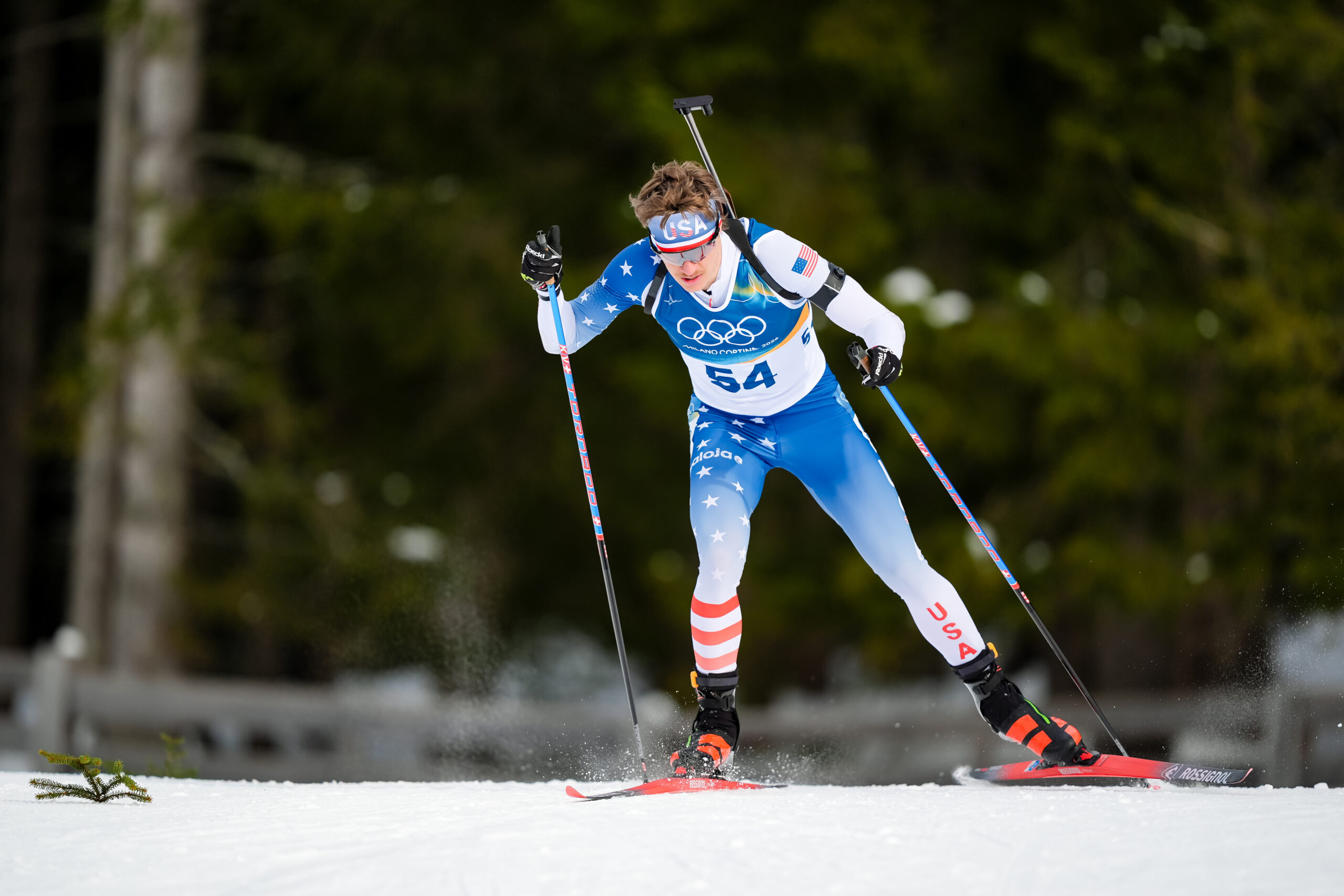
    Campbell Wright (USA) during the biathlon sprint at the XXV Olympic Winter Games in Antholz (ITA). (Photo: Thibaut/NordicFocus)

    Every winter, for a few weeks in February, cross-country skiing and biathlon stop being niche pursuits in the United States. During the last Olympic period, FasterSkier drew more than 180,000 unique readers in a single February, most of them people who do not know the sport’s governance history and have never heard of the Ted Stevens Olympic and Amateur Sports Act. On Wednesday afternoon, a board most of those readers could not name will vote on a decision that could reshape how one of their sports is run for the rest of the decade and beyond.

    The question in front of the U.S. Biathlon board is whether to enter a “Strategic Operating Alliance” with U.S. Ski & Snowboard, the far larger national governing body that oversees Olympic and Paralympic skiing and snowboarding. Under the proposal, U.S. Biathlon would remain a legally separate organization and the recognized governing body for the sport, but would hand much of its day-to-day operation to U.S. Ski & Snowboard under a services agreement. To its architects, it is a way to give a chronically under-resourced sport the stability and commercial muscle it has never had. To its critics, it is the moment a proud, independent program stops steering its own ship.

    The two sides do not disagree much about the facts. They disagree about what the facts mean.

    What is actually being proposed

    Strip away the temperature of the debate and the structure is specific, and it has changed meaningfully since the idea first surfaced publicly in the spring. The current terms, which U.S. Biathlon posted for its members on July 27, describe an alliance rather than a merger in the dictionary sense. No organization dissolves.

    Under the agreement summary, U.S. Biathlon “will remain a separate legal entity,” keeping “its own corporate existence, financials, and independent audit.” It stays the governing body recognized by the U.S. Olympic & Paralympic Committee under the Ted Stevens Act, and keeps its membership in the International Biathlon Union, the sport’s world federation. Its name, logo, and trademarks remain owned by U.S. Biathlon and are licensed to U.S. Ski & Snowboard.

    What changes is who runs the operation. Under a services, or operating, agreement, U.S. Ski & Snowboard would take over “staffing, programs, events, and administration for biathlon,” giving the smaller sport access to a chief financial officer, general counsel, marketing and revenue staff, medical and sport-science support, and technology infrastructure it cannot afford on its own. U.S. Biathlon’s own staff, its leaders say, would remain responsible for running the sport itself. A new Biathlon Sport Committee would be created inside U.S. Ski & Snowboard, mirroring the structure the larger body already uses for cross-country and its other disciplines.

    Jack Gierhart, U.S. Biathlon’s president and chief executive, described the mechanism plainly in an interview. “The mechanics of this are like an operating agreement between U.S. Biathlon and Ski and Snowboard where they take over operations,” he said. “That’s how we’re honoring and satisfying the Ted Stevens Act.”

    Sophie Goldschmidt, president and chief executive of U.S. Ski & Snowboard, framed the same structure around what biathlon keeps. “We would keep the biathlon entity. In fact, we keep the biathlon name, the biathlon logo,” she told FasterSkier. “From a legal perspective, it would also have its own entity. With that, it would have its own board. So very much operating like it does today, but sitting within a larger framework so that it can benefit from the other resources and shared knowledge, extra funding that we can provide.”

    That phrase, “operating like it does today,” sits at the center of the argument, because a great deal depends on how much a board that has delegated its operations still actually decides.
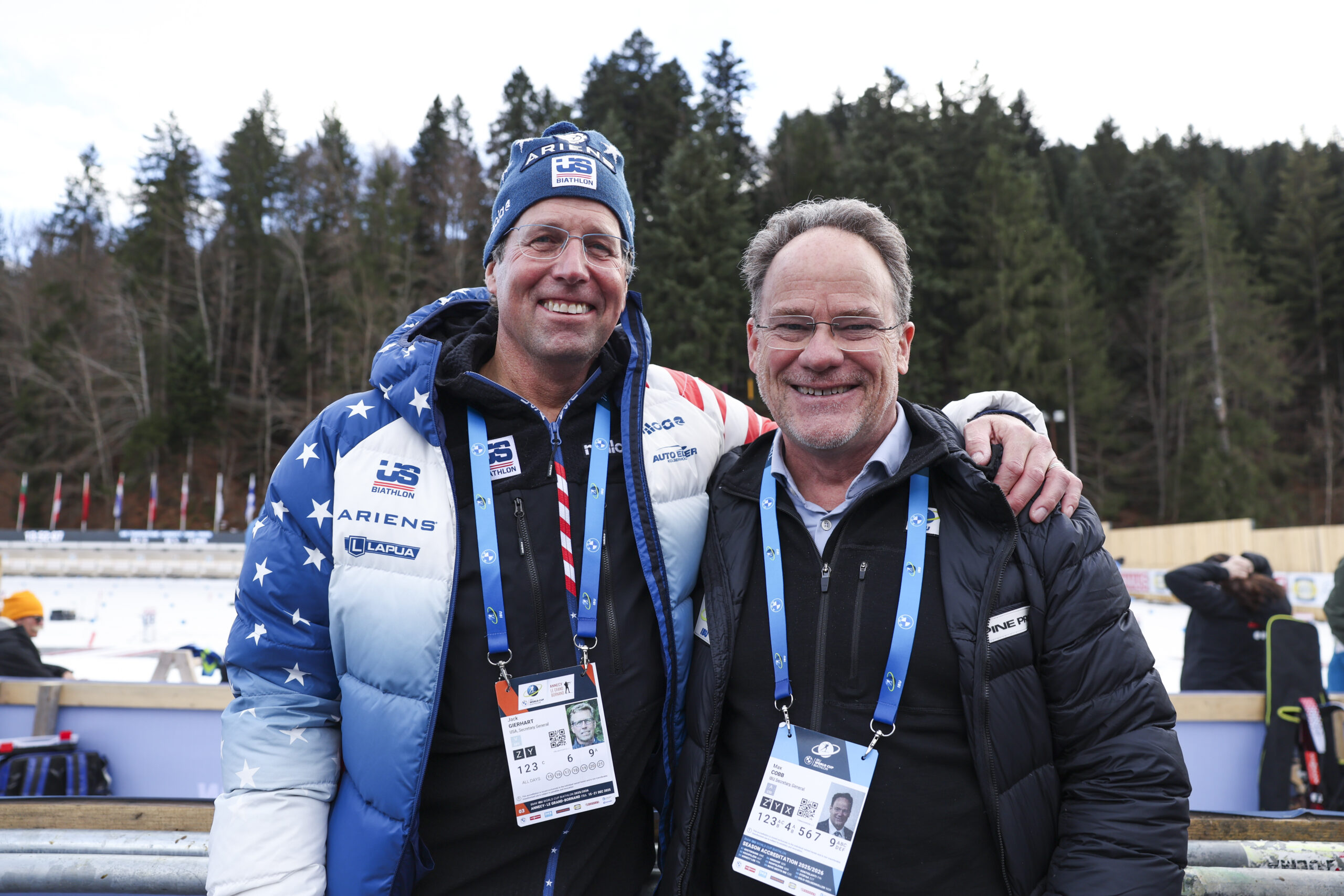
    USBA CEO Jack Gierhart poses with Max Cobb (IBU Secretary General) (l-r) at the IBU World Cup in Annecy-Le Grand Bornand (FRA) last December. (Photo: Manzoni/NordicFocus)

    How the sport got here

    By the account of the people who built it, this did not begin as a takeover. It began, Gierhart said, as an attempt to solve a problem every small Olympic sport shares.

    Gierhart arrived at U.S. Biathlon in September 2022, as longtime leader Max Cobb was leaving for the IBU. The organization was early in a strategic plan aimed at growing the sport, and a central piece of that plan was working more closely with the cross-country community, since most American biathletes come from skiing. “From my experience being in sport for 25 years, when you offer people more options, more pathways, you increase retention and you grow the pie,” he said. “It’s like, this should be a no-brainer, but then you run into the cultures and communities.”

    Those conversations, Gierhart said, drew in the U.S. Olympic & Paralympic Committee, which oversees and funds the country’s Olympic sports. “The USOPC started to suggest, hey, we’ve got a lot of these small NGBs, why don’t you guys think about something a little more formal?” he said. That was roughly a year and a half ago. The organizations sketched the basic terms, paused through the Olympic and Paralympic Games so as not to distract athletes, then brought the concept to a wider audience in the spring.

    Goldschmidt described the same arc and made the case for why her organization wants biathlon at all. U.S. Ski & Snowboard already runs multiple sports under one roof, she said, which means it can absorb the compliance and administrative costs that crush small governing bodies. “The central costs can really be absorbed and be a real cost saving for those organizations,” she said. “Legal, finance, safe sport compliance, all of that, which is quite a big burden, especially on some smaller NGBs. We can absorb that quite easily without having to increase the cost base, which means practically more money is going directly to the athletes.”

    The rollout did not land smoothly. After town-hall meetings drew pointed questions, the two organizations convened three joint working groups, on governance, sport development, and high performance, that met through the back half of July. Twenty-eight to twenty-nine participants, including athletes, coaches, club leaders, and staff, spent two weeks documenting what a successful alliance would require and what worried them. Their reports, posted publicly, have become some of the most revealing documents in the whole debate, in part because they capture both the community’s hopes for closer collaboration and its doubts, in the community’s own words.
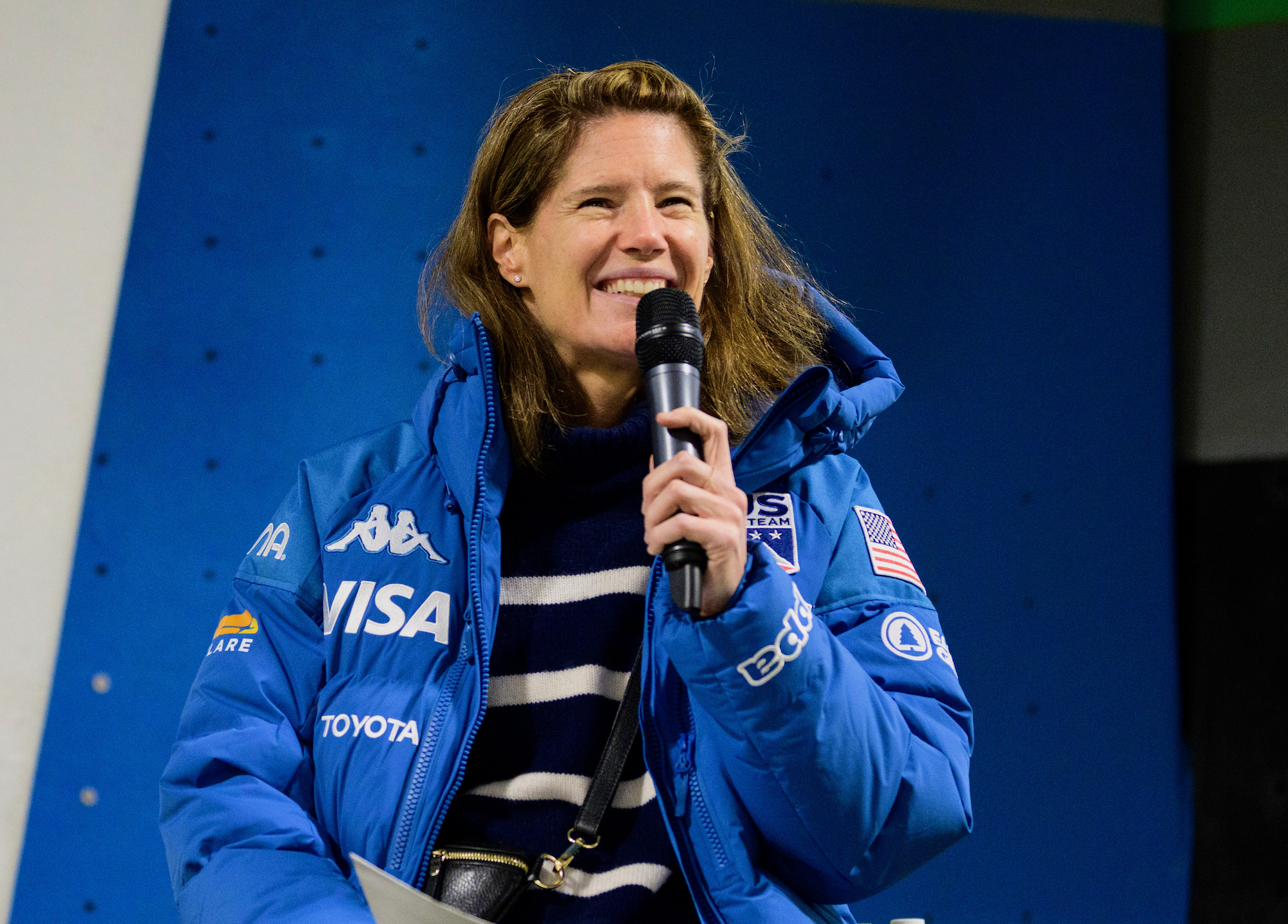
    Sophie Goldschmidt speaking at the Alpine World Cup in Killington, Vermont in 2024. (Photo: U.S. Ski & Snowboard)

    The money, and the question at the center of it

    Almost everyone involved agrees that money is the engine of this deal. What they do not agree on is how to describe the pressure behind it.

    The clearest number comes from Gierhart. For the coming season, he said, the USOPC reduced U.S. Biathlon’s grant by 22 percent. The reason, in his telling, has less to do with the alliance than with a shift in how the USOPC allocates money. Roughly three years ago, he said, the committee created an investment framework weighted toward medal potential. “They told us a couple of years ago, you guys are one of the highest funded sports, you haven’t delivered medals,” Gierhart said. “There’s a good probability you’re going to get a cut. And that’s what happened. They cut us,” a reduction he put at 22 percent for this year.

    Crucially, Gierhart rejected the idea that the cut is a lever to force the alliance. “It hasn’t been like, if you don’t do it, we’re taking away money,” he said. “It was, we’re taking away money because you’re over-resourced from our model standpoint and you’re not delivering. But if you go in this direction, which we believe will be beneficial in the long term, we want to help you do that.” Asked directly in a later FasterSkier interview whether it was a threat, he drew the distinction again. “They gave us our grant for this year, and it’s the 22 percent reduction. But they said that if we move in this direction with this alliance, they want to invest more in us. And they will find a way to do that,” bringing biathlon “back to where we were.”

    Goldschmidt, in interviews with FasterSkier, likewise described the reduction as reversible if the alliance proceeds, and tied it to the USOPC’s belief that a more efficient biathlon can compete for medals.

    The U.S. Olympic & Paralympic Committee, asked to confirm the figures and to say whether restoration of the funding is contingent on the alliance being approved, declined to address specifics. In a written statement, spokesman Jon Mason said the committee “is aware of and engaged in the discussions between U.S. Biathlon and U.S. Ski & Snowboard, and we support them taking a deliberate, transparent, fact-based approach to exploring a future relationship that complies with the Ted Stevens Olympic & Amateur Sports Act.” The committee, he added, is “supportive of outcomes that can build long-term stability and create opportunities for current and future generations of athletes.” The statement did not confirm the size of the cut, and it framed compliance with the Act as a goal the parties must meet rather than a settled fact.

    What the alliance would add is documented. According to the high-performance working group’s summary, biathlon “would receive a ~$600k increase from current FY27 revenue projections” in the first year, with U.S. Ski & Snowboard guaranteeing an increase “from this year-one level through year 4.” Gierhart put the combined total, new revenue and shared-services savings together, at “at least” $3.3 million over four years. That money, in principle, flows back into programs.

    Set against U.S. Biathlon’s roughly $3.5 million in annual revenue, those are not small numbers. And they arrive alongside a promise that biathlon’s existing money stays biathlon’s. Under the agreement, “all funding designated for biathlon, including IBU and USOPC support, existing sponsorship contributions, charitable donations, and other biathlon-specific revenue, will remain ring-fenced and used exclusively to support biathlon.”

    Here Goldschmidt was careful to correct what she called a misunderstanding. The ring-fence, she said, is permanent, not a four-year arrangement. “All of the money that they generate that is ring-fenced for biathlon will continue to go to that program. That will be a contractual commitment,” she said. “Some people have got confused that we’re only committing to four years to ring-fence and provide them funding. That’s not accurate.” The four-year commitment, she clarified, applies to the additional commercial funding U.S. Ski & Snowboard brings to the table, which depends on the sponsorship deals it can renew.

    Gierhart described the same two-part structure, and pushed back on the idea that biathlon falls off a cliff when the four years are up. “This gives us a platform for four years of sort of guaranteed increased revenue to build momentum and to implement the things that we know are going to help us,” he said. “Without that, we’re going to live year to year, and we’re already in maintenance mode as opposed to growth mode.” In four years, he argued, biathlon would be “in no different a situation than we are today. In fact, we’ll be better, because we’ll have a lot more resources to work with over the next four years.”

    That distinction defines exactly where the community’s deepest financial fear lives. The money biathlon already raises is protected by contract. The new money, the actual growth case, is guaranteed for one Olympic cycle, through 2030, and after that depends on the USOPC and on sponsors, the same as it would if biathlon stood alone.
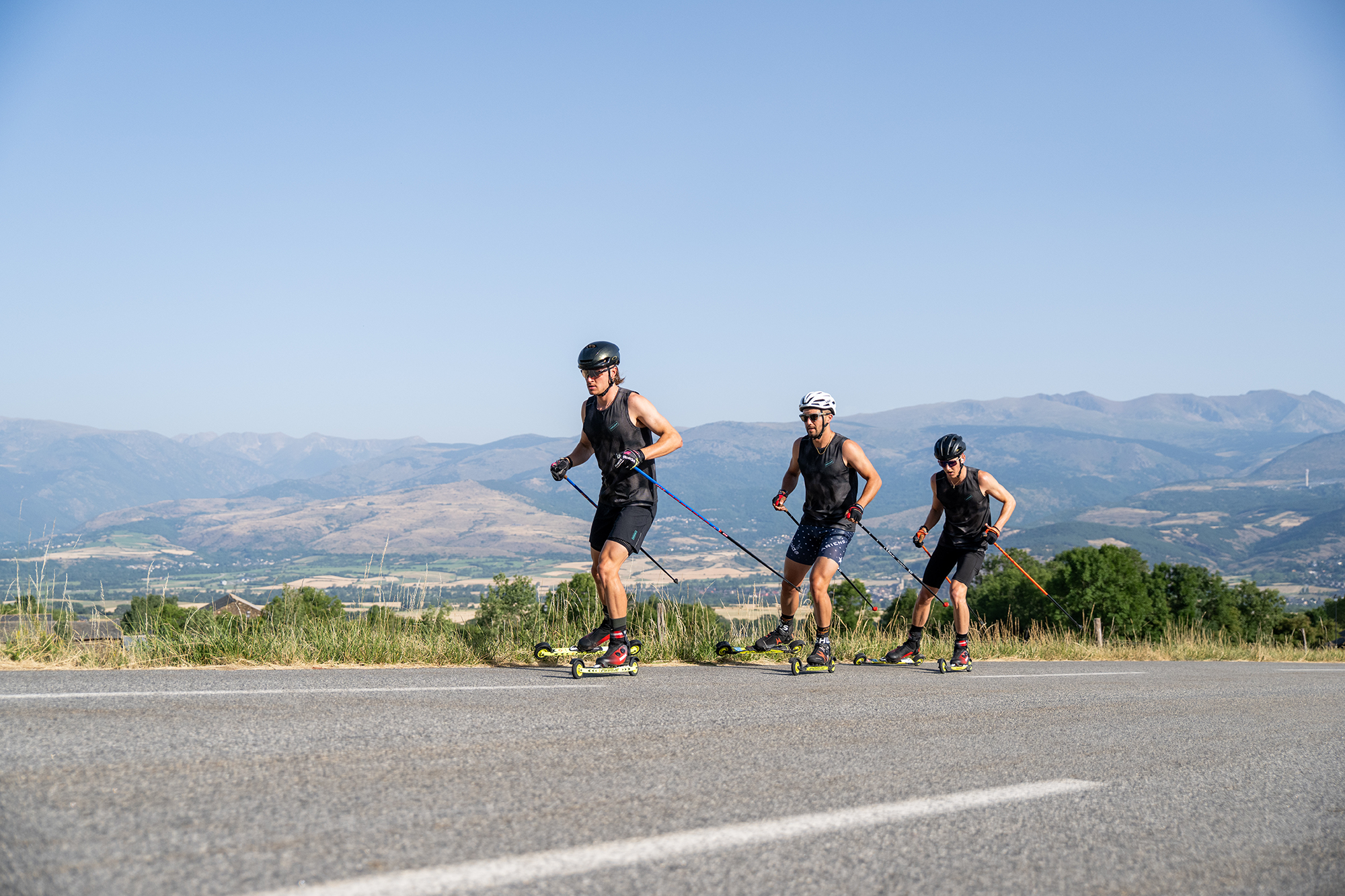
    While much of the US biathlon community debates governance, the USBA’s Campbell Wright, Vincent Bonacci, and Maxime Germain (l-r) gets after their summer training in Font-Romeu (FRA). (Photo: Authamayou/NordicFocus)

    The Ted Stevens question

    No part of the debate has generated more heat than the law. A group of members, some of whom helped establish U.S. Biathlon as an independent governing body decades ago, argue that the alliance violates the Ted Stevens Act. Their case rests on two provisions.

    The first is the single-federation rule. Under 36 U.S.C. 220522, a national governing body must be “a member of no more than one international sports federation that governs a sport included on the program of the Olympic Games.” U.S. Ski & Snowboard belongs to FIS, the International Ski and Snowboard Federation. Biathlon answers to the IBU. Critics contend that if U.S. Ski & Snowboard effectively governs an IBU sport, the arrangement collides with that rule.

    The second is autonomy. The same statute requires a governing body to be autonomous, in that it “independently decides and controls all matters central to governance” and “does not delegate decision-making and control of matters central to governance.” Arthur Stegen, a former U.S. Biathlon board member and part of a group called Team Independent Biathlon, laid out the objection in correspondence circulated to other members and shared with FasterSkier: a services agreement that assigns operational responsibility to U.S. Ski & Snowboard, he argues, is by definition a delegation of control, and reducing the biathlon board to a sport committee “would appear to relinquish its governance responsibilities to another organization.” Stegen wrote that he is “completely against this potential merger.”

    The written terms were plainly built to answer that challenge. The agreement summary includes a section titled “Reserved Governance Authorities,” which states that “notwithstanding any operational responsibilities delegated to U.S. Ski & Snowboard,” U.S. Biathlon “will retain sole authority over all matters required by the Ted Stevens Act or otherwise reserved to the National Governing Body,” including “oversight of the organization, approval of the biathlon budget, and all authorities reserved to the NGB.” In other words, the deal’s authors say operations are delegated while governance is reserved.

    Goldschmidt said the structure was designed to align with the statute from the start. “We’ve worked with the USOPC and others to ensure it fits all of those criteria, which it does,” she said. Gierhart said U.S. Biathlon has already received an opinion on the point. “We’ve gotten the opinion from the USOPC’s legal counsel on the terms as they’re written now, and their opinion is that it meets the requirements and is in compliance with the Ted Stevens Act,” he said.

    He was also clear about sequence, and described it as the normal way such deals come together. Wednesday’s vote is on the foundational terms, the fundamentals both sides have agreed to. “You’ve got to agree on the fundamentals, and then that’s what’s going to drive the detailed operating agreement,” he said. That more extensive agreement, covering licensing of the biathlon trademarks, the function of the board, and the bylaws, would be drafted next, “vetted by independent counsel” to confirm it complies with the Act, and then brought back to the U.S. Biathlon board, athlete representatives included, for a separate vote to approve it.

    That staging is itself contested ground. Supporters see a standard process: agree on principles, then build and independently vet the detailed contract. Skeptics see a board being asked to commit before the full agreement exists and before the independent legal review happens, and some argue a binding vote should wait until both are done. What Wednesday’s vote actually authorizes, the concept or a finished deal, is a distinction worth watching closely as the meeting unfolds.

    The USOPC, for its part, did not put its weight behind a declaration that the current structure is legal. It said it supports the parties “exploring a future relationship that complies” with the Act, language that leaves compliance as something still to be demonstrated.

    There is precedent for the skepticism, and for U.S. Ski & Snowboard’s interest in expansion. The organization previously pursued governing roles in surfing and skateboarding, efforts that critics cite as evidence of a broader ambition to build a multi-sport governing body, the very kind of concentration the Ted Stevens Act was written to prevent. Goldschmidt described those episodes as different in kind. Surfing, she said, “just got too political,” and the organization walked away; skateboarding remains “ongoing” with “no immediate decisions.” Biathlon, she argued, is a natural fit that most European countries adopted long ago. “I get asked all the time, why is biathlon not integrated within your organization,” she said. “It’s a natural fit in many ways.”

    Who controls the board

    Because the autonomy argument turns on control, the composition of the board is more than a technicality, and it is an area where early rumors and current terms diverge sharply.

    Gierhart was emphatic that the U.S. Biathlon board does not shrink or change hands. “The board is going to continue at the same size it is by the bylaws. It’s 12 to 15 members. They’re voted on by the membership,” he said. Those voters remain biathlon’s own roughly 1,500 members, whose categories will be tracked separately even after membership systems migrate to U.S. Ski & Snowboard’s platform in the 2027-28 season. “Our board size is not going to change. The composition is not going to change,” Gierhart said.

    Just as important, he said, is what that board keeps deciding. Among the authorities it retains is control of the budget and the annual plan, meaning that where biathlon’s money is spent would still be approved by the U.S. Biathlon board of directors.

    The new layer is the Biathlon Sport Committee, which the agreement describes as being drawn from the existing board, “6 to 8 members,” and maintaining the 33 percent athlete representation required by USOPC bylaws. The chair of that committee and one athlete representative would sit on the U.S. Ski & Snowboard governance board, giving biathlon two seats and a direct voice in the larger organization. The arrangement runs in both directions: U.S. Ski & Snowboard would, in turn, have representation on the U.S. Biathlon board.

    Athlete voice, a recurring worry, is addressed specifically. Rather than being folded into U.S. Ski & Snowboard’s athlete representation, “biathlon would still maintain its separate voice of athletes on the Team USA [Athletes’] Commission,” Gierhart said. “We’d have our own.”
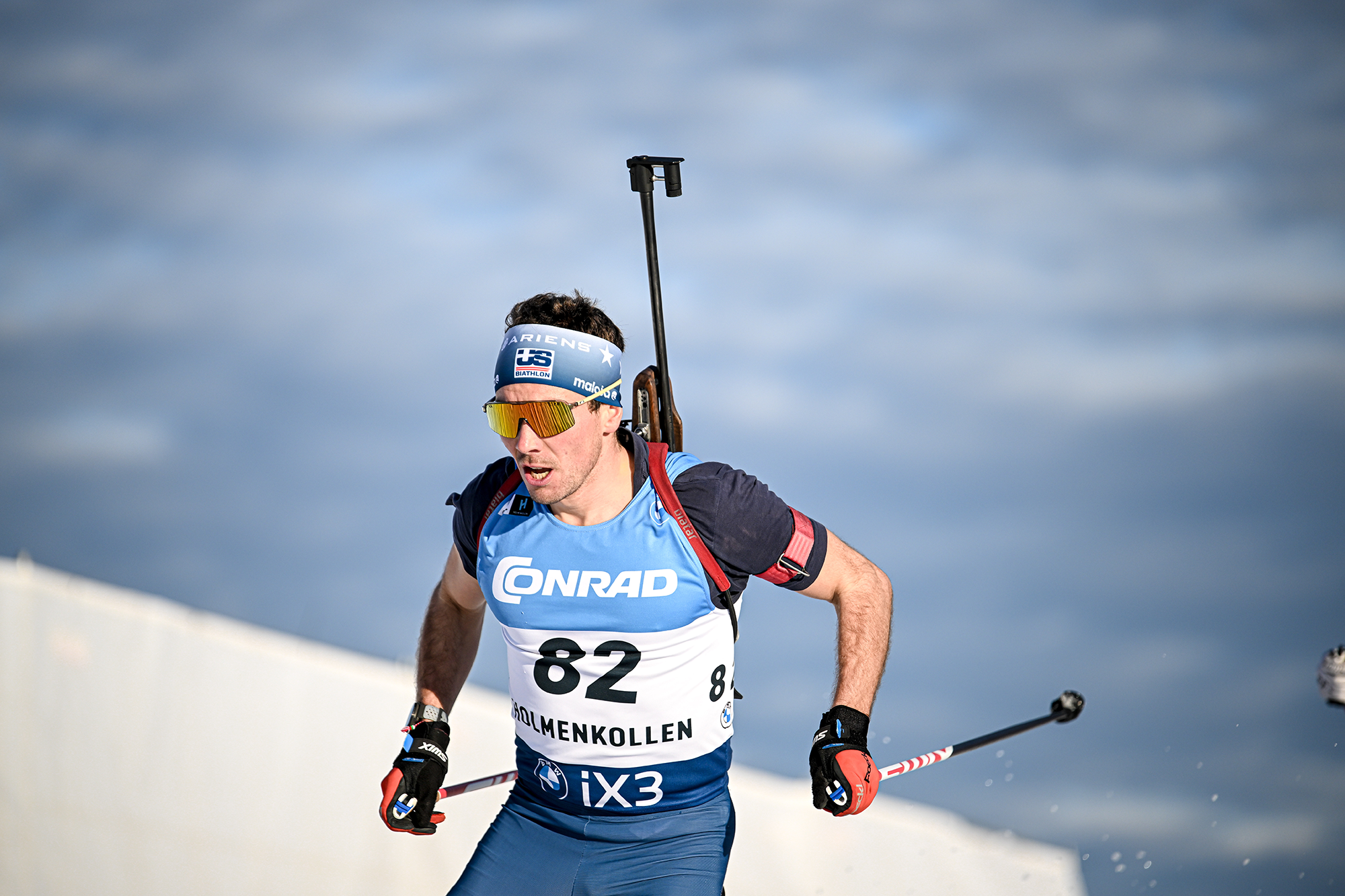
    Even though Jake Brown officially retired from the IBU World Cup after last season, he has played an active role as an athlete rep throughout this process. (Photo: Authamayou/NordicFocus)

    What changes for the athletes

    For the people who actually race, the alliance is not an abstraction about governance. It is a question about who pays for the plane ticket to Europe.

    U.S. Biathlon funds its athletes to a degree unusual among American winter sports. “Our athletes within biathlon are better funded and supported than in any other winter sport,” Gierhart said, noting that the program fully funds its World Cup athletes and nearly fully funds its IBU Cup athletes. Revisiting the specifics, he said U.S. Biathlon provides its athletes $48,000 in direct athlete support, $35,000 in need-based assistance, and $30,000 in performance bonuses, and secures roughly $36,000 a year for its top competitors. Cross-country, by contrast, does not pay national-team skiers to compete on the World Cup; much of that burden falls to clubs and to community fundraising.

    That gap is the source of the athletes’ most concrete fear. Jake Brown, who retired from biathlon this year and sits on the U.S. Biathlon board as an athlete representative, said the worry he hears most is that biathlon’s funding model quietly converts to the ski-team model once the sports combine. He is careful to add nuance. “There’s nothing guaranteed that U.S. Biathlon will continue funding World Cups either,” he said. “The funding has to be there.” Biathlon also draws money from the IBU for each athlete who starts a race, which makes subsidizing those starts partly self-financing, and the sport has leaned into keeping athletes in the pipeline rather than cutting them early. “We can’t afford to lose them,” Brown said.

    The agreement attempts to lock that model in place, but only for a defined window. The current athlete support model “will continue through the 2030 Olympic quad,” it says, with “National Team, World Cup, IBU Cup, Youth, and Junior athlete support structures” remaining “in place unless changes are jointly approved by the Biathlon Sport Director and the U.S. Biathlon Board.” As with the incremental funding, the guarantee runs one cycle. What happens after 2030 is precisely what no document can promise, though, as Gierhart notes, biathlon cannot promise that to itself every year either.

    No voice in this debate has lived that risk more directly than Justin Wadsworth, the former U.S. Olympian who now is U.S. Biathlon’s Head Physiology Coach (working with both the men’s and women’s national teams) and who spent years coaching in Canada, including a stretch as a high-performance director there. Wadsworth described watching Biathlon Canada’s funding collapse. “Over the last eight to ten years, we’ve seen organizations having funded the athletes for all camps, all trips, everything, to now athletes paying for training camps, paying for trips,” he said. “That’s basically what’s really pulled Biathlon Canada down. The athletes just can’t afford to go on trips or training camps.”

    The damage, he said, was not only financial. “It really changes the dynamic with the team,” Wadsworth said. “As a coach and as an organization, it’s much harder when athletes are paying for everything.” His wife, Beckie Scott, the Olympic champion who now leads Nordiq Canada, made cutting athlete fees a priority for exactly that reason. Asked what U.S. Biathlon should guard most carefully, Wadsworth did not hesitate. “The number one is just, are the athletes going to continue to be getting funded when they’re absorbed with U.S. Ski and Snowboard.”

    Brown framed the same anxiety in a different register, as a question of trust. “There is a strength in independence,” he said. “You have a trust that your leader, when they put their head on the pillow every night, is trying to figure out how to make biathlon better in the country, and not trying to figure out how to prioritize what sport within a larger organization.” That, more than any statute, is the emotional core of the opposition: the fear that biathlon becomes one line item among many, advocated for by executives whose attention is divided.

    The community’s own working group named the same items. The high-performance group’s report listed what “must be protected”: the centralized national team model, athlete stipends and need-based aid, the pathway that recruits skiers into biathlon, the world-class ski-service program, the Montana State University sport-science partnership, and “athlete-centered decision making.” It also warned, in writing, of the risk that unites the skeptics and the supporters, that “differences in stipends, housing, and athlete funding philosophies will be inequities across sports,” and that “the reasoning behind this must be explained well, or there is high risk of tension between sports.”

    The case for

    Set the fears aside and the argument for the alliance is not hard to follow, and some of its most persuasive versions come from people with no stake in the outcome.

    Wadsworth, who says he has “no real skin in the game” and is “just trying to coach right now,” makes the efficiency case from painful experience. A small governing body cannot carry the overhead a large one can. “An appeal, from an athlete and the organization needs to get a lawyer for that, a single appeal can cost 30 to $50,000,” he said, “and if that’s 5 percent of your budget, that’s a big hit.” Fold biathlon into a larger organization with in-house counsel, fundraising staff, a training center, and sport scientists, he said, and those costs largely vanish. “Those efficiencies are really the positive side.”

    Goldschmidt’s version is about scale on the revenue side. U.S. Ski & Snowboard, she wrote to biathlon’s members, generated “more than 900 million social media impressions and 7 billion earned media impressions last season,” counts more than a million social followers, and has “more than doubled our commercial revenue over the last four years,” with “nearly 85 percent of that revenue going directly to athletics.” Biathlon, by her argument, brings a genuinely valuable and telegenic property, the IBU World Cup is among the most-watched winter sports in Europe, that a 35,000-follower organization cannot monetize on its own. “One plus one can equal a lot more than two,” she said, “most importantly for biathlon.”

    Gierhart’s case is about the limits of the status quo. “We’ve been doing the same thing for 60 years,” he said. “We’re a small sport, we have limited resources. We’ve always had a thin bench. But the formula isn’t changing. And if we’re going to try to drive transformational change, we’ve got to look at some things a little differently.”

    And there is the pipeline, the argument that biathlon and cross-country are natural partners that have been kept artificially apart. Today a club that wants to offer both sports contends with two governing bodies, two memberships, two coaching-education systems, two calendars. The sport-development working group’s central recommendation was to merge those tracks, shared coach education, coordinated regional calendars, laser biathlon introduced to youth skiers, so that, in Brown’s words, the “big potential benefit comes in the sport development space.” Wadsworth added the practical constraint that enthusiasm tends to skip past: it comes down to shooting ranges. “The number one thing for biathlon is you need a range, and so that’s probably a limiting factor,” he said. “If U.S. Ski and Snowboard decides they really want to focus on the development side, they’re going to have to build more biathlon ranges. If you build it, they’ll come.”
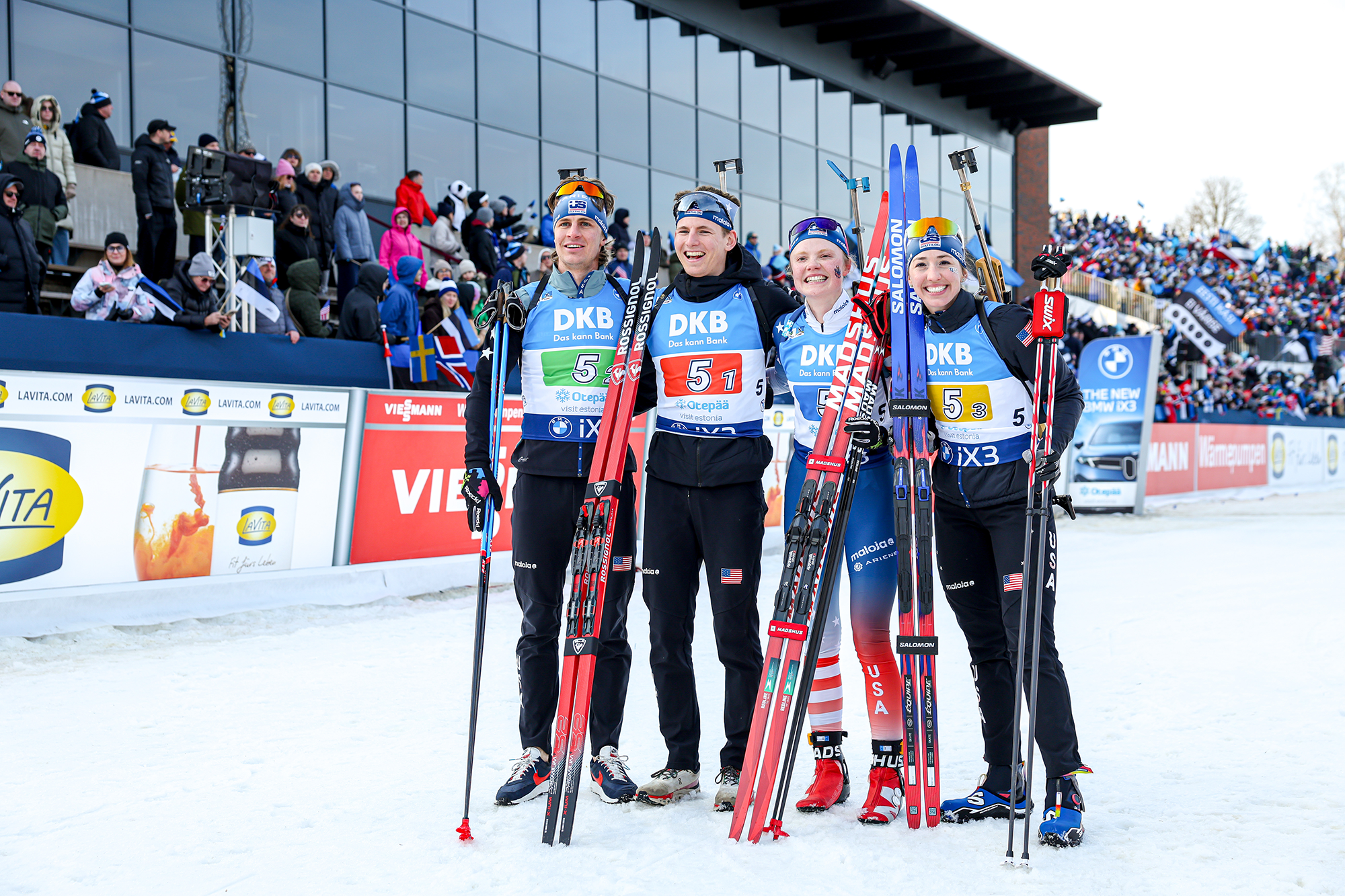
    Campbell Wright (USA), Maxime Germain (USA), Margie Freed (USA), and Deedra Irwin (USA), (l-r) after the IBU World Cup Biathlon mixed relay in Otepaeae (EST). (Photo: Manzoni/NordicFocus)

    The case against, in the community’s own words

    The sharpest questions about the alliance do not come from the members trading accusations online. They come from the process U.S. Biathlon itself ran. The working groups produced plenty of enthusiasm for closer collaboration, and their reports document at length the benefits participants believed an alliance could unlock. But the same reports surfaced a recurring doubt.

    Across all three groups, participants returned to a single question: if the goal is collaboration between biathlon and cross-country, why does it require a formal alliance? The consolidated report notes that “several participants observed that many of these initiatives could theoretically be pursued without a formal alliance.” The sport-development group put it more bluntly in its written takeaway: “Some expressed confident progress could be made without an alliance. It is not accountability that will move this from conversation to action. It is the passion of the people involved in both sports.” (U.S. Biathlon cautions on every page that the working-group notes were “generated during meetings in which judgment was not applied” and “do not represent the decisions or strategies” of the organization.)

    The governance group’s “parking lot” of unresolved issues reads like a checklist of the skeptics’ concerns: “Ted Stevens Act compliance,” “an escape path if integration fails,” “what autonomy does Sport Committee have to direct USSS operations,” and whether a replacement is needed for the athletes’ advisory council “to preserve biathlete input.” The high-performance group flagged “budget flexibility,” asked “which proposed benefits truly require an alliance, and which can already be achieved through partnership,” and wondered whether biathlon could build its own dedicated fundraising vehicle, an equivalent of the National Nordic Foundation, without merging at all.

    U.S. Ski & Snowboard’s answer to the “why not just collaborate” question is that informal collaboration has been tried, and has not delivered. The alliance-alignment document U.S. Biathlon distributed argues that, while the two organizations “have collaborated successfully for many years, this formal Alliance creates a level of commitment, coordination and accountability that cannot be achieved through informal collaboration alone.” Gierhart put it more sharply. He said he disagrees “wholeheartedly” with the notion that passion alone will carry the work forward. “You need accountability,” he said, describing what he sees as a fundamental difference within the community over how things actually get done. Goldschmidt made the same point about incentives: absent a formal structure, she said, no one at a big organization is measured on whether they helped a small one. “Why would I help another sport if that’s not how I’m measured?”

    Then there is the matter of process and speed, which even supportive athletes acknowledge. Brown said the spring rollout caught the community off guard. “It kind of came out in the springtime. It was a little bit surprising, and it took us some time to understand why,” he said. “Most of the membership and the athlete body, we had some catching up to do.” The working groups were themselves a response to feedback that the process had moved too fast with too little consultation, and some members continue to argue that a binding vote should wait for the final agreement and its independent legal review, both of which, by U.S. Biathlon’s own account, come after Wednesday.

    The exit, and what the fine print says

    If there is a single provision that will decide how much reassurance skeptics take from this deal, it is the exit. Gierhart is adamant that it is a last resort, not a trap door.

    He described a defined process. Goals and key performance indicators would be set at the outset, with an assessment after the first year and a comprehensive review at the end of the quad. “If we get to a point where there’s irreconcilable differences,” he said, “then there is an option to move towards a different operating structure, which could mean that U.S. Biathlon becomes an independent operating entity again. And that is a choice that can be made by either party. It doesn’t have to be mutually agreed upon.”

    He was careful to say that does not mean either side can simply walk away on a whim. The written summary describes an interim assessment after the 2026-27 season and a comprehensive review after 2029-30, and says that “should significant challenges arise that materially impair the objectives of the alliance, the organizations will first implement a corrective action plan.” Only “if substantial concerns remain unresolved after those efforts” would “alternative organizational structures, including the return of U.S. Biathlon to an independently operated organization, be considered.” That, Gierhart said, matches what he meant: a process of measuring progress against shared goals, trying to fix what is not working, and only then, if the problems prove irreconcilable, allowing either party to end the alliance without the other’s consent.

    “I don’t want it to sound in any way that in four years there’s an exit ramp that’s most likely going to happen,” he said. It is less an exit ramp, in his framing, than a runaway-truck ramp: an emergency measure, rarely used, that exists only for the case where nothing else has worked. The distinction that matters, he said, is that the eventual decision does not require both sides to agree. “It would probably be the board of directors of U.S. Biathlon that would say, we can’t resolve these differences and we want to make a change. Or Ski and Snowboard would say this is not working.”
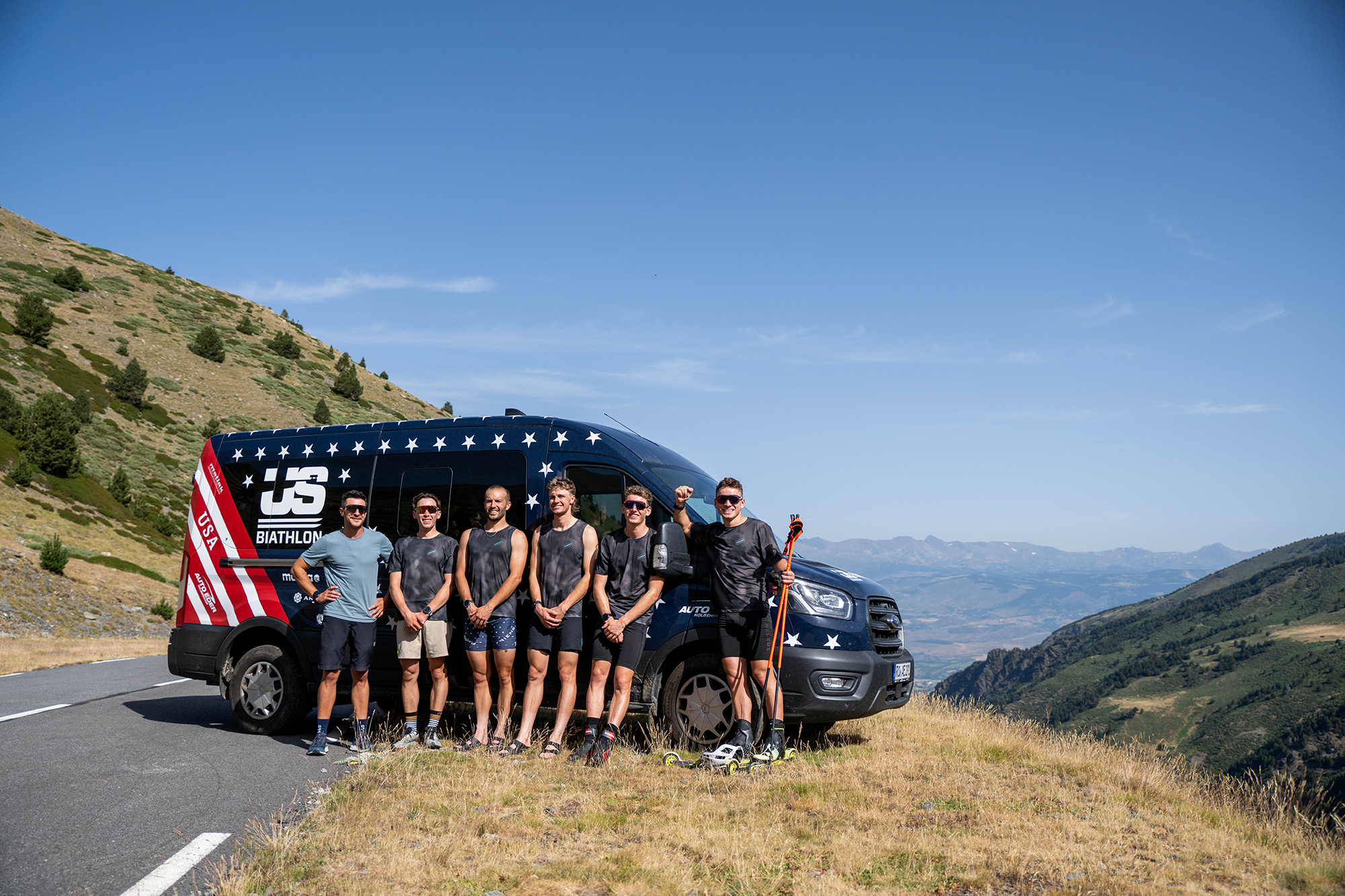
    Emil Bormetti (ITA); Coach Team USA, Bjorn Westervelt (USA), Vincent Bonacci (USA), Campbell Wright (NZL), Maxime Germain (USA), Vaclav Cervenka (USA), (l-r) summer training in Font-Romeu (FRA). (Photo: Authamayou/NordicFocus)

    What happens Wednesday

    The board meets Wednesday at 4 p.m. Eastern. By Gierhart’s account, directors received an extensive board package over the preceding weekend, and the athlete representatives, who under USOPC rules make up a third of the board, have been closely engaged.

    What the vote settles may be narrower than the noise around it suggests. If the board approves the foundational terms, the more detailed operating agreement, and its independent legal review, would follow, along with a further board vote to approve it. If the board balks, or postpones, the timeline slides. Either outcome will be read as a verdict on a process that many in the community found rushed and many others found overdue.

    The stakes are real in both directions, which is why the debate has been so bitter. If biathlon stays independent, it does so facing a documented funding cut and the same structural constraints that have kept it small for six decades. If it joins, it trades a measure of autonomy for stability, resources, and a commercial platform it has never had, and it does so on the promise, guaranteed for four years and asserted in perpetuity, that the sport it has built will not be diminished inside a larger one.

    The people on every side of this insist they want the same thing. “Whichever way the board decides,” Brown said, “I really want to be able to take our membership with us in whichever direction we go, and maintain good relationships with our full community. Because otherwise, we lose.”

    On Wednesday afternoon, fifteen people will decide which way that goes.

    FasterSkier will report the outcome of Wednesday’s vote. Reporting for this article included interviews with U.S. Ski & Snowboard president and CEO Sophie Goldschmidt, U.S. Biathlon president and CEO Jack Gierhart, U.S. Biathlon athlete representative Jake Brown, and U.S. Biathlon head physiology coach Justin Wadsworth, a written statement from the U.S. Olympic & Paralympic Committee, and a review of the alliance term sheet, the July 2026 community working-group reports, and correspondence from members opposed to the deal.

    Because the details of this proposal are complex, quotations attributed to U.S. Ski & Snowboard and to U.S. Biathlon were provided to each organization in advance of publication so they could verify the accuracy of their own statements and clarify technical details. FasterSkier retained full editorial control over the content, framing, and conclusions of this article.


    Help Support Our Coverage!

    If you value the thoughtful work and access FasterSkier provides, please consider becoming a Voluntary Subscriber. Your support directly fuels our work to cover the people, places, and moments that make our sport special.

    Join the FasterSkier community!


    At this moment, we don’t know what is down the road for USA Biathlon, but hopefully we will stay a community that supports the sport and the hard work of the athletes and coaches doing their best to perform at the highest level. (Photo: Authamayou/NordicFocus)
  • Beckie Scott: The Olympic Champion Rebuilding Nordiq Canada

    Beckie Scott: The Olympic Champion Rebuilding Nordiq Canada

    This article was made possible through the generous support of our voluntary subscribers. If you value coverage like this, please support FasterSkier with a voluntary subscription.

    The five minutes Beckie Scott spent at the finish line in Soldier Hollow on February 15, 2002, lasted longer than most things in her career. She had crossed the line in what felt like third place. She thought she had a medal. She did not yet know.

    “It was actually a photo finish,” Scott said. “There were about five full minutes where we didn’t know. And then it was announced.”

    Her teammates, her coaches, and the wax technicians were already gathered in the pit, standing in the cold. The result came over the loudspeaker. Bronze. Canada. Beckie Scott.

    “We went ballistic,” she said. “It was magic. By that point, a lot of the coaches and wax technicians had made their way down to the pit. We were sort of standing there all waiting, and then when it was announced, it was just chaos. But in the best possible way.”

    The Canadian flag went up the pole in third position. The bronze, in the moment, was a win.

    “There was no disappointment. We celebrated that medal like it was platinum. This was the first medal for Canada. It was a long shot. It was absolutely incredible and powerful to stand on. In that moment, I got to celebrate that and have that day, and that feeling, and all the joy that comes with it.”

    What happened next is now part of cross-country skiing’s history. The two Russian skiers who finished ahead of her were caught for doping. The bronze turned to silver, then to gold. The flag that had risen for her in third place was wrong, but only because the truth had not yet caught up to the racing.

    It would catch up eventually, though, and so would Scott, now an Olympic champion.

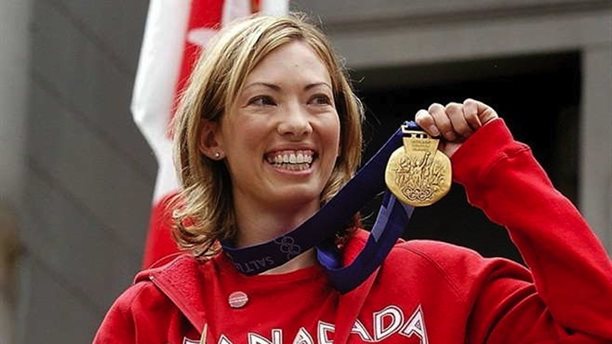
    Beckie Scott with the gold medal she was awarded at a ceremony in Vancouver in June 2004. A former Canadian cross-country skier, Scott finished third in the 5 k pursuit at the 2002 Olympics but was later awarded gold when the two women ahead of her were disqualified for using performance-enhancing drugs. (Photo: Cross-Country Canada)

    Scott grew up in Vermilion, Alberta, a rural community in the province’s northeastern region. Her parents were avid cross-country skiers and members of the local club. The trails started at the back of their property and ran into the provincial park. She could ski out the back door.

    When the Jackrabbit program — the Canadian equivalent of the Bill Koch Youth Ski League in the United States — rolled out across Canada in the early 1980s, her mother adopted it in Vermilion and Scott came up through it.

    “I developed just a real affinity and love for the sport, right from the start,” she said. “I was very inspired by the community. I really loved the community. I loved competing, and I just loved the idea that the harder you worked at something, the better you could do. So as a kid, it was all very exciting, and a lot of fun.”

    The Vermilion club is now more than 50 years old. The trails are well used. It remains a rare facility for a rural Alberta town.

    What was not rare, in the late 1990s, was the experience of a North American woman struggling on the World Cup. Scott was at the front of a group that did not yet exist. She was the best of her cohort, which was a difficult thing to be.

    “Even when we started on the World Cup, when I was there, the results were abysmal. It was very, very poor performances. The results were nowhere near successful, that’s for sure.”

    She remembers it now with a kind of dry humor. “I think it’s good that we had a good sense of humor, because there were a lot of days, if we weren’t laughing, we would have been crying. I do remember being completely devastated, often. Not just by being so far down the list, but by how far behind I was. That, to me, just seemed almost impossible. To see the gaps that I was seeing when I first started, in the era, I think we all know why the Russian women were skiing as fast as many of the men.”

    She did not know that at the time. She thought she was just a weak competitor.

    The way through, she said, started with a single word.

    “The first step was approaching it as a professional. Leveling up the approach to my career as a cross-country skier, as a professional. I don’t think I was doing that in the early days, and I didn’t even understand what that meant, necessarily. So that was a big shift. And then it was increasing training hours, getting serious about strength training, and technique. Taking every single piece of what a performance needs and addressing it separately, and eventually collectively. But the biggest shift for me was the mental, socio-emotional approach. Shifting the paradigm to being a professional.”

    She offers this as the lesson she most wants to pass on. The hardest part, she said, was maintaining belief.

    “In the early days, I just didn’t know at first if this was even possible, or what it was going to take, or how to get there. I had this incredibly aspirational ideal of what I wanted to be, and I was so far from that when I first started.”

    The first glimmer of light came at a World Cup in Val di Fiemme, Italy. She does not remember the exact year when we spoke, but it was in December of 1997. After seasons of trying to crack the top 30, she finished eighth.

    “That was it. That was the moment. It’s like, okay, 100 percent this can be done. And this isn’t going to be a one-off. It was totally exciting and inspiring, and I just wanted more.”

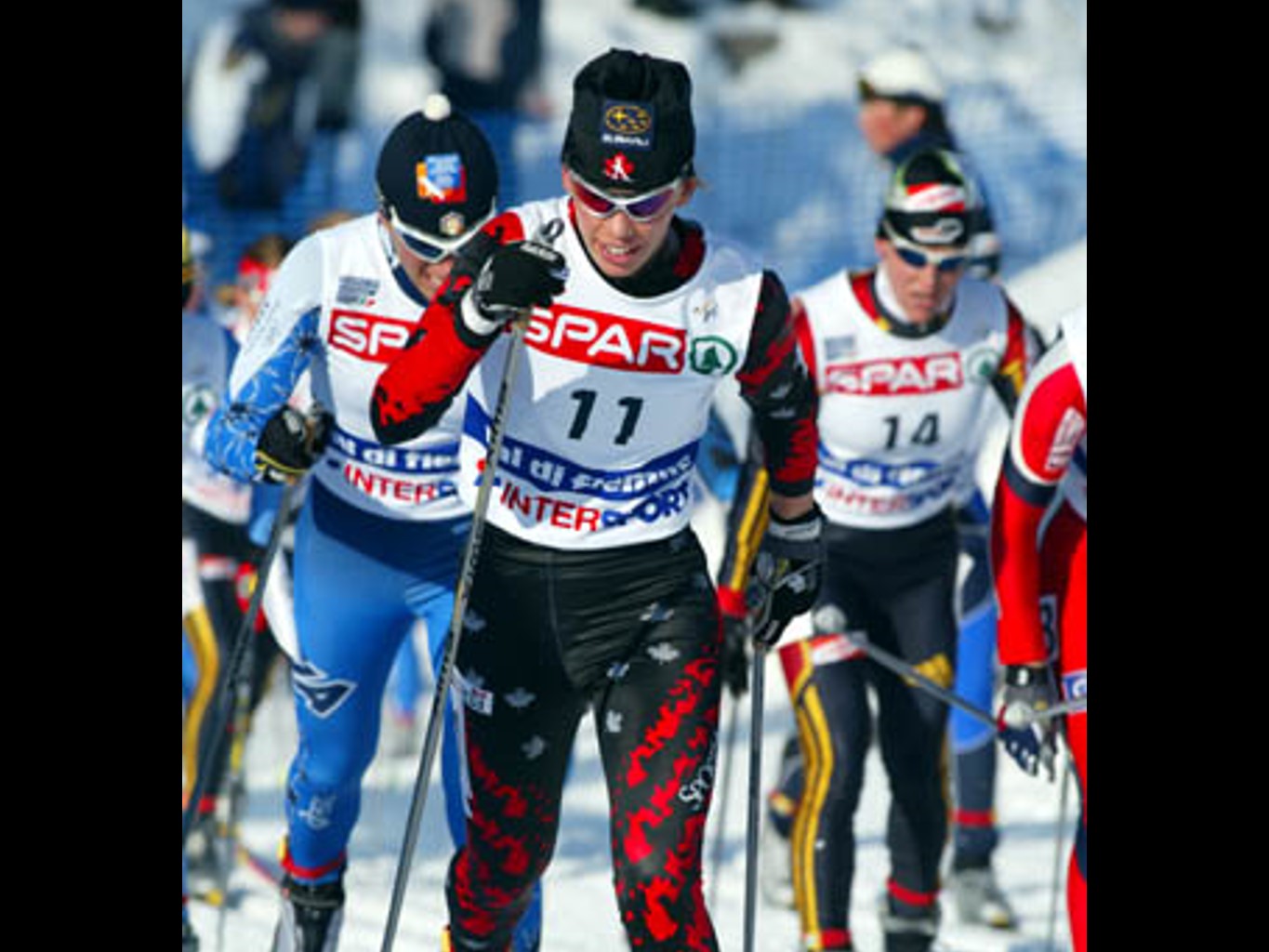
    Beckie Scott racing in Val di Fiemme (courtesy photo)

    By Salt Lake City, she was a contender. Not a sure thing, but a contender.

    “We had the belief, even years leading into Salt Lake City, that this was a golden opportunity that we shouldn’t and couldn’t pass up. We had spent our years living and training in Europe, constantly dealing with jet lag, living in hotels, foreign language, foreign food. And this was a magical opportunity on our doorstep to effectively race at home.”

    The 2002 women’s pursuit was a five-kilometer classic followed an hour and a half later by a five-kilometer skate. The format played to her strengths.

    “I could do both techniques well. There’s this powerful energy that’s created when you have a home crowd behind you. It really does change things for athletes in a way that’s hard to describe. There’s an uplift that’s just incredibly powerful. I felt it. I remember it to this day, twenty years later.”

    Then came the five minutes of waiting, and the chaos in the pit, and the medal that was, eventually, the right color.

    The irony of becoming the public face of clean sport in cross-country skiing was not lost on her. She had been vocal before Salt Lake, after most of the Finnish team was caught for doping at the 2001 World Championships in Lahti.

    “It was deeply frustrating to know that we were doing everything we could do to compete at the highest level in this sport, and we were constantly being thwarted by athletes who were using performance-enhancing drugs. That was incredibly aggravating. And it was shared. Not just by me, but my coaches, technicians, fellow teammates. This was not just unique to me.”

    When the Russians were caught in Salt Lake, her first reaction was surprise.

    “It was an open secret how much performance-enhancing drug use was going on in our sport, in particular by the Russian team. I was surprised because I did not have much belief, faith, or confidence in the anti-doping systems at that time. When I learned later about what actually happened at Salt Lake City to have those tests revealed as positive during those games, it was a remarkable series of events.”

    That path eventually led her to the World Anti-Doping Agency and a long career in sport integrity work.

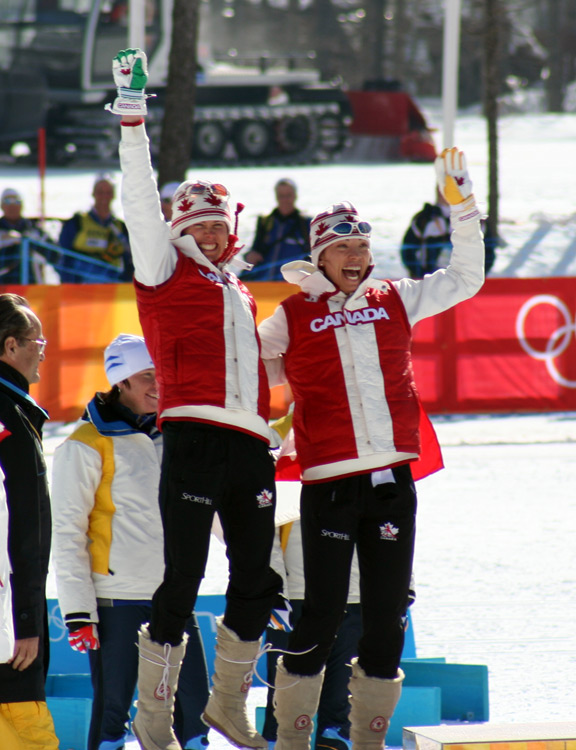
    Canada’s Beckie Scott (right) and Sara Rennner receiving their silver medal in the team sprint at the 2006 Olympics in Torino, Italy. That was two years after Scott belatedly received the gold medal she won at the 2002 Olympics, after fighting long and hard to earn it when the first two finishers were found to be doping. (Photo: courtesy photo)

    In 2006, in Turin, she won another medal. This one is remembered less for who lost it and more for who gave it.

    In the women’s team sprint, her teammate Sara Renner broke a pole. A Norwegian coach, Bjørnar Håkensmoen, standing on the side of the course handed Renner one. Renner finished the leg. Canada finished second. Norway dropped to fourth.

    “It really lived long in the hearts of people, I think, because of the sportsmanship element,” Scott said. “The Norwegian coach giving her the pole, which moved the Norwegians back to fourth and gave us the opportunity to have a silver that day. That piece was so encouraging and heartening, and really in the spirit of what we like to think the Olympics should be about.”

    The other piece, for her, was personal. The team sprint silver was the last medal of her career, won with Renner, with whom she had been racing for eleven years.

    “That was the culmination of 11 years of traveling and racing World Cups, World Championships, and Olympic Games together. And then we could stand on the podium together, in what would be the last year of my career. As teammates, but also very good friends, lifelong friends. We’re friends today. There was a dual component to that experience. It was, I think, lovely and inspiring in a lot of different ways.”

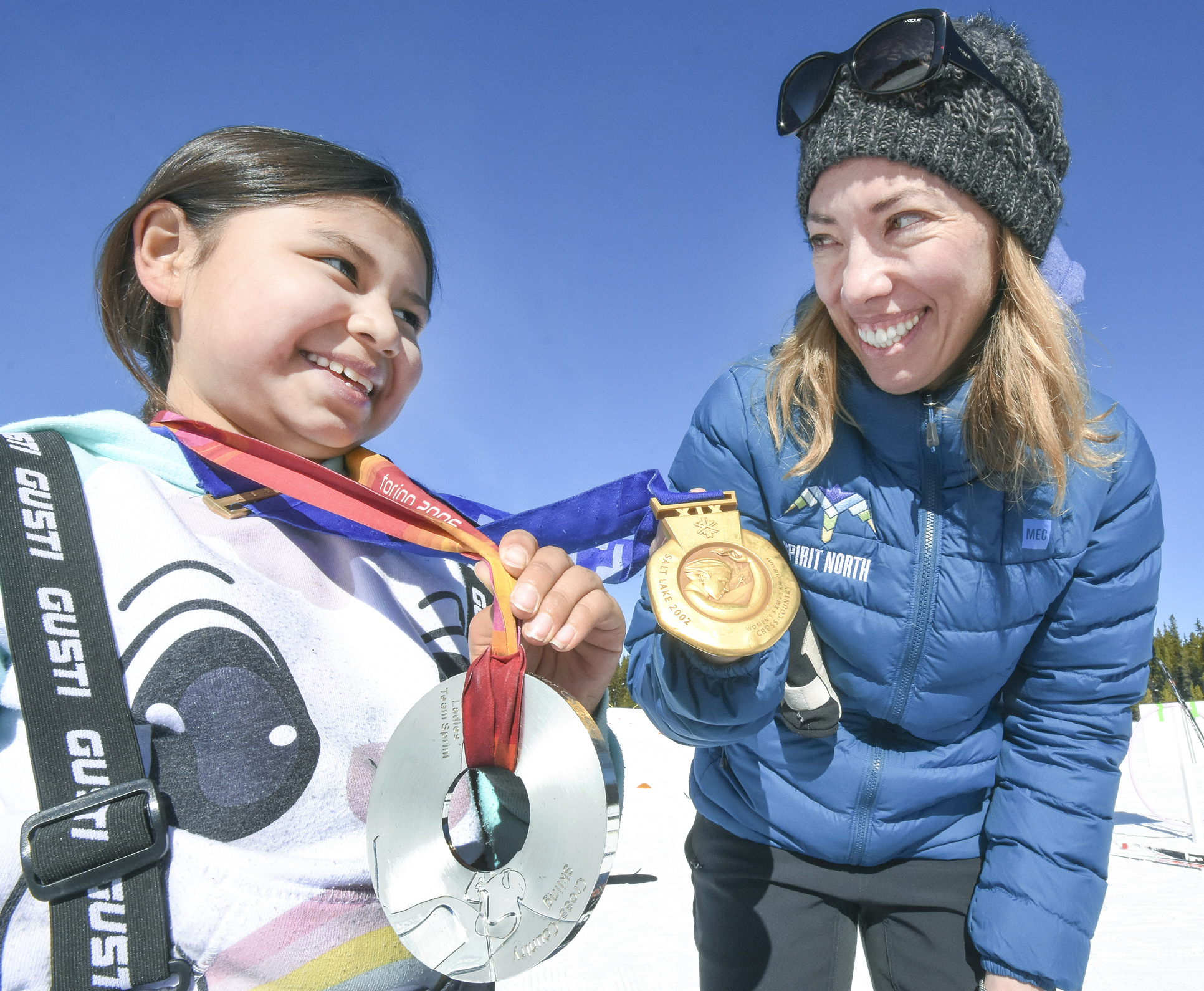
    Beckie Scott shares her silver and gold Olympic medals with a Spirit North participant. (Photo: Spirit North)

    When she retired from racing, she was invited to be an ambassador for a Learn to Ski program sponsored by an oil and gas company in northern Alberta. The program ran in indigenous communities. She would visit a community five or ten times a year, ski with the kids, show the medals, give a talk, then go home.

    She kept going home, and she kept thinking about what she had seen.

    “I began to notice many things. First, the disparity in the socioeconomic conditions of how indigenous people in this country live versus non-indigenous people. The lack of opportunity that kids were really able to access for sport and play. And then just the paradox of my own life and the opportunities that I had through sport, and my own kids were having through sport.”

    It struck her, she said, as deeply unfair.

    “An entire population of people was effectively kept out of that arena, and for no valid reason that I could see or think of.”

    The Truth and Reconciliation Commission published its final report in 2015. Among its 94 calls to action were several related to sport. Scott read the report. She had, she said, a hard time just letting things be.

    “I have a hard time just turning away and saying, not my problem. So I started a nonprofit.”

    She started with four communities in northern Alberta. The organization, Spirit North, is now national. It operates in 160 communities across Canada. It serves roughly 20,000 kids a year. It is among the largest sport for development organizations in the country.

    “The lesson there is that you can make a difference. I didn’t know anything about starting a nonprofit. I didn’t even really know much about indigenous culture and ways of being and knowing. But being open to learning, being super curious, and being driven by a vision of what change could look like, and meaningful action. That resulted in that organization.”

    Beckie Scott gives a speech while she served as the Chair of the World Anti-Doping Agency (WADA) Athlete Committee. She also served on the Compliance Review Committee. (Photo: courtesy photo)

    In March of 2025, Scott started a new job as CEO of Nordiq Canada. The skills, she said, transfer. Spirit North was a nonprofit. So is Nordiq Canada. There is a board, staff management, fundraising, finance, HR, and strategy.

    “A big part of our job at Spirit North was setting the strategy. A big part of our work here at Nordiq Canada is setting the strategy. Putting the activities together. How are we going to get to where we want to go. Many, many parallels.”

    The job she walked into was harder than the parallels suggest. The federal government had frozen its core contributions to National Sport Organizations for 20 years. The core funding that Nordiq Canada received from Sport Canada when she started last year was the same dollar figure as when she was racing two decades earlier.

    “Think about that in terms of the cost of living, inflation, and the rising demands on an NSO. It really crippled the organization in terms of capacity and what it was able to deliver.”

    She brought her CFO, Sian Bolton, from Spirit North with her. They streamlined operations. She went out and raised money.

    “I just started knocking on doors and pounding the pavement, trying to raise money for the organization. The response in the community has been encouraging. We signed on a number of new donors and had some major gift contributions. People recognize that we have a lot of talent right now in our programs in this moment. And if we don’t get behind them, we’re going to lose them. People heard that message loud and clear.”

    Then, after Milano, the federal government announced a $755 million investment in sport over the next five years.

    “It’s transformational. We are going to benefit from that. I am very optimistic about our future financial state because of the government’s recent announcement and because of our fundraising success.”

    The total budget at Nordiq Canada now sits just under $5 million, covering both the Olympic and Paralympic programs. About $2 million of that is core federal funding. Scott would like to add another $1.5 to $2 million.

    She conducted a ‘listening tour’ after taking the role. The thing she heard most often from athletes was a lack of trust in the high-performance system.

    “As an athlete, you want to believe more than anything that your NSO has got their act together and knows what they’re doing when it comes to high performance. That was one of the biggest areas that needed to be addressed.”

    She restructured the leadership team quickly. “It was time to make a fresh start. The organization needed to be right-sized for the budget and the financial situation we were in. But we also needed the right skill sets and the right roles.”

    She has, she said, four near-term goals. Podium results. Financial stability. Restoring trust and credibility. Unifying the community.

    “It’s a bit fractured,” she said of Canadian skiing now. “I think we can do a much better job of pulling together, remembering why we’re all here. Unifying as a nation behind our athletes and our programs and our development and our organization.”

    The fifth goal, on a longer arc, is coaching development.

    “I see a huge opportunity for closing the gap in coaching in this country. I look to the U.S. and what the U.S. has done to generate so many really highly qualified coaches, and not bringing them over from Europe all the time. For me, for the next four to five years, coaching development is going to be a big focus.”

    Beckie Scott and Justin Wadsworth pose with their family. (Photo: courtesy photo)

    Scott is married to Justin Wadsworth, who spent six years as head coach and high-performance director for Biathlon Canada and is now consulting for U.S. Biathlon. They try not to talk about work over dinner.

    “It’s hard. We’re living it every day, and our kids are both in it. But dinners are generally pretty lighthearted. We don’t avoid talking about work, but we certainly don’t do it all the time.”

    She is writing her report for the upcoming Nordiq Canada AGM. When she looks back on her first year, she said, it has been a remarkable one.

    “It was a lot of transformational change. New leadership in finance, high performance, events, athlete support. But at the same time, we managed to do that without destabilizing our teams. Our athlete performances continued to rise at the Olympic Games, at the Paralympic Games, at the World Juniors. We have so much to celebrate and be proud of when we think about this last year in terms of performance. The organization is on solid ground, and it’s really full steam ahead.”

    It could seem strange that the woman who became the first North American to win an Olympic gold medal in cross-country skiing now spends her days raising money, restructuring boards, and writing AGM reports. Alternatively, maybe the trail Scott got on out of her backyard in Vermilion had been leading her all along to this moment, and she has proven she is ready for it.


    Help Support Our Coverage!

    If you value the thoughtful work and access FasterSkier provides, please consider becoming a Voluntary Subscriber. Your support directly fuels our work to cover the people, places, and moments that make our sport special.

    Join the FasterSkier community!

     

  • From the Archives: Norway Beats Italy in Olympic Relay in Soldier Hollow (February 2002)

    From the Archives: Norway Beats Italy in Olympic Relay in Soldier Hollow (February 2002)

    A 21-year-old Kris Freeman skis leg two of the men’s relay for the U.S. at the 2002 Winter Olympics at Soldier Hollow. (photo: Cory Smith)

    This humble website went live twenty years ago today. (How long ago was that? Pretty long, judging from this recent Buzzfeed listicle.) As a later retrospective on this site would explain, “FasterSkier was founded in January 2002 by Torbjœrn Karlsen, Cory Smith and Erik Stange. FasterSkier.com was launched on February 1, 2002 and quickly grew to become one of the most trusted sources for Cross-Country skiing information in the United States … .”

    The ur-articles from February 1, 2002, have sadly been lost to the ravages of time; the switch to the “modern” CMS interface has not been kind to content from the site’s first year. Early coverage presumably included a “Hello, World!” introduction, while the substantive focus was likely on the 2002 Winter Olympics, which began in Salt Lake City one week later.

    Happily enough, the site’s Olympics coverage is preserved in its entirety, thanks to the intercession of the Internet Archive’s Wayback Machine. You can find a roundup of all 2002 Olympics coverage here, and a link to all compiled Olympic race reports here.

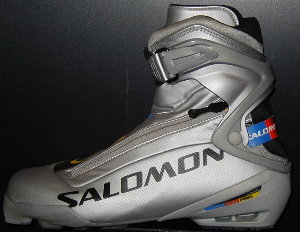
    Coming soon to a store near you! Salomon Carbon Pro skate boot (photo: Cory Smith)
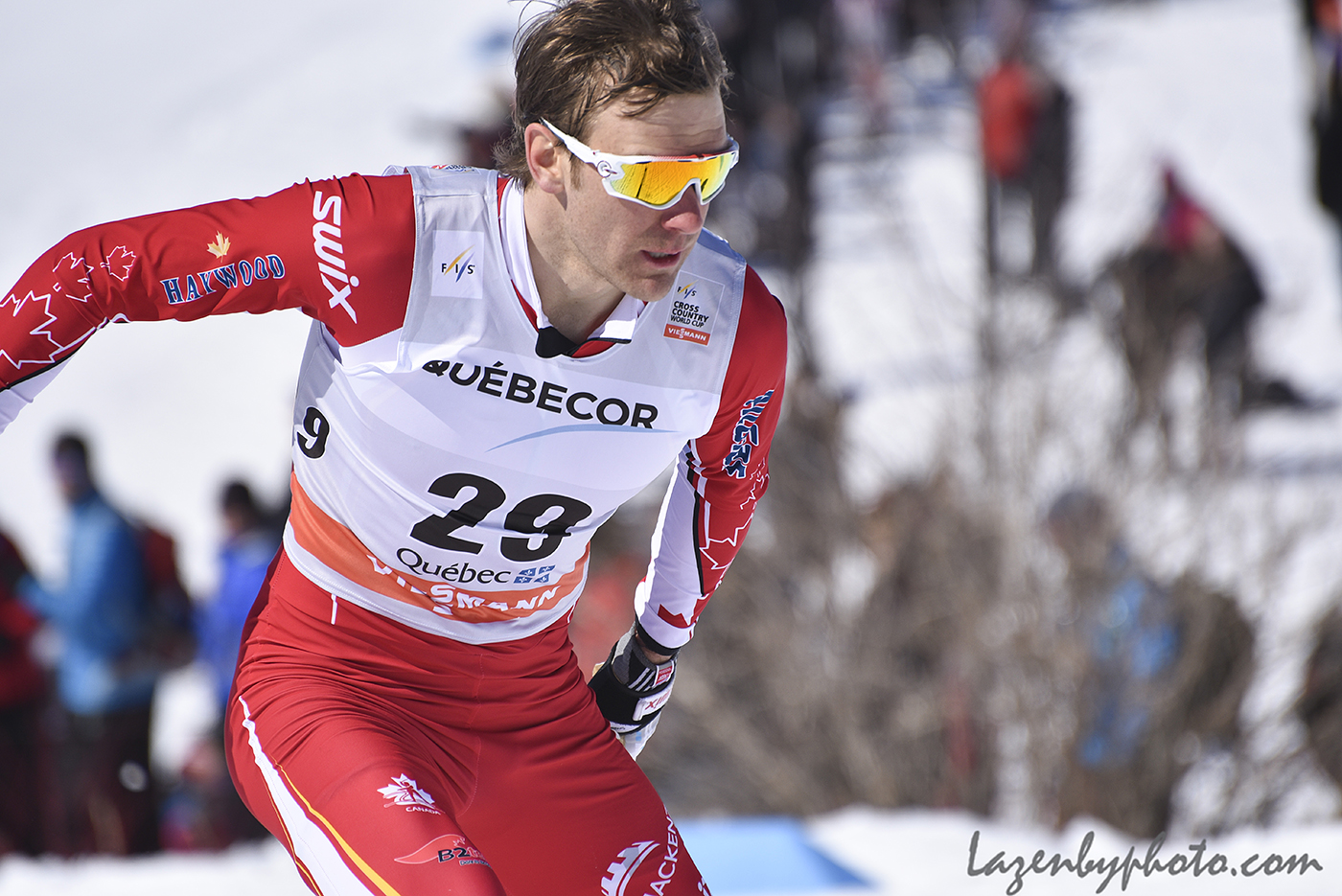
    The articles are, collectively, a heck of a period piece, and are worth your time, particularly if you have been reading this site for years and would like to see how far the technology has come. You may also be interested in the gear reviews, of, for example, the new, all-gray Salomon Carbon Pro. “I think that they are a real improvement over the Pilot Racing Skate 9,” our reviewer wrote, in a comparison to the product better and more universally known as “bumblebee boots.”

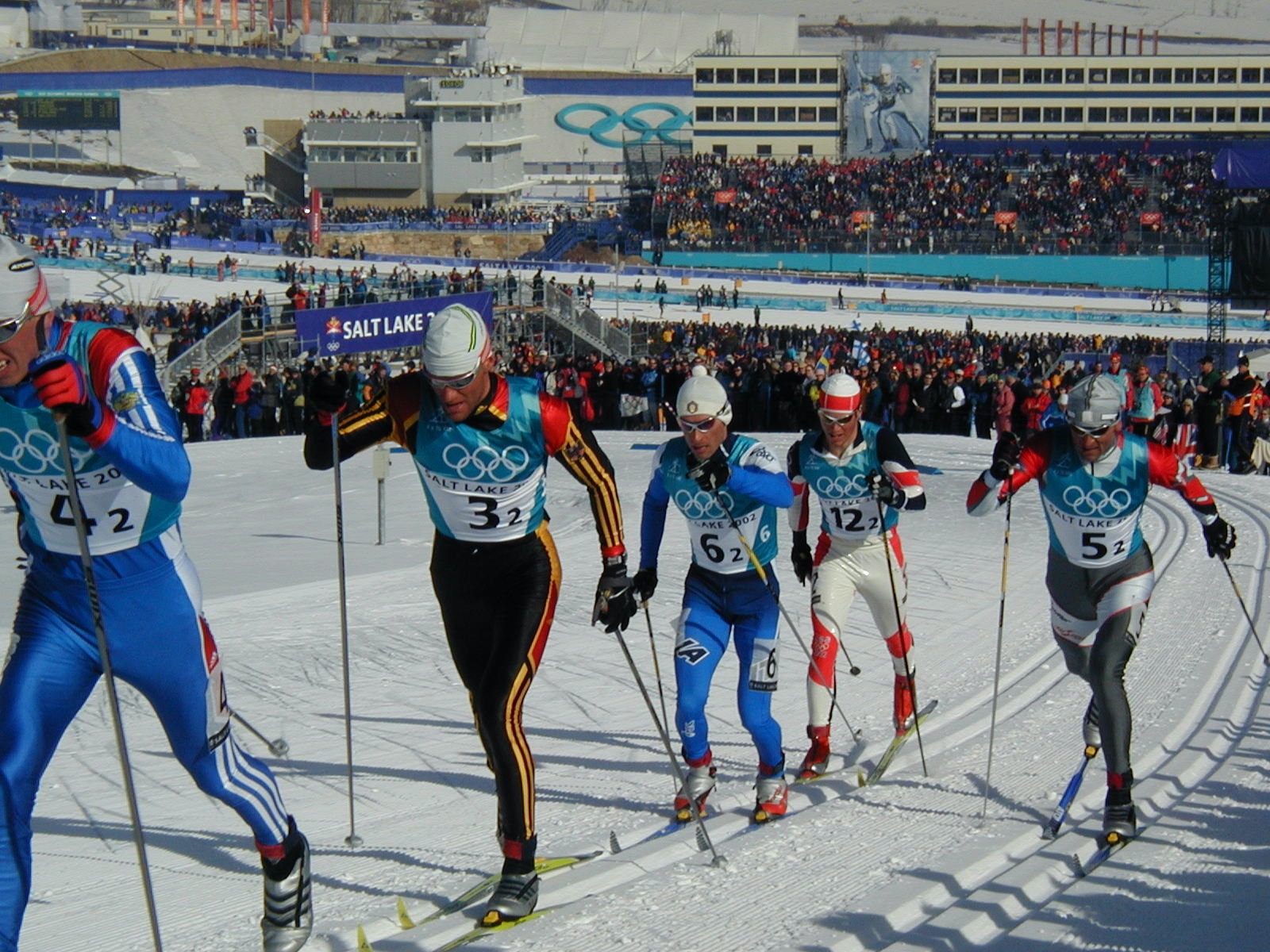
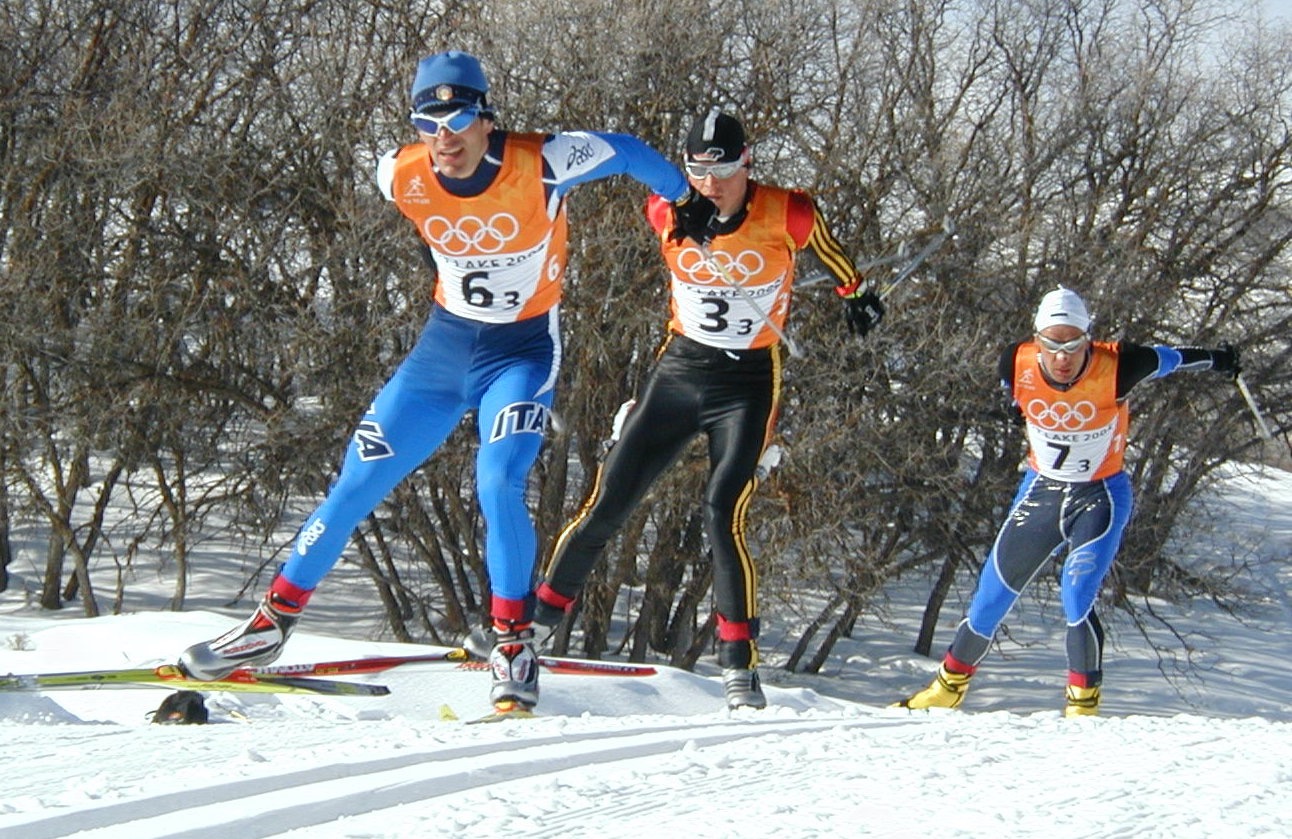
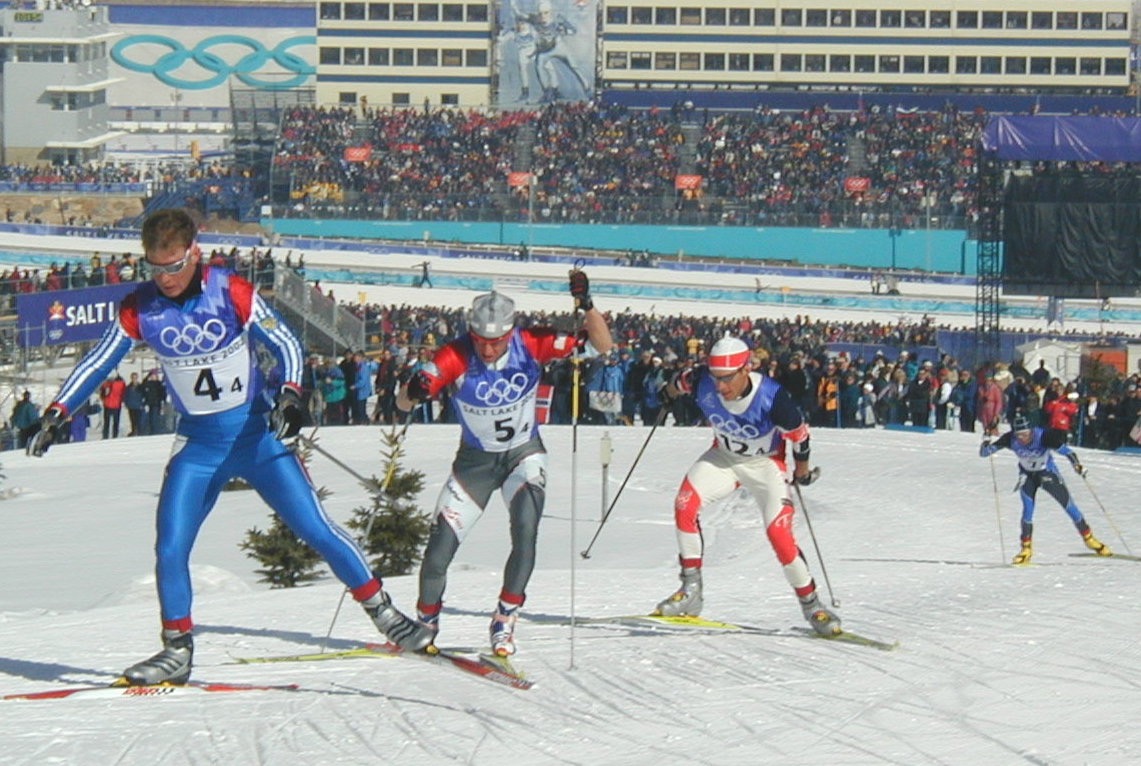
    It was tough to choose just one article from an embarrassment of historical riches to reprint for today, but this piece, a race recap of the men’s 4 x 10-kilometer relay, feels appropriate. Thomas Alsgaard; Cristian Zorzi; Anders Aukland; John Bauer; Kris Freeman. This was a long time ago.

    (The writeup of the women’s relay, from four days later, may be found here; it ends, “The Americans finished a disappointing 13th,” and says little more than that about the American team composed of Wendy Wagner, Nina Kemppel, Barbara Jones, and Aelin Peterson.)

    This article was written by site co-founder Cory Smith, and was originally published on February 17, 2002. Photos and captions, both also by Smith, are reprinted as they originally appeared. A few bonus race photos are appended at the bottom, thanks to Smith’s impressive archives.

    A Norwegian athlete skis in the men’s relay at the 2002 Winter Olympics at Soldier Hollow. (photo: Cory Smith)

    Norway Beats Italy in Sprint to Finish (again), US Men’s Relay Team Posts Best Result Ever

    By Cory Smith

    By the length of one ski, Thomas Alsgaard brought order back to the cross country ski world. In today’s Men’s Cross Country 4 x 10K Relay race, the Norwegian team proved that even without an individual gold medalist in these games, they are still the best team in the world. Thomas Alsgaard outsprinted Cristian Zorzi in the final 100 meters to take home the gold for Norway. 

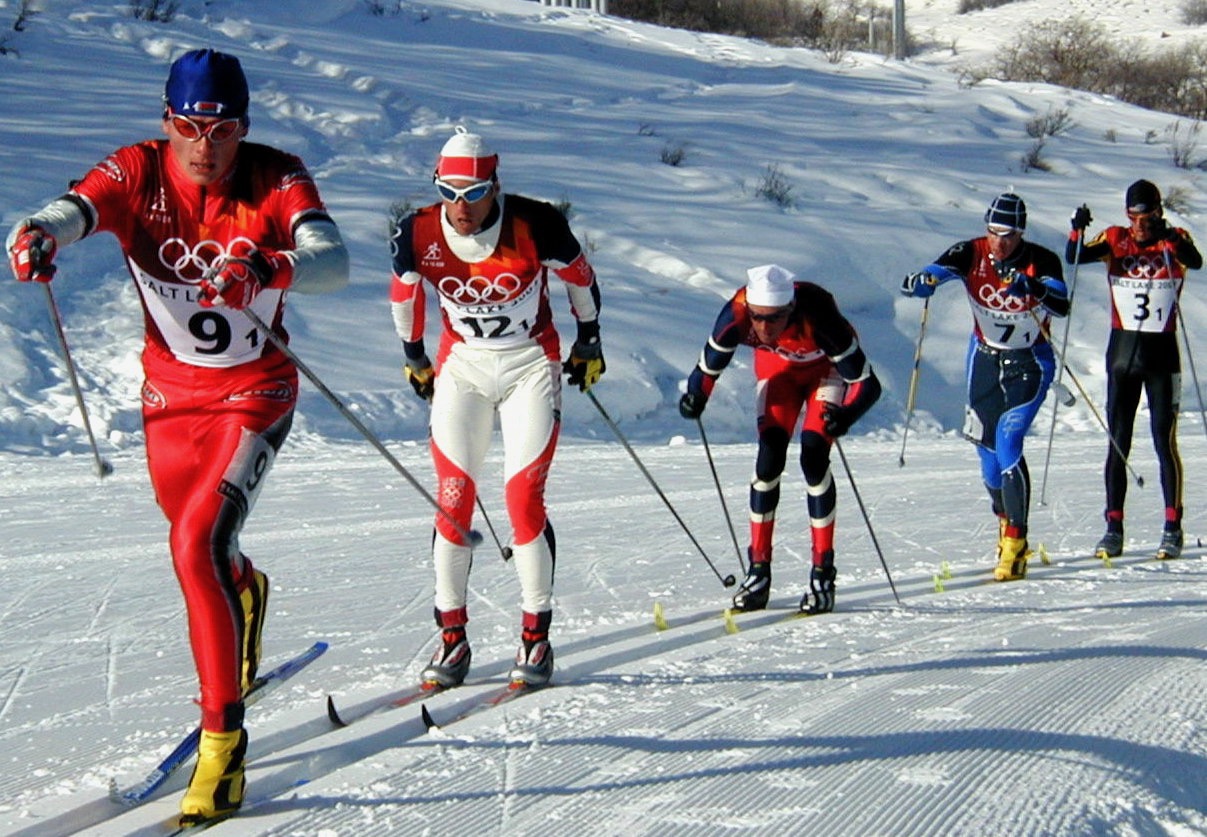
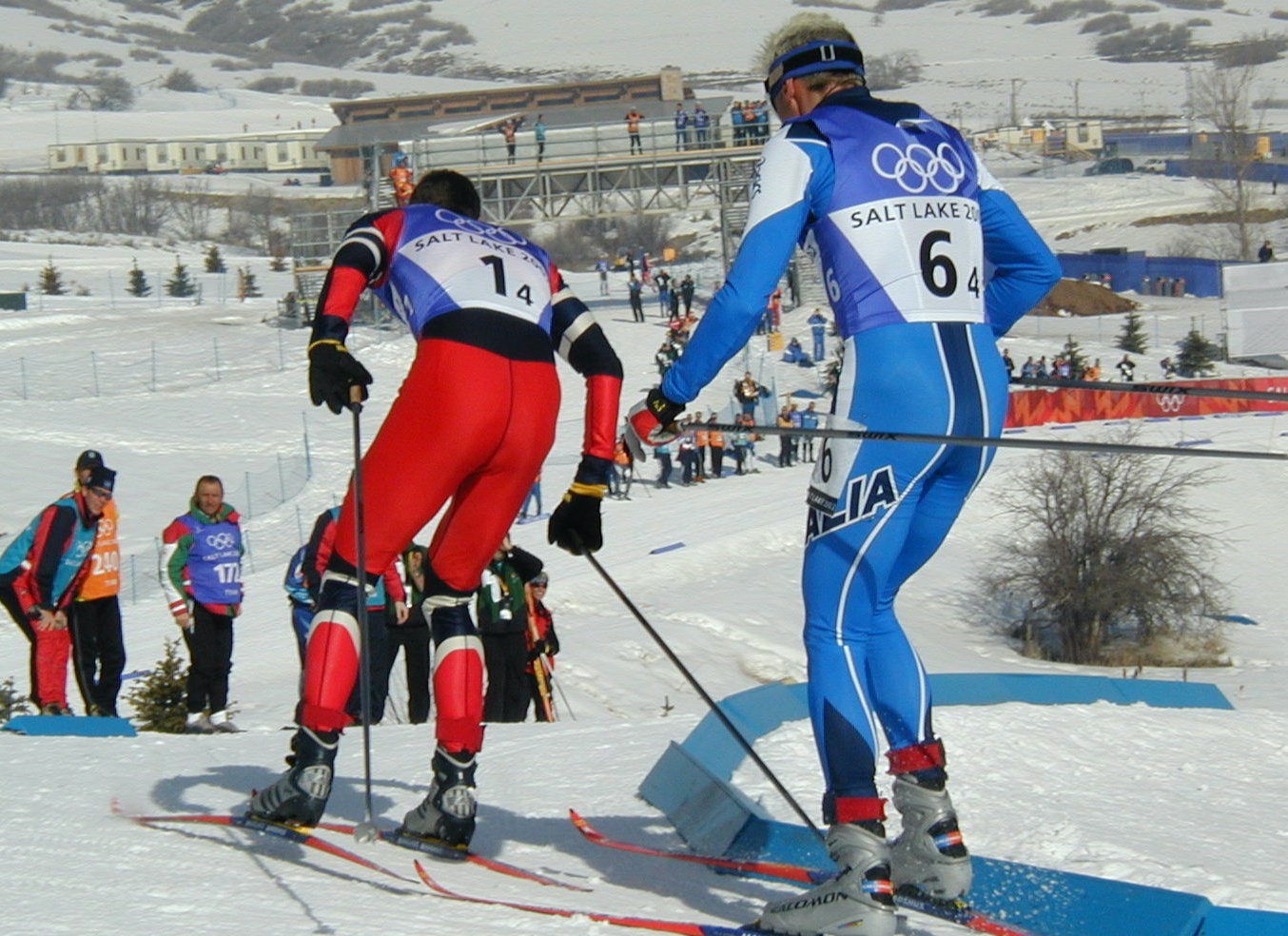
    John Bauer (USA, bib 12) and Anders Aukland (NOR, bib 9) follow Belarus’s Roman Virolainen in the men’s relay at the 2002 Winter Olympics at Soldier Hollow. (photo: Cory Smith)

    In a week that has seen more men’s gold medals for Estonia and Spain* than for Norway, and even a Canadian woman winning a medal, Sunday’s race was also extremely memorable, but with a more familiar outcome. The entire country of Norway was able to breathe a sigh of relief after their relay team put them back on top of the nordic world. 

    Meanwhile, the US men’s team, in the top five for most of the race, posted their top Olympic relay result by finishing a very impressive 5th. All four US skiers skied very fast and very smart to come within seconds of a medal for the first time ever.

    Norway showed their dominance of the classic technique right from the start. After letting Belarus’s Roman Virolainen lead for much of the first lap, Norway’s Anders Aukland took control on his second 5K loop and opened a 10 second lead. Meanwhile, John Bauer, after a slow start that had him in last place out of the stadium, had moved up to the front of the pack and was actually leading the chase of Aukland. Bauer lost a few places gliding through the stadium, but he finished his excellent scramble leg in 5th place, right with Italy, Kazahkstan, and Germany, only 13 seconds off the lead.

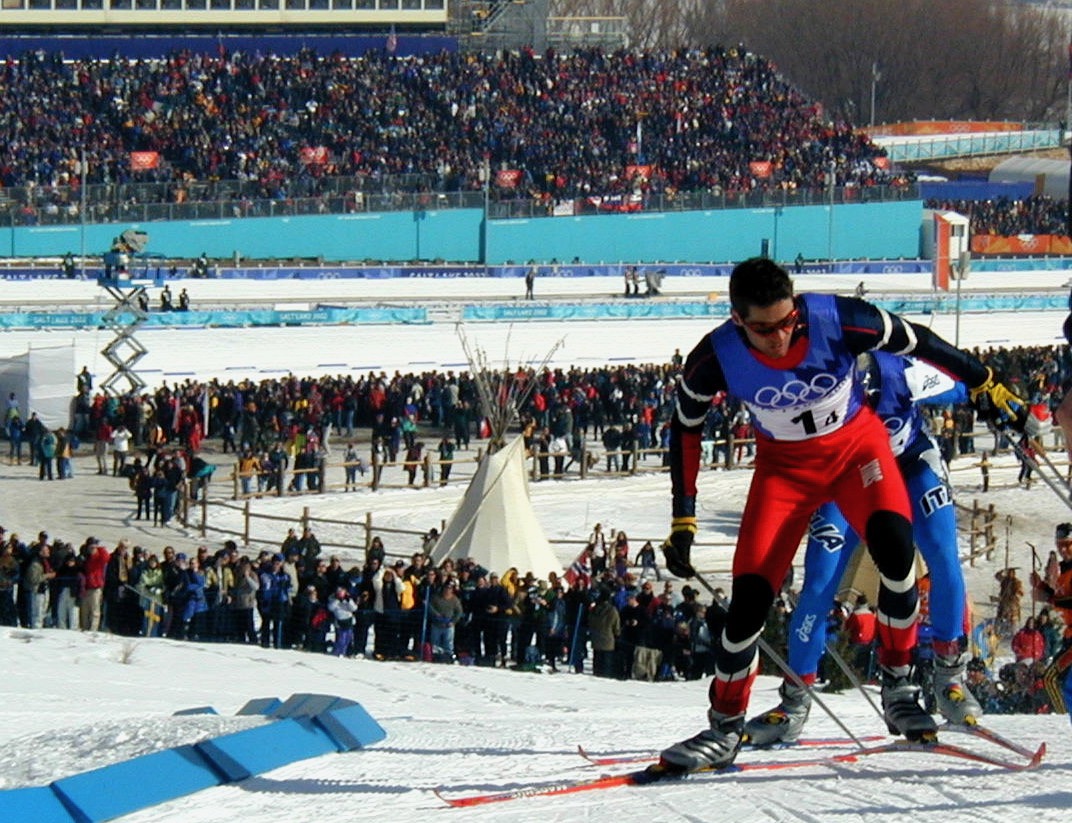
    Kris Freeman (bib 12) stays right with the lead pack. (photo: Cory Smith)

    On the second leg, Norway’s Frode Estil build the lead up to a maximum of 24 seconds while Kris Freeman (USA) jumped in behind Germany, Italy and Kazahkstan in the pursuing pack. As the leg went on, Estonia’s Andrus Veerpalu bridged up to the pursuing pack, as did Russia’s Mikhail Ivanov and Austria’s Mikhail Botvinov. This pack of six strong skiers started to cut into Estil’s lead, but as the leg came to an end, the pack began to break up. At the end of the second leg, Norway had an 11 second lead over Russia and Estonia. Kris Freeman skied an amazing strong race to stay in the thick of it, coming in right behind Italy’s Giorgio di Centa, in 5th place only 25 seconds off the lead. Halfway through the relay and the US men were only 14 seconds from a medal!
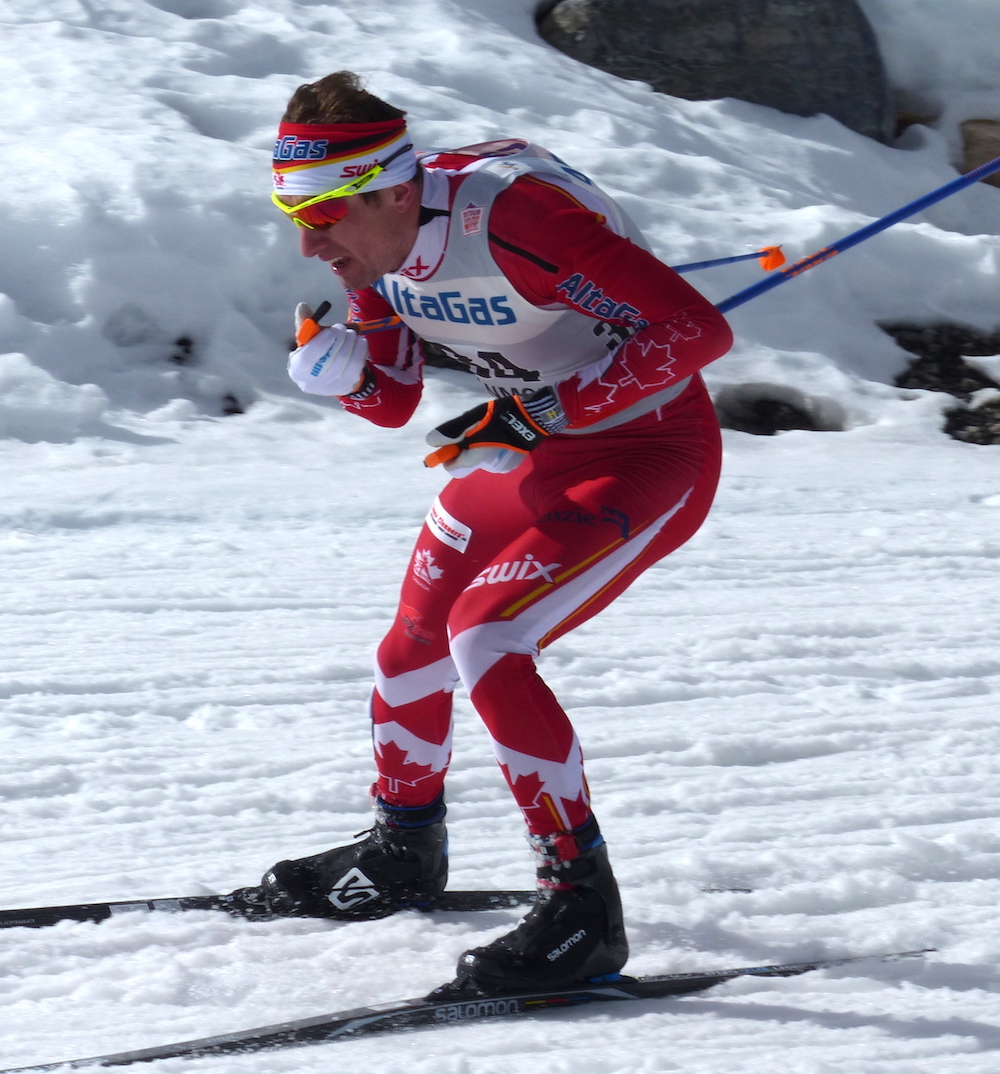
    Pietro Piller Cottrer (ITA) charges towards the lead with Tobias Angerer (GER) in tow. (photo: Cory Smith)

    The clear standout on the third leg was Italy’s Pietro Piller Cottrer. He started his leg in 4th place, then quickly passed the Russian and the Estonian and after about 5K, he was right with Norway’s Kristen Skjeldal fighting for the lead. The two of them skied together the rest of the leg, setting up yet another epic final duel between Italy and Norway. Justin Wadsworth looked to finally be over the head cold that had hindered him all week. He was smart enough to not try to stay with Piller Cottrer, but instead skied a very solid leg all on his own, until he was caught by Austria’s Gerhard Urain, whom he latched onto and followed until blowing by him near the end of the leg to finish in 5th place. In between the leaders and Wadsworth, Germany and Estonia came in together in 3rd and 4th.

    Alsgaard leads Zorzi into the stadium to sprint for all the marbles. (photo: Cory Smith)

    On the final leg, it became obvious that Alsgaard’s strategy was to try and shake Italy’s Zorzi, one of the best sprinters in the world, early. Alsgaard led most of the leg, but Zorzi held tight. Meanwhile, Germany’s Rene Sommerfeldt had pulled away from Estonia to assure a bronze medal. Carl Swenson jumped in behind Russia’s Nikolaj Bolchakov and Austria’s Christian Hoffman and they quickly passed the Estonian team. With the top three significantly ahead, Swenson was skiing strong and relaxed, as is his trademark, and was clearly gearing up for the finish. Along the way, they dropped the Russian, setting up a duel between Hoffman, who outsprinted Alsgaard in the 1999 Relay to win the World Championship, and Swenson.

    Speaking of duels, Alsgaard and Zorzi were putting on a tactical clinic. Going up the last big climb at 9K, Alsgaard had the lead and tried on a couple of occasions to put on a kick and lose the Italian. But Zorzi held tight and made a pass just before the top of the hill. Just before the downhill, Zorzi dropped into a tuck and slowed way down, obviously trying to get Alsgaard to pass, so that he could draft. 

    Alsgaard wanted nothing to do with that plan and instead of passing, he pushed on the back of Zorzi’s ski with his pole to speed him up. Then Zorzi pulled over and nearly stopped. Alsgaard did the same. They were a kilometer from the finish and they were standing still arguing about who was going to lead! 

    Alsgaard eventually took the lead reluctantly. They went stride for stride up the short hill by the stadium and then dropped down to prepare for the sprint. On the gradual downhill, Zorzi freeskated hard to take the lead, and had about 5 meters on Alsgaard as they rounded the turn. Alsgaard then kicked it in and began gaining on Zorzi. With 50 meters to go, they were dead even, but it was clear that Alsgaard had greater speed. Alsgaard got a slight lead and held it. It was a very close finish, but there was no doubt that Norway had won. 

    Carl Swenson and Christian Hoffman pass the Russian team. (photo: Cory Smith)

    Germany’s Sommerfeldt finished all alone in a surprising 3rd, and was mobbed by his bronze-winning teammates as he crossed the line. The battle was now for 4th. Swenson was up against formidable competition in Hoffman, but if any American could outsprint him, it would be Swenson and that’s why he was in the anchor position. Hoffman had the lead around the corner and they went toe to toe down the line. 

    For a moment it looked like Swenson would catch him, but there just wasn’t enough distance left. Another 20 meters and he would have had it. But instead Austria took 4th and the US maintained its 5th place on all four legs to post its best relay result ever. 

    The US skiers skied very, very well, both physically and tactically. But none of them skied unbelievably well, they all simply skied strong like they have all week. What I am trying to say is that this was no fluke. They finished right where they belong. They have been one of the top five teams on these trails all week and today they certified that. What is even more amazing is that there were two other American skiers, Pat Weaver and Andrew Johnson, who could have filled in and skied just as well. The US now has at least six World Class skiers. Don’t look now, but the United States is a force to be reckoned with.

    20,000 people cheer wildly at Soldier Hollow. (photo: Cory Smith)

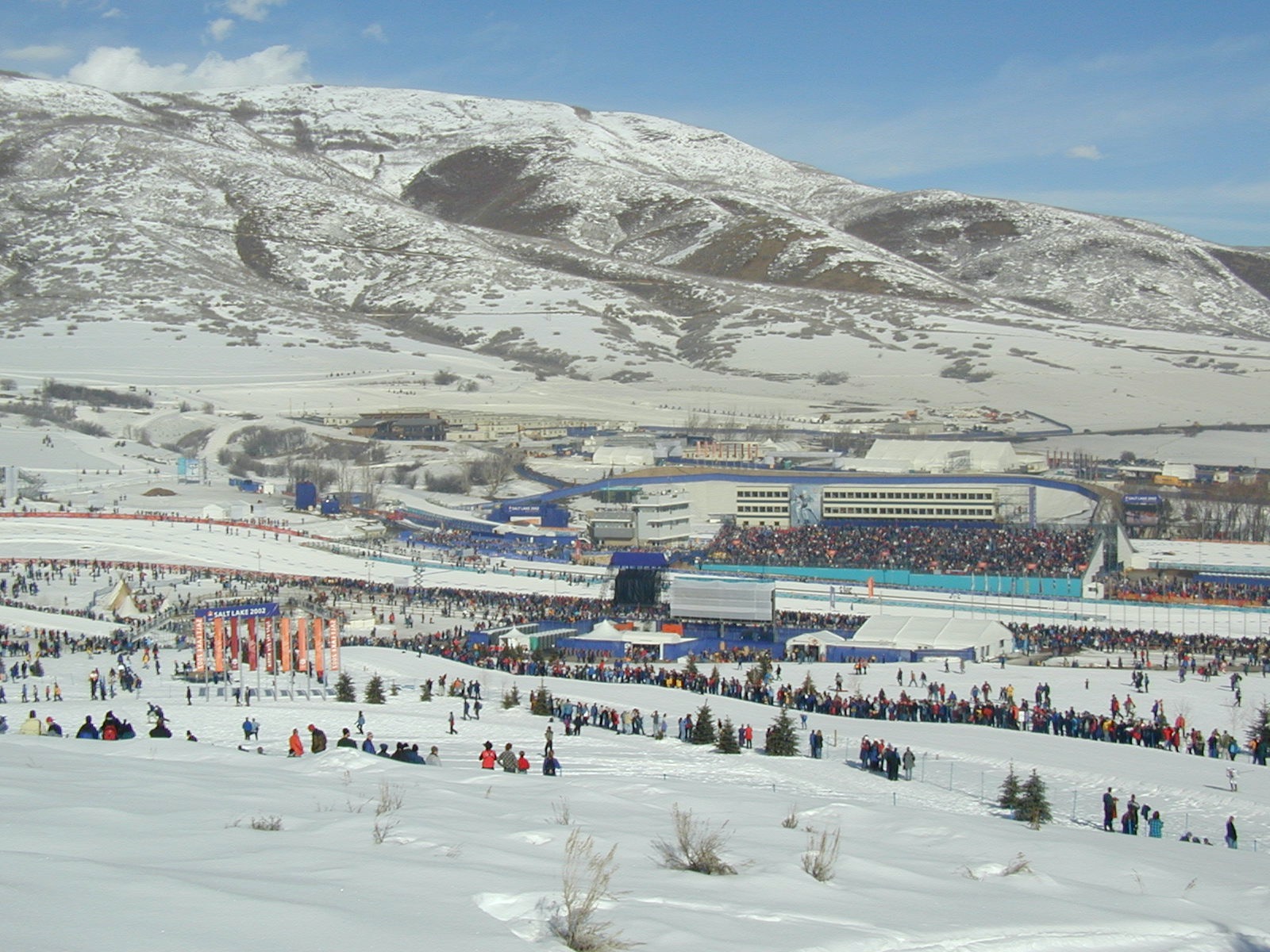
    Just as amazing as the race itself, was the crowd. Soldier Hollow was sold out for the first time ever, with 20,000 people watching a cross country ski race in this country for the first time ever. The crowd was loud and energetic. It was a sight that warmed the hearts of all Nordic die-hards on hand. Today, our little sport took a huge step forward in many ways.

    Results

    [* Modern-day footnote: This statement, while accurate at the time, was ultimately belied by history, as the three gold medals that Johann Mühlegg won for Spain at these Olympics (in the 30-kilometer skate, 50-kilometer classic, and 2 x 10-kilometer pursuit) were subsequently rescinded following his disqualification for a positive darbepoetin test.]

    Some additional photos from this race:

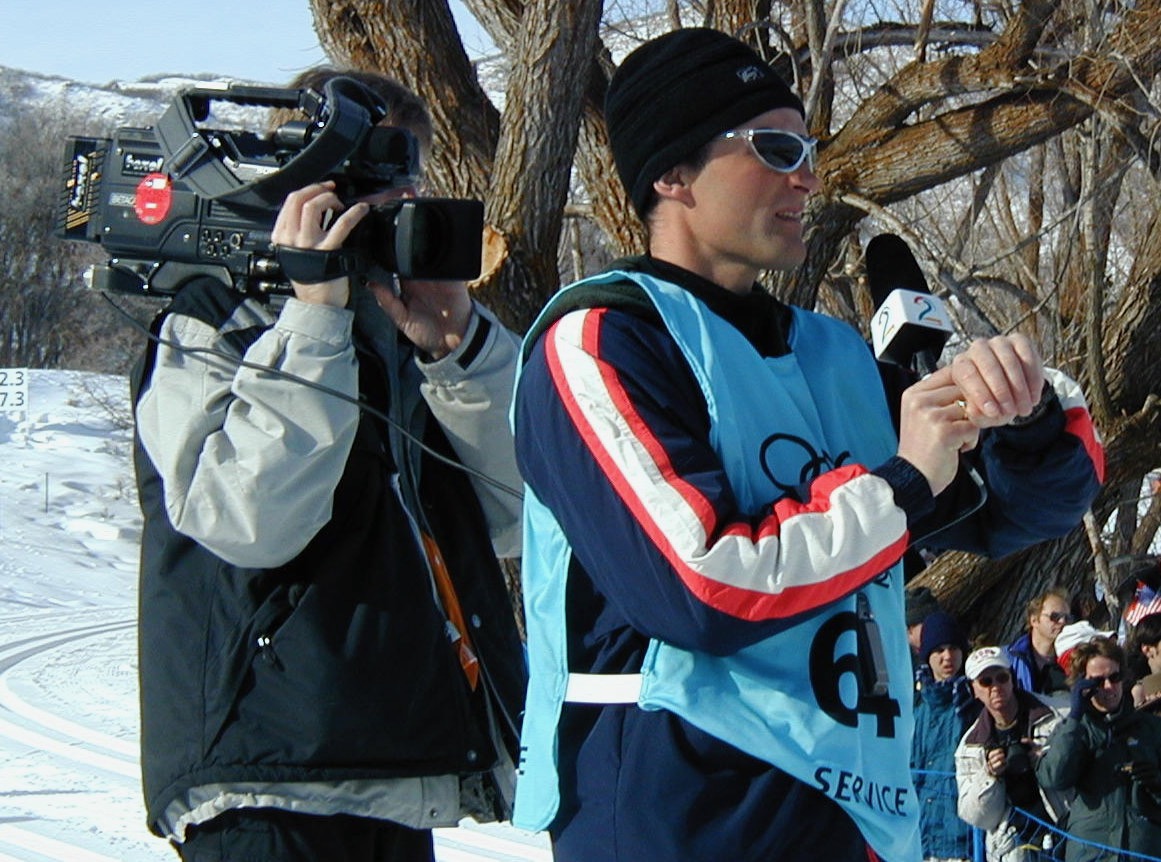
    Vegard Ulvang serves as a commentator for Norwegian television at the 2002 Winter Olympics at Soldier Hollow. (photo: Cory Smith)
    Thomas Alsgaard leads Cristian Zorzi in the men’s relay at the 2002 Winter Olympics at Soldier Hollow. (photo: Cory Smith)
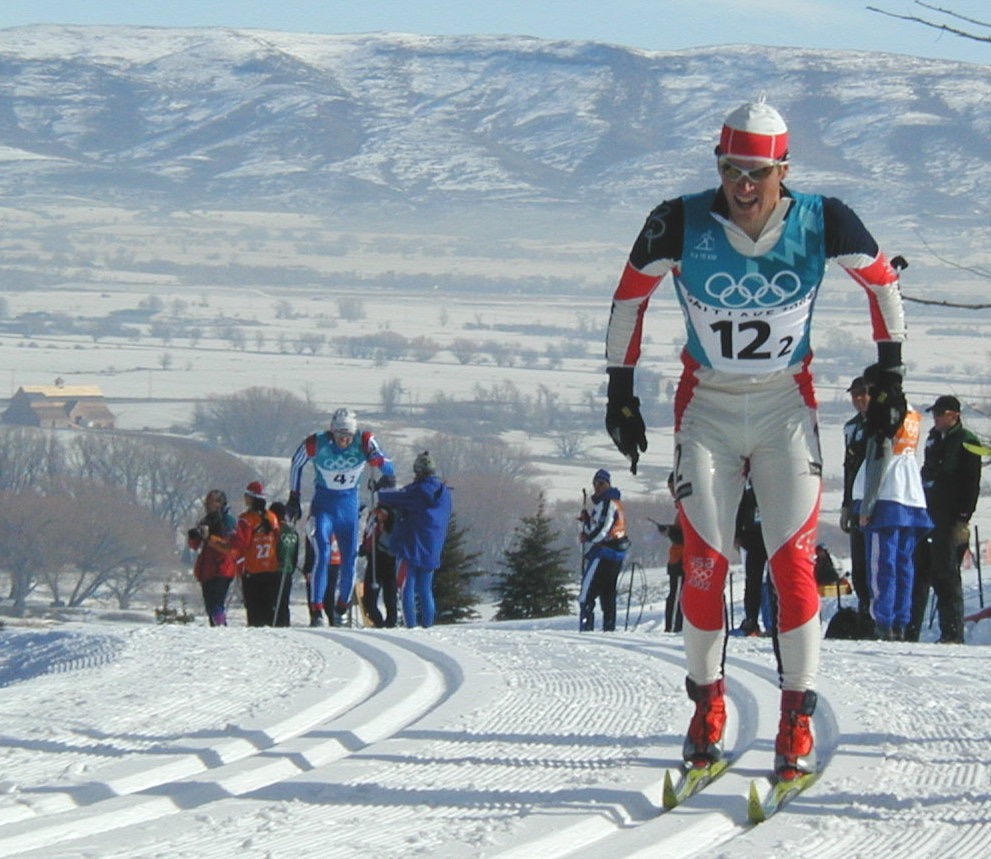
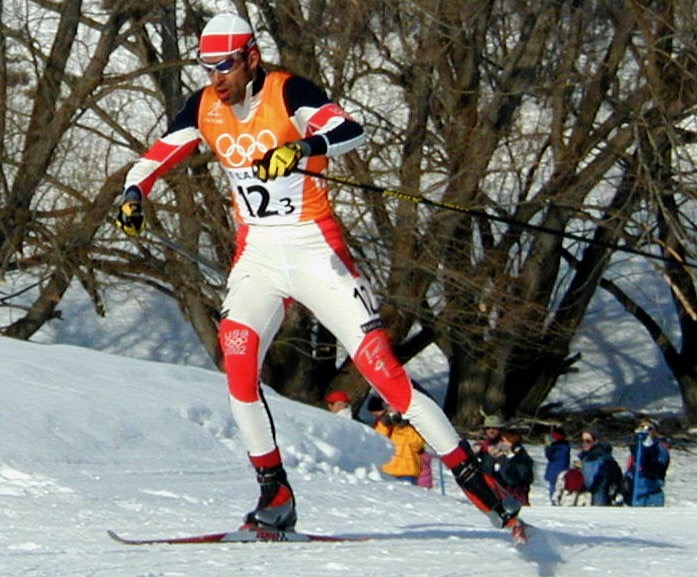
    Justin Wadsworth skis leg three of the men’s relay for the U.S. at the 2002 Winter Olympics at Soldier Hollow. (photo: Cory Smith)
    John Bauer skis leg one of the men’s relay for the U.S. at the 2002 Winter Olympics at Soldier Hollow, slightly ahead of Fabio Maj of Italy (bib 6) and Andrei Golovko of Kazakhstan (bib 10). (photo: Cory Smith)
  • Biathlon Canada Names Head Coach for Season: Justin Wadsworth

    Biathlon Canada Names Head Coach for Season: Justin Wadsworth

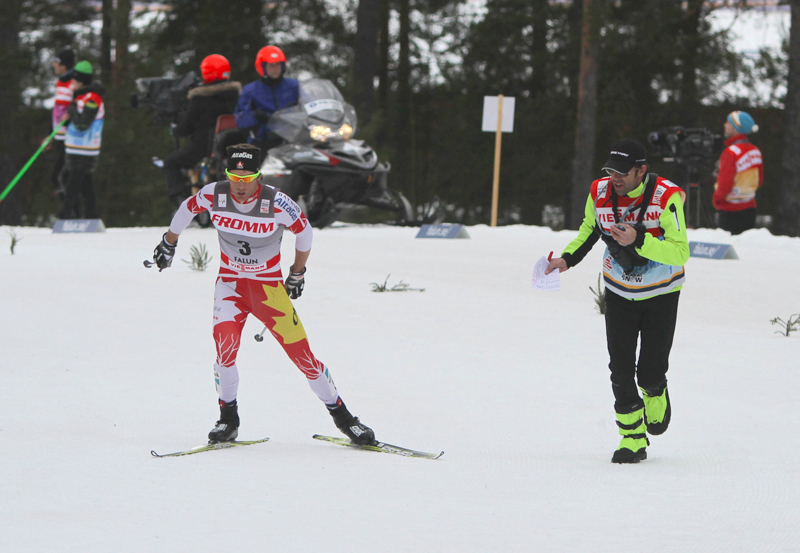
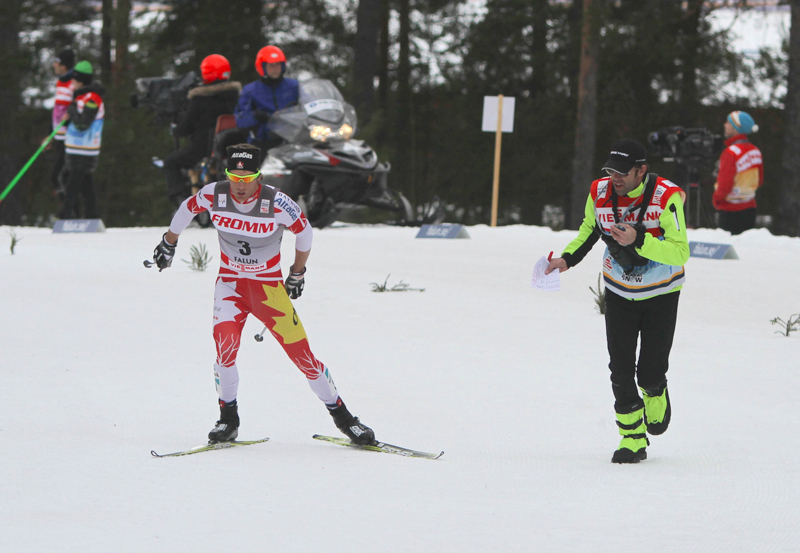
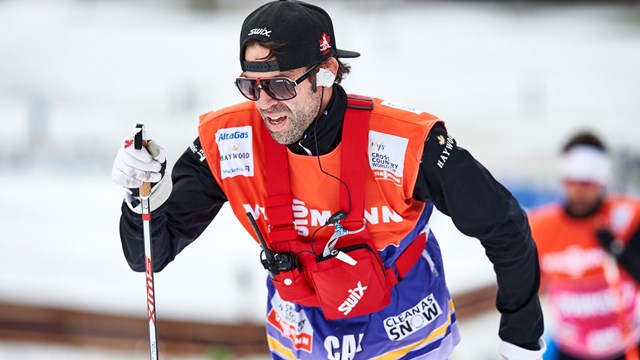
    Canadian National Team Head Coach Justin Wadsworth (r) giving splits to Devon Kershaw at 2012 World Cup Finals in Falun, Sweden.

    Last week, Biathlon Canada announced Justin Wadsworth as the Head Coach for the 2019-2020 season. In April, 2019, Wadsworth took on a temporary role as the team’s summer coach. That fill-in-the-gap stint will extend through this season’s racing. Wadsworth joins Canadian biathlon at a challenging time, with limited funding and after the retirement of many top athletes.

    “My job is really just for the national team — we have 12 athletes and I would say that is my mandate to get those athletes working at their personal best and a world leading direction.”  — Justin Wadsworth

    Biathlon combines shooting accurately, skiing fast, and finding mental strength. Wadsworth has his focus on the ski speed. Pavel Lantsov, who joined the program part way through the 2018-2019 training season, will continue as shooting coach. Roddy Ward leads the development effort.

    Wadsworth will make two trips to Europe during the season. As his wife’s career involves extensive travel, he has to manage his time away from the kids. Wadsworth took a five week summer break from coaching to get some quality family time. He has agreed to travel for the first IBU World Cup first period from November 17th to December 8th and then again for World Championships that will include a February pre-camp.

    So how does a life-long cross country skier become not just a biathlon coach, but a national team head biathlon coach?

    “That is a fine question because about six months ago I had no plan to coach anything let alone biathlon,” Wadsworth told FasterSkier on the phone last week from a Park City training camp. After originally agreeing to three months, he started work with the athletes on training and ski technique.

    “Those three months kind of flew by and I had a lot of fun with the team.”

    The 2019-2020 team is younger than in the recent past, with Emma Lunder, Scott Gow, and Christian Gow showing the most success in the last season.

    “My main philosophy with training,” Wadsworth said of his focus with the young biathlon team, “is really just consistency. We don’t need to do the real radical things to get the extra one percent at the end of the day going into the season. We need consistent training with good technique and staying injury free and being healthy and that is going to bring this team the biggest rewards for this next coming year or two.”

    Wadsworth ran the Canadian cross country team during the best funded period of its history, thanks to Vancouver 2010 and solid racing results. During his own racing career, he had a front row seat to watch the Canadian cross country team rebuild after Nagano 1998. While the latter has more obvious relevance in the current state of Canadian biathlon, he showed an ability to use money well [link to Canadian ski truck] when it was available. As he immerses himself in Biathlon Canada’s rebuild, he’s facing a stark reality when it comes to funding.

    “I have never seen a team with a budget as small as this. Our athletes right now at this camp in Park City are paying for everything. No funding.”

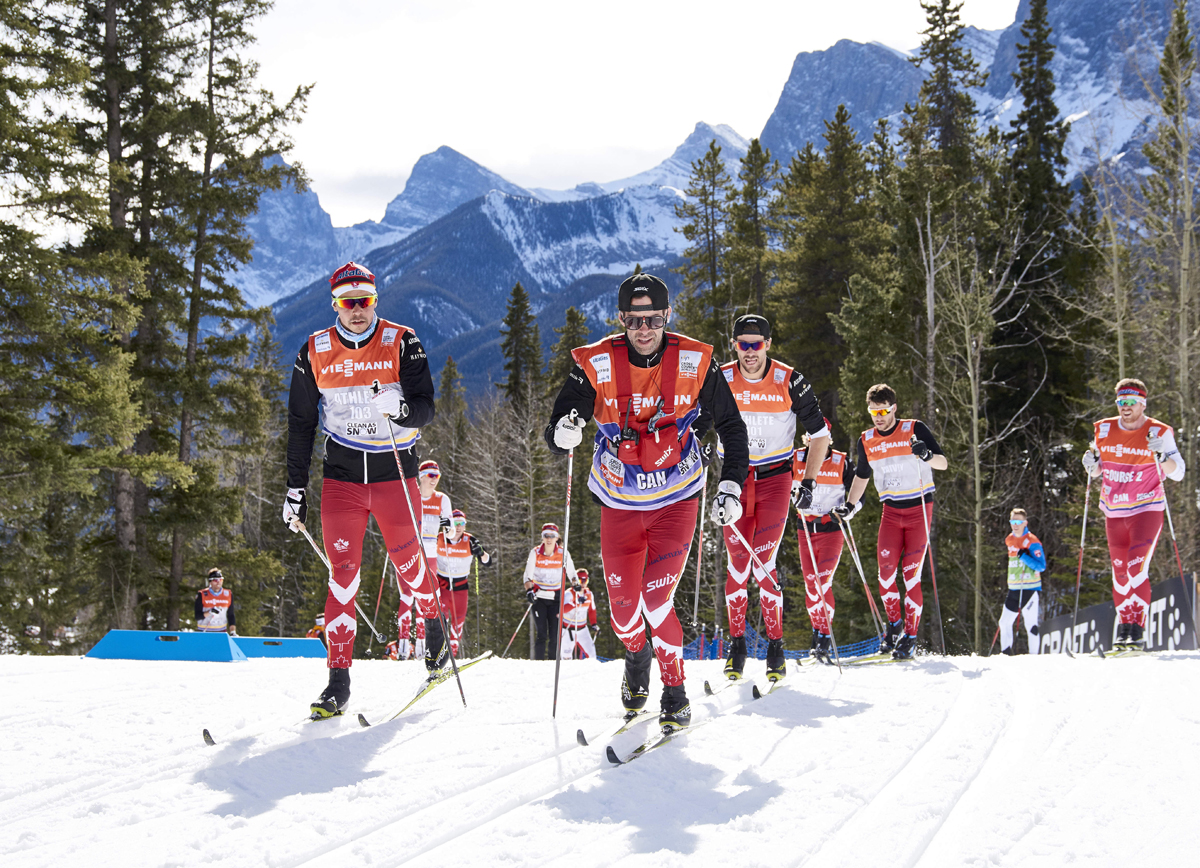
    Canadian head coach Justin Wadsworth leads his team during a training session at the 2016 Ski Tour Canada in Canmore, Alberta, including athletes Jess Cockney (l), Len Valjas, and Alex Harvey. (Photo: Fischer/NordicFocus)

    Who is Justin Wadsworth?

    Wadsworth spent five years as the Canadian National Cross Country head coach and is often thought of as one of the most outspoken Canadian officials on the topic of doping in sport. 

    He presided over some of Canadian skiing’s ‘golden era’, including the arrival of Alex Harvey on the world stage, Devon Kershaw’s second overall in the 2012 World Cup, and Canada’s first World Championship gold. None were Wadsworth’s personal highlight, however.

    “I would say the whole team during that 2012 season, where every member, male or female, of our national team, had a top three result on World Cup. That to me was the highlight. It was amazing. We had Perianne [Jones], we had Dasha [Gaiazova], we had Chandra [Crawford], we had all the guys. Everyone had been on the podium. A few podiums, like the girls, were double-podium with Peri and Chandra, or Chandra and Dasha in the sprint. The team energy was amazing. We went through the whole season and everyone was so focused and having so much fun. Really just a really strong team. Everyone thinks back to the guys, but before Christmas that year, Chandra, I think, was fourth on the overall sprint World Cup going into the Tour de Ski, and we had other great results. Lenny [Valjas] later that year had a podium in distance. Everything was just firing on all cylinders. That to me is what I remember. To me as a coach that felt the best and was kind of the highlight. Not just for the results, but the whole team really worked together hard, and everyone was accountable to everybody else. When that all clicked, and everybody got on the podium that year, it was really special.”

    There is more to Wadsworth than coaching, as older ski fans may remember. He was a pivotal member of the U.S. Ski Team (USST). He competed at the most recent U.S. World Cup, producing the top American result with 8th in the 30-kilometer at Salt Lake City in 2001. 

    In 2002, he was sick at the start of his home Olympics before recovering to be part of the 5th place men’s relay (the best U.S. result ever, matched by the women in PyeyongChang 2018). He quarantined himself from his then-girlfriend to help her remain healthy and have the best chance at her own Olympic dreams. 

    On a call with FasterSkier shortly before the announcement of his new title, Wadsworth doubled down on the difficulty and importance of being a team player.

    “Those are words that come out of my mouth with our current team here. If anyone gets sick, you have to pony up early on. Don’t be afraid about it. It’s one of the hardest things to say, ‘I might be getting sick’, early enough to prevent the whole team from getting sick.”

    Wadsworth passed that test in 2002. He did, however, start his target event, the 30 k mass start freestyle.

    “I should have not started, but I felt it was my best chance at a great result, and I started even though I was sick,” Wadsworth confirmed in an email about that DNF. “I wish someone had helped me to not start….”

    When Wadsworth talks to athletes about trusting the process, they know that he has both lived it as an athlete and lead it as a coach. Wadsworth didn’t reach the top instantly himself, missing Albertville 1992 before qualifying for Lillehammer 1994, five years after his first World Cup start.

    “Oh, I raced [a U.S. World Cup] one other time in 89 right here, down the road from where I am right now [Park City]. It was a Salt Lake World Cup, but it was held at a place called Mountain Dell. I think it was Bjørn Daehlie’s first ever World Cup, or first ever World Cup win.”

    (FIS records are a bit sketchy that far back, but it was Daehlie’s first win.)

    You might think Wadsworth’s strong opinions on cheating in sport come from being at Beckie Scott’s side through years of her very public challenges, but he does have first hand experience with dopers. When asked about his 2001 World Cup race, he said “I think [Johan] Mühlegg might have been ahead of me, but I always take him out [of the results].” 

    In that 2001 30 k, Mühlegg won as a Spanish athlete, having left the German team over a dispute about his personal doctor. Mühlegg would be banned after failing a doping test at the 2002 Olympics. The second place finisher, Christian Hoffman of Austria, was implicated in a different Olympic blood doping scandal in 2002, but wouldn’t be banned until 2009 after he was caught at Torino 2006. 

    If you take out the known cheaters, the upgrade to 6th place would give Wadsworth one of the best U.S. World Cup men’s results in history. By extension, Hoffmann wouldn’t have out-sprinted the U.S. closer Carl Swenson for fourth place at the 2002 SLC relay.

    Wadsworth’s wide ranging experience as an athlete and coach leaves him with diverse tools to help Canada’s national biathlon team rise up.

  • JUSTIN WADSWORTH NAMED HEAD COACH FOR 2019-2020 SEASON (Press Release from Biathlon Canada)

    JUSTIN WADSWORTH NAMED HEAD COACH FOR 2019-2020 SEASON (Press Release from Biathlon Canada)

    Press Release from Biathlon Canada

    Three-time Olympian and one of Canada’s most successful national team cross country ski coaches, Justin Wadsworth, has been named Biathlon Canada National Team Head Coach through to the end of the 2019-2020 season. Wadsworth, who was named interim head coach in April of this year, is excited to continue working with the team.

    “Since April, our plan has been centred around consistent, quality training. The team has responded extremely well and have bought into the plan,” Wadsworth said. “Almost all athletes have broken personal records throughout the training season.”

    Integrating into a new coaching and support team has been seamless for Wadsworth, “It has been a pleasure learning from Pavel Lantsov – he is an extremely committed and knowledgeable coach and the athletes respect him so much. Andrew Chisholm has also stepped in to support both Pavel and I on the trail and in the range and he is continually looking for new improvements. In addition, our Support Team lead, Jess Kryski has gone above and beyond in monitoring the health and wellness of our athletes with her team.”

    “With a number of new athletes on the team this season, we have all worked really hard on creating a positive team culture, which is crucial when the World Cup team will be competing in Europe for over 120 days.”

    Justin will split his time this season between attending World Cups and World Championships in Europe and working with athletes from afar in Canmore.

    “This is a new approach to the season. In the past, we have had our head coach attending all competitions,” Heather Ambery, Biathlon Canada General Manager stated. “We are confident in our new plan.”

    Pavel Lantsov, Senior National Team Coach and shooting specialist, and a team of Biathlon Canada world-class ski technicians will lead the World Cup team throughout the season. Justin will fly in and out of the daily competition environment at specific and strategic moments.

    The World Cup and IBU Cup teams for the first Trimester (December) will be decided at Trials during the first week of November in Canmore.

  • FasterSkier News Round-Up (Updated)

    FasterSkier News Round-Up (Updated)

    Dave Stewart transitions from the University of Denver to the Steamboat Winter Sports Club.

    After twelve years as the Nordic Head Coach at the University of Denver (DU), Dave Stewart will be stepping down. Under Stewart’s leadership, DU earned six NCAA Division I national championships in skiing. Stewart’s long list of accomplishments includes a 2016 co-Nordic Coach of the Year honor and five Rocky Mountain Intercollegiate Ski Association (RMSIA) Coach of the Year awards.

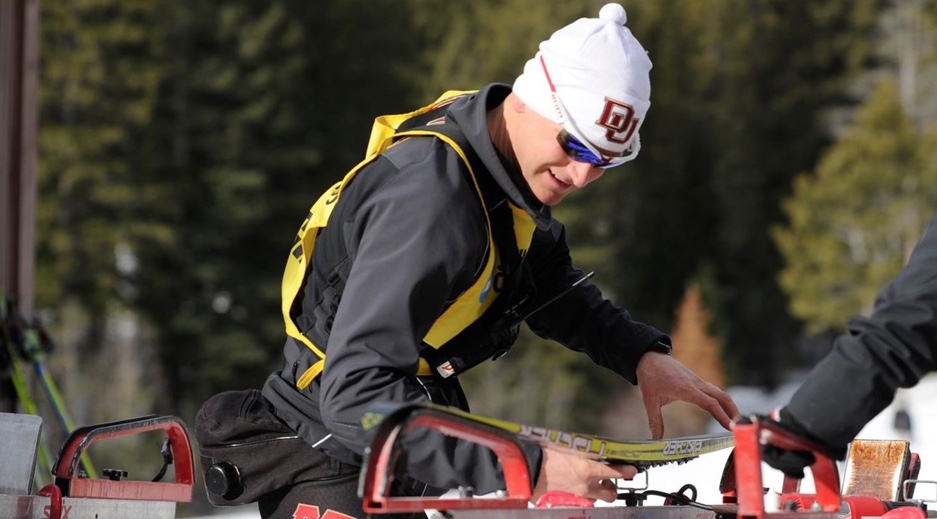
    Dave Stewart waxing skis for the University of Denver. (Photo: University of Denver press release.)

    Stewart will remain in Colorado as he moves to a new position with the Steamboat Winter Sports Club. Stewart will begin his new job in June as the club’s new Athletic Director. His move to Steamboat brings him closer to family members that reside in the town.

    “My wife’s family is up there, her dad and brother, her brother works for the club and is a freestyle coach there,” Stewart said on the telephone with FasterSkier. “And then we love Steamboat too. It is a great community. Being back in the mountains, my wife is from Lake Placid and I am from Vermont so that is a huge drive too. And we have a two-year-old and to get him up in the mountains and expose to some snow a little bit more is a big draw for us as well.”

    Stewart knows the club well as five members of the DU ski team raced with the Steamboat Springs Winter Sports Club as juniors. Moving into an administrative role, Stewart said he welcomes the new broadened opportunity in Steamboat to work with athletes across several different sports.

    “It is almost like a community service working at the club,” said Stewart. “They are right there in town and getting kids out on snow.”

    At DU, Stewart was tasked with not only winning but fostering a collegiate experience that combines both sport and academics.

    “I am sure I will miss coaching,” Stewart reminisced. “I have been involved with cross-country ski racing for a very long time as an athlete and a coach. I have enjoyed it very much. Working with people in this age group, you know, it is like there dream to come and be a student-athlete and pursue those goals, as an athlete and a student, I am going to miss that. There is no question about it. You cannot be a ski coach forever. You get to a point where you are looking to transition to something else. And to maybe a role that is interacting with sport at a different level, more of an administrative role. I think I have some good experience from here to be able to have a good impact on young athletes and coaches in that way. This is a good opportunity to step in that direction. “

    Mathias Ahrens steps away from his role with Biathlon Canada.

    In Canada, Mathias Ahrens left his position of coaching the Canadian National Biathlon team this past April. Ahrens spent 15 years with the team. He becomes the Head Coach at the Biathlon Alberta Training Center.

    A name familiar to cross-country ski fans, Justin Wadsworth – a former U.S. Olympian, U.S. Ski Team coach and Head Coach of the Canadian National Ski Team — has been named interim Head Coach.

    German biathlon star Laura Dahlmeier has retired from the sport at the age of 25. 

    In a storied career, she began competing internationally in 2011. She won 22 individual World Cup races, earned seven golds, three silver, and five bronze medals at the IBU World Championships. Five of those World Championship medals were earned in Hochfilzen, Austria in 2017. Dahlmeier also won two Olympic golds along with Olympic bronze in PyeongChang.

    In a post on Instagram, Dahlmeier said the past season during which she struggled to perform at her historic highs, prompted her to seek a change.


    “After an unbelievably tough season full of ups and downs, I no longer feel the one hundred percent passion required for professional sport. That’s why I have decided to end my active biathlon career after some time of reflection,” Dahlmeier wrote.

    Dahlmeier was hospitalized in August and September of 2018 and although she returned to the World Cup, her energy levels were not the same. However, this past season she stood on the World Cup podium three times and won two bronze medals at the 2019 IBU World Championships.

    buy metronidazole online

    Sweden’s Ida Ingemarsdotter announces her retirement.

    Thirty-four-year-old Ida Ingemarsdotter has called it a career after racing on the cross-country World Cup since 2004. The Swede finished last season ranked sixth in the overall sprint standings and 15th in distance. Despite her strong season, Ingemarsdotter stated she lacked the motivation for another season at the elite level.

    Sweden’s Ida Ingemarsdotter (11) and American Sadie Bjornsen (10) go head to head in the women’s classic sprint final at 2017 World Championships in Lahti, Finland.

    She stood on two individual World Cup sprint podiums last season and placed in the top-10 eight times.

    Her medal haul includes five World Championship silver medals and one gold. She also won two Olympic medals, a gold, and bronze in Sochi.

    Ingemarsdotter explained in a press release that her best day skiing came during the women’s 4 x 5-kilometer relay at the Sochi Olympics.

    “The biggest day in my sports life was when I took Olympic gold in relay 2014 together with Anna Haag, Charlotte Kalla and Emma Wikén. Everything went our way and it was a real dream day where tears were mixed with laughter and a strange feeling that we did something nobody thought we would succeed with,” Ingemarsdotter said according to a translation of the Swedish National Team’s official retirement announcement.

    The University of Alaska Anchorage announces a new cross-country coach. 

    In a press release on May 10, the University of Alaska Anchorage (UAA) announced that cross-country ski coach Andrew Kastning had stepped down to pursue other opportunities. His coaching replacement is Trond Flagstad.

    No stranger to the UAA program, Flagstad began as an assistant coach in cross country running and skiing at the school back in 2001. Flagstad was head nordic coach from 2004 to 2011. Most recently, Flagstad was ski coaching in Norway.

    “I am very excited to be back at UAA and in the Seawolf family,” said Flagstad according to the UAA press release. “I am looking forward to working with all the great coaches and the talented student-athletes at UAA, especially with the ski team. My goal of winning the NCAA skiing championships with the UAA ski team hasn’t changed since the last time I was here, and after coaching in Norway for three years, I know I am better prepared as a coach to reach those goals. I am excited to recruit and develop young skiers from Alaska to help us win races and championships. In addition I have created some very valuable friendships and connections in Scandinavia and Europe. I have some new ideas and a coaching philosophy that I believe will benefit the UAA ski team, especially the Nordic team on our way to a championship title. I am thrilled to have this opportunity and to move our family back to the house we built up on the hillside.”

  • Into the Yukon Wild: Johnsgaard Retires from Skiing at 25

    Into the Yukon Wild: Johnsgaard Retires from Skiing at 25

    Former Canadian World Cup skier Knute Johnsgaard snaps a photo during a canoe trip. (Courtesy photo)

    One hundred and fifty kilometers from the city of Whitehorse, if you are adventurous enough to hike through the troves of white spruce and over the two mountain passes to get there, you may come across Knute Johnsgaard’s family trapline. Traverse the 100 square kilometers of land where his family holds the rights to trap, and you may even catch a glimpse of Johnsgaard himself.

    Johnsgaard, a native of the Yukon Territory’s Mount Lorne community, plans to spend most of next winter hunting on his family’s remote patch of land in northwest Canada. He will set traps for lynx, wolverines, foxes, and wolves. He will drop a few fishing lines into the land’s frozen lakes. He will sport cross-country skis as he travels from trap to trap.

    He will not, however, train as he once did. That kind of work is a thing of the past (he will, incidentally, get in a few nordic over-distance workouts, as he plans to ski the 60-kilometer stretch of snow-covered land from snare to snare).

    At 25, Johnsgaard has been a member of Cross Country Canada’s senior national team for the past three seasons (first on the U23+ Development Team, then on the U25 Team, and finally on the World Cup A-team last season). He represented Canada at this year’s Winter Olympics in PyeongChang, South Korea. And as of this spring, he is officially retiring from professional skiing.

    ***

    Looking at the 2018 Olympic and Paralympic team rosters for Canada and the U.S., the pattern of athletes with the same last name is tough to miss. The Bjornsen siblings. The Patterson siblings. The Nishikawa brother-sister duo.

    Knute Johnsgaard racing a 2016 World Cup in Lillehammer, Norway. (Photo: Fischer/Nordic Focus)

    Johnsgaard is not one of those. He does not come from a family of athletes. Most of his relatives, he explained, had never followed his skiing or cross-country in general until the two weeks he competed at the PyeongChang Winter Games. What Johnsgaard did have growing up was a family who encouraged him to be outdoors and access to it. A lot of it.

    The Yukon Territory spans an area of nearly 500,000 square kilometers, and includes Canada’s tallest mountain, Mount Logan. The region is, as Johnsgaard puts it, “one of the world’s last true wilderness areas.” It was within this last wilderness area that the Canadian began his cross-country journey.

    He first started skiing on the ski trails of Mount Lorne. In between skiing adventures, he would join his father for trips to the family trapline. At the age of 13, Johnsgaard’s father suffered an accident that left him paralyzed, which halted their trips together.

    Around that time, Johnsgaard and his mother moved to Whitehorse, the Yukon’s capital and only city, where Johnsgaard joined the Whitehorse Cross Country Ski Club. Johnsgaard remained active with the club through his high-school years. Following graduation, he moved to Quebec to train with the Pierre-Harvey National Training Centre, where he spent two years.

    “I enjoyed my time in Quebec, but I really missed the Yukon,” Johnsgaard explained. “I felt it was kind of silly, I guess, to be training on the other side of the country when we had better snow conditions and so much available to us right here at home [in Whitehorse].”

    ***

    Scroll through the photos Johnsgaard has posted on his blog and a few anomalies crop up. The first being that many of the shots feature Johnsgaard, proudly smiling, while kneeling over the hulking form of a freshly fallen carcass (the seamless transition between shots of Johnsgaard sporting camouflage then spandex also seems slightly unorthodox for the average cross-country skier).

    Knute Johnsgaard (standing) with the Yukon Elite Squad during a cliff-climbing trip. (Courtesy photo)

    Yet to those who are familiar with Johnsgaard, there is a reason hunting appears in tandem with his athletic pursuits. Hunting was more than a hobby outside of ski training. For Johnsgaard, hunting was also how he trained.

    “The type of hunting he was doing, it’s not like weekend-hunter-type skier, it was a lifestyle,” said former Canadian national-team head coach Justin Wadsworth, who coached Johnsgaard during his first season on the team, during a recent phone interview.

    “I think he drew a lot of his confidence from that kind of upbringing and those kinds of experiences,” Wadsworth said.

    Following his two years in Quebec, Johnsgaard returned to the Yukon. He and four other Yukon skiers started a training group called the Yukon Elite Squad (YES). The five men had no formative coach, which permitted them to train when and how they wanted. For Johnsgaard, it also meant a hunting trip could count as training, if he wanted.

    buy tretinoin online

    “There was nobody to tell us we couldn’t skip training to leave and go moose hunting for a week,” Johnsgaard said.

    According to Johnsgaard, the squad met about four times a week and tried to coordinate one training camp a year with Alaska Pacific University (APU), an American elite ski team located about 1,000 kilometers west in Anchorage, Alaska. YES also competed at Canadian nationals, “throwing cash” to any team’s wax technicians who were willing to help out.

    “We were in a unique situation where we recognized that the Yukon was a great place to ski train and we all wanted to pursue skiing,” Johnsgaard said. “We made the best of it, and that’s how I made it onto the national team, training in the Yukon with just a few other teammates. I was pretty proud of that.”

    After two years with YES, at age 22, Johnsgaard was nominated to the senior national team in 2015. In his rookie season as a member of Canada’s under-23 development team, Johnsgaard scored his first World Cup points in 30th place in the freestyle sprint in Gatineau, Quebec.  

    The following spring, he was renominated to the team, which changed its name to the U25 (under-25) Team. He started that winter of 2016/2017 on the World Cup circuit in Europe, competing in Finland, Norway, Switzerland, and France. During that World Cup Period 1, his top finish was 51st in a classic sprint.

    Then came Period 2. While his World Cup teammates Len Valjas, Alex Harvey and Devon Kershaw were overseas competing at World Cups, Johnsgaard was at home in the Yukon training. He was also looking at the World Cup calendar, with one race in late January in particular focus: the 4 x 7.5 k relay in Ulricehamn, Sweden.

    Left to right: Canada’s Len Valjas, Alex Harvey, Knute Johnsgaard, and Alex Harvey after their historic third place finish in the men’s 4 x 7.5-kilometer team relay on Jan. 22, 2017 in Ulricehamn, Sweden. (Photo: Fischer/Nordic Focus)

    “They actually weren’t going to start a relay team because they didn’t have a fourth guy,” Johnsgaard said. “I had a meeting with our high-performance director [Thomas Holland] and begged him to send me over there to race that race.”

    Holland consented and Johnsgaard flew to Ulricehamn to start in the relay. He arrived a few days before the race and was told he’d ski the third leg (first skate portion) of the relay.

    On the day of the relay, Kershaw led off the first classic leg, putting the Canadians in third and just 0.7 seconds out of third at the first exchange. Harvey skied the second classic leg, holding onto the front pack of skiers before tagging to Johnsgaard in fifth, 3.5 seconds back. Despite being a little jet-lagged, Johnsgaard explained having a “weird confidence” that day on the trails.

    He maintained his team’s position in the pack through his leg, handing off to Valjas in seventh, just 5 seconds out of first. After a smooth handoff, Valjas stayed streamlined in the group to the finishing stretch, sprinting to the line for third place. The result was historic for Canada. It also secured Johnsgaard’s spot on the 2018 Olympic team the following year.

    “That was probably the highlight of my sporting career, that weekend in Sweden, qualifying for the Games there, and making World Cup team history for Canada at the same time,” Johnsgaard said.

    The fact that the race pre-qualified him for the Olympics was a surprise to Johnsgaard.

    “I always imagined getting a phone call after a stressful weekend at trials or something like that, but instead it was just one of my wax techs telling me over beer that evening, going, ‘Hey, I think you made the Olympic criteria,’ ” Johnsgaard said. “It was a pretty funny way to find out.”

    Just over a year later in PyeongChang, Johnsgaard competed in the 15 k freestyle, 30 k skiathlon and 4 x 10 k relay. His best individual result was 69th in the 15 k skate, and he skied the anchor leg of the relay, which placed ninth as Canada’s second-best Olympic relay.

    He started 12 individual World Cup races last season, with a top finish of 51st in a skate sprint in Seefeld, Austria.

    “Since I started skiing at a young age, the Olympics were the ultimate goal,” Johnsgaard said. “To have finally accomplished that, I guess I feel fulfilled and I don’t really see incentive to keep going. I met my goal that’s all I ever wanted and now I’m moving on to new goals.”

    In a blog post late last month, he noted how he finished every race he started.

    “There has never been a ‘DNF’ next to my name,” he wrote. “I’ve never backed down, never not finished a race without laying it all out on the line. … Exploring my limits has always been something I loved doing. Results are inconsistent and out of your control, giving 100% effort, however, is attainable every time you’re on course.

    “The world of sport is cruel in that I was always left wanting more,” he continued. “When you believe anything is possible, then everything less than perfect is not good enough. I always found myself striving for the next step that I could only hope would bring satisfaction. Instead, it brought only desire for greater success, which only got exponentially harder to achieve as I climbed the ladder. The final step was hard for me, and near the end of my career I began to struggle with anxiety and depression. It took so much energy that I didn’t have anything left over for ski races anymore, and I wasn’t happy.

    “Now that I’m retired, I’m finally satisfied,” Johnsgaard added. “I’m able to step back and see for the first time this giant mural that I’ve painted, rather than focusing on the many imperfect brush strokes. I feel a cool breeze of fresh air bringing relief with each breath. I’m calm and content.”

    ***

    All of the animals Johnsgaard traps are, in his words, “put to good use” for clothing, etc. In order to spend his winters living off the grid on his family’s trapline, Johnsgaard plans to work for a construction company through the summer and fall. Construction work is nothing new for Johnsgaard. It is also how he funded his skiing career.   

    “I did have to work a lot to afford to ski race before I was carded,” Johnsgaard explained in an email. “Even with working, I never could have pursued skiing without Cathy Wood of RyanWood Exploration. Cathy anonymously donated enough money for me to go to a training centre after high school and then supported me again in just my last two seasons on the World Cup.”

    Knute Johnsgaard (front) after checking on rabbit snares on his family’s trapline. (Courtesy photo)

    He will continue to organize and run the Father Mouchet Loppet in Old Crow, which he and friend/former YES teammate Colin Abbott helped create. Johnsgaard also hopes to do some coaching with the Whitehorse Cross Country Ski Club. Other than that, his connection to skiing will remain a lifestyle choice, and no longer a career one.

    “I’ve always had quite a number of other hobbies and interests, so I’m not at all worried or stressed about what I might do,” Johnsgaard said of his retirement. “I’m just excited for new things, whatever they may be. It’s kind of exciting to be free.”

    Johnsgaard is particularly excited about being able to do what he wants, when he wants.

    “I hope people understand my decision and I hope that it’s not a question mark of why Knute is retiring at age 25 and he might not even be at his peak yet or this and that,” Johnsgaard continued. “It’s just that I’m satisfied with how far I’ve taken it and I feel fulfilled and I’m excited to do new things.”

    Some do wonder whether he might have taken it further. Wadsworth described Johnsgaard as a “physiological talent”, his non-traditional ascent to the World Cup level an attestment in itself.

    “He had a lot of natural strength and physical ability, and I think my guess is he would have had a much longer career had he had that upbringing of the traditional cross-country ski training,” Wadsworth said. “But Knute did it his way and for me to say, ‘Oh, he could have been better, had he taken the traditional method,’ that’s not for me to say. That’s purely a speculation on just what I’ve seen.”

    For now, the reality is Johnsgaard’s skiing will stay in the Yukon — where he hopes to acquire land and build a home — which is exactly how he wants it.

    “I would describe it like getting a wild mustang,” Wadsworth said of working with Johnsgaard. “Wild mustangs are used to running around out in the field and not being told what to do.”

  • Hanging Up the Boots: Kershaw Retires from Skiing, Embraces Next Challenge

    Hanging Up the Boots: Kershaw Retires from Skiing, Embraces Next Challenge

    Canada’s Devon Kershaw racing at 2017 World Cup Finals in Quebec City, where he finished 26th in the 15 k freestyle pursuit and 19th for time of day in the last race of the 2016/2017 season. (Photo: John Lazenby/Lazenbyphoto.com)

    On April 26, Devon Kershaw posted a photo on social media of Alpina boots hanging on a line. The next day, he spoke on the phone with FasterSkier from his new home in Lillehammer, Norway, after a day of running around outside with his 15-month-old daughter, Asta Isabel.

    Kershaw was tired, but in a good way. For the first time in 17 years, he was ready for a new challenge, a new focus and much more time with his daughter and wife, Kristin Størmer Steira, a former standout Norwegian skier.

    Three years after Steira left professional cross-country skiing and pursued a career in business, starting with her master’s degree in business management, Kershaw is following suit and headed back to school. The 35-year-old Canadian hung up his boots to quietly announce his retirement after about a month of deliberation.

    “I was really keen to keep ski racing, to be honest,” Kershaw said. “I had the motivation to go one more year, and in my head, I wanted to race one more season, but as things progressed in the spring, there were a lot of different factors that just made it seem like, oh man, it doesn’t look like it’s gonna be super realistic at this point.

    “I struggled with that, when you feel like you still have more in the tank,” he continued. “But at the same time, it’s a bit of a double-edged sword in the sense that it’s been a fantastic career.”

    Kershaw was quick to reflect on his roots as a kid growing up in Sudbury, Ontario, “a mining town with a small but passionate skiing community,” as he put it. He also reiterated how proud he was to represent Canada for 17 consecutive seasons, first as a junior national team skier for two seasons starting in 2001, then as an under-23 national team member in 2003, and finally as a full-fledged World Cup Team member starting in 2004.

    Devon Kershaw (l) and Alex Harvey celebrate their 2011 World Championships gold in Oslo, Norway. (Photo: Fischer/NordicFocus)

    His career included three World Cup wins and 14 podiums, and a gold medal at 2011 World Championships with teammate Alex Harvey in the classic team sprint. Kershaw finished the 2011/2012 World Cup season ranked second overall and second in the distance rankings.

    When he reflects on those accomplishments, he still has a hard time believing that all happened to him.

    “So instead of focusing on being bummed at the situation or a bit frustrated with the state of things in Canadian skiing right now, I have to look back with a smile,” Kershaw said. “I feel just so privileged and grateful to have had the opportunity to be part of a real movement for men’s skiing in Canada.”

    Kershaw said he was left with unanswered questions this spring during a transitionary period at Cross Country Canada (CCC). The team’s budget was undetermined, camps were not yet set in stone, and Kershaw said his decision — which he wanted to make by May 1, the start of the new training year — became about energy management.

    “Part of managing your energy properly is putting all of your energy and focus into training, and if you’re being pulled with uncertainty or being stressed about uncertainty, that will come back, the World Cup will exploit that,” he said.

    According to CCC Chief Executive Officer Shane Pearsall, High Performance Director Thomas Holland had planned to retire this past March, yet has stayed onboard as an advisor until CCC fills the position. Pearsall said the hiring process is still ongoing and will hopefully be wrapped up by next month. He confirmed that CCC has yet to finalize its budget and doesn’t anticipate being able to do so until a government minister signs off on the amount from Own The Podium (OTP), one of its primary funding sources, in July. Pearsall explained that they expect to have a better sense of national-team finances in mid to late June.

    Typically, the team’s budget is determined in May, but because of necessary “quad reviews” following the Olympics, which took place before CCC met with OTP, the process was delayed by about a month. Pearsall did not elaborate on how significantly the budget would be decreased from last year, but said, “It’s certainly tighter than last year.”

    Kershaw said he needed to pay about $25,000 Canadian dollars in team fees if he wanted to continue racing this year, up from $15,000 last year. That didn’t cover the cost of living, which he figured to be around $55,000 Canadian, for a grand total of $80,000.

    “The financial burden is big, and moving forward the financial burden went from big to 100 percent paying for every cost,” Kershaw said. “So all travel, accommodations, everything. … I’ve just been in the sport a long, long time, and from a directional standpoint, I’m not sure we’re moving in a direction that will yield sustainable results at this point in time, but I understand it is difficult when you’re under such financial duress to create a sustainable program. But from a vision standpoint, I think there’s a lot of questions that remain unanswered, and it’s late in April. The fact of the matter is the rest of the world has all of the holes plugged — if they have holes in their boat — because May 1 is the new year of every ski program. And we’re just constantly slow and off the mark with that.”

    Budget cuts had been expected as Canada’s World Cup Team missed performance benchmarks throughout last season. The team finished 2017/2018 with just two men scoring World Cup points (top 30) in distance races: Harvey and Kershaw. Two men (Harvey and Julien Locke) scored in World Cup sprints. On the women’s side, Dahria Beatty landed one World Cup sprint top-30 last season, and Cendrine Browne was the top Canadian woman in a distance race with a 27th place for time of day in the last race of the season.

    Meanwhile, Alex Harvey led the team with four World Cup podiums, including third overall in the 2018 Tour de Ski, and a top result of fourth place at the 2018 Olympics. He finished his season in fourth in both the Overall and Distance World Cup standings. But Harvey’s results alone weren’t enough to buoy the whole team for another winter.

    “Throughout my entire career, it’s almost unfathomable to think that the season ends and that’s the stat line,” Kershaw said of the team’s overall results. “It wasn’t so long ago that we had over 16 World Cup podiums in a season. The truth hurts, as [former Canadian coach] Tor-Arne Hetland once said, but things go in waves and this is the reality that we live in right now.”

    Despite the prospect of self-funding, Kershaw didn’t feel pressed into retirement. Several of his teammates have decided to retire as well, including Graeme Killick, Jess Cockney and Knute Johnsgaard, but Kershaw said they weren’t forced, either.

    “You can choose to work and you can choose to hustle for money; there are ways to make it,” he said. “No one’s forced into it. I could keep skiing if I wanted to, but I think the stark choice you’re faced with is, maybe perhaps some people are like, I can’t really see a path to international success currently, and that’s what I think is sad…”

    ‘A dream scenario’

    When Kershaw moved to Canmore, Alberta, in 2001 and entered Canada’s elite skiing scene, Cross Country Canada (CCC) was entering a fruitful period. At the 2002 Olympics, Beckie Scott was proclaimed winner of the women’s 10-kilometer pursuit (now called the skiathlon), becoming the first North American woman to win an Olympic gold. At 2005 World Championships, Sara Renner earned a sprint bronze to become the first North American woman to medal at World Championships. Scott and Renner teamed up for silver in the team sprint at the 2006 Olympics in Turin, Italy, where yet another Canadian woman, Chandra Crawford, won the individual skate sprint for Canada’s second-straight gold in as many Winter Olympics. Scott finished that 2005/2006 season ranked second overall in the World Cup, just 16 points behind Norway’s Marit Bjørgen in first.

    Devon Kershaw (r) with Graham Nishikawa in 2013. (Photo: Devon Kershaw)

    Kershaw made his Olympic debut in 2006.

    “Coming into Torino, we were quoted in the newspaper as being like the world’s most anonymous men’s ski team,” he said of the Canadian men’s team that year. “We weren’t really ‘on the map,’ but I’ve just been so grateful and lucky to have such a great group of guys around that really welcomed me in.”

    He credited his former roommate and teammate Chris Jeffries as well as other Canadian competitors of his time, including George Grey, Gordon Jewett, Dan Roycroft, Sean Crooks, Dave Nighbor, Phil Widmer, Brent McMurtry, and Graham Nishikawa (who’s still racing), for having a major impact on the formative stages of his career.

    “[There were] so many athletes in Canmore that tried hard, wanted it bad, and loved ski racing and training,” Kershaw reflected. “That’s a dream scenario for a young athlete to come into a community like that and be welcomed into that environment.”

    Less than a month after the 2006 Olympics, he notched his first World Cup podium by placing third in the Borlänge, Sweden, skate sprint. In doing so, he became the first Canadian male cross-country skier to reach the podium since Pierre Harvey (Alex’s father) in 1988 and the first ever to medal in a World Cup sprint.

    “I had no idea who Pierre Harvey was,” Kershaw said of his younger self.

    Pierre Harvey had previously won the 1988 Holmenkollen 50 k as well as two other World Cup distance races and the Norwegian Birkebeiner, making him the most successful Canadian male skier before Kershaw.

    “He could walk into the room and I would not recognize him,” Kershaw continued. “Even his results, I had heard that he had five World Cup podiums and that seemed pretty cool, but that’s all I knew about him.”

    Kershaw’s second World Cup podium came early in the 2006/2007 season in a skate sprint in Munich, Germany. That same day, Crawford — whom he was dating at the time — placed third in the women’s sprint.

    Devon Kershaw after being tagged by his Canadian teammate Alex Harvey (l) in the freestyle team sprint at the 2010 Olympics in Vancouver, B.C. They went on to finish fourth.

    At his second Olympics in 2010, Kershaw finished fifth in the 50 k classic mass start for the best individual Olympic result for a Canadian male nordic skier. That record stood until Alex Harvey, who burst onto the World Cup scene in 2008, bested it with a fourth place in the 50 k classic at this year’s Olympics in PyeongChang, South Korea.

    Kershaw and Harvey also teamed up to place fourth in the freestyle team sprint at the 2010 Olympics.

    Kershaw’s first World Cup win came in a skate sprint during the 2011 Tour de Ski. He finished that Tour in seventh, and the next year, came back to place fourth overall in the 2012 Tour de Ski (TdS). Kershaw started all 12 editions of the TdS, a record he shares with France’s Jean-Marc Gaillard.

    Harvey scored his first individual World Cup podium in a 50 k classic in 2009 and won his first World Cup race (a 3.3 k freestyle prologue) at the TdS in 2012.

    “Then next thing you know, Alex and I are sharing a podium on some World Cups,” Kershaw reminisced. “Two Canadians on one podium in the World Cup, like, really? And then you win World Championships and I’m on the overall World Cup podium, and then next thing you know, Alex has been on the overall World Cup podium a few times and also now 50 k world champion. It’s crazy. It’s insane. From nothing. From no results. The journey has just been amazing. … I never would’ve thought Canada would, I mean, how could you? We had Pierre Harvey and that’s it in, like, a hundred years of international ass-kicking.”

    Kershaw credited his initial World Cup breakthrough as a 23-year-old skier in Borlänge to Dave Wood, Canada’s national-team coach at the time.

    “I came into a team with a coach that you could call at midnight. He’d do anything for you,” he said of Wood. “There was no way I would’ve stepped onto the podium in 2006 without him, and Mike Cavaliere, too, my first-year senior, Mike was my coach. We had staff that was just committed to the core for the cause and I’m incredibly grateful for that.”

    ‘A hell of a season’

    Canadian head coach Justin Wadsworth (r) giving splits to Devon Kershaw at 2012 World Cup Finals in Falun, Sweden.

    Of his coaches, Kershaw gave special credit to Justin Wadsworth. A three-time U.S. Olympic cross-country skier who became Canada’s head coach in the spring of 2010, Wadsworth coached Kershaw for five seasons, and the two developed a close friendship.

    “When Justin came into the national team, the level of professionalism and excitement and freshness that he brought … I don’t know if you call it luck or happenstance or just the right place, right time,” Kershaw reflected, alluding to his 2011 World Championships gold with Harvey and his 2012 Overall and Distance World Cup podiums. “Justin’s best results as a coach were me and my best results as an athlete were when I was coached by Justin. Talk about an amazing relationship there.”

    “The main thing that I really appreciated with Devon, and I think he would say the same thing about me, is that we could be honest with each other and talk about hard things and enjoy the good times when we had them,” Wadsworth said on the phone last week. “… It’s cliche, but when I was talking to Devon the other day about his retirement, it’s not about the medals or the performances or whatever, it’s about your times together on the road.”

    One of Kershaw’s biggest moments came at those 2011 World Championships in Oslo, Norway, where he and Harvey beat out Norway’s Petter Northug and Ola Vigen Hattestad by 0.2 seconds for gold on the Norwegians’ home turf. They had done so after Kershaw lost one of his skis early in the race, Wadsworth pointed out.

    buy antabuse online, buy wellbutrin

    “His ski fully came off and he had to put it back on and get back into the race,” Wadsworth said. “Just the whole day was pretty incredible. That was a great, great opportunity for us, and the guys cashed in.”

    Devon Kershaw (l) and Alex Harvey with their World Championship gold medals at the 2011 World Championships in Oslo, Norway.

    In a difficult-yet-strategic move to conserve for that race, Kershaw and Harvey both sat out the 15 k classic the day before.

    “With anybody else running the ship, there’s no way I would’ve trusted that [decision],” Kershaw said of Wadsworth’s call. “But I trusted Justin’s leadership and we went all-in, and the next thing you know we won World Championships. I mean, are you kidding me? How can you get a better start to the next quadrennial? And Justin as a first-year head coach of a national team, that’s gotta go down as maybe the best season ever for a first-year North American coach of a national-team program.”

    He and Wadsworth reiterated the crucial foundation that Wood had laid.

    “Dave Wood had done a really good job with the athletes leading into that period, mainly focused on building a big base and doing a lot of hours and also doing a lot of time at altitude,” Wadsworth explained. “And when I took over the position, I saw that both Alex and Devon were really primed and had a really good response rate to altitude, and all we had to do was fine tune a little bit of strength training and intensity. I was really excited to work with both those athletes and saw that they had a lot of potential.”

    For Kershaw, Wadsworth’s “American swagger … was magic for me,” he said. During the 2011/2012 season alone, he stood on the podium 10 times, with four top-three finishes in seven races at the 2012 Tour de Ski.

    “It was a hell of a season for me,” Kershaw said.

    ‘Best sand-digger ever’

    He went on to compete at two more World Championships and two more Olympics. This past season, Kershaw finished in the top 30 in eight World Cup distance races, with a top result of 19th in the 30 k skiathlon in Lillehammer, Norway. While struggling with lung issues, he finished 26th in the 50 k classic at the PyeongChang Olympics.

    Devon Kershaw racing to 25th in the World Cup 15 k classic this past March in Lahti, Finland. (Photo: Fischer/NordicFocus)

    Initially plagued by a lung infection in 2014, Kershaw discovered after a 2015 bout with an pneumonia and whooping cough that he has exercise-induced asthma.

    “We worked to get that under control and it was manageable but it never felt good like it felt prior to 2015,” Kershaw said his health over the last three seasons. “In PyeongChang, it was a calamity of bad luck. When we got there it was minus 20 [Celsius], and this makes me sound so soft, because I’m from northern Ontario so you’d think I’d know, but it was really cold. I did some intervals and it aggravated my lungs and it was super windy and dirty and a lot of sand blowing around, and that really flared up my asthma to the point that I was wheezing badly.”

    His breathing troubles also affected his sleeping and took most of the two-week Olympics to manage. At one point, he had a chest X-ray to make sure it wasn’t pneumonia.

    “It was sporting asthma,” he said. “… It took all the way to the 50 k to kind of get it 70 percent.”

    While he noted he was left wanting more from a performance standpoint at both his final Olympics and in his final season, Kershaw also acknowledged that he’s his biggest critic.

    “That’s been probably the biggest detriment to my entire career; I’m the best sand-digger ever,” he said. “I am disappointed in the sense that I work really hard and I train hard and I prepare well, and it didn’t go exactly as planned. … When you’ve competed in the top 10 for as many years as I have and on the podium, of course that becomes your bar that you hope to achieve, but at the same time … when you’re in the top 30 in the results page, you’re in the race at least. And I’m proud of the fact that in almost all classic races, not every, but most, I was in the top 30 and ‘in the race’.

    “Am I satisfied? In my life I’ll probably never be satisfied, that’s just how it goes,” he added with a laugh. “But am I somewhat proud of maintaining a fairly competitive level? Yeah, absolutely.”

    Wadsworth reflected that Kershaw was one of the best athletes he had ever seen, even “physiologically as good as Alex [Harvey]” at the peak of his career.

    Left to right: Canada’s Devon Kershaw leads his teammate Alex Harvey and U.S. Ski Team members Noah Hoffman, Erik Bjornsen and Simi Hamilton during a Level 3 interval skate session up Snake Creek Canyon in Midway, Utah, during their respective teams’ 2016 training camps in Park City, Utah. (Photo: Matt Whitcomb)

    “Devon’s a very intelligent person and sometimes he might’ve overthought things and lacked in confidence, and as a coach that’s really frustrating to see because you know how good they are physically,” Wadsworth said. “And when he was on mentally, too, in training, when he was at his very best, he had total confidence and could destroy anybody in any workout.”

    He recalled a hill-bounding workout with the Norwegian team in which Kershaw was literally leaps and bounds ahead of everybody else — even Martin Johnsrud Sundby and Russia’s Ilia Chernousov, who joined the training session.

    “He was just shelling everybody,” Wadsworth said. “So when Devon was at his best like that and mentally confident and relaxed, he was a real force of nature. Unfortunately that didn’t always translate into the racing season, but in 2012 he put it all together and had a tremendous year. … If he had the confidence the whole time, he would’ve been almost unbeatable, in my opinion, but it takes the whole package all the time, and he was among the greats there for a while.”

    ‘Younger, faster, better dog’

    And then there was Harvey, another one Kershaw’s of his best friends and longtime roommates.

    “I’ve spent more nights in a room with him than my wife or any girlfriend I’ve had,” Kershaw joked. “… He was eager to learn, he chased me for years, he was always a hard worker, too. He trained really hard, he believed in himself, and I still am in total awe of that. I’ve never met anybody as confident as him. It’s too bad that didn’t rub off on me, but that’s been great to be around.”

    He likened Harvey’s addition to the team as a family adopting a puppy.

    “You know when your parents get a puppy because your dog is 10 years old? He’s kind of slowing down a little bit and then you see that old dog get fired up and run again and jump around and play; that’s me,” Kershaw said. “And I’m so grateful that my owners got a younger, faster, better dog to hang out with because it was so inspiring.”

    Several times over the last few years, Kershaw has said that witnessing Harvey make Canadian history has been one of his biggest reasons for staying in the sport.

    “He, for sure, has kept me in this probably longer than I should’ve,” Kershaw said. “I just love traveling with him and seeing what he can accomplish and training with him and seeing that professionalism.

    “There’s no question he’s the best Canadian skier ever, that’s not even close,” he added. “… I just feel so honored that I got the chance to see it all happen, from his last-year junior when he did his first World Cups and then all the way though I’ve been with him.”

    The Canadian men’s relay after placing third in January 2017 in Ulricehamn, Sweden, for Canada’s best-ever World Cup result in the 4 x 7.5 k relay. From left to right: Lenny Valjas, Alex Harvey, Knute Johnsgaard, and Devon Kershaw. (Photo: Salomon/NordicFocus)

    In an email, Harvey explained that he and Kershaw first met in the fall of 2005 at a training camp at Sovereign Lake, British Columbia. Harvey was on the junior team and Kershaw a senior, but the whole team stayed at the same hotel.

    One morning, Kershaw accidentally took Harvey’s poles from the hotel. Harvey had to track him down on the ski trails to get them back.

    “That was the first time I talked to him and to me it’s just perfect because that’s so Devon,” Harvey wrote.

    Later that season on March 7, 2006, Kershaw made history with his first podium. That same day, Harvey won his first national title in the 10 k classic at Canada’s senior national championships as a 17-year-old junior.

    “I guess our friendship was meant to be before we even knew it!” Harvey wrote.

    When the two became teammates, Harvey immediately took to imitating Kershaw, both in training and racing.

    “He took me under his wings and he has a big part in the athlete I became today,” Harvey wrote, likening Kershaw to a big brother. “I feel very privileged to have spent all that time with him. I think we became such close friends because we are both very driven athletes and we don’t accept any compromise. We’re both huge fans of our sport, ‘nor-dorks’, so we also love to talk about everything from altitude training to who is seeing who on Tour.”

    Kershaw’s decision to retire didn’t surprise Harvey.

    “I think it’s a mix of a few things,” Harvey wrote. “… Probably this biggest reason, he has a little girl at home. I know this winter was extremely hard on him. Not seeing Asta Isabel was pure torture, I think I would have done the exact same if I was him.

    “I will miss a lot of things about Devon,” he added. “He’s always there to give good advice about everything and anything. He knows so much about all that is going on in the world, probably the most well-read person I know. He’s kinda my news source. I’m still amazed by how indecisive one can be. This brought a lot of laughter throughout the years. I have so many memories from the last 10 years with him. Seeing him dominate the World in 2012 was just amazing but also very eye-opening for me. He raised the bar for all North American skiers that year and I’m very thankful for it.

    “We both lived great emotions in high accomplishments and huge disappointments. I’d like to think I helped him get through these upsets and I can say he definitively helped me get through mine. A page turns in the life of Devon Kershaw but knowing the man, I’m not worried about what’s gonna come next.”

    Without Kershaw, Killick, Cockney, and Johnsgaard on the men’s team, Harvey acknowledged that next winter will be “very different” for him on the World Cup.

    “All these guys are calling it a career and I’m super proud of what all my friends accomplished,” he wrote. “I’m excited to try to help the next generation step it up and fill the shoes of the previous generation. … Also, after 10 years on Tour I’ve made some friends on other teams so I’m not too worried. I’m just excited to step into a bit of a mentor role for our next generation.”

    Onto the Next

    As for Kershaw, he didn’t rule out coaching future generations of Canadian skiers, but he said he was focused on getting an education first. In just over a week, he’ll start a course that requires 20 hours of classes a week — all in Norwegian — for what he anticipates will take six months. The course is essentially an advanced version of Norwegian as a second language, and foreigners must pass it to pursue a degree in Norway.

    After that, Kershaw plans to apply to universities “and hopefully study forever,” he said with a laugh. “Not forever, but study, and I want to stay involved in skiing in any way I can and I want to help the next generation get better.

    Kristin Størmer Steira (l) and Devon Kershaw during a day hike on one of their acclimatization days. The couple got engaged in 2014 after summiting Mera Peak during a three-week trek in Nepal’s Himalayas. (Photo: Devon Kershaw)

    “First things first, I have to get my Norwegian at a level where I can sit through a lecture and write an essay at a decently good level, at least good enough that my wife doesn’t have to rewrite it, she can just correct it,” he explained.

    Asked what he’d like to study, Kershaw said medicine, specifically orthopedic surgery, has always intrigued him. (As a junior skier, Kershaw took undergraduate classes at the University of Calgary until 2006, but those credits have since expired.)

    “But now I’m 35 and I’m going to have to do all of this in my third language,” he acknowledged. “So for now, I’d say that that’s still my first choice and I’m exploring what it would take.”

    If not medicine, he’d like to pursue a degree in “some kind of science physiology, and then in a totally shifted way, if I have a panic attack and be like, ‘Science is too hard after ski racing forever,’ then I am interested in economics and economic theory and business to some degree…”

    Regardless of which path he choses, he’ll be doing it in Norway, Kershaw said.

    “I don’t mind the challenge. … It’s intimidating in a way, but it’s also really exciting,” he said. “Kristin’s family [who lives in Lillehammer] is just so fantastic and to see how happy my daughter is here, to have her family, to have family around her and everything for the short term, and I hope to be educated in Norway.”

    Asked if he’ll jump into any ski races this season, Kershaw was quick to respond, “No.” But he will continue skiing. The beauty of the sport and the struggle, as he put it, is what’s kept him in it so long.

    “Imagine just having a singleness, a purpose, a goal that’s just there in your face and then you get to wake up every day and do the things you absolutely love to do,” he said. “… I adore cross-country skiing. I just think it’s such a peaceful, beautiful exercise, and the technique and the flow of it all. … You’re just skiing through the woods peacefully, gliding over snow, over all the terrain you can cover. It’s a beautiful, zen-like endeavor, and I think that’s what’s kept me in it this long. And the people, the Canadian ski community, the world ski community, really. I’ve met so many inspiring people and beautiful people and worked with a lot of absolute experts and I’ve had brilliant teammates and brilliant coaches.”

    And because of skiing, he met his wife and started a family in Norway.

    “I have a daughter with a woman that I love and respect and am in total awe of every day of my life and without ski racing there’s no way that would’ve ever come to fruition,” he said. “There’s the biggest gift right there, as cliche and Hallmark as that sounds, it’s true.”

  • Kris Freeman Retires Leaving a Legacy of Belief and Titles

    Kris Freeman Retires Leaving a Legacy of Belief and Titles

    Kris Freeman (Caldwell Sport) racing to 11th in the SuperTour classic sprint qualifier on Feb. 26 in Craftsbury, Vermont. He went on to place fourth in the final, and two days later, he was fourth in the 10 k freestyle there. (Photo: John Lazenby/Lazenbyphoto.com)

    Chew on this for a minute: who stands as the greatest male U.S. distance skier in the “modern” era (defined by post-Bill Koch) of World Cup skiing?

    Most likely at the top of that list would be 37-year-old Kris Freeman. 

    The New Hampshire native and longtime Granite State resident retired as a professional cross-country skier after this year’s U.S. Distance Nationals 50-kilometer classic race in late March in Craftsbury, Vermont. Freeman finished seventh in that race. A few days earlier, he placed fourth in the 1.3 k classic sprint, which was part of SuperTour Finals, also in Craftsbury.

    “It was a very weird feeling to finish the 50 k in Craftsbury and pack up my skis and be like I am not going to race next year,” Freeman said during a phone call on April 3. “I got home and I have a three-bedroom home. One of the bedrooms is entirely dedicated to my ski stuff, and I am like, I should probably do something else with this room right now. It was a strange feeling.”

    (Freeman and his wife, Amber, have about four months to re-purpose the ski gear room for a nursery. The couple is expecting their first baby in September.)

    Kris Freeman skiing in the Sochi Olympics 15 k classic.

    1980. That’s Freeman’s birth year. His nearly 40 trips around the sun don’t make him ancient in terms of athletic relevance on the national stage. It makes him a reminder of one athlete’s incredible longevity and focus. Freeman has never been in it to just finish.

    He raced to win. That maxim held going into his final pro race, not as a sentimental notion, but as podium potential fact. No sane skier lining up with up Freeman could discount the force with “Team Freebird” sublimated on his lycrad backside.

    First, the disappointment. Freeman did not qualify for his fifth Olympic team this year.

    “I knew going in, two years ago or three years ago, that I was past the peak of my performance,” Freeman said. “I knew that I was losing a little bit each year. 2011 was my best season. I believe I was 31 that year, and I held that fitness together for another year and a half, and it has been slowly losing a little bit each year. After Sochi, I said I am going to take it a year at a time. What happened was I was enjoying what I was doing. I love ski racing.”

    That year-by-year plan took Freeman to the cusp of qualifying for PyeongChang this past January. By his own estimation, had he skied 0.8 seconds faster in the U.S. nationals 30 k classic in Anchorage, Alaska, and edged out Eric Packer for second place, the 2018 Olympics would have been a possibility. Freeman was fourth overall and the third American in the 30 k. It is still conjecture, but second place in that race would have positioned Freeman for a potential fifth Olympic berth as a distance-skier selection*. (*For the logic behind that reasoning, see OWG section at end of this article.)

    “I knew it wasn’t a guarantee that I would make the team, and I was damn close to making it,” Freeman reflected. “I was able to put together probably the best race of my year in Anchorage in that 30 k. I came up a half a second short. I don’t have any regrets extending my career another four years. I enjoyed it.”

    Long before coming up a half-second short, Freeman’s quest for podiums and championship-team selection, more often than not, bore fruit. At U.S. nationals alone, he won 17 championship titles (see sidebar), placed second four times and third five times. Between 2006 and 2016, he won 15 SuperTour races and reached the podium eight other times in second or third place. That stat is more impressive considering Freeman didn’t race a single SuperTour between Jan. 4, 2007 and March 29, 2011.

    Freeman’s National Titles:

    1. Soldier Hollow 2000: 30 k classic

    2-3. Rumford 2003: 15 k classic, 30 k classic

    4-5 Soldier Hollow 2006: 15 k classic, 30 k skiathlon

    6. Fort Kent 2006: 50 k classic*

    7-8. Houghton 2007: 10 k skate, 15 k classic

    9-10. Presque Isle 2007: 30 k skiathlon, 50 k skate*

    11-12. Anchorage 2009: 10 k skate, classic sprint

    13. Anchorage 2010: 15 k skate

    14. Sun Valley 2011: 50 k classic*

    15. Craftsbury 2012: 50 k skate*

    16. Tahoe 2013: 50 k classic*

    17. Houghton 2015: 30 k classic

    * = Spring Series/U.S. Distance Nationals

    His first national championship was in 2000 in the 30 k classic. (Freeman placed third overall but was the best placed American). At the 2001 national champs, Freeman proved he’d remain on the podium scene. He was third in a freestyle sprint. Two days later he was second in the 10 k classic. Freeman lost to first-place skier Justin Wadsworth. Otherwise, the 21-year-old Freeman defeated a legacy-rich field, which included his older brother, Justin Freeman. Ultimately, Freeman’s span of distance dominance lasted 16 years at the senior level.

    Internationally, Freeman still sets the high-water mark standard for male distance skiers. He won the 30 k classic at the inaugural U23 World Championships in 2003. He raced at four consecutive Olympics stretching from Salt Lake City in 2002 to Sochi in 2014. His best results were a 22nd place in Salt Lake’s 15 k classic, and 14th in the 20 k skiathlon and 2oth in the 15 k classic, both at the 2006 Torino Games.

    Freeman raced on the U.S. Ski Team (USST) from 2002 to 2013. On the World Cup, Freeman notched 10 individual top-10 results. His best finish was a fourth place in the 15 k classic in Kuusamo, Finland, in 2009.

    He skied in eight consecutive World Championships. At 2003 World Championships in Val di Fiemme, Italy, he placed fourth in the 15 k classic, 10.6 seconds out of first and 2.1 seconds from bronze. It was a repeat at the 2009 World Championships in Liberec, Czech Republic, where Freeman also placed fourth in the 15 k classic, 17.7 seconds out of first and 1.3 seconds from bronze. Such was Freeman’s form that fifth-place skier Jaak Mae of Estonia was another 13 seconds behind Freeman in that 2009 race.

    “Internationally, I think obviously winning Under-23 World Championships was just a great day,” Freeman said of his highlight international moment. “Listening to a scratchy national anthem was really cool. But at the same time, I think that the World Championships in Liberec, just the vibe that we had going on there. We had the nordic combiners sweep the wins that year, all three events. We had Lindsey Van win the ski jumping. Kikkan [Randall] was second. I was fourth. It just seemed we had a run to the podium ceremony every night. So I think Liberec was probably the highlight of my career. That place and that race.”

    As far as the belief-in-medals movement is concerned, Freeman’s performances helped seed that optimism.

    His Greatest Challenge

    And his accomplishments are even more noteworthy considering he achieved them while managing Type 1 diabetes. During his four Olympics and tenure on the World Cup, Freeman’s diabetes was the news peg that exposed him to a broader audience. Since his diagnosis at age 20, he faced the challenges of regulating his blood sugar while competing amongst the world’s most fit athletes.

    Kris Freeman on his way to claiming the 2012 US Distance Nationals 50 k freestyle title in Craftsbury, Vt.

    “I had to be pretty resilient to disappointment because there are a lot of factors that go into ski racing,” Freeman explained about his race-day realities. “You’ve got to be fit. You’ve got to have good skis. You’ve got to get the wax right. And on top of that, I had blood-sugar management, and blood sugar is impacted by just about every hormone in your body, especially stress hormones. So when you are under stress they get even more complicated as you try to pinpoint how much insulin to give yourself.”

    In the 30 k pursuit (now called the skiathlon) at the 2010 Olympics, Freeman miscalculated his blood-sugar requirements. The result was a literal hypoglycemic collapse that saw Freeman seeking a quick infusion of sugar before he continued racing. This stark anecdote reflects something that never makes the International Ski Federation’s (FIS) official results: the everyday emotional and physical stress diabetes had on Freeman. His result in that race, 45th place, tells the bare bones story: that 44 other skiers beat him. That would be judging a book by its cover.

    inhalers online

    Forty-fifth place isn’t the story.  

    In 2010, FasterSkier penned a comprehensive article on the lengths Freeman went to bring some normalcy to his training and racing. Zeroing in on the moving bullseye of his race-day blood sugar levels would have sunk most athletes and their support staff. As his primary coach for the bulk of his career, Zach Caldwell, who owns a business dedicated to ski flexes and wax combos, was also fixated on helping Freeman find the perfect recipe of low pre-race stress and dialed blood sugar.

    Zach Caldwell (l) with Kris Freeman getting blood to measure sugar and lactate levels.

    With the benefit of Caldwell’s and Freeman’s fastidiousness, Freeman’s career will be a case study for other diabetic endurance athletes. The simple documentation of his attempts at athletic normalcy is a significant legacy for diabetics in any endurance sport’s pipeline. 

    Asked if he could have replicated his storied career without diabetes, Freeman was quick to state that would be a “wasteful exercise”.   

    “I have had diabetes for so long now I cannot separate what would I be without it,” Freeman said. “I honestly don’t know and it’s a question I don’t try to answer. Would it have been an easier road for me? Absolutely. Would I have stayed with skiing as long as I did? I don’t know. Over time, I became more comfortable talking about some of the real difficulty of it or how it really has impacted certain races or certain seasons or certain aspects of my life. I think for a long time I was just scared of having diabetes and doing what I was doing, and that can close you off.”

    From the K-90 to the Olympics

    Freeman can be terse in his comments. He’s also forthright in his racing style — he’s more inclined to do the intimidating than being intimidated.

    “I am not going to blame all of my cocky behavior on having diabetes,” Freeman clarified. “But, for sure, being cocky is a defense mechanism. It can also be deliberate intimidation, which I am just as guilty of. But, I think, over time, having diabetes has just taught me that being open with people around you and honest with yourself is the key to success in anything.”

    Success began early for Freeman. To his core, Freeman is a cross-country skier. He became aware of that at a young age in Andover, New Hampshire. There, Freeman participated in the nordic-skiing and nordic-combined programs Proctor Academy offered to its students and Andover residents like Freeman.

    Kris Freeman (c), Jed Hinkley (left), and Carl Van Loan (right) in a 1999 photo from the FIS World Junior Championships in Austria. (Photo: courtesy Proctor Academy)

    From the age of 5 or 6, Freeman was going head to head with future nordic combined Olympians Jed Hinkley and Carl Van Loan, who also trained with the Proctor Academy program.

    “We were intensely competitive with each other,” Freeman said of his duels with Hinkley and Van Loan. “So for sure, being in a competitive and well-supported program right from the get-go was huge.”

    Freeman competed in multiple sports as an adolescent.

    “But in the back of my head it was always cross-country skiing that was the most important,” Freeman said of his true passion. “I could win a soccer trophy or a ski-jumping meet, but if I was fifth in that cross-country race, I was going to be pissed off. I needed success there because that is what I identified with.”

    Freeman explained that his last jump as a nordic combiner was after he turned 16. He jumped off the K-90 in Lake Placid, New York, and realized he was afraid while he noted his competitor, Billy Demong, seemed to be having fun high up on the jump tower.

    Freeman’s identification with cross-country skiing took him to the University of Vermont, where he studied and skied during his freshman year. This is around the time Freeman formalized his relationship with Caldwell. Freeman recalled telling Caldwell he wanted to be an Olympian and asking Caldwell how this could happen.

    “I don’t think it’s going to happen,” is how Freeman recalls Caldwell’s staid response. After impressing Caldwell with a tortuous double-pole workout, Caldwell and Freeman paired up. Freeman decided to forgo college and dedicate his energy on training with the USST. 

    While Freeman plans on taking a year or two away from the sport in his retirement, he eventually plans to coach nordic skiers. Freeman said he’ll bring to his coaching the blunt honesty and humility he learned from Caldwell.

    “One thing I always liked about Zach is that when I screw up he tells me, and when he screws up he tells me,” Freeman said. “There is no ego, and there are no protecting feelings.”

    Freeman also mentioned that he’ll bring to his future coaching the power to make athletes believe in their process. In terms of future plans, in the short term, he’s weighing his options and talking to his sponsors. Eventually, he’d like to write a book.

    “When I have been at my most successful is when I have had a support team that makes me believe that what I am doing is right,” he said. “Whether it is or not, they cover my back once things don’t go great, and they just continually believe that what I am doing is the right thing to do. And that psychology makes you believe that you are doing the right thing. Because I have done the exact same training under different coaches and been told that I was doing things great and that I was doing things terribly, and it was the feedback I received that really affected my performance. That applies to more than just sport, but in life, too.”

    Kris Freeman racing a 15 k freestyle at the 2008 World Cup in Gällivare, Sweden. (Photo: Fischer/NordicFocus)

    In an Olympic year when Randall and Jessie Diggins cleared the gold-medal hurdle, Freeman explained he wasn’t surprised with the result, just simply relieved. Not being surprised speaks volumes to how far U.S. cross-country skiing has come.

    Freeman, however, came of age as an elite skier during the 42-year-long Olympic medal drought bookended by Koch’s silver and the Randall-Diggins gold.    

    “As a dreamer back in 1997 versus a dreamer now in cross-country skiing, it is a lot easier and more realistic to dream about medals,” he reflected. “You would hear about these Norwegians that skied so fast and they are just this amazing force. Now, they are still really good, but they are beatable. I wonder what it would be like to be a skier growing up now compared to a skier growing up then.”

    Current skiers like Diggins and U.S. women’s coach Matt Whitcomb frequently espouse the power of belief. The current crop of USST athletes are well-trained and certainly better supported than in the past. (wax truck, anybody?). There are now plenty of World Cup podiums and a handful of championship medals worth their weight in belief.

    Freeman is confident. No athlete gets as far as he has without it. Yet, Freeman never brought up on his own that he deserves any credit for why U.S. skiers should have belief.       

    “Are you a reason skiers have belief?” this reporter asked 48 minutes into the interview.

    “I hope that I am,” Freeman said without any hint of hubris. “I certainly came to believe that I could be one of the best in the world in skiing. I cannot say that when I was 16 that I really thought that I was going to be fighting for a medal at the World Championships. At that point, I was hoping to get to the World Championships and put up a good show.”

    Freeman’s professional skiing show ends having inspired a generation of nordic skiers. And he’ll continue to inspire countless diabetic children who know him as a groundbreaker.

    *Freeman and the Olympic Winter Games (OWG) Points List

    Men’s OWG points scoring list. This list was in part used to determine the 2018 U.S. Olympic Cross-Country Team. (Screenshot from Excel spreadsheet)

    Disclaimer: this is a mental exercise to illustrate Freeman’s point that he was close to making the 2018 Olympic team. We all know that if Freeman had different results, any of the leaders could have had different results, too.

    For argument’s sake, had Freemen skied 0.8 seconds faster and finished second in the men’s 30 k classic at this year’s nationals, he would have received 35 points. Packer placed second in that race and received the 35 point-allotment. Freeman placed fourth, receiving 26 points as the third Amercian. On the OWG list, Freeman was eighth, with a combined 42 points from his two best distance finishes between the SuperTour and U.S. nationals.

    Had Freeman placed second and nailed down those 35 points, that would have given him 51 points total, and tied him for third on the OWG list with Noah Hoffman. As tie-breakers go, both Hoffman and Freeman would have had a 2nd at U.S. nationals with bonus points and a 5th place. The first tie-breaker would have been each athlete’s third-place result. Hoffman, having skied period 1 on the World Cup, had no domestic third place result. By default, Freeman would have been third on the list.

  • Nordic Nation: Wadsworth’s Two Cents on Period 1

    Nordic Nation: Wadsworth’s Two Cents on Period 1

    In this episode of Nordic Nation, we review November and December racing on the World Cup with Justin Wadsworth.  

    A former U.S. Olympian and coach as well as Canadian head coach, Wadsworth will be doing on-air commentary during the 2018 Olympics for the Canadian Broadcasting Corporation (CBC).

    This season, there’s much to discuss with Wadsworth.

    Ten races into the World Cup, the racing so far has seen an unsettled women’s side and a lopsided men’s field. Charlotte Kalla has renewed the premise that Sweden can produce a formidable nordic-ski powerhouse as she leads the overall World Cup standings by 98 points over a quartet of Norwegians — specifically, Ingvild Flugstad Østberg, Heidi Weng, Marit Bjørgen and Ragnhild Haga, respectively. Americans Jessie Diggins and Sadie Bjornsen follow in sixth and eighth.

    Former Canadian national team head coach Justin Wadsworth (Photo: FIS/NordicFocus)

    Kalla remains a beacon of blue-and-yellow Swedish hope as she won the Ruka Triple, the Lillehammer skiathlon, and the 10-kilometer freestyle individual start in Toblach.

    On the men’s side, Johannes Høsflot Klæbo is the story. The upstart Norwegian has entered eight races and won seven — a record number of races won by a male World Cup skier before Jan. 1. Early on, it appears to be Klæbo’s Crystal Globe to lose in a season where it might just be in with the new and out with the old.

    Yup, the Tour de Ski is about to begin on Saturday, Dec. 30, time to brush up on what went down during World Cup Period 1.

    (To subscribe to the Nordic Nation podcast channel, download the iTunes app. If you have iTunes, subscribe to Nordic Nation here.)

    Have a podcast idea? Please email nordicnation@fasterskier.com.

  • From Biathlon to XC: Kocher Un-Retires for a Run at PyeongChang

    From Biathlon to XC: Kocher Un-Retires for a Run at PyeongChang

    Canada’s Zina Kocher heading out for the final leg of the women’s 4 x 6-kilometer relay at 2016 IBU World Championships in Oslo, Norway. Her team went on to place 15th. (Photo: JoJo Baldus)

    “I’m un-retiring for six months,” 34-year-old Zina Kocher said with a laugh on the phone earlier this week. 

    Kocher, who lives in Canmore, Alberta, announced via Instagram on Oct. 2 that she was returning to elite-level racing with the one-and-done hope of making the 2018 Winter Olympics in PyeongChang, South Korea. As she referenced in her social-media post, Kocher’s return to the trails will be “4k” (kilograms) lighter — her current run at the Olympics Games will be in cross-country, not biathlon.

    For sixteen years, Kocher trained and raced as a top-tier Canadian biathlete. She was a three-time Olympic biathlete and raced at 12 World Championships. After the 2016 race season, Kocher pulled the plug on her ski career. She worked as a doula, completed her first year of massage-therapy school at Calgary’s Mount Royal University, and married Alex Lawson this past summer.

    The question for Kocher was what to do with all her pent-up energy? Like many endurance athletes, she’s wired for movement.

    “I guess for the first few months after I retired, I didn’t exercise much,” Kocher said. “I traveled, I went to Turkey and Greece, I rock climbed a lot. … Actually in January 2017, when I started school full time, I just felt that I needed something. When I left school each day, I was like a caged animal and I had to go and be physical because I had had enough of sitting in a chair for hours and listening.”

    That restlessness was partially tamed with bi-weekly gym sessions, running and occasionally, cross-country skiing in the evening. All this was simply to burn extra fuel.

    “My body had a hard time with being sedentary,” Kocher said. “There was no thought about being in the Olympic Games. It was just, I need to be physically active. That was my only thought. I actually would often study for one of my classes while I was on a bike in the weight room because I had to go through flashcards for anatomy. So I would study and work out at the same time.”

    Zina Kocher (r) leads Emily Nishikawa in the 30 k freestyle mass start at the 2017 Canadian Ski Nationals. (Photo: Peggy Hung)

    Flipping through flashcards, passing classes and pumping the blood wasn’t enough. Considering Kocher’s athletic resume, she needed something more. She signed up for the Cross Country Canada (CCC) 2017 Ski Nationals in Canmore. No travel, no stress finding a wax guru to prime the skis — a Canadian nationals in her backyard would simply be a carrot to motivate her while in school.   

    Kocher is known as one of Canada’s best skate skiers — at the 2017 Canadian Ski Nationals in March, she won the 5-kilometer freestyle and placed second to CCC World Cup Team member Emily Nishikawa in the 30 k freestyle mass start.

    “There were definitely side comments after those races from people, like, ‘Are you training?’ and ‘You should maybe think about maybe training full time again,’ and ‘Have you thought about the Olympics?’” she reflected.

    The 2018 Olympics were not part of the plan. But Kocher’s results at nationals started the wheels turning.

    For 10 years, Kocher was coached by Richard Boruta. On Sept. 9 of this year, Boruta died in a climbing accident outside Canmore.

    Last April, Kocher said Boruta made a few passing jokes about qualifying for the Olympics. Initially, she was tepid about the prospects of a comeback. Her primary goal remained finishing her education. She did, however, ask Boruta and her former physiologist if she could mount a viable comeback if she delayed full time training until this September.

    “Basically their thoughts, Richard’s thought and the physio’s was, yeah, I have a huge base behind me and I haven’t exactly laid on the couch and done nothing for a year and a half,” she said. “So we can do this.”

    In a sad twist of timing, Kocher said the day she contacted Boruta to confirm she was ready to begin his training plan was also the day of Boruta’s accident.

    “Richard knew we still wanted to do it, but he was waiting for me basically to be ready to start a full program,” she said. “I think I would have had regrets if I hadn’t done this, and it was going to be our fun challenge together. I think in a way it’s my way to honor Richard.”

    Zina Kocher racing the 15 k individual at the 2014 Sochi Olympics. (Photo: FasterSkier)

    Committed to the comeback, Kocher reached out to former CCC national-team head coach Justin Wadsworth for assistance. Wadsworth also lives in Canmore and is now coaching Kocher.

    “We have had Zina at our training camps in the past and Zina is just a real pleasure to have around,” Wadsworth said on the phone. “She is easygoing and she has always been positive. So she asked me if I would be interested to help, especially in light of what happened with Richard I told her I would be more than happy to do what I can, and so we set out on this journey together.”

    Kocher appears to have all the parts to make an Olympic return. Yet one critical aspect of the comeback is a work in progress. For all of her adult life (up until a year and a half ago), Kocher trained full time as a biathlete. In that world, classic skiing expertise is not a requirement.

    “I feel confident in skating,” Kocher said with a slight laugh. “I don’t feel confident in classic, but I hope that in a couple months I will feel confident in classic.”

    On the International Biathlon Union (IBU) World Cup circuit, her career best was third place in the 15 k individual in 2006 in Östersund, Sweden. In reaching that podium, she was the first Canadian to earn a medal in over a decade. She went on to record several top-1o finishes and was a member of the Canadian women’s 4 x 6 k relay team that placed fourth at a World Cup in 2013, with Megan Imrie, Rosanna Crawford and Megan Tandy. At the Sochi Olympics, her 4 x 6 relay team placed eighth for the best-ever Canadian Olympic result in that event, and she was the top Canadian in 25th in the Sochi 10 k pursuit.

    But all of those events were skate. The classic-technique piece is critically important for Kocher’s PyeongChang quest. The Canadians will host Olympic Trials in January in Mont Sainte Anne, Quebec. At those trials, Kocher will have to contest, and most likely win, a 10 k classic and a skiathlon in hopes of qualifying. (The PyeongChang women’s distance events are a 10 k skate, 30 k classic and 15 k skiathlon.)

    With limited time and limited classic experience — Kocher said she only used classic technique as recovery when she was a full-time athlete — Wadsworth has an abridged plan for Kocher. He also understands the challenges at play. 

    “I’ve seen Zina classic ski a tiny bit over the years,” Wadsworth said. “And classic skiing is got to be right in there with one of the most technical athletic things that you can do. The motion, kicking the ski, it is quite hard to become efficient at.”

    Wadsworth admitted he likes the challenge and has laid down a practical approach to hone Kocher’s classic skiing.

    Zina Kocher waves to the home crowd after placing second in an IBU Cup sprint in Canmore, Alberta. (Photo: Pam Doyle)

    “We have a few strategies,” Wadsworth said. “We have just focused on double poling and skating. And then we are going to start working on actual classic technique once we get on snow so there are no bad habits developed on the rollerskis. We don’t have a lot of time, a couple of months here, but I think she can get to a place where on the right day with the right skis she could stay near enough to the leaders in a skiathlon to let her skating take over.”

    It appears since retiring and un-retiring, Kocher’s high quality, low-volume training has her motor primed. Back in the late spring, Kocher received some data indicating she had not lost much fitness since retiring as a biathlete.

    “I did do a treadmill test just because they needed some subjects for some students, and that was in May or June,” Kocher said. “Everything was totally normal to how I always am in the spring. It was the exact same baseline.”

    More recently, Kocher displayed an effort indicating her temporary comeback may be for real.

    “I will say at this point — we’ve trained for about three or four weeks and then kind of officially together — she did the Norquay uphill time trial and I think she posted her second-best time there as an athlete and among the better times that I have seen from cross-country skiers,” Wadsworth noted. “Fitness-wise she is back in good shape, and I think she is ready to give a good stab at this. … Definitely some really good women are preparing for the Olympics and probably have a leg up on her, but you know, there are some spots available. And I think she has a good opportunity and she has a lot of experience. She is approaching her training plan very wisely and with a lot of experience it might pay off.”

  • It’s All In The Mind: Mixing Sport Psychology with Skiing

    Jessie Diggins (U.S. Ski Team) racing to fourth in the women's freestyle sprint qualifier at Stage 3 of the Ski Tour Canada in Quebec City. She went on to place 13th after a crash in her quarterfinal. (Photo: FlyingPointRoad.com/NNF)
    Jessie Diggins (U.S. Ski Team) racing to fourth in the women’s freestyle sprint qualifier at Stage 3 of the Ski Tour Canada in Quebec City. She went on to place 13th after a crash in her quarterfinal. In an interview earlier this month, Diggins said her reliance on sport psychology has helped her make gains, especially in her consistency last season. (Photo: FlyingPointRoad.com/NNF)

    At the 1964 Tokyo Summer Olympics, Billy Mills was America’s best hope in the 10,000 meters: a 25-lap race of high-turnover running coupled with a Grandmaster’s chess match worth of strategy. Coming into the Games, Mills was an outlier. In other words, he was not considered a medal contender; he’d need to improve his 10,000 time by nearly two minutes to contend for the podium.

    In an archival video from Tokyo, around 1:15 in, the television announcer makes subtle note of Mills.

    “Billy Mills is right in there for the U.S., a man no one expects to win this particular event,” the announcer said at the time.

    A minute later we see Mills and world-record holder, Australian Ron Clarke, running one-two — jostling, throwing elbows with fewer than 400 meters to the tape. One particularly robust shot from Clarke almost trips up Mills. About then, third-place runner, Mohammed Gammoudi from Tunisia, pounces. He’s a blur as he accelerates between Mills and Clark.

    It appears Mills is a bronze-medal lock. Gammoudi, chased by Clark, drop Mills by five meters, the finish only moments away.

    Billy Mills (Oglala Lakota), far left, crosses the finish line in first place during the 10,000 meters at the 1964 Olympic Games in Tokyo. (Photo Official Marine Corps Photo # A411758)
    At far left, Billy Mills, of the Oglala Lakota (Sioux) Tribe, representing the U.S. as he crossed the finish line first for the gold medal in the 10,000 meters at the 1964 Olympic Games in Tokyo. (Photo Official Marine Corps Photo # A411758)

    Mills’ story is well documented. His belief in self, his ability to mentally break down an epic distance into small discrete moments, helped him close the two-minute gap he once faced. Mills later said, in this video, that he started to think about how he’d first decrease his time by 25 seconds. He concluded that simply holding a faster pace for one second longer per lap would do the job. Afterall, it’s a 25-lap race. Mills’ logic followed that a 50-second decrease would require the faster pace for two seconds longer per lap. 

    A simple pattern and a simple remedy, but not such a simple plan to execute on the Olympic stage.

    On that day in 1964, Mills set a remarkable personal best as he outsprinted Clark and Gammoudi for the gold.

    Sport is inherently measurable. At its most basic, there’s the win or the loss. In sports like cross-country skiing, where there’s one winner, most athletes fill in the ranks from second to, say, 50th. Yet, the non-winners still strive. They train. They attempt to fine-tune their “engines” for a window of elite performance that may last only a few weeks annually or even a single race. All this in an attempt to decrease the physical performance gap between themselves and the winner.

    Still, sometimes that’s not enough for the breakthrough. Using Mills’ example, he’d say the mental piece was the breakthrough.

    Rich Gordin, a Utah-based sport psychologist, asked this author to watch the Billy Mills clip. It’s also something he’s recommended to many top nordic athletes. Through his first foray into psychology and sport in the ’70s with the University of Utah’s women’s gymnastics team, perennial NCAA champions, to his work with the 2010 Olympic-medal-winning U.S. Nordic Combined Team, Gordin remains bullish on psychology’s place in sport.

    Yet Gordin says many elite athletes are reluctant to seek the help of a psychologist.

    “Most of the endurance runners and cross-country skiers are primarily, I think, initially most interested in their physiology,” he said. “I can put somebody on a treadmill and I can tell you their VO2 max, I can tell you their lactate threshold, I can tell you biomechanically exactly how your skis are and where your poles are.”

    Sport psychology, Gordin admits, is less data-driven.

    “Why is it not utilized as much is because you cannot see it,” he said. “It’s harder to measure. Cross-country skiers are very much like endurance runners. When you bring a sport-psych person in, a mental trainer, they don’t really get it … because they think it’s all physiological; ‘if I’m physiologically able to pound someone into the dirt, that’s all I need.’ ”

    Initially, Gordin needs to establish athlete buy-in. That, he said, begins with the basic belief system. In this case, the idea that an athlete believes they can accomplish a specific goal.

    “And it’s not a fake thing. It’s not a little red choo-choo train, ‘I think I can I think I can.’ That’s superficial. It’s a start, but it’s not enough,” he said. “I’m talking about anybody I’ve ever worked with. And when these people finally flip the switch — I call it flipping the switch when it happens — it clicks. You have to believe you belong there.”

    “It’s not a little red choo-choo train, ‘I think I can I think I can.’ … You have to believe you belong there.” — Rich Gordin, professor at Utah State University and sports psychologist

     Sophie Caldwell (U.S. Ski Team) racing to 22nd in the women's freestyle sprint qualifier at Stage 3 of the Ski Tour Canada in Quebec City. (Photo: FlyingPointRoad.com/NNF)

    Sophie Caldwell (U.S. Ski Team) racing to 22nd in the women’s freestyle sprint qualifier at Stage 3 of the Ski Tour Canada in Quebec City. (Photo: FlyingPointRoad.com/NNF)

    The current U.S. Ski Team has flipped the switch — top-10’s at the World Cup level are almost expected, podiums a realistic goal. Let’s take the 2016 Tour de Ski as an example. The U.S. women’s team scored two World Cup stage victories — starting with Sophie Caldwell in the freestyle sprint and Jessie Diggins in the 5 k freestyle individual start.

    Pam Lemons is a Park City-based sport psychologist employed by the U.S. Ski & Snowboard Association (USSA) counseling cross-country and mogul skiers, and non-snow athletes like golfers, lacrosse and soccer players. She’s one puzzle piece that has allowed the U.S. women’s nordic team to believe. Lemons said that belief, and the reality of consistently performing well has been created incrementally.

    A psychologist for multiple USSA teams, Lemons emphasizes core mental practices for effective physical athletic performance. She teaches skiers to communicate, set clear goals, and practice purposefully. Purposeful practice, Lemons explained, makes effective and efficient use of the athlete’s time.

    “So when you go out and you are doing double-pole intervals, you don’t just go out and wing it,” she said. “You have a very specific goal in mind for that particular day, and the whole premise — and I try to get the athletes to understand this — is if you just go out there and wing it, then you are not building upon the structures that are going to make you better.”

    The mental training Lemons prescribes also places a premium on journaling.

    “The journaling allows for a record. We are looking for trends so we can if we see that there is a trend in behavior. Then we know, especially in cross-country, when they get so tired and their energy output is great it could be that, ‘Oh my gosh, I noticed that at the end of the camp that I’m not as successful at double poling or sprinting.’ Maybe they are tired. We will be able to see that from a mental standpoint and from a physical standpoint. Much the same as you do training journals. It is a training: it’s mental training.”

    In the journal, Lemons asks that athletes document specific goals. She calls these goals “OFI’s” — Opportunities For Improvement. For example, if a skier is focusing on striding, they outline that as a journal entry.

    “And they might say, ‘Today my training went really well. I felt strong. I felt like my technique was excellent, but my kick wasn’t what it should be,’ ” she suggested. “ ‘And so the kick then, tomorrow when I do my training, I will focus on sending my legs,’ or whatever they need to do, they will have a specific technique that they may work on.

    “I have them document that, and then at the end of the week they can determine whether or not it was successful,” she continued. “And maybe they did something really, really well and they didn’t do something as well. That’s an OFI — they then become the goals for the next day or the next week.”

    The journal becomes part-training log and part-guide, a reference for each athlete to discover where they have been, where they’d like to go and how to get there.

    Lemons had this anecdote about why journaling is effective. “I had one athlete at a camp, and she came back from the camp and she said it was a horrible camp. I said, ‘Really? Tell me why.’ ‘Oh my gosh, it was the worst camp ever … I didn’t do x, y, and z.’ And I said, ‘Well, let’s see what the goals were for that camp? Let’s just look at it and see what you were planning on doing and what you did.’”

    The athlete fortunately had a written record — the OFI’s and the goals — to cross reference.

    “‘Did you meet goal number one?’ ” Lemons asked. “ ‘Oh yeah, I did.’ ‘Did you meet goal number two?’ ‘Oh yeah, I did.’ The reason she said the camp was awful was because the last day she was stinking it up. In her mind, all she remembered was that last day. Because she journaled, she really then changed her whole reflection about that camp.”

    The skier was able to understand she was, in fact, moving closer to her overall goals. In this instance, the journal can be a safety net. According to Lemons, here’s why: humans have a tendency to recall, say during a weeklong training camp, the first and last things that occurred.

    “It’s called primacy and latency,” Lemons explained. “You don’t want to leave your reflection to your memory. You want to be able to document these things.”

    The journaling allows athletes to thwart our wiring for primacy and latency, allowing them to see the bigger picture and discrete trends.

    Sport Psychology at the National Level

    Chris Grover, head coach of the U.S. Cross-Country Ski Team, has been part of the team’s coaching staff since 1999. He took a two-year hiatus in 2004 and has been with the national team since 2006. During his tenure, he’s seen sport psychology become more fully integrated into the team’s methodology.

    Grover noted that he’s witnessed a simple yet critical change: the increased number of providers available to U.S. Ski Team athletes.

    “When I began working for the national team again in 2006, we were looking at one provider for the entire team in kind of one-size-fits-all strategy,” Grover said. “And now we are using one, two, three, four, five, I believe five different providers for the team. People can find someone that they really click with, someone that they like to work with.”

    According to Grover, like any group, the needs of the team are varied. As a result, the team does not use group-wide sessions as a regular practice. It’s up to the athlete and provider to do what works best.

    Grover said he does intervene when the situation arises.

    “Where we do interact is [when] we are seeing behaviors or lack of skills or what have you with an individual athlete and we are talking about that with them and then encouraging them to discuss that topic with their provider,” he said. “We are talking directly with the provider in order to make sure the athlete is getting those needs attended to.”

    North of the border in Canada, the understanding that sport psychology should hold a firm place in coaching and mentoring nordic skiers is not lost on Justin Wadsworth, Cross Country Canada’s head coach for the last five seasons. (Wadsworth was interviewed for this article before he stepped down from the position this spring.)

    One key difference between the Canadian and U.S. models are the number of providers associated with the Canadian program.

    “We have one team sport psychologist that works with the whole team, and then he is available to work individually as well if it was a match,” Wadsworth explained. “If they choose to go outside our team sport psychologist, we ask them that if they work with a psychologist to make sure that that psychologist is working with our team psychologist so at least things are getting downloaded and there are notes being taken and referenced back to our team sport psychologist.”

    Wadsworth’s belief in sport psychology is profound. His wife, multiple Olympic medalist Beckie Scott, worked personally with noted sport psychologist Terry Orlick.

    “I saw it with my wife,” Wadsworth said. “It was night and day when she started working with Terry Orlick. Though her gains with him, it was, I would say, life changing or career changing.”

    At the same time, that close-to-home success story sometimes led to frustration.

    “I’ve also seen those athletes that I know for sure could be in the top 30 and it’s all mental,” Wadsworth said. “And that’s the most frustrating thing because you really try to get people to work with a psychologist. But again, it’s not one of those things you see benefits from right away, and it’s really hard to show small progress. So its really, really tough. I would say ninety percent of our team needs real hardcore sport-psychology work. And about ten percent of that ninety percent is actually doing it right now.”

    Wadsworth said large budget cuts prevented him from fully implementing team wide use of sport psychology. But at the top end of sport, Wadsworth believes sport psychology remains a game changer.

    “It’s probably more important than the physical training,” he said. “Any monkey can do the hours and the work, but to have the confidence and the confidence to rest and have the confidence when you come to the winter and have a game plan, all that stuff just doesn’t fall in your lap. You have to work on it.”

    The Junior Scene

    For some, perfection is a carrot. Yet a lack of perfection is something most junior skiers — arguably the most important part of any development pipeline —  know well. There’s the expectations of coaches, peers and parents, all of them constantly wired to as-it-happens results. Add that mental pressure to a junior skier’s changing body and it’s no wonder some coaches turn to sport psychology.

    Josh Smullin, head coach of the Steamboat Springs Winter Sports Club’s U20/U18/U16 cross-country teams, holds a master’s in sport psychology. Smullin has provided psychological-skills training to athletes of all disciplines at the Winter Sports Club, and he asserted those skills can help improve an athlete’s performance.

    Josh Smullin, Head Nordic Coach at Steamboat Springs Winter Sports Club, directing a fall workout in Steamboat Springs, CO. (Courtesy photo)
    Josh Smullin, Head Nordic Coach at Steamboat Springs Winter Sports Club, directing a fall workout in Steamboat Springs, CO. (Courtesy photo)

    One common issue Smullin has grappled with recently is helping his junior athletes navigate the different rates at which teenagers develop muscle. Watch any boys’ U16 race and you’ll see some kids honed and toned, while others remain sinew and bones. Smullin said he has encountered this with one of his most driven athletes.

    “That’s a really challenging thing, when you have an athlete that doesn’t develop early and they are getting beat by guys that don’t, say, train as much as them or have as good of technique,” he explained.

    As he counsels athletes, Smullin highlights a core tenant of sport psychology: “Focusing on the things they have control of,” he said. “That’s perfecting their technique, utilizing what they have as their strengths. For instance, I have a small guy who can really climb well. Maybe they are going make their make their move on the steep hill that the bigger guy might not be able to. Maybe all his muscle and his mustache will not be an advantage.”

    Facial hair aside, keeping all kids in the sport remains a goal. Smullin says he emphasizes the long term.

    “Keeping the kids that are getting beat just because of their size motivated,” he said. “And showing them that you believe in them. At some point down the road, they are going to make that jump, and when they do, they are going to have all the other skills developed.”

    The timing of physical maturity, however, is a two-sided equation.

    “It’s also a major challenge to coach the kids that mature early, and I was one of them,” Smullin said. “They develop a mindset, ‘Oh, I’m just better than all these kids’. They don’t learn to associate hard work with what leads to their success; they just think they are better, and they are for a little bit because they are bigger and stronger and have more testosterone. But the problem for them is, the only reason you are faster is because you developed a little faster. These guys are fighting right below you, getting the better technique and doing whatever it takes to keep up with you right now, so that’s the other side of it.”

    The pipeline from the junior ranks to the World Cup constricts as skiers age. The competition gets tighter, opportunities more difficult to achieve. Some athletes slow down, some get faster. Winning and losing are part of the learning experience. As clubs are responsible for developing athletes that can stay in the game, perhaps placing a premium on mental training along with logging hours makes the most sense. Yet with juniors, it’s a balancing act.

    Smullin admits, kids are already taxed. Realistically, sport psychology does not allow juniors to supplant training hours with mental training.

    “Ultimately, we have to prioritize the time we do have with the kids, and some of these programs, we take a lot of their time and they have busy lives,” he said as he considered how athletes try to fit it all in.

    Even with his psychology background, Smullin believes the greatest benefits sport psychology provides may come on the latter end of a junior skier’s race path. Smullin recalled the skier who remains a late bloomer.

    “Let’s say that kid has to be in the sport and stay in the sport to have any chance,” he explained. “Second thing, they have to do the training. That’s the most important to even have a chance. Sport psychology can’t just overcome someone who trains 400 hours beating someone who trains 600 hours. Where sport psychology will likely make the biggest difference in terms of performance is when somebody is at the top level and all the fitness and the skills are so close — how are you going to beat somebody who is very similar to you and gain that extra 20 to 30 seconds?”

    The International Scene and Mental Management

    Jessie Diggins, of the U.S. Ski Team (USST) and Stratton Mountain School (SMS) T2 Team, racked up 16 top-10 World Cup results this past season, including five podiums and a career-first World Cup win. Posting consistent results and hyped as a podium threat throughout the season is a good problem to have. Yet success brings with it expectations and intense pressure.

    Diggins, 24, has worked with the same sport psychologist since she joined the USST five years ago. Along the way, she realized that mental training is as important as her raw skiing speed. One aspect of mental training she cultivated is her ability to compartmentalize pre-race jitters. She calls it, “taking the nervous butterflies and making them fly in formation.”

    Diggins clarified over the phone that stress is not always a negative.

    “That’s not to say that all stress is bad stress,” she said earlier this month. “[My psychologist] has helped me learn that when I’m nervous before a race, to see that as at a sign that I am ready. You wouldn’t be nervous if you didn’t have a chance. So when I get those pre-race jitters, instead of being like, ‘Oh no, I’m wasting all this energy,’ I embrace it. This is my body telling me it knows something big is about to go down. It knows I am ready. It knows that that I’ve prepared.”

    Beyond pre-race anxiety management, Diggins said she has learned to separate racing goals from results goals.

    “You might finish a race, and you might think, ‘Wow, that was a kickass race. I felt completely together,’ and then you look at the results sheet and you are like, ‘crap,’ ” Diggins said. “So one thing she has helped me is to not simply put a number on a result sheet. To evaluate my performance independently from what anybody else thinks. Maybe my goal was to be super calm testing skis because I know it is going to be a tricky klister situation and I want to be super efficient and not be panicky. If I’ve accomplished that, then I can feel good about what I have done that day regardless how the race went.

    “That is one way to keep the pressure of feeling like everyone is expecting me to get top-five in this result, or I’ve podiumed on this course before, what do I do? You just break it down into smaller goals for the day and you evaluate yourself on those goals, not on results.”

    The U.S. women placed a historic second for their best-ever relay finish on Sunday at the World Cup 4 x 5 k in Nove Mesto, Czech Republic. From left to right: Jessie Diggins, Sophie Caldwell, Sadie Bjornsen, and Liz Stephen. (Photo: Fischer/NordicFocus)
    The U.S. women placed a historic second for their best-ever relay finish on Sunday at the World Cup 4 x 5 k in Nove Mesto, Czech Republic. From left to right: Jessie Diggins, Sophie Caldwell, Sadie Bjornsen, and Liz Stephen. (Photo: Fischer/NordicFocus)

    It’s a rare athlete who finds themselves unchallenged over the course of their career. Diggins’ arc was on an upswing this season while her U.S. teammate, veteran Liz Stephen, who prevously had been punching the accelerator full gas, experienced a deceleration. Stephen’s 2014/2015 World Cup campaign was stellar; she finished the season ranked seventh in the distance overall and 10th overall on the World Cup — both career bests.

    “I came off one of my best seasons ever, last spring, and I was really inspired and psyched,” Stephen, 29, said over the phone earlier this month.

    But back at her training base in Park City last summer, she reflected that perhaps at times she became a bit overambitious with her training load.

    “I think that I kind of hit a stalemate in terms of my mental enjoyment of the sport,” Stephen said. “At some point I didn’t know whether I was just so burned out mentally that I felt tired all the time or whether I was tired and I felt bad mentally. I think they are kind of hand in hand and it’s hard to tell which is which. But at some point, you kind of realize that this is not the mental state I want to be in.”

    Stephen explained she never really could pull up from her perceived performance nosedive except during team relays on the World Cup, where she said, “I have a sense to be be able to forget my own issues because it’s for somebody else.”

    Her ability to suffer for others paid off — the two World Cup relays in 2016 amounted to a third place followed by a best-ever second place for the U.S. women. And in the final stage of the Tour de Ski in Val di Fiemme, Italy, Stephen busted out a prime solo performance as she posted the second-fastest climb time up the Alpe Cermis. She finished the Tour in 19th overall.

    Beyond the relays, Stephen’s evaluation of her season was blunt: “When you stack yourself up against you, sometimes you are your biggest enemy out there,” she said of her inability to breakout. “And I found that it was really hard to get out of my own way this year.”

    Despite the harsh self-assessment, Stephen was still nominated to the A-team — at season’s end, she was 28th overall on the Distance World Cup. But she still considered the season below her expectations.

    “All of a sudden I’m at the older end of the spectrum,” she said. “And I think that the sport has gone from being just this happy-go-lucky, fun, ‘I ski because I love it’ thing, to why am I doing this? And what is the purpose of being 29 and pursuing a medal or whatever it is that I am pursuing? The thought now is kind of, ‘I need to restructure why I am skiing. What is my purpose in the sport? Why is sport important be it skiing or anything else? And what am I setting out to do?’ … I spent the year doing what I should’ve loved to be doing and just not being able to do it the best I could because I was too worried that what I was doing was not meaningful enough, and that’s not the way I want to live my life.”

    Heavy questions — questions with no immediate easy answer for an elite athlete trying to reset for the 2016/2017 race cycle.

    Stephen stated several times that her goals in life are simple: to live an inspired life, live a meaningful life and to try to give other people meaning and purpose in their lives, too.

    “It’s really easy to to think that what you are doing is not affecting others and that’s really hard for me to swallow,” Stephen said.

    Fortunately, Stephen’s dilemma is not hers to solve alone.

    “I think that the psychologist helps the athlete figure out why they are doing what they are doing so that then they can work backward and say, ‘OK, if your purpose is to inspire people, how are we going to take that feeling of purpose because somehow a medal doesn’t do it for you … in terms of like a goal? … We want you to figure out how to purposefully live this skiing lifestyle for the next two years in a way that in turn can get you to perform to your highest ability,’” she observed.

    Stephen acknowledged her life as an elite athlete remains a gift. Yet staying positive when results don’t come is downright gritty mental work.

    When asked how confident she felt looking at an 18-month grind ahead of the next Winter Olympics, she replied, “I think that it depends on the day you ask me, honestly. Right now I don’t feel invincible. I don’t feel confident. … Right now, if I had to suit up, the fitness is not there and I know that. The part I love about this, or part of it, is the training. Like I tend to overdue do it, because I just love the training, it is why I am involved in sport and the community and that’s what got me in it, that’s why I’m still doing it.”

    In cross-country skiing, success is measured in seconds. Maybe that’s the margin for a training-camp invite or a European race trip. As sport psychology becomes more readily available and a greater part of the success equation, mental training may become as routine as checking the HRM and uploading the data to a training log.

    Helping athletes stay positive, reflective and making their endeavors meaningful can be a struggle at any level of competition — Bill Koch League through the World Cup. Sport psychology appears to be another tool to make improvements and balance success and perceived failure.

    Lemons, the USSA psychologist, had these parting words as she questioned why sport psychology wasn’t more of a regular part of sport, “If you can even improve a little bit, if you can maximize your opportunity, why not?”

  • The Delicate Case of Russia: Who’s Speaking Out and Why

    The Delicate Case of Russia: Who’s Speaking Out and Why

    Men's relay day at the Laura Cross-Country Ski Center on Sunday at the Olympics in Sochi, Russia.
    The day of the men’s 4 x 10 k relay at the Laura Cross-Country Ski Center at the 2014 Winter Olympics in Sochi, Russia. Sweden went on to take gold, Russia silver and France bronze in the event.

    Max Cobb’s motivation to voice his disdain for doping dates back to the 1992 Albertville Olympics. Justin Wadsworth’s stems from being an athlete who had suspicions, but moreover, from watching his wife Beckie Scott miss out on her chance atop the Olympic podium after having been beat out by two Russians who were eventually disqualified for using performance-enhancing drugs.

    For both, when it comes to Russia, they’re direct.

    “The level of fraud and deceit that was allegedly put in place for the Sochi Games around the anti-doping effort is just a complete assault on everything that sport and the Olympic movement stand for,” Cobb, president and CEO of US Biathlon, told FasterSkier this past weekend.

    He was reacting to The New York Times report, published Thursday, May 12, that suggested dozens of Russians, including 14 cross-country skiers, participated in a state-run doping program at the 2014 Winter Olympics in Sochi, Russia.

    “There’s enough evidence in the past, with how many positive doping cases the Russians have had,” said Wadsworth, who recently left his post as head coach of the Canadian cross-country ski team after five seasons with the team. “I think that alone is enough to have reason to try to put some sanctions on them.”

    Ingvild Flugstad Oestberg (NOR), Maiken Caspersen Falla (NOR), Natalia Matveeva (RUS), (l-r), claim the podium in Drammen (NOR).   (Photo: Fischer/NordicFocus.com)
    Russia’s Natalia Matveeva (r), who tested positive for recombinant EPO in 2009 and was suspended until March 2011, joins Norway’s Ingvild Flugstad Østberg (l) and Maiken Caspersen Falla (c) on the podium this past February at the 2016 classic sprint in Drammen, Norway. (Photo: Fischer/NordicFocus)

    Wadsworth was referring to a trend leading up to the 2010 Olympics, in which about a dozen Russian cross-country skiers were suspended for failing drug tests between 2001 and 2009.

    “When I first came onto the international scene in the late ’80s, I went to ’89 World Championships in Lahti, and during that whole time I was naive…,” Wadsworth, a former U.S. Ski Team member, recalled. “You learn over the years, you see enough stuff that you just know what’s most likely an athlete that’s doping. You can’t come out and say, ‘Yeah, for sure,’ unless you see the needle going in the arm.”

    That’s what makes the current case so complex, with the head of the Sochi anti-doping lab, Grigory Rodchenkov, releasing a list of Russian Olympians handpicked to receive illegal drugs at the 2014 Games.

    It’s his word — a man whom the World Anti-Doping Agency (WADA) accused of taking bribes and destroying more than 1,400 samples, who was forced to resign and now lives in Los Angeles — against the Russian government’s. The tests were allegedly tampered with, so investigators will have to find evidence elsewhere to convict athletes like Alexander Legkov, who won gold in the final race of the Sochi Olympics, the 50-kilometer freestyle mass start.

    The Russian Sports Ministry might even sue The New York Times, according to RT, a Russian government-funded media outlet.

    “We are considering a lawsuit,” Russia’s Deputy Minister of Sports Yury Nagornykh told the Russian News Agency TASS. “They asked us to give comments on 66 athletes who are a part of Russia’s ‘doping program’. We said that we don’t have such a program.”

    Rodchenkov claimed he concocted a “three-drug cocktail of banned substances” mixed with liquor, with “one milligram of the steroid mixture for every milliliter of alcohol.”

    Apparently, he dissolved the drugs in alcohol to speed up the absorption, making Chivas whiskey for men and Martini vermouth for women.

    “All athletes are like small children,” Rodchenkov told The New York Times (NYT). “They’ll put anything you give them into their mouths.”

    “Athletes drink Chivas before competing? I can’t take it seriously,” Russian cross-country skier Sergey Ustiugov, who was not named in the NYT report but competed at the 2014 Olympics, told RT.

    Alexander Legkov celebrates Russia's silver in the men's 4 x 10 k relay, their nation's first medal in cross-country at the Sochi Olympics. He went on to win gold in the final race of the Sochi Games, the 50 k freestyle mass start, and Russia swept the podium.
    Alexander Legkov (standing) celebrates Russia’s silver in the men’s 4 x 10 k relay, their nation’s first medal in cross-country at the Sochi Olympics. He went on to win gold in the final race of the Sochi Games, the 50 k freestyle mass start, and Russia swept the podium.

    “What happened yesterday [the release of NYT article] is totally absurd,” Legkov said at a press conference. “Alcohol with steroids is ridiculous. I didn’t take a sip of alcohol when I was meeting with friends because I was preparing for the Olympic Games. I know nothing about steroids, I don’t know how they look like. I took the article as an April [Fools’] joke.”

    Legkov also called Rodchenkov’s comments groundless.

    “It is a political game. Everybody is set against our country because it is one of the strongest in the world,” he said.

    The NYT pointed out that, according to WADA statistics, Russia had the highest number of athletes caught doping in 2014.

    While Russia fights to defend its winter athletes, its sport officials are simultaneously trying to ensure their track-and-field athletes can compete at the 2016 Summer Olympics in August in Rio de Janeiro, Brazil.

    “Serious mistakes have been made by the federation management, along with athletes and coaches who have broken anti-doping rules and neglected the principle of fair play,” Russia’s Minister of Sport Vitaly Mutko wrote in a statement to the British newspaper, The Sunday Times, this weekend. “Let us be clear. We are ashamed of them.”

    Track and fields’ international governing body, the International Association of Athletics Federations (IAAF), suspended Russia’s athletics team in November following a WADA investigation that found it guilty of state-sponsored cheating.

    “We do not deny having a problem in Russia, and we are doing everything possible at state level to eradicate doping, including punishing athletes and coaches,” Mutko wrote.

    Russia will find out June 17 whether its track and field team will be allow to compete in Rio.

    “We are very sorry that athletes who tried to deceive us, and the world, were not caught sooner,” Mutko added. “We are very sorry because Russia is committed to upholding the highest standards in sport and is opposed to anything that threatens the Olympic values.”

    ‘The Needle Going in the Arm’

    Cobb didn’t witness doping firsthand, but his opinion on the matter goes back to one of his first Olympic experiences, a night or two before the first race in Albertville, France.

    “We were up in Les Saisies and one of our coaches who I was in the sauna with was dragged out to go help translate between a Russian coach and the village medical doctor,” Cobb recalled of the 1992 Games. “Because our coach’s English wasn’t that good, I went along to help translate as well. The situation was, the Russian coach said, ‘One of our athletes is very sick and will die if he doesn’t get a cortisone injection.’ So I was helping to translate that to the French doctor, who spoke English pretty well.”

    While emphasizing that point over the next few minutes, the Russian coach explained that the athlete was having an allergic reaction to a protein injection he received.

    “The French doctor said, ‘Yes, I know. I can see that he’s having an allergic reaction, but cortisone is a controlled and banned substance, and unless I can examine the athlete I can’t give it to him,’ ” Cobb recalled. “ ‘And yes, I know he will die if I don’t give it to him.’

    “That was really how my experience at the Olympic Games began,” Cobb continued. “That was the case of [Russian biathlete] Sergei Tarasov, who was given an injection of blood that was either not his own or had been spoiled by not being refrigerated in an effort to blood dope him before the first race in Albertville.”

    That story surfaced last year when Tarasov, who went on to win an individual gold at the 1994 Olympics, turned 50 and gave an interview to a Russian magazine.

    Cobb recalled that story and compared it to the current accusations against Russian athletes across multiple Olympic sports.

    “This is an issue that has been a violation of the basic principles of sport, that has been — because it was, in many cases forced on athletes with the threat of losing their support if they didn’t comply — an issue that needs to change,” he said. “I believe that with whistleblowers, athlete insiders and RUSADA [Russian Anti-Doping Agency] insiders coming forward at this time, taking the immense risk to come forward and tell what’s going on in an effort to change the system, that incredible sacrifice on their part needs to be met with support from sports leaders. If we don’t support that now, I’m sure it will be decades before it would ever happen again.”

    Cobb didn’t see the needle going in Tarasov’s arm back then, and he, like everyone but Rodchenkov who has so far come forward about the 2014 Olympics, didn’t witness the Russians cheating in Sochi.

    The Russian podium grinning ear-to-ear after Alexander Legkov (3) won gold, Maxim Vylegzhanin (7) earned his third silver in Sochi, and Ilia Chernousov took bronze in the 50 k freestyle mass start, the last race of the 2014 Winter Games.
    The all-Russian podium in the Sochi Olympics 50 k freestyle mass start, with Alexander Legkov (3) placing first, Maxim Vylegzhanin (7) in second for his third silver medal of the Games, and Ilya Chernousov (8) in third.

    But Wadsworth claimed that’s what the Russians were up to immediately after they swept the podium in the 50 k, with Legkov leading fellow countrymen Maxim Vylegzhanin and Ilya Chernousov across the finish, respectively.

    “If Rodchenkov knew my story, he would not even mention my name,” Legkov told MatchTV, according to a translation. “Since 2010, I have been working with foreign experts, I am absolutely not with Russian coaches, live all the time in Switzerland in an apartment in Davos. Before the Olympics, I have taken 33 doping tests.”

    In 2011, Legkov began training with coach Reto Burgermeister, a former Swiss skier, and Isabelle Knaute, a German physical therapist who previously worked for the Swiss national team. Markus Cranmer, a former German junior & U23 team coach, became Legkov’s new personal coach (along with Sergey Turyshev’s) last September.

    Meanwhile, Chernousov was another athlete who trained independently of the national team. After the Sochi Olympics in the spring of 2014, Chernousov began working with Vegard Bitnes, a Norwegian coach.

    “We were one of the groups from [Russian] Federation, (Reto Burgermeister/Isabelle Knaute was an other),” Bitnes explained in an email to FasterSkier. “I planned all training, and had all control of training … we had our own camps and training.”

    In the last two years, Bitnes explained that he and Chernousov only joined the Russian national team for two or three training camps, holding more camps with other national teams, like Sweden.

    “We had some camps with Team Northug [Norwegian Petter Northug’s personal team], also with the Canadian team,” Bitnes wrote. “We was in some sport events in Norway, where we had trainings with French team, also US ski team athlete… So, we was almost never with the RUS team.”

    Technically, Bitnes was a Russian national-team coach. He recently parted ways with Chernousov to become the head women’s coach of the Austrian biathlon team, effective May 1.

    “The end of my work has nothing to do with the latest from RUS team,” he wrote. “I wanted to turn back to the IBU and Biathlon again. I hope for the best for Ilya and his training in the future.”

    As for the allegations that 14 of 20 Russian cross-country skiers in Sochi — which may or may not include Chernousov — were doping, Bitnes wrote, “I can not comment so much, because it is from a time before I had anything to do with the RUS team. I can only say that it’s frightening to see/hear about this. Based on a general base. I hope WADA and IOC [the International Olympic Committee] will get to the bottom of those obligations, so we can clean up this mess. If this is true, its a very very sad thing.”

    The Russians celebrate their silver medal in the men's 4 x 10 k relay at the 2014 Sochi Olympics.
    The Russians celebrate their silver medal in the men’s 4 x 10 k relay at the 2014 Sochi Olympics, with (from left to right) Dmitriy Japarov, Maxim Vylegzhanin, Alexander Bessmertnykh, and Alexander Legkov.

    Wadsworth is confident it’s true. The former Canadian coach recalled suspecting something fishy was going on with the Russians during the men’s 4 x 10 k relay in Sochi as he watched Legkov put down the fastest time on the third leg.

    “What I saw with the rest of his form that year and on that course, when I saw him hop-skating pretty much the whole course, especially the last hill coming into the stadium, the way he was looking on his face after pushing so hard — because the Russians were quite far behind and he really pulled them into medal contention in that race — and I just didn’t believe what I saw,” Wadsworth said. “And then in the 50 k, it was, at the end, the pace and the pushing. In the early part of the race, there were so many guys up toward the front, but in the last few kilometers, again, it just didn’t look right to me. And I always carefully think that through in my head as far as, is this a great performance we’re seeing or is this something else? And what I saw, I just thought it was something else.”

    “I always carefully think that through in my head as far as, is this a great performance we’re seeing or is this something else? … I just thought it was something else.” — Justin Wadsworth

    So he spoke out about the Russians after the 50 k and accused them of doping in a post-race interview with FasterSkier. FS then asked Legkov what he thought of Wadsworth’s accusation in the post-race press conference. Legkov laughed off the comment.

    “I have to always be clear with this, I wasn’t making any excuses for our team, I was simply commenting on something I saw from the athletes on the field of play,” Wadsworth recalled this past Saturday.

    “I fully accept our team’s preparation for the Games and our waxing issues … we had our own issues and we debriefed those and learned from those,” he continued. “But I think if I was potentially another coach who had athletes, like [Norway’s Martin Johnsrud] Sundby, who was fourth in that race and missed out on a chance at a medal … I guess I’m always surprised the Norwegians don’t speak out. They have so much power in our sport and they chose to do nothing with it except make things better for themselves on the World Cup.”

    An email to Vidar Løfshus, director of the Norwegian Ski Federation, seeking comment on the recent allegations against Russia was not returned by press time.

    “It’s just really surprising to me that nobody wants to speak out more. I can understand we all want to focus on our teams and on our own business, but that’s not to the point when there’s something going on like systematic doping,” Wadsworth said.

    As for the athletes, “I expect them to focus on their training and themselves, but when it comes down to it, if there’s enough evidence and they’re tired of it, then they should probably speak up,” he added. “The athletes do have a powerful voice and they should use their athlete representatives to push FIS to do a better job and to push the IOC.”

    Shocked But Not Surprised 

    One athlete who carefully crafted his responses in an email to FasterSkier was France’s Robin Duvillard, who placed sixth in the 50 k. Should the Russian cross-country team be disqualified and its results voided in Sochi, Duvillard would move up to third place and technically a bronze medal in that race.

    France's bronze-medal men's 4 x 10 k relay team at the Sochi Olympics. From left to right: Ivan Perrillat Boiteux, Jean Marc Gaillard, Maurice Manificat, and Robin Duvillard.
    France’s bronze-medal men’s 4 x 10 k relay team at the Sochi Olympics: (from left to right) Ivan Perrillat Boiteux, Jean-Marc Gaillard, Maurice Manificat, and Robin Duvillard.

    “I would like to be clear about the fact that what I read in the newspaper yesterday are only suspicions,” Duvillard wrote on Friday. “I don’t want to blame them if some of the information is not true.”

    If everything in the reports is true, “I am shocked, sure. But not really surprised,” the 32-year-old continued. “I am shocked about the fact that it was organized by the authorities. Not because some athletes are doped. In the past, we already discovered that athletes were doped, and I know that it can happen again.”

    In Sochi, Duvillard stood on the podium with three teammates, earning bronze in the men’s relay behind Sweden in first place and Russia in second.

    “The only thing we can do is to trust [WADA] AMA to achieve anti-doping tests,” he wrote. “And what I have read yesterday is that they failed in Sochi, because Russian authorities were more powerful than them. But now I need to keep my faith in AMA’s work if I want to live my sport serenely and not getting paranoiac.”

    Considering the news that immediately followed the 2014 Olympics, in which Russian skiers stated they had used xenon gas in training — a controversial but not-yet-banned substance (before WADA banned it in May 2014) — along with the Russian-athletics scandal unveiled last year, Duvillard had his suspicions.

    “I suspected that a doping scandal could break out in Sochi, considering the bunch of money they put into it, and because Putin wanted to show the world that Russia is still shining,” he wrote. “But I can’t say I really suspected the cross country athletes being doped in the 50k. Sure, they were way faster than me in the last hill, but they were faster many many times in the past, so why not once again?”

    Since the NYT report hit the world wide web last Thursday, Duvillard has received numerous messages congratulating him on the potential bronze medal.

    “In a way, I would be glad to get this medal, because that would award all the work I have done to get in shape on that race,” he wrote. “But in another way, the party would be spoiled forever! Because any time I would watch again that 50k, I would find myself crossing the line in 6th place, and any time I would watch the closing ceremony with that amazing podium into the stadium, I wouldn’t see me on it.”

    “Sure, they were way faster than me in the last hill, but they were faster many many times in the past, so why not once again?” — Robin Duvillard, sixth in the men’s 50 k at the 2014 Sochi Olympics

    The redistribution of medals is a drawn-out process that involves legal battles handled by the Court of Arbitration for Sport, but if you ask Wadsworth, whose wife fought for her medal two years after the fact, it needs to happen.

    “If nobody does anything, nothing’s going to change,” Wadsworth said. “… It’s great for [Beckie] to have the gold medal in the house and get recognized for that, but on the day, that’s what you as an athlete, that’s what you dream about, that’s what you work hard towards and when you get that robbed from you, it doesn’t matter what happens in the future.

    Alexander Legkov (3) beat out fellow Russians Maxim Vylegzhanin (not shown) and Ilya Chernousov (r) for gold in the Sochi Olympics 50 k freestyle mass start -- the last race of the 2014 Games. Vylegzhanin took silver by 0.7 seconds, just a tenth of a second ahead of Chernousov in third, and Norway's Martin Johnsrud Sundby (1) missed a medal by 0.2 seconds in fourth.
    Alexander Legkov (3) beat out fellow Russians Maxim Vylegzhanin (not shown) and Ilya Chernousov (r) for gold in the Sochi Olympics 50 k freestyle mass start. Vylegzhanin took silver by 0.7 seconds, just a tenth of a second ahead of Chernousov in third, and Norway’s Martin Johnsrud Sundby (1) missed a medal by 0.2 seconds in fourth. Not shown: Sergei Dolidovich of Belarus placed fifth, 14.3 seconds after Legkov, and France’s Robin Duvillard was another 0.6 seconds back in sixth.

    “I think what really needs to come out from all this is not the results getting stripped — you know, Robin Duvillard, he might get the medal, but he’s not going to get to feel what it felt like to stand on the podium in the closing ceremonies down in Sochi, to get a medal around his neck, so that whole thing is lost,” Wadsworth continued. “What really needs to happen is things change for the future so that clean athletes have an opportunity.”

    Should the entire Russian cross-country team be suspended, some clean Russian athletes will get caught in the aftermath, he noted.

    “But those athletes should speak out and say what they know as well because it’s the Russian athletes that’s getting cheated the worst in the very end,” Wadsworth said. “They’re the ones that are going to have the health issues in the future and they’re also the ones that are going to miss out on future opportunities if their team does get allowed to race. And they’re the ones at the end of the day that have to look at themselves in the mirror and know they cheated.”

    FIS and the IOC

    As for how the International Ski Federation (FIS), the sport governing body for cross-country (as well as several other winter  sports), FasterSkier first obtained a statement on the matter via email.

    “FIS is deeply disturbed by these allegations and will provide all possible cooperation to WADA and the IOC with the investigation,” the statement noted.

    In a follow-up phone interview on Monday, FIS Secretary General Sarah Lewis said, “We also will make sure that we are looking into our processes which we can control, as opposed to the Olympics where we are playing a facilitating role but not directly controlling the testing.

    “Certainly for everybody it’s a wake-up call to what may have happened and what therefore has the potential to happen,” she continued. “I’m very sure that there will be a very careful analysis of the situation to make sure that this cannot happen going forward.”

    Kikkan Randall at the 2014 Olympics in Sochi, Russia. (Photo: Fischer/NordicFocus)
    Kikkan Randall (U.S. Ski Team) at the 2014 Olympics in Sochi, Russia. (Photo: Fischer/NordicFocus)

    Kikkan Randall, chair of the FIS Athletes’ Commission who competed for the U.S. in Sochi, wrote in an email that the latest news was “definitely disturbing and if it turns out to be true, it is really unfortunate and unfair for those athletes that competed clean in Sochi and missed out on medals.

    “The FIS Athlete Commission had previously written a letter to WADA after the news came out about Russian Athletics calling for further investigations into other sports, especially cross country skiing,” Randall added. “We hope WADA can get to the bottom of this and I know FIS will be in full cooperation to help out however they can.”

    As for the U.S. cross-country team, head coach Chris Grover said they’ve been following the news closely.

    “I guess our initial reaction is that we are disheartened and disappointed, and really disappointed that there might be a tie to cross-country here,” he said on the phone this weekend before convening with the team for its first training camp of the 2016/2017 season.

    “It’s something we’ll talk about as a group but we haven’t,” Grover said. “Every time any sort of doping scandal comes up, we definitely talk about it as a group. It reinforces our resolve by lead by competing clean. And the exciting thing that we have talked about before, is that we know that we can win when we are doing it clean, because we’ve done it so many times before. That’s the silver lining for us … We can’t get hung up in what other people may or may not be doing.”

    “The exciting thing that we have talked about before, is that we know that we can win when we are doing it clean, because we’ve done it so many times before.” — Chris Grover

    Asked if he had suspicions about doping in cross-country skiing, he said, “I’ve never felt 100-percent confident that the sport is 100-percent clean. I’ve felt that it’s clean enough that we can win. I think that all of us feel that it’s a lot cleaner than it was when we first got involved in the sport.

    “We’re really interested in how this story unfolds,” he continued. “We are grateful to the media sources that are following this closely and are doing investigations. We will always, from the USSA [U.S. Ski & Snowboard Association] side, take an active role in working with the USOC [US Olympic Committee] and FIS to ensure that proper steps are taken, that we are getting a clean sport and a level playing field.”

    Grover is also chairman of the FIS Cross Country World Cup and Continental Cup sub-committees. FIS plans to meet in Cancun, Mexico, for its 50th International Ski Congress from June 5-11.

    “To be perfectly honest, the situation was and is on the agenda based on the WADA report on November,” Lewis said of the planned discussion of Russia at those meetings. “It’s on the agenda of the Council. The Congress is not dealing with daily business … The whole WADA report and the situation with the Russians is on the agenda of the Council already, and now obviously there is more information to be able to discuss and address.”

    Update: The IOC Executive Board held a special meeting on Tuesday with IOC President Thomas Bach calling for additional anti-doping measures. The IOC retested 454 selected doping samples from the 2008 Summer Games in Beijing, China, and as a result, up to 31 athletes from six sports could be banned from the upcoming Olympics in Rio. The IOC is also planning on retesting 250 samples from the 2012 London Games.

    “The aim is to stop any drugs cheats coming to the Olympic Games in Rio de Janeiro,” an IOC press release stated.

    “Swift and decisive action will also follow the controversy surrounding the anti-doping laboratory in Sochi,” it continued. “Meeting Tuesday, the EB of the IOC has requested WADA to initiate a fully fledged investigation into allegations that testing at the Sochi Laboratory was subverted. The IOC for its part will instruct the Lausanne Anti-Doping Laboratory, where the Sochi samples are stored for ten years, to proceed in cooperation with WADA with their analysis in the most sophisticated and efficient way possible.”

    The IOC has asked the Russian Olympic Committee to ensure the full cooperation of the Russian side in the WADA investigation.

    “Based on the result of this investigation the IOC will take swift action,” the release said.

  • Canadian World Cup Veterans on the End of the Wadsworth Era

    Canadian World Cup Veterans on the End of the Wadsworth Era

    Canadian National Ski Team Head Coach Justin Wadsworth during Wednesday's afternoon training at the 2013 Nordic World Ski Championships in Val di Fiemme, Italy.
    Canadian National Ski Team Head Coach Justin Wadsworth during Wednesday’s afternoon training at the 2013 Nordic World Ski Championships in Val di Fiemme, Italy.

    Days after the conclusion of the inaugural Ski Tour Canada, Justin Wadsworth announced he was stepping down after six years as Canada’s National Team Head Coach. Wadsworth, the father of two young children, cited time away from his family as one of the primary reasons for making his decision.

    A California native, Wadsworth came to the Canadian team experienced both as a former World Cup skier and U.S. Ski Team coach — a rare combo in North American coaching circles.

    One year away from a World Championships, and two from an Olympics, these two big-time events loom on the horizon. Upon Wadsworth’s departure, FasterSkier reached out to several Canadian World Cup veteran athletes — Devon Kershaw, Alex Harvey and Ivan Babikov — as well as a few other athletes Wadsworth coached. The aforementioned three responded.

    Kershaw (L) and Alex Harvey (R) celebrating their team sprint victory at the 2011 World Championships. Photo, Hemmersbach/NordicFocus
    Devon Kershaw (l) and Alex Harvey (r) celebrate their classic team sprint victory at the 2011 World Championships. (Photo: Hemmersbach/NordicFocus)

    It’d be tough to refute that during Wadsworth’s tenure Canada’s men’s team experienced its best overall results since the onset of the modern World Cup — in 2012, Kershaw finished second overall in the World Cup and Harvey followed in his footsteps placing third overall in 2014. In the last three World Championships, Harvey has racked up four medals, including gold with Kershaw in the team sprint in 2011.

    When asked if he was surprised by Wadsworth’s exit, Kershaw said he knew the coach was pulled in many directions.

    “I’m an older athlete. I’ve been around the block a bit and Justin is also a friend of mine, too,” Kershaw, 33, said in a phone interview. “When he started a young family and then that family started to get a little older, but not old by any stretch of the imagination, that takes a lot of energy and time. In one sense, it seemed to me that he made the decision fairly quickly, but at the same time, the writing was on the wall. If I am being honest, it did [surprise me], because we are half through an Olympic cycle and in North America that is kind how things are structured from Olympics to Olympics.”

    Harvey, 27, also explained he wasn’t quite expecting the news.

    “It was a surprise to see Justin step down, though I really think that the transition will be smooth for the team,” he wrote in an email. “He’s been working on all the logistics for Lahti 2017 and PyeongChang 2018 and I know he will share all of that with the new coach and the whole team.” 

    Harvey paid compliments to Wadsworth’s many contributions. “As soon as Justin came onboard you saw a jump in the team’s performance,” he wrote. “We did have a talented group but he did bring the team to the next level. There’s always a bunch of reasons explaining that, for sure bringing someone new brought freshness on the team, just like we hope this will happen now, but his focus and unprecedented search for ‘little edges’ made us take the jump as a team, and I’m talking about both the women’s and men’s team. Our girls were on World Cup podiums too with him and we had 3 in the red group for a while!”

    “His focus and unprecedented search for ‘little edges’ made us take the jump as a team, and I’m talking about both the women’s and men’s team.” — Alex Harvey, on national-team coach Justin Wadsworth’s impact

    In particular, since 2010, Wadsworth’s knowledge and style made a lasting imprint on Kershaw.

    “He brought a slightly different flavor and he brought a bit of American swagger with him,” Kershaw said. “Which for someone like me, I am not the most confident athlete in the world, that was a really big positive and something that he really helped me with in my career, was being more confident. Not just on the start line, but with my training, with my technique and just how I carried myself.

    “Justin obviously brought a lot,” he continued. “In my career, by far my best results were the first couple of years he coached. He brought a lot to the program. Mainly, he’s incredibly analytical, and he thinks things through a ton.”

    Babikov expressed over the phone that Wadsworth emphasized quality over quantity when it came to training.

    “Being cautious enough, not being too tired, also lots of physiological testing and making sure we will not overtrain, we are rested and ready to race fast,” Babikov said.

    Canadians Graeme Killick , Devon Kershaw, and Alex Harvey, (l-r) during the men's 30 k skiathlon on Wednesday in Canmore, Alberta. (Photo: Fischer/NordicFocus)
    Canadians Graeme Killick (46), Devon Kershaw (c), and Alex Harvey, (5) during the men’s 30 k skiathlon at the Ski Tour Canada in Canmore, Alberta. (Photo: Fischer/NordicFocus)

    That philosophy was something new for Kershaw when Wadsworth took over the Canadian program.

    “He really wanted you to maintain a high level of energy to execute the key workouts every week at a high level, which was something different for me from the past,” Kershaw said of Wadsworth’s less-can-be-more strategy. “I used to get really beat up, maybe more the normal way of training and looking at things. He really, really stresses the system, you have days, maybe weeks that you just feel, like, really, really tired, incredibly tired, then you rest a bit and you come back and you are stronger and then you roll through that cycle.

    “And with Justin, he really believed in the ‘why’ when you do training,” he added. “For sure, you can get big improvements and big gains, but the other side of the coin is that if you maintain better energy though a whole year you will have more consistent high quality workouts, and those high-quality workouts add up and then by the main season you don’t have any junk interval sessions.”

    For Kershaw, the new paradigm meant dialing the overall training hours back. Initially, Kershaw’s 2012 runner-up finish in the overall World Cup was a proof-positive result. After that high point, Kershaw’s results fell off in comparison: he was 27th overall in 2013, 43rd in 2014, 93rd in 2015, and back up to 35th this season.

    “There is no question that it worked for a couple of years there. [Wadsworth] had some good ideas, but at the same time, skiing is always changing and we probably, he’d probably admit that too, we probably made the mistake of after getting a lot of good results there for a couple years,” Kershaw said. “But how sustainable is that over the long term? With hindsight, he would probably agree, too, maybe it would have been better to boost the volume back up to 850-860 [hours] and then before championships, follow the same formula and we didn’t do that. We both believed that at the time, and when you get second in the distance cup and second in the overall, it’s hard to say, ‘You know what? … We are going to put 100 more hours in and get back to feeling really tired,’ and it’s hard to make those decisions at the time.

    “Hindsight is 20/20 and … the sad reality is, I don’t do something I don’t believe in,” he concluded. “If I could go back in time and have the same knowledge at the time that I made the decision, I’m pretty confident I’d make the same decisions I made at the time.”

    As Canada searches for its new coaching leaders, Kershaw, Babikov and Harvey all reflected on the upside of change: that with new people come new ideas — not necessarily better ideas, but ideas that reinvigorate drive and curiosity.

    “Freshness is a big part of it,” Harvey wrote. “I’m looking for a coach that will be able to integrate our system at first, and then bring his knowledge and new ideas to the table.”

    Harvey mostly trains under the guidance of Louis Bouchard, head coach of the Pierre-Harvey National Training Centre in Quebec. Kershaw has spent much of the last year overseas in Norway, even during the offseason, with his Norwegian wife Kristen Størmer Steira. Babikov, 35, is based in Canmore, and worked with Wadsworth at the national team’s home base along with senior-development-team skier Graeme Killick. Emily Nishikawa was another one of Wadsworth’s athletes last season, and World Cup Team member Lenny Valjas worked with him for several years.

    Although the athletes stated they have no say in the new coach-selection process, that doesn’t mean they don’t have preferences in terms of philosophy.

    “I know what I am doing. I probably can do it by myself, but having a coach, especially a national-team coach, you need someone to inspire you, make you go harder than you can by yourself in training or in a race,” Babikov said. “You need someone you trust, someone you respect, someone you feel comfortable with, someone who has your back on the bad days, of course on the good days, everybody is hopefully going to be there for you. What matters on this level, on the bad days, is to turn the bad day around and make it positive and make it pay off the next day.”

  • Wadsworth Reflects on Five Seasons as Canadian Head Coach, What the Future Holds

    Wadsworth Reflects on Five Seasons as Canadian Head Coach, What the Future Holds

    Canadian head coach Justin Wadsworth leads his team during a training session at the Ski Tour Canada in Canmore, Alberta, including athletes Jess Cockney (l), Len Valjas, and Alex Harvey. (Photo: Fischer/NordicFocus)
    Canadian head coach Justin Wadsworth leads his team during a training session at the Ski Tour Canada in Canmore, Alberta, including athletes Jess Cockney (l), Len Valjas (behind Wadsworth), and Alex Harvey. (Photo: Fischer/NordicFocus)

    Since spring 2010, three-time U.S. Olympian Justin Wadsworth has served as head coach of the Canadian national team. On Monday of this week, Cross Country Canada (CCC) announced Wadsworth’s resignation, effective at the end of the 2016 race season, just days after the inaugural Ski Tour Canada (STC). 

    In a phone interview on Wednesday, Wadsworth, 47, a California native who lived in Bend, Ore., and now resides with his family in Canmore, Alberta, discussed his thoughts about a range of topics relating to his coaching career. He has led the team through its days as a fully funded program to more recent leaner fiscal times, as well as a World Championships gold medal in 2011.

    FasterSkier: When you arrived home last Saturday evening after the STC and had a moment to exhale, what were your impressions of Canada’s first Tour?

    Justin Wadsworth: Overall it was just a really great thing for all of the ski community in Canada. We had a lot of different crazy things happen. We had really good high-end results, we had some of our development skiers score their first World Cup points, we had other skiers really take away a lot from racing head to head against the world’s best. Each of the stops along the way during the Tour was a confirmation that skiing is alive and well in Canada. A lot of excitement and a lot of great volunteers that were willing to step up to the plate. I think the whole thing, when we look back on it, is a real positive, and for me as a coach of the national team, all the staff and athletes gave it everything they had. At the end of the day, when that happens, I actually don’t care as much about the results, it’s more about the process and everybody just giving it their all and that happened. I was impressed with the whole thing — all the coaches from the training centers and the club coaches that joined us worked together with the wax team. It was just a real positive, and I think it was a good stepping stone for our ski world in Canada.  

    FS: For athletes and spectators, really across the board, the Tour seemed to be a success. How do you build on that momentum and convince the majority of European athletes and national ski organizations to bring the World Cup to North America more often?

    JW: I think the first thing you do is you get the big players in the game, like the Norways and the Swedens and other European countries — and also Canada and the U.S. because we are players, too — they all need to put the pressure on FIS [the International Ski Federation]. They actually need to make it a World Cup like other sports that are World Cup, say speed skating, biathlon, they go way more places than we do. What we have been competing in over the last thirty years is a European Cup. You can’t really count when you go a couple times a decade to a different continent as a World Cup. I think that would make things more interesting for all the skiers, it’s going to put financial pressure on different countries when they have to travel internationally. It’s just not right that North Americans and Japanese and Koreans and even Russians to a certain extent, pay the price for having to travel to Central Europe and Scandinavia to do all the competing. First, it’s financially hard long term and at the same time, it doesn’t ever give us the opportunity to race at the same level, on the same playing field — the same level playing field and we are living out of hotels all year. The Europeans got a little bit of taste of that for two weeks and we do the same thing all the time in Europe. I think putting pressure on the FIS from the ski community and even people like [U.S. Ski Team Head Coach] Chris Grover that leads the FIS Cross Country Committee and other people. We really need to keep putting pressure on the FIS to come to other places and we also need the U.S. to step up to the plate and start hosting some World Cups because they have been riding for free, getting quota for free on our World Cups up here. And you know what? I think it’s great, it’s a good opportunity for them, but it’s time for the power of the U.S. to step up to the plate and take some responsibility and developing skiers in North America by having World Cups in the U.S. and share some of the burden.

    FS: Many of the European skiers remarked on the heavy travel load during the Tour’s first four stages. It was three different venues, all separated by long bus rides, in as many days. Are you thinking maybe a Tour concept where perhaps four stages are in Canmore and four due south in say, Soldier Hollow?

    JW: I think there are a number of different options and the U.S. doesn’t have to start massive and have a Tour or anything, just hosting one World Cup. Next time it might not be a ski tour in North America and it could be two or three World Cups tops. Quebec, I’m sure, is game, Canmore is game, so one more stop either in the East or the West of the U.S. would be a perfect compliment and take some of that load or responsibility away from the Canadian organizing committee that really lays everything out there for North Americans. But you know, the U.S. kind of gets a ride on our coattails as far as the quota and everything else. We want to share, we want to be working with the U.S.,  but at the same time I don’t know how many years now, it’s been three World Cups that have happened in Canada with no reciprocation in the U.S. since the pre-Olympics in Soldier Hollow.

    Justin Wadsworth is stepping down from his position as head coach of the Canadian national team after nationals next week after five seasons with the team. (Photo: FIS/NordicFocus)
    Justin Wadsworth is stepping down from his position as head coach of the Canadian national team after nationals next week after five seasons with the team. (Photo: FIS/NordicFocus)

    FS: In Canada, aren’t things a bit different in terms of seed money for big events like the Tour. Doesn’t the provincial government in Calgary provide money for the Canadian World Cups?

    JW: For sure, the government money is more reliable probably, but they still have to make the ask for it, and there is still some financial risk involved with hosting. That’s why by the U.S. hosting one World Cup —  I think they have done the same for alpine in the past and with a lot more regularity  — they need to step up to the plate with cross-country skiing. I think they just, they really, I feel like they let down the U.S. Ski Team. You saw how many Americans want to watch cross-country skiing, in some places there were as many American fans at the Tour as their was Canadian fans. I’ve always pushed on this to [USSA Vice President Luke] Bodensteiner and other people, that that should happen, and they need to make it happen. Where there is a will there is a way. The World Cup started here in Canmore with one person, Dale Swanson, wanting to make it happen because [my wife] Beckie [Scott] and Sara [Renner] came to him because they said we really need World Cups at home for ourselves and also for our development.

    FS: When you first came onto the Canadian scene as a coach in 2010, what were your impressions about the athletes and the culture?

    JW: When I came into the program there was a lot of talented athletes: Alex and Devon and Ivan were all part of the team, and Chandra. And I knew [former head coach] Dave Wood well and I knew the program well, my wife was in the program over the years, and I’ve been quite close with that team. Dave had set up many good things and had done a lot of altitude prep training with his team. So when I came here, I felt like things were in relatively good shape. I also saw some opportunity to make some improvements in training, but especially try to have more consistent results with the best skiers. That was just one thing I saw, skiers having one or two results a year versus, if you can have one result a year, say a top five overall, like Devon had in 2008 or 2009, that should be possible many more times just with some small tweaks in training. I was also very grateful to have a good system in place and just saw some chances to work on the strength side of things, on technique, and also add some of my own personal touches in training. Of course all coaches are different and bring something new. Anytime you get a new coach, athletes get excited and are willing to work a little bit harder or at least a little more than for some of the coaches that have been around for awhile.

    FS: What were some of those personal touches that allowed you to make your mark on the Canadian program?

    JW: My philosophy has always been on the side of quality and making sure every workout has a purpose and is executed well. Whether that’s a simple two-hour run or a high-intensity lactate workout, each session has a real purpose. I had athletes emphasize, “What are you are trying to get out of that session physiologically?” and not be training for hours. I think that’s what I brought to the team. For example, Devon on the year he was second in the World Cup, he trained just over seven hundred hours because not everyone has to train more. A lot of it is about quality and just bringing the right focus and being rested for a lot of key workouts. I’ve also been heavy into technique. I really wanted to try to bring some technical improvements that I feel when I am skiing, and I think we are trying to bring that directly from past racers to my athletes. I think I have the feel and can describe the feel of certain techniques and those are two of my strengths.

    FS: You were a World Cup and Olympic coach for the U.S. Ski Team. What were the major differences you saw between the two North American programs?

    JW: It was like going into California in the 1800s, it was a gold mine. I mean, we had so much more of a budget here in Canada to do things, and to do things the right way. I always felt like the U.S. — and to their credit they have come a long way with the money they have — in the Canadian system, there is not as much nickel and diming. As a coach I could do things the right way. I had performance in the background, if it is not going to change performance, you should not spend money on it. It really needs to be performance based and driven, like the bus at Tour de Ski, and creating training camps to do things right at altitude.  The way we were doing it at the time meant going to Hawaii, even though that camp cost us going to Park City. Some people saw it as an extravagance, but we had the resources to do things the best we could and we had a couple of skiers second and third overall in the World Cup. Everybody on the team had podiums and we had everybody in the [World Cup] Red Group for a while, those kind of things, when we spend money the right way, we are able to base things on performance and really push hard. I think the results come, of course, if you have the talent to do it as well.

    “It was like going into California in the 1800s, it was a gold mine.” — Justin Wadsworth on transitioning to his role as Canadian head coach in 2010

    FS: How long have you been contemplating stepping back? After the 2014 Olympics, it seemed like there was a rift within CCC’s coaching and management structure. Where did you stand emerging from those discussions that spring of 2014?

    JW: Yeah, it was a lot of eggs in your basket, and then you don’t get the results and the outcome you want. You really need to think hard about a bunch of things and we did that. I had always had my eye on the long term with the team — four, six, eight, ten years — I’ve always wanted to be part of the system for a long time. I would say midway through the year this year, I started to feel like I wanted and needed to give the athletes more and especially in wintertime. In the summer, I live here in Canmore and I have really great access to them and we do a lot great training together. But in the winter, just traveling all the time, I had to scale back from what I had done in the previous quadrennial, and that’s when I started feeling, like, first, I am missing my family and having a hard time being away from them. The second part, I felt like the athletes always deserve the best. Maybe not being around for periods this winter wasn’t the best, for sure it was more about my family, but it was just in this last winter that I started to think about making some changes.

    As the kids get older, when they are very young, even though it is extremely hard on Beckie to take care of them at a really young age, they don’t miss you, they don’t feel that piece of it. But now with them being older, I want to be around for them and show them that they are the most important thing in my life. They are ages now [5 and 8] that I can do things with them and we have a lot of fun as a family. We had a lot of fun when I was coaching and it was a big part of our lives for all of us, and I don’t think we would trade it, but it’s time to move on to normal lives and we’ll see if coaching is part of that in the future, but right now I’m going to take a break from that.

    FS: And how did it work out in the spring 2014 when you remained head coach but were focused on athletes here in Canmore?

    JW: Names had shifted or press releases came out, but really our coaching structure didn’t change much. We tried Tor Hetland for a year and he added some things to our program that were positive, and at the same time he didn’t work with our system maybe in the way we were hoping he would. So my role definitely went back to working a little bit closer with my personal athletes that I was coaching: Devon, Ivan, Lenny, Graeme Killick … because when Tor Hetland was there he definitely took over the reins a bit with those guys. We were supposed to work together a bit more, but he took over the reins a bit more and did things his way. I appreciate Hetland, he has a ton of good qualities as a coach and he is doing a good job with the Norwegians now, but at the time that role for me changed a bit. I wanted to be working with the athletes closer and so what I did this year more closely related to what I did from 2010 t0 2014. But also this year, I took on the added responsibility of all the logistics basically for the team, and a number of other things. Before I took that on, there was somebody else helping us. I had a big load this year, I did all the plane tickets, hotel reservations, logistics, a lot of working with the organizing, helping with the wax team and some of the stuff with the wax truck that we have. And all those things take time and energy along with normal head coach duty and camps and coaching my personal athletes. That was another small piece, it didn’t become overwhelming, but it was a lot to deal with and took a lot of my time, which left me with less time with my family.

    Kershaw (L) and Alex Harvey (R) celebrating their team sprint victory at the 2011 World Championships. Photo, Hemmersbach/NordicFocus
    Canada’s Devon Kershaw (l) and Alex Harvey (r) celebrating their team sprint victory at the 2011 World Championships. (Photo: Fischer/NordicFocus)

    FS: In your eyes, what is that missing piece that possibly prevents North America from having a consistent revolving wheel of top-tier skiers that, say, Norway has?

    JW: I think that is a really easy thing to answer actually. It’s just the amount of competition our athletes see on a regular basis. It is that simple. Even if we send athletes on two trips a year as juniors, maybe twice a year, it costs quite a bit to send a junior to Europe twice in a season, even though they are for short periods of time and they are getting short exposure to racing, high level racing where they are pushing themselves or they learn new things. And until we go, “You know what?”, our base of skiers at a super-high level in North America will be in the same situation. I also feel like in conjunction with that is the age we feel like our skiers can train full time in an organized systematic professional way. That happens three or four years later than at the elite end in Europe. Just in high school here as a 17 year old you are not really getting pushed; it’s more still about fun. We don’t have the professional-based system like athletes 17 and 18 in Norway, where they are maybe part of a ski gymnasium, and they are educated in physiology, and they are racing at a high level and all those things happen, and our athletes don’t get that if they go to college, until they are out of college. Or if they choose not to go to college even, it take years to get the right skill level and get the right results. You can do that starting in your young twenties in the U.S. and Canada, but you have to be at a pretty high level for the U.S. or Canadians to take you internationally on enough trips and get enough exposure. So I really feel like we have to say we are going to be leaders in developing in general, and we can develop young skiers like Alex or Jessie, there are always outliers. But in general, our society just doesn’t promote endurance sports like cross-country skiing or lesser-known sports to be more professional and more organized at a young age.

    However, we see it in hockey, we see it in basketball, and in our kind of sports, it’s more about having fun. But don’t get me wrong, I think at every level of your team you need to have fun, you need to enjoy the process, but I’m talking the difference of going on a two-hour mountain bike ride versus running or rollerskiing or something a little more focused like your counterpart would be doing in Norway.

    It’s part of our society, but at the same time we are not organized and systematic at young ages. I’m talking 16 and 17. People say that’s too hardcore or too strict, or we are not having fun, but you can do all that you can still have fun, but also make those jumps at a younger age. Maybe we are just not setup for that, and that is why it’s tough getting people to accept that in North America.

    FS: What do you remember as your proudest breakthrough moment as a coach?

    JW: For sure, the gold medal in Oslo in the team sprint. Winning, not just getting a medal, but winning in Oslo and beating the Norwegians specifically and some of the choices we made a round that race. Both Devon and Alex skipped the 15 k leading into that race, which at the time was taking a chance because in the 15 k, both of them could have had a really good result. That was one of those things that no one ever realizes, that we made that call, they took a big risk and the risk paid off and that made it all the more sweet.

    So that medal at World Championships 2011 for sure is massive. Historic at the time and it will always be the first gold medal won at the world championships by a male, I think by any Canadian.

    The other thing, having and building a really tight team. We had a lot of years where our team was really tight, and waxing team, and the other coaches. I think that’s something I am really fond of and proud of, and I think that contributed to the results.

    Canadian head coach Justin Wadsworth runs a ski down to Russia's Anton Gafarov after he broke his ski in the semifinals of the skate sprint at the 2014 Sochi Olympics.
    Canadian head coach Justin Wadsworth runs a ski down to Russia’s Anton Gafarov after he broke his ski in the semifinals of the skate sprint at the 2014 Sochi Olympics.

    FS: What’s the redo? The thing you’d like another shot at?

    JW: Of course Sochi happened, that was probably, if I had one thing I wished we could’ve changed, I really felt like those two weeks were tough on our team and we were there to medal. I really felt like the athletes were in great shape. It’s one of those things. The year after that we really worked hard with our wax team and tried to get better and better, do gap analysis on everything, and we still continue to do that. For a small team, we have come through in the big races at World Championships with medals in Falun and Val di Fiemme and Oslo. There are not many small countries that can do that and a lot of that goes to our wax team. In Sochi, I just wished we could have had a better opportunity to provide our athletes with even better skis.

    FS: How old are your kids and what do you have planned in the near future?

    JW: Teo is 8 and Brynn is 5. This summer, Beckie is working for WADA [World Anti-Doping Agency] in Rio and we are going to take the opportunity to go there as a family. After the Olympics, we’ll take a family trip to the Amazon. We have had some time in the past to do that, but it’s been really hard in the past to take three weeks and do something like that, it was impossible. Now, there are things I want time for and not to be worried that I’m not providing my athletes everything I can during those vacations. I just want to be stress free and released in my head about that.

    FS: Last thoughts about coaching and where you stand?

    JW: I don’t have feelings like I don’t want to do it, but I also don’t have feelings like I have to get back on the World Cup with another team next season. I am really in a good place. I want to keep helping the ski team in Canada and I’ll do that any way I can. I just need to take a break from coaching and being on the road. I’m wide open. If something else presents itself that gives me as much passion as skiing does, then I definitely would look at that as well. For me, and for Beckie as well, it’s about our passions. For her, it’s helping with the aboriginal youth in northern Alberta that are totally disadvantaged.

    I have been really lucky coaching what I believe is the best team in the world and I’ve really enjoyed. it.

  • Wadsworth to Put Coaching Career on Hold

    Wadsworth to Put Coaching Career on Hold

    Canadian National Team Head Coach Justin Wadsworth (r) giving splits to Devon Kershaw at 2012 World Cup Finals in Falun, Sweden. Wadsworth will move into a newly formed head coaching role with Cross Country Canada, with an emphasis on overseeing development and national training centers.
    Canadian National Team Head Coach Justin Wadsworth (r) gives splits to Devon Kershaw at 2012 World Cup Finals in Falun, Sweden. Wadsworth announced this week that he’ll be putting his coaching career on hold.

    (Press release)

    CANMORE, Alberta — One of the most accomplished head coaches in the history of the Canadian National Ski Team, Justin Wadsworth, will take a break from coaching following the Haywood Ski Nationals, Cross-Country Ski de Fond Canada announced on Monday.

    Wadsworth made the announcement on the heels of the inaugural eight-race Ski Tour Canada where he guided 26 Canadian athletes to numerous personal best performances, including Alex Harvey’s fifth-place finish in the overall standings.

    Wanting to spend more time with his wife, Beckie Scott, and their two young children, the rigors of year-round international travel and the time commitment required to properly lead a high-performance sport team led Wadsworth to make the decision.

    Canadian National Team Head Coach Justin Wadsworth (r) chats with Canadian Senior Development Team skier Jess Cockney. (Photo: CCC)
    Canadian National Team Head Coach Justin Wadsworth (r) chats with Canadian Senior Development Team skier Jess Cockney. (Photo: CCC)

    “Beckie and I have dedicated nearly our entire lives almost exclusively to the sport of cross-country skiing – both as athletes and in coaching – but I feel now it is time to take a break, and concentrate my time on being a father and husband,” said Wadsworth. “Cross-country skiing is in our family’s blood, but at some point it is time to step away. I look forward to watching the team’s continued quest for the Olympic podium while spending some much-needed time at home.”

    Taking the head coaching reigns in April 2010, Wadsworth guided Canada’s National Ski Team to historic results with a focus on providing new perspective in program-delivery and leadership of the National Ski Team’s most elite athletes.

    He certainly achieved his mandate. Wadsworth’s breakthrough came at the 2011 World Championships while coaching Devon Kershaw and Alex Harvey to a historic gold medal in the team sprint – the first Canadian males to ever medal at the premiere international cross-country skiing event outside the Olympics.

    Working with training centre coaches across the country in alignment with the Canadian Sport Institutes, the trips to the podium continued for Canadian athletes over the next four years under Wadsworth’s leadership. Every member of the World Cup team between 2011-2014, including Kershaw, Harvey, Len Valjas, Ivan Babikov, Perianne Jones, Chandra Crawford, and Daria Gaiazova celebrated podium performances. Canada also had two athletes on the same podium on multiple occasions.

    The highlight of his stint with the Canadian squad though may be leading Kershaw and Harvey to top-three finishes in the Overall World Cup standings – an accomplishment that was once unthinkable in Canada’s cross-country skiing circles.

    “I was very fortunate to join a program that had a talented pool of athletes, a fantastic wax team, an established sport-science program, and experienced staff in place. No program is successful without all of these core pieces in place and I can’t thank the entire team enough for their support,” added Wadsworth, who has elected to take time to figure out what’s next for his career.

    “My goal was always to try and build on that strong foundation that was in place. There are highs and lows in any journey, but I believe I can leave having said that, as a team, we accomplished our goals to provide athletes with the opportunity to reach their full potential.”

    Cross Country Ski de Fond Canada will immediately begin an extensive search to fill the hole in its coaching structure.

    “This is an unfortunate day for our sport in Canada, but Justin has been relentless in his pursuit of excellence. He has raised the bar, and allowed Canadian cross-country ski athletes to believe they too can be World Champions,” said Tom Holland, high-performance director Cross Country Ski de Fond Canada. “His unprecedented results speak for themselves, but what I’m almost most proud of during Justin’s tenure, was his ability to ensure the alignment of the National Ski Team and National Training Centres to maximize the training environment with a collaborative approach – a strategy critical for the long-term success of our sport.”

    An Olympic cross-country skier himself, Wadsworth has been part of the high-performance system in both Canada and the United States for more than 25 years.

    He will bid farewell to the national program in Whitehorse where he will lead the elite squad one final time at the Haywood Ski Nationals, March 19-26.

  • Sundby Gets Everything He Came For; ‘By Far The Best’ Tour for Harvey in Fifth

    Sundby Gets Everything He Came For; ‘By Far The Best’ Tour for Harvey in Fifth

    Norway's Martin Johnsrud Sundby crossing the line with the win the men's 15 k classic pursuit Canmore, Alberta. (Photo: Fischer/Nordic Focus)
    Norway’s Martin Johnsrud Sundby crossing the line with the win during the men’s 15 k classic pursuit Canmore, Alberta. (Photo: Fischer/Nordic Focus)

    CANMORE, Alberta — Over night, Friday’s sun gave way to cloud-draped peaks, unpredictable winds and weather that seemed to change by the minute. When the men’s final Stage 8 of the Ski Tour Canada (STC) commenced on Saturday, a 15-kilometer classic pursuit, the tracks were warm, slow and barely holding form.

    Although the weather was finicky, Stage 8 began with a simple premise. The Tour leader skied away first and those behind skied off depending on their overall time back. (For the sake of practicality, those ranked 11th-53rd started in a wave, 6:10 minutes back from leader, Russia’s Sergey Ustiugov, and their times were later adjusted at the finish.)

    Norway's Martin Johnsrud Sundby raced from third to first in the men's 15 k classic pursuit on Saturday to win the overall Ski Tour Canada by nearly a minute in Canmore, Alberta. (Photo: Peggy Hung)
    Norway’s Martin Johnsrud Sundby raced from third to first in the men’s 15 k classic pursuit on Saturday to win the overall Ski Tour Canada by nearly a minute in Canmore, Alberta. (Photo: Peggy Hung)

    With one race left in the World Cup season, it was time for Norway’s Martin Johnsrud Sundby to go get the globes. He did that by winning the World Cup overall and the World Cup distance globe. The extra sparkle on those two iconic trophies, his win in Saturday’s pursuit gave him the Ski Tour Canada crown as well.

    En route to winning the pursuit in 47:24.1, Sundby catapulted past Ustiugov, who began the day 32 seconds ahead of Norway’s Petter Northug and 39 seconds ahead of Sundby, who started third. Ustiugov ultimately finished second, 57.7 seconds behind Sundby, and Northug placed third (+1:52.5).

    Maurice Manificat of France, who started the day seventh in the STC standings, jumped to fourth overall with the fastest time of the day in 45:54.6. The skier Manificat replaced in fourth, and who subsequently fell to fifth, was Canada’s best hope, Alex Harvey.

    Harvey Spearheads a Maple-Leaf Charge

    Harvey began the race 2:10 behind Ustiugov and wearing bib 4 as the STC’s fourth-ranked skier. With Sundby 1:31 ahead in third and Norway’s Finn Hågen Krogh starting 1:19 behind in fifth, Harvey double poled down the stadium corridor amidst Canadian flags waving and a boisterous home-country crowd urging him on.

    Four laps of a deteriorating course — 15 k of hurt — is what Harvey had to endure. For the first two laps, the first half of the race, Harvey skied alone in fourth. But Manificat, starting at the back of a three-man pack, 19 seconds behind Krogh and 11 seconds behind Norway’s Emil Iversen in sixth, skied fresh — as if it weren’t the eighth day of pain.

    France's Maurice Manificat nearing the halfway point of the men's 15 k classic pursuit on Saturday at the final stage of the Ski Tour Canada, while chasing Canada's Alex Harvey (not shown) in his pursuit for fourth. Manificat rose from seventh to fourth overall, while Harvey placed fifth. (Photo: Peggy Hung)
    France’s Maurice Manificat nearing the halfway point of the men’s 15 k classic pursuit on Saturday at the final stage of the Ski Tour Canada, while chasing Canada’s Alex Harvey (not shown) in his pursuit for fourth. Manificat rose from seventh to fourth overall, while Harvey placed fifth. (Photo: Peggy Hung)

    Stride by stride, the Frenchmen overcame a 1:38 starting deficit to Harvey to reel the Canadian in.

    At 7.5 k Harvey remained 20 seconds ahead, but 2.2 k later, the duo were in a dead heat. They shadowed each other for another two kilometers, through the 11 k mark. Talk about tension. The crowd wanted a duel, but a duel with a favorable conclusion.

    That hoped-for conclusion was rewritten by Manificat. At the finish, Harvey skied across the line 35.5 seconds behind Manificat for fifth-place overall.

    “I was not skiing well,” Harvey said after the race. “I was not skiing well technically. I was just not on a good day. Bad body. Like the guys were starting so far behind me, I thought there was no way I would get caught, but I got caught.”

    The 27-year-old Harvey did have a Canmore-career day on Friday during the 15 k skate. In the past, he explained that he struggled with Canmore’s altitude and steep climbs, and the soft snow conditions aren’t his preference. What he could subdue on Friday became a nemesis on Saturday. Add to that trifecta the last stage of an eight-stage tour and it’s a cocktail with the potential for a knock-out punch. 

    “You start feeling fatigued halfway through the tour,” Harvey said. “I didn’t feel that worse than yesterday, but just once the race started I was not on. I mean, I have a lot of bad days in my career. It’s just one of them. There’s nothing to worry about; you can’t be on top everyday.”

    Pull the lens back, and instead of focusing on the moment’s result, things look brighter. Harvey was fifth overall in the inaugural Ski Tour Canada, 2:53.9 back from Tour winner Sundby.

    Alex Harvey of Cananda before the start of the men's 30 k skiathlon on Wednesday in Canmore, Alberta. (Photo: Fischer/NordicFocus)
    Canada’s Alex Harvey before the start of the men’s 30 k skiathlon on Wednesday in Canmore, Alberta. (Photo: Fischer/NordicFocus)

    “It’s really good,” Harvey said of his fifth place. “Top five like that in a long stage tour, that’s the best result for me. By far the best, before it was 10th, so I cut that in half, so it was a great tour for me. I wanted to stay fourth. I thought a had a good shot at staying fourth, just because I had such a big gap on fifth.”

    Canadian Head Coach Justin Wadsworth commented on a day when lots of shifting occurred in the Tour’s overall top 10.

    “Anything can happen, and today it did,” Wadsworth said. “We saw a lot of things go on in the top 10 even. For sure we are disappointed to drop one spot with Alex, but overall, a top five is really good.”

    Finland’s Matti Heikkinen, who podiumed twice at the STC, almost skied Harvey into sixth. But Harvey held him off, finishing 12.9 seconds ahead of Heikkinen, who posted the second-fastest time of day to race from ninth to sixth.

    “He was able to hold off Heikinnen who was really charging,” Wadsworth said. “Heikkinen seems to be getting stronger and stronger. I think that was really good for [Alex] to fight it at the end and stay ahead. I think he should be satisfied, a top five is an amazing result, just really tough race out there today … Today was a real battle. It makes the best in the world look not that great.”

    On the season overall, Wadsworth said it had its highs and lows.

    “A bit up and down,” he said. “Kind of like the Tour, you know? It’s normally like that, I think it was a better finish. The Tour was pretty good in general for us, and it is a nice way to end the season. People scoring points that had never scored before and Ivan getting a lot of top 10’s. These guys, [Babikov and Kershaw], finishing 14th and 16th now overall. So we have three in the top 16 of the tour, which maybe is one of the stronger teams outside Norway [and] Russia … That’s something to keep in perspective. It’s pretty solid.”

    Canadian National Team member Ivan Babikov mirrored Harvey’s STC consistency. On Saturday, Babikov was 14th through all three splits and ended up 14th overall (+7:30.3).

    Canada's Ivan Babikov during the men's 15k skate on Friday in Canmore, Alberta. (Photo: Salomon/NordicFocus)
    Canada’s Ivan Babikov racing to 10th in the men’s 15 k skate on Friday in Canmore, Alberta. (Photo: Salomon/NordicFocus)

    “Hard. Tough,” Babikov said of the stage. “But still it was good, so I was happy.”

    After the first half of the Tour in eastern Canada, Babikov ranked 35th in the Tour. Back home in Canmore, Babikov knew he’d be finding his groove.

    “I just needed to get to Canmore,” Babikov explained. “And luckily everything came together. My skis and body felt amazing and I stayed away from trouble, from crashes and everything. I would say this is my best Tour ever. Even when I finished top 10 in the Tour de Ski. But [in the Tour de Ski] there’s only one or two sprints, but here there’s three sprints. So right away I had a big disadvantage, but I mean coming back and two top 10’s and today’s a solid race, so I’m really happy.”

    About finishing the Tour in his adopted home, the Russian-born Babikov said it couldn’t have been better.

    “It’s magical. I mean, we don’t have this kind of competition that often and we’ve got to cherish them,” he said.

    At 35 years old, Babikov can still ski the world’s toughest courses with the best.

    “I still have fire in me. I still want to keep doing it,” he said. “If I can help my team in the relay race or the other races, World Championships coming up. I’m still alive.”

    “I still have fire in me. I still want to keep doing it … I’m still alive.” — Canada’s Ivan Babikov on his future in racing after placing 14th overall in the Ski Tour Canada

    Kershaw was another STC highlight for Canada. On his way to 16th overall (+8:17.1), Kershaw skied the 14th best time on the day, but remarked it wasn’t an easy effort.

    “It was really hard,” Kershaw said. “The conditions were viciously bad so it made for a really hard 15 k.”

    Also at home in Canmore, Kershaw, 33, was able to reflect and note that the STC was a personal success.

    “It’s my best tour of the year. We’ve done three: one in Kuusamo, the Tour de Ski, and then this,” he said of the 2015/2016 World Cup schedule. “[Sixteenth] was good for the overall. I didn’t have any great races, but I had a lot of solid races, so it’s a good way to end the tour.”

    Add Graeme Killick to the list of Canadians in the STC top 30. Killick had the 25th fastest time of day and placed 27th overall (+11:44.3).

    “I was happy with it,” the 27-year-old Alberta native said. “I didn’t feel good in the start. I just tried to conserve as much I could and survive. I popped up the last hill, but didn’t lose as much time as I thought I would. It was tough but it’s good to be done.”

    Killick mentioned that North American World Cups change the norms.

    “It’s a big deal for us,” he said. “Just like the Americans, it’s tough going back and forth to Europe. If you have an opportunity like this that North America can take advantage of, it pays off for sure down the road. Just giving the young skiers a chance. That’s really what opened my eyes to what the level is on the international circuit.”

    The International Scene

    Throughout the week in Canmore, many of the European athletes expressed they loved the Ski Tour Canada, but qualified their admiration with comments about the tough travel and distance from home.

    Perhaps the sport’s most affable ambassador is Sundby.

    “It’s been for one thing; it’s been really cool, this tour has been really cool,” Sundby told FasterSkier. “But we had to travel so much we have been so different places and Canada is a huge country. So this is a difficult tour in that. And also, to have like eight races in such a short time at the end of the season it is challenging for the health of the skiers … because, like, half our team is quite sick and that is not good for the health. Even though the Tour is cool, the concept is cool, and the places are nice, so that’s the main thing.”

    The men's 15 k classic pursuit podium: Russia's Sergey Ustiugov, Norwegians Martin Johnsrud Sundby and Petter Northug Jr., (l-r).(Photo: Fischer/Nordic Focus)
    The men’s 15 k classic pursuit podium: Russia’s Sergey Ustiugov, Norwegians Martin Johnsrud Sundby and Petter Northug Jr., (l-r).(Photo: Fischer/Nordic Focus)

    Growing a more global cross-country World Cup brand and bridging across the Atlantic is an idea Sundby endorses, but with some constraints.

    “We can’t do this traveling every year, but we have to push it out, like one season or every other season, we need to come here,” he said. “We need to promote, we can’t be every fourth year because we need to sell the sport in this part of the world. I think we have found a good solution. After all, people think of this as a success. Like Tour de Ski, Ski Tour Canada will go out as a success.”

    And so will Sundby’s season. With the overall and distance globes locked up before the final stage, Sundby had only the STC overall to take before his flight back to Oslo. But making up 39 seconds on an emergent Ustiugov, even Sundby had his doubts.

    “After seeing the women’s race [where Johaug caught Weng for the win after starting 30 seconds back] I actually knew it was quite a big advantage to start behind,” Sundby said. “I knew that we were going to take seconds on Ustiugov, I didn’t know how many. I was a bit surprised we catch him early I reckon we had to go at least two or 2.5 laps before we were able to completely catch him.”

    Northug and Sundby skied together, eventually catching the Russian. “I tried to go as soon as possible just to psyche him out,” Sundby said.

    Saturday, Sundby awoke thinking he’d be doing work on Northug’s behalf.

    “Actually this morning I didn’t think I had the chance. I felt like crap. I felt sick, and I told Petter this morning I was going to ski for him if we were be close to Ustiugov,” he recalled. “I had to give a big push just to get him up to Ustiugov and and then he could fight for the win because I didn’t feel good at all. But as soon as we started, it was a totally different story and my body felt good, skis were amazing, I felt this is definitely possible. I just went for it.”

    When Sundby goes for it, few can keep pace. Northug quickly fell off and then it was Ustiugov’s turn to get distanced. Northug ultimately finished third, but his spin on the stage and the Tour was positive.

    “It’s a been a great Tour and it’s been many good races for me in this Tour,” he said. “I am happy with Tour and the overall. I didn’t have the best skis today so it was difficult to follow Martin and Ustiugov in the easier part, so when I don’t have the best skis, it is impossible to win. I tried to fight hard for third place.”

    On a final note, Northug was asked about his beard.

    “I don’t know how long I will wear it,” Northug said. “Maybe it is gone today or tomorrow. We will see.”

    Like Northug’s goal of standing atop the STC overall podium, the beard may be fleeting too.

    The American scene

    Noah Hoffman
    Noah Hoffman (U.S. Ski Team) during the 10 k classic at the World Cup last month in Falun, Sweden.

    “I’m very encouraged with the way this tour ended,” U.S. Ski Team Women’s Coach Matt Whitcomb said.

    For the U.S. men’s team, Noah Hoffman finished it out as the top American in 34th overall.

    “Forty-seven minute 15 k, it was hard,” Hoffman said after the race. “I felt pretty good, like yesterday which is a step in the right direction. The season’s is over, time to rebuild, I am definitely looking for more. This tour and the year were good enough to keep me going, I want to go work way harder and get way better and come back and be competitive.”

    Hoffman’s offseason starts with the upshot that he skied the 19th fastest time on the day. “I was pleasantly surprised to find myself in the top 20. I didn’t realize the wave was moving faster than many of the top-10 guys,” Hoffman wrote in an email afterward.

    “Our guys skied a really strong race,” Whitcomb said. “They all started in the wave and all pushed the pace of the wave for a few laps. When the pace eventually turned up on lap three, unfortunately it was only Noah who was able to hang.”

    Fellow U.S. Ski Team (USST) member Erik BjoBjornsen (APU/USST) was 42nd, Scott Patterson (APU) 46th, and Tad Elliott (SSCV) 51st.

    For Canada, Michael Somppi (NDC Thunder Bay) was 49th, Canada’s Kevin Sandau (AWCA) was 43rd, and Russell Kennedy (Canmore Nordic) 50th.

  • Sundby Stomps Skiathlon to Move into Third Overall; Canadians Excel at Home

    Sundby Stomps Skiathlon to Move into Third Overall; Canadians Excel at Home

    Sundby leading the field after the start of stage six's skiathlon, Canmore, Canada. (Photo:FasterSkier)
    Norway’s Martin Johnsrud Sundby (l) and Russia’s Sergey Ustiugov (r) leading the field out of the start of the men’s 30 k skiathlon at Stage 6 of the Ski Tour Canada in Canmore, Alberta.

    CANMORE, Alberta — The sixth stage of the Ski Tour Canada (STC), the men’s 30-kilometer skiathlon on Wednesday, was a perfect storm of altitude, massive climbs and warm conditions. Some skiers faltered, moving back in the Tour’s overall standings, others took advantage of the make-or-break stage and seized the day.

    Entering Wednesday’s race, Martin Johnsrud Sundby of Norway sat in fourth overall, 1:55.3 minutes behind STC leader, Sergey Ustiugov of Russia. Afterward, he had cut that nearly two minute gap in half.

    The overall World Cup leader as well as Distance World Cup leader, Sundby won the skiathlon, which moved him up to third in the STC standings, 1:04.5 behind Ustiugov — who still wears the red bib as the Tour’s overall leader.

    Norway's Martin Johnsrud Sundby leading out of the final downhill and into the stadium for the skiathlon victory on Wednesday in Canmore, Alberta. He beat Russia's Sergey Ustiugov by 2.8 seconds and Finland's Matti Heikkinen by 3.7 seconds. (Photo: Peggy Hung)
    Norway’s Martin Johnsrud Sundby leading out of the final downhill and into the stadium for the skiathlon victory on Wednesday in Canmore, Alberta. He beat Russia’s Sergey Ustiugov by 2.8 seconds and Finland’s Matti Heikkinen by 3.7 seconds. (Photo: Peggy Hung)

    A full-on sprint down the finishing stretch, which would determine the podium, resulted in Sundby beating Ustiugov by 2.8 seconds, throwing his arms up at the line as he did so. Finland’s Matti Heikkinen was 3.7 seconds back in third after recovering from a back injury and a subsequent slow start to the season.

    Sundby’s finishing time of 1:16:29.7 hours, set the baseline from which other Tour contenders were compared. Ustiugov withstood the Sundby challenge. Others weren’t so lucky.

    After placing sixth in the Stage 5 classic sprint, another Norwegian, Petter Northug Jr. remained second in the Tour, just 19.5 seconds behind Ustiugov. On his best days, Northug could likely diminish that margin, but that wasn’t the case for the skiathlon. Northug placed 11th (+17.6) on Wednesday, and lost valuable time to Ustiugov. The wily Norwegian is still second overall, but now trails the 23-year-old Russian — the World Cup’s newest all-around star —  by 47.3 seconds..

    “He has shown really good shape the last races and [Ustiugov] proved again that he is really strong,” Northug told FasterSkier after the skiathlon. “And he is now the favorite to win this tour, and yeah, for me it is just try to attack everyday.”

    Two stages and 30 k total remain; a 15 k freestyle individual start on Friday and a 15 k classic pursuit on Saturday. Two days for Northug’s attack to manifest and two days for that 47.3 seconds to vaporize.

    “The strategy is to try and attack on Friday and we will see what happens,” Northug said.

    With the individual start on Friday and a pursuit on Saturday, formats where team tactics aren’t favorable, Northug admitted the STC crown will be his alone to earn.

    “It’s two individual races. It is just to do the work by yourself,” Northug said.

    Emil Iversen, another Norwegian who felt the effects of Canmore’s über climbs during the skiathlon, fell back in the standings. Iversen finished in 17th, 1:28.8 behind Sundby. Iversen had entered the race in third overall (+1:10.1), but 30 k of combined classic and skate skiing later, and he dropped to fifth (+2:53.1).

    Iversen’s misfortune was good for another skier, namely Canada’s Alex Harvey, who leapfrogged from fifth to fourth overall (+2:51.0).

    Harvey benefitted from what most racers described was an absolute grind of a course.

    “It was a tough day especially in the skate,” Harvey said in a post-race interview. “Martin started pushing hard from the beginning. I was hoping that one of the guys in front of me would have a rough day and it happened to be Iversen. It moved me up to fourth place. The top three is far now, there is not much I can do about it. They can always have a really bad day but that’s beyond my control. So now I am just focusing on staying in the the top five.”

    A Sum of Its Parts

    The STC has eight stages over 12 days. And as part of the whole, Stage 6 was a doozy. From the outset of the classic leg, skiers were popped off the back, others were mired in the middle, while a select crew up front dealt with a searing pace.

    Sundby played it smart near the front. He surged when needed and sat quiet in the draft at times. He won two 15-second time bonuses during the classic leg and another during the skate leg.

    “It was a tough race actually, tough conditions,” Sundby said in the press conference.

    For most of the classic leg, a large group of about 30 skiers remained together.

    “Usually in these tracks in Canmore we are one big pack. It is difficult to ski ahead,” Sundby commented.

    Canada's Alex Harvey (l) and Ivan Babikov take control of the pace during the second half of the 15 k classic leg in Wednesday's 30 k skiathlon at the Ski Tour Canada Stage 6 in Canmore, Alberta.
    Canada’s Alex Harvey (l) and Ivan Babikov take control of the pace during the second half of the 15 k classic leg in Wednesday’s 30 k skiathlon at the Ski Tour Canada Stage 6 in Canmore, Alberta.

    On the third of four classic laps, up a massive-and-decisive climb, Canadian World Cup Team members Ivan Babikov and Harvey set the tempo up front.

    “Babikov went ahead of Alex,” Sundby told FasterSkier when asked about the Canadians’ move.

    At first glance, it appeared the duo were possibly slowing things down, perhaps keeping Sundby and company from breaking things apart. Sundby said he thought that was not the case.

    “I think the strategy was to keep a high speed,” Sundby said to FasterSkier. “I think Babikov offered to Alex there to increase the speed. Maybe some of the other guys felt it was too hard, fell off. It was difficult to pick up too much seconds in the classic track today, so they did an effort. It wasn’t able to get rid of too many guys.”

    “We didn’t plan,” Harvey said after the race. “But when you see one of your teammates in the front, I was telling him where to go — go for the fast snow in the classic over the top and of course, go outside. I was shouting to him like what I thought was the best line. We tried to help each other.”

    “We didn’t plan, but when you see one of your teammates in the front, I was telling him where to go … We tried to help each other.” — Alex Harvey on leading the pack in Wednesday’s skiathlon with Canadian teammate Ivan Babikov

    Canadian Head Coach Justin Wadsworth explained the team’s strategy was plastic. In other words, they should see how the race plays out.

    “We didn’t talk about that at all,” Wadsworth said of Harvey and Babikov leading. “Generally if the skis are good and you are feeling good and the pace doesn’t feel crazy, I think it’s actually not a bad place to ski. I am sure they were chilling out and just staying out of trouble, too, with a pack of thirty guys … anything can happen. You clip a pole, get hooked on a downhill, it’s not a bad plan to be skiing out in front.”

    Sundby told FasterSkier that gaining time on the classic leg was a burden he chose not to pursue.

    “Certainly the conditions today, it’s not easy to be first, it’s better to have a bigger speed from behind,” he said. “In the classic tracks, it’s 1.2 kilometer to the top of the big climb and from there it’s almost downhill to the stadium. If you have some seconds on the top, you always get flashed by everyone from behind. So it’s a difficult track to increase so much time.”

    If you were following the race and the time splits with it, Sundby’s words rang true. A big group of skiers headed into the transition at 15 k vying for the lead. As the skate leg began, 10.3 seconds separated first from 27th place.

    Sundby breaking apart the skate leg into a 12-skier pack during the men's 30 k skiathlon at Stage 6 of the Ski Tour Canada in Canmore, Alberta.
    Sundby followed by Ustiugov, Harvey and Italy’s Federico Pellegrino (l) breaking apart the skate leg into a 12-skier pack during the men’s 30 k skiathlon at Stage 6 of the Ski Tour Canada in Canmore, Alberta.

    The skate leg broke things apart further. Skier by skier, racers were winnowed from the front pack.

    By 20 k in and 10 k remaining in the skate portion, a pack of 12 skiers remained up front. They included the three skiers that would eventually reach the podium — Sundby, Ustiugov, and Heikkinen — but also Norway’s Finn Hågen Krogh, Didrik Tønseth, Hans Christer Holund, and Northug. Two skiers sporting Canada’s red-and-white and maple leaf, Harvey and Babikov excited the home crowd with their possibilities.

    With two k to go, those twelve skiers kept together — no one playing the roulette wheel of chances and sprinting ahead early. In the final moments, the man with the yellow bib marking his lead in the World Cup overall, Sundby, defined the day as his with the win.

    “I thought that after the sprint yesterday that Sergey was going to be a bit more tired,” Sundby said in the press conference. “But he is so strong this tour and it’s impossible to gain too much seconds on him. I am happy about the race, a good team performance. We had a lot of Norwegian guys up there.

    “We have only 30 k’s left. One race on Friday, one on Saturday,” Sundby added. “Everything is possible. But I need an amazing day on Friday, I think. Fifteen k skating is going to be decisive. I need a miracle, but it’s still possible to win this.”

    “I need a miracle, but it’s still possible to win this.” — Norway’s Martin Johnsrud Sundby, third in the Ski Tour Canada, 1:04.5 behind Russia’s Sergey Ustiugov in first, with two stages to go

    Ustiugov was calm and succinct in light of his lead.

    “It was a good race for me,” he told FIS afterward. “I picked up a few bonus seconds. I am still in a lead of the Ski Tour. There are two important competitions left ahead and I have to stay focused.” 

    In another post-race interview, Finland’s Heikkinen told FIS he was satisfied with his result and his long return to form.

    “It has a been a while since I was on the podium,” said the 32-year-old Heikkinen, who last placed third in a World Cup skiathlon in January 2015 in Rybinsk, Russia. “I had problems with my back in the autumn so it is great to be third today. I have had good results at the Ski Tour Canada. It is a positive sign for me. I need some good months of summer training and I believe I will be back 100 percent next winter.”

    The Home Team

    Ivan Babikov skiing to a season's best 10th in the Ski Tour Canada's stage six skiathlon. (Photo: Peggy Hung)
    Ivan Babikov skiing to a season-best 10th in the Ski Tour Canada’s Stage 6 skiathlon in Canmore, Alberta. (Photo: Peggy Hung)

    The stats reveal a solid day for the Canadian men: Harvey finished seventh (+7.6), Babikov captured a season-best 10th (+16.9), Graeme Killick (Canadian Senior Development Team) notched 19th (+1:34.2) to tie a career best, and Devon Kershaw (Canadian World Cup Team) placed 24th (+2:14.2).

    “Anytime you get two in the top 10 it’s good and three in the top 20,” Wadsworth said. “So it’s definitely probably the best team distance race of the year today. It was good, I was really happy with it all around. I’m sure Alex wishes he were a little bit further ahead at the finish, but still pretty solid for the overall.”

    Knowing your assets and mining them for success is something the Canadians saw play out on Wednesday.

    “We know these courses really well,” Wadsworth said of the team’s home base, with the high-performance center (Bill Warren Training Centre) nearly adjacent to the Canmore Nordic Centre.

    “Especially how the classic course is so tough here and we did a lot of intensity on it. We skipped Lahti [the last weekend of European World Cup races] and did a pre-camp. We did a couple of intensity sessions right on the courses and focused how to technically ski the big uphill and make sure they are standing up, getting really good pressure on the ball of the foot … So just small things like that. I feel like we have an advantage and we have really trained focusing this whole year on these, mainly on these four races here in Canmore.”

    That focus paid dividends and Babikov was a huge beneficiary.

    “I know this course like the back of my hand,” Babikov said. “I’ve been training on this, like, summer and winter every year. I just tried to stay with the group, tried to control the pace and fortunately I had a really good classic leg. On the skate leg, at the end my arms started cramping up, but I am super happy with the effort and the results.”

    Babikov improved to 17th overall (+7:45.7) in the Tour.

    Here in Canmore, it’s been showtime for the Canadians.

    “The real money starts getting paid out here in Canmore with today as the crux,” Wadsworth said.

    Canada's Graeme Killick (c) skiing with Norway's Niklas  Dyrhaug and France's Jean-Marc Gaillard. Killick finished 19th, tying a career best (from the 50 k classic at 2015 World Championships).  (Photo: Peggy Hung)
    Canada’s Graeme Killick (c) skiing with Norway’s Niklas Dyrhaug and France’s Jean-Marc Gaillard. Killick finished 19th, tying a career best (from the 50 k classic at 2015 World Championships). (Photo: Peggy Hung)

    Matching his best career World Cup result was 27-year-old Killick.

    “It was good, a really a fun course on a beautiful day,” Killick said. “We had great skis as usual. It was just really fun to ski with such a good group of guys. I started out a little slow as I planned and kind of made up a few positions throughout the race. So pretty happy with my result overall.”

    Killick moved into 27th overall (+10:34.1). “I didn’t expect that starting in 46th today,” he said. “It’s great news and good to be coming back every day a little bit from Montreal. That was kind of disaster for me. It is awesome.”

    Kershaw was the fourth North American in the points. His 24th place on a brutal day has him 18th overall in the STC (+8:00.3).

    At the exchange Kershaw remained in the game, only 4.8 seconds out.

    “I felt really good in the classic,” Kershaw said. “My legs cramped on me pretty bad right after the exchange. So the skate was really difficult for me. But it was a great day for the team, so I am happy for the other guys.”

    He explained that cramping so early in the skate was a problem he had to gradually temper.

    “It’s hard mentally, but you have to try and get it out of your mind. That’s when skiing proper technically or as best as you can to limit the losses is important. The last 15 k I really struggled, it’s too bad because I felt good today.”

    Two stages to go and Kershaw is looking ahead.

    “It will be a battle,” he said. “I am really looking forward to Saturday. The 15 k classic is my favorite event and I’m going to be really tough in the 15 k skate. Hopefully I can get a ride or something because this course is punishing.”

    The skiathlon was a setback for the U.S. None of it’s men finished in the points: the top 30.

    “Rough for the guys,” U.S. Ski Team Head Coach Chris Grover said. “To have a 30 k skiathlon at this point so far into a tour and to have such soft conditions on such a hard course made it tough … Noah not happy with his race. Erik not happy with his race. I don’t think any of the guys that did move through today were really happy about their performance. But two days from now is a new day and we can have some good skate races”

    American Noah Hoffman (43) racing to 35th in the men's 30 k skiathlon, a best for the U.S. men in the sixth stage of the Ski Tour Canada in Canmore, Alberta.
    American Noah Hoffman (43) racing to 35th in the men’s 30 k skiathlon, a best for the U.S. men in the sixth stage of the Ski Tour Canada in Canmore, Alberta.

    Noah Hoffman posted the best U.S. men’s result in 35th place (+4:21.9).

    “Really hard course. I was hoping for better honestly, but I don’t know, two more opportunities,” Hoffman noted. “It’s one of the harder courses we race all winter. It’s very comparable with the hardest courses like Kuusamo and Sochi and Val di Fiemme and Oslo. I mean, this is a world-class venue, a world-class course and I love being here.”

    Hoffman said he stayed true to his plan and didn’t redline early on.

    “I executed my plan of staying within myself on the classic and had pretty good energy left on the skate. Overall I just wasn’t where I wanted to be, but I skied the way I wanted to,” he said. “Individual start skate race is obviously a great opportunity for me and I’m looking forward to that on a really hard course.”

    Erik Bjornsen began the day optimistically in bib 31. But his first words in his post-race interview tell his story.

    “It was bad,” Bjornsen said after placing 49th. “I just didn’t feel good and was out of it from the beginning. It was hard and I was moving slow. I can ski with those guys, I just wasn’t on it today. I can’t really explain why.”

    Recently Bjornsen has been on a streak popping top 30’s.

    “The last month and a half has been great for me, so maybe I’m not ready for the altitude or something, I don’t know,” Bjornsen said. “I started in 31st so it’s been a great Tour for me so far. I posted my best sprint race in Quebec so I think that I’m a strong Tour skier. I went through hand surgery last year and that maybe has something to do with the inconsistency this year, but I just hope to get stronger year to year and I’d love to be a Tour skier in the future.”

    American Erik Bjornsen leads Canada's Russell Kennedy during the third lap of the freestyle leg in Wednesday's 30 k skiathlon at Stage 6 of the Ski Tour Canada in Canmore,  Alberta. (Photo: Peggy Hung)
    American Erik Bjornsen leads Canada’s Russell Kennedy during the third lap of the freestyle leg in Wednesday’s 30 k skiathlon at Stage 6 of the Ski Tour Canada in Canmore, Alberta. (Photo: Peggy Hung)

    For the Americans, Scott Patterson, of Alaska Pacific University (APU) was 55th, and Tad Elliott (Ski & Snowboard Club Vail) was 58th and will go on to race the remaining two stages. Eric Packer (65th), Reese Hanneman (67th) and Brian Gregg (68th) were lapped, thus ending their Tour.

    Grover spoke of the disappointment those lapped skiers feel.

    “The tough thing is that the finish of the classic course was the same as the finish of the skate course, and that last, whatever 0.8 kilometer, one kilometer, is together, so they stopped those guys before they were even able to switch over to skate,” Grover said. “Really disappointing for those guys.”

    Seven other Canadians stayed in the Tour, with Kevin Sandau, of the Alberta World Cup Academy (AWCA) in 40th, Lenny Valjas (Canadian World Cup Team) in 46th, Knute Johnsgaard (AWCA/CNST) in 47th, Russell Kennedy (Canmore Nordic) in 52nd, Andy Shields (NDC Thunder Bay) in 53rd, Michael Somppi (NDC Thunder Bay) in 54th, and Patrick Stewart-Jones (AWCA) in 57th.

    Bob Thompson (NDC Thunder Bay) was lapped for Canada, ending his run in the Tour and placing 62nd on the day. Simon Lapointe (Skinouk) did not start.

    Racing continues Friday with Stage 7 of the STC,  an individual 15 k skate.

    — Gabby Naranja, Gerry Furseth, Alex Kochon and Harald Zimmer contributed

    Results | Tour standings (through Stage 6)

    Erik Bjornsen (U.S. Ski Team) racing to 49th in the men's 30 k skiathlon at Stage 6 of the Ski Tour Canada in Canmore, Alberta.
    Erik Bjornsen (U.S. Ski Team) racing to 49th in the men’s 30 k skiathlon at Stage 6 of the Ski Tour Canada in Canmore, Alberta.
  • With No Pressure, Pellegrino Wins First Classic Sprint; Valjas 11th in Canmore

    With No Pressure, Pellegrino Wins First Classic Sprint; Valjas 11th in Canmore

    The men's top three (left to right) second place Erik Brandsdal (NOR), winner Federico Pellegrino (ITA), and third place finisher Maurice Manificat (FRA) after the the men's final 1.5 k classic sprint at the Ski Tour Canada on Tuesday in Canmore.
    The men’s top three in the fifth stage of the Ski Tour Canada, the 1.5 k classic sprint on Tuesday in Canmore, Alberta, with Italian winner Federico Pellegrino (c), Norway’s Eirik Brandsdal (2) in second, and France’s Maurice Manificat (r) in third.

    CANMORE, Alberta — Belay the pressure, bridal the win.

    Just ask Italy’s Federico Pellegrino, the winner of the men’s 1.5-kilometer classic sprint in Canmore on Tuesday.

    “Today … I was really without pressure, any kind of pressure,” Pellegrino told FasterSkier after the final, “Because the globe was in Italy.”

    After Pellegrino secured the Sprint World Cup Crystal Globe last week in Québec City, he entered the Ski Tour Canada’s fifth stage–trophy still in tow–with no weight on his shoulders.

    Italy's Federico Pellegrino celebrates his first-ever World Cup classic sprint victory, ahead of Norway's Eirik Brandsdal (r) and France's Maurice Manificat, the latter of which reached his first sprint final on Tuesday for third overall in Canmore, Alberta.
    Italy’s Federico Pellegrino celebrates his first-ever World Cup classic sprint victory, ahead of Norway’s Eirik Brandsdal (r) and France’s Maurice Manificat, the latter of which reached his first sprint final on Tuesday for third overall in Canmore, Alberta.

    “I raced like this in the first month of the season and I won four times,” said Pellegrino, the first non-Norwegian or Swedish male to win the overall Sprint World Cup.

    “Then when I started to think about the globe I had some problems — in my mind,” he added. “But after Gatineau, after Québec City, after I won the globe, I was without any kind of pressure.”

    Pellegrino’s win in the sprint final on Tuesday, which he secured in a time of 3:43.33 minutes, stood as his second World Cup classic sprint podium–after placing third in 2013 in Davos, Switzerland–and his first classic-sprint career win.

    “Turn after turn, it was always better for me and for my skis,” Pellegrino said. “My goal for today was to pass the quarterfinals and then to pass the semifinal and then to win the final. And when you realize your goals, it’s so good.”

    The Final: Pellegrino On the Prowl, Northug On Standby

    Seeing the likes of Petter Northug strolling around a sprint course? At the start of the final, the Norwegian wasted no time — or energy — making a statement about his final sprint effort.

    “I was just skiing around and enjoying the great tracks,” Northug told FasterSkier afterward.

    Norway's Petter Northug (lower left, looking back) stops to watch the results of his own final during the men's 1.5 k classic sprint at the Ski Tour Canada Stage 5 on Tuesday in Canmore, Alberta. (Photo: Peggy Hung)
    Norway’s Petter Northug (lower left, looking back) stops to watch the results of his own final during the men’s 1.5 k classic sprint at the Ski Tour Canada Stage 5 on Tuesday in Canmore, Alberta. (Photo: Peggy Hung)

    Some hypothesized it was a tactical move to save himself for the Tour’s later races. However, Northug’s usual cheeky charades also perhaps played into his decision to take his time.

    “I’m a really bad skier when it comes to finals,” Northug said. “I have to work on that.”

    Sprinting and sarcasm? More of the same from Norway’s notorious nordic celeb.  

    While Northug slowed to a trudge within the first few hundred meters, France’s Maurice Manificat, Pellegrino, and three other Norwegians — Finn Hågen Krogh, Martin Johnsrud Sundby and Eirik Brandsdal — burned the pace at the sound of the gun.

    “Our tactic was to try to get the pace as slow as possible for Petter and Martin, but these [Pellegrino and Manificat] didn’t want to,” Krogh said during a post-race press conference. “For sure, I wanted to stay as close to these guys as possible.”

    Heading into the second half of the Tour in Canmore, Northug and Sundby ranked in the top five, with Northug sitting in second and in pursuit of Russia’s Sergey Ustiugov in first. On Tuesday, Ustiugov won the qualifier and rocketed to first in his quarterfinal, but fell to fifth in his semifinal and did not reach the final. He placed ninth on the day, but remains 19.5 seconds ahead of Northug in the Tour.

    In the final, Manificat led the group up the first and second climbs, while Brandsdal, Krogh, Pellegrino and Sundby followed behind.

    “Perhaps I could have done a little better,” Sundby said during an interview after the race. “I have a major job to do for the next competition. But my shape is quite good. Better now than the beginning of the tour.”

    As the group looped back by the stadium, Brandsdal and Krogh moved to the front by the top of the third major course climb, with Pellegrino pressing hard to their right. Manifcat and Sundby losing ground at the top of the final descent.

    The men's classic sprint final on Tuesday in Canmore, Alberta, with France's Maurice Manificat (17) and Finn Hagen Krogh (9) leading up the first of two climbs. (Photo: Peggy Hung)
    The men’s classic sprint final on Tuesday in Canmore, Alberta, with France’s Maurice Manificat (17) and Finn Hågen Krogh (9) leading up the first of two climbs, while Norway’s Eirik Brandsdal (2), Martin Johnsrud Sundby (l) and Italy’s Federico Pellegrino (behind Manificat) hang with the pack. (Photo: Peggy Hung)

    By the bottom of the last hill, however, the five finalists had regrouped for the finishing stretch.

    Pellegrino pulled Manificat in the right-most tracks, while Sundby, Krogh and Brandsdal stuck to the two center lanes. Manifact then maneuvered out from behind Pellegrino in front of Brandsdal, challenging the Italian from his left. Breaking free of Manificat, Brandsdal went left, ahead of Sundby.

    The final double-pole pushes, however went to the blue suit of Pellegrino, who outlunged Krogh by 0.54 seconds. Manificat was 1 second back in third place.

    “I didn’t know this morning that I would be on the podium with these guys, the best in the world,” Manificat said at a post-race press conference, sitting alongside Pellegrino and Krogh.

    In his first sprint final and first sprint podium, Manificat made it clear that he was not going to let that stop him from the prized step.

    “I’m not really a sprinter,” he said during an in-person interview. “[But] even if the legs burn and the body burns you have to stay focused.”

    With his previous best in a World Cup sprint being eighth–which he last achieved in both 2010 and 2011–Manificat referred to sprinting as “a game”. This season, the French men’s team found it’s a game they have won multiple times. At the last freestyle sprint in Quebec, France’s Baptiste Gros edged Canada’s Alex Harvey for the win.

    “We have for sure a good sprinter team this year,” Manificat said at a press conference. “They inspire us and especially me, and I tried to do something for the race today.”

    Just off the podium, Sundby placed fourth (+2.21), which was enough to move him up to fourth in the Tour, 1:55.3 behind Ustiugov and about 45 seconds behind fellow Norwegian Emil Iversen in third overall. Krogh finished fifth (+32.79) while Northug leisurely rounded the course, crossing the line 2:15.14 minutes back in sixth.

    Canada’s Valjas ‘Can’t Complain’ in 11th; Harvey In Need of ‘Reflection’

    Canada's Len Valjas racing to 18th in the qualifier at the Stage 5 classic sprint at the Ski Tour Canada in Canmore, Alberta. Valjas went on to place 11th for his second-best result of the season. (Photo: Peggy Hung)
    Canada’s Len Valjas racing to 18th in the qualifier at the Stage 5 classic sprint at the Ski Tour Canada in Canmore, Alberta. Valjas went on to place 11th for his second-best result of the season. (Photo: Peggy Hung)

    After getting to compete in Tuesday’s sprint heats in front of a home crowd, Canadian World Cup Team member Lenny Valjas said he “can’t complain.”

    While he didn’t reach the final, Valjas stood as the top North American on Tuesday, placing 11th after finishing sixth in his semifinal. The result was his second best of the season, after placing 10th in a classic sprint at the Tour de Ski earlier this year.

    “This was a dream come true to get back in the semi for the second time this year, back here at home,” Valjas said during an in-person interview. “I have my parents here, family. I couldn’t have picked a better day.”

    After qualifying in 18th, Valjas advanced to the fourth quarterfinal where he finished in third, 0.61 seconds behind Northug, who won that heat in 3:33.40.

    “In the quarterfinal, the skis were fantastic,” said Valjas, a 27-year-old Toronto native.

    He moved on to the second semifinal as the first of two lucky losers.

    Canada's Len Valjas (18) during his quarterfinal of the men's 1.5 k classic sprint at the Ski Tour Canada Stage 5 on Tuesday in Canmore, Alberta. (Photo: Peggy Hung)
    Canada’s Len Valjas (18) racing to third in his quarterfinal of the men’s 1.5 k classic sprint at the Ski Tour Canada Stage 5 on Tuesday in Canmore, Alberta. (Photo: Peggy Hung)

    “The semifinal I just started getting a bit tired,” he recalled. “I was I was sitting at the back and if you don’t push over the tops of the hills, you don’t get the same finishing speed.”

    The top Canadian fought for fifth at the top of the second climb, but ultimately settled for sixth, 7.76 seconds Manificat, who won that second semifinal in 3:45.07.

    “Usually I qualify and stop,” Valjas said regarding some of this season’s sprint races. “This is hard. Doing this three times today, that’s how you get fit for sprinting. It’s just the feeling of skiing fast when you’re dead. I’m not used to that, because I [have been] unlucky getting 31st so many times [this season]. … Next year, I want to get into the heats early.”

    Two Canadian men reached the heats, with Alex Harvey qualifying in 14th (+5.41) and ending the day in 21st overall.

    “Very disappointed with today’s result, even more so because I lost ground on the ones I am chasing and it allows for the those behind me to gain some ground after I kept them at bay in Quebec City,” Harvey wrote in a statement to the media.

    “My analysis and comments will come after I’ve had a chance to think calmly,” Harvey added. “The entire team will be part of the reflection.”

    Alex Harvey racing to 14th in the qualifier at Tuesday's classic sprint in Canmore, Alberta. He went on to place 21st overall after being eliminated in the quarterfinals. (Photo: Peggy Hung)
    Alex Harvey racing to 14th in the qualifier at Tuesday’s classic sprint in Canmore, Alberta. He went on to place 21st overall after being eliminated in the quarterfinals. (Photo: Peggy Hung)

    Despite skiing in second for much of the beginning of his quarterfinal, Harvey slipped back to fifth by the end of his heat, crossing 5.12 seconds behind Sundby, who won the third quarterfinal in 3:34.61.

    “He was definitely unhappy about the skis,” Canadian head coach Justin Wadsworth said after.

    Wadsworth added that the way Harvey raced the course’s corners could have also affected his speed in the quarterfinal.

    “Some places are sunny, some are in the shade, it’s all if you come out of the corner and you’re in kind of the wrong place,” Wadsworth explained. “If you hit a little bit of that wet snow that maybe somebody else didn’t hit, that’s game over coming into this long downhill and it translates into looking like bad skis.”

    Harvey slipped one spot to fifth in the Ski Tour Canada (STC) standings heading into Wednesday’s 30 k skiathlon.

    “It’s a bittersweet day,” Wadsworth said, referring to the juxtaposed performances of Harvey and Valjas, as well as 22-year-old Dahria Beatty’s breakthrough in 15th place in the women’s sprint. “In Alex’s case he got bumped out of the quarters and we’re going to use that as a positive and be more rested for tomorrow.”

    No American men qualified on Tuesday, with U.S. Ski Team member Erik Bjornsen leading the team in 44th. 

    “Just trying to keep it rolling,” Bjornsen said of the rest of the Tour. “[With] four races left, really looking forward to some of those distance races and finishing in the 15 k classic. That’s a good race for me.”

    Canada’s Devon Kershaw narrowly missed the heats in 33rd, Simi Hamilton (USA) placed 47th, Knute Johnsgaard (CAN) was 48th, Andy Newell (USA) 52nd, Patrick Stewart-Jones (CAN) 54th, Jess Cockney (CAN) 54th, Bob Thompson (CAN) 58th, Graeme Killick (CAN) 59th, Russell Kennedy (CAN) 61st, Reese Hanneman (USA) 62nd, Andy Shields (CAN) 64th, Kevin Sandau (CAN) 66th, Ivan Babikov (CAN) 68th, Noah Hoffman (USA) 69th, Simone Lapointe (CAN) 70th, Scott Patterson (USA) 72nd, Eric Packer (USA) 73rd, Michael Somppi (CAN) 76th, Tad Elliott (USA) 77th, Dakota Blackhorse-vonn Jess (USA) 78th, Brian Gregg (USA) 81st, and Matt Liebsch (USA) 83rd.

    — Gerry Furseth, Jason Albert, and Alex Kochon contributed

    Results: Qualifier | Heats | Tour standings (through Stage 5)

    Petter Northug (NOR) (l) high fives Remi Drolet (spectator) as he finishes his final lap during the men's 1.5 k classic sprint at the Ski Tour Canada on Tuesday in Canmore. (Photo: Peggy Hung)
    Norway’s Petter Northug (l) high fives Remi Drolet (spectator) as he finishes his final lap during the men’s 1.5 k classic sprint at the Ski Tour Canada on Tuesday in Canmore. (Photo: Peggy Hung)
  • Norway’s Emil Iversen Stuns for First Distance World Cup Win; Harvey 9th in Montreal

    STC Stage 2 winner - Emil Iversen (NOR) showed his strength today.  (photo: flyingpointroad.com/NNF)
    Norway’s 24-year-old Emil Iversen after winning his third-career World Cup race, and first distance race, at the second stage of the Ski Tour Canada on Wednesday: the 17.5 k classic mass start. (Photo:Flyingpointroad.com/NNF)

    (Note: This article has been updated to include details about a crash involving Norway’s Martin Johnsrud Sundby early in the men’s classic mass start.)

    Certainly it’s too soon for Norway’s Emil Iversen to tell his elders to move over. One of those elders is Norwegian teammate Martin Johnsrud Sundby, current overall World Cup leader. The other, Petter Northug Jr. is … Northug. 

    But at the second stage of the Ski Tour Canada (STC) on Wednesday, a 17.5-kilometer classic mass start in Montreal, Quebec, Norway’s 24-year old Iversen, strided, herringboned, and double poled to the win. 

    Exactly 45:05.4 minutes after the start, Iversen crossed the wind-swept finish line first, 5.3 seconds ahead of Northug. The overall leader of the STC and winner of Tuesday’s sprint, Russian Sergey Ustiugov, placed third (+14.5).

    The start of the men's 17.5 k classic mass start on the second day of the Ski Tour Canada in Montreal, Quebec. (Photo: Flyingpointroad.com/NNF)
    The start of the men’s 17.5 k classic mass start on the second day of the Ski Tour Canada in Montreal, Quebec. (Photo: Flyingpointroad.com/NNF)

    At 23 years old, it was Ustiugov who first showed his fearlessness. Establishing a tempo and drive that 3.5 k in showed he was going to be the pace-setter — Ustiugov went on to dictate the pace for most of the race.

    But at that 3.5 k mark it still could have been a number of skiers’ race to control. Strung out behind Ustiugov in a line were Norwegians Iversen, Sundby, Northug, Finn Hågen Krogh, Canada’s Alex Harvey, Norway’s Ola Vigen Hattestad, and Kazakhstan’s classic specialist, Alexey Poltoranin.

    It must have been something subtle. Maybe an extra effort herringboning up the steep, sugary hills, or double poling with his burly core, but only a kilometer later, Ustiugov played for keeps. Only Iversen and Northug could hang on.

    Sundby later told reporters that he had crashed early on an icy and curving descent.

    “I went on my face,” he told NRK, according to a translation.

    Slowly but surely, a gap back to Sundby grew. And as the moisture on Sundby’s beard began to freeze, so did his chances of bridging up to the leaders. At the 4.6 k mark, Sundby was 13 seconds behind.

    “I lost a lot of time and then it was [over],” he said. “I’m not sure what to say. We are trying to showcase our sport, but today I am unsure what we were doing. Was it cross-country…?

    “It was unusual conditions,” he added. “Fortunately, it was the same for all.”

    As the moisture on Sundby’s beard began to freeze, so did his chances of bridging up to the leaders. 

    By 12.5 k, Sundby chasing in fourth was 18.2 seconds behind the trio of Ustiugov, Iversen and Northug. It remained a long day of trying to play catch up for Sundby, who toiled in no man’s land, chasing solo for the remainder of the race. Sundby finished fourth, 39.8 seconds behind the upstart Iversen.

    It’s Northug’s signature tactic to let others set the pace until he marks the race with an exclamation point across the line. But Wednesday, Iversen, having grown up watching Northug’s bait-and-switch prowess over the years, left nothing for chance. With 1.5 k to go, Iversen began to stretch the rubberband back to Northug inch by inch. He had a 3.6-second lead on Northug, but even that small margin never vanished.

    Norway's Emil Iversen (l) and Russia's Sergey Ustiugov (red leader's bib) lead the men's 17.5 k classic mass start at the second stage of the Ski Tour Canada, while Norway's Petter Northug trails in third. Iversen went on to win, Northug placed second and Ustiugov took third. (Photo: John Lazenby/Lazenbyphoto.com)
    Norway’s Emil Iversen (l) and Russia’s Sergey Ustiugov (red leader’s bib) lead the men’s 17.5 k classic mass start at the second stage of the Ski Tour Canada in Montreal, Quebec, while Norway’s Petter Northug trails in third. Iversen went on to win, Northug placed second and Ustiugov took third. (Photo: John Lazenby/Lazenbyphoto.com)

    When Iversen made his decisive move, he simply upped the pace and never looked back.

    “In the fourth lap I saw Ustiugov was little bit tired,” Iversen said in the post-race press conference. “I decided to try and went for it 100 percent. I hoped I could get a gap and gain some seconds. My goal before the Ski Tour Canada was to have a good start. I’m sitting in second place. Now I have to take stage by stage and we see what happens.”

    With his win on Wednesday, Iversen took his first ever distance World Cup victory and the third of his career. Iversen’s other two World Cup victories, both of which were sprints, also came this season.

    Northug spoke about the trio out front and pushing an unrelenting pace.

    “The plan was to stay in front of the field,” Northug said during the press conference. “After one lap it was only three or four guys in the lead. The pace was very high. We had to fight hard against the wind and snow. Ustiugov did a lot of work in the lead. He was the strongest today. We can thank him for the high speed.”

    Ustiugov also acknowledged that he had taxed himself with the workload.

    “It was a very tough race,” Ustiugov said at the press conference, through a translator. “I knew the guys behind me were fresher than me as I did all the work in the front, but I am satisfied with third place and be in the lead of the Ski Tour.”

    With two consecutive podiums in as many stages so far, Ustiugov remains in first in the Tour standings, 6.1 seconds ahead of Iversen in second. Northug is third, 11 seconds back, and Sundby is nearly 1:40 minutes out of first in fourth overall.

    Harvey in the Hunt

    After two days of racing, both of which took place in his home province of Quebec, Harvey ranks sixth overall, 1:58.3 out of first, after placing ninth in Wednesday’s mass start (+1:16.4).

    While racing the five laps of Montreal’s 3.5 k loop, Harvey appeared to be one of the few who could match the front runners’ pace. At 5.5 k, the Canadian skied in sixth, 14.5 seconds back.

    Canadian World Cup Team member Alex Harvey racing to ninth at the second stage of the Ski Tour Canada, the 17.5 k classic mass start in Montreal, Quebec.  (Photo: flyingpointroad.com/NNF)
    Canadian World Cup Team member Alex Harvey (10) racing to ninth at the second stage of the Ski Tour Canada, the 17.5 k classic mass start in Montreal, Quebec.
    (Photo: flyingpointroad.com/NNF)

    Again and again, it seemed Harvey would cover the breakaway. In an in-person interview afterward, Harvey said those efforts were exhasting.

    “It was a drop in my energy.” Harvey said. “I tried closing the gap with the first three, but I exploded in trying to do so. I fought for the podium but the three guys at the front were out of reach. Ustiugov was really strong the first two laps. I paid at the end for my efforts.”

    Harvey did ski wisely. He was close enough to the front to fight for the two mid-race time bonuses. Harvey took an 8-second time bonus at 4.6 k and a 2-second time bonus at 11.6 k.

    Thinking more of the long-term than a one off race performance, Harvey said he is staying true to his STC plan.

    “My fitness level is good and stable, which is important because you can’t win the Tour in one day, but you can lose it in one day,” he said. “The goal is to not loose the Tour on any day.”

    The second best North American result came from fellow Canadian World Cup Team member Devon Kershaw, who began the day near the back of the pack in bib 50. Kershaw moved forward incrementally and by 5 k was skiing in 22nd place. He eventually skied across the finish in 17th (+1:38.9).

    “It was a challenging day,” Kershaw said afterward. “Really soft snow, different conditions.”

    Despite the less-than-ideal fresh snow and blustery wind, Kershaw appreciated the opportunity to ski in a city some of his family calls home.

    “To race in front of friends and family here on the Island of Montreal is a pretty neat feeling,” he said. “It’s just so nice to have the home crowd behind you. My aunt and uncle live here, my mom and my brother live here as well. So I have a lot of family in the city. I heard their voices. It was pretty neat.”

    In the points, and moving up on a day with tricky snow and biting wind, Kershaw remained positive.

    “Seventeenth isn’t something we are going to be lighting fireworks off, calling everybody that I know,” he said. “But at the same time it’s a step in the right direction. I was pretty disappointed after yesterday so its better.”

    Kershaw placed 50th on Tuesday’s freestyle sprint and now sits 17th overall.

    A third Canadian World Cup Team skier in the points was Ivan Babikov in 29th (+2:32.1). Unlike Harvey, who started the day in bib 10 (meaning he had a good starting position heading into the courses steeply pitched and punchy climbs), Babikov wore bib 78. As a result, Babikov started near the rear in the field of 85 skiers.

    When the day’s sinuous track kicked up on lap one, skiers had to herringbone some of the soft headwalls.

    “There was actually a few places, mostly the first and second lap was the worst,” Babikov said on the phone after the race. “The course was just really interesting. I’ve never see something like that before.”

    Babikov described quick downhills that pitched up into mandatory herringbone sections. Those sections created bottlenecks since the herringboning forced skiers to keep their skis wide.

    “Oh yeah, like people crashing and tangling up all over the place,” Babikov said of the scene. “It also was really soft for the skis, so it created really like barely any track on the uphill where you could have strided … It was just a mess, broken poles, people falling down.”

    Babikov explained that maybe the first five, 10 or 15 skiers could ski cleanly through, but not the main pack. On his first lap, Babikov said he felt like he waited thirty seconds for the mess of skiers to clear before pushing ahead.

    When he finally did push ahead, he pushed hard. Of his jump from 78th to 29th place at the finish, Babikov said skiing conservatively wasn’t part of the plan.

    “You have to take a risk today,” Babikov said. “Like, at times to pass people on the downhills. My body felt pretty good. I tried to pass people whenever I could.”

    All that passing moved Babikov up in the overall standings. He now sits 33rd overall.

    Canadian Head Coach Justin Wadsworth was pleased with the day’s result.

    “It was actually a pretty solid day for us, three guys in the top 30, Alex in ninth, Devon in 17th and Ivan 29,” he said.

    Wadsworth also spoke about the benefits of World Cup racing for a future generation of Canadian skiers.

    “Today was an experience…,” he said. “For the younger athletes, it was a real eye opener. It was very hard conditions, with the wind and the snow and the course. I think our younger athletes, also arriving just last night … usually you get some time on the course ahead of time and there’s a ski warmup area and a testing area, and none of that happens here. Boom, you show up and you get ready to race on a race course your’ve never raced on at the highest level.”

    Also for Canada, Graeme Killick (CNST) placed 50th, Kevin Sandau (Alberta World Cup Academy) was 53rd, Len Valjas (CNST) 63rd, Patrick Stewart-Jones (AWCA) 64th, Jess Cockney (CNST) 66th, Michael Somppi (NDC Thunder Bay) 68th, Knute Johnsgaard (AWCA/CNST) 69th, Bob Thompson (NDC Thunder Bay) 73rd, Russell Kennedy (Canmore Nordic) 74th, Andy Shields (NDC Thunder Bay) 76th, and Simon LaPointe (Skinouk) 82nd.

    Bjornsen leads the U.S.

    Erik Bjornsen (Alaska Pacific University/U.S. Ski Team) was the top American in 31st, just 0.4 seconds outside the top 30 and 2:37.3 behind the winner. In a post-race phone call, Bjornsen said he is feeling good after two STC stages.

    Erik Bjornsen (USA) on his way to 31st place. (photo: flyingpointroad.com/NNF)
    Erik Bjornsen (USA) on his way to 31st place in the men’s 17.5 k classic mass start at Stage 2 of the Ski Tour Canada in Montreal, Quebec.. (Photo: Flyingpointroad.com/NNF)

    “Coming into today I knew that I have been feeling pretty good lately, so I was hoping for a good result,” he said.

    Bjornsen also noted the difficult herringboning and the likelihood for bottlenecks to develop.

    “It went out at a pretty hot pace just knowing things were going to get strung out having such a narrow course like that,” Bjornsen said. “But I felt like I went out all right. I struggled a bit with the herringboning and felt strong on the double pole. I was not happy with being so close to the top-thirty. Definitely hoping for a little more in the next few stages.”

    The STC is the second World Cup Tour for Bjornsen.

    “In the last Tour I was right outside the top 40,” Bjornsen said. “It’s my goal this time to be closer to the thirties, but I think if I finish in the top 30 I would be very happy with my overall result. We will see how it goes, there is definitely a couple of good races for me coming up. If I could pop into the top 20 in one race that would be absolutely awesome.”

    U.S. head coach Chris Grover discussed how the front-end racers escaped from the main group so quickly. Bottlenecks were a recurring theme.

    “It was a pretty narrow course overall,” Grover said on the phone. “And in particular, the big longer herringbone hill was really only about one skier width … The packs got super strung out because the nature of the course but also because of the tough conditions. Once people got away from those that were trying to herringbone in the soft stuff, they really got away.”

    Grover said those rough-an- tumble patches took a toll on both the U.S. men and women.

    “We had a lot of broken equipment today,” he explained. “Just amongst our team, Ida Sargent broke a ski in a crash tangle-up right away. Brian Gregg broke a ski by having a binding rip off a ski. So it was definitely a challenging day.”

    American Matt Liebsch (Gear West) waits for his good friend and training partner Brian Gregg (Team Gregg) to finish the men's 17.5 k classic mass start at Stage 2 of the Ski Tour Canada in Montreal, Quebec. Gregg crashed and his binding ripped off his ski. (Photo: flyingpointroad.com/NNF)
    American Matt Liebsch (Gear West) waits for his good friend and training partner Brian Gregg (Team Gregg) to finish the men’s 17.5 k classic mass start at Stage 2 of the Ski Tour Canada in Montreal, Quebec. Gregg crashed and his binding ripped off his ski. (Photo: Flyingpointroad.com/NNF)

    Gregg ultimately finished 81st.

    “I had one pretty solid crash out there, which was certainly very frustrating but that’s part of racing,” Gregg said after.

    Noah Hoffman (Ski & Snowboard Club Vail/USST) placed 42nd. He reiterated the tough course.

    “It’s a really challenging course,” Hoffman said. “We were just standing still on the first lap, so often. It was so narrow, there’s so much herringbone. It was a challenge from way back off of yesterday’s finish.”

    Also for the U.S., Scott Patterson (APU) finished 55th, Simi Hamilton (SMST2/USST) was 58th, Eric Packer (APU) 67th, Reese Hanneman (APU) 70th, Andy Newell (SMST2/USST) 71st, Dakota Blackhorse-von Jess (Bend Endurance Academy) 77th, Matt Liebsch (Gear West) 79th, Tad Elliott (SSCV) 80th, and Gregg (Team Gregg) 81st.

    Results | Tour standings (after Stage 2)