From the FasterSkier archive — posts syndicated from athletes’ and coaches’ own blogs between 2004 and 2012, kept online as published. Current coverage is at fasterskier.com.
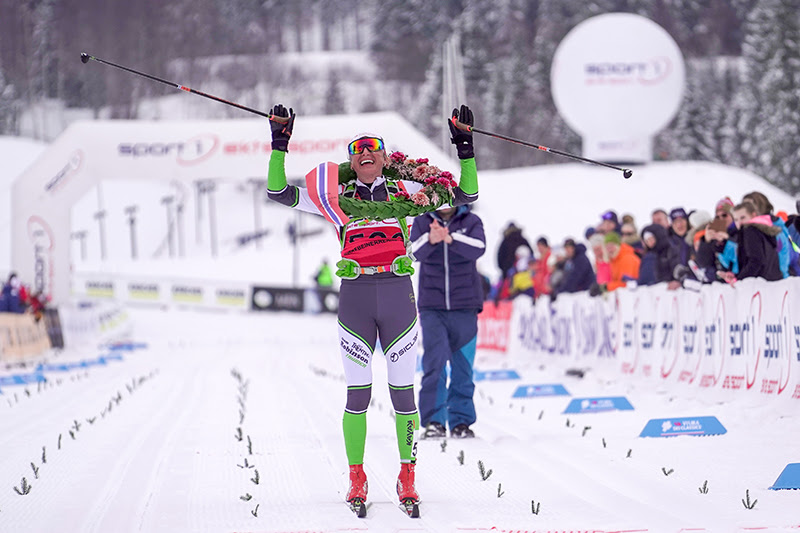
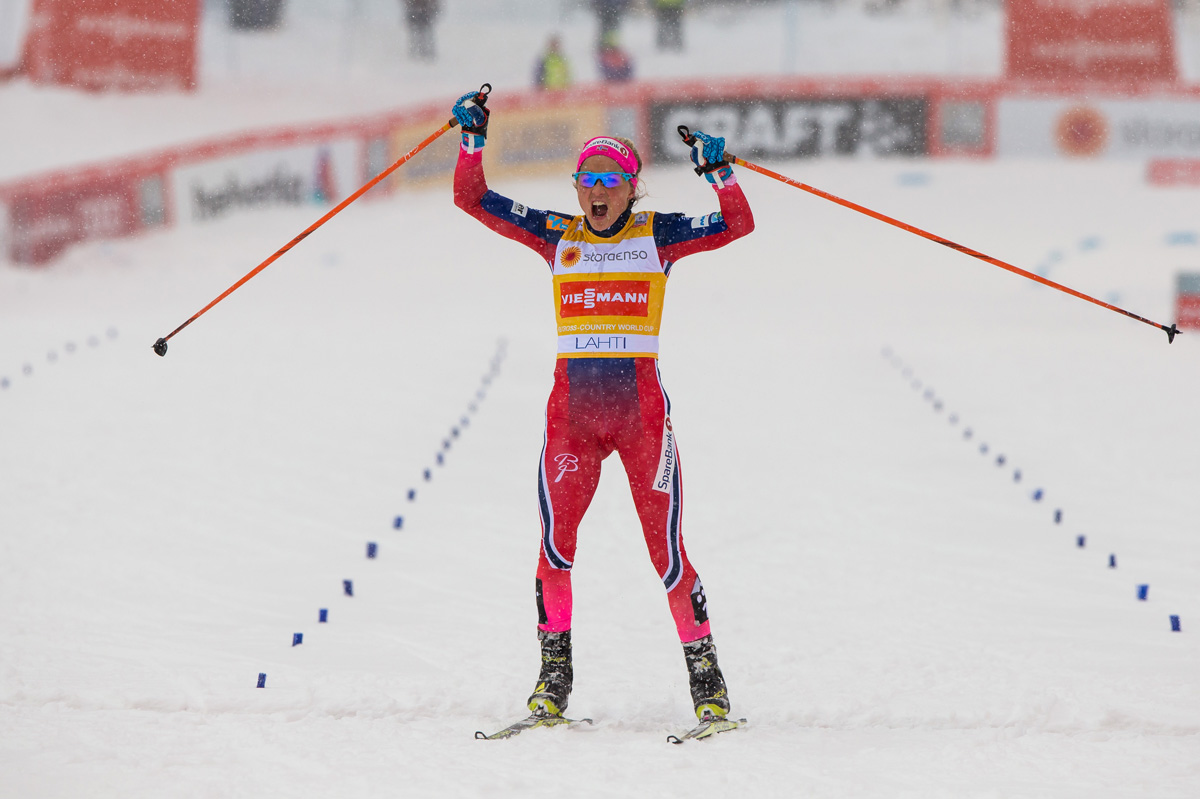
Poland’s Justyna Kowalczyk winning the 2019 Birkebeinerrennet. (Photo: Tom William Lindström)
Eliassen and Kowalczyk Break Away to Victories in Birkebeinerrennet
In the men’s 54 km race, Petter Eliassen attacked very early on and only his teammate Morten Eide Pedersen was able to follow for a while. Before reaching the climb competition point at Raudfjellet, 20 km, Eliassen was skiing solo and kept going so strong that no one else had a chance to even try to catch him. Behind him, five men approached the stadium area, and the yellow bib holder Andreas Nygaard, Team Ragde Eiendom, proved again that he is the sprinter extraordinaire by taking home the second place. There was an extremely tight fight for the last podium place between Simen Østensen, Team BN Bank, and the Vasaloppet winner Tore Bjørseth Berdal, Team Koteng. The former managed to be third making the day perfect for Team BN Bank as their third skier Pedersen was also able to finish 5th.
“This went according to our plan,” Eliassen admitted after the race. “This is a good race and great course for me. I attacked early on and managed to keep the gap. I just tried to focus on my own performance and make sure that I won’t encounter any unwanted mishaps on the way. It was a perfect day for our team, and I’m happy that my teammates did so well, too.”
The women’s race had more action as the current Hertz Champion leader Britta Johansson Norgren struggled in the first hill while Justyna Kowalczyk, Astrid Øyre Slind and Masako Ishida, both from Team Koteng, worked together to gain a gap over their toughest rival. Kowalczyk broke away from the others in the second long climb and Johansson Norgren was able to catch both Ishida and Øyre Slind. Kowalczyk’s breakaway lasted until the finish while the Team Koteng skiers had to let Britta go. Øyre Slind was stronger than her teammate in the end and she finished third in the race.
“I didn’t expect this to happen,” the happy winner Kowalczyk stated wearing her victory garland. “I felt tired after 12 kilometers of skiing, but my skies were so fast. So, I decided to push harder and it worked. I told my coach in the morning that I didn’t feel that strong, but he said that I’m strong and I should just go. It means so much to have this hat trick, three consecutive wins, here at Birken, which is so important to all Norwegians. About my next race, I may do Ylläs-Levi in Finland.”
Nygaard and Johansson Norgen remained the Hertz yellow bib holders while there were no changes in the sprint competition due to the fact that there were no sprint points in the race; Lager 157 Ski Team’s pro skiers Johansson Norgren and Anton Karlsson lead those competitions. Pedersen and Johansson Norgren are still the king and queen of the climb competition while Torleif Syrstad, Team Koteng, and Sofie Elebro, Team Ragde Eiendom, are the current youth bib holders. The pro team competition is very tight as there are three teams within 63 points of each other at the top; Team Koteng 1st, Lager 157 Ski Team 2nd, and Team Ragde Eiendom 3rd. After two events, Berdal and Johansson Norgren lead the Visma Nordic Trophy tour.
Russia’s Alexander Bolshunov racing to first in the Blink Classics men’s 60 k on Wednesday in Sandes, Norway. (Photo: Blink Ski Festival/Facebook)
A predictor for the winter ski season ahead? Could be. Either way, Norway’s Blink Ski Festival, or as it’s called in Norway, Blinkfestivalen, remains the ultimate in rollerski racing and returned for the 12th year in a row on Wednesday.
The festival opened with elite men’s and women’s distance rollerski races, known as the Blink Classics. For the third-straight summer, the Blink Classics featured a 60-kilometer mass start for the men and a 50 k for the women.
Eighty-six men competed in Wednesday’s 60 k, which began in the city center of Ålgård and finished in the municipality of Sandnes. A complete course map, which deviated little from last year’s rendition, may be found by clicking here.
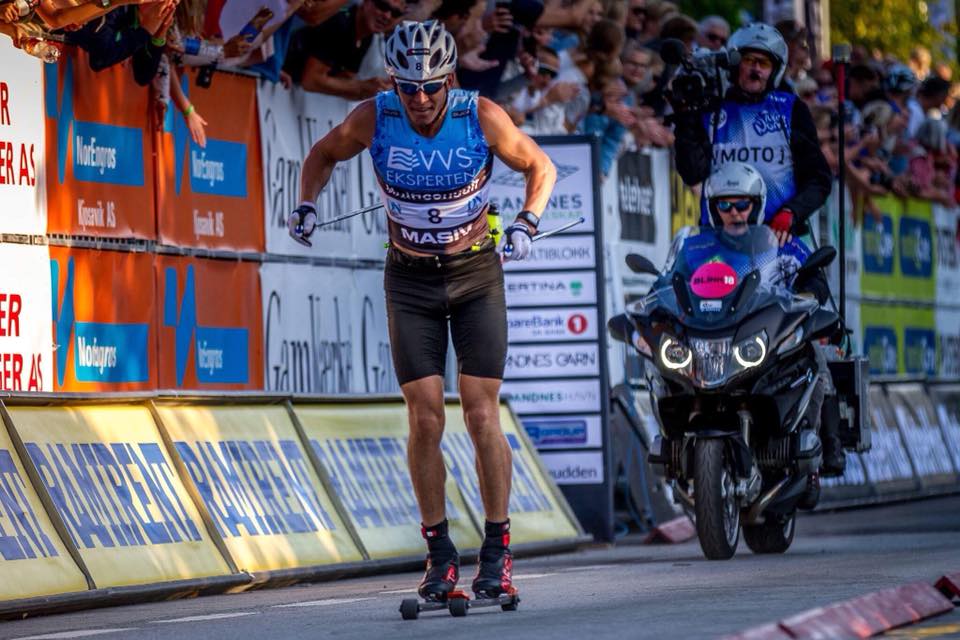
By the end of the men’s 60 k, it was Russia’s Alexander Bolshunov who finished first in 2:10:51.6 hours. The 22-year-old Bolshunov had a number of World Cup podiums last season and one win in the final 15 k of the year. He also earned three silver medals and one bronze at the 2018 Winter Olympics in South Korea.
Finishing just 5.9 seconds behind him was another Russian, 19-year-old Sergey Ardashev, in second place. The third elite man across the line was Norway’s Anders Mølmen Høst, 27, of the Lyn Ski club, who finished 1.8 seconds out of second place and 7.7 seconds back from first.
Norwegians occupied the rest of the top 10, with Tord Asle Gjerdalen in fourth (+8.1), Øystein Petterson in fifth (+8.3), Hans Christer Holund in sixth (+8.3), Sjur Røthe in seventh (+8.7), Simen Hegstad Krüger in eighth (+8.7), Runar Skaug Mathisen in ninth (+10.3) and Martin Johnsrud Sundby — the winner of last year’s Blink Classics 60 k — in 10th (+10.8).
Nearly half of the men’s field came from nations from outside Norway, with athletes hailing from Russia, France, Canada, the U.S., Great Britain, Finland, Sweden, and Italy. Canadian World Cup skier Alex Harvey was the top North American in 14th (+1:19.0).
Also for Canada, Scott James Hill placed 53rd (+11:00.0) and Bob Thompson was 56th (+11:53.1). Ian Torchia was the lone American in the event, racing to 55th (+11:52.3). Canada’s Evan Palmer-Charrette did not start.
Norway’s Kari Vikhagen Gjeitnes finishing first in the Blink Classics women’s 50 k on Wednesday in Sandes, Norway. (Photo: Blink Ski Festival/Facebook)
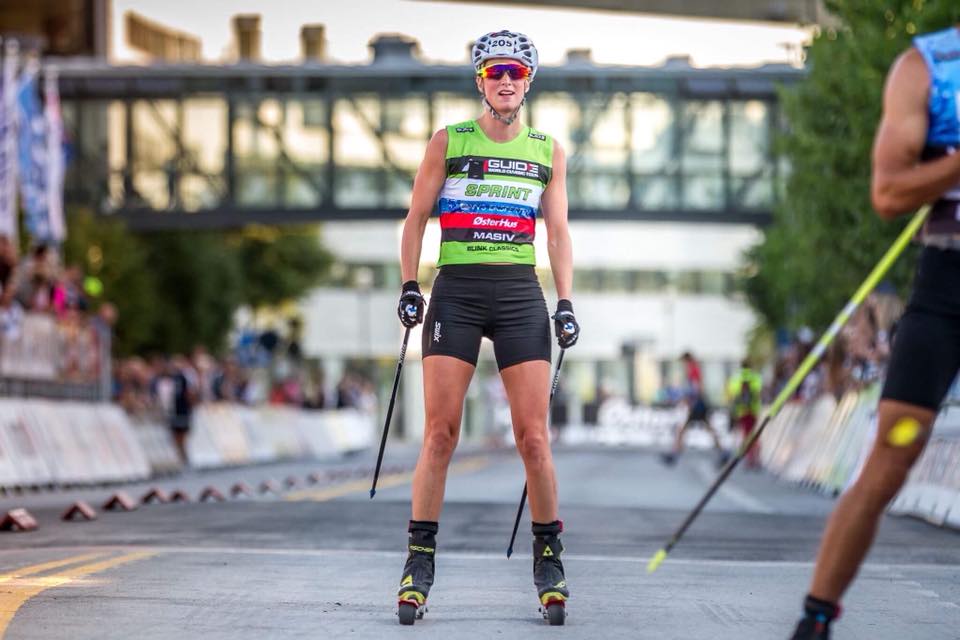
In the elite women’s 50 k, which had just nine finishers, Norway’s Kari Vikhagen Gjeitnes finished first in 2:21:19.0. Second place went to Astrid Øyre Slind, who crossed 33.9 seconds after Gjeitnes, and the third and final podium spot went to Poland’s Justyna Kowalczyk (+5:55.4).
Norway’s Marit Bjørgen celebrates her overall win in the last race of 2018 World Cup Finals, the 10 k freestyle pursuit, on March 18 in Falun, Sweden. Bjørgen officially announced her retirement from skiing last Friday, April 6. (Photo: Svenska Skidspelen/Instagram)
You’ve probably heard the news by now: Marit Bjørgen, the Norwegian queen of cross-country skiing, has decided to retire. The 38 year old made the announcement a week ago after winning the first race of Norwegian nationals, the 5-kilometer classic, on April 6.
“In reality it has been a long process,” she told NRK that day, according to a translation. “I had almost decided before the competitive season started. I feel that I lack the motivation and desire required to be right there in the top. I also have a little boy at at home, who is beginning to understand more and more, that I’d like to spend time with. That time I can never have again. It’s also a little frightening. This is been half of my life. This is emotional.”
The most decorated Winter Olympian of all time across all sports with 15 medals, five of which came at the 2018 Olympics in PyeongChang (two golds, a silver, and two bronze), Bjørgen closed her season on Saturday, April 7 with a second-place finish behind teammate Ragnhild Haga in the national 30 k freestyle in Alta, Norway.
“I’m proud of what I’ve achieved in my career, but I’ve also been privileged to have been able to win top-level sports,” Bjørgen said in Norwegian team press release. “I am very much thankful to amazing team friends, teammates, coaches, medical team, service team, managers and the whole support crew that have been around me. You have a great deal of credit for my results.”
Teammates Marit Bjørgen (r) and Ingvild Flugstad Østberg after placing first and second, respectively, in the women’s 5 k classic at Norwegian nationals in Alta on April 6. (Screenshot: NRK broadcast)
Norway’s head coach Vidar Løfshus described Bjørgen as a “team captain” who was “always there for the girls,” according to an interview with NRK.
He added that she was also a valuable coaching consult.
“For me, she’s been a good sparring partner; when tough things happening internally, I often call Marit,” Løfshus said, according to a translation. “Now there will be one less coach in my team. There are a lot of good coaches in the association, but … [none that have] won so many medals. She knows more about cross country skiing then I do, Sju, Ole and Roar combined, almost.
“We can’t let a woman like that disappeared through the back door,” he said of his desire to keep Bjørgen involved with the team. “But now we’re gonna let her exhale and enjoy her time with [her son] Marius and [partner] Fred Børre. She has not had enough time for that. And after that I know she will contribute again.”
Bjørgen shared emotional moments with her teammates at nationals.
“She has been a role model to me for many many years,” Ingvild Flugstad Østberg told NRK.
“One day has to be the last,” Heidi Weng said. “We’ve had a lot of fun with Marit. She’s a legend. She has been the security blanket and the mother in the team. It’s frustrating not to have mommy at the starting line, someone to joke around with and calm your nerves. Someone who is supportive.”
Who else is on our list of notable cross-country retirements so far? (For our biathlon list, which should also include the additions of Norway’s Ole Einar Bjørndalen and Emil Hegle Svendsen, click here.)
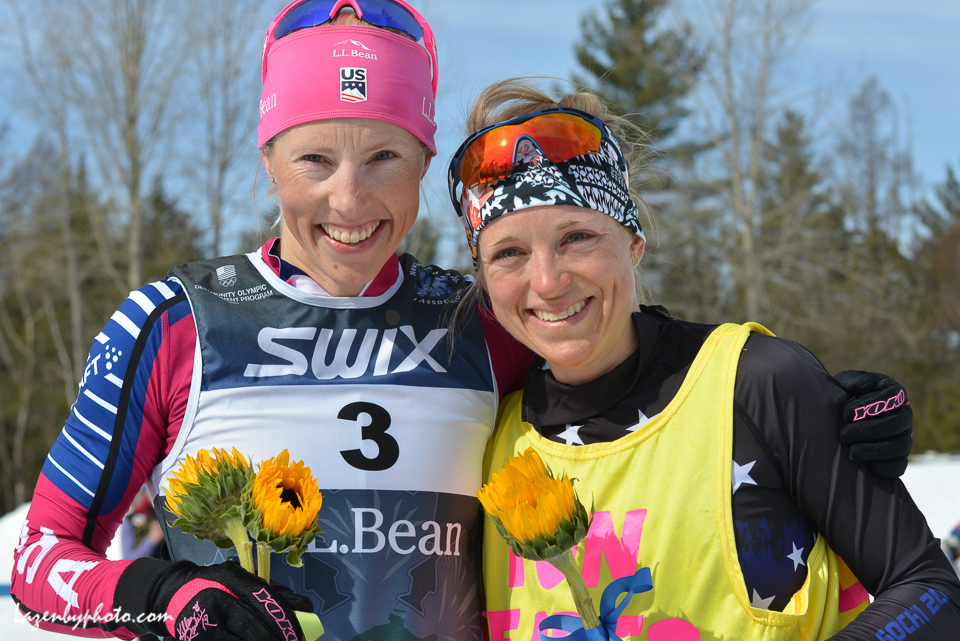
Kikkan Randall (l) and Liz Stephen after the last race of their professional careers, the 30 k classic mass start at 2018 U.S. Distance Nationals in Craftsbury, Vt. (Photo: John Lazenby/Lazenbyphoto.com)
From the U.S., we have U.S. Ski Team members Kikkan Randall and Liz Stephen, who said ‘so long’ to international racing, while another team veteran Andy Newell told FasterSkier that he plans to continue racing, but apart from the national team and likely outside of the World Cup circuit.
Former national-team members Noah Hoffman and Kris Freeman have also announced their retirements from professional skiing. On the domestic side, Annie Hart has stated this was the last season of her ski career as she plans to begin law school.
There has been talk of a few of Canada’s World Cup Team members retiring, but the only one FasterSkier has confirmed so far is Graeme Killick.
Zina Kocher, a 2006, 2010 and 2014 Olympic biathlete who came out of retirement to make a bid for the 2018 Olympics in cross-country skiing, has stated that it’s really over this time after her comeback season.
“As I reflect on the last 16 years that I trained full-time and competed at an international level I’m flooded with a lot of memories,” Kocher, 35, wrote in a blog post last week. “If someone had told me when I started biathlon in ’98 that I would be a ‘lifer’ (aka someone who does the sport & can’t give it up till they’re an old veteran in their 30’s), I would have laughed and said ‘yea right’. But here I am, finally saying goodbye!”
Michael Somppi, of the Alberta World Cup Academy, is also retiring after 16 years of competitive skiing. Somppi, 29, a former member of Canada’s senior development team, won three national titles and World Cup start rights as Canada’s NorAm overall leader at the end of the 2014/2015 season.
“I didn’t accomplish everything I wanted to in my ski career, but I am really proud of all that I did accomplish,” Somppi wrote in a blog post on Sunday. “I feel I got all I could out of myself given the circumstances I faced and the system I worked in. Thinking back to when I started out ski racing in high school, I am amazed how far I’ve come. ‘Started at the bottom, now we here!’ I picked up racing late and was never the most talented. I worked hard with extreme motivation and focus to become one of the top skiers in Canada.”
“One of the highlights of my career was certainly the team sprint with my brother Dario at the Olympic Winter Games in Sochi,” Gianluca wrote in a Facebook post announcing his retirement, according to a translation. “We reached the 5th place and could take home an [Olympic] diploma. It was not only a highlight because of the 5th rank, but also because our parents were there to witness it live. I never dreamed of anything like that when I was a little boy.”
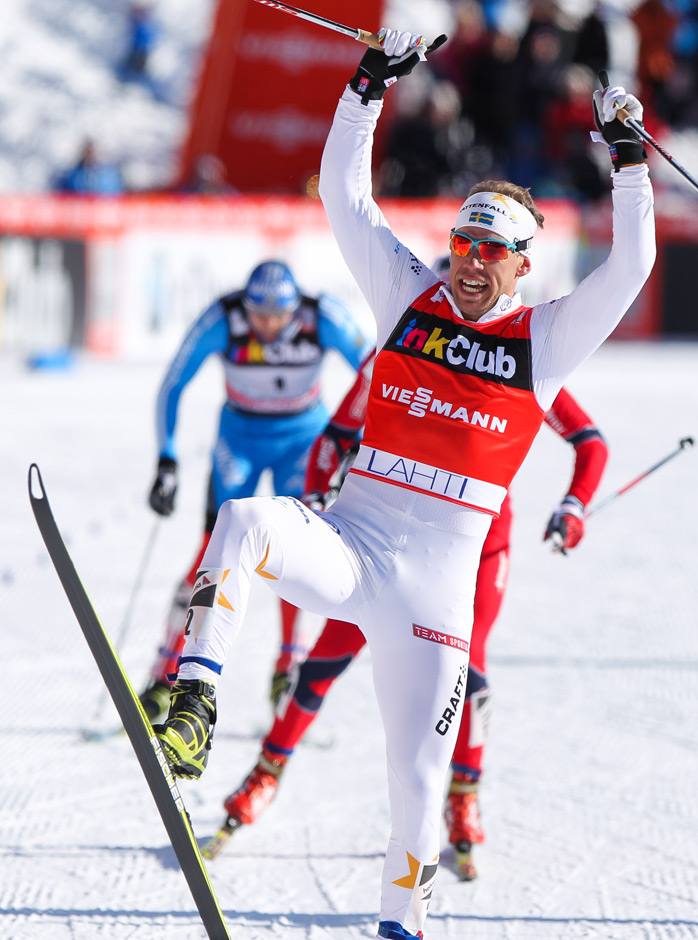
Sweden’s Emil Jönsson celebrates a 2013 World Cup victory in Lahti, Finland. (Photo: Fischer/NordicFocus)
The Swedish team is seeing the exit of Anna Haag, Emil Jönsson and Martin Johansson. Haag, 31, won gold with the Swedish women’s relay at the 2014 Olympics in Sochi, Russia, and has four medals from the last three Olympics. Jönsson, 32, Haag’s longtime partner and an internationally renowned sprinter, earned two Olympic bronze medals in 2014.
From Finland, four-time World Championships gold medalist Aino-Kaisa Saarinen is stepping away from competitive skiing at age 39.
“I have done this 20 years, what I really wanted, and I have raced my goals and even more,” Saarinen told FasterSkier after the last race of World Cup Finals in Falun, Sweden. “This skiing family is the thing what I’m going to miss the most, and of course, I love the competitions. I don’t know any other job where you can feel so high and so low, so, maybe those are the feelings right now, what I’m going to really miss the most.”
Poland’s 35-year-old Justyna Kowalczyk, a two-time Olympic champion and two-time World Champion, has announced her retirement as well.
Then there’s Aurore Jean, 32, who became the second French woman to reach the cross-country World Cup podium with a second-place skate-sprint finish in 2013.
And last but not least (for now), we have heard news of Russia’s Alexander Legkov — the controversial 2014 Olympic champion who was not allowed to compete at this year’s Games because of Russia’s systematic doping in Sochi — officially retiring.
“You have all been with me in the course of many years of my professional career and I truly love you all,” the 35-year-old Legkov said at a sports tournament in Khanty-Mansiysk, Russia, on April 6, according to the Russian News Agency. “… I will see all of you later, not at international tournaments, but perhaps at domestic tournaments or marathon. I am announcing the end of my international sports career.”
At the Sochi Games, Legkov won the 50 k freestyle mass start and took bronze with his teammates his the men’s 4 x 10 k relay. He ended his ski-racing career on March 3 in Rybinsk, Russia, where he placed fourth in the 50 k freestyle Demino Skimarathon.
Stay tuned for more retirement announcements as they are made public.
Sweden’s Stina Nilsson (center) won gold in the classic sprint at the 2018 Olympics on Tuesday in PyeongChang, South Korea, with Norway’s Maiken Caspersen Falla (left) taking silver and Russia’s Yulia Belorukova bronze. (Photo: FlyingPointRoad)
PYEONGCHANG, South Korea — Tuesday at PyeongChang’s Alpensia cross-country venue, the site of the Olympic Games women’s 1.25-kilometer classic sprint, Sweden’s Stina Nilsson took gold. On an evening when athletes were already challenged by an aerobic capacity testing course, shifting winds and falling snow, another factor made the challenge debilitating.
Nilsson came into the Games well-rested and well-primed to take her first individual Olympic medal. The 24 year old had come close before; at her first Olympics, the Swede placed 10th in the freestyle sprint in Sochi, Russia. There, she went on to claim bronze in the classic team sprint with teammate Ida Ingemarsdotter.
A year later in Falun, Sweden, at World Championships, Nilsson placed second in the individual classic sprint. When you are close, you begin to think more about achieving a singular goal and less about overall season-long outcomes.
Nilsson last raced a World Cup the weekend of Jan. 20-21 in Planica, Slovenia, where she raced to 13th place in the 10 k classic. The day before, on Jan. 20, Nilsson took a small prize: a World Cup classic-sprint win.
In her run up to PyeongChang, Nilsson explained she was able to focus on her training and block out distractions.
“Not so much pressure the last weeks, because I have not been on the Internet so much,” Nilsson said at the post-race press conference. “And not on Instagram. So the most pressure comes from myself, and that’s the pressure that I have to deal with. But today I managed to control those feelings and just ski so fast as I can.”
With temperatures hovering around 25 degrees on Tuesday evening, Nilsson was unstymied by the gusting winds or falling snow in formulating the answer to her success equation. Starting with Tuesday’s qualifier in PyeongChang, Nilsson marked the fastest time, stopping the clock in 3:08.74 minutes. With Nilsson pushing the pace, she also scored a win in the quarters. Again in her semifinal, Nilsson placed first after dualing with the 2014 Sochi skate-sprint champion, Norway’s Maiken Caspersen Falla (who also won the skate sprint at last year’s World Championships), in a photo finish.
“I had a really good day,” said Nilsson, a 2015 World Championships classic-sprint silver medalist. “I felt strong already in the prologue, and I felt also strong in the quarterfinal, and in the semifinal. I felt like I had some energy saved for the final.”
Sweden’s Stina Nilsson and teammate Hannah Falk (4) embrace after Nilsson won the classic sprint gold medal at the 2018 Olympics in PyeongChang, South Korea. (Photo: FlyingPointRoad)
Lining up in the final trying to prevent Nilsson’s clean sweep on the day were Falla, Nilsson’s Swedish teammate Hannah Falk, American Jessie Diggins, and Russians Natalia Nepryaeva and Yulia Belorukova.
The energy Nilsson stated she had saved for the final was more than sufficient. Off the line she set the pace up the course’s first climb — a climb not steep enough to create big gaps and string out the field. The group stayed together with two skiers in the inside lane, three in the adjacent lane, and Diggins skiing outside the tracks and closing on the outside.
Topping out on the hill and taking a sharp 180-degree turn, Nilsson led but no skier pulled away. Down the hill, the six skiers tucked and glided and double poled into the course’s decisive climb with Belorukova then Falla the closet skiers to challenge.
The final hill is where Nilsson seized the day.
“I just wanted to cross the finish line totally tired, so I just went for it in the last uphill,” Nilsson said about her race tactics in the final. She carried considerable speed over the final climb and the gap grew to the two closest chasers, Falla and Belorukova.
“My plan was to save the most of the power until the last part of the [final] climb,” Falla, 27, said at the press conference. “But when the two others got a little gap in the first downhill, I used too much power in the first part of the climb. So in the top where I was planning to use all my power, there wasn’t that much left.”
Nilsson still had power to spare. She soloed off the front to win the final in 3:03.84 minutes. Falla took silver (+3.03), Belorukova, a 23-year-old Olympic rookie, bronze (+3.37).
In the post-race press conference, Belorukova was asked about the tense relationship between the International Olympic Committee (IOC) and the Russian Ski Federation. The IOC banned numerous Russian skiers from PyeongChang for doping violations. Those Russian athletes competing at the 2018 Winter Olympics are not competing under the Russian flag, but as Olympic Athletes from Russia (OAR).
“Good question,” Belorukova said through an interpreter. “There is nothing that will break us, there is nothing that will instill fear into us, we are strong and we will fight until the end.”
Nepryaeva ended up fourth (+9.14), Falk fifth (+11.16), and Diggins sixth (+11.23). FasterSkier will post an additional report on the U.S. women’s results.
Finland’s Krista Pärmäkoski after winning her first non-stage World Cup on Sunday in the women’s 10 k classic in Planica, Slovenia. She bested Sweden’s Charlotte Kalla’s time by 3.6 seconds. (Screenshot: ARD broadcast)
FIS Cross Country World Cup (Planica, Slovenia): 10/15 k classic
Just when it looked like one of those Charlotte-Kalla days, Finland’s Krista Pärmäkoski swooped in and topped the Swede’s time by 3.6 seconds in the women’s 10-kilometer classic individual start on Sunday for her first-career outright World Cup win.
Outright meaning non-stage; Pärmäkoski has two World Cup wins to her name for setting the fastest time of day in 2016 pursuit races.
But Sunday’s 10 k in Slovenia saw her rising to the challenge and besting Charlotte Kalla’s time of 27:12.3, which was at least 39 seconds faster than the first 57 starters. Kalla had started 32nd and beat the previous top time set by Swedish U23 skier Ebba Andersson (bib 28) by 48.6 seconds.
Austria’s Teresa Stadlober started later in bib 56 and clocked the second-fastest time to Kalla, 39 seconds back.
But it was Pärmäkoski in bib 58 who beat them all. Even Norway’s Heidi Weng, who started 60th, couldn’t come close, as she finished 33.5 seconds off Pärmäkoski’s winning time for third place. That put Stadlober in fourth and Andersson in fifth at the end of the day.
Finland’s Kerttu Niskanen placed sixth (+49.4), Norway’s Kari Øyre Slind took seventh (+49.5), Poland’s Justyna Kowalczyk (who’s more of a marathon skier these days) placed eighth (+1:02.1), Norway’s Kathrine Rolsted Harsem (who placed second in Saturday’s classic sprint) finished ninth (+1:03.2), and American Jessie Diggins was 10th (+1:05.4).
Another American, Caitlin Patterson, of the Craftsbury Green Racing Project (CGRP), broke through with her second-best individual World Cup result in 20th (+1:45.2). (Last year, she finished seventh in the pre-Olympic PyeongChang World Cup 15 k skiathlon in a notably small field.)
Kikkan Randall (U.S. Ski Team) followed in 23rd (+1:50.4), and her teammates Sophie Caldwell placed 31st (+2:17.2), Liz Stephen 35th (+2:34.9), and Ida Sargent 37th (+2:37.5).
For the second-straight weekend, no Canadian women competed.
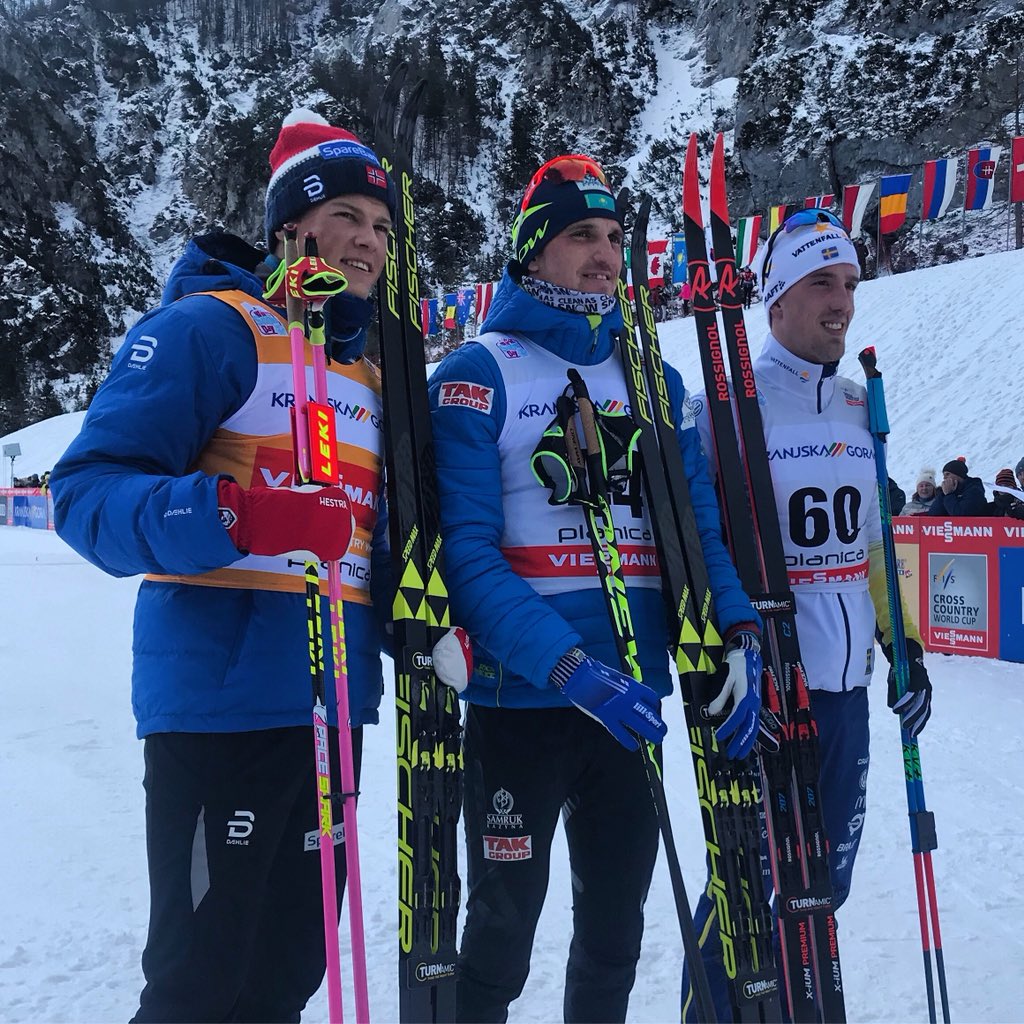
The World Cup men’s 15 k classic podium on Sunday in Planica, Slovenia, with Kazakhstan’s Alexey Poltoranin (c) in first, Norway’s Johannes Høsflot Klæbo (l) in second, and Sweden’s Calle Halfvarsson (r) in third. (Photo: FIS Cross Country/Twitter)
In the men’s 15 k classic, Kazakhstan’s Alexey Poltoranin tallied his second win of the season and first in a race against Norway’s Johannes Høsflot Klæbo on Sunday, winning by 13.2 seconds over Klæbo in 36:54.7.
Poltoranin, 30, started 44th and a minute behind the 21-year-old Klæbo. When Klæbo finished, he bumped Russia’s Ivan Kirillov, also 21, out of the leader’s chair by 43.3 seconds. Then Poltoranin finished 13.2 seconds faster, but Klæbo held onto second when Sweden’s 60th starter, Calle Halfvarsson, finished third (+42.8). It was Halfvarsson’s second podium of the season after placing third in the classic sprint at the November World Cup opener in Kuusamo, Finland. In Saturday’s classic sprint in Slovenia, Halfvarsson qualified second but crashed out of the quarterfinals to finish the day in 30th overall.
Norway’s Emil Iversen started 66th and ended up fourth (+54.7) and Kirillov scored his first World Cup top 10 in fifth (+56.5). Russia had four in the top 10 with Stanislav Volzhentsev in sixth (+57.8), Andrey Larkov in eighth (+1:02.2) and Andrey Sobakarev in ninth (+1:03.4). Norway’s Mattis Stenshagen finished seventh (+1:00.8) and Finland’s Iivo Niskanen took 10th (+1:10.1).
Scott Patterson (U.S. Ski Team) was the top North American in 43rd (+2:56.2), Ben Lustgarten (Craftsbury Green Racing Project) finished 46th (+3:04.9) and Tyler Kornfield (Alaska Pacific University) was 57th (+4:03.7). Andy Newell did not finish.
Canada’s Devon Kershaw returned to the circuit and placed 44th (+2:57.1), Bob Thompson (NTDC Thunder Bay) was 64th (+5:05.0), and Dominique Moncion-Groulx (Alberta World Cup Academy) was 70th (+6:11.7).
Russia’s Stefaniya Nadymova outsprinting Japan’s Ayane Miyazaki at the finish for the win at the inaugural women’s Nordic Combined Continental Cup competition on Saturday in Rena, Norway. (Photo: FIS/Romina Eggert)
FIS Nordic Combined Continental Cup (Rena, Norway): First-ever women’s competitions
Fourteen women, including American Gabriella Armstrong, made history this weekend by competing in the first women’s Nordic Combined Continental Cup in Rena, Norway (after the scheduled opener in Jan. 6-7 in Otepää, Estonia, was canceled), with back-to-back days of individual large hill/5-kilometer Gundersen start races.
On Saturday, Russia’s Stefaniya Nadymova took the win in 16:26.9, just 0.6 seconds ahead of Japan’s Ayane Miyazki in second. Germany’s Jenny Nowak joined them on the podium in third, 16.6 seconds out of first. Armstrong finished 12th (+6:24).
Nadymova, 23, had kicked off the event by jumping to first in the provisional round, which was used for the jumping results, and began the 5 k with a 10-second head start on Nowak in second place. Miyazaki jumped to third and started 14 seconds back. Armstrong jumped to 14th and started 4:08 out of first.
On Sunday, 15-year-old Miyazaki took the win in 16:23.2, swapping places with Nadymova, who finished second, 11.7 seconds back. Nowak, also 15, repeated in third, but finished over a minute and 21 seconds back out of first.
Miyazaki had jumped to first place earlier in the day and started the 5 k with a 20-second cushion to Nadymova in second. Nowak jumped to third and started 1:08 minutes back.
Armstrong, 19, of the New York Ski Education Foundation, jumped to 11th and finished 11th, 4:26.1 after Miyazaki.
Several U.S. Nordic Combined men also competed in Rena, with Taylor Fletcher placing fourth in Saturday’s individual large hill/10 k, 2.7 seconds behind Austria’s Thomas Joebstl in first. Fletcher had skied up from 25th and 2:17 back after the jump with the second-fastest course time.
Also for the U.S., Adam Loomis placed 33rd (+2:30.7) after jumping to 45th with the 12th-fastest course time. Grant Andrews finished 41st (+3:28.7), and Jared Schumate 43rd (+4:10.1).
Fletcher reached the podium in Sunday’s individual large hill/10 k in third behind two Austrians. After jumping to 19th, he skied the fourth-fastest course time to finish third, 3.7 seconds behind Dominik Terzer in first and 2.7 seconds behind Martin Fritz in second.
Loomis improved to 29th (+1:40.9), up from 35th in the jump, and Andrews finished 37th (+2:36.4) and Shumate 40th (+2:57.9).
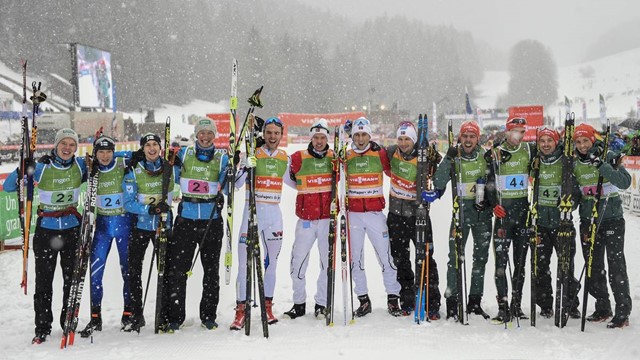
The men’s large hill/4 x 5 k team event podium on Sunday at the Nordic Combined World Cup in Chaux-Neuve, France, with Norway (c) in first, Germany (l) in second, and Finland (r) in third. (Photo: FIS/NordicFocus)
FIS Nordic Combined World Cup (Chaux-Neuve, France): Saturday & Sunday
Four American men competed at the Nordic Combined World Cup this weekend in Chaux-Neuve, France, with three of them racing in Saturday’s individual large hill/10 k Gundersen and all four racing Sunday’s large hill/4 x 5 k team event.
Norway’s Jan Schmid was the big winner this weekend, racking up an individual win on Saturday and a team victory on Sunday. He won Saturday’s competition after jumping to fourth and starting 27 seconds behind jump leader Akito Watabe of Japan. Schmid worked his way up to first in the 10 k with the third-fastest course time, crossing the line 1.4 seconds ahead of Watabe in 23:32.7.
Watabe finished second and Finland’s Ilkka Herola placed third (+21.5), just ahead of Austria’s Lukas Klapfer in fourth (+21.8).
Ben Loomis led USA Nordic in 37th (+2:49), after jumping to 37th, Stephen Schumann finished 45th (+5:17.0) and Ben Berend 46th (+5:22.2).
On Sunday, Schmid teamed up with Espen Andersen, Jarl Magnus Riiber and Jørgen Graabak to win the 4 x 5 k team event in 47:22.5 by 13.1 seconds. Germany followed in second, with Eric Frenzel, Fabian Rießle, Johannes Rydzek, and Vinzenz Geiger, and Finland placed third (+20.5) with Leevi Mutru, Arttu Maekiaho, Herola, and Eero Hirvonen.
Norway had led after the jump and started the relay 1:03 minutes ahead of Finland in second. France jumped to third and ended up fourth (+47.4), after being passed by Germany, which had started the relay in fourth.
Japan placed fifth (+2:50.9), Italy sixth (+3:59.9), Austria seventh (+4:06.8), Poland eighth (+5:22.1), Estonia ninth (+5:52.1), Russia 10th (+6:41.2), and the U.S. (with Schumann, Loomis, Berend, and Jasper Good) 11th (+6:52.4).
Western Canadian Championships (Red Deer, Alberta): Relays
Nine men’s teams and six women’s squads contested the open relays on the last day of the NorAm Western Canadian Championships on Sunday in Red Deer, with Ontario’s Team “O” (Scott Hill, Michael Somppi and Andy Shields) winning the men’s 3 x 5 k and Alberta 1 (Annika Hicks, Emma Camicioli and Zina Kocher) winning the women’s 3 x 5 k.
For Shields and Hicks, it was their second win of the weekend after they won their respective classic mass starts on Saturday.
Team “O” posted a 19.9-second win over B.C. Storm (Remi Drolet, Tallon Noble and Greg Kilroy), finishing first in 36:22.6. Alberta 5.1 (Sebastien Boehmler-Dandurand, Sam Hendry and Russell Kennedy) placed third (+52.3).
In the women’s relay, Alberta 1 beat out B.C. Fast, Furious & Freakin’ Awesome (Katie Weaver, Michaela McLean and Kaia Andal) by 2 minutes and 37.8 seconds, winning in 43:17.2. Alberta had two teams on the podium with the Kit Kats (Ember Large, Molly Jane Strum, and Sara McLean) in third (+4:25.8).
The 2018 Tour de Ski Stage 6 women’s 10 k classic mass start podium with Norway’s Heidi Weng (c) in first, Finland’s Krista Parmakoski (l) in second and Austria’s Teresa Stadlober (r) in third in Val di Fiemme, Italy. (Photo: Fischer/NordicFocus)
After the Tour de Ski’s previous dance with earth, wind and rain and the subsequent cancellation of the Stage 4 classic sprint followed by a congested Stage 5 mass start in Oberstdorf, Germany, all seemed to return to a sense of normalcy on Saturday.
The women contested Stage 6 of the Tour de Ski (TdS), a 10-kilometer classic mass start, in the iconic Val di Fiemme, Italy. The women skied a 2.5 k climb-and-descend-centric course four times to the thrills of bell-ringing fans and the mountain gods, who, for the time being, allotted a weather reprieve after Central Europe’s rumble with funky atmospheric pressure gradients.
In what amounted as a critical race to shake out the standings before Sunday’s final Stage 7 climb up Alpe Cermis, with 10 k to go and then 10 k down, Norway’s Heidi Weng rolled the dice and won.
Austria’s Teresa Stadlober leads Norway’s Heidi Weng (2) and Ingvild Flugstad Østberg, American Jessie Diggins (3) and others around a downhill corner during the women’s 10 k classic mass start at Stage 6 of the 2018 Tour de Ski in Val di Fiemme, Italy. (Photo: Fischer/NordicFocus)
“It was a great race,” Weng said after the race, according to an International Ski Federation (FIS) press release. “I felt very good. I like Val di Fiemme very much. Every time I compete here I have had a good one. It will be a hard race tomorrow.”
Weng, last season’s TdS winner, crossed the line firs on Saturday in 29:07.9. It was her first individual World Cup win since her victory atop Alpe Cermis in last year’s final Tour stage. Finland’s Krista Pärmäkoski finished 7.6 seconds back in second place, Austria’s Teresa Stadlober was another second back in third place (+8.6), and American Jessie Diggins put herself in the mix in fourth (+23.6). The Tour leader coming into Saturday’s race, Norwegian Ingvild Flugstad Østberg, who at times looked like she could dominate the pace, faded to fifth (+35.2).
Also for the U.S. women’s team, Sadie Bjornsen finished 10th place (+1:11.3), Liz Stephen 24th (+2:18) and Rosie Brennan 30th (+2:47.2).
With a single stage to go, and a doozy at that (the 9 k freestyle hill climb pursuit up Alpe Cermis), Saturday’s stage was all about minimizing losses for some and making gains for others. As the Tour’s defending champion, Weng proved not only does she have TdS stamina, she has the gumption to kill on the final stage’s climb. Last year, Weng began the hill climb in second overall, 20 seconds behind Sweden’s Stina Nilsson. But more importantly in that 2017 race, Weng started 1:04 minutes ahead of Østberg in fourth. Nine k and 425 meters of climbing later, Weng took the win — she gained time on Østberg, who placed fourth overall (+2:04.3). Not that last year’s dynamics dictate how this year’s TdS will play out, but it remains a data set.
Norway’s Heidi Weng chases her teammate Ingvild Flugstad Østberg (not shown), followed by Austria’s Teresa Stadlober (8), Finland’s Krista Parmakoski, Russia’s Natalia Nepryaeva, Sweden’s Evelina Settlin (26) and Anna Haag (7), among others, early in the women’s 10 k classic mass start at Stage 6 of the 2018 Tour de Ski in Val di Fiemme, Italy. (Photo: Fischer/NordicFocus)
Weng began Saturday’s stage in second overall and 57 seconds behind TdS leader Østberg. Weng endures as the lanky yet seemingly ideal pairing of power-to-weight climbing ratio. Østberg, who is enjoying a resurgence this year after a lull by her standards last season, prevails as a powerful force to Weng’s lithe climbing. Yet after winning the first three Tour distance stages, underestimating the 2017/2018 version of Østberg on Alpe Cermis might prove too risky.
Saturday’s 10 k seemed like a poker match up to the second pass through the stadium at 5 k. The top-14 skiers were strung out in a line — 8.8 seconds separating Bjornsen in 14th to Østberg in first. For a moment, maybe it was an Østberg bluff, but she and Weng took a brief pull up front on a climb that appeared to unsettle the group of five that had formed and consisted of the Norwegian duo plus Diggins, Pärmäkoski and Stadlober.
It turns out Østberg’s moves were a bluff revealing she was dealt a weak hand: by 8.6 k Østberg was 19 seconds behind Weng. By then, Weng had played her full house and had gapped Pärmäkoski and Stadlober in second and third place respectively, by 10 seconds. Diggins skied in fourth, 16.5 seconds behind Weng.
From then on, Weng soloed for the win.
Heading into Sunday’s final stage, the formidable climb up Alpe Cermis, Østberg still leads the Tour with a tiny 1.8-second gap on Weng.
With Weng’s history on the climb, it appears to be her Tour to lose. If Weng wins the hill-climb pursuit, she’ll be the only skier besides Poland’s Justyna Kowalczyk to win successive Tours. Kowalczyk won four straight TdS’s from 2010 to 2013.
Jessie Diggins (U.S. SKi Team) after placing fourth in the women’s 10 k classic mass start at Stage 6 of the 2018 Tour de Ski in Val di Fiemme, Italy. (Photo: Salomon/NordicFocus)
U.S. standout Diggins had entered the stage in third overall, 1:56.7 behind. For much of Saturday’s race, she was a catalyst, either setting tempo up front, gliding away on the downhills or sitting in and letting the Norwegians know she was right there.
Weng’s mark on the race, which was embellished with her make-or-break climbing speed near 7.5 k, redlined several top skiers. At the 7.5 k checkpoint, Diggins was 8.2 seconds back. It looked initially as if it were more of an unmatchable Weng pace than a moment when Diggins would lose more time and fall from the Pärmäkoski-and-Stadlober pairing. Diggins came through 7.5 k in line with the Finn and Austrian.
Weng kept charging, Pärmäkoski and Stadlober kept their losses in check, and Diggins lost more time in the closing kilometers. The American was 19.8 seconds back at 9 k, and 23.6 behind as she crossed the finish line.
“In today’s race I tried to stay near the front and out of trouble,” Diggins wrote in an email to FasterSkier. “With my luck I just wanted to avoid crashes or broken poles! I faded slightly in that last lap and couldn’t go with Krista and Teresa but it was so fun to see exactly where the podium was since it’s mass start and see where I can improve a little bit for the next time. Always learning and taking notes!”
Diggins dropped one place in the overall standings and currently sits in fourth (+1:43.1). Pärmäkoski is third overall (+1:33.5) and Stadlober fifth (+2:29.9).
“In the overall tour, I’m really happy with my placing,” Diggins added. “To be starting 10 seconds behind Krista is awesome and I’ve been racing better than any other year, for sure. It’s fun to feel strong in sprint and distance, classic and skate, and my goal for years has been to become a true all-rounder. It’s fun to finally be getting there!”
Diggins, known for her uncanny race tenacity, understands the final stage is daunting.
“Unfortunately, I’m not a natural-born climber, but I know how to suffer, I know how to be a fighter, and I’m going to go give that climb everything I’ve got left,” Diggins explained about her approach to the hill climb. “And in the end, that’s all you can do! My internal mantra is most likely something like ‘just keep swimming….just keep swimming…’, Finding Nemo style. Because you have to see the humor in climbing that beast!”
Sadie Bjornsen (U.S. Ski Team) leads Sweden’s Stina Nilsson (l) on a downhill during the women’s 10 k classic mass start at Stage 6 of the 2018 Tour de Ski in Val di Fiemme, Italy. (Photo: Fischer/NordicFocus)
Bjornsen began the day sixth overall (+2:47.0) and finished in 10th. Bjornsen will begin Stage 7 ranked eighth, 3:33.1 minutes behind TdS leader Østberg.
“Today was another one of those days that left me wanting a bit more,” Bjornsen emailed to several media outlets. “After falling in the last race, I was determined to make up some time that I had lost in my overall tour position. I have been feeling really great on my classic skis, and felt like I had some power left in my legs this morning, so my goal was to just go with the leaders as long as possible. Unfortunately, I had a bit of a tough start, and made some tactical errors that left me pretty far back in the pack on the first lap. Then, once I was finally finding position again, I got trampled over, and fell. Once again, I fought my way back to the front after getting stuck behind some traffic, but just burned a few too many jets getting yo-yo’d around today.
“At this stage in the tour, when things go great, you can convince yourself you are invincible,” Bjornsen continued. “When you get rattled a bit, it takes an extra amount of mental power to fight back to where you want, and I think that is what got me today. My race today still puts me in a place to fight for top 10 in the overall, which is super exciting. Considering the swings of this TDS, I am thrilled to be fighting for top 10. I have never done that in a Tour event, so it is a good goal for me when I am pushing myself up that mountain tomorrow with every last bit of energy I have!”
TdS vet Liz Stephen again scored World Cup points on Saturday. In four distance races in this TdS, she has been in the top 30 three times. Admittedly, Stephen understood it was a small World Cup field.
“Well, it’s much easier to get 24th in a race when there are only 32 starters,” Stephen said on the phone Saturday. “But today was definitely, it was maybe the fastest pace I’ve ever seen in a World Cup. Either that, or my brain was just moving really slowly, and my body, but I was just really having trouble keeping the pace those girls were setting, so, it was a really hard day for me. I had to dig pretty deep. … I certainly, I was just on the ropes the whole time. Just felt like I was sprinting for 10 k. So, that was a little bit of a tough one today, but I love the courses and I just really happy to be feeling more like myself racing again during this Tour.”
But the bread and butter of Stephen’s gravity defying climbing ability is the Tour’s final hill climb. In 2013 she notched the second fastest time of day up Alpe Cermis. In 2014, she was seventh overall in the TdS and third fastest on the final stage. She was third fastest again in 2016 and second fastest in 2017.
Her expectations for Sunday are once again high.
“I look forward to tomorrow,” she said of the final climb. “I mean, it’s one of the hardest things that you can go do, but it’s also something I’ve always enjoyed because it’s — you just go up the hill. … You just kind of grind it out. I’m certainly hoping to take some people off tomorrow and I definitely look forward to the day, for sure. I think it will be even potentially more special to this year because I have some really good friends here watching from Vermont, and I think that will be really cool to have them out, watching this race for the first time.”
Stephen reflected that the early part of her season was not to her liking.
“I’ve definitely struggled at the beginning of this year, and I think probably it’s a combination of the getting older factor and trying to figure out how much recovery is needed, and how much intensity is needed, and what volume is needed,” the 30-year-old Vermont native said. “It is really different. I’m not the 24-year-old athlete that could recover and go bop around all day and then go race and have it be great. I’m certainly feeling something, and I think probably aging is probably it. I definitely struggled especially this fall on Period 1 … I never felt like myself racing. And so, I think just to feel even a little bit of a glimmer of what I want to feel like later in this season and just again in my career, it definitely is much easier now to kind of get my brain around. I haven’t lost it all. It still is there.”
With picking off skiers on her way up Alpe Cermis, Stephen aspires for that podium reserved for the time-of-day mountain goats.
“I would certainly kind of probably chuck it out there that I’d love to be top two,” she stated. “I think Heidi will be tough to beat out there tomorrow. Especially with the win on her shoulders, as well. But, I would be really happy with a top three tomorrow. And I’m certainly just really looking forward to trying to ski the best I can ski.”
The Tour de Ski concludes Sunday with Stage 7 in Val di Fiemme.
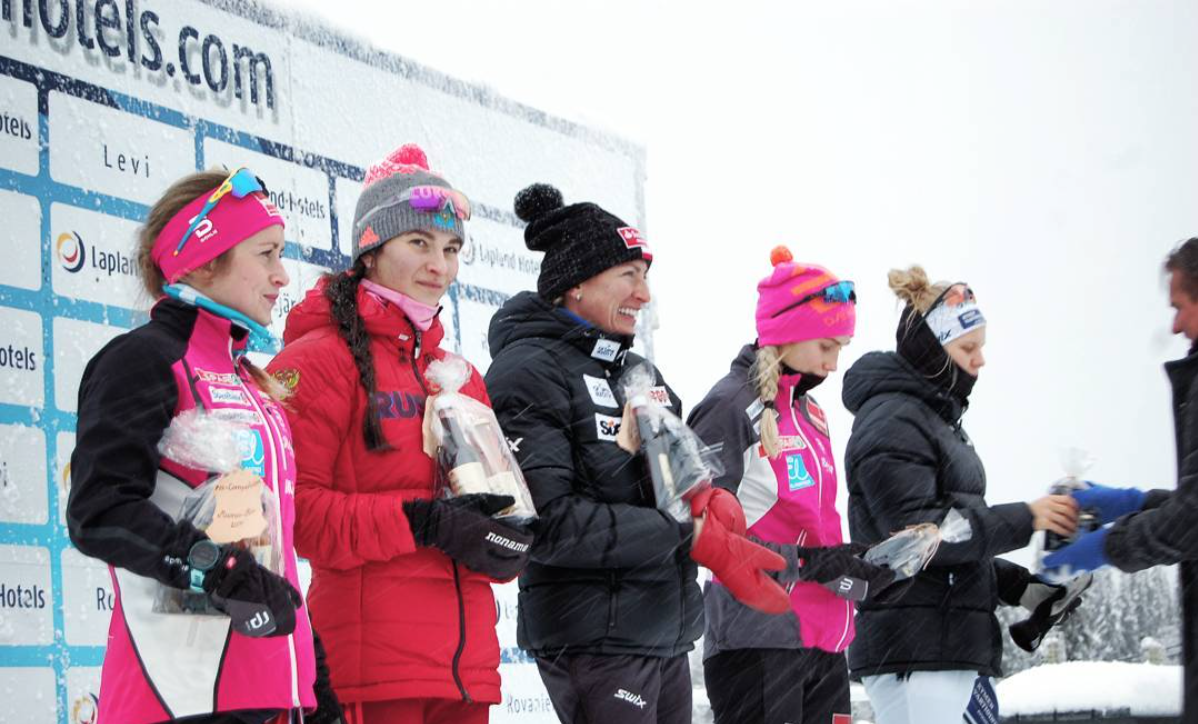
(l-r) Anna Svendsen of Norway, Natalia Nepryaeva of Russia, Justyna Kowalczyk of Poland, Lovise Heimdal of Norway, and Leena Nurmi of Finland receive prizes after rate women’s classic sprint in Muonio, Finland, on Friday. (Photo: Ski Muonio/Instagram)
FIS races are already being contested in Finland and Sweden this weekend, with most top Scandinavian racers sitting out but a few national-team members and others picking up their first victories of the season.
The competitions in Muonio, Finland, drew the most diverse field, including racers from Norway, Russia, Japan, China, Canada, Estonia, and Slovakia, among other countries. In the men’s classic sprint on Friday, the home team got a win from Ristomatti Hakola; he and Russia’s Alexander Bolshunov went 1-2 in both the qualifier and the final. Russia’s Andrey Parfenov rounded out the podium. In the women’s sprint, Anna Svendsen took the win over Russia’s Natalia Nepryaeva, with Justyna Kowalczyk of Poland finishing third.
On Saturday, racers moved up in distance. In the 10 k classic, Bolshunov – a U23 World Champion last season – bested Russian teammate Alexey Chervotkin by 20.6 seconds, with Andrey Sobakarev making it a sweep another 21.6 seconds back. Brian McKeever and Graham Nishikawa of Canada finished 56th (+2:10.6) and 63rd (+2:18.5), respectively.
Also in the men’s race was Maxim Vylegzhanin. The International Olympic Committee (IOC) decided on Thursday to strip the Russian skier of three silver medals from the 2014 Olympics for doping violations and ban him from all future Olympic Games. However, the International Ski Federation (FIS) has not yet taken any action since he and five other skiers were banned from the IOC, meaning that all six athletes are currently free to take part in non-Olympic ski competitions. In a press release, FIS stated that “the next steps will be the review by the FIS Doping Panel of the six verdicts upon the receipt of the reasoned decisions” but did not provide a time frame for these decisions.
In the women’s 5 k classic, Finland’s Krista Parmakoski posted an 18.4-second win over Nepryaeva, with Kowalczyk third again, +24.2.
Bruksvallarna, Sweden, hosted races on Saturday as well, with a primarily Swedish and Norwegian field but some other racers as well. Norway’s Chris Andre Jespersen topped the 15 k skate, posting a 31.4-second win over Simon Lageson of Sweden. Norwegian Tore Leren was third, +53.1. Canada’s Jack Carlyle finished 38th, +2:29.5. Petter Northug and his brother Even were in Bruksvallarna this week but decided at the last minute not to race, with Northug making his debut in Beitøstolen, Norway, next weekend instead.
In the women’s 10 k skate, Swedish national team member Emma Wiken bested Lina Korsgren – a long-distance specialist who finished eighth in the Visma Ski Classics standings last season – by 9.8 seconds. Berit Mogstad of Norway finished third, +15.3 seconds.
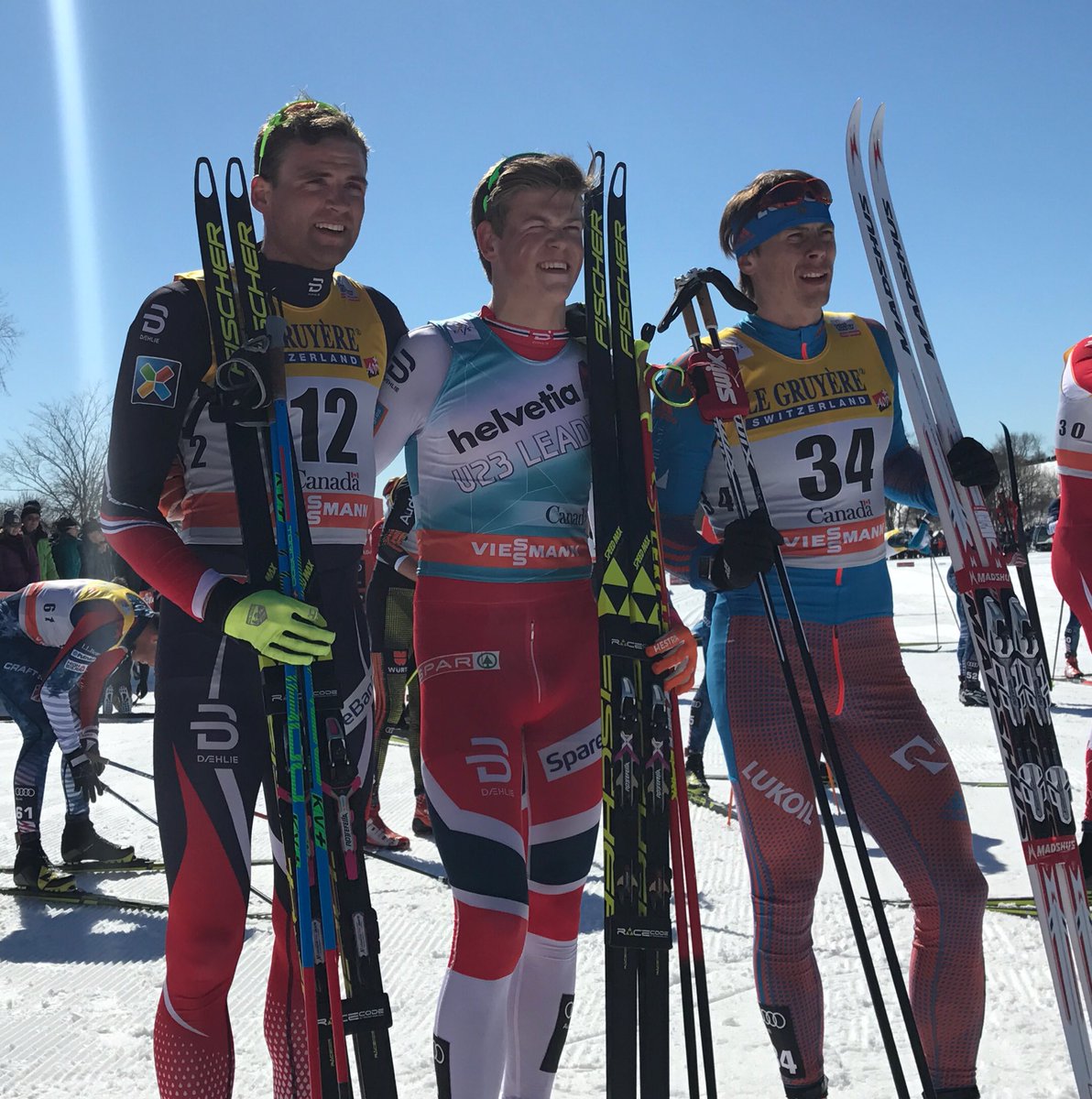
The men’s 15 k classic mass start podium on Saturday at World Cup Finals in Quebec City, with Norway’s Johannes Høsflot Klæbo (c) in first and Niklas Dyrhaug (l) in second, and Russia’s Alexander Bessmertnykh (r) in third. (Photo: FIS Cross-Country/Twitter)
FIS Cross-Country World Cup Finals (Quebec City): 10/15 k classic mass starts
During Saturday’s 15-kilometer classic mass start at World Cup Finals, Canada’s Alex Harvey was in it until the end. But so were Norway’s Johannes Høsflot Klæbo and Niklas Dyrhaug, and Russia’s Alexander Bessmertnykh, to name a few.
Sitting in second with a few hundred meters to go, Harvey was primed to make his move on Dyrhaug, who was leading at the time. But then came 20-year-old Klæbo, the season-long Sprint World Cup champion, who proved to have more left in the tank than anyone else and passed them both to lead into the finishing straight.
Klæbo took the victory — his first in a World Cup distance race — on a bluebird day under a beating sun in 35:23.7 minutes, 0.6 seconds ahead of Dyrhaug. Bessmertnykh followed another 0.2 seconds back in third (+0.8) just ahead of Harvey in fourth (+1.2).
Norway’s Sjur Røthe took fifth (+1.7), Switzerland’s Dario Cologna placed sixth (+1.9), and Norway’s Pål Golberg was seventh (+2.5), half a second ahead of another Norwegian Didrik Tønseth in eighth (+3.0). The top nine were within 3.7 seconds of first, with Russia’s Andrey Larkov in ninth.
Devon Kershaw was the second Canadian in the points on Saturday in 28th (+1:08.4), after breaking a pole and working his way back up from outside the top 60.
Erik Bjornsen led the U.S. men in 31st (+1:16.8), about a second ahead of Canada’s Graeme Killick in 32nd (+1:17.7).
Also for the U.S., Matt Gelso finished 37th, Andy Newell 45th, Scott Patterson 46th, Noah Hoffman 48th, Ben Lustgarten 49th, David Norris 50th, Simi Hamilton 54th, Paddy Caldwell 59th, Jack Hegman 62nd, Cole Morgan 64th, and Brian Gregg 69th.
For Canada, Bob Thompson finished 55th, Knute Johnsgaard 57th, Len Valjas 61st, Russell Kennedy 63rd, Evan Palmer-Charrette 65th, Andy Shields 66th, Jess Cockney 67th, Brian McKeever 68th, Joey Foster 70th, Gareth Williams 72nd, Ricardo Izquierdo-Bernier 74th, and Julien Locke 75th.
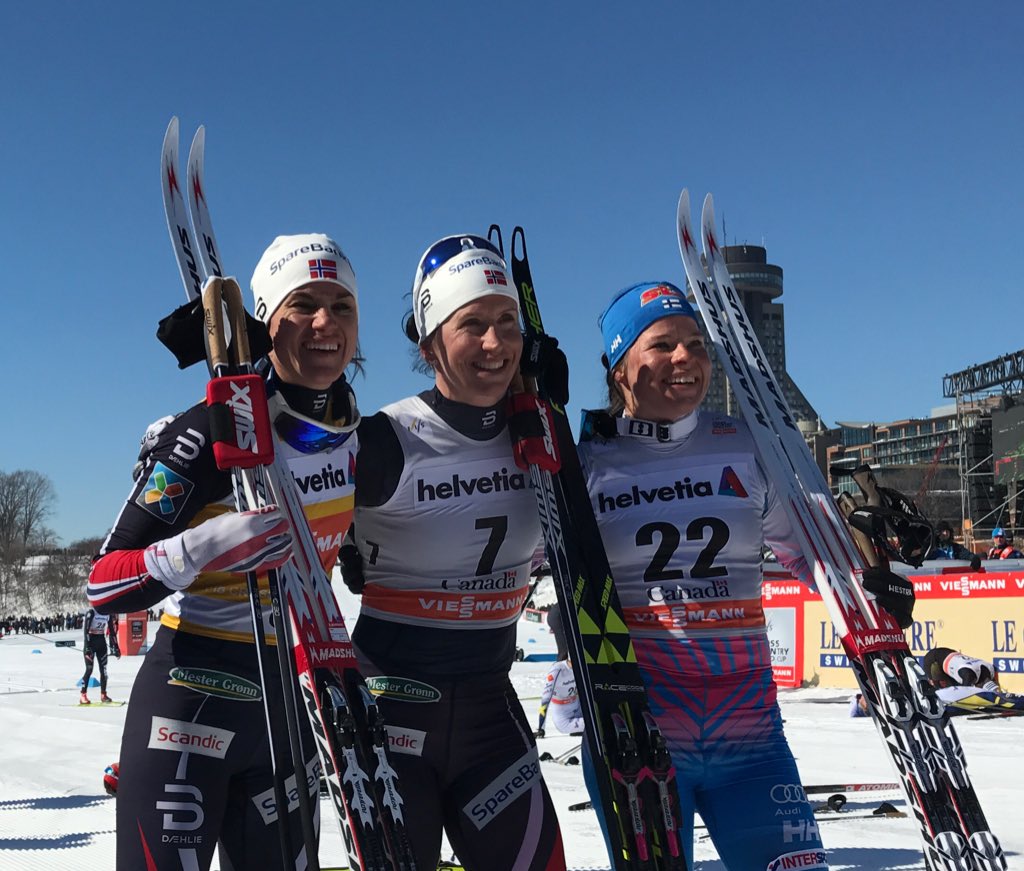
The women’s 10 k classic mass start podium on Saturday at World Cup Finals in Quebec City, with Norway’s Marit Bjørgen (c) in first, Norway’s Heidi Weng (l) in second and Finland’s Krista Parmakoski (r) in third. (Photo: FIS Cross-Country/Twitter)
In the women’s 10 k classic mass start earlier in the day, Norway’s Marit Bjørgen racked up her seventh victory of the season after leading a pack of two other Norwegians and Finland’s Krista Pärmäkoski and holding them off to the finish.
Bjørgen put a few meters into the foursome as she entered the finishing stretch and held her lead across the line in 24:23.6 minutes. Norway’s Heidi Weng finished 0.6 seconds back in second to lock up the Distance World Cup title, in addition to the Overall World Cup title she secured on Friday.
Pärmäkoski finished 2.9 seconds after Bjørgen in third, and Norway’s Ingvild Flugstad Østberg missed the podium in fourth (+7.8).
Behind them, Germany’s Nicole Fessel outlasted a large chase pack to place fifth (+18.6), just ahead of Sweden’s Charlotte Kalla in sixth (+19.9) and Anna Haag in seventh (+19.1).
Sadie Bjornsen of the U.S. Ski Team led the North American women in 15th (+29.9) after skiing at the back of that chase pack in the final stretches of the race. Also for the U.S., Jessie Diggins placed 27th (+1:06.9) and Sophie Caldwell 38th (+1:56.0).
Canada was led by Emily Nishikawa in 37th (+1:51.7). Behind her, Cendrine Browne finished 41st (+2:28.2), Dahria Beatty was 53rd, Annika Richardson 54th, Katherine Stewart-Jones 56th, Frederique Vezina 59th, Annika Hicks 60th, Sophie Carrier-Laforte 61st, Andrea Dupont 62nd, Katherine Weaver 63rd, Alannah MacLean 64th, Sadie White 66th, Lisle Compton 67th, Mia Serratore 68th, and Laura Leclair 69th.
For the U.S. Caitlin Patterson finished 44th, Liz Guiney 45th, Kaitlynn Miller 47th, Chelsea Holmes 48th, Rosie Brennan 50th, Julia Kern 52nd, Erika Flowers 55th, Becca Rorabaugh 57th, and Jennie Bender 58th.
One day left in the 2016/2017 World Cup season remains, with the women’s and men’s 10/15 k freestyle pursuits on Sunday in Quebec City.
World Cup Finals standings (Day 2 of 3): Men | Women
***
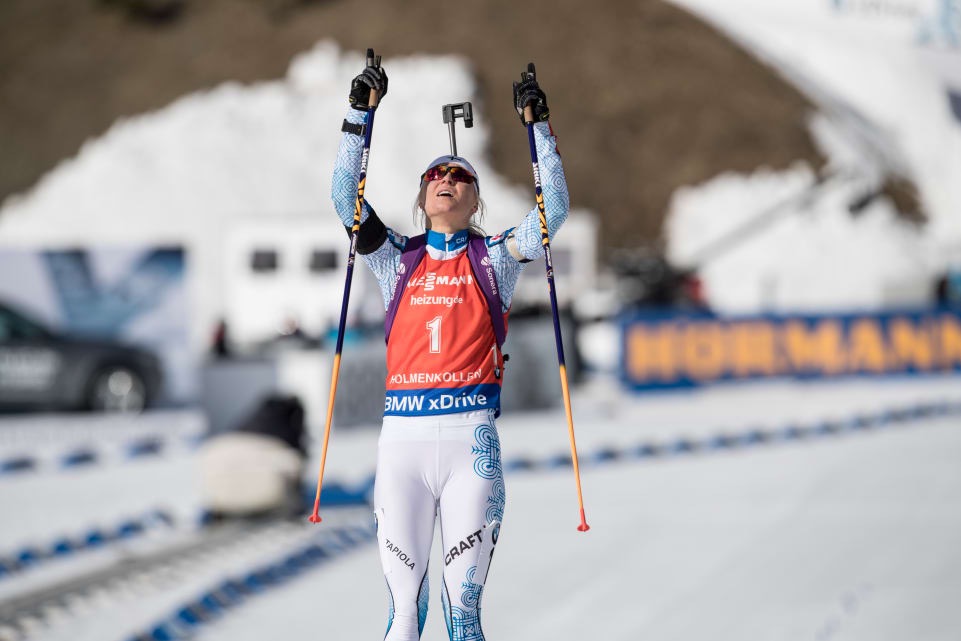
Finland’s Mari Laukkanen pointing to the sky in honor of her late shooting coach, after she won the women’s 10-kilometer pursuit on Saturday at the 2017 IBU World Cup in Oslo, Norway. (Photo: IBU)
IBU World Cup (Oslo, Norway): Women’s and men’s pursuits
Less than 24 hours after winning her first IBU World Cup on Friday in the women’s 7.5 k sprint, Finland’s Mari Laukkanen immediately capitalized on her ideal position with a start-to-finish victory in Saturday’s 10 k pursuit that was never in doubt, cleaning the first three shooting stages before incurring one penalty in her final standing shooting (0+0+0+1) to cross the line in a time of 29:33.3 minutes.
In addition to experiencing the most successful weekend of her biathlon career by far, it was an emotional day for the 29-year-old Finn due to a personal reason. Laukkanen spread her arms like wings skiing down the homestretch with a commanding lead, pointing repeatedly to the sky and a black ribbon she wore around her right upper arm, before kneeling in the snow in the finish for a few seconds. With those gestures, she reportedly wanted to commemorate her shooting coach Asko Nuutinen, who passed away Friday after suffering a heart attack during the World Cup in Kontiolahti, Finland, a week ago. He was 60 years old.
“It’s been a really emotional day for me. We have heard really really sad news that last night we lost our longtime shooting coach,” Laukkanen told reporters with a trembling voice in the press conference. “After this it was more or less only about working for him. Working as he has asked me to do for years and years. So I wasn’t thinking about losing or winning today, I was only thinking about him. And I feel really big pleasure that I was able to come to the finish like this, that I can own the victory for him.”
“I knew it will be difficult after the first victory in my career took me so long,” she added. “And to do it again immediately with good shooting. But as I said I didn’t think about winning or losing today, just doing my work.”
Finishing 26.5 seconds after her, the Czech Republic’s Gabriela Koukalová reached the finish, moving up from her fourth place starting position with a clean shooting performance (0+0+0+0).
“I wanted to miss all targets yesterday because I was so tired I didn’t even want to race,” Koukalová confided in the press conference. “It’s difficult to concentrate, three World Cups after the main goal of the season [the World Championships] is too much. Last year it was many times easier… I tried to catch her, but about one kilometer before the finish I saw her far away so I was happy I didn’t have to fight with anyone and was just enjoying the last meters.”
Despite four penalties (1+1+0+2), France’s Justine Braisaz defended the third place on the podium against a three-person chase group on the last loop (+1:01.4), falling back only one position after having finished the sprint in second.
“I did not expect such a good place today during the race,” Braisaz commented in the press conference. “Because in the last shooting I completely [failed]. I really wanted to have a clean shooting today, and I did not succeed. So I am happy and surprised, too.”
Her teammate Anais Bescond who had started the pursuit in third place fell back to 22nd position (+2:53.5) with seven penalties.
Slovenia’s Teja Gregorin finished fourth with one penalty (+1:08.2), Austria’s Lisa Theresa Hauser shot clean as the only athlete aside from Koukalova on her way to move up from 22nd to fifth place (+1:12.5), while Norway’s Marte Olsbu finished sixth like in the sprint despite three penalties (+1:15.9).
Unlike in Friday’s sprint race where Germany’s Laura Dahlmeier had still given up a seemingly commanding lead in the sprint World Cup discipline standings to Koukalova, she held onto her lead in the pursuit standings on Saturday, moving up from the 31st starting position to ninth place with a penalty in each of her standing shootings (0+0+1+1, +1:53.8). A 22nd place would have been sufficient to win the “small crystal globe” award in the pursuit. Laukkanen’s teammate Kaisa Mäkäräinen finished 8th with two penalties in the standing stages (+1:51.2), and thereby claimed the third place in the World Cup pursuit ranking.
“I knew that I didn’t need to have a perfect race today, just a good one, but that’s always easier said than done,” Dahlmeier told broadcaster ARD after the race. “I am incredibly happy that it worked out and that I could secure myself another small globe… It’s a bit of a weird feeling, standing at the start gate in the middle of the field and the clock ticks and ticks as one athlete after another skis out on the course. And you can only observe how far they have gone and have to wait and be patient, and not make a false start. But then the snow burns, then the chase begins!”
US Biathlon’s Susan Dunklee experienced an uncharacteristically problematic day on the shooting range and fell back to 37th place (+4:00.2), after starting seventh and less than a minute behind Laukkanen. Dunklee had three misses between two prone stages and seven more in her standing shootings (2+1+4+3) therefore having to ski more than an additional kilometer in the penalty lap.
“It is a testament to her fighting spirit that she notched the fourth-fastest ski time — one of her best ranks of the season — and never gave up despite suffering a biathlon blowout on the range,” teammate Clare Egan said of Dunklee, according to a US Biathlon press release. “Bad races happen to the best and Susan is no exception, but not everyone fights through till the end no matter what.”
Egan herself started the pursuit in 34th position and initally was able to make up ground, but then fell back slightly to 41st place (+4:13.9) with four penalties (0+2+0+2).
“I am satisfied with my race even though the result was not what I was hoping for, and that’s how I would summarize my entire season as well,” Egan said after the final race of her season. “I’ve made a good step forward but my competitors also work hard all summer and we seem to improve at a similar rate.”
Canada Biathlon’s Julia Ransom moved up to 47th place (+5:04.8) with three penalties (1+0+1+1), after starting in 52nd position.
[UPDATED] Later on Saturday in the last men’s 12.5 k pursuit of the season, the three best athletes of the season fought throughout the race exchanging in the lead, before they stood next to each other on the range for the final shooting to decide the winner.
Russia’s Anton Shipulin managed to shoot clean with his elaborate rifle stock in the design of a red dragon, proudly waving to the cameras as he left the arena while his two competitors had to ski into the penalty lap. France’s Martin Fourcade – who had already secured himself the overall World Cup Total Score title as well as the award for the pursuit discipline – was left to duke it out against Norway’s Johannes Thingnes Bø, the winner of Friday’s sprint.
On the last big climb before the Holmenkollen arena, Fourcade accelerated with a series of explosive jump-skate steps to decisively gap Bø. He even got fairly close to Shipulin on the finish stretch, who had slowed down a bit to grab a Russian flag before skiing over the line in a time of 32:11.9 minutes with one penalty (0+0+1+0), 5.7 seconds ahead of Fourcade who had incurred two penalties (1+0+0+1). While Fourcade shook hands with Shipulin, Bø came into the finish in third place, 21.6 seconds back and also with two penalties (1+0+0+1).
“It was a crazy race, but I am happy that I managed to finish first,” Shipulin said in the press conference through a translator. “Tough conditions on the shooting range, I had to really work to concentrate on my shooting. On the last loop I was all alone until I saw Martin chasing me, then I got a little bit scared but I managed to [keep him behind].”
It was Shipulin’s second win of the season, for which he credited his recently improved shooting performance.
“It was a really exciting competition with Johannes and Anton,” Fourcade agreed with his rival. “I expected to fight with them for the victory on the last loop, but then Anton was simply stronger in the last shooting. My strategy was to be focused on my technique and skills and not on the results, like I did too often in the past few weeks focusing on records and not the victory.”
Asked about his blazing attack on the final climb, Fourcade added: “Of course I train for that, but I think a lot of athletes do. I talked to Johannes, it was my revenge for the [2016] World Champs where he did exactly the same to me on the last uphill. But I know how it is, it can be different already tomorrow.”
“I am happy with a new podium of course,” Bø said in the press conference. “I was not at my best in the skiing today. But I still managed to shoot 18 out of 20. As Martin said it was [annoying] that we did not shoot zero [misses] and could not fight with Anton in the finish, but it was quite interesting and fun to stand there in the last shooting … I expected Martin’s attack the second he did it, but I had no energy to fight with him. That was quite strong.”
Sweden’s Fredrik Lindström placed fourth with no penalties (+44.7), and was the only man in the field who managed to shoot clean in all four stages.
“For the podium, I was never really close“, Lindström told the IBU in a post-race interview. “But it was a great day anyway. Four times zero [misses], and especially in the standing stages that makes you climb a lot in the standings. Super happy with my performance.”
US Biathlon’s Lowell Bailey, who had to start closer to the back of the field in 44th position, almost two minutes behind the leaders based on his sprint result, managed to move up 21 spots in the race despite three penalties (2+0+1+0).
“I’m happy with the race, considering it started out pretty rough with the first two misses,” Bailey told US Biathlon after placing 23rd (+2:23.3). “I just read the wind wrong and didn’t correct enough. After that, I tried to keep my head in the race and make the best of it. I was happy with my skiing and glad to clean the last stage; this brought me up nine spots and I was able to gain another in the last loop. Now, it’s just one race to go. I’m looking forward to tomorrow.”
Shooting quickly, Bailey recorded the ninth-ranked range time of the day and the ninth-fastest last loop.
His teammate Sean Doherty started 35th but fell back after having to ski six times through the penalty lap (1+3+1+1) to finish 46th (+4:05.6).
For Sunday’s mass starts as the final races of the 2016/2017 IBU World Cup season, the only qualified North American starters will be Dunklee (currently in 10th position in the World Cup Total Score standings) and Bailey (currently in eighth).
The women’s season award in the mass start discipline once more will be decided between Germany’s Dahlmeier and Czech Republic’s Koukalova, while Germany’s Simon Schempp will try to defend his narrow lead on Fourcade. But during Saturday’s final loop, the French star did consider saving energy for the final competition.
“No,” he simply quipped when asked about this in the press conference. “Of course the mass start is important tomorrow because it will decide about the [mass start] crystal globe. But I think today the pursuit was also really important, and you fight for victory and being one of the best athletes. You can’t be satisfied with only a third place when you can claim a second, and I think all athletes in my position would do the same.”
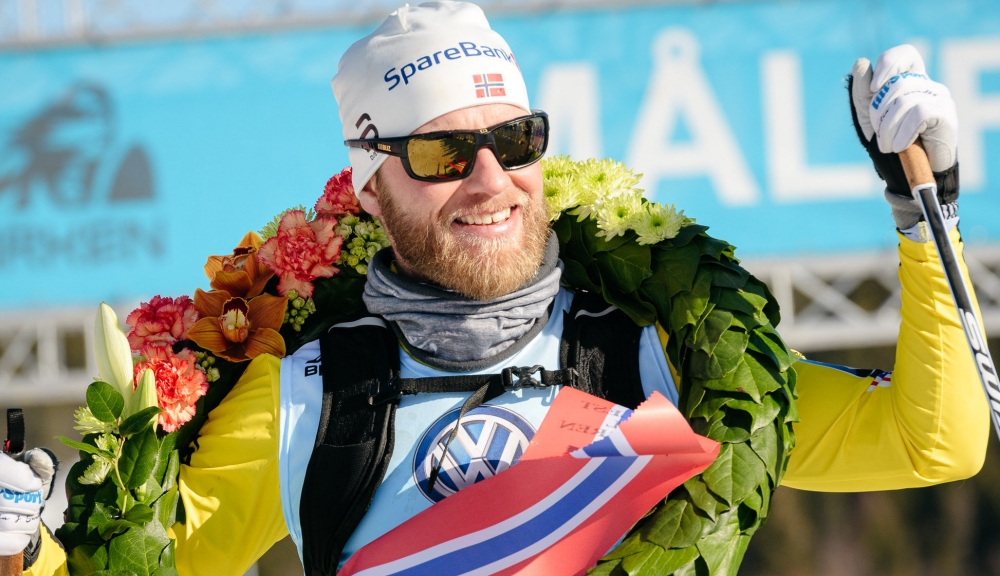
Norway’s Martin Johnsrud Sundby after winning the Norwegian 54 k classic Birkebeinerrennet, part of the Ski Classics series, on Saturday in Lillehammer, Norway. (Photo: Ski Classics)
54 k Birkebeinerrennet (Rena to Lillehammer, Norway): Part of the Ski Classics series
[UPDATED] Not even a snowmobile clipping him and sending him tumbling 20 k before the finish could keep Norway’s Martin Johnsrud Sundby from winning the Birkebeinerrennet on Saturday in Norway. Representing Team United Bakeries, Sundby set a high pace from the start and broke the group down to three by 9 k, with Petter Eliassen of Team LeasePlan and Simen Østensen of Team BN Bank sticking with him until about 30 k in the 54 k marathon.
With about 20 k to go, Sundby collided with a Ski Classics TV production crew snowmobile while trying to double pole in the snowmobile’s tracks. He was OK and went on to win by 48 seconds over Eliassen in second, and smiled about the incident after the finish.
“It came in with tremendous speed and mowed me down,” Sundby told NRK, according to a loose translation.
Ski Classics CEO David Nilsson told NRK he didn’t know exactly how that happened and emphasized that it was unacceptable.
“We always put safety first, but it is a difficult balancing act with the snowmobile at high speed to get TV pictures,” he said, according to a loose translation. “The skiers often ski in the [snowmobile] track and here it happened and somehow the driver missed it.”
While Sundby pulled out the win in 2:20:53.5 hours, Eliassen took second and Østensen followed another 3.5 seconds later for third place.
In the women’s race, Poland’s Justyna Kowalczyk (Team Santander) pulled out a 4 minute and 15 second win over Sweden’s Britta Johansson Norgren (Lager 157 Ski Team). Japan’s Masako Ishida (Team United Bakeries) was another 48.6 seconds back in third.
“I’m really happy to win this race,” Kowalczyk said, according to a Ski Classics press release. “Everything went well and the cheering on the course was amazing. I will do the rest of the races in Visma Ski Classics, but this victory was the most important for me. Of course, I want to win again in Årefjällsloppet like I did last year, but to win here in front of this audience means so much to me.”
Tord Asle Gjerdalen, who finished fourth in the men’s race, and Johansson Norgren continue to lead the overall Ski Classics standings with three races to go. The next stop is the Årefjällsloppet in Sweden on March 25.
“It was a great race and we kept a high tempo up all the way,” Sundby said, according to the press release. “I was able to use uphills for my advantage and get a gap. I had good skis, the conditions were perfect, and to win here was one of my goals for the season. I have the Norwegian Championships in two weeks, and I haven’t counted out the option of going to Finland for the Visma Ski Classics finale.”
Norway’s Marit Bjørgen winning the women’s 30 k classic mass start at Holmenkollen in Oslo, Norway, by more than two minutes on Sunday. (Photo: Fischer/NordicFocus)
OSLO, Norway — The modernist Holmenkollbakken ski-jumping hill lords over the otherwise bucolic Holmenkollen ski venue. It’s certainly one of the wonders of the modern nordic sport world as the steel structure arcs elegantly toward the sky. At times during the men’s 50-kilometer classic mass start on Saturday at Holmenkollen, the sun glared off the jump, giving it the appearance of a polished silver spaceship.
During the women’s 30 k classic mass start on Sunday, fog descended onto the Holmenkollen neighborhood. The upper portions of the Holmenkollbakken jump, about a third of the structure, were lost in the clouds. Jumpers that flew from its heights before the start of the 30 k seemed to glide and fly out of the sky.
Norway’s Marit Bjørgen leads the train early in the women’s Holmenkollen 30 k classic mass start on Sunday in Oslo, Norway. This was a rare moment when Bjørgen skied in the presence of other skiers. She soon moved off the front and soloed to the win.
Those same clouds blanketed the high point of the 30 k course (with three 8.3 k laps and one 5 k lap) at Frognerseteren, where it seemed much of Oslo had stayed to party and welcome racers before their descent toward the stadium.
Each time Norway’s Marit Bjørgen rallied the hordes atop Frognerseteren, it was as if she appeared from the ether: Bjørgen’s race through the fog was a solo quest that ended in flat-out 30 k dominance.
Perhaps it’s splitting hairs saying exactly when this race was decided. Was it at 2.7 k when Bjørgen was up by nearly five seconds? For certain that was early on when anything was in play: wax, Bjørgen’s in-race nutrition, a potential fall. Was it her 33 second lead at 8 k? Was it her 1 minute and 22 second gap at 16.3 k?
By then this much was clear: Bjørgen was steamrolling. And yes, the race for first looked over.
Norway’s Marit Bjørgen racing to more than a two-minute win in the Holmenkollen women’s 30 k classic mass start on Sunday in Oslo, Norway. (Photo: Fischer/NordicFocus)
In her first Holmenkollen 30 k after taking a year off to start a family, Bjørgen, 36, looked peerless. On the stout Holmenkollen loop she only appeared to ratchet up the pace, firing with increasing power as the kilometers rolled.
Meters from the finish, Bjørgen bowed to the crowd and Norway’s King Harald V before stopping the clock at 1:22:59.2 hours to win her sixth Holmenkollen 30 k. Her nearest competitors were more than two minutes back.
“I was more relaxed than I was in the World Championships,” Bjørgen said at the post-race press conference. “It was a different morning. Today I was waking up with my son, playing with him, and just going to the stadium, and yeah, it was more relaxing.”
A relaxed Bjørgen appears to be a potent Bjørgen.
“My plan was to try to go fast from the beginning if my body was feeling well, and it did,” Bjørgen added. “I had good skis also, when we passed 5 k, I heard 20 seconds. I understood I had to do my own race and, yeah, I feel good.”
Twelve times the Holmenkollen 30 k has been held after World Championships or the Olympics. Usually a two-week period elapses between those events. Bjørgen has won the 30 k back-to-back twice, but Sunday’s win makes it her first with only one week of recovery.
Evidently Bjørgen still recovers well, too.
“It has been not an easy week. I have been a little bit tired and the motivation has been hard really. I wanted to stay home with my son and play with him,” Bjørgen said. “But I trained a little bit and tried to relax and of course to go to the 30 k is a big motivation and you want to do well so it was no problem. I was wondering how the body was feeling, but today my legs were much better than it was earlier in the week.”
Chalk up another World Cup win.
Behind Bjørgen, it wasn’t so much a chase as an entirely separate race vying for the remaining podium spots. Playing off-Broadway to Bjørgen’s big show were Finland’s Krista Pärmäkoski, Kerttu Niskanen and Aino-Kaisa Saarinen, Norway’s Heidi Weng, Sweden’s Charlotte Kalla, and Poland’s Justyna Kowalczyk.
Sweden’s Charlotte Kalla leads the first chase group behind Norway’s Marit Bjørgen (not shown) during the Holmenkollen 30 k classic mass start on Sunday in Oslo, Norway. Finland’s Krista Parmakoski (left) and Norway’s Heidi Weng (behind Parmakoski)) follow Kalla.
Throughout the 30 k race, it looked as if any one of those skiers could pull away into their own discrete chase for second. Kalla and Kowalczyk looked primed as they took a 14-second lead at the 16.3 k time check on the likes of Weng, Saarinen, Niskanen, and Pärmäkoski.
With that effort came an eventual catch. At 24.6 k, those six skiers came through just seconds apart. It wasn’t until the final stretch when place, not time, was part of every racer’s calculus and a separation of seconds occurred.
Finland took the remaining spots on the podium. Pärmäkoski placed second (+2:05.8), and teammate Niskanen was third (+2:07). Weng was fourth (+2:08.6), Kalla fifth (+2:11.7), Kowalczyk sixth (+2:12.9), and Saarinen — the last skier of the reputable first Bjørgen chase group — placed seventh (+2:19.6).
“Today [I] was feeling a little bit tired because that Drammen sprint was really good for me and last year also I had good race there,” Pärmäkoski said at the press conference. “But I am so happy that I am now stand on the podium on the sprint race and now of course this 30 k podium, the first on my career.”
The Holmenkollen 30 k classic mass start podium on Sunday in Oslo, Norway: Finland’s Krista Pärmäkoski (l) placed second, Norway’s Marit Bjørgen (c) first, and Finland’s Kerttu Niskanen (r) third.
Heading into the season-ending World Cup Finals, which will take place across the Atlantic in Quebec, Canada, Pärmäkoski sits second in the World Cup overall, exactly 300 points behind Norway’s Weng. Another Norwegian, Ingvild Flugstad Østberg, is 94 points behind Pärmäkoski in fourth. On Sunday, Østberg placed eighth (+2:31.3).
The U.S. Ski Team’s Kikkan Randall, like Bjørgen, has returned from a year away from skiing to start a family. Sunday was her first World Cup 30 k since she contested the 2014 Holmenkollen 30 k classic.
And on Sunday, Randall was the top American in 20th (+6:17.2).
“I had good energy,” Randall said of her race. “I kept a steady pace for me the whole way. 30 k was untested for me this year. I’m really happy. My expectation going into today, knowing where I’ve been in the last couple of weeks, I thought a top 20 was a good goal, and I just got that.”
With such a large hiatus between long-distance races at this level, Randall noted her sensations on the day were welcome.
The U.S. Ski Team’s Kikkan Randall (38) racing in a group during the women’s 30 k classic mass start on Sunday at Holmenkollen in Oslo, Norway.
“I skied a lot of threshold pace last year while I was pregnant, and a lot of it is coming back this summer, so maybe this is a good pace for me to ski right now,” Randall said. “The start was pretty fast, and I had a hard time staying up in the middle of the group, but I just skied a good, steady pace the whole way, and my energy stayed really strong. … It’s a great foundation to end this season with, knowing that I have a whole season next year to build that top-end speed back.”
Randall skied in a group that didn’t think twice about matching the turbo pace set from the starter’s gun. When the race shook out early on, Randall found her own race tempo and was able to eventually work up in the field.
“I felt like I got in a pack right away, maybe in the first 5 k, skiing with a pack of Norwegians, and we worked together most of the race, but pretty soon we were picking people off,” Randall explained. “The opening pace was hard, and I think a lot of the people who went with it suffered the consequences. It was kinda fun that we had little rabbits out there to go catch.”
Sadie Bjornsen, also of the U.S. Ski Team (USST), placed 24th on the day. Bjornsen skied much of her 30 k solo.
“I was trying to go with people from the start, to see what would happen,” Bjornsen said. “My best 30 k’s have been when I send it too hard, and somehow manage to keep up the pace. I tried for that, and I then I got a bit tired in the middle.”
Sadie Bjornsen racing to 24th in the women’s Holmenkollen 30 k classic mass start on Sunday in Oslo, Norway.
Bjornsen’s race was gritty, a go-for-it effort in a hallowed venue. Bjornsen noted she perhaps pushed too hard in spots and paid the price of fading.
“Today was one of those days that wasn’t the greatest, it wasn’t horrible, but you have to try,” Bjornsen explained.
Holmenkollen remains formidable.
“Holmenkollen is always the hardest race of the year, and I kind of love that,” Bjornsen said. “I’ve had some of my best and worst races here, and I think it’s fun to come here knowing that it’s going to be a challenge, but to also be excited for a challenge, because every time you finish this race, despite how you do, you have this feeling of total achievement, like, ‘Holy cow! I just skied 30 k on that course!’ It’s always hard … It’s just such an achievement to finish this race.”
Sadie Bjornsen (U.S. Ski Team) after finishing 24th in the Holmenkollen 30 k classic mass start in Oslo, Norway.
Also for the U.S., Liz Stephen (USST) finished 31st (+8:46.8) and Chelsea Holmes (Alaska Pacific University) 39th (+11:19.1). Rosie Brennan (USST) did not finish.
U.S. Ski Team Women’s Coach Matt Whitcomb explained that Brennan miscalculated with her initial pair of skis.
“Rosie struggled a bit with her first pair of skis,” Whitcomb wrote in an email. “I think she thought they were good in testing, but in the race they proved to be a little too slow. Her second pair was great after the exchange, but she was too far back and decided to pull. This was her decision and I support her. She wants to ski very well in Quebec, and these athletes don’t have much wick left to burn. This is a rare occurrence, and an exceptional reason for it to occur. She’ll be skiing with a vengeance in Quebec.”
The women’s 4 x 5 k relay podium at 2017 Nordic World Championships on Thursday in Lahti, Finland, with Norway (c) in first, Sweden (l) in second, and Finland (r) in third. (Photo: FIS Cross-Country/Twitter)
FIS Nordic World Championships (Lahti, Finland): Women’s 4 x 5 k relay
The Norwegian women’s team got a much-needed lift from Astrid Uhrenholdt Jacobsen, the third leg of its 4 x 5-kilometer relay, on Thursday, who tagged her teammate Marit Bjørgen nearly a minute ahead of anyone else. From there, Bjørgen anchored the Norwegians to a 1:01.6-minute victory for her third gold of 2017 Nordic World Championships in Lahti, Finland.
Meanwhile, Sweden and Finland battled for silver, with Sweden’s anchor Stina Nilsson overtaking Finland’s Krista Parmakoski coming out of the final downhill into the stadium then leading her down the finishing stretch. Nilsson finished half a second ahead of Parmakoski for second place, while Finland claimed bronze (+1:02.1).
The U.S. was next across the line, after Jessie Diggins worked to close a 21.5-second gap to third place at the final exchange. While Diggins came within roughly 16 seconds of Nilsson and Parmakoski, that was as close as she could get and she finished fourth (+1:33.8), 31.7 seconds out of the medals.
The Canadian women’s 4 x 5 k World Championships relay team, (from left to right) Emily Nishikawa, Dahria Beatty, Katherine Stewart-Jones, and Cendrine Browne, after tallying the third-best relay result for the Canadian women at a World Championships on Thursday in Lahti, Finland. (Photo: CCC/Twitter)
Canada placed 10th (+4:16.2) out of 16 teams in the women’s relay, for the best result for the Canadian women’s program since a sixth place in the 4 x 5 k relay at the 2001 World Championships (and third-best result ever), according to Cross Country Canada.
Norway took control during the first 5 k leg, where Maiken Caspersen Falla stuck with Poland’s Justyna Kowalczyk, who set a fast pace out of the start. Only three were able to remain with Kowalczyk: Falla, Finland’s Aino-Kaisa Saarinen and Sweden’s Anna Haag, while Kikkan Randall of the U.S. fell off the pace and skied alone in fifth. Randall came through the first exchange 24.5 seconds behind Falla in first and 16.4 seconds behind Haag in fourth.
On the second classic leg, Sweden’s Charlotte Kalla set a blistering tempo out of the start to catch Norway’s Heidi Weng 8 seconds ahead. Finland’s Kerttu Niskanen went with Kalla as the two bridged the gap to Norway. Later in that leg, Kalla began to fade while Niskanen took control and entered the exchange in first, just 0.4 seconds ahead of Weng. Kalla came through another 12.3 seconds later in third. American Sadie Bjornsen had worked hard to close the gap to third but tagged 23.5 seconds out of third in fourth (+36.2).
On the third leg, Jacobsen opened the race up for Norway, building a 56.7-second gap to second place during her skate leg, while Sweden’s 19-year-old Ebba Andersson pushed hard in the final kilometers to put her team in second. Finland’s Laura Mononen struggled with Jacobsen’s pace and dropped to third (+58.3). Meanwhile, Liz Stephen of the U.S. held onto fourth and tagged Diggins 21.5 seconds out of third at the final exchange.
From there, the Sweden/Finland fight for second place began. A minute ahead of them, Bjørgen skied comfortably in first, and behind them, Diggins skied alone in fourth.
Russia’s anchor Anastasia Sedova was tagged 45.5 seconds behind the U.S. in eighth (behind Germany, Poland and Switzerland), but passed those three teams to end up fifth (+2:28.6), 54.8 seconds behind the U.S.
Germany finished sixth, Switzerland seventh, Poland eighth, Italy ninth, and Canada 10th, with Katherine Stewart-Jones, Emily Nishikawa, Cendrine Browne, and Dahria Beatty racing for Canada. Stewart-Jones put them in eighth at the first exchange, Nishikawa slipped one spot to ninth, then Browne lost another spot for 10th, which Beatty held to the finish.
IBU World Cup (PyeongChang, South Korea): Women’s 7.5 k sprint
[UPDATED] The International Biathlon Union (IBU) World Cup circuit resumed on Thursday after nearly a two-week break coming off IBU World Championships, drawing competitors to PyeongChang, South Korea, the site of the upcoming 2018 Winter Olympics.
The women’s 7.5 k sprint podium at the IBU World Cup in PyeongChang, South Korea, with Germany’s Laura Dahlmeier (c) in first, Norway’s Tiril Eckhoff (l) in second and France’s Anaïs Chevalier (r) in third. (Photo: IBU)
Coming off five gold medals (in six races) at World Championships, Germany’s overall World Cup leader Laura Dahlmeier picked up where she left off, winning the women’s 7.5-kilometer sprint by 8.4 seconds with perfect shooting and a finishing time of 20:43.7 minutes.
Norway’s Tiril Eckhoff came closest to her in second, after also shooting clean, and France’s Anaïs Chevalier put herself in the mix with clean shooting as well to end up third (+41.6).
One second behind Finland’s Kaisa Mäkäräinen, who finished fourth (+58.7) despite two standing misses (0+2), was American Susan Dunklee in fifth (+59.7). The 35th starter, Dunklee initially finished third (before being bumped off the podium by Chevalier, then one more spot by Mäkäräinen).
Dunklee missed one shot during the standing stage (0+1) and posted the eighth-fastest course time for her fifth top five of the season (including her second place in the mass start at World Championships).
“I tried to be patient,” Dunklee wrote in an email after Thursday’s race. “I focused on pushing the last half km of the loop where I thought other people would be tired. And our techs made great skis for these challenging conditions.”
She passed two competitors on her last loop, one of which had passed her earlier in the final 2.5 k. Dunklee described the conditions as “a patchwork of glazed, icy and slow patches. A large number of volunteers were working on it with hand tools right before the start and I think that helped substantially,” she wrote. “I think the course is good for me: big climbs with technical descents.”
Rosanna Crawford led the Canadians in 30th (+1:54.9) with one prone miss (1+0), and Megan Tandy placed 39th (+2:14.8) with one standing penalty (0+1), just ahead of Julia Ransom in 41st (+2:19.5), who had one standing miss as well (0+1). All four Canadian women qualified for Saturday’s pursuit, with Emma Lunder placing 51st (+2:38.2) after one penalty (0+1).
For the U.S., Clare Egan and Joanne Reid finished 33rd (+1:59.5) and 35th (+2:07.6), respectively, both with one standing penalty (0+1). Maddie Phaneuf missed the top 60 to qualify for the pursuit in 68th (+3:07.7) with one miss (0+1).
After being in contention for a podium, France’s Marie Dorin Habert did not finish, reportedly because she felt nauseous.
Above: Norway’s Marit Bjørgen celebrates her 16th World Championships gold after winning Monday’s 10 k classic in Lahti, Finland. Below: The women’s 10 k classic podium at 2017 Nordic World Championships in Lahti, with Bjørgen (c) in first, Sweden’s Charlotte Kalla (l) in second, and Norway’s Astrid Uhrenholdt Jacobsen (r) in third. (Photo: FIS Cross-Country/Twitter)
FIS Nordic World Championships (Lahti, Finland): Women’s 10 k classic
No contest. That was the takeaway of Marit Bjørgen’s performance in the women’s 10-kilometer classic individual start on Monday at 2017 Nordic World Championships in Lahti, Finland, after the Norwegian posted a 41-second victory in 25:24.9 minutes.
Bjørgen started 54th of 72 starters and clocked the fastest time over every intermediate timing point on the course. Sweden’s Charlotte Kalla had been the previous race leader after starting 34th before Bjørgen bumped her out of the leader’s chair by 41 seconds.
Norway had two on the podium with Astrid Uhrenholdt Jacobsen in third, 55.5 seconds behind Bjørgen. Norway’s Heidi Weng missed the podium in fourth (+1:13.8), while Sweden’s Anna Haag — an early leader in bib 18 — finished fifth (+1:22.7). Finland’s Kerttu Niskanen took sixth (+1:23.7) and Krista Parmakoski was seventh (+1:31.4), while Norway’s Ingvild Flugstad Østberg and Poland’s Justyna Kowalczyk tied for eighth (+1:34.5). Germany’s Stefanie Böhler rounded out the top 10 in 10th (+1:35.8).
Sadie Bjornsen led the U.S. women in 23rd (+2:21.2), Kikkan Randall placed 26th (+2:31.7), Rosie Brennan was 32nd (+2:55.4), and Ida Sargent 43rd (+3:55.2).
Katherine Stewart-Jones led the Canadians with her best result at her first World Championships in 36th (+3:09.6), Emily Nishikawa followed in 37th (+3:14.9), and Dahria Beatty 39th (+3:24.9).
IBU Youth/Junior World Championships (Osrblie, Slovakia): Junior relays
(From left to right) Russia’s Nikita Lobastov, Igor Malinovskii, Nikita Porshnev, and Kirill Streltsov after winning the men’s 4 x 7.5 k relay on Tuesday at IBU Youth/Junior World Championships in Osrblie, Slovakia. (Photo: IBU)
[UPDATED] Russia, Norway, Germany. Or Norway, Germany, Russia. That’s how the podiums shook out for the junior men’s and women’s relays on Tuesday, the last day of the 2017 International Biathlon Union (IBU) Youth/Junior World Championships in Osrblie, Slovakia.
Russia won the men’s 4 x 7.5-kilometer event by 53.9 seconds in 1:17:27.8 hours, with Nikita Lobastov, Igor Malinovskii, Nikita Porshnev, and Kirill Streltsov. After coming through the first exchange in fifth, 44.2 seconds out of first, Malinovskii skied his team into first and they held the lead to the finish. In total, Russia used seven spares to clean and had no penalties.
Norway claimed silver with Dag Sander Bjørndalen,Johannes Dale, Aleksander Fjeld Andersen, and Sindre Pettersen. After getting tagged in 14th, Dale moved the team up to sixth and Andersen improved to second, which Pettersen held. The team combined for one penalty and 12 spares.
Germany claimed bronze (+1:39.3) despite one penalty and 16 spares, with Justus Strelow, Danilo Riethmüller, Dominic Schmuck, and David Zobel. Fourth at the first exchange, Riethmüller picked moved them into third on the second leg, which Schmuck and Zobel held.
Canada finished 12th (+6:00.5) with Zachari Bolduc, Trevor Kiers, Jules Burnotte, and Pearce Hanna combining for three penalties and 13 spare rounds. Positioned in 10th for the first two legs, the team moved into eighth on Burnotte’s third leg. Hanna had to ski three penalty laps on the final leg and slipped to 12th.
The U.S. men finished 14th (+9:07.4) with Cody Johnson, Cameron Christiansen, Travis Cooper, and Peter Carroll combining for two penalties and 10 spare rounds. The team gradually moved up from 16th at the first exchange to 12th at the third and final exchange, before losing two places before the finish.
(From left to right) Norway’s Hilde Eide, Karoline Erdal and Ingrid Landmark Tandrevold after winning the junior women’s 3 x 6 k relay on Tuesday at IBU Junior World Championships in Osrblie, Slovakia. (Photo: IBU)
In the junior women’s 3 x 6 k relay, Norway rose to gold with Hilde Eide, Karoline Erdal and Ingrid Landmark Tandrevold (for Tandrevold’s third medal in the last three races, and first gold of the week) finishing in 56:18.4. The team, which had zero penalties and used eight spares, moved up from fourth at the first exchange to first on Erdal’s second leg and Tandrevold anchored them to the win.
Germany crossed the finish 16.5 seconds later for silver, with Vanessa Voigt, Sophia Schneider and Anna Weidel. In seventh after the first leg, Schneider moved them into third before Weidel anchored them to second. They had one penalty and used nine spares.
Russia rounded out the women’s podium in third (+26.1) with Kristina Reztsova, Ekaterina Moshkova and Valeriia Vasnetcova. After being tagged in ninth, Moshkova skied them up to fourth and Vasnetcova picked off one more place for bronze. They combined for one penalty and eight spares.
Canada’s junior women finished 14th (+4:17.7) with Megan Bankes, Emily Dickson and Nadia Moser combining for four penalties and nine spares. They had been as high as 11th after Bankes’s first leg.
The U.S. finished 17th (+11:30) with Siena Ellingson, Helen Wilson and Nina Armstrong accumulating five penalties and 11 spares. They had skied as high as 15th after Ellingson’s first leg.
Norway’s Marit Bjørgen winning Sunday’s 10 k classic at the World Cup in Otepaa, Estonia. She beat runner-up Charlotte Kalla of Sweden by 26.5 seconds. (Photo: Fischer/NordicFocus)
“Visit Estonia,” it read on the bibs of all athletes in the women’s World Cup 10-kilometer classic individual start race, an advertisement by the tourist board of the Baltic country.
Unfortunately after experiencing beautiful weather for Saturday’s sprint, the town of Otepää — which on most days is indeed a paradise for all kinds of winter sports — was not able to present itself looking exactly like a picture out of a travel brochure on Sunday, with a misty sky and a steady drizzle thawing the snow around the venue.
Many of the cross-country skiers heading to the start gate in their warmup gear looked a bit despondent as they were signing the clear plastic board the International Ski Federation (FIS) usually presents to the hosts as a gift, while a staff member continuously tried to wipe big drops and puddles off the surface thereby probably erasing some hastily scribbled signatures.
Skiing two 5 k loops around the arena, the athletes began to look like wet grumpy cats, with the exhaustion further distorting faces as they conquered two steep climbs on the course, the longest ascending almost 60 meters.
Norway’s Marit Bjørgen racing to first in Sunday’s 10 k classic at the World Cup in Otepaa, Estonia. She won by 26.5 seconds. (Photo: Fischer/NordicFocus)
While it was not an easy race for anyone, some skiers struggled more than others. Starting in the middle of the field, Norway’s Marit Bjørgen used the rainy day to make it crystal clear who is still the queen of distance skiing. The currently suspended Therese Johaug might be the princess, and several young skiers can challenge the throne on a good day. But Bjørgen still, or rather again following her one-season maternity leave, rules them all.
Poland’s Justyna Kowalczyk — another veteran who managed to win the skiathlon in PyeongChang two weeks ago (though with a diminished starting field) and who won the 10 k classic distance in Otepää four times before — started strong, setting the best initial split times. Ultimately she would end the day in fifth (+1:19.7).
Then Norway’s current overall World Cup leader Heidi Weng set the best split times, and topped Kowalczyk’s finishing time by more than 20 seconds.
Next, the third Norwegian Ingvild Flugstad Østberg came to the finish (+1:17.4), significantly behind Weng but able to best Kowalczyk’s time by just over two seconds, pushing her to third for the time being. Østberg sped up along the course, and was 21.5 seconds behind Kowalczyk at the 7.5 k split before setting a blazing pace in the last section.
But when she had caught her breath crouching in the snow at the finish, Østberg could only look on and applaud as Bjørgen came into the finish with a huge lead, celebrating with her arms raised high when she crossed the line in a time of 29:59.0, and improving on Weng’s time by almost a minute.
“I had a good training in the last period,” Bjørgen later told FIS in an interview. “Already at the Norwegian nationals I knew I was in a good shape. Conditions were tricky today but the course was a good test before the World Championships.”
Her teammate Weng summed the day up succinctly in her interview with FIS, after Bjørgen had gapped her by 57.2 seconds: “Marit was amazing today. She was way too fast for me.”
And for everyone else.
The women’s 10 k classic podium at the Otepaa World Cup on Sunday in Estonia, with Norwegian winner Marit Bjørgen (c), Sweden’s Charlotte Kalla (l) in second and Norway’s Heidi Weng (r) in third.(Photo: Fischer/NordicFocus)
Only Sweden’s Charlotte Kalla could prevent a Norwegian podium sweep at that point. Starting late in the field in bib 60, she improved on all the split times of Weng and Østberg. But she steadily lost time on Bjørgen, and with 2.5 kilometers to go was also already 26.6 seconds behind.
While Bjørgen watched the rest of the field from the comfort of the leader’s chair wearing a puffy blue coat with her legs covered by a blanket and munching on an energy bar, Kalla did not lose any more time on the last stretch into the stadium. She settled about halfway between the two Norwegian leaders to claim second place (+26.5), thereby pushing Østberg of the podium to fourth.
“I came to Otepää after a high-altitude training camp,” Kalla told FIS. “I felt very good today. I had amazing skis. The hills in Otepää are really tough.”
After Kalla struggled with health issues earlier this season, the 2015 world champion in the 10 k freestyle seems to be rounding back into shape just in time for the next World Championships in Lahti, Finland, which start Thursday. Finnish home-crowd favorite Krista Pärmäkoski was sixth on Sunday (+1:23.1), just behind Kowalczyk and Østberg.
But Bjørgen is the athlete to watch again in Lahti. While the mother of a 1 year old might not yet have her full sprint kick back, she certainly seems able to be at the top of the podium in distance races again.
And according to the statisticians at FIS, for the last seven World Championships, the winner of the final 10 k World Cup race before it also won that distance at the championships a few days later (although at the 2014 Olympics this trend was broken, with Bjørgen finishing fifth in Sochi).
“It was a very good feeling to take with me to the championships,” Bjørgen told Norwegian broadcaster NRK in a post-race interview. “I got the answers I was hoping for.”
She added that she feels more confident than for the championships in Falun two years ago, and when asked to rate her current confidence level on a scale of 1 to 10 heading to Finland, Bjørgen smiled: “This is enough for a nine. A little bit is still missing.”
Her opponents should still be worried.
Three Americans in the Points
On Sunday, U.S. Ski Team (USST) member Sadie Bjornsen had the best race of the North Americans, finishing in 19th (+2:30.5).
Sadie Bjornsen (U.S. Ski Team) racing to 19th in the women’s 10 k classic on Sunday in Otepaa, Estonia, the last World Cup before World Championships start this week. (Photo: Fischer/NordicFocus)
“It was a challenging day out there, but had some wonderful moments,” Bjornsen wrote in an email to FasterSkier.
She was excited that her game plan for the day had worked out well, skiing with Poland’s Kowalczyk who had started the race just one bib and 30 seconds behind her.
“I had a good start, and was expecting Justyna to catch me at some point during the race, because I know she is in really good form,” Bjornsen explained. “When she caught me I was determine to stay with her, and finish the race together.”
That happened somewhere between 3 and 4 k, but in this race Kowalczyk was a little bit too fast for her to stick with until the finish.
“Unfortunately, I had quite slow skis today, so wasn’t able to hold on as I was really hoping to,” Bjornsen wrote. “From there I tried to keep my head fighting, and do what I could. I feel confident heading into Championships, because I felt my form was there today. The result didn’t show it, but that is classic skiing. There are a heck of a lot of variables. If I get those parts dialed, I am really looking forward to some incredible opportunities to come!”
Unlike some other skiers who looked miserable in the wet conditions, Bjornsen’s teammate Rosie Brennan had no complaints.
“I actually enjoy classic skiing when it’s a bit sloppy as I think it plays to my strengths so I felt fine about the conditions,” Brennan wrote in an email. “The track held up fairly well all considering.”
Starting late in the field just ahead of Kalla, Brennan also took advantage of skiing with Kowalczyk at least for one loop, similar to the tactic Bjornsen had tried to use. And it might have worked even better for her.
“It was fantastic to start my race and realize Kowalczyk had just lapped through,” Brennan wrote. “I settled in behind her and enjoyed the ride and actually pulled away from her in the last kilometer of that lap.”
But when Kowalczyk skied into the finish, Brennan still had one more loop to go, and could only see her teammate Liz Stephen who had started 30 seconds ahead of her.
“The second loop was quite lonely and I had to keep mentally tough out there,” Brennan recalled. “I could see Liz ahead of me every now and then, but she never seemed to be getting closer so it was a challenging finish.”
Still, it was one of her best results of the season, finishing the race in 24th (+2:37.8). Brennan is now looking forward to her second senior World Championships with the U.S. Ski Team.
“I am satisfied with this race as it lets me know the training I did at home was good and I have good fitness,” Brennan concluded. “I still have one week until the distance races start at World Champs so I am excited to finish that preparation and hopefully get a little more pop in my body.”
The women’s World Cup 15 k skiathlon podium on Feb. 4 in PyeongChang, South Korea, with Poland’s Justyna Kowalczyk (c) in first, American Liz Stephen (l) in second, and Japan’s Masako Ishida (r) in third. (Photo: Fischer/NordicFocus)
Maybe accepting the weather for what it is could be one of the secrets to a good classic race. Like Brennan, this is what the third USST member Stephen, who started in the last start group just one bib ahead of Brennan, also did.
“The conditions today were wet and a bit sloppy, but honestly, for the women’s race the tracks held up fairly well, so no complaints on my end!” Stephen wrote in an email. “I like klister skiing when it’s slushy and soft like this, so I like days like today!”
She explained that she mostly had to ski the race by herself.
“I was able to ski a tiny bit with (Germany’s) Steffi Boehler and Kalla passed me at the end of the first lap and I tried to hang, but she was really flying today,” Stephen remembered her race. “I didn’t realize Rosie was coming up on me until about 1k to go. I tend to look forward and not worry about who is coming up behind me, as there is enough to focus on ahead of me!”
Coming off a second-place finish in the PyeongChang skiathlon two weeks ago just behind Kowalczyk and now a top 30 in her less-beloved ski style in a stacked field, like her teammates Stephen is also looking forward to the next two weeks of racing.
“I am excited to head to Worlds,” Stephen concluded. “My big races are the 4x5k relay and the 30k skate, and with a good classic leg the skiathlon can go well too. Classic continues to be a weak point for me, so I will focus on skiing my best for that 7.5k in the skiathlon and then look forward to skating my way through the rest of the championships.”
“We have been watching biathlon worlds and alpine worlds and getting very inspired by our fellow teammates there, so we are all heading into the champs feeling great!” she added.
Also for the U.S., Kikkan Randall, Ida Sargent and Chelsea Holmes all started the race early getting some TV camera time, but then were not in the focus anymore for much of the race.
At the end of the day, Randall was only about 10 seconds out of the points in 34th (+3:04.7), while Sargent finished 42nd (+3:46.1), and Chelsea Holmes was 50th (+4:47.5).
Jessica Diggins, currently the highest-ranked American in the overall World Cup standings, would have started with bib 40 shortly behind Bjørgen, but she and her coaches opted for a rest day instead, due to her demanding program at World Championships.
Emily Nishikawa led the Canadian women in 40th place (+3:39), Dahria Beatty who started the race in bib 1 having to lead the way through the slush was 45th (+4:11.9), Cendrine Browne 54th (+5:09.2), and Katherine Stewart-Jones 57th (+5:37.1).
Susan Dunklee (US Biathlon) celebrating second place in the women’s 12.5 k mass start on the final day of 2017 IBU World Championships in Hochfilzen, Austria. It was her first World Championships medal. (Photo: US Biathlon/Twitter)
IBU World Championships (Hochfilzen, Austria): Women’s & men’s mass starts
Silver medal for Susan Dunklee. That’s the big news coming out of Hochfilzen, Austria, on the final day of the International Biathlon Union (IBU) World Championships after the American finished second, just 4.6 seconds out of first, in the women’s 12.5-kilometer mass start.
Dunklee started in bib 17 in the mass start and cleaned all 20 targets to put herself in the hunt for gold. She finished just behind Germany’s Laura Dahlmeier who took the win in 33:13.8 minutes, also with perfect shooting. Just three out of 30 women cleaned, with the other being Italy’s Alexia Runggaldier in ninth.
“I think my mistake a lot this season has been wanting the results too much,” Dunklee told FasterSkier after. “[I’ve been] slowly been coming to terms these last couple weeks, trying to focus more on the process and not worrying too much if the medal comes or not so that was a big trick today.”
Finland’s Kaisa Mäkäräinen reached the podium with a since miss in the first prone stage in third (+20.1). The U.S. had two women in the mass start, with Clare Egan finishing 24th (+3:04.1) with four penalties (1+0+1+2).
Lowell Bailey (US Biathlon) taking aim during the second prone stage of the men’s 15 k mass start on the last day of IBU World Championships in Hochfilzen, Austria. He cleaned all four stages to fight for the medals until the final loop, and ultimately finished sixth. (Photo: ARD broadcast screenshot)
[UPDATED] In the men’s 15 k mass start that followed, Lowell Bailey was in contention for a medal until the very end, after being one of three athletes to clean the four-stage race.
Bailey left the range for the last time in third, 16.8 seconds behind Austria’s Simon Eder in first and 14.5 seconds behind Germany’s Simon Schempp in second (both Eder and Schempp also cleaned every stage). Behind Bailey, Johannes Thingnes Bø had recovered quickly from a penalty on the last stage, and left the range in fourth, 8.4 seconds behind Bailey.
Early on the final loop, Bø caught Bailey to fight for a medal. Bø didn’t stop there, catching up to Eder as well after Schempp dropped the Austrian around 13.6 k. With about a kilometer remaining, Bø passed Eder and stayed ahead of him for silver, crossing 9 seconds after Schempp in first and 1.1 seconds ahead of Eder — who notched his first World Championships medal — in third.
Schempp hit all of his targets for his first individual World Championships gold in the final race of the championships, finishing in 35:38.3. Bø and Eder shared the podium with him, and Russia’s Anton Shipulin and France’s Martin Fourcade passed Bailey on the last loop for fifth (+25.3) and sixth (+31.3), respectively. Bailey finished sixth (+33.5) for his fourth top six (in as many individual races) at the championships, after notching a gold medal in the 20 k, fourth place in the sprint and sixth in the pursuit.
“I just told myself to hang as long as I could,” Bailey told FasterSkier after. “Unfortunately I only had four laps and the fifth was bru-tal as they say in Germany. But I’m so psyched with this whole world champs. I never cleaned a mass start and I never cleaned an individual and I just did both at world champs.
“I’m so happy for the team, for Susan,” he added. “Our whole team deserves this world champs. We haven’t shown what we’re capable of, there’s always been one setback or another … and the stars aligned for this one. We were waiting for this moment and everything clicked for the team and it’s so great to see, and god am I glad I stuck around to be here.”
FIS Cross-Country World Cup (Otepää, Estonia): 10/15 k classic
The women’s 10 k classic podium at the Otepaa World Cup on Sunday in Estonia, with Norwegian winner Marit Bjørgen (c), Sweden’s Charlotte Kalla (l) in second and Norway’s Heidi Weng (r) in third. (Photo: Gro Eide/FIS Cross Country Twitter)
Remember the days when Marit Bjørgen used to win by 30 seconds or more? Well, the Norwegian multiple-time world champion was nearly there again, racing to first in the women’s 10-kilometer classic individual start with a margin of 26.5 seconds to second on Sunday.
Bjørgen started in the middle of the pack, in bib 38, and bested the time of her teammate Heidi Weng by 57.2 seconds on the two-lap World Cup course in Otepää, Estonia.
That bumped Weng to second, and another Norwegian Ingvild Flugstad Østberg to third (+1:17.4), until Sweden’s late-starting Charlotte Kalla in bib 60 broke up the Norwegian sweep in second. Kalla finished 26.5 seconds shy of Bjørgen, but 30 seconds faster than Weng for the second spot on the podium. Weng ended up third for the second-straight day and Østberg fourth.
Also in the top 10, Poland’s Justyna Kowalczyk placed fifth (+1:19.7), Finland’s Krista Parmakoski was sixth (+1:23.1), Russia’s Anastasia Sedov seventh (+1:29.6), Sweden’s Anna Haag eighth (+1:50.7), Russia’s Yulia Tchekaleva ninth (+1:57.2), and Norway’s Astrid Uhrenholdt Jacobsen 10th (+1:57.8).
American Sadie Bjornsen finished in the top 20 in 19th (+2:30.5). Also in the points for the U.S., Rosie Brennan placed 24th (+2:37.8) and Liz Stephen 29th (+2:53.8). Kikkan Randall was about 10 seconds outside the top 30 in 34th (+3:04.7), Ida Sargent finished 42nd (+3:46.1), and Chelsea Holmes 50th (+4:47.5).
Emily Nishikawa led the Canadian women in 40th (+3:39), Dahria Beatty was 45th (+4:11.9), Cendrine Browne 54th (+5:09.2), and Katherine Stewart-Jones 57th (+5:37.1).
The men’s 15 k classic podium at the Otepaa World Cup on Sunday in Estonia, with Norway’s Martin Johnsrud Sundby (c) in first, Finland’s Iivo Niskanen (l) in second, and Norway’s Hans Christer Holund (r) in third. (Photo: FIS Cross Country/Twitter)
[UPDATED] Norway’s Martin Johnsrud Sundby dominated the men’s 15 k classic from start to finish on Sunday, starting near the back of the nearly 80-man field and clocking the fastest splits throughout the three-lap race.
He topped the previous best time set by Finland’s Iivo Niskanen by 37.1 seconds with a winning time of 40:38.2. Conditions weren’t easy on the rainy afternoon in Otepää, with tracks appearing shallow at best and visibly washed out in places.
Norway had two on the podium with Hans Christer Holund in third (+49.1). Niklas Dyrhaug was 6.2 seconds short of the podium in fourth, Finland’s Matti Heikkinen placed fifth (+58.1), Kazakhstan’s Alexey Poltoranin sixth (+1:01.3), Russia’s Alexander Bessmertnykh seventh (+1:02.5), Norway’s Sjur Røthe eighth (+1:03.5), Norway’s Didrik Tønseth ninth (+1:14.5), and France’s Maurice Manificat 10th (+1:21.3).
Canada’s Alex Harvey led the North Americans in 19th (+1:50). Graeme Killick finished 47th (+3:44.6), Devon Kershaw 49th (+3:51.3), Knute Johnsgaard 58th (+4:50.4), and Jess Cockney 72nd (+7:15).
Erik Bjornsen was the top American in 36th (+3:12.1) and Ben Lustgarten finished 66th (+5:34.1).
The Russian men finishing in unison to take first, second and third in the men’s 30 k skiathlon, the final race of 2017 U23 World Championships at Soldier Hollow in Midway, Utah. Alexander Bolshunov (8) was deemed the winner, Alexey Chervotkin (1) was second, and Denis Spitsov (11) third. (Photo: FlyingPointRoad.com)
FIS Nordic Combined Junior World Championships (Park City and Midway, Utah): Normal hill/5 k
American Ben Loomis (6) leads Norway’s Lars Ivar Skaarset (7) during the third leg of the nordic-combined 4 x 5 k team event on Thursday at 2017 Nordic Junior Worlds at Soldier Hollow in Midway, Utah. Loomis brought the U.S. from ninth to seventh, and his team ultimately finished seventh. (Photo: FlyingPointRoad.com)
[UPDATED] In the individual normal hill/5-kilometer Gundersen on Saturday, the last nordic-combined competition of 2017 Nordic Junior World Championships, American Ben Loomis captured his first top 10 in his third Junior Worlds in ninth place.
Eighteen-year-old Loomis jumped to 10th then picked off one place in the 5 k to finish ninth, 1:22.3 minutes behind the winner, Germany’s Vinzenz Geiger.
Geiger led after the jump and started the ski race 4 seconds ahead of Japan’s Yuto Nakamura in second. Geiger was able to hold off Finland’s hard-charging Arttu Mäkiaho, who raced from ninth to second, by 22.6 seconds. France’s Laurent Muhlethaler raced from fifth to third (+23.9) for the final spot on the podium, while Nakamura slipped to fourth (+42.8).
The U.S. had two in the top 15 with Stephen Schumann in 15th (+1:44.3), up from 20th after the jump. Grant Andrews placed 33rd (+2:40.0) and Tucker Hoefler finished 46th (+3:56.9).
FIS Nordic U23 World Championships (Midway, Utah): 15/30 k skiathlon
It was a Russian affair and a head scratcher for the photo-finish crew at U23 World Championships on Saturday, with three Russians putting enough time on the rest of the field in the men’s 30-kilometer skiathlon that they had time to slow to a stop and inch across the line in unison.
The jury ultimately had to decide who won, awarding it to Alexander Bolshunov in 1:15:31.5 hours, 0.2 seconds ahead of Alexey Chervotkin in second. Denis Spitsov was listed as third (+0.5). France’s Jules Lapierre came closest to the Russians in fourth, finishing 11 seconds later.
The field was considerably strung out by the end of the race, with Switzerland’s Jason Rueesh finishing 14.3 seconds out of first in fifth and Norway’s Gaute Kvaale crossing the line in sixth (+33.0), ahead of France’s Valentin Chauvin in seventh (+49.1), and Andorra’s Irineu Esteve Altimiras in eighth (+56.8).
American Paddy Caldwell (SMS/USST) placed ninth for the second-straight race at U23s, finishing 1:24.4 behind the winner.
The U.S. men had three in the top 15 for their best day of the championships, with John Hegman (SVSEF) placing a 11th (+1:53.5) and Adam Martin (NMU) 15th (+2:23.3) for their best results at U23 Worlds.
Evan Palmer-Charrette (NTDC Thunder Bay) led the Canadian men in 26th (+5:44.6). Alexis Dumas (CNEPH) finished 33rd (+9:02.7) out of 36 finishers. Several North Americans did not finish, including Canada’s Julien Lamoureux and Julien Smith, and American Cal Deline.
In the women’s 15 k skiathlon, Lotta Udnes Weng achieved her first gold of U23 Worlds, holding off Finland’s Johanna Matintalo by 3.8 seconds and crossing the line in 40:50.9 minutes. Russia’s Yana Kirpichenko reached the podium in third (+13.9), fewer than two seconds ahead of Weng’s twin sister, Tiril Udnes Weng in fourth (+15.6).
Dahria Beatty, of the Alberta World Cup Academy and Canadian National U25 Team, led the North Americans in 19th (+2:18.1), and teammate Katherine Stewart-Jones (NTDC Thunder Bay/NST U25 Team) was 21st (+2:29.3) for her best U23 Worlds result.
The Czech Republic’s Petra Hyncicova (University of Colorado-Boulder) followed in 22nd (+2:30.7), and three Canadian women finished in the top 30 with Frederique Vezina (CNEPH) in 29th (+3:36.2). Jenn Jackson did not finish.
Jesse Knori (University of Colorado-Boulder) was the top American in 30th (+3:40.1), Alayna Sonnesyn followed in 31st (+3:42.5), Nichole Bathe (University of Alaska Fairbanks) in 33rd (+4:36.9), and Corey Stock (Bridger Ski Foundation) in 36th (+5:42.1).
Mathilde Petitjean, who races for her native Togo but trains with the Quebec-based CNEPH, finished 38th (+6:04.8) of 38 finishers.
FIS Cross-Country World Cup (PyeongChang, South Korea): 15/30 k skiathlon
The women’s 15 k skiathlon podium at the PyeongChang World Cup in South Korea, with Poland’s Justyna Kowalczyk (c) in first, American Liz Stephen (l) in second, and Japan’s Masako Ishida in third. (Photo: FIS Cross Country/Twitter)
The second day of World Cup racing in PyeongChang, South Korea, took place this Saturday, with a skiathlon event for both genders. The women raced a total of 15 kilometers, the first 7.5 k leg classic and the second 7.5 k leg freestyle. Poland’s Justyna Kowalczyk came away with the women’s win (her first in three years), getting back to her old ways of breaking away from the pack to finish first in 43:54.7 minutes. Liz Stephen of the U.S. Ski Team (USST) claimed second place (+56.0), while Japan’s Masako Ishida took third (+1:14.8).
For Stephen, second matched her best individual result in a from two years ago, when she placed second in a 10 k freestyle in Rybinsk, Russia. This year at the Tour de Ski, Stephen posted the second-fastest time up the final climb in Val di Fiemme, Italy. For Ishida, it was her first podium since 2009.
Caitlin Patterson, racing for the U.S., finished just off the podium with a career-best fourth (+1:21.4) for her first top 20 on the World Cup, and American Liz Guiney placed 13th (2:21.7) for her first top 20 as well. Jessica Yeaton, who trains with Alaska Pacific University and races for Australia, came in 24th (4:58.6).
Two Canadian women competed with Annika Hicks leading the team in 26th (+5:17.8) followed by Sadie White in 29th (+6:54.7) for their first World Cup top 30s.
In the men’s 30 k skiathlon that followed, Russia’s Petr Sedov broke away during the skate leg to take a decisive victory over Norway’s Daniel Stock and Mathias Rundgreen, finishing in 1:18:49.6 hours, 22.5 seconds clear of second place. It was Sedov’s first World Cup win and podium, and the first individual podiums for Stock and Rundgreen as well.
Rundgreen edged Russia’s Konstantin Glavatskikh for the final spot on the podium, with both being listed as 42.1 seconds behind Sedov.
While Rundgreen held off three others for third place, including Sweden’s Gustav Eriksson in fifth (+46.8), Japan’s Keishin Yoshida in sixth (+47.1), and Russia’s Alexander Utkin in seventh (+49.0), American Noah Hoffman kept his distance ahead of the second chase group to finish eighth (+1:06.2) for his best result in a non-World Cup stage since placing eighth in a 2012 skiathlon in Canmore, Alberta. (Hoffman won the time of day in the 15 k pursuit four years ago in Kuusamo, Finland.)
Also for the U.S., Scott Patterson was next across the line in ninth (+1:28.4) for his first World Cup points, and Matt Gelso finished 19th (+5:00.8) for his first top 20.
Brian McKeever of Canada’s Para-Nordic Ski Team was the lone Canadian finisher in 29th (+8:48.9). Bob Thompson was listed as placing 32nd of 37 after being lapped, and Simon Lapointe did not finish.
NorAm Eastern Canadian Championships (Cantley, Quebec): Classic interval start
The NorAm mini tour at the Nakkertok Nordic Centre continued on Saturday with Eastern Canadian Championships with classic individual start races.
In the men’s 15 kilometre, Lappe Nordic’s Andy Shields took a lead in the first lap and held on to win in 39:14.7, just 0.7 seconds ahead of CNEPH’s Ricardo Izquierdo-Bernier. Team R.A.D.’s Russell Kennedy collected his second bronze of the weekend, 24.7 seconds back.
SMS Elite’s Anne Hart won the women’s 10 k in a reversal of Friday’s sprint podium. Hart’s 30:03.3 finish gave her a 9.3 second edge on CNEPH’s Sophie Carrier-Laforte and 20.0 seconds on AWCA’s Maya MacIsaac-Jones.
For the 123 men and 77 women doing the full distance, the weekend is a mini tour. For the younger categories, it is three separate events allowing the kids who couldn’t skip school on Friday to race Saturday and Sunday.
There should be over 700 finishers today with 768 on the start list. The volunteers will have more hours of work even after the open categories have finished.
Results will update continuously as more categories start.
The women’s 1.4 k classic sprint podium on Friday at the pre-Olympic PyeongChang World Cup in South Korea, with Slovenia’s Anamarija Lampič (c) in first, Norway’s Silje Øyre Slind (l) in second, and American Ida Sargent (r) in third. It was the first time on the World Cup podium for all three athletes. (Photo: FIS Cross-Country/Twitter)
(Note: This article has been updated to include comments from Liz Guiney, Caitlin Patterson and Jessica Yeaton.)
Sometimes just being there is half the battle, as the saying goes.
No Maiken Caspersen Falla. No Stina Nilsson. On Friday at the site of next year’s Olympic Winter Games in PyeongChang, South Korea, three athletes who had never made it to a World Cup podium before prevailed in the women’s 1.4-kilometer classic sprint.
And right there was Ida Sargent of the U.S. Ski Team (USST) in third place, smiling together with Slovenia’s Anamarija Lampič, who won her first sprint final in a time of 3:41.97 minutes (just 1.79 seconds ahead of Sargent), and Norway’s Silje Øyre Slind rounding out the picture in second place (+1.60).
“I’m really excited about the podium and it hasn’t really set in yet,” Sargent commented on the best result of her career in an email to FasterSkier, instantly thinking of those who helped her get there. “I feel so grateful to have such an awesome team behind me both on the USST and at home in Craftsbury.”
Ida Sargent racing earlier this season at the World Cup in Lillehammer, Norway. (Photo: Toko/NordicFocus)
Sargent has started in over 100 individual World Cup races, three International Ski Federation (FIS) World Championships, and the 2014 Winter Olympics. But this was the first podium finish for the 29-year-old Vermont native, and it had been a long time in the making.
Sure, not all of the best skiers made the long trip to South Korea. In fact, while a number of the best sprinters still packed their ski bags, none of the top-25 ranked athletes in the women’s overall World Cup standings before this weekend did, including Norway’s Falla and Sweden’s Nilsson, who combined have also won 13 out of the last 15 sprint races.
Those athletes opted to prepare for the upcoming World Championships in Lahti, Finland, by taking a training break or starting at the Norwegian and Swedish national championships also going on this week. But that was their choice, while the women smiling atop of the podium in PyeongChang had decided differently.
As any professional in a regular job can relate to, “showing up is 80 percent of life” – a quote commonly attributed to filmmaker Woody Allen.
And the shrunken field should not distract from the exciting heats and convincing fashion in which Sargent, along with her teammate Sophie Caldwell, qualified and advanced through the rounds in the night race under floodlights, in a beautiful and brand-new arena for the first cross-country World Cup event ever hosted by South Korea.
Both have proven before that they can hang with the best, even when all World Cup regulars stand at the start line. Sargent has achieved five top-10 sprint finishes in her career, including a fifth place in Kuusamo, Finland, for the 2014 season opening. Caldwell won a classic sprint during the Tour de Ski last season in Oberstdorf, Germany. (The other athlete to break the streak of Falla and Nilsson was Norway’s Heidi Weng, who in December 2016 won the classic sprint in Lillehammer, Norway.)
Earlier in the day, Caldwell had the fastest qualifying time around the 1.4 k course, which features a steady climb out of the arena soon followed by a tricky right downhill turn into the next steep climb that later gave a number of athletes problems during the heats, and another downhill back into the stadium with a sharp corner that caused some athletes to ski wide left out of the V-boards marking the course.
“It’s probably the hardest sprint course for women that maybe we’ve ever encountered,” U.S. Ski Team (USST) Head Coach Chris Grover said in a phone interview from Korea with FasterSkier. “It almost has no flat on it except for some double poling out of the start and some double poling into the finish. You really just are spending all your time climbing. And such a small difference between the women’s course and the men’s course.”
Sargent qualified in fifth, 4.76 seconds back from Caldwell. She had to put up a bit of a fight in her quarterfinal, coming onto the finishing stretch with three other athletes still close by and spreading out into the lanes. Sargent poled hard and prevailed to win the heat in a photo finish by 0.03 seconds against Russia’s Elena Soboleva, keeping Slind and Slovenia’s Katja Višnar at bay all within less than half a second.
Russia’s Elena Soboleva leads Norway’s Silje Øyre Slind (second from r), American Ida Sargent (second from l) and Slovenia’s Katja Visnar during their quarterfinal of the women’s classic sprint at the World Cup in PyeongChang, South Korea. (Photo: Fischer/NordicFocus)
Then, Sargent placed second in her semifinal behind Lampič, edging Russia’s Alisa Zhambalova in third with both timed at 0.5 seconds back, though the third place would also have been sufficient to advance.
“Both of the lucky losers came out of my quarterfinal and then the semifinal so the heats were really fast from the start, but I was able to learn a little with each one and tweak my strategy,” Sargent wrote of her progression through the heats.
“Ida just kept herself toward the front, and had some good double-pole finishes to keep advancing through the rounds,” Grover said. “And yeah, it was just the right course, the right day, good skis, great kick, great glide, it was just the right combo.”
Caldwell had even fewer problems than Sargent in her quarterfinal, quickly gapping the rest of the pack with Sweden’s Maria Nordström up the first climb out of the arena and finishing the heat in first place.
But then things did not fall her way in the semifinal.
“I’m really frustrated with how I skied the last corner of my semi,” Caldwell wrote in an email. “I was determined to make the final and was pretty mad with myself for giving it up on that last corner.”
Her main obstacle: Justyna Kowalczyk. The 34-year-old Polish ski star certainly carries a big name on the international scene with two Olympic gold medals, but due to persistent back problems, she has had to reduce her World Cup appearances in the last seasons, mostly focusing on a few classic races and ski marathons starting for the Norwegian professional team Santander.
But on Friday she was at the start in PyeongChang, qualifying in second position just 1.84 seconds behind Caldwell before winning her quarterfinal. In the semifinal, the two raced head to head. Initially Caldwell skied with Kowalczyk, but then lost all momentum when Sweden’s Nordström in front of her stumbled a bit and the rest of the pack caught up to them.
American Sophie Caldwell chasing Sweden’s Maria Nordström in Friday’s 1.4 k classic sprint at the PyeongChang World Cup in South Korea. Caldwell finished the day in eighth overall, behind Nordström in seventh. (Photo: Fischer/NordicFocus)
“There was a moment of panic coming off the downhill into that second hill when the Swede and Kowalczyk almost fell and I was right behind them,” Caldwell explained. “I got bumped into a pretty far track on the outside and we had lost most of our speed at that point.”
But Caldwell kept fighting and managed to catch back up to Kowalczyk on the final downhill into the arena with the best curve technique and good skis, but ran onto her when they both took the same lane into the finish, not able to speed up as much as she had wanted to. She got passed outside by Slind who advanced in second place as well as by Nordström, who like Caldwell also missed out on the best two lucky loser times.
“I pushed well over the top and carried my speed through the corners, positioning myself exactly where I wanted to be in the inside track,” Caldwell wrote. “Going up and over the little bump in the stadium, I let Kowalczyk get just enough ahead of me so that she was able to cut in front of me before the finish lanes and then two other people whipped by. I wish I could do it again and realize that’s part of ski racing, but it’s a bummer to screw it up tactically on a day I was feeling good and skiing well.”
“For Sophie to win the qualifier was cool,” Grover said. “I believe that was the first time she has won the qualifier.”
The Final
Lampič was already smiling broadly in the start gate of her quarterfinal and semifinal, where she advanced in second and first, respectively. But back then she couldn’t yet know that her day would turn out even better.
Slovenia’s Anamarija Lampic (10) celebrating her first World Cup victory and podium on Friday in the as she wins the women’s 1.4 k classic sprint final in PyeongChang, South Korea, while Ida Sargent (directly behind Lampic) races for a career-best third. (Photo: Fischer/Nordic Focus)
In the final, initially the others let Sargent set the tempo out of the arena, but Lampič passed her by on the penultimate hill, with Slind and Kowalczyk also pushing hard to create a small gap.
“She skied powerful over the top of the second big climb and set herself up for the downhill,” Grover said. “There’s a really tough downhill corner coming into the stadium, and she skied that great. She really carried her momentum well through that … Other people crashed, other people went outside the V-boards because they couldn’t control the corner there.”
“I had figured out a good line on that last downhill and I also had very fast skis so I used it as a chance to move up each time,” Sargent wrote of the race situation. “I think I was behind Kowalczyk in the final at that part but I was hoping if I skied it well I could gain back some time.”
Turning the last corner into the finishing stretch, Lampič was several meters ahead with none of her competitors able to challenge her anymore.
“It is unbelievable I won today,” Lampič said, according to a FIS press release. “I hoped to make it to the final but to win, it’s a dream. I skied well in the downhill. I managed to get a gap on the other girls. After the curve in the stadium I knew I had a lead and I could enjoy the home stretch.”
With her win, Lampič currently also leads the U23 standings in the World Cup.
As they double poled hard the finish, Slind passed Sargent on the lane to her right on the last meters, but Sargent held off the final charge from Kowalczyk by half a second to claim the third place and her first World Cup podium.
“It was tough today, the course was hard but it was hard for everybody,” the 28-year-old Slind, who is not a regular member of Norway’s senior national team on the World Cup, told FIS. “I got tired in the big climb but managed to ski the downhill well. I had some power left and was pushing hard on the homestretch.”
Kowalczyk finished fourth (+2:35), Russia’s Alisa Zhambalova placed fifth (+4.24), and Lampic’s teammate Višnar was sixth (+17.10).
A jubilant Sargent raised her arms as she crossed the finish line, and on the small victory lap of the podium finishers she skied to the side fence to hug with Caldwell and her other teammates, who had waited in the arena to watch her final heat.
“It was pretty incredible to watch Ides get her first podium,” Caldwell wrote. “We were all lining the finish stretch cheering for her and of course I had to go congratulate her. Your first podium is something you remember forever and Ida is a hard worker who deserved that and I was happy I could be there to see it!”
In recent years, the U.S. Ski Team has put a number of female athletes onto the podium. Kikkan Randall. Jessie Diggins. Sophie Caldwell. Liz Stephen posted some of the best hill-climb times in several editions of the Tour de Ski. And a month ago, Sadie Bjornsen also reached a third place. Now, Sargent joined their ranks.
“It has been a goal of mine for a long time to be on the podium so it was a very special day!” Sargent wrote. “I’ve been inspired by so many fast teammates, so happy to follow in their footsteps!”
All five U.S. women in the heats
But it was not just a good race day for Sargent and Caldwell, with the U.S. team managing to put all of its starters into the heats.
“It was a really small women’s field,” Grover noted, “so it was not a huge surprise that all of those five [women] made it in. But there were some massive spreads in times. You saw right away in the quarterfinals that they were getting pretty spaced out.”
Sargent’s Craftsbury Green Racing Project teammate Liz Guiney qualified in 25th (+20.74 to Caldwell). She then went on to place fifth in her quarterfinal (+2:18), keeping Finland’s Mona Liisa Nousiainen behind her to finish the day in 24th place overall. It was the best individual result in her first season of World Cup races so far.
“It’s really exciting to score World Cup points for the first time!” Guiney wrote in an email. “I recognize that this field is not the same as a normal World Cup field, but I guess you have to show up to score the points. … My season has been a bit up and down this year, so I’m hoping that this race was a good sign that things are headed in the up direction!”
In terms of the sprint course, she described it as both fun and hard.
“The climbs on the sprint course are pretty steep and sustained, which I think is great for a classic sprint, to discourage double poling without kick wax,” Guiney wrote. “The first downhill is fine since it’s banked, but conditions were fast on the second downhill and it definitely felt different (faster) than skiing it the previous days. I actually skidded, and a few people fell, but the most successful skiers in the rounds were picking a good line and stepping it to carry momentum.”
Liz Stephen of the USST was the highest-ranked athlete in the overall World Cup standings, male or female, who made the trip to Korea (but with Slind’s second place, she surpassed Stephen).
Stephen, a distance specialist, will focus on Saturday’s skiathlon, but took the opportunity for a sprint race on Friday and qualified in 29th (+23.59). It was the first time she managed to qualify for the heats in three seasons. Smiling and waving to the fans at the start of her fast quarterfinal heat together with the eventual finalists Sargent, Slind and Visnar, she quickly fell to the back of the pack and eventually finished fifth (+19.10) for the 25th place overall.
The third Craftsbury member, Caitlin Patterson qualified in 20th (+17.90) and placed sixth in her quarterfinal (+21.81), which included the eventual winner Lampič as well as the finalist Zhambalova. With that, she achieved 27th place overall and the fourth top-30 result of her career, though her race day could have gone even better.
“I am a notorious slow starter, and I was determined to start quickly, but I still ended up in 6th place by the bottom of the first hill,” Patterson wrote in an email. “I was frustrated near the top of that hill, as I was boxed in behind the 4th and 5th place women, who were moving a little slowly, as the top 3 gapped us. After taking a bad line on the first downhill, I got stuck behind the same two girls on the 2nd hill, then jumped to an outer track and moved around them, accelerating to the top of the course and building a gap behind me.
“The 3 women leading the heat were a ways in front of me, but I was determined to do everything I could to close the gap, so I took the curvy downhill into the stadium really fast with no speed checking. I swung wide at the bottom, I think caught some grabby corduroy there, and before I knew it, crashed right at the bottom of the corner,” she continued. “I consider myself fairly good at downhills, but I think I was too focused on the women I was trying to catch, and not quite focused enough on the snow under my own feet. … It was a great experience to be in a heat on this level, but I was very frustrated with the fact that I took myself out, not to mention the poor positioning from earlier in the heat prior to the crash.”
Her goal to start the day had been to qualify and make the most of an opportunity to race in World Cup heats.
“I can’t say I expected that it would be easy to make the heats, even with the reduced field there are still lots of fast people here,” Patterson wrote. “I did believe that it would be possible though, and I met the goal of qualifying with a solid 22nd place.
“It’s fun to be in the top 30, but I don’t think it means a whole lot here at this Korean World Cup,” she wrote of her overall result. “The field is undoubtedly weak, and just top 30 doesn’t really make a splash compared to the many fantastic results of the strong US women’s team right now.”
Also racing in the heats was Jessica Yeaton of Alaska Pacific University, who internationally skis for Australia. She qualified in 30th (+26.29) and also finished 30th after placing sixth behind Stephen in the first quarterfinal (+20.1).
“Going into the race it was my goal to make the heats once I saw that the start list was smaller than usual,” Yeaton wrote in an email. “I thought it would be an awesome opportunity to practice skiing heats, and thought I might actually have a shot at it given the size of the field.
“My quarterfinal was fast, and I struggled to stay with the group over the top of the first hill,” she explained, “Although I am happy with my effort overall. Skiing head to head with some of the fastest qualifiers helped me realize my weaknesses with striding, and I am inspired to work on these as the Olympics approach.
“This result is very special for me, as skiing in the heats has always been a goal of mine that I have worked hard towards achieving,” she added.
Canada’s Annika Hicks (Alberta World Cup Academy) in 32nd (+32.96 to Caldwell’s time in the qualifier) and Sadie White (NTDC Thunder Bay) in 34th (+38.96) missed qualifying for the heats.
Due to the time difference, the athletes aside from Sargent and Caldwell could not be reached for comment before press time.
Racing continues on Saturday with the women’s and men’s 15/30 k skiathlons, followed by freestyle team sprints on Sunday.
“I’m not racing tomorrow and will rest up to race the team sprint on Sunday with Sophie,” Sargent wrote regarding her plans for the weekend.
Katharine Ogden (SMS/USST) finishing third for bronze in the women’s 10 k skiathlon on Friday at 2017 Junior World Championships at Soldier Hollow in Midway, Utah. She is the first American to reach the podium in a Junior World Championships. (Photo: FlyingPointRoad.com)
FIS Nordic Junior World Championships (Midway, Utah): 10/20 k skiathlon
A Junior World Championships medal has been on Katharine Ogden’s mind for some time — two years, to be exact.
“Every day in training, it’s kind of something that I think about. It’s the little thing that helps me push myself,” Ogden, a 19-year-old member of the Stratton Mountain School and U.S. Ski Team D-team, said in a post-race interview with the U.S. Ski Team on Friday. “Even in the middle of June, I’ll be like, ‘You know what I want to be? On the podium at World Juniors.’ ”
She did just that on Friday, racing to third in the women’s 10-kilometer skiathlon at 2017 Junior World Championships at Soldier Hollow in Midway, Utah. In doing so, she became the most successful American at World Juniors, surpassing Lindsey Williams’s previous best of fourth place in 2003.
Ogden finished 10.4 seconds behind the winner, Norway’s Marte Mæhlum Johansen, who finished first in 27:17.3 minutes. Sweden’s Ebba Andersson took second, 6.6 seconds back. Behind Ogden, Italy’s Anna Comarella placed fourth (+51.6) ahead of Finland’s Eveliina Piippo in fifth (+58.7).
Hailey Swirbul (University of Alaska Anchorage) was the second U.S. woman in 24th (+2:21.0), while Natalie Hynes (Whitehorse) led Canada in 28th (+3:11.3).
Also for Canada, India McIsaac (Rocky Mountain Racers) finished 30th (+3:13.8), Lisle Compton (NTDC Thunder Bay) was 33rd (+3:45.5) and Annika Richardson (NTDC Thunder Bay) 41st (+4:49.3).
Also for the U.S., Lauren Jortberg (Dartmouth) finished 37th (+4:04.5) and Taeler McCrerey (University of Denver) 38th (+4:07.5).
[UPDATED] In the men’s 20 k skiathlon that followed, Russia’s Vladislav Vechkanov notched his second gold of the week in 49:40.5, outlasting Norway’s Thomas Helland Larsen by 1.9 seconds. Norway had two on the podium with Harald Østberg Amundsen in third (+2.2).
Canada’s Gareth Williams (Telemark Race Team) was the top North American in 11th (+1:24.0) for his best result at his first Junior Worlds.
American Wyatt Gebhardt (Steamboat Springs WSC) followed in 12th (+1:42.7) for his second-straight top 20 and Hunter Wonders (Alaska Pacific University) also finished in the top 20 for the second-straight race in 18th (+1:57.9).
Canada’s Philippe Boucher (CNEPH) was 22nd (+3:15.7), Ryan Jackson (Team Hardwood) 31st (+3:52.5), and Remi Drolet (Black Jack) 49th (+6:57.3).
Also for the U.S., Kam Husain (SMS) placed 50th (+6:59), and Logan Diekmann (University of Utah) was 53rd (+7:47.3).
NorAm Eastern Canadian Championships (Cantley, Quebec): Classic sprint
The NorAm series resumed at the Nakkertok Nordic Centre on Friday with Eastern Canadian Championships with classic technique sprints.
Alberta World Cup Academy’s Maya MacIsaac-Jones returned from U23s in time to win the 1.3 k A-final in 3:42.06, after qualifying sixth. Top qualifier Sophie Carrier-Laforte was second for CNEPH at her home event, 0.66 seconds behind. SMS Elite’s Anne Hart rounded out the podium at 3.40 seconds back.
On the men’s side, AWCA’s Dominique Moncion-Groulx qualified first before winning every heat on his way to victory in 3:14.84 on a slightly longer 1.4 k course. NTDC Thunder Bay’s Angus Foster was a close second, 0.09 seconds behind. Team R.A.D.’s Russell Kennedy was a comfortable third, 2.75 seconds back, on a day marked by some surprising eliminations.
The elite field is slightly smaller than usual with some athletes away in Soldier Hollow and PyeongChang. As many younger racers were stuck in school for the day, there are only about 500 starters for what is usually the largest FIS event in Canada.
FIS Cross-Country World Cup (PyeongChang, South Korea): Classic sprint
The women’s 1.4 k classic sprint podium on Friday at the pre-Olympic PyeongChang World Cup in South Korea, with Slovenia’s Anamarija Lampič (c) in first, Norway’s Silje Øyre Slind (l) in second, and American Ida Sargent (r) in third. It was the first time on the World Cup podium for all three athletes. (Photo: FIS Cross-Country/Twitter)
In the last month, we’ve seen two U.S. Ski Team members — Jessie Diggins and Sadie Bjornsen — on the World Cup podium. Add Ida Sargent to that list.
On Friday, the Vermont native raced to third in the women’s 1.4-kilometer classic sprint at the first-ever World Cup in PyeongChang, South Korea. It was the first of three days of racing in PyeongChang, which will host the 2018 Winter Olympics next season.
Sargent qualified fifth (4.76 seconds behind her teammate Sophie Caldwell, who won the qualifier in 3:40.89 minutes) and went on to win her quarterfinal in a photo finish, then placed second her semifinal (also in a photo finish), edging Russia’s Alisa Zhambalova in third by less than 0.01 seconds.
Both advanced to the final, where Sargent ultimately finished third, 1.79 seconds behind Slovenia’s Anamarija Lampič, who won in 3:41.97. Norway’s Silje Øyre Slind took second (+1.6), just 0.19 seconds ahead of Sargent. For all three women, it was their first time on a World Cup podium.
Sargent beat out Poland’s Justyna Kowalczyk for third by 0.56 seconds. Zhambalova finished fifth and Slovenia’s Katja Visnar was sixth (+17.1).
“I’m really excited about the podium and it hasn’t really set in yet,” Sargent wrote in an email on Friday. “It has been a goal of mine for a long time to be on the podium so it was a very special day! I’ve been inspired by so many fast teammates so happy to follow in their footsteps!”
All five U.S. women racing on Friday finished in the top 30 to qualify for the heats. Caldwell won the qualifier by 1.84 seconds over Kowalczyk, Caitlin Patterson qualified 22nd, Liz Guiney 25th and Liz Stephen 29th (Stephen’s first time making the heats in three years).
Jessica Yeaton, who races for Australia but trains with Alaska Pacific University, took the last qualifying spot in 30th (+26.29).
Canada’s Annika Hicks and Sadie White missed qualifying in 32nd (+32.96) and 34th (+38.96), respectively, out of 36 women.
Caldwell won her quarterfinal but finished fourth in her semifinal (behind Slind, Kowalczyk, and Sweden’s Maria Nordström, respectively) to miss advancing to the final. She placed eighth overall.
Guiney placed 24th overall after finishing fifth in her quarterfinal, Stephen was 25th after taking fifth in the same quarterfinal as Sargent (where Yeaton finished sixth for 30th overall), and Patterson was 27th after finishing sixth in her quarterfinal.
***
Both Canada’s Len Valjas and American Andy Newell reached the final in the men’s 1.5 k classic sprint on Friday, where they raced to fourth and sixth, respectively.
Valjas started the day by qualifying in second, 1.97 seconds behind Russia’s Alexander Panzhinskiy, who topped the qualifier in 3:26.78. The Canadian went on to advance in second from his quarterfinal and fourth as a lucky loser from the first semifinal. In the final, he missed out on the podium in a photo finish with Russia’s Andrey Parfenov, who took third, 0.01 seconds ahead of him.
Meanwhile, Newell qualified seventh (+5.18) and took second in both his quarterfinal and semifinal (finishing the second semifinal 0.34 seconds behind Panzhinskiy in first).
In the final, Russia’s 25-year-old Gleb Retivykh pulled off his first World Cup victory and podium with a 0.3-second win over Norway’s Sondre Turvoll Fossli in 3:30.79. Retivykh qualified sixth (+4.53) then won his quarterfinal and placed third in the same semifinal as Valjas, advancing as the other lucky loser.
“I had wait six years for my first victory and it is great,” Retivykh said, according to an International Ski Federation (FIS) press release.
Russia had two on the podium with Parfenov in third (+0.73), just ahead of Valjas. The third Russian in the final, Panzhinsky ended up fifth (+1.49), ahead of Newell in sixth (+17.19)
Three Canadian men qualified for the heats, with Jess Cockney in 16th (+10.24) and Simon Lapointe in 25th (+14.15). Bob Thompson missed 30th by one-hundredth of a second in 31st (+16.95), and Julien Locke was 36th (+17.9).
Three Americans qualified as well, with Simi Hamilton in 12th (+8.26) and Matt Gelso in 29th (+16.66). Distance skiers Scott Patterson and Noah Hoffman finished 44th (+24.21) and 48th (+25.28) out of 55.
Cockney reached the semifinals after winning his quarterfinal. In the second semifinal with Newell, he placed fifth, 5.44 seconds behind Panzhinskiy, for 10th overall.
In Cockney’s quarterfinal, Hamilton crashed and finished fourth (+41.9) for 17th overall.
Canada’s 23-year-old Lapointe finished sixth in his quarterfinal to place 27th, besting his previous World Cup best by 43 places. Gelso took 29th for his first-ever World Cup points after placing sixth in his quarterfinal.
Norway’s Therese Johaug racing to a 28.2-second win in the Toblach World Cup 10 k classic in December 2015. (Photo: Fischer/NordicFocus)
The doping case of Norwegian cross-country skier Therese Johaug has come to at least a temporary conclusion, with Anti-Doping Norway recommending a suspension of the star athlete for 14 months.
Johaug tested positive for the steroid clostebol in a urine sample taken in mid-September. She explained in a press conference that she had been using a lip cream to treat a severe sunburn, and the drug — purchased and provided to her by a team doctor from a pharmacy in Livigno, Italy — contained the banned medication, which is a common ingredient in skin treatments.
“We have recommended a 14-month ban and that will be sent to the disciplinary panel of the Norwegian Olympic Committee,” Anti-Doping Norway official Niels Kiaer told Reuters. “I expect they will have a hearing in February.”
The proposed ban would be retroactive to Oct. 18 and last until Dec. 18, 2017, two months before the Winter Olympics in PyeongChang, South Korea.
NRK reports that the casefile and the recommendation from Anti-Doping Norway will be sent to the Norwegian Olympic Committee, and that Johaug has three weeks to provide her own comment and defense to the disciplinary panel.
Until that panel issues a decision, Johaug will retain her provisional suspension. It is appearing increasingly unlikely that she will compete at World Championships in Lahti, Finland, in February.
Johaug had tried to defend herself by saying that she had trusted the judgement and knowledge of the team doctor, Fredrik Bendiksen, and thus had not felt the need to check the ingredients of the medication against the World Anti-Doping Agency (WADA) Prohibited List herself.
But Anti-Doping Norway was not convinced that she was blameless. Kaier told the Associated Press that “she could have avoided the case by checking the medicine,” since the product is required to be marked with a sticker indicating that it contained a banned substance in order to be sold in Italy. The World Anti-Doping Code has a requirement of ‘strict liability,’ meaning an athlete is responsible for whatever enters their body, whether it is intended to enhance performance or not.
However, Anti-Doping Norway didn’t completely reject Johaug’s story. The 14-month ban they recommend is a reduction compared to the four-year ban which is standard in intentional doping cases. Anstein Gjengedal, the head of Anti-Doping Norway’s prosecution panel, told NRK that the reduction was because they believed Johaug had not intended to dope.
“I take this with a heavy heart, but I accept the circumstances as they are right now,” she said. “I am focused on whats most important, which is working toward a full acquittal. I look forward to a thorough and full treatment of this case as quickly as possible.”
Anti-Doping Norway wrote that the Bendiksen might be guilty of “negligence,” and that the investigation against him would proceed.
“So far in this process I have focused on being thorough and honest,” Bendiksen said in the Norwegian team press release, noting that he had been expecting an investigation. “I have already given a detailed statement both to Anti-Doping Norway and during the Ski Federation’s press conference last Thursday. I will continue to be available for Anti-Doping Norway so that all sides of the matter receive adequate attention.”
The Associated Press translated a reaction from Poland’s Justyna Kowalczyk on Twitter, saying she looked forward to responses from the International Ski Federation (FIS) and WADA, and ending with a hashtag that translates to opening a bag of popcorn.
The women’s classic sprint final podium at the opening World Cup races in Ruka, Finland on Saturday Nov. 26. From left to right: Heidi Weng of Norway, Sweden’s Stina Nilsson, and Norwegian Maiken Caspersen Falla. (Photo: Fischer/NordicFocus)
Norway’s women’s team has a long history with classic racing in Kuusamo, Finland. For 15 years, International Ski Federation (FIS) Cross Country World Cup competitions have taken place on these trails, with Norway winning every classic race at the Ruka venue except two — falling to Finland’s Aino-Kaisa Saarinen in 2009 and more recently, Poland’s Justyna Kowalczyk in 2013.
Three years later, another woman’s name has now knocked Norway’s out of first: Sweden’s Stina Nilsson.
In the women’s 1.4-kilometer sprint final on Saturday, Nilsson battled two Norwegians –including last year’s Sprint Cup winner, Maiken Caspersen Falla — two Russians, and a Finn, for her first title ever in a classic race.
“It feels super awesome, especially to win a classic race,” Nilsson, 23, said during a television interview.
After qualifying second, 1.14 seconds behind the winning qualification time of 3:21.15 set by Finland’s Krista Parmakowski, Nilsson overtook the lead by the end of the first quarterfinal and held it through her semifinal and the final.
Sweden’s Stina Nilsson bib 2 racing to her first ever classic title on Saturday Nov. 26 at the opening World Cup races in Ruka, Finland. Norway’s Maiken Caspersen Falla (l) finished in second. (Photo: Fischer/NordicFocus)
Nilsson and Parmakoski started the day’s rounds in the first quarterfinal one, leading Kowalczyk and another Finn, Laura Mononen, as well as Russia’s Natalia Nepryaeva and Norway’s Astrid Uhrenholdt Jacobsen off the start.
Parmakoski pulled into the lead through the first major downhill, first major ascent and into the second major course descent. However, by the last large climb, Nilsson proved too powerful for the Finn. Within three strides, Nilsson passed Parmakoski and by the top of the hill had established enough of a gap to double pole her way safely across the finish line of her quarterfinal in first.
In a much closer semifinal, Nilsson found herself in fourth alongside her Swedish teammate Hannah Falk for most of the heat, tightly trailing Russia’s Natalia Matveeva and Norway’s Falla all the way through the second major descent. By the bottom of the final climb, it was Matveeva in front, with Falla working to her left. Navigating to the inside, Nilsson found a second wind, eventually outlasting both the Norwegian and the Russian in the race to the top.
Back in the lead with 100-meters to go, Nilsson once again crossed in first, leaving the photo finish to Falla and Matveeva. Falla automatically advanced to the final after capturing second, while Matveeva earned one of the ‘Lucky Loser’ spots. Parmakoski garnered the final’s last lucky loser spot after crossing fourth in Nilsson’s semifinal.
Facing off against Falla once more, as well as her Norwegian teammate, Heidi Weng–the winner of the second semifinal–along with Russia’s Yulia Belorukova and Matveeva, as well as Parmakowski in the final, Nilsson took no chances off the start.
The Swede punched the pace through the initial decent, but by the first major climb she began to lose steam. Falla challenged Nilsson on the right, while Matveeva closed in from the left. Weng hung on behind her teammate in fourth place, while Parmakoski raced in fifth and Belorukova in sixth.
Regaining the front position from Nilsson by the second large downhill on course, the sprint leader Falla appeared to be preparing to gap herself from the group. Midway through the final climb, however, the Swede’s white suit was once more on the attack. Fading into a chase pack by the top of the climb were Falla, Weng, and Matveeva, while Nilsson blew her way back into the lead.
With 100 meters to go, Falla jumped in behind Nilsson. With 50 meters to go, Falla switched lanes, moving to the Swede’s right in an effort to edge by for the win. Holding on tightly her first classic title, Nilsson double poled across the finish line first in a time of 3:21.61, while Falla finished 0.17 hundreths of a second behind her in second.
“I’m happy about the [second] place, it was a good start to the season and it shows promise for Lillehammer– it’s fun to be on the podium already,” Falla, 26, said during a television interview.
Falla’s teammate Weng rounded out the podium in third, crossing 0.69 seconds off of Nilsson’s time.
“I’m very happy, I’ve never had such a good season opener in Kusammo,” Weng, 25, said during a T.V. interview. “The conditions were challenging so we had use herringbone.”
Other final finishers included Matveeva in fourth (+3.18), Parmakowski in fifth (+5.12) and Belorukova in sixth (+8.94).
Four Americans Qualify; Bjornsen 17th
American/USST member Sadie Bjornsen racing to a seventh place in the women’s qualifier on Saturday Nov. 26 at the opening World Cup races in Ruka, Finland. Bjornsen went on to finish 17th overall. (Photo: Fischer/NordicFocus)
The U.S. Ski Team (USST) saw four women qualify for the heats on Saturday, with Sadie Bjornsen leading the group after qualifying in seventh (+4.41), followed by Jessie Diggins who qualified 13th (+6.27), Ida Sargent in 23rd (+10.28) and Sophie Caldwell, who nabbed the final qualification spot, in 30th (+11.84).
Though Bjornsen indicated that her preparation leading into the season has been different than in years past–due partly to a heel spur problem she has been nursing during the past two months, which forced her to engage in sans shoe training, such as swimming, ski erging, and heel-less biking–the 27-year-old saw Saturday’s performance as a good sign of where her training is taking her.
“Today was only my third time classic skiing in the past months, so it was great to finally find my classic ‘feeling’ this morning just before the start,” Bjornsen wrote in an email to media outlets. “The past few days I have been nervous, and questioning myself more than normal, so today was a wonderful ‘check’.”
A Winthrop, Washington, native who trains with Alaska Pacific University (APU) in Anchorage, Alaska, Bjornsen decided prior to the start of the 2016/2017 season that she would hold no expectations over herself, other than to give every race she entered a good fight.
With that in mind, she lead the start of her quarterfinal and pushed the pace early on. Following close behind her was the swiss skier Laurien Van der Graaff, Russia’s Daria Vedenina, Kerttu Niskanen of Finland, Norway’s Heidi Weng and Germany’s Sandra Ringwald.
Bjornsen held her lead until the final climb of the course, where the powdery snow appeared to slow down her ability to keep up a high turnover in her herringbone. She was overtaken by Weng and Rigwald before the top of the climb and crossed fourth in her quarterfinal for 17th overall.
“I had a great qualifier, and went into the heats with some confidence,” Bjornsen wrote. “The start was great, but I started to struggle on the final climb. I am missing a little bit of “high speed leg speed”, but that is something I am confident will come with using my legs again. I am looking forward to skiing more, and racing more!”
“I believe that as a team, we will do well pretty much all year, but today we were kicking out the cobwebs a little bit.” — U.S. women’s head coach, Matt Whitcomb the USST’s sprint performance in Ruka
The next two American finishers for the day were Sophie Caldwell in 20th overall and Ida Sargent in 23rd. Both were slated to start in the third quarterfinal, going head-to-head against some of Norway’s top competitors, including Falla and Ingvild Flugstad Østberg. Though her qualifier was not what she was looking for performance-wise, Caldwell was glad she was able to sneak into the rounds and get a bit more time racing before the day’s end.
“In my quarterfinal I felt better, skied smarter, and made a better decision with skis than I did in the morning,” Caldwell, 26, wrote in an email. “Even though this isn’t the result I’m the most proud of, it is the best result I’ve ever had in Kuusamo and it was a good opportunity to clean out the cobwebs and get a race under my belt.”
Sargent, who traveled to Europe a couple weeks prior to the start of the World Cup race season with her club team, the Craftsbury Green Racing Project, managed to jump into a few races in Muonio, Finland in hopes of feeling more mentally and physically prepared for the official FIS season’s start.
American/USST member Sophie Caldwell racing to a 30th place in the women’s qualifier on Saturday Nov. 26 at the opening World Cup races in Ruka, Finland. Caldwell went on to finish 20th overall. (Photo: Fischer/NordicFocus)
“It has a give and take because I think having a little bit more time at home for me especially right after the Park City camp also would have been beneficial,” the 26-year-old Sargent said during a phone conversation of her decision to travel to Europe early. “It was nice to just get my feet under me and do a few warm-up races,” she added. “I think those made a big difference.”
“Today was one of the days you had to be good at feathering [the uphills]” Sargent continued. “I’m still working on that…It was good to get the first one out of the way and go from here.”
The final American woman to finish in Saturday’s sprint was Diggins in 26th overall. Along with a false start from Finland’s Anne Kylloenen, Diggins also dealt with a close encounter from Russia’s Polina Kovaleva at the start of her quarterfinal.
“[Kovaleva’s] lane ended and she was going to try to move over and she tried to move over right on top of me and obviously that didn’t work,” Diggins, said during a phone conversation.
“But I was proud of myself for not letting it rattle me and being able to shake it off and get back into the race,” Diggins added.
Unlike previous years, Diggins did not travel to Europe for a pre-World Cup race season camp. She opted instead to spend a few extra weeks at home, meaning the opening races in Ruka would be her first on snow.
“It was definitely pretty nerve wracking coming into the race season being like ‘OK I haven’t raced yet this year’,” Diggins said. “I mean, we’ve done time trials, but that’s not the same.”
Though Diggins feels confident in her fitness coming into the season, the 25-year-old is ready to make changes where she feels they are necessary using Ruka as her baseline.
“Definitely, it was really tricky conditions out there with the tracks deteriorating,” Diggins said. “But I also need to work on my technique…that’s on me and I’m not going to make any excuses for my races.”
With four women having qualified for the heats, U.S. women’s head coach, Matt Whitcomb indicated that standout performances were not a priority for races this early in the season.
“We always have the intention of winning the races that we race in, but there is in fact a strategy of really trying to build into this period one and to place our higher performances later in the year so that we can really smash things at World Champs,” Whitcomb said during a phone conversation. “I believe that as a team, we will do well pretty much all year, but today we were kicking out the cobwebs a little bit.”
Ida Sargent (bib 5) chasing Anastasia Kirillova of Belarus in the sprint quarterfinal in Muonio, Finland, on Friday. (Photo: Caitlin Patterson)
In less than two weeks, the FIS Cross-Country World Cup will kick off in Kuusamo, Finland.
But two American skiers are already in the country, putting on bibs for the first time this season and waxing up their race skis. Four hours north of Kuusamo, above the Arctic Circle, Craftsbury Green Racing Project athletes Ida Sargent and Caitlin Patterson are racing in Muonio.
“Coming over here early is a good opportunity to get the jet-lag and time change out of the way before the World Cup, and also shake out some racing jitters and remember all the little details of getting to the start line prepared,” Patterson explained in an email.
The pair are supported by Craftsbury head coach Pepa Miloucheva, and the Rex wax team thanks to arrangements by Toni Roponen, the husband of a Finnish World Cup skier who is friendly with some of the American women.
“They don’t speak any English though, which is interesting,” Sargent wrote of the race-ski preparation.
On Friday, Sargent was the first woman out of the start in the classic sprint qualifier. She ultimately logged the fifth-fastest time.
“It was snowing and they didn’t have any forerunners skiing in the tracks for the time after the course closed,” Sargent explained. “I was the first starter so I plowed the track around the entire course. So that was frustrating but otherwise I was pleasantly surprised with how good the race felt!”
Although the races are FIS-sanctioned, the trails aren’t as wide as some World Cup level venues and only four athletes were put in each sprint heat, rather than six.
Skiing in a quarterfinal heat with eventual winner Justyna Kowalczyk of Poland, Sargent failed to advance and ended up ninth on the day.
“The four person heats on the narrow course in the snow was a little interesting and I was not on my game at all, so I made some stupid mistakes and was third in my quarterfinal when I should have easily moved on,” Sargent wrote in an email. “I was a little pissed at myself afterward, but grateful for the opportunity to get back into the racing mindset before the World Cup begins.”
Fajnie znowu wygrać w Muonio! Fajnie dobrze zacząc sezon! Fajnie przebiec całe sprinty 1szy raz od MS w Falun! No..ale..młodzież napiera💙💙💙😉 pic.twitter.com/JMx7EvYaF7
Anna Svendsen of Norway finished second and Yulia Tikhonova of Belarus third. The men’s sprint was won by Finland’s Ari Luusua, with World Cup regular Anssi Pentsinen second. Norway’s Erik Valnes rounded out the podium.
Anssi Pentsinen of Finland leads a heat in the men’s classic sprint in Muonio. (Photo: Caitlin Patterson)
Saturday brought 5 and 10 k interval-start classic races for the men and women, and while Patterson had sat out the sprint, she finished 16th in the 5 k, 1:03.5 behind race winner Kowalczyk. Sargent finished six seconds and three more places back in 19th. The top ten was packed with Finnish national team members, with Krista Parmakoski finishing second and Aino-Kaisa Saarinen, who skipped much of last season to have her first child, in third.
“I can’t say I was entirely happy with where I ended up in the results, top 10 was only 4 seconds up and that would have felt a lot nicer than 16th,” Patterson wrote. “But I did feel pretty good skiing, if a little too relaxed at the start, and when Justyna Kowalcyzk and Riita-Liisa Roponen both caught me at the very top of the course, I had a great time chasing them both on the downhills and was only a few seconds back at the finish. It’s a good reminder of what it feels like to race, and also of how tight finishing times can be, especially here in Europe.”
Sargent didn’t feel as fresh, and will take Sunday off instead of racing the 10 k skate.
“I felt really tired today so maybe the jetlag and excitement of being back on snow and skiing again is catching up to me,” Sargent said. “But most importantly I’m very excited to get the season going and very thankful for the chance to do a few of these races with Craftsbury before the World Cup begins later this month!”
The men’s 10 k was won by Lari Lehtonen of Finland, with countrymen Perttu Hyvarinen and Sami Jauhojaervi coming in second and third.
The Craftsbury pair arrived in Finland only on Tuesday, and seemed satisfied with their form and efforts given the short timeframe to adjust to both the time zone change and being on snow.
Justyna Kowalzcyk of Poland leads a heat in the women’s classic sprint in Muonio, Finland. (Photo: Caitlin Patterson)
“The transition back to snow is going smoothly,” Patterson wrote. “I was fortunate enough to be able to get on snow twice this summer, on the Eagle and Dachstein glaciers, and with that plus just getting more experienced as an athlete and having more summer-to-winter transitions under my belt, the feel of skiing comes back quickly. Or at least distance skiing does, I think skiing with higher intensity will take a bit more refinement before I’m fully settled. I’m somewhat jet-lagged still, and adjusting my sleep schedule, but while I don’t feel super snappy out skiing, it’s not bad.”
After the weekend, Miloucheva will fly back the the U.S. to travel with the rest of the team to the West Yellowstone Ski Festival, and Sargent and Patterson will travel to Saariselka for more competitions.
Sargent is a member of the U.S. Ski Team, and has had good results in Finland before. At the season-opening World Cups in Kuusamo, she finished seventh in the sprint in 2015 and fifth in 2014.
Patterson, meanwhile, earned her World Cup starts by dint of winning the 2015-2016 U.S. SuperTour. She has raced European World Cups for parts of both of the last two seasons, including top-30 finishes in both Falun, Sweden, and Lahti, Finland, the site of this year’s World Championships.
It will be Patterson’s first year starting the season on the World Cup.
“I don’t really have any expectations for these races, having never been here before, so my goal is just to focus on the preparation and do everything I can to keep feeling good and making progress towards racing faster,” she wrote. “Of course it would be nice to land in the results near some of the World Cup regulars who are here, but that would be a bonus. The key thing is to be ready for the World Cup start in 2 weeks, and these races will help me remember what it feels like to go hard, get in touch with the feel of skiing fast on snow, and make a few technique adjustments if Pepa and I notice anything. I’m looking forward to testing out some skating in the 10k tomorrow!”
Finland’s Krista Parmakoski (l) and Norway’s Therese Johaug (r) leading the pack early in the women’s 15 k skiathlon at the World Cup in Lahti, Finland. Less than 1 k into the race, Johaug and her Norwegian teammate Heidi Weng had broken away from the pack. (Photo: Fischer/NordicFocus)
LAHTI, Finland – The next time the FIS Cross Country World Cup visits Lahti, it will be for 2017 World Championships. Sunday was the second and final day of pre-World Championship racing at the Lahti ski stadium, heightening the level of significance of these races for the teams and athletes.
After Saturday’s freestyle sprints, where American Jessie Diggins pulled out a silver-medal performance, it was time to switch gears to a 15-kilometer skiathlon for the women (30 k for the men). At the end of the day, Norway’s Therese Johaug continued her domination of distance races, winning by more than a minute over teammates Heidi Weng and Ingvild Flugstad Østberg, who completed the Norwegian podium sweep in second and third, respectively.
The women’s race format consisted of a 7.5 k classic, followed by 7.5 k of freestyle, kicking off with a mass start. The classic and freestyle legs both included two 3.75 k loops, with racers passing through the stadium a total of four times, where they met a roaring crowd.
The gun sounded and the 62 women were off. To the local fans’ excitement, Finnish skier Krista Parmakoski initially led out of the stadium.
But after just a couple hundred meters, Johaug took the lead and immediately began her relentless pushing of the pace. She’s used this tactic time and time again on the World Cup, yet it’s effectiveness remains rather impenetrable. Quite simply, very few have have been able to match her.
Sunday marked Johaug’s 15th World Cup win this season; only her teammate Marit Bjørgen has won more (17 times in 2011/2012).
By one kilometer into the race, Weng stood as the only one able to stick with Johaug. The main pack chased seven seconds behind, led by Norwegians Astrid Uhrenholdt Jacobsen, Maiken Caspersen Falla, and Parmakoski.
Then, Johaug began to steadily put distance between Weng and herself as well. At 4.8 k, Weng slipped 9.7 seconds behind Johaug, but by now she had an 18-second gap over the chase group. The race continued to unfold in a similar fashion.
Polish veteran and four-time Tour de Ski winner Justyna Kowalczyk led the chase pack for most of the first lap of the classic leg, with Falla and Østberg also up front. Two Americans, Diggins and Sadie Bjornsen, skied together in the pack throughout the first lap. In the second classic lap, a pack of 10 skiers had broke off the front, while Diggins and Bjornsen fell behind.
By the transition to freestyle at 7.5 k, Johaug held a 15.8-second lead over Weng, who had also developed an even bigger gap to the chase pack, 28.5 seconds behind. Østberg led them, and Bjornsen and Diggins came through the transition about 10 seconds behind the lead group in 13th and 21st, respectively.
Norway’s Therese Johaug racing away uncontested to her 15th World Cup victory this season at the 15 k skiathlon in Lahti, Finland. (Photo: Fischer/NordicFocus)
With Johaug and Weng expanding comfortable gaps in first and second, the highlight of the freestyle leg became the race for third place.
At the 8.7 k checkpoint, 1.2 k into the skating leg, the pack racing for third consisted of 11 women, led by Østberg and Falla, and Finland’s Riitta-Liisa Roponen. Diggins and Bjornsen led a secondary chase pack, trailing the group ahead of them by 6.3 seconds.
Meanwhile, Johaug and Weng both remained untouched and continued to ski alone towards their medals. Johaug became even quicker on the initial part of the skate leg, holding a 34-second lead on Weng at 9.7 k.
At 12.5 k, Østberg raised the pace and the third-place pack began to deteriorate. Roponen and Falla surged to stick with Østberg, but a space grew between them and the rest of the pack.
“I realized quite early that I had to focus on the third place and when it was 1.5 kilometers left, I tried to increase the speed, on the last uphill and tried to attack,” Østberg said in a post race press conference. “I got some meters on Maiken and the rest of the group and I think it was good I had some meters on Maiken because I know how strong she is in the finish. I am really happy with how the race went today for sure.”
Norway’s Therese Johaug winning Sunday’s 15 k skiathlon in Lahti, Finland, for her 15th World Cup victory this season. (Photo: Fischer/NordicFocus)
As they were duking it out, Johaug cruised home with a fist pump and a scream, winning in 38:59.9.
“It was an amazing day today,” Johaug told FIS in a post-race interview. “I love these tracks here. The hill is so steep. Those are perfect tracks for me. And I think the weather was good for me today, too. I had really good skis, so the wax team has done a really good job. It was difficult conditions today with all the snow, but for me it was perfect. It’s good to have good memories from here for next year when the World Championships [are here].”
Weng finished 1:05.5 minutes behind in a comfortable second place. According to FIS, it was her first podium in Lahti.
“I like the track in Lahti. … I felt I had perfect classic skis,” she said. “When Therese went away I was on my own and had to find my own pace.”
As the others flew into the stadium for the last few-hundred meters, small gaps had formed. Østberg won the race for third, 1:31.9 behind Johaug and 4.7 seconds ahead of Falla in fourth (+1:36.6). Roponen as the first non-Norwegian placed fifth (+1:39.0).
“I am really, really happy! It was impossibly nice to ski,” Roponen told Finnish broadcaster YLE after the race, according to a translation.
Her fifth place at home marked her first top 10 of the season.
“I really liked a lot of these new tracks,” she said.
Two other Finnish women landed in the top 10, with Anne Kyllönen in ninth and Parmakoski in 10th.
Bjornsen 15th; Three Americans in Top 30
Of the three U.S. women on the start line Sunday, all three finished in the points within the top 30. Bjornsen led the charge in 15th, 2:26 seconds behind Johaug, while Jessie Diggins finished close behind, in 17th (+2:29.2).
Americans Sadie Bjornsen (front) and Jessie Diggins (behind, left, in white) chasing the leaders during the women’s 15 k skiathlon on Sunday at the World Cup in Lahti, Finland. They went on to place 15th and 17th, respectively.
Despite being comfortably into the top 30, Bjornsen and Diggins both struggled to navigate the chase packs as it split.
“It was an up and down, roller-coaster-feeling day,” Bjornsen said in an in-person interview after the race. “The classic was especially challenging today because of the [slow, fresh-snow] conditions. It didn’t stretch out, so when you are in the middle of that front pack, you just stop-go, stop-go, stop-go, fight for position, stop-sprint, and I never felt like I got in a classic groove. And I mean that is the challenge of classic mass start, but I think especially with these conditions, it intensifies it.”
As the chase group split in the second lap of the classic race, neither Diggins nor Bjornsen were able to stay with the front end.
“I just was not at the right place at the right time when they broke on that second loop of the classic,” Bjornsen said.
Jessie Diggins (U.S. Ski Team) celebrates second place, her career-best sprint result at the Lahti World Cup skate sprint on Saturday. (Photo: Salomon/NordicFocus)
“[Yesterday] definitely took a toll [on me],” Diggins said after the race. “I was pretty tired after doing all the [sprint] rounds and doing such a long sprint yesterday. But you know, it is good to practice the skiathlon when you can and I thought, even if my body doesn’t feel like it is there, I will practice my tactics, work on everything else and try to have some fun out there.”
The freestyle leg went better for Diggins and Bjornsen, with both of them gaining spots back, but neither was able to reattach to the leading chase pack.
“The first lap I was having a hard time hanging onto the pace,” Bjornsen said. “But I just tried my hardest to just stay with that group that I went through the exchange with, and then the second lap of the skate felt a lot better.”
Notably, Bjornsen had the fastest mid-race transition time, switching from classic to skate faster than anyone else.
To her surprise, Caitlin Patterson, of the Craftsbury Green Racing Project, finished 29th (+3.22) for her second-career top-30 result in the last two weekends.
“I was really happy to hear that apparently I was 29th, so back into the top 30!” she exclaimed. “I didn’t feel like I had that today, especially when I was out there on that classic leg, so I was really happy to do that after all.”
After catching a few days rest at home, the U.S. Ski Team will launch into action at the eight-stage Ski Tour Canada, beginning in Gatineau, Québec, on March 1.
About the Author: JoJo Baldus is a nordic skier from snowy Minneapolis, Minn. Currently living the dream as a volunteer journalist and photographer for FasterSkier while enjoying a gap year before starting at Macalester College in St. Paul. He could not be more excited to attempt to stagger across the finish line of 8 different WorldLoppet ski races this winter!