From the FasterSkier archive — posts syndicated from athletes’ and coaches’ own blogs between 2004 and 2012, kept online as published. Current coverage is at fasterskier.com.
With the weekend closed out in Oberhof, Germany and the start of the second IBU World Cup trimester underway it’s time for, thank you Seth Meyer, … a closer look.
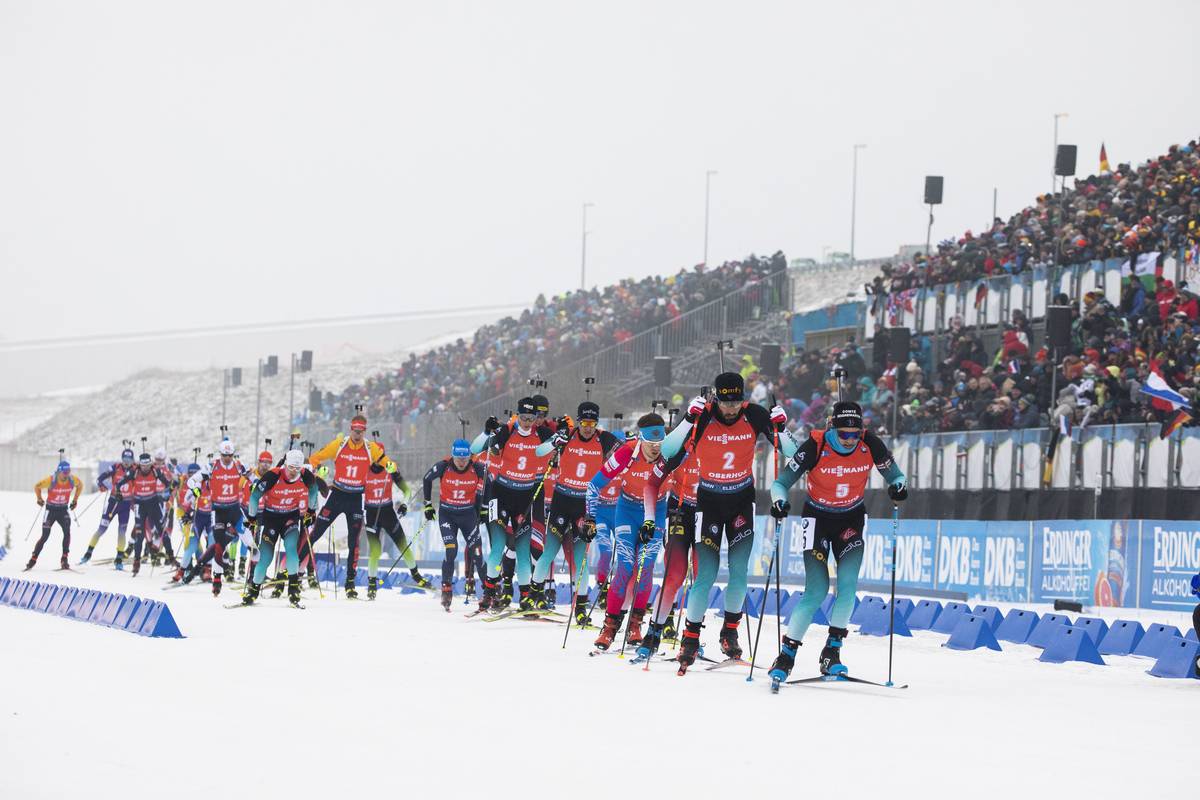
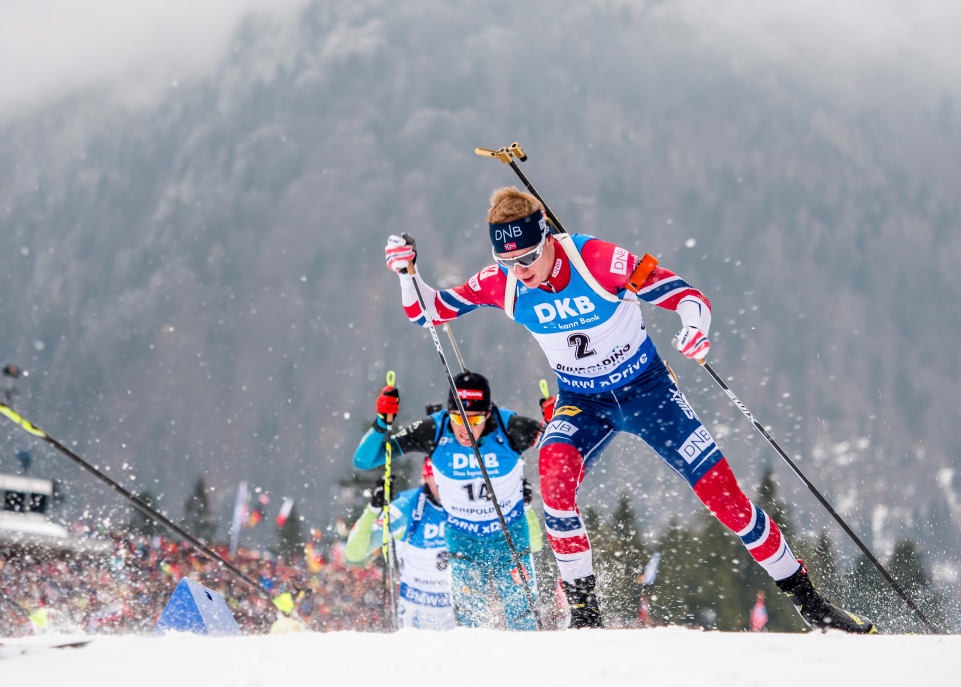
The men’s mass start in Oberhof. (Photo: NordicFocus)
Norway’s male biathlon ringer, Johannes Thingnes Bø, was on the sideline for the weekend. Prior to the Oberhof stop, he had worn the yellow bib as the IBU World Cup overall leader. Post-Oberhof, it was time for a change. A small change really in the big perspective of challengers. France’s Martin Fourcade leaves Oberhof donning yellow, a color he has been well acquainted with in the past.
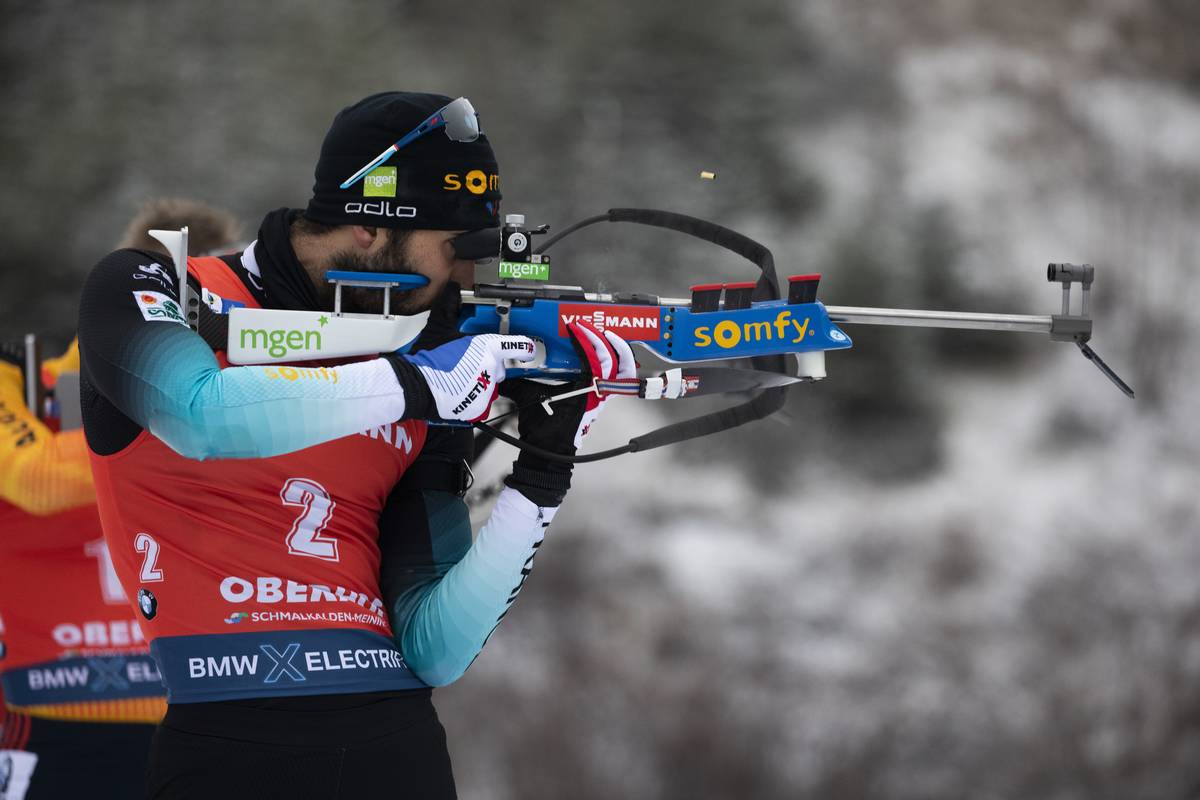
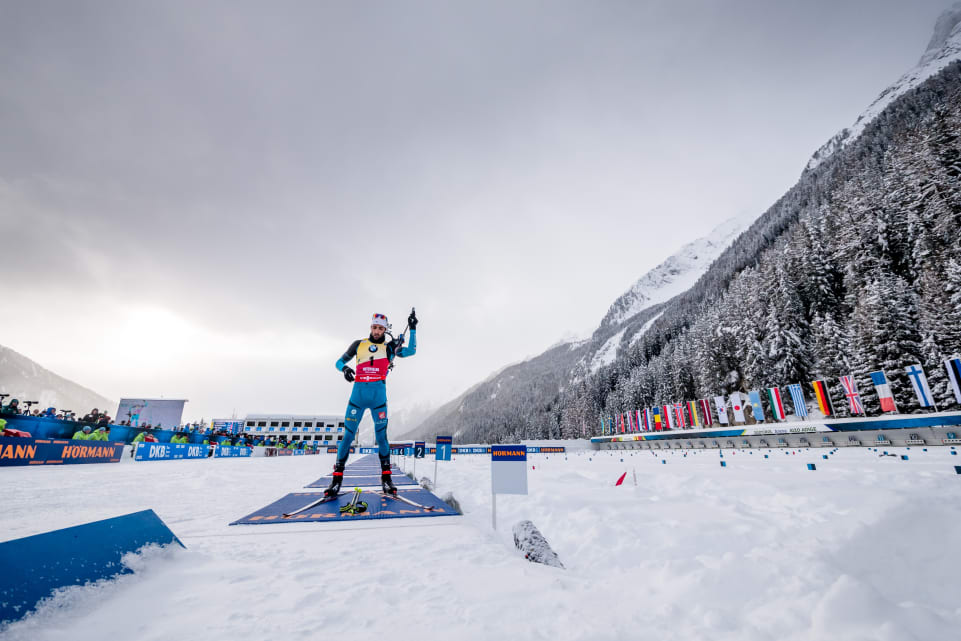
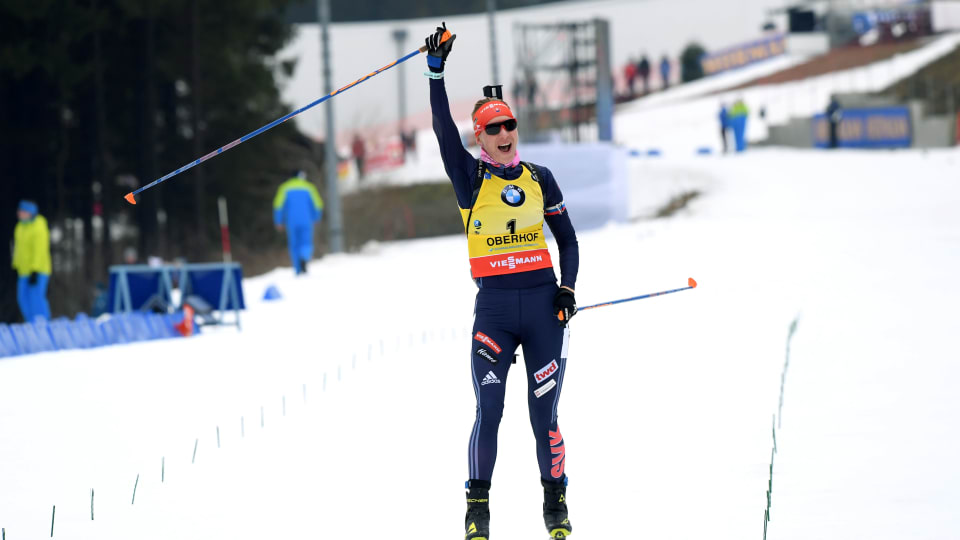
Martin Fourcade, here in the Oberhof mass start, won the race and seized the overall leader’s bib. (Photo: NordicFocus)
Fourcade’s overall lead is the result of a two win weekend. He won the 10 k sprint on Friday and followed that with a win Sunday in the 15 k mass start. In four shooting rounds during the mass start, Fourcade went 0+1+0+1 to win in 41:01.4. No North Americans qualified for the race.
Fourcade was also part of the French 4 x 7.5 k relay team that placed second on Saturday. Norway won that race, with neither Bø brother racing. Germany placed third. The U.S. team of Sean Doherty, Leif Nordgren, Paul Schommer, and Jake Brown skied to 12th overall. Canada’s Jules Burnotte, Scott Gow, Aidan Millar, and Christian Gow were 14th out of 26 teams.
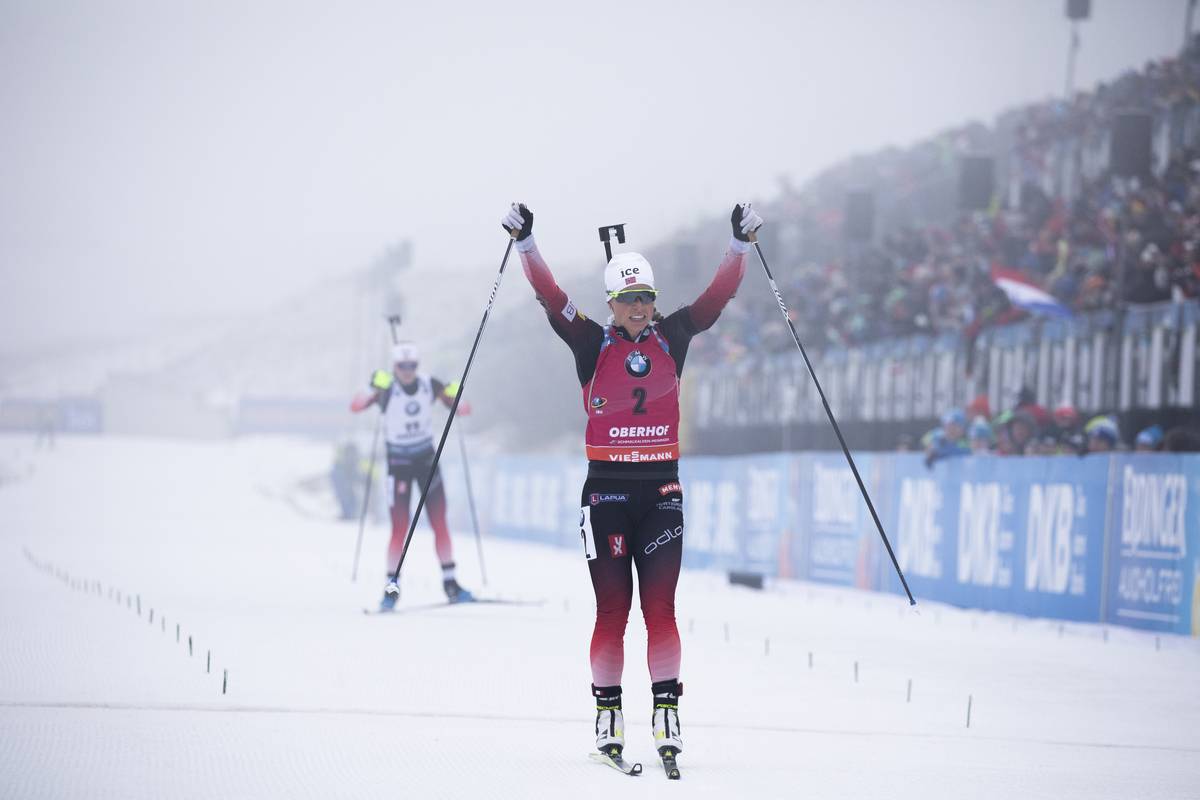
Kaisa Makarainen from Finland won the 10 k mass start in 39:58.9 after missing a single target in her first bout of shooting. Otherwise, she shot clean. Norway’s Tiril Eckhoff placed second (+30.2; 0+0+3+1), and Marte Olsbu Roeiseland third (+35.0; 1+0+1+1).
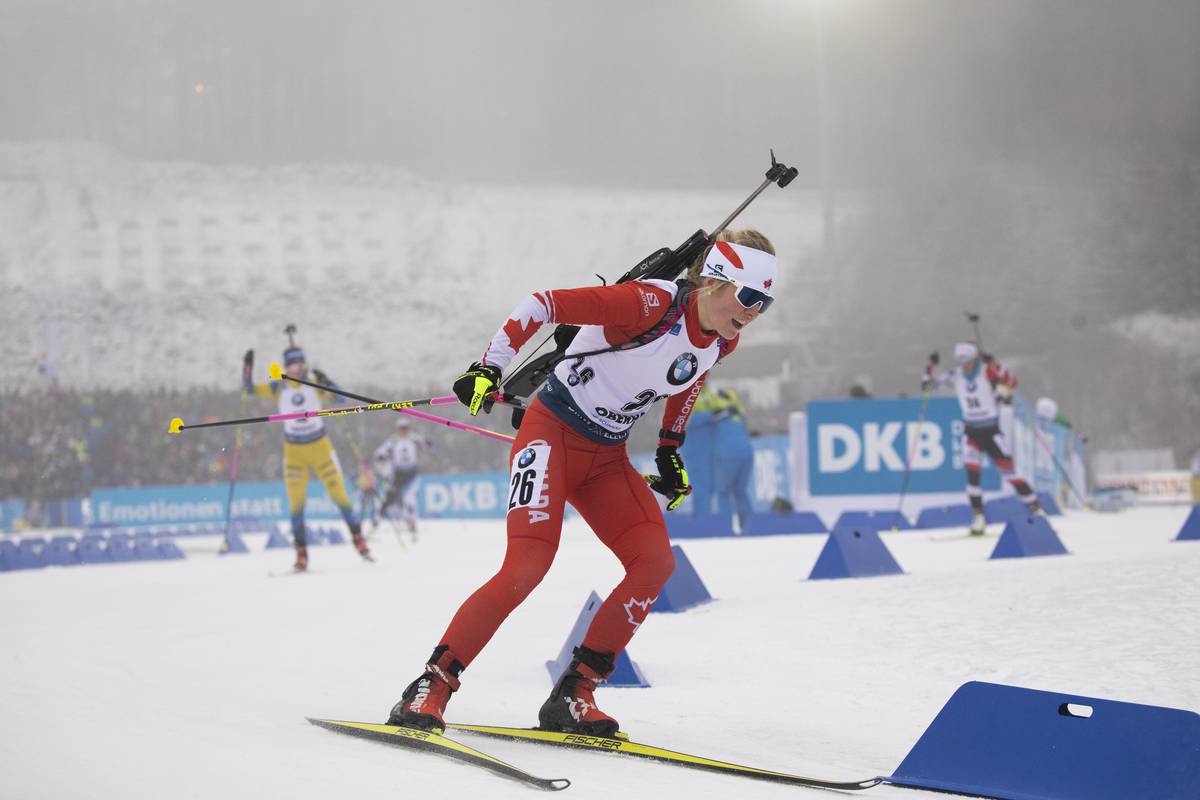
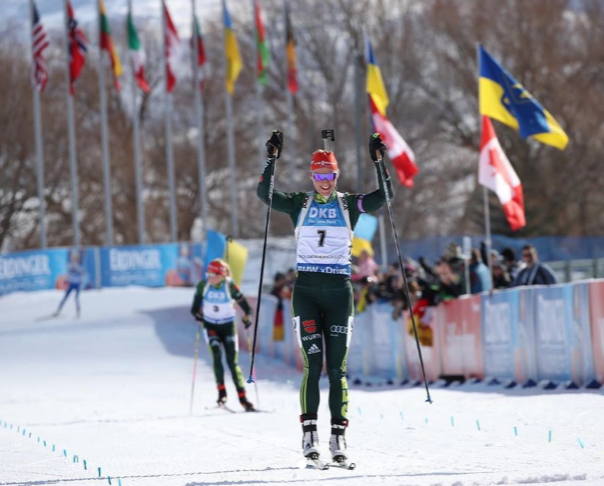
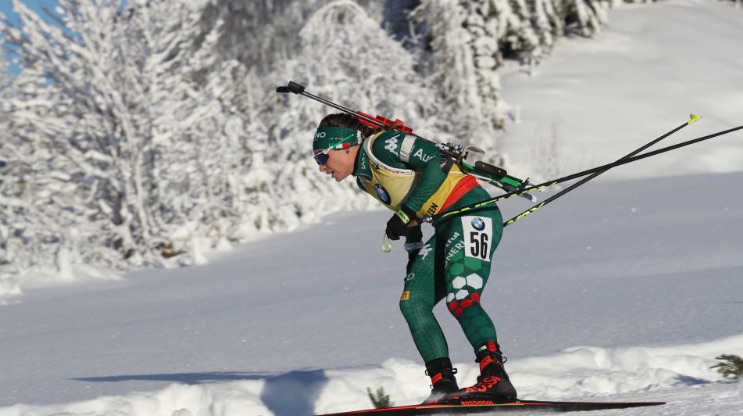
Emma Lunder of Canada during the women’s mass start in Oberhof, Germany. Lunder was 15th overall. (Photo: NordicFocus)
Canada’s Emma Lunder continued her strong skiing with a 15th place (+2:14.8; 0+2+4+1). Susan Dunklee of the U.S. raced to 21st (+2:56.3; 0+3+1+4).
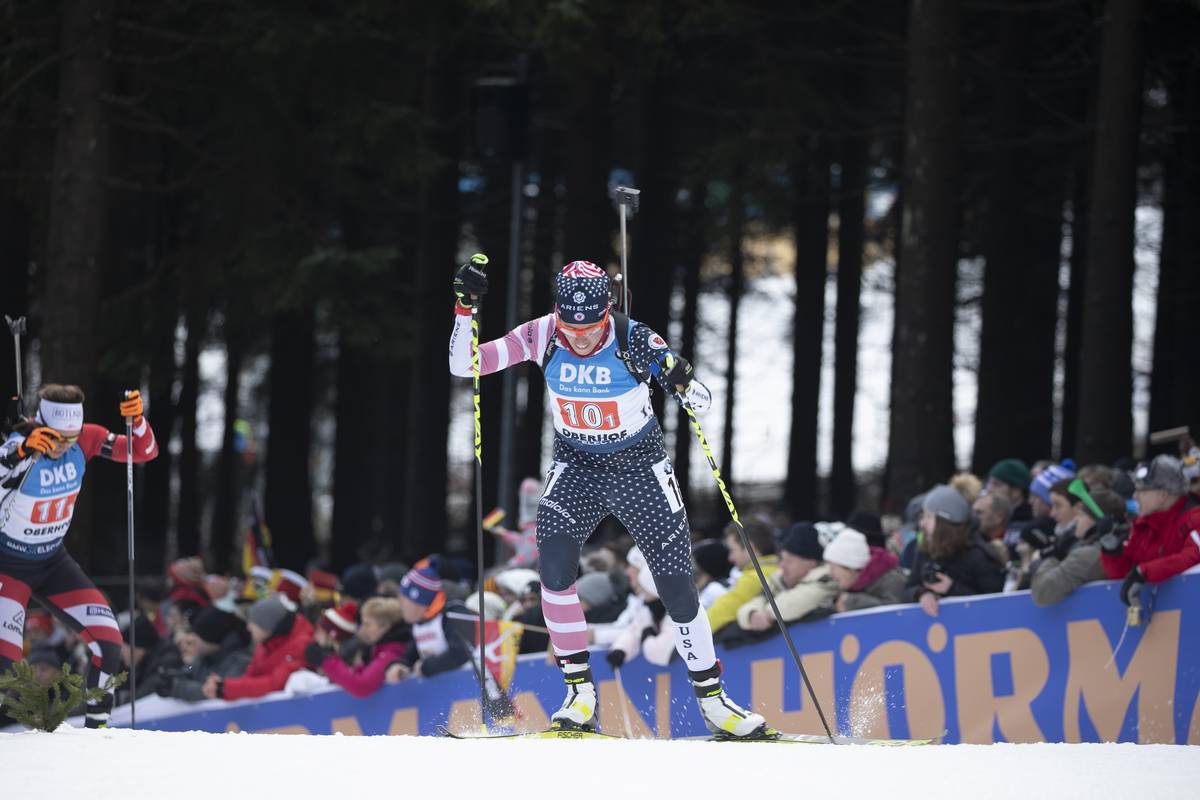
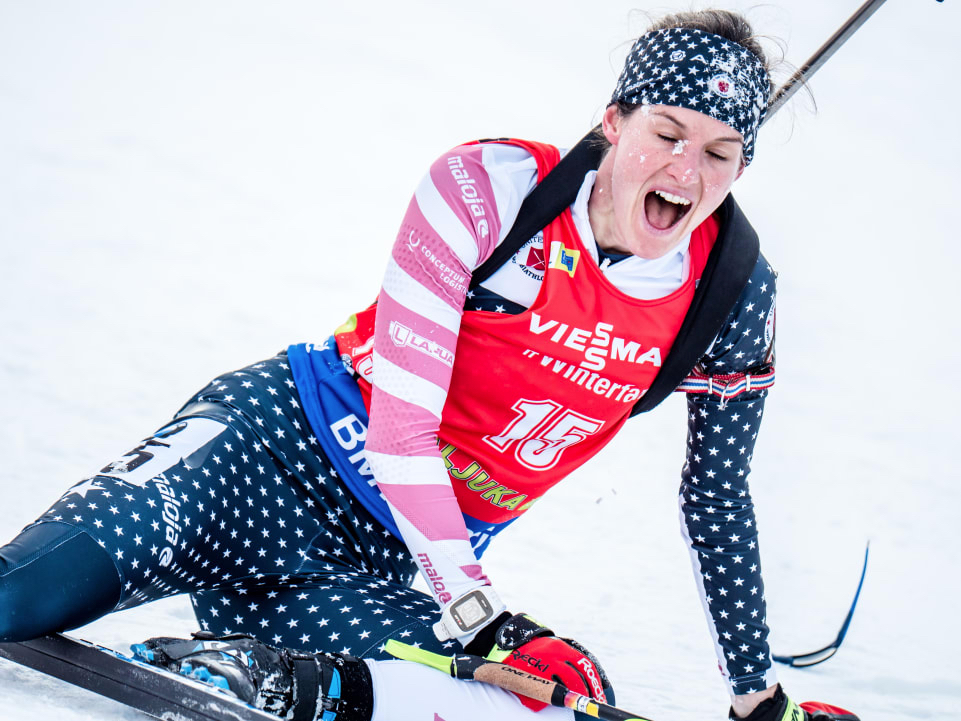
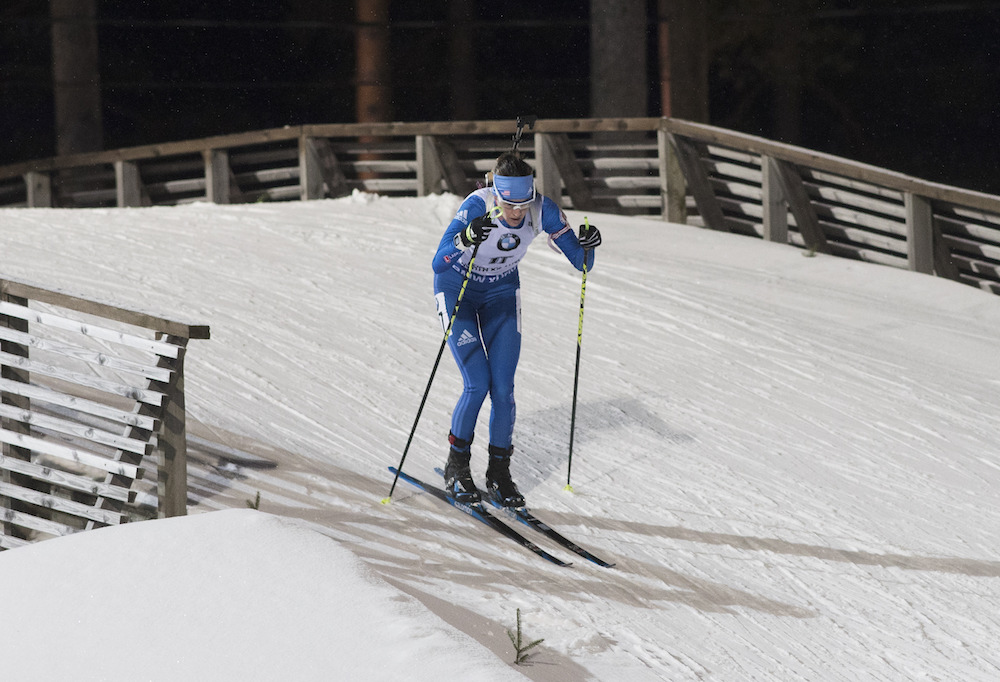
Susan Dunklee of the U.S. during the women’s 4 x 6 k relay. Dunklee placed 21st in Sunday’s mass start. (Photo: NordicFocus)
This brings us to the women’s overall standings on the IBU World Cup circuit. Italy’s Dorothea Wierer, with 390 points, wears the leader’s bib. The Italian placed fourth in the mass start, over a minute out, and had five misses total on the range. Eckhoff is second overall with 381 points.
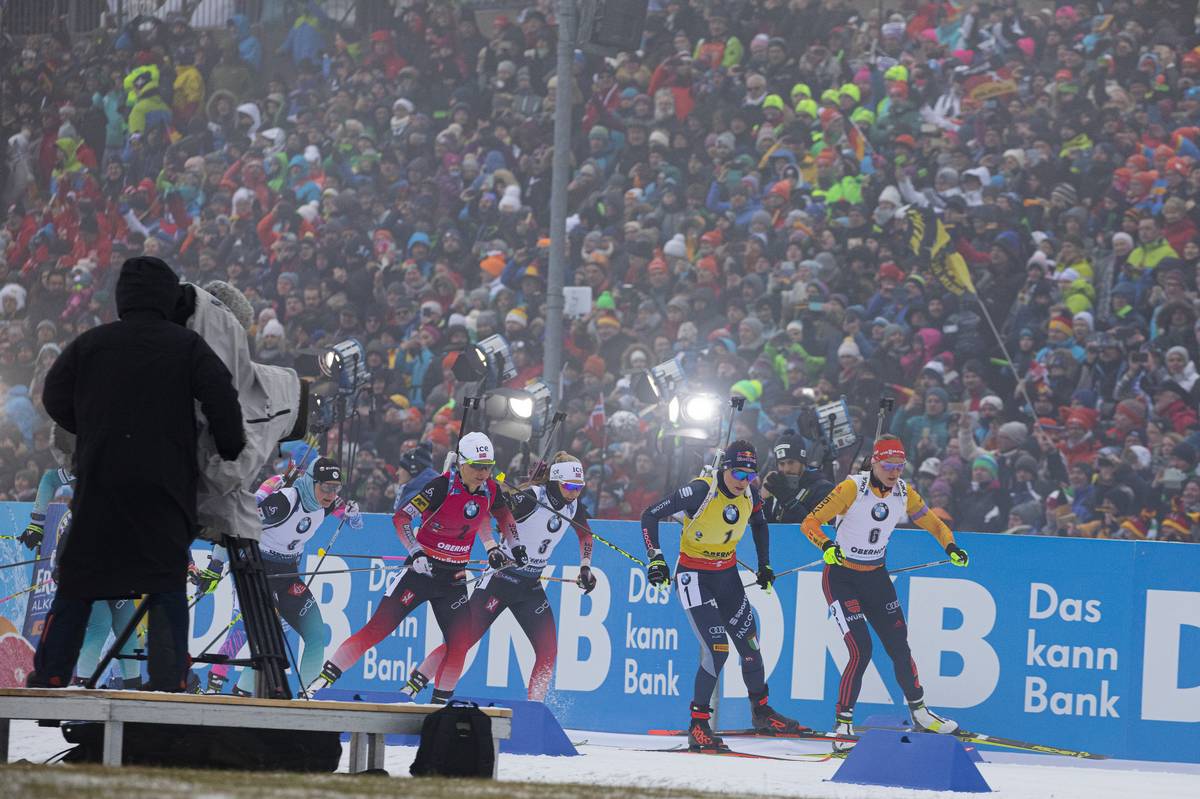
A television camera takes Justine Braisaz (FRA), Tiril Eckhoff (NOR), Ingrid Landmark Tandrevold (NOR), Dorothea Wierer (ITA), Denise Herrmann (GER) in focus, (l-r) during the women’s Oberhof mass start. (Photo: NordicFocus)
In the women’s 4 x 6 k relay contested on Saturday, Norway won in a total time of 1:14:11.5 hours shooting 0+11. The U.S. team of Susan Dunklee, Clare Egan, Hallie Grossman, and Emily Dreissigacker were 12th (+4:33.8; 1+12). Canada’s Sarah Beaudry, Emily Dickson, Nadia Moser, and Emma Lunder placed 20th, as they were eventually lapped. Twenty-three teams began the race.
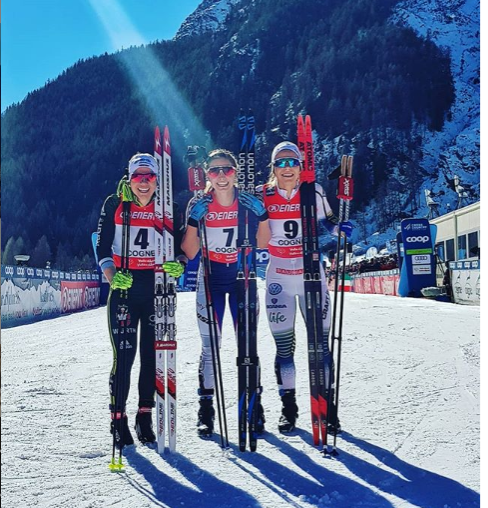
American Jessie Diggins (center) after winning the women’s 1.6-kilometer freestyle sprint in Cogne, Italy. Germany’s Sandra Ringwald (l) placed second and Sweden’s Johanna Hagström in third.
FIS Cross Country World Cup 1.6-kilometer freestyle sprint Cogne, Italy
Amidst sunshine and sporting rolled up sleeves on Saturday in Cogne Italy, American Jessie Diggins took the women’s 1.6-kilometer freestyle sprint win in nail-biter fashion. After making it into the semifinals and the final as one of the day’s lucky losers, Diggins outlunged Germany’s Sandra Ringwald by 0.11 seconds, claiming the victory in a time of 3:32.73.
The 27 year old Afton, Minnesota native now has six individual World Cup sprint podiums, Saturday marking her first individual World Cup sprint victory (not to be forgotten is the gold medal Diggins and Kikkan Randall won in the team sprint during last year’s Pyeongchang Olympic Winter Games).
Following Diggins, Ringwald placed second (+0.11), Sweden’s Johanna Hagström third (+0.86), and Norway’s Ane Appelkvist Stenseth was fourth (+1.31). American Sadie Bjornsen also advanced all the way to the final on Saturday where she placed fifth, 2.23 seconds back from Diggins’ winning time. The sixth finalist on Saturday was Eva Urevc of Slovenia, who crossed 2.32 seconds back from Diggins.
In her strongest individual World Cup sprint result yet, Julia Kern of the U.S. raced to an 11th place. Prior to Saturday, Kern’s best individual World Cup finish in a sprint was 19th, which she earned at this year’s freestyle sprint in Dresden, Germany.
Three more U.S. woman finished in the top 30, with Sophie Caldwell placing in 17th followed by Ida Sargent in 24th and Rosie Brennan in 27th.
American Kelsey Phinney finished 1.03 seconds outside of qualification, ending the day in 33rd overall.
Four Canadian women raced on Saturday, with Dahria Beatty leading the way in 38th. The next Canadian finisher after Beatty was Cendrine Browne in 48th, followed by Maya Macisaac-Jones 49th and Katherine Stewart-Jones 51st.
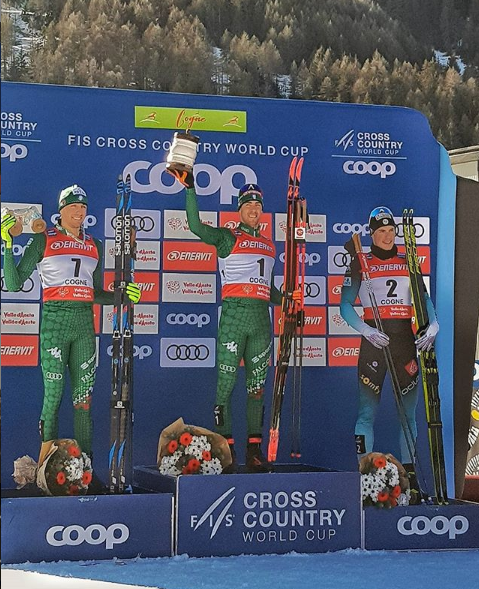
Italy’s Federico Pellegrino (c) after winning the men’s 1.6-kilometer freestyle sprint on Saturday in Cogne, Italy. His teammate, Francesco de Fabiani (l) placed second and France’s Lucas Chanavat third. (Photo: FIS Instragram screenshot)
On the men’s side, Italians Federico Pellegrino and Francesco de Fabiani put on a show for the home crowd, with Pellegrino taking the win in a time of 3:09.07 and his teammate de Fabiani earning second (+0.48) by 0.03 seconds after a photo finish with France’s Lucas Chanavat, who placed third (+0.51).
After narrowly avoiding a crash in his semifinal, American Simi Hamilton advanced to the final, ending the day just off the podium in fourth (+3.91). Following Hamilton was Norway’s Sondre Turvoll Fossli in fifth (+4.03) and Sweden’s Marcus Grate in sixth (+27.90).
Racing for Canada, Russell Kennedy was the next top North American finisher in 11th. Following Kennedy was American Andy Newell in 23rd and the U.S.’s Logan Hanneman in 27th. Kevin Bolger qualified for the fourth quarterfinal, but did not start and ended the day in 30th.
Erik Bjornsen of the U.S. Ski Team placed 39th while Canada’s Alex Harvey ended the day in 48th and Evan Palmer-Charrette 59th.
Germany’s Denise Herrmann winning the women’s IBU 10 k pursuit on Saturday at the SoHo venue in Midway, Utah. (Photo: IBU Instagram screenshot)
IBU World Cup Soldier Hollow (Midway), Utah: 10/12.5 k pursuit
International Biathlon Union (IBU) competition has returned to the famed Soilder Hollow (SoHo) race course venue in Midway, Utah for the first time in 17 years–the last time IBU/World Cup level competitions were held there was back in 2002, when Salt Lake City played host to the Winter Olympic Games.
The IBU’s third day of competition in SoHo brought on a 10-kilometer pursuit for the women. Germany’s Denise Herrmann won the event in a time of 28:03.4 after skiing two penalties (0+0+1+1). Franziska Hildebrand, also of Germany, claimed second, finishing 4.2 seconds behind Herrmann with one missed shot (0+0+0+1).
Racing for Finland, Kaisa Mäkäräinen placed third, 16.5 seconds back from the winner with three misses (2+0+1+0).
Susan Dunklee was the top North American woman, finishing in 26th (+2:34.5) with one miss (0+0+0+1). Just 0.4 seconds back from Dunklee in 27th (+2:34.9), was U.S. skier, Clare Egan with three missed shots (0+0+2+1).
Rosanna Crawford of Canada placed 34th (+2:48.2) after skiing three penalties (0+1+0+2) and U.S. skier Joanne Reid finished 40th (+4:11.9) after skiing two penalties (0+1+1+0). Canada’s Sarah Beaudry placed 44th (+4:33.2) after two missed shots (0+0+1+1) and Emma Lunder, also racing for Canada, placed 51st (+5:41.3) after skiing six penalties (2+2+2+0).
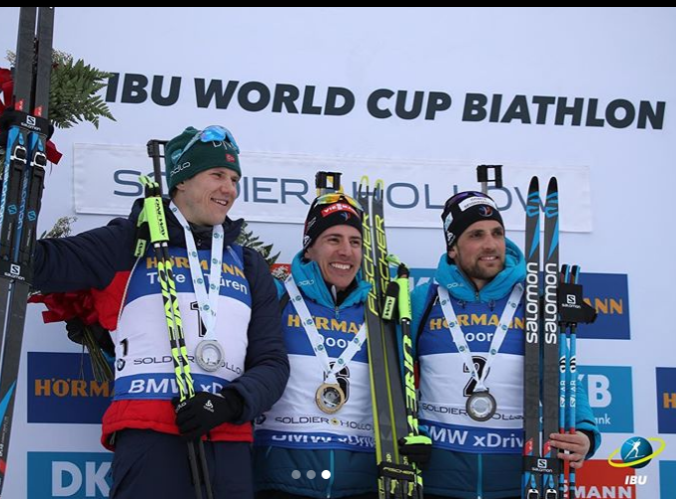
Quentin Fillon Maillet (c) after winning the men’s IBU World Cup 12.5-k pursuit at the SoHo venue in Midway, Utah. Norway’s Vetle Sjåstad Christiansen (l) placed second and Simon Desthieux, also of France, placed third. (Photo: IBU Instagram)
In the men’s 12.5-kilometer pursuit, France’s Quentin Fillon Maillet claimed the win in a time of 30:55.8 after shooting 100 percent. Norway’s Vetle Sjåstad Christiansen, who earned his first IBU World Cup win on Friday, placed second in Saturday’s pursuit, finishing 25.9 seconds behind Fillon Maillet and missing just one shot (0+1+0+0).
Simon Desthieux, also of France, placed third on Saturday, finishing 47.3 seconds back from the winner after skiing three penalties (0+1+1+1).
Racing for Canada, Christian Gow placed 8th (+2:21.2) after shooting clean. American Sean Doherty finishing two places behind Gow in 10th (+2:22.8) with three misses (0+3+0+0). Canadian Scott Gow, Christian’s brother, placed 25th (+3:58.5) after skiing four penalties (1+1+2+0).
Also racing for Canada, Aidan Millar finished in 39th (+5:25.1) with five missed shots (2+0+1+2).
Minneapolis SuperTour 20 k/15 k mass start classic
The SuperTour returned to racing on Saturday in Minneapolis, Minnesota with a 15/20 k classic mass start. The men’s 20-kilometer event was won by Northern Michigan University (NMU) skier, Zak Ketterson in a time of 54:08.0. Ben Lustgarten skiing for the Craftsbury Green Racing Project (CGRP) placed second, 0.9 seconds behind Ketterson. Norwegian Mathias Rolid, also skiing for NMU, placed third, 15.8 seconds behind the race winner.
In the women’s 15 k event, Kaitlynn Miller of the CGRP won in a time of 50:17.1. Skiing for the Stratton Mountain School T2 team was Alayna Sonnesyn in second place (+25.1). Liz Guiney (CGRP) claiming third (+30.6).
Norway’s Marte Olsbu Røiseland was today’s winner in the 7.5 k sprint at Soldier Hollow near Midway, Utah. (Photo: boathlonworld.com screenshot)
IBU World Cup Soldier Hollow (Midway), Utah women’s 7.5 k Sprint
The name itself carries with it a reputation for high heart rates. Nestled on the East slope of Utah’s Wasatch Mountains, Soldier Hollow (SoHo), the sight of this week’s IBU World Cup races, features tracks well above 5,000 feet in altitude. Junior and senior skiers understand that a hard effort at SoHo come with a mandatory lactic acid tax.
Not since 2002 at the Salt Lake Olympics has the storied venue hosted an international World Cup level (cross-country or biathlon) race.
On Thursday, under overcast skies and amidst a venue overlooking a snowy Heber Valley, the women began the SoHo biathlon festivities with a 7.5-kilometer sprint.
Norway’s Marte Olsbu Røiseland won the race in a time of 19:47.6 minutes. The 7.5 k sprint features two shooting bouts, prone then standing, and Røiseland cleaned both on her way to the win. Following in second place 11.5 seconds back was Kaisa Mäkäräinen of Finland. Mäkäräinen missed one target in standing. Germany’s Franziska Hildebrand took the third podium spot while she cleaned on the range to stop the clock in 21.4 seconds behind Røiseland ‘s winning time.
Clare Egan of the U.S. led the way for North American biathletes in 21st (+1:34.1, 0+1). Also for the U.S., Susan Dunklee raced to 45th (+2:35.8, 0+3), and Joanne Reid 52nd (+2:45.5, 1+1).
Rosanne Crawford was the top Canadian in 24th. Crawford shot clean to finish 1:39.0 back. Sarah Beaudry was 55th (+2:53.3), Emma Lunder 56th (+2:56.3, 1+2), and Megan Bankes 76th (+4:39.5, 3+1).
Eighty-three athletes finished the sprint.
Racing continues tomorrow in SoHo with the men’s 10 k sprint.
Finland’s Kaisa Mäkäräinen on her way to second place in the 2019 Antholz, Italy women’s 7.5 k sprint. Sunny and calm weather greeted racers on Thursday. (Photo: biathlon world.com screenshot)
IBU World Cup Antholz, Italy Women’s 7.5 k sprint
For Marketa Davidova of the Czech Republic it was a career first IBU World Cup win in Antholz, Italy. She won the women’s 7.5 k sprint in 21:40.7 minutes after she shot clean in both her prone and standing shooting stages.
Finland’s Kaisa Mäkäräinen placed a close second, finishing 1.7 seconds behind after skiing a single penalty lap after her standing bout. Marte Olsbu Røiseland of Norway was third (+3.5, 1+0).
US Biathlon placed two skiers in the top-30. Clare Egan continued her run of solid performances by placing 22nd (+56.7, 0+2). Egan’s clean shooting teammate Joanne Reid placed 29th (+1:12.4, 0+0). Susan Dunklee placed 66th (+2:31.0, 2+2).
Rosanna Crawford of Canada raced to 23rd overall, 58.3 seconds back while skiing a single penalty lap in prone. Megan Bankes placed 26th (+1:05.8, 0+1), Sarah Beaudry 40th (+1:33.5, 1+0), and Emma Lunder 61st (+2:25.5, 2+1).
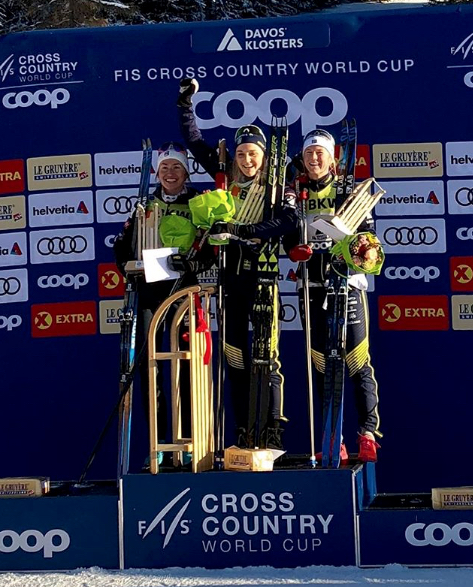
2018 Davos, Switzerland women’s sprint podium. Sweden’s Stina Nilsson (center) placed first, Sophie Caldwell (left) of the U.S. was second, and Maja Dahlqvist (right) also of Sweden was third. (Photo: screenshot @matt.d.whitcomb)
FIS World Cup Davos, Switzerland 1.5 k Freestyle Sprint
On a lovely Davos, Switzerland day, Sophie Caldwell of the U.S. Ski Team (USST) was the day’s fastest qualifier for the women, stopping the clock in 2:46.28 minutes. Caldwell looked cool and in-form on her way to place second overall on the day for her first podium of the season.
The win went to Sweden’s Stina Nilsson after placing third (+2.03) in qualification. Third place went to another Swede, Maja Dahlqvist. It was the twenty-four-year-old Dahlqvist’s second podium of the year after she placed second in the Ruka, Finland classic sprint. Dahlqvist was the day’s second-fastest qualifier, finishing 0.62 seconds behind Caldwell.
Four other Amercian’s advanced to the heats. Sadie Bjornsen qualified in 10th (+4.28). She looked strong in her heat, leading the first lap and skiing in second place down the final stretch. She was passed by a surging Natalia Nepryaeva from Russia. After placing third, Bjornsen did not advance. Bjornsen ended up 14th on the day.
Ida Sargent (USST) qualified in 14th (+5.41) but did not advance out to the heats after placing fifth in the first quarterfinal. Sargent was 21st overall.
Jessie Diggins (USST) was 15th (+5.50) in qualification. In the fourth quarterfinal, Diggins tripped over Russian skier’s Natalia Matveeva’s pole and fell to her knees in the heat’s opening moments. She was unable to regain the lost ground and placed sixth in a photo finish with Matveeva. Diggins placed 26th overall.
No Canadians were entered in the women’s race.
Rosie Brennan (APU)qualified in 28th (+8.83) and was eventually eliminated in the third quarterfinal where she placed sixth. Brennan was 29th on the day. Also for the U.S., Kelsey Phinney (SMS T2) placed 38th, after placing 38th (+12.10) in the qualifier.
For the men, although still young twenty-two-years-old, Johannes Høsflot Klæbo looked like the old Klæbo on his way to his first World Cup win of the season. The Norwegian was the World Cup’s overall winner last season and first in the sprint cup.
Klæbo placed first in the qualifier with a time of 2:22.39 minutes. He advanced to the finals by winning the first heat and the first semi. Klæbo won the final in 2:20.44 minutes. Italy’s Federico Pellegrino was second overall, finishing 0.39 seconds back. Baptiste Gros of France was third (+1.40) to take the last podium step.
Simi Hamilton (USST) was the best placed North American male. Hamilton qualified in 17th (+4.76) and placed 12th overall. He placed second in the fifth heat a fraction behind Finland’s Joni Maeki. In the second semi-final, won by Norway’s Eirik Brandsdal, Hamilton placed sixth (+6.90).
Kevin Bolger (USST) just missed the heats after qualifying in 31st (+6.63). After not advancing, Bolger was 31st overall. No other Americans were entered.
Alex Harvey was the best placed Canadian, placing 37th overall. Lenny Valjas in his first World Cup of the season was 53rd. Andy Shields finished in 60th. No other Canadians were entered.
IBU World Cup Hochfilzen, Austria 10 k/12.5 k pursuit
On Saturday in Hochfilzen, Austria the women’s 10-kilometer pursuit was won by Finland’s Kaisa Mäkäräinen in a time of 30:53.8 minutes. It was Mäkäräinen’s third win of the season. The Finn had a tough time on the shooting range, despite surging for the win in the final meters, she suffered three penalties on the shooting range (1+0+1+1).
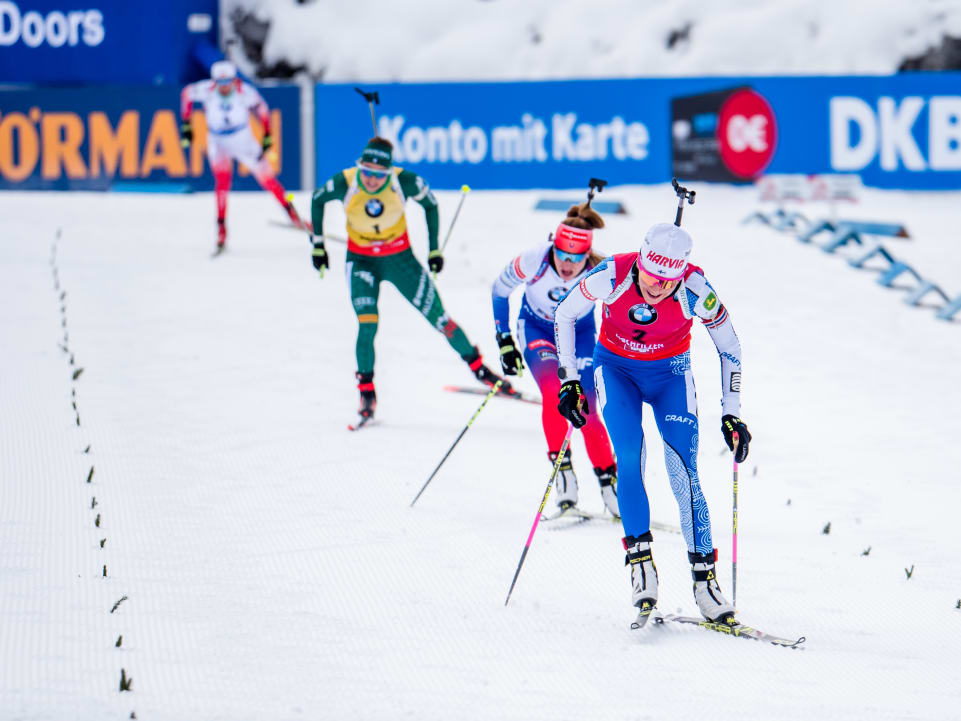
Kaisa Mäkäräinen of Finland down the final stretch in Hochfilzen, Austria during the IBU World Cup 10k pursuit. Paulina Fialkova of Slovenia was second, Italy’s Dorothea Wierer was third. (Photo: biathlonworld.com)
Paulina Fialkova of Slovenia was second (+1.5, 0+0+1+1) after skiing two penalty loops. Italy’s Dorothea Wierer was third in a close fight for all three podium spots finishing 2.8 seconds behind Mäkäräinen. Wierer had three penalties during the race (2+0+1+1).
Susan Dunklee of the U.S. was the best placed North American, improving on her 34th start spot to place 28th (+2:06.1, 0+1+1+0). Teammate Joanne Reid was 31st (+2:17.1, 0+0+0+1) after missing only a single target. Clare Egan did not qualify for the pursuit.
Rosanna Crawford was the lone Canadian to qualify for Saturday’s pursuit. She placed 44th (+3:24.8, 1+1+0+1).
Martin Fourcade of France, in a return to shooting and skiing form, took the win in the men’s 12.5 k pursuit. Fourcade won in a time of 32:22.3 minutes while shooting clean through his four shooting rounds.
Germany’s Arnd Peiffer was second (+13.7, 1+0+0+0), skiing a single penalty lap. Norway’s Vetle Sjåstad Christiansen was third (+16.1) after shooting clean for the race.
First place starter after winning yesterday’s sprint, Norwegian Johannes Thingnes Bø, fell back in the standings after missing six targets. He placed ninth (+1:00.0, 0+3+1+2) overall.
Sean Doherty for the U.S. was 31st (+2:37.3, 0+1+0+1). U.S. teammate Leif Nordgren was 42nd (+3:21.5, 1+0+1+3).
Scott Gow was the only Canadian to qualify for the pursuit. He finished in 51st (+4:36.3, 1+0+0+3).
NorAm and U23/JW World Championships Qualification, Canmore, Alberta
Day two of the Noram and U23/JW trials in Canmore, Alberta, featured freestyle individual interval races; the men raced 15km followed by the women’s 10km
Russell Kennedy (Team R.A.D.), fresh back from Europe led the way with a 30:18.5 minute clocking for the 15km. His teammate Evan Palmer-Charrette was second, 30.7 seconds behind. Alexis Dumas (CNEPH) snatched third, 1.6 seconds behind Palmer-Charrette and 0.9 seconds ahead of Jack Carlyle (AWCA). Seb Boehmler-Dandurand (AWCA) was 4.3 seconds back from Carlyle and 48.5 seconds behind the winner.
Gareth Williams (CNST) was sixth and the top U23 athlete at 1:02.9 back, with CNEPH U23 teammates Philippe Boucher and Antoine Cyr taking 7th and 8th, 8.2 and 8.8 seconds behind Williams.
Samuel Hendry (Team R.A.D.) won the junior men’s 10km in 23:09.7 to earn a spot on the U23 team in Lahti next month, with his second NorAm interval start win in two tries. Remi Drolet (Black Jack) followed up two sprint NorAm sprint wins with a second place, 33.6 seconds behind. Tom Stephen (Team ULLR) was third at 45.8 seconds.
In the open women’s 10km free, Dahria Beatty (CNST) continued her hot streak with another win, finishing in 26:05.1. Last weekend’s winner, Katherine Stewart-Jones (CNST) was second at 35.0 seconds. Frédérique Vézina (CNEPH) took third, 1:01.9 behind.
Sadie White (TBay) was top U23 in 4th, 1:10 behind the winner.
All results, including live timing for the rest of the weekend.
Dorothea Wierer of Italy won Thursday’s sprint in Hochfilzen, Austria in a time of 21:04.9 minutes. (photo: biathlonworld.com)
Today in Hochfilzen, Austria, Dorothea Wierer of Italy won the sprint in a time of 21:04.9 minutes. Wierer missed one shot standing for a single penalty during the race. Kaisa Mäkäräinen of Finland was close behind in second, 0.6 seconds back. Mäkäräinen also had one missed target standing. Third place went to Russia’s Ekaterina Yurlova-Percht, finishing 24.4 seconds behind. Yurlova-Percht short clean in the race.
Susan Dunklee was the best placed American in 34th (+1:33.0, 0+2). Joanne Reid was 44th (+1:48.3, 0+1), and Clare Egan 65th (+2:22.1, 2+2).
On the non-racing front, the IBU released a statement about “Austrian state authorities” investigating five Russian biathlon officials and five biathletes due to their connections to doping. The IBU stated that the possible infractions occurred during the 2017 Hochfilzen IBU World Championships.
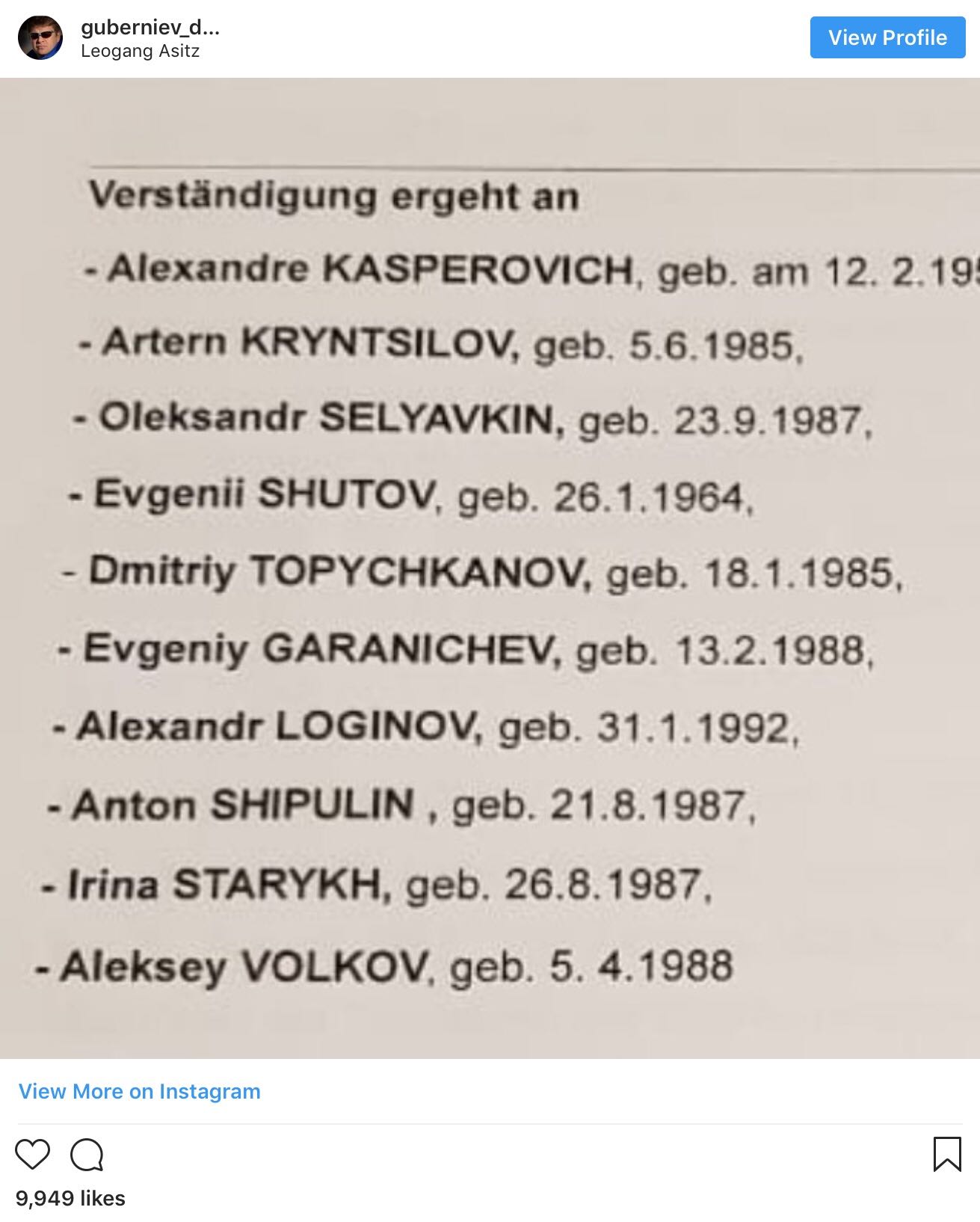
Russian sports journalist Dmitry Guberniev has posted the names of the individuals under investigation. According to tass.com, a Russian news site, Guberniev the following people: “Among athletes accused of violating anti-doping rules are 2014 Olympic champion Anton Shipulin, Evgeny Garanichev and Alexander Loginov. The list also includes biathletes Alexey Volkov, Irina Starykh, former coach of the Russian national team Alexander Kasperovich, doctors and massage therapists Artyom Kryntsilov, Alexander Selyavkin, Evgeny Shutov and Dmitry Topychkanov,” tass.com reported.
List of people under investigation according to Russian journalist Dimitri Guberniev (Screenshot from @guberniev_dmitry)
FasterSkier will post updates about this developing story as more information is discovered
– Harald Zimmer contributed
***
NorAm and U23/JW World Championships Qualification, Canmore, Alberta
The Canadian NorAm series continued Thursday in Canmore, Alberta, with a combined NorAm and trials for U23 and Junior World Championships.
The three race weekend kicked off with classic sprints, run from the biathlon stadium which offers an uphill finish in place of the traditional long descent into the finish straight.
The selection criteria are involved, but it appears that each day four athletes will earn a spot in U23/JW World Championships in Lahti, Finland. The top athlete of each gender in U23 and junior each day should be automatically selected.
There are also World Cup period 2 (Tour de Ski) and period 3 starts on the line, with the possibility of Canadian women in the Tour de Ski for the first time since Sara Renner finished 16th in 2010.
Dahria Beatty (CNST) won the open women’s category in style, winning the qualifier in 3:51.06 by 4.96 seconds before winning all three heats by large margins.
Katherine Stewart-Jones (CNST) finished second in the A final in 3:49.60, 2.20 seconds behind Beatty after finishing second in the qualifier and winning her earlier heats. Maya MacIsaac-Jones (CNST) completed the podium, finishing 5.37 back.
Marie Corriveau was the top U23, finishing 6th in the A final after qualifying in 6th. Corriveau has struggled with results for two seasons, but her first race of the season is a very positive sign.
Anne-Marie Petitclerc (Mont Sainte Anne) won the qualifier and quarterfinal on her way to the junior win in 4:01.71. Molly Miller (Black Jack) was second at 0.68 seconds back and Anna Pryce (Foothills) took third at 7.25 seconds.
Bob Thompson (TBay) won the men’s A final in 3:19.43 by 2.31 seconds. Angus Foster (TBay) outstretched top qualifier Julien Locke (CNST) by 0.01 seconds for second. Graham Ritchie (Big Thunder) was the top U23 in 4th, 2.36 back after qualifying 6th.
Remi Drolet (Black Jack) won the junior A final in 3:31.94, after winning the qualifier and all his heats. Foothills teammates Tom Stephen and Xavier McKeever were second and third, 2.08 and 2.51 seconds back respectively. Stephen has two future seasons as a junior while McKeever has three.
All results, including live timing for the rest of the weekend.
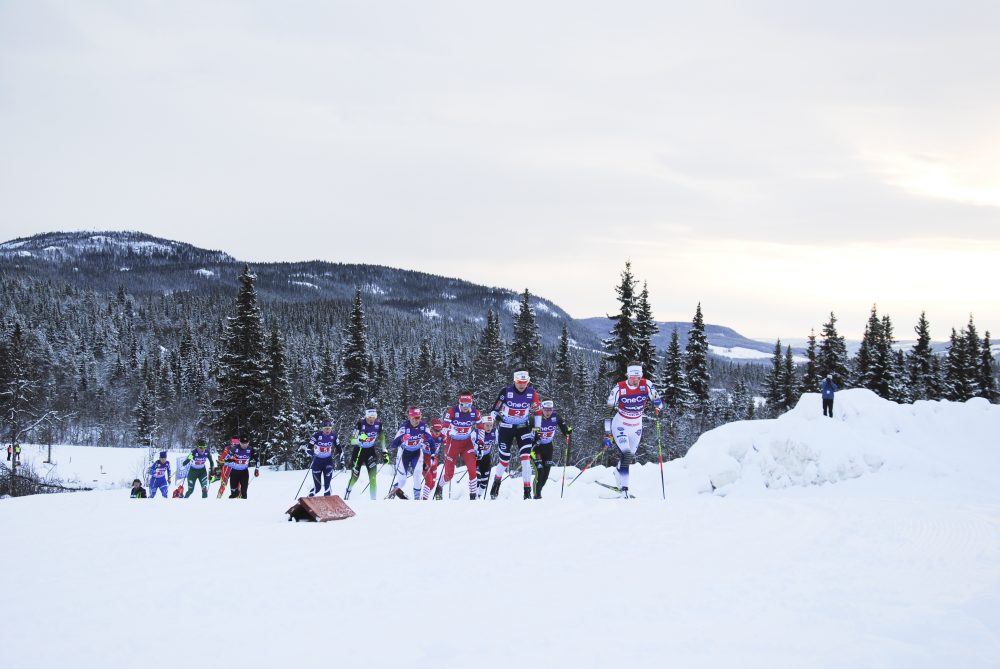
The women’s field cresting a hill during the scramble leg of the World Cup 4 x 5 k relay in Beitostølen, Norway.
FIS World Cup Beitostølen, Norway 4 x 5 k / 4 x 7.5 k Relay
Sunday in Beitostølen, Norway the women raced a 4 x 5-kilometer relay on firm tracks and under partly cloudy skies — Saturday’s races featured fresh snowfall.
Norway I took the win in a total time of 57:23.6 minutes. In order of relay legs, Heidi Weng, Therese Johaug, Ragnhild Haga, and Ingvild Flugstad Østberg comprised the team that raced at the sharp end of the race for all but the first leg.
Weng, the first leg skier for Norway, tagged Johaug in fourth, 7.3 seconds behind Russia’s Yulia Belorukova who scrambled for Russia I. From then on, Norway I set the speed benchmark.
Despite Russia I’s star power, it was Russia II that took second place Sunday. Lidia Durkina, Anna Zherebyateva, Mariya Istomina, and Elena Soboleva, having been gapped by Norway I, could pack-ski until the final stretch to slot over the line .5 seconds ahead of third place Finland I. (Russia II finished 37.3 seconds behind Norway I.)
Russia I’s anchor, Anna Nechaevskaya, fell in the final downhill turn losing several places for her team.
Finland I, the third-place team on the day, featured Johanna Matintalo, Krista Pärmäkoski, Ritta-Liisa Roponen, and Eveliina Piippo. Finland I finished 37.8 seconds behind winner Norway I.
The U.S. I team placed fifth (+48.0) in a performance that saw them out dual Sweden and Norway II in the closing moments of the race. Sadie Bjornsen, Rosie Brennan, Caitlin Patterson, and Jessie Diggins skied for the U.S. on a roster absent some names that were longtime staples of the U.S. team’s relay quartet — both Kikkan Randall and Liz Stephen retired from racing last season.
The U.S. had planned on fielding a second team featuring the U.S. Ski Team’s (USST) Sophie Caldwell (USST), Ida Sargent (USST), Kelsey Phinney (SMS T2), and Kaitlynn Miller (CGRP), however, they did not start.
Norway I held on for the win in the men’s 4 x 7.5 k relay today in Beitostølen in a time of 57:23.6 minutes. This was head-to-head racing at its finest. After 30 k of racing, the final standings came down to a lunge at the finish between Norway I and Russia I. Russia I placed second (+0.7).
Emil Iversen, Martin JohnsrudSundby,Sjur Røthe, and Finn Hågen Krogh formed the Norway I team. The Russia I team included Evgeniy Belov, Alexander Bolshunov, Denis Spitsov, and Andrey Melnichenko.
Norway II’s Didrik Tønseth, Hans Christer Holund, Magne Haga, and Simen Hegstad Krueger placed third (+53.4).
The U.S. team of Erik Bjornsen, Kevin Bolger, Scott Patterson, and Simi Hamilton placed 12th (+3:22.7).
IBU World Cup, Pokljuka, Slovenia 7.5 k / 12.5 k Pursuit
Looking smooth across the finish line, Norway’s Johannes Thingnes Bø, won the men’s 12.5 k pursuit in Pokljuka, Slovenia in a time of 30:20.4 minutes. That smoothness was matched in a photo finish with France’s Quentin Fillon Maillet who placed second, 0.1 seconds behindBø. Maillet cleaned his four shooting stages.
Bø looked in control for the last portions of the race. His strong skiing gave him a 50-second lead as he began his final shooting stage. There, the Norwegian missed two targets, allowing the chasers to latch back on during the final lap. In total, Bø missed three targets, one during his first prone stage, and two during his second standing stage.
Russia’s Alexander Loginov was third in the sprint, finishing 1.9 seconds back. Loginov missed one target in his first standing bout, otherwise, he shot clean.
Canada’s Christian Gow placed 14th (+1:09.1) while shooting clean. No other Canadians qualified for the pursuit.
For the U.S., Leif Nordgren was the best placed American in 33rd (+2:39.1, 0+2+1+0). Sean Doherty was 39th (+3:07.9, 0+0+2+2),
Kaisa Mäkäräinen of Finland won the women’s 10 k sprint in a time of 29:16.9 minutes. Mäkäräinen shot clean during the competition. Italy’s Dorothea Wierer was second, finishing 41.3 seconds behind while also shooting clean during all four shooting bouts.
Third place went to Paulina Fialkova of Slovenia. Fialkova finished 59.2 seconds back and shot clean for the day.
Clare Egan after placing sixth in the IBU World Cup’s 10 k pursuit in Pokljuka, Slovenia. (Photo: Biathlonworld.com)
For the U.S., Clare Egan placed a career-best sixth (+1:22.4, 0+0+1+0). Egan missed a single target during the race.
“I knew the pieces were there,” Egan told IBU TV after the race. “I had clean shooting in a [preseason] race at the Austrian trials before the World Cup. And then I had just awesome ski times this week, so I knew it was coming. I just had really good focus today, and I love competing head to head, so pursuit is a great race for me. I thought I was… I wasn’t sure if I was in fifth or sixth, and this Norwegian skier [Marte Olsbu Røiseland], really good, just got me at the finish. So I was so happy when I looked up and saw that I was in sixth in the flower ceremony.”
Also for the U.S., Susan Dunklee placed 39th (+3:36.3 0+1+0+1), and Joanne Reid 43rd (+3:51., 0+0+1+0).
CNST teammates Dahria Beatty (l) and Katherine Stewart-Jones charge the last hill of the 10km on their way to 6th and 1st respectively. (Photo: Peggy Hung)
Sovereign Lake NorAm/SuperTour 5k/10k Classic
The Sovereign Lake weekend wrapped up with individual start classic distance races and a more neighbourly distribution of results.
Katherine Stewart-Jones (CNST) won the women’s 10km in 31:48.4, hanging on in the last lap to finish ahead of APU’s Becca Rorabaugh (+7.1) and SMS’ Julia Kern (+7.8). APU’s Hailey Swirlbul snatched 4th at 10.9 seconds with Dahria Beatty (CNST) in 5th, 26.7 seconds back.
Kyle Bratrud on his way to victory in the 15km (Photo: Peggy Hung)
Kyle Bratrud (SMS T2) won the battle in the men’s 15km in 41:59.3, 3.8 seconds ahead of Ben Lustgarten (CGRP) and 34.7 seconds ahead of Ricardo Izquierdo-Bernier (NMU/CNEPH). Sam Hendry (CJNST) edged out Andy Newell (SMS T2) for fifth.
Individual start results are here with the full weekend here. Photos and interviews are coming in the Noram/SuperTour wrap-up.
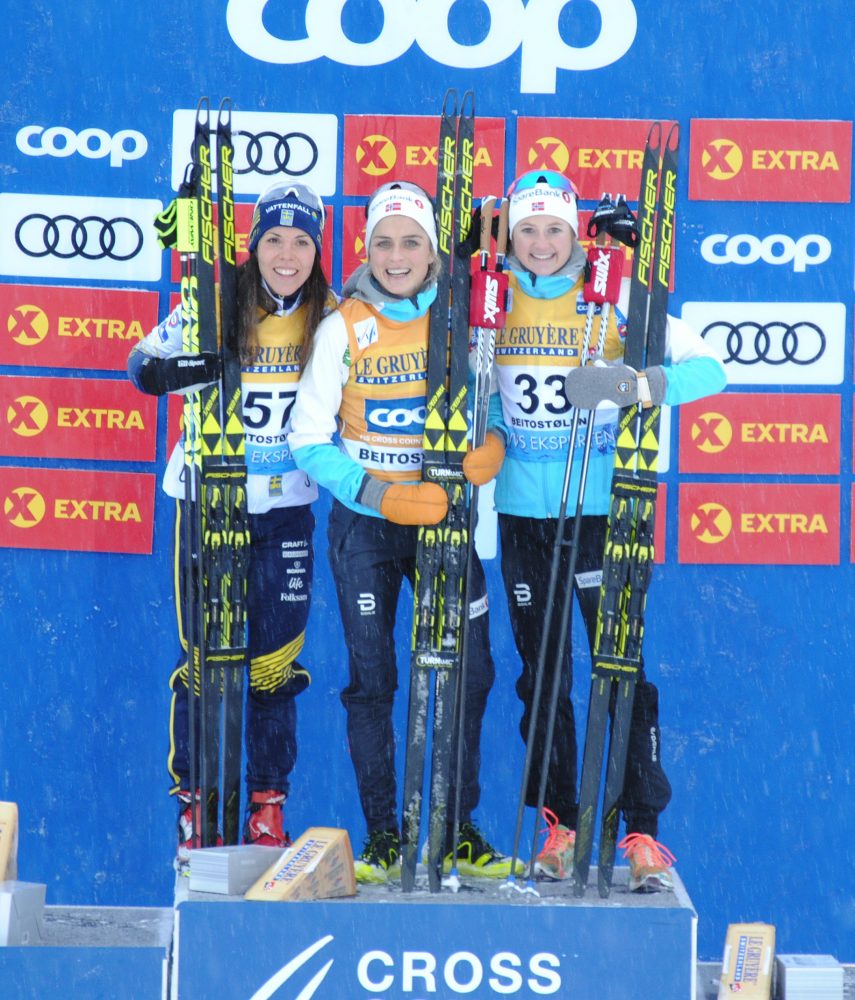
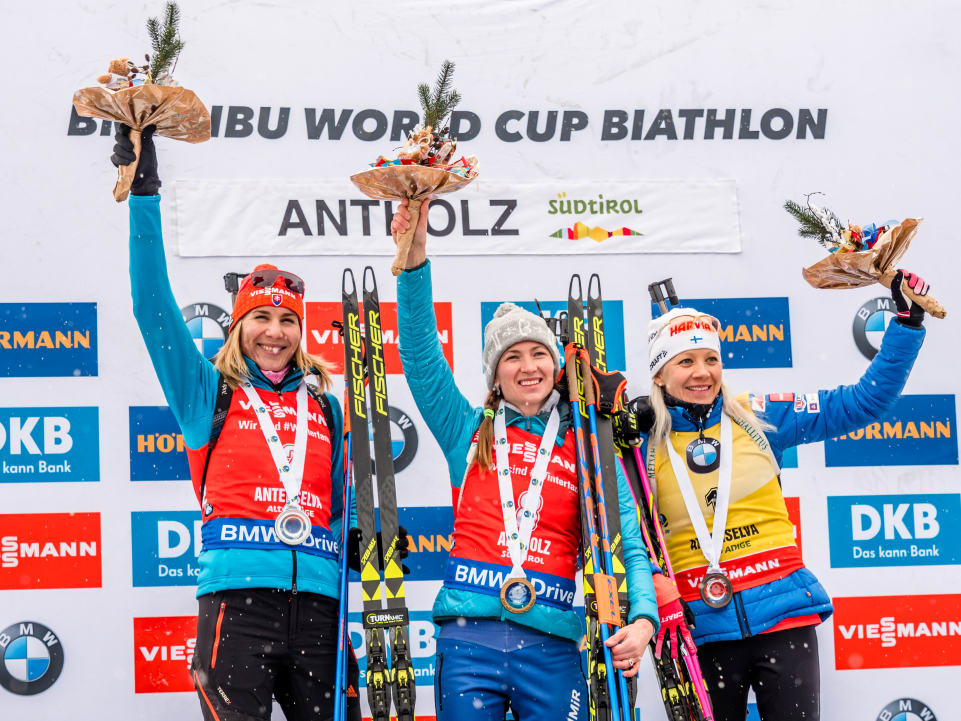
The Women’s podium from the World Cup 15 k freestyle in Beitostølen, Norway. Norwegian Theresa Johaug (center) was first, Sweden’s Charlotte Kalla (left) second, and Ingvild Flugstad Østberg (right) of Norway third.
FIS World Cup Beitostolen, Norway 15 k/30k Freestyle Individual Start
With snow falling and trees covered with fresh snow, Beitostølen, Norway’s wintery essence was on full display during the women’s 15-kilometer freestyle individual start on Saturday.
Keeping her distance win-streak alive was Norway’s Therese Johaug who won her fourth World Cup distance race of the season making it four for four in 2018/2019.
Jessie Diggins of the U.S. Ski Team on her way to eighth place during Saturday’s 15 k freestyle in Beitostølen, Norway.
Johaug won in a time of 38:39.8 minutes. The only blip of egalitarianism on the tracks was at the first time check at 1 k, where Johaug was tied for the best time with Russia’s Natalia Nepryaeva. Otherwise, Johaug gradually pulled away from the fifty-eight finishers by the time she crossed the finish line.
Sweden’s Charlotte Kalla placed second (+1:05.9), and Ingvild Flugstad Østberg of Norway was third (+1:06.1).
U.S. Ski Team (USST) athlete Jessie Diggins finished in eighth (+1:29.6) for her first top-10 result of the season. Sadie Bjornsen (USST) placed 13th (+2:22.9), Rosie Brennan 15th (+2:33.9), Caitlin Patterson (CGRP) 32nd (+3:46.0), and Kaitlynn Miller 50th (+5:02.8).
Canada entered a women’s team for the first time this season. Emily Nishikawa of the Canadian National Team (CNT) was the best placed Canadian in 34th (+4:01.6). Cendrine Brown (CNST) was 38th (+4:16.4).
Sitting atop the men’s overall World Cup this season after Saturday’s racing is Russia’s Alexander Bolshunov. The young skier is a killer in the sprints and distance events. But it is perhaps Norway’s Sjur Røthe who has impressed the most this season in the distance events. Røthe has a slight seven-point lead in the distance overall.
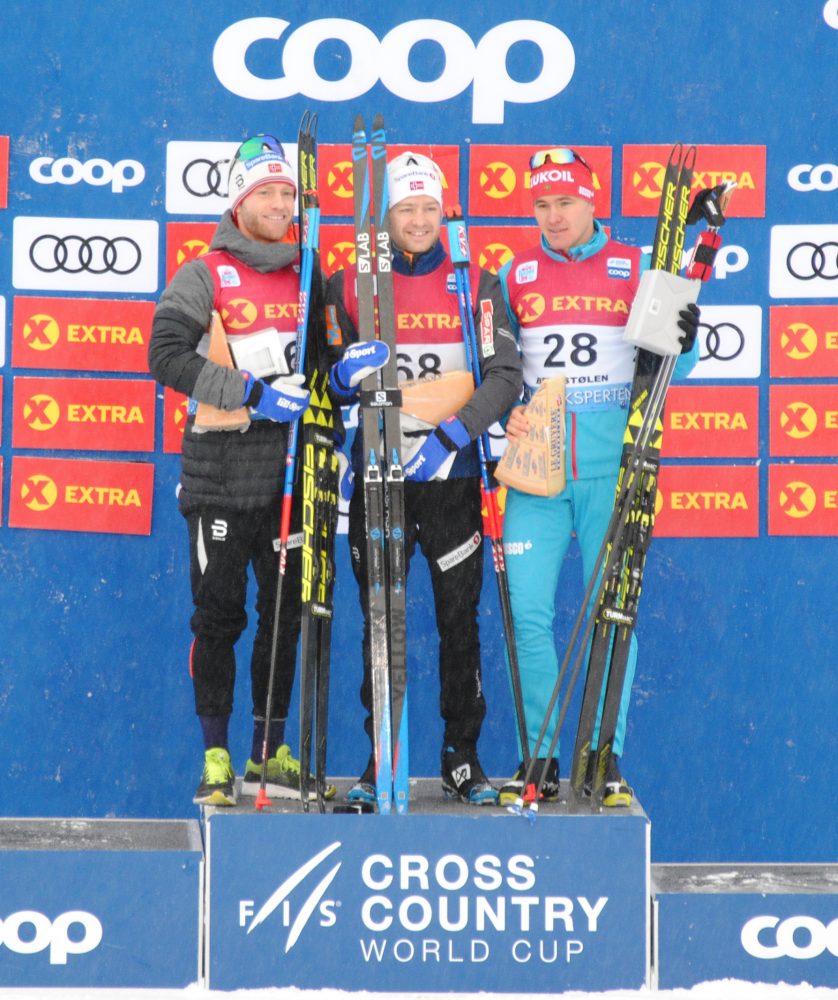
The men’s podium from the 30 k freestyle individual start in Beitostølen, Norway. Sjur Røthe (center) placed first, teammate Martin Johnsrud Sundby (left) second, and Russia’s Andrey Melnichenko (right) third.
Røthe won Saturday’s 30 k skate individual start in a time of 1:09:53.5. It was his second World Cup victory this year. Teammate Martin Johnsrud Sundby, with his first podium of the season, placed second (+35.2), Russia’s Andrey Melnichenko was third (+49.2). For the twenty-six-year-old Melnichenko, it was his first career World Cup podium.
Canada’s Alex Harvey was the best placed North American in 13th (+1:49.8). Also skiing for Canada, Andy Shields finished in 63rd (+7:05.6).
Scott Patterson (USST)was the best-positioned skier for the U.S., placing 47th (+4:32.7). David Norris (APU)skied to 51st (+5:13.3.) Erik Bjornsen (USST) was 52nd (+5:14.9), Adam Martin (CGRP) 59th (+6:14.8).
Egan Leads North Americans in 15th Place in Pokljuka Sprint.
Just before her race on Saturday, US Biathlon’s Clare Egan seemed to be in a relaxed mood and could be seen on the broadcast joking with other athletes and posing for pictures in the warm-up zone. Starting into the women’s 7.5-kilometer sprint in an early group in bib 26, Egan began the race fast and still managed to shoot clean in her prone stage.
She kept near the top at the split times during this early phase of the race.
“I am skiing way faster than I have in past years,” Egan commented on her improved course time in an email to FasterSkier, which in past seasons occasionally had prevented her from achieving positions in the points or qualifying for pursuit and mass start races. “I think my previous best ski time was in the 20’s, but my average was probably in the 50’s. So to have 11th ski time in the Individual [on Thursday] and the 6th today is a very significant improvement for me. It means that I can now aim for the flower ceremony, and even the top of the podium.”
In the standing shooting stage she then missed her very last shot of the race, having to ski once through the 150-meter penalty lap. After another fast final loop she came to the finish in fourth place. But after several athletes who began the race later finished ahead, she was pushed down in the standings, ultimately ending her day in 15th position (+1:08.8, 0+1). According to Egan she only narrowly missed a career-best result, having finished in 13th place in the sprint in Kontiolahti, Finland, during the last season.
“Today I would have been 4th or 5th if I had hit my last shot,” Egan wrote. “Overall my shooting is there, and now my skiing is too, so I just need some more races to get comfortable in this position. I really fought for my last two shots today and I got the 9th one and I’m very happy about that. Also my prone was perfect and I don’t take that for granted. I am focusing on the positive things and learning what I can to do better next time… which is tomorrow!”
Behind Egan, her teammate Susan Dunklee also had drawn a spot in the first start group starting early in bib 2, and remained clean in the prone stage as well. But in her second shooting she incurred two penalty laps, and ultimately ended her race day finishing in 45th place (+1:50.4, 0+2). The third U.S. starter, Joanne Reid, finished 57th with two penalties (+2:06.8, 1+1).
“Our whole women’s team did excellent training and it is paying off: last year at World Cup 1, zero American women qualified for the pursuit, whereas all three of us did today,” Egan commented.
She also credited their revamped coaching staff around which centers around Armin Auchentaller. Auchentaller spent the last few seasons coaching the Swiss women’s team.
“And it’s worth noting that with Susan’s 11th place in the Individual, we’ve now had two women go in the top-15 already in the first two races of the year (which is likely a first for US Biathlon). We are proud of ourselves and motivated to keep climbing. As usual, our ski service team is on fire. Tomorrow we’ll go for it again in the pursuit!”
For Biathlon Canada it was a difficult day on the shooting range overall, with Megan Tandy posting the best result in 73rd place (+2:46.6, 0+2). Her teammates Rosanna Crawford finished 77th with four penalties (+2:52.1, 2+2), Nadia Moser was 88th (+3:42.1, 2+2) and Megan Bankes was 99th (+4:39.6, 1+4). All missed qualifying for the pursuit on Sunday.
About a minute ahead of Egan, the race was won by Finland’s Kaisa Mäkäräinen in a time of 20:08.1 minutes, with no penalties.
“I enjoyed today,” last season’s Overall World Cup winner Mäkäräinen commented in thepress conference. “I really tried to be confident. … Of course it gives you a lot more energy when you shoot clean. I know if I shoot clean that I can fight for the top positions. … But I still had to work hard and had a good last loop.”
In the finish she was 14.8 seconds ahead of Italy’s Dorothea Wierer, who also had no miss and recorded the fastest shooting time on the range on Saturday, but couldn’t match her Finnish rival on the course. Hitting all targets as well, Justine Braisaz of France finished third (+42.1, just two days after ending the individual race only in 82nd place with seven penalties. That’s the ups and downs of biathlon. Also shooting clean and just off the podium was Braisaz’s teammate Julia Simon in fourth place (+44.6), for her first top-ten result in a World Cup. Wierer’s teammate Lisa Vittozzi was fifth with one penalty (+46.9, 0+1).
Julia Kern (SMS) leads Dahria Beatty (CNST) into the final straight in the A final. (Photo: Peggy Hung)
Sovereign Lake Noram/SuperTour, Vernon, BC
North American racing resumed with free technique sprints at Sovereign Lake. The first weekend of the NorAm series was also the second weekend in the SuperTour.
SMS’s first year senior Julia Kern continued her strong start to the season, winning the qualifier and the A final and looking dominant throughout. National team member Dahria Beatty kicked off her season with a crash in the qualifier, but got up to finish 7th. Dartmouth and AWCA’s Laura Jortberg was in third, followed by national team member Maya MacIsaac-Jones. APU’s Hannah Halvorsen was fifth and Stratton Mountain School’s (SMS) Erika Flowers trailed in last after breaking a pole on the final downhill corner.
Andy Newell leads Antoine Briand into the finish straight in the A final. (Photo: Peggy Hung)
On the men’s side, Andy Newell (SMS) continued the American domination, winning the qualifier in 2:15.180, 4.050 seconds ahead of APU’s Logan Hanneman, before winning all of his heats comfortably. Antoine Briand represented for Canada and the Centre National d’Entrainment Pierre Harvey (CNEPH), placing second to Newell in every heat. Ben Saxton (SMS) completed the podium, edging out APU’s Logan Hanneman in a four way battle for third. Antoine Cyr (CNST) and Ben Lustgarten (Craftsbury Green Racing) trailed in two ski lengths behind.
“It was a cascade of issues,” jury member Dave Dyer told FasterSkier.
The short, short version is that the timing system has a number of redundant systems to detect errors. While the timing team was working on an unrelated issue, two athletes tied exactly. There are two sets of results zone4: the provisional (timed to 1/1000ths of a second) and the official (timed to 1/100th of a second). The bib list was generated from one list and the zone4 live timing database was populated from the other, with the two skiers who were tied shown in different order. From this point on, all the backup systems indicated errors and everything had to be hand checked. The results were right, the right athletes advanced, but live timing was switched off and delays ensued.
Full details and video interviews will be in Monday’s event wrap-up.
U.S. Biathlon Association women’s coach Jonne Kähkönen checks in with Kelsey Dickinson after an uphill running time trial in 2014.
When Jonne Kähkönen was hired to be the women’s national team coach by the US Biathlon Association (USBA) in 2010, there wasn’t much of a playbook to follow.
The Finn couldn’t mimic the footsteps of his predecessor, because there wasn’t one.
For the first time, the women’s team was going to have a coach of their own.
“The men’s program was on a really high level going into Vancouver [2010 Olympics],” USBA Chief of Sport Bernd Eisenbichler – then the high-performance director – said on the phone this weekend. “It was a deep program and the men’s relay was having pretty good potential. And we saw the women coming up having the same potential to go up to the top as well.
“We knew that if we wanted to build up a strong women’s program, we needed to have a dedicated coach for them,” he explained. “Really just focused on their development, and putting the group together to make it a really good environment.”
Enter Kähkönen, who had spent the previous four years as the head coach of the Finnish biathlon team.
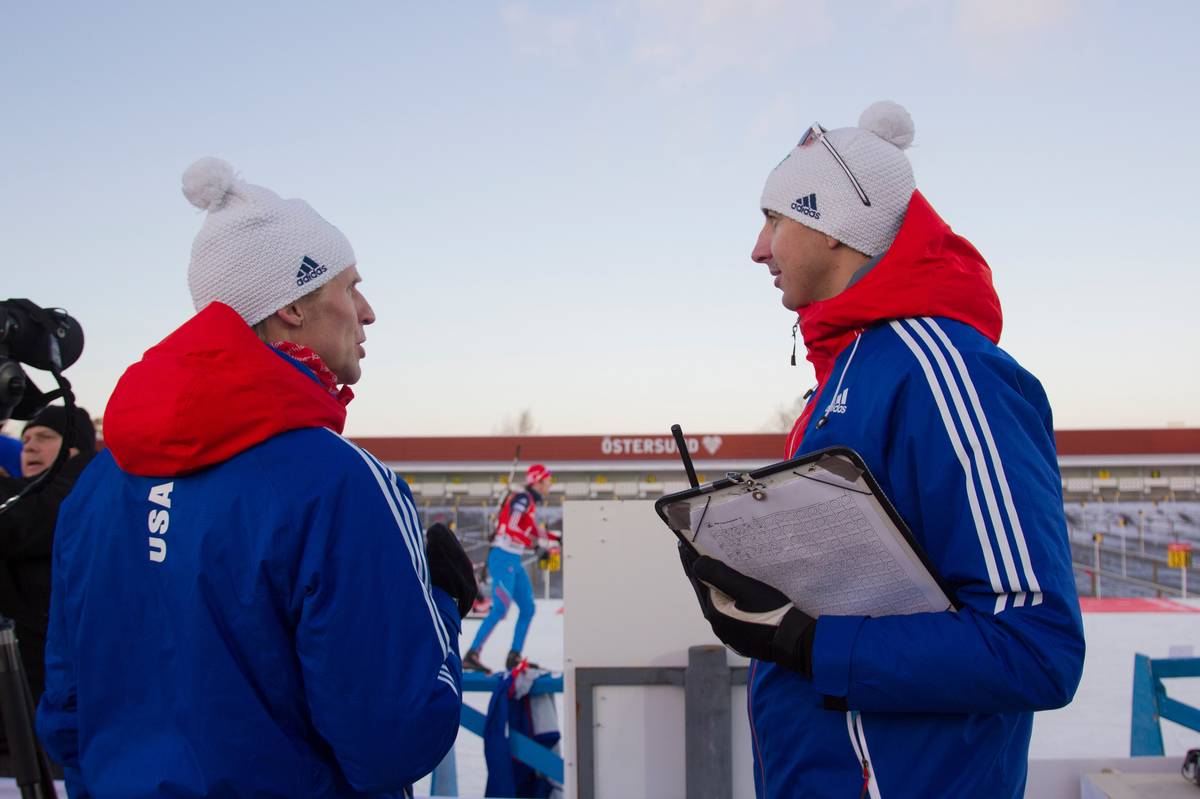
US women’s coach Jonne Kähkönen, left, and men’s coach Jonas Johansson on the range in Sweden in 2014. (Photo: USBA/NordicFocus.com)
“Obviously the first quad [four-year Olympic cycle] felt like it went by really quick, because everything was new,” Kähkönen said in a phone interview last week. “I think looking back, we made really good decisions overall with the philosophy of the team for both the men and the women. Especially for the women, in the early years, to get them up to speed, to be competitive. And it was successful already after the first couple years.”
In 2009, the U.S. women were ranked 20th in the World Cup’s Nations Cup standings. Eight years later, they have had numerous top-20 performances from multiple athletes, World Youth and Junior Championships flower ceremonies, and World Cup podiums and a World Championships silver medal by Susan Dunklee.
“When we started, we didn’t think we were capable of that,” Eisenbichler said. “We saw the potential, but to win a silver medal with Susan, to have these multiple top 20’s by six or seven different athletes, I think we can be really happy with what the women’s program has looked like the last eight years and where we are right now.”
And after leading that charge for eight years, Kähkönen is leaving the team to take back his role as the head coach for Finland – a program that has also risen in that period, with Kaisa Mäkäräinen winning three overall World Cup titles, Mari Laukkanen scoring two World Cup victories, and the mixed relay team finishing sixth at the 2018 Olympics.
“It has been a process,” Kähkönen said of the transition. “I definitely have been thinking of each quad [cycle] as a project. At the end of the project it is always good to evaluate and think about the next steps and what’s good for me professionally, but then I want what’s best for the team and the athletes also. And I feel like now with the few retirements, it’s probably good in a way to make the changes now.”
“I think that the women need a new stimulus,” Eisenbichler said. “Not that the old stimulus wasn’t good or wasn’t working anymore, but after eight years it’s normal. And Jonne and I see that the same way. I could not be more thankful and grateful to Jonne. And now it’s time for him to have a new era with the Finnish biathlon association.”
The Fun-Loving Finn
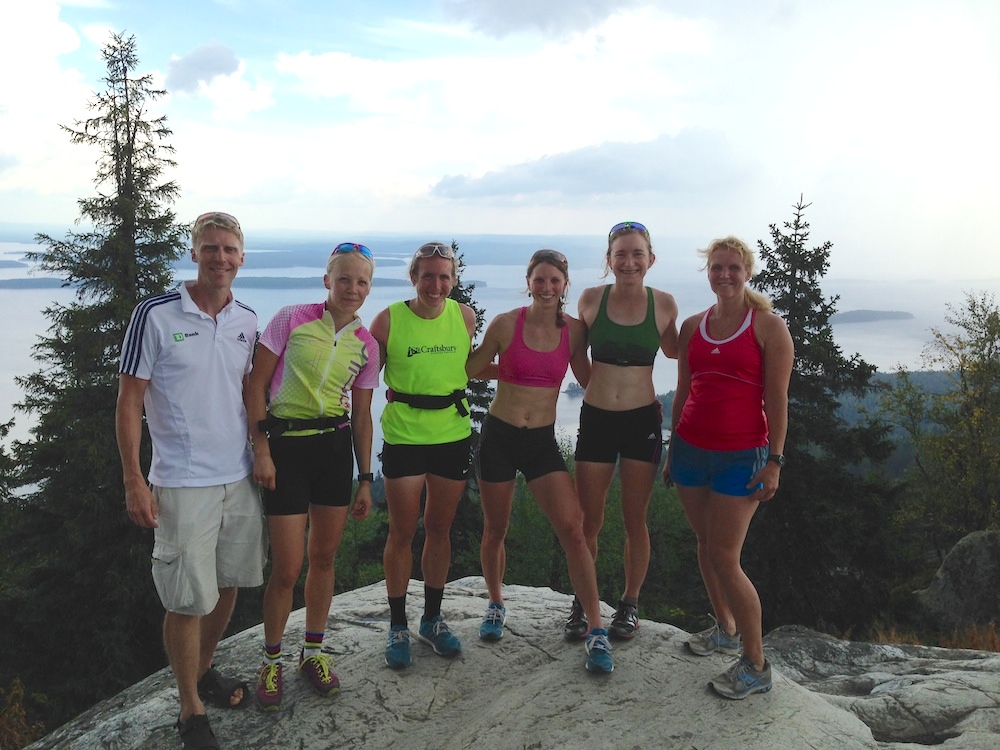
The US Biathlon women’s team after an uphill interval session up Koli, the highest point in southern Finland, with coach Jonne Kähkönen (l) and his wife (r), who also rollerskied up, and Finnish World Cup champion Kaisa Mäkäräinen (second from l). (Photo: Jonne Kähkönen)
“I think that having a women’s coach changed something in the heart of the women’s team, because it felt like a validation that we were improving and deserved someone that was there specifically for us,” 2014 Olympian and five-time World Championships competitor Annelies Cook, who retired in 2016, wrote in an email last week.
“Personally, I am really grateful that I had Jonne as a coach,” she continued. “Jonne was there in my life through many big changes and I could always talk to him and I always felt supported by him. He was always positive for us, and that is something you really need in a sport that can really get you down sometimes. Biathlon is different from cross-country skiing in where the differences in performances from day to day don’t change that drastically. Biathlon can change instantly from good to bad, and that can be really emotional sometimes.”
Kähkönen said that he learned a lot in his years of coaching in the U.S., not least from the athletes and the team’s international staff, who hail from Sweden, Italy, the Czech Republic, and Germany.
“It makes me think what works and what doesn’t work, and also to take that into account working with the athletes,” he said.
But what he learned the most was to have fun.
“I know that having fun seems dangerous to say [in a serious environment],” he said. “It’s not only about having fun, but enjoying your work and enjoying what you’re doing — I think that’s more descriptive. But, at times, having fun as well!”
Sara Studebaker, Lanny Barnes, Annelies Cook, and Susan Dunklee, with coach Jonne Kahkonen, model their new hairstyles at 2012 World Championships.
Case in point: in 2012 at World Championships, Kähkönen dyed his hair purple. He had told the team that if any of the women finished in the top 10, he’d do it. Susan Dunklee placed fifth in the 15 k individual. So purple it was.
“I think those types of things are important, whatever it is, just to try to lighten it up a little,” he said. “Me being Finnish, people say that I’m not a typical Finn. I’m more open or more lively or whatever.”
Quite apart from the hair, Dunklee’s fifth-place finish in Ruhpolding was one of Kähkönen’s favorite moments from his tenure with the team. At the time, he was midway through his second winter leading the women’s squad, and Dunklee had competed in just two weekends of World Cup racing.
“Probably one of the most exciting moments was Susan’s first breakthrough at Ruhpolding World Champs in that individual,” Kähkönen reminisced. “She had the lead for a good while, and her being really surprised by it. That was definitely, maybe not the start of it all, but one of the very good results that we had early on.”
The previous year, Sara Studebaker and Laura Spector had broken into the top 20 on the World Cup, and Haley Johnson had been close in 21st. One year later, Cook made her own jump into the land of top-20’s. And later still, Hannah Dreissigacker and then Clare Egan would hit the top 20, along with Dunklee’s four World Cup podiums and her World Championships silver medal.
“Obviously after all the hard work, all the medals, Tim [Burke] in Nove Mesto and then Susan and Lowell [Bailey] in Hochfilzen last year, those are on top of the list,” Kähkönen said.
Back to Finland
Kähkönen hesitated to say that he was headed for home.
“It may be a cliché to say that home is where your heart is, but Lake Placid has been my home,” he said. “I’ve said this to a couple of people, but it hasn’t hit me yet because I’m still here. It has been great. The community is so supportive. There are great people there and we made good friends. So it will be tough to leave when that day comes.”
The family will move this summer, after his oldest son graduates from high school in June.
U.S. women’s coach Jonne Kahkonen talks to his team between intervals at a training camp in Bend, Oregon, in 2012.
But it is an interesting assignment for Kähkönen to retake the reins of a program that has changed a lot since he last worked there.
“With Kaisa [Mäkäräinen] being the star, it is exciting to go back and work with her, if she decides to continue [racing], which remains to be seen,” he said of an athlete who had five podiums the last time he worked with the team, but now owns 23 international wins and 54 more podiums. “We worked together in the past, so it will be fun to be reunited.”
But the other pieces of Finland’s biathlon puzzle are no less compelling.
“At the same time, I think as big a part of it is seeing the rise of the next generation,” Kähkönen said. “They won a couple medals at the junior level. It’s not just the juniors and youth who won the medals, but even behind them, there are just more people doing biathlon now, which is good to see. And just seeing the good results that the men’s team is starting to post on the World Cup now. That’s inspiring to me.”
And in the end, the fun is one thing that he hopes to bring back to Finland.
“I just read in one of the Finnish papers today, Aino-Kaisa Saarinen, who is part of the cross-country team — she has trained a bunch with Kikkan Randall and the U.S. women — she made a comment that what she was missing a little bit in the last couple of years was having this sort of North American type of relaxed and having fun atmosphere while doing the work that everyone is committed to.”
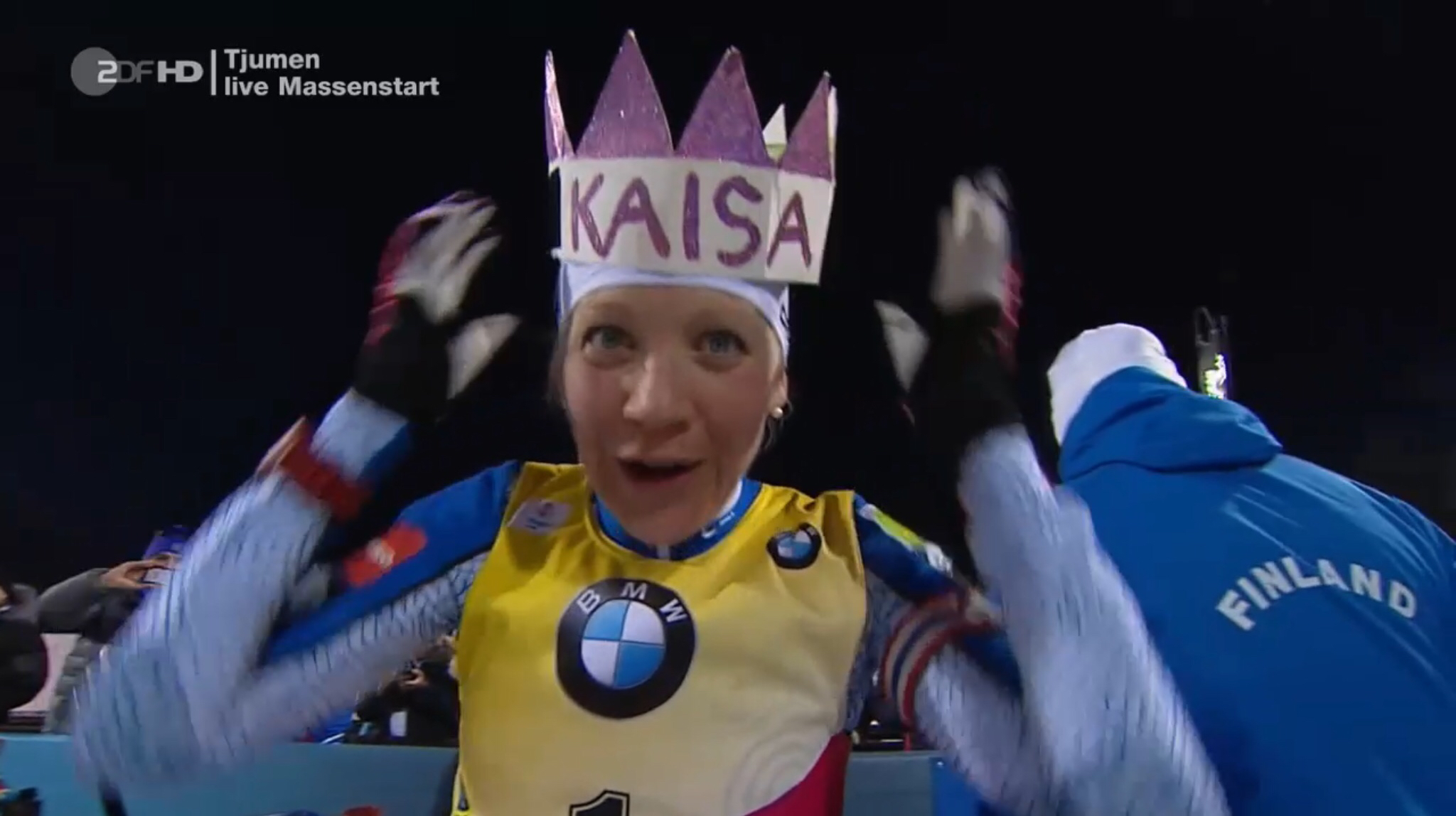
Kaisa Makarainen celebrates her third overall World Cup title after securing it with a sixth-place finish in the last race of the season, a mass start in Tyumen, Russia. (ZDF screencap)
Martin Fourcade didn’t have to do much at the final IBU World Cup weekend in Tyumen, Russia, in order to lock up the overall crystal globe. But the French biathlete came in guns blazing, so to speak, winning Thursday’s sprint by 33.2 seconds and claiming the Total Score title.
His only close(ish) challenger in the overall score, Johannes Thingnes Bø of Norway, had finished just 14th in the sprint. He raced up to second in the pursuit, but by then it was too late to take the globe from Fourcade.
It is the Frenchman’s seventh overall title; the last time anyone else won one was in 2010-2011.
“I am really satisfied with what I did today,” Fourcade told the IBU on Thursday. “It was mentally challenging all these days fighting with Johannes for the Crystal Globe. It seems easy watching on TV, but I can confirm that it is not. I must admit that it was not my main goal back [at the first World Cup weekend] in Östersund; it was the Olympics. But as the season went on, the globe became the most important aim for both of us.”
After that, Fourcade could relax a little.
“You know, before the race I planned to act like usual, be calm on the shooting range and being strategic,” Fourcade told German broadcaster ZDF after winning the pursuit, this time by 47.9 seconds. “But when I came to the zeroing [target practice] I told my coach ‘today I will play a little’. I don’t have many races to enjoy my biathlon [without pressure], to do what I would like to do. I told him ‘do not think (worry?) I will go full attack’, but I wanted to show that the strategy I had all year long is [just] a strategy not a need to shoot slow.”
On Saturday it worked; then came Sunday’s mass start. Fourcade had his worst race of the season, with four penalties and skiing to 19th place, over a minute behind winner Maxim Tsvetkov of Russia. But it didn’t matter – the globe was already decided, and Fourcade had already found his satisfaction.
The fight for the women’s crystal globe had much more drama. Coming into the weekend, Slovakia’s Anastasiya Kuzmina led by 41 points over Finland’s Kaisa Makarainen. But it was Belarus’s Darya Domracheva, in third in the standings, who won Friday’s sprint, by just 1.2 seconds over Makarainen; Kuzmina was 12th.
“Before today’s race I tried to focus only on this race, not think about the overall World Cup so much because I know that I am really [far] behind,” Makarainen told ZDF after the sprint. “But I know that everything is possible. I think that’s also the best tactic for tomorrow: not think about the others or the Total Score, just focus on a good race and enjoy that.”
Makarainen saw her chance and went for the win in the pursuit, edging France’s Anais Bescond by an even smaller margin – 0.2 seconds.
With Domracheva winning the mass start, Makarainen rallying for sixth despite three missed shots, and Kuzmina 11th with the same tally, the title went to the Finn. She edged out Kuzmina by just three points, while Domracheva was only another 15 points back.
Makarainen jumped up and down when she saw the score announced, and her teammates rushed her and placed a pink paper crown on her head. It is her third overall title; she also won in 2011 and in the 2013-2014 season, when she likewise secured the crystal globe in the very last race of the season.
The fields were somewhat reduced in size and depth as the Canadian, U.S., Czech, and Ukrainian teams all skipped the event due to Russia still remaining out of compliance with the World Anti-Doping Code. Other individual athletes skipped the races as well.
Other Notes:
Simon Desthieux of France got his first career World Cup podium, finishing second in the sprint behind teammate Fourcade.
Maxim Tsvetkov of Russia claimed his first career win in the mass start, edging Norway’s Erlend Bjøntegaard by 2.7 seconds as each shot 20-for-20.
In the men’s mass start, Slovakia’s Paulina Fialkova got her first World Cup podium, finishing second, just 1.8 seconds behind Domracheva as each had a single penalty.
The top ranked North American biathletes in the Total Score are Susan Dunklee in 34th in the women’s standings, and Tim Burke in 32nd in the men’s standings, both from the United States. The U.S.’s Lowell Bailey and Sean Doherty ranked 35th and 36th. No Canadians were ranked in the top 40.
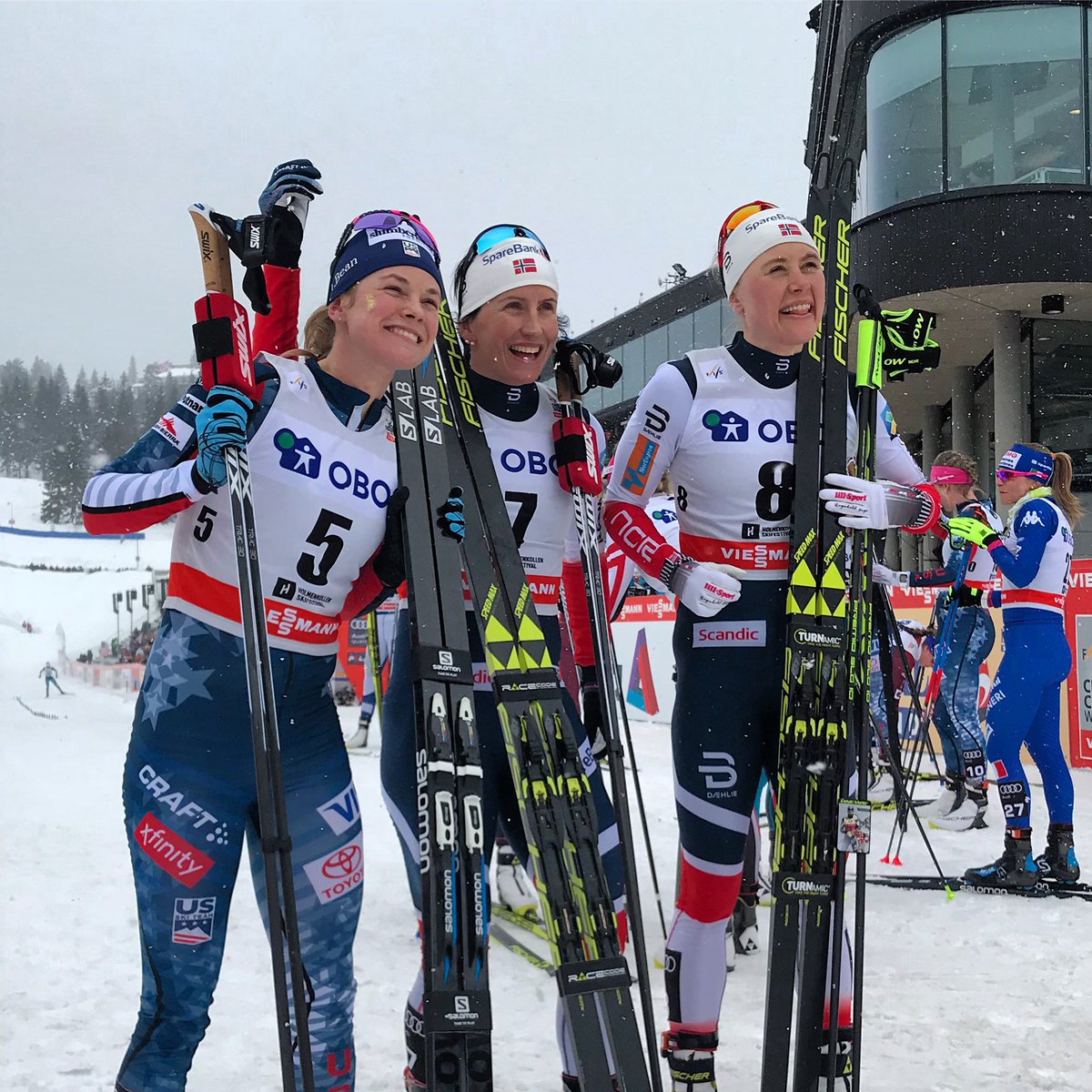
The Holmenkollen women’s 30 k freestyle mass start podium on Sunday in Oslo, Norway, with Jessie Diggins (l) in second, and Norway’s Marit Bjørgen (c) in first and Ragnhild Haga (r) in third. (Photo: FIS Cross Country/Twitter)
FIS Cross Country World Cup (Oslo, Norway): Women’s 30 k freestyle mass start
Marit Bjørgen, the Norwegian queen of distance cross-country events, racked up another victory at Holmenkollen in the women’s 30-kilometer freestyle mass start on Sunday for her seventh win in the World Cup’s ultimate distance event at the famed Norwegian venue. (She had previously won in 2005, 2010, 2012, 2014, 2015 and 2017).
But she did so in not-so-typical fashion. Instead of breaking the field mid-race and skiing to a comfortable win, like she did in the last race of the 2018 Olympics in PyeongChang, South Korea (a 30 k classic mass start), Bjørgen came from behind to win Sunday’s Holmenkollen 30 k and wasn’t able to let off too much before finish. She didn’t take the lead until less than a kilometer to go and put just enough time into her competition to take the win in 1:18:12.4 hours, while American Jessie Diggins outlasted the chase group of three to place second (becoming the first American woman to reach the Holmenkollen podium), 3.6 seconds behind Bjørgen. Norway’s Ragnhild Haga edged Sweden’s Charlotte Kalla by 0.1 seconds for third place (+4.3), while Kalla settled for fourth (+4.4).
The rest of the field was strung out, with Norway’s Astrid Uhrenholdt Jacobsen finishing fourth (+11.5) and Ingvild Flugstad Østberg nearly another 1 1/2 minutes back in fifth (+1:39.5). Finland’s Krista Pärmäkoski placed seventh (+1:51.7), Germany’s Stefani Böhler notched eighth (+2:10.2), Austria’s Teresa Stadlober ninth (+2:10.2), and Sweden’s Ebba Andersson 10th (+2:11.9). Less than a second behind Sweden’s Ida Ingemarsdotter in 11th (+2:22.8) was American Sadie Bjornsen in 12th (+2:23.4).
In the Distance World Cup standings, Diggins gained some valuable points to keep herself in third, now 63 points ahead of Pärmäkoski in fourth. Heidi Weng, who finished 18th on Sunday, still leads the distance standings by 104 points and Østberg is second, 51 points ahead of Diggins.
In the Overall World Cup, Weng leads by 153 points over Østberg. Diggins is another 104 points back in third, 100 points ahead of Pärmäkoski in fourth. At World Cup Finals next week in Falun, Sweden, a total of 300 points is up for grabs for the winners (50 for freestyle sprint, 50 for classic individual start, and 200 for freestyle pursuit).
The U.S. had three in the top 20 and four in the points (top 30) in Sunday’s 30 k, with Kikkan Randall in 19th (+3:21.9) and Caitlin Patterson in 28th (+4:13.1). Rosie Frankowski (Alaska Pacific University) missed the top 30 by about 28 seconds in 31st (+4:45.4), Liz Stephen placed 51st (+10:01.7) and Kaitlynn Miller (Craftsbury Green Racing Project) finished 53rd (+16:05.0).
Cendrine Browne led four Canadian women in 36th (+6:16.1), Emily Nishikawa was 44th (+7:36.1), Zina Kocher (Foothills Nordic) finished 47th (+8:52.0), and Dahria Beatty placed 49th (+9:45.1).
Germany’s Vanessa Hinz celebrates her first IBU World Cup win and podium in the women’s 12.5 k mass start on Sunday in Kontiolahti, Finland. (Photo: IBU/Biathlonworld)
IBU World Cup (Kontiolahti, Finland): Men’s and women’s mass starts
(Note: This rundown has been updated to include comments from Lowell Bailey and Rosanna Crawford.)
Germany’s Vanessa Hinz won her first International Biathlon Union (IBU) World Cup race (and achieved her first World Cup podium) and Austria’s Julian Eberhard won his first race of the season (and first mass start of his career) in the women’s 12.5 k and men’s 15 k mass starts on Sunday in Kontiolahti.
Germany’s Vanessa Hinz celebrates her first IBU World Cup win and podium in the women’s 12.5 k mass start on Sunday in Kontiolahti, Finland. (Photo: IBU/Biathlonworld)
Hinz shot an impressive 20-for-20 with the third-fastest range time and fifth-fastest shooting time to take the win in 35:47.9 minutes. Third after the first prone stage, she moved into second, then third after cleaning the next two stages. After knocking down her final five targets in the last standing, Hinz left the range almost 24 seconds ahead of France’s Anaïs Chevalier in second and 26 seconds ahead of Italy’s Lisa Vittozzi in third. Hinz stayed ahead of her challengers on the final loop, finishing 13.5 seconds clear of Vittozzi, who claimed second. Chevalier finished third, 16.8 seconds back, while Finland’s Kaisa Mäkäräinen was next across the line in fourth (+43.4) with a gap to Sweden’s Hanna Öberg in fifth (+1:02.1).
Vittozzi and Chevalier both cleaned the first three stages then had to ski a penalty lap after the last standing bout (0+0+0+1). Mäkäräinen missed three (1+0+1+1) yet skied the second-fastest course time on her home course, and Öberg missed two (0+0+2+0). The fastest course time of the day was clocked by Darya Domracheva of Belarus, who had to ski five penalty laps (0+1+1+3) and ended up 10th (+1:18.2).
“I always dreamed of shooting four times clean and today I did it,” Hinz, 25, said, according to an IBU press release. “I was so often close to the podium. I knew I could do it. Today, I said, ‘OK, let’s try it and if it works, it is OK … and if not there is another season waiting and other races.’ Now I am on top of the podium and it is crazy.”
Vittozzi, who placed fourth in the mass start at the 2018 Olympics, was glad to improve on a third-place finish in Friday’s sprint by placing second on Sunday.
“I have been third so many times and that was not satisfying for me,” Vittozzi said, one day after she won the mixed relay with her team in Kontiolahti. “Today I am very happy about my second place.”
For Chevalier, it was her first individual podium of the season and it came a day after she and Antonin Guigonnat won the single mixed relay. Chevalier, 25, was severely injured when she was hit by a car last spring, according to an IBU press release.
“I am very happy to be here today, because it was a very hard season,” she told the IBU. “I forgot how nice it is to be on the podium … I forgot that it was not easy, so I am very happy … I did my best on the last lap; [Vittozzi] was faster, but I am third and happy with that!”
Canada’s Rosanna Crawford shot 19-for-20 to place 13th (+1:25.9) with her only miss coming in the second prone stage (0+1+0+0). Her overall shooting and range times were 10th fastest of the 30-woman field, compared to her 26th-ranked ski time. Crawford had been in 11th after cleaning the final standing stage, then slipped two spots to finish 13th in her second mass start of the season.
“Since the skiing wasn’t feeling great today I made sure I was super focused in the range,” Crawford wrote in an email to FasterSkier. “I knew that was my only chance to get a good result today. My one prone miss was a bad trigger pull, but the rest were nice solid hits. I made sure to have a solid set up and then just trusted my rhythm and shooting.
“I knew that I wanted that top 15, so I just kept fighting and trying to stick with the women when they caught me,” she wrote of her last loop. “The last time up the wall I managed to stay close to [France’s] Anais Bescond, and hold off the two people behind me. Really happy to be in the top 15 again.”
Clare Egan was the lone American woman to qualify for Sunday’s mass start, and it was the second mass start of her career. She was on track for a top-15 result after missing just one target in the first three stages, but she had to ski three penalty laps on the last standing (0+1+0+3), which put her in 23rd by the finish (+2:05.6). Notably, she skied the 14th-fastest overall course time.
“I didn’t have quite the same energy level tonight as the last two days, but I still had the 14th rank course time and that means anything is possible in the race,” Egan wrote in an email to FasterSkier. “To put it in perspective, the winner of the race, Hinz, had the 13th rank, just 2 seconds faster than me. This is the first time I’ve felt totally comfortable skiing with the fastest women, and I certainly hope I can maintain this speed for one more week of World Cup racing.”
Egan was pleased with her 9-for-10 prone shooting and her clean standing stage (“which is the first time I’ve cleaned a standing stage in an individual race this entire year, believe it our not,” Egan wrote).
“But when I missed my second shot on the final stage, I let that throw me off my game, and really blew the rest of the stage,” she explained. “It’s so hard to keep 100% focus in every scenario, and I find it gets harder and harder towards the end of the race when I’m not necessarily the most lucid. I know that I have to work on so I have a goal to manage the final stage better next week and in the future.”
Her 23rd-place finish was one better than her previous World Cup mass start finish, which was 24th last season in Hochfilzen, Austria.
“In my only other mass start, which was last year at World Championships, I felt like an imposter,” Egan reflected. “Maybe because I was the first ‘reserve’ to get called up when one of the top women [did not start]. But this was totally different. I knew I deserved to be there today and was confident about competing with the other top women.”
“In my only other mass start, which was last year at World Championships, I felt like an imposter … This was totally different. I knew I deserved to be there today and was confident about competing with the other top women.” — Clare Egan (US Biathlon) on Sunday’s mass start
While the women raced Sunday night, the men’s 15 k mass start took place in the afternoon, when Eberhard passed the likes of France’s Martin Fourcade and Russia’s Anton Shipulin after a tangle late in the race to take the win.
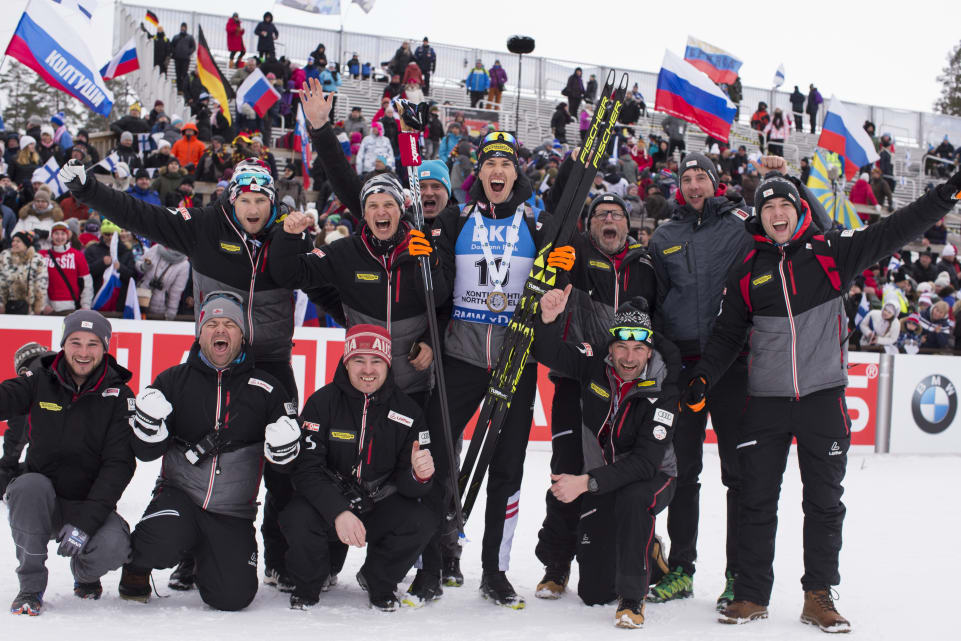
The Austrian team celebrating Julian Eberhard’s fourth career victory, his first this season and his first in a mass start on Sunday after the IBU World Cup men’s 15 k mass start in Kontiolahti, Finland. (Photo: IBU/Biathlonworld)
The Austrian had cleaned the first two prone stages to move into third by the race’s halfway point, behind Germany’s Benedikt Doll and Arnd Peiffer in first and second, respectively. Eberhard missed one in the next standing stage, yet left the range in second, 15 seconds behind Peiffer (who cleaned) in first, while Doll missed one as well to slip into third, 19 seconds back.
With two loops to go, Fourcade was coming back from two early prone penalties and found himself in fifth after a clean standing stage, less than a second behind Shipulin in fourth. On the next standing stage, Fourcade cleaned to take the lead and left the range about five seconds ahead of Shipulin (who also cleaned) in second.
Eberhard missed one yet remained in contention in third, 17 seconds behind Fourcade. On the last loop, Shipulin caught Fourcade before the course’s notorious climb known as “The Wall”, and Eberhard closed on the two frontrunners as they ascended it. Still several seconds behind over the top, he caught Shipulin on the bridge before the stadium, but the two tangled skis and Shipulin fell. Eberhard stayed upright and pulled even with Fourcade, passing him to take the win in 38:04.8. Fourcade finished second (+6.9) and Shipulin third (+19.3).
Austria’s Julian Eberhard (l) and Russia’s Anton Shipulin after the finish of the men’s 15 k mass start the IBU World Cup in Kontiolahti, Finland. Shipulin fell when his skis tangled with Eberhard’s. While Eberhard raced to the win, Shipulin placed third. (Photo: IBU/Biathlonworld)
“I wanted to be in a sprint with all three, but the bridge is too small for this,” Eberhard said, according to an IBU press release. “I came up the bridge with too much speed. Anton and I were in the same track and there was an accident. I apologized to Anton at the finish but he said these things can happen and it was OK with him.”
“I hold no grudge against Julian,” Shipulin told the IBU. “This can happen in sports and is all fair … I am in good shape and want to preserve this and perform my best in the last World Cups.”
Fourcade explained that illness caused him to sit out Thursday’s sprint, and he was only able to train three hours this week.
“It is really difficult to race in this situation without any feeling or training,” Fourcade told the IBU. “I did not know what to expect today but I am quite satisfied. I would have liked to win, but I used too much energy trying to come back in the early laps and had no energy when it was time to attack.”
Behind them, Doll picked off one place on the final loop to finish fourth (+21.9), passing his German teammate Erik Lesser, who finished fifth (+23.9). Peiffer followed in sixth (+27.1) as Germany had three in the top six.
American Lowell Bailey raced to 14th (+1:06.3) with two penalties, both of which came in the standing stages (0+0+1+1). Bailey had been fourth after cleaning the second prone, 16 seconds behind Doll in first, but slipped to 10th after missing one on the next bout. He had to ski another penalty lap on the last stage, and left the range in 14th.
Overall, Bailey posted the 10th-fastest shooting time, 15th-fastest range time and 18th-fastest course time.
“I finally felt like I was back in the spot that I ended last season,” Bailey wrote in an email when asked about his consistency. “I felt controlled and able to keep the pace with the top of the field throughout the race. It was nice to be back in the mix.
“Although I would have liked to see this ski speed a few weeks ago, better late than never!” he continued.
Next week’s World Cup in Oslo, Norway, will be his last of the season and his career.
“After nearly two decades of international racing, Oslo will be my final World Cup as a U.S. Biathlete,” Bailey wrote. “I’m sure it will be emotional but I hope to end my World Cup career on a high note!”
Clare Egan (US Biathlon) racing to a career-best 13th in the women’s 7.5 k sprint at Friday’s IBU World Cup in Kontiolahti, Finland. (Photo: USBA/NordicFocus)
IBU World Cup (Kontiolahti, Finland): Women’s 7.5 k sprint
Darya Domracheva of Belarus raced to her third World Cup victory of the season on Friday, and American Clare Egan tallied a career best in 13th, just behind Canada’s Rosanna Crawford in 12th in the International Biathlon Union (IBU) World Cup women’s 7.5 k sprint in Kontiolahti.
The women’s 7.5 k sprint podium at the IBU World Cup in Kontiolahti, Finland, with Belarus’s Darya Domracheva (c) in first, Germany’s Franziska Hildebrand (l) in second, and Italy’s Lisa Vittozzi (r) in third. (Photo: IBU/Biathlonworld)
Domracheva started 16th and shot a perfect 5-for-5 in prone, then missed one in her standing bout, but skied to first with the fastest overall course time. Her position in the leader’s chair looked secure until Germany’s Franziska Hildebrand, who started 49th, shot clean in both stages and headed out on her last loop with a 17.6-second lead on Domracheva’s time. But Hildebrand couldn’t match Domracheva’s pace and finished 0.5 seconds short of the winning time of 20:56.8 at the finish.
“I really like to compete here in Kontiolahti,” Domracheva said, according to an IBU press release. She won two gold medals there at 2005 Youth/Junior World Championships and went on to win her first two World Cup races there in 2010.
“This is a tough track, always very difficult but it always a good chance to take some seconds if you are in good shape,” she said. “I have some good memories from here…”
“I am very proud of myself,” Hildebrand said of her race, according to the IBU. “Dasha made a really strong last loop and I tried to do it as well. It was very close but I am happy to be second … I had to concentrate and have the confidence that I could shoot clean today.”
Italy’s Lisa Vittozzi started 24th and came within 5.5 seconds of Domracheva’s time, after missing one standing target (0+1), to place third, 5 seconds behind Hildebrand.
Vittozzi achieved her first career podium in Kontiolahti last year.
“This is an amazing place for me,” she told the IBU. “I like this track so much and feel in good shape. I tried to do my best in the shooting range and finally I did it.”
Ukraine’s Yuliia Dzhima shot clean but was 11.7 seconds short of the podium in fourth place (+17.2), Germany’s Laura Dahlmeier followed in fifth (+19.4; one penalty), Veronika Vitkova of the Czech Republic placed sixth (+21.0; no penalties), Ukraine’s Vita Semerenko was seventh (+21.0; no penalties), France’s Marie Dorin Habert eighth (+32.0; no penalties), Germany’s Maren Hammerschmidt ninth (+33.9; one penalty), Finland’s Kaisa Makarainen 10th (+34.4; two penalties), and Belarus’s second woman in the top 11, Nadezhda Skardino 11th (+35.3; no penalties).
Rosanna Crawford (Biathlon Canada) leaving the range during the women’s IBU World Cup sprint earlier this season in Annecy, France. . (Photo: Glen Crawford)
Crawford led Canada in 12th (+46.5) with a single prone penalty (1+0) for her best sprint result since the 2014/2015 season. Also this season, Crawford raced to a career-best third place in a 15 k individual and fourth in a 12.5 k mass start.
“It was a little bit windy and some fresh snow made for a soft track, but I had amazing skis from our techs and was feeling good skiing,” Crawford wrote in an email. “I’m really happy with how I executed my race today, I really tried to channel my inner Jessie Diggins and never stop fighting! The hills are steep and long here, something I usually struggle with, but I tried to push them mentally aside and focus on what I am good at, there are a lot of flat sections where my two skate one skate is really strong, and on the big up hills I just tried to stick with whoever was around me.
“I had a lot of fun out there tonight, something I didn’t think I would ever say about this race course!” she continued. “… I am really happy to have some good ski speed in a spring finally!”
Egan, of the U.S., achieved her best World Cup result in 13th (+46.9) with a single standing miss (0+1) and the 14th-fastest overall course time. Her previous best was 16th in a sprint four year ago.
After the Olympics, Egan explained in an email that she rented an apartment in Helsinki and spent the first part of the off-week spending some alone time and doing “some serious R&R. I don’t think I realized how chaotic the Olympics were until I had peace and quiet for the first time in 3 weeks,” she wrote.
“After a week of mostly easy skiing on my own I was really antsy to race today,” Egan added. “I also felt motivated coming off my season-best performance in the women’s relay in Pyeongchang. My individual results have been really mediocre this year so I was looking to take the momentum and confidence from the relay and carry that into today’s race.”
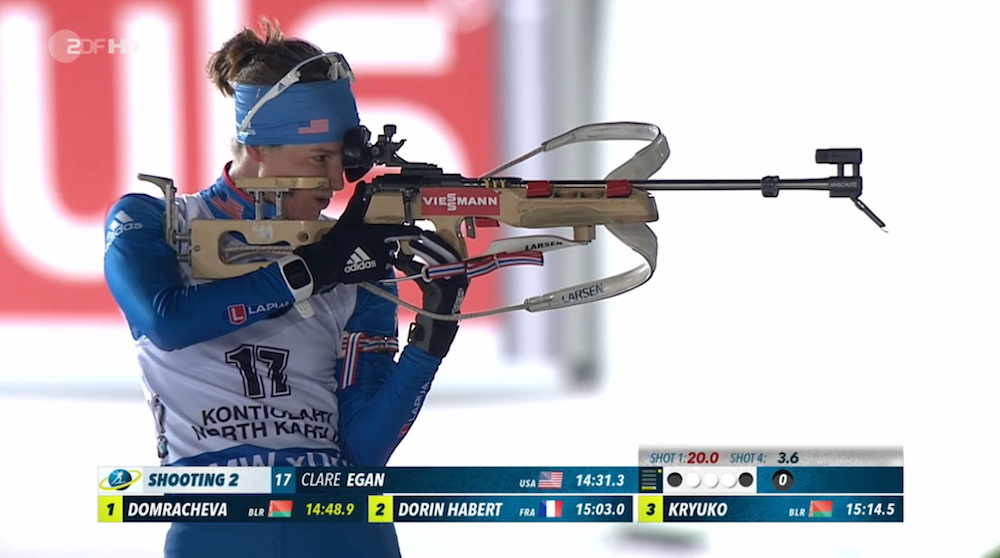
Clare Egan (US Biathlon) during her standing shooting of the IBU World Cup women’s 7.5 k sprint in Kontiolahti, Finland. (Screenshot: ZDF broadcast)
During Friday’s sprint, she noticed her skis were running really well.
“I can say without any doubt that we had the fastest skis today and that played a big role in my ski time,” Egan wrote. “I had a personal best ski time (rank) by at least 10 places today.”
After starting one bib and 30 seconds behind Domracheva, Egan knew she was having a good race when she could see the eventual winner for most of the first loop.
“Our skis were so fast that I honestly had to adjust my technique to account for the extra glide– exceptional!” she added. “On my last loop, I realized I was still ahead of Laura Dahlmeier, who started :30 seconds behind me, and I fought super hard to hold her off all the way to the finish line!
“I was shocked to have a career best with one miss,” Egan concluded. “But I had a major PR on my ski time rank, and this is biathlon! I’m very, very happy to have a great result, but happier about the performance behind the result.”
With their results on Friday, both Egan and Crawford earned starts in Sunday’s 12.5 k mass start, according to a provisional start list.
“I’ll have another opportunity tomorrow in the mixed relay and Sunday in the mass start, which is only the second of my career,” Egan wrote.
“I was pretty disappointed to not qualify for the mass start at the Olympics,” Crawford wrote. “My bad sprint had many far-reaching consequences. So I am glad I get another chance to go out there and fight with the best!”
Also for the U.S., Susan Dunklee finished 36th (+1:27.0) with three penalties (1+2), Emily Dreissigacker was 62nd (+2:15.7) with two misses (2+0), and Joanne Reid was 74th (+2:38.7) with two misses (0+2) as well.
Canada’s Emma Lunder finished 43rd (+1:48.0) with one miss (1+0), Julia Ransom was 58th (+2:07.9) with two penalties (1+1), and Sarah Beaudry finished 66th (+2:20.3) with two misses (1+1) as well.
This year’s Kontiolahti World Cup does not include a pursuit race. The single mixed relay and mixed relay are set for Saturday, followed by men’s and women’s mass starts on Sunday.
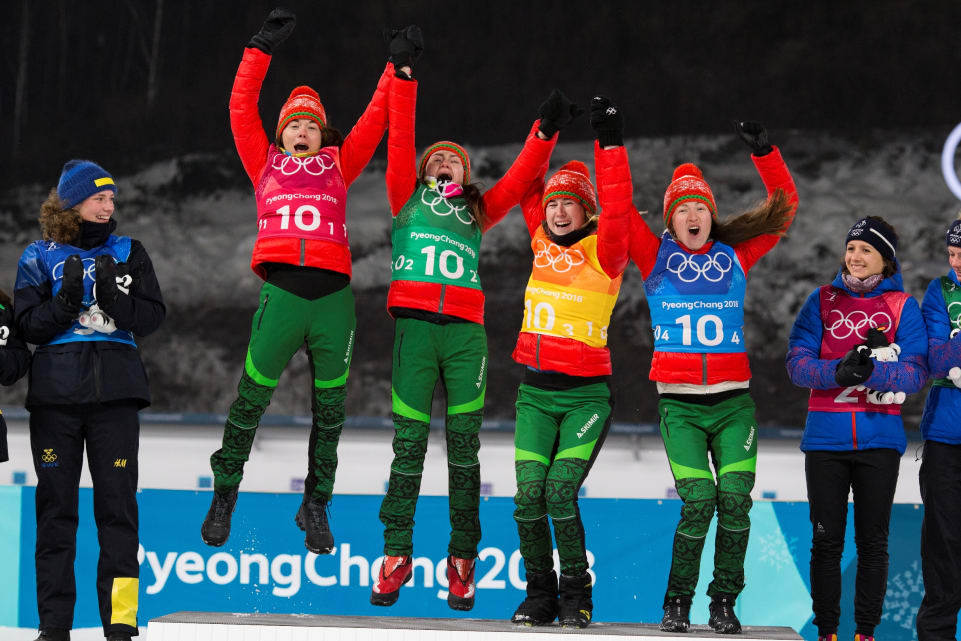
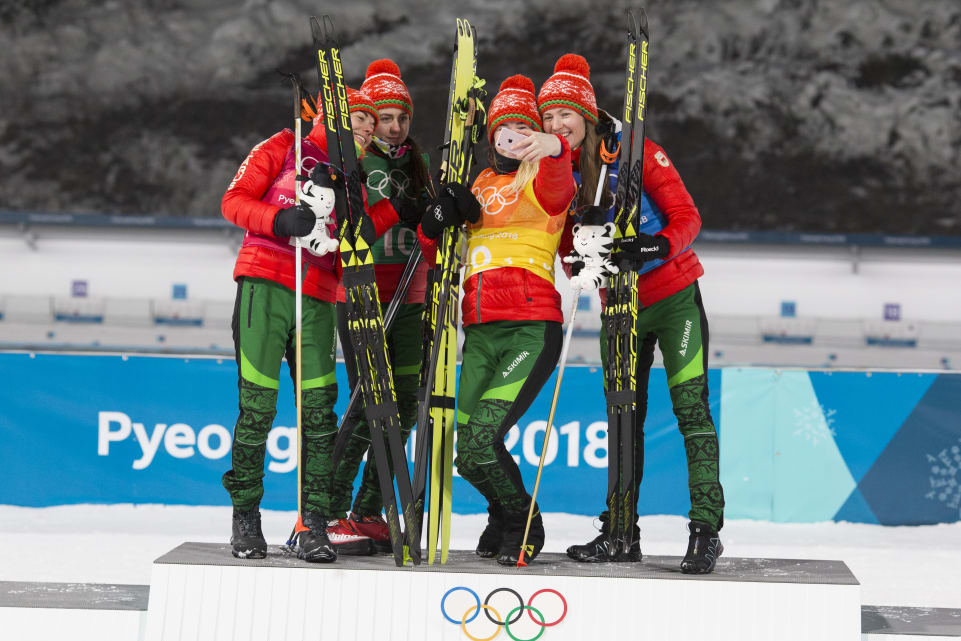
The Belarusian women’s biathlon team, with (from left to right) Nadezhda Skardino, Iryna Kryuko, Dzinara Alimbekava, and Darya Domracheva, celebrates winning a historic gold for their nation in the 4 x 6 relay at the 2018 Olympics in PyeongChang, South Korea. They were ranked 10th coming into the day. (Photo: IBU/Biathlonworld)
PYEONGCHANG, South Korea — Some things were the same on Thursday night: the attention-grabbing biathlon stadium announcer generating an atmosphere of stoke, thumping house music, and shivering yet engaged fans. Making it feel like true winter, a heavy snow squall settled in over the Alpensia Biathlon Center for the women’s 4 x 6-kilometer relay.
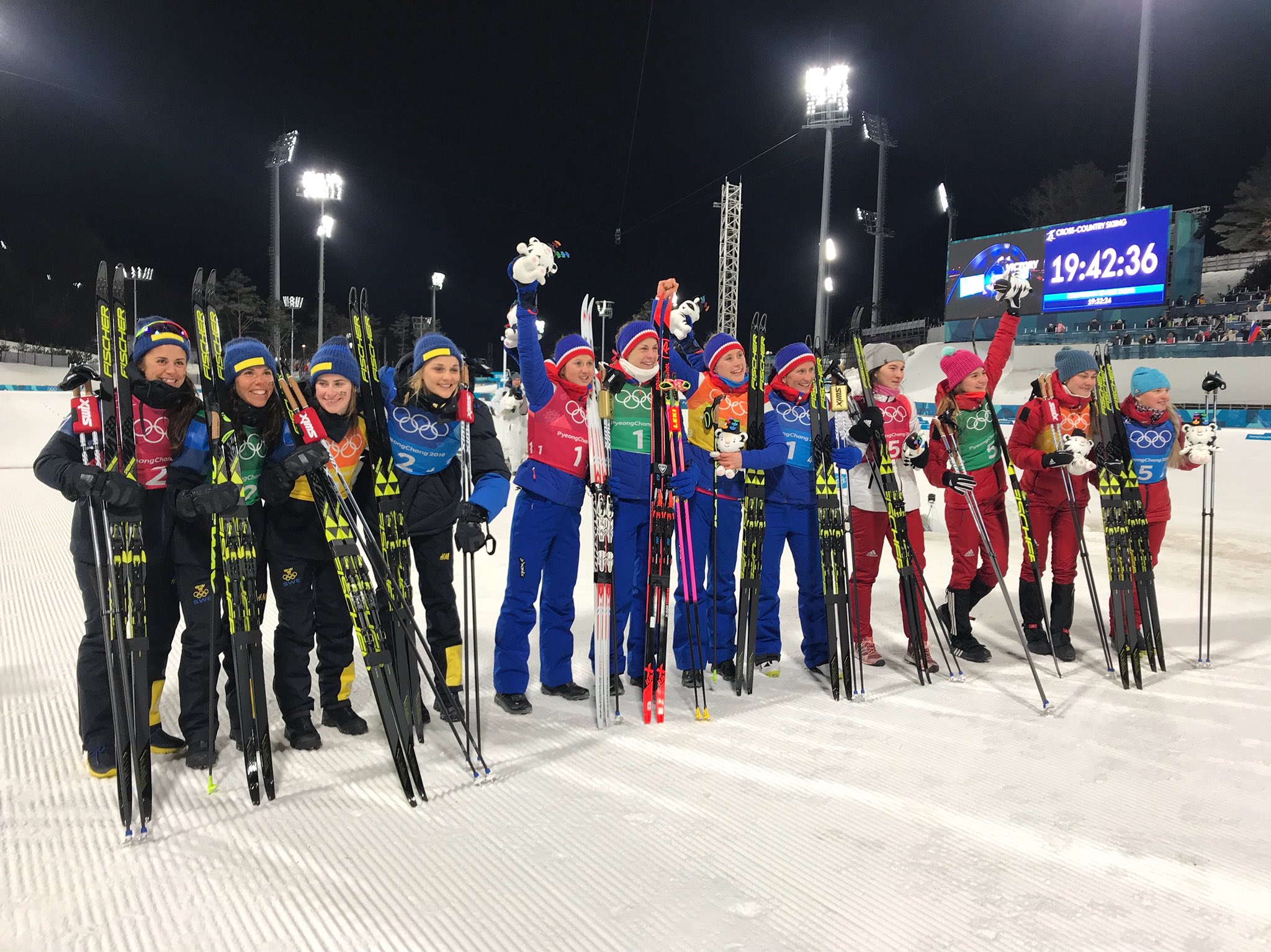
Ultimately, Belarus won gold in a time of 1:12:03.4 hours with Nadezhda Skardino, Iryna Kryuko, Dzinara Alimbekava, Darya Domracheva. Sweden’s Linn Persson, Mona Brorsson, Anna Magnusson, and Hanna Öberg took silver (+10.7), while France’s Anaïs Chevalier, Marie Dorin Habert, Justine Braisaz, and Anaïs Bescond claimed bronze (+17.6).
For the first few legs, however, all three medaling teams seemed an outside shot at the podium. On a windy and, for the first time at the Olympics, snowy evening, the win was up for grabs from the start.
After the first lap, a rainbow of suits came into the shooting range together, 7.8 seconds separating the leader from the field’s tail. America’s lead-off skier, Susan Dunklee, skied out of the range first after shooting clean in prone. The U.S. skier was followed by Ukraine, 2.9 seconds back. And Canada’s Sarah Beaudry had also cleaned without any spares to put her team in third, 7.1 seconds back.
Dunklee held her lead through the 2.9 k checkpoint and by 3.6 k, she was up to 8.1 seconds ahead of Japan chasing in second. Canada had fallen to 12th, 14.9 seconds back. With dumping snow and blustery wind before their second shooting round, it was Dunklee all entering the range all alone that was featured on the stadium’s jumbotron.
For her standing stage, Dunklee missed one target, but cleaned it with one spare. She left the range 5.2 second behind Italy’s Lisa Vittozzi, who had also cleaned with one spare. After the first leg’s final shooting stage, the field started to spread out. Beaudry used three spares to clean standing and avoided the penalty lap, returning to the course in 13th, 50.5 seconds out of first.
Susan Dunklee skiing the first leg of the mixed relay on Tuesday at the 2018 Olympics in PyeongChang, South Korea. She tagged the team in fifth and they went on to place 15th. On Thursday, she skied the U.S. women’s 4 x 6 k relay into second by the first exchange. (Photo: FlyingPointRoad)
“There’s some, as a friend of mine would call it, Disneyland snow, falling from the sky so it makes it exciting in the relay,” Beaudry told FasterSkier after her race. “Everyone shoots at the same time so I wouldn’t say anything is unfair. It makes opportunity. So hopefully my teammates can take advantage of that.”
Dunklee came through the 5.6 k checkpoint trailing Vittozzi by 7.2 seconds. At the first exchange, Italy tagged off first and Dunklee handed off to Clare Egan 7.6 seconds back in second.
“It has been a tough Games. We came in here with a lot of expectations and certainly haven’t really lived up to them,” Dunklee told FasterSkier after her leg. “It’s extremely frustrating. To think about every decision you make in your life over four years, with your best training in mind and your best performance in mind, and then getting sick at the wrong time is tough. The guys have struggled.
“We have had some bright spots with the girls; Emily and Joanne have carried us, they have had PR’s here. That is exciting,” Dunklee added, before looking up at the screen to see Egan skiing in third. “And this is exciting today. This is really exciting! Anything is possible.”
Beaudry tagged Canada’s Julia Ransom in 15th, 1:15 minutes out of first.
“I was really happy with my first lap and my prone,” Beaudry said after her first Olympic relay. “I tried to keep with the group on my second lap and I think that left me a little shaky in standing. I’m not too pleased with my two spares, but I mean, I missed three and I didn’t miss a spare, so at least shoot a spare, hit a spare.”
After the first loop of the second leg, Italy was still in first, with Dorothea Wierer at the helm. In prone, there was a reshuffling of leaders as Slovakia’s Anastasiya Kuzmina cleaned with one spare to move into first, 15.3 seconds ahead of Norway’s Tiril Eckhoff, who had cleaned with a single spare, in second. Egan cleaned without a miss and left the range in third (+17.3). Meanwhile, Wierer still had two targets standing after using all three spares, leaving her with two costly penalty laps and 1:11 minutes back in 13th.
Finland’s Kaisa Mäkäräinen shot clean to put her team in fourth, 23.9 seconds behind Kuzmina. France was sixth (+32.6), and Belarus ninth (+46.6). Canada’s Ransom shot clean without any spares and left the range in 12th (+1:08.3) while Sweden was 15th (+1:16.4).
While Kaisa Mäkäräinen moved into second behind Kuzmina on the next loop, Eckhoff and Egan followed them into the range in third and fourth, respectively. There, during an especially blustery standing stage, Kuzmina missed her first three shots and ended up with a penalty lap, which put her 20 seconds back in eighth. Wierer cleaned to reclaim first for Italy, just 0.9 seconds ahead of Mäkäräinen in second, who used two spares to avoid a penalty. Belarus’s Kryuko shot clean to leave the range in third (+7.9), and Egan hit five more shots without any spares to follow her in fourth (+10.7).
Ransom used three spares to avoid the penalty lap and headed back on the course in 10th (+44.2) for her final 2 k loop.
“Oh my gosh, I was really due for this,” Egan said after. “It’s by far my best race of the season so I couldn’t be more happy with my race.”
By the time the skiers came in for the second exchange, the order had changed again. Finland handed off in first, Italy second, 14.2 seconds back, Slovakia third (+16.1) and U.S. fourth (+16.8). Canada came through in 10th (+1:09.5).
“Kuzmina kept being behind me and then passing me,” Egan reflected. “I think every lap Kuzmina passed me so there is a lot of really fast skiers, most teams put their fastest skiers on their second legs. I tried to stay with them, but I can’t always do that. I did have people around me the whole time though so I was able to keep fighting.”
“All you can do is just leave it all on the track no matter what it is,” Ransom said of her race. “My standing was a little bit precarious, missing three from the clip. But I’m happy I was able to hit the precious spares. It was very gusty.”
Egan tagged off to Joanne Reid for the third of four legs. Reid slipped to sixth on her first loop and during her first prone shooting, she used three spares and had to ski a penalty lap, returning to the course in ninth, 33.6 seconds behind Italy’s Nicole Gontier, who cleaned with three spares, in first. Gontier skied just 0.4 seconds ahead of Slovakia’s Terezia Poliakova, who used one spare to clean.
Belarus had moved into third (+2.4), France into seventh (+19.2), while the Swedes sat in 11th (+1:33.6) and Canada, with Emma Lunder who had to ski a penalty, was still in 12th (+1:45.7).
As the leaders came in for their standing bout, it was Italy, France, Belarus, Norway, Finland, Slovakia, Poland, and U.S.A. Belarus’s Alimbekava took the lead after using one spare, Poland chased in second (+6.2), Slovakia was next, followed by Italy. The U.S. was back up to fifth (+28.1) after Reid used one spare to clean. France was sixth (+29.2) and Sweden eighth (+1:10). Lunder cleaned to put Canada in 11th (+1:24.7).
“I had a pretty good standing, but we need every second we can get,” Reid said after. “You never know what will happen in the next stage and the wind picking up. So even if we’re in fifth you never know. I was just trying to hang on on that uphill and give it everything I had.”
“I didn’t feel amazing, skiing, but I ripped off my standing with no spares, like, record fast, so I was really pumped about that,” Lunder reflected. “I moved up like a ton in the range there. So I think I tagged Rosanna in a decent position to be with some girls and fight a bit.”
Poland’s Krystyna Guzik caught Belarus’s Alimbekava and by the final exchange, it was Poland in first, France in second, Italy in third, and Belarus in fourth. Reid handed off to Emily Dreissigacker in sixth (+21.4) while Lunder tagged Rosanna Crawford in 13th (+1:22.6). Sweden exchanged in eighth (+59.1)
The skiers had maintained their order as they approached the range for the seventh round of shooting. Belarus’s anchor leg, Domracheva, shot clean to take the lead. France was now in second, Poland third, and the U.S. in seventh (+41.1), after Dreissigacker used two spares to clean. Sweden was back in ninth (+41.9), while Crawford cleaned with one spare and out for her second loop in 12th (+1:28.6).
Coming into the final shooting shooting round, Belarus teetered on a lock for gold, 24.8 seconds ahead of France in second. Poland still clung to third, 34.5 seconds back, while Sweden was now ranked seventh, 56.4 seconds back. The U.S. had moved back to tenth, while Canada was right behind them in 11th.
Domracheva missed three targets standing, but used three spares to clean and avoid any penalties to hang onto first. France’s Bescond needed three spares to clean but stayed out of the penalty lap and headed out on the final loop in second (+6.4). Sweden’s Öberg cleaned her second-straight stage without any misses to move all the way up into third (+10.9).
For the U.S., Dreissigacker used her three spares to clean standing, but experiencing unsteady winds, took her time to steady her shot and left the range in 12th (+1:20.2). Canada’s Crawford used one spare to clean and moved up to 11th (+1:19.9).
“It was really windy for my standing,” Crawford noted. “I really waited it out.”
“It wasn’t great,” Dreissigacker, a first-time Olympian, said of her race. “I didn’t feel that great skiing, might’ve went out a little hard, and the shooting just wasn’t good either. I was happy to at least hit them all with my spares, but standing especially, I took all three spares and the wind came up like crazy, right before I started shooting my spares, so I had to like stand there and wait out the wind, which cost me a lot of time.”
The Belarusian women’s biathlon team, with Nadezhda Skardino, Iryna Kryuko, Dzinara Alimbekava, and Darya Domracheva, snaps a podium selfie after winning their first relay gold on Thursday at the 2018 Olympics in PyeongChang, South Korea. (Photo: IBU/Biathlonworld)
Over the last 2 k of the race, Domracheva kept her competition behind her and crossed the line first for Belarus’s first relay gold in 1:12.03.4 (after its mixed relay team placed fifth two days ago).
Öberg passed Bescond to claim silver for Sweden, 10.7 seconds back, while Bescond anchored France to bronze (+17.6), ahead of Norway in fourth (+29.7), Slovakia in fifth (+38.4), Switzerland in sixth (+43.5), Poland in seventh (+43.6), Germany in eighth (+53.9), Italy in ninth (+1:04.1), and Canada in 10th (+1:33.4). The U.S. finished 13th (+2:01.9) of 18th teams.
With the first-place finish, Domracheva is the most decorated female biathlete in Olympic history, with six medals (four golds, a silver and a bronze) between three Olympics. Her husband, Ole Einar Bjørndalen of Norway, is the most successful Olympic biathlete of all time with 13 medals.
“I didn’t think that before you said it,” Domracheva, 31, said of her medal record during the post-race press conference. “Of course it was a lot of challenges for me on the way. Such days and such medals mean that it’s important to believe in yourself, important to believe in your team and overcome some difficulties, and then all doors are open for you.”
In the last four Winter Olympics, France has claimed three relay medals. Before Thursday’s bronze, their most recent was silver in 2010 and prior to that, bronze in 2006.
Sweden’s silver medal was its first in the women’s 4 x 6 k relay at the Olympics.
“This team worked together really hard for the last couple of years,” said Öberg, who won her first medal — gold — in the 15 k individual race earlier in the Games. “That we are here today is unbelievable. I’m really happy to share this medals with the rest of the girls.”
Crawford caught Ukraine’s Anastasiya Merkushyna in her final lap to anchor Canada to 10th while the U.S. finished three places later in 13th.
“My last loop I could hear Julia [Ransom] and Sarah [Beaudry] all around the course,” Crawford told FasterSkier. “They managed to be everywhere really cheering me on, and that fueled me to catch the Ukrainian.
“I’m just so proud of this women’s team,” Crawford added. “We fought so hard out there today. We’ve been through a lot this summer and really supported each other. And I’m just really proud of the team and I think biathlon in Canada has the potential to have a bright future.”
It wasn’t the wire-to-wire triumph that Norway sometimes achieves, but the pre-race favorites got the job done despite a scare midway through, thanks to dominant skiing by Ragnhild Haga and smooth strength from anchor Marit Bjørgen.
Norway took gold in the 4 x 5 k relay by two seconds over Sweden in 51:24.3 minutes. Olympic Athletes from Russia took bronze (+43.3), Finland fourth (+1:02.6), and the United States fifth (+1:20.5).
The first leg went out with Natalia Nepryaeva of Russia setting a blistering pace, fracturing the field almost immediately. A number of racers tried to stay with her only to get shot off the back of the pack. Taking a different pacing strategy, Slovenia’s Anamarija Lampic made up ground in the final section of the first leg to tag off in second, with Norways’ Ingvild Flugstad Østeberg third, all within a few seconds of each other.
Part of Nepryaeva’s fracturing of the field led to U.S. lead skier Sophie Caldwell getting dropped, to tag off 1:01.5 minutes back in 11th place.
In the second leg, Charlotte Kalla of Sweden and Kerttu Niskanen of Finland clocked the fastest times, making up 24.4 and 9.9 seconds that had been lost to Russia and Norway by their teammates Anna Haag and Aino Kaisa Saarinen, respectively. In the meantime, Astrid Uhrenholdt Jacobsen of Norway had a disastrous relay leg and notched just the eighth-fastest split time, falling to fourth.
Yulia Belorukova of Russia continued to lead the race on that second leg, but Kalla tagged off at the end of the classic portion just 1.4 seconds back, and Niskanen in third (+10.1). Sadie Bjornsen made up three places to tag off in eighth (+1:05.2).
Jacobsen tagged Haga 29.8 seconds out of first. From that point, Haga gradually reeled in the leaders over the course of the 5 k skate leg. It was an absolutely dominant performance, with the fastest split time by 24.7 seconds in a less than 12-minute race.
Sweden’s Ebba Andersson led Russia’s Anastasia Sedova for the whole leg and stayed clear of the field, but Haga — the gold medalist in the 10 k skate — made up enough ground to finish her effort in third, 3.4 seconds back.
That was more than enough for Bjørgen to work with, and she and Swedish anchor Stina Nilsson quickly dropped Anna Nechaevskaya of Russia and set off on their personal duel for gold. Bjørgen led the whole way, but could not make any decisive move to drop the Swede. Instead, over the top of the climb she had about a second, which Nilsson could not close on the downhill or the final flats into the finishing straight: gradually, Bjørgen just added a meter and another to her lead and crossed the line with gold.
Nechaevskaya continued to lose time on the leaders, but still held on to bronze. Krista Pärmäkoski skied an aggressive effort for Finland to pass the team from Switzerland, which had been in fourth after strong legs from Laurien van der Graaff, Nadine Fähndrich, and Nathalie von Siebenthal. But 21-year-old Lydia Hiernickel was unable to keep the pace and Switzerland dropped to seventh by the finish, getting passed by not only Parmakoski and Jessie Diggins, but also Sandra Ringwald of Germany. The Germans finished sixth (+1:49.4) and Switzerland seventh (+1:51.5).
Kikkan Randall had skied the third-fastest split of the field (behind Haga and Andersson) in the third leg to bring the U.S. into sixth, and Diggins also skied the third-fastest split (behind Bjørgen and Nilsson) for her leg to bring the team up to fifth at the finish.
The Canadian team of Dahria Beatty, Emily Nishikawa, Cendrine Browne, and Anne-Marie Comeau placed 13th (+4:50.3) of 14 teams.
The women’s biathlon 12.5 k mass start medalists at the 2018 Olympics in PyeongChang, South Korea, with Slovakia’s Anastasiya Kuzmina (c) in first, Belarus’s Darya Domracheva (l) in second, and Norway’s Tiril Eckhoff (r) in third. (Photo: IBU/Biathlonworld)
Not even a miss in the final stage could keep Slovakia’s Anastasiya Kuzmina from her third medal of the 2018 Olympics, this time gold, in the women’s 12.5-kilometer mass start on Saturday at the Alpensia Biathlon Center.
Kuzmina took charge early in the five-loop race, leading Germany’s Laura Dahlmeier into the range for the first prone shooting stage. There, Kuzmina cleaned all five targets quickly to get back out on course in first, while Dahlmeier missed one to slip out of the top 20, while several other athletes cleaned.
Kuzmina went on to hit every target over the next two shooting stages to distance herself from second place, and even with a miss on the last standing stage, she left the range 24.7 seconds clear of Darya Domracheva of Belarus in second.
Domracheva had put herself in second with clean shooting in the first two stages, then dropped to fifth with a miss on the third stage. Italy’s Dorothea Wierer was up to second by the fourth shooting after three clean stages, then fell back to seventh with a miss on the last standing.
There, Domracheva cleaned to get back into silver-medal contention, 9.3 seconds ahead of Norway’s Tiril Eckhoff in third.
Heading into the final downhill into the stadium, Kuzmina had enough time to grab a flag from one of her team’s staff members running alongside the trail. She crossed the finish line first in 35:23.0 minutes without anyone close for her third-career Olympic gold (after winning the sprint at the 2010 and 2014 Games).
Domracheva skied on her own to second, 18.8 seconds behind, for her first medal of the 2018 Games (and fifth of her career after winning three races at the 2014 Olympics).
Eckhoff, who had skied two penalty laps, took third, 27.7 seconds behind Kuzmina, while Italy’s Lisa Vittozzi held off Sweden’s Hanna Öberg, Wierer and Belarus’s Nadezhda Skardino for fourth place (+45.6). Öberg placed fifth (+46.5), Wierer was sixth (+47.3), and Skardino seventh (+47.9), ahead of Norway’s Marte Olsbu in eighth (+51.6), France’s Marie Dorin Habert in ninth (+57.9) and Finland’s Kaisa Mäkäräinen in 10th (+1:00.9). Dahlmeier, who had won two races and placed third in another at these Olympics, finished 16th (+1:47.1) with two penalties (1+1+0+0).
Darya Domracheva of Belarus (center) won the final World Cup race before the Olympics, a 12.5 k mass start in Antholz, Italy. Anastasiya Kuzmina of Slovakia was second and Kaisa Makarainen of Finland third. (Photo: IBU/Biathlonworld)
On Saturday, Darya Domracheva watched as second place in the World Cup pursuit skied away from her.
She had stepped on competitor Dorothea Wierer’s pole in the final corner of the 10 k pursuit in Antholz, Italy, and felt it unsportsmanlike to try to beat Wierer to the finish when the Italian had only one ski pole. So she let Wierer go and settled for third.
In Sunday’s World Cup mass start, Domracheva was rewarded by some combination of karma, skill, and hard work, and rounded that same corner to the finish line all alone in first place to claim her second win of the season.
Nobody shot better than Domracheva, and only six other women matched her single penalty loop. The Belarusian left the shooting range after the fourth and final stage with just a 3.3-second lead on Slovakia’s Anastasiya Kuzmina, who missed three shots in total and was coming out of the penalty loop as Domracheva skated past.
Germany’s Maren Hammerschmidt fights through thick snow in the forest during Sunday’s 12.5 k mass start in Antholz, Italy. (Eurovision screenshot)
“It was very tough race, and very slow snow conditions,” Domracheva said in a press conference of the abundant fresh snow that had fallen overnight and continued to fall off trees and onto the trails (and racers) during the competition. “So I understood from the start of the competition that it was really important to be focused on shooting today.”
But Domracheva was able to put the hammer down and extend the gap on Kuzmina, who had been the most dominant athlete of the first half of the season, and win by 11.9 seconds.
“I can say that today was quite a tough race for me,” Domracheva said. “The feeling was not so light. It was also not in the plan that here in Antholz would be very easy. So we are still in preparation, and it’s one very important step in my preparation for the next races.”
It was the last World Cup competition before the Olympics, where Domracheva will do her best to follow up on the three gold medals she won in Sochi in 2014.
Kaisa Makarainen of Finland fights to the finish line. (Photo: IBU/Biathlonworld)
Third place went to Kaisa Makarainen of Finland, who was frustrated by four missed shots and left the range (and penalty loop) the final time in eighth place. But in a stunning show of grit and speed, she charged past racer after racer; she had the fastest ski time of the day and that was particularly true on the last loop.
The Finn celebrated as she crossed the line 16.2 seconds behind Domracheva. That meant another podium – her fifth of the season – and two spots on Germany’s Laura Dahlmeier, thus hanging onto the yellow bib of the overall World Cup leader until racing resumes after the Olympics (which don’t count for World Cup points).
“I tried to ski as fast as possible and catch some places,” Makarainen said in the press conference. “I was not sure if I could catch the podium because it was quite a big gap. But I guess some other girls were more tired than me!”
Fourth place went to Norway’s Marte Olsbu (+22.6), fifth to Dahlmeier (+23.9), and sixth to her teammate Maren Hammerschmidt (+25.2).
Wierer had shot clean through three stages and led the race onto the shooting range the last time, to the thrill of the home crowd. But she missed two shots and ended the day in seventh, +29.4.
Fourcade Extends World Cup Lead with Another Win
While Norway’s Johannes Thingnes Bø came into the men’s 15 k mass start with two consecutive wins under his belt, he immediately missed two shots in the first prone stage, then two more in the next prone stage.
While Bø has turned in some of the most stunning performances on the World Cup this season, another man leads the standings, and that’s Martin Fourcade of France. Fourcade is nothing if not consistent and with only two missed shots in the mass start, he picked up his sixth win of the season.
Martin Fourcade of France leading the 15 k mass start in Antholz, Italy, where he picked up his sixth win of the season. (Photo: IBU/Biathlonworld)
“It’s good to find back this position in Antholz,” he said in a post-race press conference. “It’s only my second victory here. The first one was in the mass start in 2011, so it’s been a while and I’m very satisfied and happy to be back on top of the podium in Antholz.”
The last time Fourcade was off the podium was in the single mixed relay in Östersund, Sweden, in the very first race of the season, and the last time he was off the individual podium was back in Kontiolahti, Finland, in the second-to-last weekend of last season.
“The weekend was really nice,” Fourcade said. “I had not my best ski level on the first two competitions, but today felt really good on the skis and it gives me confidence for the Olympics… I want to keep my hunger from that last [bullet] I missed, to keep some things to work on for the Olympics.”
With the younger Bø out of the picture, the two men who ended up battling behind Fourcade were both still Norwegian: Tarjei Bø, the older brother in the family, and his teammate Erlend Bjøntegaard.
Tim Burke of the United States after finishing 22nd in the World Cup mass start in Antholz, Italy. (Photo: USBA/Instagram)
Former World Champion Bø won their sprint to the finish, crossing the line 2.8 seconds behind Fourcade (who had eased through the last few hundred meters after maintaining a big lead through the rest of the course), and Bjøntegaard picked up his first career podium in third (+5.1).
“It was quite fun actually,” Bjøntegaard said of his battle with Bø. “I’ve had a lot of hard sessions with that guy in the past two years. We were talking to each other on the fourth loop and the last loop, trying to exchange who was in front. I think that worked out quite well. I know that he is strong in the head, especially at the end, but I think I gave it a good shot and I really tried.”
After the Norwegians it was two Germans battling to the line, with Benedikt Doll taking fourth (+16.0) and Johannes Kuehn fifth (+18.3), each with two missed shots.
Johannes Bø struggled mightily against his five total penalties, and remarkably managed to make it up to sixth place, just 29.2 seconds behind Fourcade.
Biathlon Canada’s Rosanna Crawford (26) waves to some 20,000 spectators in the stands during the flower ceremony of the women’s 12.5 k mass start at the 2018 IBU World Cup in Ruhpolding, Germany, after finishing in fourth place. (Screenshot: ZDF broadcast)
Note: This article has been updated to include comments from Rosanna Crawford.
For a few minutes, it looked like Biathlon Canada’s Rosanna Crawford could clutch her second podium in her second-straight individual race in Ruhpolding, Germany, in the women’s 12.5-kilometer mass start on Sunday. Maybe it could even be the first World Cup victory of her career.
After cleaning also the 20th of 20 targets — as the only competitor to achieve that on Sunday in the elite mass start field of just 30 athletes — Crawford headed out on the final loop 16 seconds ahead of Czech Republic’s Veronika Vitkova, with Finland’s Kaisa Mäkäräinen and Germany’s Laura Dahlmeier a few additional seconds behind, all of them former World Cup winners and world champions.
“I was really surprised to leave the range in 1st, these are the 30 best women in the world,” Crawford wrote in an email.
On the prior loop, Crawford had lost just about ten seconds to those three and Darya Domracheva of Belarus, before passing them on the range with her flawless shooting. Mäkäräinen and Dahlmeier each incurred a penalty, having to ski 150 extra meters before they could return to the course to chase after her, while Vitkova had also remained clean in that stage.
But would the Canadian’s lead be large enough to reach the finish first, keeping some of the strongest skiers of the field at bay?
Anxiously looking behind several times, Crawford was overtaken by Dahlmeier and Mäkäräinen, but kept Vitkova behind her to stay in podium contention. Yet her lead was dwindling.
Kaisa Makarainen of Finland celebrates winning the women’s 12.5 k mass start in Ruhpolding, Germany, as Germany’s Laura Dahlmeier (r) takes second, Veronica Vitkova of the Czech Republic (far left) races to third, and Canada’s Rosanna Crawford (c) fourth. (Photo: IBU/Biathlonworld)
Out of the final downhill in a meandering section of turns, Mäkäräinen moved in front of Dahlmeier and held that ski-length lead into the finish. She crossed the line in a time of 34:05.6 minutes (with two penalties), with Dahlmeier just 0.8 seconds behind (also with two penalties) before collapsing to catch her breath.
Cheered on from the side of the track by coaches and teammates, Crawford remained in front right until the little tree branches marking the finishing lanes, but Vitkova was already on her tails.
“I really thought if I made it to the stadium in front of Vitkova I’d be able to hold her off, but she had the slip stream and I my legs just felt like concrete,” Crawford wrote.
Choosing the lane to her right, Vitkova pushed hard and managed to outsprint Crawford to the line for third (+4.6, with two penalties) while Crawford finished 0.6 seconds back in fourth (+5.2, with no penalties). For Crawford, the result was her career best in a mass start, and she received many congratulations from her peers and the ovations from thousands of spectators during the flower ceremony following the race.
“I would have love to hold onto a podium but was pretty dead on my last loop,” she continued, adding that she had woken up to a sore throat and congestion on Saturday, which persisted on Sunday. “In hindsight it was a mistake to be looking over my shoulder to see how close they were, I really should have just kept pushing, but this being a position I’ve never been in before I was pretty overwhelmed! Next time I will just keep fighting till I cross that red line in the snow! But having the two of the strongest women chasing me down was a bit scary! Kaisa is so fast and Laura I’m sure wanted to give the fans what they came for, a German podium!
“I was pretty disappointed when I crossed the line in 4th, but as time went by I got more and more happy,” she added. “To have hit another 20/20 is fantastic, especially in the high pressure situation of a Mass Start. With that race I went 50/50 in Ruhpolding!”
Germany’s Denise Herrmann followed in fifth (+16.7), almost making up for a penalty lap in each of the four stages by also skiing the fastest course time on each loop. Domracheva finished sixth (+23.7) after she had missed two more targets in the final standing stage (0+0+1+2).
For Vitkova it was the second podium of the season, after another third place in the sprint in Oberhof, Germany.
“I knew that Kaisa and Laura are behind me,“ Vitkova said of the exciting last loop in the post-race press conference. “My feeling on the skis was very good, and I believed that I can catch Rosanna. … It was very nice, now we have Olympic season and my results are better and better, so I am very happy.”
For Mäkäräinen, it was her first victory of the season and 22nd overall in her career. She also moved into the lead in the overall World Cup Total Score, 19 points ahead of Slovakia’s Anastasia Kuzmina in second.
“I appreciate silver and bronze a lot, too, since all podium places mean you had a good race, but victory is victory,” Mäkäräinen said in the press conference. “We were skiing quite fast all the last loop, I was on my limit all the time. … Happy that it ended this way.”
Dahlmeier, coming off a cold that forced her to forego the previous week of races in Oberhof, Germany, was satisfied with her result as well, despite narrowly missing out on another victory in front of her fans after anchoring her relay team to a win on Saturday.
“It was a lot of fun today, a really great race that had everything, suspense at the shooting range, a fight on the loop … and incredibly exciting with that finish sprint,” Dahlmeier told German broadcaster ZDF after the flower ceremony, according to a translation. “For me this was the perfect race to close out the week in Ruhpolding.”
“It was like Kaisa said, a really fast loop for us,” Dahlmeier later explained in the press conference. “We had really good equipment today, so for me it was a little bit easier on the downhill parts. We [caught] Rosanna Crawford, and I was in front on the last hill up the [shooting range climb]. Then we had the final sprint, and Kaisa was a little bit faster than me today. But I am very happy about this second place, and I think it is a really good sign that I am in good shape.”
As Crawford had told FasterSkier following her podium in the individual race, she considers Ruhpolding a “special place”, after she raced her first Junior World Championships there in 2008, her first World Cup in there in 2010, and on Thursday, her first World Cup podium (when she was third in the 15 k individual). She has followed that up with another one of her best results of her career.
“The crowd was amazing in Ruhpolding this whole week! I loved having my first podium at one of the most popular World Cup venues,” she wrote. “We had incredible skis all week and our techs worked so hard, a big shout out to them! I think none of them have voices this morning from cheering so hard in yesterday’s race!!”
And regardless of whether or not Crawford reached the podium on Sunday, multiple-time World Champion Dahlmeier pointed out, “There is no big difference even between a place in the 40s or a victory,” she said of the ups and downs of her weekend and the sport in general during the press conference. “With the shooting, you can have one or two [misses] more and you are somewhere out of the best 30. Then the next day you can win a race or be on the podium … That’s the difference between cross-country and biathlon, and that’s why we love it.”
J.T. Bø Wins Men’s Mass Start Ahead of Fourcade; Burke 21st
US Biathlon’s Tim Burke racing to 21st in the men’s 15-kilometer mass start at the 2018 IBU World Cup in Ruhpolding, Germany. (Photo: US Biathlon/NordicFocus)
Earlier on Sunday, US Biathlon’s Tim Burke successfully cleaned the first two stages in the men’s 15 k mass start to stay in contention for a top position. He left the range in 11th position and just 8 seconds behind the pace set by World Cup leader Martin Fourcade of France in first and his Norwegian rival Johannes Thingnes Bø in second.
“The atmosphere was great out on the course today with 25,000 fans,” Burke wrote in and email to FasterSkier. “No matter how many times I have done this, racing in that environment is always exciting.”
Then Burke missed the last shot in his first standing bout and had to ski a penalty lap. He came back on the course in 13th, just ahead of Fourcade who had incurred two penalties in that stage. Then Burke skied the fifth-fastest course time on the next loop, trying to again close a gap to the group ahead.
“I felt decent throughout the race but am definitely looking forward to racing on some different courses that better suit my strengths,” Burke wrote. “Ruhpolding is filled with short, steep climbs that are almost always followed by some type of recovery. Because of that, it ends up being an endless cycle of sprint then recover, which is definitely not my forte.”
After he missed two more targets in the final standing stage, Burke lost 10 positions and another 50 seconds to the leaders, leaving the range in 23rd. On the final loop he made up two places, passing Norway’s Lars Helge Birkeland and Bulgaria’s Krasimir Anev, to finish 21st (+1:30.2, with three penalties).
“Overall, I am happy with where I am at right now,” wrote Burke, who placed fourth in a 10 k sprint at the previous World Cup in Oberhof. “I just have to work on a few small details and then a top result should be possible.”
Ahead of Burke, the mass start was decided when Johannes Bø extended his lead on the fourth loop before the final shooting to almost 20 seconds, then returned to the course in first place despite a penalty in the last standing.
On the last loop he defended his lead ahead of three French athletes with Antonin Guigonnnat, Quentin Fillon Maillet and Fourcade chasing after him. Though Bø skied the second-fastest course time overall, he lost 14 seconds to Fourcade on the last loop and crossed the finish line 4.5 seconds ahead of Fourcade in 37:11.2 minutes (with one penalty).
Norway’s Johannes Thingnes Bø (2) racing to a win in the men’s 15-kilometer mass start at the 2018 IBU World Cup in Ruhpolding, Germany, with France’s Martin Fourcade behind him. (Photo: IBU/Biathlonworld)
At the press conference, Bø acknowledged that he was worried Fourcade would catch him.
“I was thinking about it when I saw him out on the tracks there, but I tried to just stay in my own lane for the tracks, and it was very good practice to stay on the lead on the last lap,” Bø said. “It’s very tough, mentally, and you just have to think forward and not so much about the people behind.
“When you fight for the win, you don’t want to be weak, you know?” Bø added when asked what gave him strength on that last loop. “So it’s just to be happy with the pain in the legs and ski as fast as you can.”
Fourcade — who temporarily dropped to 15th following two misses in the third stage — could not quite catch Bø and settled for second (+4.5), with two penalties (0+0+2+0).
“It was a really good fight at the front of the competition,” Fourcade said inatthe press conference. “I didn’t take enough time to be stable on my [first standing stage] and I missed two, but I think I could [have missed] three on that; it was a really bad one. … I knew that with two mistakes advantage, it would be really hard to come back on Johannes, and when I saw that he missed only one on the last shooting, I knew that it was already over for me.”
So he focused on at least catching his teammates Guigonnat and Fillon Maillet on the final loop, who had left the range in second and third, respectively.
“It was really special to fight with them because we know each other — our strong points and our weaknesses,” Fourcade said. “I knew that I had to be really faster than Antonin before the last finish [stretch], because he’s a really good sprinter.”
Fourcade’s 26-year-old teammate Guigonnat, who had been called up to the French World Cup team for the last three races, finished third place (+8.4, with no penalty). It was the second World Cup podium of his career, following up on another third place in the sprint in Annecy, France, earlier this season.
“I didn’t feel much pressure because I’m clearly an outsider, so nobody’s cheering for me, I think,” Guigonnat modestly said in the press conference. “And the other guys, they are fighting each other for maybe the yellow bib [of the World Cup leader] or things like this, and then I just do my job and that’s it.”
Fillon Maillet finished fourth (+12.6, with one penalty), and Bø’s older brother Tarjei Bø placed fifth (+14.2, with one penalty) after he made up by five positions on the final loop.
Burke learned Saturday that he could race the 30-man mass start, after being listed as the third alternate based on his current World Cup Total Score. After Sunday’s race, he’s up to 26th in the overall standings.
“A few athletes in front of me were sick so they decided to sit out,” Burke explained in his email. “This is very normal for a mass start, you can usually count on 1 to 3 athletes sitting out. I ended up doing that earlier this season [for the World Cup in Annecy] when I sat out the Mass Start because of a cold.“
Aside from Crawford and Burke, no other North Americans qualified for Sunday’s mass starts via the top-25 positions in the World Cup Total Scores, respectively the five best results of those outside those ranks in the individual race.
The IBU World Cup continues in Antholz, Italy, with sprints on Thursday, Jan. 18 for the women and Friday, Jan. 19 for the men.
“My fiancée will come down, so I’m looking forward to have her on her first World Cup outside Norway, so that will be fun,” Bø revealed when asked about Antholz at the press conference.
“That’s good news for me, because he will be really tired for competitions,” Fourcade quipped, as both laughed.
Fourcade continues to lead Bø in the Total Score standings, now just 44 points ahead with 666 points.
Rosanna Crawford celebrates with her Biathlon Canada teammates Emma Lunder (l) and Julia Ransom (r) after placing third for her first-career IBU World Cup podium on Thursday in the women’s 15 k individual in Ruhpolding, Germany. (Photo: Salomon/NordicFocus)
For a while it looked as if the podium in the women’s 15-kilometer individual at the Thursday’s IBU World Cup in Ruhpolding, Germany, had been all but decided with only a few more athletes circling the course. But then the favorites who had already finished had someone to worry about.
Along with some 13,000 spectators in the stands, they paid close attention to the video walls in the arena, as one late-starting Canadian — Rosanna Crawford — had just set the best split time after the third shooting by hitting every target for the third time in a row. She was even 1.8 seconds ahead of race leader Dorothea Wierer of Italy.
“I actually didn’t know I was fighting for a podium until the fourth loop,” Crawford told FasterSkier on the phone after the race. That’s where Czech wax technician, Tom Zidek, a former Biathlon Canada wax tech, told her she was is in first place.
Canada’s Rosanna Crawford (standing) celebrates her first IBU World Cup podium on Thursday after placing third in the women’s 15 k individual in Ruhpolding, Germany, while Sweden’s Emma Nilsson (who placed 36th) unclips. (Photo: Salomon/NordicFocus)
“I was like, Oh God!” she recalled with a laugh. “But I think that kind of helped as well because then I knew to expect the crowd for the last standing.”
Could this be Crawford’s big day? Coming into the range for the final standing shooting, the 29-yaer-old Canmore native knew she likely would get a season-best result if she did not totally implode, but needed to shoot clean again to stay in podium contention and not get hit with the individual race’s merciless one-minute penalty per miss.
“I made sure just to set up properly, and then I took an extra breath before my last shot and was pretty pumped to see it turn to white,” Crawford recalled of her last shooting stage. “I am a person who really likes cue words and I have a few sentences that I repeat over in my head. … I knew the only way I was going to hit the targets is if I only thought about the present moment.”
After she had cleaned all five targets for the fourth time, bringing her shooting percentage to a perfect 20-for-20 (the first time she had ever done so in a race), Crawford skated off the shooting mat with a smile on her face. She left the range now 7.8 seconds behind Wierer’s time (after the Italian had also hit all 20 targets), but was still more than 20 seconds ahead of Finland’s Kaisa Mäkäräinen (who had incurred one penalty in her first prone shooting but shot clean after that) and Ukraine’s also clean-shooting Yuliia Dhzima.
“Being one of the last competitors with bib 96 I had a lot of time to wait,” Crawford said at the IBU’s post-race press conference. “I knew all the eyes were on me probably for my last two shootings. That is something I have never experienced before, going from the third loop onwards where everyone was cheering for me around the loop. … It’s a feeling I have never had before to hit all 20, so I was really excited to ski out of the range.”
With her team staff, including head coach Matthias Ahrens running next to the track cheering her on, Crawford chased around the loop up the steep “Wall of Ruhpolding” climb. Overall she skied the 26th-fastest course time of the day, and on the final loop in softening conditions, her loop time ranked 48th. But she still hung onto the podium.
“The course had broken down a little bit, with a hundred-and-something starters, so by the time I went around I was really searching for the best line, which I think paid off as well,” Crawford said.
The women’s 15 k individual podium at the IBU World Cup in Ruhpolding, Germany, on Thursday, with Italy’s Dorothea Wierer (c) in first, Finland’s Kaisa Mäkäräinen (l) in second, and Canada’s Rosanna Crawford (r) in third. (Photo: Salomon/NordicFocus)
Coming out of the downhill and onto the finishing stretch with the thousands of spectators cheering her on, Crawford fought the clock. She was out of reach of Wierer, but still within striking distance of Mäkäräinen in second. At the finish, Crawford was third, 21.2 seconds behind Wierer and 8.5 seconds behind Mäkäräinen in second place (+12.7). The Canadian was comfortably ahead of Dhzima in fourth (+45.9), while another clean-shooting Ukrainian, Valj Semerenko, placed fifth (+52.6).
“I am so excited today, it was really special, my first time hitting 20-for-20 as well,” Crawford said at the press conference. “I really love Ruhpolding! It was my first World Juniors, my first World Cup, and my first podium, so it’s a very special place for me.”
As Crawford skied into the finish she looked up to the nearest video monitor to check if she indeed had managed to hold her position on the podium for the first time. But she didn’t have to wait long for confirmation as her teammates and coaches already rushed out into the finish to hug and congratulate her.
“Julia [Ransom], Emma [Lunder] and Sarah [Beaudry], they kind of pushed past the IBU guys, which I don’t think they were allowed to do, but Canada’s not on the podium every day so they let them sneak by to give me a hug so that was really special,” Crawford told FasterSkier. “I’ve been with these girls the past couple years now and so to be able to celebrate with them is amazing. Their results have been so inspiring for me … [My coach Roddy Ward] also jumped the fence, which I don’t think was allowed, so that was nice to be able to see him as well.
Biathlon Canada celebrates Rosanna Crawford’s podium on Thursday in the IBU World Cup 15 k individual in Ruhpolding, Germany, with (from left to right) coach Roddy Ward, Crawford, Emma Lunder, Julia Ransom, and Sarah Beaudry. (Photo: Salomon/NordicFocus)
“It’s just such a team effort to get to the podium,” she continued. “I’m the one out there skiing and shooting, but I couldn’t have done it without the amazing skis on my feet or my coaches behind the scope, so Matthias and Roddy were really important there, and I couldn’t have done it without the girls who I train with all summer. I’m just so grateful for this team that I’m on.”
“So proud!!!” her longtime boyfriend and teammate Brendan Green wrote on Instagram with a screenshot of Crawford finishing.
“Brendan is amazing,” Crawford said. “I’m sure he was pretty nervous. He was the first text messages and tweets and Instagrams that I had on my phone. Right now I’m having dinner with him and then we’ll go to the awards ceremony tonight. It’s really special.”
“It’s incredible for me, not something that I was really expecting this season,” she told German broadcaster ZDF in an interview immediately after the race. “I didn’t have the best summer of training so to be on the podium is really special for me.”
That was an understatement. Last spring, Crawford and her family dealt with a severe personal tragedy with the loss of her brother Jordan.
“It was such a hard summer for me, losing my brother in April,” she told FasterSkier. “I really wish he was here today so I could celebrate with him, too. I miss him a lot. Jordan was a huge cheerleader for me. He always believed in me. Whenever I was home, he was always cooking me food and helping me take care of the dogs, and he was always so concerned that he was causing me stress. … Jordan loved the outdoors so whenever I was out in a valley or skiing or mountain biking, he was always in my thoughts, and wishing I could share these things with him. It was really hard on the whole family, but it brought us closer together as well in some ways, to support each other.”
Asked if she had caught up with her family members yet, including her sister Chandra Crawford, a 2006 Olympic gold medalist in cross-country skiing, she said she had spoken to all of them.
“Training was always a little bit on the back burner for the first couple months while we were all grieving and then once finally the motivation came around again to start training, it felt right and proper,” she said of her offseason and transition to another race season. “But then again, the results just were not paying off through the first trimester [of the World Cup] and I didn’t know what I was doing wrong and I was really starting to lose hope.”
Crawford’s previous best non-relay result this season was 39th in the 10 k pursuit in Hochfilzen, Austria. And her last time in the top 10 outside a relay race was back in December 2014, where she placed fourth in a sprint and seventh in a pursuit in Pokljuka, Slovenia.
Coincidentally, Germany’s ZDF network featured the Canadian women’s team in a preview to the individual race, filming them and coach Ahrens while they attended a one-hour cooking class in Ruhpolding. But they certainly had not intended it as a segment on a likely podium finisher for the very next race.
“Yes, of course the Bavarian food fueled me around the course,” Crawford said with a laugh when ZDF asked about that.
“Just thank you so much to the fans. There is no way I would have been able to ski around that last loop without them,” she added.
“This really describes the biathlon family,” Crawford later explained in the press conference. “That it doesn’t matter which country you are from, people will be cheering for you. And not only the fans but also the techs. Jarko, Kaisa’s head wax tech, who used to wax for Canada, he was giving me splits off of Kaisa telling me, ‘You are ahead of Kaisa, go get her!’ So they might have to have a serious conversation tonight! It was really incredible.”
Rosanna Crawford (Biathlon Canada) finishing third in the IBU World Cup women’s 15 k individual in Ruhpolding, Germany. (Photo: Salomon/NordicFocus)
In her interview with FasterSkier, Crawford also spoke of a Ukrainian coach who cheered her on for the final loop. “I think this really describes what the biathlon family actually is,” she said. “It’s not the IBU. It’s the coaches and the athletes and the wax techs and the fans, that is actually the biathlon family.”
Despite all the support she had felt throughout the year, Crawford had a season she was not satisfied with so far, with two 39th places as her best results (excluding relays). Going into this race, she ranked 79th in the overall World Cup standings. Last weekend, instead of starting at the World Cup in Oberhof, Germany, she raced two sprints on the IBU Cup in Brezno-Osrblie, Slovakia, where she placed 15th and 22nd. More so than a demotion, that was a move Biathlon Canada made to give other women on the team a chance to qualify for the upcoming Olympics.
“This season has definitively not started out very good for me, and then getting sent to the IBU Cup was really frustrating,” Crawford said on the phone. “But I did really like the course in Osrblie, and it was the best skiing I’d felt all year so I really tried to carry that momentum into today’s race. … I think staying in Europe over Christmas was incredibly beneficial for us.”
Crawford’s previous career bests in non-relay races have come in sprints, with her fourth place in Pokljuka and a fifth place in Hochfilzen, both during the 2014/2015 season. She’s been on the podium before, placing second with teammate Nathan Smith in the single mixed relay in Östersund, Sweden, to open the 2015/2016 season.
“There’s just so many lessons you learn over the years, and trying to bring it all together and to have it pay off on one day is exactly what we’re all hunting for out there,” Crawford concluded.
Fourth Career Victory for Wierer
Italy’s Wierer, who frequently performs very well in this competition format and also won the individual in Ruhpolding in 2016 (Crawford placed 18th back then as the best North American) set the best time on Thursday, crossing the line after 41:29.0 minutes.
“I am really happy about this,” Wierer said at the press conference. “I knew that it’s all about the shooting. In the last individual competition I shot really bad, but the last weeks I feel really confident about my shooting. I think the track was really good, and hard conditions are much better for my skiing. The shooting range wasn’t difficult today, there was nearly no wind.”
Asked about having to wait if her time would ultimately be good enough for first place, she added with a laugh: “I was looking [at] Rosanna, and I was afraid of her. But finally I saw that she was some seconds behind me. I wasn’t sure because on the last round I lost a lot, I was really tired, but at the end she didn’t get me!”
On her 35th birthday, Mäkäräinen finished second (+12.7). She was the only finisher in the top five with a penalty, incurred during her first prone shooting.
“It’s a good present,” she said at the press conference when asked about her second place. “I have actually managed to do many good races on my birthday, so this is nice. … 19 out of 20 is really good for me, probably my best shooting this winter, so I am really happy about that and not thinking too much about that one penalty.”
“It’s an amazing place,” she added when asked about her tendency to do well in Ruhpolding. “I like it a lot here because the crowd is really close to us, and there were a lot of people from Finland here, also my parents and their friends. So it was a nice atmosphere today.”
She added that she did not intend to extensively celebrate her birthday with her family.
“I will celebrate by having a massage and good dinner,” Mäkäräinen said. “Just basic things, the athlete’s life goes on, we have more races to come.”
Dunklee 27th, Ransom 34th
For US Biathlon, Susan Dunklee finished 27th with three penalties (1+1+1+0), staying ahead of a number of competitors who performed better on the range thanks to her 14th-ranked ski time.
“Certainly the highlight for me today was watching Rosanna crush it,” Dunklee wrote in an email. “Her whole team, athletes and staff, were overjoyed. It’s inspiring to see and lends positive energy to all the North Americans going forward.”
“This was the first race that felt normal for me and not an extreme high or low,” she wrote of her own race. “It’s a relief. The skiing felt great today and I have no doubts in it going forward. Shooting is finally rounding into form; 85% is a solid result. My goals going forward are to stay healthy and happy and I believe that’s what I need most to perform well in February.”
US Biathlon’s Clare Egan in front of the stands in the finish of the women’s individual 15-kilometer race at the IBU World Cup in Ruhpolding, Germany. Initially she was ranked 35th, and ultimately ended the race in 57th. (Screenshot: ZDF broadcast)
Starting about in the middle of the field in bib 43, her teammate Clare Egan was initially 35th as she came into the finish, waving to the cheering crowd as she was shown on the video wall. As more athletes ended their races ahead of her, she ultimately finished 57th (+4:26.3) with three one-minute penalties (0+1+0+2).
“Finally a race I can be proud of!” Egan commented in an Instagram post.
“We will field our first women’s relay this weekend,” Dunklee wrote of their team, which will be joined by athletes who competed at the IBU Cup in Arber, Germany, on Thursday. “It has been a challenging season so far living and traveling with such a small crew, trying to stay upbeat and carry the team with a skeleton group.”
Starting the race early in bib 5 and thus completing her race before Crawford’s had even begun, Biathlon Canada’s Julia Ransom placed 34th (+3:35.0) with two penalties (1+1+0+0). Sarah Beaudry finished 53rd (+4:18.6) with two penalties (0+1+1+0), and Emma Lunder was 67th (+5:21.7) with four penalties (1+0+2+1).
After their own races had concluded, they could only wait for Crawford after learning about the great day she was having and excitedly ran out into the finish to greet her.
“It’s really amazing for our country and for our sport,” Crawford said in the press conference. “Hopefully there will be a few more eyes on biathlon during the Olympics. The last person to get a podium was Zina Kocher in the individual as well [a third place in Östersund during the 2006/2007 season]. So this is becoming a special race for Canada. Julia Ransom had a personal best with a ninth place in Östersund, so we seem to be individual specialists.”
Skardino Earns Individual Discipline World Cup
Since the IBU does not count the races at the upcoming Olympics for World Cup points and standings, this second individual race was also the last one on the competition calendar this season.
Thus Nadezda Skardino of Belarus, who won the first individual race of the season in Östersund, managed to claim the “crystal globe” award in that discipline by finishing seventh in Ruhpolding on Thursday (+1:04.8, with no penalty). It was Skardino’s first World Cup discipline title.
Despite finishing ahead of her in fourth on Thursday and another third place from the race in Östersund, Ukraine’s Dzhima could not make up enough points and placed second in the standings just five points back, while Mäkäräinen was third. Even without Crawford still finishing ahead of Skardino and Dhzima the outcome would have been the same.
“It was my dream, and now I’m minus one dream in my life,” a smiling Skardino told the IBU. “I am very happy, because I thought about it after my win in Östersund. … And now I did it! Today I was not very fast on the tracks, I only thought about my clean shooting. I understood that I can win [the discipline title] if I shoot clean. I knew if some more people stay between Yuliia and me I could lose more points and still lose this, but after all people finished I was very happy I did it!”
Crawford placed 12th in that ranking as the best North American, scoring 2 points for her 39th place in Östersund and 48 for the third place in Ruhpolding.
The women’s World Cup Total Score leader Anastasia Kuzmina of Slovakia, coming off two victories last weekend in Oberhof, placed eighth on Thursday (+1:32.3, with three penalties) to retain her lead there.
Races in Ruhpolding continue with a men’s relay on Friday and women’s relay on Saturday, before concluding with mass starts on Sunday. Crawford is now qualified for that race as one of the five best athletes this week not currently in the top 25 of the overall World Cup; she is now ranked 48th in the Total Score standings.
Rosanna Crawford (Biathlon Canada) celebrates her first-career IBU World Cup podium on Thursday in the women’s 15 k individual in Ruhpolding, Germany. (Photo: Salomon/Nordic Focus)
IBU World Cup (Ruhpolding, Germany): Women’s 15 k individual
It’s been a long time coming, but on Thursday, Rosanna Crawford, 29, achieved her first podium on the International Biathlon Union (IBU) World Cup circuit.
It came in Ruhpolding, Germany, in the longest-format race for the World Cup women: the 15-kilometer individual. In the four-stage race, which adds a minute penalty to a competitor’s time for each missed shot, Crawford of Canmore, Alberta, shot a perfect 20-for-20. She said she had never done that before in a World Cup race.
“I really like the Ruhpolding range,” Crawford said in a post-race phone interview, after finishing third behind Italy’s Dorothea Wierer and Finland’s Kaisa Mäkäräinen, respectively. “This was my first World Juniors, my first World Cup and now my first podium, so it’s a pretty special place for me.”
Wierer won the race with 20-for-20 shooting as well, starting 24th and finishing with the fastest time of 41:29.0 minutes. Mäkäräinen as the 12th starter missed out on first place due to a single miss in the first prone (1+0+0+0) and ended up 12.7 seconds back in second place.
Crawford, one of the last starters in bib 97, turned heads throughout the race with each passing clean bout. With one extra breath before her last shot, she successfully hit her last target and left the range with a huge smile.
“I think I almost started crying,” she recalled.
She finished 21.7 seconds out of first, and almost 25 seconds clear of fourth-place finisher Yulia Dzhima of Ukraine. Even a Ukrainian coach was cheering for Crawford on her last loop.
“That last lap was so cool,” Crawford said. “Right past the penalty loop, the Ukrainian coach was like, ‘You’re one second, — or whatever time I was — from first,’ and it was amazing. I think this really describes what the biathlon family actually is. It’s not the IBU. It’s the coaches and the athletes and the wax techs and the fans.”
Her teammates and coach, Roddy Ward, awaited her arrival in the finish pen.
“Canada’s not on the podium every day so they let them sneak by to give me a hug so that was really special,” Crawford said.
Her result is her first non-relay top 10 since a pursuit in December 2014, where she placed seventh in Pokljuka, Slovenia. The race before that, she placed fourth in the Pokljuka 7.5 k sprint, which was had been career best — until Thursday.
“Who knew that I would get my first podium in an individual?” Crawford mused. “I was laughing at that myself.”
The U.S. was led by Susan Dunklee in 27th (+3:02.7), who had one penalty in each of the first three stages (1+1+1+0).
Canada’s Julia Ransom placed 34th (+3:35.0) with two penalties (1+1+0+0), Sarah Beaudry was 53rd (+4:18.6) with two misses as well (0+1+1+0), and Emma Lunder finished 67th (+5:21.7) with four penalties (1+0+2+1).
Two Americans raced, with Clare Egan finishing 57th (+4:26.3) with three penalties (0+1+0+2).
“Certainly the highlight for me today was watching Rosanna crush it,” Dunklee wrote in an email. “Her whole team, athletes and staff, were overjoyed. It’s inspiring to see and lends positive energy to all the North Americans going forward.”
She also pointed out that her U.S. teammates Emily Dreissigacker and Maddie Phaneuf placed fifth and 11th, respectively, with clean shooting in the IBU Cup women’s 15 k individual, also on Thursday.
“That spark is exactly what our team needs right now and the timing is spot on,” Dunklee continued. “We will field our first women’s relay this weekend. It has been a challenging season so far living and traveling with such a small crew, trying to stay upbeat and carry the team with a skeleton group.”
The World Cup men’s 4 x 7.5 k relay is scheduled for Friday at 8:30 a.m. EST, with both Canada and the U.S. entering teams. (Men’s relay start list)
The women’s 4 x 6 k relay is on Saturday at 8:30 a.m. EST, with the men’s and women’s mass starts following on Sunday in Ruhpolding.
Slovakia’s Anastasia Kuzmina celebrates her second-straight IBU World Cup win in Oberhof, Germany, on Saturday with a 1:04-minute victory in the women’s 10 k pursuit. It marked her fourth win of the 2017/2018 season. (Photo: IBU/Biathlonworld)
IBU World Cup (Oberhof): Women’s and men’s pursuits
So far in 2018, Slovakia’s Anastasiya Kuzmina is undefeated after winning her second-straight race on Saturday at the International Biathlon Union (IBU) World Cup in Oberhof, Germany — this time by 1:04.4 minutes in the women’s 10-kilometer pursuit.
After winning Thursday’s sprint, Kuzmina started 35 seconds clear of anyone else on Saturday, while Finland’s Kaisa Mäkäräinen headed out of the gate after her in second.
Veronika Vitkova of the Czech Republic started another 5 seconds back in third, and Germany’s Franziska Hildebrand set out in fourth, 47 seconds after Kuzmina.
Three Canadians finished in the top 60 of Thursday’s sprint to qualify for the pursuit, with Julia Ransom heading out ninth (+1:14), Sarah Beaudry starting 23rd (+1:39), and Megan Tandy starting 59th (+2:38).
Throughout the four-stage race, it became more and more evident that no one was going to touch Kuzmina. She cleaned the first prone stage to leave the range 55.8 seconds clear of Hildebrand, who also cleaned to move into second. Makarainen dropped to fourth with a miss and Vitkova left the range in third (+1:08.5) after skiing a penalty lap as well.
On the second prone stage, Kuzmina missed one target, but the penalty lap only cost her about 10 seconds; Hildebrand cleaned to keep herself in second place with three loops remaining.
The first standing stage that followed saw Kuzmina miss another target and Hildebrand clean, yet 34.6 seconds still separated them. Kuzmina finally cleaned the last standing to extender her lead back up to a minute, while Hildebrand missed one to lose sight of the podium, slipping to fifth and 1:22.4 back at the start of the final loop.
Italy’s Dorothea Wierer as the 16th starter steadily worked her way up to podium contention, cleaning all four stages with the third-fastest overall shooting time to put herself in second after the final standing, 1:00.2 behind Kuzmina. Ukraine’s Vita Semerenko raced up from 22nd to third with perfect 20-for-20 shooting as well, leaving the range 11 seconds after Wierer with one loop to go.
On the final loop, Kuzmina skied the 22nd-fastest time on that loop (compared to Wierer’s 28th-fastest last-loop time) to put a few more seconds into Wierer as the eventual runner-up, winning in 30:49.5. On the day, Kuzmina’s overall course time was eighth fastest.
“It was a very interesting race for me today,” Kuzmina told the IBU after. “My shape is very good now but I was worried if I could concentrate on the shooting … After the first shooting, I was relaxed and realized it was OK. I just gave the other girls two chances … I must apologize for my emotion [on the shooting range], but I was so happy and enjoyed the last loop.”
Wierer finished 1:04.4 minutes later for second place, and Semerenko crossed the line in third, 1:10.2 out of first. Poland’s Weronika Nowakowska finished fourth (+1:17.1) after starting sixth, with clean shooting, and Mäkäräinen ended up fifth (+1:23.4) with three penalties (1+0+1+1) and the fourth-fastest overall course time. Belarusian Darya Domracheva followed in sixth (+1:28.8) after starting seventh and shooting 18-for-20 (0+0+1+1), and Germany’s Laura Dahlmeier finished seventh (+1:28.8), up from 13th with one late penalty (0+0+0+1).
South Korea’s Anna Frolina placed eighth (+1:36.0, two penalties) for her best result since December 2012, France’s Justine Braisaz finished ninth (+1:37.0; three penalties), and another French skier Anais Bescond 10th (+1:37.1; one penalty). Hildebrand lost six places on the final loop to end up 11th (+1:38.7; one penalty).
Overall, France’s Celia Aymonier skied the fastest course time of the day to rise from 28th to 15th (+2:08.7; three penalties).
Ransom finished the day in 37th (+3:54.4) with three misses (1+0+0+2). She had been in 16th after her early miss in the first prone stage then hovered around the top 20 as she entered her final standing stage. There, she missed two to drop to 36th and she ultimately lost one more place to Finland’s Mari Laukkanen (who started the loop in 37th and passed Ransom, as well as four others, to finish 32nd).
In her first World Cup pursuit of the season, Tandy improved to 43rd (+4:31.8) with a single miss (0+0+1+0). Overall, her range time was the 18th fastest and shooting time was 23rd fastest.
Beaudry finished 51st (+5:36.6) with three misses (1+2+0+0), recovering one place from skiing in 52nd after the second shooting.
In the men’s 12.5 k pursuit that followed, France’s Martin Fourcade held the lead from start to finish and held off Norway’s Johannes Thingnes Bø by 6.3 seconds for his second-straight win in Oberhof. Both of the Bø brothers reached the podium with older brother Tarjei Bø placing third, 30.9 seconds back.
Fourcade as starter No. 1 had a single penalty on the first prone to keep himself ahead (1+0+0+0) and finish first in 32:23.6. Johannes Bø had three penalties (1+1+1+0) but still managed to rise from third at the start to second at the finish. Tarjei started fifth and shot clean to reach the podium.
The fourth starter, American Tim Burke had three penalties (0+2+0+1) and ended up 14th (+1:43.7).
Meanwhile, Canada’s Christian Gow rose from 36th to 21st (+2:19.2) to tie his career best (which also came in a pursuit this season) with 19-for-20 shooting (0+0+0+1). Scott Gow finished 50th (+4:45.0; six penalties), and Brendan Green placed 54th (+5:26.1; three penalties).
The Oberhof IBU World Cup concludes Sunday with the men’s and women’s relays. Canada has entered Beaudry, Ransom, Tandy, and Emma Lunder in the women’s 4 x 6 k, and Christian Gow, Scott Gow, Brendan Green, and Carsen Campbell in the men’s 4 x 7.5 k. The U.S. does not have enough athletes at the Oberhof World Cup to field a team in either race.
Alexey Poltoranin (l), Dario Cologna (c), and Alex Harvey (4) charge up the last climb of Saturday’s 15 k mass start in Val di Fiemme, Italy. Poltoranin took the win, with Andrey Larkov (behind Harvey) placing second and Harvey third at Stage 6 of the 2018 Tour de Ski. (Screenshot: ARD broadcast)
After a soggy and windy stay in Oberstdorf, Germany where the Stage 4 sprint was canceled and the Stage 5 freestyle mass stats were a cluster, the Tour de Ski (TdS) got back to a sense of normalcy in Val di Fiemme.
Or did they? After dominating the first part of the men’s 15 k classic mass start and picking up valuable Tour bonus seconds, Russia’s Sergey Ustiugov faded, eventually finishing 14th, 42.8 seconds out of the win.
Instead, Alexey Poltoranin of Kazakhstan made a big push to try to break for it about halfway through the race. Dario Cologna of Switzerland, the Tour de Ski leader coming into the day, followed, as did Canada’s Alex Harvey. The trio had a small gap of a few seconds consistently for several kilometers, before Russia’s Andrey Larkov caught up to them. Behind them, the field continued to fracture into chaos, claiming what would in past years have seemed unlikely victims like Norway’s Martin Johnsrud Sundby.
After much posturing and pushing in the final kilometer, the lead pack of four came shooting into the downhill finish with Poltoranin claiming the win by 0.4 seconds over Larkov. Harvey finished third, +0.9, and Cologna fourth, +2.3. There was a bigger gap before Russia’s Alexander Bolshunov crossed the line in fifth, +15.0.
That means that Poltoranin takes over second place in the Tour, while Ustiugov lost ground.
The only American starter, Paddy Caldwell, finished 48th out of 52 finishers, +3:38.6.
The women’s 10 k classic mass start podium at Stage 6 of the 2018 Tour de Ski on Saturday in Val di Fiemme, Italy, with Norway’s Heidi Weng (c) in first, Finland’s Krista Parmakoski (l) in second and Austria’s Teresa Stadlober in third. (Photo: FIS Cross Country/Twitter)
The women’s race went off as planned: no snafus, only burning lungs and muscles. At the start of Stage 6, Jessie Diggins was ranked third overall in the Tour (+1:56.7). Norway’s Ingvild Flugstad Østberg wore the red bib as the TdS leader, while teammate Heidi Weng was second overall (+57.0).
As Saturday’s race transpired, Weng proved dominant. She won in 29:07.9. Finland’s Krista Parmakoski placed second (+7.6), and Austria’s Teresa Stadlober third (+8.6).
Diggins skied a gutsy race to finish fourth (+23.6). Østberg, who at times looked like she could dominate the pace, faded to fifth (+35.2).
U.S. skiers Sadie Bjornsen finished in 10th place (+1:11.3), Liz Stephen 24th (+2:18), and Rosie Brennan 30th (+2:47.2).
Heading into tomorrow’s final stage, the formidable climb up the Alpe Cermis, Østberg leads the Tour with a tiny 1.8-second gap on Weng. Parmakoski is third overall (+1:33.5), Diggins fourth (+1:43.1), and Bjornsen eighth (+3:33.1).
Slovakia’s double Olympic gold medalist Anastasiya Kuzmina en route to a huge win in her favorite race, the sprint, in Oberhof, Germany, on Thursday. (Photo: IBU biathlonworld)
For athletes who finished 2017 on a high note, the first race of 2018 can be a couple of two things. One is a continuation of the good competitions right like they left off. Another is a downgrade leaving them wondering if they’ve lost their mojo.
For some women in Thursday’s 7.5 k World Cup sprint in Oberhof, Germany, it was the former. Anastasiya Kuzmina of Slovakia started in the yellow bib denoting the leader of the overall biathlon World Cup, and she wore it all the way to the top of the podium after a 35.4-second victory over Kaisa Makarainen of Finland.
Despite being a double Olympic champion – she won gold in the sprints in 2010 and 2014 – Kuzmina had never worn the yellow jersey until this season. But she’s continuing to show why she deserves it.
“It’s my first win here in Oberhof, and it’s always a really good feeling,” she said in a post-race press conference. “I’m really happy that I had fast and good skiing, and I just enjoyed the race.”
Both Kuzmina and Makarainen was well as third-place Veronika Vitkova of the Czech Republic (+40.1 seconds) had one penalty, as storms lingered over Germany after having caused the cancelation of World Cup ski races the previous day. The women dealt with large gusts on the shooting range, as well as slow ski trails from the rain that continued falling.
The podium from the Oberhof sprint, with (l-r) Kaisa Makarainen, Anastasiya Kuzmina, and Veronika Vitkova. (Photo: IBU/biathlonworld)
“I was lucky at the shooting range,” said fourth-place Franziska Hildebrand of Germany (+47.0 seconds), who also had one penalty. “If you were lucky enough to catch a calm phase then you could have a good race.”
“It was not easy weather conditions, I think for everyone,” Kuzmina said. “Today in zeroing I saw that it was not easy to shoot clean. I understood that I needed to be really concentrated on the shooting range. After one mistake in the prone position I was just thinking, ‘okay, it’s still good, it’s still good.’ For everyone the conditions on the shooting range were changing. So I knew that with one you still have a chance.”
Only three women managed to shoot a perfect 10-for-10, and two of them were Canadian. Julia Ransom rode that shooting to ninth place (+1:13.6), and Sarah Beaudry to 23rd (+1:39.0) in her first World Cup start of the season.
“I didn’t have any crazy expectations going into this week, but I am happy to see that the level of performance is still there,” Ransom wrote in an email. “Today definitely felt like a bit of a blow out for the legs, so I am excited to see what the pursuit will bring!”
For Ransom, a winter break spent in Europe – unusually, as the Canadian “A” team usually returns home for Christmas and even skips the Oberhof weekend to get in more home-turf training – was the perfect thing keep up her level of performance. Ransom had started out the season with a ninth-place finish in the 15 k individual in Östersund, Sweden.
Julia Ransom (Biathlon Canada) racing to 39th in the women’s IBU World Cup sprint in Annecy, France, earlier this season. (Photo: Glen Crawford)
“My winter break was exactly what I needed,” she wrote. “My brother and nephew had come out to Le Grand-Bornand [for the last World Cup weekend] and then later spent a week with me in Annecy [France]. We went into full tourist mode, eating lots of cheese and drinking lots of wine. Even got some beautiful powder turns in Chamonix. I then went to Zurich for the Christmas weekend to visit one of my childhood best friends before joining the team again in Obertilliach for a week of training. Safe to say, a week completely free of biathlon followed by a week of training paradise made for some good race prep.”
Shooting was the key to good results for Ransom and Beaudry; their ski splits ranked 44th and 63rd, respectively. But Canadian women’s coach and High Performance Director Roddy Ward downplayed the conditions in discussing his team’s excellent shooting.
“Overall the shooting conditions were tricky but not too bad actually,” he wrote in an email. “I’d even say quite good for Oberhof! It was actually quite fair for everyone, which is nice. No big gusts then calm, wind was always present and a bit swirly. I’m actually not surprised they cleaned but more surprised there were so few in total that cleaned.”
That’s quite a difference from the assessment of some of the other athletes. For instance: “I’m really really happy that I had only one penalty today, because it was difficult conditions and changing all the time,” said second-place Makarainen. “In standing I really felt the wind. It was not easy. But shot by shot I managed with only one [penalty], and I was really, really satisfied with that.”
But Beaudry agreed with her coach’s assessment.
“Personally I didn’t find the wind to affect my shooting much today,” she wrote in an email. “Both times when I came in it wasn’t too windy, and I just tried to shoot confidently and have solid hits. I did for sure give my last shot an extra second because that one can be a little stressful, but I hit it and that’s what matters.”
Sarah Beaudry with friend Caroline Seip in the Oberhof stadium after notching a personal-best 23rd-place World Cup finish in the 7.5 k sprint. (Photo courtesy of Caroline Seip)
As for Ransom, she simply approached the day’s shooting with intention, and it brought her success.
“I was mentally prepared for hellish race conditions, so when I got to the site and didn’t see v-boards flying away or five inches of slush, I was pleasantly surprised,” she wrote. “It was a little blustery in both prone and standing, so all I could do was focus on making good shots. In the standing, I aimed to shoot in lanes 28-30 because it is a little bit more sheltered, but other than that, there wasn’t any special trick! After a break from racing, I was glad to come back with solid shooting.”
Beaudry was coming off of IBU Cup finishes of 23rd in Sjujøen, Norway; 36th in Lenzerheide, Switzerland; and tenth and 24th in Obertilliach, Austria. Along with Megan Tandy, she got pulled up to the World Cup with just two weeks of Olympic qualifying possibilities to go.
“Megan and Sarah both performed well on the IBU Cup in trimester 1,” Ward explained. “Therefore, they were given a chance at [Oberhof]. I didn’t really have any expectations, but felt if we gave them a chance we could see a good performance. Sarah produced a great performance.”
In fact, it was the best result of her career. Her previous top World Cup finish was 38th in the sprint in Canmore, Alberta, in 2016, with a somewhat reduced depth of field. Before that, she had finished 54th in a pursuit in Ruhpolding, Germany.
But since her sprint qualifies her for the pursuit on Saturday, where she is guaranteed to be in the top 60 if she finishes, she is fast-tracked to meeting one of Biathlon Canada’s Olympic criteria and could be either the fourth or fifth member of the team.
That’s not what she’s thinking about, though.
The Americans didn’t master the Oberhof shooting range as well as their Canadian counterparts, with both Susan Dunklee (above) and Clare Egan picking up four penalties. They finished 62nd and 86th, respectively. (Photo: USBA/NordicFocus)
“Like I have said before, this season I just really wanted to race well and show what I never was really able to show last season,” she wrote. “I was hoping for a solid result, but definitely not expecting the result I got today. The Olympic qualification definitely adds extra pressure but I know I race best when I am having fun. So I was trying to blast the dance tunes and just smile.”
The pressure came off in an unexpected way, too.
“In my warm-up I was trying out the big corner, as they had changed it from yesterday,” Beaudry explained. “I went a little hard and crashed and broke my ski — which weirdly had me laughing my entire warm-up.”
Joining the pair in the pursuit will be Tandy, who finished 59th (+2:37.5) with two penalties. Emma Lunder did not start for Canada, as she is recovering from a stomach illness that earned her a trip to the hospital, but Ward said that she should be ready to race in Sunday’s relay.
For the U.S., Susan Dunklee finished 62nd (+2:46.6) and Clare Egan 86th (+4:23.0), each with four penalties.
Although quite a number of competitors shot the same score or worse, it was nearly impossible to qualify for the 60-woman pursuit doing so: the only women to make it with four penalties were Germany’s Denise Herrmann (45th, +2:13.3), Switzerland’s Selina Gasparin (47th, +2:16.0), and Norway’s Hilde Fenne (56th, +2:29.0).