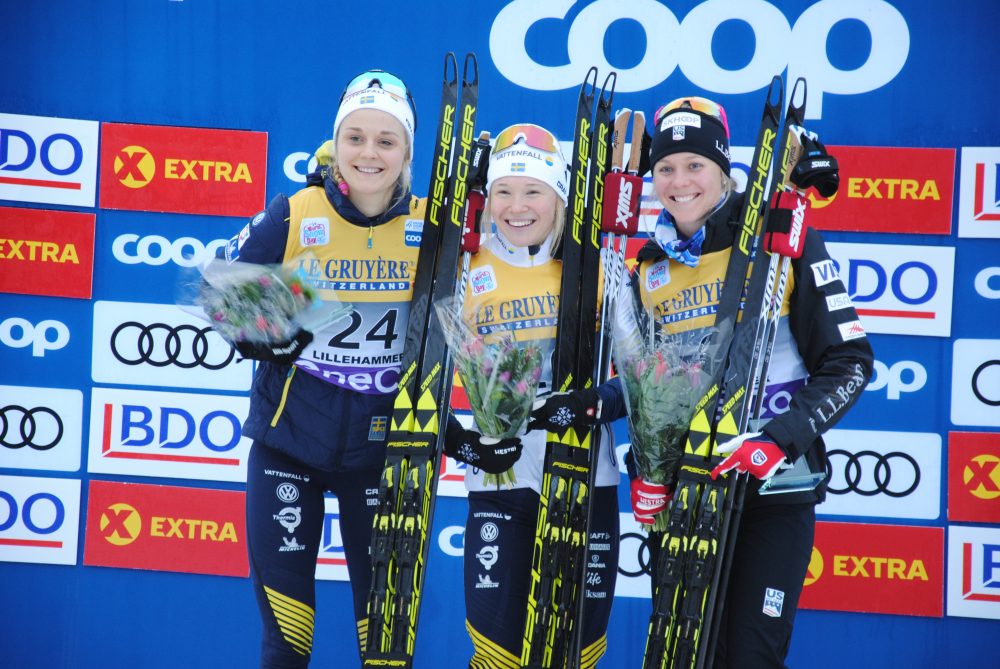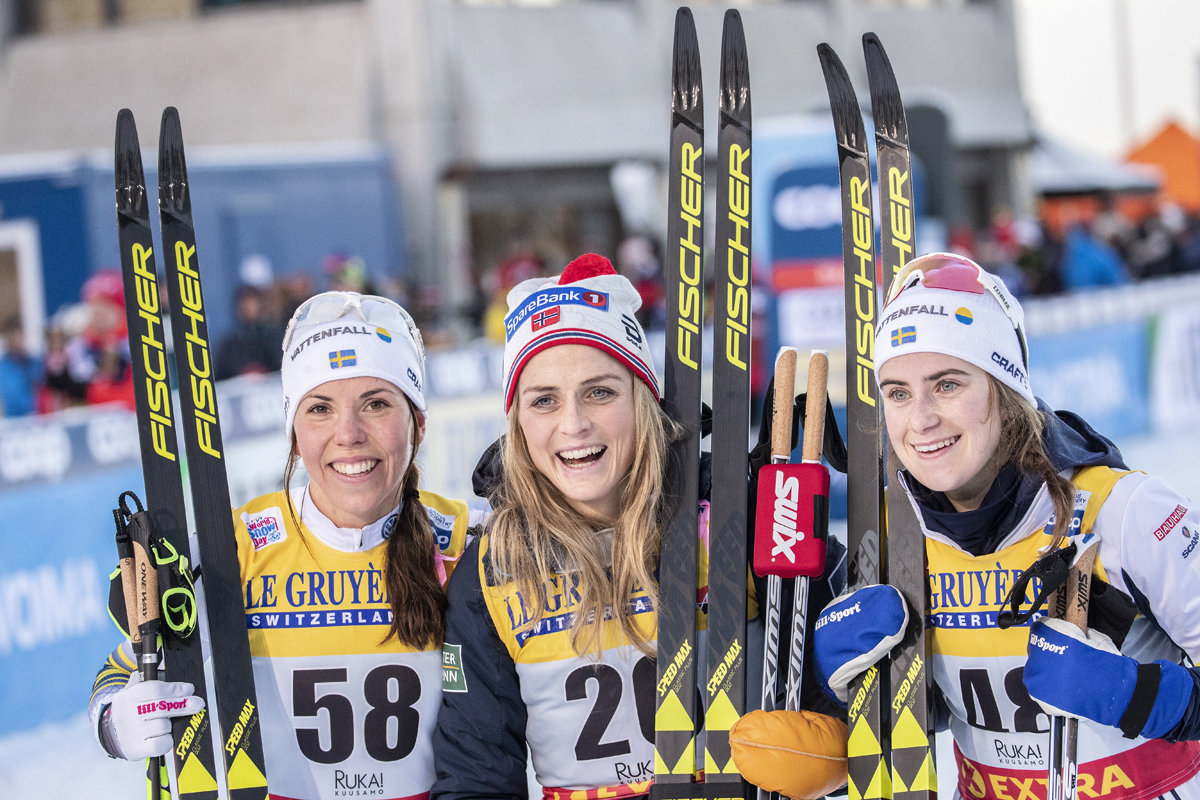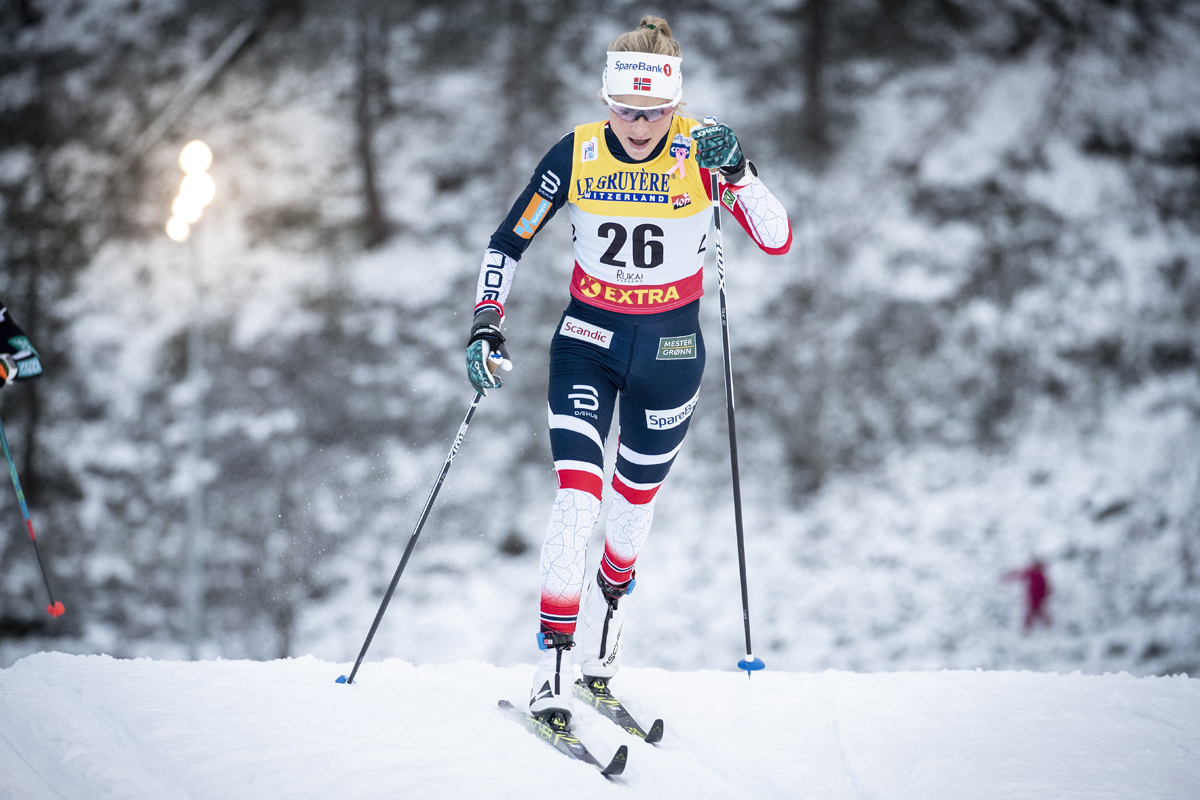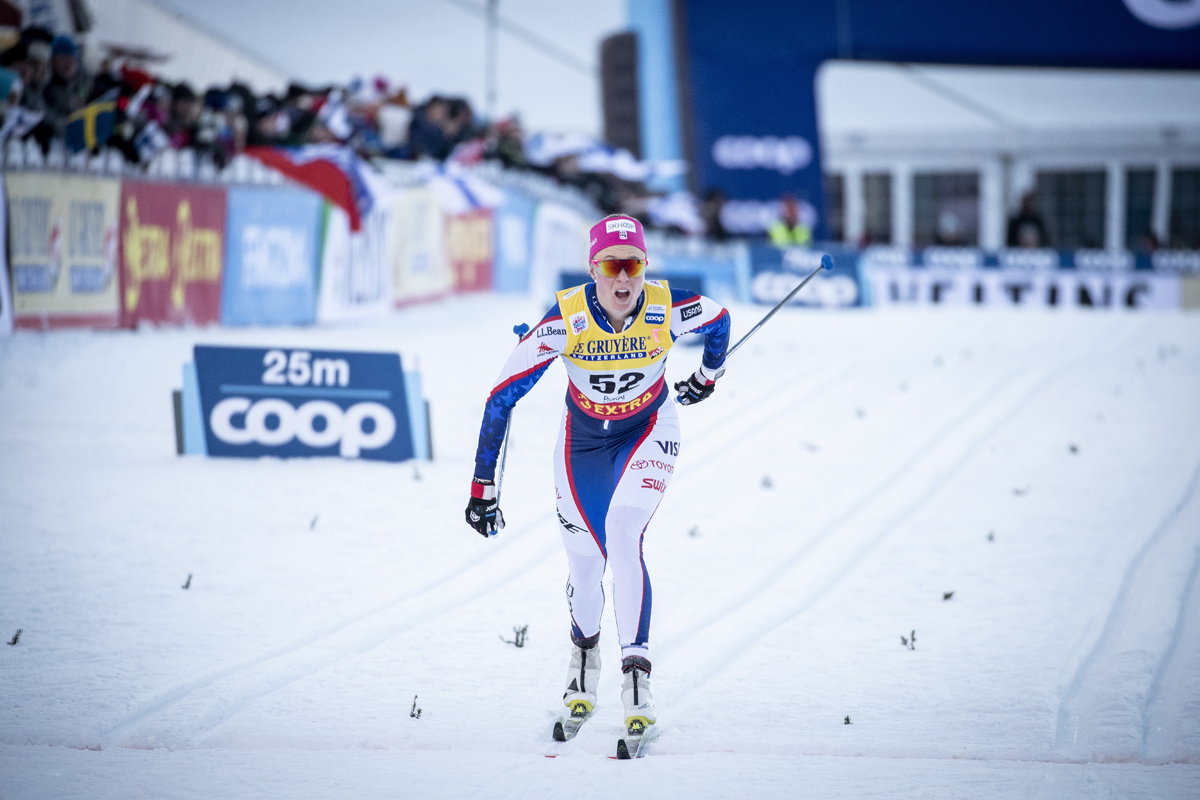
Tag: Kaitlynn Miller

  • A PT in Norway: By Ned Dowling

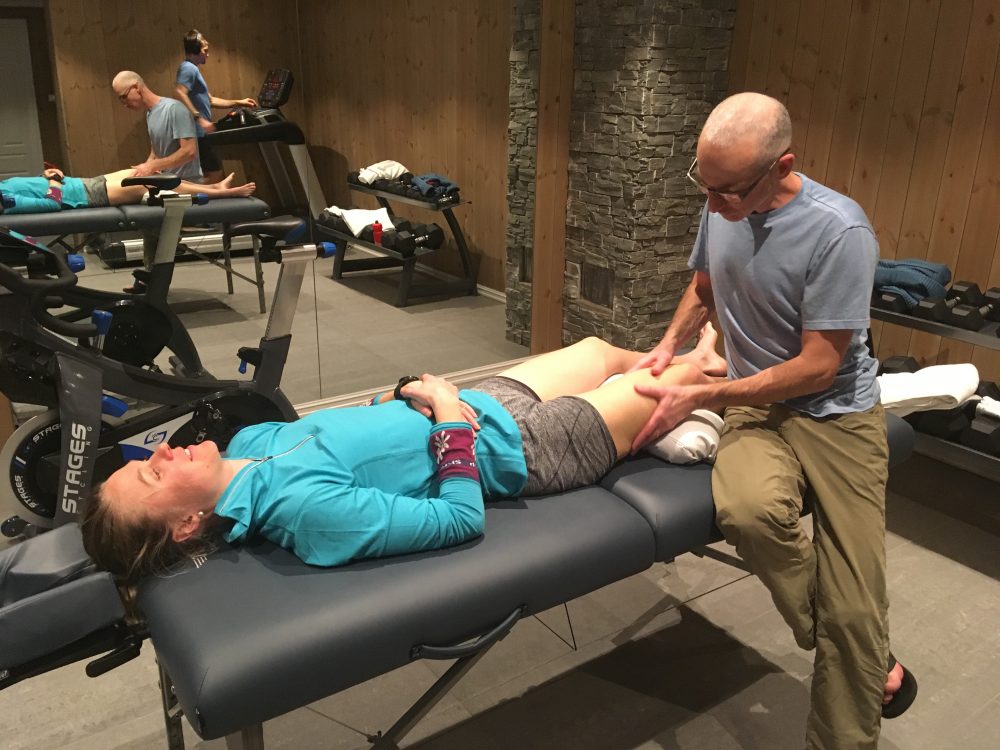
    Ned Dowling working on Sadie Maubet Bjornsen. (Photo: Ned Dowling collection)

    “Get whatever you want. I’m buying.”

    “It’s ok. I’ve got a card with me.”

    “No. You’re over here working for us. The least I could do is buy you a coffee and a bun.”

    Conversation over. Jessie Diggins bought my cinnamon bun and cappuccino. The same Jessie Diggins who won Gold at the last winter Olympics and is a regular on World Cup podiums just refused to let me buy my own snack at the café stop while skiing in Sjusjøen, Norway. If I didn’t already feel accepted, I did then.

    The email from U.S. Ski and Snowboard had arrived two months earlier. The Physical Therapist who was scheduled to work with the U.S. Cross Country Ski Team during races in March was unable to travel. Would I be able to cover for her? My jaw dropped. My pulse quickened. I’d just been asked to travel with the U.S. Ski Team to Norway—the Mecca, the Motherland. 

    I didn’t sleep a wink that night.

    This was not my first gig as a PT working with elite athletes. I’d had a stint as a part-time soigneur with a U.S. based, pro cycling team. In French, soigneur means “helper.” In every other language, it means “worst job in sports.” The hours are long, the tasks are menial, and the actual “physio” role is often limited to recovery massages (aka Rubs). I found myself exhausted, unappreciated, and wondering why I’d left my “easy” PT job in the clinic to work twice as long for half the pay. Like most experiences that become teachable moments and help us grow in life, my time as a soigneur was the sort of arduous misery that, once survived, opened doors to better things. While grateful, I was still more than a little burned.

    The burned feeling was felt even more by my wife. I’m pretty sure she could still smell the smoke when I asked her how she felt about a redo in Norway for two weeks. During my time with the cycling team, while I was off babysitting professional athletes, she was single-momming it with our toddler son. And she was not happy about it. Proving how wonderful she really is, my permission slip to Norway was signed. The other signature required was from my boss at work. That proved to be easier than imagined as my manager in the PT clinic at the University of Utah’s Orthopaedic Center gave me her full support. Permission granted, passport renewed, and official team logo wear issued, I was ready for Norway. 

    But I still wasn’t sure if this was going to be heaven or hell.

    I was used to communication from the cycling team management being brief, procrastinated, and severely limited to an “as needed” basis. Don’t call me, I’ll call you … maybe, sometimes a couple of days before you deploy. So I was quite surprised when I started getting timely and detailed emails from the ski team coaches, which included sentences like “Looking forward to working with you Ned!” and “Thanks again for joining us.” Maybe these folks are going to be different. Maybe they know how to feed themselves and do their own laundry. Maybe I won’t be working 14 hours a day with my face coated in a mixture of sweat, sports drink powder, and massage lotion. Maybe I’ll be appreciated. 

    After 21 hours of travel and 21 minutes of sleep, my train pulled into Lillehammer, site of the 1994 Winter Olympics. I had arrived! And I was greeted trackside by Matt Whitcomb and Jason Cork, two of the ski seam coaches. I did not have to send a text and wait for a ride. I did not have to catch a bus to some hotel I couldn’t pronounce. I was riding shotgun while Jason was wedged in the back of the van, imprisoned by duffel bags and pole cases. Severely jet-lagged, I tried to make sense of my surreal surroundings as Matt briefed me while we ascended the winding road to the cross-country heaven that is Sjusjøen.  

    The plan for the next two weeks looked something like this: The first week was to be a “training camp” for four of the top skiers. Then we would head to Drammen for the famous city sprint. After that would be the even more famous World Cups at Holmenkollen—the Super Bowl of cross country ski racing, typically attracting over 50,000 fans.

     As all plans are subject to change, so did this one. Multiple times. But one thing stayed consistent—everyone’s positive attitude. 

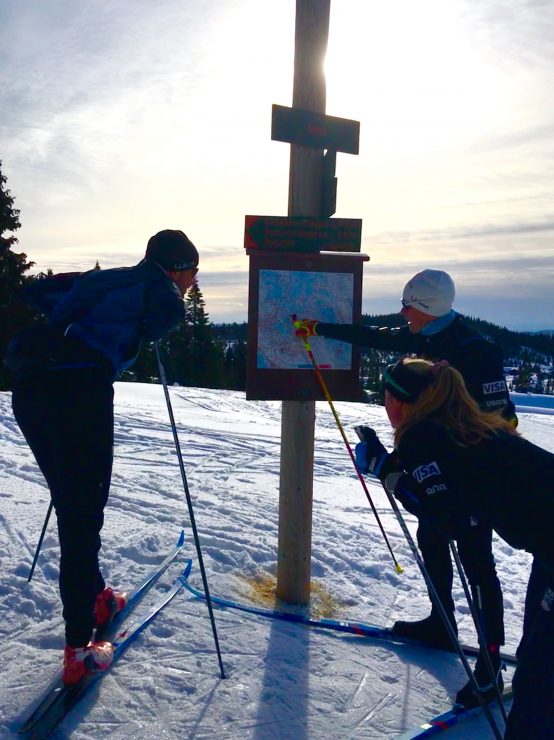
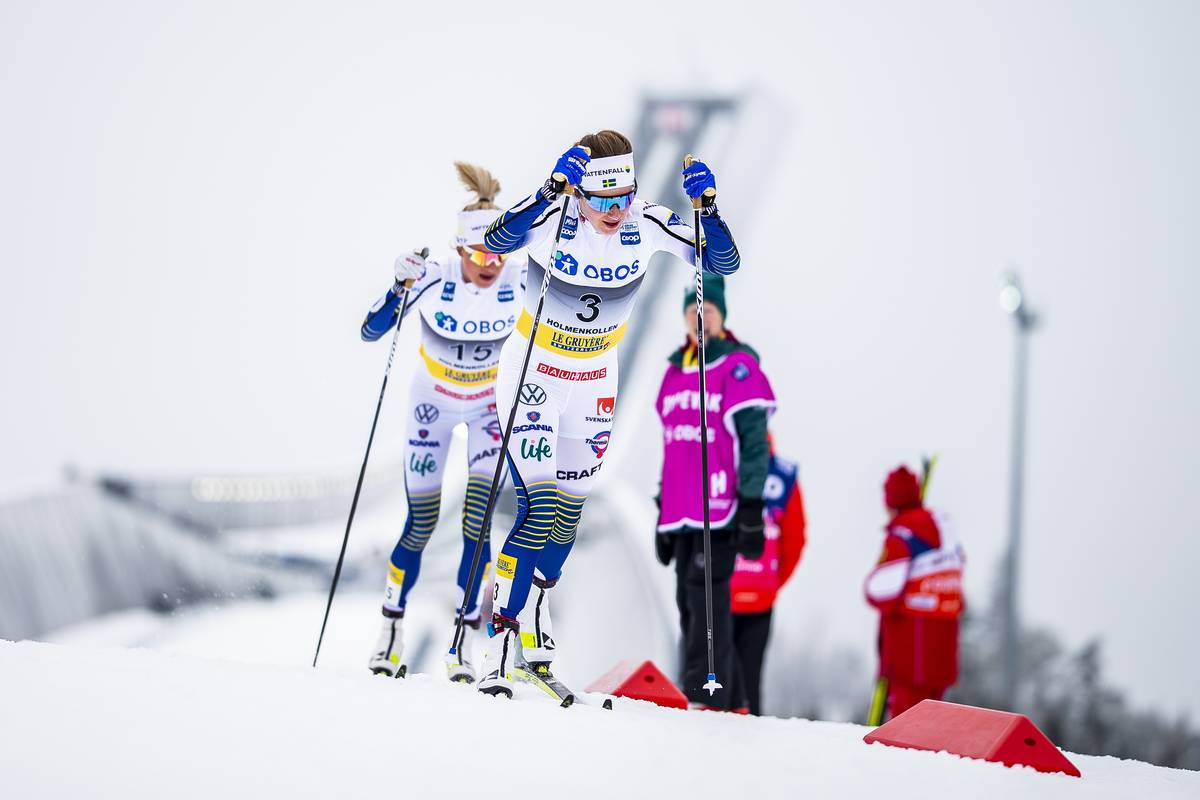
    That first week turned out to be more about recovery than training. The athletes in Sjusjøen were coming off of Ski Tour 2020, a new addition to the World Cup calendar with six races in nine days and no shortage of travel in between. Exhausted was an understatement. I felt like a jet-lagged zombie, but I met the cast of Night of the Living Dead when Simi Hamilton, Sadie Maubet Bjornsen, Jessie Diggins, and David Norris arrived at the cabin. We were surrounded by a few hundred kilometers of perfectly groomed ski tracks literally right outside of our door and not a single one of them wanted to ski. At least for a day. While I did my best to resuscitate their muscles and joints with daily manual therapy treatments, they slowly returned to the land of the living. 

    The silver lining for me was they all skied slowly enough that I could keep up. The days began to take on structure for me: wake up at a normal time (versus the jet-lagged pattern of undersleeping one night then oversleeping the next), eat, ski, eat, treat athletes, eat, sleep. Their days resembled mine except for being on the other side of the treatment table. Remarkably to me, the athletes and coaches took turns grocery shopping, cooking meals, and doing dishes. Everyone even did their own laundry! I was so used to working in the world of cyclists where “self-sufficient” wasn’t even in their dictionary. (We used to have a duffel bag labeled “DA” that was taken to the start of every bike race. It was full of extra jerseys, bib-shorts, and socks for the inevitable rider who forgot something. “DA” stood for Dumb Ass.) But these skiers were elite athletes, winners of medals, the best in America, and yet they could take care of themselves. 

    Despite the fatigue, a respiratory infection that was eventually passed to all of the athletes, a couple of days with sideways blowing snow, barley flour (“that’s all the grocery had!”) that left the baked goods flat as matzo, and the increasing presence of coronavirus in the news, the team just seemed to roll with the punches, make lemonade, and keep on keepin’ on.

    Just before we left Sjusjøen for Drammen, it was announced that, due to a lack of snow, the race would be moved to Konnerud. The race in Drammen is one of the coolest venues on the calendar with skiers sprinting up and down the main street through the old city center and around the Bragernes Church. Instead, it was moved to a small ski venue that had not hosted a World Cup caliber race since 2011. That 2011 race, it turns out, was the first World Cup start for both Jessie and Sadie. Now, veterans of the race circuit, they were excited for the venue change out of nostalgia, and the media loved the silver lining story.

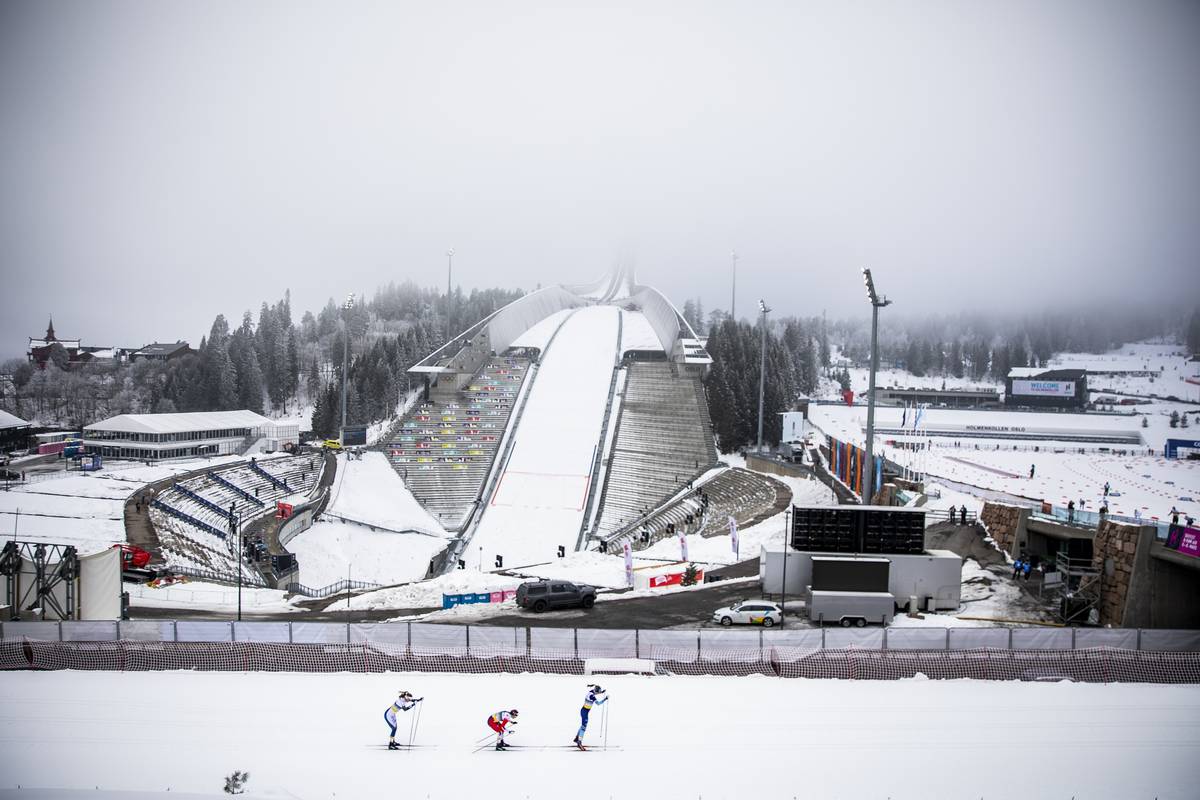
    With the next day came the news that the weekend of races in Holmenkollen, the biggest party in Norway, would be closed to spectators due to fears over the spread of the coronavirus. While utterly disappointing, this made sense on two levels. For one, most of the 50,000 fans arrive packed like sardines in the trains from Oslo. Secondly, as pointed out by one of the health ministers, drunk people tend to make poor hygiene decisions. And the fans lining the Holmenkollen course are known to party.

    The next round of bad news came when Sadie, one of the top skiers and a front pack contender, did not start due to the bug that had made its way around the Sjusjøen cabin. (David would end up dropping from his race from the same cold). Saturday morning at the often raucous Holmenkollen began with an eerie quiet in the ski stadium and a little less chaos in the wax truck since only three women were starting the 30 k classic. 

    The race, at least on the front end, turned out to be one of the more exciting in recent years with the strongly favored Norwegian, Therese Johaug, getting caught and passed in the last kilometer by a young Swede, Frida Karlsson. 

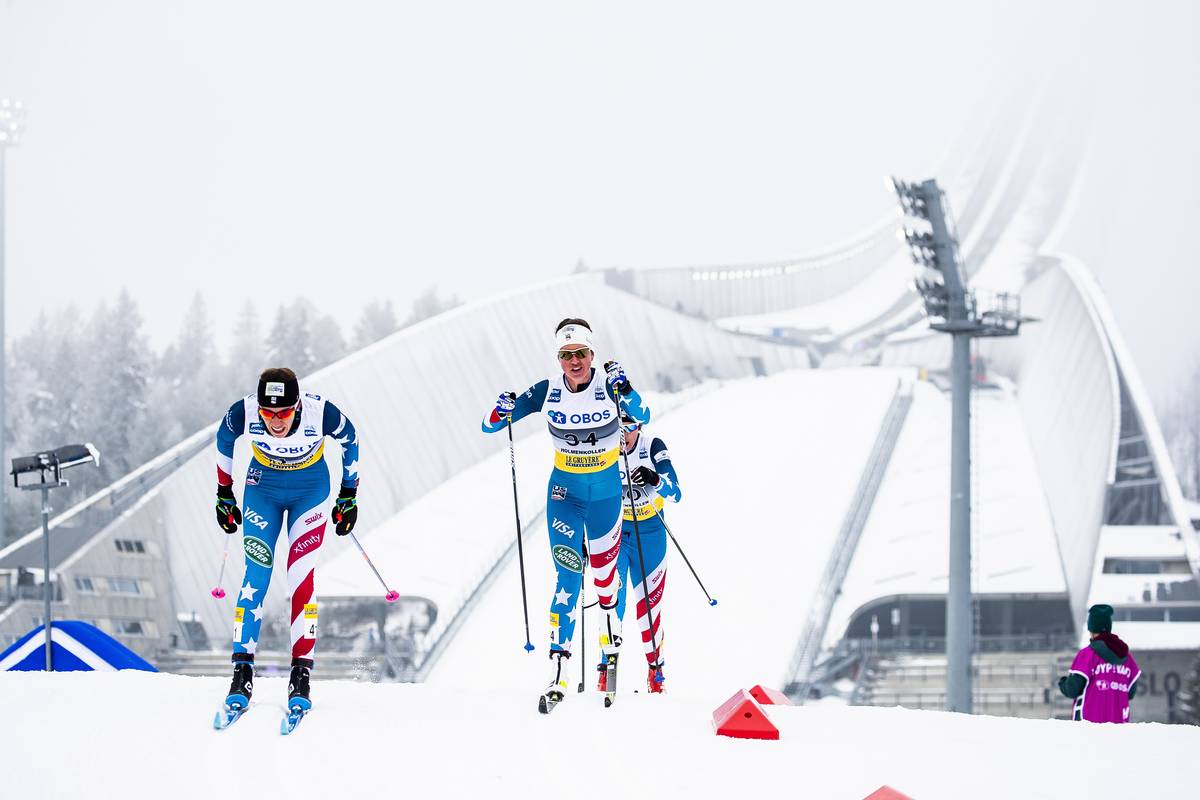
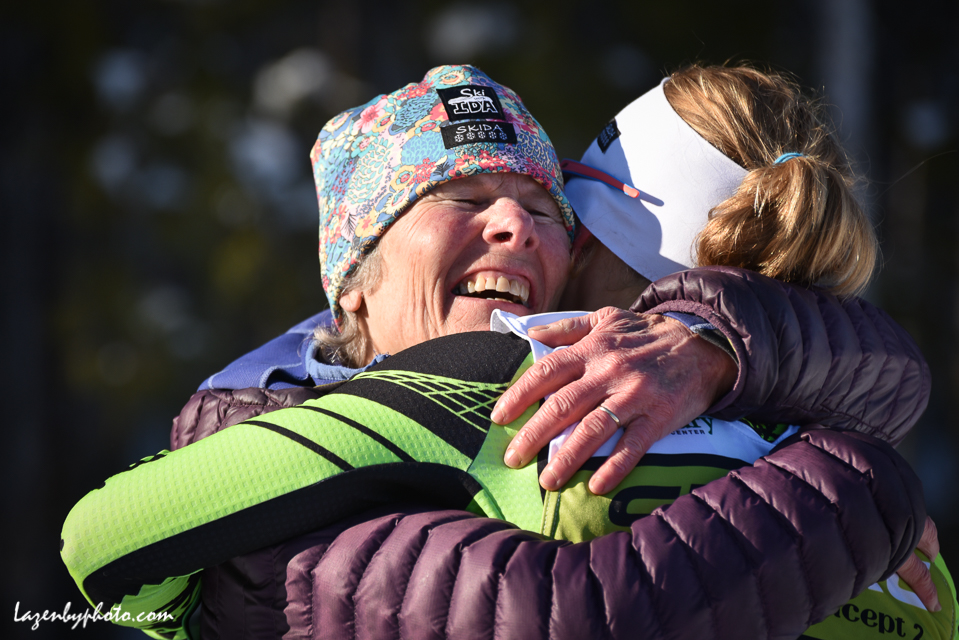
    There was more bad news on the back end of the race as the American women struggled to keep pace  — like your local marathon hero trying to toe the line with Eliud Kipchoge. They fought hard for a grueling 90 minutes and finished at the bottom of the standings in what would turn out to be the last race of the season. But there was a remarkably bright spot in that foggy, ghost town of a ski stadium as I watched Kaitlynn Miller wait for Becca Rorabaugh. Exhausted and disappointed, they hugged and walked together past the podium presentation that was already starting. Seeing that display of kindness and friendship, my mood was immediately uplifted. I was proud to walk with these women, heads held high, past vacant looks from the media and other skiers. The results don’t always matter as much as the comradery of the team. 

    On Sunday, the men raced 50 k. At least those who finished. It was cold, wet, foggy, windy,  and – we’ll mention again — cold and wet. For over two hours the men slogged around an increasingly slow and sloppy track. David abandoned due to illness and anticipation of upcoming races that would eventually be canceled (had he known that he was in his last race of the season, he would have surely soldiered on). Ian Torchia dropped out after throwing up his breakfast and every ounce of liquid he tried to take in at the feed zones. Ben Lustgarten and Adam Martin persevered and crossed the finish line; both later suggested it was one of the more miserable races of their lives. 
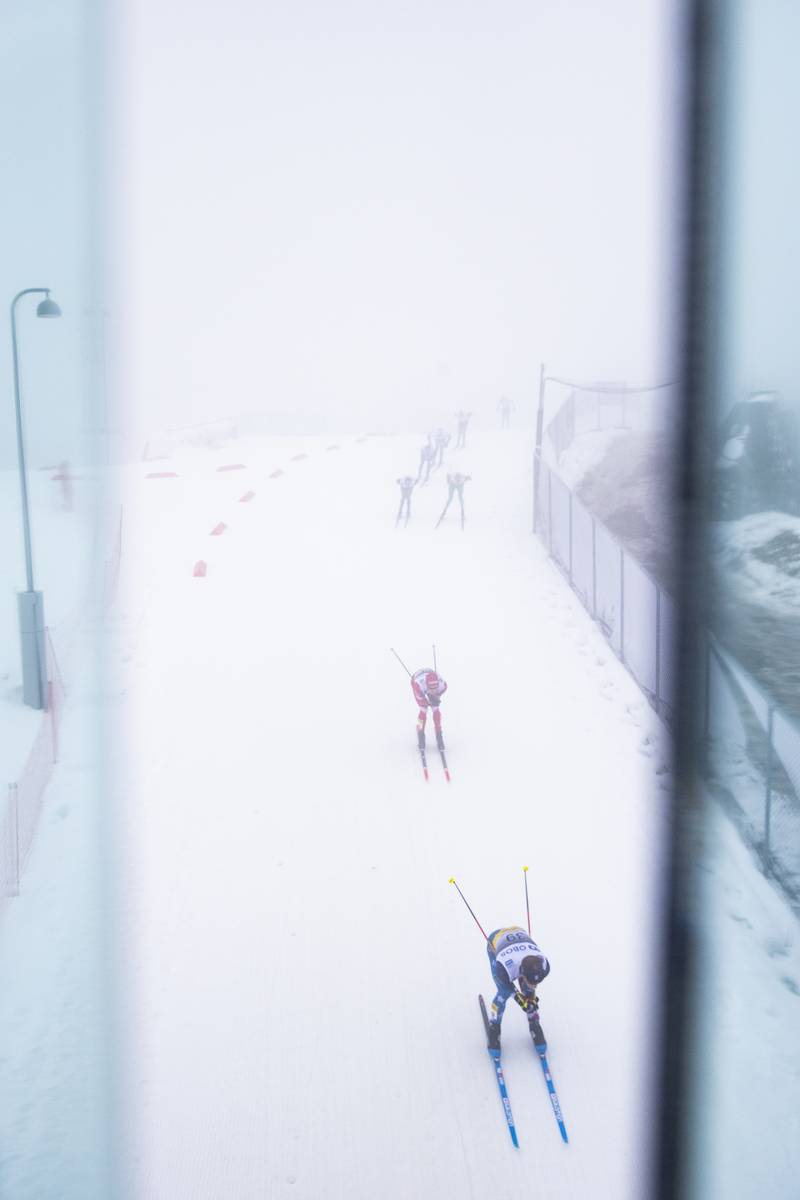
    Ben Lustgarten (front) during the Oslo 50 k classic. (Photo: NordicFocus)

    At the team meeting that night, there might have been feelings of disappointment but no one showed it. As Matt spoke to the team, he emphasized that he was proud, not embarrassed, by the performances that weekend. There is no shame in showing up and trying your best, even if your best leaves you at the bottom of the results sheet. There’s much more to it than the results sheet. Gratitude and appreciation were reiterated with not a mention of anger or blame. 

    A rising tide lifts all boats is an idiom often used to describe a setting where one person’s success or positive attitude inspires others to push the limits of their own performance. Sadly there were no podium celebrations during my two-week stint, but that did not deter me from doing whatever I could to help, whether fetching coffee for wax techs (an errand that used to irritate the hell out of me when I was a soigneur) or tactfully (I hope) ushering Jessie away from admiring fans when she was needed elsewhere.

    And I was especially motivated to put my energy into the well-being of the athletes, simple as my role was: to methodically push on a joint here and a muscle there in hopes of giving the athletes the physical and psychological confidence to charge into battle with their skinny skis, carbon fiber poles, and Lycra armor. I’d like to think that I channeled my years of Physical Therapy practice and experience into their muscles, joints, and fascia to make them more resilient in the fight, whether that was 2 ½ minutes at full gas in a sprint or 2 ½ hours in the 50 k pain cave. My simple role was to help them perform at their best. 

    What I know I accomplished during these two weeks in Norway was an education in the meaning of team spirit. They cheered each other’s victories and consoled each other in defeat. They cooked each other meals and volunteered to do the dishes. They said thank you after every PT session. I would call my time with the U.S. Cross Country Ski Team a once in a lifetime experience, except that I want to go back next year.

  • Here Come the Americans: Your Guide to the U.S. Women Racing in Québec City and Minneapolis

    Here Come the Americans: Your Guide to the U.S. Women Racing in Québec City and Minneapolis

    Hailey Swirbul of the USST D-Team races in Québec City, Québec, in March 2019. (Photo: John Lazenby/lazenbyphoto.com)

    You may have heard that the World Cup is returning not only to North America, but also to American soil, within the next few weeks. The world’s best skiers will be contesting sprint races in Québec City on March 14 and 15; a sprint in Minneapolis on March 17; and distance races plus a mixed relay in Canmore on March 20-22.

    For all six races, including the five across the border, the U.S. has an expanded nation’s group start quota (thanks, Canada, for letting us count as Canadian for a week), meaning that a remarkable thirty skiers total will toe the line in that distinctive candy-cane uniform. Here is a brief overview of the fifteen women with start rights in the three sprints (some of the sprinters will not be racing in Canmore, where some distance-oriented athletes will have starts instead).

    In alphabetical order, with pictures where available (an asterisk by a name denotes an athlete making her first World Cup start in Québec City):

    Sadie Maubet Bjornsen: Stage 4, Ski Tour 2020. (Photo: NordicFocus)

    Sadie Maubet Bjornsen

    Team and club: U.S. Ski Team (USST) A Team; Alaska Pacific University, or APU

    Currently lives in: Alaska

    Selected career highlights: Bronze medal, team sprint, 2017 World Championships; 7 individual and 5 team World Cup podiums; only American woman to ever wear the yellow overall World Cup leader’s bib; multiple national titles

    Instagram page: @sbjornsen

    Age: 30

    Sophie Caldwell on course in Östersund, Sweden. (Photo: NordicFocus)

    Sophie Caldwell

    Team and club: USST A Team; Stratton Mountain School, or SMS

    Currently lives in: Vermont

    Selected career highlights: 3rd, Sprint Cup, 2017/2018 World Cup season; 9 individual and 4 team World Cup podiums

    Instagram page: @sophiecaldwell

    Age: 29

    Hannah Cole racing at 2020 U.S. Nationals in Houghton, Michigan. (photo: Karen Brown)
    Hannah Cole racing at 2020 U.S. Nationals in Houghton, Michigan. (Photo: Karen Brown)

    Hannah Cole*

    Club: Crosscut Mountain Sports Center

    Currently lives in: Montana

    Selected career highlights: 9th, 2020 American Birkebeiner; 4th and 8th, SuperTour sprints in 2019/2020 season

    Instagram page: @hanncole

    Age: 24

    Jessie Diggins skates to 8th in the first stage of the FIS Ski Tour 2020. (Photo: NordicFocus)

    Jessie Diggins

    Team and club: USST A Team; SMS

    Currently lives in: Vermont

    Selected career highlights: Gold medal, team sprint, 2018 Olympics; gold medal, team sprint, 2013 World Championships; three additional World Championships medals; 2nd overall and 3rd in distance standings, 2017/2018 World Cup; 26 individual and 7 team World Cup podiums; multiple national titles

    Instagram page: @jessiediggins

    Age: 28

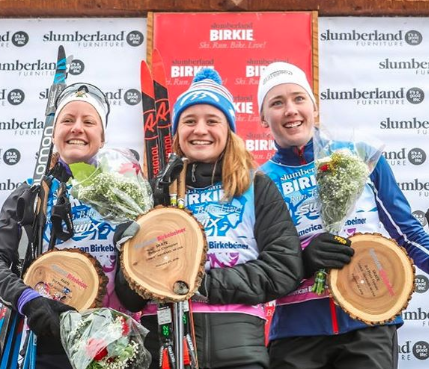
    The women’s podium of the 2019 American Birkebeiner. Alayna Sonnesyn took first ahead of Anja Gruber and Katie Feldman. (Photo: Screenshot Instagram @asonnesyn)

    Katie Feldman*

    Club: SVSEF Gold Team

    Currently lives in: Idaho

    Selected career highlights: 3rd, 2019 American Birkebeiner; 5th and 6th in SuperTour races in 2019/2020 season; 7th in SuperTour sprint in 2018/2019 season

    Instagram page: @katfeld

    Age: 24

    Relief and accomplishment: Erika Flowers takes third at the 2020 American Birkie. (Photo: ©2020 American Birkebeiner Ski foundation)

    Erika Flowers (Newell)

    Club: Bridger Ski Foundation

    Currently lives in: Montana

    Selected career highlights: 3rd, 2020 American Birkebeiner; dozens of SuperTour podiums; three top-five finishes at U.S. Nationals over the past ten years

    Instagram page: @eflowers89

    Age: 30

    https://www.instagram.com/p/Bgi2XuQBqKj/

    Felicia Gesior*

    Club: Crosscut Mountain Sports Center

    Currently lives in: Montana

    Selected career highlights: 10th, 2020 American Birkebeiner; 5th and 10th, 2019/2020 SuperTour races; four top-10 finishes, 2018/2019 SuperTour

    Instagram page: @fel.gesior

    Age: 26

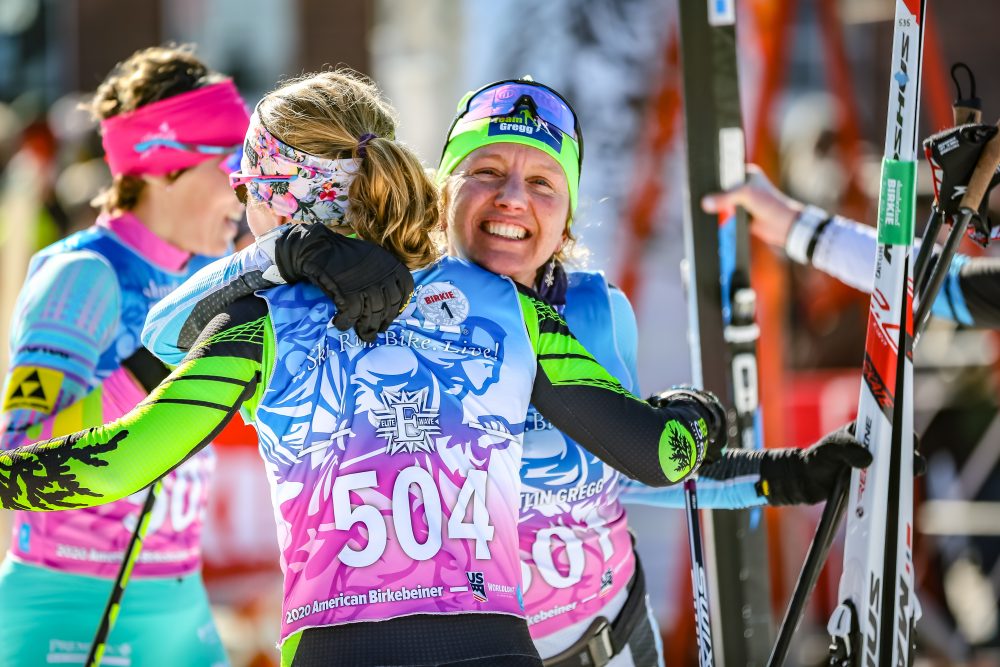
    Caitlin Gregg embraces former Olympic teammate Ida Sargent after the 2020 Birkie. (Photo: ©2020 American Birkebeiner Ski Foundation)

    Caitlin Gregg

    Club: TeamGregg/prgFinancial/Madshus

    Currently lives in: Minnesota

    Selected career highlights: Bronze medal, 10 km skate, 2015 World Championships; five-time champion, American Birkebeiner; multiple national championships

    Instagram page: @caitlincgregg

    Age: 39

    Elizabeth Guiney races at the PyeongChang World Cup in 2017. (photo: Nordic Focus)

    Elizabeth Guiney

    Club: Craftsbury Green Racing Project, or Craftsbury

    Currently lives in: Vermont

    Selected career highlights: 8th, 2020 American Birkebeiner; six top-10 results, 2019/2020 SuperTour; 3rd, 2015 Nationals

    Instagram page: @lizzie_guin

    Age: 29

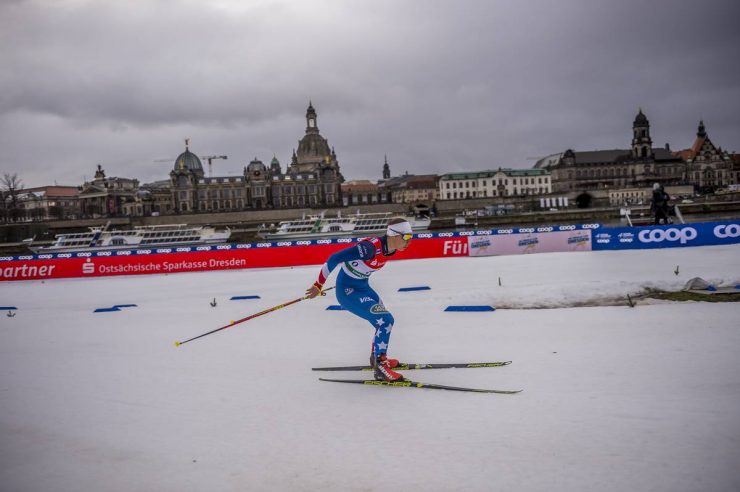
    Julia Kern skis to 15th in the qualifier in Dresden in January 2020. (Photo: NordicFocus)

    Julia Kern

    Club: USST B Team; SMS

    Currently lives in: Vermont

    Selected career highlights: bronze medal, skate sprint, 2020 U23 World Championships; 3rd, Planīca skate sprint, 2019/2020 World Cup season; multiple other World Cup top-30 finishes; bronze medal, relay, 2017 World Juniors

    Instagram page: @juliakernski

    Age: 22

    Kaitlynn Miller (front) during the women’s classic sprint at the 2020 Senior Nationals. (Photo: Reese Brown)

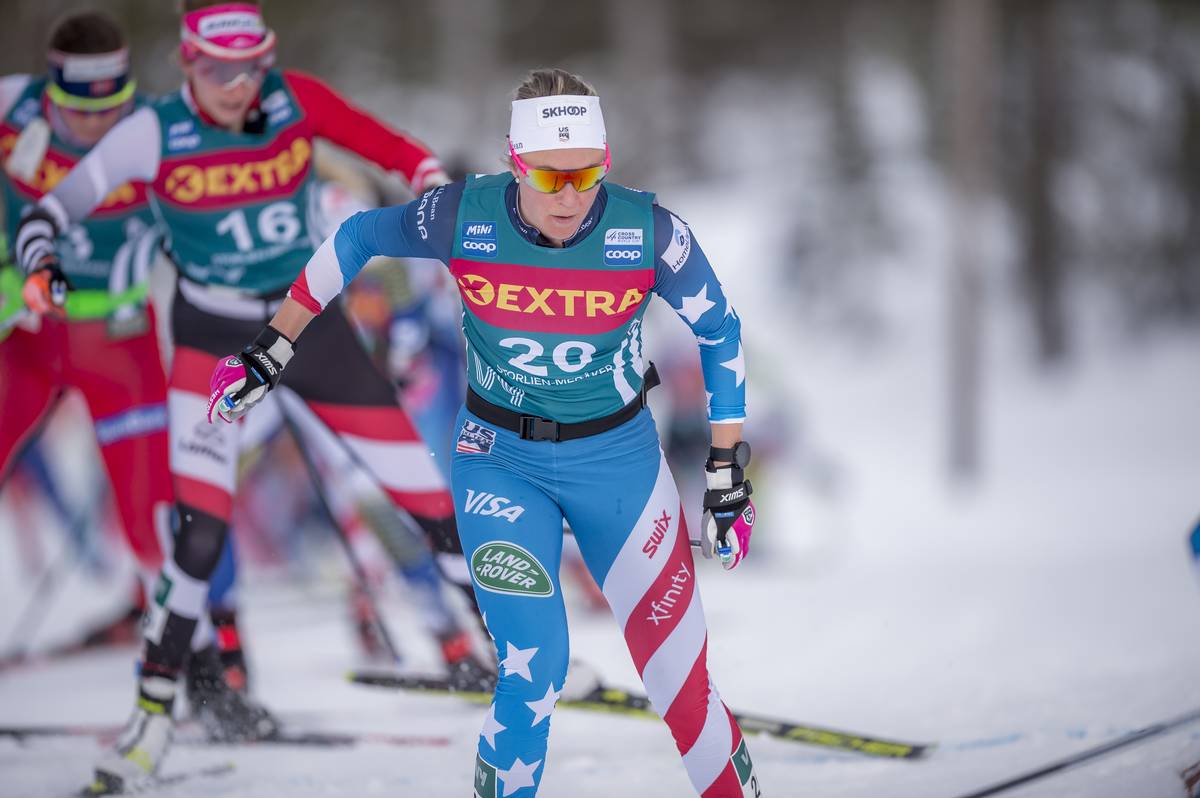
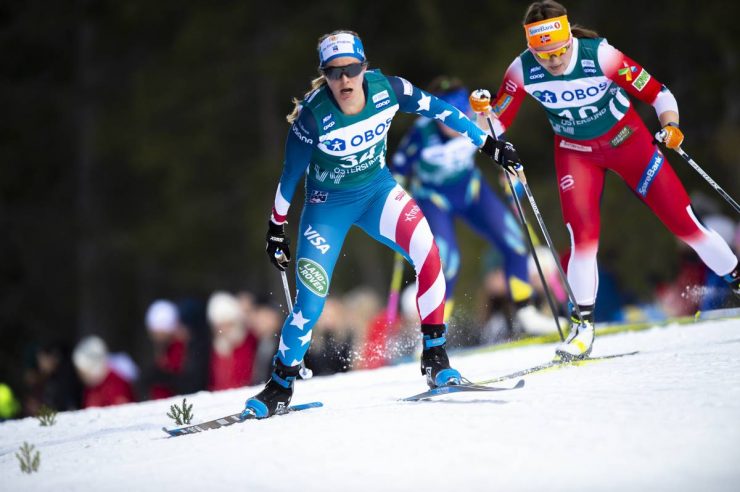
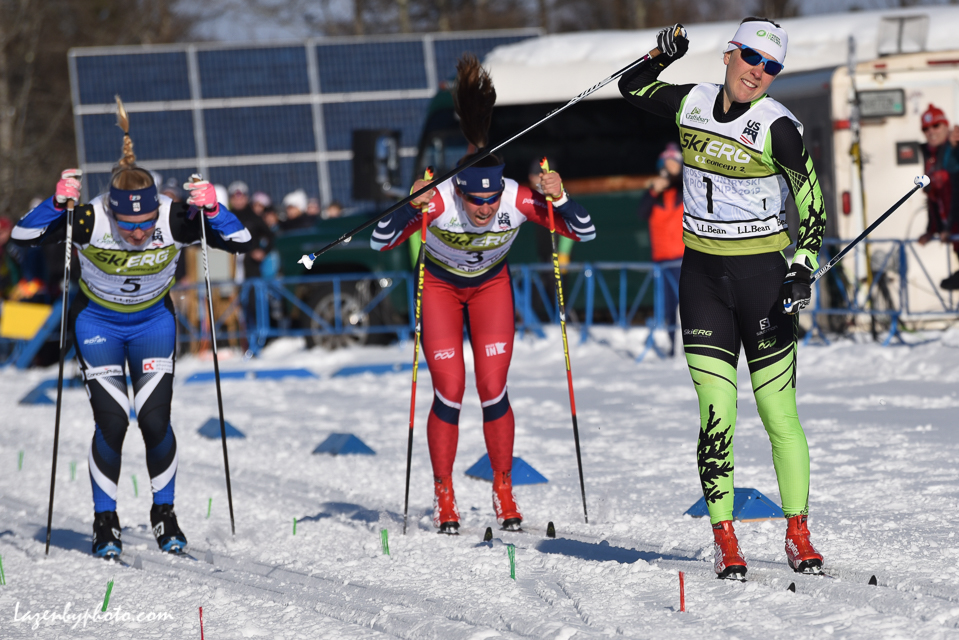
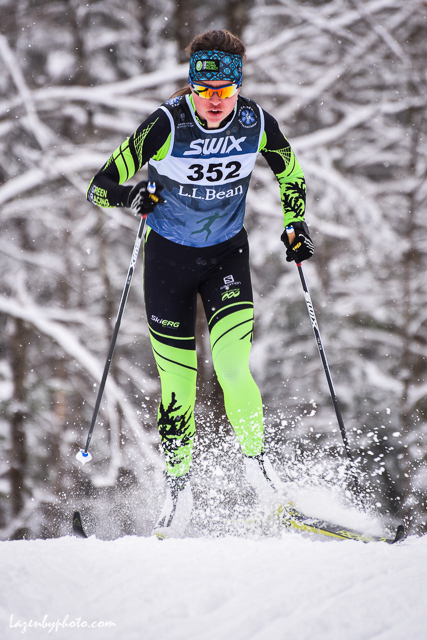
    Kaitlynn Miller

    Club: Craftsbury

    Currently lives in: Vermont

    Selected career highlights: Five national championship podiums, including 2016 classic sprint national championship; 17 SuperTour podiums; 34th in World Cup 10km skate race in 2018/2019 season

    Instagram page: @kaitlynnbmiller

    Age: 28

    Becca Rorabaugh on course during the 10-kilometer individual start classic in Lahti, Finland, last month. (Photo: NordicFocus)

    Becca Rorabaugh

    Club: APU

    Currently lives in: Alaska

    Selected career highlights: Five national championship podiums, including 2014 10km classic national championship; 14 SuperTour podiums; 24th in sprint in 2012/2013 World Cup season, 39th in World Cup 10km classic last month

    Instagram page: @beccarorabaugh

    Age: 30

    Alayna Sonnesyn (bib 2) races in the skate sprint heats at 2020 U.S. Nationals. (Photo: Reese Brown)

    Alayna Sonnesyn

    Club: SMS

    Currently lives in: Vermont

    Selected career highlights: winner, 2019 American Birkebeiner; three podiums at 2020 national championships; three SuperTour podiums; finisher, Ski Tour 2020

    Instagram page: @asonnesyn

    Age: 23

    Hailey Swirbul (APU) during the women’s 10 k skate at 2020 U.S. Nationals. (Photo: Reese Brown)

    Hailey Swirbul

    Club: USST B Team; APU

    Currently lives in: Alaska

    Selected career highlights: silver medal, 5km classic, 2018 World Juniors; bronze medal, 10km skiathlon, 2018 World Juniors; 21st, Davos skate sprint, 2019/2020 World Cup season; three other World Cup top-30 finishes this season; bronze medal, relay, 2017 World Juniors

    Instagram page: @hai.swirl

    Age: 21

    Callie Young, of Newport, Vt., racing to second overall in the women’s race at the 2017 App Gap Challenge in Fayston, Vt. (Photo: Laurel Minde)

    Callie Young*

    Club: Dartmouth

    Currently lives in: Vermont

    Selected career highlights: Fourth, FIS Junior Invitational “Rising Stars” Race, Québec City, March 2019; first, 2020 Bates Carnival; 54th, sprint qualification, 2020 World Juniors

    Instagram page: @calliey0ung

    Age: 19


    * The athlete is making her World Cup debut in Québec City.

  • Sans Fans, Sweden’s Karlsson Takes Johaug at the Holmenkollen Line

    Sans Fans, Sweden’s Karlsson Takes Johaug at the Holmenkollen Line

    A quieter and more serene Holmenkollen stadium area with fans banned from much of the course. (Photo: NOrdicFocus)

    Racing the Holmenkollen without spectators is a bit like not getting a white Christmas. It does not change the end result, here racing a 30-kilometer mass start classic race on the famed tracks above Oslo, Norway. But the experience loses some of the magic.

    Race organizers announced Thursday that spectators would not be allowed to attend the race due to the increased risk of spreading COVID-19. On a typical year, crowds in numbers up to 100,000 per day take the tram from the city center to the venue, where they either pay to sit in the grandstands or they post up in the woods, often drinking and cooking over a fire. 

    Though the stadium was empty, some spectators did choose to watch the event from the woods, but their numbers were not close to the norm.

    Matt Whitcomb, U.S. World Cup Coach, however, wrote this in an email, “The Holmenkollen stadium, which can at times boom so loudly we can’t hear our own shouts to the athletes, was a ghost town today. But the people did not stay home; they moved to the forest. The woods were as loud as I can remember. It was a great fan turn-out.”

    A empty feeling through the main stadium. (Photo: NordicFocus)

    If you’ve ever skied the tracks at the Holmenkollen, you’ve probably uttered a humbled and exhausted expletive somewhere along the way. The climbs are long and unforgiving, and the downhills can be lightning fast.

    Unsurprisingly, Norway’s distance champion Therese Johaug looked to be running away with the race. Within the first 10 k, Johaug gapped the field with flawless technique by 25 seconds. She took the maximum of 15 bonus points at each checkpoint, which happened at 3.7, 9,9, 16.1, and 22.3 k.

    Behind her, a large chase pack worked together in a race for second place. With less than ten k to go, the top-20 were within 8 seconds of one another. As the final round of bonus points drew near, Sweden’s Ebba Andersson and Frida Karlsson surged to the front and broke away, steadily cutting Johaug’s lead in half by the 26.3 checkpoint. 

    They had chosen to switch skis before the final lap, and it was evident that their kick and glide were superior to those around them. Johaug, however, had not changed skis or taken her last opportunity for a feed.

    Ebba Andersson (front) and Frida Karlsson chasing Johaug. (Photo: NordicFocus)

    This is where things got interesting. After skiing alone for 28.5 k, suddenly a figure appeared in the screen with Johaug. That figure was Karlsson who was closing hard from less than ten seconds behind. 

    It became a matter of real estate. After another kilometer, Karlsson was only five seconds behind. But there were only 2 k left. 

    Up the final long climb and inside the final k, Karlsson marked Johaug from the tails of her skis, switching lanes near the crest of the hill and dropping into a tuck to take advantage of the speed of her skis. Johaug stayed in her draft, sneaking back around before the final roller. 

    But Karlsson had the superior speed in the final sprint, leapfrogging the Norwegian and creating a gap in the lanes to win the race in 1:22:19.1. Johaug crossed 1.9 seconds behind and immediately congratulated her young opponent  on her effort. 

    Andersson, who had fallen off of Karlsson’s pace, took third (+20.9), followed by teammate Charlotte Kalla (+40.5) and Natalia Nepryaeva in fifth (+43.1). 

    Karlsson’s excitement about her performance was clear as the 20-year-old hugged her teammates and jumped into a coach’s arms, somewhere between laughing and crying.

    “I felt so good today,” Karlsson told FIS emphatically. “I had great skis and I think it was a winning concept to change skis and have new fresh ones. I felt so strong in the end and I was hunting and heard I was taking time on Therese. In the end, I felt like ‘now I am going all the way’ and it was a success.”

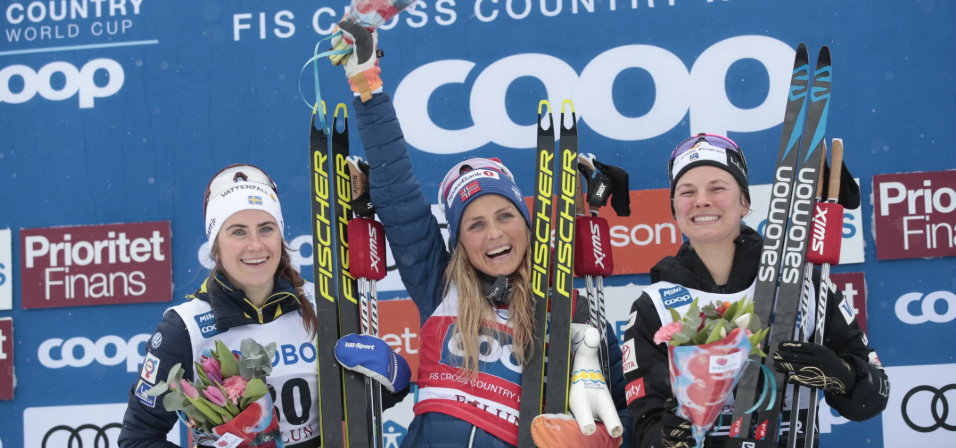
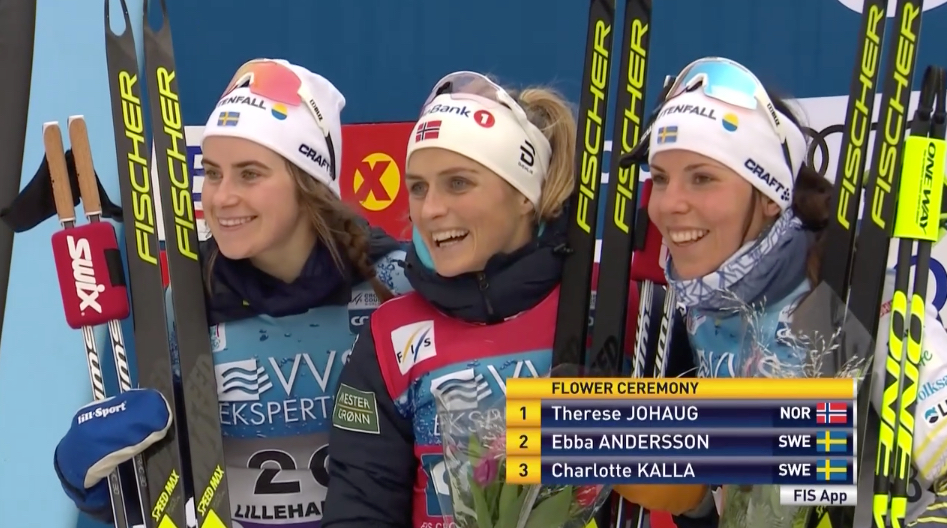
    Women’s Oslo 30 k classic podium: Therese Johaug (NOR) second , Frida Karlsson (SWE) first, and Ebba Andersson (SWE) third, (l-r). (Photo: NordicFocus)

    Racing for North America, Caitlin Patterson was the top finisher in 47th (+!0:15.1), followed closely by her CGRP teammate Kaitlynn Miller in 48th (+10:37.5) and APU’s Becca Rorabaugh in 49th (+12:26.4).

    Results

    Caitlin Patterson (USA), Kaitlynn Miller (USA), Becca Rorabaugh (USA), (l-r). (Photo: NordicFocus)

    Below we have included a post-race interview with Caitlin Patterson in which she discusses some frustrations with her race.

    Post-interview with Caitlin Patterson

  • Relocated to Konnerud: Drammen will wait 365 Days while Klæbo and Sundling Celebrate Now

    Relocated to Konnerud: Drammen will wait 365 Days while Klæbo and Sundling Celebrate Now

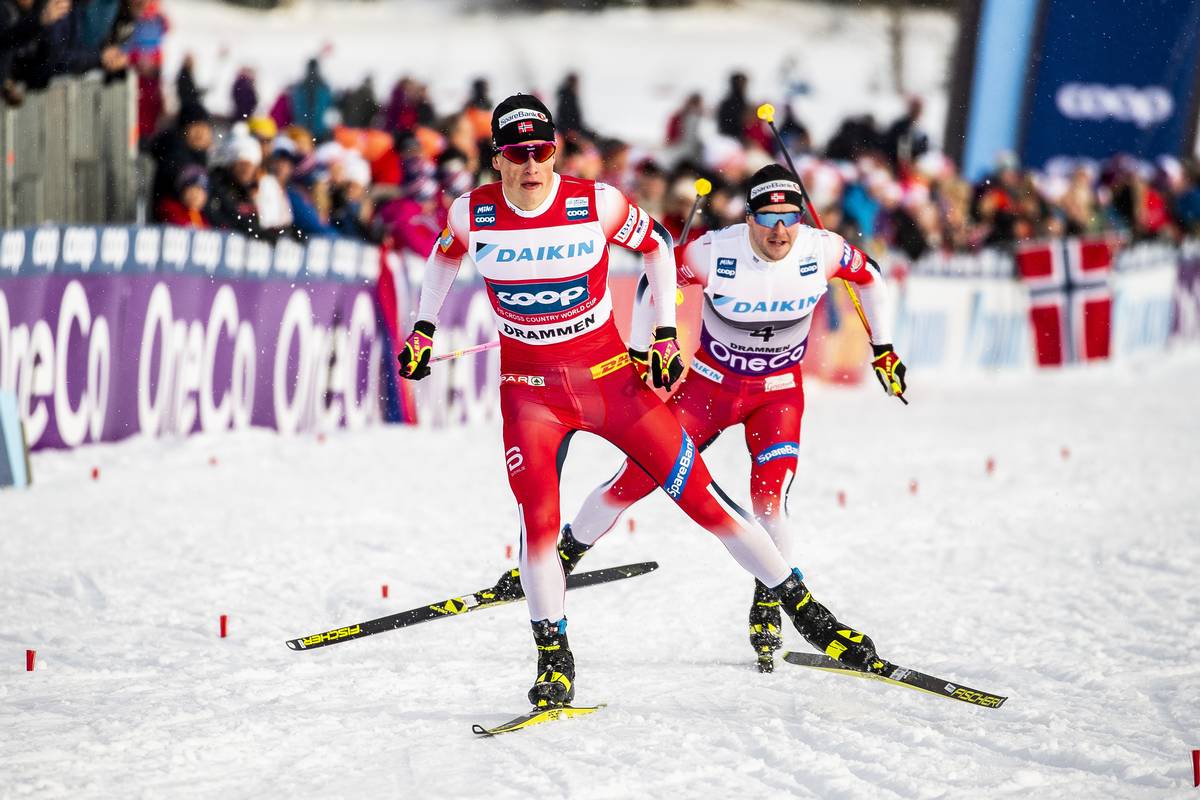
    Men’s Sprint

    Perhaps unsurprisingly, the Norwegian men showed up on form for today’s freestyle sprints in Konnerud, just outside the city of Drammen. As the venue was used for the Norwegian National championship at the end of January, most of the team has already had a dress rehearsal racing on the windy course. 

    Johannes Høsflot Klæbo of Norway, where he is found most often: winning down the stretch. (Photo: NordicFocus)

    It seems that Johannes Høsflot Klæbo, who sat out the national championships, did not need a dress rehearsal. He won the qualifier by a margin of nearly four seconds, continuing easily through the rounds to win the overall. This is Klæbo’s eighth sprint win of the season, matching last year’s record, and his 14th career World Cup freestyle sprint victory, the most of any male athlete. 

    Racing in the final with Klæbo were four of his teammates: Håvard Solås Taugbøl, Eirik Brandsdal, Sindre Bjørnestad Skar, and Erik Valnes, each of whom also raced in the national championship final on January 31st (and finished in a very similar order). Interrupting the all-Norwegian field was Alexander Bolshunov of Russia. 

    In the final, Klæbo hovered in the middle of the pack marking his teammates, with Taugbøl in the lead. When Brandsdal took control on the primary climb of the course, Klæbo swung outside of the group to move into second before tucking into the last downhill. As they passed under the arch and headed into the final straightaway, Klæbo engaged his unmatchable top gear, with Taugbøl and Brandsdal chasing. 

    After crossing in a photo finish, Taugbøl was deemed second (+0.65) — a World Cup career best individual result — with Brandsdal third (+0.69). Skar took fourth (+0.94), followed by Bolshunov in fifth (+1.92) and Valnes a late arriving sixth (+12.79).

    Simi Hamilton (bib 24) during his quarterfinal in Konnerud. (Photo: NordicFocus)

    Simi Hamilton was the only American sprinter racing in Konnerud. He qualified in 24th and raced in the fourth heat of the quarterfinals, where he finished fifth, ending his day ranked the same in the overall as in his qualifier. 

    Men’s Qualification | Final Results

    Women’s Sprint

    The looping sprint course around the ol’ church in Drammen, Norway will have to wait another year, or at least until sufficient snow: the iconic city sprint was moved to Konnerud due to insuffient snow in Drammen. Winter, please, pretty please, return to places such as Drammen. 

    Powering home for the Konnerud win: Jonna Sundling of Sweden. (Photo: NordicFocus)

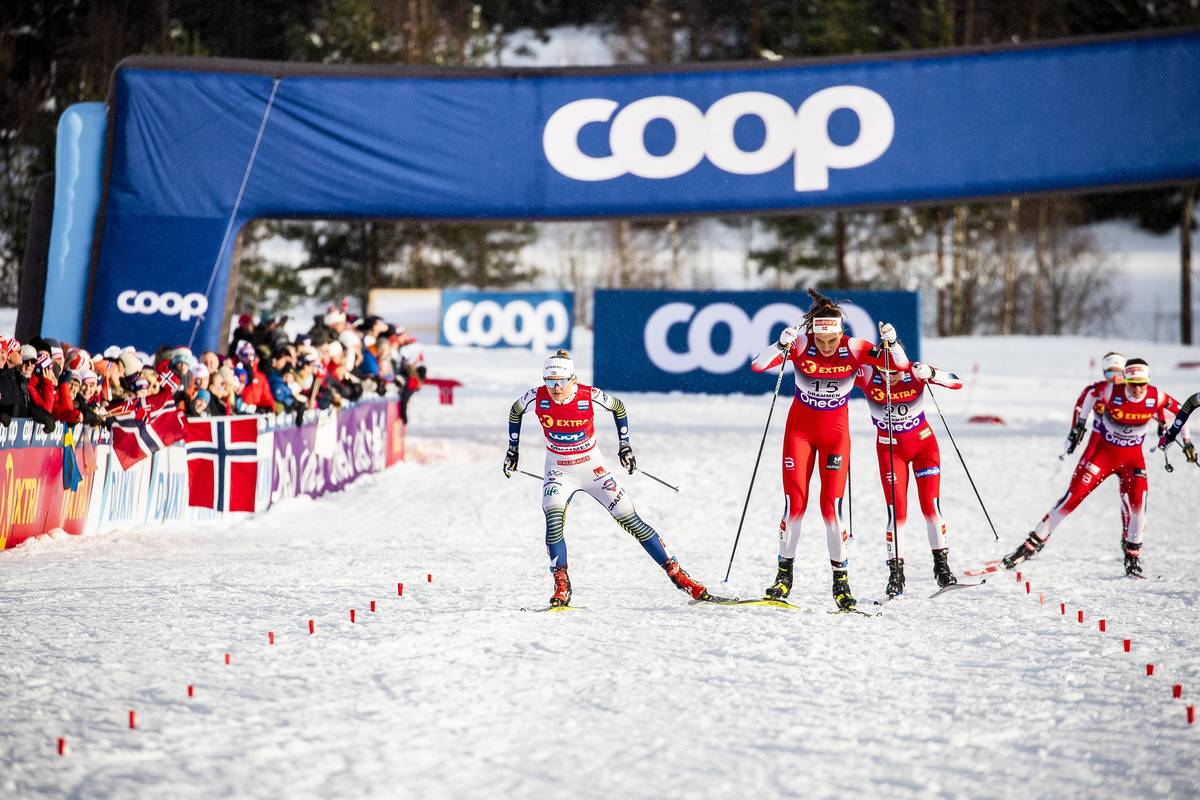
    Although deep in Norway, but not so far from Sweden as the planes fly, Sweden took the win and third place in the World Cup’s relocated 1.2 k skate sprint in Konnerud. Jonna Sundling won the final in 2:38.41 — a toe and perhaps the tail of a ski ahead of Switzerland’s Nadine Faehndrich in second (+0.24). It was a photo finish for second through fourth. Linn Svahn, a U23 skier forgoing those championships, placed third (+0.39). Norway’s U23 Kristine Stavaas Skistad was fourth (+0.97), Sweden’s Maja Dahlqvist placed fifth (+5.70), and Anamarija Lampic of Slovenia sixth (+26.04). 

    Sundling powered down the final sraight outpacing Faehndrich in the final 100 meters. Sundling advanced to the finals as a lucky loser in the semis.

    Sadie Bjornsen (bib 4) during her quarterfinal heat in Konnerud. (Photo: NordicFocus)

    Sadie Bjornsen of the U.S. was the top American in 16th overall. Bjornsen qualified in fourth, 1.2seconds behind the top qualifier, Katja Visnar of Slovenia. Bjornsen placed fourth in the second quarterfinal and did not advance. 

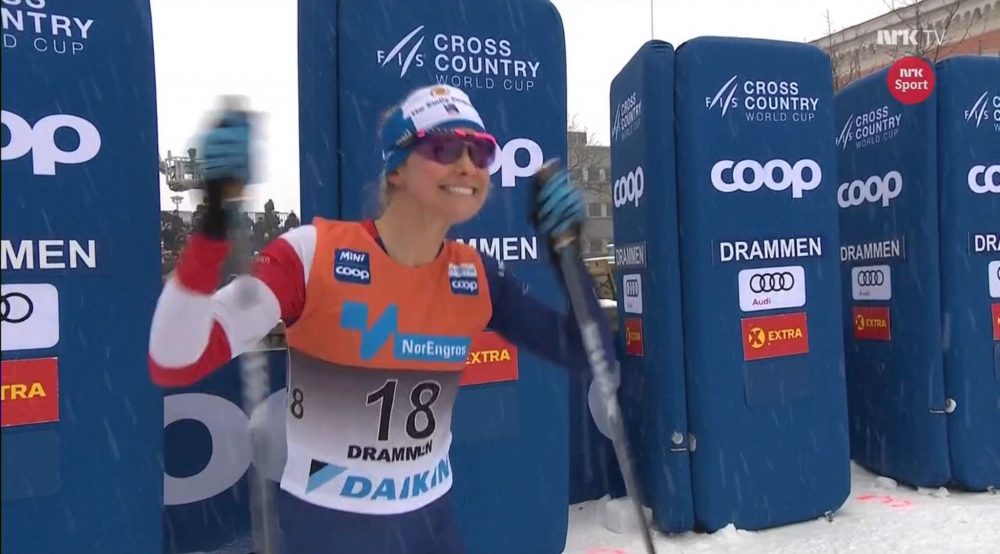
    Jessie Diggins was the only other American to qualify.After qualifying in 12th , she placed sixth in the first quarterfinal, to end her day ranked 27th. Also for the U.S., Kaitlynn Miller placed 50th, and Becca Rorabaugh 54th. 

    Jessie Diggins sprinting in Konnerud. (Photo: NordicFocus)

    Of note, Swedish sprinter, Hanna Falk, who suffered a back injust prior to the season, started her first World Cup of the year. She finished in 30th.  

    Racing continues Saturday with the women’s 30 k classic mass start. The men race a 50 k in Oslo on Sunday. 

    Women’s Qualificiation | Women’s Sprint Results

    This is Drammen with better snow and lovely skies: Sadie Bjornsen back in 2017. (Photo: Fischer/Nordic Focus)
  • Sun Valley SuperTour Results Round Up

    Sun Valley SuperTour Results Round Up

    This article has been revised to reflect the correct third-place finisher in both distance races.

    After a NorAm/Supertour race stint in Canmore, Canada the SuperTour split off and reconfigured in Sun Valley, Idaho over the weekend.

    Saturday featured a classic sprint at the Lake Creek racing venue a few miles outside of town.

    Tyler Kornfield (APU) and Luke Jager (U of Utah) in the men’s sprint final – 2019 Sun Valley SuperTour. (Photo: Doug Stephen)

    APU skier Tyler Kornfield qualified first, and made that mark count as he won the senior men’s sprint in 3:14.837. Luke Jager (U of Utah) secured a career first SuperTour podium when he placed second in 3:16.142. Local SVSEF Gold Team skier Peter Holmes was third in 3:18.115. Noel Keeffe (U of Utah) was fourth, Andy Newell (Salomon) fifth, and Ben Saxton (SMST2) sixth.

    Saturday’s Men’s Sprint Results


    Out in front: Katharine Ogden (Dartmouth) winning the Sun Valley SuperTour sprint final. (Photo: Doug Stephen)

    Katharine Ogden (Dartmouth) won the women’s sprint in 3:47.796. She was the second fastest qualifier behind Kaitlynn Miller (CGRP). Sun Valley based Sydney Palmer-Ledger (SVSEF) was second overall (3:50.723), while Miller was third (3:51.391). Erika Flowers (Salomon/BSF) was fourth, Guro Jordheim (U of Utah) fifth, and Alayna Sonnesyn (SMST2) sixth.

    Saturday’s Women’s Sprint Results

    Sunday

    Senior skiers ended the weekend with an individual start skate race. The senior women skied 10 k.

    Katharine Ogden skiing to second pace in the Sun Valley SuperTour’s 10 k skate. (Photo: Doug Stephen)

    You might recognize this name from Finland: Riitta-Liisa Roponen. Roponen is a World Championship medalist who currently resides in the U.S. The 41-year-old Roponen won the women’s 10 k skate in 27:05.93. Ogden, 22, was second in 27:15.26, with Sydney Palmer-Ledger (SVSEF), 17, in third (27:47.14).

    Senior Women’s Results 

    Ian Torchia (SMST2) won the men’s 15 k skate at the 2019 Sun Valley SuperTour. (Photo: Doug Stephen)

    Ian Torchia (SMST2) won the men’s 15 k skate in 35:31.80. Bernhard Flaschberger (U of Denver) placed second (35:59.50), with Johnny Hagenbuch (SVSEF) in third (+36:05.50). Best social media panel with the cheapest price: Smm-heaven

    Senior Men’s Results

    National level racing takes a hiatus until U.S. Senior Nationals in early January.

    Doug Stephen’s images can be found on Flikr

  • Sunday Race Rundown (Updated 2x)

    Sunday Race Rundown (Updated 2x)

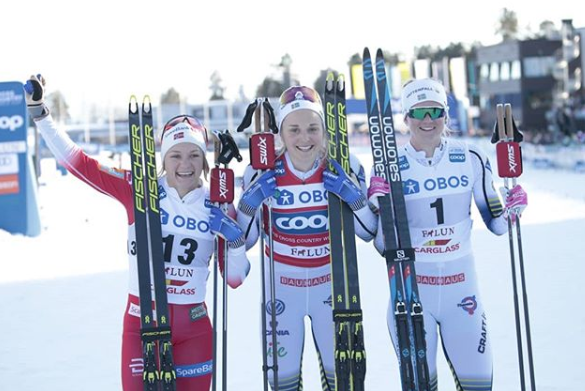
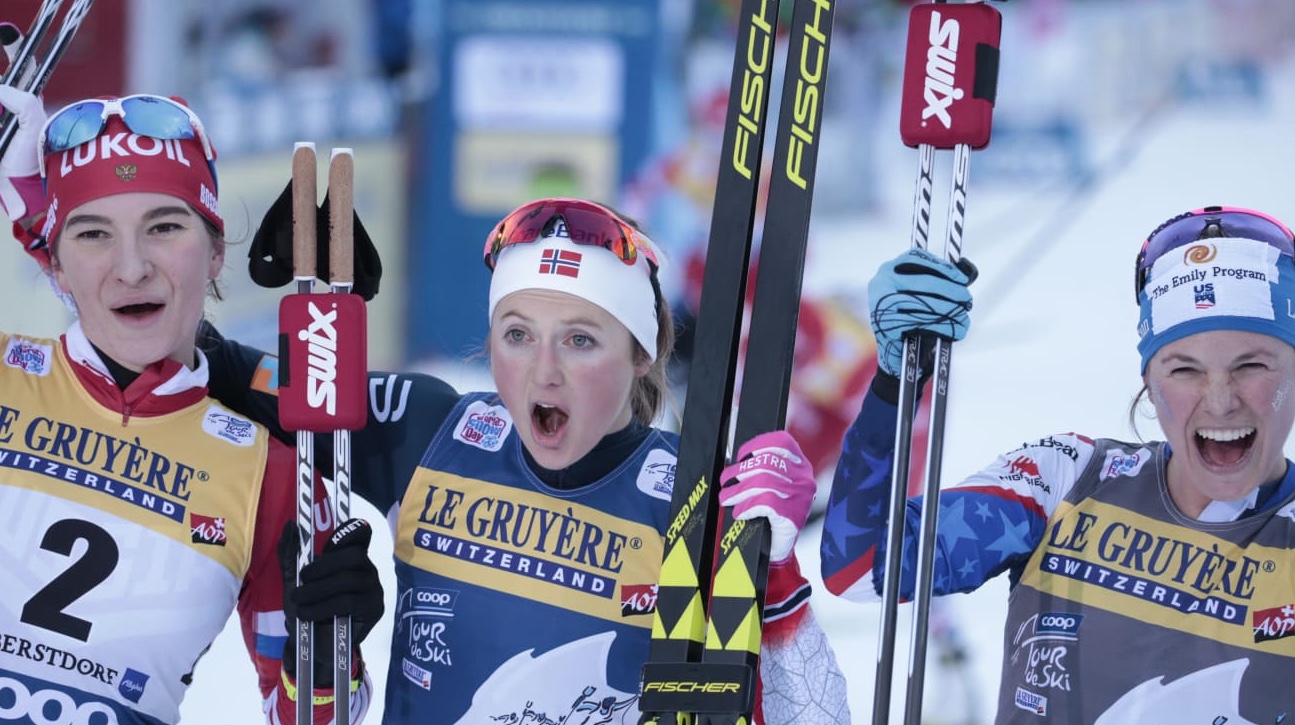
    The podium from the 10 k skate in Falun, Sweden. From left to right, Sweden’s Ebba Andersson in third, Norway’s Therese Johaug in second, and the U.S. Ski Team’s Jessie Diggins in third. (Photo: fis-ski.com screenshot)

    FIS World Cup Falun, Sweden 10k/15k Inidividual Freestyle

    The sun rises. The sun sets. And Norway’s Therese Johaug won the 10-kilometer individual start freestyle in Falun, Sweden. In 25:23.9 minutes, Johaug made her winning statement. Sweden’s Ebba Andersson placed second (+18.75), with the U.S. Ski Team’s (USST) Jessie Diggins in third (+30.3).

    Fourth place went to Ingvild Flugstad Østberg of Norway who finished 30.8 seconds back.

    Sadie Bjornsen (USST) raced to 12th (+1:05.7), Julia Kern (USST) 25th (+1:53.9), Rosie Brennan (APU) 27th, Kaitlynn Miller (CGRP) 34th (+2:21.5), and  Rosie Frankowski (APU) 35th (+2:26.1).

    Results


    The men’s 15 k skate was won by Russia’s Alexander Bolshunov in 33:18.6 minutes. Martin Johnsrud Sundby of Norway was second (+8.9) and Didrik Tønseth third (+17.7).

    The top North American finisher was Canada’s Alex Harvey in 11th (1:10.9). Jack Carlyle finished in 66th (+5:55.5).

    For the U.S., David Norris (APU) placed 16th (+1:15.3), Kevin Bolger (USST) 45th (+2:41.9), and Scott Patterson (USST) 54th (+3:39.8), Kyle Bratrud (SMST2) did not start.

    Results

    ***

    IBU World Championships Östersund, Sweden 12.5 k Mass Start

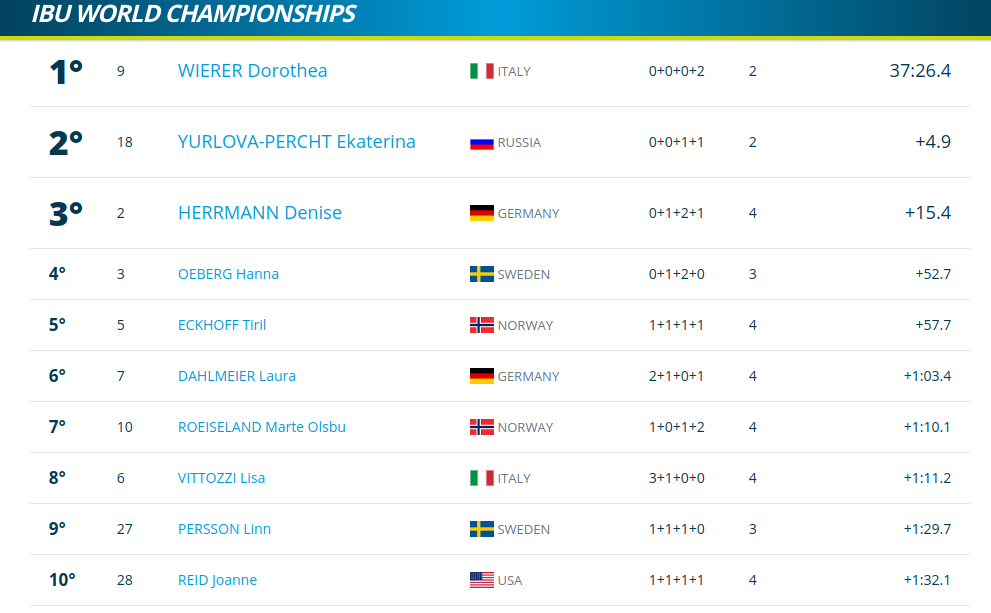
    Here’s the top-10 results from today’s 12.5 k mass start in Östersund, Sweden. The eyes need only read 10 skiers down for U.S. biathlete Joanne Reid’s name. There it is: 10th place for a career best individual result at a championship event.

    Her teammate Clare Egan placed 26th (+3:01.4, 0+0+3+2).

    Results

  • Saturday Race Rundown

    Saturday Race Rundown

    Women’s podium from the Falun, Sweden 1.4 k skate sprint. From left to right, Maiken Caspersen Falla of Norway in second, Stina Nilsson of Sweden in first, and Maja Dahlqvist of sweden in third. (Photo: @fiscrosscountry Instagram screenshot)

    FIS World Cup Falun, Sweden 1.4 k Freestyle Sprint

    On a day when sugary snow course picked off skiers trying to advance during Falun, Sweden’s 1.4-kilometer freestyle sprint, Stina Nilsson, yes of Sweden, took the win. She won the final in 3:07.72 over Norway’s Maiken Caspersen Falla  in second (+0.67). The day’s top qualifier, Maja Dahlqvist, placed third (+2.14).

    The Americans entered in the race were some of the key players who tumbled on course. Jessie Diggins (USST) qualified in 21st and was leading the second quarter final when she fell on a sugared downhill to place 28th overall. Both Sadie Bjornsen (USST), ranked fourth after qualification, and Sophie Caldwell advanced to the semis.

    Caldwell took a belly slide on the the course’s funky downhill to place sixth in her semi and finish 11th overall. In the second semi, Bjornsen was eliminated after placing fifth. She finished 10th overall.

    ponstel online

    Also for the U.S., Julia Kern (USST) placed 34th, Ida Sargent (USST) 37th, Rosie Brennan (APU) 53rd, and Kaitlynn Miller (CGRP) 61st.

    Results

    In the men’s 1.4 k skate sprint, Norway’s Johannes Høsflot Klæbo continued his winning ways with another sprint victory. He won the final in 2:52.38,  0.1 seconds over teammate Emil Iversen. Another Norwegian, Sindre Bjørnestad Skar, placed third (+0.28).

    U.S. skier Simi Hamilton (USST), who qualified in 16th, bowed out in the quarterfinals after placing fifth in his heat. Hamilton was 22nd overall. Kevin Bolger (USST) advanced to the heats where he was eliminated to end up 27th overall.

    Also for the U.S., Logan Hanneman (APU) placed 39th, and Ben Saxton (SMS T2) was 60th.

    Alex Harvey of Canada ended his race in 31st. He was the only Canadian entered.

    Men’s Results


  • Falla Locks Up Drammen Sprint; Diggins Strides to Fifth

    Falla Locks Up Drammen Sprint; Diggins Strides to Fifth

    Falla in first for her fifth Drammen sprint. (Photo: NRK screenshot)

    The World Cup entourage gathered Tuesday at the head of the Drammensfjord in Norway. The 1.2-kilometer classic sprint in Drammen, Norway — the post-Holmenkollen sprint stop on the calendar — was held under overcast skies and within a city center jammed with fans.

    Coming into Tuesday’s classic sprint, Norway’s Maiken Caspersen Falla had claimed two individual World Cup sprint victories this season and a World Championship sprint win in Seefeld, Austria. Falla remains consistent, having won three of the last four sprint globes. And she’s a lock in Drammen. She has won four of the last five Drammen city sprints —  2014, 2015, 2016, and 2018.

    As we bring the Americans into the story, the benchmark for qualification time was again set by Falla. Sadie Bjornsen of the U.S. Ski Team (USST) was the fastest American qualifier in eighth place. She was 3.32 seconds behind Falla, who completed the course in 2:49.90 minutes. Jessie Diggins (USST) qualified in 18th (+4.65), and Sophie Caldwell (USST) was 20th (+4.99).

    With the heats progressing, Diggins moved to the finals after placing second in the fifth heat and winning the second semi-final. Her semi-final lunge at the finish was a blur along with the three other skiers she was synced with across the line. There was a four way photo finish won by Diggins as she advanced to the finals.

    “That was really fun today,” Diggins emailed, “I’m so grateful and appreciative of the techs for giving me very competitive skis. Drammen is kind of a funny course, and this year they took away the iconic uphill pitch at the finish, so it was even harder to determine the right moment to transition from double poling to power striding on the gradual uphill! It’s not a secret that I love workable downhills so my strategy each heat was to ski smooth and smart and get myself into an open lane heading into the finishing straight.”

    Jessie Diggins of the U.S. Ski Team lining up for the finals in the Drammen , Norway classic sprint. (Photo: NRK screenshot)

    The six-across in the start gates for the finals were Diggins, Stina Nilsson of Sweden, Falla, Natalia Nepryaeva of Russia, and Norwegians Astrid Uhrenholdt Jacobsen and Anna Svendsen.

    With steady snowfall, Falla set the follow-me-if-you-can pace as the course ascends and then drops in a series of tight and sinuous turns back to the course low point. Falla led throughout. Driving on the ups and leading a four skier line snaking through the downhill. As she descended, Falla kept a small gap on those trying to draft behind which included Nilsson, Jacobsen, and Nepryaeva.

    A tight left-hander at the low-point is where Nilsson strategically slotted in and step-turned ahead of Falla, as she took the initial lead on the long incline to the finish. By then, Diggins and Svendsen had fallen off the pace.

    Nilsson double poled and then strode on the right, with Jacobsen on her tails. In the adjacent lane to the left, Falla notched into her double pole gear and began moving ahead. Her power maxing out, Falla gained centimeters then a bit of breathing room that became a few meters. Jacobsen, sensing her moment and a Nilsson power lapse, moved to her own lane and surged into second. As Nilsson faded, Nepryaeva kept enough reserves for the end as she barely took Nilsson at the line.

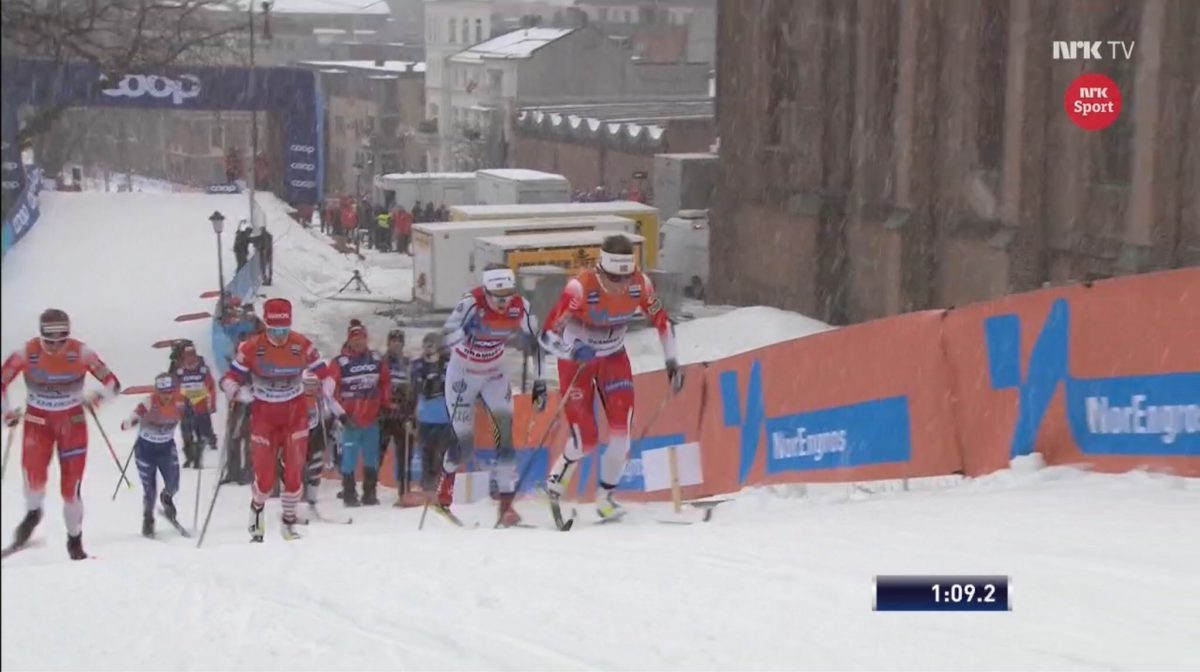
    Maiken Caspersen Falla of Norway getting a small gap on Sweden’s Stina Nilsson in Drammen, Norway (Photo: NRK screenshot)

    Falla crossed the line in 2:56.12 for the top podium step. Make it five out of six in Drammen for headlines like “Falla Wins!”

    “I think my technique is good for the climb before the finish line, my upper body is strong that is why this course fits me so well,” Falla told the International Ski Federation (FIS) after the race. “It is definitely one of the highlights of the season. It is such a great atmosphere. You can really feel the energy and the cross-country spirit. Yah, it is very good.”

    Jacobsen placed second (+0.80) after qualifying in fifth, with Nepryaeva in third (+1.06). Nilsson was fourth (+1.28), Diggins fifth (+5.38), and Svendsen sixth (+7.59).

    It was Jacobsen’s second podium of the season, the other coming in the 10 k freestyle in Ulricehamn, Sweden. She earned Her last World Cup sprint podium in March of 2016, in Canmore, Canada.

    For Nepryaeva, it was her second sprint podium this World Cup campaign with ramifications in the overall World Cup standings. Leading the overall is Norway’s Ingvild Flugstad Østberg with 1329 points. She did qualify for the heats but did not advance to the semis, finishing 19th overall. With her third place today, Nepryaeva now sits two points behind Østberg 1327 points with five races remaining.

    While racing to a fifth place on Tuesday, Diggins currently sits fifth in the overall World Cup. This was her first race after the conclusion of the World Championships in Seefeld, Austria. Both Diggins and Bjornsen sat out the Holmenkollen 30 k classic on Saturday to recover.

    where to buy vancomycin online

    where to buy vancomycin online

    “In the final I simply got tired from the short turnaround time you get from the second semifinal, but overall I was really happy with the whole day and how I executed my process-oriented goals of efficient and decisive ski testing in the short course opening window, a powerful double pole and ripping downhills, and just having fun and enjoying the atmosphere,” Diggins wrote. “As it turns out, the reminder to actually have fun IS a necessary goal this year with increased pressure, but I’ve decided that if I don’t let outside pressures dictate the joy I feel for the sport and in racing, then I can just relax and enjoy doing what I love best!”

    Bjornsen was eliminated in the second heat. Nilsson won the heat in 2:54.37, with Bjornsen placing fifth (+2.69). Bjornsen finished 21st overall. 

    “Exciting, and frustrating sprint here in Drammen,” Bjornsen explained in an email. “I sat out Holmekollen last weekend in hopes of saving some energy for the final push of the season. My body is feeling good, I just wanted to make sure I didn’t try to do too much and end up sick or tired.”

    The course’s uphill finish requires stout double pole capacity. Bjornsen felt that was a positive asset in Drammen.
    “I have been feeling really good in double pole this season, which helped me have a good qualifier here to start the day out,” she continued. “Unfortunately, I kind of struggled to find position over the top of the climb, and then really struggled with that super gradual striding in sprint speed right there at the finish. I was trying to push the DP as far as possible because I know that is my strength, but I just couldn’t keep up in that unique striding. That is something I have been ‘re-reminded’ every season I come here, but this time I am writing it down, and getting it done! So many of our courses now are running or DP, so I forget it is a gear I need until I come here to sprint every year. … I was excited to have great skis out there today, and look forward to putting these great feelings to use the next two weekends! I wish we had more classic sprints coming, but we will have to wait until next year now. Off to Falun for a weekend of skating!

    Caldwell ended her racing after placing fifth in her heat and 24th overall.

    “Drammen has always been a tough nut to crack,” U.S. Ski Team Head Chris Grover wrote in an email. “The finals appearances we’ve had here over the years with Andy, Kikkan, and Jessie have been very special.  Even with diagonal technique control zones, the race remains a double-pole fest.  If an athlete is not one of the best double-polers in the world, they have little hope in Drammen; the race is simply too short, too fast, and too specific in its demands.  The shortening of the course this season, taking out the final steeper classic striding pitch at the finish, placed even more emphasis on double-poling.”

    Those Americans missing the top-30 cut to advance were Ida Sargent (USST) in 34th, Kelsey Phinney (SMS T2) 49th, Julia Kern (USST) 50th, and Kaitlynn Miller (CGRP) 55th.

    No Canadian women entered the race.

    Results

  • Sunday Rundown: Starting with Oslo and Östersund (Updated)

    Sunday Rundown: Starting with Oslo and Östersund (Updated)

    Norway’s Therese Johaug with the Holmenkollen 30 k classic win and no challengers in site. (Photo: ARD screenshot)

    FIS World Cup Oslo, Norway Holmenkollen 30 k Classic

    Beautiful sunshine. Norwegian crowds. And fine views of Oslo fjord from atop the Holmenkollen venue for the women’s 30-kilometer mass start classic. All things typical on a good weather March day in Oslo.

    Norway’s Therese Johuag took this fine day and turned the screws on the 47 starters on Sunday to once again ski away from the field. By the second points bonus at 8k, Johaug was already 23.6 seconds up on the field. She won the race in 1:18:54.5 hours. According to the International Ski Federation (FIS), this was Johaug’s third 30 k win at Holmenkollen and her second classical victory. She won the 30 k skate in 2013. Her first Oslo 30 k classic win came in 2016.

    Russia’s Natalia Nepryaeva placed second 1:45.9 minutes back. Ebba Andersson of Sweden skied to third (+149.9).

    Rosie Brennan (APU) was the top U.S. skier in 33rd (+ 7:57.0). Rosie Frankowski (APU) placed 34th (+9:40.2), and Kaitlynn Miller (CGRP) 42nd (+13:43.7).

    Jessica Yeaton (APU/Australian National Team) raced to 30th (+7:29.4).

    No Canadians were entered.

    Results

    ***

    IBU World Championships Östersund, Sweden 10 k/12.5k Pursuit

    On Saturday’s 10 k pursuit at the IBU World Champs in Östersund, Sweden the German women took first and third. Denise Herrmann won in 31:45.9 minutes with two penalties in her third shooting stage. Tiril Eckhoff of Norway placed second, 31.4 seconds back while also skiing two penalties in her third shooting stage. Germany’s Laura Dahlmeier was a close third (0+0+1+0, +31.6).

    Clare Egan  of the U.S. was 12th (2+0+0+3, +2:44.3), Susan Dunklee raced to 24th (2+0+0+1, +3:27.6), and Joanne Reid 32nd (3+2+1+0, +4:24.2).

    For Canada, Sarah Beaudry finished 42nd (2+1+1+0, +5:23.5), while Rosanna Crawford, Emma Lunder, and Megan Bankes were lapped.

    Results

    In Östersund on Sunday, the men raced the 12.5 k pursuit. Ukraine’s Dmytro Pidruchnyi, who placed fourth in yesterday’s sprint, came away with the win in 31:54.1. Remarkably, it was Pidruchnyi’s first race win either on the IBU World Cup or at the championship level. The 27 year old missed two targets for the day. 

    Johannes Thingnes Bø of Norway, the biathlete who has dominated the men’s side this season, placed second (+8.3). Bø’s ski speed was such that he took silver despite missing five targets he won the Silver medal. Taking third (+17.7) was France’s Quentin Fillon Maillet. He missed three targets in earning bronze.

    For the U.S., Sean Doherty raced to 20th (+1:54.3) while missing two targets. Leif Nordgren placed 44th (0+0+3+1, +4:02.7), and Jake Brown 53rd (1+1+4+1, +6:00.8).

    Canada’s Scott Gow began in bib 50, and skied up to finish 43rd (2+0+0+2, +3:51.4).

    Results


  • Out in Front, Caitlin Patterson Claims 20 k Skate National Championship

    Out in Front, Caitlin Patterson Claims 20 k Skate National Championship

    The women’s 20 k skate podium at the 2019 U.S. Cross-Country Nationals at Craftsbury, VT. From left to right, Jessica Yeaton (APU/Australian National Team) in third, Caitlin Patterson (CGRP) first, and Rosie Frankowski (APU) second. (Photo: John Lazenby)

    Link to mass start skate race photo gallery.

    Another distance race at U.S. Cross-Country Nationals in Craftsbury, Vermont and another win for Caitlin Patterson of the Craftsbury Green Racing Project.

    Count them up: eight U.S. national championships for the twenty eight year old. And in as many days at her home course, Patterson has further solidified both her legacy and the fact she is the distance racer to watch and match as the start gun fires.

    On Thursday of last week, Patterson opened U.S. nationals with a win in the 10 k classic. Today, in a time of 59.23.1 minutes, ticking off k after k, Patterson won the women’s 20 k skate mass start.

    “For the first [5 k] lap Rosie Frankowski and I traded off the lead a little bit,” Patterson told FasterSkier in Craftsbury. “She was leading the climbs and I was leading the downhills, but I could already feel it stretching on the downs. On the second lap when I pulled away on Kirby’s downhill heading towards like about 3 k into the loop, then the climbing was fairly good too, I just decided to keep charging and pull away. I skied a lot of the race by myself.”

    By 10 k, Patterson had eeked out a lead over Frankowski (APU), coming through the mid-race time check in 29:34.1. Frankowski came through 14.5 seconds later.  

    Caitlin Patterson during the 2019 20 k skate at U.S, nationals in Craftsbury, VT. (Photo: John Lazenby)

    “I was getting some splits that it was stretching, but Frankie is definitely a really strong climber so I didn’t want to let up,” Patterson said. “I needed to keep myself moving on those uphills. I was moving along well and pushing the pace but also feeling like I was fairly confident that I was going to be able to hold it.”

    Frankowski, a 2018 Olympian who placed 21st in the women’s 30 k classic in PyeongChang, remained true to her reputation as a gritty skier and thoroughbred climber.

    “It was hard from the gun honestly, the plan I kind of had was to just go as hard as I could and make it so it wasn’t a giant group because I don’t like skiing in a giant group,” Frankowski told FasterSkier. “I knew that breaking Caitlin would be really difficult to do and the only place I could probably do it was on steep uphills.”

    For the first 10 k, from Frankowski’s perspective, she attempted to execute her plan of attacking on the hills. Patterson could not be broken.

    “I tried to take some uphills and punch them,” Frankowski explained. “It didn’t really work. So the last 10 k I was on the solo train just like dying.”

    Catching glimpses of Patterson from time to time up ahead, Frankowski knew she wasn’t bleeding massive time to the eventual winner. Conversely, she understood skiers like Jessica Yeaton, an APU training mate, were seeking to link up from the back.

    “I could hear them getting cheered for,” Frankowski recalled. “And then on the last 5k my leg cramped up on the big uphill and I was like ‘oh my god’ I just have to try and finish. It was hard to motivate. I was trying my best, it was a hard head game for 10 k.”

    Frankowski was never caught, and her “head game” ended with a second place and a finishing time of 1:00:03 hours. 

    Yeaton, who skied the later part of her race with Hailey Swirbul (APU) and Evelina Sutro (UVM), was able to distance herself and take third overall, 6.7 seconds behind Frankowski.

    “It was really hard work out there, the first lap I went out hard and then died a little,” Yeaton said. “So I’m really happy I was able to hang on and pull up third place in the end because there was a lot of fighting for position in the middle of the race.”

    Yeaton also placed second overall in Thursday’s 10 k classic. She is an Australian national, as a result, Swirbul, the day’s fourth place skier, took third on the American podium.

    “It was really fun, my first 20 k but I have done a lot of 15s,” Swirbul said. “It was familiar territory in that way. But it was really a lot of highs and lows. The pace went out hot and stayed hot I think the whole time, for me at least. But it was really cool to be able to ski with teammates like Jess.”

    Caitlin Paterson (CGRP), post-2O k skate, post-U.S, national championship win. (Photo: John Lazenby)

    Sutro was fifth overall, Erika Flowers (Salomon) sixth, Alayna Sonnesyn (SMS T2) seventh, Canada’s Cendrine Brown (PHTC) eighth, Katharine Ogden (Dartmouth) ninth, and Kaitlynn Miller (CGRP) tenth.

    Racing continues at U.S. nationals with a skate sprint on Tuesday.

    Results

    -Kelsey Dickinson and David Brown Contributed

  • No Place Like Home; Ida Sargent Takes Classic Sprint National Title in Craftsbury

    No Place Like Home; Ida Sargent Takes Classic Sprint National Title in Craftsbury

    The women’s podium from the U.S. Cross-Country Ski Nationals classic sprint in Craftsbury, VT. From left to right, Julia Kern placed second, Ida Sargent first, and Hannah Halvorsen third. (Photo: John Lazenby)

    Link to Cross-Country Nationals Classic Sprint Gallery.

    For many, there’s no place like home. Tucked into the Northeast Kingdom, the Craftsbury Outdoor Center takes pride first and foremost for making outdoor sport accessible to the region’s children. The icing on the cake is when one of those local kids goes big, skis on the World Cup, and comes home for a classic sprint national championship.

    National champion classic sprint winner in Craftsbury, VT., Ida Sargent gets a hug from her mother Lindy Sargent moments after Ida claiming the title. Ida Sargent grew up skiing in the Craftsbury area. (Photo: John Lazenby)

    Although the in-between details are missing, that’s the short-version story of U.S. Ski Team (USST) and Craftsbury Green Racing Project (CGRP) skier Ida Sargent. On Friday, Sargent skied in front of friends and family to win the classic sprint title at the 2019 U.S. Cross-Country Ski Championships in Craftsbury, VT.

    At an event like nationals, with World Championship starts on the line, nothing is cruiser. Yet Sargent showed poise and speed in her clean sweep from the qualifier through the A final. Sargent was the fastest qualifier in 3:51.30 minutes. Three laps of the course later, after her quarter, semi, and final, Sargent was able to ski the final in 3:43.55 minutes, nearly eight seconds faster than her first place qualifying time.

    According to the International Ski Federation (FIS) database, this is Sargent’s first career national title.

    “Today I just wanted to just stay out of trouble after a little bit of a pole incident yesterday,” Sargent told FasterSkier in Craftsbury. “So I just kind of tried to go hard from the beginning. It was fun having the younger girls pushing me towards the end. I felt really good all day today so it is kind of fun to have a good feeling and I just love racing here at home, it is my favorite. They do such an amazing job, there has been so much hard work by everyone at Craftsbury Outdoor Center. The whole staff, the groomers, the volunteers our GRP coaches and wax tech, Nick Brown. I think I just had all of that energy carrying me along the course today.”

    In Thursday’s 10 k classic interval start, Sargent, despite breaking a pole, placed ninth overall. Sargent is a full-time World Cup athlete for the USST, but has taken time away from her European schedule to race U.S. nationals at home, and prepare for the the upcoming World Cup sprints.


    Ida Sargent takes the U.S. national championship classic sprint title in Craftsbury, VT. Julia Kern in red (USST D-Team/SMS T2) out lunged Hannah Halvorsen in blue to take second place. Halvorsen placed third. (Photo: John Lazenby)

    USST D-Team and SMS T2 athlete Julia Kern placed second overall after qualifying in third place.

    For Kern, the pre-nationals leader of the women’s SuperTour, this was her first senior U.S. national’s podium. (Kern placed third overall in the 2015 Houghton, MI., classic sprint qualifier.) Kern’s second place time in the final was 3:44.31.

    Kern won both her quarter and semi-final on her way to finishing second overall.

    “My quarter and semi I had pretty bad starts and I was in the back,” Kern said in Craftsbury. “Especially in the semi, I was in sixth going into the downhill — Hailey [Swirbul] and I got out of the tracks on the uphill and double poled by everyone to make the move because it was really hard to move around and get boxed out. I was feeling definitely nervous and a little tired. But when I go head to head I get excited and I push it and that gets me going.”

    Hannah Halvorsen (USST D-Team/APU) placed third. Today’s podium was also a first career senior national’s podium for Halvorsen. Halvorsen crossed the line behind Kern in 3:44.33.

    “I definitely learned some things throughout the heats,” Halvorsen said after the race. “In my semi I was in the far right lane and it was a little bit slower. I think that was a good thing though, because I learned for the final and I tucked in behind Julia in one of the center lanes. … I really enjoyed going head to head with Julia. Because we have been racing together for years and I have been waiting for a day when we can both be feeling great and we really just race together like that. I don’t think it can be more fun.”

    Photo finish for Hannah Halvorsen in blue and Julia Kern in red. (Photo: Bullitt timing)

    Caitlin Patterson (CGRP) was fourth in the classic sprint after winning yesterday’s 10 k classic national title. Kaitlynn Miller (CGRP), the 10 k classic runner-up for the U.S. podium and third overall, placed fifth. Hailey Swirbul (USST D-Team/APU) was sixth.

    Saturday is a rest day at U.S. nationals with racing starting up again on Sunday with freestyle mass start races.

    Women’s Qualification | Women’s Results

  • Caitlin Patterson Wins Tricky 10 k Classic at Nationals

    Caitlin Patterson Wins Tricky 10 k Classic at Nationals

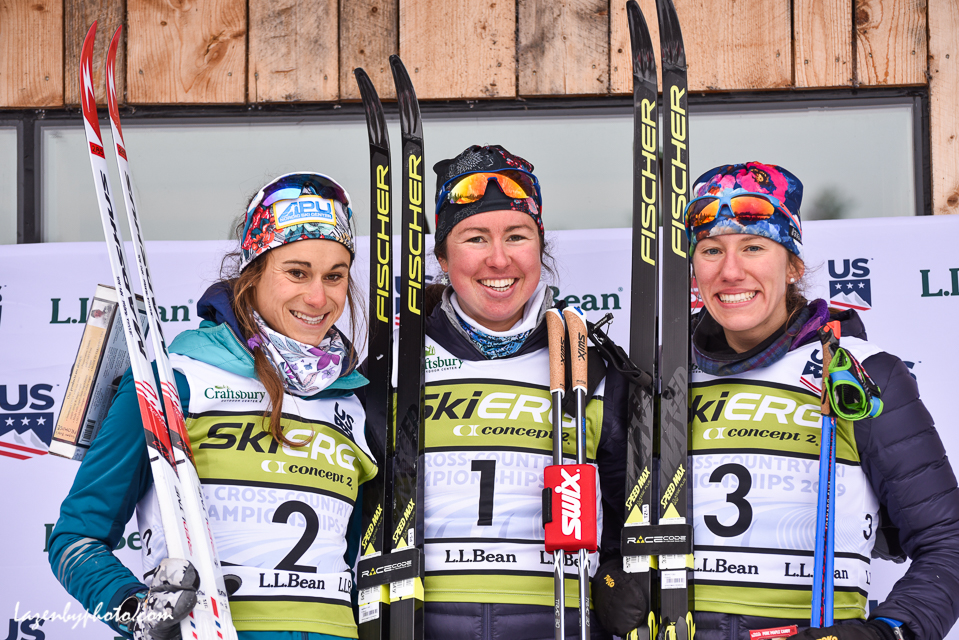
    The women’s podium from the 10 k classic at Cross-Country Nationals in Craftsbury, Vt. (l-r), Jessica Yeaton in second, Caitlin Patterson first, and Kaitlynn Miller third. (Photo: John Lazenby)

    Link to photo gallery.

    The attention of the domestic racing scene has focused on Northen Vermont’. Thursday was the first day of racing at the Craftsbury Outdoor Center which featured a 10-kilometer classic interval start for the women.

    The home club, Craftsbury Green Racing Project (CGRP), had athletes take first and third in the women’s race. Patterson won in a time of 30:44.7 minutes.

    At twenty-eight-years-old, Caitlin Patterson won her seventh national title on Thursday. This comes on the heels of last season’s nationals where she won outright three of four events on her way to securing a spot at the 2018 Olympics. At those 2017 championships in Anchorage, Ak., Patterson won the 10 k skate, 1.3 k skate sprint, was second overall in the 20 k classic mass start (but the first American), and won the 1.3 k classic sprint.  

    As a local who trains and lives in the off-season in Craftsbury, the course was a familiar and welcome sight despite the shallow or non-existent tracks.

    “It was really fun, it was a good race, really fun,” Paterson told FasterSkier after Thursday’s race. “Definitely kind of messy conditions out here, we got about four inches of snow last night, really powdery stuff, and then based on when they groomed I don’t think all the snow got groomed in. When 300 men went by, the tracks were obliterated. So it was a lot of double pole and then a lot of just running the uphills. I’ve never seen that here at Craftsbury with so little tracks left —  just little snippets of tracks here and there.”

    Caitlin Patterson (CGRP) on her way to winning the women’s 10 k classic at the 2019 Cross-Country Nationals. (Photo: John Lazenby)

    Patterson was a discretionary pick to ski the distance events during the World Cup Period 1 races. She competed in seven individual World Cup distance races this season including a 4 x 5 k relay start with the U.S. team in Beitostølen, Norway where the team placed fifth.

    Upon her return to Vermont, Patterson raced last weekend at Craftsbury which allowed her to better understand how to gauge her effort today.  

    “I raced an Eastern Cup last weekend, which was coming back down to sea level after a little bit of time at altitude, and so it feels like I can push harder,” Paterson said. “So trying to use some of the info that I picked up last week and just remember that I can push really hard at all parts of the course and there are a few places that you can kind of rest out there. I was thinking ‘make every second count, transition really well, take a little bit of rest when you can get it but mostly just hammer the whole race.’ I think that I have an internal sense of pacing, it’s not like I’m really consciously holding back in something like this, more like just ‘go harder.’

    Jessica Yeaton (APU/Australian National Team) placed second in 31:05.5 minutes.

    “Everything just came together,” Yeaton told FasterSkier in Craftsbury. “I know it was tricky conditions out there. It went well for me. … I went into it hoping to double quite a bit and actually it worked out pretty well because it was fast and the tracks were blown out a lot. So I was able to push the double pole a lot and just run out the tracks on the uphills and that seemed like it worked.”

    In third place, also from CGRP was Kaitlynn Miller. Miller stopped the clock in 31:22.1 minutes. Like her teammate Patterson, Miller raced this season’s World Cup for Period 1 as the overall SuperTour leader last season.

    “It went really well today, and I mean it is nationals so you take some calculated risk and I went out hard,” Miller said. “And I just hung on for the second lap. … Definitely, within reason, I paced the first lap a little bit but definitely pushed it pretty hard. And the just really sent it on the last lap and tried to have a strong finishing section and I’ll mention that it is really exciting to win the race, to have a teammate up there on the podium.”

    Julia Kern (SMS-T2) was fourth overall and the third American. She finished in 31:33.9 minutes. Kern has raced domestically this season and prior to nationals was leading the overall SuperTour.

    “It was a tough day, really nice snow, but really mashed-potatoes tracks,” Kern said. “It made it really hard for skiing — a lot of herringbone running which is very tiring but it was fun racing, fast and furious. Definitely a lot of hard work out there.”

    Nationals continue tomorrow with a classic sprint.

    Women’s Results

    -David Brown and Kelsey Dickinson contributed 


  • Thursday Race Rundown: Tour de Ski and U.S. Nationals (Updated 2 x)

    Thursday Race Rundown: Tour de Ski and U.S. Nationals (Updated 2 x)

    Norway’s Johannes Høsflot Klæbo won today’s TdS Stage 5 15 k skate pursuit in Oberstdorf, Germany. (Photo: NBC Gold screenshot)

    FIS World Cup Tour de Ski Stage 5 15 k/10k Freestyle Pursuit Oberstdorf, Germany

    Men’s Report | Women’s Report 

    Today’s Tour de Ski (TdS) Stage 5 15-kilometer freestyle pursuit in Oberstdorf, Germany began and ended simply enough: Norway’s Johannes Høsflot Klæbo wearing the Tour’s blue leader’s bib started first with a 15 second lead over second overall skier Russia’s Sergey Ustiugov.  

    By 2 k into the race, the pair had linked up and ceded no time to the 63 chasers. Klæbo put in a burst of speed over the last hill and carried a several meter gap into the finish straight to win the pursuit in 35:07.5 minutes. Ustiugov placed second (+0.4), with his teammate Alexander Bolshunov third (+1:08.4).

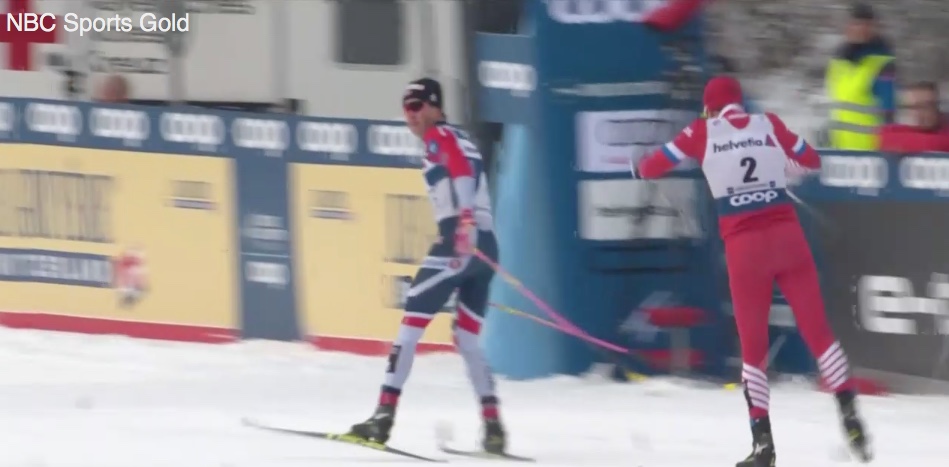
    Norway’s Johannes Høsflot Klæbo turns before the finish to stare down Russia’s Sergey Ustiugov in today’s TdS Stage 5 15 k skate pursuit in Oberstdorf, Germany. (Photo: NBC Gold screenshot)

    Canada’s Alex Harvey, the best placed North American, was 22nd (+3:11.6). Lenny Valjas (CNST) placed 53rd (+8:10.6) and Bob Thompson 55th (+9:41.0).

    Ben Lustgarten (CGRP) for the U.S., the only remaining U.S. male in the TdS, placed 54th (+8:38.2).

    Men’s Results | Men’s TdS Overall Standings After Stage 5

    The women’s podium from Stage 5 of the 2018/2019 Tour de Ski’s 10 k skate pursuit. From left to right, Russia’s Natalia Nepryaeva was second, Norway’s Ingvild Flugstad Østberg first, and Jessie Diggins of the U.S.third. (Photo: fis-ski.com screenshot)

    As the leader of the women’s TdS Norway’s Ingvild Flugstad Østberg never looked stressed in today’s 10 k skate pursuit. Østberg left the start with a 24 second lead over Russia’s Natalia Nepryaeva and beat her by 30.4 seconds for the win. Østberg won in a time of 26:21.2 minutes, Nepryaeva placed second, and the U.S. Ski Team’s (USST) Jessie Diggins was third (+1:12.6).

    Diggins out-lunged Russia’s Yulia Belorukova across the finish line for a photo finish. Belorukova was 0.1 seconds behind Diggins as she placed fourth.

    Diggins raced the fastest time of day on course, skiing the 10 k in 26:07 minutes.

    Østberg retains the TdS leader bib, with a 35.4 second lead on second overall Nepryaeva, and a 1:22.6 minute lead on third overall Diggins.

    Sadie Bjornsen (USST) placed 11th in today’s pursuit (+4:07.8). Bjornsen is also 11th overall in the TdS standings but will exit after today’s stage to focus on upcoming World Cups.

    Canada’s Emily Nishikawa placed 30th (+7:26.1).

    Women’s Results | Women’s TdS Overall Standings After Stage 5

    ***

    U.S. Cross-Country Ski Championships Craftsbury, Vermont 10 k/15 k Classic Interval Start

    Today was the first day of racing at the U.S. Cross-Country Ski Championships in Craftsbury, Vermont. The women began with a 10-kilometer classic interval start race.

    Caitlin Patterson (CGRP) won in a time of 30:44.7 minutes, while Jessica Yeaton (APU/Australian National Team) placed second in 31:05.5, and Kaitlynn Miller (CGRP) was third in 31:22.1.

    Julia Kern (SMS-T2) was fourth overall and the third American in 31:33.9 minutes.

    Women’s Results

    In the men’s 15 k classic race, Kyle Bratrud (SMS T2) won his third career national title. He stopped the clock in 41:41.8 minutes. Adam Martin (CGRP) placed second in a time of 42:12.8. Kris Freeman (Caldwell Sport), took third in 42:27.6. Freeman “retired” last season, but still remains in form and podium worthy.

    Men’s Results

    ***

    U.S. Paralympics Nordic Nationals Craftsbury, Vermont


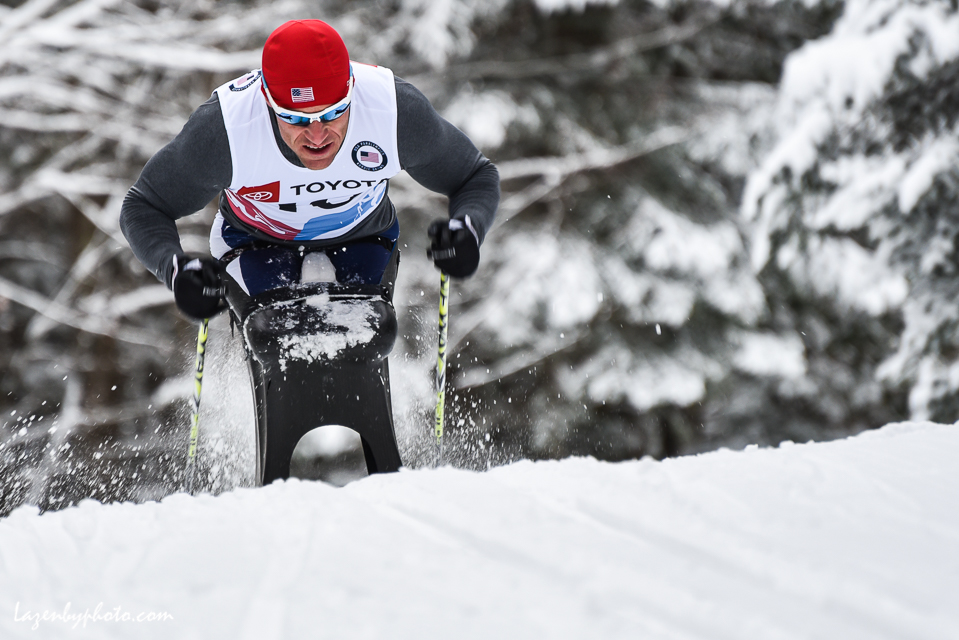
    Dan Cnossen on his way to winning the men’s middle distance national title at the Paralympic Nordic Nationals at Craftsbury, Vermont. (Photo: John Lazenby)

    Also at the Craftsbury Outdoor Center on Thursday, the middle distance race was held for the first event at the Paralympic Nordic Nationals. Dan Cnossen won the race in 25:09.9 minutes. Cnossen is based outside of Boston but trains frequently in Craftsbury both as a sit-skier and biathlete.

    “It was good, a really good course I thought,” Cnossen told FasterSkier in Craftsbury. “The grooming was good, but the conditions were a bit tough due to the snowfall. I love racing at Craftsbury, I’ve done the majority of my training in the last few years here. I think they undoubtedly put on the best venue. It is nice for me to come here. I am also a New England athlete.”

    Asked about his tactics, Cnossen said the overnight snowfall changed his perception of the course.

    “The course speed Yesterday during course inspection the conditions were a really fast and I was a little nervous about how it would go today but then with this snowfall it changed things a lot and I am a bit more of a climber and focus on that. Sometimes as sit skiers our poles sink a little deep in the softer snow so I was trying to pole in a light way, but not want to lose the power.”

    Aaron Pike placed second, and Canada’s Yves Bourque was third.

    Men’s Para-Nordic Results

    Oksana Masters won the women’s 5 k event at the Paralympics Nordic Nationals in Craftsbury, Vermont. (Photo: John Lazenby)

    In the women’s event, Oksana Masters won the 5 k race in 19:38.9 minutes.

    “This was a fun course. …. Yesterday was a lot icier and then today it was definitely a lot softer but it was cool because there was still a lot of technical components which often doesn’t happen in para-sport or para-courses sometimes for nationals,” Masters said. “So that was cool. It had a lot of climbs, a lot of fun downhills.”

    Kendall Gretsch was second, and Lyne Marie Bilodeau was third.

    Women’s Results

  • Johaug Wins in Beitostølen; Diggins Eighth, Bjornsen 13th, Brennan 15th

    Johaug Wins in Beitostølen; Diggins Eighth, Bjornsen 13th, Brennan 15th

    The Women’s podium from the World Cup 15 k freestyle in Beitostølen, Norway. Norwegian Theresa Johaug (center) was first, Sweden’s Charlotte Kalla (left) second, and Ingvild Flugstad Østberg (right) of Norway third.


    “I feel like the shape was really good today,” Norway’s Therese Johaug told the International Ski Federation (FIS) after Saturday’s 15-kilometer freestyle individual start race in Beitostølen, Norway.

    On a day when winter felt like winter, snow fell throughout the race and temperatures hovered around 20 degrees Fahrenheit, Johaug’s shape was never in doubt. Absent two seasons from the World Cup after testing positive for banned steroids in her system, Johaug is back with a vengeance. And when the shape is good for the now 80-time podium finisher in World Cup distance races, we all know how the results look.

    Johaug took her fourth win on Saturday in as many distance races this season on the World Cup. In Kuusamo, Finland, Lillehammer, and Beitostølen, Norway, Johaug crushed. Her tempo and raw fitness are leaving only second and third places on the podium to be decided as the season’s distance races unfold.  

    Her winning time in Beitostølen’s 15 k skate was 38:39.8 minutes. Sweden’s Charlotte Kalla paced third (+1:05.9), and Norway’s Ingvild Flugstad Østberg was third (+1:06.1).

    “I think that was my best race this season,” Johaug said to FIS. “I had good energy all the way. I am really happy to be atop the podium here again in Beitostølen. I think this is my place.”

    If each time check today were a microcosm, the gains on the would-be-podium placers only increased at every checkpoint. Johaug never let up, the field could only attempt to temper the damage.

    At 5 k, Johaug was up 26.1 seconds on Sweden’s Ebba Andersson who marked the second fastest split. At 10 k, the start of lap two of three, the gap to second place skier Andersson was 47.8 seconds. (Andersson faded slightly in the final 2.8 k to place fourth, 1:08.8 minutes back.) For now, at least, Johaug appears to be racing against her own benchmarks of fitness while the remaining stars of the sport minimize time back to a runaway skier.

    Johaug is on a record-setting pace. During her last full season on the World Cup, 2015/16, Johaug won a record 12 individual races. We are starting to see this season that unless Johaug withers from an early season fitness peak and the chasers come into form later this season, she could simply run away with a few World Cup globes. She leads the distance and overall World Cup standings.

    For Kalla, her second place in the 15 k skate was her best ever in the discipline. Back in 2013 in Davos, Switzerland she finished third in the 15 k skate. Kalla sits second in the overall World Cup with 369 points, trailing Johaug by 131 points. Today was Kalla’s third podium of the season. She finished fourth on one other occasion.

    U.S. Ski Team skier Jessie Diggins at the start of the World Cup 15 k freestyle individual start in Beitostølen, Norway. Diggins placed eighth.

    The U.S. Ski Team’s Jessie Diggins had her best result of the season finishing in eighth place, 1:29.6 minutes behind the day’s winner, Johaug. From a pacing perspective, Diggins was consistent. At the 6 k, 10 k, and 12 k marks, she was locked in seventh place. Coming off a cold that affected her performances last weekend in Lillehammer, Norway, Diggins told FasterSkier in Beitostølen that her sensations were coming around.

    “I felt better than last weekend, Diggins said. “I started to feel more like myself. Which is nice because I was definitely still sick last weekend, so feeling healthy was really nice and I felt like I could really breathe out there. That was really positive and I had some really good skis and I just went out there and I kept trying to focus on skiing every part of the course as smart and as good as I could. And focus on my technique and so I was happy with it. It was a step in the right direction. … We are still in period 1. I think I am in a pretty good place right now and I am where I need to be.”

    Diggins had her first podium last season, a season when she placed second in the overall World Cup, on January 1, during the Tour de Ski’s third stage 10 k skate pursuit in Lenzerheide, Switzerland.

    Sadie Bjornsen (USST), finished 13th (+(+2:22.9) for her sixth top-15 of the season on the World Cup. Bjornsen’s best finish thus far was a third place in Lillehammer’s skate sprint.

    “I feel worked,” Bjornsen said in the mixed zone. “That was definitely a very very challenging race out there today. I think what makes it challenging [for me] is the flat terrain. There’s just no recovery out there and especially with falling snow it is extra difficult to move across the snow and so today was just race of toughness for 15 k.”

    Of the tough conditions due to the freshly fallen snow, Bjornsen noted her skis felt solid. Her legs, on the other hand, were fatigued. Additionally, Bjornsen, who lives in Anchorage, Alaska, a community that suffered a major earthquake last week, has had home on her mind.

    “I felt like my legs were particularly tired today,” Bjornsen said. “I think it has just been a long week with a lot of things going on. So I think I have to set a goal next week to not have any stress or my mind on anything about home, so I can truly recover.”

    U.S. Ski team athlete Sadie Bjornsen (bib 37) at the start of the World Cup 15 k freestyle individual start in Beitostølen, Norway. Bjornsen placed 13th.

    Bjornsen is ranked ninth overall on the World Cup.

    Also for the U.S., Rosie Brennan has proved the U.S. pool of women remains deep. Skiing for Alaska Pacific University (APU), Brennan’s renewed prowess earned her a fifth top-30 this season, which includes three top-15s.

    In Beitostølen Saturday, Brennan placed 15th (+(+2:33.9).

    “I am definitely getting a little tired from all the racing, especially after the mini-tour last week,” Brennan said after the race. “But I am happy with my shape and I think I can hold through one more weekend and then I will get a little rest.”

    Despite earning the 15th best time after two laps, and maintaining that position at the finish, Brennan explained, like many skiers, the third lap was difficult.

    “I was really happy with my first and second lap but I wished I would have had a little bit more energy to give on the last lap,” Brennan said. “I just tried to keep a steady pace and always be trying to make up a little time here and there. I mean it is slow out there so there is just more work. It is the same for everybody.”

    Caitlin Patterson, skiing for the U.S. and training with the Craftsbury Green Racing Project (CGRP), placed just outside the points in 32nd (+3:46.0).

    “It was a good fight,” Patterson told FasterSkier in Beitostølen. “This is a fun course. I liked a lot of the working gliding sections and I think I skied the transitions better than I have in other races. I am feeling fairly solid about it. I was getting some good reinforcing splits out there.”

    Patterson explained she is feeling good while still adjusting her skiing and looking for that top-end World Cup gear.

    “I am smoothing out the way I am racing with better transitions now,” Patterson said of her racing. “The fitness still feels like it is coming around. Last year, I felt like I had a little more than a top gear than I have tapped into this year. It’s still coming around.”

    Also for the U.S., Kaitlynn Miller placed 50th (+5:02.8).

    Emily Nishikawa of the Canadian National Team (CNT) was the best placed Canadian in 34th (+4:01.6). Cendrine Brown (CNST) was 38th (+4:16.4). This was the first World Cup of the season in which Canada has entered a women’s team.

    “I am happy with this start to the season,” Nishikawa wrote in an email. “I am encouraged by my race and know that I have some room for improvement next weekend in Davos.”
    Both Nishikawa and Browne spent time in Davos, Switzerland, the site of next weekend’s World Cup, prepping with a pre-race season camp.

    Racing continues on Sunday in Beitostølen with a women’s 4 x 5 k and men’s 4 x 7.5 k relay.

    The U.S. has eight women in Beitostølen and will field two women’s teams in Sunday’s relay. Team one will consist of Bjornsen, Brennan, Patterson, and Diggins.  The second team will feature Sophie Caldwell, Ida Sargent, Kelsey Phinney, and Kaitlynn Miller.

    Women’s Results | Distance World Cup Standings | Overall World Cup Standings

  • Saturday Rundown: Beitostølen, Pokljuka (Biathlon), and Sovereign Lake (Updated 4 x)

    Saturday Rundown: Beitostølen, Pokljuka (Biathlon), and Sovereign Lake (Updated 4 x)

    The Women’s podium from the World Cup 15 k freestyle in Beitostølen, Norway. Norwegian Theresa Johaug (center) was first, Sweden’s Charlotte Kalla (left) second, and Ingvild Flugstad Østberg (right) of Norway third.

    FIS World Cup Beitostolen, Norway 15 k/30k Freestyle Individual Start 

    Women’s Race Report | Men’s Race Report 

    With snow falling and trees covered with fresh snow, Beitostølen, Norway’s wintery essence was on full display during the women’s 15-kilometer freestyle individual start on Saturday.

    Keeping her distance win-streak alive was Norway’s Therese Johaug who won her fourth World Cup distance race of the season making it four for four in 2018/2019.

    Jessie Diggins of the U.S. Ski Team on her way to eighth place during Saturday’s 15 k freestyle in Beitostølen, Norway.

    Johaug won in a time of 38:39.8 minutes. The only blip of egalitarianism on the tracks was at the first time check at 1 k, where Johaug was tied for the best time with Russia’s Natalia Nepryaeva. Otherwise, Johaug gradually pulled away from the fifty-eight finishers by the time she crossed the finish line.

    Sweden’s Charlotte Kalla placed second (+1:05.9), and Ingvild Flugstad Østberg of Norway was third (+1:06.1).

    U.S. Ski Team (USST) athlete Jessie Diggins finished in eighth (+1:29.6) for her first top-10 result of the season. Sadie Bjornsen (USST) placed 13th (+2:22.9), Rosie Brennan 15th (+2:33.9), Caitlin Patterson (CGRP) 32nd (+3:46.0), and Kaitlynn Miller 50th (+5:02.8).

    Canada entered a women’s team for the first time this season. Emily Nishikawa of the Canadian National Team (CNT) was the best placed Canadian in 34th (+4:01.6). Cendrine Brown (CNST) was 38th (+4:16.4).

    Women’s Results


    Sitting atop the men’s overall World Cup this season after Saturday’s racing is Russia’s Alexander Bolshunov. The young skier is a killer in the sprints and distance events. But it is perhaps Norway’s Sjur Røthe who has impressed the most this season in the distance events. Røthe has a slight seven-point lead in the distance overall.


    The men’s podium from the 30 k freestyle individual start in Beitostølen, Norway. Sjur Røthe (center) placed first, teammate Martin Johnsrud Sundby (left) second, and Russia’s Andrey Melnichenko (right) third.

    Røthe won Saturday’s 30 k skate individual start in a time of 1:09:53.5. It was his second World Cup victory this year. Teammate Martin Johnsrud Sundby, with his first podium of the season, placed second (+35.2), Russia’s Andrey Melnichenko was third (+49.2). For the twenty-six-year-old Melnichenko, it was his first career World Cup podium.

    Canada’s Alex Harvey was the best placed North American in 13th (+1:49.8). Also skiing for Canada, Andy Shields finished in 63rd (+7:05.6).

    Scott Patterson (USST) was the best-positioned skier for the U.S., placing 47th (+4:32.7). David Norris (APU) skied to 51st (+5:13.3.) Erik Bjornsen (USST) was 52nd (+5:14.9), Adam Martin (CGRP) 59th (+6:14.8).

    Men’s Results


    ***


    IBU World Cup, Pokljuka, Slovenia

    Egan Leads North Americans in 15th Place in Pokljuka Sprint. 

    Just before her race on Saturday, US Biathlon’s Clare Egan seemed to be in a relaxed mood and could be seen on the broadcast joking with other athletes and posing for pictures in the warm-up zone. Starting into the women’s 7.5-kilometer sprint in an early group in bib 26, Egan began the race fast and still managed to shoot clean in her prone stage.

    She kept near the top at the split times during this early phase of the race.

    “I am skiing way faster than I have in past years,” Egan commented on her improved course time in an email to FasterSkier, which in past seasons occasionally had prevented her from achieving positions in the points or qualifying for pursuit and mass start races. “I think my previous best ski time was in the 20’s, but my average was probably in the 50’s. So to have 11th ski time in the Individual [on Thursday] and the 6th today is a very significant improvement for me. It means that I can now aim for the flower ceremony, and even the top of the podium.”

    In the standing shooting stage she then missed her very last shot of the race, having to ski once through the 150-meter penalty lap. After another fast final loop she came to the finish in fourth place. But after several athletes who began the race later finished ahead, she was pushed down in the standings, ultimately ending her day in 15th position (+1:08.8, 0+1). According to Egan she only narrowly missed a career-best result, having finished in 13th place in the sprint in Kontiolahti, Finland, during the last season.

    “Today I would have been 4th or 5th if I had hit my last shot,” Egan wrote. “Overall my shooting is there, and now my skiing is too, so I just need some more races to get comfortable in this position. I really fought for my last two shots today and I got the 9th one and I’m very happy about that. Also my prone was perfect and I don’t take that for granted. I am focusing on the positive things and learning what I can to do better next time… which is tomorrow!”

    Behind Egan, her teammate Susan Dunklee also had drawn a spot in the first start group starting early in bib 2, and remained clean in the prone stage as well. But in her second shooting she incurred two penalty laps, and ultimately ended her race day finishing in 45th place (+1:50.4, 0+2). The third U.S. starter, Joanne Reid, finished 57th with two penalties (+2:06.8, 1+1).

    “Our whole women’s team did excellent training and it is paying off: last year at World Cup 1, zero American women qualified for the pursuit, whereas all three of us did today,” Egan commented.

    She also credited their revamped coaching staff around which centers around Armin Auchentaller.  Auchentaller spent the last few seasons coaching the Swiss women’s team.

    “And it’s worth noting that with Susan’s 11th place in the Individual, we’ve now had two women go in the top-15 already in the first two races of the year (which is likely a first for US Biathlon). We are proud of ourselves and motivated to keep climbing. As usual, our ski service team is on fire. Tomorrow we’ll go for it again in the pursuit!”

    For Biathlon Canada it was a difficult day on the shooting range overall, with Megan Tandy posting the best result in 73rd place (+2:46.6, 0+2). Her teammates Rosanna Crawford finished 77th with four penalties (+2:52.1, 2+2), Nadia Moser was 88th (+3:42.1, 2+2) and Megan Bankes was 99th (+4:39.6, 1+4). All missed qualifying for the pursuit on Sunday.

    About a minute ahead of Egan, the race was won by Finland’s Kaisa Mäkäräinen in a time of 20:08.1 minutes, with no penalties.

    “I enjoyed today,” last season’s Overall World Cup winner Mäkäräinen commented in the press conference. “I really tried to be confident. … Of course it gives you a lot more energy when you shoot clean. I know if I shoot clean that I can fight for the top positions. … But I still had to work hard and had a good last loop.”

    In the finish she was 14.8 seconds ahead of Italy’s Dorothea Wierer, who also had no miss and recorded the fastest shooting time on the range on Saturday, but couldn’t match her Finnish rival on the course. Hitting all targets as well, Justine Braisaz of France finished third (+42.1, just two days after ending the individual race only in 82nd place with seven penalties. That’s the ups and downs of biathlon. Also shooting clean and just off the podium was Braisaz’s teammate Julia Simon in fourth place (+44.6), for her first top-ten result in a World Cup. Wierer’s teammate Lisa Vittozzi was fifth with one penalty (+46.9, 0+1).

    Results IBU Women’s Sprint

    ***

    Julia Kern (SMS) leads Dahria Beatty (CNST) into the final straight in the A final. (Photo: Peggy Hung)
    Julia Kern (SMS) leads Dahria Beatty (CNST) into the final straight in the A final. (Photo: Peggy Hung)

    Sovereign Lake Noram/SuperTour, Vernon, BC

    North American racing resumed with free technique sprints at Sovereign Lake. The first weekend of the NorAm series was also the second weekend in the SuperTour.

    SMS’s first year senior Julia Kern continued her strong start to the season, winning the qualifier and the A final and looking dominant throughout. National team member Dahria Beatty kicked off her season with a crash in the qualifier, but got up to finish 7th. Dartmouth and AWCA’s Laura Jortberg was in third, followed by national team member Maya MacIsaac-Jones. APU’s Hannah Halvorsen was fifth and Stratton Mountain School’s (SMS) Erika Flowers trailed in last after breaking a pole on the final downhill corner.

    Andy Newell leads Antoine Briand into the finish straight in the A final. (Photo: Peggy Hung)
    Andy Newell leads Antoine Briand into the finish straight in the A final. (Photo: Peggy Hung)

    On the men’s side, Andy Newell (SMS) continued the American domination, winning the qualifier in 2:15.180, 4.050 seconds ahead of APU’s Logan Hanneman, before winning all of his heats comfortably. Antoine Briand represented for Canada and the Centre National d’Entrainment Pierre Harvey (CNEPH), placing second to Newell in every heat. Ben Saxton (SMS) completed the podium, edging out APU’s Logan Hanneman in a four way battle for third. Antoine Cyr (CNST) and Ben Lustgarten (Craftsbury Green Racing) trailed in two ski lengths behind.

    It was a challenging day for the timing team. The qualifier results are posted as usual, but only interim heat results are available online.

    “It was a cascade of issues,” jury member Dave Dyer told FasterSkier.

    The short, short version is that the timing system has a number of redundant systems to detect errors. While the timing team was working on an unrelated issue, two athletes tied exactly. There are two sets of results zone4: the provisional (timed to 1/1000ths of a second) and the official (timed to 1/100th of a second). The bib list was generated from one list and the zone4 live timing database was populated from the other, with the two skiers who were tied shown in different order. From this point on, all the backup systems indicated errors and everything had to be hand checked. The results were right, the right athletes advanced, but live timing was switched off and delays ensued.

    Full details and video interviews will be in Monday’s event wrap-up.

    The women’s A final.

    The men’s A final.

  • Johaug Takes Lillehammer 10 k Skate; Bjornsen in 9th leads Four U.S. Women in the Points

    Johaug Takes Lillehammer 10 k Skate; Bjornsen in 9th leads Four U.S. Women in the Points

    The women’s podium from Saturday’s 10-kilometer freestyle individual start race in Lillehammer Norway. Norway’s Therese Johaug (center) placed first, Sweden’s Ebba Andersson (left) second, and teammate Charlotte Kalla (right) third. (Photo: Screenshot FIS Country Country)

    If thirty-year-old Therese Johaug of Norway is trying to scotch the dismay of the past two years, she’s doing it with her trademark high-turnover skiing and her top-step podium ways.

    In April of 2018, Johaug’s 18-month ban, for having the prohibited anabolic steroid clostebol in her bloodstream, ended. Back during her last full season on the World Cup, 2015/2016, it was not uncommon for Johaug to gap the field by large margins in distance races. This nascent season, the gaps are more pedestrian.

    She won the first World Cup distance race in Kuusamo, Finland, a 10 k classic interval start, by 22.5 seconds. Today, in Lillehammer, Norway during the second of three days of racing, she won the women’s 10-kilometer freestyle individual start race. Johaug crossed the line in 26:22.4 minutes beating Sweden’s Ebba Andersson by 9.2 seconds. For the twenty-one-year-old Andersson, it was her second career individual podium: she placed third in Kuusamo’s 10 k classic. Andersson’s teammate Charlotte Kalla was third (+15.7) on Saturday.

    Norway’s Therese Johaug celebrates her win on Saturday in the World Cup 10 k skate in Lillehammer, Norway. (Photo: Henrik Hunnes)

    Johaug’s win on the second day of racing in Lillehammer was not trademark-decisive, she paced herself to earn the fastest split at every checkpoint. She bested Andersson by only 1.9 seconds at the 5 k mark, the gap bumped to 8.4 seconds at 8.3 k. By then, despite not having a huge gap of time, it was race over. Johaug never relented.

    “The track in Lillehammer is really tough,” Johaug told the International Ski Federation (FIS) after the race. “It’s hard, but I love it. So I have to fight for myself. Although it was hard conditions, but good conditions for me. And I heard that Ebba [Andersson] was really fast behind me. So I had to work all the time.”

    Despite her two distance wins, Johaug, not known as a sprinter, sits second overall on the World Cup, 18 points behind Russia’s Yulia Belorukova. Johaug is positioned 2.5 seconds behind first-place Kalla in the Lillehammer three-day tour.

    The U.S. women put four athletes into the top-30.

    Sadie Bjornsen of the U.S. Ski Team (USST) lead the way finishing in ninth (+1:17.0) after placing third in yesterday’s skate sprint. Bjornsen lives and trains with Alaska Pacific University in Anchorage, Alaska. In her post-race interview with FasterSkier’s reporter in Lillehammer, she noted she had been troubled by the news of Anchorage’s 7.0 magnitude earthquake on Friday.

    I was distracted for the last 24 hours because, as you know, that big earthquake happened in Anchorage,” Bjornsen said. “Unfortunately my house got, a pipe broke, and I didn’t know what the damage was. So it has been stressful. Everybody is Ok. Fortunately, my fiance and I were both not there, so we are just trying to figure what happened.”

    Sadie Bjornsen cruising through the mixed zone in Lillehammer, Norway after her day 2 ninth place in the World Cup 10 k skate. (Henrik Hunnes)

    The distractions for Bjornsen didn’t last long as she immersed herself in race-mode on Saturday.

    “I was trying to focus as I got into the race,” Bjornsen said. “But I think off the start it took me a little bit to get going. By the end, I started feeling good. Both times up the climb felt really good so that is encouraging … I was definitely encouraged by the feelings going up the climb, that is always a good measure of fitness and so I think when I get my brain one-hundred percent, it will be good.”

    Rosie Brennan (APU) skied to 11th (+1:29.3) for her best career individual World Cup finish. Brennan, at twenty-nine, was not renominated to the U.S. Ski Team last season. Her return to the World Cup comes after a recovery from mono, and the disappointment of a lost season in 2018.  

    “I certainly have some fire in me,” Brennan wrote in an email. “I felt I was well on my way to getting these kinds of results when I got sick last year. So after feeling I was healthy again, I worked very hard to regain my mental strength and continue to increase my fitness knowing I wanted to prove to myself I am in fact capable of what I thought I was last year. I was able to make my own plan with my coach and train solely within my club team and that gave me confidence that I was doing what was best for me.”
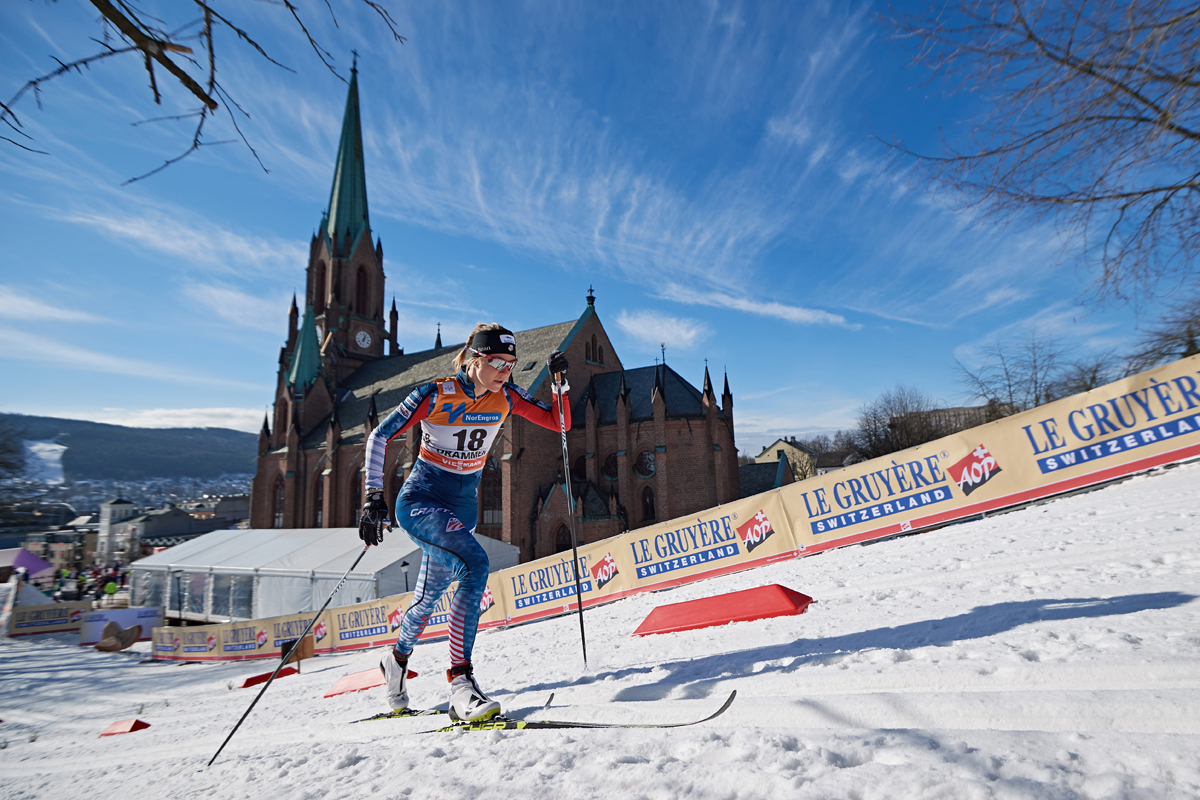
    Rosie Brennan skiing to a World Cup career best 11th in the 2018 World Cup 10 k skate in Lillehammer, Norway. (Photo: Henrik Hunnes)

    Brennan began the day as the first starter. Although bib 1 was a new experience, it proved a good fit.
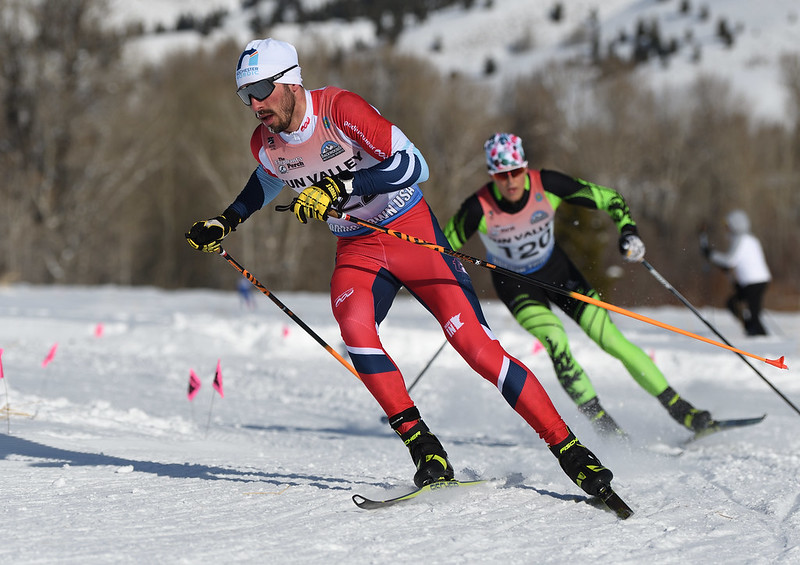
    “I have shockingly never been bib 1 in my career,” wrote Brennan. “I wanted to focus solely on my own skiing and then maybe catch a ride on the second lap. With all the mud on the course, it was difficult to catch a ride as skis were slowing down so much, so I really had no good indication of how my race was going. Focusing on my own race was my best strategy and it worked well.”

    In yesterday’s sprint, Brennan qualified in ninth and placed 21st overall— no small feat for a World Cup race in Norway where the home country is given extra starts for an eager crop of speedsters to prove their chops. It was Brenna’s second-best career sprint result.

    “I have come to a place where I am truly only racing for myself and to challenge myself every day,” Brennan wrote when asked what she had changed about her mindset as she entered the season. “I’m older and not so worried about making this team and that team so I’ve just been really enjoying racing and training and being with my club team.”

    Jessie Diggins, second overall in last season’s World Cup, placed 12th (+(+1:29.9). Diggins is rebounding from a slight illness as she works through the second weekend of World Cup racing.

    “I am not one-hundred percent healthy, I am like 95 percent,” Diggins told FasterSkier in the mixed zone. “And I could feel it today. Yesterday I felt pretty good. But then I was starting to feel kind of out of it. But today, I didn’t feel anywhere close to my top form. And that’s OK. You know, honestly, I am just grateful to be able to race at all. Because earlier in the week I was laying in bed thinking, ‘well shoot I am not going to get to race at all’. And I really love getting to race and working into the season. So for me, it is important to do this mini-tour to be able to find my shape later in the season.”

    Jessie Diggins of the U.S. Ski team during the 2018 World Cup 10 k skate in Lillehammer, Norway. (Photo: Henrik Hunnes)

    Diggins will begin tomorrow’s 10 k classic pursuit 1:24.9 minutes behind the first starter Kalla.

    Caitlin Patterson, who skis for the Craftsbury Green Racing Project in Northern, Vermont, raced into the points for the 10th time on the World Cup. She finished in 30th, 2:28.2 minutes behind Johaug.

    “Solid, but still processing it,” Patterson said of her race. “I think there were a lot of really good things about it, but we’re still so early in the season. Better than my race last weekend that’s for sure. But it still left a little bit to be desired; there were a few times when I was skiing near people and I just couldn’t quite hold on. Like Belorukova passed me from 30 seconds back and it felt like I was so close to being able to hold on with her. But I just wasn’t quite climbing as well. I don’t know, it had good parts and bad parts.”

    Time wise, Patterson was in and out of the top-30 during the race. Her cohorts, in terms of race splits, were close.

    “I think I’ll take the few little glimmers that I had that I can stick with people who are skiing faster,” Patterson said. “Keep building on that and definitely exert a lot of effort tomorrow to stick with people because I know it’s a little easier to be in the draft or just follow someone else’s tempo. So tomorrow in the pursuit start, I’ll just find a good group and stick with it.”

    Finishing outside the points for the U.S. were Kaitlynn Miller (CGRP) in 60th (+4:10.4), Ida Sargent of the USST 63rd (+4:18.4), and Kelsey Phinney (SMS T2) 65th (+4:22.5).

    Racing concludes in Lillehammer, Norway tomorrow with a 10 k classic pursuit.

    Women’s Results | Overall Lillehammer Standings on Day 2

  • Saturday Rundown: From Lillehammer to West Yellowstone (Updated)

    Saturday Rundown: From Lillehammer to West Yellowstone (Updated)

    The women’s podium from Saturday’s 10-kilometer freestyle individual start race in Lillehammer Norway. Norway’s Therese Johaug (center) placed first, Sweden’s Ebba Andersson (left) second, and teammate Charlotte Kalla (right) third. (Photo: NBC Sports Gold screenshot)

    FIS Cross-Country World Cup in Lillehammer Norway: 10 k/ 15 k Freestyle Individual Start

    Women’s Report | Men’s Report

    On Saturday, the second day of World Cup cross-country racing ensued in Lillehammer, Norway with a 10-kilometer freestyle individual start race for the women.

    On a track of snow surrounded by green fir trees and a soggy landscape, the women skied two laps of 5 k course. Norway’s Therese Johaug was the fastest skier at every checkpoint to win in a time of 26:22.4 minutes. Ebba Andersson, the upstart Swede skied to second (+9.2), and teammate Charlotte Kalla was third (+15.7).

    Collectively, it was a strong day for the U.S. women with four skiers in the top-30.

    Sadie Bjornsen of the U.S. Ski Team (USST) finished in ninth (+1:17.0) after placing third in yesterday’s skate sprint. Rosie Brennan (APU) skied to 11th (+1:29.3), the USST’s Jessie Diggins 12th (+1:29.9), Caitlin Paterson (CGRP) 30th (+2:28.2), Kaitlynn Miller (CGRP) 60th (+4:10.4), and Ida Sargent of the USST 63rd (+4:18.4), and Kelsey Phinney (SMS T2) 65th (+4:22.5).

    No Canadian women were entered.

    Seventy-two skiers finished the women’s race.

    Women’s Results

    The men raced three times around the 5 k loop for 15 k total and three times up the course’s big climb. In this early season, many of the perceived pre-race favorites finished further back in the field.

    Norway’s Sjur Røthe won in a time of 36:34.0 minutes. By the 8.3 k time check, Røthe took control of the race. Teammate Didrik Tønseth placed second (+6.0), while Russia’s Denis Spitsov was third (+28.6).

    Canada’s Alex Harvey was the best placed North American in 17th (+1:20.5). Also for Canada, Andy Shields  was 61st (+3:08.4), and Russell Kennedy (TEAM R.A.D.) 64th (+3:17.0)

    For the U.S., Erik Bjornsen of the U.S. Ski Team (USST) finished 43rd (+2:24.5), David Norris (APU) 54th (+2:44.5), Simi Hamilton (USST) 56th (+2:59.4), Paddy Caldwell (USST) 67th (+3:33.1), Kevin Bolger (USST) 68th (+3:38.7), Scott Patterson (USST) 73rd (+3:52.3), and Adam Martin (CGRP) 75th (+4:05.0).

    Men’s Results 

    ***


    SuperTour (West Yellowstone, Mont.): 1.3 k Freestyle sprints

    The fastest qualifier for the men on Saturday in West Yellowstone was SMS T2 athlete Andy Newell.  The Vermont native, now residing in Bozeman, Mont., won in a time of 2:35.53 minutes. His margin of victory was 7.26 seconds over second fastest qualifier, Alaska Pacific University (APU) skier Logan Hannenman. Newell’s teammate, Ben Saxton qualified in third (+7.79).

    Newell advanced to the finals by winning the first heat and first semifinal.

    buy augmentin, vteabp

    In the finals, Newell controlled the pace and made clear that at thirty five years old, he can still light up the domestic ranks. Newell won in a time of 2:41.66 minutes. Craftsbury Green Racing Project’s Ben Lustgarten placed second in 2:43.55 minutes, and University of New Mexico skier Ricardo Izquierdo-Bernier was third in 2:45.66 minutes.

    Adam Luban of the Sun Valley Ski Education Foundation Gold Team finished in fourth, Forrest Mahlen of Alaska Pacific University (APU) was fifth, and Ben Saxton (SMS T2) placed sixth in the men’s final.

    Julia Kern, a member of the U.S. Ski Development Team (UUSDT) and SMS T2 , won the women’s qualifier in 3:08.58 minutes. Second in the qualifier, also from SS T2, was Erika Flowers who finished 2.5 seconds behind Kern. University of Utah skier, Julia Richter qualified in third (+3.22). 

    Like Newell, Kern won both her quarterfinal and semi to make the finals.

    Kern won the women’s final in 3:09.85 minutes. APU’s Rosie Frankowski, the day’s fourth fastest qualifier, was second in a time of 3:11.37 minutes. Teammate Hannah Halvorsen (APU/USSDT) placed third, stopping the clock in 3:12.51 minutes. Halvorsen placed sixth in the qualifier. 

    Flowers ended up fourth in the finals, while Richter and Utah teammate Karianne Moe, placed fifth and sixth, respectively.

    West Yellowtone SuperTour Sprint Results

  • Sweden’s Sundling Scores First World Cup Win; Sadie Bjornsen Podiums in Lillehammer Skate Sprint

    Sweden’s Sundling Scores First World Cup Win; Sadie Bjornsen Podiums in Lillehammer Skate Sprint

    The women’s podium from the 2018 1.3 k World Cup freestyle sprint in Lillehammer, Norway. Sweden’s Jonna Sundling (center) won, teammate Stina Nilsson (left) was second, and U.S. skier Sadie Bjornsen (right) third. (Photo: Fischer/Nordic Focus)

    With the two big climbs over 1.3-kilometer freestyle sprint course, the women’s World Cup freestyle sprint course in Lillehammer, Norway packs a quad-burning punch. With lungs then legs poaching any extra oxygen, the women’s final, which featured four of six athletes from Sweden, was a primetime show.

    Jonna Sundling of Sweden crossing the line first in the final of the women’s 1.3 k sprint in Lillehammer, Norway. (Photo: Fischer/Nordic Focus)

    Nilsson is a finisher, known for her closeout efforts in the finishing straight. But as she and twenty-three-year-old Sundling glided into the S-turns before the final 100 meters, Sundling’s skis looked to have a glide-advantage.

    It didn’t take long down the stretch for Sundling to pass Nilsson for her first career World Cup victory. She won in a time of 2:52.74 minutes. This was Sundling’s 29th World Cup start, and her second podium. She placed second last season in Falun’s skate sprint.

    Sundling qualified for the heats in 26th (+5.74). She advanced to the semis by winning the first heat. However, she was a lucky loser in the first semi-final to advance to the six-skier final.

    Nilsson placed second (+.34), the U.S. Ski Team’s (USST) Sadie Bjornsen was third (+3.03).

    Sadie Bjornsen of the US (bib 6) out lunges Sweden’s Ida Ingemarsdotter in the second semifinal during the 2018 Lillehammer, Norway World Cup skate sprints. (Photo: Fischer/Nordic Focus)

    For Bjornsen, she showed the early season form reminiscent of last season. During the 2017-2018 World Cup, Bjornsen posted a second place during the first weekend’s classic sprint, and a third place in the Lillehammer classic sprint the following weekend.

    This season, Bjornsen skied to an 11th place in the Ruka, Finland classic sprint and an 11th in the 10 k classic. With her near-the-front-of-the-pack skiing today, Bjornsen skied with assertiveness and confidence on her way to securing her first career World Cup skate sprint podium.

    It was Bjonrsen’s sixth career podium on the World Cup circuit.

    “I think sometimes I get easily pushed around a bit, it’s harder when your skis are not just going straight like classic,” Bjornsen said in the post-race press conference about her need to ski for position. “I was just focusing on trying to be in a position to really be in the front of the pack at the top of that climb. I kept finding some openings on the right side of the track to pass some people.”

    Bjornsen displayed keen instincts on the final climb. Even more impressive was her display of horsepower as she took a seam up the right-hand side, and began gapping fourth, fifth, and sixth place behind her.

    “Then coming into the finish, I tried to start free skating like three seconds before I wanted to because I knew that that speed would carry me across the finish,” Bjornsen said.

    Bjornsen was the fastest North American qualifier in sixth, 1.88 seconds behind the speediest qualifier, Sweden’s Hannah Falk, who stopped the clock in 2:56.43 minutes.

    Bjornsen advanced to the semis by placing second to Falk in the third heat. It was déjà vu in the second semi-final, where Bjornsen again placed second to Falk to secure a spot in the final.

    Bjornsen enters Saturday’s 10 k individual start classic in third overall for the Lillehammer three-day tour.

    The U.S. Ski Team’s Jessie Diggins skiing next to Russia’s Yulia Belorukova in the second heat during Lillehammer, Norway’s 1.3 k World Cup freestyle sprint. Diggins placed 17th overall.

    After qualifying ninth and 12th respectively, U.S. skiers Rosie Brennan (APU) and Jessie Diggins (USST) did not advance to the semi-finals. Diggins and Brennan raced in the second heat. Diggins placed fourth, Brennan fifth.

    Diggins finished the day in 17th, Brennan 21st.  

    Also for the U.S., Ida Sargent (USST) qualified 34th (+7.28), Kelsey Phinney (SMS T2) in 38th (+8.76), Caitlin Patterson (CGRP) 59th (+13.18), and Kaitlynn Miller (CGRP)  73rd (+20.78).

    USST athlete Sophie Caldwell did not start as she is fighting a cold.

    No Canadian women were entered.

    Racing continues tomorrow for the women with a 10 k interval start classic race.

    Women’s Qualification | Women’s Final Results

  • Friday Rundown: World Cup Cross-Country Sprint in Lillehammer, Norway

    Friday Rundown: World Cup Cross-Country Sprint in Lillehammer, Norway

    The women’s podium from the 2018 1.3 k World Cup freestyle sprint in Lillehammer, Norway. Sweden’s Jonna Sundling (center) won, teammate Stina Nilsson (left) was second, and U.S. skier Sadie Bjornsen (right) third.

    FIS Cross-Country World Cup in Lillehammer Norway: Freestyle Sprint

    Women’s Report | Men’s Report

    In Friday’s women’s 1.3-kilometer freestyle sprint in Lillehammer, Norway, the first day of three successive days of World Cup racing, the women’s sprint final was stacked with Swedes, with four of six athletes sporting the yellow, blue, and white.

    In the final, Jonna Sundling of Sweden passed teammate Stina Nilsson meters before the finish line to take the win in 2:52.74 minutes. It was Sundling’s first career individual World Cup win. Nilsson placed second (+.34), the U.S. Ski Team’s (USST) Sadie Bjornsen was third (+3.03). 

    Evelina Settlin, also of Sweden, placed fourth (+3.82), Kristine Stavås Skistad from Norway was fifth (+6.65), while the day’s fastest qualifier, Hannah Falk, finished sixth (+9.81).

    American’s Jessie Diggins and Rosie Brennan were knocked out when they placed fourth and fifth respectively in the second heat. The top-four spots in the second heat were separated by 0.42 seconds. Diggins finished the day in 17th, Brennan in 21st.  

    Sweden’s Falk won the qualifier in 2:56.43 minutes.  

    The U.S. Ski Team’s (USST) Bjornsen was the fastest North American qualifier in sixth (+1.88). Brennan qualified in ninth (+3.11), Diggins 12th (+3.66).

    Ida Sargent (USST) qualified 34th (+7.28), Kelsey Phinney (SMS T2) in 38th (+8.76), Caitlin Patterson (CGRP) 59th (+13.18), and Kaitlynn Miller (CGRP)  73rd (+20.78).

    USST athlete Sophie Caldwell did not start as she is fighting a cold.

    No Canadian women were entered

    The men raced on a slightly longer 1.6 k course. Italy’s Federico Pellegrino, known for his skate sprint flash, won the men’s final in 3:19.17 minutes. On-form Norwegian Emil Iversen was second (+0.44), while Canada’s Alex Harvey, took third (+0.68).

    Norway’s Sindre Bjørnestad Skar placed fourth overall (+0.91), with Finn Hågen Krogh racing to fifth (+1:07). Finland’s Ristomatti Juhani Hakola crossed the line in sixth (+2.43).

    Norway’s Johannes Høsflot Klæbo won the qualifier in a time of 3:07.63. Klæbo placed sixth in the first semifinal finishing over thirty seconds back after breaking a pole.

    buy vancomycin online


    Canada’s Alex Harvey and USST skier Simi Hamilton were the only North American men to qualify for the heats. Harvey qualified 17th (+7.59), Hamilton 22nd (+8.72). While Harvey eventually moved onto the final, placing third, Hamilton bowed out in the third heat. Hamilton placed fourth and was unable to advance as a lucky loser. Hamilton finished 19th overall in Friday’s sprint.

    For Canada, Andy Shields placed 60th (+14.59), Russell Kennedy (Team R.A.D.) 64th (+15.21), Julien Locke (CNST) did not start.

    The USST’s Kevin Bolger was the next best placed American in 61st (+14.63). Also for the USST, Erik Bjornsen was 63rd (+15.04), Paddy Caldwell 82nd (+19.34). David Norris (APU) placed 90th (+20.71), Scott Patterson of the USST finished in 92nd (+22.21), and Adam Martin (CGRP) 108th (+32.72).  

    Stay tuned for full race reports and you can view our Lillehammer Triple course preview here.

    Women’s Qualification | Women’s Final Results |  Men’s Qualification | Men’s Final Results

  • World Cup Distance Race #1 in the Books: Johaug Wins, Bjornsen in Eighth

    World Cup Distance Race #1 in the Books: Johaug Wins, Bjornsen in Eighth

    2018 10 k classic podium from the Kuusamo, Finland World Cup. Norway’s Therese Johaug (center) won, while Swedes Charlotte Kalla (left) and Ebba Andersson (right) placed second and third.(Photo: Fischer/Nordic Focus)

    The most important story within the story was the fight within Sunday’s aerobic fight during the women’s World Cup 10-kilometer classic in Kuusamo, Finland.

    Each of the seventy starters in the women’s field wore a pink ribbon acknowledging the global fight against breast cancer and their friend, retired U.S. athlete Kikkan Randall.

    The aerobic fight on the 3.3 k loop in Kuusamo wasn’t well defined until Norway’s Therese Johaug skied through the stadium to begin her second lap. From then on, in her first World Cup race after serving an 18-month ban for failing a drug test, Johaug marked the fastest times at every remaining checkpoint. Her 5.7 second lead at 3.3 k became a 22.5-second margin at the finish where she won in a time of 28:02.5 minutes.

    Sweden took the next two podium spots: Charlotte Kalla placed second (+22.5), Ebba Andersson third (+32.8).

    Norway’s Therese Johaug back to being a winning Johaug in the 2018 10 k classic in Kuusamo, Finland. (Photo: Fischer/Nordic Focus)

    “It is a day I’ve been looking forward to for the last two years, that I [can] come back and finally would be allowed to compete again, which is what I like the best,” Johaug told Norwegian broadcaster NRK according to a translation. “To get to start with a win, it’s big. I have trained and trained for two years and tried to motivate myself to come back and maybe one day stand at the top of the podium [again] and [to achieve] it today on the first try, it’s big.”

    Before her suspension, the thirty-year-old Johaug last won on the World Cup in 2016. In that season-ending 10 k classic pursuit in Canmore, Canada, Johaug won the day and secured her second overall World Cup title. That year, her last full season on the World Cup, she won 17 races, as she podiumed a total of 28 times.

    The U.S. positioned three skiers in the points. The U.S. Ski Team’s (USST) Sadie Bjornsen placed eighth, finishing 1:10.5 minutes behind Johaug. Jessie Diggins, also of the USST, placed 14th (+1:38.5), with Rosie Brennan (APU) racing to 23rd (+2:02.8).

    “We have huge aspirations for the season and it is easy to misplace them and start expecting things to happen this early in the season,” U.S. women’s head coach, Matt Whitcomb told FasterSkier on the phone. “Although we do want to win every time we race, wanting and expecting are really two different things. We have realistic expectations this time of year.”

    With the ongoing success of the U.S. women’s team, where podiums have been common, a slow start is defined differently than it might have been in the recent past. Last year, for example, during the 2017 World Cup opening Ruka Triple, Bjornsen and Sophie Caldwell placed second and eighth respectively in the classic sprint. In the 10 k classic, Jessie Diggins placed 10th after not qualifying in the sprint (she placed 34th), while Ida Sargent was 22nd, Bjornsen 23rd. Bjornsen finished the three-race series in 10th overall, Diggins 12th. Randall posted a 25th overall for that weekend, Brennan, then part of the USST, finished 28th.

    Collectively, the 2017 opening weekend was solid for many. By that benchmark, the same can be said of 2018’s first World Cup go for the U.S. women.

    “I think if you look back historically, we have had success here, but it has been spotty,” Whitcomb added. “And as a team, we take a few weeks to get going and we can expect much bigger things in Davos, but hopefully increasing in success each weekend.”

    (Sadie Bjornsen for the U.S. toes into eight place in the 2018 women’s 10 k classic in Kuusamo, Finland. (Photo: Fischer/Nordic Focus)

    The twenty-nine-year-old Bjornsen comes off an 11th in Saturday’s sprint. In her longer effort on Sunday, Bjornsen capitalized on the always charging Diggins.

    “I went out of the start just 15 seconds after Jessie was coming through [on her first lap],” Bjornsen told FasterSkier. “I think that kind of started me on a good note because I just went on the chase to try to catch her.”

    Bjornsen did chase down her ally and with it motivation to push harder.

    “When I did catch her, I actually helped her on the biggest climb, then I was like ‘man, I must be feeling great,’” Bjornsen said in a call. “Then I kind of just took off from there. I think sometimes for me personally the most important thing is to get myself to have a fast first lap because it kinda sets the mood for the rest of the race. … I feel like that was maybe the thing that kind of set a good tone for a good race today, was just having that hot start.”

    Over the years, Bjornsen has defined herself as a formidable classic skier on the World Cup. Despite that reality, she explained she modified her striding technique to remain “low” when she becomes fatigued in the race.

    “When I get really tired in classic skiing I tend to stand straight up, so this summer I’ve been really working on trying to stay low the whole time while I’m classic skiing,” Bjornsen added. “That is something that I’ve felt better with so far, and hopefully I’ll be able to maintain it throughout the season.”

    Closing out another more-than-solid opening weekend for Bjornsen may also have something to do with ski selection. Bjornsen spent time refining her ski fleet during the off-season.

    “I have struggled with classic skiing in the last couple of years because I have amazing races, and then I have races where I just can’t kick my skis at all or I can’t glide,” Bjornsen said. “I have been trying to figure out what has been going on. One of them has been, I spent a ton of time this summer and actually the reason I was in Beitostølen [recently] was  I’m doing a bunch of testing with skis because I think skis were kind of standing in my way for the last couple of years. Either, it’s been amazing or it’s like really off. So it’s been really cool to actually try to work on it and see that some of these things that I have been struggling with are not really me, it’s like something that can be fixed which it’s really cool.”

    When it comes to fixes, Diggins, according to last year’s template, is right where she needs to be. The sky has not fallen.

    “I think it was really encouraging to have a race right where I was last year,” Diggins said in a call. “This weekend is basically a carbon copy of last year for me. And I think, and obviously, last season turned out really well, so I am fine with where I am right now.”

    Diggins confirmed she was carrying a big load of training into the opening weekend. Her primary early season objective remains the Tour de Ski.

    After Diggins and Randall scored their Gold medals in PyeongChang, their lives changed. Diggins remains a sought out motivational speaker, and product endorser. Her obligations as it relates to commitments outside her immediate training and resting have ballooned. She helped secure a World Cup for Minnesota and continues to advocate on behalf of climate change concerns and The Emily Program — an advocacy group focused on eating disorders.

    “This spring and summer I definitely went through a learning curve,” Diggins said of the requirement to balance life outside of skiing. “I gave all of my time towards things that I care about, like making the World Cup come to Minnesota and it was absolutely worth it.”

    While remaining positive about her ability to bring change, Diggins did note her growth has involved learning to respectfully deny some media requests. “We are not robots. We need to have a life outside of training and resting as well,” Diggins said. “I feel like this year was a good adjustment period for me and I feel like I learned a lot. And next year I am going to keep challenging myself to say ‘no’ more often. I think what I did this year is only sustainable for one year.”

    By the time the Olympics roll around in February last year, Brennan felt sapped. She was not renominated to the USST following the season but continued her training with Alaska Pacific University. Diagnosed with mono, Brennan rested and recovered.

    Eventually, she re-tested her race form this past June, by setting a record time in the 2018 Alaska Run for Women.

    “Everything seems fine now,” Brennan said on the phone about her health. “So I crossed my fingers it’s all in the past. It definitely makes you nervous every time you feel something, like ‘Oh God, is it another virus that never goes away?’ But so far so good. So I’m trying to just not think about it too much, and be thankful that I’m healthy now.”

    In the points with room to spare, Brennan’s top-25 performance rings a positive note. Her race performance didn’t buckle in her World Cup return. Her pacing and splits were consistent. With 2.3 k remaining during Sunday’s race, Brennan sat in 19th place in a tightly stacked field.

    “I know definitely in the past I’ve gone out way too hard, so I tried to have a controlled effort today, and I think I did a good job of that,” Brennan said. “I still think I have some progress to make. Like in that last k or two, you know it’s hard, you always forget how tight the World Cup is. But literally, every second is a place often. So I’m kind of back in that mindset where you’re fighting for literally every second, I feel like I have some work to do there, in the last 2 k.”

    Also for the U.S., Sophie Caldwell (USST) finished 43rd (+2:52.3), Caitlin Patterson (CGRP) 46th, (+2:56.8), Ida Sargent (USST) 56th (+3:31.1), and Kaitlynn Miller (CGRP) 61st (+3:55.7).

    No other North American women were entered in the race.

    buy minocycline online

    Racing on the World Cup moves to Norway where a three-day series will begin in Lillehammer, Norway next Friday with a freestyle sprint.

    Women’s Results