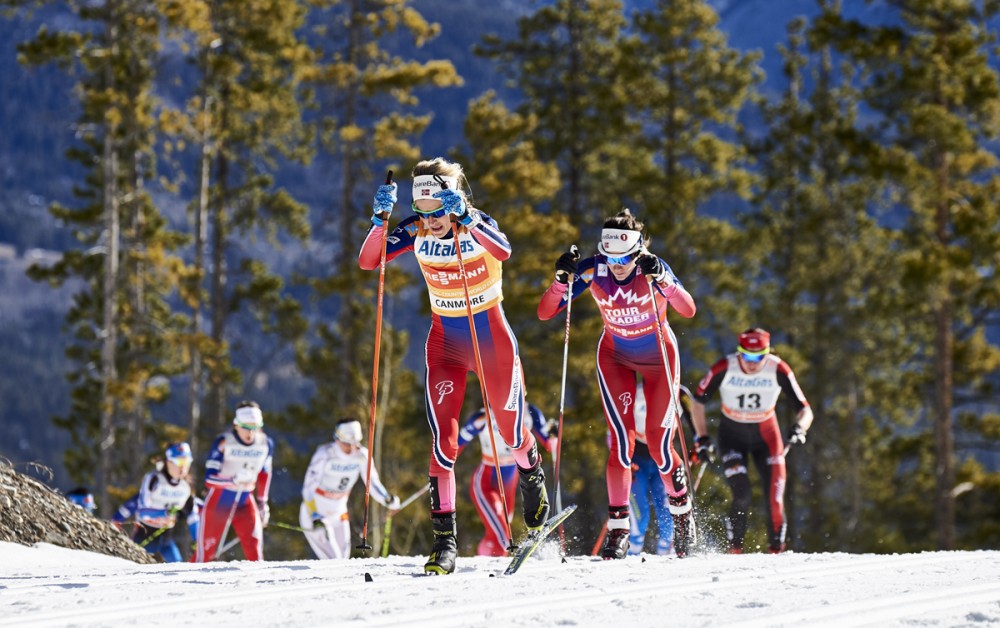
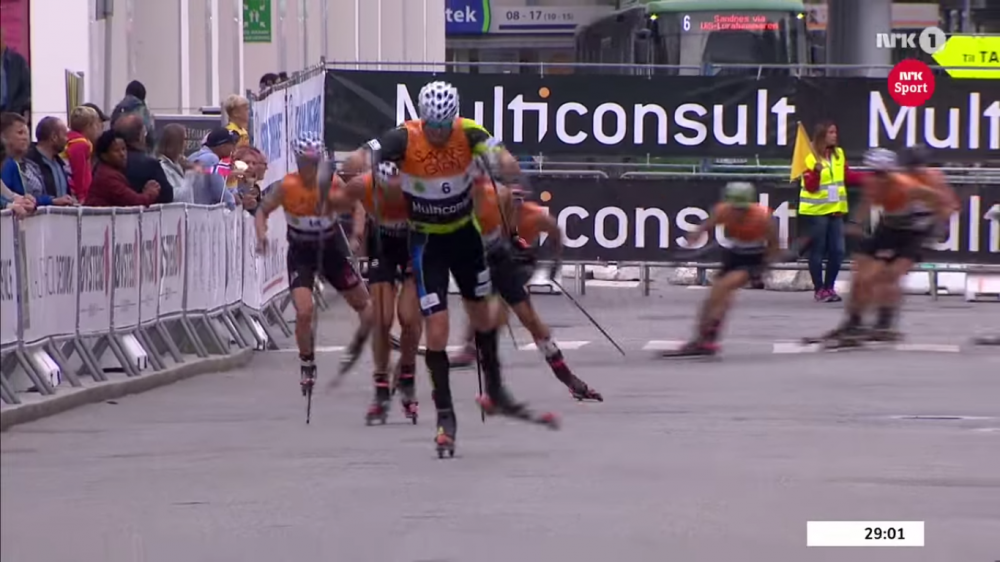
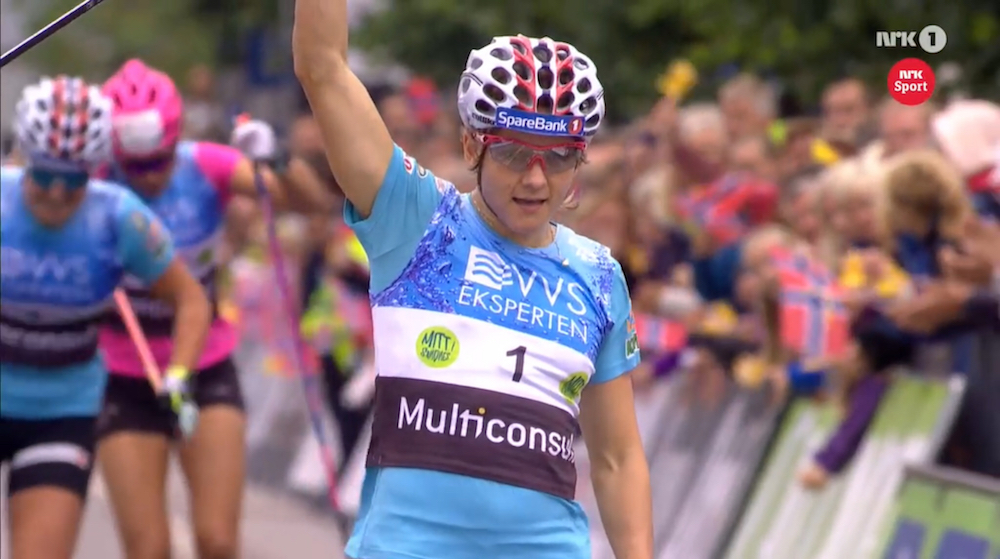
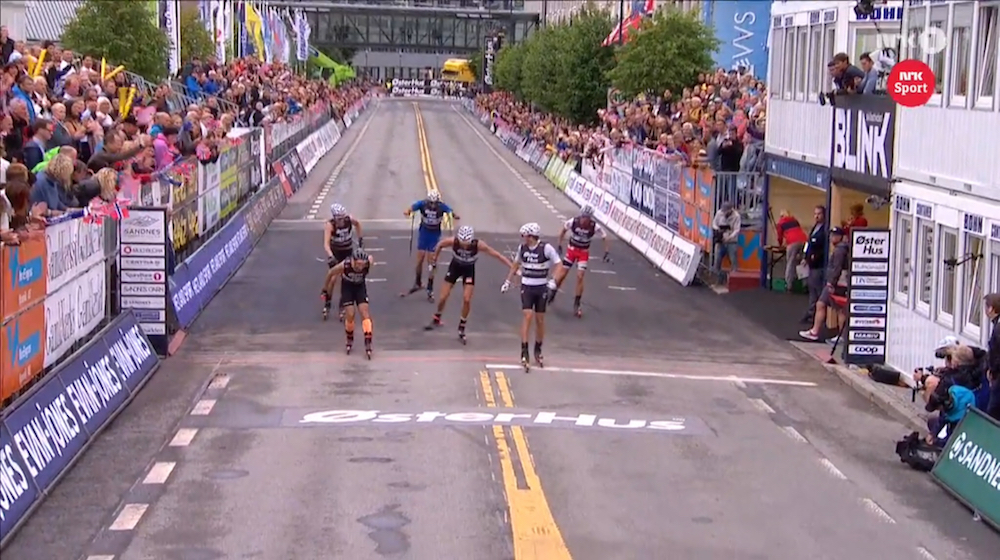
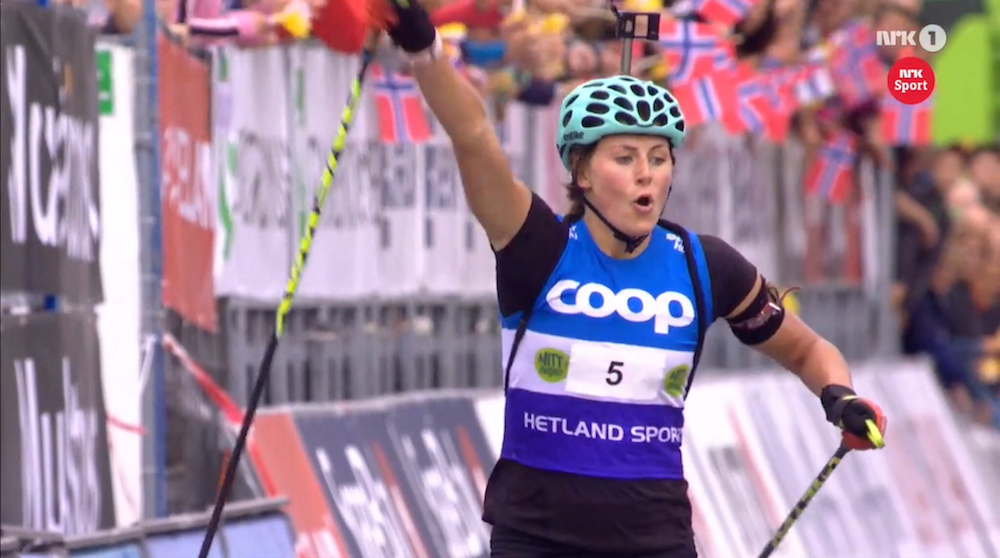
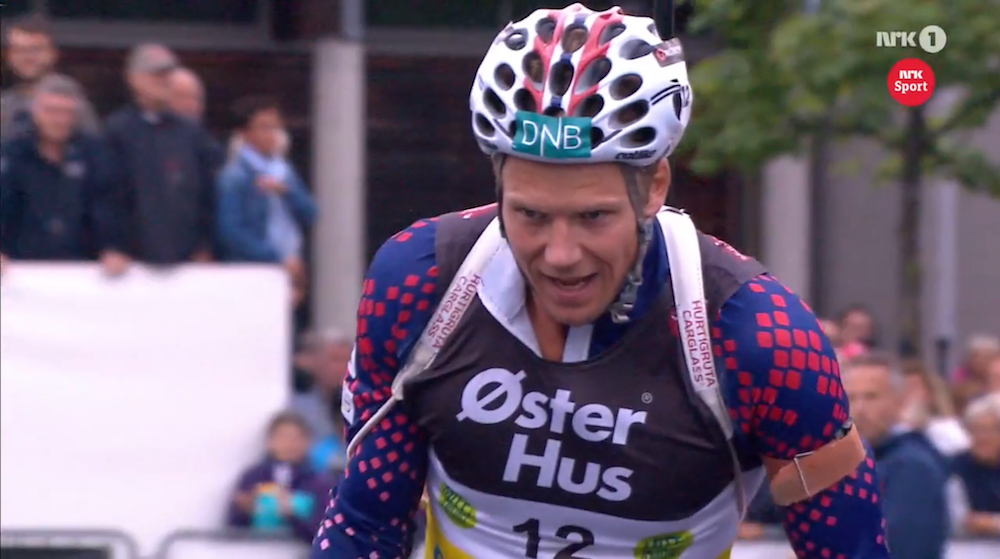
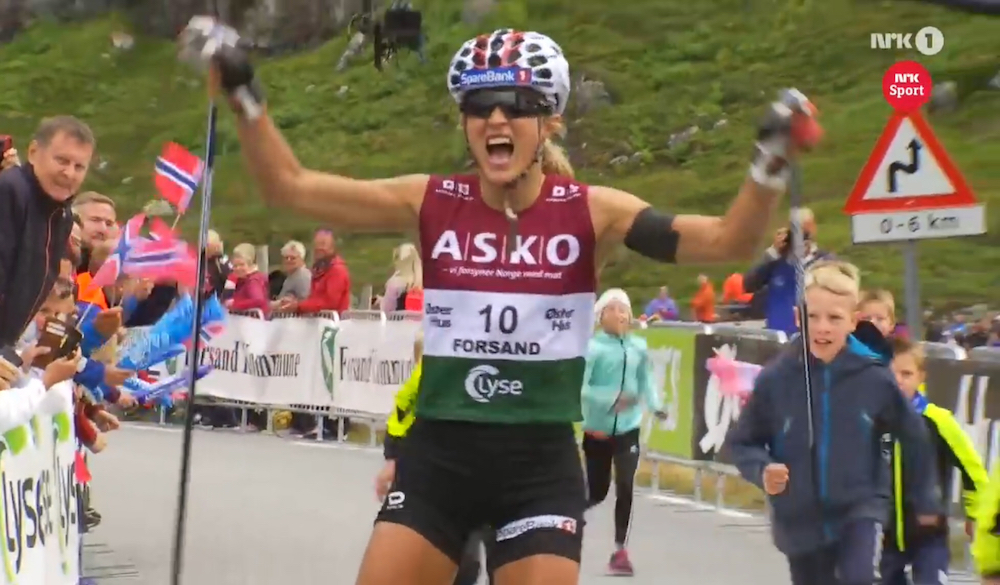
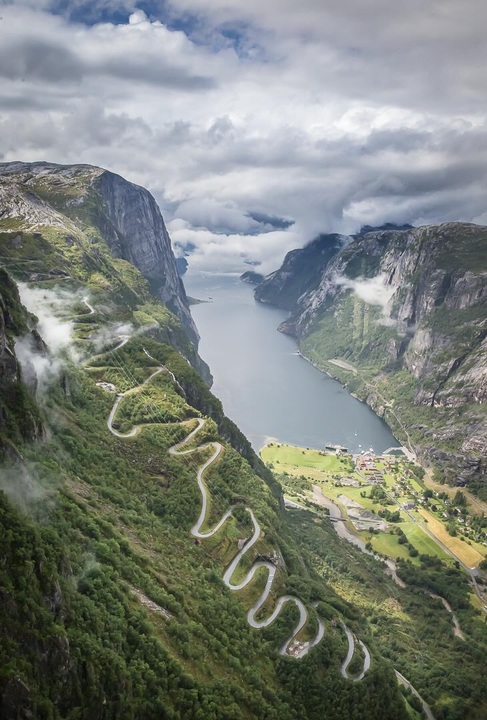
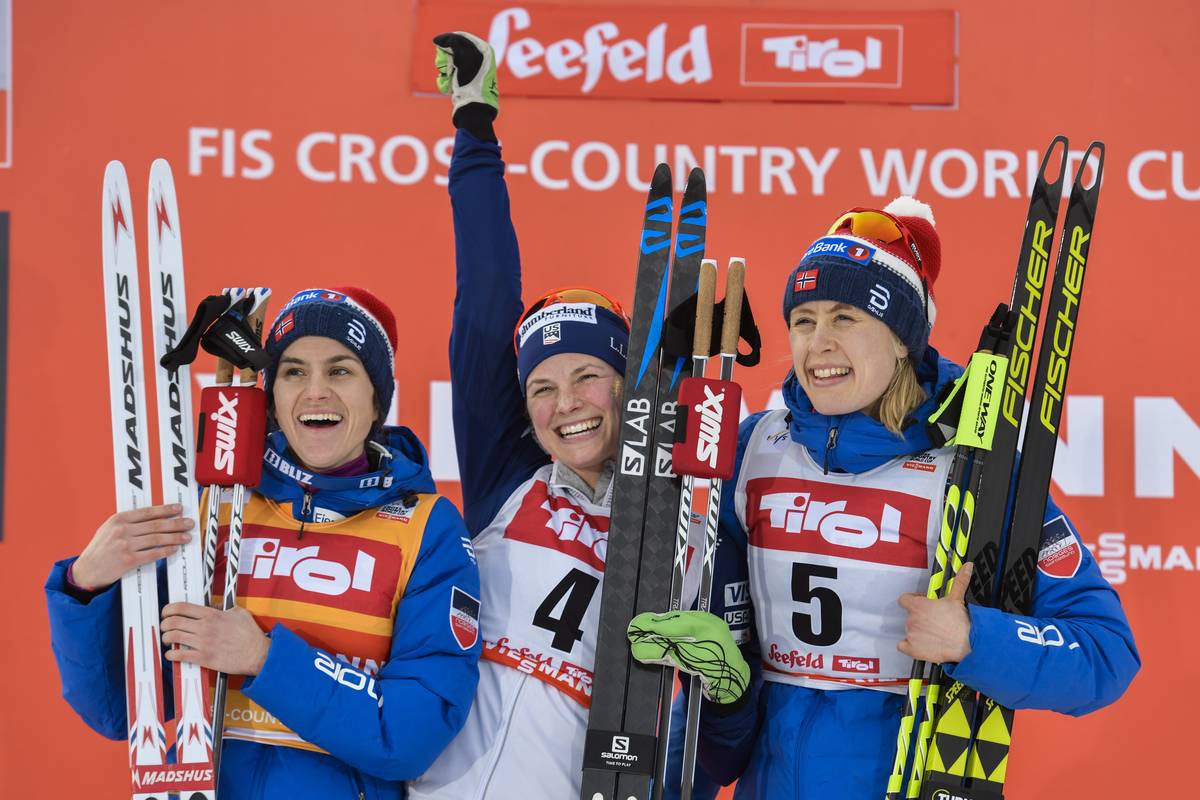
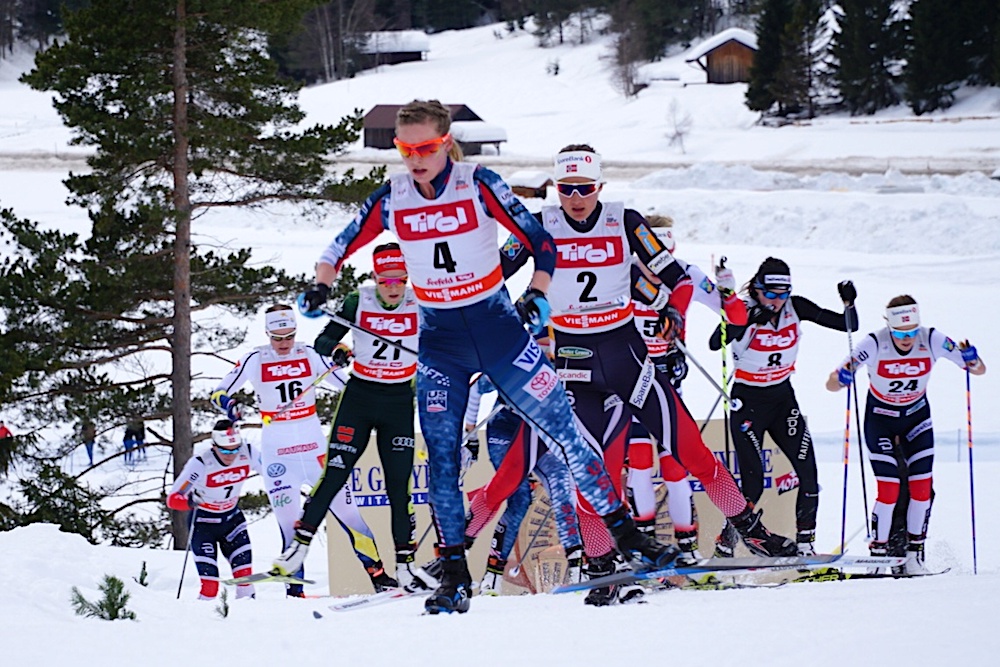
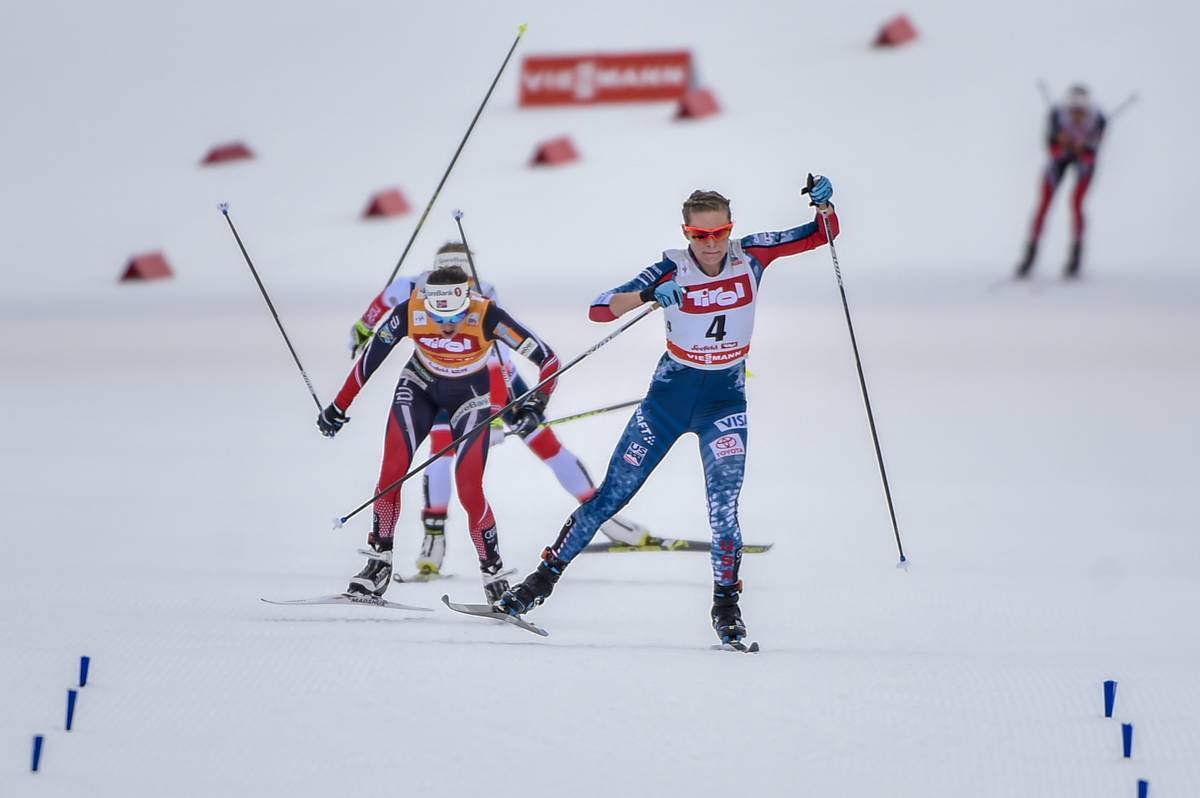
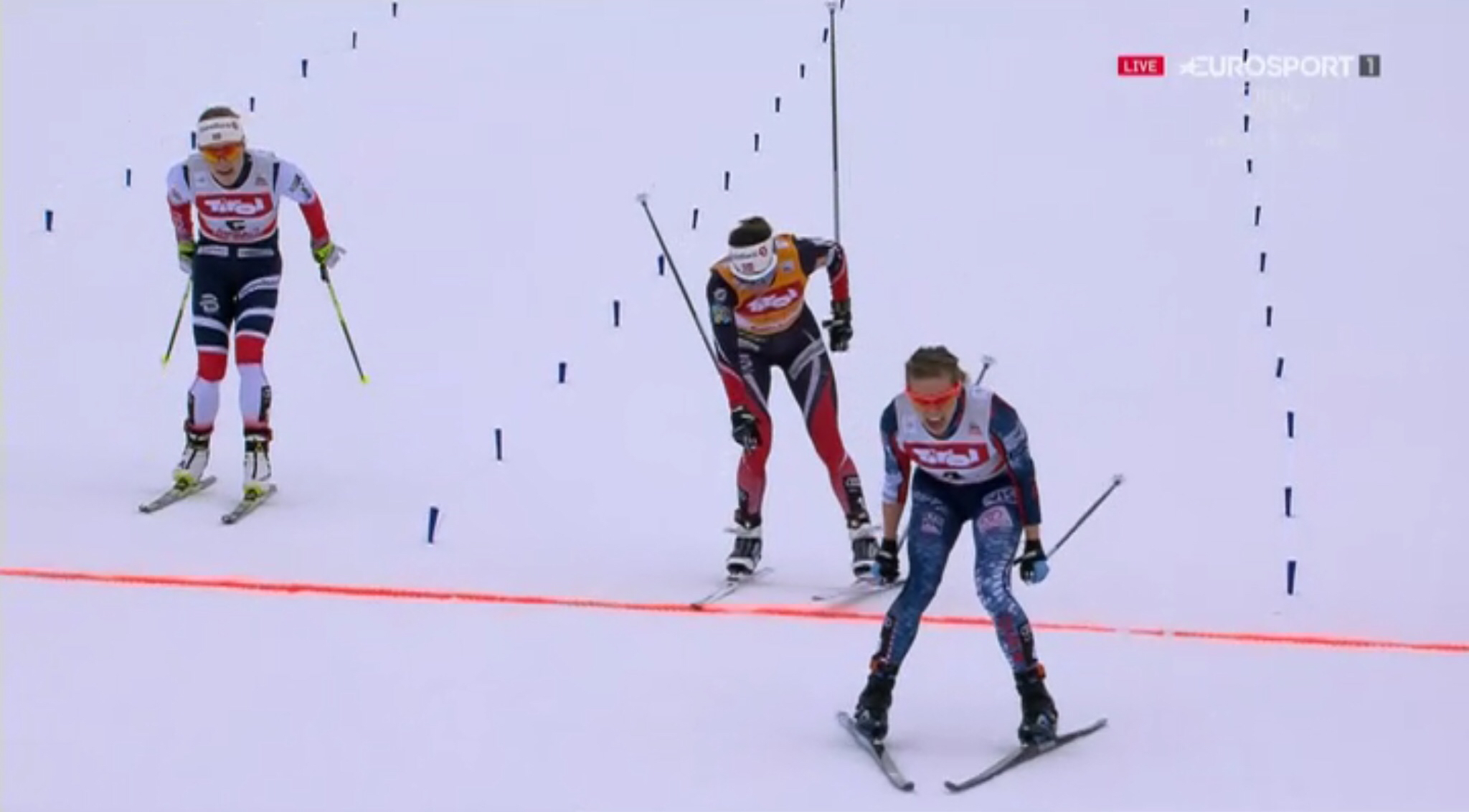
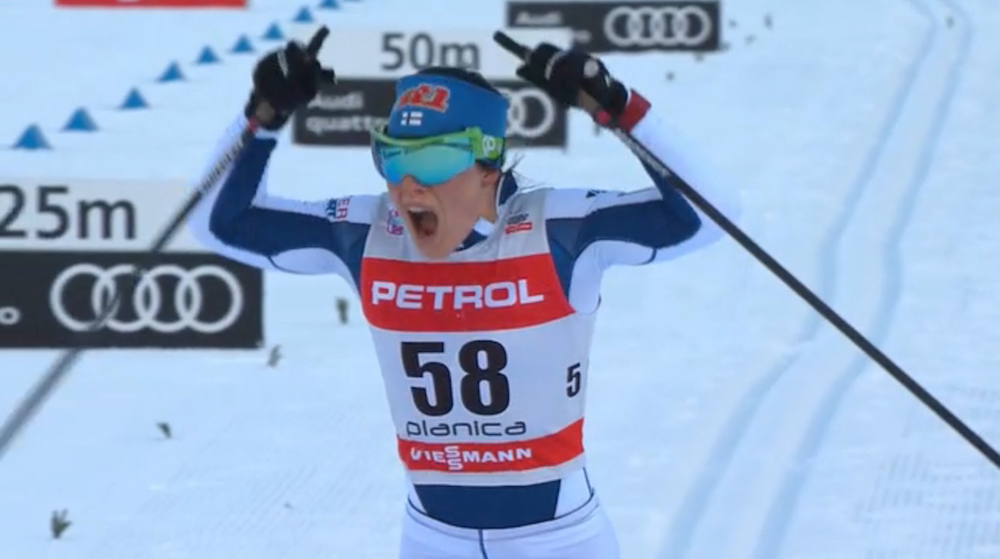
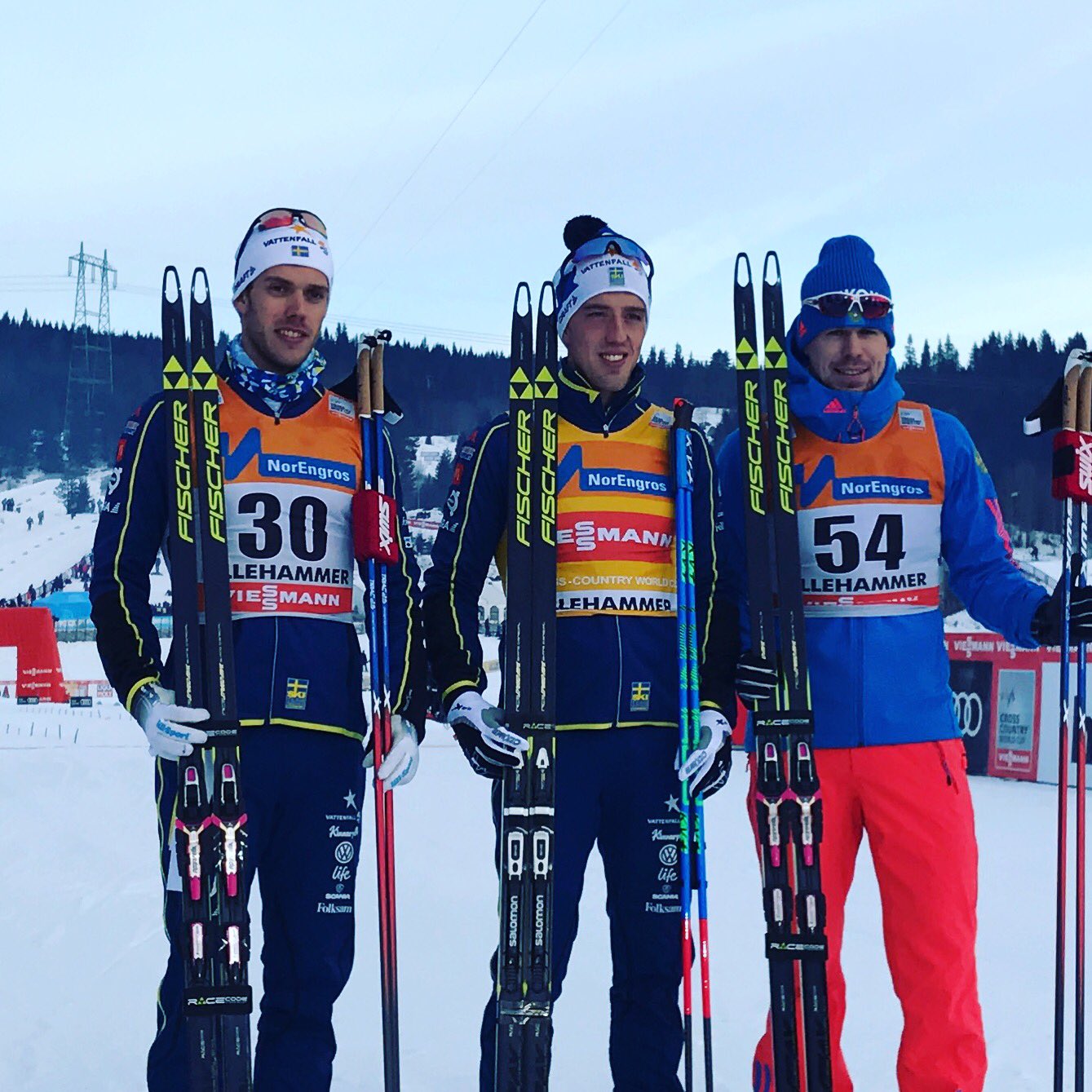
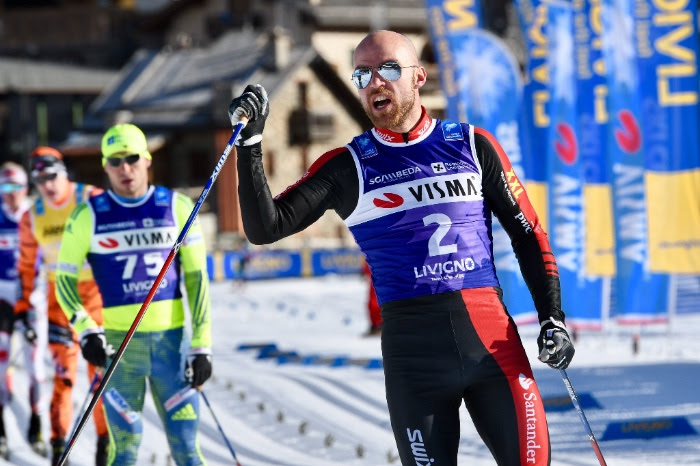
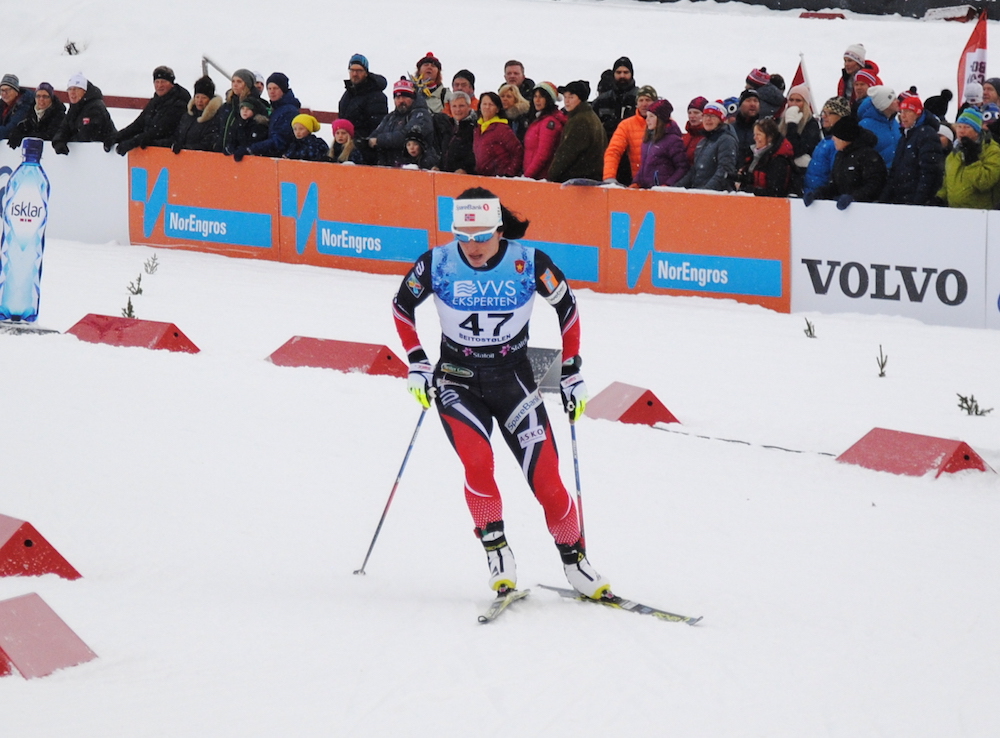
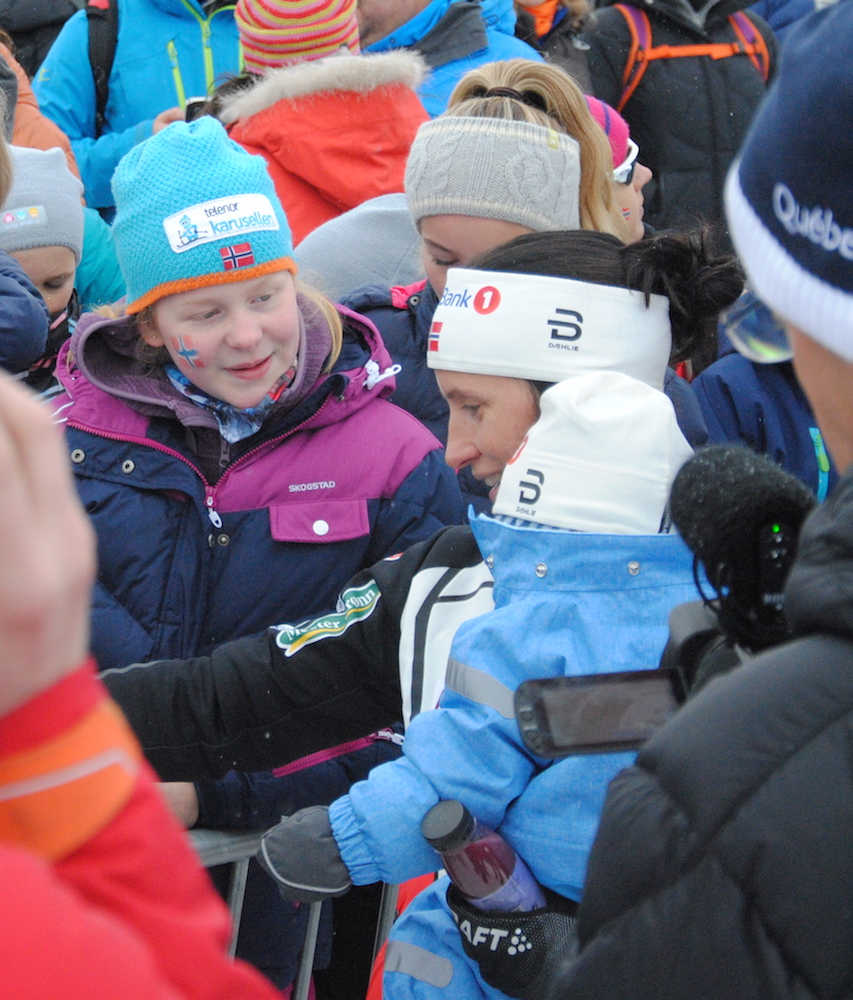
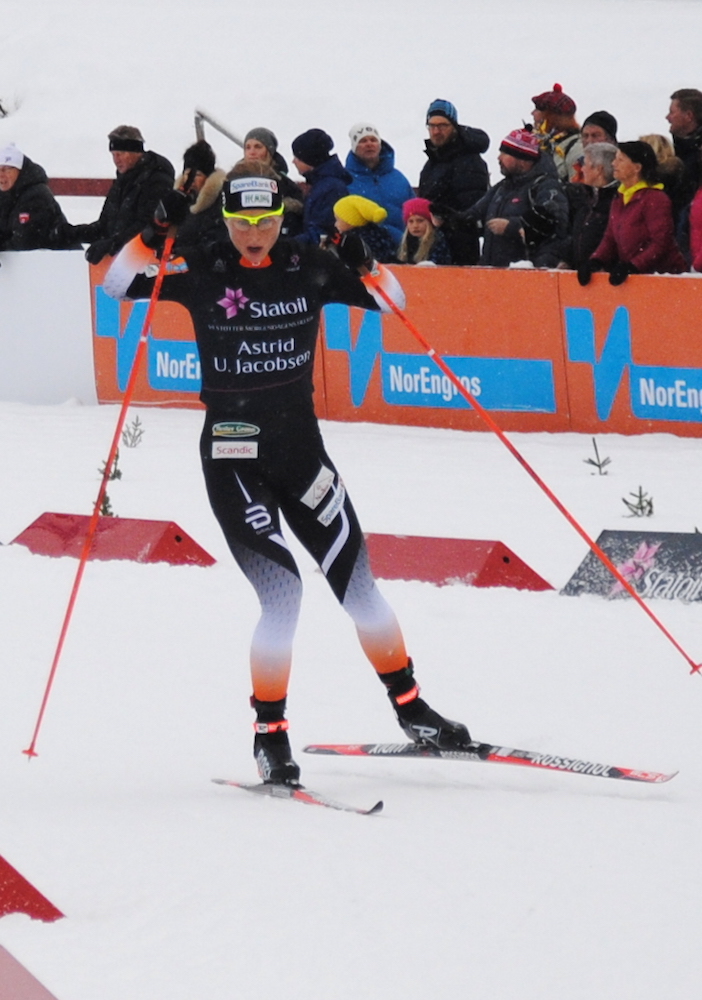
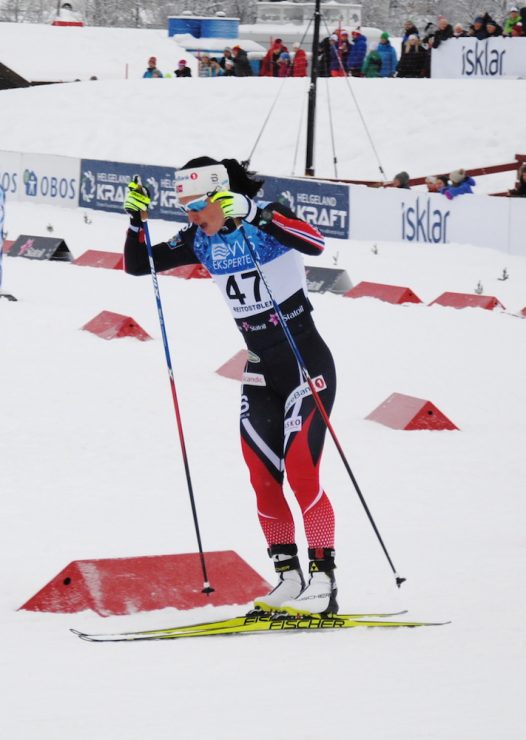
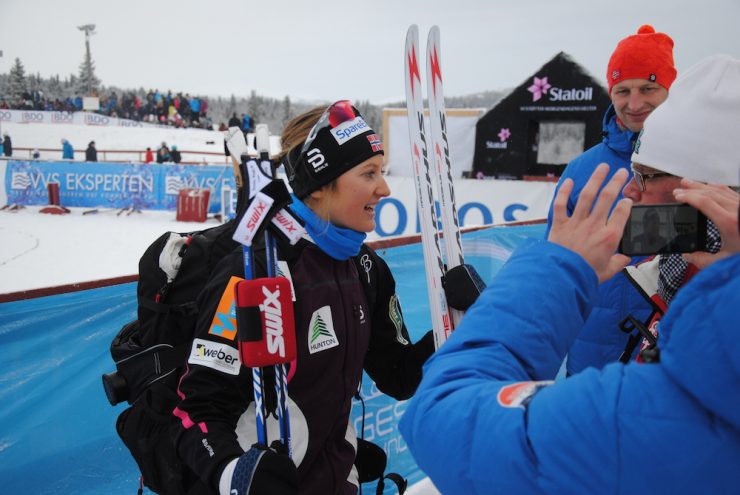
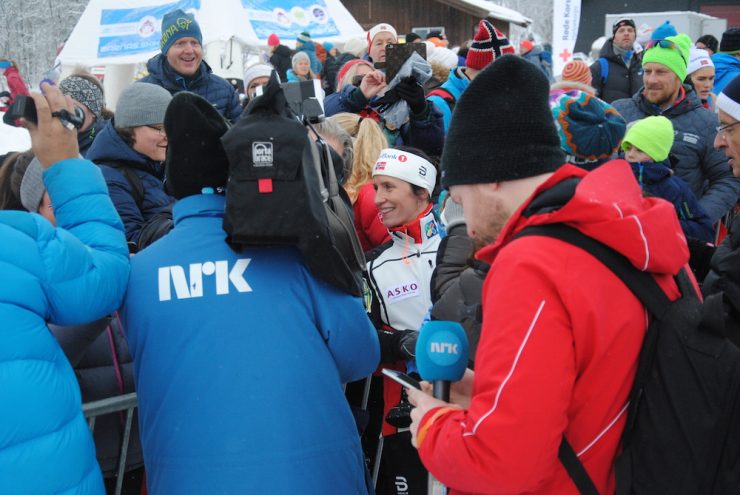
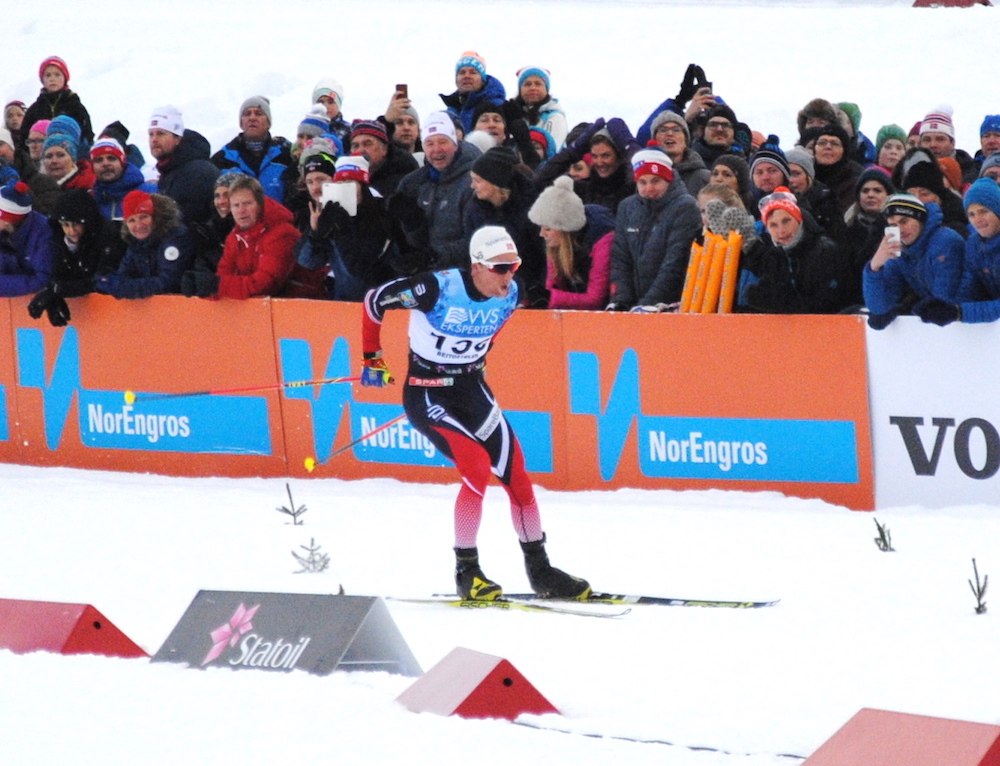
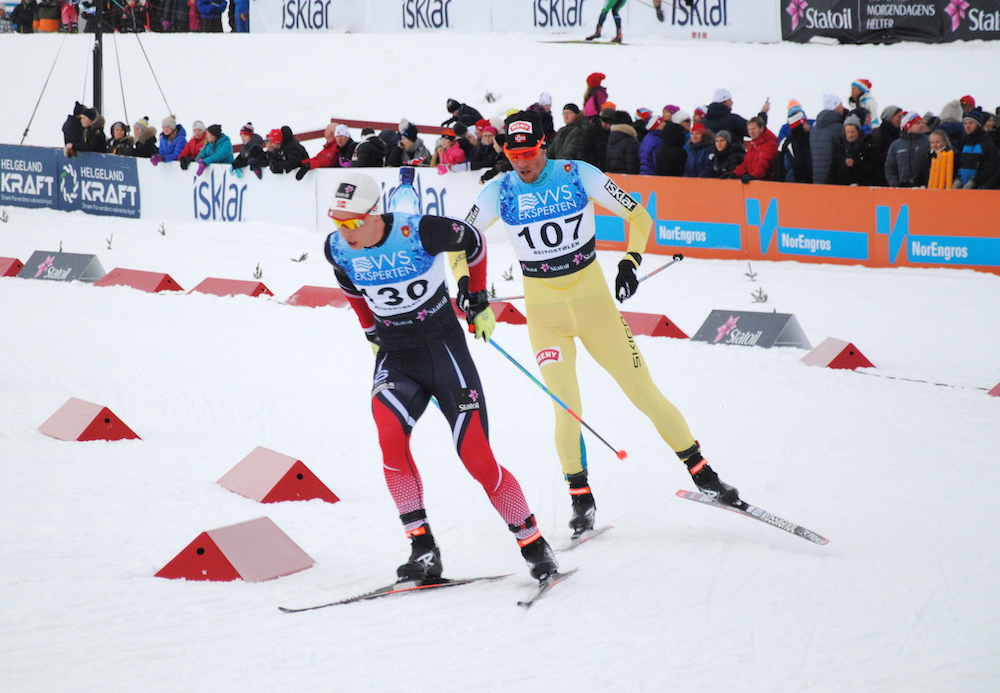
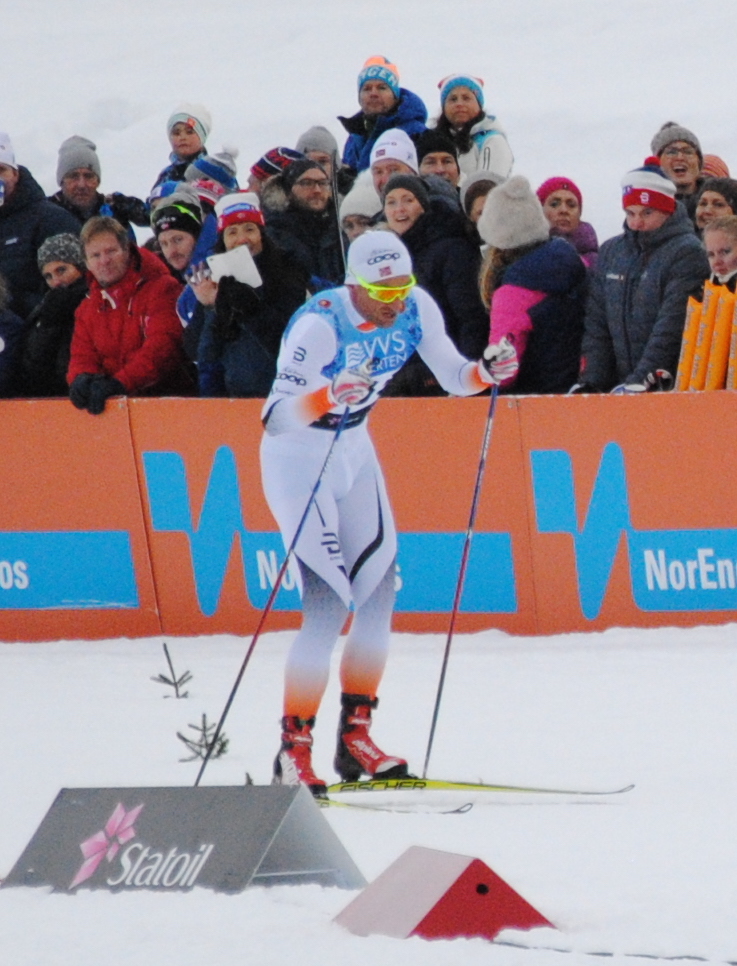
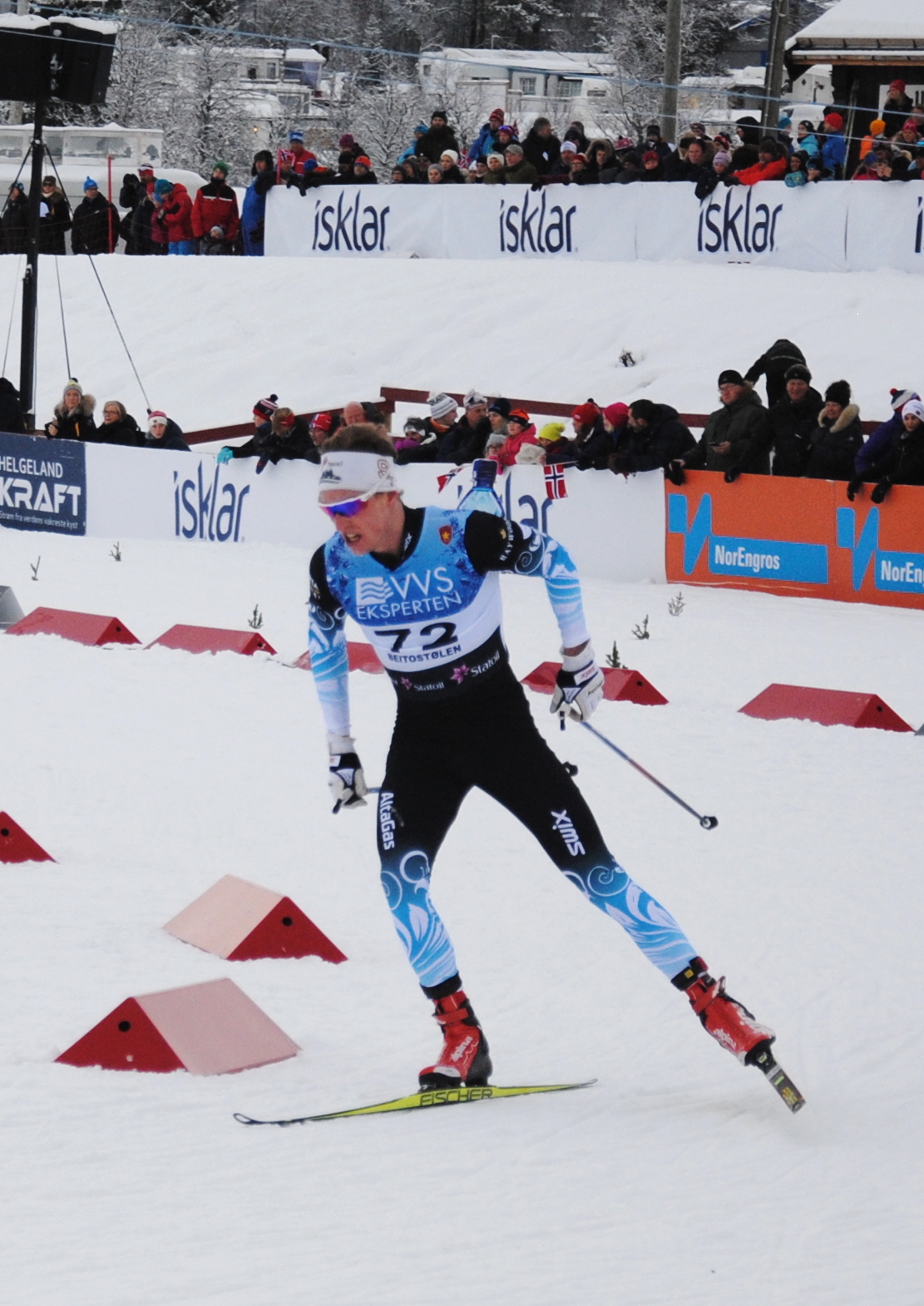
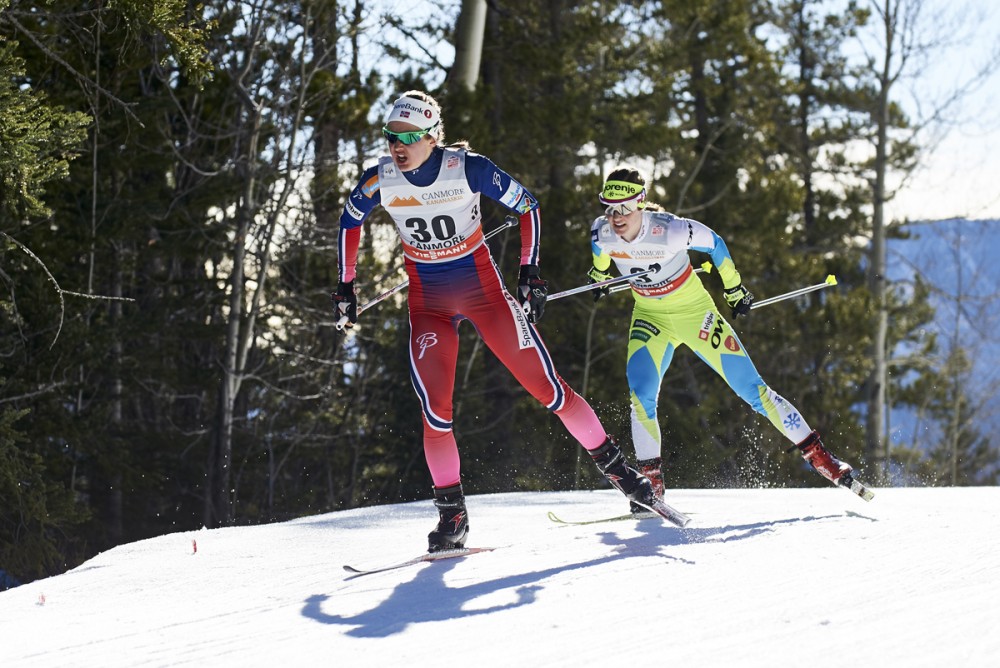
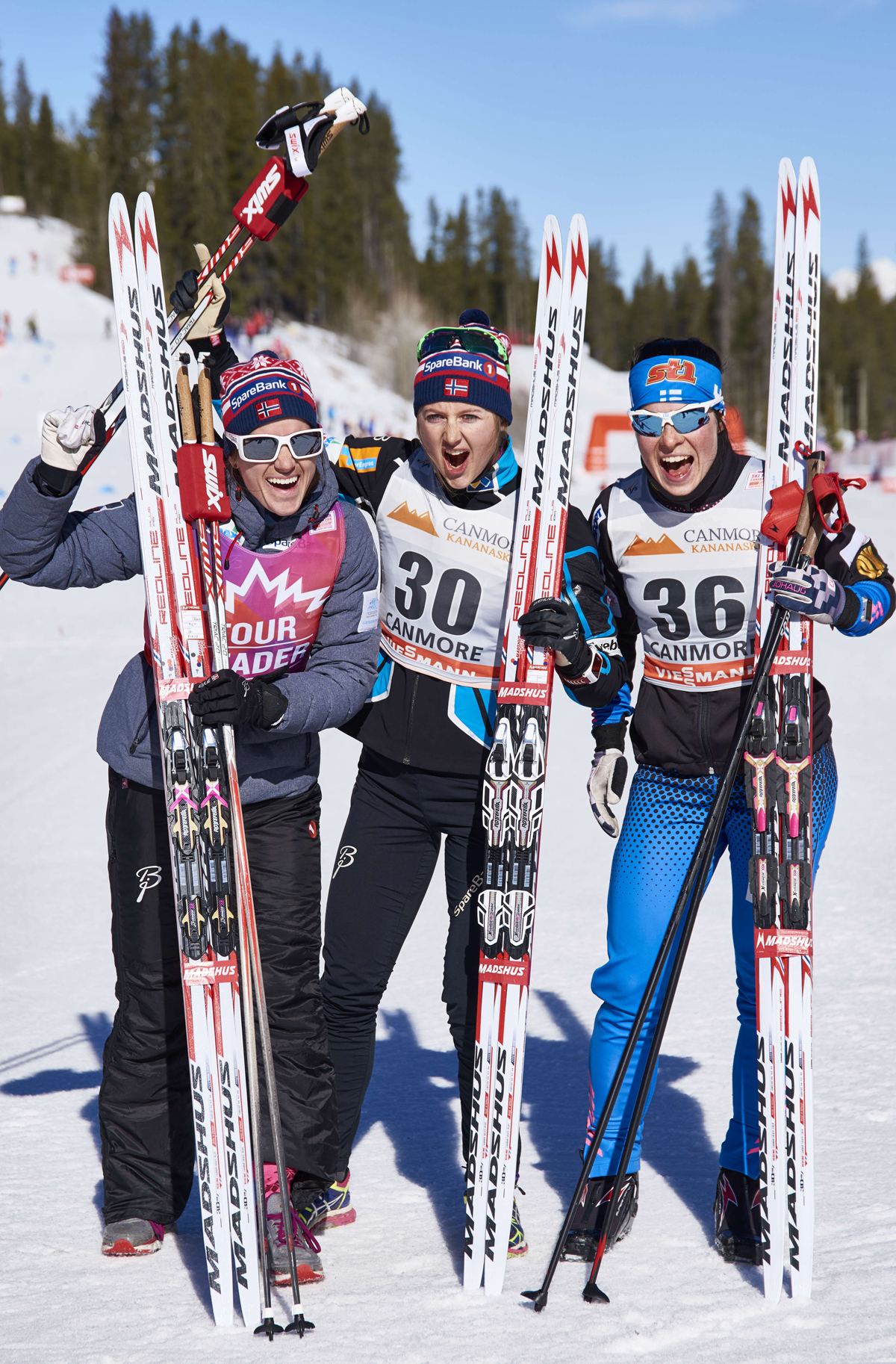
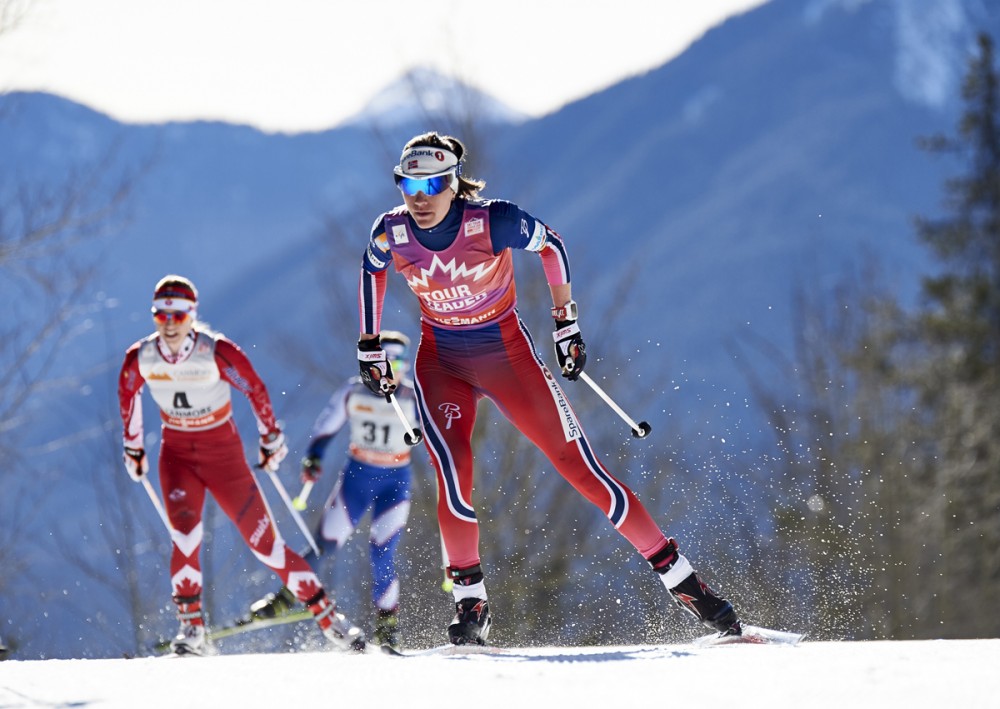
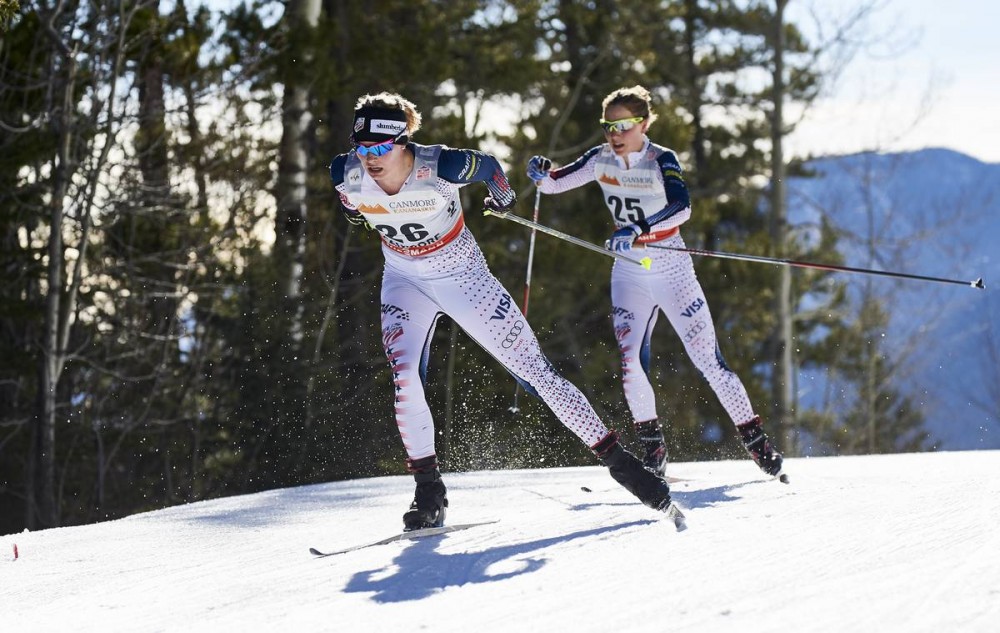
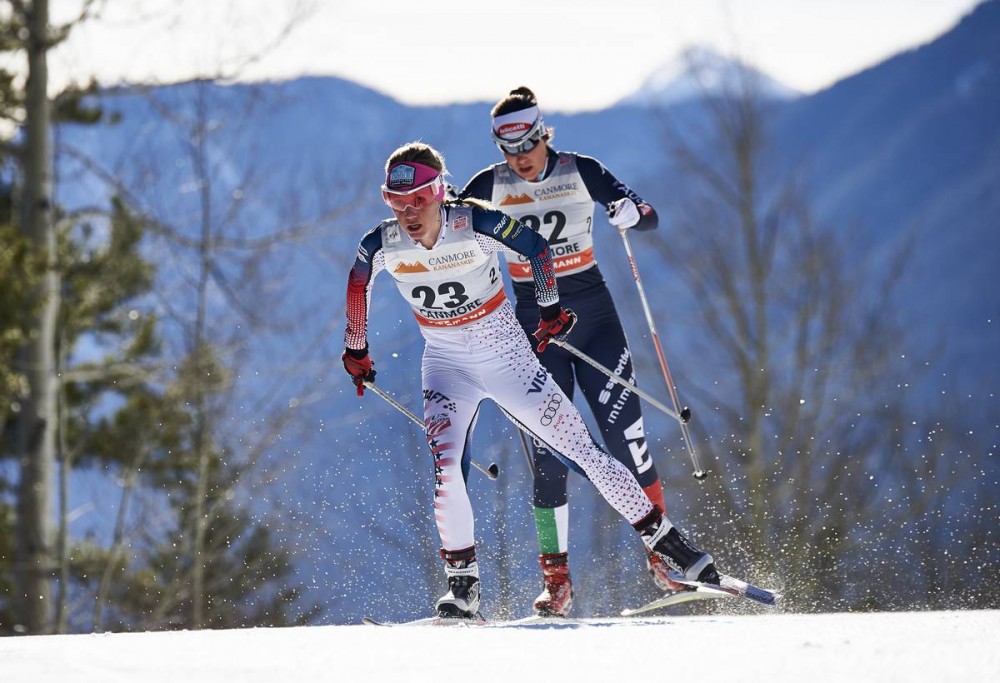
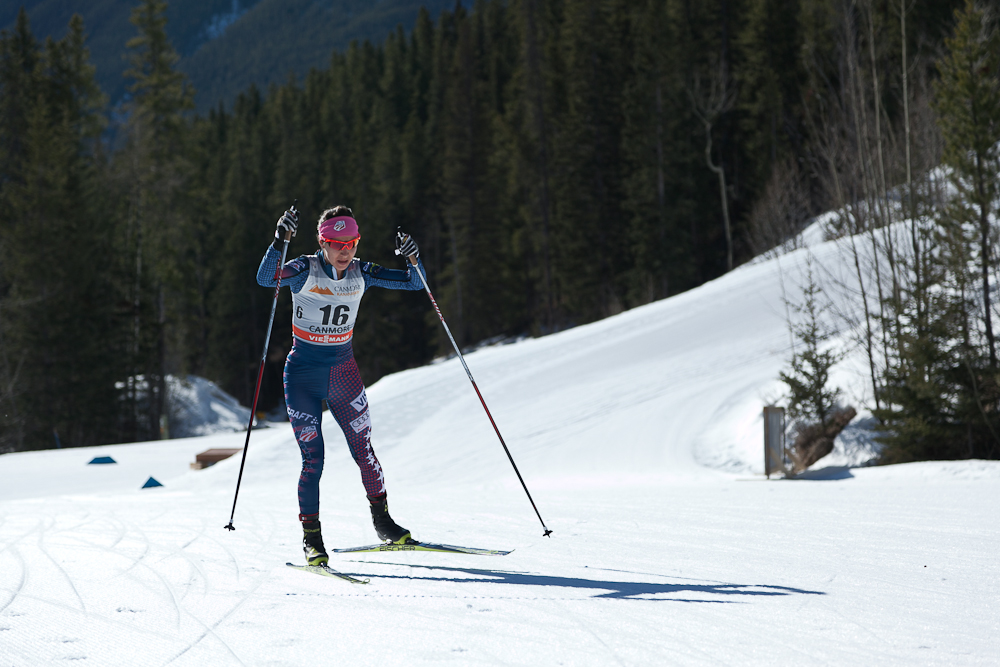
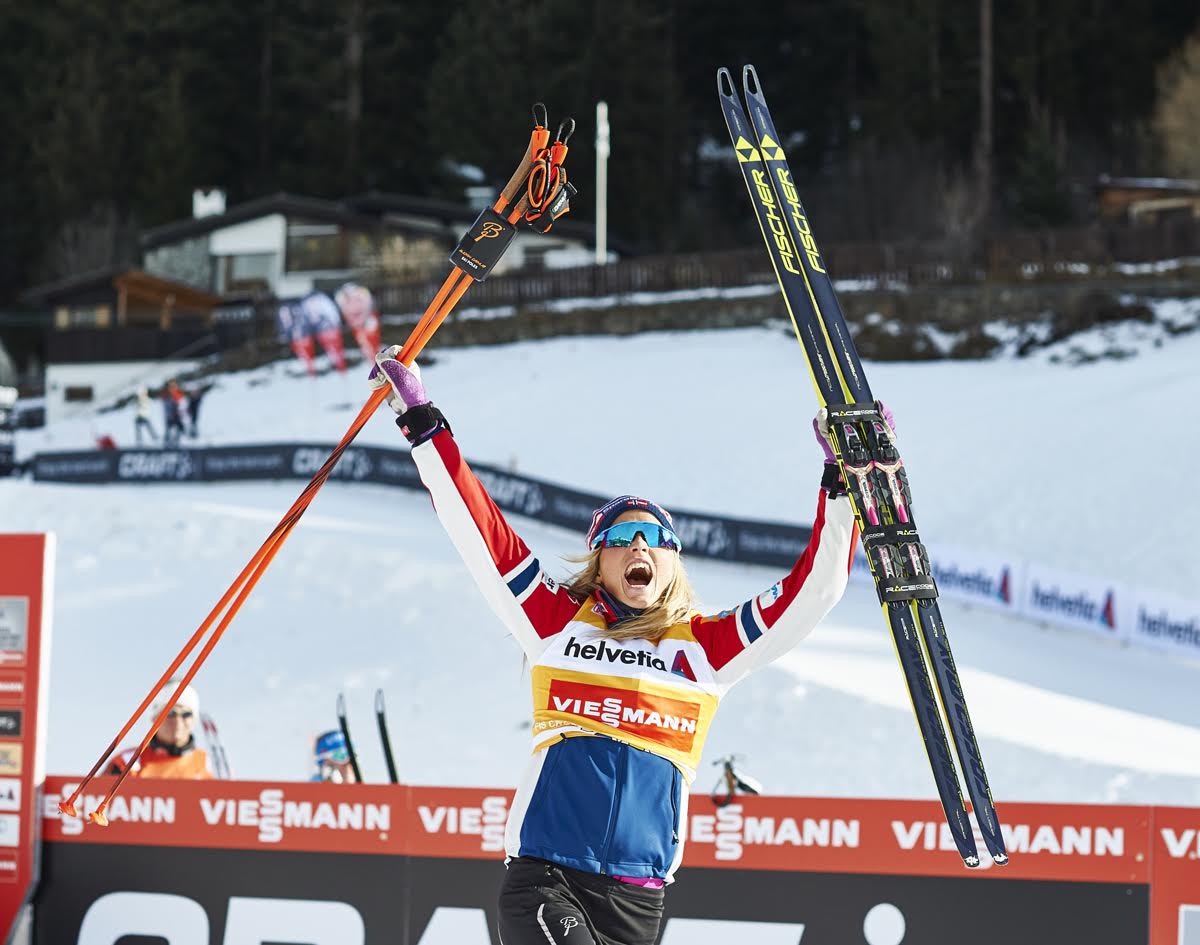
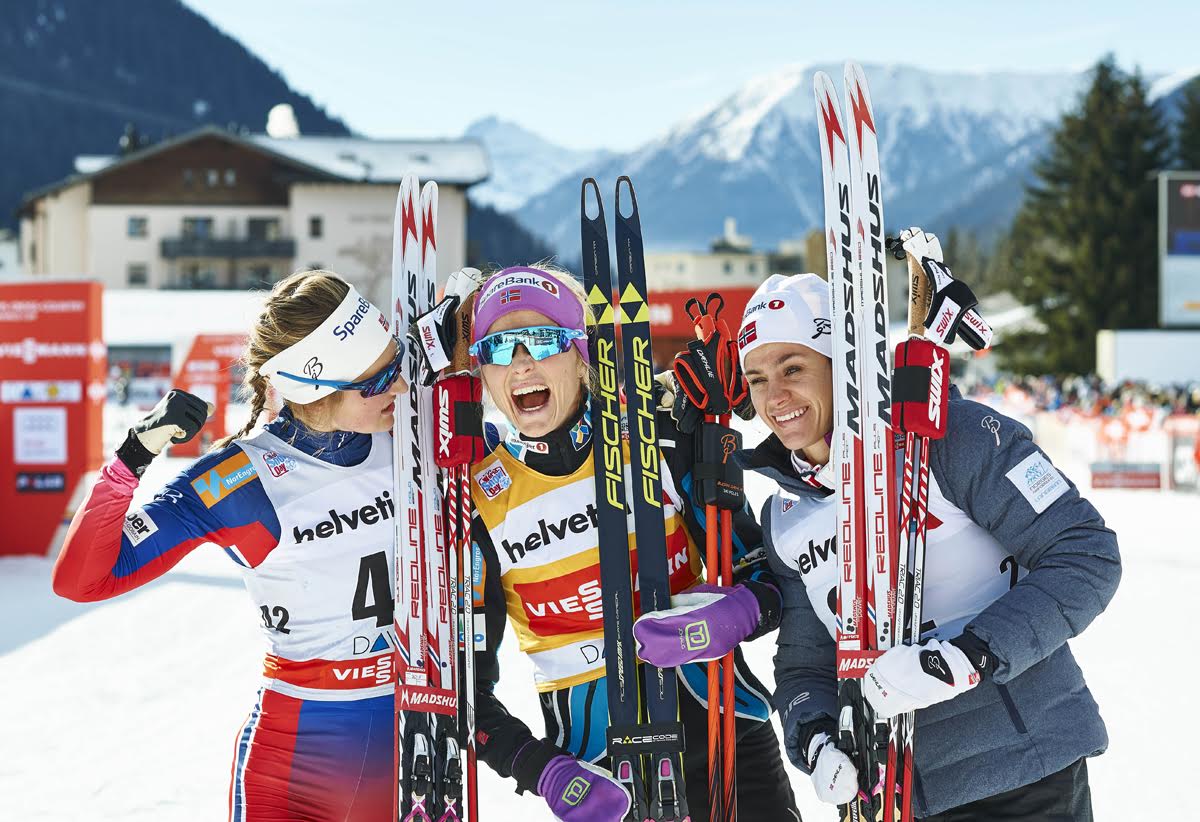
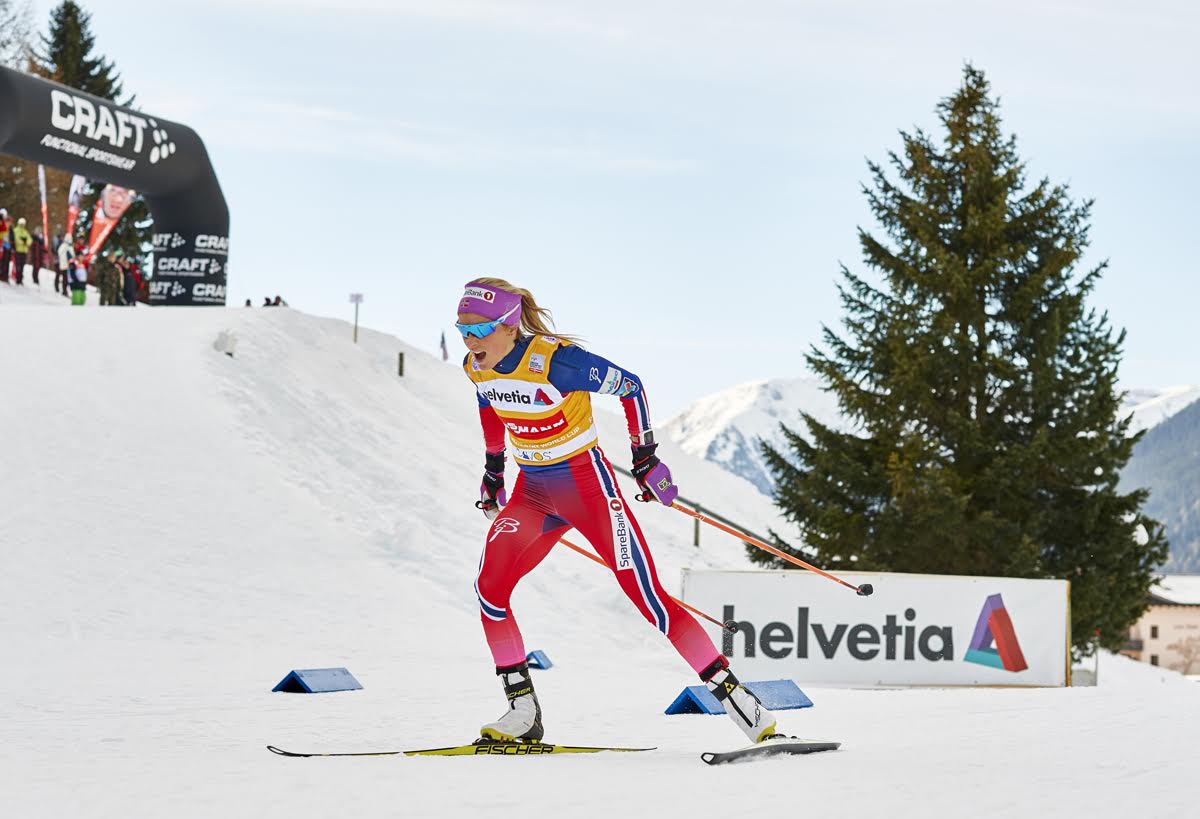
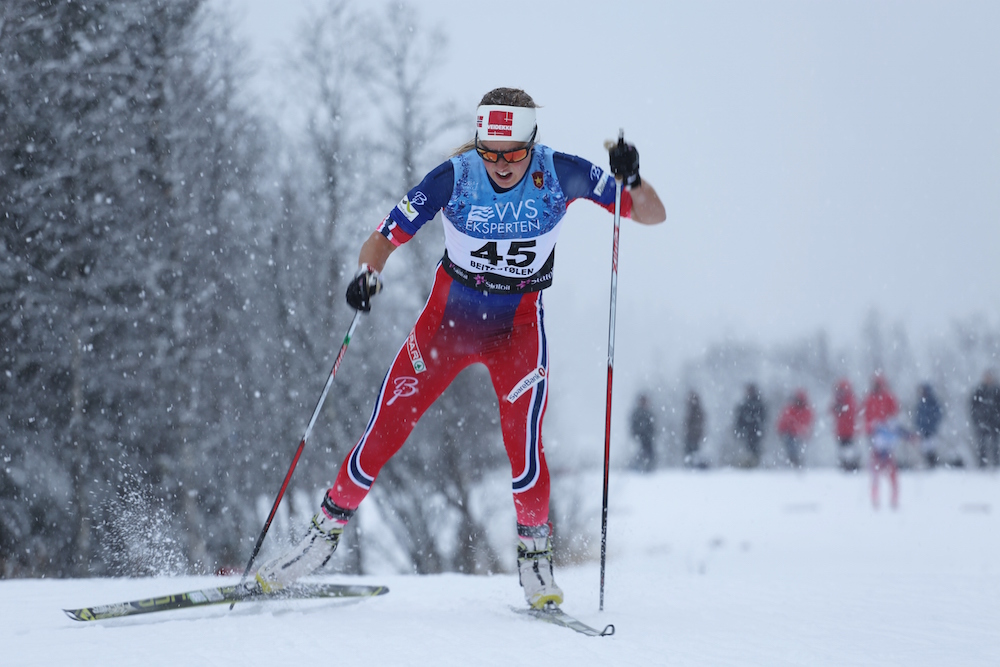
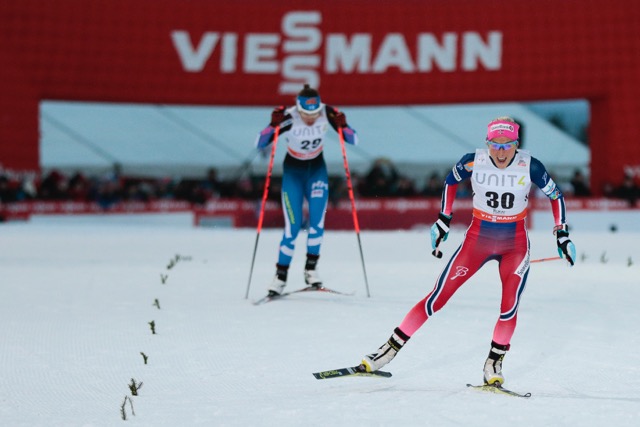
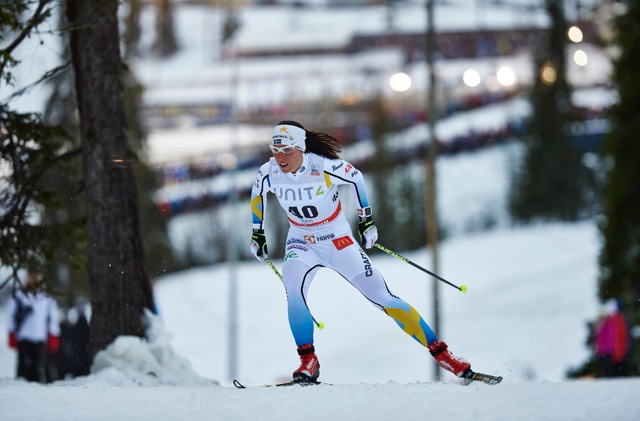
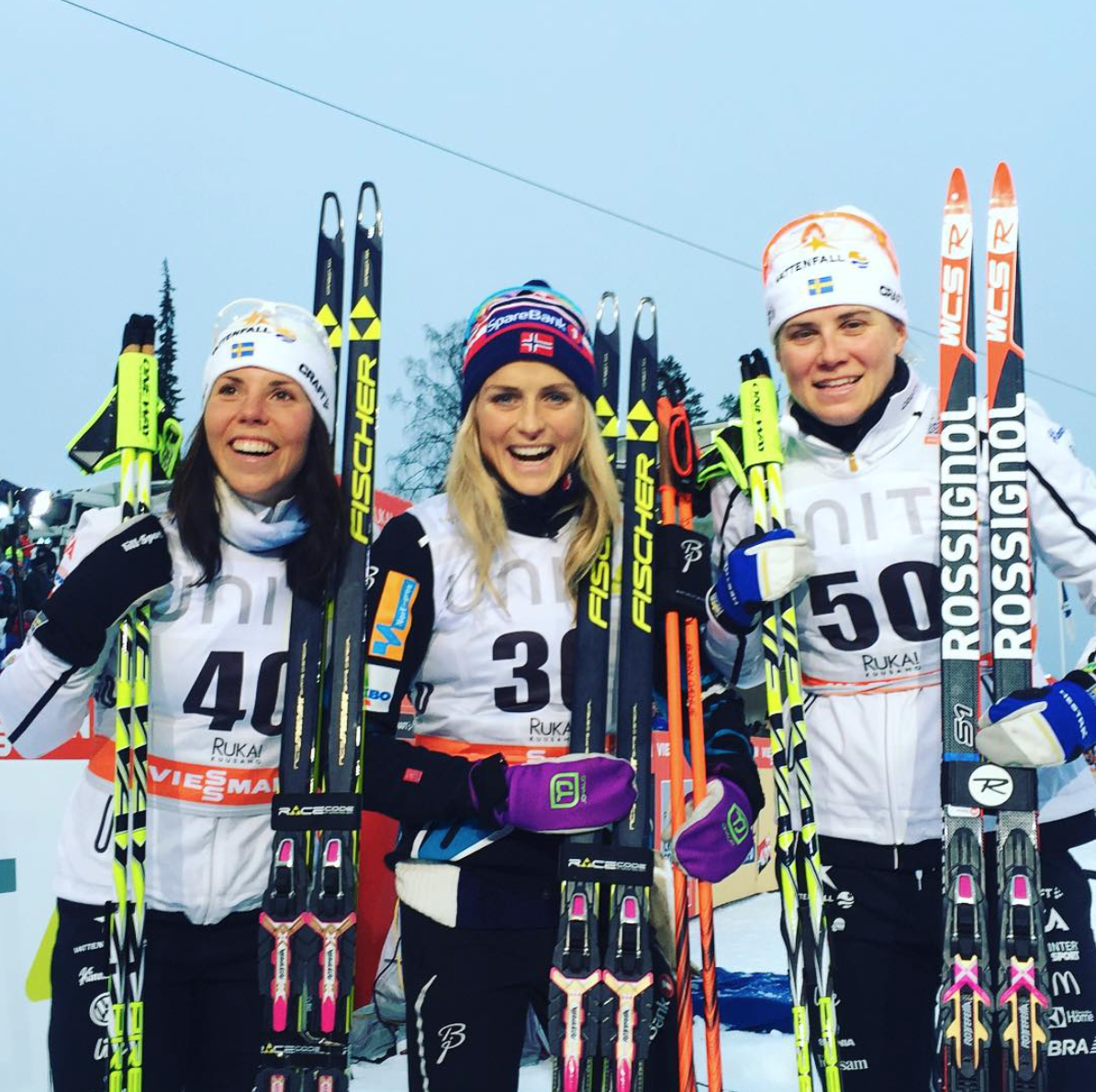
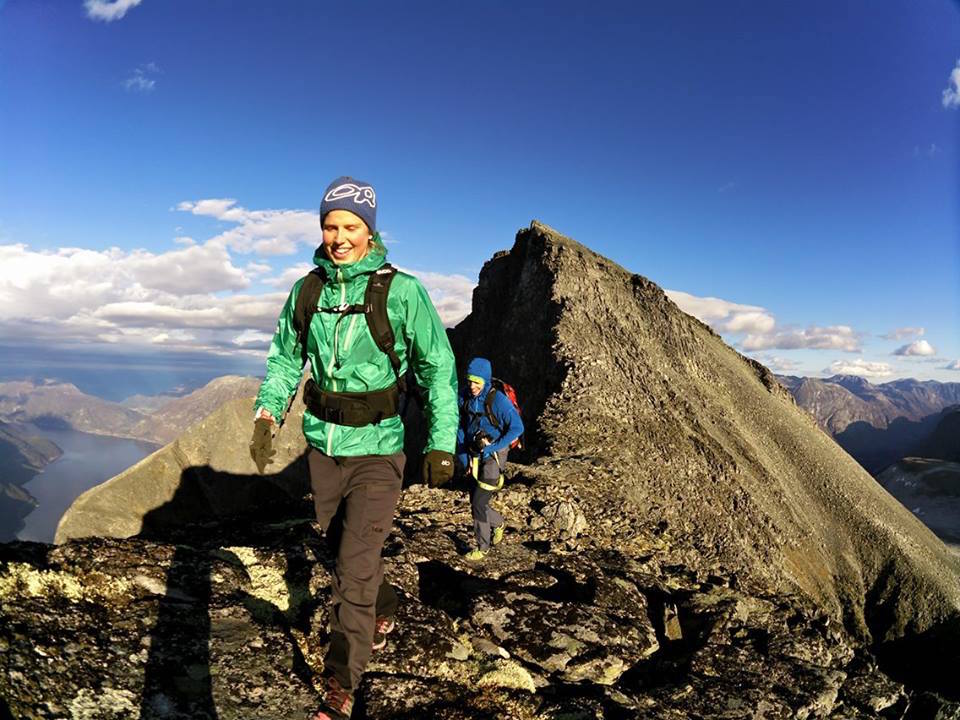
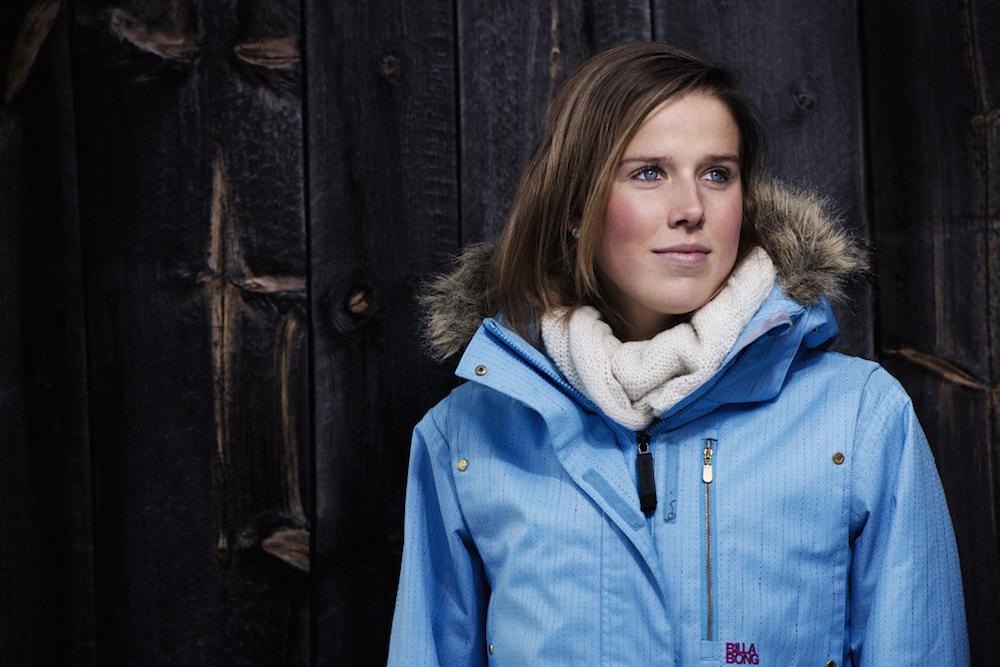
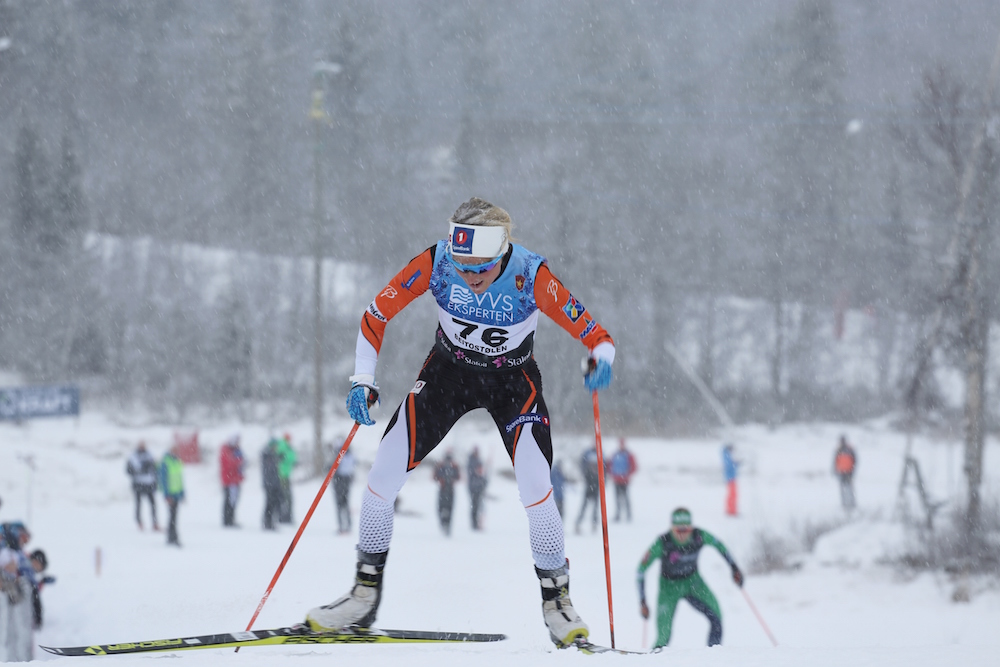
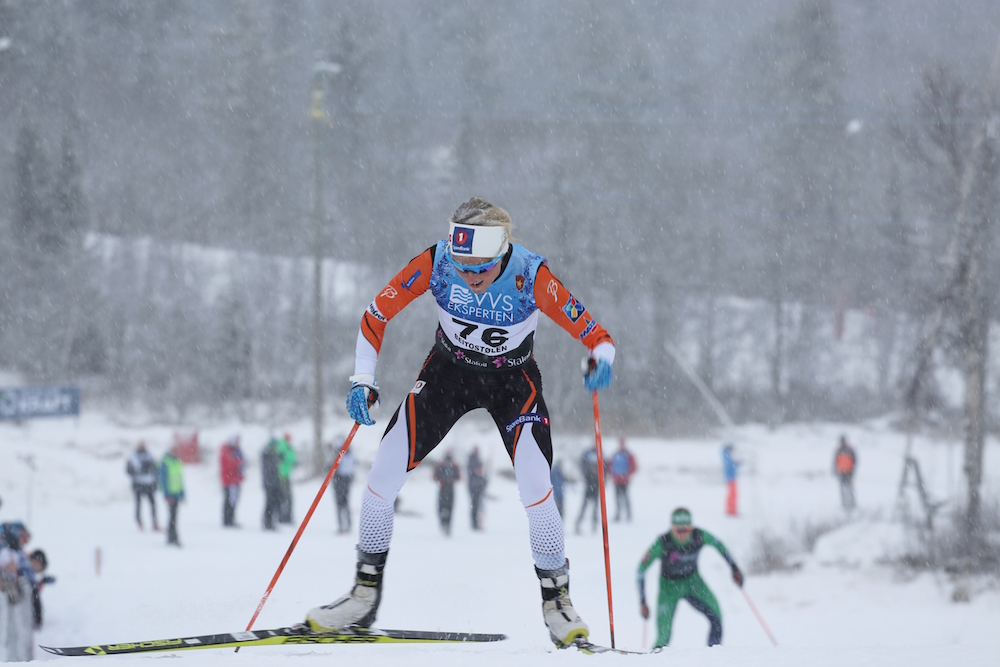
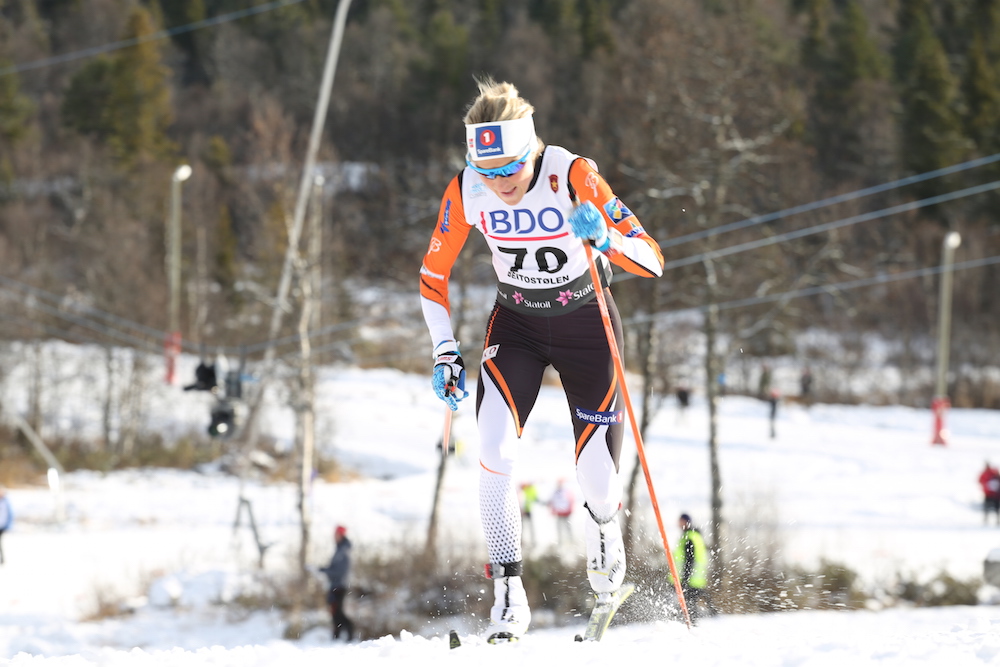
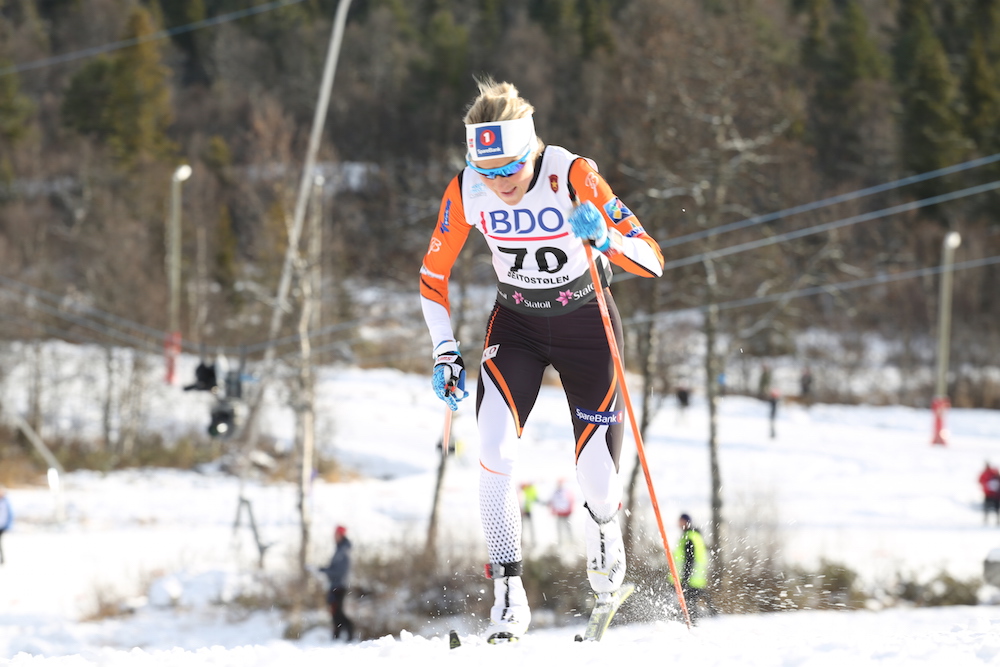
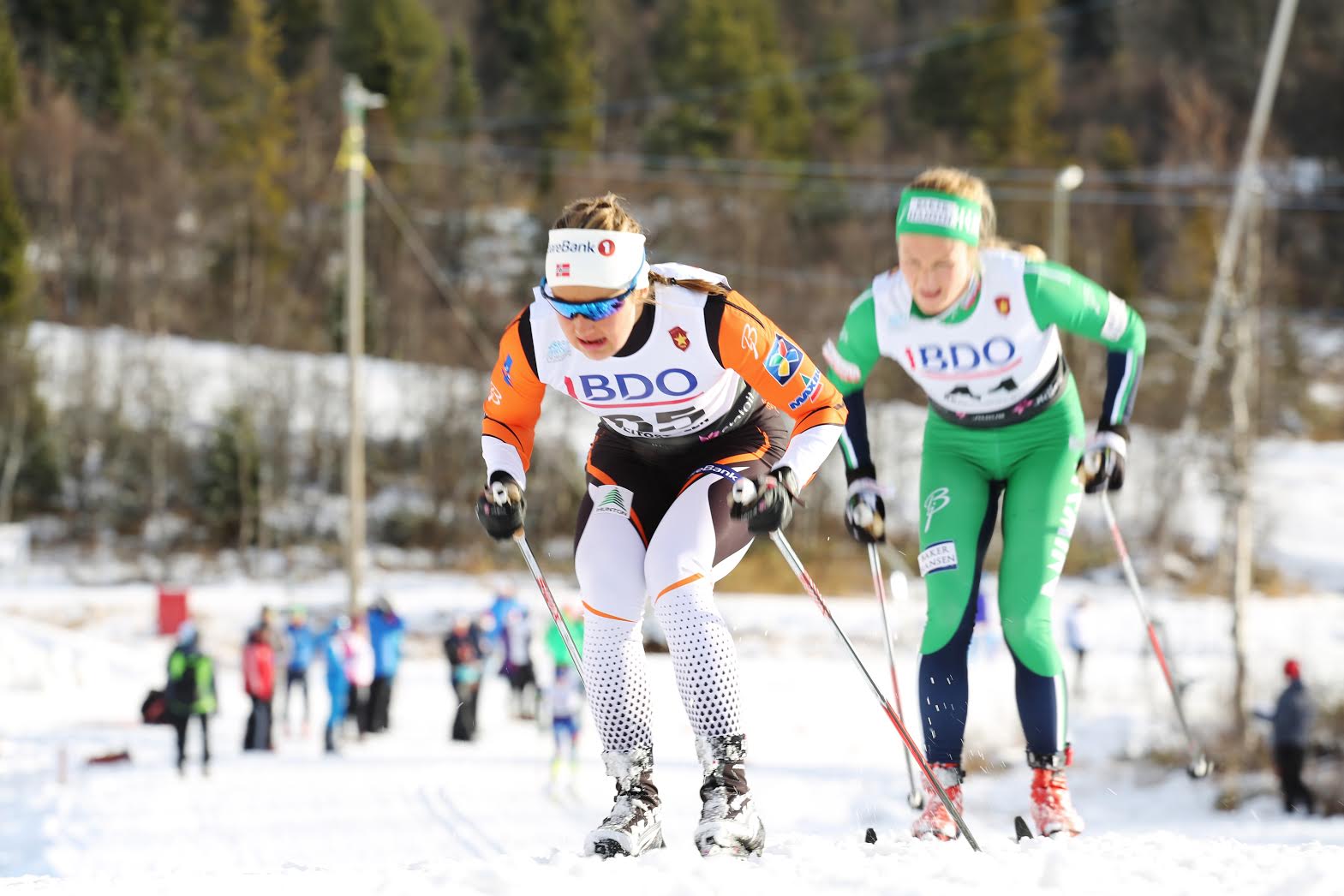
Norway’s Astrid Øyre Slind grew up in a skiing family and has been competing her whole life. But she didn’t break through at the highest level, on the international World Cup circuit, until her mid-30s. She’s now been a top competitor on the World Cup for the past two seasons and is expected to be a major contender at the Olympics this winter, and she joins Devon and Nat for an interview.
Questions? Feedback? Suggestions for guests? Email us: devon[at]fasterskier.com and nat[at]fasterskier.com.
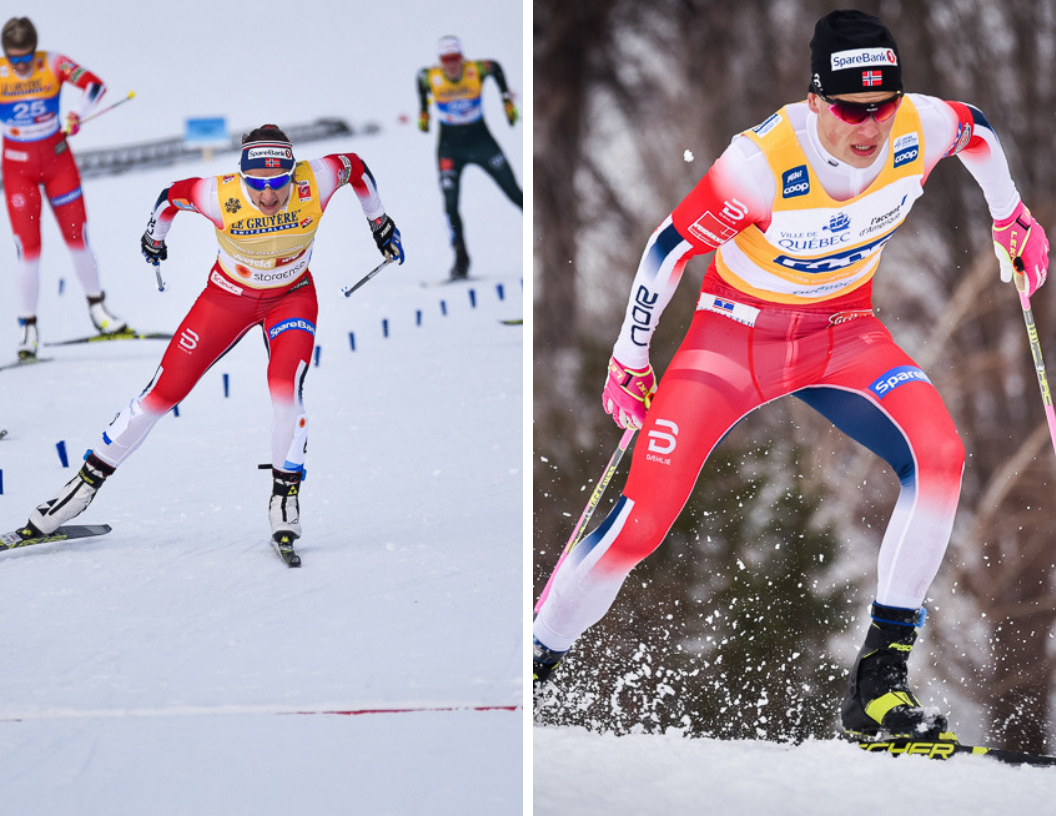
Norway’s Ingvild Flugstad Østberg (left) and Johannes Høsflot Klæbo (right) were the top money winners on the 2018/2019 World Cup. (Photos: John Lazenby/lazenbyphoto.com)
If you’ve read the International Ski Federation’s (FIS) website in the last few weeks and deviated from exploring the cross-country sub-site, U.S. alpine star Mikaela Shiffrin has been prominently featured. Her season was record-breaking. With 17 wins, she set a FIS World Cup record for alpine victories in a single season. With the fattening of her win total, was the commensurate growth of her bank account.
She became the first World Cup skier, male or female, to earn more than one million Swiss Francs (CHF) in prize money during a single season. She won 886,386 CHF for her regular World Cup haul, and 114,000 CHF for her gold and bronze at the Åre, Sweden Alpine Ski World Championships.
As of this writing, with the exchange rate set at 1 CHF = 0.98 USD, that equates to 980, 447.25 U.S. Dollars. Not exactly bottom feeding for a professional skier. (Since the beginning of April, the dollar has lost value against the Swiss Franc.)
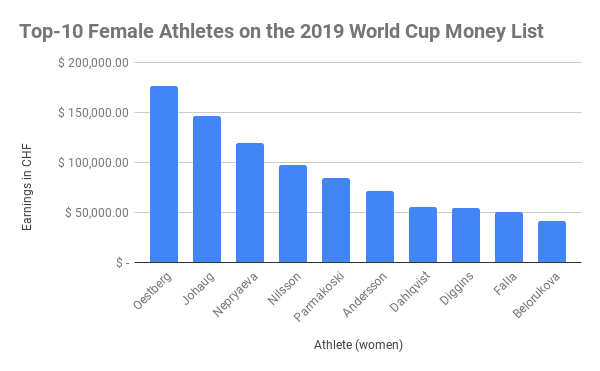
On the cross-country World Cup, Norway’s Ingvild Flugstad Østberg, the overall winner, was first on the money earnings list with 175,900 CHF. Her teammate Therese Johaug, the winner of the distance crystal globe, earned the second highest total with 146,375 CHF. (American Jessie Diggins was eighth with 54,525 CHF in earnings.)
Sweden’s Stina Nilsson, the fourth-ranked prize money earner and winner of the sprint globe earned just shy of the 100,000 CHF mark with 97,575 CHF in total earnings. Beyond her presumably sizable income from sponsors and endorsements, this is a proud living for fast skiing. Yet, it becomes a precipitous drop off in earnings from 10th place (Russia’s Yulia Belorukova with 40,950 CHF) to 30th, where Norway’s Kari Øyre Slind amassed 7,450 CHF.
Of the ninety female athletes on the money list, 32 earned less than 1,000 CHF.
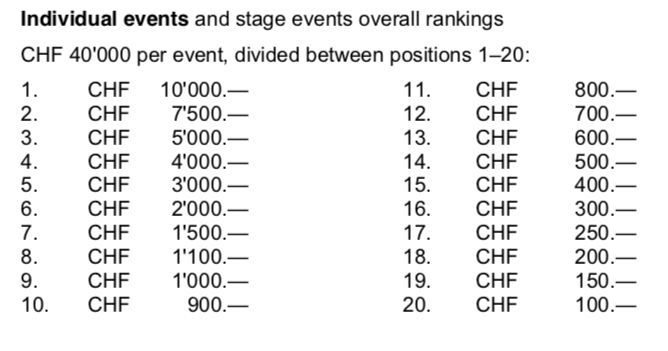
According to the Rules for the FIS Cross Country World Cup, the organizing committees must divide a sum of 40,000 CHF per individual race amongst the top-20 skiers. The winner receives 10,000 CHF, second place 7,500 CHF until the 20th place skier is left with 100 CHF. (See below for the specific breakdown.)
For individual sprints, prize money is reserved for those making the finals. A total of 30,000 CHF is divided amongst the top-six finishers in the final sprint standings. First place receives 12,000 CHF, second 8,000 CHF, third 4,000 CHF, fourth 3,000 CHF, fifth 2,000 CHF, and sixth 1,000 CHF.
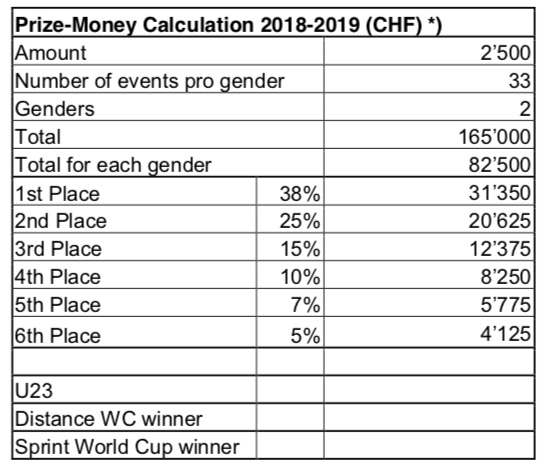
As far as earnings for the World Cup overall, each gender divides 82,500 CHF amongst the top six athletes. (See below for the breakdown.)
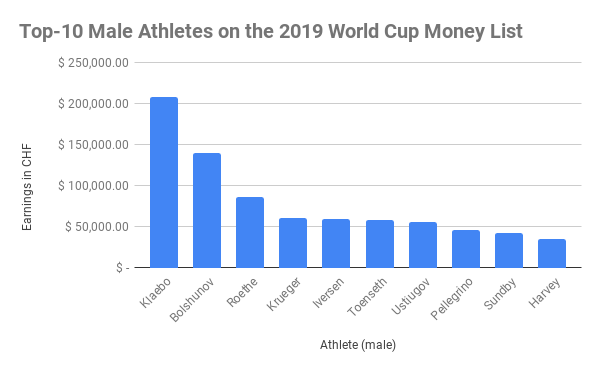
Like on the women’s side, those who dominate the men’s podiums collect the cash. Norway’s Johannes Høsflot Klæbo, with 207,500 CHF, was the top-ranked male on the money list. Of the top-ten male earners, six were Norwegian, two Russian, one Italian, and in tenth was Canada’s Alex Harvey with 35,550 CHF.
Only the top two athletes on the men’s list earned more than 100,000 CHF: Klæbo and the second overall prize money earner, Russia’s Alexander Bolshunov, with 139,625 CHF.
The 20th ranked skier, Gleb Retivykh of Russia, was the first male skier to fall below the 20,000 CHF threshold with 19,850 CHF. Keeping things tidy by tens, Norway’s Finn Hågen Krogh was ranked 30th — he was the first skier below 10,000 CHF in prize winnings with 9,150 CHF.
Breaking the numbers down.
Twenty different women stood on individual World Cup podiums this past year. For the men, the number bumped to twenty-eight different skiers.
Prize money is skewed towards the top performers. It follows that skiers like Østberg and Johaug would lead the money standings: Johaug won 11 individual World Cups this year, Østberg five. Østberg stood on twelve individual podiums and finished second a total of three times and placed third a total of four times. Nilsson, the top sprinter, won eight individual World Cup events. She also placed second once for her nine total World Cup podiums. The chart below shows the drop off in earnings for the women’s field — the top spots in World Cup races are secured by a relatively small number of skiers. Over twenty-nine individual races, three different skiers — Johaug, Østberg, and Nilsson — amassed 24 total wins.
By comparison, Diggins stepped on five podiums and placed fourth through 10th nine different times. Russia’s Yulia Belorukova, the tenth-ranked money earner, won a single race for her only podium and placed between fourth and 10th on 11 different occasions. The money stays near the podium: 10th place earns nine percent of the winner’s take in distance racing. That’s 900 CHF for placing 10th in the world.
It’s a similar story for the men, yet the drop off from the top two prize winners was steeper. (Again, 20 different women podiumed compared to 28 different men.) Klæbo won 13 individual World Cup races and placed second a single time. Bolshunov had 12 podiums: five wins, three second place finishes, and four third place results. Klæbo and Bolshunov locked up 18 wins between them over the 29 individual World Cup races.
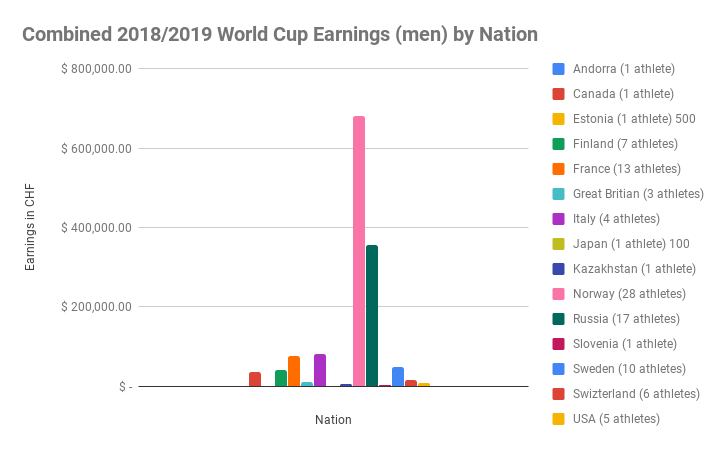
The trend of top-heavy earnings in the World Cup field is no mystery as this FasterSkier article from 2015 suggests. The article was titled, How to Score Points and Win Money on the World Cup (Hint: Be Norwegian). For the men, the main theme of that article still rings true. Norway had 28 different athletes in the money this season. In a nation to nation comparison, Norway’s men won the most cash. Russia, with 17 skiers earning prize money, clawed at Norway. Sweden, a country we often think of as a powerhouse, has been unable to field a well-rounded men’s team recently and lags behind the earnings of Italy (that’s skewed by Federico Pellegrino) and France. (Link to an interactive chart of the men’s data here.)
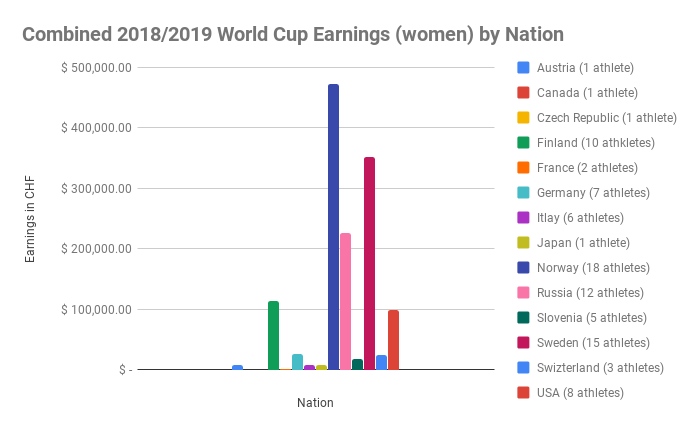
The nation to nation comparison for the women reveals a Sweden that has emerged as a challenger to Norway. Norway prevails with 472,375 CHF in total earnings. But, Sweden and Russia are serious contenders, while Finland and the U.S. have also separated themselves. (You can link to an interactive chart for the women’s data here.)
Does it pay to be an elite cross-country skier? That depends. And it may be of no concern to those who compete simply for the love of their chosen sport. Yet, for those at the top of the xc skiing food chain, prize winnings along with the padding of endorsements can make for a comfortable life. And it still doesn’t hurt if you are from Norway.
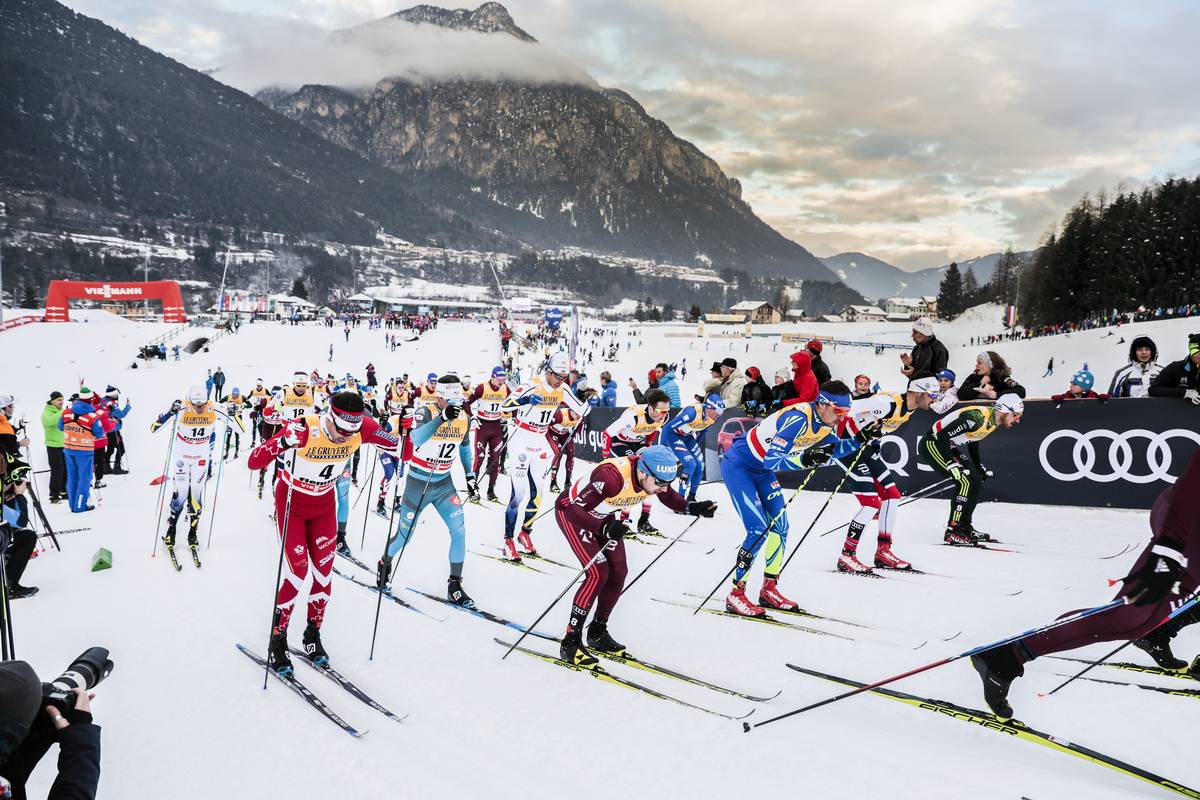
The start of the men’s 15 k classic mass start at Stage 6 of the 2018 Tour de Ski on Saturday in Val di Fiemme, Italy, with (front row, left to right) Canada’s Alex Harvey, Russia’s Sergey Ustiugov, Kazakhstan’s Alexey Poltoranin, Norway’s Martin Johnsrud Sundby, and Switzerland’s Dario Cologna. (Photo: Salomon/NordicFocus)
Beginning this Saturday in Toblach, Italy with a freestyle sprint is the 13th edition of the Tour de Ski (TdS). According to the International Ski Federation (FIS), over the course of seven stages the men will race 80.918 kilometers, the women 60.67 k.
The TdS has become both a staple and a spectacle of the annual World Cup calendar. With a jam-packed series of races primacy is placed on both the ability to recover well and wither less as the TdS transpires.
Prognostication can be tricky in a long-form template like the TdS. So much can go astray during seven races not to mention the travel and dicey germ-avoidance.
Last season’s winner on the women’s side, Heidi Weng of Norway, sits 18th overall in the World Cup standings (14th in distance). She has four top-20’s in the four distance events she’s contested with her best result an eighth in Lillehammer’s 10 k skate. Although featuring two sprints in the first three stages, the TdS remains a distance skier’s paradise.
Weng has skied solidly on the World Cup, but she has yet to show the form that made her a TdS overall winner in 2017 and 2018. Norway has won the last five iterations of the TdS: Marit Bjørgen won once in 2014/2015, Therese Johaug twice (2013/2014, 2015/2016), and Weng the last two years.
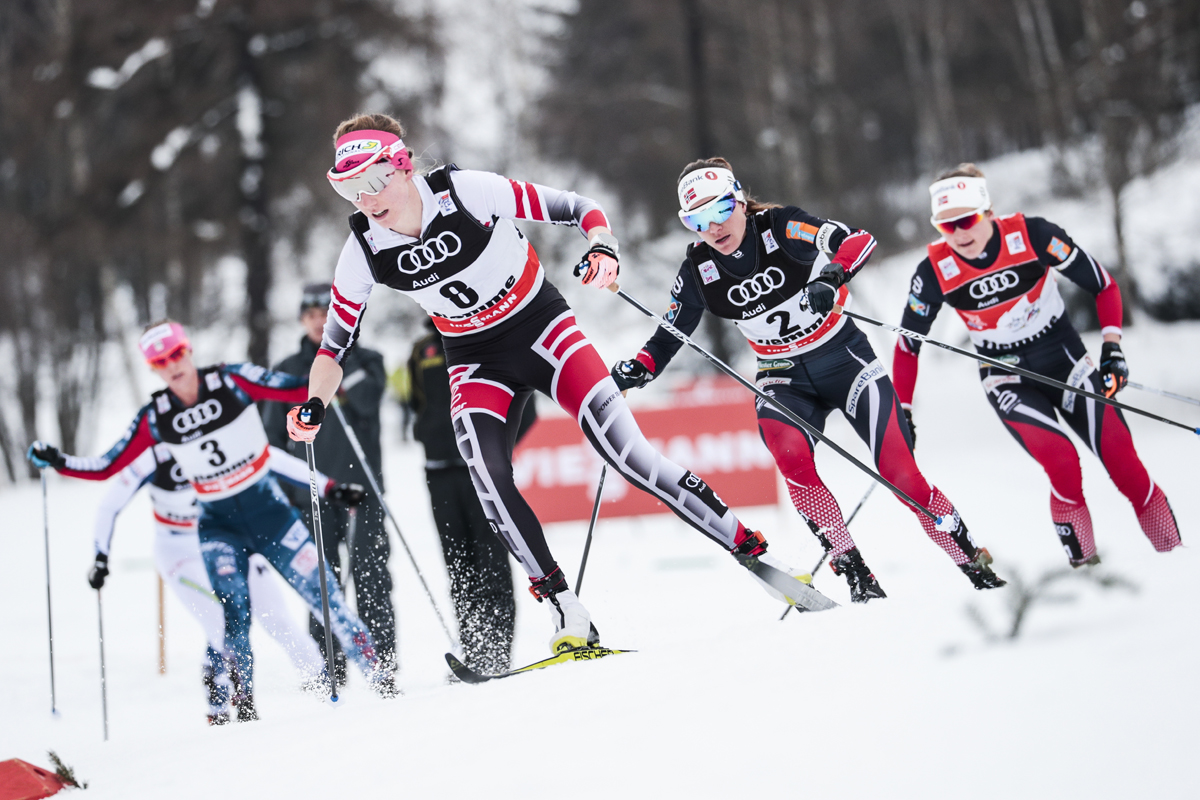
Austria’s Teresa Stadlober leads Norway’s Heidi Weng (2) and Ingvild Flugstad Østberg, American Jessie Diggins (3) and others around a downhill corner during the women’s 10 k classic mass start at Stage 6 of the 2018 Tour de Ski in Val di Fiemme, Italy. (Photo: Fischer/NordicFocus)
If Norway is to keep the streak alive, Ingvild Flugstad Østberg, last year’s TdS runner up, could be the heir apparent. She currently ranks second in the World Cup overall and 15th on the sprint list.
Johaug, having returned from an 18 month doping ban, has been on a distance race tear. She has won all five World Cup distance events this season. Johaug, however, will not be lining up for the TdS.
Only five different women have earned distance podiums this season — Johaug, Østberg, Sweden’s Charlotte Kalla and Ebba Andersson, and Finland’s Krista Pärmäkoski. Along with Johaug, Kalla and Andersson are skipping the TdS. (Andersson sits third overall on the World Cup, Kalla fifth.) With the TdS missing three of the five top ranked World Cup distance skiers, daily stages and the overall podium are up for grabs.
Last season’s third overall finisher, Jessie Diggins of the U.S. Ski Team (USST), often cites the TdS as a point in the season when her form trends towards podium performances. She sits eighth in the current distance standings and could very well have a stout TdS.
Russia’s Natalia Belorukova and Yulia Nepryaeva look strong as does Sadie Bjornsen (USST), and Austria’s Teresa Stadlober.
With less than predictable distance stage podiums for the women, it may simply come down to a drag race on the Alpe Cermis final climb Jan. 6.
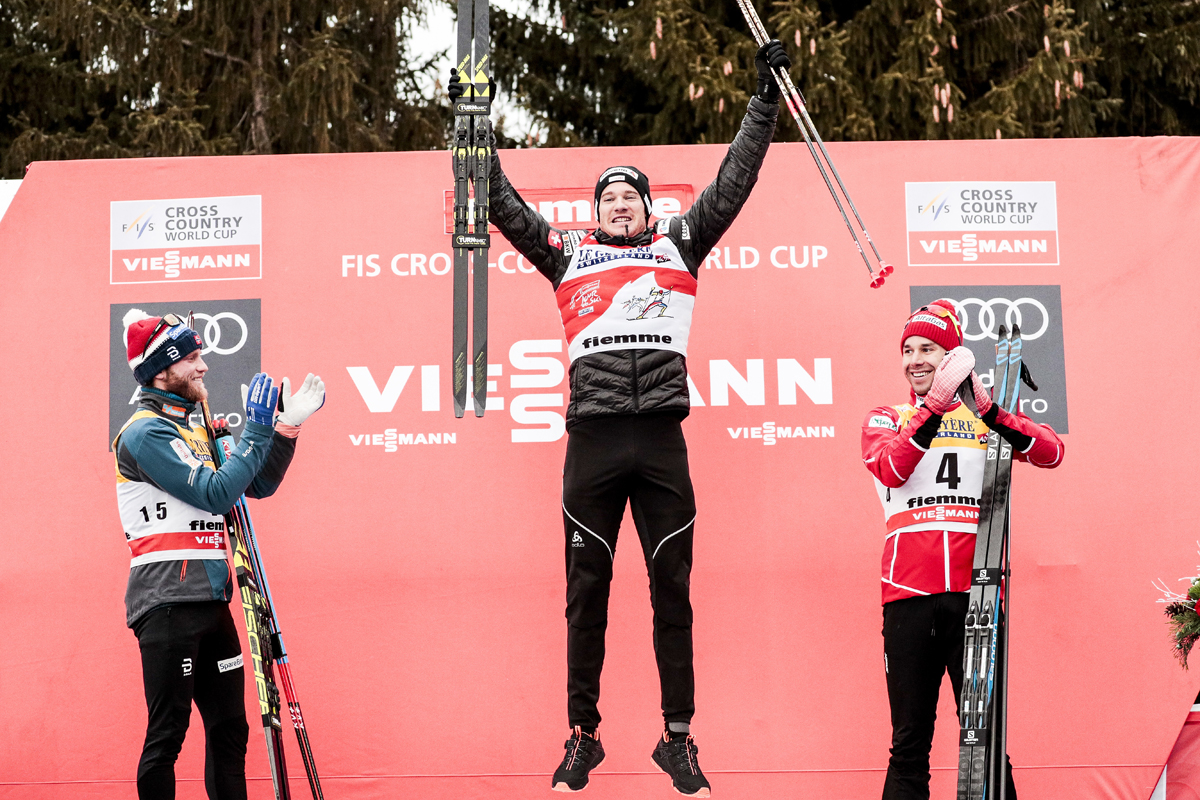
Switzerland’s Dario Cologna (c) celebrates his fourth Tour de Ski overall title. He was joined by Norway’s Martin Johnsrud Sundby (l) and Canada’s Alex Harvey (r) on the podium in second and third, respectively. (Photo: Fischer/NordicFocus)
The men’s scene is also open to interpretation. Last season’s TdS winner, Switzerland’s Dario Cologna, was in fact a surprise victor. Prior to Cologna’s stage two win in last year’s TdS, it had been nearly three years since the four time TdS overall winner had won a World Cup. Cologna sits 21st overall on the World Cup currently. Given last year’s resurgence, anything is possible for the Swiss skier.
Then there’s Martin Johnsrud Sundby form Norway. He finished on the TdS podium the last three years. At thirty-four-years-old, Sundby is ranked first on the distance list, with a second, a third, and a fourth place in distance races this season.
Sundby won the TdS on two occasions – in 2013/2014 and in 2016. His 2015 win was stripped after he tested positive for excessive levels of Salbutamol. He placed second in the past two Tours.
In a field rife with talent, Sundby’s ability to race and rebound and race and rebound will be tested. Sjur Røthe, Emil Iversen, and Didrik Tønseth— all from Norway— look in form. And there’s Norway’s Johannes Høsflot Klæbo. The winner of last season’s overall World Cup has had flashes of his past explosive self. He could be a TdS protagonist.
The men’s field is notably tight. Along with the Norwegians, several Russians could pop a podium, a stage win, and the overall. Russia comes with a loaded team ready to exploit. Alexander Bolshunov leads the overall World Cup – he’ll turn twenty two on Dec. 31st. He’s backed by teammates Evgeniy Belov, Andrey Melnichenko, and Denis Spitsov.
Canada’s Alex Harvey placed third overall last year and he looked stronger as the TdS progressed.
The Stages
Stage 1: Dec. 29, skate sprint in Toblach, Italy.
Stage 2: Dec. 30, 10 k/15 k skate in Toblach, Italy.
Stage 3: Jan. 1, skate sprint in Val Müstair, Switzerland.
Stage 4: Jan. 2, 10 k/15 k classic mass start in Oberstdorf, Germany.
Stage 5: Jan. 3, 10 k/15 k skate pursuit in Oberstdorf, Germany.
Stage 6: Jan. 5th, 10 k/15 k classic mass start in Val di Fiemme, Italy.
Stage 7: Jan 6th, 9 k final climb skate pursuit in Val di Fiemme, Italy.
Teams
United States
Women: Sophie Caldwell, Sadie Bjornsen, Jessie Diggins.
Men: Ben Lustgarten, Simi Hamilton, Erik Bjornsen, Kevin Bolger.
U.S. Ski Team Head Coach Chris Grover noted in a text that Caldwell, Hamilton, and Bolger will likely cease the TdS after the stage three sprint. Additionally, this is a small team for the U.S. at the TdS. Several athletes turned down TdS nominations including Scott Patterson (USST), Andy Newell (SMS T2/Salomon), Kyle Bratrud (SMS T2), Rosie Brennan (APU), Rosie Frankowski (APU), Caitlin Patterson (CGRP), and Julia Kern (SMS T2). These skiers plan on racing U.S. Nationals this January in Craftsbury, Vermont.
Canada
Women: Emily Nishikawa, Dahria Beatty
Men: Alex Harvey, Lenny Valjas, Bob Thompson
Norway
Women: Ingvild Flugstad Østberg, Maiken Caspersen Falla, Astrid Uhrenholdt Jacobsen, Kari Øyre Slind, Kathrine Rolsted Harsem, Heidi Weng, Lotta Udnes Weng, Tiril Udnes Weng Mari Eide, Anna Svendsen
Men: Martin Johnsrud Sundby, Hans Christer Holund, Emil Iversen, Didrik Tønseth, Simen Hegstad, Krüger, Sjur Røthe, Johannes Høsflot Klæbo, Martin Løwstrøm Nyenget, Eirik Brandsdal, Finn Hågen Krogh
Russia
Women: Yulia Belorukova, Lidia Durkina, Anna Zherebyateva, Mariya Istomina, Natalia Nepryaeva, Anna Nechaevskaya, Anastasia Sedova, Elena Soboleva
She’s back. Therese Johaug celebrates after winning the 2018 FIS 10-kilometer classic in Beitostølen, Norway.
After an 18 month suspension for a positive out of competition positive doping test, during which Norway’s thirty-year-old Therese Johaug could build hour upon hour of base fitness and fine tune the engine with no race-stress, she arrived in Beitostølen, Norway on Friday and didn’t skip a beat.
In temperatures hovering around 32 degrees Fahrenheit, and low-level clouds descending on the course, Johaug established herself as the early season favorite amongst a deep Norwegian National Team in Beitostølen’s FIS season opener 10-kilometer classic race.
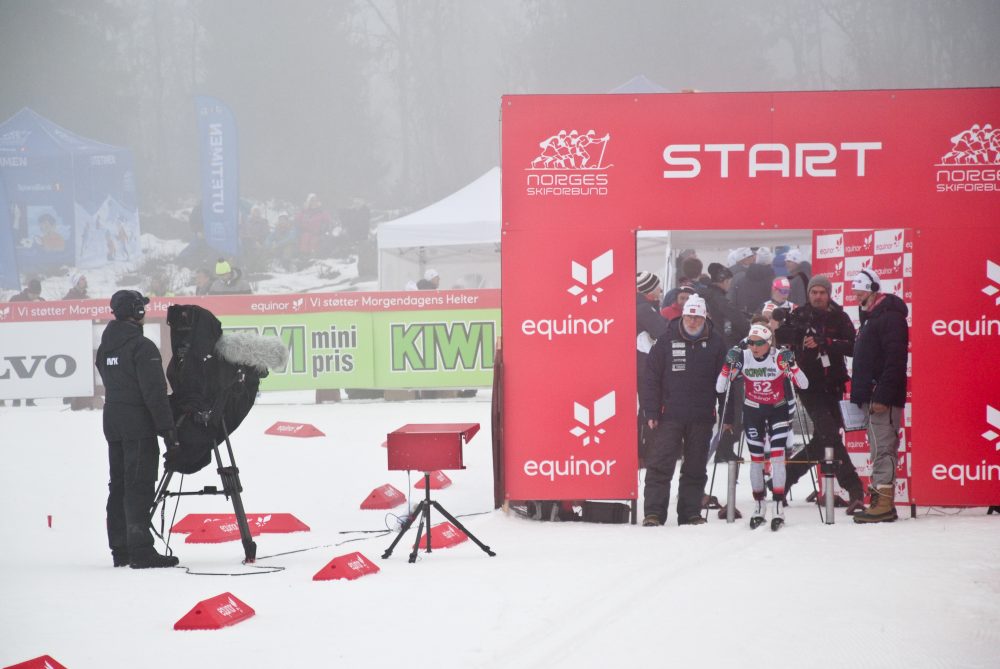
As the 52nd starter in a 60-skier field, Johaug never let off the throttle.
The race was tight at the 1-kilometer time check, with national team skier Ingvild Flugstad Østberg marking the fastest time over Johaug by only 0.9 seconds. With nine kilometers to go, it was all Johaug, as she clocked the fastest times at the remaining checkpoints.
Up by 4.3 seconds at 2.2k, the time back to the second fastest skier grew to 15.5 seconds at the race’s midpoint for Johaug. By the finish, Johaug did as she has done many times before, winning by a comfortable margin. She won in 25:42.6 minutes. Østberg, who ranked third in the World Cup overall last season, placed second (+23.9). Kari Øyre Slind was third (+59.8)
Therese Johaug ready to start it all over again after her 18-month suspension.
“It was special being here today,” Johaug told Norwegian broadcaster NRK according to a translation. “It feels incredible to back in the xc family again. To come up here and meet all the people that I’ve been skiing with for so many years, hear the cries from the crowds out in the course and the splits, it was a special feeling. It was so much. I was nervous before the start, but when I got started I really didn’t want it to end. I could have skied an extra lap.”
The opening Beitostølen FIS races are the early season proving grounds for Norway’s elite cross-country athletes. The top-10 in the women’s race was riddled with names World Cup fans are familiar with.
Astrid Uhrenholdt Jacobsen skied to fourth (+1:21.3), Haga Ragnhild fifth (+1:33.1), Anna Svendsen sixth (+1:42.8), and Heidi Weng, winner of last seasons overall World Cup finished seventh (+1:58.7).
Annika Taylor, a former University of New Hampshire skier now skiing for Great Britain, raced her way to 21st (+3:49.3).
In similar conditions, the men raced a 15 k classic. Like the women’s field, it was a Norwegian who’s who of elite class skiers. But unlike Johaug setting an increasing time margin over any contenders, the men’s race was tight, separated by only 15 seconds for the top-five skiers 5 k into the race.
At that point, with Didrik Tønseth in first and Emil Iversen in second, only a sliver of time, 0.1 seconds, differentiated the two. Martin Johnsrud Sundby and Johannes Høsflot Klæbo were gapped by 12.2 and 12.7 seconds respectively, as they skied through the time check in third and fourth place. Sjur Røthe came through in fifth (+15.8).
Iversen, in bib 141, kept it close, setting the initial times to beat. Tønseth started three skiers back in bib 144. Through 10k, the two were still evenly matched: with Tønseth up by 3.4 seconds over Iversen.
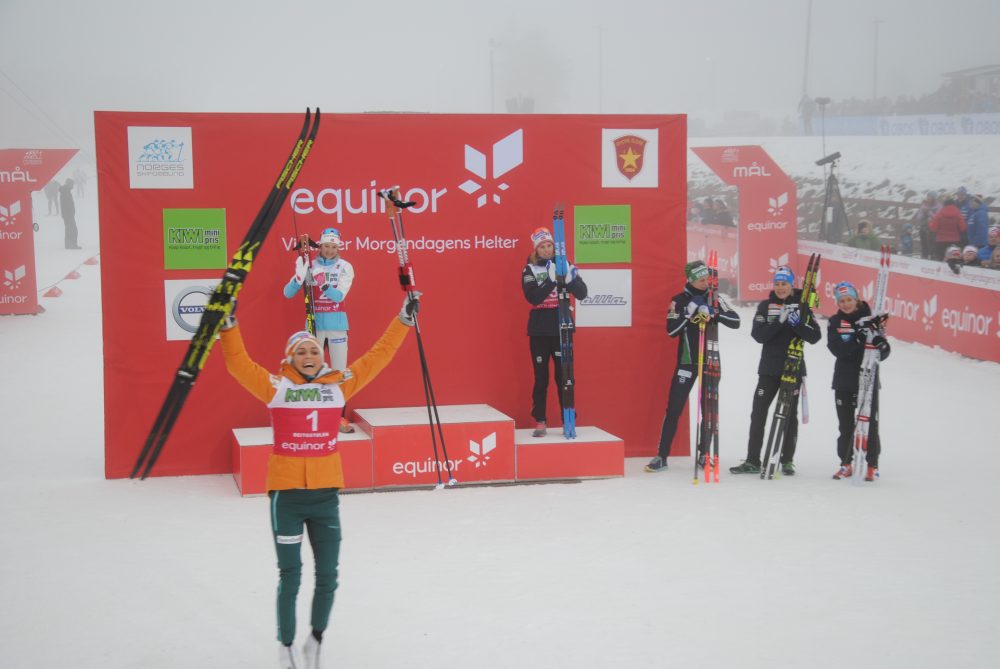
The men’s 15 k classic podium for the 2018 FIS opener in Beitostølen, Norway. Didrik Tønseth (NOR) in first, Norway’s Emil Iversen (left) in second, and Sjur Røthe (right) of Norway third.
Tønseth won the race in 36:08.6 minutes, with his winning margin of 12.4 seconds over the second place Iversen only solidified in the closing kilometers. Røthe gradually moved up and finished third (+29.3).
Sundby skied to fourth (+37.5), Hans Christer Holund fifth (+1:07.4), and Klæbo sixth (+1:17.5). British skier Andrew Musgrave finished seventh (+1:26.3). Musgrave is historically a stronger skate skier.
One hundred and forty-three skiers finished the men’s race.
Of note, thirty-two-year-old Petter Northug Jr., now a seemingly timeless presence on the Norwegian ski scene, was disqualified for classic technique violations. Prior to his DQ, Northug had been skiing in the top-20 for much of the race. Sundby was given a verbal warning for a classic technique violation.
Several Canadians raced the 15 k classic. Russell Kennedy was the best placed Canadian finishing tied for 23rd (+2:37.6). Brian McKeever was 68th (+4:06.6), Ryan Jackson 110th (+5:39.1), Maks Zechel 113th (+5:56.5).
Norwegians Therese Johaug and Heidi Weng, (l-r) during the 2016 women’s 15 k skiathlon in Canmore, Alberta. (Photo: Fischer/NordicFocus)
Welcome to The Rundown, your quick primer of need-to-know information about the day’s racing. We’ll be updating this digest as the day goes on with additional results, photos and quotes. The Rundown is NOT a race report; stay tuned for complete race reports later today with interviews from the day’s top racers.
***
FIS cross-country Beitostølen, Norway: 10 k/15 k classic
The race results are in from today’s 10-kilometer individual start classic FIS race in Beitostølen, Norway. The first of the season Beito races are used as a test pad for Norwegian athletes to gauge fitness and for some to make the rare jump to a coveted and scarce World Cup start.
Off of her suspension for using a banned substance, Norway’s Therese Johaug skied like she’d never been gone. Johaug was suspended for 18 months due to her violation.
Johaug fired off the 10 k winning in 25:42.6 minutes. Ingvild Flugstad Østberg was second (+23.9). Rounding out the podium was Kari Øyre Slindin third (+59.8).
Astrid Uhrenholdt Jacobsen skied to fourth (+1:21.3), Haga Ragnhild fifth (+1:33.1), Anna Svendsen sixth (+1:42.8), and winner of last seasons overall World Cup, Heidi Weng finished seventh (+1:58.7).
The men skied a 15 k classic race Friday in Beitostølen. Didrik Tønseth won in a time of 36:08.6 minutes. In second was Emil Iversen (+12.4), while Sjur Røthe placed third (+29.3).
Martin Johnsrud Sundby skied to fourth (+37.5), Hans Christer Holund fifth (+1:07.4), and Johannes Høsflot Klæbo sixth (+1:17.5).
British skier, although based in Norway, Andrew Musgrave finished seventh (+1:26.3).
One hundred and forty-three skiers finished the men’s race. Of note, Petter Northug Jr., now a seemingly timeless presence on the Norwegian ski scene, was disqualified for technique violations.
Several Canadians raced the 15 k classic. Russell Kennedy was the best placed Canadian finishing tied for 23rd (+2:37.6). Brian McKeever was 68th (+4:06.6), Ryan Jackson 110th (+5:39.1), Maks Zechel 113th (+5:56.5).
Bruksvallarna, Sweden cross-country: 5 k/10 k freestyle
In Bruksvallarna, Sweden FIS racing began with a 5 k freestyle for the women. Three of Sweden’s star skiers took the podium spots. Ebba Andersson won the tight race in 9:57.1 minutes, finishing only 2.6 seconds ahead of second place skier Charlotte Kalla. Known for her sprinting prowess, Hanna Falk was third (+15.7).
One hundred and twelve skiers finished the race.
For the men, after skating 10 k, the race was a tie for first. Sweden’s Jens Burman and Karl-Johan Westberg skied the fastest time. Both crossed the line in 19:11.0 minutes for the win. Japanese skier Keishin Yoshida placed third (+9.5).
Daniel Rickardsson, of Sweden, skied to fourth (+12.9).
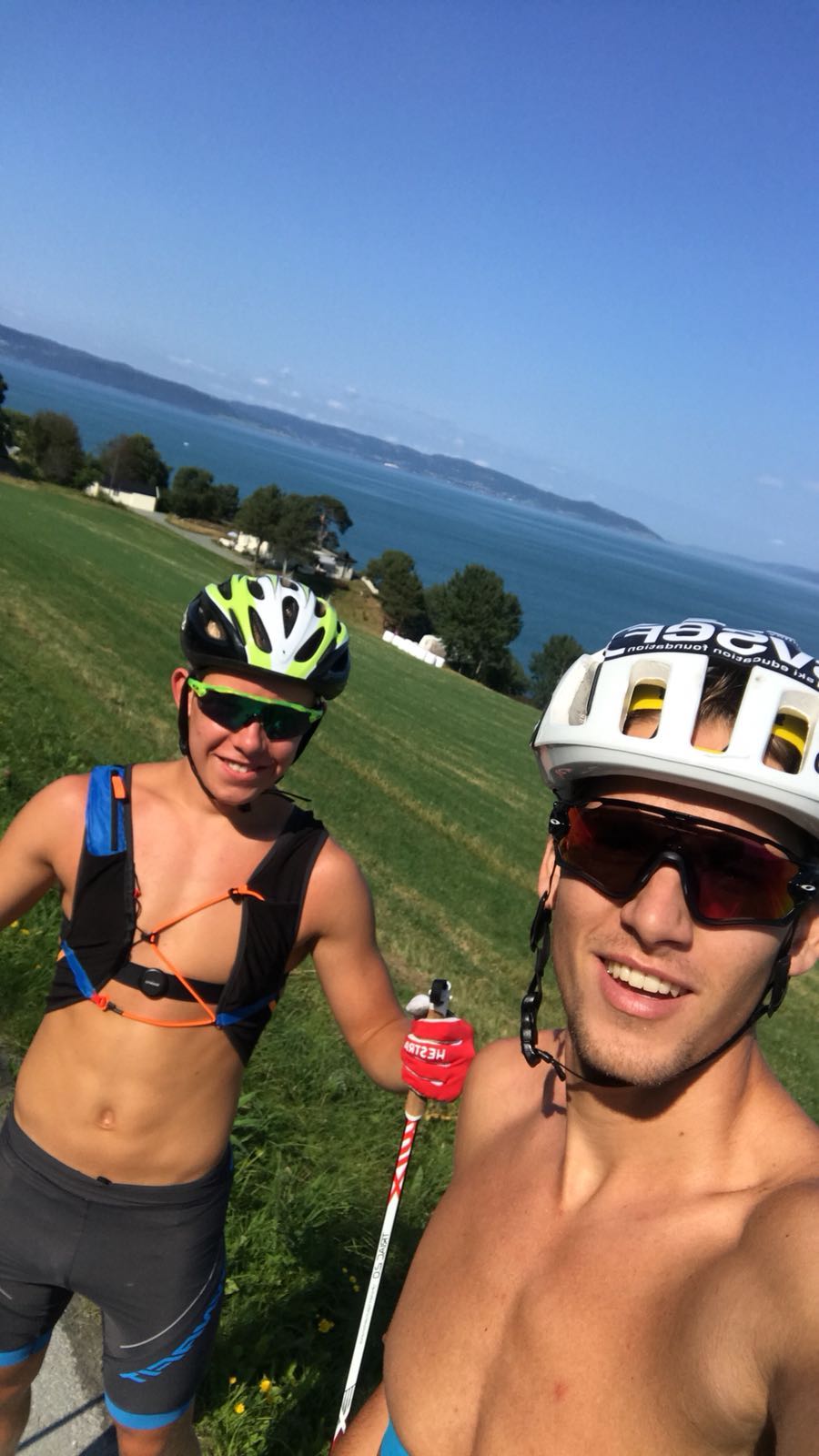
Kevin Bolger (r) takes a selfie with Norwegian skier Sivert Wulff while training in Norway in July. (Photo: Kevin Bolger)
There’s a reason Kevin Bolger has spent his last four summers in Trondheim, Norway, rent free.
You could say it started in 2014, when his older brother, Conor, began his Ph.D. work at the Centre for Elite Sports Research in Trondheim. As a doctoral candidate in the center’s neuroscience department, Conor’s work involved lab time. Specifically, lactate and VO2 max testing on Norwegian cross-country and nordic-combined national team members.
Conor soon established a relationship with a number of Norwegian national teamers. Athletes like Niklas Dyrhaug and Eldar Rønning became more than lab subjects. They were friends. Christmas was spent with the Slind family (Astrid, Silje and Kari ring any bells?) and at one point, Conor and Dyrhaug were next door neighbors.
By the summer of 2015, Conor had convinced his younger brother, Kevin, to book a ticket to Trondheim. Every summer since then, Kevin has repeated the journey. He’s managed to avoid paying rent by staying with his brother Conor for the first two summers and for the next two, stayed at Astrid Øyre Slind’s apartment.
“[Astrid] lets me stay there for free, which is insanely awesome,” Bolger, 25, told FasterSkier on the phone earlier this month. “She isn’t even really there that much, so I’m kind of by myself bachelor pad-ing it up in Norway.”
This summer, Bolger trained predominantly with Norwegian national-team standouts Dyrhaug and Didrik Tønseth. His summer training plan, which he and his coach, Chris Mallory of the Sun Valley Ski Education (SVSEF), mapped out before he left, remained loosely defined.
For example, a one-week plan from Mallory in the summertime may require Bolger to complete a 25-hour week, with three interval sessions and two strength sessions, but not specify the type of intensity or strength exercises.
“It gives me the freedom to fill out my own week,” Bolger said.
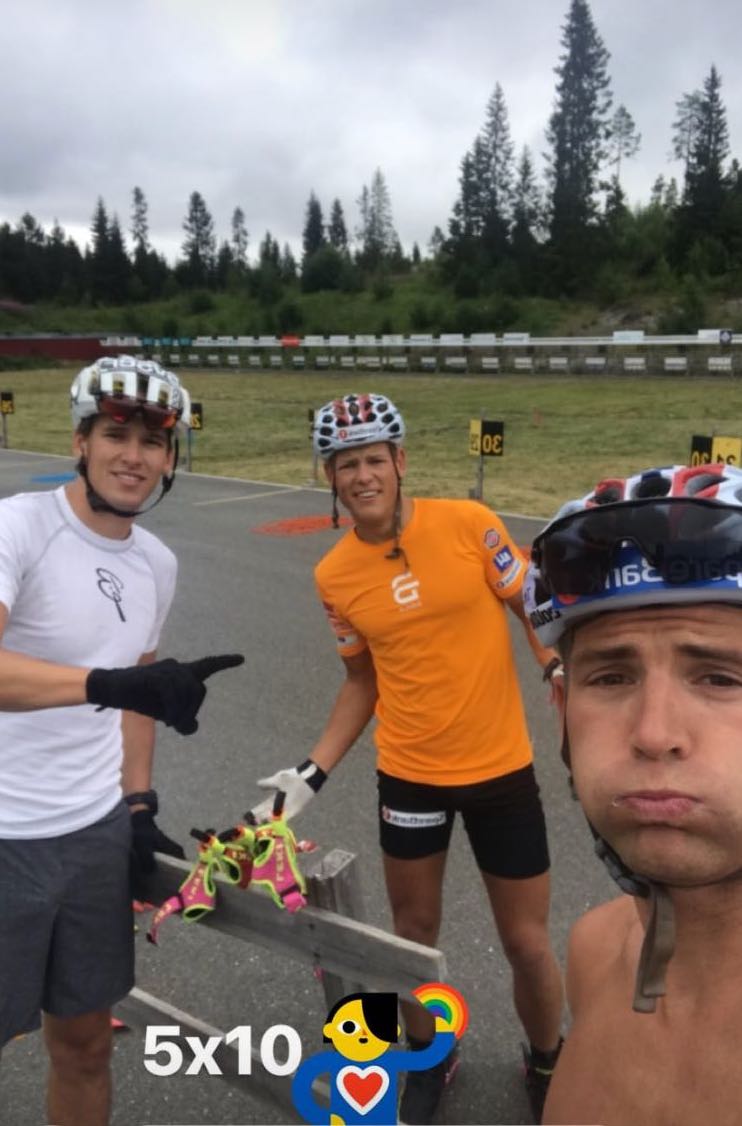
Kevin Bolger (l) training with Johannes Høsflot Klæbo (c) and Niklas Dyrhaug in July in Norway. (Photo: Niklas Dyrhaug/Instagram)
This way, the basics of Mallory’s plan are met and Bolger can simultaneously maximize the amount of time he trains alongside Dyrhaug and Tønseth.
What’s struck Bolger the most from his training tenure in Norway is “how in tune they are with their bodies.”
“If it’s a easy session, it’s an easy session. If it’s intervals, it’s intervals. And if they’re tired, they’re resting,” he said. “They’re really smart when it comes to what they’re doing from day to day to day.”
Another reason training in Norway is hard for him to pass up — aside from the free rent and panoramic views of the fjord — is the support he feels. It’s nice when an entire nation’s favorite pastime happens to be yours, too (not to mention that one can rollerski on a main street without anyone batting an eye).
“Skiing is the lifestyle over there. For some reason I find, I don’t know, it just feels easier,” Bolger said.
Even with two world champions. Bolger’s first summer in Norway came after his sophomore year at the University of Utah (UU), where he had posted “some good results”, but “nothing amazing,” he said.
Meanwhile, Dyrhaug and Tønseth were fresh off a gold medal in the men’s 4 x10-kilometer relay at 2015 World Championships in Falun, Sweden. (Both went on to win gold again in the men’s relay at 2017 World Championships).
“For them to open up and be like, ‘Yeah, you can come over here and train with us,’ especially Niklas [Dyrhaug and Didrik Tønseth] being world champs, that was really cool,” Bolger said.
Echoing a remark made by Jessie Diggins, who joined the Norwegian women’s team for a weeklong training camp two summers ago, Bolger was adamant that the Norwegians are nothing but open when it comes to their training practices.
“There is no secret; they’re not trying to hide anything,” he said. “They want the sport to grow.”
This summer marks Bolger’s first as a U.S. Ski Team (USST) member. His B-team nomination came in May.
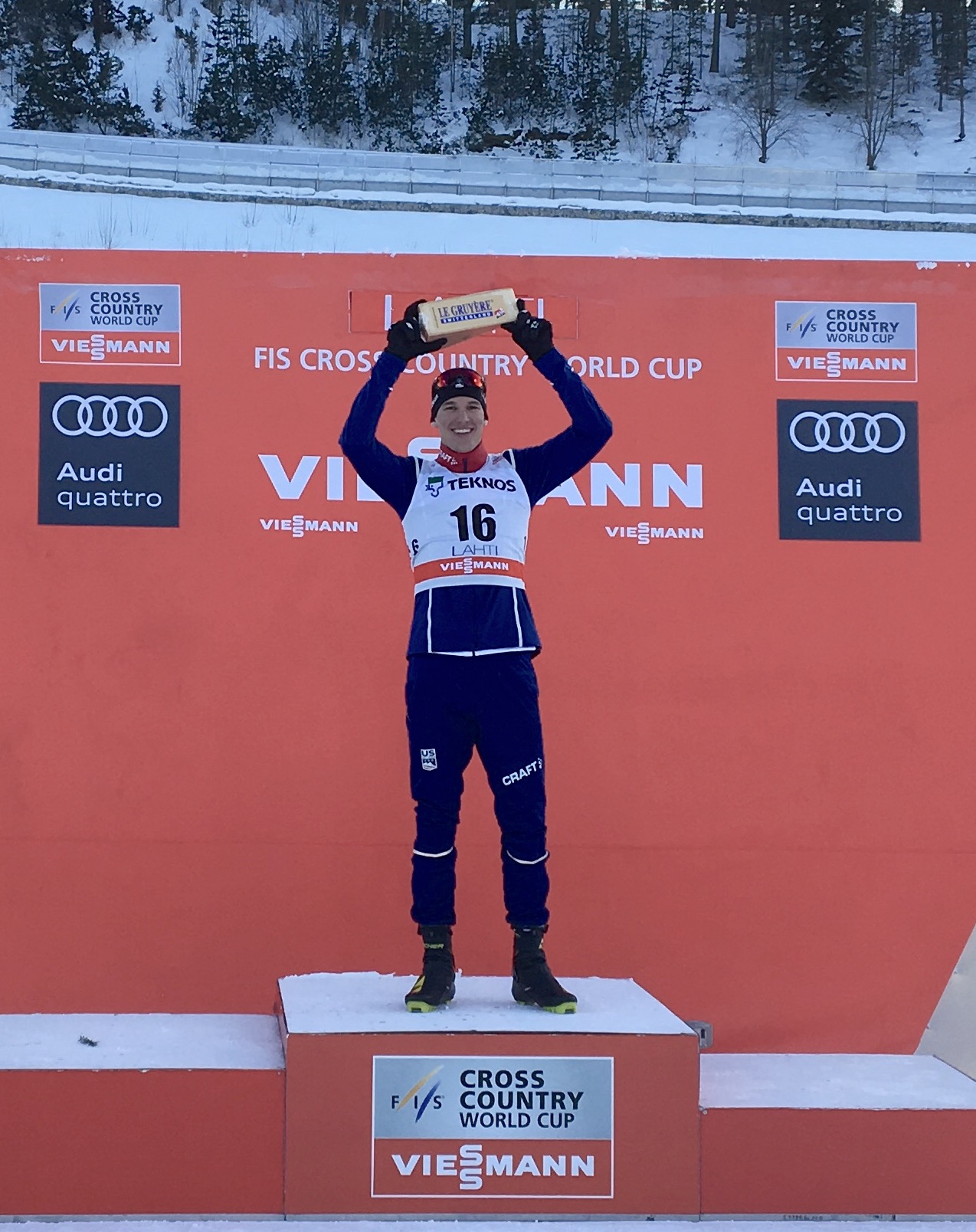
By placing 11th in the World Cup freestyle sprint in Lahti, Sun Valley’s Kevin Bolger won some Gruyere cheese for being the top-ranked Continental Cup skier of the day. (Photo: Matt Whitcomb)
Considering those results, Bolger said his family and teammates were confident he earned a spot on the U.S. squad. Even so, leading up to the USST nominations this spring, his mindset remained “until I get the phone call or I get the nod that it actually happened, I’m not assuming anything.”
Two months after the last races of the season, Bolger received word from USST coach Matt Whitcomb. He made it.
“When that phone call did come through,” he said with a pause, “it was unbelievable. I was so fired up.”
Skiing has been a longtime passion for Bolger, something he picked up as a third grader growing up in Minocqua, Wisconsin. He credited Conor, who’s four years older, as playing an influential role in his ski career. In a way, he was the one who ignited the flame.
“My older brother was involved with skiing, and of course, when I was in third grade I wanted to be like my older brother,” Bolger said.
Bolger continued to ski through middle school and high school, eventually winning two championship titles his junior and senior years. After high school, he spent two gap years with the SVSEF program before starting his studies at the University of Utah. There, he earned six regular-season podiums (including two wins), a top-10 finish for All-American status at NCAA Championships (despite frostbitten fingers), a team championship title (Utah’s first in 14 years), all during his senior year. To top it all off, his first national title came that same season.
Following graduation, he headed back to Sun Valley to join the Gold Team. After one training year with SVSEF, he garnered a USST nomination.
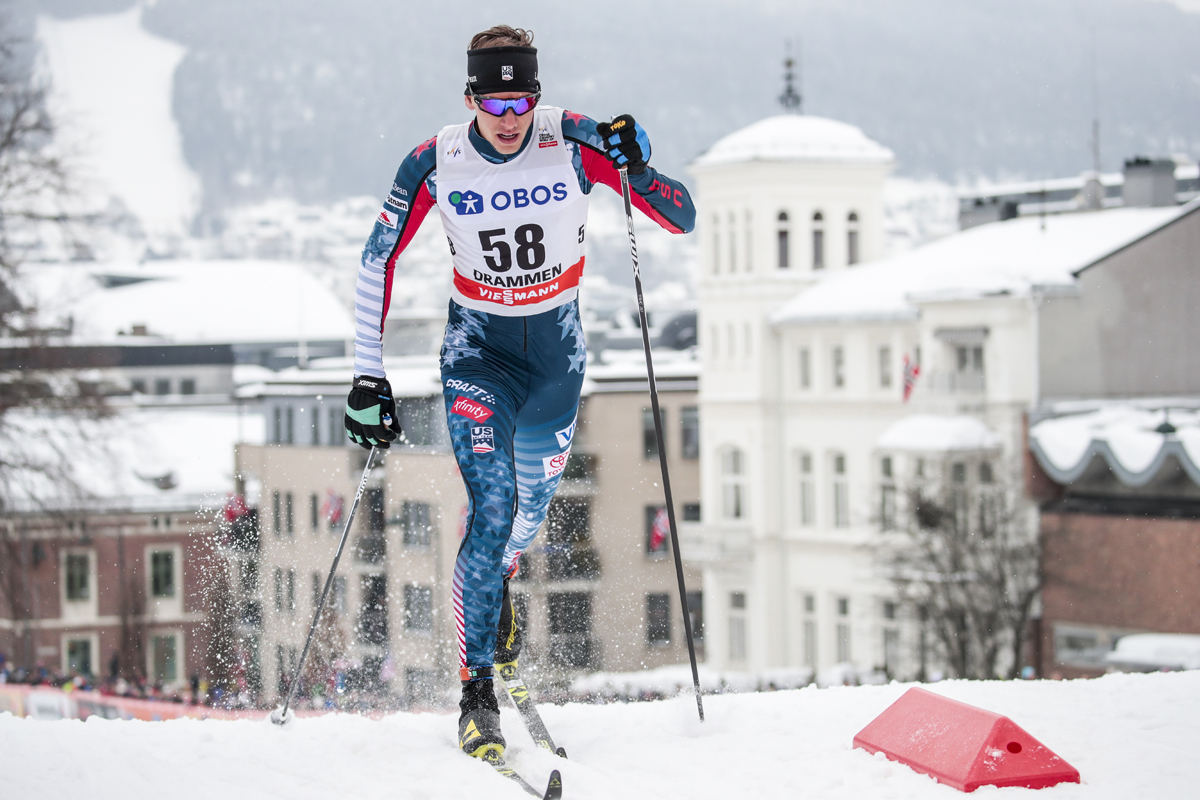
Kevin Bolger (Sun Valley Ski Education Foundation) racing to 50th in the men’s classic sprint qualifier at the 2018 World Cup in Drammen, Norway. (Photo: Fischer/Nordic Focus)
In the years leading up to that, Bolger has found financial support from the SVSEF, as well as grants, Utah contacts, and fans who are “fired up” about his accomplishments. His parents have helped, too, particularly when it comes to fundraising ideas and forums.
“My mom calls herself my agent,” Bolger said with a laugh.
He also has a “skiing resume,” a paper printout of his season costs and where he will funnel any proceeds, which he hands out to potential sponsor or donors.
“I think it’s that big question mark everyone wants to know: How much do things cost?” Bolger said. “I don’t think anyone likes to talk about it or throw numbers out, but I believe that they really should be out there, people should know.”
He estimates this season will cost him $30,000 dollars. The U.S. Ski Team covers room and board for training camps, but Bolger did not attend the men’s France camp in July. This winter, all B-team athletes will also receive an additional $5,000 dollars for room and board, Bolger said.
When asked how an athlete — who is looking to do what he has done — might realistically make that happen financially, his response hinged on the connections he has made over the years.
“For me, it was a lot of networking; being able to find somewhere where you can not have to pay rent. That’s huge,” he said. “You get a lot of support by networking and getting to know people. … You can’t be afraid to put yourself out there and ask for help.”
As Bolger looks ahead to the season, simply qualifying for sprints is not the end goal.
“I don’t want to just go [to Europe] and ski on the World Cup,” he said. “I want to be competitive.”
Eleventh in a sprint is competitive, and Bolger is hungry to prove himself again in future sprint rounds.
“We’ve had a lot of guys that go over there and have the opportunity, but no one’s really capitalized on it,” he said.
In his first few World Cups, he has managed to break into the sprint rounds (top 30), not an easy feat. Perhaps his time in Norway has helped soften the nerves.
“I’ve been going to Norway, I’ve trained with Niklas, Didrik and Emil Iversen and even done a few interval sessions with Johannes [Høsflot Klæbo] … I’ve been surrounded by [them in training],” he said. “I don’t know if that’s what helped going into those races.”
“A lot of these guys I’ve looked up to my whole career and now I’m skiing against them,” he added.
Toeing the line with one’s childhood idols may be intimidating — if you let it. For now, Bolger’s primary focus is on his training and racing, not the big names he may be pinned up against.
“At the end of the day, we’re all just trying to do the same thing: ski fast,” he said.
Norway’s Maiken Caspersen Falla (1) winning Saturday’s women’s cross-country sprint final on the last day of the 2018 Blink Ski Festival in Sandnes, Norway. (Photo: Blink Ski Festival/Axelar/Arild Aarnes)
The 2018 Blink Ski Festival continued in full force on Friday and Saturday, with cross-country and biathlon prologues, 10- and 15-kilometer cross-country races and biathlon mass starts all taking place on Friday, followed by sprints on Saturday.
Elite racing began in the afternoon with the men’s prologue (no prologue was held for the women), Norway’s Gjøran Holstad Tefre posted the fastest time of 3:12.21. Finishing 1.89 seconds back was another Norwegian, Aleksander Dyrberg Ek, and Great Britain’s Andrew Young claimed the prologue’s final podium spot, finishing 2.27 seconds off the winning time.
Also in the top 10 were Norway’s Morten Eide Pedersen in fourth (+4.7), Britain’s James Clugnet in fifth (+4.76), France’s Lucas Chanavat in sixth (+5.09), Norway’s Stian Grastveit in seventh (+5.70), France’s Renaud Jay in eighth (+5.75), and Norway’s Sindre Folkvord and Harald Østberg Amundsen in ninth (+6.00) and 10th (+6.03), respectively.
Canada’s Evan Palmer-Charrette finished 34th (+16.68), Scott Hill placed 39th (+19.37) and Bob Thompson was 40th (+19.54) out of 47 finishers.
After the elite men’s prologue, athletes geared up for a men’s and women’s biathlon prologues.
Norway’s Johannes Thingnes Bø took the men’s biathlon prologue win in a time of 10:30.2 after two misses (1+1). One second back, it was a tie for second place between another Norwegian, Lars Aasheim Svaland, who had one penalty (0+1), and France’s Antonin Guigonnat, with one miss as well (1+0).
Slovenia’s Anastasiya Kuzmina, who took one gold and two silver medals at the 2018 Olympics, won Friday’s women’s prologue with clean shooting and a time of 11:34.6. Just 0.6 seconds behind was Norway’s Emilie Ågheim Kalkenberg, who placed second with perfect 10-for-10 shooting as well. France’s Justine Braisaz claimed third, 10.7 seconds out of first, after missing two targets (0+2).
The next event on Friday’s program was the women’s 10 k cross-country mass start, which Norwegian sprint specialist Maiken Caspersen Falla won in 20:39.4. She bested fellow Norwegian Mari Eide by 1.9 seconds, and Sweden’s Charlotte Kalla and Norway’s Kari Øyre Slind followed in third (+3.9) and fourth (+3.9), respectively, with the same time.
Working their way into the top 10 were Russia’s Elena Soboleva in fifth (+4.9), Finland’s Krista Pärmäkoski in sixth (+5.0), Norway’s Ingvild Flugstad Østberg and Ragnhild Haga in seventh (+5.1) and eighth (+5.2), respectively, Austria’s Teresa Stadlober in ninth (+6.6), and Russia’s Natalia Matveeva in 10th (+8.7). Out of 31 women, Nichole Bathe, racing for Great Britain, finished in 23rd (+1:09).
Sweden’s Hanna Öberg (front) racing to first in the women’s biathlon mass start on Friday the 2018 Blink Ski Festival in Sandnes, Norway. (Screenshot: NRK broadcast)
Friday’s program then moved on to the women’s biathlon mass start. Sweden’s Hanna Öberg won the event in a time of 13:19.4 despite three misses (0+1+2+0). Kuzmina finished second, crossing 2.1 seconds behind the Swede after a penalty in each stage (1+1+1+1). Third place went to another Swede, Mona Brorsson, who crossed 5.9 seconds after Öberg and shot four penalties (2+1+1+0).
Norway’s Henrik L’abeé-Lund (r) winning the men’s biathlon mass start on Friday at the 2018 Blink rollerski festival, ahead of his teammate Johannes Thingnes Bø in second in Sandnes, Norway. (Screenshot: NRK broadcast)
Following the women’s biathlon race, the men’s biathlon mass start got underway. Norway’s Henrik L’abeé-Lund emerged as the winner, crossing the line in 17:21.3 after shooting four penalties (1+1+2+0). Exactly three seconds behind him was J.T. Bø in second place with two misses (1+0+1+0). Sealing the all-Norwegian podium was Vetle Sjåstad Christiansen, who missed six targets (1+1+2+2) and finished 12.1 seconds after L’abeé-Lund for third.
Russia’s Sergey Ustiugov leading the pack of the elite men’s 15-kilometer freestyle cross-country mass start on Friday at the 2018 Blink Ski Festival in Sandnes, Norway. (Screenshot: NRK broadcast)
Friday’s final race turned back to cross-country for the elite men’s 15 k freestyle mass start. Russian skier, Sergey Ustiugov, who was banned from competing at the 2018 Winter Olympics, won it in 29:26.0, 2.1 seconds ahead of Norway’s Aleksander Ek, (who had placed second in the prologue to start the day). Italy’s Federico Pellegrino was just another 0.6 seconds back in third (+2.7).
“I was a little nervous today because I won it last year and I wanted to repeat my success here again today,” Ustiugov told NRK through a translator. “It didn’t go easy, but I did manage to do what I wanted to do, and I would like to thank all my team, Markus [Cramer], and the rest of the team. That was great.”
The remaining top ten included Norway’s Vebjørn Turtveit in fourth (+2.9), Sindre Bjørnestad Skar in fifth (+3.9), Øystein Pettersen in sixth (+5.4), and Torstein Bu in seventh (+5.8). France’s Adrien Backscheider and Clement Parisse placed eighth (+5.9) and ninth (+6.2) respectively, followed by Norway’s Eirik Brandsdal in tenth (+6.2).
Racing for Canada, Alex Harvey finished 14th (+7.5).
Norway’s Maiken Caspersen Falla winning the women’s cross-country sprint on Saturday at the Blink Ski Festival in Sandnes, Norway. It was her second-straight victory after topping Friday’s 10 k freestyle mass start as well. (Screenshot: NRK broadcast)
Saturday marked the final day of the Blink rollerski festival and included cross-country and biathlon sprints. In the women’s cross-country final, Norway’s Falla picked up her second-straight win, ahead of Russia’s Matveeva in second (+1.6) and Sweden’s Ida Ingemarsdotter in third (+2.4). Norway’s Eide was just off the podium in fourth (+2.9), Norway’s Barbro Kvåle Trømborg placed fifth (+3.7), and another Norwegian, Linn Ravndal, finished 8 seconds back in sixth.
Falla’s won the final in 3:40.8 after topping her quarterfinal and semifinal as well.
The men’s cross-country racing began with a prologue, which Norway’s Vetle Christiansen won in 1:31.92, just three-hundredths of a second ahead of his fellow countryman, Ek. France’s Baptiste Noel placed third in the prologue, 1.76 seconds out of first.
Russia’s Gleb Retivykh (second from r) winning the men’s cross-country sprint final on Saturday at the Blink Ski Festival in Sandnes, Norway. (Screenshot: NRK broadcast)
In the heats later in the day, Russia’s Gleb Retivykh came out on top of the final, getting there by placing second in both his quarterfinal and semifinal, then winning the last round by 0.2 seconds over Pellegrino in a time of 3:15.5. Pellegrino had won his quarterfinal but advanced as a lucky loser in fourth out of the second semifinal. The 25-year-old Ek capped off his successful series with another podium, placing third in the final, just 0.3 seconds out of first.
In a post-race interview with NRK, Retivykh explained this was his first time at Blink.
“I am very happy,” he said in English. “Today is my first win at Blink, and [it was my] first time here.”
In a close final, Norway’s Gjøran Tefre and Brandsdal followed in fourth (+0.5) and fifth (+0.7), respectively, Italy’s Francesco De Fabiani was just behind in sixth (+0.8).
France’s Justine Braisaz celebrating across the line as she wins the women’s biathlon super sprint on the last day of 2018 Blink Ski Festival on Saturday in Sandnes, Norway. (Screenshot: NRK broadcast)
Biathletes were able to experience head-to-head sprint racing as well (a deviation from the typical biathlon World Cup sprint format, which is individual), in the women’s and men’s biathlon supersprints, which included one prone and one standing shooting stage per heat.
France’s Braisaz won the women’s final in 7:45.3. She had previously won her quarterfinal (which was a longer distance), then placed seventh in the first semifinal (same distance as final). Norway’s Marte Olsbu placed second in the final (+0.4), and Sweden’s Brorsson returned to the podium in third (+0.9).
“It was really close at the end, but I am very happy about the weekend here,” Braisaz told NRK on English after. “Everything is perfect, even though the weather is a little bit — how do you say — moody. But it’s OK. And I am really happy to be in Norway and I will make my stay longer after the festival weekend.”
Norway’s Vetle Sjåstad Christiansen winning the men’s biathlon supersprint on Saturday, the last day of the Blink Ski Festival, in Sandnes, Norway. (Screenshot: NRK broadcast)
In the men’s biathlon super sprint, Norway’s Christiansen dominated the day, winning his quarterfinal and semifinal before beating J.T.Bø by 2.2 seconds in the men’s final with a time of 12:01.8. France’s Guigonnat completed the podium in third, 8.5 seconds behind Christiansen.
The 7.5-kilometer race course for the Lysebotn Opp, an annual hill climb at the Blink Ski Festival in Lysebotn, Norway. (Photo: Blink Ski Festival/Facebook)
The Blink Ski Festival’s famed Lysebotn Opp hill climb returned on Thursday, and with it, a familiar name landed at the top of the results.
After serving an 18-month ban from ski racing and subsequently missing the 2018 Winter Olympics, Norway’s Therese Johaug is back.
Norway’s Therese Johaug winning the 2018 Lysebotn Opp hill climb, part of the Blink rollerski festival, on Thursday. She finished in a record-setting 31:46.3 minutes, topping her previous course record of 32:36 from 2012. American Liz Stephen, who retired from skiing this past spring, holds the third-fastest time of 32:53.9. (Screenshot: NRK broadcast)
The 30-year-old Johaug won Thursday’s rollerski hill climb in a record time of 31 minutes, 46.3 seconds, while Sweden’s Charlotte Kalla finished 1:47.5 minutes back in second.
Kalla, 31, won last year’s Lysebotn Opp in 33:18.3, telling NRK at the time that “it’s been long since I’ve been in this good a shape in July.” Kalla’s 2017/2018 season went on to be one of her best. She racked up 10 individual wins, including a gold medal in the Olympic skiathlon.
If Kalla is using her the past year and half as a springboard for the upcoming season, Johaug might be considered the antithesis to the Swede. The year and half competition bar behind her, Johaug appears ready to move forward.
“If there’s one thing I’ve learned from all this, it’s that you should never rely on anyone, period,” Johaug told Newsinenglish.no. “It’s terrible, but that’s the way it is.”
Following Johaug and Kalla on Thursday, Sweden’s Ebba Andersson claimed the third spot on the podium, finishing 3.9 seconds behind her compatriot Kalla and 1:51.4 behind Johaug.
Norway’s Haga Ragnhild placed fourth (+2:21.6) and Ingvild Flugstad Østberg was fifth (+2:48.9), Austria’s Teresa Stadlober finished sixth (+3:05.7), Russia’s Yulia Belorukova seventh (+3:52.4), Norway’s Kari Øyre Slind eighth (+4:05.0), and Russia’s Elena Soboleva ninth (+4:14.1) and Yana Kirpichenko 10th (+4:26.2). Finland’s Krista Parmakoski finished exactly ten seconds outside the top ten in 11th (+4:36.2). Forty-seven women finished the senior women’s race.
Norway’s Simen Hegstad Krüger winning the 2018 Lysebotn Opp hill climb, part of the Blink rollerski festival, on Thursday. (Screenshot: NRK broadcast)
In the senior men’s Lysebotn Opp that followed, two Norwegians battled up front, with reigning Olympic skiathlon champ Simen Hegstad Krüger ultimately winning the race for the first time in 27:53.2. Another national team member and 2018 Olympian (and last year’s Lysebotn Opp winner), Hans Christer Holund finished 3.9 seconds back for second place, and Norway swept the podium with Simen Andreas Sveen in third (+16.0).
Rounding out the top 10 were Norwegians Vebjørn Turtveit in fourth (+51.7), Martin Johnsrud Sundby in fifth (+52.6), France’s Clement Parisse in sixth (+1:12.4), Norway’s Henrik L’Abée-Lund in seventh (+1:21.1), France’s Adrien Backscheider in eighth (+1:24.7), Russia’s Artem Maltsev in ninth (+1:31.4) and Canada’s Alex Harvey in 10th (+2:02.1).
Past winners of the Lysebotn Opp rollerski hill climb in Lysebotn, Norway. Simen Hegstad Krüger’s winning time on Thursday was third fastest on record at 27:53.2. (Screenshot: NRK broadcast)
American Jessie Diggins (c) celebrates her fourth-career individual World Cup win, and her first in a distance longer than 5 k, after winning the women’s 10 k freestyle mass start at Sunday’s World Cup in Seefeld, Austria. Norway’s Heidi Weng (l) placed second and Ragnhild Haga (r) was third. (Photo: Salomon/NordicFocus)
About seven minutes into the women’s 10-kilometer freestyle mass start on Sunday at the World Cup in Seefeld, Austria, Jessie Diggins made her intentions clear. She wasn’t in it for a free ride — she was willing to pull, and not just take her turn up front, but actually try to string out the field and win this thing.
As she led a group of 31 within 15 seconds of her at 3.3 k, Diggins, a 26-year-old U.S. Ski Team member who’s on a mission for medals at the upcoming Olympics in two weeks, never looked back. She didn’t ask for help from the Norwegians behind her; she just hammered.
American Jessie Diggins (4) leading Norway’s Ingvild Flugstad Østberg (2) and the rest of the women’s field in the 10 k freestyle mass start at the World Cup in Seefeld, Austria. (Photo: Garrott Kuzzy / LumiExperiences.com)
Meanwhile, Norwegian teammates Heidi Weng and Ingvild Flugstad Østberg kept her close, and at 4.6 k, Østberg moved into first. The group was down to 12, with another American hanging in there as well, as Sadie Bjornsen skied in 12th, 4.6 seconds back.
Two kilometers later, it appeared the Norwegians were working together, not just to keep themselves through the race, but to prevent Diggins from getting too close to the front. Diggins remained in third, less than a second behind Østberg and Weng, while a third Norwegian Ragnhild Haga skied just behind her. Switzerland’s Nathalie von Siebenthal and Germany’s Katharina Hennig remained in the mix in fifth and sixth, about two seconds back, as did Norway’s Kari Øyre Slind and Bjornsen another second behind.
With just over 2 k to go, Diggins attacked in earnest near the bottom of the last grueling (nearly 500-meter-long), multi-tiered climb on the women’s 3.3 k course. No one was able to match her pace, not Østberg, not Weng, not Haga, as she raced up the rest of the hill and over the top completely alone.
Behind her, the chase group split in two, with the three aforementioned Norwegians then approximately eight others skiing several meters behind. Bjornsen was in that second group, which continued to drop in numbers as they continued up the climb.
On the winding descent back toward the stadium, with just under a kilometer to go, Diggins put all of her faith into her skis.
“I felt awesome, my skis were amazing, the techs worked so hard,” she told FasterSkier in person after. “These Salomon skis I was on were just ripping down that corner.”
American Jessie Diggins (4) leads Norwegians Heidi Weng and Ragnhild Haga in the finishing stretch of the women’s 10 k freestyle mass start at the World Cup in Seefeld, Austria. (Photo: Salomon/NordicFocus)
But before the final hill, a relatively small rise about 200 meters before the finish, Weng and Haga were close, just a few strides and about a second behind. Again, Diggins didn’t look back; she simply used every ounce of everything she had left — energy and technique-wise — to get the maximum number of pushes in before the finish.
And she did it. Diggins held off the two Norwegians, crossing the line first in 23:08.5 and throwing her fists down in elation. Seven-tenths of a second behind her, Weng free-skated to second place, just 0.3 seconds ahead of Haga in third. Østberg finished 7.7 seconds later in fourth (+8.7), and the fourth Norwegian in the top five, Marit Bjørgen placed fifth (+16.7) just ahead of Austria’s Teresa Stadlober in sixth (+16.9), Slind in seventh (+19.1), and Bjornsen in eighth (+20.5). Von Siebenthal followed in ninth (+30.3) and Finland’s Kerttu Niskanen placed 10th (+31.8).
Notably, it was Bjørgen’s first World Cup race since mid-December. But even more notably, for the second-straight race in Seefeld — the site of next year’s 2019 World Championships — an American woman won. Sophie Caldwell tied for first in Saturday’s freestyle sprint, and on Sunday, it was all about Diggins.
For Diggins, the win was her first in over a year and her fourth-career individual World Cup victory. And she did so in the last race before the Winter Olympics start on Feb. 10 in PyeongChang, South Korea.
“It’s a really good time to figure out how to ski a 10 k race,” Diggins told FasterSkier after. “I am really excited. I’m so pumped for the Games, I’m feeling well, the peaking plan is working, and I’m just excited to get there and see what I can do.”
She apparently took mental notes on the men’s 15 k mass start that took place earlier on Sunday, as Switzerland’s Dario Cologna attacked on the same climb to secure the win ahead of Canada’s Alex Harvey and Norway’s Martin Johnsrud Sundby.
“I saw how well it worked for Dario, and I thought, ‘OK, I’m gonna go for it! I just have to ski gutsy and if they reel me in they reel me in, but maybe I can hold them off,’ ” she reflected.
“I just put my head down and it wasn’t pretty, but I just hammered,” she said in a post-race interview with the International Ski Federation (FIS).
Before that, Diggins said she had been trying to figure out where to ski in the pack.
“ ‘OK, if I’m in the front, how hard am I working? If I’m in the middle…’ You don’t want your poles to get stepped on so it’s easier for me to just be near the front the whole time,” she told FasterSkier.
Diggins’s three other wins have come in 5 k freestyle individual starts — all of which were stage World Cups. Sunday marked her first time getting 100 points, rather than 50, for the win, which counts toward overall World Cup standings. Heading into the Olympics, she ranks third in the Overall World Cup (379 points behind Weng in first and 180 behind Østberg in second) and third in the Distance World Cup (225 points behind Weng in first and 108 behind Østberg in second). Bjornsen is seventh in the overall standings and 11th in distance.
“I’m happy with how I raced,” Weng said after Sunday’s race, according to a FIS press release. “I made a mistake up the final climb and then couldn’t go with Diggins, but I pushed hard all the way to the finish, but Diggins was the better skier today.”
Bjornsen is seventh in the overall standings and 11th in distance.
“It was an exciting, and super fun final race before the Olympic Games!” Bjornsen wrote in an email to media outlets. “Today’s 10k skate was hot from the start, on a really fun course here in Seefeld. I think the nature of the course kind of held the pack together a bit more, which always makes for a fun race! I felt really good out there, and was super happy with the day.
“I feel like I made a bit of a tactical error being stuck behind some skiers that were dying a bit on the far part of that last lap, but it is one new step for me,” she continued. “I learned something out there, and I challenged myself, and I am feeling really good about the feelings I have in my legs leading into the games! It will be great to have two more weeks to rest, recover, and come in sharp for these exciting races to come. I am so excited to see our team on fire right now too. The vibe is great, the spirit is high, and we are so excited to take on the world in a few weeks here! Win or lose, I think this team is going to do something great!”
Eighth place is Bjornsen’s best result in distance skate race longer than 5 k, not counting pursuits. Earlier in the day, her brother Erik finished ninth in the men’s 15 k.
“ … I got my brother by one spot, which is a daily competition for the two of us,” Bjornsen wrote. “He set the bar high this morning. I am just so excited to see how well he did, and Simi [Hamilton, who placed 12th] as well. Those two have a bright future for the team sprint, I can’t even wait to watch!”
Three American women landed in the top 15 and five were in the top 30 on Sunday. Kikkan Randall finished 14th, 48.5 seconds behind Diggins and just over eight seconds outside of the top 10.
“I think it was a good race, I don’t think it was a great race,” Randall told FasterSkier on Sunday. “I made a bad tactical move on the first lap and missed that first group when they went, so then I spent some time chasing and I had a good energy left at the end so that was fun. … I think every race is going to get better and better so I am pretty happy with today.”
The result tied her previous best distance finish this season (a 10 k freestyle in Davos, Switzerland). Randall has been dealing with a stress reaction and tendonitis in her foot since that Davos World Cup in mid-December.
“Foot is hanging in there, its not great, but it’s good enough to race,” she said. “To make it through two skate races here and still holding together I am optimistic, so now we kind of just go to single races [at the Olympics], so I think I will be able to make it through the season. I also made it in the stadium today just in time to see Jessie win.”
Caitlin Patterson of the Craftsbury Green Racing Project (CGRP) finished 23rd (+1:00.7) for her second time in the World Cup points (top 30) in as many distance races she’s competed in this season. The U.S. SuperTour leader after Period 1, Patterson earned World Cup starts for Period 2 in January and is also headed to the PyeongChang Olympics.
On Sunday, she said she had to adjust to the stop-and-go pace near the back of the pack.
“I think I was still getting used to the pace swings, the way you go up and down and … accordion and stuff, but it was a good fun race,” Patterson said. “I think I had a few struggle moments on some of the bigger climbs … but I held it together, and the downhills were good and I was pretty happy with the finish, passing at least one person, catching up to the tail end of a pack in front of me. … Some good fun over here.”
Liz Stephen also finished in the top 30 in 29th (+1:18.2) after working her way up in the pack from 44th at 3.9 k. It was her sixth top 30 of the season. Also for the U.S., Rosie Brennan finished 53rd (+2:26.9).
Emily Nishikawa of the Canadian World Cup Team led three Canadian women in 35th (+1:36.5). Just one-tenth of a second later, Cendrine Browne (Canadian U25 Team) followed her across the line and placed 37th (+1:36.6) in a photo finish with France’s Coralie Bentz for 36th. Dahria Beatty (Canadian World Cup Team) finished about 22 seconds later in 45th (+1:58.9).
For the Canadian women, this weekend marked their first World Cup races in a month. While Nishikawa stayed in Europe to train during the Tour de Ski, Browne and Beatty returned to Canada for NorAm Olympic trials in early January. After that, they met up with Nishikawa and the rest of the team for a training block in Livigno, Italy.
“I think us three girls did really well today, considering we are just coming back from a training camp, so it’s really looking good for the Olympics,” Browne said.
“Just echoing what Cendrine said, coming off a training camp, you never really know what to expect for this weekend, but the goal is to be good at the Olympics,” Nishikawa said. “I was happy with the way I felt and the second half of the race. I need to work at starting a bit faster on the mass starts — somehow I end up at the back of the field and just work my way through it.”
“It was lots of fun,” Beatty said of her race. “I had a good start and then died a little bit in the middle, but it was nice to see some of [my teammates] up ahead and try to keep going. I actually had a really good last kilometer, I was able to finish strong and pick off some girls … I think it was one of my better distance races so far this year.”
While Beatty placed 20th in Saturday’s sprint for a season best, 45th marked her second best result of the World Cup season so far.
— Gabby Naranja, Ian Tovell and Harald Zimmer contributed
American Jessie Diggins (r) celebrates her win on Sunday in the World Cup women’s 10 k freestyle mass start in Seefeld, Austria, ahead of Norway’s Heidi Weng (c) in second and Ragnhild Haga (l) in third. (Screenshot: Eurosport broadcast)
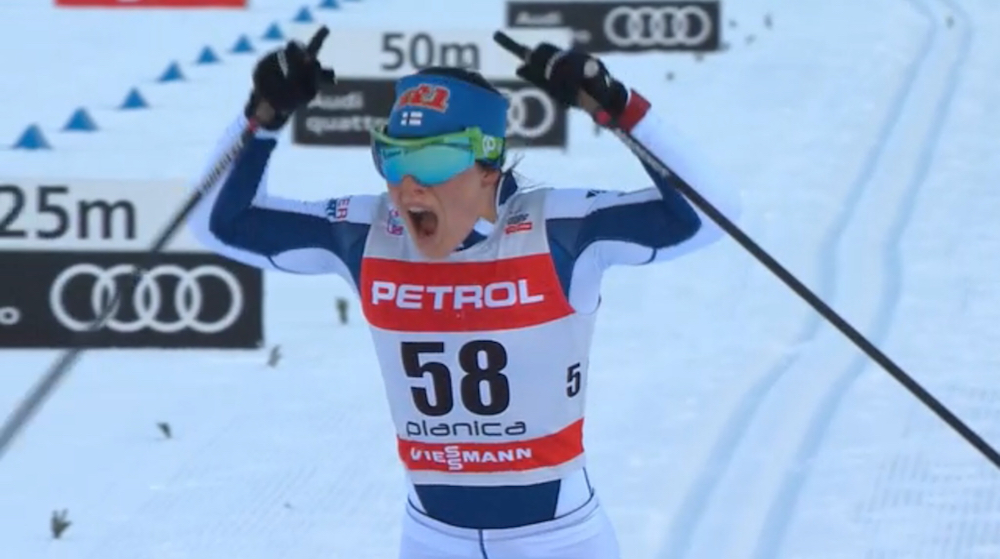
Finland’s Krista Pärmäkoski after winning her first non-stage World Cup on Sunday in the women’s 10 k classic in Planica, Slovenia. She bested Sweden’s Charlotte Kalla’s time by 3.6 seconds. (Screenshot: ARD broadcast)
FIS Cross Country World Cup (Planica, Slovenia): 10/15 k classic
Just when it looked like one of those Charlotte-Kalla days, Finland’s Krista Pärmäkoski swooped in and topped the Swede’s time by 3.6 seconds in the women’s 10-kilometer classic individual start on Sunday for her first-career outright World Cup win.
Outright meaning non-stage; Pärmäkoski has two World Cup wins to her name for setting the fastest time of day in 2016 pursuit races.
But Sunday’s 10 k in Slovenia saw her rising to the challenge and besting Charlotte Kalla’s time of 27:12.3, which was at least 39 seconds faster than the first 57 starters. Kalla had started 32nd and beat the previous top time set by Swedish U23 skier Ebba Andersson (bib 28) by 48.6 seconds.
Austria’s Teresa Stadlober started later in bib 56 and clocked the second-fastest time to Kalla, 39 seconds back.
But it was Pärmäkoski in bib 58 who beat them all. Even Norway’s Heidi Weng, who started 60th, couldn’t come close, as she finished 33.5 seconds off Pärmäkoski’s winning time for third place. That put Stadlober in fourth and Andersson in fifth at the end of the day.
Finland’s Kerttu Niskanen placed sixth (+49.4), Norway’s Kari Øyre Slind took seventh (+49.5), Poland’s Justyna Kowalczyk (who’s more of a marathon skier these days) placed eighth (+1:02.1), Norway’s Kathrine Rolsted Harsem (who placed second in Saturday’s classic sprint) finished ninth (+1:03.2), and American Jessie Diggins was 10th (+1:05.4).
Another American, Caitlin Patterson, of the Craftsbury Green Racing Project (CGRP), broke through with her second-best individual World Cup result in 20th (+1:45.2). (Last year, she finished seventh in the pre-Olympic PyeongChang World Cup 15 k skiathlon in a notably small field.)
Kikkan Randall (U.S. Ski Team) followed in 23rd (+1:50.4), and her teammates Sophie Caldwell placed 31st (+2:17.2), Liz Stephen 35th (+2:34.9), and Ida Sargent 37th (+2:37.5).
For the second-straight weekend, no Canadian women competed.
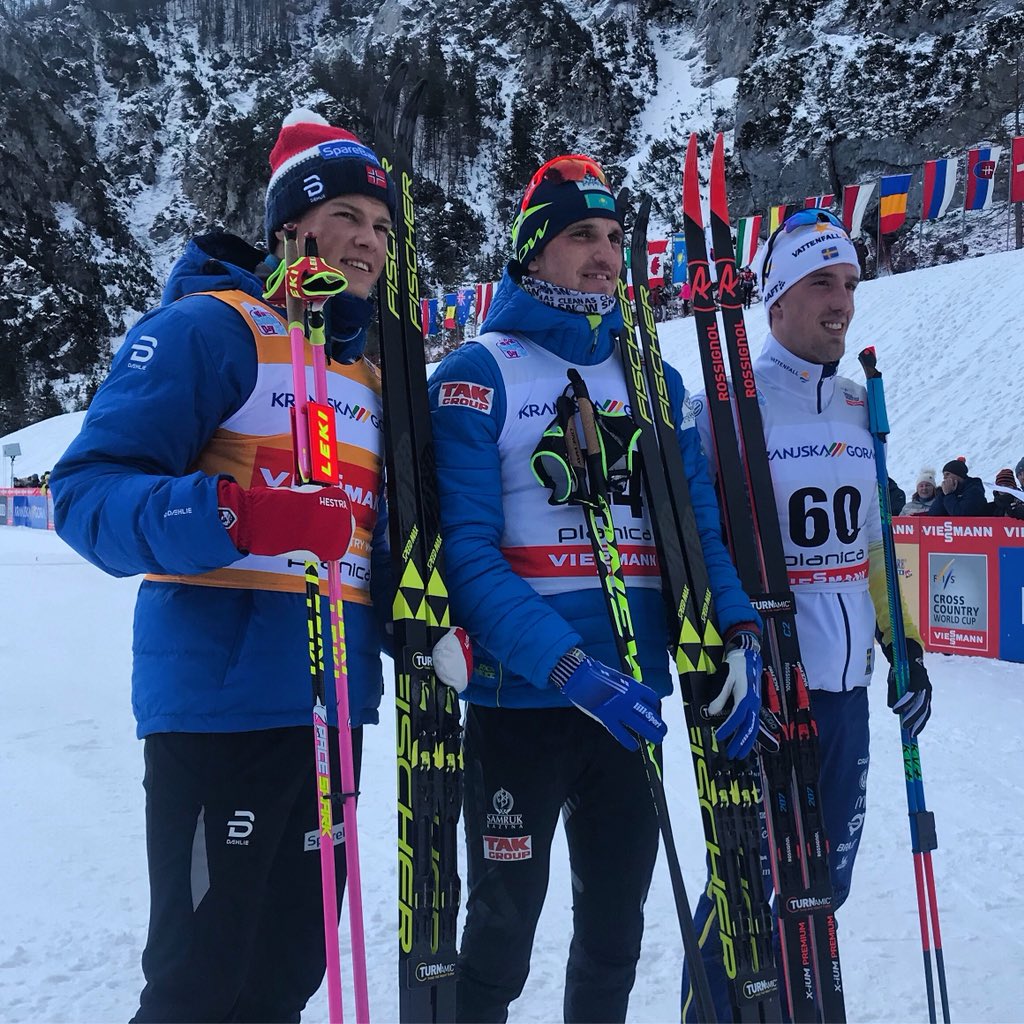
The World Cup men’s 15 k classic podium on Sunday in Planica, Slovenia, with Kazakhstan’s Alexey Poltoranin (c) in first, Norway’s Johannes Høsflot Klæbo (l) in second, and Sweden’s Calle Halfvarsson (r) in third. (Photo: FIS Cross Country/Twitter)
In the men’s 15 k classic, Kazakhstan’s Alexey Poltoranin tallied his second win of the season and first in a race against Norway’s Johannes Høsflot Klæbo on Sunday, winning by 13.2 seconds over Klæbo in 36:54.7.
Poltoranin, 30, started 44th and a minute behind the 21-year-old Klæbo. When Klæbo finished, he bumped Russia’s Ivan Kirillov, also 21, out of the leader’s chair by 43.3 seconds. Then Poltoranin finished 13.2 seconds faster, but Klæbo held onto second when Sweden’s 60th starter, Calle Halfvarsson, finished third (+42.8). It was Halfvarsson’s second podium of the season after placing third in the classic sprint at the November World Cup opener in Kuusamo, Finland. In Saturday’s classic sprint in Slovenia, Halfvarsson qualified second but crashed out of the quarterfinals to finish the day in 30th overall.
Norway’s Emil Iversen started 66th and ended up fourth (+54.7) and Kirillov scored his first World Cup top 10 in fifth (+56.5). Russia had four in the top 10 with Stanislav Volzhentsev in sixth (+57.8), Andrey Larkov in eighth (+1:02.2) and Andrey Sobakarev in ninth (+1:03.4). Norway’s Mattis Stenshagen finished seventh (+1:00.8) and Finland’s Iivo Niskanen took 10th (+1:10.1).
Scott Patterson (U.S. Ski Team) was the top North American in 43rd (+2:56.2), Ben Lustgarten (Craftsbury Green Racing Project) finished 46th (+3:04.9) and Tyler Kornfield (Alaska Pacific University) was 57th (+4:03.7). Andy Newell did not finish.
Canada’s Devon Kershaw returned to the circuit and placed 44th (+2:57.1), Bob Thompson (NTDC Thunder Bay) was 64th (+5:05.0), and Dominique Moncion-Groulx (Alberta World Cup Academy) was 70th (+6:11.7).
Russia’s Stefaniya Nadymova outsprinting Japan’s Ayane Miyazaki at the finish for the win at the inaugural women’s Nordic Combined Continental Cup competition on Saturday in Rena, Norway. (Photo: FIS/Romina Eggert)
FIS Nordic Combined Continental Cup (Rena, Norway): First-ever women’s competitions
Fourteen women, including American Gabriella Armstrong, made history this weekend by competing in the first women’s Nordic Combined Continental Cup in Rena, Norway (after the scheduled opener in Jan. 6-7 in Otepää, Estonia, was canceled), with back-to-back days of individual large hill/5-kilometer Gundersen start races.
On Saturday, Russia’s Stefaniya Nadymova took the win in 16:26.9, just 0.6 seconds ahead of Japan’s Ayane Miyazki in second. Germany’s Jenny Nowak joined them on the podium in third, 16.6 seconds out of first. Armstrong finished 12th (+6:24).
Nadymova, 23, had kicked off the event by jumping to first in the provisional round, which was used for the jumping results, and began the 5 k with a 10-second head start on Nowak in second place. Miyazaki jumped to third and started 14 seconds back. Armstrong jumped to 14th and started 4:08 out of first.
On Sunday, 15-year-old Miyazaki took the win in 16:23.2, swapping places with Nadymova, who finished second, 11.7 seconds back. Nowak, also 15, repeated in third, but finished over a minute and 21 seconds back out of first.
Miyazaki had jumped to first place earlier in the day and started the 5 k with a 20-second cushion to Nadymova in second. Nowak jumped to third and started 1:08 minutes back.
Armstrong, 19, of the New York Ski Education Foundation, jumped to 11th and finished 11th, 4:26.1 after Miyazaki.
Several U.S. Nordic Combined men also competed in Rena, with Taylor Fletcher placing fourth in Saturday’s individual large hill/10 k, 2.7 seconds behind Austria’s Thomas Joebstl in first. Fletcher had skied up from 25th and 2:17 back after the jump with the second-fastest course time.
Also for the U.S., Adam Loomis placed 33rd (+2:30.7) after jumping to 45th with the 12th-fastest course time. Grant Andrews finished 41st (+3:28.7), and Jared Schumate 43rd (+4:10.1).
Fletcher reached the podium in Sunday’s individual large hill/10 k in third behind two Austrians. After jumping to 19th, he skied the fourth-fastest course time to finish third, 3.7 seconds behind Dominik Terzer in first and 2.7 seconds behind Martin Fritz in second.
Loomis improved to 29th (+1:40.9), up from 35th in the jump, and Andrews finished 37th (+2:36.4) and Shumate 40th (+2:57.9).
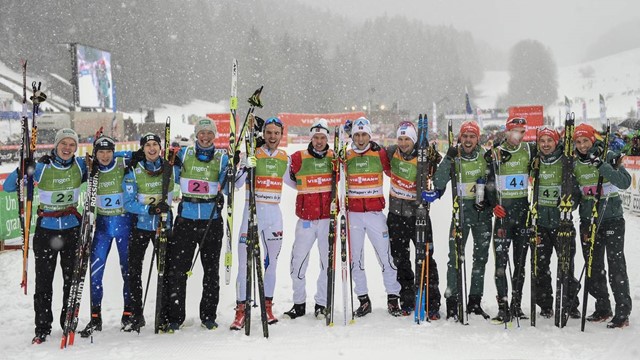
The men’s large hill/4 x 5 k team event podium on Sunday at the Nordic Combined World Cup in Chaux-Neuve, France, with Norway (c) in first, Germany (l) in second, and Finland (r) in third. (Photo: FIS/NordicFocus)
FIS Nordic Combined World Cup (Chaux-Neuve, France): Saturday & Sunday
Four American men competed at the Nordic Combined World Cup this weekend in Chaux-Neuve, France, with three of them racing in Saturday’s individual large hill/10 k Gundersen and all four racing Sunday’s large hill/4 x 5 k team event.
Norway’s Jan Schmid was the big winner this weekend, racking up an individual win on Saturday and a team victory on Sunday. He won Saturday’s competition after jumping to fourth and starting 27 seconds behind jump leader Akito Watabe of Japan. Schmid worked his way up to first in the 10 k with the third-fastest course time, crossing the line 1.4 seconds ahead of Watabe in 23:32.7.
Watabe finished second and Finland’s Ilkka Herola placed third (+21.5), just ahead of Austria’s Lukas Klapfer in fourth (+21.8).
Ben Loomis led USA Nordic in 37th (+2:49), after jumping to 37th, Stephen Schumann finished 45th (+5:17.0) and Ben Berend 46th (+5:22.2).
On Sunday, Schmid teamed up with Espen Andersen, Jarl Magnus Riiber and Jørgen Graabak to win the 4 x 5 k team event in 47:22.5 by 13.1 seconds. Germany followed in second, with Eric Frenzel, Fabian Rießle, Johannes Rydzek, and Vinzenz Geiger, and Finland placed third (+20.5) with Leevi Mutru, Arttu Maekiaho, Herola, and Eero Hirvonen.
Norway had led after the jump and started the relay 1:03 minutes ahead of Finland in second. France jumped to third and ended up fourth (+47.4), after being passed by Germany, which had started the relay in fourth.
Japan placed fifth (+2:50.9), Italy sixth (+3:59.9), Austria seventh (+4:06.8), Poland eighth (+5:22.1), Estonia ninth (+5:52.1), Russia 10th (+6:41.2), and the U.S. (with Schumann, Loomis, Berend, and Jasper Good) 11th (+6:52.4).
Western Canadian Championships (Red Deer, Alberta): Relays
Nine men’s teams and six women’s squads contested the open relays on the last day of the NorAm Western Canadian Championships on Sunday in Red Deer, with Ontario’s Team “O” (Scott Hill, Michael Somppi and Andy Shields) winning the men’s 3 x 5 k and Alberta 1 (Annika Hicks, Emma Camicioli and Zina Kocher) winning the women’s 3 x 5 k.
For Shields and Hicks, it was their second win of the weekend after they won their respective classic mass starts on Saturday.
Team “O” posted a 19.9-second win over B.C. Storm (Remi Drolet, Tallon Noble and Greg Kilroy), finishing first in 36:22.6. Alberta 5.1 (Sebastien Boehmler-Dandurand, Sam Hendry and Russell Kennedy) placed third (+52.3).
In the women’s relay, Alberta 1 beat out B.C. Fast, Furious & Freakin’ Awesome (Katie Weaver, Michaela McLean and Kaia Andal) by 2 minutes and 37.8 seconds, winning in 43:17.2. Alberta had two teams on the podium with the Kit Kats (Ember Large, Molly Jane Strum, and Sara McLean) in third (+4:25.8).
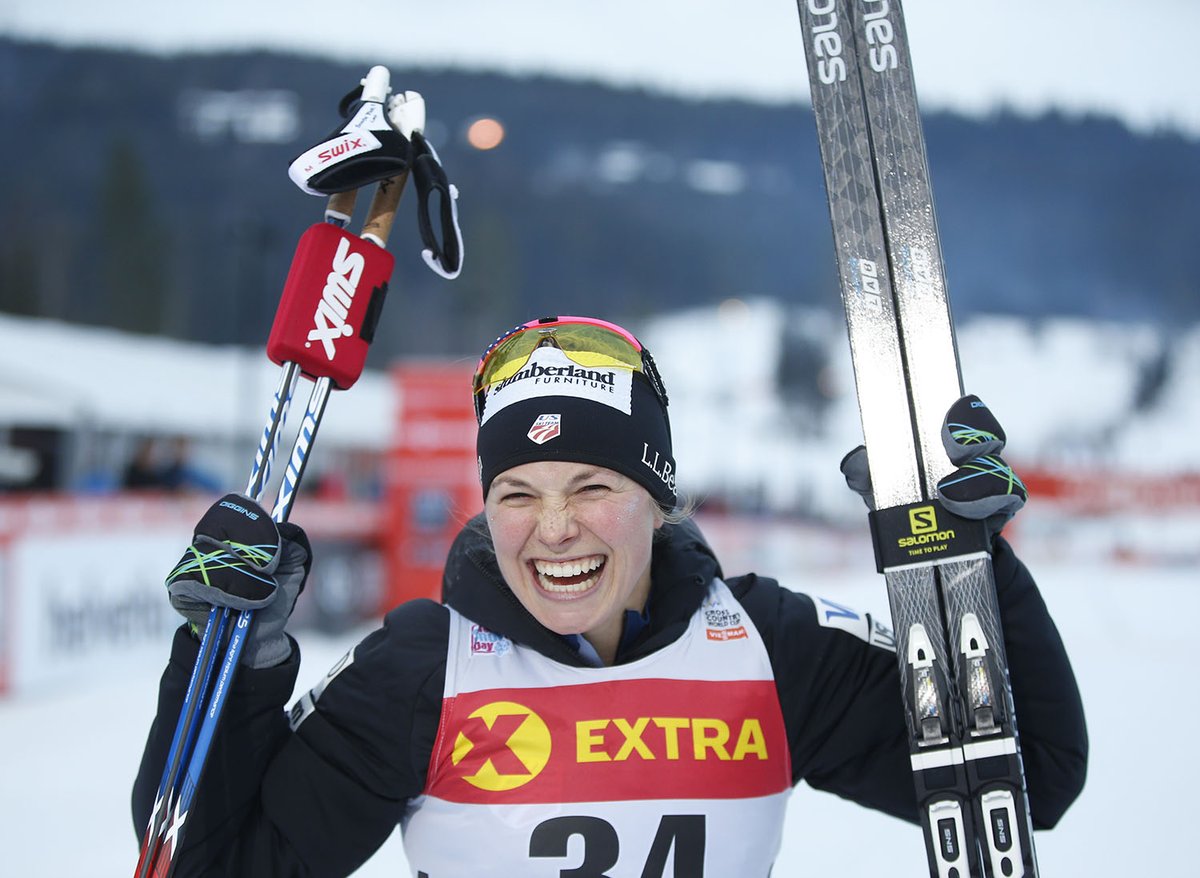
Jessie Diggins (U.S. Ski Team) won the second individual World Cup of her career on Saturday in the women’s 5 k freestyle in Lillehammer, Norway, beating four Norwegians by 4.8 seconds or more. (Photo: USSA Nordic/Twitter)
Welcome to The Rundown, your quick primer of need-to-know information about the day’s racing. We’ll be updating this digest as the day goes on with additional results, photos and quotes. The Rundown is NOT a race report; stay tuned for complete race reports later today with interviews from the day’s top racers.
***
U.S. SuperTour opener in West Yellowstone: Freestyle sprints
[UPDATE] The U.S. domestic season opened in West Yellowstone, Mont., with 1.3-kilometer freestyles on Saturday, and Matt Gelso and Jennie Bender emerged as the day’s winners.
Gelso, of the Sun Valley Ski Education Foundation (SVSEF) Gold Team, won the men’s final, and two Alaska Pacific University (APU) skiers, Tyler Kornfield and Reese Hanneman, joined him on the podium in second and third, respectively.
In the women’s final, Bender, of the Bridger Ski Foundation (BSF), held off Stratton Mountain School (SMS) T2 teammates Erika Flowers and Anne Hart, who placed second and third, respectively.
[UPDATE] Americans Lowell Bailey and Susan Dunklee led their teams in 13th and 27th, respectively, and five North American men and four women finished in the top 60 of Saturday’s sprint to qualify for Sunday’s pursuits in Östersund, Sweden. Oh, and France’s Martin Fourcade won his third-straight race (in as many races this season) and his second individual race for his 51st career victory. France made it a double with Marie Dorin Habert winning the women’s sprint.
There aren’t many 5-kilometer skate races on the World Cup schedule. But when they do come around, Jessie Diggins makes sure to capitalize.
The 25-year-old U.S. Ski Team member and Minnesota native rocketed to the second victory of her World Cup career on Saturday, winning the women’s 5 k freestyle in Lillehammer, Norway, in 12:40.3 minutes and by nearly 5 seconds ahead of anyone else.
After winning her first individual World Cup last season in a 5 k freestyle in Toblach, Italy (then reaching the podium three more times in individual races through March 2016), Diggins achieved her first podium of the season in the fourth race of 2016/2017.
She started 34th of 76 finishers, with top-dog Norwegians like Heidi Weng (who won Friday’s classic sprint) and Marit Bjørgen behind her. Diggins trailed slightly at the first 0.8 k checkpoint, but she drew the race’s attention at 2.2 k, where she overtook Norwegian Astrid Uhrenholdt Jacobsen’s time by 2.1 seconds. At the finish, Diggins bumped Jacobsen out of the leader’s chair by 16.4 seconds, and the American would sit in that seat for the rest of the day.
Except she didn’t sit much. Diggins chatted with teammates and team staff, smiled and waved at cameras, and bustled about the finishing area. After her closest challenging, Weng in bib 60, finished 4.8 seconds off her time in second place, Diggins knew she had done it. Bjørgen had already finished and was third (+15.8), Jacobsen fourth (+16.4), and yet another Norwegian, Ingvild Flugstad Østberg fifth (+17.2).
She hugged Weng and told her she had a great race at the finish.
“Before I started, I knew it!” Weng said to her of Diggins’s win.
Diggins smiled, and later stood on the podium between Weng and Bjørgen.
“I’m so happy with my day today. I’m so lucky to have the most amazing team,” Diggins said in a televised interview with FIS. “When you get to train with such cool people, that belief, that confidence, it opens up opportunities. And I had such a great opportunity.
“My coaches and staff work so hard. so when they gave me this opportunity I really had to take it,” she continued. “… It means a lot that when everything goes right you can ski with the best in the world. Hopefully this will mean a lot back home because I’m not special or different in any way. If I can do it, all the little kids back home, they can do it, too!”
While Norway occupied four of the top five, the team had six in the top 10, with Ragnhild Haga in eighth (+31.2) and Kari Øyre Slind in ninth (+32.0). Finland’s Krista Parmakoski placed sixth (+26.9) and Laura Mononen was 10th (+36.1), and Russia’s Yulia Tchekaleva placed seventh (+27.7).
The second U.S. woman in the top 15, Sadie Bjornsen broke through her pattern of 17th in the last three races and place 14th (+41.8). Liz Stephen (USST) scored points in 26th (+51.2) in her first “distance” race of the season.
Caitlin Patterson placed 38th for the U.S., Rosie Brennan (USST) was 48th, and Sophie Caldwell (USST) 59th, and Ida Sargent (USST) 67th.
Canada’s Cendrine Browne (NST U25 Team) 50th, Emily Nishikawa (World Cup B-team) 52nd, and Dahria Beatty (NST U25 Team) 62nd.
Diggins is now third in the mini-tour standings through two days of racing (21.6 seconds behind Weng in first and 0.9 seconds behind Østberg in second), with just Sunday’s 10 k classic pursuit to go, and Bjornsen improved to 12th.
Calle Halfvarsson (c) gets the win for the second day in a row, while teammate Marcus Hellner (l) is pleased to be on the podium for the first time this year. Russia’s Sergey Ustiugov third in the 10 k skate in Lillehammer. (Photo: FIS Cross Country/Twitter)
In the men’s 10 k classic to start the day, Calle Halfvarsson of Sweden made it two in a row, winning the first distance race of the mini tour by 0.8 seconds over teammate Marcus Hellner. The competition is the second day of the World Cup mini-tour, which will conclude on Sunday with a classic pursuit. Halfvarsson also won the classic sprint on the first day of racing. For Hellner, it’s a strong result for the former World Champion after two straight seasons where he only stood on the podium once a apiece.
Russia’s Sergey Ustiugov slotted into third with a hard closing kilometer, moving from fifth place and nearly nine seconds back at 8.3 k to the podium and only 6.7 seconds behind Halfvarsson at the finish.
That left Norway off the podium, but the home team swept the next three places with Finn Hagen Krogh (+7.4), Simen Hegsted Kruger (+13.2), and Martin Johnsrud Sundby (+13.5).
Alex Harvey was the top Canadian in 10th place (+23.5). Devon Kershaw and Lenny Valjas finished 40th (+1:16.7) and 42nd (+1:19.1), respectively, with Graeme Killick 64th (+1:46.6) and Knute Johnsgaard 73rd (+2:22.0). Bob Thompson and Andy Shields rounded out the Canadian roster in 88th and 89th.
Noah Hoffman led the way for the U.S. men, just outside the points in 33rd (+1:08.6). Erik Bjornsen was 45th (+1:22.2), followed by Simi Hamilton 69th (+1:55.8) and Eric Packer 78th (+2:28.7).
Visma Ski Classics: La Sgambeda 30 k Classic in Livigno
Tord Asle Gjerdalen (Team Santander) crosses the finish line first in Sgambeda in Livigno, Italy, on Dec. 3, 2016. (Photo: Visma Ski Classics)
The Visma Ski Classics series began last weekend in Pontresina, Switzerland, with 8 k time trials. Racing continued this weekend just down the road in Livigno, Italy, where racers competed in the second race in the series, La Sgambeda. Skiers encountered superb conditions and firm tracks following cold temperatures the night before.
In the women’s race, a mass start over five laps of a 6 k course, Britta Johansson Norgren of Team Lager 157 took the narrow victory over Katerina Smutná of Team Santander, reversing their finishing positions from Pontresina a week before. Norgren finished 1.3 seconds ahead of Smutná after the two of them broke away from the main pack on the course’s final hill. Sara Lindborg of Team Serneke secured third, 17.4 back of Norgren.
The men raced on the same five-lap, 30 k course as the women. The men’s race also came down to a breakaway on the final climb. Tord Asle Gjerdalen of Team Santander took the narrow victory, rebounding from his sixth-place finish in the Pontresina prologue. Ilya Chernousov of Team Pioneer Investments was 1.3 seconds back. Team Leaseplan’s Petter Eliassen was third (+2.7) after leading most of the race.
Norgren and Gjerdalen are now leading the individual standings, with Gjerdalen’s Team Santander the top team, as the Ski Classics series approaches a month-long holiday break. Racing resumes in early 2017.
Norway’s Marit Bjørgen racing to first in the women’s 10 k freestyle on Saturday in Beitostølen, Norway. It was her first FIS race since March of 2015. (All photos: Aleks Tangen)
BEITOSTØLEN, Norway — Saturday’s 10-kilometer freestyle individual start was, from the start, all about Marit Bjørgen. Her previous race was 603 days earlier on March 27, 2015in Harstad, Norway, but that didn’t seem to affect Norway’s six-time Olympic gold medalist one bit.
“I’ll admit that I have had my doubts,” she told Dagbladet about returning to competition. “And I’ve been tired, but I made it through it and I’ve appreciated the good times.”
Norway’s Marit Bjørgen with her baby, Marius, and fans in Beitostølen, Norway, following Bjørgen’s first race since having a child in December 2015. Saturday marked Bjørgen’s first race back since March 2015. (Photo: Aleks Tangen)
The 36-year-old Bjørgen led Saturday’s International Ski Federation (FIS) race at every split mark and crossed the finish line in 24:40.3 minutes.
Fellow Norwegian national-team member Heidi Weng followed in second, 11.7 seconds behind. After placing second to teammate Ingvild Flugstad Østberg in Friday’s 10 k classic, Weng told VG that Bjørgen, who sat out the race with a cold, was “probably sitting at home and laughing at how slow it went went. She will race fast and I think will see Marit Bjørgen as good as she has been in the past. She’s done great during the summer and fall training.”
After her second-straight second-place finish, Weng told Dagbladet that she opened fast on Saturday, but her muscles tired as the race progressed.
“It’s irritating, but I really had no chance toward the end, and it’s not that bad, really, because I don’t think I’ve ever had a better season opener. I’m a little surprised by that really,” she said.
When asked by FasterSkier if she thought she could match her performances in Sunday’s skate sprint, Weng said, “I didn’t make it through from the prologue last year so I’m hoping that I can do better than that, but we’ll see.”
The race for third place proved to be the most exciting with Østberg crossing the finish line 28.2 seconds behind Bjørgen and just 1.7 seconds in front of Norway’s Astrid Uhrenholdt Jacobsen, who finished fourth. Norway swept the top eight as Kari Øyre Slind followed 2.9 seconds later in fifth and her sister Silje Øyre Slind was sixth, another 17.5 seconds behind.
Østberg told FasterSkier that she will not be competing in Sunday’s sprint. “If the World Cup weekend had been two weeks away then maybe, but after doing two tough races in two days and since sprints takes a lot of energy rest is probably the best,” she said.
Nonetheless, a first and third place finish in Beitostølen is Østberg’s best start to a season yet.
“It is without a doubt my best season opener, and I’m super happy,” she told both FasterSkier and Oppland Arbeiderblad, a regional newspaper from her hometown of Gjøvik.
Astrid Uhrenholdt Jacobsen (Norway) racing to fourth in the women’s 10 k freestyle FIS race on Saturday in Beitostølen, Norway. (Photo: Aleks Tangen)
Jacobsen narrowly missed the podium after crossing the finish line 1.7 seconds slower than Østberg.
“I feel like I’m not quite there yet,” Jacobsen told FasterSkier after. “I still have some work to do in order to be in top shape, but I still ski relatively fast and I feel like I have a very good base condition so I think it can be a good year.”
Asked what it was like to have Bjørgen back, Jacobsen replied, “She wins as expected. I skied with her on my second lap and I definitely think she can ski faster. This race wasn’t Marit in her top shape.”
When asked about Bjørgen’s ability to perform as well as she did on Saturday, considering she hasn’t raced since 2015, Jacobsen smiled and waited a moment before she answered, “That’s something only Marit can do.”
Eighteen-year-old Norwegian Mathilde Myhrvold finished 27th (+3:49.7) of 48 finishers on Saturday. In 2014, she competed in the track and field World Junior Championships in Eugene, Oregon, and last season she won the Norwegian Cup. Saturday stood as her first race this season.
“Slightly after finishing the first lap I started feeling a little tired and then I skied a little slower, but I improved toward the finish and I’m happy about that,” Myhrvold said. “I may have started a little too fast and maybe that’s why I was tired.”
She figured a few races would help her return to top shape, and for the rest of the season, she’s focused on improving her conditioning for FIS Junior World Championships trials.
One spot ahead of her on the results sheet, American Cambria McDermott, who is living and training in Norway, finished 26th (+3:33.6). Canada’s Isabella Howden and Madison Fraser, both of Team Hardwood, placed 45th (+6:19.6) and 47th (+6:59), respectively.
(Story continues below)
Marit Bjørgen racing to first in the women’s 10 k freestyle FIS race on Saturday in Beitostølen, Norway. It was her first FIS race since March of 2015. (Photo: Aleks Tangen)
Norway’s Ingvild Flugstad Østberg (black headband) and Marit Bjørgen (white headband) being interviewed after Saturday’s 10 k freestyle FIS race in Beitostølen, Norway. It was Bjørgen’s first FIS race since March 2015. (Photo: Aleks Tangen)
Norway’s Ingvild Flugstad Østberg being interviewed after Saturday’s 10 k freestyle FIS race in Beitostølen, Norway. (Photo: Aleks Tangen)
Norway’s Marit Bjørgen with fans and media after Saturday’s 10 k freestyle FIS race in Beitostølen, Norway. It was her first FIS race since March 2015. (Photo: Aleks Tangen)
Another ‘W’ for Tønseth
Norway’s Didrik Tønseth repeated his podium-topping performance from Friday’s 15 k classic and won Saturday’s 15 k freestyle in 33:20.9. But the biggest surprise of the men’s race was second-place finisher Simen Hegstad Krüger, who crossed the finish line in a time that was only six seconds slower than Tønseth.
Norway’s Didrik Tønseth racing to his second-straight win of the weekend in the 15 k freestyle FIS race on Saturday in Beitostølen, Norway.
“I had nothing more to give, but this podium finish is incredibly satisfying,” the 23-year-old Krüger, who won the 15 k freestyle at U23 World Championships last season, told NRK after Saturday’s race.
“I’m hoping for a spot on the team for the World Cup in Lillehammer, but it might be too late for that,”
Norwegian men’s coach Tor-Arne Hetland seemed open to placing Krüger on the team for Lillehammer in two weeks.
“We’ll be choosing the team on Monday and I think the mini tour will suit him well, so he may receive a positive message in the coming week,” he told NRK.
Tønseth had the advantage of starting five bibs after Krüger and told NRK that he felt like he was in good shape and that he was ready to start the season. The 2017 World Championships in Lahti, Finland, are his main focus.
Norway swept the top five after a close fight for third, which Simen Andreas Sveen took, 32.6 seconds behind Tønseth. Anders Nøstedahl Gløersen was another 1.9 seconds back in fourth (+34.5), Mathias Rundgreen placed fifth (+36.9) and Andrew Musgrave of Great Britain finished sixth (+37.0).
Norway’s 25-year-old Mathias Rundgreen (130) leads 33-year-old Chris Jespersen (107), also of Norway, in the men’s 15 k freestyle FIS race in Beitostølen, Norway. Rundgreen placed fifth and Jespersen finished eighth on Saturday.
“I feel good about the race, but I felt a little limply in the beginning,” Musgrave told FasterSkier after. “Though I was able to close some of the gap toward the end, but not enough.”
Like most World Cup skiers, Musgrave’s goal for the season is World Championship and he’ll be in both Kuusamo, Finland, and Lillehammer over the next two weekends to compete in the World Cup.
One place behind Musgrave was Norwegian Sjur Røthe in seventh (+37.2), who told FasterSkier that he felt “heavy during the start.” In a post-race interview with NRK, Røthe said he’s focused on the World Championships 50 k. He planned to skip Sunday’s sprint to recharge for the World Cup.
Petter Northug (Norway) approaching the finish of Saturday’s 15 k freestyle FIS race in Beitostølen, Norway. (Photo: Aleks Tangen)
Petter Northug finished Friday’s race like it was a workout, and during the start of Saturday’s race, it appeared that he was on the path to a podium, but such was not the case. Northug led the race at the 1.2 and 2.1 k marks, but for the rest of the race, he was unable to maintain the same speed as the other top finishers and ended up 15th (+1:02.6). However, Northug didn’t seem to be affected by his fading speed, telling Dagbladet, “I am where I want to be. I’ve had two good workouts now and I’m confident that the job is done. I am excited for the important races that are approaching.”
But he did offer some explanation for what happened.
“I opened too hard and during the second lap I felt like it would be too much to maintain the tempo,” Northug told NRK.
Out of 123 male finishers, Jack Carlyle (NDC Thunder Bay) led several Canadian juniors in 90th (+3:48.4). His NDC teammate Scott James Hill finished 101st (+4:25.6), Joey Foster (Pierre-Harvey Training Centre) was 103rd (+4:31), and Team Hardwood skiers Ryan Jackson was 106th (+4:50.4) and Kieran Jones was 115th (+6:11.5).
Norway’s Ingvild Flugstad Østberg leads Slovenia’s Alenka Cebasek during the women’s 10 k freestyle at Stage 7 of the Ski Tour Canada in Canmore, Alberta. Østberg went on to win the stage by 23 seconds over her teammate Heidi Weng. (Photo: Madshus/NordicFocus)
CANMORE, Alberta — High-alpine sun, firm snow and fast tracks were a Canmore Visitor’s Center dream during the Ski Tour Canada’s (STC) Stage 7 freestyle individual-start races on Friday. It was also a dream day for Ingvild Flugstad Østberg of Norway.
Hers is a name all over the top-three results during this year’s World Cup season. Østberg has podiumed in 18 individual races this year, one of which included a distance win at the Tour de Ski’s 5-kilometer freestyle pursuit in Lenzerheide, Switzerland.
In the women’s 10 k freestyle on Friday, Østberg crushed the field to win her second race of the season and a coveted Alberta World Cup Academy cowgirl hat along with it.
Finland’s Krista Parmakoski (r) broke up an all-Norwegian sweep of Friday’s 10 k freestyle podium, placing third behind Norwegian winner Ingvild Flugstad Østberg (c), and runner-up Heidi Weng (l) also from Norway, in Stage 7 of the Ski Tour Canada in Canmore, Alberta. (Photo: Madshus/Nordic Focus)
“The hat is perfect,” Østberg told FasterSkier. “I thought I was going to win a hat the other day when I started the sprint, but then I got this cool belt buckle. Now I got the hat so that is perfect. So that was motivation today.”
The western wear may not be the most conventional nordic head gear, but Friday, Østberg looked like she could have sported the new lid along with her lycra and still dominated.
Østberg climbed, glided the flats and hopped-stepped up the steeps faster and more efficiently than anyone in the 53-women field. The 10 k course took Østberg all of 23:20.1 minutes to complete and she gapped her nearest competitor, teammate and second-place skier Heidi Weng, by a stunning 23 seconds. Finland’s Krista Parmakoski was third, 24.5 seconds back, besting fourth-place skier Norway’s Kari Øyre Slind, by 0.1 seconds.
“This was unbelievable,” Østberg said in the post-race press conference. “I never thought I was going to win this kind of competition, 10 k skate individual start. I thought that was my weakest kind of competition, But today was perfect.”
Østberg was second at the first time check, and first at the second and third checkpoints. By 6.9 k, she was already 24 seconds up on Norway’s Therese Johaug. Despite her obvious speed on the course, Østberg explained she remained in a comfortable zone, within her limits.
“I was so focused on doing my best and focusing on the technique, and tried not to ski fast,” Østberg told FasterSkier. “It was like I felt my speed was average. I guess that is when you ski fast. I heard that I was fighting second and third place. I thought that was good. With two kilometers left my coach said you are fighting for the win. And then I was like, ‘Oh my God, are you kidding me?’ And then all of a sudden I was 23 seconds ahead, that is crazy. I thought it was my weakest kind of race. Turns out that I win, and it is my best. Crazy.”
Looking at Østberg’s podiums from the past few years, it’d be easy to compartmentalize her as a sprinter; a one-dimensional skier who would likely podium on sprint day, but could be feast or famine — most often famine — on distance days.
“Many years now that I am a sprinter, but I’ve always said I am not a sprinter,” Østberg explained to FasterSkier. “Don’t call me a sprinter because I want to be an all-around skier and I want to do good in all kind of distances.”
The 25 year old is mindful that she has a model on the Norwegian team.
“I see Marit Bjørgen and I see that it is possible, and I see myself in her or I see that I am like her, the same type,” Østberg said. “I’ve also said that I want to fight for medals in distance races. When I was in Sochi, I said I want to fight for it on the next Olympics. So I am ahead of my development, how do you say, my goals. This is kind of earlier than I thought I was going to be good in distance races, but it is so fun, I can ski fast and skating and classic and short and long races. Sometimes when Therese wins by one minute, you feel like she is so strong that you can never be as good as her. Today I see it is possible.”
“Sometimes when Therese wins by one minute, you feel like she is so strong that you can never be as good as her. Today I see it is possible.” — Norway’s Ingvild Flugstad Østberg, after her second win of the season, the 10 k freestyle at Stage 7 of the Ski Tour Canada
Johaug, who sits second overall with one stage to go, exactly 30 seconds behind Weng, found herself in a spot she rarely visits; off the podium in sixth place, 40.1 seconds behind Østberg. Not only was Østberg as good as Johaug, she proved next year Norway could have a four-way fight for the overall Crystal Globe — there’s Johaug, Weng, Bjørgen, and now Østberg.
Norway’s Heidi Weng racing to second in the women’s 10 k freestyle at Stage 7 of the Ski Tour Canada in Canmore, Alberta. Here she’s seen leading Canadians Cendrine Browne (4) and Annika Hicks (31). (Photo: Madshus/NordicFocus)
This year, Østberg is second in the World Cup overall standings with 2051 points. Johaug is first with 2235 points.
Weng, third on the overall World Cup standings and first in the Ski Tour Canada (STC), knew the race was Østberg’s, but the STC could be hers.
“I start very slowly I think, but in the last lap I wasn’t very tired and Ingvild was so strong, so that’s good,” Weng said in the press conference. “I take some seconds to Therese and that was very good to hear. It’s been a good day.”
By placing second on Friday, Weng earned a 10-second time bonus, and a buffer from the always charging Johaug heading into Saturday’s final stage, a 10 k classic pursuit.
Diggins Digs in
Norway, Norway, Norway, Norway reads the STC’s top-four women’s overall standings. Finland, Norway, Finland, Finland, Sweden reads sixth through 10th. Sandwiched in between all that Scandinavian power, fifth overall, is U.S. skier Jessie Diggins.
Now a top-10 staple, Diggins skied aggressively on the twisting, technical, and energy-sapping course. Her three official time splits were fifth, sixth and sixth place. When the day’s serious challenger’s had finished, Diggins was fifth on the stage, one spot and 7.5 seconds ahead of Johaug.
Diggins explained each day on a Tour is unique. One day the body is good, the other, maybe bad.
“You know, I felt better than the last race,” Diggins said. “Not as good as I was hoping to feel, but also you just don’t know during the Tour. You just have to get out there and do the best that you can. You’re body is going to feel awesome or it’s not and it was a solid race. Not what I was hoping for, but it’s OK. It kind of goes in waves out there you feel good, you recover, or you don’t.”
U.S. Ski Team members Jessie Diggins (l) and Ida Sargent (r) racing to fifth and 38th, respectively, during the women’s 10 k freestyle at Stage 7 in Canmore, Alberta. (Photo: Salomon/NordicFocus)
The other grinding tour on the World Cup calendar is the Tour de Ski. It features the mother of all hill climbs, the Alpe Cermis, as it’s final stage. That beasty climb is atypical on the race circuit. Diggins noted that Saturday’s stage, a pursuit, will have its own drama, but a drama most skiers are more familiar with than those on the Cermis.
“A hill climb, it’s like not ski racing,” Diggins said. “It’s its own category. It’s totally, totally different. With the hill climb, you’re either really good at it or you’re not and people change by minutes. I mean minutes are made up and lost out there and it’s going to be more like seconds [on Saturday].
“It will be very interesting to see it as a normal pursuit race instead of a hill climb and I think that you might see less dramatic shifts, unless there’s some explosion out there,” she added. “I think it’s more fair in the interests of ending a tour. If you’re ending overall it’s nice to end it with a race that we do all year, instead of something we do once a year. I think it’s probably the most fair way to do it.”
Sadie Bjornsen, also of the U.S. Ski Team, skied to 17th on the stage (+1:25.0).
“It was okay,” Bjornsen said of her race. “It wasn’t great, but I went as hard as I could with all the rest of my energy. Seven days in, I’m tired. My second lap itself felt considerably slower than the first one and I think it was just hard to fight from the back of the pack today for those top positions.”
Her sensations were spot on. Bjornsen skied her first 5 k lap in 11:57.3. Bjornsen’s second 5 k was approximately three quarters of a minute slower.
Despite the interval start and a two lap course, Bjornsen skied on her own for much of her race.
“I didn’t really ski with anybody,” Bjornsen said. “I was kind of skiing on my own most of the day today, which with skate skiing, that’s been is a battle that I’m trying to figure out. I find that if I can skate behind somebody I can figure out the skate pacing. But today my goal was to work on my individual pacing and see what I could do. You know I feel like maybe I went out a little too hard and got tired, but at this point in the Tour, why not send it and see what you can do.”
With a solid race on the final stage, Bjornsen’s stars could align — she’s currently 11th overall in the Tour (+6:35.4), one spot out of the top 10 and 47 seconds behind tenth place Charlotte Kalla from Sweden.
“I’m really excited,” Bjornsen said. “Tomorrow is going to be, probably one of the toughest races of the year — and maybe in my life. We’ll see what can happen. It’ll be fun. Although honestly every race here in Canmore has felt somewhat like that hill climb. At this point it’s almost the same thing as a hill climb.”
Caitlin Gregg (U.S. Ski Team/Team Gregg), leads Italy’s Giulia Stuerz during the women’s 10 k freestyle at Stage 7 of the Ski Tour Canada in Canmore, Alberta. Gregg placed 19th for her season best. (Photo: Madshus/NordicFocus)
The third U.S. Ski Team (USST) women in the top 20 was Caitlin Gregg, 19th and 1:26.9 out of first.
“Today was awesome,” Gregg said. “My best finish of the season. Pretty psyched. Really, really close to the top 15 and you know I think considering I did a lot of racing in the last couple, last week. And after coming back from the Birkie, I feel like kind of on top of the world. That’s pretty sweet.”
Asked if she thought the renowned 50 k race set her up for success as the STC, “I would say probably not,” Gregg said. “I mean maybe, if we had a 30 k in here, it could have been. But it’s a lot of shorter racing and it’s just a different kind of racing, a different kind of event. But I’ve been pretty happy with my range, I suppose, of my ability. I was pretty close to qualifying in the sprint last week in skate. Then today to be a solid 19th. I think it speaks volumes to just the older you get, the more you can do in terms of length, but then keeping that speed going. So I’m pretty happy.”
Starting in bib 23, Gregg’s checkpoint split times reveal a consistent race: 20th, 19th and 18th.
“To be honest I wanted to go out kind of conservatively, which doesn’t seem to happen for me,” Gregg said.
She gained ground steadily on the women in bib 22, Italian Giulia Stuerz — Gregg’s new World Cup ally.
“But I was really lucky,” Gregg admitted. “I met up with an Italian girl, I caught her from 30 seconds ahead of me. She pushed me really well in the second lap. We worked together and I think it was her first time ever in the points. We raced together now in the mass start back in Quebec and we raced together I think in the skiathlon. We’re kind of joking, we’re like teammates now. We’re just pushing each other every race to get better and better. So I have a friend in Italy. … I’m known to make a lot of friends on and off the trails and so it’s always fun when they help you get your best and you help them get their best.”
After the stage, Gregg is 34th overall (+14:17.6)
The last North American in the top 30, and well within it, was Alaska Pacific University (APU) skier Chelsea Holmes. On Friday, Holmes earned her first World Cup points by placing 22nd (+1:35.1).
Chelsea Holmes (APU) racing to a World Cup carer best of 22nd during the women’s 10 k freestyle at Stage 7 of the Ski Tour Canada in Canmore, Alberta.
Despite her World Cup career best, Holmes admitted she felt less than optimal. “But I think everyone did,” Holmes said. “Which is something you have to remember.”
Holmes made her European World Cup debut this season on Jan. 16 in Planica, Slovenia.
“This year when I was in Slovenia, I had a hell of a time, I was so distracted by all the impressive people,” Holmes said of the high-octane international racing. “I just try to not pay attention to anyone else, it’s really hard otherwise. It’s really easy to get caught up in everything else going on around you.”
Seven stages through, Holmes has proven each day is unique and each race day begins with a blank results sheet.
“I thought about what I wanted to do and I knew it was going to be really tough today because the skiathlon was super rough,” Holmes said. “I definitely knew the first kilometer was like, ‘This is not going to go well.’ ”
She recalled U.S. Ski Team Women’s Coach Matt Whitcomb and APU Head Coach Erik Flora telling the team the night before that you don’t have to feel good to ski well.
“So you just have to keep going, I guess,” Holmes said.
Holmes will keep going. She has the privledge of racing the STC’s last stage on Saturday. She currently is 32nd overall (+13:39.9).
Also for the U.S., Rosie Brennan placed 31st, 0.8 seconds out of 30th (for 25th overall). Just over a week after her World Cup debut, Katharine Ogden, of the Stratton Mountain School (SMS) and USST D-team, placed 34th. Ida Sargent, of the Craftsbury Green Racing Project (CGRP) and USST was 38th, Annie Hart (SMST2) 39th, Kaitlynn Miller (CGRP) 41st, and Jennie Bender (Bridger Ski Foundation) 49th.
Leading the way for Canada, Emily Nishikawa (Canadian Senior Development Team) placed 35th (+2:11.3). Dahria Beatty, of the Alberta World Cup Academy (AWCA) and national U23 team, was 40th, Olivia Bouffard-Nesbitt (CNST) 42nd, Cendrine Browne, of the Pierre-Harvey Training Centre (CNEPH) and U23 team, 44th, Maya MacIsaac-Jones (Rocky Mountain Racers) 46th, Annika Hicks (Canmore Nordic) 48th, Sophie Carrier-Laforte (CNEPH) 52nd, and Jenn Jackson (Thunder Bay National Development Centre) 53rd.
Racing continues for the women on Saturday with the final stage, a 10 k classic pursuit.
— Gabby Naranja, Gerry Furseth and Alex Kochon contributed
Therese Johaug of Norway after winning the women’s 15 k freestyle individual start at the World Cup in Davos, Switzerland, by 1 minute and 10 seconds on Saturday. (Photo: Fischer/NordicFocus)
If you give Therese Johaug an inch — or precisely five kilometers — she’s proven this season she can win by nearly 18 seconds. So if you give her three times the distance, watch out. The 27-year-old Norwegian won her fifth-consecutive World Cup race (out of six so far) on Saturday, blasting through every checkpoint with a hefty margin ahead of the rest of the field in the women’s 15 k freestyle individual start in Davos, Switzerland.
She won in 1 minute, 10.3 seconds, finishing the three-lap course in 35:40.3 and replacing Jessie Diggins of the U.S. Ski Team in the leader’s chair. The 16th starter, Diggins posted some of the fastest checkpoint times from 5 k on, before Finland’s Riitta-Liisa Roponen (in bib 17) and Germany’s Nicole Fessel and Norway’s Heidi Weng came through seconds faster. Roponen started 17th, 30 seconds behind Diggins, Fessel wore bib 20 and Weng started 22nd.
Johaug started 24th, and by 5 k, where Weng topped Diggins’ split by 16.7 seconds, the eventual winner was already 21.6 seconds faster than anyone else. Sure, Johaug had some fast women starting behind her, including teammates Astrid Uhrenholdt Jacobsen (bib 26) and Ingvild Flugstad Østberg (bib 42), Sweden’s Charlotte Kalla (bib 46) and the final starter, Finland’s Kerttu Niskanen (bib 48), but none came close.
Therese Johaug (c) shared the Davos World Cup 15 k freestyle podium with Norwegian teammates Ingvild Flugstad Østberg (l) in second and Heidi Weng (r) in third on Saturday in Switzerland. (Photo: Fischer/NordicFocus)
“I had another fantastic race today; I’m in great shape right now” Johaug told NRK, according to a loose translation, after the win.
She outpaced Østberg in second, Weng took third (+1:15.3), and Jacobsen was 0.2 seconds off the podium in fourth. A fast-rising Norwegian, Kari Øyre Slind placed fifth (+1:37.3) to help Norway sweep the top five. Niskanen finished sixth (+1:40.6) and Kalla was seventh (+1:43.9). Diggins placed 11th (+2:03.9) behind Norway’s Ragnhild Haga in eighth, Finland’s Krista Parmakoski in ninth, and Fessel in 10th (+1:54.8).
“I focused on technique throughout the race,” Johaug explained. “Today I could just go all the way. It shows that we have done an outrageously good job [training] this summer and autumn … I thought Kalla would come closer, but we took the better of the rest.”
While Weng established herself as a force early in the race, Johaug clocked through the 2.2 k timing point already 19.4 seconds faster. Kalla set the second-fastest time at that checkpoint, 16.2 seconds back, Petra Novakova of the Czech Republic was 16.3 seconds behind in third, and Østberg ultimately posted the fourth-fastest split at 2.2 k — just 0.3 seconds ahead of Weng.
As the race progressed, the time gaps grew to 20 seconds one kilometer later, then 40 seconds at the race’s halfway point. While Weng initially finished second to Johaug, Østberg challenged her time over the last two-thirds of the race to bump Weng to third.
“Who would have thought it? I didn’t at least,” Østberg said after finishing second to Johaug and ahead of both Weng and Jacobsen.
Therese Johaug racing to her first World Cup victory in a 15 k freestyle individual start (a not-so-common women’s distance) on Saturday in Davos, Switzerland. (Photo: Fischer/NordicFocus)
In an interview with NRK, Weng sounded less concerned about where she stood on the podium and was more in awe of her distance to Johaug.
“I am scary far behind Therese,” she said, according to a translation. “I would like to cut that time in half the time.
“She is completely a machine. What is it exactly you’re made of?” she said to Johaug.
At 5-foot-4 and with five World Cup wins before Christmas — equaling the record of Johaug’s teammate Marit Bjørgen — it’s reasonable to assume Johaug is capable of an undefeated distance streak this season.
Without Bjørgen to compete against (she’s expecting her first child this month), Johaug won her first 15 k freestyle on the World Cup on Saturday. It was her third-career victory in Davos.
“It was my best race ever in Davos,” she said in a post-race interview. “I had amazing skis. It was very fun to compete today. The whole Norwegian team was very strong.”
Johaug is now 200 points ahead of Østberg in the overall World Cup standings. Weng is another 27 seconds back in third.
Stay tuned for more details on the U.S. women’s results, with Diggins in 11th, Caitlin Gregg in 20th (+2:45.5), Liz Stephen in 30th (+3:13.9), and Rosie Brennan in 34th (+3:32.1) in a separate report. Canada’s Emily Nishikawa placed 39th (+4:05.5).
Last month, Norway’s Kari Øyre Slind, 24, spoke with FasterSkier following double podiums at the Norwegian season-opening races in Beitostølen, where she placed third in the 7.5-kilometer classic on Nov. 13 then second in the 7.5 k freestyle the next day. Since then, she’s notched eighth- and 11th-place World Cup finishes: eighth in the 5 k freestyle in Kuusamo, Finland, and this past weekend, 11th in the 15 k skiathlon in Lillehammer, Norway.
Kari Øyre Slind, 24, of Team Veidekke Trøndelag, races to second in the 7.5 k freestyle FIS race in Beitostølen, Norway, on Nov. 14. (Photo: Eirik Lund Røer/SKIsport)
What’s her secret? In some ways, she said it’s been the flexibility of solo training. This past spring, she finished up her bachelor’s degree in exercise science.
“I have focused on long workouts that border to recovery efforts rather than performance training, such as long mountain runs, when I can just run for hours,” Slind said. “I train with the team during team camps, and sometimes with my sisters [Astrid and Silje Øyre Slind] when they are home, but I actually really like training alone. Just being outside makes me so happy, seeing our beautiful surroundings right here where I live in Oppdal, [Norway] and just allowing my thoughts to drift.”
While she loves the long, slow efforts, that doesn’t mean her workouts aren’t hard. When asked to describe one of her favorite workouts, Slind described a brutal classic roller ski session: a workout so extreme that she only does it once or twice a year.
Starting at sea level in Skjolden, a small community at the end of a long fjord on the west coast of Norway, Slind skis 18.4 kilometers uphill to a picnic spot at 3,825 feet above sea level – just short of Sognefjellshytta, a lodge with summertime groomed skiing.
On this workout, Slind loves doing long uphill intervals at just below threshold.
“My favorite combination is 3 x 20 minutes at intensity Zone 3. The terrain is just perfect, and the scenery is beautiful,” she said. “It’s long and steep enough that you don’t have to backtrack and ski back down between intervals; you don’t get any breaks and can just continue uphill mile after mile.”
“This workout is really tough, but I also feel that it really lifts me to a new level,” she added. “And the whole distance is really uniquely beautiful.”
The Workout: Long Uphill Intervals
What: An approximately 18-kilometer uphill rollerski, with 3 x 20 minutes of Zone 3
Where: Pick terrain steep enough that you don’t have to ski back down between intervals. The idea is to minimize breaks while just continuing uphill
Why: It’s tough and enjoyable (if it’s scenic) at the same time.
Norway’s Therese Johaug on her way to a monster 17-second win over five kilometers of skating in Kuusamo, Finland. (Photo: Fischer/NordicFocus)
First she qualified in 15th place in the World Cup classic sprint on Friday. For her next move, Norway’s Therese Johaug won the 5 k skate by more than she has ever won a race so short.
In fact, it was just the fifth time Johaug has won a 5 k in her career. Once was at World Junior Championships. The most recent was a 0.3-second win over teammate Marit Bjørgen in Lillehammer last year.
But at this year’s opening World Cup weekend in Kuusamo, Finland, Johaug opened up and took a 17.6-second victory over Sweden’s Charlotte Kalla, a woman assumed to be Johaug’s main rival for the overall World Cup title this season.
Usually more dominant as the distance gets longer, Johaug is showing that she’s quite a danger in shorter competitions as well.
“This was not a good distance for me before, but in recent years I have worked extensively on my strength and speed,” Johaug told Norwegian broadcaster NRK after her win on Saturday. “It is very fun for me to see that I managed myself so well.”
Although it likely wouldn’t have changed the final standings, Kalla fell on a steep uphill near the end of the race course.
Charlotte Kalla of Sweden skied to second place. (Photo: Fischer/NordicFocus)
“It was quickly rebuilt,” Kalla said when Swedish tabloid Expressen asked about how the fall affected her speed. “It’s a bit annoying, but it can happen any time.”
Kalla wasn’t thrilled with how far behind Johaug she found herself.
“I started quietly,” she told NRK, according to a translation. “But then I heard that the gap was really going up. Therese was very strong last year and she’s not any worse this year.”
Kalla’s teammate Ida Ingemarsdotter took third, 25.4 seconds behind Johaug. While Johaug impressed at a distance that’s shorter than her usual forte, it was the opposite for the Swede: the finish was Ingemarsdotter’s first podium at the World Cup level in a distance longer than a sprint.
“I wanted to stay focused on my speed and technique,” she said in the post-race press conference. “I planned to go as fast as possible from the second last uphill before the stadium.”
Her push landed her just 0.6 seconds ahead of Norway’s Heidi Weng, and 1.5 seconds ahead of Ingvild Flugstad Østberg, the Norwegian who placed second in yesterday’s sprint.
“I did not really know it was so close between me and Heidi,” said Ingemarsdotter, who with a fifth place finish in the sprint now owns the yellow overall World Cup leader’s jersey. “Tomorrow it will be really interesting and fun race. It will be a big fight.”
Johaug, who isn’t leading the World Cup but with bonus seconds accounted for will be the first woman out of the gate in Sunday’s 10 k classic pursuit, agreed.
The women’s podium in the 5 k classic in Kuusamo, Finland: winner Therese Johaug of Norway (center) and Swedish teammates Charlotte Kalla (left) and Ida Ingemarsdotter in second and third, respectively. (Photo: FIS Cross Country / Instagram)
“It will become a rat race,” Johaug told NRK of Sunday’s race. “I’m going to have them right behind me, and there are many good girls there.”
Indeed: Østberg will start 0.4 seconds behind her and Weng just 4.9 seconds back. Then there will be Ingemarsdotter 5.7 seconds behind Johaug and teammates Stina Nilsson and Kalla 11.2 and 15.5 seconds back.
Johaug has been excellent in mini-tours as well as the Tour de Ski.
“Under normal circumstances it should go that Johaug wins mini tour,” her national team coach Egil Kristiansen told Norwegian newspaper Aftenposten.
But it’s the start of a new season, and you never know. Kalla would usually be seen as the biggest threat; while her fall didn’t cost her the win in Saturday’s race, the few seconds she lost might be more important in the pursuit timing.
And Østberg, Ingemarsdotter, and Nilsson are traditionally best at sprinting, but all three have shown much improved distance skiing this season, whether at early-season FIS races in Beitostølen, Norway, and Bruskvallarna, Sweden, or in the 5 k skate, where Nilsson finished ninth.
So while Johaug might be the favorite to take the mini-tour win, it’s not a foregone conclusion.
“We need to think a little bit,” Kalla told Expressen. “I am staying with Stina and Ida, so we will use our thinking skills and see if we can come up with how to break [Johaug].”
Kerttu Niskanen of Finland placed sixth in the 5 k (+32.6), Norway’s Astrid Jacobsen seventh (+33.5), and her teammate Kari Øyre Slind eighth (+34.8).
Slind had never previously made the top 20 in a World Cup, and only got seven starts in the last five seasons. But in the season-opening FIS races in Beitostølen, she excelled and earned herself new start rights.
“I’m going there to have a good time at the races, enjoy myself and just take things as they come,” she told FasterSkier earlier this week. “I have everything to win and nothing to lose.”
After Nilsson in ninth (+37.4) was Alenka Cebasek of Slovenia (+37.5) in just her second top-ten appearance on the World Cup.
Norway’s Kari Øyre Slind in her element with her favorite kind of training: long touring adventures. (Courtesy photo)
“I have everything to gain, they have everything to lose,” says Kari Øyre Slind, a 24-year-old Norwegian development skier who recently earned a spot in the World Cup opener this coming weekend.
Two weekends ago in Beitostølen, Norway, Slind notched two consecutive podiums in the preseason International Ski Federation (FIS) races. That put her in a position to start the season in earnest on the World Cup. She’s raced in four individual Word Cups previously — most of which were sprints. On Nov. 13 and 14 in Beitostølen, she was second in the 7.5-kilometer freestyle and third in the 7.5 k classic behind national-team leaders Therese Johaug and Heidi Weng, respectively.
As a result, Slind was selected to help fill the Norwegian World Cup team’s distance quota. But she isn’t overly nervous for the upcoming World Cup, which starts Friday in Kuusamo, Finland.
“I felt like I skied a pretty average race, and I don’t dare to hope that I will rank as high in the World Cup opener,” Slind told FasterSkier in a recent phone interview. “I thought I would be the last of the girls on my team. My dryland time-trial performances and fall workouts haven’t exactly been outstanding this year.”
Norway’s Kari Øyre Slind (Photo: Martin I Dalen)
Slind, who is a part of the Norwegian Ski Association’s regional-development project Team Veidekke Trøndelag, pointed out that she rarely wins dryland races, but generally performs much better once the season starts.
“When we start ski racing, I often beat those who beat me in fall,” she said.
Slind has never been named to the World Cup team for distance events. In 2010, she was selected to her first international World Cup in Düsseldorf, Germany, where she placed 22nd in the skate sprint. Also that 2010/2011 season, she placed 22nd in a World Cup skate sprint in Drammen, Norway. This past March, she raced the Holmenkollen 30 k skate, where she was 33rd.
But those times, Slind was part of the national quota; the host nation receives a higher number of World Cup berths for the events they host.
So this is big for her, and while she’s excited about her two races so far, she remains grounded.
“I choose to think of the Beitostølen weekend as a performance out of the ordinary,” she said. “But now I know that I can perform with the best on a good day.”
Much to be Gained
Slind explains that the support she’s received from the national-team women during and after Beitostølen has been very encouraging. The fact that they are impressed with her means a lot to Slind.
“Therese said that she felt faster at the season opener this year than last year, and both Heidi and Astrid [Uhrenholdt Jacobsen] are skiers who aren’t exactly list fillers at the World Cup races,” Slind said. “So that means my race was really good. It would have been different if they said they didn’t feel like they raced well.”
Kari Øyre Slind Stats:
– Birthdate: Oct. 22, 1991 – From: Oppdal, Norway – Club: Oppdal IL – Team: Team Veidekke Trøndelag (One of five regional development teams supported by the Norwegian Ski Association) – First World Cup: March 2010 in Drammen, Norway – Best Individual World Cup Finish: 22nd in the skate sprints in both Düsseldorf 2010 and Drammen 2011.
Despite a good start to the season, Slind said she won’t set her heart on making additional World Cups later this season. She will race at the Lillehammer World Cup Dec. 6-7 in Norway, but for those races she was selected via the national quota.
“I have no expectations for placing at the World Cup opener in Finland,” she said. “I’m racing against a bunch of athletes who are at a really amazing performance level. I almost feel like if I had expectations, I would almost be trashing and downplaying the established World Cup athletes. I don’t really belong in that company.
“I’m going there to have a good time at the races, enjoy myself and just take things as they come,” she added. “I have everything to win and nothing to lose.”
Slind found her Beitostølen breakthrough especially surprising after a season where she mostly trained alone and did few hard workouts.
“I have focused on long workouts that border to recovery efforts rather than performance training, such as long mountain runs,” Slind said, noting that those are her favorite kind of workouts.
“When I can just run for hours, I train with the team during team camps, and sometimes with my sisters [Astrid and Silje Øyre Slind] when they are home, but I actually really like training alone,” she said. “Just being outside makes me so happy, seeing our beautiful surroundings right here where I live in Oppdal, and just allowing my thoughts to drift.”
Ownership and Balance
Previously a member of the Norwegian junior and then the development teams, Slind trained independently last season. She explained she truly enjoyed the freedom and flexibility of setting her own schedule and being in charge of her own training program. At the same time, she trained with the Trondheim-based university program Team NTNU.
“They were really welcoming and inclusive,” she said. “It was really nice to know that any time I wanted, I could join them for camps and that I had a place to stay and support for races during the winter. I’m very thankful for that.”
While Slind enjoys her own company and likes training alone, she also likes to socialize.
“Being a part of a team helps break up the routines. Actually, I really miss being a student,” she said. This spring, Slind earned her bachelor’s degree in exercise science.
“I loved studying, and I loved being a part of a student community where you can talk about different things than just training, racing and skiing,” she added.
She is considering pursuing a master’s in exercise science, but will take off this winter at least to train and race full time.
“I don’t feel like going to school while racing was a problem. Sure, there were times when you had a lot of work hanging over you, and that might have added to the total stress load, but for the most part I just really enjoyed my field of study and I was really excited to learn,” she said.
“But this is a point where I have a chance to take a season and try out what it’s like to just focus on skiing.”
Norway’s Therese Johaug pushes through heavily falling snow on Saturday to win the 7.5 k freestyle at the FIS season opener in Beitostølen, Norway. She won Friday’s 7.5 k classic race as well. (Photo: Eirik Lund Røer/SKIsport)
With heavy snow falling on the second day of Norway’s season-opening FIS races in Beitostølen came another opportunity for the Norwegian women’s team to find their race rhythm.
Kari Øyre Slind, 24, of the Norwegian development team, races to second in Saturday’s 7.5 k freestyle FIS race in Beitostølen, Norway. (Photo: Eirik Lund Røer/SKIsport)
Therese Johaug is already primed. In a repeat performance — she won Friday’s 7.5-kilometer classic opener — Johaug never relented the lead. Starting last in a field of 76 women in Saturday’s 7.5 k freestyle, her lead on her fellow national-team members widened as the race progressed; Johaug was fastest at every split. She finished in 19:29.9, 39.6 seconds ahead of second-place skier Kari Øyre Slind, an upstart Norwegian National Development Team member.
“The snow made for tough conditions,” Johaug said in a post-race TV interview with NRK. “I had to dig deep the whole way, but these conditions are my advantage. For me, this was another good race under my belt. I felt like my technique was solid, that I nailed each pushoff and the timing was right.”
She passed teammate Astrid Uhrenholdt Jacobsen, who started 30 seconds ahead of her, by the 5.4 k mark. Jacobsen went on to place third, 41.5 seconds behind Johaug, and about two seconds back from Slind. It was the second-straight podium for Slind, 24, who placed third in Friday’s 7.5 k classic race behind Johaug and Heidi Weng.
“I don’t really know what to say,” Slind said in a TV interview. “Two podium finishes here is way beyond what I expected. My plan was to get a few good workouts here at Beitostølen, but this is totally unreal. I sort of feel like somehow I must have cheated. But that’s totally impossible here. There are cameras and course marshals all over the place.
“I guess this is a sign that I do well in both classic and skate,” she added with a smile.
“I sort of feel like somehow I must have cheated. But that’s totally impossible here. There are cameras and course marshals all over the place.” — Kari Øyre Slind, 24-year-old Norwegian Development Team skier from Oppdal, Norway, on placing second in Saturday’s 7.5 k freestyle in Beitostølen
Her two podiums so far this weekend make for a good bid for a ticket to the World Cup opener in two weeks in Kuusamo, Finland. But Slind takes nothing for granted.
“They [the national team coaches] have their own schedules for when they announce the World Cup team. I will make plans when and if I hear from them,” she said, adding that she is terrible about carrying her cellphone. “I am a bit of a scatterbrain. But I guess I need to start keeping track of the phone now. There are a lot of people around me, so hopefully they will remind me to bring it when I go places.”
Norway’s women occupied the top 10 on Saturday, with Germany’s Stefanie Böhler being the top non-Norwegian in 11th.
Ingvild Flugstad Østberg finished fourth (+58.5), and Weng was just over a minute back from Johaug in fifth (+1:00.9).
“She wins far too easily,” Weng said of Johaug. “But it was really fun to see Kari step up to second place today. She’s made huge steps this fall.
“It doesn’t matter who beats me. It was really hard,” Weng added. “I felt like I started out fine, but after the first lap, it was just really hard. My body felt heavy and I felt like I couldn’t get up to speed. But it’s good to compete. I need to get a few races under my belt, but I can’t be too disappointed. There were a lot of girls behind me, too.”
After two hand injuries this summer, Johaug had to make several changes to her training, but she said the modifications worked out well for her.
“I have had more variation in my training program. I have done a lot of combination workouts where we have mixed both rollerskiing and running to make the sessions longer, and I have done a lot of rollerski workouts on the treadmill this fall,” she said. “I have had to be more creative with alternative training methods, but it looks like it has worked out well.”
Therese Johaug (Norwegian National Team) on her way to winning the first race of the 2015/2016 season, a FIS 7.5 k classic race in Beitostølen, Norway. (Photo: Eirik Lund Røer/SKIsport)
It was the first test of the season for some of the world’s most competitive cross-country skiers, particularly the Norwegians, and the results came more or less as expected.
Therese Johaug won the women’s 7.5-kilometer classic race in Beitostølen, Norway — one of the International Ski Federation (FIS) season openers used as a tuneup two weeks out from the start of the World Cup.
The leading woman on the Norwegian national team this season, Johaug finished in 20:26.1, 38.4 seconds ahead of the next-fastest woman, her teammate Heidi Weng. Norwegian National Development Team member Kari Øyre Slind, 24, surprised in third, 55.2 seconds behind Johaug.
The track in Beitostølen, which was jeopardized by warm temperatures last week leading up to the FIS season opening races there Nov. 13-15. (Photo: Beito World Cup)
All in all, Johaug was content.
“I feel like I had a decent race,” Johaug said in a TV interview with NRK after the race. “I was looking for answers to how I have responded to the fall training.
“My main focus today was to find the rhythm and that good flow I’ve had on rollerskis this fall,” she added. “But I was definitely nervous, wondering how it would work out. I felt a little harried and rushed in some spots, but overall, it was a decent season opener.”
While she led at all checkpoints throughout the two-lap course, Johaug started last and battled deteriorating conditions in the packed-powder natural snow. Temperatures hovered just above freezing, but the tracks wore thin as the day progressed.
Fortunately, she had Marit Bjørgen at her side.
Norway’s Ingvild Flugstad Østberg (front) double poled the entire two-lap women’s course during Friday’s 7.5 k classic FIS race in Beitostølen, Norway. (Photo: Eirik Lund Røer/SKIsport)
“She gave me splits twice today,” Johaug said of her teammate, who is sitting out the bulk of the season as she’s due with her first child in December. “It was strange to hear her voice and it not coming from behind me or in front of me in the track.”
Last night, 27-year-old Johaug made up her mind to race on kick wax rather than skate skis.
“I know that my double-pole-kick technique is pretty solid, and on this course, there are lots of areas to use that technique, so I wanted to take advantage of that,” Johaug explained. “But I am very impressed with Ingvild, who chose to go without wax.”
Her teammate Ingvild Flugstad Østberg placed fifth, 1:01.5 back from Johaug, after double poling the entire race on skate skis. She finished 5.3 seconds behind another Norwegian National Team member, Astrid Uhrenholdt Jacobsen in fourth.
Østberg’s Gutsy Move:Just before the start, Norway’s Ingvild Flugstad Østberg, 25, decided to grab her skate skis.“I don’t regret going all double pole, but there were a couple of places on the course where I really would have loved to have some kick,” she said after the race. “I am a fan of traditional diagonal striding so I don’t really know why I did this. But it was kind of fun, too.”Will she do it again?“Maybe. But I doubt I will do this again in Kuusamo. If I do, I am stupid,” she said with a big grin.Her first-and-second-place teammate Therese Johaug and Heidi Weng were impressed with her performance.
“Ingvild is really tough. I have trained with her a lot, we live in the same street, and I’ve seen her take big steps this fall,” Johaug said after the race. “She will be hard to beat this season.”
“I am impressed with Ingvild, who skied without wax. Respect,” Weng said.
“I am glad I did it and tried it,” Østberg told TV reporters after the race. “It was a combination of peer pressure and my own curiosity. It kind of feels like people wanted to sacrifice me to see if it could be done, and I had a chance to show that it is possible [to double pole the whole course]. It would have been even more fun if I could have been a few seconds faster and made it to the podium.”
She explained that it was a spur-of-the-moment decision. While Jacobsen was 1 second off the podium, Østberg was just over 6 seconds out from third.
The runner-up, Weng was moderately satisfied with her first race of the season.
“It was all right. I am still a ways back from Johaug, but it was not as far back as last year,” she said, explaining that she didn’t quite find her groove. “It was hard to push myself really hard. It felt a bit weird, and it was difficult to turn and even just to ski. But I’m looking forward to the skate race tomorrow.”
The Beitostølen FIS race series continues Saturday with 7.5 and 10 k freestyle races, and wraps up Sunday with men’s and women’s classic sprints.